株探米国株
日本語 英語
エドガーで原本を確認する
false000093023600009302362025-07-302025-07-300000930236us-gaap:CommonStockMember2025-07-302025-07-300000930236us-gaap:SeriesAPreferredStockMember2025-07-302025-07-300000930236rwt:A9.125SeniorNotesDue2029Member2025-07-302025-07-300000930236rwt:A9.000SeniorNotesDue2029Member2025-07-302025-07-300000930236rwt:A9.125SeniorNotesDue2030Member2025-07-302025-07-30

UNITED STATES
SECURITIES AND EXCHANGE COMMISSION
Washington, D.C. 20549   
FORM 8-K
CURRENT REPORT
Pursuant to Section 13 OR 15(d) of The Securities Exchange Act of 1934
Date of Report (Date of earliest event reported): July 30, 2025  
REDWOOD TRUST, INC.
(Exact name of registrant as specified in its charter)
 
Maryland 001-13759 68-0329422
(State or other jurisdiction
of incorporation)
(Commission
File Number)
(I.R.S. Employer
Identification No.)
One Belvedere Place
Suite 300
Mill Valley, California 94941
(Address of principal executive offices and Zip Code)
(415) 389-7373
(Registrant’s telephone number, including area code)
Not Applicable
(Former name or former address, if changed since last report)  
Check the appropriate box below if the Form 8-K filing is intended to simultaneously satisfy the filing obligation of the registrant under any of the following provisions (see General Instruction A.2. below):
Written communications pursuant to Rule 425 under the Securities Act (17 CFR 230.425)
Soliciting material pursuant to Rule 14a-12 under the Exchange Act (17 CFR 240.14a-12)
Pre-commencement communications pursuant to Rule 14d-2(b) under the Exchange Act (17 CFR 240.14d-2(b))
Pre-commencement communications pursuant to Rule 13e-4(c) under the Exchange Act (17 CFR 240.13e-4(c))
Indicate by check mark whether the registrant is an emerging growth company as defined in Rule 405 of the Securities Act of 1933 or Rule 12b-2 of the Securities Exchange Act of 1934.
Emerging growth company ☐
If an emerging growth company, indicate by check mark if the registrant has elected not to use the extended transition period for complying with any new or revised financial accounting standards provided pursuant to Section 13(a) of the Exchange Act. ☐
Securities registered pursuant to Section 12(b) of the Act:
Title of each class Trading symbol(s) Name of each exchange on which registered
Common stock, par value $0.01 per share RWT New York Stock Exchange
10% Series A Fixed-Rate Reset Cumulative Redeemable Preferred Stock, par value $0.01 per share RWT PRA New York Stock Exchange
9.125% Senior Notes Due 2029 RWTN New York Stock Exchange
9.0% Senior Notes Due 2029 RWTO New York Stock Exchange
9.125% Senior Notes Due 2030 RWTP New York Stock Exchange


Item 2.02. Results of Operations and Financial Condition;
 
Item 7.01. Regulation FD Disclosure.
On July 30, 2025, Redwood Trust, Inc. (the "Company") issued a press release announcing its financial results for the quarter ended June 30, 2025, the Redwood Trust Shareholder Letter – 2nd Quarter 2025, The Redwood Review – 2nd Quarter 2025, and a press release announcing an upsized common stock repurchase authorization, copies of which are attached as Exhibit 99.1, Exhibit 99.2, Exhibit 99.3, and Exhibit 99.4, respectively, to this current report on Form 8-K.
In addition, on July 30, 2025, the Company made available Supplemental Financial Tables presenting certain financial results for the quarter ended June 30, 2025. A link to the Supplemental Financial Tables is available at the Company’s website at http://www.redwoodtrust.com, in the Investor Relations section of the website under “Financials.”
The information contained in this Item 2.02 and Item 7.01 and the attached Exhibits 99.1, 99.2, 99.3, and 99.4 is furnished to and not filed with the SEC, and shall not be incorporated by reference into any registration statement or other document filed under the Securities Act of 1933, as amended, or the Securities Exchange Act of 1934, as amended, except as shall be expressly set forth by specific reference in such filing.

Item 9.01. Financial Statements and Exhibits.
(d) Exhibits
Exhibit 99.1
Exhibit 99.2
Exhibit 99.3
Exhibit 99.4
Exhibit 104 Cover Page Interactive Data File (embedded within the inline XBRL document)


SIGNATURES

Pursuant to the requirements of the Securities Exchange Act of 1934, the registrant has duly caused this report to be signed on its behalf by the undersigned thereunto duly authorized.
 
Date: July 30, 2025
REDWOOD TRUST, INC.
By:  /s/ BROOKE E. CARILLO
Name: Brooke E. Carillo
Title: Chief Financial Officer


EX-99.1 2 a2025q2earningsrelease.htm EX-99.1 Document

Exhibit 99.1
rwt_logox102020xprimaryloga.jpg


REDWOOD TRUST REPORTS SECOND QUARTER 2025 FINANCIAL RESULTS AND ACCELERATES TRANSITION TO CORE OPERATING STRATEGY
INCREASES SHARE REPURCHASE AUTHORIZATION TO $150 MILLION
MILL VALLEY, CA – Redwood Trust, Inc. (NYSE:RWT; "Redwood", the "Company"), a leader in expanding access to housing for homebuyers and renters, today reported its financial results for the quarter ended June 30, 2025. The Company also announced an expedited transition to the scalable and simplified operating model initially described at its March 2024 Investor Day, as well as an increased share repurchase authorization.
Accelerated shift towards operating model and wind-down of legacy portfolio holdings
•Dispositions primarily focused on unsecuritized bridge loans and other non-core assets, now part of a new Legacy Investments(1) reporting segment
•Expected to generate up to $200-$250 million of incremental capital by year-end 2025 for efficient redeployment, complementing $302 million of unrestricted cash at June 30, 2025
Immediate avenues for capital redeployment to grow high-earning, core operating initiatives
•Mortgage banking platforms continue to profitably scale
◦Combined mortgage banking GAAP returns above 20% for four consecutive quarters
▪Capital allocated to mortgage banking has increased by $200 million since the second quarter 2024
◦Company sees transformative growth opportunities through both ongoing strategic engagement with banks and unique positioning to benefit across a wide range of potential outcomes for housing finance reform
•Simplified revenue mix to enhance transparency of valuation and predictability of earnings
◦Mortgage banking activities – including upfront and recurring fee streams – and joint venture co-investments remain primary revenue drivers
Concurrent focus on return of capital to shareholders
•In tandem, the Company announced an upsized common stock repurchase authorization to $150 million, reflecting confidence in the go-forward value of the franchise
•The Company expects to expand upon the 2.4 million shares repurchased since June 2025
“This quarter marks a pivotal moment for Redwood as we further evolve toward a more scalable business underpinned by growing and durable fee streams,” said Christopher Abate, Chief Executive Officer of Redwood. “By proactively reallocating capital from legacy investments into our high-performing platforms, we’re enhancing our capacity to capitalize on growth opportunities in an evolving market landscape—unlocking greater long-term earnings potential while eliminating legacy overhangs that have impacted our current performance. Our strategic transition to a larger and simplified operating model includes an ongoing focus on partnerships with strategic capital providers—those looking both to acquire the assets our platforms originate and to invest directly in the expansion of our businesses.”
Continued Abate, “Our recent common stock repurchases and the refreshed buyback authorization reflect our strong conviction in the strategic direction of the business. We plan to expand our repurchase activity in the third quarter as we continue to execute on this strategy. We remain highly encouraged by our competitive positioning, sustained demand from loan sellers and private capital partners, and compelling opportunities to scale our business and enhance long-term shareholder value.”
1

Key Q2 2025 Financial Results and Metrics
•GAAP book value per common share was $7.49 at June 30, 2025, relative to $8.39 per share at March 31, 2025
◦Economic return on book value of (8.6)% for the second quarter(2)
•GAAP net loss related to common stockholders of $(100.2) million or $(0.76) per basic and diluted common share, driven by Legacy Investments
•Non-GAAP Core Segments Earnings Available for Distribution ("Core Segments EAD") of $25.0 million or $0.18 per basic common share (refer to non-GAAP reconciliation under the section titled "Non-GAAP Disclosures")(3)
•Unrestricted cash and cash equivalents of $302 million

($ in millions, except per share data) Three Months Ended
6/30/2025 3/31/2025
Financial Performance
Book Value per Common Share $ 7.49  $ 8.39 
Economic Return on Book Value (2)
(8.6) % 1.3  %
Net (Loss) Income per Basic Common Share $ (0.76) $ 0.10 
Non-GAAP Core Segments EAD per Basic Common Share (3)
$ 0.18  $ 0.20 
Dividends per Common Share $ 0.18  $ 0.18 
2

Q2 2025 Segment Highlights
GAAP Segment Net (Loss) Income Results Summary
($ in millions)
Three Months Ended
6/30/2025 3/31/2025
Core Segments:
Sequoia Mortgage Banking $ 22.2  $ 25.8 
CoreVest Mortgage Banking 6.1  3.0 
Redwood Investments 11.9  25.0 
Total Core Segments $ 40.2  $ 53.8 
Total Legacy Investments Segment $ (104.0) $ (2.1)
Total Corporate/Other $ (36.4) $ (37.4)
GAAP Net (Loss) Income $ (100.2) $ 14.3 
Sequoia Mortgage Banking
•Segment GAAP net income of $22.2 million
•Generated 19% annualized GAAP Return on Equity ("ROE") and non-GAAP EAD ROE(4)
•Gain on sale margin of 131 basis points, compared to historical target range of 75 to 100 basis points
•Locked $3.6 billion of loans(5), down 10% from $4.0 billion in the first quarter 2025 (which included a $1.0 billion seasoned bulk pool) and up 35% from $2.7 billion in the second quarter 2024
◦On-the-run (current coupon) jumbo lock volume increased 15% from the first quarter 2025 to its highest level since 2021
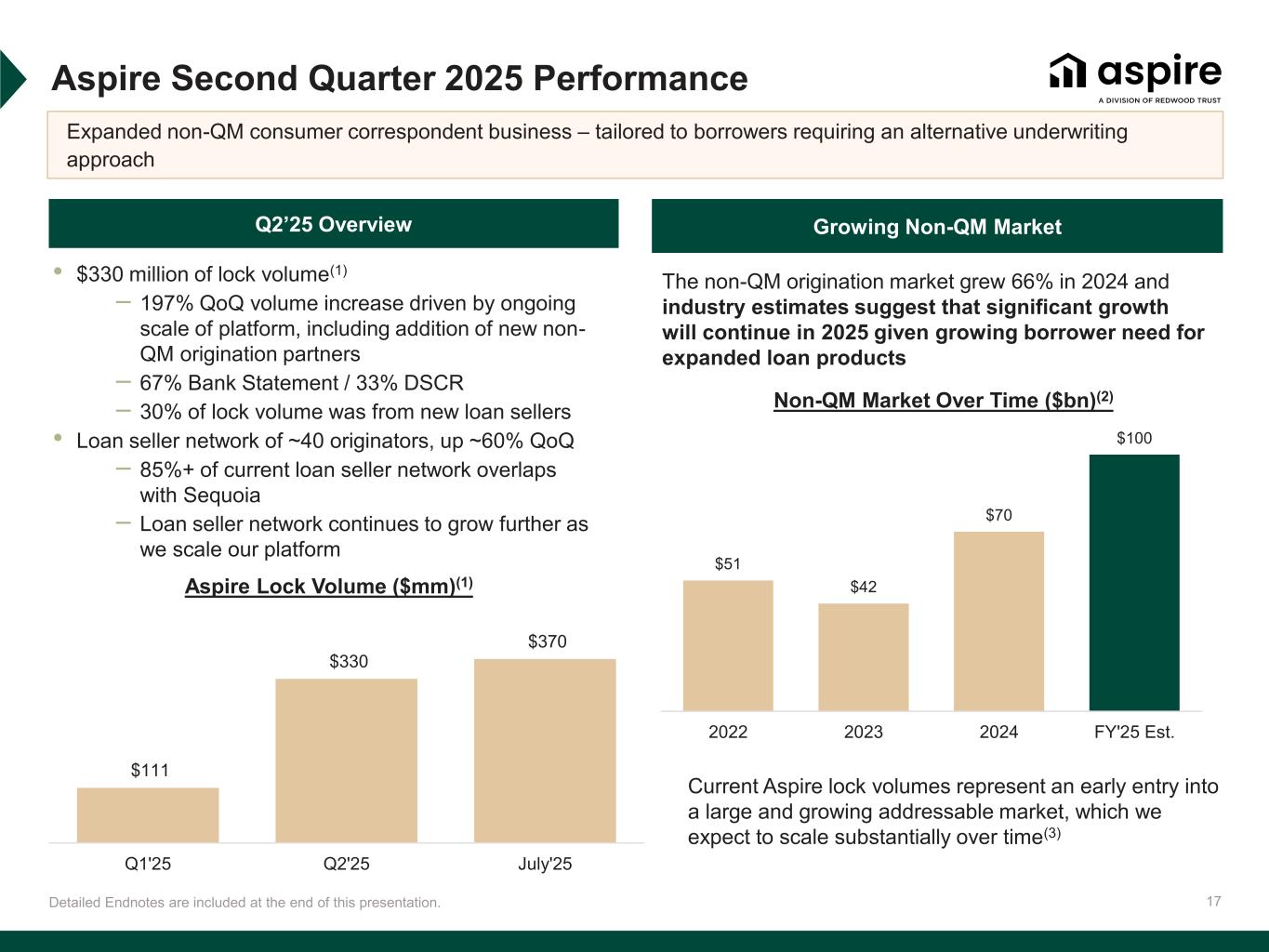
◦Lock volume includes $330 million of Aspire loans, a 197% increase from the first quarter 2025(6)
•Distributed $2.9 billion of loans through a combination of securitizations ($2.0 billion) and whole loan sales ($841 million), the most active quarter for distributions since 2021
CoreVest Mortgage Banking
•Segment GAAP net income of $6.1 million
•Generated 27% and 34% annualized GAAP ROE and non-GAAP EAD ROE, respectively(4)
•Funded $509 million of loans (55% bridge and 45% term), a 6% increase from $482 million in the first quarter 2025 and an 11% increase from $459 million in the second quarter 2024
•Distributed $583 million of loans through whole loan sales, securitizations and sales to joint ventures ("JVs"), the most active quarter of distributions in CoreVest's history
◦Distribution activities included completion of CoreVest's inaugural rated securitization backed by $284 million of bridge loans
Redwood Investments(7)
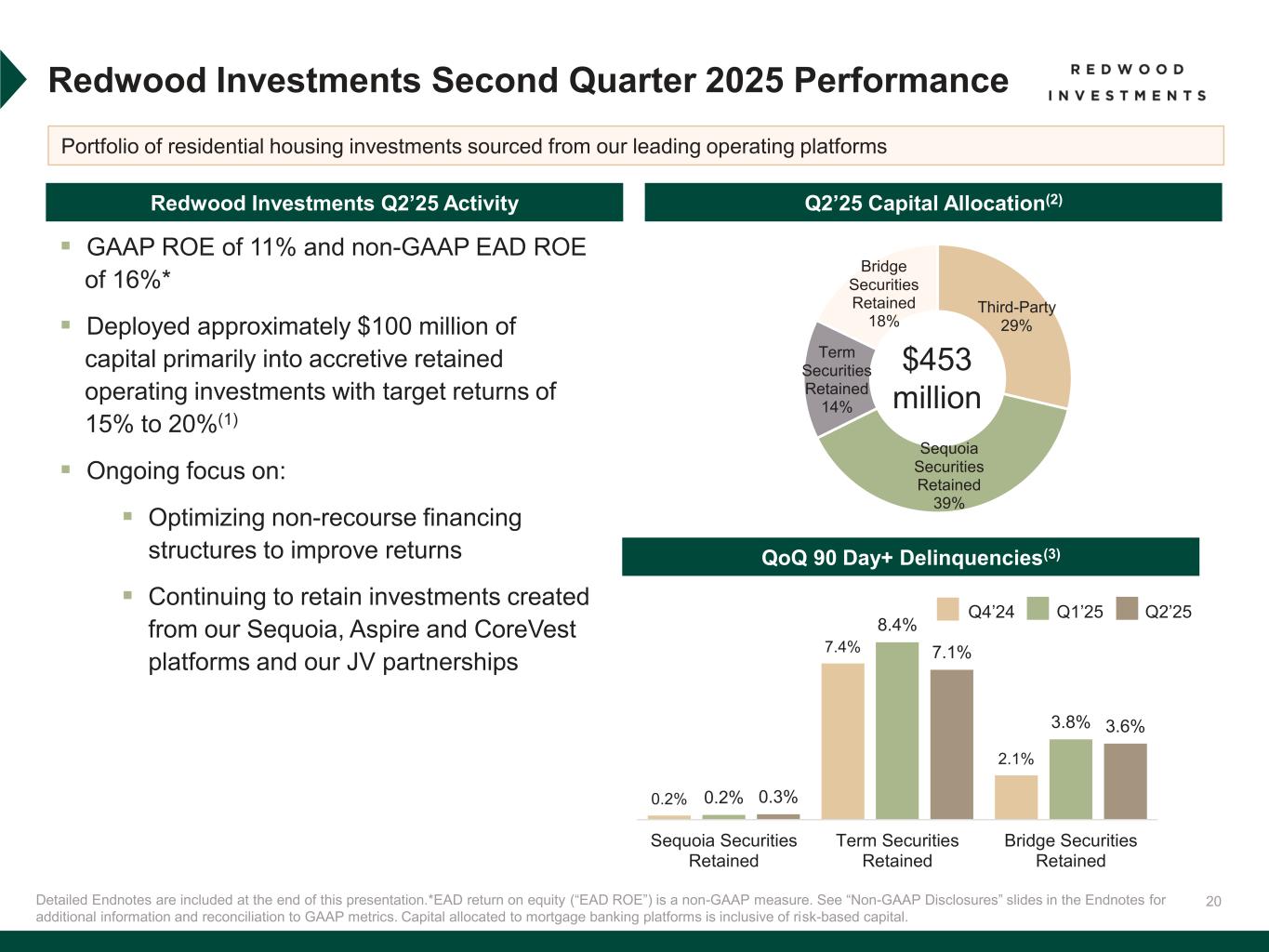
•Segment GAAP net income of $11.9 million
◦Net income from Redwood Investments decreased in the second quarter 2025 relative to the first quarter 2025, largely driven by muted asset valuation gains relative to last quarter
•Accretively deployed approximately $100 million of capital into retained operating investments with mid-teens target returns(8)
•Redwood Investments recourse leverage ratio remained low at 1.1x at June 30, 2025(9)
3

Legacy Investments(1)
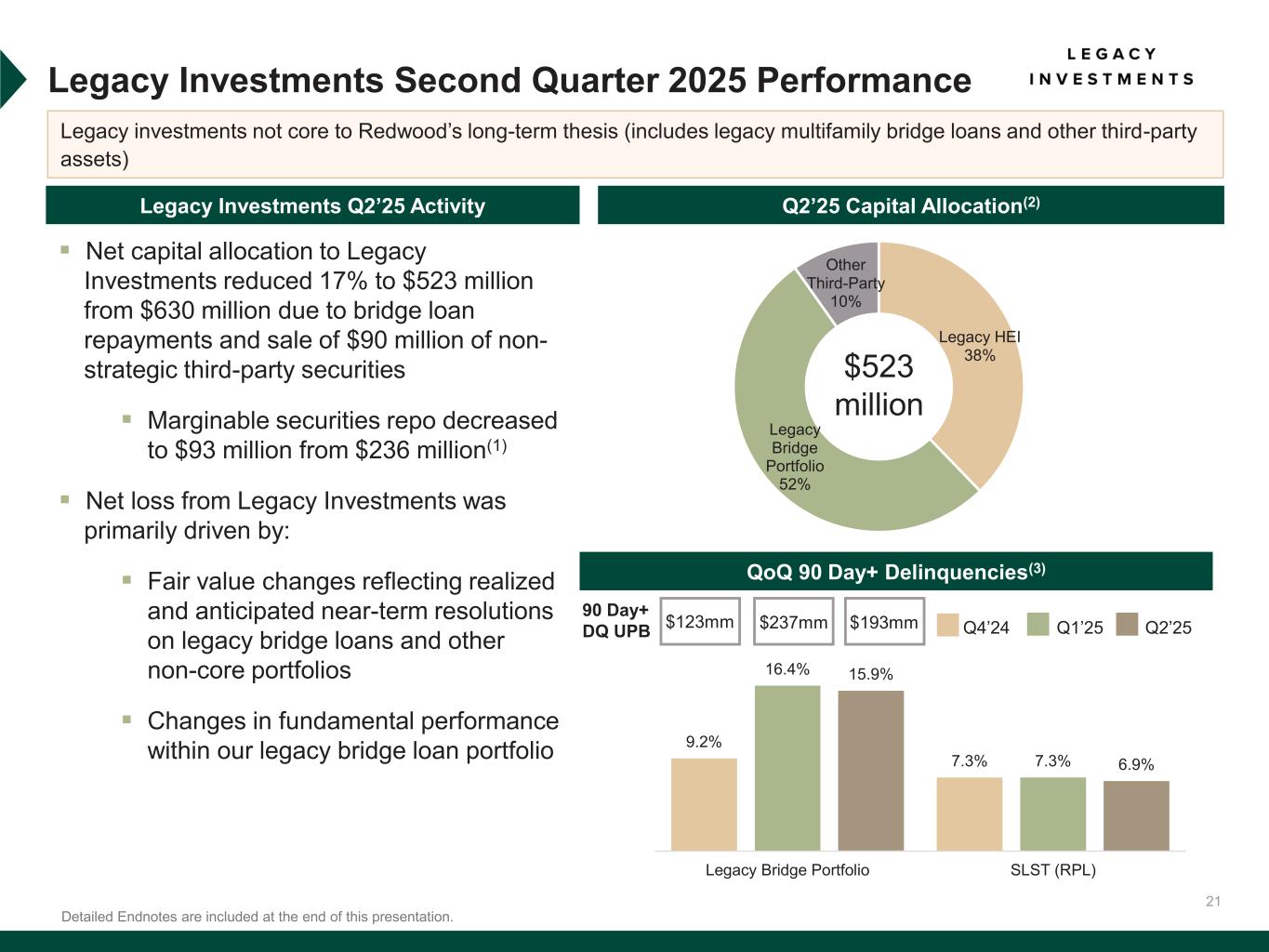
•New reportable segment established in the second quarter 2025 to present financial results for assets not core to Redwood's long-term strategic objectives
◦These assets are generally in the process of active sale, run-off, or other disposition
◦Segment GAAP net loss of $(104.0) million
▪Net loss from Legacy Investments primarily driven by fair value adjustments, reflecting both realized and anticipated near-term resolutions on legacy bridge loans and other non-core assets, as well as changes in the underlying performance of certain legacy bridge loans
◦Capital allocated to Legacy Investments declined by $107 million or 17% at June 30, 2025 from March 31, 2025, largely due to paydowns, sales and fair value adjustments of our legacy bridge loans and the sale, or pending sale, of non-core third-party assets
•Legacy Investments recourse leverage ratio of 1.2x at June 30, 2025(10)
Capital and Financing
•Recourse debt of $3.3 billion at June 30, 2025 compared to $2.9 billion at March 31, 2025 (recourse leverage ratio of 3.2x at June 30, 2025, up from 2.5x at March 31, 2025)(11)
◦Quarter-over-quarter increase partially driven by increased warehouse utilization, reflecting the continued growth of our mortgage banking pipelines
•Marginable securities repo reduced to $93 million at June 30, 2025 from $236 million at March 31, 2025 from sale of third-party assets
Q3 2025 Highlights to Date(12)
•Locked or funded a combined $1.6 billion of loans across mortgage banking platforms
•Distributed approximately $0.7 billion of loans across mortgage banking platforms through securitizations, whole loans sales and sales to JVs(13)
•Repurchased 0.8 million shares of our common stock
•Increased common stock repurchase authorization to $150 million
4

_____________________
1.Legacy Investments consists of certain unsecuritized residential investor bridge loans (including multifamily loans), certain REO investments and other third-party originated investments.
2.Economic return on book value is based on the period change in GAAP book value per common share plus dividends declared per common share in the period.
3.Core Segments Earnings Available for Distribution ("Core Segments EAD") is a new non-GAAP measure established in the second quarter 2025 and is used to present management’s non-GAAP analysis of the combined performance the Company’s mortgage banking platforms and related investments (which consist of the Company’s Sequoia Mortgage Banking, CoreVest Mortgage Banking and Redwood Investments segments), inclusive of an allocated portion of the Company’s Corporate segment relating to those Core Segments. Core Segments EAD excludes the Company’s Legacy Investments segment and excludes an allocated portion of the Company’s Corporate segment relating to the Legacy Investments segment. Core Segments EAD per basic common share and Core Segments EAD ROE are also new non-GAAP measures established in the second quarter 2025 and are calculated using Core Segments EAD. See Non-GAAP Disclosures section that follows for additional information on these measures.
4.Earnings Available for Distribution (“EAD”) and EAD ROE are non-GAAP measures that the Company has historically reported and continue to be used to present management’s non-GAAP analysis of the performance of the Company’s different business segments, exclusive of any allocation of the Company’s Corporate segment. See Non-GAAP Disclosures section that follows for additional information on these measures.
5.Lock volume represents loans identified for purchase from loan sellers. Lock volume does not account for potential fallout from pipeline that typically occurs through the lending process.
6.Aspire lock volume is included in the Sequoia Mortgage Banking business segment results.
7.Redwood Investments consists of retained operating investments sourced through our Sequoia securitizations and CoreVest term and bridge loan securitizations, some of which we consolidate for GAAP purposes, investments in joint ventures, and other third-party investments.
8.Represents management’s targets and actual results may differ materially.
9.Redwood Investments recourse leverage ratio is defined as recourse debt at Redwood Investments divided by capital invested. At June 30, 2025 recourse debt excludes $15.1 billion of consolidated securitization debt (ABS issued and servicer advance financing), other liabilities and other debt that is non-recourse to Redwood at Redwood Investments. Capital invested in our Redwood Investments segment at June 30, 2025 was $453 million.
10.Legacy Investments recourse leverage ratio is defined as recourse debt at Legacy Investments divided by capital invested. At June 30, 2025 recourse debt excludes $1.4 billion of consolidated securitization debt (ABS issued), other liabilities and other debt that is non-recourse to Redwood at Legacy Investments. Capital invested in our Legacy Investments segment at June 30, 2025 was $523 million.
11.Recourse leverage ratio is defined as recourse debt at Redwood divided by tangible stockholders' equity. At June 30, 2025, and March 31, 2025, recourse debt excluded $16.9 billion and $15.8 billion, respectively, of consolidated securitization debt (ABS issued and servicer advance financing), other liabilities and other debt that is non-recourse to Redwood, and tangible stockholders' equity excluded $38 million and $40 million, respectively, of goodwill and intangible assets.
12.Represents third quarter 2025 activity through July 29, 2025 unless otherwise noted.
13.Includes securitizations and sales that have priced but not yet closed as of July 29, 2025.

5

Second Quarter 2025 Redwood Review and Supplemental Tables Available Online
A further discussion of Redwood's business and financial results is included in the second quarter 2025 Shareholder Letter and Redwood Review which are available under "Financial Info" within the Investor Relations section of the Company’s website at redwoodtrust.com/investor-relations. Additional supplemental financial tables can also be found within this section of the Company's website.
Conference Call and Webcast
Redwood will host an earnings call today, July 30, 2025, at 8:00 a.m. Eastern Time / 5:00 a.m. Pacific Time to discuss its second quarter 2025 financial results. The number to dial in order to listen to the conference call is 1-877-423-9813 in the U.S. and Canada. International callers must dial 1-201-689-8573. A replay of the call will be available through midnight on Wednesday, August 13, 2025, and can be accessed by dialing 1-844-512-2921 in the U.S. and Canada or 1-412-317-6671 internationally and entering access code #13754528.
The conference call will be webcast live in listen-only mode through the News & Events section of Redwood’s Investor Relations website at https://www.redwoodtrust.com/investor-relations/news-events/events. To listen to the webcast, please go to Redwood's website at least 15 minutes before the call to register and to download and install any needed audio software. An audio replay of the call will also be available on Redwood's website following the call. Redwood plans to file its Quarterly Report on Form 10-Q with the Securities and Exchange Commission by Monday, August 11, 2025, and also make it available on Redwood’s website.
6

REDWOOD TRUST, INC.
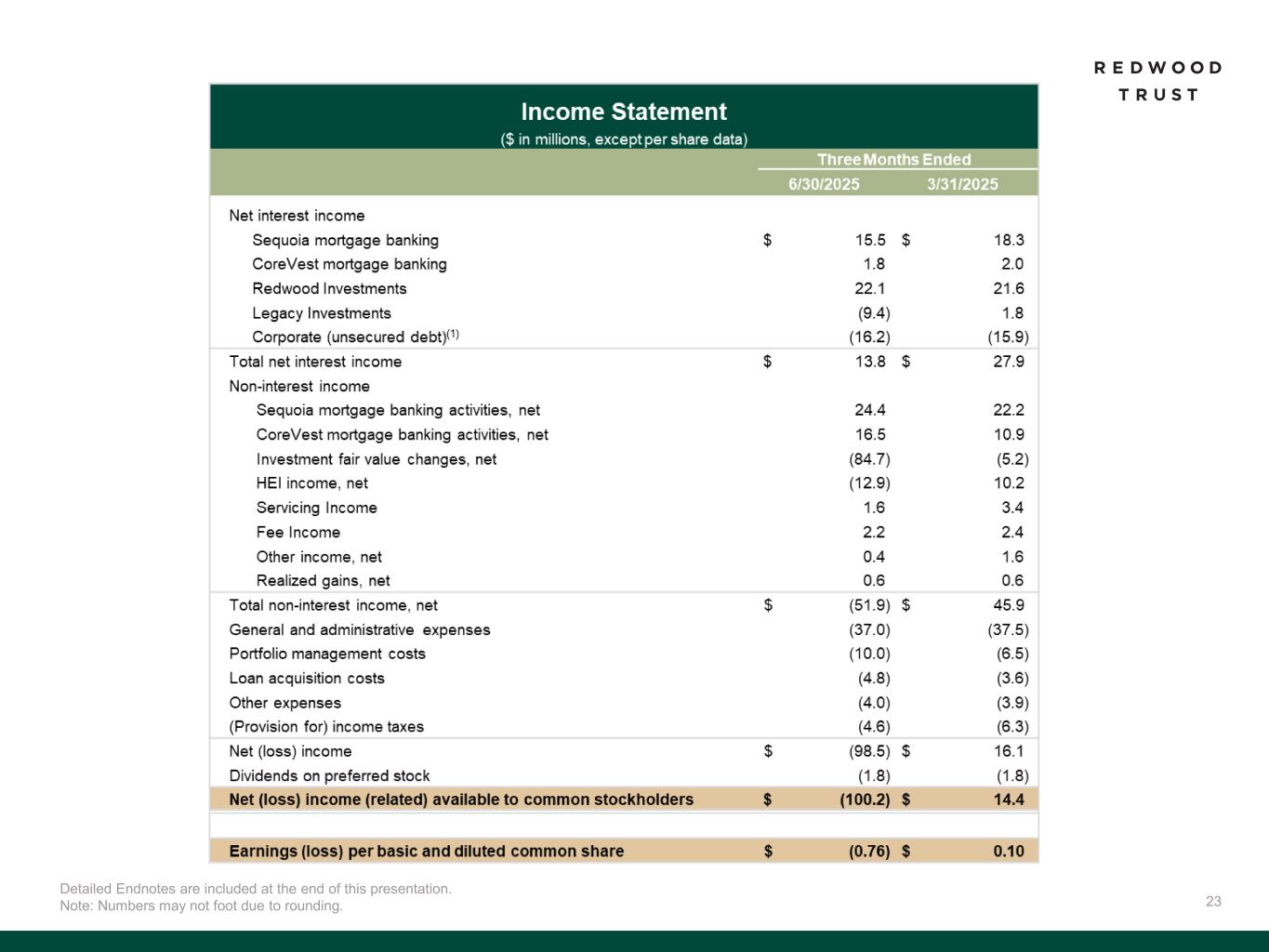
Consolidated Income Statements (1)
Three Months Ended
($ in millions, except share and per share data) 6/30/25 3/31/25
Net Interest Income from:
Sequoia mortgage banking $ 15.5  $ 18.3 
CoreVest mortgage banking 1.8  2.0 
Redwood investments 22.1  21.6 
Legacy investments (9.4) 1.8 
Corporate/other (16.2) (15.9)
Net Interest Income $ 13.8  $ 27.9 
Non-interest income
Sequoia mortgage banking activities, net 24.4  22.2 
CoreVest mortgage banking activities, net 16.5  10.9 
Investment fair value changes, net (84.7) (5.2)
HEI income, net (12.9) 10.2 
Servicing income, net 1.6  3.4 
Fee income, net 2.2  2.4 
Other income, net 0.4  1.6 
Realized gains, net 0.6  0.6 
Total non-interest income, net $ (51.9) $ 45.9 
General and administrative expenses (37.0) (37.5)
Portfolio management costs (10.0) (6.5)
Loan acquisition costs (4.8) (3.6)
Other expenses (4.0) (3.9)
(Provision for) income taxes (4.6) (6.3)
Net (loss) income $ (98.5) $ 16.1 
Dividends on preferred stock (1.8) (1.8)
Net (loss) income (related) available to common stockholders $ (100.2) $ 14.4 
Weighted average basic common shares (thousands) 133,006  132,766 
Weighted average diluted common shares (thousands) (2)
133,006  132,766 
(Loss) earnings per basic common share $ (0.76) $ 0.10 
(Loss) earnings per diluted common share $ (0.76) $ 0.10 
Regular dividends declared per common share $ 0.18  $ 0.18 
(1)Certain totals may not foot due to rounding.
(2)Actual shares outstanding (in thousands) at June 30, 2025 and March 31, 2025 were 131,680 and 133,005, respectively.
7

REDWOOD TRUST, INC.
Consolidated Balance Sheets (1)
($ in millions, except share and per share data) 6/30/25 3/31/25
Residential consumer loans $ 14,202  $ 12,752 
Residential investor loans 4,339  4,440 
Consolidated agency multifamily loans 423  424 
Real estate securities 265  376 
Home equity investments (HEI) 588  600 
Servicing investments 298  298 
Strategic investments 78  85 
Cash and cash equivalents 302  260 
Other assets 838  637 
Total assets $ 21,333  $ 19,872 
Asset-backed securities issued, net $ 15,985  $ 14,458 
Debt obligations, net 3,745  3,761 
Other liabilities 549  469 
Total liabilities $ 20,280  $ 18,688 
Stockholders' equity 1,053  1,183 
Total liabilities and equity $ 21,333  $ 19,872 
Common shares outstanding at period end (thousands) 131,680  133,005 
GAAP book value per common share $ 7.49  $ 8.39 
(1)Certain totals may not foot due to rounding.
8

Segment Financial Information
Three Months Ended June 30, 2025
(In Millions) Sequoia Mortgage Banking CoreVest Mortgage Banking Redwood Investments Legacy Investments Corporate/
Other
Total
Interest income $ 37.0  $ 3.7  $ 219.7  $ 23.4  $ 0.4  $ 284.3 
Interest expense (21.5) (1.9) (197.6) (32.9) (16.6) (270.5)
Net interest income (expense) 15.5  1.8  22.1  (9.4) (16.2) 13.8 
Non-interest income (loss)
Mortgage banking activities, net 24.4  16.5  —  —  —  40.9 
Investment fair value changes, net —  —  (9.0) (75.6) (0.1) (84.7)
HEI income, net —  —  0.1  (13.0) —  (12.9)
Servicing Income, net —  —  1.6  —  —  1.6 
Fee Income, net —  2.8  0.4  (1.0) —  2.2 
Other income, net —  0.7  0.4  —  (0.8) 0.4 
Realized gains, net —  —  0.6  —  —  0.6 
Total non-interest income (loss), net 24.4  20.0  (5.8) (89.6) (0.9) (51.9)
General and administrative expenses (7.2) (10.2) (1.5) (0.1) (18.0) (37.0)
Portfolio management costs —  —  (2.6) (7.4) —  (10.0)
Loan acquisition costs (1.3) (3.5) —  —  —  (4.8)
Other expenses —  (2.2) (1.8) —  —  (4.0)
(Provision for) benefit from income taxes (9.3) 0.3  1.6  2.5  0.3  (4.6)
Net Income (Loss) (1)
$ 22.2  $ 6.1  $ 11.9  $ (104.0) $ (34.7) $ (98.5)
Total Assets $ 1,689.1  $ 338.0  $ 15,982.4  $ 2,917.4  $ 406.2  $ 21,333.1 
(1)Net Income (Loss) by segment is also referred to as Segment Net Income (Loss).
9

Segment Financial Information (continued)
Three Months Ended March 31, 2025
(In Millions) Sequoia Mortgage Banking CoreVest Mortgage Banking Redwood Investments Legacy Investments Corporate/
Other
Total
Interest income $ 31.7  $ 4.4  $ 201.6  $ 34.2  $ 0.3  $ 272.1 
Interest expense (13.3) (2.4) (179.9) (32.3) (16.2) (244.2)
Net interest income (expense) 18.3  2.0  21.7  1.8  (15.9) 27.9 
Non-interest income (loss)
Mortgage banking activities, net 22.2  10.9  —  —  —  33.1 
Investment fair value changes, net —  —  3.6  (8.7) (0.1) (5.2)
HEI income, net —  —  0.1  10.1  —  10.2 
Servicing Income, net —  —  3.4  —  —  3.4 
Fee Income, net —  3.1  0.1  (0.9) —  2.4 
Other income, net —  1.7  0.4  —  (0.5) 1.6 
Realized gains, net —  —  0.6  —  —  0.6 
Total non-interest income (loss), net 22.2  15.7  8.2  0.5  (0.6) 45.9 
General and administrative expenses (6.3) (10.6) (1.3) —  (19.2) (37.5)
Portfolio management costs —  —  (2.1) (4.4) —  (6.5)
Loan acquisition costs (1.1) (2.5) —  —  —  (3.6)
Other expenses —  (2.2) (1.7) —  —  (3.9)
(Provision for) benefit from income taxes (7.3) 0.6  0.3  —  —  (6.3)
Net Income (Loss) (1)
$ 25.8  $ 3.0  $ 25.0  $ (2.1) $ (35.6) $ 16.1 
Total Assets $ 1,559.1  $ 344.0  $ 14,514.7  $ 3,087.2  $ 366.7  $ 19,871.8 
(1)Net Income (Loss) by segment is also referred to as Segment Net Income (Loss).

10

Non-GAAP Disclosures
To supplement consolidated and segment financial information prepared and presented in accordance with U.S. generally accepted accounting principles ("GAAP"), the Company also provides the following non-GAAP measures:
•Core Segments Earnings Available for Distribution (“Core Segments EAD”)
•Earnings Available for Distribution (“EAD”)
Management believes these non-GAAP measures provide supplemental information to assist management and investors in analyzing the Company’s results of operations and help facilitate comparisons to industry peers. Management also believes that these non-GAAP measures are metrics that can supplement its analysis of the Company’s ability to pay dividends, by providing an indication of the current income generating capacity of the Company's operating platforms as of the quarter being presented. In addition, management believes its new non-GAAP Core Segments EAD measure provide supplemental information to assist management and investors in analyzing the Company’s expedited transition to the scalable and simplified capital-efficient business model, which includes an accelerated wind-down of legacy portfolio holdings within its newly-established Legacy Investments segment.
These non-GAAP measures should not be utilized in isolation, nor should they be considered as an alternative to GAAP net income (loss) available (related) to common stockholders, GAAP ROE or other measurements of results of operations computed in accordance with GAAP or for federal income tax purposes.
Core Segments EAD. Core Segments EAD and Core Segments EAD ROE are new non-GAAP measures established in the second quarter 2025 and are used to present management’s non-GAAP analysis (based on its non-GAAP Earnings Available for Distribution (“EAD”) measure further described below) of the combined performance the Company’s mortgage banking platforms and related investments (which consist of the Company’s Sequoia Mortgage Banking, CoreVest Mortgage Banking and Redwood Investments segments and are defined as the Company’s “Core Segments”, inclusive of an allocated portion of the Company’s Corporate segment relating to those segments).
•Core Segments EAD excludes the Company’s Legacy Investments segment and excludes an allocated portion of the Company’s Corporate segment relating to the Legacy Investments segment.
•Core Segments EAD per basic common share and Core Segments EAD ROE are also new non-GAAP measures established in the second quarter 2025 and are calculated using Core Segments EAD.
•Core Segments EAD ROE is defined as Core Segments EAD divided by average capital attributable to Core Segments.
A further discussion of Core Segments EAD and a reconciliation of our non-GAAP Core Segments EAD measures to comparable GAAP measures is set forth below under the heading “Reconciliation of GAAP to non-GAAP Core Segments EAD”.
EAD. Earnings Available for Distribution (“EAD”) and EAD ROE are non-GAAP measures that the Company has historically reported and continue to be used to present management’s non-GAAP analysis of the performance of the Company’s different business segments, and that continue to be calculated exclusive of any allocation of the Company’s Corporate segment.
•Consistent with prior quarter disclosures, EAD and EAD ROE are non-GAAP measures derived from GAAP Net income (loss) available (related) to common stockholders and GAAP Return on common equity ("GAAP ROE" or "ROE"), respectively.
•Consistent with prior quarter disclosures, EAD is defined as: GAAP net income (loss) available (related) to common stockholders adjusted to (i) exclude investment fair value changes, net; (ii) exclude realized gains and losses; (iii) exclude acquisition related expenses; (iv) exclude certain organizational restructuring charges (as applicable); and (v) adjust for the hypothetical income taxes associated with these adjustments.
11

•Consistent with prior quarter disclosures, EAD ROE is defined as EAD divided by average capital utilized for each respective period.
A further discussion of EAD and a reconciliation of our non-GAAP EAD measures to comparable GAAP measures is set forth below under the heading “Reconciliation of GAAP to non-GAAP EAD”.
Supplemental Non-GAAP Table - Illustrating EAD With Allocated Corporate Segment.
Management is also presenting a supplemental non-GAAP table in this section under the heading “Supplemental Table - EAD With Allocated Corporate Segment” to clearly illustrate a key distinction between the methodology for calculating the two non-GAAP measures described above – namely, Core Segments EAD and EAD. That key distinction relates to whether or not the non-GAAP measure allocates the Company’s Corporate segment across its other reporting segments for purposes of calculating the non-GAAP measure of performance. Management believes this supplemental table assists management and investors in comparing the Company’s two distinct non-GAAP measures described above.
12

Non-GAAP Disclosures (continued)
Reconciliation of GAAP to non-GAAP Core Segments EAD (1)(2)
Three Months Ended
($ in millions, except per share data) 6/30/2025 3/31/25
GAAP Net (loss) income (related) available to common stockholders $ (100.2) $ 14.4 
Adjustments to exclude Legacy Investments Segment:
GAAP net loss from Legacy Investments Segment 104.0  2.1 
Allocation of Corporate Segment relating to Legacy Investments Segment (3)
13.4  14.8 
EAD adjustments relating to Core Segments and Corporate Segment:
Investment fair value changes, net (4)
9.0  (3.6)
Realized (gains)/losses, net (5)
(0.6) (0.6)
Acquisition related expenses (6)
2.2  2.2 
Tax effect of adjustments (7)
(2.8) (1.4)
Non-GAAP Core Segments EAD $ 25.0  $ 28.0 
Net (Loss) Income per Basic Common Share (GAAP) $ (0.76) $ 0.10 
Non-GAAP Core Segments EAD per Basic Common Share (8)
$ 0.18  $ 0.20 
GAAP Return on Equity ("ROE") (annualized) (36.6) % 5.2  %
Non-GAAP Core Segments EAD Return on Equity (annualized) ("Core Segments EAD ROE") (9)
14.5  % 16.7  %
1.Certain totals may not foot due to rounding.
2.Core Segments EAD and Core Segments EAD ROE are new non-GAAP measures established in the second quarter 2025 and are used to present management’s non-GAAP analysis of the combined performance the Company’s mortgage banking platforms and related investments (which are defined as "Core Segments" and which consist of the Company’s Sequoia Mortgage Banking, CoreVest Mortgage Banking and Redwood Investments segments), inclusive of an allocated portion of the Company’s Corporate segment relating to those Core Segments. Core Segments EAD excludes the Company’s Legacy Investments segment and excludes an allocated portion of the Company’s Corporate segment relating to the Legacy Investments segment.
Core Segments EAD is defined as: GAAP net income (loss) available (related) to common stockholders adjusted to (i) exclude GAAP net loss from the Legacy Investments Segment, (ii) exclude the portion of the Corporate Segment allocation relating to the Legacy Investments segment, (iii) exclude investment fair value changes, net; (iv) exclude realized gains and losses; (v) exclude acquisition related expenses; (vi) exclude certain organizational restructuring charges (as applicable); and (vii) adjust for the hypothetical income taxes associated with these adjustments.
Refer to footnote 9 below for the definition of Core Segments EAD ROE.
3.Allocation of Corporate Segment relating to the Legacy Investments Segment is a non-GAAP adjustment based on average capital utilized by the Legacy Investments Segment of $576 million and $614 million for the three months ended June 30, 2025 and March 31, 2025, respectively.
4.Investment fair value changes, net includes all amounts within that same line item in our consolidated statements of (loss) income that are attributable to our Core Segments and Corporate segment, which primarily represents both realized and unrealized gains and losses on our investments held in our Core Segments and Corporate Segment and associated hedges. Realized and unrealized gains and losses on our HEI investments are reflected in a separate line item on our consolidated income statements titled "HEI income, net".
5.Realized (gains)/losses, net includes all amounts within that line item on our consolidated statements of (loss) income that are attributable to our Core Segments.
6.Acquisition related expenses include transaction costs paid to third parties, as applicable, and the ongoing amortization of intangible assets related to the Riverbend and CoreVest acquisitions.
7.Tax effect of adjustments represents the hypothetical income taxes associated with EAD adjustments used to calculate Core Segments EAD.
8.Core Segments EAD per basic common share is a new non-GAAP measure established in the second quarter 2025 and is defined as Core Segments EAD divided by basic weighted average common shares outstanding at the end of the period.
9.Core Segments EAD ROE is a new non-GAAP measure established in the second quarter 2025 and is defined as Core Segments EAD divided by average capital attributable to Core Segments of $689 million and $671 million for the three months ended June 30, 2025 and March 31, 2025, respectively.
13

Non-GAAP Disclosures (continued)
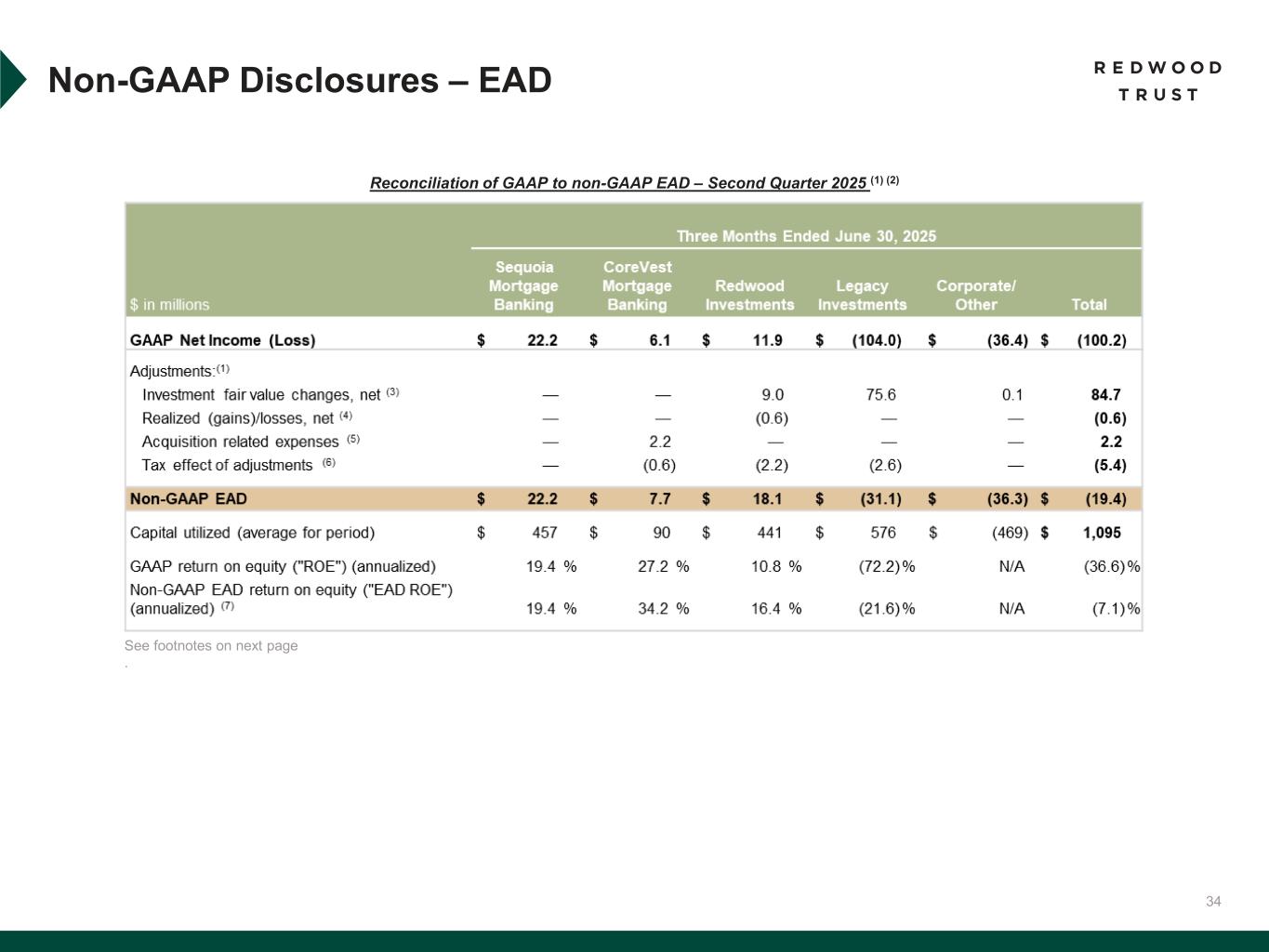
Reconciliation of GAAP to non-GAAP EAD - Second Quarter 2025 (1)(2)
Three Months Ended June 30, 2025
($ in millions) Sequoia Mortgage Banking CoreVest Mortgage Banking Redwood Investments Legacy Investments Corporate/
Other
Total
GAAP Net Income (Loss) $ 22.2  $ 6.1  $ 11.9  $ (104.0) $ (36.4) $ (100.2)
EAD Adjustments:
Investment fair value changes, net (3)
—  —  9.0  75.6  0.1  84.7
Realized (gains)/losses, net (4)
—  —  (0.6) —  —  (0.6)
Acquisition related expenses (5)
—  2.2  —  —  —  2.2
Tax effect of adjustments(6)
—  (0.6) (2.2) (2.6) —  (5.4)
Non-GAAP EAD $ 22.2  $ 7.7  $ 18.1  $ (31.1) $ (36.3) $ (19.4)
Capital utilized (average for period) $ 457  $ 90  $ 441  $ 576  $ (469) $ 1,095
GAAP Return on Equity ("ROE") (annualized) 19.4  % 27.2  % 10.8  % (72.2) % N/A (36.6) %
Non-GAAP EAD Return on Equity ("EAD ROE") (annualized) (7)
19.4  % 34.2  % 16.4  % (21.6) % N/A (7.1) %
See footnotes to table on next page

14

Non-GAAP Disclosures (continued)
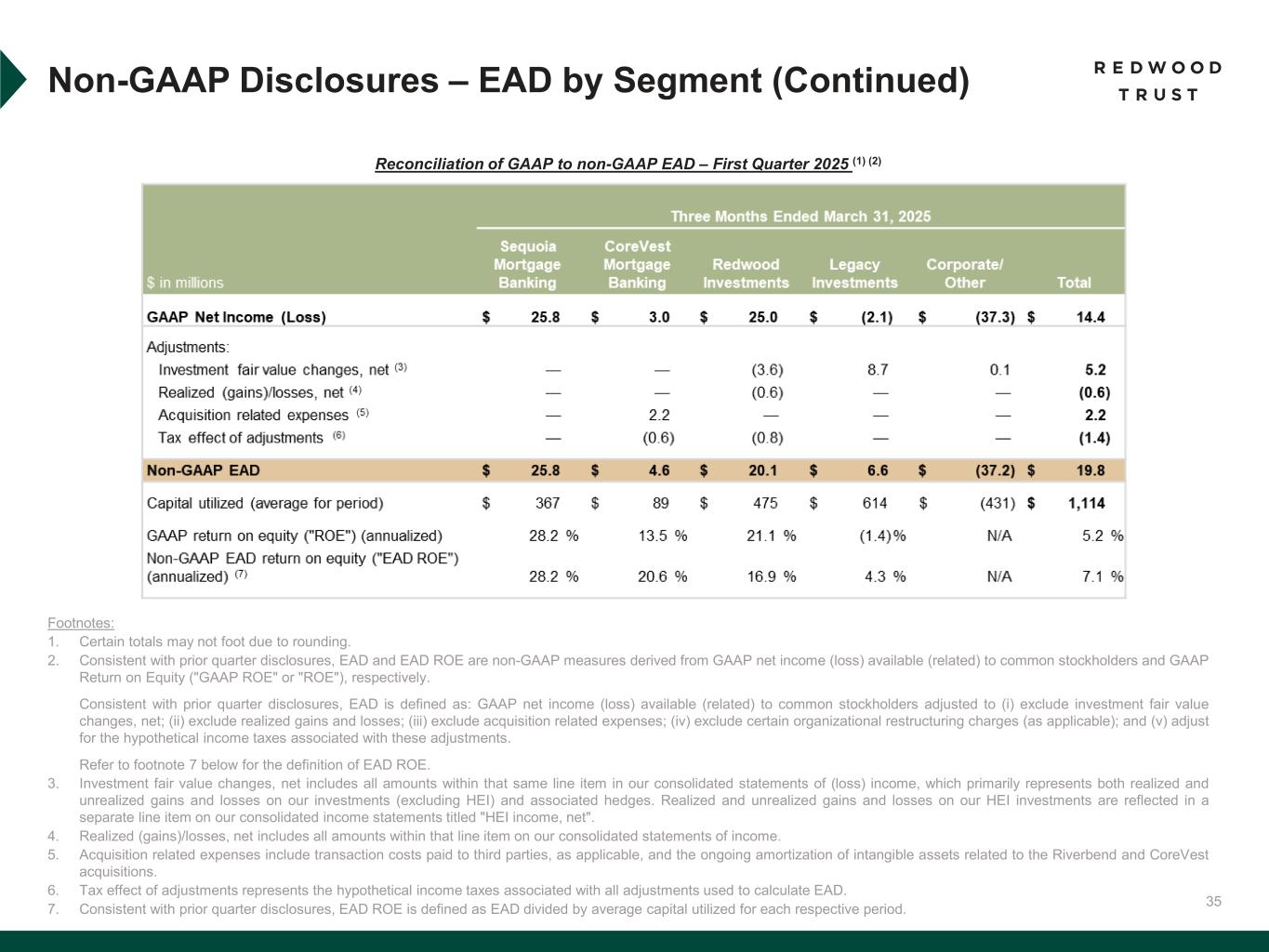
Reconciliation of GAAP to non-GAAP EAD - First Quarter 2025 (1)(2)
Three Months Ended March 31, 2025
($ in millions) Sequoia Mortgage Banking CoreVest Mortgage Banking Redwood Investments Legacy Investments Corporate/
Other
Total
GAAP Net Income (Loss) $ 25.8  $ 3.0  $ 25.0  $ (2.1) $ (37.3) $ 14.4
EAD Adjustments:
Investment fair value changes, net (3)
—  —  (3.6) 8.7  0.1  5.2
Realized (gains)/losses, net (4)
—  —  (0.6) —  —  (0.6)
Acquisition related expenses (5)
—  2.2  —  —  —  2.2
Tax effect of adjustments(6)
—  (0.6) (0.8) —  —  (1.4)
Non-GAAP EAD $ 25.8  $ 4.6  $ 20.1  $ 6.6  $ (37.2) $ 19.8
Capital utilized (average for period) $ 367  $ 89  $ 475  $ 614  $ (431) $ 1,114
GAAP Return on Equity ("ROE") (annualized) 28.2  % 13.5  % 21.1  % (1.4) % N/A 5.2  %
Non-GAAP EAD Return on Equity ("EAD ROE") (annualized) (7)
28.2  % 20.6  % 16.9  % 4.3  % N/A 7.1  %

1.Certain totals may not foot due to rounding.
2.Consistent with prior quarter disclosures, EAD and EAD ROE are non-GAAP measures derived from GAAP net income (loss) available (related) to common stockholders and GAAP Return on Equity ("GAAP ROE" or "ROE"), respectively.
Consistent with prior quarter disclosures, EAD is defined as: GAAP net income (loss) available (related) to common stockholders adjusted to (i) exclude investment fair value changes, net; (ii) exclude realized gains and losses; (iii) exclude acquisition related expenses; (iv) exclude certain organizational restructuring charges (as applicable); and (v) adjust for the hypothetical income taxes associated with these adjustments.
Refer to footnote 7 below for the definition of EAD ROE.
3.Investment fair value changes, net includes all amounts within that same line item in our consolidated statements of (loss) income, which primarily represents both realized and unrealized gains and losses on our investments (excluding HEI) and associated hedges. Realized and unrealized gains and losses on our HEI investments are reflected in a separate line item on our consolidated income statements titled "HEI income, net".
4.Realized (gains)/losses, net includes all amounts within that line item on our consolidated statements of income.
5.Acquisition related expenses include transaction costs paid to third parties, as applicable, and the ongoing amortization of intangible assets related to the Riverbend and CoreVest acquisitions.
6.Tax effect of adjustments represents the hypothetical income taxes associated with all adjustments used to calculate EAD.
7.Consistent with prior quarter disclosures, EAD ROE is defined as EAD divided by average capital utilized for each respective period.
15

Non-GAAP Disclosures (continued)
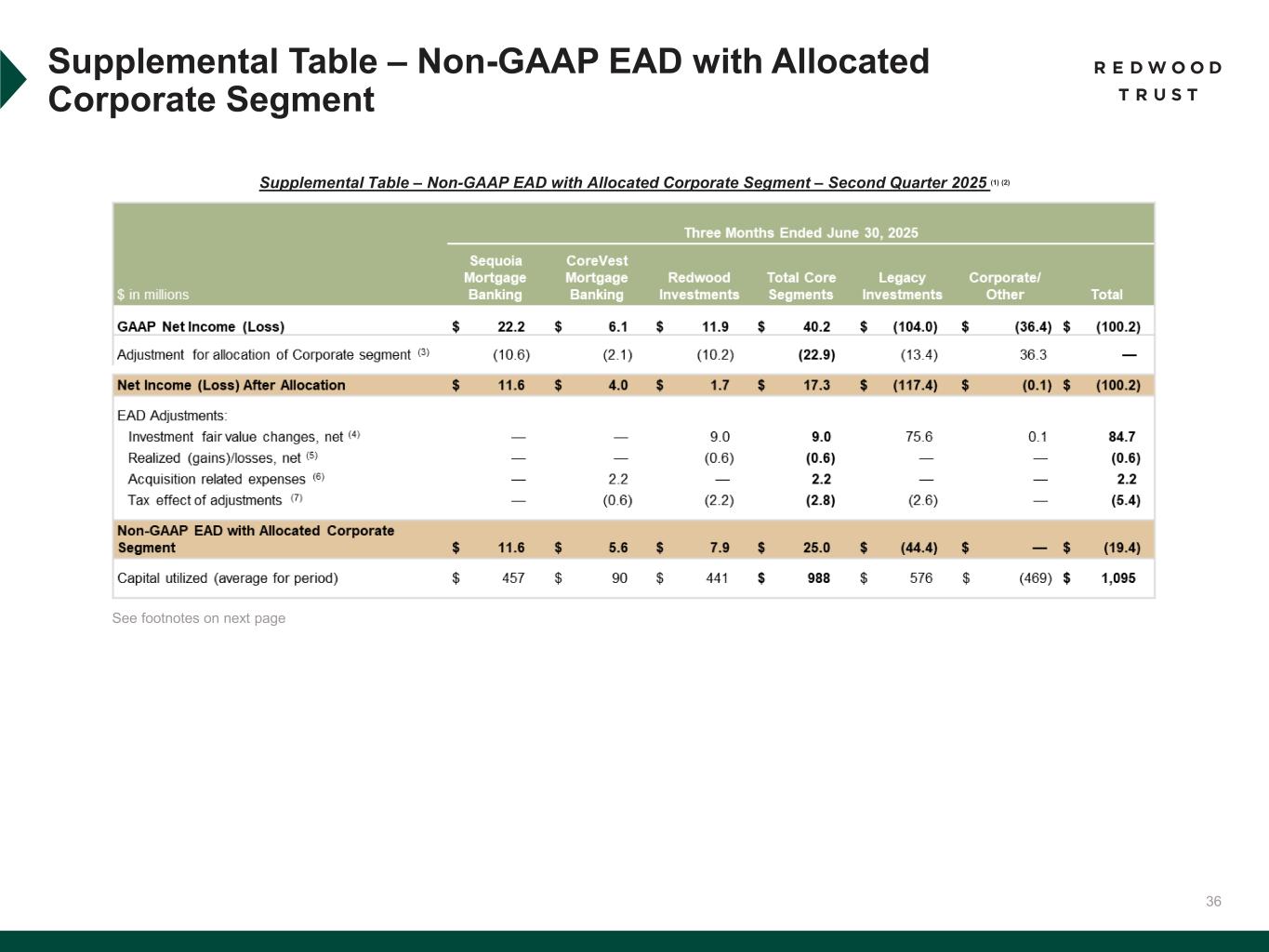
Supplemental Table - Non-GAAP EAD with Allocated Corporate Segment - Second Quarter 2025 (1)(2)
Three Months Ended June 30, 2025
($ in millions) Sequoia Mortgage Banking CoreVest Mortgage Banking Redwood Investments Total Core Segments Legacy Investments Corporate/Other Total
GAAP Net Income (Loss) $ 22.2  $ 6.1  $ 11.9  $ 40.2  $ (104.0) $ (36.4) $ (100.2)
Adjustment for allocation of Corporate segment (3)
(10.6) (2.1) (10.2) (22.9) (13.4) 36.3  — 
Net Income (Loss) After Allocation $ 11.6  $ 4.0  $ 1.7  $ 17.3  $ (117.4) $ (0.1) $ (100.2)
EAD Adjustments:
Investment fair value changes, net (4)
—  —  9.0  9.0  75.6  0.1  84.7
Realized (gains)/losses, net (5)
—  —  (0.6) (0.6) —  —  (0.6)
Acquisition related expenses (6)
—  2.2  —  2.2  —  —  2.2
Tax effect of adjustments(7)
—  (0.6) (2.2) (2.8) (2.6) —  (5.4)
Non-GAAP EAD with Allocated Corporate Segment $ 11.6  $ 5.6  $ 7.9  $ 25.0  $ (44.4) $ —  $ (19.4)
Capital utilized (average for period) $ 457  $ 90  $ 441  $ 988  $ 576  $ (469) $ 1,095
See footnotes to table on next page
16


Non-GAAP Disclosures (continued)
Supplemental Table - Non-GAAP EAD with Allocated Corporate Segment - First Quarter 2025 (1)(2)
Three Months Ended March 31, 2025
($ in millions) Sequoia Mortgage Banking CoreVest Mortgage Banking Redwood Investments Total Core Segments Legacy Investments Corporate/Other Total
GAAP Net Income (Loss) $ 25.8  $ 3.0  $ 25.0  $ 53.8  $ (2.1) $ (37.3) $ 14.4
Adjustment for allocation of Corporate segment (3)
(8.8) (2.2) (11.4) (22.4) (14.8) 37.2  — 
Net Income (Loss) After Allocation $ 17.0  $ 0.8  $ 13.6  $ 31.4  $ (16.9) $ (0.1) $ 14.4
EAD Adjustments:
Investment fair value changes, net (4)
—  —  (3.6) (3.6) 8.7  0.1  5.2
Realized (gains)/losses, net (5)
—  —  (0.6) (0.6) —  —  (0.6)
Acquisition related expenses (6)
—  2.2  —  2.2  —  —  2.2
Tax effect of adjustments(7)
—  (0.6) (0.8) (1.4) —  —  (1.4)
Non-GAAP EAD with Allocated Corporate Segment $ 17.0  $ 2.4  $ 8.6  $ 28.0  $ (8.2) $ —  $ 19.8 
Capital utilized (average for period) $ 367  $ 89  $ 475  $ 931  $ 614  $ (431) $ 1,114
1.Certain totals may not foot due to rounding.
2.This supplemental measure is presented to clearly illustrate a key distinction between the methodology for calculating the two non-GAAP measures discussed in this earnings press release and detailed in the preceding tables - namely, Core Segments EAD and EAD. That key distinction relates to whether or not the non-GAAP measure allocates the Company’s Corporate segment across its other reporting segments for purposes of calculating the non-GAAP measure of performance.
In this supplemental non-GAAP table, GAAP Net Income by segment is adjusted to (i) include allocations of the Corporate Segment to each of our Mortgage Banking segments, as well as to our Redwood Investments and Legacy Investments segments, (ii) exclude investment fair value changes, net (as applicable); (iii) exclude realized gains and losses (as applicable); (iv) exclude acquisition related expenses; (v) exclude certain organizational restructuring charges (as applicable); and (vi) adjust for the hypothetical income taxes associated with these adjustments.
3.Allocation of Corporate Segment is a non-GAAP adjustment based on average capital utilized by each segment for the respective periods.
4.Investment fair value changes, net includes all amounts within that same line item in our consolidated statements of (loss) income, which primarily represents both realized and unrealized gains and losses on our investments (excluding HEI) and associated hedges. Realized and unrealized gains and losses on our HEI investments are reflected in a separate line item on our consolidated income statements titled "HEI income, net".
5.Realized (gains)/losses, net includes all amounts within that line item on our consolidated statements of income.
6.Acquisition related expenses include transaction costs paid to third parties, as applicable, and the ongoing amortization of intangible assets related to the Riverbend and CoreVest acquisitions.
7.Tax effect of adjustments represents the hypothetical income taxes associated with all adjustments used to calculate EAD.

17

About Redwood
Redwood Trust, Inc. (NYSE: RWT) is a specialty finance company focused on several distinct areas of housing credit where we provide liquidity to growing segments of the U.S. housing market not well served by government programs. We deliver customized housing credit investments to a diverse mix of investors, through our best-in-class securitization platforms, whole-loan distribution activities, joint ventures and our publicly traded shares. We operate through three core residential housing-focused operating platforms — Sequoia, Aspire, and CoreVest — alongside our complementary Redwood Investments portfolio which is primarily composed of assets we source through these platforms. In addition, through RWT Horizons®, our venture investing initiative, we invest in early-stage companies that have a direct nexus to our operating platforms. Our goal is to provide attractive returns to shareholders through a stable and growing stream of earnings and dividends, capital appreciation, and a commitment to technological innovation that facilitates risk-minded scale. Redwood Trust is internally managed and structured as a real estate investment trust ("REIT") for tax purposes. For more information about Redwood, please visit our website at www.redwoodtrust.com or connect with us on LinkedIn.

Cautionary Statement; Forward-Looking Statements:

This press release and the related conference call contain forward-looking statements within the meaning of the safe harbor provisions of the Private Securities Litigation Reform Act of 1995, including statements regarding our expectation to generate up to $200 - $250 million of capital by year-end 2025 in connection with the accelerated de-emphasis of capital-intensive investing activities, target returns we are seeking on portfolio investments, the anticipated expansion of our share repurchase activity, growth potential we see for our mortgage banking platforms in an evolving market landscape, anticipated sale or resolution of assets within our Legacy Investments segment, and the expected timing for the filing of Redwood's Quarterly Report on Form 10-Q. The timing and amount of stock repurchases made pursuant to the Redwood’s share repurchase authorization are at the Company’s discretion and subject to various factors, including the Company's capital position, liquidity, financial performance and alternative uses of capital, stock trading price, regulatory requirements and general market conditions. Redwood’s share repurchase authorization does not obligate the Company to acquire any specific number of shares or securities. Repurchases of shares or securities by the Company may be effected through open market purchases or privately negotiated transactions, including repurchase plans that satisfy the conditions of Rule 10b5-1 of the Securities Exchange Act of 1934, as amended. Forward-looking statements involve numerous risks and uncertainties. Redwood's actual results may differ from Redwood's beliefs, expectations, estimates, and projections and, consequently, you should not rely on these forward-looking statements as predictions of future events. Forward-looking statements are not historical in nature and can be identified by words such as “anticipate,” “estimate,” “will,” “should,” “expect,” “believe,” “intend,” “seek,” “plan” and similar expressions or their negative forms, or by references to strategy, plans, opportunities, or intentions. These forward-looking statements are subject to risks and uncertainties, including, among other things, those described in our Annual Report on Form 10-K for the year ended December 31, 2024 under the caption “Risk Factors”. Other risks, uncertainties, and factors that could cause actual results to differ materially from those projected may be described from time to time in reports we file with the Securities and Exchange Commission, including reports on Forms 10-K, 10-Q and 8-K. We undertake no obligation to update or revise any forward-looking statements, whether as a result of new information, future events, or otherwise.
18

CONTACTS
Investor Relations
Kaitlyn Mauritz
Head of Investor Relations
Phone: 866-269-4976
Email: investorrelations@redwoodtrust.com
19
EX-99.2 3 a2025q2shareholderletter.htm EX-99.2 Document

Exhibit 99.2

S H A R E H O L D E R L E T T E R
S E C O N D Q U A R T E R 2 0 2 5
R E D W O O D
T R U S T
rr_lh.jpg
rr_c.jpg
rr_rh.jpg


image_0b.jpg
Dear Shareholders,


Our second quarter results reflect our decision to accelerate Redwood’s strategic transition toward a more scalable and simplified operating model—an evolution we first articulated at our 2024 Investor Day.

The avenues for growth we see today across our operating platforms are unequivocally transformative—particularly amid evolving market dynamics in single-family housing, shifts in bank lending practices and potential outcomes related to the GSEs. In light of this, we took decisive steps to begin meaningfully reducing exposure to holdings that now reside outside of our core operating footprint. These include our legacy multifamily bridge loan portfolio, third-party securities portfolio, and other non-core legacy assets, the vast majority of which we have held for years. While these investments were initially aligned with our strategy and return thresholds, some are now fully valued, while others have underperformed as interest rates rose and have become a significant drag on our forward earnings. In assessing the shifts now occurring in housing finance, and the growth potential of our mortgage banking platforms – where capital allocation has grown by over $200 million in the past year and where we have generated combined GAAP returns north of 20% in each of the past four quarters – the opportunity cost of simply allowing legacy investments to naturally run off has become too great, prompting us to more proactively reposition our capital.

The decision to accelerate the wind-down of our legacy portfolio resulted in approximately $(0.79) per share of fair value and repositioning charges in the second quarter, as we moved forward with liquidations, term financings, or other resolutions for these assets. This was the primary contributing factor to a reduction in our GAAP book value per share to $7.49 at June 30, 2025, as compared to $8.39 at March 31, 2025. However, our consistent use of fair value accounting standards, as compared to cost accounting methods used by banks and other financial institutions, positions us to reflect asset values at levels aligned with current market conditions, facilitating more expeditious outcomes. We estimate the total capital ultimately harvested from these legacy investments will total $200 to $250 million by year-end 2025, and our ability to quickly redeploy that capital into our operating platforms will result in higher quality, more predictable earnings, and a simplified revenue mix.

In support of this transition, which is well underway, we recently began repurchasing our common shares, buying back 2.4 million shares since June 2025. Following today’s second quarter earnings release, we plan to become more aggressive buyers of our common shares, having recently received an increased stock repurchase authorization to $150 million from our Board of Directors. As our earnings become more driven by operating revenues and less impacted by legacy investments, we expect usage under this authorization could increase, as we currently view our shares to be attractively valued when factoring in the growth rates of our operating platforms.

And these operating platforms are swiftly increasing in scale. The well-documented retrenchment by banks in mortgage lending has enabled Redwood to meaningfully expand loan acquisition volumes and market share, even as overall housing activity remains subdued. Through our network, we have seen increased demand from our bank partners for capital-efficient solutions that address a broader segment of their loan production. To offer context, we are currently being shown over $55 billion of seasoned jumbo pool opportunities from regional banks. While some may require a modest improvement in benchmark interest rates, many are actionable now, reflecting conviction among many bank executives in the value of our partnership. Additionally, the recent re-emergence of bank M&A activity is expected to result in further portfolio dispositions, as acquirers utilizing purchase accounting are motivated to sell these portfolios.


______________________
This Shareholder Letter contains time-sensitive information and may contain forward-looking statements. The information contained herein is only accurate as of July 29, 2025. We undertake no obligation to update or revise the information contained herein, including forward-looking statements, whether as a result of new information, future events, or otherwise. Additional detail regarding the forward-looking statements in this Shareholder Letter and the important factors that may affect our actual results in 2025 are described at the end of this Shareholder Letter under the heading “Forward-Looking Statements.”

1

image_0b.jpg
More broadly, the prospect of transformative housing market reform or GSE privatization has the potential to create generational opportunities for us, particularly given that our core operating objectives closely resemble that of a private-sector GSE. As some may recall, Fannie Mae and Freddie Mac’s previous market share as privatized companies was substantially below where it sits today, with the GSEs still enjoying the benefit of full backing by the Federal Government under conservatorship. We expect and are prepared for the role of the private sector to expand dramatically under any form of GSE privatization, or as a result of any federal housing policy shifts aimed at reducing taxpayer exposure to housing finance. Given rapidly advancing narratives on the future of the GSEs in Washington, D.C., we remain deeply engaged with prominent regulatory and market stakeholders. Regular interactions with senior leadership at institutions such as the SEC, Treasury, FHFA, and the GSEs—as well as key presidential advisory bodies shaping housing policy—ensure our voice shapes critical housing finance discussions and positions Redwood advantageously irrespective of policy outcomes.

Turning to our second quarter operating performance, Redwood’s mortgage banking platforms continue to profitably grow amidst a complex environment. The impact of “Liberation Day” at the outset of the second quarter caused financial markets to enter a tariff-driven tailspin from which there seems to have been a temporary recovery. Yet consumer sentiment remains mixed. While certain key employment metrics remain resilient, forward indicators point to an economic slowdown, evident in decreased travel, sharply curtailed business capital expenditures, and a pronounced “buyer’s strike” within the housing market. These crosswinds—along with another looming tariff deadline—continue to generate macro uncertainty, clouding the timing of anticipated Federal Reserve interest rate reductions.

Our posture early in the second quarter was appropriately cautious, but our operating activity quickly rebounded, and we finished with sequential growth in overall mortgage banking revenues, closing with particularly strong activity in June that has sustained into the third quarter. Our mortgage banking platforms continued to deliver combined GAAP returns above 20%, reflecting a broadening operating footprint despite a sustained slowdown in overall housing market activity.

Sequoia’s on-the-run jumbo production in the second quarter was its highest since 2021. Amidst sluggish home purchase activity and in a market bereft of meaningful refinance activity, this growth highlights the significant progress we have made in expanding wallet share across both bank and non-bank loan sellers alike – momentum that carries significant upside if mortgage rates come down in future quarters. We are encouraged by the continued depth and diversification of our sourcing network, which exceeds 200 loan sellers with no significant volume concentrated with any one of these partners.

Our Aspire platform, which commenced acquiring expanded residential loan products in January, gained meaningful traction in the quarter, driven by growing lock volume sourced from an increasing number of originators. Aspire’s volume tripled compared to the prior quarter, with activity thus far in July alone already surpassing the full lock volume achieved in the second quarter. We are in the early stages of leveraging our existing Sequoia seller network to grow Aspire, as many long-time jumbo-loan partners begin insourcing direct origination of these types of products. These established relationships are now complemented by an expanding group of new seller partners who recognize Redwood’s ability to deliver innovative solutions across a variety of home lending products. Given Aspire’s current growth trajectory and relative scale, we remain confident in the platform’s significant potential.

Our business purpose lending platform, CoreVest, funded over $500 million in loans during the second quarter, marking its highest volume since mid-2022. Borrower loyalty remains strong, as evidenced by our high repeat-customer rate during the quarter—an important indicator of stability amid signs of housing stress in select regions.
 
2

image_0b.jpg
Our diligent approach to credit risk, including targeted credit overlays, tightened leverage in more vulnerable markets, and enhanced structural protections, continues to support strong loan performance and deepening distribution channels. Moreover, strategic hires within our small-balance product segment have significantly contributed to CoreVest’s volumes and positioned the platform for continued prudent growth.

As our industry positions for potentially unorthodox shifts in housing policy and an evolving monetary policy narrative at the Federal Reserve, we believe the steps we have taken this quarter are clear-eyed in aligning our capital allocation strategy more directly with the significant and transformative opportunities we see ahead. Our transition towards a larger and simplified operating model includes a continued focus on strategic partners seeking to allocate capital both to the assets our platforms generate and directly to the platforms themselves. With our expansive footprint and sourcing funnel across the non-Agency housing finance sector fully established across a large network of regional and money-center banks and non-bank originators, our market relevance and ability to drive shareholder value is clear.

We greatly appreciate your support.


q319ceosignaturea01.jpg
dashrobinson.jpg
brookecarillo.jpg
Christopher J. Abate Dashiell I. Robinson Brooke E. Carillo
Chief Executive Officer President Chief Financial Officer

 
3

image_0b.jpg
Note to Readers
We file annual reports (on Form 10-K) and quarterly reports (on Form 10-Q) with the Securities and Exchange Commission. These filings, our Redwood Review presentation and our earnings press releases provide information about Redwood and our financial results in accordance with generally accepted accounting principles (GAAP). These documents, as well as information about our business and a glossary of terms we use in this and other publications accompanying this Shareholder Letter are available through our website, www.redwoodtrust.com. We encourage you to review these documents. Within these documents, in addition to our GAAP results, we may also present certain non-GAAP measures. When we present a non-GAAP measure, we provide a description of that measure and a reconciliation to the comparable GAAP measure within our earnings press release and within the Non-GAAP Measures section of the Endnotes to the Redwood Review, which can be found on our website, www.redwoodtrust.com, under “Financials” within the “Investor Relations” section. References herein to “Redwood,” the “company,” “we,” “us,” and “our” include Redwood Trust, Inc., and its consolidated subsidiaries. Note that because we generally round numbers in the tables to millions, except per share amounts, some numbers may not foot due to rounding. References to the “second quarter” refer to the quarter ended June 30, 2025, and references to the “first quarter” refer to the quarter ended March 31, 2025, unless otherwise specified.

Cautionary Statement; Forward-Looking Statements
This shareholder letter may contain forward-looking statements within the meaning of the safe harbor provisions of the Private Securities Litigation Reform Act of 1995. Forward-looking statements involve numerous risks and uncertainties. Our actual results may differ from our expectations, estimates, and projections and, consequently, you should not rely on these forward-looking statements as predictions of future events. Forward-looking statements are not historical in nature and can be identified by words such as “anticipate,” “estimate,” “will,” “should,” “expect,” “believe,” “intend,” “seek,” “plan,” "could" and similar expressions or their negative forms, or by references to strategy, plans, goals, or intentions. These forward-looking statements are subject to risks and uncertainties, including, among other things, those described in our Annual Report on Form 10-K under the caption “Risk Factors.” Other risks, uncertainties, and factors that could cause actual results to differ materially from those projected are described below and may be described from time to time in reports we file with the Securities and Exchange Commission, including reports on Forms 10-K, 10-Q, and 8-K. We undertake no obligation to update or revise forward-looking statements, whether as a result of new information, future events, or otherwise.

Statements regarding the following subjects, among others, are forward-looking by their nature: statements we make regarding Redwood's business strategy and strategic focus, statements related to our financial outlook and expectations for 2025 and future years, opportunities for our Sequoia, Aspire and CoreVest mortgage banking businesses, our expectation to generate up to $200 - 250 million of capital from legacy investments by year-end 2025, the anticipated expansion of our share repurchase activity, and the potential opportunities for our platform from housing market reform or GSE privatization. The timing and amount of stock repurchases made pursuant to the Redwood’s share repurchase authorization are at the Company’s discretion and subject to various factors, including the Company's capital position, liquidity, financial performance and alternative uses of capital, stock trading price, regulatory requirements and general market conditions. Redwood’s share repurchase authorization does not obligate the Company to acquire any specific number of shares or securities. Repurchases of shares or securities by the Company may be effected through open market purchases or privately negotiated transactions, including repurchase plans that satisfy the conditions of Rule 10b5-1 of the Securities Exchange Act of 1934, as amended. Additional detail regarding the forward-looking statements in this shareholder letter and the important factors that may affect our actual results in 2025 are described in the Redwood Review under the heading “Forward-Looking Statements,” which can be found on our website, www.redwoodtrust.com, under “Financials” within the “Investor Relations” section.
 
4


image_01.jpg

EX-99.3 4 q225redwoodreview.htm EX-99.3 q225redwoodreview
R E D W O O D T R U S T . C O M Q2 2025 Redwood Review July 30, 2025 Exhibit 99.3


2 This presentation contains forward-looking statements, including statements regarding our 2025 forward outlook and strategic priorities, key drivers to increase earnings, book value, and mortgage banking volumes, current target annualized non-GAAP EAD returns on equity, current target returns related to capital deployment opportunities, estimates of upside and potential earnings in our Redwood Investments segment from embedded discounts to par value on securities, and our expectation to free up approximately $200 to $250 million in capital from legacy investments. Forward-looking statements involve numerous risks and uncertainties. Our actual results may differ from our beliefs, expectations, estimates, and projections and, consequently, you should not rely on these forward-looking statements as predictions of future events. Forward-looking statements are not historical in nature and can be identified by words such as “anticipate,” “estimate,” “will,” “should,” “expect,” “believe,” “intend,” “seek,” “plan” and similar expressions or their negative forms, or by references to strategy, plans, opportunities, or intentions. Cautionary Statement; Forward-Looking Statements These forward-looking statements are subject to risks and uncertainties, including, among other things, those described in the Company’s Annual Report on Form 10-K for the year ended December 31, 2024 and any subsequent Quarterly Reports on Form 10-K, Form 10-Q and Form 8-K under the caption “Risk Factors.” Other risks, uncertainties, and factors that could cause actual results to differ materially from those projected may be described from time to time in reports the Company files with the Securities and Exchange Commission, including Current Reports on Form 8-K. Additionally, this presentation contains estimates and information concerning our industry, including market size and growth rates of the markets in which we participate, that are based on industry publications and reports. This information involves many assumptions and limitations, and you are cautioned not to give undue weight to these estimates. We have not independently verified the accuracy or completeness of the data contained in these industry publications and reports. The industry in which we operate is subject to a high degree of uncertainty and risk due to a variety of factors, including those referred to above, that could cause results to differ materially from those expressed in these publications and reports.


3 Redwood’s Network of Businesses We serve areas of the housing market not well-served by government “Agency” home loan programs ▪ $2.5 Billion of Cumulative Dividends Since Inception ▪ 365%+ Total Shareholder Return Since Inception ▪ 172 Securitizations Across Products ▪ ~$135 Billion Loans Originated / Locked Since 2012 Consumer Home Loan Products for Originators Business Purpose Loans to Housing Investors Venture Fund Manager- Fintech/Proptech Startups Homeownership and Home Equity Access Solutions Detailed Endnotes are included at the end of this presentation. Redwood by the Numbers ▪ Founded 1994 ▪ 30 Year+ Track Record ▪ #1 Non-Bank Distributor of Jumbo and Non-QM Loans Operating Platforms


4 Strategic Update


5 Sequoia 30% CoreVest 8% Redwood Investments 29% Legacy Bridge Loans 17% Other Legacy Investments 16% Detailed Endnotes are included at the end of this presentation. Accelerated Transition to Core Operating Strategy In the second quarter, we accelerated Redwood’s strategic transition toward a larger and simplified operating model, with a focus on our Core Segments, while winding down our Legacy Investments exposure $1.6bn Q2’25 Capital Allocation by Segment(1) Sequoia CoreVest Redwood Investments Legacy Investments Correspondent jumbo loan platform, serving large network of mortgage originators (bank and non-bank). Also includes Aspire’s expanded loan correspondent platform Direct life-cycle lender to housing investors Portfolio of residential housing investments sourced from our Sequoia, Aspire and CoreVest platforms Legacy investments non-core to Redwood’s long-term strategic objectives (includes legacy multifamily bridge loans and other third-party assets) Segments Core Segments (Operating Platform Segments & Redwood Investments) Legacy Investments C o re S e g m e n ts Core Segments represent 67% of total capital


6 Reallocation of Capital Towards Core Segments Detailed Endnotes are included at the end of this presentation. *Non-GAAP EAD ROE is a non-GAAP measure. See “Non-GAAP Disclosures” slides in the Endnotes for additional information and reconciliation to GAAP metrics. …Supports Unlocking Full Earnings Power(2) ▪ Reallocation of capital to Core Segments, coupled with achievement of target returns, supports consolidated EAD returns in the range of 9%–12% heading into 2026(3) Q2’25* Target Returns Sequoia Mortgage Banking Non-GAAP EAD ROE 19% 15% - 25% CoreVest Mortgage Banking Non-GAAP EAD ROE 34% 15% - 25% Redwood Investments Non-GAAP EAD ROE 16% 15%- 20% Reallocation of Capital…(1)(2) ▪ Reduction in capital allocation to Legacy Investments is expected to free up ~$200 to $250 million in incremental capital for reinvestment into our Core Segments by YE’25(1)(2) Legacy InvestmentsCore Segments (Operating Platform Segments & Redwood Investments) C o re S e g m e n ts 61% 67% 80% 95% - 100% 39% 33% 20% 0% - 5% 3/31/2025 6/30/2025 YE'25 Target YE'26 Target


7 Second Quarter 2025 Earnings and Opportunity


8 Second Quarter 2025 Highlights & Positioning Detailed Endnotes are included at the end of this presentation. Loan Seller Inroads for Aspire ~65% QoQ Increase in Aspire Loan Sellers $3.5bn of Loans Distributed in Q2’25 Across Combined Mortgage Banking Platforms – Most Active Quarter Since 2021 Elevated Demand for Our Products Growing Access to TAM for Sequoia Active Relationships With 210+ Jumbo Loan Sellers Further Growth and Industry Reach Largest Quarter of Sequoia On-the-Run Lock Volume Since 2021 ($3.3bn) of CoreVest Funded Volume Since 2022 ($509mm) 20%+ Four Consecutive Quarters of 20%+ GAAP Returns for Our Combined Mortgage Banking Platforms Strong Returns on Mortgage Banking Platforms Active Relationships With ~40 Non-QM Loan Sellers Representing ~80% of the Jumbo Origination Market(1)


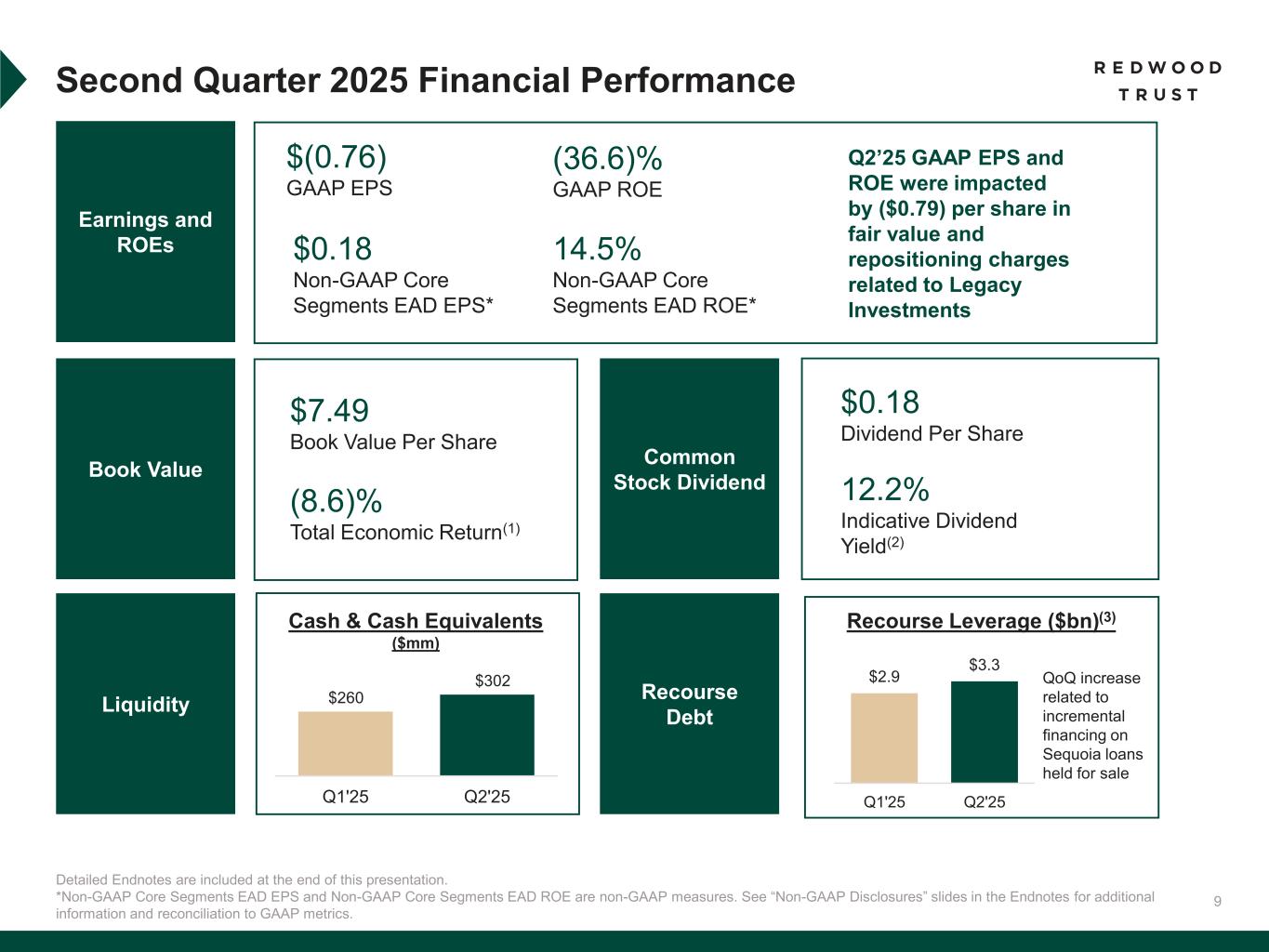
9 Detailed Endnotes are included at the end of this presentation. *Non-GAAP Core Segments EAD EPS and Non-GAAP Core Segments EAD ROE are non-GAAP measures. See “Non-GAAP Disclosures” slides in the Endnotes for additional information and reconciliation to GAAP metrics. Second Quarter 2025 Financial Performance Earnings and ROEs Book Value Liquidity $(0.76) GAAP EPS $0.18 Non-GAAP Core Segments EAD EPS* $7.49 Book Value Per Share (8.6)% Total Economic Return(1) $260 $302 Q1'25 Q2'25 Recourse Leverage ($bn)(3)Cash & Cash Equivalents ($mm) $0.18 Dividend Per Share 12.2% Indicative Dividend Yield(2) Common Stock Dividend Recourse Debt (36.6)% GAAP ROE 14.5% Non-GAAP Core Segments EAD ROE* Q2’25 GAAP EPS and ROE were impacted by ($0.79) per share in fair value and repositioning charges related to Legacy Investments $2.9 $3.3 Q1'25 Q2'25 QoQ increase related to incremental financing on Sequoia loans held for sale


10 ▪ GAAP segment net income of $22.2 million ▪ Segment GAAP ROE of 19% ▪ $3.6 billion of lock volume; (14)% QoQ and +30% YoY(1) ▪ Includes $3.3 billion of Sequoia jumbo loans and $330 million of Aspire expanded loans ▪ GAAP segment net income of $6.1 million ▪ Segment GAAP ROE of 27% and Non-GAAP EAD ROE of 34%* ▪ $509 million of loan fundings; +6% QoQ and +11% YoY ▪ GAAP Segment net income of $11.9 million ▪ Segment GAAP ROE of 11% and Non-GAAP EAD ROE of 16%* ▪ Deployed approximately $100 million of capital primarily into accretive retained operating investments Q3’25 QTD Activity(2) ▪ QTD Q3’25, we have locked/funded $1.6 billion of loans and distributed approximately $0.7 billion of loans across our operating platforms Second Quarter 2025 & Recent Business Performance Detailed Endnotes are included at the end of this presentation. *EAD return on equity (“EAD ROE”) is a non-GAAP measure. See “Non-GAAP Disclosures” slides in the Endnotes for additional information and reconciliation to GAAP metrics.


11 Key Trends in Housing Finance Drive Immediate Scale Opportunities for Our Platform Our businesses and products are deeply integrated with—and positioned to support—the evolving landscape of housing finance Detailed Endnotes are included at the end of this presentation. Borrower demand for the non-Agency housing finance solutions that we offer has grown significantly With rising investor demand for our assets, we're prioritizing partners who invest in both our assets and the platforms that power them— driving long-term growth Potential policy reform could unlock transformative growth for Redwood’s products Independent mortgage banks (“IMBs”) continue to gain market share Bank retrenchment creates increased loan sale and market share opportunities for our platforms Borrower Demand Private Capital Demand for Our Assets Housing Policy Reform Non-Bank Opportunity Bank Opportunity


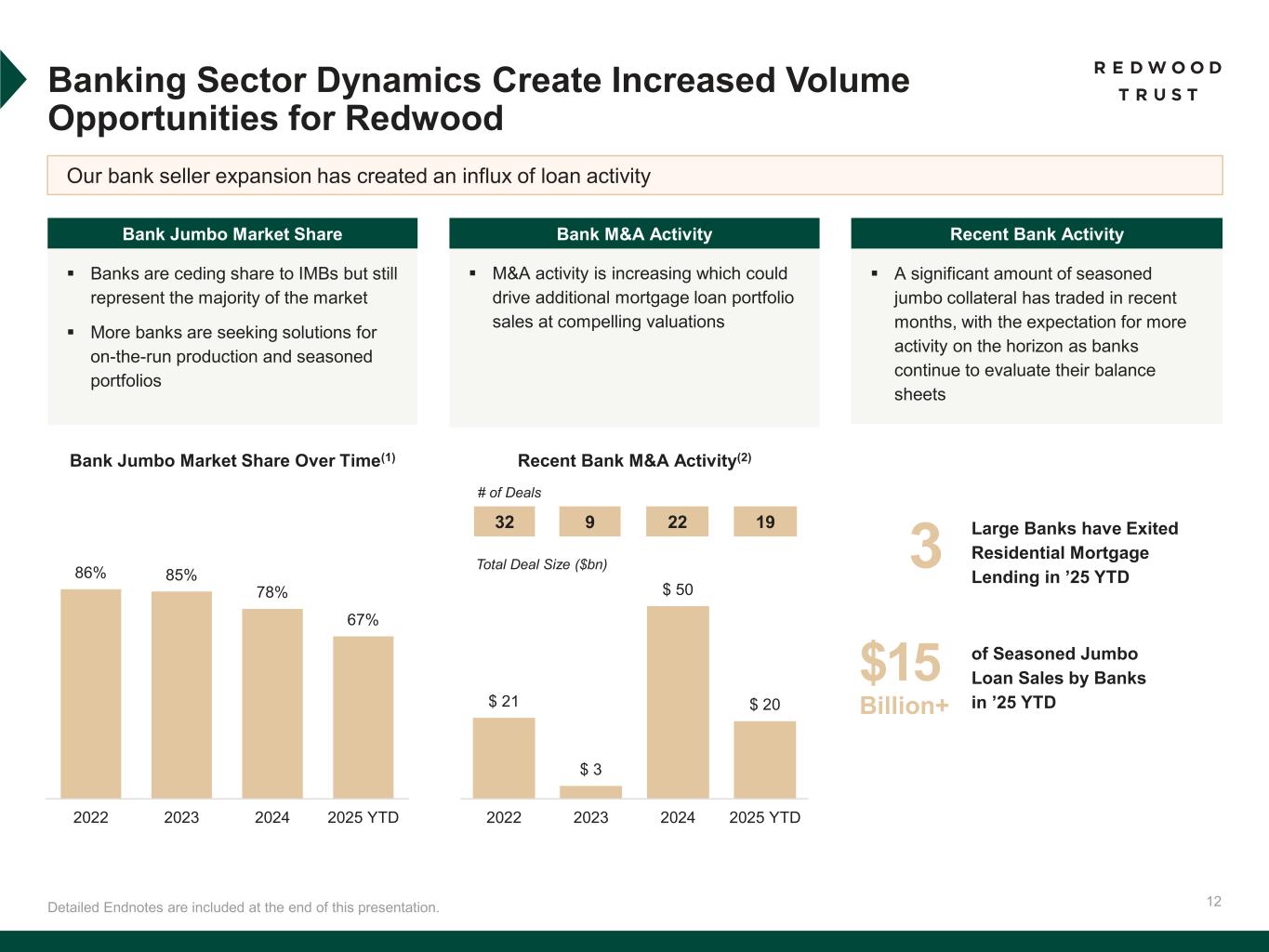
12 Banking Sector Dynamics Create Increased Volume Opportunities for Redwood Bank Jumbo Market Share ▪ Banks are ceding share to IMBs but still represent the majority of the market ▪ More banks are seeking solutions for on-the-run production and seasoned portfolios 86% 85% 78% 67% 2022 2023 2024 2025 YTD Detailed Endnotes are included at the end of this presentation. $15 Large Banks have Exited Residential Mortgage Lending in ’25 YTD ▪ A significant amount of seasoned jumbo collateral has traded in recent months, with the expectation for more activity on the horizon as banks continue to evaluate their balance sheets Our bank seller expansion has created an influx of loan activity Bank Jumbo Market Share Over Time(1) ▪ M&A activity is increasing which could drive additional mortgage loan portfolio sales at compelling valuations $ 21 $ 3 $ 50 $ 20 2022 2023 2024 2025 YTD # of Deals 32 9 22 19 Total Deal Size ($bn) Bank M&A Activity Recent Bank M&A Activity(2) Recent Bank Activity 3 of Seasoned Jumbo Loan Sales by Banks in ’25 YTDBillion+


13 Segment Updates


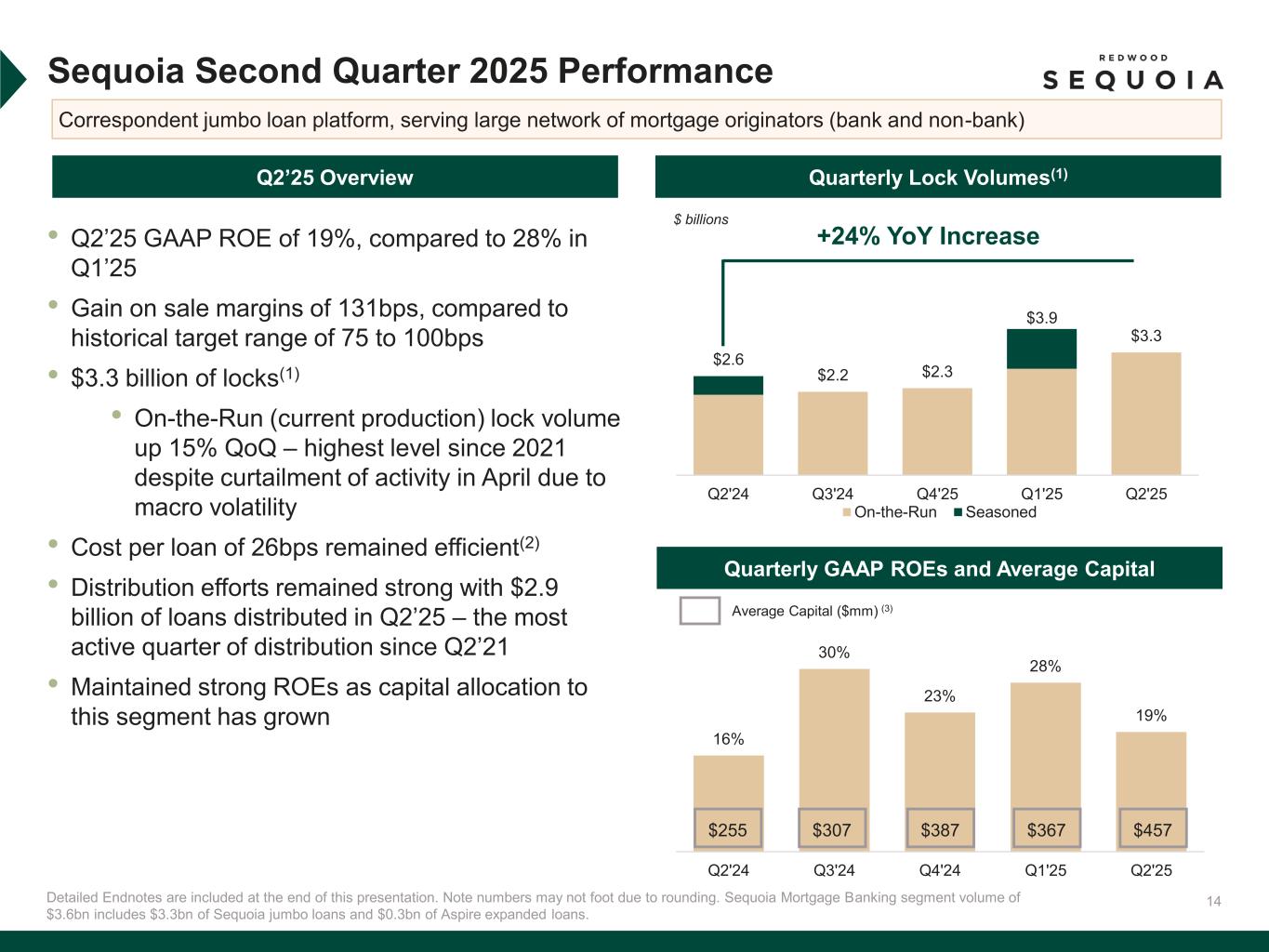
14 16% 30% 23% 28% 19% Q2'24 Q3'24 Q4'24 Q1'25 Q2'25 Detailed Endnotes are included at the end of this presentation. Note numbers may not foot due to rounding. Sequoia Mortgage Banking segment volume of $3.6bn includes $3.3bn of Sequoia jumbo loans and $0.3bn of Aspire expanded loans. Sequoia Second Quarter 2025 Performance Quarterly Lock Volumes(1) $ billions • Q2’25 GAAP ROE of 19%, compared to 28% in Q1’25 • Gain on sale margins of 131bps, compared to historical target range of 75 to 100bps • $3.3 billion of locks(1) • On-the-Run (current production) lock volume up 15% QoQ – highest level since 2021 despite curtailment of activity in April due to macro volatility • Cost per loan of 26bps remained efficient(2) • Distribution efforts remained strong with $2.9 billion of loans distributed in Q2’25 – the most active quarter of distribution since Q2’21 • Maintained strong ROEs as capital allocation to this segment has grown Q2’25 Overview +24% YoY Increase Correspondent jumbo loan platform, serving large network of mortgage originators (bank and non-bank) Quarterly GAAP ROEs and Average Capital $2.6 $2.2 $2.3 $3.9 $3.3 Q2'24 Q3'24 Q4'25 Q1'25 Q2'25 On-the-Run Seasoned $255 $307 $387 $367 $457 Average Capital ($mm) (3)


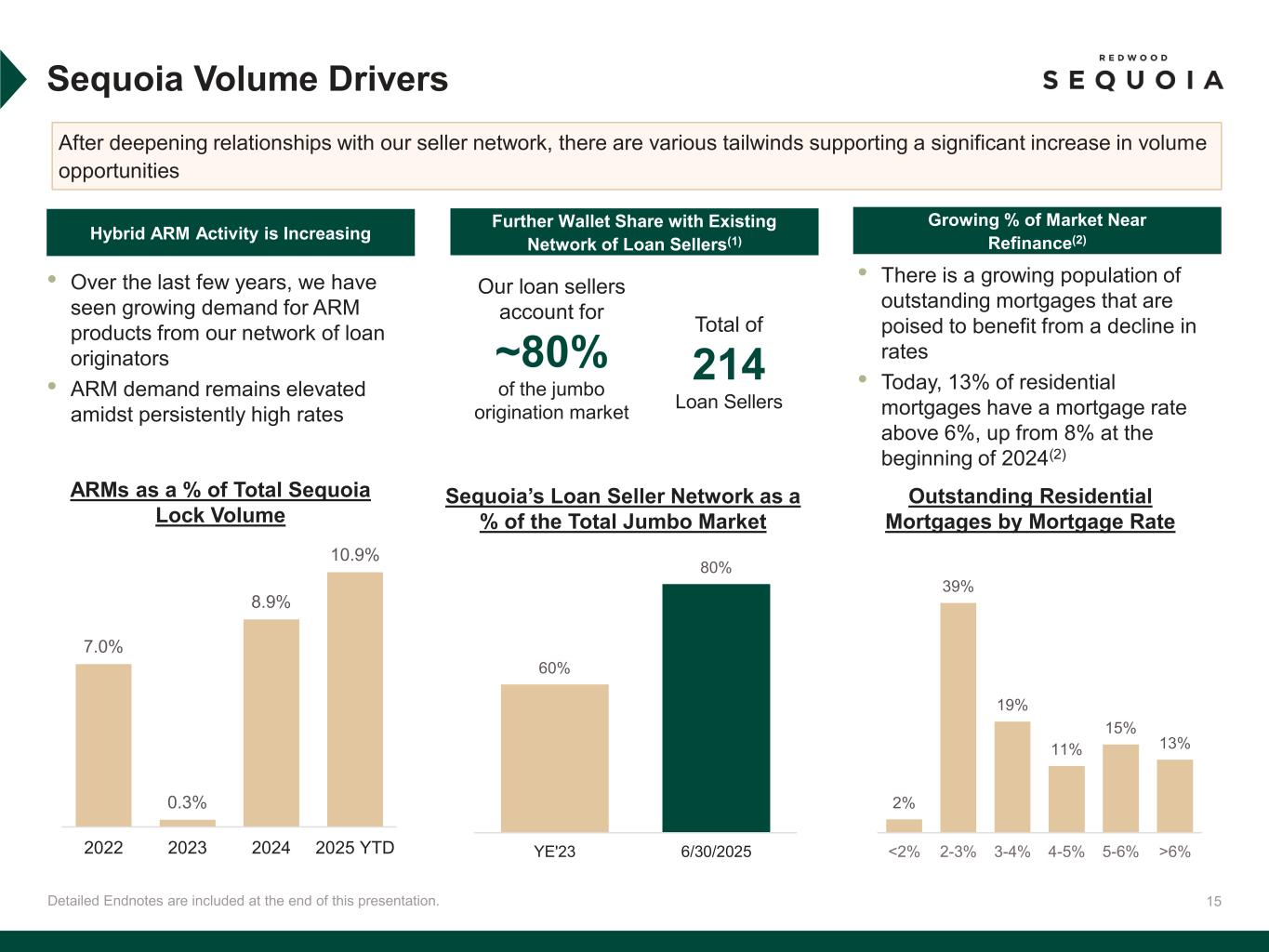
15Detailed Endnotes are included at the end of this presentation. Sequoia Volume Drivers After deepening relationships with our seller network, there are various tailwinds supporting a significant increase in volume opportunities Hybrid ARM Activity is Increasing Growing % of Market Near Refinance(2) • Over the last few years, we have seen growing demand for ARM products from our network of loan originators • ARM demand remains elevated amidst persistently high rates • There is a growing population of outstanding mortgages that are poised to benefit from a decline in rates • Today, 13% of residential mortgages have a mortgage rate above 6%, up from 8% at the beginning of 2024(2) ARMs as a % of Total Sequoia Lock Volume 7.0% 0.3% 8.9% 10.9% 2022 2023 2024 2025 YTD Further Wallet Share with Existing Network of Loan Sellers(1) Our loan sellers account for ~80% of the jumbo origination market 60% 80% YE'23 6/30/2025 2% 39% 19% 11% 15% 13% <2% 2-3% 3-4% 4-5% 5-6% >6% Outstanding Residential Mortgages by Mortgage Rate Sequoia’s Loan Seller Network as a % of the Total Jumbo Market Total of 214 Loan Sellers


16 Redwood is the Leading Non-Bank Distributor of Jumbo Loans Sequoia Securitization Overview We have continuously led the private sector in housing finance Non-Bank Jumbo Loan Securitization Activity 2010 to Present(1) 2x Faster Turn Times Than Peers #1 144 $70bn ~300 Non-Bank Issuer of Jumbo Loan RMBS (#2 Overall Issuer behind JP Morgan)(1) RMBS Securitizations Since Inception under Sequoia / SEMT brand of Jumbo Loan Collateral Securitized Since Inception Securitization Buyers We have executed ~40% of non- bank jumbo securitization activity since 2010 $ b n Detailed Endnotes are included at the end of this presentation. $42 $7 $6 $6 $6 $6 $5 $4 $3 $3 Sequoia Peer A Peer B Peer C Peer D Peer E Peer F Peer G Peer H Peer I


17 Aspire Second Quarter 2025 Performance Q2’25 Overview Detailed Endnotes are included at the end of this presentation. Expanded non-QM consumer correspondent business – tailored to borrowers requiring an alternative underwriting approach • $330 million of lock volume(1) – 197% QoQ volume increase driven by ongoing scale of platform, including addition of new non- QM origination partners – 67% Bank Statement / 33% DSCR – 30% of lock volume was from new loan sellers • Loan seller network of ~40 originators, up ~60% QoQ – 85%+ of current loan seller network overlaps with Sequoia – Loan seller network continues to grow further as we scale our platform Aspire Lock Volume ($mm)(1) The non-QM origination market grew 66% in 2024 and industry estimates suggest that significant growth will continue in 2025 given growing borrower need for expanded loan products Growing Non-QM Market $51 $42 $70 $100 2022 2023 2024 FY'25 Est. Current Aspire lock volumes represent an early entry into a large and growing addressable market, which we expect to scale substantially over time(3) $111 $330 $370 Q1'25 Q2'25 July'25 Non-QM Market Over Time ($bn)(2)


18 • GAAP ROE of 27% and non-GAAP EAD ROE of 34%* • $509 million of fundings, highest volume since Q3’22 – Up 6% QoQ and up 11% YoY – We continue to gain market share in smaller balance loan products (e.g. RTL, DSCR) – Term loan, RTL and DSCR each saw 20%+ QoQ increases in funded volume CoreVest Second Quarter 2025 Performance Q2’25 Overview Quarterly Funded Volume ($mm) Detailed Endnotes are included at the end of this presentation.*EAD return on equity (‘EAD ROE”) is a non-GAAP measure. See “Non-GAAP Disclosures” slides in the Endnotes for additional information and reconciliation to GAAP metrics. +11% YoY Increase $ millions Q2’25 Fundings by Strategy(2) • Net cost to originate of 94bps(1) remains efficient • Distributed $583 million of loans (+38% QoQ) – most active quarter ever for CoreVest distributions Direct life-cycle lender to housing investors $509mm $459 $458 $501 $482 $509 Q2'24 Q3'24 Q4'24 Q1'25 Q2'25 Term DSCR Bridge RTL Term 39% DSCR 6% Bridge 22% RTL 33%


19 CoreVest Volume Drivers Detailed Endnotes are included at the end of this presentation. FY’25 Growth Drivers • Deeper footprint and greater market share in small-balance loans (RTL and DSCR represent ~$245 billion TAM(1)) • The rise in RTL is driven by record investor activity, led by small/mid-size investors who made up 25% of home purchases in Q1’25 — five times the share of large investors • Homebuilder shift towards forward sales to investors looking to stabilize into rental communities • Repeat activity with top quality sponsors • Capturing market share from banks • Ongoing distribution momentum (e.g. JV, whole loan sale, securitization) Growth in Market Volumes(1) $ billions The small-balance loan market is estimated to grow 15% over the next 2 years $94 $97 $108 $119 $123 $137 2024 2025E 2026E RTL DSCR $213 $220 $245


20 Third-Party 29% Sequoia Securities Retained 39% Term Securities Retained 14% Bridge Securities Retained 18% Redwood Investments Second Quarter 2025 Performance Redwood Investments Q2’25 Activity Portfolio of residential housing investments sourced from our leading operating platforms ▪ GAAP ROE of 11% and non-GAAP EAD ROE of 16%* ▪ Deployed approximately $100 million of capital primarily into accretive retained operating investments with target returns of 15% to 20%(1) ▪ Ongoing focus on: ▪ Optimizing non-recourse financing structures to improve returns ▪ Continuing to retain investments created from our Sequoia, Aspire and CoreVest platforms and our JV partnerships $453 million Q2’25 Capital Allocation(2) Q1’25 QoQ 90 Day+ Delinquencies(3) Q2’25 Detailed Endnotes are included at the end of this presentation.*EAD return on equity (“EAD ROE”) is a non-GAAP measure. See “Non-GAAP Disclosures” slides in the Endnotes for additional information and reconciliation to GAAP metrics. Capital allocated to mortgage banking platforms is inclusive of risk-based capital. Q4’24 0.2% 7.4% 2.1% 0.2% 8.4% 3.8% 0.3% 7.1% 3.6% Sequoia Securities Retained Term Securities Retained Bridge Securities Retained


21 Legacy HEI 38% Legacy Bridge Portfolio 52% Other Third-Party 10% Legacy Investments Second Quarter 2025 Performance Detailed Endnotes are included at the end of this presentation. Legacy investments not core to Redwood’s long-term thesis (includes legacy multifamily bridge loans and other third-party assets) Legacy Investments Q2’25 Activity QoQ 90 Day+ Delinquencies(3) ▪ Net capital allocation to Legacy Investments reduced 17% to $523 million from $630 million due to bridge loan repayments and sale of $90 million of non- strategic third-party securities ▪ Marginable securities repo decreased to $93 million from $236 million(1) ▪ Net loss from Legacy Investments was primarily driven by: ▪ Fair value changes reflecting realized and anticipated near-term resolutions on legacy bridge loans and other non-core portfolios ▪ Changes in fundamental performance within our legacy bridge loan portfolio $523 million Q2’25 Capital Allocation(2) 9.2% 7.3% 16.4% 7.3% 15.9% 6.9% Legacy Bridge Portfolio SLST (RPL) Q1’25Q4’24 Q2’25$123mm $237mm $193mm 90 Day+ DQ UPB


22 Financial Results


23 Detailed Endnotes are included at the end of this presentation. Note: Numbers may not foot due to rounding.


24 Detailed Endnotes are included at the end of this presentation. Note: Numbers may not foot due to rounding.


25 Detailed Endnotes are included at the end of this presentation Note: Numbers may not foot due to rounding. .


26 Detailed Endnotes are included at the end of this presentation. Note: Numbers may not foot due to rounding.


27Detailed Endnotes are included at the end of this presentation. Note: Numbers may not foot due to rounding.


28 Detailed Endnotes are included at the end of this presentation. Note: Numbers may not foot due to rounding. Recourse Debt Scheduled Maturities ($ in millions)


29 Non-GAAP Disclosures


30 To supplement consolidated and segment financial information prepared and presented in accordance with U.S. generally accepted accounting principles ("GAAP"), the Company also provides the following non-GAAP measures: • Core Segments Earnings Available for Distribution (“Core Segments EAD”) • Earnings Available for Distribution (“EAD”) Management believes these non-GAAP measures provide supplemental information to assist management and investors in analyzing the Company’s results of operations and help facilitate comparisons to industry peers. Management also believes that these non-GAAP measures are metrics that can supplement its analysis of the Company’s ability to pay dividends, by providing an indication of the current income generating capacity of the Company's operating platforms as of the quarter being presented. In addition, management believes its new non-GAAP Core Segments EAD measure provide supplemental information to assist management and investors in analyzing the Company’s expedited transition to the scalable and simplified capital-efficient business model, which includes an accelerated wind-down of legacy portfolio holdings within its newly-established Legacy Investments segment. These non-GAAP measures should not be utilized in isolation, nor should they be considered as an alternative to GAAP net income (loss) available (related) to common stockholders, GAAP ROE or other measurements of results of operations computed in accordance with GAAP or for federal income tax purposes. Core Segments EAD. Core Segments EAD and Core Segments EAD ROE are new non-GAAP measures established in the second quarter 2025 and are used to present management’s non-GAAP analysis (based on its non-GAAP Earnings Available for Distribution (“EAD”) measure further described below) of the combined performance the Company’s mortgage banking platforms and related investments (which consist of the Company’s Sequoia Mortgage Banking, CoreVest Mortgage Banking and Redwood Investments segments and are defined as the Company’s “Core Segments”, inclusive of an allocated portion of the Company’s Corporate segment relating to those segments). • Core Segments EAD excludes the Company’s Legacy Investments segment and excludes an allocated portion of the Company’s Corporate segment relating to the Legacy Investments segment. • Core Segments EAD per basic common share and Core Segments EAD ROE are also new non-GAAP measures established in the second quarter 2025 and are calculated using Core Segments EAD. • Core Segments EAD ROE is defined as Core Segments EAD divided by average capital attributable to Core Segments. A further discussion of Core Segments EAD and a reconciliation of our non-GAAP Core Segments EAD measures to comparable GAAP measures is set forth below under the heading “Reconciliation of GAAP to non-GAAP Core Segments EAD”. Non-GAAP Disclosures


31 EAD. Earnings Available for Distribution (“EAD”) and EAD ROE are non-GAAP measures that the Company has historically reported and continue to be used to present management’s non-GAAP analysis of the performance of the Company’s different business segments, and that continue to be calculated exclusive of any allocation of the Company’s Corporate segment. • Consistent with prior quarter disclosures, EAD and EAD ROE are non-GAAP measures derived from GAAP Net income (loss) available (related) to common stockholders and GAAP Return on common equity ("GAAP ROE" or "ROE"), respectively. • Consistent with prior quarter disclosures, EAD is defined as: GAAP net income (loss) available (related) to common stockholders adjusted to (i) exclude investment fair value changes, net; (ii) exclude realized gains and losses; (iii) exclude acquisition related expenses; (iv) exclude certain organizational restructuring charges (as applicable); and (v) adjust for the hypothetical income taxes associated with these adjustments. • Consistent with prior quarter disclosures, EAD ROE is defined as EAD divided by average capital utilized for each respective period. A further discussion of EAD and a reconciliation of our non-GAAP EAD measures to comparable GAAP measures is set forth below under the heading “Reconciliation of GAAP to non-GAAP EAD”. Supplemental Non-GAAP Table - Illustrating EAD With Allocated Corporate Segment. Management is also presenting a supplemental non-GAAP table in this section under the heading “Supplemental Table - EAD With Allocated Corporate Segment” to clearly illustrate a key distinction between the methodology for calculating the two non-GAAP measures described above – namely, Core Segments EAD and EAD. That key distinction relates to whether or not the non-GAAP measure allocates the Company’s Corporate segment across its other reporting segments for purposes of calculating the non-GAAP measure of performance. Management believes this supplemental table assists management and investors in comparing the Company’s two distinct non-GAAP measures described above. Non-GAAP Disclosures (Continued)


32 Reconciliation of GAAP to non-GAAP Core Segments Earnings Available for Distribution (“Core Segments EAD”) (1) (2) Non-GAAP Disclosures – Core Segments EAD See footnotes on next page


33 Non-GAAP Disclosures – Core Segments EAD (Continued) Footnotes: 1. Certain totals may not foot due to rounding. 2. Core Segments EAD and Core Segments EAD ROE are new non-GAAP measures established in the second quarter 2025 and are used to present management’s non-GAAP analysis of the combined performance the Company’s mortgage banking platforms and related investments (which are defined as "Core Segments" and which consist of the Company’s Sequoia Mortgage Banking, CoreVest Mortgage Banking and Redwood Investments segments), inclusive of an allocated portion of the Company’s Corporate segment relating to those Core Segments. Core Segments EAD excludes the Company’s Legacy Investments segment and excludes an allocated portion of the Company’s Corporate segment relating to the Legacy Investments segment. Core Segments EAD is defined as: GAAP net income (loss) available (related) to common stockholders adjusted to (i) exclude GAAP net loss from the Legacy Investments Segment, (ii) exclude the portion of the Corporate Segment allocation relating to the Legacy Investments segment, (iii) exclude investment fair value changes, net; (iv) exclude realized gains and losses; (v) exclude acquisition related expenses; (vi) exclude certain organizational restructuring charges (as applicable); and (vii) adjust for the hypothetical income taxes associated with these adjustments. Refer to footnote 9 below for the definition of Core Segments EAD ROE. 3. Allocation of Corporate Segment relating to the Legacy Investments Segment is a non-GAAP adjustment based on average capital utilized by the Legacy Investments Segment of $576 million and $614 million for the three months ended June 30, 2025 and March 31, 2025, respectively. 4. Investment fair value changes, net includes all amounts within that same line item in our consolidated statements of (loss) income that are attributable to our Core Segments and Corporate segment, which primarily represents both realized and unrealized gains and losses on our investments held in our Core Segments and Corporate Segment and associated hedges. Realized and unrealized gains and losses on our HEI investments are reflected in a separate line item on our consolidated income statements titled "HEI income, net". 5. Realized (gains)/losses, net includes all amounts within that line item on our consolidated statements of (loss) income that are attributable to our Core Segments. 6. Acquisition related expenses include transaction costs paid to third parties, as applicable, and the ongoing amortization of intangible assets related to the Riverbend and CoreVest acquisitions. 7. Tax effect of adjustments represents the hypothetical income taxes associated with EAD adjustments used to calculate Core Segments EAD. 8. Core Segments EAD per basic common share is a new non-GAAP measure established in the second quarter 2025 and is defined as Core Segments EAD divided by basic weighted average common shares outstanding at the end of the period. 9. Core Segments EAD ROE is a new non-GAAP measure established in the second quarter 2025 and is defined as Core Segments EAD divided by average capital attributable to Core Segments of $689 million and $671 million for the three months ended June 30, 2025 and March 31, 2025, respectively.


34 Reconciliation of GAAP to non-GAAP EAD – Second Quarter 2025 (1) (2) Non-GAAP Disclosures – EAD See footnotes on next page .


35 Reconciliation of GAAP to non-GAAP EAD – First Quarter 2025 (1) (2) Non-GAAP Disclosures – EAD by Segment (Continued) Footnotes: 1. Certain totals may not foot due to rounding. 2. Consistent with prior quarter disclosures, EAD and EAD ROE are non-GAAP measures derived from GAAP net income (loss) available (related) to common stockholders and GAAP Return on Equity ("GAAP ROE" or "ROE"), respectively. Consistent with prior quarter disclosures, EAD is defined as: GAAP net income (loss) available (related) to common stockholders adjusted to (i) exclude investment fair value changes, net; (ii) exclude realized gains and losses; (iii) exclude acquisition related expenses; (iv) exclude certain organizational restructuring charges (as applicable); and (v) adjust for the hypothetical income taxes associated with these adjustments. Refer to footnote 7 below for the definition of EAD ROE. 3. Investment fair value changes, net includes all amounts within that same line item in our consolidated statements of (loss) income, which primarily represents both realized and unrealized gains and losses on our investments (excluding HEI) and associated hedges. Realized and unrealized gains and losses on our HEI investments are reflected in a separate line item on our consolidated income statements titled "HEI income, net". 4. Realized (gains)/losses, net includes all amounts within that line item on our consolidated statements of income. 5. Acquisition related expenses include transaction costs paid to third parties, as applicable, and the ongoing amortization of intangible assets related to the Riverbend and CoreVest acquisitions. 6. Tax effect of adjustments represents the hypothetical income taxes associated with all adjustments used to calculate EAD. 7. Consistent with prior quarter disclosures, EAD ROE is defined as EAD divided by average capital utilized for each respective period.


36 Supplemental Table – Non-GAAP EAD with Allocated Corporate Segment – Second Quarter 2025 (1) (2) See footnotes on next page Supplemental Table – Non-GAAP EAD with Allocated Corporate Segment


37 Supplemental Table – Non-GAAP EAD with Allocated Corporate Segment – First Quarter 2025 (1) (2) Supplemental Table – Non-GAAP EAD with Allocated Corporate Segment (Continued) Footnotes 1. Certain totals may not foot due to rounding. 2. This supplemental measure is presented to clearly illustrate a key distinction between the methodology for calculating the two non-GAAP measures discussed in this earnings press release and detailed in the preceding tables - namely, Core Segments EAD and EAD. That key distinction relates to whether or not the non-GAAP measure allocates the Company’s Corporate segment across its other reporting segments for purposes of calculating the non-GAAP measure of performance. In this supplemental non-GAAP table, GAAP Net Income by segment is adjusted to (i) include allocations of the Corporate Segment to each of our Mortgage Banking segments, as well as to our Redwood Investments and Legacy Investments segments, (ii) exclude investment fair value changes, net (as applicable); (iii) exclude realized gains and losses (as applicable); (iv) exclude acquisition related expenses; (v) exclude certain organizational restructuring charges (as applicable); and (vi) adjust for the hypothetical income taxes associated with these adjustments. 3. Allocation of Corporate Segment is a non-GAAP adjustment based on average capital utilized by each segment for the respective periods. 4. Investment fair value changes, net includes all amounts within that same line item in our consolidated statements of (loss) income, which primarily represents both realized and unrealized gains and losses on our investments (excluding HEI) and associated hedges. Realized and unrealized gains and losses on our HEI investments are reflected in a separate line item on our consolidated income statements titled "HEI income, net". 5. Realized (gains)/losses, net includes all amounts within that line item on our consolidated statements of income. 6. Acquisition related expenses include transaction costs paid to third parties, as applicable, and the ongoing amortization of intangible assets related to the Riverbend and CoreVest acquisitions. 7. Tax effect of adjustments represents the hypothetical income taxes associated with all adjustments used to calculate EAD.


38 Endnotes


39 Slide 3 (Redwood’s Network of Businesses)​ Source: Company financial data as of June 30, 2025 unless otherwise noted. Market data per Bloomberg as of June 30, 2025. Securitization data as of July 29, 2025. Slide 5 (Accelerated Transition to Core Operating Strategy)​ Source: Company financial data as of June 30, 2025 unless otherwise noted. 1. Allocated capital includes working capital for mortgage banking operations and investments net of associated average debt for Redwood Investments. Capital allocation excludes corporate capital and RWT Horizons. Further detail on the components of Q2’25 allocated capital is included in the Financial Results section of this presentation. Slide 6 (Reallocation of Capital Towards Core Segments)​ Source: Company financial data as of June 30, 2025 unless otherwise noted. 1. Allocated capital includes working capital for mortgage banking operations and investments net of associated average debt for Redwood Investments. Capital allocation excludes corporate capital and RWT Horizons. Further detail on the components of Q1’25 and Q2’25 allocated capital is included in the Financial Results section of this presentation. 2. Incremental capital for reinvestment and target return figures represent management’s targets and estimates and actual results may differ materially. 3. Represents management’s targets and estimates and actual results may differ materially. The range of consolidated EAD returns provided reflects a variety of management’s estimates and assumptions that could prove to be incorrect, such as the level of mortgage banking activity, an investment’s coupon, amortization of premium or discount, costs and fees, and our assumptions regarding prepayments, defaults and loan losses, among other things. Income and cash flows recognized in future periods may be significantly less than the income and cash flows that would have been recognized had target returns been realized. Because management’s methodology for these future targets and estimated future returns does not include fair value changes, or realized gains and losses, the range of consolidated EAD returns provided excludes any impact from investment fair value changes net, realized gains and losses, and associated tax impacts. Slide 8 (Second Quarter 2025 Highlights and Positioning)​ Source: Company financial data as of June 30, 2025 unless otherwise noted. 1. Source: Inside Mortgage Finance data as of Q1’25. Slide 9 (Second Quarter 2025 Financial Performance)​ Source: Company financial data as of June 30, 2025 unless otherwise noted. Market data per Bloomberg as of June 30, 2025. 1. Total economic return is based on the periodic change in GAAP book value per common share plus dividends declared per common share during the period, divided by beginning period GAAP book value per common share. 2. Indicative dividend yield based on RWT closing stock price of $5.91 on June 30, 2025. 3. At June 30, 2025 and March 31, 2025, recourse debt excluded $16.9 billion and $15.8 billion, respectively, of consolidated securitization debt (ABS issued and servicer advance financing), other liabilities and other debt that is non-recourse to Redwood, and tangible stockholders' equity excluded $38.0 million and $40.2 million, respectively, of goodwill and intangible assets. Endnotes Slide 10 (Second Quarter 2025 and Recent Business Performance)​ Source: Company financial data as of June 30, 2025 unless otherwise noted. References to “QoQ” are comparisons of the quarterly performances between Q1’25 and Q2’25. References to “YoY” are comparisons for the quarterly performances between Q2’24 and Q2’25. 1. Lock volume represents loans identified for purchase from loan sellers. Lock volume does not account for potential fallout from pipeline that typically occurs through the lending process. 2. Data as of July 29, 2025. Slide 12 (Banking Sector Dynamics Create Increased Volume Opportunities for Redwood)​ Source: Company financial data as of June 30, 2025 unless otherwise noted. 1. Source: Inside Mortgage Finance data as of Q1’25. 2. Source: Goldman Sach Research. Slide 14 (Sequoia Second Quarter 2025 Performance)​ Source: Company financial data as of June 30, 2025 unless otherwise noted. References to “QoQ” are comparisons of the quarterly performances between Q1’25 and Q2’25. References to “YoY” are comparisons for the quarterly performances between Q2’24 and Q2’25. 1. Lock volume represents loans identified for purchase from loan sellers. Lock volume does not account for potential fallout from pipeline that typically occurs through the lending process. 2. Cost per loan for the Sequoia Mortgage Banking segment is calculated as operating expenses of this segment divided by loan purchase commitments of this segment. 3. Average capital includes average working capital for Sequoia Mortgage banking operations. Slide 15 (Sequoia Volume Drivers)​ Source: Company financial data as of June 30, 2025 unless otherwise noted. 1. Source: Inside Mortgage Finance data as of Q1’25. 2. Source: Morgan Stanley Research. Slide 16 (Redwood is the Leading Non-Bank Distributor of Jumbo Loans)​ Source: Company financial data as of June 30, 2025 unless otherwise noted. 1. Source: JP Morgan Research. Slide 17 (Aspire Second Quarter 2025 Performance)​ Source: Company financial data as of June 30, 2025 unless otherwise noted. 1. Aspire lock volume is included in the Sequoia Mortgage Banking business segment results. Lock volume represents loans identified for purchase from loan sellers. Lock volume does not account for potential fallout from pipeline that typically occurs through the lending process. July 2025 lock volume includes data through July 29, 2025. 2. Source: Inside Mortgage Finance and Bank of America Merrill Lynch data. 3. Represents management’s targets and estimates and actual results may differ materially. Slide 18 (CoreVest Second Quarter 2025 Performance)​ Source: Company financial data as of June 30, 2025 unless otherwise noted. References to “QoQ” are comparisons of the quarterly performances between Q1’25 and Q2’25. References to “YoY” are comparisons for the quarterly performances between Q2’24 and Q2’25. 1. Net cost to originate for the CoreVest Mortgage Banking segment is calculated as operating expenses, less upfront origination fees, divided by origination volume. 2. Composition percentages are based on unpaid principal balance.


40 Endnotes Slide 23 (Appendix: Income Statement) 1. Net interest expense from “Corporate (unsecured debt)” consists primarily of interest expense on corporate unsecured debt. Slide 25 (Appendix: Capital Allocation Summary) 1. Amounts of assets in our Redwood Investments segment, as presented in this table, represent our economic interests (including our economic interests in consolidated VIEs) and do not present the assets within VIEs that we consolidate under GAAP (except for our CAFL Bridge VIEs and SLST resecuritization). See our GAAP Balance Sheet and Reconciliation to Non-GAAP Economic Balance Sheet in the Supplemental Financial Tables available on our website for additional information on consolidated VIEs. 2. Consistent with our presentation of assets within this table, non-recourse debt presented within this table excludes ABS issued from certain securitizations consolidated on our balance sheet, including Residential Jumbo (SEMT), BPL Term (CAFL), Freddie Mac SLST and K-Series, and HEI, as well as non-recourse debt used to finance certain servicing investments. 3. Capital allocated to mortgage banking operations represents the working capital we have allocated to manage our loan inventory at each of our mortgage banking segments. This amount generally includes our net capital in loans held on balance sheet (net of financing), capital to acquire / originate loans in our pipeline, net capital utilized for hedges, and risk capital. 4. Corporate capital includes, among other things, capital allocated to RWT Horizons and other strategic investments as well as available capital. Slide 26 (Appendix: Mortgage Banking Key Results) 1. EAD Net Contribution and EAD Net Contribution Return on Equity are non-GAAP measures that are also referred to as EAD and EAD ROE, respectively. Please refer to Non-GAAP Disclosures within the Endnotes section of this presentation for additional information on these measures. 2. Capital utilized for CoreVest operations does not include $38 million of platform premium. Slide 27 (Appendix: Redwood Investments Key Results) 1. EAD Net Contribution and EAD Net Contribution Return on Equity are non-GAAP measures that are also referred to as EAD and EAD ROE, respectively. Please refer to Non-GAAP Disclosures within the Endnotes section of this presentation for more information on these measures. 2. Recourse leverage ratio is calculated as Secured recourse debt balances divided by Capital invested, as presented within this table. Slide 28 (Appendix: Recourse Debt Balances) 1. Non-marginable debt and marginable debt refers to whether such debt is subject to margin calls based solely on the lender’s determination in its discretion of the market value of underlying collateral that is non-delinquent. Non-marginable debt may be subject to a margin call due to delinquency or another credit event related to the mortgage or security being financed, a decline in the value of the underlying asset securing the collateral, an extended dwell time (i.e., period of time financed using a particular financing facility) for certain types of loans, or a change in the interest rate of a specified reference security relative to a base interest rate amount, among other reasons. 2. Average borrowing cost represents the weighted average contractual cost of recourse debt outstanding at the end of each period presented and does not include deferred issuance costs or debt discounts. 3. Represents unsecuritized residential consumer loans, inclusive of Aspire loans. 4. Includes certificated mortgage servicing rights. Slide 19 (CoreVest Volume Drivers)​ Source: Company financial data as of June 30, 2025 unless otherwise noted. 1. RTL volume based on Fannie Mae Single Family Total Home Sales and Attom Data Fix & Flip Percentage. DSCR based on the same for the rest of the investor owned %. Analysis uses Wells Fargo Research. Figures are rounded. Actual results may vary materially. Slide 20 (Redwood Investments Second Quarter 2025 Performance)​ Source: Company financial data as of June 30, 2025 unless otherwise noted. 1. Represents management’s targets and estimates and actual results may differ materially. 2. Allocated capital includes working capital for mortgage banking operations and investments net of associated average debt for Redwood Investments. Capital allocation excludes corporate capital and RWT Horizons. Further detail on the components of Q2’25 allocated capital is included in the Financial Results section of this presentation. 3. Percentages are based on UPB. Slide 21 (Legacy Investments Second Quarter 2025 Performance)​ Source: Company financial data as of June 30, 2025 unless otherwise noted. 1. Non-marginable debt and marginable debt refers to whether such debt is subject to margin calls based solely on the lender’s determination in its discretion of the market value of underlying collateral that is non-delinquent. Non-marginable debt may be subject to a margin call due to delinquency or another credit event related to the mortgage or security being financed, a decline in the value of the underlying asset securing the collateral, an extended dwell time (i.e., period of time financed using a particular financing facility) for certain types of loans, or a change in the interest rate of a specified reference security relative to a base interest rate amount, among other reasons. 2. Allocated capital includes average working capital for mortgage banking operations and average investments net of associated average debt for Redwood Investments. Capital allocation excludes corporate capital and RWT Horizons. Further detail on the components of Q2’25 allocated capital is included in the Financial Results section of this presentation. 3. Percentages are based on UPB.


41*Earnings Available for Distribution (“EAD”) is a non-GAAP measure- See “Non-GAAP Measures” slides in the Endnotes for additional information and reconciliation to GAAP metrics. Glossary of Terms Term Definition ARM Adjustable-Rate Mortgage BFR Build for rent bps Basis points CAFL® CoreVest securitization program CES Closed end second liens DQ Delinquency DSCR Debt Service Coverage Ratio EAD Earnings available for distribution* EPS Earnings per share FY Full year GoS Gain on Sale HEI Home equity investment HPA Home price appreciation IMB Independent mortgage banker JV Joint venture LOC Line of credit LTC Loan to cost Term Definition MB Mortgage banking MSR Mortgage servicing rights Non-QM Non-qualified mortgage QM Qualified mortgage QoQ Quarter over quarter (comparison of sequential quarters) RMBS Residential mortgage backed security RTL Residential transitional loans RPL Reperforming loans SEMT® Residential Consumer (Sequoia) securitization program SFR Single-family rental SLST Residential subordinate securities issued by Freddie Mac SLST securitization trusts SMA Separately managed accounts TAM Total addressable market UPB Unpaid principal balance WA Weighted average YoY Year over year (comparison of same quarter performance over sequential years)


EX-99.4 5 rwtex994q22025.htm EX-99.4 Document
image_0.jpg
EXHIBIT 99.4

REDWOOD TRUST ANNOUNCES UPSIZED COMMON STOCK REPURCHASE AUTHORIZATION TO $150 MILLION

MILL VALLEY, CA – Redwood Trust, Inc. (NYSE: RWT; “Redwood” or the “Company”), a leader in expanding access to housing for homebuyers and renters, today announced that its Board of Directors has upsized the Company’s authorization to repurchase common stock to $150 million. This stock repurchase authorization has no time limit and may be modified, suspended or discontinued at any time. The Board of Directors also continued its previous authorization for the repurchase of outstanding preferred stock and corporate debt securities.

“The Board’s decision to increase our share repurchase capacity to $150 million reflects our strong conviction in the intrinsic value of our stock, the strength of our operating platforms, and our strategic positioning,” said Christopher Abate, Chief Executive Officer of Redwood. “Having initiated common stock repurchases in the second quarter 2025, we intend to use this expanded authorization proactively to support our stock and drive shareholder value. Our strategic transition to a more scalable and simplified operating model entails an ongoing focus on partnerships with strategic capital providers—including those not only looking to acquire assets that our platforms originate or source, but also to invest directly in the expansion of our business.”

The timing and amount of stock repurchases made pursuant to the Redwood’s repurchase authorization are at the Company’s discretion and subject to various factors, including the Company's capital position, liquidity, financial performance and alternative uses of capital, stock trading price, regulatory requirements and general market conditions. This repurchase authorization does not obligate the Company to acquire any specific number of shares or securities. Repurchases of shares or securities by the Company may be effected through open market purchases or privately negotiated transactions, including repurchase plans that satisfy the conditions of Rule 10b5-1 of the Securities Exchange Act of 1934, as amended.


ABOUT REDWOOD TRUST
Redwood Trust, Inc. (NYSE: RWT) is a specialty finance company focused on several distinct areas of housing credit where we provide liquidity to growing segments of the U.S. housing market not well served by government programs. We deliver customized housing credit investments to a diverse mix of investors, through our best-in-class securitization platforms, whole-loan distribution activities, joint ventures and our publicly traded shares. We operate through three core residential housing-focused operating platforms — Sequoia, Aspire, and CoreVest — alongside our complementary Redwood Investments portfolio which is primarily composed of assets we source through these platforms. In addition, through RWT Horizons®, our venture investing initiative, we invest in early-stage companies that have a direct nexus to our operating platforms. Our goal is to provide attractive returns to shareholders through a stable and growing stream of earnings and dividends, capital appreciation, and a commitment to technological innovation that facilitates risk-minded scale. Redwood Trust is internally managed and structured as a real estate investment trust ("REIT") for tax purposes. For more information about Redwood, please visit our website at www.redwoodtrust.com or connect with us on LinkedIn.

CONTACT
Investor Relations
Kaitlyn Mauritz – Head of Investor Relations
Phone: 415-384-3822
Email: investorrelations@redwoodtrust.com