
Investor Presentation May/June 2025 Exhibit 99.1

Forward-Looking Statements 2 This presentation, and oral comments that Everus may make, contain or incorporate by reference certain “forward-looking statements” within the meaning of the securities laws. All statements that reflect Everus’ expectations, assumptions or projections about the future, other than statements of historical facts, including, without limitation, statements regarding plans, trends, objectives, goals, business and growth strategies, market potential, our 4EVER strategy, future performance, financial guidance, long-term targets and other matters are consider forward-looking statements. The words “believe,” “expect,” “estimate,” “could,” “should,” “would,” “intend,” “may,” “plan,” “predict,” “seek,” “anticipate,” “project” and similar expressions generally identify forward-looking statements, which speak only as of the date the statements were made. In particular, information included within this presentation contains forward-looking statements. The matters discussed in this presentation are subject to risks, uncertainties and other factors that could cause actual results to differ materially from those projected, anticipated or implied in the forward looking statements. Although Everus believes that the expectations reflected in any forward-looking statements it makes are based on reasonable assumptions as of the date they are made, it can give no assurance that the expectation will be attained and it is possible that actual results may differ materially from those indicated by these forward-looking statements due to a variety of risks and uncertainties. For additional information on identifying factors that may cause actual results to vary materially from those stated in forward-looking statements, see the discussion under “Item 1A. Risk Factors” in the Company's 2024 Annual Report on Form 10-K and subsequent filings with the Securities and Exchange Commission. You should read this presentation completely and with the understanding that actual future results may be materially different from expectations. All forward-looking statements made in this presentation are qualified by these cautionary statements. These forward-looking statements are made only as of the date of this presentation, and Everus does not undertake any obligation, other than as may be required by law, to update or revise any forward-looking or cautionary statements to reflect changes in assumptions, the occurrence of events, unanticipated or otherwise, and changes in future operating results over time or otherwise. Comparisons of results for current and any prior periods are not intended to express any future trends, or indications of future performance, unless expressed as such, and should only be viewed as historical data. All financial information presented in this presentation has been prepared in U.S. dollars in accordance with generally accepted accounting principles in the United States (“GAAP”), except for the presentation of the following non-GAAP financial measures: organic revenue, organic revenue growth, EBITDA, EBITDA margin, free cash flow, net debt and net leverage, and, in some cases, applicable measures by segment. Organic revenue is most comparable to the GAAP measure of revenue and is defined as the difference between current year and prior year revenues less the impact of acquired and divested companies in the past 12 months. Organic revenue growth is most comparable to the GAAP measure of revenue growth and is calculated by dividing organic revenue by prior year revenues. EBITDA is most comparable to the GAAP measure of net income and is defined as net income before interest expense, net of interest income, income taxes and depreciation and amortization. EBITDA margin is most comparable to the GAAP measure of net income margin and is defined as EBITDA as a percentage of operating revenues. Free cash flow is most comparable to the GAAP measure of cash flows provided by (used in) operating activities. Free cash flow is defined as net cash provided by (used in) operating activities less net capital expenditures. Net debt and net leverage are most comparable to the GAAP measure of total debt. Net debt is calculated by adding unamortized debt issuance costs to the total debt balance presented on the balance sheet, less any unrestricted cash. Net leverage is calculated by dividing net debt divided by EBITDA, as defined. Our non-GAAP financial measures are not standardized; therefore, it may not be possible to compare them with other companies’ measures of organic revenue, organic revenue growth, EBITDA, EBITDA margin, free cash flow, net debt and net leverage having the same or similar names. Everus presents organic revenue, organic revenue growth, EBITDA, EBITDA margin, free cash flow, net debt and net leverage, and, in some cases, applicable measures by segment, in this presentation because it believes such measures, in addition to corresponding GAAP measures, provide investors with additional information to measure Everus’ performance and liquidity. These non-GAAP financial measures are not intended as alternatives to GAAP financial measures. Everus uses organic revenue, organic revenue growth, EBITDA and EBITDA margin, as well as the comparable GAAP measures of revenue, revenue growth, net income and net income margin, as indicators of Everus’ operating performance. Everus uses free cash flow as well as the comparable GAAP measure of cash flows provided by (used in) operating activities, as a measure of cash available to Everus to invest in the growth of Everus’ business or that will be available to Everus to meet its obligations. Everus uses net debt and net leverage as well as the comparable GAAP measure of total debt to provide a measure of how quickly Everus could repay its debt if net debt and EBITDA were constant. Net leverage also provides insight into Everus' borrowing capacity and leverage ratio. Reconciliations of the non-GAAP measures used to their respective most directly comparable GAAP measure can be found in the Appendix.
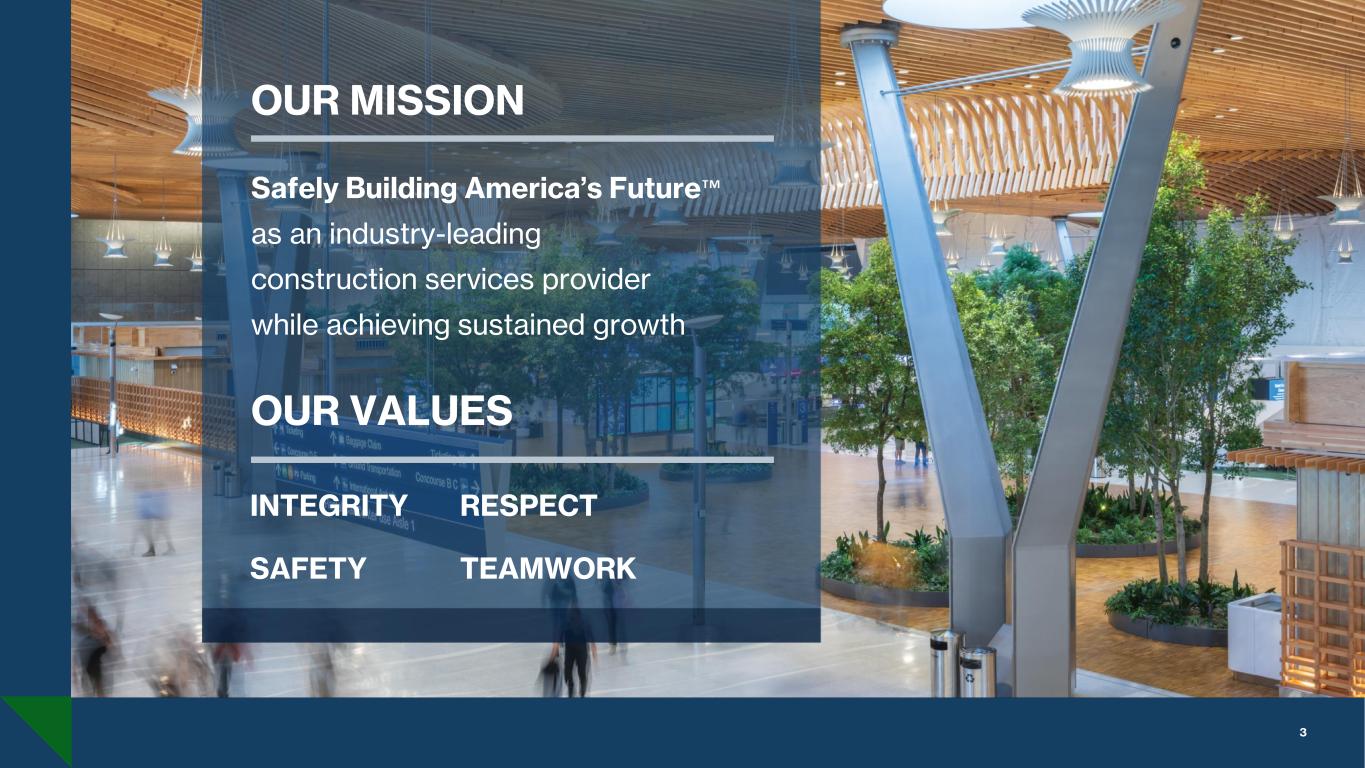
3 OUR MISSION Safely Building America’s Future as an industry-leading construction services provider while achieving sustained growth OUR VALUES SAFETY RESPECT TEAMWORK INTEGRITY

$3.1B Total Revenue(2) Wiring, infrastructure, fire suppression and piping National Platform of 20 Market-Leading Local Brands Electrical & Mechanical Note: Figures reflect data as of Dec. 31, 2024, unless specified otherwise. (1) Engineering News-Record magazine. (2) Trailing twelve months ended March 31, 2025. Revenue excludes eliminations of $22M. (3) As of March 31, 2025. Transmission & Distribution 4 Utility and communication infrastructure, and manufacturing and distribution of equipment E&M Revenue: 73%(2) T&D Revenue: 27%(2) Focus on Complex Projects I High-Quality Execution I Proven Track Record $3.1 billion backlog(3) ~8,700 Employees 83% Employees in Unions ~3,900 Customers 43,000+ Projects in 2024 No. 9 of 600 Specialty Contractors(1) Leading Construction Services Provider
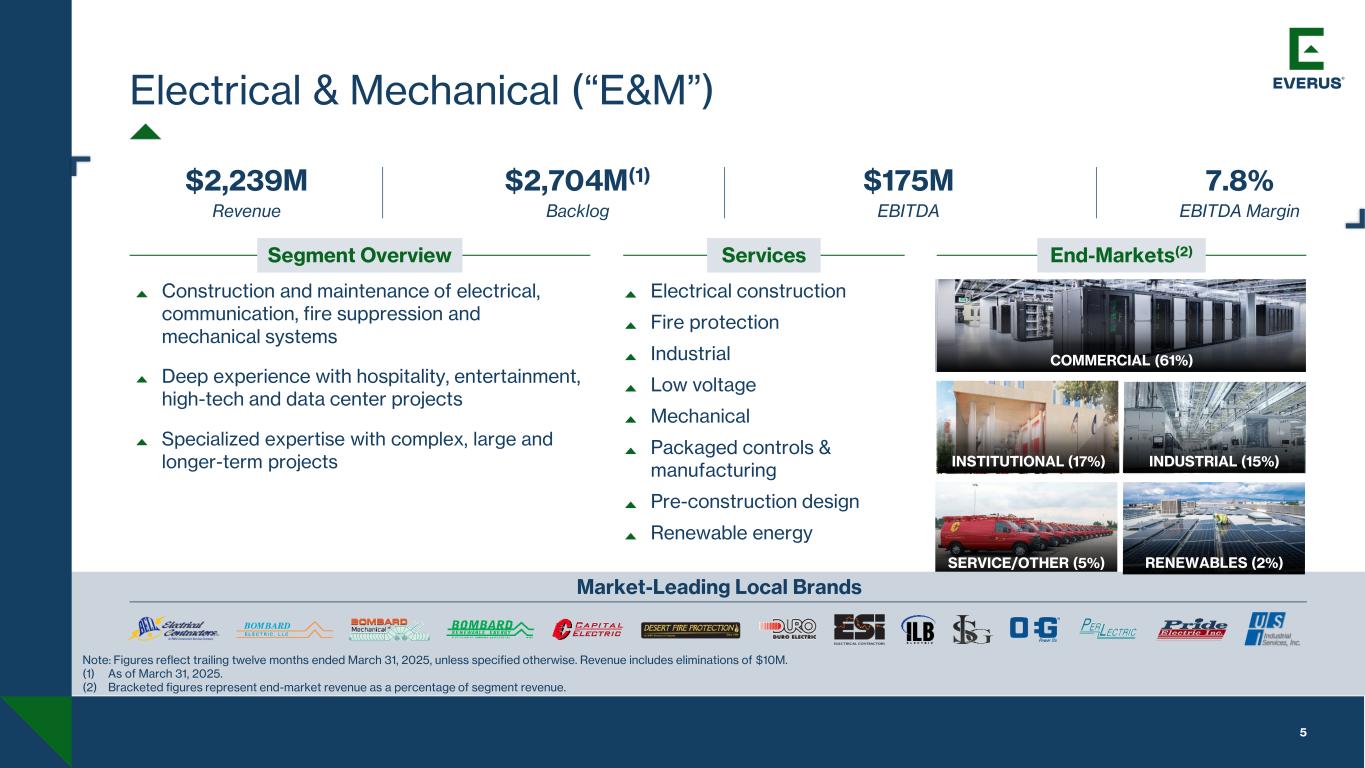
COMMERCIAL (61%) SERVICE/OTHER (5%) 5 Construction and maintenance of electrical, communication, fire suppression and mechanical systems Deep experience with hospitality, entertainment, high-tech and data center projects Specialized expertise with complex, large and longer-term projects Electrical construction Fire protection Industrial Low voltage Mechanical Packaged controls & manufacturing Pre-construction design Renewable energy Segment Overview Services INSTITUTIONAL (17%) Market-Leading Local Brands RENEWABLES (2%) End-Markets(2) $2,239M Revenue Note: Figures reflect trailing twelve months ended March 31, 2025, unless specified otherwise. Revenue includes eliminations of $10M. (1) As of March 31, 2025. (2) Bracketed figures represent end-market revenue as a percentage of segment revenue. $175M EBITDA $2,704M(1) Backlog 7.8% EBITDA Margin INDUSTRIAL (15%) Electrical & Mechanical (“E&M”)

6 Construction and maintenance services for utility and communication infrastructure Manufacturing and distribution of line equipment Expertise in small- to medium-sized projects, recurring upgrades and maintenance work Serving utility and local government customers Equipment Excavation & underground Signals & lighting Substations Transmission & distribution UTILITY (90%) TRANSPORTATION (10%) Segment Overview Services End-Markets(2) $834M Revenue $107M EBITDA $353M(1) Backlog 12.8% EBITDA Margin Market-Leading Local Brands Transmission & Distribution (“T&D”) 56% MSA Revenue % Note: Figures reflect trailing twelve months ended March 31, 2025, unless specified otherwise. Revenue includes eliminations of $12M. (1) As of March 31, 2025. (2) Bracketed figures represent end-market revenue as a percentage of segment revenue.

7 Commercial Transportation Renewables $1,370M LTM Revenue 45% % of Contract Revenue $46M LTM Revenue 1% % of Contract Revenue $86M LTM Revenue 3% % of Contract Revenue Service & Other $110M LTM Revenue 4% % of Contract Revenue Note: Figures reflect trailing twelve months ended March 31, 2025. Includes eliminations of $22M. Data centers Hospitality and entertainment Diversified commercial projects Electric vehicle charging, solar generation and energy storage markets Traffic signalization and street lighting Smaller projects, stand-alone or recurring maintenance Industrial $329M LTM Revenue 11% % of Contract Revenue High-tech manufacturing facilities Industrial installations, renovations, upgrades and expansions Education and government buildings Airports Health care InstitutionalUtility Overhead and underground electrical, gas and communication infrastructure $748M LTM Revenue 24% % of Contract Revenue $384M LTM Revenue 12% % of Contract Revenue Strong Positioning Across Diversified End-Markets
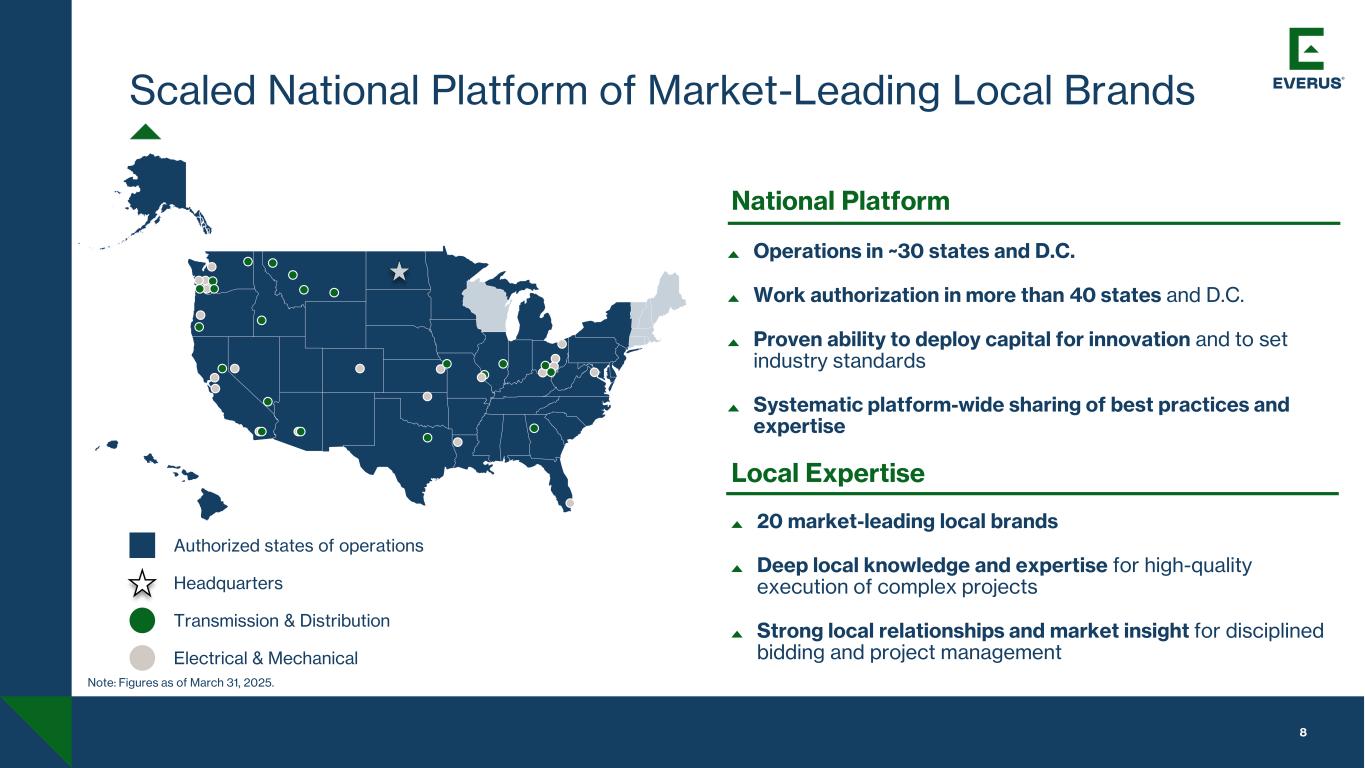
Scaled National Platform of Market-Leading Local Brands 8 Operations in ~30 states and D.C. Work authorization in more than 40 states and D.C. Proven ability to deploy capital for innovation and to set industry standards Systematic platform-wide sharing of best practices and expertise Authorized states of operations National Platform Local Expertise 20 market-leading local brands Deep local knowledge and expertise for high-quality execution of complex projects Strong local relationships and market insight for disciplined bidding and project management Note: Figures as of March 31, 2025. Headquarters Transmission & Distribution Electrical & Mechanical
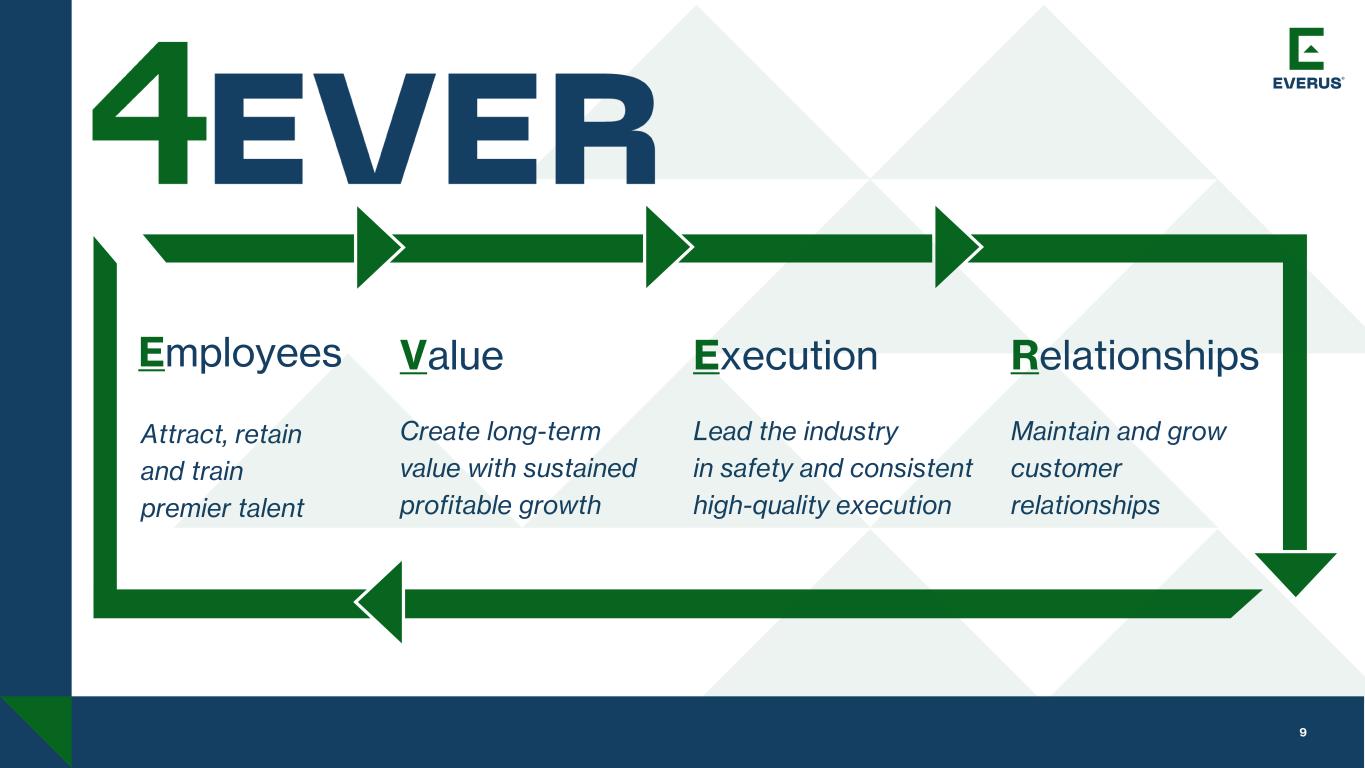
9 Create long-term value with sustained profitable growth Value Attract, retain and train premier talent Employees Maintain and grow customer relationships Relationships Lead the industry in safety and consistent high-quality execution Execution

Value Creation Framework 10 Grow share within existing end markets Further penetrate higher-growth submarkets Lead geographic expansion through satellite projects Accelerate growth with strategic M&A Targeted Commercial Growth Disciplined Capital Allocation Driving sustainable value creation through a dedicated focus on 4EVER principles Operational Excellence Strategically deploy assets in higher-margin projects and end markets Maintain disciplined bidding process Continue to implement Everus’ operational playbook Drive operating leverage through growth initiatives Invest in high-return organic growth initiatives Pursue strategic acquisitions Maintain investment-grade capital structure Future potential capital returns to shareholders
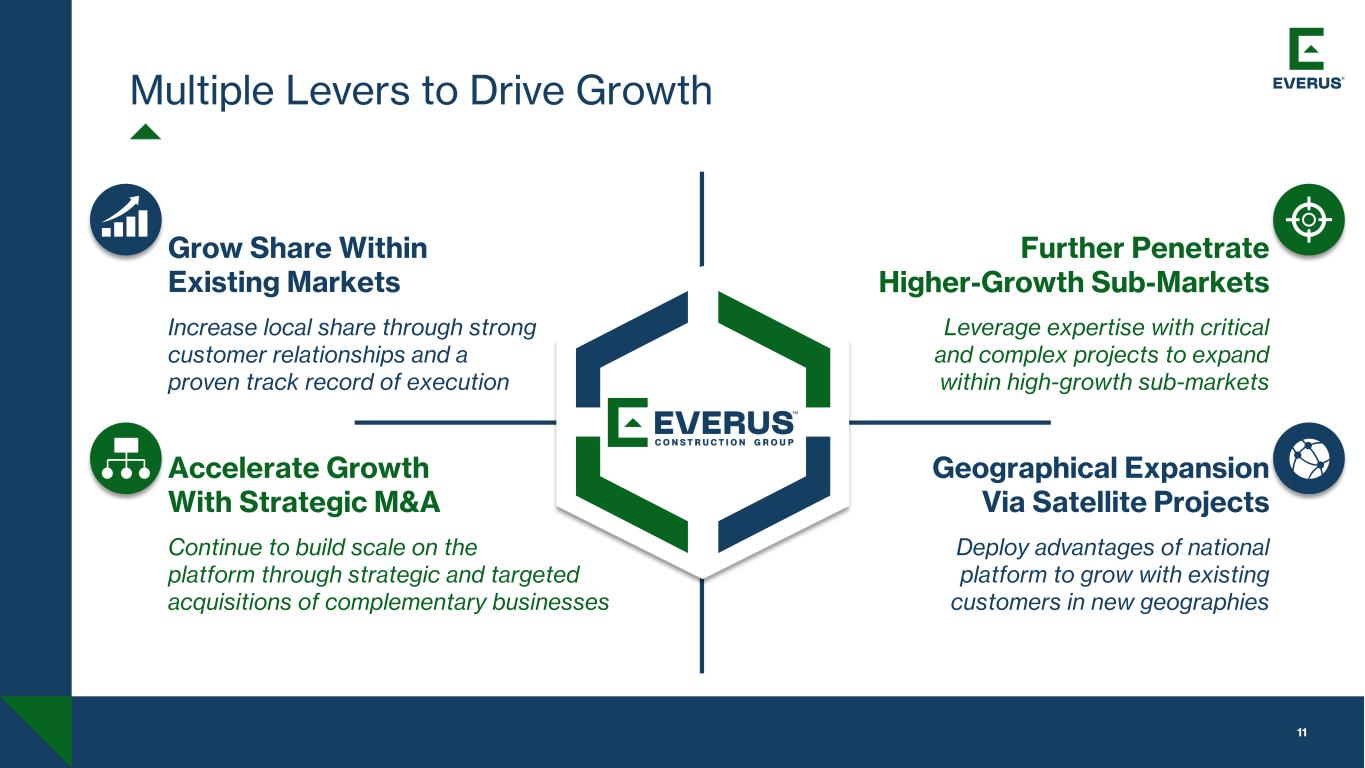
Multiple Levers to Drive Growth 11 Grow Share Within Existing Markets Increase local share through strong customer relationships and a proven track record of execution Further Penetrate Higher-Growth Sub-Markets Leverage expertise with critical and complex projects to expand within high-growth sub-markets Accelerate Growth With Strategic M&A Continue to build scale on the platform through strategic and targeted acquisitions of complementary businesses Geographical Expansion Via Satellite Projects Deploy advantages of national platform to grow with existing customers in new geographies

12 Systematically Share ‘Lessons Learned’ Across Brands Leverage Unique Pre-Construction Design-Assist Capabilities Position Safety as a Core Value, not Only a Priority Efficiently Scale Highly Skilled Workforce Continuously Train and Develop Workforce Skills Deploy Best Practices in Detailed Project Planning Operational Excellence Drives Repeatable High-Quality Results HIGH-QUALITY OUTCOMES Resilient Margin Profile New Project Wins Sustained Growth High Employee Retention High Customer Retention

Project-planning standards that identify pre-fabrication opportunities Robust communication and knowledge- sharing between BIM/CAD(1) and pre- fabrication teams National scale and local presence allowing innovation at scale with local expertise Superior pre-fabrication quality, lowering costs and strengthening ability to win new projects High exposure to complex projects benefiting the most from pre-fabrication 13 Early Adopter of Pre-Fabrication Improved safety Greater labor efficiency and lower labor costs Faster project completion Enhanced quality of project execution Increased ability to control project outcomes Benefits of Pre-Fabrication Why Everus Wins 14 pre-fabrication facilities Pre-Fabrication Drives Productivity and Cost Savings Increasing investments in Pre-Fab to drive incremental benefits (1) ‘BIM’ Building Information Modeling; ‘CAD’ Computer Aided Design.
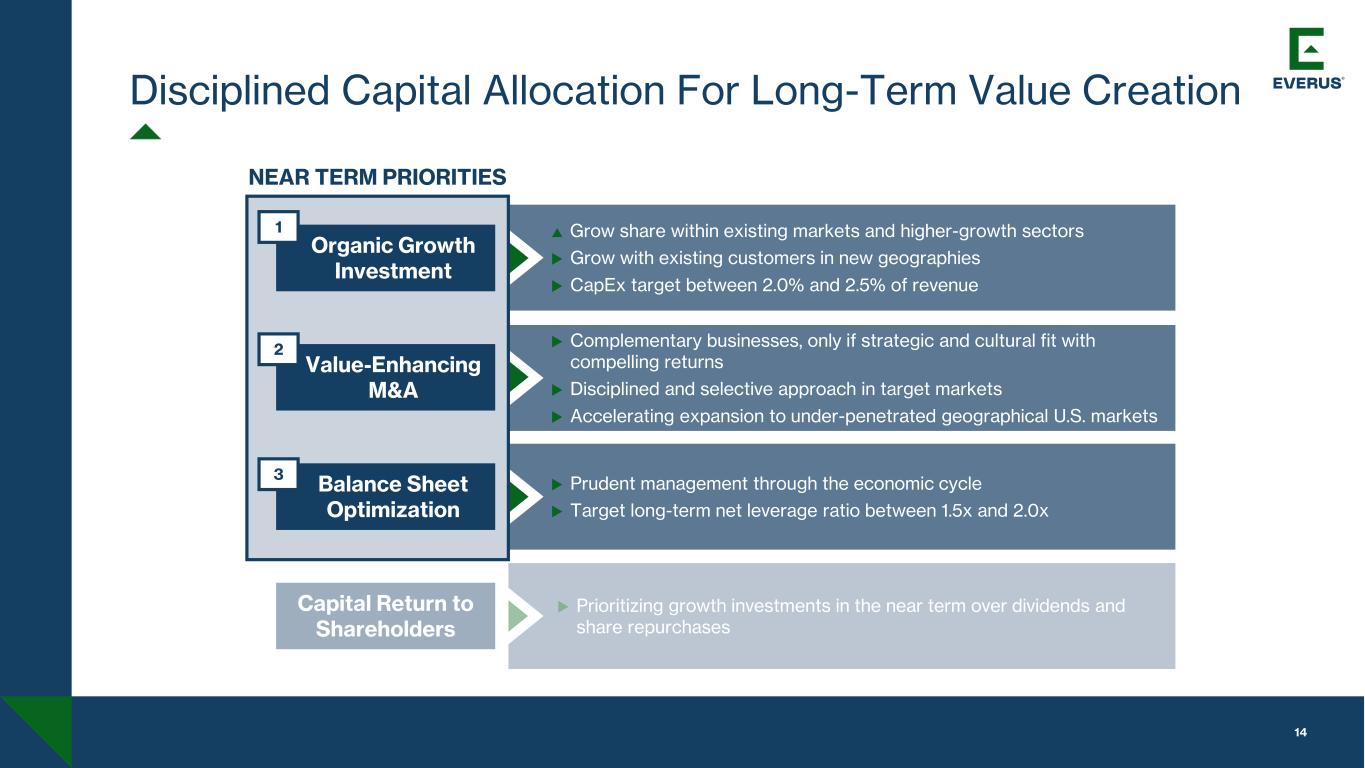
Disciplined Capital Allocation For Long-Term Value Creation 14 Prudent management through the economic cycle Target long-term net leverage ratio between 1.5x and 2.0x Complementary businesses, only if strategic and cultural fit with compelling returns Disciplined and selective approach in target markets Accelerating expansion to under-penetrated geographical U.S. markets Grow share within existing markets and higher-growth sectors Grow with existing customers in new geographies CapEx target between 2.0% and 2.5% of revenue Capital Return to Shareholders NEAR TERM PRIORITIES Organic Growth Investment 1 Value-Enhancing M&A 2 Balance Sheet Optimization 3 Prioritizing growth investments in the near term over dividends and share repurchases

15 Employees Value Execution Relationships LONG-TERM GOALS 2.0% – 2.5% CapEx as % of Revenue Net Leverage 1.5x – 2.0x 7% – 9% EBITDA CAGR 5% – 7% Organic Revenue CAGR

16 FIRST QUARTER 2025 RESULTS

First Quarter 2025 Highlights – Backlog Strength 17 Strong Backlog Growth Backlog of $3.1 billion, up 41% from prior year, reflecting growth in both T&D (+8%) and E&M (+46%) segments Robust Revenue Growth Revenue growth of 32% driven by continued momentum in E&M EBITDA Growth Total EBITDA increased 32% from prior year, despite incremental stand-alone operating costs, driven by E&M revenue growth and favorable T&D margin capture Efficient Execution EBITDA margin of 7.5%, consistent with prior year despite incremental stand-alone operating costs; both E&M and T&D segment margins expanded from prior year *All comparisons are versus the prior year quarter unless otherwise noted $3,058 $500 $1,000 $1,500 $2,000 $2,500 $3,000 $3,500 1Q21 2Q21 3Q21 4Q21 1Q22 2Q22 3Q22 4Q22 1Q23 2Q23 3Q23 4Q23 1Q24 2Q24 3Q24 4Q24 1Q25 Backlog Growth

First Quarter 2025 Highlights – End Market Momentum 18 T&D Margin Expansion T&D revenue decreased 2% as lower storm work was partially offset by higher underground workloads; EBITDA increased 6% driven by margin expansion E&M Momentum E&M revenue increased 47% driven by continued momentum in data center work; EBITDA increased 51% Free Cash Flow First quarter 2025 free cash flow was a use of ($8) million due to project timing Financial Flexibility Total unrestricted cash and cash equivalents and revolver availability of $263.7 million at March 31, 2025; net leverage of 1.0x *All comparisons are versus the prior year quarter unless otherwise noted Favorable End Market Trends ❖ Data Center – Continue to see very strong demand trends and have not seen any meaningful change in our customers' plans ❖ High Tech – Outlook for high-tech re-shoring remains favorable due to CHIPS Act and trend towards domestic manufacturing ❖ Hospitality – Secured several new projects during the first quarter and remain encouraged by the market outlook in Las Vegas

First Quarter 2025 Performance Summary 19 Performance highlighted by continued backlog momentum, project execution, strong E&M growth • 32% first quarter revenue growth driven by strong E&M results • Total backlog increased 41% to $3.1 billion y/y, with E&M backlog up 46% and T&D backlog up 8% • First quarter EBITDA increased 32% despite incremental stand-alone operating costs 32.1% y/y First Quarter Revenue Growth ($MM) 31.8% y/y First Quarter EBITDA Growth ($MM) Consistent y/y First Quarter EBITDA Margin (%) 40.5% y/y First Quarter Backlog Growth ($MM) $2,175.4 $2,403.4 $2,884.8 $2,780.6 $3,057.5 1Q24 2Q24 3Q24 4Q24 1Q25 7.5% 7.5% 1Q24 1Q25 $625.7 $826.6 1Q24 1Q25 $46.9 $61.8 1Q24 1Q25

E&M Highlights • First quarter revenue increased 47% due to strength in key submarkets within commercial and institutional • First quarter EBITDA increased 51% on strong revenue growth; margin increased 20 bps T&D Highlights • First quarter revenue decreased 2% due to lower utility work and weather delays, partially offset by transportation growth • First quarter EBITDA growth of 6%; margin expanded 80 bps First Quarter Segment Performance Summary 20 E&M Revenue ($MM) T&D Revenue ($MM) T&D EBITDA and EBITDA Margin ($MM and %) E&M EBITDA and EBITDA Margin ($MM and %) $441.0 $648.2 1Q24 1Q25 $32.8 $49.5 1Q24 1Q25 7.4% 7.6% $188.5 $185.0 1Q24 1Q25 $19.0 $20.1 1Q24 1Q25 10.1% 10.9%
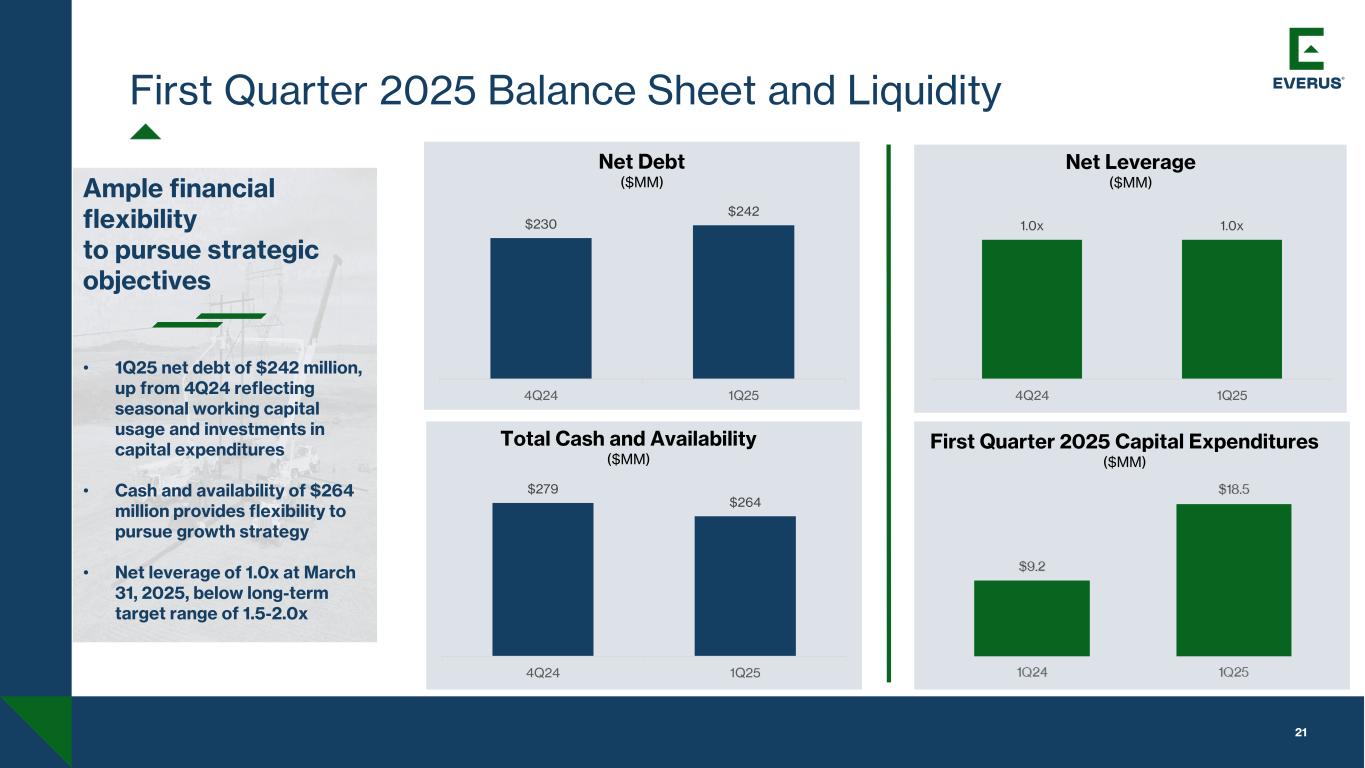
Ample financial flexibility to pursue strategic objectives • 1Q25 net debt of $242 million, up from 4Q24 reflecting seasonal working capital usage and investments in capital expenditures • Cash and availability of $264 million provides flexibility to pursue growth strategy • Net leverage of 1.0x at March 31, 2025, below long-term target range of 1.5-2.0x First Quarter 2025 Balance Sheet and Liquidity 21 Net Debt ($MM) Net Leverage ($MM) Total Cash and Availability ($MM) First Quarter 2025 Capital Expenditures ($MM) $230 $242 4Q24 1Q25 $279 $264 4Q24 1Q25 1.0x 1.0x 4Q24 1Q25

22 2025 Financial Guidance 2025 Drivers Strong demand for E&M driven by data center, high-tech re-shoring; T&D driven by grid modernization and grid hardening Strong momentum with backlog of $3.1 billion as of March 31, 2025, up 41% year-over-year Margin realization impacted by incremental stand-alone operating costs and project mix Affirming 2025 Guidance Revenue $3.0B – $3.1B EBITDA $210M – $225M (1) (1) Guidance provided as of May 13, 2025 and is neither being reaffirmed nor updated today.
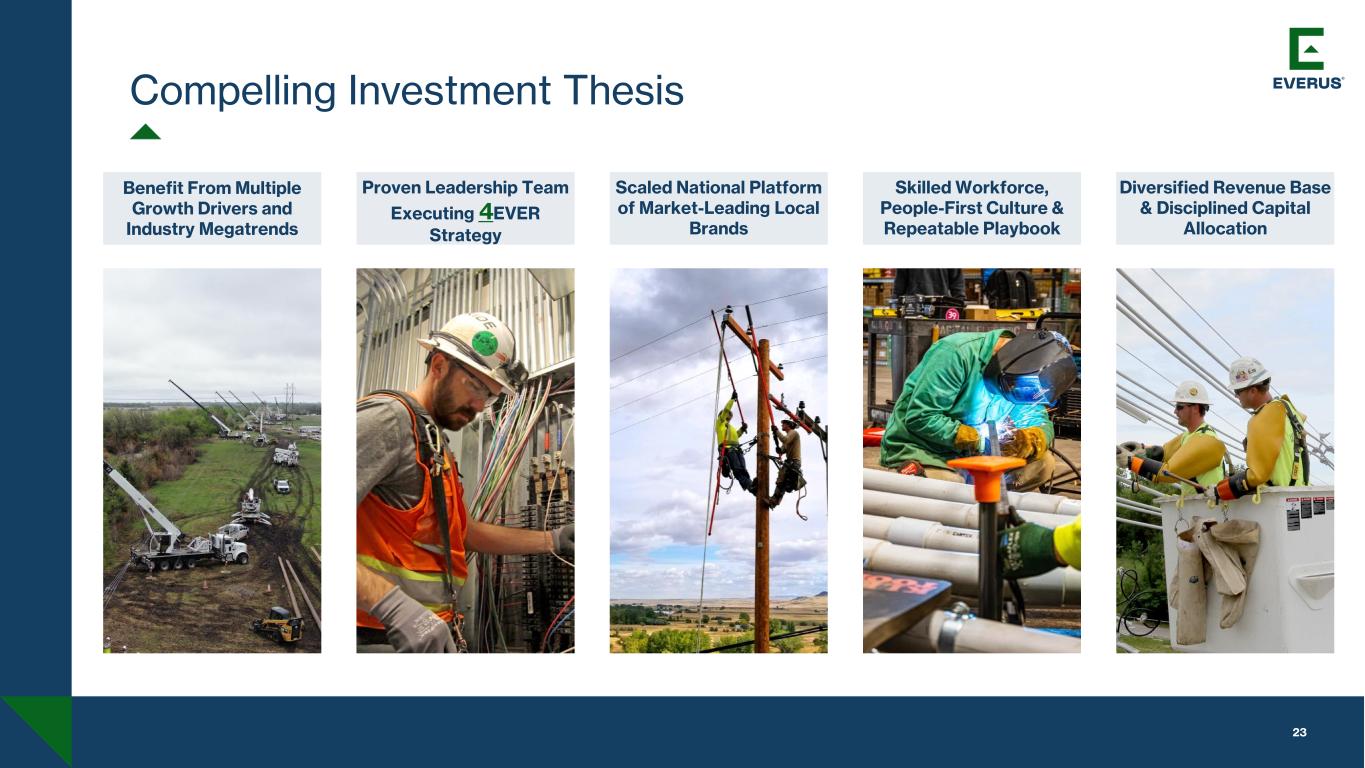
Benefit From Multiple Growth Drivers and Industry Megatrends Proven Leadership Team Executing 4EVER Strategy Scaled National Platform of Market-Leading Local Brands Skilled Workforce, People-First Culture & Repeatable Playbook Diversified Revenue Base & Disciplined Capital Allocation Compelling Investment Thesis 23
24APPENDIX

Non-GAAP Financial Measures 25 We are unable to reconcile long-term organic revenue, organic revenue growth, EBITDA and net leverage to their respective nearest U.S. GAAP measure because we are unable to predict the timing of these adjustments with a reasonable degree of certainty. By their very nature, non-GAAP adjustments are difficult to anticipate with precision because they are generally associated with unexpected and unplanned events that impact our company and our financial results. Therefore, we are unable to provide reconciliations of these non-GAAP financial measures without unreasonable efforts.

Reconciliations of net income to EBITDA and EBITDA margin 26 Reconciliations of net income to EBITDA and EBITDA margin. Three months ended March 31, 2025 2024 Change (In millions, except percentages) Net income $ 36.7 $ 28.2 30.1 % Interest 4.7 2.7 74.1 % Income taxes 13.6 10.0 36.0 % Depreciation and amortization 6.8 6.0 13.3 % EBITDA $ 61.8 $ 46.9 31.8 % Operating revenues 826.6 625.7 32.1 % Net income margin 4.4% 4.5% EBITDA margin 7.5% 7.5%

Reconciliations of net income to EBITDA by segment 27 Reconciliations of net income to EBITDA by segment. Three months ended March 31, 2025 Three months ended March 31, 2024 E&M T&D Corporate and Other Total E&M T&D Corporate and Other Total (In millions) (In millions) Net income $ 36.6 $ 10.5 $ (10.4) $ 36.7 $ 23.0 $ 10.2 $ (5.0) $ 28.2 Interest (1.8) 0.7 5.8 4.7 (0.1) 0.9 1.9 2.7 Income taxes 13.3 3.4 (3.1) 13.6 8.3 3.4 (1.7) 10.0 Depreciation and amortization 1.4 5.5 (0.1) 6.8 1.6 4.5 (0.1) 6.0 EBITDA $ 49.5 $ 20.1 $ (7.8) $ 61.8 $ 32.8 $ 19.0 $ (4.9) $ 46.9
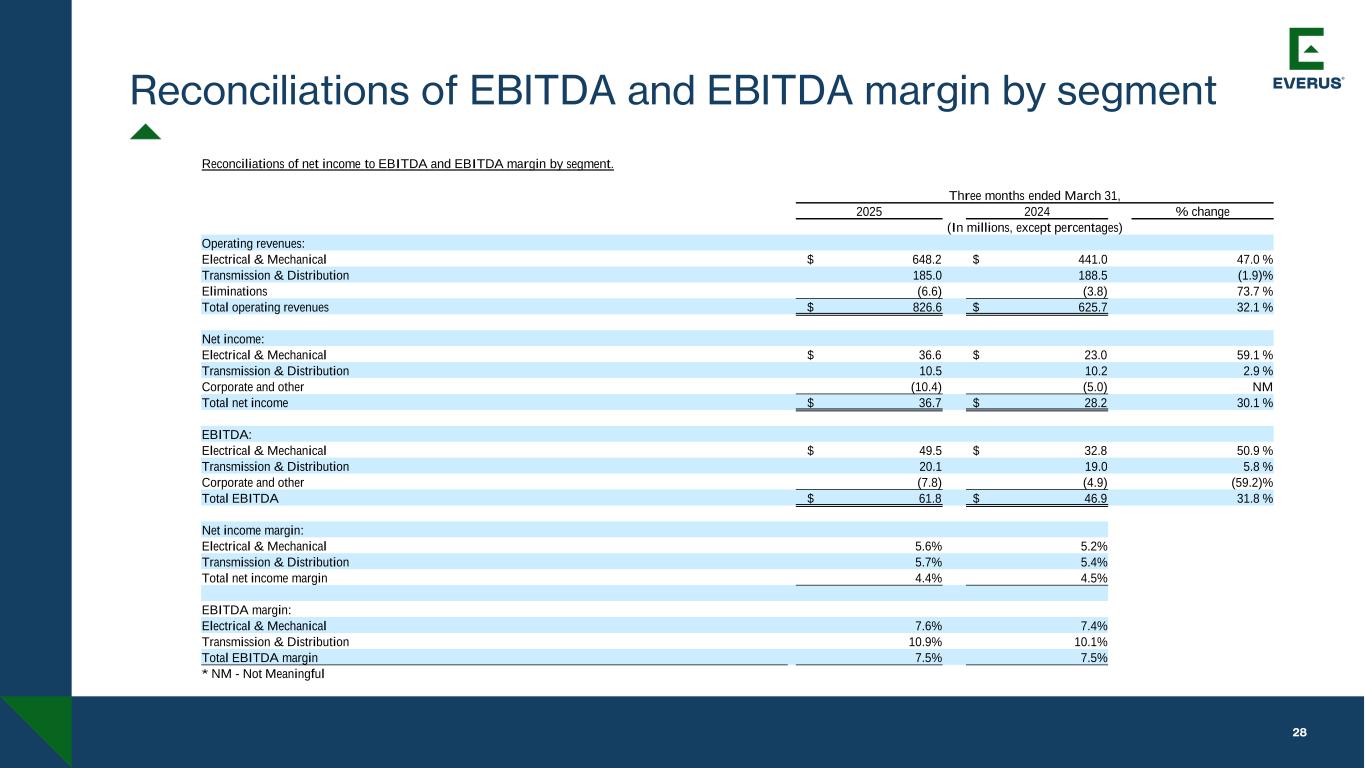
Reconciliations of EBITDA and EBITDA margin by segment 28 Reconciliations of net income to EBITDA and EBITDA margin by segment. Three months ended March 31, 2025 2024 % change (In millions, except percentages) Operating revenues: Electrical & Mechanical $ 648.2 $ 441.0 47.0 % Transmission & Distribution 185.0 188.5 (1.9)% Eliminations (6.6) (3.8) 73.7 % Total operating revenues $ 826.6 $ 625.7 32.1 % Net income: Electrical & Mechanical $ 36.6 $ 23.0 59.1 % Transmission & Distribution 10.5 10.2 2.9 % Corporate and other (10.4) (5.0) NM Total net income $ 36.7 $ 28.2 30.1 % EBITDA: Electrical & Mechanical $ 49.5 $ 32.8 50.9 % Transmission & Distribution 20.1 19.0 5.8 % Corporate and other (7.8) (4.9) (59.2)% Total EBITDA $ 61.8 $ 46.9 31.8 % Net income margin: Electrical & Mechanical 5.6% 5.2% Transmission & Distribution 5.7% 5.4% Total net income margin 4.4% 4.5% EBITDA margin: Electrical & Mechanical 7.6% 7.4% Transmission & Distribution 10.9% 10.1% Total EBITDA margin 7.5% 7.5% * NM - Not Meaningful
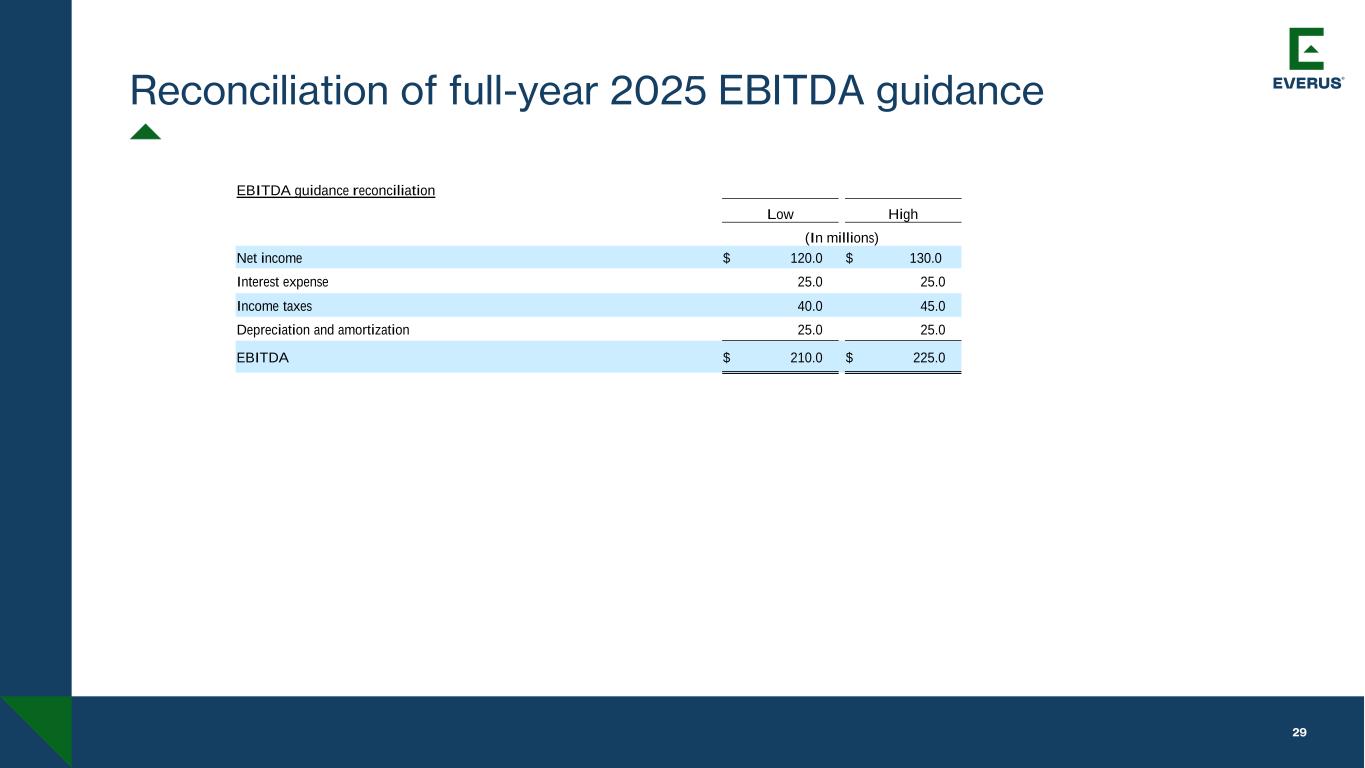
Reconciliation of full-year 2025 EBITDA guidance 29 EBITDA guidance reconciliation Low High (In millions) Net income $ 120.0 $ 130.0 Interest expense 25.0 25.0 Income taxes 40.0 45.0 Depreciation and amortization 25.0 25.0 EBITDA $ 210.0 $ 225.0

Reconciliations of trailing 12-month EBITDA and net leverage 30 Reconciliations of trailing-twelve-month EBITDA as of March 31, 2025 and December 31, 2024. Twelve months ended March 31, 2025 Three months ended March 31, 2025 Twelve months ended December 31, 2024 Three months ended March 31, 2024 (In millions) Net income $ 151.9 $ 36.7 $ 143.4 $ 28.2 Interest expense 16.0 4.7 14.0 2.7 Income taxes 53.1 13.6 49.5 10.0 Depreciation and amortization 26.1 6.8 25.3 6.0 EBITDA $ 247.1 $ 61.8 $ 232.2 $ 46.9 Reconciliations of net leverage calculation of net debt to trailing-twelve-month EBITDA as of March 31, 2025 and December 31, 2024. March 31, 2025 December 31, 2024 (In millions) (In millions) Current portion of long-term debt $ 15.0 $ 15.0 Long-term debt 277.1 280.6 Total debt 292.1 295.6 Add: Unamortized debt issuance costs 4.1 4.4 Total gross debt 296.2 300.0 Less: cash and cash equivalents, excluding restricted cash (54.3) (69.9) Total net debt $ 241.9 $ 230.1 Trailing-twelve-months ended EBITDA for the period indicated $ 247.1 $ 232.2 Net leverage 1.0x 1.0x
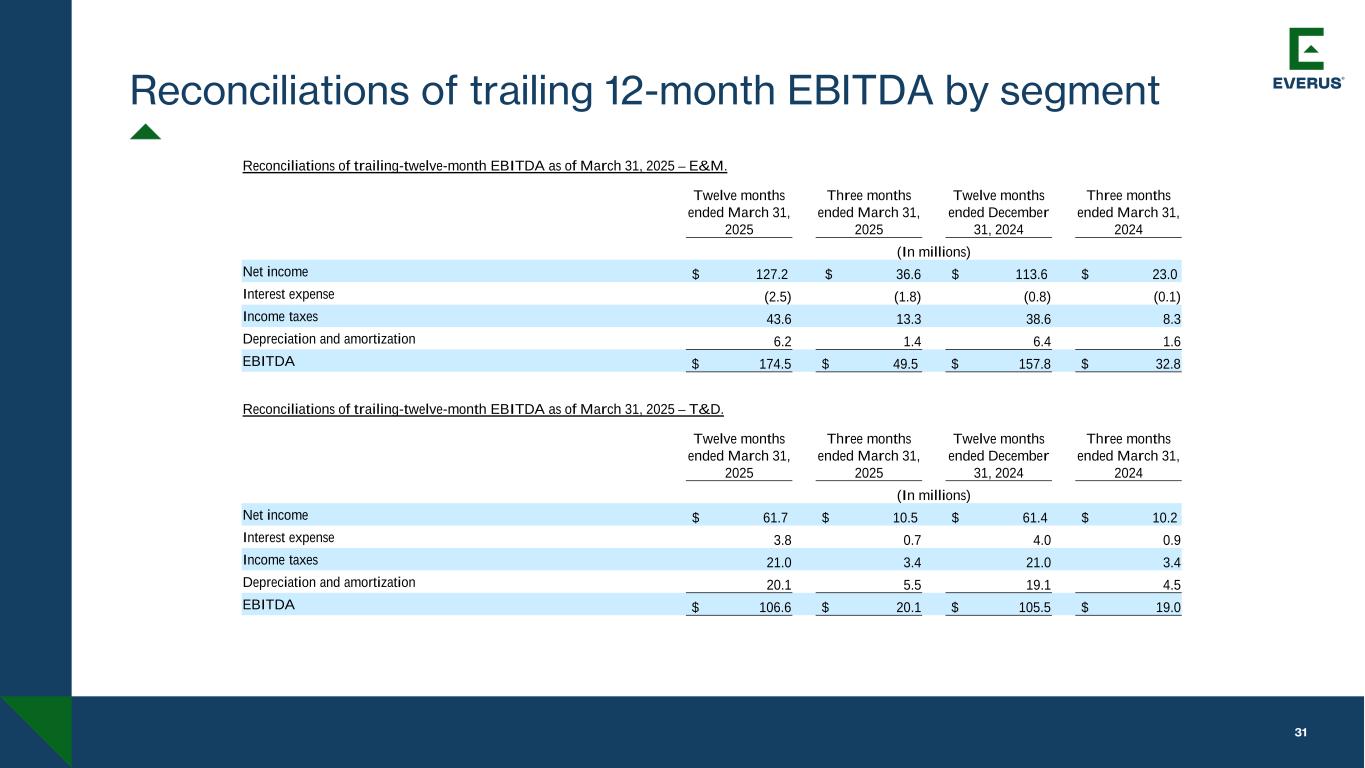
Reconciliations of trailing 12-month EBITDA by segment 31 Reconciliations of trailing-twelve-month EBITDA as of March 31, 2025 – E&M. Twelve months ended March 31, 2025 Three months ended March 31, 2025 Twelve months ended December 31, 2024 Three months ended March 31, 2024 (In millions) Net income $ 127.2 $ 36.6 $ 113.6 $ 23.0 Interest expense (2.5) (1.8) (0.8) (0.1) Income taxes 43.6 13.3 38.6 8.3 Depreciation and amortization 6.2 1.4 6.4 1.6 EBITDA $ 174.5 $ 49.5 $ 157.8 $ 32.8 Reconciliations of trailing-twelve-month EBITDA as of March 31, 2025 – T&D. Twelve months ended March 31, 2025 Three months ended March 31, 2025 Twelve months ended December 31, 2024 Three months ended March 31, 2024 (In millions) Net income $ 61.7 $ 10.5 $ 61.4 $ 10.2 Interest expense 3.8 0.7 4.0 0.9 Income taxes 21.0 3.4 21.0 3.4 Depreciation and amortization 20.1 5.5 19.1 4.5 EBITDA $ 106.6 $ 20.1 $ 105.5 $ 19.0
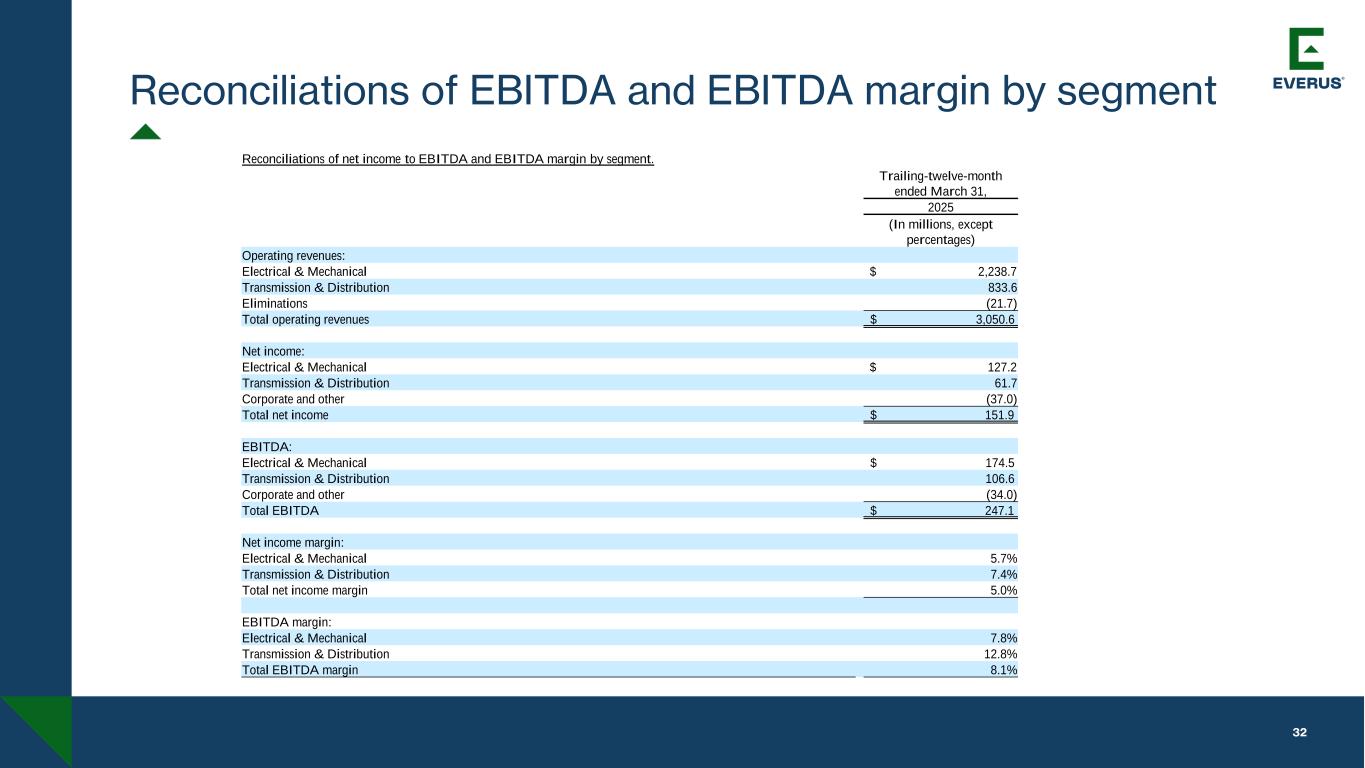
Reconciliations of EBITDA and EBITDA margin by segment 32 Reconciliations of net income to EBITDA and EBITDA margin by segment. Trailing-twelve-month ended March 31, 2025 (In millions, except percentages) Operating revenues: Electrical & Mechanical $ 2,238.7 Transmission & Distribution 833.6 Eliminations (21.7) Total operating revenues $ 3,050.6 Net income: Electrical & Mechanical $ 127.2 Transmission & Distribution 61.7 Corporate and other (37.0) Total net income $ 151.9 EBITDA: Electrical & Mechanical $ 174.5 Transmission & Distribution 106.6 Corporate and other (34.0) Total EBITDA $ 247.1 Net income margin: Electrical & Mechanical 5.7% Transmission & Distribution 7.4% Total net income margin 5.0% EBITDA margin: Electrical & Mechanical 7.8% Transmission & Distribution 12.8% Total EBITDA margin 8.1%

Reconciliations of free cash flow 33 Reconciliations of cash provided by operating activities to free cash flow Three months ended March 31, 2025 2024 (In millions) Net cash used in investing activities $ (14.8) $ (6.4) Net cash used in financing activities $ (4.3) $ (16.5) Net cash provided by operating activities $ 7.1 $ 21.8 Purchases of property, plant and equipment (18.5) (9.2) Cash proceeds from sale of property, plant and equipment 3.3 2.8 Free cash flow $ (8.1) $ 15.4

Contact: investors@everus.com 34
 エドガーで原本を確認する