00020011842024FYFALSEP3Yhttp://fasb.org/us-gaap/2024#OtherAccruedLiabilitiesCurrenthttp://fasb.org/us-gaap/2024#OtherAccruedLiabilitiesCurrenthttp://fasb.org/us-gaap/2024#OtherLiabilitiesNoncurrenthttp://fasb.org/us-gaap/2024#OtherLiabilitiesNoncurrentiso4217:USDxbrli:sharesiso4217:USDxbrli:sharespacs:facilitypacs:bedpacs:Entitypacs:propertypacs:shareholderxbrli:pureutr:Ratepacs:subsidiarypacs:loanpacs:leasepacs:planpacs:statepacs:realEstateEntity00020011842024-01-012024-12-3100020011842024-06-3000020011842025-11-1700020011842024-12-3100020011842023-12-3100020011842023-01-012023-12-3100020011842022-01-012022-12-310002001184us-gaap:CommonStockMember2021-12-310002001184us-gaap:AdditionalPaidInCapitalMember2021-12-310002001184us-gaap:RetainedEarningsMember2021-12-310002001184us-gaap:NoncontrollingInterestMember2021-12-3100020011842021-12-310002001184us-gaap:NoncontrollingInterestMember2022-01-012022-12-310002001184us-gaap:RetainedEarningsMember2022-01-012022-12-310002001184us-gaap:CommonStockMember2022-12-310002001184us-gaap:AdditionalPaidInCapitalMember2022-12-310002001184us-gaap:RetainedEarningsMember2022-12-310002001184us-gaap:NoncontrollingInterestMember2022-12-3100020011842022-12-310002001184us-gaap:NoncontrollingInterestMember2023-01-012023-12-310002001184us-gaap:RetainedEarningsMember2023-01-012023-12-310002001184us-gaap:CommonStockMember2023-12-310002001184us-gaap:AdditionalPaidInCapitalMember2023-12-310002001184us-gaap:RetainedEarningsMember2023-12-310002001184us-gaap:NoncontrollingInterestMember2023-12-310002001184us-gaap:NoncontrollingInterestMember2024-01-012024-12-310002001184us-gaap:CommonStockMember2024-01-012024-12-310002001184us-gaap:AdditionalPaidInCapitalMember2024-01-012024-12-310002001184us-gaap:RetainedEarningsMember2024-01-012024-12-310002001184us-gaap:CommonStockMember2024-12-310002001184us-gaap:AdditionalPaidInCapitalMember2024-12-310002001184us-gaap:RetainedEarningsMember2024-12-310002001184us-gaap:NoncontrollingInterestMember2024-12-310002001184pacs:PACSGroupSubsidiariesMember2024-12-3100020011842023-06-300002001184pacs:PGIMemberpacs:ShareholderAMember2023-06-290002001184pacs:PGIMemberpacs:ShareholderBMember2023-06-290002001184us-gaap:PrepaidExpensesAndOtherCurrentAssetsMember2024-12-310002001184us-gaap:PrepaidExpensesAndOtherCurrentAssetsMember2023-12-310002001184us-gaap:PrepaidExpensesAndOtherCurrentAssetsMember2022-12-310002001184us-gaap:OtherAssetsMember2024-12-310002001184us-gaap:OtherAssetsMember2023-12-310002001184us-gaap:OtherAssetsMember2022-12-310002001184srt:MinimumMemberus-gaap:BuildingAndBuildingImprovementsMember2024-12-310002001184srt:MaximumMemberus-gaap:BuildingAndBuildingImprovementsMember2024-12-310002001184us-gaap:BuildingAndBuildingImprovementsMember2024-12-310002001184srt:MinimumMemberus-gaap:LeaseholdImprovementsMember2024-12-310002001184srt:MaximumMemberus-gaap:LeaseholdImprovementsMember2024-12-310002001184srt:MinimumMemberus-gaap:FurnitureAndFixturesMember2024-12-310002001184srt:MaximumMemberus-gaap:FurnitureAndFixturesMember2024-12-310002001184srt:MinimumMember2024-12-310002001184srt:MaximumMember2024-12-310002001184pacs:MedicareMemberus-gaap:CustomerConcentrationRiskMemberus-gaap:AccountsReceivableMember2024-01-012024-12-310002001184pacs:MedicaidMemberus-gaap:CustomerConcentrationRiskMemberus-gaap:AccountsReceivableMember2024-01-012024-12-310002001184pacs:MedicareMemberus-gaap:CustomerConcentrationRiskMemberus-gaap:AccountsReceivableMember2023-01-012023-12-310002001184pacs:MedicaidMemberus-gaap:CustomerConcentrationRiskMemberus-gaap:AccountsReceivableMember2023-01-012023-12-310002001184stpr:CAus-gaap:GeographicConcentrationRiskMemberpacs:SkilledNursingBedsMember2024-01-012024-12-310002001184pacs:ReportableSegmentMember2024-01-012024-12-310002001184pacs:ReportableSegmentMember2023-01-012023-12-310002001184pacs:ReportableSegmentMember2022-01-012022-12-310002001184pacs:MedicareMemberus-gaap:CustomerConcentrationRiskMemberus-gaap:SalesRevenueNetMember2024-01-012024-12-310002001184pacs:MedicareMemberus-gaap:CustomerConcentrationRiskMemberus-gaap:SalesRevenueNetMember2023-01-012023-12-310002001184pacs:MedicareMemberus-gaap:CustomerConcentrationRiskMemberus-gaap:SalesRevenueNetMember2022-01-012022-12-310002001184pacs:MedicaidMemberus-gaap:CustomerConcentrationRiskMemberus-gaap:SalesRevenueNetMember2024-01-012024-12-310002001184pacs:MedicaidMemberus-gaap:CustomerConcentrationRiskMemberus-gaap:SalesRevenueNetMember2023-01-012023-12-310002001184pacs:MedicaidMemberus-gaap:CustomerConcentrationRiskMemberus-gaap:SalesRevenueNetMember2022-01-012022-12-310002001184pacs:ManagedCarePrivateAndOtherMemberus-gaap:CustomerConcentrationRiskMemberus-gaap:SalesRevenueNetMember2024-01-012024-12-310002001184pacs:ManagedCarePrivateAndOtherMemberus-gaap:CustomerConcentrationRiskMemberus-gaap:SalesRevenueNetMember2023-01-012023-12-310002001184pacs:ManagedCarePrivateAndOtherMemberus-gaap:CustomerConcentrationRiskMemberus-gaap:SalesRevenueNetMember2022-01-012022-12-310002001184pacs:ManagedCareMemberus-gaap:CustomerConcentrationRiskMemberus-gaap:SalesRevenueNetMember2024-01-012024-12-310002001184pacs:ManagedCareMemberus-gaap:CustomerConcentrationRiskMemberus-gaap:SalesRevenueNetMember2023-01-012023-12-310002001184pacs:ManagedCareMemberus-gaap:CustomerConcentrationRiskMemberus-gaap:SalesRevenueNetMember2022-01-012022-12-310002001184pacs:PrivateAndOtherMemberus-gaap:CustomerConcentrationRiskMemberus-gaap:SalesRevenueNetMember2024-01-012024-12-310002001184pacs:PrivateAndOtherMemberus-gaap:CustomerConcentrationRiskMemberus-gaap:SalesRevenueNetMember2023-01-012023-12-310002001184pacs:PrivateAndOtherMemberus-gaap:CustomerConcentrationRiskMemberus-gaap:SalesRevenueNetMember2022-01-012022-12-310002001184us-gaap:CustomerConcentrationRiskMemberus-gaap:SalesRevenueNetMember2024-01-012024-12-310002001184us-gaap:CustomerConcentrationRiskMemberus-gaap:SalesRevenueNetMember2023-01-012023-12-310002001184us-gaap:CustomerConcentrationRiskMemberus-gaap:SalesRevenueNetMember2022-01-012022-12-310002001184pacs:ProviderReliefFundDistributionsCARESActMember2022-01-012022-12-3100020011842020-01-012021-12-310002001184us-gaap:BuildingAndBuildingImprovementsMember2023-12-310002001184us-gaap:LeaseholdImprovementsMember2024-12-310002001184us-gaap:LeaseholdImprovementsMember2023-12-310002001184us-gaap:FurnitureAndFixturesMember2024-12-310002001184us-gaap:FurnitureAndFixturesMember2023-12-310002001184us-gaap:ConstructionInProgressMember2024-12-310002001184us-gaap:ConstructionInProgressMember2023-12-310002001184us-gaap:LandMember2024-12-310002001184us-gaap:LandMember2023-12-310002001184us-gaap:LicensingAgreementsMember2024-12-310002001184us-gaap:LicensingAgreementsMember2023-12-310002001184us-gaap:FairValueInputsLevel2Memberpacs:InsuranceSubsidiaryDepositsMember2024-12-310002001184us-gaap:FairValueInputsLevel2Memberpacs:InsuranceSubsidiaryDepositsMember2023-12-310002001184pacs:BRFSSNFVenturesVLLCMember2024-07-010002001184pacs:BRFSSNFVenturesVLLCMember2024-12-310002001184pacs:BRFSSNFVenturesVLLCMemberus-gaap:SubsequentEventMember2025-08-010002001184pacs:NextSaddleInvestorsLLCMember2024-09-010002001184pacs:September2024BusinessCombinationMember2024-09-010002001184pacs:NextSaddleInvestorsLLCMember2024-12-310002001184pacs:LargestEquityInvestmentMember2024-12-310002001184pacs:TheWorkingCapitalLoanMemberus-gaap:LineOfCreditMember2023-02-280002001184pacs:TheWorkingCapitalLoanMemberus-gaap:LineOfCreditMember2023-05-082023-05-080002001184pacs:TheWorkingCapitalLoanMemberus-gaap:LineOfCreditMember2023-12-310002001184pacs:TheWorkingCapitalLoanMemberus-gaap:LineOfCreditMember2024-12-310002001184pacs:The2023CreditAgreementMemberus-gaap:RevolvingCreditFacilityMemberus-gaap:LineOfCreditMember2023-06-300002001184pacs:The2023CreditAgreementMemberus-gaap:LetterOfCreditMemberus-gaap:LineOfCreditMember2023-06-300002001184pacs:The2023CreditAgreementMemberpacs:SwinglineLoanMemberus-gaap:LineOfCreditMember2023-06-300002001184pacs:The2023CreditAgreementMemberus-gaap:SecuredDebtMemberus-gaap:LineOfCreditMember2023-06-300002001184pacs:The2023CreditAgreementMemberus-gaap:LineOfCreditMemberus-gaap:SecuredOvernightFinancingRateSofrMember2023-06-302023-06-300002001184pacs:The2023CreditAgreementMemberus-gaap:LineOfCreditMemberus-gaap:SecuredOvernightFinancingRateSofrMembersrt:MinimumMember2023-06-302023-06-300002001184pacs:The2023CreditAgreementMemberus-gaap:LineOfCreditMemberus-gaap:SecuredOvernightFinancingRateSofrMembersrt:MaximumMember2023-06-302023-06-300002001184pacs:The2023CreditAgreementMemberus-gaap:LineOfCreditMemberus-gaap:BaseRateMembersrt:MinimumMember2023-06-302023-06-300002001184pacs:The2023CreditAgreementMemberus-gaap:LineOfCreditMemberus-gaap:BaseRateMembersrt:MaximumMember2023-06-302023-06-300002001184pacs:The2023CreditAgreementMemberus-gaap:RevolvingCreditFacilityMemberus-gaap:LineOfCreditMembersrt:MinimumMember2023-06-302023-06-300002001184pacs:The2023CreditAgreementMemberus-gaap:RevolvingCreditFacilityMemberus-gaap:LineOfCreditMembersrt:MaximumMember2023-06-302023-06-300002001184pacs:The2023CreditAgreementMemberpacs:LineOfCreditAndLongTermDebtMemberus-gaap:LineOfCreditMember2023-01-012023-12-310002001184pacs:The2023CreditAgreementMemberus-gaap:LineOfCreditMember2023-12-310002001184pacs:The2023CreditAgreementMemberus-gaap:RevolvingCreditFacilityMemberus-gaap:LineOfCreditMember2023-06-302023-06-300002001184pacs:The2023CreditAgreementMemberus-gaap:SecuredDebtMemberus-gaap:LineOfCreditMember2023-06-302023-06-300002001184pacs:The2023CreditAgreementMemberus-gaap:LineOfCreditMember2023-06-302023-06-300002001184pacs:The2023CreditAgreementMemberus-gaap:RevolvingCreditFacilityMemberus-gaap:LineOfCreditMember2023-12-070002001184pacs:The2023CreditAgreementMemberus-gaap:LetterOfCreditMemberus-gaap:LineOfCreditMember2023-12-070002001184pacs:The2023CreditAgreementMemberpacs:SwinglineLoanMemberus-gaap:LineOfCreditMember2023-12-070002001184pacs:The2023CreditAgreementMemberus-gaap:LineOfCreditMemberus-gaap:SecuredOvernightFinancingRateSofrMember2023-12-072023-12-070002001184pacs:The2023CreditAgreementMemberus-gaap:LineOfCreditMemberus-gaap:SecuredOvernightFinancingRateSofrMembersrt:MinimumMember2023-12-072023-12-070002001184pacs:The2023CreditAgreementMemberus-gaap:LineOfCreditMemberus-gaap:SecuredOvernightFinancingRateSofrMembersrt:MaximumMember2023-12-072023-12-070002001184pacs:The2023CreditAgreementMemberus-gaap:LineOfCreditMemberus-gaap:BaseRateMembersrt:MinimumMember2023-12-072023-12-070002001184pacs:The2023CreditAgreementMemberus-gaap:LineOfCreditMemberus-gaap:BaseRateMembersrt:MaximumMember2023-12-072023-12-070002001184pacs:The2023CreditAgreementMemberus-gaap:LineOfCreditMembersrt:MinimumMember2023-12-072023-12-070002001184pacs:The2023CreditAgreementMemberus-gaap:LineOfCreditMembersrt:MaximumMember2023-12-072023-12-070002001184pacs:The2023CreditAgreementMemberus-gaap:LineOfCreditMember2023-12-072023-12-070002001184pacs:The2023CreditAgreementMemberpacs:LineOfCreditAndLongTermDebtAmendedMemberus-gaap:LineOfCreditMember2023-01-012023-12-310002001184pacs:The2023CreditAgreementMemberus-gaap:LineOfCreditMember2023-12-070002001184pacs:The2023CreditAgreementMemberus-gaap:LineOfCreditMemberus-gaap:SubsequentEventMember2025-05-290002001184pacs:The2023CreditAgreementMemberus-gaap:LineOfCreditMemberus-gaap:SubsequentEventMember2025-10-212025-10-210002001184pacs:The2023CreditAgreementMemberus-gaap:LineOfCreditMember2024-12-310002001184us-gaap:LineOfCreditMember2024-12-310002001184us-gaap:LineOfCreditMember2023-12-310002001184us-gaap:LineOfCreditMember2024-01-012024-12-310002001184us-gaap:LineOfCreditMember2023-01-012023-12-310002001184us-gaap:IPOMember2024-04-152024-04-150002001184pacs:The2023CreditAgreementMemberus-gaap:LineOfCreditMember2024-04-152024-04-150002001184pacs:The2023CreditAgreementMemberus-gaap:LineOfCreditMember2024-04-150002001184pacs:PublicOfferingMember2024-09-092024-09-090002001184pacs:The2023CreditAgreementMember2024-09-090002001184us-gaap:DepartmentOfHousingAndUrbanDevelopmentHudMemberus-gaap:MortgagesMember2024-12-310002001184us-gaap:DepartmentOfHousingAndUrbanDevelopmentHudMemberus-gaap:MortgagesMember2023-12-310002001184us-gaap:DepartmentOfHousingAndUrbanDevelopmentHudMemberus-gaap:MortgagesMembersrt:MinimumMember2024-12-310002001184us-gaap:DepartmentOfHousingAndUrbanDevelopmentHudMemberus-gaap:MortgagesMembersrt:MaximumMember2024-12-310002001184us-gaap:DepartmentOfHousingAndUrbanDevelopmentHudMemberus-gaap:MortgagesMembersrt:MinimumMember2024-01-012024-12-310002001184us-gaap:DepartmentOfHousingAndUrbanDevelopmentHudMemberus-gaap:MortgagesMembersrt:MaximumMember2024-01-012024-12-310002001184pacs:OtherMortgageLoansAndPromissoryNotesMemberus-gaap:MortgagesMember2024-12-310002001184pacs:OtherMortgageLoansAndPromissoryNotesMemberus-gaap:MortgagesMembersrt:MinimumMember2024-12-310002001184pacs:OtherMortgageLoansAndPromissoryNotesMemberus-gaap:MortgagesMembersrt:MaximumMember2024-12-310002001184pacs:OtherMortgageLoansAndPromissoryNotesMemberus-gaap:MortgagesMember2023-12-310002001184us-gaap:MortgagesMember2024-12-310002001184us-gaap:MortgagesMember2023-12-310002001184us-gaap:MortgagesMember2024-01-012024-12-310002001184us-gaap:MortgagesMember2023-01-012023-12-310002001184us-gaap:MortgagesMember2022-01-012022-12-310002001184pacs:OtherMortgageLoansAndPromissoryNotesMemberus-gaap:LineOfCreditMember2023-01-012023-06-300002001184pacs:AmendedAndRestated2023CreditFacilityMemberus-gaap:SecuredDebtMemberus-gaap:LineOfCreditMember2023-12-310002001184pacs:AmendedAndRestated2023CreditFacilityMemberus-gaap:SecuredDebtMemberus-gaap:LineOfCreditMember2024-12-310002001184pacs:PlanOneMember2024-12-310002001184pacs:PlanOneMember2024-01-012024-12-310002001184pacs:PlanTwoMember2024-01-012024-12-310002001184us-gaap:RelatedPartyMember2021-07-010002001184pacs:AnnualCashConsultingFeeMember2024-01-012024-12-310002001184pacs:ConsultingAndStrategicAdvisoryServicesMember2024-01-012024-12-310002001184pacs:ConsultingAndStrategicAdvisoryServicesMember2023-01-012023-12-310002001184pacs:ConsultingAndStrategicAdvisoryServicesMember2022-01-012022-12-310002001184pacs:SubsidiaryOfHeliosConsultingLLCMemberpacs:ConsultingAndStrategicAdvisoryServicesMember2023-01-012023-12-310002001184pacs:SubsidiaryOfHeliosConsultingLLCMemberpacs:ConsultingAndStrategicAdvisoryServicesMember2022-01-012022-12-310002001184us-gaap:RelatedPartyMemberpacs:Mr.MurrayMember2023-03-242023-03-240002001184us-gaap:RelatedPartyMemberpacs:Mr.HancockMember2023-03-242023-03-240002001184us-gaap:RelatedPartyMemberpacs:Mr.HancockMember2023-03-240002001184us-gaap:RelatedPartyMemberpacs:Mr.MurrayMember2023-03-240002001184pacs:September2024BusinessCombinationMemberus-gaap:CorporateJointVentureMember2024-09-012024-09-010002001184pacs:September2024BusinessCombinationMemberus-gaap:CorporateJointVentureMember2024-09-010002001184pacs:September2024BusinessCombinationMemberus-gaap:NonrelatedPartyMember2024-09-010002001184pacs:September2024BusinessCombinationMember2024-01-012024-12-310002001184pacs:September2024BusinessCombinationMember2023-01-012023-12-310002001184pacs:September2024BusinessCombinationMember2022-01-012022-12-310002001184us-gaap:SeriesOfIndividuallyImmaterialBusinessAcquisitionsMember2024-01-012024-12-310002001184pacs:A2024ExpansionMember2024-01-012024-12-310002001184pacs:A2024ExpansionMember2024-12-310002001184pacs:A2024ExpansionMember2024-12-310002001184pacs:A2024ExpansionMember2024-01-012024-12-310002001184pacs:A2023ExpansionMember2023-01-012023-12-310002001184pacs:A2023ExpansionMember2023-12-310002001184pacs:A2023ExpansionMember2023-12-310002001184pacs:A2023ExpansionMember2023-01-012023-12-310002001184pacs:A2022ExpansionMember2022-01-012022-12-310002001184pacs:A2022ExpansionMember2022-12-310002001184pacs:A2022ExpansionMember2022-12-310002001184pacs:A2022ExpansionMember2022-01-012022-12-310002001184us-gaap:SubsequentEventMemberpacs:A2025ExpansionMember2025-11-190002001184us-gaap:SubsequentEventMemberpacs:A2025ExpansionMember2025-01-012025-11-190002001184us-gaap:SubsequentEventMemberpacs:A2024ExpansionMember2025-11-190002001184srt:MinimumMember2024-01-012024-12-310002001184srt:MaximumMember2024-01-012024-12-310002001184pacs:ColoradoKansasAndPennsylvaniaMembersrt:MinimumMember2024-01-012024-12-310002001184pacs:ColoradoKansasAndPennsylvaniaMembersrt:MaximumMember2024-01-012024-12-310002001184us-gaap:UnassertedClaimMember2024-12-310002001184us-gaap:UnassertedClaimMember2023-12-310002001184pacs:PlumHealthcareGroup2021AcquisitionMembersrt:MinimumMember2024-01-012024-12-310002001184pacs:PlumHealthcareGroup2021AcquisitionMembersrt:MaximumMember2024-01-012024-12-310002001184pacs:PlumHealthcareGroup2021AcquisitionMember2024-12-310002001184pacs:PlumHealthcareGroup2021AcquisitionMember2023-12-310002001184pacs:PGIMember2023-06-3000020011842023-06-302023-06-3000020011842024-03-312024-03-3100020011842024-04-010002001184us-gaap:IPOMember2024-04-150002001184us-gaap:OverAllotmentOptionMember2024-04-150002001184us-gaap:OverAllotmentOptionMember2024-04-152024-04-150002001184pacs:PublicOfferingMember2024-09-090002001184us-gaap:OverAllotmentOptionMember2024-09-090002001184us-gaap:OverAllotmentOptionMember2024-09-092024-09-090002001184us-gaap:EmployeeStockMemberpacs:A2024IncentiveAwardPlanMember2024-03-310002001184us-gaap:EmployeeStockMember2024-03-312024-03-310002001184pacs:A2024IncentiveAwardPlanMember2024-03-312024-03-310002001184pacs:A2024IncentiveAwardPlanMember2024-12-310002001184us-gaap:EmployeeStockMember2024-12-310002001184us-gaap:EmployeeStockMember2024-01-012024-12-310002001184us-gaap:RestrictedStockUnitsRSUMember2024-12-310002001184us-gaap:RestrictedStockUnitsRSUMember2023-12-310002001184us-gaap:RestrictedStockUnitsRSUMemberus-gaap:ShareBasedCompensationAwardTrancheOneMember2024-01-012024-12-310002001184us-gaap:RestrictedStockUnitsRSUMemberpacs:ShareBasedPaymentArrangementTrancheTwoThroughSixMember2024-01-012024-12-310002001184us-gaap:RestrictedStockUnitsRSUMember2024-01-012024-12-310002001184pacs:A2024IncentiveAwardPlanMemberus-gaap:RestrictedStockUnitsRSUMembersrt:MinimumMember2024-12-310002001184pacs:A2024IncentiveAwardPlanMemberus-gaap:RestrictedStockUnitsRSUMembersrt:MaximumMember2024-12-310002001184us-gaap:RestrictedStockUnitsRSUMemberpacs:A2024IncentiveAwardPlanMember2023-12-310002001184us-gaap:RestrictedStockUnitsRSUMemberpacs:A2024IncentiveAwardPlanMember2024-01-012024-12-310002001184us-gaap:RestrictedStockUnitsRSUMemberpacs:A2024IncentiveAwardPlanMember2024-12-310002001184pacs:A2024IncentiveAwardPlanMemberus-gaap:RestrictedStockUnitsRSUMemberpacs:NonEmployeeDirectorsMember2024-01-012024-12-310002001184pacs:A2024IncentiveAwardPlanMemberus-gaap:RestrictedStockUnitsRSUMemberpacs:EmployeeMemberus-gaap:SubsequentEventMember2025-01-012025-09-300002001184us-gaap:RestrictedStockMember2024-01-012024-12-310002001184srt:ScenarioPreviouslyReportedMember2024-03-310002001184srt:RevisionOfPriorPeriodErrorCorrectionAdjustmentMember2024-03-3100020011842024-03-310002001184srt:RevisionOfPriorPeriodErrorCorrectionAdjustmentMemberpacs:RevisionOfPriorPeriodRelatedToMedicarePartBRevenueMember2024-03-310002001184srt:RevisionOfPriorPeriodErrorCorrectionAdjustmentMemberpacs:RevisionOfPriorPeriodRelatedToLeaseClassificationMember2024-03-310002001184srt:ScenarioPreviouslyReportedMember2024-06-300002001184srt:RevisionOfPriorPeriodErrorCorrectionAdjustmentMember2024-06-300002001184srt:RevisionOfPriorPeriodErrorCorrectionAdjustmentMemberpacs:RevisionOfPriorPeriodRelatedToMedicarePartBRevenueMember2024-06-300002001184srt:RevisionOfPriorPeriodErrorCorrectionAdjustmentMemberpacs:RevisionOfPriorPeriodRelatedToLeaseClassificationMember2024-06-300002001184srt:ScenarioPreviouslyReportedMember2024-01-012024-03-310002001184srt:RevisionOfPriorPeriodErrorCorrectionAdjustmentMember2024-01-012024-03-3100020011842024-01-012024-03-310002001184srt:ScenarioPreviouslyReportedMember2024-04-012024-06-300002001184srt:RevisionOfPriorPeriodErrorCorrectionAdjustmentMember2024-04-012024-06-3000020011842024-04-012024-06-300002001184srt:ScenarioPreviouslyReportedMember2024-01-012024-06-300002001184srt:RevisionOfPriorPeriodErrorCorrectionAdjustmentMember2024-01-012024-06-3000020011842024-01-012024-06-300002001184srt:ScenarioPreviouslyReportedMemberus-gaap:CommonStockMember2023-12-310002001184srt:ScenarioPreviouslyReportedMemberus-gaap:AdditionalPaidInCapitalMember2023-12-310002001184srt:ScenarioPreviouslyReportedMemberus-gaap:RetainedEarningsMember2023-12-310002001184srt:ScenarioPreviouslyReportedMemberus-gaap:NoncontrollingInterestMember2023-12-310002001184srt:ScenarioPreviouslyReportedMemberus-gaap:AccumulatedOtherComprehensiveIncomeMember2023-12-310002001184srt:ScenarioPreviouslyReportedMember2023-12-310002001184srt:ScenarioPreviouslyReportedMemberus-gaap:RetainedEarningsMember2024-01-012024-03-310002001184srt:ScenarioPreviouslyReportedMemberus-gaap:AccumulatedOtherComprehensiveIncomeMember2024-01-012024-03-310002001184srt:ScenarioPreviouslyReportedMemberus-gaap:NoncontrollingInterestMember2024-01-012024-03-310002001184srt:RevisionOfPriorPeriodErrorCorrectionAdjustmentMemberus-gaap:RetainedEarningsMember2024-01-012024-03-310002001184us-gaap:CommonStockMember2024-03-310002001184us-gaap:AdditionalPaidInCapitalMember2024-03-310002001184us-gaap:RetainedEarningsMember2024-03-310002001184us-gaap:NoncontrollingInterestMember2024-03-310002001184us-gaap:AccumulatedOtherComprehensiveIncomeMember2024-03-310002001184srt:ScenarioPreviouslyReportedMemberus-gaap:NoncontrollingInterestMember2024-04-012024-06-300002001184srt:ScenarioPreviouslyReportedMemberus-gaap:CommonStockMember2024-04-012024-06-300002001184srt:ScenarioPreviouslyReportedMemberus-gaap:AdditionalPaidInCapitalMember2024-04-012024-06-300002001184srt:ScenarioPreviouslyReportedMemberus-gaap:RetainedEarningsMember2024-04-012024-06-300002001184srt:ScenarioPreviouslyReportedMemberus-gaap:AccumulatedOtherComprehensiveIncomeMember2024-04-012024-06-300002001184srt:RevisionOfPriorPeriodErrorCorrectionAdjustmentMemberus-gaap:RetainedEarningsMember2024-04-012024-06-300002001184us-gaap:CommonStockMember2024-06-300002001184us-gaap:AdditionalPaidInCapitalMember2024-06-300002001184us-gaap:RetainedEarningsMember2024-06-300002001184us-gaap:NoncontrollingInterestMember2024-06-300002001184us-gaap:AccumulatedOtherComprehensiveIncomeMember2024-06-300002001184srt:RevisionOfPriorPeriodErrorCorrectionAdjustmentMember2023-12-310002001184pacs:OperationExpansionInExchangeForNotesPayableMembersrt:ScenarioPreviouslyReportedMember2024-01-012024-03-310002001184pacs:OperationExpansionInExchangeForNotesPayableMembersrt:RevisionOfPriorPeriodErrorCorrectionAdjustmentMember2024-01-012024-03-310002001184pacs:OperationExpansionInExchangeForNotesPayableMember2024-01-012024-03-310002001184pacs:OperationExpansionThroughSettlementOfNotesReceivableMembersrt:ScenarioPreviouslyReportedMember2024-01-012024-03-310002001184pacs:OperationExpansionThroughSettlementOfNotesReceivableMembersrt:RevisionOfPriorPeriodErrorCorrectionAdjustmentMember2024-01-012024-03-310002001184pacs:OperationExpansionThroughSettlementOfNotesReceivableMember2024-01-012024-03-310002001184pacs:OperationExpansionInExchangeForNotesPayableMembersrt:ScenarioPreviouslyReportedMember2024-01-012024-06-300002001184pacs:OperationExpansionInExchangeForNotesPayableMembersrt:RevisionOfPriorPeriodErrorCorrectionAdjustmentMember2024-01-012024-06-300002001184pacs:OperationExpansionInExchangeForNotesPayableMember2024-01-012024-06-300002001184pacs:OperationExpansionThroughSettlementOfNotesReceivableMembersrt:ScenarioPreviouslyReportedMember2024-01-012024-06-300002001184pacs:OperationExpansionThroughSettlementOfNotesReceivableMembersrt:RevisionOfPriorPeriodErrorCorrectionAdjustmentMember2024-01-012024-06-300002001184pacs:OperationExpansionThroughSettlementOfNotesReceivableMember2024-01-012024-06-3000020011842024-10-012024-12-3100020011842025-11-172024-01-012024-12-3100020011842025-11-172024-12-31
UNITED STATES
SECURITIES AND EXCHANGE COMMISSION
Washington, D.C. 20549
___________________________
FORM 10-K
___________________________
(Mark One)
|
|
|
|
|
|
| x |
ANNUAL REPORT PURSUANT TO SECTION 13 OR 15(d) OF THE SECURITIES EXCHANGE ACT OF 1934 |
For the fiscal year ended December 31, 2024
OR
|
|
|
|
|
|
| ☐ |
TRANSITION REPORT PURSUANT TO SECTION 13 OR 15(d) OF THE SECURITIES EXCHANGE ACT OF 1934 |
For the transition period from _______ to _______
Commission file number 001-42011
___________________________
PACS Group, Inc.
(Exact name of registrant as specified in its charter)
___________________________
|
|
|
|
|
|
|
|
|
| Delaware |
|
92-3144268 |
| (State or other jurisdiction of incorporation or organization) |
|
(I.R.S. Employer Identification No.) |
|
|
|
|
262 N. University Ave.
Farmington, Utah 84025
|
|
|
(Address of Principal Executive Offices and Zip Code) |
|
(801) 447-9829
Registrant’s telephone number, including area code
Securities registered pursuant to Section 12(b) of the Act:
|
|
|
|
|
|
|
|
|
| Title of each class |
Trading Symbol(s) |
Name of each exchange on which registered |
Common Stock, par value $0.001 per share |
PACS |
The New York Stock Exchange |
Securities registered pursuant to Section 12(g) of the Act: None
Indicate by check mark if the registrant is a well-known seasoned issuer, as defined in Rule 405 of the Securities Act.
Yes o No x
Indicate by check mark if the registrant is not required to file reports pursuant to Section 13 or Section 15(d) of the Act.
Yes o No x
Indicate by check mark whether the registrant (1) has filed all reports required to be filed by Section 13 or 15(d) of the Securities Exchange Act of 1934 during the preceding 12 months (or for such shorter period that the registrant was required to file such reports), and (2) has been subject to such filing requirements for the past 90 days.
Yes o No x
Indicate by check mark whether the registrant has submitted electronically every Interactive Data File required to be submitted pursuant to Rule 405 of Regulation S-T (§ 232.405 of this chapter) during the preceding 12 months (or for such shorter period that the registrant was required to submit such files).
Yes o No x
Indicate by check mark whether the registrant is a large accelerated filer, an accelerated filer, a non-accelerated filer, a smaller reporting company, or an emerging growth company. See the definitions of “large accelerated filer,” “accelerated filer,” “smaller reporting company,” and “emerging growth company” in Rule 12b-2 of the Exchange Act.
|
|
|
|
|
|
|
|
|
|
|
|
|
|
|
| Large accelerated filer |
o |
|
Accelerated filer |
o |
|
|
|
|
|
| Non-accelerated filer |
x |
|
Smaller reporting company |
o |
|
|
|
|
|
|
|
|
Emerging growth company |
o |
If an emerging growth company, indicate by check mark if the registrant has elected not to use the extended transition period for complying with any new or revised financial accounting standards provided pursuant to Section 13(a) of the Exchange Act.
o
Indicate by check mark whether the registrant has filed a report on and attestation to its management’s assessment of the effectiveness of its internal control over financial reporting under Section 404(b) of the Sarbanes-Oxley Act (15 U.S.C. 7262(b)) by the registered public accounting firm that prepared or issued its audit report.
o
If securities are registered pursuant to Section 12(b) of the Act, indicate by check mark whether the financial statements of the registrant included in the filing reflect the correction of an error to previously issued financial statements.
o
Indicate by check mark whether any of those error corrections are restatements that required a recovery analysis of incentive-based compensation received by any of the registrant’s executive officers during the relevant recovery period pursuant to §240.10D-1(b).
o
Indicate by check mark whether the registrant is a shell company (as defined in Rule 12b-2 of the Act).
Yes o No x
As of June 30, 2024, the aggregate market value of the common stock held by non-affiliates of the registrant was approximately $757.4 million based upon the closing price reported for such date on the New York Stock Exchange.
As of November 17, 2025, there were 156,615,144 shares of the registrant's common stock outstanding.
EXPLANATORY NOTE
Introduction
PACS Group, Inc. (“we,” “us,” our,” the “Company” and “PACS”) is filing this Annual Report on Form 10-K for the fiscal year ended December 31, 2024 concurrently with its Quarterly Report on Form 10-Q for the quarterly period ended September 30, 2024 and Quarterly Reports on Form 10-Q for the quarterly periods ended March 31, June 30 and September 30, 2025. This Annual Report contains the restatement (“Restatement”) of the Company’s (i) condensed combined/consolidated financial statements as of March 31, 2024, and for the three months then ended, included in our Quarterly Report on Form 10-Q filed with the U.S. Securities and Exchange Commission (the “SEC”) on May 13, 2024 (as amended on May 21, 2024) and (ii) condensed combined/consolidated financial statements as of June 30, 2024 and for the three and six months then ended, included in our Quarterly Report on Form 10-Q filed with the SEC on August 12, 2024 (collectively, the “Prior Financial Statements,” and each such quarterly period in the six months ended June 30, 2024, the “Impacted Periods”). The impact of the Restatement is reflected in the audited financial statements as of and for the period ended December 31, 2024 in this Form 10-K.
Audit Committee Investigation
As previously disclosed in the Company’s Form 8-K filed November 6, 2024, the Company’s independent Audit Committee, assisted by external counsel and forensic accountants retained by the Audit Committee, initiated an independent investigation concerning allegations made in a short seller report. The investigation’s scope ultimately included additional matters identified during the course of the investigation. The Audit Committee has now completed its investigation.
On June 16, 2025, the Company announced that, in connection with additional facts learned, including as a result of the Audit Committee’s independent investigation, and due to regulatory, compliance and Medicare Part B billing uncertainties, management determined that it is appropriate to reconsider the Company’s judgmental assessments of the compliance of its respiratory and certain other therapy services. Management also determined that it is appropriate to reconsider the application of certain aspects of revenue recognition guidance under Financial Accounting Standards Board (FASB) Accounting Standards Codification (ASC) Topic 606, Revenue from Contracts With Customers (“ASC 606”), including with respect to estimating variable consideration and constraining estimated variable consideration related to revenue from billings for such services. As a result, the Company determined that the revenue associated with the provision of respiratory services and certain other therapy services billed under Medicare Part B should not have been recognized as revenue in accordance with ASC 606 in the periods discussed below.
Accordingly, the Company determined that it would restate previously issued financial statements as of March 31, 2024, and for the three months then ended, included in the Company’s Quarterly Report on Form 10-Q filed with the SEC on May 13, 2024 (as amended on May 21, 2024) and as of June 30, 2024, and for the three and six months then ended, included in the Company’s Quarterly Report on Form 10-Q filed with the SEC on August 12, 2024.
Among the additional matters that came within the scope of the Audit Committee investigation were allegations that the Company’s Chief Financial Officer Derick Apt had accepted high-value items from individuals associated with a group of related entities with which the Company does business. As disclosed on Form 8-K filed September 8, 2025, the Audit Committee found that Mr. Apt’s receipt of these items violated company policies, including the Company’s Code of Conduct & Ethics. The Board asked for Mr. Apt’s resignation, and he then resigned and entered into a separation agreement with the Company. At that time, Mark Hancock replaced Mr. Apt as interim Chief Financial Officer.
In its investigation, the Audit Committee identified certain conduct that was determined to be inconsistent with the Company’s Code of Conduct & Ethics, related policies, and expectations involving certain Company personnel. The Audit Committee recommended, and the Board of Directors, including the Company’s founders, determined to take appropriate action and remedial measures as to these individuals. Beyond the restatement of certain financial statements referenced above, the Audit Committee did not identify any additional material financial misstatements or financial irregularities.
The Audit Committee also recommended remedial measures and enhancements, among other things, to further reinforce a culture of compliance, a care first mentality, the principles set forth in the Company’s Code of Business Conduct & Ethics, and the expectations of the Company’s founders and the Board of Directors. The Board of Directors adopted those recommendations, and management has been implementing them, with Board oversight. Also, in connection with the Audit Committee’s independent investigation, management, together with external counsel and outside advisors, undertook an intense review of its regulatory compliance program, retained a new interim Chief Compliance Officer to oversee the ongoing review and the implementation of updates to the Company’s compliance program, and implemented additional measures designed to enhance processes and controls surrounding regulatory compliance.
Items Included in this Filing
All restated financial information for the Impacted Periods is included in this Annual Report on Form 10-K, and we have not filed, and do not intend to file, amendments to the Forms 10-Q containing the Prior Financial Statements for the Impacted Periods. Refer to Note 22, “Restatement of Previously Issued Quarterly Financial Statements (Unaudited),” in the notes to the combined/consolidated financial statements in this Annual Report on Form 10-K for additional information, including a summary of the impacts of these adjustments.
Material Weakness
In connection with the preparation of our combined/consolidated financial statements for the year ended December 31, 2024, together with facts learned during the course of the Audit Committee’s independent investigation, our management identified control deficiencies that, individually or in the aggregate, constitute material weaknesses in our internal control over financial reporting. The material weaknesses identified by management were that we did not design and maintain an effective internal control environment commensurate with the financial reporting requirements of a public company. Specifically, we did not design and maintain sufficient processes to identify, assess, and communicate relevant risks to appropriate levels of the organization, including potential compliance issues received through the hotline process. In addition, we did not design and maintain adequate controls within the revenue process to appropriately recognize revenue for new services in accordance with Financial Accounting Standards Board Accounting Standards Codification Topic 606, Revenue from Contracts With Customers. These material weaknesses resulted in the restatement of our previously issued interim condensed combined/consolidated financial statements for the Impacted Periods. In addition, our Chief Executive Officer and our Interim Chief Financial Officer have concluded that, due to the material weaknesses, our disclosure controls and procedures were not effective, as such term is defined under Rules 13a-15(e) and 15(d)-15(e) under the Exchange Act, as of December 31, 2024. Management is committed to maintaining a strong internal control environment. In response to the identified material weaknesses above, management, with the oversight of the Audit Committee, is taking comprehensive actions to remediate the above material weaknesses. For additional information regarding the material weaknesses and our steps for remediation, please see “Part II, Item 9A, Controls and Procedures.”
Considering the material weaknesses described above, management performed additional analysis and other procedures to ensure that our combined/consolidated financial statements were prepared in accordance with U.S. generally accepted accounting principles (U.S. GAAP). Accordingly, management believes that the combined/consolidated financial statements included in this Annual Report on Form 10-K fairly present, in all material respects, our financial position, results of operations, and cash flows as of and for the periods presented, in accordance with U.S. GAAP.
PACS GROUP, INC.
ANNUAL REPORT ON FORM 10-K
FOR THE FISCAL YEAR ENDED DECEMBER 31, 2024
TABLE OF CONTENTS
Special Note Regarding Forward-Looking Statements
This Annual Report on Form 10-K contains forward-looking statements about us and our industry that involve substantial risks and uncertainties. We intend such forward-looking statements to be covered by the safe harbor provisions for forward-looking statements contained in Section 27A of the Securities Act of 1933, as amended (the “Securities Act”), and Section 21E of the Securities Exchange Act of 1934, as amended (the “Exchange Act”). All statements other than statements of historical facts contained in this Annual Report on Form 10-K, including statements regarding our strategy, future financial condition, future operations, projected costs, prospects, plans, objectives of management, and expected market growth, are forward-looking statements. In some cases, you can identify forward-looking statements because they contain words such as “may,” “will,” “shall,” “should,” “expects,” “plans,” “anticipates,” “could,” “intends,” “target,” “projects,” “contemplates,” “believes,” “estimates,” “predicts,” “potential,” “goal,” “objective,” “seeks,” or “continue” or the negative of these words or other similar terms or expressions that concern our expectations, strategy, plans, or intentions. Forward-looking statements contained in this Annual Report on Form 10-K include, but are not limited to, statements about:
•our future financial performance, including our expectations regarding our revenue, operating expenses, and our ability to achieve and maintain future profitability;
•the demand for our services in general;
•our ability and the ability of local leaders and others to transform SNFs and other acquired facilities into higher acuity, high value-add short-term transitional care SNFs, including through the implementation of PACS Services;
•our expectations regarding improvement in clinical quality, patient experience, and operating metrics over time as facilities mature over a transition period, and our ability to maintain standards in our Mature facilities;
•our ability to successfully execute upon our strategy to deploy our decentralized, local operating model in acquired SNFs and in existing and new markets;
•our ability to successfully execute upon our acquisition strategy, including with respect to SNFs, and our ability to successfully identify, acquire and integrate facilities, businesses and operations;
•the scalability of PACS Services and our operating model;
•our ability to successfully compete with existing and new competitors generally and in specific existing and new geographical markets;
•the size of our market and market trends, including with respect to SNFs, expected growth rates of the market and our ability to grow within and further penetrate our market;
•our ability to attract, train, and retain motivated, entrepreneurial individuals, including local leaders. administrators, clinicians, and other important employees and personnel;
•our expectations regarding the ongoing civil and criminal government investigative demands;
•our expectations regarding the effects of existing and developing laws and regulations;
•our ability to comply with regulations applicable to our business;
•our ability to develop and protect our brand;
•our expectations regarding, and management of, future growth;
•our ability to maintain, protect and enhance our technology and intellectual property;
•our ability to implement, maintain and improve effective internal controls and remediate the material weakness; and
•the sufficiency of our cash to meet our liquidity needs and our ability to reach an agreement by the end of the forbearance period (as described herein) with the lenders under our Amended and Restated 2023 Credit Facility.
We caution you that the foregoing list does not contain all of the forward-looking statements made in this Annual Report on Form 10-K.
You should not rely upon forward-looking statements as predictions of future events. We have based the forward-looking statements contained in this Annual Report on Form 10-K primarily on our current expectations, estimates, forecasts, and projections about future events and trends that we believe may affect our business, results of operations, financial condition, and prospects. Although we believe that we have a reasonable basis for each forward-looking statement contained in this Annual Report on Form 10-K, we cannot guarantee that the future results, levels of activity, performance, or events and circumstances reflected in the forward-looking statements will be achieved or occur at all. The outcome of the events described in these forward-looking statements is subject to risks, uncertainties, and other factors described in the section titled “Risk Factors” and elsewhere in this Annual Report on Form 10-K. Moreover, we operate in a very competitive and rapidly changing environment. New risks and uncertainties emerge from time to time, and it is not possible for us to predict all risks and uncertainties that could have an impact on the forward-looking statements contained in this Annual Report on Form 10-K. The results, events, and circumstances reflected in the forward-looking statements may not be achieved or occur, and actual results, events, or circumstances could differ materially from those described in the forward-looking statements.
The forward-looking statements made in this Annual Report on Form 10-K relate only to events as of the date on which the statements are made. We undertake no obligation to update any forward-looking statements made in this Annual Report on Form 10-K to reflect events or circumstances after the date of this Annual Report on Form 10-K or to reflect new information or the occurrence of unanticipated events, except as required by law. We may not actually achieve the plans, intentions, or expectations disclosed in our forward-looking statements, and you should not place undue reliance on our forward-looking statements. Our forward-looking statements do not reflect the potential impact of any future acquisitions, mergers, dispositions, joint ventures, or investments we may make.
You should read this Annual Report on Form 10-K and the documents that we reference in this Annual Report on Form 10-K and have filed as exhibits to this Annual Report on Form 10-K, completely and with the understanding that our actual future results may be materially different from what we expect. We qualify all of the forward-looking statements in this Annual Report on Form 10-K by these cautionary statements.
RISK FACTORS SUMMARY
The following is a summary of certain of the principal risks that may materially adversely affect our business, financial condition, results of operations or liquidity. The following should be read in conjunction with the more complete discussion of the risk factors we face, which are described in Part I, Item 1A. “Risk Factors” in this Annual Report on Form 10-K.
•We depend upon reimbursement from third‑party payors, and our revenue, financial condition and results of operations could be negatively impacted by any changes in the acuity mix of patients in our facilities as well as changes in payor mix and payment methodologies and new cost containment initiatives by third-party payors;
•We may not be fully reimbursed for all services for which each facility bills through consolidated billing or bundled payments, which could have an adverse effect on our revenue, financial condition and results of operations.
•Increased competition for, or a shortage of, nurses, nurse assistants and other skilled personnel could increase our staffing and labor costs and subject us to monetary fines.
•State efforts to regulate or deregulate the healthcare services industry or the construction, expansion, or acquisition of healthcare facilities could impair our ability to expand our operations, or could result in increased competition.
•If we fail to attract patients and residents and to compete effectively with other healthcare providers, our revenue and profitability may decline and we may incur losses.
•We review and audit the care delivery, recordkeeping and billing processes of our operating subsidiaries. These reviews from time to time detect instances of noncompliance that we attempt to correct, which in some instances requires reduced or repayment of billed amounts or other costs.
•We are subject to litigation, which is commonplace in our industry, which could result in significant legal costs and large settlement amounts or damage awards, and our self-insurance programs may expose us to significant and unexpected costs and losses.
•We have identified material weaknesses in our internal control over financial reporting. If our remediation of such material weakness is not effective, or if we experience additional material weaknesses or otherwise fail to design and maintain effective internal control over financial reporting, our ability to accurately report our financial condition and results of operations in a timely manner or comply with applicable laws and regulations could be impaired, which may adversely affect investor confidence in us, subject us to litigation or significant financial or other penalties, and, as a result, affect the value of our common stock and our financial condition.
•If we are unable to provide consistently high quality of care, or if our employees or staff members engage in conduct (or fail to take action) that impacts our patients’ health, safety, welfare or clinical treatment, our business will be adversely impacted and we may be subject to civil or criminal penalties, fines or other actions.
•We rely significantly on information technology, and any failure, inadequacy or interruption of that technology could harm our ability to effectively operate our business.
•We calculate certain operational metrics using internal systems and tools and do not independently verify such metrics. Certain metrics are subject to inherent challenges in measurement, and real or perceived inaccuracies in such metrics may harm our reputation and negatively affect our business.
•We may be unable to complete future facility or business acquisitions at attractive prices or at all, which may adversely affect our revenue; we may also elect to dispose of underperforming or non-strategic operating subsidiaries, which would decrease our revenue.
•We may not be able to successfully integrate acquired facilities and properties into our operations, and we may not achieve the benefits we expect from any of our facility acquisitions.
•In undertaking acquisitions, we may be adversely impacted by costs, liabilities and regulatory issues that may adversely affect our operations, and we may not be able to successfully integrate acquired facilities and properties into our operations, or achieve the benefits we expect from any of our facility acquisitions.
•We may have difficulty completing partnerships that increase our capacity consistent with our growth strategy.
•If we do not achieve or maintain competitive quality of care ratings from CMS or private organizations engaged in similar rating activities, our business may be negatively affected.
•If we are unable to obtain insurance, or if insurance becomes more costly for us to obtain, our business may be adversely affected.
•Our self-insurance programs may expose us to significant and unexpected costs and losses.
•The geographic concentration of our facilities could leave us vulnerable to an economic downturn, regulatory changes or acts of nature in those areas.
•The actions of national labor unions may adversely affect our revenue and profitability.
•Because we lease the majority of our facilities, we are subject to risks associated with leased real property, including risks relating to lease termination, lease extensions and special charges, any of which could have an adverse effect on our business, financial condition and results of operations.
•Failure to generate sufficient cash flow to cover required payments or meet operating covenants under our long-term debt, mortgages and long-term leases could result in defaults under those agreements and cross-defaults under other debt, mortgage or lease arrangements, which could harm our operating subsidiaries and cause us to lose facilities or experience foreclosures.
•We may need additional capital to fund our operating subsidiaries and finance our growth, and we may not be able to obtain it on terms acceptable to us, or at all, which may limit our ability to grow.
•We are subject to extensive and complex laws and government regulations. If we are not operating in compliance with these laws and regulations or if these laws and regulations change, we could be required to make significant expenditures or change our operations in order to bring our facilities and operations into compliance.
•Our founders, Jason Murray and Mark Hancock, have substantial control over us and hold a substantial portion of our outstanding common stock, and their interests may conflict, or appear to conflict, with our interests and the interests of other stockholders
•We are a “controlled company” within the meaning of the corporate governance standards of the New York Stock Exchange. As a result, we may elect to rely on exemptions from certain corporate governance standards and you may not have the same protections afforded to stockholders of companies that are subject to such requirements.
PART I
Item 1. BUSINESS
Business Overview
We are a leading post-acute healthcare company primarily focused on delivering high-quality skilled nursing care through a portfolio of independently operated facilities. Founded in 2013, we are one of the largest skilled nursing providers in the United States based on number of facilities, with 314 post-acute care facilities across 17 states serving over 30,100 patients daily. We also provide senior care, assisted living, and independent living options in some of our communities. Our significant historical growth has been primarily driven by our expertise in acquiring underperforming long-term custodial care skilled nursing facilities and transforming them into higher acuity, high value-add short-term transitional care skilled nursing facilities. We believe our success is driven in significant part by our decentralized, local operating model, through which we empower local leaders at each facility to operate their facility autonomously and deliver excellence in clinical quality and a superior experience for our patients. We provide our independently operated facilities with a comprehensive suite of technology, support, and back-office services that enable local leadership teams to focus more of their time and effort on providing quality care to patients. We believe our operating model delivers value to all of our healthcare stakeholders, including patients and families, referring providers, payors, and administrators and clinicians.
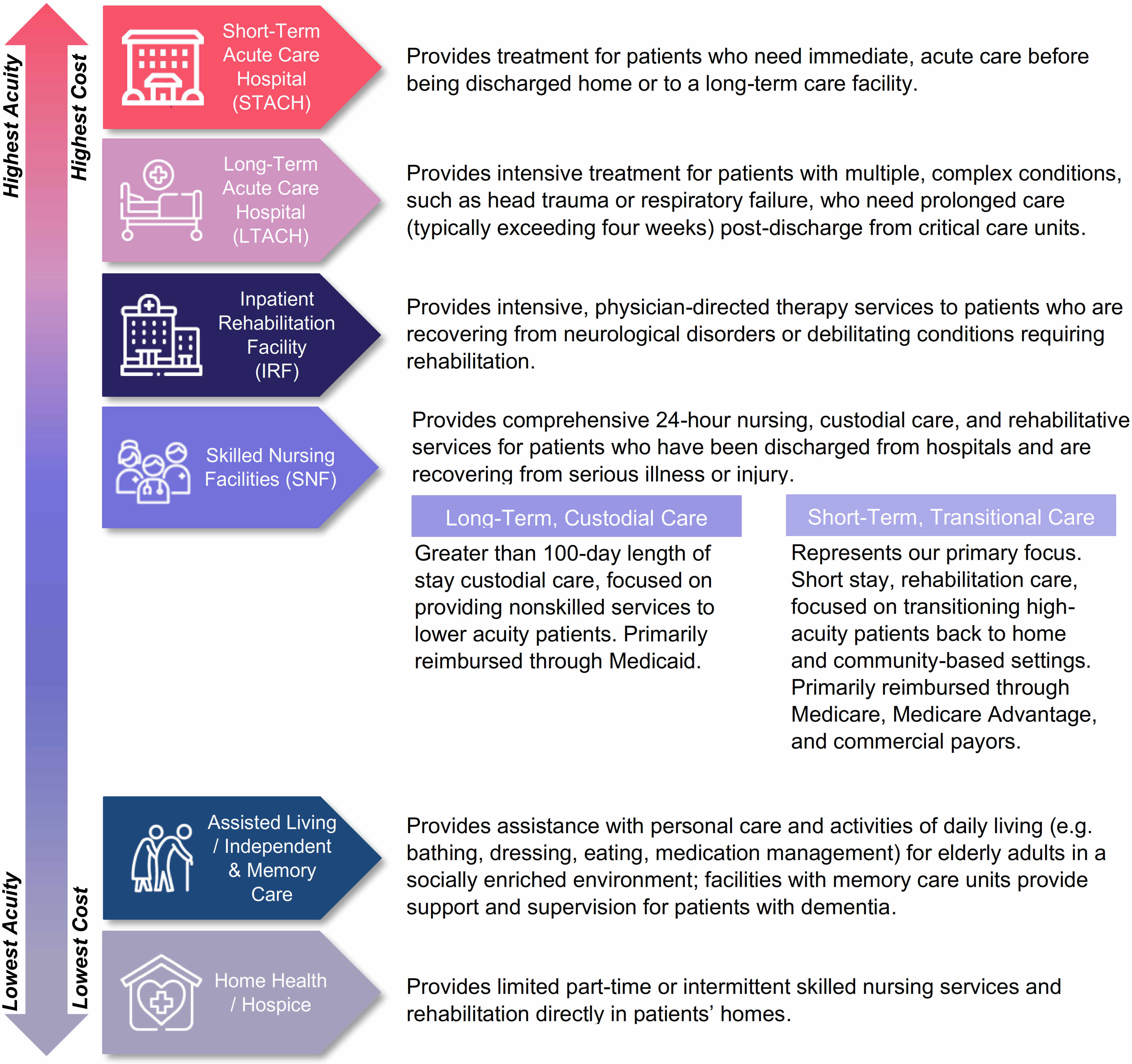
The post-acute care ecosystem serves individuals who need additional help recuperating from acute conditions, illnesses, or serious medical procedures after they have been discharged from the hospital. This ecosystem ranges from higher acuity, higher-cost settings, such as long-term acute care hospitals and inpatient rehabilitation facilities, to lower acuity, lower-cost settings, such as assisted living facilities, and home health. Skilled nursing facilities (SNFs) are positioned at the center of this ecosystem and play an essential role in providing cost efficient facility-based care to patients that have been discharged from hospitals but still require 24-hour in-patient services. SNFs can provide both long-term custodial care and higher value short-term transitional care. The SNF industry is large and growing, with the Centers for Medicare & Medicaid Services (CMS) expecting total industry expenditures to increase from $193.6 billion in 2022 to $283.3 billion in 2031, representing a compound annual growth rate (CAGR) of 4.3%. Based on the number of facilities as reported by CMS, we are one of the largest SNF operators in the United States. We are primarily focused on providing higher value short-term transitional care and believe we are uniquely positioned to capitalize on the current underlying trends within the SNF industry and to capture a growing portion of the expected demand.
We believe that healthcare is local and we operate through a decentralized model, recognizing that each patient, facility, and community is unique. To that end, we believe that our local leaders and employees understand the distinct needs and priorities of their patients, staff, and facilities and are best positioned to make clinical and operational decisions in order to optimize patient outcomes and experience. To facilitate this, each of our facilities operates independently, led by a facility administrator and his or her interdisciplinary team of medical directors, nurses, therapists, specialty consultants, and operators. To assist these local teams in achieving their best clinical and operating potential, we provide each facility with access to PACS Services, and they are subject to the PACS Code of Business Conduct and Ethics (which is described elsewhere in this report) and a variety of other policies and procedures designed to help ensure our operations are conducted consistent with applicable law and prudent business practices. PACS Services is a comprehensive suite of offerings, including accounting, finance, human resources, payroll, accounts receivable and payable, legal, compliance, and risk management services, as well as a robust suite of technology tools. We operate in a highly regulated industry with stringent regulatory compliance obligations, which require robust regulatory compliance operations. Failure to operate in compliance with applicable laws and regulations could require significant expenditures and result in regulatory deficiencies and other regulatory penalties. PACS Services functions to support our regulatory compliance obligations across our organization, including through controlled billing and cost reporting practices and legal, risk management, and compliance support. PACS Services also provides teams of regional professionals available as resources to each facility, including a regional vice president (RVP) for each operational region, and regional clinical and non-clinical directors and consultants. We developed PACS Services to be a resource to help reduce administrative burden so that local leadership teams can focus on making decisions that improve the care, well-being, and quality of life of their patients.
We believe that talented local leadership is critical to the success of our model of independently operated, centrally supported facilities. At the facility level, administrators are effectively the chief executive officers, and together with other local licensed professionals, are ultimately responsible for the day-to-day operations of their respective facilities. We seek to recruit, train, and reward dynamic administrators for our facilities, and rely on them to work with their interdisciplinary teams to implement policies and procedures that are appropriate and effective and result in positive outcomes. We support the delivery of excellent care by building excellent teams.
We believe our model attracts high caliber, entrepreneurial professionals who value having considerable autonomy, accountability, and aligned incentives. We provide these professionals with leadership and industry training, guidance, and operational support. Our model is intended to align local leaders’ incentives with facility and organizational success, encouraging them to dedicate themselves to the long-term future of their facilities. To create such alignment, we have developed an administrator compensation structure that prioritizes operational and financial performance, as well as quality of care. Our administrators understand that a well-performing facility is the result of providing quality care in an environment of healing and caring, and one that is appropriately staffed, supplied, and equipped to meet the needs of its patients. This dedicated focus by our administrators and their local teams on patient outcomes drives demand for our services and can ultimately result in higher patient census and profitability. We also seek to provide opportunities for upward career mobility, with many of our administrators being promoted from within our company to roles of increasing levels of responsibility. Our culture of meritocracy and pride of ownership has helped us retain experienced facility administrators as well as RVPs who had a combined average industry experience of 12.2 years as of December 31, 2024. For the year ended December 31, 2024, we had a voluntary turnover rate of 2.5% among our facility administrators.
Excellence in clinical quality and experience for our patients is at the forefront of our mission. We believe our focus on quality is reflected in our CMS Quality Measures (QM) Star rating, occupancy rate, and skilled mix by nursing patient days (which refers to the number of days our Medicare and managed care patients receive skilled nursing services at SNFs as a percentage of the total number of days that patients from all payor sources receive skilled nursing services at SNFs for any given period). The QM Star rating is a number between 1 and 5 that is assigned to SNFs that participate in Medicare or Medicaid, and is based on an aggregate score across a range of quality reporting program requirements. As of December 31, 2024, 2023, and 2022, our average QM Star rating across our Mature facilities, which we define as facilities purchased more than 36 months prior to the measurement date, was 4.3, 4.2 and 4.4 Stars, respectively, compared to the industry average of 3.4, 3.6 and 3.7 Stars, respectively. For the years ended December 31, 2024, 2023, and 2022, our average occupancy rate across our Mature facilities was 94%, 93%, and 92%, respectively, compared to the industry average of 77%, 76% and 74%, respectively. For the year ended December 31, 2024, our skilled mix by nursing patient days was 29%, as defined in Item 7. Management’s Discussion and Analysis of Financial Condition and Results of Operations.
We have historically grown primarily through our disciplined and balanced acquisition strategy. We generally aim to create value by identifying and acquiring underperforming custodial care focused facilities and converting them into higher-value short-term transitional care focused facilities by investing in clinical teams and processes and upgrading technology, equipment, training, staffing, aesthetics, and other aspects of the business. The resources and guidance offered by PACS Services are key to rapid integration of new facilities and provides our local leadership teams with an effective technology infrastructure, support tools, and regional support teams that enable local leadership to focus on operational improvements. Our facilities generally undergo an up to three-year post-acquisition transition period. During this period, we seek to implement best practices designed to realize and sustain the facility’s full potential. These practices often result in significant improvements to clinical quality and other operational metrics, including skilled mix, occupancy rates and payor contracting. We believe the results of our acquisition strategy are demonstrated by our high average QM Star rating and occupancy rate for Mature facilities of 4.3 and 94%, respectively, as of December 31, 2024. As of December 31, 2024, the average QM Star rating and occupancy rate for New facilities, which we define as facilities purchased less than 18 months prior to the measurement date, was 3.3 and 83%, respectively.
Our portfolio of owned and leased properties is strategically located in 17 states: Alaska, Arizona, California, Colorado, Idaho, Kansas, Kentucky, Missouri, Montana, Nevada, Ohio, Oregon, Pennsylvania, South Carolina, Tennessee, Texas, and Washington. We anticipate that available acquisition opportunities will enable us to further penetrate our reach into these 17 states and to enter new states in the future. We believe our current markets are attractive and that the states in which we operate each has unique benefits, such as favorable reimbursement dynamics, high barriers to entry, or population growth of adults aged 65 and older, which is our primary patient demographic. We generally look for similar attributes in new markets that we enter. As of December 31, 2024 we leased 221 facilities, directly owned the real estate at 44 facilities, and owned partial interests in an additional 49 facilities through joint ventures managed by third parties. As we continue to grow, we intend to explore additional purchases of real-estate assets, through purchase options or rights-of-first refusal in existing leases, as well as acquisitions and de novo construction of purpose-built facilities.
For the year ended December 31, 2024, we generated total revenue of $4.1 billion, representing a CAGR of 29.9% over the last three years. A substantial portion of our revenue is generated from payments from third-party payors, including Medicare and Medicaid, which represent our largest sources of revenue and accounted for 33.8% and 40.4% of our routine revenue for the year ended December 31, 2024, respectively. For the year ended December 31, 2023, we generated total revenue of $3.1 billion, and Medicare and Medicaid accounted for 38.6% and 37.6% of our routine revenue, respectively.
For the year ended December 31, 2024, our total operating expenses were $4.0 billion. For the same period, we generated net income of $55.3 million and Adjusted EBITDA of $279.5 million. For the year ended December 31, 2023, our total operating expenses were $2.9 billion and we generated net income of $112.9 million and Adjusted EBITDA of $237.5 million. Adjusted EBITDA is a non-GAAP financial measure. See the section titled “Management’s Discussion and Analysis of Financial Conditions and Results of Operations—Key Skilled Services Metrics and Non-GAAP Financial Measures—Non-GAAP Financial Measures” for a reconciliation of Adjusted EBITDA to the most directly comparable GAAP financial measure.
As of December 31, 2024, we had total long-term liabilities of $3.5 billion.
Our Operating Model
Decentralized Operations
Our decentralized model is informed by our beliefs that “healthcare is local” and that each patient, facility and community is unique. Our administrators have significant autonomy in the decision-making process, subject to adherence to company policies and procedures, because we believe they know what is best for their community and their markets. Our 314 post-acute facilities are independently operated by local teams with robust administrative and consulting support from our PACS Services.
We strive to have each of our facilities led by experienced and highly qualified administrators, who serves in effect as a “local CEO,” alongside an interdisciplinary team of medical directors, clinicians, specialty consultants, and operators. In addition to a full clinical team of certified nursing assistants (CNAs), licensed practical nurses (LPNs), registered nurses (RNs), directors of nursing (DONs), and clinical directors, each facility has a local team of non-clinical staff including supervisors, admissions professionals, marketing professionals, and other business support personnel who have the common goal of providing excellent care and superior experiences for patients.
We provide PACS Services to each of our facilities, which includes support through a regional team of seasoned, highly qualified, cross-functional professionals, and led by an RVP. The team also includes regional clinical support personnel (such as directors of therapy, quality assurance, medical records, and clinical services personnel) as well as non-clinical personnel such as regional directors of recruitment and accounts receivable and accounts payable, reimbursement, and risk and compliance personnel. As of December 31, 2024, we had 22 RVPs overseeing each regional teams, covering an average of 14.3 facilities within a region and have an intimate understanding of the intricacies and challenges of the post-acute industry. We place the utmost importance on clinical quality, and as a result, many employees that provide PACS Services are clinicians by trade. We also have PACS policies and procedures applicable to all employees, including a Code of Business Conduct and Ethics, which are designed to help ensure our operations are conducted in accordance with the law and prudent business practices.
Technology and Services
Our technology focus delivers real-time data access to caregivers and administrators, enabling delivery of the best care at the right time. We have invested into internally developed and third-party technologies that comprise part of PACS Services. This robust suite of technologies helps support facility administrators, clinicians, and local teams by providing them with valuable tools to enable them to reduce the time and effort they spend on administrative tasks so that they can better focus on providing quality care and driving efficient business operations. PACS Services includes access to an industry-leading, third-party Electronic Health Record system, and a singular Enterprise Resource Program. In addition, we have internally developed an operational dashboard that is custom-built to provide valuable tools and real-time data insights to our local teams in order to enhance resource management and improve the delivery of care. This app-based, mobile technology integrates facility-level detail on admissions, occupancy, revenue, staffing, collections, and other key operational data points. Our technology platform enables local leaders and regional teams to continually review and monitor this data, which enables them to be agile in assessing the ongoing needs of their facility and to more easily identify and address the unique needs and priorities.
With this readily-available, real-time data, our local leaders are able to more easily assess what works well in their facilities and can appropriately manage their operations and share best practices with their colleagues within the company.
This data also facilitates greater risk management and compliance efforts, as financial and clinical information can be analyzed, which we believe helps promote accountability across the company. Across the company, we use insights from our data management tools to benchmark performance, manage expenses, monitor risk, and manage compliance.
We believe PACS Services provides technology systems and support infrastructure that can enable seamless integration of new facilities and help to reduce risk when we acquire new facilities.
Clinical and Operational Leadership
We believe we are an employer-of-choice in the SNF industry and have attracted highly qualified local leadership and clinicians. Our facility-forward model helps attract and retain motivated professionals whom we provide with extensive training, professional guidance by seasoned experts, and access to best practices. We offer challenging and fulfilling opportunities for clinicians to gain meaningful experience treating higher acuity patients. Through work-education programs, we also offer many of our clinicians the opportunity to improve or enhance their clinical licenses with sponsored certification programs. We believe we are at the forefront of enabling operators and clinicians to operate in their highest value capacity and at the best of their professional capabilities.
Our Administrator-in-Training program, geared towards recent college graduates, and our PACS Professional Program for experienced nursing home administrators, both provide valuable, intensive training and mentorship to help aspiring PACS administrators build important skills, such as operational systems management, administrative effectiveness, and leadership and people development. Our placement process assesses skill sets, qualifications, and career interests in order to pair leaders with the facilities and teams that will be a good fit.
Our frontline CNAs, LPNs, and RNs are also encouraged to participate in our internal continuing education programs, as well as outside programs, to help them continue to develop their skills and to meet any mandated continuing education requirements. We also offer our clinicians and other personnel educational assistance to enable them to sharpen their skills and enhance their capabilities.
Disciplined Acquisition Playbook
We have an established track record of successful acquisitions. Our significant historical growth has been primarily driven by implementing our expertise in acquiring underperforming long-term custodial care focused SNFs and converting them into higher acuity, high value-add short-term transitional care focused SNFs. In pursuing each acquisition opportunity, we employ a disciplined evaluation process to identify facilities that meet our acquisition criteria and strategic priorities. We believe our framework and focused approach for acquisitions has contributed to our overall success. Our approach involves:
•Sourcing and evaluation. We have developed specific acquisition criteria to drive efficient sourcing and growth, and we continually monitor our pipeline of suitable acquisition targets. We believe we have a reputation as an acquiror-of-choice, which has led to regular inbound opportunities from small operators, larger platforms, and industry partners, such as landlords, brokers, and REITs.
•Integration and execution. Prior to and following closing of an acquisition, we perform a full facility evaluation focused on operational, clinical, financial, and administrative functions. Through this evaluation, we develop a detailed action plan with goals for IT integration and implementation of best practices led by facility administrators. We believe that administrators can create immediate additional value through technology integrations and then drive continued growth over time with improvements to clinical quality, operations, and financial performance. Our facilities generally undergo a three-year post-acquisition transition period. During this period, our integration efforts and implementation of best practices often result in significant improvements to clinical quality and other operational metrics. We believe the results of our strategy are demonstrated by our high average QM Star rating and occupancy rate for Mature facilities of 4.3 and 94%, respectively, as of December 31, 2024. By comparison, the average QM Star rating and occupancy rate for New facilities was 3.3 and 83%, respectively, as of December 31, 2024.
Our Diversified Portfolio of Properties
We have a diverse portfolio of facilities that are located in selected attractive markets. A majority of our facilities are leased and are accounted for as either operating leases or finance leases. Our remaining facilities are either wholly-owned or partially-owned through joint ventures managed by third parties.
Real-estate ownership is a key component of our growth strategy as it can provide balance sheet support as an inflationary hedge, provide capital flexibility as a source of asset collateral, reduce the burden of leases and restrictive agreements, and provide us opportunities to create additional value in improving distressed assets.
The following is a summary of our leased and owned facilities:
•Leased Properties. As of December 31, 2024, we had 270 leased facilities. The majority of these leased facilities are in California, with the remainder in Alaska, Arizona, Colorado, Idaho, Kansas, Kentucky, Missouri, Montana, Nevada, Ohio, Oregon, Pennsylvania, South Carolina, Tennessee, Texas, and Washington. We often leverage our financial and operational condition to negotiate favorable lease terms, including low annual rent escalators, long expiration dates, and purchase options. As of December 31, 2024, our weighted average annual lease escalator was 2%, our average monthly lease expense was $946 per bed, our average remaining lease term across our portfolio was approximately 14 years, and we had 37 total purchase options at our discretion and 3 rights of first refusal that we may exercise in future years.
•Owned Properties. We have historically purchased the real-estate assets for certain of the post-acute care facilities we operate. Many of our owned properties were acquired with limited cash outlay while in a distressed state, or through the exercise of a purchase option that was originally negotiated while in a distressed state. We seek to create value in our properties by purchasing these distressed facilities and making improvements under our operations and ownership. As of December 31, 2024 we owned 44 post-acute care facilities, and we have investments in joint ventures that own the underlying real estate and related improvements of 49 post-acute care facilities that are operated by PACS Group subsidiaries. The majority of our owned real-estate properties are located in California, with the remainder in Colorado, Kentucky, Missouri, Nevada, Pennsylvania, South Carolina, and Texas. We have also explored facility ownership through de-novo, or new-build, facilities where we construct facilities and own them. Since 2013, we have opened or are in the process of opening 8 de-novo facilities.
We classify each of our facilities into three distinct categories based on the amount of time that has passed since acquisition: Mature, Ramping and New. Mature facilities are defined as facilities purchased more than 36 months prior to a respective measurement date. Ramping facilities are defined as facilities purchased within 18 to 36 months prior to a respective measurement date. New facilities are defined as facilities purchased less than 18 months prior to a respective measurement date. As of December 31, 2024, we operated 138 Mature facilities, 50 Ramping facilities, and 126 New facilities. For the year ended December 31, 2024, our Mature, Ramping, and New facilities generated skilled nursing services revenue of $1.4 billion, $1.5 billion, and $1.0 billion, respectively.
We believe our success in improving our acquired properties is reflected in the average QM Star rating, occupancy rate, and skilled mix by revenue for each of our Mature, Ramping and New facilities, depicted in the table below for the year ended December 31, 2024:
|
|
|
|
|
|
|
|
|
|
|
|
|
|
|
|
|
|
|
Year Ended December 31, 2024 |
|
Mature facilities |
|
Ramping facilities |
|
New facilities |
| Average QM Star rating |
4.3 |
|
|
3.8 |
|
|
3.3 |
|
| Occupancy rate (operational beds) |
94 |
% |
|
94 |
% |
|
83 |
% |
| Skilled mix by revenue |
54 |
% |
|
54 |
% |
|
39 |
% |
As of December 31, 2024, our facilities had an average QM Star rating of 3.9 Stars compared to the industry average of 3.4 Stars, and an average occupancy rate of 90% compared to the industry average occupancy rate of 77%. See the section titled “Management’s Discussion and Analysis of Financial Condition and Results of Operations—Key Skilled Services Metrics and Non-GAAP Financial Measures.” We believe our strategy drives these results and is central to our ability to develop acquired facilities into higher performing facilities over time. For example, based on an analysis of the 91 facilities that we have acquired since 2018 and that have developed into Mature facilities as of December 31, 2024, we estimate that we were able to increase the occupancy rate and QM Star rating for acquired facilities by an average of 13% and 0.2 stars, respectively, as they progressed from New facilities to Mature facilities.
We believe the success of our strategy is further exemplified by our historical ability establish and maintain a QM Star rating for our Mature facilities that is higher than the industry average, The graphic below sets forth our QM Star rating over time for our Mature facilities, as well as the industry average QM Star rating for buildings of all maturities, for the periods indicated.
QM Star Ratings Over Time for PACS Mature Facilities vs. Industry Average
Source: CMS SNF Provider Information (Nov. 2024); PACS data for facilities with CMS certification and QM Star rating.
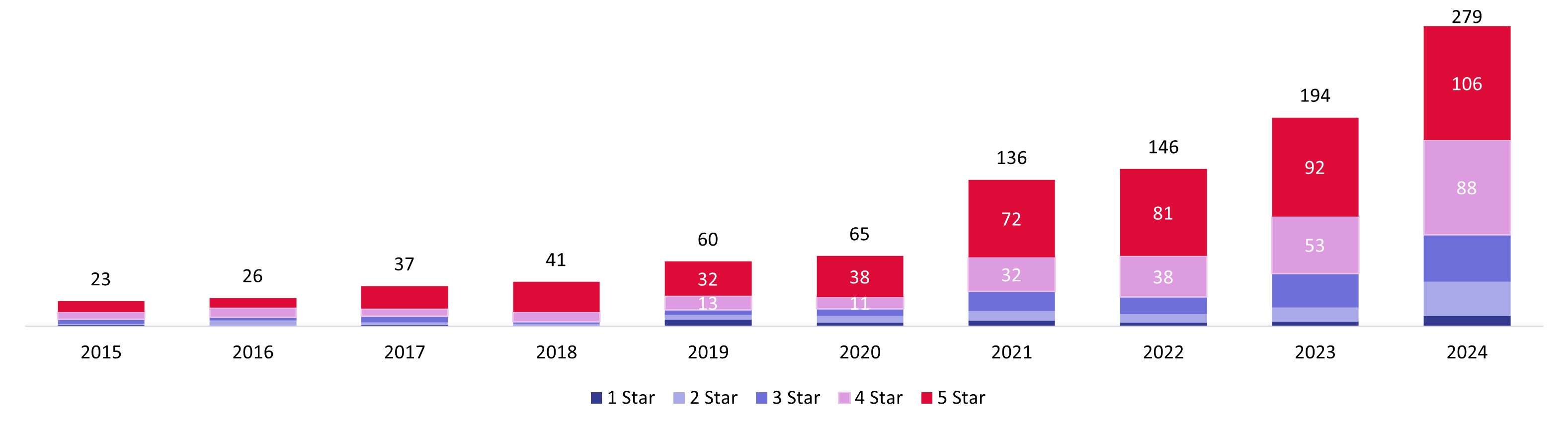
Execution of our strategy has also increased our number of facilities with QM Star ratings of 4 or 5 Stars over time. The graphic below sets forth our number of facilities by QM Star rating from 2015 through 2024.
QM Star Ratings Over Time for PACS Facilities
Our Value Proposition
We believe that our operating model creates meaningful value for patients and their families, our referring providers, our payors, and our administrators and clinicians.
Value Proposition for Patients and Families
•Coordinated care. We empower team members at every level through skillful training, shared resources, and a collaborative spirit. We help deliver coordinated care before, during, and after a patient’s stay with us. Prior to admission, our administrators or other facility leaders meet with patients and their families, as well as hospital discharge planners, to plan for the patient’s discharge and enable a seamless transition to our facility. During a stay with us, our local facility team coordinates closely with physicians to deliver high-touch, high-quality care for patients. As care nears completion, we meet with our patients, their families, home health agencies and downstream care providers to plan for and ensure a smooth transition.
•Outstanding patient experience. Our goal is to provide each patient with superior care and an outstanding experience. When patients arrive at our facilities they are greeted by a warm, inviting, and modern environment. We often upgrade facility infrastructure shortly after acquisition and perform periodic refreshes, to ensure our
facilities are comfortable and well-equipped to serve patients across a wide range of acuities with a primary focus on high acuity patients. High acuity patients generally require higher levels of medical care or monitoring due to conditions or complications that cannot be easily managed, and often need more nursing resources and attention to maintain their quality of life. We believe our investment in modern equipment and technology enables our facility care teams to identify and respond to patient needs and provide them high quality care in a timely manner. Moreover, our clinicians are highly trained, have significant experience, and are able to leverage bespoke care plans to help ensure that patients receive care tailored to their particular needs.
Value Proposition for Referring Providers
•Strategic and seamless transitions. Our administrators and their interdisciplinary teams seek to become a preferred partner by developing a deep understanding of local referring providers’ and their patients’ needs. Administrators often visit with patients and their families prior to hospital discharge to plan for and map out a smooth admission to our facility. Once a plan is set, the facility team endeavors to quickly and seamlessly transition new patients to the facility with a focus on ensuring continuity of care in the transition. We believe that hospitals and other referral sources consider our facilities to be attractive discharge options because we are able to care for a wide variety of patient needs, and are often able to accept admissions on short notice, including on nights and weekends. Our flexibility helps hospitals maintain adequate bed availability to meet their other patients' needs.
•Trusted partner with quality care. Our ability to care for higher acuity patients enables referring providers to have confidence that we will be able to adequately care for their patients and assist them in their recovery. Our facilities seek to work with patients’ doctors to create personalized care plans to help ensure that patients stay on track in their recovery and to reduce the likelihood of their readmission to the hospital. Our facility teams also seek to coordinate closely with a patient’s home health agency or other post-SNF caregivers to try to ensure the patient’s transition home or to their next care setting is successful. This close coordination enables us, where warranted, to directly readmit patients back to our facility who would have otherwise been readmitted to an acute care hospital in the event they have a change of condition after leaving our facility.
Value Proposition for Payors
•Higher value site of care. We believe we provide high acuity care in a cost-effective setting and are able to quickly transition patients from the acute care setting, reducing length of stay and delivering more overall value for payors. Moreover, we believe we provide payors with a high-quality alternative to higher cost post-acute sites of care. For example, according to MedPAC, SNFs are the lowest cost facility-based post-acute healthcare, costing an average of $550 per covered day compared to $1,850 and $1,753 per covered day for inpatient rehabilitation facilities and long-term acute care hospitals, respectively.
•Culture of compliance. We focus on instilling a unified, cohesive culture of innovation and compliance that we believe provides consistency in our results and confidence in our facilities as an attractive care option for patients. Our emphasis on billing integrity, our independent internal compliance function, and our regular facility billing audits are intended to provide a foundation of trust and collaboration that makes us a natural choice for payors.
Value Proposition for Administrators and Clinicians
•Autonomy and aligned compensation. Each facility administrator is, in effect, the local “CEO” and dedicated leader of their facility. Alongside their local interdisciplinary team, they are empowered to make real-time decisions locally around all aspects of their business and to manage their individual facility in a way that they believe is best suited to address their local market and its needs, subject to compliance with company policies and procedures. We have designed a transparent incentive model for our administrators that is intended to align their compensation with operational and financial performance and with the quality of care of their facility. We provide them the tools and the autonomy to optimize the performance of their facility, and we reward them for success in their efforts. We believe that a well-performing facility is the result of providing quality care in an environment of healing and caring and one that is appropriately staffed, supplied, and equipped to meet the needs of its patients. This dedicated focus by our administrators and their local teams on patient outcomes drives demand for our services and can ultimately result in higher patient census and profitability.
•Robust technology enabled operating infrastructure. We developed PACS Services to reduce the managerial and operational burden on our administrators, enabling them to focus on leading their facilities and spending more time with patients and staff. PACS Services includes a robust suite of technology tools that provide detailed real-time data and trends that local clinicians and leadership teams can use to monitor and improve operational performance. PACS Services also includes regional support teams that leverage their deep tenure and experience across markets to provide higher-level support to local leaders on complex issues, including billing and cost reporting practices and regulatory compliance obligations. The regional teams are connected to and support the facilities within their designated region, which enables them to identify best practices and trends within the region, communicate those across their region, and provide facility-level support as needed.
•Highly entrepreneurial career development. By providing our administrators with autonomy in the operation of their facility, we believe we create a highly entrepreneurial environment that encourages and rewards leaders to optimize operational performance. We empower our clinicians to do the same and provide top performers the opportunity to progress via training for higher skill licenses and certifications. People are provided the opportunity to advance to become an administrator through our Administrator-in-Training program, and to join a regional leadership team. For example, in the year ended December 31, 2024, we promoted 11 of our administrators from within our organization after participating in our Administrator-in-Training program, and 18 of our RVPs were previously successful administrators with us.
Our Competitive Strengths
We believe our success is driven by the following competitive strengths:
Superior Overall Quality
Excellence in clinical quality and experience for our patients is at the forefront of our mission and is reflected in our above-industry average QM Star rating and occupancy rate. Our facilities employ skilled administrators and clinicians and equip them with purpose-built technology and support so they can operate at the top of their professional capacity and deliver high-quality care for patients. We continuously invest in our people, processes, and facilities to promote an excellent patient experience. We believe we deliver superior overall quality that has contributed to our reputation as a provider-of-choice in our communities, driving greater referral volumes from referring providers who value our high standards.
Decentralized Market-Driven Operating Model
Our decentralized model emphasizes local operational autonomy. We believe that placing decision-making power at the local level with teams who understand the needs of their patients and their communities facilitates responsiveness and adaptability to evolving patient needs and facility and community factors. We believe the empowerment of local leadership promotes improved quality care for patients, greater referral volumes and higher occupancy rates. Our operating model is highly transferable to new markets, and enable us to quickly integrate and enhance new facilities.
Transparent and Meritocratic Leadership Culture
We have built a transparent, competitive, and collegial culture that promotes individual growth both personally and professionally and prioritizes a deep commitment to our patients, families, and team members. We promote transparency in performance, which we believe encourages collaboration and healthy competition among local leadership that in turn drives best practices. We believe this meritocratic culture, supported by highly seasoned industry veterans, helps optimize clinical and financial outcomes at facilities and instills accountability throughout the organization. This leadership mindset has empowered us to develop a deep bench of leaders capable of supporting our existing and future facilities.
Employer-of-Choice with Directly Aligned Incentive Model
We believe that we are an employer-of-choice in the post-acute care industry, which enables us to attract and retain highly motivated, entrepreneurial individuals who value operational independence and financial opportunity. This has enabled us to attract enterprising individuals from diverse backgrounds who may not have otherwise considered careers in skilled nursing. Our compensation model is designed to align local individual incentives with the long-term clinical quality and operational performance of the facility, which we believe fosters a shared ownership mentality. We believe this directly aligned incentive model has played a critical role in successfully attracting, incentivizing, and retaining our industry veterans.
Robust Suite of Technology-Enabled Services
Our technology focus delivers real-time data access to caregivers and administrators, facilitating delivery of the right care at the right time. Our technology tools enable our local leadership teams to focus on their first priority, providing the highest quality care possible to patients. We believe our suite of technologies helps drive decision-making and enhances operating efficiencies that can improve clinical quality, operational metrics, and the financial performance of our facilities. While other facility administrators may spend considerable time on paperwork and low-value activities, we strive to reduce the administrative burden on our facility administrators so they can walk the halls, personally meet patients, and provide a bespoke, concierge-level customer service experience. We equip our clinicians with industry-leading technology, including point-of-care and digital charting technologies, which streamlines charting and paperwork, so they can spend more time with patients and focus on providing high quality care. We believe our technology and internally developed dashboards help to facilitate better patient care, risk management, regulatory compliance, staffing, and resource allocation. We have designed our technology to be easily integrated into new facilities and enable us to scale quickly and efficiently.
Differentiated, Multi-faceted, and Disciplined Acquisition Playbook
Since founded, we have demonstrated the effectiveness of our disciplined, multi-faceted playbook of acquiring and improving underperforming facilities, having successfully acquired and integrated over 300 facilities to date. We believe we have established a reputation as an acquiror-of-choice, which has led to several inbound opportunities, and has helped us build an extensive opportunity pipeline. Our balanced approach to evaluation enables us to selectively pursue opportunities that meet our strategic priorities and criteria and grow in a responsible manner. Through our investment into facilities and our integration process, we are able to transition new underperforming facilities to higher-value short-term transitional care facilities. We believe our success is evidenced by our robust QM Star ratings, occupancy rates, and profitability at our Mature facilities.
Our High-Quality Facilities
We are committed to providing a high-quality experience for all of our patients, which is why we invest in capital improvements and ongoing maintenance to all of our facilities, regardless of whether we lease or own. Our investment into facilities is differentiated from traditional industry operators who we believe are often hesitant to make physical plant investments into facilities and who often seek to extract value through cost-cutting or other limitations on facility resources. Our renovations are intended to improve the look and feel of facilities in order to provide an excellent experience. Our investments into medical beds, vitals monitors, physical therapy equipment, and other improvements enables us to provide services to higher acuity patients. We believe our high-quality facilities lead to sustained referral volumes, more admissions, and high skilled mix at our facilities, ultimately leading to higher occupancy rates and revenue per patient day. We also believe our investment into leased facilities makes us a preferred tenant with our landlords and provides us leverage in negotiating favorable lease terms.
Our Size and Scale
We believe our market density in key regions offers strategic advantages, such as brand recognition with referring providers, including hospitals and health systems, and consistency and continuity of referrals of patients. For example, our ability to accommodate a high volume of patients within our markets enables us to accept referrals without turning patients away to competitors, and can also further our reputation as a reliable, go-to provider of care for referring providers. We also believe our size and scale has provided us with the ability to negotiate favorable contracts with managed care and other payor sources, the ability to navigate stringent regulatory compliance obligations and withstand potential reimbursement and regulatory industry dynamics, and the ability to leverage real estate value for liquidity and growth.
Industry Overview and Market Opportunity
The Post-Acute Care Continuum is Essential to the Healthcare Ecosystem
We operate in the post-acute care industry, which is an essential component of the healthcare delivery ecosystem, serving high need, medically fragile patients. Post-acute care encompasses multiple care settings outside of acute care hospitals that are differentiated by the acuity level of patients and the services they require. While services may overlap across each distinct post-acute offering, post-acute rehab or SNFs provide the most comprehensive array of services.
Upstream care providers, such as acute care hospitals, generally discharge patients to post-acute facilities where patients can receive key services at lower costs. For example, according to MedPAC, SNFs cost an average of $550 per covered day compared to $2,914 for short-term acute care hospitals.
Post-Acute Care Continuum
SNFs are an Integral and Essential Part of the Post-Acute Care Continuum
SNFs play an essential role in post-acute patient care. SNFs provide higher-acuity skilled nursing care to patients that cannot be adequately treated in community-based care settings, such as assisted living or independent living facilities, and who are no longer appropriate candidates for hospital care. Patients referred to a SNF are typically recovering from surgery or non-critical conditions, such as strokes, joint replacements, and acute infections, and are admitted to a SNF within 30 days of being discharged from a hospital where they spent at least three days as an inpatient. In many instances, patients are treated at SNFs prior to receiving home health nursing care and therapy services. The majority of SNF patients are aged 65 years or older. Despite the wide array of services and variety of needs addressed, MedPAC reports that SNFs are the lowest cost facility-based post-acute healthcare, costing on average $550 per covered day compared to $1,850 and $1,753 per covered day for inpatient rehabilitation facilities and long-term acute care hospitals, respectively. According to CMS MedPAC data, SNFs accounted for approximately 45% of the total post-acute care continuum spend. According to CMS Inpatient Hospital discharge data, in the first half of 2023, approximately 24% of Medicare patients over 65 years old were discharged to SNFs, representing more than any other facility type, including inpatient rehabilitation facilities and long-term acute care hospitals (approximately 6%), and more than home health nursing care (22%) or hospice (5%).
As reimbursement and coverage continues to shift toward value-based models with greater emphasis on controlling costs, SNFs are integral to post-acute care and can continue to drive high-quality outcomes in low-cost settings. Furthermore, during the COVID-19 pandemic, SNFs were widely utilized to treat medically fragile patients, reinforcing the importance of SNFs to the healthcare ecosystem.
The skilled nursing industry can be classified into two main sub verticals: A) long-term custodial care and B) short-term transitional care. Long-term custodial care predominantly focuses on lower acuity, Medicaid-eligible patients and provides institutional, custodial care services, including nonskilled, personal care services such as assistance with bathing, dressing, or eating. Short-term transitional care predominantly treats higher acuity, Medicare-eligible patients and primarily provides short-term inpatient-level skilled nursing care such as rehabilitation, physical therapy services, and intravenous injections.
Large, Fragmented Industry Comprised of Mostly Small and Independent Operators
According to the National Center for Health Statistics (NCHS) 2020 National Post-acute and Long-term Care Study, the SNF industry in the United States encompasses approximately 15,000 facilities and serves approximately 1.3 million patients annually. The industry is highly fragmented, with the top 10 operators, each having greater than approximately 100 facilities, representing approximately 11% of total number of SNFs in the United States, according to CMS data as of September 2024, and approximately 5,000 smaller and independent operators of less than 100 facilities making up the remainder. According to such data, approximately 73% and 27% of SNFs are located in urban and rural areas, respectively. In addition, approximately 73%, 21%, and 6% of SNFs are operated as for-profit, non-profit, and by the government, respectively, according to such data. We believe this fragmented landscape creates opportunities for larger providers with greater scale to serve patients better and meet regulatory requirements nation-wide by effectively addressing staffing, quality standards, and billing processes. Moreover, many small and independent operators face pressure due to billing requirements, regulations, competition on quality of care and facilities, staffing shortages and competition, and the cessation of COVID-related provider relief funding, which has led them to pursue sales of their facilities or businesses. This provides additional opportunity for well-managed, high-quality operators to grow through acquisitions.
Growing Demand Outpacing Supply of Skilled Nursing Facilities
The demand for healthcare services in the United States has increased in recent years and is expected to continue growing, largely due to a rapidly aging population and an increasing prevalence of chronic conditions. According to the U.S. Census Bureau, the U.S. population aged 65 and older is expected to nearly double from 2020 to 2060 and reach 95 million in 2060, which exceeds the expected increase in the general population during that same period, and comprise one fifth of the total U.S. population in 2030. Moreover, according to the U.S. Census Bureau, the U.S. population aged 85 and older is expected to nearly triple from 2020 to 2060 and reach 19 million in 2060. Additionally, according to an article published in Frontiers in Public Health in 2022, the percentage of people in the United States aged 50 and older with at least one chronic condition is estimated to increase by 99.5% from 2020 to 2050. According to CDC data as of 2022, approximately 83% of SNF patients were 65 years of age or older.
As demand has increased for SNFs, the number of SNFs has declined in recent years from approximately 15,650 in 2017 to approximately 14,800 in 2024. We believe this is due to a variety of factors, including an inability of many facilities to comply with quality standards, rigorous staffing, and billing requirements, and a lack of technology and sophistication at small and independent operators. Furthermore, new operators face multiple barriers to entry, including the requirements to obtain a Certificate of Need, complex licensure requirements, lack of operating experience, and significant capital requirements. As a result, the addition of new SNFs has not kept pace with the number of SNFs exiting the market, amplifying the need for skilled nursing to serve an aging population.
Favorable Reimbursement Environment
According to CMS, approximately 72% of SNF revenue in 2022 was derived from government sources, including Medicaid and Medicare. Medicaid represents 51% of industry revenue, while Medicare represents approximately 21%. The remainder comprises managed care, private pay, and other payors. Medicare and Medicaid reimbursement has steadily increased over the past few years. Medicare reimbursement per patient day increased at a CAGR of approximately 3.6% from 2012 to 2021, while Medicaid reimbursement per patient day increased at a CAGR of approximately 1.9% from 2012 to 2021. During that time, the industry experienced over 9 years of growth in reimbursement rates.
The following charts depict the increase in Medicaid and Medicare Fee for Service reimbursement per patient day from 2015 through 2021 as reported by CMS.
Medicaid and Medicare Reimbursement Per Patient Day
Regulatory Environment
The SNF industry is highly regulated with stringent regulatory compliance obligations. In the ordinary course of business, providers are subject to federal, state and local laws and regulations relating to, among other things, billing and reimbursement, relationships with vendors, business relationships with physicians and other healthcare providers and facilities, as well as licensure, accreditation, enrollment, quality, adequacy of care, physical plant, life safety, personnel, staffing and operating requirements. Changes in law or new interpretations of existing laws and regulations may have a significant impact on revenue, costs and business operations of providers and other industry participants. In addition, governmental and other authorities periodically inspect the SNFs, senior living facilities and outpatient rehabilitation agencies to verify continued compliance with applicable regulations and standards and may impose citations and other regulatory penalties for regulatory deficiencies. Such regulatory penalties include but are not limited to civil monetary penalties, temporary payment bans, suspension or revocation of a state operating license and loss of certification as a provider in the Medicare or Medicaid program, which may be temporary or permanent in nature. This regulatory environment and related enforcement can have an adverse effect on providers and other industry participants. See the section titled “Business—Regulatory Matters.”
Our Market Opportunity
Despite the decline in the number of SNFs, the industry is large and growing, with CMS expecting total industry expenditures to increase from $193.6 billion in 2022 to $283.3 billion in 2031, representing a CAGR of 4.3%. Based on the number of facilities as reported by CMS, we are one of the largest SNF operators in the United States and believe our scale and other competitive strengths uniquely position us to capitalize on the current underlying trends within the SNF industry and capture a growing portion of this expected growth.
Our Growth Strategy
We have built a multi-faceted growth strategy with multiple organic and inorganic levers to help drive our growth and capitalize on the favorable industry dynamics. To continue our growth, we intend to:
•Expand our presence in existing and new markets. We have a robust pipeline of potential single-facility tuck-in acquisitions, larger multi-facility portfolio acquisitions and select new facility builds across existing and new markets. We have historically completed an average of approximately 25 acquisitions and one de-novo, or new-build, facility per year, but have the flexibility to increase or decrease this cadence from period to period in line with our business priorities and as strategic opportunities arise. We plan to continue to strategically pursue opportunities within our pipeline to supplement our organic growth. While we expect to continue to execute on this strategy, we do not have binding agreements or commitments for any material investments at this time.
•Leverage operational upside within our existing footprint. Our portfolio has a healthy foundation for strong embedded organic growth. We are focused on driving higher occupancy and increasing skilled mix in an effort to fill unused capacity with higher acuity patients, which can improve our revenue per patient day and our profitability, which in turn drive growth. Historically, we have found that it takes up to 3 years for a New facility to scale to performance similar to that of a Mature facility. As of December 31, 2024, we had 126 New and 50 Ramping facilities, which we believe provides us some degree of near-term visibility into expected organic growth within our footprint.
•Continue to grow our pipeline of leaders. Our rapid growth in size and scale can be attributed to our deep bench of talented leaders. Our administrators in training provide us with leadership resources that we can use to quickly staff new facilities with qualified operators. Similarly, our RVPs enable us to scale within regions. We intend to invest heavily in training existing leaders and expanding our bench of new administrators and RVPs and to support our future growth.
•Extract embedded value from real estate ownership. We plan to continue to evaluate our real estate purchase options in an effort to reduce our rent burden and grow the underlying earnings of our business. We have executed 24 purchase options since 2013 and had 37 additional options available to us as of December 31, 2024. We intend to continue to selectively exercise purchase options and continue structuring additional purchase options to provide an additional lever to grow net margins and enhance stockholder value. Moreover, we believe that our real estate ownership provides balance sheet support as an inflationary hedge, provides capital flexibility as a source of asset collateral, reduces the burden of leases and restrictive agreements, and provides us opportunities to create additional value by improving distressed assets.
•Ancillary opportunities. We have identified and continue to evaluate multiple investment opportunities that have the potential to improve our post-acute patient experience by augmenting the services we provide. We may capitalize on these investment opportunities that are ancillary to our core business, such as pharmacy services, laboratory services, transportation, and imaging, which have the potential to be additional sources of revenue and operating income over time. We refer to these efforts to build a strategic mix of investments in ancillary business lines as “PACS Ventures.” We continue to evaluate opportunities to in-source, acquire, and commercialize these ancillary opportunities. Additionally, we may choose to monetize our PACS Services by offering it to third-party SNF operators in the future.
•Expand into other post-acute sites of care. We believe that our proven operational playbook and focus on delivering high-quality care have the potential to be utilized in additional post-acute sites of care, including home health and hospice as well as within broader senior living communities. As of December 31, 2024, we had one independent living facility and 26 assisted living facilities which provide a foundation for further expansion.
Human Capital Resources
Our Culture and Values
Our leading culture of collegiality and committed focus on quality is driven from the top with entrepreneurial, passionate leaders who are determined to deliver a superior experience for patients and staff. Our culture of transparency across our regions and facilities fosters an environment where best-practices are shared among regions which promotes healthy competitiveness and constant improvement across our facilities.
Our culture is centered on the following core values:
•Love. We recognize that love is the foundation for providing care to the vulnerable. We support our clients as they build a culture of loving care within and beyond their communities.
•Excellence. We look for and act on opportunities to improve every day.
•Trust. We act with integrity and expect the same of others.
•Accountability. We seek responsibility for our actions, attitudes, and mistakes.
•Mutual respect. We treat others the way they want to be treated.
•Commitment. We are committed to providing exemplary, compassionate care to our residents and patients, and finding joy and satisfaction in our work as a team.
Our Employees
As of December 31, 2024, we had 45,680 employees working across 314 post-acute care facilities in 17 states and at our corporate headquarters in Farmington, Utah. Of our 45,680 employees, 26,788 are clinicians, including approximately 3,620 RNs including DONs, approximately 6,905 LPNs, and approximately 16,263 CNAs. Approximately 18,892 of our employees work in non-clinical functions and administrative / support functions, including 22 RVPs, 227 facility administrators, 24 senior living executive directors, 221 clinical and compliance support, 99 information technology support, and approximately 18,299 additional administrative and support staff. We also employ a dedicated team specifically focused on ensuring smooth functioning and support for our point-of-care including the clinical and compliance support, information technology support above. Additionally, 5,718 of our employees were represented by unions under collective bargaining agreements as of December 31, 2024.
Our senior management team boasts extensive experience, totaling an average of over 11.6 years with us and 18.0 years within the SNF industry as of December 31, 2024. As of December 31, 2024, our RVPs had a combined average of 5.9 years of experience with the Company, our administrators an average of 2.4 years and our Directors of Nursing an average of 2.6 years.
Competition
The post-acute care industry is highly competitive and fragmented and we compete with numerous local and regional providers, in addition to large national providers that have achieved geographic diversity and economies of scale. We expect that the industry will become increasingly competitive in the future. Our independently operated facilities also compete with inpatient rehabilitation facilities and long-term acute care hospitals. Increasingly, we are competing with home health and community-based providers who have developed programs designed to provide services to seniors outside a facility-based setting, potentially decreasing the time they need the higher level of care provided in a SNF. Competitiveness may vary significantly from location to location, depending upon factors such as the number of competing facilities, availability of services, expertise of staff, and the physical appearance and amenities of each location. We believe that the primary competitive factors in the post-acute care industry are:
•ability to attract and to retain qualified management and clinicians;
•reputation and achievements of quality healthcare outcomes;
•attractiveness and location of facilities;
•ability to charge competitive prices;
•the expertise and commitment of the management team and employees; and
•community value, including amenities and ancillary services.
We seek to compete effectively in each market by establishing a reputation within the local community as a preferred provider of post-acute care services. This means that the facility administrators are generally free to discern and address the unique needs and priorities of referring providers, patients, payors and other stakeholders in the local community or market, and then create a superior service offering and reputation for that particular community or market that is calculated to encourage prospective patients and referral sources to choose or recommend the facility.
Increased competition could limit our ability to attract and retain patients, qualified management and caregivers, maintain or increase rates or to expand our business. Some of our competitors have greater financial and other resources than we have, may have greater brand recognition and may be more established in their respective communities than we are. Competing companies may also offer lower costs, newer facilities or different programs or services than we offer, and may therefore attract individuals who are currently patients of our facilities, potential patients of our facilities, or who are otherwise receiving our healthcare services. Other competitors may have lower expenses or other competitive advantages than us and, therefore, provide services at lower prices than we offer.
Regulatory Matters
Healthcare
Healthcare is an area of extensive and frequent regulatory change. Changes in the law or new interpretations of existing laws may have a significant impact on revenue, costs and business operations. Our independent operating facilities that provide healthcare services are subject to federal, state and local laws relating to, among other things, licensure, accreditation, enrollment, quality, adequacy of care, physical plant, life safety, personnel, staffing and operating requirements. In addition, these facilities are subject to federal and state laws that govern billing and reimbursement, relationships with vendors, business relationships with physicians and other healthcare providers and facilities, and workplace protection for healthcare staff.
Governmental and other authorities periodically inspect the SNFs, senior living facilities and outpatient rehabilitation agencies to verify continued compliance with applicable regulations and standards. The operations must pass these inspections to remain licensed under state laws and to comply with Medicare and Medicaid provider agreements. The operations can only participate in these third-party payment programs if inspections by regulatory authorities reveal that the operations are in substantial compliance with applicable state and federal requirements. In the ordinary course of business, federal or state regulatory authorities may issue notices to the operations alleging deficiencies in certain regulatory practices. These statements of deficiency may require corrective action to regain and maintain compliance. In some cases, federal or state regulators may impose other remedies including imposition of civil monetary penalties, temporary payment bans, loss of certification as a provider in the Medicare or Medicaid program, or suspension or revocation of a state operating license.
The regulatory environment surrounding the healthcare industry subjects providers to significant scrutiny. In the ordinary course of business, we and other providers are subject to inquiries, investigations and audits by federal and state agencies related to compliance with participation and payment rules under government payment programs. These inquiries may originate from the United States Department of Health and Human Services (HHS) Office of the Inspector General (OIG), the United States Department of Justice (DOJ), state Medicaid agencies, state Attorney Generals, local and state ombudsman offices and CMS Recovery Audit Contractors, among other agencies. In response to the inquiries, investigations and audits, federal and state agencies may impose citations for regulatory deficiencies and other regulatory penalties, including demands for refund of overpayments, expanded civil monetary penalties that extend over long periods of time and date back to incidents prior to surveyor visits, Medicare and Medicaid payment bans and terminations from the Medicare and Medicaid programs, which may be temporary or permanent in nature. We vigorously contest each such regulatory outcome when appropriate; however, there are significant legal and other expenses involved that consume our financial and personnel resources.
As discussed in more detail in Part I. Item 3 “Legal Proceedings,” we have received two Civil Investigative Demands from the U.S. Department of Justice (“DOJ”) and one from the U.S. Attorney’s Office requesting information and documentation relating to investigations to determine if we have violated the Federal False Claims Act by improperly inducing patient referrals or by submitting false claims to Medicare. We have also received a subpoena from the DOJ Criminal Division per the Health Insurance Portability and Accountability Act of 1996 (“HIPAA”) relating to an investigation into possible violations of various sections of 18 U.S.C. that prohibit the making of fraudulent or false statements to any branch of the government of the United States, and a subpoena from the Respiratory Care Board of California (the “RCB”) relating to an investigation to determine if a Respiratory Care Practitioner (“RCP”) fraudulently documented providing respiratory treatments to two patients at one of our facilities. While we are cooperating with each of these investigations, we cannot predict their outcome and there are significant legal and other expenses involved that consume financial and personnel resources. Expansion of enforcement activity could have an adverse effect on our business, financial condition, or results of operations.
Medicare and Medicaid Reimbursement and Requirements
Medicare and Medicaid represent our largest sources of revenue and accounted for 33.8% and 40.4% of our routine revenue for the year ended December 31, 2024, respectively. The federal government and state governments continue to focus on efforts to curb spending on healthcare programs such as Medicare and Medicaid. The Medicare program and state Medicaid programs and their reimbursement rates and rules are subject to frequent change. These include statutory and regulatory changes, rate adjustments (including retroactive adjustments), administrative or executive orders and government funding restrictions, all of which may materially adversely affect the rates at which Medicare and state Medicaid programs reimburse us for our services. Budget pressures often lead the federal government to reduce or place limits on reimbursement rates under Medicare and Medicaid. We cannot predict the extent to which such proposals will be adopted or, if adopted and implemented, what effect, if any, such proposals and legislation will have on us.
Historically, adjustments to reimbursement under Medicare and Medicaid programs, due to such changes or government actions, have had a significant effect on our revenue.
Medicaid - In March of 2020, the Families First Coronavirus Response Act (FFCRA) provided a 6.2% increase to the Federal Medical Assistance Percentage (FMAP) during the PHE. In addition to this funding increase, the FFCRA imposed conditions restricting the disenrollment and standards for re-enrolling Medicaid beneficiaries to promote continuous care of beneficiaries during the PHE. The bipartisan omnibus spending plan passed by Congress and signed into law by the President on December 29, 2022, amended these Medicaid enrollment protections and increased FMAP funding provided in the FFCRA. The FMAP increase CMS provided to states was subject to reductions in 2023. The ultimate amount of funding from each state varied substantially based on that states’ policies.
Medicare Annual Payment Rule and Updates - The Balanced Budget Act of 1997 required the implementation of a per diem prospective payment system (PPS) for SNFs covering all costs related to the provision of services to Medicare Part A beneficiaries. The SNF PPS payment rates are adjusted for case mix and geographic variation in wages and cover all costs of furnishing covered SNF services (routine, ancillary, and capital-related costs). CMS is required to calculate an annual Medicare market-basket update to the payment rates, which is an inflation measure of SNF input prices. On July 31, 2024, CMS issued a final rule for Fiscal Year (FY) 2025 that updated Medicare payment rates for skilled nursing facilities under the SNF PPS. For FY 2025, SNF PPS rates under Medicare Part A increased by 4.2%. This estimate reflects a 3.0% SNF market basket increase plus a 1.7 percentage point forecast error adjustment and a negative 0.5 percentage point productivity adjustment. The FY 2025 final rule also included significant enhancements to CMS’ enforcement capabilities within nursing homes, aiming to reinforce the safety and quality of care. The final rule broadened CMS’s ability to levy financial penalties as a means to ensure sustained remediation of health and safety infractions. The final rule eliminated certain restrictions on the imposition of per instance (PI) civil monetary penalties (CMPs) and per day (PD) CMPs, allowing for more flexible imposition of both PD and PI penalties within statutory dollar amounts. In addition, the revisions enabled the imposition of CMPs for any noncompliance that was previously cited in the past three standard surveys for which no CMP was yet imposed. These changes are intended to provide CMS with enhanced tools to address violations more effectively and reflect the severity of the impact on residents’ health and safety. The expanded enforcement policies became effective on October 1, 2024, and operationalized beginning March 3, 2025. On July 31, 2025, CMS issued the final rule for FY 2026, which updates SNF PPS rates by 3.2% based on the final SNF market basket of 3.3%, plus a 0.6% market basket forecast error adjustment, and a negative 0.7% productivity adjustment. This increase does not include the SNF Value-Based Purchasing (VBP) Program reductions for certain SNFs subject to the net reduction in payments under the SNF VBP. In addition to updating payment rates, the FY 2026 SNF PPS Final Rule also included updates to ICD-10 code mapping, the VBP program, and quality reporting program.
Patient-Driven Payment Model (PDPM) - The PDPM, a case-mix classification model used in the SNF PPS for classifying SNF patients in a stay covered under Medicare Part A, became effective October 1, 2019. PDPM classifies patients into payment groups based on the patient’s condition (clinically relevant factors) and resulting care needs, rather than on the volume of services provided, to determine Medicare reimbursement. PDPM utilizes five case-mix adjusted payment components: physical therapy, occupational therapy, speech language pathology, nursing and social services and non-therapy ancillary services. It also uses a sixth non-case mix component to cover utilization of SNFs’ resources that do not vary depending on resident characteristics. In the FY 2026 SNF PPS Final Rule, CMS finalized several changes to the PDPM ICD-10 code mappings to allow providers to provide more accurate, consistent, and appropriate primary diagnoses that meet the criteria for skilled intervention during a Part A SNF stay. These updates are intended to improve coding accuracy and better reflect patients’ primary diagnoses during SNF stays, potentially impacting reimbursement levels and case-mix classifications for the skilled nursing facilities operated by our independent subsidiaries.
Skilled Nursing Facility Value-Based Purchasing (SNF VBP) Program - All SNFs that receive reimbursement under the SNF PPS are also subject to the SNF Value Based Purchasing (VBP) Program. CMS withholds 2% of SNFs’ Medicare FFS Part A payments to fund the SNF VBP Program, and CMS is then required to redistribute 50-70% of this amount to SNFs as incentive payments based on their performance in the SNF VBP Program. For the FY 2025 Program year, performance in the SNF VBP Program is based on a single measure of all-cause hospital readmissions. Beginning in the FY 2026 program year, the measures will be expanded to also include (1) Skilled Nursing Facility Healthcare Associated Infections Requiring Hospitalization (SNF HAI), (2) Total Nursing Hours per Resident Day Staffing (Total Nurse Staffing), and (3) Total Nursing Staffing Turnover. Beginning in the FY 2027 program year, the measures will be further expanded to include Discharge to Community—Post-Acute Care Measure for Skilled Nursing Facilities (DTC PAC SNF), (2) Percent of Residents Experiencing One or More Falls with Major Injury, (3) Discharge Function Score for SNFs, and (4) Number of Hospitalizations per 1,000 Long Stay Residents Days. In FY 2028, the measures will be expanded to include Skilled Nursing Facility Within-Stay Potentially Preventable Readmission.
The FY 2025 SNF PPS final rule also adopted several operational and administrative updates to the SNF VBP Program, including a policy to select, retain and remove measurements to ensure the VBP Program’s evaluation metrics remain relevant and effective for assessing care quality, as well as policies for updating technical measures and policies for reviewing and correcting data CMS relies upon to calculate its measures. In the FY 2026 SNF PPS Final Rule, CMS finalized a series of operational and administrative proposals for the SNF VBP Program. Operationally, this includes establishing performance standards for fiscal years 2028 and 2029, applying the scoring methodology for the SNF Within-Stay Potentially Preventable Readmission measure, and removing the VBP program’s health equity adjustment from the scoring methodology. Administrative updates include the adoption of a new reconsideration process for the review and correction of disputes, as well as technical updates to the program’s regulation text.
Skilled Nursing Facility – Quality Reporting Program (SNF QRP) - The Improving Medicare Post-Acute Care Transformation Act of 2014 (IMPACT Act) created data reporting requirements for certain Post-Acute-Care (PAC) providers. The IMPACT Act requires that each SNF submit its quality data and standardized patient assessment data elements in connection with the Quality Reporting Program (QRP). If a SNF does not submit required quality data, the SNF’s annual payment update rates are reduced by 2.0% for each noncompliant fiscal year. Beginning in FY 2027, CMS will require participation in a process to validate data submitted under the SNF QRP. In the FY 2026 SNF PPS Final Rule, CMS finalized its proposal to update the process for a SNF to request reconsideration of an initial determination of non-compliance with the SNF QRP reporting requirements, and will allow SNFs to request an extension to the deadline to file a request for reconsideration, and expands the bases on which CMS can grant a reconsideration request. CMS also summarized comments on future measure concepts for the SNF QRP, potential revisions to the data submission deadlines for assessment data collected for the SNF QRP from 4.5 months after the end of each quarter to 45 days after the end of each quarter, and advancing digital quality measurement in SNFs.
2025 Home Health and Hospice Payment Rules Affecting SNFs ‐ CMS’s final payment rules for other modalities of care delivery also affect the operations of SNFs. For example, the 2025 Home Health PPS final rule requires long‐term care facilities, including SNFs, to make at least weekly reports to CMS regarding respiratory illnesses, including facility census, resident vaccination status for specified respiratory illnesses, confirmed resident cases and residents hospitalized from such illnesses.
Sequestration of Medicare Rates - The Budget Control Act of 2011 requires a mandatory, across the board reduction in federal spending, called a sequestration. Medicare FFS claims with dates of service or dates of discharge on or after April 1, 2013 incur a 2.0% reduction in Medicare payments. Due to subsequent legislative amendments to the statute, the sequestrations will remain in effect through 2032, with the exception of a temporary suspension from May 1, 2020 through March 31, 2022.
Medicare Part B Requirements - Some of our revenue is paid by the Medicare Part B program under a fee schedule. Medicare Part B provides reimbursement for certain physician services, limited drug coverage, and other outpatient services outside of a Medicare Part A covered patient stay. Although certain therapy services were historically subject to a payment cap, the Bipartisan Budget Act of 2018 (BBA) repealed those caps while retaining and adding additional limitations to ensure appropriate therapy services. The BBA also establishes coding modifier requirements and retains the targeted medical review process established under the Medicare Access and CHIP Reauthorization Act of 2015 (MACRA) at a threshold amount of $3,000. The Current Year (CY) 2025 Physician Fee Schedule (PFS) Final Rule reduced the conversion factor (i.e., the number by which CMS determine all current procedural terminology code payments) by 2.83% from the CY 2024 conversion factor. This changed lowered the overall payment rate under the PFS by 2.93% in CY 2024 compared to CY 2023. On July 14, 2025, CMS issued the CY 2026 PFS Proposed Rule, which contains updates to payment methods and models, encourages care coordination, reduces collection and reporting of data measurements, and continues certain telehealth flexibilities that began during the COVID-19 pandemic. Beginning in CY 2026, there will be two separate conversion factors for qualifying alternative payment model (APM) participants (QPs) and one for physicians and practitioners who are not QPs. CMS proposes an APM conversion factor of 0.75% for QPs and 0.25% for non-QPs, with a one-year statutory 2.5% increase for 2026. The proposed APM conversion factors represents a projected increase of 3.8% for QPs from the current conversion factor, and a projected increase of 3.3% for non-QPs from the 2025 level.
Programs of All-Inclusive Care for the Elderly
Programs of All-Inclusive Care for the Elderly (PACE) provides medical and social services to elderly individuals who qualify for nursing home care but, at the time of enrollment, can still live safely in the community. CMS conducts a comprehensive annual review of the PACE organization's operation of the PACE program during a 3-year trial period to assure compliance with all significant requirements.
For example, each PACE organization must establish an interdisciplinary team that, among other responsibilities, comprehensively assesses the individual needs of each participant and assigns each participant to an interdisciplinary team. On April 12, 2023, CMS published updates to the PACE program, including to the determination of a contract year and the types of contracted services. In addition, effective January 1, 2025, PACE organizations must comply with new prescription drug event (PDE) reporting requirements to receive manufacturer discounts for drugs provided through Medicare Part D as provided for in the Inflation Reduction Act of 2022 (IRA).
Federal Healthcare Reform
Patient Protection and Affordable Care Act - In recent years, there have been, and we expect there will continue to be, a number of legislative and regulatory changes to the U.S. healthcare system, many of which are intended to contain or reduce healthcare costs. For example, the Affordable Care Act (ACA) affects how healthcare services are covered, delivered and reimbursed, and it expanded health insurance coverage through a combination of public program expansion and private sector health insurance reforms. Several of the reforms are very significant and could ultimately change the nature of our services, the methods of payment for our services and the underlying regulatory environment. These reforms include modifications to the conditions of qualification for payment, bundling of payments to cover both acute and post-acute care and the imposition of enrollment limitations on new providers. Since its enactment, there have been judicial, executive and Congressional challenges to certain aspects of the ACA and, on June 17, 2021, the U.S. Supreme Court dismissed the most recent judicial challenge to the ACA brought by several states without specifically ruling on the constitutionality of the ACA.
In August of 2022, Congress passed and the Biden Administration signed into law the Inflation Reduction Act of 2022 (IRA), which continued and expanded certain provisions of the ACA. Among other things, the IRA extended premium subsidies in the form of advanced premium tax credits paid by the federal government through the end of 2025, resulting in subsidies being available to offset or reduce the costs of private health insurance policies for older persons on fixed incomes or with limited savings. This may aid older patients in obtaining or keeping their health insurance in order to pay for long-term care services. However, if Congress does not take action, the enhanced subsidies will expire at the end of 2025, and insurance coverage could become unaffordable for certain individuals. Other healthcare-related provisions of the IRA include phased-in provisions for Medicare to negotiate the prices of certain prescription drugs, limiting the out-of-pocket cost of prescribed drugs to Medicare Part D recipients to $2,000 per year (in addition to a monthly cap on out-of-pocket prescription drug expenses) and limiting the monthly cost of insulin to $35.
The One Big Beautiful Bill Act – The One Big Beautiful Bill Act (OBBBA), which was enacted in July 2025, imposes significant reductions in the funding of the Medicaid program. The law requires states to establish work requirements and conduct more frequent participant eligibility redeterminations, among other modifications. Although the full impact of the OBBBA is uncertain at this time, these changes are expected to reduce enrollment in state Medicaid programs. The timing and magnitude of the reductions may vary by state depending on how quickly states implement the changes, how states may adapt their future tax and Medicaid funding policies in response, as well as other macroeconomic factors. The law also limits payments to Medicaid providers to 100% of the mandated Medicare rate for expansion states and 110%of the Medicare rate for non-expansion states. The following provisions of the OBBBA are expected to impact particularly impact Medicaid reimbursement mechanisms and enrollment dynamics relevant to our business.
Many states use financial arrangements referred to as provider taxes, which are state taxes assessed on healthcare providers or facilities, to generate funds to help pay for the non‐federal share of Medicaid costs, including payments to SNFs. Under the Patient Protection and Affordable Care Act (ACA), provider taxes were capped at 6% of a provider's net patient revenue. Existing federal law prohibits state Medicaid programs from guaranteeing providers that they will receive their provider taxes paid back ‐ this is known as the hold harmless provision. The OBBBA prohibits states from imposing new provider taxes or increasing existing provider tax rates or tax bases, except for nursing facilities and intermediate care facilities. The OBBBA reduces the hold harmless threshold in expansion states beginning in fiscal year 2028. This threshold will decrease by 0.5% per year in ACA expansion states until the safe harbor limit is 3.5% in fiscal year 2032. While SNFs are exempt from the moratorium, broader limitations on provider taxes could reduce overall state Medicaid financing flexibility, increasing the risk of lower SNF reimbursement rates.
Beginning in the first quarter of 2027, the OBBBA dictates that states must conduct Medicaid eligibility redeterminations every six months, rather than annually, for individuals enrolled under Medicaid. Additionally, the OBBBA includes a provision to reduce Medicaid retroactive eligibility from 90 days to 30 days for most enrollees, but allows for 60 days for long‐term care residents and traditional Medicaid enrollees. We believe that delays in confirming eligibility or coverage under these provisions can create the conditions for coverage interruptions, potential delays or denied payments.
Prior to the OBBBA’s passage, state Medicaid programs could require Medicaid managed care organizations (MCOs) to pay providers certain rates, make uniform rate increases, or to use certain payment methods. These state‐mandated payments by MCOs were known as SDPs, the upper limits for which generally were higher than the highest Medicare payment rate for those services, which is used in calculating Medicaid fee‐for‐service supplemental payments. The OBBBA limits total payments under existing CMS‐approved SDPs to current levels and caps future SDPs based on whether the state has expanded its Medicaid program under the ACA. SDPs approved prior to the OBBBA’s implementation are grandfathered by the OBBBA, although those grandfathered payments are reduced by 10% per year starting on January 1, 2028, until those SDPs reach the allowable Medicare‐related payment limit. For Medicaid expansion states, new SDPs may not exceed 100% of the Medicare equivalent payment rate; for non‐expansion states, the cap is 110%. In the absence of published Medicare payment rates, the OBBBA limits SDPs to the Medicaid fee‐for‐service payment rate.
The OBBBA establishes a limit of $1.0 million for home equity that can be exempted from calculating an individual’s eligibility for Medicaid in seeking long‐term care beginning January 1, 2028. This threshold is not indexed to inflation. States may, however, apply different home equity limits for primary residences that are located on farms.
Beginning in fiscal year 2030, the OBBBA requires HHS to reduce federal financial contributions to Medicaid programs in states that identified improper payments to ineligible individuals or overpayments to eligible individuals. The OBBBA expanded the scope of these improper payments to include payments where insufficient information is available to confirm the recipient’s eligibility for payment.
The OBBBA allows states to obtain waivers from CMS so that Medicaid can be used to pay for HCBS rendered to beneficiaries who do not require an institutional level of care found in a SNF. The OBBBA requires these waiver applications to include a demonstration that the state’s waiver will not increase the average amount of time that beneficiaries who need institutional levels of care will have to wait for services, intending to avoid HCBS being used in lieu of adequate SNF access for Medicaid beneficiaries requiring institutional care.
It is uncertain at this point how the overall budgets of states will be impacted by the OBBBA due to reduced federal Medicaid contributions. However, one potential risk to our revenue is due to the fact that the states will simply have less money in general. Therefore, we anticipate states being forced to make difficult decisions in the future about where those funds are directed. We will continue to monitor any such developments and advocate accordingly at the federal, state and local levels.
Program Integrity Rules – In June 2025, the Department of Health and Human Services (HHS) finalized the Marketplace Program Integrity and Affordability Rule. The rule, among other changes, shortens the open enrollment period starting in 2027, eliminates the special enrollment period for people with incomes at or below 150% federal poverty level, and tightens eligibility verification requirements for all enrollees. HHS expects the regulation to reduce Marketplace enrollment in 2026 predominantly in states that did not expand Medicaid. Its long term impacts are uncertain as many of the provisions sunset at the end of 2026 and some do not apply to state-based Marketplaces.
Five-Star Quality Reporting Metrics - CMS created the Five-Star Quality Rating System, which assigns each a nursing home a rating between one and five stars, as a resource to assist consumers with comparing nursing homes. Each nursing home receives an overall rating, as well as separate ratings for health inspections, staffing and quality measures. In part due to the competitive nature of the system, achieving a four- or five-star ranking can be challenging. The results of the Five-Star Quality Rating System are published on CMS’s public website, Care Compare. CMS also displays a consumer alert icon next to nursing homes that have been cited for incidents of abuse, neglect, or exploitation, which is updated monthly with CMS’s refresh of survey inspection results on that website. In June 2025, CMS announced changes to Nursing Home Care Compare and the Five Star Quality Rating system. Starting July 30, 2025, CMS will publish aggregated five-star performance metrics for nursing home chains to increase transparency of nursing homes’ ownership and control for consumers. In addition, CMS shifted the methodology for calculating the health inspection rating from including the third most recent standard health survey to including only the two most recent surveys. Effective October 29, 2025, CMS will update the long-stay antipsychotic measure to incorporate Medicare and Medicaid claims and Medicare Advantage encounter data, which CMS expects will increase national antipsychotic rates from approximately 14.64% to 17.98%. We expect that these changes will result in varying changes to individual facilities’ ratings. In connection with improvements to its data infrastructure, CMS temporarily paused monthly updates to the Nursing Home Care Compare Five Star Rating System as of July 30, 2025.
Although CMS started to update certain limited information as of September 24, 2025, all other information available on the Care Compare website will remain static until data refreshes resume, which was anticipated to occur in October 2025, but is delayed in light of the government shutdown.
Proposed and Enacted Federal and State Legislation - The U.S. Congress has introduced various bills intended to improve quality of care and oversight in nursing homes. For example, on August 10, 2021, the Nursing Home Improvement and Accountability Act of 2021 was introduced in the U.S. Senate and proposed to reduce SNF payments for inaccurate submission of certain data, provide federal funding to carry out SNF data validation and ensure accuracy of cost report information, and mandate staffing requirements for SNFs. Although this bill was not approved by Congress, similar proposed legislation may be introduced in the future.
In addition to proposed legislation at the federal level, state legislatures have introduced and enacted legislation to address quality of care and oversight in nursing homes. For example, California enacted the Skilled Nursing Facility Ownership and Management Reform Act of 2022, which took effect on July 1, 2023, increasing the oversight authority of the California Department of Public Health and changing several provisions regarding SNF licensing. We expect for states to continue to introduce and pass legislation that increases the regulation of SNFs.
Quality of Care Initiatives - on April 22, 2024, CMS issued a final rule that creates minimum staffing standards for skilled nursing facilities and nursing facilities and requirements for states to report the percent of Medicaid payments spent on compensation to direct care workers and support staff at each nursing facility and each intermediate care facility for individuals with intellectual disabilities. For further discussion, see the section titled “CMS Minimum Staffing Standards and Final Rule.” Although there has been a trend in recent years of administrative, regulatory, and legislative efforts at the federal and state level to monitor and regulate LTC facilities, we are not able to predict whether the current administration will prioritize regulation applicable to LTCs.
CMS Ownership Transparency Final Rule - CMS’ final rule published in November 2023 requires SNFs to publicly disclose certain additional information regarding their ownership and managerial relationships, including the identity of any person or legal entity that: (1) exercises financial, operational, or managerial control over a facility or part of a facility, or provides policies and procedures or financial or cash management services to a facility; (2) leases or subleases real property to the facility, or owns 5% or more of the real property’s total value; and (3) provides any management or administrative services (or consults regarding the same), or provides accounting or financial services to SNFs. The rule also expands ownership and control interest disclosures to include information about each member of the facilities governing body, individuals or entities serving as officers, directors, members, partners or managing employees, and a comprehensive breakdown of the organizational structure of any additional disclosable party that is not a natural person along with a description of their relationships with the facility. In addition to the federal requirements, certain states have also adopted laws requiring disclosure of ownership information and other financial and ownership transparency requirements for SNFs.
CMS Minimum Staffing Standards Final Rule - On April 22, 2024, CMS issued a final rule establishing new federal minimum staffing standards for skilled nursing facilities (SNFs) (Staffing Rule). The Staffing Rule provides for a staggered implementation for these staffing requirements over a three-year period for non-rural facilities, with longer implementation timeframe for rural facilities. The Staffing Rule has been met with significant opposition and legislation to halt its implementation. For example, on April 7, 2025, the U.S. District Court for the Northern District of Texas issued a ruling vacating portions of the Staffing Rule on the basis that CMS exceed its statutory authority in violation of the Administrative Procedure Act. On July 4, 2025, the OBBBA was signed into law, which prohibits HHS from implementing, administering, or enforcing the Staffing Rule until October 1, 2034. Although implementation of the Staffing Rule has been delayed under the OBBBA, future Presidential Administrations and HHS and CMS, under new leadership, could impose more stringent requirements for staffing.
Medicare and Medicaid Enrollment and Participation Requirements - Healthcare providers, including SNFs and other LTC facilities, must comply with certain requirements in order to participate in the Medicare and Medicaid Programs. Examples include requirements related to resident rights, admission, transfer and discharge, resident assessments, care planning, availability of certain services, administration and governance, emergency preparedness, quality assurance and performance improvement programs, infection control, compliance and ethics programs, physical environment, and training requirements. Compliance with these requirements can be burdensome and costly.
One such requirement of participation in the Medicare and Medicaid programs involves limitations around the use of pre-dispute, binding arbitration agreements by LTC facilities.
CMS has issued guidance and direction around arbitration, to include: the facility must not require signing of an arbitration agreement as a condition of admission or a requirement to continue to receive care at the facility, and the agreement must expressly contain language to this effect; the facility must inform the resident or the resident's representative of the right not to sign the agreement; the facility must confirm that the agreement is explained in a manner that can be understood and that the resident or their representative acknowledges their understanding of the agreement; the agreement must provide for the right to rescind the agreement within 30 calendar days of signing; and the agreement may not contain language that prohibits or discourages communications with federal, state, or local officials, including federal and state surveyors, other federal or state health department employees, and representatives of the Office of the State Long-Term Care Ombudsperson. Congress has routinely introduced, but not passed, legislation addressing the issue of arbitration agreements used by LTC facilities. While legislative action is possible in the future, federal regulations and state/federal laws remain our primary source of authority over the use of pre-dispute binding arbitration agreements.
The requirements of participation serve as the basis for survey activities for the purpose of determining whether a facility meets the requirements for participation in Medicare and Medicaid. CMS has updated its guidance for surveyors and state agencies in order to, among other things, enhance responses to resident complaints and reported incidents. The guidance focuses on the following topics: (1) resident abuse and neglect (including reporting of abuse); (2) admission, transfer and discharge; (3) mental health and substance abuse disorders; (4) nurse staffing and reporting of payroll to evaluate staffing sufficiency; (5) residents’ rights (including visitation); (6) potential inaccurate diagnoses or assessments; (7) prescription and use of pharmaceuticals, including psychotropics and drugs that act like psychotropics; (8) infection prevention and control; (9) arbitration of disputes between facilities and residents; (10) psychosocial outcomes and related severity; and (11) the timeliness and completion of state investigations to improve consistency in the application of standards among various states. In 2022, CMS published the survey resources CMS and state surveyors would be using to evaluate LTC facilities' compliance with vaccination and reporting requirements. These updates provided more information for state surveyors to utilize when evaluating LTC facilities’ compliance with the Medicare Requirements of Participation, as well as included guidance for facilities on operationalizing compliance with these requirements based on how surveyors would measure and evaluate facility performance. CMS has also made significant software enhancement, including those used to measure and evaluate LTC facility compliance with the Medicare Requirements of Participation.
United States Supreme Court Decisions ‐ On June 28, 2024, the United States Supreme Court issued its opinion in Loper Bright Enterprises v. Raimondo, deciding to vacate and remand decisions by the United States Courts of Appeals that relied on the Supreme Court’s own 1984 precedent in Chevron U.S.A. Inc. v. Natural Resources Defense Council, Inc., which sometimes required courts to defer to “permissible” agency interpretations of the statutes those agencies administered and enforced‐a legal doctrine known as the “Chevron doctrine.”
The Supreme Court’s Loper decision found that the Chevron doctrine is incompatible with the federal Administrative Procedure Act’s requirement for courts to exercise their independent judgment in deciding whether a federal agency has acted within its statutory authority. It further held that courts may not defer to an agency interpretation of a statute merely because the statute is ambiguous, as it is the responsibility of the court, rather than an agency that administers or acts under a statute, to discern the statute’s meaning. The Supreme Court reasoned that allowing agencies to interpret the laws they enforce or act under, rather than reserving that activity for the courts, was an impermissible delegation of an activity reserved to the courts. The Loper decision likely will have significant and lasting consequences for the promulgation and enforcement of federal regulations by HHS and CMS, and may bear on the depth and detail of future legislation that is passed and enacted as statutes by Congress so that such laws can be enforced without administrative rulemaking or agency enforcement mechanisms.
Licensure and Certification
Our facilities and healthcare professionals are subject to various federal, state, and local licensure and certification requirements in connection with our provision of healthcare services. Certain states in which we operate have certificate of need or similar programs regulating the establishment or expansion of healthcare facilities. The initial and continued licensure of our facilities and certification to participate in government healthcare programs depends upon many factors including various state licensure regulations relating to quality of care, environment of care, equipment, services, minimum staffing requirements, staff training, administrators, personnel, and the existence of adequate policies, procedures, and controls. In addition to facility licensure requirements, states also impose licensing requirements on the healthcare professionals who provide services at our facilities. States may impose restrictions on, or revoke, licenses of healthcare providers for, among other things, improper clinical conduct and delegation of such services, patient mistreatment, ethical violations and substance abuse, or aiding and abetting the unlicensed practice of medicine.
Federal, state, and local agencies survey our facilities on a regular basis to determine whether the facilities are in compliance with regulatory operating and health standards and conditions for participating in government healthcare programs. Unannounced surveys or inspections generally occur at least annually and may also follow a government agency's receipt of a complaint about a facility. Facilities must pass these inspections to maintain licensure under state law, to obtain or maintain certification under the Medicare and Medicaid programs, to continue participation in the Veterans Administration program at some facilities, and to comply with provider contracts with managed care clients at many facilities. From time to time, our facilities, like others in the healthcare industry, may receive notices from federal and state regulatory agencies of an alleged failure to substantially comply with applicable standards, rules or regulations. These notices may require corrective action, may impose civil monetary penalties for noncompliance, and may threaten or impose other operating restrictions on SNFs such as admission holds, provisional skilled nursing license, or increased staffing requirements. If our independent operating subsidiaries fail to comply with these directives or otherwise fail to comply substantially with licensure and certification laws, rules and regulations, the facility could lose its certification as a Medicare or Medicaid provider, or lose its license permitting operation in the State.
In addition, CMS has increased its focus on facilities with a history of serious or sustained quality of care problems through the special focus facility (SFF) initiative. SFFs receive heightened scrutiny and more frequent regulatory surveys. Failure to improve the quality of care can result in fines and termination from participation in Medicare and Medicaid. A facility “graduates” from the program once it demonstrates significant improvements in quality of care that are continued over a defined period of time. On October 21, 2022, CMS issued a Memorandum announcing updates to the oversight of those facilities that fall under the SFF Program. These measures included increasing penalties for SFFs that fail to improve their performance upon further inspection by CMS, increasing the standards SFFs must meet to graduate from the SFF program, maintaining heightened oversight of any SFF for a period of three years after it graduates and increasing the technical assistance CMS provides to SFFs. In June 2024, the OIG added the SFF program to its work plan to evaluate implementation of the SFF Program, including the October 2022 updates to the program.
CMS has undertaken several initiatives to increase or intensify Medicaid and Medicare survey and enforcement activities, including federal oversight of state actions. CMS is taking steps to focus more survey and enforcement efforts on facilities with findings of substandard care or repeat violations of Medicaid and Medicare standards and to identify multi-facility providers with patterns of noncompliance. CMS is also increasing its oversight of state survey agencies and requiring state agencies to use enforcement sanctions and remedies more promptly when substandard care or repeat violations are identified, to investigate complaints more promptly, and to survey facilities more consistently.
Civil and Criminal Fraud and Abuse Laws and Enforcement
The U.S. healthcare industry is heavily regulated by federal, state and local governments. We are subject to federal and state laws that regulate our relationships with physicians and other healthcare providers, the manner in which our facilities provide and bill for services and collect reimbursement from governmental programs and private payors, our marketing activities, and other aspects of our operations.
The federal Anti-Kickback statute (AKS) prohibits, among other things, knowingly and willfully offering, paying, soliciting or receiving remuneration, directly or indirectly, in cash or kind, to induce or reward either the referral of an individual for, or the purchase, order or recommendation of, any good or service, for which payment may be made under federal and state healthcare programs such as Medicare and Medicaid. A person or entity does not need to have actual knowledge of the statute or specific intent to violate it in order to have committed a violation. The AKS includes statutory exceptions and regulatory safe harbors that protect certain arrangements. Failure to meet the requirements of the safe harbor, however, does not render an arrangement illegal. Rather, the government may evaluate such arrangements on a case-by-case basis, taking into account all facts and circumstances, including the parties’ intent and the arrangement’s potential for abuse, and may be subject to greater scrutiny by enforcement agencies.
Additionally, the federal physician self-referral law (Stark Law) prohibits a physician from referring a Medicare or Medicaid patient for a “designated health service” to an entity with which the physician or an immediate family member has a financial relationship, unless an exception applies. Designated health services include inpatient and outpatient hospital services, physical therapy, occupational therapy, speech language pathology services, durable medical equipment, prosthetics, orthotics and supplies, diagnostic imaging, and enteral and parenteral feeding and supplies and home health services. Under the Stark Law, a “financial relationship” is defined as an ownership or investment interest or a compensation arrangement. If such a financial relationship exists and does not meet a Stark Law exception, the entity is prohibited from submitting or claiming payment under the Medicare or Medicaid programs or from collecting from the patient or other payor.
The federal False Claims Act (FCA) prohibits a person from knowingly presenting, or caused to be presented, a false or fraudulent request for payment from the federal government, or from making a false statement or using a false record to have a claim approved. The FCA further provides that a lawsuit thereunder may be initiated in the name of the government by an individual referred to as a “whistleblower.” Moreover, the government may assert that a claim including items and services resulting from a violation of the AKS or the Stark Law constitutes a false or fraudulent claim for purposes of the civil FCA. Penalties for a violation of the FCA include fines for each false claim, plus up to three times the amount of damages caused by each false claim.
Further, the Civil Monetary Penalties Statute authorizes the imposition of civil monetary penalties, assessments and exclusion against an individual or entity based on a variety of prohibited conduct, including, but not limited to offering remuneration to a federal healthcare program beneficiary that the individual or entity knows or should know is likely to influence the beneficiary to order or receive healthcare items or services from a particular provider.
Many states have also adopted or may adopt similar anti-kickback, self-referral, false claim, and fraud and abuse laws as described above. The scope of these laws and the interpretations of them vary by jurisdiction and are enforced by local courts and regulatory authorities, each with broad discretion. Some state fraud and abuse laws apply to items or services reimbursed by any third-party payor, including commercial insurers, and to funds paid out of pocket by a patient.
Violation of any of these laws or any other governmental regulations that apply may result in significant penalties, including, without limitation, administrative civil and criminal penalties, damages, fines, additional reporting requirements and compliance oversight obligations, contractual damages, the curtailment or restructuring of operations, exclusion from participation in governmental healthcare programs and/ or imprisonment.
In the ordinary course of business, we and other providers are subject to inquiries, investigations and audits by federal and state agencies related to compliance with participation and payment rules under government payment programs, as well as commercial payors. As discussed in more detail in Part I. Item 3 “Legal Proceedings,” we have received two Civil Investigative Demands from the DOJ and one from the U.S. Attorney’s Office requesting information and documentation relating to investigations to determine if we have violated the Federal False Claims Act by improperly inducing patient referrals or by submitting false claims to Medicare. We have also received a subpoena from the DOJ Criminal Division per the Health Insurance Portability and Accountability Act of 1996 (“HIPAA”) relating to an investigation into possible violations of various sections of 18 U.S.C. that prohibit the making of fraudulent or false statements to any branch of the government of the United States, and a subpoena from the Respiratory Care Board of California (the “RCB”) relating to an investigation to determine if a Respiratory Care Practitioner (“RCP”) fraudulently documented providing respiratory treatments to two patients at one of our facilities. While we are cooperating with each of these investigations, we cannot predict their outcome. In response to these investigations and any other inquiries, investigations and audits we may receive, federal and state agencies and other payors may impose citations for regulatory deficiencies and other regulatory penalties, including demands for refund of overpayments, civil monetary penalties, payment bans and terminations from the Medicare and Medicaid programs, which may be temporary or permanent in nature.
In recent years, there has been increased regulatory scrutiny into post-hospital SNF care. For example, in November 2019, the OIG released a report of its investigation into overpayments to hospitals that did not comply with Medicare’s post-acute care transfer policy. Hospitals violating this policy transferred patients to certain post-acute care settings, such as SNFs, but claimed the higher reimbursements associated with discharges to homes. A similar OIG audit report released in September 2023 identified over $563 million in overpayments to hospitals that did not comply with Medicare’s post-acute care transfer policy. Another similar OIG audit report, released in February 2019, focused on improper payments for SNF services when the Medicare three-day inpatient hospital stay requirement was not met. In 2021, the OIG released the result of an audit finding that Medicare overpaid millions of dollars of chronic care management (CCM) services. The OIG's 2021 report found that in calendar years 2017 and 2018, Medicare overpaid millions of dollars in CCM claims. In 2022, the OIG released an audit revealing that CMS had not collected $226 million, or 45%, of identified overpayments within that period, potentially affecting SNFs. Other ongoing OIG audits include an a review of nursing homes’ nurse staffing hours reported in CMS's payroll‐based journal, a review of whether and how states used Medicaid supplemental payments for use in satisfying the state’s obligations to pay nursing facilities any amounts due under the state’s nursing facility upper payment limit, a review of Medicare Advantage Organizations’ use of prior authorization for post-acute care, and a review of the implementation of the SFF program.
The OIG continues to increase its oversight of skilled nursing facility operations through its active Work Plan, with several new audits and studies that may impact SNFs. In June 2025, OIG announced a new evaluation of whether SNFs are properly engaging medical directors and accurately reporting medical directors’ hours of service in CMS's Payroll-Based Journal (PBJ) reporting system.
This review will examine whether medical directors are meeting regulatory expectations and whether reported hours reflect actual services provided, with potential implications for regulatory compliance and reimbursement oversight.
Separately, in April 2025, OIG announced an audit assessing whether SNFs are inappropriately billing Medicare Part D for prescription drugs provided during a Medicare Part A stay, as the OIG previously found potential overpayments of more than $465 million in Part D payments for drugs that were already covered under Part A. In an audit announced in May 2025, OIG stated it is also reviewing state-level enforcement of minimum spending requirements for direct resident care in nursing facilities, which could affect state Medicaid reimbursement mechanisms and facility-level allocation of resources. These investigatory actions by OIG demonstrate its increased scrutiny into post-hospital SNF care provided to beneficiaries and may encourage additional oversight or stricter compliance standards.
On numerous occasions, CMS has indicated its intent to vigilantly monitor overall payments to SNFs, paying particular attention to facilities that have high reimbursements for ultra-high therapy, therapy resource utilization groups with higher activities of daily living scores and long average lengths of stay. The OIG recognizes that there is a strong financial incentive for facilities to bill for higher levels of therapies, even when not needed by patients. We cannot predict the extent to which the OIG's recommendations to CMS will be implemented and, what effect, if any, such proposals would have on us. We expect for regulators to continue to focus on post-hospital SNF care, which may result in additional oversight or stricter compliance standards.
Additional Information and Website Disclosure
Our website is www.pacs.com. On our Investor Relations website, www.ir.pacs.com, we make available free of charge a variety of information for investors, including our annual reports on Form 10-K, quarterly reports on Form 10-Q, current reports on Form 8-K, and any amendments to those reports, as soon as reasonably practicable after we electronically file that material with, or furnish it to, the SEC. The SEC also maintains a website at http://www.sec.gov, which contains annual, quarterly and current reports, proxy and information statements and other information regarding issuers that file electronically with the SEC. The information found on our website is not part of this or any other report that we file with, or furnish to, the SEC.
Item 1A RISK FACTORS
Our business involves a high degree of risk. You should carefully consider each of the following risk factors and all other information set forth in this report and our other filings with the SEC. Based on the information currently known to us, we believe that the following information identifies the most significant risk factors affecting our company. In addition, past financial performance may not be a reliable indicator of future performance and historical trends should not be used to anticipate results or trends in future periods.
If any of the following risks and uncertainties develops into actual events or circumstances, they could have a material adverse effect on our business, financial condition and results of operations. You should carefully read the following risk factors, together with our combined/consolidated financial statements and the related notes and all other information included in this report and our other filings with the SEC. This report contains forward-looking statements that contain risks and uncertainties.
Risks Related to Our Business and Industry
We depend upon reimbursement from third‑party payors, and our revenue, financial condition and results of operations could be negatively impacted by any changes in the acuity mix of patients in our facilities as well as changes in payor mix and payment methodologies and new cost containment initiatives by third-party payors.
Our revenue is affected by the percentage of the patients of our operating subsidiaries who require a high level of skilled nursing and rehabilitative care, whom we refer to as high acuity patients or skilled patients, and by our mix of payment sources. Changes in the acuity level of patients we attract, as well as our payor mix among Medicaid, Medicare, private payors and managed care companies, significantly affect our revenue. Changes to federal law affecting Medicaid funding and availability, including the enactment of the OBBBA, may materially affect our business and the operations of our independent subsidiaries. Because high acuity patients require more skilled nursing services and a higher level of care, we generally receive higher reimbursement rates for providing care to them. Lower acuity patients, who are typically Medicaid beneficiaries, typically require fewer skilled nursing services and thus we are typically paid lower rates by Medicaid for caring for them, sometimes at rates that do not cover our costs of providing care to the patient. Reimbursement rates provided for caring for skilled patients are more likely to meet or exceed the costs of providing care to those patients, thus enabling the facility to be fiscally sustainable. Given the generally predetermined nature of the reimbursement rates that we are paid for caring for patients, depending on their acuity level, if our labor or other operating costs increase disproportionately compared to the reimbursement rates we are paid for providing services, particularly with Medicaid patients, we will generally be unable to recover the increased costs from payors unless and until reimbursement rates are adjusted, and even then they may not be adjusted in full, in a timely manner, and are typically only adjusted on a prospective basis. Accordingly, if we fail to maintain our proportion of high acuity patients or if there is any significant increase in the percentage of the patients of our operating subsidiaries for whom we receive Medicaid reimbursement, it could have a material adverse effect on our business, financial condition, and results of operations.
Initiatives undertaken by major insurers and managed care companies, including companies who run plans commonly referred to as Managed-Medicare and Managed-Medicaid, to reduce their costs and the amounts they pay providers may adversely affect our business. These tactics include contracting with healthcare providers to obtain services on a discounted basis. We believe that this trend will continue and may limit reimbursements for healthcare services. If insurers or managed care companies from whom we receive substantial payments were to reduce the amounts they pay for services and we did not wish to accept such reductions, we may lose patients if we choose not to renew our contracts with these insurers at their lower offered rates. Additionally, some payors have used the federal “No Surprises Act” or similar state legislation as a means to initiate re‑negotiation of reimbursement rates for providers and facilities, leading to litigation between these providers and/or facilities against payors and it may adversely affect us as well. In addition, sustained unfavorable economic conditions may affect the number of patients enrolled in managed care programs and the profitability of managed care companies, which could result in reduced payment rates.
We may not be fully reimbursed for all services for which each facility bills through consolidated billing or bundled payments, which could have an adverse effect on our revenue, financial condition and results of operations.
In connection with the per diem prospective payments paid to SNFs, SNFs are required to perform consolidated billing for certain items and services furnished to patients and residents. Consolidated billing generally requires the SNF to bill a single daily amount for the entire package of care that its patients receive during a SNF stay covered by Medicare Part A or Medicare Advantage plans. Given the generally predetermined nature of the reimbursement rates that SNFs are paid for caring for patients, if our operating costs increase disproportionately compared to the reimbursement rates we are paid for providing services under consolidated billing, there could be a material adverse effect on our business, financial condition, and results of operations.
In addition, CMS has implemented certain payment initiatives that bundle acute care and post-acute care reimbursement. Post‑hospitalization skilled nursing services must be “bundled” into the hospital’s diagnostic related group payment in certain limited circumstances, in which case the hospital and SNF must effectively divide the payment that otherwise would have been made to the hospital and no additional funds are paid by Medicare for the skilled nursing care of the patient. Although this practice applies to only a limited number of DRGs and is uncommon at our SNFs currently, it could adversely affect SNF utilization and payments, whether due to the practical difficulty of this apportionment or hospitals being reluctant to lose revenue by discharging patients to a SNF. If more payments are required to be bundled in the future, or if there is any significant increase in patients for whom we receive bundled payments, our SNFs may not receive full reimbursement for all the services they provide, which could have a further adverse effect on SNF utilization and our revenue, financial condition and results of operations.
Increased competition for, or a shortage of, nurses, nurse assistants and other skilled personnel could increase our staffing and labor costs and subject us to monetary fines.
Our success depends upon our ability to retain and attract nurses and other skilled personnel, such as registered nurses, licensed vocational nurses, licensed practical nurses, certified nurse assistants, social workers and speech, physical and occupational therapists, as well as skilled management personnel responsible for day‑to‑day facility operation. Each facility has a facility administrator who is ultimately responsible for the overall day‑to‑day operations of the facility, including quality of care, social services and financial performance. Each facility administrator leads a team of facility staff who are directly responsible for day‑to‑day care of the facility residents, as well as other operational functions of the facility including marketing and community outreach programs. Other key positions supporting each facility may include individuals responsible for physical, occupational and speech therapy, food service and maintenance. We compete with various healthcare service providers, including other skilled nursing providers, in retaining and attracting qualified and skilled personnel. We also compete with businesses outside of healthcare in our efforts to attract and retain talented employees.
Our subsidiaries operate SNFs in Alaska, Arizona, California, Colorado, Idaho, Kansas, Kentucky, Missouri, Montana, Nevada, Ohio, Oregon, Pennsylvania, South Carolina, Tennessee, Texas, and Washington as of December 31, 2024. Some states have established minimum staffing requirements for facilities operating in that state, and other states may do the same in the future, or existing requirements may become more stringent. The federal government recently adopted minimum staffing requirements as well. For further discussion of federal minimum staffing requirements, see the section titled “CMS Minimum Staffing Standards Final Rule.” Failure to comply with minimum staffing requirements due to competition for, a shortage of or an inability to hire required personnel can, among other things, jeopardize a facility’s compliance with the conditions of participation under relevant state and federal healthcare programs. If a facility is determined to be out of compliance with these requirements, it may be subject to a notice of deficiency, a citation, or a significant fine or litigation risk, with penalties including the suspension of patient admissions and the termination of Medicaid participation, or the suspension, revocation or non‑renewal of the SNF’s license, and may also disqualify the facility from participation in state programs that reward facilities for meeting applicable quality criteria.
If federal or state governments were to materially change the way compliance with applicable staffing standards is calculated or enforced, our labor or other operating costs could increase and the current shortage of healthcare workers could impact us more significantly. The local labor markets where we compete are sometimes in a state of disequilibrium where the needs of businesses such as ours outstrip the supply of available and willing workers, which can make it challenging to hire sufficient quantities of staff locally and may require us to use third-party staffing companies to provide healthcare workers at an even higher cost. There is additional upward pressure on wages in many of our markets from different industries and more generally due to the current rate of inflation. Some of these industries compete with us for labor, which makes it difficult to make significant hourly wage and salary increases due to the fixed nature of our reimbursement under insurance contracts as well as Medicare and Medicaid, in addition to our increasing fixed and variable costs. Due to the generally limited supply of qualified applicants who seek or are willing to accept employment in certain of our markets, these broader trends may increase our labor costs or lead to potential staffing shortages, reduced operations to comply with applicable laws and regulations, or difficulty complying with those laws and regulations at current operational levels, or limit our ability to admit all residents who would like to receive care at our facilities.
Existing or future federal, state or local laws and regulations may increase our costs of maintaining qualified nursing and skilled personnel, or make it more difficult for us to attract or retain qualified nurses and skilled staff members.Although implementation of the Staffing Rule has been delayed under the OBBBA, future Presidential Administrations and HHS and CMS, under new leadership, could impose more stringent requirements for staffing. Due to labor shortages and other opportunities available to qualified workers, there can also be no assurance that sufficient numbers of applicants will be available to fulfill any staffing requirements that may be imposed, whether at pay rates that companies can afford or otherwise. Furthermore, CMS and some states have published guidance to surveyors addressing topics that specifically include nurse staffing and collection of payroll data to evaluate staffing levels, which may lead to future regulation that increase our staffing requirements and labor costs or lower revenues.
Increased competition for, or a shortage of, nurses or other qualified personnel, or general ongoing inflationary pressures may require that we enhance our pay and benefits packages, potentially beyond what we can afford in light of applicable reimbursement rates and other cost pressures, to compete effectively for such personnel. Turnover rates and the magnitude of the shortage of nurses or other trained personnel vary substantially from market to market and facility to facility, and may adversely affect the applicable facilities’ quality and other ratings based on data reported to CMS. In addition, if we fail to attract and retain qualified and skilled personnel, our ability to conduct our business operations could be harmed.
State efforts to regulate or deregulate the healthcare services industry or the construction, expansion, or acquisition of healthcare facilities could impair our ability to expand our operations, or could result in increased competition.
Some states require healthcare providers, including SNFs, to obtain prior approval, commonly known as a certificate of need, for: (1) the purchase, construction or expansion of healthcare facilities; (2) capital expenditures exceeding a prescribed amount; or (3) changes in services or bed capacity.
Some other states that do not require certificates of need have effectively limited the expansion of existing facilities and the establishment of new ones by placing partial or complete moratoria on the number of new Medicaid beds those states will certify in certain areas or throughout the entire state. Still other states have established such stringent development standards and approval procedures for constructing new healthcare facilities that the construction of new facilities, or the expansion or renovation of existing facilities, may become cost‑prohibitive, excessively time‑consuming or otherwise unfeasible. In addition, some states require the approval of the state Attorney General for acquisition of a facility being operated by a non‑profit organization.
Our ability to acquire or construct new facilities or expand or provide new services at existing facilities would be adversely affected if we are unable to obtain the necessary approvals, if there are changes in the standards applicable to those approvals, or if we experience delays and increased expenses associated with obtaining those approvals. We may not be able to obtain licensure, certificate of need approval, Medicaid certification, state Attorney General approval or other necessary approvals for future expansion projects or acquisitions. Conversely, the elimination or reduction of state regulations that limit the construction, expansion or renovation of new or existing facilities could result in increased competition to us or result in overbuilding of facilities in some of our markets. If overbuilding in the skilled nursing industry in the markets in which we operate were to occur, it could reduce the occupancy rates of existing facilities and, in some cases, might reduce the private rates that we charge for our services.
If we fail to attract patients and residents and to compete effectively with other healthcare providers, our revenue and profitability may decline and we may incur losses.
We rely significantly on appropriate referrals from physicians, hospitals and other healthcare providers in the communities in which we deliver our services to attract appropriate residents and patients to our facilities. Our referral sources are not obligated to refer business to us and may refer business to other healthcare providers. We believe many of our referral sources refer business to us as a result of the quality of our patient care and our efforts to establish and build a relationship with our referral sources. If we lose, or fail to maintain, existing relationships with our referral resources, fail to develop new relationships, or if we are perceived by our referral sources as not providing high quality patient care, our occupancy rate and the quality of our patient mix could suffer. The establishment of joint ventures or networks between referral sources, such as acute-care hospitals, and other post-acute providers may hinder patient referrals to us. The growing emphasis on integrated care delivery across the healthcare continuum increases that risk. In addition, if any of our referral sources have a reduction in patients whom they can refer due to a decrease in their business, our occupancy rate and the quality of our patient mix could suffer.
The healthcare services industry is highly competitive. Our skilled nursing facilities compete primarily on a local and regional basis with other skilled nursing facilities and with assisted/senior living facilities, from national and regional chains to smaller providers owning as few as a single facility. Competitors include other for-profit providers as well as non-profits, religiously-affiliated facilities, and government-owned facilities. We also compete under certain circumstances with inpatient rehabilitation facilities and long-term acute care hospitals. Our ability to compete successfully varies from location to location and depends on a number of factors, including the number of competing facilities in the local market and the types of services available at those facilities, our local reputation for quality care of patients, the commitment and expertise of our caregivers, our local service offerings and treatment programs, the cost of care in each locality, and the physical appearance, location, age and condition of our facilities. If we are unable to attract patients to our facilities and agencies, particularly high-acuity patients, then our revenue and profitability will be adversely affected. Some of our competitors may have greater recognition and be more established in their respective communities than we are, and may have greater financial and other resources than we have. Competing long-term care companies may also offer newer facilities or different programs or services than we do, which, combined with the foregoing factors, may result in our competitors being more attractive to our current patients, to potential patients and to referral sources. Furthermore, while we budget for routine capital expenditures at our facilities to keep them competitive in their respective markets, to the extent that competitive forces cause those expenditures to increase in the future, our financial condition may be negatively affected.
We believe we utilize a conservative approach in complying with laws prohibiting kickbacks and referral payments to referral sources. If our competitors use more aggressive methods than we do with respect to obtaining patient referrals, our competitors may from time to time obtain patient referrals that are not otherwise available to us.
The primary competitive factors for our assisted and senior living services are similar to those for our skilled nursing businesses and include reputation, the cost of services, the quality of services, responsiveness to patient/resident needs and the ability to provide support in other areas such as third-party reimbursement, information management and patient recordkeeping. Furthermore, given the relatively low barriers to entry and continuing healthcare cost containment pressures, we expect that the markets we service will become increasingly competitive in the future. Increased competition in the future could limit our ability to attract and retain patients and residents, maintain or increase our fees, or expand our business.
We review and audit the care delivery, recordkeeping and billing processes of our operating subsidiaries. These reviews from time to time detect instances of noncompliance that we attempt to correct, which in some instances requires reduced or repayment of billed amounts or other costs.
Under our decentralized model, each of operating subsidiaries is responsible for ensuring its compliance with the broad range of applicable federal and private healthcare regulatory requirements. PACS Services offers internal compliance professionals and invest in other resources to help us and our operating subsidiaries comply with these requirements. To further assist, we adopted a company-wide compliance program that includes, among other things, (1) policies and procedures that take into account applicable laws, regulations, sub‑regulatory guidance and industry practices and customs that govern the clinical, reimbursement and operational aspects of our operating subsidiaries; (2) training about our compliance process for employees throughout our organization, our directors and officers, and training about Medicare and Medicaid laws, fraud and abuse prevention, clinical standards and practices, and claim submission and reimbursement policies and procedures for appropriate employees; (3) internal controls that monitor, among other things, the accuracy of claims, reimbursement submissions, cost reports and source documents, provision of patient care, services, and supplies as required by applicable standards and laws, accuracy of clinical assessment and treatment documentation, and implementation of judicial and regulatory requirements (i.e., background checks, licensing and training) and (4) a compliance hotline that permits the anonymous reporting of potential compliance matters. Recently, with the assistance of outside counsel, we engaged in a detailed review of our compliance program and its implementation at our operating subsidiaries. As a result of that review we have or are implementing various changes to further assist us and our operating subsidiaries in evaluating and maintaining compliance with the various federal and state regulations that impact our business and that of our operating subsidiaries. Some of these changes include: retained a new Chief Compliance Officer with extensive experience in designing, implementing and monitoring a robust compliance program; regularly updating our policies and procedures library; updating our compliance hotline to facilitate the reporting and tracking of potential compliance issues; expanding our education and training programs; and increasing our monitoring for compliance and corrective actions.
Given our operations are subject to highly complex compliance requirements, our systems and internal controls regularly highlight potential compliance issues, which we investigate as they arise. We similarly investigate concerns that are reported to us by employees or other persons.
In some cases, these potential compliance issues overlap with allegations in the ongoing government investigations identified in Part I, Item 3 “Legal Proceedings”. When errors or compliance failures are identified, we seek to rectify them as appropriate. Depending on the circumstances, in order to rectify a failure, we may be required to take certain actions, including but not limited to self-reporting them to applicable federal and state regulators, government agencies or other third parties, disgorging or paying money to the government or other third parties, and implementing changes to systems, personnel or other resources in order to mitigate the risk of recurrence, all of which could result in significant costs. Such issues, and any failure to properly remediate such issues or to timely identify and refund overpayments, for instance, could result in potential federal False Claims Act (FCA) liability and could have a material adverse effect on our business, financial condition and results of operations. Other significant compliance failures could have similar negative impacts.
We are subject to various governmental inspections, audits, and investigations, including civil investigative demands (CIDs) and criminal subpoenas such as the ones discussed in more detail in Part I. Item 3 “Legal Proceedings” relating to alleged violations of the Federal False Claims Act and the making of false or fraudulent statements under HIPAA. We cannot predict the outcome of these ongoing investigations, or any government inspection, audit or investigation. We could be forced to expend considerable resources responding to these investigations and to any other investigations, audits and other enforcement actions that we may receive, which could divert material time, resources and attention away from our management team and our staff. Additionally, an adverse finding in any such matters could lead to the imposition of damages, fines, penalties, restitution, other monetary liabilities, sanctions, settlements or changes to our business practices or operations that could have a material adverse effect on our business, financial condition or results of operations.
We are subject to litigation, which is commonplace in our industry, which could result in significant legal costs and large settlement amounts or damage awards, and our self-insurance programs may expose us to significant and unexpected costs and losses.
The skilled nursing business involves a significant risk of liability given the age and health of the patients and residents of our operating subsidiaries and the services we provide, and malpractice and other lawsuits against providers in our industry are endemic. The industry has experienced an increased trend in the number and severity of litigation claims, particularly patient-related litigation, due in part to the number of large verdicts, including large punitive damage awards. These claims are filed based upon a wide variety of claims and theories that they allege led to patient harm, including for state healthcare survey deficiencies received, allegations of insufficient staffing, allegations of insufficient training, allegations that companies put financial considerations over patient needs, and other claims. Plaintiffs’ attorneys have become increasingly more aggressive in their pursuit of claims against healthcare providers, including skilled nursing providers, employing a wide variety of advertising and solicitation activities to generate more claims. Increased caps on damages that may be awarded in such actions has and may continue to lead to a larger frequency and severity of these lawsuits against our independent operating subsidiaries, particularly those who operate in California and other states that adopt similar legislation. We, and others in the industry, have been, and continue to be, subject to an increasing number of claims and lawsuits, including professional liability claims, alleging that services provided have resulted in personal injury, patient abuse or neglect, elder abuse, wrongful death or other related claims. For instance, in early 2023, we were subject to approximately $36.0 million in damages and fees awarded in a California jury verdict in a patient-care case that we inherited as part of an acquisition in 2021. While we attempt to manage our patient care risks to the extent reasonably possible, there can be no assurance that we will not be subject to similar or larger verdicts in the future, particularly in light of the fact that large tort verdicts have become somewhat common throughout the United States, particularly in comparatively litigious states such as California and Kentucky. We may in the future do business in similarly or more litigious states as well. The defense of lawsuits has in the past, and may in the future, result in significant legal costs, regardless of the outcome, particularly as we and other providers have had to take on higher insurance deductibles and premiums. Additionally, increases to the frequency and/or severity of losses from such claims and suits may result in increased liability insurance premiums, increases in deductibles, a decline in available insurance coverage levels, or other negative impacts on the availability and cost of insurance, which could materially and adversely affect our business, financial condition and results of operations. In addition to carrying third-party liability insurance, starting in January 2022, we formed a wholly-owned captive insurance subsidiary, Welsch Insurance Ltd. (Welsch), that provides professional liability and general liability insurance to various consolidated operating subsidiaries. See the risk factor titled “Our self-insurance programs may expose us to significant and unexpected costs and losses.”
Furthermore, class action claims related to patient care, employment practices or other matters could be brought alleging legal violations that may materially affect our business, financial condition and results of operations. These types of claims have been filed against us and other companies in our industry in the past, and are likely to continue. For example, in recent years there has been a general increase in the number of suits filed against us and other companies in California, across industries, that purport to be wage and hour class action claims.
They are typically based on alleged failures to permit or properly compensate for meal and rest periods, failure to pay for all time worked, and other alleged failures of California’s extensive wage and hour laws and regulations. While we have not had a similar experience in other states, circumstances could change in those states, or we could in the future operate in other states with litigation risks similar to California. If there were a significant increase in the number of these claims against us or an increase in amounts owing should plaintiffs be successful in their claims, this could have a material adverse effect to our business, financial condition, results of operations and cash flows.
In addition, we contract with a variety of landlords, lenders, vendors, suppliers, consultants and other individuals and businesses. These contracts typically contain covenants and default provisions. If the other party to one or more of our contracts were to allege that we have violated the contract terms, we could be subject to civil liabilities which could have a material adverse effect on our financial condition and results of operations.
If litigation is instituted against one or more of our subsidiaries, a successful plaintiff might attempt to hold us or one or more of our other subsidiaries liable for the alleged wrongdoing of the subsidiary principally targeted by the litigation. If a court in such litigation decided to disregard the corporate form and find that we or other entities are vicariously liable, the resulting judgment could increase our liability and adversely affect our financial condition and results of operations.
Our independently operating subsidiaries offer arbitration agreements to residents on admission, and require employees to enter into arbitration agreements as a condition of employment. While arbitration agreements have generally been favored by the courts, have been validated by the United States Supreme Court, and are believed to streamline the dispute resolution process and reduce the parties’ exposure to excessive legal fees and jury awards, courts in some states, as well as regulators in some states and on the federal level, have showed increasing opposition to the use and enforcement of arbitration agreements, particularly in consumer and employment contexts. Current CMS regulations prohibit nursing facility providers from requiring patients to enter into arbitration agreements as a condition of admission, and there have been prior legislative efforts on both state and federal levels to codify similar prohibitions. Furthermore, prior CMS proposals sought to prohibit any use of arbitration agreements between nursing homes and their patients. In light of its continuing negative view on arbitration, CMS has identified arbitration agreements as an area of focus and has issued guidance to state surveyors regarding federal requirements for the use of arbitration agreements in nursing home care, with non‑compliance potentially resulting in fines and other sanctions. If we are not able to secure voluntary pre‑admission arbitration agreements from our patients, our litigation exposure and costs of defense in patient liability actions could increase, our liability insurance premiums could increase, and our business may be adversely affected. We would be subject to similar risks if we are at some point prohibited from requiring employees to enter into arbitration agreements.
If we are unable to provide consistently high quality of care, or if our employees or staff members engage in conduct (or fail to take action) that impacts our patients’ health, safety, welfare or clinical treatment, our business will be adversely impacted and we may be subject to civil or criminal penalties, fines or other actions.
Providing quality patient care is fundamental to our business. Many of our patients have complex medical conditions or special needs, are vulnerable, and often require a substantial level of care and supervision. Our patients have in the past and could in the future be harmed by one or more of our employees or staff members, either intentionally, by accident, or through negligence, neglect, error, poor performance, mistreatment, assault, abuse, failure to provide proper care, failure to properly document or monitor or report information, failure to address risks to patients’ health or safety, failure to maintain appropriate staffing, failure to implement appropriate interventions or other actions or inaction. Employees and staff members have engaged in conduct (including failing to take action) that has impacted, and may in the future engage in conduct that impacts, our patients or their health, safety, welfare, or clinical treatment.
If one or more of our facilities experiences an adverse patient incident or is found to have failed to provide appropriate patient care (including as a result of a staffing shortages or the actions or inactions of our employees or staff members), governmental or regulatory authorities may take action against us or our employees or staff members, including an admissions ban, admissions hold, reduction in census, loss of accreditation, license revocation, administrative or other order, other adverse regulatory action, a settlement or other agreement requiring corrective actions or requiring us or a specific facility to demonstrate substantial compliance with licensure or other requirements, and the imposition of certain requirements. If such an action or a closure of a facility were to occur and result in the improper termination of patient care, we or our employees or staff members may be exposed to governmental or regulatory inquiries, investigations, liability, and litigation, including claims of patient abandonment. Certain of our independently operating subsidiaries have been, and may continue to be, subject to findings of quality of care deficiencies or practices, incidents of patient abuse or neglect, and claims regarding services rendered that do not meet the standard of care, which have resulted, and in the future may result, in civil or criminal penalties, fines and other actions.
Any such patient incident, adverse regulatory action, self-disclosure, self-report, claim or other event, action or inaction has in the past, and could in the future, result in governmental investigations, judgments, or fines and have a material adverse effect on our business, financial condition, and results of operations. While such enforcement actions are typically taken against individuals, we cannot predict how law enforcement or governmental or regulatory authorities will enforce the laws or whether governmental or regulatory authorities will assert that we or any of our employees or staff members are responsible for such actions, or should have known about such actions. In addition, we have been and could become the subject of negative publicity or unfavorable media attention or governmental or regulatory scrutiny, regardless of whether the allegations are substantiated, that could have a significant, adverse effect on the trading price of our common stock or adversely impact our reputation, our relationships with referral sources and payors, whether patients and their family members choose us, and whether our referral sources choose other providers.
We rely significantly on information technology, and any failure, inadequacy or interruption of that technology could harm our ability to effectively operate our business.
Our business relies on information technology. Our ability to effectively manage our business depends significantly information systems, including those operated by certain of our third-party partners. We also heavily rely on information systems to process financial and accounting information for financial reporting purposes. Any of these information systems could fail or experience a service interruption for a number of reasons, including computer viruses, programming errors, hacking or other unlawful activities, disasters or our failure to properly maintain system redundancy or protect, repair, maintain or upgrade our systems. The failure of our third-party partners’ information systems to operate effectively or to integrate with other systems, or a breach in security of these systems, could negatively impact our financial results. If we experience any significant disruption to our financial information systems that we are unable to mitigate, our ability to timely report our financial results could be impacted, which could negatively impact our stock price. We also communicate electronically throughout the United States with our employees and with third parties, such as patients. A service interruption or shutdown could have a materially adverse impact on our operating activities and could result in reputational, competitive, and business harm. Furthermore, remediation and repair of any failure, problem or breach of our key information systems could require significant capital investments.
We calculate certain operational metrics using internal systems and tools and do not independently verify such metrics. Certain metrics are subject to inherent challenges in measurement, and real or perceived inaccuracies in such metrics may harm our reputation and negatively affect our business.
We refer to a number of operational metrics, including, but not limited to, skilled mix, average daily rates, occupancy percentage, and other metrics. We use these metrics to monitor and evaluate our business as well as the various facilities that we own and operate, and these metrics have an influence on our strategy, operational decision-making, budgeting, and planning. We calculate these metrics using internal systems and tools that are not independently verified by any third-party. These metrics may differ from estimates or similar metrics published by third parties or other companies due to differences in sources, methodologies or the assumptions on which we rely. Our internal systems and tools have a number of limitations, and our methodologies for tracking these metrics may change over time, which could result in unexpected changes to our metrics, including the metrics we publicly disclose on an ongoing basis. If the internal systems and tools we use to track these metrics under count or over count performance or contain algorithmic or other technical errors, the data we present may not be accurate. While these numbers are based on what we believe to be reasonable estimates of our metrics for the applicable period of measurement, there are inherent challenges in measuring savings, the use of our solutions, services and offerings and other metrics. In addition, limitations or errors with respect to how we measure data or with respect to the data that we measure may affect our understanding of certain details of our business, which would affect our long-term strategies. If our operating metrics or our estimates are not accurate representations of our business, or if investors do not perceive our operating metrics to be accurate, or if we discover material inaccuracies with respect to these figures, our reputation may be significantly harmed, and our operating and financial results could be adversely affected.
We may be unable to complete future facility or business acquisitions at attractive prices or at all, which may adversely affect our revenue; we may also elect to dispose of underperforming or non‑strategic operating subsidiaries, which would decrease our revenue.
To date, our revenue growth has been significantly impacted by our acquisition of new facilities and properties. Subject to general market conditions and the availability of essential resources and leadership within our company, we continue to seek both single‑and multi‑facility acquisition and property acquisition opportunities that are consistent with our strategic objectives.
We face competition for the acquisition of facilities and properties and expect this competition to continue and potentially increase. Based upon factors such as our ability to identify suitable acquisition candidates, future regulations affecting our ability to acquire new facility operations and related real estate, the purchase or lease price of the facilities, increasing interest rates for debt‑financed purchases, prevailing market conditions, the availability of leadership to manage new facilities and our own willingness to take on new operations, the rate at which we have historically acquired facilities has fluctuated significantly. In the future, we anticipate the rate at which we may acquire facilities will continue to fluctuate, which may affect our revenue and profitability.
We have also previously acquired facilities, which over time became non‑strategic or less desirable, and have divested them. In the future we may consider divesting similar facilities that we determine at that time to be non-strategic or less desirable. Divesting facilities will typically negatively impact our revenue, may divert management and other resources from acquisitions or other efforts, and may have other adverse effects on our business, financial condition and results of operation.
We may not be able to successfully integrate acquired facilities and properties into our operations, and we may not achieve the benefits we expect from any of our facility acquisitions.
We may not be able to successfully or efficiently integrate new acquisitions with our existing operating subsidiaries, culture and systems. The process of integrating acquisitions into our existing operations may result in unforeseen operating difficulties, divert management’s attention from existing operations, or require an unexpected commitment of staff and financial resources, and may ultimately be unsuccessful. Integrating larger portfolios of acquired facilities concurrently may present similar but more acute challenges than integrating fewer facilities. Existing operations available for acquisition frequently serve or target different markets than those that we currently serve. We also may determine that renovations of acquired facilities and changes in staff and operating management personnel are necessary to successfully integrate those acquisitions into our existing operations. We may not be able to recover the costs incurred to reposition or renovate newly operating subsidiaries. The financial benefits we expect to realize from many of our acquisitions are largely dependent upon our ability to improve clinical performance, overcome regulatory deficiencies, rehabilitate or improve the reputation of the operations in the community, increase and maintain occupancy, control costs, and in some cases change the patient acuity mix. If we are unable to accomplish any of these objectives at the operating subsidiaries we acquire, we will not realize the anticipated benefits and we may experience lower than anticipated profits, or even losses.
During the years ended December 31, 2024, 2023, and 2022, we added 106, 58, and nine stand-alone skilled nursing, assisted living, and subacute facilities, respectively. This growth, as well as growth in the current year and future years, has placed and will continue to place significant demands on our current management resources. Our ability to manage our growth effectively and to successfully integrate new acquisitions into our existing business will require us to continue to expand our operational, financial and management information systems and to continue to retain, attract, train, motivate and manage key employees, including facility‑level leaders and our local directors of nursing. We may not be successful in attracting qualified individuals necessary for future acquisitions to be successful, and our management team may expend significant time and energy working to attract qualified personnel to manage facilities we may acquire in the future. Also, the newly acquired facilities may require us to spend significant time improving services at the facilities, and if we are unable to improve them quickly enough, we may be subject to litigation and/or loss of licensure or certification. If we are not able to successfully overcome these and other integration challenges, we may not achieve the benefits we expect from any of our acquisitions, which could have an adverse effect on our business, financial condition and results of operation.
In undertaking acquisitions, we may be adversely impacted by costs, liabilities and regulatory issues that may adversely affect our operations, and we may not be able to successfully integrate acquired facilities and properties into our operations, or achieve the benefits we expect from any of our facility acquisitions.
In undertaking acquisitions, we also may be adversely impacted by unforeseen liabilities attributable to the prior providers who operated those facilities, against whom we may have little or no recourse. Many facilities we have historically acquired were underperforming financially and had issues, including but not limited to, clinical, regulatory and litigation, prior to and at the time of acquisition. Even where we have improved patient care and operations at facilities that we have acquired, we still may face post‑acquisition regulatory issues related to pre‑acquisition events. These may include, without limitation, payment recoupment related to our predecessors’ prior noncompliance, the imposition of fines, penalties, operational restrictions or special regulatory status. Further, we may incur post‑acquisition compliance risk due to the difficulty or impossibility of immediately or quickly bringing non‑compliant facilities into substantial compliance with applicable healthcare regulations.
Diligence materials pertaining to acquisition targets, especially the underperforming facilities that often represent the greatest opportunity for operational and financial improvement, are often inadequate, inaccurate or impossible to obtain, sometimes requiring us to make acquisition decisions with incomplete information. Despite our due diligence procedures, facilities that we have acquired or may acquire in the future may generate unexpectedly low returns, may cause us to incur substantial losses, may require unexpected expenditures or other resources, or may otherwise not meet a risk profile that our investors find acceptable.
In addition, we might encounter unanticipated difficulties and expenditures relating to any of the acquired facilities, including contingent liabilities. For example, when we acquire a facility, we generally assume the facility’s existing Medicare provider number for purposes of billing Medicare for services. If CMS later determines that the prior owner of the facility had received overpayments from Medicare for the period of time during which it operated the facility, or had incurred fines in connection with the operation of the facility, CMS could hold us liable for repayment of the overpayments or fines.
We also incur regulatory risk in acquiring certain facilities due to the licensing, certification and other regulatory requirements affecting our right to operate the acquired facilities. For example, in order to acquire facilities on a predictable schedule, or to acquire declining operations quickly to prevent further pre‑acquisition declines, we frequently acquire such facilities prior to receiving license approval or provider certification. We operate such facilities as the interim manager for the outgoing licensee, assuming financial responsibility and other obligations for the facility. To the extent that we may be unable or delayed in obtaining a license, we may need to operate the facility under a management agreement from the prior operator. If we were subsequently denied licensure or certification for any reason, we might not realize the expected benefits of the acquisition and would likely incur unanticipated costs and other challenges which could cause our business to suffer.
We may have difficulty completing partnerships that increase our capacity consistent with our growth strategy.
We may selectively pursue strategic acquisitions of, and we frequently pursue partnerships with, other healthcare providers. We may face limitations on our ability to identify sufficient partner, acquisition or other development targets and to complete those transactions to meet goals. These partnerships may not be profitable or may not achieve the profitability that justifies the investments made. Furthermore, the nature of a partnership requires us to consult with and share certain decision-making powers with unaffiliated third parties, some of which may be not-for-profit health systems. We do not manage any of the partnerships in which we invest, and operational and strategic decision making power is held by entities that we do not control. If our partners do not fulfill their obligations, the affected partnership may not be able to operate according to its business or strategic plans, which could have a material adverse effect on our results of operations, or require us to increase our level of financial commitment to the partnership. Moreover, differences in economic or business interests or goals among partnership participants could result in delayed decisions, failures to agree on major issues and even litigation. If these differences cause the partnerships to deviate from their business or strategic plans, or if our partners take actions contrary to our policies, objectives or the best interests of the partnership, it could have a material adverse effect on our business, financial condition and results of operations.
If we do not achieve or maintain competitive quality of care ratings from CMS or private organizations engaged in similar rating activities, our business may be negatively affected.
CMS provides comparative public data, rating every SNF operating in each state based upon quality‑of‑care indicators. Certain private organizations engage in similar monitoring and ranking activities. CMS’s system is commonly known as the Five‑Star Quality Rating System. It gives each nursing home a rating of between one and five stars in various categories, with five‑star ratings becoming harder to obtain over time. The ratings are available on a publicly available website maintained by CMS currently called Care Compare. In cases of acquisitions, the previous operator’s clinical ratings are included in our overall Five‑Star Quality Rating and the rating may not reflect the improvements we were able to make until it is recalculated. Some of the ratings include a multi-year lookback period, which causes the prior operator’s data to be factored into our ratings for some period of time. Based on CMS’s guidance and regulations, we expect more data to be collected by CMS and reported on their website in the future.
CMS continues to increase quality measure thresholds, making it more difficult to achieve upward and five‑star ratings. For instance, CMS increased its quality measure thresholds in October of 2022, making it more difficult for facilities to obtain or maintain four‑ and five‑star ratings, allowing only 10% of nursing facilities within a state to receive a five‑star rating. CMS discloses the increasing standards for four‑ and five‑star ratings in its star rating cut point table, which discloses the points needed for each star rating within every state.
CMS has indicated that it will increase these quality measure thresholds every six months. Some facilities may see a decline in their overall five‑star rating absent any new inspection information, and as a result the five‑star ratings of affected facilities may decline even as their quality measures remain unchanged or improve. Additionally, CMS displays on the Care Compare website a consumer alert icon for nursing homes that have been cited on inspection reports for incidents of abuse, neglect, or exploitation. If our facilities fail to have attractive or otherwise acceptable ratings on the Care Compare website it could negatively impact their operations, including their ability to attract or retain patients and an increase in expenses to improve such ratings.
Providing quality patient care is the cornerstone of our business. We believe that patients and their families choose our facilities, and hospitals, physicians and other referral sources refer patients to us, in large part because of our facilities’ reputation for delivering quality care. If our facilities fail to achieve their rating goals or otherwise maintain positive reputations in their local communities, due to nursing and administrative staffing and turnover or otherwise, or if they receive a consumer alert icon for incidents of abuse, neglect, or exploitation or other negative ratings on Care Compare, it may affect our ability to attract patients, which could have a material adverse effect upon our business and consolidated financial condition, results of operations and cash flows.
If we are unable to obtain insurance, or if insurance becomes more costly for us to obtain, our business may be adversely affected.
It may become more difficult and costly for us to obtain coverage for resident care liabilities and other risks, including property, automobile and casualty insurance. For example, the following circumstances may adversely affect our ability to obtain insurance at favorable rates:
•we experience higher‑than‑expected professional liability, property and casualty, or other types of claims or losses;
•we receive survey deficiencies or citations of higher‑than‑normal scope or severity or experience higher-than-expected number of deficiencies or citations;
•we acquire especially troubled operations or facilities that present unattractive risks to current or prospective insurers;
•insurers tighten underwriting standards applicable to us or our industry; or
•insurers or reinsurers are unable or unwilling to insure us or the industry at historical premiums and coverage levels.
If any of these potential circumstances were to occur, our insurance carriers may require us to significantly increase our self‑insured retention or deductible levels or pay substantially higher premiums for the same or reduced coverage for insurance, including workers compensation, property and casualty, automobile, employment practices liability, directors and officers liability, employee healthcare and general and professional liability coverages.
In some states, the law prohibits or limits insurance coverage for the risk of punitive damages arising from professional liability and general liability claims or litigation. Coverage for punitive damages is also excluded under some insurance policies. As a result, we may be liable for punitive damage awards in these states that either are not covered or are in excess of our insurance policy limits. Claims against us, regardless of their merit or eventual outcome, could also inhibit our ability to attract patients or expand our business and could require our management to devote time to matters unrelated to the day‑to‑day operation of our business.
With few exceptions, workers compensation and employee health insurance costs have also increased markedly in recent years. Due to the nature of our business and the residents we serve, including the risk of claims from residents as well as potential governmental action, it may be difficult to complete the underwriting process and obtain insurance at commercially reasonable rates. If we are unable to obtain insurance, or if insurance becomes more costly for us to obtain, or if the coverage levels we can economically obtain decline, our business may be adversely affected.
We do not carry insurance for all categories of risk that our business may encounter. Some of the policies we currently maintain include property, general liability, employment benefits liability, business automobile, workers’ compensation, and directors’ and officers’, employment practices and fiduciary liability insurance. We do not know, however, if we will be able to maintain insurance with adequate levels of coverage.
Any significant uninsured liability may require us to pay substantial amounts, which would have an adverse effect on our financial condition and results of operations.
Our self-insurance programs may expose us to significant and unexpected costs and losses.
We are self-insured up to certain limits for workers compensation, property and casualty, automobile, employment practices liability, directors and officers liability, employee healthcare and general and professional liability coverages. The types and amounts of self-insurance may vary from time to time based on our decisions with respect to risk retention and regulatory requirements. We establish the insurance loss reserves based on an estimation process that uses information obtained from both company-specific and industry data. Estimated costs are subject to a variety of assumptions and other factors including the severity, duration and frequency of claims, legal costs associated with claims, healthcare trends and projected inflation of related factors. Material increases in the number of insurance claims, changes to healthcare costs, accident frequency and severity, legal expenses and other factors could result in unfavorable difference between actual self-insurance costs and our reserve estimates. As a result, our self-insurance costs could increase which may have a material adverse effect upon our business and consolidated financial condition, results of operations and cash flows.
The geographic concentration of our facilities could leave us vulnerable to an economic downturn, regulatory changes or acts of nature in those areas.
Our facilities located in California account for a majority of our total revenue. As a result of this concentration, the conditions of local economies, changes in governmental rules, regulations and reimbursement rates or criteria, changes in demographics, state funding, acts of nature and other factors that may result in a decrease in demand and/or reimbursement for skilled nursing services in these states could have a disproportionately adverse effect on our revenue, costs and results of operations. Moreover, since approximately 49% of our skilled nursing beds are located in California as of December 31, 2024, we are particularly susceptible to revenue loss, cost increase or damage caused by natural disasters such as electrical power shortages, fires, earthquakes or mudslides, or increased liabilities that may arise from regulations.
In addition, our facilities in certain states, such as Kansas, Kentucky, South Carolina, Missouri, Ohio and Texas are more susceptible to revenue loss, cost increases or damage caused by natural disasters including hurricanes, tornadoes and flooding. These acts of nature may cause disruption to us, the employees of our operating subsidiaries and our facilities, which could have an adverse impact on the patients of our operating subsidiaries and our business. In order to provide care for the patients of our operating subsidiaries, we are dependent on consistent and reliable delivery of food, pharmaceuticals, utilities and other goods to our facilities, and the availability of qualified employees to provide services at our facilities. If the delivery of goods or the ability of employees to reach our facilities were interrupted in any material respect due to a natural disaster or other reasons, it would have a significant impact on our facilities and our business. Furthermore, the impact, or impending threat, of a natural disaster may require that we evacuate one or more facilities, which would be costly and would involve risks, including potentially fatal risks, for the patients. The impact of disasters and similar events is inherently uncertain. Furthermore, due to the concentration of our operations in these states, our business may be adversely affected by economic conditions, contagious disease outbreaks, including COVID-19, political unrest, and other conditions over which we have no control that disproportionately affect these states as compared to other states. Such events could harm the patients and employees of our operating subsidiaries, severely damage or destroy one or more of our facilities, adversely affect our business, reputation and financial condition, or otherwise cause our business to suffer in ways that we currently cannot predict.
The actions of national labor unions may adversely affect our revenue and our profitability.
Some of our facilities are parties to collective bargaining agreements with labor unions, and we anticipate that additional facilities will enter into collective bargaining agreements in the future. Although the Biden‐Harris Administration requested that HHS and CMS study and issue proposed rules regarding care‐based careers that may increase the likelihood of employee unionization due to increased emphasis on care‑based careers in SNF facilities, the current administration may not prioritize these initiatives. If employees decide to unionize, our cost of doing business could increase, and we could experience contract delays, difficulty in adapting to a changing regulatory and economic environment, cultural conflicts between unionized and non‑unionized employees, strikes and work stoppages, and we may conclude that affected facilities or operations would be uneconomical to continue operating.
Because we lease the majority of our facilities, we are subject to risks associated with leased real property, including risks relating to lease termination, lease extensions and special charges, any of which could have an adverse effect on our business, financial condition and results of operations.
As of December 31, 2024, we leased 270 or 86% of our facilities (including 49 leased facilities partially owned through our joint ventures managed by third parties). Most of our leases are triple‑net leases, which means that, in addition to rent, we are required to pay for the costs related to the property (including property taxes, insurance, and maintenance and repair costs). Some of our leases cover more than one facility, including some leases that cover 25 or more facilities on a single master lease. We are responsible for paying these costs notwithstanding the fact that some of the benefits associated with paying these costs accrue to the landlords as owners of the associated facilities.
Each lease provides that the landlord may terminate the lease for a variety of reasons, including the default in any payment of rent, taxes or other payment obligations or the breach of any other covenant or agreement in the lease. For leases of certain facilities, our landlord could require us to purchase the associated real estate. Termination of a lease could result in a default under our debt agreements and could have an adverse effect on our business, financial condition and results of operations. There can be no assurance that we will be able to comply with all of our obligations under the leases in the future. Furthermore, there may be disputes with landlords regarding the obligations under such lease, or the ability of the landlord to terminate the lease, which could disrupt our business operations and increase expenses.
Failure to generate sufficient cash flow to cover required payments or meet operating covenants under our long‑term debt, mortgages and long‑term leases could result in defaults under those agreements and cross‑defaults under other debt, mortgage or lease arrangements, which could harm our operating subsidiaries and cause us to lose facilities or experience foreclosures.
We may not generate sufficient cash flow from operations to cover interest, principal and lease payments. Additionally, under the terms of our amended and restated credit agreement with Truist Bank and a syndicate of lenders (Amended and Restated 2023 Credit Facility), we are subject to certain affirmative and negative covenants customary for credit facilities of this type as well as two financial covenants, a total leverage financial covenant and a fixed charge coverage ratio financial covenant. These restrictions may limit our ability to obtain additional advances under our Amended and Restated 2023 Credit Facility or to obtain new financing or to engage in other business activities, which may inhibit our ability to grow our business and increase revenue. We are currently in a state of forbearance with the lenders associated with the Amended and Restated 2023 Credit Facility and, as a result, we are currently unable to borrow additional amounts. See the section titled “Management’s Discussion and Analysis of Financial Condition and Results of Operations—Liquidity & Capital Resources—Credit Facilities.”
From time to time, the financial performance of one or more of our mortgaged facilities may not comply with the required operating covenants under the terms of the mortgage. Any non‑payment, noncompliance or other default under our financing arrangements could, subject to cure provisions, cause the lender to foreclose upon the facility or facilities securing such indebtedness or, in the case of a lease, cause the lessor to terminate the lease, each with a consequent loss of revenue and asset value to us or a loss of property. Furthermore, in many cases, indebtedness is secured by both a mortgage on one or more facilities, and a guaranty by us. In the event of a default under one of these scenarios, the lender could avoid judicial procedures required to foreclose on real property by declaring all amounts outstanding under the guaranty immediately due and payable, and requiring us to fulfill our obligations to make such payments. If any of these scenarios were to occur, our financial condition would be adversely affected. For tax purposes, a foreclosure on any of our properties would be treated as a sale of the property for a price equal to the outstanding balance of the debt secured by the mortgage. If the outstanding balance of the debt secured by the mortgage exceeds our tax basis in the property, we would recognize taxable income on foreclosure, but would not receive any cash proceeds, which would negatively impact our earnings and cash position. Further, because our mortgages and leases generally contain cross‑default and cross‑collateralization provisions, a default by us related to one facility could affect a significant number of other facilities and their corresponding financing arrangements and leases.
Because our Amended and Restated 2023 Credit Facility, mortgages and lease obligations are fixed expenses and secured by specific assets, and because our revolving loan obligations are secured by virtually all of our assets, if reimbursement rates, patient acuity mix or occupancy levels decline, or if for any reason we are unable to meet our loan or lease obligations, we may not be able to cover our costs and some or all of our assets may become at risk. Our ability to make payments of principal and interest on our indebtedness and to make lease payments on our leases depends upon our future performance, which will be subject to general economic conditions, industry cycles and financial, business and other factors affecting our operating subsidiaries, many of which are beyond our control.
If we are unable to generate sufficient cash flow from operations in the future to service our debt or to make lease payments on our leases, we may be required, among other things, to seek additional financing in the debt or equity markets, refinance or restructure all or a portion of our indebtedness, sell selected assets, reduce or delay planned capital expenditures or delay or abandon desirable acquisitions. Such measures might not be sufficient to enable us to service our debt or to make lease payments on our leases. The failure to make required payments on our debt or leases or the delay or abandonment of our planned growth strategy could result in an adverse effect on our future ability to generate revenue and sustain profitability. In addition, any such financing, refinancing or sale of assets might not be available on terms that are economically favorable to us, or at all.
Our founders have personal guarantees under certain of our leases, which subjects them to increased risk of default.
Our founders have provided personal guarantees under certain of our leases using their personal property. Under the personal guarantees provided by our founders, our founders have agreed to satisfy our obligations under the leases in the event that we are unable to perform our obligations thereunder. In the event that the guarantee is enforced against either or both of our founders, they could be obliged to use their personal property to fulfill their obligations under the leases. If our founders are subject to personal bankruptcy or refute the guarantees, we may be subject to an increased risk of default under our leases. Our founders owe a fiduciary duty of loyalty to us. However, there is potential for conflicts of interest between each of their personal interests and ours whether their respective guaranty is called upon or not. No assurance can be given that material conflicts will not arise that could be detrimental to our operations and financial prospects.
We may need additional capital to fund our operating subsidiaries and finance our growth, and we may not be able to obtain it on terms acceptable to us, or at all, which may limit our ability to grow.
Our ability to maintain and enhance our operating subsidiaries and facilities in a suitable condition to meet regulatory standards, operate efficiently and remain competitive in our markets requires us to commit substantial resources to continued investment in our facilities and equipment. We are sometimes more aggressive than our competitors in capital spending to address issues that arise in connection with aging and obsolete facilities and equipment, and to otherwise make our facilities more attractive in their local markets. In addition, continued expansion of our business through the acquisition of existing facilities, expansion of our existing facilities and construction of new facilities may require additional capital, particularly if we were to accelerate our acquisition and expansion plans. Financing may not be available to us or may be available to us only on terms that are not favorable, including being subject to interest rates that are higher than those incurred in the past. In addition, some of our outstanding indebtedness and long‑term leases restrict, among other things, our ability to incur additional debt. If we are unable to raise additional funds or obtain additional funds on terms acceptable to us, we may have to delay or abandon some or all of our growth strategies. Further, if additional funds are raised through the issuance of additional equity securities, the percentage ownership of our stockholders would be diluted. Any newly issued equity securities may have rights, preferences or privileges senior to those of our common stock.
Delays in reimbursement may cause liquidity problems.
If we experience problems with our billing information systems or if issues arise with Medicare, Medicaid or other payors, we may encounter delays in our payment cycle. The changes enacted in the OBBBA may impose further strain and limitation of funds available through the Medicaid programs in the states where our independent subsidiaries operate. In addition, third-party payors may not make timely payment to us. From time to time, we have experienced such delays as a result of government payors instituting planned reimbursement delays for budget balancing purposes or as a result of prepayment reviews. Delays also happen from time to time with managed care organizations and other insurance companies who are payors for our patients.
Some states in which we operate are operating with budget deficits or could have budget deficit in the future, which may delay reimbursement in a manner that would adversely affect our liquidity. In addition, from time to time, procedural issues require us to resubmit or appeal claims before payment is remitted, which contributes to our aged receivables. Unanticipated delays in receiving reimbursement from state programs or commercial payors due to changes in their policies or billing or audit procedures may adversely impact our liquidity and working capital.
The continued use and growth of managed care organizations (MCOs) may contribute to delays or reductions in our reimbursement, including Managed Medicaid.
In many states, including some of the largest where we operate, including California, state Medicaid benefits are administered through MCOs. Typically, these MCOs manage commercial health and federal Medicare Advantage benefits under a managed care contract.
MCOs and other third-party payors have continued to consolidate in order to enhance their ability to influence the delivery and cost structure of healthcare services. Consequently, the healthcare needs of a large percentage of the U.S. population are increasingly served by a smaller number of managed care organizations. These organizations generally enter into service agreements with a limited number of providers for needed services. In addition, third-party payors, including managed care payors, increasingly are demanding discounted fee structures.
Nationally, MCOs cover increasingly large numbers of Medicaid and Medicare Advantage beneficiaries. MCOs may be more aggressive than state Medicaid and federal Medicare agencies in denying claims or seeking recoupment of payments so that their services under these managed contracts are profitable. Additionally, restrictions on the availability and utilization of Medicaid funds under the OBBBA may result in MCOs becoming more aggressive in the denial of claims to preserve limited Medicaid funds. The additional steps created by the use of MCOs in disbursement of funds creates more risk of delayed, reduced, or recouped payments for our independent operating subsidiaries, and additional avenues for risks that include fines and other sanctions, including suspension or exclusion from participation in various governmental programs. To the extent that these organizations terminate us as a preferred provider, engage our competitors as a preferred or exclusive provider, demand discounted fee structures, limit the patients eligible for our services, or seek our assumption of all or a portion of the financial risk through a prepaid capitation arrangement, it could have a material adverse effect on our business, financial condition, results of operations and liquidity.
Compliance with the regulations of the Department of Housing and Urban Development (HUD) may require us to make unanticipated expenditures which could increase our costs.
Certain of our facilities are currently subject to regulatory agreements with HUD that give the Commissioner of HUD broad authority to require us to be replaced as the operator of those facilities in the event that the Commissioner determines there are operational deficiencies at such facilities under HUD regulations. Compliance with HUD’s requirements can often be difficult because these requirements are not always consistent with the requirements of other federal and state agencies. Appealing a failed inspection can be costly and time‑consuming and, if we do not successfully remediate the failed inspection, we could be precluded from obtaining HUD financing in the future or we may encounter limitations or prohibitions on our operation of HUD‑insured facilities.
If we fail to safeguard the monies held in our patient trust funds, we will be required to reimburse those monies, and we may be subject to citations, fines and penalties.
Each of our facilities is required by federal law to maintain a patient trust fund to safeguard certain assets of their residents and patients. If any money held in a patient trust fund is misappropriated, we are required to reimburse the patient trust fund for the misappropriated money. If any monies held in our patient trust funds are misappropriated in the future and are unrecoverable, we will be required to reimburse those monies, and we may also be subject to citations, fines and penalties pursuant to federal and state laws.
Security breaches, cybersecurity incidents, or our inability to effectively integrate, manage and keep our information systems secure and operational could violate security laws, disrupt our operations, and subject us to significant liability.
Healthcare businesses are increasingly the target of cyberattacks whereby hackers disrupt business operations or obtain protected health information, often demanding large ransoms. Our business is dependent on the proper functioning and availability of our computer systems and networks. While we have taken steps to protect the safety and security of our information systems and the patient health information and other data maintained within those systems, we cannot assure you that our safety and security measures and disaster recovery plan will prevent damage, interruption or breach of our information systems and operations. Additionally, we cannot control the safety and security of our information held by third‑party vendors with whom we contract. The techniques used to obtain unauthorized access, disable or degrade service, or sabotage systems change frequently and may be difficult to detect, and as such we (or third‑party vendors) may be unable to anticipate these techniques or implement adequate preventive measures. In addition, hardware, software or applications we (or third‑party vendors) develop or procure from third parties may contain defects in design or manufacture or other problems that could unexpectedly compromise the security of information systems.
Unauthorized parties may attempt to gain access to our systems or facilities, or those of third parties with whom we do business, through fraud or other forms of deception.
On occasion, we have acquired additional information systems through our business acquisitions, and these acquired systems may expose us to risk. We also license certain third‑party software to support our operations and information systems. Our inability, or the inability of third‑party vendors, to continue to maintain and upgrade information systems and software could disrupt or reduce the efficiency of our operations. In addition, costs and potential problems and interruptions associated with the implementation of new or upgraded systems and technology or with maintenance or adequate support of existing systems also could disrupt or reduce the efficiency of our operations.
A cyberattack or other incident that bypasses the security measures of our information systems could cause a security breach, which may lead to a material disruption to our information systems infrastructure or business, significant costs to remediate (e.g., data recovery) and may involve a significant loss of business or patient health information. If a cyberattack or other unauthorized attempt to access our systems or facilities were successful, it could also result in the theft, destruction, loss, misappropriation or release of confidential information or intellectual property, could cause operational or business delays that may materially impact our ability to provide various healthcare services and otherwise conduct our business operations, and could require us to expend significant costs to remediate the breach and retrieve our data or access to our systems. Any successful cyberattack or other unauthorized attempt to access our systems or facilities also could result in negative publicity which could damage our reputation or brand with our patients, referral sources, payors or other third parties and could subject us to a number of adverse consequences, the vast majority of which are not insurable, including but not limited to, disruptions in our operations, regulatory and other civil and criminal penalties, fines, investigations and enforcement actions (including, but not limited to, those arising from the SEC, Federal Trade Commission, Office of Civil Rights, the Office of the Inspector General (OIG) or state attorneys general), fines, private litigation with those affected by the data breach (including class action litigation), loss of customers, disputes with payors and increased operating expense, which either individually or in the aggregate could have a material adverse effect on our business, financial condition, results of operations and liquidity.
If we are unable to obtain, maintain and enforce intellectual property protection for our technology or if the scope of our intellectual property protection is not sufficiently broad, our ability to successfully compete and utilize our technology may be adversely affected.
Our business depends, in part, on internally developed technology and content, including software and know-how, the protection of which is important to the success of our business and strategy. We rely on a combination of trademark, trade-secret, and copyright laws and confidentiality procedures and contractual provisions to protect our intellectual property rights. We may, over time, increase our investment in protecting our intellectual property through additional trademark, patent and other intellectual property filings. These measures, however, may not be sufficient to offer us meaningful protection. If we are unable to establish or protect our intellectual property and other rights, our competitive position and our business could be harmed, as third parties may be able to develop technologies that are substantially the same as ours or challenge our ability to use our existing technologies.
Also, some of our services rely on technologies and software developed by or licensed from third parties, and we may not be able to maintain our relationships with such third parties or enter into similar relationships in the future on reasonable terms or at all. Our failure to obtain, maintain and enforce our intellectual property rights could have a material adverse effect on our business, financial condition and results of operations.
We are a holding company with no operations and rely upon our multiple independent operating subsidiaries to provide us with the funds necessary to meet our financial obligations. Liabilities of any one or more of our subsidiaries could be imposed upon us or our other subsidiaries.
We are a holding company with no direct operating assets, employees or revenue. Each of our facilities is operated through a separate, wholly owned, independent subsidiary, which has its own local management, employees and assets. Our principal assets are the equity interests we directly or indirectly hold in our multiple operating and real estate holding subsidiaries. As a result, we are dependent upon distributions from our subsidiaries to generate the funds necessary to meet our financial obligations and pay dividends. Our subsidiaries are legally distinct from us and have no obligation to make funds available to us. The ability of our subsidiaries to make distributions to us will depend substantially on their respective operating results and will be subject to restrictions under, among other things, the laws of their jurisdiction of organization, which may limit the amount of funds available for distribution to investors or stockholders, agreements of those subsidiaries, the terms of our financing arrangements and the terms of any future financing arrangements of our subsidiaries.
If the cash distributions we receive from our subsidiaries are insufficient for us to fund our financial obligations, we may be required to raise cash through the incurrence of debt, the issuance of equity or the sale of assets to fund. However, there is no assurance that we would be able to raise cash by these means. If the ability of any of our subsidiaries to pay dividends or make distributions or payments to us is materially restricted by regulatory or legal requirements, bankruptcy or insolvency, or our need to maintain our financial strength ratings, or is limited due to operating results or other factors, it could adversely affect our ability to meet our financial obligations and to pay dividends or make distributions to our stockholders.
Our future success depends on the continuing efforts of our management and key employees, and on our ability to attract and retain highly skilled personnel and senior management.
We depend on the talents and continued efforts of our senior management and key employees. The loss of members of our management or key employees may disrupt our business and harm our results of operations. Furthermore, our ability to manage further expansion will require us to continue to attract, motivate, and retain additional qualified personnel. Competition for this type of personnel is intense, and we may not be successful in attracting, integrating, and retaining the personnel required to grow and operate our business effectively. There can be no assurance that our current management team or any new members of our management team will be able to successfully execute our business and operating strategies.
Risks Related to Government Regulation
We rely on payments from third-party payors, including Medicare, Medicaid and other governmental healthcare programs and private insurance organizations. If coverage or reimbursement for services are changed, reduced or eliminated, including through cost-containment efforts, spending requirements are changed, data reporting, measurement and evaluation standards are enhanced and changed, our operations, revenue and profitability could be materially and adversely affected.
We derive substantial revenue from government healthcare programs, primarily Medicare and state Medicaid programs. Medicare and Medicaid are our largest sources of total revenue. Medicare accounted for 33.8%, 38.6%, and 47.6% of total revenue for the years ended December 31, 2024, 2023, and 2022, respectively. Medicaid accounted for 40.4%, 37.6%, and 30.2% of our total revenue for the years ended December 31, 2024, 2023, and 2022, respectively. Many other payors may use published Medicare rates as a basis for reimbursements. Accordingly, if Medicare reimbursement rates are reduced or fail to increase as quickly as our costs, if there are changes in the rules governing the Medicare program that are disadvantageous to our business or industry, or if there are delays in Medicare, Medicaid and other third-party payors payments, it could have a material adverse effect on our business, financial condition and results of operations.
Congress and the CMS often change the rules governing the Medicare program, including those governing reimbursement. Payments received from state Medicaid programs vary from state to state. These payments and programs are subject to statutory and regulatory changes, administrative rulings, interpretations, budgetary and funding constraints, and changes to the methods of calculating payments and reimbursements and requirements to participate in the programs. When these changes are implemented, we must also modify our operations and internal billing processes and procedures accordingly, which can require significant time and expense. As federal healthcare expenditures continue to increase and state governments may face budgetary shortfalls, federal and state governments have made, and may continue to make, significant changes to the Medicare and Medicaid programs and reimbursement received for services rendered to beneficiaries of such programs. The U.S. federal budget is subject to change, including reductions in federal spending, and the Medicare program is frequently mentioned as a target for spending cuts. The full impact on our business of any changes is uncertain. Changes to the Medicare program, state Medicaid programs and other third-party payor program that could adversely affect our business include:
•statutory and regulatory changes and executive actions, including policy interpretations and changes that impact state reimbursement programs, particularly Medicaid reimbursement and managed care payments;
•administrative or legislative changes to base rates or the bases for payment;
•the reduction or elimination of annual rate increases, or the end of the reduced payments deferment;
•limits on the services or types of providers for which Medicare will provide reimbursement;
•changes in methodology for patient assessment and/or determination of payment levels;
•payment or other delays by fiscal intermediaries, carriers or payors;
•redefining enrollment standards and participation in government healthcare programs;
•changes in staff requirements as a condition of payment or eligibility for Medicare reimbursement;
•reduced reimbursement rates and changes in coverage under commercial and managed care contracts;
•changes in reimbursement rates, methods, or timing under governmental reimbursement programs, including reductions in annual reimbursement updates due to budgetary or other pressures;
•interruption or delays in payments due to any ongoing governmental investigations and audits or due to a partial or total federal or state government shutdown for a prolonged period of time;
•an increase in co‑payments or deductibles payable by beneficiaries;
•recoupment efforts and recovery of overpayments;
•federal, state, and local litigation, administrative proceedings, and enforcement actions, including those relating to false claims, COVID-19 or future pandemics and the failure to satisfy the terms and conditions of financial relief; and
•reputational harm of publicly disclosed enforcement actions, audits, or investigations related to quality of care, patient harm and abuse, billing and reimbursement.
The healthcare industry broadly, including government and commercial payors, is initiating cost containment efforts. The Medicare program and its reimbursement rates and rules are subject to frequent change, including statutory and regulatory changes, rate adjustments (including retroactive adjustments), annual caps that limit the amount that can be paid (including deductible and coinsurance amounts), administrative or executive orders and government funding restrictions, all of which may materially adversely affect the rates at which Medicare reimburses us for our services. Additionally, payments can be delayed or declined due to determinations that certain costs are not reimbursable or reasonable because either adequate or additional documentation was not provided or because certain services were not covered or considered medically necessary. Revenue from these payors can be retroactively adjusted after a new examination during the claims settlement process or as a result of post‑payment audits. Additionally, both government and private payors are increasingly looking to value-based purchasing to contain costs. Value-based purchasing focuses on quality of outcomes and efficiency of care, rather than quantity of care. Reductions in reimbursement rates or the scope of services being reimbursed could have a material, adverse effect on our business, financial condition and results of operations or even result in reimbursement rates that are insufficient to cover our operating costs.
For the fiscal year 2025, SNF prospective payment system (PPS) rule issued on July 31, 2024, Medicare Part A reimbursement for SNFs increased by 4.2%. CMS also added new quality measures to take effect in fiscal years 2026 through 2028 that assess staff turnover, discharge success, re‑hospitalization, and resident falls with injuries, which may adversely affect revenues obtained through the Medicare program. CMS’s changes to the SNF Value-Based Purchasing (VBP) program and the addition of new measures, may reduce the compensation our independent operating subsidiaries may receive under the SNF VBP program.
CMS implemented a final rule in October 2019 implementing a new case‑mix classification system, PDPM (patient-driven payment model), that focuses on the clinical condition of the patient. CMS may make future adjustments to reimbursement levels and underlying reimbursement formulae as it continues to monitor the impact of PDPM on patient outcomes and budget neutrality.
Loss of Medicare reimbursement, or a delay or default by the government in making Medicare payments, would also have a material adverse effect on our revenue. Non‑compliance with Medicare regulations exist, and any penalty, suspension, termination, or other sanction under any state’s Medicaid program could lead to reciprocal and commensurate penalties being imposed under the Medicare program, up to termination or rescission of our Medicare participation and payor agreements as noted above.
A significant portion of reimbursement for skilled nursing services comes from Medicaid. Medicaid is a state‑administered program financed by both state funds and matching federal funds. Medicaid spending has increased rapidly in recent years, becoming a significant component of state budgets, which has led both the federal government and many states to institute measures aimed at controlling the growth of Medicaid spending, and in some instances reducing aggregate Medicaid spending. Since a significant majority of our total revenue is generated from our skilled nursing operating subsidiaries in California, any budget reductions or delays in California could adversely affect our net patient service revenue and profitability. Despite present state budget surpluses in many of the states in which we operate, we can expect continuing cost containment pressures on Medicaid outlays for SNFs, and any such decline could have an adverse effect on our business financial condition and results of operations.
The Medicaid program and its reimbursement rates and rules are subject to frequent change at both the federal and state level, including through changes in laws, regulations, rate adjustments (including retroactive adjustments), administrative or executive orders and government funding restrictions, all of which may materially adversely affect the rates at which our services are reimbursed by state Medicaid plans or the amount of expense we incur. Moreover, the OBBBA imposes significant reductions in the funding of the Medicaid program, such reductions are expected to decrease the number of persons enrolled in Medicaid and reduce the services covered by Medicaid.
To generate funds to pay for the increasing costs of the Medicaid program, many states utilize financial arrangements commonly referred to as provider taxes. The OBBBA's passage prohibits the imposition of new provider taxes or increase of existing provider taxes, except for intermediate care facilities and nursing homes. Under provider tax arrangements, states collect taxes from healthcare providers and then use the revenue to pay the providers as a Medicaid expenditure, which allows the states to then claim additional federal matching funds on the additional reimbursements. Current federal law provides for a cap on the maximum allowable provider tax as a percentage of the providers’ net patient revenue. There can be no assurance that federal law will continue to provide matching federal funds on state Medicaid expenditures funded through provider taxes, or that the current caps on provider taxes will not be reduced. The changes to the Medicaid program enacted in the OBBBA limits avenues for states to generate Medicaid funding, and may limit who may qualify for Medicaid long-term care benefits. Additionally, states must conduct Medicaid eligibility redeterminations every six months, rather than annually, for individuals enrolled under Medicaid. Any discontinuance or reduction in federal matching of provider tax‑related Medicaid expenditures could have a significant and adverse effect on states’ Medicaid expenditures or delays in eligibility or coverage, and as a result could have a material adverse effect on our business, financial condition or results of operations.
The CAA 2023 provided for the wind‑down and termination of increased Federal Medicaid Assistance Percentage (FMAP) payments under the Families First Coronavirus Relief Act (FFCRA), and also provided for the disenrollment of Medicaid beneficiaries who have participated in the program since early in the COVID‑19 pandemic. CMS’s increased FMAP payments declined from 5% in the second quarter of 2023 to 2.5% in the third quarter, and to 1.5% in the fourth quarter. The increased FMAP payments will be discontinued in 2024. The CAA 2023 granted CMS the authority to impose fines, penalties, and other sanctions upon states that did not comply with this law’s requirements for the unwinding of increased FMAP payments. As a result, these reductions may impose further burdens on the Medicaid programs in states where we operate in the form of fines and penalties, which may result in reduced payments.
Beginning on April 1, 2023, states were allowed to begin disenrolling Medicaid beneficiaries. CMS is monitoring the disenrollment process in an effort to protect eligible beneficiaries from inappropriate coverage losses during the return to Medicaid’s historical renewal, enrollment and eligibility determination practices, and has required certain states to pause disenrollments unless they could ensure all eligible people are not improperly disenrolled. Although CMS announced in 2024 that all unwinding-related renewals for beneficiaries enrolled in Medicaid must be completed no later than December 31, 2025, our understanding is that the majority of states have now substantially completed their unwinding processes. Data from CMS on Medicaid redeterminations showed substantial increases in ACA plan enrollments among consumers in 2023 and 2024 who lost Medicaid or CHIP coverage, as well as decreases in Medicaid enrollment from 2023 to 2024. As a result of decreases in enrollment, there may be fewer current or potential patients able to pay for our operating subsidiaries’ services, and increased competition for Medicaid beneficiaries able to provide reimbursement for those services. In addition, states risk losing federal Medicaid matching funds for non‑compliance with CMS’s instructions, which could result in reduced Medicaid funds available for timely reimbursement of our operating subsidiaries for their operations.
Medicare and Medicaid nursing facilities are required to disclose data about the facility’s ownership, management and the owners of real property lessors upon initial enrollment and revalidation. In addition, the nursing facilities are required to timely report any changes, including in connection with any change of ownership. CMS defines the disclosable parties to include members of the facility’s governing body, persons or entities who are an officer, director, member, partner, trustee or managing employee of the facility, persons or entities that exercise operational, financial or managerial control, lease or sublease real property to the facility, own a direct or indirect interest of five percent or greater of the real property or provide management or administrative services to the facility. Additionally, for any disclosable party that is a corporation, the disclosure must include the stockholders who have a five percent or greater direct or indirect ownership interest. Additionally, facilities will be required to disclose whether any entity on the form is a private equity company or real estate investment trust (REIT). CMS makes the information that is provided publicly available. This new disclosure requirement involves reporting extensive information and may complicate our efforts to comply with Medicare and Medicaid requirements. Failure to comply with the new disclosure requirements could affect our participation in Medicare and state Medicaid programs and adversely impact our business and financial condition.
Medicaid is an important source of funding for our independent operating subsidiaries. We may be adversely affected by the disenrollment of Medicaid beneficiaries, which may lead to a reduction in reimbursement that may adversely impact our revenue and profit. Although CMS announced in 2024 that all unwinding-related renewals for beneficiaries enrolled in Medicaid must be completed no later than December 31, 2025, the majority of states have now substantially completed their unwinding processes. The ultimate impact of Medicaid disenrollment on our finances and operations will depend on individual states’ specific circumstances and actions. See Part I, Item 1 “Business--Regulatory Matters.”
Reforms to the U.S. healthcare system, including regulations under the Affordable Care Act (ACA), continue to impose new requirements upon us that could materially impact our business.
The ACA has resulted in significant changes to our operations and reimbursement models for services we provide. CMS continues to issue rules to implement the ACA, including most recently, new rules regarding the implementation of the anti‑discrimination provisions and new rules requiring the disclosure of SNF ownership, organization, management and the identity of the real property owners from which the SNF leases or subleases its operating space. With the passage of the Inflation Reduction Act of 2022 (IRA) in August of 2022, Congress continues to expand and supplement the ACA, including through the continuation of federally funded insurance premium subsidies. This modification of the ACA by the IRA indicates that Congress may continue to change and expand the ACA in the future.
The efficacy of the ACA is the subject of much debate among members of Congress and the public and it has been the subject of extensive litigation before numerous courts, including the United States Supreme Court, with varying outcomes ‑ some expanding and others limiting the ACA. In the event that the ACA is repealed or any elements of the ACA that are beneficial to our business are materially amended or changed, such as provisions regarding the health insurance industry, reimbursement and insurance coverage by payers, our business, operating results and financial condition could be harmed. Thus, the future impact of the ACA on our business is difficult to predict and its continued uncertain future may negatively impact our business. However, any material changes to the ACA or its implementing regulations may negatively impact our operations.
Most recently, the OBBBA was enacted in July 2025, which imposes significant reductions in the funding of the Medicaid program. The law requires states to establish work requirements and more frequent redeterminations, among other modifications, and these changes are expected to reduce enrollment in state Medicaid programs. The timing and magnitude of the reductions may vary by state depending on how quickly states implement the changes. The law also reduces limits on payments to Medicaid providers to 100 percent of the mandated Medicare rate for expansion states and 110 percent of the Medicare rate for non-expansion states. Their impact is uncertain at this time and will depend on how states may adapt their future tax and Medicaid funding policies in response.
While it is not possible to predict whether and when any such healthcare reform initiatives or changes to the ACA will occur, specific proposals, including a repeal or material amendment of the ACA, could harm our business, operating results and financial condition. In addition, even if the ACA is not amended or repealed, the President and the executive branch of the federal government, as well as CMS and HHS have a significant impact on the implementation of the provisions of the ACA, and a new administration could make changes impacting the implementation and enforcement of the ACA, which could harm our business, operating results and financial condition. We have already seen this with regulatory activity promulgating rules regarding anti‑discrimination under Section 1557 of the ACA and the disclosure of SNF ownership and service providers under Section 6101 of the ACA. If we are slow or unable to adapt to any such changes, our business, operating results and financial condition could be adversely affected.
Since the ACA, there have been healthcare reform proposals and we expect that other healthcare reform legislative and regulatory changes will be proposed and enacted, including reductions in payments to SNFs and impose the staffing and reporting requirements. We cannot predict what effect future reforms to the U.S. healthcare system will have on our business, including the demand for our services, the cost of our operations, or the amount of reimbursement available for those services. However, it is possible these new laws may lower reimbursement or increase the cost of doing business and adversely affect our business. See Part I, Item 1 “Business-Regulatory Matters.”
We are subject to various government and third-party payor reviews, audits and investigations that could adversely affect our business, including an obligation to refund amounts previously paid to us, potential criminal charges, the imposition of fines, and/or the loss of our right to participate in Medicare and Medicaid programs or other third-party payor programs.
Regulators and third-party payors are increasing scrutiny of claims, which may require additional resources to response to audits and may cause additional delays or denials in receiving payment. As a result of our participation in the Medicaid and Medicare programs, we and other program participants are subject to various governmental reviews, audits and investigations to verify compliance with the rules associated with these programs and related applicable laws and regulations, including claims for payments submitted to those programs, which are subject to reviews by Recovery Audit Contractors, Zone Program Integrity Contractors, Program Safeguard Contractors, Unified Program Integrity Contractors, Supplemental Medical Review Contractors and Medicaid Integrity Contractors programs (collectively referred to as Reviews). In these Reviews, third-party firms engaged by CMS conduct extensive analysis of claims data and medical and other records to identify potential improper payments under the Federal and State programs. Although we have always been subject to post‑payment audits and Reviews, more intensive “probe reviews” performed by Medicare administrative contractors in recent years appear to be a regular procedure with our fiscal intermediaries. Managed care and other third-party payors also often reserve the right to conduct audits and do on a regular basis.
We believe that billing and reimbursement errors and disagreements are common in our industry, and thus we are regularly engaged in reviews, audits and appeals of our claims for reimbursement due to the subjectivities inherent in the process related to patient diagnosis and care, record keeping, claims processing and other aspects of the patient service and reimbursement processes, and the errors and disagreements those subjectivities can produce. An adverse review, audit or investigation could result in:
•an obligation to refund amounts previously paid to us pursuant to the Medicare or Medicaid programs or from private payors, in amounts that could be material to our business;
•state or federal agencies imposing fines, penalties or other sanctions on us;
•temporary or permanent loss of our right to participate in the Medicare or Medicaid programs or one or more private payor networks or admission bans or moratoriums;
•protracted regulatory oversight, including education and sampling of claims, extended pre‑payment review, referral of the operating business to recovery audit or integrity contractors, or extrapolation of an error rate to other reimbursement made outside of specifically reviewed claims;
•an increase in private litigation against us; and
•damage to our reputation in the geographies served by our independent operating subsidiaries.
Both federal and state government continue to pursue intensive enforcement polices resulting in a significant number of investigations, audits, citations or regulatory deficiencies and other regulatory actions. Federal and state agencies have heightened and coordinated civil and criminal enforcement efforts as part of numerous ongoing audits, inquiries and investigations of healthcare companies and, in particular, SNFs. The focus of these investigations includes, among other things, billing and cost reporting practices; quality of care provided; and the medical necessity of rendered services. In 2023, CMS announced a nationwide audit, the “SNF 5‑Claim Probe & Educate Review,” in which the Medicare Administrative Contractors review five claims from each of the facilities to check for compliance with PDPM billings, which could result in individual claim payment denials if errors are identified. All facilities that are not undergoing Targeted Probe and Educate (TPE) reviews, or have not recently passed a TPE review, will be subject to the nationwide audit.
If we fail to comply with these extensive laws, regulations and prohibitions to our business, we and certain officers could become subject to demands for refund of alleged overpayments, civil and criminal penalties, termination, exclusion or payment suspensions from the Medicare and Medicaid program, loss of Medicare or Medicaid certification, bans on Medicare and Medicaid payments for new admissions, admission moratoriums. We may also become subject to corporate integrity agreements or extensive monitoring by regulatory agencies. For example, we are subject to various legal proceedings, claims, and governmental inspections, audits, and investigations, including civil investigative demands (CIDs) and criminal subpoenas such as the ones discussed in more detail in Part I. Item 3 “Legal Proceedings” relating to alleged violations of the Federal False Claims Act and the making of false or fraudulent statements under HIPAA. We cannot predict their outcome of these investigations. We could be forced to expend considerable resources responding to these investigations and to any other investigations, audits and other enforcement actions that we may receive, which could divert material time, resources and attention away from our management team and our staff. Additionally, an adverse finding in any such matters could lead to the imposition of damages, fines, penalties, restitution, other monetary liabilities, sanctions, settlements or changes to our business practices or operations that could have a material adverse effect on our business, financial condition or results of operations.
We are subject to extensive and complex laws and government regulations. If we are not operating in compliance with these laws and regulations or if these laws and regulations change, we could be required to make significant expenditures or change our operations in order to bring our facilities and operations into compliance.
The laws and regulations governing our operations, along with the terms of participation in various government programs, regulate how we conduct our business, the services we offer, the manner in which we provide and bill for services and collect reimbursement from governmental programs and private payors, and our interactions with patients, healthcare providers and referral sources, our marketing activities, and other aspects of our operations. These laws and regulations are subject to frequent change. We, along with other companies in the healthcare industry, are required to comply with extensive and complex laws and regulations at the federal, state and local government levels. Restrictions under applicable federal and state laws and regulations that may affect our ability to operate include the following:
•the federal Anti-Kickback Statute (AKS) that prohibits the knowing and willful offer, payment, solicitation or receipt of any bribe, kickback, rebate or other remuneration for referring an individual, in return for ordering, leasing, purchasing or recommending or arranging for or to induce the referral of an individual or the ordering, purchasing or leasing of items or services covered, in whole or in part, by any federal healthcare program, such as Medicare and Medicaid. “Remuneration” includes the transfer of anything of value, in cash or in kind and directly or indirectly. A person or entity does not need to have actual knowledge of the statute or specific intent to violate it to have committed a violation;
•the federal physician self-referral law (Stark Law), that, subject to limited exceptions, prohibits physicians, which includes a doctor of medicine, from referring Medicare or Medicaid patients to an entity for the provision of certain designated health services if the physician or a member of such physician’s immediate family has a direct or indirect financial relationship (including an ownership interest or a compensation arrangement) with the entity, and prohibit the entity from billing Medicare or Medicaid for such designated health services. Unlike the AKS, the Stark Law is violated if the financial arrangement does not meet an applicable exception, regardless of any intent by the parties to induce or reward referrals or the reasons for the financial relationship and the referral;
•the federal False Claims Act (FCA), that imposes civil and criminal liability on individuals or entities that knowingly submit false or fraudulent claims for payment to the government or knowingly making, or causing to be made, a false statement in order to have a false claim paid. There are many potential bases for liability under the FCA. The government has used the FCA to prosecute Medicare and other government healthcare program fraud such as coding errors, billing for services not provided, and providing care that is not medically necessary or that is substandard in quality. In addition, the government may assert that a claim including items or services resulting from a violation of the federal AKS or Stark Law constitutes a false or fraudulent claim for purposes of the FCA. Actions under the FCA may be brought by the Attorney General, the U.S. Department of Justice (DOJ), the United States Attorney Offices, or as a qui tam action by a private individual in the name of the government. These private parties, often referred to as relators or whistleblowers, are entitled to share in any amounts recovered by the government through trial or settlement, and these qui tam cases are sealed by the court at the time of filing;
•the criminal healthcare fraud provisions of HIPAA and related rules that prohibit knowingly and willfully executing a scheme or artifice to defraud any healthcare benefit program or falsifying, concealing or covering up a material fact or making any materially false, fictitious or fraudulent statement in connection with the delivery of or payment for healthcare benefits, items or services. Similar to the AKS, a person or entity does not need to have actual knowledge of the statute or specific intent to violate it to have committed a violation;
•similar state law provisions pertaining to anti-kickback, self-referral and false claims issues, some of which may apply to items or services reimbursed by any payor, including patients and commercial insurers;
•state corporate practice and fee-splitting laws that prohibit general business corporations such as us, from practicing medicine or other healthcare professionals, controlling licensed healthcare professionals’ medical decisions or engaging in some practices, such as spitting fees with licensed healthcare professionals;
•laws that regulate debt collection practices;
•federal and state antitrust laws that prohibit or limit exclusive contracting relationships with healthcare providers, prohibit or limit the sharing of cost and pricing data, prohibit competitors from taking collective action to set commercial payer reimbursement rates, and determine when a joint venture or healthcare network is sufficiently integrated, by either sharing substantial financial risk or substantial clinical integration, to jointly contract with commercial payers;
•laws that impose criminal penalties on healthcare providers who fail to disclose or refund known overpayments;
•laws that require maintenance of licensure, certification and accreditation;
•laws relating to adequacy and quality of healthcare services, quality and maintenance of medical equipment and facilities;
•laws that impose reporting, transparency and disclosure requirements of the ownership, management. managing employees and the owners of real property lessors or sublessors, including any private equity companies or REITs;
•laws relating to staffing levels and qualifications and vaccination (including boosting) of healthcare and support personnel;
•confidentiality, maintenance and security issues associated with medical records and claims processing; and
•constraints on protective contractual provisions with patients and third‑party payors.
These laws and regulations are complex, and we do not always have the benefit of significant regulatory or judicial interpretation of these laws and regulations. We are unable to predict the future course of federal, state and local regulation or legislation, including as it pertains to Medicare, Medicaid, or fraud and abuse laws, and how they are enforced. Additionally, in the future, different interpretations or enforcement of these laws and regulations could subject our current or past practices to allegations of impropriety or illegality or could require us to make changes in our facilities, equipment, personnel, services, operations, capital expenditure programs and operating expenses. Our efforts to comply with these laws and regulations could be costly and result in diversion of management time and effort and may still not guarantee compliance. Regulators continue to increase their scrutiny of compliance with these obligations, which may require us to further revise or expand our compliance program. While we diligently strive to maintain compliance with these laws, we cannot assure you that governmental officials charged with the responsibility for enforcing these prohibitions will not assert that we are violating the provisions of such laws and regulations. For example, we are subject to various governmental inspections, audits, and investigations, including civil investigative demands (CIDs) and criminal subpoenas such as the ones discussed in more detail in Part I. Item 3 “Legal Proceedings” relating to alleged violations of the Federal False Claims Act and the making of false or fraudulent statements under HIPAA. We cannot predict the outcome of these ongoing investigations and any future legal proceeding, government inspection, audit or investigation.We could be forced to expend considerable resources responding to these investigations and to any other investigations, audits and other enforcement actions that we may receive, which could divert material time, resources and attention away from our management team and our staff.
Any adverse finding in these ongoing matters, or in any similar matter that may arise in the future, could subject us to civil or criminal penalties, sanctions, remedial measures and other detrimental consequences, including denial of reimbursement, imposition of fines, temporary suspension of admission of new patients, suspension or decertification from the Medicaid and Medicare programs, restrictions on our ability to acquire new facilities or expand or operate existing facilities, the loss of our licenses to operate and the loss of our ability to participate in federal and state reimbursement programs.
In addition, if we fail to comply, even inadvertently, with any of these requirements, we could be required to alter our operations and enter into a corporate integrity agreement, deferred prosecution or similar agreements with state or federal government agencies. Furthermore, should we lose licenses or certifications for a number of our facilities or other businesses as a result of regulatory action or legal proceedings, we could be deemed to be in default under some of our agreements, including agreements governing outstanding indebtedness.
We face and are currently subject to surveys, investigations, and other proceedings relating to our licenses and certification and potential sanctions and remedies based upon alleged regulatory deficiencies could negatively affect our financial condition and results of operations. Public and government calls for increased survey and enforcement efforts toward SNFs, and potential rulemaking that may result in enhanced enforcement and penalties, could result in increased scrutiny by state and federal survey agencies.
Our facilities must comply with required conditions of participation in the Medicare program and state Medicaid programs and state licensure requirements. We are subject to surveys and investigations from federal and state agencies as well as accreditation organizations. We receive deficiency reports from state and federal regulatory bodies resulting from such inspections or surveys. If we fail to meet the conditions of participation or licensure standards, we may receive a notice of deficiency from the applicable surveyor. Although most inspection deficiencies are resolved through an agreed‑upon plan of corrective action, the reviewing agency typically has the authority to take further action against a licensed or certified facility.
We have received notices of potential sanctions and remedies based upon alleged regulatory deficiencies from time to time, and such sanctions have been imposed on some of our facilities. No material remedial actions have been taken against us to date, however, we have had facilities placed on special focus facility (SFF) status in the past, continue to have some facilities on this status currently and other operating subsidiaries may be identified for such status in the future. In particular, as our strategy includes the targeted acquisition of underperforming SNFs, we from time to time acquire facilities with special focus facility status. As of December 31, 2024, we had four facilities with special focus facility status. Three such facilities were acquired with this status and one was placed on such status following our acquisition of the facility. These facilities received such status as a result of accumulating an above average number survey deficiency points over the course of multiple surveys, some of which occurred prior to their acquisition. Survey deficiency points are issued by the government survey agency when inspecting a nursing facility to reflect the deficiencies that the facility is cited for in the survey, which include, but are not limited to, quality of life and care, freedom from abuse, neglect and exploitation deficiencies.
If a facility then fails to institute an acceptable plan of correction to remediate the deficiency within the correction period provided by the state surveyor, that facility could be subject to remedial action. These actions include the imposition of fines, imposition of a license to a conditional or provisional status, admission holds, suspension or revocation of a license, payment suspension, loss of certification as a provider under state or federal healthcare programs, or imposition of other sanctions, including civil monetary penalties and criminal penalties. Termination of one or more of our facilities from the Medicare or state Medicaid programs for failure to satisfy conditions of participation, or the imposition of alternative sanctions, could disrupt operations, require significant attention by management or have a material adverse effect on our business and reputation and consolidated financial condition, results of operations and cash flows.
From time to time, we have opted to voluntarily stop accepting new patients pending completion of a new state survey, in order to avoid possible denial of payment for new admissions during the deficiency cure period, or simply to avoid straining staff and other resources while retraining staff, upgrading operating systems or making other operational improvements. If we elect to voluntary close any operations in the future or to opt to stop accepting new patients pending completion of a state or federal survey, it could negatively impact our financial condition and results of operation.
Furthermore, in some states, citation of one affiliated facility could negatively impact other facilities in the same state. Revocation of a license at a given facility could therefore impair our ability to obtain new licenses or to renew, or maintain, existing licenses at other facilities, which may also trigger defaults or cross‑defaults under our leases and our credit arrangements, or adversely affect our ability to operate or obtain financing in the future. CMS’s rules requiring disclosure of ownership, management and the owners of real property lessors or sublessors, heighten this risk. Our failure to comply with applicable legal and regulatory requirements in any single facility could negatively impact our financial condition and results of operations.
As CMS turns its attention to enhancing enforcement activities towards SNFs, state survey agencies will have more accountability for their survey and enforcement efforts. Effective October 1, 2024, CMS finalized expanded authority to impose multiple per day and per instance CMPs on facilities for non-compliance identified in surveys, with a look back period of three standard surveys. Although we are not able to predict whether the new administration will continue to prioritize regulation applicable to LTCs, the measures implemented under the Biden administration may result more frequent surveys of our facilities, with more substantial penalties, fines and consequences if they do not perform well. For low‑performing facilities in the SFF program, the standards for successfully emerging from that program and not being subject to ongoing and enhanced government oversight will be higher and measured over a longer period of time, prolonging the risks of monetary penalties, fines and potential suspension or exclusion from the Medicare and Medicaid programs. Additionally, CMS recently updated the survey resources that CMS and state surveyors use in evaluating our SNFs’ compliance with federal Requirements for Participation. The application of CMS’s new guidance could result in more aggressive and stringent surveys, and potential fines, penalties, sanctions, or administrative actions taken against our independent operating subsidiaries.
We may be subject to increased investigation and enforcement activities related to the Health Insurance Portability and Accountability Act of 1996 (HIPAA) violations.
HIPAA, as amended by the Health Information Technology for Economic and Clinical Health (HITECH) Act, requires us to adopt and maintain business procedures and systems designed to protect the privacy, security and integrity of patients’ individual health information, in addition to state laws governing the privacy of patient information. We must comply with these state privacy laws to the extent that they are more protective of healthcare information or provide additional protections not afforded by HIPAA. HIPAA and other comparable state and federal laws and regulations change periodically. If we fail to comply with these state and federal laws and regulations, we could be subject to criminal penalties, civil sanctions, litigation, and be forced to modify our policies and procedures, in addition to undertaking costly breach notification and remediation efforts, as well as sustaining reputational harm. As described in more detail in Part I. Item 3 “Legal Proceedings”, we are currently subject to a criminal investigation relating to the alleged making of false or fraudulent statements under HIPAA. We cannot predict the outcome of this investigation.
In addition to breaches of protected patient information, under HIPAA and other federal and state laws and regulations, healthcare entities are also required to afford patients with certain rights of access to their health information and to promote sharing of patient data between and among healthcare providers involved in the same patient’s course of care. Recently, the Office for Civil Rights, the agency responsible for HIPAA enforcement, has targeted investigative and enforcement efforts on violations of patients’ rights of access, imposing significant fines for violations largely initiated from patient complaints. If we fail to comply with our obligations under HIPAA or other comparable federal or state laws and regulations, we could face significant fines and penalties.
Annual caps and other cost‑reductions for outpatient therapy services may reduce our future revenue and profitability or cause us to incur losses.
Several government actions have been taken in recent years to try and contain the costs of rehabilitation therapy services provided under Medicare Part B, including the Multiple Procedure Payment Reduction (MPPR), institution of annual caps, mandatory medical reviews for annual claims beyond a certain monetary threshold, and a reduction in reimbursement rates for therapy assistant claim modifiers. Of specific concern has been CMS’s recent efforts to lower Medicare Part B reimbursement rates for outpatient therapy services. Such cost‑containment measures and ongoing payment changes could have an adverse effect on our revenue. The Office of the Inspector General (OIG) or other regulatory authorities may choose to more closely scrutinize billing practices in areas where we operate or propose to expand, which could result in an increase in regulatory monitoring and oversight, decreased reimbursement rates, or otherwise adversely affect our business, financial condition and results of operations.
The OIG regularly conducts investigations regarding certain payment or compliance issues within the healthcare industry. The OIG identified SNF compliance as an issue of concern in recent semi‑annual reports to Congress, and its January 2023 study regarding SNF emergency preparedness identified the need for further oversight and addition of SNF emergency readiness to the OIG’s 2023 work plan. Nursing homes were also a topic of discussion in the OIG’s 2023 semi-annual report to Congress, which emphasized the continued protection and oversight of care that nursing facilities provide to residents. Among other things, the OIG recommended a reduction in the use of psychotropic drugs in nursing homes and urged CMS to evaluate the appropriateness of psychotropic drug use among residents, including the use of data to identify nursing homes with higher rates of use for potential further scrutiny and action. Based on this information, SNFs in particular are potential targets for more robust scrutiny and examination by regulators, although it is unknown whether the current presidential administration will seek further or escalating scrutiny of SNFs.
Our business model, like those of some other for‑profit operators, is based in part on attracting higher‑acuity patients whom we believe provide us more opportunity to be profitable due to the higher level of services they need and accordingly higher reimbursement rates, and over time our overall patient mix has consistently shifted to higher‑acuity and higher‑resource utilization patients in most facilities we operate. These efforts may place us under greater scrutiny with the OIG, CMS, our fiscal intermediaries, recovery audit contractors and others.
Newly enacted and proposed legislation in the states where our independently operating entities are located may affect our operations in terms of individual litigation and the broader regulatory environment.
A bill in the State of California, where a significant majority of our facilities are located, was recently signed into law which increases the cap of non‑economic damages awarded to plaintiffs who are successful in medical malpractice litigation. The cap increased from $250,000 to $350,000 beginning on January 1, 2023, then increases over the following 10 years until the cap reaches a maximum of $750,000, with further adjustments for inflation. In wrongful death cases, the cap increased from $250,000 to $500,000 on January 1, 2023, with incremental increases over the following 10 years until the cap reaches a maximum of $1,000,000, with adjustments for inflation. Due to California’s influence on other states, other jurisdictions where we operate may enact similar laws. Similar to the potential incentive of increased damages caps, the Supreme Court’s recent decision in Health and Hospital Corporation of Marion City v. Talevskimay increase public interest in potential claims against SNFs, particularly pertaining to specific civil rights claims against governmental actors rather than general liability claims against privately owned SNFs such as those operated by our independent operating subsidiaries.
As another example, California’s adoption of the Skilled Nursing Facility Ownership and Management Reform Act of 2022 imposes new requirements for obtaining licenses to operate SNFs. These new requirements may delay or limit the ability to obtain new SNF licenses within that state, whether through acquisition of existing facilities or opening a new facility. This law’s obligations may increase the costs of obtaining licensure, make applications more time‑consuming and complex, and may result in civil penalties and other sanctions against our facilities in the event they are not compliant with these new licensure application requirements. As a result, this law may delay or impede growth within California. As with the law that increases the cap of non‑economic damages for medical malpractice litigation, California’s influence on other states may result in this legislation becoming a model for other states and having similar, potentially adverse effects within those jurisdictions as well.
More recently, California’s legislature has proposed, among other things, bills related to increasing the minimum wage for workers, spending requirements and increased disclosure. These and other bills would create new and costly obligations on our independent operating subsidiaries if they became law and if enacted, would adversely affect our business, operations, and profitability. In October 2023, California adopted legislation that requires, if and when a minimum spending bill is later enacted with respect to skilled nursing facilities, workers at skilled nursing facilities, as well as most other healthcare facilities throughout the state, be paid a minimum wage that begins at $21 per hour beginning June 1, 2024, increasing to $23 per hour beginning June 1, 2026, and then increasing to $25 per hour beginning June 1, 2028. While California’s state Medicaid reimbursement program will, barring intervening changes to the program, reimburse providers for some of the increased operating costs, there can be no assurance that they will be reimbursed for the full increase, or that they will be reimbursed in a timely manner.
On April 24, 2024, the California Department of Health Care Access and Information (HCAI) announced that the Office of Health Care Affordability’s Board approved a statewide healthcare spending target of 3%, which represents a long‐term reduction of current levels of statewide healthcare spending. The spending target will be phased in over time, initially starting at 3.5% for 2025 and 2026, the target will be lowered to 3.2% for 2027 and 2028 before ultimately reaching 3% for 2029 and beyond.
As another example, Texas passed a bill which partially restored Medicaid state relief funding for SNFs through August 31, 2023. Texas also enacted regulations effective September 1, 2023 that provide rate increases for direct care staff, which may provide financial relief to our independent operating subsidiaries in Texas. Other states may continue to propose bills impacting skilled nursing facilities, which may adversely affect our business, operations, and profitability.
Changes to federal and state employment‑related laws and regulations could increase our cost of doing business.
Our operating subsidiaries are subject to a variety of federal and state employment‑related laws and regulations, including, but not limited to, the U.S. Fair Labor Standards Act that governs such matters as minimum wages, overtime and other working conditions, the Americans with Disabilities Act (ADA) and similar state laws that provide civil rights protections to individuals with disabilities in the context of employment, public accommodations and other areas, the National Labor Relations Act, regulations of the U.S. Equal Employment Opportunity Commission (EEOC), regulations of the Office of Civil Rights, regulations of state attorney generals, family leave mandates and a variety of similar laws enacted by the federal and state governments that govern these and other employment law matters.
On June 5, 2023, CMS published the Omnibus Final Rule, withdrawing the COVID‑19 vaccination IFR 60 days after the rule’s publication. At present, there is no nationally significant litigation concerning such mandates. The effects of the COVID‑19 vaccination IFR’s withdrawal on our operations and the labor pool for nursing and administrative staff is unknown, but may have an impact on our business, operations, and profitability.
Furthermore, the Biden Administration requested HHS and CMS study and issue proposed rules regarding care‑based careers, including improving access to training, increasing the attractiveness of compensation in care‑based positions, and improving the retention and career progression of care workers. The new administration may discontinue these studies, discontinue ongoing rulemaking activity, and may pursue significantly different policy‐setting and rulemaking priorities that do not include any of the Biden‐Harris Administration’s priorities. Simultaneously, certain actions taken under the Biden‐Harris Administration, such as increased enforcement authority by HHS and CMS, may be retained and utilized by the new Administration and its new leaders of HHS and CMS.
The compliance costs associated with these laws and evolving regulations could be substantial. By way of example, all of our facilities are required to comply with the ADA, which has separate compliance requirements for “public accommodations” and “commercial properties,” but generally requires that buildings be made accessible to people with disabilities. Compliance with ADA requirements could require removal of access barriers and non‑compliance could result in imposition of government fines or an award of damages to private litigants. Further legislation may impose additional burdens or restrictions with respect to access by disabled persons. In addition, federal proposals to introduce a system of mandated health insurance and flexible work time and other similar initiatives could, if implemented, adversely affect our operations. We also may be subject to employee‑related claims such as wrongful discharge, discrimination or violation of equal employment law. While we are insured for these types of claims, we could be subject to damages that are not covered by our insurance policies or that exceed our insurance limits, and we may be required to pay such damages directly, which would negatively impact our cash flow from operations.
In addition, there currently is pending legislation in California to raise the minimum wage to $25 per hour for all healthcare workers and require SNFs to maintain a minimum spend of 85% of revenue on direct care costs. As of December 31, 2024, approximately 49% of our skilled nursing beds are located in California. Although there currently is no similar proposed legislation in the other states in which we operate, if we expand to other states, we may be subject to similar legislation.
Required regulatory approvals could delay or prohibit transfers of our healthcare operations, which could result in periods in which we are unable to receive reimbursement for such properties.
The operations of our operating subsidiaries must be licensed under applicable state law and, depending upon the type of operation, certified or approved as providers under the Medicare and/or Medicaid programs. In the process of acquiring or transferring operating assets, our operations must receive change of ownership approvals from state certificate of need boards, licensing agencies, Medicare and Medicaid as well as third-party payors. Rules regarding the disclosure of SNF facility ownership may increase the scrutiny placed on companies that operate, directly or indirectly, multiple SNFs, and may subject our licensing and approval process to additional scrutiny or delays.
In recent years, states have become increasingly interested in the review of healthcare transactions for impacts on costs, access to care and quality, and certain states are particularly focused on transactions involving private equity investments. Transactions involving single multi-state organizations with hundreds of healthcare providers and facilities across the country are and may be in the future subject to state reviews because one or more providers or facilities derive revenue from patients within the state. Certain state review processes can involve lengthy review and approval periods, require enhanced disclosure obligations and impact analysis, public notices and hearings, and approval conditions and post-closing oversight, including ongoing reporting obligations.
Overall, these state laws regulating costs, access to care and quality, in effect and those that may go into effect in the future, may delay or burden our transactions, including future add-on acquisitions, increase costs associated with expansion, require intrusive disclosures, and impose onerous, ongoing reporting obligations.
If there are any delays in receiving regulatory approvals from the applicable federal, state or local government agencies, or the inability to receive such approvals, such delays or denials could result in delayed or lost reimbursement related to periods of service prior to the receipt of such approvals, which could negatively impact our cash position.
Compliance with federal and state fair housing, fire, safety and other regulations may require us to make unanticipated expenditures, which could be costly to us.
We must comply with the federal Fair Housing Act and similar state laws, which prohibit us from discriminating against individuals if it would cause such individuals to face barriers in gaining residency in any of our facilities. Additionally, the Fair Housing Act and other similar state laws require that we advertise our services in such a way that we promote diversity and not limit it. We may be required, among other things, to change our marketing techniques to comply with these requirements.
In addition, we are required to operate our facilities in compliance with applicable fire and safety regulations, building codes and other land use regulations and food licensing or certification requirements as they may be adopted by governmental agencies and bodies from time to time. Like other healthcare facilities, our affiliated SNFs are subject to periodic surveys or inspections by governmental authorities to assess and assure compliance with regulatory requirements. Surveys occur on a regular (often annual or biannual) schedule, and special surveys may result from a specific complaint filed by a patient, a family member or one of our competitors. We may be required to make substantial capital expenditures to comply with these requirements.
Our operations are subject to environmental and occupational health and safety regulations, which could subject us to fines, penalties and increased operational costs.
We are subject to a wide variety of federal, state and local environmental and occupational health and safety laws and regulations. Regulatory requirements faced by healthcare providers such as us include those relating to air emissions, wastewater discharges, air and water quality control, occupational health and safety (such as standards regarding blood-borne pathogens and ergonomics), management and disposal of low-level radioactive medical waste, biohazards and other wastes, management of explosive or combustible gases, such as oxygen, specific regulatory requirements applicable to asbestos, lead-based paints, polychlorinated biphenyls and mold, other occupational hazards associated with our workplaces, and providing notice to employees and members of the public about our use and storage of regulated or hazardous materials and wastes. Failure to comply with these requirements could subject us to fines, penalties and increased operational costs. Moreover, changes in existing requirements or more stringent enforcement of them, as well as discovery of currently unknown conditions at our owned or leased facilities, could result in additional cost and potential liabilities, including liability for conducting cleanup, and there can be no guarantee that such increased expenditures would not be significant.
Risks Related to Ownership of Our Common Stock
The market price of our common stock may be volatile or may decline steeply or suddenly regardless of our operating performance, which could result in substantial losses for owners of our common stock, and we may not be able to meet investor or analyst expectations.
The market price of our common stock may be highly volatile and fluctuate or decline significantly in response to numerous factors, many of which are beyond our control, including:
•variations between our actual operating results, or those of companies that are perceived to be similar to us, and the expectations of securities analysts, investors and the financial community;
•any forward-looking financial or operating information we may provide to the public or securities analysts, any changes in this information or our failure to meet expectations based on this information;
•actions of securities analysts who initiate or maintain coverage of us, changes in financial estimates by any securities analysts who follow our Company or our failure to meet these estimates or the expectations of investors;
•additional shares of our common stock being sold into the market by us or our existing stockholders;
•hedging activities by market participants;
•announcements by us or our competitors of significant features, technical innovations in facilities, acquisitions, strategic partnerships, joint ventures or capital commitments;
•changes in operating performance and stock market valuations of companies in our industry, including our competitors;
•changes in third-party payor reimbursement policies;
•an inability to obtain additional funding;
•general economic, political, industry and market conditions, including rising inflation, high interest rates, capital market disruptions, and price and volume fluctuations in the overall stock market;
•lawsuits threatened or filed against us;
•developments in new legislation and pending lawsuits or regulatory actions, including interim or final rulings by judicial or regulatory bodies; and
•other events or factors, including those resulting from political conditions, election cycles, pandemics, war or incidents of terrorism, or responses to these events, many of which are outside of our control.
Furthermore, short sellers may engage in activity intended to drive down the market price of our common stock, which could also result in related regulatory and governmental scrutiny, among other effects. Short selling is the practice of selling securities that the seller does not own but rather has borrowed or intends to borrow from a third party with the intention of later buying lower priced identical securities to return to the lender. Accordingly, it is in the interest of a short seller of our common stock for the price to decline. At any time, short sellers may also publish, or arrange for the publication of, opinions or characterizations that are intended to create negative market momentum in our common stock. Short selling reports can cause downward pressure and increased volatility in an issuer’s stock price. For example, on November 4, 2024, a short-seller report was published about us, which contained certain allegations related to components of our operating results and other strategic matters. As a result, our Audit Committee commenced an independent investigation to review the matters referenced in the report. As discussed in more detail in the Explanatory Note to this Annual Report, our Audit Committee has completed its independent investigation; however, the publication of the short-seller report has created significant downward pressure and volatility on the market price of our common stock.
In addition, extreme price and volume fluctuations in the stock markets have affected and continue to affect many healthcare companies’ stock prices. Stock prices often fluctuate in ways unrelated or disproportionate to the companies’ operating performance. Following the publication of the short-seller report about us in November 2024 and following the significant decline in the market price of our common stock, we and certain of our executive officers were named as defendants in a securities class action discussed in more detail in Part I, Item 3. “Legal Proceedings”. Securities litigation could subject us to substantial costs, divert resources and the attention of management from our business and seriously harm our business.
Moreover, because of these fluctuations, comparing our operating results on a period-to-period basis may not be meaningful. You should not rely on our past results as an indication of our future performance. This variability and unpredictability could also result in our failure to meet the expectations of industry or financial analysts or investors for any period. If our revenues or operating results fall below the expectations of analysts or investors or below any forecasts we may provide to the market, or if the forecasts we provide to the market are below the expectations of analysts or investors, the price of our common stock could decline substantially. Such a stock price decline could occur even when we have met any previously publicly stated revenue or earnings forecasts that we may provide.
We are subject to a securities class action litigation and derivative lawsuit.
Securities class action litigation is often been brought against companies following a decline in the market price of their securities, and is often followed by derivative litigation. Following the publication of the short-seller report about us in November 2024, the market price of our common stock declined significantly and we and certain of our executive officers have been named as defendants in a securities class action and derivative lawsuits discussed in more detail in Part I, Item 3.
“Legal Proceedings”. These lawsuits and any future lawsuits to which we may become a party are subject to inherent uncertainties and will likely be expensive and time-consuming to investigate, defend and resolve, and will divert our management's attention and financial and other resources. The outcome of litigation is necessarily uncertain, and we could be forced to expend significant resources in the defense of these and other suits, and we may not prevail. Any litigation to which we are a party may result in an onerous or unfavorable judgment that may not be reversed upon appeal or in payments of substantial monetary damages or fines, or we may decide to settle this or other lawsuits on similarly unfavorable terms, which could adversely affect our business, financial condition, results of operations or stock price.
There can be no assurance that we will be able to comply with the continued listing standards of the New York Stock Exchange.
We did not timely file our Quarterly Report on Form 10-Q for the quarter ended September 30, 2024, Annual Report on Form 10-K for the year ended December 31, 2024, Quarterly Report on Form 10-Q for the quarter ended March 31, 2025, and Quarterly Report on Form 10-Q for the quarter ended June 30, 2025, due to an independent investigation by the Company’s independent Audit Committee and the process of restating of our consolidated financial statements for the periods ended March 31 and June 30, 2024. As a result of these delinquent filings, we were out of compliance with NYSE Listing Rule 802.01E. The delisting of our common stock from NYSE would likely have a negative effect on the price of our common stock, impair our stockholders’ ability to sell or purchase our common stock, lead to a limited amount of analyst coverage and may make it more difficult for us to raise capital on favorable terms in the future. In addition, delisting could subject us to additional litigation or regulatory investigation or enforcement. There can be no assurance that we will not receive future notifications regarding noncompliance with any of the requirements for continued listing on NYSE.
An active trading market for our common stock may not be sustainable, and you may not be able to resell your shares at or above the price you pay.
Although our common stock is listed on the New York Stock Exchange under the symbol “PACS,” an active trading market for our common stock may not be sustained. In the absence of an active trading market for our common stock, you may not be able to sell your shares of our common stock when desired or at or above the price you paid. An inactive market may also impair our ability to raise capital by selling shares and may impair our ability to acquire other businesses or properties using our shares as consideration, which, in turn, could materially and adversely affect our business.
Our founders, Jason Murray and Mark Hancock, have substantial control over us and hold a substantial portion of our outstanding common stock, and their interests may conflict, or appear to conflict, with our interests and the interests of other stockholders.
Our founders, Jason Murray and Mark Hancock, collectively beneficially own approximately 70.4% of the voting power of our common stock. In addition, pursuant to the terms of our Amended and Restated Charter, our founders are able to control corporate matters for the foreseeable future. For example, each founder has the right to designate (i) up to two individuals for inclusion in our slate of director nominees if such founder beneficially owns at least 20% of the aggregate number of shares of common stock outstanding immediately following the completion of our initial public offering (IPO) or (ii) one individual for inclusion in our slate of director nominees if such founder beneficially owns less than 20% but at least 10% of the aggregate number of shares of common stock outstanding immediately following the completion of our IPO. Accordingly, each founder currently has the right to designate two directors and collectively have the right to designate four directors, which represents four out of our five-member board of directors.
In addition, pursuant to the terms of our Amended and Restated Charter, for so long as Messrs. Murray and Hancock beneficially own, in the aggregate, the majority of the voting power of our outstanding shares of voting stock, they are able to remove any of our directors at any time with or without cause and may take action by written consent without a meeting of stockholders. As a result, Messrs. Murray and Hancock are able to determine or significantly influence our management, business plans, policies, and governance for the foreseeable future. This concentrated control of the composition of the board of directors and voting power of our common stock will preclude your ability to influence corporate matters for the foreseeable future, including with respect to the composition of our board of directors, the election and removal of directors, the authorization and issuance of additional shares of our common stock that would be dilutive to you, the issuance of shares of preferred stock that could be dilutive to you and could have disparate voting rights, amendments to our organizational documents, and any merger, consolidation, sale of all or substantially all of our assets, or other major corporate transaction requiring stockholder approval.
In addition, this may prevent or discourage unsolicited acquisition proposals or offers for our capital stock that you may feel are in your best interests as one of our stockholders and may deprive us of what we perceive as an attractive business combination opportunity. These limitations could deprive you of an opportunity to receive a premium for your shares of common stock as part of a sale of our company and ultimately might affect the market price of our common stock.
Even when the parties to our Stockholders Agreement cease to own shares of our stock representing a majority of the total voting power, for so long as such parties continue to own a significant percentage of our stock, they will still be able to significantly influence or effectively control the composition of our board of directors and the approval of actions requiring stockholder approval through their voting power. Accordingly, for such period of time, the parties to our Stockholders Agreement will have significant influence with respect to our management, business plans, policies, and governance.
Future sales, or the perception of future sales, of shares of common stock by existing stockholders could cause the market price of our common stock to decline.
If our existing stockholders sell, or indicate an intention to sell, substantial amounts of our common stock in the public market after the lock-up and legal restrictions on resale lapse, the trading price of our common stock could decline.
As of November 17, 2025, we had a total of 156,615,144 shares of our common stock outstanding. Of these shares, 45,925,732 shares of common stock are freely tradable, without restriction, in the public market unless purchased by our affiliates. The remaining shares are held by our directors, executive officers and other affiliates and may be sold in the public markets subject to volume limitations under Rule 144 of the Securities Act (Rule 144), and various vesting agreements. Sales of a substantial number of such shares or the perception that such sales may occur, could cause our market price to fall or make it more difficult for you to sell your common stock at a time and price that you deem appropriate. Messrs. Murray and Hancock are additionally entitled to rights with respect to the registration of all of their shares and they may be able to sell their shares outside of the volume limitations imposed by Rule 144.
Additionally, the shares of our common stock registered on our registration statement on Form S-8 under the Securities Act and issuable or reserved for issuance under our 2024 Incentive Award Plan (2024 Plan) and our 2024 Employee Stock Purchase Plan (2024 ESPP) are eligible for sale in the public market, subject to Rule 144 limitations applicable to affiliates. If these additional shares are sold, or if it is perceived that they will be sold in the public market, the trading price of our common stock could decline.
If our estimates or judgments relating to our critical accounting policies are based on assumptions that change or prove to be incorrect, our operating results could fall below our publicly announced guidance or the expectations of securities analysts and investors, resulting in a decline in the market price of our common stock.
The preparation of combined/consolidated financial statements in conformity with GAAP requires management to make estimates and assumptions that affect the amounts reported in our combined/consolidated financial statements and the accompanying notes thereto. We base our estimates on historical experience and on various other assumptions that we believe to be reasonable under the circumstances, the results of which form the basis for making judgments about the carrying values of assets, liabilities, equity, revenue and expenses that are not readily apparent from other sources. It is possible that interpretation, industry practice and guidance involving estimates and assumptions may evolve or change over time. If our assumptions change or if actual circumstances differ from our assumptions, our operating results may be adversely affected and could fall below our publicly announced guidance or the expectations of securities analysts and investors, resulting in a decline in the market price of our common stock.
We are a “controlled company” within the meaning of the corporate governance standards of the New York Stock Exchange. As a result, we may elect to rely on exemptions from certain corporate governance standards and you may not have the same protections afforded to stockholders of companies that are subject to such requirements.
Jason Murray and Mark Hancock collectively control a majority of the voting power of shares eligible to vote in the election of our directors. Because more than 50% of the voting power in the election of our directors is held by an individual, group, or another company, we are a “controlled company” within the meaning of the corporate governance standards of the New York Stock Exchange.
As a controlled company, we may elect not to comply with certain corporate governance requirements, including the requirements that, within one year of the date of the listing of our common stock:
•a majority of our board of directors consists of “independent directors,” as defined under the rules of the New York Stock Exchange;
•our board of directors has a compensation committee that is composed entirely of independent directors with a written charter addressing the committee’s purpose and responsibilities;
•our board of directors has a nominating and corporate governance committee that is composed entirely of independent directors with a written charter addressing the committee’s purpose and responsibilities; and
•there will be an annual performance evaluation of the nominating and corporate governance and compensation committees.
For so long as we remain a “controlled company,” we may elect to rely on these exemptions. Accordingly, you may not have the same protections afforded to stockholders of companies that are subject to all of the corporate governance requirements of the New York Stock Exchange rules.
Our principal stockholders and management own a significant percentage of our stock and will be able to exercise significant influence over matters subject to stockholder approval.
As of December 31, 2024, our executive officers, directors and 5% or greater stockholders beneficially owned 71.2% of our outstanding shares of common stock. Therefore, these stockholders (in particular, Messrs. Murray and Hancock) have the ability to influence us through this ownership position. The interests of these stockholders may not be the same as or may even conflict, or appear to conflict, with your interests. For example, these stockholders could attempt to delay or prevent a change in control of us, even if such change in control would benefit our other stockholders, which could deprive our stockholders of an opportunity to receive a premium for their common stock as part of a sale of us or our assets, and might affect the prevailing market price of our common stock due to investors’ perceptions that conflicts of interest may exist or arise. In addition, these stockholders, acting together, will be able to significantly influence all matters requiring stockholder approval, including the election and removal of directors and any merger or other significant corporate transactions. As a result, this concentration of ownership may not be in the best interests of our other stockholders.
Delaware law and provisions in our Amended and Restated Charter and Amended and Restated Bylaws could make a merger, tender offer or proxy contest difficult, thereby depressing the trading price of our common stock.
Our Amended and Restated Charter and Amended and Restated Bylaws contain provisions that could depress the trading price of our common stock by acting to discourage, delay or prevent a change of control of our company or changes in our management that the stockholders of our company may deem advantageous. These provisions include the following:
•establishing a classified board of directors so that not all members of our board of directors are elected at one time;
•permitting our board of directors to establish the number of directors and fill any vacancies and newly-created directorships, subject to rights granted to Messrs. Murray and Hancock pursuant to our Amended and Restated Charter and the Stockholders Agreement;
•providing that directors may be removed at any time with or without cause by the affirmative vote of the holders of a majority of the voting power of the then outstanding shares of our voting stock; provided, however, that at any time when Messrs. Murray and Hancock beneficially own, in the aggregate, less than the majority of the voting power of our outstanding shares of voting stock, directors may only be removed for cause and only by the affirmative vote of the holders of at least two-thirds of the voting power of all then outstanding shares of our voting stock;
•requiring the approval of holders of two-thirds of the total voting power of all then outstanding shares of our capital stock to amend certain provisions in our Amended and Restated Charter and our Amended and Restated Bylaws;
•authorizing the issuance of “blank check” preferred stock that our board of directors could use to implement a stockholder rights plan;
•prohibiting stockholders from calling special meetings of stockholders;
•providing that, at any time when Messrs. Murray and Hancock beneficially own, in the aggregate, at least a majority of the voting power of our outstanding shares of voting stock, our stockholders may take action by written consent without a meeting, and at any time when Messrs. Murray and Hancock beneficially own, in the aggregate, less than a majority of the voting power of our outstanding shares of voting stock, our stockholders may not take action by written consent, which has the effect of requiring all stockholder actions to be taken at a meeting of our stockholders;
•providing that the board of directors is expressly authorized to make, alter or repeal our Amended and Restated Bylaws;
•restricting the forum for certain litigation involving us to Delaware or federal courts, as applicable; and
•establishing advance notice requirements for nominations for election to our board of directors or for proposing matters that can be acted upon by stockholders at annual stockholder meetings.
Any provision of our Amended and Restated Charter or Amended and Restated Bylaws or Delaware law that has the effect of delaying or deterring a change in control could limit the opportunity for our stockholders to receive a premium for their shares of our common stock and could also affect the price that some investors are willing to pay for our common stock.
The provisions of our Amended and Restated Charter requiring exclusive forum in the Court of Chancery of the State of Delaware and the federal district courts of the United States for certain types of lawsuits may have the effect of discouraging lawsuits against our directors and officers.
Our Amended and Restated Charter provides that, unless we otherwise consent in writing, (A) (i) any derivative action or proceeding brought on our behalf, (ii) any action asserting a claim of breach of a fiduciary duty owed by any current or former director, officer, other employee or stockholder of us to the us or the our stockholders, (iii) any action asserting a claim arising pursuant to any provision of the Delaware General Corporation Law, our Amended and Restated Charter or our Amended and Restated Bylaws (as either may be amended or restated) or as to which the Delaware General Corporation Law confers exclusive jurisdiction on the Court of Chancery of the State of Delaware or (iv) any action asserting a claim governed by the internal affairs doctrine of the law of the State of Delaware shall, to the fullest extent permitted by law, be exclusively brought in the Court of Chancery of the State of Delaware or, if such court does not have subject matter jurisdiction thereof, the federal district court of the State of Delaware; and (B) the federal district courts of the United States shall be the exclusive forum for the resolution of any complaint asserting a cause of action arising under the Securities Act; however, there is uncertainty as to whether a court would enforce such provision, and investors cannot waive compliance with federal securities laws and the rules and regulations thereunder. Notwithstanding the foregoing, the exclusive forum provision shall not apply to claims seeking to enforce any liability or duty created by the Exchange Act or any other claim for which the federal courts of the United States have exclusive jurisdiction. The choice of forum provision may limit a stockholder’s ability to bring a claim in a judicial forum that it finds favorable for disputes with us or our directors, officers or other employees and may also result in increased costs for stockholders to bring any such claim, which may discourage such lawsuits against us and our directors, officers, and other employees, although our stockholders will not be deemed to have waived our compliance with federal securities laws and the rules and regulations thereunder. Alternatively, if a court were to find the choice of forum provision contained in our Amended and Restated Charter to be inapplicable or unenforceable in an action, we may incur additional costs associated with resolving such action in other jurisdictions, which could have an adverse effect on our business, financial condition and results of operations. Any person or entity purchasing or otherwise acquiring or holding any interest in shares of our capital stock shall be deemed to have notice of and consented to the forum provisions in our Amended and Restated Charter (as may be amended or restated).
Non-U.S. Holders who own more than 5% of our common stock may be subject to U.S. federal income tax on gain realized on the sale or other taxable disposition of such common stock.
Because the determination of whether we are a “U.S. real property holding corporation” (USRPHC) for U.S. federal income tax purposes depends on the fair market value of our “U.S. real property interests” (USRPIs) relative to the fair market value of our non-U.S.
real property interests and our other business assets, and because we have significant interests in real property located in the U.S., we may currently be, or may become in the future, a USRPHC. There can be no assurance that we do not currently constitute, or will not become, a USRPHC. As a result, a “Non-U.S. Holder” may be subject to U.S. federal income tax on gain realized on a sale or other taxable disposition of our common stock if such Non-U.S. Holder has owned, actually or constructively, more than 5% of our common stock at any time during the shorter of the five-year period ending on the date of the sale or other taxable disposition or the Non-U.S. Holder’s holding period in such stock.
Risks Related to Being a Public Company
We continue to incur increased costs as a result of operating as a public company, and our management is required to devote substantial time to new compliance initiatives and corporate governance practices. Additionally, if we fail to maintain proper and effective internal controls, our ability to produce accurate financial statements on a timely basis could be impaired.
As a public company, we continue to incur significant legal, accounting, and other expenses that we did not incur as a private company. We are subject to the reporting requirements of the Exchange Act, the Sarbanes-Oxley Act, the Dodd-Frank Wall Street Reform and Protection Act, as well as rules adopted, and to be adopted, by the Securities and Exchange Commission (SEC), and the New York Stock Exchange. Our management and other personnel devote a substantial amount of time to these compliance initiatives. Moreover, these rules and regulations to substantially increase our legal and financial compliance costs and to make some activities more time-consuming and costly, which increases our operating expenses. For example, these rules and regulations make it more difficult and more expensive for us to obtain director and officer liability insurance and are required to incur substantial costs to maintain sufficient coverage. We cannot accurately predict or estimate the amount or timing of additional costs we may incur to respond to these requirements. The impact of these requirements could also make it more difficult for us to attract and retain qualified persons to serve on our board of directors, our board committees, or as executive officers.
In addition, as a public company we are required to incur additional costs and obligations in order to comply with SEC rules that implement Section 404 of the Sarbanes-Oxley Act. Under these rules, beginning with our second Annual Report on Form 10-K, we will be required to make a formal assessment of the effectiveness of our internal control over financial reporting, and we will be required to include an attestation report on internal control over financial reporting issued by our independent registered public accounting firm. To achieve compliance with Section 404 within the prescribed period, we will be engaging in a process to document and evaluate our internal control over financial reporting, which is both costly and challenging. In this regard, we will need to continue to dedicate internal resources, potentially engage outside consultants and adopt a detailed work plan to assess and document the adequacy of our internal control over financial reporting, continue steps to improve control processes as appropriate, validate through testing that controls are designed and operating effectively, and implement a continuous reporting and improvement process for internal control over financial reporting.
The rules governing the standards that must be met for management to assess our internal control over financial reporting are complex and require significant documentation, testing, and possible remediation to meet the detailed standards under the rules. During the course of its testing, our management may identify material weaknesses, in addition to the one described below, which may not be remedied in time to meet the deadline imposed by the Sarbanes-Oxley Act. Our internal control over financial reporting will not prevent or detect all errors and all fraud. A control system, no matter how well designed and operated, can provide only reasonable, not absolute, assurance that the control system’s objectives will be met. Because of the inherent limitations in all control systems, no evaluation of controls can provide absolute assurance that misstatements due to error or fraud will not occur or that all control issues and instances of fraud will be detected.
We have identified material weaknesses in our internal control over financial reporting. If our remediation of such material weakness is not effective, or if we experience additional material weaknesses or otherwise fail to design and maintain effective internal control over financial reporting, our ability to accurately report our financial condition and results of operations in a timely manner or comply with applicable laws and regulations could be impaired, which may adversely affect investor confidence in us, subject us to litigation or significant financial or other penalties, and, as a result, affect the value of our common stock and our financial condition.
A material weakness is a deficiency, or combination of deficiencies, in internal control over financial reporting such that there is a reasonable possibility that a material misstatement of our annual or combined/consolidated financial statements will not be prevented or detected on a timely basis.
In connection with the preparation of our combined/consolidated financial statements for the year ended December 31, 2024 and facts learned during the Audit Committee’s independent investigation described more fully in the Explanatory Note in this Annual Report, we identified material weaknesses in our internal control over financial reporting. Specifically, we did not design and maintain a sufficiently robust compliance program with necessary levels of personnel and expertise, to perform an ongoing risk assessment process at the reasonable assurance level related to identifying, reviewing, communicating, and incorporating the associated operational risks into our accounting judgments related to revenue recognition. We did not maintain controls at the reasonable assurance level for (i) the control environment, (ii) risk assessment, (iii) control activities, (iv) information and communication and (v) monitoring activities.
As described in Part II, Item 9A “Controls and Procedures”, these material weaknesses resulted in a restatement of our previously issued interim condensed combined/consolidated financial statements as of and for the interim periods ended March 31, 2024 and June 30, 2024. Management is taking steps to remediate the material weaknesses in our internal controls, but we cannot assure you that the measures we have taken to date, and that we are continuing to implement, will be sufficient to remediate the material weaknesses we have identified or to avoid the identification of additional material weaknesses in the future. If the steps we take do not remediate the material weaknesses in a timely manner, or we identify new material weaknesses in the future, there could continue to be a reasonable possibility that these material weaknesses or others could result in a material misstatement of our annual or interim financial statements that would not be prevented or detected on a timely basis, any of which could diminish investor confidence in us and cause a decline in the price of our common stock. Furthermore, the steps to remediate any such material weaknesses, including the ones described in Part II, Item 9A “Controls and Procedures”, could require additional remedial measures, including hiring additional personnel, which could be costly and time-consuming.
If, when required in the future, we are unable to assert that our internal control over financial reporting is effective, or if our independent registered public accounting firm is unable to express an unqualified opinion as to the effectiveness of our internal control over financial reporting, we may be unable to maintain compliance with securities law requirements regarding timely filing of periodic reports in addition to applicable stock exchange listing requirements, investors may lose confidence in the accuracy and completeness of our financial reports, the market price of our common stock could be adversely affected, and we could become subject to additional litigation or investigations by the stock exchange on which our securities are listed, the SEC, or other regulatory authorities, which could require additional financial and management resources. In any of these cases, there could be an adverse affect on our business, financial condition and results of operations.
The restatement of our condensed combined/consolidated financial statements has subjected us to a number of additional risks and uncertainties, including regulatory, stockholder or other actions, loss of investor confidence and negative impacts on the trading of our common stock.
We restated our condensed combined/consolidated financial statements as of March 31, 2024, and for the three months then ended, included in the Company’s Quarterly Report on Form 10-Q filed with the SEC on May 13, 2024 (as amended on May 21, 2024) and our condensed combined/consolidated financial statements as of June 30, 2024, and for the three and six months then ended, included in the Company’s Quarterly Report on Form 10-Q filed with the SEC on August 12, 2024. The preparation of our restated financial statements has caused us to incur substantial expenses for legal, accounting, tax and other professional services and has diverted our management’s attention from our business and could continue to do so. In addition, as a result of the restatement, we failed to timely file multiple periodic reports and faced delisting from NYSE. The restatement may cause investors to lose confidence in our operating results, the price of our common stock could decline and we could be subject to future, stockholder or other litigation or regulatory enforcement actions.
Our management team has limited experience managing a public company.
Most members of our management team have limited experience managing a publicly traded company, interacting with public company investors and complying with the increasingly complex laws pertaining to public companies. Our management team may not successfully or efficiently manage us as a public company that is subject to significant regulatory oversight and reporting obligations under the federal securities laws and the continuous scrutiny of securities analysts and investors. These new obligations and constituents require significant attention from our senior management and could divert their attention away from the day-to-day management of our business, which could have an adverse effect on our business, financial condition and results of operations.
Our disclosure controls and procedures may not prevent or detect all errors or acts of fraud.
As a public company, we are subject to the periodic reporting requirements of the Exchange Act. We must design our disclosure controls and procedures to reasonably assure that information we must disclose in reports we file or submit under the Exchange Act is accumulated and communicated to management, and recorded, processed, summarized, and reported within the time periods specified in the rules and forms of the SEC. Any disclosure controls and procedures or internal controls and procedures, no matter how well-conceived and operated, can provide only reasonable, not absolute, assurance that the objectives of the control system are met. These inherent limitations include the realities that judgments in decision-making can be faulty, and that breakdowns can occur because of simple error or mistake. For example, our directors or executive officers could inadvertently fail to disclose a new relationship or arrangement causing us to fail to make a required related party transaction disclosure. Additionally, controls can be circumvented by the individual acts of some persons, by collusion of two or more people or by an unauthorized override of the controls. Accordingly, because of the inherent limitations in our control system, misstatements due to error or fraud may occur and not be detected.
If securities or industry analysts either do not publish research about us or publish inaccurate or unfavorable research about us, our business or our market, or if they change their recommendations regarding our common stock adversely, the trading price or trading volume of our common stock could decline.
The trading market for our common stock is influenced in part by the research and reports that securities or industry analysts may publish about us, our business, our market or our competitors. If one or more analysts initiate research with an unfavorable rating or downgrade our common stock, provide a more favorable recommendation about our competitors or publish inaccurate or unfavorable research about our business, our common stock price would likely decline. For example, in November 2024 a short-seller published a report containing numerous allegations of wrongdoing within our business. As a result, the trading price of our common stock experienced a significant and immediate decline, from which it has yet to fully recover. If any analyst who may cover us were to cease coverage of us or fail to regularly publish reports on us, we could lose visibility in the financial markets, which in turn could cause the trading price or trading volume of our common stock to decline.
Regardless of accuracy, unfavorable interpretations of our financial information and other public disclosures could have a negative impact on our stock price. If our financial performance fails to meet analyst estimates, for any of the reasons discussed above or otherwise, or one or more of the analysts who cover us downgrade our common stock or change their opinion of our common stock, our stock price would likely decline.
Even if our common stock is actively covered by analysts, we do not have any control over the analysts or the measures that analysts or investors may rely upon to forecast our future results. Overreliance by analysts or investors on any particular metric to forecast our future results may lead to forecasts that differ significantly from our own.
General Risks
Global economic and financial market conditions, including severe market disruptions and the potential for a significant and prolonged global economic downturn, could impact our business operations in a number of ways, including, but not limited to, reduced demand in key customer end-markets.
The global economy can be negatively impacted by a variety of factors such as the spread or fear of spread of contagious diseases, man-made or natural disasters, actual or threatened war, terrorist activity, political unrest, civil strife and other geopolitical uncertainty. If we or any of the third parties with whom we engage were to experience prolonged business shutdowns or other disruptions as result of any of the foregoing events, our ability to conduct our business in the manner and on the timelines presently planned could be materially and negatively affected, which could have a material adverse impact on our business, financial condition and results of operations. Furthermore, such adverse and uncertain economic conditions may impact the post-acute services industry and consumer demand for our services. Decreases in demand for our services without a corresponding decrease in our costs would put downward pressure on margins and would negatively impact our financial results. Prolonged unfavorable economic conditions or uncertainty may have an adverse effect on our sales and profitability.
Changes in the U.S. and global social, political, regulatory and economic conditions or in laws and policies governing foreign trade, manufacturing, development and investment could also adversely affect our business. If global economic conditions remain volatile for a prolonged period or experience further disruptions, it could have a material adverse effect on our business, financial condition and results of operations.
We may acquire or invest in companies, which may divert our management’s attention and result in additional dilution to our stockholders. We may be unable to integrate acquired businesses and technologies successfully or achieve the expected benefits of such acquisitions.
We may evaluate and consider potential strategic transactions, including acquisitions of, or investments in, businesses, technologies, services, products, and other assets in the future. An acquisition, investment or business relationship may result in unforeseen operating difficulties and expenditures. In particular, we may encounter difficulties assimilating or integrating the businesses, technologies, products, personnel, or operations of the acquired companies. Key personnel of the acquired companies may choose not to work for us, their software may not be easily adapted to work with ours, or we may have difficulty retaining the customers of any acquired business due to changes in ownership, management, or otherwise. We may also experience difficulties integrating personnel of the acquired company into our business and culture. Acquisitions may also disrupt our business, divert our resources and require significant management attention that would otherwise be available for development of our existing business. The anticipated benefits of any acquisition, investment, or business relationship may not be realized or we may be exposed to unknown risks or liabilities.
Negotiating these transactions can be time-consuming, difficult, and expensive, and our ability to close these transactions may often be subject to approvals that are beyond our control. Consequently, these transactions, even if undertaken and announced, may not close. For one or more of those transactions, we may:
•issue additional equity securities that would dilute our stockholders;
•use cash that we may need in the future to operate our business;
•incur debt on terms unfavorable to us or that we are unable to repay;
•incur large charges or substantial liabilities;
•encounter difficulties retaining key employees of the acquired company or integrating diverse software codes or business cultures; and
•become subject to adverse tax consequences, substantial depreciation, or deferred compensation charges.
We may not be able to pay or maintain dividends and the failure to do so would adversely affect our stock price.
For the years ended December 31, 2024, 2023 and 2022, we paid $33.7 million, $80.4 million, and $60.3 million, respectively, in cash dividends to holders of our common stock. We currently anticipate that we will retain future earnings for the development, operation and expansion of our business and do not anticipate declaring or paying any cash dividends for the foreseeable future. Any return to stockholders will therefore be limited to any appreciation in the value of their stock. Our ability to pay and maintain cash dividends is based on many factors, including our ability to make and finance acquisitions, our ability to negotiate favorable lease and other contractual terms, anticipated operating cost levels, the level of demand for occupancy at our facilities, the rates we charge and actual results that may vary substantially from estimates. Some of the factors are beyond our control and a change in any such factor could affect our ability to pay or maintain dividends. The Amended and Restated 2023 Credit Facility restricts our ability to pay dividends to stockholders if we are in default under the agreement. The failure to pay or maintain dividends could adversely affect the market price of our common stock.
Item 1B. UNRESOLVED STAFF COMMENTS
None.
Item 1C. CYBERSECURITY
Cybersecurity Risk Management and Strategy
We have developed and implemented a cybersecurity risk management program intended to protect the confidentiality, integrity, and availability of our critical systems and information.
We design and assess our program based on the National Institute of Standards and Technology Cybersecurity Framework, or NIST CSF. This means that we use the NIST CSF as a guide to help us identify, assess, and manage cybersecurity risks relevant to our business. It does not, however, mean that we meet any technical standards, specifications, or requirements.
Our cybersecurity risk management program is part of our overall risk management program and shares similar governance processes and reporting channels that apply across the risk management program to financial, legal, compliance, and other operational risk areas.
Key elements of our cybersecurity risk management program and strategy include but are not limited to the following:
•Adhering to principles of Security by Design and Security by Default
•Conducting third-party vulnerability scans, and penetration testing
•Access controls enforcing principles of Least Privilege, Zero Trust, and Role-Based Access Controls with MFA requirements for critical systems and accounts
•Cybersecurity incident response plan that includes procedures for responding to cybersecurity incidents
•A third-party risk management evaluation process for key service providers based on our assessment of their criticality to our operations and respective risk profile, suppliers, and vendors with access to our information systems or data
•An employee cybersecurity awareness training program including awareness training and simulated attacks
•A dedicated team responsible for incident identification, management, and remediation
•Implementation of cybersecurity controls with ongoing monitoring and improvement internally, with assistance from external auditors
•Third-party security vendors and auditors, where appropriate, to assess, test otherwise assist with aspects of our security processes.
We have not identified cybersecurity threats, including as a result of any prior cybersecurity incidents, that have materially affected us, including our operations, business strategy, results of operations, or financial condition. We face risks from cybersecurity threats that, if realized are reasonably likely to materially affect us, including our operations, business strategy, results of operations, or financial condition. See “Risk Factors – Security breaches, cybersecurity incidents, or our inability to effectively integrate, manage and keep our information systems secure and operational could violate security laws, disrupt our operations, and subject us to significant liability.”
Cybersecurity Governance
Our Board considers cybersecurity risk as part of its risk oversight function and has delegated to the Audit Committee (the Committee) oversight of cybersecurity risks, including oversight of management’s implementation of our cybersecurity risk management program. The Committee receives quarterly reports from management on our cybersecurity risks. In addition, management updates the Committee, where it deems appropriate, regarding cybersecurity incidents it considers to be significant or potentially significant.
The Committee reports to the full Board regarding its activities, including those related to cybersecurity. The full Board also regularly receives briefings from management on our cyber risk management program, as well as presentations on cybersecurity topics from our Vice President of Technology Support, internal security staff, or external experts as part of the Board’s continuing education on topics that impact public companies.
Our management team, including the Vice President of Technology Support and Director of IT Service Management, is primarily responsible for assessing and managing our material risks from cybersecurity threats. The team has primary responsibility for our overall cybersecurity risk management program and supervises both our internal cybersecurity personnel and our retained external cybersecurity consultants. Our internal information technology management team has over 15 years of tenure with the Company and over 45 years of experience in the information technology space.
We also leverage a third party cybersecurity team from FIT Solutions to assist with cybersecurity governance and operations. Our third party team has over 65 years of experience across cybersecurity leadership, information technology engineering, and operations. Further, both our internal and retained consultants have obtained industry certifications, including Certified Information Systems Security Professional (CISSP), Rapid7 Certified Security Analyst, GIAC Security Operation Center Analyst (GSOC), GIAC Certified Incident Handler (GCIH), GIAC Penetration Tester (GPEN), Microsoft Security Certifications, and AWS Practitioner, among others.
Our management team takes steps to stay informed about and monitor efforts to prevent, detect, mitigate, and remediate cybersecurity risks and incidents through various means, which may include: briefings from internal security personnel; threat intelligence and other information obtained from governmental, public or private sources, including external consultants engaged by us; and alerts and reports produced by security tools deployed in our IT environment.
Item 2. PROPERTIES
PACS Services. Our PACS Services’ main office is located in Farmington, Utah. The property consists of approximately 35,000 square feet of usable office space.
Operating Facilities. As of December 31, 2024, we operated 314 post-acute care facilities in Alaska, Arizona, California, Colorado, Idaho, Kansas, Kentucky, Missouri, Montana, Nevada, Ohio, Oregon, Pennsylvania, South Carolina, Tennessee, Texas, and Washington, with the operational capacity to serve approximately 34,260 patients with 32,016 skilled nursing beds and 2,244 assisted living beds. Of these post-acute care facilities, we leased 221 facilities, directly owned the real estate at 44 facilities and had joint ventures for 49 facilities which we also leased. In addition, subsequent to December 31, 2024, we acquired seven facilities (one leased facility representing 96 assisted living beds in California, three leased facilities representing 376 skilled nursing beds in Nevada, two owned facilities representing 175 assisted living beds in South Carolina, and one leased facility representing 119 skilled nursing beds in Tennessee) and acquired the real estate for five facilities at the option of the lessor (all of which were in California) resulting in five additional owned properties. Additionally, subsequent to December 31, 2024 we divested of one leased facility in Kansas which included 120 skilled nursing beds. A majority of our facilities are operated under long-term, triple-net lease arrangements pursuant to which we are responsible for property taxes, insurance, maintenance, and repairs. As of December 31, 2024, the average remaining lease term across our portfolio was approximately 14 years for operating leases and 6 years for finance leases, and certain leases include purchase options, purchase obligations, and rights of first refusal. Our owned facilities are subject to mortgages and other customary encumbrances for similar properties. See Note 13 “Leases” to our audited combined/consolidated financial statements for additional information.
We believe our facilities are suitable and adequate for their current needs. The following table provides summary information regarding the location of our post-acute care facilities and operational beds by property type as of December 31, 2024:
|
|
|
|
|
|
|
|
|
|
|
|
|
|
|
|
|
|
|
|
|
|
|
|
|
|
|
|
|
|
|
|
|
|
|
|
|
Leased |
|
Owned |
|
Total |
|
Facilities |
|
Beds/Units |
|
Facilities |
|
Beds/Units |
|
Facilities |
|
Beds/Units |
| Alaska |
1 |
|
|
102 |
|
|
— |
|
|
— |
|
|
1 |
|
|
102 |
|
| Arizona |
10 |
|
|
1,352 |
|
|
— |
|
|
— |
|
|
10 |
|
|
1,352 |
|
| California |
113 |
|
|
13,071 |
|
|
26 |
|
|
2,814 |
|
|
139 |
|
|
15,885 |
|
| Colorado |
19 |
|
|
2,207 |
|
|
1 |
|
|
242 |
|
|
20 |
|
|
2,449 |
|
| Idaho |
6 |
|
|
407 |
|
|
— |
|
|
— |
|
|
6 |
|
|
407 |
|
| Kansas |
3 |
|
|
378 |
|
|
— |
|
|
— |
|
|
3 |
|
|
378 |
|
| Kentucky |
5 |
|
|
596 |
|
|
2 |
|
|
340 |
|
|
7 |
|
|
936 |
|
| Missouri |
2 |
|
|
190 |
|
|
3 |
|
|
424 |
|
|
5 |
|
|
614 |
|
| Montana |
1 |
|
|
64 |
|
|
— |
|
|
— |
|
|
1 |
|
|
64 |
|
| Nevada |
6 |
|
|
411 |
|
|
2 |
|
|
165 |
|
|
8 |
|
|
576 |
|
| Ohio |
24 |
|
|
2,733 |
|
|
— |
|
|
— |
|
|
24 |
|
|
2,733 |
|
| Oregon |
21 |
|
|
1,489 |
|
|
— |
|
|
— |
|
|
21 |
|
|
1,489 |
|
| Pennsylvania |
4 |
|
|
597 |
|
|
4 |
|
|
602 |
|
|
8 |
|
|
1,199 |
|
| South Carolina |
21 |
|
|
2,352 |
|
|
4 |
|
|
488 |
|
|
25 |
|
|
2,840 |
|
| Tennessee |
11 |
|
|
1,180 |
|
|
— |
|
|
— |
|
|
11 |
|
|
1,180 |
|
| Texas |
3 |
|
|
290 |
|
|
2 |
|
|
246 |
|
|
5 |
|
|
536 |
|
| Washington |
20 |
|
|
1,520 |
|
|
— |
|
|
— |
|
|
20 |
|
|
1,520 |
|
|
270 |
|
|
28,939 |
|
|
44 |
|
|
5,321 |
|
|
314 |
|
|
34,260 |
|
Item 3. LEGAL PROCEEDINGS
We are subject to various legal proceedings, claims, and governmental inspections, audits, and investigations that arise in the ordinary course of our business.
Regulatory Investigations
On April 8, 2024, Providence Administrative Consulting Services (“Providence”) and Paradise Valley Healthcare Center (“Paradise Valley”) received a Civil Investigative Demand (“CID”) from the U.S. Department of Justice (“DOJ”) requesting information and documents relating to an investigation of Paradise Valley and Providence to determine whether Paradise Valley and Providence violated the False Claims Act by submitting false claims to Medicare. The investigation relates to whether Providence and Paradise Valley improperly induced patient referrals through remuneration in violation of the Anti-Kickback Statute. The CID includes requests for information relating to referral source relationships, including relationships with medical directors and other individuals. We are cooperating with the investigation, which is ongoing.
On September 11, 2024, we received a CID from the DOJ requesting information and documents relating to an investigation of our California-based skilled nursing facilities to determine whether PACS violated the False Claims Act by submitting false claims to Medicare for reimbursement under the patient-driven payment model for skilled nursing and rehabilitation services. The CID includes requests for information relating to PACS’ practices and incentives pertaining to the completion and submission of Minimum Data Set Assessments and the resulting PDPM rates. We are cooperating with the investigation, which is ongoing.
On September 30, 2024, Providence Group, Inc. (“Providence Group”) received a CID from the DOJ requesting information and documents relating to an investigation of its skilled nursing facilities, specifically including Bishop Care Center (“Bishop”) to determine whether Providence Group violated the False Claims Act by submitting false claims to Medicare for reimbursement under the COVID-19 related Hospital Stay Waiver (otherwise known as the 1135 waiver). The CID includes requests for information relating to 1135 COVID Waiver practices at Bishop. We are cooperating with the investigation, which is ongoing.
On February 26, 2025, we received a subpoena from the DOJ per the HIPAA relating to an investigation into possible violations of various sections of 18 U.S.C. that prohibit the making of fraudulent or false statements to any branch of the government of the United States. The subpoena includes requests for information relating to PACS’ 1135 COVID Waiver practices, billing of Medicare Part B for respiratory and sensory integration therapy services, change of insurance enrollment, cost waivers for co-pays, deductibles, and co-insurance, and claim reimbursement from Medicare for bad debt. We are cooperating with the investigation, which is ongoing.
SEC Investigation
The SEC’s Division of Enforcement is conducting an investigation into matters that relate to our accounting and financial reporting and disclosure, and our internal controls over financial reporting and disclosure controls.
We are cooperating with each of the regulatory investigations identified above and the SEC investigation to produce the requested information and documentation. At this time, we cannot predict the outcome of any of these investigations and there can be no assurance that one or more of these investigations will not result in suits or actions alleging, or findings of, violations of federal or state laws that could lead to the imposition of damages, fines, penalties, restitution, other monetary liabilities, sanctions, settlements or changes to our business practices or operations that could have a material adverse effect on our business, financial condition or results of operations. The legal costs associated with responding to the regulatory investigations and SEC investigations can be substantial, regardless of the outcome.
We are unable at this time to estimate a loss or range of loss that may arise in the event that a claim is asserted against us in connection with any of these investigations for reasons including that these matters are in early stages, no factual issues have been resolved in these matters, and there is uncertainty as to the outcome of these matters, which can result in large settlement amounts or damage awards.
Litigation
The skilled nursing business involves a significant risk of liability given the age and health of the patients and residents served by our independent operating subsidiaries. We, and others in the industry are subject to an increasing number of claims and lawsuits, including professional liability claims, alleging that services provided have resulted in personal injury, elder abuse, wrongful death or other related claims. In addition, we, our independent operating subsidiaries, and others in the industry are subject to claims and lawsuits in connection with COVID-19 and a facility’s preparation for and/or response to COVID-19.
Healthcare litigation (including class action litigation) is common and is filed based upon a wide variety of claims and theories. We and other companies in its industry are routinely subjected to varying types of claims and suits, including class-actions. Class-action suits have the potential to result in large jury verdicts and settlements, and may result in significant legal costs. We expect the plaintiffs’ bar to continue to be aggressive in their pursuit of claims.
We have been, and continue to be, subject to other claims and legal actions that arise in the normal course of business, including potential claims filed by patients or others on their behalf related to patient care and treatment (professional negligence claims), as well as employment related claims filed by current or former employees. While there can be no assurance, based on our evaluation of information currently available, we do not believe the results of such litigation would have a material adverse effect on our results of operations, financial position or cash flows, taken as a whole. However, our assessment may evolve based upon further developments in the proceedings at issue. The results of legal proceedings are inherently uncertain, and material adverse outcomes are possible.
For example, we have been subjected to, and are currently involved in, litigation alleging violations of state and federal wage and hour laws resulting from the alleged failure to pay wages, to timely provide and authorize meal and rest breaks, and related causes of action.
In addition to the litigation described above, we are also subject to the following litigation:
Litigation -- Shareholder Derivative Actions
On November 13, 2024, a putative securities class action captioned Manchin v. PACS Group, Inc., et al., Case No. 1:24-cv-08636-LJL (S.D.N.Y.) (“Manchin Action”) was filed against us, individual defendants Jason Murray, Derick Apt, Mark Hancock, Jacqueline Millard, and Taylor Leavitt; and underwriter defendants Citigroup Global Markets Inc., J.P.
Morgan Securities LLC, Truist Securities, Inc., RBC Capital Markets, LLC, Goldman Sachs & Co. LLC, Stephens Inc., KeyBanc Capital Markets Inc., Oppenheimer & Co. Inc., and Regions Securities LLC. The complaint brings claims under Sections 11 and 15 of the Securities Act, and Section 10(b), and 20(a) of the Exchange Act, and alleges we and our leadership engaged in a multi-year scheme to inflate revenue and profitability by (i) exploiting a COVID-era Medicare waiver to “flip” long-term Medicaid patients to higher-paying Medicare coverage, (ii) billing unnecessary Medicare Part B respiratory and sensory integration therapies, and (iii) falsifying licensure and staffing documentation. On January 7, 2025, the court consolidated the Manchin action with a similar action brought by plaintiff New Orleans Employees’ Retirement System, and on February 11, 2025 the court appointed 1199SEIU Health Care Employees Pension Fund as lead plaintiff, and its counsel, Labaton Keller Sucharow LLP, as lead counsel. Pursuant to the parties’ stipulation and as ordered by the court on May 29, 2025, the Lead Plaintiff’s consolidated complaint is not due until 14 days after we file our Quarterly Report on Form 10-Q for the period ended September 30, 2024 and our Annual Report on Form 10-K for the year ended December 31, 2024. Defendants’ motion to dismiss the consolidated complaint is due 60 days after the complaint is filed, Plaintiffs’ opposition is due 60 days after the filing of the motion to dismiss, and Defendants’ reply is due 45 days after the filing of the opposition.
On February 14, 2025, a derivative action originally filed by plaintiff Theresa Howard-Hines (“Howard-Hines Action”) captioned IN RE PACS GROUP, INC. DERIVATIVE LITIGATION Lead Case No. 1:25-cv-01343-LJL (S.D.N.Y.) was filed against defendants Jason Murray, Derick Apt, Mark Hancock, Michelle Lewis, Jacqueline Millard, Taylor Leavitt, and Evelyn Dilsaver, with the Company named as nominal defendant. The complaint brings claims of breach of fiduciary duties, unjust enrichment, waste of corporate assets, and contribution, based on substantially similar allegations as in the Manchin Action. On April 8, 2025, the court consolidated the Howard-Hines action with a similar derivative action filed by plaintiff Adam Beckman, under the name In re PACS Group, Inc. Derivative Litigation. On June 9, 2025, the parties filed a joint stipulation staying the action until the earlier of the dismissal of the Manchin Action, the denial of any motion to dismiss in the Manchin Action, or the termination of the stay.
On August 19, 2025, a derivative action captioned Boers v. Murray, et. al., Case No. 1:25-cv-00119-DAK-DBP (D. Utah) was filed against the same defendants and alleging substantially the same claims and theories as IN RE PACS GROUP, INC. DERIVATIVE LITIGATION. The defendants have not yet been served in this action. The parties have tentatively agreed to stay the Utah Derivative Action pending resolution of the anticipated motion to dismiss the securities class action. No dispositive rulings have issued, discovery is not proceeding, and there are no settlement ranges or agreements in principle. Future developments may include motions to dismiss and other dispositive motions, and potential coordination with the securities class action if the stays are lifted.
Legal proceedings can be complex and take many months, or even years, to reach resolution, with the final outcome depending on a number of variables, some of which are not within our control. Therefore, although we will vigorously defend ourself in each of the actions described above and any other legal proceedings, their ultimate resolution and potential financial and other impacts on us are uncertain but could be material. Regardless of final outcomes, however, any such proceedings, claims, and investigations may nonetheless impose a significant burden on management and employees and be costly to defend, with unfavorable preliminary, interim or final rulings.
Item 4. MINE SAFETY DISCLOSURES
Not applicable.
PART II
Item 5. MARKET FOR REGISTRANT'S COMMON EQUITY, RELATED STOCKHOLDER MATTERS AND ISSUER PURCHASES OF EQUITY SECURITIES
Market Information for Common Stock
Our common stock is listed under the ticker symbol “PACS” on The New York Stock Exchange.
Holders of Record
As of October 31, 2025, there were 128 holders of record of our common stock. Because many of our shares of common stock are held by brokers and other institutions on behalf of stockholders, we are unable to estimate the total number of stockholders represented by these record holders.
Dividend Policy
For the years ended December 31, 2024, 2023 and 2022, we paid $33.7 million, $80.4 million and $60.3 million, respectively, in cash dividends to holders of our common stock. We have no current plans to pay dividends or other distributions on our common stock in the foreseeable future. Any decision to declare and pay dividends in the future will be made at the sole discretion of our board of directors and will depend on, among other things, our results of operations, cash requirements, financial condition, contractual restrictions and other factors that our board of directors may deem relevant, and subject to the restrictions contained in any future financing instruments and applicable law.
Unregistered Sales of Equity Securities
None.
Issuer Purchases of Equity Securities
None.
Stock Performance Graph
The graph below shows a cumulative total stockholder return of investment of $100 (and reinvestment of any dividend thereafter) on the date of our IPO, April 11, 2024 in (i) PACS Group, Inc. common stock, (ii) our Peer Group(1), and (iii) the S&P 500 Index.
Comparison of Life-to-Date Cumulative Total Return*
Among PACS Group Inc., the S&P 500 Index, and our Peer Group
*Assumes $100 invested on April 11, 2024 in stock in index, including reinvestment of dividends.
|
|
|
|
|
|
|
|
|
|
|
|
|
|
|
|
|
|
|
|
|
|
|
|
|
|
|
|
|
April 11, 2024 |
|
Q2 |
|
Q3 |
|
Q4 |
PACS Group, Inc. |
|
$ |
100.00 |
|
|
$ |
128.26 |
|
|
$ |
173.78 |
|
|
$ |
57.00 |
|
Peer Group (1) |
|
100.00 |
|
|
110.62 |
|
|
120.48 |
|
|
116.06 |
|
S&P 500 Index |
|
100.00 |
|
|
105.03 |
|
|
110.84 |
|
|
113.13 |
|
(1) “Peer Group” includes the following companies: The Ensign Group, Inc., Encompass Healthcare Corp., and Select Medical Holdings Corp.
Item 6. [RESERVED]
Item 7. MANAGEMENT’S DISCUSSION AND ANALYSIS OF FINANCIAL CONDITION AND RESULTS OF OPERATIONS
You should read the following discussion and analysis of our financial condition and results of operations together with our audited combined/consolidated financial statements and the related notes included elsewhere in this Annual Report on Form 10-K. Some of the information contained in this discussion and analysis or set forth elsewhere in this report, including information with respect to our plans and strategy for our business, includes forward-looking statements that involve risks and uncertainties. You should read the sections titled “Risk Factors” and “Special Note Regarding Forward-Looking Statements” for a discussion of important factors that could cause actual results to differ materially from the results described in or implied by the forward-looking statements contained in the following discussion and analysis. Our historical results are not necessarily indicative of the results to be expected in the future.
For a discussion of the year ended December 31, 2022 compared to the year ended December 31, 2023, refer to “Management’s Discussion and Analysis of Financial Condition and Results of Operations” found in our final prospectus for our initial public offering filed pursuant to Rule 424(b)(4) on April 12, 2024.
Overview
We are a leading post-acute healthcare company primarily focused on delivering high-quality skilled nursing care through a portfolio of independently operated facilities. Founded in 2013, we are one of the largest skilled nursing providers in the United States based on number of facilities.
We also provide senior care, assisted living, and independent living options in some of our communities. As of December 31, 2024, our portfolio consisted of 314 post-acute care, assisted living, and independent living facilities across 17 states serving over 30,100 patients daily. We believe our significant historical growth has been primarily driven by our expertise in acquiring underperforming long-term custodial care skilled nursing facilities and transforming them into higher acuity, high value-add short-term transitional care skilled nursing facilities. We believe our success is driven in significant part by our decentralized, local operating model, through which we empower local leaders at each facility to operate their facility autonomously and deliver excellence in clinical quality and a superior experience for our patients. We provide our independently operated facilities with a comprehensive suite of technology, support, and back-office services that enable local leadership teams to focus more of their time and effort on providing quality care to patients. We believe our operating model delivers value to all of our healthcare stakeholders, including patients and families, referring providers, payors, and administrators and clinicians.
We aim to create value by identifying and acquiring underperforming custodial care facilities and converting them into higher-value short-term transitional care facilities by investing in clinical teams and processes and upgrading technology, equipment, training, staffing, aesthetics, and other aspects of the business. We believe the resources and guidance offered by PACS Services are key to rapid integration of new facilities and provides our local leadership teams with an effective technology infrastructure, support tools, and regional support teams that enable local leadership to focus on operational improvements. Our facilities generally undergo an up to three-year post-acquisition transition period. During this period, we seek to implement best practices designed to realize and sustain the facility’s full potential. These practices often result in significant improvements to clinical quality and other operational metrics, including skilled mix, occupancy rates and payor contracting. We believe the results of our acquisition strategy are demonstrated by our high average QM Star rating and occupancy rate for Mature facilities of 4.3 and 94%, respectively, as of December 31, 2024. As of December 31, 2024, the average QM Star rating and occupancy rate for New facilities was 3.3 and 83%, respectively.
Restatement of Prior Period Financial Statements
Subsequent to the issuance of the Company’s Quarterly Report on Form 10-Q filed on August 12, 2024, we received information that indicated certain ancillary services, including respiratory, sensory integration and wound care ultrasound mist therapy, may not be eligible for reimbursement under Medicare Part B. We determined that due to the underlying regulatory ambiguity those certain ancillary services revenue may be subject to significant reversal in the future. As such, we have concluded that such revenue should not be recognized until definitive conclusions regarding the eligibility of billing those certain ancillary services under Medicare Part B is permissible.
In accordance with ASC 250 - Accounting Changes and Error Corrections, SEC Staff Accounting Bulletin ("SAB") No. 99 - Materiality, and SAB No. 108 - Considering the Effects of Prior Year Misstatements when Quantifying Misstatements in Current Year Financial Statements, management concluded the unaudited Condensed Combined/Consolidated financial statements for the three months ended March 31, 2024, and the three and six months ended June 30, 2024 (the "Restatement Periods") required restatement.
The error has been corrected in the unaudited restated condensed combined/consolidated financial statements for the Restatement Periods, whereby the amount of ancillary services billable under Medicare Part B revenue at each relevant reporting date for those certain services has been recognized as a reduction to accounts receivable outstanding or as a refund liability, for cash received, with the corresponding impact of the resulting change as a decrease in the amount of revenue in the unaudited condensed combined/consolidated statements of income (loss) and comprehensive income (loss). As a result of the adjustments to revenue, additional financial statement lines were impacted by the restatement on the unaudited condensed combined/consolidated balance sheets and statements of income (loss) and comprehensive income (loss) for the Restatement Periods related to the associated claw-back of certain bonuses and any related tax impact of the adjustments.
In addition to matters that were the subject of the Audit Committee’s independent investigation, the Company determined that certain of its leases were incorrectly classified as operating leases instead of finance leases. The Company corrected this classification as part of the restatement.
Refer to Note 22, “Restatement of Previously Issued Quarterly Financial Statements (Unaudited),” in the notes to the combined/consolidated financial statements in this Annual Report on Form 10-K, as well as our Explanatory Note, for additional information, including a summary of the impacts of these adjustments. In addition, under the heading “Results of Operations”, we are providing an updated discussion for each of the following periods: the three months ended March 31, 2024 (restated) compared to the three months ended March 31, 2023; the three months ended June 30, 2024 (restated)
compared to the three months ended June 30, 2023; and the six months ended June 30, 2024 (restated) compared to the six months ended June 30, 2023.
Material Weakness
In connection with the preparation of our combined/consolidated financial statements for the year ended December 31, 2024, together with facts learned during the course of the Audit Committee’s independent investigation, our management identified control deficiencies that, individually or in the aggregate, constitute material weaknesses in our internal control over financial reporting. The material weaknesses identified by management were that we did not design and maintain an effective internal control environment commensurate with the financial reporting requirements of a public company. Specifically, we did not design and maintain sufficient processes to identify, assess, and communicate relevant risks to appropriate levels of the organization, including potential compliance issues received through the hotline process. In addition, we did not design and maintain adequate controls within the revenue process to appropriately recognize revenue for new services in accordance with Financial Accounting Standards Board Accounting Standards Codification Topic 606, Revenue from Contracts With Customers. These material weaknesses resulted in the restatement of our previously issued interim condensed combined/consolidated financial statements for the Impacted Periods. In addition, our Chief Executive Officer and our Interim Chief Financial Officer have concluded that, due to the material weaknesses, our disclosure controls and procedures were not effective, as such term is defined under Rules 13a-15(e) and 15(d)-15(e) under the Exchange Act, as of December 31, 2024. Management is committed to maintaining a strong internal control environment. In response to the identified material weaknesses above, management, with the oversight of the Audit Committee, is taking comprehensive actions to remediate the above material weaknesses. For additional information regarding the material weaknesses and our steps for remediation, please see “Part II, Item 9A, Controls and Procedures.”
Considering the material weaknesses described above, management performed additional analysis and other procedures to ensure that our combined/consolidated financial statements were prepared in accordance with U.S. generally accepted accounting principles (U.S. GAAP). Accordingly, management believes that the combined/consolidated financial statements included in this Annual Report on Form 10-K fairly present, in all material respects, our financial position, results of operations, and cash flows as of and for the periods presented, in accordance with U.S. GAAP.
Key Skilled Services Metrics and Non-GAAP Financial Measures
We use the following key skilled services metrics and non-GAAP financial measures to help us evaluate our business, identify trends that affect our financial performance, and make strategic decisions.
Key Skilled Services Metrics
We monitor the below key skilled services metrics across all of our facilities and by Mature facilities, Ramping facilities, and New facilities. Mature facilities are defined as facilities purchased more than 36 months prior to a respective measurement date. Ramping facilities are defined as facilities purchased within 18 to 36 months prior to a respective measurement date. New facilities are defined as facilities purchased, or built, less than 18 months prior to a respective measurement date.
•Skilled nursing services revenue — Skilled nursing services revenue reflects the portion of patient and resident service revenue generated from all patients in skilled nursing facilities, excluding revenue generated from our assisted and independent living services.
•Skilled mix — We measure both revenue and nursing patient days by payor. Medicare and managed care patients, whom we refer to as high acuity patients, typically require a higher level of skilled nursing care. As a result, Medicare and managed care reimbursement rates are typically higher than those from other payors. In most states, Medicaid reimbursement rates are generally the lowest of all payor types. Changes in the payor mix can significantly affect our revenue and profitability. To monitor this performance, we evaluate two different measures of skilled mix:
◦Skilled mix by revenue — Skilled mix by revenue represents the portion of routine revenue generated from treating high acuity Medicare and managed care patients. Routine revenue refers to skilled nursing services revenue generated by contracted daily rates charged for skilled nursing services. Services provided outside of routine contractual agreements are recorded separately as ancillary revenue, including Medicare Part B therapy services, and are not routine revenue. The inclusion of therapy and other ancillary treatments in the contracted daily rate varies by payor source and by contract.
Revenue associated with calculating skilled mix is based on contractually agreed-upon amounts or rates, excluding the estimates of variable consideration under the revenue recognition standard, Financial Accounting Standards Board (FASB) Accounting Standards Codification (ASC) Topic 606, Revenue from Contracts with Customers (ASC 606).
◦Skilled mix by nursing patient days — Skilled mix by nursing patient days represents the number of days our high acuity Medicare and managed care patients receive skilled nursing services at skilled nursing facilities as a percentage of the total number of days that patients from all payor sources receive skilled nursing services at skilled nursing facilities for any given period.
•Occupancy — The total number of patients occupying a bed in a skilled nursing facility as a percentage of the beds in such facility that are available for occupancy during the period.
•Number of facilities — The total number of skilled nursing facilities that we operate. Excludes 27 and five assisted living and independent living facilities for the years ended December 31, 2024 and 2023, respectively.
•Number of operational beds — The total number of operational beds associated with the skilled nursing facilities that we own.
The following tables present the above key skilled services metrics by category for all skilled nursing facilities, and for the skilled nursing facilities in each of the three facility cohorts, as of and for the years ended December 31, 2024, 2023 and 2022:
|
|
|
|
|
|
|
|
|
|
|
|
|
|
|
|
|
|
|
|
|
|
|
|
|
|
|
|
|
|
|
Total Facility Results |
|
|
|
|
|
Year ended December 31, |
|
Change for the year ended December 31, |
|
2024 |
|
2023 |
|
2022 |
|
2024 |
|
2023 |
|
|
|
|
|
|
|
|
|
|
|
(Dollars in thousands) |
| Skilled nursing services revenue |
$ |
4,014,412 |
|
|
$ |
3,092,577 |
|
|
$ |
2,391,309 |
|
|
29.8 |
% |
|
29.3 |
% |
| Skilled mix by revenue |
50.3 |
% |
|
55.1 |
% |
|
64.1 |
% |
|
(4.8) |
% |
|
(9.0) |
% |
| Skilled mix by nursing patient days |
29.2 |
% |
|
32.4 |
% |
|
40.7 |
% |
|
(3.2) |
% |
|
(8.3) |
% |
| Occupancy for skilled nursing services: |
|
|
|
|
|
|
|
|
|
| Available patient days |
9,493,639 |
|
|
7,457,345 |
|
|
5,719,689 |
|
|
27.3 |
% |
|
30.4 |
% |
| Actual patient days |
8,585,654 |
|
|
6,775,063 |
|
|
5,139,736 |
|
|
26.7 |
% |
|
31.8 |
% |
| Occupancy rate (operational beds) |
90.4 |
% |
|
90.9 |
% |
|
89.9 |
% |
|
(0.5) |
% |
|
1.0 |
% |
| Number of facilities at period end |
287 |
|
|
203 |
|
|
150 |
|
|
41.4 |
% |
|
35.3 |
% |
| Number of operational beds at period end |
32,016 |
|
|
22,950 |
|
|
16,345 |
|
|
39.5 |
% |
|
40.4 |
% |
|
|
|
|
|
|
|
|
|
|
|
|
|
|
|
|
|
|
|
|
|
|
|
|
|
|
|
|
|
|
|
Mature Facility Results |
|
|
|
|
|
Year ended December 31, |
|
Change for the year ended December 31, |
|
2024 |
|
2023 |
|
2022 |
|
2024 |
|
2023 |
|
|
|
|
|
|
|
|
|
|
|
(Dollars in thousands) |
Skilled nursing services revenue |
$ |
1,443,958 |
|
|
$ |
1,095,106 |
|
|
$ |
951,936 |
|
|
31.9 |
% |
|
15.0 |
% |
Skilled mix by revenue |
54.4 |
% |
|
58.8 |
% |
|
66.1 |
% |
|
(4.4) |
% |
|
(7.3) |
% |
Skilled mix by nursing patient days |
32.1 |
% |
|
35.6 |
% |
|
43.1 |
% |
|
(3.5) |
% |
|
(7.5) |
% |
Occupancy for skilled nursing services: |
|
|
|
|
|
|
|
|
|
Available patient days |
3,139,441 |
|
|
2,497,872 |
|
|
2,175,718 |
|
|
25.7 |
% |
|
14.8 |
% |
Actual patient days |
2,964,909 |
|
|
2,333,584 |
|
|
1,995,321 |
|
|
27.1 |
% |
|
17.0 |
% |
| Occupancy rate (operational beds) |
94.4 |
% |
|
93.4 |
% |
|
91.7 |
% |
|
1.0 |
% |
|
1.7 |
% |
| Number of facilities at period end |
137 |
|
|
65 |
|
|
62 |
|
|
110.8 |
% |
|
4.8 |
% |
| Number of operational beds at period end |
14,893 |
|
|
6,959 |
|
|
6,525 |
|
|
114.0 |
% |
|
6.7 |
% |
|
|
|
|
|
|
|
|
|
|
|
|
|
|
|
|
|
|
|
|
|
|
|
|
|
|
|
|
|
|
|
Ramping Facility Results |
|
|
|
|
|
Year ended December 31, |
|
Change for the year ended December 31, |
|
2024 |
|
2023 |
|
2022 |
|
2024 |
|
2023 |
|
|
|
|
|
|
|
|
|
|
|
(Dollars in thousands) |
Skilled nursing services revenue |
$ |
1,521,162 |
|
|
$ |
924,697 |
|
|
$ |
141,542 |
|
|
64.5 |
% |
|
553.3 |
% |
Skilled mix by revenue |
54.2 |
% |
|
55.3 |
% |
|
64.3 |
% |
|
(1.1) |
% |
|
(9.0) |
% |
Skilled mix by nursing patient days |
31.6 |
% |
|
32.5 |
% |
|
38.4 |
% |
|
(0.9) |
% |
|
(5.9) |
% |
Occupancy for skilled nursing services: |
|
|
|
|
|
|
|
|
|
Available patient days |
3,254,715 |
|
|
2,135,644 |
|
|
365,702 |
|
|
52.4 |
% |
|
484.0 |
% |
Actual patient days |
3,054,690 |
|
|
1,994,742 |
|
|
330,306 |
|
|
53.1 |
% |
|
503.9 |
% |
Occupancy rate (operational beds) |
93.9 |
% |
|
93.4 |
% |
|
90.3 |
% |
|
0.5 |
% |
|
3.1 |
% |
| Number of facilities at period end |
48 |
|
|
76 |
|
|
4 |
|
|
(36.8) |
% |
|
1800.0 |
% |
| Number of operational beds at period end |
5,737 |
|
|
8,330 |
|
|
453 |
|
|
(31.1) |
% |
|
1738.9 |
% |
|
|
|
|
|
|
|
|
|
|
|
|
|
|
|
|
|
|
|
|
|
|
|
|
|
|
|
|
|
|
|
New Facility Results |
|
|
|
|
|
Year ended December 31, |
|
Change for the year ended December 31, |
|
2024 |
|
2023 |
|
2022 |
|
2024 |
|
2023 |
|
|
|
|
|
|
|
|
|
|
|
(Dollars in thousands) |
Skilled nursing services revenue |
$ |
1,049,292 |
|
|
$ |
1,072,774 |
|
|
$ |
1,297,831 |
|
|
(2.2) |
% |
|
(17.3) |
% |
Skilled mix by revenue |
39.2 |
% |
|
51.1 |
% |
|
62.5 |
% |
|
(11.9) |
% |
|
(11.4) |
% |
Skilled mix by nursing patient days |
22.8 |
% |
|
29.2 |
% |
|
39.4 |
% |
|
(6.4) |
% |
|
(10.2) |
% |
Occupancy for skilled nursing services: |
|
|
|
|
|
|
|
|
|
Available patient days |
3,099,483 |
|
|
2,823,829 |
|
|
3,178,269 |
|
|
9.8 |
% |
|
(11.2) |
% |
Actual patient days |
2,566,055 |
|
|
2,446,737 |
|
|
2,814,109 |
|
|
4.9 |
% |
|
(13.1) |
% |
Occupancy rate (operational beds) |
82.8 |
% |
|
86.6 |
% |
|
88.5 |
% |
|
(3.8) |
% |
|
(1.9) |
% |
Number of facilities at period end |
102 |
|
|
62 |
|
|
84 |
|
|
64.5 |
% |
|
(26.2) |
% |
Number of operational beds at period end |
11,386 |
|
|
7,661 |
|
|
9,367 |
|
|
48.6 |
% |
|
(18.2) |
% |
The following tables present additional detail regarding our skilled mix, including our percentage of nursing patient days and revenue by payor source for all facilities, and for each of the three facility cohorts, for the years ended December 31, 2024, 2023 and 2022:
|
|
|
|
|
|
|
|
|
|
|
|
|
|
|
|
|
|
|
|
|
|
|
|
|
|
|
|
|
|
|
|
|
|
|
|
|
|
|
|
|
|
|
|
|
|
|
|
|
|
|
|
|
|
|
|
|
|
|
|
|
|
|
|
|
|
|
|
|
|
|
|
|
|
|
|
|
Year ended December 31, |
| Skilled mix by revenue |
|
Mature |
|
Ramping |
|
New |
|
Total |
|
2024 |
|
2023 |
|
2022 |
|
2024 |
|
2023 |
|
2022 |
|
2024 |
|
2023 |
|
2022 |
|
2024 |
|
2023 |
|
2022 |
| Medicare |
|
37.3 |
% |
|
41.5 |
% |
|
51.5 |
% |
|
36.9 |
% |
|
35.7 |
% |
|
49.8 |
% |
|
22.5 |
% |
|
36.1 |
% |
|
44.9 |
% |
|
33.2 |
% |
|
37.9 |
% |
|
47.8 |
% |
| Managed care |
|
17.1 |
|
|
17.3 |
|
|
14.6 |
|
|
17.3 |
|
|
19.6 |
|
|
14.5 |
|
|
16.7 |
|
|
15.0 |
|
|
17.6 |
|
|
17.1 |
|
|
17.2 |
|
|
16.3 |
|
Skilled mix |
|
54.4 |
|
|
58.8 |
|
|
66.1 |
|
|
54.2 |
|
|
55.3 |
|
|
64.3 |
|
|
39.2 |
|
|
51.1 |
|
|
62.5 |
|
|
50.3 |
|
|
55.1 |
|
|
64.1 |
|
| Medicaid |
|
38.1 |
|
|
35.2 |
|
|
29.0 |
|
|
37.8 |
|
|
37.7 |
|
|
30.8 |
|
|
51.6 |
|
|
41.9 |
|
|
31.8 |
|
|
41.6 |
|
|
38.3 |
|
|
30.6 |
|
| Private and other |
|
7.5 |
|
|
6.0 |
|
|
4.9 |
|
|
8.0 |
|
|
7.0 |
|
|
4.9 |
|
|
9.2 |
|
|
7.0 |
|
|
5.7 |
|
|
8.1 |
|
|
6.6 |
|
|
5.3 |
|
Total |
|
100.0 |
% |
|
100.0 |
% |
|
100.0 |
% |
|
100.0 |
% |
|
100.0 |
% |
|
100.0 |
% |
|
100.0 |
% |
|
100.0 |
% |
|
100.0 |
% |
|
100.0 |
% |
|
100.0 |
% |
|
100.0 |
% |
|
|
|
|
|
|
|
|
|
|
|
|
|
|
|
|
|
|
|
|
|
|
|
|
|
|
|
|
|
|
|
|
|
|
|
|
|
|
|
|
|
|
|
|
|
|
|
|
|
|
|
|
|
|
|
|
|
|
|
|
|
|
|
|
|
|
|
|
|
|
|
|
|
|
|
|
|
Year ended December 31, |
| Skilled mix by nursing patient days |
|
Mature |
|
Ramping |
|
New |
|
Total |
|
2024 |
|
2023 |
|
2022 |
|
2024 |
|
2023 |
|
2022 |
|
2024 |
|
2023 |
|
2022 |
|
2024 |
|
2023 |
|
2022 |
| Medicare |
|
18.8 |
% |
|
21.7 |
% |
|
30.3 |
% |
|
18.8 |
% |
|
18.3 |
% |
|
27.8 |
% |
|
10.6 |
% |
|
18.2 |
% |
|
25.5 |
% |
|
16.4 |
% |
|
19.4 |
% |
|
27.5 |
% |
| Managed care |
|
13.3 |
|
|
13.9 |
|
|
12.8 |
|
|
12.8 |
|
|
14.2 |
|
|
10.6 |
|
|
12.2 |
|
|
11.0 |
|
|
13.9 |
|
|
12.8 |
|
|
13.0 |
|
|
13.2 |
|
Skilled mix |
|
32.1 |
|
|
35.6 |
|
|
43.1 |
|
|
31.6 |
|
|
32.5 |
|
|
38.4 |
|
|
22.8 |
|
|
29.2 |
|
|
39.4 |
|
|
29.2 |
|
|
32.4 |
|
|
40.7 |
|
| Medicaid |
|
59.3 |
|
|
55.8 |
|
|
49.4 |
|
|
59.3 |
|
|
58.0 |
|
|
53.6 |
|
|
66.6 |
|
|
62.0 |
|
|
52.1 |
|
|
61.4 |
|
|
58.7 |
|
|
51.2 |
|
| Private and other |
|
8.6 |
|
|
8.6 |
|
|
7.5 |
|
|
9.1 |
|
|
9.5 |
|
|
8.0 |
|
|
10.6 |
|
|
8.8 |
|
|
8.5 |
|
|
9.4 |
|
|
8.9 |
|
|
8.1 |
|
Total |
|
100.0 |
% |
|
100.0 |
% |
|
100.0 |
% |
|
100.0 |
% |
|
100.0 |
% |
|
100.0 |
% |
|
100.0 |
% |
|
100.0 |
% |
|
100.0 |
% |
|
100.0 |
% |
|
100.0 |
% |
|
100.0 |
% |
•Average daily rates — The routine revenue by payor source for a period at the skilled nursing facilities divided by actual patient days for that revenue source for that given period. Revenue associated with calculating average daily rates is based on contractually agreed-upon amounts or rates, excluding the estimates of variable
consideration under ASC 606. These rates also exclude additional state relief funding, which includes payments we recognized as part of The Families First Coronavirus Response Act (FFCRA).
The following table presents average daily rates by payor source, excluding services that are not covered by the daily rate, for the years ended December 31, 2024, 2023 and 2022:
|
|
|
|
|
|
|
|
|
|
|
|
|
|
|
|
|
|
|
|
|
|
|
|
|
|
|
|
|
|
|
|
|
|
|
|
|
|
|
|
|
|
|
|
|
|
|
|
|
|
|
|
|
|
|
|
|
|
|
|
|
|
|
|
|
|
|
|
|
|
|
|
|
Year ended December 31, |
|
Mature |
|
Ramping |
|
New |
|
Total |
|
2024 |
|
2023 |
|
2022 |
|
2024 |
|
2023 |
|
2022 |
|
2024 |
|
2023 |
|
2022 |
|
2024 |
|
2023 |
|
2022 |
| Medicare |
$ |
953.72 |
|
|
$ |
885.18 |
|
|
$ |
802.83 |
|
|
$ |
979.20 |
|
|
$ |
905.90 |
|
|
$ |
773.15 |
|
|
$ |
887.75 |
|
|
$ |
874.32 |
|
|
$ |
817.51 |
|
|
$ |
951.35 |
|
|
$ |
887.27 |
|
|
$ |
808.35 |
|
| Managed care |
620.20 |
|
572.65 |
|
|
544.92 |
|
|
671.44 |
|
|
643.35 |
|
|
590.76 |
|
|
571.75 |
|
|
597.86 |
|
|
588.94 |
|
|
624.64 |
|
|
603.18 |
|
|
572.60 |
|
Total for skilled patient payors (1) |
815.46 |
|
762.84 |
|
|
726.56 |
|
|
854.30 |
|
|
791.41 |
|
|
722.75 |
|
|
718.53 |
|
|
769.97 |
|
|
736.89 |
|
|
807.76 |
|
|
773.61 |
|
|
731.80 |
|
| Medicaid |
309.76 |
|
291.86 |
|
|
278.25 |
|
|
317.30 |
|
|
303.14 |
|
|
248.66 |
|
|
323.83 |
|
|
296.81 |
|
|
283.38 |
|
|
316.90 |
|
|
297.03 |
|
|
279.12 |
|
| Private and other |
419.41 |
|
|
328.10 |
|
|
301.46 |
|
|
438.41 |
|
|
346.80 |
|
|
261.47 |
|
|
363.94 |
|
|
351.42 |
|
|
313.43 |
|
|
407.30 |
|
|
342.27 |
|
|
305.76 |
|
Total (2) |
$ |
481.54 |
|
|
$ |
462.80 |
|
|
$ |
473.09 |
|
|
$ |
498.25 |
|
|
$ |
466.11 |
|
|
$ |
431.75 |
|
|
$ |
418.23 |
|
|
$ |
439.66 |
|
|
$ |
464.75 |
|
|
$ |
468.56 |
|
|
$ |
455.42 |
|
|
$ |
465.87 |
|
__________________
(1)Represents weighted average of revenue generated by Medicare and managed care payor sources.
(2)Represents weighted average.
The following tables present the skilled nursing services revenue for all facilities, Mature facilities, Ramping facilities, and New facilities for the three months ended March 31, 2024 (restated) and 2023, and for the three and six months ended June 30, 2024 (restated) and 2023:
|
|
|
|
|
|
|
|
|
|
|
|
|
|
|
|
|
|
|
|
|
|
|
|
|
Three Months Ended March 31, |
|
2024 (restated) |
|
2023 |
|
Change |
|
% Change |
|
|
|
|
|
|
|
|
|
(Dollars in thousands) |
Skilled nursing services revenue |
|
|
|
|
|
|
|
Total facility results |
$ |
912,575 |
|
|
$ |
705,574 |
|
|
$ |
207,001 |
|
|
29.3 |
% |
Mature facility results: |
$ |
282,038 |
|
|
$ |
271,541 |
|
|
$ |
10,497 |
|
|
3.9 |
% |
Ramping facility results: |
$ |
397,861 |
|
|
$ |
33,207 |
|
|
$ |
364,654 |
|
|
1,098.1 |
% |
New facility results: |
$ |
232,676 |
|
|
$ |
400,826 |
|
1 |
$ |
(168,150) |
|
|
(42.0) |
% |
|
|
|
|
|
|
|
|
|
|
|
|
|
|
|
|
|
|
|
|
|
|
|
|
|
Three Months Ended June 30, |
|
2024 (restated) |
|
2023 |
|
Change |
|
% Change |
|
|
|
|
|
|
|
|
|
(Dollars in thousands) |
Skilled nursing services revenue |
|
|
|
|
|
|
|
Total facility results |
$ |
926,955 |
|
|
$ |
755,994 |
|
|
$ |
170,961 |
|
|
22.6 |
% |
Mature facility results: |
$ |
280,611 |
|
|
$ |
272,629 |
|
|
$ |
7,982 |
|
|
2.9 |
% |
Ramping facility results: |
$ |
397,195 |
|
|
$ |
237,944 |
|
|
$ |
159,251 |
|
|
66.9 |
% |
New facility results: |
$ |
249,149 |
|
|
$ |
245,421 |
|
|
$ |
3,728 |
|
|
1.5 |
% |
|
|
|
|
|
|
|
|
|
|
|
|
|
|
|
|
|
|
|
|
|
|
|
|
|
Six Months Ended June 30, |
|
2024 (restated) |
|
2023 |
|
Change |
|
% Change |
|
|
|
|
|
|
|
|
|
(Dollars in thousands) |
Skilled nursing services revenue |
|
|
|
|
|
|
|
Total facility results |
$ |
1,839,529 |
|
|
$ |
1,461,568 |
|
|
$ |
377,961 |
|
|
25.9 |
% |
Mature facility results: |
$ |
562,649 |
|
|
$ |
544,170 |
|
|
$ |
18,479 |
|
|
3.4 |
% |
Ramping facility results: |
$ |
795,056 |
|
|
$ |
271,152 |
|
|
$ |
523,904 |
|
|
193.2 |
% |
New facility results: |
$ |
481,824 |
|
|
$ |
646,246 |
|
|
$ |
(164,422) |
|
|
(25.4) |
% |
Non-GAAP Financial Measures
In addition to our results provided throughout that are determined in accordance with GAAP, we also present the following non-GAAP financial measures: EBITDA, Adjusted EBITDA and Adjusted EBITDAR (collectively, Non-GAAP Financial Measures).
EBITDA and Adjusted EBITDA are performance measures. Adjusted EBITDAR is a valuation measure. These Non-GAAP Financial Measures have no standardized meaning defined by GAAP, and therefore have limitations as analytical tools, and they should not be considered in isolation, or as a substitute for analysis of our results as reported in accordance with GAAP. You should review the reconciliation of net income to the Non-GAAP Financial Measures in the table below, together with our audited combined/consolidated financial statements and the related notes in their entirety, and should not rely on any single financial measure. Additionally, other companies may define these or similar Non-GAAP Financial Measures with the same or similar names differently, and because these Non-GAAP Financial Measures are not standardized, it may not be possible to compare these financial measures to those of other companies.
Performance Measures
We use EBITDA and Adjusted EBITDA to facilitate internal comparisons of our historical operating performance on a more consistent basis, as well as for business planning and forecasting purposes. In addition, we believe the presentation of EBITDA and Adjusted EBITDA is useful to investors, analysts and other interested parties in comparing our operating performance across reporting periods on a consistent basis by excluding items that we do not believe are indicative of our ongoing operating performance.
EBITDA – We calculate EBITDA as net income, adjusted for net losses attributable to noncontrolling interest, before: interest expense, net; provision for income taxes; and depreciation and amortization.
Adjusted EBITDA – We calculate Adjusted EBITDA as EBITDA further adjusted for non-core business items, which for the reported periods includes, to the extent applicable, costs incurred to acquire operations that are not capitalizable, lease termination fees, losses incurred from debt restructuring, gains on lease termination, stock-based compensation expense, loss from equity method investment, forfeiture of a seller’s note, recognition of a bargain purchase gain, legal and other costs, recognition of Employee Retention Tax Credit (ERTC), disaster relief payment, and certain one-time expenses that are not representative of our underlying operating performance. Costs related to acquisitions include costs related to our acquisition of SNF facilities and providers, including related costs such as legal fees, financial and tax due diligence, consulting and escrow fees. The loss related to our equity method investment is a loss allocated to us from a discrete disposal recognized by one of our equity method investments. The bargain purchase gain was recognized as part of our acquisition from the former operator Prestige. Legal and other costs include legal and professional fees incurred associated with the Audit Committee’s independent investigation and with other ongoing investigations. The adjustment related to the ERTC represents the recognition of the tax credit against labor as the statute of limitations surrounding the uncertainty of the qualifications, for a portion of the funds received, expired. The disaster relief payment was made to support facilities impacted by Hurricane Helene.
Valuation Measure
We use Adjusted EBITDAR as a measure to determine the value of prospective acquisitions and to assess the enterprise value of our business without regard to differences in capital structures and leasing arrangements. In addition, we believe that Adjusted EBITDAR is also a commonly used measure by investors, analysts and other interested parties to compare the enterprise value of different companies in the healthcare industry without regard to differences in capital structures and leasing arrangements, particularly for companies with operating and finance leases. For example, finance lease expenditures are recorded in depreciation and interest and are therefore removed from Adjusted EBITDA, whereas operating lease expenditures are recorded in rent expense and are therefore retained in Adjusted EBITDA. Adjusted EBITDAR is a financial valuation measure that is not specified in GAAP, and is not displayed as a performance measure as it excludes rent expense, which is a normal and recurring cash operating expense, and is therefore presented only for the current period. While we believe that Adjusted EBITDAR provides useful insight regarding our underlying operations, excluding the impact of our operating leases, we must still incur cash operating expenses related to our operating leases and rent and such expenses are necessary to operate our leased operations. As a result, Adjusted EBITDAR may understate the extent of our cash operating expenses for the respective period relative to our actual cash needs to operate our leased operations and business.
Adjusted EBITDAR – We calculate Adjusted EBITDAR as Adjusted EBITDA less rent-cost of services.
The table below presents a reconciliation of EBITDA, Adjusted EBITDA and Adjusted EBITDAR to net income, the most directly comparable financial measure calculated in accordance with GAAP, on a combined/consolidated basis for the periods presented:
|
|
|
|
|
|
|
|
|
|
|
|
|
|
|
|
|
|
|
Year ended December 31, |
|
2024 |
|
2023 |
|
2022 |
|
|
|
|
|
|
|
(in thousands) |
| Net income |
$ |
55,344 |
|
|
$ |
112,882 |
|
|
$ |
150,496 |
|
| Less: Net (loss) income attributable to noncontrolling interest |
(416) |
|
|
8 |
|
|
— |
|
| Add: Interest expense |
44,341 |
|
|
49,919 |
|
|
25,538 |
|
| Provision for income taxes |
46,210 |
|
|
44,435 |
|
|
56,549 |
|
| Depreciation and amortization |
40,809 |
|
|
25,632 |
|
|
22,311 |
|
| EBITDA |
$ |
187,120 |
|
|
$ |
232,860 |
|
|
$ |
254,894 |
|
| Adjustments to EBITDA: |
|
|
|
|
|
| Acquisition related costs |
2,506 |
|
|
998 |
|
|
201 |
|
| Lease termination fees |
— |
|
|
— |
|
|
421 |
|
| Loss resulting from debt restructuring |
— |
|
|
3,628 |
|
|
— |
|
| Gain on lease termination |
(8,046) |
|
|
— |
|
|
— |
|
| Stock-based compensation |
115,544 |
|
|
— |
|
|
— |
|
| Loss from equity method investment |
2,736 |
|
|
— |
|
|
— |
|
| Forfeiture of seller's note |
500 |
|
|
— |
|
|
— |
|
| Bargain purchase gain |
(17,185) |
|
|
— |
|
|
— |
|
| Legal and other costs |
9,727 |
|
|
— |
|
|
— |
|
| Employee Retention Tax Credit |
(14,599) |
|
|
— |
|
|
— |
|
| Disaster relief payment |
1,154 |
|
|
— |
|
|
— |
|
| Adjusted EBITDA |
$ |
279,457 |
|
|
$ |
237,486 |
|
|
$ |
255,516 |
|
| Rent - cost of services |
284,953 |
|
|
216,711 |
|
|
160,003 |
|
| Adjusted EBITDAR |
$ |
564,410 |
|
|
|
|
|
The additional table below presents a reconciliation of EBITDA and Adjusted EBITDA to net income, the most directly comparable financial measure calculated in accordance with GAAP, on a condensed combined/consolidated basis for the periods presented:
|
|
|
|
|
|
|
|
|
|
|
|
|
|
|
|
|
|
|
|
|
|
|
|
|
Three months ended
March 31, 2024
|
|
Three months ended
June 30, 2024
|
|
Three months ended
September 30, 2024
|
|
Three months ended
December 31, 2024
|
|
|
|
|
|
|
|
|
|
(in thousands) |
| Net income (loss) |
$ |
34,819 |
|
|
$ |
(31,876) |
|
|
$ |
16,210 |
|
|
$ |
36,191 |
|
| Less: Net income (loss) attributable to noncontrolling interest |
2 |
|
|
2 |
|
|
590 |
|
|
(1,010) |
|
| Add: Interest expense |
16,096 |
|
|
9,915 |
|
|
9,029 |
|
|
9,301 |
|
| Provision (benefit) for income taxes |
22,880 |
|
|
(19,123) |
|
|
17,446 |
|
|
25,007 |
|
| Depreciation and amortization |
8,116 |
|
|
9,254 |
|
|
10,523 |
|
|
12,916 |
|
| EBITDA |
$ |
81,909 |
|
|
$ |
(31,832) |
|
|
$ |
52,618 |
|
|
$ |
84,425 |
|
| Adjustments to EBITDA: |
|
|
|
|
|
|
|
| Acquisition related costs |
207 |
|
|
486 |
|
|
845 |
|
|
968 |
|
| Gain on lease termination |
(8,046) |
|
|
— |
|
|
— |
|
|
— |
|
| Stock-based compensation |
— |
|
|
90,936 |
|
|
12,304 |
|
|
12,304 |
|
| Loss from equity method investment |
— |
|
|
2,736 |
|
|
— |
|
|
— |
|
| Forfeiture of seller's note |
— |
|
|
— |
|
|
500 |
|
|
— |
|
| Bargain purchase gain |
— |
|
|
— |
|
|
(17,185) |
|
|
— |
|
| Legal and other costs |
— |
|
|
— |
|
|
— |
|
|
9,727 |
|
| Employee Retention Tax Credit |
— |
|
|
— |
|
|
— |
|
|
(14,599) |
|
| Disaster relief payment |
— |
|
|
— |
|
|
— |
|
|
1,154 |
|
| Adjusted EBITDA |
$ |
74,070 |
|
|
$ |
62,326 |
|
|
$ |
49,082 |
|
|
$ |
93,979 |
|
Components of Results of Operations
Revenue
Patient and Resident Service Revenue
Patient and resident service revenue typically represents over 99% of our total revenue. Patient and resident service revenue comprises skilled nursing services revenue, revenue generated from our senior assisted living services and revenue generated from certain ancillary services provided outside of routine contractual agreements.
We derive patient and resident service revenue from services rendered, under short-term contracts, to patients for skilled and intermediate nursing, rehabilitation therapy, and assisted living services. This revenue is reported at the amount that reflects the consideration to which we expect to be entitled in exchange for providing patient services. These amounts are due from patients, governmental programs, and other third-party payors, and include variable consideration for retroactive revenue adjustments due to settlement of audits and reviews. Within our skilled nursing operations, we generate revenue from payor sources including Medicaid, Medicare and other payors such as commercial insurance companies, health maintenance organizations, and preferred provider organizations.
We expect patient and resident service revenue to continue to represent the vast majority of our total revenue and that such revenue will continue to increase to the extent we successfully execute on our acquisition strategy.
Additional Funding
We received funding from the U.S. Department of Health and Human Services (HHS) through the Provider Relief Fund (PRF) as we were the healthcare providers who diagnosed, tested, or cared for individuals with cases of COVID-19 and had health care related expenses and lost revenues attributable to COVID-19. In 2023, this program ended and we do not expect to recognize any revenue based on funding through the PRF in the future.
Other Revenue
Other revenue relates to ancillary revenue generating activities and primarily consists of revenue associated with arrangements in which we are a lessor of certain facilities. Other revenue typically represents an immaterial portion of our total revenue and we expect this to continue for the foreseeable future.
Cost of Services (exclusive of rent and depreciation and amortization shown separately)
Our cost of services represents the costs of operating our operating subsidiaries, which primarily consist of payroll and related benefits, supplies, purchased services, and ancillary expenses such as the cost of pharmacy and therapy services provided to patients. Cost of services also includes the cost of general and professional liability insurance, rent expenses related to leasing our operational facilities (such as taxes, insurance, impounds, capital reserves or other charges payable under the applicable lease agreements), dietary services, contracted services and other administrative and general cost of services with respect to our operations. As we continue to execute on our acquisitions strategy and grow our business, we expect that our cost of services will continue to increase.
Rent - Cost of Services
Rent - cost of services consists solely of base rent amounts payable under lease agreements to third-party real estate owners. Our operating subsidiaries lease and operate, but do not own the underlying real estate of, 270 facilities and these amounts do not include taxes, insurance, impounds, capital reserves or other charges payable under the applicable lease agreements. As we continue to execute on our acquisitions strategy and expand our network of facilities, we expect that our rent - cost of services will continue to increase.
General and Administrative Expense
General and administrative expense consists primarily of payroll and related benefits and travel expenses for our PACS Services personnel, including training and other operational support. General and administrative expense also includes professional fees (including accounting and legal fees) and costs relating to our information systems. Historically, our general and administrative expense has not included any stock-based compensation. In connection with our IPO in April 2024, we adopted the 2024 Plan and 2024 ESPP. From this point forward, our general and administrative expense includes stock-based compensation.
We expect general and administrative expense to increase on an absolute dollar basis for the foreseeable future as we continue to increase investments to support our growth. Our costs related to legal, audit, accounting, regulatory and tax-related services associated with maintaining compliance with exchange listing and SEC requirements, director and officer insurance costs, investor and public relations costs, and other expenses that we did not incur as a private company are higher as a public company. Legal and professional fees incurred associated with the Audit Committee’s independent investigation and with ongoing investigations are included in general and administrative expense. We anticipate that general and administrative expense as a percentage of revenue will vary from period to period, but we expect to leverage these expenses over time as we grow our revenue.
Depreciation and Amortization
Property and equipment are recorded at their original historical cost. Depreciation is computed using the straight-line method over the estimated useful lives of the depreciable assets. The following is a summary of the estimated useful lives of our depreciable assets:
•Buildings and improvements - minimum of 5 years to a maximum of 40 years, but generally 30 years
•Leasehold improvements - shorter of the lease term or the estimated useful life, generally 5 years to 15 years
•Furniture and equipment - minimum of 3 years to a maximum of 15 years
Other Expense, net
Other expense, net consists primarily of interest expense related to our debt, as well as income from gains and losses from investments in partnerships, including joint ventures.
Provision for Income Taxes
Provision for income taxes consists primarily of income taxes in certain jurisdictions in which we conduct business.
Results of Operations
Year Ended December 31, 2024 Compared to the Year Ended December 31, 2023
|
|
|
|
|
|
|
|
|
|
|
|
|
|
|
|
|
|
|
|
|
|
|
|
|
Year ended December 31, |
|
Change |
|
2024 |
|
2023 |
|
$ |
|
% |
|
|
|
|
|
|
|
|
|
(in thousands) |
| Revenue |
|
|
|
|
|
|
|
Patient and resident service revenue |
$ |
4,086,655 |
|
|
$ |
3,110,114 |
|
|
$ |
976,541 |
|
|
31.4 |
% |
Additional funding |
— |
|
|
375 |
|
|
(375) |
|
|
(100.0) |
% |
Other revenues |
3,079 |
|
|
1,003 |
|
|
2,076 |
|
|
207.0 |
% |
Total Revenue |
$ |
4,089,734 |
|
|
$ |
3,111,492 |
|
|
$ |
978,242 |
|
|
31.4 |
% |
Operating Expenses |
|
|
|
|
|
|
|
| Cost of services |
3,297,091 |
|
|
2,447,713 |
|
|
849,378 |
|
|
34.7 |
% |
| Rent - cost of services |
284,953 |
|
|
216,711 |
|
|
68,242 |
|
|
31.5 |
% |
| General and administrative expense |
343,808 |
|
|
213,664 |
|
|
130,144 |
|
|
60.9 |
% |
| Depreciation and amortization |
40,809 |
|
|
25,632 |
|
|
15,177 |
|
|
59.2 |
% |
Total Operating Expenses |
$ |
3,966,661 |
|
|
$ |
2,903,720 |
|
|
$ |
1,062,941 |
|
|
36.6 |
% |
Operating income |
123,073 |
|
|
207,772 |
|
|
(84,699) |
|
|
(40.8) |
% |
Other (Expense) Income |
|
|
|
|
|
|
|
Interest expense |
(44,341) |
|
|
(49,919) |
|
|
5,578 |
|
|
(11.2) |
% |
Gain on lease termination |
8,046 |
|
|
— |
|
|
8,046 |
|
|
100.0 |
% |
Other income (expense), net |
14,776 |
|
|
(536) |
|
|
15,312 |
|
|
N.M. |
Total Other Expense, net |
$ |
(21,519) |
|
|
$ |
(50,455) |
|
|
$ |
28,936 |
|
|
(57.4) |
% |
| Income before provision for income taxes |
101,554 |
|
|
157,317 |
|
|
(55,763) |
|
|
(35.4) |
% |
| Provision for income taxes |
46,210 |
|
|
44,435 |
|
|
1,775 |
|
|
4.0 |
% |
Net Income |
$ |
55,344 |
|
|
$ |
112,882 |
|
|
$ |
(57,538) |
|
|
(51.0) |
% |
__________________
N.M.: Not meaningful
Revenue
Patient and resident service revenue - Patient and resident service revenue increased by $976.5 million or 31.4% to $4.1 billion, for the year ended December 31, 2024, compared to the year ended December 31, 2023. For each of the years ended December 31, 2024 and 2023, skilled nursing services revenue represented more than 98.0% of patient and resident service revenue.
Skilled nursing services revenue increased by $921.8 million, or 29.8%, to $4.0 billion for the year ended December 31, 2024, compared to the year ended December 31, 2023. This change was driven by an increase in patient days of 1,810,591 or 26.7% primarily due to an increase in operational beds of 9,066, or 39.5%, from December 31, 2023 to December 31, 2024. Additionally we experienced a higher occupancy rate across Mature and Ramping facility cohorts of 94.4% and 93.9%, respectively, for the year ended December 31, 2024, compared to 93.4% occupancy for both Mature and Ramping facilities for the year ended December 31, 2023, due to increased demand as a result of continued execution on our business model. Total facility occupancy decreased slightly year-over-year from 90.9% for the year ended December 31, 2023 compared to 90.4% for the year ended December 31, 2024 due to a decrease in the New facility cohort occupancy as a result of the significant number of acquisitions during 2024.
Our skilled nursing services revenue was impacted by developments in our average daily rates and fluctuations in our payor sources. Our Medicare daily rates at Mature and Ramping facilities increased by 7.7% and 8.1%, respectively, for the year ended December 31, 2024.
Our average Medicaid rates increased 6.7% due to state reimbursement increases and our participation in supplemental Medicaid payment programs and quality improvement programs in various states. Medicaid rates exclude the amount of state relief revenue we recorded.
Additional funding - Additional funding revenue was $0 for the year ended December 31, 2024, compared to $0.4 million for the year ended December 31, 2023. The decrease was due to the termination of additional funding from the HHS under the Pandemic PHE in 2023.
Other revenue - Other revenue increased to $3.1 million for the year ended December 31, 2024, compared to $1.0 million for the year ended December 31, 2023 due to an increase in lease income during the extended execution of our acquisition from the former operator Prestige. See Note 16 “Operation Expansions”, to our audited combined/consolidated financial statements for more information related to the acquisition.
Cost of services
Cost of services increased by $849.4 million, or 34.7% to $3.3 billion, for the year ended December 31, 2024, compared to the year ended December 31, 2023. The increase was primarily driven by an increase of $504.4 million in salaries and wages. Of the salaries and wages increase, facilities acquired within the past year accounted for $241.7 million or 47.9% of the increase. Our total number of post-acute care facilities, inclusive of skilled nursing facilities and assisted living facilities, increased from 208 as of December 31, 2023 to 314 as of December 31, 2024, an increase of 51.0%. This increase in operations and employees led to the increase in labor cost for new facilities as they were acquired throughout the year. The increase in salaries and wages was primarily driven by an increase in nursing salaries and wages driven by market needs, increases in administration wages and payroll taxes. Aside from labor costs, the increase in cost of services was primarily due to increases of $257.1 million in administrative and ancillary expenses for facility increases, driven by a $93.5 million increase in contracted services, a $80.3 million increase in liability insurance, a $35.2 million increase in quality assurance fees, an $8.6 million increase in professional fees, an $8.2 million increase in licenses with the remaining $31.3 million of the administrative and ancillary expense increase spread out across various expense types. Of the non-labor administrative and ancillary costs, $98.4 million, or 38.3%, is attributable to facilities acquired during 2024, the remaining costs were spread across Mature and Ramping cohorts. Nursing and dietary expenses drove an additional $53.4 million of the increase, of which $28.1 million or 52.6% was due to facilities acquired within the past year. The remaining $34.5 million increase is spread over various expense categories.
Rent - cost of services
Rent - cost of services increased by $68.2 million, or 31.5% to $285.0 million, for the year ended December 31, 2024, compared to the year ended December 31, 2023. The increase was primarily attributable to the addition of new facilities with operating leases throughout the year, as well as to annual escalators on existing facilities’ rent.
General and administrative expense
General and administrative expense increased by $130.1 million, or 60.9% to $343.8 million, for the year ended December 31, 2024, compared to the year ended December 31, 2023. This increase was primarily due to the increase in stock compensation expense recognized during the year, associated with restricted stock units that were granted at the time of our IPO, which accounts for an increase of $115.5 million. The change was also impacted by an increase in salaries and wages of $39.3 million, or 33.3%, attributable to an increase in personnel to help integrate and facilitate the operational growth from acquisitions in the current year, and an increase in legal and professional fees incurred associated with the Audit Committee’s independent investigation and with ongoing government investigations of $9.7 million. These increases were offset by a decrease in costs associated with professional and general liability insurance within general and administrative expense of $36.0 million.
Depreciation and amortization
Depreciation and amortization increased by $15.2 million, or 59.2% to $40.8 million, for the year ended December 31, 2024, compared to $25.6 million for the year ended December 31, 2023. This increase is directly attributable to new real estate obtained through acquisitions as well as growth of our finance lease portfolio.
Other expense, net
Other expense, net decreased by $28.9 million, or 57.4% to $21.5 million, for the year ended December 31, 2024, compared to the year ended December 31, 2023. Other expense, net primarily consists of interest expense which decreased by $5.6 million, to $44.3 million for the year ended December 31, 2024, compared to the year ended December 31, 2023, due to a decrease in amounts drawn on lines of credit and long-term debt of $324.7 million during the year. During the year ended December 31, 2024, other expense, net also included a gain of $8.0 million recognized upon the termination of a lease. Additionally, during the year ended December 31, 2024, other expense, net included other income of $14.8 million, an increase of $15.3 million from the year ended December 31, 2023. This increase was driven by the recognition of a $17.2 million bargain purchase gain following our acquisition from the former operator Prestige during the year ended December 31, 2024 offset by a $2.7 million loss allocated to us from a discrete disposal recognized by one of our equity method investments and a $0.5 million forfeiture of a seller’s note during the same period.
Provision for income taxes
Provision for income taxes totaled $46.2 million for the year ended December 31, 2024, representing an effective tax rate of 45.5%, compared to a provision for income taxes of $44.4 million and an effective tax rate of 28.1% for the year ended December 31, 2023. The difference in the effective tax rate from the statutory rate is mainly due to state taxes, permanent book-tax differences, and other adjustments. The change in effective tax rate for the year ended December 31, 2024 compared to the year ended December 31, 2023 was primarily due to an increase in non-deductible expenses, including non-deductible compensation in 2024. See Note 12 “Income Taxes”, to our audited combined/consolidated financial statements for more information.
Three Months Ended March 31, 2024 (restated) Compared to the Three Months ended March 31, 2023
|
|
|
|
|
|
|
|
|
|
|
|
|
|
|
|
|
|
|
|
|
|
|
|
|
Three Months Ended March 31, |
|
Change |
|
2024 (restated) |
|
2023 |
|
$ |
|
% |
|
|
|
|
|
|
|
|
|
(in thousands) |
| Revenue |
|
|
|
|
|
|
|
Patient and resident service revenue |
$ |
919,413 |
|
|
$ |
707,826 |
|
|
$ |
211,587 |
|
|
29.9 |
% |
Additional funding |
— |
|
|
375 |
|
|
(375) |
|
|
(100.0) |
% |
Other revenue |
423 |
|
|
241 |
|
|
182 |
|
|
75.5 |
% |
Total Revenue |
$ |
919,836 |
|
|
$ |
708,442 |
|
|
$ |
211,394 |
|
|
29.8 |
% |
| Operating expenses |
|
|
|
|
|
|
|
| Cost of services |
735,992 |
|
|
538,772 |
|
|
197,220 |
|
|
36.6 |
% |
| Rent - cost of services |
63,513 |
|
|
45,104 |
|
|
18,409 |
|
|
40.8 |
% |
| General and administrative expense |
46,906 |
|
|
59,442 |
|
|
(12,536) |
|
|
(21.1) |
% |
| Depreciation and amortization |
8,116 |
|
|
5,829 |
|
|
2,287 |
|
|
39.2 |
% |
Total Operating Expenses |
$ |
854,527 |
|
|
$ |
649,147 |
|
|
$ |
205,380 |
|
|
31.6 |
% |
| Operating income |
65,309 |
|
|
59,295 |
|
|
6,014 |
|
|
10.1 |
% |
Other (Expense) Income |
|
|
|
|
|
|
|
Interest expense |
(16,096) |
|
|
(10,636) |
|
|
(5,460) |
|
|
51.3 |
% |
Gain on lease termination |
8,046 |
|
|
— |
|
|
8,046 |
|
|
100.0 |
% |
Other income, net |
440 |
|
|
440 |
|
|
— |
|
|
— |
% |
Total Other Expense, net |
$ |
(7,610) |
|
|
$ |
(10,196) |
|
|
$ |
2,586 |
|
|
(25.4) |
% |
| Income before provision for income taxes |
57,699 |
|
|
49,099 |
|
|
8,600 |
|
|
17.5 |
% |
| Provision for income taxes |
(22,880) |
|
|
(11,501) |
|
|
(11,379) |
|
|
98.9 |
% |
Net Income |
$ |
34,819 |
|
|
$ |
37,598 |
|
|
$ |
(2,779) |
|
|
(7.4) |
% |
Revenue
Patient and resident service revenue - Patient and resident service revenue increased by $211.6 million to $919.4 million for the three months ended March 31, 2024, a 29.9% increase compared to the three months ended March 31, 2023.
For the three months ended March 31, 2024 and 2023, skilled nursing services revenue represented more than 99% of patient and resident service revenue.
Skilled nursing services revenue increased by 29.3%, or $207.0 million, to $912.6 million for the three months ended March 31, 2024, compared to the three months ended March 31, 2023. This change was driven by an increase in patient days of 514,190 or 35.3% primarily due to an increase in operational beds of 5,194 from March 31, 2023 to March 31, 2024. Additionally we experienced a high occupancy rate across all facilities of 91.1% for the three months ended March 31, 2024, driven by increases in Ramping and Mature facility cohorts following continued execution on our business model.
Our skilled nursing services revenue was impacted by developments in our average daily rates and fluctuations in our payor source mix. Our average Medicare daily rates increased by 11.0%, for the three months ended March 31, 2024, compared to the three months ended March 31, 2023. This increase in the Medicare daily rate is attributable, in part, to the 6.4% Medicare Part A increase that became effective in October 2023, as well as a higher mix of patients requiring a higher acuity level.
Our average Medicaid rates increased 5.3% due to state reimbursement increases and our participation in supplemental Medicaid payment programs and quality improvement programs in various states. Medicaid rates exclude the amount of state relief revenue we recorded.
Additional funding - Additional funding revenue was $0 for the three months ended March 31, 2024, compared to $0.4 million for the three months ended March 31, 2023. The decrease was due to the termination of additional funding from the HHS under the Pandemic PHE after March 31, 2023.
Other revenue - Other revenue increased by 75.5% to $0.4 million for the three months ended March 31, 2024, compared to the same period in the prior year.
Cost of services
Cost of services increased by $197.2 million to $736.0 million, for the three months ended March 31, 2024, compared to the three months ended March 31, 2023. The 36.6% increase was primarily driven by an increase of $119.4 million in salaries and wages. Of the salaries and wages increase, those attributable to New facilities purchased after March 31, 2023 accounted for $76.0 million or 63.7% of the increase. Our total number of post-acute care facilities, inclusive of skilled nursing facilities and assisted living facilities, increased from 177 as of March 31, 2023 to 218 as of March 31, 2024, an increase of 23.2%. This increase in operations and employees led to the increase in labor cost for New facilities as they were acquired throughout the year. Headcount and operational changes attributable to other facilities accounted for the remaining change in salaries and wages. Aside from labor costs, the increase in cost of services was due to increases of $36.8 million in administrative expenses for facilities made up of $19.5 million from New facilities and $17.3 million from Ramping and Mature facilities, $19.5 million in contracted services, and $11.8 million in nursing and dietary expenses with the remainder spread out across various expense types.
Rent - cost of services
Rent - cost of services increased to $63.5 million for the three months ended March 31, 2024, compared to $45.1 million for the three months ended March 31, 2023. The increase was primarily attributable to the addition of 41 new facilities, which accounted for approximately 63% of the increase, with the remaining $7.0 million attributable to annual escalators on Mature and Ramping facilities' rent.
General and administrative expense
General and administrative expense decreased by $12.5 million, to $46.9 million for the three months ended March 31, 2024, compared to $59.4 million for the three months ended March 31, 2023. This decrease was primarily due to the expansion of the company and a decrease in acquisitions completed as compared to the same period in the prior year. Of the $12.5 million decrease, $19.4 million was in administrative costs, driven by a reduction of $17.3 million of costs associated with professional and general liability insurance. This was offset by an increase of $6.5 million over the three months ended March 31, 2023, in salaries and wages.
Depreciation and amortization
Depreciation and amortization increased by $2.3 million to $8.1 million, for the three months ended March 31, 2024, compared to the three months ended March 31, 2023. This increase is directly attributable to new facilities acquired.
Other expense, net
Other expense, net was $7.6 million for the three months ended March 31, 2024, a decrease of $2.6 million compared to the three months ended March 31, 2023. Other expense, net consists of interest expense related to our debt, which increased by $5.5 million, to $16.1 million for the three months ended March 31, 2024, driven by an increase in amounts drawn on lines of credit and long-term debt of $246.7 million from March 31, 2023 to March 31, 2024. Additionally, in the three months ended March 31, 2024, other expense, net also included a gain of $8.0 million recognized upon the termination of a lease.
Provision for income taxes
Provision for income taxes totaled $22.9 million for the three months ended March 31, 2024, representing an effective tax rate of 39.7%, compared to a provision for income tax of $11.5 million and an effective tax rate of 23.4% for the three months ended March 31, 2023. The change in effective tax rate in the three months ended March 31, 2024 compared to the three months ended March 31, 2023 was primarily due to an increase in non-deductible expenses, including non-deductible compensation in 2024.
Three Months Ended June 30, 2024 (restated) Compared to the Three Months ended June 30, 2023
|
|
|
|
|
|
|
|
|
|
|
|
|
|
|
|
|
|
|
|
|
|
|
|
|
Three Months Ended June 30, |
|
Change |
|
2024 (restated) |
|
2023 |
|
$ |
|
% |
|
|
|
|
|
|
|
|
|
( in thousands) |
| Revenue |
|
|
|
|
|
|
|
Patient and resident service revenue |
$ |
935,257 |
|
|
$ |
760,424 |
|
|
$ |
174,833 |
|
|
23.0 |
% |
Other revenue |
448 |
|
|
240 |
|
|
208 |
|
|
86.7 |
% |
Total Revenue |
$ |
935,705 |
|
|
$ |
760,664 |
|
|
$ |
175,041 |
|
|
23.0 |
% |
| Operating expenses |
|
|
|
|
|
|
|
| Cost of services |
762,147 |
|
|
590,815 |
|
|
171,332 |
|
|
29.0 |
% |
| Rent - cost of services |
64,809 |
|
|
51,456 |
|
|
13,353 |
|
|
26.0 |
% |
| General and administrative expense |
136,674 |
|
|
62,695 |
|
|
73,979 |
|
|
118.0 |
% |
| Depreciation and amortization |
9,254 |
|
|
6,159 |
|
|
3,095 |
|
|
50.3 |
% |
Total Operating Expenses |
$ |
972,884 |
|
|
$ |
711,125 |
|
|
$ |
261,759 |
|
|
36.8 |
% |
Operating (loss) income |
(37,179) |
|
|
49,539 |
|
|
(86,718) |
|
|
(175.0) |
% |
| Other (expense) income |
|
|
|
|
|
|
|
Interest expense |
(9,915) |
|
|
(15,306) |
|
|
5,391 |
|
|
(35.2) |
% |
Other expense, net |
(3,905) |
|
|
(2,643) |
|
|
(1,262) |
|
|
47.7 |
% |
Total Other Expense, net |
$ |
(13,820) |
|
|
$ |
(17,949) |
|
|
$ |
4,129 |
|
|
(23.0) |
% |
(Loss) income before provision for income taxes |
(50,999) |
|
|
31,590 |
|
|
(82,589) |
|
|
(261.4) |
% |
Benefit (provision) for income taxes |
19,123 |
|
|
(10,370) |
|
|
29,493 |
|
|
(284.4) |
% |
Net (Loss) Income |
$ |
(31,876) |
|
|
$ |
21,220 |
|
|
$ |
(53,096) |
|
|
(250.2) |
% |
Revenue
Patient and resident service revenue - Patient and resident service revenue increased by $174.8 million to $935.3 million for the three months ended June 30, 2024, a 23.0% increase compared to the three months ended June 30, 2023. For the three months ended June 30, 2024 and 2023, skilled nursing services revenue represented more than 99% of patient and resident service revenue.
Skilled nursing services revenue increased by 22.6%, or $171.0 million, to $927.0 million for the three months ended June 30, 2024, compared to the three months ended June 30, 2023. This change was driven by an increase in patient days of 401,997 or 24.8% primarily due to an increase in operational beds of 3,947 from June 30, 2023 to June 30, 2024.
Additionally, we experienced high occupancy across all facilities of 91.0% for the three months ended June 30, 2024, a slight decrease as compared to 91.5% for the three months ended June 30, 2023. The decrease in occupancy across all facilities can be attributed to our New facilities only being 84.2% occupied for the three months ended June 30, 2024 compared to 88.3% for the three months ended June 30, 2023.
Our skilled nursing services revenue was impacted by developments in our average daily rates and fluctuations in our payor source mix. Our average Medicare daily rates increased by 9.5%, for the three months ended June 30, 2024, compared to the three months ended June 30, 2023. This increase in the Medicare daily rate is attributable, in part, to the 6.4% Medicare Part A increase that became effective in October 2023, as well as a higher mix of patients requiring a higher acuity level.
Our average Medicaid rates increased 3.5% due to state reimbursement increases and our participation in supplemental Medicaid payment programs and quality improvement programs in various states. Medicaid rates exclude the amount of state relief revenue we recorded.
Other revenue - Other revenue increased by 86.7% to $0.4 million for the three months ended June 30, 2024, compared to the same period in the prior year.
Cost of services
Cost of services increased by $171.3 million to $762.1 million, for the three months ended June 30, 2024, compared to the three months ended June 30, 2023. The 29.0% increase was primarily driven by an increase of $100.6 million in salaries and wages. Of the salaries and wages increase, those attributable to New facilities purchased after June 30, 2023 accounted for $61.7 million or 61.3% of the increase. Our total number of post-acute care facilities, inclusive of skilled nursing facilities and assisted living facilities, increased from 188 as of June 30, 2023 to 220 as of June 30, 2024, an increase of 17.0%. This increase in operations and employees led to the increase in labor cost for New facilities as they were acquired throughout the year. Headcount and operational changes attributable to Ramping and Mature facilities accounted for the remaining change in salaries and wages. Aside from labor costs, the increase in cost of services was due to increases of $37.8 million in administrative expenses for facilities driven by a $23.7 million increase in professional and general liability insurance; $19.0 million in contracted services made up of $9.8 million from New facilities, or 51.4%, and the remaining $9.2 million from Ramping and Mature facilities; and $11.3 million in nursing and dietary expenses, $7.8 million from New facilities, with the remainder spread out across various expense types.
Rent - cost of services
Rent - cost of services increased to $64.8 million for the three months ended June 30, 2024, compared to $51.5 million for the three months ended June 30, 2023. The increase was primarily attributable to the addition of new facilities throughout the year, as well as to annual escalators on existing facilities' rent.
General and administrative expense
General and administrative expense increased by $74.0 million, to $136.7 million for the three months ended June 30, 2024, compared to $62.7 million for the three months ended June 30, 2023. This increase was primarily due to stock compensation expense associated with restricted stock units that were granted at the time of our IPO during the quarter, which accounted for $90.9 million of the increase. This was offset by a decrease in costs associated with professional and general liability insurance within general and administrative expense in 2023 of $17.5 million.
Depreciation and amortization
Depreciation and amortization increased by $3.1 million to $9.3 million, for the three months ended June 30, 2024, compared to the three months ended June 30, 2023. This increase is directly attributable to new real estate obtained through acquisitions.
Other expense, net
Other expense, net was $13.8 million for the three months ended June 30, 2024, a decrease of $4.1 million compared to the three months ended June 30, 2023. Other expense, net consists of interest expense related to our debt, which decreased by $5.4 million, to $9.9 million for the three months ended June 30, 2024, driven by a decrease in amounts drawn on lines of credit and long-term debt of $55.1 million from June 30, 2023 to June 30, 2024.
This was offset by an increase in other expense of $1.3 million compared to the three months ended June 30, 2023, driven by a loss on a joint venture disposal.
Benefit (provision) for income taxes
Our income tax benefit totaled $19.1 million for the three months ended June 30, 2024, representing an effective tax rate of 37.5%, compared to a provision for income tax of $10.4 million and an effective tax rate of 32.8% for the three months ended June 30, 2023. The change in effective tax rate in the three months ended June 30, 2024 compared to the three months ended June 30, 2023 was primarily due to a change in forecasted pre-tax book income and a decrease in earnings before tax related to stock-based compensation, resulting in a loss for the three months ended June 30, 2024.
Six Months Ended June 30, 2024 (restated) Compared to the Six Months June 30, 2023
|
|
|
|
|
|
|
|
|
|
|
|
|
|
|
|
|
|
|
|
|
|
|
|
|
Six Months Ended June 30, |
|
Change |
|
2024 (restated) |
|
2023 |
|
$ |
|
% |
|
|
|
|
|
|
|
|
|
( in thousands) |
| Revenue |
|
|
|
|
|
|
|
Patient and resident service revenue |
$ |
1,854,670 |
|
|
$ |
1,468,250 |
|
|
$ |
386,420 |
|
|
26.3 |
% |
Additional funding |
— |
|
|
375 |
|
|
(375) |
|
|
(100.0) |
% |
Other revenue |
871 |
|
|
481 |
|
|
390 |
|
|
81.1 |
% |
Total Revenue |
$ |
1,855,541 |
|
|
$ |
1,469,106 |
|
|
$ |
386,435 |
|
|
26.3 |
% |
| Operating expenses |
|
|
|
|
|
|
|
| Cost of services |
1,498,139 |
|
|
1,129,587 |
|
|
368,552 |
|
|
32.6 |
% |
| Rent - cost of services |
128,322 |
|
|
96,560 |
|
|
31,762 |
|
|
32.9 |
% |
| General and administrative expense |
183,580 |
|
|
122,137 |
|
|
61,443 |
|
|
50.3 |
% |
| Depreciation and amortization |
17,370 |
|
|
11,988 |
|
|
5,382 |
|
|
44.9 |
% |
Total Operating Expenses |
$ |
1,827,411 |
|
|
$ |
1,360,272 |
|
|
$ |
467,139 |
|
|
34.3 |
% |
| Operating income |
28,130 |
|
|
108,834 |
|
|
(80,704) |
|
|
(74.2) |
% |
Other (Expense) Income |
|
|
|
|
|
|
|
Interest expense |
(26,011) |
|
|
(25,942) |
|
|
(69) |
|
|
0.3 |
% |
Gain on lease termination |
8,046 |
|
|
— |
|
|
8,046 |
|
|
100.0 |
% |
Other expense, net |
(3,465) |
|
|
(2,203) |
|
|
(1,262) |
|
|
57.3 |
% |
Total Other Expense, net |
$ |
(21,430) |
|
|
$ |
(28,145) |
|
|
$ |
6,715 |
|
|
(23.9) |
% |
| Income before provision for income taxes |
6,700 |
|
|
80,689 |
|
|
(73,989) |
|
|
(91.7) |
% |
| Provision for income taxes |
(3,757) |
|
|
(21,871) |
|
|
18,114 |
|
|
(82.8) |
% |
Net Income |
$ |
2,943 |
|
|
$ |
58,818 |
|
|
$ |
(55,875) |
|
|
(95.0) |
% |
Revenue
Patient and resident service revenue - Patient and resident service revenue increased by $386.4 million to $1.9 billion for the six months ended June 30, 2024, a 26.3% increase compared to the six months ended June 30, 2023. For the six months ended June 30, 2024 and 2023, skilled nursing services revenue represented more than 99% of patient and resident service revenue.
Skilled nursing services revenue increased by 25.9%, or $378.0 million, to $1.8 billion for the six months ended June 30, 2024, compared to the six months ended June 30, 2023. This change was driven by an increase in patient days of 916,187 or 29.8% primarily due to an increase in operational beds of 3,947 from June 30, 2023 to June 30, 2024. Additionally, we experienced high occupancy across all facilities of 91.0% for the six months ended June 30, 2024, a slight decrease as compared to 91.6% for the six months ended June 30, 2023. The decrease in occupancy across all facilities can be attributed to our New facilities only being 83.7% occupied for the six months ended June 30, 2024, compared to 89.8% for the six months ended June 30, 2023.
Our skilled nursing services revenue was impacted by developments in our average daily rates and fluctuations in our payor source mix. Our average Medicare daily rates increased by 10.3%, for the six months ended June 30, 2024, compared to the six months ended June 30, 2023. This increase in the Medicare daily rate is attributable, in part, to the 6.4% Medicare Part A increase that became effective in October 2023, as well as a higher mix of patients requiring a higher acuity level.
Our average Medicaid rates increased 4.3% due to state reimbursement increases and our participation in supplemental Medicaid payment programs and quality improvement programs in various states. Medicaid rates exclude the amount of state relief revenue we recorded.
Additional funding - Additional funding revenue was $0 for the six months ended June 30, 2024, compared to $0.4 million for the six months ended June 30, 2023. The decrease was due to the termination of additional funding from the HHS under the Pandemic PHE in 2023.
Other revenue - Other revenue increased by 81.1% to $0.9 million for the six months ended June 30, 2024, compared to the same period in the prior year.
Cost of services
Cost of services increased by $368.6 million to $1.5 billion, for the six months ended June 30, 2024, compared to the six months ended June 30, 2023. The 32.6% increase was primarily driven by an increase of $220.1 million in salaries and wages. Of the salaries and wages increase, those attributable to New facilities purchased after June 30, 2023 accounted for $110.2 million or 50.1% of the increase. Our total number of post-acute care facilities, inclusive of skilled nursing facilities and assisted living facilities, increased from 188 as of June 30, 2023 to 220 as of June 30, 2024, an increase of 17.0%. This increase in operations and employees led to the increase in labor cost for New facilities as they were acquired throughout the year. Headcount and operational changes attributable to Ramping and Mature facilities accounted for the remaining change in salaries and wages. Aside from labor costs, the increase in cost of services was due to increases of $74.6 million in administrative expenses for facilities driven by a $41.3 million increase in professional and general liability insurance; $38.5 million in contracted services made up of $20.9 million from New facilities, or 54.2%, and $17.6 million from Ramping and Mature facilities; and $23.0 million in nursing and dietary expenses, $16.3 million from New facilities, with the remainder spread out across various expense types.
Rent - cost of services
Rent - cost of services increased to $128.3 million for the six months ended June 30, 2024, compared to $96.6 million for the six months ended June 30, 2023. The increase was primarily attributable to the addition of new facilities throughout the year, as well as to annual escalators on existing facilities' rent.
General and administrative expense
General and administrative expense increased by $61.4 million, to $183.6 million for the six months ended June 30, 2024, compared to $122.1 million for the six months ended June 30, 2023. This increase was primarily due to the increase in stock compensation expense associated with restricted stock units that were granted at the time of our IPO during the quarter, which accounted for $90.9 million of the increase. The remainder was driven by an increase in salaries and wages of $7.4 million, offset by a decrease in costs associated with professional and general liability insurance within general and administrative expense in 2023 of $34.8 million. The remainder was spread out across various expense types.
Depreciation and amortization
Depreciation and amortization increased by $5.4 million to $17.4 million, for the six months ended June 30, 2024, compared to the six months ended June 30, 2023. This increase is directly attributable to new real estate obtained through acquisitions.
Other expense, net
Other expense, net was $21.4 million for the six months ended June 30, 2024, a decrease of $6.7 million compared to the six months ended June 30, 2023. Other expense, net consists of interest expense related to our debt, which decreased by $(0.1) million, to $26.0 million for the six months ended June 30, 2024, driven by a decrease in lines of credit and long-term debt of $55.1 million from June 30, 2023 to June 30, 2024.
Additionally, in the six months ended June 30, 2024, other expense, net included a gain of $8.0 million recognized upon the termination of a lease. These changes were offset by a loss of $2.7 million on a joint venture disposal during the six months ended June 30, 2024. The remaining changes were spread out across various other expense types.
Provision for income taxes
Provision for income taxes totaled $3.8 million for the six months ended June 30, 2024, representing an effective tax rate of 56.1%, compared to a provision for income tax of $21.9 million and an effective tax rate of 27.1% for the six months ended June 30, 2023. The change in effective tax rate in the six months ended June 30, 2024 compared to the six months ended June 30, 2023 was primarily due to the change in forecasted pre-tax book income and an increase in non-deductible expenses, including non-deductible compensation in 2024.
Holding Company Status
We are a holding company with no significant direct operating assets, employees or revenues. Our operating subsidiaries are operated by separate, independent entities, each of which has its own management, employees and assets. In addition, through a separate wholly-owned subsidiary, we provide centralized accounting, payroll, human resources, information technology, legal, risk management and other consulting and centralized services to the other operating subsidiaries through contractual relationships with those subsidiaries. We also have a wholly-owned captive insurance subsidiary that provides some claims-made coverage to our operating subsidiaries for professional liability and general liability insurance.
Liquidity & Capital Resources
Prior to our IPO, our liquidity was generally derived from our cash flows from operations, mortgage loans (including both Housing and Urban Development (HUD)-insured and non-HUD mortgage loans), and credit facilities maintained with commercial banks.
On April 15, 2024, we completed an IPO receiving initial net proceeds of $423.0 million. We used $370.0 million of the net proceeds from the IPO to repay amounts outstanding under our Amended and Restated 2023 Credit Facility (as defined below) and used the remaining amount for general corporate purposes to support the growth of the business. On September 9, 2024, we completed an underwritten follow-on offering receiving initial net proceeds of $96.4 million, of which we used $95.3 million to repay amounts outstanding under our Amended and Restated 2023 Credit Facility.
As of December 31, 2024 and September 30, 2025, we had cash and cash equivalents (which include short-term investments with original maturities of three months or less at the time of purchase) of $157.7 million, and $355.7 million, respectively. The total principal amount outstanding under our Amended and Restated 2023 Credit Facility as of December 31, 2024 and September 30, 2025, was $142.0 million and $100.0 million, respectively. In addition, we had outstanding letters of credit of $13.9 million as of both December 31, 2024 and September 30, 2025, respectively.
As described in more detail below, we are in a state of forbearance with the lenders associated with the Amended and Restated 2023 Credit Facility and as a result, we are currently unable to borrow additional amounts. We are in active discussions with the Required Lenders (as defined in the Amended and Restated Credit Agreement) regarding the terms of an amendment and waiver to our Amended and Restated 2023 Credit Facility and expect to reach an agreement before the end of the forbearance period to be able to borrow additional amounts.
The terms of our Amended and Restated 2023 Credit Facility permit optional prepayments from time to time without premium or penalty. We expect to continue to use the Amended and Restated 2023 Credit Facility, subject to entrance into the agreement described above, as our single line of credit and to fund the potential acquisition of additional property and operations, as well as for working capital and for general corporate purposes. Cash paid to fund acquisitions was $283.3 million and $127.0 million for the years ended December 31, 2024 and 2023, respectively. Total capital expenditures for property and equipment were $66.5 million and $45.8 million for the years ended December 31, 2024 and 2023, respectively.
We believe our current cash balances and our cash flow from operations will be sufficient to cover our operating needs for at least the next 12 months. We may, in the future, seek to raise additional capital to fund growth, capital renovations, operations and other business activities, but such additional capital may not be available on acceptable terms, on a timely basis, or at all.
The following table presents selected data from our combined/consolidated statement of cash flows for the periods presented:
|
|
|
|
|
|
|
|
|
|
|
|
|
Year ended December 31, |
|
2024 |
|
2023 |
|
(in thousands) |
| Net cash provided by/(used in) |
|
|
|
| Operating activities |
$ |
367,341 |
|
|
$ |
63,697 |
|
| Investing activities |
(442,679) |
|
|
(172,791) |
|
| Financing activities |
117,476 |
|
|
129,592 |
|
Net change in cash |
$ |
42,138 |
|
|
$ |
20,498 |
|
Cash, cash equivalents, and restricted cash - beginning of period |
118,704 |
|
|
98,206 |
|
Cash, cash equivalents, and restricted cash - end of period |
$ |
160,842 |
|
|
$ |
118,704 |
|
Operating activities
Cash provided by operating activities is net income adjusted for certain non-cash items and changes in operating assets and liabilities.
Net cash provided by operating activities for the year ended December 31, 2024 of $367.3 million increased by $303.6 million as compared with the same period in 2023. The increase was primarily driven by improved operational performance across our existing portfolio as well as the incremental operational performance across our 106 facilities acquired since December 31, 2023. This increase was further driven by an increase in cash flows from the change in operating assets and liabilities of $252.9 million due to the timing of payables and other accrued liabilities.
Investing activities
Investing cash flows consist primarily of capital expenditures, investment activities, proceeds from sale of property and equipment and cash used for acquisitions.
Net cash used in investing activities for the year ended December 31, 2024 of $442.7 million increased by $269.9 million as compared with the same period in 2023. The increase in cash used was primarily attributable to an increase of $156.3 million in cash used to acquire real estate facilities and an increase of $20.7 million in cash used to purchase property and equipment, in excess of cash used for these purposes in 2023. Further, in 2024 we also purchased investments, consisting of holdings in investment grade bond mutual funds, of $90.9 million through our captive insurance subsidiary with long-term restricted cash previously held in other assets on our combined/consolidated balance sheets included in Part II, Item 8 of this Annual Report on Form 10-K (see Note 8, “Fair Value Measurement”) offset by a sale of investments of $25.9 million. We also made an additional $30.3 million investment in partnerships compared to $2.6 million used for this purpose in 2023.
Financing activities
Financing cash flows consist primarily of payments and draws on lines of credit, distributions and repayment of short-term and long-term debt, borrowings on lines of credit, contributions from noncontrolling interest, and proceeds from equity offerings.
Net cash provided by financing activities for the year ended December 31, 2024 of $117.5 million decreased by $12.1 million as compared with the same period in 2023. Cash provided by financing activities was driven by a year-over-year increase in cash inflows from net IPO proceeds and follow on offering proceeds of $414.2 million and $95.3 million, respectively. Offsetting these inflows was a net decrease in cash flows of $534.5 million from lines of credit and long-term debt consisting of a decrease of $735.7 million and an increase of $201.2 million in net cash flow on lines of credit and long-term debt, respectively. The total long-term debt additions of $72.3 million during the year ended December 31, 2024 had more favorable terms as compared to our then existing debt, including the additions to the HUD-insured mortgage loans of $252.9 million with interest rates ranging from 2.4% to 6.3% and remaining terms of 24 to 37 years.
Credit facility
On June 30, 2023, PACS Group, Inc., as holdings, PACS Holdings, LLC, as borrower, and certain of their subsidiaries entered into a credit agreement with Truist Bank, as administrative agent (the “Administrative Agent”), and a syndicate of lenders (the “Original Credit Facility”). The Original Credit Facility provided PACS Holdings, LLC with a $275.0 million term loan and $150.0 million of revolving credit commitments (including a $30.0 million letter of credit sub-facility and a $20.0 million swingline sub-facility).
On December 7, 2023, we amended and restated the Original Credit Facility (the “Amended and Restated 2023 Credit Facility”), pursuant to an amended and restated credit agreement (the “Amended and Restated Credit Agreement”), repaying the term loans and eliminating the term loan facility and increasing the aggregate amount of Revolving Commitments (as defined in the Amended and Restated 2023 Credit Facility) to $600.0 million (including a $50.0 million letter of credit sub-facility and a $20.0 million swingline sub-facility). Borrowings under the Amended and Restated 2023 Credit Facility bear interest, at our option, at either (a) SOFR (subject to a 0.10% credit spread adjustment), plus a margin ranging from 2.25% to 3.25% per annum; or (b) the Base Rate (as defined in the Amended and Restated Credit Agreement), plus a margin ranging from 1.25% to 2.25% per annum, with such margins, in each case, determined by reference to our Total Leverage Ratio (as defined in the Amended and Restated Credit Agreement). We are required to pay a commitment fee ranging from 0.25% to 0.45% per annum on the unused portion of the Revolving Commitments, based upon our Total Leverage Ratio and other customary fees. Upon the closing of the Amended and Restated 2023 Credit Facility, we borrowed $460.0 million of revolving loans to repay and refinance all then-outstanding loans (including the term loans) under the Original Credit Facility, repay certain other outstanding indebtedness, and pay transaction costs.
The Amended and Restated 2023 Credit Facility includes customary affirmative and negative covenants and two financial covenants: a requirement that our Total Leverage Ratio not exceed 3.00:1.00 as of the end of each fiscal quarter, and a requirement that our Fixed Charge Coverage Ratio (as defined in the Amended and Restated Credit Agreement) not fall below 1.10:1.00, in each case, tested quarterly for the trailing four fiscal quarters. The Amended and Restated Credit Agreement matures on December 7, 2028.
On May 16, 2024, we entered into an amendment to the Amended and Restated 2023 Credit Facility that, among other things, waived an event of default that had occurred and was then continuing under the Amended and Restated 2023 Credit Facility and modified the affirmative covenants thereunder requiring the joinder of certain subsidiaries of PACS Group, Inc. to the Amended and Restated 2023 Credit Facility, as further set forth therein. On November 14, 2024, we entered into another amendment to the Amended and Restated 2023 Credit Facility that, among other things, extended the deadline for our delivery of unaudited quarterly financial statements for the fiscal quarter ended September 30, 2024. On March 27, 2025, and May 29, 2025, we entered into further amendments to the Amended and Restated 2023 Credit Facility that, among other things, extended the deadline for delivery of audited annual financial statements for the fiscal year ended December 31, 2024. The May 29, 2025 amendment also supplemented the Amended and Restated Credit Agreement’s financial covenants requiring us to maintain unrestricted cash and certain permitted investments of at least $100 million until we deliver audited financial statements for the fiscal year ended December 31, 2024 (the “Liquidity Requirement”).
On July 24, 2025 and August 13, 2025 we entered into two separate forbearance agreements with the Administrative Agent and the lenders, pursuant to which the lenders agreed to temporarily forbear from exercising remedies under the Amended and Restated 2023 Credit Facility with respect to certain technical events of default, including without limitation matters relating to inaccuracies in certain representations and warranties made, which inaccuracies also triggered an event of default under the Third Consolidated Master Lease, dated June 30, 2023 (as amended, restated, amended and restated, supplemented or otherwise modified from time to time, the “Omega Master Lease”), which in turn triggered an additional event of default under the Amended and Restated 2023 Credit Facility. In addition, a separate representation and warranty event of default occurred under the Omega Master Lease, which triggered an event of default under the Amended and Restated Credit Agreement (all such technical events of default under the Amended and Restated 2023 Credit Facility, the “Initial Technical Events of Default”). The August 13, 2025 Forbearance Agreement and Fifth Amendment Credit Agreement required that the Liquidity Requirement remain in place for the entirety of the forbearance period and further extended the delivery period with respect to the fiscal year 2024 financial statements. The forbearance period was scheduled to run until October 31, 2025, subject to extension by the Administrative Agent through November 30, 2025, or by the Required Lenders thereafter, or earlier termination upon the occurrence of certain specified events of default.
On October 21, 2025, we entered into a third forbearance agreement (the “October Forbearance Agreement”).
Under the October Forbearance Agreement, the lenders again agreed to temporarily forbear from exercising rights and remedies under the Amended and Restated Credit Agreement with respect to the Initial Technical Events of Default, as well as certain additional technical events of default including without limitation matters relating to the designation of certain immaterial conflicted subsidiaries; failure to join certain subsidiaries to the loan documents; noncompliance with cash management requirements; and inaccuracies in certain representations and warranties made as a result of the foregoing (collectively, with the Initial Technical Events of Default, the “Technical Events of Default”). The Technical Events of Default also triggered an event of default under the Omega Master Lease, which in turn triggered an additional event of default under the Amended and Restated Credit Agreement.
The October Forbearance Agreement provides for the same forbearance period as the prior forbearance agreements. Following the October Forbearance Agreement, the Administrative Agent agreed to extend the forbearance period thereunder through November 30, 2025. During the forbearance period, we are required to comply with certain additional specified conditions, including the continued maintenance of minimum liquidity of $100 million, limitations on certain investments and acquisitions, and a prohibition on the borrowing of new loans under the Amended and Restated 2023 Credit Facility. The October Forbearance Agreement is intended to provide us with temporary relief while addressing the Technical Events of Default and does not constitute a waiver of the Technical Events of Default or amendment to the Amended and Restated Credit Agreement beyond the amended terms specified therein.
We are in active discussions with the Required Lenders regarding the terms of an amendment and waiver to our Amended and Restated 2023 Credit Facility and expect to reach an agreement following the end of the forbearance period.
Long-term debt
During the years ended December 31, 2024 and 2023, some of our subsidiaries entered into Department of Housing and Urban Development (HUD)-insured mortgage loans in the aggregate amount of $68.3 million and $88.8 million, respectively. Additionally, we converted a $22.5 million construction loan to a HUD-insured mortgage loan during the year ended December 31, 2024. As a result, thirteen of our subsidiaries had mortgage loans insured with HUD in the aggregate amount of $252.9 million as of December 31, 2024, of which $4.0 million is classified as current and the remaining $248.9 million is classified as non-current. As of December 31, 2023, our subsidiaries had HUD-insured mortgage loans in the aggregate amount of $166.2 million of which $2.4 million was classified as current and the remaining $163.8 million was classified as non-current. These subsidiaries are subject to HUD-mortgage oversight and periodic inspections. As of December 31, 2024, our HUD-insured mortgage loans bear fixed interest rates ranging from 2.4% to 6.3% per annum and have various maturity dates through October 1, 2061. In addition to the interest rate, we incur other fees for HUD placement, including but not limited to audit fees. Amounts borrowed under the mortgage loans may be prepaid, subject to prepayment fees based on the principal balance on the date of prepayment. The original terms for all the HUD-insured mortgage loans are 24 to 37 years.
In addition to the HUD-insured mortgage loans above, our subsidiaries have eight other mortgage loans or promissory notes. The non-HUD insured mortgage loans and notes bear interest rates in the range of 2.0% and 7.5% per annum with various maturity dates through June 1, 2027. The notes are secured by equipment and guarantees by PACS Group, Inc. and its stockholders. As of December 31, 2024 and 2023, we had $17.0 million and $48.8 million, respectively, of debt outstanding under the non-HUD mortgage loans and promissory notes, of which $10.8 million is classified as current and the remaining $6.2 million is classified as non-current as of December 31, 2024, and $14.5 million is classified as current and the remaining $34.3 million is classified as non-current as of December 31, 2023.
Operating and finance leases
We lease most of our skilled nursing and assisted living facilities, as well as office space and certain vehicles and equipment, under various non-cancelable operating lease agreements. These operating leases expire at various dates throughout 2049.
Substantially all operating leases for skilled nursing and assisted living facilities are on a “triple-net” basis, which require lessees to pay for all insurance, repairs, utilities, and real property taxes assessed on the leased property, and most of the leases are guaranteed by us and/or our stockholders.
For 35 of the facility operating leases, we hold an option to purchase the real estate which can be exercised at varying times until March 31, 2038. At lease inception it was determined that the exercise of these purchase options was not reasonably assured. Options on three of the leases have become subject to disagreement with the landlord regarding whether the option exercise window has closed, and the Company will be working with the landlord to resolve the disagreement.
At our option, the facility leases are generally renewable for additional terms ranging from 3 to 20 years. All facility leases provide for an additional percentage rent based upon specified rates per the terms of the agreements.
We also lease certain skilled nursing and assisted living facilities under finance lease agreements. The lease terms of two of the facility finance leases allow for a purchase option during a specified window. We have determined that we are reasonably certain to exercise the purchase option at the end of each purchase option window. Therefore, we have calculated the lease term through the end of the purchase option window for each such lease. In addition, for six of the facility finance leases, the lessor holds an option which could require us to purchase the associated real estate. The total obligation to purchase such real estate is approximately $86,751 and can be exercised by the lessor through June 14, 2026. For other finance leases, the duration of the lease term represented the major part of the remaining economic life of the facility at inception.
Inflation
We have historically derived a substantial portion of our revenue from the Medicare program. We also derive revenue from state Medicaid and similar reimbursement programs. Payments under these programs generally provide for reimbursement levels that are adjusted for inflation annually based upon the state’s fiscal year for the Medicaid programs and in each October for the Medicare program. These adjustments may not continue in the future, and even if received, such adjustments may not reflect the actual increase in our costs for providing healthcare services.
Labor, supply expenses and capital expenditures make up a substantial portion of our cost of services. Those expenses can be subject to increase in periods of rising inflation and when labor shortages occur in the marketplace. To date, we have generally been able to implement cost control measures or obtain increases in reimbursement sufficient to offset increases in these expenses. There can be no assurance that we will be able to anticipate fully or otherwise respond to any future inflationary pressures.
Off-Balance Sheet Arrangements
We may enter into off-balance sheet arrangements and transactions that can give rise to material off-balance sheet obligations. As of December 31, 2024, we had $13.9 million of borrowing capacity under the Amended and Restated 2023 Credit Facility pledged as collateral to secure outstanding letters of credit. We may enter into further contractual arrangements in the future in order to support our business plans. There are no other transactions, arrangements or other relationships with unconsolidated entities or other persons that are reasonably likely to materially affect our liquidity or availability of our capital resources.
Critical Accounting Estimates
Our discussion and analysis of our financial condition and results of operations are based on our combined/consolidated financial statements, which have been prepared in accordance with GAAP. The preparation of these combined/consolidated financial statements and related disclosures requires us to make judgments, estimates and assumptions that affect the reported amounts of assets and liabilities and disclosure of contingent assets and liabilities at the date of the combined/consolidated financial statements and the reported amounts of revenue and expenses during the reporting period. We believe that the application of the following accounting policies, which are important to our financial condition and results of operations, require significant judgments and estimates on the part of management. See Note 2 “Summary of Significant Accounting Policies” to our audited combined/consolidated financial statements for a summary of our significant accounting policies, including the accounting policies discussed below.
Revenue Recognition- Revenue recognized from healthcare services is adjusted for estimates of variable consideration to arrive at the transaction price. We determine the transaction price based on contractually agreed-upon amounts or rates, adjusted for estimates of variable consideration. Variable consideration includes estimates of implicit price concessions so that the estimated transaction price is reflective of the amount to which we expect to be entitled in exchange for providing the healthcare services to customers. If actual amounts of consideration ultimately received differ from the estimates, we adjust these estimates, which would affect net service revenue in the period such variances become known.
Accrued Risk Reserves- We are principally self-insured for risks related to professional and general liability. Accrued risk reserves include the accrual for risks associated with professional liability claims and include a liability for unpaid reported claims and estimates for incurred but unreported claims.
We utilize a wholly-owned captive insurance subsidiary to provide coverage to our various consolidated operating subsidiaries related to professional and general liability insurance. The related assets and liabilities of this consolidated subsidiary are included in the accompanying combined/consolidated financial statements.
Our policy is to accrue amounts using the information obtained from the actuarially determined estimated costs to settle open claims of insureds, as well as an estimate of the cost of insured claims that have been incurred but not reported. We develop information about the size of the ultimate claims based on historical experience, current industry information and actuarial analysis, and evaluate the estimates for claim loss exposure on a quarterly basis. We use actuarial valuations to estimate the liability based on historical experience and industry information.
Recent Accounting Pronouncements
See Note 2 “Summary of Significant Accounting Policies” to our combined/consolidated financial statements for a description of recently adopted accounting pronouncements and recently issued accounting pronouncements not yet adopted as of the date of this Annual Report on Form 10-K.
Item 7A. QUANTITATIVE AND QUALITATIVE DISCLOSURES ABOUT MARKET RISK
We are exposed to risks associated with market changes in interest rates through our borrowing arrangements. As of December 31, 2024, we had approximately $142.0 million of variable rate debt, none of which was subject to an interest rate hedge. In particular, our credit facility exposes us to variability in interest payments due to changes in SOFR interest rates. Accordingly, as of December 31, 2024, based on the amount of variable rate debt outstanding and the then-current SOFR rate, a hypothetical 10% increase in interest rates would have increased annual interest expense by approximately $1.0 million and a hypothetical 10% decrease in interest rates would have decreased annual interest expense by approximately $1.0 million. We manage our exposure to this market risk by monitoring available financing alternatives. Our mortgages and promissory notes require principal and interest payments through maturity pursuant to amortization schedules.
Our mortgages generally contain provisions that allow us to make repayments earlier than the stated maturity date. In some cases, we are not allowed to make early repayment prior to a cutoff date. Where prepayment is permitted, we are generally allowed to make prepayments only at a premium which is often designed to preserve a stated yield to the note holder. These prepayment rights may afford us opportunities to mitigate the risk of refinancing our debts at maturity at higher rates by refinancing prior to maturity.
Our cash and cash equivalents as of December 31, 2024 consisted of cash and short-term investments with original maturities of three months or less at the time of purchase. Risks due to changing interest rates impact the return we realize related to our cash and short-term investment balances.
As of December 31, 2024, we had outstanding indebtedness under mortgage loans insured with HUD and two promissory notes to third parties of $262.6 million, all of which are at fixed interest rates.
The above only incorporates those exposures that exist as of December 31, 2024 and does not consider those exposures or positions which could arise after that date.
Item 8. FINANCIAL STATEMENTS AND SUPPLEMENTARY DATA
PACS GROUP, INC. AND SUBSIDIARIES
INDEX TO COMBINED/CONSOLIDATED FINANCIAL STATEMENTS
Report of Independent Registered Public Accounting Firm
To the Stockholders and the Board of Directors of PACS Group, Inc.
Opinion on the Financial Statements
We have audited the accompanying combined/consolidated balance sheets of PACS Group, Inc. and subsidiaries (the Company) as of December 31, 2024 and 2023, the related combined/consolidated statements of income, stockholders' equity/(deficit) and cash flows for each of the three years in the period ended December 31, 2024, and the related notes (collectively referred to as the “combined/consolidated financial statements”). In our opinion, the combined/consolidated financial statements present fairly, in all material respects, the financial position of the Company at December 31, 2024 and 2023, and the results of its operations and its cash flows for each of the three years in the period ended December 31, 2024, in conformity with U.S. generally accepted accounting principles.
Basis for Opinion
These financial statements are the responsibility of the Company's management. Our responsibility is to express an opinion on the Company’s financial statements based on our audits. We are a public accounting firm registered with the Public Company Accounting Oversight Board (United States) (PCAOB) and are required to be independent with respect to the Company in accordance with the U.S. federal securities laws and the applicable rules and regulations of the Securities and Exchange Commission and the PCAOB.
We conducted our audits in accordance with the standards of the PCAOB. Those standards require that we plan and perform the audit to obtain reasonable assurance about whether the financial statements are free of material misstatement, whether due to error or fraud. The Company is not required to have, nor were we engaged to perform, an audit of its internal control over financial reporting. As part of our audits we are required to obtain an understanding of internal control over financial reporting but not for the purpose of expressing an opinion on the effectiveness of the Company's internal control over financial reporting. Accordingly, we express no such opinion.
Our audits included performing procedures to assess the risks of material misstatement of the financial statements, whether due to error or fraud, and performing procedures that respond to those risks. Such procedures included examining, on a test basis, evidence regarding the amounts and disclosures in the financial statements. Our audits also included evaluating the accounting principles used and significant estimates made by management, as well as evaluating the overall presentation of the financial statements. We believe that our audits provide a reasonable basis for our opinion.
Critical Audit Matter
The critical audit matter communicated below is a matter arising from the current period audit of the financial statements that was communicated or required to be communicated to the audit committee and that: (1) relates to accounts or disclosures that are material to the financial statements and (2) involved our especially challenging, subjective or complex judgments. The communication of the critical audit matter does not alter in any way our opinion on the combined/consolidated financial statements, taken as a whole, and we are not, by communicating the critical audit matter below, providing a separate opinion on the critical audit matter or on the account or disclosure to which it relates.
|
|
|
|
|
|
|
|
|
| Professional liability and general liability claims reserve |
|
|
|
| Description of the Matter |
|
At December 31, 2024, the Company’s professional liability and general liability claims reserve was $217 million. As further described in Note 18 to the combined/consolidated financial statements, the professional liability and general liability claims reserve includes an estimate of the Company’s liability for professional claims that have been reported as well as claims that have been incurred but not reported. The Company utilizes an external actuary to assist management in estimating the exposure for claims obligations, both asserted and unasserted.
Auditing the professional liability and general liability claims reserve is complex and highly judgmental due to the significant estimation required in determining the claims reserve, particularly the assumptions regarding the severity and frequency of claims. The Company develops information relating to the ultimate size of the claims based on historical experience and current industry information which is used in the actuarial analysis.
|
| How We Addressed the Matter in Our Audit |
|
To test the professional liability and general liability claims reserve, our audit procedures included, among others, obtaining an understanding of the factors considered and assumptions made by management and its external actuary in developing the estimate of the professional liability and general liability claims reserve, including the sources of data relevant to these factors and assumptions.
We tested underlying claims data, including the completeness and accuracy of open and settled cases. We reviewed the Company’s insurance contracts to understand the policy terms and verified that the policy terms were factored into the actuarial computations. We also involved our actuaries to assist in evaluating the methodologies and key assumptions used in the actuarial report. We compared the Company’s professional liability and general liability claims reserve to an independent range calculated by our actuaries.
|
/s/ Ernst & Young LLP
We have served as the Company’s auditor since 2022.
Salt Lake City, Utah
November 19, 2025
|
|
|
|
|
|
|
|
|
|
|
|
| PACS GROUP, INC. AND SUBSIDIARIES |
| COMBINED/CONSOLIDATED BALANCE SHEETS |
| (dollars in thousands, except for share and per share values) |
|
December 31, |
|
2024 |
|
2023 |
| ASSETS |
|
|
|
| Current Assets: |
|
|
|
| Cash and cash equivalents |
$ |
157,674 |
|
|
$ |
73,416 |
|
| Accounts receivable, net |
641,775 |
|
|
547,807 |
|
| Other receivables |
74,746 |
|
|
52,259 |
|
| Prepaid expenses and other current assets |
64,066 |
|
|
48,665 |
|
| Total Current Assets |
938,261 |
|
|
722,147 |
|
| Property and equipment, net |
990,580 |
|
|
577,528 |
|
| Operating lease right-of-use assets |
2,994,519 |
|
|
2,007,812 |
|
| Insurance subsidiary deposits and investments |
66,258 |
|
|
— |
|
| Escrow funds |
25,122 |
|
|
15,649 |
|
| Goodwill and other indefinite-lived assets |
67,061 |
|
|
65,291 |
|
| Other assets |
161,108 |
|
|
124,312 |
|
| Total Assets |
$ |
5,242,909 |
|
|
$ |
3,512,739 |
|
|
|
|
|
|
|
|
|
| LIABILITIES AND EQUITY |
|
|
|
| Current Liabilities: |
|
|
|
| Accounts payable |
$ |
175,062 |
|
|
$ |
140,947 |
|
| Accrued payroll and benefits |
146,177 |
|
|
92,234 |
|
| Current operating lease liabilities |
136,232 |
|
|
109,438 |
|
| Current maturities of long-term debt |
14,852 |
|
|
16,822 |
|
| Current portion of accrued self-insurance liabilities |
75,966 |
|
|
27,536 |
|
| Current line of credit |
142,000 |
|
|
— |
|
| Refund liability |
145,795 |
|
|
— |
|
| Other accrued expenses |
142,348 |
|
|
69,949 |
|
| Total Current Liabilities |
978,432 |
|
|
456,926 |
|
| Long-term operating lease liabilities |
2,935,773 |
|
|
1,961,997 |
|
| Lines of credit |
— |
|
|
520,000 |
|
| Long-term debt, less current maturities, net of deferred financing fees |
250,984 |
|
|
195,708 |
|
| Accrued self-insurance liabilities, less current portion |
164,979 |
|
|
146,167 |
|
| Other liabilities |
197,050 |
|
|
130,215 |
|
| Total Liabilities |
$ |
4,527,218 |
|
|
$ |
3,411,013 |
|
Commitments and contingencies (Note 18) |
|
|
|
| Equity: |
|
|
|
| PACS Group, Inc. stockholders' equity: |
|
|
|
Common stock: $0.001 par value; 1,250,000,000 shares authorized, 155,177,511 shares issued and outstanding as of December 31, 2024, and 64,361,693,000 shares authorized, 128,723,386 shares issued and outstanding as of December 31, 2023 |
155 |
|
|
129 |
|
| Additional paid-in capital |
591,363 |
|
|
— |
|
| Retained earnings |
118,036 |
|
|
95,997 |
|
| Total PACS Group, Inc. stockholders' equity |
709,554 |
|
|
96,126 |
|
| Noncontrolling interest in subsidiary |
6,137 |
|
|
5,600 |
|
| Total Equity |
$ |
715,691 |
|
|
$ |
101,726 |
|
| Total Liabilities and Equity |
$ |
5,242,909 |
|
|
$ |
3,512,739 |
|
|
|
|
|
See accompanying notes to combined/consolidated financial statements. |
|
|
|
|
|
|
|
|
|
|
|
|
|
|
|
|
|
|
|
|
|
|
|
|
|
|
|
|
|
|
| PACS GROUP, INC. AND SUBSIDIARIES |
| COMBINED/CONSOLIDATED STATEMENTS OF INCOME |
| (dollars in thousands, except for share and per share values) |
|
Year Ended December 31, |
|
2024 |
|
2023 |
|
2022 |
| Revenue |
|
|
|
|
|
| Patient and resident service revenue |
$ |
4,086,655 |
|
|
$ |
3,110,114 |
|
|
$ |
2,399,155 |
|
| Additional funding |
— |
|
|
375 |
|
|
21,482 |
|
| Other revenues |
3,079 |
|
|
1,003 |
|
|
1,357 |
|
Total Revenue |
$ |
4,089,734 |
|
|
$ |
3,111,492 |
|
|
$ |
2,421,994 |
|
| Operating Expenses |
|
|
|
|
|
| Cost of services |
3,297,091 |
|
|
2,447,713 |
|
|
1,861,314 |
|
| Rent - cost of services |
284,953 |
|
|
216,711 |
|
|
160,003 |
|
| General and administrative expense |
343,808 |
|
|
213,664 |
|
|
149,006 |
|
| Depreciation and amortization |
40,809 |
|
|
25,632 |
|
|
22,311 |
|
Total Operating Expenses |
$ |
3,966,661 |
|
|
$ |
2,903,720 |
|
|
$ |
2,192,634 |
|
| Operating income |
123,073 |
|
|
207,772 |
|
|
229,360 |
|
| Other (Expense) Income |
|
|
|
|
|
| Interest expense |
(44,341) |
|
|
(49,919) |
|
|
(25,538) |
|
| Gain on lease termination |
8,046 |
|
|
— |
|
|
— |
|
Other income (expense), net |
14,776 |
|
|
(536) |
|
|
3,223 |
|
Total Other Expense, Net |
$ |
(21,519) |
|
|
$ |
(50,455) |
|
|
$ |
(22,315) |
|
| Income before provision for income taxes |
101,554 |
|
|
157,317 |
|
|
207,045 |
|
| Provision for income taxes |
46,210 |
|
|
44,435 |
|
|
56,549 |
|
| Net Income |
$ |
55,344 |
|
|
$ |
112,882 |
|
|
$ |
150,496 |
|
| Less: |
|
|
|
|
|
| Net (loss) income attributable to noncontrolling interest |
(416) |
|
|
8 |
|
|
— |
|
| Net Income Attributable To PACS Group, Inc. |
$ |
55,760 |
|
|
$ |
112,874 |
|
|
$ |
150,496 |
|
| Net Income Per Share Attributable To PACS Group, Inc. |
|
|
|
|
|
| Basic |
$ |
0.38 |
|
|
$ |
0.88 |
|
|
$ |
1.17 |
|
| Diluted |
$ |
0.38 |
|
|
$ |
0.88 |
|
|
$ |
1.17 |
|
| Weighted-Average Common Shares Outstanding |
|
|
|
|
|
| Basic |
146,663,371 |
|
|
128,723,386 |
|
|
128,723,386 |
|
| Diluted |
148,574,606 |
|
|
128,723,386 |
|
|
128,723,386 |
|
See accompanying notes to combined/consolidated financial statements.
|
|
|
|
|
|
|
|
|
|
|
|
|
|
|
|
|
|
|
|
|
|
|
|
|
|
|
|
|
|
|
|
|
|
|
|
| PACS GROUP, INC. AND SUBSIDIARIES |
| COMBINED/CONSOLIDATED STATEMENTS OF STOCKHOLDERS' EQUITY/(DEFICIT) |
| (dollars in thousands, except for share values) |
|
Common Stock |
|
Additional Paid-in Capital |
|
Retained Earnings (Accumulated Deficit) |
|
Noncontrolling Interest |
|
Total Stockholders' Equity (Deficit) |
|
Shares |
|
Amount |
|
|
|
|
| Balance January 1, 2022 |
128,723,386 |
|
|
$ |
129 |
|
|
$ |
— |
|
|
$ |
(26,699) |
|
|
$ |
1,759 |
|
|
$ |
(24,811) |
|
| Contributions |
— |
|
|
— |
|
|
— |
|
|
— |
|
|
3,246 |
|
|
3,246 |
|
Dividends on common stock ($0.4683 per share) |
— |
|
|
— |
|
|
— |
|
|
(60,280) |
|
|
— |
|
|
(60,280) |
|
| Net Income |
— |
|
|
— |
|
|
— |
|
|
150,496 |
|
|
— |
|
|
150,496 |
|
| Balance December 31, 2022 |
128,723,386 |
|
|
$ |
129 |
|
|
$ |
— |
|
|
$ |
63,517 |
|
|
$ |
5,005 |
|
|
$ |
68,651 |
|
| Contributions |
— |
|
|
— |
|
|
— |
|
|
— |
|
|
587 |
|
|
587 |
|
Dividends on common stock ($0.6246 per share) |
— |
|
|
— |
|
|
— |
|
|
(80,394) |
|
|
— |
|
|
(80,394) |
|
| Net income attributable to noncontrolling interest |
— |
|
|
— |
|
|
— |
|
|
— |
|
|
8 |
|
|
8 |
|
| Net income attributable to PACS Group, Inc. |
— |
|
|
— |
|
|
— |
|
|
112,874 |
|
|
— |
|
|
112,874 |
|
| Balance December 31, 2023 |
128,723,386 |
|
|
$ |
129 |
|
|
$ |
— |
|
|
$ |
95,997 |
|
|
$ |
5,600 |
|
|
$ |
101,726 |
|
| Contributions |
— |
|
|
— |
|
|
— |
|
|
— |
|
|
953 |
|
|
953 |
|
| Issuance of common stock |
24,206,350 |
|
|
24 |
|
|
509,418 |
|
|
— |
|
|
— |
|
|
509,442 |
|
| Employee stock-based compensation |
3,847,652 |
|
|
4 |
|
|
115,540 |
|
|
— |
|
|
— |
|
|
115,544 |
|
| Tax withholdings related to net share settlement of equity awards |
(1,599,877) |
|
|
(2) |
|
|
(33,595) |
|
|
— |
|
|
— |
|
|
(33,597) |
|
Dividends on common stock ($0.2173 per share) |
— |
|
|
— |
|
|
— |
|
|
(33,721) |
|
|
— |
|
|
(33,721) |
|
| Net loss attributable to noncontrolling interest |
— |
|
|
— |
|
|
— |
|
|
— |
|
|
(416) |
|
|
(416) |
|
| Net income attributable to PACS Group, Inc. |
— |
|
|
— |
|
|
— |
|
|
55,760 |
|
|
— |
|
|
55,760 |
|
| Balance December 31, 2024 |
155,177,511 |
|
|
$ |
155 |
|
|
$ |
591,363 |
|
|
$ |
118,036 |
|
|
$ |
6,137 |
|
|
$ |
715,691 |
|
See accompanying notes to combined/consolidated financial statements.
|
|
|
|
|
|
|
|
|
|
|
|
|
|
|
|
|
|
| PACS GROUP, INC. AND SUBSIDIARIES |
| COMBINED/CONSOLIDATED STATEMENTS OF CASH FLOWS |
| (dollars in thousands) |
|
Year Ended December 31, |
|
2024 |
|
2023 |
|
2022 |
| Cash flows from operating activities |
|
|
|
|
|
| Net income |
$ |
55,344 |
|
|
$ |
112,882 |
|
|
$ |
150,496 |
|
| Adjustments to reconcile net income to net cash provided by operating activities |
|
|
|
|
|
| Depreciation and amortization |
40,809 |
|
|
25,632 |
|
|
22,311 |
|
| Amortization and write-off of deferred financing fees |
3,115 |
|
|
6,068 |
|
|
1,205 |
|
| Stock-based compensation |
115,544 |
|
|
— |
|
|
— |
|
| Loss on investment in partnership |
4,565 |
|
|
391 |
|
|
346 |
|
| Gain on insurance subsidiary deposits and investments |
(1,258) |
|
|
— |
|
|
— |
|
| Deferred taxes |
(44,484) |
|
|
(9,923) |
|
|
(1,921) |
|
| Noncash lease expense |
34,647 |
|
|
22,727 |
|
|
14,464 |
|
| Other noncash operating activities, net |
843 |
|
|
581 |
|
|
4 |
|
| Change in operating assets and liabilities |
|
|
|
|
|
| Accounts receivable, net |
(93,968) |
|
|
(176,883) |
|
|
(114,416) |
|
| Other receivables |
(22,487) |
|
|
(3,059) |
|
|
(202) |
|
| Prepaid expenses and other current assets |
(17,210) |
|
|
(18,765) |
|
|
(6,371) |
|
| Other assets |
(13,338) |
|
|
(3,338) |
|
|
(39,341) |
|
| Escrow funds |
(9,473) |
|
|
568 |
|
|
(4,526) |
|
| Operating lease liabilities |
(20,784) |
|
|
(2,011) |
|
|
(92) |
|
| Accounts payable |
33,398 |
|
|
33,371 |
|
|
32,808 |
|
| Accrued payroll and benefits |
52,041 |
|
|
6,325 |
|
|
(5,564) |
|
| Accrued self-insurance liabilities |
67,242 |
|
|
35,576 |
|
|
67,636 |
|
| Refund liability |
145,795 |
|
|
— |
|
|
— |
|
| Other accrued expenses |
73,210 |
|
|
(55,501) |
|
|
(24,390) |
|
| Other liabilities |
(36,210) |
|
|
89,056 |
|
|
168 |
|
| NET CASH PROVIDED BY OPERATING ACTIVITIES |
$ |
367,341 |
|
|
$ |
63,697 |
|
|
$ |
92,615 |
|
|
|
|
|
|
|
| Cash flows from investing activities |
|
|
|
|
|
| Investment in partnerships |
$ |
(32,891) |
|
|
$ |
(2,597) |
|
|
$ |
— |
|
| Non-operating distributions from investment in partnership |
3,521 |
|
|
1,862 |
|
|
2,905 |
|
| Purchase of available-for-sale securities |
(90,874) |
|
|
— |
|
|
— |
|
| Sale of available-for-sale securities |
25,874 |
|
|
— |
|
|
— |
|
| Acquisition of facilities |
(283,344) |
|
|
(127,024) |
|
|
(55,374) |
|
| Purchase of property and equipment |
(66,465) |
|
|
(45,782) |
|
|
(22,862) |
|
| Proceeds from the sale of assets |
1,500 |
|
|
750 |
|
|
10 |
|
| NET CASH USED IN INVESTING ACTIVITIES |
$ |
(442,679) |
|
|
$ |
(172,791) |
|
|
$ |
(75,321) |
|
|
|
|
|
|
|
| Cash flows from financing activities |
|
|
|
|
|
| Borrowing on lines of credit, net of deferred financing fees |
$ |
676,000 |
|
|
$ |
855,704 |
|
|
$ |
154,528 |
|
| Payments on lines of credit |
(1,054,000) |
|
|
(497,986) |
|
|
(119,149) |
|
| Borrowings of long-term debt, net of deferred financing fees |
72,305 |
|
|
411,313 |
|
|
87,906 |
|
| Payments on long-term debt |
(19,455) |
|
|
(559,632) |
|
|
(53,901) |
|
| Contributions from noncontrolling interest |
502 |
|
|
587 |
|
|
3,246 |
|
| Dividends on common stock |
(33,721) |
|
|
(80,394) |
|
|
(60,280) |
|
| Proceeds from initial public offering, net of issuance costs |
414,157 |
|
|
— |
|
|
— |
|
| Proceeds from common stock offering, net of issuance costs |
95,285 |
|
|
— |
|
|
— |
|
| Taxes paid related to net share settlement of stock-based compensation awards |
(33,597) |
|
|
— |
|
|
— |
|
| NET CASH PROVIDED BY FINANCING ACTIVITIES |
$ |
117,476 |
|
|
$ |
129,592 |
|
|
$ |
12,350 |
|
|
|
|
|
|
|
| Net change in cash |
42,138 |
|
|
20,498 |
|
|
29,644 |
|
| Cash, cash equivalents, and restricted cash - beginning of year |
118,704 |
|
|
98,206 |
|
|
68,562 |
|
| Cash, cash equivalents, and restricted cash - end of year |
$ |
160,842 |
|
|
$ |
118,704 |
|
|
$ |
98,206 |
|
|
|
|
|
|
|
| Supplemental disclosures of cash flow information |
|
|
|
|
|
| Cash paid during the period for: |
|
|
|
|
|
| Interest |
$ |
48,248 |
|
|
$ |
50,558 |
|
|
$ |
25,911 |
|
| Income taxes |
$ |
107,831 |
|
|
$ |
60,009 |
|
|
$ |
42,554 |
|
|
|
|
|
|
|
| Non-cash financing and investing activity |
|
|
|
|
|
| Accrued capital expenditures |
$ |
3,716 |
|
|
$ |
3,000 |
|
|
$ |
717 |
|
| Assets acquired in operation expansions in exchange for notes payable |
$ |
— |
|
|
$ |
2,150 |
|
|
$ |
8,200 |
|
| Assets acquired in operation expansions through settlement of notes receivable |
$ |
500 |
|
|
$ |
— |
|
|
$ |
— |
|
| Contributions from noncontrolling interest through relief of notes payable |
$ |
451 |
|
|
$ |
— |
|
|
$ |
— |
|
See accompanying notes to combined/consolidated financial statements.
PACS GROUP, INC. AND SUBSIDIARIES
NOTES TO COMBINED/CONSOLIDATED FINANCIAL STATEMENTS
(dollars in thousands, except for share and per share values)
NOTE 1.ORGANIZATION AND NATURE OF BUSINESS
PACS Group, Inc. (PACS Group or the Company), a Delaware corporation, was incorporated on March 24, 2023. PACS Group is a holding company which consolidates various operating and other subsidiaries. PACS Group’s applicable operating subsidiaries operate various skilled nursing facilities (SNF) and assisted living facilities (ALF). PACS Group also owns other subsidiaries that are engaged in the acquisition, ownership, and leasing of health care-related properties. As of December 31, 2024 PACS Group subsidiaries operated 314 health care facilities in the states of Alaska, Arizona, California, Colorado, Idaho, Kansas, Kentucky, Missouri, Montana, Nevada, Ohio, Oregon, Pennsylvania, South Carolina, Tennessee, Texas, and Washington. PACS Group subsidiaries operated 32,016 skilled nursing beds and 2,244 assisted living beds as of that date. As of December 31, 2024, PACS Group subsidiaries operated 270 facilities under long-term lease arrangements and had options to purchase 37 of those facilities.
PACS Group owns subsidiaries that own real estate and related improvements that are leased to applicable affiliated SNF operating entities and one non-affiliated ALF operating entity. PACS Group’s real estate portfolio includes 44 properties which are operated and managed by applicable PACS Group subsidiaries. PACS Group subsidiaries also have equity method investments in partnerships that own the underlying real estate and related improvements of 49 post-acute care facilities that are operated by other PACS Group subsidiaries and three post-acute care facilities that are operated by non-affiliated operating entities.
Providence Administrative Consulting Services, Inc. (PACS), a California corporation, is a subsidiary of PACS Group and provides administrative support services, on a consulting basis, to other subsidiaries of PACS Group.
PACS Group also has a wholly-owned captive insurance subsidiary, Welsch Insurance Ltd. (Welsch). Welsch provides coverage to various consolidated operating subsidiaries related to Professional Liability and General Liability (PLGL) insurance.
Reorganization
Prior to June 30, 2023, Providence Group, Inc. (PGI) owned the operating subsidiaries of PACS Group. On June 30, 2023, PGI and its consolidated subsidiaries reorganized (the Reorganization) to facilitate their entrance into a new credit agreement, dated June 30, 2023 (2023 Credit Agreement), between certain lenders party thereto, Truist Bank, as administrative agent, PACS Group, and PACS Holdings, LLC (PACS Holdings) as borrower thereunder. PACS Group and its wholly owned subsidiary PACS Holdings were created on March 24, 2023, and April 10, 2023, respectively, in anticipation of the Reorganization. The equity interests of certain other direct or indirect wholly-owned subsidiaries of PGI at the time of the Reorganization were also contributed to other new direct or indirect wholly-owned subsidiaries of PACS Group to facilitate the New Credit Agreement. PACS Group and its consolidated subsidiaries subsequent to the Reorganization are collectively referred to herein as the Company. The New Credit Agreement is described in Note 10, “Credit Facilities”.
The Reorganization was effected by the two then-existing stockholders of PGI (which at the time was the direct or indirect parent company of all consolidated entities comprising the Company), contributing their respective shares in PGI to newly-formed PACS Holdings, in exchange for a proportionate interest of shares in newly-formed PACS Group (via issuance of shares of PACS Group), and thus became the sole stockholders of PACS Group.
As a result of the Reorganization, (i) for most practical purposes PACS Group in effect became the successor to the historical consolidated business of PGI, and (ii) both of the two stockholders of PGI immediately prior to the Reorganization became the sole stockholders of PACS Group, and maintained their respective pro rata ownership percentage in PACS Group that they held in PGI immediately prior to the Reorganization (which was and remained 50/50).
The Reorganization was accounted for as an equity reorganization between entities under common control. The Reorganization combined entities that historically have not been presented together resulting in financial statements that are effectively considered to be those of a different reporting entity. Accordingly, the historical financial statements for periods prior to the Reorganization are presented as combined financial statements and the financial statements after the Reorganization are presented as consolidated financial statements. The contribution of shares of PGI and receipt of shares of PACS Group are accounted for on a retrospective basis. Accordingly, all share and per share amounts in these combined/consolidated financial statements and related notes have been retrospectively restated, where applicable, for all periods herein, to give effect to the current shares outstanding of PACS Group.
PACS GROUP, INC. AND SUBSIDIARIES
NOTES TO COMBINED/CONSOLIDATED FINANCIAL STATEMENTS
(dollars in thousands, except for share and per share values)
NOTE 2.SUMMARY OF SIGNIFICANT ACCOUNTING POLICIES
Basis of Presentation
The accompanying combined/consolidated financial statements have been prepared in accordance with accounting principles generally accepted in the United States (U.S. GAAP). The combined/consolidated financial statements include the accounts of PACS Group, and its consolidated subsidiaries, or the Company as defined above. All intercompany transactions and balances have been eliminated in combination and consolidation. The Company presents noncontrolling interests within the equity section of its combined/consolidated balance sheets and the amount of combined/consolidated income that is attributable to the Company and the noncontrolling interest in its combined/consolidated statements of income.
Use of Estimates
The preparation of the combined/consolidated financial statements in accordance with U.S. GAAP requires management to make estimates and assumptions that affect the reported amounts of assets and liabilities and disclosure of contingent assets and liabilities at the date of the combined/consolidated financial statements and the reported amounts of revenue and expenses during the reporting period. Estimates in the Company’s combined/consolidated financial statements include those related to revenue, acquired property, business combinations, right-of-use assets, lease liabilities, impairment of long-lived assets, and general and professional liabilities included in accrued self-insurance liabilities. Actual results could materially differ from estimated amounts.
Restricted Cash, Cash and Cash Equivalents
Cash and cash equivalents consist of cash and short-term investments with original maturities of three months or less at the time of purchase and therefore approximate fair value. The Company considers highly liquid debt instruments purchased with a maturity of three months or less to be cash equivalents. The Company maintains its cash and short-term investment balances in several high-credit quality financial institutions.
Included in restricted cash are funds held for PLGL and, prior to 2023, workers’ compensation (WC) claims. Funds held in restricted cash are contractually obligated to be segregated from the Company’s other cash accounts and are legally restricted for the use of funding WC and PLGL claims. See Note 8, “Fair Value Measurement”, for information on the use of restricted cash in other assets to purchase investments in the period.
At any point in time the Company has funds in operating accounts and restricted cash accounts that are with third-party financial institutions. While management monitors the cash balances in operating accounts, these cash and restricted cash balances could be impacted if the underlying financial institutions fail or could be subject to other adverse conditions in the financial markets.
The following presents all cash and cash equivalents and restricted cash on the combined/consolidated balance sheets and reconcile to total cash included on the combined/consolidated statement of cash flows as of December 31, 2024, 2023 and 2022:
|
|
|
|
|
|
|
|
|
|
|
|
|
|
|
|
|
|
|
Year Ended December 31, |
|
2024 |
|
2023 |
|
2022 |
Cash and cash equivalents |
$ |
157,674 |
|
|
$ |
73,416 |
|
|
$ |
58,269 |
|
Restricted cash (included in prepaid expenses and other current assets) |
3,168 |
|
|
4,977 |
|
|
7,847 |
|
Restricted cash (included in other assets) |
— |
|
|
40,311 |
|
|
32,090 |
|
| Total cash, cash equivalents, and restricted cash |
$ |
160,842 |
|
|
$ |
118,704 |
|
|
$ |
98,206 |
|
PACS GROUP, INC. AND SUBSIDIARIES
NOTES TO COMBINED/CONSOLIDATED FINANCIAL STATEMENTS
(dollars in thousands, except for share and per share values)
Cash in Excess of FDIC Limits
The Company currently has bank deposits with financial institutions in the U.S. that exceed FDIC insurance limits. FDIC insurance provides protection for bank deposits up to $250,000. The Company has not experienced any losses in such accounts.
Insurance Subsidiary Deposits and Investments
The Company's captive insurance subsidiary cash and cash equivalents, deposits and investments are designated to support long-term insurance subsidiary liabilities and have been classified as short-term and long-term assets based on the timing of expected future payments of the Company's captive insurance liabilities.
Patient and Resident Service Revenue
Patient and resident service revenue is derived from services rendered, under short-term contracts, to patients for skilled and intermediate nursing, rehabilitation therapy, and assisted living services. Patient and resident service revenue is reported at the amount that reflects the consideration to which the Company expects to be entitled in exchange for providing patient services. These amounts are due from patients, governmental programs, and other third-party payors, and include variable consideration for retroactive revenue adjustments due to settlement of audits, reviews, and investigations.
The Company recognizes revenue as its performance obligations are completed. Routine services are treated as a single performance obligation satisfied over time as services are rendered. These routine services represent a bundle of services that are not capable of being distinct. The performance obligations are satisfied over time as the patient simultaneously receives and consumes the benefits of the healthcare services provided. Additionally, there may be ancillary services which are not included in the daily rates for routine services, but instead are treated as separate performance obligations satisfied at a point in time when those services are rendered.
Accounts Receivable and Allowance for Credit Losses
Accounts receivable consist primarily of amounts due from Medicare and Medicaid, managed care health plans and private payor sources, net of estimates for variable consideration. At December 31, 2024 and 2023, the allowance for credit losses was immaterial to the combined/consolidated financial statements.
The Company determines the transaction price based on established billing rates reduced by contractual adjustments provided to third-party payors. Contractual adjustments are based on contractual agreements and historical experience with those payors. The Company considers the patient's ability and intent to pay the amount of consideration upon admission and records an implicit price concession based on historical patient collection experience. The allowance for implicit price concession is routinely evaluated and any subsequent changes are recorded as an adjustment to patient and resident service revenue in the combined/consolidated statements of income.
Government Grants
In the absence of specific guidance to account for government grants under U.S. GAAP, the Company accounts for government grants in accordance with International Accounting Standard (IAS) 20, Accounting for Government Grants and Disclosure of Government Assistance, and as such, the Company recognizes grant income on a systematic basis in line with the recognition of specific expenses and lost revenues for which the grants are intended to compensate. Additional funding presented on the combined/consolidated statements of income is associated with government grants received through the Coronavirus Aid, Relief, and Economic Security Act (CARES Act). See Note 4, “Revenue and Accounts Receivable”, for more details.
Property and Equipment, Net
Property and equipment are stated at historical cost less accumulated depreciation and amortization. Repair and maintenance charges which do not increase the useful lives of the assets are charged to expense as incurred. Depreciation is computed using the straight-line method over the estimated useful life of the property and equipment.
PACS GROUP, INC. AND SUBSIDIARIES
NOTES TO COMBINED/CONSOLIDATED FINANCIAL STATEMENTS
(dollars in thousands, except for share and per share values)
The following is a summary of the estimated useful lives of the Company’s depreciable assets:
•Buildings and improvements - minimum of 5 years to a maximum of 40 years, but generally 30 years
•Leasehold improvements - shorter of the lease term or the estimated useful life, generally 5 years to 15 years
•Furniture and equipment - minimum of 3 years to a maximum of 15 years
Upon sale or retirement, the cost and the related accumulated depreciation and amortization are eliminated from the respective accounts and the resulting gain or loss is included in other income (expense), net.
Leases
The Company leases skilled nursing facilities, assisted living facilities, and commercial office space. The Company determines if an arrangement is a lease (for accounting purposes) upon execution of each respective agreement.
Real estate leases are generally classified as operating leases and therefore the Company records rent expense on a straight-line basis over the term of the lease. The lease term is calculated from the date the Company is given control of the leased premises through the end of the lease term. Renewals are not assumed in the determination of the lease term unless they are deemed to be reasonably certain at the commencement of the lease. The Company has made an accounting policy election to keep leases with an initial term of 12 months or less off of the balance sheets and recognize those lease payments in the combined/consolidated statements of income on a straight-line basis over the lease term. The Company has also elected the practical expedient to not separate lease and non-lease components for all of its leases.
In determining the discount rate used to measure the right-of-use asset and lease liability, the Company uses rates implicit in the lease, or if not readily available, the Company will use its incremental borrowing rate. The Company’s incremental borrowing rate is based on an estimated secured rate comprised of a risk-free rate plus a credit spread as secured by its assets. Determining a credit spread as secured by the Company’s assets may require significant judgment.
The Company’s real estate leases generally have initial lease terms of ten years or more and typically include one or more options to renew, with renewal terms that generally extend the lease term for an additional three to twenty years. Exercise of renewal options is generally subject to the satisfaction of certain conditions which vary by contract and generally follow payment terms that are consistent with those in place during the initial term, including contractual rent escalators.
Business Combinations
The Company accounts for acquisitions using the acquisition method of accounting in accordance with Financial Accounting Standards Board (FASB) Accounting Standards Codification (ASC) Topic 805, Business Combinations (ASC 805). Acquisitions are included in the combined/consolidated financial statements from their respective acquisition dates. Assets acquired and liabilities assumed, if any, are measured at fair value on the acquisition date. In determining the fair value of identifiable assets, the Company uses various valuation techniques. These valuation methods require management to make estimates and assumptions surrounding projected revenues and costs, future growth, and discount rates.
ASC 805 defines the definition of a business to assist entities with evaluating when a set of transferred assets and activities is deemed to be a business. Determining whether a transferred set constitutes a business is important because the accounting for a business combination differs from that of an asset acquisition. The definition of a business also affects the accounting for dispositions. When substantially all of the fair value of assets acquired is concentrated in a single asset, or a group of similar assets, the assets acquired would not represent a business and business combination accounting would not be required.
Goodwill and Other Indefinite-Lived Intangible Assets
Goodwill represents the excess of the purchase price of acquired businesses over the estimated fair value assigned to the individual assets acquired and liabilities assumed. The Company assesses goodwill for impairment at least annually on October 1st.
PACS GROUP, INC. AND SUBSIDIARIES
NOTES TO COMBINED/CONSOLIDATED FINANCIAL STATEMENTS
(dollars in thousands, except for share and per share values)
The Company will perform an impairment assessment at other times if facts and circumstances indicate that it is more likely than not that the fair value of a reporting unit that has goodwill is less than its carrying value.
When assessing goodwill for impairment the Company may elect to first perform a qualitative assessment to determine if the quantitative impairment test is necessary. If the Company does not perform a qualitative assessment, or if the qualitative assessment indicates it is more likely than not that the fair value of a reporting unit is less than its carrying amount, the Company performs a quantitative test. The Company recognizes an impairment charge for the amount by which the carrying amount exceeds the reporting unit’s fair value; however, the loss recognized would not exceed the total amount of goodwill allocated to the reporting unit.
The Company’s indefinite-lived intangible assets primarily consist of costs to obtain licenses. The Company reviews indefinite-lived intangible assets for impairment on an annual basis or more frequently if events or changes in circumstances indicate that the carrying amount of the intangible asset may not be recoverable.
The Company may elect to first perform a qualitative assessment to determine whether it is more likely than not that the fair value of an indefinite-lived intangible asset is less than its carrying value. If the Company does not perform the qualitative assessment, or if the qualitative assessment indicates it is more likely than not that the fair value of the indefinite-lived intangible asset is less than its carrying amount, the Company calculates the estimated fair value of the indefinite-lived intangible asset. If the estimated fair value of the indefinite-lived intangible asset is lower than its carrying amount, an impairment loss is recognized for the difference.
Fair Value Measurements
The Company’s financial instruments consist principally of cash and cash equivalents, accounts receivable, insurance subsidiary deposits, accounts payable and borrowings.
Fair value measurements are based on a three-tier hierarchy that prioritizes the inputs used to measure fair value. The three-tiers include: Level 1: observable inputs such as quoted market prices in active markets; Level 2: inputs other than quoted market prices included in Level 1 that are directly or indirectly observable for the asset or liability and Level 3: unobservable inputs for which little or no market data exists, thereby requiring management to develop their own estimates and assumptions.
Impairment of Long-Lived Assets
The Company's non-financial assets, which include goodwill, intangible assets, property and equipment and right-of-use assets, are not required to be measured at fair value on a recurring basis. In accordance with FASB ASC Topic 360, Property, Plant, and Equipment (ASC 360), long-lived assets are reviewed for impairment whenever events or changes in circumstances indicate that the carrying amount may not be recoverable. Recoverability of these assets is determined based upon expected undiscounted future net cash flows from the operating subsidiaries to which the assets relate, utilizing management’s best estimate, appropriate assumptions, and projections at the time. If the expected future cash flow from the use of the asset and its eventual disposition is less than the carrying amount of the asset, an impairment loss is recognized and measured using the fair value of the related assets. The Company did not identify any indicators of impairment of its long-lived assets during the years ended December 31, 2024, 2023, and 2022.
Accrued Risk Reserves
The Company is principally self-insured for risks related to PLGL claims. Additionally, the Company is partially self-insured for risks related to WC policies. Accrued risk reserves primarily represent the accrual for risks associated with WC and PLGL claims. The accrued risk reserves include a liability for unpaid reported claims and estimates for incurred but unreported claims. The Company’s policy with respect to its PLGL claims, is to use an external actuary to assist management in estimating the Company’s exposure for claims obligation (for both asserted and unasserted claims). The Company’s retrospective-rated premium WC policy is subject to an annual assessment of the policy premium in relation to the payroll and losses incurred for the policy period. The Company recognizes the WC retrospective policy adjustment as the amount of settlement is determined.
PACS GROUP, INC. AND SUBSIDIARIES
NOTES TO COMBINED/CONSOLIDATED FINANCIAL STATEMENTS
(dollars in thousands, except for share and per share values)
Investments in Partnerships
Investments in various partnerships, in which the Company exercises significant influence over operating and financial policies, are accounted for using the equity method of accounting. Under this method, the investment is carried at cost and is adjusted to recognize the investor’s share of earnings or losses of the investee, after the date of acquisition, including amortization of certain basis differences, in the other (expense) income, net line in the Company’s combined/consolidated statements of income. Any difference between the carrying amount of the equity method investment on the Company’s combined/consolidated balance sheet and the underlying equity in net assets on the investee’s balance sheet results in a basis difference which is adjusted as the related underlying assets are depreciated, amortized, or sold and the liabilities are settled. The investment is adjusted for impairment whenever it is determined that a decline in the fair value below the cost basis is other than temporary. The fair value of the investment then becomes the new cost basis of the investment, and it is not adjusted for subsequent recoveries in fair value. The Company’s maximum exposure to loss on these equity method investments is the total invested capital. These investments are included in other assets in the Company’s combined/consolidated balance sheets. The Company evaluates its investments, including cost in excess of book value (equity method goodwill) for impairment whenever indicators of impairment exist. No indicators of impairment existed as of December 31, 2024 and 2023.
U.S. GAAP requires the Company to identify entities for which control is achieved through voting rights or other means and to determine which business enterprise is the primary beneficiary of variable interest entities (VIE). If the Company is determined to be the primary beneficiary of the VIE, the Company consolidates the VIE. The Company may change its original assessment of a VIE due to events such as modifications of contractual arrangements that affect the characteristics or adequacy of the entity’s equity investments at risk and the disposal of all or a portion of an interest held by the primary beneficiary.
The Company identifies the primary beneficiary of a VIE as the enterprise that has both: (i) the power to direct the activities of the VIE that most significantly impact the entity’s economic performance; and (ii) the obligation to absorb losses or the right to receive benefits of the VIE that could be significant to the entity. The Company performs this analysis on an ongoing basis.
As it relates to investments in partnerships, the Company assesses any partners’ rights and their impact on the presumption of control of the partnership by any single partner. The Company reassesses its determination of which investing entity controls the investee if: there is a change to the terms or in the exercisability of the rights of any partners or members, the managing member increases or decreases its ownership interests, or there is an increase or decrease in the number of outstanding ownership interests. As of December 31, 2024, the Company’s determination of which entity controls its investments in partnerships has not changed as a result of any reassessment.
Noncontrolling Interest
The Company is the majority-owner in a subsidiary which was formed to develop land, a building, and other assets to be leased to an entity operated by the Company upon completion which occurred during the year ended December 31, 2024. The noncontrolling interest in a subsidiary is initially recognized at estimated fair value on the contribution date and is presented within total equity in the Company’s combined/consolidated balance sheets since these interests are not redeemable. The Company presents net (loss) income attributable to noncontrolling interest and net income attributable to PACS Group, Inc. in its combined/consolidated statements of income. The carrying amount of the noncontrolling interest is adjusted based on an allocation of subsidiary earnings based on ownership interest.
Advertising
Advertising costs are expensed as incurred. For the years ended December 31, 2024, 2023, and 2022, advertising expenses included in the Company’s combined/consolidated statements of income were $7,633, $7,127, and $5,414, respectively.
PACS GROUP, INC. AND SUBSIDIARIES
NOTES TO COMBINED/CONSOLIDATED FINANCIAL STATEMENTS
(dollars in thousands, except for share and per share values)
Income Taxes
The Company utilizes FASB ASC Topic 740, Income Taxes (ASC 740), which requires an asset and liability approach for financial accounting and reporting for income taxes. Under this guidance, deferred tax assets and liabilities are determined based upon differences between financial reporting and tax basis of assets and liabilities and are measured using the enacted tax laws that will be in effect when the differences are expected to reverse. The effect on deferred tax assets and liabilities of a change in tax rates is recognized in income in the period that includes the enactment date. See Note 12, “Income Taxes”, for further discussion of the Company’s accounting for income taxes.
Under ASC 740, tax positions are evaluated for recognition using a more–likely–than–not threshold, and those tax positions requiring recognition are measured at the largest amount of tax benefit that is greater than 50 percent likely of being realized upon ultimate settlement with a taxing authority that has full knowledge of all relevant information. Liabilities for income tax matters include amounts for income taxes, applicable penalties, and interest thereon and are the result of the potential alternative interpretations of tax laws and the judgmental nature of the timing of recognition of taxable income.
The Company recognizes deferred tax assets (DTAs) to the extent that it believes that the assets are more likely than not to be realized. In making such a determination, the Company considers all available positive and negative evidence, including future reversals of existing taxable temporary differences, projected future taxable income, tax-planning strategies, carryback potential if permitted under the tax law, and results of recent operations. The Company generally expects to fully utilize its DTAs; however, when necessary, the Company records a valuation allowance to reduce its net deferred tax assets to the amount that is more likely than not to be realized.
Concentration of Credit Risks
The Company’s credit risks primarily relate to cash and cash equivalents, restricted cash, and accounts receivable. Cash and cash equivalents are primarily held in bank accounts and overnight investments. Restricted cash is primarily invested in commercial paper and certificates of deposit with financial institutions and other interest-bearing accounts. Accounts receivable consist primarily of amounts due from patients (funded through Medicare, Medicaid, other contractual programs and through private payors) and from other health care companies for management, accounting and other services. The collectability of account receivable balances is dependent on the availability of funds from certain programs that rely on governmental funding, primarily Medicare and Medicaid. The Company’s receivables from Medicare and Medicaid programs accounted for 18% and 39% of total accounts receivable, respectively, at December 31, 2024 and 20% and 36% of total accounts receivable, respectively, at December 31, 2023. These receivables represent the only significant concentration of credit risk for the Company. The Company does not believe there are significant credit risks associated with these governmental programs.
The Company’s operating subsidiaries, excluding the subsidiaries that exclusively operate assisted living and independent living facilities, have all of their skilled nursing beds designated for care of patients under federal Medicare and/or state Medicaid programs. Approximately 49% of skilled nursing beds are located in California.
Stock-based Compensation
The Company measures and recognizes compensation expense for all stock-based payment awards made to employees and directors based on estimated fair values, ratably over the requisite service period of the award. Net income reflects the recognition of the fair value of all restricted stock unit awards issued, the amount of which is based upon the number of grants and other variables. The Company accounts for award forfeitures as they occur.
Comprehensive Income
Comprehensive income consists of gains and losses affecting stockholders’ equity that, under U.S. GAAP, are excluded from net income. For the year ended December 31, 2024, comprehensive income includes unrealized gains and losses on the Company’s available-for-sale debt securities, offsetting to $0 in the period. There were no components of comprehensive income for the years ended December 31, 2023 and 2022. The Company does not have any components of other comprehensive income recorded within its combined/consolidated financial statements to present and, therefore, does not separately present a statement of comprehensive income in its combined/consolidated financial statements.
PACS GROUP, INC. AND SUBSIDIARIES
NOTES TO COMBINED/CONSOLIDATED FINANCIAL STATEMENTS
(dollars in thousands, except for share and per share values)
Commitments and Contingencies
The Company has been, is currently, and expects in the future to be involved in claims, lawsuits, and regulatory and other government audits, investigations and proceedings arising in the ordinary course of business, some of which may involve material amounts. The defense and resolution of these claims, lawsuits, and regulatory and other government audits, investigations and proceedings may require the Company to incur significant expense. Loss contingency provisions are recorded for probable and estimable losses at the Company’s best estimate of a loss or, when a best estimate cannot be made, at the Company’s estimate of the minimum loss. These estimates are often developed prior to knowing the amount of the ultimate loss, require the application of considerable judgment, and are refined as additional information becomes known. Accordingly, the Company is often initially unable to develop a best estimate of loss and therefore, the estimated minimum loss amount, which could be zero, is recorded; then, as information becomes known, the minimum loss amount is updated, as appropriate. Occasionally, a minimum or best estimate amount may be increased or decreased when events result in a changed expectation.
Recent Accounting Standards Adopted by the Company
In November 2023, the FASB issued Accounting Standards Update (ASU) 2023-07, Segment Reporting (Topic 280): Improvements to Reportable Segment Disclosures. The standard improved reportable segment disclosure requirements for public business entities primarily through enhanced disclosures about significant segment expenses that are regularly provided to the CODM and included within each reported measure of segment profit (referred to as the “significant expense principle”) and enhanced disclosure requirements for companies with a single reportable segment. Additionally, the standard requires the annual disclosures on an interim basis. This guidance was effective for annual periods beginning with the Company’s fiscal year 2024, and in interim periods within the Company’s fiscal year 2025. The Company adopted this standard in Note 3, “Business Segments” of this annual report on Form 10-K.
Recent Accounting Standards Issued But Not Yet Adopted by the Company
In December 2023, the FASB issued ASU 2023-09, Income Taxes (Topic 740): Improvements to Income Tax Disclosures, which requires the Company to disclose disaggregated jurisdictional and categorical information for the tax rate reconciliation, income taxes paid and other income tax related amounts. This guidance is effective for annual periods beginning after December 15, 2024, which will be the Company’s fiscal year 2025, with early adoption permitted. The Company is currently evaluating the impact this guidance will have on the disclosures included in the Notes to the combined/consolidated financial statements.
In November 2024, the FASB issued ASU 2024-03, Disaggregation of Income Statement Expenses, which requires the Company to disaggregate key expense categories such as employee compensation, depreciation, and intangible asset amortization within its financial statements. This guidance is effective for annual periods beginning after December 15, 2026, which will be the Company’s fiscal year 2027, and interim reporting periods beginning after December 15, 2027, which will be the Company’s fiscal year 2028. Early adoption is permitted. The Company is currently evaluating the impact this guidance will have on the disclosures included in the Notes to the combined/consolidated financial statements.
NOTE 3.BUSINESS SEGMENTS
The Company has one reportable segment. The Company’s chief operating decision maker (CODM), the Chief Operating Officer, reviews the consolidated results of operations when making decisions about allocating resources and assessing the performance of the Company as a whole. The Company does not distinguish between markets or regions for the purpose of allocating resources. This structure reflects its current operational and financial management and provides the best structure to maximize the quality of care and investment strategy provided, while maintaining financial discipline. The segment’s measure of profit or loss is net income which is also reported on the combined/consolidated statements of income. Net income is also used to monitor budget versus actual results.
PACS GROUP, INC. AND SUBSIDIARIES
NOTES TO COMBINED/CONSOLIDATED FINANCIAL STATEMENTS
(dollars in thousands, except for share and per share values)
As the Company’s single reportable segment is at the consolidated level, the accounting policies of the reportable segment are the same as those disclosed in Note 2, “Summary of Significant Accounting Policies”. The Company's CODM does not review segment assets at a different asset level or category than that disclosed in its combined/consolidated balance sheets and therefore assets by segment are not disclosed below.
The following table sets forth financial information for the segment:
|
|
|
|
|
|
|
|
|
|
|
|
|
|
|
|
|
|
|
Year ended December 31, |
|
2024 |
|
2023 |
|
2022 |
| Revenue |
$ |
4,089,734 |
|
|
$ |
3,111,492 |
|
|
$ |
2,421,994 |
|
| Less: |
|
|
|
|
|
Labor expense(1) |
2,207,875 |
|
|
1,664,163 |
|
|
1,292,774 |
|
| Depreciation and amortization |
40,809 |
|
|
25,632 |
|
|
22,311 |
|
| Interest expense, net |
44,341 |
|
|
49,919 |
|
|
25,538 |
|
| Equity in the net loss of investees accounted for under the equity method |
4,565 |
|
|
391 |
|
|
346 |
|
| Provision for income taxes |
46,210 |
|
|
44,435 |
|
|
56,549 |
|
Other segment items(2) |
1,690,590 |
|
|
1,214,070 |
|
|
873,980 |
|
| Segment net income |
$ |
55,344 |
|
|
$ |
112,882 |
|
|
$ |
150,496 |
|
|
|
|
|
|
|
|
|
|
|
|
|
|
|
|
|
|
|
|
|
|
|
|
|
(1) Labor expense includes nursing and departmental salaries and wages, payroll taxes and benefits, and agency staffing expenses.
(2) Other segment items included in segment net income include cost of services except for labor cost of services, rent - cost of services, general and administrative expense except for labor general and administrative expense, gain on lease termination, and other (expense) income except for interest expense, net, and equity in the net income of investees accounted for under the equity method.
NOTE 4.REVENUE AND ACCOUNTS RECEIVABLE
Patient and Resident Service Revenue
The Company’s patient and resident service revenue is derived primarily from the Company’s applicable subsidiaries providing healthcare services to their respective patients and residents. Revenue is recognized when services are provided to the patients at the amount that reflects the consideration to which the Company expects to be entitled. These amounts are due from residents, third-party payors (including health insurers and government payors), and others and includes variable consideration for retroactive revenue adjustments due to settlement of audits and other reviews by the payor. Generally, the licensed healthcare provider entity providing the applicable services bills the applicable payors monthly.
The healthcare services in skilled patient contracts include routine services in exchange for a contractual agreed-upon amount or rate. Revenue is recognized as the performance obligations are satisfied.
Performance obligations are determined based on the nature of the services provided by the applicable licensed healthcare provider entity. Revenue for performance obligations satisfied over time is recognized based on actual charges incurred in relation to total expected (or actual) charges. The Company believes that this method provides a faithful depiction of the transfer of services over the term of the performance obligation based on the inputs needed to satisfy the obligation. Generally, performance obligations satisfied over time relate to residents receiving services in the facility and, when applicable, residents receiving services in their homes (independent care or assisted living). The Company measures the performance obligation from admission into the facility, or the commencement of the service, to the point when the applicable licensed healthcare provider entity is no longer required to provide services to that resident, which is generally at the time that the resident discharges from the applicable facility or passes away.
Revenue recognized from healthcare services is adjusted for estimates of variable consideration to arrive at the transaction price. The Company determines the transaction price based on contractually agreed-upon amounts or rates, adjusted for estimates of variable consideration. Variable consideration includes estimates of implicit price concessions so that the estimated transaction price is reflective of the amount to which the Company expects to be entitled in exchange for providing the healthcare services to customers. Variable consideration is estimated using the expected value method based on the Company’s historical reimbursement experience. The amount of variable consideration constrains the transaction price, such that it is probable that a significant reversal in the amount of the cumulative revenue recognized will not occur in a future period.
PACS GROUP, INC. AND SUBSIDIARIES
NOTES TO COMBINED/CONSOLIDATED FINANCIAL STATEMENTS
(dollars in thousands, except for share and per share values)
If actual amounts of consideration ultimately received differ from the Company’s estimates, it adjusts these estimates, which would affect net service revenue in the period such variances become known.
The Company maintains a refund liability for consideration collected related to revenue that is not probable that a significant revenue reversal will not occur. The Company expects to refund some or all of that consideration back to the payor. The balance of the refund liability was $145,795 and $0 as of December 31, 2024 and 2023, respectively, and is presented within current liabilities on the Company's combined/consolidated balance sheets.
Agreements with third-party payors typically provide for payments at amounts less than established charges. A summary of the payment arrangements with major third-party payors is as follows:
Medicare: Payments for skilled nursing facility services rendered to Medicare program beneficiaries are based on prospectively determined daily rates which vary according to a patient diagnostic classification system. The applicable licensed healthcare provider entity is paid for certain reimbursable services at the approved rate with final settlement determined after submission of the annual cost report and audit thereof by the designated Medicare fiscal intermediary. Revenue from the Medicare program amounted to 33.8%, 38.6%, and 47.6% of the Company’s combined/consolidated net patient and resident revenue for the years ended December 31, 2024, 2023, and 2022, respectively.
Medicaid: Payments for skilled nursing facility services rendered to Medicaid (including Medi-Cal, which is the name of the state Medicaid program in California) program beneficiaries are based on an established daily reimbursement rate for eligible stays. The rate is adjusted periodically. The final settlement is determined after submission of an annual cost report and audits thereof by Medicaid. Revenue from the Medicaid program amounted to 40.4%, 37.6%, and 30.2% of the Company’s combined/consolidated net patient and resident revenue for the years ended December 31, 2024, 2023, and 2022, respectively.
Managed Care, Private and Other: Payments for services rendered to private payors and other primary payors included in the table below are based on established rates or on agreements with certain commercial insurance companies, health maintenance organizations, and preferred provider organizations, which provide for various discounts from the established rates. Revenue from these sources collectively amounted to 25.8%, 23.8%, and 22.2% of the Company’s combined/consolidated net patient and resident revenue for the years ended December 31, 2024, 2023, and 2022, respectively.
The Company’s contracts are short term in nature with a duration of one year or less. The Company has minimal unsatisfied performance obligations at the end of the reporting period as patients are typically under no obligation to remain admitted in the Company’s facilities or under the Company’s care. As the period between the time of service and time of payment is typically one year or less, the Company does not adjust for the effects of a significant financing component.
Included in the Company’s combined/consolidated balance sheets are contract balances, comprised of billed accounts receivable and unbilled receivables, which are the result of differences between the timing of revenue recognition and billings and cash collections, as well as contract liabilities, which primarily represent payments the Company receives in advance of services provided. The Company has no material contract liabilities and contract assets as of December 31, 2024 and 2023.
Laws and regulations concerning government programs, including Medicare and Medicaid, are complex and subject to varying interpretation. As a result of audits and other reviews by governmental agencies or payor sources, health care providers from time to time receive requests for information and notices regarding billing audits and potential noncompliance with applicable laws and regulations, which, in some instances, can ultimately result in substantial monetary recoupments or other remedies being imposed on the healthcare provider. Compliance with such laws and regulations may also be subject to future government review and interpretation, as well as significant regulatory action, including fines, penalties, and potential exclusion from the related programs. The Company believes that it is in compliance with all applicable laws and regulations.
The contracts the Company has with commercial payors also provide for retrospective audit and review of claims.
PACS GROUP, INC. AND SUBSIDIARIES
NOTES TO COMBINED/CONSOLIDATED FINANCIAL STATEMENTS
(dollars in thousands, except for share and per share values)
Settlements with third-party payors for retroactive adjustments due to audits or other reviews are considered variable consideration and are included in the determination of the estimated transaction price for providing resident services. These settlements are estimated based on the terms of the payment agreement with the payor, correspondence from the payor, and the Company’s historical settlement activity, including an assessment to ensure that it is probable that a significant reversal in the amount of cumulative revenue recognized will not occur when the uncertainty associated with the retroactive adjustment is subsequently resolved. Estimated settlements are adjusted in future periods as information becomes available, or as years are settled or are no longer subject to such audits or other reviews. Historically, differences between estimated settlements and actual settlements have been immaterial.
The Company disaggregates revenue from contracts with its patients by payors. The Company determines that disaggregating revenue into these categories achieves the disclosure objectives to depict how the nature, amount, timing, and uncertainty of revenue and cash flows are affected by economic factors. The composition of patient and resident service revenue by primary payors for the years ended December 31, 2024, 2023, and 2022 are as follows:
|
|
|
|
|
|
|
|
|
|
|
|
|
|
|
|
|
|
|
|
|
|
|
|
|
|
|
|
|
|
|
|
|
|
|
|
|
2024 |
|
% of Revenue |
|
2023 |
|
% of Revenue |
|
2022 |
|
% of Revenue |
| Medicare |
$ |
1,381,236 |
|
|
33.8 |
% |
|
$ |
1,200,801 |
|
|
38.6 |
% |
|
$ |
1,142,863 |
|
|
47.6 |
% |
| Medicaid |
1,651,401 |
|
|
40.4 |
% |
|
1,168,455 |
|
|
37.6 |
% |
|
723,896 |
|
|
30.2 |
% |
| Managed care |
813,865 |
|
|
19.9 |
% |
|
586,850 |
|
|
18.9 |
% |
|
416,089 |
|
|
17.3 |
% |
| Private and other |
240,153 |
|
|
5.9 |
% |
|
154,008 |
|
|
4.9 |
% |
|
116,307 |
|
|
4.9 |
% |
Total patient and resident service revenue |
$ |
4,086,655 |
|
|
100.0 |
% |
|
$ |
3,110,114 |
|
|
100.0 |
% |
|
$ |
2,399,155 |
|
|
100.0 |
% |
Additional Funding and CARES Act
Through the CARES Act, the Company received $14,962 in funding from the U.S. Department of Health and Human Services (HHS) through the Provider Relief Fund (PRF) during the year ended December 31, 2022. These funds were provided to healthcare providers who diagnosed, tested, or cared for individuals with cases of COVID-19 and had health-care-related expenses and lost revenues attributable to COVID-19. The Company recorded these funds as deferred revenue upon receipt and revenue was recognized only to the extent that health-care-related expenses or lost revenues had been incurred and were not reimbursed from other funding sources. The Company recognized an immaterial amount of revenue within additional funding on its combined/consolidated statements of income in 2023 for funds received prior to 2023. The Company did not receive any funds related to this program during 2023 or 2024.
The CARES Act also provided for refundable payroll tax credits known as the Employee Retention Tax Credit (ERTC), which allowed qualified employers to receive a credit of 70% of the employee qualified wages and related payroll costs paid after December 31, 2020 through September 30, 2021, up to a maximum credit of $7 per employee, per quarter, for a maximum of $21 per employee in 2021. The Company treated these credits under the accrual basis of accounting in conformity with U.S. GAAP. The Company interpreted the condition of partial suspension through governmental orders during all quarters of 2020 and the first three quarters of 2021, as defined by the CARES Act and to incur qualified payroll and related costs during the applicable quarters. The Company claimed a total of $32,428 under the ERTC for qualified wages related to periods prior to the year ended December 31, 2022. The Company utilized outside consultants to calculate the qualified wages and the ERTC amounts, and to prepare and submit the applications. Subsequently, due to uncertainty related to meeting the necessary qualifications, the Company recorded a reserve against the entire amount claimed. In the year ended December 31, 2024, the Company recognized $14,599 of the ERTC as an offset to labor in cost of services, as the statute of limitations surrounding the uncertainty of the qualifications, for certain of the funds received, expired. As of December 31, 2024 and 2023, the Company has recorded $21,917 and $36,477, respectively, in other liabilities to reflect the cash already received related to these credits which may need to be returned and potential penalties.
Additionally, under the CARES Act, employers could elect to defer the deposit and payment of the employer’s share of Social Security taxes through the end of 2020. One half of the deferral was required to be repaid on or before December 31, 2021 with the remaining half due on or before December 31, 2022. The Company paid $7,793 during the year ended December 31, 2022 and there are no remaining short-term or long-term balances as of December 31, 2024 and 2023.
PACS GROUP, INC. AND SUBSIDIARIES
NOTES TO COMBINED/CONSOLIDATED FINANCIAL STATEMENTS
(dollars in thousands, except for share and per share values)
NOTE 5.ESCROW FUNDS
Certain subsidiaries of the Company have obtained Department of Housing and Urban Development (HUD)-insured mortgages on properties that they lease to affiliated operating subsidiaries of the Company, while various other subsidiaries of the Company lease properties from unrelated third-party landlords that have obtained HUD-insured mortgages on the applicable properties. Under the terms of the HUD-insured mortgages, borrowers and/or their tenants are required to make certain deposits into escrow funds to be used for payment of property insurance, mortgage insurance premiums, and taxes. The deposits are generally maintained in an interest-bearing account with a federally insured financial institution.
Additionally, some HUD-insured mortgages require a reserve for replacement account and a non-critical repair reserve. Under the terms of the HUD-insured mortgages and the related regulatory agreements required by HUD, the tenants are required to make regular monthly deposits into a reserve for replacement account to assure the availability of funds to replace building components, furniture and equipment over time. All disbursements from this account require prior written approval by HUD and the mortgage lender. The non-critical repair reserve is used to cover estimated repairs on the properties typically within 12 months of closing on the HUD loans.
During 2021, the Company obtained a construction loan from an unaffiliated third-party lender. During the year ended December 31, 2024, the Company converted this construction loan to a HUD-insured mortgage. As of December 31, 2024 and 2023, this subsidiary had escrows related to debt service reserves, working capital escrows, and various other construction related escrows, in accordance with the terms of the loan agreement.
These reserve and escrow accounts are maintained under the control of the mortgage lender for the benefit of the applicable tenant and are generally held in an interest-bearing account with a federally insured financial institution.
NOTE 6.PROPERTY AND EQUIPMENT, NET
Property and equipment consists of the following:
|
|
|
|
|
|
|
|
|
|
|
|
|
December 31, |
|
2024 |
|
2023 |
| Buildings and improvements |
$ |
654,975 |
|
|
$ |
372,554 |
|
| Leasehold improvements |
79,440 |
|
|
58,958 |
|
| Furniture, fixtures, and other |
107,896 |
|
|
64,750 |
|
| Construction in process |
23,952 |
|
|
50,937 |
|
| Land |
84,774 |
|
|
55,593 |
|
| Finance lease right-of-use assets |
145,262 |
|
|
40,536 |
|
|
$ |
1,096,299 |
|
|
$ |
643,328 |
|
| Less: accumulated depreciation and amortization |
(105,719) |
|
|
(65,800) |
|
Property and equipment, net |
$ |
990,580 |
|
|
$ |
577,528 |
|
The Company evaluated its long-lived assets and did not record any impairment charges for the years ended December 31, 2024, 2023, and 2022.
See Note 16, “Operation Expansions”, for information on expansions during the years ended December 31, 2024, 2023, and 2022.
PACS GROUP, INC. AND SUBSIDIARIES
NOTES TO COMBINED/CONSOLIDATED FINANCIAL STATEMENTS
(dollars in thousands, except for share and per share values)
NOTE 7.GOODWILL AND OTHER INDEFINITE-LIVED INTANGIBLE ASSETS
Goodwill consisted of the following:
|
|
|
|
|
|
|
Goodwill |
| Balance as of January 1, 2023 |
$ |
55,221 |
|
| Acquisitions |
3,800 |
|
| Balance as of December 31, 2023 |
$ |
59,021 |
|
| Acquisitions |
1,770 |
|
| Balance as of December 31, 2024 |
$ |
60,791 |
|
There are no prior period accumulated goodwill impairment losses nor any goodwill impairment losses for the years ended December 31, 2024, 2023, and 2022.
As of the years ended December 31, 2024 and 2023, the Company's indefinite-lived intangible assets consisted of the following:
|
|
|
|
|
|
|
|
|
|
|
|
|
December 31, |
|
2024 |
|
2023 |
| Licenses |
$ |
6,270 |
|
|
$ |
6,270 |
|
| Total other indefinite-lived intangible assets |
$ |
6,270 |
|
|
$ |
6,270 |
|
There are no prior period accumulated indefinite-lived intangible asset impairment losses nor any indefinite-lived intangible asset impairment losses for the years ended December 31, 2024, 2023, and 2022.
NOTE 8.FAIR VALUE MEASUREMENT
The Company's financial assets include insurance subsidiary deposits and highly liquid investments which are held by the consolidated captive insurance entity and are designated to support long-term insurance subsidiary liabilities and are recorded at fair value of $66,258 and $0 as of December 31, 2024 and 2023, respectively. As of December 31, 2024, the insurance subsidiary deposits and investments include net unrealized gains of $384. Gains and losses on investments are recorded within other expense, net. Insurance subsidiary deposits and investments consist of holdings in investment grade bond mutual funds and are derived using Level 2 inputs. These assets are recorded in insurance subsidiary deposits and investments in our combined/consolidated balance sheets and are classified as available-for-sale equity securities. These mutual funds are primarily valued utilizing calculations which incorporate observable inputs such as yield, maturity and credit quality.
NOTE 9.INVESTMENT IN PARTNERSHIPS
As of December 31, 2024 and 2023, the Company held $37,167 and $12,362, respectively, in multiple equity investments, referred to as partnerships. These entities were formed to develop, own, and lease health care facilities. Some of the partnerships hold options to purchase the related real estate property holdings. Each of the entities is governed by a managing member who makes the significant decisions that impact the economic performance of the entity. The Company is not the managing member of any of the entities in which it is invested.
On July 1, 2024 the Company invested $15,345 in the entity BRFS SNF Ventures V, LLC (BRFS) for a 50.0% ownership. As of December 31, 2024 this investment held three post-acute care facilities that were operated by non-affiliated operating entities. BRFS is a VIE, however the Company does not consolidate the entity as it does not have the power to direct the activities that most significantly impact its economic performance. Therefore, the Company only accounts for its specific interest in the investment. The investment was $15,528 on the Company’s combined/consolidated balance sheet as of December 31, 2024. On August 1, 2025, the Company took over the operations of these three post-acute care facilities.
PACS GROUP, INC. AND SUBSIDIARIES
NOTES TO COMBINED/CONSOLIDATED FINANCIAL STATEMENTS
(dollars in thousands, except for share and per share values)
In connection with the Prestige acquisition described in Note 16, “Operation Expansions”, the Company invested $10,000 in the entity Next Saddle Investors, LLC (Saddle) for a 25.8% ownership interest. Saddle acquired the operations for all 53 facilities included in the acquisition, and subsequently assigned them to the Company. Saddle also acquired the underlying real estate for 37 of the facilities from the Prestige acquisition, which it leases to the Company. The Company determined the Saddle manager to be a de facto agent to the Company under FASB ASC Topic 810, Consolidation (ASC 810). Saddle is a VIE; however, the Saddle manager is the primary beneficiary and therefore the Company does not consolidate the entity and only accounts for its specific interest in the investment. As of December 31, 2024, the investment was $8,536 on the Company’s balance sheet.
All of the Company’s other equity investments are individually immaterial with the largest investment of $7,678 in an entity representing an ownership of 49.0%. Loss from the investment in all partnerships was $4,565, $391, and $346, for the years ended December 31, 2024, 2023, and 2022, respectively.
NOTE 10.CREDIT FACILITIES
On February 28, 2023, the Company entered into a working capital loan agreement (the Working Capital Loan) in connection with the acquisition of various new facilities. The Working Capital Loan allowed the Company to borrow up to $17,500 at an annual interest rate of 9%. On May 8, 2023, the Company drew on the Working Capital Loan in the amount of $15,000. As described below, the Working Capital Loan was repaid during the year and, as such, had a zero balance as of December 31, 2024 and 2023.
On June 30, 2023, the Company and certain of its subsidiaries entered into a credit agreement with Truist Bank (Truist) as administrative agent (Administrative Agent), and a syndicate of lenders (the 2023 Credit Agreement), that extended credit in the form of the revolving credit facility thereunder, (the 2023 Revolving Credit Facility), including letter of credit and swingline sub facilities and a term loan facility (Truist Term Loan), together referred to as the 2023 Credit Facility. The 2023 Credit Agreement provided for: (i) 2023 Revolving Credit Facility with revolving commitments in an aggregate principal amount of $150,000, including a letter of credit sub facility in an amount representing that portion of the aggregate revolving commitments that may be used by the borrower for the issuance of letters of credit in an aggregate face amount not to exceed $30,000 and a swingline loan sub facility in an aggregate principal amount at any time outstanding not to exceed $20,000 and (ii) the Truist Term Loan in an aggregate principal amount of $275,000.
Outstanding borrowings under the 2023 Credit Facility accrued interest at either: (a) the Secured Overnight Financing Rate (SOFR) (plus a 0.10% credit spread adjustment) plus a margin ranging from 2.50% to 3.50% per annum; or (b) Base Rate (which was defined in a customary manner for credit facilities of this type) plus a margin ranging from 1.50% to 2.50% per annum. The applicable margin was based on the Company’s debt to income ratio as calculated in accordance with the terms of the 2023 Credit Agreement. In addition, the Company agreed to pay a commitment fee on the unused portion of the 2023 Revolving Credit Facility, which ranged from 0.30% to 0.50% per annum, depending on the same debt to income ratio.
In connection with executing the 2023 Credit Agreement, deferred financing costs associated with lines-of-credit and long-term debt, of $3,109, were written off, and additional deferred financing costs of $9,662 were capitalized during the year ended December 31, 2023. In addition, on the closing date of the 2023 Credit Agreement, the Company drew $75,000 on the 2023 Revolving Credit Facility and borrowed the entirety of the $275,000 Truist Term Loan. See Note 11, “Long-Term Debt”, for more details. The Company used approximately $142,000 of the net proceeds to repay certain outstanding indebtedness on prior lines of credit and the Working Capital Loan.
On December 7, 2023, the Company amended and restated the 2023 Credit Facility (Amended and Restated 2023 Credit Facility). The Amended and Restated 2023 Credit Facility provided for an increase of the 2023 Revolving Credit Facility to an aggregate principal amount of $600,000, which Revolving Commitments (as defined in the Amended and Restated 2023 Credit Facility) may also be utilized for (x) the issuance of letters of credit in an aggregate face amount not to exceed $50,000 and/or (y) the borrowing of swingline loans in aggregate principal amount not to exceed $20,000 at any time outstanding.
Outstanding borrowings under the Amended and Restated 2023 Credit Facility bear interest at the option of the Company equal to either (a) SOFR (plus a 0.10% credit spread adjustment) plus a margin ranging from 2.25% to 3.25% per annum; or (b) the Base Rate (which is defined consistent with the 2023 Credit Facility) plus a margin ranging from 1.25% to 2.25% per annum.
PACS GROUP, INC. AND SUBSIDIARIES
NOTES TO COMBINED/CONSOLIDATED FINANCIAL STATEMENTS
(dollars in thousands, except for share and per share values)
The applicable margin is based on the Company’s debt to income ratio as calculated consistent with the 2023 Credit Facility. In addition, the Company will pay a commitment fee ranging from 0.25% to 0.45% per annum on the unused portion of the Revolving Commitments, depending on the same debt to income ratio.
Upon the closing of the Amended and Restated 2023 Credit Facility, the Company borrowed $460,000 of revolving loans, the proceeds of which were used to repay and refinance all term loans and revolving loans under the 2023 Credit Facility, to repay certain other outstanding indebtedness, and to pay transaction costs in connection with the Amended and Restated 2023 Credit Facility. Deferred financing costs associated with both lines-of-credit and long-term debt of $519 were written off as part of the refinancing transactions during the year ended December 31, 2023.
The Amended and Restated 2023 Credit Facility contains certain financial and non-financial covenants and restrictions. Default by the applicable credit party on any covenant or restriction could affect the lender’s commitment to lend, and, if not waived or corrected, could make the outstanding balances due on demand. Under the Amended and Restated 2023 Credit Facility, the Company must maintain a debt-to-income ratio of not greater than 3.00:1.00. The Amended and Restated 2023 Credit Facility also requires that the Company maintain a minimum interest/rent coverage ratio of not less than 1.10:1.00.
On May 16, 2024, the Company entered into an amendment to the Amended and Restated 2023 Credit Facility that, among other things, waived an event of default that had occurred and was then continuing under the Amended and Restated 2023 Credit Facility and modified the affirmative covenants thereunder requiring the joinder of certain subsidiaries of the Company to the Amended and Restated 2023 Credit Facility, as further set forth therein. On November 14, 2024, the Company entered into another amendment to the Amended and Restated 2023 Credit Facility that, among other things, extended the deadline for the delivery of unaudited quarterly financial statements for the fiscal quarter ended September 30, 2024. On March 27, 2025, and May 29, 2025, the Company entered into further amendments to the Amended and Restated 2023 Credit Facility that, among other things, extended the deadline for delivery of audited annual financial statements for the fiscal year ended December 31, 2024. The May 29, 2025 amendment supplemented teh Amended and Restated Credit Agreement’s the financial covenants requiring the Company to maintain unrestricted cash and certain permitted investments of at least $100,000 until the Company delivers audited financial statements for the fiscal year ended December 31, 2024 (the “Liquidity Requirement”).
On July 24, 2025 and August 13, 2025 the Company entered into two separate forbearance agreements with the Administrative Agent and the lenders, pursuant to which the lenders agreed to temporarily forbear from exercising remedies under the Amended and Restated 2023 Credit Facility with respect to certain technical events of default, including without limitation matters relating to inaccuracies in certain representations and warranties made, which inaccuracies also triggered an event of default under the Third Consolidated Master Lease, dated June 30, 2023 (as amended, restated, amended and restated, supplemented or otherwise modified from time to time, the “Omega Master Lease”), which in turn triggered an additional event of default under the Amended and Restated 2023 Credit Facility. In addition, a separate representation and warranty event of default occurred under the Omega Master Lease, which triggered an event of default under the Amended and Restated Credit Agreement (all such technical events of default under the Amended and Restated 2023 Credit Facility, the “Initial Technical Events of Default”). The August 13, 2025 Forbearance Agreement and Fifth Amendment to the Credit Agreement required that the Liquidity Requirement remain in place for the entirety of the forbearance period and further extended the delivery period with respect to the fiscal year 2024 financial statements. The forbearance period was scheduled to run until October 31, 2025, subject to extension by the Administrative Agent through November 30, 2025, or by the Required Lenders (as defined in the Amended and Restated Credit Agreement) thereafter, or earlier termination upon the occurrence of certain specified events of default.
On October 21, 2025, the Company entered into a third forbearance agreement (the “October Forbearance Agreement”). Under the October Forbearance Agreement, the lenders again agreed to temporarily forbear from exercising rights and remedies under the Amended and Restated Credit Agreement with respect to the Initial Technical Events of Default, as well as certain additional technical events of default including without limitation matters relating to the designation of certain immaterial conflicted subsidiaries; failure to join certain subsidiaries to the loan documents; noncompliance with cash management requirements; and inaccuracies in certain representations and warranties made as a result of the foregoing (collectively, with the Initial Technical Events of Default, the “Technical Events of Default”). The Technical Events of Default also triggered an event of default under the Omega Master Lease, which in turn triggered an additional event of default under the Amended and Restated Credit Agreement.
PACS GROUP, INC. AND SUBSIDIARIES
NOTES TO COMBINED/CONSOLIDATED FINANCIAL STATEMENTS
(dollars in thousands, except for share and per share values)
The October Forbearance Agreement provides for the same forbearance period as the prior forbearance agreements. Following the October Forbearance Agreement, the Administrative Agent agreed to extend the forbearance period thereunder through November 30, 2025. During the forbearance period, the Company is required to comply with certain additional specified conditions, including the continued maintenance of minimum liquidity of $100,000, limitations on certain investments and acquisitions, and a prohibition on the borrowing of new loans under the Amended and Restated 2023 Credit Facility. The October Forbearance Agreement is intended to provide the Company with temporary relief while addressing the Technical Events of Default and does not constitute a waiver of the Technical Events of Default or amendment to the Amended and Restated Credit Agreement beyond the amended terms specified therein.
The Company was in compliance with all such covenants and restrictions, as amended and allowable by forbearance, as of December 31, 2024.
The Company maintains the Amended and Restated 2023 Credit Facility as its single line-of-credit. At December 31, 2024, the total commitment limit continues to be $600,000 and was secured by Company assets. The agreements mature on December 7, 2028. Due to the covenants and restrictions outlined above, the Amended and Restated 2023 Credit Facility has been classified as current on the Company’s balance sheet as of December 31, 2024. The balance outstanding on all applicable lines was $142,000 and $520,000 at December 31, 2024 and 2023, respectively. The Company had $13,923 in letters of credit outstanding as of December 31, 2024 and had no letters of credit outstanding as of December 31, 2023.
Net deferred financing fees on lines-of-credit were $11,886 and $14,906 as of December 31, 2024 and 2023, respectively. Expense recognized relating to deferred financing fees on lines-of-credit is included in interest expense and amounted to $3,020 and $889 for the years ended December 31, 2024 and 2023, respectively, and was immaterial for the year ended December 31, 2022.
On April 15, 2024, the Company completed an Initial Public Offering (IPO), as described in Note 19, “Capital Stock”, receiving initial net proceeds of $423,000. The Company used $370,000 of the net proceeds from the IPO, which represented 87.5% of the net proceeds from the IPO, to repay amounts outstanding under the Amended and Restated 2023 Credit Facility, and used the remaining amount for general corporate purposes to support the growth of the business. On September 9, 2024, the Company completed an underwritten public offering, as described in Note 19, “Capital Stock”, receiving initial net proceeds of $96,414. The Company used 100% of the net proceeds from the offering to repay amounts outstanding under the Amended and Restated 2023 Credit Facility.
NOTE 11.LONG-TERM DEBT
During the years ended December 31, 2024 and 2023, certain of the Company's subsidiaries entered into HUD-insured mortgage loans in the aggregate amount of $68,345 and $88,809, respectively. Additionally, the Company converted a $22,463 construction loan to a HUD-insured mortgage loan as disclosed in Note 5, “Escrow Funds” during the year ended December 31, 2024. As a result, 13 of the Company's subsidiaries had mortgage loans insured with HUD in the aggregate amount of $252,913 as of December 31, 2024, of which $4,007 is classified as current and the remaining $248,906 is classified as non-current. As of December 31, 2023, the Company’s subsidiaries had HUD-insured mortgage loans in the aggregate amount of $166,181 of which $2,346 was classified as current and the remaining $163,835 was classified as non-current. These subsidiaries are subject to HUD-mortgage oversight and periodic inspections. As of December 31, 2024, the Company’s HUD-insured mortgage loans bear fixed interest rates ranging from 2.4% to 6.3% per annum and have various maturity dates through October 1, 2061. In addition to the interest rate, the Company incurs other fees for HUD placement, including but not limited to audit fees. Amounts borrowed under the mortgage loans may be prepaid, subject to prepayment fees based on the principal balance on the date of prepayment. The original terms for all the HUD-insured mortgage loans are 24 to 37 years.
In addition to the HUD-insured mortgage loans above, the Company’s subsidiaries had eight other mortgage loans or promissory notes. The non-HUD insured mortgage loans and notes bear interest rates that range from 2.0% to 7.5% per annum with various maturity dates through June 1, 2027. As of December 31, 2024, the Company had $16,997 of debt principal outstanding under the non-HUD mortgage loans and promissory notes, of which $10,845 is classified as current and the remaining $6,152 is classified as non-current.
PACS GROUP, INC. AND SUBSIDIARIES
NOTES TO COMBINED/CONSOLIDATED FINANCIAL STATEMENTS
(dollars in thousands, except for share and per share values)
As of December 31, 2023, the Company had $48,829 of debt principal outstanding under the non-HUD mortgage loans and promissory notes, of which $14,476 is classified as current and the remaining $34,353 is classified as non-current.
The Company was in compliance with all applicable loan covenants with respect to the foregoing as of December 31, 2024 and 2023. The notes and loans above are secured through guarantees by the Company and certain stockholders. Additionally, various loans are secured by facility assets and real property with a carrying value amounting to $263,219, and $438,645 at December 31, 2024 and 2023, respectively.
Long-term debt consists of the following:
|
|
|
|
|
|
|
|
|
|
|
|
|
December 31, |
|
2024 |
|
2023 |
| HUD-insured mortgage loans |
$ |
252,913 |
|
|
$ |
166,181 |
|
| Other non-HUD mortgage loans and promissory notes |
16,997 |
|
|
48,829 |
|
| Less: current maturities |
(14,852) |
|
|
(16,822) |
|
| Less: deferred financing fees, net |
(4,074) |
|
|
(2,480) |
|
Total |
$ |
250,984 |
|
|
$ |
195,708 |
|
Long-term debt and line-of-credit maturities, excluding deferred financing fees, for the next five years and in the aggregate are as follows as of December 31, 2024:
|
|
|
|
|
|
|
|
|
|
|
|
|
|
|
|
|
|
|
Long-Term Debt |
|
Credit Facility |
|
Total |
| 2025 |
$ |
14,852 |
|
|
$ |
142,000 |
|
|
$ |
156,852 |
|
| 2026 |
5,249 |
|
|
— |
|
|
5,249 |
|
| 2027 |
9,356 |
|
|
— |
|
|
9,356 |
|
| 2028 |
4,516 |
|
|
— |
|
|
4,516 |
|
| 2029 |
4,702 |
|
|
— |
|
|
4,702 |
|
| Thereafter |
231,235 |
|
|
— |
|
|
231,235 |
|
Total |
$ |
269,910 |
|
|
$ |
142,000 |
|
|
$ |
411,910 |
|
Deferred financing fees on long-term debt are being amortized over the life of the respective loans. Expense recognized related to deferred financing fees on long-term debt is included in interest expense and amounted to $95, $1,551, and $978 for the years ended December 31, 2024, 2023, and 2022, respectively.
As discussed in Note 10, “Credit Facilities”, on June 30, 2023, the Company borrowed under the Truist Term Loan in connection with the execution of the 2023 Credit Agreement. Under the Truist Term Loan, the Company borrowed $275,000. The Truist Term Loan had a maturity date of June 30, 2028. Upon closing of the Truist Term Loan, the Company paid off certain other mortgage loans and promissory notes in the aggregate amount of $224,802. The Truist Term Loan was repaid on December 7, 2023 in connection with the closing of the Amended and Restated 2023 Credit Facility and as such, had a zero balance as of December 31, 2024 and 2023.
PACS GROUP, INC. AND SUBSIDIARIES
NOTES TO COMBINED/CONSOLIDATED FINANCIAL STATEMENTS
(dollars in thousands, except for share and per share values)
NOTE 12.INCOME TAXES
The provision for income taxes for the years ended December 31, 2024, 2023, and 2022 is summarized as follows:
|
|
|
|
|
|
|
|
|
|
|
|
|
|
|
|
|
|
|
December 31, |
|
2024 |
|
2023 |
|
2022 |
| Current |
|
|
|
|
|
| Federal |
$ |
66,292 |
|
|
$ |
38,242 |
|
|
$ |
37,044 |
|
| State |
30,729 |
|
|
16,116 |
|
|
15,932 |
|
Total current provision |
$ |
97,021 |
|
|
$ |
54,358 |
|
|
$ |
52,976 |
|
|
|
|
|
|
|
| Deferred |
|
|
|
|
|
| Federal |
$ |
(34,582) |
|
|
$ |
(6,641) |
|
|
$ |
3,345 |
|
| State |
(16,229) |
|
|
(3,282) |
|
|
228 |
|
Total deferred provision |
$ |
(50,811) |
|
|
$ |
(9,923) |
|
|
$ |
3,573 |
|
Total income tax provision |
$ |
46,210 |
|
|
$ |
44,435 |
|
|
$ |
56,549 |
|
A reconciliation of the federal statutory rate to the effective tax rate for the years ended December 31, 2024, 2023 and 2022, respectively, is as follows:
|
|
|
|
|
|
|
|
|
|
|
|
|
|
|
|
|
|
|
December 31, |
|
2024 |
|
2023 |
|
2022 |
| Income tax expense at statutory rate |
21.0 |
% |
|
21.0 |
% |
|
21.0 |
% |
| State income taxes – net of federal benefit |
7.0 |
|
|
6.5 |
|
|
6.3 |
|
| Non-deductible expenses |
18.5 |
|
|
0.9 |
|
|
0.4 |
|
| Change in valuation allowance |
(0.6) |
|
|
1.3 |
|
|
— |
|
| Change to deferred taxes |
1.0 |
|
|
(1.6) |
|
|
— |
|
| Other Adjustments |
(1.4) |
|
|
— |
|
|
(0.4) |
|
Total effective tax rate |
45.5 |
% |
|
28.1 |
% |
|
27.3 |
% |
The Company’s effective tax rate was 45.5% for the year ended December 31, 2024, compared to 28.1% for the same period in 2023 and 27.3% in 2022. The change in effective tax rate was primarily due to an increase non-deductible expenses, including non-deductible compensation in 2024.
PACS GROUP, INC. AND SUBSIDIARIES
NOTES TO COMBINED/CONSOLIDATED FINANCIAL STATEMENTS
(dollars in thousands, except for share and per share values)
The Company’s deferred tax assets and liabilities as of December 31, 2024 and 2023 are summarized as follows:
|
|
|
|
|
|
|
|
|
|
|
|
|
December 31, |
|
2024 |
|
2023 |
| Deferred tax assets (liabilities) |
|
|
|
| Accrued expenses |
$ |
28,275 |
|
|
$ |
17,523 |
|
| Allowance for doubtful accounts |
21,737 |
|
|
8,247 |
|
| Insurance |
36,577 |
|
|
15,428 |
|
| Intangible assets |
4,931 |
|
|
4,073 |
|
| Deferred compensation |
2,097 |
|
|
1,202 |
|
| Lease liability |
826,397 |
|
|
573,227 |
|
| Stock-based compensation |
5,166 |
|
|
— |
|
Total deferred tax assets |
$ |
925,180 |
|
|
$ |
619,700 |
|
| Valuation allowance |
(991) |
|
|
(2,107) |
|
Total net deferred tax assets |
$ |
924,189 |
|
|
$ |
617,593 |
|
| Cash to accrual method change |
— |
|
|
(6,125) |
|
| Fixed assets |
(53,106) |
|
|
(36,838) |
|
| Prepaid expenses |
(10,307) |
|
|
(10,802) |
|
| Investment in partnership |
(8,030) |
|
|
(4,904) |
|
| Right of use asset |
(805,552) |
|
|
(555,766) |
|
| Other |
(963) |
|
|
(1,411) |
|
Total deferred tax liabilities |
$ |
(877,958) |
|
|
$ |
(615,846) |
|
| Net deferred tax assets |
$ |
46,231 |
|
|
$ |
1,747 |
|
As of December 31, 2024 and 2023, the Company recorded a valuation allowance of $991 and $2,107, respectively, against its captive insurance dual consolidated loss deferred tax asset. This valuation allowance was established because it was more likely than not that the deferred tax asset will not be realized.
The Company is subject to U.S. federal income tax, as well as income tax in certain states in which it operates. The Company’s federal returns for tax years 2021 and forward are subject to examination, and state returns for tax years 2020 and forward are subject to examination. The Company is not, to its knowledge, under examination by any federal or state income tax authority. The Company’s balance of net deferred tax assets is included within other assets on the combined/consolidated balance sheets as of December 31, 2024 and 2023.
As of December 31, 2024 and 2023, the Company did not have any unrecognized tax benefits. The Company recognizes accrued interest and penalties related to unrecognized tax benefits in income tax expense. The Company does not anticipate the uncertain tax position to change materially within the next 12 months.
The Inflation Reduction Act 2022 (IRA), which incorporates a Corporate Alternative Minimum Tax (CAMT), was signed on August 16, 2022. The changes were effective for tax years beginning after December 31, 2022. The new tax requires companies to compute two separate calculations for federal income tax purposes and pay the greater of the new minimum tax or their regular tax liability. The IRA does not have a material impact for the Company.
NOTE 13.LEASES
Operating Leases
The Company leases most of its skilled nursing and assisted living facilities, as well as its office space and certain vehicles and equipment, under various non-cancelable operating lease agreements. These operating leases expire at various dates throughout 2049.
PACS GROUP, INC. AND SUBSIDIARIES
NOTES TO COMBINED/CONSOLIDATED FINANCIAL STATEMENTS
(dollars in thousands, except for share and per share values)
Substantially all operating leases for skilled nursing and assisted living facilities are on a “triple-net” basis, which require lessees to pay for all insurance, repairs, utilities, and real property taxes assessed on the leased property, and most of the leases are guaranteed by the Company and/or its stockholders.
For 35 of the facility operating leases, the Company holds an option to purchase the real estate which can be exercised at varying times until March 31, 2038. At lease inception it was determined that the exercise of each of the purchase options was not reasonably certain. Options on three of the leases have become subject to disagreement with the landlord regarding whether the option exercise window has closed, and the Company is working with the landlord to resolve the disagreement.
All facility leases provide for an additional percentage rent based upon specified rates per the terms of the agreements. This additional percentage rent is variable and is expensed as incurred.
Finance Leases
The Company leases certain skilled nursing and assisted living facilities under finance lease agreements. The lease terms of two of the facility finance leases allow for purchase options to be exercised at varying times until May 22, 2027. The Company has determined that it is reasonably certain to exercise the purchase option at the end of each purchase option window. Therefore the Company has calculated the lease term through the end of the purchase option window for each such lease.
In addition, for six of the facility finance leases, the lessor holds an option which could require the Company to purchase the associated real estate. The total obligation to purchase such real estate is approximately $86,751 and can be exercised by the lessor through June 14, 2026 (the “Lessor Options”). For other finance leases, the duration of the lease term represented the major part of the remaining economic life of the facility at inception.
Finance lease right-of-use assets are included in property and equipment and have a balance of $139,472 and $37,850 as of December 31, 2024 and 2023, respectively. The current portion of finance lease liabilities is included in other accrued expenses and has a balance of $21,177 and $942 as of December 31, 2024 and 2023, respectively. The non-current portion of finance lease liabilities is included in other liabilities and has a balance of $125,470 and $40,766 as of December 31, 2024 and 2023, respectively.
PACS GROUP, INC. AND SUBSIDIARIES
NOTES TO COMBINED/CONSOLIDATED FINANCIAL STATEMENTS
(dollars in thousands, except for share and per share values)
The components of lease expense were as follows:
|
|
|
|
|
|
|
|
|
|
|
|
|
|
|
|
|
|
|
Year Ended December 31, |
|
2024 |
|
2023 |
|
2022 |
| Operating lease expense |
|
|
|
|
|
Rent - cost of services (1) |
$ |
284,953 |
|
|
$ |
216,711 |
|
|
$ |
160,003 |
|
| General and administrative expense |
2,435 |
|
|
941 |
|
|
542 |
|
Other variable lease costs (2) |
31,480 |
|
|
26,399 |
|
|
21,252 |
|
| Total operating lease expense |
$ |
318,868 |
|
|
$ |
244,051 |
|
|
$ |
181,797 |
|
| Finance lease expense |
|
|
|
|
|
| Amortization of right-of-use assets |
$ |
3,327 |
|
|
$ |
1,264 |
|
|
$ |
1,230 |
|
| Interest on lease liabilities |
7,370 |
|
|
1,113 |
|
|
546 |
|
| Total financing lease expense |
$ |
10,697 |
|
|
$ |
2,377 |
|
|
$ |
1,776 |
|
| Total lease expense |
$ |
329,565 |
|
|
$ |
246,428 |
|
|
$ |
183,573 |
|
__________________
(1)Rent - cost of services includes variable lease costs such as Consumer Price Index (CPI) increases and other rent adjustments of $2,383, $2,745 and $964 for the years ended December 31, 2024, 2023, and 2022, respectively.
(2)Other variable lease costs of facilities, including property taxes and insurance, are classified in cost of services in the Company’s combined/consolidated statements of income.
The following table summarizes supplemental cash flow information related to leases:
|
|
|
|
|
|
|
|
|
|
|
|
|
|
|
|
|
|
|
Year Ended December 31, |
|
2024 |
|
2023 |
|
2022 |
| Operating cash paid for amounts included in the measurement of operating lease liabilities |
$ |
252,742 |
|
|
$ |
194,925 |
|
|
$ |
143,683 |
|
| Operating cash paid for amounts included in the measurement of finance lease liabilities |
7,370 |
|
|
1,113 |
|
|
546 |
|
| Financing cash paid for amounts included in the measurement of finance lease liabilities |
811 |
|
|
1,708 |
|
|
2,088 |
|
| Operating lease right-of-use assets obtained in exchange for lease liabilities |
1,326,598 |
|
|
805,866 |
|
|
99,843 |
|
Decrease in operating lease right-of-use assets and liabilities due to lease termination/modification |
(141,382) |
|
|
— |
|
|
— |
|
Finance lease right-of-use assets obtained in exchange for lease liabilities |
18,298 |
|
|
5,521 |
|
|
— |
|
Decrease in finance lease right-of-use assets and liabilities due to lease termination/modification |
(2,272) |
|
|
— |
|
|
— |
|
Information relating to the lease term and discount rate is as follows:
|
|
|
|
|
|
|
|
|
|
|
|
|
|
|
|
|
|
|
Year Ended December 31, |
|
2024 |
|
2023 |
|
2022 |
| Weighted-average remaining lease term (years) |
|
|
|
|
|
| Operating leases |
14 |
|
13 |
|
13 |
Finance leases |
6 |
|
3 |
|
1 |
| Weighted-average discount rate |
|
|
|
|
|
| Operating leases |
6.4 |
% |
|
5.7 |
% |
|
5.1 |
% |
Finance leases |
6.1 |
% |
|
7.2 |
% |
|
1.4 |
% |
PACS GROUP, INC. AND SUBSIDIARIES
NOTES TO COMBINED/CONSOLIDATED FINANCIAL STATEMENTS
(dollars in thousands, except for share and per share values)
Maturities of lease liabilities as of December 31, 2024 were as follows:
|
|
|
|
|
|
|
|
|
|
|
|
|
|
|
|
|
|
|
Finance Leases |
|
Operating Leases |
|
Total |
| 2025 |
$ |
29,891 |
|
|
$ |
321,827 |
|
|
$ |
351,718 |
|
| 2026 |
92,513 |
|
|
325,826 |
|
|
418,339 |
|
| 2027 |
19,132 |
|
|
326,796 |
|
|
345,928 |
|
| 2028 |
1,949 |
|
|
330,348 |
|
|
332,297 |
|
| 2029 |
1,588 |
|
|
332,696 |
|
|
334,284 |
|
| Thereafter |
54,734 |
|
|
3,123,492 |
|
|
3,178,226 |
|
| Total lease payments |
$ |
199,807 |
|
|
$ |
4,760,985 |
|
|
$ |
4,960,792 |
|
| Less: present value discount |
(53,160) |
|
|
(1,688,980) |
|
|
(1,742,140) |
|
Present value of lease liabilities |
$ |
146,647 |
|
|
$ |
3,072,005 |
|
|
$ |
3,218,652 |
|
Maturities of finance leases include amounts the Company would pay in the earliest period in which the lessor can exercise the Lessor Options.
In addition to its lessee activity, the Company generates an immaterial amount of revenue from arrangements where it is a lessor of certain facilities. Revenue from those arrangements is included in other revenue on the combined/consolidated statements of income.
NOTE 14.RETIREMENT PLANS
The Company has two 401(k) defined contribution plans for the benefit of all eligible union and non-union employees. Employees over the age of 18 may begin elective deferrals and become eligible for matching contributions after two months of service. Employer discretionary matching contributions may be up to 25% of the employee’s elective deferrals that do not exceed 4% of the employee’s compensation. Employees vest in matching contributions over four years in accordance with the vesting schedule set out in the plan documents.
On July 19, 2019, the Company adopted a non-qualified deferred compensation plan. The deferred compensation plan allows certain employees to receive supplemental retirement income payments through the deferral of base salary and bonus compensation. Eligible employees may elect to defer receipt of no less than twenty thousand dollars of base salary and bonus compensation for any plan year. Additionally, the Company may elect to make a discretionary matching contribution on behalf of the participant. Participants become fully vested in discretionary matching contributions after five years of continued employment from the date of the applicable matching contribution. Payment of vested balances will occur at future dates, as defined by the plan documents. Deferred compensation plan balances are recorded in other long-term liabilities on the combined/consolidated balance sheets and amounted to $7,794 and $4,379 at December 31, 2024 and 2023, respectively.
NOTE 15.RELATED PARTY TRANSACTIONS
On July 1, 2021, the Company entered into a Consulting and Strategic Advisory Services Agreement with Helios Consulting, LLC (Helios), a limited liability company owned by Jason Murray, the Company’s Chief Executive Officer and Chairman of its board of directors, and Mark Hancock, Executive Vice Chairman of its board of directors, (Helios Consulting Agreement) which automatically renewed for successive one-year terms. The Helios Consulting Agreement provided for a cash consulting fee of $4,000 annually, paid in monthly installments, for consulting and strategic advisory services provided to the Company by Helios. As of December 31, 2023, the Company terminated the Helios Consulting Agreement. For the years ended December 31, 2024, 2023, and 2022, the Company paid $0, $4,000, and $4,000 (inclusive of $150 paid to a subsidiary of Helios in 2023 and 2022), respectively.
On March 24, 2023, the Company entered into subscription agreements with Mr. Murray and Mr. Hancock, pursuant to which Mr. Murray and Mr. Hancock each purchased 10,000 shares of the Company’s common stock for a purchase price of $0.001 per share, in a private placement concurrent with the Company’s incorporation in the State of Delaware and in anticipation of effecting the reorganization on June 30, 2023.
PACS GROUP, INC. AND SUBSIDIARIES
NOTES TO COMBINED/CONSOLIDATED FINANCIAL STATEMENTS
(dollars in thousands, except for share and per share values)
NOTE 16.OPERATION EXPANSIONS
2024 Expansions
On September 1, 2024, for nominal consideration, the Company finalized the acquisition of operations for 32 skilled nursing and 21 assisted living and independent living facilities inclusive of 2,511 and 1,334 skilled nursing and assisted living beds, respectively. This acquisition from the former operator Prestige (Prestige acquisition), expanded the Company’s operations in eight states, five of which were new operating states. In connection with the Prestige acquisition, the Company invested $10,000 for a 25.8% interest in a newly formed entity, Saddle. This investment is recorded as an investment in partnership within other assets on the Company’s combined/consolidated balance sheets. Saddle acquired the operations for all 53 facilities included in the Prestige acquisition, and subsequently assigned them to the Company. Saddle acquired 37 properties from the sellers of the skilled nursing and assisted living and independent living facilities. The Company then leased these 37 properties from Saddle. The Company also assumed eight leases from the prior operator and negotiated new leases for the remaining eight facilities with unaffiliated third-party landlords. The Company has recorded the associated right-of-use assets and right-of-use liabilities for all 53 leases. This transaction was classified as a business combination in accordance with ASC 805.
The table below represents the purchase price allocation to total identifiable assets acquired and net liabilities assumed using the acquisition method, based on their respective fair values as of September 1, 2024.
|
|
|
|
|
|
|
Amount |
Prepaid expenses and other current assets |
$ |
832 |
|
Operating lease right-of-use assets |
76,351 |
|
Other assets |
9,600 |
|
Current operating lease liabilities |
(4,970) |
|
Long-term operating lease liabilities |
(58,301) |
|
Deferred tax liability |
(6,327) |
|
Bargain purchase gain |
(17,185) |
|
| Total purchase price |
$ |
— |
|
Prepaid expenses and other current assets acquired consist of on-hand supplies at the facilities. Other assets acquired consist of contracts assumed with local hospitals, wherein the Company agrees to hold a specified number of beds available for potential hospital discharge, for a set date range. The fair value of these hospital contracts was determined using the income approach. This approach utilized significant assumptions including management’s best estimates of the expected future cash flows and renewal rates of the contracts.
Right-of-use assets specified in the table above are related specifically to the eight leases assumed as part of the transaction excluding the new lease agreements for 37 properties leased from Saddle and eight properties leased from unaffiliated third-party landlords. The value of the right-of-use assets was determined under a market approach. The market approach utilized significant assumptions based on estimated market rent assessments for the acquired lease contracts.
The deferred tax liability recognized is due to the Company having no tax basis in the assets acquired and liabilities assumed. The Company did not assume any liabilities other than those associated with the post-assumption obligations under the assumed leases.
Total fair value of the net assets acquired exceeds consideration transferred, resulting in a bargain purchase gain. The Company reassessed whether it correctly identified all of the assets acquired and all of the liabilities assumed prior to recognition of the gain, in accordance with ASC 805. This bargain purchase gain is recorded within other income (expense), net on the Company’s combined/consolidated statements of income.
The unaudited pro-forma results presented below include the effects of the Prestige acquisition as if it had been consummated as of January 1, 2022, with adjustments to give effect to pro forma events that are directly attributable to the Prestige acquisition which includes adjustments related to the Rent - cost of services expense. The unaudited pro forma results do not reflect any operating efficiency or potential cost savings which may result from the consolidation of the acquired operations of the facilities.
PACS GROUP, INC. AND SUBSIDIARIES
NOTES TO COMBINED/CONSOLIDATED FINANCIAL STATEMENTS
(dollars in thousands, except for share and per share values)
Accordingly, these unaudited pro forma results are presented for informational purposes only and are not necessarily indicative of what the actual results of operation of the combined company would have been if the Prestige acquisition had occurred at the beginning of the period presented nor are they indicative of future results of operations and are not necessarily indicative of results that might have been achieved had the Prestige acquisition been consummated as of January 1, 2022.
|
|
|
|
|
|
|
|
|
|
|
|
|
|
|
|
|
|
|
Year Ended December 31, |
|
2024 |
|
2023 |
|
2022 |
| Revenue |
$ |
4,367,701 |
|
|
$ |
3,531,211 |
|
|
$ |
2,798,435 |
|
| Income before provision for income taxes |
$ |
106,809 |
|
|
$ |
157,585 |
|
|
$ |
210,783 |
|
For the year ended December 31, 2024, the acquired facilities contributed revenue of $180,905. For the year ended December 31, 2024, income before provision for income taxes related to the facilities was $5,681.
In addition to the Prestige acquisition, during the year ended December 31, 2024, the Company’s consolidated operations and real estate portfolio grew through a combination of long-term leases and real estate purchases. The Company acquired operations at 53 stand-alone skilled nursing, assisted living, and subacute facilities and 15 real estate purchases. Of the 15 real estate purchases, eight of the properties were acquired in conjunction with the operations of the associated facility. For the other seven acquired properties, the Company previously operated the respective facilities and has now acquired the real estate associated with those operations. These new operations added 6,414 and 174 operational skilled nursing beds and assisted living beds, respectively. The purpose of any such expansion, may include, without limitation, to expand the scope of the Company's operations, add additional team members with important skill sets, and/or realize synergies.
The aggregate purchase price for these expansions during the year ended December 31, 2024 was $283,844. The fair value of assets for the entities where real estate was acquired was concentrated in property and equipment amounting to $282,074. As such, these transactions were classified as asset acquisitions. The remaining aggregate purchase price for transactions during the year ended December 31, 2024 was concentrated in goodwill in the amount of $1,770. Such transactions were classified as business combinations. The Company expects 100% of the goodwill to be deductible for income tax purposes.
In connection with the new operations made through long-term leases, the Company did not acquire any material assets or assume any liabilities other than the tenants’ post-assumption rights and obligations under the long-term leases. The Company entered into separate agreements with the applicable prior operators as part of each transaction.
2023 Expansions
During the year ended December 31, 2023, the Company’s consolidated operations and real estate portfolio grew through a combination of long-term leases and real estate purchases. The Company acquired operations at 58 stand-alone skilled nursing, assisted living, and subacute facilities and six real estate purchases. Of the six real estate purchases, two of the properties were acquired in conjunction with the operations of the associated facility. For the other four acquired properties, the Company previously operated the respective facilities and has now acquired the real estate associated with those operations. These new operations added 6,744 and 484 operational skilled nursing and assisted living beds, respectively. The purpose of any such expansion, may include, without limitation, to expand the scope of the Company's operations, add team members with important skill sets, and/or realize synergies.
The aggregate purchase price for these expansions during the year ended December 31, 2023 was $129,174. The fair value of assets for the entities where real estate was acquired were concentrated in property and equipment amounting to $124,874. As such, these transactions were classified as asset acquisitions. The remaining aggregate purchase price for transactions during the year ended December 31, 2023 was concentrated in goodwill and other assets in the amount of $3,800 and $500, respectively. Such transactions were classified as business combinations. The Company expects 100% of the goodwill to be deductible for income tax purposes.
PACS GROUP, INC. AND SUBSIDIARIES
NOTES TO COMBINED/CONSOLIDATED FINANCIAL STATEMENTS
(dollars in thousands, except for share and per share values)
In connection with the new operations made through long-term leases, the Company did not acquire any material assets or assume any liabilities other than the tenants’ post-assumption rights and obligations under the long-term leases. The Company entered into separate agreements with the applicable prior operators as part of each transaction.
2022 Expansions
During the year ended December 31, 2022, the Company’s consolidated operations and real estate portfolio grew through a combination of long-term leases and real estate purchases. The Company acquired operations at nine stand-alone skilled nursing, assisted living, and subacute facilities and four real estate purchases. Of the four real estate purchases, two of the properties were acquired in conjunction with the operations of the associated facility. For the other two acquired properties, the Company previously operated the respective facilities and has now acquired the real estate associated with those operations. These new operations added 1,180 operational skilled nursing beds. The purpose of any such expansion, may include, without limitation, to expand the scope of the Company's operations, add team members with important skill sets, and/or realize synergies.
The aggregate purchase price for these expansions during the year ended December 31, 2022 was $55,374. The fair value of assets for the entities where real estate was acquired were concentrated in property and equipment and other assets, amounting to $46,500 and $378, respectively. As such, these transactions were classified as asset acquisitions. The remaining aggregate purchase price for transactions during the year ended December 31, 2022 was concentrated in goodwill in the amount of $8,496 and as such, the transactions were classified as business combinations. The Company expects 100% of the goodwill to be deductible for income tax purposes.
In connection with the new operations made through long-term leases, the Company did not acquire any material assets or assume any liabilities other than the tenants’ post-assumption rights and obligations under the long-term leases. The Company entered into separate agreements with the applicable prior operators as part of each transaction.
The Company’s expansion strategy has been focused on identifying both opportunistic and strategic acquisitions within its target markets that offer strong opportunities to improve both clinical and financial performance of the acquired facility. The operations added by the Company are frequently underperforming financially and have regulatory and clinical challenges to overcome. Financial information, especially with underperforming operations, is often inadequate, inaccurate or unavailable. The Company believes that prior operating results are not typically a meaningful representation of the Company’s current operating results or indicative of the integration potential of its newly acquired operating subsidiaries. The assets added during the years ended December 31, 2024, 2023, and 2022 and through the issuance of the combined/consolidated financial statements were not material operations to the Company individually or in the aggregate. Accordingly, other than as disclosed above, pro forma financial information is not presented. The additions have been included in the December 31, 2024 and 2023 combined/consolidated balance sheets of the Company, and the operating results have been included in the combined/consolidated statements of income of the Company since the date the Company gained effective control.
2025 Expansions and Divestitures
Subsequent to December 31, 2024, the Company’s operations and real estate portfolio expanded in four existing states with the addition of seven stand-alone facilities, five of which were acquired through long-term leases and two of which the Company had previously owned the real estate. These new facilities added 495 skilled nursing beds and 271 assisted living beds operated by the Company's affiliated operating subsidiaries. The aggregate purchase price for these facilities was $1,243.
Additionally, during the same period the Company expanded its portfolio of owned properties by acquiring five properties associated with the Lessor Options for an aggregate purchase price of $79,351.
Subsequent to December 31, 2024, the Company also divested of one leased facility which included 120 skilled nursing beds.
PACS GROUP, INC. AND SUBSIDIARIES
NOTES TO COMBINED/CONSOLIDATED FINANCIAL STATEMENTS
(dollars in thousands, except for share and per share values)
NOTE 17.OTHER ACCRUED EXPENSES
Other accrued expenses consisted of the following:
|
|
|
|
|
|
|
|
|
|
|
|
|
December 31, |
|
2024 |
|
2023 |
| Current portion of finance lease liabilities |
$ |
21,177 |
|
|
$ |
942 |
|
| Other |
121,171 |
|
|
69,007 |
|
| Total other accrued expenses |
$ |
142,348 |
|
|
$ |
69,949 |
|
NOTE 18.COMMITMENTS AND CONTINGENCIES
Regulatory Matters
Laws and regulations governing Medicare and Medicaid programs are complex and subject to review and interpretation. Compliance with such laws and regulations is evaluated regularly, the results of which can be subject to future governmental review and interpretation, and can include significant regulatory action including fines, penalties, and exclusion from certain governmental programs. Included in these laws and regulations is monitoring performed by the Office of Civil Rights which covers the Health Insurance Portability and Accountability Act of 1996, the terms of which require healthcare providers (among other things) to safeguard the privacy and security of certain patient protected health information.
Regulatory Investigations
The Company is subject to various governmental inspections, audits, and investigations that arise in the ordinary course of its business. The following governmental investigations are ongoing, although the government entities conducting these investigations have not asserted claims against the Company in connection with these investigations.
On April 8, 2024, Providence Administrative Consulting Services (“Providence”) and Paradise Valley Healthcare Center (“Paradise Valley”) received a Civil Investigative Demand (“CID”) from the U.S. Department of Justice (“DOJ”) requesting information and documents relating to an investigation of Paradise Valley and Providence to determine whether Paradise Valley and Providence violated the False Claims Act by submitting false claims to Medicare. The investigation relates to whether Providence and Paradise Valley improperly induced patient referrals through remuneration in violation of the Anti-Kickback Statute. The CID includes requests for information relating to referral source relationships, including relationships with medical directors and other individuals. The Company is cooperating with the investigation, which is ongoing.
On September 11, 2024, the Company received a CID from the DOJ requesting information and documents relating to an investigation of the Company’s California-based skilled nursing facilities to determine whether the Company violated the False Claims Act by submitting false claims to Medicare for reimbursement under the patient-driven payment model (PDPM) for skilled nursing and rehabilitation services. The CID includes requests for information relating to the Company’s practices and incentives pertaining to the completion and submission of Minimum Data Set Assessments and the resulting PDPM rates. The Company is cooperating with the investigation, which is ongoing.
On September 30, 2024, Providence Group, Inc. (“Providence Group”) received a CID from the DOJ requesting information and documents relating to an investigation of its skilled nursing facilities, specifically including Bishop Care Center (“Bishop”) to determine whether Providence Group violated the False Claims Act by submitting false claims to Medicare for reimbursement under the COVID-19 related Hospital Stay Waiver (otherwise known as the 1135 waiver). The CID includes requests for information relating to 1135 COVID Waiver practices at Bishop. The Company is cooperating with the investigation, which is ongoing.
On February 26, 2025, the Company received a subpoena from the DOJ per the Health Insurance Portability and Accountability Act of 1996 (“HIPAA”) relating to an investigation into possible violations of various sections of 18 U.S.C. that prohibit the making of fraudulent or false statements to any branch of the government of the United States.
PACS GROUP, INC. AND SUBSIDIARIES
NOTES TO COMBINED/CONSOLIDATED FINANCIAL STATEMENTS
(dollars in thousands, except for share and per share values)
The subpoena includes requests for information relating to PACS’ 1135 COVID Waiver practices, billing of Medicare Part B for respiratory and sensory integration therapy services, change of insurance enrollment, cost waivers for co-pays, deductibles, and co-insurance, and claim reimbursement from Medicare for bad debt. The Company is cooperating with the investigation, which is ongoing.
SEC Investigation
The SEC’s Division of Enforcement is conducting an investigation into matters that relate to the Company’s accounting and financial reporting and disclosure, and the Company’s internal controls over financial reporting and disclosure controls.
The Company is cooperating with each of the regulatory investigations identified above and the SEC investigation to produce the requested information and documentation. At this time, the Company cannot predict the outcome of any of these investigations and there can be no assurance that one or more of these investigations will not result in suits or actions alleging, or findings of, violations of federal or state laws that could lead to the imposition of damages, fines, penalties, restitution, other monetary liabilities, sanctions, settlements or changes to our business practices or operations that could have a material adverse effect on our business, financial condition or results of operations. The legal costs associated with responding to the regulatory investigations and SEC investigations can be substantial, regardless of the outcome.
The Company is unable at this time to estimate a loss or range of loss that may arise in the event that a claim is asserted against it in connection with any of these investigations for reasons including that these matters are in early stages, no factual issues have been resolved in these matters, and there is uncertainty as to the outcome of these matters, which can result in large settlement amounts or damage awards.
Litigation
The skilled nursing business involves a significant risk of liability given the age and health of the patients and residents served by the Company’s independent operating subsidiaries. The Company, and others in the industry are subject to an increasing number of claims and lawsuits, including professional liability claims, alleging that services provided have resulted in personal injury, elder abuse, wrongful death or other related claims. In addition, the Company, its independent operating subsidiaries, and others in the industry are subject to claims and lawsuits in connection with COVID-19 and a facility’s preparation for and/or response to COVID-19.
Healthcare litigation (including class action litigation) is common and is filed based upon a wide variety of claims and theories. The Company and other companies in its industry are routinely subjected to varying types of claims and suits, including class-actions. Class-action suits have the potential to result in large jury verdicts and settlements, and may result in significant legal costs. The Company expects the plaintiffs’ bar to continue to be aggressive in their pursuit of claims.
The Company has been, and continues to be, subject to other claims and legal actions that arise in the normal course of business, including potential claims filed by patients or others on their behalf related to patient care and treatment (professional negligence claims), as well as employment related claims filed by current or former employees. For example, the Company has been subjected to, and is currently involved in, litigation alleging violations of state and federal wage and hour laws resulting from the alleged failure to pay wages, to timely provide and authorize meal and rest breaks, and related causes of action.
In addition to the litigations described above, the Company is also subject to the following litigation:
Litigation – Securities Class Action and Shareholder Derivative Actions
On November 13, 2024, a putative securities class action captioned Manchin v. PACS Group, Inc., et al., Case No. 1:24-cv-08636-LJL (S.D.N.Y.) (“Manchin Action”) was filed against the Company, individual defendants Jason Murray, Derick Apt, Mark Hancock, Jacqueline Millard, and Taylor Leavitt; and underwriter defendants Citigroup Global Markets Inc., J.P. Morgan Securities LLC, Truist Securities, Inc., RBC Capital Markets, LLC, Goldman Sachs & Co. LLC, Stephens Inc., KeyBanc Capital Markets Inc., Oppenheimer & Co. Inc., and Regions Securities LLC.
PACS GROUP, INC. AND SUBSIDIARIES
NOTES TO COMBINED/CONSOLIDATED FINANCIAL STATEMENTS
(dollars in thousands, except for share and per share values)
The complaint brings claims under Sections 11 and 15 of the Securities Act, and Section 10(b), and 20(a) of the Exchange Act, and alleges the Company and its leadership engaged in a multi-year scheme to inflate revenue and profitability by (i) exploiting a COVID-era Medicare waiver to “flip” long-term Medicaid patients to higher-paying Medicare coverage, (ii) billing unnecessary Medicare Part B respiratory and sensory integration therapies, and (iii) falsifying licensure and staffing documentation. On January 7, 2025, the court consolidated the Manchin action with a similar action brought by plaintiff New Orleans Employees’ Retirement System, and on February 11, 2025 the court appointed 1199SEIU Health Care Employees Pension Fund as lead plaintiff, and its counsel, Labaton Keller Sucharow LLP, as lead counsel. Pursuant to the parties’ stipulation and as ordered by the court on May 29, 2025, the Lead Plaintiff’s consolidated complaint is not due until 14 days after the Company files its Quarterly Report on Form 10-Q for the period ended September 30, 2024 and its Annual Report on Form 10-K for the year ended December 31, 2024. Defendants’ motion to dismiss the consolidated complaint is due 60 days after the complaint is filed, Plaintiffs’ opposition is due 60 days after the filing of the motion to dismiss, and Defendants’ reply is due 45 days after the filing of the opposition.
On February 14, 2025, a derivative action originally filed by plaintiff Theresa Howard-Hines (“Howard-Hines Action”) captioned IN RE PACS GROUP, INC. DERIVATIVE LITIGATION Lead Case No. 1:25-cv-01343-LJL (S.D.N.Y.) was filed against defendants Jason Murray, Derick Apt, Mark Hancock, Michelle Lewis, Jacqueline Millard, Taylor Leavitt, and Evelyn Dilsaver, with the Company named as nominal defendant. The complaint brings claims of breach of fiduciary duties, unjust enrichment, waste of corporate assets, and contribution, based on substantially similar allegations as in the Manchin Action. On April 8, 2025, the court consolidated the Howard-Hines action with a similar derivative action filed by plaintiff Adam Beckman, under the name In re PACS Group, Inc. Derivative Litigation. On June 9, 2025, the parties filed a joint stipulation staying the action until the earlier of the dismissal of the Manchin Action, the denial of any motion to dismiss in the Manchin Action, or the termination of the stay.
On August 19, 2025, a derivative action captioned Boers v. Murray, et. al., Case No. 1:25-cv-00119-DAK-DBP (D. Utah) was filed against the same defendants and alleging substantially the same claims and theories as IN RE PACS GROUP, INC. DERIVATIVE LITIGATION. The defendants have not yet been served in this action. The parties have tentatively agreed to stay the Utah Derivative Action pending resolution of the anticipated motion to dismiss the securities class action. No dispositive rulings have issued, discovery is not proceeding, and there are no settlement ranges or agreements in principle. Future developments may include motions to dismiss and other dispositive motions, and potential coordination with the securities class action if the stays are lifted.
Legal proceedings can be complex and take many months, or even years, to reach resolution, with the final outcome depending on a number of variables, some of which are not within our control. Therefore, although the Company will vigorously defend itself in each of the actions described above and any other legal proceedings, their ultimate resolution and potential financial and other impacts on the Company are uncertain but could be material. Regardless of final outcomes, however, any such proceedings, claims, and investigations may nonetheless impose a significant burden on management and employees and be costly to defend, with unfavorable preliminary, interim or final rulings.
The Company accrues a liability amount when it believes that it is both probable that a liability has been incurred, and the amount can be reasonably estimated. Significant judgment is required to determine both probability and the estimated amount. Such legal matters are inherently unpredictable and subject to significant uncertainties, some of which are beyond the Company’s control. The Company is unable to estimate a loss or range of loss in connection with the Securities Class Action and Shareholder Derivative Actions at this time for reasons including that these matters are in early stages, no factual issues have been resolved in these matters, and there is uncertainty as to the outcome of these matters.
The defense of any of the litigations described above may result in significant legal costs, regardless of the outcome, and can result in large settlement amounts or damage awards. While there can be no assurance, based on the Company’s evaluation of information currently available, management does not believe the results of such litigations would have a material adverse effect on the results of operations, financial position or cash flows of the Company, taken as a whole. However, the Company’s assessment may evolve based upon further developments in the proceedings at issue. The results of legal proceedings are inherently uncertain, and material adverse outcomes are possible.
Insurance Claims
The Company purchased PLGL claims made insurance policies to cover applicable claims through an unrelated insurer. The PLGL policies are claims-made high deductible self-insured policies whereby the Company is responsible for the first layer of coverage, generally ranging from $350 to $500 per claim, as well as an aggregate one-time deductible generally ranging from $4,975 to $6,000 per policy, with the unrelated insurer typically covering up to $10,000 in aggregate claims paid per policy year.
PACS GROUP, INC. AND SUBSIDIARIES
NOTES TO COMBINED/CONSOLIDATED FINANCIAL STATEMENTS
(dollars in thousands, except for share and per share values)
For certain subsidiaries located in Colorado, Kansas and Pennsylvania, the Company has purchased third-party insurance coverage generally ranging from $500 to $1,000 per claim, as well as an aggregate policy limit generally ranging from $1,500 to $3,000. The Company uses its wholly-owned captive insurance company for the purpose of insuring certain portions of its risk retained under its PLGL programs. Accordingly, the Company is in essence self-insured for claims that are less than policy deductible amounts, claims not covered by such policies, and claims that exceed policy limits. It is the Company’s policy to use an external actuary to assist management in estimating the expense and related self-insurance liabilities for PLGL claims, both asserted and unasserted, on an undiscounted basis. The Company develops information about the size of the ultimate claims based on historical experience, current industry information and actuarial analysis, and evaluates the estimates for claim loss exposure on a quarterly basis. The Company uses actuarial valuations to estimate the liability based on historical experience and industry information. Included as part of accrued self-insurance liabilities in the accompanying combined/consolidated balance sheets are PLGL self-insurance liabilities amounting to $216,534, and $162,976 as of December 31, 2024 and 2023, respectively, which includes $28,593 and $34,676, respectively, of estimated obligations that will be covered by the unrelated insurer. PLGL self-insurance liabilities as of December 31, 2024 and 2023 include $76,650 and $43,083, respectively, that were related to unasserted claims. As of December 31, 2024, the Company recorded an asset for the estimated PLGL claims that will be covered by the unrelated insurer amounting to $4,861 and $23,732 within other receivables and other assets, respectively, and as of December 31, 2023, the Company recorded an asset for the estimated PLGL claims that will be covered by the unrelated insurer amounting to $5,895 and $28,781 within other receivables and other assets, respectively, as the PLGL claims and the anticipated insurance recoveries are recorded on a gross rather than net basis in accordance with U.S. GAAP.
As part of the Plum acquisition in 2021, the Company assumed Plum’s workers’ compensation plan. Plum purchased an occurrence-based high deductible self-insured workers’ compensation policy whereby the Company is responsible for the first layer of coverage, generally ranging from $250 to $500 per claim. The estimated obligation recorded at December 31, 2024 and 2023 was $6,172, and $8,323, respectively. The Plum facilities were transferred onto the Company’s retrospective-rated premium workers’ compensation policy as of the acquisition date.
The following table represents activity in the Company’s PLGL self- insurance liabilities as of and for the years ended December 31, 2024 and 2023:
|
|
|
|
|
|
|
Amount |
| Balance January 1, 2023 |
$ |
138,127 |
|
| Current year expense |
106,107 |
|
| Claims paid |
(73,385) |
|
| Change in obligations covered by unrelated insurer |
(7,873) |
|
| Balance December 31, 2023 |
$ |
162,976 |
|
Current year expense |
147,061 |
|
| Claims paid |
(87,421) |
|
| Change in obligations covered by unrelated insurer |
(6,082) |
|
| Balance December 31, 2024 |
$ |
216,534 |
|
Indemnities
From time to time, the Company enters into certain types of contracts that contingently require it to indemnify parties against third-party claims. These contracts primarily include (i) certain real estate leases, under which the Company may be required to indemnify property owners or prior facility operators for post-transfer environmental or other liabilities and other claims arising from the Company use of the applicable premises, (ii) operations transfer agreements, in which the Company agrees to indemnify past operators of facilities against certain liabilities arising from the transfer of the operation and/or the operation thereof after the transfer to the Company's independent operating subsidiary, (iii) certain lending agreements, under which the Company may be required to indemnify the lender against various claims and liabilities, and (iv) certain agreements with the Company officers, directors and others, under which the Company may be required to indemnify such persons for liabilities arising out of the nature of their relationship to the Company. The terms of such obligations vary by contract and, in most instances, do not expressly state or include a specific or maximum dollar amount.
PACS GROUP, INC. AND SUBSIDIARIES
NOTES TO COMBINED/CONSOLIDATED FINANCIAL STATEMENTS
(dollars in thousands, except for share and per share values)
Generally, amounts under these contracts cannot be reasonably estimated until a specific claim is asserted. Consequently, because no claims have been asserted, no liabilities have been recorded for these obligations on the combined/consolidated balance sheets for any of the periods presented.
NOTE 19.CAPITAL STOCK
The Reorganization on June 30, 2023 referred to in Note 1, “Organization and Nature of Business”, resulted in the Common Shares outstanding being converted from 600 shares of PGI to 20,000 shares of PACS Group (a 1 to 33.33 conversion ratio). On March 31, 2024, the Company’s board of directors approved a 1 to 6,436.1693 stock split of its issued and outstanding common stock, which was effective by amendment to the Company’s charter on April 1, 2024. As part of the amendment, the number of authorized shares of common stock was revised to 1,250,000,000 with the par value remaining at $0.001 per share, and the number of authorized shares of preferred stock was approved to be 50,000,000 with a par value of $0.001. All issued and outstanding common stock and per share amounts contained in the combined/consolidated financial statements have been retrospectively adjusted to give effect to the stock split for all periods presented.
On April 15, 2024, the Company completed an IPO in which the Company issued and sold 21,428,572 shares of common stock at a public offering price of $21.00 per share, generating aggregate gross proceeds of $450,000 before underwriter discounts and commissions, fees, and other expenses of $35,843. In addition, the underwriters exercised their 30-day option to purchase an additional 3,214,284 shares of the Company’s common stock at the initial public offering price from the selling stockholders, less underwriting discounts and commissions. The Company did not receive any proceeds from any sale of shares by the selling stockholders.
On September 9, 2024, the Company completed an underwritten public offering in which the Company issued and sold 2,777,778 shares of common stock at a public offering price of $36.25 per share, generating gross proceeds of $100,694 before underwriter discounts and commissions, fees, and other expenses of $5,409. As part of the offering, selling stockholders sold 13,773,946 shares at the public offering price less underwriter discounts and commissions. In addition, the underwriters exercised their 30-day option to purchase an additional 2,482,758 shares of the Company’s common stock at the offering price from the selling stockholders, less underwriting discounts and commissions. The Company did not receive any proceeds from any sale of shares by the selling stockholders.
As of December 31, 2024, the amount of issued and outstanding shares of common stock was 155,177,511. The Company has not issued any shares of preferred stock.
NOTE 20.COMPUTATION OF NET INCOME PER COMMON SHARE
Basic net income per share is calculated by dividing net income attributable to the common stockholders by the weighted-average shares of Common Stock outstanding for the period. The computation of diluted net income per share is similar to the computation of basic net income per share, except that the denominator is increased to include the number of additional shares of common stock that would have been outstanding if the dilutive potential shares of common stock had been issued, which are comprised of restricted stock units using the treasury stock method.
PACS GROUP, INC. AND SUBSIDIARIES
NOTES TO COMBINED/CONSOLIDATED FINANCIAL STATEMENTS
(dollars in thousands, except for share and per share values)
A reconciliation of the numerator and denominator used in the calculation of basic net income per common share follows:
|
|
|
|
|
|
|
|
|
|
|
|
|
|
|
|
|
|
|
Year Ended December 31, |
|
2024 |
|
2023 |
|
2022 |
| Numerator: |
|
|
|
|
|
| Net income |
$ |
55,344 |
|
|
$ |
112,882 |
|
|
$ |
150,496 |
|
| Less: net (loss) income attributable to noncontrolling interest |
(416) |
|
|
8 |
|
|
— |
|
| Net income attributable to PACS Group, Inc. |
$ |
55,760 |
|
|
$ |
112,874 |
|
|
$ |
150,496 |
|
| Denominator: |
|
|
|
|
|
| Weighted average common shares outstanding |
146,663,371 |
|
|
128,723,386 |
|
|
128,723,386 |
|
|
|
|
|
|
|
| Basic net income per common share |
$ |
0.38 |
|
|
$ |
0.88 |
|
|
$ |
1.17 |
|
A reconciliation of the numerator and denominator used in the calculation of diluted net income per common share follows:
|
|
|
|
|
|
|
|
|
|
|
|
|
|
|
|
|
|
|
Year Ended December 31, |
|
2024 |
|
2023 |
|
2022 |
| Numerator: |
|
|
|
|
|
| Net income |
$ |
55,344 |
|
|
$ |
112,882 |
|
|
$ |
150,496 |
|
| Less: net (loss) income attributable to noncontrolling interest |
(416) |
|
|
8 |
|
|
— |
|
| Net income attributable to PACS Group, Inc. |
$ |
55,760 |
|
|
$ |
112,874 |
|
|
$ |
150,496 |
|
| Denominator: |
|
|
|
|
|
| Weighted average common shares outstanding |
146,663,371 |
|
|
128,723,386 |
|
|
128,723,386 |
|
Plus: effect of diluted shares |
1,911,235 |
|
|
— |
|
|
— |
|
| Adjusted weighted average common shares outstanding |
148,574,606 |
|
|
128,723,386 |
|
|
128,723,386 |
|
|
|
|
|
|
|
| Diluted net income per common share |
$ |
0.38 |
|
|
$ |
0.88 |
|
|
$ |
1.17 |
|
NOTE 21.STOCK AWARDS
Stock-based compensation expense consists of stock-based payment awards made to employees and directors, comprised of restricted stock units, based on their estimated fair values. Stock-based compensation expense recognized in the Company’s combined/consolidated statements of income for the years ended December 31, 2024, 2023, and 2022 was based on the vesting of awards granted to date.
2024 Incentive Award Plan (2024 Plan)
On March 31, 2024, the Company’s board of directors and stockholders approved the 2024 Plan, which became effective on April 9, 2024. The 2024 Plan allows the Company to make equity-based and cash-based incentive awards to its officers, employees, directors and consultants. The number of shares initially available for issuance under awards granted pursuant to the 2024 Plan (which number includes 15,390,579 shares of common stock issuable upon the vesting of restricted stock unit (RSU) awards granted in connection with the IPO) was equal to 10.25% of the number of shares of common stock outstanding immediately following the completion of the IPO (disregarding the shares issuable under the 2024 Plan). The number of shares available for issuance under the 2024 Plan increases annually on the first day of the year by an amount equal to up to 2% of the aggregate number of shares outstanding on the final day of the immediately preceding calendar year. As of December 31, 2024, the total number of shares available for issuance under the 2024 Plan was 1,580,986.
PACS GROUP, INC. AND SUBSIDIARIES
NOTES TO COMBINED/CONSOLIDATED FINANCIAL STATEMENTS
(dollars in thousands, except for share and per share values)
2024 Employee Stock Purchase Plan (2024 ESPP)
On March 31, 2024, the Company’s board of directors and stockholders approved the 2024 ESPP, which became effective on April 9, 2024. The number of shares initially available for issuance pursuant to the 2024 ESPP was equal to the number of shares equal to 1% of the number of shares of common stock outstanding as of immediately following the completion of the IPO (disregarding the shares issuable under the 2024 Plan). The number of shares available for issuance under the 2024 ESPP increases annually on the first day of the year by an amount equal to up to 1% of the aggregate number of shares outstanding on the final day of the immediately preceding calendar year. As of December 31, 2024 the total number of shares available for issuance under the 2024 ESPP was 1,501,520 as there have been no shares issued under this plan.
Restricted Stock Unit Awards
Pursuant to the 2024 Plan, the Company granted RSU awards to key executives and directors of 15,409,470 during the year ended December 31, 2024, and 0 shares during preceding years. For certain awards granted to key executives, the stock price used to determine the award fair value was the initial public offering price of $21.00 per share. Subsequent grants to non-employee directors used the market price on the date of respective grant to determine the award fair value. Awards granted to key executives at the time of the IPO vested 25% upon issuance with the remaining shares scheduled to vest in equal increments on an annual basis over the next five years as the grantee meets the requisite service condition. Other awards granted vest over one year. The fair value per share of RSU awards granted during the year ended December 31, 2024 ranged from $21.00 to $24.85. The fair value per share includes awards to non-employee directors.
A summary of the status of the Company’s non-vested RSU awards for the year ended December 31, 2024 is presented below (there was no such activity prior to the approval of the 2024 Plan, including in 2023 and 2022):
|
|
|
|
|
|
|
|
|
|
|
|
|
Non-Vested Restricted Stock Unit Awards |
|
Weighted Average Grant Date Fair Value |
| Non-vested at January 1, 2024 |
— |
|
|
$ |
— |
|
| Granted |
15,409,470 |
|
|
21.00 |
|
| Vested |
(3,847,652) |
|
|
21.00 |
|
| Forfeited |
— |
|
|
— |
|
| Non-vested at December 31, 2024 |
11,561,818 |
|
|
$ |
21.01 |
|
During the year ended December 31, 2024, the Company granted 18,891 RSU awards to non-employee directors for their service on the Company’s board of directors from the 2024 Plan. The fair value per share of these awards were $24.85 based on the market price on the grant date. Subsequent to December 31, 2024, the Company granted 1,962,425 RSU awards to employees from the 2024 Plan. The fair value per share of these awards were $13.72 based on the market price on the grant date.
Stock-based compensation expense
Stock-based compensation expense recognized during the year ended December 31, 2024 for the Company’s equity incentive plans was $115,544.
In future periods, the Company expects to recognize $208,127 in stock-based compensation expense for unvested RSU awards that were outstanding as of December 31, 2024. Future stock-based compensation expense will be recognized over 4.3 weighted average years for unvested RSU awards.
NOTE 22.RESTATEMENT OF PREVIOUSLY ISSUED QUARTERLY FINANCIAL STATEMENTS (UNAUDITED)
Subsequent to the issuance of the Company’s Quarterly Report on Form 10-Q filed on August 12, 2024, the Company received information that indicated certain ancillary services, including respiratory, sensory integration and wound care ultrasound mist therapy, may not be eligible for reimbursement under Medicare Part B. The Company determined that due to the underlying regulatory ambiguity those certain ancillary services revenue may be subject to significant reversal in the future.
PACS GROUP, INC. AND SUBSIDIARIES
NOTES TO COMBINED/CONSOLIDATED FINANCIAL STATEMENTS
(dollars in thousands, except for share and per share values)
As such, the Company has concluded that such revenue should not be recognized until definitive conclusions regarding the eligibility of billing those certain ancillary services under Medicare Part B is permissible.
In accordance with ASC 250 - Accounting Changes and Error Corrections, SEC Staff Accounting Bulletin ("SAB") No. 99 - Materiality, and SAB No. 108 - Considering the Effects of Prior Year Misstatements when Quantifying Misstatements in Current Year Financial Statements, management concluded the unaudited Condensed Combined/Consolidated financial statements for the three months ended March 31, 2024, and the three and six months ended June 30, 2024 (the "Restatement Periods") required restatement.
The error has been corrected in the unaudited restated condensed combined/consolidated financial statements for the Restatement Periods, whereby the amount of ancillary services billable under Medicare Part B revenue at each relevant reporting date for those certain services has been recognized as a reduction to accounts receivable outstanding or as a refund liability, for cash received, with the corresponding impact of the resulting change as a decrease in the amount of revenue in the unaudited condensed combined/consolidated statements of income (loss) and comprehensive income (loss). As a result of the adjustments to revenue, additional financial statement lines were impacted by the restatement on the unaudited condensed combined/consolidated balance sheets and statements of income (loss) and comprehensive income (loss) for the Restatement Periods related to the associated claw-back of certain bonuses and any related tax impact of the adjustments. The financial statement line items impacted include the following:
•Accounts receivable, net
•Other assets
•Accrued payroll and benefits
•Refund liability
•Other liabilities
•Patient and resident service revenue
•General and administrative expense
In addition to matters that were the subject of the Audit Committee’s independent investigation, the Company determined that certain of its leases were incorrectly classified as operating leases instead of finance leases. The Company corrected this classification as part of the restatement.
The following tables present the unaudited condensed combined/consolidated balance sheets, statements of income (loss) and comprehensive income (loss), statements of stockholders’ equity, and statements of cash flows as previously reported, the restatement adjustments and the unaudited condensed combined/consolidated balance sheets for the quarters ended March 31, 2024 and June 30, 2024 and the unaudited statements of income (loss) and comprehensive income (loss), statements of stockholders’ equity, and statements of cash flows as adjusted for the quarter and year to date periods ended March 31, 2024 and June 30, 2024.
Restatement adjustments are reflected as follows:
•Related to Medicare Part B revenue are labeled “MPB”
•Related to lease classification are labeled “LEA”
In those cases where a financial statement line has been adjusted due to more than one category, a footnote reference detailing the categories has been added.
PACS GROUP, INC. AND SUBSIDIARIES
NOTES TO COMBINED/CONSOLIDATED FINANCIAL STATEMENTS
(dollars in thousands, except for share and per share values)
|
|
|
|
|
|
|
|
|
|
|
|
|
|
|
|
|
|
|
|
|
|
|
|
|
|
| PACS GROUP, INC. AND SUBSIDIARIES |
|
|
| RESTATED UNAUDITED CONDENSED COMBINED/CONSOLIDATED BALANCE SHEETS |
|
|
(dollars in thousands, except for share and per share values) |
|
|
|
|
|
|
|
|
|
|
|
March 31, 2024 |
|
|
|
As Previously Reported |
|
Restatement Adjustments |
|
Category Reference |
|
As Restated |
|
|
| ASSETS |
|
|
|
|
|
|
|
|
|
| Current Assets: |
|
|
|
|
|
|
|
|
|
| Cash and cash equivalents |
$ |
81,213 |
|
|
$ |
— |
|
|
|
|
$ |
81,213 |
|
|
|
| Accounts receivable, net |
622,737 |
|
|
(10,938) |
|
|
MPB |
|
611,799 |
|
|
|
| Other receivables |
66,014 |
|
|
— |
|
|
|
|
66,014 |
|
|
|
| Prepaid expenses and other current assets |
61,761 |
|
|
— |
|
|
|
|
61,761 |
|
|
|
| Total Current Assets |
831,725 |
|
|
(10,938) |
|
|
|
|
820,787 |
|
|
|
| Property and equipment, net |
660,157 |
|
|
6,745 |
|
|
LEA |
|
666,902 |
|
|
|
| Operating lease right-of-use assets |
2,175,169 |
|
|
(1,614) |
|
|
LEA |
|
2,173,555 |
|
|
|
| Insurance subsidiary deposits and investments |
25,201 |
|
|
— |
|
|
|
|
25,201 |
|
|
|
| Escrow funds |
21,456 |
|
|
— |
|
|
|
|
21,456 |
|
|
|
| Goodwill and other indefinite-lived assets |
65,291 |
|
|
— |
|
|
|
|
65,291 |
|
|
|
| Other assets |
87,329 |
|
|
— |
|
|
|
|
87,329 |
|
|
|
| Total Assets |
$ |
3,866,328 |
|
|
$ |
(5,807) |
|
|
|
|
$ |
3,860,521 |
|
|
|
|
|
|
|
|
|
|
|
|
|
| LIABILITIES AND EQUITY |
|
|
|
|
|
|
|
|
|
| Current Liabilities: |
|
|
|
|
|
|
|
|
|
| Accounts payable |
$ |
157,000 |
|
|
$ |
— |
|
|
|
|
$ |
157,000 |
|
|
|
| Accrued payroll and benefits |
143,811 |
|
|
— |
|
|
|
|
143,811 |
|
|
|
| Current operating lease liabilities |
113,617 |
|
|
(113) |
|
|
LEA |
|
113,504 |
|
|
|
| Current maturities of long-term debt |
16,837 |
|
|
— |
|
|
|
|
16,837 |
|
|
|
| Current portion of accrued self-insurance liabilities |
29,210 |
|
|
— |
|
|
|
|
29,210 |
|
|
|
| Refund liability |
— |
|
|
3,947 |
|
|
MPB |
|
3,947 |
|
|
|
| Other accrued expenses |
71,073 |
|
|
— |
|
|
|
|
71,073 |
|
|
|
| Total Current Liabilities |
531,548 |
|
|
3,834 |
|
|
|
|
535,382 |
|
|
|
| Long-term operating lease liabilities |
2,123,865 |
|
|
(1,562) |
|
|
LEA |
|
2,122,303 |
|
|
|
| Accrued benefits, less current portion |
6,738 |
|
|
— |
|
|
|
|
6,738 |
|
|
|
| Lines of credit |
537,000 |
|
|
— |
|
|
|
|
537,000 |
|
|
|
| Long-term debt, less current maturities, net of deferred financing fees |
230,855 |
|
|
— |
|
|
|
|
230,855 |
|
|
|
| Accrued self-insurance liabilities, less current portion |
154,892 |
|
|
— |
|
|
|
|
154,892 |
|
|
|
| Other liabilities |
147,837 |
|
|
6,242 |
|
|
MPB, LEA(1) |
|
154,079 |
|
|
|
| Total Liabilities |
$ |
3,732,735 |
|
|
$ |
8,514 |
|
|
|
|
$ |
3,741,249 |
|
|
|
Commitments and contingencies |
|
|
|
|
|
|
|
|
|
| Equity: |
|
|
|
|
|
|
|
|
|
PACS Group, Inc. stockholders’ equity: |
|
|
|
|
|
|
|
|
|
Common stock - 64,361,693,000 shares authorized, $0.001 par value, 128,723,386 shares issued and outstanding as of March 31, 2024 |
129 |
|
|
— |
|
|
|
|
129 |
|
|
|
| Accumulated other comprehensive income |
201 |
|
|
— |
|
|
|
|
201 |
|
|
|
| Retained earnings |
127,661 |
|
|
(14,321) |
|
|
|
|
113,340 |
|
|
|
| Total stockholders' equity |
127,991 |
|
|
(14,321) |
|
|
|
|
113,670 |
|
|
|
Noncontrolling interest in subsidiary |
5,602 |
|
|
— |
|
|
|
|
5,602 |
|
|
|
| Total Equity |
$ |
133,593 |
|
|
$ |
(14,321) |
|
|
|
|
$ |
119,272 |
|
|
|
| Total Liabilities and Equity |
$ |
3,866,328 |
|
|
$ |
(5,807) |
|
|
|
|
$ |
3,860,521 |
|
|
|
(1) MPB: $(1,035), LEA: $7,277
PACS GROUP, INC. AND SUBSIDIARIES
NOTES TO COMBINED/CONSOLIDATED FINANCIAL STATEMENTS
(dollars in thousands, except for share and per share values)
|
|
|
|
|
|
|
|
|
|
|
|
|
|
|
|
|
|
|
|
|
|
|
|
| PACS GROUP, INC. AND SUBSIDIARIES |
| RESTATED UNAUDITED CONDENSED COMBINED/CONSOLIDATED BALANCE SHEETS |
| (dollars in thousands, except for share and per share values) |
|
|
|
|
|
|
|
|
|
June 30, 2024 |
|
As Previously Reported |
|
Restatement Adjustments |
|
Category Reference |
|
As Restated |
| ASSETS |
|
|
|
|
|
|
|
| Current Assets: |
|
|
|
|
|
|
|
| Cash and cash equivalents |
$ |
73,374 |
|
|
$ |
— |
|
|
|
|
$ |
73,374 |
|
| Accounts receivable, net |
610,577 |
|
|
(30,440) |
|
|
MPB |
|
580,137 |
|
| Other receivables |
50,396 |
|
|
— |
|
|
|
|
50,396 |
|
| Prepaid expenses and other current assets |
66,301 |
|
|
(6,539) |
|
|
LEA |
|
59,762 |
|
| Total Current Assets |
800,648 |
|
|
(36,979) |
|
|
|
|
763,669 |
|
| Property and equipment, net |
763,904 |
|
|
92,919 |
|
|
LEA |
|
856,823 |
|
| Operating lease right-of-use assets |
2,112,914 |
|
|
(38,160) |
|
|
LEA |
|
2,074,754 |
|
| Insurance subsidiary deposits and investments |
35,476 |
|
|
— |
|
|
|
|
35,476 |
|
| Escrow funds |
19,531 |
|
|
— |
|
|
|
|
19,531 |
|
| Goodwill and other indefinite-lived assets |
65,291 |
|
|
— |
|
|
|
|
65,291 |
|
| Other assets |
98,584 |
|
|
18,684 |
|
|
MPB, LEA(1) |
|
117,268 |
|
| Total Assets |
$ |
3,896,348 |
|
|
$ |
36,464 |
|
|
|
|
$ |
3,932,812 |
|
|
|
|
|
|
|
|
|
| LIABILITIES AND EQUITY |
|
|
|
|
|
|
|
| Current Liabilities: |
|
|
|
|
|
|
|
| Accounts payable |
$ |
125,746 |
|
|
$ |
— |
|
|
|
|
$ |
125,746 |
|
| Accrued payroll and benefits |
107,077 |
|
|
(7,706) |
|
|
MPB |
|
99,371 |
|
| Current operating lease liabilities |
113,278 |
|
|
(2,848) |
|
|
LEA |
|
110,430 |
|
| Current maturities of long-term debt |
15,745 |
|
|
— |
|
|
|
|
15,745 |
|
| Current portion of accrued self-insurance liabilities |
31,252 |
|
|
— |
|
|
|
|
31,252 |
|
| Refund liability |
— |
|
|
30,586 |
|
|
MPB |
|
30,586 |
|
| Other accrued expenses |
75,003 |
|
|
64 |
|
|
LEA |
|
75,067 |
|
| Total Current Liabilities |
468,101 |
|
|
20,096 |
|
|
|
|
488,197 |
|
| Long-term operating lease liabilities |
2,068,585 |
|
|
(36,229) |
|
|
LEA |
|
2,032,356 |
|
| Accrued benefits, less current portion |
6,738 |
|
|
— |
|
|
|
|
6,738 |
|
| Lines of credit |
248,000 |
|
|
— |
|
|
|
|
248,000 |
|
| Long-term debt, less current maturities, net of deferred financing fees |
227,107 |
|
|
— |
|
|
|
|
227,107 |
|
| Accrued self-insurance liabilities, less current portion |
172,111 |
|
|
— |
|
|
|
|
172,111 |
|
| Other liabilities |
127,472 |
|
|
87,886 |
|
|
LEA |
|
215,358 |
|
| Total Liabilities |
$ |
3,318,114 |
|
|
$ |
71,753 |
|
|
|
|
$ |
3,389,867 |
|
Commitments and contingencies |
|
|
|
|
|
|
|
| Equity: |
|
|
|
|
|
|
|
PACS Group, Inc. stockholders’ equity: |
|
|
|
|
|
|
|
Common stock: $0.001 par value; 1,250,000,000 shares authorized, 152,399,733 shares issued and outstanding as of June 30, 2024 |
152 |
|
|
— |
|
|
|
|
152 |
|
| Additional paid-in capital |
471,472 |
|
|
— |
|
|
|
|
471,472 |
|
|
|
|
|
|
|
|
|
| Retained earnings |
100,504 |
|
|
(35,289) |
|
|
|
|
65,215 |
|
| Total stockholders' equity |
572,128 |
|
|
(35,289) |
|
|
|
|
536,839 |
|
Noncontrolling interest in subsidiary |
6,106 |
|
|
— |
|
|
|
|
6,106 |
|
| Total Equity |
$ |
578,234 |
|
|
$ |
(35,289) |
|
|
|
|
$ |
542,945 |
|
| Total Liabilities and Equity |
$ |
3,896,348 |
|
|
$ |
36,464 |
|
|
|
|
$ |
3,932,812 |
|
(1) MPB: $18,635, LEA: $49
PACS GROUP, INC. AND SUBSIDIARIES
NOTES TO COMBINED/CONSOLIDATED FINANCIAL STATEMENTS
(dollars in thousands, except for share and per share values)
|
|
|
|
|
|
|
|
|
|
|
|
|
|
|
|
|
|
|
|
|
|
|
|
| PACS GROUP, INC. AND SUBSIDIARIES |
RESTATED UNAUDITED CONDENSED COMBINED/CONSOLIDATED STATEMENTS OF INCOME AND COMPREHENSIVE INCOME |
| (dollars in thousands, except for share and per share values) |
|
Three Months Ended March 31, 2024 |
|
As Previously Reported |
|
Restatement Adjustments |
|
Category Reference |
|
As Restated |
| Revenue |
|
|
|
|
|
|
|
| Patient and resident service revenue |
$ |
934,298 |
|
|
$ |
(14,885) |
|
|
MPB |
|
$ |
919,413 |
|
| Additional funding |
— |
|
|
— |
|
|
|
|
— |
|
| Other revenues |
423 |
|
|
— |
|
|
|
|
423 |
|
| Total Revenue |
$ |
934,721 |
|
|
$ |
(14,885) |
|
|
|
|
$ |
919,836 |
|
| Operating Expenses |
|
|
|
|
|
|
|
| Cost of services |
735,992 |
|
|
— |
|
|
|
|
735,992 |
|
| Rent - cost of services |
63,961 |
|
|
(448) |
|
|
LEA |
|
63,513 |
|
| General and administrative expense |
46,906 |
|
|
— |
|
|
|
|
46,906 |
|
| Depreciation and amortization |
7,902 |
|
|
214 |
|
|
LEA |
|
8,116 |
|
| Total Operating Expenses |
$ |
854,761 |
|
|
$ |
(234) |
|
|
|
|
$ |
854,527 |
|
| Operating Income |
$ |
79,960 |
|
|
$ |
(14,651) |
|
|
|
|
$ |
65,309 |
|
| Other (Expense) Income |
|
|
|
|
|
|
|
| Interest expense |
(15,391) |
|
|
(705) |
|
|
LEA |
|
(16,096) |
|
| Gain on lease termination |
8,046 |
|
|
— |
|
|
|
|
8,046 |
|
Other income, net |
440 |
|
|
— |
|
|
|
|
440 |
|
| Total Other Expense, net |
$ |
(6,905) |
|
|
$ |
(705) |
|
|
|
|
$ |
(7,610) |
|
| Income before provision for income taxes |
73,055 |
|
|
(15,356) |
|
|
|
|
57,699 |
|
| Provision for income taxes |
(23,915) |
|
|
1,035 |
|
|
|
|
(22,880) |
|
| Net Income |
$ |
49,140 |
|
|
$ |
(14,321) |
|
|
|
|
$ |
34,819 |
|
| Less: |
|
|
|
|
|
|
|
| Net income attributable to noncontrolling interest |
2 |
|
|
— |
|
|
|
|
2 |
|
| Net income attributable to PACS Group, Inc. |
$ |
49,138 |
|
|
$ |
(14,321) |
|
|
|
|
$ |
34,817 |
|
|
|
|
|
|
|
|
|
| Net income per common share attributable to PACS Group, Inc. |
|
|
|
|
|
|
|
| Basic and diluted |
$ |
0.38 |
|
|
$ |
(0.11) |
|
|
|
|
$ |
0.27 |
|
| Weighted-average shares outstanding |
|
|
|
|
|
|
|
| Basic and diluted |
128,723,386 |
|
|
— |
|
|
|
|
128,723,386 |
|
|
|
|
|
|
|
|
|
| Other comprehensive income, net of tax: |
|
|
|
|
|
|
|
| Unrealized gain on available-for-sale debt securities, net of tax |
$ |
201 |
|
|
$ |
— |
|
|
|
|
$ |
201 |
|
| Total other comprehensive income |
201 |
|
|
— |
|
|
|
|
201 |
|
| Comprehensive income |
$ |
49,341 |
|
|
$ |
(14,321) |
|
|
|
|
$ |
35,020 |
|
| Less: |
|
|
|
|
|
|
|
| Comprehensive income attributable to noncontrolling interest |
2 |
|
|
— |
|
|
|
|
2 |
|
| Comprehensive income attributable to PACS Group, Inc. |
$ |
49,339 |
|
|
$ |
(14,321) |
|
|
|
|
$ |
35,018 |
|
PACS GROUP, INC. AND SUBSIDIARIES
NOTES TO COMBINED/CONSOLIDATED FINANCIAL STATEMENTS
(dollars in thousands, except for share and per share values)
|
|
|
|
|
|
|
|
|
|
|
|
|
|
|
|
|
|
|
|
|
|
|
|
| PACS GROUP, INC. AND SUBSIDIARIES |
| RESTATED UNAUDITED CONDENSED COMBINED/CONSOLIDATED STATEMENTS OF (LOSS) INCOME AND COMPREHENSIVE (LOSS) INCOME |
| (dollars in thousands, except for share and per share values) |
|
Three Months Ended June 30, 2024 |
|
As Previously Reported |
|
Restatement Adjustments |
|
Category Reference |
|
As Restated |
| Revenue |
|
|
|
|
|
|
|
| Patient and resident service revenue |
$ |
981,398 |
|
|
$ |
(46,141) |
|
|
MPB |
|
$ |
935,257 |
|
| Additional funding |
— |
|
|
— |
|
|
|
|
— |
|
| Other revenues |
448 |
|
|
— |
|
|
|
|
448 |
|
| Total Revenue |
$ |
981,846 |
|
|
$ |
(46,141) |
|
|
|
|
$ |
935,705 |
|
| Operating Expenses |
|
|
|
|
|
|
|
| Cost of services |
762,147 |
|
|
— |
|
|
|
|
762,147 |
|
| Rent - cost of services |
65,833 |
|
|
(1,024) |
|
|
LEA |
|
64,809 |
|
| General and administrative expense |
144,380 |
|
|
(7,706) |
|
|
MPB |
|
136,674 |
|
| Depreciation and amortization |
8,776 |
|
|
478 |
|
|
LEA |
|
9,254 |
|
| Total Operating Expenses |
$ |
981,136 |
|
|
$ |
(8,252) |
|
|
|
|
$ |
972,884 |
|
Operating Income (Loss) |
$ |
710 |
|
|
$ |
(37,889) |
|
|
|
|
$ |
(37,179) |
|
Other (Expense) Income |
|
|
|
|
|
|
|
| Interest expense |
(9,187) |
|
|
(728) |
|
|
LEA |
|
(9,915) |
|
| Gain on lease termination |
— |
|
|
— |
|
|
|
|
— |
|
Other expense, net |
(3,905) |
|
|
— |
|
|
|
|
(3,905) |
|
| Total Other Expense, net |
$ |
(13,092) |
|
|
$ |
(728) |
|
|
|
|
$ |
(13,820) |
|
(Loss) income before provision for income taxes |
(12,382) |
|
|
(38,617) |
|
|
|
|
(50,999) |
|
Benefit (provision) for income taxes |
1,474 |
|
|
17,649 |
|
|
|
|
19,123 |
|
Net (Loss) Income |
$ |
(10,908) |
|
|
$ |
(20,968) |
|
|
|
|
$ |
(31,876) |
|
| Less: |
|
|
|
|
|
|
|
| Net income attributable to noncontrolling interest |
2 |
|
|
— |
|
|
|
|
2 |
|
Net (loss) income attributable to PACS Group, Inc. |
$ |
(10,910) |
|
|
$ |
(20,968) |
|
|
|
|
$ |
(31,878) |
|
|
|
|
|
|
|
|
|
Net (loss) income per share attributable to PACS Group, Inc. |
|
|
|
|
|
|
|
Basic |
$ |
(0.07) |
|
|
$ |
(0.14) |
|
|
|
|
$ |
(0.21) |
|
Diluted |
$ |
(0.07) |
|
|
$ |
(0.14) |
|
|
|
|
$ |
(0.21) |
|
| Weighted-average common shares outstanding |
|
|
|
|
|
|
|
Basic |
149,463,655 |
|
|
— |
|
|
|
|
149,463,655 |
|
Diluted |
149,463,655 |
|
|
— |
|
|
|
|
149,463,655 |
|
|
|
|
|
|
|
|
|
| Other comprehensive loss, net of tax: |
|
|
|
|
|
|
|
| Unrealized loss on available-for-sale debt securities, net of tax |
$ |
(201) |
|
|
$ |
— |
|
|
|
|
$ |
(201) |
|
| Total other comprehensive loss |
(201) |
|
|
— |
|
|
|
|
(201) |
|
Comprehensive (loss) income |
$ |
(11,109) |
|
|
$ |
(20,968) |
|
|
|
|
$ |
(32,077) |
|
| Less: |
|
|
|
|
|
|
|
| Comprehensive income attributable to noncontrolling interest |
2 |
|
|
— |
|
|
|
|
2 |
|
Comprehensive (loss) income attributable to PACS Group, Inc. |
$ |
(11,111) |
|
|
$ |
(20,968) |
|
|
|
|
$ |
(32,079) |
|
PACS GROUP, INC. AND SUBSIDIARIES
NOTES TO COMBINED/CONSOLIDATED FINANCIAL STATEMENTS
(dollars in thousands, except for share and per share values)
|
|
|
|
|
|
|
|
|
|
|
|
|
|
|
|
|
|
|
|
|
|
|
|
| PACS GROUP, INC. AND SUBSIDIARIES |
| RESTATED UNAUDITED CONDENSED COMBINED/CONSOLIDATED STATEMENTS OF (LOSS) INCOME AND COMPREHENSIVE (LOSS) INCOME |
| (dollars in thousands, except for share and per share values) |
|
Six Months Ended June 30, 2024 |
|
As Previously Reported |
|
Restatement Adjustments |
|
Category Reference |
|
As Restated |
| Revenue |
|
|
|
|
|
|
|
| Patient and resident service revenue |
$ |
1,915,696 |
|
|
$ |
(61,026) |
|
|
MPB |
|
$ |
1,854,670 |
|
| Additional funding |
— |
|
|
— |
|
|
|
|
— |
|
| Other revenues |
871 |
|
|
— |
|
|
|
|
871 |
|
| Total Revenue |
$ |
1,916,567 |
|
|
$ |
(61,026) |
|
|
|
|
$ |
1,855,541 |
|
| Operating Expenses |
|
|
|
|
|
|
|
| Cost of services |
1,498,139 |
|
|
— |
|
|
|
|
1,498,139 |
|
| Rent - cost of services |
129,794 |
|
|
(1,472) |
|
|
LEA |
|
128,322 |
|
| General and administrative expense |
191,286 |
|
|
(7,706) |
|
|
MPB |
|
183,580 |
|
| Depreciation and amortization |
16,678 |
|
|
692 |
|
|
LEA |
|
17,370 |
|
| Total Operating Expenses |
$ |
1,835,897 |
|
|
$ |
(8,486) |
|
|
|
|
$ |
1,827,411 |
|
Operating Income (Loss) |
$ |
80,670 |
|
|
$ |
(52,540) |
|
|
|
|
$ |
28,130 |
|
| Other (Expense) Income |
|
|
|
|
|
|
|
| Interest expense |
(24,578) |
|
|
(1,433) |
|
|
LEA |
|
(26,011) |
|
| Gain on lease termination |
8,046 |
|
|
— |
|
|
|
|
8,046 |
|
Other expense, net |
(3,465) |
|
|
— |
|
|
|
|
(3,465) |
|
| Total Other Expense, net |
$ |
(19,997) |
|
|
$ |
(1,433) |
|
|
|
|
$ |
(21,430) |
|
(Loss) income before provision for income taxes |
60,673 |
|
|
(53,973) |
|
|
|
|
6,700 |
|
Benefit (provision) for income taxes |
(22,441) |
|
|
18,684 |
|
|
|
|
(3,757) |
|
Net (Loss) Income |
$ |
38,232 |
|
|
$ |
(35,289) |
|
|
|
|
$ |
2,943 |
|
| Less: |
|
|
|
|
|
|
|
| Net income attributable to noncontrolling interest |
4 |
|
|
— |
|
|
|
|
4 |
|
Net (loss) income attributable to PACS Group, Inc. |
$ |
38,228 |
|
|
$ |
(35,289) |
|
|
|
|
$ |
2,939 |
|
|
|
|
|
|
|
|
|
Net (loss) income per share attributable to PACS Group, Inc. |
|
|
|
|
|
|
|
| Basic |
$ |
0.27 |
|
|
$ |
(0.25) |
|
|
|
|
$ |
0.02 |
|
| Diluted |
$ |
0.27 |
|
|
$ |
(0.25) |
|
|
|
|
$ |
0.02 |
|
| Weighted-average common shares outstanding |
|
|
|
|
|
|
|
| Basic |
139,093,520 |
|
|
— |
|
|
|
|
139,093,520 |
|
| Diluted |
139,684,618 |
|
|
— |
|
|
|
|
139,684,618 |
|
|
|
|
|
|
|
|
|
| Other comprehensive loss, net of tax: |
|
|
|
|
|
|
|
| Unrealized loss on available-for-sale debt securities, net of tax |
$ |
— |
|
|
$ |
— |
|
|
|
|
$ |
— |
|
| Total other comprehensive loss |
— |
|
|
— |
|
|
|
|
— |
|
Comprehensive (loss) income |
$ |
38,232 |
|
|
$ |
(35,289) |
|
|
|
|
$ |
2,943 |
|
| Less: |
|
|
|
|
|
|
|
| Comprehensive income attributable to noncontrolling interest |
4 |
|
|
— |
|
|
|
|
4 |
|
Comprehensive (loss) income attributable to PACS Group, Inc. |
$ |
38,228 |
|
|
$ |
(35,289) |
|
|
|
|
$ |
2,939 |
|
PACS GROUP, INC. AND SUBSIDIARIES
NOTES TO COMBINED/CONSOLIDATED FINANCIAL STATEMENTS
(dollars in thousands, except for share and per share values)
|
|
|
|
|
|
|
|
|
|
|
|
|
|
|
|
|
|
|
|
|
|
|
|
|
|
|
|
|
|
|
|
|
|
|
|
|
|
|
|
|
|
| PACS GROUP, INC. AND SUBSIDIARIES |
RESTATED UNAUDITED CONDENSED COMBINED/CONSOLIDATED STATEMENTS OF STOCKHOLDERS' EQUITY |
| (dollars in thousands, except for share and per share values) |
|
Common Stock |
|
Additional Paid-In Capital |
|
Retained Earnings |
|
Noncontrolling Interest |
|
Accumulated Other Comprehensive Income |
|
Total |
|
Shares |
|
Amount |
|
|
|
|
|
| Balance January 1, 2024 |
128,723,386 |
|
|
$ |
129 |
|
|
$ |
— |
|
|
$ |
95,997 |
|
|
$ |
5,600 |
|
|
$ |
— |
|
|
$ |
101,726 |
|
Dividends on common stock ($0.1358 per share) |
— |
|
|
— |
|
|
— |
|
|
(17,474) |
|
|
— |
|
|
— |
|
|
(17,474) |
|
| Other comprehensive income |
— |
|
|
— |
|
|
— |
|
|
— |
|
|
— |
|
|
201 |
|
|
201 |
|
| Net income attributable to noncontrolling interest |
— |
|
|
— |
|
|
— |
|
|
— |
|
|
2 |
|
|
— |
|
|
2 |
|
Net income attributable to PACS Group, Inc.(1) |
— |
|
|
— |
|
|
— |
|
|
49,138 |
|
|
— |
|
|
— |
|
|
49,138 |
|
Restatement Adjustments: |
|
|
|
|
|
|
|
|
|
|
|
|
|
Net income attributable to PACS Group, Inc.(1) |
— |
|
|
— |
|
|
— |
|
|
(14,321) |
|
|
— |
|
|
— |
|
|
(14,321) |
|
| Balance March 31, 2024 (as restated) |
128,723,386 |
|
|
$ |
129 |
|
|
$ |
— |
|
|
$ |
113,340 |
|
|
$ |
5,602 |
|
|
$ |
201 |
|
|
$ |
119,272 |
|
| Contributions |
— |
|
|
— |
|
|
— |
|
|
— |
|
|
502 |
|
|
— |
|
|
502 |
|
| Issuance of common stock |
21,428,572 |
|
|
21 |
|
|
414,136 |
|
|
— |
|
|
— |
|
|
— |
|
|
414,157 |
|
| Employee stock-based compensation |
3,847,652 |
|
|
4 |
|
|
90,932 |
|
|
— |
|
|
— |
|
|
— |
|
|
90,936 |
|
| Tax withholdings related to net share settlement of equity awards |
(1,599,877) |
|
|
(2) |
|
|
(33,596) |
|
|
— |
|
|
— |
|
|
— |
|
|
(33,598) |
|
Dividends on common stock ($0.1066 per share) |
— |
|
|
— |
|
|
— |
|
|
(16,247) |
|
|
— |
|
|
— |
|
|
(16,247) |
|
| Other comprehensive loss |
— |
|
|
— |
|
|
— |
|
|
— |
|
|
— |
|
|
(201) |
|
|
(201) |
|
| Net income attributable to noncontrolling interest |
— |
|
|
— |
|
|
— |
|
|
— |
|
|
2 |
|
|
— |
|
|
2 |
|
Net loss attributable to PACS Group, Inc.(2) |
— |
|
|
— |
|
|
— |
|
|
(10,910) |
|
|
— |
|
|
— |
|
|
(10,910) |
|
Restatement Adjustments: |
|
|
|
|
|
|
|
|
|
|
|
|
|
Net loss attributable to PACS Group, Inc.(2) |
— |
|
|
— |
|
|
— |
|
|
(20,968) |
|
|
— |
|
|
— |
|
|
(20,968) |
|
| Balance June 30, 2024 (as restated) |
152,399,733 |
|
|
$ |
152 |
|
|
$ |
471,472 |
|
|
$ |
65,215 |
|
|
$ |
6,106 |
|
|
$ |
— |
|
|
$ |
542,945 |
|
(1) Restated net income attributable to PACS Group, Inc. for the three months ended March 31, 2024 is the sum of the previously reported $49,138 and the restatement adjustment of $(14,321): $34,817
(2) Restated net loss attributable to PACS Group, Inc. for the three months ended June 30, 2024 is the sum of the previously reported $(10,910) and the restatement adjustment of $(20,968): $(31,878)
PACS GROUP, INC. AND SUBSIDIARIES
NOTES TO COMBINED/CONSOLIDATED FINANCIAL STATEMENTS
(dollars in thousands, except for share and per share values)
|
|
|
|
|
|
|
|
|
|
|
|
|
|
|
|
|
|
| PACS GROUP, INC. AND SUBSIDIARIES |
| RESTATED UNAUDITED CONDENSED COMBINED/CONSOLIDATED STATEMENTS OF CASH FLOWS |
| (dollars in thousands) |
|
Three Months Ended March 31, 2024 |
|
As Previously Reported |
|
Restatement Adjustments |
|
As Restated |
| Cash flows from operating activities: |
|
|
|
|
|
| Net income |
$ |
49,140 |
|
|
$ |
(14,321) |
|
|
$ |
34,819 |
|
| Adjustments to reconcile net income to net cash provided by operating activities |
|
|
|
|
|
| Depreciation and amortization |
7,902 |
|
|
214 |
|
|
8,116 |
|
| Amortization and write-off of deferred financing fees |
775 |
|
|
— |
|
|
775 |
|
Loss on disposition of property and equipment |
343 |
|
|
— |
|
|
343 |
|
Gain on investment in partnership |
(120) |
|
|
— |
|
|
(120) |
|
| Deferred taxes |
4,985 |
|
|
(1,035) |
|
|
3,950 |
|
| Noncash lease expense |
7,262 |
|
|
(399) |
|
|
6,863 |
|
| Change in operating assets and liabilities |
|
|
|
|
|
| Accounts receivable, net |
(74,930) |
|
|
10,938 |
|
|
(63,992) |
|
| Other receivables |
(13,755) |
|
|
— |
|
|
(13,755) |
|
| Prepaid expenses and other current assets |
(5,009) |
|
|
— |
|
|
(5,009) |
|
| Other assets |
(1,802) |
|
|
— |
|
|
(1,802) |
|
| Escrow funds |
(5,807) |
|
|
— |
|
|
(5,807) |
|
| Operating lease obligations |
(8,572) |
|
|
338 |
|
|
(8,234) |
|
| Accounts payable |
13,938 |
|
|
— |
|
|
13,938 |
|
| Accrued payroll and benefits |
51,577 |
|
|
— |
|
|
51,577 |
|
| Accrued self-insurance liabilities |
10,399 |
|
|
— |
|
|
10,399 |
|
Refund liability |
— |
|
|
3,947 |
|
|
3,947 |
|
| Other accrued expenses |
1,340 |
|
|
(36) |
|
|
1,304 |
|
| Other liabilities |
21,121 |
|
|
318 |
|
|
21,439 |
|
| NET CASH PROVIDED BY OPERATING ACTIVITIES |
$ |
58,787 |
|
|
$ |
(36) |
|
|
$ |
58,751 |
|
|
|
|
|
|
|
| Cash flows from investing activities |
|
|
|
|
|
| Investment in partnership |
$ |
(5,081) |
|
|
$ |
— |
|
|
$ |
(5,081) |
|
| Non-operating distributions from investment in partnership |
673 |
|
|
— |
|
|
673 |
|
| Purchase of investments |
(25,000) |
|
|
— |
|
|
(25,000) |
|
| Acquisition of facilities |
(78,500) |
|
|
— |
|
|
(78,500) |
|
| Purchase of property and equipment |
(10,761) |
|
|
— |
|
|
(10,761) |
|
| NET CASH USED IN INVESTING ACTIVITIES |
$ |
(118,669) |
|
|
$ |
— |
|
|
$ |
(118,669) |
|
|
|
|
|
|
|
| Cash flows from financing activities |
|
|
|
|
|
| Borrowing on lines-of-credit, net of deferred financing fees |
117,000 |
|
|
— |
|
|
117,000 |
|
| Payments on lines-of-credit |
(100,000) |
|
|
— |
|
|
(100,000) |
|
| Dividends on common stock |
(17,474) |
|
|
— |
|
|
(17,474) |
|
| Borrowings of long-term debt, net of deferred financing fees |
39,786 |
|
|
— |
|
|
39,786 |
|
| Payments on long-term debt |
(4,859) |
|
|
36 |
|
|
(4,823) |
|
| NET CASH PROVIDED BY FINANCING ACTIVITIES |
$ |
34,453 |
|
|
$ |
36 |
|
|
$ |
34,489 |
|
|
|
|
|
|
|
| Net change in cash |
(25,429) |
|
|
— |
|
|
(25,429) |
|
| Cash, cash equivalents, and restricted cash - beginning of period |
118,704 |
|
|
— |
|
|
118,704 |
|
| Cash, cash equivalents, and restricted cash - end of period |
$ |
93,275 |
|
|
$ |
— |
|
|
$ |
93,275 |
|
|
|
|
|
|
|
| Supplemental disclosures of cash flow information |
|
|
|
|
|
| Cash paid during the period for: |
|
|
|
|
|
| Interest |
$ |
15,638 |
|
|
$ |
705 |
|
|
$ |
16,343 |
|
| Income taxes |
$ |
— |
|
|
$ |
— |
|
|
$ |
— |
|
|
|
|
|
|
|
| Non-cash financing and investing activity |
|
|
|
|
|
| Accrued capital expenditures |
$ |
4,112 |
|
|
$ |
— |
|
|
$ |
4,112 |
|
| Assets acquired in operation expansions in exchange for notes payable |
$ |
— |
|
|
$ |
— |
|
|
$ |
— |
|
| Assets acquired in operation expansions through settlement of notes receivable |
$ |
500 |
|
|
$ |
— |
|
|
$ |
500 |
|
PACS GROUP, INC. AND SUBSIDIARIES
NOTES TO COMBINED/CONSOLIDATED FINANCIAL STATEMENTS
(dollars in thousands, except for share and per share values)
|
|
|
|
|
|
|
|
|
|
|
|
|
|
|
|
|
|
| PACS GROUP, INC. AND SUBSIDIARIES |
| RESTATED UNAUDITED CONDENSED COMBINED/CONSOLIDATED STATEMENTS OF CASH FLOWS |
| (dollars in thousands) |
|
Six Months Ended June 30, 2024 |
|
As Previously Reported |
|
Restatement Adjustments |
|
As Restated |
| Cash flows from operating activities |
|
|
|
|
|
| Net income |
$ |
38,232 |
|
|
$ |
(35,289) |
|
|
$ |
2,943 |
|
| Adjustments to reconcile net income to net cash provided by operating activities |
|
|
|
|
|
| Depreciation and amortization |
16,678 |
|
|
692 |
|
|
17,370 |
|
| Amortization and write-off of deferred financing fees |
1,551 |
|
|
— |
|
|
1,551 |
|
| Stock-based compensation |
90,936 |
|
|
— |
|
|
90,936 |
|
| Loss on disposition of property and equipment |
343 |
|
|
— |
|
|
343 |
|
| Loss on investment in partnership |
4,288 |
|
|
— |
|
|
4,288 |
|
| Gain on other investments |
(476) |
|
|
— |
|
|
(476) |
|
| Deferred taxes |
(15,969) |
|
|
(18,684) |
|
|
(34,653) |
|
| Noncash lease expense |
15,185 |
|
|
(582) |
|
|
14,603 |
|
| Change in operating assets and liabilities |
|
|
|
|
|
| Accounts receivable, net |
(62,770) |
|
|
30,440 |
|
|
(32,330) |
|
| Other receivables |
1,863 |
|
|
— |
|
|
1,863 |
|
| Prepaid expenses and other current assets |
(18,286) |
|
|
6,539 |
|
|
(11,747) |
|
| Other assets |
(1,021) |
|
|
— |
|
|
(1,021) |
|
| Escrow funds |
(3,882) |
|
|
— |
|
|
(3,882) |
|
| Operating lease obligations |
(9,859) |
|
|
(335) |
|
|
(10,194) |
|
| Accounts payable |
(17,203) |
|
|
— |
|
|
(17,203) |
|
| Accrued payroll and benefits |
14,843 |
|
|
(7,706) |
|
|
7,137 |
|
| Accrued self-insurance liabilities |
29,660 |
|
|
— |
|
|
29,660 |
|
| Refund liability |
— |
|
|
30,586 |
|
|
30,586 |
|
| Other accrued expenses |
5,492 |
|
|
(12) |
|
|
5,480 |
|
| Other liabilities |
3,995 |
|
|
(5,726) |
|
|
(1,731) |
|
| NET CASH PROVIDED BY OPERATING ACTIVITIES |
$ |
93,600 |
|
|
$ |
(77) |
|
|
$ |
93,523 |
|
|
|
|
|
|
|
| Cash flows from investing activities |
|
|
|
|
|
| Investment in partnership |
$ |
(5,081) |
|
|
$ |
— |
|
|
$ |
(5,081) |
|
| Non-operating distributions from investment in partnership |
1,190 |
|
|
— |
|
|
1,190 |
|
| Purchase of investments |
(35,000) |
|
|
— |
|
|
(35,000) |
|
| Acquisition of facilities |
(174,650) |
|
|
— |
|
|
(174,650) |
|
| Purchase of property and equipment |
(26,093) |
|
|
— |
|
|
(26,093) |
|
| Cash proceeds from the sale of assets |
— |
|
|
— |
|
|
— |
|
| NET CASH USED IN INVESTING ACTIVITIES |
$ |
(239,634) |
|
|
$ |
— |
|
|
$ |
(239,634) |
|
|
|
|
|
|
|
| Cash flows from financing activities |
|
|
|
|
|
| Borrowing on lines-of-credit, net of deferred financing fees |
$ |
288,000 |
|
|
$ |
— |
|
|
$ |
288,000 |
|
| Payments on lines-of-credit |
(560,000) |
|
|
— |
|
|
(560,000) |
|
| Dividends on common stock |
(33,721) |
|
|
— |
|
|
(33,721) |
|
| Contributions from noncontrolling interest |
502 |
|
|
— |
|
|
502 |
|
| Borrowings of long-term debt, net of deferred financing fees |
39,757 |
|
|
— |
|
|
39,757 |
|
| Payments on long-term debt |
(9,913) |
|
|
77 |
|
|
(9,836) |
|
| Proceeds from initial public offering, net of issuance costs |
414,157 |
|
|
— |
|
|
414,157 |
|
| Taxes paid related to net share settlement of stock-based compensation awards |
(33,598) |
|
|
— |
|
|
(33,598) |
|
NET CASH PROVIDED BY/(USED IN) FINANCING ACTIVITIES |
$ |
105,184 |
|
|
$ |
77 |
|
|
$ |
105,261 |
|
|
|
|
|
|
|
| Net change in cash |
(40,850) |
|
|
— |
|
|
(40,850) |
|
| Cash, cash equivalents, and restricted cash - beginning of period |
118,704 |
|
|
— |
|
|
118,704 |
|
| Cash, cash equivalents, and restricted cash - end of period |
$ |
77,854 |
|
|
$ |
— |
|
|
$ |
77,854 |
|
|
|
|
|
|
|
| Supplemental disclosures of cash flow information |
|
|
|
|
|
| Cash paid during the period for: |
|
|
|
|
|
| Interest |
$ |
25,550 |
|
|
$ |
1,433 |
|
|
$ |
26,983 |
|
| Income taxes |
$ |
43,455 |
|
|
$ |
— |
|
|
$ |
43,455 |
|
|
|
|
|
|
|
| Non-cash financing and investing activity |
|
|
|
|
|
| Accrued capital expenditures |
$ |
5,154 |
|
|
$ |
— |
|
|
$ |
5,154 |
|
| Assets acquired in operation expansions in exchange for notes payable |
$ |
— |
|
|
$ |
— |
|
|
$ |
— |
|
| Assets acquired in operation expansions through settlement of notes receivable |
$ |
500 |
|
|
$ |
— |
|
|
$ |
500 |
|
NOTE 23.SUBSEQUENT EVENTS
On November 19, 2025, the Audit Committee of the Company’s Board of Directors concluded an independent investigation that was initially disclosed in a press release issued on November 6, 2024, furnished as Exhibit 99.1 to the Company’s Current Report on Form 8-K filed with the Securities and Exchange Commission on November 6, 2024.
Item 9. CHANGES IN AND DISAGREEMENTS WITH ACCOUNTANTS ON ACCOUNTING AND FINANCIAL DISCLOSURE
None.
Item 9A. CONTROLS AND PROCEDURES
Inherent Limitations on Effectiveness of Controls
In designing and evaluating our disclosure controls and procedures, management recognizes that there are inherent limitations in the effectiveness of any control system, including the potential for human error and the possible circumvention or overriding of controls and procedures. No matter how well designed and operated, an effective control system can provide only reasonable, not absolute, assurance that the control objectives of the system are adequately met. Accordingly, the management of the Company, including its Chief Executive Officer and Interim Chief Financial Officer, does not expect that the control system can prevent or detect all error or fraud. In addition, the design of disclosure controls and procedures must reflect the fact that there are resource constraints, and that management is required to apply judgment in evaluating the benefits of possible controls and procedures relative to their costs.
Evaluation of Disclosure Controls and Procedures
Our management, with the participation of our Chief Executive Officer and Interim Chief Financial Officer, have evaluated the effectiveness of our disclosure controls and procedures, as such term is defined under Rules 13a-15(e) and 15(d)-15(e) under the Exchange Act, as of December 31, 2024. Based on that evaluation, our Chief Executive Officer and Interim Chief Financial Officer concluded that our disclosure controls and procedures were not effective at the reasonable assurance level as of December 31, 2024, due to the material weaknesses described below.
Considering the material weaknesses described below, management performed additional analysis and other procedures to ensure that our combined/consolidated financial statements were prepared in accordance with U.S. GAAP. Accordingly, management believes that the combined/consolidated financial statements included in this Annual Report fairly present, in all material respects, our financial position, results of operations, and cash flows as of and for the periods presented, in accordance with U.S. GAAP.
Material Weakness
A material weakness is a deficiency, or a combination of deficiencies, in internal control over financial reporting, such that there is a reasonable possibility that a material misstatement of our annual or interim financial statements will not be prevented or detected on a timely basis. In connection with the preparation of our combined/consolidated financial statements for the year ended December 31, 2024, together with facts learned during the course of the Audit Committee’s independent investigation, our management identified control deficiencies that, individually or in the aggregate, constitute a material weakness in our internal control over financial reporting. The material weaknesses identified by management were:
•We did not design and maintain an effective control environment commensurate with the financial reporting requirements of a public company. Specifically, we did not design and maintain sufficient processes to identify, assess, and communicate relevant risks to appropriate levels of the organization, including potential compliance issues received through the hotline process.
•In addition, we did not design and maintain adequate controls within the revenue process to appropriately recognize revenue for new services in accordance with ASC 606.
These material weaknesses led to errors in our previously issued interim condensed combined/consolidated financial statements for the three months ended March 31, 2024 and the three and six months ended June 30, 2024 (the “Prior Financial Statements”). As a result, we restated the Prior Financial Statements and included the restated financial statements in Part II, Item 8, of this Annual Report at Note 22 to our combined/consolidated financial statements for the year ended December 31, 2024.
Remediation Plan
Our management is committed to maintaining a strong internal control environment. In response to the identified material weaknesses above, management with the oversight of the Audit Committee, is taking comprehensive actions to remediate the above material weaknesses. Specifically, we have made, and are continuing to advance, the following enhancements to our internal control over financial reporting:
•We have retained an Interim Chief Compliance Officer (“CCO”) who has extensive healthcare regulatory experience and experience advising public companies, and who reports directly to our CEO accompanied by regular reporting and access to the Audit Committee. We we are in the process of hiring an experienced candidate, with both public company and post-acute healthcare experience, to serve as the permanent CCO.
•We also are in the process of recruiting additional compliance, legal and internal audit personnel to enhance our risk assessment capabilities.
•We have formed a Compliance Committee of senior management, chaired by the Interim CCO, with a detailed charter and oversight from the Audit Committee and Board of Directors.
•We have developed and launched an enhanced compliance training program throughout the organization, and have upgraded our compliance hotline and process for investigating complaints, including elevating matters that may have a financial impact to the Chief Financial Officer, Chief Accounting Officer, and Board of Directors.
•We are in the process of enhancing the controls related to revenue recognition, in which the Company’s compliance team will oversee a thorough review and approval process for new billing codes prior to billing. Once approved for use by the compliance team, these services will be reviewed in accordance with ASC 606, by the accounting function, prior to revenue recognition.
•We enhanced our Disclosure Committee process by adding sub-certifications and key personnel to specifically address the evaluation and communication of compliance and other business activities as they inform financial reporting. In addition, we are including a broader group of internal stakeholders to certain other meetings to ensure timely information is being shared which impacts financial reporting.
The material weaknesses will not be remediated until the necessary internal controls have been designed, implemented, tested and determined to be operating effectively. In addition, we may need to take additional measures to address the material weaknesses or modify the planned remediation steps, and we cannot be certain that the measures we have taken, and expect to take, to improve our internal controls will be sufficient to address the issues identified, to ensure that our internal controls are effective or to ensure that the identified material weaknesses will not result in a material misstatement of our combined/consolidated financial statements. Moreover, we cannot provide assurance that we will not identify additional material weaknesses in our internal control over financial reporting in the future. Until we remediate the material weaknesses, our ability to record, process and report financial information accurately, could be adversely affected.
Management’s Annual Report on Internal Control Over Financial Reporting
This Annual Report does not include a report of management’s assessment regarding our internal control over financial reporting (as defined in Rules 13a-15(f) and 15d-15(f) under the Exchange Act) or an attestation report of our independent registered accounting firm due to a transition period established by rules of the SEC for newly public companies.
Changes in Internal Control Over Financial Reporting
Other than the ongoing remediation efforts described above, there have been no changes in our internal control over financial reporting during the period ended December 31, 2024 that have materially affected, or are reasonably likely to materially affect, our internal control over financial reporting.
Item 9B. OTHER INFORMATION
During the three months ended December 31, 2024, none of our directors or officers (as defined in Rule 16a-1(f) under the Securities Exchange Act of 1934, as amended) adopted, modified or terminated a “Rule 10b5-1 trading arrangement” or a “non-Rule 10b5-1 trading arrangement”, as each term is defined in Item 408(a) of Regulation S-K.
Item 9C. DISCLOSURE REGARDING FOREIGN JURISDICTIONS THAT PREVENT INSPECTIONS
Not applicable.
PART III
Item 10. DIRECTORS, EXECUTIVE OFFICERS AND CORPORATE GOVERNANCE
Information about our Executive Officers.
The following table presents information concerning our executive officers as of the date hereof.
|
|
|
|
|
|
|
|
|
|
|
|
|
|
|
| Name |
|
Age |
|
Position(s) |
| Jason Murray |
|
46 |
|
Director, Chairman and Chief Executive Officer |
| Mark Hancock |
|
50 |
|
Director, Executive Vice Chairman and Interim Chief Financial Officer |
| Joshua Jergensen |
|
41 |
|
President and Chief Operating Officer |
| John Mitchell |
|
50 |
|
Chief Legal Officer and Secretary |
| Michelle Lewis |
|
49 |
|
Chief Accounting Officer |
The following are brief biographies describing the backgrounds of our executive officers.
Jason Murray has served as our Chief Executive Officer and a member of our board of directors since January 2013 and has served as Chairman since January 2024. Mr. Murray co‑founded our company and has worked in the post‑acute sector for more than 20 years. Prior to our founding, Mr. Murray was an Operations Officer for Intermountain Healthcare, Inc. a non‑profit healthcare system, from June 2011 to January 2013 where he was the interim Chief Executive Officer of Park City Medical Center from June 2012 to October 2012. From February 2009 to June 2011, Mr. Murray served as a nursing home administrator with Plum Healthcare Group, a skilled nursing facility operator. Mr. Murray received a B.A. in Healthcare Administration and a Master of Healthcare Administration from Weber State University. We believe Mr. Murray is qualified to serve on our board of directors because of his business acumen, executive leadership and extensive knowledge of our business.
Mark Hancock has served as our Interim Chief Financial Officer since September 2025, Executive Vice Chairman since January 2024 and a member of our board of directors since January 2013 and previously served as our Chief Financial Officer and Secretary from January 2013 to January 2024. Mr. Hancock is also a co‑founder of our company. Prior to our founding, Mr. Hancock was Vice President of Finance and Treasurer of Farm Credit Mid‑America, a financial services provider, from 2010 to 2013 and served as a nursing home administrator at a facility affiliated with Plum Healthcare Group, a skilled nursing facility operator, from 2009 to 2010. From 2007 to 2009, Mr. Hancock was the Director of Corporate Finance for Steel Technologies Inc., a publicly traded steel processor, and served as a Finance Manager for Ford Motor Company, a publicly traded multinational automobile manufacturer, from 2000 to 2007. Mr. Hancock received a B.S. in Civil Engineering and a Master of Business Administration with a focus in Finance from Brigham Young University. We believe Mr. Hancock is qualified to serve on our board of directors because of his extensive leadership experience, financial expertise and strong understanding of our business.
Joshua Jergensen has served as our President and Chief Operating Officer since January 2023. Prior to that, Mr. Jergensen served as our Executive Vice President of Operations from July 2014 to January 2023. From October 2009 to July 2014, Mr. Jergensen was a nursing home administrator at Balboa Nursing and Rehabilitation Center, one of our affiliated skilled nursing facilities. Mr. Jergensen received a B.S. in Business Management with an emphasis in Finance from Brigham Young University and a Master of Healthcare Administration from the University of Southern California.
John Mitchell has served as our Chief Legal Officer since January 2023. Prior to that, Mr. Mitchell served as our Executive Vice President and General Counsel since joining our company in January 2017. From April 2016 to November 2016, Mr. Mitchell served as Vice President, Legal at HCP, a publicly traded REIT. Prior to that, Mr. Mitchell was Senior Vice President of Legal Affairs and Chief Compliance Officer of Skilled Healthcare Group, Inc., a publicly traded provider of post‑acute healthcare services, from January 2011 to May 2015. Mr. Mitchell received a B.A. in History and a J.D. from Brigham Young University.
Michelle Lewis has served as our Chief Accounting Officer since January 2023. Prior to that, Ms. Lewis served in various roles of increasing responsibility, including as our Controller, since joining our company in July 2018. Prior to that, Ms. Lewis owned and operated Michelle Lewis Accounting Services, PLLC, a certified public accounting firm, and also provided controller functions at a privately held healthcare organization, from January 2008 to May 2015.
Ms. Lewis received a B.S. in Business Administration from the California State University, East Bay.
Information about our Directors
The following table presents information concerning our board of directors as of the date hereof. The biographies of Jason Murray and Mark Hancock are set forth under the section above “—Information about our Executve Officers.”
|
|
|
|
|
|
|
|
|
|
|
|
|
|
|
Name |
|
Age |
|
Position(s) |
| Evelyn Dilsaver |
|
69 |
|
Director |
| Taylor Leavitt |
|
48 |
|
Director |
Jacqueline Millard |
|
64 |
|
Director |
The following are brief biographies describing the backgrounds of our directors.
Evelyn Dilsaver has served as a member of our board of directors since May 2024. Ms. Dilsaver has served on the board of directors of Tempur Sealy International, Inc., since 2014, QuidelOrtho Corporation, since 2022, and HealthEquity, Inc. since 2014. In the past five years, Ms. Dilsaver has also served as a director of Aéropostale Inc., HighMark Funds, Russell Exchange Traded Funds, Longs Drug Stores Corp. and Tamalpais Bancorp. She is also a member of the board of directors of a privately held corporation and real estate investment trust. Ms. Dilsaver was formerly a member of The Charles Schwab Corporation from 1991 until her retirement in 2007. During her tenure at The Charles Schwab Corporation, Ms. Dilsaver held various senior management positions within the organization, including Executive Vice President (The Charles Schwab Corporation) and President and Chief Executive Officer (Charles Schwab Investment Management). Prior to becoming President and Chief Executive Officer of Charles Schwab Investment Management, a position she held from 2003 to 2007, Ms. Dilsaver held the position of Senior Vice President, Asset Management Products and Services. Ms. Dilsaver holds a B.S. in Accounting from California State University, East Bay, and is a Certified Public Accountant. We believe that Ms. Dilsaver’s extensive financial industry experience and public company board experience qualifies her to serve as a member of our board of directors.
Taylor Leavitt has served as a member of our board of directors since July 2023. Mr. Leavitt owns and has served as the Chief Executive Officer and Managing Partner of Leavitt Equity Partners, a healthcare‑focused private equity firm, since August 2014. Mr. Leavitt currently serves on the board of directors of several private entities that provide healthcare services. Previously, Mr. Leavitt was a co‑founder and Partner of Leavitt Partners, a healthcare strategy consulting firm, from June 2009 to December 2020. Mr. Leavitt received a B.S. in Finance and Economics from Utah State University and a Master of Business Administration from the UCLA Anderson School of Management. We believe Mr. Leavitt is qualified to serve on our board of directors because of his strong business acumen and extensive experience in finance and investing.
Jacqueline Millard has served as a member of our board of directors since July 2023. Since January 2021, Ms. Millard has owned and operated a private investment advisory firm. Previously, Ms. Millard was the Vice President and Chief Investment Officer of Intermountain Healthcare, Inc., a non‑profit healthcare system, from June 1993 to January 2021. She also has over 20 years of experience serving on other non-profit company boards, as an advisory board member to private equity firms, and serving as an investment committee member for family offices. Ms. Millard received a B.S. in Finance from Weber State University and a Master of Business Administration from Westminster College. We believe Ms. Millard is qualified to serve on our board of directors because of her extensive financial and leadership experience.
Family Relationships
There are no family relationships among any of our directors or executive officers.
Governance Documents
We believe that good corporate governance is important to ensure that we are managed for the long‑term benefit of our stockholders. Our nominating and corporate governance committee periodically reviews and reassesses our Corporate Governance Guidelines, other governance documents and overall governance structure. Complete copies of our current committee charters, our Corporate Governance Guidelines and our Code of Business Conduct and Ethics are available on our Investor Relations website, https://ir.pacs.com/, under the “Governance” section, or by writing to our Secretary at our offices at 262 N. University Avenue, Farmington, Utah 84025. The information contained on our website is not incorporated by reference into this Annual Report on Form 10‑K.
Delinquent Section 16(a) Reports
Section 16(a) of the Exchange Act requires our directors, executive officers, our principal accounting officer and persons who beneficially own more than 10% of our common stock to file with the SEC reports of their ownership and changes in their ownership of our common stock. To our knowledge, based solely on review of the copies of such reports and amendments to such reports with respect to the year ended December 31, 2024 filed with the SEC and on written representations by our directors and executive officers, all required Section 16 reports under the Exchange Act for our directors, executive officers, principal accounting officer and beneficial owners of greater than 10% of our common stock were filed on a timely basis during the year ended December 31, 2024 other than one Form 4 reporting one transaction for Jacqueline Millard.
Board Composition
Our Board of Directors currently consists of five members: Evelyn Dilsaver, Mark Hancock, Taylor Leavitt, Jacqueline Millard, and Jason Murray. As set forth in our Amended and Restated Charter, the Board is currently divided into three classes with staggered, three‑year terms. At each annual meeting of stockholders, the successors to directors whose terms then expire will be elected to serve from the time of election and qualification until the third annual meeting following election. Our Amended and Restated Charter and Amended and Restated Bylaws provide that the authorized number of directors may be changed only by resolution of the Board (provided that such number shall not be less than the aggregate number of directors that the parties to the Stockholders Agreement are entitled to designate from time to time). Any additional directorships resulting from an increase in the number of directors will be distributed among the three classes so that, as nearly as possible, each class will consist of one third of the directors. The division of our Board into three classes with staggered three‑year terms may delay or prevent a change of our management or a change in control of our Company.
Audit Committee
Our Audit Committee consists of Evelyn Dilsaver, Taylor Leavitt, and Jacqueline Millard, with Ms. Millard serving as chair. Our board of directors has affirmatively determined that Ms. Millard, Mr. Leavitt and Ms. Dilsaver each meet the definition of “independent director” for purposes of serving on the Audit Committee under Rule 10A‑3 and the New York Stock Exchange rules. Each member of our Audit Committee meets the financial literacy requirements of the New York Stock Exchange listing standards. In addition, our board of directors has determined that Ms. Millard will qualify as an “audit committee financial expert,” as such term is defined in Item 407(d)(5) of Regulation S‑K.
Our Audit Committee is responsible for, among other things:
•appointing, compensating, retaining, evaluating, terminating, and overseeing our independent registered public accounting firm;
•discussing with our independent registered public accounting firm their independence from management;
•reviewing with our independent registered public accounting firm the scope and results of their audit;
•approving all audit and permissible non‑audit services to be performed by our independent registered public accounting firm;
•overseeing the financial reporting process and discussing with management and our independent registered public accounting firm the interim and annual financial statements that we file with the SEC;
•reviewing and monitoring our accounting principles, accounting policies, financial and accounting controls, and compliance with legal and regulatory requirements;
•reviewing our policies on risk assessment and risk strategy and management, including risk policies and risk mitigation strategies by management;
•reviewing related party transactions; and
•establishing procedures for the confidential anonymous submission of concerns regarding questionable accounting, internal controls, or auditing matters.
Compensation Committee
Our Compensation Committee consists of Evelyn Dilsaver, Taylor Leavitt, and Jacqueline Millard, with Mr. Leavitt serving as chair. Our board has determined that Mr. Leavitt, Ms. Millard and Ms. Dilsaver are “non‑employee directors” as defined in Section 16b‑3 of the Exchange Act. The composition of our compensation committee meets the New York Stock Exchange requirements for independence under the current listing standards and SEC rules and regulations.
Our Compensation Committee is responsible for, among other things:
•reviewing and approving, or recommending that our board of directors approve, the compensation of our Chief Executive Officer, Executive Vice Chairman and other executive officers;
•appointing and overseeing any compensation consultants;
•reviewing and approving or making recommendations to our board of directors regarding our incentive compensation and equity‑based plans;
•reviewing and making recommendations to our board of directors with respect to director compensation;
•reviewing and discussing annually with management our “Compensation Discussion and Analysis” disclosure if and to the extent then required by SEC rules; and
•preparing the compensation committee report if and to the extent then required by SEC rules.
Nominating and Corporate Governance Committee
Our Nominating and Corporate Governance Committee consists of Evelyn Dilsaver, Taylor Leavitt, and Jacqueline Millard, with Ms. Dilsaver serving as chair. The composition of our nominating and corporate governance committee meets the New York Stock Exchange requirements for independence under the current listing standards and SEC rules and regulations.
Our Nominating and Corporate Governance Committee is responsible for, among other things:
•identifying individuals qualified to become members of our board of directors, consistent with criteria approved by our board of directors;
•reviewing and making recommendations to our board with respect to management succession planning;
•evaluating the overall effectiveness of our board of directors and its committees; and
•reviewing developments in corporate governance compliance and developing and recommending to our board of directors a set of corporate governance guidelines and principles.
Code of Conduct and Business Ethics
We have a written Code of Conduct and Business Ethics that applies to our directors, officers, and employees, including our principal executive officer, principal financial officer, principal accounting officer or controller, or persons performing similar functions. We have posted a current copy of the Code of Conduct and Business Ethics on our website, https://ir.pacs.com/, in the “Governance Documents” section under “Governance”. In addition, we intend to post on our website all disclosures that are required by law or the rules of the NYSE concerning any amendments to, or waivers from, any provision of the Code of Conduct and Business Ethics.
Board Leadership Structure and Role in Risk Oversight
Our Amended and Restated Bylaws and Corporate Governance Guidelines provide our Board with flexibility to combine or separate the positions of Chairman of the Board and Chief Executive Officer in accordance with its determination that utilizing one or the other structure would be in the best interests of our Company. Currently, the roles are combined, with Jason Murray serving as Chairman of the Board and Chief Executive Officer. In addition, Mark Hancock serves as Vice Chairman and Chief Financial Officer. The primary responsibilities of our Chairman of the Board include helping to develop board meeting schedules and agendas; working with other directors to provide the senior leadership feedback on the quality, quantity and timeliness of the information provided to the Board; presiding over Board meetings; representing the Board in communications with stockholders; providing input on the structure and design of the Board; and performing other duties as the Board may determine from time to time. Our Board has determined that combining the roles of Chairman of the Board and Chief Executive Officer is best for our Company and its stockholders at this time because it promotes unified leadership by Mr. Murray given his deep knowledge of our business and strategy and ability to draw on that experience in order to provide the Board leadership to focus its discussions, review and oversight of the Company’s strategy, business and operating and financial performance and allows for a single, clear focus for management to execute such strategy, business and operating and financial performance goals. Our Board is comprised of individuals with extensive experience in finance, the payments industry and public company management. For these reasons and because of the strong leadership of Mr. Murray, our Board has concluded that our current leadership structure is appropriate at this time.
However, our Board will continue to periodically review our leadership structure and may make such changes in the future as it deems appropriate. The Board recognizes that one of its key responsibilities is to evaluate and determine its optimal leadership structure to provide robust oversight of management. The Board believes that, given the dynamic and competitive environment in which we operate, the optimal board leadership structure may vary as circumstances warrant. The Board periodically reviews its leadership structure to determine whether it continues to best serve the Company and its stockholders. From time to time, the Company proactively engages with stockholders throughout the year to learn their perspectives on significant issues, and intends to continue to do so, including with respect to gathering stockholder perspectives on the Board’s leadership structure. Our Corporate Governance Guidelines provide that whenever the Chairman of the Board is also a member of management or is a director that does not otherwise qualify as an independent director, the independent directors may in their discretion elect a lead independent director whose responsibilities include, but are not limited to, presiding over all meetings of the Board at which the Chairman of the Board is not present, including any executive sessions of the independent directors; approving Board meeting schedules and agendas; and acting as the liaison between the independent directors and the Chairman of the Board, as appropriate. Mr. Leavitt is our lead independent director.
Risk assessment and oversight are an integral part of our governance and management processes. Our Board of Directors encourages management to promote a culture that incorporates risk management into our corporate strategy and day‑to‑day business operations. Management discusses strategic and operational risks at regular management meetings and conducts specific strategic planning and review sessions during the year that include a focused discussion and analysis of the risks facing us. Throughout the year, senior management reviews these risks with the Board of Directors at regular Board meetings as part of management presentations that focus on particular business functions, operations or strategies, and presents the steps taken by management to mitigate or eliminate such risks.
Our Board of Directors is responsible for overseeing our risk management process. Our Board of Directors focuses on our general risk management strategy and the most significant risks facing us, and oversees the implementation of risk mitigation strategies by management. Our Audit Committee is responsible for discussing the Company’s policies with respect to risk assessment and risk management and overseeing the management of the Company’s financial risks and information technology risks, including cybersecurity and data privacy risks. The Committee is also responsible for discussing with management the steps management has taken to monitor and control these risks. Our Nominating and Corporate Governance oversees risks associated with environmental and social matters. Our Compensation Committee is responsible for overseeing the management of risks relating to the Company’s executive compensation plans and arrangements. Each of our Committees typically reports to the full Board at each quarterly Board meeting and also as appropriate on its risk oversight activities and on any matter that rises to the level of a material or enterprise level of risk. The Board does not believe that its role in the oversight of our risks affects the Board’s leadership structure.
Insider Trading Policy and Procedures
We have adopted an insider trading policy and procedures that govern the purchase, sale and/or other disposition of the Company’s securities by our directors, officers, employees and other covered persons that we believe are reasonably designed to promote compliance with insider trading laws, rules and regulations, and the listing standards of the New York Stock Exchange. In addition, with regard to any trading by the Company in its own securities, it is the Company’s policy to comply with the federal securities laws and the applicable exchange listing requirements. A copy of our policy is filed with this Annual Report on Form 10-K as Exhibit 19.1.
Item 11. EXECUTIVE COMPENSATION
COMPENSATION DISCUSSION AND ANALYSIS
This section provides an overview and analysis of the compensation awarded to or earned by our “named executive officers,” including the elements of our compensation program for our named executive officers, material compensation decisions made under that program for fiscal 2024 and the material factors considered in making those decisions. Although the SEC rules only require compensation disclosure for our “named executive officers” (which would include each person listed below except for Mark Hancock), we believe that it is important for our shareholders to understand the compensation arrangements for each of our co-founders, including Mr. Hancock. Unless otherwise noted, as used in this Annual Report on Form 10-K, the term “named executive officer” will refer to the following individuals:
•Jason Murray, Director, Co‑Founder, Chief Executive Officer and Chairman;
•Mark Hancock, Director, Co‑Founder, Executive Vice Chairman;
•Derick Apt, Chief Financial Officer;
•Josh Jergensen, President and Chief Operating Officer;
•John Mitchell, Chief Legal Officer and Secretary; and
•Peter (P.J.) Sanford, President of Providence Administrative Consulting Services, Inc.
The positions list above reflect the executives’ positions in 2024. Effective January 1, 2024, Mark Hancock resigned as our Chief Financial Officer and Secretary and was appointed as our Executive Vice Chairman. In connection with Mr. Hancock’s resignation as Chief Financial Officer, Derick Apt, previously our EVP, Chief Investment Officer and Treasurer, was appointed as our Chief Financial Officer. P.J. Sanford separated from the Company and stepped down as our President of Providence Administrative Consulting Services, Inc. and Mr. Apt separated from the Company and stepped down as our Chief Financial Officer, in August 2025 and September 2025, respectively. Mark Hancock was appointed to serve as our Interim Chief Financial Officer in September 2025.
2024 Compensation Key Developments
Key compensation decisions for 2024 included the following:
•Base Salaries. In connection with the completion of our IPO in April 2024, the 2024 base salaries for our named executive officers were adjusted to better align the executive’s base salary with similar positions in our peer group.
•Management Bonus Program. In 2024, after our IPO, we adopted a management bonus program (the “2024 Management Bonus Program”) which established a bonus pool based on a percentage of the Company’s Adjusted EBITDA for the 2024 fiscal year, with each named executive officer’s target payout based on a percentage of the bonus pool. Bonuses were further adjusted based on the achievement of guidance and quality metrics. For additional information about these bonuses, see “—Elements of Compensation—2024 Bonuses” below.
•Equity-Based Long-Term Incentives. Prior to our IPO, we did not grant equity awards. In 2024, we transitioned to granting equity awards to our executive officers, including our named executive officers, which we believe aligns with market practice, aligns the interest of executives with those of stockholders and drives retention of our executive officers through long-term vesting. As part of this transition, in April 2024, we granted restricted stock unit (RSU) awards to each of our named executive officers, which vest over a five-year period, subject to continued service through the applicable vesting date. For additional information about these awards, see “—Elements of Compensation—Equity Compensation” below.
•Severance Plan. We also did not maintain any severance arrangements prior to our IPO. In 2024, we adopted a market standard severance plan that provides our executive officers with severance payments and benefits in connection with a qualifying involuntary termination of employment. These severance arrangements are designed to retain certain of our executives in these key positions as we compete for talented executives in the marketplace where such protections are commonly offered. For additional information about the severance plan, see the section titled “Potential Payments Upon Termination or Change in Control” below.
Compensation Governance and Best Practices
We are committed to having strong governance standards with respect to our compensation programs, procedures and practices. Our key compensation practices include the following:
|
|
|
|
|
|
|
|
|
|
|
|
| What We Do |
What We Do Not Do |
✓ |
Emphasize performance-based, at risk compensation. |
X |
Do not provide significant perquisites. |
✓ |
Emphasize the use of equity compensation to promote executive retention and reward long-term value creation. |
X |
Do not provide tax gross-ups in connection with severance and/or change in control payments. |
✓ |
Weight the overall pay mix towards incentive compensation for senior executives. |
X |
Do not have defined benefit pension plans or supplemental executive retirement plans. |
✓ |
Maintain a clawback policy for recovery of erroneously awarded incentive compensation from executive officers. |
X |
Do not allow hedging or pledging of stock. |
|
|
X |
Do not pay dividends on unvested shares. |
Executive Compensation Philosophy and Objectives
We believe that for us to be successful we must hire and retain people who can continue to develop our strategy and innovate our services. To achieve these objectives, our executive compensation program has been designed to motivate, reward, attract and retain high caliber management and to align compensation with our short‑ and long‑term business objectives, business strategy and financial performance.
Our compensation programs for our named executive officers are built to support the following objectives:
•attract the top talent in our leadership positions and motivate our executives to deliver the highest level of individual and team impact and results; and
•reward high levels of performance with commensurate levels of compensation.
Determination of Compensation
Prior to the completion of our IPO in April 2024, our board of directors was responsible for overseeing all aspects of our executive compensation programs, including executive salaries, performance-based incentives and any executive perquisites for our named executive officers. Our board of directors had the authority to engage its own advisors to assist in carrying out its responsibilities. For fiscal 2024, in preparation for our IPO, management engaged Pearl Meyer, an outside compensation advisor, for purposes of setting executive or director compensation. With respect to the portion of the 2024 fiscal year prior to the completion of our IPO in April 2024, Messrs.
Murray and Hancock were the sole members of our board of directors at the time our 2024 compensation program was established. No other executive officer participated directly in the final deliberations or determinations regarding his own compensation package.
Role of Compensation Committee
Following the completion of our IPO, our compensation committee administers the executive compensation program for our executive officers.
The compensation committee may delegate its authority under its charter to one or more subcommittees as it deems appropriate from time to time. The compensation committee may also delegate to an officer the authority to grant equity awards to certain employees, as further described in its charter and subject to the terms of our equity plans.
In setting executive compensation, the compensation committee will consider a number of factors, including the recommendations of our Chief Executive Officer and Executive Vice Chairman (other than with respect to the Chief Executive Officer or Executive Vice Chairman’s own compensation) and our human resources team, current and past total compensation, competitive market data and analysis provided by the compensation committee’s independent compensation consultant, equity dilution and burn rate, retention needs, Company performance and each executive’s impact on performance, relative scope of responsibility, individual performance, potential and demonstrated leadership, and internal equity pay considerations. The recommendations of our Chief Executive Officer and Executive Vice Chairman are based on each executive’s evaluation of each other executive officer’s individual performance and contributions, of which our Chief Executive Officer and Executive Vice Chairman have direct knowledge.
Role of Compensation Consultant
In September 2023, in connection with our IPO, our Chief Executive Officer and Executive Vice Chairman, who were the only members of our board of directors at such time, engaged Pearl Meyer on behalf of Company management to provide executive compensation advisory services, help evaluate our compensation philosophy and objectives, and provide guidance in administering our executive compensation program and selecting our compensation peer group composition. Pearl Meyer did not provide any other services to the Company in 2024 for which the amount exceeds $120,000.
Our board of directors reviewed benchmarking information provided by Pearl Meyer that was representative of a group of similarly situated peer companies. Recognizing that we have few direct competitors, we aimed to select peers that meet some or all of the following criteria:
•Similar in size, primarily revenue and Adjusted EBITDA
•Similar headcount and number of facilities
•Operating in healthcare facilities and healthcare services industries
With these criteria in mind, we decided to refer to the following 11 companies to review our executive compensation program designs and pay levels for 2024:
|
|
|
|
|
|
|
|
|
Acadia Healthcare Company, Inc. |
Brookdale Senior Living |
LHC Group |
Addus HomeCare Corporation |
Chemed |
National HealthCare |
| Amedisys |
Encompass Health |
Oak Street Health |
| ATI Physical Therapy |
Ensign Group |
|
In making compensation decisions for the named executive officers, the board of directors reviewed the analysis of data derived from members of our peer group and also utilized survey data provided by Pearl Meyer. For 2024, the board of directors used these analyses to help ensure that our executive compensation program is competitive, by considering market data and using comparable positions at companies with which we compete for talent as a reference point for individual compensation decisions. While our board of directors did not establish compensation levels solely based on a review of competitive data or benchmark to any particular level, it believed such data is a useful tool in its deliberations as our compensation policies and practices must be competitive in the marketplace for us to be able to attract, motivate and retain qualified executive officers.
Elements of Our Executive Compensation Program
The primary elements of our named executive officers’ compensation and the main objectives of each are:
•Base Salary: Base salary attracts and retains talented executives, recognizes individual roles and responsibilities and provides stable income.
•Performance‑Based Bonuses: Performance‑based bonuses promote short‑term performance objectives and reward executives for their contributions toward achieving those objectives.
•Equity-Based Long-Term Incentive Compensation: Equity compensation, provided in the form of RSUs, aligns executives’ interests with our stockholders’ interests, emphasizes long-term financial performance and helps retain executive talent.
•Other Benefits and Perquisites: In addition, our named executive officers are eligible to participate in our health and welfare programs and our retirement programs. We also provide certain perquisites which aid in attracting and retaining executive talent.
Each of these elements of compensation are described further below.
Base Salaries
The base salary of each named executive officer is an important part of the officer’s total compensation package, and is intended to reflect the officer’s respective position, duties and responsibilities. Base salaries provide our named executive officers with a reasonable degree of financial certainty and stability. Prior to the closing of our IPO in April 2024, the base salaries of our named executive officers were $5,000,000 for each of Messrs. Murray and Hancock, $400,000 for Mr. Apt and $200,000 for each of Messrs. Jergensen, Mitchell, and Sanford. Effective as of April 11, 2024, the base salaries of Messrs. Murray, Hancock and Jergensen were changed to $500,000 and the base salaries for Messrs. Mitchell and Sanford were increased to $400,000. The actual base salaries paid to all of our named executive officers with respect to fiscal 2024 are set forth in the “2024 Summary Compensation Table” below.
2024 Bonuses
In addition to base salaries, our named executive officers are eligible to receive performance‑based cash bonuses, which are designed to provide appropriate incentives by aligning compensation with financial and operational achievements, and incentivizing our named executive officers and other bonus-eligible employees to drive operating performance that is aligned with stockholder value creation.
Prior to our IPO in April 2024, Messrs. Apt, Jergensen, Mitchell and Sanford were each eligible to receive a performance‑based bonus equal to a percentage of the monthly net operating income of our operating subsidiaries in the following amounts: 2.0%, 3.0%, 1.25%, and 2.0% respectively. For the first fiscal quarter of 2024, which ended prior to the consummation of our IPO in April 2024, Messrs. Apt, Jergensen, Mitchell, and Sanford’s aggregate performance‑based bonuses earned based on the aggregate net operating income of our operating subsidiaries of $85,308,716 was $1,706,174, $2,559,262, $1,066,359 and $1,706,174, respectively. Messrs. Murray and Hancock were not eligible to receive performance-based bonuses prior to our IPO.
After the completion of our IPO, our compensation committee adopted the 2024 Management Bonus Program, which superseded the prior bonus programs established by our board of directors. Each of our named executive officers was eligible to participate in the 2024 Management Bonus Program for the second, third and fourth quarters of fiscal 2024.
The 2024 Management Bonus Program established an aggregate bonus pool equal to 8% of Company’s Adjusted EBITDA for each quarter of the 2024 fiscal year commencing April 1, 2024. Each of our named executive officers were allocated the following percentages of the bonus pool:
|
|
|
|
|
|
| Named Executive Officer |
2024 Management Bonus Program
Bonus Pool Percentage |
| Jason Murray |
15% |
| Mark Hancock |
15% |
| Derick Apt |
13.5% |
| Josh Jergensen |
15% |
| John Mitchell |
8% |
| PJ Sanford |
13.5% |
Bonuses are paid quarterly and may be increased by an aggregate of 10% of the executive officer’s target bonus opportunity based on the achievement of certain financial guidance metrics related to annual revenue and Adjusted EBITDA, and may be further increased by an aggregate of 10% of the executive officer’s target bonus opportunity based on the achievement of certain quality metrics. In 2024, the Company’s Adjusted EBITDA for the second, third and fourth quarters of fiscal 2024 was $62,326,000, $49,082,000 and $93,979,000, respectively. In addition, pursuant to the 2024 Management Bonus Program, a positive adjustment of an aggregate of 10% was earned for the second, third and fourth quarters of fiscal 2024 based on the achievement of certain quality metrics. The financial guidance metrics were not achieved for the second, third and fourth quarters of fiscal 2024 and accordingly no further adjustment was made with respect to those quarters. As a result, Messrs. Murray, Hancock, Apt, Jergensen, Mitchell, and Sanford earned aggregate bonus amounts as shown in the table below.
|
|
|
|
|
|
|
|
|
|
|
|
|
|
|
| Named Executive Officer |
Bonus Amount Earned under 2024 Management Bonus Program Based on Adjusted EBITDA (Following Restatement)(1) |
Bonus Amount Earned under 2024 Management Bonus Program Based on +10% Financial Guidance Adjustment (Following Restatement)(1) |
Bonus Amount Earned under 2024 Management Bonus Program Based on +10% Quality Metric Adjustment (Following Restatement)(1) |
Total Bonus Amount Earned under 2024 Management Bonus Program (Following Restatement)(1) |
| Jason Murray |
$2,464,644 |
$— |
$246,464 |
$2,711,108 |
| Mark Hancock |
$2,464,644 |
$— |
$246,464 |
$2,711,108 |
| Derick Apt |
$2,218,180 |
$— |
$221,818 |
$2,439,998 |
| Josh Jergensen |
$2,464,644 |
$— |
$246,464 |
$2,711,108 |
| John Mitchell |
$1,314,477 |
$— |
$131,447 |
$1,445,924 |
| PJ Sanford |
$2,218,180 |
$— |
$221,818 |
$2,439,998 |
(1) Amounts in these columns reflect bonuses actually earned under our 2024 Management Bonus Program, after taking into account the Restatement. As mentioned elsewhere in this Annual Report on Form 10-K, the Company has recouped from each executive officer other than Messrs. Murray and Hancock the full amount of the erroneously awarded compensation paid to each of them under the 2024 Management Bonus Program. As of the date of this Annual Report on Form 10-K, the amount of erroneously award compensation that remains outstanding and unpaid by Messrs. Murray and Hancock is $613,510 each. The amounts reported in this column for Messrs. Murray and Hancock do not include this erroneously awarded compensation and therefore differ from the reported values in the “Non-Equity Incentive Plan Compensation” column in the Summary Compensation Table, which includes the unrecouped erroneously awarded compensation in (accordance with SEC rules).
The achieved Adjusted EBITDA set forth above with respect to the second quarter of fiscal 2024 reflects an adjustment based on the impact of the “Restatement”, and the bonus amounts earned by our named executive officers in the table above reflect the amount actually earned by each named executive officer under the 2024 Management Bonus Program after taking into account the Restatement. Adjusted EBITDA is a non-GAAP financial measure. For more information regarding the Company’s use of non-GAAP financial measures and reconciliations to the most directly comparable GAAP measures, see “Non-GAAP Financial Measures” in the “Management’s Discussion and Analysis” Section of this Annual Report on Form 10-K.
Equity Compensation
Prior to our IPO in 2024, we did not issue equity awards to our employees and executives, including our named executive officers. However, we view equity‑based compensation as a critical component of our balanced total compensation program going forward as a public company. Equity‑based compensation creates an ownership culture among our employees that provides an incentive to contribute to the continued growth and development of our business and aligns interest of our employees, including our named executive officers, with those of our stockholders.
In April 2024, in connection with our IPO, our board of directors approved the grant of RSU awards pursuant to our 2024 Incentive Award Plan, or the 2024 Plan, to certain of our employees, including Messrs. Apt, Jergensen, Mitchell, and Sanford. The number of RSUs granted to each of Messrs. Apt, Jergensen, Mitchell, and Sanford was intended to equal approximately 0.875%, 2.00%, 0.750%, and 1.00%, respectively, of the number of shares of our common stock outstanding as of the closing of our IPO (disregarding the shares issuable under the 2024 Plan). The following table sets forth the number of RSUs granted to each named executive officer. Due to their significant equity ownership in our Company, Messrs. Murray and Hancock did not receive an RSU award.
|
|
|
|
|
|
| Named Executive Officer |
Number of RSUs |
| Derick Apt |
1,313,830 |
| Josh Jergensen |
3,003,039 |
| John Mitchell |
1,126,140 |
| PJ Sanford |
1,501,520 |
25% of the RSUs subject to each award vested on the grant date (April 11, 2024), and the remaining 75% of the RSUs subject to each award vests and will continue to vest in substantially equal annual installments on each of the first, second, third, fourth, and fifth anniversaries of April 15, 2024, which was the closing date of our IPO, subject to the executive’s continued service with us through the applicable vesting date.
If the executive experiences a termination of service by us without cause, by the executive for good reason, or due to death or disability, a portion of the RSUs subject to these awards will vest in the amount that would have vested during the 12‑month period following the date of termination (had the executive remained in continued service with us during such period and assuming that the shares vest in equal monthly installments, rather than annual installments, over the vesting period). If such termination occurs on or within 24 months after a change in control, then all of the executive’s remaining unvested RSUs subject to these awards will vest. This accelerated vesting treatment will be subject to the executive’s execution and, as applicable, non‑revocation of a general release of claims in our favor, and continued compliance with any applicable restrictive covenants.
Deferred Compensation Plan
We currently maintain the Providence Administrative Consulting Services, Inc. Nonqualified Deferred Compensation Plan (Deferred Compensation Plan) for certain of our employees, including our named executive officers. Participating employees may defer up to 100% of their bonus compensation per plan year.
The Deferred Compensation Plan provides our employees an opportunity to elect to defer a portion of their bonus compensation and to provide a deferred compensation vehicle to which we may credit discretionary contributions and matching contributions pursuant to the terms of the plan. Discretionary and matching contributions, if any, are 100% vested after participants complete three years and five years of service as our full‑time employee, respectively. We have not historically made any matching or discretionary contributions under the Deferred Compensation Plan. Participants have an opportunity to earn returns (positive or negative) based on investment options as determined by us. Typically, participants elect a level of risk tolerance for their deferred compensation at the beginning of each fiscal year and the plan administrator invests and manages the asset mix accordingly. In the event of a “separation from service” (as defined in the Deferred Compensation Plan and determined pursuant to Section 409A of the Code), a participant will be paid his or her account balance in two annual installments.
In 2024, Messrs. Apt, Jergensen, Mitchell, and Sanford were the only named executive officers to participate in our Deferred Compensation Plan and each elected to defer up to $240,000, $180,000, $180,000, and $60,000, respectively, of their aggregate 2024 bonus compensation. The “Executive Contributions in Last FY” column of the Non‑Qualified Deferred Compensation for 2024 table below shows the actual amounts deferred pursuant to the Deferred Compensation Plan for Messrs.
Apt, Jergensen, Mitchell, and Sanford with respect to 2024 compensation.
Executive Severance Plan
In connection with our IPO in 2024, we adopted an Executive Severance Plan pursuant to which our named executive officers are eligible to receive severance payments upon a qualifying involuntary termination of employment, including in connection with a change in control of our company. These severance arrangements are designed to retain certain of our executives in these key positions as we compete for talented executives in the marketplace where such protections are commonly offered. For a detailed description of the severance provisions contained in our Executive Severance Plan, see the section titled “Potential Payments Upon Termination or Change in Control” below.
Employee Benefits and Perquisites
All of our full‑time employees are eligible to participate in our health and welfare plans, including medical, dental and vision benefits, medical and dependent care flexible spending accounts, short‑term and long‑term disability insurance, and life and accidental death and disability insurance. Our named executive officers are eligible to participate in health and welfare plans on the same basis as other similarly‑situated executive officers.
Certain of our named executive officers participate in a 401(k) retirement savings plan. The Internal Revenue Code allows eligible employees to defer a portion of their compensation, within prescribed limits, on a pre‑tax basis through contributions to the 401(k) plan. In 2024, we matched a portion of the contributions to the 401(k) plan on behalf of eligible employees. The discretionary employer match for 2024 was 25% of the participant’s contribution to the plan up to a max of 4% of their eligible compensation. We believe that providing a vehicle for tax‑deferred retirement savings though our 401(k) plan adds to the overall desirability of our executive compensation package and further incentivizes our employees, including our named executive officers, in accordance with our compensation policies.
In addition, as noted above, we maintain a non‑qualified deferred compensation plan for the benefit of certain officers and employees who qualify for participation in the plan, including our named executive officers. See the section titled “‑Compensation Discussion and Analysis‑Elements of Our Executive Compensation Program-Deferred Compensation Plan” for a description of the Deferred Compensation Plan.
Clawback Policy
We believe in maintaining best practices for our executive compensation program, and as part of that our board of directors adopted a Policy for Recovery of Erroneously Awarded Compensation (Clawback Policy) that is compliant with the listing rules of the national securities exchange or association on which our securities are listed, as required by the Dodd-Frank Act.
Please see the section below titled “Recovery of Erroneously Awarded Compensation” for information regarding the application of our Clawback Policy to the annual bonuses paid under our 2024 Management Bonus Program (with respect to the second quarter of 2024) to our named executive officers.
Accounting for Share‑Based Compensation
We follow Financial Accounting Standard Board Accounting Standards Codification Topic 718, Compensation – Stock Compensation (ASC Topic 718), for our share-based compensation awards. ASC Topic 718 requires companies to measure the compensation expense for all share‑based awards made to employees and directors, including RSUs, based on the grant‑date fair value of these awards. This calculation is performed for accounting purposes and reported in the compensation tables below, even though our named executive officers may never realize any value from their awards.
Equity Award Timing Policies and Practices
We do not grant equity awards in anticipation of the release of material nonpublic information and we do not time the release of material nonpublic information for the purpose of affecting the value of executive compensation. In the event material nonpublic information becomes known to the compensation committee before granting an equity award, the compensation committee will consider such information and use its business judgment to determine whether to delay the grant of equity to avoid any appearance of impropriety.
In 2024, we did not grant awards of stock options, stock appreciation rights, or similar option-like instruments to our named executive officers or our employees.
COMPENSATION COMMITTEE REPORT
The compensation committee of the board of directors of PACS Group, Inc. has reviewed and discussed the Compensation Discussion and Analysis required by Item 402(b) of Regulation S-K with management and, based on such review and discussions, the compensation committee recommended to the board of directors that the Compensation Discussion and Analysis be included in this Annual Report on Form 10-K.
Taylor Leavitt, Chairperson
Evelyn Dilsaver, Committee Member
Jacqueline Millard, Committee Member
The foregoing Compensation Committee Report is not soliciting material, is not deemed filed with the SEC and is not to be incorporated by reference in any filing of the Company under the Securities Act of 1933, as amended, or the Securities Exchange Act of 1934, as amended, whether made before or after the date hereof and irrespective of any general incorporation language in any such filing.
EXECUTIVE COMPENSATION TABLES
2024 Summary Compensation Table
The following table contains information about the compensation earned by each of our named executive officers for fiscal years ended December 31, 2024 and December 31, 2023.
|
|
|
|
|
|
|
|
|
|
|
|
|
|
|
|
|
|
|
|
|
|
|
|
|
|
|
| Name and Principal Position |
Year |
Salary ($) |
Stock Awards ($)(1) |
Non‑Equity Incentive Plan Compensation ($)(2) |
Change in Pension Value and Nonqualified Deferred Compensation Earnings ($)(3) |
All Other Compensation ($)(4) |
Total ($) |
Jason Murray |
2024 |
1,673,077 |
— |
3,324,618 |
— |
41,390 |
5,039,085 |
|
Co‑Founder, Chief Executive Officer and Chairman |
2023 |
3,000,000 |
— |
— |
— |
2,056,976 |
5,056,976 |
Mark Hancock |
2024 |
1,673,077 |
— |
3,324,618 |
— |
41,390 |
5,039,085 |
|
Co‑Founder, Executive Vice Chairman, and interim Chief Financial Officer |
2023 |
3,000,000 |
— |
— |
— |
2,056,976 |
5,056,976 |
Derick Apt |
2024 |
396,155 |
27,590,430 |
4,146,172 |
52,646 |
47,775 |
32,233,178 |
|
Former Chief Financial Officer |
2023 |
200,000 |
— |
5,625,580 |
23,314 |
47,722 |
5,896,616 |
Josh Jergensen |
2024 |
419,231 |
63,063,819 |
5,270,370 |
97,600 |
35,008 |
68,886,028 |
|
President and Chief Operating Officer |
2023 |
200,000 |
— |
8,063,813 |
61,808 |
31,208 |
8,356,829 |
John Mitchell |
2024 |
352,885 |
23,648,940 |
2,512,283 |
57,568 |
53,362 |
26,625,038 |
|
Chief Legal Officer and Secretary |
|
|
|
|
|
|
|
PJ Sanford |
2024 |
346,154 |
31,531,920 |
4,146,172 |
33,831 |
36,027 |
36,094,104 |
|
Former President of Providence Administrative Consulting Services, Inc. and former Chief Administrative Officer |
2023 |
200,000 |
— |
5,378,513 |
18,917 |
32,299 |
5,629,729 |
(1) Amounts reflect the full grant date fair value of RSUs granted during 2024 computed in accordance with ASC Topic 718, rather than the amounts paid to or realized by the named executive officer. We provide information regarding the assumptions used to calculate the value of all stock awards made to our named executive officers in 2024 in Note 21 to the consolidated financial statements included in this Annual Report on Form 10-K.
(2) Amounts reflect cumulative payouts pursuant to our performance-based bonus programs maintained in 2024, including amounts that were deferred pursuant to our Deferred Compensation Plan, as described below. See the section titled “Elements of Our Executive Compensation Program—2024 Bonuses” above for additional information about our 2024 performance-based bonus programs. For Messrs. Apt, Jergensen, Mitchell, and Sanford, amounts represent aggregate bonus amounts earned in 2024 under our executive bonus program in effect prior to our initial public offing based on the monthly net income of our operating subsidiaries ($1,706,174 for Mr. Apt, $2,559,262 for Mr. Jergensen, $1,066,359 for Mr. Mitchell, and $1,706,174 for Mr. Sanford). Amounts also represent aggregate bonus amounts paid pursuant to the 2024 Management Bonus Program, which went into effect in connection with our IPO. As discussed in more detail below under the section titled “Recovery of Erroneously Awarded Compensation,” in connection with the Restatement, certain compensation paid to our executive officers, including each of our named executive officers, under the 2024 Management Bonus Program is subject to recoupment in accordance with our Clawback Policy. As of the date of this Annual Report on Form 10-K, the Company has recouped from each of Messrs. Apt, Jergensen, Mitchell, and Sanford an amount equal to the erroneously awarded compensation paid to each of them under the 2024 Management Bonus Program, which was: $552,159 for Mr. Apt, $613,510 for Mr. Jergensen, $327,205 for Mr. Mitchell and $552,159 for Mr. Sanford. Amounts in this column for 2024 for Messrs. Apt, Jergensen, Mitchell, and Sanford have been reduced by the amount of erroneously awarded compensation recovered by the Company pursuant to the Clawback Policy. For Messrs. Murray and Hancock, the Company will recoup from each an amount equal to the erroneously awarded compensation paid to them under the 2024 Management Bonus Program ($613,510 each). For Messrs. Murray and Hancock, amounts in this column for 2024 include the erroneously awarded compensation that was paid but has not yet been recovered by the Company as of the date of this Annual Report on Form 10-K. For additional information regarding the application of the Clawback Policy, please see the section below titled “Recovery of Erroneously Awarded Compensation.”
(3) Represents the above‑market earnings on deferred compensation that is not tax‑qualified, which is calculated as the excess of the earnings credited on deferred amounts under our Deferred Compensation Plan that were deemed invested in the investment vehicles under such plan over the amount that would have been earned had the deferred amounts been credited with a return equal to 120% of the applicable federal rate in effect for 2024. For more information, see “Nonqualified Deferred Compensation for 2024” table below.
(4) Amounts reported in this column represent our contributions towards our named executive officers’ medical insurance premiums ($15,604 for Messrs. Murray and Hancock, $29,780 for Mr. Apt and $32,789 for Messrs. Jergensen, Mitchell, and Sanford), life insurance premiums ($25,786 for Messrs. Murray and Hancock), life and disability insurance premiums ($14,544 for Mr. Apt, $2,219 for Mr. Jergensen, $20,573 for Mr. Mitchell, and $3,238 for Mr. Sanford) and for Mr. Apt $3,450 for our 401(k) match.
Grants of Plan-Based Awards in 2024
The following table provides information relating to grants of plan‑based awards made to our named executive officers during fiscal 2024.
|
|
|
|
|
|
|
|
|
|
|
|
|
|
|
|
|
|
|
|
|
|
|
|
| Name |
Board Approval Date |
Grant Date |
Estimated Future Payouts Under Non‑Equity Incentive Plan Awards(1) |
All Other Stock Awards: Number of Shares of Stock or Units (#) |
Grant Date Fair Value of Stock and Option Awards ($)(2) |
| Threshold ($) |
Target ($) |
Maximum ($) |
| Jason Murray |
— |
— |
— |
1,787,760 |
2,145,312 |
— |
— |
| Mark Hancock |
— |
— |
— |
1,787,760 |
2,145,312 |
— |
— |
| Derick Apt |
— |
— |
— |
2,360,944 |
2,682,741 |
— |
— |
|
03/31/2024 |
04/11/2024 |
— |
— |
— |
1,313,830(3) |
27,590,430 |
| Josh Jergensen |
— |
— |
— |
2,915,700 |
3,273,252 |
— |
— |
|
03/31/2024 |
04/11/2024 |
— |
— |
— |
3,003,039(3) |
63,063,819 |
| John Mitchell |
— |
— |
— |
1,423,447 |
1,614,141 |
— |
— |
|
03/31/2024 |
04/11/2024 |
— |
— |
— |
1,126,140(3) |
23,648,940 |
| PJ Sanford |
— |
— |
— |
2,360,944 |
2,682,741 |
— |
— |
|
03/31/2024 |
04/11/2024 |
— |
— |
— |
1,501,520(3) |
31,531,920 |
(1) Amounts shown in these columns represent each named executive officer’s annual cash bonus opportunity under our 2024 performance‑based bonus programs. There are no threshold, target or maximum payouts under these bonus programs given the final payments in respect of such awards are based on a percentage of the monthly net income of our operating subsidiaries (with respect to our performance-based bonus program in place prior our IPO) and a percentage of a bonus pool that is based on Adjusted EBITDA (with respect to the 2024 Management Bonus Program). Because the target amounts of the annual cash bonus opportunity are not determinable, the amounts reported are representative “target” amounts based on the monthly net income of our operating subsidiaries and Adjusted EBITDA for 2023 in accordance with SEC rules, and the maximum amounts reported reflect the potential bonus opportunities taking into account the positive adjustments based on the achievement of certain financial guidance and quality metrics. For additional detail on these awards, please see the description of such awards under “Elements of Our Executive Officer Compensation program—2024 Bonuses” above. The amounts paid to our named executive officers under our bonus programs are reflected in the Summary Compensation Table above.
(2) Amounts reflect the grant-date fair value in accordance with ASC Topic 718. We provide information regarding the assumptions used to calculate these values in Note 21 to the consolidated financial statements included in this Annual Report on Form 10-K.
(3) Represents awards of RSUs that vested and will continued to vest as follows: (i) 25% of the RSUs subject to the award vested on the grant date, and (ii) 75% of the RSUs subject to the award vest in substantially equal annual installments on each of the first, second, third, fourth, and fifth anniversaries of April 15, 2024, which was the closing date of our IPO, subject to the executive’s continued service with us through the applicable vesting date.
Narrative Disclosure to Summary Compensation Table and Grants of Plan-Based Awards Table
Employment Arrangements with Our Executive Officers
Apt Offer Letter
On December 19, 2023, we entered into an employment offer letter with Mr. Apt in connection with his appointment as our Chief Financial Officer, effective January 1, 2024 (Apt Offer Letter). The Apt Offer Letter provided for an annual base salary of $400,000 and an annual cash bonus opportunity equal to 2% of our monthly net operating income. Our bonus programs in place during the first quarter of 2024 were terminated in connection with our IPO and replaced with the 2024 Management Bonus Program.
We do not have any other existing employment arrangements with our executive officers.
Outstanding Equity Awards at Year‑End
The following table provides information relating to the outstanding equity awards held by our named executive officers as of December 31, 2024. Stock awards were granted pursuant to our 2024 Plan.
|
|
|
|
|
|
|
|
|
|
Stock Awards |
| Name |
Number of Shares or Units of Stock that Have Not Vested (#)(1) |
Market Value of Shares or Units of Stock that Have Not Vested ($)(2) |
| Jason Murray |
— |
— |
| Mark Hancock |
— |
— |
| Derick Apt |
985,372 |
12,918,227 |
| Josh Jergensen |
2,252,279 |
29,527,378 |
| John Mitchell |
844,605 |
11,072,772 |
| PJ Sanford |
1,126,140 |
14,763,695 |
(1) Represents awards of RSUs granted on April 11, 2024 that vest as follows: 25% of the RSUs subject to each award vested on the grant date (April 11, 2024), and the remaining 75% of the RSUs subject to each award vests and will continue to vest in substantially equal annual installments on each of the first, second, third, fourth, and fifth anniversaries of April 15, 2024, which was the closing date of our IPO, subject to the executive’s continued service with us through the applicable vesting date. In addition to any accelerated vesting pursuant to the terms of our 2024 Plan, the RSUs are subject to accelerated vesting as described above under the section titled “Equity Compensation”.
(2) The market value of the RSUs that have not vested is calculated by multiplying the number of unvested RSUs outstanding under the award by $13.11, which is the closing price per share of our common stock on December 31, 2024 (the last trading day of the year).
Option Exercises and Stock Vested in 2024
The following table shows the number of shares of common stock subject to RSUs that vested during 2024. None of our named executive officers held options in 2024.
|
|
|
|
|
|
|
|
|
|
Stock Awards |
| Name |
Number of Shares Acquired on Vesting (#)(1) |
Value Realized on Vesting ($)(2) |
| Jason Murray |
— |
— |
| Mark Hancock |
— |
— |
| Derick Apt |
328,458 |
7,554,534 |
| Josh Jergensen |
750,760 |
17,267,480 |
| John Mitchell |
281,535 |
6,475,305 |
| PJ Sanford |
375,380 |
8,633,740 |
(1) Represents the gross number of shares acquired upon vesting of RSUs, without taking into account any shares withheld or sold to satisfy applicable tax obligations.
(2) Amounts shown are calculated by multiplying the fair market value of our common stock on the applicable vesting date by the number of RSUs that vested on such date.
Non‑Qualified Deferred Compensation for 2024
The following table sets forth information regarding our Deferred Compensation Plan that provides for the deferral of bonus compensation for certain of our employees, including our named executive officers, on a basis that is not tax‑qualified, as described further under “Compensation Discussion and Analysis‑ Elements of Our Executive Compensation Program-Deferred Compensation Plan” above.
|
|
|
|
|
|
|
|
|
|
|
|
|
|
|
|
|
|
| Name |
Executive Contributions in Last FY ($)(1) |
Registrant Contributions in Last FY ($) |
Aggregate Earnings in Last FY ($)(2) |
Aggregate Withdrawals / Distributions ($) |
Aggregate Balance at Last FYE ($) |
| Jason Murray |
— |
— |
— |
— |
— |
| Mark Hancock |
— |
— |
— |
— |
— |
| Derick Apt |
240,000 |
— |
74,945 |
— |
586,434 |
| Josh Jergensen |
180,000 |
— |
135,813 |
— |
915,098 |
| John Mitchell |
180,000 |
— |
80,968 |
— |
587,384 |
| PJ Sanford |
60,000 |
— |
53,470 |
— |
440,754 |
(1) Represents amounts the named executive officer elected to defer in 2024, which are deferred from bonus compensation earned in 2024 and therefore reported in the appropriate column in the Summary Compensation Table.
(2) Represents net amounts credited to the named executive officers’ accounts as a result of performance of the investment vehicle in which their accounts were deemed invested. These amounts include above‑market earnings, which are reported in the appropriate column in the Summary Compensation Table.
Potential Payments Upon Termination or Change in Control
Prior to our IPO, we maintained a long‑term incentive compensation program (LTIP) that was intended to provide cash payments to certain of our executives, including Messrs. Apt, Jergensen, and Sanford, in connection with a “qualifying sale” of our Company. A “qualifying sale” included a sale, whether through merger, consolidation, combination, the sale of all or substantially all of the Company’s assets, or otherwise, of the Company to a third party such that the then‑current shareholders of the Company, as measured immediately prior to the closing of the transaction, sold at least 50% of the Company. Any cash payments that could have become payable pursuant to the LTIP would have been based on the participant’s individual participation percentage multiplied by the total net cash proceeds that we received in the qualifying sale. We terminated the LTIP in April 2024 connection with our IPO.
Executive Severance Plan
In connection with our IPO, in April 2024, we adopted the Executive Severance Plan, which provides for the payment of certain cash severance and other benefits to participants, including each of our named executive officers, in the event of a qualifying termination of employment with us.
Under the Executive Severance Plan, in the event of a termination of the executive’s employment by us without cause or by the executive for good reason, in either case, outside of the 24‑month period commencing on a change in control, the executive will be eligible to receive the following payments and benefits:
•cash payments equal to 100% of the executive’s then‑current annual base salary, paid in substantially equal installments over the 12‑month period following the termination date; and
•company‑paid COBRA premium payments for the executive and the executive’s eligible dependents for up to 12 months.
In the event of a termination of the executive’s employment by us without cause or by the executive for good reason, in either case, within the 24‑month period commencing on a change in control, the executive will be eligible to receive the following payments and benefits:
•cash payments equal to 200% of the executive’s then‑current annual base salary, paid in substantially equal installments over the 24‑month period following the termination date; and
•company‑paid COBRA premium payments for the executive and the executive’s eligible dependents for up to 24 months.
An executive’s right to receive the severance payments and benefits described above is subject to the execution and, as applicable, non‑revocation of a general release of claims in our favor, and continued compliance with any applicable restrictive covenants.
In addition, in the event that any payment under the Executive Severance Plan, together with any other amounts paid to the executive by us, would subject such executive to an excise tax under Section 4999 of the Internal Revenue Code, such payments will be reduced to the extent that such reduction would produce a better net after‑tax result for the executive.
Equity Awards
Under our 2024 Plan, all equity awards granted to our named executive officers under the plan will only accelerate and vest in full upon a change in control of the Company if the surviving entity does not assume or replace such outstanding awards with economically equivalent awards (as opposed to accelerating in full upon a “single-trigger” change in control). Additionally, as referenced above, the 2024 RSUs awarded to the named executive officers provide that if the executive experiences a termination of service by us without cause, by the executive for good reason, or due to death or disability, a portion of the RSUs subject to these awards will vest in the amount that would have vested during the 12‑month period following the date of termination (had the executive remained in continued service with us during such period and assuming that the shares vest in equal monthly installments, rather than annual installments, over the vesting period). If such termination occurs on or within 24 months after a change in control, then all of the executive’s remaining unvested RSUs subject to these awards will vest. This accelerated vesting treatment will be subject to the executive’s execution and, as applicable, non‑revocation of a general release of claims in our favor, and continued compliance with any applicable restrictive covenants.
Derick Apt Separation Agreement
Effective September 2, 2025, Mr. Apt separated from the Company and stepped down as our Chief Financial Officer. In connection with Mr. Apt’s separation, the Company and Mr. Apt entered into a separation agreement pursuant to which Mr. Apt signed a general release of all claims in favor of the Company and its affiliates, and reaffirmed his obligation to continued compliance with certain restrictive covenants, including non-solicitation, non-disparagement and confidential information covenants. In exchange for his timely execution and non-revocation of the general release, the Company agreed to accelerate the vesting of 82,116 restricted stock units; Mr. Apt forfeited the remainder of his restricted stock units that had not yet vested. The Company also agreed to waive Mr. Apt’s obligation to comply with a one-year post-termination non-competition covenant in favor of the Company.
P.J. Sanford Separation Agreement and Consulting Agreement
Effective August 15, 2025, Mr. Sanford separated as an employee and executive officer of the Company and stepped down as our President of Providence Administrative Consulting Services, Inc. In connection with Mr. Sanford’s separation, the Company and Mr. Sanford negotiated a separation agreement pursuant to which Mr. Sanford agreed to sign a general release of all claims in favor of the Company and reaffirmed his obligation to continued compliance with certain restrictive covenants. In exchange for the release, the Company agreed to subsidize 12 months of Mr. Sanford’s COBRA premiums and entered into a consulting agreement pursuant to which Mr. Sanford will remain available to provide consulting services to the Company for up to 12 months at a rate of $16,666 per month. Mr. Sanford’s outstanding equity awards will continue to vest pursuant to their terms over the term of the consulting agreement.
Summary of Potential Payments Upon Termination or Change in Control
The table below quantifies certain compensation and benefits that would have become payable to each of our named executive officers if his employment had terminated on December 31, 2024, as a result of each of the termination scenarios described below, including in the event of a change in control (CIC) of the Company on December 31, 2024. Except as described in the footnotes below, the value of the accelerated vesting of the RSU awards was computed using $13.11, which was the price of our common stock on December 31, 2024 (the last trading day of the year). As described above, Messrs. Apt and Sanford separated from the Company in 2025 and received the aforementioned Compensation payments and benefits. The amounts shown in the table below represent compensation and benefits that Messrs. Apt and Sanford would have become payable upon a termination on December 31, 2024, as a result of each of the termination scenarios described below, and does not represent the compensation and benefits actually received by the named executive officer upon his separation from the Company.
|
|
|
|
|
|
|
|
|
|
|
|
|
|
|
|
|
|
| Named Executive Officer |
Triggering Event |
Cash Severance ($)(1) |
Accelerated Equity Awards ($)(2) |
Health Benefits ($)(3) |
Total ($) |
| Jason Murray |
Termination without Cause or Resignation for Good Reason Apart from a CIC |
500,000 |
— |
15,604 |
515,604 |
|
Termination without Cause or Resignation for Good Reason in Connection with a CIC |
1,000,000 |
— |
31,209 |
1,031,209 |
|
Termination due to Death or Disability |
— |
— |
— |
— |
| Mark Hancock |
Termination without Cause or Resignation for Good Reason Apart from a CIC |
500,000 |
— |
15,604 |
515,604 |
|
Termination without Cause or Resignation for Good Reason in Connection with a CIC |
1,000,000 |
— |
31,209 |
1,031,209 |
|
Termination due to Death or Disability |
— |
— |
— |
— |
| Derick Apt |
Termination without Cause or Resignation for Good Reason Apart from a CIC |
400,000 |
2,583,640 |
29,780 |
3,013,420 |
|
Termination without Cause or Resignation for Good Reason in Connection with a CIC |
800,000 |
12,918,227 |
59,561 |
13,777,788 |
|
Termination due to Death or Disability |
— |
2,583,640 |
— |
2,583,640 |
| Josh Jergensen |
Termination without Cause or Resignation for Good Reason Apart from a CIC |
500,000 |
5,905,465 |
32,789 |
6,438,254 |
|
Termination without Cause or Resignation for Good Reason in Connection with a CIC |
1,000,000 |
29,527,378 |
65,578 |
30,592,956 |
|
Termination due to Death or Disability |
— |
5,905,465 |
— |
5,905,465 |
| John Mitchell |
Termination without Cause or Resignation for Good Reason Apart from a CIC |
400,000 |
2,214,554 |
32,789 |
2,647,343 |
|
Termination without Cause or Resignation for Good Reason in Connection with a CIC |
800,000 |
11,072,772 |
65,578 |
11,938,350 |
|
Termination due to Death or Disability |
— |
2,214,554 |
— |
2,214,554 |
| PJ Sanford |
Termination without Cause or Resignation for Good Reason Apart from a CIC |
400,000 |
2,952,739 |
32,789 |
3,385,528 |
|
Termination without Cause or Resignation for Good Reason in Connection with a CIC |
800,000 |
14,763,695 |
65,578 |
15,629,273 |
|
Termination due to Death or Disability |
— |
2,952,739 |
— |
2,952,739 |
(1) Represents cash severance payable upon a termination without cause or a resignation for good reason (Involuntary Termination) pursuant to the Executive Severance Plan. In the event the Involuntary Termination occurs outside of the 24-month period commencing on a change in control (Change in Control Period), the executive will be entitled to receive 100% of his then-current annual base salary. In the event that the Involuntary Termination occurs within the Change in Control Period, the executive will be entitled to receive 200% of his then-current annual base salary. See the section titled “Employment Arrangements with Our Executive Officers—Executive Severance Plan” above for additional information about the Executive Severance Plan.
(2) Represents the applicable number of shares of our common stock underlying the unvested RSUs, multiplied by the fair market value described above, the vesting of which accelerates in connection with the triggering event pursuant to the award agreements under which the RSUs were granted. If the executive experiences an Involuntary Termination or is terminated due to death or disability outside of the Change in Control Period, a portion of the executive’s outstanding RSUs will vest in the amount that would have vested during the 12-month period following the date of termination (had the executive remained in continuous service with us during such period and assuming that the shares vest in equal monthly installments, rather than annual installments, over the vesting period). If such termination occurs within the Change in Control Period, all of executive’s remaining unvested RSUs will vest. See the section titled “Elements of Our Executive Compensation Program—Equity Compensation” above for additional information about these RSU awards.
(3) Represents the value of company-paid healthcare premiums for the executive and his eligible dependents pursuant to the Executive Severance Plan for (i) 12 months, if the Involuntary Termination occurs outside of the Change in Control Period, and (ii) 24 months, if the Involuntary Termination occurs within the Change in Control Period. See the section titled “Employment Arrangements with Our Executive Officers—Executive Severance Plan” above for additional information about the Executive Severance Plan.
Recovery of Erroneously Awarded Compensation
Restatement of Financial Statements. As disclosed in more detail elsewhere in this Annual Report on Form 10-K, with the assistance of external legal counsel, the Audit Committee conducted an independent internal investigation of third-party allegations contained in a short seller report published in November 2024. In connection with facts learned during the Audit Committee’s independent investigation, and after considering the recommendations of management, on June 12, 2025 the Audit Committee determined that (i) our condensed combined/consolidated financial statements as of March 31, 2024, and for the three months then ended, included in our Quarterly Report on Form 10-Q filed with the SEC on May 13, 2024 (as amended on May 21, 2024) and (ii) our condensed combined/consolidated financial statements as of June 30, 2024, should no longer be relied upon and would need to be restated. We restate the foregoing condensed combined/consolidated financial statements in this Annual Report on Form 10-K.
As previously described above, the identified errors to our financial statements primarily impacted revenue, and as a result, Adjusted EBITDA. Adjusted EBITDA was the metric used for purposes of determining 2024 annual bonuses for our named executive officers under the 2024 Management Bonus Program.
Dodd-Frank Clawback Policy. The revisions to correct the identified errors to our financial statements required a recovery analysis of incentive-based compensation under our Clawback Policy. Our Clawback Policy applies to incentive-based compensation earned based on the attainment of financial performance measures received on or after April 11, 2024 (the first date on which our securities were listed on the New York Stock Exchange), which is the effective date of the Clawback Policy (the “Clawback Policy Effective Date”). Our Clawback Policy requires us to recoup erroneously awarded incentive-based compensation received on or after the Clawback Policy Effective Date. For purposes of the Clawback Policy, incentive-based compensation is “received” in the fiscal period during which the applicable financial reporting measure is attained, even if the payment or grant of the incentive-based compensation occurs after the end of that period.
Clawback Policy Recovery Analysis.
Incentive-Based Compensation. The only incentive-based compensation received by our executive officers (“Covered Officers”) that required a recovery analysis under the Clawback Policy in connection with the Restatement is the portion of the cash incentive bonuses paid to our Covered Officers under the 2024 Management Bonus Program with respect to the second quarter of fiscal 2024. Although the Restatement impacted our consolidated financial statements for the first quarter of fiscal 2024, those cash incentive bonuses were received by our Covered Officers prior to the Clawback Policy Effective Date and therefore are not subject to the Clawback Policy. Additionally, the Restatement did not impact our consolidated financial statements for the third and fourth quarters of fiscal 2024; as such, the cash incentive bonuses paid to our Covered Officers with respect to those quarters are not subject to the Clawback Policy.
Application of the Clawback Policy. The 2024 Management Bonus Program established an aggregate bonus pool equal to 8% of Company’s Adjusted EBITDA for each quarter of fiscal 2024 commencing April 1, 2024. Each Covered Officer’s target bonus opportunity was equal to a specified percentage of the bonus pool. Bonuses were earned quarterly, and could be increased by an aggregate of 10% of the Covered Officer’s target bonus opportunity based on the achievement of certain financial guidance metrics related to annual revenue and Adjusted EBITDA, and could be further increased by an aggregate of 10% of the Covered Officer’s target bonus opportunity based on the achievement of certain quality metrics. Prior to the Restatement, the Company’s Adjusted EBITDA for the second quarter of fiscal 2024 was $99,737,000. In connection with preparing this Annual Report, the Audit Committee determined that Adjusted EBITDA for the second quarter of fiscal 2024 was overstated by $37,411,000 when taking into account the Restatement, thus reducing Adjusted EBITDA for the second quarter of fiscal 2024 to $62,326,000. This adjustment reduced the aggregate bonus pool under the 2024 Management Bonus Program for the second quarter of fiscal 2024 from $7,978,960 to $4,986,080, which reduced the bonuses earned by the Covered Officers for the second quarter of fiscal 2024 by an aggregate of $3,844,660. This amount reflects (i) a decrease based on the revised Adjusted EBITDA for the second quarter as a result of the Restatement and (ii) the loss of the upward adjustment in connection with the achievement of financial guidance metrics (which were ultimately not achieved as a result of the Restatement). Since the additional 10% upward adjustment to the bonuses that was based on the achievement of quality metrics was not impacted by the Restatement, that upward adjustment remained 10%, but was applied to the reduced target bonus opportunity.
Payment and Recovery. As noted, the aggregate dollar amount of erroneously awarded compensation attributable to the Covered Officers as a result of the Restatement was $3,844,660. This amount was paid to the Covered Officers in cash on August 7, 2024. The amount of erroneously awarded compensation was calculated on November 17. 2025. As of the date of this Annual Report on Form 10-K, the Company has recouped from each executive officer (via deduction from bonus compensation otherwise payable to them), other than Messrs. Murray and Hancock (who voluntarily elected to delay their respective bonus payments, and thus have not yet been paid any such bonus compensation to deduct from), the full amount of the erroneously awarded compensation paid to each of them under the 2024 Management Bonus Program, and the aggregate amount that remains outstanding is $1,227,019. There is no amount of erroneously awarded compensation that has not yet been determined or, as of the end of the last completed fiscal year, had been outstanding for 180 days or longer since the date the Compensation Committee determined the amount owed by each Covered Officer. The Compensation Committee will seek to recover the remaining amount of the erroneously awarded compensation from each of Messrs. Murray and Hancock in accordance with the Clawback Policy.
DIRECTOR COMPENSATION
The following table sets forth information for the year ended December 31, 2024 regarding the compensation awarded to, earned by or paid to our non‑employee directors who served on our board of directors during 2024. Messrs. Murray and Hancock do not receive any additional compensation for their board service and therefore are not included in the Director Compensation table below. All compensation paid to Messrs. Murray and Hancock is reported above in the “2024 Summary Compensation Table.”
|
|
|
|
|
|
|
|
|
|
|
|
|
|
|
|
|
|
|
|
|
| Name |
|
Fees Earned or Paid in Cash ($)(1) |
|
Stock Awards ($)(2) |
|
Total ($) |
Evelyn Dilsaver(3).................... |
|
70,968 |
|
147,288 |
|
218,256 |
Jacqueline Millard........................ |
|
158,377 |
|
160,000 |
|
318,377 |
Taylor Leavitt......................... |
|
154,246 |
|
160,000 |
|
314,246 |
(1) Amounts reflect quarterly fees of $62,500 fees paid to each of Ms. Millard and Mr. Leavitt for their service on our board of directors prior to the completion of our IPO, as well as fees paid to each of Mses. Dilsaver and Millard, and Mr. Leavitt pursuant to our Director Compensation Program, as described below, which became effective in April 2024 upon the completion of our IPO.
(2) Amounts reflect the full grant date fair value of RSUs granted during 2024 computed in accordance with ASC Topic 718. On May 9, 2024, each of Mses. Dilsaver and Millard, and Mr. Leavitt were granted 5,927 RSUs, 6,438 RSUs and 6,438 RSUs, respectively, in connection with our IPO, which vest in full on May 9, 2025, subject to continued service through such vesting date. We provide information regarding the assumptions used to calculate the value of the RSUs granted to our non-employee directors in Note 21 to the financial statements for the fiscal year ended December 31, 2024, included in this Annual Report on Form 10-K. As of December 31, 2024, Mses. Dilsaver and Millard and Mr. Leavitt each held 5,927 RSUs, 6,438 RSUs and 6,438 RSUs, respectively.
(3) Ms. Dilsaver was appointed as a member of our board of directors on May 9, 2024.
Director Compensation Program
In connection with our IPO, our board of directors adopted and our stockholders approved a compensation program for our non-employee directors (Director Compensation Program), which became effective upon the closing of our IPO in April 2024. The Director Compensation Program provides for annual retainer fees and equity awards for our non‑employee directors, who we refer to as eligible directors. The material terms of the Director Compensation Program are summarized below.
The Director Compensation Program consists of the following components:
Cash Compensation
•Annual Retainer: $80,000
•Annual Committee Chair Retainers:
•Audit Chair: $25,000
•Compensation Chair: $17,500
•Nominating and Governance Chair: $15,000
•Annual Committee Member Retainers:
•Audit Member: $12,500
•Compensation Member: $8,750
•Nominating and Governance Member: $7,500
Annual cash retainers will be paid in quarterly installments in arrears and will be pro‑rated for any partial calendar quarter of service.
Equity Compensation
Each eligible director who is initially elected or appointed to serve on our board of directors automatically shall be granted, on the date on which such eligible director is appointed or elected to serve on the board of directors, an RSU award with an aggregate value of $160,000, pro‑rated to reflect the partial period serving on our board of directors until the next occurring annual meeting. An eligible director who is serving on our board of directors as of the date of the annual meeting of our stockholders each calendar year (beginning with calendar year 2025) will be granted, on such annual meeting date, an RSU award with a value of approximately $160,000. Each initial grant and annual grant will vest in full on the earlier to occur of (i) the first anniversary of the applicable grant date and (ii) the date of the next annual meeting following the grant date, subject to such eligible director’s continued service through the applicable vesting date.
In addition, each initial award and annual award will vest in full upon a change in control of us (as defined in the 2024 Plan) if the eligible director will not become a member of our board or our ultimate parent as of immediately following such change in control.
Compensation under our Director Compensation Program is subject to the annual limits on non-employee director compensation set forth in the 2024 Plan.
Item 12. SECURITY OWNERSHIP OF CERTAIN BENEFICIAL OWNERS AND MANAGEMENT AND RELATED STOCKHOLDER MATTERS
Certain Beneficial Owners and Management
The following table sets forth information with respect to the beneficial ownership of our common stock as of September 30, 2025 by:
•each of our directors;
•each of our named executive officers;
•all of our directors and executive officers as a group; and
•each person or group of affiliated persons known by us to beneficially own more than 5% of our outstanding shares of common stock.
The number of shares beneficially owned by each stockholder is determined under rules issued by the SEC. Under these rules, a person is deemed to be a “beneficial” owner of a security if that person has or shares voting power or investment power, which includes the power to dispose of or to direct the disposition of such security. Except as indicated in the footnotes below, we believe, based on the information furnished to us, that the individuals and entities named in the table below have sole voting and investment power with respect to all shares beneficially owned by them, subject to any applicable community property laws.
We have based percentage ownership of our common stock on 156,615,144 shares of our common stock outstanding as of September 30, 2025. Each of the stockholders listed has sole voting and investment power with respect to the shares beneficially owned by the stockholder unless noted otherwise, subject to community property laws where applicable. Unless otherwise indicated, the address of each beneficial owner in the table below is c/o PACS Group, Inc., 262 N. University Ave., Farmington, Utah 84025.
EQUITY COMPENSATION PLAN INFORMATION
The following table provides information, as of December 31, 2024, about our compensation plans under which shares of our common stock may be issued.
|
|
|
|
|
|
|
|
|
|
|
|
|
|
|
|
|
|
| Plan Category |
Number of Securities to be Issued upon Exercise of Outstanding Options, Warrants and Rights |
|
Weighted-Average Exercise Price of Outstanding Options, Warrants and Rights |
|
Number of Securities Remaining Available for Future Issuance under Equity Compensation Plans (Excluding Securities Reflected in the Second Column) |
Equity compensation plans approved by security holders(1) |
12,592,205(2) |
|
— |
|
3,082,505(3) |
| Equity compensation plans not approved by security holders |
— |
|
— |
|
— |
| Total |
12,592,205 |
|
— |
|
3,082,505 |
(1) Includes the 2024 Plan and the Company’s 2024 Employee Stock Purchase Plan (“ESPP”).
(2) The amount reported consists of shares of our common stock subject to outstanding RSUs under the 2024 Plan.
(3) Includes shares of our common stock available for issuance under our 2024 Plan and the ESPP. The number of shares authorized under our 2024 Plan increases on the first day of each calendar year beginning on January 1, 2025 and ending on and including January 1, 2034, equal to the lesser of (i) a number of shares equal to 2% of the aggregate number of shares outstanding on the final day of the immediately preceding calendar year, or (ii) such smaller number of shares as determined by our board of directors. The number of shares authorized under our ESPP increases on the first day of each calendar year beginning on January 1, 2025 and ending on and including January 1, 2034, equal to the lesser of (a) 1% of the aggregate number of shares outstanding on the final day of the immediately preceding calendar year, or (b) such small number of shares as determined by our board of directors. Our ESPP became effective in April 2024 in connection with our IPO, but no offering periods were in effect as of December 31, 2024.
SECURITY OWNERSHIP OF CERTAIN BENEFICIAL OWNERS AND MANAGEMENT
|
|
|
|
|
|
|
|
|
|
|
|
|
|
|
|
|
Number of Shares |
|
Percentage of Shares |
5% or Greater Stockholders |
|
|
|
|
Funds affiliated with Cohen & Steers.(1) |
|
9,638,455 |
|
6.2% |
|
|
|
|
|
Named Executive Officers and Directors: |
|
|
|
|
Jason Murray |
|
54,626,199 |
|
34.9% |
Mark Hancock |
|
54,626,199 |
|
34.9% |
Josh Jergensen |
|
707,838 |
|
* |
John Mitchell |
|
239,708 |
|
* |
Peter (P.J.) Sanford (2) |
|
379,960 |
|
* |
Derick Apt (2) |
|
368,781 |
|
* |
Jacqueline Millard |
|
6,871 |
|
* |
Taylor Leavitt |
|
6,438 |
|
* |
Evelyn Dilsaver |
|
6,015 |
|
* |
All Executive Officers and Directors as a Group (8 individuals) |
|
110,320,631 |
|
70.4% |
__________________
* Less than 1%
(1) Based on a Schedule 13G filed with the SEC on November 14, 2024. Cohen & Steers Inc. has sole voting and dispositive power over 8,424,695 and 9,638,455 shares of common stock, respectively. Cohen & Steers Capital Management Inc. has sole voting and dispositive power over 8,397,718 and 9,611,478 shares of common stock, respectively. Cohen & Steers UK Limited has sole voting power and sole dispositive power over 20,157 shares of common stock. Cohen & Steers Ireland Limited has sole voting power and sole dispositive power over 6,820 shares of common stock. The principal address for Cohen & Steers, Inc. and Cohen & Steers Capital Management, Inc. is 1166 Avenue of the Americas, 30th Floor New York, NY 10036; the principal address for Cohen & Steers UK Ltd. is The Burlian, 2nd Floor3 Dering Street, London W1S 1AA United Kingdom; the principal address for Cohen & Steers Ireland Ltd. Is 77 Sir John Rogerson's Quay Block C, Grand Canal Docklands Dublin 2, D02 VK60.
(2) Based on most recent Form 4 for each of Messrs. Sanford and Apt filed in April 2025 and, in the case of Mr. Apt, additional information known to us. Messrs. Sanford and Apt are included in this table because they were named executive officers for the fiscal year ended December 31, 2024, although they were not serving as executive officers of the Company as of September 30, 2025. The totals presented for ‘all executive officers and directors as a group’ reflect only individuals serving as executive officers and directors as of September 30, 2025 and therefore exclude Messrs. Sanford and Apt.
Item 13. CERTAIN RELATIONSHIPS AND RELATED TRANSACTIONS, AND DIRECTOR INDEPENDENCE
Policies and Procedures for Related Person Transactions
Our Board of Directors has adopted a written Related Person Transaction Policy, setting forth the policies and procedures for the review and approval of related person transactions. Under the policy, our legal department is primarily responsible for developing and implementing processes and procedures to obtain information regarding related persons with respect to potential related person transactions and then determining, based on the facts and circumstances, whether such potential related person transactions do, in fact, constitute related person transactions requiring compliance with the policy. If our legal department determines that a transaction or relationship is a related person transaction requiring compliance with the policy, our legal department is required to present to the Audit Committee all relevant known facts and circumstances relating to the related person transaction. Our Audit Committee must review the relevant facts and circumstances of each related person transaction, including if the transaction is on terms comparable to those that could be obtained in arm’s length dealings with an unrelated third party, whether the transaction is inconsistent with the interest of the Company and its stockholders, and the extent of the related person’s interest in the transaction, take into account the conflicts of interest and corporate opportunity provisions of our Code of Business Conduct and Ethics, and either approve or disapprove the related person transaction. If a transaction was not initially recognized as a related person, then upon such recognition the transaction will be presented to the Audit Committee for ratification at the Audit Committee’s next regularly scheduled meeting; provided, that if ratification is not forthcoming, management will make all reasonable efforts to cancel or annul the transaction. Our management will update the Audit Committee as to any material changes to any approved or ratified related person transaction and will provide a status report at least annually of all then current related person transactions. No director may participate in approval of a related person transaction for which he or she is a related person.
The following are certain transactions, arrangements and relationships with our directors, executive officers and stockholders owning 5% or more of our outstanding common stock, or any member of the immediate family of any of the foregoing persons, since January 1, 2024, other than equity and other compensation, termination, change in control and other arrangements, which are described under “Executive Compensation.”
Relationships and Transactions with Directors, Executive Officers and Significant Stockholders
Stockholders Agreement
On April 10, 2024, we entered into a stockholders agreement (Stockholders Agreement) with Messrs. Murray and Hancock. The Stockholders Agreement affirms the board designation rights granted to each of Messrs. Murray and Hancock pursuant to our Amended and Restated Charter, subject to certain limitations and exceptions. Pursuant to the terms of our Amended and Restated Charter and the Stockholders Agreement, we agree to include in our slate of director nominees certain individuals designated by each of Messrs. Murray and Hancock:
Mr. Murray has the right, but not the obligation, to designate (i) up to two individuals for inclusion in our slate of director nominees if he beneficially owns at least 20% of the aggregate number of shares of common stock outstanding immediately following the completion of our IPO or (ii) one individual for inclusion in our slate of director nominees if he beneficially owns less than 20% but at least 10% of the aggregate number of shares of common stock outstanding immediately following the completion of our IPO.
Mr. Hancock has the right, but not the obligation, to designate (i) up to two individuals for inclusion in our slate of director nominees if he beneficially owns at least 20% of the aggregate number of shares of common stock outstanding immediately following the completion of our IPO or (ii) one individual for inclusion in our slate of director nominees if he beneficially owns less than 20% but at least 10% of the aggregate number of shares of common stock outstanding immediately following the completion of our IPO.
Accordingly, Messrs. Murray and Hancock each have the right to designate two directors for nomination to our board of directors, and collectively have the right to designate four directors, which represents four out of our current five member board of directors. Subject to certain limitations, each of Messrs. Murray and Hancock also have the right to replace their respective designees and fill any vacancies created by reason of death, resignation, disqualification or removal of their respective designees. If the number of individuals that Messrs. Murray and Hancock have the right to designate is decreased because of a decrease in their respective ownership or upon termination of the Stockholders Agreement, then the corresponding designee (if such designee is serving on our board of directors) may remain on our board of directors through the end of his or her then current term; provided, that a director may resign at any time regardless of the period of time left in his or her then current term.
Pursuant to the Stockholders Agreement, each of Messrs. Murray and Hancock also agree to vote, or cause to vote, all of their outstanding shares of our common stock at any annual or special meeting of stockholders in which directors are elected, so as to cause the election of their respective designees, in each case to the extent that each or any of Messrs. Murray and Hancock have exercised their right to designate individuals for nomination to the board of directors.
The Stockholders Agreement terminates upon the earlier of (i) a change in control or (ii) written agreement of each of Messrs. Murray and Hancock. Following the termination of the Stockholders Agreement, the designation rights granted to each of Messrs. Murray and Hancock pursuant to our Amended and Restated Charter will no longer be exercisable.
Registration Rights Agreement
On April 10, 2024, we entered into a registration rights agreement (Registration Rights Agreement) with Messrs. Murray and Hancock. The Registration Rights Agreement provides Messrs. Murray and Hancock, under certain circumstances and subject to certain restrictions, with certain rights with respect to the registration of their shares of common stock under the Securities Act, including customary demand and piggyback registration rights.
Lease Guarantees
Certain of our operating leases for our facilities include personal guarantees by Messrs. Murray and Hancock and their respective spouses. We have agreed to indemnify Messrs. Murray and Hancock and their respective spouses on account of any damage, loss and/or expense that they may incur in connection with the obligations made by them in respect of these lease guarantees.
Company Pledge Acknowledgments and Consents
Mr. Murray entered into a margin loan with UBS AG Stamford Branch (“UBS”), as agent, and certain lenders party thereto, pursuant to which he has pledged 9,500,000 shares of common stock as collateral to secure such margin loan, and which was subsequently terminated in November 2024. In connection with this margin loan, we executed a pledge acknowledgement and consent together with UBS, certain lenders party thereto and Mr. Murray, in which we, among other matters, provided for certain confirmations and agreements relating to the enforcement of the rights and remedies under the margin loan documents.
Mr. Hancock entered into a margin loan with UBS, as agent, and certain lenders party thereto, pursuant to which he has pledged 9,500,000 shares of common stock as collateral to secure such margin loan, and which was subsequently terminated in November 2024. In connection with this margin loan, we executed a pledge acknowledgement and consent together with UBS, certain lenders party thereto and Mr. Hancock, in which we, among other matters, provided for certain confirmations and agreements relating to the enforcement of the rights and remedies under the margin loan documents.
Director and Officer Indemnification and Insurance
We entered into separate indemnification agreements with each of our directors and executive officers. We have also purchased directors’ and officers’ liability insurance.
Director Independence
The rules of the New York Stock Exchange define a “controlled company” as a company of which more than 50% of the voting power for the election of directors is held by an individual, a group or another company. Messrs. Murray and Hancock collectively own approximately more than 50% of the voting power of our common stock. As such, we are a “controlled company” under the rules of the New York Stock Exchange. As a result, we qualify for exemptions from certain corporate governance requirements under the rules.
If we cease to be a controlled company and our common stock continues to be listed on the New York Stock Exchange, we will be required to take all action necessary to comply with applicable rules, subject to specified transition periods applicable to certain requirements, as the case may be.
Our Board of Directors has determined that Evelyn Dilsaver, Taylor Leavitt and Jacqueline Millard each qualify as “independent” in accordance with the listing requirements of the New York Stock Exchange. In making these determinations, our Board of Directors reviewed and discussed information provided by the directors and us with regard to each director’s business and personal activities and relationships as they may relate to us and our management. Based on his relationship with the Company, each of Messrs. Murray and Hancock do not qualify as independent under NYSE Rules.
Item 14. PRINCIPAL ACCOUNTANT FEES AND SERVICES
Our principal accountant is Ernst & Young LLP (PCAOB ID No.42).
The following table summarizes the fees of Ernst & Young LLP, our independent registered public accounting firm, billed to us for each of the last two fiscal years for audit services and billed to us in each of the last two fiscal years for other services:
|
|
|
|
|
|
|
|
|
|
|
|
|
|
|
Fee Category (in thousands) |
|
2024 |
|
2023 |
Audit Fees |
|
$9,161 |
|
$3,778 |
Audit Related Fees |
|
— |
|
— |
Tax Fees |
|
— |
|
— |
All Other Fees |
|
— |
|
— |
Total Fees |
|
$9,161 |
|
$3,778 |
Audit Fees
Audit fees for the fiscal years ended December 31, 2024 and 2023 include fees for audit work performed on our consolidated financial statements, review of the quarterly financial statements, statutory financial statements of subsidiaries, other required audits, comfort letter procedures, review of periodic reports filed with the SEC and other accounting and reporting consultations, as well as review of our registration statements for our initial public offering in 2024 and subsequent secondary offering.
Audit Related Fees
Audit related fees for the fiscal years ended December 31, 2024 and 2023 include fees relating to services that were reasonably related to the audit of annual financial statements and reviews of quarterly financial statements and statutory financial statements of subsidiaries, as applicable, but not reported under Audit Fees.
Audit Committee Pre‑Approval Policy and Procedures
The Audit Committee has adopted a policy (the “Pre‑Approval Policy”) that sets forth the procedures and conditions pursuant to which audit and non‑audit services proposed to be performed by the independent auditor may be pre‑approved. The Pre‑Approval Policy generally provides that we will not engage Ernst & Young LLP to render any audit, audit‑related, tax or permissible non‑audit service unless the service is either (i) explicitly approved by the Audit Committee (“specific pre‑approval”) or (ii) entered into pursuant to the pre‑approval policies and procedures described in the Pre‑Approval Policy (“general pre‑approval”). Unless a type of service to be provided by Ernst & Young LLP has received general pre‑approval under the Pre‑Approval Policy, it requires specific pre‑approval by the Audit Committee or by a designated member of the Audit Committee to whom the committee has delegated the authority to grant pre‑approvals. Any proposed services exceeding pre‑approved cost levels or budgeted amounts will also require specific pre‑approval. For both types of pre‑approval, the Audit Committee will consider whether such services are consistent with the SEC’s rules on auditor independence. The Audit Committee will also consider whether the independent auditor is best positioned to provide the most effective and efficient service, for reasons such as its familiarity with the Company’s business, people, culture, accounting systems, risk profile and other factors, and whether the service might enhance the Company’s ability to manage or control risk or improve audit quality. All such factors will be considered as a whole, and no one factor should necessarily be determinative. The Audit Committee may, on a periodic basis, review and generally pre‑approve the services (and related fee levels or budgeted amounts) that may be provided by Ernst & Young LLP without first obtaining specific pre‑approval from the Audit Committee. The Audit Committee may revise the list of general pre‑approved services from time to time, based on subsequent determinations. The Audit Committee pre‑approved all services performed since the Pre‑Approval Policy was adopted.
PART IV
Item 15. EXHIBITS AND FINANCIAL STATEMENT SCHEDULES
(a)(1) For a list of the financial statements included herein, see Index to the Combined/Consolidated Financial Statements on page
95 of this Annual Report on Form 10-K, incorporated into this Item by reference.
(a)(2) Financial statement schedules have been omitted because they are either not required or not applicable or the information is included in the combined/consolidated financial statements or the notes thereto.
(a)(3) Exhibits:
The exhibits listed below are filed as part of this Annual Report on Form 10-K or are incorporated herein by reference, in each case as indicated below.
|
|
|
|
|
|
|
|
|
|
|
|
|
|
|
|
|
|
|
|
|
|
|
|
|
|
|
|
|
|
|
|
|
|
|
|
|
|
|
|
|
|
|
Incorporated by Reference |
Exhibit
Number |
|
Exhibit Description |
|
Form |
|
File No. |
|
Exhibit |
|
Filing
Date |
|
Filed/Furnished
Herewith
|
|
|
|
|
8-K |
|
001-42011 |
|
3.1 |
|
4/15/2024 |
|
|
|
|
|
|
8-K |
|
001-42011 |
|
3.2 |
|
4/15/2024 |
|
|
|
|
|
|
S‑1/A |
|
333-277893 |
|
4.1 |
|
4/8/2024 |
|
|
|
|
|
|
8-K |
|
001-42011 |
|
10.1 |
|
4/15/2024 |
|
|
|
|
|
|
8-K |
|
001-42011 |
|
10.2 |
|
4/15/2024 |
|
|
|
|
|
|
S-1 |
|
333-277893 |
|
10.2 |
|
3/13/2024 |
|
|
|
|
|
|
S-1/A |
|
333-277893 |
|
10.3 |
|
4/1/2024 |
|
|
|
|
|
|
S‑8 |
|
333-277893 |
|
99.1 |
|
4/11/2024 |
|
|
|
|
|
|
S‑8 |
|
333-277893 |
|
99.2 |
|
4/11/2024 |
|
|
|
|
|
|
S‑8 |
|
333-277893 |
|
99.3 |
|
4/11/2024 |
|
|
|
|
|
|
S‑8 |
|
333-277893 |
|
99.4 |
|
4/11/2024 |
|
|
|
|
|
|
S‑8 |
|
333-277893 |
|
99.5 |
|
4/11/2024 |
|
|
|
|
|
|
10-Q |
|
001-42011 |
|
10.10 |
|
5/13/2024 |
|
|
|
|
|
|
S-1 |
|
333-277893 |
|
10.10 |
|
3/13/2024 |
|
|
|
|
|
|
|
|
|
|
|
|
|
|
|
|
|
|
|
|
|
|
|
|
|
|
|
|
|
|
|
|
|
|
|
|
|
|
|
|
|
|
|
|
|
Incorporated by Reference |
Exhibit
Number |
|
Exhibit Description |
|
Form |
|
File No. |
|
Exhibit |
|
Filing
Date |
|
Filed/Furnished
Herewith
|
|
|
|
|
10-Q |
|
001-42011 |
|
10.11 |
|
5/13/2024 |
|
|
|
|
|
|
|
|
|
|
|
|
|
|
* |
|
|
|
|
S-1 |
|
333-277893 |
|
10.1 |
|
3/13/2024 |
|
|
|
|
|
|
|
|
|
|
|
|
|
|
* |
|
|
|
|
8-K |
|
001-42011 |
|
10.1 |
|
11/15/2024 |
|
|
|
|
|
|
|
|
|
|
|
|
|
|
* |
|
|
|
|
|
|
|
|
|
|
|
|
* |
|
|
|
|
|
|
|
|
|
|
|
|
* |
|
|
|
|
|
|
|
|
|
|
|
|
* |
|
|
|
|
|
|
|
|
|
|
|
|
* |
|
|
|
|
|
|
|
|
|
|
|
|
|
|
|
|
|
|
|
|
|
|
|
|
|
|
|
|
|
|
|
|
|
|
|
|
|
|
|
|
|
|
|
Incorporated by Reference |
Exhibit
Number |
|
Exhibit Description |
|
Form |
|
File No. |
|
Exhibit |
|
Filing
Date |
|
Filed/Furnished
Herewith
|
|
|
|
|
|
|
|
|
|
|
|
|
* |
|
|
|
|
|
|
|
|
|
|
|
|
* |
|
|
|
|
|
|
|
|
|
|
|
|
* |
|
|
|
|
|
|
|
|
|
|
|
|
* |
|
|
|
|
|
|
|
|
|
|
|
|
* |
|
|
|
|
|
|
|
|
|
|
|
|
* |
|
|
|
|
|
|
|
|
|
|
|
|
** |
|
|
|
|
|
|
|
|
|
|
|
|
** |
|
|
|
|
|
|
|
|
|
|
|
|
* |
| 101.INS |
|
XBRL Instance Document. |
|
|
|
|
|
|
|
|
|
* |
| 101.SCH |
|
XBRL Taxonomy Extension Schema Document. |
|
|
|
|
|
|
|
|
|
* |
| 101.CAL |
|
XBRL Taxonomy Extension Calculation Linkbase Document. |
|
|
|
|
|
|
|
|
|
* |
| 101.DEF |
|
XBRL Taxonomy Extension Definition Linkbase Document |
|
|
|
|
|
|
|
|
|
* |
| 101.LAB |
|
XBRL Taxonomy Extension Label Linkbase Document |
|
|
|
|
|
|
|
|
|
* |
| 101.PRE |
|
XBRL Taxonomy Extension Presentation Linkbase Document |
|
|
|
|
|
|
|
|
|
* |
| 104 |
|
Cover Page Interactive Data File (embedded within the Inline XBRL document) |
|
|
|
|
|
|
|
|
|
* |
__________________
* Filed herewith.
** The certifications attached as Exhibit 32.1 and 32.2 that accompany this Annual Report on Form 10-K are deemed furnished and not filed with the U.S. Securities and Exchange Commission and are not to be incorporated by reference into any filing of PACS Group, Inc. under the Securities Act of 1933, as amended, or the Securities Exchange Act of 1934, as amended, whether made before or after the date of this Annual Report on Form 10-K, irrespective of any general incorporation language contained in such filing.
# Indicates management contract or compensatory plan.
^ Registrant has omitted schedules and exhibits pursuant to Item 601(a)(5) of Regulation S-K. The Registrant agrees to furnish supplementally a copy of the omitted schedules and exhibits to the SEC upon request.
Item 16. FORM 10-K SUMMARY
Not applicable.
SIGNATURES
Pursuant to the requirements of Section 13 or 15(d) of the Securities Exchange Act of 1934, the registrant has duly caused this report to be signed on its behalf by the undersigned, thereunto duly authorized.
|
|
|
|
|
|
|
|
|
|
PACS GROUP, INC. |
|
|
|
Date: November 19, 2025 |
By: |
/s/ Jason Murray |
|
|
Jason Murray |
|
|
Director, Chairman and Chief Executive Officer |
Pursuant to the requirements of the Securities Exchange Act of 1934, this report has been signed below by the following persons on behalf of the registrant in the capacities and on the dates indicated.
|
|
|
|
|
|
|
|
|
|
|
|
|
|
|
| Signature |
|
Title |
|
Date |
|
|
|
|
|
/s/ Jason Murray |
|
Director, Chairman and Chief Executive Officer
(Principal Executive Officer)
|
|
November 19, 2025 |
| Jason Murray |
|
|
|
|
|
|
|
/s/ Mark Hancock |
|
Director, Executive Vice Chairman, and Interim Chief Financial Officer
(Principal Financial Officer)
|
|
November 19, 2025 |
Mark Hancock |
|
|
|
|
|
|
|
/s/ Michelle Lewis |
|
Chief Accounting Officer
(Principal Accounting Officer)
|
|
November 19, 2025 |
Michelle Lewis |
|
|
|
|
|
|
|
/s/ Jacqueline Millard |
|
Director |
|
November 19, 2025 |
Jacqueline Millard |
|
|
|
|
|
|
|
/s/ Taylor Leavitt |
|
Director |
|
November 19, 2025 |
| Taylor Leavitt |
|
|
|
|
|
|
|
/s/ Evelyn Dilsaver |
|
Director |
|
November 19, 2025 |
Evelyn Dilsaver |
|
|
|
|
|
|
|
EX-10.11
2
exhibit1011-pacsxseparatio.htm
EX-10.11
Document
CONFIDENTIAL SEPARATION AND RELEASE AGREEMENT
This Confidential Separation and Release Agreement (the “Agreement”) is made and entered into by and among Peter (PJ) Sanford (“Employee”), PACS Group, Inc. (“PubCo”) and Providence Administrative Consulting Services, Inc. (together with PubCo, the “Company”). This Agreement shall be effective on the date on which Employee executes this Agreement (the “Effective Date”). The purpose of this Agreement is to settle and resolve any and all disputes and controversies of any nature existing between Employee and the Company, including, but not limited to, any claims arising out of Employee’s employment with, and separation from, the Company.
1.Separation of Employment.
(a)Separation Date. Employee’s last day of employment with the Company shall be August 15, 2025 or such earlier date on which Employee’s employment terminates for any reason (the “Separation Date”).
(b)Transition Period. On the Effective Date, Employee will resign from any and all titles, positions, or directorships Employee may hold with the Company (and any of its affiliates and subsidiaries), including, without limitation, Employee’s position as President, Providence Administrative Consulting Services, Inc., other than his continuing position as a non-executive employee of the Company pursuant to the terms of this Agreement. Employee shall execute any additional documentation necessary to effectuate such resignations. During the period commencing on the Effective Date and ending on the Separation Date, Employee shall serve as a non-executive employee of the Company and shall use his reasonable best efforts to facilitate the successful transition of his responsibilities to the individual who succeeds him as President, Providence Administrative Consulting Services, Inc. For the avoidance of doubt, effective as of the Separation Date, Employee shall automatically be deemed to have resigned or been removed from all positions he holds, including without limitation as an officer, employee, or director of the Company or any affiliate thereof.
(c)Termination of Employment. Effective as of the Separation Date, Employee’s employment with the Company and all of its affiliates and subsidiaries shall terminate and Employee shall cease to be an employee of all of the foregoing.
(d)Return of Company Property. Employee shall, prior to the Separation Date, return to the Company any and all property and equipment of the Company of which Employee is aware is in his possession after a reasonable search, including (i) all keys, files, lists, books and records (and copies thereof) of, or in connection with, the Company’s business, equipment (including, but not limited to, computer hardware, software and printers, wireless handheld devices, cellular phones and pagers, together with any passwords to those devices), access or credit cards, Company identification, and all other property belonging to the Company in Employee’s possession or control, and (ii) all documents and copies, including hard and electronic copies, of documents in Employee’s possession relating to any Confidential Information (as defined below), including without limitation, internal and external business forms, manuals, correspondence, notes and computer programs (unless otherwise agreed by the Chief Executive Officer of the Company with respect to property necessary to be retained by Employee in connection with his services under the Consulting Agreement (as defined below)), and that Employee has not knowingly made or retained, and shall not knowingly make or retain, any copy or extract of any of the foregoing; provided, however, that Employee may retain Employee’s telephone and address book and copies of Employee’s own personnel, payroll and benefit documents.
2. Accrued Obligations. Upon the Separation Date, the Company will pay to Employee (i) all accrued salary and all accrued, unused vacation / paid time off through the Separation Date, and (ii) any unreimbursed business expenses incurred by Employee, in accordance with Company policy, prior to the Separation Date (collectively, the “Accrued Obligations”). The parties acknowledge and agree that Employee’s aggregate accrued, unused vacation / paid time off through the Separation Date is $16,330.40. In addition, Employee shall be entitled to receive his earned bonus payments as of the Separation Date under the Executive Bonus Program (the “Executive Bonus”), the estimated payments of which are set forth on Exhibit A attached hereto and will be paid to Employee as and when such bonuses are paid to the Company’s executive officers generally. Notwithstanding Employee’s termination of employment on the Separation Date or anything contained in this Agreement, the Executive Bonus shall continue to be subject to the terms and conditions of the Clawback Policy, as set forth (and as defined) in Section 14.
3.Separation Benefits.
(a) Separation Benefits. Subject to Section 4 below, in consideration of, subject to and conditioned upon (i) Employee’s timely execution of the release of claims attached hereto as Exhibit B (the “Release”) on or within 21 days after the Separation Date (the “Release Deadline”), but in no event prior to the Separation Date, and Employee’s non-revocation of the Release in accordance with its terms, and (ii) Employee’s continued compliance with the Restrictive Covenants (as defined below), subject to the requirements of the Internal Revenue Code of 1986, as amended (the “Code”), the Company agrees to provide Employee with:
(1) If Employee properly elects healthcare continuation coverage under the Company’s group health plans pursuant to the Consolidated Omnibus Budget Reconciliation Act of 1985, as amended (“COBRA”), then the Company shall subsidize the COBRA premiums for Employee and Employee’s covered dependents until the date that is 12 months from the Separation Date (the “COBRA Premium Payment”); provided, however, that the Company shall not subsidize COBRA premiums for any health flexible savings accounts or health reimbursement arrangements. Such subsidy shall be made by direct payment, and shall equal an amount determined based on the same benefit levels and cost to Employee as would have applied based on Employee’s elections in effect on the Separation Date if Employee’s employment had not been terminated. Notwithstanding the foregoing, (A) if any plan pursuant to which such benefits are provided is not, or ceases prior to the expiration of the period of continuation coverage to be, exempt from the application of Code Section 409A under Treasury Regulation Section 1.409A-1(a)(5), or (B) the Company is otherwise unable to continue to cover Employee under its group health plans without penalty under applicable law (including without limitation, Section 2716 of the Public Health Service Act), then, in either case, an amount equal to each remaining Company reimbursement shall thereafter be paid to Employee in substantially equal monthly installments over the 12 months following the Separation Date (or the remaining portion thereof); and
(2) Following the Separation Date, the opportunity for Employee to provide continued services to the Company pursuant to that certain Consulting Agreement attached hereto as Exhibit C (the “Consulting Agreement”), which Consulting Agreement must be executed by Employee prior to the Release Deadline. For the avoidance of doubt, in the event that Employee does not execute the Release on or prior to the Release Deadline, or if he revokes the Release after executing it as specified therein, the Consulting Agreement shall be null and void and Employee shall not be eligible for any of the compensation or benefits thereunder (together with the COBRA Premium Payment, the “Severance Benefits”).
(b) Exclusive Separation Benefits. The Separation Benefits set forth in Section 3(a) shall be the exclusive separation benefit to which Employee is entitled, unless Employee has breached the provisions of this Agreement, in which case Section 12 shall apply. For clarity, Employee hereby acknowledges and agrees that he is not, and shall not be, entitled to any severance payments or benefits under PubCo’s Executive Severance Plan (the “Severance Plan”) or any accelerated vesting of his outstanding restricted stock units granted to him under PubCo’s 2024 Incentive Award Plan and pursuant to a Restricted Stock Unit Grant Notice and Restricted Stock Unit Agreement, dated April 11, 2024, entered into between Employee and PubCo (the “RSU Agreement”). Employee’s remaining PubCo restricted stock units held by him that are unvested as of the date of the Separation Date will continue to be eligible to vest during the Consulting Period (as defined in the Consulting Agreement) pursuant to the terms of the Consulting Agreement and the terms of the RSU Agreement (except as otherwise amended with respect to the accelerated vesting as set forth in this Section 3(b)). If Employee does not execute the Release and the Consulting Agreement on or prior to the Release Deadline, or if he revokes the Release after executing it as specified therein, all of Employee’s remaining PubCo restricted stock units held by him that are unvested as of the date of the Separation Date shall be cancelled and forfeited with retroactive effect as of the Separation Date.
4. Withholdings and Other Deductions. All compensation payable to Employee hereunder shall be subject to such withholdings and deductions as the Company is from time to time required to make pursuant to law, governmental regulation or order.
5. Warranty. Employee acknowledges that the Separation Benefits under Section 3(a) of this Agreement constitute additional compensation to which Employee would not be entitled except for Employee’s decision to sign this Agreement and to abide by the terms of this Agreement. Employee acknowledges that, upon receipt of the Accrued Obligations, Employee has (i) received all monies and other benefits due to Employee as a result of his employment with and separation from the Company, other than the Separation Benefits and the Executive Bonus, and (ii) no right, title, or interest in or entitlement to any other payments or benefits other than as set forth in this Agreement. Employee further represents that Employee has not sustained a work-related injury or illness which Employee has not previously reported to the Company.
6. Other Protections. Notwithstanding anything in this Agreement or the Release to the contrary, nothing contained in this Agreement or the Release shall prohibit Employee from (i) filing a charge with, reporting possible violations of federal or state law or regulation to, participating in any investigation by, or cooperating with any governmental agency or regulatory entity (including self-regulatory) or making other disclosures that are protected under the whistleblower provisions of applicable law or regulation and/or (ii) communicating directly with, cooperating with, or providing information (including trade secrets) in confidence to, any federal, state or local government regulator (including, but not limited to, the U.S. Securities and Exchange Commission, the U.S. Commodity Futures Trading Commission, or the U.S. Department of Justice) for the purpose of reporting or investigating a suspected violation of law, or from providing such information to Employee’s attorney or in a sealed complaint or other document filed in a lawsuit or other governmental proceeding. Pursuant to 18 USC Section 1833(b), Employee acknowledges that (1) Employee will not be held criminally or civilly liable under any federal or state trade secret law for the disclosure of a trade secret that is made: (x) in confidence to a federal, state, or local government official, either directly or indirectly, or to an attorney, and solely for the purpose of reporting or investigating a suspected violation of law; or (y) in a complaint or other document filed in a lawsuit or other proceeding, if such filing is made under seal, and (2) if Employee files a lawsuit for retaliation by the Releasees (as defined in the Release) for reporting a suspected violation of law, Employee may disclose the trade secret to Employee’s attorney and use the trade secret information in the court proceeding, if Employee files any document containing the trade secret under seal and does not disclose the trade secret, except pursuant to court order. Further, nothing in this Agreement (including in the Restrictive Covenant) prevents Employee from (A) exercising any rights Employee may have under Section 7 of the U.S. National Labor Relations Act (the “NLRA”), such as the right to engage in concerted activity, including collective action or discussion concerning wages or working conditions, or (B) discussing or disclosing information about unlawful acts in the workplace, such as harassment or discrimination or any other conduct that Employee has reason to believe is unlawful.
7.Confirmation of Continuing Obligations. Employee hereby expressly reaffirms Employee’s obligations under Exhibit B to the RSU Agreement (the “Restrictive Covenants”), which exhibit is hereby incorporated by reference, and agrees that such Restrictive Covenants shall survive the Separation Date and any termination of Employee’s services to the Company. The Company shall be entitled to cease all separation benefits to Employee in the event of Employee’s non-compliance with this Section 7.
8.Cooperation. Subject to Section 6, Employee agrees to cooperate with the Company and/or its subsidiaries and affiliates concerning reasonable requests for information: (a) about the business of the Company or its subsidiaries or affiliates during Employee’s employment by the Company or during Employee’s service with the Company under the Consulting Agreement; (b) the defense or prosecution of any claims or actions now in existence or which may be brought in the future against or on behalf of the Company and/or its subsidiaries or affiliates which relate to events or occurrences during Employee’s employment by the Company or during Employee’s service with the Company under the Consulting Agreement; and (c) in connection with any criminal or civil action, prosecution, investigation, or review by any federal, state or local regulatory, quasi- or self-regulatory or self-governing authority or organization as any such investigation or review relates to events or occurrences during Employee’s employment by the Company or during Employee’s service with the Company under the Consulting Agreement. Employee’s cooperation shall include, but not be limited to, being available to meet and speak with officers or employees of the Company and/or its subsidiaries or affiliates and/or their counsel at reasonable times and locations, executing accurate and truthful documents, appearing at the Company’s request as a witness at depositions, trials or other proceedings without the necessity of a subpoena, and taking such other actions as may reasonably be requested by the Company and/or its counsel to effectuate the foregoing. In requesting such services, the Company will consider other commitments that Employee may have at the time of the request. The Company shall reimburse Employee for any reasonable expenses actually incurred and pre-approved by the Company in connection with cooperation pursuant to this Section 8. If cooperation pursuant to this Section 8 requires more than 20 hours of Employee’s time in any month, the Company shall pay Employee on an hourly basis for such excess time at a rate equal to Employee’s final hourly rate while employed by the Company. If employee was salaried, the rate will be determined by dividing the final annual base salary rate by 2080. Nothing in this Agreement is intended to or shall preclude Employee from providing truthful testimony in response to a valid subpoena, court order, regulatory request or other judicial, administrative or legal process or otherwise as required by law. If Employee is required to provide testimony, subject to Section 6, Employee shall notify the Company in writing as promptly as practicable after receiving any such request of the anticipated testimony and at least ten (10) days prior to providing such testimony (or, if such notice is not possible under the circumstances, with as much prior notice as is possible) to afford the Company a reasonable opportunity to challenge the subpoena, court order or similar legal process. Notwithstanding the foregoing, Employee is not required to provide such notice if any law enforcement, regulatory or self-regulatory organization requests or directs Employee not to provide notice.
9.Arbitration.
(a)Employee and the Company agree that any dispute, controversy or claim, however significant, arising out of or in any way relating to Employee’s employment with or termination of employment from the Company, including without limitation any dispute, controversy or claim arising out of or in any way relating to any provision of this Agreement (including the validity, scope and enforceability of this arbitration clause), to the fullest extent authorized by applicable law, shall be submitted to final and binding arbitration before a single neutral arbitrator in accordance with the rules of JAMS pursuant to its Employment Arbitration Rules and Procedures, which are available at http://www.jamsadr.com/rules-employment-arbitration/, and the Company will provide a copy upon Employee’s request, as the exclusive remedy for resolving any and all such disputes.
(b)The tribunal will consist of a sole neutral arbitrator selected by mutual agreement of the parties (or, absent such mutual agreement, in accordance with the rules of JAMS) and the place of arbitration will be in Salt Lake City, Utah. Each party shall be entitled to all types of remedies and relief otherwise available in court (subject to the limitations set forth herein). The parties agree that any arbitration pursuant to this Agreement shall be brought on an individual, rather than class, collective, or representative basis, and waive the right to pursue any claim subject to arbitration on a class, collective, or representative basis.
(c)The parties to this Agreement hereby expressly and irrevocably submit themselves to the personal jurisdiction of the District Court of the State of Utah (the “District Court”) for the purpose of compelling arbitration pursuant to this Agreement and for the purpose of any judicial proceedings seeking to confirm, modify or vacate any arbitration award.
(d)To the extent required by applicable law, the fees of the arbitrator and all other costs that are unique to arbitration shall be paid by the Company initially, but if Employee initiates a claim subject to arbitration, Employee shall pay any filing fee up to the amount that Employee would be required to pay if Employee initiated such claim in the District Court. Each party shall be solely responsible for paying its own further costs for the arbitration, including, but not limited to, its own attorneys’ fees and/or its own witnesses’ fees. The arbitrator may award fees and costs (including attorneys’ fees) to the prevailing party where authorized by applicable law.
(e)WAIVER OF TRIAL BY JURY OR COURT. EMPLOYEE AND THE COMPANY UNDERSTAND THAT BY AGREEING TO ARBITRATE ANY ARBITRATION CLAIM, THEY WILL NOT HAVE THE RIGHT TO HAVE ANY ARBITRATION CLAIM DECIDED BY A JURY OR A COURT, BUT SHALL INSTEAD HAVE ANY ARBITRATION CLAIM DECIDED THROUGH ARBITRATION.
(f)WAIVER OF OTHER RIGHTS. EMPLOYEE AND THE COMPANY WAIVE ANY CONSTITUTIONAL OR OTHER RIGHT TO BRING CLAIMS COVERED BY THIS AGREEMENT OTHER THAN IN THEIR INDIVIDUAL CAPACITIES. EXCEPT AS MAY BE PROHIBITED BY LAW, THIS WAIVER INCLUDES THE ABILITY TO ASSERT CLAIMS AS A PLAINTIFF OR CLASS MEMBER IN ANY PURPORTED CLASS OR REPRESENTATIVE PROCEEDING.
(g)The parties acknowledge that they are entering into this arbitration provision voluntarily, and are represented by counsel. If any part of this arbitration provision is deemed unenforceable, it is entirely severable from the rest and shall not affect or limit the validity or enforceability of the remainder of the provision, or the Agreement.
10.Code Section 409A.
(a) To the extent applicable, this Agreement shall be interpreted in accordance with Section 409A of the Code and Department of Treasury regulations and other interpretive guidance issued thereunder, including without limitation any such regulations or other such guidance that may be issued after the Effective Date (collectively, “Section 409A”). Notwithstanding any provision of this Agreement to the contrary, in the event that following the Effective Date, the Company determines that any compensation or benefits payable under this Agreement may be subject to Section 409A, the Company may adopt such amendments to this Agreement or adopt other policies or procedures (including amendments, policies and procedures with retroactive effect), or take any other actions that the Company determines are necessary or appropriate to preserve the intended tax treatment of the compensation and benefits payable hereunder, including without limitation actions intended to (i) exempt the compensation and benefits payable under this Agreement from Section 409A, and/or (ii) comply with the requirements of Section 409A, provided, however, that this Section 10 does not, and shall not be construed so as to, create any obligation on the part of the Company to adopt any such amendments, policies or procedures or to take any other such actions. In no event shall the Company, its affiliates or any of their respective officers, directors or advisors be liable for any taxes, interest or penalties imposed under Section 409A or any corresponding provision of state or local law.
(b) Any right under this Agreement to a series of installment payments shall be treated as a right to a series of separate payments. Notwithstanding anything to the contrary in this Agreement, no compensation or benefits shall be paid to Employee during the six-month period following Employee’s “separation from service” with the Company (within the meaning of Section 409A) if the Company determines that paying such amounts at the time or times indicated in this Agreement would be a prohibited distribution under Section 409A(a)(2)(B)(i) of the Code. If the payment of any such amounts is delayed as a result of the previous sentence, then on the first business day following the end of such six-month period (or such earlier date upon which such amount can be paid under Section 409A without resulting in a prohibited distribution, including as a result of Employee’s death), the Company shall pay Employee a lump-sum amount equal to the cumulative amount that would have otherwise been payable to Employee during such period (without interest).
(c) To the extent any reimbursements or in-kind benefits due to Employee under this Agreement constitute “deferred compensation” to which Treasury Regulation Section 1.409A-3(i)(1)(iv) would apply, any such reimbursements or in-kind benefits shall be paid or reimbursed reasonably promptly, but in no event later than December 31st of the year following the year in which the expense was incurred. The amount of any such payments eligible for reimbursement in one year shall not affect the payments or expenses that are eligible for payment or reimbursement in any other taxable year, and Employee’s right to such payments or reimbursements of any such expenses shall not be subject to liquidation or exchange for any other benefit.
11.Confidentiality of Separation Agreement. Employee has agreed that, except as may be required by law and the applicable rules of any stock exchange or quotation system on which the PubCo’s shares are listed or quoted, neither Employee nor any member of Employee’s family, nor anyone employed by Employee or under Employee’s authority or control, shall disclose to any individual or entity the terms of this Agreement or the circumstances of Employee’s separation from the Company; provided, however, that the foregoing shall not prohibit Employee from (i) disclosing the terms and conditions of this Agreement to Employee’s attorneys, tax advisors, accountants and/or immediate family members (collectively, “Employee’s Confidants”), on a need to know basis only, provided that Employee informs Employee’s Confidants of this Section 11 and they agree to keep any such disclosed information strictly confidential, or (ii) disclosing any information to the extent that such a prohibition violates the NLRA or other applicable law.
12.Breach. In the event Employee breaches any of Section 7, or any disclosure is made in violation of Section 11, any outstanding obligations of the Company hereunder shall immediately terminate, and the Company’s covenants hereunder shall be deemed null and void in their entirety. Employee understands and agrees that Section 11 is a material provision of this Agreement and that any breach of Section 11 by Employee or Employee’s Confidants shall be a material breach of this Agreement.
13.Indemnification. The parties acknowledge and agree that certain Indemnification and Advancement Agreement, dated April 15, 2024, by and between Employee and PubCo (the “Indemnification Agreement”) remains in force and effect pursuant to its terms.
14.Clawback Policy. Notwithstanding anything in this Agreement or any other agreement between Employee and the Company, Employee agrees that he remains subject to, and any compensation paid to Employee under this Agreement or otherwise, including, without limitation, the Executive Bonus, will be subject to any clawback or recoupment policy adopted by the Company (including solely by PubCo) from time to time that is, by its terms, applicable to Employee, including PubCo’s Policy for Recovery of Erroneously Awarded Compensation adopted by the Company (the “Clawback Policy”), as may be amended from time to time.
15.Governing Law. This Agreement shall be construed under the laws of the State of Utah, both procedural and substantive.
16.Waiver. The failure to enforce any provision of this Agreement shall not be construed to be a waiver of such provision or to affect the validity of this Agreement or the right of any party to enforce this Agreement.
17.Headings. The headings in this Agreement are provided solely for convenience, and are not intended to be part of, nor to affect or alter the interpretation or meaning of, this Agreement.
18.Severability. If any sentence, phrase, section, subsection or portion of this Agreement is found to be illegal or unenforceable, such action shall not affect the validity or enforceability of the remaining sentences, phrases, sections, subsections or portions of this Agreement, which shall remain fully valid and enforceable.
19.Assignment. This Agreement is personal to Employee and shall not be assignable by Employee. The rights of the Company under this Agreement may be assigned by the Company, in its sole discretion, including to any of its affiliates or any person, firm, corporation or other business entity which at any time, whether by purchase, merger or otherwise, directly or indirectly, acquires all or substantially all of the assets or business of the Company. This Agreement shall inure to the benefit of, and be binding on, the Company and its successors and assigns.
20.Reserved.
21.Entire Agreement / Amendments. This Agreement, together with the Release, the RSU Agreement (as amended by this Agreement), including the Restrictive Covenants contained in Exhibit B thereto, the Clawback Policy, the Indemnification Agreement and the Consulting Agreement, constitute the entire agreement between Employee and the Company concerning the subject matter hereof. No covenants, agreements, representations, or warranties of any kind, other than those set forth herein, have been made to any party hereto with respect to this Agreement. All prior discussions and negotiations have been and are merged and integrated into, and are superseded by, this Agreement, including, but not limited to, the RSU Agreement (other than the Restrictive Covenants contained in Exhibit B therein), the Severance Plan participation notice between the Company and Employee, and the Indemnification Agreement. No amendments to this Agreement will be valid unless written and signed by Employee and an authorized representative of the Company.
22.Counterparts. This Agreement may be executed in several counterparts, each of which shall be deemed to be an original, but all of which together will constitute one and the same Agreement.
23.Consultation with Counsel. Employee acknowledges that (i) Employee has thoroughly read and considered all aspects of this Agreement, Employee understands all its provisions, is fully aware of its legal effect and Employee is voluntarily entering into this Agreement based on Employee’s own judgement and (ii) Employee has been represented by, or had the opportunity to be represented by independent counsel of his/her own choice in connection with the negotiation and execution of this Agreement and has been advised to do so by the Company. Without limiting the generality of the foregoing, Employee acknowledges that Employee has had the opportunity to consult with Employee’s own independent tax advisors with respect to the tax consequences to him of this Agreement, and that Employee is relying solely on the advice of Employee’s independent advisors for such purposes. Any rule of construction to the effect that ambiguities are to be resolved against the drafting party shall not be applied in the construction or interpretation of this Agreement.
24.Notices. All notices, requests and other communications hereunder shall be in writing and shall be delivered by courier or other means of personal service (including by means of a nationally recognized courier service or professional messenger service), or sent by email or facsimile and also mailed first class, postage prepaid, by certified mail, return receipt requested, in all cases addressed to:
If to Employee:
At Employee’s last known address evidenced on the Company’s payroll records.
If to the Company:
c/o PACS Group, Inc.
262 N. University Avenue
Farmington, UT 84025
Attention: John Mitchell
email: john.mitchell@pacs.com
Copy to:
Latham & Watkins LLP
330 N Wabash Ave. #2800
Chicago, IL
Attention: Terra Reynolds
email: terra.reynolds@lw.com
All notices, requests and other communications shall be deemed given on the date of actual receipt or delivery as evidenced by written receipt, acknowledgement or other evidence of actual receipt or delivery to the address. In case of service by telecopy, a copy of such notice shall be personally delivered or sent by registered or certified mail, in the manner set forth above, within three business days thereafter. Any party hereto may from time to time by notice in writing served as set forth above designate a different address or a different or additional person to which all such notices or communications thereafter are to be given.
(Signature page follows)
PLEASE READ CAREFULLY. EMPLOYEE AGREES TO THE TERMS OF THIS AGREEMENT AND VOLUNTARILY ENTERS INTO IT WITH THE INTENT TO BE BOUND HEREBY.
If the above accurately reflects Employee’s understanding, please date and sign the enclosed copy of this Agreement in the places indicated below and return that copy by 5:00 p.m. Pacific Time on August 15, 2025 via email to john.mitchell@pacs.com for countersignature. The parties may alternatively execute and deliver this Agreement via DocuSign or similar electronic signature/delivery system as permitted by applicable law.
Dated: ___August 15, 2025___ __/s/ Peter (PJ) Sanford_______________________
Peter (PJ) Sanford
Dated: ___Aug 15, 2025_ __ __/s/ John Mitchell _______________________
PACS Group, Inc.
Name: John Mitchell
Title: Chief Legal Officer
Providence Administrative Consulting Services, Inc.
Name: John Mitchell
Title: Chief Legal Officer
EXHIBIT A
EXECUTIVE BONUS
Estimated Net Bonus: $3,206,537.89*
Dated: ____Aug 15, 2025_______ __/s/ John Mitchell ___________________ * The amount above is an estimate and is inclusive of amounts previously deferred into (or that will be deferred into) the Nonqualified Deferred Compensation Plan for compensation earned with respect to the 2024 fiscal year, and is subject to further adjustment pursuant to the Clawback Policy. The application of the Clawback Policy to (i) the net bonus and (ii) compensation deferred into the Nonqualified Deferred Compensation Plan for the 2024 fiscal year, is, in each case, subject to compliance with Internal Revenue Code Section 409A.
EXHIBIT B
RELEASE OF CLAIMS
This Release of Claims (“Release”) is entered into as of August 15, 2025, by and among Peter (PJ) Sanford (“Employee”), PACS Group, Inc. (“PubCo”) and Providence Administrative Consulting Services, Inc. (together with PubCo, the “Company”).
WHEREAS, Employee and the Company are parties to that certain Confidential Separation and Release Agreement, dated August 15, 2025 (the “Separation Agreement”);
WHEREAS, the Employee and the Company agree that Employee is entitled to the Separation Benefits (as defined in Section 3(a) of the Separation Agreement), subject to Employee’s execution of this Release;
WHEREAS, the Company and Employee now wish to fully and finally resolve all matters between them; and
WHEREAS, capitalized terms used in this Release without definition shall have the meaning given to such terms in the Separation Agreement.
NOW, THEREFORE, in consideration of, and subject to, the Separation Benefits payable to Employee pursuant to the Separation Agreement, the adequacy of which is hereby acknowledged by Employee, and which Employee acknowledges that Employee would not otherwise be entitled to receive, Employee and the Company hereby agree as follows:
1.Release of Known and Unknown Claims.
(a) General Release. In exchange for the consideration set forth in this Release (including the payment to Employee of the Separation Benefits set forth in Section 3(a) of the Separation Agreement), and for other good and valuable consideration, the receipt and adequacy of which is hereby acknowledged, Employee does hereby release and forever discharge the “Releasees” hereunder, consisting of the Company (including PubCo) and each of its parents, subsidiaries, affiliates, successors, partners, associates, heirs, assigns, agents, directors, officers, employees, representatives, lawyers, insurers, and all persons acting by, through, under or in concert with them, or any of them, of and from any and all manner of action or actions, cause or causes of action, in law or in equity, suits, debts, liens, contracts, agreements, promises, liability, claims, demands, damages, losses, costs, attorneys’ fees or expenses, of any nature whatsoever, known or unknown, fixed or contingent (hereinafter called “Claims”), which Employee now has or may hereafter have against the Releasees, or any of them, by reasons of any matter, cause, or thing whatsoever from the beginning of time to the date hereof which arise from or are related to Employee’s employment or service (or termination thereof) with the Company. The Claims released herein include, without limiting the generality of the foregoing, any Claims in any way arising out of, based upon, or related to the employment or termination of employment of Employee by the Releasees, or any of them; any alleged breach of any express or implied contract of employment; any alleged torts or other alleged legal restrictions on Releasee’s right to terminate the employment of Employee; and any alleged violation of any federal, state or local statute or ordinance including, without limitation, Title VII of the Civil Rights Act of 1964, the Age Discrimination in Employment Act, the Americans with Disabilities Act, the Utah Antidiscrimination Act, the Employment Relations and Collective Bargaining Act, the Utah Right to Work Act, the Utah Drug and Alcohol Testing Act, the Utah Minimum Wage Act, the Utah Protection of Activities in Private Vehicles Act, the Utah Employment Selection Procedures Act, the Utah Occupational Safety and Health Act, and the Utah Internet Employment Privacy Act, and any federal, state or local laws of similar effect.
(b) Claims Not Released. Notwithstanding the foregoing, this Release shall not operate to release any Claims or rights which Employee may have (i) to payments or benefits under this Release, the Separation Agreement, or the RSU Agreement, (ii) to any vested and unpaid benefits under any employee benefit plan, including but not limited to any vested and undistributed deferred compensation, (iii) to vested equity compensation awards that remain unpaid or unsettled, (iv) to any Claims, including claims for indemnification and/or advancement of expenses arising under the Indemnification Agreement (as amended by the Agreement) or under the bylaws, certificate of incorporation or other similar governing document of the Company, (vii) to any claim or right under COBRA or under the Fair Labor Standards Act, (viii) to any claim or right for unemployment insurance or workers’ compensation benefits, (ix) any claim that cannot be waived as a matter of law or (x) with respect to Employee’s right to communicate directly with, cooperate with, or provide information to, any federal, state or local government regulator (collectively, the “Unreleased Claims”).
EMPLOYEE ACKNOWLEDGES THAT HE/SHE HAS BEEN ADVISED BY LEGAL COUNSEL AND IS FAMILIAR WITH THE PROVISIONS OF CALIFORNIA CIVIL CODE SECTION 1542, WHICH PROVIDES AS FOLLOWS:
“A GENERAL RELEASE DOES NOT EXTEND TO CLAIMS THAT THE CREDITOR OR RELEASING PARTY DOES NOT KNOW OR SUSPECT TO EXIST IN HIS OR HER FAVOR AT THE TIME OF EXECUTING THE RELEASE AND THAT, IF KNOWN BY HIM OR HER, WOULD HAVE MATERIALLY AFFECTED HIS OR HER SETTLEMENT WITH THE DEBTOR OR RELEASED PARTY.”
EMPLOYEE, BEING AWARE OF SAID CODE SECTION, HEREBY EXPRESSLY WAIVES ANY RIGHTS HE/SHE MAY HAVE THEREUNDER, AS WELL AS UNDER ANY OTHER STATUTES OR COMMON LAW PRINCIPLES OF SIMILAR EFFECT.
(c) Older Worker’s Benefit Protection Act. Employee agrees and acknowledges that this Release constitutes a knowing and voluntary waiver and release of all Claims Employee has or may have against the Company and/or any of the Releasees as set forth herein, including, but not limited to, all Claims arising under the Older Worker’s Benefit Protection Act and the Age Discrimination in Employment Act. In accordance with the Older Worker’s Benefit Protection Act, Employee is hereby advised as follows:
IN ACCORDANCE WITH THE OLDER WORKERS BENEFIT PROTECTION ACT OF 1990, THE UNDERSIGNED IS HEREBY ADVISED AS FOLLOWS:
(i) TO CONSULT WITH AN ATTORNEY BEFORE SIGNING THIS RELEASE;
(ii) EMPLOYEE HAS TWENTY-ONE (21) DAYS TO CONSIDER THIS RELEASE BEFORE SIGNING IT, AND IF EMPLOYEE SIGNS THIS RELEASE BEFORE THE EXPIRATION OF THE TWENTY-ONE (21) DAY PERIOD, EMPLOYEE KNOWINGLY AND VOLUNTARILY WAIVES THE BALANCE OF THAT PERIOD;
(iii) BY ENTERING INTO THIS RELEASE, EMPLOYEE DOES NOT WAIVE ANY CLAIMS THAT MAY ARISE AFTER THE DATE OF EMPLOYEE EXECUTION OF THIS RELEASE, INCLUDING WITHOUT LIMITATION ANY RIGHTS OR CLAIMS THAT EMPLOYEE MAY HAVE TO SECURE ENFORCEMENT OF THE TERMS AND CONDITIONS OF THIS RELEASE; AND
(iv) EMPLOYEE HAS SEVEN (7) DAYS AFTER SIGNING THIS RELEASE TO REVOKE THIS RELEASE, AND THIS RELEASE WILL BECOME EFFECTIVE UPON THE EXPIRATION OF THAT REVOCATION PERIOD (SUCH DATE, THE “RELEASE EFFECTIVE DATE”).
If Employee wishes to revoke this Release, Employee shall deliver written notice stating his intent to revoke this Release via email to John Mitchell, Chief Legal Officer, at John.Mitchell@pacs.com, with a copy to Terra.Reynolds@lw.com, on or before 5:00 p.m. Pacific Time on the seventh day after the date on which Employee signs this Release.
(d) Representations. Employee represents and warrants that there has been no assignment or other transfer of any interest in any Claim (other than Unreleased Claims) which Employee may have against Releasees, or any of them.
(e) No Actions. Employee represents and warrants to the Company that Employee has no pending actions, Claims or charges of any kind. Employee agrees that if Employee hereafter commences any suit arising out of, based upon, or relating to any of the Claims released hereunder or in any manner asserts against Releasees, or any of them, any of the Claims released hereunder, then Employee agrees to pay to Releasees, and each of them, in addition to any other damages caused to Releasees thereby, all attorneys’ fees incurred by Releasees in defending or otherwise responding to said suit or Claim.
(f) No Admission. Each party understands and agrees that neither such Party’s agreement to enter into this Release shall constitute or be construed as an admission of any liability whatsoever by such party or, in the case of the Company, any of the Releasees, with respect to the other party.
(g) Exceptions. Notwithstanding anything in this Release to the contrary, nothing contained in this Release shall prohibit Employee from (i) filing a charge with, reporting possible violations of federal law or regulation to, participating in any investigation by, or cooperating with any governmental agency or entity or making other disclosures that are protected under the whistleblower provisions of applicable law or regulation and/or (ii) communicating directly with, cooperating with, or providing information (including trade secrets) in confidence to, any federal, state or local government regulator (including, but not limited to, the U.S. Securities and Exchange Commission, the U.S. Commodity Futures Trading Commission, or the U.S. Department of Justice) for the purpose of reporting or investigating a suspected violation of law, or from providing such information to Employee’s attorney or in a sealed complaint or other document filed in a lawsuit or other governmental proceeding. Pursuant to 18 USC Section 1833(b), Employee acknowledges that (1) Employee will not be held criminally or civilly liable under any federal or state trade secret law for the disclosure of a trade secret that is made: (x) in confidence to a federal, state, or local government official, either directly or indirectly, or to an attorney, and solely for the purpose of reporting or investigating a suspected violation of law; or (y) in a complaint or other document filed in a lawsuit or other proceeding, if such filing is made under seal, and (2) if Employee files a lawsuit for retaliation by the Releasees for reporting a suspected violation of law, Employee may disclose the trade secret to Employee’s attorney and use the trade secret information in the court proceeding, if Employee files any document containing the trade secret under seal and does not disclose the trade secret, except pursuant to court order. Further, nothing in this Release (including in the Restrictive Covenant) prevents Employee from (A) exercising any rights Employee may have under Section 7 of the NLRA, such as the right to engage in concerted activity, including collective action or discussion concerning wages or working conditions, or (B) discussing or disclosing information about unlawful acts in the workplace, such as harassment or discrimination or any other conduct that Employee has reason to believe is unlawful.
2.Arbitration. To aid in the rapid and economical resolution of any disputes that may arise from this Release and the terms of it, Employee and the Company agree that any and all disputes, claims or demands in any way arising out of or relating to the terms of this Release, Company equity held by Employee, or the termination of Employee’s employment or service relationship with the Company, shall be resolved in accordance with Section 9 of the Separation Agreement
3.Confidentiality of the Release. Employee has agreed that, except as may be required by law and the applicable rules of any stock exchange or quotation system on which the PubCo’s shares are listed or quoted, neither Employee nor any member of Employee’s family, nor anyone employed by Employee or under Employee’s authority or control, shall disclose to any individual or entity the terms of this Release or the circumstances of Employee’s separation from the Company; provided, however, that the foregoing shall not prohibit Employee from (i) disclosing the terms and conditions of this Release to Employee’s attorneys, tax advisors, accountants and/or immediate family members (collectively, “Employee’s Confidants”), on a need to know basis only, provided that Employee informs Employee’s Confidants of this Section 3 and they agree to keep any such disclosed information strictly confidential, or (ii) disclosing any information to the extent that such a prohibition violates the NLRA or other applicable law.
4.Governing Law. This Release shall be construed under the laws of the State of Utah, both procedural and substantive.
5.Headings. The headings in this Release are provided solely for convenience, and are not intended to be part of, nor to affect or alter the interpretation or meaning of, this Release.
6.Severability. If any sentence, phrase, section, subsection or portion of this Release is found to be illegal or unenforceable, such action shall not affect the validity or enforceability of the remaining sentences, phrases, sections, subsections or portions of this Release, which shall remain fully valid and enforceable.
7.Assignment. This Release is personal to Employee and shall not be assignable by Employee. The rights of the Company under this Release may be assigned by the Company, in its sole discretion, including to any of its affiliates or any person, firm, corporation or other business entity which at any time, whether by purchase, merger or otherwise, directly or indirectly, acquires all or substantially all of the assets or business of the Company. This Release shall inure to the benefit of, and be binding on, the Company and its successors and assigns.
8.Reserved.
9.Counterparts. This Release may be executed in several counterparts, each of which shall be deemed to be an original, but all of which together will constitute one and the same Release.
10.Consultation with Counsel. Employee acknowledges that (i) Employee has thoroughly read and considered all aspects of this Release, Employee understands all its provisions, is fully aware of its legal effect and Employee is voluntarily entering into this Release based on Employee’s own judgement and (ii) Employee has been represented by, or had the opportunity to be represented by independent counsel of his own choice in connection with the negotiation and execution of this Release and has been advised to do so by the Company. Without limiting the generality of the foregoing, Employee acknowledges that Employee has had the opportunity to consult with Employee’s own independent tax advisors with respect to the tax consequences to him of this Release, and that Employee is relying solely on the advice of Employee’s independent advisors for such purposes. Any rule of construction to the effect that ambiguities are to be resolved against the drafting party shall not be applied in the construction or interpretation of this Release.
(Signature page follows)
PLEASE READ CAREFULLY. THIS RELEASE CONTAINS A RELEASE OF ALL KNOWN AND UNKNOWN CLAIMS. EMPLOYEE AGREES TO THE TERMS OF THIS RELEASE AND VOLUNTARILY ENTERS INTO IT WITH THE INTENT TO BE BOUND HEREBY.
If the above accurately reflects Employee’s understanding, please date and sign the enclosed copy of this Agreement in the places indicated below and return that copy to John Mitchell, Chief Legal Officer, at John.Mitchell@pacs.com, with a copy to Terra.Reynolds@lw.com by the deadline set forth herein.
Dated: August 15, 2025 /s/ Peter (PJ) Sanford
Peter (PJ) Sanford
Dated: Aug 15, 2025 /s/ John Mitchell
PACS Group, Inc.
Name: John Mitchell
Title: Chief Legal Officer
Dated: Aug 15, 2025 /s/ John Mitchell
Providence Administrative Consulting Services, Inc.
Name: John Mitchell
Title: Chief Legal Officer
EXHIBIT C
CONSULTING AGREEMENT
This Consulting Agreement (the “Agreement”) is entered into by and between Peter (PJ) Sanford (“Consultant”), PACS Group, Inc. (the “PubCo”) and Providence Administrative Consulting Services, Inc. (together with PubCo, the “Company”). The purpose of this Agreement is to engage the Consultant as an independent contractor, effective as of August 16, 2025 (the “Consulting Agreement Effective Date”).
RECITALS
WHEREAS, Consultant’s employment with the Company shall terminate effective August 15, 2025 (the “Employment Termination Date”);
WHEREAS, in connection with Consultant’s termination of employment, Consultant and the Company entered into a Confidential Separation and Release Agreement (the “Separation Agreement”); and
WHEREAS, the Company desires to retain Consultant as an independent contractor to perform consulting services for the Company, and Consultant is willing to perform such services, on the terms described below.
NOW, THEREFORE, in consideration of the mutual promises contained herein, the Parties agree as follows:
AGREEMENT
1.Consulting Services.
(a)Subject to the provisions for earlier termination hereinafter provided, for a period commencing as of the Consulting Agreement Effective Date and ending on (i) the first anniversary of the Consulting Agreement Effective Date, or (ii) such earlier date as provided for under Section 3 (such period, the “Consulting Period”), Consultant shall provide consulting services with regard to the business and operations of the Company, its subsidiaries and its affiliates as requested by the Company, and may include all or some of the services set forth on Annex A attached hereto (collectively, the “Services”).
(b)During the Consulting Period, Consultant shall devote such time as is necessary for the proper performance of the Services, but in no event shall Consultant be required to perform more than 40 hours of Services per month, and is not expected to perform such Services at the Company’s principal location in Farmington, Utah, and may travel to other locations as may be necessary to fulfill the Consultant’s duties and responsibilities hereunder.
2.Compensation for Services.
(a)During the Consulting Period, the Company shall pay Consultant a fee (the “Consulting Fee”) of $16,666 per month as consideration for the Services, pro-rated for any partial month of Services. The monthly Consulting Fee shall be paid to Consultant in arrears within 10 business days following the end of the calendar month in which such monthly Consulting Fee was earned.
(b)Consultant’s remaining PubCo restricted stock units held by him that are unvested as of the date of the Employment Termination Date will continue to be eligible to vest during the Consulting Period pursuant to the terms of this Agreement, the Separation Agreement, and the terms of the RSU Agreement (as defined in the Separation Agreement) (except as otherwise amended with respect to the accelerated vesting as set forth in Section 3(b) of the Separation Agreement).
(c)During the Consulting Period, the Company shall reimburse Consultant for reasonable expenses incurred and submitted in accordance with the Company’s applicable expense reimbursement policies, as in effect from time to time (written copies of which the Company agrees to timely provide to Consultant), provided that such expenses are approved in advance by the Company’s Chief Executive Officer in writing.
3.Termination of Consulting Relationship.
(a)This Agreement and the consulting relationship established hereby may be terminated by (i) Consultant at any time and for any reason upon the delivery of at least 30 days’ written notice to the Company and (ii) the Company with or without cause, at any time and for any reason without notice (such date of termination, the “Consulting Termination Date”); provided, however, that this Agreement and the consulting relationship established hereby will terminate automatically upon Consultant’s death. Notwithstanding the foregoing, this Agreement shall terminate immediately, and the Company shall have no obligations to provide any of the compensation and benefits described herein for any portion of the Consulting Period, in the event that the Release Effective Date (as defined in the Release) does not occur within the required timeframe as set forth in the Release and Consultant shall forfeit any compensation or benefits received hereunder prior to such date (including any continued vesting of any PubCo restricted stock units after the Employment Termination Date) and all of Consultant’s unvested PubCo restricted stock units as of the Employment Termination Date will be automatically forfeited with retroactive effect to the Employment Termination Date.
(b)Upon the termination of this Agreement and consulting relationship established hereby for any reason, all compensation payable to Consultant under Section 2 shall cease as of the Consulting Termination Date, the Company shall pay to Consultant, following such termination, a lump sum equal to any Consulting Fee earned and unpaid through the Consulting Termination Date and Consultant’s unvested PubCo restricted stock units as of the Consulting Termination Date will be automatically forfeited. Except as expressly provided in this Section 3(b), Consultant shall not be entitled to any further payments in connection with or following the termination of this Agreement and the consulting relationship established hereby.
4.Return of Company Property. Consultant represents and warrants that Consultant shall, prior to the Consulting Termination Date in the event that Consultant terminates this Agreement or, promptly following the Consulting Termination Date in the event the Company terminates this Agreement with less than seven calendar days’ notice, return to the Company any and all property and equipment of the Company of which the Consultant is aware is in his possession after a reasonable search, including (i) all keys, files, lists, books and records (and copies thereof) of, or in connection with, the Company’s business, equipment (including, but not limited to, computer hardware, software and printers, wireless handheld devices, cellular phones and pagers, together with any passwords to those devices), access or credit cards, Company identification, and all other property belonging to the Company in Consultant’s possession or control, and (ii) all documents and copies, including hard and electronic copies, of documents in Consultant’s possession relating to any Confidential Information (as defined below), including without limitation, internal and external business forms, manuals, correspondence, notes and computer programs, and that Consultant shall not knowingly make or retain any copy or extract of any of the foregoing; provided, however, that Consultant may retain Consultant’s cellular phone and address book and copies of Consultant’s own personnel, payroll and benefit documents (provided that such documents do not contain any Confidential Information and that the Company has the prior opportunity to review, redact and/or retain, in its sole discretion, any such documents containing Confidential Information).
5.Confirmation of Continuing Obligations. Consultant hereby expressly reaffirms Consultant’s obligations under Exhibit B to the RSU Agreement (the “Restrictive Covenants”), which exhibit is hereby incorporated by reference, and agrees that such Restrictive Covenants shall survive the termination of this Agreement and any termination of Consultant’s services to the Company. The Company shall be entitled to cease all separation benefits to Consultant in the event of Consultant’s non-compliance with this Section 5.
6.Protection of Confidential Information. Consultant acknowledges that during Consultant’s previous employment and engagement of services with the Company, Consultant had access to, received and had been entrusted with Confidential Information (as defined below), which is considered secret and/or proprietary and has great value to the Company and that except for Consultant’s engagement by the Company, Consultant would not otherwise have access to such Confidential Information. Consultant recognizes that all such Confidential Information is the property of the Company. Subject to Section 7, during and at all times after Consultant’s engagement by the Company, Consultant shall keep all of the Confidential Information in confidence and shall not disclose any of the same to any other person, except in the proper course and scope of Consultant’s duties or with the prior written consent of the Company. Consultant shall use commercially reasonable efforts to prevent publication or disclosure of any Confidential Information and shall not, directly or indirectly, intentionally cause the Confidential Information to be used for the gain or benefit of any party outside of the Company or for Consultant’s personal gain or benefit outside the scope of Consultant’s engagement by the Company.
(a)Definition of “Confidential Information”. The term “Confidential Information”, as used herein, means all confidential or proprietary information or material (i) which gives the Company a competitive business advantage or the opportunity of obtaining such advantage, (ii) the disclosure of which could be detrimental to the interests of the Company and/or its affiliates, (iii) which is owned by the Company and/or its affiliates, in which the Company and/or its affiliates has an interest, or which is valuable or unique, (iv) which is developed or used by the Company or any of its affiliates and which relates to the business, operations, employees, customers and/or clients of the Company or any of its affiliates, or (v) which is either (A) marked “Confidential Information”, “Proprietary Information” or with another similar marking, or (B) from all the relevant circumstances should reasonably be assumed by Consultant to be confidential and proprietary to the Company. Confidential Information may include, but is not limited to, trade secrets, inventions, drawings, file data, documentation, diagrams, specifications, know-how, ideas, processes, formulas, models, flow charts, software in various stages of development, source codes, object codes, research and development procedures, research or development and test results, marketing techniques and materials, marketing and development plans, price lists, pricing policies, business plans, information relating to the Company and its customers and/or producers or other suppliers’ identities, characteristics and agreements, financial information and projections, and employee files, in each case, whether disclosed or made available to Consultant in writing, orally or by drawings or observation, or whether intangible or embodied in documentation, software, hardware or other tangible form. Confidential Information also includes any information described above which the Company obtains from another party and which the Company treats as proprietary or designates as Confidential Information, whether or not owned or developed by the Company. Notwithstanding the foregoing, Confidential Information shall not include any information which is (w) known by Consultant as a result of Consultant’s extensive experience in the Company’s industry generally and not specific to the Company, (x) known to the public or becomes known to the public through no fault of Consultant, (y) received by Consultant on a non-confidential basis from a person that is not bound by an obligation of confidentiality to the Company or its affiliates, or (z) in Consultant’s possession prior to receipt from the Company or its affiliates, as evidenced by Consultant’s written records.
7.Exceptions. Notwithstanding anything in this Agreement, the Separation Agreement or the Release to the contrary, nothing contained in this Agreement, the Separation Agreement or the Release shall prohibit Consultant from (a) filing a charge with, reporting possible violations of federal or state law or regulation to, participating in any investigation by, or cooperating with any governmental agency or regulatory entity (including self-regulatory) or making other disclosures that are protected under the whistleblower provisions of applicable law or regulation and/or (b) communicating directly with, cooperating with, or providing information (including trade secrets) in confidence to, any federal, state or local government regulator (including, but not limited to, the U.S. Securities and Exchange Commission, the U.S. Commodity Futures Trading Commission, or the U.S. Department of Justice) for the purpose of reporting or investigating a suspected violation of law, or from providing such information to Consultant’s attorney or in a sealed complaint or other document filed in a lawsuit or other governmental proceeding. Pursuant to 18 USC Section 1833(b), Consultant acknowledges that (i) Consultant will not be held criminally or civilly liable under any federal or state trade secret law for the disclosure of a trade secret that is made: (1) in confidence to a federal, state, or local government official, either directly or indirectly, or to an attorney, and solely for the purpose of reporting or investigating a suspected violation of law; or (2) in a complaint or other document filed in a lawsuit or other proceeding, if such filing is made under seal, and (ii) if Consultant files a lawsuit for retaliation by the Releasees (as defined in the Release) for reporting a suspected violation of law, Consultant may disclose the trade secret to Consultant’s attorney and use the trade secret information in the court proceeding, if Consultant files any document containing the trade secret under seal and does not disclose the trade secret, except pursuant to court order. Further, nothing in this Agreement (including in the Restrictive Covenant) prevents Consultant from (A) exercising any rights Consultant may have under Section 7 of the U.S. National Labor Relations Act (the “NLRA”), such as the right to engage in concerted activity, including collective action or discussion concerning wages or working conditions, or (B) discussing or disclosing information about unlawful acts in the workplace, such as harassment or discrimination or any other conduct that Consultant has reason to believe is unlawful.
8.Arbitration. To aid in the rapid and economical resolution of any disputes that may arise from this Consulting Agreement and the terms of it, Consultant and the Company agree that any and all disputes, claims or demands in any way arising out of or relating to the terms of this Agreement, Company equity held by Consultant, or the termination of Consultant’s service relationship with the Company, shall be resolved in accordance with Section 9 of the Separation Agreement.
9.Independent Contractor. Consultant expressly acknowledges and agrees that Consultant is solely an independent contractor and shall not be construed to be an employee of the Company in any matter under any circumstances or for any purposes whatsoever. Except as expressly contemplated by this Agreement, as of the Consulting Agreement Effective Date the Company shall not be obligated to (a) pay on the account of Consultant any unemployment tax or other taxes required under the law to be paid with respect to employees, (b) withhold any monies from the fees of Consultant for income tax purposes or (c) provide Consultant with any benefits, including without limitation health, welfare, pension, retirement, or any kind of insurance benefits, including workers’ compensation insurance (provided, however, that nothing herein limits the Company’s obligations to provide any COBRA Premium Payment under the Separation Agreement). Consultant acknowledges and agrees that Consultant is obligated to report as income all compensation received by Consultant under Section 2 of this Agreement, and to pay any applicable income, self-employment and other taxes thereon. Consultant and the Company hereby acknowledge and agree that this Agreement does not impose any obligation on the Company to offer employment to Consultant at any time.
10.Code Section 409A.
(a) To the extent applicable, this Agreement shall be interpreted in accordance with Section 409A of the Internal Revenue Code of 1986, as amended (the “Code”) and Department of Treasury regulations and other interpretive guidance issued thereunder, including without limitation any such regulations or other such guidance that may be issued after the Consulting Agreement Effective Date (collectively, “Section 409A”). Notwithstanding any provision of this Agreement to the contrary, in the event that following the Consulting Agreement Effective Date, the Company determines that any compensation or benefits payable under this Agreement may be subject to Section 409A, the Company may adopt such amendments to this Agreement or adopt other policies or procedures (including amendments, policies and procedures with retroactive effect), or take any other actions that the Company determines are necessary or appropriate to preserve the intended tax treatment of the compensation and benefits payable hereunder, including without limitation actions intended to (i) exempt the compensation and benefits payable under this Agreement from Section 409A, and/or (ii) comply with the requirements of Section 409A, provided, however, that this Section 10 does not, and shall not be construed so as to, create any obligation on the part of the Company to adopt any such amendments, policies or procedures or to take any other such actions. In no event shall the Company, its affiliates or any of their respective officers, directors or advisors be liable for any taxes, interest or penalties imposed under Section 409A or any corresponding provision of state or local law.
(b) Any right under this Agreement to a series of installment payments shall be treated as a right to a series of separate payments.
11.Confidentiality of Consulting Agreement. Consultant has agreed that, except as may be required by law and the applicable rules of any stock exchange or quotation system on which the PubCo’s shares are listed or quoted, neither Consultant nor any member of Consultant’s family, nor anyone employed by Consultant or under Consultant’s authority or control, shall disclose to any individual or entity the terms of this Agreement or the circumstances of Consultant’s separation from the Company; provided, however, that the foregoing shall not prohibit Consultant from (i) disclosing the terms and conditions of this Agreement to Consultant’s attorneys, tax advisors, accountants, and/or immediate family members (collectively, “Consultant’s Confidants”), on a need-to-know basis only, provided that Consultant informs Consultant’s Confidants of this Section 11 and they agree to keep any such disclosed information strictly confidential, or (ii) disclosing any information to the extent that such a prohibition violates the NLRA or other applicable law. In the event any such disclosure is made in violation of this Section 11, any outstanding obligations of the Company hereunder shall immediately terminate, and any payments previously made by the Company hereunder shall be returned to the Company. Consultant understands and agrees that this Section 11 is a material provision of this Agreement and that any breach of this Section 11 by Consultant or Consultant’s Confidants shall be a material breach of this Agreement.
12.Survival. Section 5 (Confirmation of Continuing Obligations), Section 6 (Protection of Confidential Information), Section 7 (Exceptions), Section 8 (Arbitration), Section 9 (Independent Contractor) and Section 11 (Confidentiality of Consulting Agreement) hereof shall survive any termination of this Agreement and shall continue in effect.
13.Governing Law. This Agreement shall be construed under the laws of the State of Utah, both procedural and substantive.
14.Waiver. The failure to enforce any provision of this Agreement shall not be construed to be a waiver of such provision or to affect the validity of this Agreement or the right of any party to enforce this Agreement.
15.Headings. The headings in this Agreement are provided solely for convenience, and are not intended to be part of, nor to affect or alter the interpretation or meaning of, this Agreement.
16.Severability. If any sentence, phrase, section, subsection or portion of this Agreement is found to be illegal or unenforceable, such action shall not affect the validity or enforceability of the remaining sentences, phrases, sections, subsections or portions of this Agreement, which shall remain fully valid and enforceable.
17.Assignment. This Agreement is personal to Consultant and shall not be assignable by Consultant. The rights of the Company under this Agreement may be assigned by the Company, in its sole discretion, including to any of its affiliates or any person, firm, corporation or other business entity which at any time, whether by purchase, merger or otherwise, directly or indirectly, acquires all or substantially all of the assets or business of the Company. This Agreement shall inure to the benefit of, and be binding on, the Company and its successors and assigns.
18.Reserved.
19.Entire Agreement / Amendments. This Agreement, together with the Separation Agreement, the Release, the RSU Agreement (as amended by the Separation Agreement), including the Restrictive Covenants contained in Exhibit B thereto, the Clawback Policy (as defined in the Separation Agreement), and the Indemnification Agreement (as defined in the Separation Agreement), constitutes the entire agreement between Consultant and the Company concerning the subject matter hereof. No covenants, agreements, representations, or warranties of any kind, other than those set forth herein, have been made to any party hereto with respect to this Agreement. All prior discussions and negotiations have been and are merged and integrated into, and are superseded by, this Agreement. No amendments to this Agreement will be valid unless written and signed by Consultant and an authorized representative of the Company.
20.Counterparts. This Agreement may be executed in several counterparts, each of which shall be deemed to be an original, but all of which together will constitute one and the same Agreement.
21.Consultation with Counsel. Consultant acknowledges (i) that Consultant has thoroughly read and considered all aspects of this Agreement, Consultant understands all its provisions, is fully aware of its legal effect and Consultant is voluntarily entering into this Agreement based on Consultant’s own judgement and (ii) that Consultant has been represented by, or had the opportunity to be represented by, independent counsel of Consultant’s own choice in connection with the negotiation and execution of this Agreement and has been advised to do so by the Company. Without limiting the generality of the foregoing, Consultant acknowledges that Consultant has had the opportunity to consult with Consultant’s own independent tax advisors with respect to the tax consequences to Consultant of this Agreement and the payments hereunder, and that Consultant is relying solely on the advice of Consultant’s independent advisors for such purposes. Any rule of construction to the effect that ambiguities are to be resolved against the drafting party shall not be applied in the construction or interpretation of this Agreement.
22.Notices. All notices, requests and other communications hereunder shall be in writing and shall be delivered by courier or other means of personal service (including by means of a nationally recognized courier service or professional messenger service), or sent by email or facsimile and also mailed first class, postage prepaid, by certified mail, return receipt requested, in all cases addressed to:
If to Consultant:
At Consultant’s last known address evidenced on the Company’s payroll records.
If to the Company:
c/o PACS Group, Inc.
262 N. University Avenue Farmington, UT 84025
Attention: John Mitchell
Email: john.mitchell@pacs.com
Copy to:
Latham & Watkins LLP
330 N Wabash Ave. #2800
Chicago, IL
Attention: Terra Reynolds
Email: terra.reynolds@lw.com
All notices, requests and other communications shall be deemed given on the date of actual receipt or delivery as evidenced by written receipt, acknowledgement or other evidence of actual receipt or delivery to the address. In case of service by telecopy, a copy of such notice shall be personally delivered or sent by registered or certified mail, in the manner set forth above, within three business days thereafter. Any party hereto may from time to time by notice in writing served as set forth above designate a different address or a different or additional person to which all such notices or communications thereafter are to be given.
If the above accurately reflects Consultant’s understanding, please date and sign the enclosed copy of this Agreement in the places indicated below and return that copy to John Mitchell prior to August 15, 2025.
Dated: August 15, 2025 /s/ Peter (PJ) Sanford
Peter (PJ) Sanford
Dated: Aug 15, 2025 /s/ John Mitchell
PACS Group, Inc.
Name: John Mitchell
Title: Chief Legal Officer
Dated: Aug 15, 2025 /s/ John Mitchell
Providence Administrative Consulting Services, Inc.
Name: John Mitchell
Title: Chief Legal Officer
ANNEX A
CONSULTING SERVICES
Previous Role
Consultant formerly served as President of Providence Administrative Consulting Services, Inc., overseeing Information Technology, Accounts Receivable, Payroll, Information Systems and Dashboards, and the HRIS/ERP system (Workday). In the interest of ensuring a smooth transition and preserving institutional knowledge, Consultant has agreed to make himself available on a limited, as-requested basis to the Company pursuant to the terms of the Consulting Agreement to which this Annex A is attached.
Scope of Services
During the Consulting Period, Consultant agrees to provide the following services as requested by the Company:
•Share historical context and institutional knowledge related to back-office systems and functions;
•Provide insight or clarification regarding past practices or strategic decisions;
•Offer guidance related to systems previously under Consultant's oversight, including IT, payroll, AR, reporting tools, and Workday; and
•Participate in ad hoc meetings or respond to inquiries, as initiated by the Company.
Services will be provided only upon request by the Company and may include email, phone, video conference, or limited in-person attendance, as mutually agreed between Consultant and the Company.
EX-10.13
3
exhibit1013-truist_pacsxfi.htm
EX-10.13
Document
FIRST AMENDMENT TO CREDIT AGREEMENT
THIS FIRST AMENDMENT TO CREDIT AGREEMENT (this “Agreement”) is made and entered into as of May 16, 2024, by and among PACS GROUP, INC., a Delaware corporation (“Holdings”), PACS HOLDINGS, LLC, a Delaware limited liability company (the “Borrower”), the Lenders party hereto and TRUIST BANK, as Administrative Agent.
W I T N E S S E T H :
WHEREAS, Holdings, the Borrower, the Lenders and the Administrative Agent are party to that certain Amended and Restated Credit Agreement, dated as of December 7, 2023 (as amended, restated, amended and restated, supplemented, or otherwise modified from time to time, the “Credit Agreement”);
WHEREAS, the Borrower has notified the Administrative Agent that Sterling Care Inc., a California corporation (“Sterling Care”), was required, pursuant to Health and Safety Code Section 1789.2, to have provided at least 90 days’ prior notice to, and to have obtained the approval of, the California Department of Social Services (such requirements, the “DSS Notice and Consent Requirements”) prior to becoming a Subsidiary Loan Party, which DSS Notice and Consent Requirements were not satisfied;
WHEREAS, the Borrower has requested that the Administrative Agent and the Lenders agree to (i) release Sterling Care from its obligations under the Loan Documents and release the Liens on the property and Capital Stock of Sterling Care granted to the Administrative Agent under any Loan Document, (ii) waive any Default or Event of Default resulting solely from Sterling Care’s execution and delivery of the Loan Documents (or the pledge by Providence Group NH, LLC, a Delaware limited liability company (“PGNH”), of the Capital Stock of Sterling Care) without having satisfied the DSS Notice and Consent Requirements, including with respect to any representation and warranty given or deemed given as if such DSS Notice and Consent Requirements had been satisfied or as if any such Default or Event of Default were not in existence and in respect of any notice requirement relating to any of the foregoing (collectively, the “Specified Events of Default”), and (iii) amend certain provisions of the Credit Agreement, including to require that Sterling Care become a Guarantor and grant Liens on its property (and that PGNH grant a Lien on the Capital Stock of Sterling Care) in favor of the Administrative Agent for the benefit of the Secured Parties upon satisfaction of the DSS Notice and Consent Requirements, and the Administrative Agent and the Lenders party hereto have agreed to such release, waiver and amendments, in each case subject to the terms and conditions hereof.
NOW, THEREFORE, for and in consideration of the above premises and other good and valuable consideration, the receipt and sufficiency of which is hereby acknowledged by the parties hereto, each of the parties hereto hereby covenants and agrees as follows:
SECTION 1. Definitions. Unless otherwise specifically defined herein, each term used herein (including in the preamble and the recitals above) which is defined in the Credit Agreement shall have the meaning assigned to such term in the Credit Agreement, as amended hereby.
Each reference to “hereof,” “hereunder,” “herein,” and “hereby” and each other similar reference and each reference to “this Agreement” and each other similar reference contained in the Credit Agreement shall from and after the date hereof refer to the Credit Agreement as amended hereby.
SECTION 2. Release. Sterling Care is hereby released from all of its obligations under the Loan Documents first arising from and after the effectiveness of this Agreement, and the Liens on the property and Capital Stock of Sterling Care granted to the Administrative Agent for the benefit of the Secured Parties under the Collateral Documents are hereby released. The Administrative Agent shall be authorized to draft and file, as applicable, any documentation requested by the Borrower and reasonably acceptable to the Administrative Agent in order to terminate or release, as of record or otherwise, any financing statements and other notices of security interests and liens, including under the UCC, previously filed by the Administrative Agent with respect to the property of Sterling Care in connection with the Loan Documents.
SECTION 3. Waiver. The Borrower acknowledges and agrees that the Specified Events of Default have occurred and constitute Events of Default under the Credit Agreement. The Administrative Agent and the Lenders party hereto hereby waive the Specified Events of Default and all of their rights and remedies with respect thereto under the Loan Documents. The foregoing waiver in this Section 3 shall be effective only in this specific instance and only for the specific purpose set forth herein and does not allow for any other or further modification of or deviation from the terms and conditions of the Credit Agreement or any other Loan Document, which terms and conditions shall remain in full force and effect. Except as expressly stated herein, the Administrative Agent and the Lenders reserve all rights, privileges and remedies under the Credit Agreement and the other Loan Documents.
SECTION 4. Amendments. Schedule 5.16 to the Credit Agreement is hereby amended to add the following section:
6. On or prior to June 30, 2024, or such later date as agreed to by the Administrative Agent in its sole discretion, Borrower shall deliver to the Administrative Agent such documentation, in form and substance reasonably acceptable to the Administrative Agent, required pursuant to Section 5.12 of the Credit Agreement and Section 10.12 of the Guaranty and Security Agreement to join Sterling Care, Inc. as a Guarantor and Grantor.
SECTION 5. Conditions Precedent. This Agreement shall become effective only upon satisfaction or waiver of each of the following conditions:
(a) The Administrative Agent’s receipt of this Agreement duly executed by each of (i) Holdings, (ii) the Borrower, (iii) the Required Lenders and (iv) the Administrative Agent; and
(b) the Borrower shall have paid all reasonable, documented out-of-pocket costs and expenses of the Administrative Agent due and payable on or prior to the date hereof, including, without limitation, reasonable fees, charges and disbursements of counsel for the Administrative Agent.
SECTION 6. Representations and Warranties. Each of Holdings and the Borrower hereby represents and warrants to the Administrative Agent and the Lenders that:
(a) Each of the representations and warranties made by it set forth in the Loan Documents is true and correct in all material respects as of the date hereof, unless such representation or warranty expressly relates to an earlier date, in which case such representation or warranty is true and correct in all material respects as of such earlier date (other than those representations and warranties that are expressly qualified by a Material Adverse Effect or other materiality, in which case such representations and warranties are true and correct in all respects);
(b) As of the date hereof, immediately after giving effect to this Agreement and the waiver of the Specified Events of Default hereunder, there exists no Default or Event of Default;
(c) It has the power and is duly authorized to enter into, deliver, and perform this Agreement; and
(d) This Agreement is the legal, valid, and binding obligation of each of Holdings and the Borrower enforceable against it in accordance with its terms, except to the extent that the enforceability hereof may be limited by applicable bankruptcy, insolvency, reorganization, moratorium or similar laws affecting the enforcement of creditor’s rights generally or by general principles of equity.
SECTION 7. Miscellaneous Terms.
(a) Loan Document. For avoidance of doubt, Holdings, the Borrower, the Lenders party hereto and the Administrative Agent each hereby acknowledges and agrees that this Agreement is a Loan Document.
(b) Effect of Agreement. Except as set forth expressly hereinabove, all terms of the Credit Agreement and the other Loan Documents shall be and remain in full force and effect, and shall constitute the legal, valid, binding, and enforceable obligations of the Loan Parties.
(c) No Novation or Mutual Departure. Each of Holdings and the Borrower expressly acknowledges and agrees that (i) there has not been, and this Agreement does not constitute or establish, a novation with respect to the Credit Agreement or any of the other Loan Documents, or a mutual departure from the strict terms, provisions, and conditions thereof, other than with respect to the limited waiver, release and amendments contained in Sections 2, 3 and 4 above, (ii) nothing in this Agreement shall affect or limit the Administrative Agent’s or any Lender’s right to demand payment of liabilities owing from the Borrower or any other Loan Party to the Administrative Agent or the Lenders under, or to demand strict performance of the terms, provisions, and conditions of, the Credit Agreement and the other Loan Documents, to exercise any and all rights, powers, and remedies under the Credit Agreement or the other Loan Documents or at law or in equity, or to do any and all of the foregoing, immediately at any time after the occurrence of an Event of Default under the Credit Agreement or the other Loan Documents and (iii) the limited waiver granted in Section 3 above shall not apply to any other past, present, or future noncompliance with any provision of the Credit Agreement or any of the other Loan Documents and does not constitute any course of dealing between the Administrative Agent, the Lenders and the Loan Parties.
(d) Ratification. Each of Holdings and the Borrower, on its own behalf and on behalf of each other Loan Party, hereby (i) restates, ratifies, and reaffirms all of its obligations and covenants set forth in the Credit Agreement and the other Loan Documents to which it is a party effective as of the date hereof and (ii) restates and renews each and every representation and warranty heretofore made by it in the Credit Agreement and the other Loan Documents as fully as if made on the date hereof and with specific reference to this Agreement and any other Loan Documents executed or delivered in connection herewith (except with respect to representations and warranties made as of an expressed date, in which case such representations and warranties shall be true and correct as of such date).
(e) Claims. To induce the Administrative Agent and the Lenders to enter into this Agreement, each of Holdings and the Borrower, on its own behalf and on behalf of each other Loan Party, hereby acknowledges and agrees that, as of the date hereof, and after giving effect to the terms hereof, there exists no right of offset, defense, counterclaim, claim, or objection in favor of itself or any other Loan Party or arising out of or with respect to any of the Loans or other obligations of itself or any other Loan Party owed to the Administrative Agent and the Lenders under the Credit Agreement or any other Loan Document.
(f) Release. In consideration of the agreements contained herein, each of Holdings and the Borrower, on its own behalf and on behalf of each other Loan Party, hereby waives and releases the Administrative Agent and each of the Lenders and their respective directors, partners, officers, employees and agents, from any and all claims and defenses, known or unknown as of the date of this Agreement, with respect to the Credit Agreement, the other Loan Documents and the transactions contemplated thereby on or before the date of this Agreement.
(g) Counterparts. This Agreement may be executed in any number of counterparts and by different parties hereto in separate counterparts, each of which when so executed and delivered shall be deemed to be an original and all of which counterparts, taken together, shall constitute but one and the same instrument.
(h) Fax or Other Transmission. Delivery by one or more parties hereto of an executed counterpart of this Agreement via facsimile, telecopy, other electronic method of transmission pursuant to which the signature of such party can be seen (including, without limitation, Adobe Corporation’s Portable Document Format) or electronic signature as permitted by Section 10.16 of the Credit Agreement shall have the same force and effect as the delivery of an original executed counterpart of this Agreement. Any party so delivering an executed counterpart of this Agreement by facsimile, telecopy, other electronic method of transmission or electronic signature shall also deliver an original executed counterpart, but the failure to do so shall not affect the validity, enforceability, or binding effect of this Agreement.
(i) Recitals Incorporated Herein. The preamble and the recitals to this Agreement are hereby incorporated herein by this reference.
(j) Section References. Section titles and references used in this Agreement shall be without substantive meaning or content of any kind whatsoever and are not a part of the agreements among the parties hereto evidenced hereby.
(k) Governing Law. This Agreement shall be governed by and construed and interpreted in accordance with the internal laws of the State of New York but excluding any principles of conflicts of law or other rule of law that would cause the application of the law of any jurisdiction other than the laws of the State of New York.
(l) Severability. Any provision of this Agreement which is prohibited or unenforceable shall be ineffective to the extent of such prohibition or unenforceability without invalidating the remaining provisions hereof in that jurisdiction or affecting the validity or enforceability of such provision in any other jurisdiction.
(Signature pages follow)
IN WITNESS WHEREOF, each of the parties hereto has caused this Agreement to be duly executed by its duly authorized officer as of the day and year first above written.
HOLDINGS:
PACS GROUP, INC.
By: _/s/ Derick Apt_____________________
Name: Derick Apt
Title: Assistant Treasurer
BORROWER:
PACS HOLDINGS, LLC
By: _/s/ Derick Apt_____________________
Name: Derick Apt
Title: Assistant Treasurer
TRUIST BANK,
as the Administrative Agent and a Lender
By: _/s/ Jonathan Hart_____________________ Name: Jonathan Hart Title: Director By: _/s/ Ling Li__________________________ Name: Ling Li Title: Executive Director
JPMORGAN CHASE BANK, N.A.,
as a Lender
CITIBANK, N.A.,
as a Lender
By: _/s/ Matthew Cataldi_____________________ Name: Matthew Cataldi Title: Authorized Signer By: _/s/ Allen Riley _____________________ Name: Allen Riley Title: Vice President
REGIONS BANK,
as a Lender
KEYBANK N.A.,
as a Lender
By: _/s/ Peter A. Trazzera____________________ Name: Peter A. Trazzera Title: Senior Vice President By: _/s/ Guido Borrelli ____________________ Name: Guido Borrelli Title: Authorized Signatory
ROYAL BANK OF CANADA,
as a Lender
ZIONS BANCORPORATION, N.A. DBA CALIFORNIA BANK & TRUST,
as a Lender
By: _/s/ Peter LoCoco ____________________ Name: Peter LoCoco Title: Senior Vice President BANK OF HOPE, as a Lender
By: _/s/ Mohammad Hassan___________________ Name: Mohammad Hassan Title: SVP, Portfolio Manager By: _/s/ Rett E. Deinlein ____________________ Name: Rett E. Deinlein Title: SVP
BOKF NA, DBA BOK FINANCIAL,
as a Lender
UBS AG, STAMFORD BRANCH,
as a Lender
By: _/s/ Muhammad Afzal___________________
Name: Muhammad Afzal
Title: Director
By: _/s/ Peter Hazoglou ____________________
Name: Peter Hazoglou
Title: Director
EX-10.15
4
exhibit1015-truist_pacsxth.htm
EX-10.15
Document
THIRD AMENDMENT TO CREDIT AGREEMENT
This THIRD AMENDMENT TO CREDIT AGREEMENT (this “Agreement”) is made and entered into as of March 27, 2025, by and among PACS GROUP, INC., a Delaware corporation (“Holdings”), PACS HOLDINGS, LLC, a Delaware limited liability company (the “Borrower”), the Lenders party hereto and TRUIST BANK, as Administrative Agent.
W I T N E S S E T H :
WHEREAS, Holdings, the Borrower, the Lenders and the Administrative Agent are party to that certain Amended and Restated Credit Agreement, dated as of December 7, 2023 (as amended, restated, amended and restated, supplemented, or otherwise modified from time to time, the “Credit Agreement”);
WHEREAS, the Borrower has requested that the Administrative Agent and the Lenders agree to amend certain provisions of the Credit Agreement as set forth herein, and the Administrative Agent and the Lenders party hereto have agreed to such amendments, in each case subject to the terms and conditions hereof.
NOW, THEREFORE, for and in consideration of the above premises and other good and valuable consideration, the receipt and sufficiency of which is hereby acknowledged by the parties hereto, each of the parties hereto hereby covenants and agrees as follows:
SECTION 1. Definitions. Unless otherwise specifically defined herein, each term used herein (including in the preamble and the recitals above) which is defined in the Credit Agreement shall have the meaning assigned to such term in the Credit Agreement, as amended hereby. Each reference to “hereof,” “hereunder,” “herein,” and “hereby” and each other similar reference and each reference to “this Agreement” and each other similar reference contained in the Credit Agreement shall from and after the date hereof refer to the Credit Agreement as amended hereby.
SECTION 2. Amendments.
(a) Section 3.2 of the Credit Agreement is hereby amended (i) to delete the “and” at the end of clause (c); (ii) to delete the “.” at the end of clause (d) and replace it with “; and” and (iii) by adding the following new clause (e) thereto:
(b) (e) unless the Required Revolving Lenders otherwise agree in writing (which may be by e-mail), the Borrower shall have delivered all of the financial statements and other information required by Section 5.1(a) and the corresponding Compliance Certificate required by Section 5.1(c) for the Fiscal Year of Holdings ended December 31, 2024 (regardless of whether such financial statements, other information and Compliance Certificate are then required to have been delivered pursuant such Sections 5.1(a) and 5.1(c), respectively).
(c) Section 5.1(a) of the Credit Agreement is hereby amended so that it reads, in its entirety, as follows:
(a) as soon as available and in any event within 90 days (or, with respect to the Fiscal Year ended December 31, 2024, 135 days (or such later date as may be agreed to in writing (which may be by e-mail) by the Administrative Agent in its sole discretion (which later date may not be later than 150 days unless agreed to in writing (which may be by e-mail) by the Required Lenders))) after the end of each Fiscal Year of Holdings (commencing with the Fiscal Year ended December 31, 2023), a copy of the annual audited report for such Fiscal Year for Holdings and its Subsidiaries, containing a consolidated balance sheet of Holdings and its Subsidiaries as of the end of such Fiscal Year and the related consolidated statements of income, stockholders’ equity and cash flows (together with all footnotes thereto) of Holdings and its Subsidiaries for such Fiscal Year, setting forth in each case in comparative form the figures for the previous Fiscal Year, all in reasonable detail and reported on by Ernst & Young LLP or other independent public accountants of nationally recognized standing (without a “going concern” or like qualification, exception or explanation and without any qualification or exception as to the scope of such audit (other than any “going concern” or similar qualification or exception related to the maturity of the Obligations)) to the effect that such financial statements present fairly in all material respects the financial condition and the results of operations of Holdings and its Subsidiaries for such Fiscal Year on a consolidated basis in accordance with GAAP, and that the examination by such accountants in connection with such consolidated financial statements has been made in accordance with generally accepted auditing standards, and together with a management discussion and analysis with respect thereto;
(d) Sections 8.1(d) and (e) of the Credit Agreement are hereby amended so that they read, in their entirety, as follows:
(d) Holdings or the Borrower shall fail to observe or perform any covenant or agreement contained in Section 5.1(a) (solely with respect to the reporting for the Fiscal Year ended December 31, 2024), Section 5.1(c) (solely with respect to the Compliance Certificate for the Fiscal Year ended December 31, 2024), Section 5.2(a), Section 5.3 (with respect to the Borrower’s legal existence), Section 5.11, Section 5.16, Section 5.18 or Article VI or VII; or
(e) (i) any Loan Party shall fail to observe or perform any covenant or agreement contained in Section 5.1 (other than Section 5.1(a) (solely with respect to the reporting for the Fiscal Year ended December 31, 2024) and Section 5.1(c) (solely with respect to the Compliance Certificate for the Fiscal Year ended December 31, 2024)), or Section 5.2 (other than Section 5.2(a)), and such failure shall remain unremedied for fifteen (15) days after the earlier of (x) any Responsible Officer of the Borrower becomes aware of such failure, or (y) notice thereof shall have been given to the Borrower by the Administrative Agent or any Lender, or (ii) any Loan Party shall fail to observe or perform any covenant or agreement contained in this Agreement (other than those referred to in subsections (a), (b), (d) and (e)(i) of this Section) or any other Loan Document or related to any Bank Product Obligation, and such failure shall remain unremedied for 30 days after the earlier of (x) any Responsible Officer of the Borrower becomes aware of such failure, or (y) notice thereof shall have been given to the Borrower by the Administrative Agent or any Lender; or
SECTION 3. Conditions Precedent. This Agreement shall become effective only upon satisfaction or waiver of each of the following conditions:
(a) The Administrative Agent’s receipt of this Agreement duly executed by each of (i) Holdings, (ii) the Borrower, (iii) the Required Lenders and (iv) the Administrative Agent; and
(b) the Borrower shall have paid all reasonable, documented out-of-pocket costs and expenses of the Administrative Agent due and payable on or prior to the date hereof, including, without limitation, reasonable fees, charges and disbursements of counsel for the Administrative Agent.
SECTION 4. Representations and Warranties. Each of Holdings and the Borrower hereby represents and warrants to the Administrative Agent and the Lenders that:
(a) Each of the representations and warranties made by it set forth in the Loan Documents is true and correct in all material respects as of the date hereof, unless such representation or warranty expressly relates to an earlier date, in which case such representation or warranty is true and correct in all material respects as of such earlier date (other than those representations and warranties that are expressly qualified by a Material Adverse Effect or other materiality, in which case such representations and warranties are true and correct in all respects);
(b) As of the date hereof, immediately after giving effect to this Agreement, there exists no Default or Event of Default;
(c) It has the power and is duly authorized to enter into, deliver, and perform this Agreement; and
(d) This Agreement is the legal, valid, and binding obligation of each of Holdings and the Borrower enforceable against it in accordance with its terms, except to the extent that the enforceability hereof may be limited by applicable bankruptcy, insolvency, reorganization, moratorium or similar laws affecting the enforcement of creditor’s rights generally or by general principles of equity.
SECTION 5. Miscellaneous Terms.
(a) Loan Document. For avoidance of doubt, Holdings, the Borrower, the Lenders party hereto and the Administrative Agent each hereby acknowledges and agrees that this Agreement is a Loan Document.
(b) Effect of Agreement. Except as set forth expressly herein, all terms of the Credit Agreement and the other Loan Documents shall be and remain in full force and effect, and shall constitute the legal, valid, binding, and enforceable obligations of the Loan Parties.
(c) No Novation or Mutual Departure. Each of Holdings and the Borrower expressly acknowledges and agrees that (i) there has not been, and this Agreement does not constitute or establish, a novation with respect to the Credit Agreement or any of the other Loan Documents, or a mutual departure from the strict terms, provisions, and conditions thereof, other than with respect to the amendments contained in Section 2 above and (ii) nothing in this Agreement shall affect or limit the Administrative Agent’s or any Lender’s right to demand payment of liabilities owing from the Borrower or any other Loan Party to the Administrative Agent or the Lenders under, or to demand strict performance of the terms, provisions, and conditions of, the Credit Agreement and the other Loan Documents, to exercise any and all rights, powers, and remedies under the Credit Agreement or the other Loan Documents or at law or in equity, or to do any and all of the foregoing, immediately at any time after the occurrence of an Event of Default under the Credit Agreement or the other Loan Documents. Notwithstanding the foregoing, to the extent that an Event of Default has occurred as a result of a failure to timely deliver the budget for the Fiscal Year ending December 31, 2025, the Lenders hereby waive any such Event of Default (provided that such wavier shall be effective only in this specific instance and only for the specific purpose set forth herein and does not allow for any other or further modification of or deviation from the terms and conditions of the Credit Agreement or any other Loan Document, which terms and conditions shall remain in full force and effect).
(d) Ratification. Each of Holdings and the Borrower, on its own behalf and on behalf of each other Loan Party, hereby (i) restates, ratifies, and reaffirms all of its obligations and covenants set forth in the Credit Agreement and the other Loan Documents to which it is a party effective as of the date hereof and (ii) restates and renews each and every representation and warranty heretofore made by it in the Credit Agreement and the other Loan Documents as fully as if made on the date hereof and with specific reference to this Agreement and any other Loan Documents executed or delivered in connection herewith (except with respect to representations and warranties made as of an expressed date, in which case such representations and warranties shall be true and correct as of such date).
(e) Claims. To induce the Administrative Agent and the Lenders to enter into this Agreement, each of Holdings and the Borrower, on its own behalf and on behalf of each other Loan Party, hereby acknowledges and agrees that, as of the date hereof, and after giving effect to the terms hereof, there exists no right of offset, defense, counterclaim, claim, or objection in favor of itself or any other Loan Party or arising out of or with respect to any of the Loans or other obligations of itself or any other Loan Party owed to the Administrative Agent and the Lenders under the Credit Agreement or any other Loan Document.
(f) Release. In consideration of the agreements contained herein, each of Holdings and the Borrower, on its own behalf and on behalf of each other Loan Party, hereby waives and releases the Administrative Agent and each of the Lenders and their respective directors, partners, officers, employees and agents, from any and all claims and defenses, known or unknown as of the date of this Agreement, with respect to the Credit Agreement, the other Loan Documents and the transactions contemplated thereby on or before the date of this Agreement.
(g) Counterparts. This Agreement may be executed in any number of counterparts and by different parties hereto in separate counterparts, each of which when so executed and delivered shall be deemed to be an original and all of which counterparts, taken together, shall constitute but one and the same instrument.
(h) Fax or Other Transmission. Delivery by one or more parties hereto of an executed counterpart of this Agreement via facsimile, telecopy, other electronic method of transmission pursuant to which the signature of such party can be seen (including, without limitation, Adobe Corporation’s Portable Document Format) or electronic signature as permitted by Section 10.16 of the Credit Agreement shall have the same force and effect as the delivery of an original executed counterpart of this Agreement. Any party so delivering an executed counterpart of this Agreement by facsimile, telecopy, other electronic method of transmission or electronic signature shall also deliver an original executed counterpart, but the failure to do so shall not affect the validity, enforceability, or binding effect of this Agreement.
(i) Recitals Incorporated Herein. The preamble and the recitals to this Agreement are hereby incorporated herein by this reference.
(j) Section References. Section titles and references used in this Agreement shall be without substantive meaning or content of any kind whatsoever and are not a part of the agreements among the parties hereto evidenced hereby.
(k) Governing Law. This Agreement shall be governed by and construed and interpreted in accordance with the internal laws of the State of New York but excluding any principles of conflicts of law or other rule of law that would cause the application of the law of any jurisdiction other than the laws of the State of New York.
(l) Severability. Any provision of this Agreement which is prohibited or unenforceable shall be ineffective to the extent of such prohibition or unenforceability without invalidating the remaining provisions hereof in that jurisdiction or affecting the validity or enforceability of such provision in any other jurisdiction.
(Signature pages follow)
IN WITNESS WHEREOF, each of the parties hereto has caused this Agreement to be duly executed by its duly authorized officer as of the day and year first above written.
HOLDINGS:
PACS GROUP, INC.
By: _/s/ Derick Apt__________________________
Name: Derick Apt
Title: Chief Financial Officer
BORROWER:
PACS HOLDINGS, LLC
By: _/s/ Derick Apt__________________________
Name: Derick Apt
Title: Chief Financial Officer
TRUIST BANK,
as the Administrative Agent and a Lender
By: _/s/ Alexandra Korchmar__________________
Name: Alexandra Korchmar
Title: Vice President
CITIBANK, N.A.,
as a Lender
By: _/s/ Nicholas Bancroft__________________ Name: Nicholas Bancroft Title: Authorized Signer By: _/s/ Maurice Dattas__________________ Name: Maurice Dattas Title: Vice President
JPMORGAN CHASE BANK, N.A.,
as a Lender
KEYBANK NATIONAL ASSOCIATION,
as a Lender
By: _/s/ Patrick Gilbreath __________________ Name: Patrick Gilbreath Title: Vice President By: _/s/ Allen T. Riley __________________ Name: Allen T. Riley Title: Director
REGIONS BANK,
as a Lender
ROYAL BANK OF CANADA,
as a Lender
By: _/s/ Sean Young __________________
Name: Sean Young
Title: Authorized Signatory
BOKF NA, DBA BOK FINANCIAL,
as a Lender
By: _/s/ Rett E. Deinlein __________________
Name: Rett E. Deinlein
Title: Senior Vice President
UBS AG, STAMFORD BRANCH,
as a Lender
By: _/s/ Joselin A Fernandes ________________
Name: Joselin A Fernandes
Title: Director
By: _/s/ Larcy Naval ____________________
Name: Larcy Naval
Title: Director
EX-10.16
5
exhibit1016-truist_pacsxfo.htm
EX-10.16
Document
FOURTH AMENDMENT TO CREDIT AGREEMENT
This FOURTH AMENDMENT TO CREDIT AGREEMENT (this “Agreement”) is made and entered into as of May 29, 2025, by and among PACS GROUP, INC., a Delaware corporation (“Holdings”), PACS HOLDINGS, LLC, a Delaware limited liability company (the “Borrower”), the Lenders party hereto and TRUIST BANK, as Administrative Agent.
W I T N E S S E T H :
WHEREAS, Holdings, the Borrower, the Lenders and the Administrative Agent are party to that certain Amended and Restated Credit Agreement, dated as of December 7, 2023 (as amended, restated, amended and restated, supplemented, or otherwise modified from time to time, the “Credit Agreement”);
WHEREAS, the Borrower has requested that the Administrative Agent and the Lenders agree to amend certain provisions of the Credit Agreement as set forth herein, and the Administrative Agent and the Lenders party hereto have agreed to such amendments, in each case subject to the terms and conditions hereof.
NOW, THEREFORE, for and in consideration of the above premises and other good and valuable consideration, the receipt and sufficiency of which is hereby acknowledged by the parties hereto, each of the parties hereto hereby covenants and agrees as follows:
SECTION 1. Definitions. Unless otherwise specifically defined herein, each term used herein (including in the preamble and the recitals above) which is defined in the Credit Agreement shall have the meaning assigned to such term in the Credit Agreement, as amended hereby. Each reference to “hereof,” “hereunder,” “herein,” and “hereby” and each other similar reference and each reference to “this Agreement” and each other similar reference contained in the Credit Agreement shall from and after the date hereof refer to the Credit Agreement as amended hereby.
SECTION 2. Amendments.
(a) Section 1.1 of the Credit Agreement is hereby amended by adding the following defined term thereto in appropriate alphabetical order:
“Fourth Amendment Effective Date” shall mean May 29, 2025.
(b) Section 3.2(e) of the Credit Agreement is hereby amended so that it reads, in its entirety, as follows:
(c) (e) unless the Required Revolving Lenders otherwise agree in writing (which may be by e-mail) and other than with respect to the renewal or extension of any Letter of Credit in existence on the Fourth Amendment Effective Date, the Borrower shall have delivered all of the financial statements and other information required by Section 5.1(a) and the corresponding Compliance Certificate required by Section 5.1(c) for the Fiscal Year of Holdings ended December 31, 2024 (regardless of whether such financial statements, other information and Compliance Certificate are then required to have been delivered pursuant such Sections 5.1(a) and 5.1(c), respectively).
(d) Section 5.1(a) of the Credit Agreement is hereby amended so that it reads, in its entirety, as follows:
(a) as soon as available and in any event within 90 days (or, with respect to the Fiscal Year ended December 31, 2024, 195 days (or such later date as may be agreed to in writing (which may be by e-mail) from time to time by the Administrative Agent in its sole discretion (which later date may not be later than 225 days unless agreed to in writing (which may be by e-mail) by the Required Lenders))) after the end of each Fiscal Year of Holdings (commencing with the Fiscal Year ended December 31, 2023), a copy of the annual audited report for such Fiscal Year for Holdings and its Subsidiaries, containing a consolidated balance sheet of Holdings and its Subsidiaries as of the end of such Fiscal Year and the related consolidated statements of income, stockholders’ equity and cash flows (together with all footnotes thereto) of Holdings and its Subsidiaries for such Fiscal Year, setting forth in each case in comparative form the figures for the previous Fiscal Year, all in reasonable detail and reported on by Ernst & Young LLP or other independent public accountants of nationally recognized standing (without a “going concern” or like qualification, exception or explanation and without any qualification or exception as to the scope of such audit (other than any “going concern” or similar qualification or exception related to the maturity of the Obligations)) to the effect that such financial statements present fairly in all material respects the financial condition and the results of operations of Holdings and its Subsidiaries for such Fiscal Year on a consolidated basis in accordance with GAAP, and that the examination by such accountants in connection with such consolidated financial statements has been made in accordance with generally accepted auditing standards, and together with a management discussion and analysis with respect thereto;
(e) Article VI of the Credit Agreement is hereby amended by adding the following as a new Section 6.3:
Section 6.3 Minimum Liquidity. From and after the Fourth Amendment Effective Date through the date that the Borrower shall have delivered all of the financial statements and other information required by Section 5.1(a) and the corresponding Compliance Certificate required by Section 5.1(c) for the Fiscal Year of Holdings ended December 31, 2024, Holdings and its Subsidiaries, on a consolidated basis, will maintain, at all times, unrestricted cash and Permitted Investments of at least $100,000,000.
SECTION 3. Conditions Precedent. This Agreement shall become effective only upon satisfaction or waiver of each of the following conditions:
(a) The Administrative Agent’s receipt of this Agreement duly executed by each of (i) Holdings, (ii) the Borrower, (iii) the Required Lenders, (iv) the Required Revolving Lenders and (v) the Administrative Agent; and
(b) the Borrower shall have paid all reasonable, documented out-of-pocket costs and expenses of the Administrative Agent due and payable on or prior to the date hereof, including, without limitation, reasonable fees, charges and disbursements of counsel for the Administrative Agent.
SECTION 4. Representations and Warranties. Each of Holdings and the Borrower hereby represents and warrants to the Administrative Agent and the Lenders that:
(a) Each of the representations and warranties made by it set forth in the Loan Documents is true and correct in all material respects as of the date hereof, unless such representation or warranty expressly relates to an earlier date, in which case such representation or warranty is true and correct in all material respects as of such earlier date (other than those representations and warranties that are expressly qualified by a Material Adverse Effect or other materiality, in which case such representations and warranties are true and correct in all respects);
(b) As of the date hereof, immediately after giving effect to this Agreement, there exists no Default or Event of Default;
(c) It has the power and is duly authorized to enter into, deliver, and perform this Agreement; and
(d) This Agreement is the legal, valid, and binding obligation of each of Holdings and the Borrower enforceable against it in accordance with its terms, except to the extent that the enforceability hereof may be limited by applicable bankruptcy, insolvency, reorganization, moratorium or similar laws affecting the enforcement of creditor’s rights generally or by general principles of equity.
SECTION 5. Miscellaneous Terms.
(a) Loan Document. For avoidance of doubt, Holdings, the Borrower, the Lenders party hereto and the Administrative Agent each hereby acknowledges and agrees that this Agreement is a Loan Document.
(b) Effect of Agreement. Except as set forth expressly herein, all terms of the Credit Agreement and the other Loan Documents shall be and remain in full force and effect, and shall constitute the legal, valid, binding, and enforceable obligations of the Loan Parties.
(c) No Novation or Mutual Departure. Each of Holdings and the Borrower expressly acknowledges and agrees that (i) there has not been, and this Agreement does not constitute or establish, a novation with respect to the Credit Agreement or any of the other Loan Documents, or a mutual departure from the strict terms, provisions, and conditions thereof, other than with respect to the amendments contained in Section 2 above and (ii) nothing in this Agreement shall affect or limit the Administrative Agent’s or any Lender’s right to demand payment of liabilities owing from the Borrower or any other Loan Party to the Administrative Agent or the Lenders under, or to demand strict performance of the terms, provisions, and conditions of, the Credit Agreement and the other Loan Documents, to exercise any and all rights, powers, and remedies under the Credit Agreement or the other Loan Documents or at law or in equity, or to do any and all of the foregoing, immediately at any time after the occurrence of an Event of Default under the Credit Agreement or the other Loan Documents.
(d) Ratification. Each of Holdings and the Borrower, on its own behalf and on behalf of each other Loan Party, hereby (i) restates, ratifies, and reaffirms all of its obligations and covenants set forth in the Credit Agreement and the other Loan Documents to which it is a party effective as of the date hereof and (ii) restates and renews each and every representation and warranty heretofore made by it in the Credit Agreement and the other Loan Documents as fully as if made on the date hereof and with specific reference to this Agreement and any other Loan Documents executed or delivered in connection herewith (except with respect to representations and warranties made as of an expressed date, in which case such representations and warranties shall be true and correct as of such date).
(e) Claims. To induce the Administrative Agent and the Lenders to enter into this Agreement, each of Holdings and the Borrower, on its own behalf and on behalf of each other Loan Party, hereby acknowledges and agrees that, as of the date hereof, and after giving effect to the terms hereof, there exists no right of offset, defense, counterclaim, claim, or objection in favor of itself or any other Loan Party or arising out of or with respect to any of the Loans or other obligations of itself or any other Loan Party owed to the Administrative Agent and the Lenders under the Credit Agreement or any other Loan Document.
(f) Release. In consideration of the agreements contained herein, each of Holdings and the Borrower, on its own behalf and on behalf of each other Loan Party, hereby waives and releases the Administrative Agent and each of the Lenders and their respective directors, partners, officers, employees and agents, from any and all claims and defenses, known or unknown as of the date of this Agreement, with respect to the Credit Agreement, the other Loan Documents and the transactions contemplated thereby on or before the date of this Agreement.
(g) Counterparts. This Agreement may be executed in any number of counterparts and by different parties hereto in separate counterparts, each of which when so executed and delivered shall be deemed to be an original and all of which counterparts, taken together, shall constitute but one and the same instrument.
(h) Fax or Other Transmission. Delivery by one or more parties hereto of an executed counterpart of this Agreement via facsimile, telecopy, other electronic method of transmission pursuant to which the signature of such party can be seen (including, without limitation, Adobe Corporation’s Portable Document Format) or electronic signature as permitted by Section 10.16 of the Credit Agreement shall have the same force and effect as the delivery of an original executed counterpart of this Agreement. Any party so delivering an executed counterpart of this Agreement by facsimile, telecopy, other electronic method of transmission or electronic signature shall also deliver an original executed counterpart, but the failure to do so shall not affect the validity, enforceability, or binding effect of this Agreement.
(i) Recitals Incorporated Herein. The preamble and the recitals to this Agreement are hereby incorporated herein by this reference.
(j) Section References. Section titles and references used in this Agreement shall be without substantive meaning or content of any kind whatsoever and are not a part of the agreements among the parties hereto evidenced hereby.
(k) Governing Law. This Agreement shall be governed by and construed and interpreted in accordance with the internal laws of the State of New York but excluding any principles of conflicts of law or other rule of law that would cause the application of the law of any jurisdiction other than the laws of the State of New York.
(l) Severability. Any provision of this Agreement which is prohibited or unenforceable shall be ineffective to the extent of such prohibition or unenforceability without invalidating the remaining provisions hereof in that jurisdiction or affecting the validity or enforceability of such provision in any other jurisdiction.
(Signature pages follow)
IN WITNESS WHEREOF, each of the parties hereto has caused this Agreement to be duly executed by its duly authorized officer as of the day and year first above written.
HOLDINGS:
PACS GROUP, INC.
By: _/s/ Derick Apt__________________________
Name: Derick Apt
Title: Chief Financial Officer
BORROWER:
PACS HOLDINGS, LLC
By: _/s/ Derick Apt__________________________
Name: Derick Apt
Title: Chief Financial Officer
TRUIST BANK,
as the Administrative Agent and a Lender
By: _/s/ Alexandra Korchmar__________________
Name: Alexandra Korchmar
Title: Vice President
CITIBANK, N.A.,
as a Lender
By: _/s/ Matthew Cataldi__________________ Name: Matthew Cataldi Title: Authorized Signer By: _/s/ Melanie Her__________________ Name: Melanie Her Title: Vice President
JPMORGAN CHASE BANK, N.A.,
as a Lender
KEYBANK N.A.,
as a Lender
By: _/s/ Peter A. Trazzera __________________ Name: Peter A. Trazzera Title: Senior Vice President By: _/s/ Allen Riley __________________ Name: Allen Riley Title: Director
REGIONS BANK,
as a Lender
ROYAL BANK OF CANADA,
as a Lender
By: _/s/ Sean Young __________________
Name: Sean Young
Title: Authorized Signatory
BOKF NA, DBA BOK FINANCIAL,
as a Lender
By: _/s/ Rett E. Deinlein __________________
Name: Rett E. Deinlein
Title: Senior Vice President
UBS AG, STAMFORD BRANCH,
as a Lender
By: _/s/ Muhammad Afzal ________________
Name: Muhammad Afzal
Title: Director
By: _/s/ Larcy Naval ____________________
Name: Larcy Naval
Title: Director
EX-10.17
6
exhibit1017-truist_pacsxfo.htm
EX-10.17
Document
FORBEARANCE AGREEMENT
THIS FORBEARANCE AGREEMENT (this “Agreement”) is made and entered into as of the 24th day of July, 2025, by and among PACS GROUP, INC., a Delaware corporation (“Holdings”), PACS HOLDINGS, LLC, a Delaware limited liability company (the “Borrower”), the other Loan Parties party hereto, the Lenders party hereto, and TRUIST BANK, as Administrative Agent.
WITNESSETH:
WHEREAS, Holdings, the Borrower, the Lenders, and the Administrative Agent are party to that certain Amended and Restated Credit Agreement dated as of December 7, 2023 (as amended, restated, amended and restated, supplemented, or otherwise modified from time to time, the “Credit Agreement”; capitalized terms used herein and not otherwise defined herein shall have the respective meanings ascribed thereto in the Credit Agreement);
WHEREAS, the Borrower has notified the Administrative Agent that:
(a) certain Events of Default have occurred under Section 8.1(c) of the Credit Agreement as a result of certain representations and warranties made or deemed to have been made by or on behalf of the Borrower in the Compliance Certificates delivered in connection with the financial statements for the Fiscal Quarters ended March 31, 2024, June 30, 2024, September 30, 2024, December 31, 2024, and March 31, 2025 proving to be incorrect in certain material respects when made or deemed made (the “Representation and Warranty Events of Default”);
(b) an event of default has occurred under that certain Third Consolidated Master Lease, dated June 30, 2023 (as amended, restated, amended and restated, supplemented or otherwise modified from time to time, the “Omega Master Lease”), among the landlords and tenants listed on Schedule 1 thereto (as amended, restated, amended and restated, supplemented or otherwise modified from time to time) (such landlords, the “Landlords”), which is a Material Lease, as a result of the Representation and Warranty Events of Default (the “Omega Master Lease Cross Default”);
(c) an event of default has occurred under Section 8.1(q) of the Credit Agreement as a result of the Omega Master Lease Cross Default (the “Omega Master Lease Event of Default”); and
(d) certain Events of Default have occurred under the Credit Agreement as a result of the breach or violation of any term, provision, or condition of the Credit Agreement or any other Loan Document arising solely as a result of the Representation and Warranty Events of Default and the Omega Master Lease Event of Default, including with respect to any representation and warranty given or deemed given as if such Representation and Warranty Events of Default and/or Omega Master Lease Event of Default were not in existence and any failure to comply with any notice requirement relating to any of the foregoing (together with the Representation and Warranty Events of Default and the Omega Master Lease Event of Default, collectively, the “Existing Events of Default”);
WHEREAS, by reason of the Existing Events of Default, the Administrative Agent, on behalf of the Lenders, is permitted to exercise all rights and remedies available to the Administrative Agent under the Loan Documents and applicable law;
WHEREAS, despite the Existing Events of Default, the Borrower desires that the Administrative Agent and the Lenders temporarily forbear from exercising the rights and remedies otherwise available to the Administrative Agent, on behalf of the Lenders, under the Loan Documents in respect of the Existing Events of Default;
WHEREAS, the Administrative Agent and the Lenders, on and subject to the conditions contained in this Agreement, are willing to temporarily forbear from pursuing their remedies in connection with the Existing Events of Default during the Forbearance Period (hereinafter defined) (the “Borrower’s Benefits”), all on the terms and conditions contained herein and in the Credit Agreement, each of which terms and conditions, individually and in the aggregate, and including the performance thereof by the Borrower, constitute the consideration to the Administrative Agent and the Lenders for entering into this Agreement, and in the absence of any of which the Administrative Agent and the Lenders would not have entered into this Agreement or otherwise extended to the Borrower the Borrower’s Benefits; and
WHEREAS, the Borrower acknowledges and agrees that the Borrower’s Benefits hereunder are of immediate and material benefit, financial and otherwise, to the Borrower, and that neither the Administrative Agent nor any of the Lenders were or are under any obligation to extend to the Borrower any of the Borrower’s Benefits provided hereunder.
NOW, THEREFORE, in consideration of the foregoing premises, and other good and valuable consideration, the receipt and legal sufficiency of which is hereby acknowledged, the parties hereby agree as follows:
1.Acknowledgments by the Borrower.
(a)The Borrower hereby acknowledges and agrees that (i) as of the close of business on June 19, 2025, (A) the outstanding aggregate respective principal balances of the Loans totaled $142,000,000 and (B) the maximum aggregate amount available to be drawn under outstanding Letters of Credit totaled $13,922,942, in each case, exclusive of accrued interest, costs and attorney’s fees chargeable to the Borrower under the Loan Documents, (ii) the Existing Events of Default have occurred and the Borrower has received adequate and sufficient notice thereof to the extent, if any, required, (iii) as of the date hereof, the Existing Events of Default are continuing and the Existing Events of Default have not been cured by the Borrower or waived, released, extinguished or compromised by the Administrative Agent or the Lenders, and (iv) as a result of the Existing Events of Default, at the election of the Administrative Agent or at the direction of the Required Lenders, all of the Obligations under the Loan Documents may be declared immediately due and owing by the Borrower, and the Administrative Agent, on behalf of the Lenders, has the full legal right to exercise any and all of the rights and remedies under the Loan Documents or otherwise available at law and in equity with respect thereto.
(b)The Borrower acknowledges and agrees that, notwithstanding the agreement of the Administrative Agent and the Lenders herein to provide the Borrower’s Benefits and, for a limited period, to conditionally to forbear from exercising their remedies under the Loan Documents or pursuant to this Agreement in respect of the Existing Events of Default, (i) in no event shall such actions by the Administrative Agent or the Lenders be deemed to be a waiver, release, extinguishment, compromise or cure of the Existing Events of Default or any other current or future Default or Event of Default, and (ii) because of the existence of the Existing Events of Default, the Lenders (A) are not obligated to make Revolving Loans or Swingline Loans or to provide Letters of Credit under the Credit Agreement, and (B) have advised the Borrower that the Lenders do not have any present intention to make any such financial accommodations to the Borrower during the Forbearance Period (except with respect to continuations of existing SOFR Borrowings, conversions of existing Base Rate Borrowings into SOFR Borrowings, and renewals or extensions of existing Letters of Credit, in each case, as expressly set forth in Section 3 of this Agreement).
2.Forbearance.
(a)Forbearance. Subject to compliance by the Borrower with each of the Forbearance Conditions (as defined below), during the period commencing on the date hereof, and ending on the earliest to occur of (w) 5:00 p.m. (Charlotte, North Carolina time) on August 13, 2025, (x) the occurrence of an Event of Default, other than the Existing Events of Default, under the Credit Agreement, immediately and without notice, (y) the date that any default with respect to, breach of, or other failure of the Loan Parties to comply with, any of the Forbearance Conditions as defined in and set forth in Section 2(b) hereof occurs, and (z) the date that any default with respect to, breach of, or other failure of the Loan Parties to comply with, any of the agreements set forth in Section 3 hereof occurs (the “Forbearance Period”), the Administrative Agent and the Lenders agree that they will not (and the Lenders agree that they will not instruct the Administrative Agent to), but only in respect of the Existing Events of Default:
(i)exercise any remedy available to the Administrative Agent or the Lenders under the Loan Documents or under any applicable law or in equity, including, without limitation, any remedy to accelerate the Loans, enforce collection from the Borrower or any other Loan Party of any Obligations or foreclose upon or exercise any remedies in respect of any of the Collateral; or
(ii)institute suit against the Borrower or any other Loan Party or any of their respective assets.
(b)Conditions to Forbearance. Each of the following conditions shall constitute a forbearance condition (“Forbearance Condition”), the continuing satisfaction of each and every one of which shall be a continuing condition to the agreement of the Administrative Agent and the Lenders to forbear as set forth above in Section 2(a) hereof:
(i)Except with respect to the Existing Events of Default, the Borrower shall duly observe and perform each and every obligation and covenant on its part to be performed under the Loan Documents, this Agreement and any agreement, instrument or document executed in connection with this Agreement; and
(ii)No Default or Event of Default under, or other breach of or failure of the Loan Parties to comply with, any of the terms, conditions, provisions or covenants of the Loan Documents, including this Agreement, shall exist or shall have occurred, except the Existing Events of Default; and
(iii)Except in respect of the Existing Events of Default, the representations and warranties contained in the Loan Documents, including this Agreement and any agreement, instrument or document executed in connection herewith or pursuant hereto, shall be true and correct in all material respects (other than those representations and warranties that are expressly qualified by a Material Adverse Effect or other materiality, in which case such representations and warranties shall be true and correct in all respects) as of the date of this Agreement and shall continue to be true and correct in all material respects (other than those representations and warranties that are expressly qualified by a Material Adverse Effect or other materiality, in which case such representations and warranties shall continue to be true and correct in all respects) at all times hereafter; provided that, to the extent that such representations and warranties refer to an earlier date, they shall be true and correct in all material respects (other than those representations and warranties that are expressly qualified by a Material Adverse Effect or other materiality, in which case such representations and warranties shall be true and correct in all respects) as of such earlier date; and
(iv)No suit or written claim shall have been filed or made against the Administrative Agent or any Lender by any Person, which suit or claim is in any manner related to the Borrower, any of its Subsidiaries or Affiliates, or any of the Loan Documents; and
(v)No suit shall have been commenced against the Borrower or any of its Subsidiaries or Affiliates by any direct or indirect creditor (other than any Lender or Administrative Agent or any Person claiming by, through or under any Lender or Administrative Agent) of the Borrower or any of its Subsidiaries or Affiliates seeking to collect or enforce rights with respect to any liability in excess of $10,000,000; and
(vi)No case under any Debtor Relief Laws shall have been filed by or against the Borrower or any of its Subsidiaries or Affiliates; and
(vii)Since the date of this Agreement, there shall have been no change which has or could reasonably be expected to have a Material Adverse Effect; and
(viii)The Omega Master Lease Forbearance Agreement (as defined below) shall not have terminated, and the forbearance thereunder and other terms thereof shall remain in full force and effect; and
(ix)No Landlord shall have delivered an Enforcement Notice, a Lease Payment Default Notice or a Possession Date Notice (in each case, under and as defined in that certain Intercreditor Agreement, dated as of June 30, 2023 (as amended, restated, amended and restated, supplemented or otherwise modified), among the Landlords, the tenants listed on the Schedule of Tenants thereto and the Administrative Agent) to the Administrative Agent.
(c)Effect and Construction of Agreement. Except as otherwise expressly provided herein, the Credit Agreement and the other Loan Documents shall remain in full force and effect in accordance with their respective terms, and this Agreement shall not be construed to: (i) impair the validity, perfection or priority of any lien or security interest securing the Obligations; (ii) waive or impair any rights, powers or remedies of the Administrative Agent or the Lenders under the Credit Agreement and the other Loan Documents upon expiration or termination of the Forbearance Period, with respect to the Existing Events of Default or otherwise; (iii) constitute an agreement by the Administrative Agent or the Lenders, or require the Administrative Agent or the Lenders, to extend the Forbearance Period or grant additional forbearance periods, extend the term of the Credit Agreement or the time for payment of any of the Obligations; (iv) require the Administrative Agent or the Lenders to make any Loans or other extensions of credit to the Borrower (except with respect to continuations of existing SOFR Borrowings, conversions of existing Base Rate Borrowings into SOFR Borrowings, and renewals or extensions of existing Letters of Credit, in each case, as expressly set forth in Section 3 of this Agreement); or (v) constitute a waiver of any right of the Administrative Agent or the Lenders to insist on strict compliance by the Borrower with each and every term, condition and covenant of this Agreement and the Loan Documents, except as expressly otherwise provided herein. This Agreement does not constitute an amendment of the Credit Agreement, but rather, constitutes a temporary supplement thereto.
(d)No Course of Dealing or Performance. The Borrower acknowledges and agrees that the agreement of the Administrative Agent and the Lenders to forbear from exercising their rights and remedies under the Loan Documents with respect to the Existing Events of Default, and to agree to the temporary supplements set forth in Section 3 below, in each case, pursuant to and as reflected in this Agreement does not and shall not create (nor shall the Borrower rely upon the existence of or claim or assert that there exists) any obligation of the Administrative Agent or the Lenders to consider or agree to any waiver, any further supplement or amendment, or any further forbearance and, in the event that the Administrative Agent or the Lenders subsequently agree to consider any waiver, any further supplement or amendment, or any further forbearance, neither the existence of any prior forbearance, nor this Agreement, nor any other conduct of the Administrative Agent or the Lenders, or any of them, shall be of any force or effect on the consideration or any decision with respect to any such requested waiver, supplement, amendment, or forbearance, and neither Administrative Agent nor any Lender shall have any obligation whatsoever to consider or agree to further forbear or to waive any Default or Event of Default. In addition, neither (w) the execution and delivery of this Agreement, (x) the actions of the Administrative Agent or the Lenders in obtaining or analyzing any information from the Borrower or any advisor to the Borrower, whether or not related to consideration of any waiver, modification, forbearance or alteration of the Credit Agreement, any Default or Event of Default thereunder, or otherwise, including, without limitation, any discussions or negotiations (heretofore or, if any, hereafter) between the Administrative Agent or the Lenders and the Borrower regarding any potential waiver, modification, forbearance, supplement or amendment related to the Credit Agreement, (y) any failure of the Administrative Agent or the Lenders to exercise any of their rights under, pursuant or with respect to the Credit Agreement, nor (z) any action, inaction, waiver, forbearance, supplement, amendment or other modification of or with respect to the Credit Agreement, shall, except to the extent otherwise expressly provided herein or unless evidenced by a subsequent written agreement (and then only to the extent provided by the express provisions thereof):
(i)constitute a waiver by the Administrative Agent or any Lender of, or an agreement by the Administrative Agent or any Lender to forebear from the exercise of remedies with respect to, any Default or Event of Default under the Credit Agreement;
(ii)constitute a waiver by or estoppel of the Administrative Agent or any Lender as to the satisfaction or lack of satisfaction of any covenant, term or condition set forth in the Credit Agreement; or
(iii)constitute a supplement or amendment to or modification of, or an agreement on the part of the Administrative Agent or any Lender to enter into any supplement or amendment to or modification of, or an agreement to negotiate or continue to negotiate with respect to, the Credit Agreement.
3.Temporary Supplements to Credit Agreement. The parties hereto agree that during the Forbearance Period the following provisions, to the extent of any conflict with any provision of the Credit Agreement, will control, but that such provisions shall not constitute amendments to the Credit Agreement but rather temporary supplements thereto:
(a)Without limitation of clause (g) below, no new Revolving Loans, Swingline Loans or Letters of Credit (or, for the avoidance of doubt, new Term Loans) will be available to the Borrower;
(b)Solely for purposes of satisfying the conditions set forth in Sections 3.2(a) and (b) of the Credit Agreement in connection with the renewal or extension of any Letter of Credit that is in existence as of the date hereof, the Existing Events of Default shall be disregarded (including to the extent that any representation and warranty is untrue solely as a result of one or more of the Existing Events of Default);
(c)Any SOFR Borrowing that is in existence as of the date hereof may be continued (on the last day of the Interest Period in respect thereof) as a SOFR Borrowing, and any Base Rate Borrowing that is in existence as of the date hereof may be converted into a SOFR Borrowing, in each case, as if the Existing Events of Default were not in existence;
(d)Section 6.3 of the Credit Agreement shall be temporarily amended so that it reads, in its entirety, as follows:
(e)Section 6.3 Minimum Liquidity. Holdings and its Subsidiaries, on a consolidated basis, will maintain, at all times, unrestricted cash and Permitted Investments of at least $100,000,000.
(f)Without limitation of clause (g) below, (i) no Loan Party will make any Investment in any Subsidiary of the Borrower that is not a Loan Party (including, without limitation, any Specified Conflicted Subsidiary) pursuant to Section 7.4(e), (ii) each of Holdings and the Borrower will not, and will not permit any of its Subsidiaries to, make any Investments pursuant to Sections 7.4(h), (i), (l) or (m) or otherwise enter into or consummate any Acquisition (including, without limitation, any Permitted Acquisition or Permitted Specified Conflicted Subsidiary Acquisition), (iii) no Specified Conflicted Subsidiary Designation shall occur and (iv) each of Holdings and the Borrower will not, and will not permit any of its Subsidiaries to, declare or make, or agree to pay or make, directly or indirectly, any Restricted Payment under Sections 7.5(iii), (v), (ix) or (x), other than, in each case (to the extent applicable), in connection with the Covenant Care Transaction (as defined below);
(g)Section 7.4(j) of the Credit Agreement shall be temporarily amended so that it reads, in its entirety, as follows:
(h)(j) other Investments that in the aggregate do not exceed at any time outstanding the greater of $37,500,000;
(i)For the avoidance of doubt, except to the extent expressly provided otherwise in this Agreement, all references in the Credit Agreement to a Default or Event of Default shall be deemed to include each and all of the Existing Events of Default; provided that the taking over of operations of three health care facilities currently operated by affiliates of Covenant Care California, LLC effective on or about August 1, 2025, including, without limitation, the entering into of certain leases, certain Specified Conflicted Subsidiary Designations, the assumption of certain Indebtedness by such Specified Conflicted Subsidiaries, the joinder of a new Subsidiary Loan Party, and the granting of liens to certain landlords (subject, as applicable, to subject to an intercreditor agreement in form and substance reasonably acceptable to the Administrative Agent) (collectively, the “Covenant Care Transaction”), may be consummated as if the Existing Events of Default were not in existence (so long as such transactions are otherwise in compliance with the terms of this Agreement, the Credit Agreement and each of the other Loan Documents).
4.Representations, Warranties, Covenants and Acknowledgments; Release. To induce the Lenders and the Administrative Agent to enter into this Agreement:
(a)Each Loan Party represents and warrants that, upon and after giving effect to this Agreement, (i) except for the Existing Events of Default, the representations and warranties of each Loan Party contained in the Loan Documents are true and correct in all material respects (other than those representations and warranties that are expressly qualified by a Material Adverse Effect or other materiality, in which case such representations and warranties are true and correct in all respects) as of the date of this Agreement (provided that, to the extent that such representations and warranties refer to an earlier date, they are true and correct in all material respects (other than those representations and warranties that are expressly qualified by a Material Adverse Effect or other materiality, in which case such representations and warranties are true and correct in all respects) as of such earlier date), (ii) it has the power and authority, and is duly authorized, to enter into, deliver and perform this Agreement, (iii) this Agreement, the Credit Agreement and each of the other Loan Documents to which it is a party is the legal, valid and binding obligation of such Loan Party, enforceable against such Loan Party in accordance with its terms, except as such enforceability may be limited by applicable bankruptcy, insolvency, reorganization or other similar laws affecting creditors’ rights generally and by general principles of equity (regardless of whether enforcement is sought in equity or in law) and (iv) the execution, delivery and performance of this Agreement by each Loan Party in accordance with its terms do not and will not, with the passage of time, the giving of notice or otherwise: (A) require approval of any Governmental Authority or violate any applicable law relating to such Loan Party; (B) conflict with, result in a breach of or constitute a default under any Contractual Obligations of such Loan Party; or (C) result in or require the creation or imposition of any Lien upon or with respect to any property now owned or hereafter acquired by such Loan Party;
(b)The Borrower agrees that this Agreement is not intended to be, and is not, a novation of any of the Loan Documents or any of the Obligations thereunder and does hereby reaffirm each of the agreements, covenants, and undertakings made by it under the Credit Agreement and each and every other Loan Document executed by it in connection therewith or pursuant thereto, in each case, as modified by this Agreement, as if the Borrower were making said agreements, covenants and undertakings on the effective date hereof, except with respect to such agreements, covenants and undertakings which, by their express terms, are applicable only to the Closing Date or another prior specified date;
(c)The Borrower does hereby acknowledge and agree that, as of the date hereof, no known right of offset, defense, counterclaim, claim, causes of action or objection in favor of the Borrower against the Lenders or the Administrative Agent exists arising out of or with respect to (i) the Obligations, this Agreement, the Credit Agreement or any of the other Loan Documents, (ii) any other documents evidencing, securing or in any way relating to the foregoing, or (iii) the administration or funding of the Loans or the Obligations; and
(d)As a material inducement to the Administrative Agent and the Lenders to enter into this Agreement and to forbear from the exercise of remedies in respect of the Existing Events of Default during the Forbearance Period, all in accordance with and subject to the terms and conditions of this Agreement and the Credit Agreement, and all of which is to the direct advantage and benefit of the Loan Parties, each of the Loan Parties, for itself and its respective successors and assigns, (i) does hereby remise, release, waive, relinquish, acquit, satisfy and forever discharge the Administrative Agent and each Lender, and all of the respective past, present and future officers, directors, employees, agents, attorneys, representatives, participants, heirs, affiliates, successors and assigns of the Administrative Agent and each Lender (together with the Administrative Agent and the Lenders, each a “Discharged Party”), from any and all manner of debts, accountings, bonds, warranties, representations, covenants, promises, contracts, controversies, agreements, liabilities, obligations, expenses, damages, judgments, executions, actions, suits, claims, counterclaims, demands, defenses, setoffs, objections and causes of action of any nature whatsoever, whether at law or in equity, either now accrued or hereafter maturing and whether known or unknown, including, but not limited to, any and all claims which may be based on allegations of breach of contract, failure to lend, fraud, promissory estoppel, libel, slander, usury, negligence, misrepresentation, breach of fiduciary duty, bad faith, lender malpractice, undue influence, duress, tortious interference with contractual relations, interference with management, or misuse of control which any Loan Party now has or hereafter can, shall or may have by reason of any matter, cause, thing or event occurring on or prior the date of this Agreement arising out of, in connection with or relating to (x) the Obligations, including, but not limited to, the administration or funding thereof, (y) any of the Loan Documents or the indebtedness evidenced and secured thereby, and (z) any other agreement or transaction between any Loan Party and any Discharged Party relating to or in connection with the Loan Documents or the transactions contemplated therein; and (ii) does hereby covenant and agree never to institute or cause to be instituted or continue prosecution of any suit or other form of action or proceeding of any kind or nature whatsoever against any Discharged Party, by reason of or in connection with any of the foregoing matters, claims or causes of action, provided, however, that the foregoing release and covenant not to sue shall not apply to any claims first arising after the date of this Agreement with respect to acts, occurrences or events after the date of this Agreement.
5.Closing; Conditions Precedent. The effectiveness of this Agreement is subject to the following conditions precedent:
(a)the Administrative Agent shall have received executed counterparts of this Agreement by each of (i) the Loan Parties, (ii) the Lenders and (iii) the Administrative Agent;
(b)the Administrative Agent shall have received a duly executed copy of a forbearance agreement with respect to the Omega Master Lease in form and substance satisfactory to the Administrative Agent (the “Omega Master Lease Forbearance Agreement”); and
(c)the Administrative Agent shall have received payment of all fees, expenses and other amounts due and payable on or prior to the date hereof, including, without limitation, and solely to the extent invoiced prior to the date hereof, reimbursement or payment of all out-of-pocket costs and expenses of the Administrative Agent (including reasonable fees, charges and disbursements of outside counsel to the Administrative Agent) required to be reimbursed or paid by the Borrower hereunder or under any other Loan Document.
6.Additional Acknowledgments. The Borrower expressly acknowledges and agrees that the waivers, estoppels and releases in favor of the Administrative Agent and each Lender contained in this Agreement shall not be construed as an admission of any wrongdoing, liability or culpability on the part of the Administrative Agent or any such Lender, or as an admission by the Administrative Agent or any such Lender of the existence of any claims by the Borrower against the Administrative Agent or any such Lender. The Borrower further acknowledges and agrees that, to the extent that any such claims exist, they are of a speculative nature so as to be incapable of objective valuation and that, to the extent that any such claims may exist and may have value, such value would constitute primarily “nuisance” value or “leverage” value in adversarial proceedings between the Borrower and the Administrative Agent or any such Lender. In any event, the Borrower acknowledges and agrees that the value to the Borrower of the covenants and agreements on the part of the Administrative Agent and each Lender contained in this Agreement substantially and materially exceeds any and all value of any kind or nature whatsoever of any claims or other liabilities waived or released by the Borrower hereunder.
7.Forbearance Expenses. In addition to and not in limitation of the obligations of the Loan Parties under the Loan Documents in respect of indemnification of the Administrative Agent and the reimbursement of the Administrative Agent’s expenses, the Borrower agrees to pay on demand all documented out-of-pocket costs and expenses incurred by the Administrative Agent (including, without limitation, fees and out-of-pocket expenses of advisors and consultants) in connection with the preparation, execution, delivery and enforcement of this Agreement and all other documents, instruments and agreements entered into in connection herewith and hereafter in connection with the monitoring of the performance of the Borrower hereunder or pursuant to any of the Loan Documents or any projections provided by the Borrower or its advisors, or the evaluation or enforcement of rights and remedies of the Administrative Agent or any Lender, including, without limitation, the reasonable fees, charges and disbursements of outside counsel.
8.Consent and Reaffirmation of Loan Parties. Each Loan Party (other than the Borrower) (a) gives its respective consent to this Agreement, and to the execution, delivery and performance hereof by the Borrower, (b) waives any right (to notice or otherwise) owed, or defense otherwise available, to the undersigned in respect of this Agreement or the execution, delivery or performance thereof by the Borrower, (c) reaffirms all of its obligations and covenants under the Loan Documents to which it is a party, and (d) agrees that none of its respective obligations and covenants under the Loan Documents to which it is a party shall be reduced or limited by the execution and delivery of this Agreement.
9.Miscellaneous. The Borrower agrees to take such further action as the Administrative Agent shall reasonably request in connection herewith to evidence the agreement and consent herein contained. This Agreement may be executed in any number of counterparts and by different parties hereto in separate counterparts, each of which, when so executed and delivered, shall be deemed to be an original and all of which counterparts, taken together, shall constitute but one and the same instrument. The exchange of copies of this Agreement and of signature pages hereto by facsimile or electronic mail in portable document format shall constitute effective execution and delivery of this Agreement and may be used in lieu of the original Agreement for all purposes. Signatures of the parties transmitted by facsimile or electronic mail in portable document format shall be deemed to be the parties’ original signatures for all purposes. This Agreement shall be binding upon and inure to the benefit of the successors and permitted assigns of the parties hereto. This Agreement shall be governed by, and construed and enforced in accordance with, the internal laws of the State of New York, but without giving effect to principles of conflicts of laws thereof. This Agreement may not be modified, altered or amended except by agreement in writing signed by all of the parties hereto. The Borrower acknowledges that it has consulted with counsel and with such other expert advisors as it deemed necessary in connection with the negotiation, execution and delivery of this Agreement. This Agreement shall be construed without regard to any presumption or rule requiring that it be construed against the party causing this Agreement or any part hereof to be drafted. Nothing in this Agreement shall be construed to alter the debtor-creditor relationship between the Borrower, on the one hand, and the Lenders and the Administrative Agent, on the other. This Agreement is not intended as, nor shall it be construed to create, a partnership or joint venture relationship between or among any of the parties. This Agreement shall be deemed a Loan Document. This Agreement together with the other Loan Documents embodies the entire understanding and agreement between and among the parties hereto and thereto with respect to the subject matter hereof and thereof and with respect to the subject matter hereof supersedes all prior agreements, understandings and inducements, whether express or implied, oral or written.
[the balance of this page is intentionally left blank]
IN WITNESS WHEREOF, each of the parties hereto has caused this Agreement to be duly executed and sealed as of the date first above written by its authorized officer.
HOLDINGS:
PACS GROUP, INC., a Delaware corporation
By: /s/ Derick Apt
Name: Derick Apt
Title: Chief Financial Officer
BORROWER:
PACS HOLDINGS, LLC, a Delaware limited liability company
By: /s/ Derick Apt
Name: Derick Apt
Title: Chief Financial Officer
SUBSIDIARY LOAN
PARTIES:
PROVIDENCE GROUP NH, LLC, a Delaware limited liability company
PROVIDENCE GROUP OF CALIFORNIA, LLC, a California limited liability company
LINDSAY
GARDENSIDENCE OPCO, LLC, a California limited liability company
SUN VILLAIDENCE OPCO, LLC, a California limited liability company
VALLEY CAREIDENCE
OPCO, LLC, a California
limited liability company
MAINSTREETIDENCE
DEVELOPMENTS, LLC, a Utah limited liability company
COLUMBIA POST ACUTE, LLC, a Missouri limited liability company
HOUSTONIDENCE OPCO, LLC, a Texas limited liability company
WEBSTERIDENCE OPCO, LLC, a Texas limited liability company
CENTENNIAL MASTER TENANT, LLC, a Colorado
limited liability company
AMBER WOOD
HEALTHCARE, LLC, a
Colorado limited liability
company
BROOKSHIRE
HEALTHCARE, LLC, a
Colorado limited liability
company
EAGLE RIDGE HEALTHCARE, LLC, a
Colorado limited liability
company
HEIGHTS COMMUNITY
HEALTHCARE, LLC, a
Colorado limited liability company
HIGHLINE HEALTHCARE,
LLC, a Colorado limited
liability company
LAKEWOOD
HEALTHCARE, LLC, a
Colorado limited liability
company
MESA VISTA HEALTHCARE, LLC, a
Colorado limited liability
company
NORTHSTAR
HEALTHCARE, LLC, a
Colorado limited liability
company
RIVERDALE
HEALTHCARE, LLC, a
Colorado limited liability
company
WHEAT RIDGE HEALTHCARE, LLC, a
Colorado limited liability
company
NEVADA OPCO, LLC, a Delaware limited liability
company
GRAPE HOLDINGS, LLC, a Delaware limited liability company
LYCHEE HOLDINGS, LLC, a Delaware limited liability company
STARFRUIT HOLDINGS,
LLC, a Delaware limited
liability company
YATE HOLDINGS, LLC, a Delaware limited liability company
CAPITAL SNF HOLDING COMPANY, LLC, a California limited liability company
NORTH SACRAMENTO
HEALTHCARE, LLC, a
California limited liability
company
SHADOWBROOK
HEALTHCARE, LLC, a
California limited liability
company
ROSEVILLE
HEALTHCARE, LLC, a
California limited liability
company
CITRUS HEIGHTS
COMMUNITY
HEALTHCARE, LLC, a
California limited liability
company
QUEEN ANN'S LACE
HOLDINGS, LLC, a California limited liability company
ARDEN GLEN
HEALTHCARE, LLC, a
California limited liability
company
PROVIDENCE GROUP OF KENTUCKY, LLC, a
Kentucky limited liability
company
GALLATINIDENCE OPCO, LLC, a Kentucky limited liability company
HOMESTEADIDENCE
OPCO, LLC, a Kentucky
limited liability company
NEW CASTLEIDENCE
OPCO, LLC, a Kentucky
limited liability company
PINE MEADOWSIDENCE
OPCO, LLC, a Kentucky
limited liability company
RICHWOODIDENCE OPCO, LLC, a Kentucky limited liability company
PROVIDENCE GROUP
WINE COUNTRY, LLC, a California limited liability company
KERN VALLEYIDENCE
OPCO, LLC, a California limited liability company
NAPAIDENCE OPCO, LLC, a California limited liability company
PETALUMAIDENCE OPCO, LLC, a California limited liability company
SANTA ROSAIDENCE
OPCO, LLC, a California
limited liability company
SONOMAIDENCE OPCO, LLC, a California limited liability company
ZOOZEN, LLC, a Utah limited liability company
5602 UNIVERSITY
AVENUE, LLC, a California limited liability company
4006 VISTA ROAD, LLC, a Texas limited liability company
9000 LARKIN ROAD, LLC, a California limited liability company
501 GULLIVER PROPERTY, LLC, a South Carolina limited
liability company
ZENZOO SANTA CLARITA, LLC, a California limited
liability company
JURUPA PROPERTY LLC, a California limited liability company
TIBURON HEALTHCARE
PROPERTY LLC, a California limited liability company
MANGANESE
DEVELOPMENT, LLC, a Delaware limited liability
company
PMJV INVESTMENTS, LLC, a Utah limited liability company
901 WILD ROSE, LLC, a Texas limited liability company
FAIR OAKS HEALTHCARE
PROPERTY, LLC, a
California limited liability
company
396 DORSEY DRIVE, LLC, a California limited liability company
4001 LONE TREE WAY, LLC, a California limited liability company
20259 LAKE CHABOT
ROAD, LLC, a Delaware
limited liability company
107 CATHERINE LANE, LLC, a California limited liability company
1617 RAMIREZ STREET, LLC, a Delaware limited liability company
151 PIONEER AVENUE, LLC, a California limited liability company
1162 SOUTH DORA, LLC, a California limited liability company
1210 A STREET, LLC, a
California limited liability
company
1050 SAN MIGUEL ROAD, LLC, a California limited liability company
1391 MADISON AVENUE, LLC, a California limited
liability company
ROME BOULEVARD, LLC, a Delaware limited liability company
EASTERN AVENUE SNF, LLC, a Delaware limited liability company
WEST POST DRIVE, LLC, a Delaware limited liability company
ALAMITOS RIDGE
HEALTHCARE, LLC, a
California limited liability
company
ANTELOPE VALLEY SNF HEALTHCARE, LLC, a California limited liability company
ANTIOCH DUNES
HEALTHCARE LLC, a
California limited liability
company
ARTESIA COMMUNITY
HEALTHCARE, LLC, a
California limited liability
company
ASH HOLDINGS, LLC, a California limited liability company
BAKERSFIELD SNF
HEALTHCARE, LLC, a
California limited liability
company
BALBOA HEALTHCARE, INC., a California corporation
BANNING SNF
HEALTHCARE, LLC, a
California limited liability
company
BAY AREA CNA
TRAINING, LLC, a California limited liability company
BEAUMONT SNF
HEALTHCARE, LLC, a
California limited liability
company
BILBERRY HOLDINGS,
LLC, a Delaware limited
liability company
BIRCH HOLDINGS, LLC, a California limited liability company
BLUEBELL HOLDINGS, LLC, a California limited liability company
BROWNSVILLE SNF, LLC, a Texas limited liability company
CAMPUS COMMUNITY
HEALTHCARE, LLC, a
California limited liability
company
CEDAR HOLDINGS, LLC, a California limited liability company
CHERRY VALLEY SNF
HEALTHCARE, LLC, a
California limited liability
company
CINCINNATI RIVERVIEW
HEALTHCARE, LLC, an Ohio limited liability company
COLORADO SPRINGS ILF, LLC, a Colorado limited liability company
CONCORD SNF
HEALTHCARE, LLC, a
California limited liability
company
CONTRA LOMA
HEALTHCARE LLC, a
California limited liability
company
CORKTREE HOLDINGS, LLC, a Delaware limited
liability company
CUCUMBER HOLDINGS, LLC, a Delaware limited
liability company
DOUGLAS FIR HOLDINGS, LLC, a California limited
liability company
EDELWEISS HOLDINGS, LLC, a California limited
liability company
EL CAJON POST ACUTE, LLC, a
California limited liability company
EL MONTE SNF, LLC, a California limited liability company
ELM HOLDINGS, LLC, a California limited liability company
ENCANTO PALMS
HEALTHCARE, LLC, an Arizona limited liability
company
ESCONDIDO
HEAL TH CARE, LLC, a California limited liability company
FAIRFAX HEALTHCARE, LLC, a California limited liability company
FLAX HOLDINGS, LLC, a California limited liability company
FLORISSANT SKILLED NURSING, LLC, a Missouri limited liability company
FOUNTAIN INN
HEALTHCARE, LLC, a South Carolina limited liability company
FOUNTAIN VALLEY
COMMUNITY HEALTHCARE, LLC, a
California limited liability
company
FREMONT SNF
HEALTHCARE, LLC, a
California limited liability
company
FRESNO VALLEY SNF,
LLC, a California limited
liability company
GREENVILLE POST
ACUTE, LLC, a South
Carolina limited liability
company
GREER POST ACUTE, LLC, a South Carolina limited liability company
GREY PINE HOLDINGS, LLC, a Delaware limited
liability company
HAYWARD SNF
HEALTHCARE, LLC, a
California limited liability
company
HEMET COMMUNITY
HEALTHCARE, LLC, a
California limited liability
Company
HEMET SNF
HEALTHCARE, LLC, a
California limited liability
company
IONE ROAD SNF, LLC, a Delaware limited liability
company
ITALIAN MAPLE
HOLDINGS, LLC, a California limited liability company
IXIA HOLDINGS, LLC, a California limited liability company
JEFFREY PINE HOLDINGS, LLC, a California limited
liability company
JOHNS ISLAND POST
ACUTE, LLC, a South
Carolina limited liability
company
JUJUBE HOLDINGS, LLC, a Delaware limited liability company
KOA HOLDINGS, LLC, a California limited liability company
KUMQUAT HOLDINGS, LLC, a Delaware limited
liability company
LAKEPORT POST ACUTE, LLC, a California limited liability company
LANCASTER SNF
HEALTHCARE, LLC, a
California limited liability
company
LIME RIDGE
HEALTHCARE LLC, a
California limited liability
company
LONG BEACH
HEALTHCARE, LLC, a
California limited liability
company
MARTINEZ SNF
HEALTHCARE, LLC, a
California limited liability
company
MARYLAND GARDENS SNF, LLC, an Arizona limited liability company
MAUBERTIDENCE OPCO, LLC, a California limited liability company
MELON HOLDINGS, LLC, a Delaware limited liability company
MIDDLETOWN POST
ACUTE, LLC, an Ohio limited liability company
MIRAVILLA SNF
HEALTHCARE, LLC, a
California limited liability
company
NIGHTSHADE HOLDINGS,
LLC, a California limited
liability company
NORWAY MAPLE
HOLDINGS, LLC, a California limited liability company
NORWOOD HIGHLANDS
HEALTHCARE, LLC, an Ohio limited liability company
NORWOOD TOWERS
HEALTHCARE, LLC, an Ohio limited liability company
ONTARIOIDENCE OPCO, LLC, a California limited liability company
ORANGE TREEIDENCE
OPCO, LLC, a California
limited liability company
ORANGEBURG POST
ACUTE, LLC, a South
Carolina limited liability
company
PALM DESERT
COMMUNITY
HEALTHCARE, LLC, a
California limited liability
company
PALM VALLEY
HEALTHCARE, LLC, an Arizona limited liability
company
PALOMAR HEIGHTS
HEALTHCARE, LLC, a
California limited liability
company
PASADENA CARE CENTER, LLC, a Texas limited liability company
PEAR HOLDINGS, LLC, a Delaware limited liability company
PEPPERBUSH HOLDINGS, LLC, a Delaware limited
liability company
PETALUMA SNF
HEALTHCARE, LLC, a
California limited liability
company
POMEGRANATE MASTER TENANT, LLC, a Delaware limited liability company
PROVIDENCE GROUP
MANAGEMENT COMPANY, LLC, a Kentucky limited liability company
RGV COMMUNITY
HEALTHCARE, LLC, a
Texas limited liability company
RIDGECREST
COMMUNITY
HEALTHCARE, LLC, an Arizona limited liability
company
SALINAS COMMUNITY
HEALTHCARE, LLC, a
California limited liability
company
SANTA CLARITA SNF LLC, a California limited liability company
SANTA CRUZIDENCE
OPCO, LLC, a California
limited liability company
SIERRA NEVADA SNF,
LLC, a California limited
liability company
SNOWDROP HOLDINGS,
LLC, a California limited
liability company
SOUTHWEST MASTER
TENANT, LLC, a California limited liability company
STERLING CARE, INC., a California corporation
SUNNYVALE COMMUNITY
HEALTHCARE, LLC, a
California limited liability
company
SUNSET MASTER TENANT, LLC, a California limited
liability company
THYME HOLDINGS, LLC, a California limited liability company
TIBURON COMMUNITY
SNF LLC, a California limited liability company
TICE VALLEY
COMMUNITY
HEALTHCARE, LLC, a
California limited liability
Company
VILLA DE LA MAR, INC., a California corporation
WALNUT CREEK
COMMUNITY
HEALTHCARE, LLC, a
California limited liability
company
WATERMANIDENCE
OPCO, LLC, a California
limited liability company
WILLARD COMMUNITY
HEALTHCARE, LLC, an Arizona limited liability
company
CHEYENNE SNF
HEALTHCARE, LLC, a
Colorado limited liability
company
COLORADO SPRINGS ILF, LLC, a Colorado limited liability company
MESA SNF HEALTHCARE,
LLC, a Colorado limited
liability company
PIKES PEAK SNF
HEALTHCARE, LLC, a
Colorado limited liability
company
PUEBLO SNF
HEALTHCARE, LLC, a
Colorado limited liability
Company
LA ESTANCIA SNF
HEALTHCARE, LLC, an Arizona limited liability
company
MESA ARIZONA SNF
HEALTHCARE, LLC, an Arizona limited liability
company
SUN CITY SNF HEALTHCARE, LLC, an Arizona limited liability company
BEREA COMMUNITY HEALTHCARE, LLC, a South Carolina limited liability company
FOREST ACRES COMMUNITY HEALTHCARE, LLC, a South Carolina limited liability company
REEDY RIVER
COMMUNITY
HEALTHCARE, LLC, a South Carolina limited liability company
UNION COMMUNITY
HEALTHCARE, LLC, a South Carolina limited liability company
THORNTON COMMUNITY
HEALTHCARE, LLC, a
Colorado limited liability
company
APACHE JUNCTION
COMMUNITY
HEALTHCARE, LLC, an Arizona limited liability
company
EASTMAN COMMUNITY
HEALTHCARE, LLC, a
Colorado limited liability
company
LAFAYETTE COMMUNITY
HEALTHCARE, LLC, a
Colorado limited liability
company
MONACO COMMUNITY
HEALTHCARE, LLC, a
Colorado limited liability
company
PALO COMMUNITY
HEALTHCARE, LLC, a
Colorado limited liability
company
12080 BELLAIRE WAY, LLC, a Colorado limited
liability company
PANTHER MASTER
TENANT, LLC, a Colorado limited liability company
LOMA LINDA MASTER TENANT, LLC, a California limited liability company
LOMA LINDA SNF
HEALTHCARE, LLC, a
California limited liability
Company
LOMA LINDA ALF, LLC, a California limited liability company
500 JESSIE AVENUE
PROPERTY, LLC, a California limited liability
company
TIBURON PROPCO, LLC, a California limited liability company
SC MASTER TENANT, LLC, a South Carolina limited liability company
ORANGEBURG
COMMUNITY HEALTHCARE, LLC, a
South Carolina limited liability company
MCCORMICK SKILLED NURSING, LLC, a South Carolina limited liability company
GREENVILLE SKILLED NURSING, LLC, a South Carolina limited liability company
204 HOLIDAY ROAD, LLC, a South Carolina limited liability company
8 NORTH TEXAS AVENUE, LLC, a South Carolina limited liability company
PARADISE VALLEY
HEALTH CARE CENTER, INC., a California corporation
BRIDGE CREST SNF
HEALTHCARE, LLC, a
Washington limited liability company
COLONIAL VISTA COMMUNITY HEALTHCARE, LLC, a Washington limited liability company
COLONIAL VISTA SNF HEALTHCARE, LLC, a Washington limited liability company
EAST WENATCHEE COMMUNITY HEALTHCARE, LLC, a Washington limited liability company
HAZEL DELL COMMUNITY HEALTHCARE, LLC, a Washington limited liability company
HEARTHSTONE COMMUNITY HEALTHCARE, LLC, a Washington limited liability company
LACAMAS CREEK SNF HEALTHCARE, LLC, a Washington limited liability company
LINDEN SNF HEALTHCARE, LLC, a
Washington limited liability company
MOUNTAIN VIEW SNF HEALTHCARE, LLC, a Washington limited liability company
PINE RIDGE SNF HEALTHCARE, LLC, a Washington limited liability company
RICHLAND COMMUNITY HEALTHCARE, LLC, a Washington limited liability company
RICHLAND SNF HEALTHCARE, LLC, a Washington limited liability company
SOUTH CREEK SNF HEALTHCARE, LLC, a
Washington limited liability company
SULLIVAN ALF COMMUNITY HEALTHCARE, LLC, a Washington limited liability company
SULLIVAN ILF COMMUNITY HEALTHCARE, LLC, a Washington limited liability company
SULLIVAN SNF HEALTHCARE, LLC, a Washington limited liability company
SUNNYSIDE SNF HEALTHCARE, LLC, a Washington limited liability company
WHITE RIVER COMMUNITY HEALTHCARE, LLC, a Washington limited liability company
WHITE RIVER MC HEALTHCARE, LLC, a Washington limited liability company
KALISPELL COMMUNITY HEALTH CARE, LLC, a Montana limited liability company
MANTECA COMMUNITY HEALTHCARE, LLC, a California limited liability company
CARSON SNF HEALTHCARE, LLC, a Nevada limited liability company
CARSON TAHOE MC HEALTHCARE, LLC, a Nevada limited liability company
CENTENNIAL SNF HEALTHCARE, LLC, an Alaska limited liability company
CLAREMONT COMMUNITY
HEALTHCARE, LLC, an Arizona limited liability company
SADDLE MASTER TENANT, LLC, a Utah limited liability company
AUTUMN WIND COMMUNITY HEALTHCARE, LLC, an Idaho limited liability company
KARCHER COMMUNITY HEALTHCARE, LLC, an Idaho limited liability company
KARCHER SNF HEALTHCARE, LLC, an Idaho limited liability company
LEGENDS PARK COMMUNITY HEALTHCARE, LLC, an Idaho limited liability company
ORCHARD VIEW SNF HEALTHCARE, LLC, an Idaho limited liability company
PARKWOOD MEADOWS COMMUNITY HEALTHCARE, LLC, an Idaho limited liability company
ASHLAND SNF HEALTHCARE, LLC,
an Oregon limited liability company
CASCADE TERRACE SNF HEALTHCARE, LLC, an Oregon limited liability company
CHEHALEM SNF HEALTHCARE, LLC, an Oregon limited liability company
COTTAGE GROVE SNF HEALTHCARE, LLC, an Oregon limited liability company
CRESTON SNF HEALTHCARE, LLC, an Oregon limited liability company
CRESWELL SNF HEALTHCARE, LLC, an Oregon limited liability company
EVAN TERRACE SNF HEALTHCARE, LLC, an Oregon limited liability company
EVERGREEN SNF HEALTHCARE, LLC, an Oregon limited liability company
FOREST GROVE SNF HEALTHCARE, LLC, an Oregon limited liability company
GLISAN SNF HEALTHCARE, LLC,
an Oregon limited liability company
HOMEWOOD COMMUNITY HEALTHCARE, LLC, an Oregon limited liability company
HOOD RIVER SNF HEALTHCARE, LLC, an Oregon limited liability company
MCKAY CREEK COMMUNITY HEALTHCARE, LLC, an Oregon limited liability company
MENLO PARK SNF HEALTHCARE, LLC, an Oregon limited liability company
RIVERCREST SNF HEALTHCARE, LLC, an Oregon limited liability company
STANLEY SNF HEALTHCARE, LLC, an Oregon limited liability company
SUMMERPLACE COMMUNITY HEALTHCARE, LLC, an Oregon limited liability company
TIMBERLINE SNF
HEALTH CARE, LLC, an Oregon limited liability company
WILLOWBROOK SNF HEALTHCARE, LLC, an Oregon limited liability company
WOODSIDE SNF HEALTHCARE, LLC, an Oregon limited liability company
PARKWAY COMMUNITY HEALTHCARE, LLC, a Nevada limited liability company
BEDFORD SNF
HEALTH CARE, LLC, a Pennsylvania limited liability company
BETHEL PARK SNF
HEALTH CARE, LLC, a Pennsylvania limited liability company
GREENTREE SNF HEALTHCARE, LLC, a Pennsylvania limited liability company
MCMURRAY SNF HEALTHCARE, LLC, a Pennsylvania limited liability company
MONROEVILLE SNF HEALTHCARE, LLC, a Pennsylvania limited liability company
PERRY SNF HEALTHCARE, LLC, a
Pennsylvania limited liability company
SHADYSIDE SNF HEALTHCARE, LLC, a
Pennsylvania limited liability company
WEYMAN SNF
HEALTHCARE, LLC, a Pennsylvania limited liability company
RENTON SNF HEALTHCARE, LLC, a Washington limited liability company
CLARKSVILLE SNF HEALTHCARE, LLC, a Tennessee limited liability company
COOKEVILLE SNF HEALTHCARE, LLC, a Tennessee limited liability company
DUPREE SNF
HEALTHCARE, LLC, a Tennessee limited liability company
GOODLETTSVILLE SNF HEALTHCARE, LLC, a Tennessee limited liability company
HOHENWALD SNF HEALTHCARE, LLC, a Tennessee limited liability company
LEXINGTON SNF HEALTHCARE, LLC, a
Tennessee limited liability company
MCKENZIE SNF
HEALTHCARE, LLC, a Tennessee limited liability company
MOUNT JULIET SNF HEALTHCARE, LLC, a
Tennessee limited Liability company
MURFREESBORO SNF HEALTHCARE, LLC, a Tennessee limited liability company
NASHVILLE SNF HEALTHCARE, LLC, a Tennessee limited liability company
SELMER SNF HEALTHCARE, LLC, a Tennessee limited liability company
WAVERLY SNF HEALTHCARE, LLC, a Tennessee limited liability company
KEYSTONE PROPERTY INVESTMENTS, LLC, a Utah limited liability company
1848 GREENTREE ROAD PA OWNER LLC, a Delaware limited liability company
136 DONAHOE MANOR ROAD PA OWNER LLC, a Delaware limited liability company
1105 PERRY HIGHWAY PA OWNER LLC, a Delaware limited liability company
5609 FIFTH AVENUE PA OWNER LLC, a Delaware limited liability company
WELLSPRINGS SNF OWNER LLC, a Delaware limited liability company
ANTELOPE VALLEY SNF OWNER LLC, a Delaware limited liability company
By: /s/ Derick Apt
Name: Derick Apt
Title: Treasurer / Assistant Treasurer
ADMINISTRATIVE AGENT AND A LENDER:
TRUIST BANK, as the Administrative Agent and a Lender
By: /s/ Ron Caldwell
Name: Ron Caldwell
Title: Managing Director
LENDERS:
Bank of Hope, as a Lender
By: /s/ Ginger Mandes
Name: Ginger Mandes
Title: SVP, CIB Business Risk Officer BOKF NA, DBA BOK FINANCIAL as a Lender
LENDERS:
By: /s/ Rett E. Deinlein
Name: Rett E. Deinlein
Title: Senior Vice President
LENDERS:
CITIBANK, N.A., as a Lender
By: /s/ Matthew Cataldi
Name: Matthew Cataldi
Title: Authorized Signer
LENDERS:
JPMorgan Chase Bank, N.A., as a Lender KeyBank N.A., as a Lender
By: /s/ Rachel Bolick
Name: Rachel Bolick
Title: Senior Credit Officer
LENDERS:
By: /s/ Peter A. Trazzera Royal Bank of Canada, as a Lender
Name: Peter A. Trazzera
Title: Senior Vice President
By: /s/ Scott MacVicar
Name: Scott MacVicar
Title: Authorized Signatory
LENDERS:
Regions Bank, as a Lender
By: /s/ Allen Riley
Name: Allen Riley
Title: Director
LENDERS:
Zions Bancorporation, N.A. dba California Bank
& Trust, as a Lender
By: /s/ Peter Drees
Name: Peter Drees
Title: Senior Vice President
LENDERS:
UBS AG, Stamford Branch, as a Lender
By: _/s/ Joselin Fernandes ________________
Name: Joselin Fernandes
Title: Director
UBS AG, Stamford Branch, as a Lender
By: _/s/ Larcy Naval ____________________
Name: Larcy Naval
Title: Director
EX-10.18
7
exhibit1018-truist_pacsxfo.htm
EX-10.18
Document
FORBEARANCE AGREEMENT AND
FIFTH AMENDMENT TO CREDIT AGREEMENT
THIS FORBEARANCE AGREEMENT AND FIFTH AMENDMENT TO CREDIT AGREEMENT (this “Agreement”) is made and entered into as of the 13th day of August, 2025, by and among PACS GROUP, INC., a Delaware corporation (“Holdings”), PACS HOLDINGS, LLC, a Delaware limited liability company (the “Borrower”), the other Loan Parties party hereto, the Lenders party hereto, and TRUIST BANK, as Administrative Agent.
WITNESSETH:
WHEREAS, Holdings, the Borrower, the Lenders, and the Administrative Agent are party to that certain Amended and Restated Credit Agreement dated as of December 7, 2023 (as amended, restated, amended and restated, supplemented, or otherwise modified from time to time, the “Credit Agreement”; capitalized terms used herein and not otherwise defined herein shall have the respective meanings ascribed thereto in the Credit Agreement);
WHEREAS, the Borrower has notified the Administrative Agent that:
(a) certain Events of Default have occurred under Section 8.1(c) of the Credit Agreement as a result of certain representations and warranties made or deemed to have been made by or on behalf of the Borrower in the Compliance Certificates delivered in connection with the financial statements for the Fiscal Quarters ended March 31, 2024, June 30, 2024, September 30, 2024, December 31, 2024, and March 31, 2025 proving to be incorrect in certain material respects when made or deemed made (the “Representation and Warranty Events of Default”);
(b) an event of default has occurred under that certain Third Consolidated Master Lease, dated June 30, 2023 (as amended, restated, amended and restated, supplemented or otherwise modified from time to time, the “Omega Master Lease”), among the landlords and tenants listed on Schedule 1 thereto (as amended, restated, amended and restated, supplemented or otherwise modified from time to time) (such landlords, the “Landlords”), which is a Material Lease, as a result of the Representation and Warranty Events of Default (the “Omega Master Lease Cross Default”);
(c) an event of default has occurred under Section 8.1(q) of the Credit Agreement as a result of the Omega Master Lease Cross Default (the “Omega Master Lease Event of Default”); and
(d) certain Events of Default have occurred under the Credit Agreement as a result of the breach or violation of any term, provision, or condition of the Credit Agreement or any other Loan Document arising solely as a result of the Representation and Warranty Events of Default and the Omega Master Lease Event of Default, including with respect to any representation and warranty given or deemed given as if such Representation and Warranty Events of Default and/or Omega Master Lease Event of Default were not in existence and any failure to comply with any notice requirement relating to any of the foregoing (together with the
Representation and Warranty Events of Default and the Omega Master Lease Event of Default, collectively, the “Existing Events of Default”);
WHEREAS, by reason of the Existing Events of Default, the Administrative Agent, on behalf of the Lenders, is permitted to exercise all rights and remedies available to the Administrative Agent under the Loan Documents and applicable law;
WHEREAS, despite the Existing Events of Default, the Borrower desires that the Administrative Agent and the Lenders temporarily forbear from exercising the rights and remedies otherwise available to the Administrative Agent, on behalf of the Lenders, under the Loan Documents in respect of the Existing Events of Default;
WHEREAS, the Administrative Agent and the Lenders, on and subject to the conditions contained in this Agreement, are willing to temporarily forbear from pursuing their remedies in connection with the Existing Events of Default during the Forbearance Period (hereinafter defined) (the “Borrower’s Benefits”), all on the terms and conditions contained herein and in the Credit Agreement, each of which terms and conditions, individually and in the aggregate, and including the performance thereof by the Borrower, constitute the consideration to the Administrative Agent and the Lenders for entering into this Agreement, and in the absence of any of which the Administrative Agent and the Lenders would not have entered into this Agreement or otherwise extended to the Borrower the Borrower’s Benefits;
WHEREAS, the Borrower acknowledges and agrees that the Borrower’s Benefits hereunder are of immediate and material benefit, financial and otherwise, to the Borrower, and that neither the Administrative Agent nor any of the Lenders were or are under any obligation to extend to the Borrower any of the Borrower’s Benefits provided hereunder; and
WHEREAS, without limiting the foregoing, as a condition to the Borrower’s Benefits certain provisions of the Credit Agreement shall be amended as set forth in Section 4 below, in each case subject to the terms and conditions hereof.
NOW, THEREFORE, in consideration of the foregoing premises, and other good and valuable consideration, the receipt and legal sufficiency of which is hereby acknowledged, the parties hereby agree as follows:
1.Acknowledgments by the Borrower.
(a)The Borrower hereby acknowledges and agrees that (i) as of the close of business on August 5, 2025, (A) the outstanding aggregate respective principal balances of the Loans totaled $142,000,000 and (B) the maximum aggregate amount available to be drawn under outstanding Letters of Credit totaled $13,922,942, in each case, exclusive of accrued interest, costs and attorney’s fees chargeable to the Borrower under the Loan Documents, (ii) the Existing Events of Default have occurred and the Borrower has received adequate and sufficient notice thereof to the extent, if any, required, (iii) as of the date hereof, the Existing Events of Default are continuing and the Existing Events of Default have not been cured by the Borrower or waived, released, extinguished or compromised by the Administrative Agent or the Lenders, and (iv) as a result of the Existing Events of Default, at the election of the Administrative Agent or at the direction of the Required Lenders, all of the Obligations under the Loan Documents may be declared immediately due and owing by the Borrower, and the Administrative Agent, on behalf of the Lenders, has the full legal right to exercise any and all of the rights and remedies under the Loan Documents or otherwise available at law and in equity with respect thereto.
(b)The Borrower acknowledges and agrees that, notwithstanding the agreement of the Administrative Agent and the Lenders herein to provide the Borrower’s Benefits and, for a limited period, to conditionally to forbear from exercising their remedies under the Loan Documents or pursuant to this Agreement in respect of the Existing Events of Default, (i) in no event shall such actions by the Administrative Agent or the Lenders be deemed to be a waiver, release, extinguishment, compromise or cure of the Existing Events of Default or any other current or future Default or Event of Default, and (ii) because of the existence of the Existing Events of Default, the Lenders (A) are not obligated to make Revolving Loans or Swingline Loans or to provide Letters of Credit under the Credit Agreement, and (B) have advised the Borrower that the Lenders do not have any present intention to make any such financial accommodations to the Borrower during the Forbearance Period (except with respect to renewals or extensions of existing Letters of Credit as expressly set forth in Section 3 of this Agreement).
2.Forbearance.
(a)Forbearance. Subject to compliance by the Borrower with each of the Forbearance Conditions (as defined below), during the period commencing on the date hereof, and ending on the earliest to occur of (w) 5:00 p.m. (Charlotte, North Carolina time) on October 31, 2025 (or such later date as may be agreed to in writing (which may be by e-mail) from time to time by the Administrative Agent in its sole discretion (which later date may not be later than November 30, 2025 unless agreed to in writing (which may be by e-mail) by the Required Lenders)), (x) the occurrence of an Event of Default, other than the Existing Events of Default, under the Credit Agreement, immediately and without notice, (y) the date that any default with respect to, breach of, or other failure of the Loan Parties to comply with, any of the Forbearance Conditions as defined in and set forth in Section 2(b) hereof occurs, and (z) the date that any default with respect to, breach of, or other failure of the Loan Parties to comply with, any of the agreements set forth in Section 3 hereof occurs (the “Forbearance Period”), the Administrative Agent and the Lenders agree that they will not (and the Lenders agree that they will not instruct the Administrative Agent to), but only in respect of the Existing Events of Default:
(i)exercise any remedy available to the Administrative Agent or the Lenders under the Loan Documents or under any applicable law or in equity, including, without limitation, any remedy to accelerate the Loans, enforce collection from the Borrower or any other Loan Party of any Obligations or foreclose upon or exercise any remedies in respect of any of the Collateral; or
(ii)institute suit against the Borrower or any other Loan Party or any of their respective assets.
(b)Conditions to Forbearance. Each of the following conditions shall constitute a forbearance condition (“Forbearance Condition”), the continuing satisfaction of each and every one of which shall be a continuing condition to the agreement of the Administrative Agent and the Lenders to forbear as set forth above in Section 2(a) hereof:
(i)Except with respect to the Existing Events of Default, the Borrower shall duly observe and perform each and every obligation and covenant on its part to be performed under the Loan Documents, this Agreement and any agreement, instrument or document executed in connection with this Agreement; and
(ii)No Default or Event of Default under, or other breach of or failure of the Loan Parties to comply with, any of the terms, conditions, provisions or covenants of the Loan Documents, including this Agreement, shall exist or shall have occurred, except the Existing Events of Default; and
(iii)Except in respect of the Existing Events of Default, the representations and warranties contained in the Loan Documents, including this Agreement and any agreement, instrument or document executed in connection herewith or pursuant hereto, shall be true and correct in all material respects (other than those representations and warranties that are expressly qualified by a Material Adverse Effect or other materiality, in which case such representations and warranties shall be true and correct in all respects) as of the date of this Agreement and shall continue to be true and correct in all material respects (other than those representations and warranties that are expressly qualified by a Material Adverse Effect or other materiality, in which case such representations and warranties shall continue to be true and correct in all respects) at all times hereafter; provided that, to the extent that such representations and warranties refer to an earlier date, they shall be true and correct in all material respects (other than those representations and warranties that are expressly qualified by a Material Adverse Effect or other materiality, in which case such representations and warranties shall be true and correct in all respects) as of such earlier date; and
(iv)No suit or written claim shall have been filed or made against the Administrative Agent or any Lender by any Person, which suit or claim is in any manner related to the Borrower, any of its Subsidiaries or Affiliates, or any of the Loan Documents; and
(v)No suit shall have been commenced against the Borrower or any of its Subsidiaries or Affiliates by any direct or indirect creditor (other than any Lender or Administrative Agent or any Person claiming by, through or under any Lender or Administrative Agent) of the Borrower or any of its Subsidiaries or Affiliates seeking to collect or enforce rights with respect to any liability in excess of $10,000,000; and
(vi)No case under any Debtor Relief Laws shall have been filed by or against the Borrower or any of its Subsidiaries or Affiliates; and
(vii)Since the date of this Agreement, there shall have been no change which has or could reasonably be expected to have a Material Adverse Effect; and
(viii)The Amended and Restated Omega Master Lease Forbearance Agreement (as defined below) shall not have terminated, and the forbearance thereunder and other terms thereof shall remain in full force and effect; and
(ix)No Landlord shall have delivered an Enforcement Notice, a Lease Payment Default Notice or a Possession Date Notice (in each case, under and as defined in that certain Intercreditor Agreement, dated as of June 30, 2023 (as amended, restated, amended and restated, supplemented or otherwise modified), among the Landlords, the tenants listed on the Schedule of Tenants thereto and the Administrative Agent) to the Administrative Agent.
(c)Effect and Construction of Agreement. Except as otherwise expressly provided herein, the Credit Agreement and the other Loan Documents shall remain in full force and effect in accordance with their respective terms, and this Agreement shall not be construed to: (i) impair the validity, perfection or priority of any lien or security interest securing the Obligations; (ii) waive or impair any rights, powers or remedies of the Administrative Agent or the Lenders under the Credit Agreement and the other Loan Documents upon expiration or termination of the Forbearance Period, with respect to the Existing Events of Default or otherwise; (iii) constitute an agreement by the Administrative Agent or the Lenders, or require the Administrative Agent or the Lenders, to extend the Forbearance Period or grant additional forbearance periods, extend the term of the Credit Agreement or the time for payment of any of the Obligations; (iv) require the Administrative Agent or the Lenders to make any Loans or other extensions of credit to the Borrower (except with respect to renewals or extensions of existing Letters of Credit as expressly set forth in Section 3 of this Agreement); or (v) constitute a waiver of any right of the Administrative Agent or the Lenders to insist on strict compliance by the Borrower with each and every term, condition and covenant of this Agreement and the Loan Documents, except as expressly otherwise provided herein. Other than as expressly set forth in Section 4 below, this Agreement does not constitute an amendment of the Credit Agreement, but rather, constitutes a temporary supplement thereto.
(d)No Course of Dealing or Performance. The Borrower acknowledges and agrees that the agreement of the Administrative Agent and the Lenders to forbear from exercising their rights and remedies under the Loan Documents with respect to the Existing Events of Default, to agree to the temporary supplements set forth in Section 3 below and to agree to the amendments set forth in Section 4 below, in each case, pursuant to and as reflected in this Agreement does not and shall not create (nor shall the Borrower rely upon the existence of or claim or assert that there exists) any obligation of the Administrative Agent or the Lenders to consider or agree to any waiver, any further supplement or amendment, or any further forbearance and, in the event that the Administrative Agent or the Lenders subsequently agree to consider any waiver, any further supplement or amendment, or any further forbearance, neither the existence of any prior forbearance, nor this Agreement, nor any other conduct of the Administrative Agent or the Lenders, or any of them, shall be of any force or effect on the consideration or any decision with respect to any such requested waiver, supplement, amendment, or forbearance, and neither Administrative Agent nor any Lender shall have any obligation whatsoever to consider or agree to further forbear or to waive any Default or Event of Default. In addition, neither (w) the execution and delivery of this Agreement, (x) the actions of the Administrative Agent or the Lenders in obtaining or analyzing any information from the Borrower or any advisor to the Borrower, whether or not related to consideration of any waiver, modification, forbearance or alteration of the Credit Agreement, any Default or Event of Default thereunder, or otherwise, including, without limitation, any discussions or negotiations (heretofore or, if any, hereafter) between the Administrative Agent or the Lenders and the Borrower regarding any potential waiver, modification, forbearance, supplement or amendment related to the Credit Agreement, (y) any failure of the Administrative Agent or the Lenders to exercise any of their rights under, pursuant or with respect to the Credit Agreement, nor (z) any action, inaction, waiver, forbearance, supplement, amendment or other modification of or with respect to the Credit Agreement, shall, except to the extent otherwise expressly provided herein or unless evidenced by a subsequent written agreement (and then only to the extent provided by the express provisions thereof):
(i)constitute a waiver by the Administrative Agent or any Lender of, or an agreement by the Administrative Agent or any Lender to forebear from the exercise of remedies with respect to, any Default or Event of Default under the Credit Agreement;
(ii)constitute a waiver by or estoppel of the Administrative Agent or any Lender as to the satisfaction or lack of satisfaction of any covenant, term or condition set forth in the Credit Agreement; or
(iii)constitute a supplement or amendment to or modification of, or an agreement on the part of the Administrative Agent or any Lender to enter into any supplement or amendment to or modification of, or an agreement to negotiate or continue to negotiate with respect to, the Credit Agreement.
3.Temporary Supplements to Credit Agreement. The parties hereto agree that during the Forbearance Period the following provisions, to the extent of any conflict with any provision of the Credit Agreement, will control, but that such provisions shall not constitute amendments to the Credit Agreement but rather temporary supplements thereto:
(a)Without limitation of clause (g) below, no new Revolving Loans, Swingline Loans or Letters of Credit (or, for the avoidance of doubt, new Term Loans) will be available to the Borrower;
(b)Solely for purposes of satisfying the conditions set forth in Sections 3.2(a) and (b) of the Credit Agreement in connection with the renewal or extension of any Letter of Credit that is in existence as of the date hereof, the Existing Events of Default shall be disregarded (including to the extent that any representation and warranty is untrue solely as a result of one or more of the Existing Events of Default);
(c)[Reserved];
(d)Section 6.3 of the Credit Agreement shall be temporarily amended so that it reads, in its entirety, as follows:
(e)Section 6.3 Minimum Liquidity. Holdings and its Subsidiaries, on a consolidated basis, will maintain, at all times, unrestricted cash and Permitted Investments of at least $100,000,000.
(f)Without limitation of clause (g) below, (i) no Loan Party will make any Investment in any Subsidiary of the Borrower that is not a Loan Party (including, without limitation, any Specified Conflicted Subsidiary) pursuant to Section 7.4(e), (ii) each of Holdings and the Borrower will not, and will not permit any of its Subsidiaries to, make any Investments pursuant to Sections 7.4(h), (i), (l) or (m) or otherwise enter into or consummate any Acquisition (including, without limitation, any Permitted Acquisition or Permitted Specified Conflicted Subsidiary Acquisition), (iii) no Specified Conflicted Subsidiary Designation shall occur and (iv) each of Holdings and the Borrower will not, and will not permit any of its Subsidiaries to, declare or make, or agree to pay or make, directly or indirectly, any Restricted Payment under Sections 7.5(iii), (v), (ix) or (x), other than, in each case (to the extent applicable), in connection with the Unified Transaction (as defined below);
(g)Section 7.4(j) of the Credit Agreement shall be temporarily amended so that it reads, in its entirety, as follows:
(h)(j) other Investments that in the aggregate do not exceed at any time outstanding the greater of $37,500,000;
(i)For the avoidance of doubt, except to the extent expressly provided otherwise in this Agreement, all references in the Credit Agreement to a Default or Event of Default shall be deemed to include each and all of the Existing Events of Default; provided that the acquisition of the membership interests of certain special purposes real estate holding companies and certain leasehold interests, in each case, pursuant to that certain Membership Interest and Leasehold Interests Purchase Agreement, dated as of May 24, 2024, among Eagle UC SNF Owner LLC, Eagle UC Master Tenant LLC and Zoozen, LLC, and related transactions, including, without limitation, the joinder of new Subsidiary Loan Parties (collectively, the “Unified Transaction”), may be consummated as if the Existing Events of Default were not in existence (so long as such transactions are otherwise in compliance with the terms of this Agreement, the Credit Agreement and each of the other Loan Documents).
4.Amendments to Credit Agreement.
(a)Section 5.1(a) of the Credit Agreement is hereby amended so that it reads, in its entirety, as follows:
(b)(a) as soon as available and in any event within 90 days (or, with respect to the Fiscal Year ended December 31, 2024, on or before October 31, 2025 (or such later date as may be agreed to in writing (which may be by e-mail) from time to time by the Administrative Agent in its sole discretion (which later date may not be later than November 30, 2025 unless agreed to in writing (which may be by e-mail) by the Required Lenders))) after the end of each Fiscal Year of Holdings (commencing with the Fiscal Year ended December 31, 2023), a copy of the annual audited report for such Fiscal Year for Holdings and its Subsidiaries, containing a consolidated balance sheet of Holdings and its Subsidiaries as of the end of such Fiscal Year and the related consolidated statements of income, stockholders’ equity and cash flows (together with all footnotes thereto) of Holdings and its Subsidiaries for such Fiscal Year, setting forth in each case in comparative form the figures for the previous Fiscal Year, all in reasonable detail and reported on by Ernst & Young LLP or other independent public accountants of nationally recognized standing (without a “going concern” or like qualification, exception or explanation and without any qualification or exception as to the scope of such audit (other than any “going concern” or similar qualification or exception related to the maturity of the Obligations)) to the effect that such financial statements present fairly in all material respects the financial condition and the results of operations of Holdings and its Subsidiaries for such Fiscal Year on a consolidated basis in accordance with GAAP, and that the examination by such accountants in connection with such consolidated financial statements has been made in accordance with generally accepted auditing standards, and together with a management discussion and analysis with respect thereto;
5.Representations, Warranties, Covenants and Acknowledgments; Release. To induce the Lenders and the Administrative Agent to enter into this Agreement:
(a)Each Loan Party represents and warrants that, upon and after giving effect to this Agreement, (i) except for the Existing Events of Default, the representations and warranties of each Loan Party contained in the Loan Documents are true and correct in all material respects (other than those representations and warranties that are expressly qualified by a Material Adverse Effect or other materiality, in which case such representations and warranties are true and correct in all respects) as of the date of this Agreement (provided that, to the extent that such representations and warranties refer to an earlier date, they are true and correct in all material respects (other than those representations and warranties that are expressly qualified by a Material Adverse Effect or other materiality, in which case such representations and warranties are true and correct in all respects) as of such earlier date), (ii) it has the power and authority, and is duly authorized, to enter into, deliver and perform this Agreement, (iii) this Agreement, the Credit Agreement and each of the other Loan Documents to which it is a party is the legal, valid and binding obligation of such Loan Party, enforceable against such Loan Party in accordance with its terms, except as such enforceability may be limited by applicable bankruptcy, insolvency, reorganization or other similar laws affecting creditors’ rights generally and by general principles of equity (regardless of whether enforcement is sought in equity or in law) and (iv) the execution, delivery and performance of this Agreement by each Loan Party in accordance with its terms do not and will not, with the passage of time, the giving of notice or otherwise: (A) require approval of any Governmental Authority or violate any applicable law relating to such Loan Party; (B) conflict with, result in a breach of or constitute a default under any Contractual Obligations of such Loan Party; or (C) result in or require the creation or imposition of any Lien upon or with respect to any property now owned or hereafter acquired by such Loan Party;
(b)The Borrower agrees that this Agreement is not intended to be, and is not, a novation of any of the Loan Documents or any of the Obligations thereunder and does hereby reaffirm each of the agreements, covenants, and undertakings made by it under the Credit Agreement and each and every other Loan Document executed by it in connection therewith or pursuant thereto, in each case, as modified by this Agreement, as if the Borrower were making said agreements, covenants and undertakings on the effective date hereof, except with respect to such agreements, covenants and undertakings which, by their express terms, are applicable only to the Closing Date or another prior specified date;
(c)The Borrower does hereby acknowledge and agree that, as of the date hereof, no known right of offset, defense, counterclaim, claim, causes of action or objection in favor of the Borrower against the Lenders or the Administrative Agent exists arising out of or with respect to (i) the Obligations, this Agreement, the Credit Agreement or any of the other Loan Documents, (ii) any other documents evidencing, securing or in any way relating to the foregoing, or (iii) the administration or funding of the Loans or the Obligations; and
(d)As a material inducement to the Administrative Agent and the Lenders to enter into this Agreement and to forbear from the exercise of remedies in respect of the Existing Events of Default during the Forbearance Period, all in accordance with and subject to the terms and conditions of this Agreement and the Credit Agreement, and all of which is to the direct advantage and benefit of the Loan Parties, each of the Loan Parties, for itself and its respective successors and assigns, (i) does hereby remise, release, waive, relinquish, acquit, satisfy and forever discharge the Administrative Agent and each Lender, and all of the respective past, present and future officers, directors, employees, agents, attorneys, representatives, participants, heirs, affiliates, successors and assigns of the Administrative Agent and each Lender (together with the Administrative Agent and the Lenders, each a “Discharged Party”), from any and all manner of debts, accountings, bonds, warranties, representations, covenants, promises, contracts, controversies, agreements, liabilities, obligations, expenses, damages, judgments, executions, actions, suits, claims, counterclaims, demands, defenses, setoffs, objections and causes of action of any nature whatsoever, whether at law or in equity, either now accrued or hereafter maturing and whether known or unknown, including, but not limited to, any and all claims which may be based on allegations of breach of contract, failure to lend, fraud, promissory estoppel, libel, slander, usury, negligence, misrepresentation, breach of fiduciary duty, bad faith, lender malpractice, undue influence, duress, tortious interference with contractual relations, interference with management, or misuse of control which any Loan Party now has or hereafter can, shall or may have by reason of any matter, cause, thing or event occurring on or prior the date of this Agreement arising out of, in connection with or relating to (x) the Obligations, including, but not limited to, the administration or funding thereof, (y) any of the Loan Documents or the indebtedness evidenced and secured thereby, and (z) any other agreement or transaction between any Loan Party and any Discharged Party relating to or in connection with the Loan Documents or the transactions contemplated therein; and (ii) does hereby covenant and agree never to institute or cause to be instituted or continue prosecution of any suit or other form of action or proceeding of any kind or nature whatsoever against any Discharged Party, by reason of or in connection with any of the foregoing matters, claims or causes of action, provided, however, that the foregoing release and covenant not to sue shall not apply to any claims first arising after the date of this Agreement with respect to acts, occurrences or events after the date of this Agreement.
6.Closing; Conditions Precedent. The effectiveness of this Agreement is subject to the following conditions precedent:
(a)the Administrative Agent shall have received executed counterparts of this Agreement by each of (i) the Loan Parties, (ii) the Required Lenders, (iii) the Required Revolving Lenders and (iv) the Administrative Agent;
(b)the Administrative Agent shall have received a duly executed copy of an amended and restated forbearance agreement with respect to the Omega Master Lease in form and substance satisfactory to the Administrative Agent (the “Amended and Restated Omega Master Lease Forbearance Agreement”);
(c)the Borrower shall have repaid, or substantially concurrently with the effectiveness of this Agreement shall repay, Revolving Loans in an aggregate principal amount of $42,000,000, together with accrued interest thereon;
(d)the Administrative Agent shall have received payment of a forbearance fee (the “Forbearance Fee”) in an amount equal to 0.15% of the aggregate amount of the Revolving Commitments of the Lenders signing this Agreement as of the date hereof, which Forbearance Fee shall be (i) distributed by the Administrative Agent to the Lenders signing this Agreement based on their respective pro rata shares of the Revolving Commitments of the Lenders signing this Agreement, (ii) deemed fully earned and due and payable upon the satisfaction of all of the other conditions to effectiveness set forth in this Section 6, and (iii) nonrefundable; and
(e)the Administrative Agent shall have received payment of all other fees, expenses and other amounts due and payable on or prior to the date hereof, including, without limitation, and solely to the extent invoiced prior to the date hereof, reimbursement or payment of all out-of-pocket costs and expenses of the Administrative Agent (including reasonable fees, charges and disbursements of outside counsel to the Administrative Agent) required to be reimbursed or paid by the Borrower hereunder or under any other Loan Document.
7.Additional Acknowledgments. The Borrower expressly acknowledges and agrees that the waivers, estoppels and releases in favor of the Administrative Agent and each Lender contained in this Agreement shall not be construed as an admission of any wrongdoing, liability or culpability on the part of the Administrative Agent or any such Lender, or as an admission by the Administrative Agent or any such Lender of the existence of any claims by the Borrower against the Administrative Agent or any such Lender. The Borrower further acknowledges and agrees that, to the extent that any such claims exist, they are of a speculative nature so as to be incapable of objective valuation and that, to the extent that any such claims may exist and may have value, such value would constitute primarily “nuisance” value or “leverage” value in adversarial proceedings between the Borrower and the Administrative Agent or any such Lender. In any event, the Borrower acknowledges and agrees that the value to the Borrower of the covenants and agreements on the part of the Administrative Agent and each Lender contained in this Agreement substantially and materially exceeds any and all value of any kind or nature whatsoever of any claims or other liabilities waived or released by the Borrower hereunder.
8.Forbearance Expenses. In addition to and not in limitation of the obligations of the Loan Parties under the Loan Documents in respect of indemnification of the Administrative Agent and the reimbursement of the Administrative Agent’s expenses, the Borrower agrees to pay on demand all documented out-of-pocket costs and expenses incurred by the Administrative Agent (including, without limitation, fees and out-of-pocket expenses of advisors and consultants) in connection with the preparation, execution, delivery and enforcement of this Agreement and all other documents, instruments and agreements entered into in connection herewith and hereafter in connection with the monitoring of the performance of the Borrower hereunder or pursuant to any of the Loan Documents or any projections provided by the Borrower or its advisors, or the evaluation or enforcement of rights and remedies of the Administrative Agent or any Lender, including, without limitation, the reasonable fees, charges and disbursements of outside counsel.
9.Consent and Reaffirmation of Loan Parties. Each Loan Party (other than the Borrower) (a) gives its respective consent to this Agreement, and to the execution, delivery and performance hereof by the Borrower, (b) waives any right (to notice or otherwise) owed, or defense otherwise available, to the undersigned in respect of this Agreement or the execution, delivery or performance thereof by the Borrower, (c) reaffirms all of its obligations and covenants under the Loan Documents to which it is a party, and (d) agrees that none of its respective obligations and covenants under the Loan Documents to which it is a party shall be reduced or limited by the execution and delivery of this Agreement.
10.Miscellaneous. The Borrower agrees to take such further action as the Administrative Agent shall reasonably request in connection herewith to evidence the agreement and consent herein contained. This Agreement may be executed in any number of counterparts and by different parties hereto in separate counterparts, each of which, when so executed and delivered, shall be deemed to be an original and all of which counterparts, taken together, shall constitute but one and the same instrument. The exchange of copies of this Agreement and of signature pages hereto by facsimile or electronic mail in portable document format shall constitute effective execution and delivery of this Agreement and may be used in lieu of the original Agreement for all purposes. Signatures of the parties transmitted by facsimile or electronic mail in portable document format shall be deemed to be the parties’ original signatures for all purposes. This Agreement shall be binding upon and inure to the benefit of the successors and permitted assigns of the parties hereto. This Agreement shall be governed by, and construed and enforced in accordance with, the internal laws of the State of New York, but without giving effect to principles of conflicts of laws thereof. This Agreement may not be modified, altered or amended except by agreement in writing signed by the Loan Parties, the Required Lenders, the Required Revolving Lenders (as applicable) and the Administrative Agent. The Borrower acknowledges that it has consulted with counsel and with such other expert advisors as it deemed necessary in connection with the negotiation, execution and delivery of this Agreement. This Agreement shall be construed without regard to any presumption or rule requiring that it be construed against the party causing this Agreement or any part hereof to be drafted. Nothing in this Agreement shall be construed to alter the debtor-creditor relationship between the Borrower, on the one hand, and the Lenders and the Administrative Agent, on the other. This Agreement is not intended as, nor shall it be construed to create, a partnership or joint venture relationship between or among any of the parties. This Agreement shall be deemed a Loan Document. This Agreement together with the other Loan Documents embodies the entire understanding and agreement between and among the parties hereto and thereto with respect to the subject matter hereof and thereof and with respect to the subject matter hereof supersedes all prior agreements, understandings and inducements, whether express or implied, oral or written.
[the balance of this page is intentionally left blank]
IN WITNESS WHEREOF, each of the parties hereto has caused this Agreement to be duly executed and sealed as of the date first above written by its authorized officer.
HOLDINGS:
PACS GROUP, INC., a Delaware corporation
By: /s/ Derick Apt
Name: Derick Apt
Title: Chief Financial Officer
BORROWER:
PACS HOLDINGS, LLC, a Delaware limited liability company
By: /s/ Derick Apt
Name: Derick Apt
Title: Chief Financial Officer
SUBSIDIARY LOAN
PARTIES:
PROVIDENCE GROUP NH, LLC, a Delaware limited liability company
PROVIDENCE GROUP OF CALIFORNIA, LLC, a California limited liability company
LINDSAY
GARDENSIDENCE OPCO, LLC, a California limited liability company
SUN VILLAIDENCE OPCO, LLC, a California limited liability company
VALLEY CAREIDENCE
OPCO, LLC, a California
limited liability company
MAINSTREETIDENCE
DEVELOPMENTS, LLC, a Utah limited liability company
COLUMBIA POST ACUTE, LLC, a Missouri limited liability company
HOUSTONIDENCE OPCO, LLC, a Texas limited liability company
WEBSTERIDENCE OPCO, LLC, a Texas limited liability company
CENTENNIAL MASTER TENANT, LLC, a Colorado
limited liability company
AMBER WOOD
HEALTHCARE, LLC, a
Colorado limited liability
company
BROOKSHIRE
HEALTHCARE, LLC, a
Colorado limited liability
company
EAGLE RIDGE HEALTHCARE, LLC, a
Colorado limited liability
company
HEIGHTS COMMUNITY
HEALTHCARE, LLC, a
Colorado limited liability company
HIGHLINE HEALTHCARE,
LLC, a Colorado limited
liability company
LAKEWOOD
HEALTHCARE, LLC, a
Colorado limited liability
company
MESA VISTA HEALTHCARE, LLC, a
Colorado limited liability
company
NORTHSTAR
HEALTHCARE, LLC, a
Colorado limited liability
company
RIVERDALE
HEALTHCARE, LLC, a
Colorado limited liability
company
WHEAT RIDGE HEALTHCARE, LLC, a
Colorado limited liability
company
NEVADA OPCO, LLC, a Delaware limited liability
company
GRAPE HOLDINGS, LLC, a Delaware limited liability company
LYCHEE HOLDINGS, LLC, a Delaware limited liability company
STARFRUIT HOLDINGS,
LLC, a Delaware limited
liability company
YATE HOLDINGS, LLC, a Delaware limited liability company
CAPITAL SNF HOLDING COMPANY, LLC, a California limited liability company
NORTH SACRAMENTO
HEALTHCARE, LLC, a
California limited liability
company
SHADOWBROOK
HEALTHCARE, LLC, a
California limited liability
company
ROSEVILLE
HEALTHCARE, LLC, a
California limited liability
company
CITRUS HEIGHTS
COMMUNITY
HEALTHCARE, LLC, a
California limited liability
company
QUEEN ANN'S LACE
HOLDINGS, LLC, a California limited liability company
ARDEN GLEN
HEALTHCARE, LLC, a
California limited liability
company
PROVIDENCE GROUP OF KENTUCKY, LLC, a
Kentucky limited liability
company
GALLATINIDENCE OPCO, LLC, a Kentucky limited liability company
HOMESTEADIDENCE
OPCO, LLC, a Kentucky
limited liability company
NEW CASTLEIDENCE
OPCO, LLC, a Kentucky
limited liability company
PINE MEADOWSIDENCE
OPCO, LLC, a Kentucky
limited liability company
RICHWOODIDENCE OPCO, LLC, a Kentucky limited liability company
PROVIDENCE GROUP
WINE COUNTRY, LLC, a California limited liability company
KERN VALLEYIDENCE
OPCO, LLC, a California limited liability company
NAPAIDENCE OPCO, LLC, a California limited liability company
PETALUMAIDENCE OPCO, LLC, a California limited liability company
SANTA ROSAIDENCE
OPCO, LLC, a California
limited liability company
SONOMAIDENCE OPCO, LLC, a California limited liability company
ZOOZEN, LLC, a Utah limited liability company
5602 UNIVERSITY
AVENUE, LLC, a California limited liability company
4006 VISTA ROAD, LLC, a Texas limited liability company
9000 LARKIN ROAD, LLC, a California limited liability company
501 GULLIVER PROPERTY, LLC, a South Carolina limited
liability company
ZENZOO SANTA CLARITA, LLC, a California limited
liability company
JURUPA PROPERTY LLC, a California limited liability company
TIBURON HEALTHCARE
PROPERTY LLC, a California limited liability company
MANGANESE
DEVELOPMENT, LLC, a Delaware limited liability
company
PMJV INVESTMENTS, LLC, a Utah limited liability company
901 WILD ROSE, LLC, a Texas limited liability company
FAIR OAKS HEALTHCARE
PROPERTY, LLC, a
California limited liability
company
396 DORSEY DRIVE, LLC, a California limited liability company
4001 LONE TREE WAY, LLC, a California limited liability company
20259 LAKE CHABOT
ROAD, LLC, a Delaware
limited liability company
107 CATHERINE LANE, LLC, a California limited liability company
1617 RAMIREZ STREET, LLC, a Delaware limited liability company
151 PIONEER AVENUE, LLC, a California limited liability company
1162 SOUTH DORA, LLC, a California limited liability company
1210 A STREET, LLC, a
California limited liability
company
1050 SAN MIGUEL ROAD, LLC, a California limited liability company
1391 MADISON AVENUE, LLC, a California limited
liability company
ROME BOULEVARD, LLC, a Delaware limited liability company
EASTERN AVENUE SNF, LLC, a Delaware limited liability company
WEST POST DRIVE, LLC, a Delaware limited liability company
ALAMITOS RIDGE
HEALTHCARE, LLC, a
California limited liability
company
ANTELOPE VALLEY SNF HEALTHCARE, LLC, a California limited liability company
ANTIOCH DUNES
HEALTHCARE LLC, a
California limited liability
company
ARTESIA COMMUNITY
HEALTHCARE, LLC, a
California limited liability
company
ASH HOLDINGS, LLC, a California limited liability company
BAKERSFIELD SNF
HEALTHCARE, LLC, a
California limited liability
company
BALBOA HEALTHCARE, INC., a California corporation
BANNING SNF
HEALTHCARE, LLC, a
California limited liability
company
BAY AREA CNA
TRAINING, LLC, a California limited liability company
BEAUMONT SNF
HEALTHCARE, LLC, a
California limited liability
company
BILBERRY HOLDINGS,
LLC, a Delaware limited
liability company
BIRCH HOLDINGS, LLC, a California limited liability company
BLUEBELL HOLDINGS, LLC, a California limited liability company
BROWNSVILLE SNF, LLC, a Texas limited liability company
CAMPUS COMMUNITY
HEALTHCARE, LLC, a
California limited liability
company
CEDAR HOLDINGS, LLC, a California limited liability company
CHERRY VALLEY SNF
HEALTHCARE, LLC, a
California limited liability
company
CINCINNATI RIVERVIEW
HEALTHCARE, LLC, an Ohio limited liability company
COLORADO SPRINGS ILF, LLC, a Colorado limited liability company
CONCORD SNF
HEALTHCARE, LLC, a
California limited liability
company
CONTRA LOMA
HEALTHCARE LLC, a
California limited liability
company
CORKTREE HOLDINGS, LLC, a Delaware limited
liability company
CUCUMBER HOLDINGS, LLC, a Delaware limited
liability company
DOUGLAS FIR HOLDINGS, LLC, a California limited
liability company
EDELWEISS HOLDINGS, LLC, a California limited
liability company
EL CAJON POST ACUTE, LLC, a
California limited liability company
EL MONTE SNF, LLC, a California limited liability company
ELM HOLDINGS, LLC, a California limited liability company
ENCANTO PALMS
HEALTHCARE, LLC, an Arizona limited liability
company
ESCONDIDO
HEAL TH CARE, LLC, a California limited liability company
FAIRFAX HEALTHCARE, LLC, a California limited liability company
FLAX HOLDINGS, LLC, a California limited liability company
FLORISSANT SKILLED NURSING, LLC, a Missouri limited liability company
FOUNTAIN INN
HEALTHCARE, LLC, a South Carolina limited liability company
FOUNTAIN VALLEY
COMMUNITY HEALTHCARE, LLC, a
California limited liability
company
FREMONT SNF
HEALTHCARE, LLC, a
California limited liability
company
FRESNO VALLEY SNF,
LLC, a California limited
liability company
GREENVILLE POST
ACUTE, LLC, a South
Carolina limited liability
company
GREER POST ACUTE, LLC, a South Carolina limited liability company
GREY PINE HOLDINGS, LLC, a Delaware limited
liability company
HAYWARD SNF
HEALTHCARE, LLC, a
California limited liability
company
HEMET COMMUNITY
HEALTHCARE, LLC, a
California limited liability
Company
HEMET SNF
HEALTHCARE, LLC, a
California limited liability
company
IONE ROAD SNF, LLC, a Delaware limited liability
company
ITALIAN MAPLE
HOLDINGS, LLC, a California limited liability company
IXIA HOLDINGS, LLC, a California limited liability company
JEFFREY PINE HOLDINGS, LLC, a California limited
liability company
JOHNS ISLAND POST
ACUTE, LLC, a South
Carolina limited liability
company
JUJUBE HOLDINGS, LLC, a Delaware limited liability company
KOA HOLDINGS, LLC, a California limited liability company
KUMQUAT HOLDINGS, LLC, a Delaware limited
liability company
LAKEPORT POST ACUTE, LLC, a California limited liability company
LANCASTER SNF
HEALTHCARE, LLC, a
California limited liability
company
LIME RIDGE
HEALTHCARE LLC, a
California limited liability
company
LONG BEACH
HEALTHCARE, LLC, a
California limited liability
company
MARTINEZ SNF
HEALTHCARE, LLC, a
California limited liability
company
MARYLAND GARDENS SNF, LLC, an Arizona limited liability company
MAUBERTIDENCE OPCO, LLC, a California limited liability company
MELON HOLDINGS, LLC, a Delaware limited liability company
MIDDLETOWN POST
ACUTE, LLC, an Ohio limited liability company
MIRAVILLA SNF
HEALTHCARE, LLC, a
California limited liability
company
NIGHTSHADE HOLDINGS,
LLC, a California limited
liability company
NORWAY MAPLE
HOLDINGS, LLC, a California limited liability company
NORWOOD HIGHLANDS
HEALTHCARE, LLC, an Ohio limited liability company
NORWOOD TOWERS
HEALTHCARE, LLC, an Ohio limited liability company
ONTARIOIDENCE OPCO, LLC, a California limited liability company
ORANGE TREEIDENCE
OPCO, LLC, a California
limited liability company
ORANGEBURG POST
ACUTE, LLC, a South
Carolina limited liability
company
PALM DESERT
COMMUNITY
HEALTHCARE, LLC, a
California limited liability
company
PALM VALLEY
HEALTHCARE, LLC, an Arizona limited liability
company
PALOMAR HEIGHTS
HEALTHCARE, LLC, a
California limited liability
company
PASADENA CARE CENTER, LLC, a Texas limited liability company
PEAR HOLDINGS, LLC, a Delaware limited liability company
PEPPERBUSH HOLDINGS, LLC, a Delaware limited
liability company
PETALUMA SNF
HEALTHCARE, LLC, a
California limited liability
company
POMEGRANATE MASTER TENANT, LLC, a Delaware limited liability company
PROVIDENCE GROUP
MANAGEMENT COMPANY, LLC, a Kentucky limited liability company
RGV COMMUNITY
HEALTHCARE, LLC, a
Texas limited liability company
RIDGECREST
COMMUNITY
HEALTHCARE, LLC, an Arizona limited liability
company
SALINAS COMMUNITY
HEALTHCARE, LLC, a
California limited liability
company
SANTA CLARITA SNF LLC, a California limited liability company
SANTA CRUZIDENCE
OPCO, LLC, a California
limited liability company
SIERRA NEVADA SNF,
LLC, a California limited
liability company
SNOWDROP HOLDINGS,
LLC, a California limited
liability company
SOUTHWEST MASTER
TENANT, LLC, a California limited liability company
STERLING CARE, INC., a California corporation
SUNNYVALE COMMUNITY
HEALTHCARE, LLC, a
California limited liability
company
SUNSET MASTER TENANT, LLC, a California limited
liability company
THYME HOLDINGS, LLC, a California limited liability company
TIBURON COMMUNITY
SNF LLC, a California limited liability company
TICE VALLEY
COMMUNITY
HEALTHCARE, LLC, a
California limited liability
Company
VILLA DE LA MAR, INC., a California corporation
WALNUT CREEK
COMMUNITY
HEALTHCARE, LLC, a
California limited liability
company
WATERMANIDENCE
OPCO, LLC, a California
limited liability company
WILLARD COMMUNITY
HEALTHCARE, LLC, an Arizona limited liability
company
CHEYENNE SNF
HEALTHCARE, LLC, a
Colorado limited liability
company
COLORADO SPRINGS ILF, LLC, a Colorado limited liability company
MESA SNF HEALTHCARE,
LLC, a Colorado limited
liability company
PIKES PEAK SNF
HEALTHCARE, LLC, a
Colorado limited liability
company
PUEBLO SNF
HEALTHCARE, LLC, a
Colorado limited liability
Company
LA ESTANCIA SNF
HEALTHCARE, LLC, an Arizona limited liability
company
MESA ARIZONA SNF
HEALTHCARE, LLC, an Arizona limited liability
company
SUN CITY SNF HEALTHCARE, LLC, an Arizona limited liability company
BEREA COMMUNITY HEALTHCARE, LLC, a South Carolina limited liability company
FOREST ACRES COMMUNITY HEALTHCARE, LLC, a South Carolina limited liability company
REEDY RIVER
COMMUNITY
HEALTHCARE, LLC, a South Carolina limited liability company
UNION COMMUNITY
HEALTHCARE, LLC, a South Carolina limited liability company
THORNTON COMMUNITY
HEALTHCARE, LLC, a
Colorado limited liability
company
APACHE JUNCTION
COMMUNITY
HEALTHCARE, LLC, an Arizona limited liability
company
EASTMAN COMMUNITY
HEALTHCARE, LLC, a
Colorado limited liability
company
LAFAYETTE COMMUNITY
HEALTHCARE, LLC, a
Colorado limited liability
company
MONACO COMMUNITY
HEALTHCARE, LLC, a
Colorado limited liability
company
PALO COMMUNITY
HEALTHCARE, LLC, a
Colorado limited liability
company
12080 BELLAIRE WAY, LLC, a Colorado limited
liability company
PANTHER MASTER
TENANT, LLC, a Colorado limited liability company
LOMA LINDA MASTER TENANT, LLC, a California limited liability company
LOMA LINDA SNF
HEALTHCARE, LLC, a
California limited liability
Company
LOMA LINDA ALF, LLC, a California limited liability company
500 JESSIE AVENUE
PROPERTY, LLC, a California limited liability
company
TIBURON PROPCO, LLC, a California limited liability company
SC MASTER TENANT, LLC, a South Carolina limited liability company
ORANGEBURG
COMMUNITY HEALTHCARE, LLC, a
South Carolina limited liability company
MCCORMICK SKILLED NURSING, LLC, a South Carolina limited liability company
GREENVILLE SKILLED NURSING, LLC, a South Carolina limited liability company
204 HOLIDAY ROAD, LLC, a South Carolina limited liability company
8 NORTH TEXAS AVENUE, LLC, a South Carolina limited liability company
PARADISE VALLEY
HEALTH CARE CENTER, INC., a California corporation
BRIDGE CREST SNF
HEALTHCARE, LLC, a
Washington limited liability company
COLONIAL VISTA COMMUNITY HEALTHCARE, LLC, a Washington limited liability company
COLONIAL VISTA SNF HEALTHCARE, LLC, a Washington limited liability company
EAST WENATCHEE COMMUNITY HEALTHCARE, LLC, a Washington limited liability company
HAZEL DELL COMMUNITY HEALTHCARE, LLC, a Washington limited liability company
HEARTHSTONE COMMUNITY HEALTHCARE, LLC, a Washington limited liability company
LACAMAS CREEK SNF HEALTHCARE, LLC, a Washington limited liability company
LINDEN SNF HEALTHCARE, LLC, a
Washington limited liability company
MOUNTAIN VIEW SNF HEALTHCARE, LLC, a Washington limited liability company
PINE RIDGE SNF HEALTHCARE, LLC, a Washington limited liability company
RICHLAND COMMUNITY HEALTHCARE, LLC, a Washington limited liability company
RICHLAND SNF HEALTHCARE, LLC, a Washington limited liability company
SOUTH CREEK SNF HEALTHCARE, LLC, a
Washington limited liability company
SULLIVAN ALF COMMUNITY HEALTHCARE, LLC, a Washington limited liability company
SULLIVAN ILF COMMUNITY HEALTHCARE, LLC, a Washington limited liability company
SULLIVAN SNF HEALTHCARE, LLC, a Washington limited liability company
SUNNYSIDE SNF HEALTHCARE, LLC, a Washington limited liability company
WHITE RIVER COMMUNITY HEALTHCARE, LLC, a Washington limited liability company
WHITE RIVER MC HEALTHCARE, LLC, a Washington limited liability company
KALISPELL COMMUNITY HEALTH CARE, LLC, a Montana limited liability company
MANTECA COMMUNITY HEALTHCARE, LLC, a California limited liability company
CARSON SNF HEALTHCARE, LLC, a Nevada limited liability company
CARSON TAHOE MC HEALTHCARE, LLC, a Nevada limited liability company
CENTENNIAL SNF HEALTHCARE, LLC, an Alaska limited liability company
CLAREMONT COMMUNITY
HEALTHCARE, LLC, an Arizona limited liability company
SADDLE MASTER TENANT, LLC, a Utah limited liability company
AUTUMN WIND COMMUNITY HEALTHCARE, LLC, an Idaho limited liability company
KARCHER COMMUNITY HEALTHCARE, LLC, an Idaho limited liability company
KARCHER SNF HEALTHCARE, LLC, an Idaho limited liability company
LEGENDS PARK COMMUNITY HEALTHCARE, LLC, an Idaho limited liability company
ORCHARD VIEW SNF HEALTHCARE, LLC, an Idaho limited liability company
PARKWOOD MEADOWS COMMUNITY HEALTHCARE, LLC, an Idaho limited liability company
ASHLAND SNF HEALTHCARE, LLC,
an Oregon limited liability company
CASCADE TERRACE SNF HEALTHCARE, LLC, an Oregon limited liability company
CHEHALEM SNF HEALTHCARE, LLC, an Oregon limited liability company
COTTAGE GROVE SNF HEALTHCARE, LLC, an Oregon limited liability company
CRESTON SNF HEALTHCARE, LLC, an Oregon limited liability company
CRESWELL SNF HEALTHCARE, LLC, an Oregon limited liability company
EVAN TERRACE SNF HEALTHCARE, LLC, an Oregon limited liability company
EVERGREEN SNF HEALTHCARE, LLC, an Oregon limited liability company
FOREST GROVE SNF HEALTHCARE, LLC, an Oregon limited liability company
GLISAN SNF HEALTHCARE, LLC,
an Oregon limited liability company
HOMEWOOD COMMUNITY HEALTHCARE, LLC, an Oregon limited liability company
HOOD RIVER SNF HEALTHCARE, LLC, an Oregon limited liability company
MCKAY CREEK COMMUNITY HEALTHCARE, LLC, an Oregon limited liability company
MENLO PARK SNF HEALTHCARE, LLC, an Oregon limited liability company
RIVERCREST SNF HEALTHCARE, LLC, an Oregon limited liability company
STANLEY SNF HEALTHCARE, LLC, an Oregon limited liability company
SUMMERPLACE COMMUNITY HEALTHCARE, LLC, an Oregon limited liability company
TIMBERLINE SNF
HEALTH CARE, LLC, an Oregon limited liability company
WILLOWBROOK SNF HEALTHCARE, LLC, an Oregon limited liability company
WOODSIDE SNF HEALTHCARE, LLC, an Oregon limited liability company
PARKWAY COMMUNITY HEALTHCARE, LLC, a Nevada limited liability company
BEDFORD SNF
HEALTH CARE, LLC, a Pennsylvania limited liability company
BETHEL PARK SNF
HEALTH CARE, LLC, a Pennsylvania limited liability company
GREENTREE SNF HEALTHCARE, LLC, a Pennsylvania limited liability company
MCMURRAY SNF HEALTHCARE, LLC, a Pennsylvania limited liability company
MONROEVILLE SNF HEALTHCARE, LLC, a Pennsylvania limited liability company
PERRY SNF HEALTHCARE, LLC, a
Pennsylvania limited liability company
SHADYSIDE SNF HEALTHCARE, LLC, a
Pennsylvania limited liability company
WEYMAN SNF
HEALTHCARE, LLC, a Pennsylvania limited liability company
RENTON SNF HEALTHCARE, LLC, a Washington limited liability company
CLARKSVILLE SNF HEALTHCARE, LLC, a Tennessee limited liability company
COOKEVILLE SNF HEALTHCARE, LLC, a Tennessee limited liability company
DUPREE SNF
HEALTHCARE, LLC, a Tennessee limited liability company
GOODLETTSVILLE SNF HEALTHCARE, LLC, a Tennessee limited liability company
HOHENWALD SNF HEALTHCARE, LLC, a Tennessee limited liability company
LEXINGTON SNF HEALTHCARE, LLC, a
Tennessee limited liability company
MCKENZIE SNF
HEALTHCARE, LLC, a Tennessee limited liability company
MOUNT JULIET SNF HEALTHCARE, LLC, a
Tennessee limited Liability company
MURFREESBORO SNF HEALTHCARE, LLC, a Tennessee limited liability company
NASHVILLE SNF HEALTHCARE, LLC, a Tennessee limited liability company
SELMER SNF HEALTHCARE, LLC, a Tennessee limited liability company
WAVERLY SNF HEALTHCARE, LLC, a Tennessee limited liability company
KEYSTONE PROPERTY INVESTMENTS, LLC, a Utah limited liability company
1848 GREENTREE ROAD PA OWNER LLC, a Delaware limited liability company
136 DONAHOE MANOR ROAD PA OWNER LLC, a Delaware limited liability company
1105 PERRY HIGHWAY PA OWNER LLC, a Delaware limited liability company
5609 FIFTH AVENUE PA OWNER LLC, a Delaware limited liability company
WELLSPRINGS SNF OWNER LLC, a Delaware limited liability company
ANTELOPE VALLEY SNF OWNER LLC, a Delaware limited liability company
By: /s/ Derick Apt
Name: Derick Apt
Title: Treasurer / Assistant Treasurer
ADMINISTRATIVE AGENT AND A LENDER:
TRUIST BANK, as the Administrative Agent and a Lender
By: /s/ Ron Caldwell
Name: Ron Caldwell
Title: Managing Director
LENDERS:
Citibank, N.A., as a Lender
By: /s/ Matthew Cataldi
Name: Matthew Cataldi
Title: Authorized Signer
LENDERS:
UBS AG, STAMFORD BRANCH, as a Lender
By: _/s/ Joselin Fernandes ________________
Name: Joselin Fernandes
Title: Director
By: _/s/ Massimo Ippolito_________________
Name: Massimo Ippolito
Title: Associate Director
LENDERS:
Regions Bank, as a Lender
By: /s/ Allen Riley
Name: Allen Riley
Title: Director
ROYAL BANK OF CANADA, as a Lender
By: /s/ Sean Young
Name: Sean Young
Title: Authorized Signatory
KEYBANK NATIONAL ASSOCIATION,
as a Lender
By: /s/ Patrick Gilbreath
Name: Patrick Gilbreath
Title: Vice President
LENDERS:
BOKF NA, DBA BOK FINANCIAL, as a Lender
By: /s/ Rett E. Deinlein
Name: Rett E. Deinlein
Title: Senior Vice President
LENDERS:
Bank of Hope, as a Lender
By: /s/ Keri Svancara
Name: Keri Svancara
Title: SVP, Head PM, Healthcare
LENDERS:
Zions Bancorporation, N.A. dba California Bank
& Trust, as a Lender
By: /s/ Peter Drees
Name: Peter Drees
Title: Senior Vice President
EX-10.19
8
exhibit1019-pacsxseparatio.htm
EX-10.19
Document
CONFIDENTIAL SEPARATION AND RELEASE AGREEMENT
This Confidential Separation and Release Agreement (the “Agreement”) is made and entered into by and among Derick Apt (“Employee”), PACS Group, Inc. (“PubCo”) and Providence Administrative Consulting Services, Inc. (together with PubCo, the “Company”). This Agreement shall be effective on the date on which Employee executes this Agreement (the “Effective Date”). The purpose of this Agreement is to settle and resolve any and all disputes and controversies of any nature existing between Employee and the Company, including, but not limited to, any claims arising out of Employee’s employment with, and separation from, the Company.
1.Separation of Employment.
(a)Separation Date. Employee’s last day of employment with the Company shall be September 16, 2025 or such earlier date on which Employee’s employment terminates for any reason (the “Separation Date”).
(b)Resignation; Transition Period. On the Effective Date, Employee will resign from any and all titles, positions, or directorships Employee may hold with the Company (and any of its affiliates and subsidiaries), including, without limitation, Employee’s position as Chief Financial Officer, other than his continuing position as a non-executive employee of the Company pursuant to the terms of this Agreement. Employee shall execute any additional documentation necessary to effectuate such resignations. During the period commencing on the date on which he signs this Agreement and ending on the Separation Date, Employee shall serve as a non-executive employee of the Company and shall use his reasonable best efforts to facilitate the successful transition of his responsibilities to the individual who succeeds him as Chief Financial Officer. For the avoidance of doubt, effective as of the Separation Date, Employee shall automatically be deemed to have resigned or been removed from all positions he holds, including without limitation as an officer, employee or director of the Company or any affiliate thereof.
(c)Termination of Employment. Effective as of the Separation Date, Employee’s employment with the Company and all of its affiliates and subsidiaries shall terminate and Employee shall cease to be an employee of all of the foregoing.
(d)Return of Company Property. Employee represents and warrants that Employee shall, prior to the Separation Date, return to the Company any and all property and equipment of the Company, including (i) all keys, files, lists, books and records (and copies thereof) of, or in connection with, the Company’s business, equipment (including, but not limited to, computer hardware, software and printers, wireless handheld devices, cellular phones and pagers, together with any passwords to those devices), access or credit cards, Company identification, and all other property belonging to the Company in Employee’s possession or control, and (ii) all documents and copies, including hard and electronic copies, of documents in Employee’s possession relating to any Confidential Information (as defined below), including without limitation, internal and external business forms, manuals, correspondence, notes and computer programs, and that Employee has not made or retained, and shall not make or retain, any copy or extract of any of the foregoing; provided, however, that Employee may retain Employee’s telephone and address book and copies of Employee’s own personnel, payroll and benefit documents (provided that such documents do not contain any Confidential Information and that the Company has the prior opportunity to review, redact and/or retain any such documents containing Confidential Information).
2. Accrued Obligations. Upon the Separation Date, the Company will pay to Employee (i) all accrued salary and all accrued, unused vacation / paid time off through the Separation Date, and (ii) any unreimbursed business expenses incurred by Employee, in accordance with Company policy, prior to the Separation Date (collectively, the “Accrued Obligations”). The parties acknowledge and agree that Employee’s aggregate accrued, unused vacation / paid time off through the Separation Date is $20,176.92. In addition, Employee shall be entitled to receive his earned bonus payments as of the Separation Date under the Executive Bonus Program (the “Executive Bonus”), the estimated payments of which are set forth on Exhibit A attached hereto and will be paid to Employee as and when such bonuses are paid to the Company’s executive officers generally. Notwithstanding Employee’s termination of employment on the Separation Date or anything contained in this Agreement, Employee acknowledges that the Executive Bonus shall continue to be subject to the terms and conditions of the Clawback Policy, as set forth (and as defined) in Section 14.
3.Separation Benefits.
(a) Subject to Section 4 below, in consideration of, subject to and conditioned upon (i) Employee’s timely execution of the release of claims attached hereto as Exhibit B (the “Release”) on or within 21 days after the Separation Date (the “Release Deadline”), but in no event prior to the Separation Date, and Employee’s non-revocation of the Release in accordance with its terms, and (ii) Employee’s continued compliance with the Restrictive Covenants (as defined below), subject to the requirements of the Internal Revenue Code of 1986, as amended (the “Code”), the Company agrees to provide Employee with the following separation benefits (the “Separation Benefits”):
(i)Accelerated Vesting of RSUs. Employee was previously granted restricted stock units of PubCo (the “RSUs”) pursuant to that certain Restricted Stock Unit Grant Notice and Restricted Stock Unit Agreement, dated April 11, 2024 (the “RSU Agreement”). Upon the Separation Date, a portion of Employee’s RSUs shall accelerate and vest such that an aggregate of 607,648 RSUs shall be vested and an aggregate of 706,182 RSUs shall be unvested effective as of the Separation Date. Employee’s unvested RSUs as of the Separation Date will immediately and automatically be cancelled and forfeited.
(ii)Waiver of Non-Compete. Employee acknowledges that he is subject to certain restrictive covenants pursuant to Exhibit B to the RSU Agreement (the “Restrictive Covenants”). The Company hereby waives the post-termination non-competition restrictive covenant set forth in Section 4 of the Exhibit B to the RSU Agreement, such that the non-competition restrictive covenant contained therein shall only apply during Employee’s term of employment with the Company and its subsidiaries and affiliates (such waiver, the “Non-Compete Waiver”). Except as modified by this Section 3(a)(ii), all other terms and conditions of the Restrictive Covenants shall remain in full force and effect.
(b) Exclusive Separation Benefits. The Separation Benefits set forth in Section 3(a) shall be the exclusive separation benefit to which Employee is entitled, unless Employee has breached the provisions of this Agreement, in which case Section 12 shall apply. For clarity, Employee hereby acknowledges and agrees that (i) he is not, and shall not be, entitled to any severance payments or benefits under PubCo’s Executive Severance Plan (the “Severance Plan”) or any accelerated vesting of his outstanding restricted stock units granted to him under PubCo’s 2024 Incentive Award Plan and pursuant to the RSU Agreement, other than as provided in Section 3(a)(i) above, and (ii) on the Separation Date, Employee shall forfeit all PubCo restricted stock units held by him that are unvested as of the date of the Separation Date (after giving effect to the accelerated vesting set forth in Section 3(a)(i)). If Employee does not execute the Release on or prior to the Release Deadline, or if he revokes the Release after executing it as specified therein, the Non-Compete Waiver shall have no force or effect, the Restrictive Covenants shall remain as set forth pursuant to Exhibit B to the RSU Agreement, and all of Employee’s remaining RSUs held by him that are unvested as of the date of the Separation Date (without giving effect to the accelerated vesting set forth in Section 3(a)(i)) shall be cancelled and forfeited with retroactive effect as of the Separation Date.
4. Withholdings and Other Deductions. All compensation payable to Employee hereunder shall be subject to such withholdings and deductions as the Company is from time to time required to make pursuant to law, governmental regulation or order.
5. Warranty. Employee acknowledges that the Separation Benefits under Section 3(a) of this Agreement constitute additional compensation to which Employee would not be entitled except for Employee’s decision to sign this Agreement and to abide by the terms of this Agreement. Employee acknowledges that, upon receipt of the Accrued Obligations, Employee has (i) received all monies and other benefits due to Employee as a result of his employment with and separation from the Company, other than the Separation Benefits and the Executive Bonus, and (ii) no right, title, or interest in or entitlement to any other payments or benefits other than as set forth in this Agreement. Employee further represents that Employee has not sustained a work-related injury or illness which Employee has not previously reported to the Company.
6. Other Protections. Notwithstanding anything in this Agreement or the Release to the contrary, nothing contained in this Agreement or the Release shall prohibit Employee from (i) filing a charge with, reporting possible violations of federal or state law or regulation to, participating in any investigation by, or cooperating with any governmental agency or regulatory entity (including self-regulatory) or making other disclosures that are protected under the whistleblower provisions of applicable law or regulation and/or (ii) communicating directly with, cooperating with, or providing information (including trade secrets) in confidence to, any federal, state or local government regulator (including, but not limited to, the U.S. Securities and Exchange Commission, the U.S. Commodity Futures Trading Commission, or the U.S. Department of Justice) for the purpose of reporting or investigating a suspected violation of law, or from providing such information to Employee’s attorney or in a sealed complaint or other document filed in a lawsuit or other governmental proceeding. Pursuant to 18 USC Section 1833(b), Employee acknowledges that (1) Employee will not be held criminally or civilly liable under any federal or state trade secret law for the disclosure of a trade secret that is made: (x) in confidence to a federal, state, or local government official, either directly or indirectly, or to an attorney, and solely for the purpose of reporting or investigating a suspected violation of law; or (y) in a complaint or other document filed in a lawsuit or other proceeding, if such filing is made under seal, and (2) if Employee files a lawsuit for retaliation by the Releasees (as defined in the Release) for reporting a suspected violation of law, Employee may disclose the trade secret to Employee’s attorney and use the trade secret information in the court proceeding, if Employee files any document containing the trade secret under seal and does not disclose the trade secret, except pursuant to court order. Further, nothing in this Agreement (including in the Restrictive Covenant) prevents Employee from (A) exercising any rights Employee may have under Section 7 of the U.S. National Labor Relations Act (the “NLRA”), such as the right to engage in concerted activity, including collective action or discussion concerning wages or working conditions, or (B) discussing or disclosing information about unlawful acts in the workplace, such as harassment or discrimination or any other conduct that Employee has reason to believe is unlawful.
7.Confirmation of Continuing Obligations. Employee hereby expressly reaffirms the Restrictive Covenants under Exhibit B to the RSU Agreement (as modified by Section 3(a)(ii) hereof), which exhibit is hereby incorporated by reference, and agrees that such Restrictive Covenants (as modified by Section 3(a)(ii) hereof) shall survive the Separation Date and any termination of Employee’s services to the Company. The Company shall be entitled to cease all Separation Benefits to Employee in the event of Employee’s non-compliance with this Section 7.
8.Cooperation. Subject to Section 6, Employee agrees to cooperate with the Company and/or its subsidiaries and affiliates concerning reasonable requests for information: (a) about the business of the Company or its subsidiaries or affiliates during Employee’s employment by the Company; (b) the defense or prosecution of any claims or actions now in existence or which may be brought in the future against or on behalf of the Company and/or its subsidiaries or affiliates which relate to events or occurrences during Employee’s employment by the Company; and (c) in connection with any criminal or civil action, prosecution, investigation, or review by any federal, state or local regulatory, quasi- or self-regulatory or self-governing authority or organization as any such investigation or review relates to events or occurrences during Employee’s employment by the Company. Employee’s cooperation shall include, but not be limited to, being available to meet and speak with officers or employees of the Company and/or its subsidiaries or affiliates and/or their counsel at reasonable times and locations, executing accurate and truthful documents, appearing at the Company’s request as a witness at depositions, trials or other proceedings without the necessity of a subpoena, and taking such other actions as may reasonably be requested by the Company and/or its counsel to effectuate the foregoing. In requesting such services, the Company will consider other commitments that Employee may have at the time of the request. The Company shall reimburse Employee for any reasonable expenses actually incurred and pre-approved by the Company in connection with cooperation pursuant to this Section 8. If cooperation pursuant to this Section 8 requires more than 20 hours of Employee’s time in any month, the Company shall pay Employee on an hourly basis for such excess time at a rate equal to Employee’s final hourly rate while employed by the Company. If employee was salaried, the rate will be determined by dividing the final annual base salary rate by 2080. Nothing in this Agreement is intended to or shall preclude Employee from providing truthful testimony in response to a valid subpoena, court order, regulatory request or other judicial, administrative or legal process or otherwise as required by law. If Employee is required to provide testimony, subject to Section 6, Employee shall notify the Company in writing as promptly as practicable after receiving any such request of the anticipated testimony and at least ten (10) days prior to providing such testimony (or, if such notice is not possible under the circumstances, with as much prior notice as is possible) to afford the Company a reasonable opportunity to challenge the subpoena, court order or similar legal process. Notwithstanding the foregoing, Employee is not required to provide such notice if any law enforcement, regulatory or self-regulatory organization requests or directs Employee not to provide notice.
9.Arbitration.
(a)Employee and the Company agree that any dispute, controversy or claim, however significant, arising out of or in any way relating to Employee’s employment with or termination of employment from the Company, including without limitation any dispute, controversy or claim arising out of or in any way relating to any provision of this Agreement (including the validity, scope and enforceability of this arbitration clause), to the fullest extent authorized by applicable law, shall be submitted to final and binding arbitration before a single neutral arbitrator in accordance with the rules of JAMS pursuant to its Employment Arbitration Rules and Procedures, which are available at http://www.jamsadr.com/rules-employment-arbitration/, and the Company will provide a copy upon Employee’s request, as the exclusive remedy for resolving any and all such disputes.
(b)The tribunal will consist of a sole neutral arbitrator selected by mutual agreement of the parties (or, absent such mutual agreement, in accordance with the rules of JAMS) and the place of arbitration will be in Blaine County, Idaho. Each party shall be entitled to all types of remedies and relief otherwise available in court (subject to the limitations set forth herein). The parties agree that any arbitration pursuant to this Agreement shall be brought on an individual, rather than class, collective, or representative basis, and waive the right to pursue any claim subject to arbitration on a class, collective, or representative basis.
(c)The parties to this Agreement hereby expressly and irrevocably submit themselves to the personal jurisdiction of the District Court of the State of Idaho (the “District Court”) for the purpose of compelling arbitration pursuant to this Agreement and for the purpose of any judicial proceedings seeking to confirm, modify or vacate any arbitration award.
(d)To the extent required by applicable law, the fees of the arbitrator and all other costs that are unique to arbitration shall be paid by the Company initially, but if Employee initiates a claim subject to arbitration, Employee shall pay any filing fee up to the amount that Employee would be required to pay if Employee initiated such claim in the District Court. Each party shall be solely responsible for paying its own further costs for the arbitration, including, but not limited to, its own attorneys’ fees and/or its own witnesses’ fees. The arbitrator may award fees and costs (including attorneys’ fees) to the prevailing party where authorized by applicable law.
(e)WAIVER OF TRIAL BY JURY OR COURT. EMPLOYEE AND THE COMPANY UNDERSTAND THAT BY AGREEING TO ARBITRATE ANY ARBITRATION CLAIM, THEY WILL NOT HAVE THE RIGHT TO HAVE ANY ARBITRATION CLAIM DECIDED BY A JURY OR A COURT, BUT SHALL INSTEAD HAVE ANY ARBITRATION CLAIM DECIDED THROUGH ARBITRATION.
(f)WAIVER OF OTHER RIGHTS. EMPLOYEE AND THE COMPANY WAIVE ANY CONSTITUTIONAL OR OTHER RIGHT TO BRING CLAIMS COVERED BY THIS AGREEMENT OTHER THAN IN THEIR INDIVIDUAL CAPACITIES. EXCEPT AS MAY BE PROHIBITED BY LAW, THIS WAIVER INCLUDES THE ABILITY TO ASSERT CLAIMS AS A PLAINTIFF OR CLASS MEMBER IN ANY PURPORTED CLASS OR REPRESENTATIVE PROCEEDING.
(g)The parties acknowledge that they are entering into this arbitration provision voluntarily, and are represented by counsel. If any part of this arbitration provision is deemed unenforceable, it is entirely severable from the rest and shall not affect or limit the validity or enforceability of the remainder of the provision, or the Agreement.
10.Code Section 409A.
(a) To the extent applicable, this Agreement shall be interpreted in accordance with Section 409A of the Code and Department of Treasury regulations and other interpretive guidance issued thereunder, including without limitation any such regulations or other such guidance that may be issued after the Effective Date (collectively, “Section 409A”). Notwithstanding any provision of this Agreement to the contrary, in the event that following the Effective Date, the Company determines that any compensation or benefits payable under this Agreement may be subject to Section 409A, the Company may adopt such amendments to this Agreement or adopt other policies or procedures (including amendments, policies and procedures with retroactive effect), or take any other actions that the Company determines are necessary or appropriate to preserve the intended tax treatment of the compensation and benefits payable hereunder, including without limitation actions intended to (i) exempt the compensation and benefits payable under this Agreement from Section 409A, and/or (ii) comply with the requirements of Section 409A, provided, however, that this Section 10 does not, and shall not be construed so as to, create any obligation on the part of the Company to adopt any such amendments, policies or procedures or to take any other such actions. In no event shall the Company, its affiliates or any of their respective officers, directors or advisors be liable for any taxes, interest or penalties imposed under Section 409A or any corresponding provision of state or local law.
(b) Any right under this Agreement to a series of installment payments shall be treated as a right to a series of separate payments. Notwithstanding anything to the contrary in this Agreement, no compensation or benefits shall be paid to Employee during the six-month period following Employee’s “separation from service” with the Company (within the meaning of Section 409A) if the Company determines that paying such amounts at the time or times indicated in this Agreement would be a prohibited distribution under Section 409A(a)(2)(B)(i) of the Code. If the payment of any such amounts is delayed as a result of the previous sentence, then on the first business day following the end of such six-month period (or such earlier date upon which such amount can be paid under Section 409A without resulting in a prohibited distribution, including as a result of Employee’s death), the Company shall pay Employee a lump-sum amount equal to the cumulative amount that would have otherwise been payable to Employee during such period (without interest).
(c) To the extent any reimbursements or in-kind benefits due to Employee under this Agreement constitute “deferred compensation” to which Treasury Regulation Section 1.409A-3(i)(1)(iv) would apply, any such reimbursements or in-kind benefits shall be paid or reimbursed reasonably promptly, but in no event later than December 31st of the year following the year in which the expense was incurred. The amount of any such payments eligible for reimbursement in one year shall not affect the payments or expenses that are eligible for payment or reimbursement in any other taxable year, and Employee’s right to such payments or reimbursements of any such expenses shall not be subject to liquidation or exchange for any other benefit.
11.Confidentiality of Separation Agreement. Employee has agreed that, except as may be required by law and the applicable rules of any stock exchange or quotation system on which PubCo’s shares are listed or quoted, neither Employee nor any member of Employee’s family, nor anyone employed by Employee or under Employee’s authority or control, shall disclose to any individual or entity the terms of this Agreement or the circumstances of Employee’s separation from the Company; provided, however, that the foregoing shall not prohibit Employee from (i) disclosing the terms and conditions of this Agreement to Employee’s attorneys, tax advisors, accountants and/or immediate family members (collectively, “Employee’s Confidants”), on a need to know basis only, provided that Employee informs Employee’s Confidants of this Section 11 and they agree to keep any such disclosed information strictly confidential, or (ii) disclosing any information to the extent that such a prohibition violates the NLRA or other applicable law.
12.Breach. In the event Employee breaches any of Section 7, or any disclosure is made in violation of Section 11, any outstanding obligations of the Company hereunder shall immediately terminate, and the Company’s covenants hereunder shall be deemed null and void in their entirety. Employee understands and agrees that Section 11 is a material provision of this Agreement and that any breach of Section 11 by Employee or Employee’s Confidants shall be a material breach of this Agreement.
13.Indemnification. The parties acknowledge and agree that certain Indemnification Agreement, dated April 15, 2024, by and between Employee and PubCo (the “Indemnification Agreement”) remains in force and effect pursuant to its terms.
14.Clawback Policy. Notwithstanding anything in this Agreement or any other agreement between Employee and the Company, Employee agrees that he remains subject to, and any compensation paid to Employee under this Agreement or otherwise, including, without limitation, the Executive Bonus, will be subject to any clawback or recoupment policy adopted by the Company (including solely by PubCo) from time to time that is, by its terms, applicable to Employee, including the PubCo’s Policy for Recovery of Erroneously Awarded Compensation adopted by the Company (the “Clawback Policy”), as may be amended from time to time.
15.Governing Law. This Agreement shall be construed under the laws of the State of Utah, both procedural and substantive.
16.Waiver. The failure to enforce any provision of this Agreement shall not be construed to be a waiver of such provision or to affect the validity of this Agreement or the right of any party to enforce this Agreement.
17.Headings. The headings in this Agreement are provided solely for convenience, and are not intended to be part of, nor to affect or alter the interpretation or meaning of, this Agreement.
18.Severability. If any sentence, phrase, section, subsection or portion of this Agreement is found to be illegal or unenforceable, such action shall not affect the validity or enforceability of the remaining sentences, phrases, sections, subsections or portions of this Agreement, which shall remain fully valid and enforceable.
19.Assignment. This Agreement is personal to Employee and shall not be assignable by Employee. The rights of the Company under this Agreement may be assigned by the Company, in its sole discretion, including to any of its affiliates or any person, firm, corporation or other business entity which at any time, whether by purchase, merger or otherwise, directly or indirectly, acquires all or substantially all of the assets or business of the Company. This Agreement shall inure to the benefit of, and be binding on, the Company and its successors and assigns.
20.Ambiguities. Both parties have participated in the negotiation of this Agreement and, thus, it is understood and agreed that the general rule that ambiguities are to be construed against the drafter shall not apply to this Agreement. In the event that any language of this Agreement is found to be ambiguous, each party shall have an opportunity to present evidence as to the actual intent of the parties with respect to any such ambiguous language.
21.Entire Agreement / Amendments. This Agreement, together with the Release, the RSU Agreement, including the Restrictive Covenants contained in Exhibit B to the RSU Agreement (as modified by Section 3(a)(ii) hereof), the Clawback Policy and the Indemnification Agreement, constitute the entire agreement between Employee and the Company concerning the subject matter hereof. No covenants, agreements, representations, or warranties of any kind, other than those set forth herein, have been made to any party hereto with respect to this Agreement. All prior discussions and negotiations have been and are merged and integrated into, and are superseded by, this Agreement, including, but not limited to, the RSU Agreement (other than the Restrictive Covenants contained in Exhibit B therein (as modified by Section 3(a)(ii) hereof))), the Severance Plan participation notice between the Company and Employee, and the Indemnification Agreement. No amendments to this Agreement will be valid unless written and signed by Employee and an authorized representative of the Company.
22.Counterparts. This Agreement may be executed in several counterparts, each of which shall be deemed to be an original, but all of which together will constitute one and the same Agreement.
23.Consultation with Counsel. Employee acknowledges that (i) Employee has thoroughly read and considered all aspects of this Agreement, Employee understands all its provisions and Employee is voluntarily entering into this Agreement, (ii) Employee has been represented by, or had the opportunity to be represented by independent counsel of his/her own choice in connection with the negotiation and execution of this Agreement and has been advised to do so by the Company, and (iii) Employee has read and understands the Agreement, is fully aware of its legal effect, and has entered into it freely based on Employee’s own judgment. Without limiting the generality of the foregoing, Employee acknowledges that Employee has had the opportunity to consult with Employee’s own independent tax advisors with respect to the tax consequences to him of this Agreement, and that Employee is relying solely on the advice of Employee’s independent advisors for such purposes. Any rule of construction to the effect that ambiguities are to be resolved against the drafting party shall not be applied in the construction or interpretation of this Agreement.
24.Notices. All notices, requests and other communications hereunder shall be in writing and shall be delivered by courier or other means of personal service (including by means of a nationally recognized courier service or professional messenger service), or sent by email or facsimile and also mailed first class, postage prepaid, by certified mail, return receipt requested, in all cases addressed to:
If to Employee:
At Employee’s last known address evidenced on the Company’s payroll records.
If to the Company:
c/o PACS Group, Inc.
262 N. University Avenue
Farmington, UT 84025
Attention: John Mitchell
email: john.mitchell@pacs.com
Copy to:
Latham & Watkins LLP
330 N Wabash Ave. #2800
Chicago, IL
Attention: Terra Reynolds
email: terra.reynolds@lw.com
All notices, requests and other communications shall be deemed given on the date of actual receipt or delivery as evidenced by written receipt, acknowledgement or other evidence of actual receipt or delivery to the address. In case of service by telecopy, a copy of such notice shall be personally delivered or sent by registered or certified mail, in the manner set forth above, within three business days thereafter.
Any party hereto may from time to time by notice in writing served as set forth above designate a different address or a different or additional person to which all such notices or communications thereafter are to be given.
(Signature page follows)
PLEASE READ CAREFULLY. EMPLOYEE AGREES TO THE TERMS OF THIS AGREEMENT AND VOLUNTARILY ENTERS INTO IT WITH THE INTENT TO BE BOUND HEREBY.
If the above accurately reflects Employee’s understanding, please date and sign the enclosed copy of this Agreement in the places indicated below and return that copy by 5:00 p.m. Pacific Time on September 2, 2025 via email to john.mitchell@pacs.com for countersignature. The parties may alternatively execute and deliver this Agreement via DocuSign or similar electronic signature/delivery system as permitted by applicable law.
Dated: 9/2/25____________ /s/ Derick Apt
Derick Apt
Dated: September 2, 2025 /s/ Jason Murray
PACS Group, Inc.
Name: Jason Murray
Title: Chief Executive Officer
Dated: September 2, 2025 /s/ Jason Murray
Providence Administrative Consulting Services, Inc.
Name: Jason Murray
Title: Chief Executive Officer
EXHIBIT A
EXECUTIVE BONUS*
Estimated Net Bonus: $3,382,537.89*
* The amount above is an estimate and is inclusive of amounts previously deferred into (or that will be deferred into) the Nonqualified Deferred Compensation Plan for compensation earned with respect to the 2024 and 2025 fiscal years, and is subject to further adjustment pursuant to the Clawback Policy. The application of the Clawback Policy to (i) the net bonus and (ii) compensation deferred into the Nonqualified Deferred Compensation Plan for the 2024 and 2025 fiscal years, is, in each case, subject to compliance with Internal Revenue Code Section 409A.
EXHIBIT B
RELEASE OF CLAIMS
This Release of Claims (“Release”) is entered into as of September 2, 2025, by and among Derick Apt (“Employee”), PACS Group, Inc. (“PubCo”) and Providence Administrative Consulting Services, Inc. (together with PubCo, the “Company”).
WHEREAS, Employee and the Company are parties to that certain Confidential Separation and Release Agreement, dated September 2, 2025 (the “Separation Agreement”);
WHEREAS, the Employee and the Company agree that Employee is entitled to the Separation Benefits (as defined in Section 3(a) of the Separation Agreement), subject to Employee’s execution of this Release;
WHEREAS, the Company and Employee now wish to fully and finally resolve all matters between them; and
WHEREAS, capitalized terms used in this Release without definition shall have the meaning given to such terms in the Separation Agreement.
NOW, THEREFORE, in consideration of, and subject to, the Separation Benefits payable to Employee pursuant to the Separation Agreement, the adequacy of which is hereby acknowledged by Employee, and which Employee acknowledges that Employee would not otherwise be entitled to receive, Employee and the Company hereby agree as follows:
1.Release of Known and Unknown Claims.
(a) General Release. In exchange for the consideration set forth in this Release (including the payment to Employee of the Separation Benefits set forth in Section 3(a) of the Separation Agreement), and for other good and valuable consideration, the receipt and adequacy of which is hereby acknowledged, Employee does hereby release and forever discharge the “Releasees” hereunder, consisting of the Company (including PubCo) and each of its parents, subsidiaries, affiliates, successors, partners, associates, heirs, assigns, agents, directors, officers, employees, representatives, lawyers, insurers, and all persons acting by, through, under or in concert with them, or any of them, of and from any and all manner of action or actions, cause or causes of action, in law or in equity, suits, debts, liens, contracts, agreements, promises, liability, claims, demands, damages, losses, costs, attorneys’ fees or expenses, of any nature whatsoever, known or unknown, fixed or contingent (hereinafter called “Claims”), which Employee now has or may hereafter have against the Releasees, or any of them, by reasons of any matter, cause, or thing whatsoever from the beginning of time to the date hereof which arise from or are related to Employee’s employment or service (or termination thereof) with the Company. The Claims released herein include, without limiting the generality of the foregoing, any Claims in any way arising out of, based upon, or related to the employment or termination of employment of Employee by the Releasees, or any of them; any alleged breach of any express or implied contract of employment; any alleged torts or other alleged legal restrictions on Releasee’s right to terminate the employment of Employee; and any alleged violation of any federal, state or local statute or ordinance including, without limitation, Title VII of the Civil Rights Act of 1964, the Age Discrimination in Employment Act, the Americans with Disabilities Act, Idaho Claims for Wages Act, the Idaho Human Rights Act, the Utah Antidiscrimination Act, the Employment Relations and Collective Bargaining Act, the Utah Right to Work Act, the Utah Drug and Alcohol Testing Act, the Utah Minimum Wage Act, the Utah Protection of Activities in Private Vehicles Act, the Utah Employment Selection Procedures Act, the Utah Occupational Safety and Health Act, and the Utah Internet Employment Privacy Act, and any federal, state or local laws of similar effect.
(b) Claims Not Released. Notwithstanding the foregoing, this Release shall not operate to release any Claims or rights which Employee may have (i) to payments or benefits under this Release, the Separation Agreement, or the RSU Agreement, (ii) to any vested and unpaid benefits under any employee benefit plan, including but not limited to any vested and undistributed deferred compensation, (iii) to vested equity compensation awards that remain unpaid or unsettled, (iv) to any Claims, including claims for indemnification and/or advancement of expenses arising under the Indemnification Agreement (as amended by the Agreement) or under the bylaws, certificate of incorporation or other similar governing document of the Company, (vii) to any claim or right under the Consolidated Omnibus Budget Reconciliation Act of 1985, as amended (COBRA) or under the Fair Labor Standards Act, (viii) to any claim or right for unemployment insurance or workers’ compensation benefits, (ix) any claim that cannot be waived as a matter of law or (x) with respect to Employee’s right to communicate directly with, cooperate with, or provide information to, any federal, state or local government regulator (collectively, the “Unreleased Claims”).
EMPLOYEE ACKNOWLEDGES THAT HE/SHE HAS BEEN ADVISED BY LEGAL COUNSEL AND IS FAMILIAR WITH THE PROVISIONS OF CALIFORNIA CIVIL CODE SECTION 1542, WHICH PROVIDES AS FOLLOWS:
“A GENERAL RELEASE DOES NOT EXTEND TO CLAIMS THAT THE CREDITOR OR RELEASING PARTY DOES NOT KNOW OR SUSPECT TO EXIST IN HIS OR HER FAVOR AT THE TIME OF EXECUTING THE RELEASE AND THAT, IF KNOWN BY HIM OR HER, WOULD HAVE MATERIALLY AFFECTED HIS OR HER SETTLEMENT WITH THE DEBTOR OR RELEASED PARTY.”
EMPLOYEE, BEING AWARE OF SAID CODE SECTION, HEREBY EXPRESSLY WAIVES ANY RIGHTS HE/SHE MAY HAVE THEREUNDER, AS WELL AS UNDER ANY OTHER STATUTES OR COMMON LAW PRINCIPLES OF SIMILAR EFFECT.
(c) Older Worker’s Benefit Protection Act. Employee agrees and acknowledges that this Release constitutes a knowing and voluntary waiver and release of all Claims Employee has or may have against the Company and/or any of the Releasees as set forth herein, including, but not limited to, all Claims arising under the Older Worker’s Benefit Protection Act and the Age Discrimination in Employment Act. In accordance with the Older Worker’s Benefit Protection Act, Employee is hereby advised as follows:
IN ACCORDANCE WITH THE OLDER WORKERS BENEFIT PROTECTION ACT OF 1990, THE UNDERSIGNED IS HEREBY ADVISED AS FOLLOWS:
(i) TO CONSULT WITH AN ATTORNEY BEFORE SIGNING THIS RELEASE;
(ii) EMPLOYEE HAS TWENTY-ONE (21) DAYS TO CONSIDER THIS RELEASE BEFORE SIGNING IT, AND IF EMPLOYEE SIGNS THIS RELEASE BEFORE THE EXPIRATION OF THE TWENTY-ONE (21) DAY PERIOD, EMPLOYEE KNOWINGLY AND VOLUNTARILY WAIVES THE BALANCE OF THAT PERIOD;
(iii) BY ENTERING INTO THIS RELEASE, EMPLOYEE DOES NOT WAIVE ANY CLAIMS THAT MAY ARISE AFTER THE DATE OF EMPLOYEE EXECUTION OF THIS RELEASE, INCLUDING WITHOUT LIMITATION ANY RIGHTS OR CLAIMS THAT EMPLOYEE MAY HAVE TO SECURE ENFORCEMENT OF THE TERMS AND CONDITIONS OF THIS RELEASE; AND
(iv) EMPLOYEE HAS SEVEN (7) DAYS AFTER SIGNING THIS RELEASE TO REVOKE THIS RELEASE, AND THIS RELEASE WILL BECOME EFFECTIVE UPON THE EXPIRATION OF THAT REVOCATION PERIOD.
If Employee wishes to revoke this Release, Employee shall deliver written notice stating his intent to revoke this Release via email to John Mitchell, Chief Legal Officer, at John.Mitchell@pacs.com, with a copy to Terra.Reynolds@lw.com, on or before 5:00 p.m. Pacific Time on the seventh day after the date on which Employee signs this Release.
(d) Representations. Employee represents and warrants that there has been no assignment or other transfer of any interest in any Claim (other than Unreleased Claims) which Employee may have against Releasees, or any of them, and Employee agrees to indemnify and hold Releasees, and each of them, harmless from any liability, Claims, demands, damages, costs, expenses and attorneys’ fees incurred by Releasees, or any of them, as the result of any such assignment or transfer or any rights or Claims under any such assignment or transfer. It is the intention of the parties that this indemnity does not require payment as a condition precedent to recovery by the Releasees against Employee under this indemnity.
(e) No Actions. Employee represents and warrants to the Company that Employee has no pending actions, Claims or charges of any kind. Employee agrees that if Employee hereafter commences any suit arising out of, based upon, or relating to any of the Claims released hereunder or in any manner asserts against Releasees, or any of them, any of the Claims released hereunder, then Employee agrees to pay to Releasees, and each of them, in addition to any other damages caused to Releasees thereby, all attorneys’ fees incurred by Releasees in defending or otherwise responding to said suit or Claim.
(f) No Admission. Employee further understands and agrees that neither the payment of any sum of money nor the execution of this Release shall constitute or be construed as an admission of any liability whatsoever by the Releasees, or any of them.
(g) Exceptions. Notwithstanding anything in this Release to the contrary, nothing contained in this Release shall prohibit Employee from (i) filing a charge with, reporting possible violations of federal law or regulation to, participating in any investigation by, or cooperating with any governmental agency or entity or making other disclosures that are protected under the whistleblower provisions of applicable law or regulation and/or (ii) communicating directly with, cooperating with, or providing information (including trade secrets) in confidence to, any federal, state or local government regulator (including, but not limited to, the U.S. Securities and Exchange Commission, the U.S. Commodity Futures Trading Commission, or the U.S. Department of Justice) for the purpose of reporting or investigating a suspected violation of law, or from providing such information to Employee’s attorney or in a sealed complaint or other document filed in a lawsuit or other governmental proceeding. Pursuant to 18 USC Section 1833(b), Employee acknowledges that (1) Employee will not be held criminally or civilly liable under any federal or state trade secret law for the disclosure of a trade secret that is made: (x) in confidence to a federal, state, or local government official, either directly or indirectly, or to an attorney, and solely for the purpose of reporting or investigating a suspected violation of law; or (y) in a complaint or other document filed in a lawsuit or other proceeding, if such filing is made under seal, and (2) if Employee files a lawsuit for retaliation by the Releasees for reporting a suspected violation of law, Employee may disclose the trade secret to Employee’s attorney and use the trade secret information in the court proceeding, if Employee files any document containing the trade secret under seal and does not disclose the trade secret, except pursuant to court order. Further, nothing in this Release (including in the Restrictive Covenant) prevents Employee from (A) exercising any rights Employee may have under Section 7 of the NLRA, such as the right to engage in concerted activity, including collective action or discussion concerning wages or working conditions, or (B) discussing or disclosing information about unlawful acts in the workplace, such as harassment or discrimination or any other conduct that Employee has reason to believe is unlawful.
2.Arbitration. To aid in the rapid and economical resolution of any disputes that may arise from this Release and the terms of it, Employee and the Company agree that any and all disputes, claims or demands in any way arising out of or relating to the terms of this Release, Company equity held by Employee, or the termination of Employee’s employment or service relationship with the Company, shall be resolved in accordance with Section 9 of the Separation Agreement
3.Confidentiality of the Release. Employee has agreed that, except as may be required by law and the applicable rules of any stock exchange or quotation system on which the PubCo’s shares are listed or quoted, neither Employee nor any member of Employee’s family, nor anyone employed by Employee or under Employee’s authority or control, shall disclose to any individual or entity the terms of this Release or the circumstances of Employee’s separation from the Company; provided, however, that the foregoing shall not prohibit Employee from (i) disclosing the terms and conditions of this Release to Employee’s attorneys, tax advisors, accountants and/or immediate family members (collectively, “Employee’s Confidants”), on a need to know basis only, provided that Employee informs Employee’s Confidants of this Section 3 and they agree to keep any such disclosed information strictly confidential, or (ii) disclosing any information to the extent that such a prohibition violates the NLRA or other applicable law.
4.Governing Law. This Release shall be construed under the laws of the State of Utah, both procedural and substantive.
5.Headings. The headings in this Release are provided solely for convenience, and are not intended to be part of, nor to affect or alter the interpretation or meaning of, this Release.
6.Severability. If any sentence, phrase, section, subsection or portion of this Release is found to be illegal or unenforceable, such action shall not affect the validity or enforceability of the remaining sentences, phrases, sections, subsections or portions of this Release, which shall remain fully valid and enforceable.
7.Assignment. This Release is personal to Employee and shall not be assignable by Employee. The rights of the Company under this Release may be assigned by the Company, in its sole discretion, including to any of its affiliates or any person, firm, corporation or other business entity which at any time, whether by purchase, merger or otherwise, directly or indirectly, acquires all or substantially all of the assets or business of the Company. This Release shall inure to the benefit of, and be binding on, the Company and its successors and assigns.
8.Ambiguities. Both parties have participated in the negotiation of this Release and, thus, it is understood and agreed that the general rule that ambiguities are to be construed against the drafter shall not apply to this Release. In the event that any language of this Release is found to be ambiguous, each party shall have an opportunity to present evidence as to the actual intent of the parties with respect to any such ambiguous language.
9.Counterparts. This Release may be executed in several counterparts, each of which shall be deemed to be an original, but all of which together will constitute one and the same Release.
10.Consultation with Counsel. Employee acknowledges that (i) Employee has thoroughly read and considered all aspects of this Release, Employee understands all its provisions and Employee is voluntarily entering into this Release, (ii) Employee has been represented by, or had the opportunity to be represented by independent counsel of his own choice in connection with the negotiation and execution of this Release and has been advised to do so by the Company, and (iii) Employee has read and understands the Release, is fully aware of its legal effect, and has entered into it freely based on Employee’s own judgment. Without limiting the generality of the foregoing, Employee acknowledges that Employee has had the opportunity to consult with Employee’s own independent tax advisors with respect to the tax consequences to him of this Release, and that Employee is relying solely on the advice of Employee’s independent advisors for such purposes. Any rule of construction to the effect that ambiguities are to be resolved against the drafting party shall not be applied in the construction or interpretation of this Release.
(Signature page follows)
PLEASE READ CAREFULLY. THIS RELEASE CONTAINS A RELEASE OF ALL KNOWN AND UNKNOWN CLAIMS. EMPLOYEE AGREES TO THE TERMS OF THIS RELEASE AND VOLUNTARILY ENTERS INTO IT WITH THE INTENT TO BE BOUND HEREBY.
If the above accurately reflects Employee’s understanding, please date and sign the enclosed copy of this Agreement in the places indicated below and return that copy to John Mitchell, Chief Legal Officer, at John.Mitchell@pacs.com, with a copy to Terra.Reynolds@lw.com, by 5:00 p.m. Pacific Time by the deadline set forth herein.
Dated: 9/2/25 /s/ Derick Apt
Derick Apt
Dated: September 2, 2025 /s/ Jason Murray
PACS Group, Inc.
Name: Jason Murray
Title: Chief Executive Officer
Dated: September 2, 2025 /s/ Jason Murray
Providence Administrative Consulting Services, Inc.
Name: Jason Murray
Title: Chief Executive Officer
EX-10.20
9
exhibit1020-truist_pacsxfo.htm
EX-10.20
Document
FORBEARANCE AGREEMENT
THIS FORBEARANCE AGREEMENT (this “Agreement”) is made and entered into as of the 21st day of October, 2025, by and among PACS GROUP, INC., a Delaware corporation (“Holdings”), PACS HOLDINGS, LLC, a Delaware limited liability company (the “Borrower”), the other Loan Parties party hereto, the Lenders party hereto, and TRUIST BANK, as Administrative Agent.
WITNESSETH:
WHEREAS, Holdings, the Borrower, the Lenders, and the Administrative Agent are party to that certain Amended and Restated Credit Agreement dated as of December 7, 2023 (as amended, restated, amended and restated, supplemented, or otherwise modified from time to time, the “Credit Agreement”; capitalized terms used herein and not otherwise defined herein shall have the respective meanings ascribed thereto in the Credit Agreement);
WHEREAS, the Borrower has notified the Administrative Agent that:
(a) certain Events of Default have occurred under Sections 8.1(c), 8.1(d) and 8.1(e) of the Credit Agreement as a result of (i) the Borrower’s failure to designate the Subsidiaries listed on Schedules II, III and VI hereto (collectively, the “Specified Immaterial Subsidiaries”), each of which would otherwise qualify as Immaterial Subsidiaries under the Credit Agreement notwithstanding such failure, as Immaterial Subsidiaries in connection with the formation thereof (the “Immaterial Subsidiary Non-Designation”), (ii) PGI’s failure to comply with Section 7.15 of the Credit Agreement as a result of its ownership of the Specified Immaterial Subsidiaries listed on Schedule III hereto, (iii) the Borrower’s failure to include the Specified Immaterial Subsidiaries in Compliance Certificates delivered after the formation thereof and (iv) the Borrower’s failure to comply with the requirements of Section 5.12 of the Credit Agreement with respect to the Specified Immaterial Subsidiaries given the Immaterial Subsidiary Non-Designation (collectively, the “Immaterial Subsidiary Events of Default”);
(b) certain Events of Default have occurred under Sections 8.1(c), 8.1(d) and 8.1(e) of the Credit Agreement as a result of (i) the Borrower’s failure to comply with Section 5.18 of the Credit Agreement in failing to designate the Subsidiaries listed on Schedule IV hereto (the “Non-Designated Specified Conflicted Subsidiaries”) as Specified Conflicted Subsidiaries upon the Specified Conflicted Subsidiary Designation Events applicable thereto (the “Specified Conflicted Subsidiary Non-Designation”), (ii) the incurrence of Indebtedness by, the granting of Liens (to secure such Indebtedness) by, and/or the making of Investments in the Non-Designated Specified Conflicted Subsidiaries in violation of Sections 7.1, 7.2 and/or 7.4 of the Credit Agreement, as applicable, given the Specified Conflicted Subsidiary Non-Designation, (iii) PGI’s failure to comply with Section 7.15 of the Credit Agreement as a result of its ownership of the Non-Designated Specified Conflicted Subsidiaries, (iv) the Borrower’s failure to include the Non-Designated Specified Conflicted Subsidiaries in Compliance Certificates delivered after the formation thereof and (v) the Borrower’s failure to comply with the requirements of Section 5.12 of the Credit Agreement with respect to the Non-Designated Specified Conflicted Subsidiaries given the Specified Conflicted Subsidiary Non-Designation (collectively, the “Specified Conflicted Subsidiary Non-Designation Events of Default”);
(c) certain Events of Default have occurred under Section 8.1(d) of the Credit Agreement as a result of the Borrower’s failure to comply with Section 5.18 of the Credit Agreement in failing to properly designate each Investment in the Subsidiaries listed on Schedule V hereto (the “Acquired Specified Conflicted Subsidiaries”) as a Permitted Specified Conflicted Subsidiary Acquisition upon the Specified Conflicted Subsidiary Designation Events applicable thereto (the “Incorrect Specified Conflicted Subsidiary Designation Events of Default”);
(d) certain Events of Default have occurred under Sections 8.1(c) and 8.1(e) of the Credit Agreement as a result of (i) the Borrower’s failure to comply with the requirements of Sections 5.12 and 5.13 of the Credit Agreement with respect to the Subsidiaries of IntermediateCo listed on Schedule I hereto (the “Specified Joinder Subsidiaries”) and (ii) the Borrower’s failure to include the Specified Joinder Subsidiaries in Compliance Certificates delivered after the formation thereof (collectively, the “Joinder Events of Default”);
(e) certain Events of Default have occurred under Section 8.1(c) of the Credit Agreement as a result of certain representations and warranties made or deemed to have been made by or on behalf of the Borrower in the Compliance Certificates delivered in connection with the financial statements for the Fiscal Quarters ended March 31, 2024, June 30, 2024, September 30, 2024, December 31, 2024, and March 31, 2025 proving to be incorrect in certain material respects when made or deemed made (the “Representation and Warranty Events of Default”);
(f) certain Events of Default have occurred under Section 8.1(d) of the Credit Agreement as a result of the Loan Parties’ failure to maintain all cash management and treasury business (other than in respect of Excluded Accounts and Government Receivables Accounts) with Truist Bank or a Permitted Third Party Bank and to ensure that all deposit accounts, disbursement accounts, investment accounts and lockbox accounts (other than Excluded Accounts and Government Receivables Accounts) be subject to a Control Account Agreement as required by Section 5.11 of the Credit Agreement (the “Cash Management Events of Default”);
(g) certain Events of Default have occurred under Section 8.1(d) of the Credit Agreement as a result of the Loan Parties’ consummation, on or about August 1, 2025, of the taking over of operations of three health care facilities previously operated by affiliates of Covenant Care California, LLC and related transactions, including, without limitation, the entering into of certain leases, certain Specified Conflicted Subsidiary Designations, the assumption of certain Indebtedness by such Specified Conflicted Subsidiaries, the joinder of a new Subsidiary Loan Party, and the granting of liens to certain landlords (subject, as applicable, to intercreditor agreements) (collectively, the “Covenant Care Transaction”) notwithstanding the other Existing Events of Default at such time (the “Covenant Care Transaction Events of Default”);
(h) certain Events of Default have occurred under Section 8.1(d) of the Credit Agreement as a result of the Loan Parties’ consummation, on or about September 16, 2025, of the acquisition of the membership interests of certain special purposes real estate holding companies and certain leasehold interests, in each case, pursuant to that certain Membership Interest and Leasehold Interests Purchase Agreement, dated as of May 24, 2024, among Eagle UC SNF Owner LLC, Eagle UC Master Tenant LLC and Zoozen, LLC, and related transactions (collectively, the “Unified Transaction”) notwithstanding the other Existing Events of Default and/or the termination of the Forbearance Period under and as defined in that certain Forbearance Agreement and Fifth Amendment to Credit Agreement, dated as of August 13, 2025, by and among, inter alios, Holdings, the Borrower, the Lenders party thereto and the Administrative Agent as a result of the Immaterial Subsidiary Events of Default, the Specified Conflicted Subsidiary Non-Designation Events of Default, the Incorrect Specified Conflicted Subsidiary Designation Events of Default, the Joinder Events of Default and the Cash Management Events of Default (the “Unified Transaction Events of Default”);
(i) certain events of default have occurred under that certain Third Consolidated Master Lease, dated June 30, 2023 (as amended, restated, amended and restated, supplemented or otherwise modified from time to time, the “Omega Master Lease”), among the landlords and tenants listed on Schedule 1 thereto (as amended, restated, amended and restated, supplemented or otherwise modified from time to time) (such landlords, the “Landlords”), which is a Material Lease, as a result of the Immaterial Subsidiary Events of Default, the Specified Conflicted Subsidiary Non-Designation Events of Default, the Incorrect Specified Conflicted Subsidiary Designation Events of Default, the Joinder Events of Default, the Representation and Warranty Events of Default, the Cash Management Events of Default, the Covenant Care Transaction Events of Default and the Unified Transaction Events of Default (the “Omega Master Lease Cross Defaults”);
(j) certain Events of Default have occurred under Section 8.1(q) of the Credit Agreement as a result of the Omega Master Lease Cross Defaults (the “Omega Master Lease Events of Default”); and
(k) certain Events of Default have occurred under the Credit Agreement as a result of the breach or violation of any term, provision, or condition of the Credit Agreement or any other Loan Document arising solely as a result of the Immaterial Subsidiary Events of Default, the Specified Conflicted Subsidiary Non-Designation Events of Default, the Incorrect Specified Conflicted Subsidiary Designation Events of Default, the Joinder Events of Default, the Representation and Warranty Events of Default, the Cash Management Events of Default, the Covenant Care Transaction Events of Default, the Unified Transaction Events of Default and the Omega Master Lease Events of Default, including with respect to any representation and warranty given or deemed given as if such Immaterial Subsidiary Events of Default, Specified Conflicted Subsidiary Non-Designation Events of Default, Incorrect Specified Conflicted Subsidiary Designation Events of Default, Joinder Events of Default, Representation and Warranty Events of Default, Cash Management Events of Default, Covenant Care Transaction Events of Default, Unified Transaction Events of Default and/or Omega Master Lease Events of Default were not in existence and any failure to comply with any notice requirement relating to any of the foregoing (together with the Immaterial Subsidiary Events of Default, the Specified Conflicted Subsidiary Non-Designation Events of Default, the Incorrect Specified Conflicted Subsidiary Designation Events of Default, the Joinder Events of Default, the Representation and
Warranty Events of Default, the Cash Management Events of Default, the Covenant Care Transaction Events of Default, the Unified Transaction Events of Default and the Omega Master Lease Events of Default, collectively, the “Existing Events of Default”);
WHEREAS, by reason of the Existing Events of Default, the Administrative Agent, on behalf of the Lenders, is permitted to exercise all rights and remedies available to the Administrative Agent under the Loan Documents and applicable law;
WHEREAS, despite the Existing Events of Default, the Borrower desires that the Administrative Agent and the Lenders temporarily forbear from exercising the rights and remedies otherwise available to the Administrative Agent, on behalf of the Lenders, under the Loan Documents in respect of the Existing Events of Default;
WHEREAS, the Administrative Agent and the Lenders, on and subject to the conditions contained in this Agreement, are willing to temporarily forbear from pursuing their remedies in connection with the Existing Events of Default during the Forbearance Period (hereinafter defined) (the “Borrower’s Benefits”), all on the terms and conditions contained herein and in the Credit Agreement, each of which terms and conditions, individually and in the aggregate, and including the performance thereof by the Borrower, constitute the consideration to the Administrative Agent and the Lenders for entering into this Agreement, and in the absence of any of which the Administrative Agent and the Lenders would not have entered into this Agreement or otherwise extended to the Borrower the Borrower’s Benefits; and
WHEREAS, the Borrower acknowledges and agrees that the Borrower’s Benefits hereunder are of immediate and material benefit, financial and otherwise, to the Borrower, and that neither the Administrative Agent nor any of the Lenders were or are under any obligation to extend to the Borrower any of the Borrower’s Benefits provided hereunder.
NOW, THEREFORE, in consideration of the foregoing premises, and other good and valuable consideration, the receipt and legal sufficiency of which is hereby acknowledged, the parties hereby agree as follows:
1.Acknowledgments by the Borrower.
(a)The Borrower hereby acknowledges and agrees that (i) as of the close of business on October 9, 2025, (A) the outstanding aggregate respective principal balances of the Loans totaled $100,000,000 and (B) the maximum aggregate amount available to be drawn under outstanding Letters of Credit totaled $13,922,942, in each case, exclusive of accrued interest, costs and attorney’s fees chargeable to the Borrower under the Loan Documents, (ii) the Existing Events of Default have occurred and the Borrower has received adequate and sufficient notice thereof to the extent, if any, required, (iii) as of the date hereof, the Existing Events of Default are continuing and the Existing Events of Default have not been cured by the Borrower or waived, released, extinguished or compromised by the Administrative Agent or the Lenders, and (iv) as a result of the Existing Events of Default, at the election of the Administrative Agent or at the direction of the Required Lenders, all of the Obligations under the Loan Documents may be declared immediately due and owing by the Borrower, and the Administrative Agent, on behalf of the Lenders, has the full legal right to exercise any and all of the rights and remedies under the Loan Documents or otherwise available at law and in equity with respect thereto.
(b)The Borrower acknowledges and agrees that, notwithstanding the agreement of the Administrative Agent and the Lenders herein to provide the Borrower’s Benefits and, for a limited period, conditionally to forbear from exercising their remedies under the Loan Documents or pursuant to this Agreement in respect of the Existing Events of Default, (i) in no event shall such actions by the Administrative Agent or the Lenders be deemed to be a waiver, release, extinguishment, compromise or cure of the Existing Events of Default or any other current or future Default or Event of Default, and (ii) because of the existence of the Existing Events of Default, the Lenders (A) are not obligated to make Revolving Loans or Swingline Loans or to provide Letters of Credit under the Credit Agreement, and (B) have advised the Borrower that the Lenders do not have any present intention to make any such financial accommodations to the Borrower during the Forbearance Period (except with respect to renewals or extensions of existing Letters of Credit as expressly set forth in Section 3 of this Agreement).
2.Forbearance.
(a)Forbearance. Subject to compliance by the Borrower with each of the Forbearance Conditions (as defined below), during the period commencing on the date hereof, and ending on the earliest to occur of (w) 5:00 p.m. (Charlotte, North Carolina time) on October 31, 2025 (or such later date as may be agreed to in writing (which may be by e-mail) from time to time by the Administrative Agent in its sole discretion (which later date may not be later than November 30, 2025 unless agreed to in writing (which may be by e-mail) by the Required Lenders)), (x) the occurrence of an Event of Default, other than the Existing Events of Default, under the Credit Agreement, immediately and without notice, (y) the date that any default with respect to, breach of, or other failure of the Loan Parties to comply with, any of the Forbearance Conditions as defined in and set forth in Section 2(b) hereof occurs, and (z) the date that any default with respect to, breach of, or other failure of the Loan Parties to comply with, any of the agreements set forth in Section 3 hereof occurs (the “Forbearance Period”), the Administrative Agent and the Lenders agree that they will not (and the Lenders agree that they will not instruct the Administrative Agent to), but only in respect of the Existing Events of Default:
(i)exercise any remedy available to the Administrative Agent or the Lenders under the Loan Documents or under any applicable law or in equity, including, without limitation, any remedy to accelerate the Loans, enforce collection from the Borrower or any other Loan Party of any Obligations or foreclose upon or exercise any remedies in respect of any of the Collateral; or
(ii)institute suit against the Borrower or any other Loan Party or any of their respective assets.
(b)Conditions to Forbearance. Each of the following conditions shall constitute a forbearance condition (“Forbearance Condition”), the continuing satisfaction of each and every one of which shall be a continuing condition to the agreement of the Administrative Agent and the Lenders to forbear as set forth above in Section 2(a) hereof:
(i)Except with respect to the Existing Events of Default, the Borrower shall duly observe and perform each and every obligation and covenant on its part to be performed under the Loan Documents, this Agreement and any agreement, instrument or document executed in connection with this Agreement; and
(ii)No Default or Event of Default under, or other breach of or failure of the Loan Parties to comply with, any of the terms, conditions, provisions or covenants of the Loan Documents, including this Agreement, shall exist or shall have occurred, except the Existing Events of Default; and
(iii)Except in respect of the Existing Events of Default, the representations and warranties contained in the Loan Documents, including this Agreement and any agreement, instrument or document executed in connection herewith or pursuant hereto, shall be true and correct in all material respects (other than those representations and warranties that are expressly qualified by a Material Adverse Effect or other materiality, in which case such representations and warranties shall be true and correct in all respects) as of the date of this Agreement and shall continue to be true and correct in all material respects (other than those representations and warranties that are expressly qualified by a Material Adverse Effect or other materiality, in which case such representations and warranties shall continue to be true and correct in all respects) at all times hereafter; provided that, to the extent that such representations and warranties refer to an earlier date, they shall be true and correct in all material respects (other than those representations and warranties that are expressly qualified by a Material Adverse Effect or other materiality, in which case such representations and warranties shall be true and correct in all respects) as of such earlier date; and
(iv)No suit or written claim shall have been filed or made against the Administrative Agent or any Lender by any Person, which suit or claim is in any manner related to the Borrower, any of its Subsidiaries or Affiliates, or any of the Loan Documents; and
(v)No suit shall have been commenced against the Borrower or any of its Subsidiaries or Affiliates by any direct or indirect creditor (other than any Lender or Administrative Agent or any Person claiming by, through or under any Lender or Administrative Agent) of the Borrower or any of its Subsidiaries or Affiliates seeking to collect or enforce rights with respect to any liability in excess of $10,000,000; and
(vi)No case under any Debtor Relief Laws shall have been filed by or against the Borrower or any of its Subsidiaries or Affiliates; and
(vii)Since the date of this Agreement, there shall have been no change which has or could reasonably be expected to have a Material Adverse Effect; and
(viii)The Second Amended and Restated Omega Master Lease Forbearance Agreement (as defined below) shall not have terminated, and the forbearance thereunder and other terms thereof shall remain in full force and effect; and
(ix)No Landlord shall have delivered an Enforcement Notice, a Lease Payment Default Notice or a Possession Date Notice (in each case, under and as defined in that certain Intercreditor Agreement, dated as of June 30, 2023 (as amended, restated, amended and restated, supplemented or otherwise modified), among the Landlords, the tenants listed on the Schedule of Tenants thereto and the Administrative Agent) to the Administrative Agent.
(c)Effect and Construction of Agreement. Except as otherwise expressly provided herein, the Credit Agreement and the other Loan Documents shall remain in full force and effect in accordance with their respective terms, and this Agreement shall not be construed to: (i) impair the validity, perfection or priority of any lien or security interest securing the Obligations; (ii) waive or impair any rights, powers or remedies of the Administrative Agent or the Lenders under the Credit Agreement and the other Loan Documents upon expiration or termination of the Forbearance Period, with respect to the Existing Events of Default or otherwise; (iii) constitute an agreement by the Administrative Agent or the Lenders, or require the Administrative Agent or the Lenders, to extend the Forbearance Period or grant additional forbearance periods, extend the term of the Credit Agreement or the time for payment of any of the Obligations; (iv) require the Administrative Agent or the Lenders to make any Loans or other extensions of credit to the Borrower (except with respect to renewals or extensions of existing Letters of Credit as expressly set forth in Section 3 of this Agreement); or (v) constitute a waiver of any right of the Administrative Agent or the Lenders to insist on strict compliance by the Borrower with each and every term, condition and covenant of this Agreement and the Loan Documents, except as expressly otherwise provided herein. This Agreement does not constitute an amendment of the Credit Agreement, but rather, constitutes a temporary supplement thereto.
(d)No Course of Dealing or Performance. The Borrower acknowledges and agrees that the agreement of the Administrative Agent and the Lenders to forbear from exercising their rights and remedies under the Loan Documents with respect to the Existing Events of Default, and to agree to the temporary supplements set forth in Section 3 below, in each case, pursuant to and as reflected in this Agreement does not and shall not create (nor shall the Borrower rely upon the existence of or claim or assert that there exists) any obligation of the Administrative Agent or the Lenders to consider or agree to any waiver, any further supplement or amendment, or any further forbearance and, in the event that the Administrative Agent or the Lenders subsequently agree to consider any waiver, any further supplement or amendment, or any further forbearance, neither the existence of any prior forbearance, nor this Agreement, nor any other conduct of the Administrative Agent or the Lenders, or any of them, shall be of any force or effect on the consideration or any decision with respect to any such requested waiver, supplement, amendment, or forbearance, and neither Administrative Agent nor any Lender shall have any obligation whatsoever to consider or agree to further forbear or to waive any Default or Event of Default. In addition, neither (w) the execution and delivery of this Agreement, (x) the actions of the Administrative Agent or the Lenders in obtaining or analyzing any information from the Borrower or any advisor to the Borrower, whether or not related to consideration of any waiver, modification, forbearance or alteration of the Credit Agreement, any Default or Event of Default thereunder, or otherwise, including, without limitation, any discussions or negotiations (heretofore or, if any, hereafter) between the Administrative Agent or the Lenders and the Borrower regarding any potential waiver, modification, forbearance, supplement or amendment related to the Credit Agreement, (y) any failure of the Administrative Agent or the Lenders to exercise any of their rights under, pursuant or with respect to the Credit Agreement, nor (z) any action, inaction, waiver, forbearance, supplement, amendment or other modification of or with respect to the Credit Agreement, shall, except to the extent otherwise expressly provided herein or unless evidenced by a subsequent written agreement (and then only to the extent provided by the express provisions thereof):
(i)constitute a waiver by the Administrative Agent or any Lender of, or an agreement by the Administrative Agent or any Lender to forebear from the exercise of remedies with respect to, any Default or Event of Default under the Credit Agreement;
(ii)constitute a waiver by or estoppel of the Administrative Agent or any Lender as to the satisfaction or lack of satisfaction of any covenant, term or condition set forth in the Credit Agreement; or
(iii)constitute a supplement or amendment to or modification of, or an agreement on the part of the Administrative Agent or any Lender to enter into any supplement or amendment to or modification of, or an agreement to negotiate or continue to negotiate with respect to, the Credit Agreement.
3.Temporary Supplements to Credit Agreement. The parties hereto agree that during the Forbearance Period the following provisions, to the extent of any conflict with any provision of the Credit Agreement, will control, but that such provisions shall not constitute amendments to the Credit Agreement but rather temporary supplements thereto:
(a)Without limitation of clause (g) below, no new Revolving Loans, Swingline Loans or Letters of Credit (or, for the avoidance of doubt, new Term Loans) will be available to the Borrower;
(b)Solely for purposes of satisfying the conditions set forth in Sections 3.2(a) and (b) of the Credit Agreement in connection with the renewal or extension of any Letter of Credit that is in existence as of the date hereof, the Existing Events of Default shall be disregarded (including to the extent that any representation and warranty is untrue solely as a result of one or more of the Existing Events of Default);
(c)[Reserved];
(d)Section 6.3 of the Credit Agreement shall be temporarily amended so that it reads, in its entirety, as follows:
(e)Section 6.3 Minimum Liquidity. Holdings and its Subsidiaries, on a consolidated basis, will maintain, at all times, unrestricted cash and Permitted Investments of at least $100,000,000.
(f)Without limitation of clause (g) below, (i) no Loan Party will make any Investment in any Subsidiary of the Borrower that is not a Loan Party (including, without limitation, any Specified Conflicted Subsidiary) pursuant to Section 7.4(e), (ii) each of Holdings and the Borrower will not, and will not permit any of its Subsidiaries to, make any Investments pursuant to Sections 7.4(h), (i), (l) or (m) or otherwise enter into or consummate any Acquisition (including, without limitation, any Permitted Acquisition or Permitted Specified Conflicted Subsidiary Acquisition), (iii) no Specified Conflicted Subsidiary Designation shall occur and (iv) each of Holdings and the Borrower will not, and will not permit any of its Subsidiaries to, declare or make, or agree to pay or make, directly or indirectly, any Restricted Payment under Sections 7.5(iii), (v), (ix) or (x), other than, in each case (to the extent applicable), in connection with the Specified Transactions (as defined below);
(g)Section 7.4(j) of the Credit Agreement shall be temporarily amended so that it reads, in its entirety, as follows:
(h)(j) other Investments that in the aggregate do not exceed at any time outstanding the greater of $37,500,000;
(i)For the avoidance of doubt, except to the extent expressly provided otherwise in this Agreement, all references in the Credit Agreement to a Default or Event of Default shall be deemed to include each and all of the Existing Events of Default; provided that (i) the joinder of the Specified Joinder Subsidiaries and the Subsidiaries listed on Schedule VII hereto, (ii) the designation of the Specified Immaterial Subsidiaries listed on Schedule II hereto as Immaterial Subsidiaries, (iii) the contribution or other transfer of the Capital Stock of the Specified Immaterial Subsidiaries listed on Schedule III hereto from PGI to IntermediateCo and the subsequent designation of such Subsidiaries as Immaterial Subsidiaries, (iv) the designation of the Non-Designated Specified Conflicted Subsidiaries as Specified Conflicted Subsidiaries and (v) the dissolution of the Specified Immaterial Subsidiaries listed on Schedule VI hereto (collectively, the “Specified Transactions”), may, in each case, be consummated as if the Existing Events of Default were not in existence (so long as such transactions are otherwise in compliance with the terms of this Agreement, the Credit Agreement and each of the other Loan Documents).
4.[Reserved].
5.Representations, Warranties, Covenants and Acknowledgments; Release. To induce the Lenders and the Administrative Agent to enter into this Agreement:
(a)Each Loan Party represents and warrants that, upon and after giving effect to this Agreement, (i) except for the Existing Events of Default, the representations and warranties of each Loan Party contained in the Loan Documents are true and correct in all material respects (other than those representations and warranties that are expressly qualified by a Material Adverse Effect or other materiality, in which case such representations and warranties are true and correct in all respects) as of the date of this Agreement (provided that, to the extent that such representations and warranties refer to an earlier date, they are true and correct in all material respects (other than those representations and warranties that are expressly qualified by a Material Adverse Effect or other materiality, in which case such representations and warranties are true and correct in all respects) as of such earlier date), (ii) it has the power and authority, and is duly authorized, to enter into, deliver and perform this Agreement, (iii) this Agreement, the Credit Agreement and each of the other Loan Documents to which it is a party is the legal, valid and binding obligation of such Loan Party, enforceable against such Loan Party in accordance with its terms, except as such enforceability may be limited by applicable bankruptcy, insolvency, reorganization or other similar laws affecting creditors’ rights generally and by general principles of equity (regardless of whether enforcement is sought in equity or in law) and (iv) the execution, delivery and performance of this Agreement by each Loan Party in accordance with its terms do not and will not, with the passage of time, the giving of notice or otherwise: (A) require approval of any Governmental Authority or violate any applicable law relating to such Loan Party; (B) conflict with, result in a breach of or constitute a default under any Contractual Obligations of such Loan Party; or (C) result in or require the creation or imposition of any Lien upon or with respect to any property now owned or hereafter acquired by such Loan Party;
(b)The Borrower agrees that this Agreement is not intended to be, and is not, a novation of any of the Loan Documents or any of the Obligations thereunder and does hereby reaffirm each of the agreements, covenants, and undertakings made by it under the Credit Agreement and each and every other Loan Document executed by it in connection therewith or pursuant thereto, in each case, as modified by this Agreement, as if the Borrower were making said agreements, covenants and undertakings on the effective date hereof, except with respect to such agreements, covenants and undertakings which, by their express terms, are applicable only to the Closing Date or another prior specified date;
(c)The Borrower does hereby acknowledge and agree that, as of the date hereof, no known right of offset, defense, counterclaim, claim, causes of action or objection in favor of the Borrower against the Lenders or the Administrative Agent exists arising out of or with respect to (i) the Obligations, this Agreement, the Credit Agreement or any of the other Loan Documents, (ii) any other documents evidencing, securing or in any way relating to the foregoing, or (iii) the administration or funding of the Loans or the Obligations; and
(d)As a material inducement to the Administrative Agent and the Lenders to enter into this Agreement and to forbear from the exercise of remedies in respect of the Existing Events of Default during the Forbearance Period, all in accordance with and subject to the terms and conditions of this Agreement and the Credit Agreement, and all of which is to the direct advantage and benefit of the Loan Parties, each of the Loan Parties, for itself and its respective successors and assigns, (i) does hereby remise, release, waive, relinquish, acquit, satisfy and forever discharge the Administrative Agent and each Lender, and all of the respective past, present and future officers, directors, employees, agents, attorneys, representatives, participants, heirs, affiliates, successors and assigns of the Administrative Agent and each Lender (together with the Administrative Agent and the Lenders, each a “Discharged Party”), from any and all manner of debts, accountings, bonds, warranties, representations, covenants, promises, contracts, controversies, agreements, liabilities, obligations, expenses, damages, judgments, executions, actions, suits, claims, counterclaims, demands, defenses, setoffs, objections and causes of action of any nature whatsoever, whether at law or in equity, either now accrued or hereafter maturing and whether known or unknown, including, but not limited to, any and all claims which may be based on allegations of breach of contract, failure to lend, fraud, promissory estoppel, libel, slander, usury, negligence, misrepresentation, breach of fiduciary duty, bad faith, lender malpractice, undue influence, duress, tortious interference with contractual relations, interference with management, or misuse of control which any Loan Party now has or hereafter can, shall or may have by reason of any matter, cause, thing or event occurring on or prior the date of this Agreement arising out of, in connection with or relating to (x) the Obligations, including, but not limited to, the administration or funding thereof, (y) any of the Loan Documents or the indebtedness evidenced and secured thereby, and (z) any other agreement or transaction between any Loan Party and any Discharged Party relating to or in connection with the Loan Documents or the transactions contemplated therein; and (ii) does hereby covenant and agree never to institute or cause to be instituted or continue prosecution of any suit or other form of action or proceeding of any kind or nature whatsoever against any Discharged Party, by reason of or in connection with any of the foregoing matters, claims or causes of action, provided, however, that the foregoing release and covenant not to sue shall not apply to any claims first arising after the date of this Agreement with respect to acts, occurrences or events after the date of this Agreement.
6.Closing; Conditions Precedent. The effectiveness of this Agreement is subject to the following conditions precedent:
(a)the Administrative Agent shall have received executed counterparts of this Agreement by each of (i) the Loan Parties, (ii) the Required Lenders, (iii) the Required Revolving Lenders and (iv) the Administrative Agent;
(b)the Administrative Agent shall have received a duly executed copy of a second amended and restated forbearance agreement with respect to the Omega Master Lease in form and substance satisfactory to the Administrative Agent (the “Second Amended and Restated Omega Master Lease Forbearance Agreement”);
(c)the Loan Parties shall have caused all cash management and treasury business (other than in respect of Excluded Accounts and Government Receivables Accounts) to be with Truist Bank (and subject to a Control Account Agreement) or a Permitted Third Party Bank;
(d)the Administrative Agent shall have received payment of a forbearance fee (the “Forbearance Fee”) in an amount equal to 0.05% of the aggregate amount of the Revolving Commitments of the Lenders signing this Agreement as of the date hereof, which Forbearance Fee shall be (i) distributed by the Administrative Agent to the Lenders signing this Agreement based on their respective pro rata shares of the Revolving Commitments of the Lenders signing this Agreement, (ii) deemed fully earned and due and payable upon the satisfaction of all of the other conditions to effectiveness set forth in this Section 6, and (iii) nonrefundable; and
(e)the Administrative Agent shall have received payment of all other fees, expenses and other amounts due and payable on or prior to the date hereof, including, without limitation, and solely to the extent invoiced prior to the date hereof, reimbursement or payment of all out-of-pocket costs and expenses of the Administrative Agent (including reasonable fees, charges and disbursements of outside counsel to the Administrative Agent) required to be reimbursed or paid by the Borrower hereunder or under any other Loan Document.
7.Additional Acknowledgments. The Borrower expressly acknowledges and agrees that the waivers, estoppels and releases in favor of the Administrative Agent and each Lender contained in this Agreement shall not be construed as an admission of any wrongdoing, liability or culpability on the part of the Administrative Agent or any such Lender, or as an admission by the Administrative Agent or any such Lender of the existence of any claims by the Borrower against the Administrative Agent or any such Lender. The Borrower further acknowledges and agrees that, to the extent that any such claims exist, they are of a speculative nature so as to be incapable of objective valuation and that, to the extent that any such claims may exist and may have value, such value would constitute primarily “nuisance” value or “leverage” value in adversarial proceedings between the Borrower and the Administrative Agent or any such Lender. In any event, the Borrower acknowledges and agrees that the value to the Borrower of the covenants and agreements on the part of the Administrative Agent and each Lender contained in this Agreement substantially and materially exceeds any and all value of any kind or nature whatsoever of any claims or other liabilities waived or released by the Borrower hereunder.
8.Forbearance Expenses. In addition to and not in limitation of the obligations of the Loan Parties under the Loan Documents in respect of indemnification of the Administrative Agent and the reimbursement of the Administrative Agent’s expenses, the Borrower agrees to pay on demand all documented out-of-pocket costs and expenses incurred by the Administrative Agent (including, without limitation, fees and out-of-pocket expenses of advisors and consultants) in connection with the preparation, execution, delivery and enforcement of this Agreement and all other documents, instruments and agreements entered into in connection herewith and hereafter in connection with the monitoring of the performance of the Borrower hereunder or pursuant to any of the Loan Documents or any projections provided by the Borrower or its advisors, or the evaluation or enforcement of rights and remedies of the Administrative Agent or any Lender, including, without limitation, the reasonable fees, charges and disbursements of outside counsel.
9.Consent and Reaffirmation of Loan Parties. Each Loan Party (other than the Borrower) (a) gives its respective consent to this Agreement, and to the execution, delivery and performance hereof by the Borrower, (b) waives any right (to notice or otherwise) owed, or defense otherwise available, to the undersigned in respect of this Agreement or the execution, delivery or performance thereof by the Borrower, (c) reaffirms all of its obligations and covenants under the Loan Documents to which it is a party, and (d) agrees that none of its respective obligations and covenants under the Loan Documents to which it is a party shall be reduced or limited by the execution and delivery of this Agreement.
10.Miscellaneous. The Borrower agrees to take such further action as the Administrative Agent shall reasonably request in connection herewith to evidence the agreement and consent herein contained. This Agreement may be executed in any number of counterparts and by different parties hereto in separate counterparts, each of which, when so executed and delivered, shall be deemed to be an original and all of which counterparts, taken together, shall constitute but one and the same instrument. The exchange of copies of this Agreement and of signature pages hereto by facsimile or electronic mail in portable document format shall constitute effective execution and delivery of this Agreement and may be used in lieu of the original Agreement for all purposes. Signatures of the parties transmitted by facsimile or electronic mail in portable document format shall be deemed to be the parties’ original signatures for all purposes. This Agreement shall be binding upon and inure to the benefit of the successors and permitted assigns of the parties hereto. This Agreement shall be governed by, and construed and enforced in accordance with, the internal laws of the State of New York, but without giving effect to principles of conflicts of laws thereof. This Agreement may not be modified, altered or amended except by agreement in writing signed by the Loan Parties, the Required Lenders, the Required Revolving Lenders (as applicable) and the Administrative Agent. The Borrower acknowledges that it has consulted with counsel and with such other expert advisors as it deemed necessary in connection with the negotiation, execution and delivery of this Agreement. This Agreement shall be construed without regard to any presumption or rule requiring that it be construed against the party causing this Agreement or any part hereof to be drafted. Nothing in this Agreement shall be construed to alter the debtor-creditor relationship between the Borrower, on the one hand, and the Lenders and the Administrative Agent, on the other. This Agreement is not intended as, nor shall it be construed to create, a partnership or joint venture relationship between or among any of the parties. This Agreement shall be deemed a Loan Document. This Agreement together with the other Loan Documents embodies the entire understanding and agreement between and among the parties hereto and thereto with respect to the subject matter hereof and thereof and with respect to the subject matter hereof supersedes all prior agreements, understandings and inducements, whether express or implied, oral or written.
11.Immaterial Subsidiary Designation. In accordance with the terms of the Credit Agreement, the Borrower hereby notifies the Administrative Agent that each of the Specified Immaterial Subsidiaries listed on Schedules II and III hereof is hereby designated as an Immaterial Subsidiary for all purposes under the Credit Agreement and the other Loan Documents.
12.Specified Conflicted Subsidiary Designation. The Borrower hereby designates each of the Non-Designated Specified Conflicted Subsidiaries as a Specified Conflicted Subsidiary and certifies, in lieu of delivery of a certificate pursuant to Section 5.18(d) of the Credit Agreement (and, solely for the purposes of this designation on the date hereof, the Administrative Agent and the Lenders hereby agree to accept such certification in lieu of such certificate), compliance with Section 5.18(a) of the Credit Agreement, subject to Section 3(g) hereof, in connection with such designation.
13.Post-Closing Covenant. The Borrower hereby agrees, with respect to each Specified Joinder Subsidiary and each Subsidiary listed on Schedule VII hereto, that, (x) no later than November 4, 2025 (or such later date as the Administrative Agent may agree, in its sole discretion), it shall deliver to the Administrative Agent all documentation required to satisfy the requirements of Section 5.12 of the Credit Agreement, and (y) no later than January 19, 2026 (or such later date as the Administrative Agent may agree, in its sole discretion), its shall deliver to the Administrative Agent all documentation required to satisfy the requirements of Section 5.13 of the Credit Agreement, in each case, solely to the extent applicable; provided, that the failure to comply with this Section 13 within the timeframes set forth above will result in the immediate termination of the Forbearance Period and an Event of Default under the Credit Agreement.
[the balance of this page is intentionally left blank]
IN WITNESS WHEREOF, each of the parties hereto has caused this Agreement to be duly executed and sealed as of the date first above written by its authorized officer.
HOLDINGS:
PACS GROUP, INC., a Delaware corporation
By: /s/ John Mitchell
Name: John Mitchell
Title: Secretary
BORROWER:
PACS HOLDINGS, LLC, a Delaware limited liability company
By: /s/ John Mitchell
Name: John Mitchell
Title: Secretary
ADMINISTRATIVE AGENT AND A LENDER:
TRUIST BANK, as the Administrative Agent and a Lender
By: /s/ Ron Caldwell
Name: Ron Caldwell
Title: Managing Director
LENDERS:
Bank of Hope, as a Lender
By: /s/ Paul Wolitarsky
Name: Paul Wolitarsky
Title: FVP, Healthcare
LENDERS:
BOKF NA, DBA BOK FINANCIAL, as a Lender
By: /s/ Rett E. Deinlein
Name: Rett E. Deinlein
Title: Senior Vice President
LENDERS:
Citibank, N.A., as a Lender
By: /s/ Sharon Chien
Name: Sharon Chien
Title: VP
LENDERS:
Key Bank NA, as a Lender
By: /s/ John Marousek
Name: John Marousek
Title: Assistant Vice President
LENDERS:
ROYAL BANK OF CANADA, as a Lender
By: /s/ Sean Young
Name: Sean Young
Title: Authorized Signatory
LENDERS:
REGIONS BANK, as a Lender
By: /s/ Brian Walsh
Name: Brian Walsh
Title: Managing Director
LENDERS:
Zions Bancorporation, N.A. dba California Bank & Trust, as a Lender
By: /s/ Peter M. Drees
Name: Peter M. Drees
Title: Senior Vice President
LENDERS:
UBS AG, STAMFORD BRANCH, as a Lender
By: /s/ Muhammad Afzal
Name: Muhammad Afzal
Title: Director
By: /s/ Danielle Calo
Name: Danielle Calo
Title: Director
Schedule I
Entities to be Joined
1.Wichita SNF Healthcare, LLC
2.Overland Park SNF Healthcare, LLC
3.Montecito Community Healthcare, LLC
4.21820 Craggy View Street, LLC
5.6650 Grand Montecito Parkway, LLC
6.7534 Palm Avenue, LLC
7.Saddle JV Investments, LLC
Schedule II
Entities to be Designated as Immaterial Subsidiaries
1.North Pointe Propco, LLC
2.Topeka SNF Healthcare, LLC
3.Anchorage ALF, LLC
4.Caldwell Senior Living, LLC
5.Kenai Senior Living, LLC
6.Las Vegas Valley Healthcare, LLC
7.Soldotna Senior Living, LLC
8.PG Ancillary Holdings, LLC
9.Curatus Home Health and Hospice, LLC
10.Curatus Hospice Arizona, LLC
11.Curatus Hospice California, LLC
12.Curatus Hospice Colorado, LLC
13.Curatus Hospice Texas, LLC
14.Curatus Hospice Washington, LLC
15.Curatus Hospice, LLC
16.PACS Investments, LLC
17.PACS Ventures, LLC
18.Renovo Dialysis CA, LLC
19.Renovo Dialysis TX, LLC
20.Renovo Dialysis, LLC
21.Antelope Parking Lot Owner LLC
22.390 Lovers Lane, LLC
23.5650 Rainbow Boulevard, LLC
24.5915 Petersburg Street, LLC
25.701 North Forest Drive, LLC
Schedule III
Entities to be Contributed from PGI to IntermediateCo
and Designated as Immaterial Subsidiaries
1.Solaris International, LLC
2.Meadows SNF Healthcare, LLC
3.Springdale SNF Healthcare, LLC
4.Tucson Gables Healthcare, LLC
Schedule IV
Entities to be Designated as Specified Conflicted Subsidiaries
Investments Under Section 7.4(m) of the Credit Agreement (Permitted Specified Conflicted Subsidiary Acquisitions)
1.3980 South Jackson Drive, LLC
2.5400 Executive Centre Parkway, LLC
3.19400 East 40th Street, LLC
Investments Under Section 7.4(h) of the Credit Agreement (other Specified Conflicted Subsidiary Designations)
1.3220 Thunder Drive, LLC
2.Mt. Pleasant Community Healthcare, LLC
3.Mt. Pleasant Villages, LLC
4.NV HUD Master Tenant, LLC
5.Palmetto Master Tenant, LLC
6.CSVJV Investments, LLC
7.4120 Waring Road, LLC
Schedule V
Acquired Specified Conflicted Subsidiaries
1.Las Vegas Hills Healthcare, LLC
2.Las Vegas Ridge Healthcare, LLC
Schedule VI
Entities to be Dissolved
1.Casa Vegas SNF Healthcare, LLC
2.Centralia SNF Healthcare, LLC
3.Dalke Community Healthcare, LLC
4.Juniper SNF Healthcare, LLC
5.Kingsland SNF Healthcare, LLC
6.Lidgerwood SNF Healthcare, LLC
7.Marion SNF Healthcare, LLC
8.Morrison SNF Healthcare, LLC
9.Olympia SNF Healthcare, LLC
10.Pelham Community Healthcare, LLC
11.Raymond SNF Healthcare, LLC
12.Shelton SNF Healthcare, LLC
13.St. Helens SNF Healthcare, LLC
14.Stockton SNF Healthcare, LLC
15.Tucson Foothills Healthcare, LLC
16.University SNF Healthcare, LLC
17.Augustus SNF Healthcare, LLC
18.2945 Casa Vegas Street, LLC
19.537 Fulton Street, LLC
20.6352 Medical Center Street, LLC
21.3525 Augustus Road, LLC
Schedule VII
Other Entities to be Joined
1.San Pablo Community Healthcare, LLC
2.Banning SNF Owner LLC
3.Oak Glen SNF Owner LLC
4.San Jacinto SNF Owner LLC
5.Sundance SNF Owner LLC
6.Vista Real SNF Owner LLC
EX-19.1
10
exhibit191-insidertradingp.htm
EX-19.1
Document
PACS Group, Inc.
Insider Trading Compliance Policy and Procedures
Federal and state laws prohibit trading in the securities of a company while in possession of material nonpublic information and in breach of a duty of trust or confidence. These laws also prohibit anyone who is aware of material nonpublic information from providing this information to others who may trade. Violating such laws can undermine investor trust, harm the reputation and integrity of PACS Group, Inc. (together with its subsidiaries, the “Company”), and result in dismissal from the Company or even serious criminal and civil charges against the individual and the Company. The Company reserves the right to take whatever disciplinary or other measure(s) it determines in its sole discretion to be appropriate in any particular situation, including disclosure of wrongdoing to governmental authorities.
Persons Covered and Administration of Policy
This Insider Trading Compliance Policy and Procedures (this “Policy”) applies to all officers, directors and administrators of the Company and employees of Providence Administrative Consulting Services, Inc. For purposes of this Policy, “officers” refer to those individuals who meet the definition of “officer” under Section 16 of the Securities Exchange Act of 1934 (as amended, the “Exchange Act”). Individuals subject to this Policy are responsible for ensuring that members of their household comply with this Policy. This Policy also applies to any entities controlled by individuals subject to the Policy, including any corporations, limited liability companies, partnerships or trusts, and transactions by these entities should be treated for the purposes of this Policy as if they were for the individual’s own account. The Company may determine that this Policy applies to additional persons with access to material nonpublic information, such as contractors or consultants. Officers, directors and employees, together with any other person designated as being subject to this Policy by the Chief Legal Officer or his or her designee (the “Compliance Officer”), are referred to collectively as “Covered Persons.”
Questions regarding the Policy should be directed to the Compliance Officer, who is responsible for the administration of this Policy.
Policy Statement
No Covered Person shall purchase or sell any type of security while in possession of material nonpublic information relating to the security or the issuer of such security in breach of a duty of trust or confidence, whether the issuer of such security is the Company or any other company. In addition, if a Covered Person is in possession of material nonpublic information about other publicly-traded companies, such as suppliers, customers, competitors or potential acquisition targets, the Covered Person may not trade in such other companies’ securities until the information becomes public or is no longer material. Further, no Covered Person shall purchase or sell any security of any other company, including another company in the Company’s industry, while in possession of material nonpublic information if such information is obtained in the course of the Covered Person’s employment or service with the Company.
In addition, Covered Persons shall not directly or indirectly communicate material nonpublic information to anyone outside the Company (except in accordance with the Company’s policies regarding confidential information) or to anyone within the Company other than on a “need-to-know” basis.
“Securities” includes stocks, bonds, notes, debentures, options, warrants, equity and other convertible securities, as well as derivative instruments.
“Purchase” and “sale” are defined broadly under the federal securities law. “Purchase” includes not only the actual purchase of a security, but also any contract to purchase or otherwise acquire a security. “Sale” includes not only the actual sale of a security, but also any contract to sell or otherwise dispose of a security. These definitions extend to a broad range of transactions, including conventional cash-for-stock transactions, conversions, the exercise of stock options, transfers, gifts, and acquisitions and exercises of warrants or puts, calls, pledging and margin loans, or other derivative securities.
The laws and regulations concerning insider trading are complex, and Covered Persons are encouraged to seek guidance from the Compliance Officer prior to considering a transaction in Company securities.
Blackout Periods
No director, officer or employee listed on Schedule I, as amended from time to time, (as well as any individual or entity covered by this Policy by virtue of their relationship to such director, officer or employee) shall purchase or sell any security of the Company during the period beginning on the 15th calendar day of the last month of any fiscal quarter of the Company and ending after completion of the second full trading day after the public release of earnings data for such fiscal quarter or during any other trading suspension period declared by the Company, such period, a “blackout period.” A “trading day” is a day on which U.S. national stock exchanges are open for trading. If, for example, the Company were to make an announcement on Monday prior to 9:30 a.m. Eastern Time, then the blackout period would terminate after the close of trading on Tuesday. If an announcement were made on Monday after 9:30 a.m. Eastern Time, then the blackout period would terminate after the close of trading on Wednesday. If you have any question as to whether information is publicly available, please direct an inquiry to the Compliance Officer.
These prohibitions do not apply to:
•purchases of the Company’s securities from the Company, or sales of the Company’s securities to the Company;
•exercises of stock options or other equity awards or the surrender of shares to the Company in payment of the exercise price or in satisfaction of any tax withholding obligations in a manner permitted by the applicable equity award agreement, or vesting of equity-based awards, in each case, that do not involve a market sale of the Company’s securities (the “cashless exercise” of a Company stock option or other equity award through a broker does involve a market sale of the Company’s securities, and therefore would not qualify under this exception);
•bona fide gifts of the Company’s securities, unless the individual making the gift knows, or is reckless in not knowing, the recipient intends to sell the securities while the donor is in possession of material nonpublic information about the Company; or
•purchases or sales of the Company’s securities made pursuant to a plan adopted to comply with the Exchange Act Rule 10b5-1 (“Rule 10b5-1”).
Exceptions to the blackout period policy may be approved by the Compliance Officer or, in the case of exceptions for directors, the Board of Directors.
The Compliance Officer may recommend that directors, officers, employees or others suspend trading in Company securities because of developments that have not yet been disclosed to the public. Subject to the exceptions noted above, all of those individuals affected should not trade in the Company’s securities while the suspension is in effect, and should not disclose to others that the Company has suspended trading.
Preclearance of Trades by Directors, Officers and Employees
All transactions in the Company’s securities by directors, officers, and employees listed on Schedule II (each, a “Preclearance Person”) must be precleared by the Compliance Officer or the Chief Financial Officer for transactions by the Compliance Officer. Preclearance should not be understood to represent legal advice by the company that a proposed transaction complies with the law.
A request for preclearance must be in writing, should be made at least two business days in advance of the proposed transaction, and should include the identity of the Preclearance Person, a description of the proposed transaction, the proposed date of the transaction, and the number of shares or other securities involved. In addition, the Preclearance Person must execute a certification that he or she is not aware of material nonpublic information about the Company. The Compliance Officer, or the Chief Financial Officer for transactions by the Compliance Officer, shall have sole discretion to decide whether to clear any contemplated transaction. All trades that are precleared must be effected within five business days of receipt of the preclearance. A precleared trade (or any portion of a precleared trade) that has not been effected during the five business day period must be submitted for preclearance determination again prior to execution. Notwithstanding receipt of preclearance, if the Preclearance Person becomes aware of material nonpublic information, or becomes subject to a blackout period before the transaction is effected, the transaction may not be completed. Transactions under a previously established Rule 10b5-1 Trading Plan that has been preapproved in accordance with this Policy are not subject to further preclearance.
None of the Company, the Compliance Officer, or the Company’s other employees will have any liability for any delay in reviewing, or refusal of, a request for preclearance.
Material Nonpublic Information
Information is considered “material” if there is a substantial likelihood that a reasonable investor would consider it important in making a decision to buy, sell, or hold a security, or if the information is likely to have a significant effect on the market price of the security. Material information can be positive or negative, and can relate to virtually any aspect of a company’s business or to any type of security, debt, or equity. Also, information that something is likely to happen in the future—or even just that it may happen—could be deemed material.
Examples of material information may include (but are not limited to) information about:
•corporate earnings or earnings forecasts;
•possible mergers, acquisitions, tender offers, or dispositions;
•major new products or product developments;
•important business developments, such as developments regarding strategic collaborations;
•management or control changes;
•significant financing developments including pending public sales or offerings of debt or equity securities;
•defaults on borrowings;
•bankruptcies;
•cybersecurity or data security incidents; and
•significant litigation or regulatory actions.
Information is “nonpublic” if it is not available to the general public. In order for information to be considered “public,” it must be widely disseminated in a manner that makes it generally available to investors in a Regulation FD-compliant method, such as through a press release, a filing with the U.S. Securities and Exchange Commission (the “SEC”) or a Regulation FD-compliant conference call. The Compliance Officer shall have sole discretion to decide whether information is public for purposes of this Policy.
The circulation of rumors, even if accurate and reported in the media, does not constitute public dissemination. In addition, even after a public announcement, a reasonable period of time may need to lapse in order for the market to react to the information. Generally, the passage of two full trading days following release of the information to the public, is a reasonable waiting period before such information is deemed to be public.
Post-Termination Transactions
If an individual is in possession of material nonpublic information when the individual’s service terminates, the individual may not trade in the Company’s securities until that information has become public or is no longer material.
Prohibited Transactions
The Company has determined that there is a heightened legal risk and the appearance of improper or inappropriate conduct if persons subject to this Policy engage in certain types of transactions. Therefore, Covered Persons shall comply with the following policies with respect to certain transactions in the Company’s securities.
Short Sales
Short sales of the Company’s securities are prohibited by this Policy. Short sales of the Company’s securities, or sales of shares that the insider does not own at the time of sale, or sales of shares against which the insider does not deliver the shares within 20 days after the sale, evidence an expectation on the part of the seller that the securities will decline in value, and, therefore, signal to the market that the seller has no confidence in the Company or its short-term prospects. In addition, Section 16(c) of the Exchange Act prohibits Section 16 reporting persons (i.e., directors, officers, and the Company’s 10% stockholders) from making short sales of the Company’s equity securities.
Options
Transactions in puts, calls, or other derivative securities involving the Company’s equity securities, on an exchange, on an over-the-counter market, or in any other organized market, are prohibited by this Policy. A transaction in options is, in effect, a bet on the short-term movement of the Company’s stock and, therefore, creates the appearance that a Covered Person is trading based on material nonpublic information. Transactions in options, whether traded on an exchange, on an over-the-counter market, or any other organized market, also may focus a Covered Person’s attention on short-term performance at the expense of the Company’s long-term objectives.
Hedging Transactions
Hedging transactions involving the Company’s securities, such as prepaid variable forward contracts, equity swaps, collars and exchange funds, or other transactions that hedge or offset, or are designed to hedge or offset, any decrease in the market value of the Company’s equity securities, are prohibited by this Policy. Such transactions allow the Covered Person to continue to own the covered securities, but without the full risks and rewards of ownership. When that occurs, the Covered Person may no longer have the same objectives as the Company’s other stockholders.
Margin Accounts and Pledging
Individuals are prohibited from pledging Company securities as collateral for a loan, purchasing Company securities on margin (i.e., borrowing money to purchase the securities), or placing Company securities in a margin account. This prohibition does not apply to cashless exercises of stock options under the Company’s equity plans, nor to situations (including margin accounts and pledges) approved in advance by the Compliance Officer.
Partnership Distributions
Nothing in this Policy is intended to limit the ability of an investment fund, venture capital partnership or other similar entity with which a director is affiliated to distribute Company securities to its partners, members, or other similar persons. It is the responsibility of each affected director and the affiliated entity, in consultation with their own counsel (as appropriate), to determine the timing of any distributions, based on all relevant facts and circumstances, and applicable securities laws.
Rule 10b5-1 Trading Plans
The trading restrictions set forth in this Policy, other than those transactions described under “Prohibited Transactions,” do not apply to transactions under a previously established contract, plan or instruction to trade in the Company’s securities entered into in accordance with Rule 10b5-1 (a “Trading Plan”) that:
•has been submitted to and preapproved by the Compliance Officer;
•includes a “Cooling Off Period” for
oSection 16 reporting persons that extends to the later of 90 days after adoption or modification of a Trading Plan or two business days after filing the Form 10-K or Form 10-Q covering the fiscal quarter in which the Trading Plan was adopted, up to a maximum of 120 days; and
oemployees and any other persons, other than the Company, that extends 30 days after adoption or modification of a Trading Plan;
•for Section 16 reporting persons, includes a representation in the Trading Plan that the Section 16 reporting person is (1) not aware of any material nonpublic information about the Company or its securities; and (2) adopting the Trading Plan in good faith and not as part of a plan or scheme to evade Rule 10b-5;
•has been entered into in good faith at a time when the individual was not in possession of material nonpublic information about the Company and not otherwise in a blackout period, and the person who entered into the Trading Plan has acted in good faith with respect to the Trading Plan;
•either (1) specifies the amounts, prices, and dates of all transactions under the Trading Plan; or (2) provides a written formula, algorithm, or computer program for determining the amount, price, and date of the transactions, and (3) prohibits the individual from exercising any subsequent influence over the transactions; and
•complies with all other applicable requirements of Rule 10b5-1.
The Compliance Officer may impose such other conditions on the implementation and operation of the Trading Plan as the Compliance Officer deems necessary or advisable. Individuals may not adopt more than one Trading Plan at a time except under the limited circumstances permitted by Rule 10b5-1 and subject to preapproval by the Compliance Officer.
An individual may only modify a Trading Plan outside of a blackout period and, in any event, when the individual does not possess material nonpublic information. Modifications to and terminations of a Trading Plan are subject to preapproval by the Compliance Officer and modifications of a Trading Plan that change the amount, price, or timing of the purchase or sale of the securities underlying a Trading Plan will trigger a new Cooling-Off Period.
The Company reserves the right to publicly disclose, announce, or respond to inquiries from the media regarding the adoption, modification, or termination of a Trading Plan and non-Rule 10b5-1 trading arrangements, or the execution of transactions made under a Trading Plan. The Company also reserves the right from time to time to suspend, discontinue, or otherwise prohibit transactions under a Trading Plan if the Compliance Officer or the Board of Directors, in its discretion, determines that such suspension, discontinuation, or other prohibition is in the best interests of the Company.
Compliance of a Trading Plan with the terms of Rule 10b5-1 and the execution of transactions pursuant to the Trading Plan are the sole responsibility of the person initiating the Trading Plan, and none of the Company, the Compliance Officer, or the Company’s other employees assumes any liability for any delay in reviewing and/or refusing to approve a Trading Plan submitted for approval, nor the legality or consequences relating to a person entering into, informing the Company of, or trading under, a Trading Plan.
Interpretation, Amendment, and Implementation of this Policy
The Compliance Officer shall have the authority to interpret and update this Policy and all related policies and procedures. In particular, such interpretations and updates of this Policy, as authorized by the Compliance Officer, may include amendments to or departures from the terms of this Policy, to the extent consistent with the general purpose of this Policy and applicable securities laws.
Actions taken by the Company, the Compliance Officer, or any other Company personnel do not constitute legal advice, nor do they insulate you from the consequences of noncompliance with this Policy or with securities laws.
Certification of Compliance
All directors, officers, employees and others subject to this Policy may be asked periodically to certify their compliance with the terms and provisions of this Policy.
Schedule I
Individuals Subject to Quarterly Trading Blackouts
1.All directors of the Company;
2.All officers of the Company in a role of Vice President and above, including all Section 16 officers; and
3.All employees of the Company (a) whose role gives them regular access to nonpublic information about the Company that could reasonably be considered to provide information that would reasonably be considered relevant in making a decision to buy or sell Company Common Stock and (b) who have received notice from the Company that they will be subject to such quarterly trading blackouts.
Schedule II
Individuals Subject to Preclearance Requirement
1.Directors of PACS Group, Inc.;
2.Officers of PACS Group, Inc.; and
3.Employees of the following departments:
a.Accounting
b.Finance
c.Acquisitions
d.Legal.
EX-21.1
11
exhibit211-listofsubsidiar.htm
EX-21.1
Document
|
|
|
|
|
|
| Legal Name |
Jurisdiction |
| Centennial SNF Healthcare, LLC |
Alaska |
| 390 Lovers Lane, LLC |
Alaska |
| 5915 Petersburg Street, LLC |
Alaska |
| 701 North Forest Drive, LLC |
Alaska |
| Anchorage ALF, LLC |
Alaska |
| Kenai Senior Living, LLC |
Alaska |
| Soldotna Senior Living, LLC |
Alaska |
| Encanto Palms Healthcare, LLC |
Arizona |
| Maryland Gardens SNF, LLC |
Arizona |
| Palm Valley Healthcare, LLC |
Arizona |
| Ridgecrest Community Healthcare, LLC |
Arizona |
| Willard Community Healthcare, LLC |
Arizona |
| La Estancia SNF Healthcare, LLC |
Arizona |
| Mesa Arizona SNF Healthcare, LLC |
Arizona |
| Sun City SNF Healthcare, LLC |
Arizona |
| Apache Junction Community Healthcare, LLC |
Arizona |
| Walnut Holdings, LLC |
Arizona |
| Quince Holdings, LLC |
Arizona |
| Claremont Community Healthcare, LLC |
Arizona |
| Curatus Hospice Arizona, LLC |
Arizona |
| Meadows SNF Healthcare, LLC |
Arizona |
| Springdale SNF Healthcare, LLC |
Arizona |
| Tucson Foothills Healthcare, LLC |
Arizona |
| Tucson Gables Healthcare, LLC |
Arizona |
| Welsch Insurance Ltd. |
Bermuda |
| All Saintsidence Opco, LLC |
California |
| Maubertidence Opco, LLC |
California |
| McClureidence Opco, LLC |
California |
| San Franciscoidence Opco, LLC |
California |
| San Brunoidence Opco, LLC |
California |
| Valley Pointeidence Opco, LLC |
California |
| Moragaidence Opco, LLC |
California |
| Pleasant Hillidence Opco, LLC |
California |
| Oaklandidence Opco, LLC |
California |
| Golden Gateidence Opco, LLC |
California |
| Salinasidence Opco, LLC |
California |
| Santa Cruzidence Opco, LLC |
California |
| Marinidence Opco, LLC |
California |
| Napaidence Opco, LLC |
California |
| Santa Rosaidence Opco, LLC |
California |
| Petalumaidence Opco, LLC |
California |
| Sonomaidence Opco, LLC |
California |
| Arbor Post Acute, LLC |
California |
|
|
|
|
|
|
| Lakeport Post Acute, LLC |
California |
| Kern Valleyidence Opco, LLC |
California |
| Hanfordidence Opco, LLC |
California |
| West Valleyidence Opco, LLC |
California |
| Ojai Healthidence Opco, LLC |
California |
| Lindsay Gardensidence Opco, LLC |
California |
| Sun Villaidence Opco, LLC |
California |
| Valley Careidence Opco, LLC |
California |
| Ontarioidence Opco, LLC |
California |
| Orange Treeidence Opco, LLC |
California |
| Watermanidence Opco, LLC |
California |
| Del Rosa Villaidence Opco, LLC |
California |
| Mt Rubidouxidence Opco, LLC |
California |
| Balboa Healthcare, Inc. |
California |
| Paradise Valley Health Care Center, Inc. |
California |
| Sterling Care, Inc. |
California |
| Bakersfieldidence Opco, LLC |
California |
| Villa De La Mar, Inc. |
California |
| Golden California Healthcare, LLC |
California |
| El Cajon Post Acute, LLC |
California |
| Hayward Health Center, LLC |
California |
| El Monte SNF, LLC |
California |
| Fresno Valley SNF, LLC |
California |
| Willow Creek Post Acute, LLC |
California |
| Moreno Valley SNF, LLC |
California |
| Antioch Dunes Healthcare, LLC |
California |
| Contra Loma Healthcare, LLC |
California |
| Lime Ridge Healthcare, LLC |
California |
| Westlake Oaks Healthcare, LLC |
California |
| Tiburon Community SNF, LLC |
California |
| Oceansideidence Opco, LLC |
California |
| Shadowbrook Healthcare, LLC |
California |
| Aloe Holdings, LLC |
California |
| Applewood Operating Company, LLC |
California |
| Ash Holdings, LLC |
California |
| Azalea Holdings, LLC |
California |
| Bilberry Holdings, LLC |
California |
| Birch Holdings, LLC |
California |
| Bluebell Holdings, LLC |
California |
| Cantaloupe Holdings, LLC |
California |
| Cedar Holdings, LLC |
California |
| Corktree Holdings, LLC |
California |
| Crocus Holdings, LLC |
California |
| Cucumber Holdings, LLC |
California |
| Daisy Holdings, LLC |
California |
|
|
|
|
|
|
| Douglas Fir Holdings, LLC |
California |
| Dragonfruit Holdings, LLC |
California |
| Edelweiss Holdings, LLC |
California |
| Elm Holdings, LLC |
California |
| Fig Holdings, LLC |
California |
| Flax Holdings, LLC |
California |
| Gladiolus Holdings, LLC |
California |
| Golden Oak Holdings, LLC |
California |
| Grey Pine Holdings, LLC |
California |
| Guava Holdings, LLC |
California |
| Hawthorne Holdings, LLC |
California |
| Honeyflower Holdings, LLC |
California |
| Italian Maple Holdings, LLC |
California |
| Ixia Holdings, LLC |
California |
| Jeffrey Pine Holdings, LLC |
California |
| Jujube Holdings, LLC |
California |
| Kerria Holdings, LLC |
California |
| Koa Holdings, LLC |
California |
| Kumquat Holdings, LLC |
California |
| Lilac Holdings, LLC |
California |
| Lily Holdings, LLC |
California |
| Macadamia Holdings, LLC |
California |
| Magnolia Holdings, LLC |
California |
| Marjoram Holdings, LLC |
California |
| Melon Holdings, LLC |
California |
| Nightshade Holdings, LLC |
California |
| Norway Maple Holdings, LLC |
California |
| Oleander Holdings, LLC |
California |
| Olive Holdings, LLC |
California |
| Pear Holdings, LLC |
California |
| Pepperbush Holdings, LLC |
California |
| Petunia Holdings, LLC |
California |
| Poplar Holdings, LLC |
California |
| Queen Ann’s Lace Holdings, LLC |
California |
| Rosebud Holdings, LLC |
California |
| Snowdrop Holdings, LLC |
California |
| Spruce Holdings, LLC |
California |
| Thyme Holdings, LLC |
California |
| Ulmus Holdings, LLC |
California |
| Violet Holdings, LLC |
California |
| White Fir Holdings, LLC |
California |
| Beverly Hills Rehabilitation Centre, LLC |
California |
| Alamitos Ridge Healthcare, LLC |
California |
| Arden Glen Healthcare, LLC |
California |
| East Los Angeles Healthcare, LLC |
California |
|
|
|
|
|
|
| Escondido Healthcare, LLC |
California |
| Fairfax Healthcare, LLC |
California |
| North Sacramento Healthcare, LLC |
California |
| Palomar Heights Healthcare, LLC |
California |
| Artesia Community Healthcare, LLC |
California |
| Bakersfield SNF Healthcare, LLC |
California |
| Campus Community Healthcare, LLC |
California |
| Concord SNF Healthcare, LLC |
California |
| Fremont SNF Healthcare, LLC |
California |
| Hayward SNF Healthcare, LLC |
California |
| Long Beach Healthcare, LLC |
California |
| Petaluma SNF Healthcare, LLC |
California |
| Salinas Community Healthcare, LLC |
California |
| Pine Street SNF, LLC |
California |
| Martinez SNF Healthcare, LLC |
California |
| Antelope Valley SNF Healthcare, LLC |
California |
| Banning SNF Healthcare, LLC |
California |
| Beaumont SNF Healthcare, LLC |
California |
| Cherry Valley SNF Healthcare, LLC |
California |
| Hemet SNF Healthcare, LLC |
California |
| Lancaster SNF Healthcare, LLC |
California |
| Miravilla SNF Healthcare, LLC |
California |
| Sierra Nevada SNF, LLC |
California |
| Loma Linda SNF Healthcare, LLC |
California |
| Loma Linda ALF, LLC |
California |
| Citrus Heights Community Healthcare, LLC |
California |
| Fountain Valley Community Healthcare, LLC |
California |
| Hemet Community Healthcare, LLC |
California |
| Palm Desert Community Healthcare, LLC |
California |
| Sunnyvale Community Healthcare, LLC |
California |
| Tice Valley Community Healthcare, LLC |
California |
| Walnut Creek Community Healthcare, LLC |
California |
| 107 Catherine Lane, LLC |
California |
| 1050 San Miguel Road, LLC |
California |
| 1162 South Dora, LLC |
California |
| 1210 A Street, LLC |
California |
| 1391 Madison Avenue, LLC |
California |
| 151 Pioneer Avenue, LLC |
California |
| 2018 N. Del Rosa Avenue Propco, LLC |
California |
| 26940 E. Hospital Road, LLC |
California |
| 3220 Thunder Drive, LLC |
California |
| 396 Dorsey Drive, LLC |
California |
| 4001 Lone Tree Way, LLC |
California |
| 500 Jessie Avenue Property, LLC |
California |
| 5151 Knudsen Drive, LLC |
California |
|
|
|
|
|
|
| 5602 University Avenue, LLC |
California |
| 9000 Larkin Road, LLC |
California |
| Fair Oaks Healthcare Property, LLC |
California |
| Hayward Healthcare Realty, LLC |
California |
| Jurupa Property, LLC |
California |
| North Pointe Propco, LLC |
California |
| Tiburon Healthcare Property, LLC |
California |
| Zenzoo Oceanside Partners, LLC |
California |
| Zenzoo Santa Clarita, LLC |
California |
| Bay Area Master Tenant, LLC |
California |
| Capital Master Tenant, LLC |
California |
| Contra Costaidence Master Tenant, LLC |
California |
| Oak Master Tenant, LLC |
California |
| Pomegranate Master Tenant, LLC |
California |
| Providence Group Northern California, LLC |
California |
| Southwest Master Tenant, LLC |
California |
| Sunset Master Tenant, LLC |
California |
| Victorian Pacific Master Tenant, LLC |
California |
| Capital SNF Holding Company, LLC |
California |
| Loma Linda Master Tenant, LLC |
California |
| Providence Group, Inc. |
California |
| Providence Group North, LLC |
California |
| Providence Group of California, LLC |
California |
| Providence Group of Southern California, LLC |
California |
| Providence Group Wine Country, LLC |
California |
| Zenzoo, LLC |
California |
| Bay Area CNA Training, LLC |
California |
| Jonquil Holdings, LLC |
California |
| Plum Healthcare Group, LLC |
California |
| Providence Administrative Consulting Services, Inc. |
California |
| Renovo Dialysis CA, LLC |
California |
| Manteca Community Healthcare, LLC |
California |
| Horizon HUD Master Tenant, LLC |
California |
| San Pablo Community Healthcare, LLC |
California |
| 21820 Craggy View Street, LLC |
California |
| 537 Fulton Street, LLC |
California |
| 7534 Palm Avenue, LLC |
California |
| Curatus Hospice California, LLC |
California |
| Stockton SNF Healthcare, LLC |
California |
| Santa Clarita SNF LLC |
California |
| Amberwood Healthcare, LLC |
Colorado |
| Brookshire Healthcare, LLC |
Colorado |
| Eagle Ridge Healthcare, LLC |
Colorado |
| Highline Healthcare, LLC |
Colorado |
| Lakewood Healthcare, LLC |
Colorado |
|
|
|
|
|
|
| Mesa Vista Healthcare, LLC |
Colorado |
| North Star Healthcare, LLC |
Colorado |
| Riverdale Healthcare, LLC |
Colorado |
| Wheat Ridge Healthcare, LLC |
Colorado |
| Heights Community Healthcare, LLC |
Colorado |
| Cheyenne SNF Healthcare, LLC |
Colorado |
| Colorado Springs ILF, LLC |
Colorado |
| Mesa SNF Healthcare, LLC |
Colorado |
| Pikes Peak SNF Healthcare, LLC |
Colorado |
| Pueblo SNF Healthcare, LLC |
Colorado |
| Eastman Community Healthcare, LLC |
Colorado |
| Lafayette Community Healthcare, LLC |
Colorado |
| Monaco Community Healthcare, LLC |
Colorado |
| Palo Community Healthcare, LLC |
Colorado |
| Thornton Community Healthcare, LLC |
Colorado |
| 12080 Bellaire Way, LLC |
Colorado |
| Centennial Master Tenant, LLC |
Colorado |
| Panther Master Tenant, LLC |
Colorado |
| Curatus Hospice Colorado, LLC |
Colorado |
| Juniper SNF Healthcare, LLC |
Colorado |
| Morrison SNF Healthcare, LLC |
Colorado |
| 1617 Ramirez Street, LLC |
Delaware |
| 20259 Lake Chabot Road, LLC |
Delaware |
| 6401 33rd Street, LLC |
Delaware |
| Manganese Development, LLC aka Manganese Holdings, LLC |
Delaware |
| Oakland Medical Hill Owner, LLC |
Delaware |
| Tiburon Propco, LLC |
Delaware |
| Hudson River Opco, LLC fka Hud Opco, LLC |
Delaware |
| Bay Bridge Capital Partners, LLC fka Plum Holdco, LLC |
Delaware |
| California Opco, LLC |
Delaware |
| Nevada Opco, LLC |
Delaware |
| Opco Holdings, LLC fka Plum Opco, LLC |
Delaware |
| PACS Holdings, LLC |
Delaware |
| PACS Ventures, LLC |
Delaware |
| Providence Group NH, LLC |
Delaware |
| Arizona Opco, LLC |
Delaware |
| Aster Holdings, LLC |
Delaware |
| Begonia Holdings, LLC |
Delaware |
| Camellia Holdings, LLC |
Delaware |
| Cereus Holdings, LLC |
Delaware |
| Currant Holdings, LLC |
Delaware |
| Daffodil Holdings, LLC |
Delaware |
| Eastern Avenue SNF, LLC |
Delaware |
| Ione Road SNF, LLC |
Delaware |
| Lund Lane, LLC |
Delaware |
|
|
|
|
|
|
| Mango Holdings, LLC |
Delaware |
| Maqui Holdings, LLC |
Delaware |
| Mongongo Holdings, LLC |
Delaware |
| New Intermediate Sister Sisu, LLC |
Delaware |
| Oregano, LLC |
Delaware |
| PACS Investments, LLC |
Delaware |
| Peppermint Holdings, LLC |
Delaware |
| Rome Boulevard, LLC |
Delaware |
| Sister Sisu Holdings, LLC |
Delaware |
| Utah Opco, LLC |
Delaware |
| West Post Drive, LLC |
Delaware |
| Antelope Valley SNF Owner, LLC |
Delaware |
| Wellsprings SNF Owner, LLC |
Delaware |
| 1105 Perry Highway PA Owner LLC |
Delaware |
| 136 Donahoe Manor Road PA Owner LLC |
Delaware |
| 1848 Greentree Road PA Owner LLC |
Delaware |
| 5609 Fifth Avenue PA Owner LLC |
Delaware |
| Antelope Parking Lot Owner, LLC |
Delaware |
| Banning SNF Owner, LLC |
Delaware |
| Oak Glen SNF Owner, LLC |
Delaware |
| San Jacinto SNF Owner, LLC |
Delaware |
| Sundance SNF Owner, LLC |
Delaware |
| Vista Real SNF Owner, LLC |
Delaware |
| Autumn Wind Community Healthcare, LLC |
Idaho |
| Karcher Community Healthcare, LLC |
Idaho |
| Karcher SNF Healthcare, LLC |
Idaho |
| Legends Park Community Healthcare, LLC |
Idaho |
| Orchard View SNF Healthcare, LLC |
Idaho |
| Parkwood Meadows Community Healthcare, LLC |
Idaho |
| Caldwell Senior Living, LLC |
Idaho |
| Overland Park SNF Healthcare, LLC |
Kansas |
| Topeka SNF Healthcare, LLC |
Kansas |
| Wichita SNF Healthcare, LLC |
Kansas |
| Richwoodidence Opco, LLC |
Kentucky |
| Pine Meadowsidence Opco, LLC |
Kentucky |
| Homesteadidence Opco, LLC |
Kentucky |
| New Castleidence Opco, LLC |
Kentucky |
| Gallatinidence Opco, LLC |
Kentucky |
| Louisville East Post Acute, LLC |
Kentucky |
| Lake Forest Post Acute, LLC |
Kentucky |
| 300 Shelby Station Drive, LLC |
Kentucky |
| 4200 Browns Lane Property, LLC |
Kentucky |
| Providence Group of Kentuckiana, LLC |
Kentucky |
| Providence Group of Kentucky, LLC |
Kentucky |
| Providence Group Management Company, LLC |
Kentucky |
|
|
|
|
|
|
| Columbia Post Acute, LLC |
Missouri |
| Florissant Skilled Nursing, LLC |
Missouri |
| Independence Community Healthcare, LLC |
Missouri |
| Independence MC, LLC |
Missouri |
| St. Peters Community Healthcare, LLC |
Missouri |
| Bluebird Master Tenant, LLC |
Missouri |
| 19400 East 40th Street, LLC |
Missouri |
| 3980 South Jackson Drive, LLC |
Missouri |
| 5400 Executive Centre Parkway, LLC |
Missouri |
| Kalispell Community Healthcare, LLC |
Montana |
| Grape Holdings, LLC |
Nevada |
| Lychee Holdings, LLC |
Nevada |
| Starfruit Holdings, LLC |
Nevada |
| Yate Holdings, LLC |
Nevada |
| Montecito Community Healthcare, LLC |
Nevada |
| 6352 Medical Center Street, LLC |
Nevada |
| 6650 Grand Montecito Parkway, LLC |
Nevada |
| Carson SNF Healthcare, LLC |
Nevada |
| Carson Tahoe MC Healthcare, LLC |
Nevada |
| CSVJV Investments, LLC |
Nevada |
| Parkway Community Healthcare, LLC |
Nevada |
| Carson City Community Healthcare, LLC |
Nevada |
| Las Vegas Hills Healthcare, LLC |
Nevada |
| Las Vegas Ridge Healthcare, LLC |
Nevada |
| 2945 Casa Vegas Street, LLC |
Nevada |
| 5650 Rainbow Boulevard, LLC |
Nevada |
| NV HUD Master Tenant, LLC |
Nevada |
| Casa Vegas SNF Healthcare, LLC |
Nevada |
| Las Vegas Valley Healthcare, LLC |
Nevada |
| Circleville Post Acute, LLC |
Ohio |
| Lancaster Post Acute, LLC |
Ohio |
| Marion Post Acute, LLC |
Ohio |
| Cincinnati Riverview Healthcare, LLC |
Ohio |
| Middletown Post Acute, LLC |
Ohio |
| Norwood Highlands Healthcare, LLC |
Ohio |
| Norwood Towers Healthcare, LLC |
Ohio |
| Barberton SNF Healthcare, LLC |
Ohio |
| Bucyrus SNF Healthcare, LLC |
Ohio |
| Centerville SNF Healthcare, LLC |
Ohio |
| Chillicothe SNF Healthcare, LLC |
Ohio |
| Dayton SNF Healthcare, LLC |
Ohio |
| Dublin SNF Healthcare, LLC |
Ohio |
| Hillsboro SNF Healthcare, LLC |
Ohio |
| Kettering SNF Healthcare, LLC |
Ohio |
| Marietta SNF Healthcare, LLC |
Ohio |
|
|
|
|
|
|
| Marion Valley SNF Healthcare, LLC |
Ohio |
| Mentor SNF Healthcare, LLC |
Ohio |
| Miamisburg SNF Healthcare, LLC |
Ohio |
| Parma SNF Healthcare, LLC |
Ohio |
| Perrysburg SNF Healthcare, LLC |
Ohio |
| South Point SNF Healthcare, LLC |
Ohio |
| Twinsburg SNF Healthcare, LLC |
Ohio |
| Westerville SNF Healthcare, LLC |
Ohio |
| Willoughby SNF Healthcare, LLC |
Ohio |
| Ashland SNF Healthcare, LLC |
Oregon |
| Cascade Terrace SNF Healthcare, LLC |
Oregon |
| Chehalem SNF Healthcare, LLC |
Oregon |
| Cottage Grove SNF Healthcare, LLC |
Oregon |
| Creston SNF Healthcare, LLC |
Oregon |
| Creswell SNF Healthcare, LLC |
Oregon |
| Evan Terrace SNF Healthcare, LLC |
Oregon |
| Evergreen SNF Healthcare, LLC |
Oregon |
| Forest Grove SNF Healthcare, LLC |
Oregon |
| Glisan SNF Healthcare, LLC |
Oregon |
| Homewood Community Healthcare, LLC |
Oregon |
| Hood River SNF Healthcare, LLC |
Oregon |
| McKay Creek Community Healthcare, LLC |
Oregon |
| Menlo Park SNF Healthcare, LLC |
Oregon |
| Porthaven SNF Healthcare, LLC |
Oregon |
| Rivercrest SNF Healthcare, LLC |
Oregon |
| Stanley SNF Healthcare, LLC |
Oregon |
| Summerplace Community Healthcare, LLC |
Oregon |
| Timberline SNF Healthcare, LLC |
Oregon |
| Willowbrook SNF Healthcare, LLC |
Oregon |
| Woodside SNF Healthcare, LLC |
Oregon |
| St. Helens SNF Healthcare, LLC |
Oregon |
| Greenville Post Acute, LLC |
South Carolina |
| Greer Post Acute, LLC |
South Carolina |
| Orangeburg Post Acute, LLC |
South Carolina |
| Johns Island Post Acute, LLC |
South Carolina |
| Mt. Pleasant SNF, LLC |
South Carolina |
| Aiken Community Healthcare, LLC |
South Carolina |
| Anderson Community Healthcare, LLC |
South Carolina |
| Easley Community Healthcare, LLC |
South Carolina |
| Easley Skilled Nursing, LLC |
South Carolina |
| Edgefield Community Healthcare, LLC |
South Carolina |
| Greenville Community Healthcare, LLC |
South Carolina |
| Greenville Skilled Nursing, LLC |
South Carolina |
| Greer Community Healthcare, LLC |
South Carolina |
| Iva Skilled Nursing, LLC |
South Carolina |
|
|
|
|
|
|
| Marietta Community Healthcare, LLC |
South Carolina |
| McCormick Skilled Nursing, LLC |
South Carolina |
| Pickens Skilled Nursing, LLC |
South Carolina |
| Piedmont Skilled Nursing, LLC |
South Carolina |
| Simpsonville Community Healthcare, LLC |
South Carolina |
| Fountain Inn Healthcare, LLC |
South Carolina |
| Berea Community Healthcare, LLC |
South Carolina |
| Forest Acres Community Healthcare, LLC |
South Carolina |
| Reedy River Community Healthcare, LLC |
South Carolina |
| Union Community Healthcare, LLC |
South Carolina |
| 204 Holiday Road, LLC |
South Carolina |
| 501 Gulliver Property, LLC |
South Carolina |
| 8 North Texas Avenue, LLC |
South Carolina |
| Mt. Pleasant Seniors Property, LLC |
South Carolina |
| Palmetto State Healthcare Properties, LLC |
South Carolina |
| Palmetto HUD Master Tenant, LLC |
South Carolina |
| Palmetto Community Healthcare, LLC |
South Carolina |
| SC Master Tenant, LLC |
South Carolina |
| Orangeburg Community Healthcare, LLC |
South Carolina |
| Mt. Pleasant Community Healthcare, LLC |
South Carolina |
| Mt. Pleasant Villages, LLC |
South Carolina |
| 3525 Augustus Road, LLC |
South Carolina |
| Augustus SNF Healthcare, LLC |
South Carolina |
| Curatus Hospice, LLC |
South Carolina |
| Marion SNF Healthcare, LLC |
South Carolina |
| Pelham Community Healthcare, LLC |
South Carolina |
| Clarksville SNF Healthcare, LLC |
Tennessee |
| Cookeville SNF Healthcare, LLC |
Tennessee |
| Dupree SNF Healthcare, LLC |
Tennessee |
| Goodlettsville SNF Healthcare, LLC |
Tennessee |
| Hohenwald SNF Healthcare, LLC |
Tennessee |
| Lexington SNF Healthcare, LLC |
Tennessee |
| McKenzie SNF Healthcare, LLC |
Tennessee |
| Mount Juliet SNF Healthcare, LLC |
Tennessee |
| Murfreesboro SNF Healthcare, LLC |
Tennessee |
| Nashville SNF Healthcare, LLC |
Tennessee |
| Selmer SNF Healthcare, LLC |
Tennessee |
| Waverly SNF Healthcare, LLC |
Tennessee |
| Websteridence Opco, LLC |
Texas |
| Houstonidence Opco, LLC |
Texas |
| Brownsville SNF, LLC (Manager) |
Texas |
| Pasadena Care Center, LLC (Manager) |
Texas |
| RGV Community Healthcare, LLC (Manager) |
Texas |
| 4006 Vista Road, LLC |
Texas |
| 901 Wild Rose, LLC |
Texas |
|
|
|
|
|
|
| Renovo Dialysis TX, LLC |
Texas |
| Curatus Hospice Texas, LLC |
Texas |
| Kingsland SNF Healthcare, LLC |
Texas |
| PMJV Investments, LLC |
Utah |
| DRV Louisville Master Tenant, LLC |
Utah |
| Lakeport Chico Master Tenant, LLC |
Utah |
| Palmetto Master Tenant, LLC |
Utah |
| PG Ancillary Holdings, LLC |
Utah |
| Renovo Dialysis, LLC |
Utah |
| Solaris International, LLC |
Utah |
| Mainstreetidence Developments, LLC fka Murrayidence Opco, LLC |
Utah |
| Zoozen, LLC |
Utah |
| Green Mountain Risk & Casualty, LLC |
Utah |
| Impact Staffing, LLC |
Utah |
| Tulip Tree Holdings, LLC |
Utah |
| Viburnum Holdings, LLC |
Utah |
| Keystone Property Investments, LLC |
Utah |
| Saddle JV Investments, LLC |
Utah |
| Saddle Master Tenant, LLC |
Utah |
| Curatus Home Health and Hospice, LLC |
Utah |
| Bridge Crest SNF Healthcare, LLC |
Washington |
| Colonial Vista Community Healthcare, LLC |
Washington |
| Colonial Vista SNF Healthcare, LLC |
Washington |
| East Wenatchee Community Healthcare, LLC |
Washington |
| Hazel Dell Community Healthcare, LLC |
Washington |
| Hearthstone Community Healthcare, LLC |
Washington |
| Lacamas Creek SNF Healthcare, LLC |
Washington |
| Linden SNF Healthcare, LLC |
Washington |
| Mountain View SNF Healthcare, LLC |
Washington |
| Pine Ridge SNF Healthcare, LLC |
Washington |
| Richland Community Healthcare, LLC |
Washington |
| Richland SNF Healthcare, LLC |
Washington |
| South Creek SNF Healthcare, LLC |
Washington |
| Sullivan ALF Community Healthcare, LLC |
Washington |
| Sullivan ILF Community Healthcare, LLC |
Washington |
| Sullivan SNF Healthcare, LLC |
Washington |
| Sunnyside SNF Healthcare, LLC |
Washington |
| White River Community Healthcare, LLC |
Washington |
| White River MC Healthcare, LLC |
Washington |
| Renton SNF Healthcare, LLC |
Washington |
| Centralia SNF Healthcare, LLC |
Washington |
| Curatus Hospice Washington, LLC |
Washington |
| Dalke Community Healthcare, LLC |
Washington |
| Lidgerwood SNF Healthcare, LLC |
Washington |
| Olympia SNF Healthcare, LLC |
Washington |
|
|
|
|
|
|
| Raymond SNF Healthcare, LLC |
Washington |
| Shelton SNF Healthcare, LLC |
Washington |
| University SNF Healthcare, LLC |
Washington |
EX-23.1
12
exhibit23110-k2024.htm
EX-23.1
Document
Consent of Independent Registered Public Accounting Firm
We consent to the incorporation by reference in the Registration Statement (Form S-8 No. 333-278615) pertaining to the 2024 Incentive Award Plan and the 2024 Employee Stock Purchase Plan of PACS Group, Inc. of our report dated November 19, 2025, with respect to the combined/consolidated financial statements of PACS Group, Inc. included in this Annual Report (Form 10-K) for the year ended December 31, 2024.
/s/ Ernst & Young LLP
Salt Lake City, Utah
November 19, 2025
EX-31.1
13
exhibit31110-k2024.htm
EX-31.1
Document
CERTIFICATION
I, Jason Murray, certify that:
1. I have reviewed this Annual Report on Form 10-K of PACS Group, Inc.;
2. Based on my knowledge, this report does not contain any untrue statement of a material fact or omit to state a material fact necessary to make the statements made, in light of the circumstances under which such statements were made, not misleading with respect to the period covered by this report;
3. Based on my knowledge, the financial statements, and other financial information included in this report, fairly present in all material respects the financial condition, results of operations and cash flows of the registrant as of, and for, the periods presented in this report;
4. The registrant’s other certifying officer and I are responsible for establishing and maintaining disclosure controls and procedures (as defined in Exchange Act Rules 13a-15(e) and 15d-15(e)) for the registrant and have:
(a) Designed such disclosure controls and procedures, or caused such disclosure controls and procedures to be designed under our supervision, to ensure that material information relating to the registrant, including its consolidated subsidiaries, is made known to us by others within those entities, particularly during the period in which this report is being prepared;
(b) [omitted];
(c) Evaluated the effectiveness of the registrant’s disclosure controls and procedures and presented in this report our conclusions about the effectiveness of the disclosure controls and procedures, as of the end of the period covered by this report based on such evaluation; and
(d) Disclosed in this report any change in the registrant’s internal control over financial reporting that occurred during the registrant’s most recent fiscal quarter (the registrant’s fourth fiscal quarter in the case of an annual report) that has materially affected, or is reasonably likely to materially affect, the registrant’s internal control over financial reporting; and
5. The registrant’s other certifying officer and I have disclosed, based on our most recent evaluation of internal control over financial reporting, to the registrant’s auditors and the audit committee of the registrant’s board of directors (or persons performing the equivalent functions):
(a) All significant deficiencies and material weaknesses in the design or operation of internal control over financial reporting which are reasonably likely to adversely affect the registrant’s ability to record, process, summarize and report financial information; and
(b) Any fraud, whether or not material, that involves management or other employees who have a significant role in the registrant’s internal control over financial reporting.
|
|
|
|
|
|
|
|
|
Date: November 19, 2025 |
By: |
/s/ Jason Murray |
|
|
|
|
|
Jason Murray |
|
|
Director, Chairman and Chief Executive Officer |
|
|
(Principal Executive Officer) |
EX-31.2
14
exhibit31210-k2024.htm
EX-31.2
Document
CERTIFICATION
I, Mark Hancock, certify that:
1. I have reviewed this Annual Report on Form 10-K of PACS Group, Inc.;
2. Based on my knowledge, this report does not contain any untrue statement of a material fact or omit to state a material fact necessary to make the statements made, in light of the circumstances under which such statements were made, not misleading with respect to the period covered by this report;
3. Based on my knowledge, the financial statements, and other financial information included in this report, fairly present in all material respects the financial condition, results of operations and cash flows of the registrant as of, and for, the periods presented in this report;
4. The registrant’s other certifying officer and I are responsible for establishing and maintaining disclosure controls and procedures (as defined in Exchange Act Rules 13a-15(e) and 15d-15(e)) for the registrant and have:
(a) Designed such disclosure controls and procedures, or caused such disclosure controls and procedures to be designed under our supervision, to ensure that material information relating to the registrant, including its consolidated subsidiaries, is made known to us by others within those entities, particularly during the period in which this report is being prepared;
(b) [omitted];
(c) Evaluated the effectiveness of the registrant’s disclosure controls and procedures and presented in this report our conclusions about the effectiveness of the disclosure controls and procedures, as of the end of the period covered by this report based on such evaluation; and
(d) Disclosed in this report any change in the registrant’s internal control over financial reporting that occurred during the registrant’s most recent fiscal quarter (the registrant’s fourth fiscal quarter in the case of an annual report) that has materially affected, or is reasonably likely to materially affect, the registrant’s internal control over financial reporting; and
5. The registrant’s other certifying officer and I have disclosed, based on our most recent evaluation of internal control over financial reporting, to the registrant’s auditors and the audit committee of the registrant’s board of directors (or persons performing the equivalent functions):
(a) All significant deficiencies and material weaknesses in the design or operation of internal control over financial reporting which are reasonably likely to adversely affect the registrant’s ability to record, process, summarize and report financial information; and
(b) Any fraud, whether or not material, that involves management or other employees who have a significant role in the registrant’s internal control over financial reporting.
|
|
|
|
|
|
|
|
|
Date: November 19, 2025 |
By: |
/s/ Mark Hancock |
|
|
|
|
|
Mark Hancock |
|
|
Director, Executive Vice Chairman, Interim Chief Financial Officer |
|
|
(Principal Financial Officer) |
EX-32.1
15
exhibit32110-k2024.htm
EX-32.1
Document
CERTIFICATION PURSUANT TO
18 U.S.C. SECTION 1350, AS ADOPTED PURSUANT TO
SECTION 906 OF THE SARBANES-OXLEY ACT OF 2002
In connection with the Annual Report on Form 10-K of PACS Group, Inc. (the “Company”) for the fiscal year ended December 31, 2024 as filed with the Securities and Exchange Commission on the date hereof (the “Report”), I certify, pursuant to 18 U.S.C. § 1350, as adopted pursuant to § 906 of the Sarbanes-Oxley Act of 2002, that:
(1) The Report fully complies with the requirements of section 13(a) or 15(d) of the Securities Exchange Act of 1934, as amended; and
(2) The information contained in the Report fairly presents, in all material respects, the financial condition and results of operations of the Company.
|
|
|
|
|
|
|
|
|
Date: November 19, 2025 |
By: |
/s/ Jason Murray |
|
|
|
|
|
Jason Murray |
|
|
Director, Chairman and Chief Executive Officer |
|
|
(Principal Executive Officer) |
EX-32.2
16
exhibit32210-k2024.htm
EX-32.2
Document
CERTIFICATION PURSUANT TO
18 U.S.C. SECTION 1350, AS ADOPTED PURSUANT TO
SECTION 906 OF THE SARBANES-OXLEY ACT OF 2002
In connection with the Annual Report on Form 10-K of PACS Group, Inc. (the “Company”) for the fiscal year ended December 31, 2024 as filed with the Securities and Exchange Commission on the date hereof (the “Report”), I certify, pursuant to 18 U.S.C. § 1350, as adopted pursuant to § 906 of the Sarbanes-Oxley Act of 2002, that:
(1) The Report fully complies with the requirements of section 13(a) or 15(d) of the Securities Exchange Act of 1934, as amended; and
(2) The information contained in the Report fairly presents, in all material respects, the financial condition and results of operations of the Company.
|
|
|
|
|
|
|
|
|
Date: November 19, 2025 |
By: |
/s/ Mark Hancock |
|
|
|
|
|
Mark Hancock |
|
|
Director, Executive Vice Chairman, Interim Chief Financial Officer |
|
|
(Principal Financial Officer) |
EX-97.1
17
exhibit971-policyforrecove.htm
EX-97.1
Document
PACS GROUP, INC.
POLICY FOR RECOVERY OF ERRONEOUSLY AWARDED COMPENSATION
PACS Group, Inc. (the “Company”) has adopted this Policy for Recovery of Erroneously Awarded Compensation (the “Policy”), effective as of the date on which the Company’s securities are listed on the New York Stock Exchange (the “Effective Date”). Capitalized terms used in this Policy but not otherwise defined herein are defined in Section 11.
1.Persons Subject to Policy
This Policy shall apply to current and former Officers of the Company. Each Officer shall be required to sign an acknowledgment pursuant to which such Officer will agree to be bound by the terms of, and comply with, this Policy; however, any Officer’s failure to sign any such acknowledgment shall not negate the application of this Policy to the Officer.
Application of this Policy to a Designated Employee shall apply in the manner determined by the Committee in its sole discretion. If a Designated Employee becomes a Covered Officer, then such person shall be considered a Covered Officer for purposes of this Policy with respect to Incentive-Based Compensation received from and after the time that such person begins service as a Covered Officer (provided, however, that if such person did not serve as a Covered Officer at any time during the performance period for the applicable Incentive-Based Compensation, then such person shall be considered a Designated Employee with respect to such Incentive-Based Compensation).
2. Compensation Subject to Policy
This Policy shall apply to Incentive-Based Compensation received on or after the Effective Date. For purposes of this Policy, the date on which Incentive-Based Compensation is “received” shall be determined under the Applicable Rules, which generally provide that Incentive-Based Compensation is “received” in the Company’s fiscal period during which the relevant Financial Reporting Measure is attained or satisfied, without regard to whether the grant, vesting or payment of the Incentive-Based Compensation occurs after the end of that period.
3. Recovery of Compensation
In the event that the Company is required to prepare a Restatement, the Company shall recover, reasonably promptly, the portion of any Incentive-Based Compensation that is Erroneously Awarded Compensation, unless the Committee has determined that recovery would be Impracticable; provided, however, that with respect to a Designated Employee, the Committee shall have the right (but not the obligation) to recover the portion of any Incentive-Based Compensation that is Erroneously Awarded Compensation. Recovery shall (or may, with respect to a Designated Employee) be required in accordance with the preceding sentence regardless of whether the applicable Officer engaged in misconduct or otherwise caused or contributed to the requirement for the Restatement and regardless of whether or when restated financial statements are filed by the Company.
For clarity, the recovery of Erroneously Awarded Compensation under this Policy will not give rise to any person’s right to voluntarily terminate employment for “good reason,” or due to a “constructive termination” (or any similar term of like effect) under any plan, program or policy of or agreement with the Company or any of its affiliates.
4. Manner of Recovery; Limitation on Duplicative Recovery
The Committee shall, in its sole discretion, determine the manner of recovery of any Erroneously Awarded Compensation, which may include, without limitation, reduction or cancellation by the Company or an affiliate of the Company of Incentive-Based Compensation, Erroneously Awarded Compensation or time-vesting equity awards, reimbursement or repayment by any person subject to this Policy of the Erroneously Awarded Compensation, and, to the extent permitted by law, an offset of the Erroneously Awarded Compensation against other compensation payable by the Company or an affiliate of the Company to such person. Notwithstanding the foregoing, unless otherwise prohibited by the Applicable Rules, to the extent this Policy provides for recovery of Erroneously Awarded Compensation already recovered by the Company pursuant to Section 304 of the Sarbanes-Oxley Act of 2002 or Other Recovery Arrangements, the amount of Erroneously Awarded Compensation already recovered by the Company from the recipient of such Erroneously Awarded Compensation may be credited to the amount of Erroneously Awarded Compensation required to be recovered pursuant to this Policy from such person.
5. Administration
This Policy shall be administered, interpreted and construed by the Committee, which is authorized to make all determinations necessary, appropriate or advisable for such purpose. The Board of Directors of the Company (the “Board”) may re-vest in itself the authority to administer, interpret and construe this Policy in accordance with applicable law, and in such event references herein to the “Committee” shall be deemed to be references to the Board. Subject to any permitted review by the applicable national securities exchange or association pursuant to the Applicable Rules, all determinations and decisions made by the Committee pursuant to the provisions of this Policy shall be final, conclusive and binding on all persons, including the Company and its affiliates, equityholders and employees. The Committee may delegate administrative duties with respect to this Policy to one or more directors or employees of the Company, as permitted under applicable law, including any Applicable Rules.
6. Interpretation
This Policy will be interpreted and applied in a manner that is consistent with the requirements of the Applicable Rules, and to the extent this Policy is inconsistent with such Applicable Rules, it shall be deemed amended to the minimum extent necessary to ensure compliance therewith.
7. No Indemnification; No Liability
The Company shall not indemnify or insure any person against the loss of any Erroneously Awarded Compensation pursuant to this Policy, nor shall the Company directly or indirectly pay or reimburse any person for any premiums for third-party insurance policies that such person may elect to purchase to fund such person’s potential obligations under this Policy. None of the Company, an affiliate of the Company or any member of the Committee or the Board shall have any liability to any person as a result of actions taken under this Policy.
8. Application; Enforceability
Except as otherwise determined by the Committee or the Board, the adoption of this Policy does not limit, and is intended to apply in addition to, any other clawback, recoupment, forfeiture or similar policies or provisions of the Company or its affiliates, including any such policies or provisions of such effect contained in any employment agreement, bonus plan, incentive plan, equity-based plan or award agreement thereunder or similar plan, program or agreement of the Company or an affiliate or required under applicable law (the “Other Recovery Arrangements”). The remedy specified in this Policy shall not be exclusive and shall be in addition to every other right or remedy at law or in equity that may be available to the Company or an affiliate of the Company.
9. Severability
The provisions in this Policy are intended to be applied to the fullest extent of the law; provided, however, to the extent that any provision of this Policy is found to be unenforceable or invalid under any applicable law, such provision will be applied to the maximum extent permitted, and shall automatically be deemed amended in a manner consistent with its objectives to the extent necessary to conform to any limitations required under applicable law.
10. Amendment and Termination
The Board or the Committee may amend, modify or terminate this Policy in whole or in part at any time and from time to time in its sole discretion. This Policy will terminate automatically when the Company does not have a class of securities listed on a national securities exchange or association.
11. Definitions
“Applicable Rules” means Section 10D of the Exchange Act, Rule 10D-1 promulgated thereunder, the listing rules of the national securities exchange or association on which the Company’s securities are listed, and any applicable rules, standards or other guidance adopted by the Securities and Exchange Commission or any national securities exchange or association on which the Company’s securities are listed.
“Committee” means the committee of the Board responsible for executive compensation decisions comprised solely of independent directors (as determined under the Applicable Rules), or in the absence of such a committee, a majority of the independent directors serving on the Board.
“Erroneously Awarded Compensation” means the amount of Incentive-Based Compensation received by a current or former Officer that exceeds the amount of Incentive-Based Compensation that would have been received by such current or former Officer based on a restated Financial Reporting Measure, as determined on a pre-tax basis in accordance with the Applicable Rules.
“Exchange Act” means the Securities Exchange Act of 1934, as amended.
“Financial Reporting Measure” means any measure determined and presented in accordance with the accounting principles used in preparing the Company’s financial statements, and any measures derived wholly or in part from such measures, including GAAP, IFRS and non-GAAP/IFRS financial measures, as well as stock or share price and total equityholder return.
“GAAP” means United States generally accepted accounting principles.
“IFRS” means international financial reporting standards as adopted by the International Accounting Standards Board.
“Impracticable” means (a) the direct costs paid to third parties to assist in enforcing recovery would exceed the Erroneously Awarded Compensation; provided that the Company has (i) made reasonable attempt(s) to recover the Erroneously Awarded Compensation, (ii) documented such attempt(s), and (iii) provided such documentation to the relevant listing exchange or association, (b) to the extent permitted by the Applicable Rules, the recovery would violate the Company’s home country laws pursuant to an opinion of home country counsel; provided that the Company has (i) obtained an opinion of home country counsel, acceptable to the relevant listing exchange or association, that recovery would result in such violation, and (ii) provided such opinion to the relevant listing exchange or association, or (c) recovery would likely cause an otherwise tax-qualified retirement plan, under which benefits are broadly available to employees of the Company, to fail to meet the requirements of 26 U.S.C. 401(a)(13) or 26 U.S.C. 411(a) and the regulations thereunder.
“Incentive-Based Compensation” means, with respect to a Restatement, any compensation that is granted, earned, or vested based wholly or in part upon the attainment of one or more Financial Reporting Measures and received by a person: (a) after such person began service as a Covered Officer or was designated as a Designated Employee, as applicable; (b) who served as a Covered Officer or was designated as a Designated Employee, as applicable, at any time during the performance period for that compensation; (c) while the Company has a class of securities listed on a national securities exchange or association; and (d) during the applicable Three-Year Period.
“Officer” means (i) each person who serves as an executive officer of the Company, as defined in Rule 10D-1(d) under the Exchange Act (a “Covered Officer”), and (ii) any other person who is designated by the Committee in its sole discretion to be subject to, and covered by, the Policy (a “Designated Employee”).
“Restatement” means an accounting restatement to correct the Company’s material noncompliance with any financial reporting requirement under securities laws, including restatements that correct an error in previously issued financial statements (a) that is material to the previously issued financial statements or (b) that would result in a material misstatement if the error were corrected in the current period or left uncorrected in the current period.
“Three-Year Period” means, with respect to a Restatement, the three completed fiscal years immediately preceding the date that the Board, a committee of the Board, or the officer or officers of the Company authorized to take such action if Board action is not required, concludes, or reasonably should have concluded, that the Company is required to prepare such Restatement, or, if earlier, the date on which a court, regulator or other legally authorized body directs the Company to prepare such Restatement. The “Three-Year Period” also includes any transition period (that results from a change in the Company’s fiscal year) within or immediately following the three completed fiscal years identified in the preceding sentence. However, a transition period between the last day of the Company’s previous fiscal year end and the first day of its new fiscal year that comprises a period of nine to 12 months shall be deemed a completed fiscal year.
 エドガーで原本を確認する