Arm Holdings plc Annual Report and Consolidated Financial Statements For the year ended 31 March 2025 (Registered Number: 11299879) Docusign Envelope ID: 6CDE6A59-6EF6-4887-B935-2623AE8FF782
Page(s) Summary Information 1 Strategic Report 2 to 27 Directors' Report 28 to 32 Corporate Governance Report 33 to 44 Directors' Remuneration 45 to 56 Directors' Responsibilities Statement 57 to 58 Independent Auditor's Report to the Members of Arm Holdings plc 59 to 67 Consolidated Income Statement 68 Consolidated Statement of Comprehensive Income 69 Consolidated Balance Sheet 70 to 71 Consolidated Statement of Changes in Equity 72 to 73 Consolidated Statement of Cash Flows 74 Notes to the Consolidated Financial Statements 75 to 147 Company Balance Sheet 148 Company Statement of Changes in Equity 149 Notes to the Company Financial Statements 150 to 156 Arm Holdings plc Contents Docusign Envelope ID: 6CDE6A59-6EF6-4887-B935-2623AE8FF782
About Us The future of computing is built on Arm. Arm is the industry leader in the design of CPUs and compute platforms for semiconductor chips. The CPU is the brain of the chip and we architect, develop, and licence high-performance, low-cost, and energy-efficient CPU products and related technology, on which many of the world’s leading semiconductor companies and OEMs rely to develop their products. Our compute platforms combine our CPU products and related technologies into a better starting point for our customers' chip designs. Our energy-efficient CPUs have enabled advanced computing in greater than 99% of the world’s smartphones that were sold in the fiscal year ended 31 March 2025 ('FYE25'). Cumulatively, our customers have now shipped more than 310 billion Arm-based chips, powering everything from the tiniest of sensors to the most powerful supercomputers. Today, any company can make a modern computer chip through the unique combination of our energy- efficient compute platforms, and our unmatched ecosystem of technology partners, and to do it cost effectively due to our flexible business model. Each CPU or compute platform can be licenced to multiple companies, leading to economies of scale that allow us to charge each licensee only a fraction of what it would cost them to develop internally, while minimising their risk and time-to-market. Our customers include some of the world’s largest companies including Advanced Micro Devices, Inc., Alphabet Inc., Amazon Web Services, Inc., Intel Corporation, MediaTek Inc., Microsoft Corporation, NVIDIA Corporation, Qualcomm Inc. and Samsung Electronics Co., Ltd. Our primary markets include smartphone applications processor and other chips used in mobile phones, consumer electronics, networking equipment, cloud and data centre servers, automotive applications, Internet of Things (IoT) and other embedded computing devices. In all of these devices, artificial intelligence ('AI') and machine learning are becoming increasingly important. In the data centre, companies like NVIDIA are deploying Arm-based chips to run complex generative AI algorithms. In mobile, companies such as MediaTek and Samsung have introduced new smartphone capabilities including live translation. We are also seeing AI being deployed to improve automotive applications such as spotting hazards, and in embedded applications such as electronic door-locks where an AI- enabled camera is used to identify known faces to unlock the door. All of these new capabilities are enabled by Arm technology. Arm Holdings plc Summary Information 1 Docusign Envelope ID: 6CDE6A59-6EF6-4887-B935-2623AE8FF782

The directors present their Strategic Report for the Arm Holdings plc Group (‘the Group’, ‘Arm’) for the year ended 31 March 2025. The Group comprises Arm Holdings plc (‘the Company’) and its subsidiary undertakings. Financial and non-financial highlights The key financial and non-financial metrics, as presented in the sections of this report entitled Review of the business and Key performance indicators, are summarised alongside their comparatives below. 2025 2024 $m $m Group revenue 4,007 3,233 Total operating costs for the Group 3,076 2,882 Profit before tax for the Group 756 312 Net assets for the Group 6,815 5,276 2025 2024 Number of extant Arm Total Access licences 44 31 Number of extant Arm Flexible Access licences 314 222 Average employees for the Group 7,676 6,557 Review of the business The principal operations and activities of the Group are the licensing, marketing, research and development of CPU design intellectual property ('IP'), graphics processors, system IP, physical IP, market optimised platform IP, and associated software, tools and other related services. The Group’s revenues for the year ended 31 March 2025 were $4,007 million (2024: $3,233 million) comprising income from licensing Arm's technology designs, royalty fees on chips containing Arm's designs, and the sale of development tools and services. The increase in revenue is primarily due to new licensing agreements, renewals of existing license arrangements by customers to gain access to the latest versions of Arm's technology IP, higher chip shipments, and an improved mix of products with higher royalty rates per chip. Total operating costs for the year ended 31 March 2025 were $3,076 million (2024: $2,882 million). The following are key impacts for the year ended 31 March 2025 that, in combination, have resulted in a net increase in operating costs, in order of impact, highest first: • The increase in the number of employees for the Group, principally due to increased investment and demand for engineering; • The net cost increase to employee remuneration as a result of a new reward structure introduced at the beginning of the period; and • Increased information technology ('IT') expenses, primarily driven by continued engineering demand for cloud based services. Profit before tax for the year ended 31 March 2025 was $756 million (2024: $312 million). At 31 March 2025, the Group had total cash, short-term deposits and long-term deposits of $2,829 million (2024: $2,925 million) and total net assets of $6,815 million (2024: $5,276 million). The decrease in total cash and deposits is primarily driven by the timing of employment tax payments made in the current period and changes in working capital through the normal course of business. Arm Holdings plc Strategic Report 2 Docusign Envelope ID: 6CDE6A59-6EF6-4887-B935-2623AE8FF782
Future developments The Group’s stated objective is to establish a global standard for its technology in the semiconductor industry. The directors believe that to achieve this goal it is important to expand the number and range of potential customers for its CPU and related products. The Group intends to enter into licence agreements with new customers and to increase the range of new products supplied to existing customers. The Group continues to evaluate opportunities, potential investments and technical partnerships to develop new technologies and advanced products, and thereby expand beyond individual design IP elements to providing a more complete system and custom chips for specific applications. Relationships will continue to be established with vendors of third-party tools, and software providers, to ensure that their products will operate with the Group’s products. Arm's long term strategy promotes multiple growth drivers: • Growth will be driven by royalty revenues. Demand for Arm-based compute is expected to continue across all market segments, especially as AI is deployed in all applications, from the most advanced data centres to the smallest edge devices. • Growth will be driven by the need for more energy-efficient compute and AI capability from the data centre to edge computers. As the amount of compute to run these complex AI workloads is increasing exponentially, so the amount of energy required will increase too. Arm's energy-efficient technology is being chosen by some cloud service providers to meet the demand for more compute whilst limiting the amount of additional electricity needed. • Growth will be driven by Compute Subsystems. Complex chips are becoming more difficult to develop leading to higher costs and longer design cycles. Arm is developing compute subsystems based on Arm's existing CPU and related technology that help to reduce that complexity, cost and time-to-market. • Growth will be driven by Arm’s unique ecosystem of software and design partners. Arm already has the world’s largest compute ecosystem with more than 22 million software developers and continues to increase investment across all market segments to accelerate software development on Arm. Key performance indicators For the purposes of this annual report, the key metrics disclosed under the Financial and non-financial highlights section above reflect the key performance indicators of the Group. Performance of these metrics is considered both in the Review of the business above and this section. The Group’s strategy enables key growth drivers that are measured on a regular basis. Building the base of licences that will drive future royalties: The Group mainly licences its products to semiconductor companies, original equipment manufacturers and other technology companies. Licence arrangements are typically multi-year and include obligations for the customer to pay Arm a royalty fee for every chip that contains Arm's products. During the year ended 31 March 2025, the Group saw strong demand for its technology. This demand was primarily due to new products introduced by Arm over recent years, the continued success of Arm's licensing model enabling more customers to access Arm technology, increased intensity of R&D investments from customers as they develop AI-enabled chips, and new customers licensing Arm technology for the first time. Arm considers the number of extant Arm Total Access and Arm Flexible Access licences as a key performance indicator as it represents the increasing collaboration between Arm and its customers, which could be a leading indicator to more chips being designed with Arm's products and, accordingly, more recurring royalty revenue in the future, improving long-term market share. As at 31 March 2025 the number of extant Arm Total Access licences were 44 (2024: 31) and extant Arm Flexible Access licences were 314 (2024: 222). Investing in the Group’s people and systems: the Group's people design and deliver Arm's products to its customers, and support the ecosystem of companies which brings that technology to market. Arm's goal is to attract talent from graduates to seasoned industry experts. Arm invests in its people, developing them and providing a supportive culture to maximise their capability and potential. During the year ended 31 March 2025, the Group had an average of 7,676 employees (2024: 6,557). The growth in employees from the prior year reflects the Group's continued investments in developing AI-capable CPUs and related products. Arm Holdings plc Strategic Report (continued) 3 Docusign Envelope ID: 6CDE6A59-6EF6-4887-B935-2623AE8FF782
Impact of geopolitical events on Arm’s business performance Ongoing conflicts around the globe, such as the war in Ukraine, have had little direct impact on the business performance of the Group in the fiscal year ended 31 March 2025. The semiconductor industry can also be indirectly impacted through the disruption of global supply chains, increased cost of energy and raw materials, and the potential impact to consumer confidence around the world. During the fiscal year ended 31 March 2025, US trade restrictions on China had an isolated impact on Arm's direct and indirect licensing activities. Whilst licensing continued for the majority of customers in China, a small subset of customers faced limitations in their access to necessary technologies. Arm continues to monitor the long-term demand for its products and will adjust its strategy accordingly. Principal risks and uncertainties The Group’s robust risk management and internal control processes are in place to identify risks, assign ownership for each risk at a senior management level, identify both existing and planned management activities to mitigate each risk, assess the residual likelihood and impact of each risk, and ensure ongoing monitoring and reporting of each risk. These risk management and internal control processes have remained in place for the period under review including up until the approval of this report. The principal risks and uncertainties of the Group, which include those of the Company, are: A change in the industry business dynamic may lead to loss of market share and/or reduction in value of Intellectual Property, or a competitor’s product or technology may lead to loss of market share The Group’s technologies and services face significant competition. It is expected that competition will increase as current competitors expand their product offerings, improve their products or reduce the price of their products as part of a strategy to maintain existing business and customers or attract new business and customers, as new opportunities develop, and as new competitors enter the industry. Competition in the industry is affected by various factors that include, among others: original equipment manufacturer concentrations, vertical integration, changes in customer demand, consumption and competition in certain geographic regions, government intervention or support of national industries or competitors, evolving industry standards and business models, evolving nature of computing, the speed of technological change, value-added features that drive selling prices, and consumer demand for end-products. Arm’s development of compute subsystems (‘CSS’), chiplets, and complete end chip solutions as well as other more integrated compute products may subject Arm to new or enhanced risks To remain competitive, Arm must continue to innovate and develop new products and services, as well as enhancements to existing products and services, in response to expressed or anticipated customer demand and market opportunities. This has resulted in Arm allocating resources to, and exploring, new markets and/or different products and solutions for existing and prospective customers in various end markets. Any products or solutions that constitute an entry into new markets or offerings of different solutions may be unsuccessful for any number of reasons. As with any company entering a new market or offering new products or solutions, Arm will compete with companies that have a more established presence, long-standing customer relationships and established brand awareness or may have significantly greater resources dedicated to such markets and solutions than Arm. Further, Arm’s customers may prefer to continue integrating Arm’s IP components in their products and solutions, and, therefore, Arm’s more integrated compute products may not be adopted by customers on Arm’s expected timeline or at all. To the extent any such developments in Arm's product offerings, and other future changes to Arm's products and services, create real or perceived conflicts with companies that are important to Arm's business, such customers or partners may terminate or materially reduce their relationship with Arm and seek alternative architectures or products from competitors. Failure to adequately fund research and development efforts may materially impair Arm’s ability to compete effectively To remain competitive, Arm must continue to innovate and develop new products, applications and enhancements to existing products and services, particularly as next-generation technology is adopted by market participants. Arm Holdings plc Strategic Report (continued) 4 Docusign Envelope ID: 6CDE6A59-6EF6-4887-B935-2623AE8FF782

Principal risks and uncertainties (continued) Allocating and maintaining adequate research and development resources, such as the appropriate personnel and development technology, to meet the evolving demands of the market is essential to Arm’s continued success. Significant concentration in customer base, such that the loss of a small number of key customers could significantly impact the Group’s growth In the year ended 31 March 2025, Arm derived approximately 56% of total net revenue from its top five customers (including Arm China) (2024: 54%). Arm expects customer concentration of revenue to continue for the foreseeable future. Arm continually assesses opportunities to broaden its customer base and to retain and increase penetration with existing customers through its innovative products, business model and customer support. The Group may have to assert IP rights against infringers or defend itself against third parties who claim that Arm has infringed their proprietary rights Arm’s success and ability to compete depend significantly on protecting its intellectual property. Litigation brought to protect and enforce Arm’s intellectual property rights could be costly, time-consuming, and distracting to the Group’s business operations and could result in the impairment or loss of portions of Arm’s intellectual property. Any allegations made in the course of regulatory or legal proceedings may also harm Arm's reputation, regardless of whether there is merit to such claims. The Group maintains and supports an active programme to protect its intellectual property, primarily through the filing of patent applications. The Group further may have to defend its products in litigations brought by third parties who claim that such products infringe third-party IP rights. From time to time, Arm is involved in various legal, administrative and regulatory proceedings, claims, demands and investigations relating to the business, which may include claims with respect to commercial, product liability, IP, cybersecurity, privacy, data protection, antitrust, breach of contract, labour and employment, whistleblower, mergers and acquisitions and other matters. Arm is involved in pending litigation, including, but not limited to, lawsuits with Qualcomm Inc. and Qualcomm Technologies, Inc. (together ‘Qualcomm’) and Nuvia, Inc. (‘Nuvia’). Arm cannot provide any assurances regarding how any such litigation will be resolved, what benefits Arm will obtain or what losses might be incurred. In August 2022, Arm sued Qualcomm and Nuvia, in the US, on the basis that Qualcomm and Nuvia: (i) breached the termination provisions of Nuvia’s Architecture License Agreement (the ‘Nuvia ALA’); and (ii) will infringe Arm’s trademarks if Qualcomm uses them in connection with the Nuvia technology which is subject to a destruction obligation under the Nuvia ALA. Qualcomm originally responded and brought a counterclaim against Arm seeking a declaratory judgment that after Qualcomm’s acquisition of Nuvia, Qualcomm’s proposed products are fully licensed under its separate license agreements with Arm and that it has complied with its contractual obligations to Arm and Nuvia did not breach the Nuvia ALA. On 6 March 2024, the Court denied-in-part Qualcomm’s motion to amend its counterclaims, but allowed Qualcomm to raise a new claim alleging that Arm breached the termination provisions of the Nuvia ALA by continuing to use Nuvia confidential information following termination. The original claims were narrowed by both parties to the contractual issues arising from the Nuvia ALA and the Qualcomm license and were tried to a jury in December 2024. The jury failed to reach a complete verdict on the three issues presented to it. The jury concluded that certain technology was licensed to Qualcomm under the Qualcomm license and that Qualcomm had not breached the Nuvia ALA but failed to reach a verdict on whether Nuvia breached the Nuvia ALA. Both parties have filed post-trial motions seeking judgment as a matter of law and/or a new trial on the issues that were tried. Those motions remain pending. In April 2024, Qualcomm brought a new action in Delaware against Arm asserting claims that were rejected for inclusion in the original action. In this new action, Qualcomm asserted that Arm failed to satisfy certain delivery obligations under the Qualcomm ALA. In December 2024, Qualcomm amended its complaint to add allegations relating to an Arm notice of breach of the Qualcomm ALA and related tort and anti-competition claims. In March 2025, Qualcomm indicated that it planned to seek leave to amend its complaint again to add claims relating to an alleged breach of the Qualcomm TLA. Arm Holdings plc Strategic Report (continued) 5 Docusign Envelope ID: 6CDE6A59-6EF6-4887-B935-2623AE8FF782
Principal risks and uncertainties (continued) Arm disagrees with the assertions made by Qualcomm in this action and intends to vigorously defend against them. The case is currently set for trial in March 2026. Further, Arm is subject to antitrust laws and regulations in multiple jurisdictions, which could subject it to investigations by antitrust regulators. These matters will likely require significant legal expenditures going forward and may also require substantial time and attention from the Group's executives or employees, which could distract them from operating the business. In addition, Arm's involvement in such litigation or in any antitrust investigation could affect the Group’s relationship with or revenue from Qualcomm or could cause the Group to incur significant reputational damage in the industry or in its relationship with other third-party partners. The Group could become a victim of a cyber-attack or an online attempt to defraud the Group Security breaches, computer malware, phishing and cyber-attacks have become more prevalent and sophisticated in recent years, including targeted attacks driven by AI tools. These threats are constantly evolving, making it increasingly difficult to successfully defend against them or implement adequate preventative measures. These increasing threats are being driven by a variety of sources, including nation- state sponsored espionage and hacking activities, industrial espionage, organised crime, advanced persistent threat actors, and hacking by groups and individuals. Bad actors may penetrate security controls and misappropriate or compromise confidential information, including that of employees or third parties. These attacks may create system disruptions or cause shutdowns. These actors may also develop and deploy viruses, worms and other malicious software programs that attack or otherwise exploit security vulnerabilities in the Group’s products. For portions of Arm’s IT infrastructure, including business management and communication software products, the Group relies on products and services provided by third parties. These providers may also experience breaches and attacks to their products which may in turn impact Arm’s systems. Data security breaches may also result from non-technical means, such as actions by an employee with access to the Group’s systems. Actual or perceived breaches of security measures or the accidental loss, inadvertent disclosure or unapproved dissemination of proprietary information or sensitive or confidential data about Arm, its partners, customers or third parties could expose the Group and the parties affected to a risk of loss or misuse of this information, resulting in litigation and potential liability, paying damages, regulatory inquiries or actions, damage to brand and reputation or other harm to the business. In such scenarios, an inaccessibility to systems, disrupted access to key infrastructure and Arm's ability to recover critical data in a timely manner may have a significant and detrimental impact on Arm's operations. A risk to business continuity may therefore arise without mitigating measures in place. Arm has invested significant effort in its cyber security capability across prevention, detection and response capability in recent years to ensure Arm has appropriate cyber resilience. This commitment remains as Arm continuously reviews the threat and risk environment and makes decisions and investments to minimise the risk of a cyber-attack materialising. This includes, but is not limited to, ensuring Arm has a security aware colleague population, reviewing and improving security controls both from a governance and technology perspective, as well as partnering with industry leading partners for expert skills and capabilities. Arm recognises that the risk of a security breach or other cyber incident cannot be fully eliminated and therefore has 24/7 detect and response capabilities, should a cyber-attack materialise. This allows Arm to rapidly respond and minimise impact and disruption to the organisation. Furthermore, Arm simulates and stress-tests major cyber incidents to contribute towards its cyber readiness capability, the learnings of which are implemented as part of a continuous improvement programme. The Group may have difficulty in attracting and retaining quality engineering talent, which could limit the Group’s research and development capability Arm’s future success depends largely upon the continued service of key management and technical talent, and on the ability to continue to identify, attract, retain and motivate them. Implementing the Group’s business strategy requires specialised engineering and other talent, as Arm’s revenues are highly dependent on technological and product innovations. The market for talent in the industry is very competitive. A number of competitors for talent are significantly larger than the Group and may be able to offer compensation in excess of what Arm is able to offer. Arm Holdings plc Strategic Report (continued) 6 Docusign Envelope ID: 6CDE6A59-6EF6-4887-B935-2623AE8FF782

Principal risks and uncertainties (continued) Further, existing immigration laws in certain countries can make it more difficult for the Group to recruit and retain highly skilled foreign nationals. Arm’s recruitment, compensation, talent development and performance assessment programmes are designed to help attract and retain quality talent across engineering and management teams. The Group could suffer a loss of revenue, or an increase in costs, as a result of the impact of geopolitical factors, such as international trade disputes, which limit the Group’s ability to transact with customers in certain jurisdictions Arm’s revenue is generated from customers located in several jurisdictions and a substantial portion of assets and employees are located in the UK and the US. Risks associated with international operations, any of which could have a material adverse effect on business, liquidity, financial condition and/or results of operations, include: • political instability and the possibility of a deteriorating relationship between the nations in which Arm does business; • the imposition of new or modified international trade restrictions, tariffs, import and excise duties or other taxes which may impact end customer demand or disrupt supply; • restrictions on foreign ownership and investments; • restrictions on repatriation of cash; • changes in local political, economic, social and labour conditions; • a less developed and less certain legal and regulatory environment in some countries, which, among other things, can create uncertainty regarding contract enforcement, IP rights and liability issues; and • inadequate levels of compliance with applicable anti-bribery laws, including the Foreign Corrupt Practices Act and the UK Bribery Act of 2010. Any changes to the international trading system, or the emergence of an international trade dispute, could significantly impact the Group’s business and have a negative impact on revenues. For example, the recent resurgence and escalation of trade conflicts between the US and China and other major US trade partners may cause decreased demand for products that include Arm’s technologies, which could have a material adverse effect on business, liquidity, financial condition and/or results of operations. Further, the US and UK have trade and national security policies regarding exports to China and certain countries that the US Government suspects are supplying the PRC of technology with potential advanced compute, AI, advanced node semiconductor applications, or military uses that would require Arm to obtain export licenses for certain processors, which can be difficult to obtain. Although Arm’s inability to sell such high-performance computing ('HPC') or advanced compute processors into China has not had a material impact on Arm’s business to date, future restrictions on sales of our products into China could have a material adverse impact on Arm’s business. Arm has installed a compliance program to ensure adherence to various trade laws. Combined with customer need for certainty, Arm has been able to address customer demand by licensing other CPU cores that do not exceed the HPC performance or advanced compute export control thresholds but yet still present a compelling solution. The Group’s business and operating results could be affected by global economic conditions Arm could be impacted by adverse changes in global economic conditions, including rising inflation and interest rates, stagflation, or recession. Due to economic uncertainties in many of Arm’s key markets, customers of Arm and their customers may delay, suspend or reduce their purchases and investments or delay payment to Arm. Economic conditions may continue to deteriorate in the future which could result in reduced demand for Arm’s products and decreased licensing fees and royalty revenue. Arm Holdings plc Strategic Report (continued) 7 Docusign Envelope ID: 6CDE6A59-6EF6-4887-B935-2623AE8FF782

Section 172(1) statement In this section, the directors report on the way in which they have discharged their duties under Section 172(1) of the Companies Act 2006 ('CA 2006'). In particular, this section describes how, in having acted to promote the long-term success of the Company for the benefit of its members, they have had due regard to the factors (a) to (f) listed under Section 172(1) of the CA 2006 in their decision making during the financial year ended 31 March 2025. Throughout FYE25, the Board of Directors of the Company (the 'Board') has continually monitored and assessed the effectiveness of stakeholder engagement activities, as described in this Section 172(1) statement and in the Corporate Governance Report found at page 33. The Board regularly receives reports from internal committees and at Board meetings addressing the topic of stakeholder engagement, including in the form of corporate governance briefings with an emphasis on stakeholder engagement provided by the Chief Executive Officer, as detailed within the Corporate Governance Report. This consistent consideration of stakeholders in the context of current developments facilitates the directors' performance of their duties, in particular ensuring that the impact on stakeholders is duly weighed as part of decision making by the Board. Further details of the particular responsibilities of certain of the directors of the Company and their risk management through Committee involvement are provided within the Corporate Governance Report. Examples of the manner in which the Board had regard to the factors set out in section 172(1) of the CA 2006 are given below: s.172(1)(a) The likely consequences of any decision in the long term and (e) The desirability of the Company maintaining a reputation for high standards of business conduct Principal decisions: Business Conduct The Board developed and approved the Arm Group budget and operating plan (the 'Operating Plan') for FYE25, and oversaw compliance with that Operating Plan for the remainder of the year. The Board also discussed the long-term strategy of the Arm Group throughout the year noting the need for a strategic focus and a strong software strategy due to the increasing demands for, and acceleration of, AI. People Management changes During Q1, Arm reduced its layers of people management, in line with other technology companies, and in turn increased the scope of control of the remaining managers. As a result, 2,245 of Arm's people experienced a change in their line manager out of a total of 7,606 people at the end of Q1. These changes were implemented to speed up decision making and increase alignment. At the same time, many teams took the opportunity to reorganise their team structures to ensure alignment with Arm's strategic priorities. These included changes in grade, managing underperformance and a small number of exits. Customer Engagement Model During FYE25, Arm adapted its customer engagement model to better serve its customers, and implemented a new three-tier system to optimise customer interaction and deliver greater value. As part of this, Arm remodelled its dedicated customer teams to focus on building stronger alliances and deeper partner relationships. Approach to Stakeholder Engagement: Arm monitors oversight of the Company's stakeholder engagement through dedicated teams that manage relationships with customers, partners, investors, governments, communities, and Arm's people to ensure that their needs are consistently sought and addressed. Other stakeholder groups, such as local community leaders, are engaged on an issue-by-issue basis. Whilst the Board maintains oversight of the Company's wide- ranging stakeholder engagement activities, it has delegated day-to-day responsibility for this engagement to its Executive Committee. Arm Holdings plc Strategic Report (continued) 8 Docusign Envelope ID: 6CDE6A59-6EF6-4887-B935-2623AE8FF782
Section 172(1) statement (continued) Arm's Executive Committee comprises of Arm’s Chief Executive Officer ('CEO') and members of senior management who are each appointed to the Executive Committee by the CEO. The CEO also serves as a Board member, thereby ensuring smooth communication between the Executive Committee and the Board in relation to the Company's stakeholder interactions. To allow the Board to monitor the Executive Committee's stakeholder activities, it also receives regular extensive updates in the form of Board 'pre-reads', which are discussed at Board meetings. Through these Board pre-reads and the CEO's briefings, the Board reviews stakeholder data and feedback at each scheduled Board meeting. The Company's key stakeholders include its shareholders, people, suppliers, customers, investors, partners, governments and the local communities in which it operates. Engaging actively and meaningfully with these groups, and genuinely caring about their interests and success, is at the heart of Arm’s culture and Core Beliefs, which remained in place throughout FYE25. Arm's Core Beliefs are anchored in the Company's Code of Conduct and are outlined in greater detail within the Corporate Governance Report. The required behaviours of the Core Beliefs were updated during FYE25 to better drive Arm’s strategy. They will be reviewed and evolve further in FYE26 to ensure they continue to create a high challenge, high support culture that reflects the organisation’s strategy whilst fostering an engaging work environment. Arm's business is stronger because its Board and management understand how Arm's strategy impacts stakeholders, and because these values are embedded across its global organisation. Key engagements with Arm's people in FYE25 included Arm's Quarterly Business updates where the CEO and Executive Committee updated the business on financial and business performance, strategic developments and other company news. There were also regular Q&A sessions led by members of Arm's Executive Committee (acting under their delegation from the Board). Supplier and partner engagement, guided by Arm's Supplier Code of Conduct, included regular review meetings with its partners, Arm's 'Tech Talks' series, continuous focus on Arm's 'Responsible Procurement strategy', and conversations with suppliers about their carbon footprint, as further detailed under s.172(1)(c). Arm, via its Board and Executive Committee, also continued to foster meaningful engagement with its shareholders through investor conferences, earnings and investor calls, and Arm's quarterly shareholder letter. Thereby, stakeholder interests and views are factored into the Board's decision-making when resolving strategic decisions and entering into material transactions. This multi-layered, regular engagement enables Arm to develop and deliver objectives, strategies, and initiatives that respond to those stakeholder needs. This is further elaborated within the Corporate Governance Report. Standards of Business Conduct: To maintain high standards of business conduct through the leadership and oversight of the Board, the Company maintains, reviews and monitors engagement with a number of compliance policies to ensure they remain relevant to Arm, its people, partners, and compliant with applicable legislation. These policies include the Code of Conduct, which underpins Arm's operation as an employer, partner, and as a business. Arm's Board has established the standards set forth in the Code of Conduct and, directly or through the Chief Compliance Officer, oversees and monitors its compliance. The Board has tasked the Executive Committee with ensuring that the Code and other corporate policies govern the Company’s activities, and has delegated day-to-day responsibility for administering and interpreting the Code to the Ethics and Compliance Team. In alignment with Arm’s update of its Core Beliefs, the Code of Conduct was also updated in FYE25 to align with these Core Beliefs and to ensure it accurately describes the risks applicable to Arm in its ever-changing risk environment. Further details on Arm's Code of Conduct and related policies such as Arm's Supplier Code of Conduct, Modern Slavery Statement and Environmental Policy Statement are provided within the Corporate Governance Report. The Board approves these frameworks and monitors compliance with relevant governance standards to ensure that high standards are maintained across Arm's business, its workforce and its business relationships. Arm Holdings plc Strategic Report (continued) 9 Docusign Envelope ID: 6CDE6A59-6EF6-4887-B935-2623AE8FF782
Section 172(1) statement (continued) s.172(b) The interests of the Company's employees Culture, Core Beliefs and Feedback The Board recognises the crucial importance of the Company's workforce and their perspective, which the Company demonstrates through its Commitments to its people, particularly in relation to the Company strategy and Core Beliefs. Arm's Commitments are a set of key principles relating to the experience of working at Arm. These include commitments to ensure everyone's work is valued, ensuring a welcoming and inclusive culture that allows individuals to make a full contribution to the Company's success, rewarding individuals competitively and equitably, and fostering an environment which encourages career progression and development. In furtherance of this, in Q1, the CEO led a Strategy and Culture all-hands meeting for all of Arm outlining his vision and strategy for Arm’s future and the culture that is needed to ensure Arm's ambitions are met, with over 6,000 people joining. Arm also held several department specific global conferences to motivate Arm’s people within engineering and for graduates. Arm’s Commitments will also be reviewed and will evolve in FYE26 to ensure Arm continues to offer a meaningful and competitive experience for its people, aligned with the Company's evolving business environment. Arm's people are encouraged to report concerns and raise questions through multiple channels including via ongoing Q&A sessions with members of the Executive Committee, including with the CEO, and senior leadership as well as smaller 'breakfast with the Executive Committee' sessions. Arm holds quarterly company- wide Business Updates ('QBUs') which are typically attended by over 4,000 individuals from across the Arm Group. As an example, the QBU held in May 2024 was attended virtually by 4,084 people plus additional people attending in person. During these sessions, Arm's Executive Committee provides updates on business performance, strategy and important aspects of life at Arm such as reward, sustainability or Arm's culture. QBUs also include Q&As allowing people across Arm to hear directly from the Executive Committee and ask questions. The Executive Committee was keen to visit as many Arm offices as possible throughout the financial year. Offices visited by the Executive Committee in 2024 included: in EMEA; Cambridge, Lund, Trondheim, Budapest, Sophia, Munich, Grasbrunn, in APAC; Bangalore, Noida and Taipei, and in the US; Austin, Boston, Chandler, Raleigh and San Jose. Other channels for Arm's people to raise concerns or issues include reporting directly to their manager, the People Team via the People Hub, Arm's Office of Ethics and Compliance and through an anonymous, global Raise a Concern Helpline, available to everyone at Arm. Arm runs annual employee engagement surveys to identify areas to improve the experience of its people. This year, the Company's overall Sustainable Engagement score, which indicates the degree to which Arm's people are motivated, enabled, and energised to deliver their best work, was 84%. 95% of Arm's people reported they were proud to work for Arm, maintaining the very high score achieved last year. Additionally Arm was ranked number one Best Place to Work, out of a list of the UK’s largest companies (those with over 1,000 people). The Best Places to Work list is compiled annually by Glassdoor, based on reviews shared by current and former colleagues. It is a great recognition of the culture being built at Arm. These continuous engagements and interactions place Arm's people at the heart of its decision and policy- making. The Board acknowledges that meaningful and effective engagement is a key element of Arm's ability to create value, recognising that Arm relies on an innovative workforce of passionate people. The Board regularly and extensively monitors and considers its people’s views gathered through the workforce interactions described above. Performance Management In pursuit of Arm's commitment to its people's development, it introduced a new approach to performance management, 'myImpact', with a focus on driving high performance, individual goal setting in co-operation with managers and the increased provision and receipt of feedback. Following its introduction, the enhanced focus on the use of goals was very well received and helped drive greater company-wide alignment with business strategy; this was evidenced by nearly all people documenting their goals on the system. Following this, individuals had a myImpact conversation with their manager, focusing on the behaviours needed for high performance. These were supported by a Conversation Tool to drive meaningful conversations. Arm Holdings plc Strategic Report (continued) 10 Docusign Envelope ID: 6CDE6A59-6EF6-4887-B935-2623AE8FF782
Section 172(1) statement (continued) Health and Wellbeing Arm is continuously looking to improve the health and wellbeing of its people. The safety and welfare of its people, contractors, and visitors remain key priorities and shared responsibilities across its global workspaces. Arm seeks to promote physical, mental and financial wellbeing by offering a wide range of in-person and virtual services. These include the Global Employee Assistance Program and Arm's Wellbeing Hub, which provides additional resources such as a partnership with Walking on Earth ('WONE') to support proactive mental wellbeing, which was expanded globally across Arm in FYE25. A range of other benefits designed to promote wellbeing are also tailored to the context of each region. Arm organises specialist trainings, a quarterly 'Day of Care', where everyone in Arm takes the same additional day off work to focus on their wellbeing, and mental and physical health awareness campaigns such as 'Movember', which continues to be supported by Arm's CFO. Details of the Company's wellbeing initiatives and campaigns were regularly provided to the Board, ensuring its continuous oversight of Arm's people engagement and allowing it to monitor progress made in improving workers' health across Arm's global organisation. People Management Changes As mentioned under s.172(1)(a) above, during Q1, Arm reduced its layers of people management, in line with other technology companies, and in turn increased the scope of control of the remaining people managers. These changes were implemented to speed up decision making and increase alignment. Equity and Inclusion Arm knows that diverse teams drive innovation and creativity, excel at solving complex problems and make better decisions. The Company and its Board, along with the Executive Committee, are committed to fostering a culture of inclusion at Arm in which representation matters, its people are valued, different perspectives are heard, and everyone’s skills are fully utilised. Further details of Arm's people initiatives are provided in section (d) impact of the Company's operations on the community and environment of this Section 172 statement. Remuneration The Company introduced its 'Employee Stock Purchase Plan 2024' in September 2024 providing another way to remunerate its people by providing those eligible with the opportunity to purchase shares or ADSs at a discounted price. In addition, the Board and Executive Committee updated the overall compensation structure for Arm's people and, effective in FYE25, cash bonuses were replaced by increasing base salaries and additional RSU awards. s.172(1)(c) The need to foster the Company's business relationships with suppliers, customers and others The Company has established or updated various group policies addressing Arm's practices and requirements with respect to environmental protection, responsible sourcing, human rights, labour standards and ethics, diversity, and compliance. These policies are further detailed in Arm's Code of Conduct for Suppliers and its Modern Slavery Statement for FYE24, as approved by the Board, which is available on Arm's website at arm.com/company/sustainability/read-our-reports. Further details of the various Arm policies are provided within the Corporate Governance Report. Engagement In FYE25, Arm continued to engage with its suppliers, customers and partners to ensure these values were embedded across its global organisation and the Arm ecosystem. Arm's active engagement with and feedback received from these critical stakeholders foster a continual process of improving Arm's product offerings and licensing model. This supports Arm's aim to realise its vision of building the future of computing on Arm. Together. For everyone. Arm Holdings plc Strategic Report (continued) 11 Docusign Envelope ID: 6CDE6A59-6EF6-4887-B935-2623AE8FF782

Section 172(1) statement (continued) Partners and customers During FYE25, Arm recognised the importance of adapting its customer engagement model to better serve its customers, and implemented a new three-tier system to optimise interactions and value delivery. As part of this, Arm set up dedicated teams for a number of customers to focus on building stronger alliances and deepening partner relationships. The central focus for the new system is on tailoring support methods to the strategic needs of Arm's partners and, as a result, putting the needs of the partners first. Arm continues to offer regular, structured review meetings with its partners, including key customers, in the form of strategic management reviews and technical reviews, and regular calls with customer account teams. In August 2024, Arm hosted its Arm Partner Meeting as an opportunity to continue to build face-to-face connections with customers. Throughout the year, Arm organised a range of Tech Symposia events, with Executive Committee members and other senior managers attending, allowing customers, investors and other key industry players and experts to come together to foster meaningful partnerships. Details of the Executive Committee's engagements were provided to the Board to allow the Board to monitor continuous stakeholder engagement by the Arm Group. Further customer and stakeholder engagement is regularly enabled through Arm's 'Tech Talks' series, whereby leading Arm experts together with certain strategic customers of Arm jointly deliver panels, workshops and online sessions to share technological insights and best practice across Arm's ecosystem. In addition to events, the Company diligently monitors key performance metrics to drive continuous improvement of its partner experience. This involves a systematic analysis of customer feedback, support interactions, and product usage data to identify areas for enhancement. By measuring customer satisfaction scores, net promoter scores, and retention rates, Arm gains valuable insights into the customer journey. This data-driven approach allows Arm to make informed decisions, tailor its services to better meet customer needs, and implement changes that lead to higher quality standards. The results of such metrics are provided to, and discussed with, the Board. Suppliers Arm's Procurement Transformation programme was implemented during FYE25 with a focus on delivering increased controls and compliance and ensuring delivery of value throughout the supply chain. As part of this, Arm now has a full team of Procurement Business Partners working on demand planning, issue resolution and opportunity identification. In addition, during Q1, the transition from an outsourced model of procurement support to in-house began with the aim to reduce inefficiencies in the supply chain, and its launch was completed in Q2. Payment terms were also changed for a number of existing suppliers to align with new standard payment terms, including more favourable terms available to small businesses. As a technology leader, Arm's business practices reflect its core values of fairness, openness, and integrity. This is how Arm is governed, how its people are treated, how Arm engages with local communities, and how Arm transacts business across its value chain. The Company expects all of its suppliers to act with the same fairness, honesty and integrity in all aspects of their business. Therefore, the Arm Supplier Code of Conduct articulates the ethical, social, and environmental standard which the Company applies to itself and to all of Arm's suppliers globally. During FYE25, the Arm Supplier Code of Conduct was updated, with approval of the Board, to include more robust provisions on sustainability, ethics and compliance expectations. In a similar vein, the new Supply Risk Management Framework was implemented to assist suppliers that pose a higher risk to Arm's business with mitigation plans being developed in conjunction with such suppliers. Arm continues to apply mandatory third-party verified self-assessments against the Arm Supplier Code of Conduct for select suppliers providing certain types of products, goods and or services, or for specific spend thresholds. Arm also reserves the right to undertake audits of suppliers in accordance with the requirements of the Supplier Code of Conduct, including on-site visits. Where checks do not meet Arm’s requirements, the Company is committed to working with its suppliers to achieve sustainable improvements. Arm's Anti-Bribery & Anti-Corruption Policy details its approach and commitment to Anti-Bribery & Anti-Corruption standards and how the Company expects Arm's suppliers to act and ensure that its standards are continually achieved. Arm requires its suppliers to comply with all applicable legal and ethical standards. Arm Holdings plc Strategic Report (continued) 12 Docusign Envelope ID: 6CDE6A59-6EF6-4887-B935-2623AE8FF782
Section 172(1) statement (continued) They must equally be committed to preventing bribery and corruption in any form, including, but not limited to facilitation of payments, extortion, money laundering and other illegal or unethical gratuities or payments. To foster transparency within Arm's ecosystem, Arm has developed a 'Responsible Procurement strategy' to support the UN Sustainable Development Goals by working with Arm's suppliers. This strategy is designed to enable Arm to purchase products, goods and/or services that are in compliance with applicable regulations, and which are transparent, fair, ethical, environmentally friendly and socially responsible. Arm also launched its first Supplier Newsletter focusing on the Responsible Procurement Strategy during FYE25. The emphasis on meaningful conversations with suppliers continued throughout FYE25. To minimise the Group's environmental impact, Arm has committed to a 42% absolute reduction in supply-chain carbon, which is supported by its work with the CDP (formerly the Carbon Disclosure Project) Supply Chain. Through the CDP Supply Chain questionnaire, which Arm issued to its top 500 suppliers, the Company has gathered carbon emissions data covering 71% of its annual spend in relation to FYE24; with data for FYE25 being collected. This allows Arm to start engaging in discussions with suppliers who contribute most to Arm’s Scope 3 carbon emissions to understand what they are doing themselves to reduce their own carbon footprint and to identify opportunities to work together to reduce those emissions. The Board oversees sustainability- related matters such as these and has delegated authority to Arm's Sustainability Committee to set sustainability targets and review Arm’s performance against them. Further details on Arm's climate and sustainability work are provided within the Climate-related Financial Disclosure and the Environment section below. s.172(1)(d) The impact of the Company's operations on the community and environment Community 'Team Arm' is the Company's community volunteering and giving program, designed for Arm's people to act on social and environmental causes, delivered in partnership with charitable organisations. Everyone at Arm can use half a day each month of company time to volunteer. In FYE25, 1,888 people (20.7% of eligible people at Arm, including contractors) recorded over 16,000 volunteering hours. People at Arm's combined giving through volunteering and donations supported more than 1,100 causes. Team Arm’s ongoing volunteering survey reported that 65.7% of colleagues who have volunteered "feel that Arm’s senior leadership encourages colleagues to volunteer" and 84.7% said volunteering “increased my sense of pride in Arm”. In Q2 FYE25, Team Arm launched a company-wide year-long campaign designed to boost the wellbeing of Arm's people, thus supporting productivity and helping to maintain Arm’s high-performance culture. The ‘One Million Minutes’ campaign challenged colleagues to collectively track one million minutes of volunteering time (which equates to 16,667 hours, or 2.1 hours per person) for Arm’s local communities. In the first seven months of the campaign, colleagues tracked over 737,800 minutes – an 81% increase on the same period in FYE24. The campaign is supported by delivery of local office volunteering activities, which are co-ordinated by a network of Team Arm Champions. Activities included volunteering for a homelessness charity in Chandler, local park maintenance in Galway, a beach clean-up in Japan and organising essential items for those facing food poverty in San Jose. Global activities included sponsorship of a 24-hour mapathon hosted by Humanitarian OpenStreetMap Team, in which approximately 100 colleagues contributed to mapping parts of the world where humanitarian organisations need improved data to respond to emergencies. The campaign has also included a regular cadence of communications such as volunteer interviews, spotlights on charity partners, and updates from executive sponsor Gary Campbell, EVP, Central Engineering. Team Arm has a strategic focus on supporting young people from underserved and underrepresented backgrounds to build their knowledge and enthusiasm for science, technology, engineering and maths ('STEM'). Partnerships supporting this goal in FYE25 included: FIRST (a global robotics charity), the Micro:bit Educational Foundation (a not-for-profit organisation supporting children to engage with digital technology), Uptree (a careers network for sixth-form students in the UK), Cambridge Science Centre and The Tech Museum in San Jose. In addition to the above, during FYE25, Arm's people were involved in a number of different community initiatives and events. Some of which were as follows: Arm Holdings plc Strategic Report (continued) 13 Docusign Envelope ID: 6CDE6A59-6EF6-4887-B935-2623AE8FF782
Section 172(1) statement (continued) • Arm's Social Impact Team hosted an internal Sustainability Spotlight with partner Jangala, whose work focuses on enabling equal access to the internet. Over 100 colleagues joined this hybrid event. To highlight the importance of this partnership, Arm currently has two engineers carrying out part time assignments with Jangala; • In furtherance of World Refugee Day on 20 June 2024, a number of Arm's global offices raised awareness of refugees during a week-long campaign of volunteering activities including a donation drive and packing day for World Relief Texas in Austin, a Lunch & Learn with Borderlands in Bristol, and a fundraiser and donation drive for Gathering Humanity in Chandler; • Following the launch in FYE24 of volunteer opportunities with Carbon13, an Arm Sustainability Partner which supports start-ups developing climate change solutions, volunteer engagement continues to be managed through Team Arm in FYE25; • A mentoring relationship was established between Arm technical volunteers and junior engineers in Ghana working at social impact partner, Amplio. The Amplio Talking Book is an easy-to-use audio device that delivers hours of targeted, local language content to low-literate users in remote rural areas; and • A collaborative event with Arm’s Women’s Network in partnership with Uptree where 50 female UK- based students from state school backgrounds joined Arm for an online ‘Insight Day’ where they engaged with several Arm’s UK-based female colleagues to learn more about their career paths to Arm and their experiences in the technology industry. To maintain oversight of the Company's community engagement, the Board received regular updates on these activities as part of its corporate governance briefings, mentioned above. Arm Education The mission of Arm Education is to help close the education, skills and research gaps in Computer Engineering and STEM. To assist with this, Arm continued its Semiconductor Education Alliance following its announcement during FYE24, with support from partners including Arduino, Cadence, Cornell University, the Semiconductor Research Corporation, STMicroelectronics, Synopsys, Taiwan Semiconductor Research Institute, the All-India Council for Technical Education, and the University of Southampton. By bringing together stakeholders across industry, academia and government, the Semiconductor Education Alliance addresses the challenges of finding talent and upskilling the existing workforce by offering education programmes and initiatives, preparing competency frameworks, accelerated educational, training pathways, resources, and services to build and support future talent pools. Environment Arm recognises that its day-to-day activities have an impact on the environment and considers environmental management to be an integral part of good business practice. In response to the climate crisis, Arm has committed to cutting its absolute Greenhouse Gas ('GHG') emissions by 50% from a FYE20 baseline across all emissions sources (Scopes 1, 2, and the six categories of Scope 3 relevant to Arm) by FYE30 in line with a 1.5°C climate pathway and the Paris Agreement. Arm set individual targets, in FYE20, to deliver this carbon emissions reduction target by 2030, including: • Sourcing 100% of electricity consumption from renewable sources by the end of FYE23 to achieve Arm's RE100 commitment; and to maintain this position post FYE23 to FYE30. Since FYE23, 100% of Arm's electricity consumption has come from renewable sources; • Achieve a 7% absolute reduction in emissions from business travel by FYE30 against a FYE20 baseline; and • Achieve a 42% absolute reduction in its supply chain emissions by FYE30 against a FYE20 baseline. Arm publicly reports progress towards its carbon emissions reduction target each year in Arm's Sustainable Business Report. Arm Holdings plc Strategic Report (continued) 14 Docusign Envelope ID: 6CDE6A59-6EF6-4887-B935-2623AE8FF782
Section 172(1) statement (continued) Arm's Sustainability Committee, with delegated authority from the Board, reviews Arm’s carbon and energy performance against its targets and considers future targets. The Committee meets bi-annually and is chaired by the Head of Sustainability, and reports into the Executive Committee via the Chief People Officer. As reported in Arm's Sustainable Business Report for FYE24, published in September 2024, the Company achieved a 77% reduction in emissions versus its 2020 baseline as well as a 100% usage of renewable electricity, thereby remaining on track to meet its 2030 target. Further details on Arm's climate-related financial disclosures are provided on page 16 of the Annual Report. To further support the achievement of these targets, Arm also delivers initiatives to empower its people and support its supply chain partners to make low-carbon, sustainable choices, and promotes innovation in tech- based carbon-removal solutions. Arm aims to engage with its stakeholders to help meet its targets by increasing awareness of its environmental policy with its people, contractors, external suppliers and customers to encourage their adoption of environmental best practices. These efforts are directed by the Company's Sustainability Committee, as further detailed within the Corporate Governance Report. Further details of some of Arm's sustainability initiatives including some environmental initiatives are provided in section (c) Company's business relationships with suppliers, customers and others of this Section 172 statement. s.172(f) the need to act fairly as between members of the Company Shareholder Engagement as a listed company The Company qualifies as a 'controlled company' under the Listing Rule 5615 of The Nasdaq Stock Market LLC (‘the Nasdaq’), with SoftBank Group Corp. ('SoftBank Group') being a controlling shareholder with an indirect shareholding of around 87% as at 31 March 2025. SoftBank Group has the right to designate a number of candidates for election to the Board depending on its and its controlled affiliates’ level of ownership from time to time. By virtue of such representation at the Board level, SoftBank Group benefits from direct interaction and engagement with the Board and the Executive Committee, ensuring that its views and interests are considered fairly during Board meetings. However, despite SoftBank Group's position as controlling shareholder, Arm is run for the benefit of all its shareholders. The Board embraces transparency and inclusivity in its decision-making and wider shareholder communication, and actively engages with the Company's collective investor base through various forums. Arm's Board is committed to maintaining regular shareholder interaction and communication to understand shareholders' interest and concerns. This allows the Company to align the strategic discussions of its Board and decisions on Arm's strategy, operations and policies with the expectations of its investors. In FYE25, Arm's discussions with its shareholders focused on increased licensing revenue driven by investment in AI and the increased demand for enhanced and energy-efficient cloud computing systems. Key engagements between the Board and Executive Committee with the Company's shareholders, potential investors and financial analysts included Board and senior management attendance at Arm's quarterly earnings calls as well as the provision of comprehensive investor information about Arm and relevant matters of interest on Arm's website, including quarterly results, Annual Reports, investor presentations and shareholder letters: investors.arm.com. Arm Holdings plc Strategic Report (continued) 15 Docusign Envelope ID: 6CDE6A59-6EF6-4887-B935-2623AE8FF782
Climate-related Financial Disclosure Arm Group, incorporating its subsidiaries, ('Arm', 'the Group') has complied with requirements 'a' through to 'h' of the Companies (Strategic Report) (Climate-related Financial Disclosure) Regulations 2022. Arm recognises the identification, quantification and management of climate-related risks and opportunities is an iterative exercise and will continually evolve. During FYE25, Arm focused on the alignment and integration of climate risks in Arm's risk management framework and revalidating the assumptions used for climate scenario analysis in the context of Arm's business and operations. Arm is also working to reduce its own Greenhouse Gas ('GHG') emissions. Arm has committed to cutting its absolute GHG emissions by 50% from a FYE20 baseline across all emissions sources (Scopes 1, 2, and the six categories of Scope 3 relevant to Arm) by FYE30 in line with a 1.5°C climate pathway and the Paris Agreement. Governance The Arm Board has delegated authority for sustainability-related issues, including climate-related risks and opportunities, to two subsets of the Executive Committee; the Sustainability Committee and the Risk Review Committee. This is supported by a corporate governance framework including a subsidiary governance policy that ensures the wider Arm Group reports relevant issues, such as climate-related matters, to the Executive Committee. Further detail is contained within the Corporate Governance Report. The Sustainability Committee is composed of senior executives and other senior individuals representing sustainability, finance, legal, strategy, technology, and people (HR). Arm’s Sustainability Committee, chaired by the Head of Sustainability, meets bi-annually, and reports into the Executive Committee via the Chief People Officer. The Risk Review Committee is responsible for overseeing Arm's risk management framework. The most important risks and opportunities are monitored on a quarterly basis, with the other most critical risks reviewed annually. New and emerging risks, including climate risk, are considered quarterly. The Board Audit Committee receives a quarterly update on the work of the Risk Review Committee. Arm's Chief People Officer is the executive responsible for climate risk. The Sustainability Committee and the Risk Review Committee report to Arm's Board, via the Executive Committee and Audit Committee, respectively, as required throughout the year. Arm's Board retains ultimate responsibility for these matters and reviews the information in this climate-related disclosure, at a minimum, on an annual basis. Arm’s Board has reviewed and approved this climate-related disclosure, as part of its annual review and approval of Arm’s Annual Report and Accounts. Further information on how the Board interacts with the Executive Committee can be found within the Corporate Governance Report. Arm Holdings plc Strategic Report (continued) 16 Docusign Envelope ID: 6CDE6A59-6EF6-4887-B935-2623AE8FF782
Climate-related Financial Disclosure (continued) Risk Management As part of the identification and assessment process previously completed in FYE24, Arm considered its exposure to a range of climate-related risks and opportunities including: i) physical risks in its own operations and wider value chain, ii) existing and emerging regulations across the breadth of industries that its IP products serve, iii) changes to consumer preferences due to more climate conscious behaviour, and iv) technology changes to support the transition to a lower-carbon economy. To determine the potential materiality of these climate risks, the impact and likelihood of each risk and opportunity was assessed against Arm’s risk management framework to provide a final materiality score. Following this risk identification process in FYE24, a shortlist of seven climate-related risks and opportunities was identified, including two physical risks, four transition risks and one opportunity. Due to the nature of Arm’s business model as an IP company generating revenue through licence fees and royalties, most of the identified shortlisted risks and opportunities are indirect in nature. Any macroeconomic changes resulting from the global transition to a low carbon economy, response to climatic events or long-term shifts will likely have a direct impact lower down the value chain on Arm's customers and the products they produce and sell containing Arm IP, which in turn could indirectly affect Arm's costs and revenues, in either positive or negative directions. Climate risk, including both physical and transition risk, is incorporated into Arm's risk management framework. During FYE25, the risk management framework was reviewed and updated against the shortlist of seven climate-related risks and opportunities identified through the process outlined above. The shortlisted climate-related risks detailed in the risk tables below are included in the risk management framework. During FYE25, Arm also reviewed and updated the wider risk management framework and introduced a system of risk stratification based on factors such as potential impact to Arm, likelihood, and velocity. There are four classes of risk, with class 1 risks considered most significant to Arm. As a result of this review, climate change was categorised as a class 2 risk with the risk categorisation being approved by the Risk Review Committee. Going forward, the Committee will review risk categorisation regularly, or following any major business transformation. The risk likelihood will be considered on a quarterly basis as part of Arm's enterprise risk management process. Climate Scenario Analysis and Strategy Arm conducted climate scenario analysis on climate-related risks and opportunities for the first time in FYE24, focusing on risks and opportunities that could have a material financial impact on the business over the short, medium and long-term. During FYE25, Arm reviewed and revalidated the underlying data and assumptions used for the climate scenario analysis and materiality scoring. The scenario analysis model was updated with new internal (e.g. revenue, energy use, estate location, floor space) and external (e.g. climate, weather, global GDP) data sets and the underlying assumptions were revalidated. The methodology for two risk scenario calculations was also updated in FYE25; the split of gas and energy prices was added as an improvement to the physical risk model, and carbon price data was added to the transitional legal risk model to improve the accuracy of the estimated financial impacts. As a result of the refreshed climate scenario analysis, Arm continues to consider its business to be resilient to the physical and transition risks under different climate scenarios. Based on the results of the scenario analysis, none of the shortlisted climate-related risks and opportunities were determined to be material to the business having considered any mitigating actions available, including future business cycles, and the resulting impact on Arm. Principal risks arise where climate-related risks hold the potential to have a significant impact on Arm's business model or strategy and having identified no material risks, climate is not currently considered a principle risk for Arm. Arm will continue to review these risks, conduct scenario analysis and consider the mitigating actions it can take to manage climate-related risks. Arm has also considered the impact of its climate risks and opportunities upon its current financial results, including estimates, and does not currently consider there to be a material climate-related impact on its financial statements. Arm Holdings plc Strategic Report (continued) 17 Docusign Envelope ID: 6CDE6A59-6EF6-4887-B935-2623AE8FF782
Climate-related Financial Disclosure (continued) Scenario analysis methodology A range of sources were used as part of the climate scenario analysis, including the Network for Greening the Financial System ('NGFS'), International Energy Agency ('IEA'), and the IPCC’s Representative Concentration Pathways ('RCPs') and Shared Socioeconomic Pathways ('SSPs'). These scenarios provide plausible projections of future macroeconomic and environmental states, based on key trends and inputs such as differing macroeconomic drivers and techno-economic outcomes and are not designed to deliver precise forecasts. In line with Arm’s context, the two extreme scenarios of optimistic 'net zero' and 'current policies' have been considered to allow for adequate testing of the resilience of Arm’s business and to capture the full range of potential impacts. With the support of an enlisted third party, the shortlist of seven prioritised climate-related risks and opportunities were assessed over short, medium and long-term horizons against the following scenarios: 1. Optimistic ‘net zero’ scenario: Associated with approximately 1.5 to 2°C global warming, which closely maps to the IPCC’s representative concentration pathway RCP2.6 and shared socioeconomic pathway SSP1. This scenario assumes all necessary climate policies are implemented sufficiently to achieve global net zero greenhouse gas emissions by 2050 and subsequently limit global warming to 1.5°C. This scenario expects transition risks, driven by changes in policy, markets and consumer behaviour, to have a much greater impact on society and business than physical risks; and 2. ‘Current policies’ scenario: Associated with 3°C+ global warming, which closely maps to the IPCC’s representative concentration pathway RCP8.5 and shared socioeconomic pathway SSP5. This scenario assumes that some climate policies are implemented, but some additional warming is still experienced. This scenario expects physical risks, driven by longer-term weather changes to have a greater impact on society and business than transition risks. In line with the CFD requirements and leading practice, the impact of these two climate scenarios on Arm's current business model and strategy was assessed. Due to the nature of Arm’s business model and the indirect impact climate change is expected to have on the Group, quantification of the financial impact of the climate risks and opportunities is limited in this second year of disclosure, and impact is instead described qualitatively where there have been constraints in data availability or uncertainty over causality and attribution. The financial impacts of the climate-related risks and opportunities have been assessed assuming that no actions or measures are taken by Arm to mitigate the risk. These scenarios have been considered over three defined time horizons: short-term (present to 2030s), medium-term (2040s) and long-term (2050s). These time horizons have been selected as most relevant to Arm and the markets in which it operates. The short-term 2030 horizon is critical as this aligns with Arm’s own 2030 carbon emissions reduction targets, as well as Arm’s financial planning cycle. The medium- to long-term time periods are outside of Arm’s typical planning cycles, but reflect the period in which climate risks and opportunities are expected to affect the business, including future legislative changes within key customer markets and are consistent with national and market net zero targets and commitments. The table below provides a description of the short-listed climate-related risks and opportunities for which financial quantification was conducted, along with an indication of the time horizon when the estimated full impact of each risk and opportunity is expected to occur. The table provides a summary of the potential financial impacts to Arm, as well as potential impact ratings reflecting the impact of the two different scenarios on Arm. These impact ratings are informed by both the quantitative and qualitative assessments of each potential financial impact to Arm under the current business model and strategy. Each risk and opportunity has been treated as a mutually exclusive event and the results are global in scope. Two further shortlisted climate- related risks and opportunities were identified for which financial quantification was not conducted. These risks and opportunities are discussed qualitatively below the table. Undertaking this detailed climate risk assessment has enabled Arm to understand its exposure and vulnerability to climate-related risks, and to identify potential mitigation measures. Arm Holdings plc Strategic Report (continued) 18 Docusign Envelope ID: 6CDE6A59-6EF6-4887-B935-2623AE8FF782
Climate-related Financial Disclosure (continued) The climate scenario analysis conducted is underpinned by the below key assumptions and estimates: • Conducting climate scenario analysis requires forecasting financial data, to do this the internal financial projections in the short- to medium-term, supplemented with GDP growth in the medium- to longer-term have been used; • The financial data used included operational costs and revenue from royalty payments. Revenue from licence fees was not considered as part of the analysis as these revenues are less directly impacted by the end consumer behaviour being modelled; • Climate-related risks and opportunities have been modelled as mutually exclusive to capture their individual impact; • Climate-related risks and opportunities have been modelled in nominal terms with no social discount factor applied; and • Arm's business model remains static. Recognising the assessment of climate risks and opportunities is an iterative process, Arm aims to take critical learnings from this exercise forward to enable more quantitative assessment and disclosure in the future. Arm continues to review the outputs of the climate scenario analysis to understand how best to integrate the outputs into its business decision making processes. Arm Holdings plc Strategic Report (continued) 19 Docusign Envelope ID: 6CDE6A59-6EF6-4887-B935-2623AE8FF782
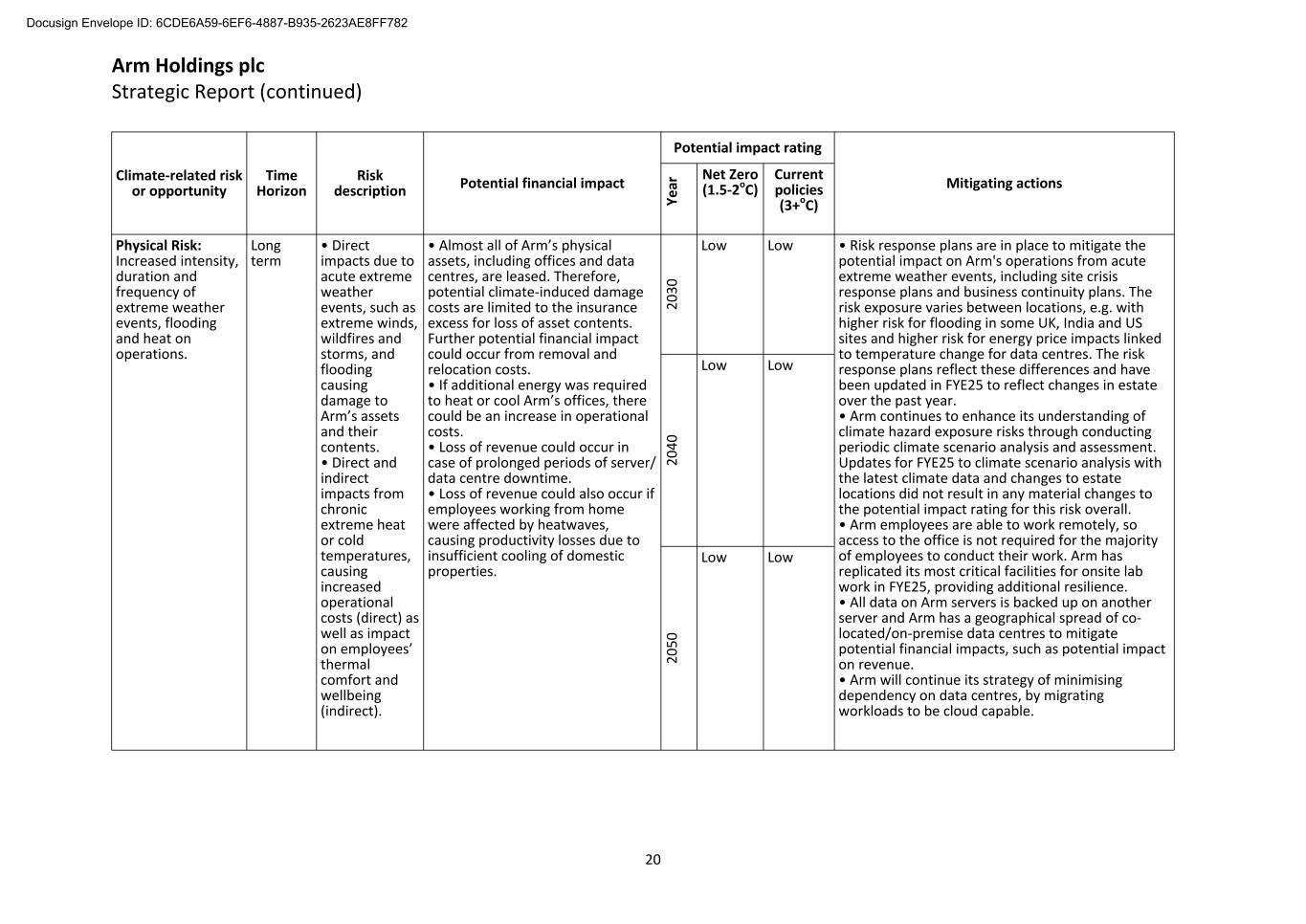
Climate-related risk or opportunity Time Horizon Risk description Potential financial impact Potential impact rating Mitigating actions Ye ar Net Zero (1.5-2oC) Current policies (3+oC) Physical Risk: Increased intensity, duration and frequency of extreme weather events, flooding and heat on operations. Long term • Direct impacts due to acute extreme weather events, such as extreme winds, wildfires and storms, and flooding causing damage to Arm’s assets and their contents. • Direct and indirect impacts from chronic extreme heat or cold temperatures, causing increased operational costs (direct) as well as impact on employees’ thermal comfort and wellbeing (indirect). • Almost all of Arm’s physical assets, including offices and data centres, are leased. Therefore, potential climate-induced damage costs are limited to the insurance excess for loss of asset contents. Further potential financial impact could occur from removal and relocation costs. • If additional energy was required to heat or cool Arm’s offices, there could be an increase in operational costs. • Loss of revenue could occur in case of prolonged periods of server/ data centre downtime. • Loss of revenue could also occur if employees working from home were affected by heatwaves, causing productivity losses due to insufficient cooling of domestic properties. 20 30 Low Low • Risk response plans are in place to mitigate the potential impact on Arm's operations from acute extreme weather events, including site crisis response plans and business continuity plans. The risk exposure varies between locations, e.g. with higher risk for flooding in some UK, India and US sites and higher risk for energy price impacts linked to temperature change for data centres. The risk response plans reflect these differences and have been updated in FYE25 to reflect changes in estate over the past year. • Arm continues to enhance its understanding of climate hazard exposure risks through conducting periodic climate scenario analysis and assessment. Updates for FYE25 to climate scenario analysis with the latest climate data and changes to estate locations did not result in any material changes to the potential impact rating for this risk overall. • Arm employees are able to work remotely, so access to the office is not required for the majority of employees to conduct their work. Arm has replicated its most critical facilities for onsite lab work in FYE25, providing additional resilience. • All data on Arm servers is backed up on another server and Arm has a geographical spread of co- located/on-premise data centres to mitigate potential financial impacts, such as potential impact on revenue. • Arm will continue its strategy of minimising dependency on data centres, by migrating workloads to be cloud capable. 20 40 Low Low 20 50 Low Low Arm Holdings plc Strategic Report (continued) 20 Docusign Envelope ID: 6CDE6A59-6EF6-4887-B935-2623AE8FF782
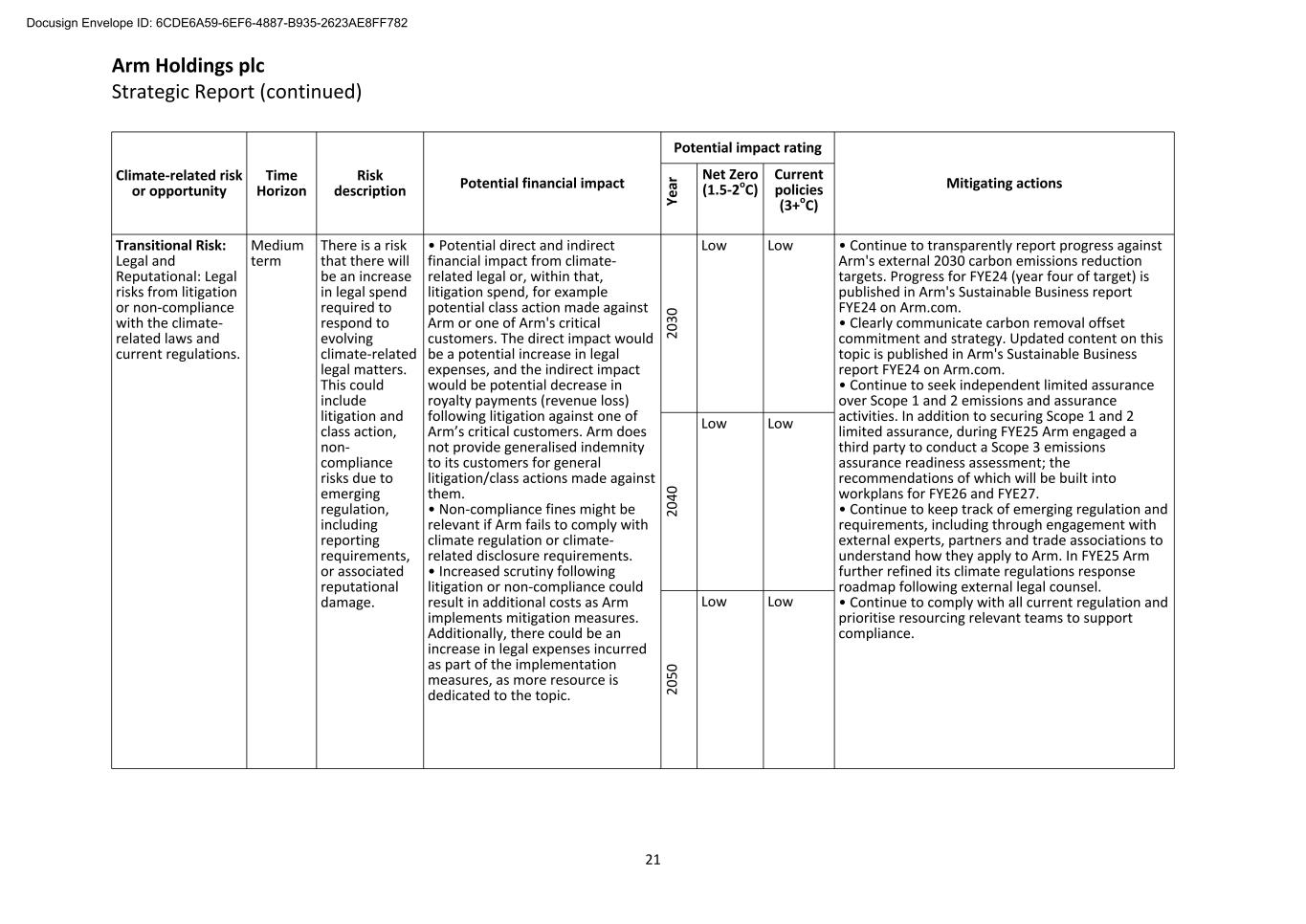
Climate-related risk or opportunity Time Horizon Risk description Potential financial impact Potential impact rating Mitigating actions Ye ar Net Zero (1.5-2oC) Current policies (3+oC) Transitional Risk: Legal and Reputational: Legal risks from litigation or non-compliance with the climate- related laws and current regulations. Medium term There is a risk that there will be an increase in legal spend required to respond to evolving climate-related legal matters. This could include litigation and class action, non- compliance risks due to emerging regulation, including reporting requirements, or associated reputational damage. • Potential direct and indirect financial impact from climate- related legal or, within that, litigation spend, for example potential class action made against Arm or one of Arm's critical customers. The direct impact would be a potential increase in legal expenses, and the indirect impact would be potential decrease in royalty payments (revenue loss) following litigation against one of Arm’s critical customers. Arm does not provide generalised indemnity to its customers for general litigation/class actions made against them. • Non-compliance fines might be relevant if Arm fails to comply with climate regulation or climate- related disclosure requirements. • Increased scrutiny following litigation or non-compliance could result in additional costs as Arm implements mitigation measures. Additionally, there could be an increase in legal expenses incurred as part of the implementation measures, as more resource is dedicated to the topic. 20 30 Low Low • Continue to transparently report progress against Arm's external 2030 carbon emissions reduction targets. Progress for FYE24 (year four of target) is published in Arm's Sustainable Business report FYE24 on Arm.com. • Clearly communicate carbon removal offset commitment and strategy. Updated content on this topic is published in Arm's Sustainable Business report FYE24 on Arm.com. • Continue to seek independent limited assurance over Scope 1 and 2 emissions and assurance activities. In addition to securing Scope 1 and 2 limited assurance, during FYE25 Arm engaged a third party to conduct a Scope 3 emissions assurance readiness assessment; the recommendations of which will be built into workplans for FYE26 and FYE27. • Continue to keep track of emerging regulation and requirements, including through engagement with external experts, partners and trade associations to understand how they apply to Arm. In FYE25 Arm further refined its climate regulations response roadmap following external legal counsel. • Continue to comply with all current regulation and prioritise resourcing relevant teams to support compliance. 20 40 Low Low 20 50 Low Low Arm Holdings plc Strategic Report (continued) 21 Docusign Envelope ID: 6CDE6A59-6EF6-4887-B935-2623AE8FF782
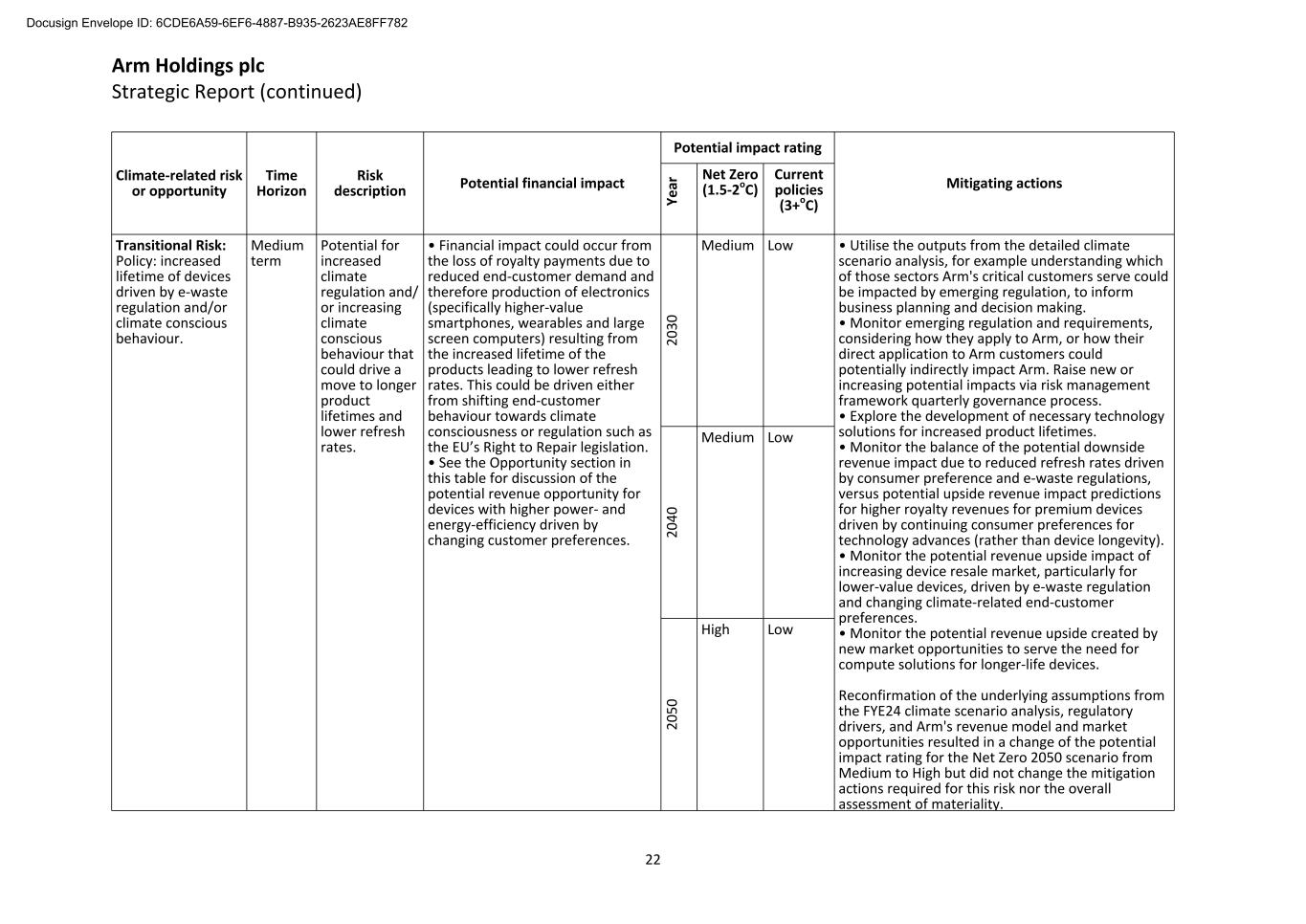
Climate-related risk or opportunity Time Horizon Risk description Potential financial impact Potential impact rating Mitigating actions Ye ar Net Zero (1.5-2oC) Current policies (3+oC) Transitional Risk: Policy: increased lifetime of devices driven by e-waste regulation and/or climate conscious behaviour. Medium term Potential for increased climate regulation and/ or increasing climate conscious behaviour that could drive a move to longer product lifetimes and lower refresh rates. • Financial impact could occur from the loss of royalty payments due to reduced end-customer demand and therefore production of electronics (specifically higher-value smartphones, wearables and large screen computers) resulting from the increased lifetime of the products leading to lower refresh rates. This could be driven either from shifting end-customer behaviour towards climate consciousness or regulation such as the EU’s Right to Repair legislation. • See the Opportunity section in this table for discussion of the potential revenue opportunity for devices with higher power- and energy-efficiency driven by changing customer preferences. 20 30 Medium Low • Utilise the outputs from the detailed climate scenario analysis, for example understanding which of those sectors Arm's critical customers serve could be impacted by emerging regulation, to inform business planning and decision making. • Monitor emerging regulation and requirements, considering how they apply to Arm, or how their direct application to Arm customers could potentially indirectly impact Arm. Raise new or increasing potential impacts via risk management framework quarterly governance process. • Explore the development of necessary technology solutions for increased product lifetimes. • Monitor the balance of the potential downside revenue impact due to reduced refresh rates driven by consumer preference and e-waste regulations, versus potential upside revenue impact predictions for higher royalty revenues for premium devices driven by continuing consumer preferences for technology advances (rather than device longevity). • Monitor the potential revenue upside impact of increasing device resale market, particularly for lower-value devices, driven by e-waste regulation and changing climate-related end-customer preferences. • Monitor the potential revenue upside created by new market opportunities to serve the need for compute solutions for longer-life devices. Reconfirmation of the underlying assumptions from the FYE24 climate scenario analysis, regulatory drivers, and Arm's revenue model and market opportunities resulted in a change of the potential impact rating for the Net Zero 2050 scenario from Medium to High but did not change the mitigation actions required for this risk nor the overall assessment of materiality. 20 40 Medium Low 20 50 High Low Arm Holdings plc Strategic Report (continued) 22 Docusign Envelope ID: 6CDE6A59-6EF6-4887-B935-2623AE8FF782
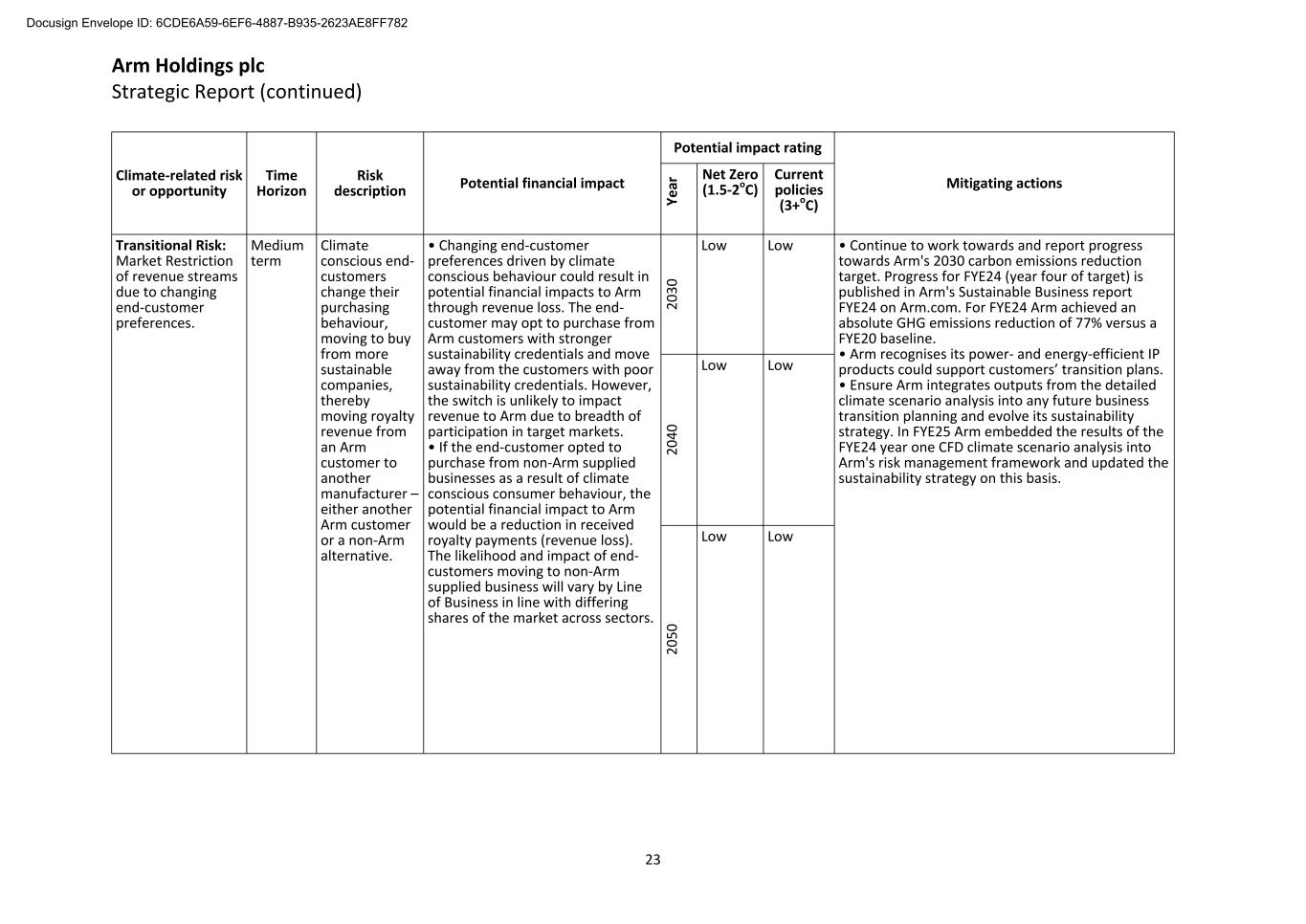
Climate-related risk or opportunity Time Horizon Risk description Potential financial impact Potential impact rating Mitigating actions Ye ar Net Zero (1.5-2oC) Current policies (3+oC) Transitional Risk: Market Restriction of revenue streams due to changing end-customer preferences. Medium term Climate conscious end- customers change their purchasing behaviour, moving to buy from more sustainable companies, thereby moving royalty revenue from an Arm customer to another manufacturer – either another Arm customer or a non-Arm alternative. • Changing end-customer preferences driven by climate conscious behaviour could result in potential financial impacts to Arm through revenue loss. The end- customer may opt to purchase from Arm customers with stronger sustainability credentials and move away from the customers with poor sustainability credentials. However, the switch is unlikely to impact revenue to Arm due to breadth of participation in target markets. • If the end-customer opted to purchase from non-Arm supplied businesses as a result of climate conscious consumer behaviour, the potential financial impact to Arm would be a reduction in received royalty payments (revenue loss). The likelihood and impact of end- customers moving to non-Arm supplied business will vary by Line of Business in line with differing shares of the market across sectors. 20 30 Low Low • Continue to work towards and report progress towards Arm's 2030 carbon emissions reduction target. Progress for FYE24 (year four of target) is published in Arm's Sustainable Business report FYE24 on Arm.com. For FYE24 Arm achieved an absolute GHG emissions reduction of 77% versus a FYE20 baseline. • Arm recognises its power- and energy-efficient IP products could support customers’ transition plans. • Ensure Arm integrates outputs from the detailed climate scenario analysis into any future business transition planning and evolve its sustainability strategy. In FYE25 Arm embedded the results of the FYE24 year one CFD climate scenario analysis into Arm's risk management framework and updated the sustainability strategy on this basis. 20 40 Low Low 20 50 Low Low Arm Holdings plc Strategic Report (continued) 23 Docusign Envelope ID: 6CDE6A59-6EF6-4887-B935-2623AE8FF782
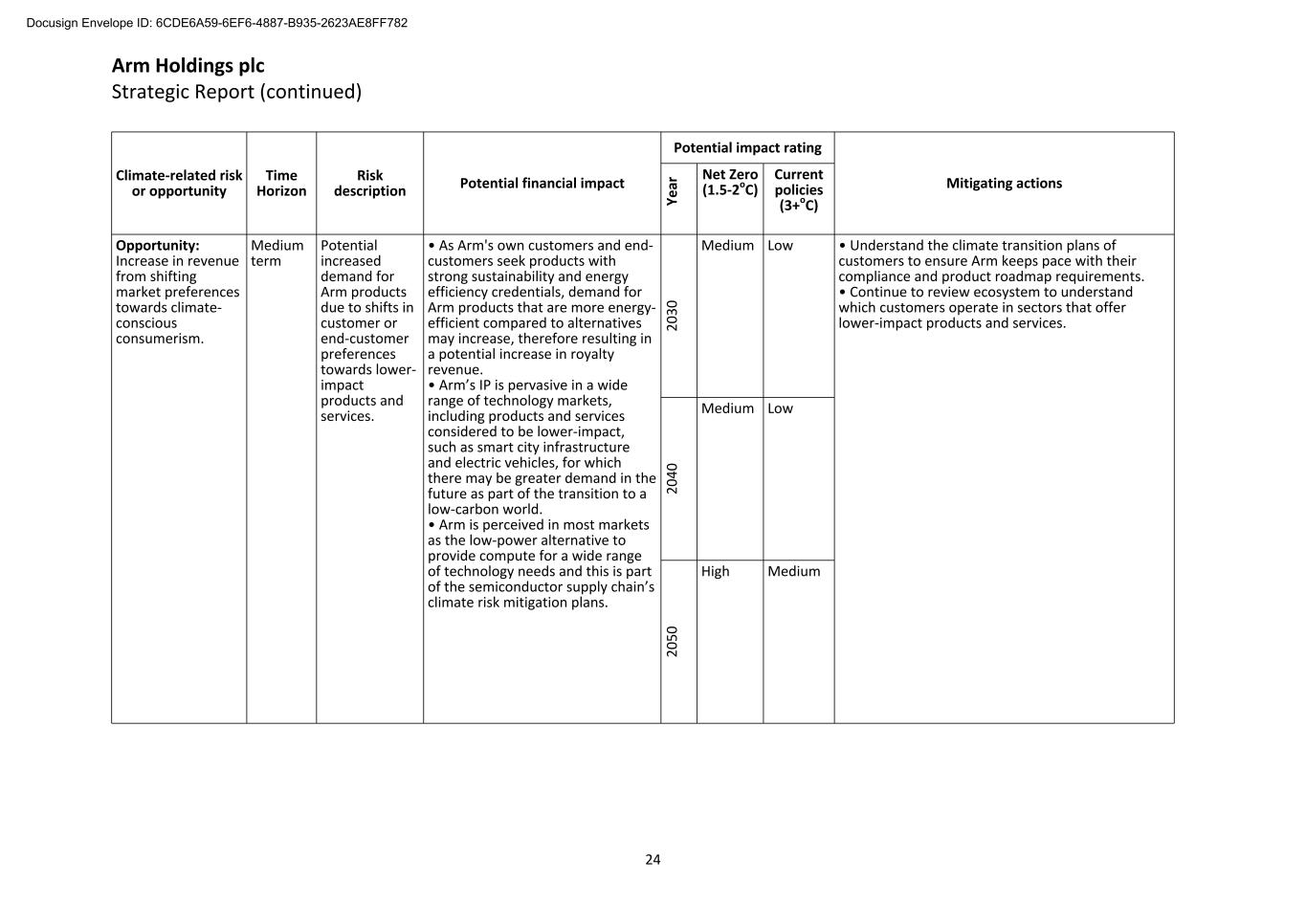
Climate-related risk or opportunity Time Horizon Risk description Potential financial impact Potential impact rating Mitigating actions Ye ar Net Zero (1.5-2oC) Current policies (3+oC) Opportunity: Increase in revenue from shifting market preferences towards climate- conscious consumerism. Medium term Potential increased demand for Arm products due to shifts in customer or end-customer preferences towards lower- impact products and services. • As Arm's own customers and end- customers seek products with strong sustainability and energy efficiency credentials, demand for Arm products that are more energy- efficient compared to alternatives may increase, therefore resulting in a potential increase in royalty revenue. • Arm’s IP is pervasive in a wide range of technology markets, including products and services considered to be lower-impact, such as smart city infrastructure and electric vehicles, for which there may be greater demand in the future as part of the transition to a low-carbon world. • Arm is perceived in most markets as the low-power alternative to provide compute for a wide range of technology needs and this is part of the semiconductor supply chain’s climate risk mitigation plans. 20 30 Medium Low • Understand the climate transition plans of customers to ensure Arm keeps pace with their compliance and product roadmap requirements. • Continue to review ecosystem to understand which customers operate in sectors that offer lower-impact products and services. 20 40 Medium Low 20 50 High Medium Arm Holdings plc Strategic Report (continued) 24 Docusign Envelope ID: 6CDE6A59-6EF6-4887-B935-2623AE8FF782
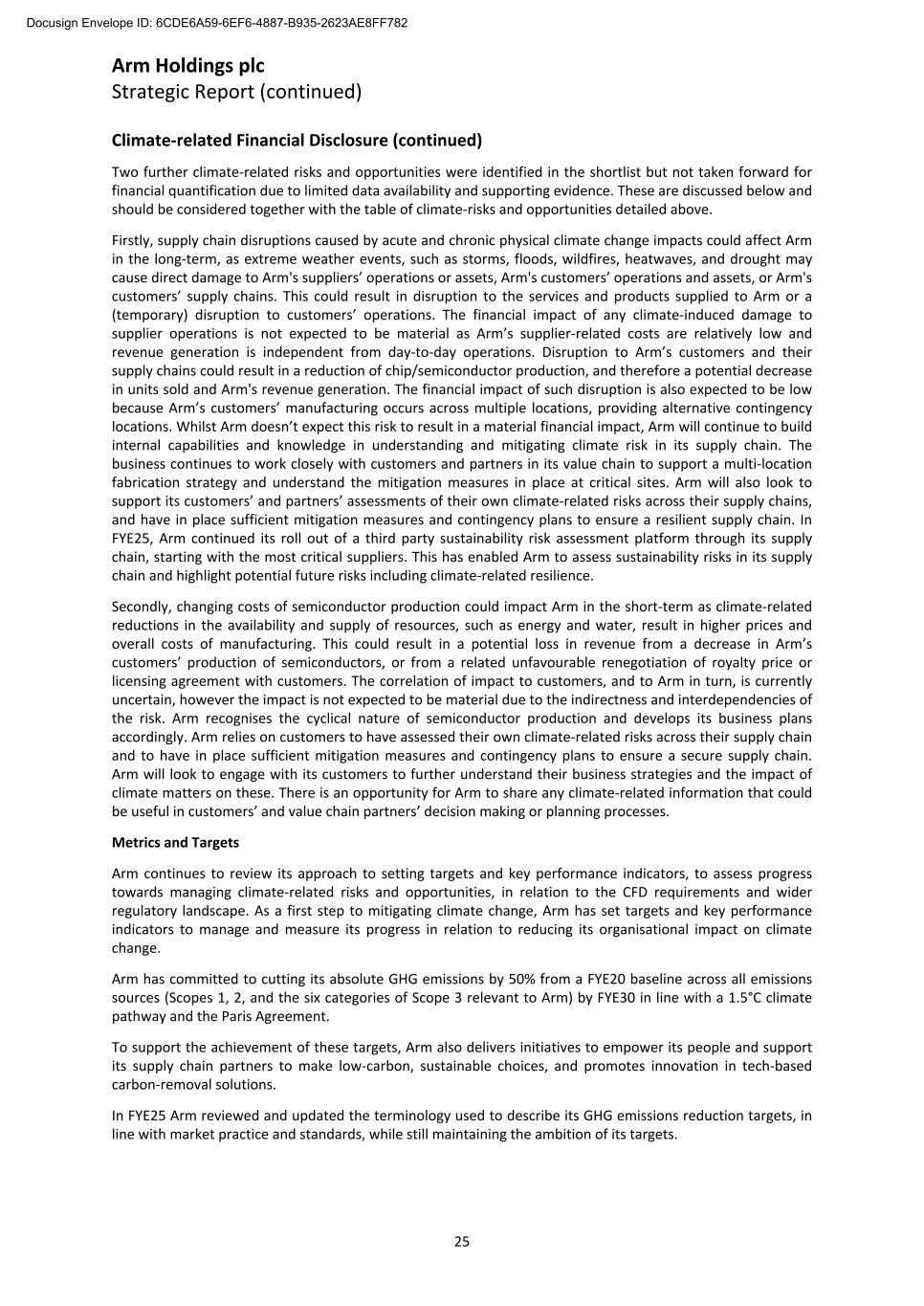
Climate-related Financial Disclosure (continued) Two further climate-related risks and opportunities were identified in the shortlist but not taken forward for financial quantification due to limited data availability and supporting evidence. These are discussed below and should be considered together with the table of climate-risks and opportunities detailed above. Firstly, supply chain disruptions caused by acute and chronic physical climate change impacts could affect Arm in the long-term, as extreme weather events, such as storms, floods, wildfires, heatwaves, and drought may cause direct damage to Arm's suppliers’ operations or assets, Arm's customers’ operations and assets, or Arm's customers’ supply chains. This could result in disruption to the services and products supplied to Arm or a (temporary) disruption to customers’ operations. The financial impact of any climate-induced damage to supplier operations is not expected to be material as Arm’s supplier-related costs are relatively low and revenue generation is independent from day-to-day operations. Disruption to Arm’s customers and their supply chains could result in a reduction of chip/semiconductor production, and therefore a potential decrease in units sold and Arm's revenue generation. The financial impact of such disruption is also expected to be low because Arm’s customers’ manufacturing occurs across multiple locations, providing alternative contingency locations. Whilst Arm doesn’t expect this risk to result in a material financial impact, Arm will continue to build internal capabilities and knowledge in understanding and mitigating climate risk in its supply chain. The business continues to work closely with customers and partners in its value chain to support a multi-location fabrication strategy and understand the mitigation measures in place at critical sites. Arm will also look to support its customers’ and partners’ assessments of their own climate-related risks across their supply chains, and have in place sufficient mitigation measures and contingency plans to ensure a resilient supply chain. In FYE25, Arm continued its roll out of a third party sustainability risk assessment platform through its supply chain, starting with the most critical suppliers. This has enabled Arm to assess sustainability risks in its supply chain and highlight potential future risks including climate-related resilience. Secondly, changing costs of semiconductor production could impact Arm in the short-term as climate-related reductions in the availability and supply of resources, such as energy and water, result in higher prices and overall costs of manufacturing. This could result in a potential loss in revenue from a decrease in Arm’s customers’ production of semiconductors, or from a related unfavourable renegotiation of royalty price or licensing agreement with customers. The correlation of impact to customers, and to Arm in turn, is currently uncertain, however the impact is not expected to be material due to the indirectness and interdependencies of the risk. Arm recognises the cyclical nature of semiconductor production and develops its business plans accordingly. Arm relies on customers to have assessed their own climate-related risks across their supply chain and to have in place sufficient mitigation measures and contingency plans to ensure a secure supply chain. Arm will look to engage with its customers to further understand their business strategies and the impact of climate matters on these. There is an opportunity for Arm to share any climate-related information that could be useful in customers’ and value chain partners’ decision making or planning processes. Metrics and Targets Arm continues to review its approach to setting targets and key performance indicators, to assess progress towards managing climate-related risks and opportunities, in relation to the CFD requirements and wider regulatory landscape. As a first step to mitigating climate change, Arm has set targets and key performance indicators to manage and measure its progress in relation to reducing its organisational impact on climate change. Arm has committed to cutting its absolute GHG emissions by 50% from a FYE20 baseline across all emissions sources (Scopes 1, 2, and the six categories of Scope 3 relevant to Arm) by FYE30 in line with a 1.5°C climate pathway and the Paris Agreement. To support the achievement of these targets, Arm also delivers initiatives to empower its people and support its supply chain partners to make low-carbon, sustainable choices, and promotes innovation in tech-based carbon-removal solutions. In FYE25 Arm reviewed and updated the terminology used to describe its GHG emissions reduction targets, in line with market practice and standards, while still maintaining the ambition of its targets. Arm Holdings plc Strategic Report (continued) 25 Docusign Envelope ID: 6CDE6A59-6EF6-4887-B935-2623AE8FF782
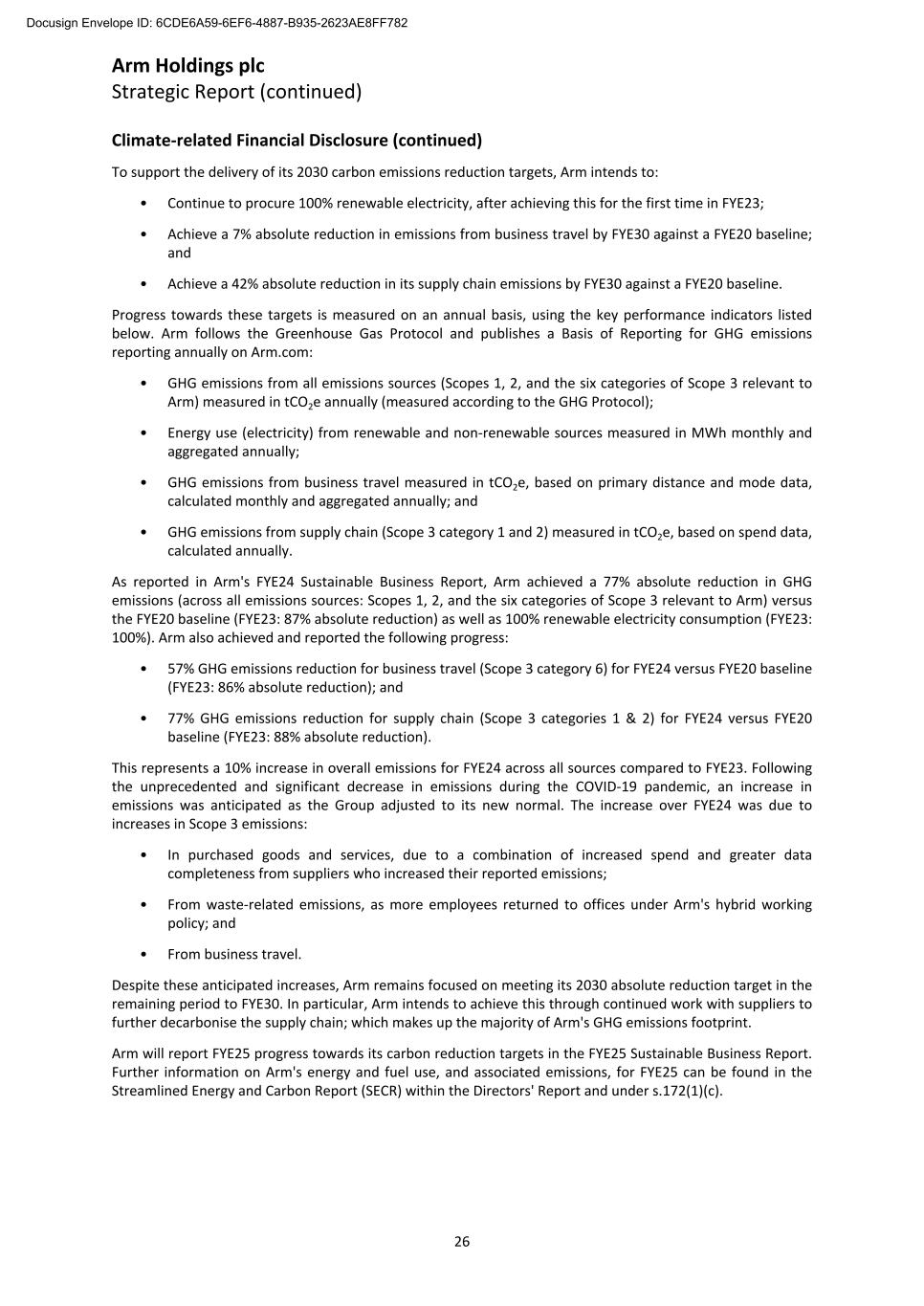
Climate-related Financial Disclosure (continued) To support the delivery of its 2030 carbon emissions reduction targets, Arm intends to: • Continue to procure 100% renewable electricity, after achieving this for the first time in FYE23; • Achieve a 7% absolute reduction in emissions from business travel by FYE30 against a FYE20 baseline; and • Achieve a 42% absolute reduction in its supply chain emissions by FYE30 against a FYE20 baseline. Progress towards these targets is measured on an annual basis, using the key performance indicators listed below. Arm follows the Greenhouse Gas Protocol and publishes a Basis of Reporting for GHG emissions reporting annually on Arm.com: • GHG emissions from all emissions sources (Scopes 1, 2, and the six categories of Scope 3 relevant to Arm) measured in tCO2e annually (measured according to the GHG Protocol); • Energy use (electricity) from renewable and non-renewable sources measured in MWh monthly and aggregated annually; • GHG emissions from business travel measured in tCO2e, based on primary distance and mode data, calculated monthly and aggregated annually; and • GHG emissions from supply chain (Scope 3 category 1 and 2) measured in tCO2e, based on spend data, calculated annually. As reported in Arm's FYE24 Sustainable Business Report, Arm achieved a 77% absolute reduction in GHG emissions (across all emissions sources: Scopes 1, 2, and the six categories of Scope 3 relevant to Arm) versus the FYE20 baseline (FYE23: 87% absolute reduction) as well as 100% renewable electricity consumption (FYE23: 100%). Arm also achieved and reported the following progress: • 57% GHG emissions reduction for business travel (Scope 3 category 6) for FYE24 versus FYE20 baseline (FYE23: 86% absolute reduction); and • 77% GHG emissions reduction for supply chain (Scope 3 categories 1 & 2) for FYE24 versus FYE20 baseline (FYE23: 88% absolute reduction). This represents a 10% increase in overall emissions for FYE24 across all sources compared to FYE23. Following the unprecedented and significant decrease in emissions during the COVID-19 pandemic, an increase in emissions was anticipated as the Group adjusted to its new normal. The increase over FYE24 was due to increases in Scope 3 emissions: • In purchased goods and services, due to a combination of increased spend and greater data completeness from suppliers who increased their reported emissions; • From waste-related emissions, as more employees returned to offices under Arm's hybrid working policy; and • From business travel. Despite these anticipated increases, Arm remains focused on meeting its 2030 absolute reduction target in the remaining period to FYE30. In particular, Arm intends to achieve this through continued work with suppliers to further decarbonise the supply chain; which makes up the majority of Arm's GHG emissions footprint. Arm will report FYE25 progress towards its carbon reduction targets in the FYE25 Sustainable Business Report. Further information on Arm's energy and fuel use, and associated emissions, for FYE25 can be found in the Streamlined Energy and Carbon Report (SECR) within the Directors' Report and under s.172(1)(c). Arm Holdings plc Strategic Report (continued) 26 Docusign Envelope ID: 6CDE6A59-6EF6-4887-B935-2623AE8FF782
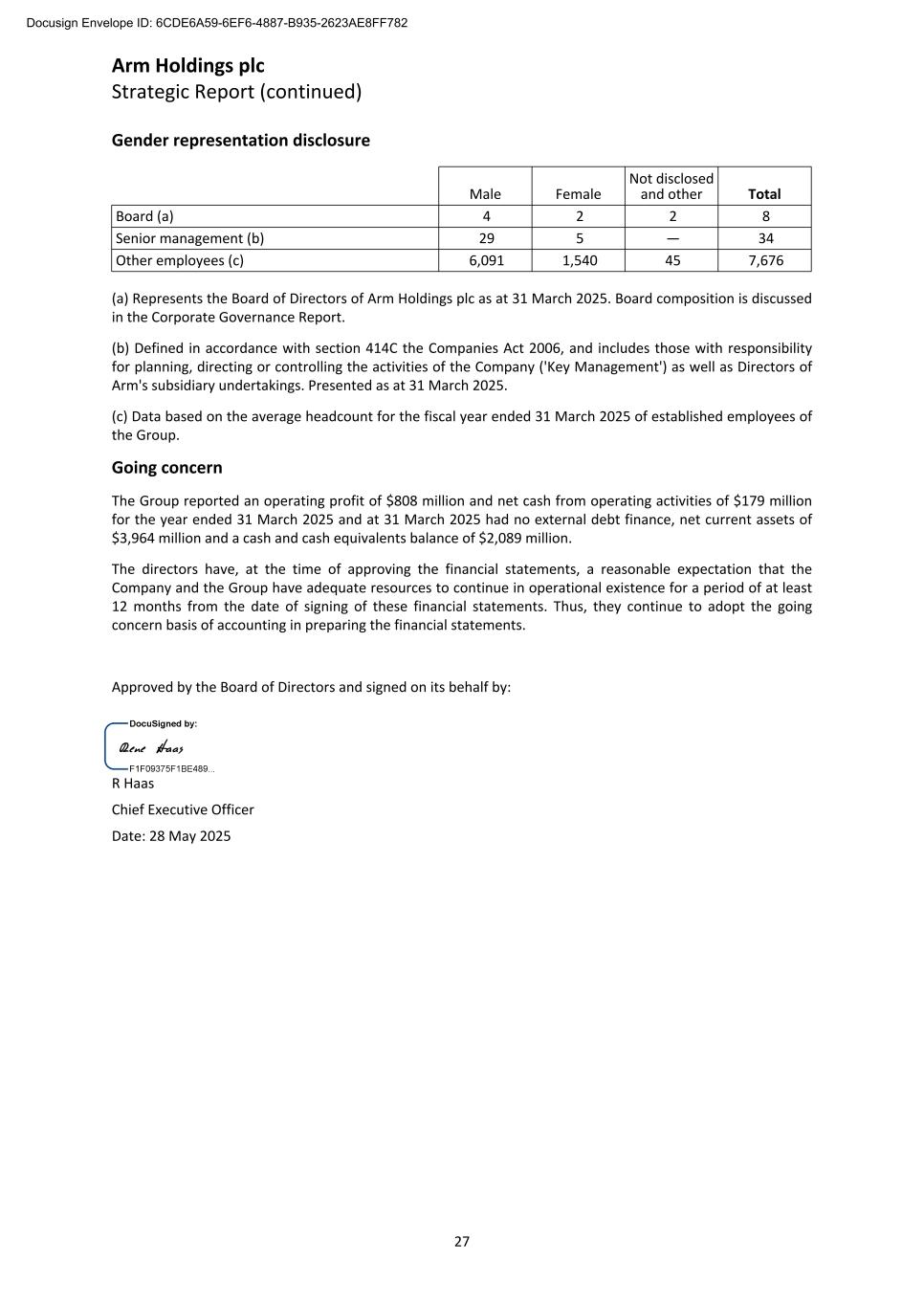
Gender representation disclosure Male Female Not disclosed and other Total Board (a) 4 2 2 8 Senior management (b) 29 5 — 34 Other employees (c) 6,091 1,540 45 7,676 (a) Represents the Board of Directors of Arm Holdings plc as at 31 March 2025. Board composition is discussed in the Corporate Governance Report. (b) Defined in accordance with section 414C the Companies Act 2006, and includes those with responsibility for planning, directing or controlling the activities of the Company ('Key Management') as well as Directors of Arm's subsidiary undertakings. Presented as at 31 March 2025. (c) Data based on the average headcount for the fiscal year ended 31 March 2025 of established employees of the Group. Going concern The Group reported an operating profit of $808 million and net cash from operating activities of $179 million for the year ended 31 March 2025 and at 31 March 2025 had no external debt finance, net current assets of $3,964 million and a cash and cash equivalents balance of $2,089 million. The directors have, at the time of approving the financial statements, a reasonable expectation that the Company and the Group have adequate resources to continue in operational existence for a period of at least 12 months from the date of signing of these financial statements. Thus, they continue to adopt the going concern basis of accounting in preparing the financial statements. Approved by the Board of Directors and signed on its behalf by: R Haas Chief Executive Officer Date: 28 May 2025 Arm Holdings plc Strategic Report (continued) 27 Docusign Envelope ID: 6CDE6A59-6EF6-4887-B935-2623AE8FF782
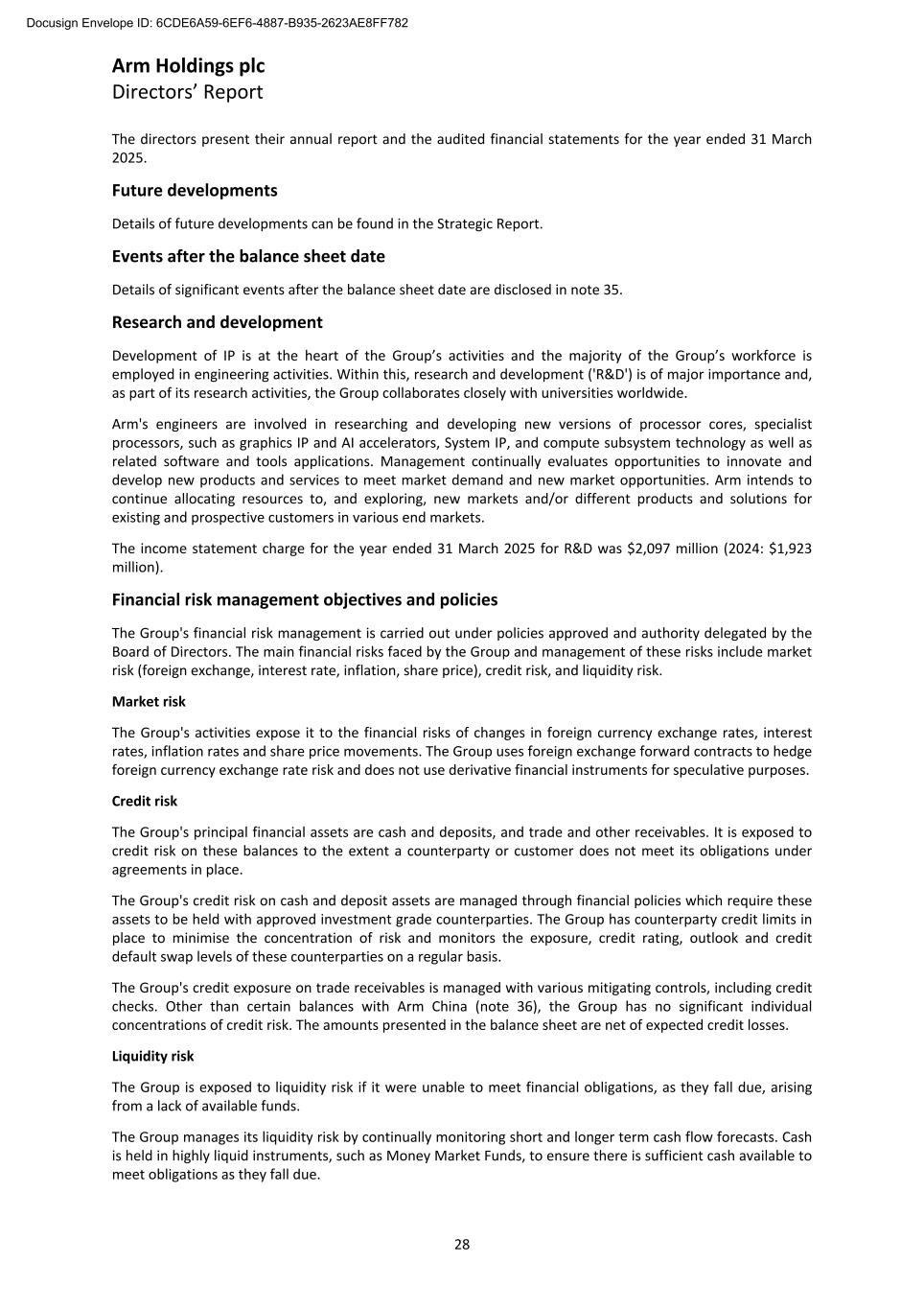
The directors present their annual report and the audited financial statements for the year ended 31 March 2025. Future developments Details of future developments can be found in the Strategic Report. Events after the balance sheet date Details of significant events after the balance sheet date are disclosed in note 35. Research and development Development of IP is at the heart of the Group’s activities and the majority of the Group’s workforce is employed in engineering activities. Within this, research and development ('R&D') is of major importance and, as part of its research activities, the Group collaborates closely with universities worldwide. Arm's engineers are involved in researching and developing new versions of processor cores, specialist processors, such as graphics IP and AI accelerators, System IP, and compute subsystem technology as well as related software and tools applications. Management continually evaluates opportunities to innovate and develop new products and services to meet market demand and new market opportunities. Arm intends to continue allocating resources to, and exploring, new markets and/or different products and solutions for existing and prospective customers in various end markets. The income statement charge for the year ended 31 March 2025 for R&D was $2,097 million (2024: $1,923 million). Financial risk management objectives and policies The Group's financial risk management is carried out under policies approved and authority delegated by the Board of Directors. The main financial risks faced by the Group and management of these risks include market risk (foreign exchange, interest rate, inflation, share price), credit risk, and liquidity risk. Market risk The Group's activities expose it to the financial risks of changes in foreign currency exchange rates, interest rates, inflation rates and share price movements. The Group uses foreign exchange forward contracts to hedge foreign currency exchange rate risk and does not use derivative financial instruments for speculative purposes. Credit risk The Group's principal financial assets are cash and deposits, and trade and other receivables. It is exposed to credit risk on these balances to the extent a counterparty or customer does not meet its obligations under agreements in place. The Group's credit risk on cash and deposit assets are managed through financial policies which require these assets to be held with approved investment grade counterparties. The Group has counterparty credit limits in place to minimise the concentration of risk and monitors the exposure, credit rating, outlook and credit default swap levels of these counterparties on a regular basis. The Group's credit exposure on trade receivables is managed with various mitigating controls, including credit checks. Other than certain balances with Arm China (note 36), the Group has no significant individual concentrations of credit risk. The amounts presented in the balance sheet are net of expected credit losses. Liquidity risk The Group is exposed to liquidity risk if it were unable to meet financial obligations, as they fall due, arising from a lack of available funds. The Group manages its liquidity risk by continually monitoring short and longer term cash flow forecasts. Cash is held in highly liquid instruments, such as Money Market Funds, to ensure there is sufficient cash available to meet obligations as they fall due. Arm Holdings plc Directors’ Report 28 Docusign Envelope ID: 6CDE6A59-6EF6-4887-B935-2623AE8FF782
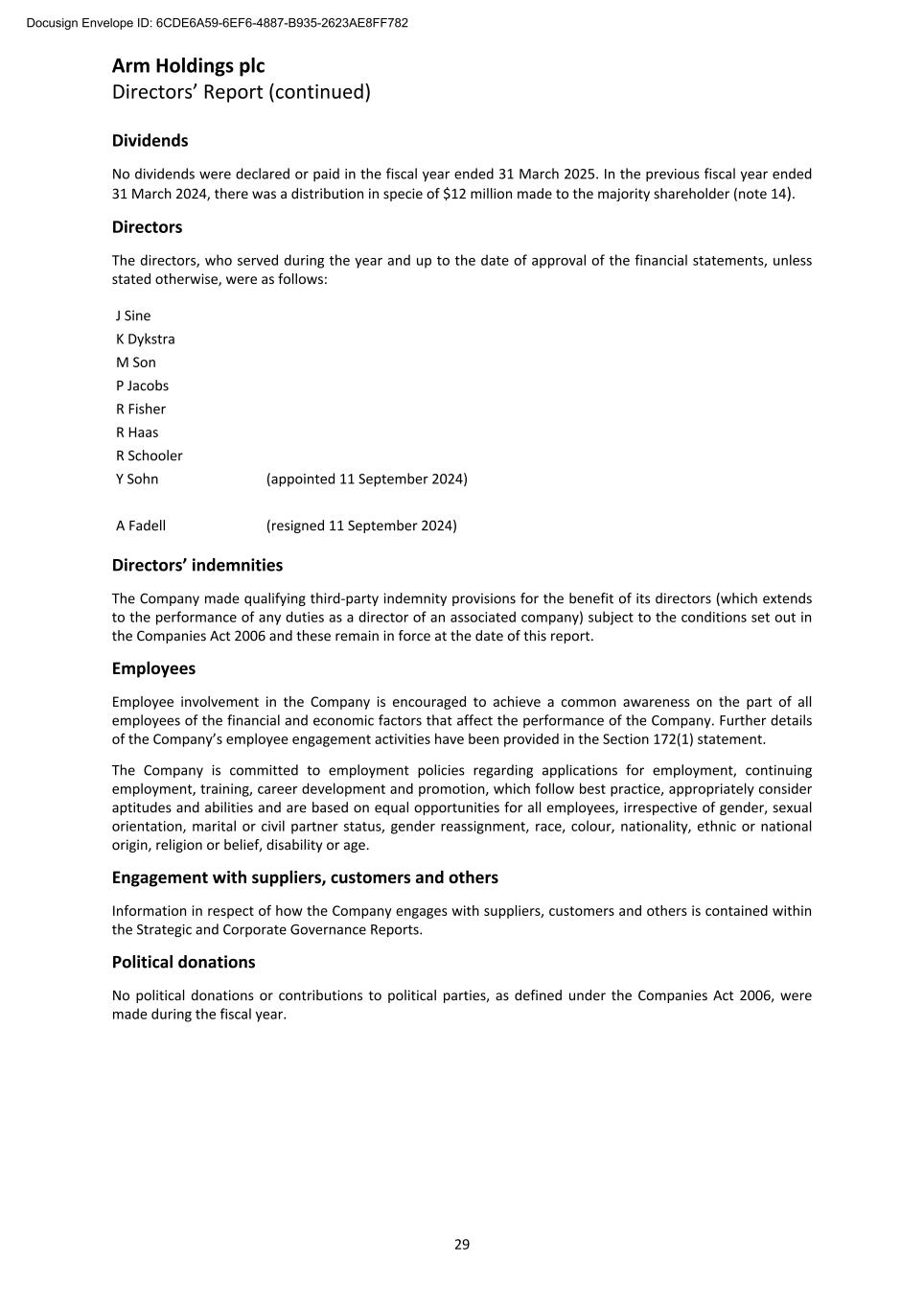
Dividends No dividends were declared or paid in the fiscal year ended 31 March 2025. In the previous fiscal year ended 31 March 2024, there was a distribution in specie of $12 million made to the majority shareholder (note 14). Directors The directors, who served during the year and up to the date of approval of the financial statements, unless stated otherwise, were as follows: J Sine K Dykstra M Son P Jacobs R Fisher R Haas R Schooler Y Sohn (appointed 11 September 2024) A Fadell (resigned 11 September 2024) Directors’ indemnities The Company made qualifying third-party indemnity provisions for the benefit of its directors (which extends to the performance of any duties as a director of an associated company) subject to the conditions set out in the Companies Act 2006 and these remain in force at the date of this report. Employees Employee involvement in the Company is encouraged to achieve a common awareness on the part of all employees of the financial and economic factors that affect the performance of the Company. Further details of the Company’s employee engagement activities have been provided in the Section 172(1) statement. The Company is committed to employment policies regarding applications for employment, continuing employment, training, career development and promotion, which follow best practice, appropriately consider aptitudes and abilities and are based on equal opportunities for all employees, irrespective of gender, sexual orientation, marital or civil partner status, gender reassignment, race, colour, nationality, ethnic or national origin, religion or belief, disability or age. Engagement with suppliers, customers and others Information in respect of how the Company engages with suppliers, customers and others is contained within the Strategic and Corporate Governance Reports. Political donations No political donations or contributions to political parties, as defined under the Companies Act 2006, were made during the fiscal year. Arm Holdings plc Directors’ Report (continued) 29 Docusign Envelope ID: 6CDE6A59-6EF6-4887-B935-2623AE8FF782
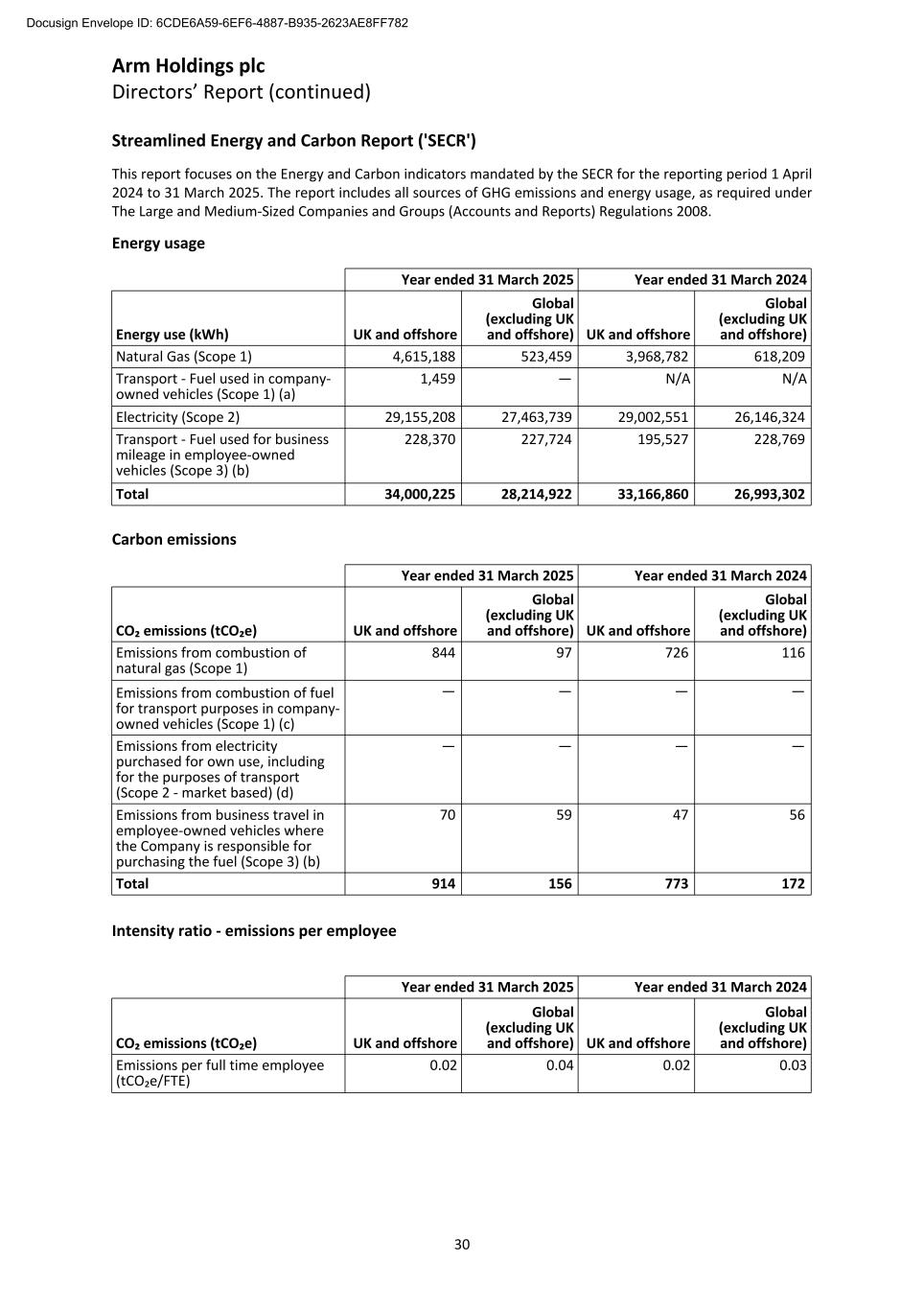
Streamlined Energy and Carbon Report ('SECR') This report focuses on the Energy and Carbon indicators mandated by the SECR for the reporting period 1 April 2024 to 31 March 2025. The report includes all sources of GHG emissions and energy usage, as required under The Large and Medium-Sized Companies and Groups (Accounts and Reports) Regulations 2008. Energy usage Year ended 31 March 2025 Year ended 31 March 2024 Energy use (kWh) UK and offshore Global (excluding UK and offshore) UK and offshore Global (excluding UK and offshore) Natural Gas (Scope 1) 4,615,188 523,459 3,968,782 618,209 Transport - Fuel used in company- owned vehicles (Scope 1) (a) 1,459 — N/A N/A Electricity (Scope 2) 29,155,208 27,463,739 29,002,551 26,146,324 Transport - Fuel used for business mileage in employee-owned vehicles (Scope 3) (b) 228,370 227,724 195,527 228,769 Total 34,000,225 28,214,922 33,166,860 26,993,302 Carbon emissions Year ended 31 March 2025 Year ended 31 March 2024 CO₂ emissions (tCO₂e) UK and offshore Global (excluding UK and offshore) UK and offshore Global (excluding UK and offshore) Emissions from combustion of natural gas (Scope 1) 844 97 726 116 Emissions from combustion of fuel for transport purposes in company- owned vehicles (Scope 1) (c) — — — — Emissions from electricity purchased for own use, including for the purposes of transport (Scope 2 - market based) (d) — — — — Emissions from business travel in employee-owned vehicles where the Company is responsible for purchasing the fuel (Scope 3) (b) 70 59 47 56 Total 914 156 773 172 Intensity ratio - emissions per employee Year ended 31 March 2025 Year ended 31 March 2024 CO₂ emissions (tCO₂e) UK and offshore Global (excluding UK and offshore) UK and offshore Global (excluding UK and offshore) Emissions per full time employee (tCO₂e/FTE) 0.02 0.04 0.02 0.03 Arm Holdings plc Directors’ Report (continued) 30 Docusign Envelope ID: 6CDE6A59-6EF6-4887-B935-2623AE8FF782
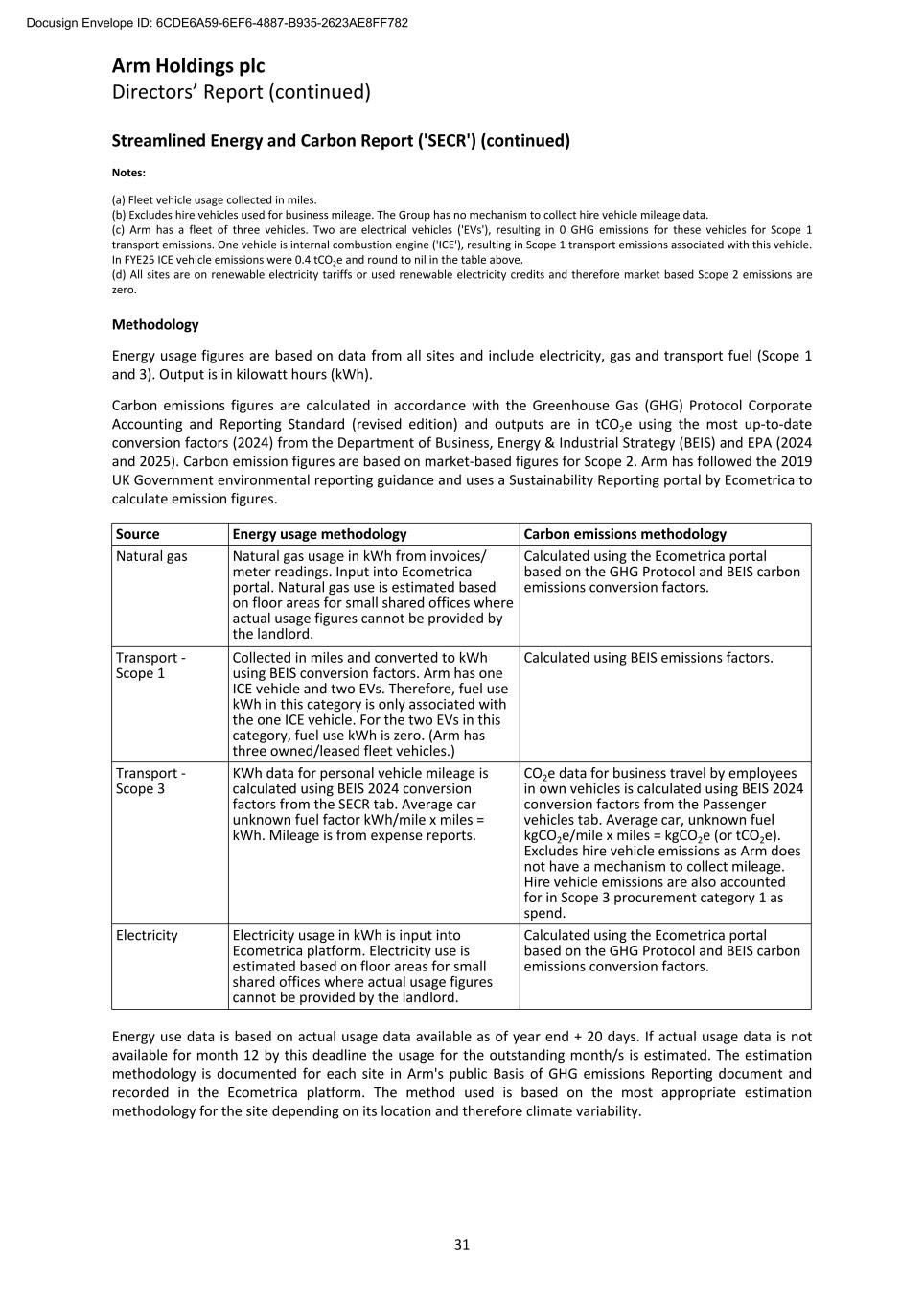
Streamlined Energy and Carbon Report ('SECR') (continued) Notes: (a) Fleet vehicle usage collected in miles. (b) Excludes hire vehicles used for business mileage. The Group has no mechanism to collect hire vehicle mileage data. (c) Arm has a fleet of three vehicles. Two are electrical vehicles ('EVs'), resulting in 0 GHG emissions for these vehicles for Scope 1 transport emissions. One vehicle is internal combustion engine ('ICE'), resulting in Scope 1 transport emissions associated with this vehicle. In FYE25 ICE vehicle emissions were 0.4 tCO2e and round to nil in the table above. (d) All sites are on renewable electricity tariffs or used renewable electricity credits and therefore market based Scope 2 emissions are zero. Methodology Energy usage figures are based on data from all sites and include electricity, gas and transport fuel (Scope 1 and 3). Output is in kilowatt hours (kWh). Carbon emissions figures are calculated in accordance with the Greenhouse Gas (GHG) Protocol Corporate Accounting and Reporting Standard (revised edition) and outputs are in tCO2e using the most up-to-date conversion factors (2024) from the Department of Business, Energy & Industrial Strategy (BEIS) and EPA (2024 and 2025). Carbon emission figures are based on market-based figures for Scope 2. Arm has followed the 2019 UK Government environmental reporting guidance and uses a Sustainability Reporting portal by Ecometrica to calculate emission figures. Source Energy usage methodology Carbon emissions methodology Natural gas Natural gas usage in kWh from invoices/ meter readings. Input into Ecometrica portal. Natural gas use is estimated based on floor areas for small shared offices where actual usage figures cannot be provided by the landlord. Calculated using the Ecometrica portal based on the GHG Protocol and BEIS carbon emissions conversion factors. Transport - Scope 1 Collected in miles and converted to kWh using BEIS conversion factors. Arm has one ICE vehicle and two EVs. Therefore, fuel use kWh in this category is only associated with the one ICE vehicle. For the two EVs in this category, fuel use kWh is zero. (Arm has three owned/leased fleet vehicles.) Calculated using BEIS emissions factors. Transport - Scope 3 KWh data for personal vehicle mileage is calculated using BEIS 2024 conversion factors from the SECR tab. Average car unknown fuel factor kWh/mile x miles = kWh. Mileage is from expense reports. CO2e data for business travel by employees in own vehicles is calculated using BEIS 2024 conversion factors from the Passenger vehicles tab. Average car, unknown fuel kgCO2e/mile x miles = kgCO2e (or tCO2e). Excludes hire vehicle emissions as Arm does not have a mechanism to collect mileage. Hire vehicle emissions are also accounted for in Scope 3 procurement category 1 as spend. Electricity Electricity usage in kWh is input into Ecometrica platform. Electricity use is estimated based on floor areas for small shared offices where actual usage figures cannot be provided by the landlord. Calculated using the Ecometrica portal based on the GHG Protocol and BEIS carbon emissions conversion factors. Energy use data is based on actual usage data available as of year end + 20 days. If actual usage data is not available for month 12 by this deadline the usage for the outstanding month/s is estimated. The estimation methodology is documented for each site in Arm's public Basis of GHG emissions Reporting document and recorded in the Ecometrica platform. The method used is based on the most appropriate estimation methodology for the site depending on its location and therefore climate variability. Arm Holdings plc Directors’ Report (continued) 31 Docusign Envelope ID: 6CDE6A59-6EF6-4887-B935-2623AE8FF782
Streamlined Energy and Carbon Report ('SECR') (continued) Trends As can be seen from the tables above, the Group’s energy consumption increased overall between FYE24 and FYE25, despite decreases in two categories of global energy consumption. Transport fuel use increased with more face-to-face meetings and events as well as employee growth. Electricity use in premises increased with continued office attendance under Arm's hybrid working policy. With this overall increase in energy consumption between FYE24 and FYE25 the Group's absolute carbon emissions also increased. However, emissions intensity per employee remains low, reflecting the Group's carbon efficient operational footprint. Carbon emissions from electricity use, which forms the majority (>85%) of energy consumption overall, also remained zero thanks to continued sourcing of renewable electricity across UK and Global premises. Environmental performance Arm has committed to cutting its absolute GHG emissions by 50% from a FYE20 baseline across all emissions sources (Scopes 1, 2, and the six categories of Scope 3 relevant to Arm) by FYE30 in line with a 1.5°C climate pathway and the Paris Agreement. To support the delivery of its 2030 carbon emissions reduction targets, Arm intends to: • Continue to procure 100% renewable electricity, after achieving this for the first time in FYE23; • Achieve a 7% absolute reduction in emissions from business travel by FYE30 against a FYE20 baseline; and • Achieve a 42% absolute reduction in its supply chain emissions by FYE30 against a FYE20 baseline. Arm publicly reports progress towards its carbon emissions reduction target each year. As reported in Arm's FYE24 Sustainable Business Report, Arm achieved a 77% absolute reduction in GHG emissions versus the FYE20 baseline as well as 100% renewable electricity consumption. As the SECR data is a small subset of Arm's total footprint it is not a representative indicator of progress towards Arm's carbon reduction target, which covers the Group's full emissions footprint. FYE25 progress towards Arm's carbon reduction targets will be reported in the next Arm Sustainable Business Report. This will include final assured energy use and associated emissions data to limited assurance. Auditor Each of the persons who is a director at the date of approval of this report confirms that: • so far as the director is aware, there is no relevant audit information of which the Company's and the Group’s auditor is unaware; and • the director has taken all the steps that he ought to have taken as a director in order to make himself aware of any relevant audit information and to establish that the Company's and the Group’s auditor is aware of that information. This confirmation is given and should be interpreted in accordance with the provisions of section 418 of the Companies Act 2006. Deloitte LLP have expressed their willingness to continue in office as auditor and appropriate arrangements have been put in place for them to be deemed reappointed as auditor in the absence of an Annual General Meeting. Approved by the Board of Directors and signed on its behalf by: R Haas Chief Executive Officer Date: 28 May 2025 Arm Holdings plc Directors’ Report (continued) 32 Docusign Envelope ID: 6CDE6A59-6EF6-4887-B935-2623AE8FF782
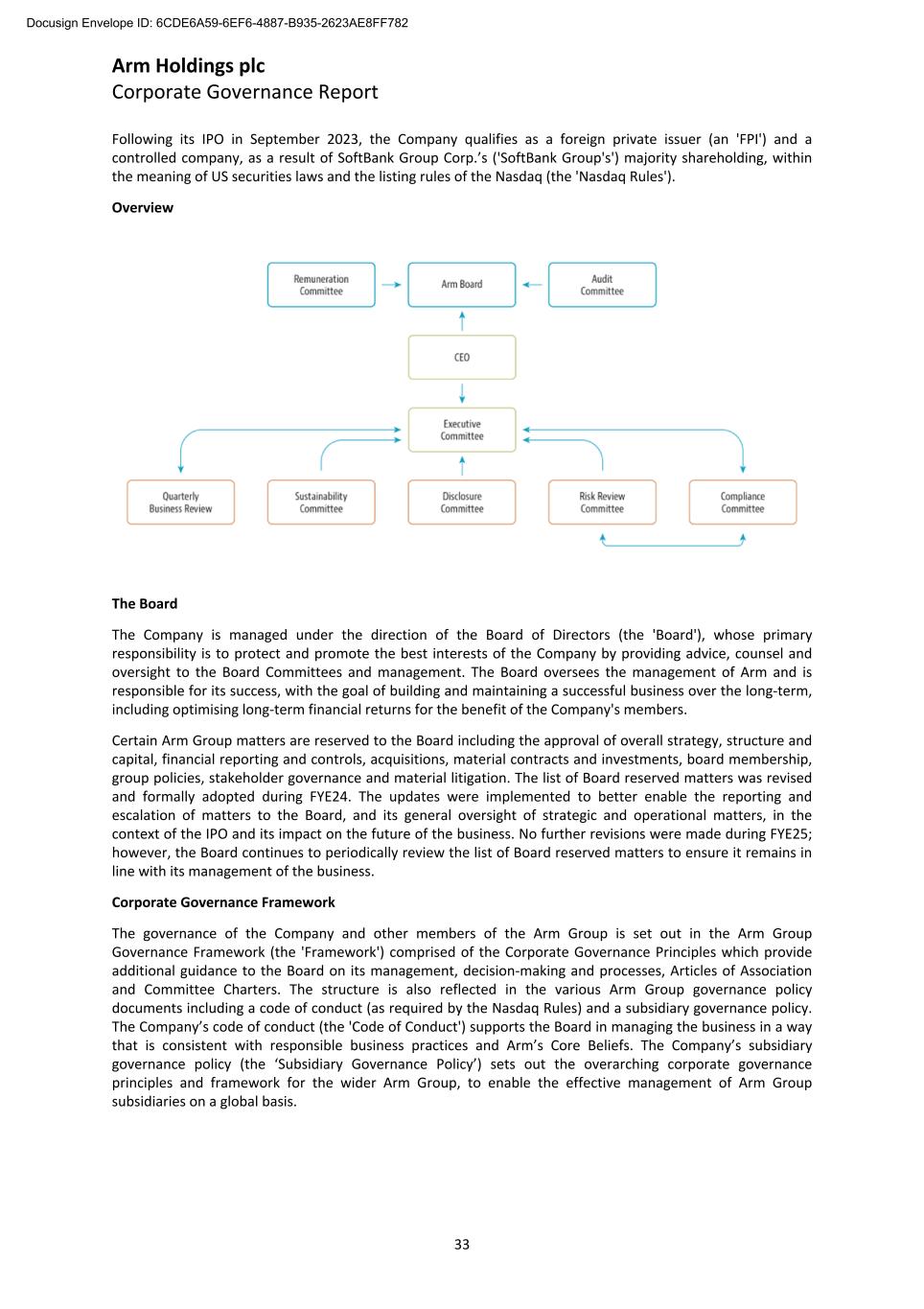
Following its IPO in September 2023, the Company qualifies as a foreign private issuer (an 'FPI') and a controlled company, as a result of SoftBank Group Corp.’s ('SoftBank Group's') majority shareholding, within the meaning of US securities laws and the listing rules of the Nasdaq (the 'Nasdaq Rules'). Overview The Board The Company is managed under the direction of the Board of Directors (the 'Board'), whose primary responsibility is to protect and promote the best interests of the Company by providing advice, counsel and oversight to the Board Committees and management. The Board oversees the management of Arm and is responsible for its success, with the goal of building and maintaining a successful business over the long-term, including optimising long-term financial returns for the benefit of the Company's members. Certain Arm Group matters are reserved to the Board including the approval of overall strategy, structure and capital, financial reporting and controls, acquisitions, material contracts and investments, board membership, group policies, stakeholder governance and material litigation. The list of Board reserved matters was revised and formally adopted during FYE24. The updates were implemented to better enable the reporting and escalation of matters to the Board, and its general oversight of strategic and operational matters, in the context of the IPO and its impact on the future of the business. No further revisions were made during FYE25; however, the Board continues to periodically review the list of Board reserved matters to ensure it remains in line with its management of the business. Corporate Governance Framework The governance of the Company and other members of the Arm Group is set out in the Arm Group Governance Framework (the 'Framework') comprised of the Corporate Governance Principles which provide additional guidance to the Board on its management, decision-making and processes, Articles of Association and Committee Charters. The structure is also reflected in the various Arm Group governance policy documents including a code of conduct (as required by the Nasdaq Rules) and a subsidiary governance policy. The Company’s code of conduct (the 'Code of Conduct') supports the Board in managing the business in a way that is consistent with responsible business practices and Arm’s Core Beliefs. The Company’s subsidiary governance policy (the ‘Subsidiary Governance Policy’) sets out the overarching corporate governance principles and framework for the wider Arm Group, to enable the effective management of Arm Group subsidiaries on a global basis. Arm Holdings plc Corporate Governance Report 33 Docusign Envelope ID: 6CDE6A59-6EF6-4887-B935-2623AE8FF782

Corporate Governance Framework (continued) The Board considers that the Framework, together with the requirements of the UK Companies Act 2006 ('CA 2006'), US securities laws and the Nasdaq Rules, together provide a sufficiently robust set of governance guardrails within which the Company has established prudent governance processes and procedures and therefore the Board has not formally adopted a corporate governance code. It also considers the applicable requirements of the Nasdaq Rules to be akin to a formal code. The Directors receive training on an ad hoc basis to support them in fulfilling their responsibilities as Directors and to ensure their familiarity with the Framework, particularly given the Board's role as the principal governance body of the Arm Group and its responsibility in overseeing the Code of Conduct. The Directors also receive periodic training to maintain their awareness of US securities laws, the Nasdaq Rules and the CA 2006. Division of Responsibility While the Board as a whole is the principal governance body for the global Arm Group, certain individual Board members undertake clearly-defined activities on behalf of the Board. As part of the Framework, the Board delegates authority to the CEO and the Executive Committee to deal with the day-to-day management of the Company and the strategic management of the Arm Group. The CEO is also chiefly responsible for the interface with stakeholders and provides a Corporate Governance Briefing with an emphasis on stakeholder engagement at each scheduled Board meeting – please see the Section 172 statement within the Strategic Report for further detail on stakeholder engagement. The Board also delegates other matters to its standing Board Committees, the Remuneration Committee and the Audit Committee. The Remuneration Committee and Audit Committee each report on their activities to the full Board via their chairperson and provide periodic updates; they are governed by their respective charters. The roles of Board Chair and CEO remain separate, and there is an appropriate division of responsibility, accountability and decision-making within the Board. In respect of each such delegation, however, the Board is cognisant that ultimate responsibility for these matters remains with the Board as a whole. US Listing Requirements Material Differences Following the Nasdaq listing, as an FPI, the Company is permitted to follow home practices in respect of certain corporate governance arrangements in lieu of the Nasdaq Rules and, where this is the case, Arm is required to disclose a summary of any material differences between the home country corporate governance practices followed and those under the Nasdaq Rules. Arm’s Corporate Governance Framework, outlined in more detail below, is primarily based on the Nasdaq Rules but also conforms to the requirements of the CA 2006. Separately, as Arm also qualifies as a 'controlled company', it is exempt from complying with certain other corporate governance requirements under the Nasdaq Rules, details of which are further outlined below. As an FPI, Rule 5615(a)(3) permits the Company to follow home practices rather than the Nasdaq Rules in respect of certain corporate governance arrangements. The material differences between the home country corporate governance practices which Arm follows and those under the Nasdaq Rules are set out in the following table: Arm Holdings plc Corporate Governance Report (continued) 34 Docusign Envelope ID: 6CDE6A59-6EF6-4887-B935-2623AE8FF782
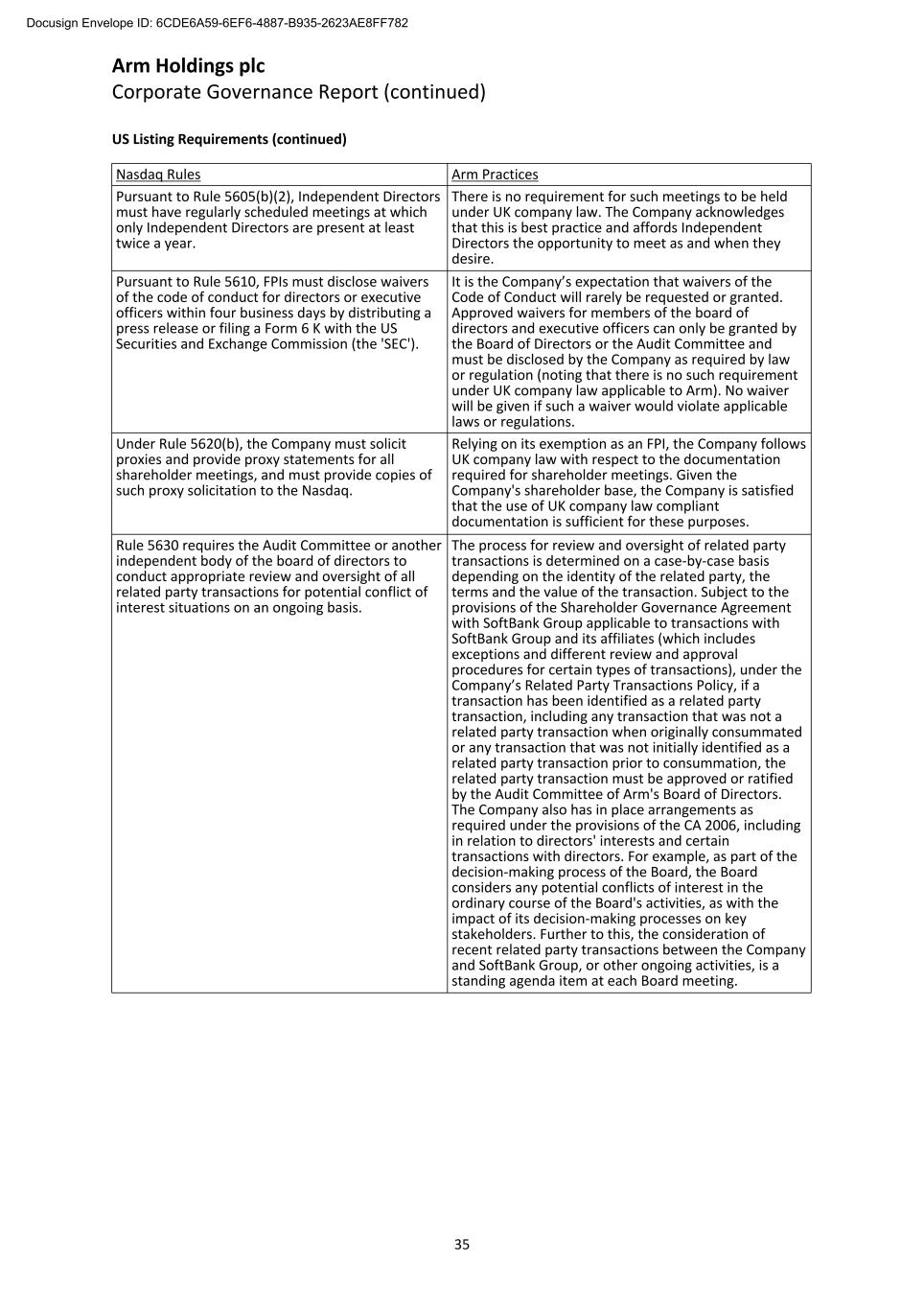
US Listing Requirements (continued) Nasdaq Rules Arm Practices Pursuant to Rule 5605(b)(2), Independent Directors must have regularly scheduled meetings at which only Independent Directors are present at least twice a year. There is no requirement for such meetings to be held under UK company law. The Company acknowledges that this is best practice and affords Independent Directors the opportunity to meet as and when they desire. Pursuant to Rule 5610, FPIs must disclose waivers of the code of conduct for directors or executive officers within four business days by distributing a press release or filing a Form 6 K with the US Securities and Exchange Commission (the 'SEC'). It is the Company’s expectation that waivers of the Code of Conduct will rarely be requested or granted. Approved waivers for members of the board of directors and executive officers can only be granted by the Board of Directors or the Audit Committee and must be disclosed by the Company as required by law or regulation (noting that there is no such requirement under UK company law applicable to Arm). No waiver will be given if such a waiver would violate applicable laws or regulations. Under Rule 5620(b), the Company must solicit proxies and provide proxy statements for all shareholder meetings, and must provide copies of such proxy solicitation to the Nasdaq. Relying on its exemption as an FPI, the Company follows UK company law with respect to the documentation required for shareholder meetings. Given the Company's shareholder base, the Company is satisfied that the use of UK company law compliant documentation is sufficient for these purposes. Rule 5630 requires the Audit Committee or another independent body of the board of directors to conduct appropriate review and oversight of all related party transactions for potential conflict of interest situations on an ongoing basis. The process for review and oversight of related party transactions is determined on a case-by-case basis depending on the identity of the related party, the terms and the value of the transaction. Subject to the provisions of the Shareholder Governance Agreement with SoftBank Group applicable to transactions with SoftBank Group and its affiliates (which includes exceptions and different review and approval procedures for certain types of transactions), under the Company’s Related Party Transactions Policy, if a transaction has been identified as a related party transaction, including any transaction that was not a related party transaction when originally consummated or any transaction that was not initially identified as a related party transaction prior to consummation, the related party transaction must be approved or ratified by the Audit Committee of Arm's Board of Directors. The Company also has in place arrangements as required under the provisions of the CA 2006, including in relation to directors' interests and certain transactions with directors. For example, as part of the decision-making process of the Board, the Board considers any potential conflicts of interest in the ordinary course of the Board's activities, as with the impact of its decision-making processes on key stakeholders. Further to this, the consideration of recent related party transactions between the Company and SoftBank Group, or other ongoing activities, is a standing agenda item at each Board meeting. Arm Holdings plc Corporate Governance Report (continued) 35 Docusign Envelope ID: 6CDE6A59-6EF6-4887-B935-2623AE8FF782
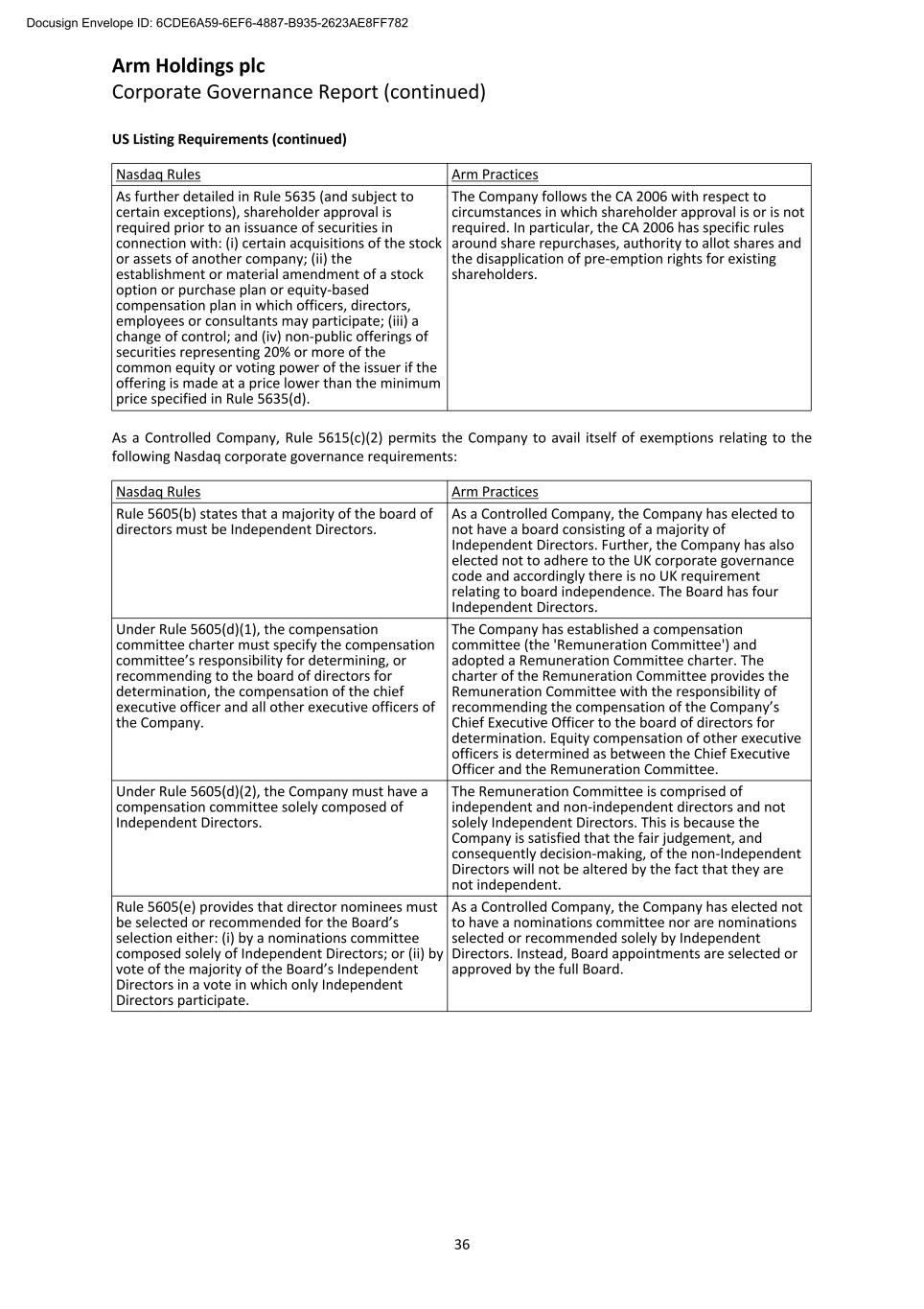
US Listing Requirements (continued) Nasdaq Rules Arm Practices As further detailed in Rule 5635 (and subject to certain exceptions), shareholder approval is required prior to an issuance of securities in connection with: (i) certain acquisitions of the stock or assets of another company; (ii) the establishment or material amendment of a stock option or purchase plan or equity-based compensation plan in which officers, directors, employees or consultants may participate; (iii) a change of control; and (iv) non-public offerings of securities representing 20% or more of the common equity or voting power of the issuer if the offering is made at a price lower than the minimum price specified in Rule 5635(d). The Company follows the CA 2006 with respect to circumstances in which shareholder approval is or is not required. In particular, the CA 2006 has specific rules around share repurchases, authority to allot shares and the disapplication of pre-emption rights for existing shareholders. As a Controlled Company, Rule 5615(c)(2) permits the Company to avail itself of exemptions relating to the following Nasdaq corporate governance requirements: Nasdaq Rules Arm Practices Rule 5605(b) states that a majority of the board of directors must be Independent Directors. As a Controlled Company, the Company has elected to not have a board consisting of a majority of Independent Directors. Further, the Company has also elected not to adhere to the UK corporate governance code and accordingly there is no UK requirement relating to board independence. The Board has four Independent Directors. Under Rule 5605(d)(1), the compensation committee charter must specify the compensation committee’s responsibility for determining, or recommending to the board of directors for determination, the compensation of the chief executive officer and all other executive officers of the Company. The Company has established a compensation committee (the 'Remuneration Committee') and adopted a Remuneration Committee charter. The charter of the Remuneration Committee provides the Remuneration Committee with the responsibility of recommending the compensation of the Company’s Chief Executive Officer to the board of directors for determination. Equity compensation of other executive officers is determined as between the Chief Executive Officer and the Remuneration Committee. Under Rule 5605(d)(2), the Company must have a compensation committee solely composed of Independent Directors. The Remuneration Committee is comprised of independent and non-independent directors and not solely Independent Directors. This is because the Company is satisfied that the fair judgement, and consequently decision-making, of the non-Independent Directors will not be altered by the fact that they are not independent. Rule 5605(e) provides that director nominees must be selected or recommended for the Board’s selection either: (i) by a nominations committee composed solely of Independent Directors; or (ii) by vote of the majority of the Board’s Independent Directors in a vote in which only Independent Directors participate. As a Controlled Company, the Company has elected not to have a nominations committee nor are nominations selected or recommended solely by Independent Directors. Instead, Board appointments are selected or approved by the full Board. Arm Holdings plc Corporate Governance Report (continued) 36 Docusign Envelope ID: 6CDE6A59-6EF6-4887-B935-2623AE8FF782

Board Composition The Board is composed of eight directors: Masayoshi Son Masayoshi Son has served as a Director and Chairman of the Arm Group since 2016. Mr. Son founded SoftBank Group in September 1981 and has been its Chairman and Chief Executive Officer since February 1986. Founded initially as a PC software distribution business, SoftBank Group and its portfolio of companies have expanded to cover a range of technologies, including advanced telecommunications, internet services, AI, smart robotics, and IoT. Mr. Son has overseen investments in some of the world’s fastest-growing technology companies. Mr. Son serves in various capacities within SoftBank Group’s portfolio of companies, including for SoftBank Corp. (Japanese Telecommunication Operator), as its Chairman since 2015 and served as its Chairman and Chief Executive Officer from 2006 to 2015. Mr. Son has also served as Honorary Chairman of the Broadband Association in Japan. Mr. Son was selected to serve on the Board of Directors because of his vast executive leadership experience, including through his service as Chairman and Chief Executive Officer of SoftBank Group, a large international public company and Arm's controlling shareholder, along with his significant expertise in technology and innovation. Mr. Son is the Chair of the Remuneration Committee. Rene Haas Rene Haas has served as the Chief Executive Officer and a Director since February 2022. Prior to being appointed as Chief Executive Officer, Mr. Haas served as President of Arm's IP Product Groups ('IPG') from January 2017. Under his leadership, Mr. Haas transformed IPG to focus on key solutions for vertical markets with a more diversified product portfolio and increased investment in Arm's software ecosystem. In addition to his role as Chief Executive Officer, Mr. Haas has sat on the boards of Arm China and SoftBank Group since December 2016 and June 2023, respectively. Mr. Haas also provides certain advisory and consulting services to SoftBank Group. Mr. Haas joined the Company in October 2013 as Vice President of Strategic Alliances and two years later was appointed to the Executive Committee and named Arm’s Chief Commercial Officer in charge of global sales and marketing. Before joining the Company, Mr. Haas held several applications management, applications engineering and product engineering roles, including seven years at NVIDIA as Vice President and General Manager of its computing products business. Prior to NVIDIA, Mr. Haas held executive roles at Scintera Networks and Tensilica. Mr. Haas earned his Bachelor of Science in Electrical and Electronics Engineering from Clarkson University and is a graduate of the Stanford University Graduate School of Business Executive Education Program. Mr. Haas has served on the board of directors of AstraZeneca PLC since January 2025. Mr. Haas was selected to serve on the Board of Directors due to his knowledge of Arm's business as the Chief Executive Officer and his extensive experience in the semiconductor industry. Karen Dykstra Karen Dykstra has served as a Director of the Board of Directors since September 2022. Ms. Dykstra served as the Chief Financial Officer of VMware, Inc. ('VMware') in 2023, a position she held while serving on VMware’s board of directors, and leading up to Broadcom Inc.’s acquisition of VMware. Ms. Dykstra previously served as Chief Financial and Administrative Officer, and as Chief Financial Officer, of AOL, Inc., a web portal and online service provider. Prior to joining AOL, Inc., Ms. Dykstra was a Partner at Plainfield Asset Management LLC ('Plainfield'), where she served as Chief Operating Officer, Chief Financial Officer and a director of Plainfield Direct LLC, Plainfield’s business development company. Previously, she spent over 25 years with Automatic Data Processing, Inc., a provider of human capital management solutions to employers, serving most recently as Chief Financial Officer, and prior thereto as Vice President—Finance, Corporate Controller, and in other capacities. Ms. Dykstra currently serves on the board of Gartner, Inc. and Atlassian Corporation, and is a former director of VMware, Crane Co., AOL, Inc. and Boston Properties, Inc. Ms. Dykstra was selected to serve on the Board of Directors due to her broad executive management experience and financial expertise as the Chief Financial Officer of multiple global companies and her experience from serving on the board of directors of other companies in the technology industry. Ms. Dykstra is the Chair of the Audit Committee. Arm Holdings plc Corporate Governance Report (continued) 37 Docusign Envelope ID: 6CDE6A59-6EF6-4887-B935-2623AE8FF782
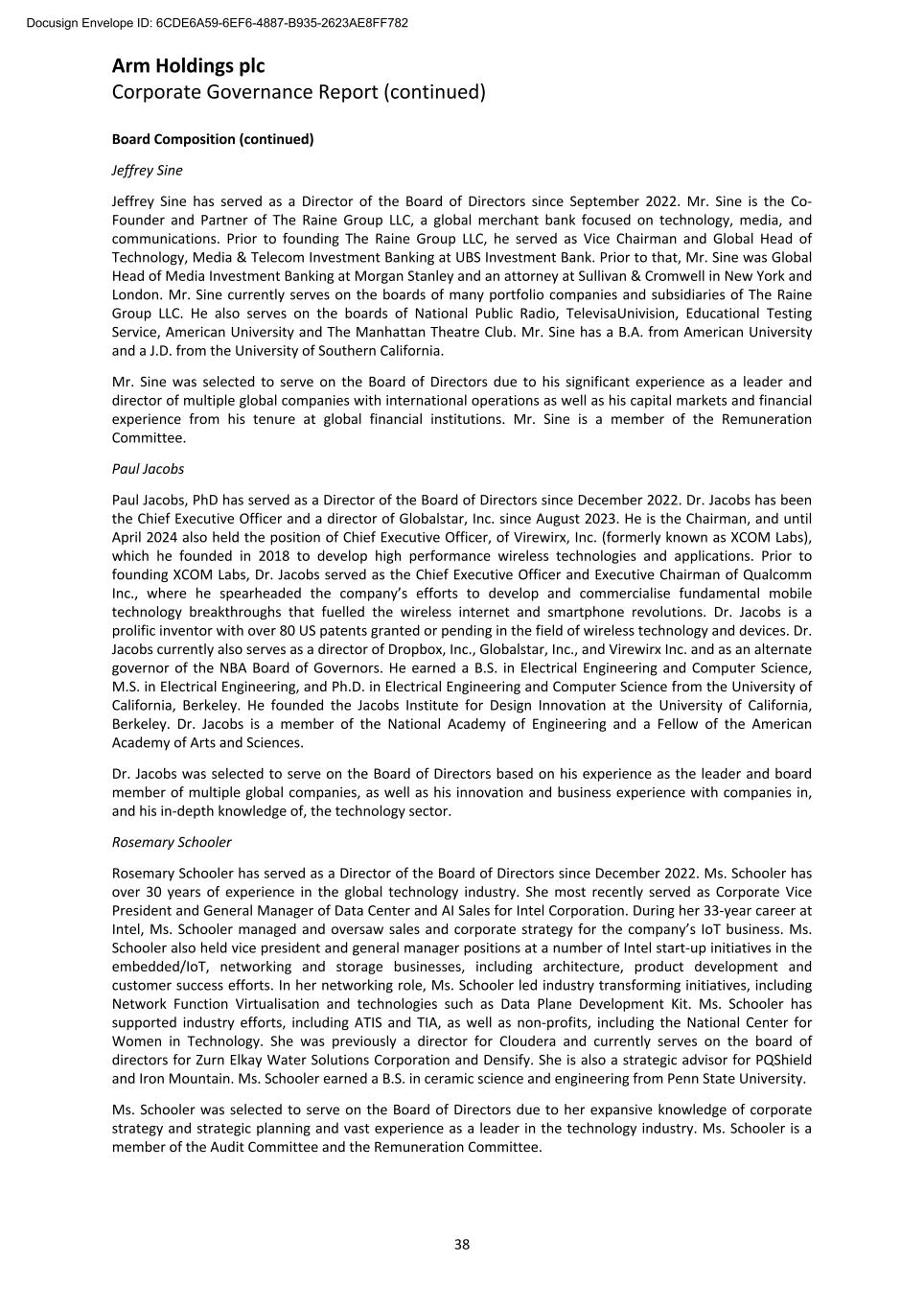
Board Composition (continued) Jeffrey Sine Jeffrey Sine has served as a Director of the Board of Directors since September 2022. Mr. Sine is the Co- Founder and Partner of The Raine Group LLC, a global merchant bank focused on technology, media, and communications. Prior to founding The Raine Group LLC, he served as Vice Chairman and Global Head of Technology, Media & Telecom Investment Banking at UBS Investment Bank. Prior to that, Mr. Sine was Global Head of Media Investment Banking at Morgan Stanley and an attorney at Sullivan & Cromwell in New York and London. Mr. Sine currently serves on the boards of many portfolio companies and subsidiaries of The Raine Group LLC. He also serves on the boards of National Public Radio, TelevisaUnivision, Educational Testing Service, American University and The Manhattan Theatre Club. Mr. Sine has a B.A. from American University and a J.D. from the University of Southern California. Mr. Sine was selected to serve on the Board of Directors due to his significant experience as a leader and director of multiple global companies with international operations as well as his capital markets and financial experience from his tenure at global financial institutions. Mr. Sine is a member of the Remuneration Committee. Paul Jacobs Paul Jacobs, PhD has served as a Director of the Board of Directors since December 2022. Dr. Jacobs has been the Chief Executive Officer and a director of Globalstar, Inc. since August 2023. He is the Chairman, and until April 2024 also held the position of Chief Executive Officer, of Virewirx, Inc. (formerly known as XCOM Labs), which he founded in 2018 to develop high performance wireless technologies and applications. Prior to founding XCOM Labs, Dr. Jacobs served as the Chief Executive Officer and Executive Chairman of Qualcomm Inc., where he spearheaded the company’s efforts to develop and commercialise fundamental mobile technology breakthroughs that fuelled the wireless internet and smartphone revolutions. Dr. Jacobs is a prolific inventor with over 80 US patents granted or pending in the field of wireless technology and devices. Dr. Jacobs currently also serves as a director of Dropbox, Inc., Globalstar, Inc., and Virewirx Inc. and as an alternate governor of the NBA Board of Governors. He earned a B.S. in Electrical Engineering and Computer Science, M.S. in Electrical Engineering, and Ph.D. in Electrical Engineering and Computer Science from the University of California, Berkeley. He founded the Jacobs Institute for Design Innovation at the University of California, Berkeley. Dr. Jacobs is a member of the National Academy of Engineering and a Fellow of the American Academy of Arts and Sciences. Dr. Jacobs was selected to serve on the Board of Directors based on his experience as the leader and board member of multiple global companies, as well as his innovation and business experience with companies in, and his in-depth knowledge of, the technology sector. Rosemary Schooler Rosemary Schooler has served as a Director of the Board of Directors since December 2022. Ms. Schooler has over 30 years of experience in the global technology industry. She most recently served as Corporate Vice President and General Manager of Data Center and AI Sales for Intel Corporation. During her 33-year career at Intel, Ms. Schooler managed and oversaw sales and corporate strategy for the company’s IoT business. Ms. Schooler also held vice president and general manager positions at a number of Intel start-up initiatives in the embedded/IoT, networking and storage businesses, including architecture, product development and customer success efforts. In her networking role, Ms. Schooler led industry transforming initiatives, including Network Function Virtualisation and technologies such as Data Plane Development Kit. Ms. Schooler has supported industry efforts, including ATIS and TIA, as well as non-profits, including the National Center for Women in Technology. She was previously a director for Cloudera and currently serves on the board of directors for Zurn Elkay Water Solutions Corporation and Densify. She is also a strategic advisor for PQShield and Iron Mountain. Ms. Schooler earned a B.S. in ceramic science and engineering from Penn State University. Ms. Schooler was selected to serve on the Board of Directors due to her expansive knowledge of corporate strategy and strategic planning and vast experience as a leader in the technology industry. Ms. Schooler is a member of the Audit Committee and the Remuneration Committee. Arm Holdings plc Corporate Governance Report (continued) 38 Docusign Envelope ID: 6CDE6A59-6EF6-4887-B935-2623AE8FF782
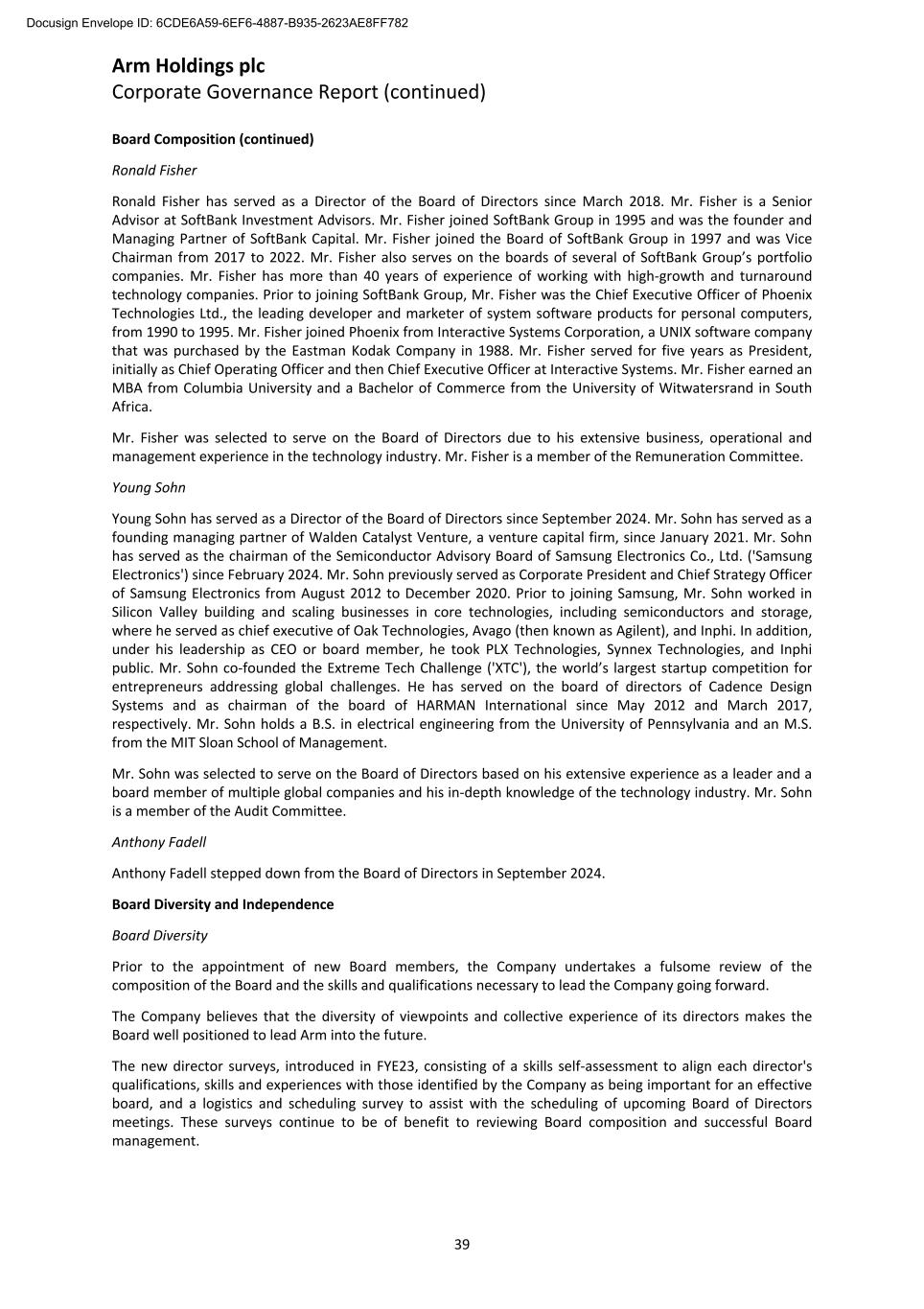
Board Composition (continued) Ronald Fisher Ronald Fisher has served as a Director of the Board of Directors since March 2018. Mr. Fisher is a Senior Advisor at SoftBank Investment Advisors. Mr. Fisher joined SoftBank Group in 1995 and was the founder and Managing Partner of SoftBank Capital. Mr. Fisher joined the Board of SoftBank Group in 1997 and was Vice Chairman from 2017 to 2022. Mr. Fisher also serves on the boards of several of SoftBank Group’s portfolio companies. Mr. Fisher has more than 40 years of experience of working with high-growth and turnaround technology companies. Prior to joining SoftBank Group, Mr. Fisher was the Chief Executive Officer of Phoenix Technologies Ltd., the leading developer and marketer of system software products for personal computers, from 1990 to 1995. Mr. Fisher joined Phoenix from Interactive Systems Corporation, a UNIX software company that was purchased by the Eastman Kodak Company in 1988. Mr. Fisher served for five years as President, initially as Chief Operating Officer and then Chief Executive Officer at Interactive Systems. Mr. Fisher earned an MBA from Columbia University and a Bachelor of Commerce from the University of Witwatersrand in South Africa. Mr. Fisher was selected to serve on the Board of Directors due to his extensive business, operational and management experience in the technology industry. Mr. Fisher is a member of the Remuneration Committee. Young Sohn Young Sohn has served as a Director of the Board of Directors since September 2024. Mr. Sohn has served as a founding managing partner of Walden Catalyst Venture, a venture capital firm, since January 2021. Mr. Sohn has served as the chairman of the Semiconductor Advisory Board of Samsung Electronics Co., Ltd. ('Samsung Electronics') since February 2024. Mr. Sohn previously served as Corporate President and Chief Strategy Officer of Samsung Electronics from August 2012 to December 2020. Prior to joining Samsung, Mr. Sohn worked in Silicon Valley building and scaling businesses in core technologies, including semiconductors and storage, where he served as chief executive of Oak Technologies, Avago (then known as Agilent), and Inphi. In addition, under his leadership as CEO or board member, he took PLX Technologies, Synnex Technologies, and Inphi public. Mr. Sohn co-founded the Extreme Tech Challenge ('XTC'), the world’s largest startup competition for entrepreneurs addressing global challenges. He has served on the board of directors of Cadence Design Systems and as chairman of the board of HARMAN International since May 2012 and March 2017, respectively. Mr. Sohn holds a B.S. in electrical engineering from the University of Pennsylvania and an M.S. from the MIT Sloan School of Management. Mr. Sohn was selected to serve on the Board of Directors based on his extensive experience as a leader and a board member of multiple global companies and his in-depth knowledge of the technology industry. Mr. Sohn is a member of the Audit Committee. Anthony Fadell Anthony Fadell stepped down from the Board of Directors in September 2024. Board Diversity and Independence Board Diversity Prior to the appointment of new Board members, the Company undertakes a fulsome review of the composition of the Board and the skills and qualifications necessary to lead the Company going forward. The Company believes that the diversity of viewpoints and collective experience of its directors makes the Board well positioned to lead Arm into the future. The new director surveys, introduced in FYE23, consisting of a skills self-assessment to align each director's qualifications, skills and experiences with those identified by the Company as being important for an effective board, and a logistics and scheduling survey to assist with the scheduling of upcoming Board of Directors meetings. These surveys continue to be of benefit to reviewing Board composition and successful Board management. Arm Holdings plc Corporate Governance Report (continued) 39 Docusign Envelope ID: 6CDE6A59-6EF6-4887-B935-2623AE8FF782

Board Diversity and Independence (continued) Board Independence The Board of Directors has affirmatively determined that none of Ms. Dykstra, Mr. Sohn, Ms. Schooler and Dr. Jacobs have a relationship that would interfere with the exercise of independent judgment in carrying out the responsibilities of director and that each of these directors is 'independent' as that term is defined under the Nasdaq Rules. The Board makes this affirmative determination annually by considering all relevant facts and circumstances regarding the past and current relationship of each director of the Board and the Director nominees, including the responses contained in each Director’s or nominee’s questionnaire, the applicable laws and rules, to confirm that each independent director meets the standards for independence as defined by applicable law and the Nasdaq Rules. In addition, there are no family relationships among any of the directors or senior management. Purpose, values and culture The Nasdaq Rules require that US listed companies adopt and disclose a code of conduct for directors, officers and employees that complies with the definition of 'code of ethics' set out in section 406 of the Sarbanes- Oxley Act of 2002. Throughout FYE25, Arm's Code of Conduct highlighted the Company's commitment to its Core Beliefs, outlined below, to operating transparently with the highest ethical standards, and to creating an inclusive environment in which representation matters, people are valued, diverse perspectives are heard, and everyone’s skills are fully utilised: • "Do great things – Work with urgency, embrace challenges, find a way"; • "We, not I – Embrace both collaboration and individual accountability for the success of Arm"; and • "Be your brilliant self – Insist on excellence. Enable performance, individuality and inclusion across Arm". In FYE25, Arm updated the required behaviours of its Core Beliefs, re-branding them to the Core Beliefs for One Arm to encourage a One Arm mindset. They will be reviewed and evolve further in FYE26 to ensure they continue to create a high challenge, high support culture that reflects the organisation’s strategy whilst fostering an engaging work environment. Please refer to Arm's Code of Conduct for more information. The management and business of Arm is guided and based on the Code of Conduct, which is foundational to Arm's 'North Star'. In compliance with section 406 of the Sarbanes-Oxley Act, the Code of Conduct promotes, among other things, honest and ethical conduct, fair, accurate and timely disclosure and compliance with applicable laws and regulations. The Code of Conduct contains mechanisms for enforcement, protection of individuals reporting questionable behaviour, clear and objective standards for compliance and a fair process for determining violations. All employees, directors, contractors and agents of the Company and the Arm Group are required to comply with the Code of Conduct. There were no amendments to, or waivers of, the Code of Conduct during FYE25. On a day-to-day basis, the Board has delegated authority to the Executive Committee to ensure that the Code of Conduct and other policies govern the Company’s activities, and to the Ethics and Compliance team to administer and interpret the Code of Conduct. Regular training is also provided on the Code of Conduct to ensure all directors, officers and employees understand expectations. Arm's 'North Star' continues to guide its strategic direction and create a single expression that portrays what it is working towards: Building the future of computing, on Arm. Together. For everyone. As the Code of Conduct encapsulates Arm's values as well as being an embodiment of how it operates, the Framework was designed with these values in mind and to ensure that these flow through every step of, and decision in relation to, the corporate governance structure. To reinforce this approach, all employees, directors and officers when planning to take action are strongly encouraged to ask themselves the following: Arm Holdings plc Corporate Governance Report (continued) 40 Docusign Envelope ID: 6CDE6A59-6EF6-4887-B935-2623AE8FF782

Purpose, values and culture (continued) 1. Does my action follow our Code, our policies, any applicable rules, regulations or laws? 2. Does my action follow our Core Beliefs? 3. Could I defend my action if it were reported on the front page of the newspaper? Arm believes that these core concepts are translated into the expected behaviours for all employees, directors, contractors and agents to the benefit of all of Arm's stakeholders. In advance of each Board meeting, the CEO and Chief Legal Officer prepare a board pack that includes a briefing paper on the application of director duties, a Stakeholder Engagement Report and other pre-read materials supplied by relevant management teams. The Stakeholder Engagement Report details key updates, communications and initiatives with strategic suppliers, employees and public organisations in particular governmental and intergovernmental bodies, trade associations and non-governmental organisations ('NGOs') – please see the Section 172 statement within the Strategic Report for further detail on stakeholder engagement. In addition to highlighting Arm's commitment to stakeholder engagement, the preparation of these board packs allows the Company to ensure effective and robust decision-making by the Board and to provide clarity over its responsibilities and relevant considerations, when making decisions. The Code of Conduct is available on the Company’s website, together with various other key governance documents. Audit Committee In accordance with the Nasdaq Rules, the Company is required to have an audit committee that satisfies the requirements of Nasdaq Rule 5605(c). Pursuant to Rule 5605(c)(2) and Rule 10A-3 of the US Securities Exchange Act of 1934, as amended, the Audit Committee satisfies the independence requirements as the Board has affirmatively determined that Ms. Dykstra, Ms. Schooler and Mr. Sohn are each an Independent Director, with financial or accounting experience appropriate for the role and that Ms. Dykstra is an 'audit committee financial expert' as defined by applicable SEC rules, with all members being financially literate. The Nasdaq Rules define 'financially literate' as being able to read and understand fundamental financial statements, including a company's balance sheet, income statement and cash flow statement. The Audit Committee oversees the corporate accounting and financial reporting process, the performance and effectiveness of the Company’s internal audit function, and the system of internal controls established by the Board as well as assisting in the review of the Company’s financial statements. The Audit Committee is governed by the Audit Committee Charter that complies with the Nasdaq Rules. The key responsibilities of the Audit Committee are set out in the Audit Committee Charter, which is available on the Company’s website, and includes, among other things: • selecting a qualified firm to serve as (i) the independent registered public accounting firm to audit the financial statements and (ii) the UK statutory auditors; • helping to ensure the independence and performance of the independent registered public accounting firm and the UK statutory auditors; • helping to maintain and foster an open avenue of communication between management and the independent registered public accounting firm; • discussing the scope and results of the audit with the independent registered public accounting firm and UK statutory auditors, and reviewing, with management, the independent registered public accounting firm and UK statutory auditors, the interim and year-end operating results; • developing procedures for employees to submit concerns anonymously about questionable accounting or audit matters; • reviewing and approving, if applicable, in accordance with the Company's related party transactions policy, any proposed transactions with related persons; Arm Holdings plc Corporate Governance Report (continued) 41 Docusign Envelope ID: 6CDE6A59-6EF6-4887-B935-2623AE8FF782
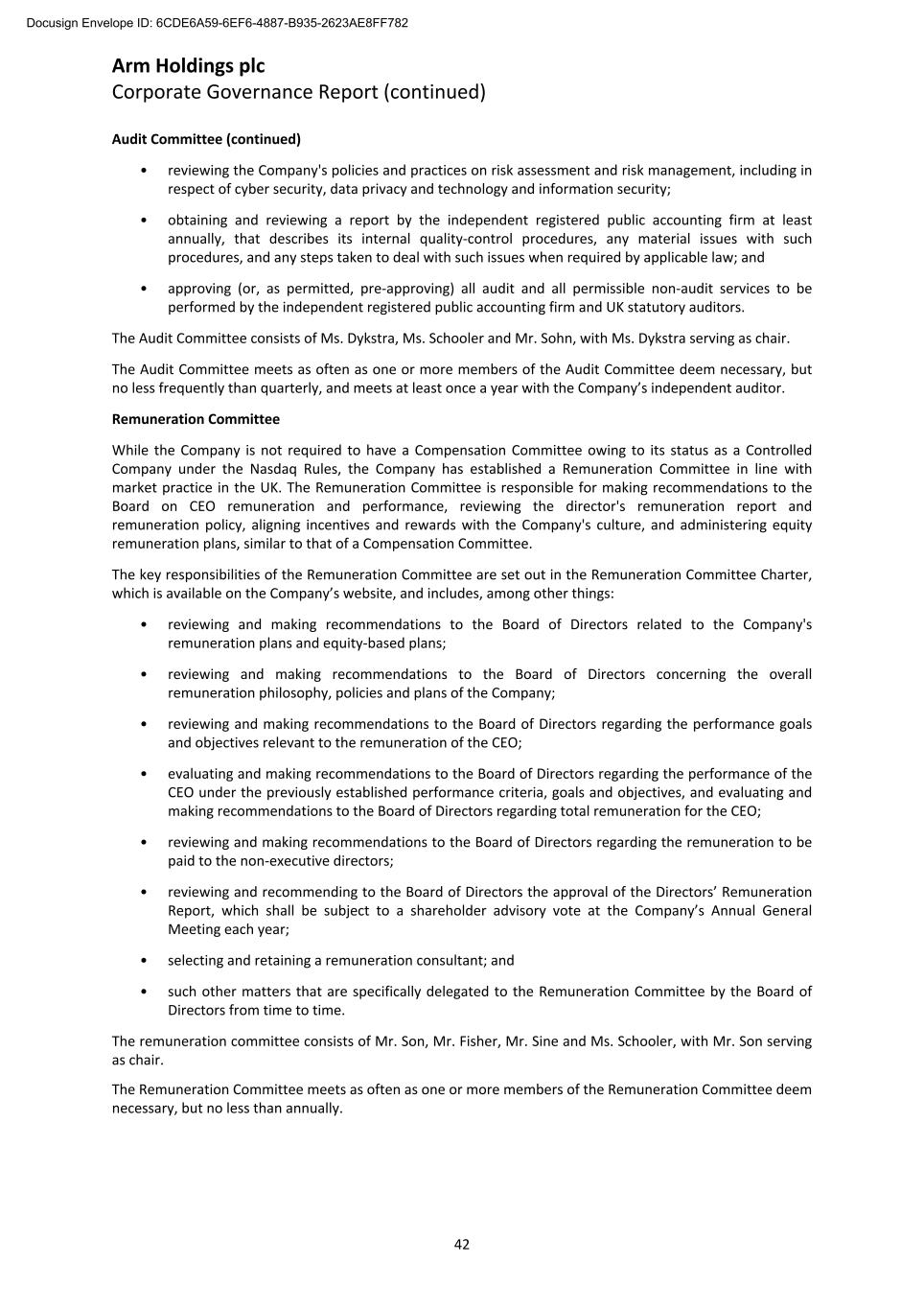
Audit Committee (continued) • reviewing the Company's policies and practices on risk assessment and risk management, including in respect of cyber security, data privacy and technology and information security; • obtaining and reviewing a report by the independent registered public accounting firm at least annually, that describes its internal quality-control procedures, any material issues with such procedures, and any steps taken to deal with such issues when required by applicable law; and • approving (or, as permitted, pre-approving) all audit and all permissible non-audit services to be performed by the independent registered public accounting firm and UK statutory auditors. The Audit Committee consists of Ms. Dykstra, Ms. Schooler and Mr. Sohn, with Ms. Dykstra serving as chair. The Audit Committee meets as often as one or more members of the Audit Committee deem necessary, but no less frequently than quarterly, and meets at least once a year with the Company’s independent auditor. Remuneration Committee While the Company is not required to have a Compensation Committee owing to its status as a Controlled Company under the Nasdaq Rules, the Company has established a Remuneration Committee in line with market practice in the UK. The Remuneration Committee is responsible for making recommendations to the Board on CEO remuneration and performance, reviewing the director's remuneration report and remuneration policy, aligning incentives and rewards with the Company's culture, and administering equity remuneration plans, similar to that of a Compensation Committee. The key responsibilities of the Remuneration Committee are set out in the Remuneration Committee Charter, which is available on the Company’s website, and includes, among other things: • reviewing and making recommendations to the Board of Directors related to the Company's remuneration plans and equity-based plans; • reviewing and making recommendations to the Board of Directors concerning the overall remuneration philosophy, policies and plans of the Company; • reviewing and making recommendations to the Board of Directors regarding the performance goals and objectives relevant to the remuneration of the CEO; • evaluating and making recommendations to the Board of Directors regarding the performance of the CEO under the previously established performance criteria, goals and objectives, and evaluating and making recommendations to the Board of Directors regarding total remuneration for the CEO; • reviewing and making recommendations to the Board of Directors regarding the remuneration to be paid to the non-executive directors; • reviewing and recommending to the Board of Directors the approval of the Directors’ Remuneration Report, which shall be subject to a shareholder advisory vote at the Company’s Annual General Meeting each year; • selecting and retaining a remuneration consultant; and • such other matters that are specifically delegated to the Remuneration Committee by the Board of Directors from time to time. The remuneration committee consists of Mr. Son, Mr. Fisher, Mr. Sine and Ms. Schooler, with Mr. Son serving as chair. The Remuneration Committee meets as often as one or more members of the Remuneration Committee deem necessary, but no less than annually. Arm Holdings plc Corporate Governance Report (continued) 42 Docusign Envelope ID: 6CDE6A59-6EF6-4887-B935-2623AE8FF782
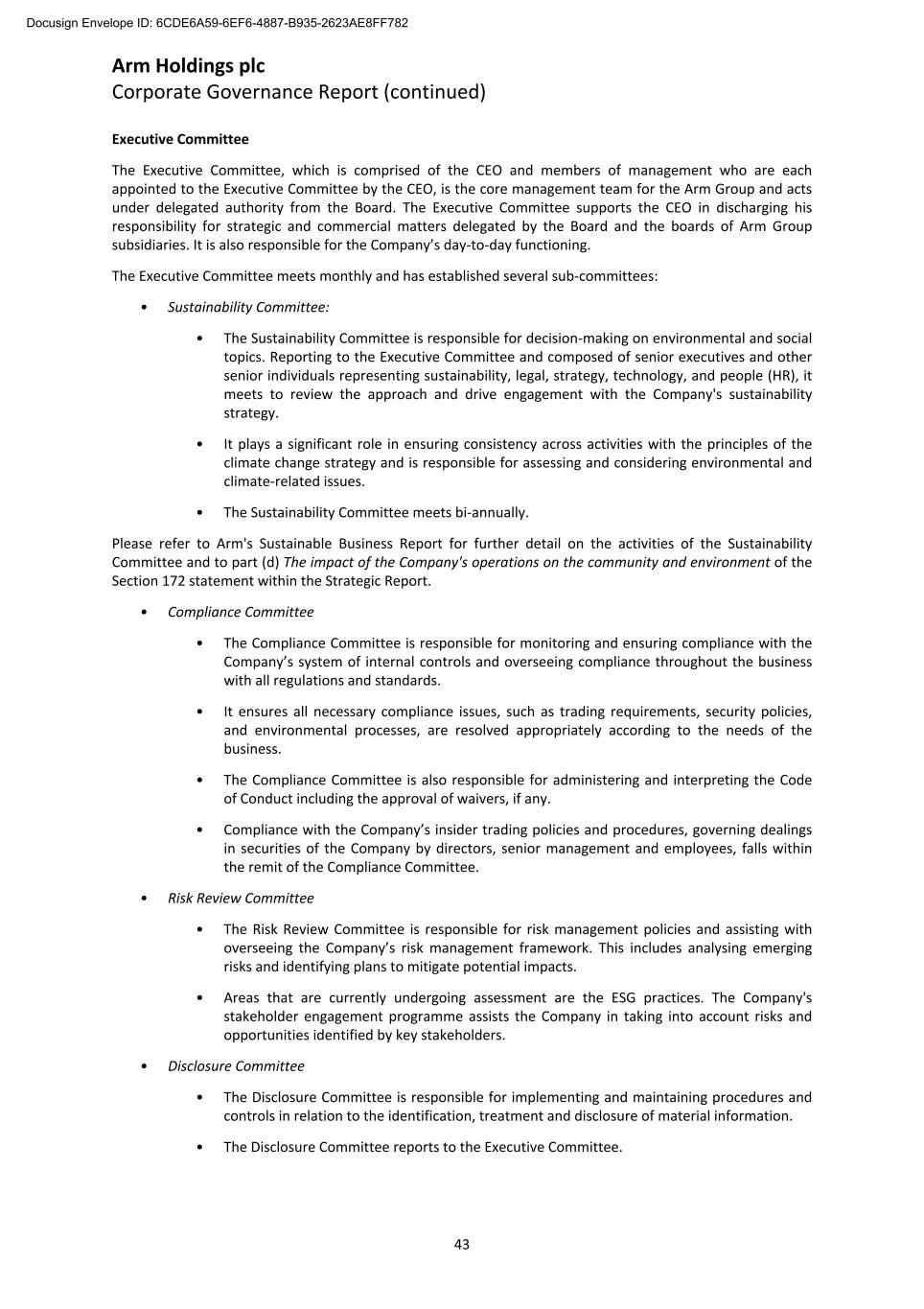
Executive Committee The Executive Committee, which is comprised of the CEO and members of management who are each appointed to the Executive Committee by the CEO, is the core management team for the Arm Group and acts under delegated authority from the Board. The Executive Committee supports the CEO in discharging his responsibility for strategic and commercial matters delegated by the Board and the boards of Arm Group subsidiaries. It is also responsible for the Company’s day-to-day functioning. The Executive Committee meets monthly and has established several sub-committees: • Sustainability Committee: • The Sustainability Committee is responsible for decision-making on environmental and social topics. Reporting to the Executive Committee and composed of senior executives and other senior individuals representing sustainability, legal, strategy, technology, and people (HR), it meets to review the approach and drive engagement with the Company's sustainability strategy. • It plays a significant role in ensuring consistency across activities with the principles of the climate change strategy and is responsible for assessing and considering environmental and climate-related issues. • The Sustainability Committee meets bi-annually. Please refer to Arm's Sustainable Business Report for further detail on the activities of the Sustainability Committee and to part (d) The impact of the Company's operations on the community and environment of the Section 172 statement within the Strategic Report. • Compliance Committee • The Compliance Committee is responsible for monitoring and ensuring compliance with the Company’s system of internal controls and overseeing compliance throughout the business with all regulations and standards. • It ensures all necessary compliance issues, such as trading requirements, security policies, and environmental processes, are resolved appropriately according to the needs of the business. • The Compliance Committee is also responsible for administering and interpreting the Code of Conduct including the approval of waivers, if any. • Compliance with the Company’s insider trading policies and procedures, governing dealings in securities of the Company by directors, senior management and employees, falls within the remit of the Compliance Committee. • Risk Review Committee • The Risk Review Committee is responsible for risk management policies and assisting with overseeing the Company’s risk management framework. This includes analysing emerging risks and identifying plans to mitigate potential impacts. • Areas that are currently undergoing assessment are the ESG practices. The Company's stakeholder engagement programme assists the Company in taking into account risks and opportunities identified by key stakeholders. • Disclosure Committee • The Disclosure Committee is responsible for implementing and maintaining procedures and controls in relation to the identification, treatment and disclosure of material information. • The Disclosure Committee reports to the Executive Committee. Arm Holdings plc Corporate Governance Report (continued) 43 Docusign Envelope ID: 6CDE6A59-6EF6-4887-B935-2623AE8FF782
Disclosure Controls and Procedures The Sarbanes-Oxley Act requires, among other things, that the Company maintains effective disclosure controls and procedures and internal control over financial reporting. The Board and the Audit Committee are committed to having a strong internal control environment and understand the benefit that a comprehensive and well-designed set of controls has on ensuring the reliability of financial statements. Furthermore, internal controls are continuously monitored. During the fiscal years ended 31 March 2022 and 2021, the Company identified a material weakness relating to information technology general controls over its information systems. To address the material weakness, the Company implemented a remediation plan which was completed in the fiscal year ended 31 March 2025. The Company is also prepared to take additional actions, such as implementing and enhancing internal controls and procedures and hiring additional accounting or internal audit staff, if required and depending on whether any further material weaknesses or significant control deficiencies are identified following the next evaluation of the disclosure controls and procedures. Arm Holdings plc Corporate Governance Report (continued) 44 Docusign Envelope ID: 6CDE6A59-6EF6-4887-B935-2623AE8FF782
Remuneration Committee Chair's Annual Statement Dear Shareholders, I am delighted to present the Directors’ Remuneration Report for the Company for the year ended 31 March 2025 ('FYE25'). We continue to operate within the Remuneration Policy approved by our shareholders in September 2024. Arm has demonstrated strong execution in FYE25, delivering our first +$1 billion quarter in Q4 and with full year revenues over $4 billion for the first time. This revenue growth was driven by record license revenues, with major companies making long-term commitments to deploy Arm technology in their products, especially with more AI capability needed in data centres and in edge devices. Record revenues were also driven by Armv9-based CPUs and our compute subsystems, both with higher per-chip royalty rates, gaining share across multiple end markets. To help maintain this momentum, Arm has continued to introduce new technologies, such as the Arm Cortex-A320 for AI in edge devices, and invest in our developer ecosystem such as the Arm extension for GitHub CoPilot. We believe that our ecosystem is now the largest in the world with more than 20 million developers working on Arm-based products. Overview of the Remuneration Philosophy and Remuneration Policy The Remuneration Committee continues to believe that the remuneration package offered to the Chief Executive Officer ('CEO'), the sole Executive Director currently, is appropriate and competitive relative to industry leading peers, reflective of Arm’s ambition to attract the highest calibre global talent. Workforce Compensation The Remuneration Committee has carefully considered pay for the CEO in the context of wider Executive remuneration arrangements and workforce pay structures more broadly. Remuneration Committee Activities During FYE25, the Remuneration Committee has been focused on continuing to ensure the pay structures at Arm are aligned with the Company’s growth ambitions through the setting of FYE26 targets within the parameters set out in our approved Remuneration Policy. The Board of Directors reviewed Non-Executive Director compensation relative to benchmarks in 2024 and deemed the structure and quantum to continue to be appropriate. These benchmarks will next be reviewed in 2026. On a quarterly basis, the Board of Directors receives an engagement report from management detailing significant updates, communications and initiatives with key stakeholders, including employees. The content of this stakeholder engagement report allows the Company to ensure effective and robust decision-making by the Board of Directors and to provide clarity over its responsibilities and relevant considerations, when making decisions. FYE25 Performance and Remuneration Outcomes The Company's remuneration plans ensure that strong performance during the year results in above target value delivered to the Executive Director. This demonstrates the high degree of alignment we strive for. The performance measures reflected in the Company's performance-based remuneration plans for the year included Revenue, Non-GAAP Operating Income, and strategic measures reflecting key product and solution development milestones and commercial achievements. The Company’s revenues for the year ended 31 March 2025 increased to $4,007 million and Non-GAAP Operating Income for the fiscal year ended 31 March 2025 was $1,871 million, resulting in financial performance achievement of 96% of a possible 100% under both the Arm Annual Bonus Plan (‘Bonus Plan’) and the Arm Holdings 2023 Omnibus Incentive Plan (‘Omnibus Incentive Plan’). This, combined with good delivery against our strategic measures during the year, resulted in Company performance of 115% out of a possible 150% under the Bonus Plan, 134% out of a possible 200% under the FYE24 Performance Share Plan for the year, and 108% out of a possible 125% for the Executive Director under the FYE25 Performance Share Plan for the year. Arm Holdings plc Directors' Remuneration 45 Docusign Envelope ID: 6CDE6A59-6EF6-4887-B935-2623AE8FF782

Remuneration Committee Chair's Annual Statement (continued) Annual bonus Annual bonus performance during the year was measured against both financial and strategic measures. We awarded Mr. Haas, the CEO, an annual bonus of $2,329k, paid in May 2025. This is reflective of the corporate performance achievement relative to the performance measures (determined to be 115%), and the Remuneration Committee’s assessment of his personal performance leading to a personal performance multiplier of 1.2x and therefore a total payout at 138% of target. Equity awards During the year ended 31 March 2025 Mr. Haas, the CEO, received an award of $18,900k in Performance Share Units ('PSUs'). This award will vest annually over three years (25%, 25% and 50%, respectively), in the range of 0% to 125% subject to achievement of financial, strategic and relative Total Shareholder Return ('TSR') measures detailed in the Remuneration Report. PSU performance during the year was measured against both financial and strategic measures. We determined company PSU performance for the year to be 134% out of a maximum of 200%. For the CEO's FYE25 Award, under which there is a maximum vest of 125%, this has been adjusted down to 108% in line with the Remuneration Policy. Discretion The Remuneration Committee reviewed the appropriateness of the outcomes of both the annual bonus and long-term incentives in light of both the relevant performance targets and wider internal and external considerations across the respective measurement periods. For payments and vesting with respect to FYE25 performance achievement, it was agreed that the outcomes were appropriate and that no adjustments were required. Therefore, no discretion has been exercised in respect of payments to the Executive Director for FYE25 performance. As per the new Policy, the Remuneration Committee continues to reserve discretion to vary the amount of any component in the package up to the limits set out in the Policy in relation to any new Executive Directors. The full details of the FYE25 remuneration paid to directors and the basis for its determination are set out within the section entitled Directors' Remuneration Report below. Looking Forward Over the coming year, in addition to our normal Remuneration Committee duties, we will continue to focus on implementing our remuneration framework and strategy. Masayoshi Son, Remuneration Committee Chair Date: 28 May 2025 Arm Holdings plc Directors' Remuneration (continued) 46 Docusign Envelope ID: 6CDE6A59-6EF6-4887-B935-2623AE8FF782
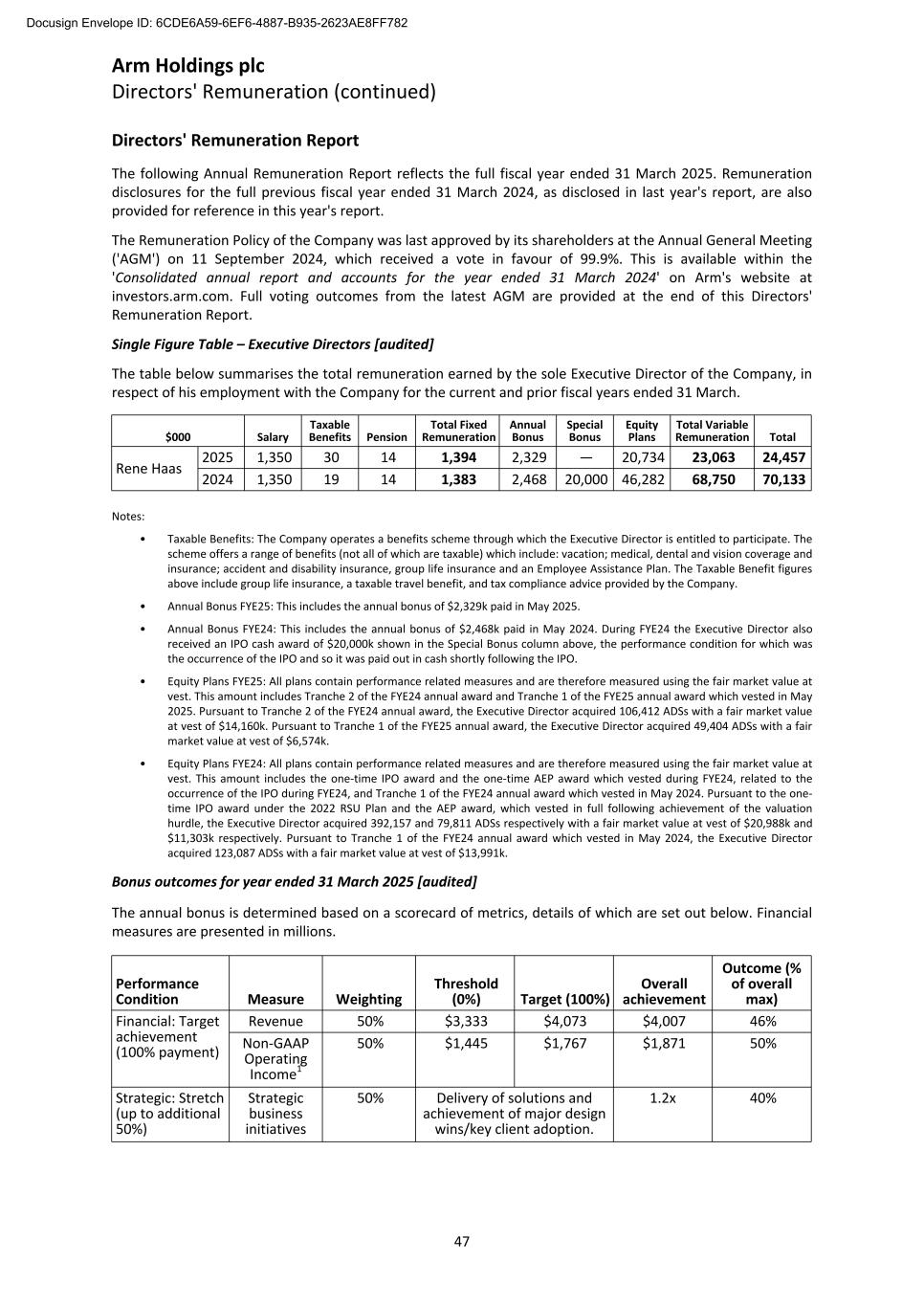
Directors' Remuneration Report The following Annual Remuneration Report reflects the full fiscal year ended 31 March 2025. Remuneration disclosures for the full previous fiscal year ended 31 March 2024, as disclosed in last year's report, are also provided for reference in this year's report. The Remuneration Policy of the Company was last approved by its shareholders at the Annual General Meeting ('AGM') on 11 September 2024, which received a vote in favour of 99.9%. This is available within the 'Consolidated annual report and accounts for the year ended 31 March 2024' on Arm's website at investors.arm.com. Full voting outcomes from the latest AGM are provided at the end of this Directors' Remuneration Report. Single Figure Table – Executive Directors [audited] The table below summarises the total remuneration earned by the sole Executive Director of the Company, in respect of his employment with the Company for the current and prior fiscal years ended 31 March. $000 Salary Taxable Benefits Pension Total Fixed Remuneration Annual Bonus Special Bonus Equity Plans Total Variable Remuneration Total Rene Haas 2025 1,350 30 14 1,394 2,329 — 20,734 23,063 24,457 2024 1,350 19 14 1,383 2,468 20,000 46,282 68,750 70,133 Notes: • Taxable Benefits: The Company operates a benefits scheme through which the Executive Director is entitled to participate. The scheme offers a range of benefits (not all of which are taxable) which include: vacation; medical, dental and vision coverage and insurance; accident and disability insurance, group life insurance and an Employee Assistance Plan. The Taxable Benefit figures above include group life insurance, a taxable travel benefit, and tax compliance advice provided by the Company. • Annual Bonus FYE25: This includes the annual bonus of $2,329k paid in May 2025. • Annual Bonus FYE24: This includes the annual bonus of $2,468k paid in May 2024. During FYE24 the Executive Director also received an IPO cash award of $20,000k shown in the Special Bonus column above, the performance condition for which was the occurrence of the IPO and so it was paid out in cash shortly following the IPO. • Equity Plans FYE25: All plans contain performance related measures and are therefore measured using the fair market value at vest. This amount includes Tranche 2 of the FYE24 annual award and Tranche 1 of the FYE25 annual award which vested in May 2025. Pursuant to Tranche 2 of the FYE24 annual award, the Executive Director acquired 106,412 ADSs with a fair market value at vest of $14,160k. Pursuant to Tranche 1 of the FYE25 annual award, the Executive Director acquired 49,404 ADSs with a fair market value at vest of $6,574k. • Equity Plans FYE24: All plans contain performance related measures and are therefore measured using the fair market value at vest. This amount includes the one-time IPO award and the one-time AEP award which vested during FYE24, related to the occurrence of the IPO during FYE24, and Tranche 1 of the FYE24 annual award which vested in May 2024. Pursuant to the one- time IPO award under the 2022 RSU Plan and the AEP award, which vested in full following achievement of the valuation hurdle, the Executive Director acquired 392,157 and 79,811 ADSs respectively with a fair market value at vest of $20,988k and $11,303k respectively. Pursuant to Tranche 1 of the FYE24 annual award which vested in May 2024, the Executive Director acquired 123,087 ADSs with a fair market value at vest of $13,991k. Bonus outcomes for year ended 31 March 2025 [audited] The annual bonus is determined based on a scorecard of metrics, details of which are set out below. Financial measures are presented in millions. Performance Condition Measure Weighting Threshold (0%) Target (100%) Overall achievement Outcome (% of overall max) Financial: Target achievement (100% payment) Revenue 50% $3,333 $4,073 $4,007 46% Non-GAAP Operating Income1 50% $1,445 $1,767 $1,871 50% Strategic: Stretch (up to additional 50%) Strategic business initiatives 50% Delivery of solutions and achievement of major design wins/key client adoption. 1.2x 40% Arm Holdings plc Directors' Remuneration (continued) 47 Docusign Envelope ID: 6CDE6A59-6EF6-4887-B935-2623AE8FF782
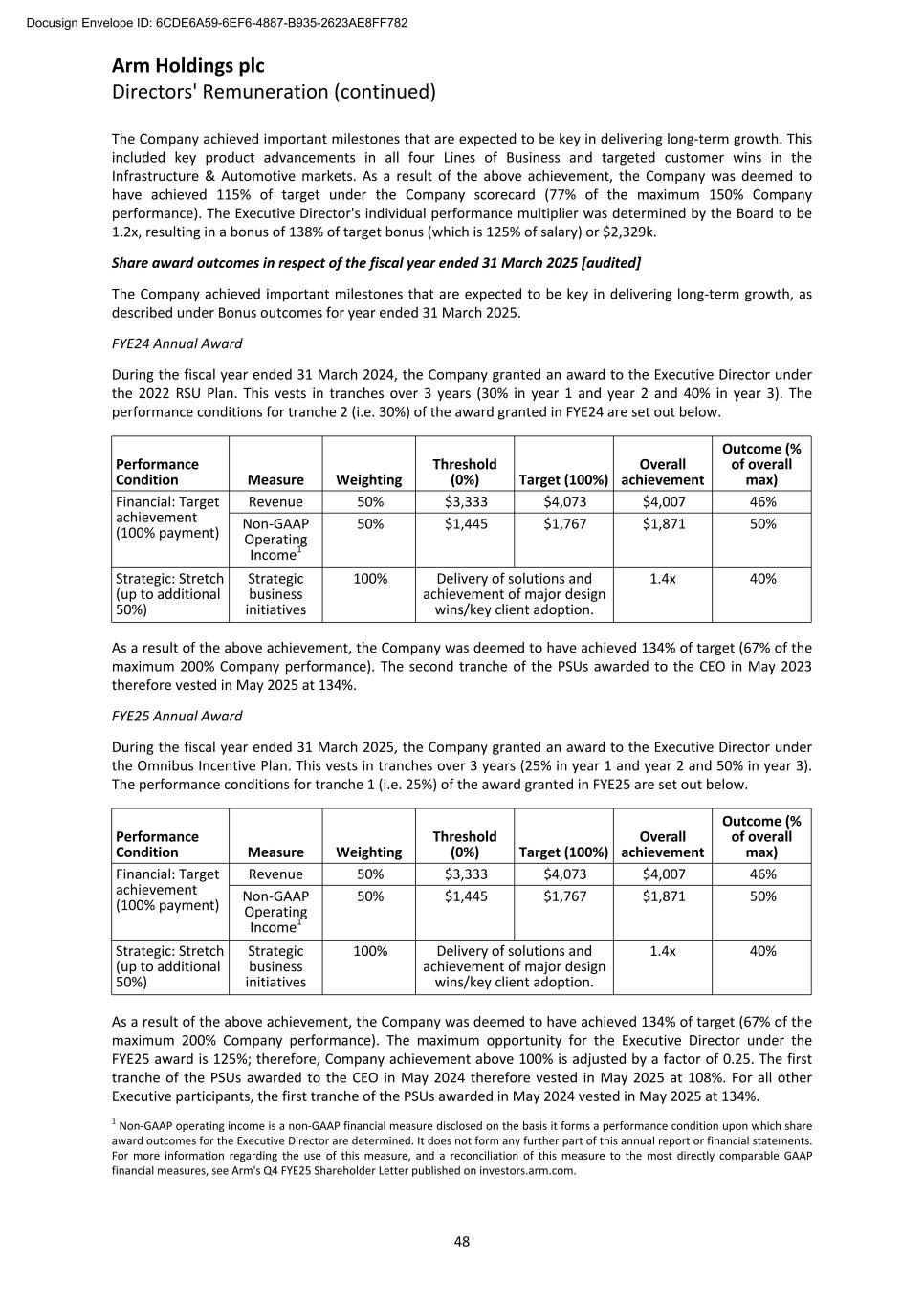
The Company achieved important milestones that are expected to be key in delivering long-term growth. This included key product advancements in all four Lines of Business and targeted customer wins in the Infrastructure & Automotive markets. As a result of the above achievement, the Company was deemed to have achieved 115% of target under the Company scorecard (77% of the maximum 150% Company performance). The Executive Director's individual performance multiplier was determined by the Board to be 1.2x, resulting in a bonus of 138% of target bonus (which is 125% of salary) or $2,329k. Share award outcomes in respect of the fiscal year ended 31 March 2025 [audited] The Company achieved important milestones that are expected to be key in delivering long-term growth, as described under Bonus outcomes for year ended 31 March 2025. FYE24 Annual Award During the fiscal year ended 31 March 2024, the Company granted an award to the Executive Director under the 2022 RSU Plan. This vests in tranches over 3 years (30% in year 1 and year 2 and 40% in year 3). The performance conditions for tranche 2 (i.e. 30%) of the award granted in FYE24 are set out below. Performance Condition Measure Weighting Threshold (0%) Target (100%) Overall achievement Outcome (% of overall max) Financial: Target achievement (100% payment) Revenue 50% $3,333 $4,073 $4,007 46% Non-GAAP Operating Income1 50% $1,445 $1,767 $1,871 50% Strategic: Stretch (up to additional 50%) Strategic business initiatives 100% Delivery of solutions and achievement of major design wins/key client adoption. 1.4x 40% As a result of the above achievement, the Company was deemed to have achieved 134% of target (67% of the maximum 200% Company performance). The second tranche of the PSUs awarded to the CEO in May 2023 therefore vested in May 2025 at 134%. FYE25 Annual Award During the fiscal year ended 31 March 2025, the Company granted an award to the Executive Director under the Omnibus Incentive Plan. This vests in tranches over 3 years (25% in year 1 and year 2 and 50% in year 3). The performance conditions for tranche 1 (i.e. 25%) of the award granted in FYE25 are set out below. Performance Condition Measure Weighting Threshold (0%) Target (100%) Overall achievement Outcome (% of overall max) Financial: Target achievement (100% payment) Revenue 50% $3,333 $4,073 $4,007 46% Non-GAAP Operating Income1 50% $1,445 $1,767 $1,871 50% Strategic: Stretch (up to additional 50%) Strategic business initiatives 100% Delivery of solutions and achievement of major design wins/key client adoption. 1.4x 40% As a result of the above achievement, the Company was deemed to have achieved 134% of target (67% of the maximum 200% Company performance). The maximum opportunity for the Executive Director under the FYE25 award is 125%; therefore, Company achievement above 100% is adjusted by a factor of 0.25. The first tranche of the PSUs awarded to the CEO in May 2024 therefore vested in May 2025 at 108%. For all other Executive participants, the first tranche of the PSUs awarded in May 2024 vested in May 2025 at 134%. 1 Non-GAAP operating income is a non-GAAP financial measure disclosed on the basis it forms a performance condition upon which share award outcomes for the Executive Director are determined. It does not form any further part of this annual report or financial statements. For more information regarding the use of this measure, and a reconciliation of this measure to the most directly comparable GAAP financial measures, see Arm's Q4 FYE25 Shareholder Letter published on investors.arm.com. Arm Holdings plc Directors' Remuneration (continued) 48 Docusign Envelope ID: 6CDE6A59-6EF6-4887-B935-2623AE8FF782
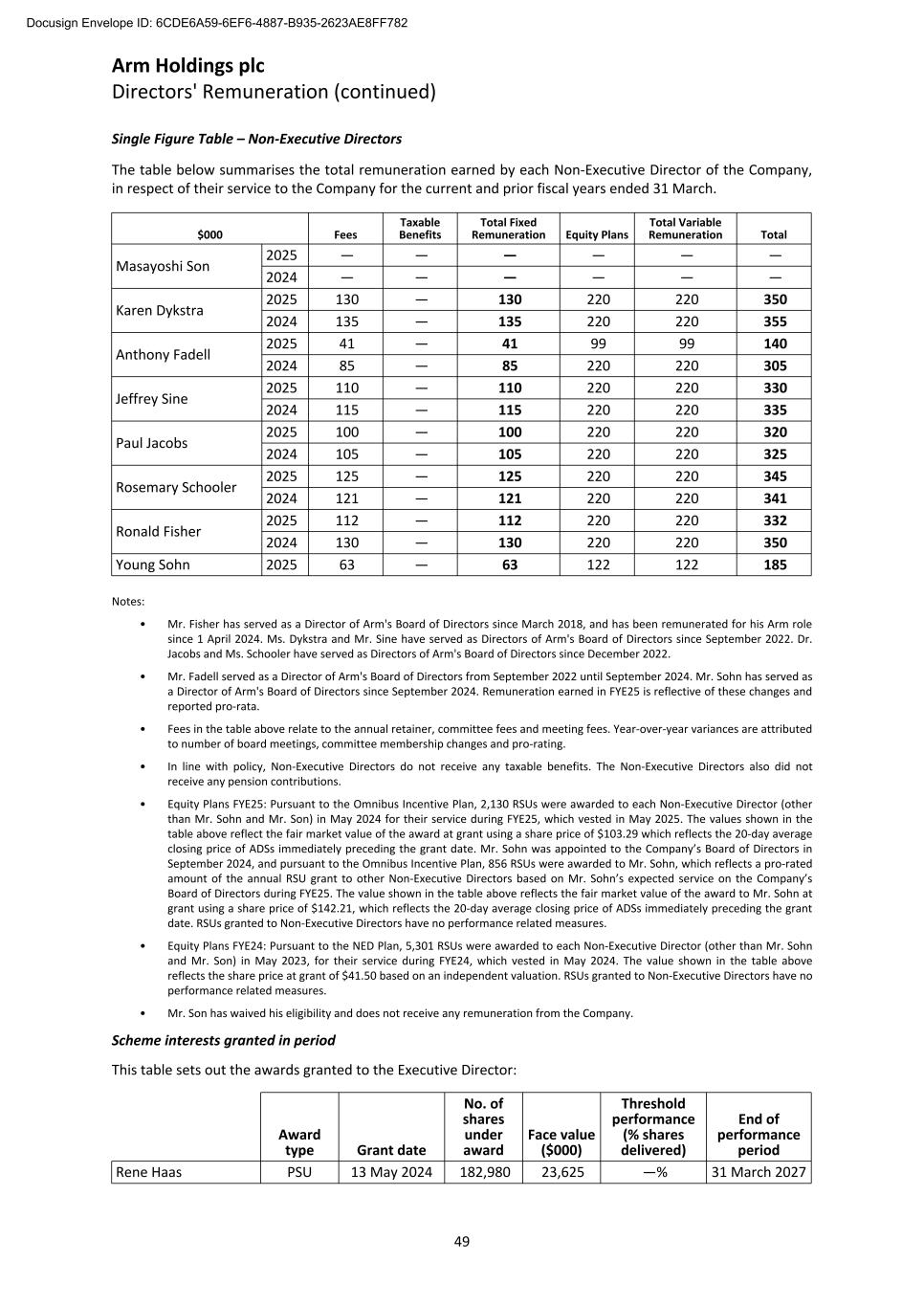
Single Figure Table – Non-Executive Directors The table below summarises the total remuneration earned by each Non-Executive Director of the Company, in respect of their service to the Company for the current and prior fiscal years ended 31 March. $000 Fees Taxable Benefits Total Fixed Remuneration Equity Plans Total Variable Remuneration Total Masayoshi Son 2025 — — — — — — 2024 — — — — — — Karen Dykstra 2025 130 — 130 220 220 350 2024 135 — 135 220 220 355 Anthony Fadell 2025 41 — 41 99 99 140 2024 85 — 85 220 220 305 Jeffrey Sine 2025 110 — 110 220 220 330 2024 115 — 115 220 220 335 Paul Jacobs 2025 100 — 100 220 220 320 2024 105 — 105 220 220 325 Rosemary Schooler 2025 125 — 125 220 220 345 2024 121 — 121 220 220 341 Ronald Fisher 2025 112 — 112 220 220 332 2024 130 — 130 220 220 350 Young Sohn 2025 63 — 63 122 122 185 Notes: • Mr. Fisher has served as a Director of Arm's Board of Directors since March 2018, and has been remunerated for his Arm role since 1 April 2024. Ms. Dykstra and Mr. Sine have served as Directors of Arm's Board of Directors since September 2022. Dr. Jacobs and Ms. Schooler have served as Directors of Arm's Board of Directors since December 2022. • Mr. Fadell served as a Director of Arm's Board of Directors from September 2022 until September 2024. Mr. Sohn has served as a Director of Arm's Board of Directors since September 2024. Remuneration earned in FYE25 is reflective of these changes and reported pro-rata. • Fees in the table above relate to the annual retainer, committee fees and meeting fees. Year-over-year variances are attributed to number of board meetings, committee membership changes and pro-rating. • In line with policy, Non-Executive Directors do not receive any taxable benefits. The Non-Executive Directors also did not receive any pension contributions. • Equity Plans FYE25: Pursuant to the Omnibus Incentive Plan, 2,130 RSUs were awarded to each Non-Executive Director (other than Mr. Sohn and Mr. Son) in May 2024 for their service during FYE25, which vested in May 2025. The values shown in the table above reflect the fair market value of the award at grant using a share price of $103.29 which reflects the 20-day average closing price of ADSs immediately preceding the grant date. Mr. Sohn was appointed to the Company’s Board of Directors in September 2024, and pursuant to the Omnibus Incentive Plan, 856 RSUs were awarded to Mr. Sohn, which reflects a pro-rated amount of the annual RSU grant to other Non-Executive Directors based on Mr. Sohn’s expected service on the Company’s Board of Directors during FYE25. The value shown in the table above reflects the fair market value of the award to Mr. Sohn at grant using a share price of $142.21, which reflects the 20-day average closing price of ADSs immediately preceding the grant date. RSUs granted to Non-Executive Directors have no performance related measures. • Equity Plans FYE24: Pursuant to the NED Plan, 5,301 RSUs were awarded to each Non-Executive Director (other than Mr. Sohn and Mr. Son) in May 2023, for their service during FYE24, which vested in May 2024. The value shown in the table above reflects the share price at grant of $41.50 based on an independent valuation. RSUs granted to Non-Executive Directors have no performance related measures. • Mr. Son has waived his eligibility and does not receive any remuneration from the Company. Scheme interests granted in period This table sets out the awards granted to the Executive Director: Award type Grant date No. of shares under award Face value ($000) Threshold performance (% shares delivered) End of performance period Rene Haas PSU 13 May 2024 182,980 23,625 —% 31 March 2027 Arm Holdings plc Directors' Remuneration (continued) 49 Docusign Envelope ID: 6CDE6A59-6EF6-4887-B935-2623AE8FF782
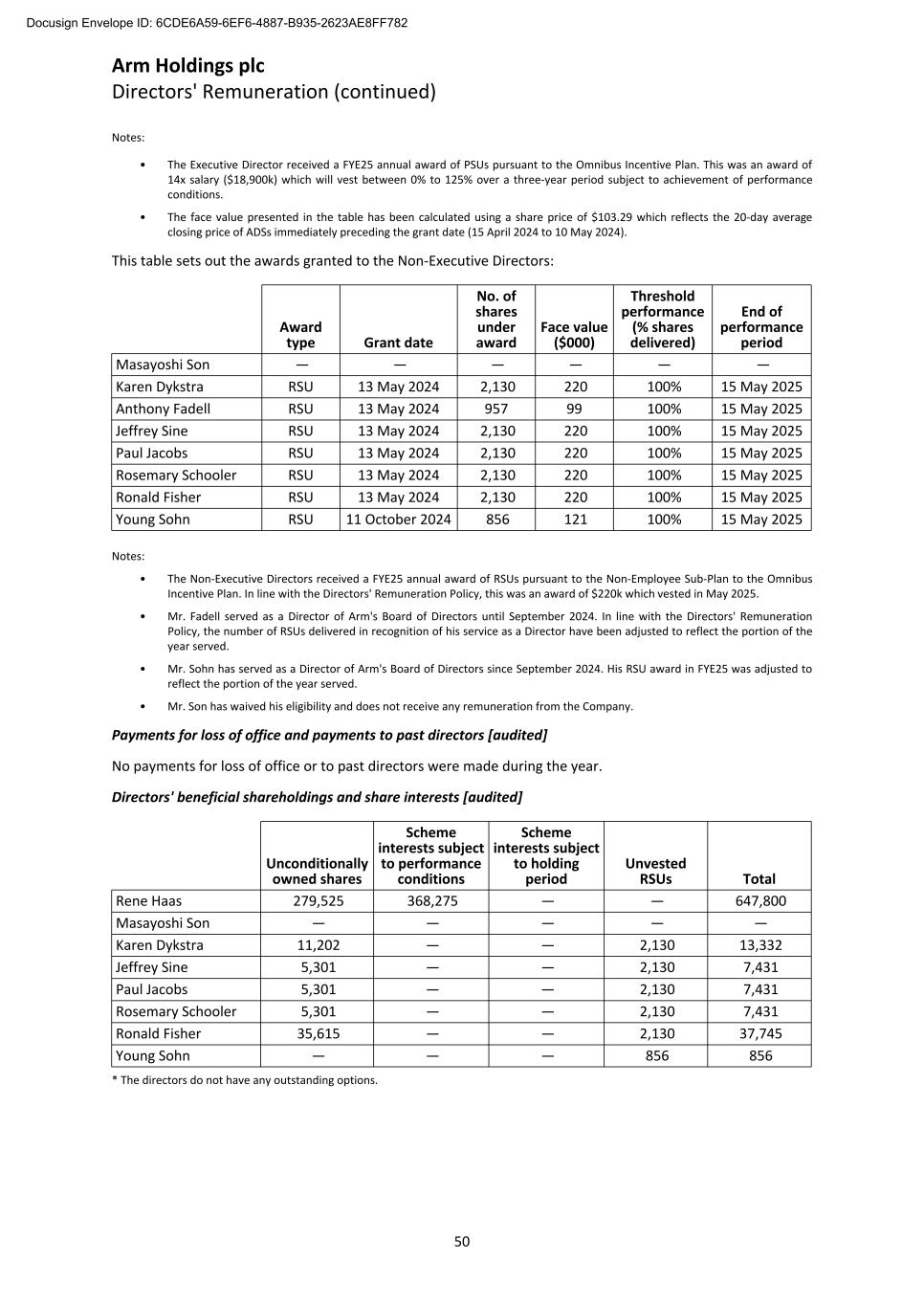
Notes: • The Executive Director received a FYE25 annual award of PSUs pursuant to the Omnibus Incentive Plan. This was an award of 14x salary ($18,900k) which will vest between 0% to 125% over a three-year period subject to achievement of performance conditions. • The face value presented in the table has been calculated using a share price of $103.29 which reflects the 20-day average closing price of ADSs immediately preceding the grant date (15 April 2024 to 10 May 2024). This table sets out the awards granted to the Non-Executive Directors: Award type Grant date No. of shares under award Face value ($000) Threshold performance (% shares delivered) End of performance period Masayoshi Son — — — — — — Karen Dykstra RSU 13 May 2024 2,130 220 100% 15 May 2025 Anthony Fadell RSU 13 May 2024 957 99 100% 15 May 2025 Jeffrey Sine RSU 13 May 2024 2,130 220 100% 15 May 2025 Paul Jacobs RSU 13 May 2024 2,130 220 100% 15 May 2025 Rosemary Schooler RSU 13 May 2024 2,130 220 100% 15 May 2025 Ronald Fisher RSU 13 May 2024 2,130 220 100% 15 May 2025 Young Sohn RSU 11 October 2024 856 121 100% 15 May 2025 Notes: • The Non-Executive Directors received a FYE25 annual award of RSUs pursuant to the Non-Employee Sub-Plan to the Omnibus Incentive Plan. In line with the Directors' Remuneration Policy, this was an award of $220k which vested in May 2025. • Mr. Fadell served as a Director of Arm's Board of Directors until September 2024. In line with the Directors' Remuneration Policy, the number of RSUs delivered in recognition of his service as a Director have been adjusted to reflect the portion of the year served. • Mr. Sohn has served as a Director of Arm's Board of Directors since September 2024. His RSU award in FYE25 was adjusted to reflect the portion of the year served. • Mr. Son has waived his eligibility and does not receive any remuneration from the Company. Payments for loss of office and payments to past directors [audited] No payments for loss of office or to past directors were made during the year. Directors' beneficial shareholdings and share interests [audited] Unconditionally owned shares Scheme interests subject to performance conditions Scheme interests subject to holding period Unvested RSUs Total Rene Haas 279,525 368,275 — — 647,800 Masayoshi Son — — — — — Karen Dykstra 11,202 — — 2,130 13,332 Jeffrey Sine 5,301 — — 2,130 7,431 Paul Jacobs 5,301 — — 2,130 7,431 Rosemary Schooler 5,301 — — 2,130 7,431 Ronald Fisher 35,615 — — 2,130 37,745 Young Sohn — — — 856 856 * The directors do not have any outstanding options. Arm Holdings plc Directors' Remuneration (continued) 50 Docusign Envelope ID: 6CDE6A59-6EF6-4887-B935-2623AE8FF782

Notes: • The information in the table above is reflective of the position as at 31 March 2025. • The CEO is required to hold Arm ADSs to an equivalent of 1,000% of their base salary. Based on the 20 trading day average closing price for the period to 31 March 2025 ($117.48), the value of the CEO's unconditionally owned shares is greater than 5,600% of base salary. • Non-Executive Directors are required to hold Arm ADSs to an equivalent of 300% of their annual cash retainer ($240k). Based on the 20 trading day average closing price for the period to 31 March 2025 ($117.48), the value of the Non-Executive Directors' unvested RSUs and unconditionally owned shares is greater than this value for all Non-Executive Directors except Young Sohn, who has five years from his date of appointment to achieve the required beneficial shareholding under the policy. Performance graph The Total Shareholder Return ('TSR') graph represents the value at 31 March 2025 of $100 invested in ADSs of Arm Holdings plc from 14 September 2023, compared with the value of $100 invested in the S&P 500 IT Sector Index. This index is considered the most relevant and appropriate comparator index for the Company, incorporating organisations Arm's shareholders may be likely to consider for their investments. It is also the index to be used in the future Performance Share Plan design. CEO remuneration The table below shows the total remuneration received by the chief executive for the fiscal years ended 31 March 2025 and 31 March 2024. The Company has not disclosed for years prior to Arm’s listing on the Nasdaq. $000 Year ended 31 March 2025 Year ended 31 March 2024 CEO single figure 24,457 70,133 Annual bonus as % of max 61% 78% PSUs as % of max 86% 78% Notes: • The PSUs as % of max in the table above reflects the most recent (FYE25) award under which the CEO award is capped at 125% of target and achievement was 108% (86% of maximum). Under the prior grant, achievement was 134% out of a possible 200% maximum resulting in 67% as a percentage of max. Arm Holdings plc Directors' Remuneration (continued) 51 Docusign Envelope ID: 6CDE6A59-6EF6-4887-B935-2623AE8FF782

Percentage change in remuneration From year ended 31 March 2024 to year ended 31 March 2025 Base salary/fees5 Benefits Bonus Rene Haas1 —% 35% (6)% Masayoshi Son2 Karen Dykstra (4)% Anthony Fadell3 (52)% Jeffrey Sine (4)% Paul Jacobs (5)% Rosemary Schooler 4% Ronald Fisher (14)% Young Sohn4 Employees6, 7 15% 20% Notes: 1. The percentage change in Bonus presented for the CEO reflects the Company Bonus Plan only and excludes the Special Bonus paid to the CEO in FYE24 related to the IPO as outlined in the Single Figure Table. 2. Mr. Son has waived his eligibility and does not receive any remuneration from the Company. 3. Mr. Fadell served as a Director of Arm's Board of Directors until September 2024 and as such, remuneration earned in the fiscal year ended 31 March 2025 is reported pro-rata. 4. Mr. Sohn has served as a Director of Arm's Board of Directors since September 2024 and therefore no comparator data is presented. 5. Variances attributed to all other Non-Executive Directors' fees are due to a year-over-year variance in the number of board meetings and changes in committee membership over the period. 6. Arm Holdings plc had no employees for either period presented. The percentage change in Employee salary and benefits therefore reflects a comparison of salary on 31 March 2024 and 31 March 2025 for individuals employed by the Arm Group, in the UK, on both dates. As such, the employee population used is comparative to the CEO pay ratio tables disclosed below. Employer funded taxable benefits including pension have been included. Examples of benefits include car allowance and private medical insurance. There have been no changes to the benefits provided over the period. 7. With effect from 1 April 2024, employees no longer participate in the Arm Annual Bonus Plan; each employee received a salary increase equivalent to 50% of the target bonus amount and a one-time uplift to the Annual RSU award granted in May 2024. The increase in salary related to this bonus removal is reflected within the % change in salary above whilst the % change in bonus is shown as not applicable. A small minority of employees continue to participate in sales commission plans. CEO pay ratio The table below sets out the ratios of the total remuneration of the Company's US-based CEO (as per the single figure table) to the 25th, 50th and 75th percentiles of the UK full-time equivalent employee. This is the second year that the Company has been required to report this information. The total remuneration CEO pay ratio has reduced significantly year-on-year. During the fiscal year ended 31 March 2024, the CEO received a one-time Special Bonus and one-time IPO equity award, both of which were contingent to the achievement of the Company's IPO. These were one-off factors and as such the CEO's total pay for the prior year was higher than typically expected. Total remuneration Year Option CEO ($000) Employee remuneration ($000) Pay ratio P25 P50 P75 P25 P50 P75 To 31 March 2025 B 24,457 157 222 262 156:1 110:1 93:1 To 31 March 2024 70,133 268 343 568 262:1 204:1 123:1 Arm Holdings plc Directors' Remuneration (continued) 52 Docusign Envelope ID: 6CDE6A59-6EF6-4887-B935-2623AE8FF782
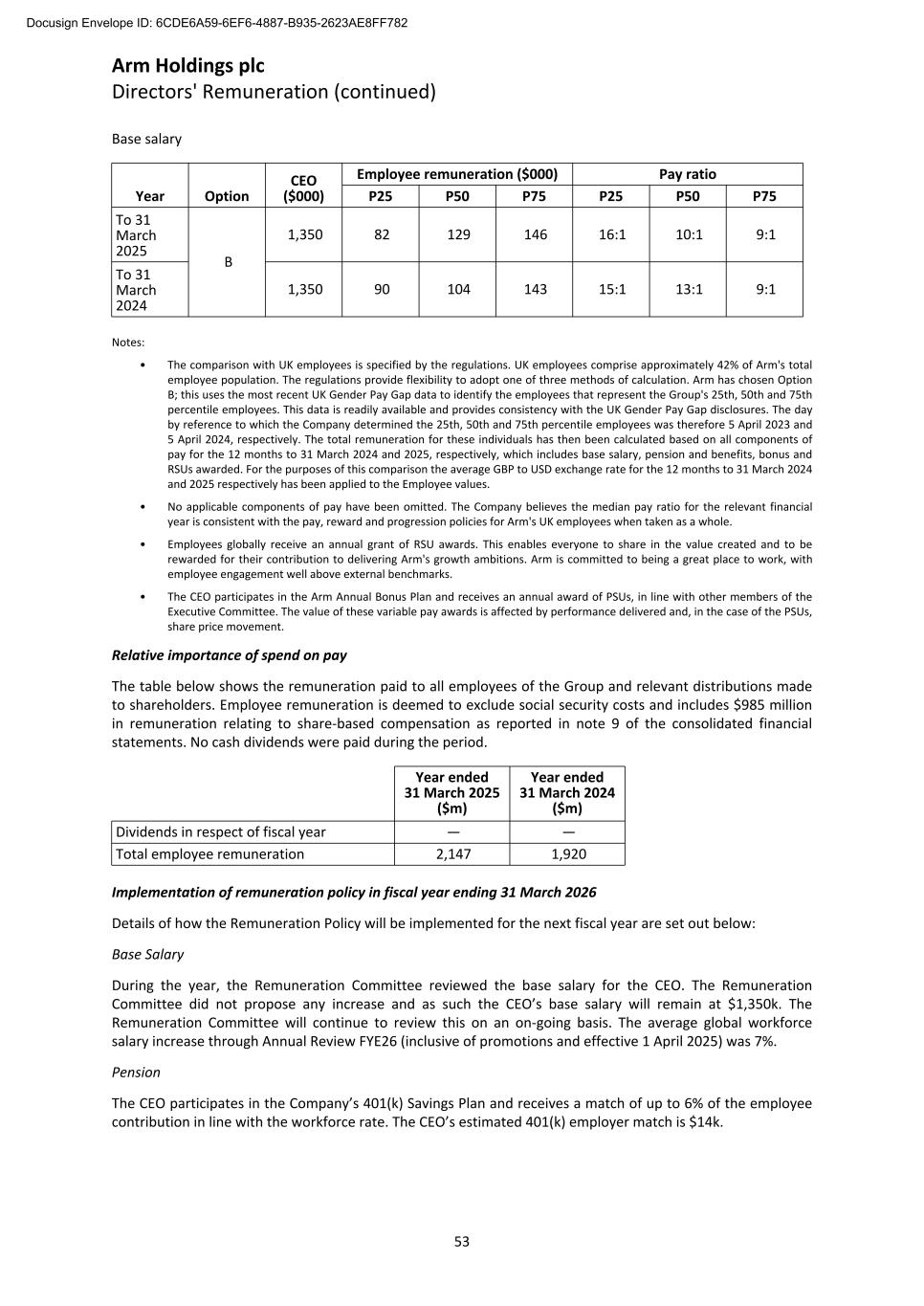
Base salary Year Option CEO ($000) Employee remuneration ($000) Pay ratio P25 P50 P75 P25 P50 P75 To 31 March 2025 B 1,350 82 129 146 16:1 10:1 9:1 To 31 March 2024 1,350 90 104 143 15:1 13:1 9:1 Notes: • The comparison with UK employees is specified by the regulations. UK employees comprise approximately 42% of Arm's total employee population. The regulations provide flexibility to adopt one of three methods of calculation. Arm has chosen Option B; this uses the most recent UK Gender Pay Gap data to identify the employees that represent the Group's 25th, 50th and 75th percentile employees. This data is readily available and provides consistency with the UK Gender Pay Gap disclosures. The day by reference to which the Company determined the 25th, 50th and 75th percentile employees was therefore 5 April 2023 and 5 April 2024, respectively. The total remuneration for these individuals has then been calculated based on all components of pay for the 12 months to 31 March 2024 and 2025, respectively, which includes base salary, pension and benefits, bonus and RSUs awarded. For the purposes of this comparison the average GBP to USD exchange rate for the 12 months to 31 March 2024 and 2025 respectively has been applied to the Employee values. • No applicable components of pay have been omitted. The Company believes the median pay ratio for the relevant financial year is consistent with the pay, reward and progression policies for Arm's UK employees when taken as a whole. • Employees globally receive an annual grant of RSU awards. This enables everyone to share in the value created and to be rewarded for their contribution to delivering Arm's growth ambitions. Arm is committed to being a great place to work, with employee engagement well above external benchmarks. • The CEO participates in the Arm Annual Bonus Plan and receives an annual award of PSUs, in line with other members of the Executive Committee. The value of these variable pay awards is affected by performance delivered and, in the case of the PSUs, share price movement. Relative importance of spend on pay The table below shows the remuneration paid to all employees of the Group and relevant distributions made to shareholders. Employee remuneration is deemed to exclude social security costs and includes $985 million in remuneration relating to share-based compensation as reported in note 9 of the consolidated financial statements. No cash dividends were paid during the period. Year ended 31 March 2025 ($m) Year ended 31 March 2024 ($m) Dividends in respect of fiscal year — — Total employee remuneration 2,147 1,920 Implementation of remuneration policy in fiscal year ending 31 March 2026 Details of how the Remuneration Policy will be implemented for the next fiscal year are set out below: Base Salary During the year, the Remuneration Committee reviewed the base salary for the CEO. The Remuneration Committee did not propose any increase and as such the CEO’s base salary will remain at $1,350k. The Remuneration Committee will continue to review this on an on-going basis. The average global workforce salary increase through Annual Review FYE26 (inclusive of promotions and effective 1 April 2025) was 7%. Pension The CEO participates in the Company’s 401(k) Savings Plan and receives a match of up to 6% of the employee contribution in line with the workforce rate. The CEO’s estimated 401(k) employer match is $14k. Arm Holdings plc Directors' Remuneration (continued) 53 Docusign Envelope ID: 6CDE6A59-6EF6-4887-B935-2623AE8FF782
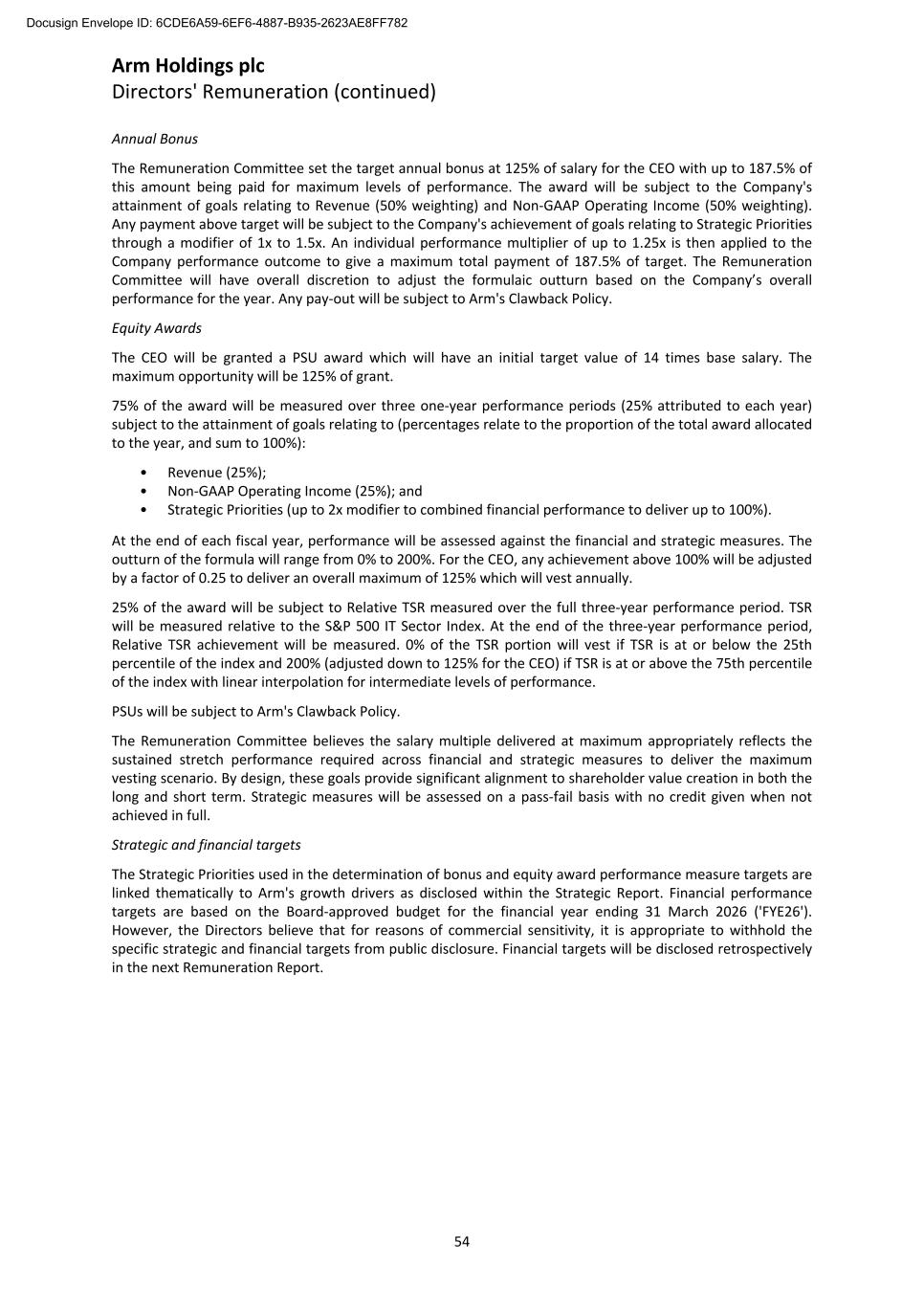
Annual Bonus The Remuneration Committee set the target annual bonus at 125% of salary for the CEO with up to 187.5% of this amount being paid for maximum levels of performance. The award will be subject to the Company's attainment of goals relating to Revenue (50% weighting) and Non-GAAP Operating Income (50% weighting). Any payment above target will be subject to the Company's achievement of goals relating to Strategic Priorities through a modifier of 1x to 1.5x. An individual performance multiplier of up to 1.25x is then applied to the Company performance outcome to give a maximum total payment of 187.5% of target. The Remuneration Committee will have overall discretion to adjust the formulaic outturn based on the Company’s overall performance for the year. Any pay-out will be subject to Arm's Clawback Policy. Equity Awards The CEO will be granted a PSU award which will have an initial target value of 14 times base salary. The maximum opportunity will be 125% of grant. 75% of the award will be measured over three one-year performance periods (25% attributed to each year) subject to the attainment of goals relating to (percentages relate to the proportion of the total award allocated to the year, and sum to 100%): • Revenue (25%); • Non-GAAP Operating Income (25%); and • Strategic Priorities (up to 2x modifier to combined financial performance to deliver up to 100%). At the end of each fiscal year, performance will be assessed against the financial and strategic measures. The outturn of the formula will range from 0% to 200%. For the CEO, any achievement above 100% will be adjusted by a factor of 0.25 to deliver an overall maximum of 125% which will vest annually. 25% of the award will be subject to Relative TSR measured over the full three-year performance period. TSR will be measured relative to the S&P 500 IT Sector Index. At the end of the three-year performance period, Relative TSR achievement will be measured. 0% of the TSR portion will vest if TSR is at or below the 25th percentile of the index and 200% (adjusted down to 125% for the CEO) if TSR is at or above the 75th percentile of the index with linear interpolation for intermediate levels of performance. PSUs will be subject to Arm's Clawback Policy. The Remuneration Committee believes the salary multiple delivered at maximum appropriately reflects the sustained stretch performance required across financial and strategic measures to deliver the maximum vesting scenario. By design, these goals provide significant alignment to shareholder value creation in both the long and short term. Strategic measures will be assessed on a pass-fail basis with no credit given when not achieved in full. Strategic and financial targets The Strategic Priorities used in the determination of bonus and equity award performance measure targets are linked thematically to Arm's growth drivers as disclosed within the Strategic Report. Financial performance targets are based on the Board-approved budget for the financial year ending 31 March 2026 ('FYE26'). However, the Directors believe that for reasons of commercial sensitivity, it is appropriate to withhold the specific strategic and financial targets from public disclosure. Financial targets will be disclosed retrospectively in the next Remuneration Report. Arm Holdings plc Directors' Remuneration (continued) 54 Docusign Envelope ID: 6CDE6A59-6EF6-4887-B935-2623AE8FF782
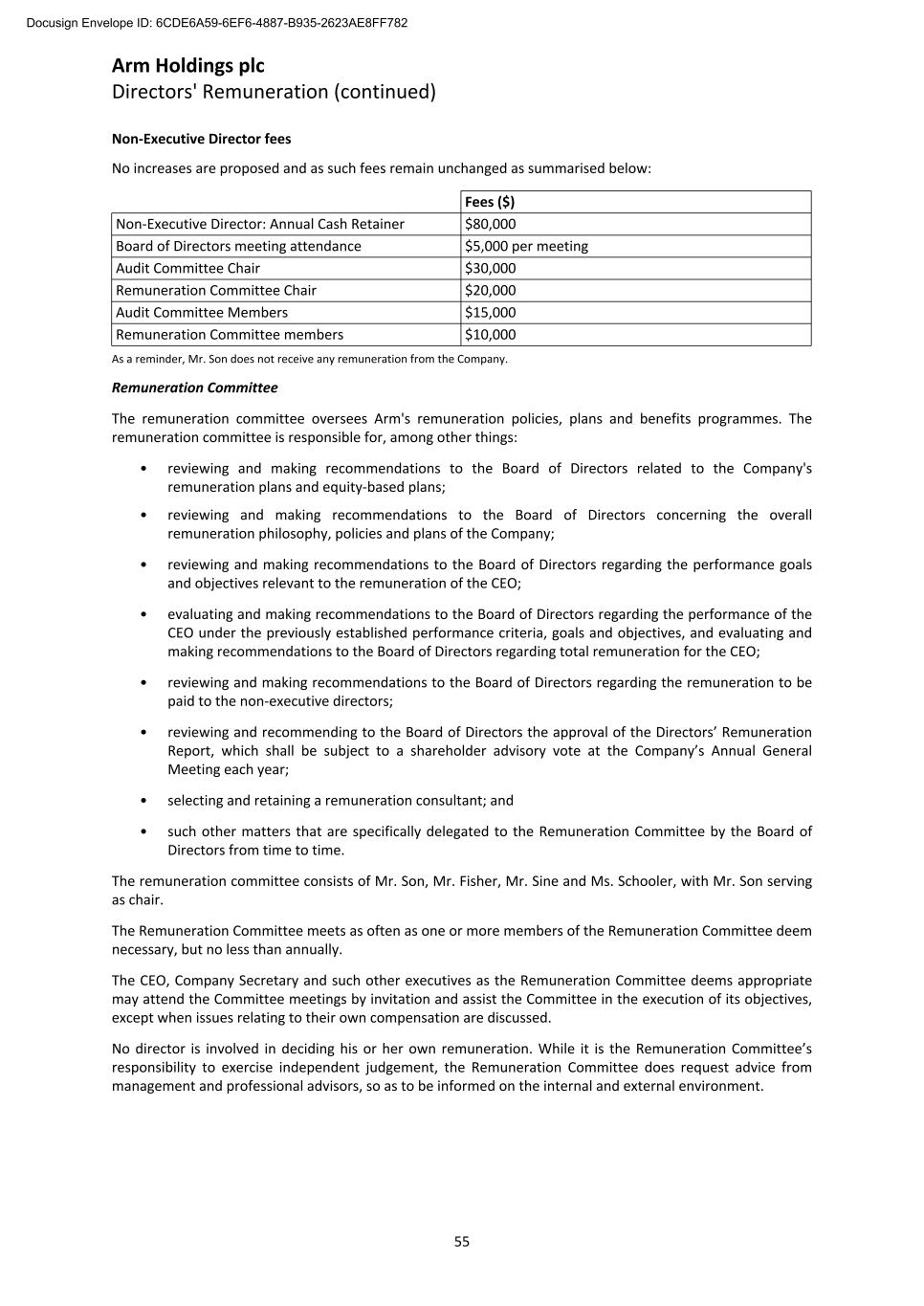
Non-Executive Director fees No increases are proposed and as such fees remain unchanged as summarised below: Fees ($) Non-Executive Director: Annual Cash Retainer $80,000 Board of Directors meeting attendance $5,000 per meeting Audit Committee Chair $30,000 Remuneration Committee Chair $20,000 Audit Committee Members $15,000 Remuneration Committee members $10,000 As a reminder, Mr. Son does not receive any remuneration from the Company. Remuneration Committee The remuneration committee oversees Arm's remuneration policies, plans and benefits programmes. The remuneration committee is responsible for, among other things: • reviewing and making recommendations to the Board of Directors related to the Company's remuneration plans and equity-based plans; • reviewing and making recommendations to the Board of Directors concerning the overall remuneration philosophy, policies and plans of the Company; • reviewing and making recommendations to the Board of Directors regarding the performance goals and objectives relevant to the remuneration of the CEO; • evaluating and making recommendations to the Board of Directors regarding the performance of the CEO under the previously established performance criteria, goals and objectives, and evaluating and making recommendations to the Board of Directors regarding total remuneration for the CEO; • reviewing and making recommendations to the Board of Directors regarding the remuneration to be paid to the non-executive directors; • reviewing and recommending to the Board of Directors the approval of the Directors’ Remuneration Report, which shall be subject to a shareholder advisory vote at the Company’s Annual General Meeting each year; • selecting and retaining a remuneration consultant; and • such other matters that are specifically delegated to the Remuneration Committee by the Board of Directors from time to time. The remuneration committee consists of Mr. Son, Mr. Fisher, Mr. Sine and Ms. Schooler, with Mr. Son serving as chair. The Remuneration Committee meets as often as one or more members of the Remuneration Committee deem necessary, but no less than annually. The CEO, Company Secretary and such other executives as the Remuneration Committee deems appropriate may attend the Committee meetings by invitation and assist the Committee in the execution of its objectives, except when issues relating to their own compensation are discussed. No director is involved in deciding his or her own remuneration. While it is the Remuneration Committee’s responsibility to exercise independent judgement, the Remuneration Committee does request advice from management and professional advisors, so as to be informed on the internal and external environment. Arm Holdings plc Directors' Remuneration (continued) 55 Docusign Envelope ID: 6CDE6A59-6EF6-4887-B935-2623AE8FF782
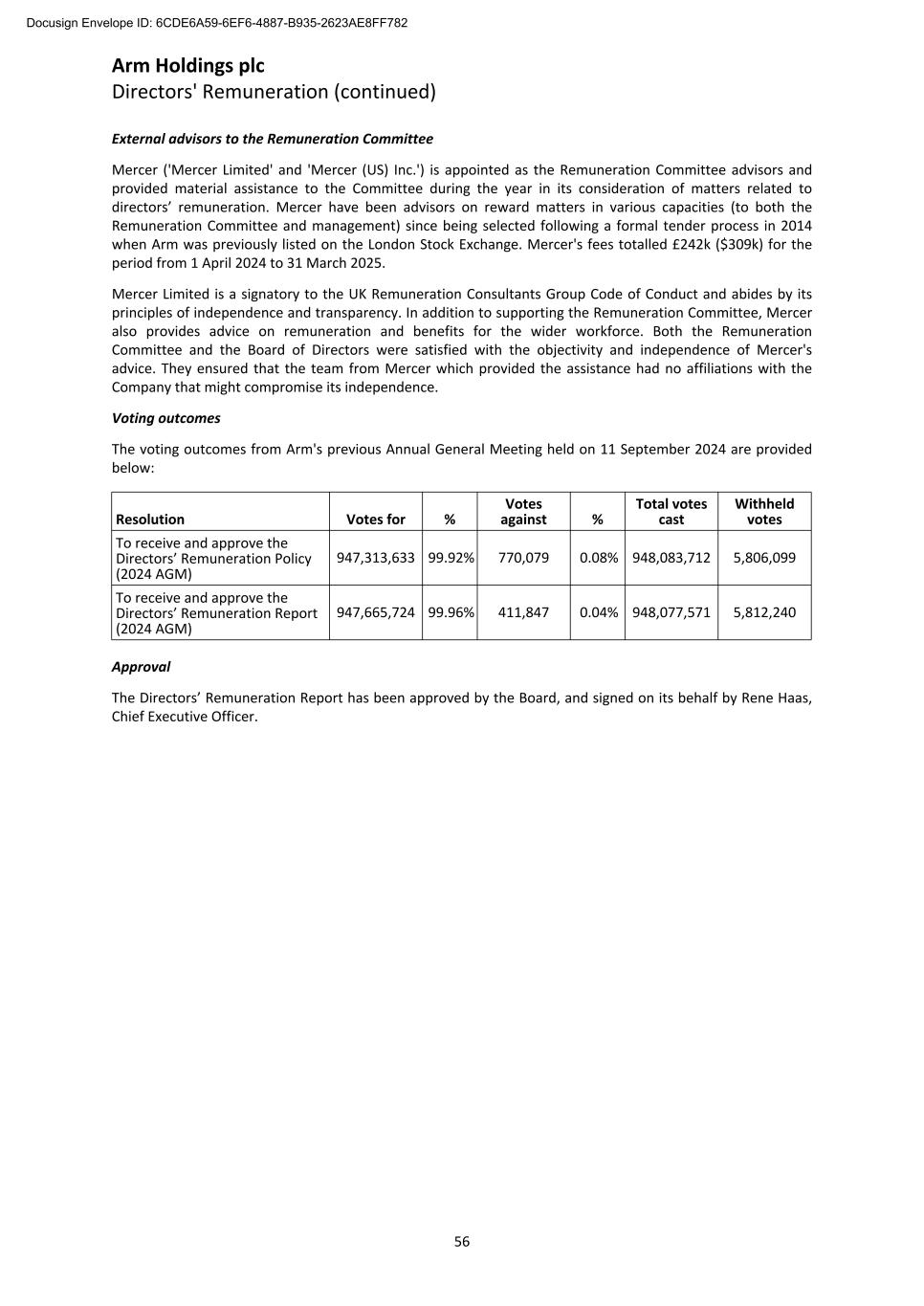
External advisors to the Remuneration Committee Mercer ('Mercer Limited' and 'Mercer (US) Inc.') is appointed as the Remuneration Committee advisors and provided material assistance to the Committee during the year in its consideration of matters related to directors’ remuneration. Mercer have been advisors on reward matters in various capacities (to both the Remuneration Committee and management) since being selected following a formal tender process in 2014 when Arm was previously listed on the London Stock Exchange. Mercer's fees totalled £242k ($309k) for the period from 1 April 2024 to 31 March 2025. Mercer Limited is a signatory to the UK Remuneration Consultants Group Code of Conduct and abides by its principles of independence and transparency. In addition to supporting the Remuneration Committee, Mercer also provides advice on remuneration and benefits for the wider workforce. Both the Remuneration Committee and the Board of Directors were satisfied with the objectivity and independence of Mercer's advice. They ensured that the team from Mercer which provided the assistance had no affiliations with the Company that might compromise its independence. Voting outcomes The voting outcomes from Arm's previous Annual General Meeting held on 11 September 2024 are provided below: Resolution Votes for % Votes against % Total votes cast Withheld votes To receive and approve the Directors’ Remuneration Policy (2024 AGM) 947,313,633 99.92% 770,079 0.08% 948,083,712 5,806,099 To receive and approve the Directors’ Remuneration Report (2024 AGM) 947,665,724 99.96% 411,847 0.04% 948,077,571 5,812,240 Approval The Directors’ Remuneration Report has been approved by the Board, and signed on its behalf by Rene Haas, Chief Executive Officer. Arm Holdings plc Directors' Remuneration (continued) 56 Docusign Envelope ID: 6CDE6A59-6EF6-4887-B935-2623AE8FF782
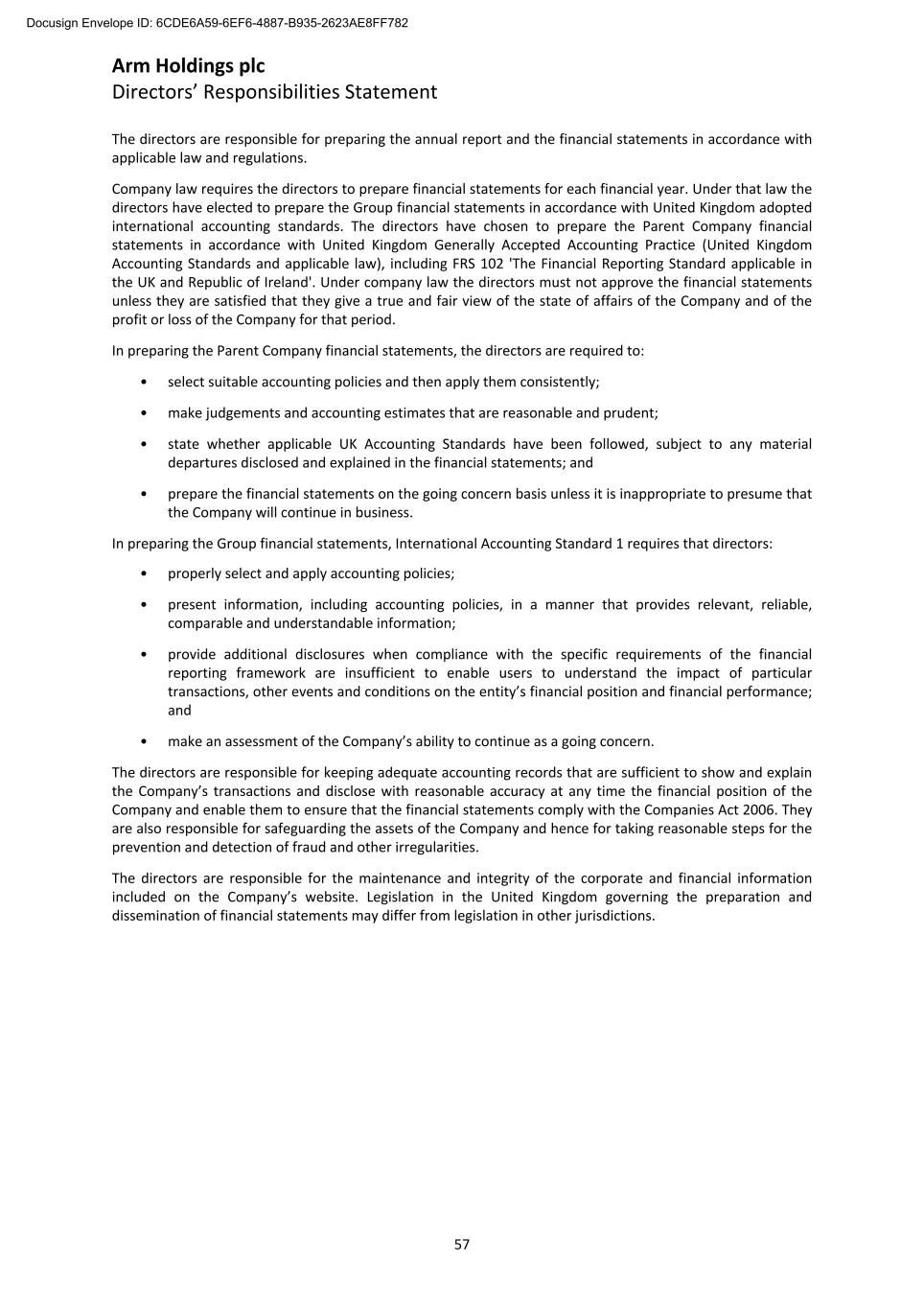
The directors are responsible for preparing the annual report and the financial statements in accordance with applicable law and regulations. Company law requires the directors to prepare financial statements for each financial year. Under that law the directors have elected to prepare the Group financial statements in accordance with United Kingdom adopted international accounting standards. The directors have chosen to prepare the Parent Company financial statements in accordance with United Kingdom Generally Accepted Accounting Practice (United Kingdom Accounting Standards and applicable law), including FRS 102 'The Financial Reporting Standard applicable in the UK and Republic of Ireland'. Under company law the directors must not approve the financial statements unless they are satisfied that they give a true and fair view of the state of affairs of the Company and of the profit or loss of the Company for that period. In preparing the Parent Company financial statements, the directors are required to: • select suitable accounting policies and then apply them consistently; • make judgements and accounting estimates that are reasonable and prudent; • state whether applicable UK Accounting Standards have been followed, subject to any material departures disclosed and explained in the financial statements; and • prepare the financial statements on the going concern basis unless it is inappropriate to presume that the Company will continue in business. In preparing the Group financial statements, International Accounting Standard 1 requires that directors: • properly select and apply accounting policies; • present information, including accounting policies, in a manner that provides relevant, reliable, comparable and understandable information; • provide additional disclosures when compliance with the specific requirements of the financial reporting framework are insufficient to enable users to understand the impact of particular transactions, other events and conditions on the entity’s financial position and financial performance; and • make an assessment of the Company’s ability to continue as a going concern. The directors are responsible for keeping adequate accounting records that are sufficient to show and explain the Company’s transactions and disclose with reasonable accuracy at any time the financial position of the Company and enable them to ensure that the financial statements comply with the Companies Act 2006. They are also responsible for safeguarding the assets of the Company and hence for taking reasonable steps for the prevention and detection of fraud and other irregularities. The directors are responsible for the maintenance and integrity of the corporate and financial information included on the Company’s website. Legislation in the United Kingdom governing the preparation and dissemination of financial statements may differ from legislation in other jurisdictions. Arm Holdings plc Directors’ Responsibilities Statement 57 Docusign Envelope ID: 6CDE6A59-6EF6-4887-B935-2623AE8FF782

The directors confirm that to the best of their knowledge: • the financial statements, prepared in accordance with the relevant financial reporting framework, give a true and fair view of the assets, liabilities, financial position and profit or loss of the Company and the undertakings included in the consolidation taken as a whole; • the Strategic Report includes a fair review of the development and performance of the business and the position of the Company and the undertakings included in the consolidation taken as a whole, together with a description of the principal risks and uncertainties that they face; and • the annual report and financial statements, taken as a whole, are fair, balanced and understandable and provide the information necessary for shareholders to assess the Company’s position, performance, business model and strategy. Approved by the Board of Directors and signed on its behalf by: R Haas Chief Executive Officer Date: 28 May 2025 Arm Holdings plc Directors’ Responsibilities Statement (continued) 58 Docusign Envelope ID: 6CDE6A59-6EF6-4887-B935-2623AE8FF782
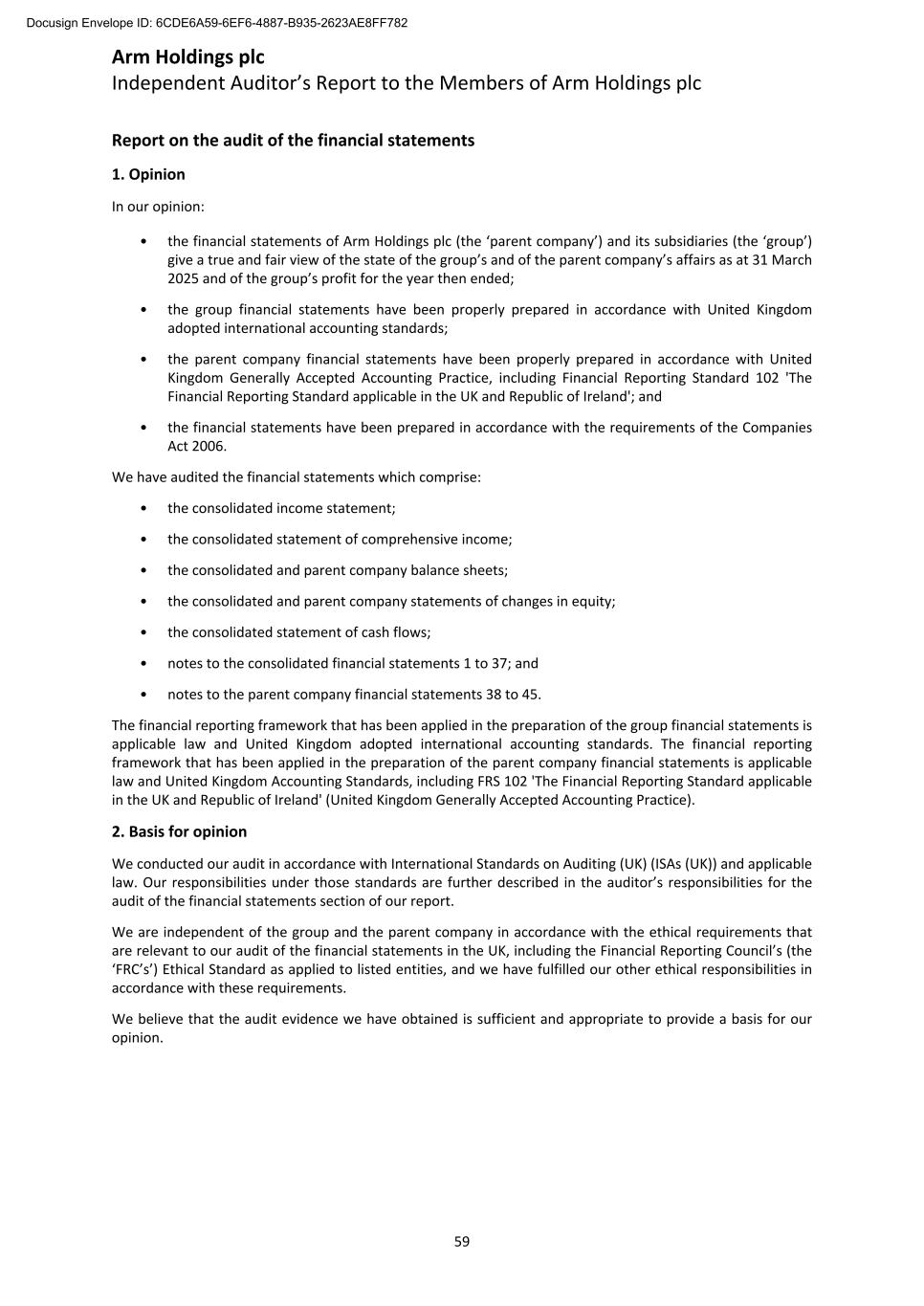
Report on the audit of the financial statements 1. Opinion In our opinion: • the financial statements of Arm Holdings plc (the ‘parent company’) and its subsidiaries (the ‘group’) give a true and fair view of the state of the group’s and of the parent company’s affairs as at 31 March 2025 and of the group’s profit for the year then ended; • the group financial statements have been properly prepared in accordance with United Kingdom adopted international accounting standards; • the parent company financial statements have been properly prepared in accordance with United Kingdom Generally Accepted Accounting Practice, including Financial Reporting Standard 102 'The Financial Reporting Standard applicable in the UK and Republic of Ireland'; and • the financial statements have been prepared in accordance with the requirements of the Companies Act 2006. We have audited the financial statements which comprise: • the consolidated income statement; • the consolidated statement of comprehensive income; • the consolidated and parent company balance sheets; • the consolidated and parent company statements of changes in equity; • the consolidated statement of cash flows; • notes to the consolidated financial statements 1 to 37; and • notes to the parent company financial statements 38 to 45. The financial reporting framework that has been applied in the preparation of the group financial statements is applicable law and United Kingdom adopted international accounting standards. The financial reporting framework that has been applied in the preparation of the parent company financial statements is applicable law and United Kingdom Accounting Standards, including FRS 102 'The Financial Reporting Standard applicable in the UK and Republic of Ireland' (United Kingdom Generally Accepted Accounting Practice). 2. Basis for opinion We conducted our audit in accordance with International Standards on Auditing (UK) (ISAs (UK)) and applicable law. Our responsibilities under those standards are further described in the auditor’s responsibilities for the audit of the financial statements section of our report. We are independent of the group and the parent company in accordance with the ethical requirements that are relevant to our audit of the financial statements in the UK, including the Financial Reporting Council’s (the ‘FRC’s’) Ethical Standard as applied to listed entities, and we have fulfilled our other ethical responsibilities in accordance with these requirements. We believe that the audit evidence we have obtained is sufficient and appropriate to provide a basis for our opinion. Arm Holdings plc Independent Auditor’s Report to the Members of Arm Holdings plc 59 Docusign Envelope ID: 6CDE6A59-6EF6-4887-B935-2623AE8FF782
3. Summary of our audit approach Key audit matter The key audit matter that we identified in the current year was revenue recognition for material long-term revenue contracts with customers. Materiality The materiality that we used for the group financial statements was $51 million, determined based on profit before tax, normalised for the one-off loss on financial instruments. Scoping The scope of the group audit included audits of the entire financial information of the primary trading company and holding company which are registered in the UK, and the audit of specified balances in other entities of the group which combined contribute 99.6% of the group’s revenue, 97% of the group’s expenses and 82% of net assets. Significant changes in our approach There have been no significant changes in our approach compared to the 2024 audit. 4. Conclusions relating to going concern In auditing the financial statements, we have concluded that the directors’ use of the going concern basis of accounting in the preparation of the financial statements is appropriate. Our evaluation of the directors’ assessment of the group’s and parent company’s ability to continue to adopt the going concern basis of accounting included: • testing the accuracy of management’s models, including agreement to the most recent board approved budgets and forecasts; • challenging the assumptions in these forecasts by: – reading analyst reports, industry data and other external information and comparing these with management’s estimates; – comparing forecast revenue with the group’s order book and historical performance; – considering potential macroeconomic impacts on the forecasts as a consequence of the current geo- political environment; – assessing the sensitivity of the headroom to key assumptions used in management’s forecasts; and – considering if any additional facts or information have become available since the date of the management assessment; • evaluating the historical accuracy of forecasts prepared by management; and • evaluating the going concern disclosures in the financial statements. Based on the work we have performed, we have not identified any material uncertainties relating to events or conditions that, individually or collectively, may cast significant doubt on the group's and parent company’s ability to continue as a going concern for a period of at least 12 months from when the financial statements are authorised for issue. Our responsibilities and the responsibilities of the directors with respect to going concern are described in the relevant sections of this report. 5. Key audit matters Key audit matters are those matters that, in our professional judgement, were of most significance in our audit of the financial statements of the current period and include the most significant assessed risks of material misstatement (whether or not due to fraud) that we identified. These matters included those which had the greatest effect on: the overall audit strategy; the allocation of resources in the audit; and directing the efforts of the engagement team. These matters were addressed in the context of our audit of the financial statements as a whole, and in forming our opinion thereon, and we do not provide a separate opinion on these matters. Arm Holdings plc Independent Auditor’s Report to the Members of Arm Holdings plc (continued) 60 Docusign Envelope ID: 6CDE6A59-6EF6-4887-B935-2623AE8FF782
5.1. Revenue recognition for material long-term revenue contracts with customers Key audit matter description The group routinely enters into material long-term revenue contracts with customers that involve multiple performance obligations consisting of products and services such as intellectual property licenses, implicit rights to future products, early access rights, software licenses, support, training, professional and design services, and other non-standard performance obligations that may be contract or customer specific. Determining the appropriate revenue recognition for these material long-term revenue contracts may involve significant judgment by management, including the identification of performance obligations and the apportionment of the transaction price that should be allocated to those performance obligations, both of which impact the amount and timing of revenue recognition. Specifically, judgments were required when identifying the performance obligations in a given contract. In material long-term revenue contracts with customers, this is due to the inclusion of complex terms and conditions that may entitle the customer to non-standard products and services, as well as products and services that may be available in future periods or are otherwise implied based on forward looking and historical information. Judgments were likewise required in determining the standalone selling price of certain performance obligations and allocating the transaction price thereto. This is due to a lack of observable standalone selling prices for many of the group’s products and services as well as the inclusion of non-standard offerings for which the standalone selling price must be estimated. Accordingly, performing audit procedures related to material long-term revenue contracts with customers required a high degree of auditor judgment and an increased extent of effort, including the need to involve professionals in our firm having expertise in revenue recognition. The group recognised licence revenue of $1.8bn (2024: $1.4bn). The accounting policy is described in note 3. How the scope of our audit responded to the key audit matter Our audit procedures related to management’s evaluation regarding identification of the performance obligation and the allocation of the transaction price included the following, among others. For material long-term revenue contracts with customers, we: • Obtained and read the contract, including master agreements, amendments, purchase and sales order agreements, and related contracts; • Consulted with a revenue recognition specialist on complex technical accounting matters, as appropriate; • Obtained and evaluated the group’s technical accounting position for each such contract; • Evaluated management’s identification of performance obligations by performing the following: – Comparing the products and services identified in the contract to the performance obligations identified by management. – Obtaining an understanding of the group’s products and services, including product roadmaps and other marketing materials. – For any purchase options, obtaining and evaluating management’s material right analysis. – Inquiring of personnel outside of the accounting function with sufficient authority and knowledge of the contract to understand the nature thereof, its business purpose, and the group’s performance obligations. • We assessed the allocation of the transaction price to performance obligations by performing the following: – Evaluated the reasonableness of the group’s methodologies and inputs used to establish estimated standalone selling prices by obtaining an understanding of the nature of the products and services and testing the underlying data. – Compared the transaction price determined by management to the transaction price in the customer contracts. – Reperformed the allocation of the transaction price to each performance obligation to test the accuracy of management’s allocation of transaction price to performance obligations by: * Tracing and agreeing observable standalone selling prices to the supporting analyses, and * Recalculating the allocation using a combination of methods when the residual approach is used. Key observations We are satisfied that management has determined the revenue recognition of material long- term contracts with customers in line with IFRS 15. Arm Holdings plc Independent Auditor’s Report to the Members of Arm Holdings plc (continued) 61 Docusign Envelope ID: 6CDE6A59-6EF6-4887-B935-2623AE8FF782
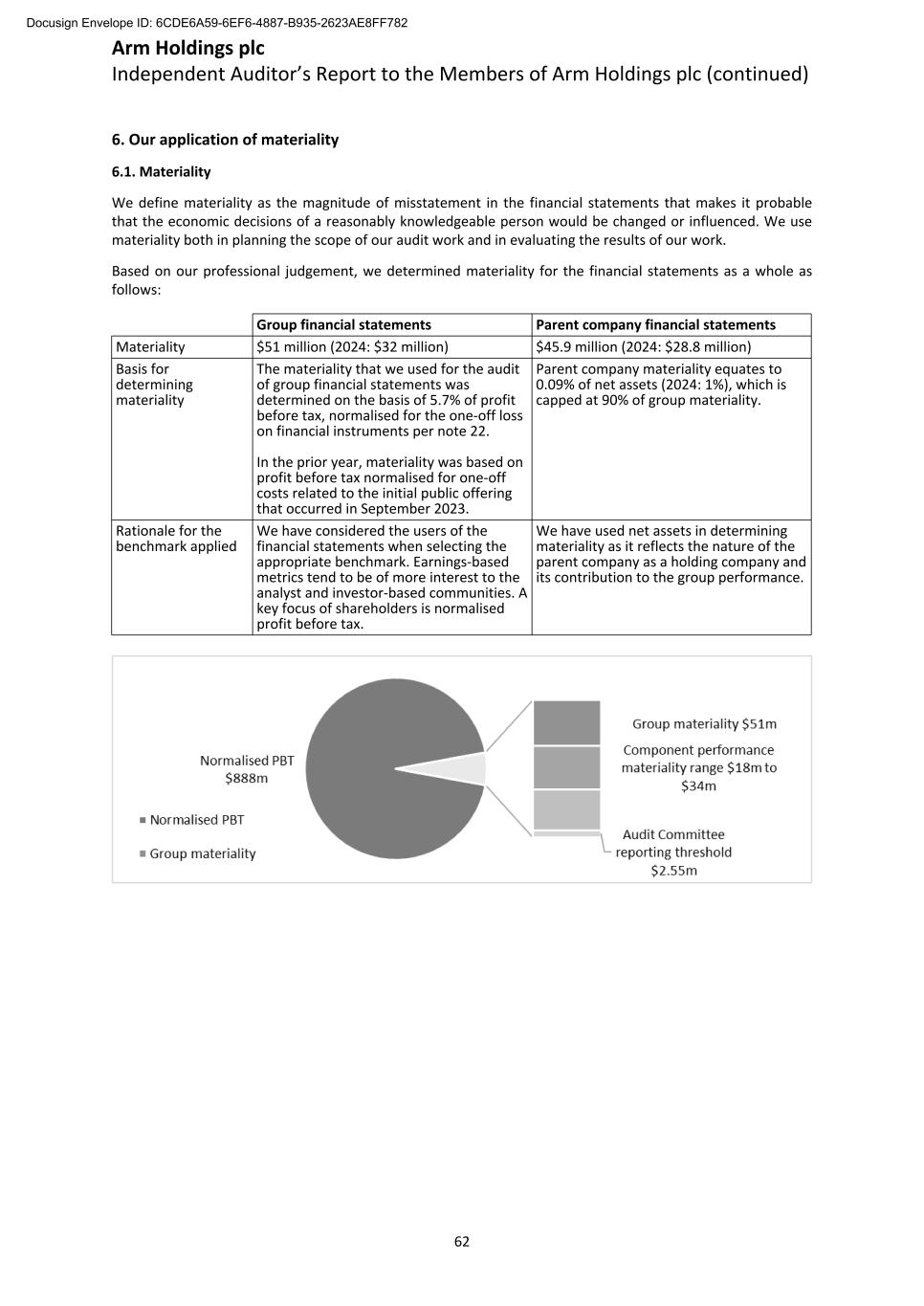
6. Our application of materiality 6.1. Materiality We define materiality as the magnitude of misstatement in the financial statements that makes it probable that the economic decisions of a reasonably knowledgeable person would be changed or influenced. We use materiality both in planning the scope of our audit work and in evaluating the results of our work. Based on our professional judgement, we determined materiality for the financial statements as a whole as follows: Group financial statements Parent company financial statements Materiality $51 million (2024: $32 million) $45.9 million (2024: $28.8 million) Basis for determining materiality The materiality that we used for the audit of group financial statements was determined on the basis of 5.7% of profit before tax, normalised for the one-off loss on financial instruments per note 22. In the prior year, materiality was based on profit before tax normalised for one-off costs related to the initial public offering that occurred in September 2023. Parent company materiality equates to 0.09% of net assets (2024: 1%), which is capped at 90% of group materiality. Rationale for the benchmark applied We have considered the users of the financial statements when selecting the appropriate benchmark. Earnings-based metrics tend to be of more interest to the analyst and investor-based communities. A key focus of shareholders is normalised profit before tax. We have used net assets in determining materiality as it reflects the nature of the parent company as a holding company and its contribution to the group performance. Arm Holdings plc Independent Auditor’s Report to the Members of Arm Holdings plc (continued) 62 Docusign Envelope ID: 6CDE6A59-6EF6-4887-B935-2623AE8FF782
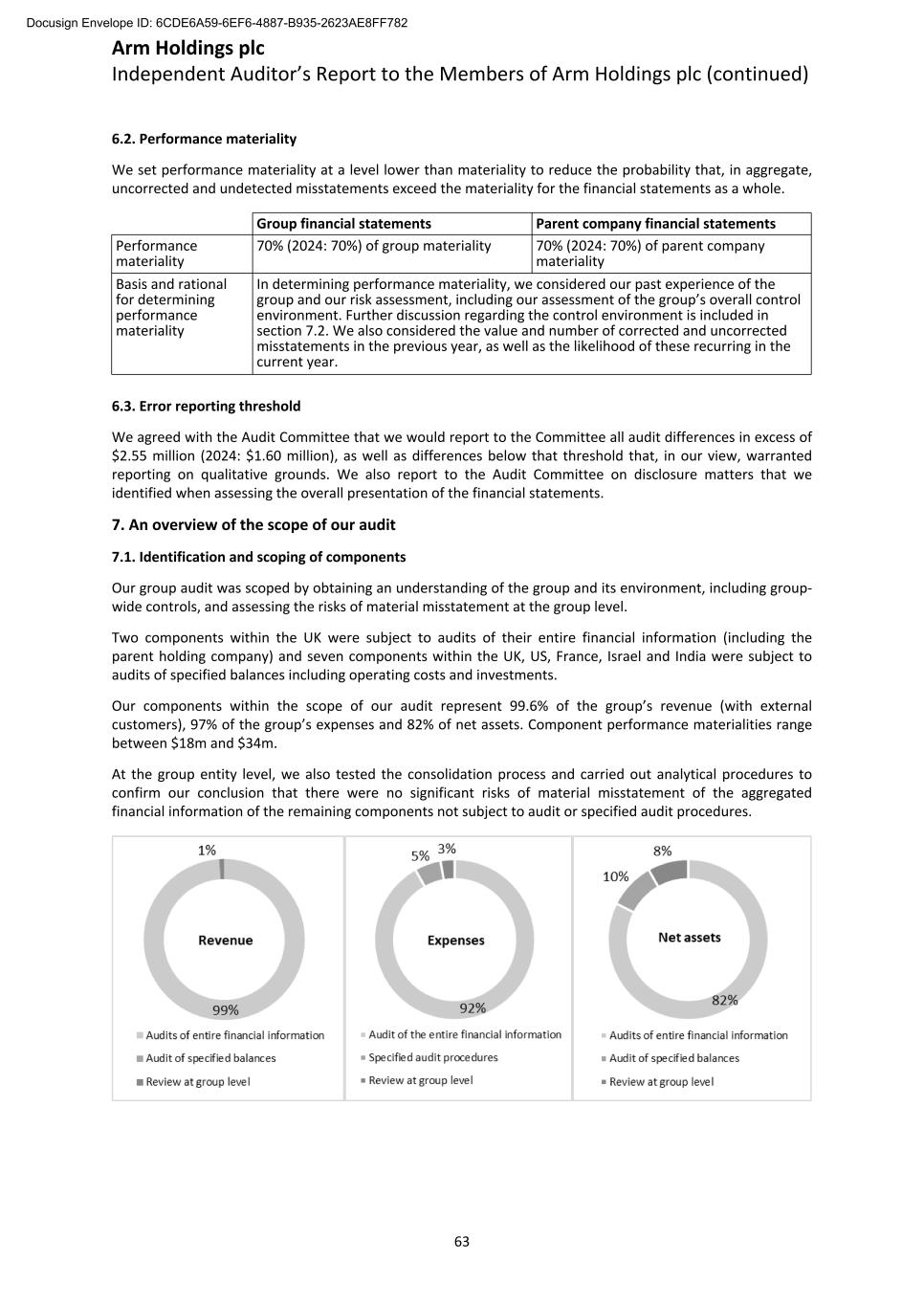
6.2. Performance materiality We set performance materiality at a level lower than materiality to reduce the probability that, in aggregate, uncorrected and undetected misstatements exceed the materiality for the financial statements as a whole. Group financial statements Parent company financial statements Performance materiality 70% (2024: 70%) of group materiality 70% (2024: 70%) of parent company materiality Basis and rational for determining performance materiality In determining performance materiality, we considered our past experience of the group and our risk assessment, including our assessment of the group’s overall control environment. Further discussion regarding the control environment is included in section 7.2. We also considered the value and number of corrected and uncorrected misstatements in the previous year, as well as the likelihood of these recurring in the current year. 6.3. Error reporting threshold We agreed with the Audit Committee that we would report to the Committee all audit differences in excess of $2.55 million (2024: $1.60 million), as well as differences below that threshold that, in our view, warranted reporting on qualitative grounds. We also report to the Audit Committee on disclosure matters that we identified when assessing the overall presentation of the financial statements. 7. An overview of the scope of our audit 7.1. Identification and scoping of components Our group audit was scoped by obtaining an understanding of the group and its environment, including group- wide controls, and assessing the risks of material misstatement at the group level. Two components within the UK were subject to audits of their entire financial information (including the parent holding company) and seven components within the UK, US, France, Israel and India were subject to audits of specified balances including operating costs and investments. Our components within the scope of our audit represent 99.6% of the group’s revenue (with external customers), 97% of the group’s expenses and 82% of net assets. Component performance materialities range between $18m and $34m. At the group entity level, we also tested the consolidation process and carried out analytical procedures to confirm our conclusion that there were no significant risks of material misstatement of the aggregated financial information of the remaining components not subject to audit or specified audit procedures. Arm Holdings plc Independent Auditor’s Report to the Members of Arm Holdings plc (continued) 63 Docusign Envelope ID: 6CDE6A59-6EF6-4887-B935-2623AE8FF782
7.2. Our consideration of the control environment Our controls approach was principally designed to inform our risk assessment, to allow us to obtain an understanding of relevant controls in order to address the risks of material misstatement. This included controls relating to revenue recognition, tax, and the consolidation and financial reporting processes. The group operates a range of IT systems which underpin the financial reporting process. We obtained an understanding of the general IT controls associated with those financially relevant systems. In the current year, we did not seek to place reliance on controls for the purpose of our audit, as management were in the process of remediating prior year deficiencies, which are remediated as at 31 March 2025. Refer to the Disclosure Controls and Procedures section of Corporate Governance report on page 44 where management has described the control environment. 7.3. Our consideration of climate-related risks Climate change and the transition to a low carbon economy ('climate change') were considered in our audit where they have the potential to directly or indirectly impact key judgements and estimates within the financial statements. Management has disclosed their climate risk considerations in note 4 primarily in relation to the key judgements and estimates in the assessment of the carrying value of non-current assets. The key judgements and estimates included in the financial statements incorporate actions and strategies, to the extent they have been approved and can be reliably estimated in accordance with the group’s accounting policies. With the involvement of our ESG specialists, we assessed this disclosure by performing inquires with management and independent industry research, and we did not identify any climate related material risks of misstatement. We also considered whether information included in the climate related disclosures in the Annual Report were materially consistent with our understanding of the business, and the financial statements. 7.4. Working with other auditors All work has been executed by the group engagement team which comprised of Deloitte UK and Deloitte US due to geographical locations of the group. We directed, supervised and reviewed the testing performed through both virtual and in-person frequent communication with the extended audit team. 8. Other information The other information comprises the information included in the annual report, other than the financial statements and our auditor’s report thereon. The directors are responsible for the other information contained within the annual report. Our opinion on the financial statements does not cover the other information and, except to the extent otherwise explicitly stated in our report, we do not express any form of assurance conclusion thereon. Our responsibility is to read the other information and, in doing so, consider whether the other information is materially inconsistent with the financial statements or our knowledge obtained in the course of the audit, or otherwise appears to be materially misstated. If we identify such material inconsistencies or apparent material misstatements, we are required to determine whether this gives rise to a material misstatement in the financial statements themselves. If, based on the work we have performed, we conclude that there is a material misstatement of this other information, we are required to report that fact. We have nothing to report in this regard. Arm Holdings plc Independent Auditor’s Report to the Members of Arm Holdings plc (continued) 64 Docusign Envelope ID: 6CDE6A59-6EF6-4887-B935-2623AE8FF782
9. Responsibilities of directors As explained more fully in the directors’ responsibilities statement, the directors are responsible for the preparation of the financial statements and for being satisfied that they give a true and fair view, and for such internal control as the directors determine is necessary to enable the preparation of financial statements that are free from material misstatement, whether due to fraud or error. In preparing the financial statements, the directors are responsible for assessing the group’s and the parent company’s ability to continue as a going concern, disclosing as applicable, matters related to going concern and using the going concern basis of accounting unless the directors either intend to liquidate the group or the parent company or to cease operations, or have no realistic alternative but to do so. 10. Auditor’s responsibilities for the audit of the financial statements Our objectives are to obtain reasonable assurance about whether the financial statements as a whole are free from material misstatement, whether due to fraud or error, and to issue an auditor’s report that includes our opinion. Reasonable assurance is a high level of assurance, but is not a guarantee that an audit conducted in accordance with ISAs (UK) will always detect a material misstatement when it exists. Misstatements can arise from fraud or error and are considered material if, individually or in the aggregate, they could reasonably be expected to influence the economic decisions of users taken on the basis of these financial statements. A further description of our responsibilities for the audit of the financial statements is located on the FRC’s website at: www.frc.org.uk/auditorsresponsibilities. This description forms part of our auditor’s report. 11. Extent to which the audit was considered capable of detecting irregularities, including fraud Irregularities, including fraud, are instances of non-compliance with laws and regulations. We design procedures in line with our responsibilities, outlined above, to detect material misstatements in respect of irregularities, including fraud. The extent to which our procedures are capable of detecting irregularities, including fraud is detailed below. 11.1. Identifying and assessing potential risks related to irregularities In identifying and assessing risks of material misstatement in respect of irregularities, including fraud and non- compliance with laws and regulations, we considered the following: • the nature of the industry and sector, control environment and business performance including the design of the group’s remuneration policies, key drivers for directors’ remuneration, bonus levels and performance targets; • results of our enquiries of management, internal audit, the directors and the audit committee about their own identification and assessment of the risks of irregularities, including those that are specific to the group’s sector; • any matters we identified having obtained and reviewed the group’s documentation of their policies and procedures relating to: – identifying, evaluating and complying with laws and regulations and whether they were aware of any instances of non-compliance; – detecting and responding to the risks of fraud and whether they have knowledge of any actual, suspected or alleged fraud; and – the internal controls established to mitigate risks of fraud or non-compliance with laws and regulations; • the matters discussed among the audit engagement team including component audit teams and relevant internal specialists, including tax, valuations, and IT specialists regarding how and where fraud might occur in the financial statements and any potential indicators of fraud. Arm Holdings plc Independent Auditor’s Report to the Members of Arm Holdings plc (continued) 65 Docusign Envelope ID: 6CDE6A59-6EF6-4887-B935-2623AE8FF782
11.1. Identifying and assessing potential risks related to irregularities (continued) As a result of these procedures, we considered the opportunities and incentives that may exist within the organisation for fraud and identified the greatest potential for fraud in the following area: revenue recognition for material long-term revenue contracts with customers. In common with all audits under ISAs (UK), we are also required to perform specific procedures to respond to the risk of management override. We also obtained an understanding of the legal and regulatory framework that the group operates in, focusing on provisions of those laws and regulations that had a direct effect on the determination of material amounts and disclosures in the financial statements. The key laws and regulations we considered in this context included the UK Companies Act and tax legislation. In addition, we considered provisions of other laws and regulations that do not have a direct effect on the financial statements but compliance with which may be fundamental to the group’s ability to operate or to avoid a material penalty. 11.2. Audit response to risks identified As a result of performing the above, we identified revenue recognition for material long-term revenue contracts with customers as a key audit matter related to the potential risk of fraud. The key audit matters section of our report explains the matter in more detail and also describes the specific procedures we performed in response to that key audit matter. In addition to the above, our procedures to respond to risks identified included the following: • reviewing the financial statement disclosures and testing to supporting documentation to assess compliance with provisions of relevant laws and regulations described as having a direct effect on the financial statements; • enquiring of management, the audit committee and in-house legal counsel concerning actual and potential litigation and claims; • performing analytical procedures to identify any unusual or unexpected relationships that may indicate risks of material misstatement due to fraud; • reading minutes of meetings of those charged with governance, reviewing internal audit reports and reviewing correspondence with HMRC; and • in addressing the risk of fraud through management override of controls, testing the appropriateness of journal entries and other adjustments; assessing whether the judgements made in making accounting estimates are indicative of a potential bias; and evaluating the business rationale of any significant transactions that are unusual or outside the normal course of business. We also communicated relevant identified laws and regulations and potential fraud risks to all engagement team members including internal specialists and component audit teams, and remained alert to any indications of fraud or non-compliance with laws and regulations throughout the audit. Arm Holdings plc Independent Auditor’s Report to the Members of Arm Holdings plc (continued) 66 Docusign Envelope ID: 6CDE6A59-6EF6-4887-B935-2623AE8FF782
Report on other legal and regulatory requirements 12. Opinions on other matters prescribed by the Companies Act 2006 In our opinion the part of the directors’ remuneration report to be audited has been properly prepared in accordance with the Companies Act 2006. In our opinion, based on the work undertaken in the course of the audit: • the information given in the strategic report and the directors’ report for the financial year for which the financial statements are prepared is consistent with the financial statements; and • the strategic report and the directors’ report have been prepared in accordance with applicable legal requirements. In the light of the knowledge and understanding of the group and the parent company and their environment obtained in the course of the audit, we have not identified any material misstatements in the strategic report or the directors’ report. 13. Matters on which we are required to report by exception 13.1. Adequacy of explanations received and accounting records Under the Companies Act 2006 we are required to report to you if, in our opinion: • we have not received all the information and explanations we require for our audit; or • adequate accounting records have not been kept by the parent company, or returns adequate for our audit have not been received from branches not visited by us; or • the parent company financial statements are not in agreement with the accounting records and returns. We have nothing to report in respect of these matters. 13.2. Directors’ remuneration Under the Companies Act 2006 we are also required to report if in our opinion certain disclosures of directors’ remuneration have not been made. We have nothing to report in respect of this matter. 14. Use of our report This report is made solely to the company’s members, as a body, in accordance with Chapter 3 of Part 16 of the Companies Act 2006. Our audit work has been undertaken so that we might state to the company’s members those matters we are required to state to them in an auditor’s report and for no other purpose. To the fullest extent permitted by law, we do not accept or assume responsibility to anyone other than the company and the company’s members as a body, for our audit work, for this report, or for the opinions we have formed. Paul Franek FCA (Senior statutory auditor) For and on behalf of Deloitte LLP London, United Kingdom Date: 28 May 2025 Arm Holdings plc Independent Auditor’s Report to the Members of Arm Holdings plc (continued) 67 Docusign Envelope ID: 6CDE6A59-6EF6-4887-B935-2623AE8FF782

2025 2024 Note $m $m Revenue 5 4,007 3,233 Cost of sales 7 (123) (151) Gross profit 3,884 3,082 Research and development expenses 7 (2,097) (1,923) Selling, general and administrative expenses 7 (979) (955) Impairment of investments and other assets 7 — (4) Operating profit 808 200 Finance income 10 134 121 Finance costs 11 (16) (10) Gain/(loss) on derivative options 34 (143) — Share of results of associates 21 (27) 1 Profit before tax 756 312 Tax 12 (103) (113) Profit for the year 653 199 Earnings per share attributable to ordinary shareholders Basic earnings per share 15 0.62 0.19 Diluted earning per share 15 0.61 0.19 All profit for the year is attributable to the owners of the Company and all activities relate to continuing operations. Arm Holdings plc Consolidated Income Statement For the year ended 31 March 2025 68 Docusign Envelope ID: 6CDE6A59-6EF6-4887-B935-2623AE8FF782
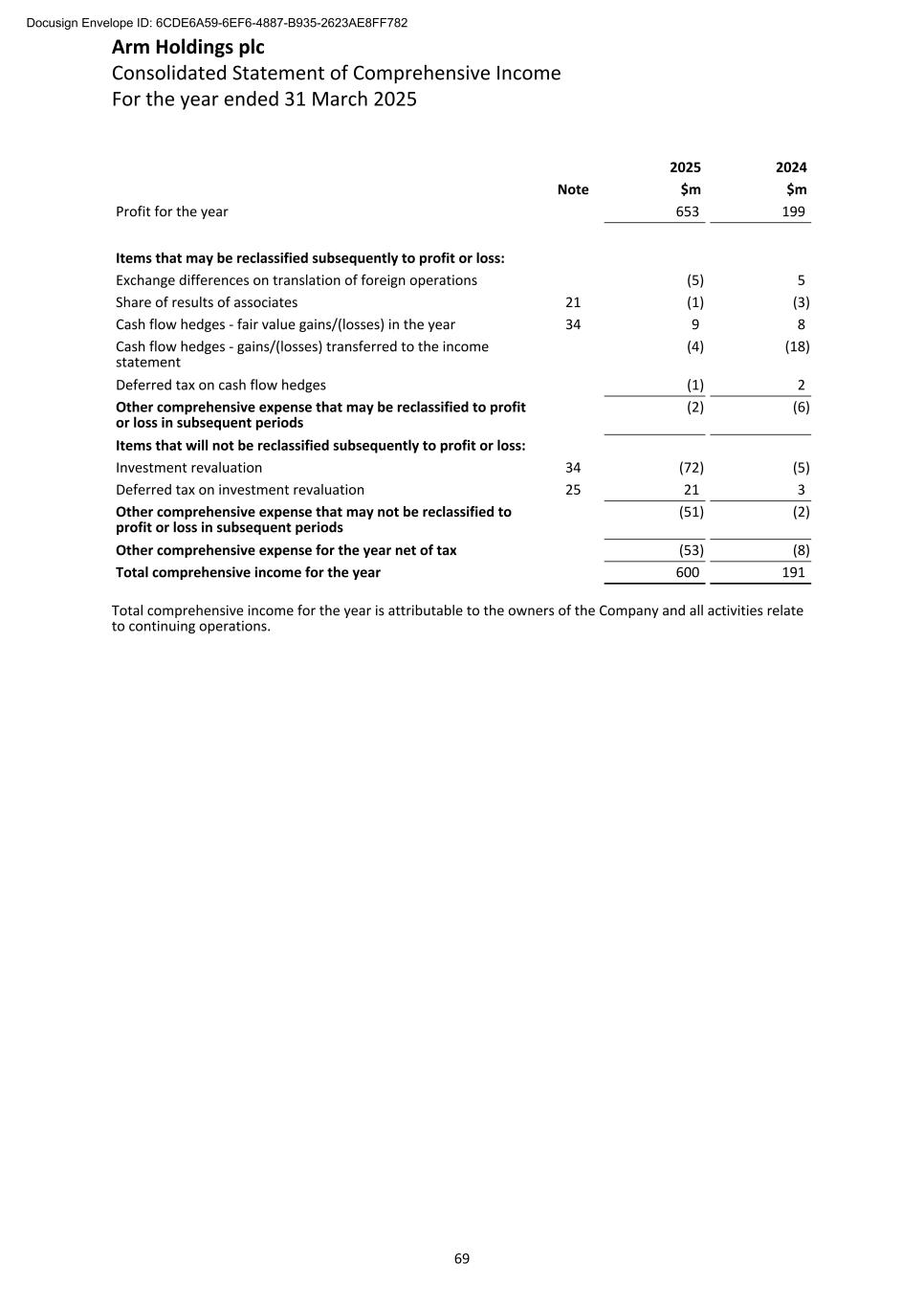
2025 2024 Note $m $m Profit for the year 653 199 Items that may be reclassified subsequently to profit or loss: Exchange differences on translation of foreign operations (5) 5 Share of results of associates 21 (1) (3) Cash flow hedges - fair value gains/(losses) in the year 34 9 8 Cash flow hedges - gains/(losses) transferred to the income statement (4) (18) Deferred tax on cash flow hedges (1) 2 Other comprehensive expense that may be reclassified to profit or loss in subsequent periods (2) (6) Items that will not be reclassified subsequently to profit or loss: Investment revaluation 34 (72) (5) Deferred tax on investment revaluation 25 21 3 Other comprehensive expense that may not be reclassified to profit or loss in subsequent periods (51) (2) Other comprehensive expense for the year net of tax (53) (8) Total comprehensive income for the year 600 191 Total comprehensive income for the year is attributable to the owners of the Company and all activities relate to continuing operations. Arm Holdings plc Consolidated Statement of Comprehensive Income For the year ended 31 March 2025 69 Docusign Envelope ID: 6CDE6A59-6EF6-4887-B935-2623AE8FF782
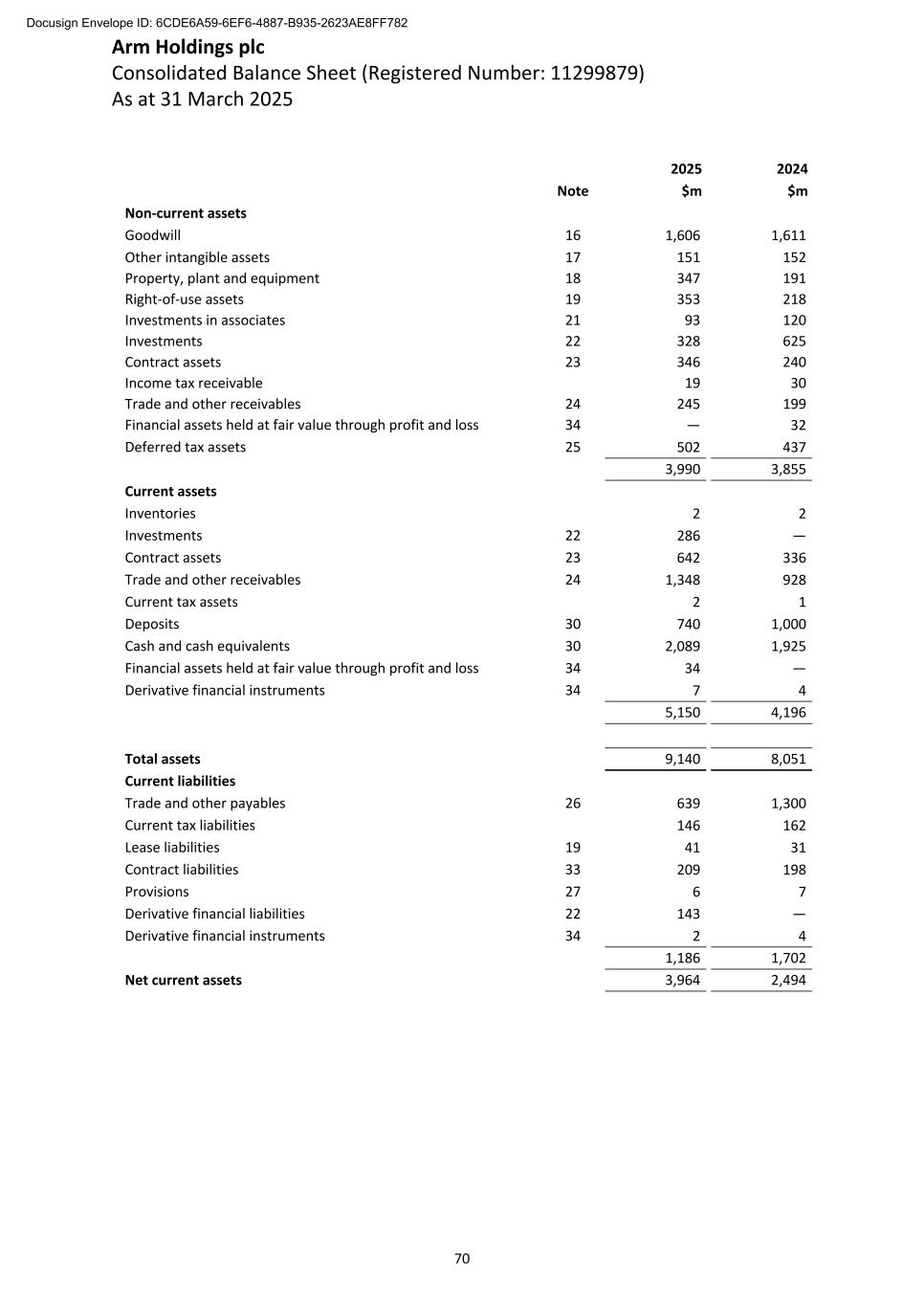
2025 2024 Note $m $m Non-current assets Goodwill 16 1,606 1,611 Other intangible assets 17 151 152 Property, plant and equipment 18 347 191 Right-of-use assets 19 353 218 Investments in associates 21 93 120 Investments 22 328 625 Contract assets 23 346 240 Income tax receivable 19 30 Trade and other receivables 24 245 199 Financial assets held at fair value through profit and loss 34 — 32 Deferred tax assets 25 502 437 3,990 3,855 Current assets Inventories 2 2 Investments 22 286 — Contract assets 23 642 336 Trade and other receivables 24 1,348 928 Current tax assets 2 1 Deposits 30 740 1,000 Cash and cash equivalents 30 2,089 1,925 Financial assets held at fair value through profit and loss 34 34 — Derivative financial instruments 34 7 4 5,150 4,196 Total assets 9,140 8,051 Current liabilities Trade and other payables 26 639 1,300 Current tax liabilities 146 162 Lease liabilities 19 41 31 Contract liabilities 33 209 198 Provisions 27 6 7 Derivative financial liabilities 22 143 — Derivative financial instruments 34 2 4 1,186 1,702 Net current assets 3,964 2 2,494 Arm Holdings plc Consolidated Balance Sheet (Registered Number: 11299879) As at 31 March 2025 70 Docusign Envelope ID: 6CDE6A59-6EF6-4887-B935-2623AE8FF782
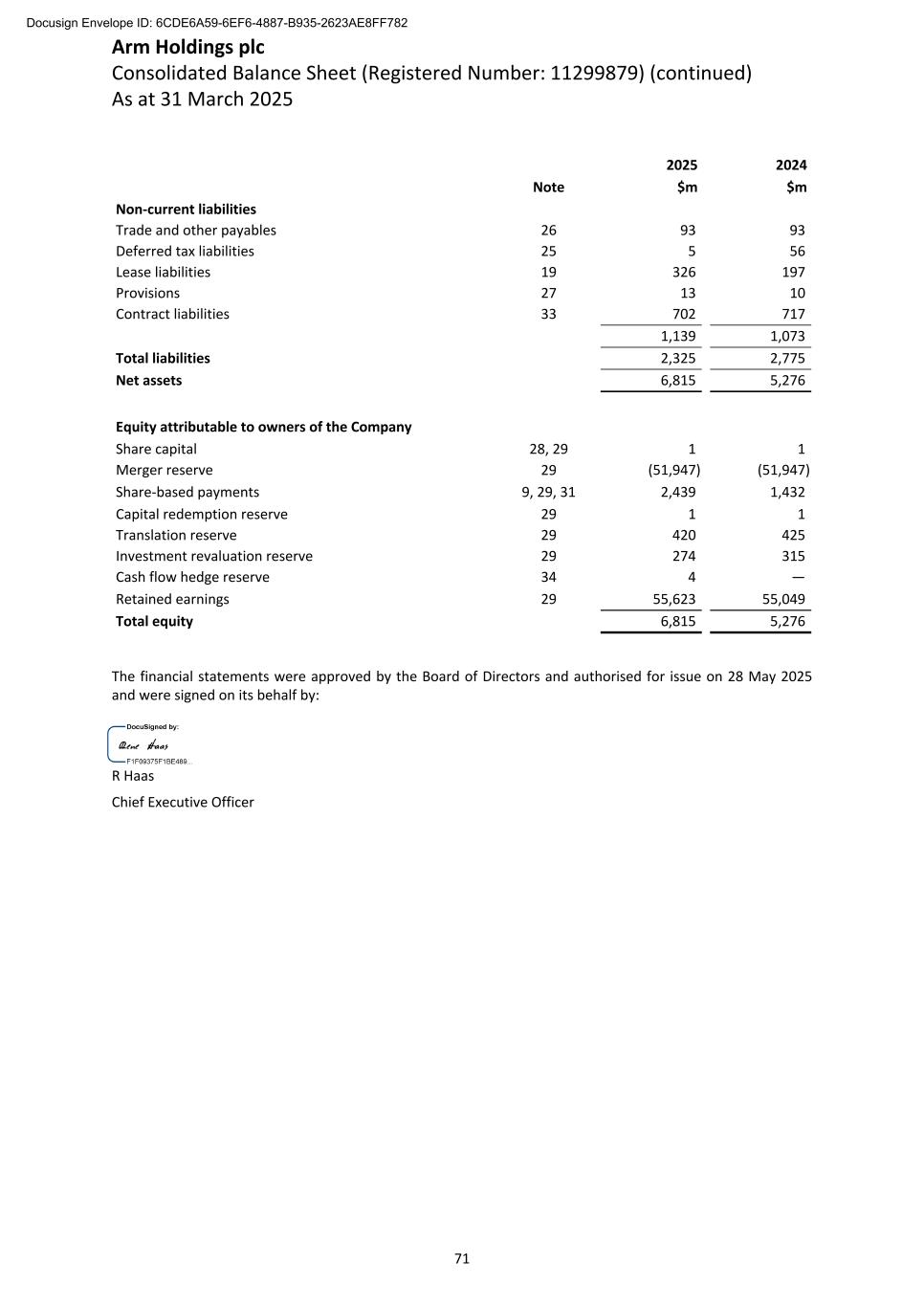
2025 2024 Note $m $m Non-current liabilities Trade and other payables 26 93 93 Deferred tax liabilities 25 5 56 Lease liabilities 19 326 197 Provisions 27 13 10 Contract liabilities 33 702 717 1,139 1,073 Total liabilities 2,325 2,775 Net assets 6,815 5,276 Equity attributable to owners of the Company Share capital 28, 29 1 1 Merger reserve 29 (51,947) (51,947) Share-based payments 9, 29, 31 2,439 1,432 Capital redemption reserve 29 1 1 Translation reserve 29 420 425 Investment revaluation reserve 29 274 315 Cash flow hedge reserve 34 4 — Retained earnings 29 55,623 55,049 Total equity 6,815 5,276 The financial statements were approved by the Board of Directors and authorised for issue on 28 May 2025 and were signed on its behalf by: R Haas Chief Executive Officer Arm Holdings plc Consolidated Balance Sheet (Registered Number: 11299879) (continued) As at 31 March 2025 71 Docusign Envelope ID: 6CDE6A59-6EF6-4887-B935-2623AE8FF782

Equity attributable to equity holders of the Company Share capital Own shares Merger reserve Share- based payments Capital redemption reserve Translation reserve Investment revaluation reserve Cash flow hedge reserve Retained earnings Total equity Note $m $m $m $m $m $m $m $m $m $m Balance at 1 April 2023 — — 1,024 281 — 420 317 8 2,109 4,159 Profit/(loss) for the year — — — — — — — — 199 199 Other comprehensive income/(expense) for the year: Currency translation adjustment — — — — — 5 — — — 5 Share of results of associates 21 — — — — — — — — (3) (3) Investment revaluation — — — — — — (5) — — (5) Deferred tax on investment revaluation 25 — — — — — — 3 — — 3 Cash flow hedges - fair value gains/(losses) in the year 34 — — — — — — — 8 — 8 Cash flow hedges - (gains)/losses transferred to the income statement 34 — — — — — — — (18) — (18) Deferred tax on cash flow hedges 25 — — — — — — — 2 — 2 Total comprehensive income/(expense) for the year — — — — — 5 (2) (8) 196 191 Distribution in specie 14 — — — — — — — — (12) (12) Share-based compensation 31 — — — 793 — — — — — 793 Tax on share-based compensation 12, 25 — — — 358 — — — — — 358 Tax withholding on vested shares from share-based payment arrangements — — — — — — — — (213) (213) Issuance of new shares/share for share 13 1 — 52,971 — — — — — — 52,972 Bonus issue of shares 13 52,970 — (52,970) — — — — — — — Capital reduction 13 (52,969) — — — — — — — 52,969 — Redesignation of post reduction shares and capital 13 (1) — — — 1 — — — — — Recognition of consolidated merger reserve 13 — — (52,972) — — — — — — (52,972) Balance at 31 March 2024 1 — (51,947) 1,432 1 425 315 — 55,049 5,276 Arm Holdings plc Consolidated Statement of Changes in Equity For the year ended 31 March 2025 72 Docusign Envelope ID: 6CDE6A59-6EF6-4887-B935-2623AE8FF782
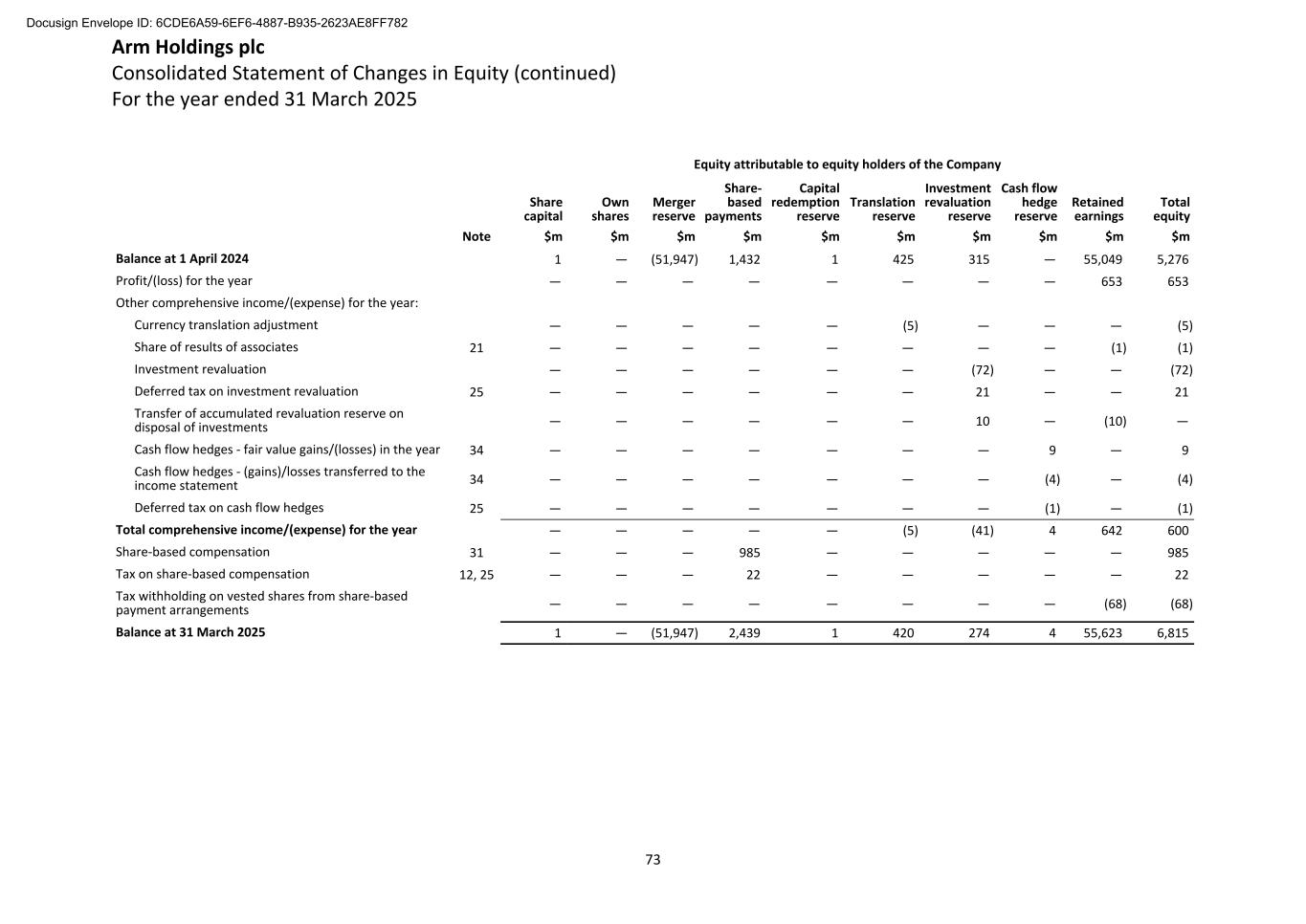
Equity attributable to equity holders of the Company Share capital Own shares Merger reserve Share- based payments Capital redemption reserve Translation reserve Investment revaluation reserve Cash flow hedge reserve Retained earnings Total equity Note $m $m $m $m $m $m $m $m $m $m Balance at 1 April 2024 1 — (51,947) 1,432 1 425 315 — 55,049 5,276 Profit/(loss) for the year — — — — — — — — 653 653 Other comprehensive income/(expense) for the year: Currency translation adjustment — — — — — (5) — — — (5) Share of results of associates 21 — — — — — — — — (1) (1) Investment revaluation — — — — — — (72) — — (72) Deferred tax on investment revaluation 25 — — — — — — 21 — — 21 Transfer of accumulated revaluation reserve on disposal of investments — — — — — — 10 — (10) — Cash flow hedges - fair value gains/(losses) in the year 34 — — — — — — — 9 — 9 Cash flow hedges - (gains)/losses transferred to the income statement 34 — — — — — — — (4) — (4) Deferred tax on cash flow hedges 25 — — — — — — — (1) — (1) Total comprehensive income/(expense) for the year — — — — — (5) (41) 4 642 600 Share-based compensation 31 — — — 985 — — — — — 985 Tax on share-based compensation 12, 25 — — — 22 — — — — — 22 Tax withholding on vested shares from share-based payment arrangements — — — — — — — — (68) (68) Balance at 31 March 2025 1 — (51,947) 2,439 1 420 274 4 55,623 6,815 Arm Holdings plc Consolidated Statement of Changes in Equity (continued) For the year ended 31 March 2025 73 Docusign Envelope ID: 6CDE6A59-6EF6-4887-B935-2623AE8FF782
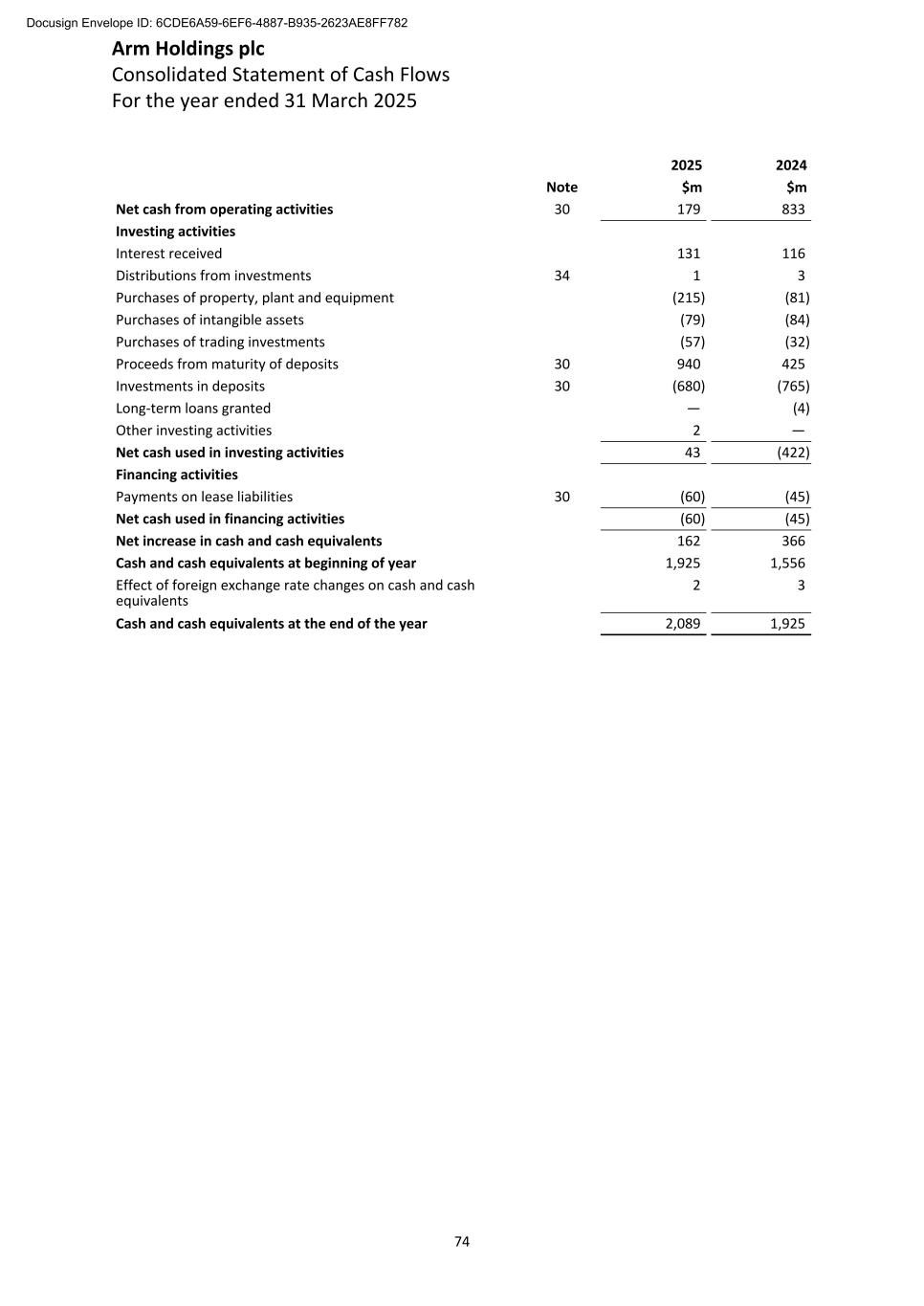
2025 2024 Note $m $m Net cash from operating activities 30 179 833 Investing activities Interest received 131 116 Distributions from investments 34 1 3 Purchases of property, plant and equipment (215) (81) Purchases of intangible assets (79) (84) Purchases of trading investments (57) (32) Proceeds from maturity of deposits 30 940 425 Investments in deposits 30 (680) (765) Long-term loans granted — (4) Other investing activities 2 — Net cash used in investing activities 43 (422) Financing activities Payments on lease liabilities 30 (60) (45) Net cash used in financing activities (60) (45) Net increase in cash and cash equivalents 162 366 Cash and cash equivalents at beginning of year 1,925 1,556 Effect of foreign exchange rate changes on cash and cash equivalents 2 3 Cash and cash equivalents at the end of the year 2,089 1,925 Arm Holdings plc Consolidated Statement of Cash Flows For the year ended 31 March 2025 74 Docusign Envelope ID: 6CDE6A59-6EF6-4887-B935-2623AE8FF782
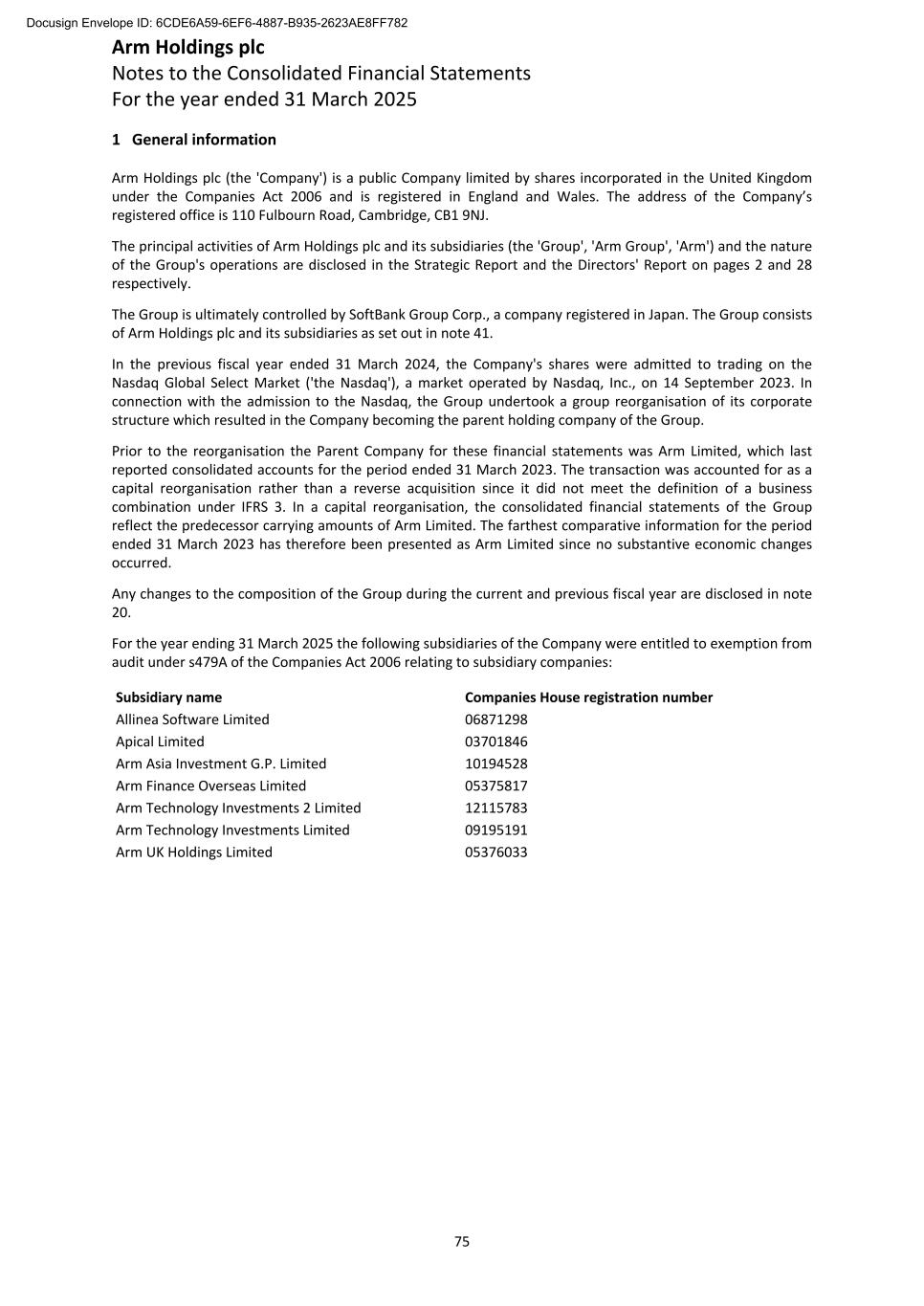
1 General information Arm Holdings plc (the 'Company') is a public Company limited by shares incorporated in the United Kingdom under the Companies Act 2006 and is registered in England and Wales. The address of the Company’s registered office is 110 Fulbourn Road, Cambridge, CB1 9NJ. The principal activities of Arm Holdings plc and its subsidiaries (the 'Group', 'Arm Group', 'Arm') and the nature of the Group's operations are disclosed in the Strategic Report and the Directors' Report on pages 2 and 28 respectively. The Group is ultimately controlled by SoftBank Group Corp., a company registered in Japan. The Group consists of Arm Holdings plc and its subsidiaries as set out in note 41. In the previous fiscal year ended 31 March 2024, the Company's shares were admitted to trading on the Nasdaq Global Select Market ('the Nasdaq'), a market operated by Nasdaq, Inc., on 14 September 2023. In connection with the admission to the Nasdaq, the Group undertook a group reorganisation of its corporate structure which resulted in the Company becoming the parent holding company of the Group. Prior to the reorganisation the Parent Company for these financial statements was Arm Limited, which last reported consolidated accounts for the period ended 31 March 2023. The transaction was accounted for as a capital reorganisation rather than a reverse acquisition since it did not meet the definition of a business combination under IFRS 3. In a capital reorganisation, the consolidated financial statements of the Group reflect the predecessor carrying amounts of Arm Limited. The farthest comparative information for the period ended 31 March 2023 has therefore been presented as Arm Limited since no substantive economic changes occurred. Any changes to the composition of the Group during the current and previous fiscal year are disclosed in note 20. For the year ending 31 March 2025 the following subsidiaries of the Company were entitled to exemption from audit under s479A of the Companies Act 2006 relating to subsidiary companies: Subsidiary name Companies House registration number Allinea Software Limited 06871298 Apical Limited 03701846 Arm Asia Investment G.P. Limited 10194528 Arm Finance Overseas Limited 05375817 Arm Technology Investments 2 Limited 12115783 Arm Technology Investments Limited 09195191 Arm UK Holdings Limited 05376033 Arm Holdings plc Notes to the Consolidated Financial Statements For the year ended 31 March 2025 75 Docusign Envelope ID: 6CDE6A59-6EF6-4887-B935-2623AE8FF782
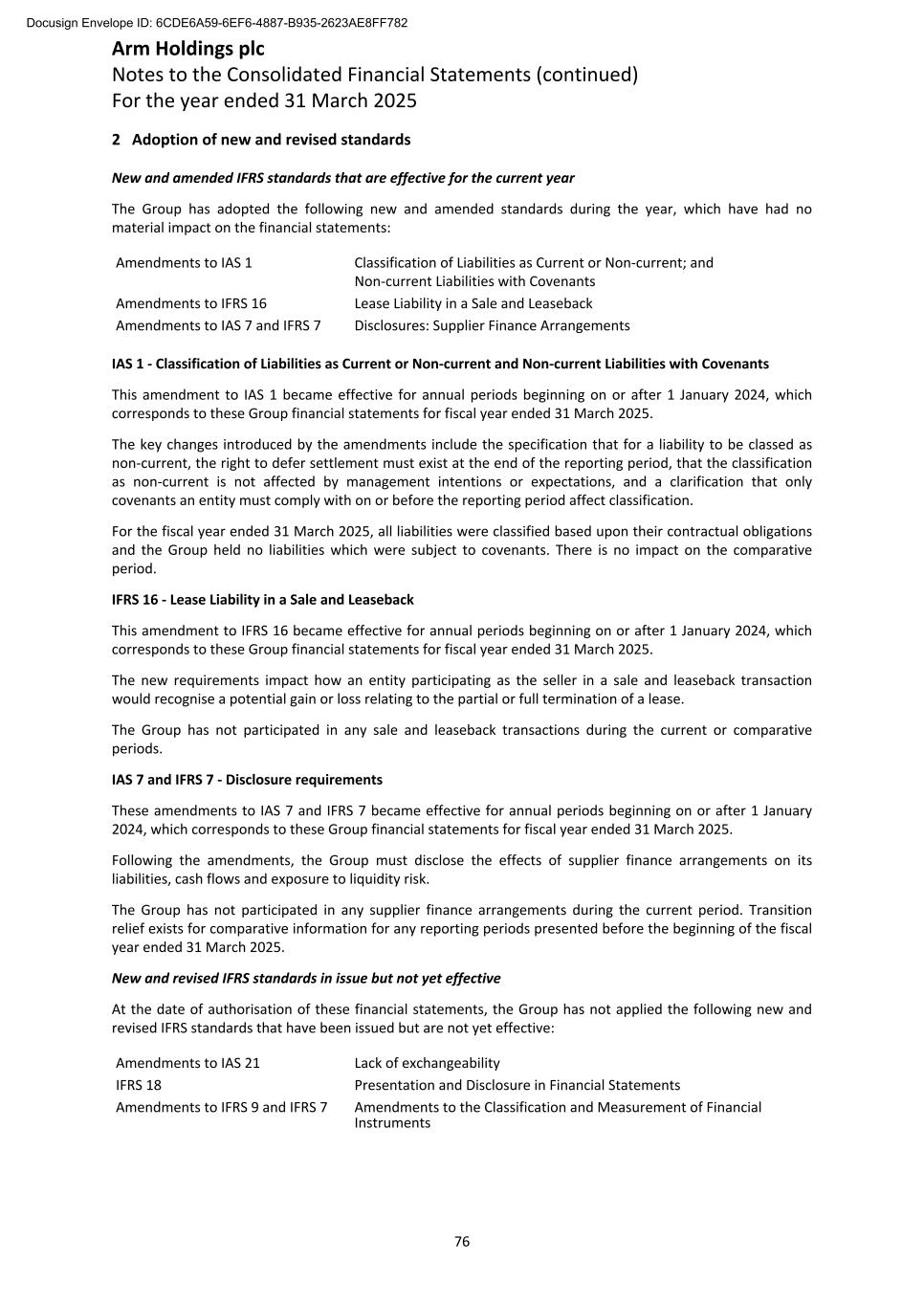
2 Adoption of new and revised standards New and amended IFRS standards that are effective for the current year The Group has adopted the following new and amended standards during the year, which have had no material impact on the financial statements: Amendments to IAS 1 Classification of Liabilities as Current or Non-current; and Non-current Liabilities with Covenants Amendments to IFRS 16 Lease Liability in a Sale and Leaseback Amendments to IAS 7 and IFRS 7 Disclosures: Supplier Finance Arrangements IAS 1 - Classification of Liabilities as Current or Non-current and Non-current Liabilities with Covenants This amendment to IAS 1 became effective for annual periods beginning on or after 1 January 2024, which corresponds to these Group financial statements for fiscal year ended 31 March 2025. The key changes introduced by the amendments include the specification that for a liability to be classed as non-current, the right to defer settlement must exist at the end of the reporting period, that the classification as non-current is not affected by management intentions or expectations, and a clarification that only covenants an entity must comply with on or before the reporting period affect classification. For the fiscal year ended 31 March 2025, all liabilities were classified based upon their contractual obligations and the Group held no liabilities which were subject to covenants. There is no impact on the comparative period. IFRS 16 - Lease Liability in a Sale and Leaseback This amendment to IFRS 16 became effective for annual periods beginning on or after 1 January 2024, which corresponds to these Group financial statements for fiscal year ended 31 March 2025. The new requirements impact how an entity participating as the seller in a sale and leaseback transaction would recognise a potential gain or loss relating to the partial or full termination of a lease. The Group has not participated in any sale and leaseback transactions during the current or comparative periods. IAS 7 and IFRS 7 - Disclosure requirements These amendments to IAS 7 and IFRS 7 became effective for annual periods beginning on or after 1 January 2024, which corresponds to these Group financial statements for fiscal year ended 31 March 2025. Following the amendments, the Group must disclose the effects of supplier finance arrangements on its liabilities, cash flows and exposure to liquidity risk. The Group has not participated in any supplier finance arrangements during the current period. Transition relief exists for comparative information for any reporting periods presented before the beginning of the fiscal year ended 31 March 2025. New and revised IFRS standards in issue but not yet effective At the date of authorisation of these financial statements, the Group has not applied the following new and revised IFRS standards that have been issued but are not yet effective: Amendments to IAS 21 Lack of exchangeability IFRS 18 Presentation and Disclosure in Financial Statements Amendments to IFRS 9 and IFRS 7 Amendments to the Classification and Measurement of Financial Instruments Arm Holdings plc Notes to the Consolidated Financial Statements (continued) For the year ended 31 March 2025 76 Docusign Envelope ID: 6CDE6A59-6EF6-4887-B935-2623AE8FF782
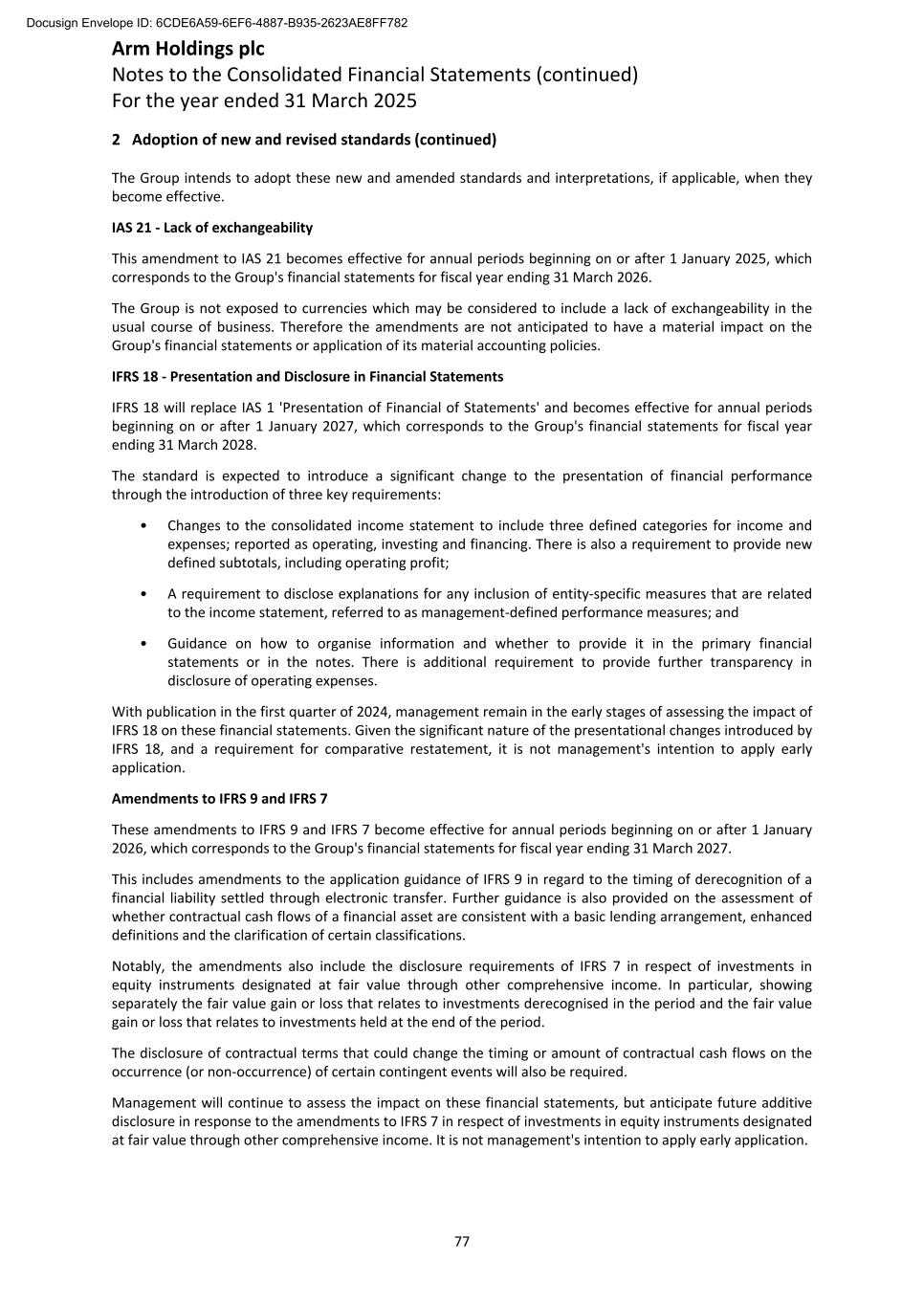
2 Adoption of new and revised standards (continued) The Group intends to adopt these new and amended standards and interpretations, if applicable, when they become effective. IAS 21 - Lack of exchangeability This amendment to IAS 21 becomes effective for annual periods beginning on or after 1 January 2025, which corresponds to the Group's financial statements for fiscal year ending 31 March 2026. The Group is not exposed to currencies which may be considered to include a lack of exchangeability in the usual course of business. Therefore the amendments are not anticipated to have a material impact on the Group's financial statements or application of its material accounting policies. IFRS 18 - Presentation and Disclosure in Financial Statements IFRS 18 will replace IAS 1 'Presentation of Financial of Statements' and becomes effective for annual periods beginning on or after 1 January 2027, which corresponds to the Group's financial statements for fiscal year ending 31 March 2028. The standard is expected to introduce a significant change to the presentation of financial performance through the introduction of three key requirements: • Changes to the consolidated income statement to include three defined categories for income and expenses; reported as operating, investing and financing. There is also a requirement to provide new defined subtotals, including operating profit; • A requirement to disclose explanations for any inclusion of entity-specific measures that are related to the income statement, referred to as management-defined performance measures; and • Guidance on how to organise information and whether to provide it in the primary financial statements or in the notes. There is additional requirement to provide further transparency in disclosure of operating expenses. With publication in the first quarter of 2024, management remain in the early stages of assessing the impact of IFRS 18 on these financial statements. Given the significant nature of the presentational changes introduced by IFRS 18, and a requirement for comparative restatement, it is not management's intention to apply early application. Amendments to IFRS 9 and IFRS 7 These amendments to IFRS 9 and IFRS 7 become effective for annual periods beginning on or after 1 January 2026, which corresponds to the Group's financial statements for fiscal year ending 31 March 2027. This includes amendments to the application guidance of IFRS 9 in regard to the timing of derecognition of a financial liability settled through electronic transfer. Further guidance is also provided on the assessment of whether contractual cash flows of a financial asset are consistent with a basic lending arrangement, enhanced definitions and the clarification of certain classifications. Notably, the amendments also include the disclosure requirements of IFRS 7 in respect of investments in equity instruments designated at fair value through other comprehensive income. In particular, showing separately the fair value gain or loss that relates to investments derecognised in the period and the fair value gain or loss that relates to investments held at the end of the period. The disclosure of contractual terms that could change the timing or amount of contractual cash flows on the occurrence (or non-occurrence) of certain contingent events will also be required. Management will continue to assess the impact on these financial statements, but anticipate future additive disclosure in response to the amendments to IFRS 7 in respect of investments in equity instruments designated at fair value through other comprehensive income. It is not management's intention to apply early application. Arm Holdings plc Notes to the Consolidated Financial Statements (continued) For the year ended 31 March 2025 77 Docusign Envelope ID: 6CDE6A59-6EF6-4887-B935-2623AE8FF782
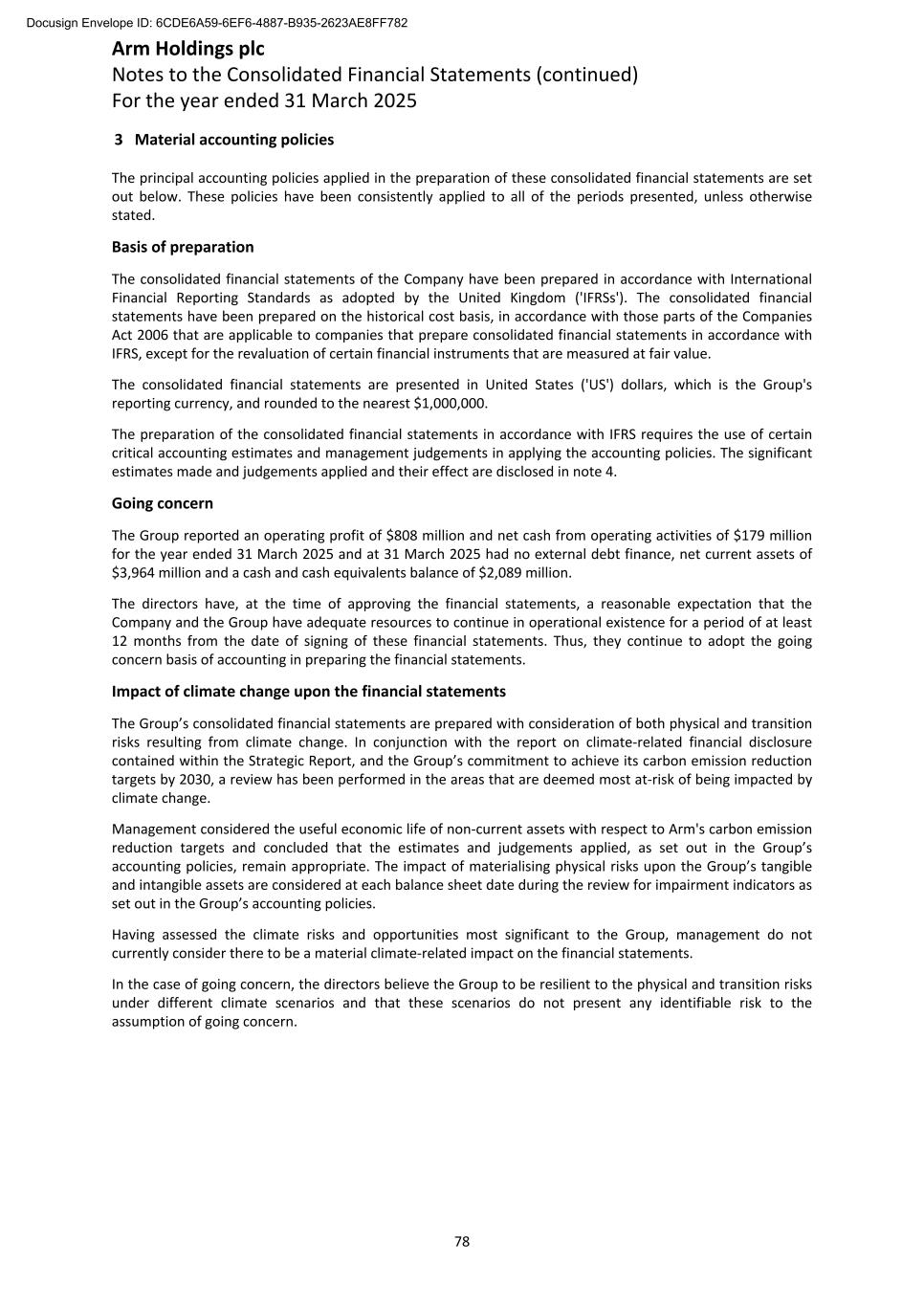
3 Material accounting policies The principal accounting policies applied in the preparation of these consolidated financial statements are set out below. These policies have been consistently applied to all of the periods presented, unless otherwise stated. Basis of preparation The consolidated financial statements of the Company have been prepared in accordance with International Financial Reporting Standards as adopted by the United Kingdom ('IFRSs'). The consolidated financial statements have been prepared on the historical cost basis, in accordance with those parts of the Companies Act 2006 that are applicable to companies that prepare consolidated financial statements in accordance with IFRS, except for the revaluation of certain financial instruments that are measured at fair value. The consolidated financial statements are presented in United States ('US') dollars, which is the Group's reporting currency, and rounded to the nearest $1,000,000. The preparation of the consolidated financial statements in accordance with IFRS requires the use of certain critical accounting estimates and management judgements in applying the accounting policies. The significant estimates made and judgements applied and their effect are disclosed in note 4. Going concern The Group reported an operating profit of $808 million and net cash from operating activities of $179 million for the year ended 31 March 2025 and at 31 March 2025 had no external debt finance, net current assets of $3,964 million and a cash and cash equivalents balance of $2,089 million. The directors have, at the time of approving the financial statements, a reasonable expectation that the Company and the Group have adequate resources to continue in operational existence for a period of at least 12 months from the date of signing of these financial statements. Thus, they continue to adopt the going concern basis of accounting in preparing the financial statements. Impact of climate change upon the financial statements The Group’s consolidated financial statements are prepared with consideration of both physical and transition risks resulting from climate change. In conjunction with the report on climate-related financial disclosure contained within the Strategic Report, and the Group’s commitment to achieve its carbon emission reduction targets by 2030, a review has been performed in the areas that are deemed most at-risk of being impacted by climate change. Management considered the useful economic life of non-current assets with respect to Arm's carbon emission reduction targets and concluded that the estimates and judgements applied, as set out in the Group’s accounting policies, remain appropriate. The impact of materialising physical risks upon the Group’s tangible and intangible assets are considered at each balance sheet date during the review for impairment indicators as set out in the Group’s accounting policies. Having assessed the climate risks and opportunities most significant to the Group, management do not currently consider there to be a material climate-related impact on the financial statements. In the case of going concern, the directors believe the Group to be resilient to the physical and transition risks under different climate scenarios and that these scenarios do not present any identifiable risk to the assumption of going concern. Arm Holdings plc Notes to the Consolidated Financial Statements (continued) For the year ended 31 March 2025 78 Docusign Envelope ID: 6CDE6A59-6EF6-4887-B935-2623AE8FF782
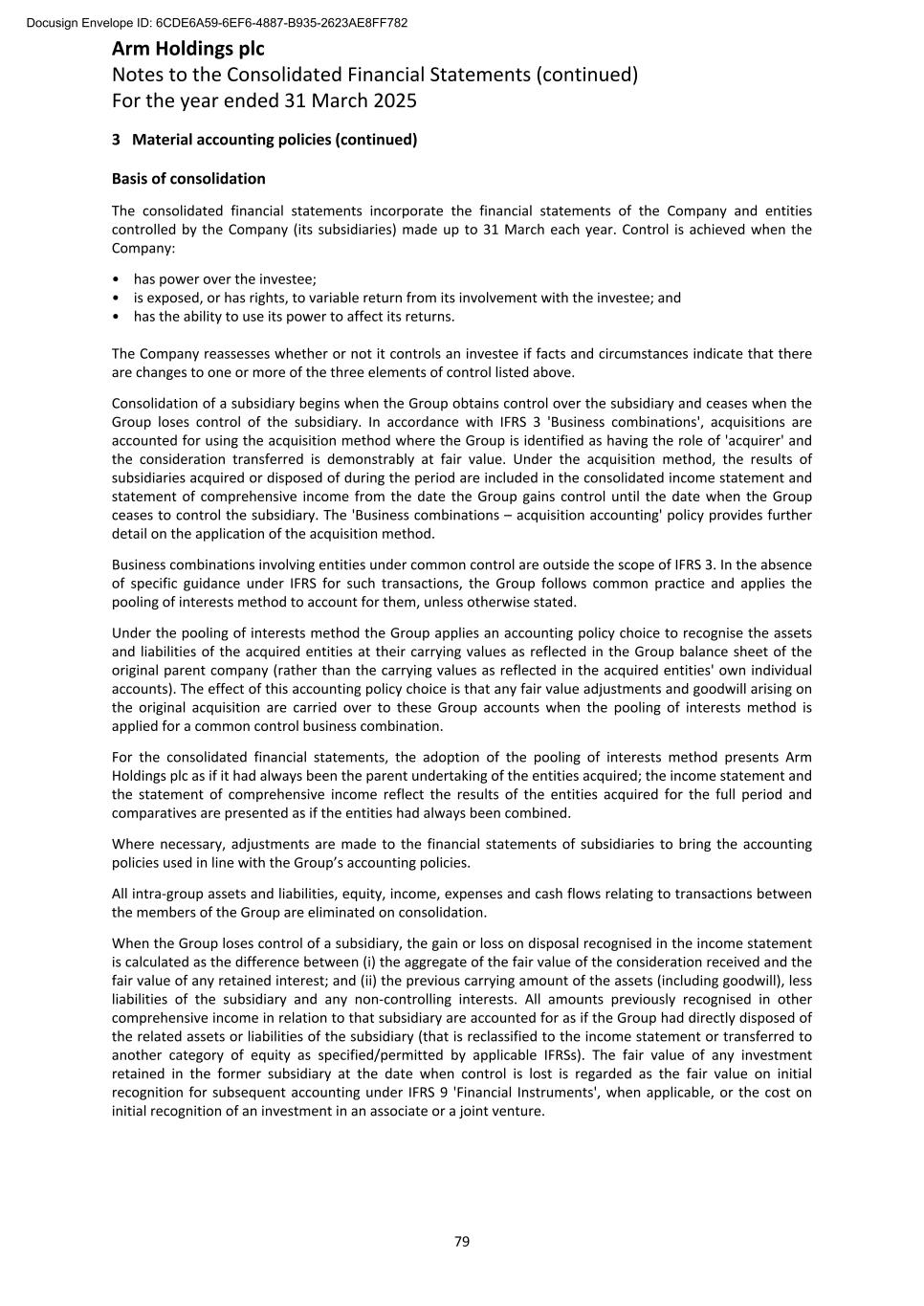
3 Material accounting policies (continued) Basis of consolidation The consolidated financial statements incorporate the financial statements of the Company and entities controlled by the Company (its subsidiaries) made up to 31 March each year. Control is achieved when the Company: • has power over the investee; • is exposed, or has rights, to variable return from its involvement with the investee; and • has the ability to use its power to affect its returns. The Company reassesses whether or not it controls an investee if facts and circumstances indicate that there are changes to one or more of the three elements of control listed above. Consolidation of a subsidiary begins when the Group obtains control over the subsidiary and ceases when the Group loses control of the subsidiary. In accordance with IFRS 3 'Business combinations', acquisitions are accounted for using the acquisition method where the Group is identified as having the role of 'acquirer' and the consideration transferred is demonstrably at fair value. Under the acquisition method, the results of subsidiaries acquired or disposed of during the period are included in the consolidated income statement and statement of comprehensive income from the date the Group gains control until the date when the Group ceases to control the subsidiary. The 'Business combinations – acquisition accounting' policy provides further detail on the application of the acquisition method. Business combinations involving entities under common control are outside the scope of IFRS 3. In the absence of specific guidance under IFRS for such transactions, the Group follows common practice and applies the pooling of interests method to account for them, unless otherwise stated. Under the pooling of interests method the Group applies an accounting policy choice to recognise the assets and liabilities of the acquired entities at their carrying values as reflected in the Group balance sheet of the original parent company (rather than the carrying values as reflected in the acquired entities' own individual accounts). The effect of this accounting policy choice is that any fair value adjustments and goodwill arising on the original acquisition are carried over to these Group accounts when the pooling of interests method is applied for a common control business combination. For the consolidated financial statements, the adoption of the pooling of interests method presents Arm Holdings plc as if it had always been the parent undertaking of the entities acquired; the income statement and the statement of comprehensive income reflect the results of the entities acquired for the full period and comparatives are presented as if the entities had always been combined. Where necessary, adjustments are made to the financial statements of subsidiaries to bring the accounting policies used in line with the Group’s accounting policies. All intra-group assets and liabilities, equity, income, expenses and cash flows relating to transactions between the members of the Group are eliminated on consolidation. When the Group loses control of a subsidiary, the gain or loss on disposal recognised in the income statement is calculated as the difference between (i) the aggregate of the fair value of the consideration received and the fair value of any retained interest; and (ii) the previous carrying amount of the assets (including goodwill), less liabilities of the subsidiary and any non-controlling interests. All amounts previously recognised in other comprehensive income in relation to that subsidiary are accounted for as if the Group had directly disposed of the related assets or liabilities of the subsidiary (that is reclassified to the income statement or transferred to another category of equity as specified/permitted by applicable IFRSs). The fair value of any investment retained in the former subsidiary at the date when control is lost is regarded as the fair value on initial recognition for subsequent accounting under IFRS 9 'Financial Instruments', when applicable, or the cost on initial recognition of an investment in an associate or a joint venture. Arm Holdings plc Notes to the Consolidated Financial Statements (continued) For the year ended 31 March 2025 79 Docusign Envelope ID: 6CDE6A59-6EF6-4887-B935-2623AE8FF782
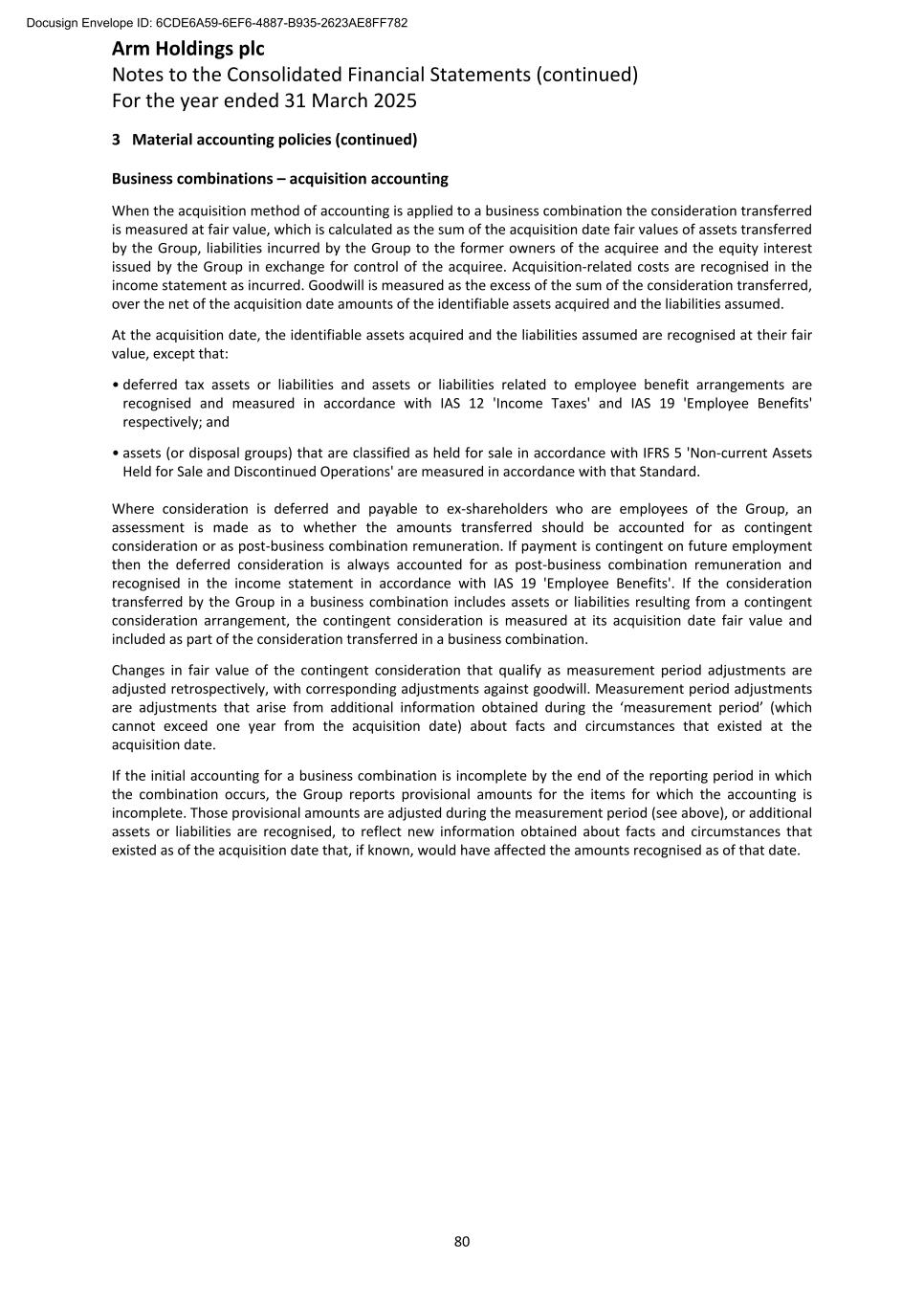
3 Material accounting policies (continued) Business combinations – acquisition accounting When the acquisition method of accounting is applied to a business combination the consideration transferred is measured at fair value, which is calculated as the sum of the acquisition date fair values of assets transferred by the Group, liabilities incurred by the Group to the former owners of the acquiree and the equity interest issued by the Group in exchange for control of the acquiree. Acquisition-related costs are recognised in the income statement as incurred. Goodwill is measured as the excess of the sum of the consideration transferred, over the net of the acquisition date amounts of the identifiable assets acquired and the liabilities assumed. At the acquisition date, the identifiable assets acquired and the liabilities assumed are recognised at their fair value, except that: • deferred tax assets or liabilities and assets or liabilities related to employee benefit arrangements are recognised and measured in accordance with IAS 12 'Income Taxes' and IAS 19 'Employee Benefits' respectively; and • assets (or disposal groups) that are classified as held for sale in accordance with IFRS 5 'Non-current Assets Held for Sale and Discontinued Operations' are measured in accordance with that Standard. Where consideration is deferred and payable to ex-shareholders who are employees of the Group, an assessment is made as to whether the amounts transferred should be accounted for as contingent consideration or as post-business combination remuneration. If payment is contingent on future employment then the deferred consideration is always accounted for as post-business combination remuneration and recognised in the income statement in accordance with IAS 19 'Employee Benefits'. If the consideration transferred by the Group in a business combination includes assets or liabilities resulting from a contingent consideration arrangement, the contingent consideration is measured at its acquisition date fair value and included as part of the consideration transferred in a business combination. Changes in fair value of the contingent consideration that qualify as measurement period adjustments are adjusted retrospectively, with corresponding adjustments against goodwill. Measurement period adjustments are adjustments that arise from additional information obtained during the ‘measurement period’ (which cannot exceed one year from the acquisition date) about facts and circumstances that existed at the acquisition date. If the initial accounting for a business combination is incomplete by the end of the reporting period in which the combination occurs, the Group reports provisional amounts for the items for which the accounting is incomplete. Those provisional amounts are adjusted during the measurement period (see above), or additional assets or liabilities are recognised, to reflect new information obtained about facts and circumstances that existed as of the acquisition date that, if known, would have affected the amounts recognised as of that date. Arm Holdings plc Notes to the Consolidated Financial Statements (continued) For the year ended 31 March 2025 80 Docusign Envelope ID: 6CDE6A59-6EF6-4887-B935-2623AE8FF782
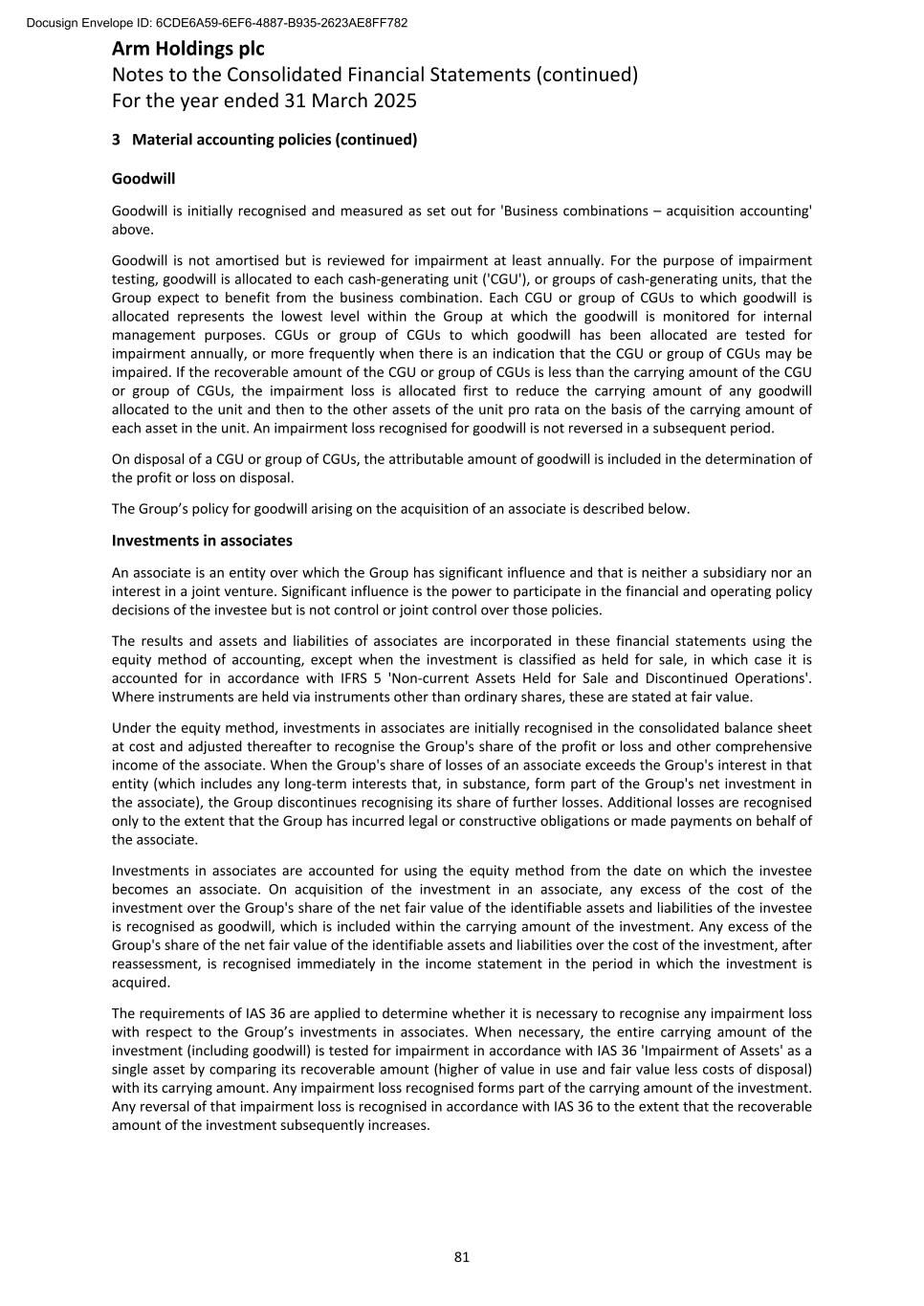
3 Material accounting policies (continued) Goodwill Goodwill is initially recognised and measured as set out for 'Business combinations – acquisition accounting' above. Goodwill is not amortised but is reviewed for impairment at least annually. For the purpose of impairment testing, goodwill is allocated to each cash-generating unit ('CGU'), or groups of cash-generating units, that the Group expect to benefit from the business combination. Each CGU or group of CGUs to which goodwill is allocated represents the lowest level within the Group at which the goodwill is monitored for internal management purposes. CGUs or group of CGUs to which goodwill has been allocated are tested for impairment annually, or more frequently when there is an indication that the CGU or group of CGUs may be impaired. If the recoverable amount of the CGU or group of CGUs is less than the carrying amount of the CGU or group of CGUs, the impairment loss is allocated first to reduce the carrying amount of any goodwill allocated to the unit and then to the other assets of the unit pro rata on the basis of the carrying amount of each asset in the unit. An impairment loss recognised for goodwill is not reversed in a subsequent period. On disposal of a CGU or group of CGUs, the attributable amount of goodwill is included in the determination of the profit or loss on disposal. The Group’s policy for goodwill arising on the acquisition of an associate is described below. Investments in associates An associate is an entity over which the Group has significant influence and that is neither a subsidiary nor an interest in a joint venture. Significant influence is the power to participate in the financial and operating policy decisions of the investee but is not control or joint control over those policies. The results and assets and liabilities of associates are incorporated in these financial statements using the equity method of accounting, except when the investment is classified as held for sale, in which case it is accounted for in accordance with IFRS 5 'Non-current Assets Held for Sale and Discontinued Operations'. Where instruments are held via instruments other than ordinary shares, these are stated at fair value. Under the equity method, investments in associates are initially recognised in the consolidated balance sheet at cost and adjusted thereafter to recognise the Group's share of the profit or loss and other comprehensive income of the associate. When the Group's share of losses of an associate exceeds the Group's interest in that entity (which includes any long-term interests that, in substance, form part of the Group's net investment in the associate), the Group discontinues recognising its share of further losses. Additional losses are recognised only to the extent that the Group has incurred legal or constructive obligations or made payments on behalf of the associate. Investments in associates are accounted for using the equity method from the date on which the investee becomes an associate. On acquisition of the investment in an associate, any excess of the cost of the investment over the Group's share of the net fair value of the identifiable assets and liabilities of the investee is recognised as goodwill, which is included within the carrying amount of the investment. Any excess of the Group's share of the net fair value of the identifiable assets and liabilities over the cost of the investment, after reassessment, is recognised immediately in the income statement in the period in which the investment is acquired. The requirements of IAS 36 are applied to determine whether it is necessary to recognise any impairment loss with respect to the Group’s investments in associates. When necessary, the entire carrying amount of the investment (including goodwill) is tested for impairment in accordance with IAS 36 'Impairment of Assets' as a single asset by comparing its recoverable amount (higher of value in use and fair value less costs of disposal) with its carrying amount. Any impairment loss recognised forms part of the carrying amount of the investment. Any reversal of that impairment loss is recognised in accordance with IAS 36 to the extent that the recoverable amount of the investment subsequently increases. Arm Holdings plc Notes to the Consolidated Financial Statements (continued) For the year ended 31 March 2025 81 Docusign Envelope ID: 6CDE6A59-6EF6-4887-B935-2623AE8FF782

3 Material accounting policies (continued) When a Group entity transacts with an associate of the Group, profits and losses resulting from the transactions with the associate are recognised in the Group's consolidated financial statements only to the extent of interests in the associate that are not held by the Group. The Group discontinues the use of the equity method from the date when the investment ceases to be an associate or a joint venture. When the Group retains an interest in the former associate or a joint venture and the retained interest is a financial asset, the Group measures the retained interest at fair value at that date and the fair value is regarded as its fair value on initial recognition in accordance with IFRS 9. The difference between the carrying amount of the associate or a joint venture at the date the equity method was discontinued, and the fair value of any retained interest and any proceeds from disposing of a part interest in the associate or a joint venture is included in the determination of the gain or loss on disposal of the associate or joint venture. In addition, the Group accounts for all amounts previously recognised in other comprehensive income in relation to that associate on the same basis as would be required if that associate had directly disposed of the related assets or liabilities. Therefore, if a gain or loss previously recognised in other comprehensive income by that associate or joint venture would be reclassified to profit or loss on the disposal of the related assets or liabilities, the Group reclassifies the gain or loss from equity to profit or loss (as a reclassification adjustment) when the associate or joint venture is disposed of. In the individual accounts of the Company, interests in joint ventures and associates are stated at historic cost less accumulated impairment losses. Where investments are held via instruments other than ordinary shares, these are stated at fair value. Revenue The Group recognises revenues for the transfer of products or services to customers in an amount that reflects the consideration to which the Group expects to be entitled in exchange for those products or services. The principle is achieved through the following five-step approach: • Identification of the contract with the customer; • Identification of the performance obligations; • Determination of the transaction price; • Allocation of the transaction price to the performance obligations in the contract; and • Recognition of revenue when, or as, the Group satisfies a performance obligation. Revenue for the Group’s major product offerings consists of the following: Licence and Other Revenue • Intellectual property licence — The Group generally licences IP under non-exclusive licence agreements that provide usage rights for specific applications for a finite or perpetual term. These licences are made available electronically to address the customer-specific business requirements. These arrangements generally have distinct performance obligations that consist of transferring the licenced IPs, version extensions of architecture IP or releases of specified IPs, and support services. Support services consist of a stand-ready obligation to provide technical support, patches, and bug fixes over the support term. Revenue allocated to the IP licence is recognised at a point in time upon the delivery or beginning of licence term, whichever is later. Revenue allocated to distinct version extensions of architecture IP or releases of specified IP, excluding when-and-if- available minor updates over support term, are recognised at a point in time upon the delivery or beginning of licence term, whichever is later. Certain licence agreements provide customers with the right to access a library of current and future IPs on an unlimited basis over the contractual period depending on the terms of the applicable contract. Arm Holdings plc Notes to the Consolidated Financial Statements (continued) For the year ended 31 March 2025 82 Docusign Envelope ID: 6CDE6A59-6EF6-4887-B935-2623AE8FF782
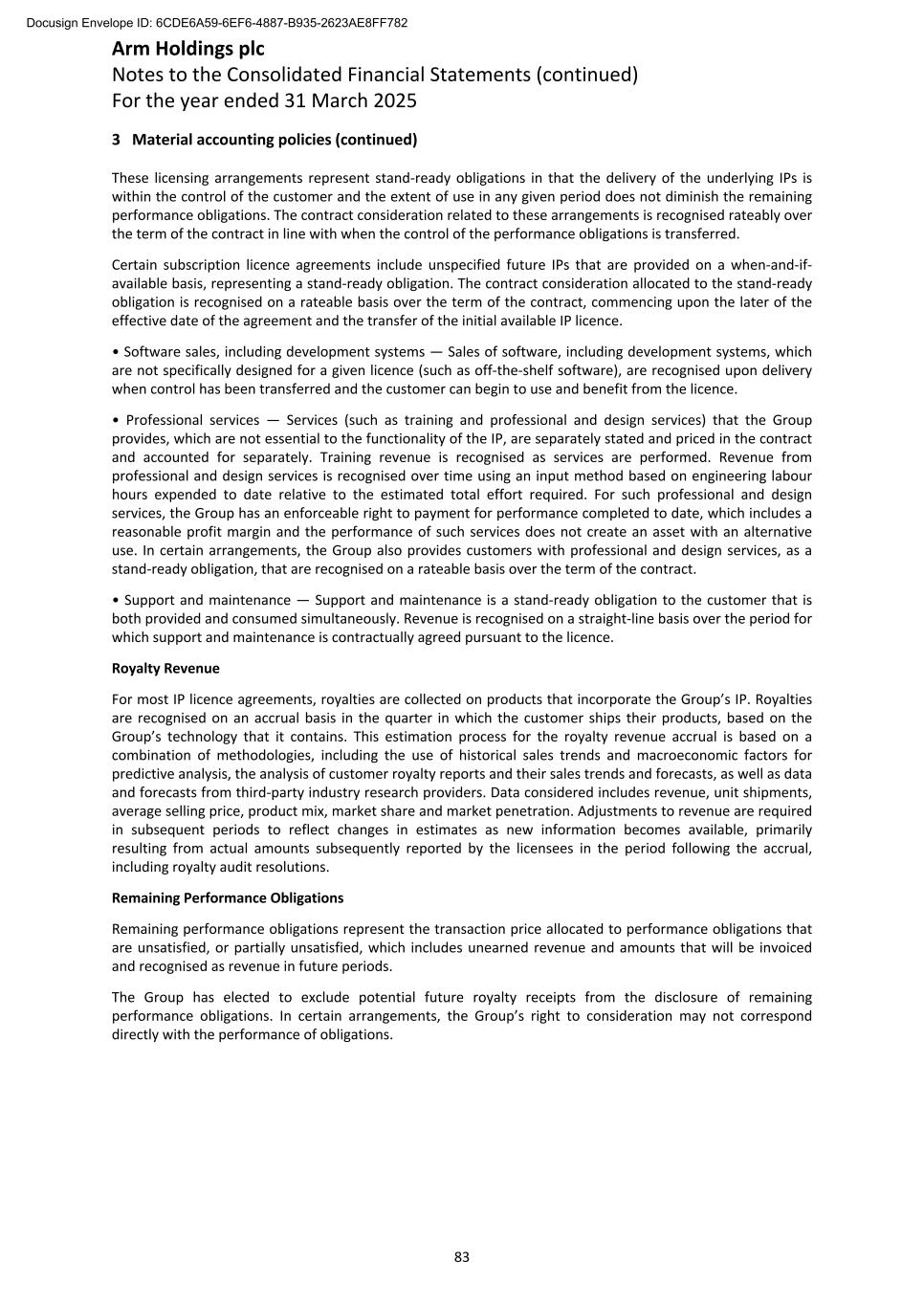
3 Material accounting policies (continued) These licensing arrangements represent stand-ready obligations in that the delivery of the underlying IPs is within the control of the customer and the extent of use in any given period does not diminish the remaining performance obligations. The contract consideration related to these arrangements is recognised rateably over the term of the contract in line with when the control of the performance obligations is transferred. Certain subscription licence agreements include unspecified future IPs that are provided on a when-and-if- available basis, representing a stand-ready obligation. The contract consideration allocated to the stand-ready obligation is recognised on a rateable basis over the term of the contract, commencing upon the later of the effective date of the agreement and the transfer of the initial available IP licence. • Software sales, including development systems — Sales of software, including development systems, which are not specifically designed for a given licence (such as off-the-shelf software), are recognised upon delivery when control has been transferred and the customer can begin to use and benefit from the licence. • Professional services — Services (such as training and professional and design services) that the Group provides, which are not essential to the functionality of the IP, are separately stated and priced in the contract and accounted for separately. Training revenue is recognised as services are performed. Revenue from professional and design services is recognised over time using an input method based on engineering labour hours expended to date relative to the estimated total effort required. For such professional and design services, the Group has an enforceable right to payment for performance completed to date, which includes a reasonable profit margin and the performance of such services does not create an asset with an alternative use. In certain arrangements, the Group also provides customers with professional and design services, as a stand-ready obligation, that are recognised on a rateable basis over the term of the contract. • Support and maintenance — Support and maintenance is a stand-ready obligation to the customer that is both provided and consumed simultaneously. Revenue is recognised on a straight-line basis over the period for which support and maintenance is contractually agreed pursuant to the licence. Royalty Revenue For most IP licence agreements, royalties are collected on products that incorporate the Group’s IP. Royalties are recognised on an accrual basis in the quarter in which the customer ships their products, based on the Group’s technology that it contains. This estimation process for the royalty revenue accrual is based on a combination of methodologies, including the use of historical sales trends and macroeconomic factors for predictive analysis, the analysis of customer royalty reports and their sales trends and forecasts, as well as data and forecasts from third-party industry research providers. Data considered includes revenue, unit shipments, average selling price, product mix, market share and market penetration. Adjustments to revenue are required in subsequent periods to reflect changes in estimates as new information becomes available, primarily resulting from actual amounts subsequently reported by the licensees in the period following the accrual, including royalty audit resolutions. Remaining Performance Obligations Remaining performance obligations represent the transaction price allocated to performance obligations that are unsatisfied, or partially unsatisfied, which includes unearned revenue and amounts that will be invoiced and recognised as revenue in future periods. The Group has elected to exclude potential future royalty receipts from the disclosure of remaining performance obligations. In certain arrangements, the Group’s right to consideration may not correspond directly with the performance of obligations. Arm Holdings plc Notes to the Consolidated Financial Statements (continued) For the year ended 31 March 2025 83 Docusign Envelope ID: 6CDE6A59-6EF6-4887-B935-2623AE8FF782
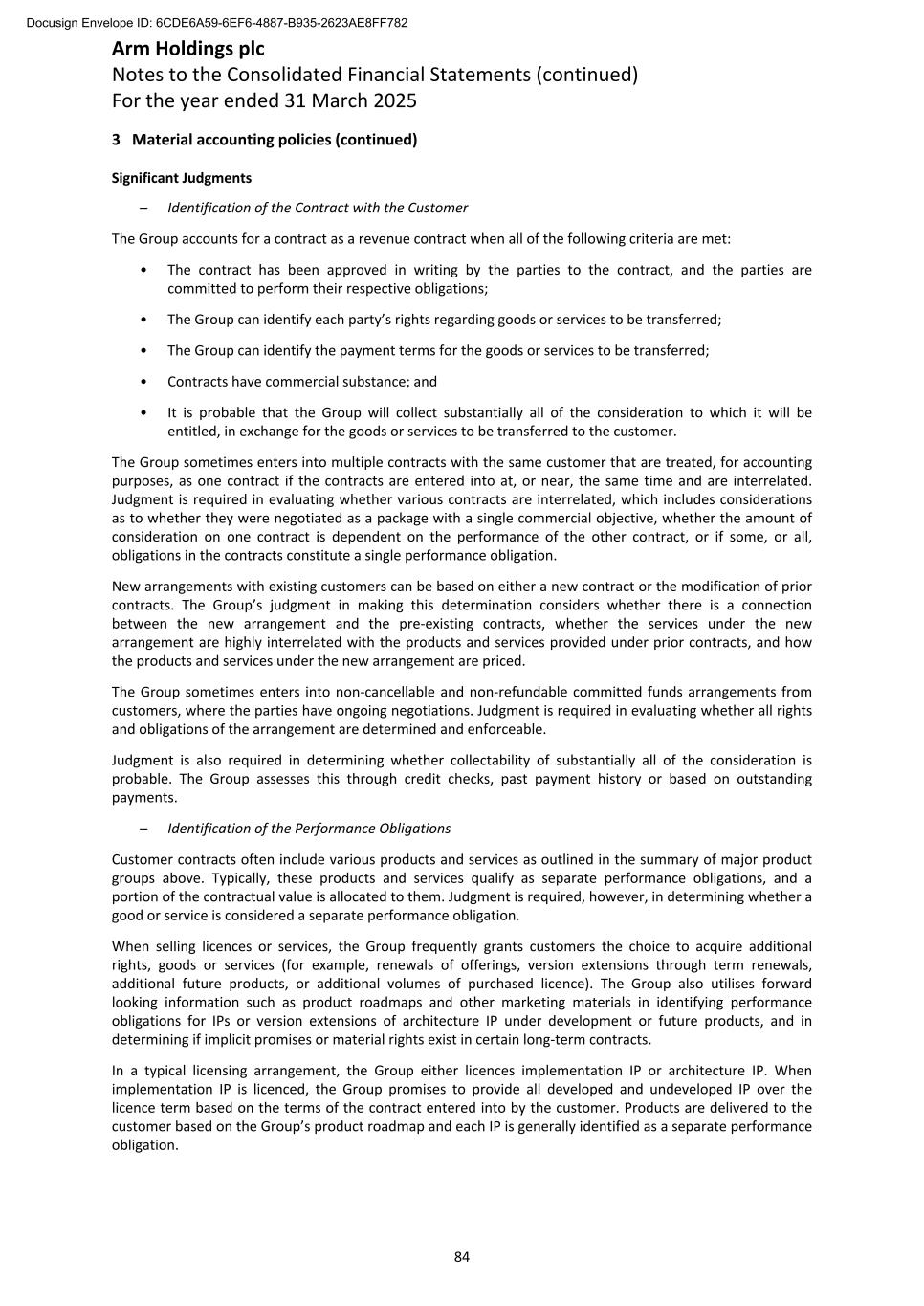
3 Material accounting policies (continued) Significant Judgments – Identification of the Contract with the Customer The Group accounts for a contract as a revenue contract when all of the following criteria are met: • The contract has been approved in writing by the parties to the contract, and the parties are committed to perform their respective obligations; • The Group can identify each party’s rights regarding goods or services to be transferred; • The Group can identify the payment terms for the goods or services to be transferred; • Contracts have commercial substance; and • It is probable that the Group will collect substantially all of the consideration to which it will be entitled, in exchange for the goods or services to be transferred to the customer. The Group sometimes enters into multiple contracts with the same customer that are treated, for accounting purposes, as one contract if the contracts are entered into at, or near, the same time and are interrelated. Judgment is required in evaluating whether various contracts are interrelated, which includes considerations as to whether they were negotiated as a package with a single commercial objective, whether the amount of consideration on one contract is dependent on the performance of the other contract, or if some, or all, obligations in the contracts constitute a single performance obligation. New arrangements with existing customers can be based on either a new contract or the modification of prior contracts. The Group’s judgment in making this determination considers whether there is a connection between the new arrangement and the pre-existing contracts, whether the services under the new arrangement are highly interrelated with the products and services provided under prior contracts, and how the products and services under the new arrangement are priced. The Group sometimes enters into non-cancellable and non-refundable committed funds arrangements from customers, where the parties have ongoing negotiations. Judgment is required in evaluating whether all rights and obligations of the arrangement are determined and enforceable. Judgment is also required in determining whether collectability of substantially all of the consideration is probable. The Group assesses this through credit checks, past payment history or based on outstanding payments. – Identification of the Performance Obligations Customer contracts often include various products and services as outlined in the summary of major product groups above. Typically, these products and services qualify as separate performance obligations, and a portion of the contractual value is allocated to them. Judgment is required, however, in determining whether a good or service is considered a separate performance obligation. When selling licences or services, the Group frequently grants customers the choice to acquire additional rights, goods or services (for example, renewals of offerings, version extensions through term renewals, additional future products, or additional volumes of purchased licence). The Group also utilises forward looking information such as product roadmaps and other marketing materials in identifying performance obligations for IPs or version extensions of architecture IP under development or future products, and in determining if implicit promises or material rights exist in certain long-term contracts. In a typical licensing arrangement, the Group either licences implementation IP or architecture IP. When implementation IP is licenced, the Group promises to provide all developed and undeveloped IP over the licence term based on the terms of the contract entered into by the customer. Products are delivered to the customer based on the Group’s product roadmap and each IP is generally identified as a separate performance obligation. Arm Holdings plc Notes to the Consolidated Financial Statements (continued) For the year ended 31 March 2025 84 Docusign Envelope ID: 6CDE6A59-6EF6-4887-B935-2623AE8FF782
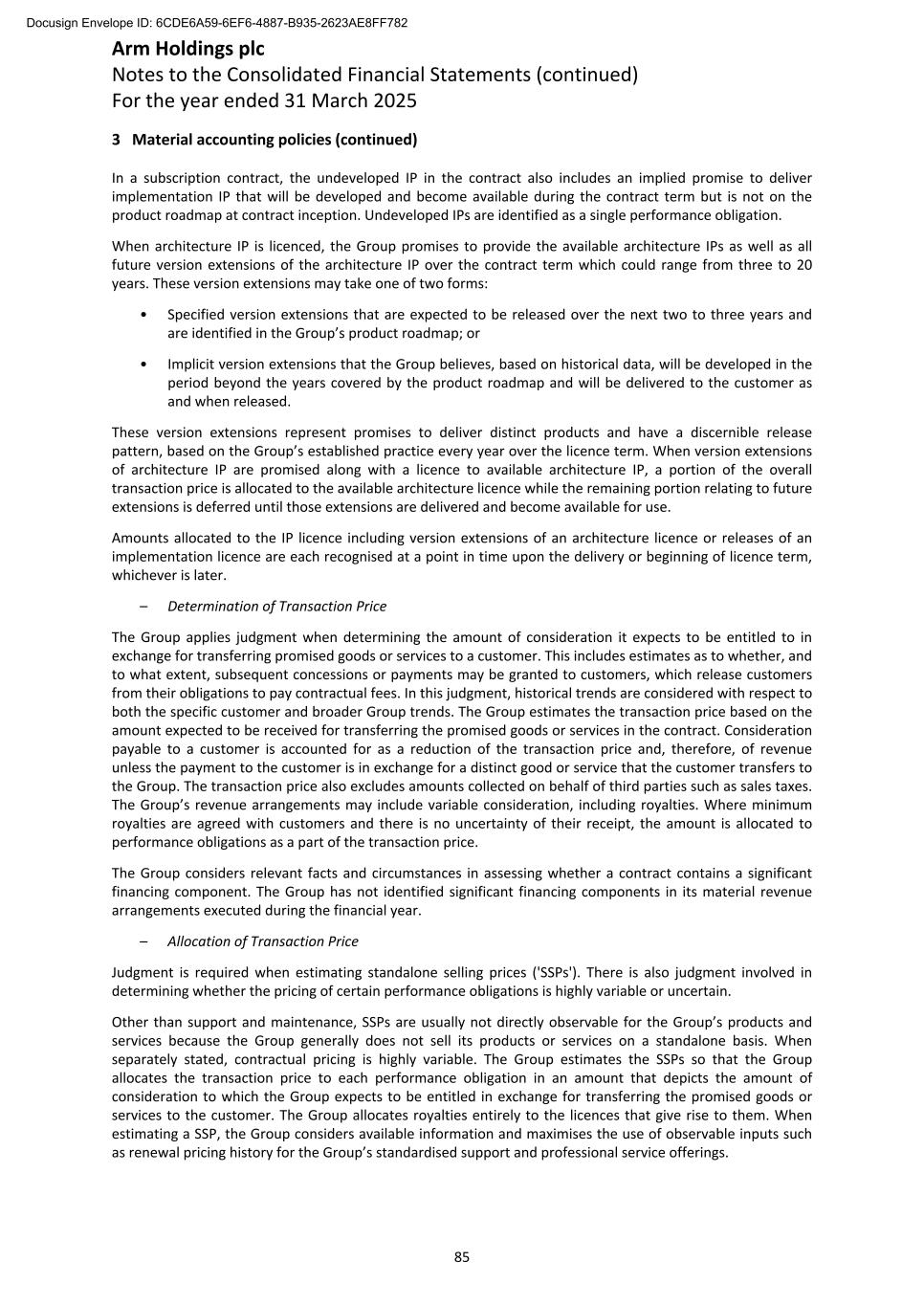
3 Material accounting policies (continued) In a subscription contract, the undeveloped IP in the contract also includes an implied promise to deliver implementation IP that will be developed and become available during the contract term but is not on the product roadmap at contract inception. Undeveloped IPs are identified as a single performance obligation. When architecture IP is licenced, the Group promises to provide the available architecture IPs as well as all future version extensions of the architecture IP over the contract term which could range from three to 20 years. These version extensions may take one of two forms: • Specified version extensions that are expected to be released over the next two to three years and are identified in the Group’s product roadmap; or • Implicit version extensions that the Group believes, based on historical data, will be developed in the period beyond the years covered by the product roadmap and will be delivered to the customer as and when released. These version extensions represent promises to deliver distinct products and have a discernible release pattern, based on the Group’s established practice every year over the licence term. When version extensions of architecture IP are promised along with a licence to available architecture IP, a portion of the overall transaction price is allocated to the available architecture licence while the remaining portion relating to future extensions is deferred until those extensions are delivered and become available for use. Amounts allocated to the IP licence including version extensions of an architecture licence or releases of an implementation licence are each recognised at a point in time upon the delivery or beginning of licence term, whichever is later. – Determination of Transaction Price The Group applies judgment when determining the amount of consideration it expects to be entitled to in exchange for transferring promised goods or services to a customer. This includes estimates as to whether, and to what extent, subsequent concessions or payments may be granted to customers, which release customers from their obligations to pay contractual fees. In this judgment, historical trends are considered with respect to both the specific customer and broader Group trends. The Group estimates the transaction price based on the amount expected to be received for transferring the promised goods or services in the contract. Consideration payable to a customer is accounted for as a reduction of the transaction price and, therefore, of revenue unless the payment to the customer is in exchange for a distinct good or service that the customer transfers to the Group. The transaction price also excludes amounts collected on behalf of third parties such as sales taxes. The Group’s revenue arrangements may include variable consideration, including royalties. Where minimum royalties are agreed with customers and there is no uncertainty of their receipt, the amount is allocated to performance obligations as a part of the transaction price. The Group considers relevant facts and circumstances in assessing whether a contract contains a significant financing component. The Group has not identified significant financing components in its material revenue arrangements executed during the financial year. – Allocation of Transaction Price Judgment is required when estimating standalone selling prices ('SSPs'). There is also judgment involved in determining whether the pricing of certain performance obligations is highly variable or uncertain. Other than support and maintenance, SSPs are usually not directly observable for the Group’s products and services because the Group generally does not sell its products or services on a standalone basis. When separately stated, contractual pricing is highly variable. The Group estimates the SSPs so that the Group allocates the transaction price to each performance obligation in an amount that depicts the amount of consideration to which the Group expects to be entitled in exchange for transferring the promised goods or services to the customer. The Group allocates royalties entirely to the licences that give rise to them. When estimating a SSP, the Group considers available information and maximises the use of observable inputs such as renewal pricing history for the Group’s standardised support and professional service offerings. Arm Holdings plc Notes to the Consolidated Financial Statements (continued) For the year ended 31 March 2025 85 Docusign Envelope ID: 6CDE6A59-6EF6-4887-B935-2623AE8FF782
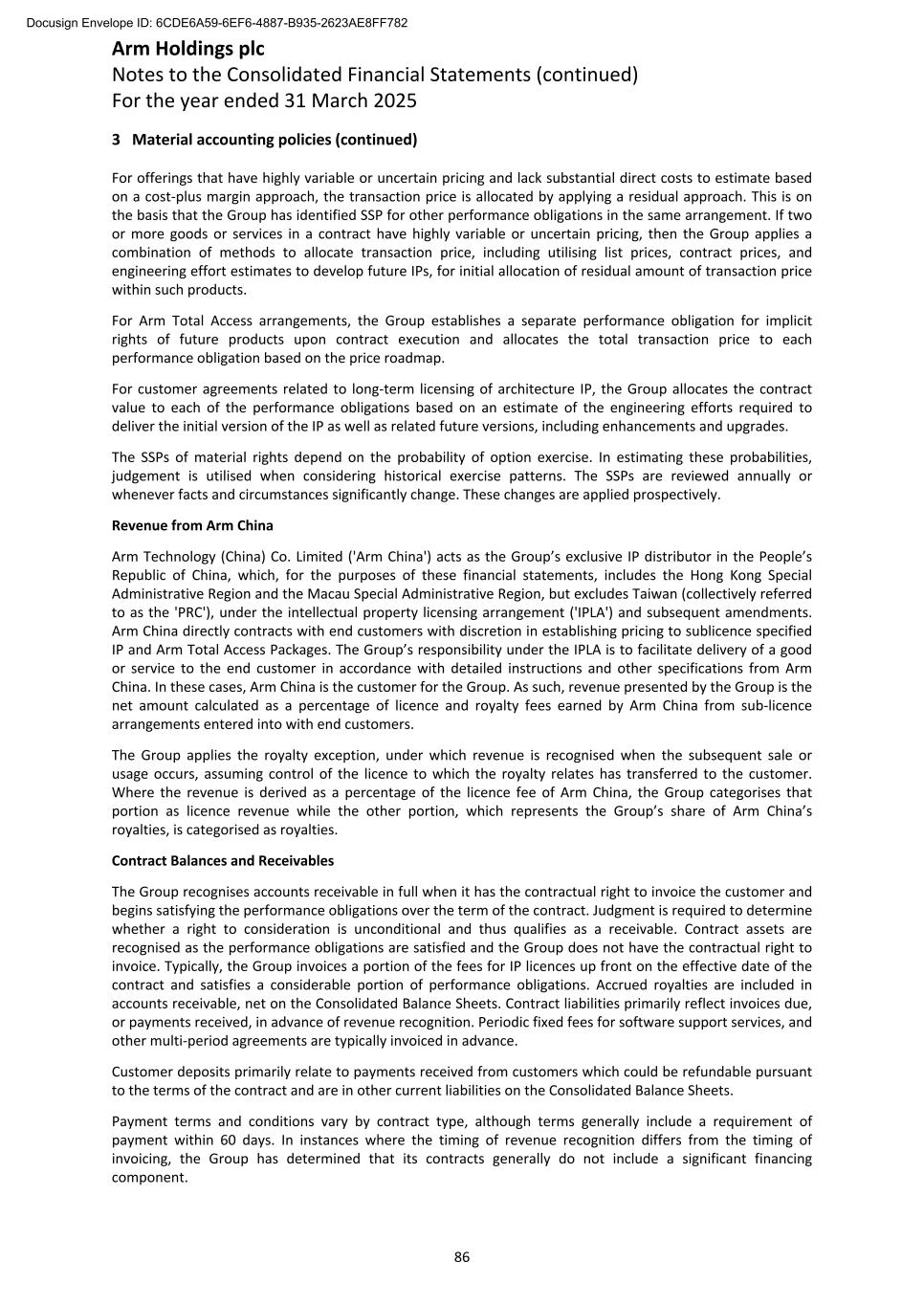
3 Material accounting policies (continued) For offerings that have highly variable or uncertain pricing and lack substantial direct costs to estimate based on a cost-plus margin approach, the transaction price is allocated by applying a residual approach. This is on the basis that the Group has identified SSP for other performance obligations in the same arrangement. If two or more goods or services in a contract have highly variable or uncertain pricing, then the Group applies a combination of methods to allocate transaction price, including utilising list prices, contract prices, and engineering effort estimates to develop future IPs, for initial allocation of residual amount of transaction price within such products. For Arm Total Access arrangements, the Group establishes a separate performance obligation for implicit rights of future products upon contract execution and allocates the total transaction price to each performance obligation based on the price roadmap. For customer agreements related to long-term licensing of architecture IP, the Group allocates the contract value to each of the performance obligations based on an estimate of the engineering efforts required to deliver the initial version of the IP as well as related future versions, including enhancements and upgrades. The SSPs of material rights depend on the probability of option exercise. In estimating these probabilities, judgement is utilised when considering historical exercise patterns. The SSPs are reviewed annually or whenever facts and circumstances significantly change. These changes are applied prospectively. Revenue from Arm China Arm Technology (China) Co. Limited ('Arm China') acts as the Group’s exclusive IP distributor in the People’s Republic of China, which, for the purposes of these financial statements, includes the Hong Kong Special Administrative Region and the Macau Special Administrative Region, but excludes Taiwan (collectively referred to as the 'PRC'), under the intellectual property licensing arrangement ('IPLA') and subsequent amendments. Arm China directly contracts with end customers with discretion in establishing pricing to sublicence specified IP and Arm Total Access Packages. The Group’s responsibility under the IPLA is to facilitate delivery of a good or service to the end customer in accordance with detailed instructions and other specifications from Arm China. In these cases, Arm China is the customer for the Group. As such, revenue presented by the Group is the net amount calculated as a percentage of licence and royalty fees earned by Arm China from sub-licence arrangements entered into with end customers. The Group applies the royalty exception, under which revenue is recognised when the subsequent sale or usage occurs, assuming control of the licence to which the royalty relates has transferred to the customer. Where the revenue is derived as a percentage of the licence fee of Arm China, the Group categorises that portion as licence revenue while the other portion, which represents the Group’s share of Arm China’s royalties, is categorised as royalties. Contract Balances and Receivables The Group recognises accounts receivable in full when it has the contractual right to invoice the customer and begins satisfying the performance obligations over the term of the contract. Judgment is required to determine whether a right to consideration is unconditional and thus qualifies as a receivable. Contract assets are recognised as the performance obligations are satisfied and the Group does not have the contractual right to invoice. Typically, the Group invoices a portion of the fees for IP licences up front on the effective date of the contract and satisfies a considerable portion of performance obligations. Accrued royalties are included in accounts receivable, net on the Consolidated Balance Sheets. Contract liabilities primarily reflect invoices due, or payments received, in advance of revenue recognition. Periodic fixed fees for software support services, and other multi-period agreements are typically invoiced in advance. Customer deposits primarily relate to payments received from customers which could be refundable pursuant to the terms of the contract and are in other current liabilities on the Consolidated Balance Sheets. Payment terms and conditions vary by contract type, although terms generally include a requirement of payment within 60 days. In instances where the timing of revenue recognition differs from the timing of invoicing, the Group has determined that its contracts generally do not include a significant financing component. Arm Holdings plc Notes to the Consolidated Financial Statements (continued) For the year ended 31 March 2025 86 Docusign Envelope ID: 6CDE6A59-6EF6-4887-B935-2623AE8FF782
3 Material accounting policies (continued) The primary purpose of the Group’s invoicing terms is to provide customers with simplified and predictable ways of purchasing products and services, such as invoicing at the beginning of a licence term with revenue recognised over the contract period, and not to receive financing from customers. All potential financing fees were considered insignificant in the context of the Group’s contracts. Allowance for Current Expected Credit Losses Trade receivables are stated at their net realisable value. The allowance for credit losses reflects the Group’s best estimate of expected credit losses of the receivable portfolio determined on the basis of historical experience, current information, and forecasts of future economic conditions. In developing the estimate for expected credit losses, accounts receivable is segmented into pools of assets depending on market (China versus international) and delinquency status, and fixed reserve percentages are established for each pool of accounts receivables. To determine the reserve percentages for each pool of accounts receivables, the Group considers its historical experience with certain customers and customer types, regulatory and legal environments, country and political risk, and other relevant current and future forecasted macroeconomic factors. These credit risk indicators are monitored on a quarterly basis to determine whether there are any changes in the economic environment that would indicate the established reserve percentages should be adjusted and are considered on a regional basis to reflect more geographic-specific metrics. Please refer to note 24 - Trade and other receivables, for the summary of the movement in the allowance for current expected credit losses. Additionally, write-offs and recoveries of customer receivables are tracked against collections on a quarterly basis to determine whether the reserve percentages remain appropriate. When management becomes aware of certain customer-specific factors that impact credit risk, specific allowances for these known troubled accounts are recorded. Accounts receivables are written off after all reasonable means to collect the full amount (including litigation, where appropriate) are exhausted. For the fiscal years ended 31 March 2025, 2024, and 2023, write-offs and recoveries of customer receivables were immaterial to the consolidated financial statements. The Group recognises an allowance for losses on contract assets based on a similar approach used for receivables under the current expected credit loss model. As of 31 March 2025 and 2024, the loss allowance for contract assets was immaterial. Arm Holdings plc Notes to the Consolidated Financial Statements (continued) For the year ended 31 March 2025 87 Docusign Envelope ID: 6CDE6A59-6EF6-4887-B935-2623AE8FF782
3 Material accounting policies (continued) Own shares Own shares represent the shares of the Parent Company, Arm Holdings plc, that are held in treasury or by the Employee Benefit Trust ('EBT'). Own shares are recorded at cost and deducted from equity. The assets and liabilities of the trust are included in the consolidated financial statements. The costs of the trust are included in the results of the Group. The shares held by the trust are excluded from the calculation of earnings per share. Share-based payments By analogy to the criteria for recognition of a liability under IAS 37, share-based payments are classified as either cash-settled or equity-settled in their entirety depending on which outcome is probable at each reporting date. Any change in the probable method of settlement is treated as a change in accounting estimate, with the cumulative expense 'true-up' to reflect the appropriate charge for the method of settlement now considered probable. (a) Equity-settled share-based payments Equity-settled share-based payments to employees and others providing similar services are measured at the fair value of the equity instruments, including restricted stock units ('RSUs') and employee stock purchase plans ('ESPPs'), at the grant date. The fair value excludes the effect of non-market-based vesting conditions. Accumulated payroll contributions for share purchases withheld from employees who participate in ESPPs are recognised as a liability until either (a) the shares are issued or (b) the employee withdraws from the scheme and is refunded. Details regarding the determination of the fair value of equity-settled share-based transactions are set out in note 31. The fair value determined at the grant date of the equity-settled share-based payments is expensed on a straight-line basis over the vesting period, based on the Group’s estimate of the number of equity instruments that will eventually vest. At each reporting date, the Group revises its estimate of the number of equity instruments expected to vest as a result of the effect of non-market-based vesting conditions. The impact of the revision of the original estimates, if any, is recognised in profit or loss such that the cumulative expense reflects the revised estimate, with a corresponding adjustment to reserves. Where the Group has share-based payments schemes where the settlement under different scenarios may be settled in either equity or cash, the Group evaluates the most likely vesting scenario at the end of each reporting period and applies the relevant accounting policy. For certain share-based payment transactions with a net settlement feature for withholding tax obligations, the Group classifies the full award as equity-settled. Cash paid to relevant tax authorities on behalf of employees is recognised as a deduction from equity. (b) Cash-settled share-based payments For cash-settled share-based payments, a liability is recognised for the goods or services acquired, measured initially at the fair value of the liability. At each reporting date until the liability is settled, and at the date of settlement, the fair value of the liability is remeasured, with any changes in fair value recognised in profit or loss for the year. Under the arrangement certain non-market based vesting conditions linked to Group strategic objectives also affect the value of the award; measurement of the liability reflects the best estimate of the amount to settle the liability taking account of these non-market based vesting conditions. (c) Social security on share-based payments In some jurisdictions, the Group is required to pay social security contributions (or similar taxes) on the share- based payments when the employees receive the RSUs. The amount of the contributions depends on the market value of the shares at that time and the applicable tax rate. The Group accrues for these social security contributions as a liability, based on the best estimate of the future payments. The liability is remeasured at each reporting date and at settlement date, with any changes recognised in profit or loss. Arm Holdings plc Notes to the Consolidated Financial Statements (continued) For the year ended 31 March 2025 88 Docusign Envelope ID: 6CDE6A59-6EF6-4887-B935-2623AE8FF782
3 Material accounting policies (continued) Leases (a) The Group as a lessee The Group assesses whether a contract is or contains a lease at inception of the contract. The Group recognises a right-of-use asset and a corresponding lease liability with respect to all lease arrangements in which it is the lessee, except for short-term leases (defined as leases with a lease term of 12 months or less) and leases of low value assets (such as tablets and personal computers and small items of office furniture). For these leases, the Group recognises the lease payments as an operating expense on a straight-line basis over the term of the lease unless another systematic basis is more representative of the time pattern in which economic benefits from the leased assets are consumed. In determining the lease term the Group assesses whether it is reasonably certain to exercise, or not to exercise options to extend or terminate a lease. This assessment is made at the start of the lease and is reassessed if significant events or changes in circumstances occur that are within the Group's control. The lease liability is initially measured at the present value of the lease payments that are not paid at the commencement date, discounted by using the rate implicit in the lease. If this rate cannot be readily determined, the lessee uses its incremental borrowing rate. Lease payments included in the measurement of the lease liability comprise: • Fixed lease payments (including in-substance fixed payments), less any lease incentives receivable; • Variable lease payments that depend on an index or rate, initially measured using the index or rate at the commencement date; • The amount expected to be payable by the lessee under residual value guarantees; • The exercise price of purchase options, if the lessee is reasonably certain to exercise the options; and • Payments of penalties for terminating the lease, if the lease term reflects the exercise of an option to terminate the lease. The lease liability is presented as a separate line in the consolidated balance sheet. When the interest rate implicit in the lease is not readily determinable, the Group estimates the incremental borrowing rate based on a risk-free rate adjusted for the effect of the Group's credit risk. The Group made use of certain estimates when determining the incremental borrowing rate to discount lease liabilities. This involved using certain statistical models to calculate the finance spread and default risk the Group is subject to. The entire balance of the right-of-use assets and lease liabilities are exposed to this area of estimation. The lease liability is subsequently measured by increasing the carrying amount to reflect interest on the lease liability (using the effective interest method) and by reducing the carrying amount to reflect the lease payments made. The Group remeasures the lease liability (and makes a corresponding adjustment to the related right-of-use asset) whenever: • The lease term has changed or there is a significant event or change in circumstances resulting in a change in the assessment of exercise of a purchase option, in which case the lease liability is remeasured by discounting the revised lease payments using a revised discount rate; • The lease payments change due to changes in an index or rate or a change in expected payment under a guaranteed residual value, in which case the lease liability is remeasured by discounting the revised lease payments using an unchanged discount rate (unless the lease payments change is due to a change in a floating interest rate, in which case a revised discount rate is used); or Arm Holdings plc Notes to the Consolidated Financial Statements (continued) For the year ended 31 March 2025 89 Docusign Envelope ID: 6CDE6A59-6EF6-4887-B935-2623AE8FF782
3 Material accounting policies (continued) • A lease contract is modified and the lease modification is not accounted for as a separate lease, in which case the lease liability is remeasured based on the lease term of the modified lease by discounting the revised lease payments using a revised discount rate at the effective date of the modification. The right-of-use assets comprise the initial measurement of the corresponding lease liability, lease payments made at or before the commencement day, less any lease incentives received and any initial direct costs. They are subsequently measured at cost less accumulated depreciation and impairment losses. Whenever the Group incurs an obligation for costs to dismantle and remove a leased asset, restore the site on which it is located or restore the underlying asset to the condition required by the terms and conditions of the lease, a provision is recognised and measured under IAS 37. To the extent that the costs relate to a right-of-use asset, the costs are included in the related right-of-use asset. Right-of-use assets are depreciated over the shorter period of the lease term and the useful life of the underlying asset. If a lease transfers ownership of the underlying asset or the cost of the right-of-use asset reflects that the Group expects to exercise a purchase option, the related right-of-use asset is depreciated over the useful life of the underlying asset. Depreciation starts at the commencement date of the lease. The right-of-use assets are presented as a separate line in the consolidated balance sheet. The Group applies IAS 36 to determine whether a right-of-use asset is impaired and accounts for any identified impairment loss as described in the ‘Property, Plant and Equipment’ policy. As a practical expedient, IFRS 16 permits a lessee not to separate non-lease components, and instead account for any lease and associated non-lease components as a single arrangement. The Group has not used this practical expedient. For contracts that contain a lease component and one or more additional lease or non- lease components, the Group allocates the consideration in the contract to each lease component on the basis of the relative standalone selling price ('SSP') of the lease component and the aggregate SSP of the non-lease components. (b) The Group as a lessor Rental income from operating leases is recognised on a straight-line basis over the term of the relevant lease. Initial direct costs incurred in negotiating and arranging an operating lease are added to the carrying amount of the leased asset and recognised on a straight-line basis over the lease term. Leases for which the Group is a lessor are classified as finance or operating leases. Whenever the terms of the lease transfer substantially all the risks and rewards of ownership to the lessee, the contract is classified as a finance lease. All other leases are classified as operating leases. When the Group is an intermediate lessor, it accounts for the head lease and the sub-lease as two separate contracts. The sub-lease is classified as a finance or operating lease by reference to the right-of-use asset arising from the head lease. Amounts due from lessees under finance leases are recognised as receivables at the amount of the Group’s net investment in the leases. Finance lease income is allocated to accounting periods so as to reflect a constant periodic rate of return on the Group’s net investment outstanding in respect of the leases. Arm Holdings plc Notes to the Consolidated Financial Statements (continued) For the year ended 31 March 2025 90 Docusign Envelope ID: 6CDE6A59-6EF6-4887-B935-2623AE8FF782
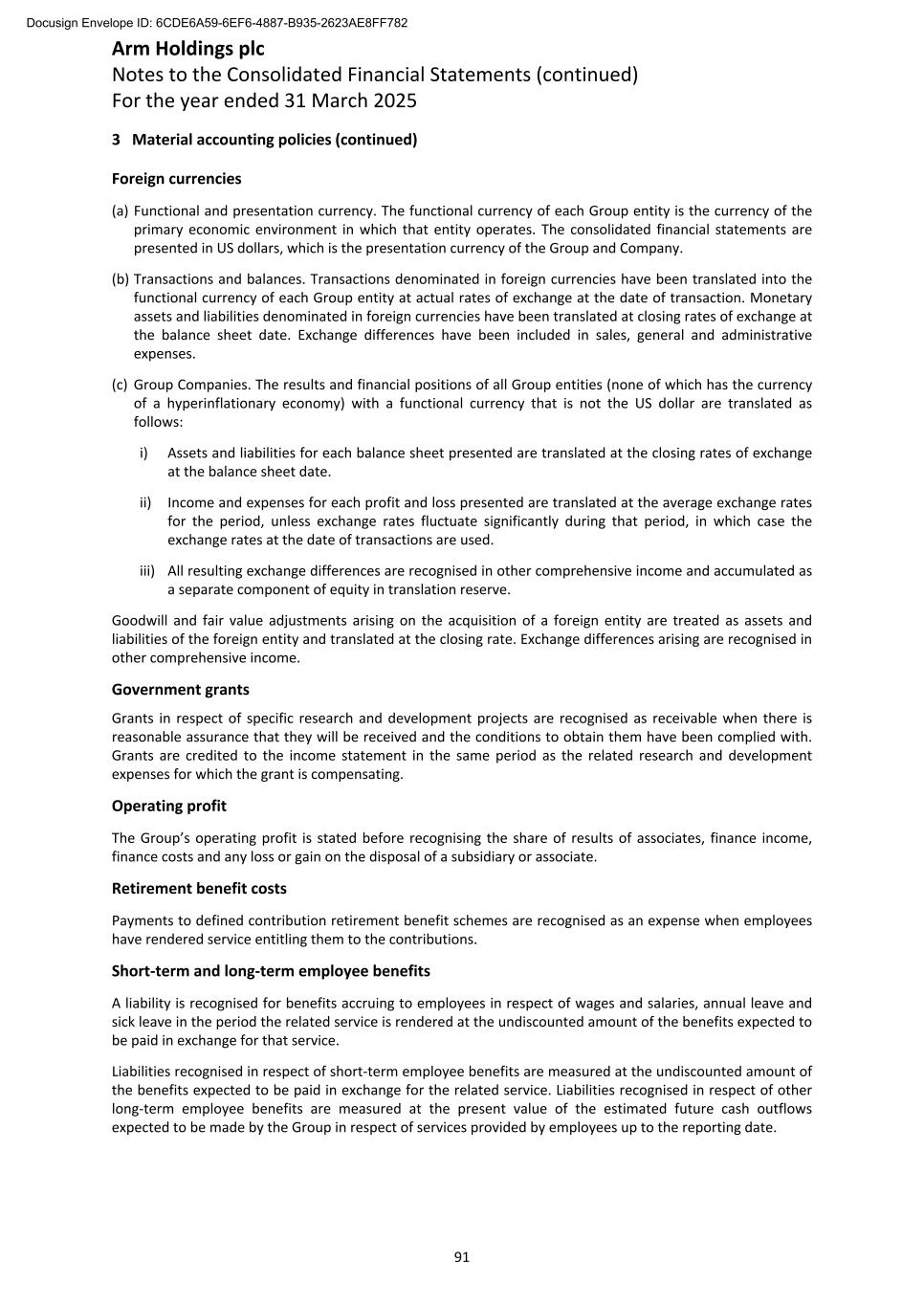
3 Material accounting policies (continued) Foreign currencies (a) Functional and presentation currency. The functional currency of each Group entity is the currency of the primary economic environment in which that entity operates. The consolidated financial statements are presented in US dollars, which is the presentation currency of the Group and Company. (b) Transactions and balances. Transactions denominated in foreign currencies have been translated into the functional currency of each Group entity at actual rates of exchange at the date of transaction. Monetary assets and liabilities denominated in foreign currencies have been translated at closing rates of exchange at the balance sheet date. Exchange differences have been included in sales, general and administrative expenses. (c) Group Companies. The results and financial positions of all Group entities (none of which has the currency of a hyperinflationary economy) with a functional currency that is not the US dollar are translated as follows: i) Assets and liabilities for each balance sheet presented are translated at the closing rates of exchange at the balance sheet date. ii) Income and expenses for each profit and loss presented are translated at the average exchange rates for the period, unless exchange rates fluctuate significantly during that period, in which case the exchange rates at the date of transactions are used. iii) All resulting exchange differences are recognised in other comprehensive income and accumulated as a separate component of equity in translation reserve. Goodwill and fair value adjustments arising on the acquisition of a foreign entity are treated as assets and liabilities of the foreign entity and translated at the closing rate. Exchange differences arising are recognised in other comprehensive income. Government grants Grants in respect of specific research and development projects are recognised as receivable when there is reasonable assurance that they will be received and the conditions to obtain them have been complied with. Grants are credited to the income statement in the same period as the related research and development expenses for which the grant is compensating. Operating profit The Group’s operating profit is stated before recognising the share of results of associates, finance income, finance costs and any loss or gain on the disposal of a subsidiary or associate. Retirement benefit costs Payments to defined contribution retirement benefit schemes are recognised as an expense when employees have rendered service entitling them to the contributions. Short-term and long-term employee benefits A liability is recognised for benefits accruing to employees in respect of wages and salaries, annual leave and sick leave in the period the related service is rendered at the undiscounted amount of the benefits expected to be paid in exchange for that service. Liabilities recognised in respect of short-term employee benefits are measured at the undiscounted amount of the benefits expected to be paid in exchange for the related service. Liabilities recognised in respect of other long-term employee benefits are measured at the present value of the estimated future cash outflows expected to be made by the Group in respect of services provided by employees up to the reporting date. Arm Holdings plc Notes to the Consolidated Financial Statements (continued) For the year ended 31 March 2025 91 Docusign Envelope ID: 6CDE6A59-6EF6-4887-B935-2623AE8FF782
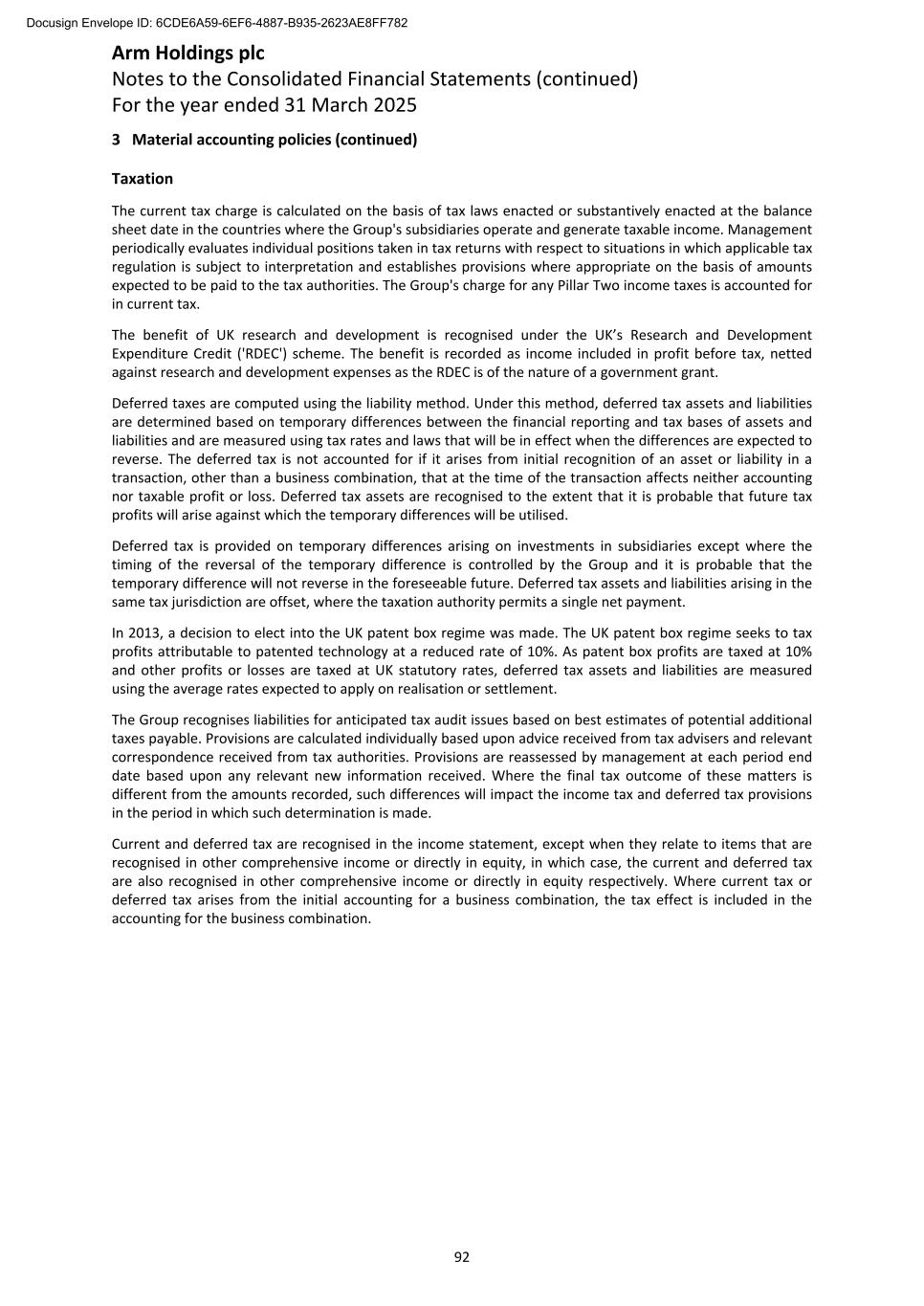
3 Material accounting policies (continued) Taxation The current tax charge is calculated on the basis of tax laws enacted or substantively enacted at the balance sheet date in the countries where the Group's subsidiaries operate and generate taxable income. Management periodically evaluates individual positions taken in tax returns with respect to situations in which applicable tax regulation is subject to interpretation and establishes provisions where appropriate on the basis of amounts expected to be paid to the tax authorities. The Group's charge for any Pillar Two income taxes is accounted for in current tax. The benefit of UK research and development is recognised under the UK’s Research and Development Expenditure Credit ('RDEC') scheme. The benefit is recorded as income included in profit before tax, netted against research and development expenses as the RDEC is of the nature of a government grant. Deferred taxes are computed using the liability method. Under this method, deferred tax assets and liabilities are determined based on temporary differences between the financial reporting and tax bases of assets and liabilities and are measured using tax rates and laws that will be in effect when the differences are expected to reverse. The deferred tax is not accounted for if it arises from initial recognition of an asset or liability in a transaction, other than a business combination, that at the time of the transaction affects neither accounting nor taxable profit or loss. Deferred tax assets are recognised to the extent that it is probable that future tax profits will arise against which the temporary differences will be utilised. Deferred tax is provided on temporary differences arising on investments in subsidiaries except where the timing of the reversal of the temporary difference is controlled by the Group and it is probable that the temporary difference will not reverse in the foreseeable future. Deferred tax assets and liabilities arising in the same tax jurisdiction are offset, where the taxation authority permits a single net payment. In 2013, a decision to elect into the UK patent box regime was made. The UK patent box regime seeks to tax profits attributable to patented technology at a reduced rate of 10%. As patent box profits are taxed at 10% and other profits or losses are taxed at UK statutory rates, deferred tax assets and liabilities are measured using the average rates expected to apply on realisation or settlement. The Group recognises liabilities for anticipated tax audit issues based on best estimates of potential additional taxes payable. Provisions are calculated individually based upon advice received from tax advisers and relevant correspondence received from tax authorities. Provisions are reassessed by management at each period end date based upon any relevant new information received. Where the final tax outcome of these matters is different from the amounts recorded, such differences will impact the income tax and deferred tax provisions in the period in which such determination is made. Current and deferred tax are recognised in the income statement, except when they relate to items that are recognised in other comprehensive income or directly in equity, in which case, the current and deferred tax are also recognised in other comprehensive income or directly in equity respectively. Where current tax or deferred tax arises from the initial accounting for a business combination, the tax effect is included in the accounting for the business combination. Arm Holdings plc Notes to the Consolidated Financial Statements (continued) For the year ended 31 March 2025 92 Docusign Envelope ID: 6CDE6A59-6EF6-4887-B935-2623AE8FF782
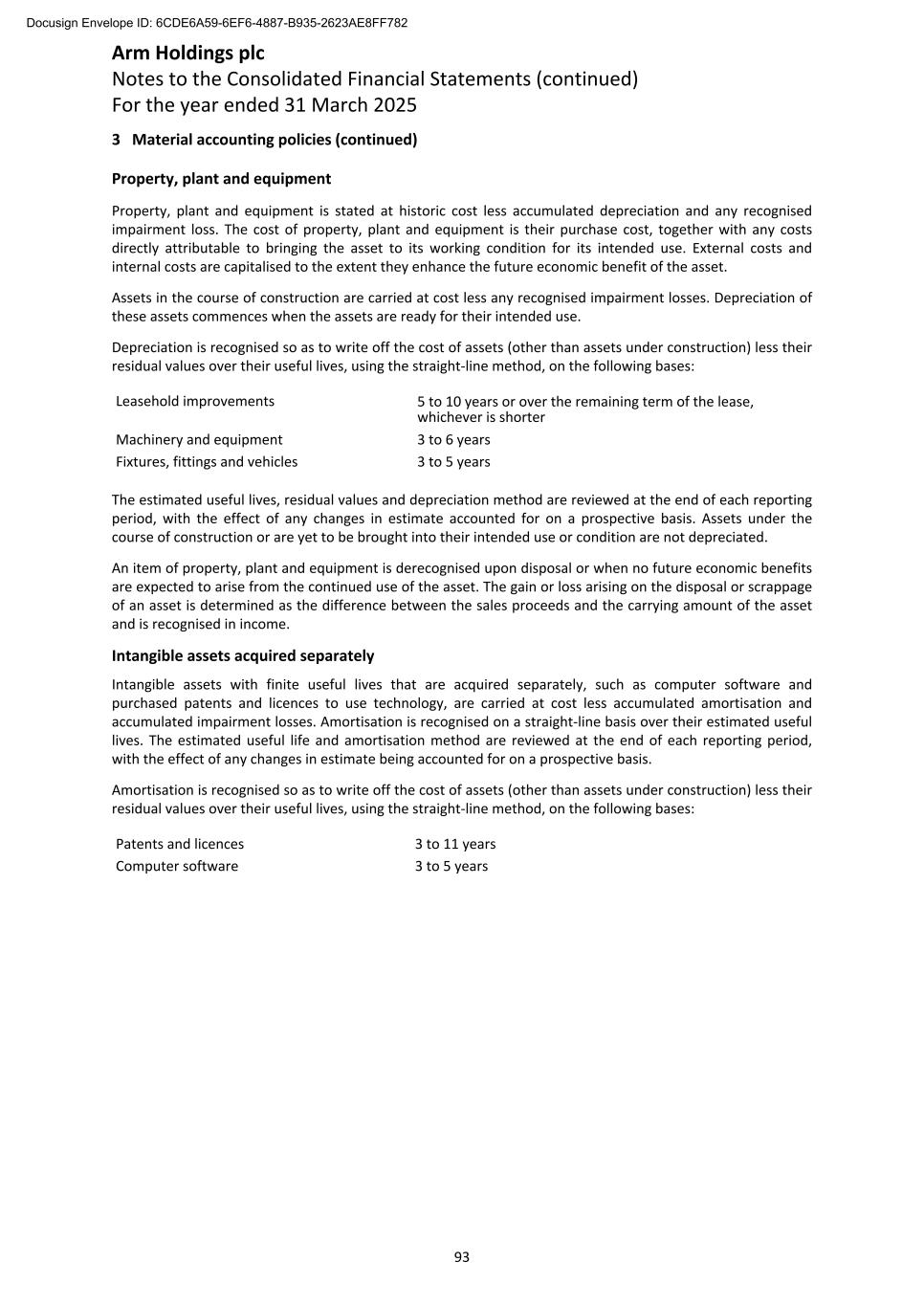
3 Material accounting policies (continued) Property, plant and equipment Property, plant and equipment is stated at historic cost less accumulated depreciation and any recognised impairment loss. The cost of property, plant and equipment is their purchase cost, together with any costs directly attributable to bringing the asset to its working condition for its intended use. External costs and internal costs are capitalised to the extent they enhance the future economic benefit of the asset. Assets in the course of construction are carried at cost less any recognised impairment losses. Depreciation of these assets commences when the assets are ready for their intended use. Depreciation is recognised so as to write off the cost of assets (other than assets under construction) less their residual values over their useful lives, using the straight-line method, on the following bases: Leasehold improvements 5 to 10 years or over the remaining term of the lease, whichever is shorter Machinery and equipment 3 to 6 years Fixtures, fittings and vehicles 3 to 5 years The estimated useful lives, residual values and depreciation method are reviewed at the end of each reporting period, with the effect of any changes in estimate accounted for on a prospective basis. Assets under the course of construction or are yet to be brought into their intended use or condition are not depreciated. An item of property, plant and equipment is derecognised upon disposal or when no future economic benefits are expected to arise from the continued use of the asset. The gain or loss arising on the disposal or scrappage of an asset is determined as the difference between the sales proceeds and the carrying amount of the asset and is recognised in income. Intangible assets acquired separately Intangible assets with finite useful lives that are acquired separately, such as computer software and purchased patents and licences to use technology, are carried at cost less accumulated amortisation and accumulated impairment losses. Amortisation is recognised on a straight-line basis over their estimated useful lives. The estimated useful life and amortisation method are reviewed at the end of each reporting period, with the effect of any changes in estimate being accounted for on a prospective basis. Amortisation is recognised so as to write off the cost of assets (other than assets under construction) less their residual values over their useful lives, using the straight-line method, on the following bases: Patents and licences 3 to 11 years Computer software 3 to 5 years Arm Holdings plc Notes to the Consolidated Financial Statements (continued) For the year ended 31 March 2025 93 Docusign Envelope ID: 6CDE6A59-6EF6-4887-B935-2623AE8FF782
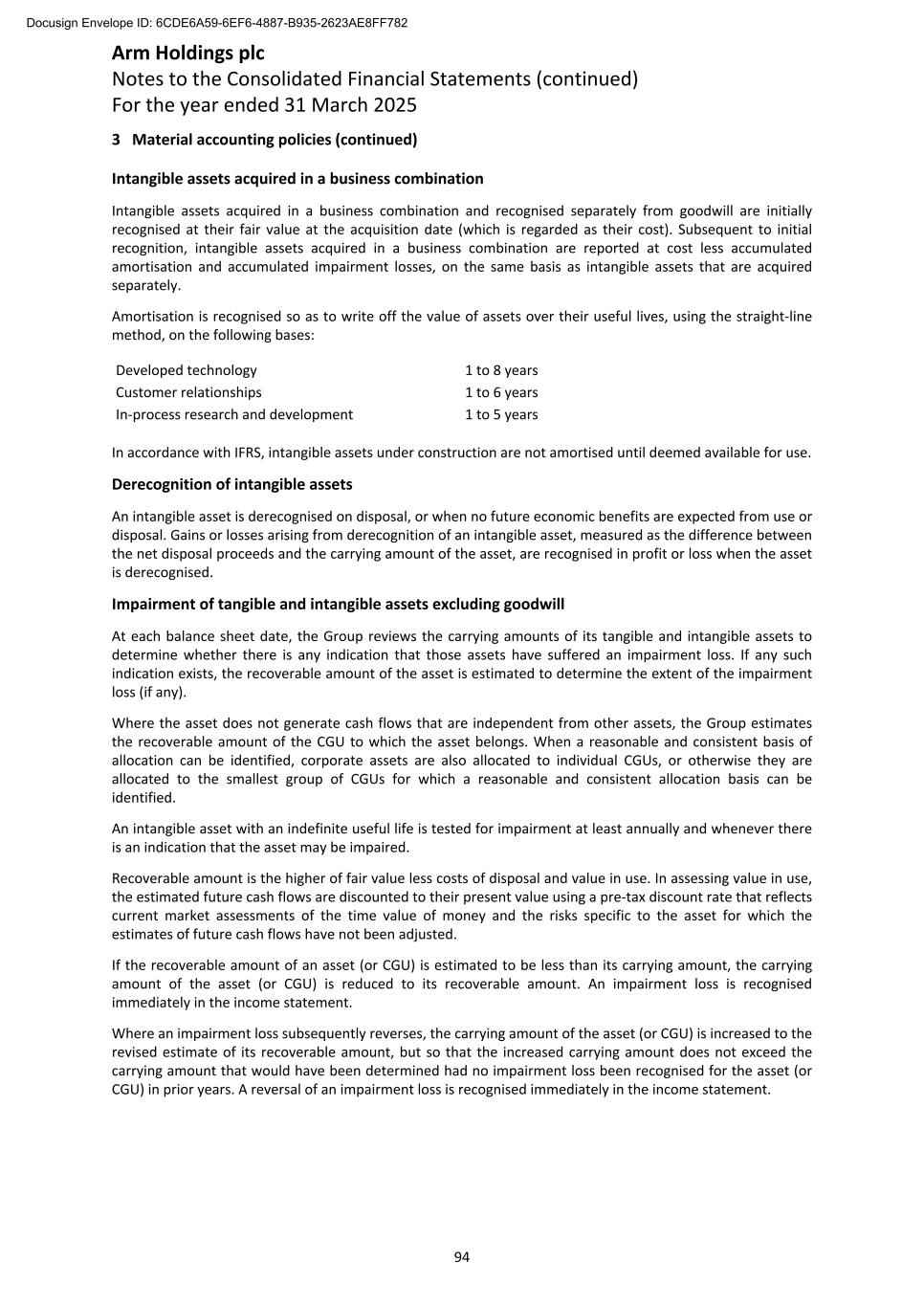
3 Material accounting policies (continued) Intangible assets acquired in a business combination Intangible assets acquired in a business combination and recognised separately from goodwill are initially recognised at their fair value at the acquisition date (which is regarded as their cost). Subsequent to initial recognition, intangible assets acquired in a business combination are reported at cost less accumulated amortisation and accumulated impairment losses, on the same basis as intangible assets that are acquired separately. Amortisation is recognised so as to write off the value of assets over their useful lives, using the straight-line method, on the following bases: Developed technology 1 to 8 years Customer relationships 1 to 6 years In-process research and development 1 to 5 years In accordance with IFRS, intangible assets under construction are not amortised until deemed available for use. Derecognition of intangible assets An intangible asset is derecognised on disposal, or when no future economic benefits are expected from use or disposal. Gains or losses arising from derecognition of an intangible asset, measured as the difference between the net disposal proceeds and the carrying amount of the asset, are recognised in profit or loss when the asset is derecognised. Impairment of tangible and intangible assets excluding goodwill At each balance sheet date, the Group reviews the carrying amounts of its tangible and intangible assets to determine whether there is any indication that those assets have suffered an impairment loss. If any such indication exists, the recoverable amount of the asset is estimated to determine the extent of the impairment loss (if any). Where the asset does not generate cash flows that are independent from other assets, the Group estimates the recoverable amount of the CGU to which the asset belongs. When a reasonable and consistent basis of allocation can be identified, corporate assets are also allocated to individual CGUs, or otherwise they are allocated to the smallest group of CGUs for which a reasonable and consistent allocation basis can be identified. An intangible asset with an indefinite useful life is tested for impairment at least annually and whenever there is an indication that the asset may be impaired. Recoverable amount is the higher of fair value less costs of disposal and value in use. In assessing value in use, the estimated future cash flows are discounted to their present value using a pre-tax discount rate that reflects current market assessments of the time value of money and the risks specific to the asset for which the estimates of future cash flows have not been adjusted. If the recoverable amount of an asset (or CGU) is estimated to be less than its carrying amount, the carrying amount of the asset (or CGU) is reduced to its recoverable amount. An impairment loss is recognised immediately in the income statement. Where an impairment loss subsequently reverses, the carrying amount of the asset (or CGU) is increased to the revised estimate of its recoverable amount, but so that the increased carrying amount does not exceed the carrying amount that would have been determined had no impairment loss been recognised for the asset (or CGU) in prior years. A reversal of an impairment loss is recognised immediately in the income statement. Arm Holdings plc Notes to the Consolidated Financial Statements (continued) For the year ended 31 March 2025 94 Docusign Envelope ID: 6CDE6A59-6EF6-4887-B935-2623AE8FF782
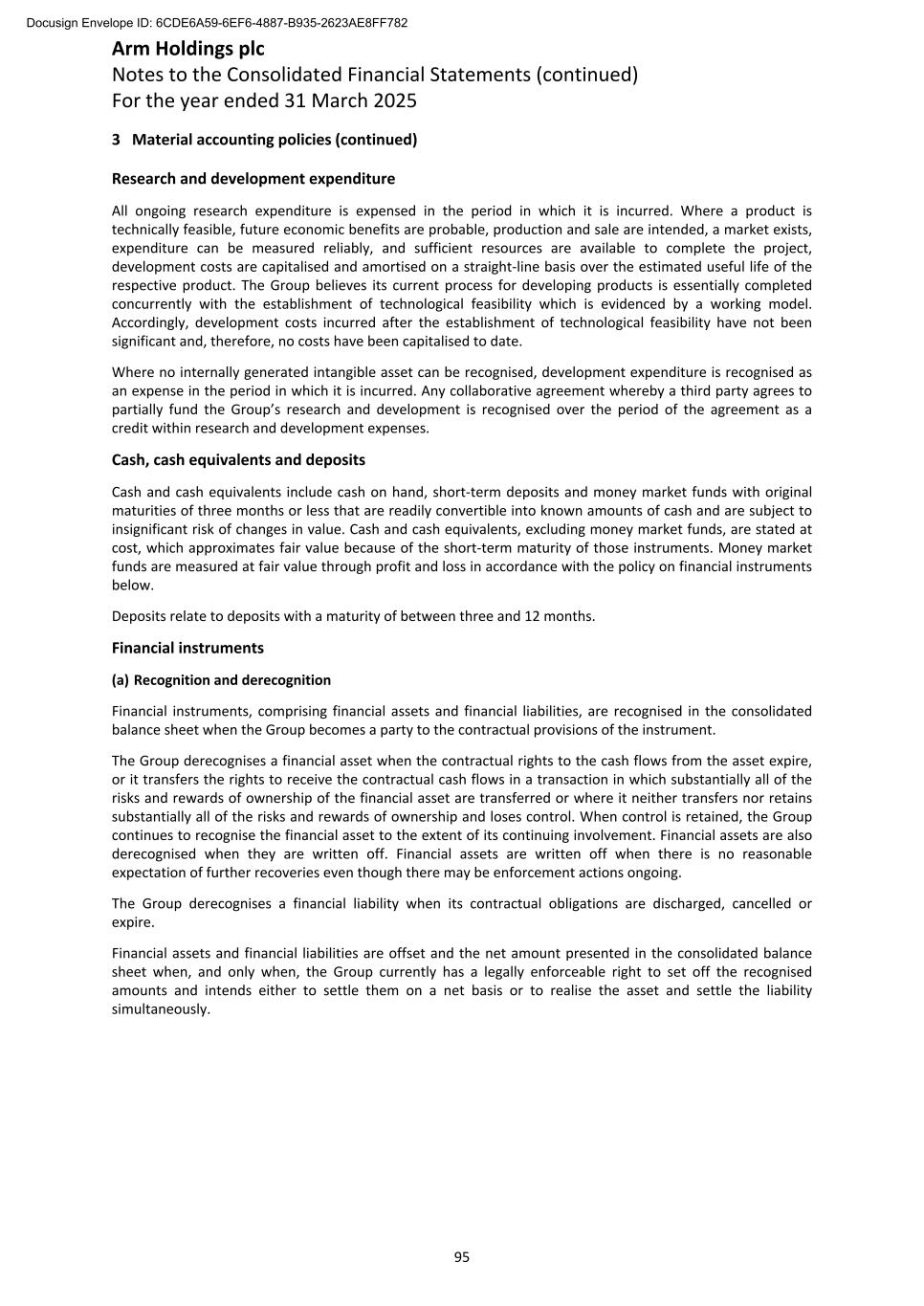
3 Material accounting policies (continued) Research and development expenditure All ongoing research expenditure is expensed in the period in which it is incurred. Where a product is technically feasible, future economic benefits are probable, production and sale are intended, a market exists, expenditure can be measured reliably, and sufficient resources are available to complete the project, development costs are capitalised and amortised on a straight-line basis over the estimated useful life of the respective product. The Group believes its current process for developing products is essentially completed concurrently with the establishment of technological feasibility which is evidenced by a working model. Accordingly, development costs incurred after the establishment of technological feasibility have not been significant and, therefore, no costs have been capitalised to date. Where no internally generated intangible asset can be recognised, development expenditure is recognised as an expense in the period in which it is incurred. Any collaborative agreement whereby a third party agrees to partially fund the Group’s research and development is recognised over the period of the agreement as a credit within research and development expenses. Cash, cash equivalents and deposits Cash and cash equivalents include cash on hand, short-term deposits and money market funds with original maturities of three months or less that are readily convertible into known amounts of cash and are subject to insignificant risk of changes in value. Cash and cash equivalents, excluding money market funds, are stated at cost, which approximates fair value because of the short-term maturity of those instruments. Money market funds are measured at fair value through profit and loss in accordance with the policy on financial instruments below. Deposits relate to deposits with a maturity of between three and 12 months. Financial instruments (a) Recognition and derecognition Financial instruments, comprising financial assets and financial liabilities, are recognised in the consolidated balance sheet when the Group becomes a party to the contractual provisions of the instrument. The Group derecognises a financial asset when the contractual rights to the cash flows from the asset expire, or it transfers the rights to receive the contractual cash flows in a transaction in which substantially all of the risks and rewards of ownership of the financial asset are transferred or where it neither transfers nor retains substantially all of the risks and rewards of ownership and loses control. When control is retained, the Group continues to recognise the financial asset to the extent of its continuing involvement. Financial assets are also derecognised when they are written off. Financial assets are written off when there is no reasonable expectation of further recoveries even though there may be enforcement actions ongoing. The Group derecognises a financial liability when its contractual obligations are discharged, cancelled or expire. Financial assets and financial liabilities are offset and the net amount presented in the consolidated balance sheet when, and only when, the Group currently has a legally enforceable right to set off the recognised amounts and intends either to settle them on a net basis or to realise the asset and settle the liability simultaneously. Arm Holdings plc Notes to the Consolidated Financial Statements (continued) For the year ended 31 March 2025 95 Docusign Envelope ID: 6CDE6A59-6EF6-4887-B935-2623AE8FF782

3 Material accounting policies (continued) (b) Classification and measurement Financial assets and liabilities are initially measured at fair value, inclusive of transaction costs directly attributable to the acquisition or issue of the financial instrument, with the exception of trade receivables which are measured at their transaction price, determined in accordance with the Group’s accounting policies for revenue. Subsequently, measurement depends on the financial assets/liabilities classification as follows: • Financial assets measured at fair value through profit or loss (FVTPL) Non-equity financial assets are classified as FVTPL if they arise from contracts which do not give rise to cash flows which are solely principal and interest, or otherwise where they are held in a business model which mainly realises them through sale. Specifically, the Group’s currency exchange contracts and embedded or other derivatives fall within this category. Embedded derivatives relate to foreign exchange agreements implicit in sales contracts that are denominated in a currency that is not the functional currency of either party. Gains or losses arising from changes in the fair value of financial assets at FVTPL are presented in the income statement within selling, general and administrative expenses in the period in which they arise. • Financial assets measured at fair value through other comprehensive income (FVTOCI) Non-equity financial assets are classified as FVTOCI where they arise from contracts that give rise to contractual cash flows which are solely principal and interest and which are held in a business model that realises some through sale and some by holding them to maturity. They are recognised initially at fair value plus any directly attributable transaction costs. At the end of each reporting period they are remeasured to fair value, with the cumulative gain or loss compared to their amortised cost being recognised in other comprehensive income and in the revaluation reserve, except for the recognition in the income statement of expected credit losses, interest income (calculated using the effective interest method) and foreign exchange gains and losses. When these assets are derecognised, the cumulative gain or loss is reclassified from equity to the income statement. Equity investments not held for trading purposes are designated, via an irrevocable election, as at FVTOCI where they are considered strategic to the Group. Such designation is made on an instrument-by-instrument basis, but may only be made if the investment meets the definition of equity from the issuer’s perspective. Amounts accumulated in the revaluation reserve in respect of these investments are transferred directly to retained earnings on the disposal of the investment. These investments are not subject to impairment. • Financial assets measured at amortised cost Financial assets are held at amortised cost when they arise from contracts that give rise to contractual cash flows which are solely principal and interest and are held in a business model that mainly holds the assets to collect contractual cash flows. Financial assets measured at amortised cost that are not purchased or originated credit impaired are measured at amortised cost using the effective interest method. For those purchased or originated credit impaired, the Group applies the credit-adjusted effective interest rate since initial recognition. These assets are also subject to impairment losses. Interest income is calculated based on the gross carrying amount of the financial asset unless the financial asset is credit impaired, in which case interest income is calculated on the amortised cost (that is gross carrying amount less loss allowance). Interest income is included in finance income in the income statement. Arm Holdings plc Notes to the Consolidated Financial Statements (continued) For the year ended 31 March 2025 96 Docusign Envelope ID: 6CDE6A59-6EF6-4887-B935-2623AE8FF782
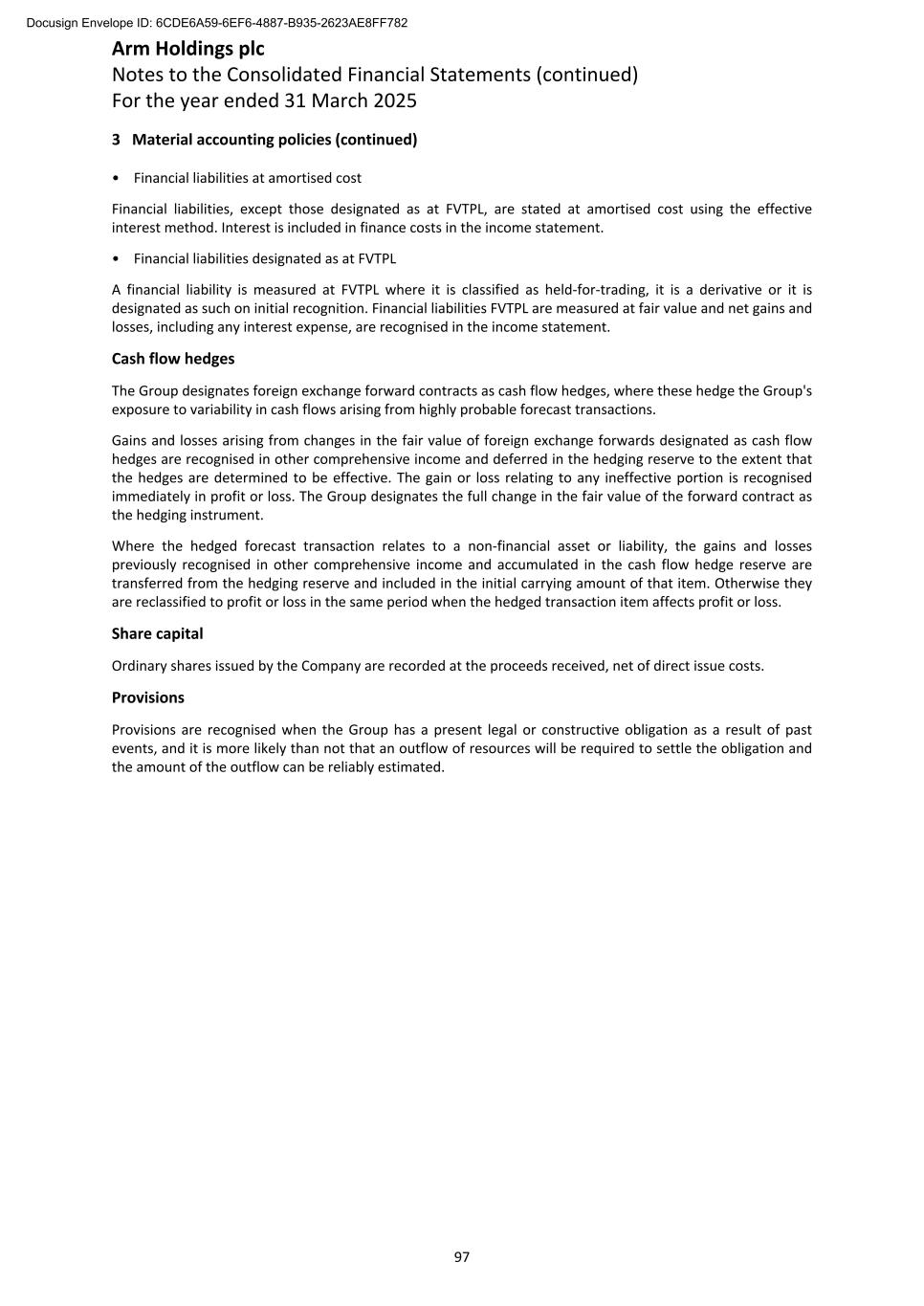
3 Material accounting policies (continued) • Financial liabilities at amortised cost Financial liabilities, except those designated as at FVTPL, are stated at amortised cost using the effective interest method. Interest is included in finance costs in the income statement. • Financial liabilities designated as at FVTPL A financial liability is measured at FVTPL where it is classified as held-for-trading, it is a derivative or it is designated as such on initial recognition. Financial liabilities FVTPL are measured at fair value and net gains and losses, including any interest expense, are recognised in the income statement. Cash flow hedges The Group designates foreign exchange forward contracts as cash flow hedges, where these hedge the Group's exposure to variability in cash flows arising from highly probable forecast transactions. Gains and losses arising from changes in the fair value of foreign exchange forwards designated as cash flow hedges are recognised in other comprehensive income and deferred in the hedging reserve to the extent that the hedges are determined to be effective. The gain or loss relating to any ineffective portion is recognised immediately in profit or loss. The Group designates the full change in the fair value of the forward contract as the hedging instrument. Where the hedged forecast transaction relates to a non-financial asset or liability, the gains and losses previously recognised in other comprehensive income and accumulated in the cash flow hedge reserve are transferred from the hedging reserve and included in the initial carrying amount of that item. Otherwise they are reclassified to profit or loss in the same period when the hedged transaction item affects profit or loss. Share capital Ordinary shares issued by the Company are recorded at the proceeds received, net of direct issue costs. Provisions Provisions are recognised when the Group has a present legal or constructive obligation as a result of past events, and it is more likely than not that an outflow of resources will be required to settle the obligation and the amount of the outflow can be reliably estimated. Arm Holdings plc Notes to the Consolidated Financial Statements (continued) For the year ended 31 March 2025 97 Docusign Envelope ID: 6CDE6A59-6EF6-4887-B935-2623AE8FF782
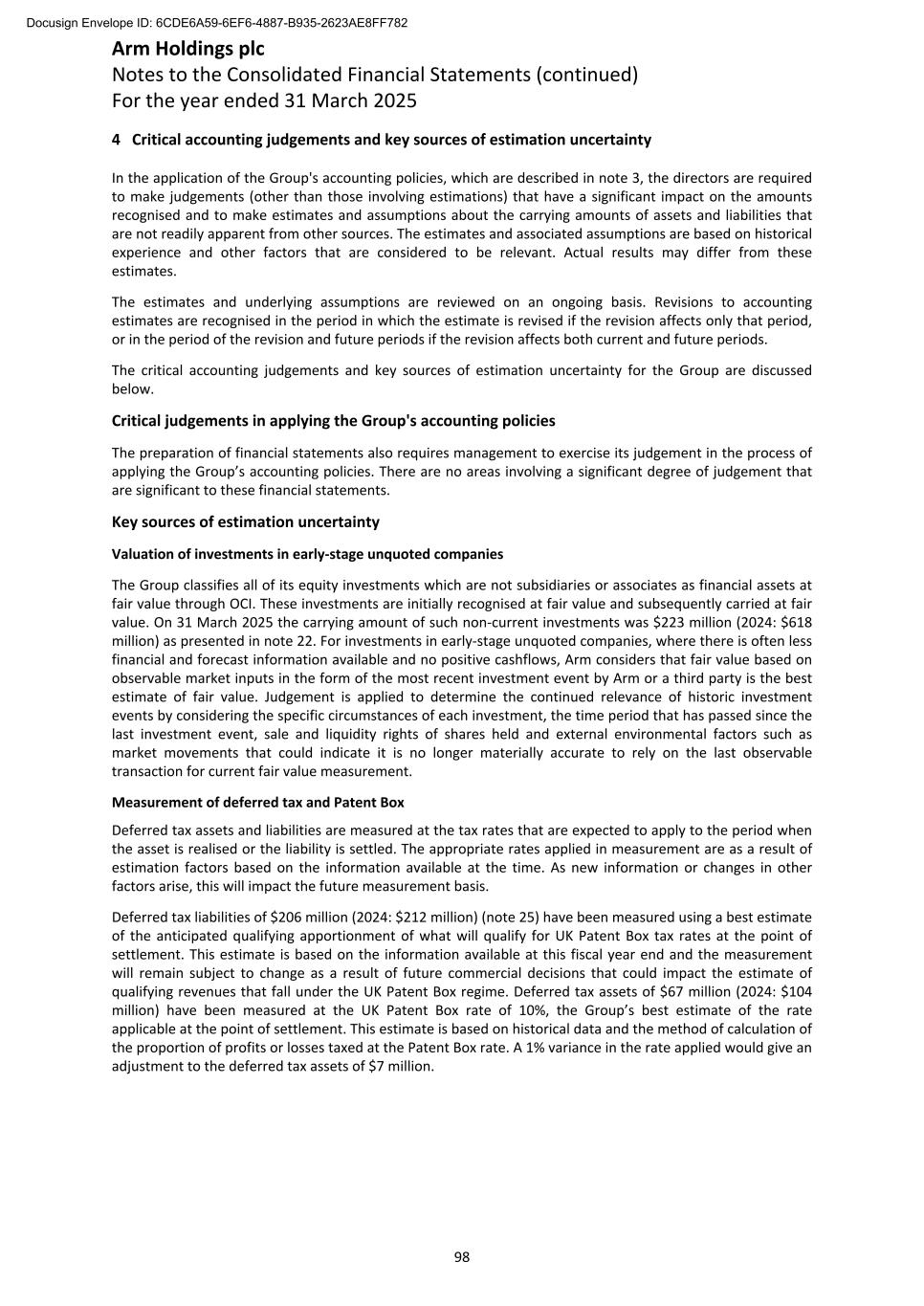
4 Critical accounting judgements and key sources of estimation uncertainty In the application of the Group's accounting policies, which are described in note 3, the directors are required to make judgements (other than those involving estimations) that have a significant impact on the amounts recognised and to make estimates and assumptions about the carrying amounts of assets and liabilities that are not readily apparent from other sources. The estimates and associated assumptions are based on historical experience and other factors that are considered to be relevant. Actual results may differ from these estimates. The estimates and underlying assumptions are reviewed on an ongoing basis. Revisions to accounting estimates are recognised in the period in which the estimate is revised if the revision affects only that period, or in the period of the revision and future periods if the revision affects both current and future periods. The critical accounting judgements and key sources of estimation uncertainty for the Group are discussed below. Critical judgements in applying the Group's accounting policies The preparation of financial statements also requires management to exercise its judgement in the process of applying the Group’s accounting policies. There are no areas involving a significant degree of judgement that are significant to these financial statements. Key sources of estimation uncertainty Valuation of investments in early-stage unquoted companies The Group classifies all of its equity investments which are not subsidiaries or associates as financial assets at fair value through OCI. These investments are initially recognised at fair value and subsequently carried at fair value. On 31 March 2025 the carrying amount of such non-current investments was $223 million (2024: $618 million) as presented in note 22. For investments in early-stage unquoted companies, where there is often less financial and forecast information available and no positive cashflows, Arm considers that fair value based on observable market inputs in the form of the most recent investment event by Arm or a third party is the best estimate of fair value. Judgement is applied to determine the continued relevance of historic investment events by considering the specific circumstances of each investment, the time period that has passed since the last investment event, sale and liquidity rights of shares held and external environmental factors such as market movements that could indicate it is no longer materially accurate to rely on the last observable transaction for current fair value measurement. Measurement of deferred tax and Patent Box Deferred tax assets and liabilities are measured at the tax rates that are expected to apply to the period when the asset is realised or the liability is settled. The appropriate rates applied in measurement are as a result of estimation factors based on the information available at the time. As new information or changes in other factors arise, this will impact the future measurement basis. Deferred tax liabilities of $206 million (2024: $212 million) (note 25) have been measured using a best estimate of the anticipated qualifying apportionment of what will qualify for UK Patent Box tax rates at the point of settlement. This estimate is based on the information available at this fiscal year end and the measurement will remain subject to change as a result of future commercial decisions that could impact the estimate of qualifying revenues that fall under the UK Patent Box regime. Deferred tax assets of $67 million (2024: $104 million) have been measured at the UK Patent Box rate of 10%, the Group’s best estimate of the rate applicable at the point of settlement. This estimate is based on historical data and the method of calculation of the proportion of profits or losses taxed at the Patent Box rate. A 1% variance in the rate applied would give an adjustment to the deferred tax assets of $7 million. Arm Holdings plc Notes to the Consolidated Financial Statements (continued) For the year ended 31 March 2025 98 Docusign Envelope ID: 6CDE6A59-6EF6-4887-B935-2623AE8FF782
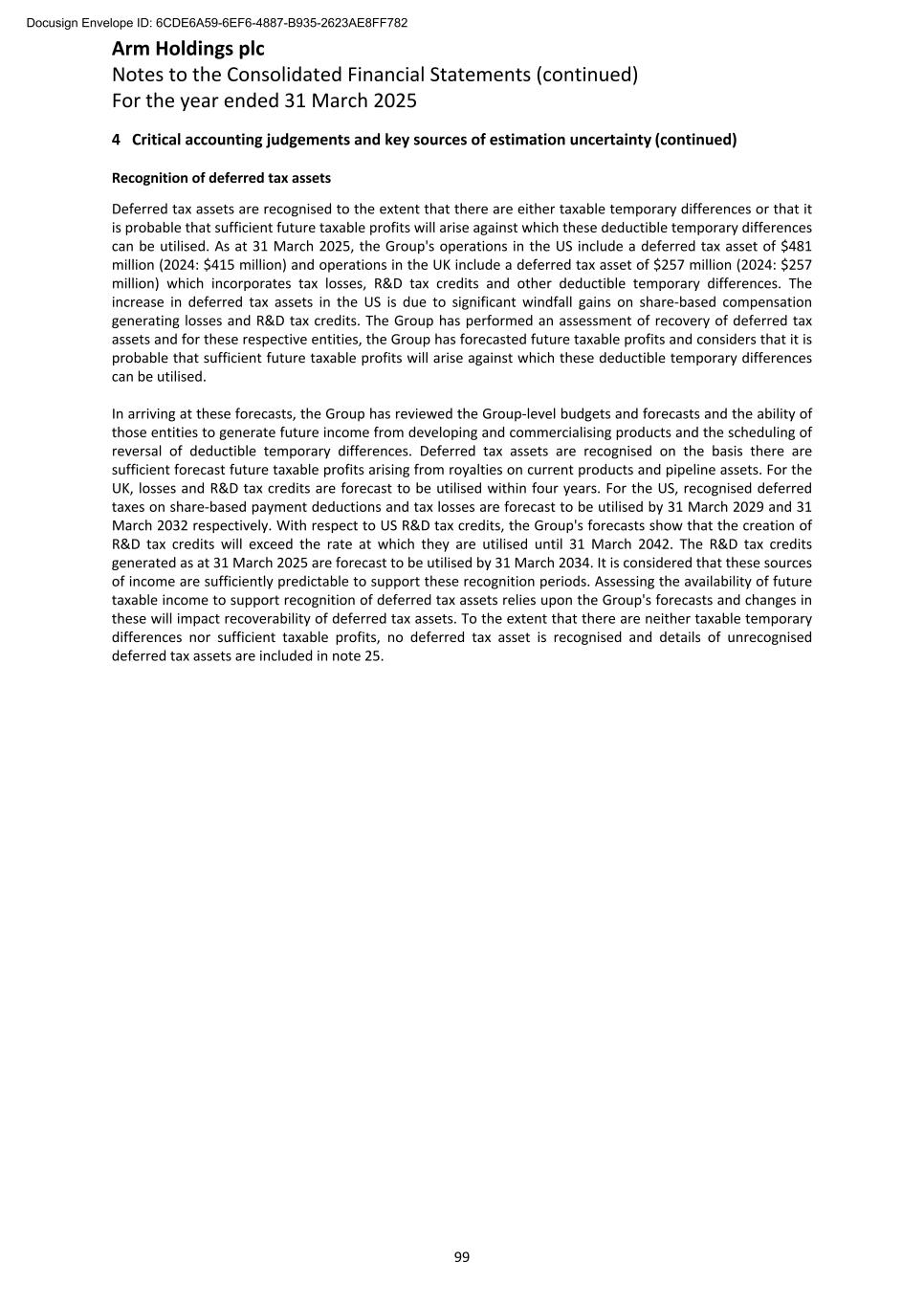
4 Critical accounting judgements and key sources of estimation uncertainty (continued) Recognition of deferred tax assets Deferred tax assets are recognised to the extent that there are either taxable temporary differences or that it is probable that sufficient future taxable profits will arise against which these deductible temporary differences can be utilised. As at 31 March 2025, the Group's operations in the US include a deferred tax asset of $481 million (2024: $415 million) and operations in the UK include a deferred tax asset of $257 million (2024: $257 million) which incorporates tax losses, R&D tax credits and other deductible temporary differences. The increase in deferred tax assets in the US is due to significant windfall gains on share-based compensation generating losses and R&D tax credits. The Group has performed an assessment of recovery of deferred tax assets and for these respective entities, the Group has forecasted future taxable profits and considers that it is probable that sufficient future taxable profits will arise against which these deductible temporary differences can be utilised. In arriving at these forecasts, the Group has reviewed the Group-level budgets and forecasts and the ability of those entities to generate future income from developing and commercialising products and the scheduling of reversal of deductible temporary differences. Deferred tax assets are recognised on the basis there are sufficient forecast future taxable profits arising from royalties on current products and pipeline assets. For the UK, losses and R&D tax credits are forecast to be utilised within four years. For the US, recognised deferred taxes on share-based payment deductions and tax losses are forecast to be utilised by 31 March 2029 and 31 March 2032 respectively. With respect to US R&D tax credits, the Group's forecasts show that the creation of R&D tax credits will exceed the rate at which they are utilised until 31 March 2042. The R&D tax credits generated as at 31 March 2025 are forecast to be utilised by 31 March 2034. It is considered that these sources of income are sufficiently predictable to support these recognition periods. Assessing the availability of future taxable income to support recognition of deferred tax assets relies upon the Group's forecasts and changes in these will impact recoverability of deferred tax assets. To the extent that there are neither taxable temporary differences nor sufficient taxable profits, no deferred tax asset is recognised and details of unrecognised deferred tax assets are included in note 25. Arm Holdings plc Notes to the Consolidated Financial Statements (continued) For the year ended 31 March 2025 99 Docusign Envelope ID: 6CDE6A59-6EF6-4887-B935-2623AE8FF782
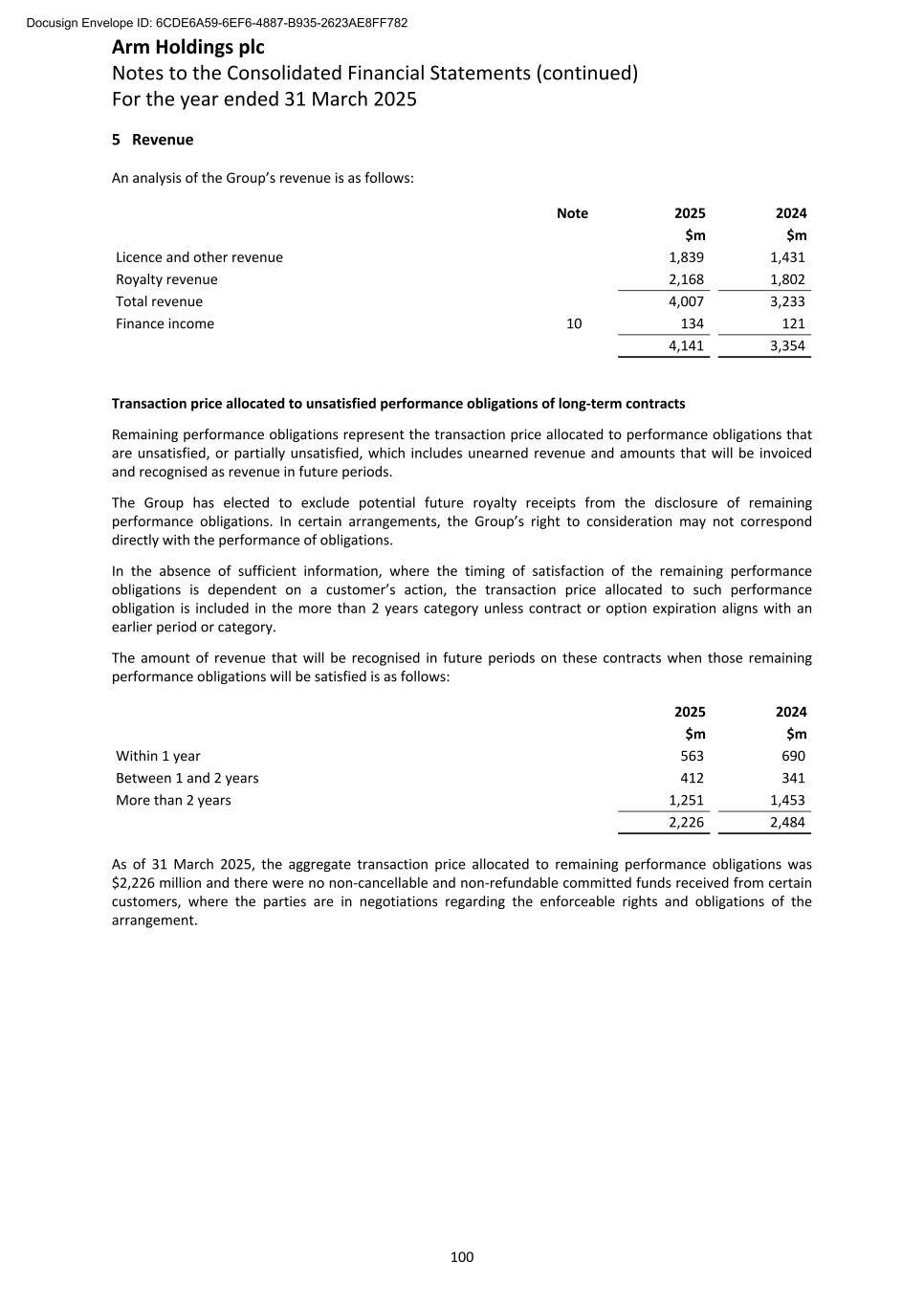
5 Revenue An analysis of the Group’s revenue is as follows: Note 2025 2024 $m $m Licence and other revenue 1,839 1,431 Royalty revenue 2,168 1,802 Total revenue 4,007 3,233 Finance income 10 134 121 4,141 3,354 Transaction price allocated to unsatisfied performance obligations of long-term contracts Remaining performance obligations represent the transaction price allocated to performance obligations that are unsatisfied, or partially unsatisfied, which includes unearned revenue and amounts that will be invoiced and recognised as revenue in future periods. The Group has elected to exclude potential future royalty receipts from the disclosure of remaining performance obligations. In certain arrangements, the Group’s right to consideration may not correspond directly with the performance of obligations. In the absence of sufficient information, where the timing of satisfaction of the remaining performance obligations is dependent on a customer’s action, the transaction price allocated to such performance obligation is included in the more than 2 years category unless contract or option expiration aligns with an earlier period or category. The amount of revenue that will be recognised in future periods on these contracts when those remaining performance obligations will be satisfied is as follows: 2025 2024 $m $m Within 1 year 563 690 Between 1 and 2 years 412 341 More than 2 years 1,251 1,453 2,226 2,484 As of 31 March 2025, the aggregate transaction price allocated to remaining performance obligations was $2,226 million and there were no non-cancellable and non-refundable committed funds received from certain customers, where the parties are in negotiations regarding the enforceable rights and obligations of the arrangement. Arm Holdings plc Notes to the Consolidated Financial Statements (continued) For the year ended 31 March 2025 100 Docusign Envelope ID: 6CDE6A59-6EF6-4887-B935-2623AE8FF782
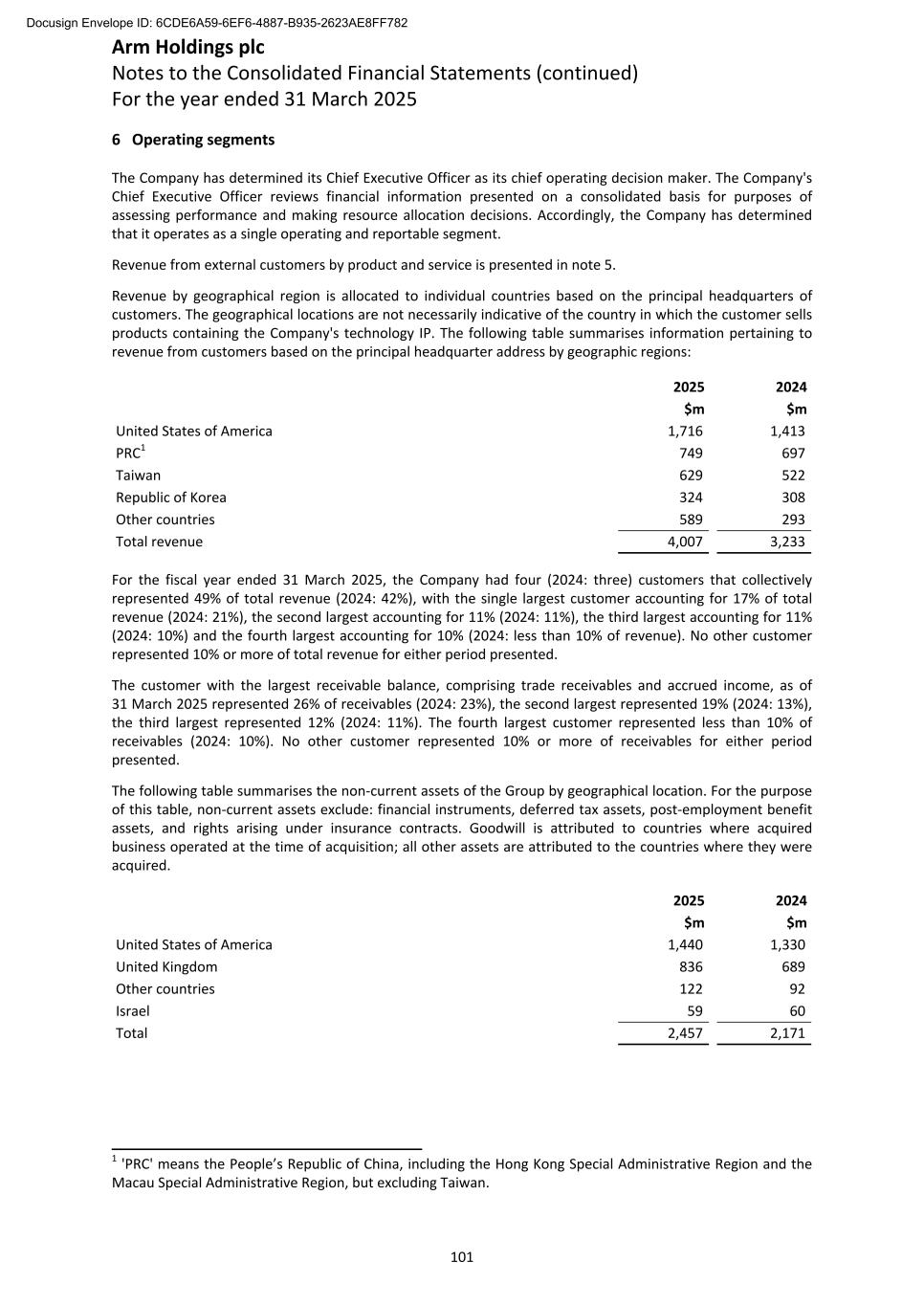
6 Operating segments The Company has determined its Chief Executive Officer as its chief operating decision maker. The Company's Chief Executive Officer reviews financial information presented on a consolidated basis for purposes of assessing performance and making resource allocation decisions. Accordingly, the Company has determined that it operates as a single operating and reportable segment. Revenue from external customers by product and service is presented in note 5. Revenue by geographical region is allocated to individual countries based on the principal headquarters of customers. The geographical locations are not necessarily indicative of the country in which the customer sells products containing the Company's technology IP. The following table summarises information pertaining to revenue from customers based on the principal headquarter address by geographic regions: 2025 2024 $m $m United States of America 1,716 1,413 PRC1 749 697 Taiwan 629 522 Republic of Korea 324 308 Other countries 589 293 Total revenue 4,007 3,233 For the fiscal year ended 31 March 2025, the Company had four (2024: three) customers that collectively represented 49% of total revenue (2024: 42%), with the single largest customer accounting for 17% of total revenue (2024: 21%), the second largest accounting for 11% (2024: 11%), the third largest accounting for 11% (2024: 10%) and the fourth largest accounting for 10% (2024: less than 10% of revenue). No other customer represented 10% or more of total revenue for either period presented. The customer with the largest receivable balance, comprising trade receivables and accrued income, as of 31 March 2025 represented 26% of receivables (2024: 23%), the second largest represented 19% (2024: 13%), the third largest represented 12% (2024: 11%). The fourth largest customer represented less than 10% of receivables (2024: 10%). No other customer represented 10% or more of receivables for either period presented. The following table summarises the non-current assets of the Group by geographical location. For the purpose of this table, non-current assets exclude: financial instruments, deferred tax assets, post-employment benefit assets, and rights arising under insurance contracts. Goodwill is attributed to countries where acquired business operated at the time of acquisition; all other assets are attributed to the countries where they were acquired. 2025 2024 $m $m United States of America 1,440 1,330 United Kingdom 836 689 Other countries 122 92 Israel 59 60 Total 2,457 2,171 Arm Holdings plc Notes to the Consolidated Financial Statements (continued) For the year ended 31 March 2025 101 1 'PRC' means the People’s Republic of China, including the Hong Kong Special Administrative Region and the Macau Special Administrative Region, but excluding Taiwan. Docusign Envelope ID: 6CDE6A59-6EF6-4887-B935-2623AE8FF782
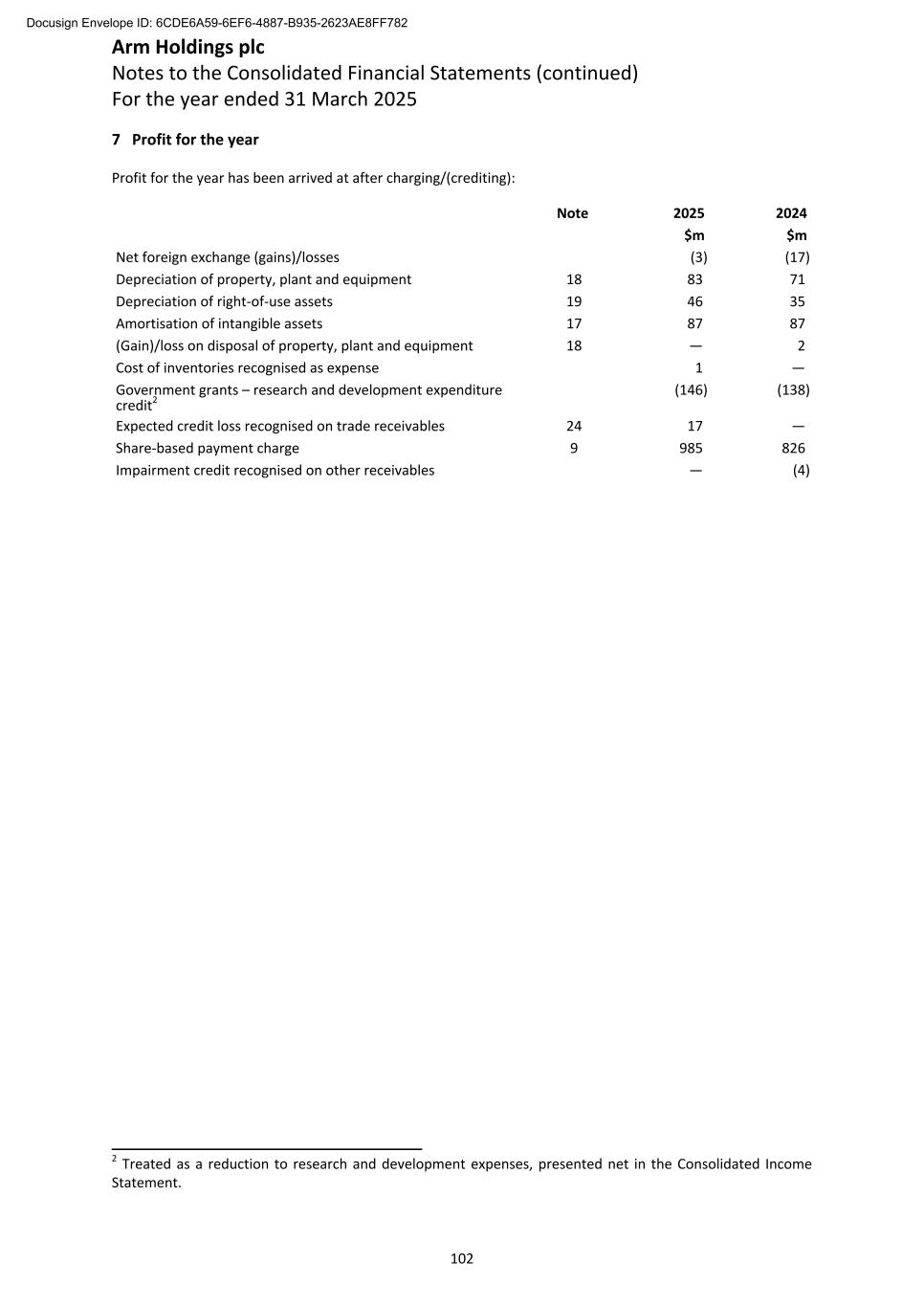
7 Profit for the year Profit for the year has been arrived at after charging/(crediting): Note 2025 2024 $m $m Net foreign exchange (gains)/losses (3) (17) Depreciation of property, plant and equipment 18 83 71 Depreciation of right-of-use assets 19 46 35 Amortisation of intangible assets 17 87 87 (Gain)/loss on disposal of property, plant and equipment 18 — 2 Cost of inventories recognised as expense 1 — Government grants – research and development expenditure credit2 (146) (138) Expected credit loss recognised on trade receivables 24 17 — Share-based payment charge 9 985 826 Impairment credit recognised on other receivables — (4) Arm Holdings plc Notes to the Consolidated Financial Statements (continued) For the year ended 31 March 2025 102 2 Treated as a reduction to research and development expenses, presented net in the Consolidated Income Statement. Docusign Envelope ID: 6CDE6A59-6EF6-4887-B935-2623AE8FF782
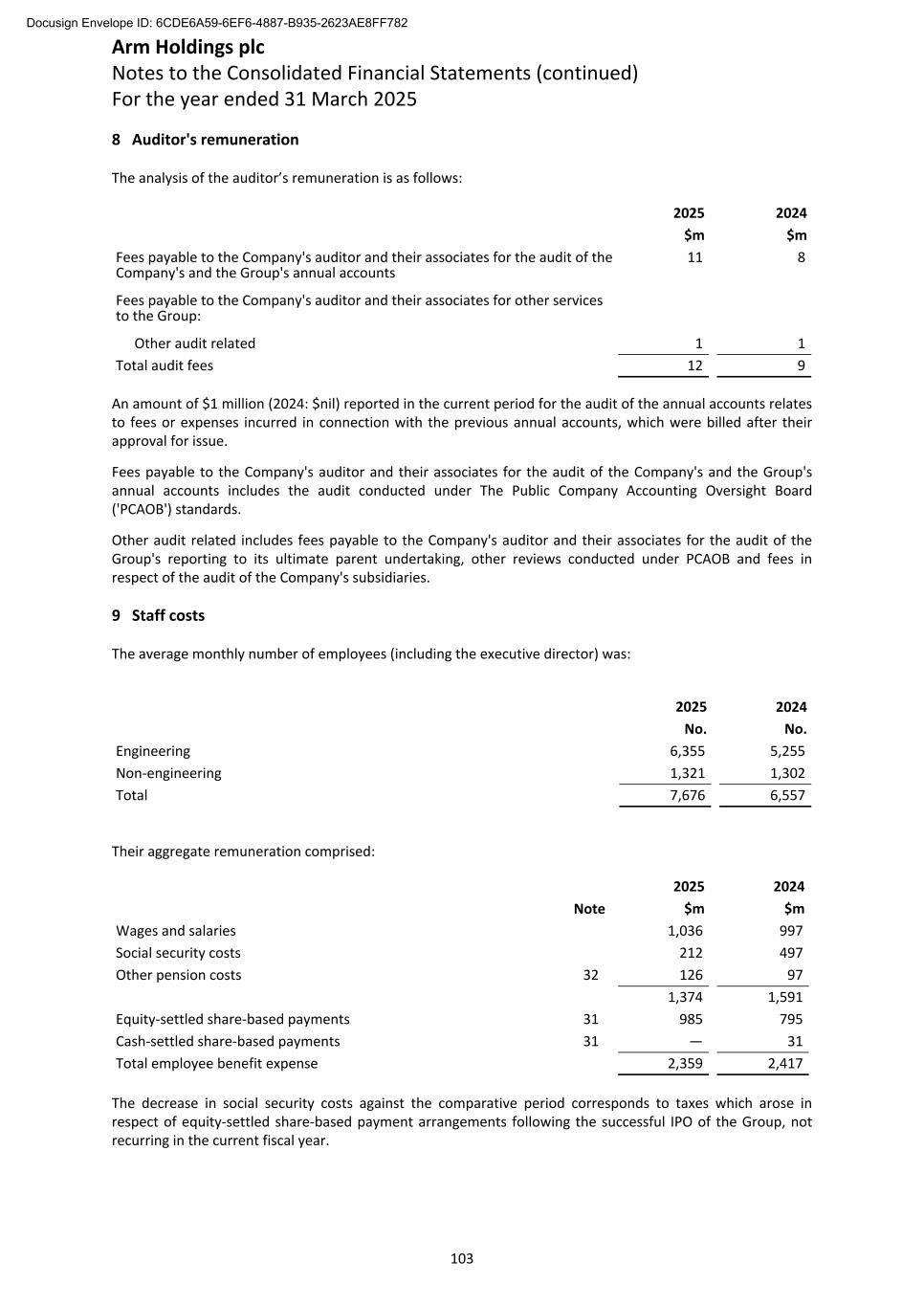
8 Auditor's remuneration The analysis of the auditor’s remuneration is as follows: 2025 2024 $m $m Fees payable to the Company's auditor and their associates for the audit of the Company's and the Group's annual accounts 11 8 Fees payable to the Company's auditor and their associates for other services to the Group: Other audit related 1 1 Total audit fees 12 9 An amount of $1 million (2024: $nil) reported in the current period for the audit of the annual accounts relates to fees or expenses incurred in connection with the previous annual accounts, which were billed after their approval for issue. Fees payable to the Company's auditor and their associates for the audit of the Company's and the Group's annual accounts includes the audit conducted under The Public Company Accounting Oversight Board ('PCAOB') standards. Other audit related includes fees payable to the Company's auditor and their associates for the audit of the Group's reporting to its ultimate parent undertaking, other reviews conducted under PCAOB and fees in respect of the audit of the Company's subsidiaries. 9 Staff costs The average monthly number of employees (including the executive director) was: 2025 2024 No. No. Engineering 6,355 5,255 Non-engineering 1,321 1,302 Total 7,676 6,557 Their aggregate remuneration comprised: 2025 2024 Note $m $m Wages and salaries 1,036 997 Social security costs 212 497 Other pension costs 32 126 97 1,374 1,591 Equity-settled share-based payments 31 985 795 Cash-settled share-based payments 31 — 31 Total employee benefit expense 2,359 2,417 The decrease in social security costs against the comparative period corresponds to taxes which arose in respect of equity-settled share-based payment arrangements following the successful IPO of the Group, not recurring in the current fiscal year. Arm Holdings plc Notes to the Consolidated Financial Statements (continued) For the year ended 31 March 2025 103 Docusign Envelope ID: 6CDE6A59-6EF6-4887-B935-2623AE8FF782
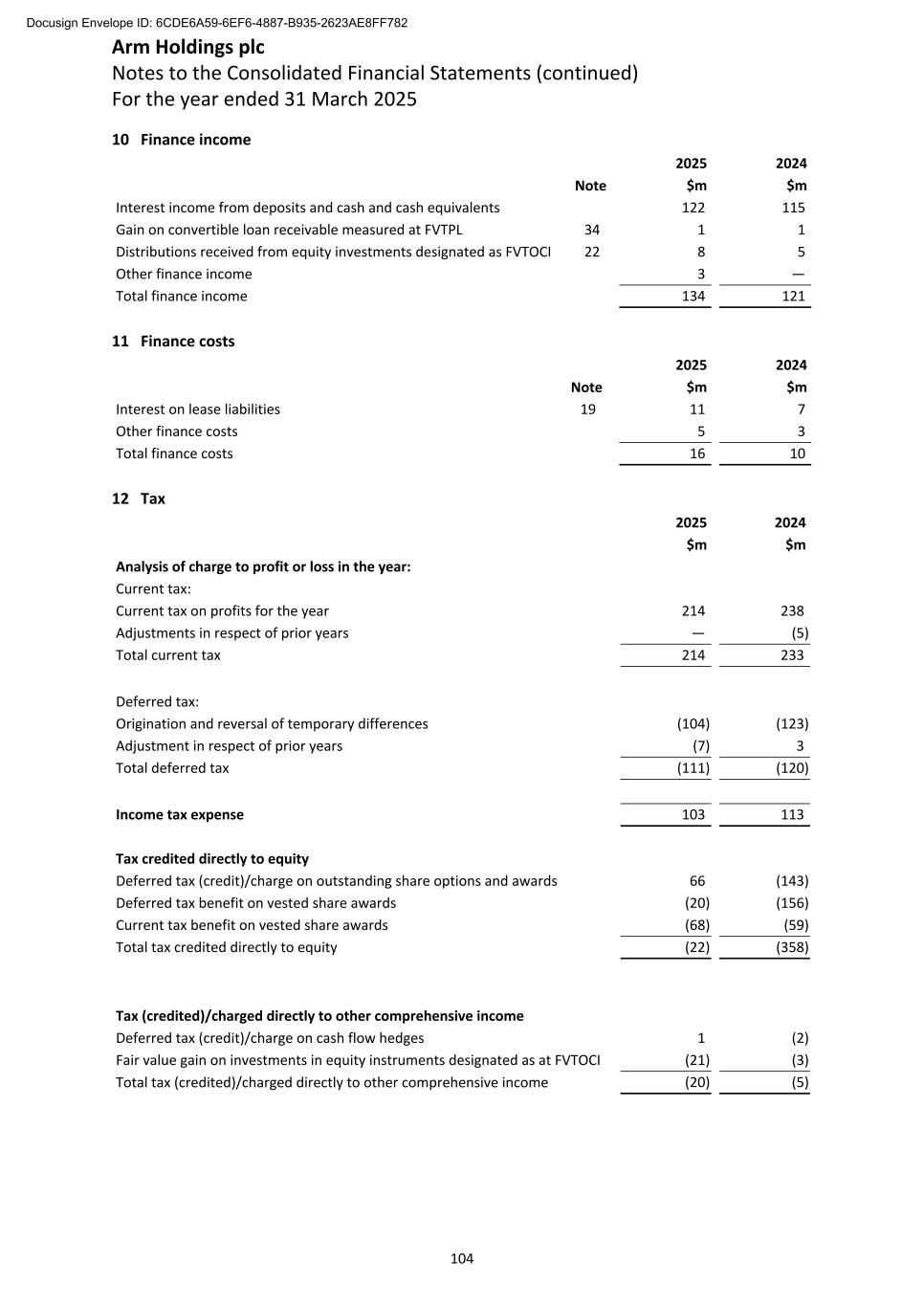
10 Finance income 2025 2024 Note $m $m Interest income from deposits and cash and cash equivalents 122 115 Gain on convertible loan receivable measured at FVTPL 34 1 1 Distributions received from equity investments designated as FVTOCI 22 8 5 Other finance income 3 — Total finance income 134 121 11 Finance costs 2025 2024 Note $m $m Interest on lease liabilities 19 11 7 Other finance costs 5 3 Total finance costs 16 10 12 Tax 2025 2024 $m $m Analysis of charge to profit or loss in the year: Current tax: Current tax on profits for the year 214 238 Adjustments in respect of prior years — (5) Total current tax 214 233 Deferred tax: Origination and reversal of temporary differences (104) (123) Adjustment in respect of prior years (7) 3 Total deferred tax (111) (120) Income tax expense 103 113 Tax credited directly to equity Deferred tax (credit)/charge on outstanding share options and awards 66 (143) Deferred tax benefit on vested share awards (20) (156) Current tax benefit on vested share awards (68) (59) Total tax credited directly to equity (22) (358) Tax (credited)/charged directly to other comprehensive income Deferred tax (credit)/charge on cash flow hedges 1 (2) Fair value gain on investments in equity instruments designated as at FVTOCI (21) (3) Total tax (credited)/charged directly to other comprehensive income (20) (5) Arm Holdings plc Notes to the Consolidated Financial Statements (continued) For the year ended 31 March 2025 104 Docusign Envelope ID: 6CDE6A59-6EF6-4887-B935-2623AE8FF782
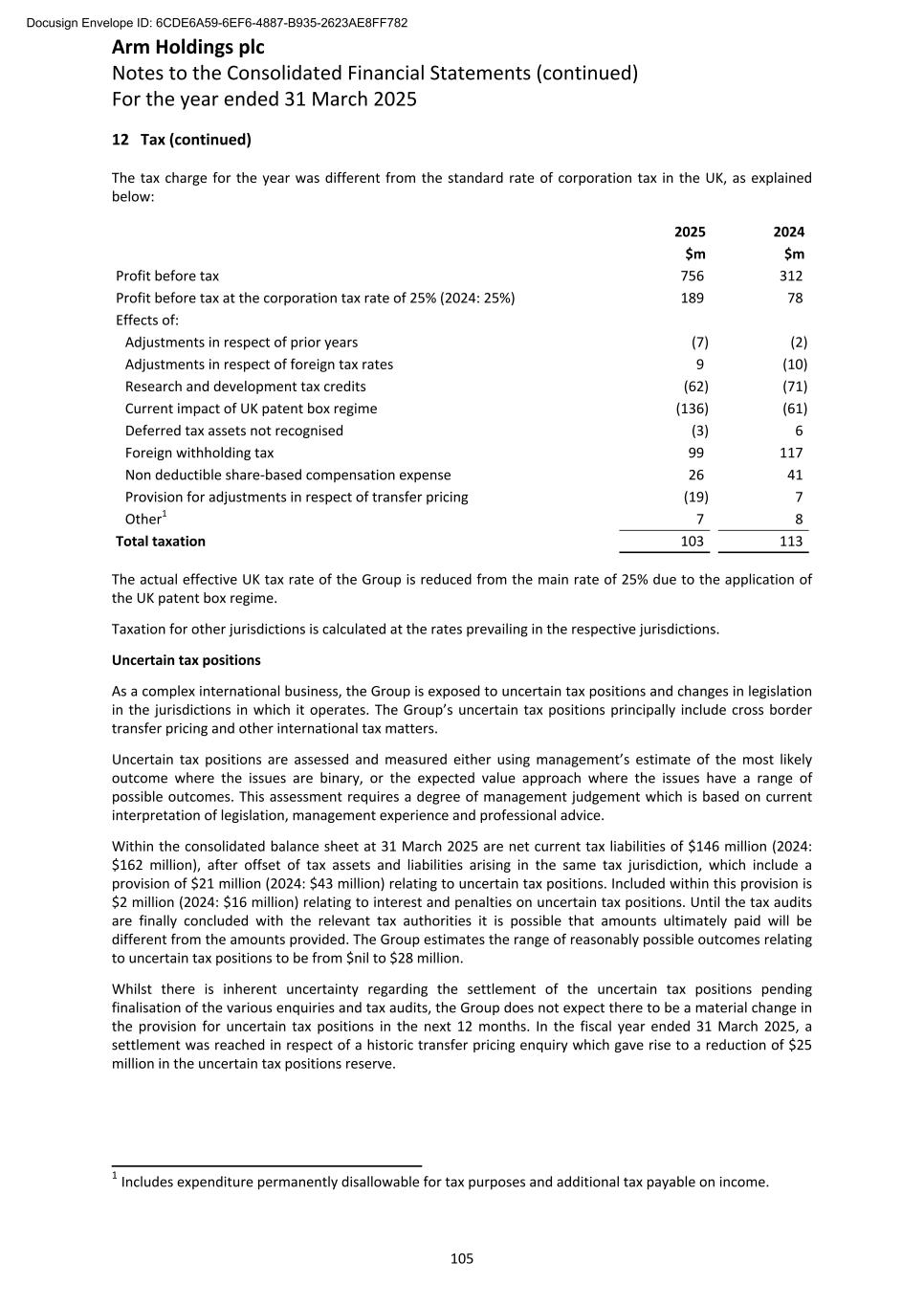
12 Tax (continued) The tax charge for the year was different from the standard rate of corporation tax in the UK, as explained below: 2025 2024 $m $m Profit before tax 756 312 Profit before tax at the corporation tax rate of 25% (2024: 25%) 189 78 Effects of: Adjustments in respect of prior years (7) (2) Adjustments in respect of foreign tax rates 9 (10) Research and development tax credits (62) (71) Current impact of UK patent box regime (136) (61) Deferred tax assets not recognised (3) 6 Foreign withholding tax 99 117 Non deductible share-based compensation expense 26 41 Provision for adjustments in respect of transfer pricing (19) 7 Other1 7 8 Total taxation 103 113 The actual effective UK tax rate of the Group is reduced from the main rate of 25% due to the application of the UK patent box regime. Taxation for other jurisdictions is calculated at the rates prevailing in the respective jurisdictions. Uncertain tax positions As a complex international business, the Group is exposed to uncertain tax positions and changes in legislation in the jurisdictions in which it operates. The Group’s uncertain tax positions principally include cross border transfer pricing and other international tax matters. Uncertain tax positions are assessed and measured either using management’s estimate of the most likely outcome where the issues are binary, or the expected value approach where the issues have a range of possible outcomes. This assessment requires a degree of management judgement which is based on current interpretation of legislation, management experience and professional advice. Within the consolidated balance sheet at 31 March 2025 are net current tax liabilities of $146 million (2024: $162 million), after offset of tax assets and liabilities arising in the same tax jurisdiction, which include a provision of $21 million (2024: $43 million) relating to uncertain tax positions. Included within this provision is $2 million (2024: $16 million) relating to interest and penalties on uncertain tax positions. Until the tax audits are finally concluded with the relevant tax authorities it is possible that amounts ultimately paid will be different from the amounts provided. The Group estimates the range of reasonably possible outcomes relating to uncertain tax positions to be from $nil to $28 million. Whilst there is inherent uncertainty regarding the settlement of the uncertain tax positions pending finalisation of the various enquiries and tax audits, the Group does not expect there to be a material change in the provision for uncertain tax positions in the next 12 months. In the fiscal year ended 31 March 2025, a settlement was reached in respect of a historic transfer pricing enquiry which gave rise to a reduction of $25 million in the uncertain tax positions reserve. Arm Holdings plc Notes to the Consolidated Financial Statements (continued) For the year ended 31 March 2025 105 1 Includes expenditure permanently disallowable for tax purposes and additional tax payable on income. Docusign Envelope ID: 6CDE6A59-6EF6-4887-B935-2623AE8FF782
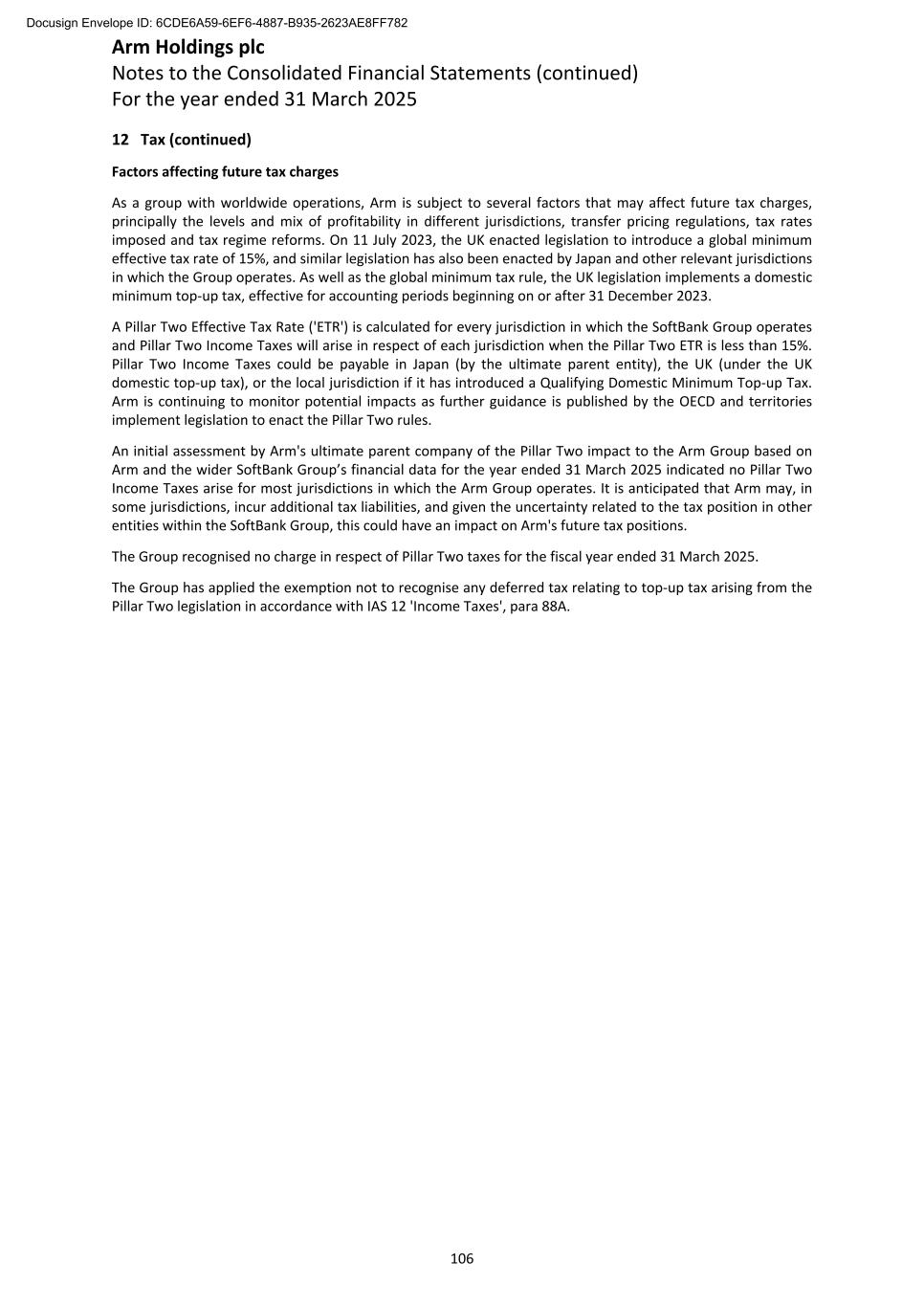
12 Tax (continued) Factors affecting future tax charges As a group with worldwide operations, Arm is subject to several factors that may affect future tax charges, principally the levels and mix of profitability in different jurisdictions, transfer pricing regulations, tax rates imposed and tax regime reforms. On 11 July 2023, the UK enacted legislation to introduce a global minimum effective tax rate of 15%, and similar legislation has also been enacted by Japan and other relevant jurisdictions in which the Group operates. As well as the global minimum tax rule, the UK legislation implements a domestic minimum top-up tax, effective for accounting periods beginning on or after 31 December 2023. A Pillar Two Effective Tax Rate ('ETR') is calculated for every jurisdiction in which the SoftBank Group operates and Pillar Two Income Taxes will arise in respect of each jurisdiction when the Pillar Two ETR is less than 15%. Pillar Two Income Taxes could be payable in Japan (by the ultimate parent entity), the UK (under the UK domestic top-up tax), or the local jurisdiction if it has introduced a Qualifying Domestic Minimum Top-up Tax. Arm is continuing to monitor potential impacts as further guidance is published by the OECD and territories implement legislation to enact the Pillar Two rules. An initial assessment by Arm's ultimate parent company of the Pillar Two impact to the Arm Group based on Arm and the wider SoftBank Group’s financial data for the year ended 31 March 2025 indicated no Pillar Two Income Taxes arise for most jurisdictions in which the Arm Group operates. It is anticipated that Arm may, in some jurisdictions, incur additional tax liabilities, and given the uncertainty related to the tax position in other entities within the SoftBank Group, this could have an impact on Arm's future tax positions. The Group recognised no charge in respect of Pillar Two taxes for the fiscal year ended 31 March 2025. The Group has applied the exemption not to recognise any deferred tax relating to top-up tax arising from the Pillar Two legislation in accordance with IAS 12 'Income Taxes', para 88A. Arm Holdings plc Notes to the Consolidated Financial Statements (continued) For the year ended 31 March 2025 106 Docusign Envelope ID: 6CDE6A59-6EF6-4887-B935-2623AE8FF782
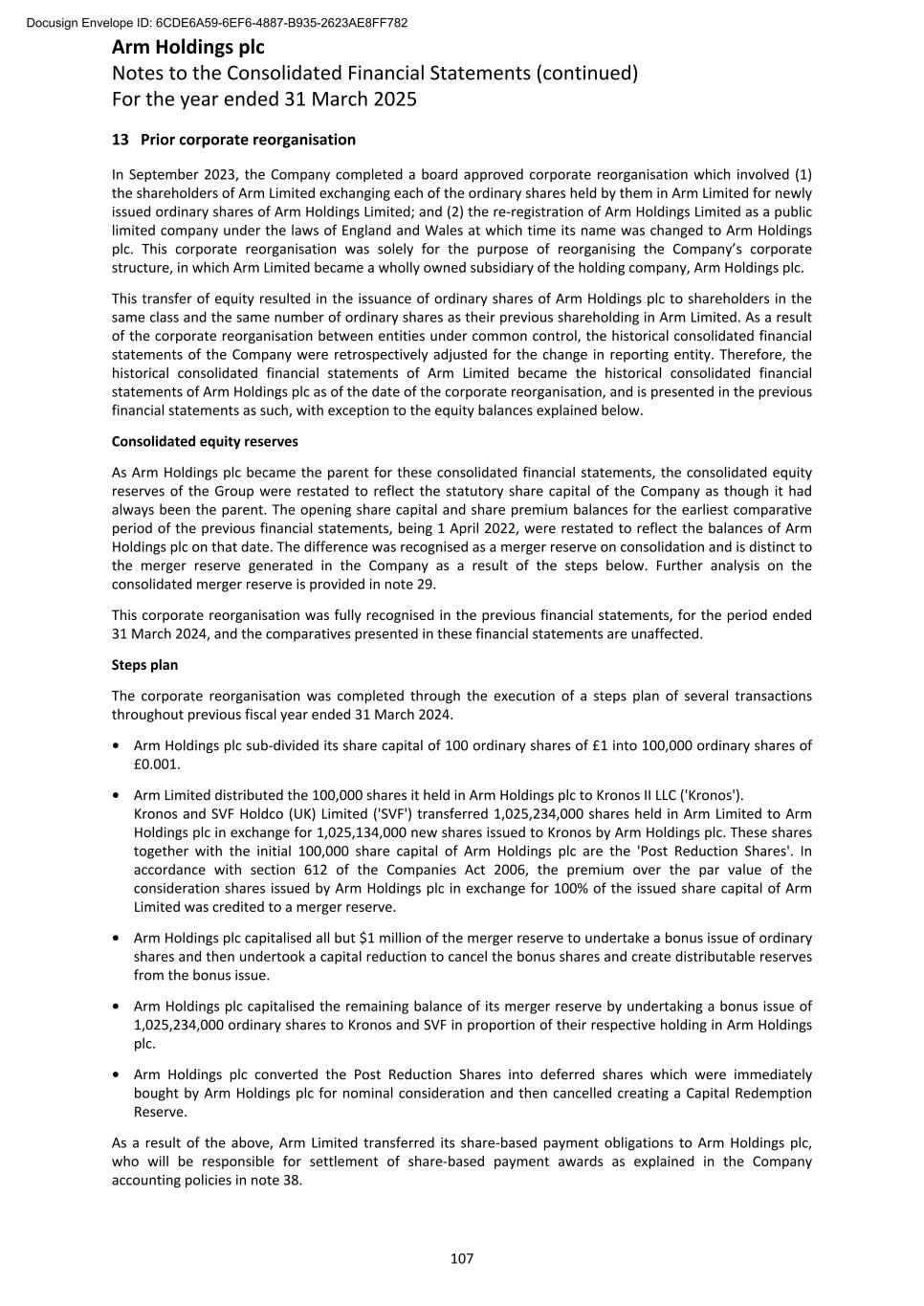
13 Prior corporate reorganisation In September 2023, the Company completed a board approved corporate reorganisation which involved (1) the shareholders of Arm Limited exchanging each of the ordinary shares held by them in Arm Limited for newly issued ordinary shares of Arm Holdings Limited; and (2) the re-registration of Arm Holdings Limited as a public limited company under the laws of England and Wales at which time its name was changed to Arm Holdings plc. This corporate reorganisation was solely for the purpose of reorganising the Company’s corporate structure, in which Arm Limited became a wholly owned subsidiary of the holding company, Arm Holdings plc. This transfer of equity resulted in the issuance of ordinary shares of Arm Holdings plc to shareholders in the same class and the same number of ordinary shares as their previous shareholding in Arm Limited. As a result of the corporate reorganisation between entities under common control, the historical consolidated financial statements of the Company were retrospectively adjusted for the change in reporting entity. Therefore, the historical consolidated financial statements of Arm Limited became the historical consolidated financial statements of Arm Holdings plc as of the date of the corporate reorganisation, and is presented in the previous financial statements as such, with exception to the equity balances explained below. Consolidated equity reserves As Arm Holdings plc became the parent for these consolidated financial statements, the consolidated equity reserves of the Group were restated to reflect the statutory share capital of the Company as though it had always been the parent. The opening share capital and share premium balances for the earliest comparative period of the previous financial statements, being 1 April 2022, were restated to reflect the balances of Arm Holdings plc on that date. The difference was recognised as a merger reserve on consolidation and is distinct to the merger reserve generated in the Company as a result of the steps below. Further analysis on the consolidated merger reserve is provided in note 29. This corporate reorganisation was fully recognised in the previous financial statements, for the period ended 31 March 2024, and the comparatives presented in these financial statements are unaffected. Steps plan The corporate reorganisation was completed through the execution of a steps plan of several transactions throughout previous fiscal year ended 31 March 2024. • Arm Holdings plc sub-divided its share capital of 100 ordinary shares of £1 into 100,000 ordinary shares of £0.001. • Arm Limited distributed the 100,000 shares it held in Arm Holdings plc to Kronos II LLC ('Kronos'). Kronos and SVF Holdco (UK) Limited ('SVF') transferred 1,025,234,000 shares held in Arm Limited to Arm Holdings plc in exchange for 1,025,134,000 new shares issued to Kronos by Arm Holdings plc. These shares together with the initial 100,000 share capital of Arm Holdings plc are the 'Post Reduction Shares'. In accordance with section 612 of the Companies Act 2006, the premium over the par value of the consideration shares issued by Arm Holdings plc in exchange for 100% of the issued share capital of Arm Limited was credited to a merger reserve. • Arm Holdings plc capitalised all but $1 million of the merger reserve to undertake a bonus issue of ordinary shares and then undertook a capital reduction to cancel the bonus shares and create distributable reserves from the bonus issue. • Arm Holdings plc capitalised the remaining balance of its merger reserve by undertaking a bonus issue of 1,025,234,000 ordinary shares to Kronos and SVF in proportion of their respective holding in Arm Holdings plc. • Arm Holdings plc converted the Post Reduction Shares into deferred shares which were immediately bought by Arm Holdings plc for nominal consideration and then cancelled creating a Capital Redemption Reserve. As a result of the above, Arm Limited transferred its share-based payment obligations to Arm Holdings plc, who will be responsible for settlement of share-based payment awards as explained in the Company accounting policies in note 38. Arm Holdings plc Notes to the Consolidated Financial Statements (continued) For the year ended 31 March 2025 107 Docusign Envelope ID: 6CDE6A59-6EF6-4887-B935-2623AE8FF782
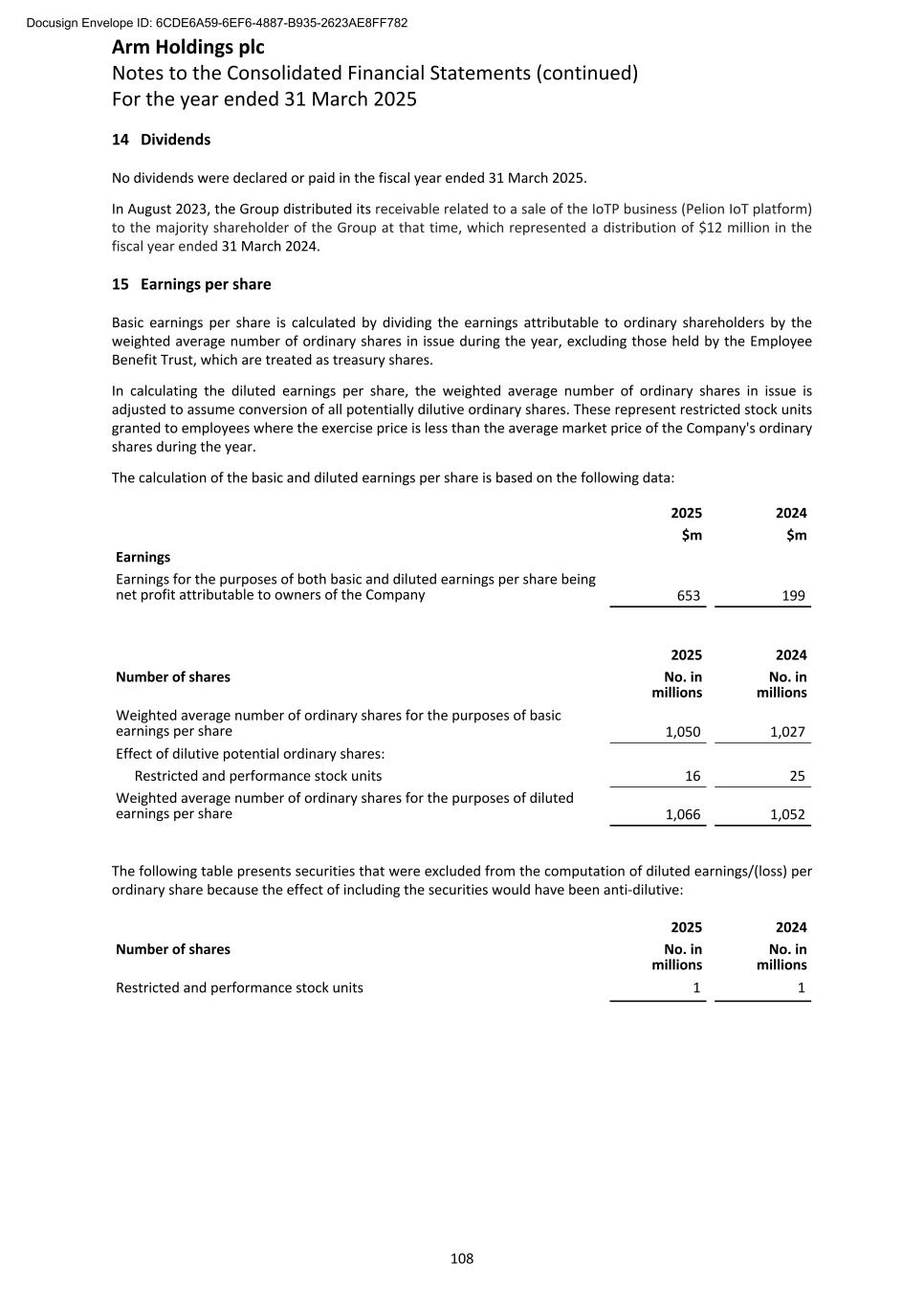
14 Dividends No dividends were declared or paid in the fiscal year ended 31 March 2025. In August 2023, the Group distributed its receivable related to a sale of the IoTP business (Pelion IoT platform) to the majority shareholder of the Group at that time, which represented a distribution of $12 million in the fiscal year ended 31 March 2024. 15 Earnings per share Basic earnings per share is calculated by dividing the earnings attributable to ordinary shareholders by the weighted average number of ordinary shares in issue during the year, excluding those held by the Employee Benefit Trust, which are treated as treasury shares. In calculating the diluted earnings per share, the weighted average number of ordinary shares in issue is adjusted to assume conversion of all potentially dilutive ordinary shares. These represent restricted stock units granted to employees where the exercise price is less than the average market price of the Company's ordinary shares during the year. The calculation of the basic and diluted earnings per share is based on the following data: 2025 2024 $m $m Earnings Earnings for the purposes of both basic and diluted earnings per share being net profit attributable to owners of the Company 653 199 2025 2024 Number of shares No. in millions No. in millions Weighted average number of ordinary shares for the purposes of basic earnings per share 1,050 1,027 Effect of dilutive potential ordinary shares: Restricted and performance stock units 16 25 Weighted average number of ordinary shares for the purposes of diluted earnings per share 1,066 1,052 The following table presents securities that were excluded from the computation of diluted earnings/(loss) per ordinary share because the effect of including the securities would have been anti-dilutive: 2025 2024 Number of shares No. in millions No. in millions Restricted and performance stock units 1 1 Arm Holdings plc Notes to the Consolidated Financial Statements (continued) For the year ended 31 March 2025 108 Docusign Envelope ID: 6CDE6A59-6EF6-4887-B935-2623AE8FF782
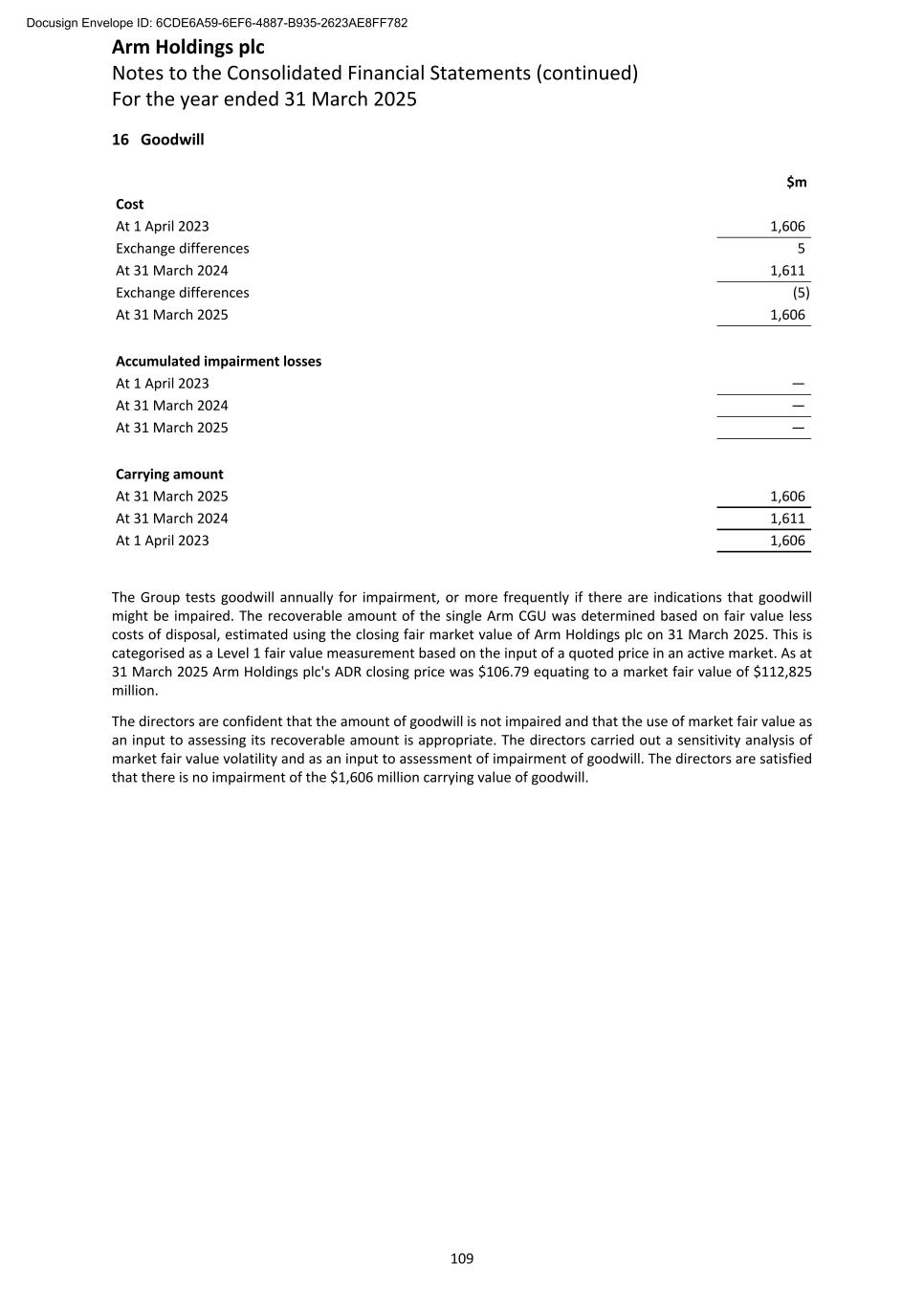
16 Goodwill $m Cost At 1 April 2023 1,606 Exchange differences 5 At 31 March 2024 1,611 Exchange differences (5) At 31 March 2025 1,606 Accumulated impairment losses At 1 April 2023 — At 31 March 2024 — At 31 March 2025 — Carrying amount At 31 March 2025 1,606 At 31 March 2024 1,611 At 1 April 2023 1,606 The Group tests goodwill annually for impairment, or more frequently if there are indications that goodwill might be impaired. The recoverable amount of the single Arm CGU was determined based on fair value less costs of disposal, estimated using the closing fair market value of Arm Holdings plc on 31 March 2025. This is categorised as a Level 1 fair value measurement based on the input of a quoted price in an active market. As at 31 March 2025 Arm Holdings plc's ADR closing price was $106.79 equating to a market fair value of $112,825 million. The directors are confident that the amount of goodwill is not impaired and that the use of market fair value as an input to assessing its recoverable amount is appropriate. The directors carried out a sensitivity analysis of market fair value volatility and as an input to assessment of impairment of goodwill. The directors are satisfied that there is no impairment of the $1,606 million carrying value of goodwill. Arm Holdings plc Notes to the Consolidated Financial Statements (continued) For the year ended 31 March 2025 109 Docusign Envelope ID: 6CDE6A59-6EF6-4887-B935-2623AE8FF782
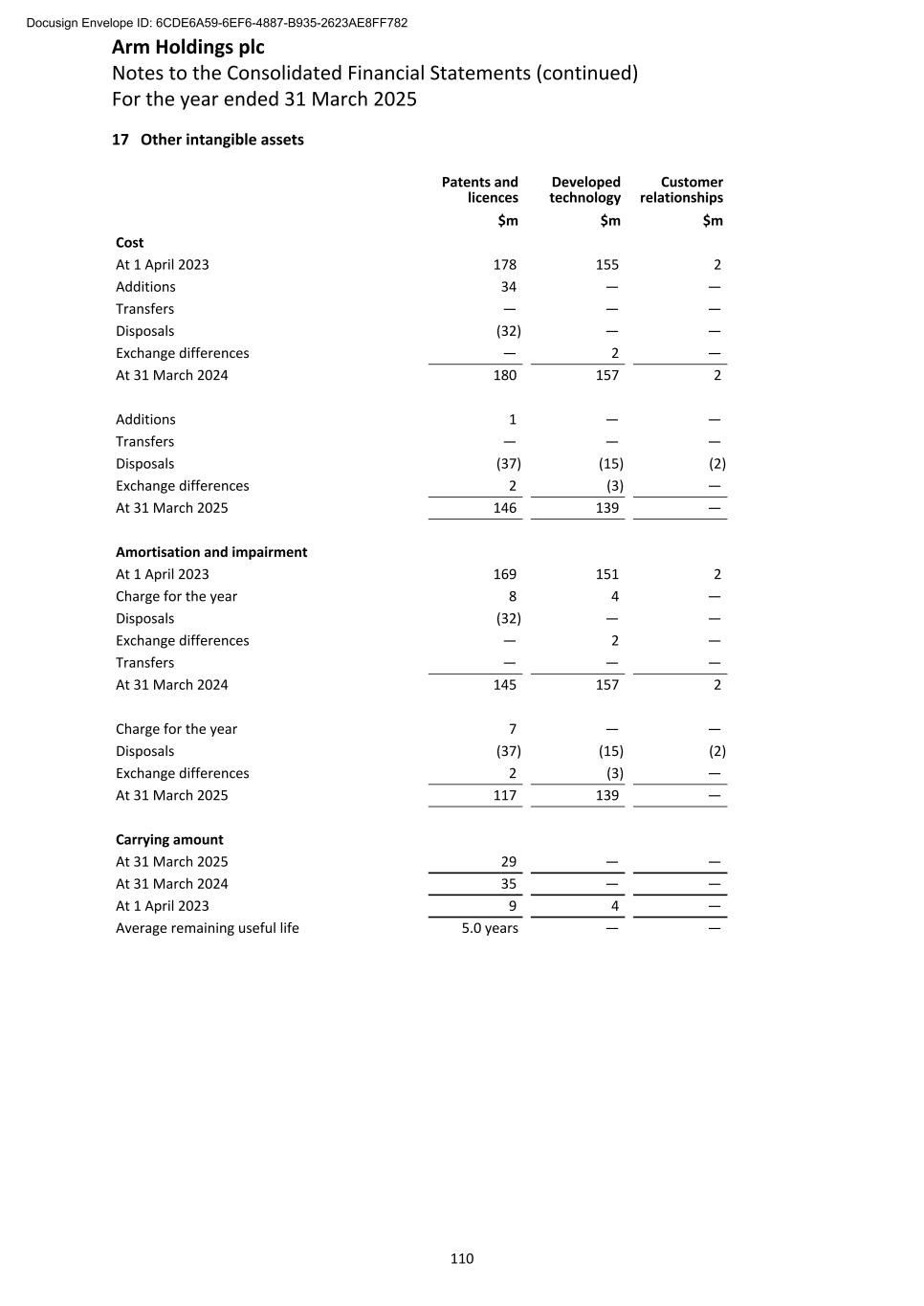
17 Other intangible assets Patents and licences Developed technology Customer relationships $m $m $m Cost At 1 April 2023 178 155 2 Additions 34 — — Transfers — — — Disposals (32) — — Exchange differences — 2 — At 31 March 2024 180 157 2 Additions 1 — — Transfers — — — Disposals (37) (15) (2) Exchange differences 2 (3) — At 31 March 2025 146 139 — Amortisation and impairment At 1 April 2023 169 151 2 Charge for the year 8 4 — Disposals (32) — — Exchange differences — 2 — Transfers — — — At 31 March 2024 145 157 2 Charge for the year 7 — — Disposals (37) (15) (2) Exchange differences 2 (3) — At 31 March 2025 117 139 — Carrying amount At 31 March 2025 29 — — At 31 March 2024 35 — — At 1 April 2023 9 4 — Average remaining useful life 5.0 years — — Arm Holdings plc Notes to the Consolidated Financial Statements (continued) For the year ended 31 March 2025 110 Docusign Envelope ID: 6CDE6A59-6EF6-4887-B935-2623AE8FF782
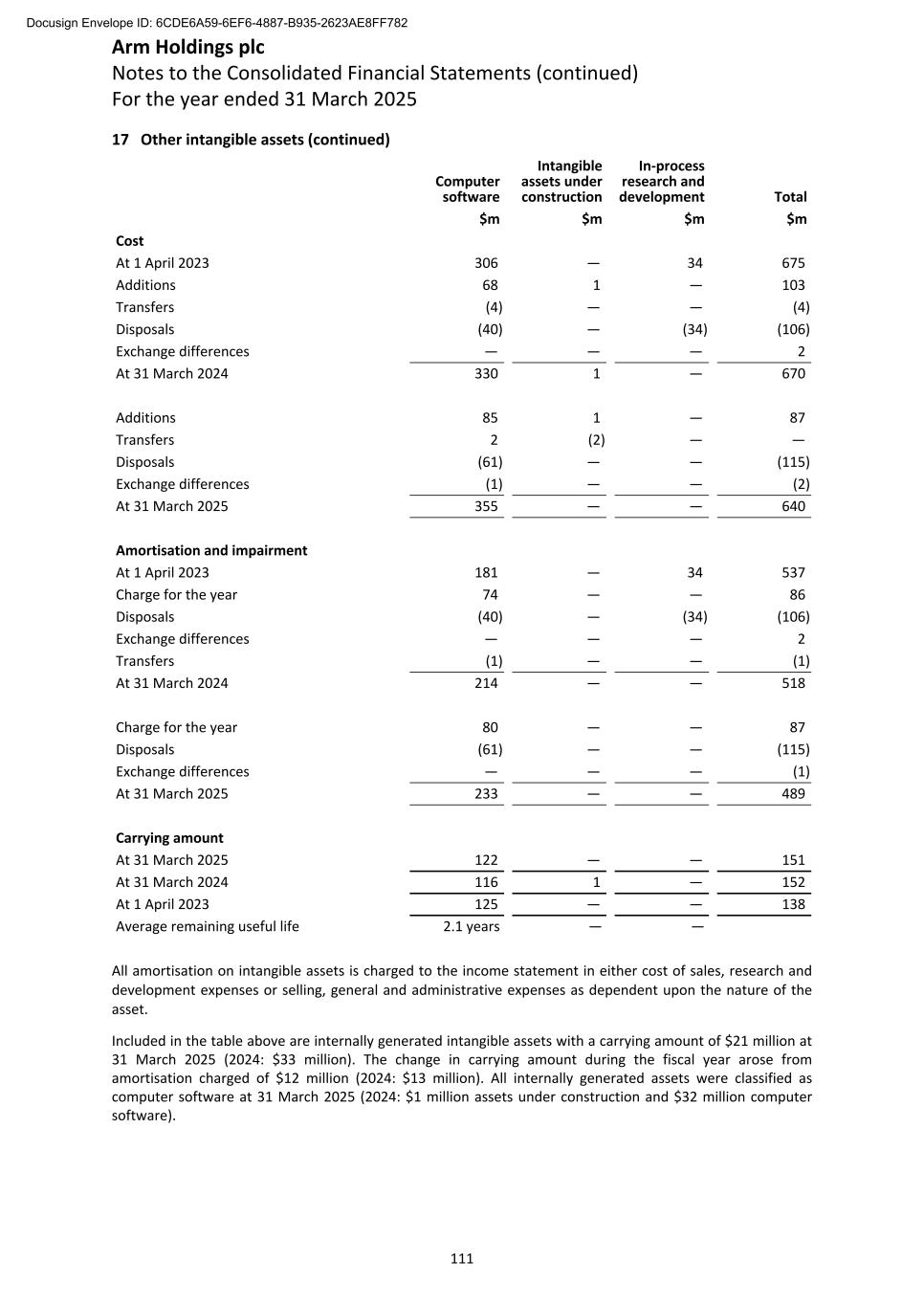
17 Other intangible assets (continued) Computer software Intangible assets under construction In-process research and development Total $m $m $m $m Cost At 1 April 2023 306 — 34 675 Additions 68 1 — 103 Transfers (4) — — (4) Disposals (40) — (34) (106) Exchange differences — — — 2 At 31 March 2024 330 1 — 670 Additions 85 1 — 87 Transfers 2 (2) — — Disposals (61) — — (115) Exchange differences (1) — — (2) At 31 March 2025 355 — — 640 Amortisation and impairment At 1 April 2023 181 — 34 537 Charge for the year 74 — — 86 Disposals (40) — (34) (106) Exchange differences — — — 2 Transfers (1) — — (1) At 31 March 2024 214 — — 518 Charge for the year 80 — — 87 Disposals (61) — — (115) Exchange differences — — — (1) At 31 March 2025 233 — — 489 Carrying amount At 31 March 2025 122 — — 151 At 31 March 2024 116 1 — 152 At 1 April 2023 125 — — 138 Average remaining useful life 2.1 years — — All amortisation on intangible assets is charged to the income statement in either cost of sales, research and development expenses or selling, general and administrative expenses as dependent upon the nature of the asset. Included in the table above are internally generated intangible assets with a carrying amount of $21 million at 31 March 2025 (2024: $33 million). The change in carrying amount during the fiscal year arose from amortisation charged of $12 million (2024: $13 million). All internally generated assets were classified as computer software at 31 March 2025 (2024: $1 million assets under construction and $32 million computer software). Arm Holdings plc Notes to the Consolidated Financial Statements (continued) For the year ended 31 March 2025 111 Docusign Envelope ID: 6CDE6A59-6EF6-4887-B935-2623AE8FF782

18 Property, plant and equipment Leasehold improve- ments Machinery and equipment Fixtures, fittings and vehicles Assets under construction Total $m $m $m $m $m Cost At 1 April 2023 153 305 53 — 511 Additions 1 62 2 18 83 Transfers 1 15 (9) (3) 4 Disposals (4) (16) (9) — (29) Exchange differences 4 — 1 — 5 At 31 March 2024 155 366 38 15 574 Additions 6 136 5 93 240 Transfers 3 60 4 (67) — Disposals (7) (13) (4) (1) (25) Exchange differences — (1) 1 1 1 At 31 March 2025 157 548 44 41 790 Depreciation At 1 April 2023 87 205 42 — 334 Charge for the year 16 51 4 — 71 Transfers — 7 (6) — 1 Disposals (4) (16) (7) — (27) Exchange differences 3 — 1 — 4 At 31 March 2024 102 247 34 — 383 Charge for the year 16 63 4 — 83 Transfers — (2) 2 — — Disposals (7) (13) (4) — (24) Exchange differences 1 — — — 1 At 31 March 2025 112 295 36 — 443 Carrying amount At 31 March 2025 45 253 8 41 347 At 31 March 2024 53 119 4 15 191 At 1 April 2023 66 100 11 — 177 Arm Holdings plc Notes to the Consolidated Financial Statements (continued) For the year ended 31 March 2025 112 Docusign Envelope ID: 6CDE6A59-6EF6-4887-B935-2623AE8FF782
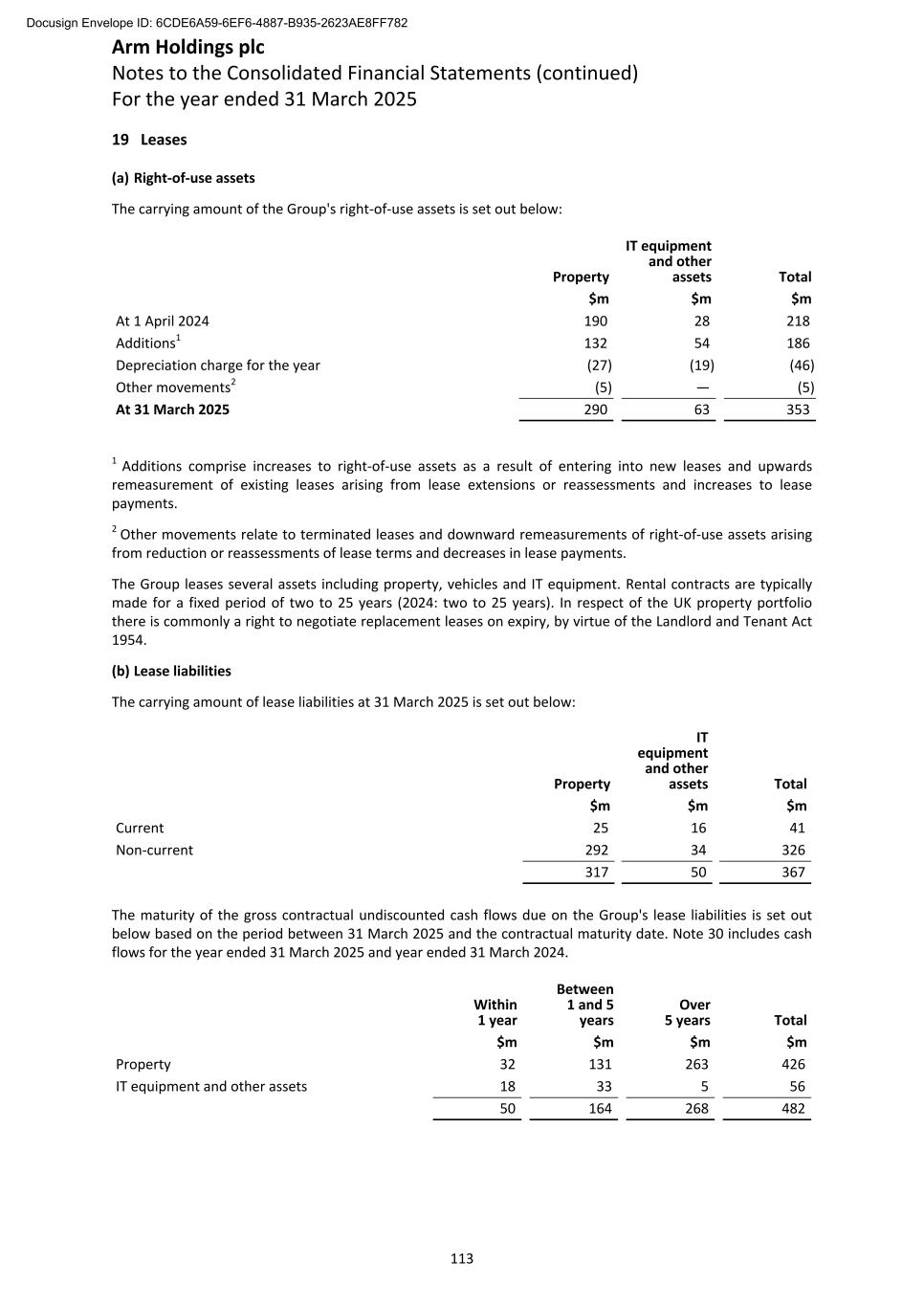
19 Leases (a) Right-of-use assets The carrying amount of the Group's right-of-use assets is set out below: Property IT equipment and other assets Total $m $m $m At 1 April 2024 190 28 218 Additions1 132 54 186 Depreciation charge for the year (27) (19) (46) Other movements2 (5) — (5) At 31 March 2025 290 63 353 1 Additions comprise increases to right-of-use assets as a result of entering into new leases and upwards remeasurement of existing leases arising from lease extensions or reassessments and increases to lease payments. 2 Other movements relate to terminated leases and downward remeasurements of right-of-use assets arising from reduction or reassessments of lease terms and decreases in lease payments. The Group leases several assets including property, vehicles and IT equipment. Rental contracts are typically made for a fixed period of two to 25 years (2024: two to 25 years). In respect of the UK property portfolio there is commonly a right to negotiate replacement leases on expiry, by virtue of the Landlord and Tenant Act 1954. (b) Lease liabilities The carrying amount of lease liabilities at 31 March 2025 is set out below: Property IT equipment and other assets Total $m $m $m Current 25 16 41 Non-current 292 34 326 317 50 367 The maturity of the gross contractual undiscounted cash flows due on the Group's lease liabilities is set out below based on the period between 31 March 2025 and the contractual maturity date. Note 30 includes cash flows for the year ended 31 March 2025 and year ended 31 March 2024. Within 1 year Between 1 and 5 years Over 5 years Total $m $m $m $m Property 32 131 263 426 IT equipment and other assets 18 33 5 56 50 164 268 482 Arm Holdings plc Notes to the Consolidated Financial Statements (continued) For the year ended 31 March 2025 113 Docusign Envelope ID: 6CDE6A59-6EF6-4887-B935-2623AE8FF782
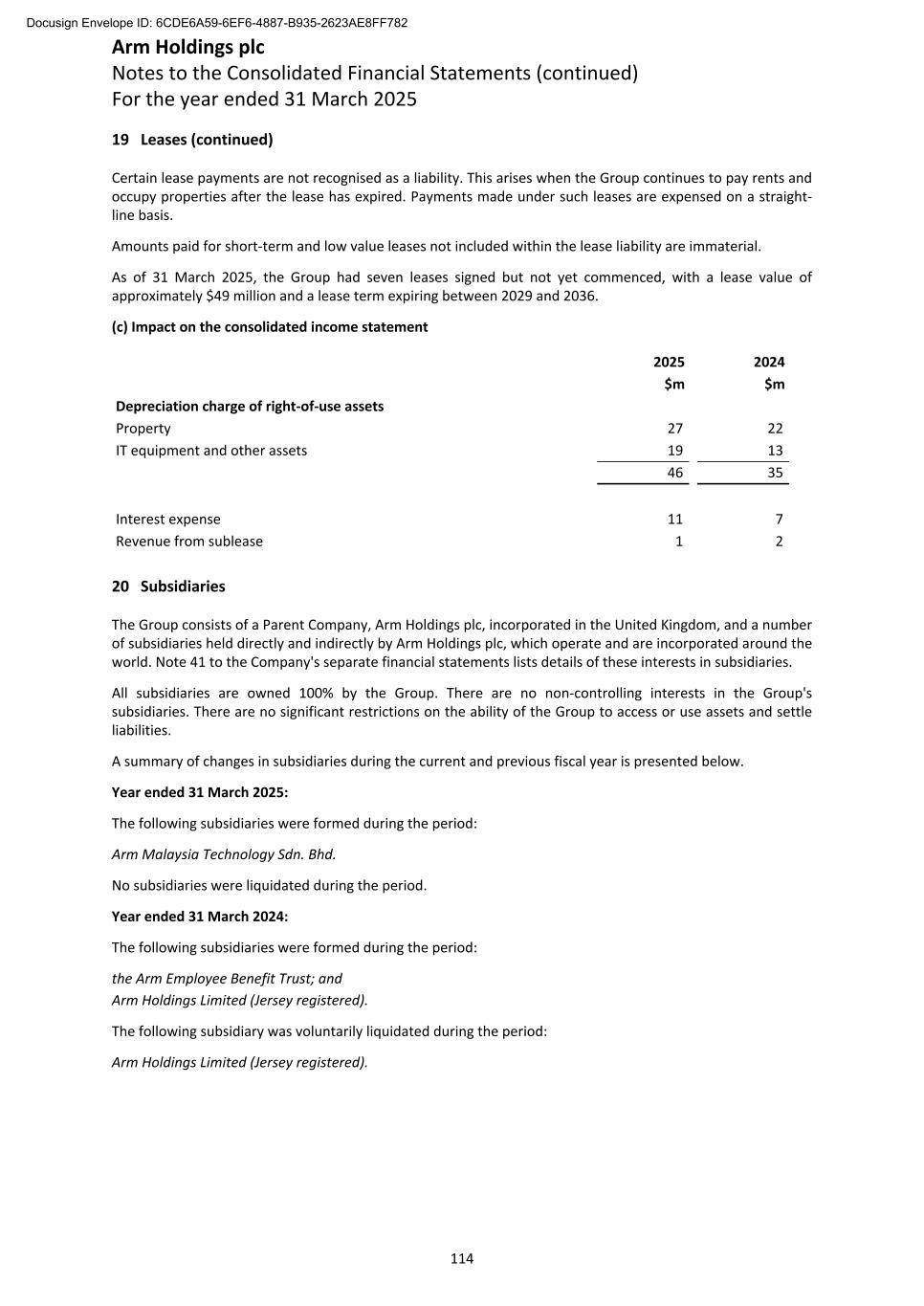
19 Leases (continued) Certain lease payments are not recognised as a liability. This arises when the Group continues to pay rents and occupy properties after the lease has expired. Payments made under such leases are expensed on a straight- line basis. Amounts paid for short-term and low value leases not included within the lease liability are immaterial. As of 31 March 2025, the Group had seven leases signed but not yet commenced, with a lease value of approximately $49 million and a lease term expiring between 2029 and 2036. (c) Impact on the consolidated income statement 2025 2024 $m $m Depreciation charge of right-of-use assets Property 27 22 IT equipment and other assets 19 13 46 35 Interest expense 11 7 Revenue from sublease 1 2 20 Subsidiaries The Group consists of a Parent Company, Arm Holdings plc, incorporated in the United Kingdom, and a number of subsidiaries held directly and indirectly by Arm Holdings plc, which operate and are incorporated around the world. Note 41 to the Company's separate financial statements lists details of these interests in subsidiaries. All subsidiaries are owned 100% by the Group. There are no non-controlling interests in the Group's subsidiaries. There are no significant restrictions on the ability of the Group to access or use assets and settle liabilities. A summary of changes in subsidiaries during the current and previous fiscal year is presented below. Year ended 31 March 2025: The following subsidiaries were formed during the period: Arm Malaysia Technology Sdn. Bhd. No subsidiaries were liquidated during the period. Year ended 31 March 2024: The following subsidiaries were formed during the period: the Arm Employee Benefit Trust; and Arm Holdings Limited (Jersey registered). The following subsidiary was voluntarily liquidated during the period: Arm Holdings Limited (Jersey registered). Arm Holdings plc Notes to the Consolidated Financial Statements (continued) For the year ended 31 March 2025 114 Docusign Envelope ID: 6CDE6A59-6EF6-4887-B935-2623AE8FF782

21 Associates Acetone Limited Other Total $m $m $m At 1 April 2023 85 31 116 Investments: – conversion of loan receivable to preferred shares — 4 4 Share of results for the year 1 — 1 Share of OCI for the year (3) — (3) Fair valuation gain/(loss) on associates held at fair value — 3 3 Impairment of investment in associate (4) — (4) Investments in associate previously classified as loans receivable — 3 3 At 31 March 2024 79 41 120 Share of results for the year (27) — (27) Share of OCI for the year (1) — (1) Other movements1 — 1 1 At 31 March 2025 51 42 93 2025 2024 $m $m Equity investments in associates 93 120 Loans to associates net of expected credit losses — — Total 93 120 Share of results of associates The Group recognises its share of results first against the equity investment, then, if there are additional share of results to record, against any loans to associates. The share of results was recorded as follows: 2025 2024 $m $m Equity investments in associates (27) 1 Total share of results for the year (27) 1 Arm Holdings plc Notes to the Consolidated Financial Statements (continued) For the year ended 31 March 2025 115 1 $1 million of the other movements presented arises due to rounding in accordance with the Group's accounting policies for presentation. Docusign Envelope ID: 6CDE6A59-6EF6-4887-B935-2623AE8FF782
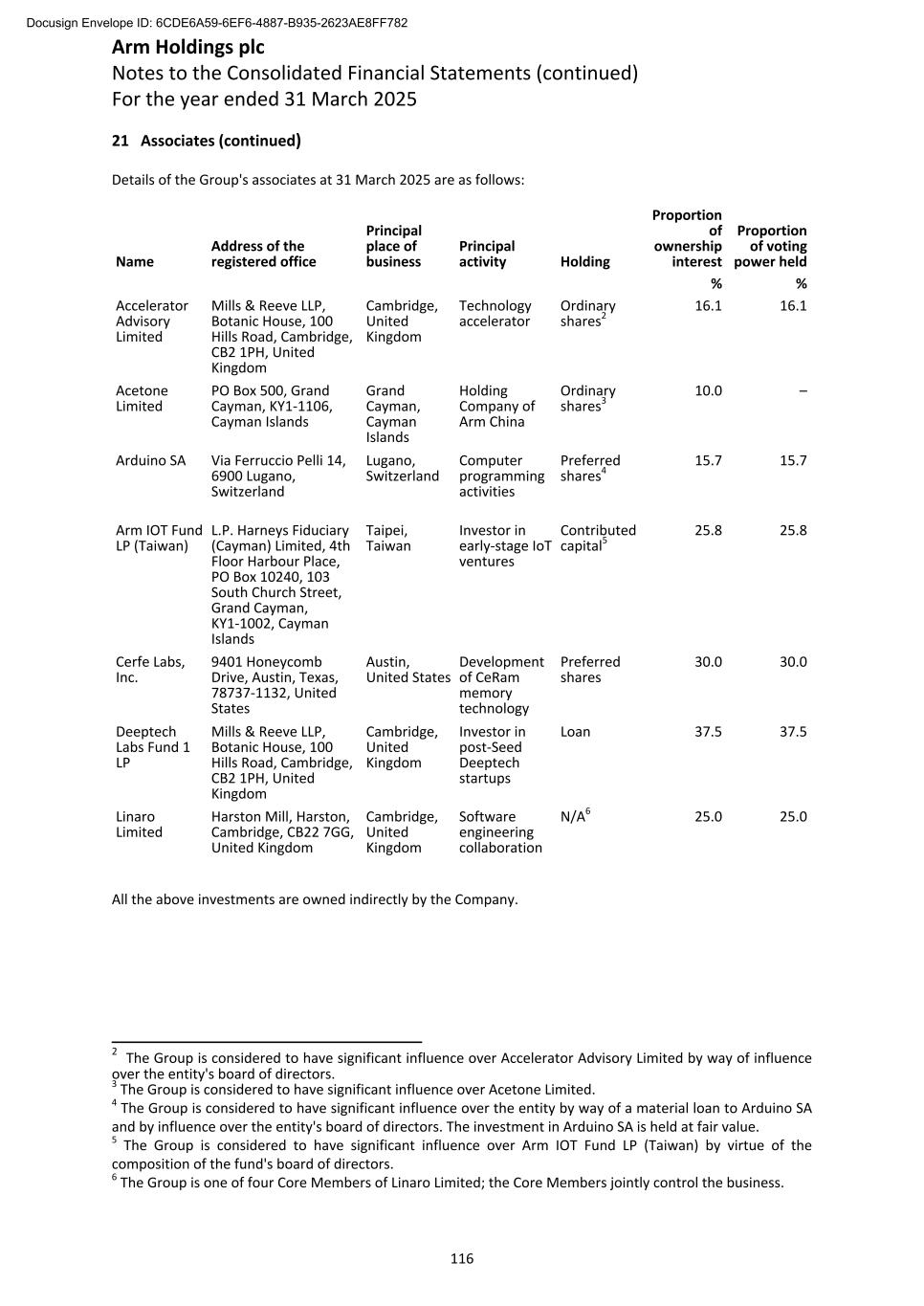
21 Associates (continued) Details of the Group's associates at 31 March 2025 are as follows: Name Address of the registered office Principal place of business Principal activity Holding Proportion of ownership interest Proportion of voting power held % % Accelerator Advisory Limited Mills & Reeve LLP, Botanic House, 100 Hills Road, Cambridge, CB2 1PH, United Kingdom Cambridge, United Kingdom Technology accelerator Ordinary shares2 16.1 16.1 Acetone Limited PO Box 500, Grand Cayman, KY1-1106, Cayman Islands Grand Cayman, Cayman Islands Holding Company of Arm China Ordinary shares3 10.0 – Arduino SA Via Ferruccio Pelli 14, 6900 Lugano, Switzerland Lugano, Switzerland Computer programming activities Preferred shares4 15.7 15.7 Arm IOT Fund LP (Taiwan) L.P. Harneys Fiduciary (Cayman) Limited, 4th Floor Harbour Place, PO Box 10240, 103 South Church Street, Grand Cayman, KY1-1002, Cayman Islands Taipei, Taiwan Investor in early-stage IoT ventures Contributed capital5 25.8 25.8 Cerfe Labs, Inc. 9401 Honeycomb Drive, Austin, Texas, 78737-1132, United States Austin, United States Development of CeRam memory technology Preferred shares 30.0 30.0 Deeptech Labs Fund 1 LP Mills & Reeve LLP, Botanic House, 100 Hills Road, Cambridge, CB2 1PH, United Kingdom Cambridge, United Kingdom Investor in post-Seed Deeptech startups Loan 37.5 37.5 Linaro Limited Harston Mill, Harston, Cambridge, CB22 7GG, United Kingdom Cambridge, United Kingdom Software engineering collaboration N/A6 25.0 25.0 All the above investments are owned indirectly by the Company. Arm Holdings plc Notes to the Consolidated Financial Statements (continued) For the year ended 31 March 2025 116 2 The Group is considered to have significant influence over Accelerator Advisory Limited by way of influence over the entity's board of directors. 3 The Group is considered to have significant influence over Acetone Limited. 4 The Group is considered to have significant influence over the entity by way of a material loan to Arduino SA and by influence over the entity's board of directors. The investment in Arduino SA is held at fair value. 5 The Group is considered to have significant influence over Arm IOT Fund LP (Taiwan) by virtue of the composition of the fund's board of directors. 6 The Group is one of four Core Members of Linaro Limited; the Core Members jointly control the business. Docusign Envelope ID: 6CDE6A59-6EF6-4887-B935-2623AE8FF782
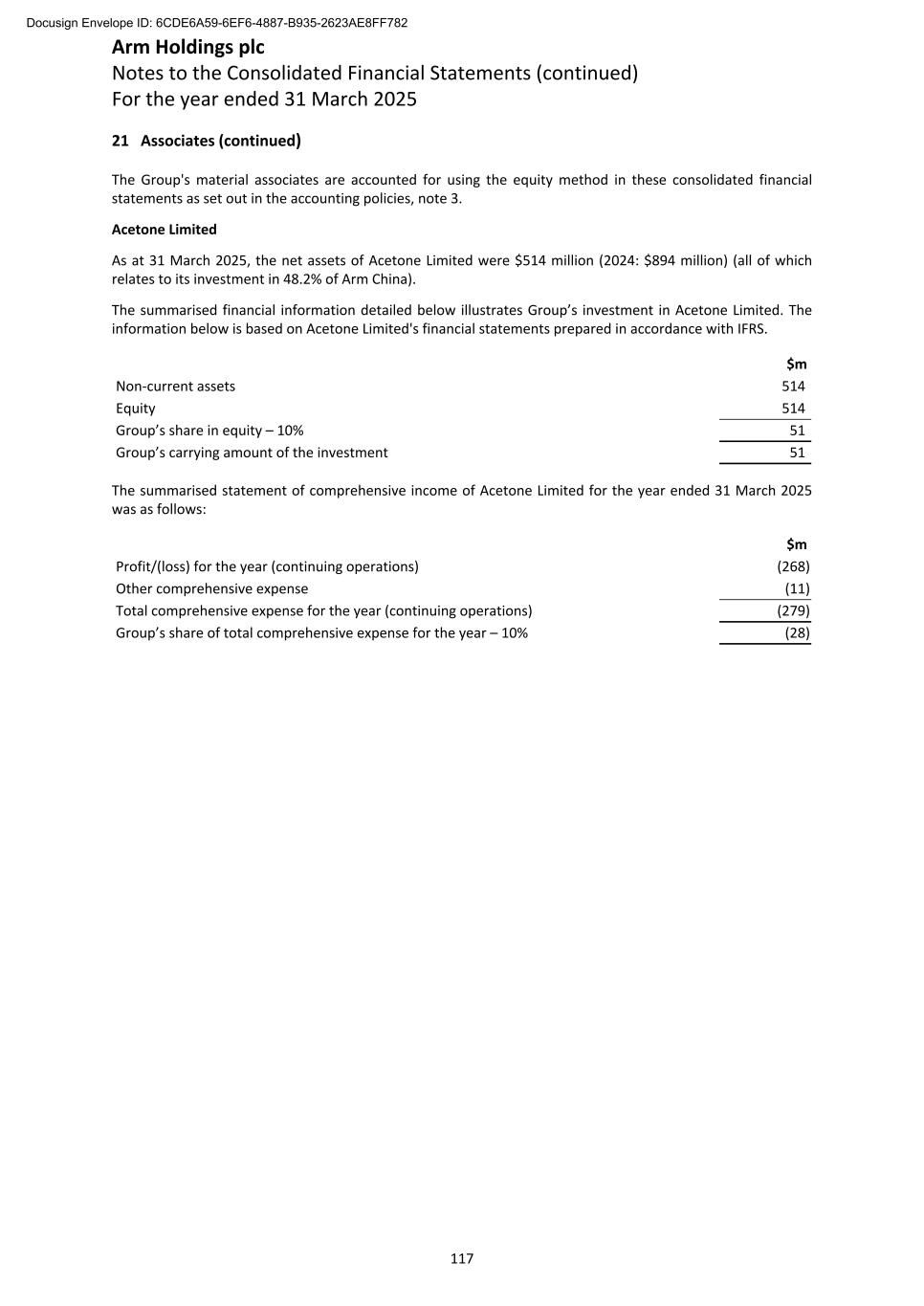
21 Associates (continued) The Group's material associates are accounted for using the equity method in these consolidated financial statements as set out in the accounting policies, note 3. Acetone Limited As at 31 March 2025, the net assets of Acetone Limited were $514 million (2024: $894 million) (all of which relates to its investment in 48.2% of Arm China). The summarised financial information detailed below illustrates Group’s investment in Acetone Limited. The information below is based on Acetone Limited's financial statements prepared in accordance with IFRS. $m Non-current assets 514 Equity 514 Group’s share in equity – 10% 51 Group’s carrying amount of the investment 51 The summarised statement of comprehensive income of Acetone Limited for the year ended 31 March 2025 was as follows: $m Profit/(loss) for the year (continuing operations) (268) Other comprehensive expense (11) Total comprehensive expense for the year (continuing operations) (279) Group’s share of total comprehensive expense for the year – 10% (28) Arm Holdings plc Notes to the Consolidated Financial Statements (continued) For the year ended 31 March 2025 117 Docusign Envelope ID: 6CDE6A59-6EF6-4887-B935-2623AE8FF782
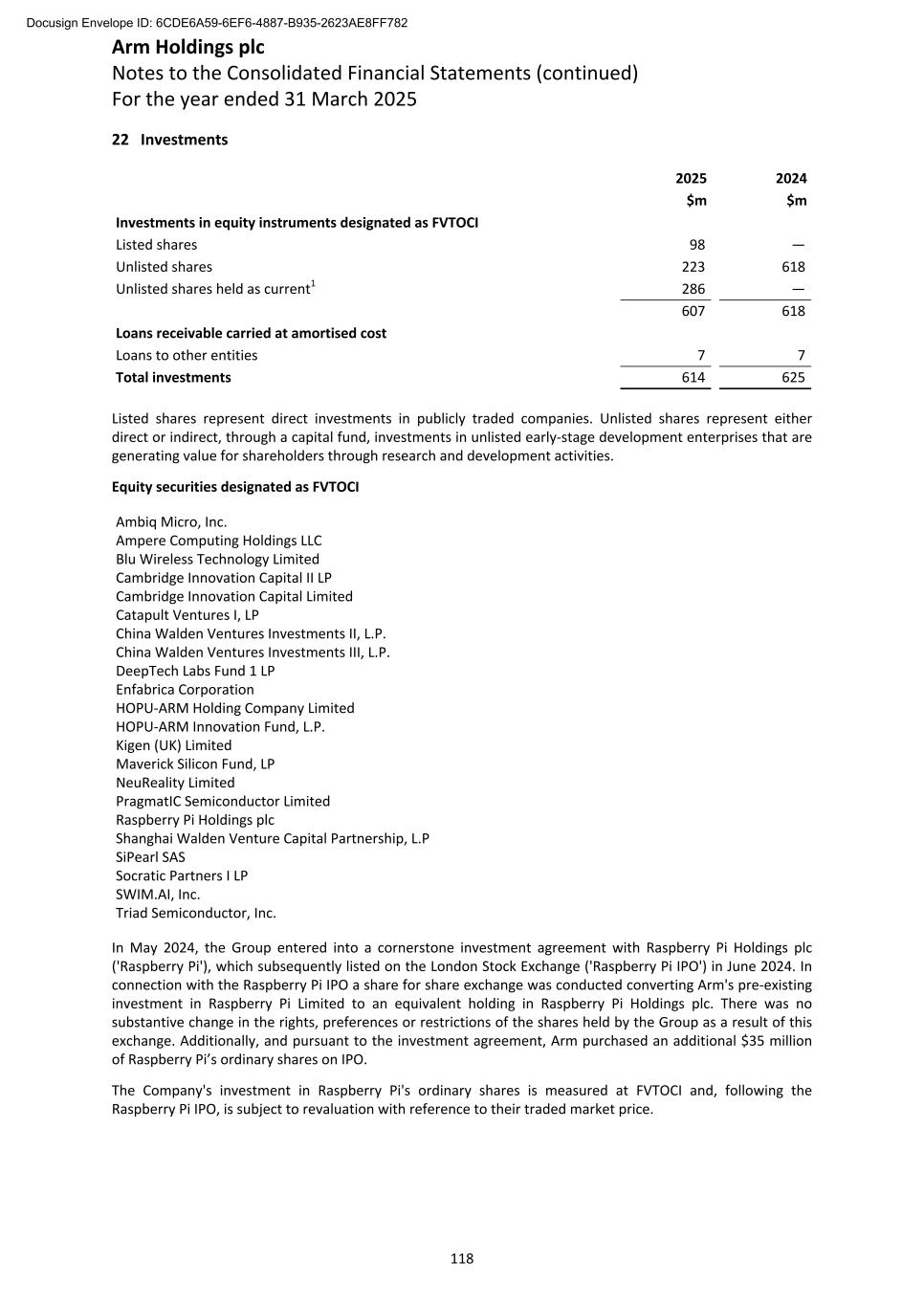
22 Investments 2025 2024 $m $m Investments in equity instruments designated as FVTOCI Listed shares 98 — Unlisted shares 223 618 Unlisted shares held as current1 286 — 607 618 Loans receivable carried at amortised cost Loans to other entities 7 7 Total investments 614 625 Listed shares represent direct investments in publicly traded companies. Unlisted shares represent either direct or indirect, through a capital fund, investments in unlisted early-stage development enterprises that are generating value for shareholders through research and development activities. Equity securities designated as FVTOCI Ambiq Micro, Inc. Ampere Computing Holdings LLC Blu Wireless Technology Limited Cambridge Innovation Capital II LP Cambridge Innovation Capital Limited Catapult Ventures I, LP China Walden Ventures Investments II, L.P. China Walden Ventures Investments III, L.P. DeepTech Labs Fund 1 LP Enfabrica Corporation HOPU-ARM Holding Company Limited HOPU-ARM Innovation Fund, L.P. Kigen (UK) Limited Maverick Silicon Fund, LP NeuReality Limited PragmatIC Semiconductor Limited Raspberry Pi Holdings plc Shanghai Walden Venture Capital Partnership, L.P SiPearl SAS Socratic Partners I LP SWIM.AI, Inc. Triad Semiconductor, Inc. In May 2024, the Group entered into a cornerstone investment agreement with Raspberry Pi Holdings plc ('Raspberry Pi'), which subsequently listed on the London Stock Exchange ('Raspberry Pi IPO') in June 2024. In connection with the Raspberry Pi IPO a share for share exchange was conducted converting Arm's pre-existing investment in Raspberry Pi Limited to an equivalent holding in Raspberry Pi Holdings plc. There was no substantive change in the rights, preferences or restrictions of the shares held by the Group as a result of this exchange. Additionally, and pursuant to the investment agreement, Arm purchased an additional $35 million of Raspberry Pi’s ordinary shares on IPO. The Company's investment in Raspberry Pi's ordinary shares is measured at FVTOCI and, following the Raspberry Pi IPO, is subject to revaluation with reference to their traded market price. Arm Holdings plc Notes to the Consolidated Financial Statements (continued) For the year ended 31 March 2025 118 Docusign Envelope ID: 6CDE6A59-6EF6-4887-B935-2623AE8FF782
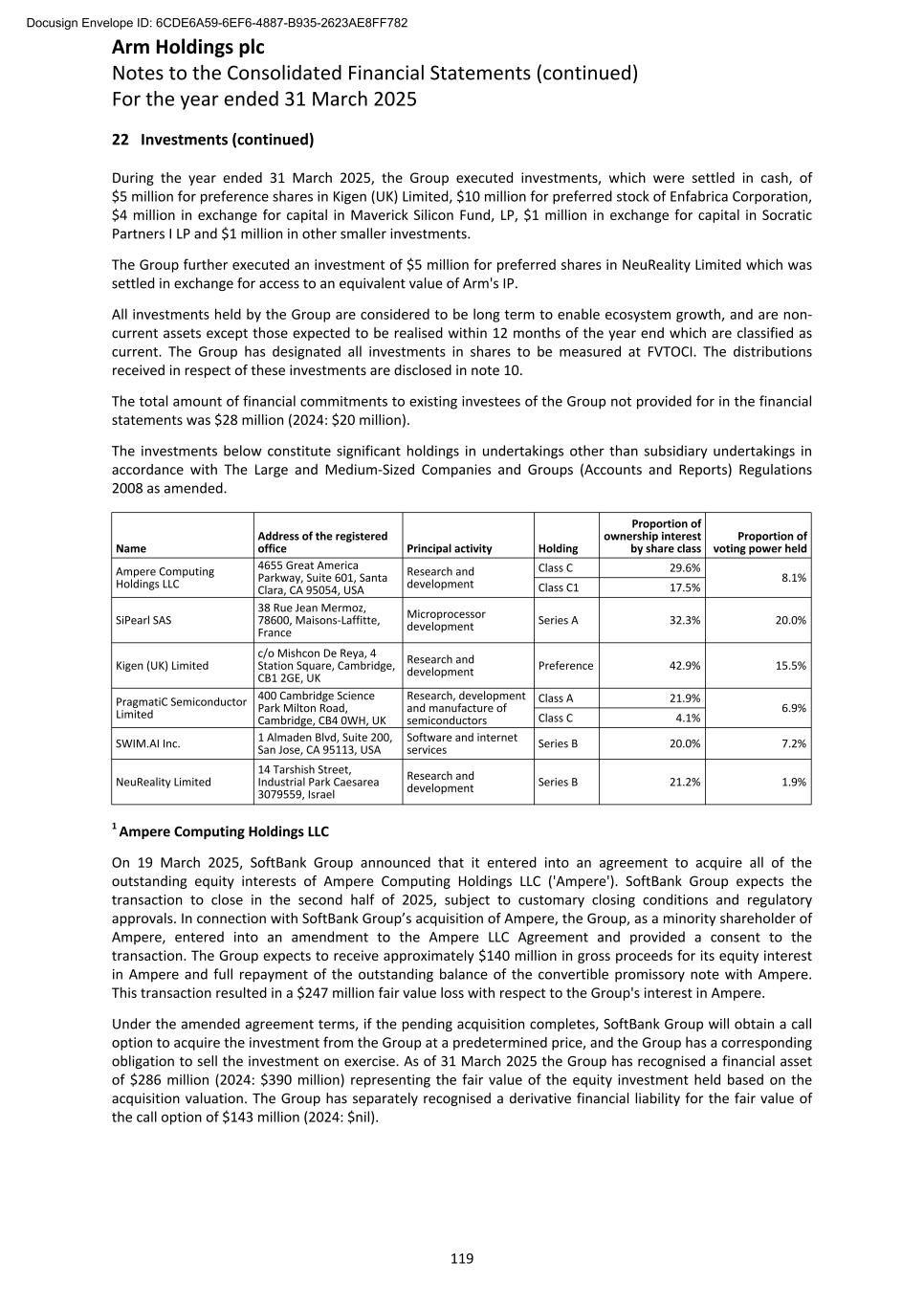
22 Investments (continued) During the year ended 31 March 2025, the Group executed investments, which were settled in cash, of $5 million for preference shares in Kigen (UK) Limited, $10 million for preferred stock of Enfabrica Corporation, $4 million in exchange for capital in Maverick Silicon Fund, LP, $1 million in exchange for capital in Socratic Partners I LP and $1 million in other smaller investments. The Group further executed an investment of $5 million for preferred shares in NeuReality Limited which was settled in exchange for access to an equivalent value of Arm's IP. All investments held by the Group are considered to be long term to enable ecosystem growth, and are non- current assets except those expected to be realised within 12 months of the year end which are classified as current. The Group has designated all investments in shares to be measured at FVTOCI. The distributions received in respect of these investments are disclosed in note 10. The total amount of financial commitments to existing investees of the Group not provided for in the financial statements was $28 million (2024: $20 million). The investments below constitute significant holdings in undertakings other than subsidiary undertakings in accordance with The Large and Medium-Sized Companies and Groups (Accounts and Reports) Regulations 2008 as amended. Name Address of the registered office Principal activity Holding Proportion of ownership interest by share class Proportion of voting power held Ampere Computing Holdings LLC 4655 Great America Parkway, Suite 601, Santa Clara, CA 95054, USA Research and development Class C 29.6% 8.1% Class C1 17.5% SiPearl SAS 38 Rue Jean Mermoz, 78600, Maisons-Laffitte, France Microprocessor development Series A 32.3% 20.0% Kigen (UK) Limited c/o Mishcon De Reya, 4 Station Square, Cambridge, CB1 2GE, UK Research and development Preference 42.9% 15.5% PragmatiC Semiconductor Limited 400 Cambridge Science Park Milton Road, Cambridge, CB4 0WH, UK Research, development and manufacture of semiconductors Class A 21.9% 6.9% Class C 4.1% SWIM.AI Inc. 1 Almaden Blvd, Suite 200, San Jose, CA 95113, USA Software and internet services Series B 20.0% 7.2% NeuReality Limited 14 Tarshish Street, Industrial Park Caesarea 3079559, Israel Research and development Series B 21.2% 1.9% 1 Ampere Computing Holdings LLC On 19 March 2025, SoftBank Group announced that it entered into an agreement to acquire all of the outstanding equity interests of Ampere Computing Holdings LLC ('Ampere'). SoftBank Group expects the transaction to close in the second half of 2025, subject to customary closing conditions and regulatory approvals. In connection with SoftBank Group’s acquisition of Ampere, the Group, as a minority shareholder of Ampere, entered into an amendment to the Ampere LLC Agreement and provided a consent to the transaction. The Group expects to receive approximately $140 million in gross proceeds for its equity interest in Ampere and full repayment of the outstanding balance of the convertible promissory note with Ampere. This transaction resulted in a $247 million fair value loss with respect to the Group's interest in Ampere. Under the amended agreement terms, if the pending acquisition completes, SoftBank Group will obtain a call option to acquire the investment from the Group at a predetermined price, and the Group has a corresponding obligation to sell the investment on exercise. As of 31 March 2025 the Group has recognised a financial asset of $286 million (2024: $390 million) representing the fair value of the equity investment held based on the acquisition valuation. The Group has separately recognised a derivative financial liability for the fair value of the call option of $143 million (2024: $nil). Arm Holdings plc Notes to the Consolidated Financial Statements (continued) For the year ended 31 March 2025 119 Docusign Envelope ID: 6CDE6A59-6EF6-4887-B935-2623AE8FF782

23 Contract assets 2025 2024 $m $m Contract assets 988 576 Current 642 336 Non-current 346 240 988 576 A reconciliation of the movement in contract assets is set out below: $m Balance at 1 April 2023 270 Performance obligations satisfied during the period 663 Transfers in the period from contract assets to trade receivables (358) Movement in loss allowance 1 Balance at 31 March 2024 576 Performance obligations satisfied during the period 1,122 Transfers in the period from contract assets to trade receivables (710) Movement in loss allowance — Balance at 31 March 2025 988 Revenue recognised from prior performance obligations Revenue recognised for the fiscal year ended 31 March 2025 from performance obligations satisfied (or partially satisfied) in previous periods was $2,179 million (2024: $1,867 million). These amounts primarily represent royalties earned during the period. 24 Trade and other receivables 2025 2024 $m $m Current assets Trade receivables 661 403 Less: Loss allowance (20) (3) Net trade receivables 641 400 Other receivables 137 100 Prepayments 107 49 Accrued income 463 379 1,348 928 Arm Holdings plc Notes to the Consolidated Financial Statements (continued) For the year ended 31 March 2025 120 Docusign Envelope ID: 6CDE6A59-6EF6-4887-B935-2623AE8FF782
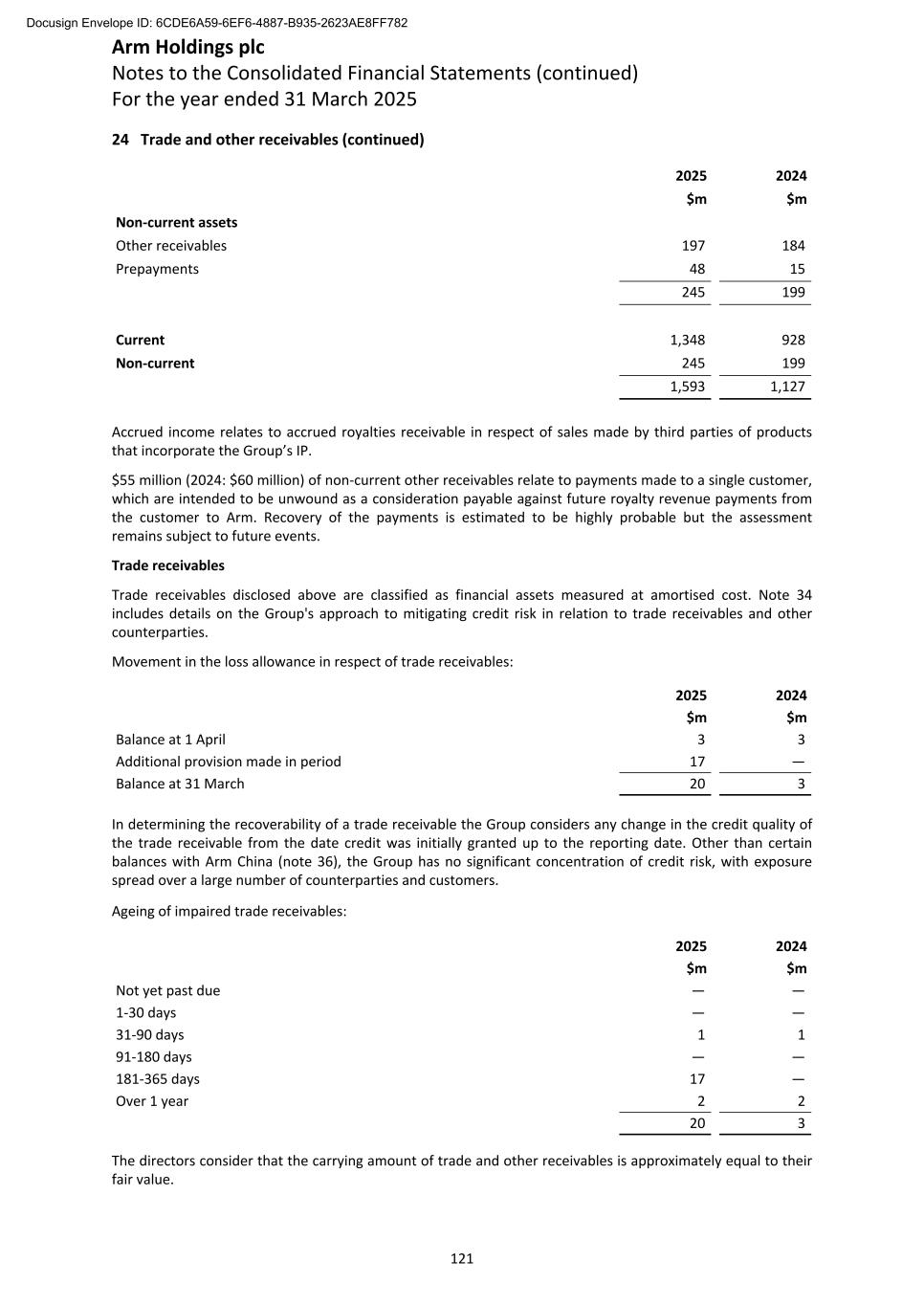
24 Trade and other receivables (continued) 2025 2024 $m $m Non-current assets Other receivables 197 184 Prepayments 48 15 245 199 Current 1,348 928 Non-current 245 199 1,593 1,127 Accrued income relates to accrued royalties receivable in respect of sales made by third parties of products that incorporate the Group’s IP. $55 million (2024: $60 million) of non-current other receivables relate to payments made to a single customer, which are intended to be unwound as a consideration payable against future royalty revenue payments from the customer to Arm. Recovery of the payments is estimated to be highly probable but the assessment remains subject to future events. Trade receivables Trade receivables disclosed above are classified as financial assets measured at amortised cost. Note 34 includes details on the Group's approach to mitigating credit risk in relation to trade receivables and other counterparties. Movement in the loss allowance in respect of trade receivables: 2025 2024 $m $m Balance at 1 April 3 3 Additional provision made in period 17 — Balance at 31 March 20 3 In determining the recoverability of a trade receivable the Group considers any change in the credit quality of the trade receivable from the date credit was initially granted up to the reporting date. Other than certain balances with Arm China (note 36), the Group has no significant concentration of credit risk, with exposure spread over a large number of counterparties and customers. Ageing of impaired trade receivables: 2025 2024 $m $m Not yet past due — — 1-30 days — — 31-90 days 1 1 91-180 days — — 181-365 days 17 — Over 1 year 2 2 20 3 The directors consider that the carrying amount of trade and other receivables is approximately equal to their fair value. Arm Holdings plc Notes to the Consolidated Financial Statements (continued) For the year ended 31 March 2025 121 Docusign Envelope ID: 6CDE6A59-6EF6-4887-B935-2623AE8FF782
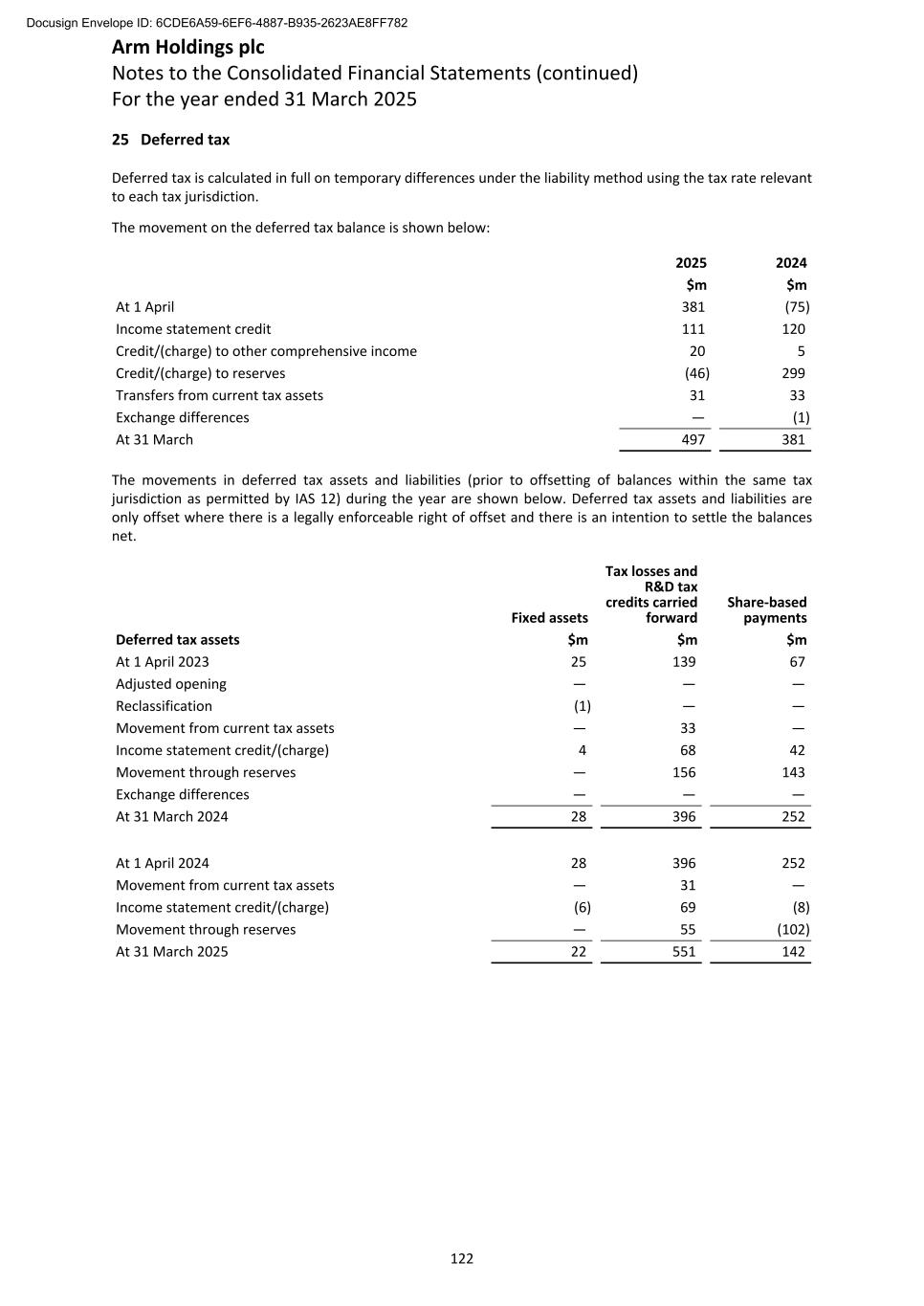
25 Deferred tax Deferred tax is calculated in full on temporary differences under the liability method using the tax rate relevant to each tax jurisdiction. The movement on the deferred tax balance is shown below: 2025 2024 $m $m At 1 April 381 (75) Income statement credit 111 120 Credit/(charge) to other comprehensive income 20 5 Credit/(charge) to reserves (46) 299 Transfers from current tax assets 31 33 Exchange differences — (1) At 31 March 497 381 The movements in deferred tax assets and liabilities (prior to offsetting of balances within the same tax jurisdiction as permitted by IAS 12) during the year are shown below. Deferred tax assets and liabilities are only offset where there is a legally enforceable right of offset and there is an intention to settle the balances net. Fixed assets Tax losses and R&D tax credits carried forward Share-based payments Deferred tax assets $m $m $m At 1 April 2023 25 139 67 Adjusted opening — — — Reclassification (1) — — Movement from current tax assets — 33 — Income statement credit/(charge) 4 68 42 Movement through reserves — 156 143 Exchange differences — — — At 31 March 2024 28 396 252 At 1 April 2024 28 396 252 Movement from current tax assets — 31 — Income statement credit/(charge) (6) 69 (8) Movement through reserves — 55 (102) At 31 March 2025 22 551 142 Arm Holdings plc Notes to the Consolidated Financial Statements (continued) For the year ended 31 March 2025 122 Docusign Envelope ID: 6CDE6A59-6EF6-4887-B935-2623AE8FF782

25 Deferred tax (continued) Temporary differences relating to liabilities Lease liability Total Deferred tax assets $m $m $m At 1 April 2023 28 — 259 Adjusted opening — 12 12 Reclassification — 1 — Movement from current tax assets — — 33 Income statement credit/(charge) — 5 119 Movement through reserves — — 299 Exchange differences (1) — (1) At 31 March 2024 27 18 721 Offsetting of deferred tax liabilities (284) At 31 March 2024 (after offsetting) 437 At 1 April 2024 27 18 721 Movement from current tax assets — — 31 Income statement credit/(charge) 46 8 109 Movement through reserves — — (47) At 31 March 2025 73 26 814 Offsetting of deferred tax liabilities (312) At 31 March 2025 (after offsetting) 502 The deferred tax asset to be recovered after more than one year, prior to offsetting, is $623 million (2024: $476 million). Acquired intangible assets Investments and subsidiaries Contract liabilities Deferred tax liabilities $m $m $m At 1 April 2023 5 107 219 Adjusted opening — — — Income statement (credit)/charge — (3) (7) (Credit)/charge to other comprehensive income — (2) — At 31 March 2024 5 102 212 At 1 April 2024 5 102 212 Income statement (credit)/charge — 1 (6) (Credit)/charge to other comprehensive income — (21) — Exchange differences — — — At 31 March 2025 5 82 206 Arm Holdings plc Notes to the Consolidated Financial Statements (continued) For the year ended 31 March 2025 123 Docusign Envelope ID: 6CDE6A59-6EF6-4887-B935-2623AE8FF782
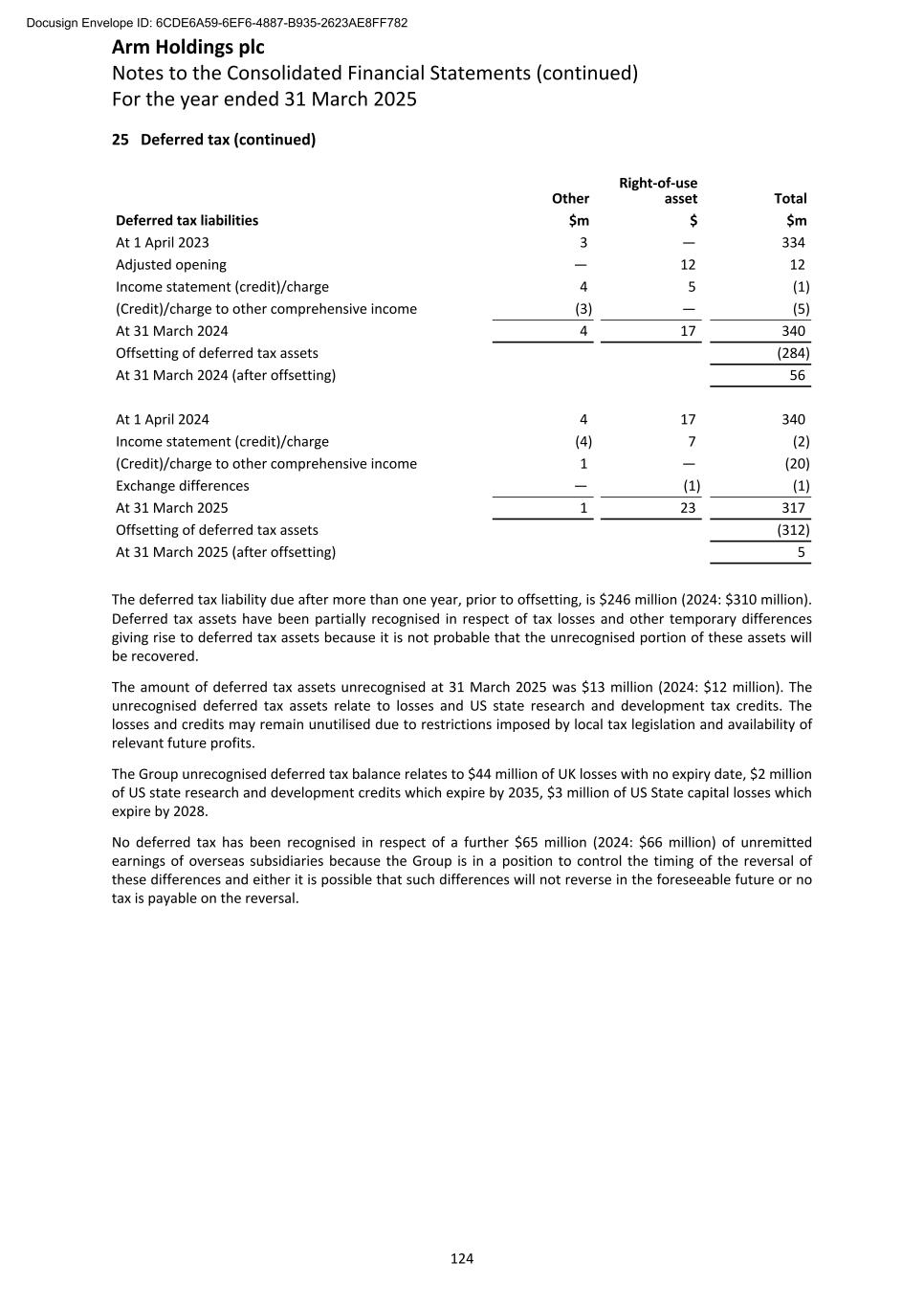
25 Deferred tax (continued) Other Right-of-use asset Total Deferred tax liabilities $m $ $m At 1 April 2023 3 — 334 Adjusted opening — 12 12 Income statement (credit)/charge 4 5 (1) (Credit)/charge to other comprehensive income (3) — (5) At 31 March 2024 4 17 340 Offsetting of deferred tax assets (284) At 31 March 2024 (after offsetting) 56 At 1 April 2024 4 17 340 Income statement (credit)/charge (4) 7 (2) (Credit)/charge to other comprehensive income 1 — (20) Exchange differences — (1) (1) At 31 March 2025 1 23 317 Offsetting of deferred tax assets (312) At 31 March 2025 (after offsetting) 5 The deferred tax liability due after more than one year, prior to offsetting, is $246 million (2024: $310 million). Deferred tax assets have been partially recognised in respect of tax losses and other temporary differences giving rise to deferred tax assets because it is not probable that the unrecognised portion of these assets will be recovered. The amount of deferred tax assets unrecognised at 31 March 2025 was $13 million (2024: $12 million). The unrecognised deferred tax assets relate to losses and US state research and development tax credits. The losses and credits may remain unutilised due to restrictions imposed by local tax legislation and availability of relevant future profits. The Group unrecognised deferred tax balance relates to $44 million of UK losses with no expiry date, $2 million of US state research and development credits which expire by 2035, $3 million of US State capital losses which expire by 2028. No deferred tax has been recognised in respect of a further $65 million (2024: $66 million) of unremitted earnings of overseas subsidiaries because the Group is in a position to control the timing of the reversal of these differences and either it is possible that such differences will not reverse in the foreseeable future or no tax is payable on the reversal. Arm Holdings plc Notes to the Consolidated Financial Statements (continued) For the year ended 31 March 2025 124 Docusign Envelope ID: 6CDE6A59-6EF6-4887-B935-2623AE8FF782
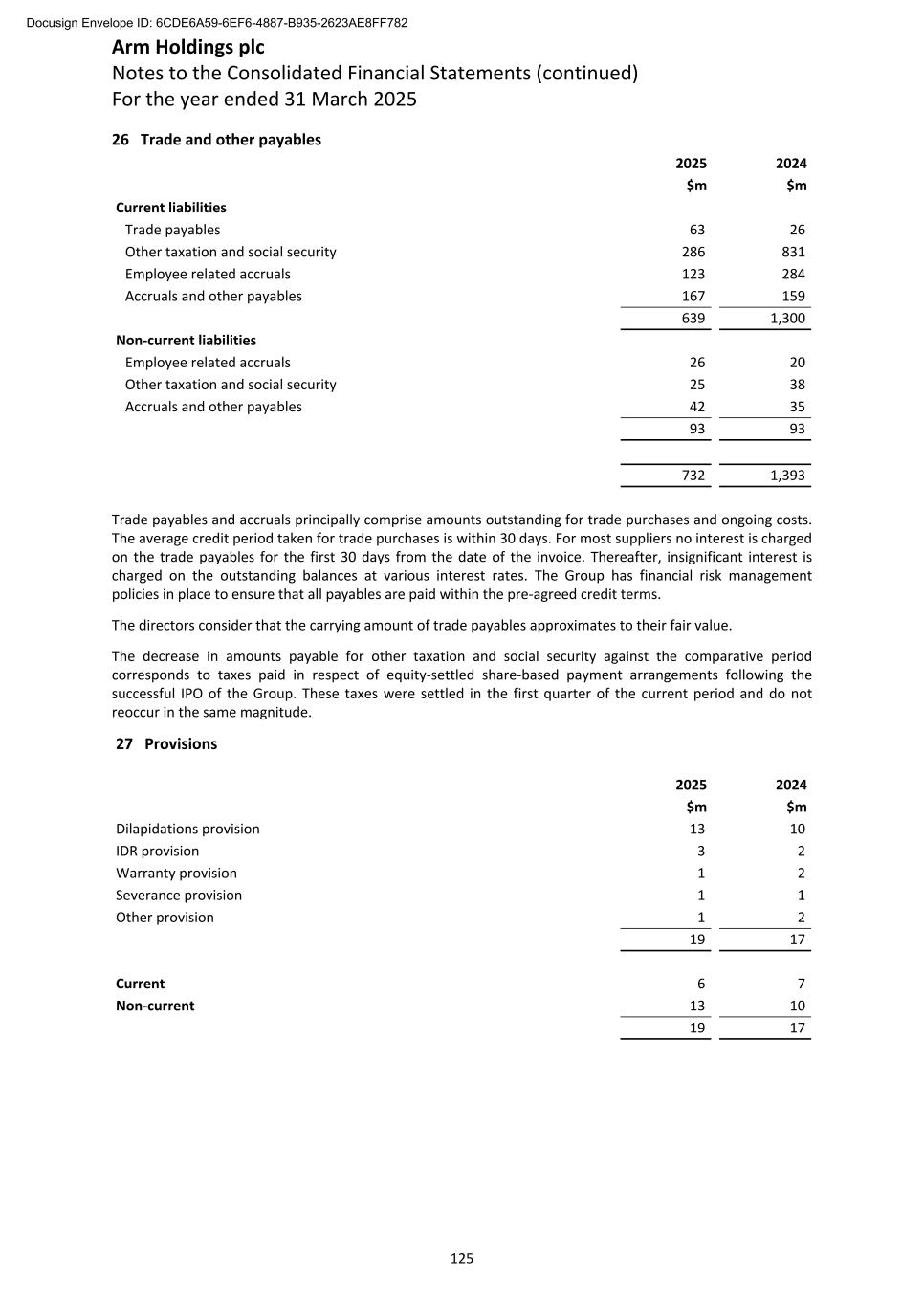
26 Trade and other payables 2025 2024 $m $m Current liabilities Trade payables 63 26 Other taxation and social security 286 831 Employee related accruals 123 284 Accruals and other payables 167 159 639 1,300 Non-current liabilities Employee related accruals 26 20 Other taxation and social security 25 38 Accruals and other payables 42 35 93 93 732 1,393 Trade payables and accruals principally comprise amounts outstanding for trade purchases and ongoing costs. The average credit period taken for trade purchases is within 30 days. For most suppliers no interest is charged on the trade payables for the first 30 days from the date of the invoice. Thereafter, insignificant interest is charged on the outstanding balances at various interest rates. The Group has financial risk management policies in place to ensure that all payables are paid within the pre-agreed credit terms. The directors consider that the carrying amount of trade payables approximates to their fair value. The decrease in amounts payable for other taxation and social security against the comparative period corresponds to taxes paid in respect of equity-settled share-based payment arrangements following the successful IPO of the Group. These taxes were settled in the first quarter of the current period and do not reoccur in the same magnitude. 27 Provisions 2025 2024 $m $m Dilapidations provision 13 10 IDR provision 3 2 Warranty provision 1 2 Severance provision 1 1 Other provision 1 2 19 17 Current 6 7 Non-current 13 10 19 17 Arm Holdings plc Notes to the Consolidated Financial Statements (continued) For the year ended 31 March 2025 125 Docusign Envelope ID: 6CDE6A59-6EF6-4887-B935-2623AE8FF782
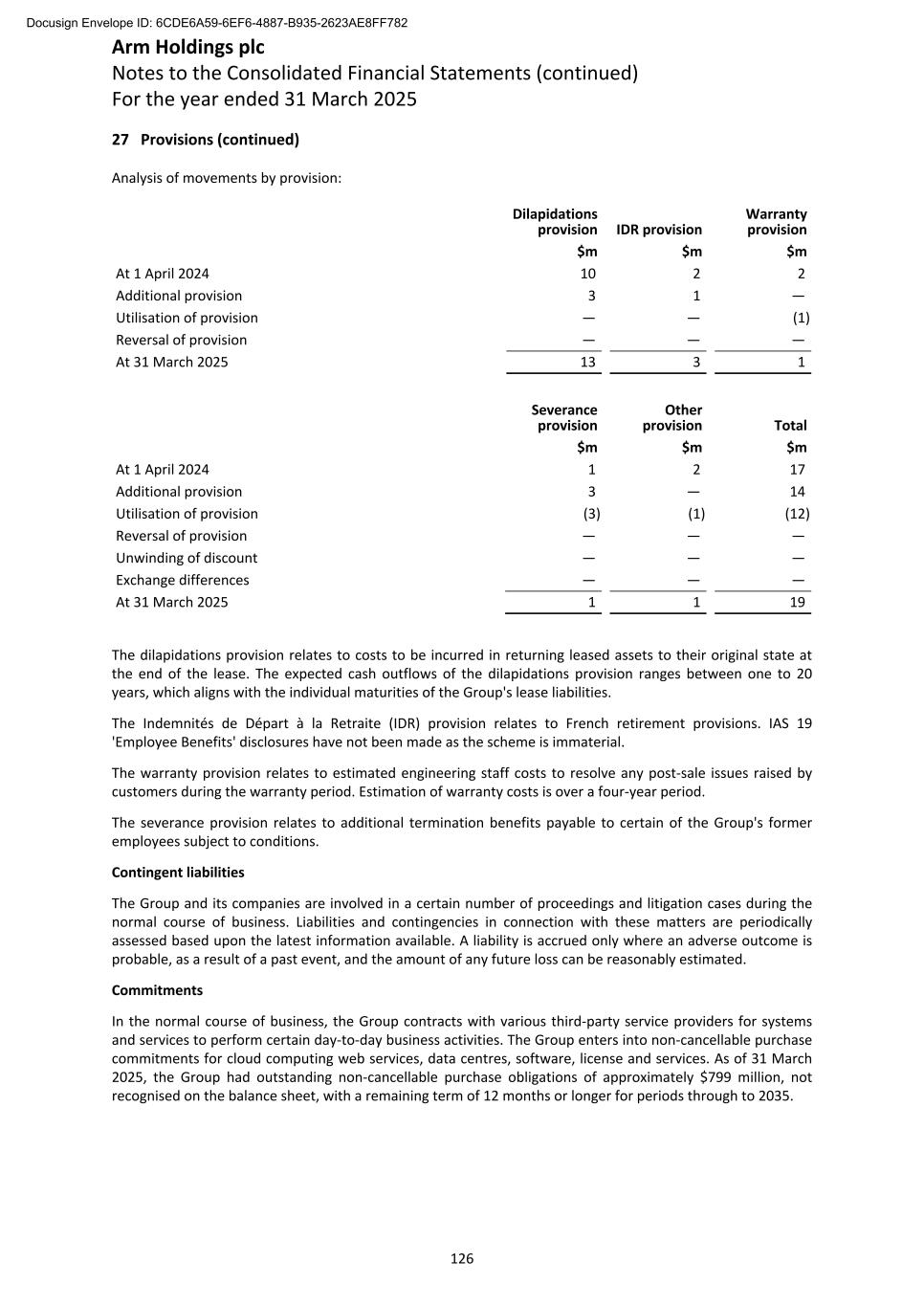
27 Provisions (continued) Analysis of movements by provision: Dilapidations provision IDR provision Warranty provision $m $m $m At 1 April 2024 10 2 2 Additional provision 3 1 — Utilisation of provision — — (1) Reversal of provision — — — At 31 March 2025 13 3 1 Severance provision Other provision Total $m $m $m At 1 April 2024 1 2 17 Additional provision 3 — 14 Utilisation of provision (3) (1) (12) Reversal of provision — — — Unwinding of discount — — — Exchange differences — — — At 31 March 2025 1 1 19 The dilapidations provision relates to costs to be incurred in returning leased assets to their original state at the end of the lease. The expected cash outflows of the dilapidations provision ranges between one to 20 years, which aligns with the individual maturities of the Group's lease liabilities. The Indemnités de Départ à la Retraite (IDR) provision relates to French retirement provisions. IAS 19 'Employee Benefits' disclosures have not been made as the scheme is immaterial. The warranty provision relates to estimated engineering staff costs to resolve any post-sale issues raised by customers during the warranty period. Estimation of warranty costs is over a four-year period. The severance provision relates to additional termination benefits payable to certain of the Group's former employees subject to conditions. Contingent liabilities The Group and its companies are involved in a certain number of proceedings and litigation cases during the normal course of business. Liabilities and contingencies in connection with these matters are periodically assessed based upon the latest information available. A liability is accrued only where an adverse outcome is probable, as a result of a past event, and the amount of any future loss can be reasonably estimated. Commitments In the normal course of business, the Group contracts with various third-party service providers for systems and services to perform certain day-to-day business activities. The Group enters into non-cancellable purchase commitments for cloud computing web services, data centres, software, license and services. As of 31 March 2025, the Group had outstanding non-cancellable purchase obligations of approximately $799 million, not recognised on the balance sheet, with a remaining term of 12 months or longer for periods through to 2035. Arm Holdings plc Notes to the Consolidated Financial Statements (continued) For the year ended 31 March 2025 126 Docusign Envelope ID: 6CDE6A59-6EF6-4887-B935-2623AE8FF782
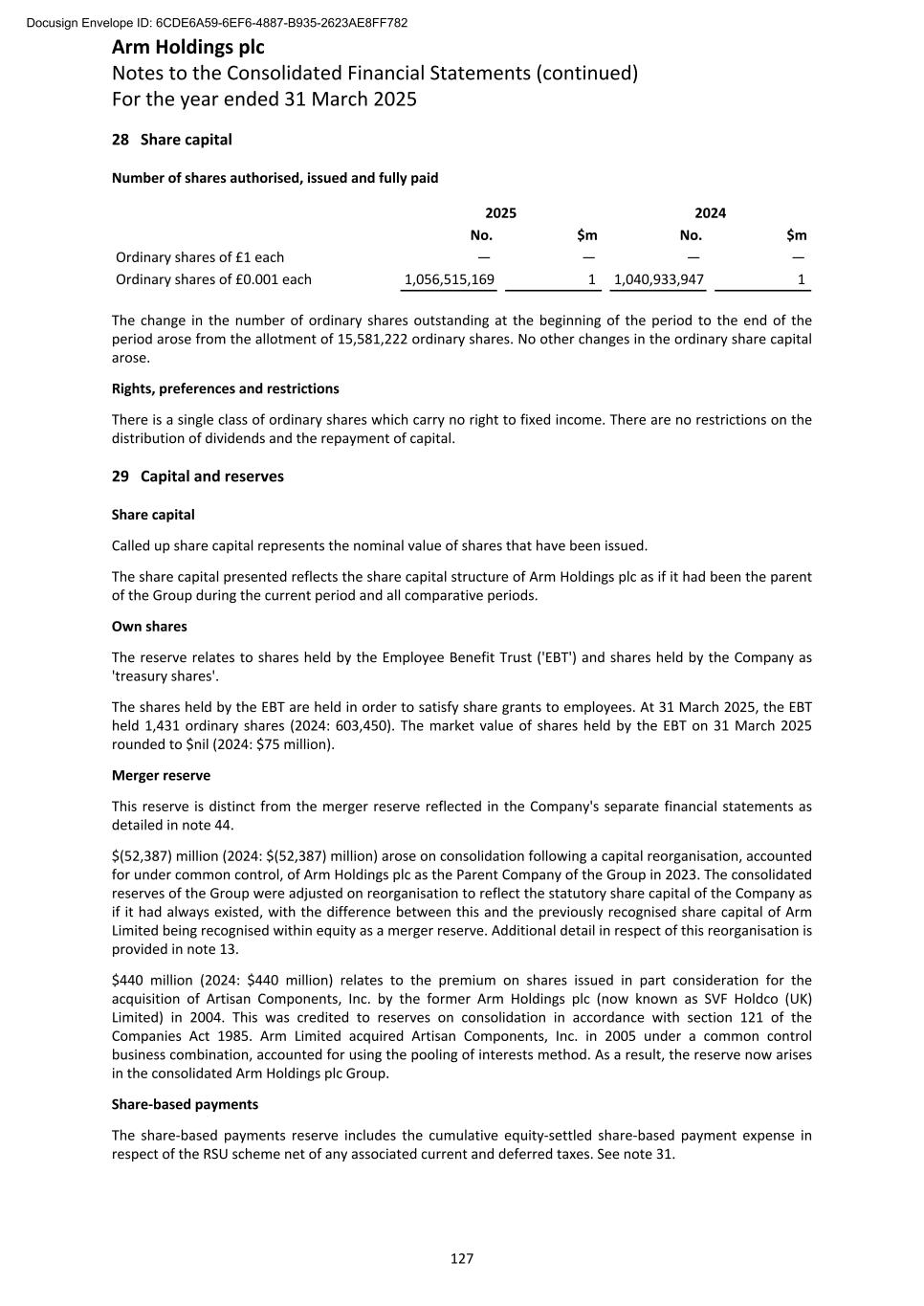
28 Share capital Number of shares authorised, issued and fully paid 2025 2024 No. $m No. $m Ordinary shares of £1 each — — — — Ordinary shares of £0.001 each 1,056,515,169 1 1,040,933,947 1 The change in the number of ordinary shares outstanding at the beginning of the period to the end of the period arose from the allotment of 15,581,222 ordinary shares. No other changes in the ordinary share capital arose. Rights, preferences and restrictions There is a single class of ordinary shares which carry no right to fixed income. There are no restrictions on the distribution of dividends and the repayment of capital. 29 Capital and reserves Share capital Called up share capital represents the nominal value of shares that have been issued. The share capital presented reflects the share capital structure of Arm Holdings plc as if it had been the parent of the Group during the current period and all comparative periods. Own shares The reserve relates to shares held by the Employee Benefit Trust ('EBT') and shares held by the Company as 'treasury shares'. The shares held by the EBT are held in order to satisfy share grants to employees. At 31 March 2025, the EBT held 1,431 ordinary shares (2024: 603,450). The market value of shares held by the EBT on 31 March 2025 rounded to $nil (2024: $75 million). Merger reserve This reserve is distinct from the merger reserve reflected in the Company's separate financial statements as detailed in note 44. $(52,387) million (2024: $(52,387) million) arose on consolidation following a capital reorganisation, accounted for under common control, of Arm Holdings plc as the Parent Company of the Group in 2023. The consolidated reserves of the Group were adjusted on reorganisation to reflect the statutory share capital of the Company as if it had always existed, with the difference between this and the previously recognised share capital of Arm Limited being recognised within equity as a merger reserve. Additional detail in respect of this reorganisation is provided in note 13. $440 million (2024: $440 million) relates to the premium on shares issued in part consideration for the acquisition of Artisan Components, Inc. by the former Arm Holdings plc (now known as SVF Holdco (UK) Limited) in 2004. This was credited to reserves on consolidation in accordance with section 121 of the Companies Act 1985. Arm Limited acquired Artisan Components, Inc. in 2005 under a common control business combination, accounted for using the pooling of interests method. As a result, the reserve now arises in the consolidated Arm Holdings plc Group. Share-based payments The share-based payments reserve includes the cumulative equity-settled share-based payment expense in respect of the RSU scheme net of any associated current and deferred taxes. See note 31. Arm Holdings plc Notes to the Consolidated Financial Statements (continued) For the year ended 31 March 2025 127 Docusign Envelope ID: 6CDE6A59-6EF6-4887-B935-2623AE8FF782
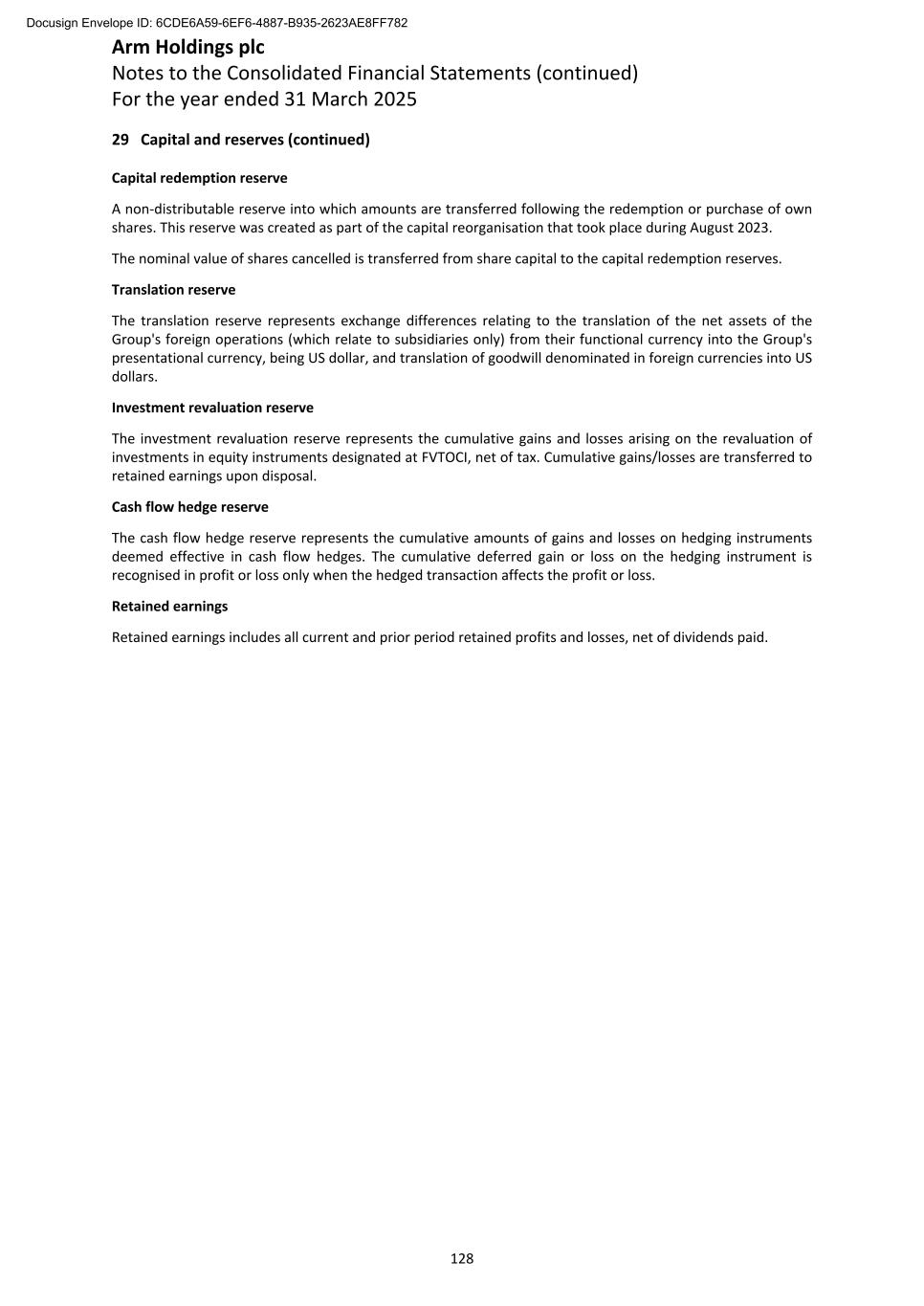
29 Capital and reserves (continued) Capital redemption reserve A non-distributable reserve into which amounts are transferred following the redemption or purchase of own shares. This reserve was created as part of the capital reorganisation that took place during August 2023. The nominal value of shares cancelled is transferred from share capital to the capital redemption reserves. Translation reserve The translation reserve represents exchange differences relating to the translation of the net assets of the Group's foreign operations (which relate to subsidiaries only) from their functional currency into the Group's presentational currency, being US dollar, and translation of goodwill denominated in foreign currencies into US dollars. Investment revaluation reserve The investment revaluation reserve represents the cumulative gains and losses arising on the revaluation of investments in equity instruments designated at FVTOCI, net of tax. Cumulative gains/losses are transferred to retained earnings upon disposal. Cash flow hedge reserve The cash flow hedge reserve represents the cumulative amounts of gains and losses on hedging instruments deemed effective in cash flow hedges. The cumulative deferred gain or loss on the hedging instrument is recognised in profit or loss only when the hedged transaction affects the profit or loss. Retained earnings Retained earnings includes all current and prior period retained profits and losses, net of dividends paid. Arm Holdings plc Notes to the Consolidated Financial Statements (continued) For the year ended 31 March 2025 128 Docusign Envelope ID: 6CDE6A59-6EF6-4887-B935-2623AE8FF782
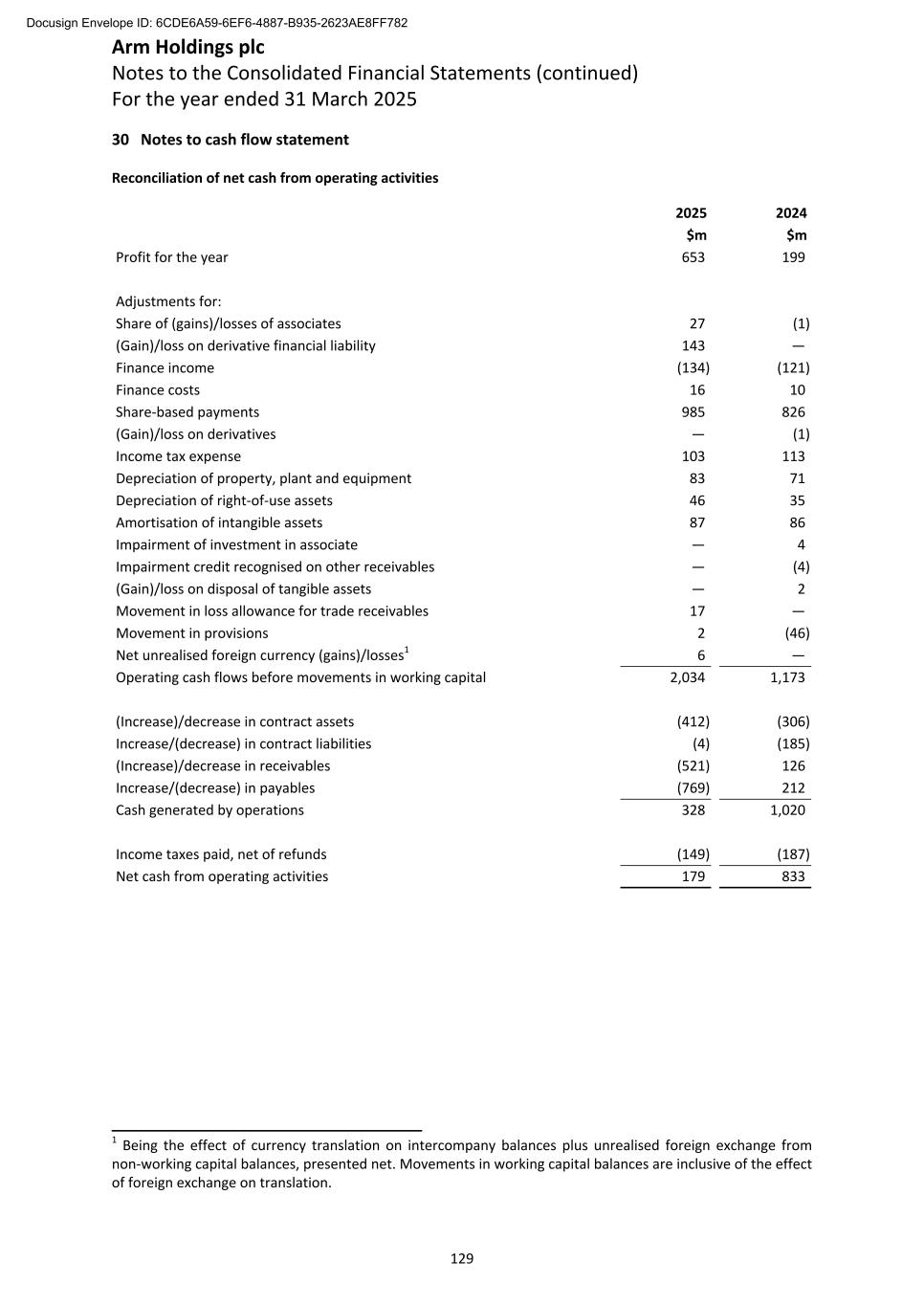
30 Notes to cash flow statement Reconciliation of net cash from operating activities 2025 2024 $m $m Profit for the year 653 199 Adjustments for: Share of (gains)/losses of associates 27 (1) (Gain)/loss on derivative financial liability 143 — Finance income (134) (121) Finance costs 16 10 Share-based payments 985 826 (Gain)/loss on derivatives — (1) Income tax expense 103 113 Depreciation of property, plant and equipment 83 71 Depreciation of right-of-use assets 46 35 Amortisation of intangible assets 87 86 Impairment of investment in associate — 4 Impairment credit recognised on other receivables — (4) (Gain)/loss on disposal of tangible assets — 2 Movement in loss allowance for trade receivables 17 — Movement in provisions 2 (46) Net unrealised foreign currency (gains)/losses1 6 — Operating cash flows before movements in working capital 2,034 1,173 (Increase)/decrease in contract assets (412) (306) Increase/(decrease) in contract liabilities (4) (185) (Increase)/decrease in receivables (521) 126 Increase/(decrease) in payables (769) 212 Cash generated by operations 328 1,020 Income taxes paid, net of refunds (149) (187) Net cash from operating activities 179 833 Arm Holdings plc Notes to the Consolidated Financial Statements (continued) For the year ended 31 March 2025 129 1 Being the effect of currency translation on intercompany balances plus unrealised foreign exchange from non-working capital balances, presented net. Movements in working capital balances are inclusive of the effect of foreign exchange on translation. Docusign Envelope ID: 6CDE6A59-6EF6-4887-B935-2623AE8FF782

30 Notes to cash flow statement (continued) 2025 2024 $m $m Cash and cash equivalents Cash at bank 146 179 Short term deposit 25 — Money market funds 1,914 1,743 Restricted cash 4 3 2,089 1,925 Deposits 740 1,000 Cash and cash equivalents include cash on hand, short-term deposits and money market funds with original maturities of three months or less that are readily convertible into known amounts of cash and are subject to insignificant risk of changes in value. Cash and cash equivalents, excluding money market funds, are stated at cost, which approximates fair value because of the short-term maturity of those instruments. Money market funds are measured at fair value through profit and loss in accordance with the Group's accounting policy on financial instruments. Deposits relate to deposits with a maturity of between three and 12 months. The carrying amount of these assets is approximately equal to their fair value. Cash and cash equivalents at the end of the reporting period as shown in the consolidated statement of cash flows can be reconciled to the related items in the consolidated balance sheet as shown above. Reconciliation of movements in liabilities arising from financing activities The table below details changes in the Group’s liabilities arising from financing activities, including both cash and non-cash changes. Liabilities arising from financing activities are those for which cash flows were, or future cash flows will be, classified in the Group’s consolidated cash flow statement as cash flows from financing activities. Total $m At 1 April 2023 215 New leases and lease amendments 49 Principal payments on lease liabilities (45) Accrued interest 7 Foreign exchange differences 2 At 31 March 2024 228 New leases and lease amendments 183 Principal payments on lease liabilities (60) Early terminations in period (1) Accrued interest 11 Foreign exchange differences 6 At 31 March 2025 367 Arm Holdings plc Notes to the Consolidated Financial Statements (continued) For the year ended 31 March 2025 130 Docusign Envelope ID: 6CDE6A59-6EF6-4887-B935-2623AE8FF782
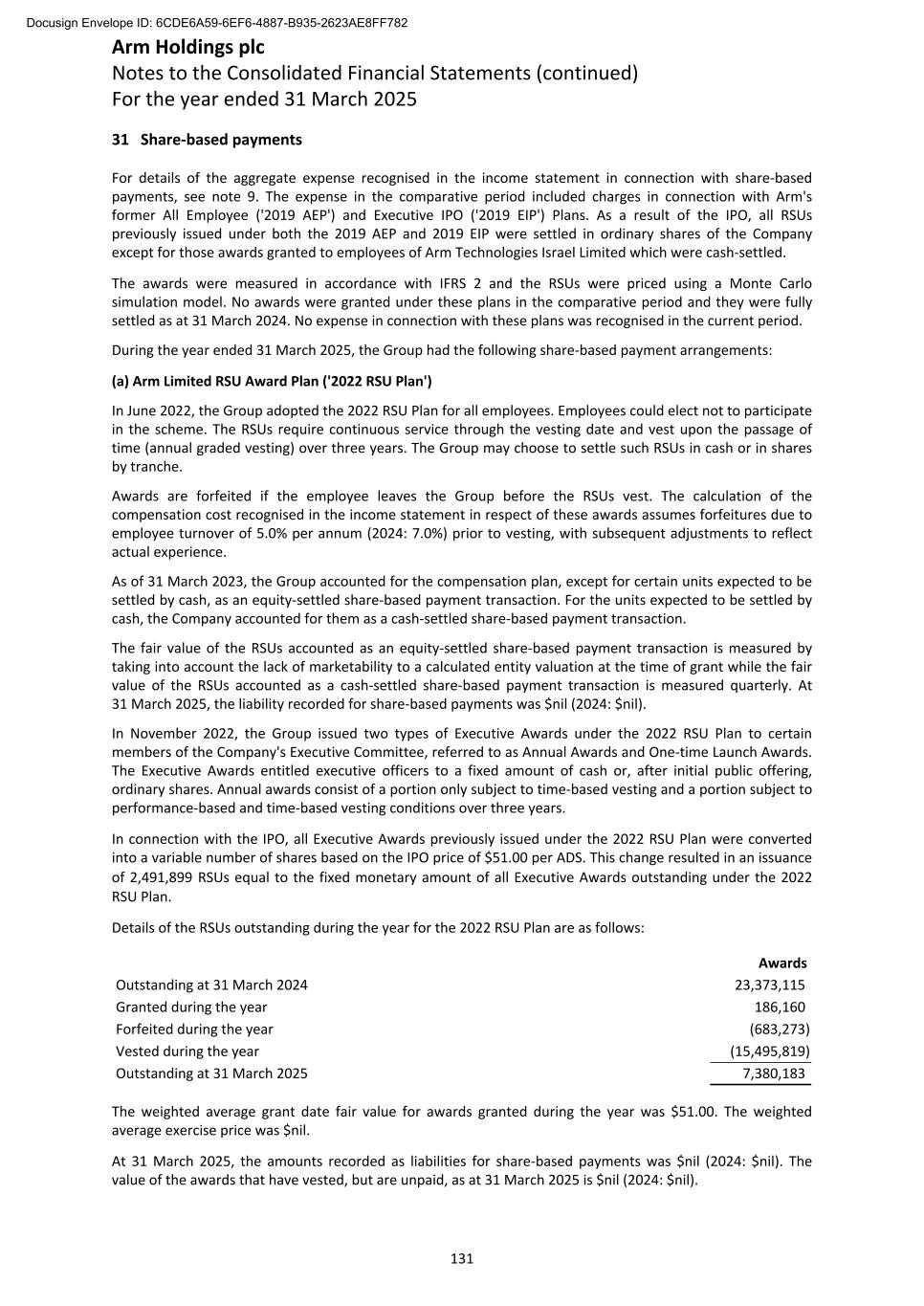
31 Share-based payments For details of the aggregate expense recognised in the income statement in connection with share-based payments, see note 9. The expense in the comparative period included charges in connection with Arm's former All Employee ('2019 AEP') and Executive IPO ('2019 EIP') Plans. As a result of the IPO, all RSUs previously issued under both the 2019 AEP and 2019 EIP were settled in ordinary shares of the Company except for those awards granted to employees of Arm Technologies Israel Limited which were cash-settled. The awards were measured in accordance with IFRS 2 and the RSUs were priced using a Monte Carlo simulation model. No awards were granted under these plans in the comparative period and they were fully settled as at 31 March 2024. No expense in connection with these plans was recognised in the current period. During the year ended 31 March 2025, the Group had the following share-based payment arrangements: (a) Arm Limited RSU Award Plan ('2022 RSU Plan') In June 2022, the Group adopted the 2022 RSU Plan for all employees. Employees could elect not to participate in the scheme. The RSUs require continuous service through the vesting date and vest upon the passage of time (annual graded vesting) over three years. The Group may choose to settle such RSUs in cash or in shares by tranche. Awards are forfeited if the employee leaves the Group before the RSUs vest. The calculation of the compensation cost recognised in the income statement in respect of these awards assumes forfeitures due to employee turnover of 5.0% per annum (2024: 7.0%) prior to vesting, with subsequent adjustments to reflect actual experience. As of 31 March 2023, the Group accounted for the compensation plan, except for certain units expected to be settled by cash, as an equity-settled share-based payment transaction. For the units expected to be settled by cash, the Company accounted for them as a cash-settled share-based payment transaction. The fair value of the RSUs accounted as an equity-settled share-based payment transaction is measured by taking into account the lack of marketability to a calculated entity valuation at the time of grant while the fair value of the RSUs accounted as a cash-settled share-based payment transaction is measured quarterly. At 31 March 2025, the liability recorded for share-based payments was $nil (2024: $nil). In November 2022, the Group issued two types of Executive Awards under the 2022 RSU Plan to certain members of the Company's Executive Committee, referred to as Annual Awards and One-time Launch Awards. The Executive Awards entitled executive officers to a fixed amount of cash or, after initial public offering, ordinary shares. Annual awards consist of a portion only subject to time-based vesting and a portion subject to performance-based and time-based vesting conditions over three years. In connection with the IPO, all Executive Awards previously issued under the 2022 RSU Plan were converted into a variable number of shares based on the IPO price of $51.00 per ADS. This change resulted in an issuance of 2,491,899 RSUs equal to the fixed monetary amount of all Executive Awards outstanding under the 2022 RSU Plan. Details of the RSUs outstanding during the year for the 2022 RSU Plan are as follows: Awards Outstanding at 31 March 2024 23,373,115 Granted during the year 186,160 Forfeited during the year (683,273) Vested during the year (15,495,819) Outstanding at 31 March 2025 7,380,183 The weighted average grant date fair value for awards granted during the year was $51.00. The weighted average exercise price was $nil. At 31 March 2025, the amounts recorded as liabilities for share-based payments was $nil (2024: $nil). The value of the awards that have vested, but are unpaid, as at 31 March 2025 is $nil (2024: $nil). Arm Holdings plc Notes to the Consolidated Financial Statements (continued) For the year ended 31 March 2025 131 Docusign Envelope ID: 6CDE6A59-6EF6-4887-B935-2623AE8FF782
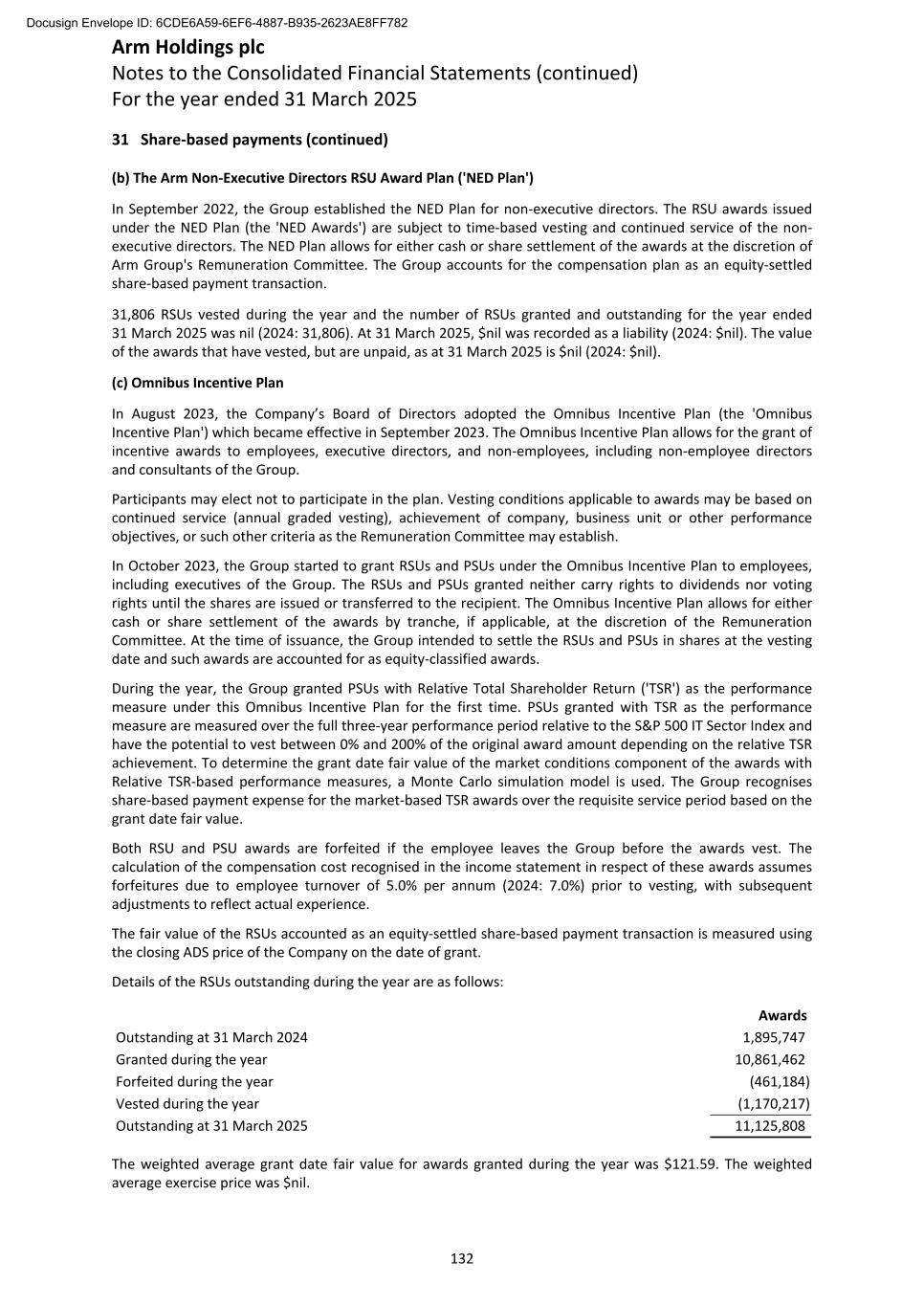
31 Share-based payments (continued) (b) The Arm Non-Executive Directors RSU Award Plan ('NED Plan') In September 2022, the Group established the NED Plan for non-executive directors. The RSU awards issued under the NED Plan (the 'NED Awards') are subject to time-based vesting and continued service of the non- executive directors. The NED Plan allows for either cash or share settlement of the awards at the discretion of Arm Group's Remuneration Committee. The Group accounts for the compensation plan as an equity-settled share-based payment transaction. 31,806 RSUs vested during the year and the number of RSUs granted and outstanding for the year ended 31 March 2025 was nil (2024: 31,806). At 31 March 2025, $nil was recorded as a liability (2024: $nil). The value of the awards that have vested, but are unpaid, as at 31 March 2025 is $nil (2024: $nil). (c) Omnibus Incentive Plan In August 2023, the Company’s Board of Directors adopted the Omnibus Incentive Plan (the 'Omnibus Incentive Plan') which became effective in September 2023. The Omnibus Incentive Plan allows for the grant of incentive awards to employees, executive directors, and non-employees, including non-employee directors and consultants of the Group. Participants may elect not to participate in the plan. Vesting conditions applicable to awards may be based on continued service (annual graded vesting), achievement of company, business unit or other performance objectives, or such other criteria as the Remuneration Committee may establish. In October 2023, the Group started to grant RSUs and PSUs under the Omnibus Incentive Plan to employees, including executives of the Group. The RSUs and PSUs granted neither carry rights to dividends nor voting rights until the shares are issued or transferred to the recipient. The Omnibus Incentive Plan allows for either cash or share settlement of the awards by tranche, if applicable, at the discretion of the Remuneration Committee. At the time of issuance, the Group intended to settle the RSUs and PSUs in shares at the vesting date and such awards are accounted for as equity-classified awards. During the year, the Group granted PSUs with Relative Total Shareholder Return ('TSR') as the performance measure under this Omnibus Incentive Plan for the first time. PSUs granted with TSR as the performance measure are measured over the full three-year performance period relative to the S&P 500 IT Sector Index and have the potential to vest between 0% and 200% of the original award amount depending on the relative TSR achievement. To determine the grant date fair value of the market conditions component of the awards with Relative TSR-based performance measures, a Monte Carlo simulation model is used. The Group recognises share-based payment expense for the market-based TSR awards over the requisite service period based on the grant date fair value. Both RSU and PSU awards are forfeited if the employee leaves the Group before the awards vest. The calculation of the compensation cost recognised in the income statement in respect of these awards assumes forfeitures due to employee turnover of 5.0% per annum (2024: 7.0%) prior to vesting, with subsequent adjustments to reflect actual experience. The fair value of the RSUs accounted as an equity-settled share-based payment transaction is measured using the closing ADS price of the Company on the date of grant. Details of the RSUs outstanding during the year are as follows: Awards Outstanding at 31 March 2024 1,895,747 Granted during the year 10,861,462 Forfeited during the year (461,184) Vested during the year (1,170,217) Outstanding at 31 March 2025 11,125,808 The weighted average grant date fair value for awards granted during the year was $121.59. The weighted average exercise price was $nil. Arm Holdings plc Notes to the Consolidated Financial Statements (continued) For the year ended 31 March 2025 132 Docusign Envelope ID: 6CDE6A59-6EF6-4887-B935-2623AE8FF782
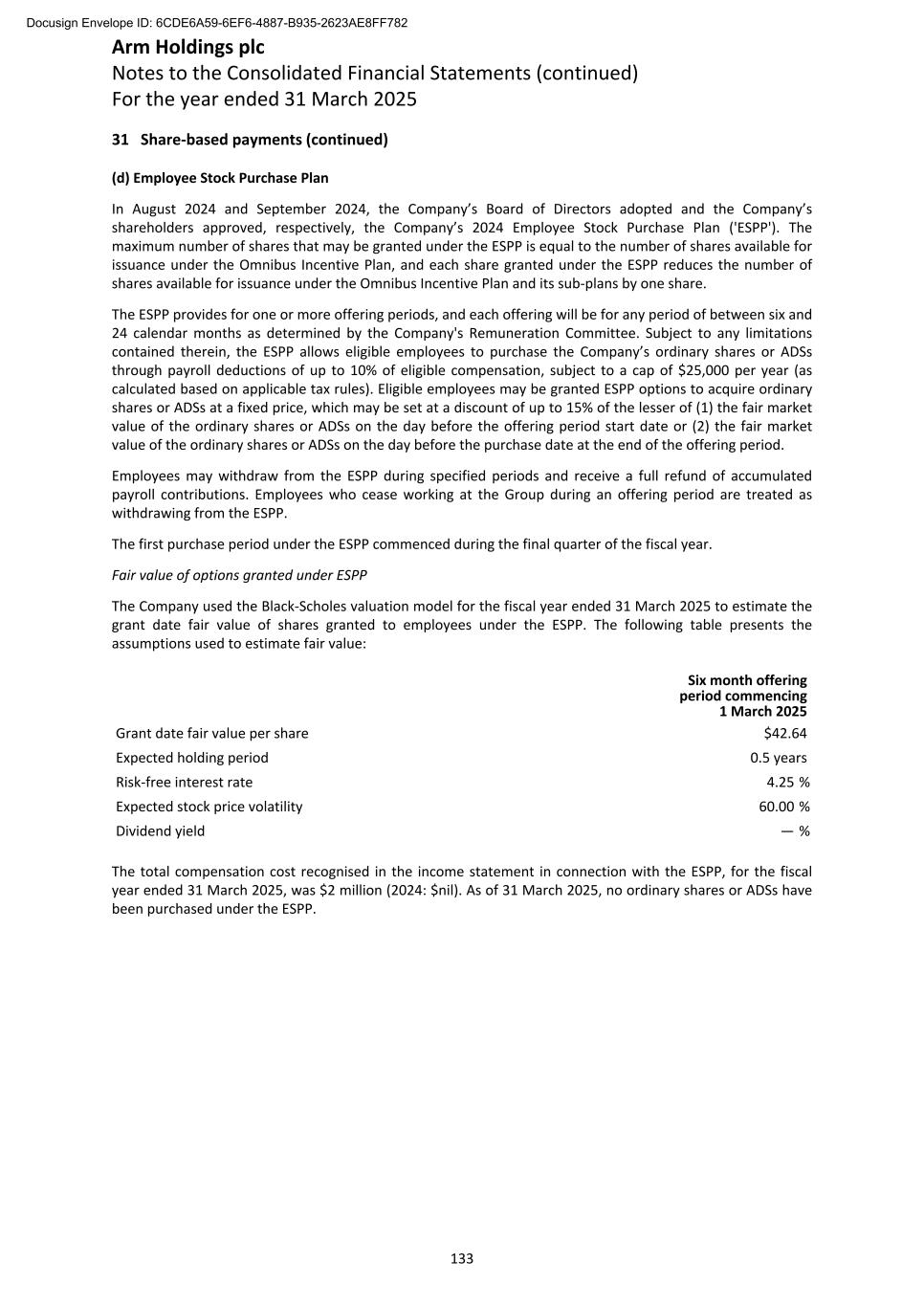
31 Share-based payments (continued) (d) Employee Stock Purchase Plan In August 2024 and September 2024, the Company’s Board of Directors adopted and the Company’s shareholders approved, respectively, the Company’s 2024 Employee Stock Purchase Plan ('ESPP'). The maximum number of shares that may be granted under the ESPP is equal to the number of shares available for issuance under the Omnibus Incentive Plan, and each share granted under the ESPP reduces the number of shares available for issuance under the Omnibus Incentive Plan and its sub-plans by one share. The ESPP provides for one or more offering periods, and each offering will be for any period of between six and 24 calendar months as determined by the Company's Remuneration Committee. Subject to any limitations contained therein, the ESPP allows eligible employees to purchase the Company’s ordinary shares or ADSs through payroll deductions of up to 10% of eligible compensation, subject to a cap of $25,000 per year (as calculated based on applicable tax rules). Eligible employees may be granted ESPP options to acquire ordinary shares or ADSs at a fixed price, which may be set at a discount of up to 15% of the lesser of (1) the fair market value of the ordinary shares or ADSs on the day before the offering period start date or (2) the fair market value of the ordinary shares or ADSs on the day before the purchase date at the end of the offering period. Employees may withdraw from the ESPP during specified periods and receive a full refund of accumulated payroll contributions. Employees who cease working at the Group during an offering period are treated as withdrawing from the ESPP. The first purchase period under the ESPP commenced during the final quarter of the fiscal year. Fair value of options granted under ESPP The Company used the Black-Scholes valuation model for the fiscal year ended 31 March 2025 to estimate the grant date fair value of shares granted to employees under the ESPP. The following table presents the assumptions used to estimate fair value: Six month offering period commencing 1 March 2025 Grant date fair value per share $42.64 Expected holding period 0.5 years Risk-free interest rate 4.25 % Expected stock price volatility 60.00 % Dividend yield — % The total compensation cost recognised in the income statement in connection with the ESPP, for the fiscal year ended 31 March 2025, was $2 million (2024: $nil). As of 31 March 2025, no ordinary shares or ADSs have been purchased under the ESPP. Arm Holdings plc Notes to the Consolidated Financial Statements (continued) For the year ended 31 March 2025 133 Docusign Envelope ID: 6CDE6A59-6EF6-4887-B935-2623AE8FF782

32 Retirement benefit schemes The Group contributes to defined contribution plans substantially covering all employees in Europe and the US and to government pension schemes for employees in Japan, South Korea, Taiwan, PR China, Israel and India. The Group has an obligation to contribute to these plans based upon various fixed percentages of employee compensation, and such contributions are expensed as incurred. The assets of these plans are held separately from those of the Group in funds. The total cost charged to the income statement for the year of $126 million (2024: $97 million) represents contributions payable to these schemes by the Group at rates specified in the rules of the schemes. As at 31 March 2025, contributions of $15 million (2024: $12 million) due in respect of the current reporting period had not been paid over to the schemes. 33 Contract liabilities 2025 2024 $m $m Amounts related to contracts 911 915 Current 209 198 Non-current 702 717 911 915 A reconciliation of the movement in contract liabilities is set out below: $m Balance at 1 April 2023 1,100 Cash received in advance of performance obligations 198 Amounts included in contract liabilities that were recognised as revenue during the period: of which included in the opening balance (226) of which not included in the opening balance (157) Balance at 31 March 2024 915 Cash received in advance of performance obligations 371 Amounts included in contract liabilities that were recognised as revenue during the period: of which included in the opening balance (131) of which not included in the opening balance (244) Balance at 31 March 2025 911 Arm Holdings plc Notes to the Consolidated Financial Statements (continued) For the year ended 31 March 2025 134 Docusign Envelope ID: 6CDE6A59-6EF6-4887-B935-2623AE8FF782
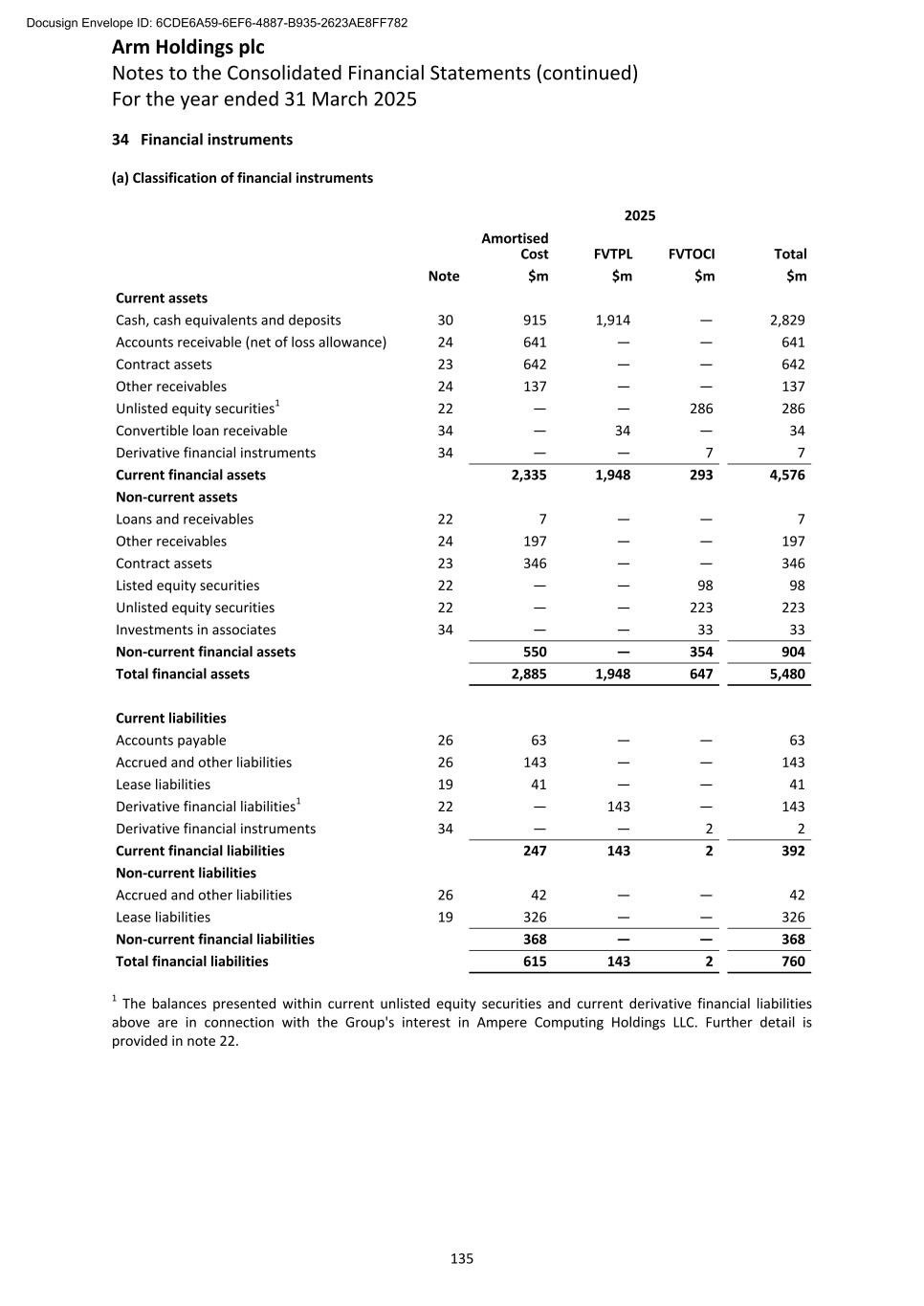
34 Financial instruments (a) Classification of financial instruments 2025 Amortised Cost FVTPL FVTOCI Total Note $m $m $m $m Current assets Cash, cash equivalents and deposits 30 915 1,914 — 2,829 Accounts receivable (net of loss allowance) 24 641 — — 641 Contract assets 23 642 — — 642 Other receivables 24 137 — — 137 Unlisted equity securities1 22 — — 286 286 Convertible loan receivable 34 — 34 — 34 Derivative financial instruments 34 — — 7 7 Current financial assets 2,335 1,948 293 4,576 Non-current assets Loans and receivables 22 7 — — 7 Other receivables 24 197 — — 197 Contract assets 23 346 — — 346 Listed equity securities 22 — — 98 98 Unlisted equity securities 22 — — 223 223 Investments in associates 34 — — 33 33 Non-current financial assets 550 — 354 904 Total financial assets 2,885 1,948 647 5,480 Current liabilities Accounts payable 26 63 — — 63 Accrued and other liabilities 26 143 — — 143 Lease liabilities 19 41 — — 41 Derivative financial liabilities1 22 — 143 — 143 Derivative financial instruments 34 — — 2 2 Current financial liabilities 247 143 2 392 Non-current liabilities Accrued and other liabilities 26 42 — — 42 Lease liabilities 19 326 — — 326 Non-current financial liabilities 368 — — 368 Total financial liabilities 615 143 2 760 1 The balances presented within current unlisted equity securities and current derivative financial liabilities above are in connection with the Group's interest in Ampere Computing Holdings LLC. Further detail is provided in note 22. Arm Holdings plc Notes to the Consolidated Financial Statements (continued) For the year ended 31 March 2025 135 Docusign Envelope ID: 6CDE6A59-6EF6-4887-B935-2623AE8FF782
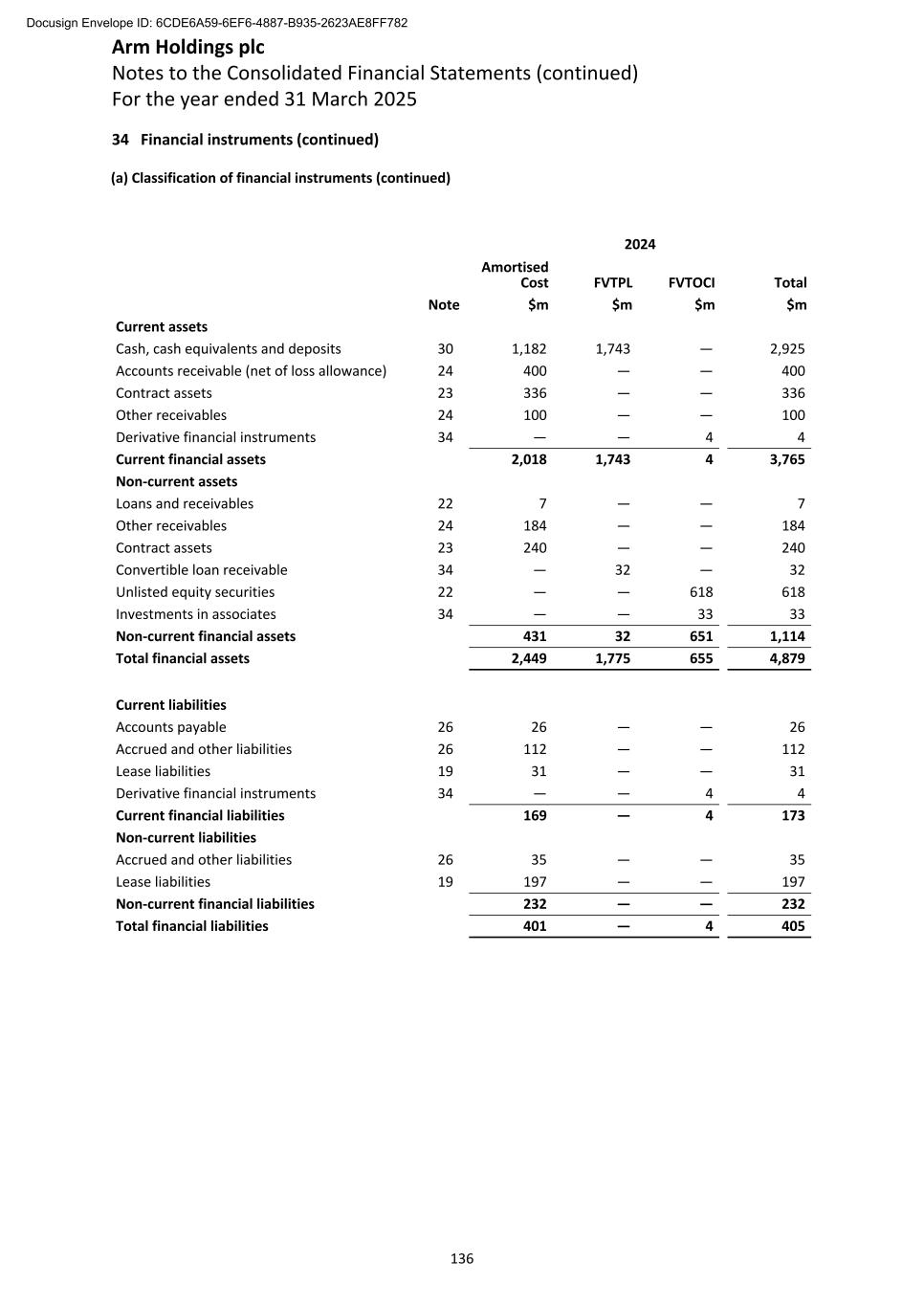
34 Financial instruments (continued) (a) Classification of financial instruments (continued) 2024 Amortised Cost FVTPL FVTOCI Total Note $m $m $m $m Current assets Cash, cash equivalents and deposits 30 1,182 1,743 — 2,925 Accounts receivable (net of loss allowance) 24 400 — — 400 Contract assets 23 336 — — 336 Other receivables 24 100 — — 100 Derivative financial instruments 34 — — 4 4 Current financial assets 2,018 1,743 4 3,765 Non-current assets Loans and receivables 22 7 — — 7 Other receivables 24 184 — — 184 Contract assets 23 240 — — 240 Convertible loan receivable 34 — 32 — 32 Unlisted equity securities 22 — — 618 618 Investments in associates 34 — — 33 33 Non-current financial assets 431 32 651 1,114 Total financial assets 2,449 1,775 655 4,879 Current liabilities Accounts payable 26 26 — — 26 Accrued and other liabilities 26 112 — — 112 Lease liabilities 19 31 — — 31 Derivative financial instruments 34 — — 4 4 Current financial liabilities 169 — 4 173 Non-current liabilities Accrued and other liabilities 26 35 — — 35 Lease liabilities 19 197 — — 197 Non-current financial liabilities 232 — — 232 Total financial liabilities 401 — 4 405 Arm Holdings plc Notes to the Consolidated Financial Statements (continued) For the year ended 31 March 2025 136 Docusign Envelope ID: 6CDE6A59-6EF6-4887-B935-2623AE8FF782
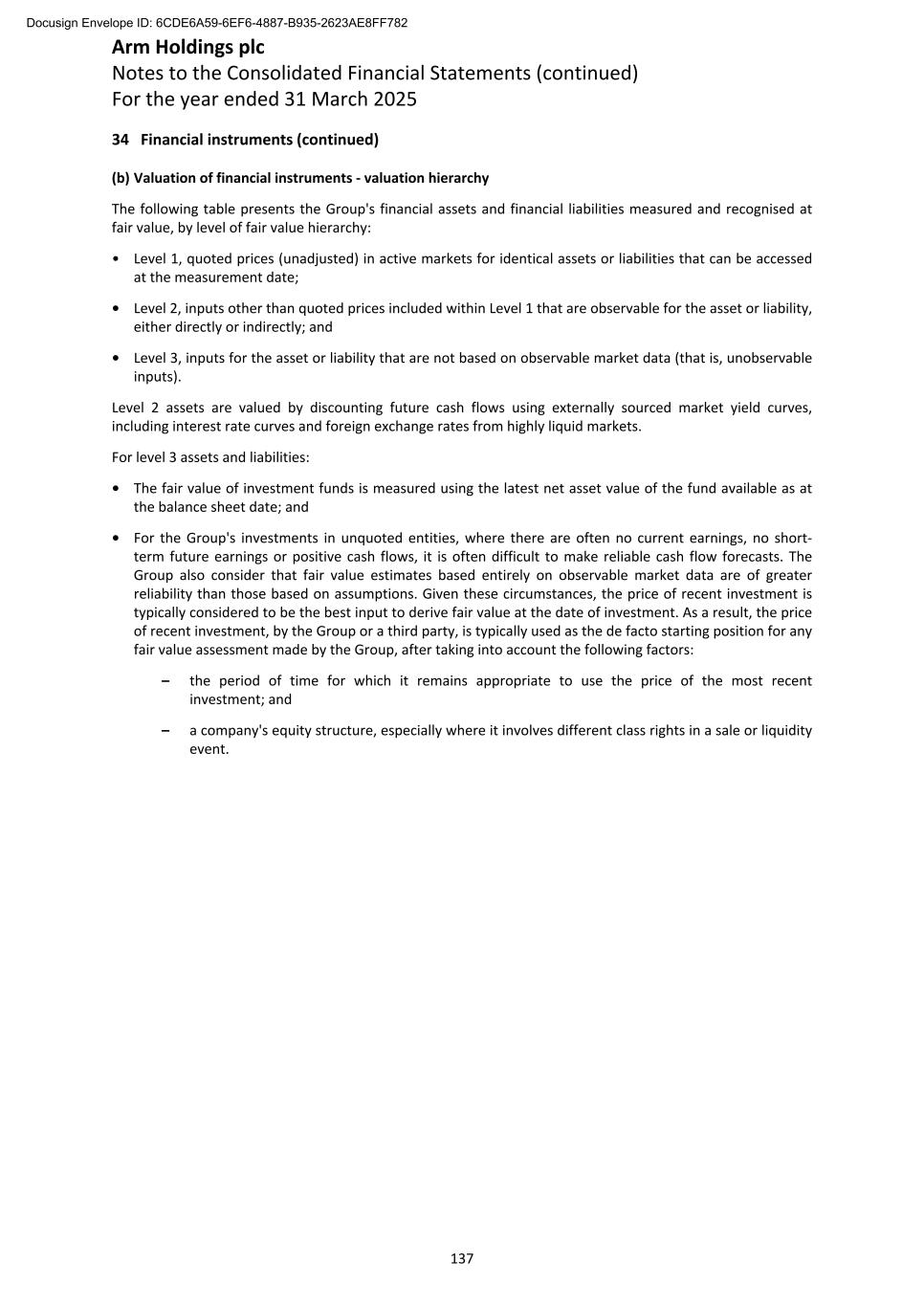
34 Financial instruments (continued) (b) Valuation of financial instruments - valuation hierarchy The following table presents the Group's financial assets and financial liabilities measured and recognised at fair value, by level of fair value hierarchy: • Level 1, quoted prices (unadjusted) in active markets for identical assets or liabilities that can be accessed at the measurement date; • Level 2, inputs other than quoted prices included within Level 1 that are observable for the asset or liability, either directly or indirectly; and • Level 3, inputs for the asset or liability that are not based on observable market data (that is, unobservable inputs). Level 2 assets are valued by discounting future cash flows using externally sourced market yield curves, including interest rate curves and foreign exchange rates from highly liquid markets. For level 3 assets and liabilities: • The fair value of investment funds is measured using the latest net asset value of the fund available as at the balance sheet date; and • For the Group's investments in unquoted entities, where there are often no current earnings, no short- term future earnings or positive cash flows, it is often difficult to make reliable cash flow forecasts. The Group also consider that fair value estimates based entirely on observable market data are of greater reliability than those based on assumptions. Given these circumstances, the price of recent investment is typically considered to be the best input to derive fair value at the date of investment. As a result, the price of recent investment, by the Group or a third party, is typically used as the de facto starting position for any fair value assessment made by the Group, after taking into account the following factors: – the period of time for which it remains appropriate to use the price of the most recent investment; and – a company's equity structure, especially where it involves different class rights in a sale or liquidity event. Arm Holdings plc Notes to the Consolidated Financial Statements (continued) For the year ended 31 March 2025 137 Docusign Envelope ID: 6CDE6A59-6EF6-4887-B935-2623AE8FF782
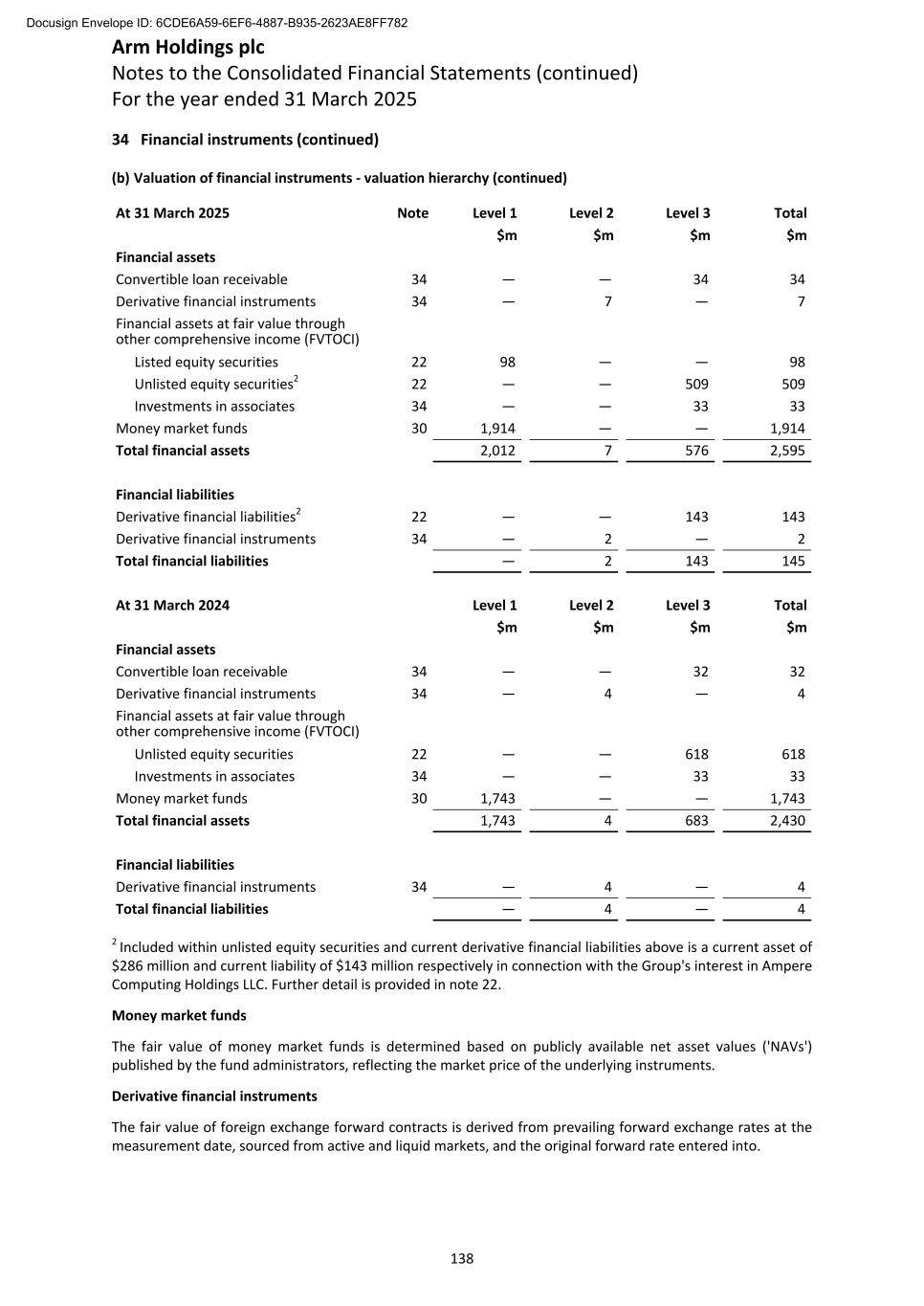
34 Financial instruments (continued) (b) Valuation of financial instruments - valuation hierarchy (continued) At 31 March 2025 Note Level 1 Level 2 Level 3 Total $m $m $m $m Financial assets Convertible loan receivable 34 — — 34 34 Derivative financial instruments 34 — 7 — 7 Financial assets at fair value through other comprehensive income (FVTOCI) Listed equity securities 22 98 — — 98 Unlisted equity securities2 22 — — 509 509 Investments in associates 34 — — 33 33 Money market funds 30 1,914 — — 1,914 Total financial assets 2,012 7 576 2,595 Financial liabilities Derivative financial liabilities2 22 — — 143 143 Derivative financial instruments 34 — 2 — 2 Total financial liabilities — 2 143 145 At 31 March 2024 Level 1 Level 2 Level 3 Total $m $m $m $m Financial assets Convertible loan receivable 34 — — 32 32 Derivative financial instruments 34 — 4 — 4 Financial assets at fair value through other comprehensive income (FVTOCI) Unlisted equity securities 22 — — 618 618 Investments in associates 34 — — 33 33 Money market funds 30 1,743 — — 1,743 Total financial assets 1,743 4 683 2,430 Financial liabilities Derivative financial instruments 34 — 4 — 4 Total financial liabilities — 4 — 4 2 Included within unlisted equity securities and current derivative financial liabilities above is a current asset of $286 million and current liability of $143 million respectively in connection with the Group's interest in Ampere Computing Holdings LLC. Further detail is provided in note 22. Money market funds The fair value of money market funds is determined based on publicly available net asset values ('NAVs') published by the fund administrators, reflecting the market price of the underlying instruments. Derivative financial instruments The fair value of foreign exchange forward contracts is derived from prevailing forward exchange rates at the measurement date, sourced from active and liquid markets, and the original forward rate entered into. Arm Holdings plc Notes to the Consolidated Financial Statements (continued) For the year ended 31 March 2025 138 Docusign Envelope ID: 6CDE6A59-6EF6-4887-B935-2623AE8FF782
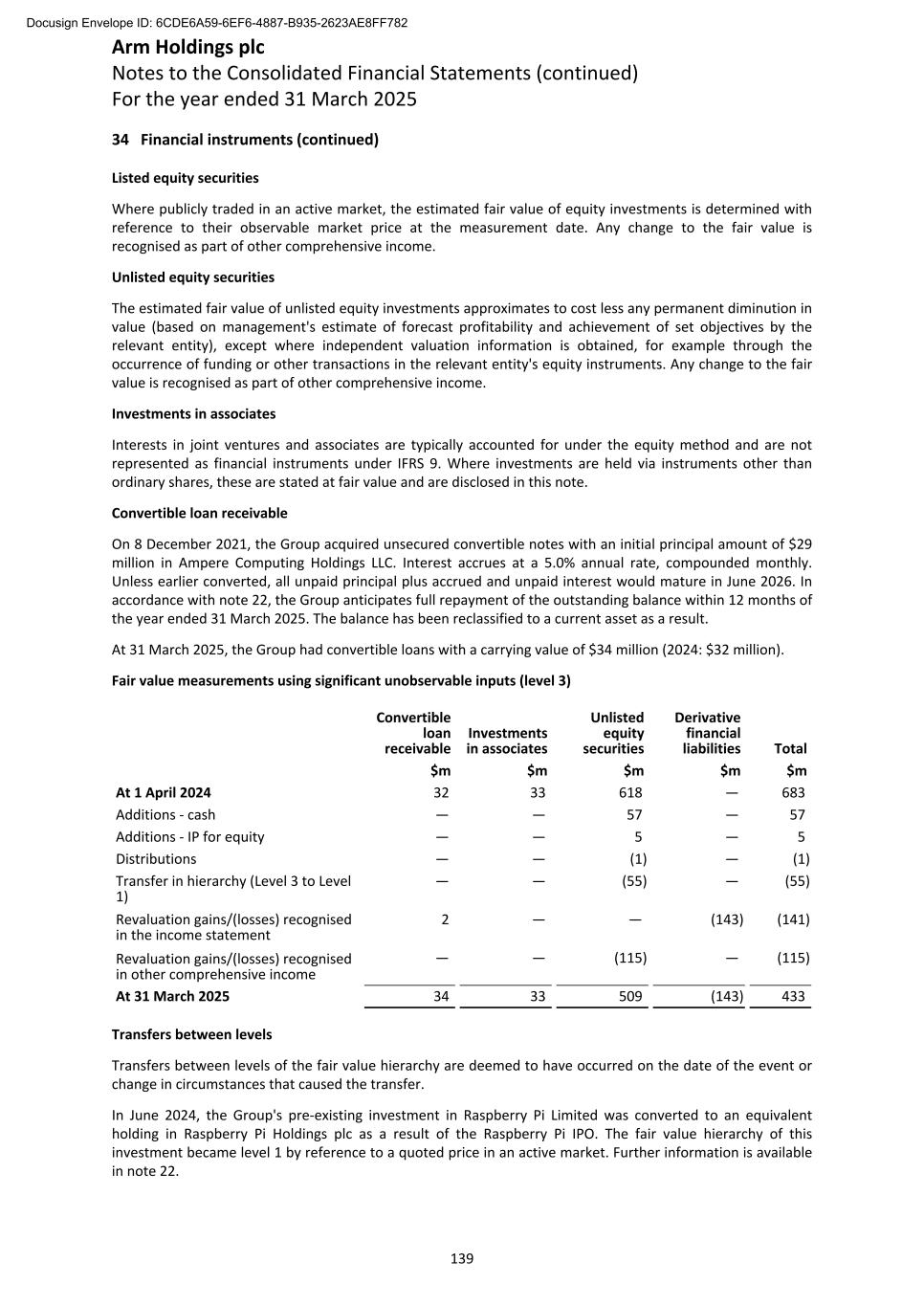
34 Financial instruments (continued) Listed equity securities Where publicly traded in an active market, the estimated fair value of equity investments is determined with reference to their observable market price at the measurement date. Any change to the fair value is recognised as part of other comprehensive income. Unlisted equity securities The estimated fair value of unlisted equity investments approximates to cost less any permanent diminution in value (based on management's estimate of forecast profitability and achievement of set objectives by the relevant entity), except where independent valuation information is obtained, for example through the occurrence of funding or other transactions in the relevant entity's equity instruments. Any change to the fair value is recognised as part of other comprehensive income. Investments in associates Interests in joint ventures and associates are typically accounted for under the equity method and are not represented as financial instruments under IFRS 9. Where investments are held via instruments other than ordinary shares, these are stated at fair value and are disclosed in this note. Convertible loan receivable On 8 December 2021, the Group acquired unsecured convertible notes with an initial principal amount of $29 million in Ampere Computing Holdings LLC. Interest accrues at a 5.0% annual rate, compounded monthly. Unless earlier converted, all unpaid principal plus accrued and unpaid interest would mature in June 2026. In accordance with note 22, the Group anticipates full repayment of the outstanding balance within 12 months of the year ended 31 March 2025. The balance has been reclassified to a current asset as a result. At 31 March 2025, the Group had convertible loans with a carrying value of $34 million (2024: $32 million). Fair value measurements using significant unobservable inputs (level 3) Convertible loan receivable Investments in associates Unlisted equity securities Derivative financial liabilities Total $m $m $m $m $m At 1 April 2024 32 33 618 — 683 Additions - cash — — 57 — 57 Additions - IP for equity — — 5 — 5 Distributions — — (1) — (1) Transfer in hierarchy (Level 3 to Level 1) — — (55) — (55) Revaluation gains/(losses) recognised in the income statement 2 — — (143) (141) Revaluation gains/(losses) recognised in other comprehensive income — — (115) — (115) At 31 March 2025 34 33 509 (143) 433 Transfers between levels Transfers between levels of the fair value hierarchy are deemed to have occurred on the date of the event or change in circumstances that caused the transfer. In June 2024, the Group's pre-existing investment in Raspberry Pi Limited was converted to an equivalent holding in Raspberry Pi Holdings plc as a result of the Raspberry Pi IPO. The fair value hierarchy of this investment became level 1 by reference to a quoted price in an active market. Further information is available in note 22. Arm Holdings plc Notes to the Consolidated Financial Statements (continued) For the year ended 31 March 2025 139 Docusign Envelope ID: 6CDE6A59-6EF6-4887-B935-2623AE8FF782
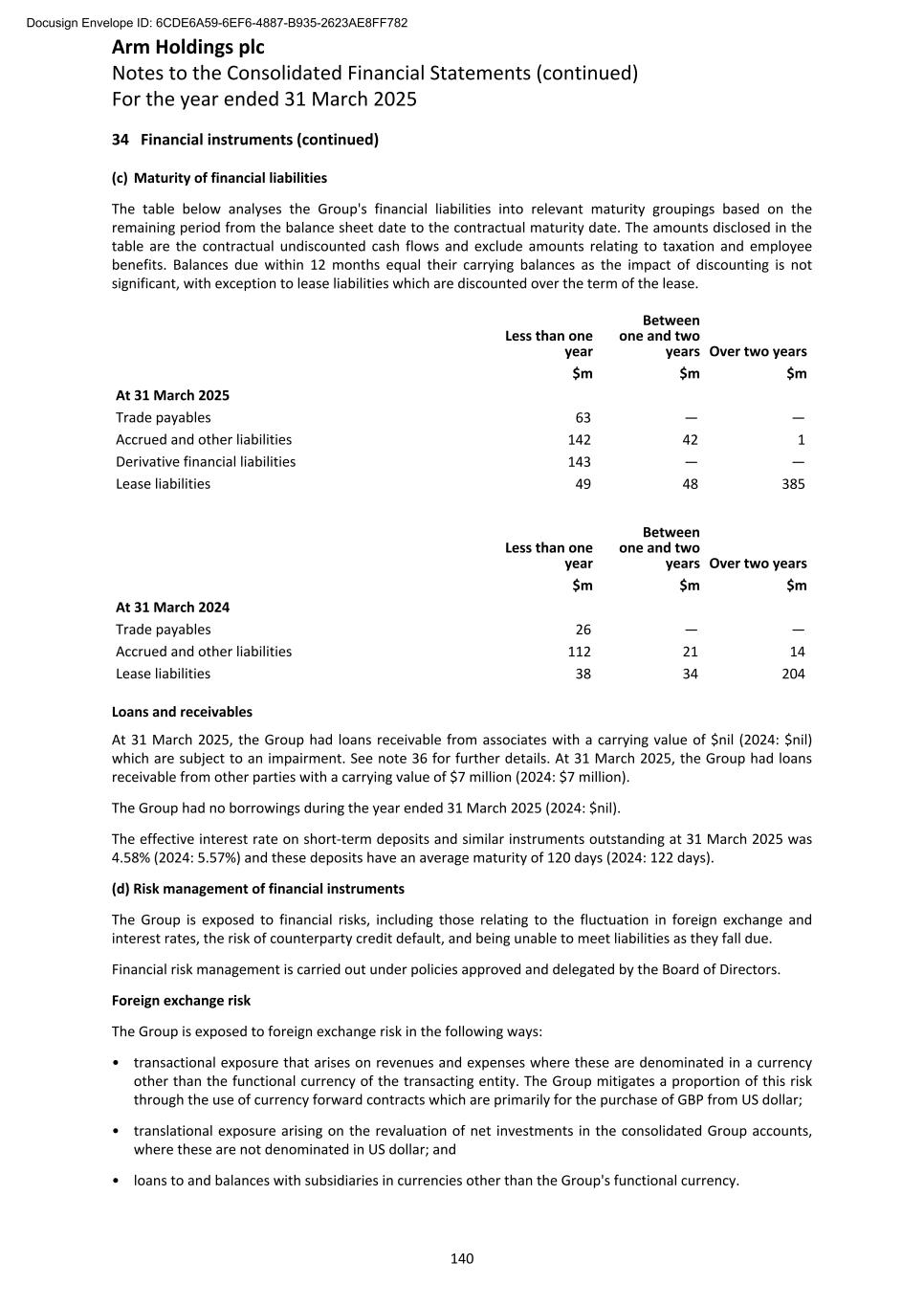
34 Financial instruments (continued) (c) Maturity of financial liabilities The table below analyses the Group's financial liabilities into relevant maturity groupings based on the remaining period from the balance sheet date to the contractual maturity date. The amounts disclosed in the table are the contractual undiscounted cash flows and exclude amounts relating to taxation and employee benefits. Balances due within 12 months equal their carrying balances as the impact of discounting is not significant, with exception to lease liabilities which are discounted over the term of the lease. Less than one year Between one and two years Over two years $m $m $m At 31 March 2025 Trade payables 63 — — Accrued and other liabilities 142 42 1 Derivative financial liabilities 143 — — Lease liabilities 49 48 385 Less than one year Between one and two years Over two years $m $m $m At 31 March 2024 Trade payables 26 — — Accrued and other liabilities 112 21 14 Lease liabilities 38 34 204 Loans and receivables At 31 March 2025, the Group had loans receivable from associates with a carrying value of $nil (2024: $nil) which are subject to an impairment. See note 36 for further details. At 31 March 2025, the Group had loans receivable from other parties with a carrying value of $7 million (2024: $7 million). The Group had no borrowings during the year ended 31 March 2025 (2024: $nil). The effective interest rate on short-term deposits and similar instruments outstanding at 31 March 2025 was 4.58% (2024: 5.57%) and these deposits have an average maturity of 120 days (2024: 122 days). (d) Risk management of financial instruments The Group is exposed to financial risks, including those relating to the fluctuation in foreign exchange and interest rates, the risk of counterparty credit default, and being unable to meet liabilities as they fall due. Financial risk management is carried out under policies approved and delegated by the Board of Directors. Foreign exchange risk The Group is exposed to foreign exchange risk in the following ways: • transactional exposure that arises on revenues and expenses where these are denominated in a currency other than the functional currency of the transacting entity. The Group mitigates a proportion of this risk through the use of currency forward contracts which are primarily for the purchase of GBP from US dollar; • translational exposure arising on the revaluation of net investments in the consolidated Group accounts, where these are not denominated in US dollar; and • loans to and balances with subsidiaries in currencies other than the Group's functional currency. Arm Holdings plc Notes to the Consolidated Financial Statements (continued) For the year ended 31 March 2025 140 Docusign Envelope ID: 6CDE6A59-6EF6-4887-B935-2623AE8FF782
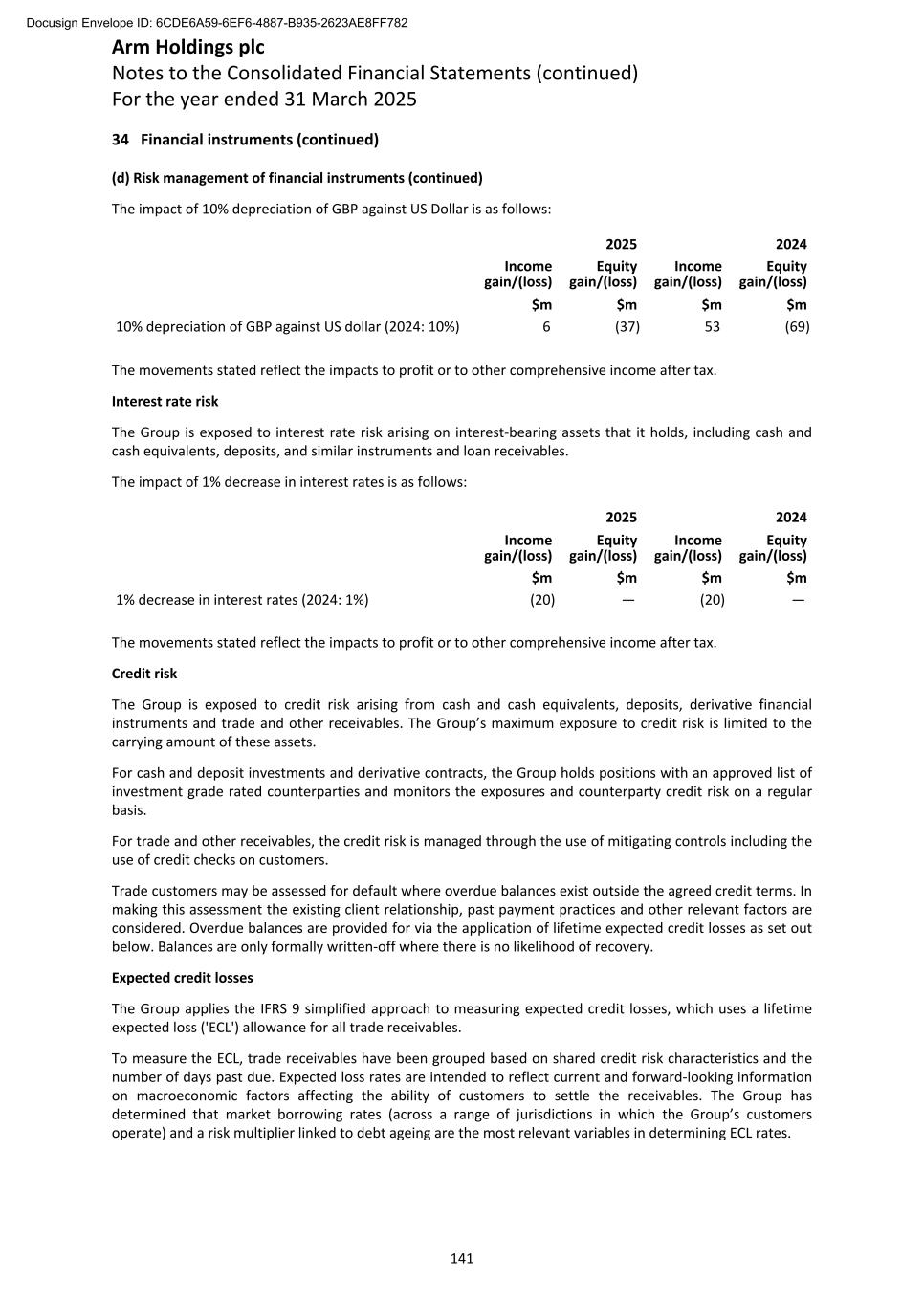
34 Financial instruments (continued) (d) Risk management of financial instruments (continued) The impact of 10% depreciation of GBP against US Dollar is as follows: 2025 2024 Income gain/(loss) Equity gain/(loss) Income gain/(loss) Equity gain/(loss) $m $m $m $m 10% depreciation of GBP against US dollar (2024: 10%) 6 (37) 53 (69) The movements stated reflect the impacts to profit or to other comprehensive income after tax. Interest rate risk The Group is exposed to interest rate risk arising on interest-bearing assets that it holds, including cash and cash equivalents, deposits, and similar instruments and loan receivables. The impact of 1% decrease in interest rates is as follows: 2025 2024 Income gain/(loss) Equity gain/(loss) Income gain/(loss) Equity gain/(loss) $m $m $m $m 1% decrease in interest rates (2024: 1%) (20) — (20) — The movements stated reflect the impacts to profit or to other comprehensive income after tax. Credit risk The Group is exposed to credit risk arising from cash and cash equivalents, deposits, derivative financial instruments and trade and other receivables. The Group’s maximum exposure to credit risk is limited to the carrying amount of these assets. For cash and deposit investments and derivative contracts, the Group holds positions with an approved list of investment grade rated counterparties and monitors the exposures and counterparty credit risk on a regular basis. For trade and other receivables, the credit risk is managed through the use of mitigating controls including the use of credit checks on customers. Trade customers may be assessed for default where overdue balances exist outside the agreed credit terms. In making this assessment the existing client relationship, past payment practices and other relevant factors are considered. Overdue balances are provided for via the application of lifetime expected credit losses as set out below. Balances are only formally written-off where there is no likelihood of recovery. Expected credit losses The Group applies the IFRS 9 simplified approach to measuring expected credit losses, which uses a lifetime expected loss ('ECL') allowance for all trade receivables. To measure the ECL, trade receivables have been grouped based on shared credit risk characteristics and the number of days past due. Expected loss rates are intended to reflect current and forward-looking information on macroeconomic factors affecting the ability of customers to settle the receivables. The Group has determined that market borrowing rates (across a range of jurisdictions in which the Group’s customers operate) and a risk multiplier linked to debt ageing are the most relevant variables in determining ECL rates. Arm Holdings plc Notes to the Consolidated Financial Statements (continued) For the year ended 31 March 2025 141 Docusign Envelope ID: 6CDE6A59-6EF6-4887-B935-2623AE8FF782
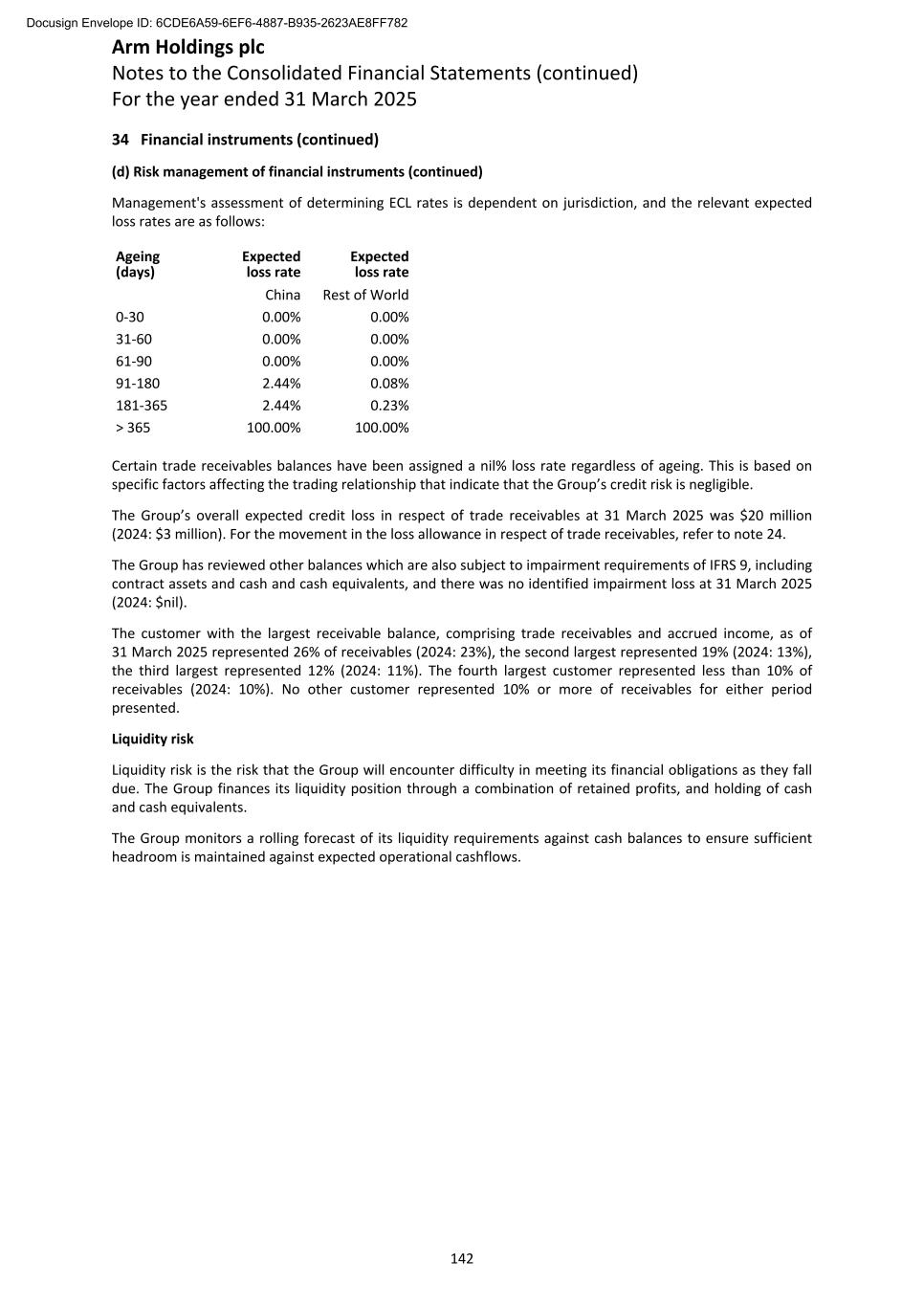
34 Financial instruments (continued) (d) Risk management of financial instruments (continued) Management's assessment of determining ECL rates is dependent on jurisdiction, and the relevant expected loss rates are as follows: Ageing (days) Expected loss rate Expected loss rate China Rest of World 0-30 0.00% 0.00% 31-60 0.00% 0.00% 61-90 0.00% 0.00% 91-180 2.44% 0.08% 181-365 2.44% 0.23% > 365 100.00% 100.00% Certain trade receivables balances have been assigned a nil% loss rate regardless of ageing. This is based on specific factors affecting the trading relationship that indicate that the Group’s credit risk is negligible. The Group’s overall expected credit loss in respect of trade receivables at 31 March 2025 was $20 million (2024: $3 million). For the movement in the loss allowance in respect of trade receivables, refer to note 24. The Group has reviewed other balances which are also subject to impairment requirements of IFRS 9, including contract assets and cash and cash equivalents, and there was no identified impairment loss at 31 March 2025 (2024: $nil). The customer with the largest receivable balance, comprising trade receivables and accrued income, as of 31 March 2025 represented 26% of receivables (2024: 23%), the second largest represented 19% (2024: 13%), the third largest represented 12% (2024: 11%). The fourth largest customer represented less than 10% of receivables (2024: 10%). No other customer represented 10% or more of receivables for either period presented. Liquidity risk Liquidity risk is the risk that the Group will encounter difficulty in meeting its financial obligations as they fall due. The Group finances its liquidity position through a combination of retained profits, and holding of cash and cash equivalents. The Group monitors a rolling forecast of its liquidity requirements against cash balances to ensure sufficient headroom is maintained against expected operational cashflows. Arm Holdings plc Notes to the Consolidated Financial Statements (continued) For the year ended 31 March 2025 142 Docusign Envelope ID: 6CDE6A59-6EF6-4887-B935-2623AE8FF782
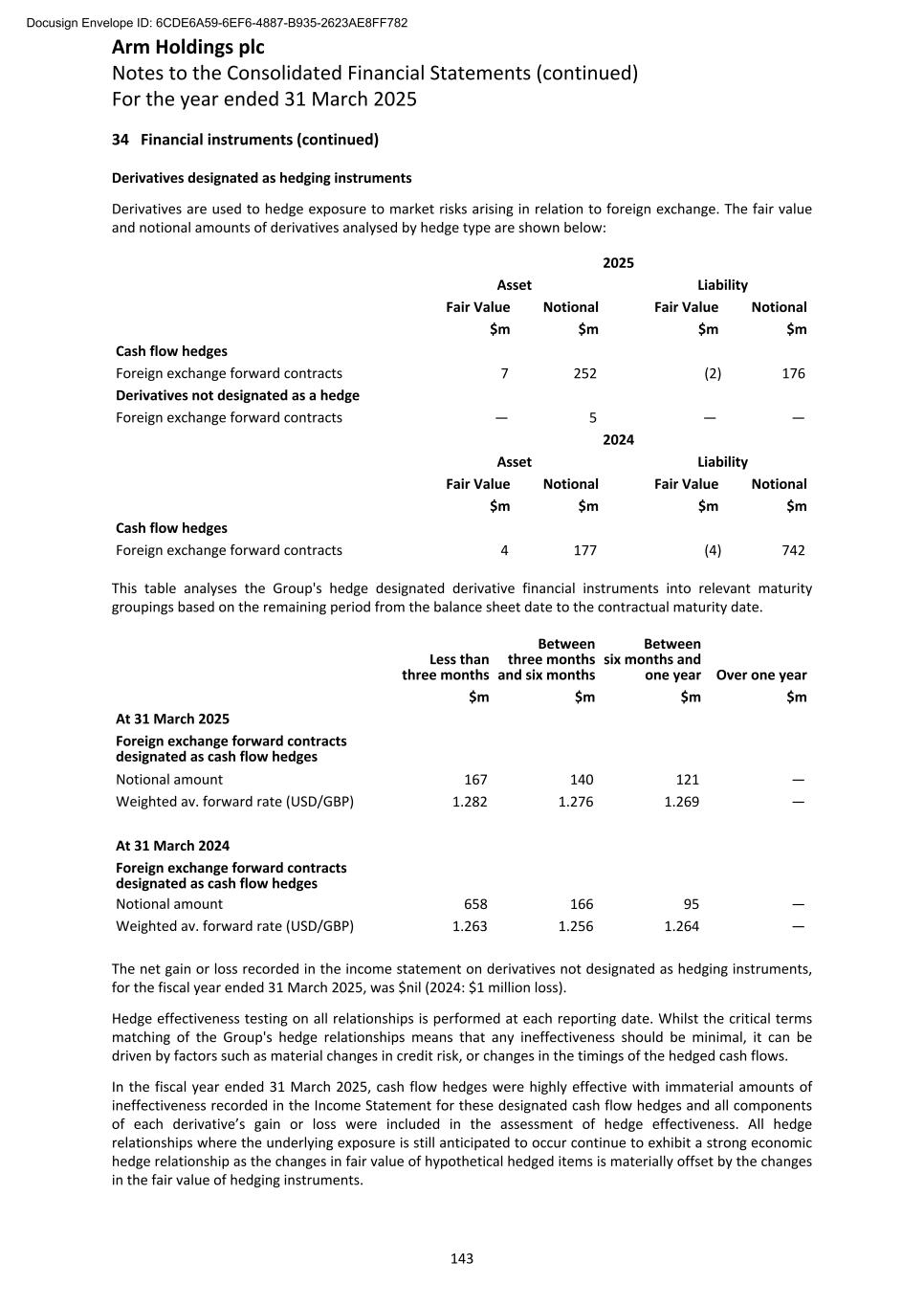
34 Financial instruments (continued) Derivatives designated as hedging instruments Derivatives are used to hedge exposure to market risks arising in relation to foreign exchange. The fair value and notional amounts of derivatives analysed by hedge type are shown below: 2025 Asset Liability Fair Value Notional Fair Value Notional $m $m $m $m Cash flow hedges Foreign exchange forward contracts 7 252 (2) 176 Derivatives not designated as a hedge Foreign exchange forward contracts — 5 — — 2024 Asset Liability Fair Value Notional Fair Value Notional $m $m $m $m Cash flow hedges Foreign exchange forward contracts 4 177 (4) 742 This table analyses the Group's hedge designated derivative financial instruments into relevant maturity groupings based on the remaining period from the balance sheet date to the contractual maturity date. Less than three months Between three months and six months Between six months and one year Over one year $m $m $m $m At 31 March 2025 Foreign exchange forward contracts designated as cash flow hedges Notional amount 167 140 121 — Weighted av. forward rate (USD/GBP) 1.282 1.276 1.269 — At 31 March 2024 Foreign exchange forward contracts designated as cash flow hedges Notional amount 658 166 95 — Weighted av. forward rate (USD/GBP) 1.263 1.256 1.264 — The net gain or loss recorded in the income statement on derivatives not designated as hedging instruments, for the fiscal year ended 31 March 2025, was $nil (2024: $1 million loss). Hedge effectiveness testing on all relationships is performed at each reporting date. Whilst the critical terms matching of the Group's hedge relationships means that any ineffectiveness should be minimal, it can be driven by factors such as material changes in credit risk, or changes in the timings of the hedged cash flows. In the fiscal year ended 31 March 2025, cash flow hedges were highly effective with immaterial amounts of ineffectiveness recorded in the Income Statement for these designated cash flow hedges and all components of each derivative’s gain or loss were included in the assessment of hedge effectiveness. All hedge relationships where the underlying exposure is still anticipated to occur continue to exhibit a strong economic hedge relationship as the changes in fair value of hypothetical hedged items is materially offset by the changes in the fair value of hedging instruments. Arm Holdings plc Notes to the Consolidated Financial Statements (continued) For the year ended 31 March 2025 143 Docusign Envelope ID: 6CDE6A59-6EF6-4887-B935-2623AE8FF782
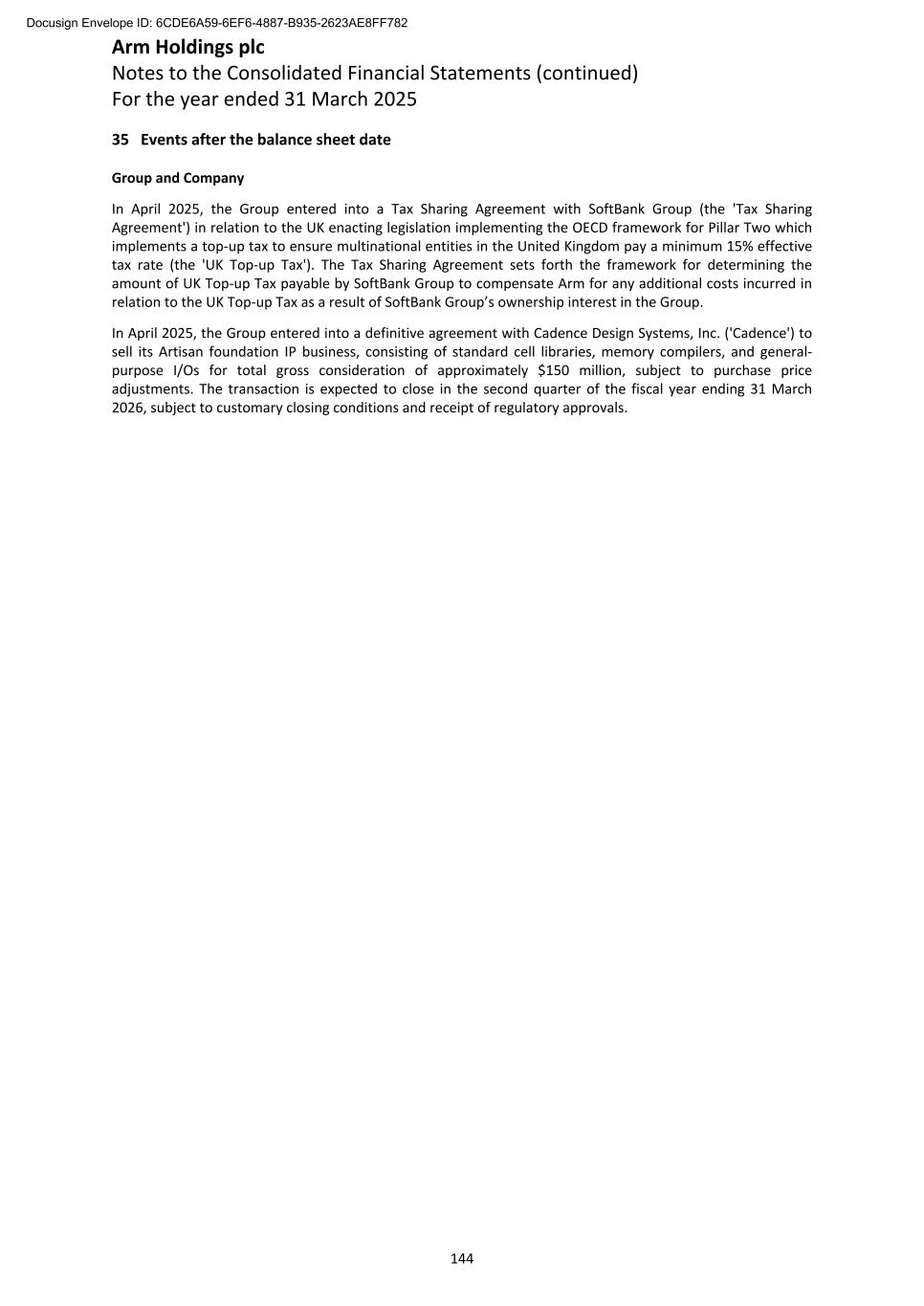
35 Events after the balance sheet date Group and Company In April 2025, the Group entered into a Tax Sharing Agreement with SoftBank Group (the 'Tax Sharing Agreement') in relation to the UK enacting legislation implementing the OECD framework for Pillar Two which implements a top-up tax to ensure multinational entities in the United Kingdom pay a minimum 15% effective tax rate (the 'UK Top-up Tax'). The Tax Sharing Agreement sets forth the framework for determining the amount of UK Top-up Tax payable by SoftBank Group to compensate Arm for any additional costs incurred in relation to the UK Top-up Tax as a result of SoftBank Group’s ownership interest in the Group. In April 2025, the Group entered into a definitive agreement with Cadence Design Systems, Inc. ('Cadence') to sell its Artisan foundation IP business, consisting of standard cell libraries, memory compilers, and general- purpose I/Os for total gross consideration of approximately $150 million, subject to purchase price adjustments. The transaction is expected to close in the second quarter of the fiscal year ending 31 March 2026, subject to customary closing conditions and receipt of regulatory approvals. Arm Holdings plc Notes to the Consolidated Financial Statements (continued) For the year ended 31 March 2025 144 Docusign Envelope ID: 6CDE6A59-6EF6-4887-B935-2623AE8FF782
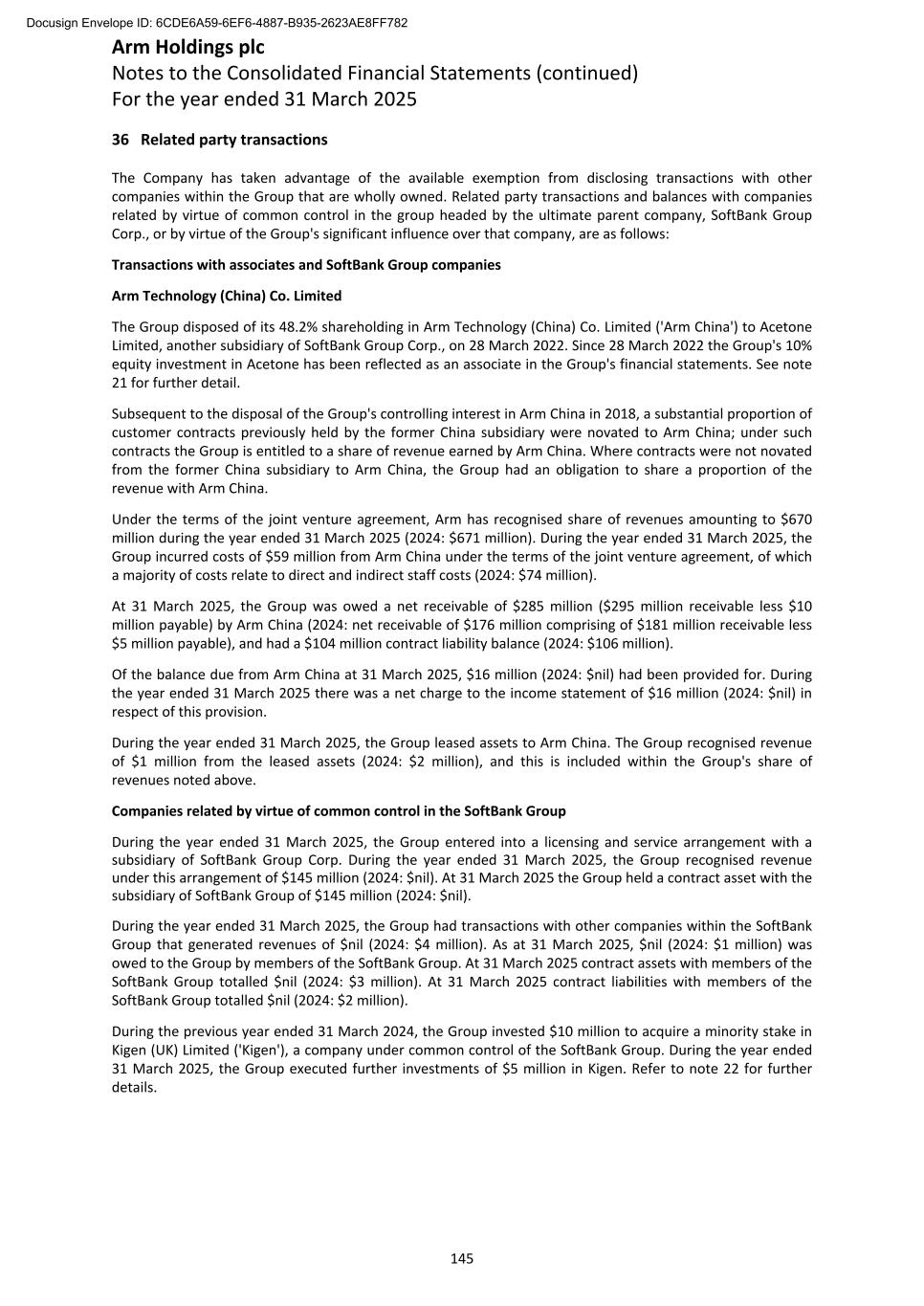
36 Related party transactions The Company has taken advantage of the available exemption from disclosing transactions with other companies within the Group that are wholly owned. Related party transactions and balances with companies related by virtue of common control in the group headed by the ultimate parent company, SoftBank Group Corp., or by virtue of the Group's significant influence over that company, are as follows: Transactions with associates and SoftBank Group companies Arm Technology (China) Co. Limited The Group disposed of its 48.2% shareholding in Arm Technology (China) Co. Limited ('Arm China') to Acetone Limited, another subsidiary of SoftBank Group Corp., on 28 March 2022. Since 28 March 2022 the Group's 10% equity investment in Acetone has been reflected as an associate in the Group's financial statements. See note 21 for further detail. Subsequent to the disposal of the Group's controlling interest in Arm China in 2018, a substantial proportion of customer contracts previously held by the former China subsidiary were novated to Arm China; under such contracts the Group is entitled to a share of revenue earned by Arm China. Where contracts were not novated from the former China subsidiary to Arm China, the Group had an obligation to share a proportion of the revenue with Arm China. Under the terms of the joint venture agreement, Arm has recognised share of revenues amounting to $670 million during the year ended 31 March 2025 (2024: $671 million). During the year ended 31 March 2025, the Group incurred costs of $59 million from Arm China under the terms of the joint venture agreement, of which a majority of costs relate to direct and indirect staff costs (2024: $74 million). At 31 March 2025, the Group was owed a net receivable of $285 million ($295 million receivable less $10 million payable) by Arm China (2024: net receivable of $176 million comprising of $181 million receivable less $5 million payable), and had a $104 million contract liability balance (2024: $106 million). Of the balance due from Arm China at 31 March 2025, $16 million (2024: $nil) had been provided for. During the year ended 31 March 2025 there was a net charge to the income statement of $16 million (2024: $nil) in respect of this provision. During the year ended 31 March 2025, the Group leased assets to Arm China. The Group recognised revenue of $1 million from the leased assets (2024: $2 million), and this is included within the Group's share of revenues noted above. Companies related by virtue of common control in the SoftBank Group During the year ended 31 March 2025, the Group entered into a licensing and service arrangement with a subsidiary of SoftBank Group Corp. During the year ended 31 March 2025, the Group recognised revenue under this arrangement of $145 million (2024: $nil). At 31 March 2025 the Group held a contract asset with the subsidiary of SoftBank Group of $145 million (2024: $nil). During the year ended 31 March 2025, the Group had transactions with other companies within the SoftBank Group that generated revenues of $nil (2024: $4 million). As at 31 March 2025, $nil (2024: $1 million) was owed to the Group by members of the SoftBank Group. At 31 March 2025 contract assets with members of the SoftBank Group totalled $nil (2024: $3 million). At 31 March 2025 contract liabilities with members of the SoftBank Group totalled $nil (2024: $2 million). During the previous year ended 31 March 2024, the Group invested $10 million to acquire a minority stake in Kigen (UK) Limited ('Kigen'), a company under common control of the SoftBank Group. During the year ended 31 March 2025, the Group executed further investments of $5 million in Kigen. Refer to note 22 for further details. Arm Holdings plc Notes to the Consolidated Financial Statements (continued) For the year ended 31 March 2025 145 Docusign Envelope ID: 6CDE6A59-6EF6-4887-B935-2623AE8FF782
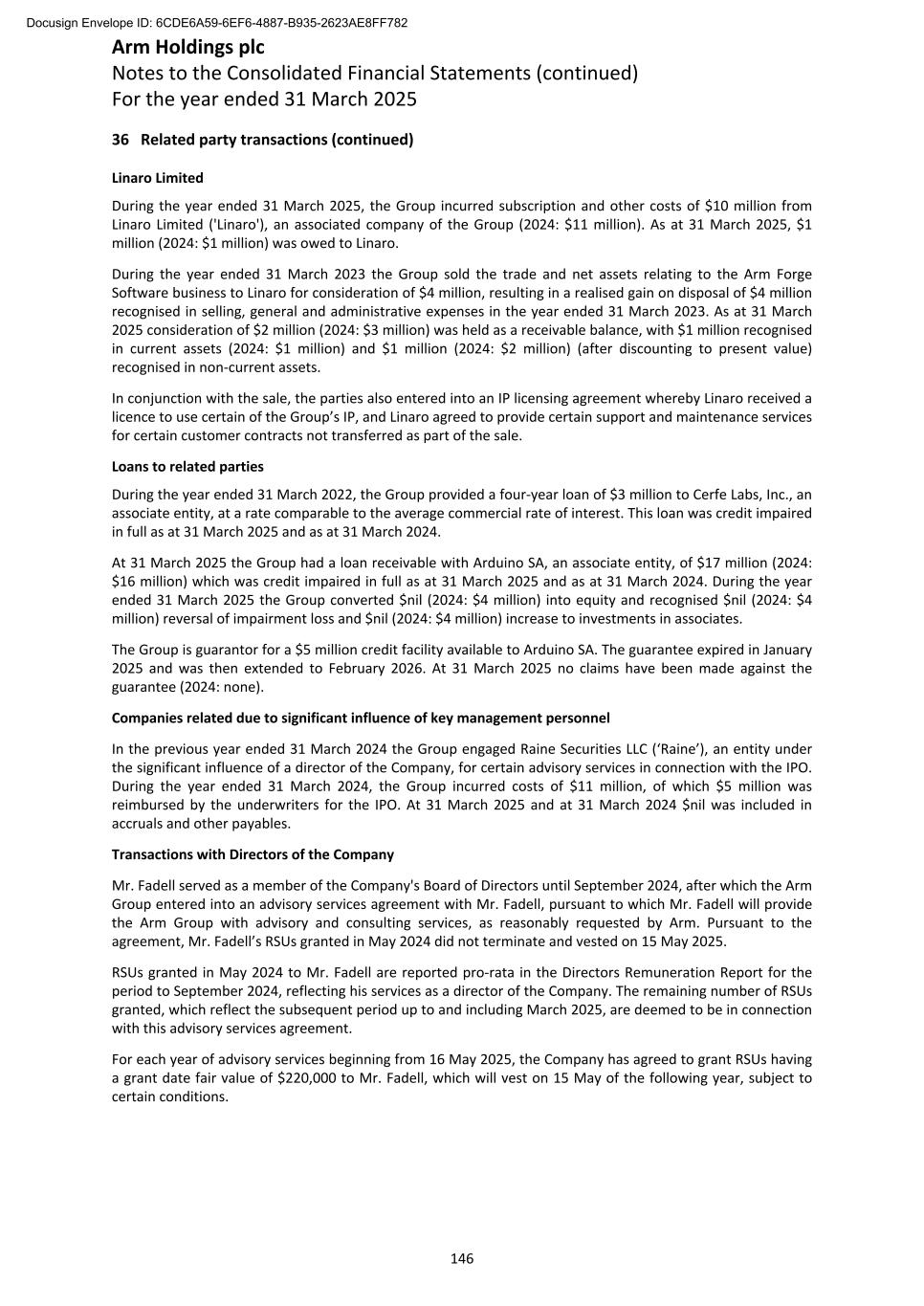
36 Related party transactions (continued) Linaro Limited During the year ended 31 March 2025, the Group incurred subscription and other costs of $10 million from Linaro Limited ('Linaro'), an associated company of the Group (2024: $11 million). As at 31 March 2025, $1 million (2024: $1 million) was owed to Linaro. During the year ended 31 March 2023 the Group sold the trade and net assets relating to the Arm Forge Software business to Linaro for consideration of $4 million, resulting in a realised gain on disposal of $4 million recognised in selling, general and administrative expenses in the year ended 31 March 2023. As at 31 March 2025 consideration of $2 million (2024: $3 million) was held as a receivable balance, with $1 million recognised in current assets (2024: $1 million) and $1 million (2024: $2 million) (after discounting to present value) recognised in non-current assets. In conjunction with the sale, the parties also entered into an IP licensing agreement whereby Linaro received a licence to use certain of the Group’s IP, and Linaro agreed to provide certain support and maintenance services for certain customer contracts not transferred as part of the sale. Loans to related parties During the year ended 31 March 2022, the Group provided a four-year loan of $3 million to Cerfe Labs, Inc., an associate entity, at a rate comparable to the average commercial rate of interest. This loan was credit impaired in full as at 31 March 2025 and as at 31 March 2024. At 31 March 2025 the Group had a loan receivable with Arduino SA, an associate entity, of $17 million (2024: $16 million) which was credit impaired in full as at 31 March 2025 and as at 31 March 2024. During the year ended 31 March 2025 the Group converted $nil (2024: $4 million) into equity and recognised $nil (2024: $4 million) reversal of impairment loss and $nil (2024: $4 million) increase to investments in associates. The Group is guarantor for a $5 million credit facility available to Arduino SA. The guarantee expired in January 2025 and was then extended to February 2026. At 31 March 2025 no claims have been made against the guarantee (2024: none). Companies related due to significant influence of key management personnel In the previous year ended 31 March 2024 the Group engaged Raine Securities LLC (‘Raine’), an entity under the significant influence of a director of the Company, for certain advisory services in connection with the IPO. During the year ended 31 March 2024, the Group incurred costs of $11 million, of which $5 million was reimbursed by the underwriters for the IPO. At 31 March 2025 and at 31 March 2024 $nil was included in accruals and other payables. Transactions with Directors of the Company Mr. Fadell served as a member of the Company's Board of Directors until September 2024, after which the Arm Group entered into an advisory services agreement with Mr. Fadell, pursuant to which Mr. Fadell will provide the Arm Group with advisory and consulting services, as reasonably requested by Arm. Pursuant to the agreement, Mr. Fadell’s RSUs granted in May 2024 did not terminate and vested on 15 May 2025. RSUs granted in May 2024 to Mr. Fadell are reported pro-rata in the Directors Remuneration Report for the period to September 2024, reflecting his services as a director of the Company. The remaining number of RSUs granted, which reflect the subsequent period up to and including March 2025, are deemed to be in connection with this advisory services agreement. For each year of advisory services beginning from 16 May 2025, the Company has agreed to grant RSUs having a grant date fair value of $220,000 to Mr. Fadell, which will vest on 15 May of the following year, subject to certain conditions. Arm Holdings plc Notes to the Consolidated Financial Statements (continued) For the year ended 31 March 2025 146 Docusign Envelope ID: 6CDE6A59-6EF6-4887-B935-2623AE8FF782
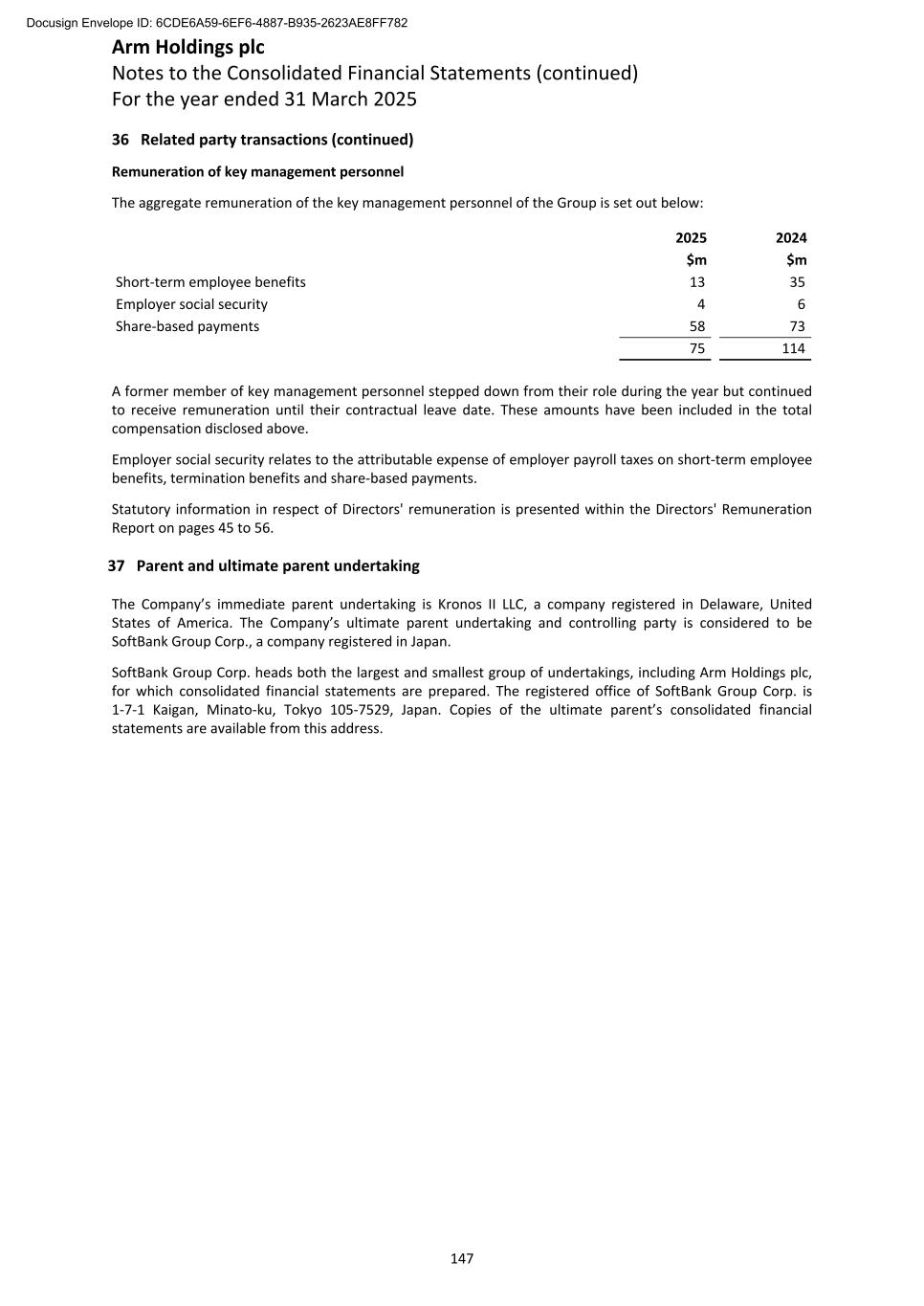
36 Related party transactions (continued) Remuneration of key management personnel The aggregate remuneration of the key management personnel of the Group is set out below: 2025 2024 $m $m Short-term employee benefits 13 35 Employer social security 4 6 Share-based payments 58 73 75 114 A former member of key management personnel stepped down from their role during the year but continued to receive remuneration until their contractual leave date. These amounts have been included in the total compensation disclosed above. Employer social security relates to the attributable expense of employer payroll taxes on short-term employee benefits, termination benefits and share-based payments. Statutory information in respect of Directors' remuneration is presented within the Directors' Remuneration Report on pages 45 to 56. 37 Parent and ultimate parent undertaking The Company’s immediate parent undertaking is Kronos II LLC, a company registered in Delaware, United States of America. The Company’s ultimate parent undertaking and controlling party is considered to be SoftBank Group Corp., a company registered in Japan. SoftBank Group Corp. heads both the largest and smallest group of undertakings, including Arm Holdings plc, for which consolidated financial statements are prepared. The registered office of SoftBank Group Corp. is 1-7-1 Kaigan, Minato-ku, Tokyo 105-7529, Japan. Copies of the ultimate parent’s consolidated financial statements are available from this address. Arm Holdings plc Notes to the Consolidated Financial Statements (continued) For the year ended 31 March 2025 147 Docusign Envelope ID: 6CDE6A59-6EF6-4887-B935-2623AE8FF782
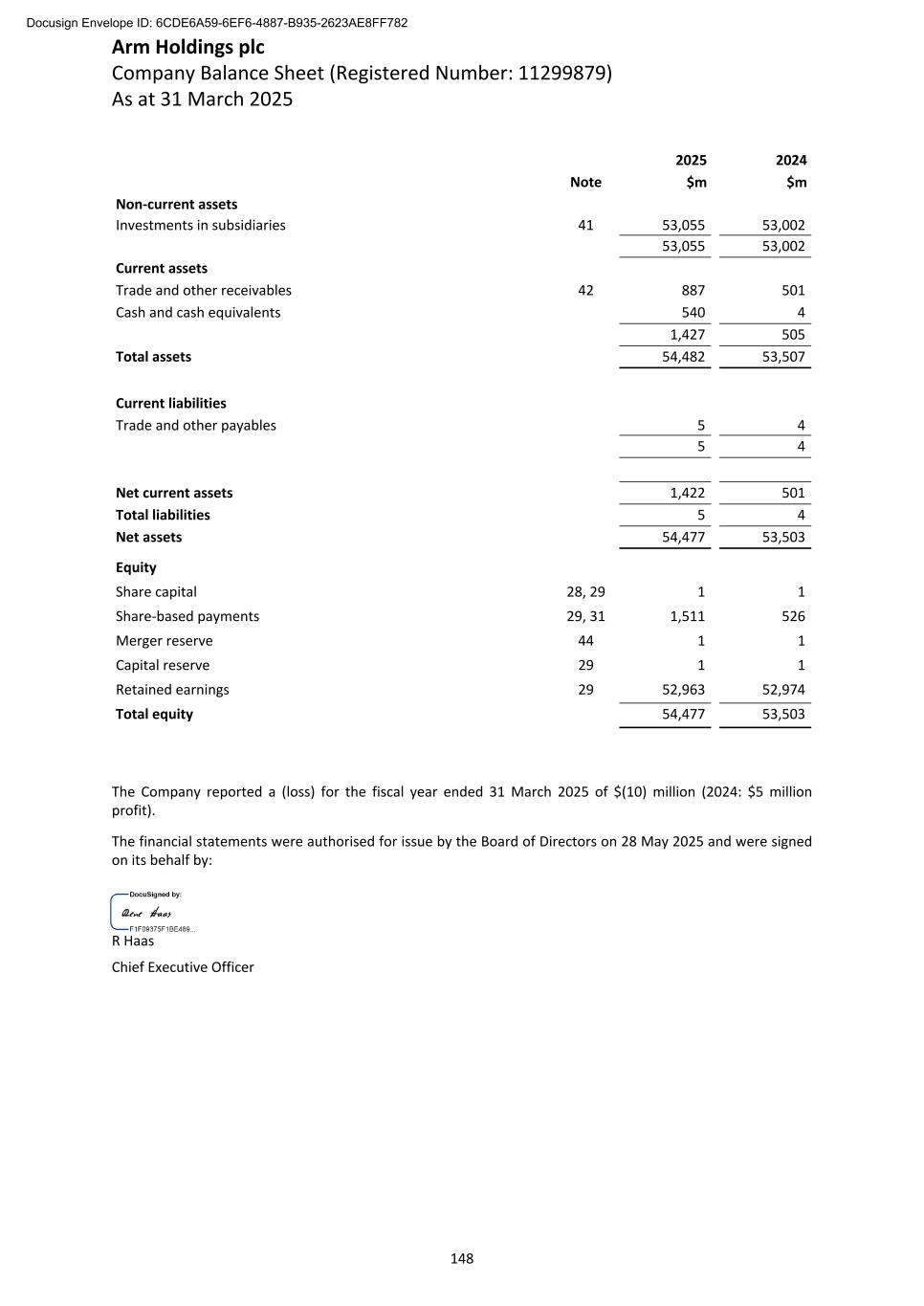
2025 2024 Note $m $m Non-current assets Investments in subsidiaries 41 53,055 53,002 53,055 53,002 Current assets Trade and other receivables 42 887 501 Cash and cash equivalents 540 4 1,427 505 Total assets 54,482 53,507 Current liabilities Trade and other payables 5 4 5 4 Net current assets 1,422 501 Total liabilities 5 4 Net assets 54,477 53,503 Equity Share capital 28, 29 1 1 Share-based payments 29, 31 1,511 526 Merger reserve 44 1 1 Capital reserve 29 1 1 Retained earnings 29 52,963 52,974 Total equity 54,477 53,503 The Company reported a (loss) for the fiscal year ended 31 March 2025 of $(10) million (2024: $5 million profit). The financial statements were authorised for issue by the Board of Directors on 28 May 2025 and were signed on its behalf by: R Haas Chief Executive Officer Arm Holdings plc Company Balance Sheet (Registered Number: 11299879) As at 31 March 2025 148 Docusign Envelope ID: 6CDE6A59-6EF6-4887-B935-2623AE8FF782
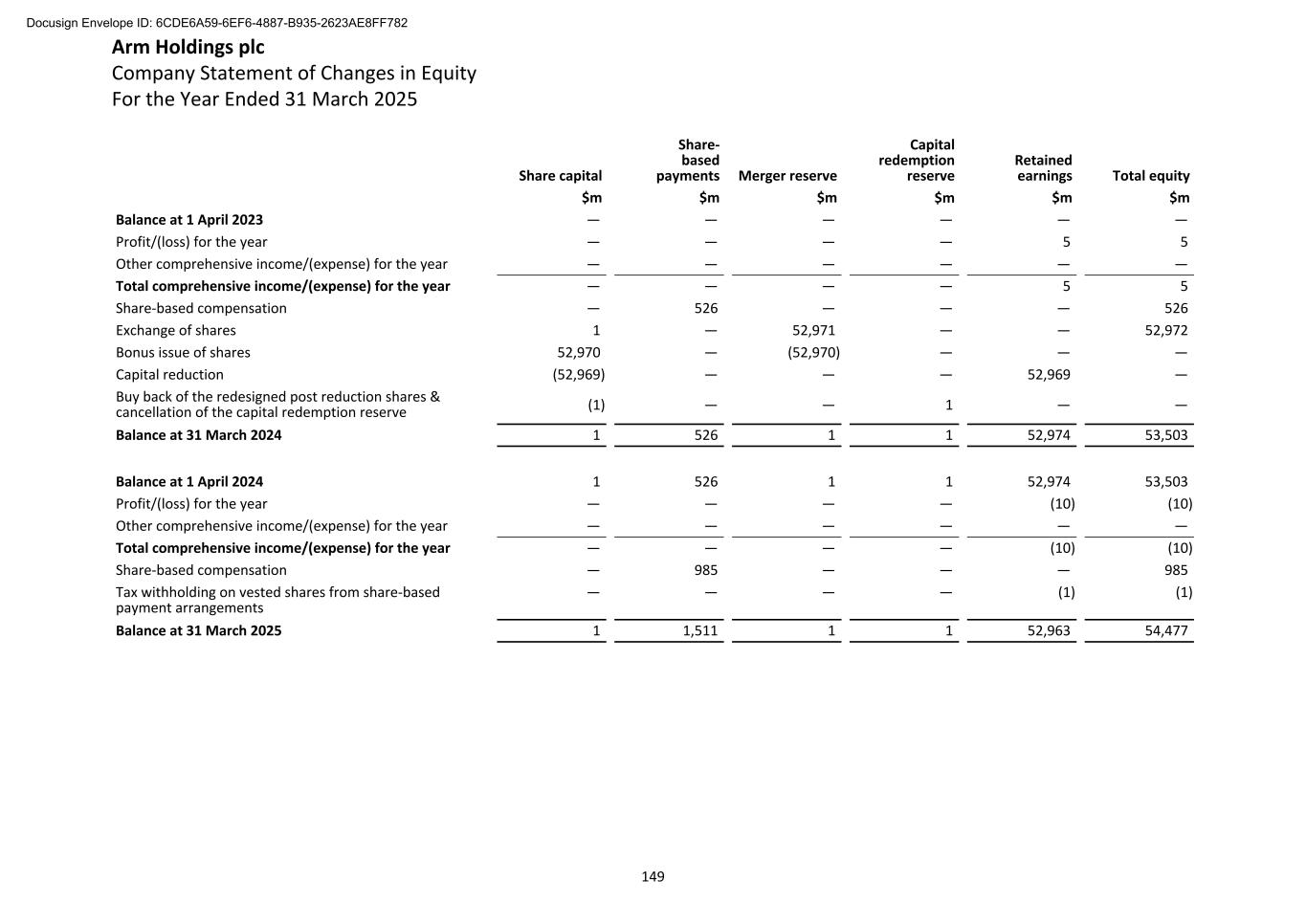
Share capital Share- based payments Merger reserve Capital redemption reserve Retained earnings Total equity $m $m $m $m $m $m Balance at 1 April 2023 — — — — — — Profit/(loss) for the year — — — — 5 5 Other comprehensive income/(expense) for the year — — — — — — Total comprehensive income/(expense) for the year — — — — 5 5 Share-based compensation — 526 — — — 526 Exchange of shares 1 — 52,971 — — 52,972 Bonus issue of shares 52,970 — (52,970) — — — Capital reduction (52,969) — — — 52,969 — Buy back of the redesigned post reduction shares & cancellation of the capital redemption reserve (1) — — 1 — — Balance at 31 March 2024 1 526 1 1 52,974 53,503 Balance at 1 April 2024 1 526 1 1 52,974 53,503 Profit/(loss) for the year — — — — (10) (10) Other comprehensive income/(expense) for the year — — — — — — Total comprehensive income/(expense) for the year — — — — (10) (10) Share-based compensation — 985 — — — 985 Tax withholding on vested shares from share-based payment arrangements — — — — (1) (1) Balance at 31 March 2025 1 1,511 1 1 52,963 54,477 Arm Holdings plc Company Statement of Changes in Equity For the Year Ended 31 March 2025 149 Docusign Envelope ID: 6CDE6A59-6EF6-4887-B935-2623AE8FF782
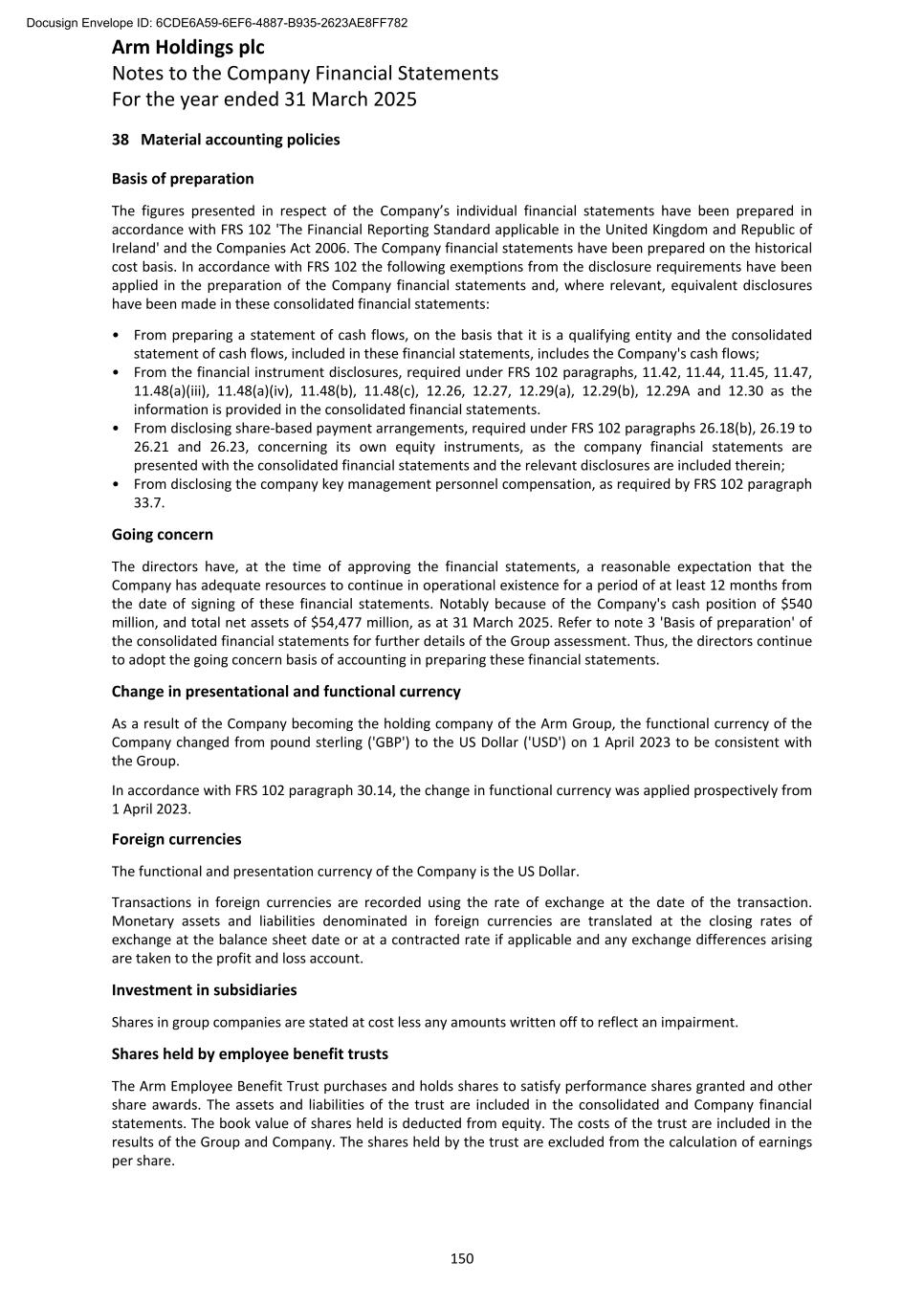
38 Material accounting policies Basis of preparation The figures presented in respect of the Company’s individual financial statements have been prepared in accordance with FRS 102 'The Financial Reporting Standard applicable in the United Kingdom and Republic of Ireland' and the Companies Act 2006. The Company financial statements have been prepared on the historical cost basis. In accordance with FRS 102 the following exemptions from the disclosure requirements have been applied in the preparation of the Company financial statements and, where relevant, equivalent disclosures have been made in these consolidated financial statements: • From preparing a statement of cash flows, on the basis that it is a qualifying entity and the consolidated statement of cash flows, included in these financial statements, includes the Company's cash flows; • From the financial instrument disclosures, required under FRS 102 paragraphs, 11.42, 11.44, 11.45, 11.47, 11.48(a)(iii), 11.48(a)(iv), 11.48(b), 11.48(c), 12.26, 12.27, 12.29(a), 12.29(b), 12.29A and 12.30 as the information is provided in the consolidated financial statements. • From disclosing share-based payment arrangements, required under FRS 102 paragraphs 26.18(b), 26.19 to 26.21 and 26.23, concerning its own equity instruments, as the company financial statements are presented with the consolidated financial statements and the relevant disclosures are included therein; • From disclosing the company key management personnel compensation, as required by FRS 102 paragraph 33.7. Going concern The directors have, at the time of approving the financial statements, a reasonable expectation that the Company has adequate resources to continue in operational existence for a period of at least 12 months from the date of signing of these financial statements. Notably because of the Company's cash position of $540 million, and total net assets of $54,477 million, as at 31 March 2025. Refer to note 3 'Basis of preparation' of the consolidated financial statements for further details of the Group assessment. Thus, the directors continue to adopt the going concern basis of accounting in preparing these financial statements. Change in presentational and functional currency As a result of the Company becoming the holding company of the Arm Group, the functional currency of the Company changed from pound sterling ('GBP') to the US Dollar ('USD') on 1 April 2023 to be consistent with the Group. In accordance with FRS 102 paragraph 30.14, the change in functional currency was applied prospectively from 1 April 2023. Foreign currencies The functional and presentation currency of the Company is the US Dollar. Transactions in foreign currencies are recorded using the rate of exchange at the date of the transaction. Monetary assets and liabilities denominated in foreign currencies are translated at the closing rates of exchange at the balance sheet date or at a contracted rate if applicable and any exchange differences arising are taken to the profit and loss account. Investment in subsidiaries Shares in group companies are stated at cost less any amounts written off to reflect an impairment. Shares held by employee benefit trusts The Arm Employee Benefit Trust purchases and holds shares to satisfy performance shares granted and other share awards. The assets and liabilities of the trust are included in the consolidated and Company financial statements. The book value of shares held is deducted from equity. The costs of the trust are included in the results of the Group and Company. The shares held by the trust are excluded from the calculation of earnings per share. Arm Holdings plc Notes to the Company Financial Statements For the year ended 31 March 2025 150 Docusign Envelope ID: 6CDE6A59-6EF6-4887-B935-2623AE8FF782
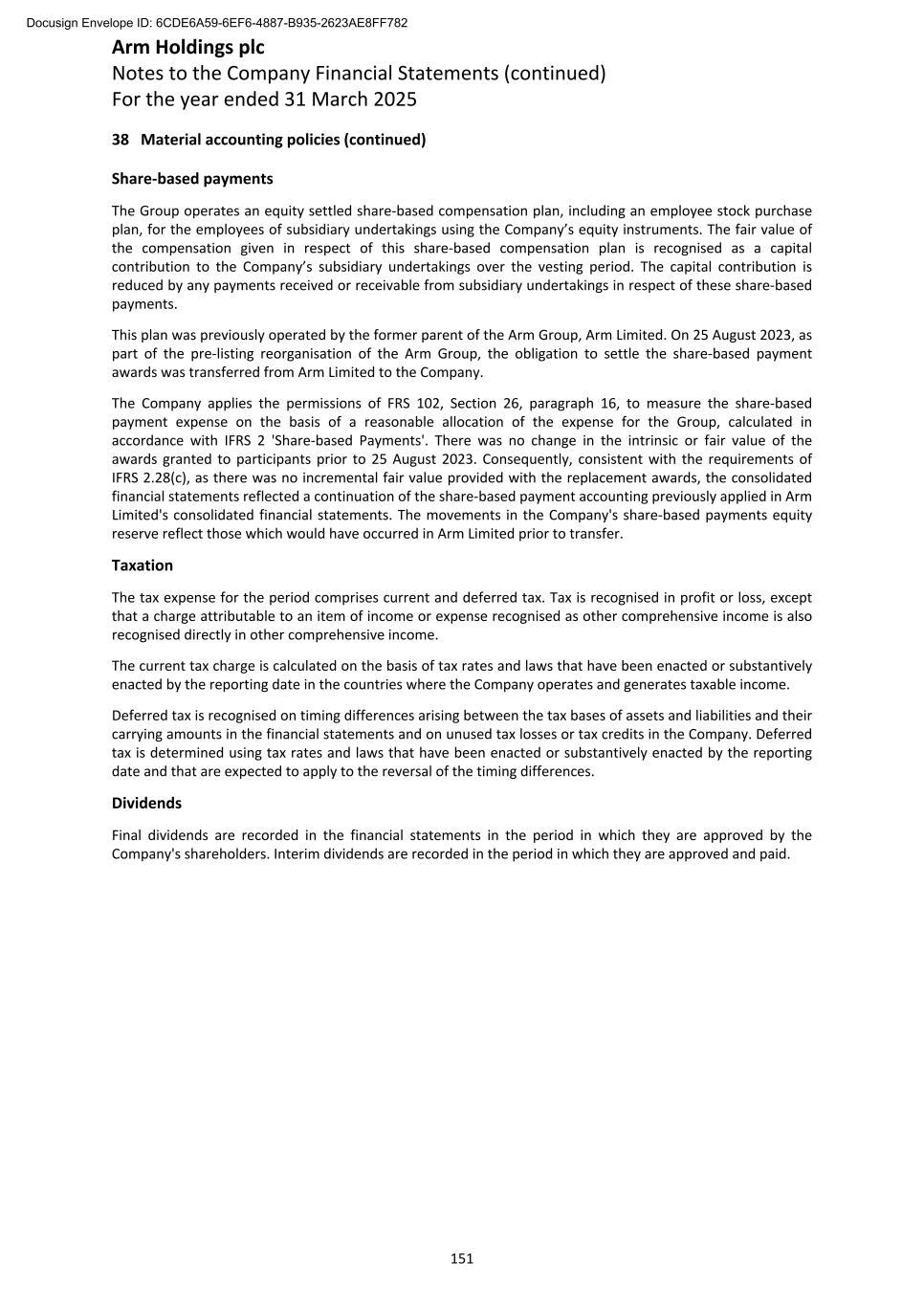
38 Material accounting policies (continued) Share-based payments The Group operates an equity settled share-based compensation plan, including an employee stock purchase plan, for the employees of subsidiary undertakings using the Company’s equity instruments. The fair value of the compensation given in respect of this share-based compensation plan is recognised as a capital contribution to the Company’s subsidiary undertakings over the vesting period. The capital contribution is reduced by any payments received or receivable from subsidiary undertakings in respect of these share-based payments. This plan was previously operated by the former parent of the Arm Group, Arm Limited. On 25 August 2023, as part of the pre-listing reorganisation of the Arm Group, the obligation to settle the share-based payment awards was transferred from Arm Limited to the Company. The Company applies the permissions of FRS 102, Section 26, paragraph 16, to measure the share-based payment expense on the basis of a reasonable allocation of the expense for the Group, calculated in accordance with IFRS 2 'Share-based Payments'. There was no change in the intrinsic or fair value of the awards granted to participants prior to 25 August 2023. Consequently, consistent with the requirements of IFRS 2.28(c), as there was no incremental fair value provided with the replacement awards, the consolidated financial statements reflected a continuation of the share-based payment accounting previously applied in Arm Limited's consolidated financial statements. The movements in the Company's share-based payments equity reserve reflect those which would have occurred in Arm Limited prior to transfer. Taxation The tax expense for the period comprises current and deferred tax. Tax is recognised in profit or loss, except that a charge attributable to an item of income or expense recognised as other comprehensive income is also recognised directly in other comprehensive income. The current tax charge is calculated on the basis of tax rates and laws that have been enacted or substantively enacted by the reporting date in the countries where the Company operates and generates taxable income. Deferred tax is recognised on timing differences arising between the tax bases of assets and liabilities and their carrying amounts in the financial statements and on unused tax losses or tax credits in the Company. Deferred tax is determined using tax rates and laws that have been enacted or substantively enacted by the reporting date and that are expected to apply to the reversal of the timing differences. Dividends Final dividends are recorded in the financial statements in the period in which they are approved by the Company's shareholders. Interim dividends are recorded in the period in which they are approved and paid. Arm Holdings plc Notes to the Company Financial Statements (continued) For the year ended 31 March 2025 151 Docusign Envelope ID: 6CDE6A59-6EF6-4887-B935-2623AE8FF782
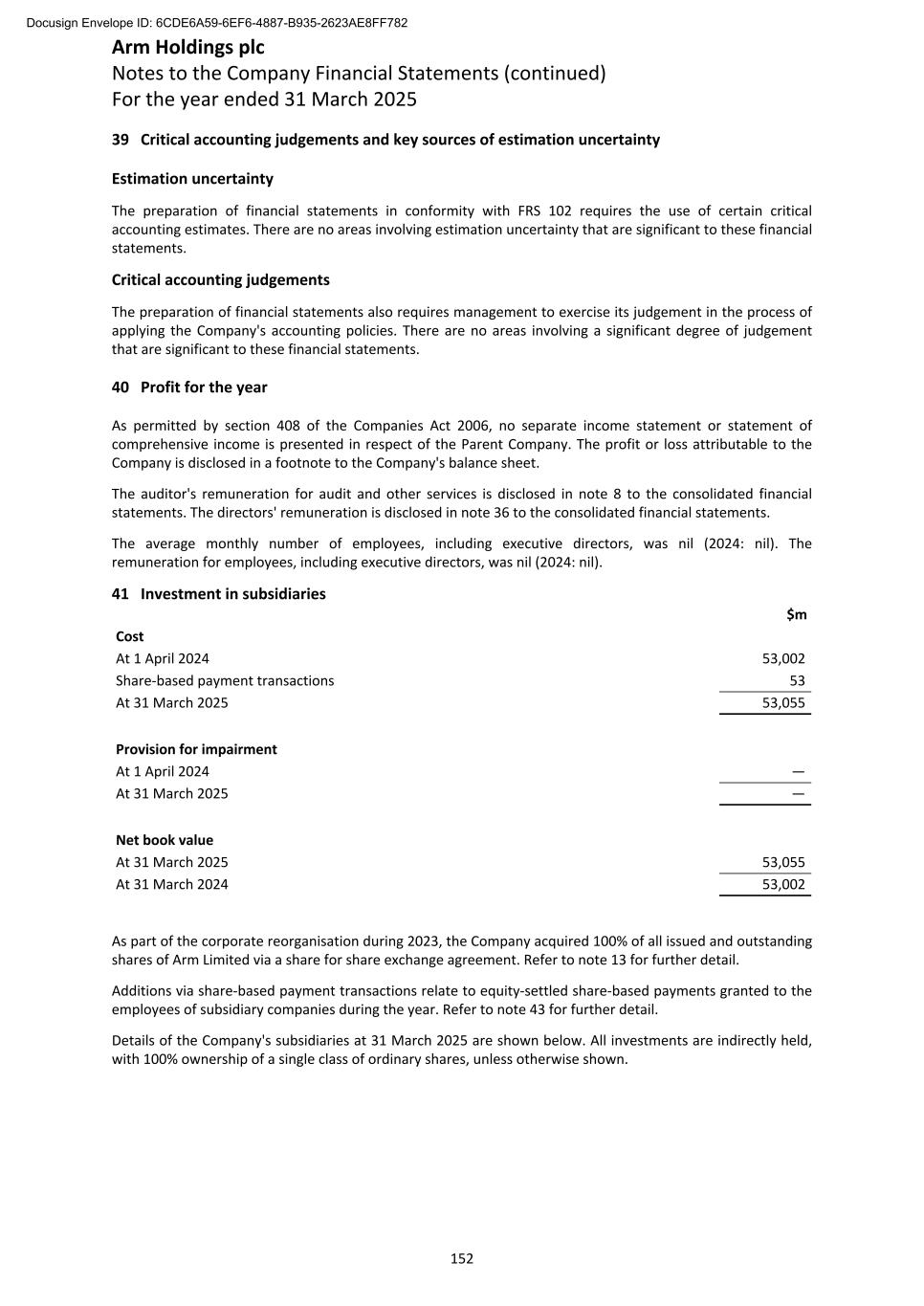
39 Critical accounting judgements and key sources of estimation uncertainty Estimation uncertainty The preparation of financial statements in conformity with FRS 102 requires the use of certain critical accounting estimates. There are no areas involving estimation uncertainty that are significant to these financial statements. Critical accounting judgements The preparation of financial statements also requires management to exercise its judgement in the process of applying the Company's accounting policies. There are no areas involving a significant degree of judgement that are significant to these financial statements. 40 Profit for the year As permitted by section 408 of the Companies Act 2006, no separate income statement or statement of comprehensive income is presented in respect of the Parent Company. The profit or loss attributable to the Company is disclosed in a footnote to the Company's balance sheet. The auditor's remuneration for audit and other services is disclosed in note 8 to the consolidated financial statements. The directors' remuneration is disclosed in note 36 to the consolidated financial statements. The average monthly number of employees, including executive directors, was nil (2024: nil). The remuneration for employees, including executive directors, was nil (2024: nil). 41 Investment in subsidiaries $m Cost At 1 April 2024 53,002 Share-based payment transactions 53 At 31 March 2025 53,055 Provision for impairment At 1 April 2024 — At 31 March 2025 — Net book value At 31 March 2025 53,055 At 31 March 2024 53,002 As part of the corporate reorganisation during 2023, the Company acquired 100% of all issued and outstanding shares of Arm Limited via a share for share exchange agreement. Refer to note 13 for further detail. Additions via share-based payment transactions relate to equity-settled share-based payments granted to the employees of subsidiary companies during the year. Refer to note 43 for further detail. Details of the Company's subsidiaries at 31 March 2025 are shown below. All investments are indirectly held, with 100% ownership of a single class of ordinary shares, unless otherwise shown. Arm Holdings plc Notes to the Company Financial Statements (continued) For the year ended 31 March 2025 152 Docusign Envelope ID: 6CDE6A59-6EF6-4887-B935-2623AE8FF782
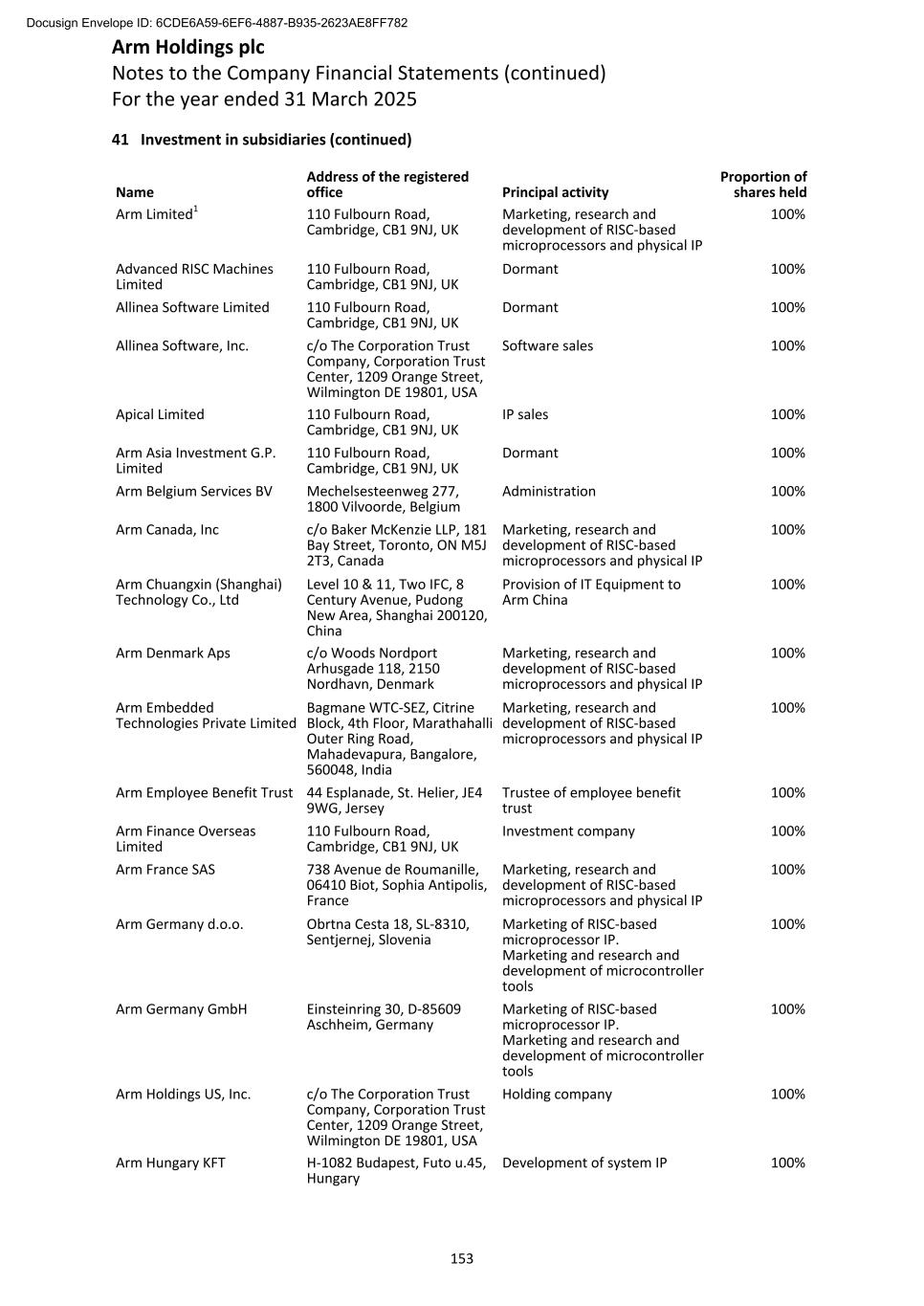
41 Investment in subsidiaries (continued) Name Address of the registered office Principal activity Proportion of shares held Arm Limited1 110 Fulbourn Road, Cambridge, CB1 9NJ, UK Marketing, research and development of RISC-based microprocessors and physical IP 100% Advanced RISC Machines Limited 110 Fulbourn Road, Cambridge, CB1 9NJ, UK Dormant 100% Allinea Software Limited 110 Fulbourn Road, Cambridge, CB1 9NJ, UK Dormant 100% Allinea Software, Inc. c/o The Corporation Trust Company, Corporation Trust Center, 1209 Orange Street, Wilmington DE 19801, USA Software sales 100% Apical Limited 110 Fulbourn Road, Cambridge, CB1 9NJ, UK IP sales 100% Arm Asia Investment G.P. Limited 110 Fulbourn Road, Cambridge, CB1 9NJ, UK Dormant 100% Arm Belgium Services BV Mechelsesteenweg 277, 1800 Vilvoorde, Belgium Administration 100% Arm Canada, Inc c/o Baker McKenzie LLP, 181 Bay Street, Toronto, ON M5J 2T3, Canada Marketing, research and development of RISC-based microprocessors and physical IP 100% Arm Chuangxin (Shanghai) Technology Co., Ltd Level 10 & 11, Two IFC, 8 Century Avenue, Pudong New Area, Shanghai 200120, China Provision of IT Equipment to Arm China 100% Arm Denmark Aps c/o Woods Nordport Arhusgade 118, 2150 Nordhavn, Denmark Marketing, research and development of RISC-based microprocessors and physical IP 100% Arm Embedded Technologies Private Limited Bagmane WTC-SEZ, Citrine Block, 4th Floor, Marathahalli Outer Ring Road, Mahadevapura, Bangalore, 560048, India Marketing, research and development of RISC-based microprocessors and physical IP 100% Arm Employee Benefit Trust 44 Esplanade, St. Helier, JE4 9WG, Jersey Trustee of employee benefit trust 100% Arm Finance Overseas Limited 110 Fulbourn Road, Cambridge, CB1 9NJ, UK Investment company 100% Arm France SAS 738 Avenue de Roumanille, 06410 Biot, Sophia Antipolis, France Marketing, research and development of RISC-based microprocessors and physical IP 100% Arm Germany d.o.o. Obrtna Cesta 18, SL-8310, Sentjernej, Slovenia Marketing of RISC-based microprocessor IP. Marketing and research and development of microcontroller tools 100% Arm Germany GmbH Einsteinring 30, D-85609 Aschheim, Germany Marketing of RISC-based microprocessor IP. Marketing and research and development of microcontroller tools 100% Arm Holdings US, Inc. c/o The Corporation Trust Company, Corporation Trust Center, 1209 Orange Street, Wilmington DE 19801, USA Holding company 100% Arm Hungary KFT H-1082 Budapest, Futo u.45, Hungary Development of system IP 100% Arm Holdings plc Notes to the Company Financial Statements (continued) For the year ended 31 March 2025 153 Docusign Envelope ID: 6CDE6A59-6EF6-4887-B935-2623AE8FF782
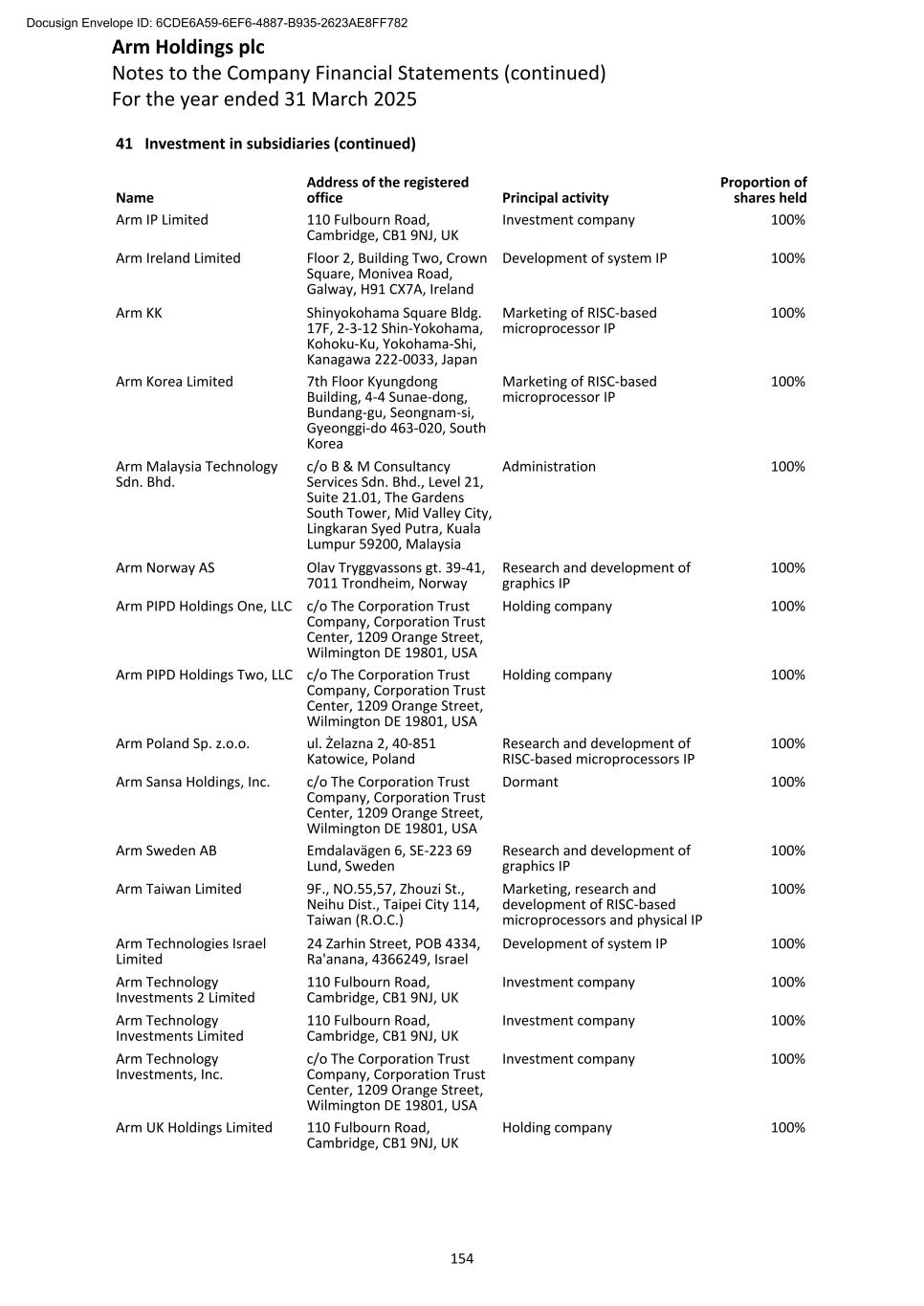
41 Investment in subsidiaries (continued) Name Address of the registered office Principal activity Proportion of shares held Arm IP Limited 110 Fulbourn Road, Cambridge, CB1 9NJ, UK Investment company 100% Arm Ireland Limited Floor 2, Building Two, Crown Square, Monivea Road, Galway, H91 CX7A, Ireland Development of system IP 100% Arm KK Shinyokohama Square Bldg. 17F, 2-3-12 Shin-Yokohama, Kohoku-Ku, Yokohama-Shi, Kanagawa 222-0033, Japan Marketing of RISC-based microprocessor IP 100% Arm Korea Limited 7th Floor Kyungdong Building, 4-4 Sunae-dong, Bundang-gu, Seongnam-si, Gyeonggi-do 463-020, South Korea Marketing of RISC-based microprocessor IP 100% Arm Malaysia Technology Sdn. Bhd. c/o B & M Consultancy Services Sdn. Bhd., Level 21, Suite 21.01, The Gardens South Tower, Mid Valley City, Lingkaran Syed Putra, Kuala Lumpur 59200, Malaysia Administration 100% Arm Norway AS Olav Tryggvassons gt. 39-41, 7011 Trondheim, Norway Research and development of graphics IP 100% Arm PIPD Holdings One, LLC c/o The Corporation Trust Company, Corporation Trust Center, 1209 Orange Street, Wilmington DE 19801, USA Holding company 100% Arm PIPD Holdings Two, LLC c/o The Corporation Trust Company, Corporation Trust Center, 1209 Orange Street, Wilmington DE 19801, USA Holding company 100% Arm Poland Sp. z.o.o. ul. Żelazna 2, 40-851 Katowice, Poland Research and development of RISC-based microprocessors IP 100% Arm Sansa Holdings, Inc. c/o The Corporation Trust Company, Corporation Trust Center, 1209 Orange Street, Wilmington DE 19801, USA Dormant 100% Arm Sweden AB Emdalavägen 6, SE-223 69 Lund, Sweden Research and development of graphics IP 100% Arm Taiwan Limited 9F., NO.55,57, Zhouzi St., Neihu Dist., Taipei City 114, Taiwan (R.O.C.) Marketing, research and development of RISC-based microprocessors and physical IP 100% Arm Technologies Israel Limited 24 Zarhin Street, POB 4334, Ra'anana, 4366249, Israel Development of system IP 100% Arm Technology Investments 2 Limited 110 Fulbourn Road, Cambridge, CB1 9NJ, UK Investment company 100% Arm Technology Investments Limited 110 Fulbourn Road, Cambridge, CB1 9NJ, UK Investment company 100% Arm Technology Investments, Inc. c/o The Corporation Trust Company, Corporation Trust Center, 1209 Orange Street, Wilmington DE 19801, USA Investment company 100% Arm UK Holdings Limited 110 Fulbourn Road, Cambridge, CB1 9NJ, UK Holding company 100% Arm Holdings plc Notes to the Company Financial Statements (continued) For the year ended 31 March 2025 154 Docusign Envelope ID: 6CDE6A59-6EF6-4887-B935-2623AE8FF782
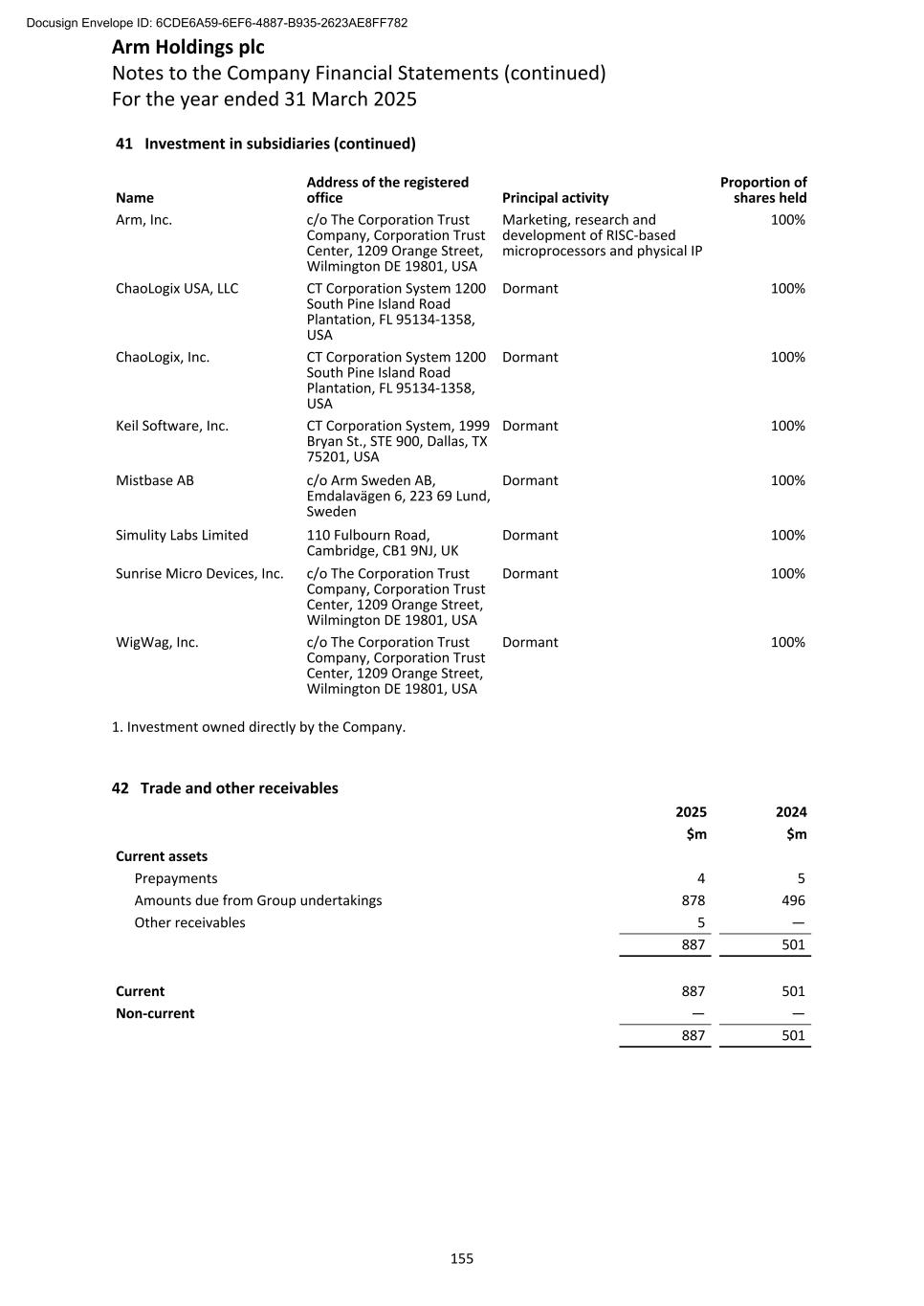
41 Investment in subsidiaries (continued) Name Address of the registered office Principal activity Proportion of shares held Arm, Inc. c/o The Corporation Trust Company, Corporation Trust Center, 1209 Orange Street, Wilmington DE 19801, USA Marketing, research and development of RISC-based microprocessors and physical IP 100% ChaoLogix USA, LLC CT Corporation System 1200 South Pine Island Road Plantation, FL 95134-1358, USA Dormant 100% ChaoLogix, Inc. CT Corporation System 1200 South Pine Island Road Plantation, FL 95134-1358, USA Dormant 100% Keil Software, Inc. CT Corporation System, 1999 Bryan St., STE 900, Dallas, TX 75201, USA Dormant 100% Mistbase AB c/o Arm Sweden AB, Emdalavägen 6, 223 69 Lund, Sweden Dormant 100% Simulity Labs Limited 110 Fulbourn Road, Cambridge, CB1 9NJ, UK Dormant 100% Sunrise Micro Devices, Inc. c/o The Corporation Trust Company, Corporation Trust Center, 1209 Orange Street, Wilmington DE 19801, USA Dormant 100% WigWag, Inc. c/o The Corporation Trust Company, Corporation Trust Center, 1209 Orange Street, Wilmington DE 19801, USA Dormant 100% 1. Investment owned directly by the Company. 42 Trade and other receivables 2025 2024 $m $m Current assets Prepayments 4 5 Amounts due from Group undertakings 878 496 Other receivables 5 — 887 501 Current 887 501 Non-current — — 887 501 Arm Holdings plc Notes to the Company Financial Statements (continued) For the year ended 31 March 2025 155 Docusign Envelope ID: 6CDE6A59-6EF6-4887-B935-2623AE8FF782
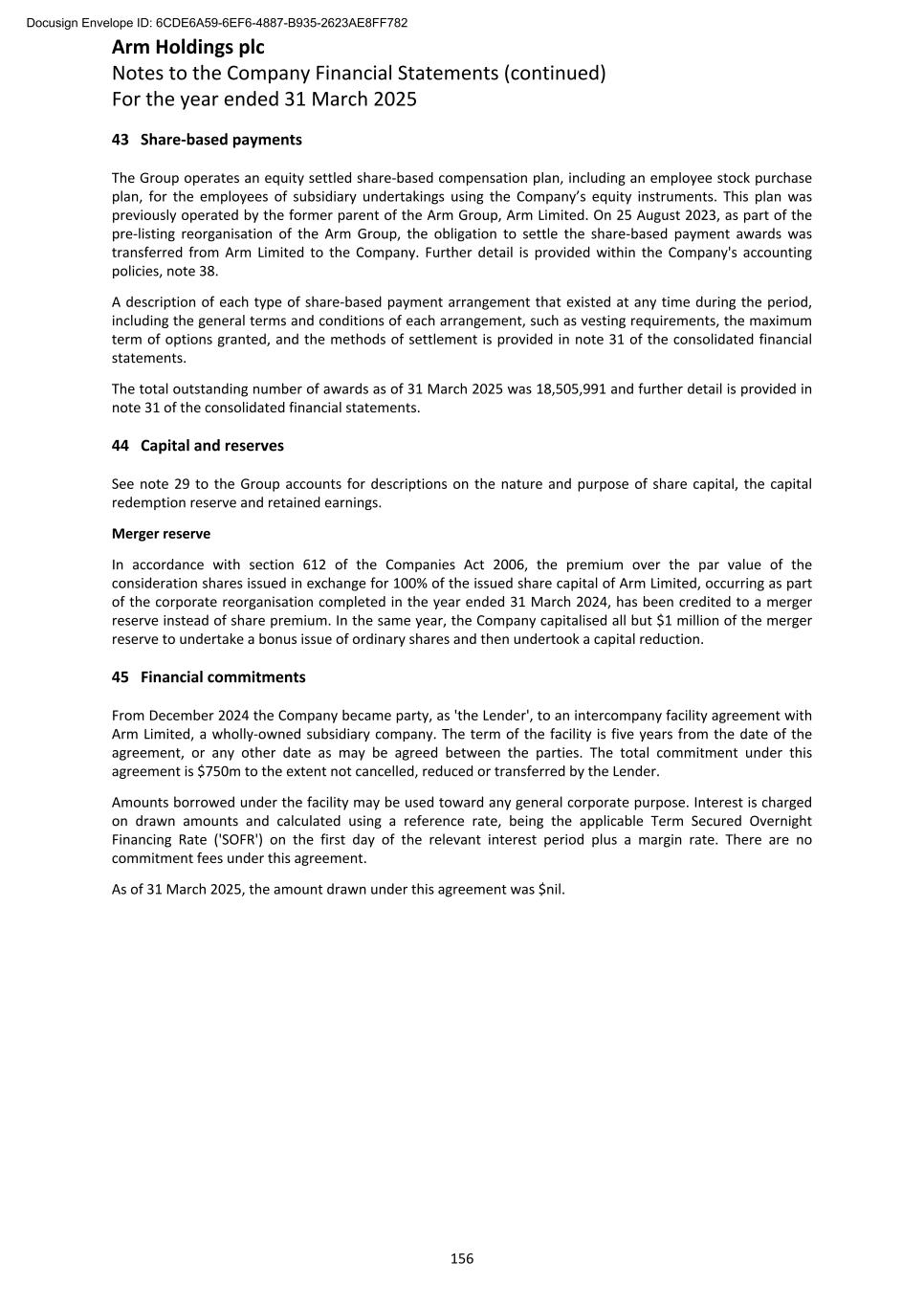
43 Share-based payments The Group operates an equity settled share-based compensation plan, including an employee stock purchase plan, for the employees of subsidiary undertakings using the Company’s equity instruments. This plan was previously operated by the former parent of the Arm Group, Arm Limited. On 25 August 2023, as part of the pre-listing reorganisation of the Arm Group, the obligation to settle the share-based payment awards was transferred from Arm Limited to the Company. Further detail is provided within the Company's accounting policies, note 38. A description of each type of share-based payment arrangement that existed at any time during the period, including the general terms and conditions of each arrangement, such as vesting requirements, the maximum term of options granted, and the methods of settlement is provided in note 31 of the consolidated financial statements. The total outstanding number of awards as of 31 March 2025 was 18,505,991 and further detail is provided in note 31 of the consolidated financial statements. 44 Capital and reserves See note 29 to the Group accounts for descriptions on the nature and purpose of share capital, the capital redemption reserve and retained earnings. Merger reserve In accordance with section 612 of the Companies Act 2006, the premium over the par value of the consideration shares issued in exchange for 100% of the issued share capital of Arm Limited, occurring as part of the corporate reorganisation completed in the year ended 31 March 2024, has been credited to a merger reserve instead of share premium. In the same year, the Company capitalised all but $1 million of the merger reserve to undertake a bonus issue of ordinary shares and then undertook a capital reduction. 45 Financial commitments From December 2024 the Company became party, as 'the Lender', to an intercompany facility agreement with Arm Limited, a wholly-owned subsidiary company. The term of the facility is five years from the date of the agreement, or any other date as may be agreed between the parties. The total commitment under this agreement is $750m to the extent not cancelled, reduced or transferred by the Lender. Amounts borrowed under the facility may be used toward any general corporate purpose. Interest is charged on drawn amounts and calculated using a reference rate, being the applicable Term Secured Overnight Financing Rate ('SOFR') on the first day of the relevant interest period plus a margin rate. There are no commitment fees under this agreement. As of 31 March 2025, the amount drawn under this agreement was $nil. Arm Holdings plc Notes to the Company Financial Statements (continued) For the year ended 31 March 2025 156 Docusign Envelope ID: 6CDE6A59-6EF6-4887-B935-2623AE8FF782
 エドガーで原本を確認する