0001937926FALSE2024FYiso4217:USDxbrli:sharesiso4217:USDxbrli:sharesxbrli:purebam:segmentbam:directoriso4217:CADxbrli:shares00019379262024-01-012024-12-3100019379262024-06-300001937926us-gaap:CommonClassAMember2025-03-070001937926us-gaap:CommonClassBMember2025-03-0700019379262024-12-3100019379262023-12-310001937926us-gaap:CommonClassAMember2024-12-310001937926us-gaap:CommonClassAMember2023-12-310001937926us-gaap:CommonClassBMember2024-12-310001937926us-gaap:CommonClassBMember2023-12-3100019379262023-01-012023-12-3100019379262022-07-042022-12-310001937926us-gaap:CommonClassAMember2024-01-012024-12-310001937926us-gaap:CommonClassAMember2023-01-012023-12-310001937926us-gaap:CommonClassAMember2022-07-042022-12-310001937926us-gaap:CommonStockMemberus-gaap:CommonClassAMember2022-07-030001937926us-gaap:CommonStockMemberus-gaap:CommonClassBMember2022-07-030001937926us-gaap:CommonStockMember2022-07-030001937926us-gaap:TreasuryStockCommonMember2022-07-030001937926us-gaap:AdditionalPaidInCapitalMember2022-07-030001937926us-gaap:RetainedEarningsMember2022-07-030001937926us-gaap:AccumulatedOtherComprehensiveIncomeMember2022-07-030001937926us-gaap:NoncontrollingInterestMember2022-07-0300019379262022-07-030001937926us-gaap:RetainedEarningsMember2022-07-042022-12-310001937926us-gaap:CommonStockMemberus-gaap:CommonClassAMember2022-07-042022-12-310001937926us-gaap:CommonStockMember2022-07-042022-12-310001937926us-gaap:TreasuryStockCommonMember2022-07-042022-12-310001937926us-gaap:CommonStockMemberus-gaap:CommonClassBMember2022-07-042022-12-310001937926us-gaap:AdditionalPaidInCapitalMember2022-07-042022-12-310001937926us-gaap:CommonStockMemberus-gaap:CommonClassAMember2022-12-310001937926us-gaap:CommonStockMemberus-gaap:CommonClassBMember2022-12-310001937926us-gaap:CommonStockMember2022-12-310001937926us-gaap:TreasuryStockCommonMember2022-12-310001937926us-gaap:AdditionalPaidInCapitalMember2022-12-310001937926us-gaap:RetainedEarningsMember2022-12-310001937926us-gaap:AccumulatedOtherComprehensiveIncomeMember2022-12-310001937926us-gaap:NoncontrollingInterestMember2022-12-3100019379262022-12-310001937926us-gaap:RetainedEarningsMember2023-01-012023-12-310001937926us-gaap:AccumulatedOtherComprehensiveIncomeMember2023-01-012023-12-310001937926us-gaap:CommonStockMemberus-gaap:CommonClassAMember2023-01-012023-12-310001937926us-gaap:AdditionalPaidInCapitalMember2023-01-012023-12-310001937926us-gaap:TreasuryStockCommonMember2023-01-012023-12-310001937926us-gaap:NoncontrollingInterestMember2023-01-012023-12-310001937926us-gaap:CommonStockMember2023-01-012023-12-310001937926us-gaap:CommonStockMemberus-gaap:CommonClassAMember2023-12-310001937926us-gaap:CommonStockMemberus-gaap:CommonClassBMember2023-12-310001937926us-gaap:CommonStockMember2023-12-310001937926us-gaap:TreasuryStockCommonMember2023-12-310001937926us-gaap:AdditionalPaidInCapitalMember2023-12-310001937926us-gaap:RetainedEarningsMember2023-12-310001937926us-gaap:AccumulatedOtherComprehensiveIncomeMember2023-12-310001937926us-gaap:NoncontrollingInterestMember2023-12-310001937926us-gaap:RetainedEarningsMember2024-01-012024-12-310001937926us-gaap:AccumulatedOtherComprehensiveIncomeMember2024-01-012024-12-310001937926us-gaap:CommonStockMemberus-gaap:CommonClassAMember2024-01-012024-12-310001937926us-gaap:CommonStockMember2024-01-012024-12-310001937926us-gaap:AdditionalPaidInCapitalMember2024-01-012024-12-310001937926us-gaap:TreasuryStockCommonMember2024-01-012024-12-310001937926us-gaap:NoncontrollingInterestMember2024-01-012024-12-310001937926us-gaap:CommonStockMemberus-gaap:CommonClassAMember2024-12-310001937926us-gaap:CommonStockMemberus-gaap:CommonClassBMember2024-12-310001937926us-gaap:CommonStockMember2024-12-310001937926us-gaap:TreasuryStockCommonMember2024-12-310001937926us-gaap:AdditionalPaidInCapitalMember2024-12-310001937926us-gaap:RetainedEarningsMember2024-12-310001937926us-gaap:AccumulatedOtherComprehensiveIncomeMember2024-12-310001937926us-gaap:NoncontrollingInterestMember2024-12-310001937926bam:BrookfieldAssetManagementULCMember2022-12-090001937926bam:AmericanEquityInvestmentLifeHoldingCompanyMemberbam:BrookfieldCorporationMember2024-05-022024-05-020001937926bam:AmericanEquityInvestmentLifeHoldingCompanyMemberbam:BrookfieldCorporationMember2024-05-020001937926bam:AmericanEquityInvestmentLifeHoldingCompanyMember2024-05-020001937926bam:BrookfieldAssetManagementULCMember2024-05-010001937926bam:BrookfieldAssetManagementULCMember2024-05-020001937926bam:BrookfieldAssetManagementULCMember2024-12-310001937926bam:BrookfieldAssetManagementULCMember2023-12-310001937926bam:BrookfieldCorporationMember2024-01-012024-12-310001937926bam:BrookfieldAssetManagementULCMember2024-05-020001937926bam:BrookfieldAssetManagementULCMember2024-01-012024-12-310001937926bam:AssetManagementBusinessSubsidiaryMember2024-01-012024-12-310001937926bam:BrookfieldAssetManagementULCMember2024-12-310001937926bam:BrookfieldAssetManagementULCMember2023-12-310001937926bam:BrookfieldAssetManagementULCMember2024-01-012024-12-310001937926bam:BrookfieldAssetManagementULCMember2023-01-012023-12-310001937926bam:BrookfieldAssetManagementULCMember2022-07-042022-12-3100019379262022-12-092022-12-310001937926us-gaap:VariableInterestEntityNotPrimaryBeneficiaryMember2024-12-310001937926us-gaap:VariableInterestEntityNotPrimaryBeneficiaryMember2023-12-310001937926us-gaap:EmployeeStockOptionMember2024-01-012024-12-310001937926us-gaap:EmployeeStockOptionMember2023-01-012023-12-310001937926us-gaap:EmployeeStockOptionMember2024-12-310001937926us-gaap:EmployeeStockOptionMember2023-12-310001937926bam:EscrowedSharesMember2024-01-012024-12-310001937926bam:EscrowedSharesMember2023-01-012023-12-310001937926bam:EscrowedSharesMember2023-12-310001937926bam:EscrowedSharesMember2024-12-310001937926us-gaap:EmployeeStockOptionMemberbam:ManagementShareOptionPlanMember2024-01-012024-12-310001937926us-gaap:EmployeeStockOptionMemberbam:ManagementShareOptionPlanMember2023-01-012023-12-310001937926us-gaap:EmployeeStockOptionMemberbam:ManagementShareOptionPlanMember2022-07-042022-12-310001937926bam:EscrowedSharesMemberbam:EscrowedStockPlanMember2024-01-012024-12-310001937926bam:EscrowedSharesMemberbam:EscrowedStockPlanMember2023-01-012023-12-310001937926bam:EscrowedSharesMemberbam:EscrowedStockPlanMember2022-07-042022-12-310001937926us-gaap:RestrictedStockMemberbam:RestrictedStockPlanMember2024-01-012024-12-310001937926us-gaap:RestrictedStockMemberbam:RestrictedStockPlanMember2023-01-012023-12-310001937926us-gaap:RestrictedStockMemberbam:RestrictedStockPlanMember2022-07-042022-12-310001937926bam:EquityAwardsMember2024-01-012024-12-310001937926bam:EquityAwardsMember2023-01-012023-12-310001937926bam:EquityAwardsMember2022-07-042022-12-310001937926bam:DeferredShareUnitMemberbam:DeferredShareUnitPlanMember2024-01-012024-12-310001937926bam:DeferredShareUnitMemberbam:DeferredShareUnitPlanMember2023-01-012023-12-310001937926bam:DeferredShareUnitMemberbam:DeferredShareUnitPlanMember2022-07-042022-12-310001937926us-gaap:RestrictedStockUnitsRSUMemberbam:RestrictedShareUnitPlanMember2024-01-012024-12-310001937926us-gaap:RestrictedStockUnitsRSUMemberbam:RestrictedShareUnitPlanMember2023-01-012023-12-310001937926us-gaap:RestrictedStockUnitsRSUMemberbam:RestrictedShareUnitPlanMember2022-07-042022-12-310001937926bam:CashSettledAwardsMember2024-01-012024-12-310001937926bam:CashSettledAwardsMember2023-01-012023-12-310001937926bam:CashSettledAwardsMember2022-07-042022-12-310001937926us-gaap:EmployeeStockOptionMemberbam:ManagementShareOptionPlanMember2023-12-310001937926bam:ManagementShareOptionPlanMemberbam:BrookfieldCorporationMemberus-gaap:EmployeeStockOptionMember2023-12-310001937926bam:ManagementShareOptionPlanMemberbam:BrookfieldCorporationMemberus-gaap:EmployeeStockOptionMember2024-01-012024-12-310001937926us-gaap:EmployeeStockOptionMemberbam:ManagementShareOptionPlanMember2024-12-310001937926bam:ManagementShareOptionPlanMemberbam:BrookfieldCorporationMemberus-gaap:EmployeeStockOptionMember2024-12-310001937926us-gaap:ShareBasedPaymentArrangementEmployeeMemberbam:ManagementShareOptionPlanMemberus-gaap:EmployeeStockOptionMember2024-12-310001937926us-gaap:EmployeeStockOptionMemberbam:ManagementShareOptionPlanMember2022-12-310001937926bam:ManagementShareOptionPlanMemberbam:BrookfieldCorporationMemberus-gaap:EmployeeStockOptionMember2022-12-310001937926bam:ManagementShareOptionPlanMemberbam:BrookfieldCorporationMemberus-gaap:EmployeeStockOptionMember2023-01-012023-12-310001937926us-gaap:ShareBasedPaymentArrangementEmployeeMemberbam:ManagementShareOptionPlanMemberus-gaap:EmployeeStockOptionMember2023-12-310001937926us-gaap:EmployeeStockOptionMemberbam:ManagementShareOptionPlanMember2022-07-030001937926bam:ManagementShareOptionPlanMemberbam:BrookfieldCorporationMemberus-gaap:EmployeeStockOptionMember2022-07-030001937926bam:ManagementShareOptionPlanMemberbam:BrookfieldCorporationMemberus-gaap:EmployeeStockOptionMember2022-07-042022-12-310001937926bam:EscrowedSharesMemberbam:EscrowedStockPlanMember2023-12-310001937926bam:EscrowedStockPlanMemberbam:BrookfieldAssetManagementULCMemberbam:EscrowedSharesMember2023-12-310001937926bam:EscrowedStockPlanMemberbam:BrookfieldCorporationMemberbam:EscrowedSharesMember2023-12-310001937926bam:EscrowedStockPlanMemberbam:BrookfieldAssetManagementULCMemberbam:EscrowedSharesMember2024-01-012024-12-310001937926bam:EscrowedStockPlanMemberbam:BrookfieldCorporationMemberbam:EscrowedSharesMember2024-01-012024-12-310001937926bam:EscrowedSharesMemberbam:EscrowedStockPlanMember2024-12-310001937926bam:EscrowedStockPlanMemberbam:BrookfieldAssetManagementULCMemberbam:EscrowedSharesMember2024-12-310001937926bam:EscrowedStockPlanMemberbam:BrookfieldCorporationMemberbam:EscrowedSharesMember2024-12-310001937926bam:EscrowedSharesMemberbam:EscrowedStockPlanMember2022-12-310001937926bam:EscrowedStockPlanMemberbam:BrookfieldCorporationMemberbam:EscrowedSharesMember2022-12-310001937926bam:EscrowedStockPlanMemberbam:BrookfieldCorporationMemberbam:EscrowedSharesMember2023-01-012023-12-310001937926bam:EscrowedSharesMemberbam:EscrowedStockPlanMember2022-07-030001937926bam:EscrowedStockPlanMemberbam:BrookfieldCorporationMemberbam:EscrowedSharesMember2022-07-030001937926bam:EscrowedStockPlanMemberbam:BrookfieldCorporationMemberbam:EscrowedSharesMember2022-07-042022-12-310001937926bam:DeferredShareUnitMemberbam:DeferredShareUnitPlanMember2022-01-012022-12-310001937926bam:DeferredShareUnitsTrackingToBrookfieldAssetManagementLtdSharePriceMemberbam:BrookfieldCorporationMember2023-12-310001937926bam:DeferredShareUnitsTrackingToBNSharePriceMemberbam:BrookfieldCorporationMember2023-12-310001937926us-gaap:RestrictedStockUnitsRSUMemberbam:BrookfieldCorporationMember2023-12-310001937926bam:DeferredShareUnitsTrackingToBrookfieldAssetManagementLtdSharePriceMemberbam:BrookfieldCorporationMember2024-01-012024-12-310001937926bam:DeferredShareUnitsTrackingToBNSharePriceMemberbam:BrookfieldCorporationMember2024-01-012024-12-310001937926us-gaap:RestrictedStockUnitsRSUMemberbam:BrookfieldCorporationMember2024-01-012024-12-310001937926bam:DeferredShareUnitsTrackingToBrookfieldAssetManagementLtdSharePriceMemberbam:BrookfieldCorporationMember2024-12-310001937926bam:DeferredShareUnitsTrackingToBNSharePriceMemberbam:BrookfieldCorporationMember2024-12-310001937926us-gaap:RestrictedStockUnitsRSUMemberbam:BrookfieldCorporationMember2024-12-310001937926bam:DeferredShareUnitsTrackingToBrookfieldAssetManagementLtdSharePriceMemberbam:BrookfieldCorporationMember2022-12-310001937926bam:DeferredShareUnitsTrackingToBNSharePriceMemberbam:BrookfieldCorporationMember2022-12-310001937926us-gaap:RestrictedStockUnitsRSUMemberbam:BrookfieldCorporationMember2022-12-310001937926bam:DeferredShareUnitsTrackingToBrookfieldAssetManagementLtdSharePriceMemberbam:BrookfieldCorporationMember2023-01-012023-12-310001937926bam:DeferredShareUnitsTrackingToBNSharePriceMemberbam:BrookfieldCorporationMember2023-01-012023-12-310001937926us-gaap:RestrictedStockUnitsRSUMemberbam:BrookfieldCorporationMember2023-01-012023-12-310001937926bam:DeferredShareUnitsTrackingToBrookfieldAssetManagementLtdSharePriceMemberbam:BrookfieldCorporationMember2022-07-030001937926bam:DeferredShareUnitsTrackingToBNSharePriceMemberbam:BrookfieldCorporationMember2022-07-030001937926us-gaap:RestrictedStockUnitsRSUMemberbam:BrookfieldCorporationMember2022-07-030001937926bam:DeferredShareUnitsTrackingToBrookfieldAssetManagementLtdSharePriceMemberbam:BrookfieldCorporationMember2022-07-042022-12-310001937926bam:DeferredShareUnitsTrackingToBNSharePriceMemberbam:BrookfieldCorporationMember2022-07-042022-12-310001937926us-gaap:RestrictedStockUnitsRSUMemberbam:BrookfieldCorporationMember2022-07-042022-12-310001937926us-gaap:CommonClassBMember2024-01-012024-12-310001937926us-gaap:CommonClassBMember2023-01-012023-12-310001937926us-gaap:CommonClassBMember2022-07-042022-12-310001937926us-gaap:EmployeeStockOptionMember2024-01-012024-12-310001937926us-gaap:EmployeeStockOptionMember2023-01-012023-12-310001937926us-gaap:EmployeeStockOptionMember2022-07-042022-12-310001937926bam:EscrowSharesMember2024-01-012024-12-310001937926bam:EscrowSharesMember2023-01-012023-12-310001937926bam:EscrowSharesMember2022-07-042022-12-310001937926us-gaap:RestrictedStockUnitsRSUMember2024-01-012024-12-310001937926us-gaap:RestrictedStockUnitsRSUMember2023-01-012023-12-310001937926us-gaap:RestrictedStockUnitsRSUMember2022-07-042022-12-310001937926us-gaap:EquityMethodInvesteeMember2024-12-310001937926us-gaap:EquityMethodInvesteeMemberbam:AssetManagementServicesAgreementMember2024-01-012024-12-310001937926us-gaap:EquityMethodInvesteeMemberbam:AssetManagementServicesAgreementMember2023-01-012023-12-310001937926us-gaap:EquityMethodInvesteeMemberbam:AssetManagementServicesAgreementMember2022-01-012022-12-310001937926srt:AffiliatedEntityMemberbam:RelationshipAgreementMember2024-01-012024-12-310001937926srt:AffiliatedEntityMemberbam:RelationshipAgreementMember2023-01-012023-12-310001937926srt:AffiliatedEntityMemberbam:RelationshipAgreementMember2022-01-012022-12-310001937926srt:AffiliatedEntityMemberbam:TransitionalServicesAgreementMember2024-01-012024-12-310001937926srt:AffiliatedEntityMemberbam:TransitionalServicesAgreementMember2023-01-012023-12-310001937926srt:AffiliatedEntityMemberbam:TransitionalServicesAgreementMember2022-01-012022-12-310001937926srt:AffiliatedEntityMember2024-12-310001937926srt:AffiliatedEntityMember2023-12-310001937926us-gaap:SubsequentEventMember2025-02-110001937926bam:AssetManagementBusinessSubsidiaryMemberus-gaap:SubsequentEventMember2025-02-040001937926us-gaap:SubsequentEventMemberbam:BrookfieldCorporationMemberbam:AssetManagementCompanyMember2025-02-04
UNITED STATES
SECURITIES AND EXCHANGE COMMISSION
Washington, D.C. 20549
FORM 10-K
(Mark one)
|
|
|
|
|
|
|
|
|
| ☒ |
|
ANNUAL REPORT UNDER SECTION 13 OR 15(d) OF THE SECURITIES EXCHANGE ACT OF 1934 |
For the fiscal year ended December 31, 2024.
|
|
|
|
|
|
|
|
|
| ☐ |
|
TRANSITION REPORT UNDER SECTION 13 OR 15(d) OF THE SECURITIES EXCHANGE ACT OF 1934 |
Commission file number: 001-41563
BROOKFIELD ASSET MANAGEMENT LTD.
(Exact name of registrant as specified in its charter)
|
|
|
|
|
|
|
|
|
| British Columbia, Canada |
|
98-1702516 |
(State or other jurisdiction of
incorporation or organization) |
|
(I.R.S. Employer
Identification No.) |
Brookfield Place
250 Vesey Street, 15th Floor
New York, NY 10281-0221
(Address of principal executive offices)
(212) 417-7000
(Registrant’s telephone number, including area code)
Securities registered pursuant to Section 12(b) of the Act:
|
|
|
|
|
|
|
|
|
|
|
|
|
|
|
| Title of each class |
|
Trading
Symbol(s) |
|
Name of each exchange
on which registered |
| Class A Limited Voting Shares |
|
BAM |
|
New York Stock Exchange |
Securities registered pursuant to Section 12(g) of the Act:
None
Indicate by check mark if the registrant is a well-known seasoned issuer, as defined in Rule 405 of the Securities Act. Yes☒ No☐
Indicate by check mark if the registrant is not required to file reports pursuant to Section 13 or Section 15(d) of the Act.
Yes☐ No☒ Indicate by check mark whether the registrant (1) has filed all reports required to be filed by Section 13 or 15(d) of the Securities Exchange Act of 1934 during the preceding 12 months (or for such shorter period that the registrant was required to file such reports), and (2) has been subject to such filing requirements for the past 90 days. Yes☒ No☐
Indicate by check mark whether the registrant has submitted electronically every Interactive Data File required to be submitted pursuant to Rule 405 of Regulation S-T (§229.405 of this chapter) during the preceding 12 months (or for such shorter period that the registrant was required to submit and post such files). Yes☒ No☐
Indicate by check mark whether the registrant is a large accelerated filer, an accelerated filer, a non-accelerated filer, a smaller reporting company, or an emerging growth company. See definitions of “large accelerated filer,” “accelerated filer,” “smaller reporting company,” and “emerging growth company” in Rule 12b-2 of the Exchange Act. (Check one):
|
|
|
|
|
|
|
|
|
|
|
|
|
|
|
|
|
|
|
|
|
| Large accelerated filer |
|
☒ |
|
Accelerated filer |
|
☐ |
|
|
|
|
|
|
|
| Non-accelerated filer |
|
☐ |
|
Smaller reporting company |
|
☐ |
|
|
|
|
|
|
|
| Emerging growth company |
|
☐ |
|
|
|
|
If an emerging growth company, indicate by check mark if the registrant has elected not to use the extended transition period for complying with any new or revised financial accounting standards provided pursuant to Section 13(a) of the Exchange Act. ☐
Indicate by check mark whether the registrant has filed a report on and attestation to its management’s assessment of the effectiveness of its internal control over financial reporting under Section 404(b) of the Sarbanes-Oxley (15 U.S.C. 7262(b)) by the registered public accounting firm that prepared or issued its audit report. ☒
If securities are registered pursuant to Section 12(b) of the Act, indicate by check mark whether the financial statements of the registrant included in the filing reflect the correction of an error to previously issued financial statements. ☐
Indicate by check mark whether any of those error corrections are restatements that required a recovery analysis of incentive-based compensation received by any of the other registrant’s executive officers during the relevant recovery period pursuant to §240.10D-1(b). ☐
Indicate by check mark whether registrant is a shell company (as defined in Rule 12b-2 of the Act). Yes☐ No☒
As of June 30, 2024, the aggregate market value of the Class A Limited Voting Shares held by non-affiliates of the registrant was $16.0 billion.
As of March 7, 2025, the registrant had 1,637,295,707 Class A Limited Voting Shares and 21,280 Class B Limited Voting Shares outstanding.
EXPLANATORY NOTE
Brookfield Asset Management Ltd. (“BAM”) is a New York based asset manager, yet qualifies as an eligible Canadian issuer under the Multijurisdictional Disclosure System and as a “foreign private issuer” as such term is defined in Rule 405 under the U.S. Securities Act of 1933, as amended, and Rule 3b-4 under the U.S. Securities Exchange Act of 1934, as amended. Although, as a foreign private issuer, BAM is not required to do so, BAM intends to voluntarily file annual reports on Form 10-K, quarterly reports on Form 10-Q, and current reports on Form 8-K with the SEC instead of filing the reporting forms available to foreign private issuers.
BAM intends to prepare and file a management information circular and related materials under Canadian requirements that will not be filed pursuant to Regulation 14A.
BROOKFIELD ASSET MANAGEMENT LTD.
FORM 10-K
For the Year Ended December 31, 2024
TABLE OF CONTENTS
|
|
|
|
|
|
|
|
|
|
|
|
|
|
|
| Item 1. |
|
|
| Item 1A. |
|
|
| Item 1B. |
|
|
| Item 1C. |
|
|
| Item 2. |
|
|
| Item 3. |
|
|
| Item 4. |
|
|
|
|
|
| Item 5. |
|
|
| Item 6. |
|
|
| Item 7. |
|
|
| Item 7A. |
|
|
| Item 8. |
|
|
| Item 9. |
|
|
| Item 9A. |
|
|
| Item 9B. |
|
|
| Item 9C. |
|
|
|
|
|
| Item 10. |
|
|
| Item 11. |
|
|
| Item 12. |
|
|
| Item 13. |
|
|
| Item 14. |
|
|
|
|
|
| Item 15. |
|
|
| Item 16. |
|
|
|
|
|
|
|
|
|
|
|
CAUTIONARY STATEMENT REGARDING FORWARD-LOOKING STATEMENTS
This report contains forward-looking statements within the meaning of Section 27A of the Securities Act of 1933, as amended (the “Securities Act”), Section 21E of the Securities Exchange Act of 1934, as amended (the “Exchange Act”) and forward-looking information within the meaning of other relevant securities legislation, including applicable securities laws in Canada, which reflect our current views with respect to, among other things, our operations and financial performance. You can identify these forward-looking statements by the use of words such as “outlook”, “believe”, “think”, “expect”, “potential”, “continue”, “may”, “should”, “seek”, “approximately”, “predict”, “intend”, “will”, “plan”, “estimate”, “anticipate”, the negative version of these words, other comparable words or other statements that do not relate strictly to historical or factual matters. These statements identify prospective information. Important factors could cause actual results to differ, possibly materially, from those indicated in these statements. Forward-looking statements are based on our beliefs, assumptions and expectations of our future performance, taking into account all information currently available to us. Such forward-looking statements are subject to risks and uncertainties and assumptions relating to our operations, financial results, financial condition, business prospects, growth strategy and liquidity.
We believe these factors include those described in the section entitled “Risk Factors” in this Annual Report on Form 10-K (our “Annual Report” or “report”). These factors should be read in conjunction with the other cautionary statements that are included in this report and in our other filings with the U.S. Securities and Exchange Commission (the “SEC”). We do not undertake any obligation to publicly update or revise any forward-looking statement, whether as a result of new information, future developments or otherwise, except as required by law.
CERTAIN TERMS USED IN THIS REPORT
In this report, references to “BAM Ltd.” or “BAM” refer to Brookfield Asset Management Ltd. References to our “asset management business”, the “Asset Management Company”, “BAM ULC”, or the “Company” refer to Brookfield Asset Management ULC, and references to “we”, “us”, “our” means our asset management business and BAM, individually or collectively, where applicable. The term “BN” means Brookfield Corporation and its subsidiaries (including the perpetual affiliates (as defined below)) other than the Asset Management Company and its subsidiaries and does not, for greater certainty, include BAM, BWS (as defined below) or Oaktree (as defined below) and their affiliates. The term “Brookfield” means BAM, BN and the Asset Management Company, collectively.
Additional information about BAM is available on our website at https://bam.brookfield.com and on the EDGAR section of the SEC website at www.sec.gov. The information on our website is not, and shall not be deemed to be, a part of this report or incorporated by reference into any other filings we make with the SEC. Information is also available on the Canadian Securities Administrators’ (“CSA”) website at www.sedarplus.ca.
Unless the context suggests otherwise, references to:
•“2022 Arrangement” means the court approved plan of arrangement involving BN as a result of which (i) the shareholders of BN, while retaining their shares of BN, became shareholders of BAM, which acquired a 25% interest in our asset management business through common shares of the Asset Management Company, and (ii) BN changed its name from “Brookfield Asset Management Inc.” to “Brookfield Corporation”;
•“2025 Arrangement” has the meaning ascribed thereto on page
16;
•“2025 Plan of Arrangement” has the meaning ascribed thereto on page
16;
•“AEL” means American Equity Investment Life Holding Company;
•“AEL Mandate” means the May 2, 2024 acquisition of AEL by BWS through its subsidiary American National Group LLC. We manage AEL insurance capital under an investment management agreement with AEL operating companies;
•“AMSA” means the Asset Management Services Agreement dated December 9, 2022 between BAM and BAM ULC;
•“Asset Management Services Agreement” means the agreement dated November 8, 2022 between BAM and the Asset Management Company to govern the provision of services by BAM’s employees to the Asset Management Company on a cost recovery basis under a perpetual agreement, as further described in Note 1 “Organization” of the Consolidated Financial Statements of BAM;
•“Assets Under Management” or “AUM” has the meaning ascribed thereto under “Item 7 - Key Financial and Operating Measures”;
•“BAM Credit Facility” means the credit agreement dated November 8, 2022 between BAM and the Asset Management Company, pursuant to which the Asset Management Company has provided a five-year revolving $500 million credit facility to BAM, as further described under “Part II—Item 7. Management's Discussion and Analysis of Financial Condition and Results of Operations—Liquidity and Capital Resources”;
•“BAM Partnership” means BAM Partners Trust;
•“BBU” means Brookfield Business Partners L.P., together with its subsidiaries including its paired corporation, Brookfield Business Corporation;
•“BCP” means Brookfield Capital Partners;
•“BEP” means Brookfield Renewable Partners L.P., together with its subsidiaries including its paired corporation, Brookfield Renewable Corporation;
•“BGTF” means Brookfield Global Transition Fund;
•“BIP” means Brookfield Infrastructure Partners L.P., together with its subsidiaries including its paired corporation, Brookfield Infrastructure Corporation;
•“BN” means Brookfield Corporation;
•“Board” means the board of directors of BAM;
•“BPG” means Brookfield Property Group, including Brookfield Property Partners L.P. and BN’s wholly-owned real estate directly held entities;
•“BPREP” means Brookfield Premier Real Estate Partners;
•“BPY” means Brookfield Property Partners, together with its subsidiaries;
•“Brookfield REIT” means Brookfield Real Estate Income Trust;
•“BSI” means Brookfield Special Investments;
•“BSIP” means Brookfield Super-Core Infrastructure Partners;
•“BSREP” means Brookfield Strategic Real Estate Partners;
•“BWS” means Brookfield Wealth Solutions Ltd., a paired entity to BN offering a range of retirement services, wealth protection products and tailored capital solutions;
•“Castlelake” means our 51% economic interest in Fee-Related Earnings, 7.5% interest in carried interest, 20% of returns from GP commitments of Castlelake, and 51% of GP commitments for in-market and future Castlelake funds acquired on September 16, 2024;
•“Class A Shares” means the class A limited voting shares in the capital of BAM;
•“Class B Shares” means the class B limited voting shares in the capital of BAM;
•“Code” means the U.S. Internal Revenue Code of 1986, as amended;
•“Code of Conduct” means the code of business conduct and ethics of BAM;
•“corporate liquidity” consists of cash, short-term financial assets, as well as the undrawn portions of the $300 million revolving credit facility established on November 8, 2022, with BN as lender, and a $750 million five-year revolving credit facility established on August 29, 2024, through bilateral agreements with a group of third party lenders;
•“CORRA” means the Canadian Overnight Repo Rate Average;
•“CRA” means the Canada Revenue Agency;
•“CTF” means Catalytic Transition Fund;
•“Distributable Earnings”, a non-GAAP measure, has the meaning ascribed thereto under “Part II—Item 7. Management's Discussion and Analysis of Financial Condition and Results of Operations—Key Financial and Operating Measures”;
•“Fee-Bearing Capital”, a non-GAAP measure, has the meaning ascribed thereto under “Part II—Item 7. Management's Discussion and Analysis of Financial Condition and Results of Operations—Key Financial and Operating Measures”;
•“Fee-Related Earnings”, a non-GAAP measure, has the meaning ascribed thereto under “Part II—Item 7. Management's Discussion and Analysis of Financial Condition and Results of Operations—Key Financial and Operating Measures”;
•“Fee Revenues”, a non-GAAP measure, has the meaning ascribed thereto under “Part II—Item 7. Management's Discussion and Analysis of Financial Condition and Results of Operations—Key Financial and Operating Measures”;
•“Investment Company Act” means the United States Investment Company Act of 1940, as amended;
•“IRS” means the United States Internal Revenue Service;
•“GEMS Education” means our warehoused investment in a Dubai-based international education provider, GEMS Education, acquired on July 12, 2024, as part of a Brookfield-led consortium of investors including the Asset Management Company, BSI, BWS, and certain co-investors;
•“Group deployable capital” consists of: (1) corporate liquidity of the Company and the perpetual affiliates, and (2) uncalled private fund commitments, which are third-party commitments available for drawdown in the private funds of our asset management business;
•“managed assets” means the businesses, operations and other assets managed by BN prior to completion of the 2022 Arrangement and to be managed by BAM and our asset management business following completion of the 2022 Arrangement;
•“mature fund” means a Brookfield fund which has already significantly deployed upon completion of the 2022 Arrangement;
•“new sponsored fund” or “new fund” means a Brookfield fund launched on or after the date of the 2022 Arrangement;
•“Oaktree” means Oaktree Capital Management, L.P., together with its affiliates, Oaktree Capital II, L.P. General (“OCM II General”), Oaktree Capital II, L.P. Manager (“OCM II Manager”), Oaktree Capital II, L.P New Fund (“OCM II New Fund”), Oaktree AIF Investments, L.P., Oaktree Capital Management (Cayman) L.P. and Oaktree Investment Holdings, L.P. and their consolidated subsidiaries;
•“perpetual affiliates” means BEP, BIP, BBU and BPG;
•“PFIC” means a passive foreign investment company for U.S. federal income tax purposes;
•“Pinegrove Ventures” means our acquisition of the investment platform business of SVB Financial Group, SVB Capital (rebranded to Pinegrove Ventures after acquisition), acquired on September 26, 2024 through Pinegrove Venture Partners (“Pinegrove”), our venture investment platform formed with Sequoia Heritage;
•“Pretium” means our 11% economic interest in Pretium acquired on June 29;
•“PVI” means Partners Value Investments L.P., a publicly-listed investment partnership whose principal business activity is owning equity interests in Brookfield for the long-term.
•“Relationship Agreement” means the agreement dated November 8, 2022 among BN, BAM and the Asset Management Company to govern aspects of their relationship following the 2022 Arrangement, as further described under Note 1 “Organization” of the Consolidated Financial Statements of BAM;
•“SOFR” means the Secured Overnight Financing Rate published by the Federal Reserve Bank of New York (or a successor administrator);
•“Tax Act” means the Income Tax Act (Canada);
•“Transitional Services Agreement” means the agreement dated November 8, 2022 among BN, BAM and the Asset Management Company described under Note 1 “Organization” of the Consolidated Financial Statements of BAM;
•“Trust Agreement” means the agreement dated December 9, 2022 among BAM, the BAM Partnership and Computershare Trust Company of Canada relating to the Class B Shares
•“Uncalled Fund Commitments”, a non-GAAP measure, has the meaning ascribed thereto under “Part II—Item 7. Management's Discussion and Analysis of Financial Condition and Results of Operations—Key Financial and Operating Measures”;
•“U.S. Holder” is a beneficial owner of Class A Shares that for U.S. federal income tax purposes is: (1) an individual who is a citizen or resident of the United States, (2) a corporation (or other entity classified as a corporation for U.S. federal income tax purposes) created or organized in the United States, any state thereof, or the District of Columbia, (3) an estate the income of which is subject to U.S. federal income taxation regardless of its source, or (4) a trust if (i) a court within the United States is able to exercise primary supervision over the administration of the trust and one or more U.S. persons have the authority to control all substantial decisions of the trust, or (ii) the trust has a valid election in effect under applicable Treasury Regulations to be treated as a U.S. person for U.S. federal income tax purposes; and
•“Voting Agreement” means the agreement dated December 9, 2022 between BN and BAM providing for the election of directors of the Asset Management Company. The Voting Agreement was terminated on February 4, 2025 upon completion of the 2025 Arrangement.
BAM and the Asset Management Company prepare their financial statements in conformity with the accounting principles generally accepted in the United States of America (“U.S. GAAP”). This report discloses a number of non-GAAP financial and supplemental financial measures which are utilized in monitoring our asset management business, including for performance measurement, capital allocation and valuation purposes.
BAM believes that providing these performance measures is helpful to investors in assessing the overall performance of our asset management business. These non-GAAP financial measures should not be considered as the sole measure of BAM's or our asset management business’ performance and should not be considered in isolation from, or as a substitute for, similar financial measures calculated in conformity with U.S. GAAP financial measures. These non-GAAP financial measures are not standardized financial measures and may not be comparable to similar financial measures used by other issuers. Non-GAAP measures include, but are not limited to: (i) distributable earnings (“Distributable Earnings”), (ii) fee revenues (“Fee Revenues”) and (iii) fee-related earnings (“Fee-Related Earnings” or “FRE”). Supplemental financial measures include assets under management (“AUM”), fee-bearing capital (“Fee-Bearing Capital”) and uncalled fund commitments (“Uncalled Fund Commitments”). The asset management business includes the asset management activities of Oaktree, an equity accounted affiliate, in its key financial and operating measures for the asset management business.
For more information on non-GAAP measures and other financial metrics, see “Part II—Item 7. Management's Discussion and Analysis of Financial Condition and Results of Operations—Key Financial and Operating Measures”. Reconciliations of these non-GAAP financial measures to the most directly comparable financial measures calculated and presented in accordance with U.S. GAAP, where applicable, are included in “Part II—Item 7. Management's Discussion and Analysis of Financial Condition and Results of Operations—Reconciliation of U.S. GAAP to Non-GAAP Measures” in this report.
The financial information contained in this report is presented in U.S. dollars and, unless otherwise indicated, all references to “$” are to U.S. dollars. All references to C$ are to Canadian dollars. All information in this report is presented as at December 31, 2024, unless otherwise noted.
SUMMARY RISK FACTORS
The following is a summary of the risk factors associated with investing in our securities. You should read this summary together with a more detailed description of these risks in the “Risk Factors” section of this report and in other filings that we make from time to time with the SEC.
We are subject to risks related to our business, including risks involving:
•volatility in the trading price of the Class A Shares;
•deficiencies in public company financial reporting and disclosures;
•the difficulty for investors to effect service of process and enforce judgments in various jurisdictions;
•being subjected to numerous laws, rules and regulatory requirements;
•the potential ineffectiveness of our policies to prevent violations of applicable law;
•foreign currency risk and exchange rate fluctuations;
•further increases in interest rates;
•political instability or changes in government;
•unfavorable economic conditions or changes in the industries in which we operate;
•inflationary pressures;
•catastrophic events, such as earthquakes, hurricanes, or pandemics/epidemics;
•ineffective management of sustainability considerations, and inadequate or ineffective health and safety programs;
•failure of our information technology systems;
•us and our managed assets becoming involved in legal disputes;
•losses not covered by insurance;
•inability to collect on amounts owing to us;
•operating and financial restrictions through covenants in our loan, debt and security agreements;
•the material assets of BAM consist solely of its interest in the common shares of the Asset Management Company; and
•our liability for our asset management business.
We are subject to risks related to our investment strategies, including risks involving:
•our ability to maintain our global reputation;
•risks related to our renewable power and transition, infrastructure, private equity, real estate, and credit strategies;
•the impact on growth in Fee-Bearing Capital of poor product development or marketing efforts;
•meeting our financial obligations due to our cash flow from our asset management business;
•our acquisitions;
•requirement of temporary investments and backstop commitments to support our asset management business;
•revenues impacted by a decline in the size or pace of investments made by our managed assets;
•our earnings growth can vary, which may affect our dividend and the trading price of the Class A Shares;
•exposed risk due to increased amount and type of investment products in our managed assets; and
•information barriers that may give rise to conflicts and risks.
We are subject to risks related to our organizational structure and ownership, including risks involving:
•BN exercising substantial influence over BAM;
•BN transferring the ownership of BAM to a third party;
•potential conflicts of interest with BN; and
•difficulty in maintaining our culture or managing our human capital.
We are subject to risks related to taxation, including risks involving:
•United States and Canadian taxation laws and changes thereto.
We caution that the foregoing list of important factors that may affect future results is not exhaustive and other factors could also adversely affect future results. Readers are urged to consider these risks, as well as other uncertainties, factors and assumptions carefully in evaluating the forward-looking statements and are cautioned not to place undue reliance on such forward-looking statements, which are based only on information available to us as of the date of this report and such other date specified herein.
Certain of the information contained herein is based on or derived from information provided by independent third-party sources. While BAM believes that such information is accurate as of the date it was produced and that the sources from which such information has been obtained are reliable, BAM makes no representation or warranty, express or implied, with respect to the accuracy, reasonableness or completeness of any of the information or the assumptions on which such information is based, contained herein, including but not limited to, information obtained from third parties.
PART I
ITEM 1. BUSINESS
Business Overview
We are a leading global alternative asset manager, headquartered in New York, NY, with over $1 trillion of Assets Under Management across renewable power and transition, infrastructure, private equity, real estate, and credit. Our objective is to generate attractive, long-term risk-adjusted returns for the benefit of our clients and shareholders.
We manage a range of public and private investment products and services for institutional and retail clients. We earn asset management income for doing so and ensure strong alignment of interests with our clients by investing Brookfield capital alongside them. Our access to large-scale capital enables us to make investments in sizeable, premier assets and businesses across geographies and asset classes that we believe few others can.
To do this, we leverage our team of over 2,500 investment and asset management professionals, our global reach, deep operating expertise, and access to large-scale capital to identify attractive investment opportunities and invest on a proprietary basis. Our investment approach and strong track record have been the foundation and driver of our growth.
We provide a highly diversified suite of alternative investment strategies to our clients and are constantly seeking to innovate new strategies to meet their needs. We have over 50 unique active strategies that span a wide range of risk-adjusted returns, including opportunistic, value-add, core, super-core, and credit. We evaluate the performance of these product offerings and our investment strategies using a number of non-GAAP measures. BAM utilizes Fee-Bearing Capital, Fee Revenues, Fee-Related Earnings and Distributable Earnings to assess the performance of our asset management business.
We are in a fortunate position to be trusted with our clients’ capital and our objective is to meet their financial goals and provide for a better financial future while providing market leading experience. Our team of over 300 client service professionals across 19 global offices are dedicated to ensuring that the business exceeds our clients’ service expectations.
We have over 2,300 clients, with some of our clients being among the world’s largest institutional investors, including sovereign wealth funds, pension plans, endowments, foundations, financial institutions, and insurance companies.
Our guiding principle is to operate our business and conduct our relationships with the highest level of integrity. Our emphasis on a culture of collaboration allows us to attract and retain top talent.
BAM's Class A Limited Voting Shares (the “Class A Shares”) are co-listed on the New York Stock Exchange (“NYSE”) and the Toronto Stock Exchange (“TSX”) under the symbol “BAM”.
Value Creation
We create shareholder value by increasing the earnings profile of our asset management business. Alternative asset management businesses such as ours are typically valued based on a multiple of their Fee-Related Earnings and performance income. Accordingly, we create value by increasing the amount and quality of Fee-Related Earnings and performance income, net of associated costs. We achieve this by raising more Fee-Bearing Capital and delivering strong investment performance, which enables us to generate performance income, such as carried interest, while maintaining efficient operating margins.
As at December 31, 2024, we had Fee-Bearing Capital of $539 billion, of which 87% is long-dated or perpetual in nature, providing significant stability to our earnings profile. We consider Fee-Bearing Capital that is long-dated or perpetual in nature to be Fee-Bearing Capital relating to our long-term private funds, which are typically committed for at least 10 years with two one-year extension options, and Fee-Bearing Capital relating to our perpetual strategies, which include our permanent capital vehicles as well as capital we manage in our perpetual private fund and private wealth strategies. We seek to increase our Fee-Bearing Capital by growing the size of our existing product offerings and developing new strategies that cater to our clients’ investment needs. We also aim to deepen our existing institutional relationships, develop new institutional relationships, and access new distribution channels, such as high net worth individuals and retail.
As of December 31, 2024, we had a diversified client base of over 2,300 clients, which continues to grow. Our private wealth channel also continues to grow and represents over 8% of capital raised. We have a dedicated team of over 150 people that are focused on distributing and developing catered products to the private wealth channel.
As we grow our Fee-Bearing Capital, we earn incremental base management fees. In order to support this growth, we have grown our team of investment and asset management professionals. Our costs are predominantly in the form of compensation for the over 2,500 professionals we employ globally.
When deploying our clients’ capital, we seek to leverage our competitive advantages to acquire high-quality real assets and essential service businesses that form the backbone of the global economy. We use our global reach and access to scale capital to source attractive investment opportunities and leverage our deep operating expertise to underwrite investments and create value through active asset management.
Our goal is to deliver superior investment returns to our clients and successfully doing so should result in the growth of realized carried interest over time.
We generate robust Distributable Earnings, which is a key measure of our financial performance. Distributable Earnings of BAM represent the Distributable Earnings from the Asset Management Company. BAM intends to pay out approximately 90% of its Distributable Earnings to shareholders quarterly and reinvest the balance back into the business, as discussed further in “Part II—Item 7. Management's Discussion and Analysis of Financial Condition and Results of Operations—Key Financial and Operating Measures.”
We are actively progressing new organic growth strategies, including transition and secondaries. We are also pursuing strategic M&A opportunities that would expand our capabilities. These new initiatives, in addition to our existing strategies, are expected to have a very meaningful impact on our growth trajectory in the long term as BAM continues to be the partner of choice for investors. An example of such growth is the partnership we formed with Oaktree in 2019, which deepened the capabilities we offer our clients and better positions us across market cycles. Such acquisitions may occur from time to time should they be additive to our franchise, attractive to our clients, and accretive to our shareholders.
Competitive Advantages
We seek to harness the following four distinct competitive advantages that enable us to consistently identify and invest in high-quality assets and create significant value in the assets that we invest in and operate on behalf of our clients.
Operating Expertise
We are supported globally by approximately 250,000 operating employees of our managed businesses, who are instrumental in maximizing the value and cash flows of our managed assets. We believe that strong operating experience is essential in maximizing efficiency and productivity – and ultimately, returns. We do this by maintaining a culture of long-term focus, alignment of interest and collaboration through the people we hire, our compensation philosophy, and our operating philosophy. This operating expertise developed through our heritage as an owner-operator is invaluable in underwriting investments, conducting thorough due diligence, and executing value-creating development and capital projects.
Global Reach
We invest on behalf of our clients in more than 30 countries on five continents around the world. We believe that our global reach allows us to diversify and identify a broad range of opportunities. We can invest where capital is scarce, and we believe that our scale enables us to move quickly and pursue multiple opportunities across different markets. Our global reach also allows us to operate our assets more effectively: we believe that a strong on-the-ground presence is critical to operating successfully in many of our markets, and many of our businesses are truly local. Furthermore, the combination of our strong local presence and global reach enables us to bring relationships and operating practices to bear across markets to enhance returns.
Large Scale
We had over $1 trillion in Assets Under Management and $539 billion in Fee-Bearing Capital as of December 31, 2024. We offer our investors a large selection of private funds that have global mandates and diversified strategies. Our access to large-scale, flexible capital allows us to pursue transactions on a scale beyond the reach of many, delivering superior risk-adjusted returns.
Brookfield Ecosystem
The unique intelligence we generate from the ongoing interconnectivity between our over $1 trillion of Assets Under Management, our global partnerships and our visibility into global capital flows helps us identify themes and trends in investing, spot pockets of value and source attractive investment opportunities as BAM continues to be the partner of choice for investors. This competitive advantage has allowed us to build leading positions in assets classes that are most in favor among investors and deliver strong investment returns to our clients across multiple business cycles.
Investment Process
Our Investment Process Leads to Value Creation
Earning robust returns on the investments we make on behalf of our clients enhances our ability to increase our Fee-Bearing Capital and generates carried interest, both of which grow our cash flows and create value for our shareholders.
1. Raise Capital
As an asset manager, the starting point of the investment cycle is establishing new funds and other investment products for our clients. This in turn provides the capital to invest, from which we earn base management fees, incentive distributions and performance-based returns such as carried interest. Accordingly, we create value by increasing our amount of Fee-Bearing Capital and by achieving strong investment performance, which leads to growth in Fee-Bearing Capital and increased cash flows.
2. Identify and Invest in High-Quality Assets
We follow a value-based approach to investing and allocating capital. We believe that our disciplined approach, global reach and operating expertise afford us access to a wide range of potential opportunities and enable us to invest at attractive valuations and generate superior risk-adjusted returns for our clients. We also leverage our considerable expertise in executing recapitalizations, operational turnarounds and large development and capital projects, providing additional opportunities to deploy capital.
3. Secure Long-Term Financing
For our equity investments we finance the investments on behalf of our clients predominantly on a long-term investment-grade basis and asset-by-asset, which are primarily non-recourse. This financing approach provides us with considerable stability, improves our ability to withstand financial downturns and enables our asset management teams to focus on operations and other growth initiatives.
4. Enhance Value and Cash Flows Through Operating Expertise
We use our operating capabilities to increase the value of the assets within our product offerings and the cash flows they produce, and they help to protect our clients’ capital in adverse conditions. The combination of operating expertise, development capabilities and effective financing can help ensure that an investment’s full value creation potential is realized, which we believe is one of our most important competitive advantages.
5. Realize Capital from Asset Sales or Refinancing
We actively monitor opportunities to sell or refinance assets to generate proceeds for our investors. Capital generated in our limited life funds is returned to investors, and in the case of our perpetual funds, we then redeploy the capital to enhance returns. In many cases, returning capital from private funds completes the investment process, locks in investor returns and gives rise to performance income.
Products and Principal Strategies
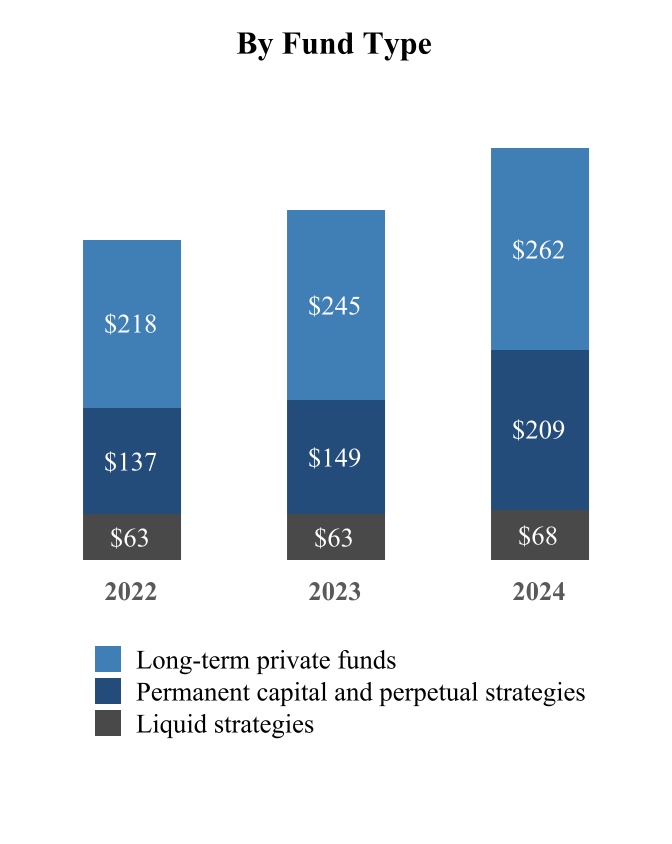
Our products broadly fall into one of three categories: (i) long-term private funds, (ii) permanent capital vehicles and perpetual strategies, and (iii) liquid strategies. These are invested across five principal strategies: (i) renewable power and transition, (ii) infrastructure, (iii) real estate, (iv) private equity, and (v) credit.
Renewable Power and Transition
Overview
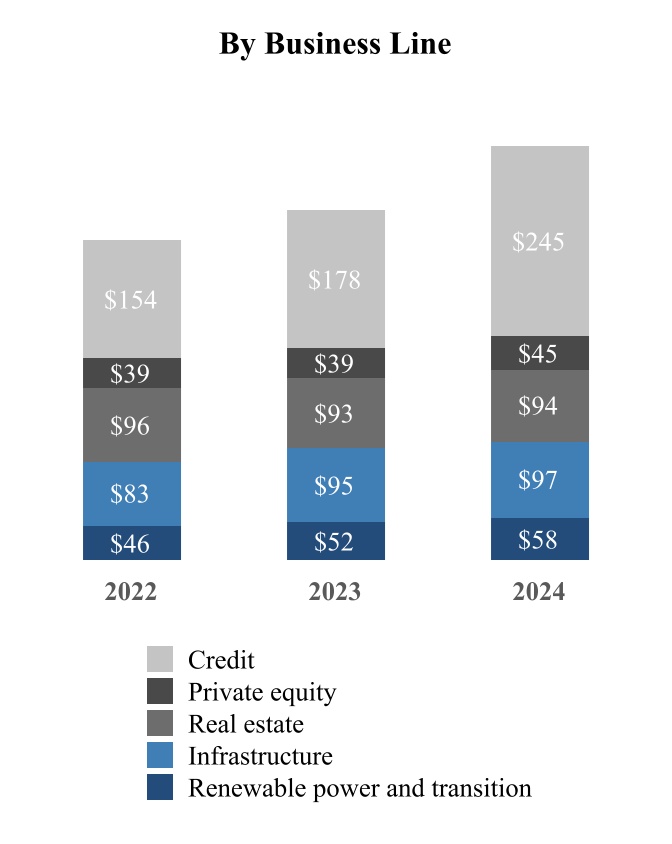
•We are one of the largest investors in renewable power and transition investments, with $126 billion of AUM and $58 billion of Fee-Bearing Capital as of December 31, 2024.
•We believe that the growing global demand for low-cost, low-carbon energy, especially amongst corporate off-takers, will lead to continued growth opportunities for us in the future. The investment environment for renewable power and transition remains favorable and we expect to continue to advance our substantial pipeline of renewable power and transition opportunities on behalf of our clients and managed assets.
•We have approximately 145 investment and asset management professionals globally that are focused on our renewable power and transition strategy, supported by approximately 17,800 operating employees in the renewable power and transition operating businesses that we manage. Our extensive experience and knowledge in this industry enable us to be a leader in all major technologies with deep operating and development capabilities.
Our Products
Long-term Private Funds
•Brookfield Global Transition Fund (“BGTF”) is our flagship transition fund series which is focused on investments aimed at accelerating the global transition to a net-zero carbon economy. The mandate of this product is to assist utility, energy and industrial businesses to reduce carbon dioxide emissions, expand low-carbon and renewable energy production and advance sustainable solutions.
•Our recently launched Catalytic Transition Fund (“CTF”) focuses on directing capital into clean energy and transition assets in emerging markets in South and Central America, South and Southeast Asia, the Middle East, and Eastern Europe. CTF will help drive clean energy investment in emerging markets.
Permanent Capital Vehicles and Perpetual Strategies
•We also manage Brookfield Renewable Partners L.P. (“BEP”), one of the world’s largest publicly traded renewable power platforms, which is listed on the NYSE and TSX and had a market capitalization of over $16.0 billion as of December 31, 2024.
Across our renewable power and transition products, we have invested on behalf of our clients in:
•Hydroelectric operations, through river systems and facilities that provide electricity and have grid stabilizing capabilities;
•Utility solar operations that harness energy from the sun to generate electricity;
•Distributed energy and storage which provides small-scale generation that can be locally installed, and pump storage facilities;
•Wind operations that use turbines to create electricity; and
•Sustainable solutions including renewable natural gas, carbon capture and storage, recycling, cogeneration biomass, nuclear services, and power transformation.
Infrastructure
Overview
•We are one of the world’s largest investment managers in infrastructure, with $202 billion of AUM and $97 billion of Fee-Bearing Capital as of December 31, 2024.
•We focus on acquiring high-quality real assets and operating businesses on behalf of our clients that deliver essential goods and services, diversified across the utilities, transport, midstream and data infrastructure sectors. We partner closely with management teams to enable long-term success through operational and other improvements.
•We have approximately 220 investment and asset management professionals globally that are focused on our infrastructure strategy, supported by approximately 61,000 operating employees in the infrastructure operating businesses that we manage.
Our Products
Long-term Private Funds
•Brookfield Infrastructure Fund (“BIF”) is our flagship infrastructure fund series. In this product offering, we invest on behalf of our clients in high-quality infrastructure assets on a value basis and seek to add value through the investment life cycle by utilizing our operations-oriented approach.
•Brookfield Infrastructure Structured Solutions Fund (“BISS”) seeks to invest structured equity and non-control common equity in the infrastructure mid-market. The fund is focused on deploying our deep capabilities to partner with sponsors, developers, and corporates to access attractive development opportunities.
Permanent Capital Vehicles and Perpetual Strategies
•We manage Brookfield Infrastructure Partners L.P. (“BIP”), one of the largest, pure-play, publicly traded global infrastructure platforms, which is listed on the NYSE and TSX and had a market capitalization of $26.3 billion as of December 31, 2024.
•We manage Brookfield Super-Core Infrastructure Partners (“BSIP”), which is our perpetual infrastructure private fund strategy. In this product offering, we invest on behalf of our clients in core infrastructure assets in developed markets, with a focus on yield, diversification, and inflation-protection.
•We also manage Brookfield Infrastructure Income Fund, a semi-liquid infrastructure strategy, offering private wealth investors access to our best-in-class infrastructure platform.
The infrastructure investments that we manage provide a diversified exposure for our clients to scarce, high-quality businesses that benefit from significant barriers to entry and deliver essential goods and services to generate resilient and inflation-protected cash flow streams. Through the various products outlined, we have invested in:
•Regulated or contracted businesses that earn a return on an asset base, including electricity and gas connections, natural gas pipelines and electricity transmission lines;
•Systems involved in the movement of freight, commodities and passengers, including rail operations, toll roads, terminal and export facilities;
•Assets that handle the movement and storage of commodities from a source of supply to a demand center, including transmission pipelines, natural gas process plants and natural gas storage; and
•Businesses that provide essential services and critical infrastructure to transmit and store data globally, including telecom towers and active rooftop sites, fiber optic cable and data centers.
Real Estate
Overview
•We are one of the world’s largest investment managers in real estate, with over $271 billion of AUM and $94 billion of Fee-Bearing Capital as of December 31, 2024.
•We have invested, on behalf of clients, in iconic properties in the world’s most dynamic markets with the goal of generating stable and growing distributions for our investors while protecting them against downside risk.
•We have approximately 650 investment and asset management professionals that are focused on generating superior returns across our real estate strategies, supported by approximately 24,500 operating employees in the real estate operating businesses that we manage.
Our Products
Long-term Private Funds
•Our opportunistic real estate flagship fund series is Brookfield Strategic Real Estate Partners (“BSREP”). Through this product, we invest globally across various sectors and geographies on behalf of our clients in high-quality real estate with a focus on large, complex, distressed assets, turnarounds, and recapitalizations.
•We also manage a real estate secondaries strategy, Brookfield Real Estate Secondaries, with a focus on providing liquidity solutions for other real estate general partners.
Permanent Capital Vehicles and Perpetual Strategies
•We manage $17 billion of Fee-Bearing Capital in Brookfield Property Group (“BPG”) as of December 31, 2024, which we invest, on behalf of BN, directly in real estate assets. BPG owns, operates, and develops iconic properties in the world’s most dynamic markets with a global portfolio of office, retail, multifamily, logistics, hospitality, land and housing, triple net lease, manufactured housing, and student housing assets on five continents.
•We also manage capital in our perpetual private fund real estate strategy, Brookfield Premier Real Estate Partners (“BPREP”). This is a core plus strategy that invests in high-quality, stabilized real assets located primarily in the U.S. with a focus on office, retail, multifamily and logistics real estate assets. We also have two regional BPREP strategies that are dedicated specifically to investments in Australia and Europe.
•We also manage a non-traded REIT, Brookfield Real Estate Income Trust (“Brookfield REIT”), which is a semi-liquid strategy catering specifically to the private wealth channel. This product invests in high quality income-producing opportunities globally through equity or real estate-related debt.
Through the various products outlined, we have invested in multiple asset classes including:
•Office properties in key gateway cities in the U.S., Canada, the U.K., Germany, Australia, Brazil and India;
•High-quality retail destinations that are central gathering places for the communities they serve, combining shopping, dining, entertainment and other activities;
•Full-service hotels and leisure-style hospitality assets in high-barrier markets across North America, the U.K. and Australia; and
•High-quality assets with operational upside across multifamily, alternative living, life sciences and logistics sectors globally.
Private Equity
Overview
•We have one of the best long-term track records for investing in private equity with $145 billion of AUM and $45 billion of Fee-Bearing Capital as of December 31, 2024.
•We focus on high-quality businesses that provide essential products and services, diversified across business services and industrials sectors. We partner closely with management teams to enable long-term success through operational and other improvements.
•We have approximately 270 investment and asset management professionals globally that are focused on our private equity strategy, supported by approximately 142,900 operating employees in the businesses that we manage.
Our Products
Long-term Private Funds
•Our global opportunistic flagship fund series, Brookfield Capital Partners (“BCP”), is our leading private equity offering. The series of funds focuses on cash-flowing industrial and essential service businesses. We seek investments that benefit from high barriers to entry and enhance their cash flow capabilities by improving strategy and execution.
•Our special investments strategy, Brookfield Special Investments (“BSI”), is focused on structured, large-scale, non-control investments. This product capitalizes on transactions that do not fit our traditional control-oriented flagship private equity fund series. Situations may include recapitalization or strategic growth capital where we expect to generate equity-like returns while ensuring downside protection through contracted returns.
•Our thematic private equity strategy, Brookfield Financial Infrastructure Partners, focuses on investments in asset-light financial infrastructure companies that underpin the global financial system.
•Our regional private equity strategy, Brookfield Middle East Partners, is focused on opportunistically investing across sectors and countries in the Middle East by drawing on Brookfield’s global footprint and value-add as a strategic partner.
•Our venture capital strategy, Pinegrove Ventures, manages investments in the innovation economy and is uniquely positioned to access highly sought-after opportunities in high quality venture-backed companies and funds.
Permanent Capital Vehicles and Perpetual Strategies
•We manage Brookfield Business Partners L.P. (“BBU”), which is a publicly traded global business services and industrials company focused on owning and operating high-quality providers of essential products and services. BBU is listed on the NYSE and TSX and had a market capitalization of $5.2 billion as at December 31, 2024.
Our private equity vehicles acquire high-quality operations globally. The broad investment mandate provides us with the flexibility to invest on behalf of our clients across multiple industries through many forms. Through the various products outlined above, we have invested on behalf of our clients in:
•Leading service providers to large-scale infrastructure assets, including a leading provider of work access services, modular building leasing services, and a leading global provider of lottery services and technology solutions;
•Operationally intense industrial businesses that benefit from a strong competitive position, including a leading global provider of advanced automotive battery technology, a leading global aviation services and leasing business, and a leading manufacturer of engineered components for industrial trailers and other towable equipment providers, among others; and
•Essential services providers, including the largest private sector residential mortgage insurer in Canada, a leading value-add distributor of telecom equipment, a leading provider of software and technology services to automotive dealers, and one of the largest private school operators globally.
Credit
Overview
•We are one of the world’s largest and most experienced credit managers globally, with $317 billion of AUM and $245 billion of Fee-Bearing Capital as of December 31, 2024.
•We seek to provide flexible, specialized capital solutions to borrowers and deliver attractive risk-adjusted returns to our clients across a range of debt strategies, focusing on private credit and direct lending in areas in which we possess differentiated investment and operational capabilities.
•We have approximately 230 investment and asset management professionals globally that are focused on our credit strategies, investing across a broad spectrum of investments, leveraging the capabilities we have organically built in collaboration with the capabilities of leading credit managers with whom we partner.
Our Products
•Our flagship opportunistic credit strategy, Global Opportunities, seeks to generate current income and long-term capital appreciation by investing in private loans to large private-equity-owned companies with a focus on protecting against losses by buying claims on assets at discounted prices. We aim to achieve substantial gains by actively participating in restructurings to restore companies to financial viability and creating value at every stage of the investment process.
•Brookfield Infrastructure Debt is our infrastructure debt fund series, which invests on behalf of our clients in mezzanine debt investments in high-quality, infrastructure assets.
•Brookfield Real Estate Finance Fund is our commercial real estate debt fund series, which targets investments in transactions that are senior to traditional equity and subordinate to first mortgages or investment-grade corporate debt.
•In addition to several other credit strategies, we also provide tailored separately managed accounts for our clients, with private credit investment programs designed for each of our clients’ specific risk, return, and prudential requirements. Each client’s private credit investment portfolio can be customized across multiple dimensions, including asset class, credit quality, duration, sector, and geography, with proprietary access to our broad-based private credit origination capabilities.
The credit investments that we manage enable our clients to have exposure to a broad range of credit strategies, including:
•Private Credit strategies focusing on underwriting and managing directly sourced credit investments on behalf of our clients, across various sectors, including infrastructure, renewable energy, real estate, corporate credit, royalties, aviation, equipment finance, as well as consumer and SME credit;
•Opportunistic Credit strategies that are designed to capitalize on market dislocations and inefficiencies to generate high returns. These strategies typically involve investing in distressed or special situations where credit is undervalued or overlooked by traditional investors;
•Structured Credit strategies investing across structured and asset-backed finance opportunities in real estate, fund finance, aviation, consumer and corporate credit and more; and
•Liquid Credit strategies investing across a broad spectrum of public debt securities, from investment-grade to high-yield.
Development of the Business
Our asset management business is owned and operated through the Asset Management Company, which, as of February 4, 2025, is wholly-owned by BAM.
BAM is headquartered in New York, NY and was incorporated on July 4, 2022. BAM and the Asset Management Company were formed by BN to facilitate the 2022 Arrangement. The 2022 Arrangement, which closed on December 9, 2022, involved the division of Brookfield Asset Management Inc. into two publicly traded companies: BAM, a pure-play, leading global alternative asset management business; and BN, a leading global investment firm focused on building long-term wealth for institutions and individuals around the world.
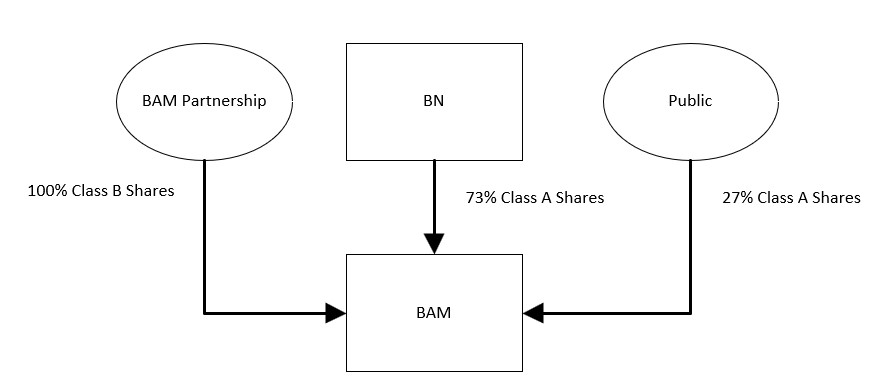
As at December 31, 2024, BAM owned approximately 27% of the Asset Management Company. On February 4, 2025, BAM completed a corporate restructuring with BN by way of a court-approved plan of arrangement (the “2025 Plan of Arrangement”), which was originally announced on October 31, 2024, whereby BN transferred its approximate 73% interest in the Asset Management Company to BAM in exchange for newly issued Class A Shares of BAM, on a one-for-one basis (the “2025 Arrangement”). After giving effect to the 2025 Arrangement, BAM owns 100% of the Asset Management Company, and BN owns approximately 73% of the Class A Shares. The 2025 Arrangement is expected to continue to broaden BAM’s shareholder base and simplify the structure of the Asset Management Company further by having its ownership consolidated under BAM, rather than being split between BN and BAM. The 2025 Arrangement also resulted in BAM’s market capitalization reflecting 100% of the value of the asset management business, which management believes will align BAM’s size and structure with its U.S.-based global alternative asset management business peers and position BAM for potential inclusion in some of the most widely followed global large cap stock indices, including in the U.S., in the future. As part of these efforts, a number of changes were made to BAM's board of directors. Please see “Part III—Item 10. Directors, Executive Officers and Corporate Governance—Directors and Executive Officers” on page
198 of this report.
The following is a summary of other recent developments affecting BAM and our asset management business since January 1, 2024.
Asset Management Business
2025 Activity
On February 10, 2025, BAM announced a €20 billion infrastructure investment program to support the deployment of artificial intelligence infrastructure in France. Brookfield's investment will be targeted across data centers and associated infrastructure sectors which are vital for the deployment of artificial intelligence. Up to €15 billion of data center investment will be led by a Brookfield portfolio company, Data4, one of Europe’s largest data center developers, headquartered in Paris. The investment of a further €5 billion is planned by Brookfield in France across associated artificial intelligence infrastructure such as data transfer, chip storage and energy generation. The total €20 billion investment is projected to be delivered by 2030.
On February 11, 2025, Oaktree announced the final close of Oaktree Opportunities Fund XII (“Opps XII”), with approximately $16 billion of commitments, including co-investment and affiliated vehicles. As of February 11, the Fund has more than $7 billion invested or committed for investment in businesses that are diversified across geographies, sectors, and asset classes.
On March 11, 2025, BAM announced the closing of its inaugural Brookfield Infrastructure Structured Solutions Fund (“BISS”), a middle-market infrastructure fund, achieving its fundraising target with over $1 billion of capital commitments. BISS is focused on deploying Brookfield’s capabilities as an owner and operator of global infrastructure assets to partner with sponsors, developers, and corporates in the mid-market. The strategy seeks to invest both structured and common equity.
2024 Activity
In 2024, our asset management business benefited from strong fundraising across our flagship and complementary fund offerings, with total fundraising of over $135 billion. The successful fundraising across our flagship series included the second vintage of our global transition fund of $4.6 billion, our fifth real estate flagship fund of $2.9 billion, and the twelfth vintage of our opportunistic credit fund of $5.2 billion. We expect to hold a final close for our second global transition flagship fund and fifth real estate flagship fund series in the first half of 2025.
We also raised approximately $103 billion of capital this year across more than a dozen credit strategies and under our mandate with BWS. This includes raising nearly $29 billion across our Oaktree franchise, including our aforementioned twelfth opportunities credit fund, $1.7 billion in the fourth vintage of our infrastructure debt fund, and $2.5 billion across our other partner managers. In addition, we raised a total of $67 billion from BWS including a $49 billion mandate following the May 2, 2024 acquisition of AEL and $17 billion from retail annuity sales, pension risk transfer inflows, and other reinsurance products.
Our Fee-Bearing Capital represents the total capital managed by our asset management business for which we earn fee revenue. Fee-Bearing Capital of our asset management business increased by $82 billion, or 18% to $539 billion in 2024; of this, 87% is long-dated or perpetual in nature, providing resiliency and predictability to our revenues. Increases to Fee-Bearing Capital of $129 billion were largely attributable to fundraising during the year and the aforementioned AEL Mandate. These increases were partially offset by redemptions within our liquid and perpetual strategies and annuity-related outflows.
The increase in Fee-Bearing Capital contributed to Fee Revenues of $4.7 billion and Fee-Related Earnings of $2.5 billion for 2024, which increased by 7% and 10%, respectively, compared to 2023. The increase in Fee-Related Earnings was partially offset by higher cash taxes resulting in DE of $2.4 billion for 2024, or an increase of 5% compared to 2023.
During the year, our asset management business deployed $47.6 billion across the business groups, including $5.6 billion from renewable power and transition, $3.8 billion from infrastructure, $5.9 billion from private equity, $6.1 billion from real estate and $26.2 billion from credit.
As at December 31, 2024, the asset management business had total uncalled private fund commitments of $115 billion of which approximately $53 billion is committed across the business groups and is currently not earning fees, but will become fee-bearing once the capital is invested. Once invested, we expect these commitments will earn approximately $530 million of additional Fee Revenues.
Digitalization is being further propelled by significant increases in AI investment, increasing corporate clean energy demand, and the transformative role of private credit in the capital markets. In 2024, our investment strategies continued to focus on growing fundraising channels, direct credit lending, infrastructure, and transition and renewables. Some notable examples include:
•In February 2024, BAM announced that it raised $10 billion (inclusive of fund commitments and strategic capital from the investor base of our asset management business) in the first closing of the second vintage of Brookfield Global Transition Fund, our private fund dedicated to facilitating the global transition to a net-zero carbon economy. Total fundraising for the strategy this year was $5.2 billion.
•On May 2, 2024, BWS completed the acquisition of the remaining outstanding common stock of AEL that it did not already own. The acquisition by BWS from BN of the BAM Class A Shares required to satisfy the stock consideration pursuant to the AEL acquisition resulted in an increase to BAM's ownership in the Asset Management Company (after giving effect to the 2025 Arrangement, the non-controlling interest in BAM) from approximately 25% to approximately 27%. The AEL acquisition also resulted in the raising of $49 billion of fee-bearing capital to be managed by the asset management business.
•On September 17, 2024, we acquired a 51% stake in Castlelake’s fee-related earnings, a 7.5% stake in Castlelake's carried interest, 20% of returns from GP commitments, and 51% of GP commitments for in-market and future Castlelake funds for total cash consideration of approximately $489 million. In addition, BWS committed to invest approximately $1 billion in Castlelake's investment strategies and funds.
•We launched our Catalytic Transition Fund with an initial close on September 23, 2024, of which $2.4 billion was raised in the year. This new capital is inclusive of the $1 billion anchor investment from ALTÉRRA, the world’s largest private climate investment fund.
•On September 26, 2024, we completed our acquisition of Pinegrove Ventures (previously “SVB Capital”), the investment platform business of SVB Financial Group through Pinegrove Venture Partners (“Pinegrove”). Pinegrove is our venture investment platform formed and owned in partnership with Sequoia Heritage, focused on providing secondary solutions within the growth and technology sector. Pinegrove manages approximately $10 billion in assets.
Corporate
2025 Activity – to date
On January 9, 2025, BAM announced stock exchange approval of a share repurchase program to purchase up to 37.1 million Class A Shares, representing at the time approximately 10% of the public float of Class A Shares, through open market purchases on the NYSE and TSX. Under the share repurchase program, which commenced on January 13, 2025 and is set to expire on January 12, 2026, BAM has, as of March 7, 2025, purchased 1,110,543 Class A Shares at an average price of $53.27.
On January 16, 2025, BAM announced the appointment of Bruce Flatt as Chair of the Board of BAM. He replaced Mark Carney, who on the same day announced his candidacy for the leadership of the Liberal Party of Canada. Concurrent with the launch of Mr. Carney's campaign, Brookfield accepted his resignation from BAM.
On February 12, 2025, BAM declared a quarterly dividend of $0.4375 per share, representing a 15% increase relative to the prior year, payable on March 31, 2025, to shareholders of record as of the close of business on February 28, 2025.
2024 Activity
On January 9, 2024, BAM announced stock exchange approval of a share repurchase program to purchase up to 34.6 million Class A Shares, representing at the time approximately 10% of the public float of Class A Shares, through open market purchases on the NYSE and TSX. Under the share purchase program, which commenced on January 11, 2024 and expired on January 10, 2025, BAM did not purchase any Class A Shares.
On February 7, 2024, BAM declared a quarterly dividend of $0.38 per share, representing a 19% increase relative to the prior year, payable on March 28, 2024, to shareholders of record as of the close of business on February 29, 2024.
On March 19, 2024, BAM announced the appointment of Hadley Peer Marshall as Chief Financial Officer of BAM, effective May 31, 2024.
On October 31, 2024, BAM announced that it changed its head office to New York, NY.
Organizational Structure
The following simplified diagram illustrates our organizational structure as at March 7, 2025.
Employees
We have a team of over 2,500 investment and asset management professionals that are integral to the business, including individuals focused on our core investment strategies and those undertaking various corporate activities. Approximately 270 of these are employed by BAM and the remainder are employed by the Asset Management Company and their subsidiaries. In 2024, BAM provided the services of our employees to the Asset Management Company on a cost recovery basis under the Asset Management Services Agreement. Our long-term approach to our business influences everything we do, including how we make investment decisions, how we support and oversee our businesses, and how we develop our people and compensate them. Our employee compensation programs link a significant portion of employee rewards to successful investment outcomes. Our emphasis on fostering collaboration enables us to benefit from a diverse set of skills and experiences. Our talent management processes and our approach to long-term compensation encourage collaboration. This shows itself in a number of ways, including in the sharing of expertise and best practices through both formal and informal channels and building relationships and capabilities through employee secondments and transfers.
We have a group of dedicated operations professionals in all our key regions that have extensive experience leading businesses. We take an active role in enhancing the performance of the assets and businesses we acquire. As a result, our operations team is fully integrated – meaning our operations professionals sit alongside our experienced investment team working hand in hand from diligence to the execution of our business plan and through the monetization phase of an investment. The team works closely with the senior management teams of the companies in which we invest to develop and implement business improvements that enable us to increase cash flow and our return on capital. While enhancement opportunities may differ across assets and businesses, they generally involve a combination of strategic repositioning, focus on operational excellence and enhanced commercial execution.
We recognize that people drive our success, and therefore hiring, developing and retaining our people is one of our top priorities. We do this by ensuring our people are constantly engaged and provide a wide range of development opportunities across all levels. We aim to create an environment that is built on strong relationships and conducive to developing our workforce, and where individuals from diverse backgrounds can thrive.
Globally, we are supported by approximately 250,000 full-time operating employees (up 2% from approximately 240,000 in 2023). We also periodically hire contractors as needed to support the growth of our business. The chart below sets out our full-time operating employees by region as at December 31, 2024.
Other full time operating employees represents over 70 countries and no country makes up greater than 3% of the total balance.
Competition
BAM competes with many other firms in every aspect of our business, including raising funds, investments opportunities and hiring and retaining professionals. In our view, competition for fund investors is based primarily on investment performance, willingness to invest, investor perception of the investment manager, the investment manager's reputation, duration of relationships, quality of services, pricing, fund terms including fees, and the relative attractiveness of our present or future investments. We believe that competition for investment opportunities is based primarily on the pricing, terms and structure (including financing conditions) of a proposed investment and certainty of execution.
Strong investment performance enhances our ability to compete for investors. Our investors and potential investors continually assess investment performance and our ability to raise capital for existing and future funds depends on our funds’ relative and absolute performance. If our investment returns or changes in investment mandates prevent us from raising further capital from our existing partners, we may need to identify and attract new investors in order to maintain or increase the size of our private funds. Further, as competition and disintermediation in the asset management industry increase, there may be pressure to reduce or modify our asset management fees, including base management fees and/or carried interest, or modify other terms governing our current asset management fee structure, in order to attract and retain investors.
There are other funds focused on renewable power and transition, infrastructure, private equity, real estate, and credit strategies that compete for investor capital. Fund managers have also increasingly adopted investment strategies outside of their traditional focus. Furthermore, as institutional fund investors increasingly consolidate their relationships for multiple investment products with a few investment firms, competition for capital from such institutional fund investors may become more acute. Such consolidation may lead institutional fund investors to prefer more established investment firms, which could help us to compete against newer entrants or investment firms that are smaller in size or offer more limited types of investment strategies.
Competition is also intense for the attraction and retention of qualified personnel. Our ability to continue to compete effectively in our businesses will depend upon our ability to attract new asset management and investment professionals and other employees and retain and motivate our existing personnel.
For additional information regarding the competitive risks that we face, please see “Part I—Item 1A. Risk Factors”.
Risk Management
Our Approach
|
|
|
|
|
|
|
|
|
|
|
|
|
|
|
|
|
|
|
|
|
Focus on Risk Culture
Maintain an effective risk culture that aligns our business strategy and activities with our risk tolerance
|
|
Shared Execution
Business and functional groups are primarily responsible for identifying and managing risks within their business
|
|
Oversight and Coordination
Consistent approach and practices across business and functional groups, with coordinated management of common risks
|
Managing risk is an integral and critical part of our business. We have a well-established, proactive and disciplined risk management approach that is based on clear operating methods and a strong risk management culture. We ensure that we have the necessary capacity and resilience to respond to changing environments by evaluating both current and emerging risks. We adhere to a robust risk management framework and methodology that is designed to enable comprehensive and consistent management of risk across the organization. We use a thorough and integrated risk assessment process to identify and evaluate risk areas across the business, including human capital, climate change, cybersecurity, liquidity, disruption, regulatory compliance and other strategic, financial, and operational risks. Management and mitigation approaches are tailored to the specific risk areas and executed by business and functional groups for their businesses and areas of responsibility, with appropriate coordination and oversight through monitoring and reporting processes.
Focus on Risk Culture
A strong risk culture is the cornerstone of our risk management program: one that promotes measured and appropriate risk-taking, addresses current and emerging risks, and ensures employees conduct business with a long-term perspective and in a sustainable and ethical manner. This culture is reinforced by the strong commitment and leadership of our senior executives and supported by the policies and practices we have implemented, including our compensation approach.
Shared Execution
Given the diversified and decentralized nature of our operations, we seek to ensure that risk is managed as close to its source as possible and by management teams that have the most knowledge and expertise in the specific business or risk area. As such, business specific risks—such as health and safety, environmental and other operational risks—are generally managed at the operating business level, as the risks vary based on the nature of each business. At the same time, we monitor key risks organization-wide to ensure adequacy of risk management, adherence to applicable Brookfield policies, and sharing of best practices.
For risks that are more pervasive and correlated in their impact across the organization—such as liquidity, foreign exchange and interest rates or where we can bring specialized knowledge—we utilize a coordinated approach that is centralized amongst our corporate and business groups. Management of strategic, reputational and regulatory and compliance risks are similarly coordinated to ensure consistent focus and implementation across the organization.
Oversight and Coordination
We have implemented strong governance practices to monitor and oversee our risk management program. Management committees bring together required expertise to manage key risk areas, ensuring appropriate application and coordination of risk management practices across our business and functional groups, and include the following:
•Risk Management Steering Committee: supports the overall corporate risk management program, and coordinates risk assessment and mitigation on an enterprise-wide basis.
•Investment Committees: oversee the investment process and review and approve investment transactions.
•Conflicts Committee: resolves potential conflict situations in the investment process and other corporate transactions.
•Financial Risk Oversight Committee: reviews and monitors financial exposures.
•Sustainability Leadership: oversees, coordinates and implements activities related to sustainability, including current and future initiatives, and sector and market trends.
•Safety Leadership Committee: promotes a strong safety culture, monitors safety trends, and sponsors strategic initiatives related to health, safety, security and environmental matters.
•Net Zero Steering Committee: develops decarbonization targets, operationalizes decarbonization approaches and shares best practices across the organization.
•Disclosure Committee: oversees the public disclosure of material information.
Regulatory Matters
Our business, including our investment advisory and broker-dealer business, is subject to substantial and increasing regulatory compliance obligations and oversight, and this higher level of scrutiny gives rise to certain risks.
See “Part I—Item 1A. Risk Factors—Risks Relating to our Business—We are subject to numerous laws, rules and regulatory requirements which may impact our business, including resulting in financial penalties, loss of business and/or damage to our reputation in instances of non-compliance”.
Sustainability
Sustainability at Brookfield
We believe that value creation and sustainable business practices are complementary goals. We draw on our 100+ year heritage as an owner and operator to invest for value and seek to generate strong returns for our clients across economic cycles. Our investment strategy has remained unchanged throughout our firm’s history – we focus on utilizing our operational expertise to enhance long-term value through strategic and operational improvements within our operating businesses and portfolio companies. Our primary objective is to deliver strong risk-adjusted returns without compromise to our fiduciary duty.
Our Sustainability Policy outlines our approach and is based on the following guiding principles:
Mitigate the impact of our operations on the environment
•Strive to minimize the environmental impact of operations and improve efficient use of resources over time.
•Support the ambition of reaching net-zero greenhouse gas (“GHG”) emissions by 2050 or sooner.
Strive to ensure the well-being and safety of employees
•Foster a positive work environment based on respect for human rights, valuing diversity and having zero tolerance for workplace discrimination, violence or harassment.
•Operate with leading health and safety practices to support the goal of achieving zero serious safety incidents.
Uphold strong governance practices
•Operate to the highest ethical standards by conducting business activities in accordance with our Code of Business Conduct and Ethics.
•Maintain strong stakeholder relationships through transparency and active engagement.
Be good corporate citizens
•Strive to ensure the interests, safety and well-being of the communities in which we operate are integrated into our business decisions.
•Support philanthropy and volunteerism by our employees.
Our global sustainability policy codifies our longstanding strategy of integrating sustainability considerations into our decision-making. This policy is reviewed at least annually and, where applicable, updated periodically by our senior executives, as well as each of our business groups.
Sustainability Affiliations and Partnerships
Through our engagement with sustainability frameworks and organizations, we continue to evolve our sustainability reporting and protocols to align with leading practices. The following are some of the frameworks and organizations with which we are affiliated:
•Principles for Responsible Investment (“PRI”) – We have been signatories to the PRI since 2020 and complete the PRI assessment annually, which reinforces our longstanding commitment to responsible investment and sustainability best practices.
•International Financial Reporting Standards (“IFRS”) Sustainability Alliance – We are members of the IFRS Sustainability Alliance, a global program established to develop globally accepted accounting and sustainability disclosures.
We review all of our memberships with external organizations periodically or in the event of material changes in their strategy or operations to determine if they continue to be aligned with our objectives.
Sustainability Organization and Governance
Upholding robust sustainability programs throughout our firm, business groups, and encouraging our portfolio companies to do the same, remains an important priority. We understand that good governance is essential to sustainable business operations. The oversight of sustainability is integrated into our overall governance framework and is aligned with our governance approach. We are committed to upholding strong practices to monitor and oversee our business, including our overall approach to sustainability.
Our Board is focused on maintaining strong corporate governance and prioritizing the interests of our shareholders. The Board oversees our business, including reviewing major strategic initiatives and receiving progress reports on the firm’s sustainability initiatives throughout the year.
Our approach to sustainability has sponsorship and oversight from each business group’s CEO and sustainability leads, supported by senior executives, including the Chief Operating Officer (COO) of Brookfield (Governance, Operations and Risk Management) and BAM’s CEO of Renewable Power and Transition (Decarbonization and Investment), working in collaboration with BAM’s Chief Financial Officer (CFO) (GHG Reporting and Measurement). Since sustainability covers a significant range of priorities that are varied in scope, we believe that sustainability initiatives should be overseen by individuals closest to the particular business activity. Functional leads are responsible for developing, implementing and monitoring relevant sustainability factors within their functional area, such as Technology Services and Human Resources.
Management teams and committees, including the Decarbonization Steering Committee and Safety Leadership Committee, bring together expertise to address key sustainability areas. This focuses on proper application and coordination of approaches across our business and functional groups. We organize working groups dedicated to specialized areas, such as the Sustainability Working Group and Decarbonization Operational Committee, to develop and coordinate initiatives to advance our overall sustainability efforts.
Integrating Sustainability into Our Investment Process
As part of our due diligence over investments where we have control or significant influence, we seek to assess sustainability-related opportunities and risks and factor them into the overall investment decision. This includes leveraging industry guidance to identify sustainability factors most likely to materially impact the financial condition or operating performance of companies in a sector. As part of our Sustainability Due Diligence Protocol, we provide specific guidance to investment teams on assessing bribery and corruption, cybersecurity, health and safety, human rights, modern slavery and climate-related risks. Where warranted, we perform deeper due diligence, working with internal and third-party experts as appropriate.
Investments, other than de-minimis or follow on investments, must be approved by the applicable Investment Committee. Investment teams present the Investment Committee with the merits of the transaction, its material risks, mitigants and significant opportunities for improvement, including sustainability aspects and their implications for investment returns.
As part of each acquisition, investment teams develop a customized integration plan that encompasses, among other items, significant sustainability-related matters for evaluation or implementation. We believe there is a strong correlation between managing these considerations appropriately and enhancing investment returns.
Consistent with our management approach, it is the responsibility of management teams within each portfolio company to manage sustainability opportunities and risks through the investment’s life cycle, supported by our applicable investment teams. The combination of local accountability and expertise along with our investment and operating experience and insight is important when managing a wide range of asset types across jurisdictions. We leverage these capabilities in collaborating on sustainability initiatives, where appropriate, to drive returns. Where appropriate, we encourage our portfolio companies to organize training on a variety of sustainability matters for relevant staff.
Management teams regularly report to their respective boards of directors from both financial and operating perspectives, including key performance indicators that incorporate material sustainability factors, such as health and safety, compliance with regulatory requirements, environmental management, and, increasingly, GHG emissions.
For investments where we do not have a controlling interest, for example, where we are a debt investor or in other circumstances where we do not have the ability to exercise influence through our contractual rights, we actively monitor the performance of our investments and, where appropriate, utilize our stewardship and engagement practices to encourage sustainability outcomes that are aligned with our sustainability approach.
When preparing an asset for divestiture, we seek to outline potential value creation deriving from several different factors, including relevant sustainability considerations. Where applicable, we also prepare both qualitative and quantitative data that summarize the sustainability performance of the investment and provide a holistic understanding of how we managed the investment during the holding period.
Stewardship and Engagement
In managing our assets, we leverage our significant influence and operating capabilities to collaborate with our portfolio companies. We encourage sound sustainability practices that are essential for building resilient and profitable businesses, aiming to create long-term value for our investors and stakeholders. Due to the operational nature of our value creation methods, we focus on investing in private markets where we can often acquire controlling interests, or positions of significant influence, in order to deploy our operations-oriented investment strategies.
As a result, proxy voting does not represent a significant portion of our investment activities. The majority of our proxy voting occurs within Brookfield’s Public Securities Group, which represents a very small portion of our overall business (approximately 1% of our AUM as of December 31, 2024).
The following is a summary of some of the sustainability initiatives that we undertook in 2024.
Environmental
Emissions Reduction Initiatives
As the world is transitioning to a lower-carbon economy, we view emissions reduction as a material value-creation opportunity. In 2021, we set an ambition to reach net zero by 2050 or sooner across operationally managed investments. Our net-zero ambition targets assets and investments where we can directly influence outcomes—termed “Operationally Managed Investments”—or those already pursuing a transition strategy for economic benefit.
In selecting which of these assets are capable of making meaningful progress toward decarbonization targets, we prioritize Operationally Managed Investments where:
•We consider such decarbonization steps will add value over the life of the investment;
•We can operationally manage the outcomes; and
•We are able to identify and implement actionable initiatives in the near term.
Driving efficiency and, consequently, value is a cornerstone of our operations-oriented approach to investing. Therefore, we would expect the quantity and timing of GHG emissions reductions of our portfolio companies over time to be slightly ahead of industry and regional averages. While we view decarbonization as a meaningful operational efficiency lever, we acknowledge that transitioning to a net zero future is an ambition that is subject to many unknowns and uncertainties, including the future availability of required technologies, such as the need for greater battery storage capacity to support the introduction of greater intermittent renewable energy within electricity grids. Despite these challenges, we work with our portfolio companies to identify operational value-enhancement and decarbonization opportunities, including areas such as energy efficiency and electrification measures, amongst others, where our operations teams can work closely with senior management of our portfolio companies to support the implementation of these value-enhancing improvements. In doing so, we are supporting our portfolio companies in maximizing their value, while also achieving their decarbonization potential. This contributes to a future lower emissions economy, while delivering strong risk-adjusted returns for our investors.
We eschew firm-wide policies purporting to exclude industries or sectors for investment across the energy landscape, including in respect of fossil-fuel-based generation, transportation, and distribution. Nor do we believe in divestment of high-emitting industries. We believe that there is significant value in supporting decarbonization initiatives of the highest-emitting industries where we can deliver the greatest level of impact.
Leveraging our leading capabilities in development and operation of renewable power over the last 30 years, we launched our inaugural Brookfield Global Transition Fund (“BGTF I”), raising $15 billion of capital in 2022. This transition strategy focuses on building renewable power, providing capital to other decarbonization solutions, and targeting high-emission sectors to help businesses transition to sustainable business models and drive long-term value. Following BGTF I’s success, we launched BGTF II in 2023, which is expected to surpass the scale of its predecessor.
Our investments in BGTF I and II aim to deliver strong risk-adjusted financial returns and meaningful decarbonization impacts. These funds seek to invest in clean energy expansion, sustainable solutions (i.e., carbon capture and storage, waste recycling,) and transforming companies in carbon-intensive sectors to more sustainable and value accretive business models.
Beyond our global transition fund strategy, we do not limit our investments to those that meet specific sustainability criteria or standards. Through the expertise developed within our global transition strategy, we can offer resources and tools to help companies better identify operational value-enhancement and decarbonization opportunities. Across all investments, we invest capital on behalf of our clients with the primary objective of delivering strong risk-adjusted returns.
Water, Waste and Biodiversity
Reducing the impact of our overall water consumption and waste generation helps build efficient systems, resiliency in our businesses and contributes to a sustainable future. We seek to utilize leading practices to efficiently monitor water usage and for certain portfolio companies, manage performance, with the objective to seek opportunities for water consumption reduction. In addition, we seek to adhere to all applicable local and regional waste regulations and track waste and recycling metrics. Encouraging the conservation of nature and its associated living organisms and ecosystem services is an important component in achieving our decarbonization goals and managing physical risks related to climate change.
Social
Culture Matters: Human Capital Development
Our people are our most important asset. The core values of collaboration, entrepreneurship and discipline underpin our firmwide culture. We invest in our people and prepare them for future leadership. Our firmwide culture, from our dealings with clients to the interactions among employees and executives, is defined by mutual respect, teamwork and passion, and revolves around our core values:
•Collaboration: Leadership works side by side with colleagues throughout the organization and is committed to achieving shared success. One of the key attributes that we screen carefully for in new hires is their aptitude to collaborate with others. The firm wants people to share information across groups and take an interest in all the businesses, not just the one they happen to work for at any particular point in time. We do not hire people just for a specific job; we hire for the potential of all the future positions they might hold and that will contribute to the broader success of the firm. We actively look for people who want to learn, grow, and develop—and demonstrate a willingness to be stretched outside their comfort zone.
•Entrepreneurship: Our flat organization is results-oriented—responsibility is earned based on initiative and hard work, rather than job title—and decisions are made close to the action. This principle is not uncommon, but we have encouraged our entrepreneurial spirit throughout our growth during the past 20 years. We look for employees who have a passion not only for what they do but also for what the firm does. The shared values of ownership extend beyond helping the company succeed or generate more revenue. It means caring about the little things as well, such as not wasting money and treating everyone with respect.
•Discipline: Our team shares an awareness of, and commitment to, our goal of generating superior long-term returns for investors. Discipline also requires that each person is expected to have a realistic understanding of his or her own abilities. We expect employees to understand their strengths, recognize their weaknesses, be willing to stretch outside their comfort zones, and be willing to ask for help when necessary.
The three attributes—collaboration, entrepreneurship, and discipline—form the foundation of Brookfield and have been critical to the success of the partnership in building relationships that are long-lasting and mutually rewarding. By hiring talented people and giving them opportunities to move into different businesses, we have been able to build our expertise into a broad ecosystem that facilitates collaboration across different areas and geographies as needed. The teams draw on sound data and expertise to identify emergent themes—informing their investment process and enabling us to draw upon actionable intelligence for the benefit of its investors.
Employee Composition
The composition and makeup of our employee base is indicative of our focus that, as we grow, our people reflect the communities in which we operate. We recognize that a workforce encompassing a variety of backgrounds is critical to our success. A diverse workforce not only reinforces our core principles of long-term focus, alignment of interests, and collaboration, but also provides for a more dynamic and interesting work environment.
We are committed to a hiring process that is objective, nondiscriminatory and in compliance with all applicable legislation and good governance. It is grounded in our commitment to provide equal employment opportunities with the objective of attracting the highest-qualified talent to our business. We proactively recruit people who align with the attributes of a Brookfield leader and have the potential to develop within our organization. Our succession process focuses on the development of early career candidates through stretch roles and exposure.
Occupational Health and Safety
Managing health and safety risk is an integral part of the management of our business. Our goal is to have zero serious safety incidents.
We have implemented a health and safety governance initiative to propagate a strong health and safety culture, encourage the sharing of best practices and support the continuous improvement of safety performance to help eliminate serious safety incidents. The initiative is overseen by the Safety Leadership Committee, which comprises senior operations executives from across our business groups and regions. Portfolio company management is responsible for ensuring that their company’s health and safety policies and systems are developed, operationalized, and reviewed regularly to address their specific risk areas. Portfolio company CEOs are accountable for the safety performance of their companies, and they report to their respective board of directors on this safety performance, safety incidents, and the status of improvement initiatives.
Reports on overall health and safety trends and key initiatives are provided to the Board as part of the quarterly operational risk update.
Human Rights and Modern Slavery
Regarding human rights, we are committed to conducting our business in an ethical and responsible manner, including by carrying out our activities in a manner that respects fundamental human rights and supports the prevention of human rights violations within our business. We strive to embed this into our core business activities, including training, communications, contracts and due diligence processes set out in our Human Rights and Anti-Modern Slavery Policy (“Human Rights Policy”), Sustainability Due Diligence Protocol and Vendor Management Program.
Integrity, fairness and respect are hallmarks of our culture, including carrying out our activities by respecting fundamental human rights and our efforts to identify and prevent human rights violations within our business and supply chain. We are committed to policies aimed at maintaining a workplace free of discrimination, violence and harassment, and we expect our staff to act in a way which promotes a positive working environment. Our Human Rights Policy aims to codify our approach to minimizing the risk of modern slavery within our business and supply chain. We also have specific processes aimed at identifying human rights and modern slavery as part of due diligence for new investments, which include risk assessments, remedies, training and governance. Where appropriate, these processes give consideration to the Organization for Economic Co-operation and Development (“OECD”) Guidelines for Multinational Enterprises and the United Nations Guiding Principles on Business and Human Rights as part of our due diligence process and ongoing management.
In addition, our Human Rights Policy consolidates the relevant commitments set out in our Code of Conduct, Sustainability Policy, financial crimes policies, and Whistleblowing Policy. We have several additional policies and procedures that provide guidance on the identification of human rights and modern slavery risks and the steps to be taken to mitigate these risks.
Governance
Strong governance is essential to sustainable business operations, and we aim to conduct our business according to high ethical and legal standards.
Sustainability Regulation and Frameworks
Our governance practices are the foundation upon which we operate our business. We continuously adapt and enhance our policies to meet evolving standards and regulations across jurisdictions in which we operate.
Data Privacy and Cybersecurity
Data privacy and cybersecurity remain key sustainability focus areas for us. We undertake initiatives to further enhance our data protection and threat-intelligence capabilities, and to improve our third-party risk management processes. We review and update our cybersecurity program at least annually and conduct regular external-party assessments of our program maturity based on the National Institute of Standards and Technology Cybersecurity Framework. Additionally, we have continued mandatory cybersecurity education for all employees and enhanced our phishing simulations to include more advanced simulations and social engineering. For additional disclosure on our approach to data privacy and cybersecurity, see “Part I—Item 1C. Cybersecurity”, below.
Website and Available Information
Our website address is https://bam.brookfield.com. Information on our website is not incorporated by reference herein and is not a part of this report. We make available free of charge on our website or provide a link on our website to our Annual Report on Form 10-K, Quarterly Reports on Form 10-Q and Current Reports on Form 8-K, and any amendments to those reports filed or furnished pursuant to Section 13(a) or 15(d) of the Exchange Act, as soon as reasonably practicable after those reports are electronically filed with, or furnished to, the SEC. To access these filings, go to our website, and then visit the “Regulatory Filings” section under the “Reports & Filings” tab. These reports and the other documents we file with the SEC are available at a website maintained by the SEC at www.sec.gov. You can also access them on the CSA website at www.sedarplus.ca.
From time to time, we may use our website as a channel of distribution of material information. Financial and other material information regarding our company is routinely posted on and accessible at https://bam.brookfield.com. In addition, you may automatically receive e-mail alerts and other information about our company by enrolling your e-mail address by visiting the “Email Alerts” section of our website under the “Contacts & Alerts” tab.
ITEM 1A. RISK FACTORS
You should carefully consider the following factors in addition to other information set forth in this Annual Report. If any of the following risks were actually to occur, our business, financial condition and results of operations and the prospects and value of the Class A Shares would likely suffer.
Risks Relating to Our Business
The trading price of the Class A Shares is subject to volatility due to market conditions and other factors and cannot be predicted.
The market price of our Class A Shares may be volatile and could fluctuate significantly in response to factors both related and unrelated to our operating performance and/or future prospects, including, but not limited to: (i) variations in our operating results and financial condition; (ii) actual or prospective changes in government laws, rules or regulations affecting our business and our managed assets; (iii) material announcements by us, our affiliates or our competitors; (iv) the general state of the securities markets; (v) market conditions and events specific to the industries in which we and our managed assets operate; (vi) changes and developments in general economic, political, or social conditions, including as a result of pandemics/epidemics and related economic disruptions; (vii) changes in the values of our investments and distributions or changes in the amount of interest paid in respect of investments; (viii) differences between our actual financial results and those expected by investors and analysts; (ix) changes in analysts’ recommendations or earnings projections; (x) the depth and liquidity of the market for the Class A Shares; (xi) dilution from the issuance of additional equity; (xii) investor perception of our business, our managed assets and the sectors in which we deploy the funds from our strategies; (xiii) investment restrictions; (xiv) our dividend policy; (xv) the departure of key executives; (xvi) sales of Class A Shares by senior management or significant shareholders; and (xvii) the materialization of other risks.
Deficiencies in our public company financial reporting and disclosures could adversely impact our reputation.
As we expand the size and scope of our business, there is a greater susceptibility that our financial reporting and other public disclosure documents may contain material misstatements and that the controls we maintain to attempt to ensure the complete accuracy of our public disclosures may fail to operate as intended. The occurrence of such events could adversely impact our reputation and financial condition. In addition, we disclose certain metrics that do not have standardized meaning, are based on our own methodologies and assumptions and may not properly convey the information they purport to reflect.
Management is responsible for establishing and maintaining adequate internal controls over financial reporting to give our stakeholders assurance regarding the reliability of our financial reporting and the preparation of financial statements for external purposes in conformity with U.S. GAAP. However, the process for establishing and maintaining adequate internal controls over financial reporting has inherent limitations, including the possibility of human error. In addition, we may exclude recently acquired companies from our evaluation of internal controls.
Our internal controls over financial reporting may not prevent or detect misstatements in our financial disclosures on a timely basis, or at all. Some of these processes may be new for certain subsidiaries in our structure, and in the case of acquisitions, may take time to be fully implemented.
Our disclosure controls and procedures are designed to provide assurance that information required to be disclosed by us in reports filed or submitted under U.S. and Canadian securities laws is recorded, processed, summarized and reported within the time periods specified. Our policies and procedures governing disclosures may not ensure that all material information regarding us is disclosed in a proper and timely fashion, or that we will be successful in preventing the disclosure of material information to a single person or a limited group of people before such information is generally disseminated.
As at December 31, 2024, BAM used the equity method of accounting for its interest in our asset management business, and our asset management business’ results are not consolidated into BAM's financial statements, and therefore the recording of our asset management business’ transactions into its accounts is not part of BAM’s internal control structure. BAM has provided Asset Management Company stand-alone financial statements in this report. However, as of December 31, 2024, our asset management business was not independently required to meet Sarbanes-Oxley requirements and BAM did not have the same control and certification processes with respect to the information on our asset management business that it would have if it were a wholly-owned subsidiary of BAM.
If BAM or our auditors were to conclude that our internal controls over financial reporting were not effective in respect of any reporting period, investors could lose confidence in our reported financial information and the price of our Class A Shares could decline. Our failure to achieve and maintain effective internal controls could have a materially adverse effect on our business, our ability to access capital markets and our reputation. In addition, material weaknesses in our internal controls could require significant expense and management time to remediate.
Investors may find it difficult or impossible to effect service of process and enforce judgments against us, our directors and our executive officers.
BAM is headquartered in New York, NY, but some of its officers and directors are not residents of the United States, and a portion of the assets of BAM and said persons are located outside the United States. As a result, it may be difficult for U.S. investors to: (i) effect service of process within the United States upon BAM or those directors and officers who are not residents of the United States; or (ii) realize in the United States upon judgments of courts of the United States predicated upon the civil liability provisions of the United States federal securities laws. Investors outside of the U.S. will similarly find it difficult to enforce judgments obtained outside of the U.S.
We are subject to numerous laws, rules and regulatory requirements which may impact our business, including resulting in financial penalties, loss of business and/or damage to our reputation in instances of non-compliance.
There are many laws, governmental rules and regulations and listing exchange rules that apply to our business and our managed assets. Changes in these laws, rules and regulations, or their interpretation by governmental agencies or the courts, could adversely affect our business, our managed assets, or our prospects, or those of our affiliates, customers, clients or partners. The failure of BAM, our asset management business or the entities that we manage to comply with these laws, rules and regulations, or with the rules and registration requirements of the respective stock exchanges on which we and they are listed, could adversely affect our reputation and financial condition.
Our business, including our investment advisory and broker-dealer business, is subject to substantial and increasing regulatory compliance obligations and oversight, and this higher level of scrutiny may lead to more regulatory enforcement actions. There continues to be uncertainty regarding the appropriate level of regulation and oversight of asset management businesses in a number of jurisdictions in which we operate. The financial services industry has been the subject of heightened scrutiny and enforcement actions. Regulatory investigations and/or enforcement actions by our regulators could have a material adverse effect on our business and/or reputation. In addition, the introduction of new legislation and increased regulations may result in increased compliance costs and could materially affect the manner in which we conduct our business and adversely affect our profitability. Although there may be some areas where governments in certain jurisdictions propose deregulation, it is difficult to predict the timing and impact of any such deregulation, and we may not materially benefit from any such changes.
Our business is not only regulated in the U.S., but also in other jurisdictions where we conduct operations including, but not limited to, the E.U., the U.K., Canada, Brazil, Colombia, Australia, India and South Korea. Similar to the environment in the U.S., our business and how we market in jurisdictions outside the U.S. has become subject to further regulation. Governmental agencies around the world have proposed or implemented a number of initiatives and additional rules and regulations that could adversely affect our business and our managed assets, and governmental agencies may propose or implement further rules and regulations in the future. These rules and regulations may impact how we market in these jurisdictions and introduce compliance obligations with respect to disclosure and transparency, as well as restrictions on investor participation and distributions. Such regulations may also prescribe certain capital requirements on our managed assets, and conditions on the leverage our managed assets may employ and the liquidity these managed assets must have. Compliance with additional regulatory requirements will impose additional restrictions and expenses for us and could reduce our operating flexibility and fundraising opportunities.
The broker-dealer side of our managed assets is regulated by the SEC, the various Canadian provincial securities commissions, as well as self-regulatory organizations, including the Financial Industry Regulatory Authority in the U.S. These regulatory bodies may conduct administrative or enforcement proceedings that can result in censure, fine, suspension or expulsion of a broker-dealer, its directors, officers or employees. Such proceedings, whether or not resulting in adverse findings, can require substantial expenditures and can have an adverse impact on the reputation of a broker-dealer.
The advisors of certain of our managed assets are registered as investment advisers with the SEC. Registered investment advisers are subject to the requirements and regulations of the Investment Advisers Act of 1940, which grants U.S. supervisory agencies broad administrative powers, including the power to limit or restrict the carrying on of business for failure to comply with laws or regulations. If such powers are exercised, the possible sanctions that may be imposed include the suspension of individual employees, limitations on the activities in which the investment adviser may engage, suspension or revocation of the investment adviser’s registration, censure and fines. Compliance with these requirements and regulations results in the expenditure of resources, and a failure to comply could result in investigations, financial or other sanctions, and reputational damage.
The Investment Company Act and the rules promulgated thereunder provide certain protections to investors and impose certain restrictions on entities that are deemed “investment companies” under the Investment Company Act. We are not currently, nor do we intend to become, an investment company under the Investment Company Act. To ensure that we are not deemed to be an investment company, we may be required to materially restrict or limit the scope of our operations or plans and the types of acquisitions that we may make, and we may need to modify our organizational structure or dispose of assets that we would not otherwise dispose of. If we were required to register as an investment company, we would face severe limitations on the operation of our business.
Among other things, we would be prohibited from engaging in certain business activities (or have conditions placed on our business activities), face restrictions on engaging in transactions with affiliated entities and issuing certain securities or engaging in certain types of financings, be restricted with respect to the amount and types of borrowings we are permitted to obtain, be required to limit the amount of investments that we make as principal, and face other limitations on our activities.
We have and may become subject to additional regulatory and compliance requirements as we expand our product offerings and investment platform which likely will carry additional legal and compliance costs, as well as additional operating requirements that may also increase costs.
Our strategies primarily invest in renewable power and transition, infrastructure, business services, real estate and industrial assets. In doing so, our managed assets are required to comply with extensive and complex municipal, state or provincial, national and international laws and regulations. These laws and regulations can result in uncertainty and delays and impose additional costs, which may adversely affect our results of operations. Changes in these laws and regulations may negatively impact us and our managed assets or may benefit our competitors and their businesses.
Additionally, liability under such laws, rules and regulations may occur without our fault. In certain cases, parties can pursue legal actions against us to enforce compliance as well as seek damages for non-compliance or for personal injury or property damage. Our insurance may not provide sufficient coverage in the event that a successful claim is made against us.
Most of our funds rely on Rule 506 of Regulation D under the U.S. Securities Act to raise capital from investors. Rule 506 is not available to issuers deemed to be “bad actors” under Rule 506 if a covered person of the issuer has been the subject to certain criminal, civil or regulatory disqualifying events. Covered persons include, among others, the issuer, executive officer or other officer participating in the offering of the issuer, any general partner or managing member of the foregoing entities, any promoter of the issuer and any beneficial owner of 20% or more of the issuer’s outstanding voting equity securities. If one or more of our funds were to lose the ability to rely on the Rule 506 exemption because a covered person has been the subject of a disqualifying event, our business, financial condition and results of operations could be materially and adversely affected.
Federal, state and foreign anti-bribery and corruption and trade sanctions laws and restrictions on foreign direct investment applicable to us and our managed assets create the potential for significant liabilities and penalties, the inability to complete transactions, imposition of significant costs and burdens, and reputational harm and we may also be subject to various governmental investigations.
We are from time to time subject to various governmental investigations, audits and inquiries, both formal and informal. These investigations, regardless of their outcome, can be costly, divert management attention and damage our reputation. The unfavorable resolution of such investigations could result in criminal liability, fines, penalties or other monetary or non-monetary sanctions and could materially affect our business or results of operations.
We are subject to a number of laws and regulations governing payments and contributions to public officials or other third parties both domestically and in respect of managed assets abroad, including the U.S. Foreign Corrupt Practices Act of 1977 (the “FCPA”), various federal and state corruption laws, and similar laws in non-U.S. jurisdictions, such as the U.K. Bribery Act 2010, the Canadian Corruption of Foreign Public Officials Act (the “CFPOA”) and Part IV of the Criminal Code (Canada), the Brazilian Clean Companies Act, the Australian Criminal Code Act 1995, the Indian Prevention of Corruption Act, and the Bermudian Bribery Act 2016. This global focus on anti-bribery and corruption enforcement may also lead to more investigations, both formal and informal, in this area, the results of which cannot be predicted.
Instances of bribery, fraud, accounting irregularities and other improper, illegal or corrupt practices can be difficult to detect, in particular when conducting due diligence in connection with acquisitions, and fraud and other deceptive practices can be widespread in certain jurisdictions. We invest in emerging market countries that may not have established stringent anti-bribery and corruption laws and regulations, where existing laws and regulations may not be consistently enforced, or that are perceived to have materially higher levels of corruption according to international rating standards. Due diligence on investment opportunities in these jurisdictions is frequently more challenging because consistent and uniform commercial practices in such locations may not have developed or do not meet international standards. Bribery, fraud, accounting irregularities and corrupt practices can be especially difficult to detect in such locations. When acquiring assets in distress, the quality of financial information of the target may also make it difficult to identify irregularities.
The FCPA prohibits bribery of non-U.S. officials, candidates for office and political parties, and requires U.S. companies to keep books and records that accurately and fairly reflect those companies’ transactions. Similar laws in non-U.S. jurisdictions, such as the U.K. Bribery Act 2010 and the CFPOA, as well as other applicable anti-bribery and corruption or related laws in the U.S. and abroad, may also impose stricter or more onerous requirements than the FCPA, and implementing them may disrupt our business or cause us to incur significantly more costs to comply with those laws. The policies and procedures we have implemented to comply with anti-bribery and corruption legislation may be inadequate. If we fail to comply with such laws and regulations, we could be exposed to claims for damages, financial penalties, incarceration of our employees, reputational harm, restrictions on our operations and other liabilities, which could negatively affect our operating results and financial condition. In addition, we may be subject to successor liability for violations under these laws and regulations or other acts of bribery committed by entities in which we or our managed assets invest.
We are also subject to laws and regulations governing trade and economic sanctions. The Office of Foreign Assets Control of the U.S. Department of the Treasury, the U.S. Department of Commerce and the U.S. Department of State administer and enforce various trade control laws and regulations, including economic and trade sanctions based on U.S. foreign policy and national security goals against targeted foreign states, organizations and individuals. These laws and regulations implicate a number of aspects of our business, including servicing existing fund investors, finding new fund investors, and sourcing new investments, as well as activities by our managed assets or other controlled investments. Some of these regulations provide that penalties can be imposed on us for the conduct of our managed assets, even if we have not ourselves violated any regulation. Similar laws in non-U.S. jurisdictions, such as the Special Economic Measures Act (Canada), the United Nations Act (Canada) and the Justice for Victims of Corrupt Foreign Officials Act (Canada), and E.U. sanctions, may also impose restrictions or requirements on us or our managed assets. Anti-corruption, anti-money laundering, economic sanctions, and trade control laws imposed by non-U.S. jurisdictions, such as EU and UK sanctions or blocking statutes and the UK Bribery Act, may also impose stricter or more onerous requirements than the FCPA, OFAC, the U.S. Department of Commerce, the U.S. Department of State or U.S. Department of Treasury, and implementing them may disrupt our business or cause us to incur significantly more costs to comply with those laws. Different laws may also contain conflicting provisions, making compliance with all laws more difficult.” In February 2022, the U.S. and other countries began imposing meaningful sanctions targeting Russia as a result of actions taken by Russia in Ukraine. We and our managed assets are required to comply with these and potentially additional sanctions imposed by the U.S. and by other countries, for which the full costs, burdens and limitations on our business and prospects are currently unknown and may become significant.
In addition, the U.S. and many non-U.S. countries that have laws designed to protect national security or to restrict foreign direct investment. For example, under the United States Foreign Investment Risk Review Modernization Act, the Committee on Foreign Investment in the United States has the authority to review, block or impose conditions on investments by non-U.S. persons in U.S. companies or real assets deemed critical or sensitive to the U.S. Many non-U.S. jurisdictions have similar laws. For example, the E.U. has adopted an E.U.-wide mechanism to screen foreign investment on national security grounds and most E.U. member states now have a foreign investment screening mechanism in place or has initiated a consultative or legislative process expected to result in the adoption of a new mechanism or amendments to an existing mechanism, adopted a regulation aimed at regulation of foreign subsidies that could distort the internal E.U. market.
Under these laws, governments have the authority to impose a variety of actions, including requirements for the advance screening or notification of certain transactions, blocking or imposing conditions on certain transactions, limiting the size of foreign equity investments or control by foreign investors, and restricting the employment of foreigners as key personnel. These actions could limit our ability to find suitable investments, cause delays in consummating transactions, result in the abandonment of transactions, and impose burdensome operational requirements on us or our managed assets. These laws could also negatively impact our fundraising and syndication activities by causing us to exclude or limit certain investors in our funds or co-investors for our transactions. Moreover, these laws may make it difficult for us to identify suitable buyers for our investments that we want to exit and could constrain the universe of exit opportunities generally. Complying with these laws imposes potentially significant costs and complex additional burdens, and any failure by us or our managed assets to comply with them could expose us to significant penalties, sanctions, loss of future investment opportunities, additional regulatory scrutiny, and reputational harm.
Foreign exchange rate fluctuations could adversely impact our aggregate foreign currency exposure and hedging strategies may not be effective.
We have pursued and intend to continue to pursue growth opportunities in international markets, and often deploy capital in countries where the U.S. dollar is not the local currency. As a result, we are subject to foreign currency risk due to potential fluctuations in exchange rates between foreign currencies and the U.S. dollar. A significant depreciation in the value of the currency utilized in one or more countries where we have a significant presence may have a material adverse effect on the results of our operations and financial position. In addition, we are active in certain markets where economic growth is dependent on the price of commodities and the currencies in these markets can be more volatile as a result.
Our business and our managed assets are impacted by changes in currency rates, interest rates, commodity prices and other financial exposures. We may selectively utilize financial instruments to manage these exposures, including credit default swaps and other derivatives to hedge certain of our financial positions. However, a significant portion of these risks may remain unhedged. We may also choose to establish unhedged positions in the ordinary course of business.
There is no assurance that hedging strategies, to the extent they are used, will fully mitigate the risks they are intended to offset. Additionally, derivatives that we may use are also subject to their own unique set of risks, including counterparty risk with respect to the financial well-being of the party on the other side of these transactions and a potential requirement to fund mark-to-market adjustments. Our financial risk management policies may not ultimately be effective at managing these risks.
The Dodd-Frank Wall Street Reform and Consumer Protection Act of 2010 and similar laws in other jurisdictions impose rules and regulations governing oversight of the over-the-counter derivatives market and its participants. These regulations may impose additional costs and regulatory scrutiny on us. If our derivative transactions are required to be executed through exchanges or regulated facilities, we will face incremental collateral requirements in the form of an initial margin and require variation margin to be cash settled on a daily basis. Such an increase in margin requirements (relative to bilateral agreements) or a more restricted list of securities that qualify as eligible collateral, would require us to hold larger positions in cash and treasuries, which could reduce income. We cannot predict the effect of changing derivatives legislation on our hedging costs, our hedging strategy or its implementation, or the risks that we hedge. Regulation of derivatives may increase the cost of derivative contracts, reduce the availability of derivatives to protect against operational risk and reduce the liquidity of the derivatives market, all of which may reduce our use of derivatives and result in the increased volatility and decreased predictability of our cash flows.
Further increases in interest rates could increase our interest costs and adversely affect our financial performance.
Many long-life assets are interest rate sensitive. Further increases in interest rates will, other things being equal, decrease the value of an asset by reducing the present value of the cash flows expected to be produced by such asset. As the present value of an income-producing asset may decline as a result of interest rate increases, certain financial and other covenants under credit agreements governing such asset could be breached, even if we have satisfied and continue to satisfy our payment obligations thereunder. Such a breach could result in negative consequences on our financial performance and results of operations.
Additionally, any of our debt or preferred shares that are subject to variable interest rates, either as an obligation with a variable interest rate or as an obligation with a fixed interest rate that resets into a variable interest rate in the future, are subject to interest rate risk. Further, the value of any debt or preferred share that is subject to a fixed interest rate will be determined based on the prevailing interest rates and, accordingly, this type of debt or preferred share is also subject to interest rate risk.
In many jurisdictions in which we operate, a period of sharply increasing interest rates may cause certain market dislocations that could negatively impact our financial performance, increase the cost and impact the availability of debt financing and thereby negatively impact the ability of our managed assets to obtain attractive financing or refinancing and could increase the cost of such financing if obtained. Many factors may impact us and our managed assets, including interest rate increases, which would impact the amount of revenue generated by our managed assets and may lead to an increase in the amount of cash required to service our obligations.
Political instability, changes in government policy or unfamiliar cultural factors could adversely impact the value of our investments.
We are subject to geopolitical uncertainties in all jurisdictions in which we operate. We make investments in businesses that are based outside of the United States and we may pursue investments in unfamiliar markets, which may expose us to additional risks not typically associated with investing in the United States. We may not properly adjust to the local culture and business practices in such markets, and there is the prospect that we may hire personnel or partner with local persons who might not comply with our culture and ethical business practices; either scenario could result in the failure of our initiatives in new or existing markets and lead to financial losses for us and our managed assets. There are risks of political instability and significant changes in laws and policies in several of our major markets and in other parts of the world in which we conduct business from factors such as political conflict, tariffs and other protectionist trade policies, including the encouragement of the onshoring of manufacturing in the U.S. and other countries, income inequality, refugee migration, terrorism, armed conflict, the potential break-up of countries or political-economic unions and political corruption; the materialization of one or more of these risks could negatively affect our financial performance.
Further, conflict in Eastern Europe has contributed to global economic uncertainty, resulted in volatility in fuel prices, and heightened cybersecurity and cyber-terrorism disruptions and threats. Further economic and political instability and the commencement, escalation or expansion of armed conflict in Eastern Europe, the Middle East, or elsewhere in the world could significantly disrupt the free movement of goods, services and people, have a destabilizing effect on energy markets and result in potential higher costs of conducting business. Similarly, the inability of local and national governments to effectively manage ongoing political disputes could result in local, regional and/or global instability. The materialization of one or more of these risks could negatively affect our financial performance and adversely impact our business.
Any existing or new operations may be subject to significant political, economic and financial risks, which vary by country, and may include: (i) changes in government policies and regulations, including tariffs and other protectionist policies, or personnel; (ii) changes in general economic or social conditions; (iii) restrictions on currency transfer or convertibility; (iv) changes in labor relations; (v) military conflict, political instability and civil unrest; (vi) less developed or efficient financial markets than in North America; (vii) the absence of uniform accounting, auditing and financial reporting standards, practices and disclosure requirements; (viii) less government supervision and regulation; (ix) a less developed legal or regulatory environment; (x) heightened exposure to corruption risk; (xi) political hostility to investments by foreign investors; (xii) less publicly available information in respect of companies in non-North American markets; (xiii) adversely higher or lower rates of inflation; (xiv) higher transaction costs; (xv) difficulty in enforcing contractual obligations and expropriation or confiscation of assets; and (xvi) fewer investor protections.
Unforeseen political events in markets where we have significant investors and/or where we have managed assets or may look to for further growth of our assets and businesses, such as the North American, South American, Australian, European, Middle Eastern and Asian markets, may create economic uncertainty that has a negative impact on our financial performance. Such uncertainty could cause disruptions to our businesses, including affecting our managed assets and/or our relationships with our investors, customers and suppliers, as well as altering the relationship among tariffs and currencies, including the value of foreign currencies relative to the U.S. dollar. Disruptions and uncertainties could adversely affect our financial condition, operating results and cash flows. In addition, political outcomes in the markets in which we operate may also result in legal uncertainty and potentially divergent national laws and regulations, which can contribute to general economic uncertainty. Economic uncertainty impacting us and our managed assets could be exacerbated by supply chain disruptions, trade policy and geopolitical tensions.
Unfavorable economic conditions or changes in the industries in which we operate could adversely impact our financial performance.
We are exposed to local, regional, national and international economic conditions and other events and occurrences beyond our control, including, but not limited to, the following: short-term and long-term interest rates; inflation; credit and capital market volatility; business investment levels; government spending levels; sovereign debt risks; consumer spending levels; changes in laws, rules or regulations; trade barriers; supply chain disruptions; commodity prices; currency exchange rates and controls; national and international political circumstances (including wars, terrorist acts or security operations); catastrophic events (including pandemics/epidemics, earthquakes, tornadoes or floods); the rate and direction of economic growth; and general economic uncertainty. On a global basis, certain industries and sectors have created capacity that anticipated higher growth, which has caused volatility across all markets, including commodity markets, which may have a negative impact on our financial performance. Unfavorable economic conditions could affect the jurisdictions in which our entities are formed and where we and our managed assets operate businesses, and may cause a reduction in: (i) securities prices; (ii) the liquidity of investments made by our managed assets; (iii) the value or performance of the investments made by our managed assets; and (iv) the ability of us and our managed assets to raise or deploy capital, each of which could adversely impact our financial condition.
In general, a decline in economic conditions, either in the markets or industries in which our strategies invest, or both, will result in downward pressure on our operating margins and asset values as a result of lower demand and increased price competition for the services and products that we provide. In particular, given the importance of the U.S. to our operations, an economic downturn in this market could have a significant adverse effect on our operating margins and asset values.
Many of our private funds have a finite life that may require us to exit an investment made in a fund at an inopportune time. Volatility in the exit markets for these investments, increasing levels of capital required to finance companies to exit and rising enterprise value thresholds to go public or complete a strategic sale can all contribute to the risk that we will not be able to exit a private fund investment successfully. We cannot always control the timing of our private fund investment exits or our realizations upon exit. See “—Actions or conduct that have a negative impact on our investors’ or stakeholders’ perception of us could adversely impact our ability to attract and/or retain investor capital and generate fee revenue”. If global economic conditions deteriorate, our investment performance could suffer, resulting in, for example, the payment of less or no carried interest to us. The payment of less or no carried interest to us could cause our cash flow from operations to decrease, which could materially adversely affect our liquidity position and the amount of cash we have on hand to conduct our operations. A reduction in our cash flow from our Fee-Bearing Capital strategies and products could, in turn, require us to rely on other sources of cash such as the capital markets, which may not be available to us on acceptable terms, or debt and other forms of leverage.
In addition, in an economic downturn, there is an increased risk of default by counterparties to our investments and other transactions. In these circumstances, it is more likely that such transactions will fail or perform poorly, which may in turn have a material adverse effect on our business, results of operation and financial condition.
Inflationary pressures could adversely impact our businesses.
Our managed assets are impacted by inflationary pressures. While inflation has eased and central banks began reducing interest rates in the second half of 2024, past price increases continue to affect households and weigh on confidence and spending power. The potential for increased tariffs and trade barriers, as well as increased geopolitical risks, adds uncertainty to the long term outlook for inflation and interest rates and a reacceleration of inflation could trigger a reversal in recent interest rate decreases. Interest rate increases or other government actions taken to reduce inflation could also result in recessionary pressures in many parts of the world. Interest rate risk poses a significant market risk to us as a result of interest rate-sensitive assets and liabilities held by us and our managed assets. Higher interest rates or elevated interest rates for a sustained period could also result in an economic slowdown. Economic contraction or further deceleration in the rate of growth in certain industries, sectors or geographies may contribute to poor financial results at our managed assets. While regulated and contractual arrangements in our managed assets can provide significant protection against inflationary pressures, any sustained upward trajectory in the inflation rate may still have an impact on our managed assets and our investors, and could impact our ability to source suitable investment opportunities, match or exceed prior investment strategy performance and secure attractive debt financing, all of which could adversely impact our managed assets and our growth and capital recycling initiatives.
Catastrophic events (or combination of events), such as earthquakes, tornadoes, floods, wildfires, pandemics/epidemics, climate change, military conflict/war or terrorism/sabotage, could adversely impact our financial performance.
Our managed assets could be exposed to effects of catastrophic events, such as severe weather conditions, natural disasters, major accidents, pandemics/epidemics, acts of malicious destruction, climate change, war/military conflict or terrorism, which could materially adversely impact our operations.
A local, regional, national or international outbreak of a contagious disease, such as COVID-19, which spreads across the globe at a rapid pace impacting global commercial activity and travel, or future public health crises, epidemics or pandemics, could materially and adversely affect our results of operations and financial condition due to disruptions to commerce, reduced economic activity and other unforeseen consequences that are beyond our control.
Natural disasters and ongoing changes to the physical climate in which we and our managed assets operate may have an adverse impact on our business, financial position, results of operations or cash flows. Changes in weather patterns or extreme weather (such as floods, wildfires, droughts, hurricanes and other storms) may negatively affect our managed assets’ operations or damage assets that we may own or develop. Further, rising sea levels could, in the future, affect the value of any low-lying coastal real assets that we may manage. Climate change may increase the frequency and severity of severe weather conditions and may change existing weather patterns in ways that are difficult to anticipate. Responses to these changes could result in higher costs, such as the imposition of new property taxes and increases in insurance rates or additional capital expenditures.
Our managed assets forming part of our commercial office strategy are concentrated in large metropolitan areas, some of which have been or may be perceived to be threatened by terrorist attacks or acts of war. Furthermore, many of such properties consist of high rise buildings that may also be subject to this actual or perceived threat. The perceived threat of a terrorist attack or outbreak of war could negatively impact our ability to lease office space in our managed real estate portfolio. Renewable power and infrastructure assets that we manage, such as roads, railways, power generation facilities and ports, may also be targeted by terrorist organizations or in acts of war. Any damage or business interruption costs as a result of uninsured or underinsured acts of terrorism or war could result in a material cost to us and could adversely affect our business, financial condition or results of operation. Adequate terrorism insurance may not be available at rates we believe to be reasonable in the future. These risks could be heightened by foreign policy decisions of the U.S. (where we have significant operations) and other influential countries or general geopolitical conditions.
Additionally, our managed assets rely on free movement of goods, services and capital from around the globe. Any slowdown in international investment, business or trade as a result of catastrophic events could also have a material adverse effect on our business, financial position, results of operations or cash flows.
Ineffective management of environmental and sustainability issues, including climate change, and inadequate or ineffective health and safety programs could damage our reputation, adversely impact our financial performance and lead to regulatory action.
There is increasing stakeholder interest in sustainability considerations and how they are managed. Sustainability considerations include climate change, human capital and labor management, corporate governance, diversity and privacy and data security, among others. Increasingly, investors and lenders are incorporating sustainability considerations into their investment or lending process, respectively, alongside traditional financial considerations. Investors or potential investors may not invest in all our products given certain industries in which we operate. If we are unable to successfully integrate sustainability considerations into our practices, we may incur a higher cost of capital, lower interest in our debt securities and/or equity securities or otherwise face a negative impact on our business, operating results and cash flows and result in reputational damage.
Certain of our managed assets may be subject to compliance with laws, regulations, regulatory rules and/or guidance relating to sustainability, and any failure to comply with these laws, regulations, regulatory rules or guidance could expose us to material adverse consequences, including loss, limitations on our ability to undertake licensable business, legal liabilities, financial and non-financial sanctions and penalties, and/or reputational damage. Sustainability requirements imposed by jurisdictions in which we do business, such as the E.U. Sustainable Finance Disclosure Regulation (2019/2088), could (a) result in additional compliance costs, disclosure obligations or other implications or restrictions; and/or (b) impact our established business practices, cost base and, by extension, our profitability.
Sustainability-related requirements and market practices differ by region, industry and issue and are evolving dynamically, and the sustainability requirements applicable to us, our managed assets or our assessment of such requirements or practices may change over time. Under emerging sustainability requirements, we may be required to classify our businesses against, or determine the alignment of underlying investments under, Sustainability-related legislative and regulatory criteria and taxonomies, some of which can be open to subjective interpretation. Our view on the appropriate classifications may develop over time, including in response to statutory or regulatory guidance or changes in industry approach to classification. A change to the relevant classification may require further actions to be taken, for example it may require further disclosures, or it may require new processes to be set up to capture data, which may lead to additional cost, disclosure obligations or other implications or restrictions.
The transition to a lower-carbon economy has the potential to be disruptive to traditional business models and investment strategies. Efforts to limit global warming may give rise to changes in regulations, reporting and consumer sentiment that could have a negative impact on our existing operations by increasing the costs of operating our business or reducing demand for our products and services. The adverse effects of climate change and related regulation at state, provincial, federal or international levels could have a material adverse effect on our business, financial position, results of operations or cash flows.
The ownership and operation of some of our managed assets carry varying degrees of inherent risk or liability related to worker health and safety and the environment, including the risk of government-imposed orders to remedy unsafe conditions and contaminated lands and potential civil liability. Compliance with health, safety and environmental standards and the requirements set out in the relevant licenses, permits and other approvals obtained by the managed assets is crucial.
Our managed assets have incurred and will continue to incur significant capital and operating expenditures to comply with sustainability requirements, including health and safety standards, to obtain and comply with licenses, permits and other approvals, and to assess and manage potential liability exposure. Nevertheless, they may be unsuccessful in obtaining or maintaining an important license, permit or other approval or become subject to government orders, investigations, inquiries or other proceedings (including civil claims) relating to health, safety and environmental matters, any of which could have a material adverse effect on us.
Health, safety and environmental laws and regulations can change rapidly and significantly, and we and/or our managed assets may become subject to more stringent laws and regulations in the future. The occurrence of any adverse health, safety or environmental event, or any changes, additions to, or more rigorous enforcement of, health, safety and environmental standards, licenses, permits or other approvals could have a significant impact on operations and/or result in material expenditures.
Owners and operators of real assets may become liable for the costs of removal and remediation of certain hazardous substances released or deposited on or in their properties, or at other locations regardless of whether the owner and operator caused the release or deposit of such hazardous materials. These costs could be significant and could reduce cash available for our managed assets. The failure to remove or remediate such substances, if any, could adversely affect our ability to sell our assets or to borrow using these assets as collateral, and could potentially result in claims or other proceedings.
Certain of our managed assets are involved in using, handling or transporting substances that are toxic, combustible or otherwise hazardous to the environment and may be in close proximity to environmentally sensitive areas or densely populated communities. If a leak, spill or other environmental incident occurred, it could result in substantial fines or penalties being imposed by regulatory authorities, revocation of licenses or permits required to operate the business, the imposition of more stringent conditions in those licenses or permits or legal claims for compensation (including punitive damages) by affected stakeholders.
Global sustainability challenges, such as greenhouse gas emissions, privacy and data security, demographic shifts and regulatory pressures are introducing new risk factors for us that we may not have dealt with previously. We are also engaged with various sustainability frameworks and organizations through which we have stated certain ambitions and commitments regarding sustainability best practices. If we are unable to successfully manage our sustainability compliance, this could have a negative impact on our reputation and our ability to raise capital and could be detrimental to our economic value and the value of our managed assets.
Failure to maintain the security of our information and technology systems could have a material adverse effect on us.
We rely on the use of technology and information systems, many of which are controlled by third-party service providers, which may not be able to accommodate our growth or may increase in cost and may become subject to cyber-terrorism or other compromises and shut-downs, and any failures or interruptions of these systems could adversely affect our businesses and results of operations.
We and our managed assets operate in businesses that are dependent on information systems and other technology, such as computer systems used for information storage, processing, administrative and commercial functions as well as the machinery and other equipment used in certain parts of our operations. In addition, our managed assets rely on telecommunication services to interface with their business networks and customers. The information and embedded systems of key business partners and regulatory agencies are also important to our operations. We rely on this technology functioning as intended. Our information systems and technology may not continue to be able to accommodate our growth, and the cost of maintaining such systems may increase from its current level. Such a failure to accommodate growth, or an increase in costs related to such information systems, could have a material adverse effect on us.
We rely heavily on certain financial, accounting, communications and other data processing systems. We collect, store and use large amounts of sensitive information, including personally identifiable information, through our information technology systems. Our information technology systems face ongoing cybersecurity and cyber-terrorism threats and attacks, which could result in the failure of such infrastructure. We may in the future be subject to cyber-terrorism or other cybersecurity risks or other breaches of information technology security, noting the increasing frequency, sophistication and severity of these kinds of incidents. In particular, our information technology systems may be subject to cyber-terrorism intended to obtain unauthorized access to our proprietary information, personally identifiable information or to client or third-party data stored on our systems, destroy or disable our data, and/or that of our business partners, disclose confidential data in breach of data privacy legislation, destroy data or disable, degrade or sabotage our systems, through the introduction of computer viruses, cyber-attacks and other means.
Such attacks could originate from a wide variety of sources, including internal actors or unknown third parties. Further, unauthorized parties may also gain physical access to our facilities and infiltrate our information systems or attempt to gain access to information and data. The sophistication of these threats continue to evolve and grow, including the risk associated with the use of emerging technologies, such as artificial intelligence and quantum computing, for nefarious purposes. We cannot predict what effects such cyber-attacks or compromises or shut-downs may have on our business and on the privacy of the individuals or entities affected, and the consequences could be material. Cyber incidents may remain undetected for an extended period, which could exacerbate these consequences. The costs to eliminate or address the foregoing security threats and vulnerabilities before or after a cyber-incident could be material. A significant actual or potential theft, loss, corruption, exposure, fraudulent, unauthorized or accidental use or misuse of investor, policyholder, employee or other personally identifiable or proprietary business data, whether by third parties or as a result of employee malfeasance or otherwise, non-compliance with our contractual or other legal obligations regarding such data or intellectual property or a violation of our privacy and security policies with respect to such data could result in significant remediation and other costs, fines, litigation and regulatory actions against us by governments, various regulatory organizations or exchanges, or affected individuals, in addition to significant reputational harm and/or financial loss, and it may not be possible to recover losses suffered from such incidents under our insurance policies.
In addition, our operating equipment may not continue to perform as it has in the past, and there is a risk of equipment failure due to wear and tear, latent defect, design or operator errors or early obsolescence, among other things.
A breach of our cybersecurity measures or the failure or malfunction of any of our computerized business systems, associated backup or data storage systems could cause us to suffer a disruption in one or more parts of our business and experience, among other things, financial loss, reputational damage, a loss of business opportunities, misappropriation or unauthorized release of confidential or personal information, damage to our systems and those with whom we do business, violation of privacy and other laws, litigation, regulatory penalties and remediation and restoration costs as well as increased costs to maintain our systems.
We are reliant on third party service providers for certain aspects of our business, including for the administration of certain funds we manage, as well as for certain information systems and technology platforms, trustee services, legal services, technology, administration, tax, accounting and compliance matters. A disaster, disruption or compromise in technology or infrastructure that supports our managed assets, including a disruption involving electronic communications or other services used by us, our vendors or third parties with whom we conduct business, may have an adverse impact on our ability to continue to manage our assets without interruption which could have a material adverse effect on us. These risks could increase as vendors increasingly offer cloud-based software services rather than software services that can be operated within our own data centers. These risks also increase to the extent we engage with vendors and third-party services providers in jurisdictions with which we are not familiar. In addition to the fact that these third-party service providers could also face ongoing cybersecurity threats and compromises of their systems, we generally have less control over the delivery of such third-party services, and as a result, we may face disruptions to our ability to manage an asset as a result of interruptions of such services. A prolonged global failure of cloud services provided by a variety of cloud services providers that we engage could result in cascading systems failures for us. Although we are continuing to develop measures to ensure the integrity of our systems, we can provide no assurance that our efforts or those of third-party service providers will be successful in protecting our systems and preventing or ameliorating damage from a cyber incident.
Data protection and privacy rules have become a focus for regulators globally. For instance, the European General Data Protection Regulation (“GDPR”) sets out data protection rules for individuals that are residents of the E.U. The GDPR imposes stringent rules and penalties for non- compliance. Other countries where we operate are enacting or amending data protection, artificial intelligence and other technology laws to empower regulators to impose financial penalties and injunctions on certain data processing activities, which could have an adverse effect on our business.
We and our managed assets may become involved in legal disputes in the U.S. and internationally that could adversely impact our financial performance and reputation.
In the normal course of our and our managed assets’ businesses, we become involved in various legal actions, including claims relating to personal injury, property damage, property taxes, land rights and contract and other commercial disputes. The investment decisions we make and the activities of our investment professionals on behalf of our managed assets may subject us and our managed assets to the risk of third-party litigation. Further, we have significant operations in the U.S. which may, as a result of the prevalence of litigation in the U.S., be more susceptible to legal action than certain of our other competitors.
The final outcome with respect to outstanding, pending or future litigation cannot be predicted with certainty, and the resolution of such actions may have an adverse effect on our financial position or results of our operations in a particular quarter or fiscal year. Any litigation may consume substantial amounts of our management’s time and attention, and that time and the devotion of these resources to litigation may, at times, be disproportionate to the amounts at stake in the litigation. Even if ultimately unsuccessful against us, any litigation has the potential to adversely affect our business, including by damaging our reputation.
Losses not covered by insurance may be large, which could adversely impact the assets under management.
We and our managed assets carry various insurance policies in relation to our respective business activities. These policies contain policy specifications, limits and deductibles that may mean that such policies do not provide coverage or sufficient coverage against all potential material losses. We or those also part of the group policy may also self-insure a portion of certain of these risks, and therefore we may not be able to recover from a third-party insurer in the event that we, if we had separate insurance coverage from a third party, could make a claim for recovery. There are certain types of risk (generally of a catastrophic nature such as war or environmental contamination) that are either uninsurable or not economically insurable. Further, there are certain types of risk for which insurance coverage is not equal to the full replacement cost of the insured assets.
Should any uninsured or underinsured loss occur, we could lose our anticipated profits and cash flows from one or more of our assets under management.
We also carry directors’ and officers’ liability insurance (“D&O insurance”) for losses or advancement of defense costs in the event a legal action is brought against our directors, officers or employees for alleged wrongful acts in their capacity as directors, officers or employees. Our D&O insurance contains certain customary exclusions that may make it unavailable for us in the event it is needed; and in any case our D&O insurance may not be adequate to fully protect us against liability for the conduct of our directors, officers or employees. We may also self-insure a portion of our D&O insurance, and therefore we may not be able to recover from a third-party insurer in the event that we, if we had D&O insurance from a third-party insurer, could make a claim for recovery.
For economic efficiency and other reasons, we may enter into insurance policies as a group (which may include BN) that are intended to provide coverage for the entire group. Where group policies are in place, any payments under such policy could have a negative impact on other entities covered under the policy as they may not be able to access adequate insurance in the event it is needed. While management attempts to design coverage limits under group policies to ensure that all entities covered under a policy have access to sufficient insurance coverage, there are no guarantees that these efforts will be effective in obtaining this result.
Inability to collect amounts owing to us could adversely impact financial performance.
Third parties may not fulfill their payment obligations to us, which could include money, securities or other assets, thereby impacting our operations and financial results. These parties include deal and trading counterparties, governmental agencies, customers and financial intermediaries. Third parties may default on their obligations to us due to bankruptcy, lack of liquidity, operational failure, general economic conditions or other reasons.
We manage assets that loan money to distressed companies, either privately or via an investment in publicly traded debt securities. As a result, we actively take heightened credit risk in other entities from time to time and whether we realize satisfactory investment returns on these loans is uncertain and may be beyond our control. If some of these debt investments fail, our financial performance could be negatively impacted.
Investors in our private funds, including BN and its affiliates, make capital commitments to these vehicles through the execution of subscription agreements. When a private fund makes an investment, these capital commitments are then satisfied by our investors via capital contributions. Investors in our private funds may default on their capital commitment obligations, which could have an adverse impact on our earnings or result in other negative implications to our business and our managed assets, such as the requirement to redeploy our own capital to cover such obligations. This impact would be magnified if the investor that does so is in multiple funds.
We are subject to operating and financial restrictions through covenants in our loan, debt and security agreements.
BAM and its subsidiaries are subject to operating and financial restrictions through covenants in our loan, debt and security agreements. These restrictions may prohibit or limit our ability to, among other things, incur additional debt, provide guarantees for indebtedness, grant liens, dispose of assets, liquidate, dissolve, amalgamate, consolidate or effect corporate or capital reorganizations, declare distributions, issue equity interests and create subsidiaries. A financial covenant in our corporate bank credit facilities may limit our overall indebtedness to a percentage of distributable earnings, a restriction which may limit our ability to obtain additional financing, withstand downturns in our business and take advantage of business and development opportunities. If we breach our covenants, our credit facilities may be terminated or come due and such an event may cause our credit rating to deteriorate and subject BAM to higher interest and financing costs. From time to time, we also acquire businesses and assets that have debt obligations that are in default. We may also be required to seek additional debt financing on terms that include more restrictive covenants and/or higher interest rates, change of control restrictions, require repayment on an accelerated schedule or impose other obligations that limit our ability to grow our business, acquire needed assets, exit investments in assets or portfolio companies, or take other actions that we might otherwise consider appropriate or desirable.
The material assets of BAM consist solely of its interest in the common shares of the Asset Management Company.
The material assets of BAM consist solely of its interest in the common shares of the Asset Management Company. After giving effect to the 2025 Arrangement, BAM owns 100% of the Asset Management Company.
BAM depends on distributions and other payments from our asset management business to provide it with the funds necessary to meet its financial obligations, as well as pay dividends to shareholders. BAM intends to pay dividends to shareholders on a quarterly basis equal to approximately 90% of its Distributable Earnings in the preceding quarter and our asset management business intends to pay dividends to BAM on a quarterly basis sufficient to ensure that BAM can pay its intended dividend. Dividends will be variable and will change in line with the growth of Distributable Earnings. The declaration and payment of any dividends will be at the discretion of the Board (and the board of the Asset Management Company), and may change at any time, including, without limitation, to reduce such quarterly dividends or to eliminate such dividends entirely.
Our asset management business and our managed assets are legally distinct from BAM and some of them are or may become restricted in their ability to pay dividends and distributions or otherwise make funds available to BAM pursuant to local law, regulatory requirements and their contractual agreements, including agreements governing their financing arrangements. Our asset management business and our managed assets will generally be required to service their debt and other obligations before making distributions to BAM.
BAM is solely liable for the debts and liabilities of the asset management business.
The Asset Management Company is an unlimited liability company and certain of its subsidiaries are also unlimited liability companies. As a result, after giving effect to the 2025 Arrangement whereby BAM acquired 100% of the Asset Management Company, it became liable for the payment of the debts and liabilities of the Asset Management Company on a liquidation or dissolution. If BAM has assets other than its interest in the asset management business, and if the assets of the asset management business are not sufficient to cover its debts and liabilities (including those arising as a result of its obligations towards its unlimited liability company subsidiaries), then BAM would be required to contribute its assets to the Asset Management Company, further reducing the assets of BAM available to its shareholders.
Risks Relating to our Investment Activities
Actions or conduct that have a negative impact on our investors’ or stakeholders’ perception of us could adversely impact our ability to attract and/or retain investor capital and generate fee revenue.
The growth of our business relies on continuous fundraising for various private and public investment products, and retention of capital raised from third-party investors. We depend on our business relationships and our global reputation for integrity and high-caliber asset management services to attract and retain investors and advisory clients, and to pursue investment opportunities for our clients. Our business relationships and reputation could be negatively impacted by a number of factors, including: poor performance; actual, potential or perceived conflicts of interest that are not adequately addressed; misconduct or alleged misconduct by employees; rumors or innuendos; or failed or ineffective implementation of new investments or strategies. If we are unable to continue to raise and retain capital from third-party investors, including from BN, either privately, publicly or both, or otherwise are unable to pursue our investment opportunities, this could materially reduce our revenue and cash flows and adversely affect our financial condition.
Poor performance of any kind could damage our reputation with current and potential investors in our managed assets, making it more difficult for us to raise new capital. Investors may decline to invest in current and future managed assets and may withdraw their investments from our managed assets as a result of poor performance in the entity in which they are invested, and investors in our private funds may demand lower fees for new or existing funds, all of which would decrease our revenue.
As a global alternative asset manager with various lines of business and investment products, some of which have overlapping mandates, we may be subject to a number of actual, potential or perceived conflicts of interest.
In addressing these conflicts, we have implemented a variety of policies and procedures; however, there can be no assurances that these will be effective at mitigating actual, potential or perceived conflicts of interest in all circumstances, or will not reduce the positive synergies that we seek to cultivate. It is also possible that actual, potential or perceived conflicts of interest, if not properly addressed, could give rise to investor dissatisfaction, litigation, regulatory enforcement actions or other detrimental outcomes. See “Risks Relating to BAM — Our organizational and ownership structure may create conflicts of interest that may be resolved in a manner that is not in our best interests or the best interests of our shareholders”.
Appropriately dealing with conflicts of interest for an asset manager like us is a priority and our reputation could be damaged if we fail, or appear to fail, to deal appropriately with actual, potential or perceived conflicts of interest. Asset manager conflicts are subject to enhanced regulatory scrutiny in the markets in which we operate and in the U.S. in particular. Such regulatory scrutiny can lead to fines, penalties and other negative consequences. Regulatory scrutiny of, or litigation in connection with, conflicts of interest could have a material adverse effect on our reputation, business, financial condition or results of operations in a number of ways, including an inability to adequately capitalize existing managed assets or raise new managed assets, including private funds, and a reluctance of counterparties to do business with us. For information regarding conflicts of interests between the businesses within our asset management operations that operate on opposite sides of an information barrier, see “—Information barriers may give rise to certain conflicts and risks and investment teams managing the activities of businesses that operate on opposite sides of an information barrier will not be aware of, and will not have the ability to manage, such conflicts and risks” herein.
Our reputation could also be negatively impacted if there is misconduct or alleged misconduct by our personnel or those of our managed assets, including historical misconduct prior to the investment in such managed asset. Risks associated with misconduct at our managed assets is heightened in cases where we do not have legal control or significant influence over a particular managed asset or are not otherwise involved in actively managing an investment. In such situations, given our management position and affiliation with the managed asset, we may still be negatively impacted from a reputational perspective through this association. In addition, even where we have management over an asset, if it is a newly acquired asset that we are in the process of integrating then we may face reputational risks related to historical or current misconduct or alleged misconduct at such managed asset for a period of time. We may also face an increased risk of misconduct to the extent investments in operating assets in emerging markets and distressed companies increases. If we face allegations of improper conduct by private litigants or regulators, whether the allegations are valid or invalid or whether the ultimate outcome is favorable or unfavorable to us, such allegations may result in negative publicity and press speculation about us, our investment activities or the asset management industry in general, which could harm our reputation and may be more damaging to our business than to other types of businesses.
We are subject to a number of obligations and standards arising from our business and our authority over the assets we manage. The violation of these obligations and standards by any of our employees may adversely affect our partners and our business and reputation. Our business often requires that we deal with confidential matters. If our employees were to improperly use or disclose confidential information, or a security breach results in an inadvertent disclosure of such information, we could suffer serious harm to our reputation, financial position and current and future business relationships. It is not always possible to detect or deter employee misconduct or security breaches, and the precautions we take in this regard may not be effective.
Implementation of new investment and growth strategies involves a number of risks that could result in losses and harm to our professional reputation, including the risk that the expected results are not achieved, that new strategies are not appropriately planned for or integrated, that new strategies may conflict with, detract from or compete against our managed assets, and that the investment process, controls and procedures that we have developed will prove insufficient or inadequate. Furthermore, our strategic initiatives may include joint ventures, in which case we will be subject to additional risks and uncertainties in that we may be dependent upon and subject to liability, losses or reputational damage relating to systems, controls and personnel that are not under our complete control or under the control of another.
In addition to impacting our ability to raise and retain third-party capital and pursue investment opportunities, certain of the risks identified herein that may have a negative impact on our reputation also could, in extreme cases, result in our removal as general partner or an acceleration of the liquidation date of the private funds that we manage. The governing agreements of our private funds provide that, subject to certain conditions (which may, particularly in the case of our removal as general partner, include final legal adjudications of the merits of the particular issue), third-party investors in these funds will have the right to remove us as general partner or to accelerate the liquidation date of the fund. Additionally, at any time, investors may seek to terminate a fund and accelerate the liquidation date upon the vote of a super-majority of investors in such fund. A significant negative impact to our reputation would be expected to increase the likelihood that investors could seek to terminate a private fund. This effect would be magnified if, as is often the case, an investor is invested in more than one fund. Such an event, were it to occur, would result in a reduction in the fees we would earn from such fund, particularly if we are unable to maximize the value of the fund’s investments during the liquidation process or in the event of the triggering of a “clawback” for fees already paid out to us as general partner.
We face risks specific to our renewable power and transition strategies.
Our renewable power and transition strategies invest in assets that are subject to changes in the weather, hydrology and price, but also include risks related to equipment or dam failure, counterparty performance, water rental costs, land rental costs, changes in regulatory requirements and other material disruptions.
The revenues generated by the power facilities we manage are correlated to the amount of electricity generated, which in turn is dependent upon available water flows, wind, irradiance and other elements beyond our control. Hydrology, wind and irradiance levels vary naturally from year to year and may also change permanently because of climate change or other factors. It is therefore possible that low water, wind and irradiance levels at certain of our power generating operations could occur at any time and potentially continue for indefinite periods.
A portion of the renewable power and transition revenue is tied, either directly or indirectly, to the wholesale market price for electricity, which is impacted by a number of external factors beyond our control. Additionally, a portion of the power that is generated is sold under long-term power purchase agreements, shorter-term financial instruments and physical electricity contracts which are intended to mitigate the impact of fluctuations in wholesale electricity prices; however, they may not be effective in achieving this outcome. Certain of the power purchase agreements of our managed assets will be subject to re-contracting in the future. If the price of electricity in power markets is declining at the time of such re-contracting, it may impact our ability to re-negotiate or replace these contracts on terms that are acceptable to us. Conversely, what appears to be an attractive price at the time of re-contracting could, if power prices rise over the power purchase agreement’s term, result in us having committed to sell power in the future at below market rate. If we are unable to re-negotiate or replace these contracts, or unable to secure prices at least equal to the current prices we receive, our business, financial condition, results of operation and prospects could be adversely affected.
In our renewable power and transition portfolio, there is a risk of equipment failure due to severe weather conditions (including as a result of climate change), wear and tear, latent defect, design error or operator error, among other things. The occurrence of such failures could result in a loss of generating capacity and repairing such failures could require the expenditure of significant capital and other resources. Failures could also result in exposure to significant liability for damages due to harm to the environment, to the public generally or to specific third parties. Equipment that our renewable power and transition operations need, including spare parts and components required for project development, may become unavailable or difficult to procure, inhibiting our ability to maintain full availability of existing plants and also our ability to complete development projects on scope, schedule and budget.
In certain cases, some catastrophic events may not excuse us from performing our obligations pursuant to agreements with third parties and we may be liable for damages or suffer further losses as a result.
Our renewable power and transition portfolio is exposed to performance and operational risks in respect of certain nuclear technologies. The nuclear fuel and power industries are heavily regulated and could be significantly impacted by changes in government policies and priorities such as increased regulation and/or more onerous operating requirements that negatively impact our nuclear technology services. A future accident at a nuclear reactor could result in the shutdown of existing plants or impact the continued acceptance by the public and regulatory authorities of nuclear energy and the future prospects for nuclear generators. Accidents, terrorism, natural disasters or other incidents occurring at nuclear facilities or involving shipments of nuclear materials could reduce the demand for nuclear technology services.
The ability of the platforms we manage to develop greenfield renewable power projects in our development pipeline may be affected by a number of factors, including the state of capital markets, the ability to secure project financing (including from equity investors and through tax and other government incentives), the ability to secure approvals, licenses and permits and the ability to secure a long-term power purchase agreement or other sales contracts on reasonable terms. The development of our pipeline of greenfield renewable power projects is also subject to environmental, engineering and construction risks that could result in cost-overruns, delays and reduced performance.
New regulatory initiatives related to sustainability could adversely impact our managed assets. While we believe that regulatory initiatives and market trends towards an increased focus on sustainability are generally beneficial to our renewable power and transition group, any such regulatory initiatives also have the potential to adversely impact us. For example, regulatory initiatives seeking to reorient investment toward sustainability by regulating green financial products could have the effect of increasing burdensome disclosure requirements around sustainability and prescribing approaches to sustainability policies that are inconsistent with our current practices. If regulators disagree with the sustainability disclosures that we make, or with the categorization of our financial products, we may face regulatory enforcement action, and our business or reputation could be adversely affected.
We face risks specific to our infrastructure strategies.
Our infrastructure managed assets include utilities, transport, midstream and data businesses.
Our infrastructure assets include toll roads, telecommunication towers, electricity transmission systems, terminal operations, electricity and gas distribution companies, residential infrastructure, rail networks, ports and data centers. The principal risks facing the regulated and unregulated businesses comprising our infrastructure assets relate to government regulation, general economic conditions and other material disruptions, counterparty performance and capital expenditure requirements.
Many of the infrastructure assets we manage are subject to government regulation, including with respect to revenues and environmental sustainability. If any of the respective regulators in the jurisdictions in which we operate decides to change the tolls or rates we are allowed to charge or the amounts of the provisions we are allowed to collect, we may not be able to earn the rate of return on our investments that we had planned, or we may not be able to recover our initial cost.
With environmental regulation becoming more stringent, our managed assets may become subject to increasing environmental responsibility and liability. These regulations may result in increased costs to our managed assets that may not be able to be passed onto their customers and may have an adverse impact on prospects for growth of some businesses.
General economic conditions (including those resulting from climate change and severe weather conditions) affect international demand for the commodities handled and services provided by operators in our infrastructure managed assets. A downturn in the economy generally or specific to any of our infrastructure managed assets, may lead to a reduction in volumes, disruption to business, bankruptcies or liquidations of one or more large customers, which could reduce our revenues, increase our bad debt expense, reduce our ability to make capital expenditures or have other adverse effects on us.
Some of our managed assets have customer contracts as well as concession agreements in place with public and private sector clients. Our managed assets with customer contracts could be adversely affected by any material change in the assets, financial condition or results of operations of such customers. Protecting the quality of our revenue streams through the inclusion of take-or-pay or guaranteed minimum volume provisions into our contracts is not always possible or fully effective.
Some of our managed assets may require substantial capital expenditures to maintain their asset base. Any failure to make necessary expenditures to maintain their operations could impair their ability to serve existing customers or accommodate increased volumes. In addition, we may not be able to recover investments in capital expenditures based upon the rates our operations are able to charge.
We face risks specific to our private equity strategies.
The principal risks for our private equity managed assets are potential loss of invested capital as well as insufficient investment or fee income to cover operating expenses and cost of capital. Our private equity platform is invested in industrial operations, business services operations and infrastructure services operations, many of which can be cyclical and/or illiquid and therefore may be difficult to monetize at our discretion, limiting our flexibility to react to changing economic or investment conditions. In addition, increasingly we have certain managed assets that provide goods and services directly to consumers across a variety of industries. These businesses are prone to greater liabilities, as well as reputational, litigation and other risks by virtue of being more public-facing and reliant on their ability to develop and preserve consumer relationships and achieve consumer satisfaction.
Unfavorable economic conditions could negatively impact the ability of our managed assets to repay debt. Adverse economic conditions facing our managed assets may adversely impact the value of our investments or deplete our financial or management resources. These investments are also subject to the risks inherent in the underlying businesses, some of which are facing difficult business conditions and may continue to do so for the foreseeable future. These risks are compounded by recent growth, as new acquisitions have increased the scale and scope of our operations, including in new geographic areas and industry sectors, and we may have difficulty managing these additional operations.
We may deploy our client’s capital in managed assets that are experiencing significant financial or business difficulties, including companies involved in work-outs, liquidations, spin-outs, reorganizations, bankruptcies and similar transactions. Such an investment entails the risk that the transaction will be unsuccessful, will take considerable time or will result in a distribution of cash or new securities, the value of which may be less than the purchase price of the securities in respect of which such distribution is received. In addition, if an anticipated transaction does not occur, we may be required to sell our investment at a loss. These managed assets may become subject to legal and/or regulatory proceedings and our investment may be adversely affected by external events beyond our control, leading to legal, indemnification or other expenses.
We have several managed assets that operate in the highly competitive service industry. A wide variety of micro and macroeconomic factors affecting our clients and over which we have no control can impact how these companies operate. For example, our Canadian residential mortgage insurer is subject to significant regulation and may be adversely affected by changes in government policy. The majority of the revenue from our healthcare services operation is derived from private health insurance funds, which may be affected by a deterioration in the economic climate, a change in economic incentives, increases in private health insurance premiums and other factors. In addition, alternative technologies in the health care industry could impact the demand for, or use of, our services and could impair or eliminate the competitive advantage of our businesses in this industry.
Our infrastructure services operations include companies in lottery services, marine transportation and work access services. Our lottery services operation is heavily dependent on long-term contracts and failure to win, maintain and renew these contracts could substantially impact revenue. Our lottery services operation also often requires entering into strategic relationships with third parties, including competitors, which we do not control, and which may have inconsistent business interests or goals from us. Marine transportation and oil production are inherently risky, particularly in the extreme conditions in which many of our vessels operate. An incident involving significant loss of product or environmental contamination by any of our vessels could harm our reputation and business. Our work access services business is subject to the risks inherent to construction operations, including risks relating to seasonal fluctuations in the demand for our services, a dependence on labor and performance being materially impacted by a lack of availability of labor force or increases in the cost of labor available, and operational hazards that could result in personal injury or death, work stoppage or serious property and equipment damage.
We face risks specific to our real estate strategies.
Our real estate strategies invest in commercial properties and are therefore exposed to certain risks inherent in the commercial real estate business. Commercial real estate investments are subject to varying degrees of risk depending on the nature of the property. These risks include changes in general economic conditions (such as the availability and cost of mortgage capital), local conditions (such as an oversupply of space or a reduction in demand for real estate in the markets in which we operate), the attractiveness of the properties to tenants, competition from other landlords and our ability to provide adequate maintenance at an economical cost.
Certain expenditures, including property taxes, maintenance costs, mortgage payments, insurance costs and related charges, must be made whether or not a property is producing sufficient income to service these expenses. These commercial properties are typically subject to mortgages that require debt service payments. If we become unable or unwilling to meet mortgage payments on any property, losses could be sustained as a result of the mortgagee’s exercise of its rights of foreclosure or of sale.
Continuation of rental income is dependent on favorable leasing markets to ensure expiring leases are renewed and new tenants are found promptly to fill vacancies. It is possible that we may face a disproportionate amount of space expiring in any one year.
Additionally, rental rates could decline, tenant bankruptcies could increase, and tenant renewals may not be achieved, particularly in the event of an economic slowdown.
Our real estate strategies invest in businesses that operate in industries or geographies that may be impacted by a local, regional, national or international outbreak of a contagious disease. Adverse impacts on our managed assets may also include:
•a complete or partial closure of, or other operational issues at, one or more of our properties resulting from government or tenant action and climate change events including hurricanes, earthquakes, tsunamis and other natural and man-made disasters;
•a slowdown in business activity may severely impact our tenants’ businesses, financial condition and liquidity and may cause one or more of our tenants to be unable to fund their business operations, meet their obligations to us in full, or at all, or to otherwise seek modifications of such obligations;
•an increase in re-leasing timelines, potential delays in lease-up of vacant space and the market rates at which such lease will be executed;
•reduced economic activity could result in a prolonged recession, which could negatively impact consumer discretionary spending; and
•expected completion dates for our development and redevelopment projects may be subject to delay as a result of the disruption of local economic conditions.
The retail real estate assets in our managed assets are susceptible to any economic factors that have a negative impact on consumer spending. Lower consumer spending would have an unfavorable effect on the sales of our retail tenants, which could result in their inability or unwillingness to make all payments owing to us, and on our ability to keep existing tenants and attract new tenants. Significant expenditures associated with each equity investment in real estate assets, such as mortgage payments, property taxes and maintenance costs, are generally not reduced when there is a reduction in income from the investment, so our income and cash flow would be adversely affected by a decline in income from our retail properties. In addition, low occupancy or sales at our retail properties, as a result of competition or otherwise, could result in termination of or reduced rent payable under certain of our retail leases, which could adversely affect our retail property revenues.
The hospitality and multifamily assets in our managed assets are subject to a range of operating risks common to these industries, many of which are outside our control, and the profitability of our investments in these industries may be adversely affected by these factors. For example, our hospitality business faces risks relating to climate change; hurricanes, earthquakes, tsunamis and other natural and man-made disasters; the potential spread of contagious diseases; and insect infestations more common to rental accommodations. Such factors could limit or reduce the demand for or the prices our hospitality properties are able to obtain for their accommodations or could increase our costs and therefore reduce the profitability of our hospitality businesses. There are numerous housing alternatives that compete with our multifamily properties, including other multifamily properties as well as condominiums and single-family homes. This competitive environment could have a material adverse effect on our ability to lease apartment homes at our present properties or any newly developed or acquired real estate, as well as on the rents realized.
We face risks specific to our credit strategies.
Our credit strategies offer a broad range of strategies to our investors. Similar to our other private funds managed across different strategies, we earn base management fees on our credit strategies and, in certain cases, carried interest on fund capital and separate accounts in our credit strategies. Cyclicality is important to credit strategies and weak economic environments have tended to afford some of the best investment opportunities and relative investment performance to such strategies. Any prolonged economic expansion or recession could have an adverse impact on certain credit strategies and materially affect the ability to deliver attractive investment returns for clients or generate incentive or other income in respect of those strategies.
Growth in Fee-Bearing Capital could be adversely impacted by poor product development or marketing efforts. In addition, investment returns could be lower than target returns due to inappropriate allocation of capital or ineffective investment management.
Our business depends on our ability to fundraise third-party capital, deploy that capital effectively and produce targeted investment returns.
Our ability to raise third-party capital depends on a number of factors, including many that are outside our control such as the general economic environment and market conditions (including the performance of the stock market), investment rules or policies to which third party investors are subject, and the number of other investment funds being raised at the same time by our competitors. Investors may reduce (or even eliminate) their investment allocations to alternative investments, including closed-ended private funds. Investors that are required to maintain specific asset class allocations within their portfolio may be required to reduce their investment allocations to alternative investments, particularly during periods when other asset classes, such as public securities, are decreasing in value.
In addition, investors may prefer to insource and make direct investments; therefore, becoming competitors and ceasing to be clients and/or making new capital commitments.
Our initiatives to expand our retail investor base, including outside of the U.S., require the investment of significant time, effort and resources, including the potential hiring of additional personnel, the implementation of new operational, compliance and other systems and processes and the development or implementation of new technology. There is no assurance that our efforts to grow our retail assets under management will be successful.
Competition from other asset managers for raising public and private capital is intense, with competition based on a variety of factors, including investment performance, the quality of service provided to investors, the quality and availability of investment products, marketing efforts, investor liquidity and willingness to invest, and reputation. Poor investment performance could hamper our ability to compete for these sources of capital or force us to reduce our management fees. Our investors and potential investors continually assess investment performance and our ability to raise capital for existing and future funds depends on our funds’ relative and absolute performance. If poor investment returns or changes in investment mandates prevent us from raising further capital from our existing partners, we may need to identify and attract new investors in order to maintain or increase the size of our private funds, and there are no assurances that we will be able to find new investors. Further, as competition and disintermediation in the asset management industry increase, we may face pressure to reduce or modify our asset management fees, including base management fees and/or carried interest, or modify other terms governing our current asset management fee structure, in order to attract and retain investors.
The successful execution of our investing strategy is uncertain as it requires suitable opportunities, careful timing and business judgment, as well as the resources to complete asset purchases and restructure them, if required, notwithstanding difficulties experienced in a particular industry.
There is no certainty that we will be able to identify suitable or sufficient opportunities that meet our investment criteria and be able to acquire additional high-quality assets at attractive prices to supplement our growth in a timely manner, or at all. In pursuing investment opportunities and returns, we and our managed assets face competition from other investment managers and investors worldwide. Each of our strategies is subject to competition in varying degrees and our competitors may have certain competitive advantages over us when pursuing investment opportunities. Some of our competitors may have higher risk tolerances, different risk assessments, lower return thresholds, a lower cost of capital, or a lower effective tax rate (or no tax rate at all), all of which could allow them to consider a wider variety of investments and to bid more aggressively than us for investments. We may lose investment opportunities in the future if we do not match investment prices, structures and terms offered by our competitors, some of whom may have synergistic businesses which allow them to consider bidding a higher price than we can reasonably offer. While we will continue to attempt to deal with competitive pressures by leveraging our asset management strengths and the operating capabilities of BN and compete on more than just price, there is no guarantee these measures will be successful, and we may have difficulty competing for investment opportunities, particularly those offered through auction or other competitive processes. If we are unable to successfully raise, retain and deploy third-party capital into investments, or make acquisitions which yield attractive returns, we may be unable to collect management fees, carried interest or transaction fees, which would materially reduce our revenue and cash flows and adversely affect our financial condition.
Our approach to investing may entail adding assets to our existing managed assets through tuck-in acquisitions when the competition for assets is weakest; typically, when depressed economic conditions exist in the market relating to a particular entity or industry. Such an investing style carries with it inherent risks when investments are made in either markets or industries that are undergoing some form of dislocation. We may fail to value opportunities accurately or to consider all relevant factors that may be necessary or helpful in evaluating an opportunity, may underestimate the costs necessary to bring an acquisition up to standards established for its intended market position, may be exposed to unexpected risks and costs associated with these investments, including risks arising from alternative technologies that could impair or eliminate the competitive advantage of our managed assets in a particular industry, and/or may be unable to quickly and effectively integrate new acquisitions into existing operations or exit from the investment on favorable terms. In addition, liabilities may exist that we or our managed assets do not discover in due diligence prior to the consummation of an acquisition, or circumstances may exist with respect to the entities or assets acquired that could lead to future liabilities and, in each case, we or our managed assets may not be entitled to sufficient, or any, recourse against the contractual counterparties to an acquisition.
We generally pursue investment opportunities that involve business, regulatory, legal and other complexities. Our tolerance for complexity presents risks, as completing complex transactions on behalf of our managed assets can be more difficult, expensive and time-consuming to finance and execute, and have a higher risk of execution failure. It can also be more difficult to manage or realize value from the assets acquired in such transactions and such transactions sometimes entail a higher level of regulatory scrutiny or a greater risk of contingent liabilities.
At times, we make investments (for one or more of our funds or managed assets) in companies that we do not control. These investments are subject to the risk that the company in which the investment is made may make business, financial or management decisions with which we do not agree or that the majority stakeholders or the management of the company may take risks or otherwise act in a manner that does not serve our interests.
Certain strategies may be concentrated in particular asset types or geographic regions, which could exacerbate any negative performance of one or more of our managed assets to the extent those concentrated investments are in assets or regions that experience market dislocation. In addition, certain of our funds hold publicly traded securities, the price of which will be volatile and are likely to fluctuate due to a number of factors beyond our control, including actual or anticipated changes in the profitability of the issuers of such securities; general economic, social, or political developments; changes in industry conditions; changes in governance regulation; inflation; the general state of the securities markets; pandemics/epidemics; and other material events.
The failure of a newly acquired business to perform according to expectations could have a material adverse effect on our assets, liabilities, business, financial condition, results of operations and cash flows. Alternatively, we may be required to sell a business before it has realized our expected level of returns for such business.
If any of our managed investments perform poorly or experience prolonged periods of volatility, or we are unable to deploy capital effectively, our fee-based revenue, cash available for distribution and/or carried interest would decline. Accordingly, our expected returns on these investments may be less than we have assumed in forecasting the value of our business.
Our cash flow must be available to meet our financial obligations when due and enable us to capitalize on investment opportunities when they arise.
We employ debt and other forms of leverage in the ordinary course of business to enhance returns. We are therefore subject to the risks associated with debt financing (directly and indirectly through our managed assets) and refinancing, including but not limited to the following: (i) our cash flow may be insufficient to meet required payments of principal and interest; (ii) payments of principal and interest on borrowings may leave us with insufficient cash resources to pay operating expenses and dividends; (iii) if we are unable to obtain committed debt financing for potential acquisitions or can only obtain debt at high interest rates or on other unfavorable terms, we may have difficulty completing acquisitions or may generate profits that are lower than would otherwise be the case; (iv) we may not be able to refinance indebtedness at maturity due to company and market factors such as the estimated cash flow produced by our assets, the value of our assets, liquidity in the debt markets and/or financial, competitive, business and other factors; and (v) if we are able to refinance our indebtedness, the terms of a refinancing may not be as favorable as the original terms for such indebtedness. If we are unable to refinance our indebtedness on acceptable terms, or at all, we may need to utilize available liquidity, which would reduce our ability to pursue new investment opportunities, or we may need to dispose of one or more of our or our managed assets on disadvantageous terms, or raise equity, thereby causing dilution to existing shareholders. Regulatory changes or changes in economic or market conditions may also result in higher borrowing costs and reduced access to credit.
The terms of our various credit agreements and other financing documents may require us to comply with a number of customary financial and other covenants, such as maintaining debt service coverage and leverage ratios, adequate insurance coverage and certain credit ratings. These covenants may limit our flexibility in conducting our business and our cash flows, and breaches of these covenants could result in defaults under the instruments governing the applicable indebtedness, even if we have satisfied and continue to satisfy our payment obligations.
A large proportion of our managed assets include physical assets and securities that can be hard to sell, especially if market conditions are poor. Further, because our investment strategy can entail our having representation on public company boards, we may be restricted in our ability to affect sales during certain time periods. A lack of liquidity could limit our ability to vary our managed assets promptly in response to changing economic or investment conditions. Additionally, if financial or operating difficulties of other owners result in distress sales, such sales could depress asset values in the markets in which we manage assets. The restrictions inherent in managing physical assets could reduce our ability to respond to changes in market conditions and could adversely affect the performance of investments across our fund strategies, our financial condition and our results of operations.
Because there is significant uncertainty in the valuation of, or in the stability of the value of illiquid or non-public investments, the fair values of such investments do not necessarily reflect the prices that would actually be obtained when such investments are realized. Realizations at values significantly lower than the values at which investments have been recorded would result in losses, a decline in asset management fees and the potential loss of carried interest and incentive fees.
Additionally, from time to time, we may guarantee the obligations of other entities that we manage. If we are required to fund these commitments and are unable to do so, this could result in damages being pursued against us or a loss of opportunity through default under contracts that are otherwise to our benefit.
We may be exposed to risks associated with acquisitions.
Part of BAM’s growth strategy involves seeking acquisition opportunities. We will face competition for acquisitions, including from our competitors, many of whom will have greater financial resources than us. There can be no assurance that we will identify and successfully complete acquisitions that will advance our growth strategy, or at all. Though we are not currently pursuing any strategic acquisitions, future acquisitions will likely involve some or all of the following risks, which could materially and adversely affect our business, financial condition or results of operations: the difficulty of integrating the acquired operations and personnel into our current operations; potential disruption of our current operations; diversion of resources, including our management’s time and attention; the difficulty of managing the growth of a larger organization; the risk of entering markets in which we have little experience; the risk of becoming involved in labor, commercial or regulatory disputes or litigation related to the new enterprise; the risk of environmental or other liabilities associated with the acquired business; and the risk of a change of control resulting from an acquisition triggering rights of third parties or government agencies under contracts with, or authorizations held by, the managed assets being acquired.
It is possible that due diligence investigations into businesses being acquired may fail to uncover all material risks, or to identify a change of control trigger in a material contract or authorization, or that a contractual counterparty or government agency may take a different view on the interpretation of such a provision to that taken by us, thereby resulting in a dispute.
We may be required to make temporary investments and backstop commitments with respect to our business and managed assets and may be unable to syndicate, assign or transfer such investments and commitments.
We periodically may be asked to enter into agreements that commit us to acquire or stand in place of another entity to acquire assets or securities in order to support our managed assets with the expectation that our commitment is temporary. For example, we may acquire an asset suitable for a particular managed business that is fundraising and warehouse that asset through the fundraising period before transferring the asset to the managed business for which it was intended. As another example, our asset management business may commit capital for a particular acquisition transaction as part of a consortium alongside certain of our managed assets with the expectation that we will syndicate or assign all or a portion of our own commitment to investors prior to, at the same time as, or subsequent to, the anticipated closing of the transaction. In all of these cases, our support is intended to be of a temporary nature, and we engage in this activity in order to further the growth and development of our asset management business.
Even if our asset management business’ direct participation is intended to be of a temporary nature, our asset management business may be unable to syndicate, assign or transfer its interest or commitment as our asset management business intended and therefore may be required to take or keep ownership of assets or securities for an extended period. This would increase the amount of our asset management business’ own capital deployed to certain assets and could have an adverse impact on our asset management business’ liquidity, which may negatively impact its ability to meet other financial commitments.
Our revenues may be adversely affected by a decline in the size or pace of investments made by our managed assets.
Our revenue is driven in part by the pace at which our funds make investments and the size of those investments, and a decline in the pace or the size of such investments may reduce our revenues. In particular, in recent years we have meaningfully increased the number of perpetual strategies we offer and the assets under management in such strategies. The fees we earn from our perpetual capital strategies represent a significant and growing portion of our overall revenues. If our funds, including our perpetual capital strategies, are unable to deploy capital at a sufficient pace, our revenues would be adversely impacted. Many factors could cause a decline in the pace of investment, including a market environment characterized by relative high prices, the inability of our investment professionals to identify attractive investment opportunities, competition for such opportunities among other potential acquirers, decreased availability of capital on attractive terms. Further, we may fail to consummate identified investment opportunities because of business, regulatory or legal complexities or uncertainty and adverse developments in the markets in which we operate, financial markets or geopolitical conditions, and our ability to deploy capital in certain countries may be adversely impacted by government policy changes and regulations.
Our revenue, earnings, net income and cash flow can materially vary from quarter to quarter, which may affect our earnings growth and dividend on a quarterly basis and can affect the trading price of the Class A Shares.
Our revenue, net income and cash flow, substantially all of which is derived from our asset management business, can vary materially due to our reliance on incentive distributions and performance-based returns, such as carried interest. We may experience fluctuations in our results, including our revenue and net income, from quarter to quarter due to a number of other factors, including timing of realizations, changes in the valuations of our funds’ investments, changes in the amount of distributions, dividends or interest paid in respect of investments, changes in our operating expenses, the degree to which we encounter competition and general economic and market conditions. Achieving steady growth in net income and cash flow on a quarterly basis may be difficult, which could in turn cause our dividend and our ability to pay dividends to fluctuate and lead to large adverse movements or general increased volatility in the price of the Class A Shares. We also do not provide any guidance regarding our expected quarterly and annual operating results. The lack of guidance may affect the expectations of public market analysts and could cause increased volatility in the Class A Shares.
Our cash flow may fluctuate significantly due to the fact that we receive carried interest from certain of our funds only when investments are realized and achieve a certain preferred return. The payment of performance-based returns, including carried interest, depends on the applicable funds’ performance and opportunities for realizing gains, which may be limited. It takes a substantial period of time to identify attractive investment opportunities, to raise all the funds needed to make an investment and then to realize the cash value (or other proceeds) of an investment through a sale, public offering, recapitalization or other exit. Even if an investment proves to be profitable, it may be a number of years before any profits can be realized in cash (or other proceeds). We cannot predict when, or if, any realization of investments will occur.
The mark-to-market valuations of investments made by our funds are subject to volatility driven by economic and market conditions. Economic and market conditions may also negatively impact our realization opportunities.
The valuations of and realization opportunities for investments made by our funds could also be subject to high volatility as a result of uncertainty regarding governmental policy with respect to, among other things, tax, financial services regulation, international trade, immigration, healthcare, labor, infrastructure and energy.
In addition, upon the realization of a profitable investment by any of our funds featuring performance-based returns and prior to our receiving any carried interest in respect of that investment, 100% of the proceeds of that investment must generally be paid to the investors in such fund until they have recovered certain fees and expenses and achieved a certain return on all realized investments by that fund as well as a recovery of any unrealized losses. A particular realization event may have a significant impact on our results for that particular quarter that may not be replicated in subsequent quarters. We recognize revenue on investments in our funds based on our allocable share of realized and unrealized gains (or losses) reported by such funds, and a decline in realized or unrealized gains, or an increase in realized or unrealized losses, would adversely affect our revenue and possibly cash flow, which could further increase the volatility of our quarterly results. Because our funds have preferred return thresholds to investors that need to be met prior to our receiving any carried interest or other performance-based returns, substantial declines in the carrying value of the investment portfolios of such funds can significantly delay or eliminate any performance-based returns paid to us in respect of that fund since the value of the assets in the fund would need to recover to their aggregate cost basis plus the preferred return over time before we would be entitled to receive any performance-based returns, including carried interest, from that fund.
The timing and receipt of performance-based returns also varies with the life cycle of our funds. During periods in which a relatively large portion of our assets under management is attributable to funds and investments in their “harvesting” period, our funds would make larger distributions than in the fundraising or investment periods that precede harvesting. During periods in which a significant portion of our assets under management is attributable to funds that are not in their harvesting periods, we may receive substantially lower performance-based returns, including carried interest.
The varying frequency of payments of our different funds and strategies will contribute to the volatility of our cash flow. Furthermore, we earn this incentive income only if the net asset value of a vehicle has increased or, in the case of certain vehicles, increased beyond a particular return threshold, or if the vehicle has earned a net profit. Certain of these vehicles also have “high water marks” whereby we do not earn incentive income during a particular period even though the vehicle had positive returns in such period as a result of losses in prior periods. If one of these vehicles experiences losses, we will not earn incentive income from it until it surpasses the previous high water mark. The incentive income we earn is therefore dependent on the net asset value or the net profit of the vehicle, which could lead to significant volatility in our results.
Our access to retail investors and selling retail directed products in numerous jurisdictions opens us up to potential litigation and regulatory enforcement risks.
In 2021, we created a business group in partnership with Oaktree to serve the global wealth management channel, delivering access to Brookfield and Oaktree’s private and public funds. Our goal is to increase the number and type of investment products we offer to high-net-worth individuals and mass affluent investors in the U.S. and other jurisdictions around the world. In some cases, our unregistered funds are distributed to retail investors indirectly through third-party managed vehicles sponsored by brokerage firms, private banks or third-party feeder providers, and in other cases directly to the qualified clients of private banks, independent investment advisors and brokers. In other cases, we create investment products specifically designed for direct investment by retail investors in the U.S., some of whom are not accredited investors, or similar investors in non-U.S. jurisdictions, including in Europe. Such investment products are regulated by the SEC in the U.S. and by other similar regulatory bodies in other jurisdictions.
Accessing retail investors and selling retail directed products exposes us to new and greater levels of risk, including heightened litigation and regulatory enforcement risks. To the extent distribution of retail products is through new channels, including through an increasing number of distributors with whom we engage, we may not be able to effectively monitor or control the manner of their distribution, which could result in litigation or regulatory action against us, including with respect to, among other things, claims that products distributed through such channels are distributed to customers for whom they are unsuitable or that they are distributed in an otherwise inappropriate manner. Although we seek to ensure through due diligence and onboarding procedures that the third-party channels through which retail investors access our investment products conduct themselves responsibly, we are exposed to the risks of reputational damage and legal liability to the extent such third parties improperly sell our products to investors. This risk is heightened by the continuing increase in the number of third parties through whom we distribute our investment products around the world and who we do not control. For example, in certain cases, we may be viewed by a regulator as responsible for the content of materials prepared by third-party distributors.
Similarly, there is a risk that employees involved in the direct distribution of our products, or employees who oversee independent advisors, brokerage firms and other third parties around the world involved in distributing our products, do not follow our compliance and supervisory procedures. In addition, the distribution of retail products, including through new channels whether directly or through market intermediaries, could expose us to allegations of improper conduct and/or actions by state and federal regulators in the U.S. and regulators in jurisdictions outside of the U.S. with respect to, among other things, product suitability, investor classification, compliance with securities laws, conflicts of interest and the adequacy of disclosure to customers to whom our products are distributed through those channels.
As we expand the distribution of products to retail investors outside of the U.S., we are increasingly exposed to risks in non-U.S. jurisdictions. While these risks are similar to those that we face in the distribution of products to retail investors in the U.S., securities laws and other applicable regulatory regimes in many jurisdictions, including the U.K. and the European Economic Area, are extensive, complex, and vary by local jurisdiction. As a result, this expansion subjects us to additional litigation and regulatory risk.
Information barriers may give rise to certain conflicts and risks and investment teams managing the activities of businesses that operate on opposite sides of an information barrier will not be aware of, and will not have the ability to manage, such conflicts and risks.
Certain of our investment professionals operate largely independently of one another pursuant to an information barrier. The information barrier restricts businesses on opposite sides from coordinating or consulting with one another with respect to investment activities and/or decisions. Accordingly, these businesses manage their investment operations independently of each other. The investment activities and decisions made by a business on one side of an information barrier are not expected to be subject to any internal approvals by any person who would have knowledge and/or decision-making control of the investment activities and decisions made by a business on the other side of the information barrier. This absence of coordination and consultation will give rise to certain conflicts and risks in connection with the activities of the businesses within our asset management strategies and make it more difficult to mitigate, ameliorate or avoid such situations. These conflicts (and potential conflicts) of interests may include: (i) competing from time to time for the same investment opportunities, (ii) the pursuit by a business on one side of the information barrier of investment opportunities suitable for a business on the other side of the information barrier, without making such opportunities available to such business, and (iii) the formation or establishment of new strategies or products that could compete or otherwise conduct their affairs without regard as to whether or not they adversely impact the strategies or products of businesses operating on the other side of the information barrier. Investment teams managing the activities of businesses that operate on opposite sides of an information barrier are not expected to be aware of, and will not have the need or ability to manage, such conflicts which may impact the investment strategy, performance and investment returns of certain businesses within our asset management strategies.
The investment professionals that operate on opposite sides of an information barrier are likely to be deemed affiliates for purposes of certain laws and regulations notwithstanding that they may be operationally independent from one another. The information barrier does not eliminate the requirement to aggregate certain investment holdings for certain securities laws and other regulatory purposes. This may result in, among other things, earlier public disclosure of investments; restrictions on transactions (including the ability to make or dispose of certain investments at certain times); potential short-swing profit disgorgement; penalties and/or regulatory remedies; or adverse effects on the prices of investments for our investment professionals’ businesses that operate on the other side of such information barrier.
Although these information barriers are intended to address the potential conflicts of interests and regulatory, legal and contractual requirements applicable to us, we may decide, at any time and without notice to our shareholders, to remove or modify the information barriers. In addition, there may be breaches (including inadvertent breaches) of the information barriers and related internal controls. In the event that the information barrier is removed or modified, it would be expected that we will adopt certain protocols designed to address potential conflicts and other considerations relating to the management of the investment activities of those businesses that previously operated on opposite sides of an information barrier. See “Risks Relating to our Organizational and Ownership Structure — Our organizational and ownership structure may create conflicts of interest that may be resolved in a manner that is not in the best interests of our company or the best interests of our shareholders”.
The breach or failure of our information barriers could result in the sharing of material non-public information between investment professionals that operate on opposite sides of an information barrier, which may restrict the acquisition or disposition activities of one of our strategies and ultimately impact the returns generated for our investors. In addition, any such breach or failure could also result in potential regulatory investigations and claims for securities laws violations in connection with our direct and/or indirect investment activities. Any inadvertent trading on material non-public information, or perception of trading on material non-public information by our personnel, could have a significant adverse effect on our reputation, result in the imposition of regulatory or financial sanctions and negatively impact our ability to raise third-party capital and provide investment management services to our clients, all of which could result in negative financial impact to our investment activities.
Risks Relating to our Organizational and Ownership Structure
BN will exercise substantial influence over BAM.
After giving effect to the 2025 Arrangement, BN owns approximately 73% of the Class A Shares. As a result, for so long as BN maintains a significant voting interest in BAM, it will have the ability to exert substantial influence over many matters affecting BAM’s business, including: (i) the composition of the Board and, through the Board, any determinations with respect to the business plans and policies of BAM, including the appointment and removal of its officers; (ii) determinations with respect to acquisitions of businesses, mergers or other business combinations; and (iii) BAM’s capital structure, including financing activities.
In addition, BN has the right (but not the obligation) to participate up to 25% (net of any participation of our asset management business) in each new sponsored fund of our asset management business. This participation includes any participation by BN’s perpetual affiliates and BWS, but they are also not obligated to invest capital in our funds.
Any fees to be paid to our asset management business on BN’s managed capital must be agreed to by BN, in its sole discretion. It is expected that most of BN’s capital will continue to be provided by the perpetual affiliates, for whom existing fee arrangements will continue to apply. For greater certainty, for any new capital, BN has a right to determine that no fees will apply. If BN does not commit all the capital it is entitled to provide, or does not agree for its capital to be fee-bearing, we may have difficulty growing our managed capital or our revenues.
Moreover, a significant portion of our Fee-Bearing Capital is represented by the capital of the perpetual affiliates, which are controlled by BN. BN will therefore exercise significant influence over their operation, including (among other things) distribution policies that enable us to earn incentive distributions.
BN has no obligation to provide backstops or other guarantees relating to new investments or acquisitions, or to commit capital on a transitional basis while other investors are being sourced, but any arrangements or understandings existing at the time of completion of the 2022 Arrangement will be continued. Moreover, if BN does make transitory investments it will generally be entitled to receive the same cost of carry for such investment as the relevant fund of our asset management business is entitled to under its fund documents (typically 8%) as well as stand-by / commitment fees at market rates and such other compensation as otherwise may be mutually agreed. It is possible that our ability to deploy capital may be adversely affected by not having BN’s backstops or other guarantees, or we may be required to deploy our own capital, or to pay for other sources of capital.
We depend on our global reputation for integrity and investment acumen. Our business could be negatively impacted by changes in BN’s global reputation. In addition, other than as described in this Annual Report, BN is not committed to an exclusive relationship with us, and we may compete with BN (except for capital represented by the perpetual affiliates, which is exclusive) or compete with other asset managers for BN’s capital.
The ownership of BN may change and the control of BAM may be transferred to a third party without shareholder approval.
BN is not required to maintain any ownership level in BAM and may sell the Class A Shares to a third party without the consent of BAM shareholders. Similarly, if a third party were to acquire ownership of BN’s Class A Shares and appoint new directors or officers of its own choosing, it would be able to exercise substantial influence over BAM’s policies and procedures and exercise substantial influence over BAM’s management. Such changes could result in BAM’s capital being used to make acquisitions in which BN has no involvement or to make acquisitions that are substantially different from those targeted by BAM’s current growth strategy. Additionally, BAM cannot predict with any certainty the effect that changes in the ownership of BN would have on the trading price of the Class A Shares or its ability to raise capital or make investments in the future, because such matters would depend to a large extent on the identity of the new owner and the new owner’s intentions with regard to BAM. As a result, BAM’s business, financial condition and results of operations may suffer.
Our organizational and ownership structure may create conflicts of interest that may be resolved in a manner that is not in our best interests or the best interests of our shareholders.
Our organizational and ownership structure involves a number of relationships that may give rise to conflicts of interest between us and our shareholders, on the one hand, and BN, on the other hand. For example, except to a limited extent, BN is not committed to an exclusive relationship with us, and we may compete with BN (except for capital represented by the perpetual affiliates, which is exclusive) or may compete with other asset managers for BN’s capital.
Many of our executives and employees have a material portion of their equity compensation awards that are tied to the performance of the shares of BN. If the market value of BAM’s shares and BN’s shares are not fully aligned, the existence of these awards may result in our executives and employees being less focused on BAM’s financial success.
Ineffective maintenance of our culture or ineffective management of human capital could adversely impact our business and financial performance.
Our ability to compete effectively in our business will depend upon our ability to attract new employees and retain and motivate our existing employees. Our senior management team has a significant role in our success and oversees the execution of our investment strategies. If we are unable to attract and retain qualified employees, our ability to compete successfully and achieve our business objectives could be limited, and our business, financial condition and results of operations could be negatively impacted.
Our ability to retain and motivate our management team, attract suitable replacements should any members of our management team leave, or attract new investment professionals as our business grows, is dependent on, among other things, the competitive nature of the employment market and the career opportunities and compensation that we can offer. In all of our markets, we face intense competition in connection with the attraction and retention of qualified employees.
We may experience departures of key professionals in the future. We cannot predict the impact that any such departures will have on our ability to achieve our objectives. Our senior management team possesses substantial experience and expertise and has strong business relationships with investors in our managed assets and other members of the business communities and industries in which we operate. As a result, the loss of these personnel could jeopardize our relationships with investors in our managed assets and other members of the business communities and industries in which we operate and result in the reduction of our assets under management or fewer investment opportunities.
Accordingly, the loss of services from key professionals or a limitation in their availability could adversely impact our financial condition and cash flow. Furthermore, such a loss could be negatively perceived in the capital markets.
Additionally, the departure of certain individuals could trigger certain “key person” provisions in the documentation governing certain of our private funds, which would permit the limited partners of those funds to suspend or terminate the funds’ investment periods or withdraw their capital prior to the expiration of the applicable lock-up date. Our key person provisions vary by both strategy and fund and, with respect to each strategy and fund, are typically tied to multiple individuals, meaning that it would require the departure of more than one individual to trigger the key person provisions. Our human capital risks may be exacerbated by the fact that we do not maintain any key person insurance.
The conduct of our business and the execution of our strategy rely heavily on teamwork. Our continued ability to respond promptly to opportunities and challenges as they arise depends on co-operation and co-ordination across our organization and our team-oriented management structure, which may not materialize in the way we expect.
A portion of the workforce in some of our managed assets is unionized. If we are unable to negotiate acceptable collective bargaining agreements with any of our unions as existing agreements expire, we could experience a work stoppage, which could result in a significant disruption to the affected operations, higher ongoing labor costs and restrictions on our ability to maximize the efficiency of our operations, all of which could have an adverse effect on our financial results.
Risks Relating to Taxation
If BAM is classified as a passive foreign investment company, U.S. persons who own Class A Shares could be subject to adverse U.S. federal income tax consequences.
If BAM is classified as a PFIC for U.S. federal income tax purposes, a U.S. Holder that owns Class A Shares could be subject to adverse tax consequences, including a greater tax liability than might otherwise apply, an interest charge on certain taxes deemed deferred as a result of BAM’s non-U.S. status and additional U.S. tax reporting obligations. In general, a non-U.S. corporation will be a PFIC during a taxable year if, taking into account the income and assets of certain of its affiliates, (i) 75% or more of its gross income constitutes passive income or (ii) 50% or more of its assets produce, or are held for the production of, passive income. Passive income generally includes interest, dividends and other investment income.
Based on its current and expected income, assets and activities, BAM does not expect to be classified as a PFIC for the current taxable year or in the foreseeable future. However, the determination of whether BAM is a PFIC depends upon the composition of its income and assets and the nature of its activities from time to time and must be made annually as of the close of each taxable year. The PFIC determination also depends on the application of complex U.S. federal income tax rules that are subject to differing interpretations. Thus, there can be no assurance that BAM will not be classified as a PFIC for any taxable year, or that the IRS or a court will agree with BAM’s determination as to its PFIC status. U.S. Holders are urged to consult their tax advisers regarding the application of the PFIC rules, including the related reporting requirements and the advisability of making any available election under the PFIC rules, with respect to their ownership and disposition of Class A Shares.
Changes in Canadian federal income tax law might adversely affect BAM and/or holders of Class A Shares.
There can be no assurance that Canadian federal income tax laws, the judicial interpretation thereof, or the administrative policies and assessing practices of the CRA will not be changed in a manner that adversely affects BAM and/or holders of Class A Shares. Any such developments could have a material adverse effect on the holders of Class A Shares or our business, financial condition and results of operations.
Reassessments by tax authorities or changes in tax laws could create additional tax costs for us.
We operate in countries with differing tax laws and tax rates. Our tax reporting is supported by tax laws in the countries in which we operate and the application of tax treaties between the various countries in which we operate. Our income tax reporting is subject to audit by tax authorities in the countries in which we operate. Our effective tax rate may change from year to year, based on changes in the mix of activities and income earned among the different jurisdictions in which we operate, changes in tax laws in these jurisdictions, changes in the tax treaties between the countries in which we operate, changes in our eligibility for benefits under those tax treaties, and changes in the estimated values of deferred tax assets and liabilities. Tax laws, regulations and administrative practices in various jurisdictions may be subject to significant change, with or without notice, due to economic, political and other conditions, and significant judgment is required in evaluating and estimating our provision and accruals for these taxes. Such changes could result in a substantial increase in the effective tax rate on all or a portion of our income.
Governments around the world increasingly seek to regulate multinational companies and the application of differential tax rates between jurisdictions. This effort includes a greater emphasis by various nations on coordinating and sharing information regarding companies and the taxes they pay. A number of countries across the globe have also agreed to implement a “two pillar” plan for global tax reform, developed by the OECD/G20 Inclusive Framework on BEPS, to address perceived base erosion and profit shifting (“BEPS”) by some multinational groups.
Governmental taxation reforms, policies and practices could adversely affect us and, depending on the nature of such reforms, policies and practices, including the implementation of the BEPS proposals in the jurisdictions in which we operate, could have an impact on us. As a result of this increased focus on the use of tax planning by multinational companies, our company could be subject to negative media coverage, which may adversely impact our reputation.
ITEM 1B. UNRESOLVED STAFF COMMENTS
None.
ITEM 1C. CYBERSECURITY
Cybersecurity Governance
Cybersecurity at our company is overseen by our Board, the Audit Committee and management, as well as through our Enterprise Information Security Policy (“EISP”).
The Audit Committee of our Board is responsible for overseeing risk management strategies that are specific to our company, including reviewing management’s assessment of the current and emerging risks and related mitigation strategies across financial and non-financial risks, including cybersecurity risks. Regular reports and updates on cybersecurity risks are made to senior management of BAM.
Pursuant to the EISP, executive management has appointed a Chief Information Security Officer (“CISO”), who works closely with senior management, legal counsel and external counsel to develop and monitor our data protection, privacy and cybersecurity program and policies. The CISO provides periodic reports to the Audit Committee, which subsequently reports to the Board about data protection and cybersecurity risks and issues. The CISO has over 20 years’ experience in cybersecurity oversight, holds a Bachelor's Degree in Computer Science and Economics from York University and holds a number of information security certifications, including: CISSP, CISM, CISA and CRISC.
Cybersecurity Risk Management and Strategy
We have a cybersecurity program for assessing, identifying, and managing material risks from cybersecurity threats. This includes compliance with the EISP. Our cybersecurity program performance and effectiveness are also frequently assessed and audited internally and by third parties.
We believe our cybersecurity program is reasonably designed to materially protect the integrity and availability of our information and technology. This program addresses security governance, security awareness, employee training, relevant access and end-point security, vulnerability management, penetration testing, security monitoring and incident response. We use technologies to optimize our security risk detection and response capabilities, in addition to access controls and anti-malware protections. We believe our practices align with the NIST Cybersecurity Framework in meeting and exceeding the industry average in cybersecurity practice.
In addition, all employees regularly undergo mandatory continuing cybersecurity training. Employees in higher-risk functions receive additional training and cybersecurity awareness education. Audits, cybersecurity simulations and employee testing results indicate that our program is effective in protecting our information. The effectiveness of these programs is evaluated regularly through both internal and third-party audits.
In 2024, we undertook the following initiatives: further enhanced our data protection and threat-intelligence capabilities; improved our processes for third-party risk management; continued mandatory cybersecurity education for all employees; and incorporated social engineering to our phishing simulations. When we engage third parties, we have policies and processes to govern their access and reduce the risks associated with their access. For example, all third-party access must be authorized and have a legitimate business need. Prior to authorization and granting access, the terms and conditions of such access must be agreed to as part of a formal agreement or contract. In addition, all authorized third-party access must be limited, monitored and controlled as appropriate.
Our systems face cybersecurity risks, and we have in the past experienced threats to our data and systems. However, to date, these incidents have not had a material impact on our business strategy, results of operations, or financial condition. We can provide no assurance that we will not experience any material cybersecurity threats or incidents in the future. See “Part I—Item 1A. Risk Factors—Failure to maintain the security of our information and technology systems could have a material adverse effect on us”.
ITEM 2. PROPERTIES
Our principal executive office is located at Brookfield Place, 250 Vesey Street, 15th Floor, New York, NY. We also lease space for our other offices in North America, South America, Europe, Middle East, and Asia-Pacific. We consider these facilities to be suitable and adequate for the management and operations of our business.
ITEM 3. LEGAL PROCEEDINGS
For a discussion of BAM's legal proceedings, see the section entitled “Litigation” appearing in Note 8 and 18, respectively, “Commitments and Contingencies” in BAM's and the Asset Management Company's financial statements included elsewhere in this report, which is incorporated herein by reference.
ITEM 4. MINE SAFETY DISCLOSURES
Not applicable.
PART II
ITEM 5. MARKET FOR REGISTRANT'S COMMON EQUITY, RELATED STOCKHOLDER MATTERS AND ISSUER PURCHASES OF EQUITY SECURITIES
The Class A Shares are listed on each of the NYSE and TSX under the symbol “BAM”.
As at March 7, 2025, the following shares of BAM were issued and outstanding: 1,637,295,707 Class A Shares; 21,280 Class B Shares; and no Class A Preferred Shares.
The number of holders of record of our Class A Shares as at March 7, 2025 was 7,528. This does not include the number of shareholders that hold shares in “street name” through banks or broker-dealers. The BAM Partnership is the sole holder of the Class B Shares outstanding.
Dividend Policy
Class A Shares and Class B Shares
The declaration and payment of dividends on the Class A Shares and Class B Shares are at the discretion of the Board. Dividends on the Class A Shares and Class B Shares are paid quarterly, at the end of March, June, September and December of each year. We intend to pay out approximately 90% of our Distributable Earnings to shareholders quarterly and reinvest the balance back into the business. Our asset management business intends to pay dividends to BAM on a quarterly basis sufficient to ensure that BAM can pay its intended dividend. Dividends will be variable and will change in line with the growth of Distributable Earnings.
Registered holders of our Class A Shares who are resident in Canada have the opportunity to acquire additional Class A Shares by reinvesting all or a portion of their cash dividend without paying commissions through our Dividend Reinvestment Plan (the “DRIP”). The DRIP is currently not available for registered shareholders of our Class A Shares who are resident in the United States. Pursuant to our DRIP, registered holders of our Class A Shares who are resident in Canada may also elect to receive their dividends in the form of newly issued Class A Shares at a price equal to the NYSE volume-weighted average price (as determined in accordance with the DRIP) multiplied by an exchange factor which is calculated as the average daily exchange rate as reported by the Bank of Canada during each of the five trading days immediately preceding the relevant investment date.
The following table summarizes the dividends paid per share for the periods indicated on the Class A Shares and the Class B Shares, all expressed in U.S. dollars.
|
|
|
|
|
|
|
|
|
|
|
|
|
2024 |
|
2023 |
| First Quarter |
$ |
0.38 |
|
|
$ |
0.32 |
|
| Second Quarter |
0.38 |
|
|
0.32 |
|
| Third Quarter |
0.38 |
|
|
0.32 |
|
| Fourth Quarter |
0.38 |
|
|
0.32 |
|
|
$ |
1.52 |
|
|
$ |
1.28 |
|
Exchange and Foreign Ownership Controls
We are not aware of any Canadian federal or provincial laws, decrees, or regulations that restrict the export or import of capital, including foreign exchange controls, or that affect the remittance of dividends, interest, or other payments to non-Canadian holders of the Class A Shares. There are no limitations under the laws of Canada or by the articles or our other constating documents on ownership of our voting shares by non-Canadians, except the Investment Canada Act which may require review and approval by the Minister of Innovation (Canada) of certain acquisitions of control of us by non-Canadians. The threshold for acquisitions of control is generally defined as being one-third or more of our voting shares, provided certain financial thresholds are also exceeded. If the investment is potentially injurious to national security, it may be subject to review under the Investment Canada Act notwithstanding the percentage interest acquired or amount of the investment. “Non-Canadian” generally means an individual who is not a Canadian citizen, or a corporation, partnership, trust, or joint venture that is ultimately controlled by non-Canadians.
Certain Canadian Federal Income Tax Considerations for U.S. Residents
The following is a summary of the principal Canadian federal income tax considerations generally applicable under the Income Tax Act (Canada) (together with the regulations thereto, the “Tax Act”) to a beneficial holder of Class A Shares who, for the purposes of the Tax Act and the Canada-United States Income Tax Convention (1980) (the “Treaty”), and at all relevant times, (i) is not and is not deemed to be a resident in Canada, (ii) is a resident of the United States for the purposes of the Treaty and is entitled to the full benefits thereunder, (iii) holds all Class A Shares as capital property, (iv) deals at arm’s length with and is not affiliated with BAM, and (v) does not use or hold and is not deemed to use or hold Class A Shares in connection with a business carried on in Canada (each such holder, a “U.S. Resident Holder”). Generally, the Class A Shares will be considered to be capital property to a U.S.
Resident Holder provided the U.S. Resident Holder does not hold such shares in the course of carrying on a business of trading or dealing in securities and has not acquired them in one or more transactions considered to be an adventure or concern in the nature of trade.
This summary is not generally applicable to a U.S. Resident Holder: (i) that is an insurer carrying on an insurance business in Canada and elsewhere, (ii) that is an “authorized foreign bank” (as defined in the Tax Act), (iii) that is a “financial institution” (as defined in the Tax Act) for purposes of the “mark-to-market property” rules; (iv) an interest in which is or would constitute a “tax shelter investment” (as defined in the Tax Act); (v) that is a “specified financial institution” (as defined in the Tax Act); or (vi) that has or will enter into a “synthetic disposition arrangement” or a “derivative forward agreement” (as those terms are defined in the Tax Act) in respect of Class A Shares. Such U.S. Resident Holders should consult their own tax advisors.
This summary is based on the provisions of the Tax Act and the Treaty in force on the date hereof, and the current administrative policies and assessing practices of the CRA published in writing prior to the date hereof. This summary does not otherwise take into account or anticipate any changes in law or administrative policy or assessing practice whether by legislative, administrative, or judicial action or decision, nor does it take into account tax legislation or considerations of any province, territory or foreign jurisdiction, which may differ from those discussed herein. This summary is not exhaustive of all possible Canadian federal income tax consequences that may affect U.S. Resident Holders. U.S. Resident Holders should consult their own tax advisors.
This summary is of a general nature only and is not intended to be, and should not be construed to be, legal, business or tax advice to any particular U.S. Resident Holder, and no opinion or representation with respect to the tax consequences to any U.S. Resident Holder or prospective U.S. Resident Holder is made. Accordingly, U.S. Resident Holders and prospective U.S. Resident Holders should consult their own tax advisors with respect to the income tax consequences of purchasing, owning, and disposing of Class A Shares having regard to their own particular circumstances.
Dividends on the Class A Shares
Dividends paid or credited, or deemed to be paid or credited, on Class A Shares by BAM to a U.S. Resident Holder will be subject to Canadian withholding tax under Part XIII of the Tax Act at the rate of 25%, subject to a possible reduction under the provisions of the Treaty. Under the Treaty, the rate of Canadian withholding tax applicable to a dividend paid on a Class A Share to a U.S. Resident Holder who is a resident of the United States for purposes of the Treaty, beneficially owns the dividend and is fully entitled to the benefits of the Treaty, will generally be reduced to 15% (or 5% in certain cases where such U.S. Resident Holder is a corporation that beneficially owns at least 10% of BAM’s voting shares). Additionally, such dividends will be generally exempt from Canadian withholding tax for a U.S. Resident Holder who is fully entitled to the benefits of the Treaty, is generally exempt from income taxation in the United States, and is operated exclusively to administer or provide pension, retirement or employee benefits. U.S. Resident Holders should consult their own tax advisors in this regard.
Disposition of Class A Shares
A U.S. Resident Holder will not be subject to tax under the Tax Act on any capital gain realized on a disposition or deemed disposition of a Class A Share, unless the Class A Share constitutes taxable Canadian property of the U.S. Resident Holder for purposes of the Tax Act at the time of the disposition or deemed disposition and the U.S. Resident Holder is not entitled to relief under the Treaty.
Provided that the Class A Shares are listed on a “designated stock exchange” (as defined in the Tax Act and which currently includes the TSX and the NYSE), the Class A Shares will generally not constitute taxable Canadian property of a U.S. Resident Holder at a particular time unless, at any time during the sixty-month period immediately preceding that time, the following two conditions are met concurrently: (a) 25% or more of the issued shares of any class of BAM were owned by or belonged to one or any combination of (i) the U.S. Resident Holder, (ii) persons with whom the U.S. Resident Holder did not deal at arm’s length, and (iii) partnerships in which the U.S. Resident Holder or persons with whom the U.S. Resident Holder did not deal at arm’s length holds a membership interest, directly or indirectly through one or more other partnerships; and (b) more than 50% of the fair market value of the Class A Shares was derived directly or indirectly from one or any combination of: (i) real or immovable property situated in Canada, (ii) “Canadian resource properties” (as defined in the Tax Act), (iii) “timber resource properties” (as defined in the Tax Act), and (iv) options in respect of, or interests or rights in, property described in (i) to (iii), whether or not the property exists. Notwithstanding the foregoing, in certain circumstances set out in the Tax Act, the Class A Shares may be deemed to be taxable Canadian property of a U.S. Resident Holder.
In the event that a Class A Share is “taxable Canadian property,” within the meaning of the Tax Act, to a U.S. Resident Holder, such U.S. Resident Holder should consult their own tax advisor as to the Canadian federal income tax consequences of the disposition, including potential compliance requirements and withholding under section 116 of the Tax Act.
Unregistered Sales of Equity Securities
On October 31, 2024, BAM and BN entered into an arrangement agreement with respect to the 2025 Arrangement, whereby on February 4, 2025, BAM acquired approximately 73% of the outstanding common shares of the Asset Management Company, from BN and certain of its subsidiaries. Prior to the 2025 Arrangement, BAM owned an approximate 27% interest in the Asset Management Company and BN owned an approximate 73% interest in the Asset Management Company. As part of the 2025 Arrangement, BAM issued Class A Shares to BN in exchange for all of the common shares of the Asset Management Company currently owned by BN and its subsidiaries on a one-for-one basis.
Pursuant to the 2025 Arrangement, a total of 1,194,021,145 Class A Shares were issued to BN and certain of its subsidiaries pursuant to an exemption from registration provided by Regulation S promulgated under the Securities Act of 1933, as amended. Upon completion of the 2025 Arrangement, BAM owns, directly and indirectly, 100% of the common shares of the Asset Management Company and BN owns approximately 73% of the outstanding Class A Shares.
Share Repurchases in the Fourth Quarter of 2024
As at December 31, 2024, there were 34,605,494 Class A Shares remaining for further repurchases under BAM's former share repurchase program, which expired on January 10, 2025. Under BAM's current share repurchase program, 37,123,295 Class A Shares can be repurchased and as at March 7, 2025, there were 36,012,752 Class A Shares remaining for further repurchases.
Under our current repurchase program, BAM is authorized to repurchase Class A Shares from time to time in open market transactions. The timing, manner, price and amount of any Class A Share repurchases will be determined by BAM in its discretion and will depend on a variety of factors, including legal requirements, price and economic and market conditions. The current repurchase program expires on January 12, 2026 or until the maximum approved number of shares has been purchased. The program does not require BAM to repurchase any specific number of Class A Shares, and the program may be suspended, extended, modified or discontinued at any time.
|
|
|
|
|
|
|
|
|
|
|
|
|
|
|
Issuer Purchases of Class A Shares
(amounts in millions, except share and per share amounts) |
|
Total Number of Shares Purchased |
Average Price Paid Per Share |
Total Number of
Shares Purchased as
Part of Publicly
Announced Plans or
Programs |
Number of Shares that
May Yet Be
Purchased Under the
Plans or Programs |
| October 1, 2024 to October 31, 2024 |
— |
|
$ |
— |
|
— |
|
34,605,494 |
|
| November 1, 2024 to November 30, 2024 |
— |
|
$ |
— |
|
— |
|
34,605,494 |
|
| December 1, 2024 to December 31, 2024 |
— |
|
$ |
— |
|
— |
|
34,605,494 |
|
| Total through December 31, 2024 |
— |
|
$ |
— |
|
— |
|
34,605,494 |
|
ITEM 6. [RESERVED]
ITEM 7. MANAGEMENT'S DISCUSSION AND ANALYSIS OF FINANCIAL CONDITION AND RESULTS OF OPERATIONS
The following discussion and analysis should be read in conjunction with BAM's consolidated financial statements and the related notes included within this Annual Report.
Business Environment
In 2024, global GDP growth is expected to have risen by 3.2% compared to 3.1% in 2023, above the projection of 2.9% at the beginning of 2024. This economic activity was supported by lower inflation, steady employment growth, and less restrictive monetary policy. Labor markets continued to ease, though unemployment generally remained at or near historical lows. Additionally, headline inflation has now returned to target in a number of advanced and emerging-market economies despite lingering pressures in service sectors.
Over the course of 2024, differences in economic performance and monetary policy across countries emerged following the coordinated rate hiking cycle that came before it. Some economies, such as the United States and India, demonstrated above-average growth, whereas others, including the Eurozone, the U.K. and China, grew at slower rates.
GDP growth in the United States remained healthy at 2.8% for 2024, where robust consumption growth was supported by real wage gains. Core consumer price inflation fell from 3.9% at the end of 2023 to 3.3% at the end of 2024. Labor market tightness gradually eased, with the ratio of job vacancies to the number of unemployed people continuing to decline. The unemployment rate increased slightly over the year from 3.8% to 4.1%, remaining low by historical standards, led by the public sector being a strong source of labor demand, with its contribution to total employment growth in 2024 being significantly above pre‑pandemic levels.
Higher interest rates have had the desired effect of bringing inflation down closer to central bank targets in most developed economies. In 2024, monetary policy shifted as most major central banks began easing cycles. By the latter half of the year, most central banks across advanced economies cut policy rates at least once.
Federal Open Market Committee policymakers started the Fed's easing cycle with a larger-than-expected 50 basis point rate cut in September before transitioning to a more gradual pace of easing. Market expectations for Federal Reserve monetary policy fluctuated materially over the course of the year. This saw 2-year treasury yields begin the year at 4.3%, rise above 5.0% in April, fall to 3.8% after unexpectedly weak payroll data, before climbing back to 4.2% to end the year. The Fed's Summary of Economic Projections implies two 25 basis point cuts in 2025, and the Fed's terminal rate has been lifted to 3% from 2.9% previously.
Elsewhere, easing cycles have been gradual, as in the case of the Bank of England with two 25 basis point rate cuts, while others cut rates at a faster pace, such as in the Eurozone with four 25 basis point deposit rate cuts and the Bank of Canada with three 25 basis point and two 50 basis point rate cuts. Conversely, the Bank of Japan ended its negative interest rate policy in March with its first-rate hike since 2007. Policymakers in emerging markets were more varied. The People's Bank of China continued lowering lending rates in 2024, the Reserve Bank of India held steady, while in Latin America, the Brazilian Central Bank returned to rate hikes.
Credit spreads on both investment grade and high yield bond indices ended the year tighter, after a spike in early August due to concerns over a slowdown. Credit default swaps on both indices also tightened over the course of the year. U.S. primary markets for investment grade and high yield bonds continued to recover to close to recent highs with gross issuances increasing by 25% and 66% over the prior year, respectively. Over the course of 2024, demand for credit improved and bond funds recorded their highest inflows over the past decade, as investors sought attractive yields against a backdrop of easing from major central banks.
Equity market performance was strong in 2024 as markets grew increasingly optimistic relative to expectations at the beginning of the year. The MSCI World Index increased by 17%. Additionally, the S&P 500 and Nasdaq increased by 23% and 25%, respectively. For the first time in two and a half decades, the S&P 500 achieved consecutive returns of more than 20% in both 2023 and 2024.
Global M&A volumes increased to $3.5 trillion in 2024 from $3.2 trillion in 2023. Lower interest rates and optimism on growth increased deal volumes from private equities and other financial investors as that class began to regain ground with a 29% increase in deal values compared to the prior year. Corporate M&A, which is less influenced by small movements in the cost of debt, is on track to end the year 12% above 2023. Initial public offering (“IPO”) activity in the Americas saw a strong recovery, reaching its highest IPO activity since 2021, in both volume and proceeds, with 205 IPO’s raising US$33.1billion.
Following a 13% contraction in 2023, commodity prices were largely flat in 2024 as measured by the Bloomberg Commodity Index, as declines in energy and agriculture were balanced by price increases in metals. Precious metals surged 19%, as investors sought haven in gold. For the second consecutive year, energy declined significantly by 8%, primarily driven by a 14% drop in natural gas prices resulting from increased production and lower demand. After the spike in April to $91 per barrel due to geopolitical tensions and output cuts, brent oil prices declined through the remainder of 2024 to end the year at $75 per barrel.
During 2024, a large portion of the world's population took part in general elections that resulted in incumbent governments losing power or suffering setbacks. The U.S. presidential election saw the return of former President Donald Trump and Republican majorities in both houses of Congress.
Financial markets and risk assets performed strongly against this backdrop with limited volatility. In the U.K., politics moved to the left with the Labor Party ousting the incumbent Conservative Party with a significant majority. Japan's Lower House election saw the incumbent party that has governed for most of the post-World War II era lose their majority. In France, President Macron’s decision to hold snap elections resulted in losses to left-wing and right-wing parties. However, uncertainty over the policies that new governments will implement, as well as geopolitics and the impact on economic activity, may continue to be a feature of the near-term outlook.
Our business is well-positioned within the evolving alternative asset management landscape by leveraging a strategic and agile approach to investment opportunities. As investors seek diversification and innovative solutions, we are equipped to navigate market complexities and government policies by delivering value through disciplined strategies. Our ability to adapt to shifting economic conditions and capitalize on emerging trends ensures we remain a trusted partner in achieving long-term financial outcomes.
Review of Financial Results
Income Statement Analysis
Consolidated Statement of Comprehensive Income
The following table summarizes the financial results of BAM for the years ended December 31, 2024, 2023 and the period from July 4, 2022 to December 31, 2022:
|
|
|
|
|
|
|
|
|
|
|
|
|
|
|
|
|
|
|
|
|
|
|
|
|
|
|
|
|
|
|
|
|
|
|
|
|
|
|
|
|
|
|
|
|
|
|
|
|
|
|
|
|
FOR THE YEARS ENDED DECEMBER 31, 2024 AND 2023
AND FOR THE PERIOD JULY 4, 2022 TO DECEMBER 31, 2022
(MILLIONS)
|
|
|
|
|
|
|
|
|
|
|
|
|
|
|
|
|
|
|
|
2024 |
|
2023 |
|
2022 |
|
2024 vs 2023 |
|
|
|
2023 vs 2022 |
| Operating recoveries |
|
|
|
|
$ |
482 |
|
|
$ |
383 |
|
|
$ |
37 |
|
|
$ |
99 |
|
|
|
|
$ |
346 |
|
|
|
| Expenses |
|
|
|
|
|
|
|
|
|
|
|
|
|
|
|
|
|
| Compensation and benefits |
|
|
|
|
(368) |
|
|
(326) |
|
|
(1) |
|
|
(42) |
|
|
|
|
(325) |
|
|
|
| Other operating expense |
|
|
|
|
(7) |
|
|
(5) |
|
|
(35) |
|
|
(2) |
|
|
|
|
30 |
|
|
|
| Carried interest allocation compensation |
|
|
|
|
|
|
|
|
|
|
|
|
|
|
|
|
|
| Realized |
|
|
|
|
(61) |
|
|
(24) |
|
|
— |
|
|
(37) |
|
|
|
|
(24) |
|
|
|
| Unrealized |
|
|
|
|
(59) |
|
|
(38) |
|
|
(3) |
|
|
(21) |
|
|
|
|
(35) |
|
|
|
| Total carried interest allocation compensation |
|
|
|
|
(120) |
|
|
(62) |
|
|
(3) |
|
|
(58) |
|
|
|
|
(59) |
|
|
|
| Interest expense |
|
|
|
|
(16) |
|
|
(9) |
|
|
— |
|
|
(7) |
|
|
|
|
(9) |
|
|
|
| Total expenses |
|
|
|
|
(511) |
|
|
(402) |
|
|
(39) |
|
|
(109) |
|
|
|
|
(363) |
|
|
|
| Share of income from Brookfield Asset Management ULC |
|
|
|
|
570 |
|
|
470 |
|
|
21 |
|
|
100 |
|
|
|
|
449 |
|
|
|
| Net income |
|
|
|
|
$ |
541 |
|
|
$ |
451 |
|
|
$ |
19 |
|
|
$ |
90 |
|
|
|
|
$ |
432 |
|
|
|
Net income consists of BAM’s equity interest in the earnings of the Asset Management Company and compensation and benefit costs, primarily attributable to executive compensation costs of BAM and unrealized carried interest compensation expense. A material portion of these costs are reimbursed by BN and the Asset Management Company in accordance with the Relationship Agreement and the Asset Management Services Agreement.
For the years ended December 31, 2024 and 2023
During the year ended December 31, 2024, BAM recorded net income of $541 million, compared to $451 million in the prior year. On May 2, 2024, Brookfield Wealth Solutions (“BWS”) completed the acquisition of the remaining outstanding common stock of American Equity Investment Life Holding Company (“AEL”) that it did not already own. In connection with the transaction, BAM issued approximately 28.8 million Class A Shares totaling consideration of $1.1 billion to BN in exchange for 28.8 million common shares of the Asset Management Company (the “AEL Mandate”). The AEL Mandate was non-dilutive to BAM Ltd. shareholders and increased BAM's ownership in the Asset Management Company from approximately 25% to approximately 27%.
The increase in net income compared to the prior year was driven by the higher income of the Asset Management Company and our higher ownership resulting from the aforementioned AEL Mandate. This was partially offset by higher interest expense on the credit facility with the Asset Management Company and higher non-recoverable compensation costs.
Refer to the following discussion for details on the earnings of the Asset Management Company.
For the year ended December 31, 2023 and the period from July 4, 2022 to December 31, 2022
During the year ended December 31, 2023, BAM recorded net income of $451 million compared to $19 million for the period from July 4, 2022 to December 31, 2022. Net income of $19 million from the comparative period represents earnings from December 9, 2022 (the date of the 2022 Arrangement) to December 31, 2022 compared to a full year of net income in 2023.
Refer to the following discussion for details on the earnings of the Asset Management Company.
Consolidated and Combined Statement of Operations
The following table summarizes the Consolidated and Combined Statements of Operations for the Asset Management Company for the years ended December 31, 2024, 2023 and 2022:
|
|
|
|
|
|
|
|
|
|
|
|
|
|
|
|
|
|
|
|
|
|
|
|
|
|
|
|
|
|
|
|
|
|
|
|
|
|
|
|
|
|
|
|
|
|
|
|
|
|
|
|
|
|
FOR THE YEARS ENDED DECEMBER 31,
(MILLIONS) |
|
|
|
|
2024 |
|
2023 |
|
2022 |
|
2024 vs 2023 |
|
|
|
2023 vs 2022 |
| Revenues |
|
|
|
|
|
|
|
|
|
|
|
|
|
|
|
|
|
|
|
|
|
|
|
|
|
|
|
|
|
|
|
|
|
|
|
| Base management and advisory fees |
|
|
|
|
$ |
2,957 |
|
|
$ |
2,766 |
|
|
$ |
2,500 |
|
|
$ |
191 |
|
|
|
|
$ |
266 |
|
|
|
| Incentive fees |
|
|
|
|
424 |
|
|
376 |
|
|
335 |
|
|
48 |
|
|
|
|
41 |
|
|
|
|
|
|
|
|
|
|
|
|
|
|
|
|
|
|
|
|
|
| Investment income |
|
|
|
|
|
|
|
|
|
|
|
|
|
|
|
|
|
| Carried interest allocations |
|
|
|
|
|
|
|
|
|
|
|
|
|
|
|
|
|
| Realized |
|
|
|
|
25 |
|
|
51 |
|
|
241 |
|
|
(26) |
|
|
|
|
(190) |
|
|
|
| Unrealized |
|
|
|
|
(9) |
|
|
348 |
|
|
249 |
|
|
(357) |
|
|
|
|
99 |
|
|
|
| Total investment income |
|
|
|
|
16 |
|
|
399 |
|
|
490 |
|
|
(383) |
|
|
|
|
(91) |
|
|
|
| Interest and dividend revenue |
|
|
|
|
143 |
|
|
172 |
|
|
258 |
|
|
(29) |
|
|
|
|
(86) |
|
|
|
| Other revenues |
|
|
|
|
440 |
|
|
349 |
|
|
44 |
|
|
91 |
|
|
|
|
305 |
|
|
|
| Total revenues |
|
|
|
|
3,980 |
|
|
4,062 |
|
|
3,627 |
|
|
(82) |
|
|
|
|
435 |
|
|
|
| Expenses |
|
|
|
|
|
|
|
|
|
|
|
|
|
|
|
|
|
| Compensation, operating, and general and administrative expenses |
|
|
|
|
|
|
|
|
|
|
|
|
|
|
|
|
|
| Compensation and benefits |
|
|
|
|
(1,154) |
|
|
(1,048) |
|
|
(700) |
|
|
(106) |
|
|
|
|
(348) |
|
|
|
| Other operating expenses |
|
|
|
|
(347) |
|
|
(342) |
|
|
(236) |
|
|
(5) |
|
|
|
|
(106) |
|
|
|
| General, administrative and other |
|
|
|
|
(64) |
|
|
(56) |
|
|
(81) |
|
|
(8) |
|
|
|
|
25 |
|
|
|
| Total compensation, operating, and general and administrative expenses |
|
|
|
|
(1,565) |
|
|
(1,446) |
|
|
(1,017) |
|
|
(119) |
|
|
|
|
(429) |
|
|
|
| Carried interest allocation compensation |
|
|
|
|
|
|
|
|
|
|
|
|
|
|
|
|
|
| Realized |
|
|
|
|
(69) |
|
|
(26) |
|
|
(61) |
|
|
(43) |
|
|
|
|
35 |
|
|
|
| Unrealized |
|
|
|
|
(24) |
|
|
(60) |
|
|
(139) |
|
|
36 |
|
|
|
|
79 |
|
|
|
| Total carried interest allocation compensation |
|
|
|
|
(93) |
|
|
(86) |
|
|
(200) |
|
|
(7) |
|
|
|
|
114 |
|
|
|
| Interest expense |
|
|
|
|
(22) |
|
|
(14) |
|
|
(154) |
|
|
(8) |
|
|
|
|
140 |
|
|
|
| Total expenses |
|
|
|
|
(1,680) |
|
|
(1,546) |
|
|
(1,371) |
|
|
(134) |
|
|
|
|
(175) |
|
|
|
| Other (expenses) income, net |
|
|
|
|
(93) |
|
|
(129) |
|
|
1,090 |
|
|
36 |
|
|
|
|
(1,219) |
|
|
|
| Share of income from equity method investments |
|
|
|
|
339 |
|
|
167 |
|
|
146 |
|
|
172 |
|
|
|
|
21 |
|
|
|
| Income before taxes |
|
|
|
|
2,546 |
|
|
2,554 |
|
|
3,492 |
|
|
(8) |
|
|
|
|
(938) |
|
|
|
| Income tax expense |
|
|
|
|
(438) |
|
|
(417) |
|
|
(627) |
|
|
(21) |
|
|
|
|
210 |
|
|
|
| Net income |
|
|
|
|
2,108 |
|
|
2,137 |
|
|
2,865 |
|
|
(29) |
|
|
|
|
(728) |
|
|
|
| Net (income) loss attributable to: |
|
|
|
|
|
|
|
|
|
|
|
|
|
|
|
|
|
| Redeemable non-controlling interests in consolidated funds |
|
|
|
|
— |
|
|
— |
|
|
(909) |
|
|
— |
|
|
|
|
909 |
|
|
|
| Preferred shares redeemable non-controlling interest |
|
|
|
|
211 |
|
|
(262) |
|
|
(35) |
|
|
473 |
|
|
|
|
(227) |
|
|
|
| Non-controlling interest |
|
|
|
|
(151) |
|
|
(36) |
|
|
(6) |
|
|
(115) |
|
|
|
|
(30) |
|
|
|
| Net income attributable to the common stockholders |
|
|
|
|
$ |
2,168 |
|
|
$ |
1,839 |
|
|
$ |
1,915 |
|
|
$ |
329 |
|
|
|
|
$ |
(76) |
|
|
|
The asset management business primarily generates revenue from fees earned pursuant to contractual arrangements with funds, publicly traded vehicles, and investors as well as transaction and advisory fees. These fees include base management fees, incentive distribution rights, and certain advisory fees. Base management fees are long-term, recurring in nature, and correspond to fundraising activity, net asset values of certain of our funds, and market capitalizations of our publicly traded vehicles, specifically BIP, BEP and BBU. Incentive distribution rights are performance fees earned from BIP and BEP for exceeding predetermined distribution thresholds, are long-term, and are not subject to clawback.
The asset management business is entitled to carried interest assuming certain investment returns are achieved, as well as incentive management fees in certain of our structures where we are entitled to contractual fees from an investment fund based on achieving prescribed investment returns.
The composition of our revenues will vary based on market conditions and the cyclical nature of our businesses. Carried interest allocations generated by our funds and associated carried interest compensation are driven by the performance of the underlying investments as well as overall market conditions. Fair values are affected by changes in the fundamentals of our investments, the industries in which they operate, the overall economy, and other market conditions. The impact of fair values of our underlying investments throughout market cycles may result in material increases or decreases to carry generated, net of expenses.
Expenses within our asset management business primarily include employee base compensation, bonuses, and share-based compensation. Period over period changes in employee base compensation and bonuses generally result from changes in headcount and annual salary changes. Share-based awards are granted in the first quarter of each year and generally vest over 5 years. Equity settled compensation awards vest on a graded basis over the vesting period and cash settled share-based compensation awards are recorded at fair value quarterly based on the trading price of BAM Ltd. Class A Shares. Therefore, for cash settled share-based compensation, an increase or decrease in the share price of BAM Ltd. will result in share-based compensation expense or recovery.
For the years ended December 31, 2024 and 2023
Net income for the year ended December 31, 2024 was $2.1 billion, of which $2.2 billion was attributable to common stockholders. This compares to net income of $2.1 billion for the year ended December 31, 2023, of which $1.8 billion was attributable to common stockholders.
Revenues
Revenues for the year ended December 31, 2024 were $4.0 billion, which represents a decrease of $82 million compared to $4.1 billion of revenue for the year ended December 31, 2023.
Base Management and Advisory Fees
Base management and advisory fees for the year ended December 31, 2024 were $3.0 billion, which represents an increase of $191 million or 7% compared to the year ended December 31, 2023. The increase was predominantly driven by the AEL Mandate, resulting in $49 billion of inflows of Fee-Bearing Capital, as well as annuity-related inflows and other insurance capital generated in BWS. Management fee revenues also increased due to incremental contributions from capital raised for our latest flagship funds, capital deployed across our complementary strategies, as well as a higher trading price of BBU. These increases were partially offset by lower trading prices of BIP, lower net asset value of BPG, and the end of the investment period of certain of our older vintage funds.
Incentive Fees
Incentive fees for the year ended December 31, 2024, were $424 million, an increase of $48 million or 13% from the year ended December 31, 2023, driven by higher incentive distribution fees earned due to growth in BIP and BEP's dividends of 6% and 5%, respectively.
Carried Interest Allocations
Realized carried interest allocations were $25 million for the year ended December 31, 2024, which represents a decrease of $26 million compared to the year ended December 31, 2023. Realized carried interest allocations in the current and prior year were predominantly due to dispositions within our first real estate flagship fund and certain other real estate fund strategies. All realized carried interest income in both the year ended December 31, 2024 and December 31, 2023, net of carry compensation related to mature funds are attributable to BN through our redeemable preferred shares.
The unrealized carried interest allocations reversal of $9 million for the year ended December 31, 2024 represents a decrease of $357 million compared to the year ended December 31, 2023. The change reflects lower valuations across our real estate flagship funds, which is partially offset by higher valuations in our global transition and infrastructure flagship funds.
Carried interest allocations generated by new funds are 66.7% attributable to the asset management business and 33.3% to BN. Within the Consolidated and Combined Statements of Operations, carry interest allocations are presented on a 100% basis and the portion attributable to BN is presented in Net Income Attributable to Non-Controlling Interest. Unrealized carried interest allocations attributable to the asset management business were $257 million for the year ended December 31, 2024, compared to $109 million for the year ended December 31, 2023.
Interest and Dividend Revenue
Interest and dividend revenue for the year ended December 31, 2024 was $143 million, which represents a decrease of $29 million compared to the year ended December 31, 2023. The decrease was due to the lower deposit balance held with BN driven by the acquisition of our incremental approximately 4.5% interest in Oaktree, our acquisition of an interest in Castlelake, as well as other strategic acquisitions made during the year. In addition, the funding of working capital requirements further decreased our deposit balance with BN.
Other Revenues
Other revenues were $440 million for the year ended December 31, 2024, an increase of $91 million compared to the year ended December 31, 2023. Other revenues are largely comprised of recoverables from BN related to share and performance-based compensation as defined by the Relationship Agreement, fund expense recharges, and incentive management fees earned on certain funds. The increase compared to the prior year was due to higher incentive management fees earned, fund expense recharges and increased recoveries in share and performance-based compensation. Share-based and performance-based award expenses that are recoverable from BN are recognized in other revenues with the offsetting expense recognized in compensation and benefits, and carried interest allocation compensation, respectively.
Expenses
Total expenses for the year ended December 31, 2024 were $1.7 billion, an increase of $134 million or 9% compared to the year ended December 31, 2023.
Compensation and Benefits
Compensation and benefits for the year ended December 31, 2024 were $1.2 billion, which represents an increase of $106 million compared to the year ended December 31, 2023. This was attributable to higher compensation costs from the ongoing growth of our asset management business as well as higher share-based compensation expense in the year due to higher mark-to-market movements on liability-based compensation awards.
Other Operating Expenses
Other operating expenses are comprised of professional fees, facilities costs, as well as costs directly associated with our fundraising and investment functions. Other operating expenses were $347 million for the year ended December 31, 2024, compared to $342 million for the year ended December 31, 2023. The increase was primarily attributable to the growth in our business relative to the prior year.
Carried Interest Allocation Compensation
Compensation expenses related to carried interest allocation compensation were $93 million for the year ended December 31, 2024, which represents an increase of $7 million compared to the year ended December 31, 2023. This was primarily driven by higher relative valuation gains across certain infrastructure, renewable, and private equity funds compared to the prior year. The carried interest compensation expense associated with mature funds is fully recoverable from BN. Carried interest compensation expense on new funds was $7 million during the year.
Other Expenses, net
Other expenses, net for the year ended December 31, 2024 were an expense of $93 million compared to $129 million in the prior year. This expense primarily consists of mark-to-market movements on our investment in BSREP III and mark-to-market adjustments on put and call options to acquire additional interests in Oaktree, Primary Wave, and Castlelake. Current year expense compared to the prior year were lower due to gains on the various put and call options held by the asset management company and financial instruments associated with various investments. This was partially offset by valuation changes in BSREP III and unrealized foreign exchange losses.
Share of Income from Equity Method Investments
Our share of income from equity method investments was $339 million compared to $167 million in the prior year, or an increase of $172 million. This is predominantly driven by increased earnings from our investment in Oaktree due to higher management fees earned and unrealized carried interest generated during the year, as well as our higher ownership interest. In addition, our share of income from equity method investments reflects earnings from our Castlelake investment from September 17, 2024.
Income Tax Expense
Income tax expense was $438 million for the year ended December 31, 2024, which represents an increase of $21 million compared to the year ended December 31, 2023. This increase was driven by changes in tax rates in certain jurisdictions in which we earn income relative to the prior year.
Net Loss Attributable to Preferred Share Redeemable Non-Controlling Interest
The asset management business recognizes carried interest income and associated carried interest allocation expense on mature funds within our Consolidated and Combined Statements of Operations on a gross basis. As the net carried interest generated on mature funds is all attributable to BN, the net income or loss attributable to BN via the preferred shares primarily represents the change in carried interest, net of carried interest allocation expense and taxes on mature funds owing to BN.
Net loss attributable to preferred redeemable non-controlling interest was $211 million for the year ended December 31, 2024 primarily due to lower valuations in certain mature funds.
Net Income Attributable to Non-Controlling Interest
Net income attributable to non-controlling interest was $151 million for the year ended December 31, 2024. The asset management business recognizes carried interest income on new funds within our Consolidated and Combined Statements of Operations on a gross basis. On new funds, 33.3% of carried interest revenue is attributable to BN. This balance is primarily the carried interest generated on new funds that is attributable to BN and fluctuates depending on the carried interest generated on new funds during the year.
For the years ended December 31, 2023 and 2022
Net income for the year ended December 31, 2023 was $2.1 billion, of which $1.8 billion was attributable to common stockholders. This compares to net income of $2.9 billion for the year ended December 31, 2022, of which $1.9 billion was attributable to common stockholders.
Revenues
Revenues for the year ended December 31, 2023 were $4.1 billion, which represents an increase of $435 million or 12% compared to $3.6 billion of revenue for the year ended December 31, 2022.
Base Management and Advisory Fees
Base management and advisory fees for the year ended December 31, 2023 were $2.8 billion, which represents an increase of $266 million or 11% compared to the year ended December 31, 2022. The increase was predominantly driven by incremental contributions from capital raised for our latest flagship funds and capital deployed across our complementary strategies.
Incentive Fees
Incentive fees for the year ended December 31, 2023, were $376 million, an increase of $41 million or 12% from the year ended December 31, 2022, driven by higher incentive distribution fees earned due to growth in BIP and BEP's dividends of 6% and 5%, respectively.
Carried Interest Allocations
Realized carried interest allocations were $51 million for the year ended December 31, 2023, which represents a decrease of $190 million compared to the year ended December 31, 2022. Realized carried interest allocations in the year were primarily driven by dispositions within our real estate flagship funds. Realized carried interest allocations of $241 million for the year ended December 31, 2022 were primarily driven by realizations within our real estate long-term and perpetual funds, as well as a realization within our infrastructure business. All realized carried interest allocations, net of carry compensation for the current and comparative period related to mature funds and are attributable to BN. Realized carried interest allocations on mature funds are attributed to BN through our redeemable preferred shares.
Unrealized carried interest allocations were $348 million for the year ended December 31, 2023, which represents an increase of $99 million compared to the year ended December 31, 2022. The unrealized carried interest allocations were primarily related to growth in valuations in our private equity, real estate and transition flagship funds, partially offset by realizations in the year.
Carried interest allocation generated by new funds are 66.7% attributable to the asset management business and 33.3% to BN. Within the Consolidated and Combined Statements of Operations, carry revenue is presented on a 100% basis and the portion attributable to BN is presented in Net Income Attributable to Non-Controlling Interest. Unrealized carried interest allocations attributable to the asset management business, which represents unrealized carried interest on new funds, was $167 million for the year ended December 31, 2023, compared to $124 million for the year ended December 31, 2022.
Interest and Dividend Revenue
Interest and dividend revenue for the year ended December 31, 2023 were $172 million, which represents a decrease of $86 million compared to the year ended December 31, 2022. The decrease was a result of the transfer of certain investments and loans of the asset management business to BN as part of the 2022 Arrangement. Prior year interest and dividend income was earned from legacy investments and interest bearing loans with affiliates.
Other Revenues
Other revenues were $349 million for the year ended December 31, 2023, an increase of $305 million compared to the year ended December 31, 2022. Other revenues are largely comprised of recoverables from BN related to share and performance-based compensation as defined by the Relationship Agreement, fund expense recharges, and incentive management fees earned on certain funds. The increase is due to amounts recoverable from BN associated with share and performance based compensation as defined by the Relationship Agreement. A decrease in performance and liability-based compensation resulted in reduced recoveries in the prior year. Share-based and performance-based award expenses that are recoverable from BN are recognized in other revenues with the offsetting expense recognized in compensation and benefits, and carried interest allocation compensation, respectively.
Expenses
Total expenses for the year ended December 31, 2023 were $1.5 billion, an increase of $175 million or 13% compared to the year ended December 31, 2022.
Compensation and Benefits
Compensation and benefits for the year ended December 31, 2023 were $1.0 billion, which represents an increase of $348 million compared to the year ended December 31, 2022. This is primarily attributable to increased compensation costs resulting from the ongoing growth of our asset management business and mark-to-market increases of liability-based awards.
Other Operating Expenses
Other operating expenses are comprised of professional fees, facilities costs, as well as costs directly associated with our fundraising and investment functions. Other operating expenses were $342 million for the year ended December 31, 2023, compared to $236 million for the year ended December 31, 2022. The increase was primarily attributable to the growth in our business relative to the prior year.
Carried Interest Allocation Compensation
Compensation expenses related to carried interest allocation compensation were $86 million for the year ended December 31, 2023, which represents a decrease of $114 million compared to the year ended December 31, 2022. This is predominantly driven by lower relative valuation gains compared to the year ended December 31, 2022 across certain of our funds. The carried interest compensation expense associated with mature funds is fully recoverable from BN. Carried interest compensation expense on new funds was $2 million on a net basis.
Other (Expenses) Income, net
Other (expenses) income, net for the year ended December 31, 2023, primarily consists of mark-to-market movements on our investment in BSREP III and mark-to-market adjustments on call and put options to acquire an additional interest in Oaktree and Primary Wave. BSREP III mark-to-market movements and dividend distributions during 2023 are not attributable to the Asset Management Company on a net basis. The Asset Management Company also recorded impairment charges associated with intangible assets and goodwill of $30 million related to legacy acquisitions, and transaction costs related to the spin-off of the asset management business. Other income in the prior year relates to dividend income received from BSREP III.
Share of Income from Equity Accounted Investments
Our share of income from equity accounted investments was $167 million compared to $146 million in the prior year, or an increase of 14%. This is predominantly our share of income from our investment in Oaktree, primarily driven by unrealized carried interest generated during the year.
Income Tax Expense
Income tax expense was $417 million for the year ended December 31, 2023, which represents a decrease of $210 million compared to the year ended December 31, 2022. This decrease was driven by lower taxable income relative to prior year.
Net Income Attributable to Preferred Share Redeemable Non-Controlling Interest
The asset management business recognizes carried interest income and associated carried interest allocation expense on mature funds within our Consolidated and Combined Statements of Operations on a gross basis. As the net carried interest generated on mature funds is all attributable to BN, the net income or loss attributable to BN via the preferred shares primarily represents the change in carried interest, net of carried interest allocation expense and taxes on mature funds owing to BN.
Net income attributable to preferred redeemable non-controlling interest was $262 million for the year ended December 31, 2023 primarily due to higher valuations in certain mature funds.
Net Income Attributable to Non-Controlling Interest
Net income attributable to non-controlling interest was $36 million for the year ended December 31, 2023. The asset management business recognizes carried interest income on new funds within our Consolidated and Combined Statements of Operations on a gross basis. On new funds, 33.3% of carried interest revenue is attributable to BN. This balance is primarily the carried interest generated on new funds that is attributable to BN and fluctuates depending on the carried interest generated on new funds during the year.
Balance Sheet Analysis
Consolidated Balance Sheets
The following table summarizes the Consolidated Balance Sheets of BAM as at December 31, 2024 and December 31, 2023:
|
|
|
|
|
|
|
|
|
|
|
|
|
AS AT DECEMBER 31,
(MILLIONS, EXCEPT SHARE AMOUNTS)
|
2024 |
|
2023 |
| Assets |
|
|
|
| Cash and cash equivalents |
$ |
12 |
|
|
$ |
9 |
|
|
|
|
|
| Due from affiliates |
968 |
|
|
886 |
|
| Other assets |
75 |
|
|
40 |
|
| Investment in Brookfield Asset Management ULC |
3,331 |
|
|
2,270 |
|
|
|
|
|
| Total assets |
$ |
4,386 |
|
|
$ |
3,205 |
|
|
|
|
|
| Liabilities |
|
|
|
| Accounts payable and accrued liabilities |
$ |
879 |
|
|
$ |
859 |
|
| Due to affiliates |
229 |
|
|
261 |
|
| Total liabilities |
1,108 |
|
|
1,120 |
|
|
|
|
|
| Commitment and contingencies |
|
|
|
|
|
|
|
| Equity |
|
|
|
| Common Stock: |
|
|
|
| Class A, unlimited authorized, 443,135,847 (2023 – 413,026,253) issued and 420,217,136 (2023 – 388,733,466) outstanding as at December 31, 2024 |
3,475 |
|
|
2,354 |
|
| Class B, unlimited authorized, 21,280 (2023 – 21,280) issued and outstanding as at December 31, 2024 |
— |
|
|
— |
|
| Class A held in treasury, 22,918,711 (2023 – 24,292,787) shares as at December 31, 2024 |
(651) |
|
|
(649) |
|
| Additional paid-in-capital |
565 |
|
|
403 |
|
Retained deficit |
(143) |
|
|
(35) |
|
| Accumulated other comprehensive income |
1 |
|
|
3 |
|
| Total common equity |
3,247 |
|
|
2,076 |
|
| Non-controlling interest |
31 |
|
|
9 |
|
| Total equity |
3,278 |
|
|
2,085 |
|
| Total liabilities, non-controlling interest and equity |
$ |
4,386 |
|
|
$ |
3,205 |
|
As at December 31, 2024 and December 31, 2023
Assets
As at December 31, 2024, BAM’s total assets were $4.4 billion, an increase of $1.2 billion, or 37% from December 31, 2023. Total assets consist primarily of approximately 27% interest in the Asset Management Company and reimbursements due from affiliates related to long-term executive compensation programs of BAM.
Due from Affiliates
Due from affiliates increased by $82 million from $886 million to $968 million, or 9%, primarily due to higher reimbursable expenses related to long-term executive compensation programs and performance-based awards of BAM. This was partially offset by payments under the Asset Management Services Agreement related to share-based compensation awards and settlements of certain liability-based awards for which BAM was reimbursed.
Other Assets
Other assets increased from $40 million to $75 million due to the purchase of an option to acquire Brookfield Asset Management ULC’s shares for $35 million. These options track certain awards issued to employees of our asset management business and are exercised at the same time and at the same exercise price as the underlying awards.
Investment in Brookfield Asset Management ULC
The investment in Brookfield Asset Management ULC increased by $1.1 billion, or 47% to $3.3 billion. BAM issued approximately 28.8 million Class A Shares in exchange for approximately 28.8 million shares of the Asset Management Company. The share exchange was valued at $1.1 billion, was non-dilutive to BAM Ltd. shareholders, and increased BAM's ownership from approximately 25% to approximately 27%. The investment balance is net of distributions, partially offset by our share of income during the year.
Liabilities
As at December 31, 2024, BAM’s total liabilities were $1.1 billion, a decrease of $12 million compared to December 31, 2023. This was driven by a decrease in due to affiliates of $32 million, or 12%, due to repayments on BAM's credit facility with the Asset Management Company. Accounts payable and accrued liabilities increased due to movement in liability-based awards, partially offset by the settlement of certain liability-based awards.
Equity
As at December 31, 2024, BAM's total equity was $3.3 billion, which increased by $1.2 billion, or 57% compared to December 31, 2023. This was primarily due to the aforementioned equity issuance. In addition, net income earned and increases in additional paid-in-capital related to stock-based compensation plans were partially offset by distributions in the period.
Consolidated and Combined Balance Sheets
The following table presents the Consolidated and Combined Balance Sheets of the Asset Management Company as at December 31, 2024 and December 31, 2023:
|
|
|
|
|
|
|
|
|
|
|
|
AS AT DECEMBER 31,
(MILLIONS, EXCEPT SHARE AMOUNTS) |
2024 |
|
2023 |
| Assets |
|
|
|
| Cash and cash equivalents |
$ |
404 |
|
|
$ |
2,667 |
|
| Accounts receivable and other, net |
483 |
|
|
551 |
|
| Financial assets |
231 |
|
|
37 |
|
| Due from affiliates |
2,500 |
|
|
2,504 |
|
| Investments |
9,113 |
|
|
7,522 |
|
| Investments held for sale |
242 |
|
|
— |
|
| Investments in consolidated funds |
251 |
|
|
— |
|
| Property, plant and equipment, net |
58 |
|
|
73 |
|
| Intangible assets, net |
38 |
|
|
42 |
|
| Goodwill |
251 |
|
|
251 |
|
| Deferred income tax assets |
586 |
|
|
643 |
|
| Total assets |
$ |
14,157 |
|
|
$ |
14,290 |
|
|
|
|
|
| Liabilities |
|
|
|
| Accounts payable and other, net |
$ |
1,349 |
|
|
$ |
1,677 |
|
| Financial liabilities |
228 |
|
|
122 |
|
| Due to affiliates |
1,092 |
|
|
986 |
|
| Deferred income tax liabilities |
46 |
|
|
40 |
| Non-recourse borrowings in consolidated funds |
251 |
|
|
— |
|
| Total liabilities |
2,966 |
|
|
2,825 |
|
|
|
|
|
| Commitments and contingencies |
|
|
|
|
|
|
|
| Preferred shares redeemable non-controlling interest |
2,103 |
|
|
2,166 |
|
|
|
|
|
| Equity |
|
|
|
| Common shares, unlimited authorized, 1,635,428,404 (2023 – 1,635,349,629) issued and 1,630,525,104 (2023 – 1,635,349,629) outstanding as at December 31, 2024 |
9,017 |
|
|
9,014 |
|
| Common shares held in treasury, 4,903,300 (2023 – nil) shares as at December 31, 2024 |
(91) |
|
|
— |
|
| Retained deficit |
(488) |
|
|
(178) |
|
| Accumulated other comprehensive income |
162 |
|
|
168 |
|
| Additional paid-in capital |
152 |
|
|
122 |
|
| Total common equity |
8,752 |
|
|
9,126 |
|
| Non-controlling interest |
336 |
|
|
173 |
|
| Total equity |
9,088 |
|
|
9,299 |
|
| Total liabilities, redeemable non-controlling interest and equity |
$ |
14,157 |
|
|
$ |
14,290 |
|
As at December 31, 2024 and December 31, 2023
Assets
Total assets were $14.2 billion as at December 31, 2024, a decrease of $133 million or 1% compared to December 31, 2023, due to decreases in cash and cash equivalents, partially offset by an increase in investments during the year.
Cash and Cash Equivalents
Cash and cash equivalents were $404 million as at December 31, 2024, a decrease of $2.3 billion or 85% from December 31, 2023. This was largely due to the acquisition of our incremental approximately 4.5% ownership interest in Oaktree, our acquisition of Castlelake, as well as other strategic acquisitions made during the year ended December 31, 2024. This was partially offset by the repayment of a bridge facility made to an affiliate, and reimbursements of fund expenses. Of this balance, $132 million is on deposit with BN.
Accounts Receivable and Other, Net
Accounts receivable and other, net of $483 million primarily consists of receivables from third parties and prepaid expenses. The decrease of $68 million from December 31, 2023 was largely driven by the timing of collections, partially offset by management fees receivable from third parties and prepayments of stock-based compensation costs to BAM in accordance with the Asset Management Services Agreement.
Financial Assets
Financial assets of $231 million primarily consists of call options to acquire additional interests in Primary Wave and Castlelake in the future and financial instruments associated with various investments. The increase of $194 million from December 31, 2023 was largely driven by mark-to-market valuation increases of certain of our call options, as well as the recognition of new call options recognized during the year.
Due from Affiliates
Due from affiliates of $2.5 billion primarily relates to management fees earned but not collected from our managed funds, receivables for expenses paid on behalf of certain of our funds, as well as reimbursements due from BN for long-term compensation awards. The movement of $4 million from December 31, 2023 was primarily the result of collections on management fees, settlement of certain liability-based awards, fund recharge receivables and certain receivables with BN, and repayments of interest bearing related party loans. These decreases were partially offset by management fees receivables on fee revenues earned from our funds during the year and recoverable expenses for certain liability-based awards recoverable from BN.
Investments
Investments are comprised of:
•Our approximately 15% limited partnership interest in BSREP III of $1.0 billion;
•Our $4.6 billion interest in Oaktree which increased from approximately 68% to approximately 73% ownership interest during the year;
•Accumulated unrealized carried interest in our mature and new funds of $931 million and $693 million, respectively; and
•Other investments totaling $1.9 billion.
During the year, investments increased by $1.6 billion due to the aforementioned increase in our Oaktree ownership, investments made in Castlelake for approximately $489 million excluding contingent consideration, the purchase of a warehoused investment in GEMS Education for approximately $347 million, for which $97 million has been syndicated as at December 31, 2024, and our investment in Pretium of $351 million.
The investment in BSREP III and carry generated on mature funds are fully attributable to BN through their preferred shares redeemable non-controlling interest and does not impact net income attributable to common stockholders.
Investments in Consolidated Funds
Investments in consolidated funds represents certain funds in which the asset management company holds a sufficient interest to require the consolidation of the fund. Investments in these funds are measured at fair value.
Investments Held for Sale
Investments held for sale of $242 million relate to a fund acquired in conjunction with our acquisition of Pinegrove Ventures through Pinegrove Venture Partners, our venture investment platform formed with Sequoia Heritage. We expect to monetize this investment for cash in the near term.
Liabilities
Total liabilities were $3.0 billion as at December 31, 2024, an increase of $141 million or 5% compared to December 31, 2023.
Accounts Payable and Other, Net
Accounts payable and other, net primarily consists of accrued bonus compensation, performance and cash-settled share-based compensation. The decrease of $328 million compared to December 31, 2023 reflects annual bonus payments, settlement of certain liability-based awards, and timing of taxes paid during the year. This was partially offset by higher performance and liability-based compensation owed to employees.
Financial Liabilities
Financial liabilities of $228 million primarily consists of contingent consideration associated with our investment in Castlelake and the mark-to-market of derivatives associated with put options on certain of our investments. The increase of $106 million compared to December 31, 2023 reflects the recognition of contingent consideration and put options associated with investments made during the year, and mark-to-market movements of a put option held by third parties to sell additional interests in Primary Wave to the Asset Management Company. This was partially offset by the mark-to-market of a put option held by third parties associated with our investment in Oaktree.
Due to Affiliates
Due to affiliates of $1.1 billion reflects amounts owed to affiliates. The increase of $106 million or 11% relative to December 31, 2023 was the result of a new related party loan to fund a warehoused investment, and higher share-based compensation owed to related parties. This was partially offset by the repayment of BAM's credit facility with BN and payments on certain of our loans payable to related parties.
Non-Recourse Borrowings of Consolidated Funds
Non-recourse borrowings in consolidated funds represents borrowings used to finance investments within certain of our funds where the asset management company is required to consolidate the fund due to our economic interest. These borrowings are non-recourse to the asset management business and may fluctuate with the timing of new investments.
Preferred Shares Redeemable Non-Controlling Interest
Our asset management business recognizes carried interest generated and associated carried interest allocation expense on mature funds within our Consolidated and Combined Statements of Operations. As the net carried interest generated on mature funds is all attributable to BN, this balance primarily represents the accumulated unrealized carried interest, net of carried interest allocation expense and taxes on mature funds owing to BN.
Preferred shares redeemable non-controlling interest was $2.1 billion as at December 31, 2024, a decrease of $63 million compared to $2.2 billion as at December 31, 2023. This movement was due to a decrease in unrealized carried interest on mature funds during the year, partially offset by redeemable preferred share issuances to BN and BAM.
Non-Controlling Interest
Non-controlling interest was $336 million as at December 31, 2024, an increase of $163 million compared to $173 million as at December 31, 2023. This increase was primarily due to carried interest generated by new funds that is owed to BN, non-controlling interests associated with our equity-settled share-based compensation and other non-controlling interests associated with various entities within our asset management business.
Cash Flow Statement Analysis
Review of Consolidated Statements of Cash Flows
The following table summarizes the changes in BAM’s cash for the years ended December 31, 2024, 2023 and the period from July 4, 2022 to December 31, 2022:
|
|
|
|
|
|
|
|
|
|
|
|
|
|
|
|
|
|
|
|
|
|
|
|
|
|
|
|
FOR THE YEARS ENDED DECEMBER 31, 2024 AND 2023
AND FOR THE PERIOD JULY 4, 2022 TO DECEMBER 31, 2022
(MILLIONS) |
|
|
|
|
2024 |
|
2023 |
|
2022 |
| Operating activities |
|
|
|
|
$ |
627 |
|
|
$ |
508 |
|
|
$ |
(2) |
|
| Investing activities |
|
|
|
|
(41) |
|
|
(41) |
|
|
— |
|
| Financing activities |
|
|
|
|
(583) |
|
|
(459) |
|
|
3 |
|
| Change in cash and cash equivalents |
|
|
|
|
$ |
3 |
|
|
$ |
8 |
|
|
$ |
1 |
|
This statement reflects activities within our consolidated operations and therefore excludes activities within non-consolidated entities.
For the years ended December 31, 2024 and 2023
Operating Activities
During the year ended December 31, 2024, BAM generated operating cashflows of $627 million primarily attributable to the share of income from its investment in the Asset Management Company. During the year ended December 31, 2023, BAM's operating cashflows were $508 million. The increase from the prior year was primarily due to the higher ownership interest held by BAM in the Asset Management Company as well as the impact of the annual dividend increase by the Asset Management Company of 19%.
Investing Activities
Net cash outflows from investing activities totaled $41 million during the year ended December 31, 2024, and $41 million in the prior year. The activity in both years primarily reflects the purchase of an option to acquire additional shares of the Asset Management Company.
Financing Activities
Net cash outflows from financing activities totaled $583 million, primarily attributed to the distributions paid to BAM's shareholders. These outflows were partially offset by prepayments of certain share-based compensation from the Asset Management Company. During the year ended December 31, 2023, net cash outflows from financing activities totaled $459 million, primarily attributed to distributions paid to BAM's shareholders and share repurchases, partially offset by draws on our revolving credit facility with the Asset Management Company and prepayments received for certain of our share-based compensation programs.
For the year ended December 31, 2023 and period ended December 31, 2022
Operating Activities
During the year ended December 31, 2023, BAM's operating activities generated positive cashflows of $508 million primarily attributable to the share of income driven from its investment in the Asset Management Company. During the period from July 4, 2022 to December 31, 2022, BAM's operating cash outflows were $2 million.
Investing Activities
During the year ended December 31, 2023, net cash outflows from investing activities totaled $41 million, primarily reflecting the purchase of an option to acquire additional shares of the Asset Management Company.
Financing Activities
During the year ended December 31, 2023, net cash outflows from financing activities totaled $459 million, primarily attributed to the distributions paid to BAM's shareholders and share buybacks. These outflows were partially offset by cash drawn on the credit facility between BAM and the Asset Management Company.
During the period from July 4, 2022 to December 31, 2022, net cash inflows from financing activities totaled $3 million, primarily attributed to movements of loan balances from an affiliate of BN as a result of the 2022 Arrangement and share subscriptions of BN. These inflows were partially offset by share repurchases.
Review of Consolidated and Combined Statements of Cash Flows
Refer to the following table that summarizes the Consolidated and Combined Statements of Cash Flows for our asset management business for the years ended December 31, 2024, 2023, and 2022:
|
|
|
|
|
|
|
|
|
|
|
|
|
|
|
|
|
|
|
|
|
|
|
|
|
|
|
|
|
FOR THE YEARS ENDED DECEMBER 31,
(MILLIONS)
|
|
|
|
|
2024 |
|
2023 |
|
2022 |
| Operating activities |
|
|
|
|
$ |
1,863 |
|
|
$ |
1,439 |
|
|
$ |
(374) |
|
| Investing activities |
|
|
|
|
(1,995) |
|
|
(475) |
|
|
1,706 |
|
| Financing activities |
|
|
|
|
(2,119) |
|
|
(1,842) |
|
|
(280) |
|
| Change in cash and cash equivalents |
|
|
|
|
$ |
(2,251) |
|
|
$ |
(878) |
|
|
$ |
1,052 |
|
This statement reflects activities within our consolidated operations and therefore excludes activities within non-consolidated entities.
For the years ended December 31, 2024 and 2023
Operating Activities
During the year ended December 31, 2024, the Asset Management Company's operating activities generated cash inflows of $1.9 billion, compared to cash inflows of $1.4 billion in the prior year. The increase in operating cash flows compared to the prior year was primarily driven by higher cash generated from growth of our asset management business, partially offset by settlement of amounts due to related parties and working capital outlays.
Investing Activities
Net cash outflows from investing activities totaled $2.0 billion, compared to outflows of $475 million in the prior year. The increase from the prior year was primarily due to the closing of our strategic investment in Castlelake for $489 million, a minority position in Pretium for $351 million, and a net cash outflow associated with the acquisition of a warehoused investment in GEMS Education for $249 million. In addition, the acquisition of Pinegrove Ventures along with a related wholly-owned fund for $258 million, our incremental investment in Oaktree, and $251 million of investment acquisitions within our consolidated funds further added to current year outflows. This increase in outflows were partially offset by higher dispositions of investment assets and lower net advances to related parties in the current year.
Financing Activities
Net cash outflows from financing activities totaled $2.1 billion, compared to outflows of $1.8 billion in the prior year. The increase in outflows were primarily due to a 19% increase in dividends compared to the prior year and the settlement of our revolving credit facility with BN. The increase in outflows were partially offset by non-recourse borrowings within our consolidated funds and the issuance of a related party loan for the acquisition of a warehoused investment.
For the years ended December 31, 2023 and 2022
Operating Activities
During the year ended December 31, 2023, the Asset Management Company's operating activities generated positive cashflows of $1.4 billion, compared to cash outflows of $374 million in the year ended December 31, 2022. Excluding the net change in working capital and other non-cash operating items, operating cash inflows were $2.1 billion, representing an increase of $76 million or 4% compared to the year ended December 31, 2022, primarily driven by the impact of the 2022 Arrangement.
Investing Activities
During the year ended December 31, 2023, net cash outflows from investing activities totaled $475 million compared to inflows of $1.7 billion in the year ended December 31, 2022. The year ended December 31, 2023 investing activity primarily consists of the purchase of the incremental 4% ownership interest in Oaktree and advances provided to BAM on its credit facility. The year ended December 31, 2022 investing activity inflow was predominantly driven by the disposition of financial assets as part of the 2022 Arrangement.
Financing Activities
During the year ended December 31, 2023, net cash outflows from financing activities totaled $1.8 billion, compared to outflows of $280 million in the year ended December 31, 2022. The year ended December 31, 2023 primarily consists of distributions to shareholders of $2.1 billion, partially offset by borrowings from related parties of $197 million. The year ended December 31, 2022 outflows were primarily as a result of distributions to parent, distributions to redeemable non-controlling interests and capital borrowings, partially offset by inflows from contributions from the parent.
Key Financial and Operating Measures
BAM and the Asset Management Company prepare their financial statements in conformity with U.S. GAAP. This report discloses a number of non-GAAP financial and supplemental financial measures which are utilized in monitoring our asset management business, including for performance measurement, capital allocation and valuation purposes. BAM believes that providing these performance measures is helpful to investors in assessing the overall performance of our asset management business. These non-GAAP financial measures should not be considered as the sole measure of BAM’s or our asset management business’ performance and should not be considered in isolation from, or as a substitute for, similar financial measures calculated in conformity with U.S. GAAP financial measures. These non-GAAP financial measures are not standardized financial measures and may not be comparable to similar financial measures used by other issuers. The asset management business includes the asset management activities of Oaktree, an equity accounted affiliate, in its key financial and operating measures for our asset management business. See “Reconciliation of U.S. GAAP to Non-GAAP Measures”, in this report.
Non-GAAP Measures Utilized by Our Asset Management Business
Fee Revenues
Fee Revenues is a key metric analyzed by management to determine the growth in recurring cash flows from our asset management business. Fee Revenues include base management fees, incentive distributions, performance fees and transaction fees. Fee Revenues exclude carried interest and revenues of consolidated funds, but include Fee Revenues earned by Oaktree. The most directly comparable measure of Fee Revenues disclosed in the financial statements is base management and advisory fees. See “Part II—Item 7. Management's Discussion and Analysis of Financial Condition and Results of Operations—Reconciliation of U.S. GAAP to Non-GAAP Measures” for our reconciliation of Fee Revenues.
Fee-Related Earnings
Fee-Related Earnings is used to provide additional insight into the operating profitability of our asset management activities. Fee-Related Earnings are recurring in nature and not based on future realization events. Fee-Related Earnings is comprised of Fee Revenues less direct costs associated with earning those fees, which include employee compensation and professional fees as well as business related technology costs, and other shared services costs. Fee-Related Earnings exclude revenues and expenses of consolidated funds. The most directly comparable measure of Fee-Related Earnings disclosed in the primary financial statements is net income. See “Part II—Item 7. Management's Discussion and Analysis of Financial Condition and Results of Operations—Reconciliation of U.S. GAAP to Non-GAAP Measures” for our reconciliation of Fee-Related Earnings.
Distributable Earnings
BAM intends to pay out approximately 90% of its Distributable Earnings to shareholders quarterly and reinvest the balance back into the business. The asset management business intends to pay dividends to BAM on a quarterly basis sufficient to ensure that BAM can pay its intended dividend.
Distributable Earnings used by our asset management business provides insight into earnings that are available for distribution or to be reinvested by our asset management business. It is calculated as the sum of its Fee-Related Earnings, realized carried interest, returns from our corporate cash and financial assets, interest expense, cash taxes, and general and administrative expenses excluding equity-based compensation expenses. The most directly comparable measure disclosed in the primary financial statements of our asset management business for Distributable Earnings is net income. See “Part II—Item 7. Management's Discussion and Analysis of Financial Condition and Results of Operations—Reconciliation of U.S. GAAP to Non-GAAP Measures” for our reconciliation of Distributable Earnings.
Supplemental Financial Measures Utilized by Our Asset Management Business
Assets Under Management
AUM refers to the total fair value of assets managed, calculated as follows:
•Investments that Brookfield, which includes BN, the asset management business, or their affiliates, either:
◦Consolidates for accounting purposes (generally, investments in respect of which Brookfield has a significant economic interest and unilaterally directs day-to-day operating, investing and financing activities), or
◦Does not consolidate for accounting purposes but over which Brookfield has significant influence by virtue of one or more attributes (e.g., being the largest investor in the investment, having the largest representation on the investment’s governance body, being the primary manager and/or operator of the investment, and/or having other significant influence attributes),
◦Are calculated at 100% of the total fair value of the investment taking into account its full capital structure — equity and debt — on a gross asset value basis, even if Brookfield does not own 100% of the investment, with the exception of investments held through our perpetual funds, which are calculated at its proportionate economic share of the investment’s net asset value.
•All other investments are calculated at Brookfield’s proportionate economic share of the total fair value of the investment taking into account its full capital structure — equity and debt — on a gross asset value basis.
Our methodology for determining AUM differs from the methodology that is employed by other alternative asset managers as well as the methodology for calculating regulatory AUM that is prescribed for certain regulatory filings (e.g., Form ADV and Form PF).
Fee-Bearing Capital
Fee-Bearing Capital represents the capital committed, pledged, or invested in our permanent capital vehicles, private funds and liquid strategies that we manage which entitles us to earn Fee Revenues. Fee-Bearing Capital includes both called (“invested”) and uncalled (“pledged” or “committed”) amounts.
When reconciling period amounts, we utilize the following definitions:
•Inflows include capital commitments and contributions to our private and liquid strategies funds, and equity issuances from the permanent capital vehicles.
•Outflows represent distributions and redemptions of capital from within the liquid strategies capital.
•Distributions represent quarterly distributions from the permanent capital vehicles as well as returns of committed capital (excluding market valuation adjustments), redemptions and expiry of uncalled commitments within our private funds.
•Market valuation includes gains (losses) on portfolio investments, the permanent capital vehicles and liquid strategies based on market prices.
•Other includes changes in net non-recourse leverage included in the determination of the permanent capital vehicle capitalizations and the impact of foreign exchange fluctuations on non-U.S. dollar commitments.
Uncalled Fund Commitments
Total Uncalled Fund Commitments includes capital callable from fund investors, including funds outside of their investment period, for which capital is callable for follow-on investments.
Fee-Bearing Capital Diversification
AS AT DEC 31 (BILLIONS)
Long-term Private Funds
As of December 31, 2024, we managed approximately $262 billion of Fee-Bearing Capital across a diverse range of long-term private funds that target opportunistic (20%+, gross), value-add (15%-16%, gross), core and core plus (9%-13%, gross) returns. These funds are generally closed-end and have a long duration, typically committed for 10 years with 2 one-year extension options.
On these products, we earn:
•Diversified and long-term base management fees, typically on committed capital or invested capital, depending on the nature of the fund and where the fund is in its life,
•Transaction and advisory fees on co-investment capital that we raise and deploy alongside our long-term private funds, which vary based on transaction agreements, and
•Carried interest or performance fees, which entitle us to a portion of overall fund profits, provided that investors receive a minimum prescribed preferred return. Carried interest is typically paid towards the end of the life of a fund after capital has been returned to investors and may be subject to “clawback” until all investments have been monetized and minimum investment returns are sufficiently assured. BN is entitled to receive 33.3% of the carried interest on new sponsored funds of our asset management business and will retain all of the carried interest earned on our existing mature funds.
Permanent Capital and Perpetual Strategies
As of December 31, 2024, we managed approximately $209 billion of Fee-Bearing Capital across our permanent capital vehicles, perpetual core, and core plus private funds.
On these products, we earn:
•Long-term perpetual base management fees, which are based on the market capitalization or net asset value of our permanent capital vehicles and on the net asset value of our perpetual private funds.
•Stable incentive distribution fees from BEP and BIP, which are linked to the growth in cash distributions paid to investors above a predetermined hurdle. Both BEP and BIP have a long-standing track record of growing distributions annually within their target range of 5-9%.
•Performance fees from BBU are based on unit price performance above a prescribed high-water mark price, which are not subject to clawback, as well as carried interest on our perpetual private funds.
Liquid Strategies
As of December 31, 2024, we managed approximately $68 billion of Fee-Bearing Capital across our liquid strategies, which included capital that we manage on behalf of our publicly listed funds and separately managed accounts, with a focus on fixed income and equity securities across real estate, infrastructure, and natural resources.
On these products, we earn:
•Base management fees, which are based on committed capital or fund net asset value, and
•Performance income based on investment returns above a minimum prescribed return.
Analysis of Key Non-GAAP Financial and Operating Measures of our Asset Management Business
The following section contains a discussion and analysis of key financial and operating measures utilized in managing our asset management business, including for performance measurement, capital allocation, and valuation purposes. For further detail on our non-GAAP and performance measures, please refer to “Part II—Item 7. Management's Discussion and Analysis of Financial Condition and Results of Operations—Key Financial and Operating Measures”, in this report.
Fee-Bearing Capital
The following tables summarize Fee-Bearing Capital as at December 31, 2024, 2023 and 2022:
|
|
|
|
|
|
|
|
|
|
|
|
|
|
|
|
|
|
|
|
|
|
|
|
|
AS AT
(MILLIONS)
|
Long-term private funds |
|
Permanent capital and perpetual strategies |
|
Liquid strategies |
|
Total |
| Renewable power and transition |
$ |
34,813 |
|
|
$ |
23,044 |
|
|
$ |
— |
|
|
$ |
57,857 |
|
| Infrastructure |
45,738 |
|
|
51,312 |
|
|
— |
|
|
97,050 |
|
| Real estate |
69,689 |
|
|
23,940 |
|
|
— |
|
|
93,629 |
|
| Private equity |
37,123 |
|
|
8,067 |
|
|
— |
|
|
45,190 |
|
| Credit |
74,697 |
|
|
102,193 |
|
|
67,925 |
|
|
244,815 |
|
| December 31, 2024 |
$ |
262,060 |
|
|
$ |
208,556 |
|
|
$ |
67,925 |
|
|
$ |
538,541 |
|
|
|
|
|
|
|
|
|
|
|
|
|
|
|
|
|
|
|
|
|
|
|
|
|
|
|
|
|
|
|
|
|
|
AS AT
(MILLIONS)
|
Long-term private funds |
|
Permanent capital and perpetual strategies |
|
Liquid strategies |
|
Total |
| Renewable power and transition |
$ |
29,663 |
|
|
$ |
22,700 |
|
|
$ |
— |
|
|
$ |
52,363 |
|
| Infrastructure |
47,345 |
|
|
47,290 |
|
|
— |
|
|
94,635 |
|
| Real estate |
66,038 |
|
|
27,406 |
|
|
— |
|
|
93,444 |
|
| Private equity |
33,249 |
|
|
5,600 |
|
|
— |
|
|
38,849 |
|
| Credit |
69,046 |
|
|
45,723 |
|
|
62,938 |
|
|
177,707 |
|
| December 31, 2023 |
$ |
245,341 |
|
|
$ |
148,719 |
|
|
$ |
62,938 |
|
|
$ |
456,998 |
|
|
|
|
|
|
|
|
|
|
|
|
|
|
|
|
|
|
|
|
|
|
|
|
|
|
|
|
|
|
|
|
|
|
AS AT
(MILLIONS)
|
Long-term private funds |
|
Permanent capital and perpetual strategies |
|
Liquid strategies |
|
Total |
| Renewable power and transition |
$ |
25,902 |
|
|
$ |
20,510 |
|
|
$ |
— |
|
|
$ |
46,412 |
|
| Infrastructure |
40,316 |
|
|
42,436 |
|
|
— |
|
|
82,752 |
|
| Real estate |
63,832 |
|
|
31,801 |
|
|
— |
|
|
95,633 |
|
| Private equity |
31,500 |
|
|
7,816 |
|
|
— |
|
|
39,316 |
|
| Credit |
56,245 |
|
|
34,209 |
|
|
63,296 |
|
|
153,750 |
|
| December 31, 2022 |
$ |
217,795 |
|
|
$ |
136,772 |
|
|
$ |
63,296 |
|
|
$ |
417,863 |
|
|
|
|
|
|
|
|
|
The changes in Fee-Bearing Capital are set out in the following tables for the years ended December 31, 2024, 2023 and 2022:
|
|
|
|
|
|
|
|
|
|
|
|
|
|
|
|
|
|
|
|
|
|
|
|
|
|
|
|
|
|
|
|
|
|
|
|
|
AS AT AND FOR THE YEAR ENDED
(MILLIONS)
|
Renewable power and transition |
|
Infrastructure |
|
Real estate |
|
Private equity |
|
Credit |
|
Total |
| December 31, 2023 |
$ |
52,363 |
|
$ |
94,635 |
|
$ |
93,444 |
|
$ |
38,849 |
|
$ |
177,707 |
|
$ |
456,998 |
| Inflows |
8,670 |
|
5,313 |
|
9,074 |
|
3,714 |
|
102,211 |
|
128,982 |
| Outflows |
— |
|
(11) |
|
(481) |
|
— |
|
(27,396) |
|
(27,888) |
| Distributions |
(1,594) |
|
(2,378) |
|
(4,054) |
|
(1,302) |
|
(8,700) |
|
(18,028) |
| Market valuation |
(704) |
|
3,669 |
|
(2,169) |
|
1,610 |
|
6,074 |
|
8,480 |
| Other |
(878) |
|
(4,178) |
|
(2,185) |
|
2,319 |
|
(5,081) |
|
(10,003) |
| Change |
5,494 |
|
2,415 |
|
185 |
|
6,341 |
|
67,108 |
|
81,543 |
| December 31, 2024 |
$ |
57,857 |
|
$ |
97,050 |
|
$ |
93,629 |
|
$ |
45,190 |
|
$ |
244,815 |
|
$ |
538,541 |
|
|
|
|
|
|
|
|
|
|
|
|
|
|
|
|
|
|
|
|
|
|
|
|
|
|
|
|
|
|
|
|
|
|
|
|
|
|
|
|
|
|
|
|
|
|
|
|
|
|
|
|
|
|
|
|
|
|
|
|
|
AS AT AND FOR THE YEAR ENDED
(MILLIONS)
|
Renewable power and transition |
|
Infrastructure |
|
Real estate |
|
Private equity |
|
Credit |
|
Total |
| December 31, 2022 |
$ |
46,412 |
|
$ |
82,752 |
|
$ |
95,633 |
|
$ |
39,316 |
|
$ |
153,750 |
|
$ |
417,863 |
| Inflows |
5,612 |
|
12,523 |
|
10,168 |
|
4,424 |
|
40,455 |
|
73,182 |
| Outflows |
— |
|
(6) |
|
(127) |
|
— |
|
(20,228) |
|
(20,361) |
| Distributions |
(1,442) |
|
(2,929) |
|
(4,690) |
|
(1,201) |
|
(5,989) |
|
(16,251) |
| Market valuation |
1,757 |
|
2,241 |
|
(2,841) |
|
(816) |
|
7,703 |
|
8,044 |
| Other |
24 |
|
54 |
|
(4,699) |
|
(2,874) |
|
2,016 |
|
(5,479) |
| Change |
5,951 |
|
11,883 |
|
(2,189) |
|
(467) |
|
23,957 |
|
39,135 |
| December 31, 2023 |
$ |
52,363 |
|
$ |
94,635 |
|
$ |
93,444 |
|
$ |
38,849 |
|
$ |
177,707 |
|
$ |
456,998 |
|
|
|
|
|
|
|
|
|
|
|
|
|
|
|
|
|
|
|
|
|
|
|
|
|
|
|
|
|
|
|
|
|
|
|
|
|
|
|
|
|
|
|
|
|
|
|
|
|
|
|
|
|
|
|
|
|
|
|
|
|
AS AT AND FOR THE YEAR ENDED
(MILLIONS)
|
Renewable power and transition |
|
Infrastructure |
|
Real estate |
|
Private equity |
|
Credit |
|
Total |
| December 31, 2021 |
$ |
47,141 |
|
$ |
66,219 |
|
$ |
76,642 |
|
$ |
34,382 |
|
$ |
139,749 |
|
$ |
364,133 |
| Inflows |
6,351 |
|
24,929 |
|
17,117 |
|
9,135 |
|
50,137 |
|
107,669 |
| Outflows |
— |
|
— |
|
(343) |
|
— |
|
(21,699) |
|
(22,042) |
| Distributions |
(1,409) |
|
(3,361) |
|
(4,149) |
|
(808) |
|
(2,434) |
|
(12,161) |
| Market valuation |
(5,873) |
|
(5,053) |
|
1,545 |
|
(2,546) |
|
(8,320) |
|
(20,247) |
| Other |
202 |
|
18 |
|
4,821 |
|
(847) |
|
(3,683) |
|
511 |
| Change |
(729) |
|
16,533 |
|
18,991 |
|
4,934 |
|
14,001 |
|
53,730 |
| December 31, 2022 |
$ |
46,412 |
|
$ |
82,752 |
|
$ |
95,633 |
|
$ |
39,316 |
|
$ |
153,750 |
|
$ |
417,863 |
|
|
|
|
|
|
|
|
|
|
|
|
|
|
|
|
|
|
|
|
|
|
|
|
For the year ended December 31, 2024
Fee-Bearing Capital was $539 billion as at December 31, 2024 compared to $457 billion as at December 31, 2023. The increase of $81.5 billion, or 18% was primarily attributable to fundraising and capital deployments across our strategies, including our fifth real estate flagship fund, the second vintage of our global transition fund, and follow-on investments in earlier vintages of certain of our flagship funds. The AEL Mandate resulted in $49 billion of inflows of Fee-Bearing Capital, as well as annuity-related inflows and other insurance capital generated in BWS also added to our Fee-Bearing Capital. In addition, Fee-Bearing Capital increased due to the higher market valuations attributable to higher trading prices of BIP and BBU, and our strategic investments in Castlelake and Pinegrove Ventures completed during the year. These increases were partially offset by the lower market capitalization of BEP, lower net asset value of BPG, distributions to our clients, and outflows due to redemptions within our liquid and perpetual strategies.
For the year ended December 31, 2023
Fee-Bearing Capital was $457 billion as at December 31, 2023 compared to $418 billion as at December 31, 2022. The increase of $39 billion was primarily attributable to fundraising and capital deployments across our strategies, including our fifth real estate and infrastructure flagship funds, and our sixth private equity flagship fund. Inflows within our credit strategy were due to capital deployed within our closed-end funds and other investments in BWS. The overall increase of Fee-Bearing Capital was partially offset by distributions to our clients and outflows due to redemptions within our credit funds and liquid strategies.
Distributable Earnings of the Asset Management Business
|
|
|
|
|
|
|
|
|
|
|
|
|
|
|
|
|
|
|
|
|
|
|
|
|
|
|
FOR THE YEARS ENDED DECEMBER 31,
(MILLIONS)
|
|
|
|
|
2024 |
|
2023 |
|
2022 |
Base management fees1 |
|
|
|
|
$ |
4,233 |
|
|
$ |
3,956 |
|
|
$ |
3,620 |
|
| Incentive distributions |
|
|
|
|
424 |
|
|
378 |
|
|
335 |
|
| Transaction and advisory fees |
|
|
|
|
49 |
|
|
47 |
|
|
93 |
|
|
|
|
|
|
|
|
|
|
|
| Fee Revenues |
|
|
|
|
4,706 |
|
|
4,381 |
|
|
4,048 |
|
Less: direct costs1,2 |
|
|
|
|
(2,136) |
|
|
(2,014) |
|
|
(1,792) |
|
|
|
|
|
|
2,570 |
|
|
2,367 |
|
|
2,256 |
|
| Less: Fee-Related Earnings not attributable to the asset management business |
|
|
|
|
(114) |
|
|
(126) |
|
|
(148) |
|
Fee-Related Earnings3 |
|
|
|
|
$ |
2,456 |
|
|
$ |
2,241 |
|
|
$ |
2,108 |
|
Add back: equity-based compensation costs and other income4 |
|
|
|
|
208 |
|
|
199 |
|
|
86 |
|
|
|
|
|
|
|
|
|
|
|
| Cash taxes |
|
|
|
|
(301) |
|
|
(196) |
|
|
(98) |
|
| Distributable Earnings |
|
|
|
|
$ |
2,363 |
|
|
$ |
2,244 |
|
|
$ |
2,096 |
|
1.Base management fees and direct costs are presented on a 100% basis. Base management fees and direct costs for Oaktree totaled $955 million and $660 million for the year ended December 31, 2024 (2023 – $897 million and $618 million, respectively). Refer to Note 3 “Investments” of the Consolidated and Combined Financial Statements for additional disclosures related to Oaktree revenues, expenses, and net income.
2.Direct costs include compensation expense, other operating expenses and general, administrative, and other expenses, and related Oaktree direct costs at 100%.
3.Fee-Related Earnings include Oaktree’s Fee-Related Earnings at our approximate 73% ownership interest (December 31, 2023 – 68%).
4.This adjustment adds back equity-based compensation and other income associated with the Asset Management Company's portion of partly owned subsidiaries’ investment income, realized carried interest, interest income received and charges paid on related party loans, and other income.
For the years ended December 31, 2024 and 2023
Fee Revenues for the year ended December 31, 2024 were $4.7 billion, an increase of $325 million or 7% compared to the prior year. This increase was predominantly due to an increase in base management fees of $277 million or 7%, driven by incremental fees in credit as a result of earnings from our strategic partnerships. Fee Revenues also increased from capital raised in BWS, capital deployed across our credit strategies, higher market capitalization of BBU, the AEL Mandate, and higher net asset values in certain of our credit funds. In addition, fees earned from fundraising across the latest vintages of our flagship funds over the last twelve months also generated incremental Fee Revenues, specifically our fifth real estate and infrastructure flagship funds, the second vintage of our global transition fund, and the sixth vintage of our private equity flagship fund. These increases in base management fees were partially offset by lower fees from our listed permanent capital vehicles due to a decrease in the net asset value of BPG and lower market capitalization of BIP, and the end of investment periods in certain of our older vintage funds.
Incentive distributions increased by $46 million or 12% as a result of an increase in BEP and BIP's quarterly dividend over the prior year of 5% and 6%, respectively.
Direct costs increased by $122 million or 6% from the prior year as we continue to scale our asset management business.
Distributable Earnings were $2.4 billion for the year ended December 31, 2024, an increase of $119 million compared to the prior year. The increase was primarily driven by higher Fee-Related Earnings and higher investment income in certain of our strategic investments, partially offset by a decrease in other income due to lower interest earned on our deposit with BN and higher cash taxes on Fee-Related Earnings.
For the years ended December 31, 2023 and 2022
Fee Revenues for the year ended December 31, 2023 were $4.4 billion, an increase of $333 million or 8% compared to prior year. This increase was predominantly due to an increase in base management fees of $336 million or 9%, driven by fees earned from fundraising for our latest infrastructure, real estate and private equity flagship funds and incremental fees earned in our credit platform as a result of capital deployed across our opportunistic credit funds. In addition, fees from our perpetual strategy increased due to the increase in net asset values of underlying assets. The increase in base management fees was partially offset by lower fees from our listed permanent capital vehicles due to decreases in market capitalizations.
Incentive distributions increased by $43 million or 13% as a result of an increase in BEP and BIP's quarterly dividend over the prior year of 5% and 6%, respectively.
Direct costs increased by $222 million or 12% from the prior year as we continue to scale our asset management business and higher equity-based compensation.
Distributable Earnings were $2.2 billion for the year ended December 31, 2023, an increase of $148 million or 7% compared to the prior year. The increase was driven by higher Fee-Related Earnings and higher equity-based compensation costs and other income of $113 million, primarily driven by higher interest income on our deposit with BN. The overall increase in Distributable Earnings was partially offset by an increase in Cash taxes of $98 million due to higher Fee-Related Earnings.
Investment Strategy Results
In each of our product categories, we invest globally in various investment strategies, each benefiting from strong secular tailwinds that provide an expanding multi-trillion dollar investable universe. Our investment strategies are (a) renewable power and transition, (b) infrastructure, (c) real estate, (d) private equity, and (e) credit.
The following tables summarize Fee-Bearing Capital and Fee Revenues by investment strategy:
Fee-Bearing Capital
|
|
|
|
|
|
|
|
|
|
|
|
|
|
|
|
|
|
|
|
|
AS AT DECEMBER 31,
(MILLIONS)
|
2024 |
|
2023 |
|
2022 |
|
|
| Renewable power and transition |
$ |
57,857 |
|
|
$ |
52,363 |
|
|
$ |
46,412 |
|
|
|
| Infrastructure |
97,050 |
|
|
94,635 |
|
|
82,752 |
|
|
|
| Real estate |
93,629 |
|
|
93,444 |
|
|
95,633 |
|
|
|
| Private equity |
45,190 |
|
|
38,849 |
|
|
39,316 |
|
|
|
| Credit |
244,815 |
|
|
177,707 |
|
|
153,750 |
|
|
|
| Total Fee-Bearing Capital |
$ |
538,541 |
|
|
$ |
456,998 |
|
|
$ |
417,863 |
|
|
|
|
|
|
|
|
|
|
|
|
|
|
|
|
|
|
|
|
|
|
|
|
|
|
|
|
|
|
|
|
|
|
|
|
|
|
FOR THE YEARS ENDED DECEMBER 31,
(MILLIONS)
|
|
|
|
|
2024 |
|
2023 |
|
2022 |
| Balance, beginning |
|
|
|
|
$ |
456,998 |
|
|
$ |
417,863 |
|
|
$ |
364,133 |
|
| Inflows |
|
|
|
|
128,982 |
|
|
73,182 |
|
|
107,669 |
|
| Outflows |
|
|
|
|
(27,888) |
|
|
(20,361) |
|
|
(22,042) |
|
| Distributions |
|
|
|
|
(18,028) |
|
|
(16,251) |
|
|
(12,161) |
|
| Market valuation |
|
|
|
|
8,480 |
|
|
8,044 |
|
|
(20,247) |
|
| Other |
|
|
|
|
(10,003) |
|
|
(5,479) |
|
|
511 |
|
| Change |
|
|
|
|
81,543 |
|
|
39,135 |
|
|
53,730 |
|
| Balance, ending |
|
|
|
|
$ |
538,541 |
|
|
$ |
456,998 |
|
|
$ |
417,863 |
|
Fee Revenues
|
|
|
|
|
|
|
|
|
|
|
|
|
|
|
|
|
|
|
|
|
|
|
|
|
|
FOR THE YEARS ENDED DECEMBER 31,
(MILLIONS) |
|
|
|
|
2024 |
|
2023 |
|
2022 |
| Renewable power and transition |
|
|
|
|
$ |
642 |
|
|
$ |
595 |
|
|
$ |
576 |
|
| Infrastructure |
|
|
|
|
1,202 |
|
1,216 |
|
1,045 |
| Real estate |
|
|
|
|
968 |
|
920 |
|
871 |
| Private equity |
|
|
|
|
470 |
|
475 |
|
434 |
| Credit |
|
|
|
|
1,424 |
|
1,175 |
|
1,122 |
| Total Fee Revenues |
|
|
|
|
$ |
4,706 |
|
|
$ |
4,381 |
|
|
$ |
4,048 |
|
Renewable Power and Transition
Summary of Key Financial and Operating Measures
The following charts provide the Fee-Bearing Capital of our renewable power and transition investment strategy as at December 31, 2024, 2023 and 2022, and Fee Revenues for the years then ended.
Fee-Bearing Capital Fee Revenues
AS AT DEC 31 (BILLIONS) FOR THE YEARS ENDED DEC 31 (MILLIONS)
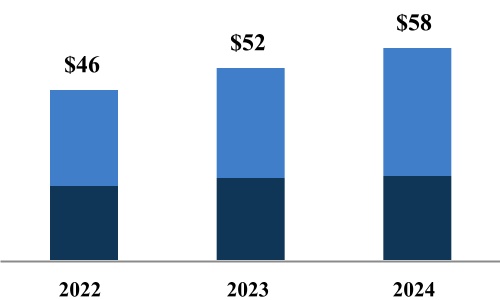
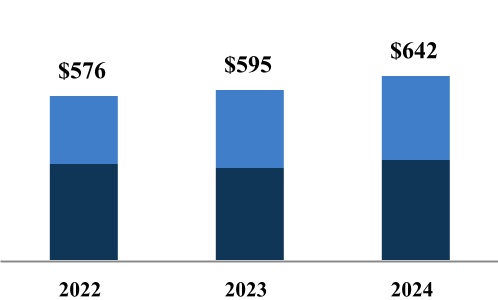
|
|
|
■ Long-term Private Funds |
■ Permanent Capital Vehicles and Perpetual Strategies |
|
|
|
■ Long-term Private Funds |
■ Permanent Capital Vehicles and Perpetual Strategies |
The following provides explanations of significant movements in Fee-Bearing Capital for the years then ended.
Fee-Bearing Capital
|
|
|
|
|
|
|
|
|
|
|
|
|
|
|
|
|
|
|
|
|
|
AS AT DECEMBER 31,
(MILLIONS) |
2024 |
|
2023 |
|
2022 |
|
|
| Long-term private funds |
$ |
34,813 |
|
|
$ |
29,663 |
|
|
$ |
25,902 |
|
|
|
Permanent capital and perpetual strategies |
23,044 |
|
|
22,700 |
|
|
20,510 |
|
|
|
| Total Fee-Bearing Capital |
$ |
57,857 |
|
|
$ |
52,363 |
|
|
$ |
46,412 |
|
|
|
|
|
|
|
|
|
|
|
|
|
|
|
|
|
|
|
|
|
|
|
|
|
|
|
|
|
|
|
|
|
FOR THE YEARS ENDED DECEMBER 31,
(MILLIONS) |
|
|
|
|
2024 |
|
2023 |
|
2022 |
| Balance, beginning |
|
|
|
|
$ |
52,363 |
|
|
$ |
46,412 |
|
|
$ |
47,141 |
|
| Inflows |
|
|
|
|
8,670 |
|
|
5,612 |
|
|
6,351 |
|
| Outflows |
|
|
|
|
— |
|
|
— |
|
|
— |
|
| Distributions |
|
|
|
|
(1,594) |
|
|
(1,442) |
|
|
(1,409) |
|
| Market valuation |
|
|
|
|
(704) |
|
|
1,757 |
|
|
(5,873) |
|
| Other |
|
|
|
|
(878) |
|
|
24 |
|
|
202 |
|
| Change |
|
|
|
|
5,494 |
|
|
5,951 |
|
|
(729) |
|
| Balance, ending |
|
|
|
|
$ |
57,857 |
|
|
$ |
52,363 |
|
|
$ |
46,412 |
|
For the year ended December 31, 2024
During the year ended December 31, 2024, Fee-Bearing Capital increased by $5.5 billion or 10% to $58 billion. This increase was driven by fundraising for the second vintage of our global transition fund, capital deployments across our fund strategies, as well as inflows from BEP's issuance of medium term and perpetual green subordinated notes. These increases were partially offset by distributions to BEP's unitholders and limited partners of our permanent and long-term private funds and the lower market capitalization of BEP due to the decrease in its share price. Additionally, Fee-Bearing Capital decreased due to the end of the investment period in one of our earlier vintage funds during the year.
For the year ended December 31, 2023
During the year ended December 31, 2023, Fee-Bearing Capital increased by $6.0 billion or 13% to $52 billion. This increase was driven by inflows attributable to fundraising for the second vintage of our global transition fund, capital deployments across our fund strategies, as well as BEP's $650 million equity offering in the second quarter of 2023. In addition, the market capitalization of BEP increased due to an increase in its share price during the year. These increases were partially offset by distributions paid to BEP’s unitholders and limited partners of our long-term private funds.
Fee Revenues
|
|
|
|
|
|
|
|
|
|
|
|
|
|
|
|
|
|
|
|
|
|
|
|
|
|
|
|
FOR THE YEARS ENDED DECEMBER 31,
(MILLIONS) |
|
|
|
|
2024 |
|
2023 |
|
2022 |
| Management and advisory fees |
|
|
|
|
|
|
|
|
|
| Long-term private funds |
|
|
|
|
|
|
|
|
|
Flagship funds |
|
|
|
|
$ |
259 |
|
|
$ |
239 |
|
|
$ |
206 |
|
Co-investment and other funds |
|
|
|
|
2 |
|
|
11 |
|
|
15 |
|
|
|
|
|
|
261 |
|
|
250 |
|
|
221 |
|
| Perpetual strategies |
|
|
|
|
|
|
|
|
|
BEP1 |
|
|
|
|
204 |
|
|
205 |
|
|
245 |
|
Co-investment and other funds |
|
|
|
|
20 |
|
|
9 |
|
|
— |
|
|
|
|
|
|
224 |
|
|
214 |
|
|
245 |
|
| Catch-up fees |
|
|
|
|
9 |
|
|
10 |
|
|
13 |
|
| Transaction and advisory fees |
|
|
|
|
19 |
|
|
9 |
|
|
2 |
|
| Total management and advisory fees |
|
|
|
|
513 |
|
|
483 |
|
|
481 |
|
| Incentive distributions |
|
|
|
|
129 |
|
|
112 |
|
|
95 |
|
| Total Fee Revenues |
|
|
|
|
$ |
642 |
|
|
$ |
595 |
|
|
$ |
576 |
|
1.BEP Fee-Bearing Capital as at December 31, 2024 is $21.5 billion (December 31, 2023 – $22.1 billion; December 31, 2022 – $20.5 billion)
For the year ended December 31, 2024
Fee Revenues increased by $47 million for the year ended December 31, 2024 relative to the year ended December 31, 2023. Incentive distributions from BEP increased by $17 million due to a 5% increase in distributions compared to the prior period. Fees from our perpetual strategies increased $10 million predominantly due to fundraising from co-investors in certain of our perpetual funds. In addition, higher management fees and transaction fees were earned on the second vintage of our global transition fund, and other follow-on investments during the year. These increases were partially offset by lower fees earned from co-investment capital in our long-term private funds.
For the year ended December 31, 2023
Fee Revenues increased by $19 million, or 3% for the year ended December 31, 2023 relative to the year ended December 31, 2022. Fees from our long-term private funds increased $29 million relative to the prior year due to an increase in fees earned on our first global transition fund, which benefitted from a full year of fee revenues from 2022 fundraising, as well as an increase in fundraising and capital deployments across our other private funds. Incentive distributions from BEP increased by $17 million, due to a 5% increase in distributions compared to the prior year. These increases were partially offset by a decrease in perpetual strategy fees of $31 million predominantly due to lower fees earned from BEP resulting from a decrease in its average market capitalization relative to the prior year.
Infrastructure
Summary of Key Financial and Operating Measures
The following charts provide the Fee-Bearing Capital of our Infrastructure investment strategy as at December 31, 2024, 2023 and 2022, and Fee Revenues for the years then ended.
Fee-Bearing Capital Fee Revenues
AS AT DEC 31 (BILLIONS) FOR THE YEARS ENDED DEC 31 (MILLIONS)
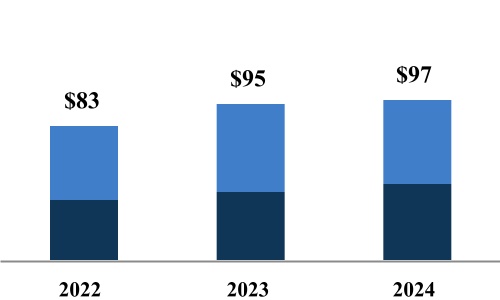
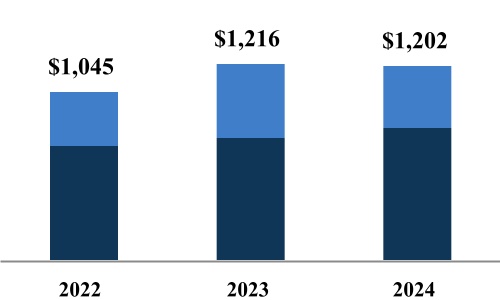
|
|
|
■ Long-term Private Funds |
■ Permanent Capital Vehicles and Perpetual Strategies |
|
|
|
■ Long-term Private Funds |
■ Permanent Capital Vehicles and Perpetual Strategies |
The following provides explanations of significant movements in Fee-Bearing Capital for the years then ended.
Fee-Bearing Capital
|
|
|
|
|
|
|
|
|
|
|
|
|
|
|
|
|
|
|
|
AS AT DECEMBER 31,
(MILLIONS) |
2024 |
|
2023 |
|
2022 |
|
|
| Long-term private funds |
$ |
45,738 |
|
|
$ |
47,345 |
|
|
$ |
40,316 |
|
|
|
| Permanent capital and perpetual strategies |
51,312 |
|
|
47,290 |
|
|
42,436 |
|
|
|
| Total Fee-Bearing Capital |
$ |
97,050 |
|
|
$ |
94,635 |
|
|
$ |
82,752 |
|
|
|
|
|
|
|
|
|
|
|
|
|
|
|
|
|
|
|
|
|
|
|
|
|
|
|
|
|
|
|
FOR THE YEARS ENDED DECEMBER 31,
(MILLIONS) |
|
|
|
|
2024 |
|
2023 |
|
2022 |
| Balance, beginning |
|
|
|
|
$ |
94,635 |
|
|
$ |
82,752 |
|
|
$ |
66,219 |
|
| Inflows |
|
|
|
|
5,313 |
|
|
12,523 |
|
|
24,929 |
|
| Outflows |
|
|
|
|
(11) |
|
|
(6) |
|
|
— |
|
| Distributions |
|
|
|
|
(2,378) |
|
|
(2,929) |
|
|
(3,361) |
|
| Market valuation |
|
|
|
|
3,669 |
|
|
2,241 |
|
|
(5,053) |
|
| Other |
|
|
|
|
(4,178) |
|
|
54 |
|
|
18 |
|
| Change |
|
|
|
|
2,415 |
|
|
11,883 |
|
|
16,533 |
|
| Balance, ending |
|
|
|
|
$ |
97,050 |
|
|
$ |
94,635 |
|
|
$ |
82,752 |
|
For the year ended December 31, 2024
During the year ended December 31, 2024, Fee-Bearing Capital increased by $2.4 billion or 3% to $97 billion. This increase was predominantly due to the higher market capitalization of BIP due to the increase in its share price, fundraising for co-investments alongside our fifth flagship fund as well as capital deployed and valuation increases across our perpetual strategies. These increases were partially offset by the end of the investment period of our fourth flagship fund, distributions paid to BIP unitholders, and distributions paid to limited partners in our long-term private funds and perpetual strategies.
For the year ended December 31, 2023
During the year ended December 31, 2023, Fee-Bearing Capital increased by $11.9 billion or 14% to $95 billion. This increase was predominantly due to capital raised for our fifth flagship fund, as well as capital deployed for follow-on investments within our third flagship fund. Additionally, Fee-Bearing Capital increased as a result of debt issuances from BIP, follow-on investments within our other perpetual and long-term strategies, and an increase in market valuations as a result of a higher market capitalization of BIP and other perpetual strategies. These increases were partially offset by distributions paid to limited partners in our long-term private funds and to BIP and other unitholders across our permanent capital vehicles.
Fee Revenues
|
|
|
|
|
|
|
|
|
|
|
|
|
|
|
|
|
|
|
|
|
|
|
|
|
|
|
|
FOR THE YEARS ENDED DECEMBER 31,
(MILLIONS) |
|
|
|
|
2024 |
|
2023 |
|
2022 |
| Management and advisory fees |
|
|
|
|
|
|
|
|
|
| Long-term private funds |
|
|
|
|
|
|
|
|
|
Flagship funds |
|
|
|
|
$ |
369 |
|
|
$ |
371 |
|
|
$ |
274 |
|
Co-investment and other funds |
|
|
|
|
6 |
|
|
18 |
|
|
20 |
|
|
|
|
|
|
375 |
|
|
389 |
|
|
294 |
|
| Perpetual strategies |
|
|
|
|
|
|
|
|
|
BIP1 |
|
|
|
|
393 |
|
|
401 |
|
|
421 |
|
Co-investment and other funds |
|
|
|
|
133 |
|
|
99 |
|
|
55 |
|
|
|
|
|
|
526 |
|
|
500 |
|
|
476 |
|
| Catch-up fees |
|
|
|
|
1 |
|
|
37 |
|
|
2 |
|
| Transaction and advisory fees |
|
|
|
|
5 |
|
|
24 |
|
|
33 |
|
| Total management and advisory fees |
|
|
|
|
907 |
|
|
950 |
|
|
805 |
|
| Incentive distributions |
|
|
|
|
295 |
|
|
266 |
|
|
240 |
|
| Total Fee Revenues |
|
|
|
|
$ |
1,202 |
|
|
$ |
1,216 |
|
|
$ |
1,045 |
|
1.BIP Fee-Bearing Capital as at December 31, 2024 is $31.9 billion (December 31, 2023 – $31.2 billion; December 31, 2022 – $29.2 billion).
For the year ended December 31, 2024
Fee Revenues decreased by $14 million or 1% for the year ended December 31, 2024 relative to the year ended December 31, 2023. The decrease was driven by one-time catch-up fees and transaction and advisory fees in the prior year and lower fees earned from BIP due to a lower average market capitalization in the current year. This was partially offset by higher Fee Revenues from an increase in incentive distributions of $29 million predominantly due to a 6% increase in BIP's quarterly dividend, as well as capital raised and deployed by certain of our perpetual strategies.
For the year ended December 31, 2023
Fee Revenues increased by $171 million or 16% for the year ended December 31, 2023 relative to the year ended December 31, 2022. Fees from our long-term private funds increased by $95 million primarily due to capital raised for our fifth flagship fund. Fee Revenues from our perpetual strategies increased by $24 million, driven by capital deployed, partially offset by lower fees earned from BIP due to a lower average market capitalization compared to the prior year. Catch-up fees increased by $35 million due to follow on closes for our fifth flagship fund and incentive distributions increased by $26 million due to an increase in BIP's quarterly dividend. The increases were partially offset by a decrease of $9 million of transaction and advisory fees as the prior year benefited from higher fees on co-investment transactions.
Real Estate
Summary of Key Financial and Operating Measures
The following charts provide the Fee-Bearing Capital for our Real Estate investment strategy as at December 31, 2024, 2023 and 2022, and Fee Revenues for the years then ended.
Fee-Bearing Capital Fee Revenues
AS AT DEC 31 (BILLIONS) FOR THE YEARS ENDED DEC 31 (MILLIONS)

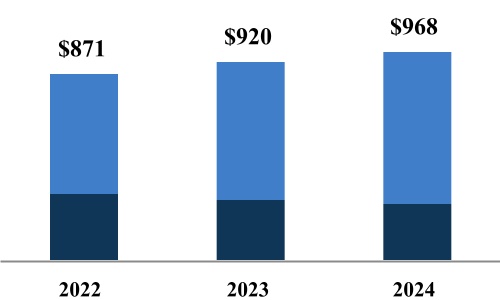
|
|
|
■ Long-term Private Funds |
■ Permanent Capital Vehicles and Perpetual Strategies |
|
|
|
■ Long-term Private Funds |
■ Permanent Capital Vehicles and Perpetual Strategies |
The following provides explanations of significant movements in Fee-Bearing Capital for the years then ended.
Fee-Bearing Capital
|
|
|
|
|
|
|
|
|
|
|
|
|
|
|
|
|
|
|
|
AS AT DECEMBER 31,
(MILLIONS) |
2024 |
|
2023 |
|
2022 |
|
|
| Long-term private funds |
$ |
69,689 |
|
|
$ |
66,038 |
|
|
$ |
63,832 |
|
|
|
| Permanent capital and perpetual strategies |
23,940 |
|
|
27,406 |
|
|
31,801 |
|
|
|
| Total Fee-Bearing Capital |
$ |
93,629 |
|
|
$ |
93,444 |
|
|
$ |
95,633 |
|
|
|
|
|
|
|
|
|
|
|
|
|
|
|
|
|
|
|
|
|
|
|
|
|
|
|
|
|
|
|
FOR THE YEARS ENDED DECEMBER 31,
(MILLIONS) |
|
|
|
|
2024 |
|
2023 |
|
2022 |
| Balance, beginning |
|
|
|
|
$ |
93,444 |
|
|
$ |
95,633 |
|
|
$ |
76,642 |
|
| Inflows |
|
|
|
|
9,074 |
|
|
10,168 |
|
|
17,117 |
|
| Outflows |
|
|
|
|
(481) |
|
|
(127) |
|
|
(343) |
|
| Distributions |
|
|
|
|
(4,054) |
|
|
(4,690) |
|
|
(4,149) |
|
| Market valuation |
|
|
|
|
(2,169) |
|
|
(2,841) |
|
|
1,545 |
|
| Other |
|
|
|
|
(2,185) |
|
|
(4,699) |
|
|
4,821 |
|
| Change |
|
|
|
|
185 |
|
|
(2,189) |
|
|
18,991 |
|
| Balance, ending |
|
|
|
|
$ |
93,629 |
|
|
$ |
93,444 |
|
|
$ |
95,633 |
|
For the year ended December 31, 2024
During the year ended December 31, 2024, Fee-Bearing Capital increased by $185 million to $94 billion. This increase was predominantly due to inflows attributable to fundraising within our fifth flagship fund, follow-on investments in our third flagship fund, and equity issuances in BPG. Additional closes and capital deployed across various other fund strategies also contributed to our Fee-Bearing Capital. These increases were partially offset by distributions from our permanent and perpetual strategies, flagship and other private funds. Additionally, Fee-Bearing Capital for BPG and certain long-term and perpetual strategies decreased due to a net decline in valuations.
For the year ended December 31, 2023
During the year ended December 31, 2023, Fee-Bearing Capital decreased by $2.2 billion or 2% to $93 billion, predominantly due to distributions from our perpetual strategies, flagship and other private funds. Additionally, our long-term private funds Fee-Bearing Capital decreased due to the change in the fee base of one of our flagship funds from committed capital to invested capital as a result of the end of its commitment period. Our permanent capital vehicles and perpetual strategies decreased due to a decline in the market valuation of certain assets. These decreases were partially offset by inflows attributable to fundraising within our fifth flagship fund, follow-on investments in our third flagship fund, and capital deployed across various other fund strategies.
Fee Revenues
|
|
|
|
|
|
|
|
|
|
|
|
|
|
|
|
|
|
|
|
|
|
|
|
|
|
|
|
FOR THE YEARS ENDED DECEMBER 31,
(MILLIONS) |
|
|
|
|
2024 |
|
2023 |
|
2022 |
| Management and advisory fees |
|
|
|
|
|
|
|
|
|
| Long-term private funds |
|
|
|
|
|
|
|
|
|
Flagship funds |
|
|
|
|
$ |
457 |
|
|
$ |
396 |
|
|
$ |
354 |
|
Co-investment and other funds |
|
|
|
|
217 |
|
|
228 |
|
|
166 |
|
|
|
|
|
|
674 |
|
|
624 |
|
|
520 |
|
| Perpetual strategies |
|
|
|
|
|
|
|
|
|
BPG1 |
|
|
|
|
195 |
|
|
196 |
|
|
225 |
|
Co-investment and other funds |
|
|
|
|
74 |
|
|
93 |
|
|
93 |
|
|
|
|
|
|
269 |
|
|
289 |
|
|
318 |
|
| Catch-up fees |
|
|
|
|
25 |
|
|
4 |
|
|
33 |
|
| Transaction and advisory fees |
|
|
|
|
— |
|
|
3 |
|
|
— |
|
|
|
|
|
|
|
|
|
|
|
|
|
|
|
|
|
|
|
|
|
| Total Fee Revenues |
|
|
|
|
$ |
968 |
|
|
$ |
920 |
|
|
$ |
871 |
|
1.BPG Fee-Bearing Capital as at December 31, 2024 is $16.6 billion (December 31, 2023 – $17.9 billion; December 31, 2022 – $20.8 billion).
For the year ended December 31, 2024
During the year ended December 31, 2024, Fee Revenues increased by $48 million or 5% relative to the year ended December 31, 2023. This was primarily from fees earned from our long-term private funds, driven by fundraising and catch-up fees for our fifth flagship fund and follow-on investments in our third flagship fund. These increases were partially offset by lower net asset values in certain of our perpetual strategies and long-term private funds.
For the year ended December 31, 2023
During the year ended December 31, 2023, Fee Revenues increased by $49 million or 6% due to the increase in revenues earned from fundraising for our fifth flagship fund and commitments throughout 2022 to our fourth flagship fund. In addition, fees increased from capital invested in our residential, U.S., and other fund investments. These increases were partially offset by catch-up fees recognized on our fourth flagship fund in the prior year and a decrease in fees earned by our perpetual vehicle due to the decrease in Fee-Bearing Capital of BPG as well as the disposition of investments within earlier vintages of our flagship funds.
Private Equity
Summary of Key Financial and Operating Measures
The following charts provide the Fee-Bearing Capital for our Private Equity investment strategy as at December 31, 2024, 2023 and 2022, and Fee Revenues for the years then ended.
Fee-Bearing Capital Fee Revenues
AS AT DEC 31 (BILLIONS) FOR THE YEARS ENDED DEC 31 (MILLIONS)
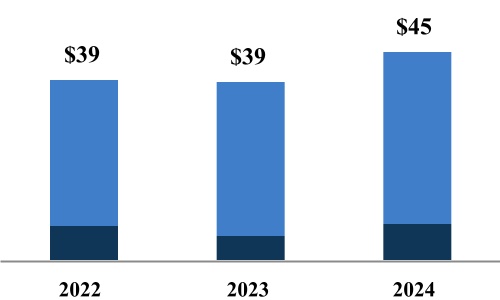
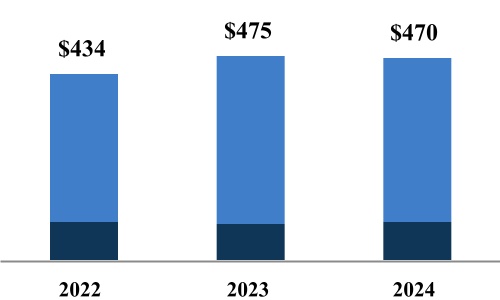
|
|
|
■ Long-term Private Funds |
■ Permanent Capital Vehicles and Perpetual Strategies |
|
|
|
■ Long-term Private Funds |
■ Permanent Capital Vehicles and Perpetual Strategies |
The following provides explanations of significant movements in Fee-Bearing Capital for the years then ended.
Fee-Bearing Capital
|
|
|
|
|
|
|
|
|
|
|
|
|
|
|
|
|
|
|
|
AS AT DECEMBER 31,
(MILLIONS) |
2024 |
|
2023 |
|
2022 |
|
|
| Long-term private funds |
$ |
37,123 |
|
|
$ |
33,249 |
|
|
$ |
31,500 |
|
|
|
| Permanent capital and perpetual strategies |
8,067 |
|
|
5,600 |
|
|
7,816 |
|
|
|
| Total Fee-Bearing Capital |
$ |
45,190 |
|
|
$ |
38,849 |
|
|
$ |
39,316 |
|
|
|
|
|
|
|
|
|
|
|
|
|
|
|
|
|
|
|
|
|
|
|
|
|
|
|
|
|
|
|
FOR THE YEARS ENDED DECEMBER 31,
(MILLIONS) |
|
|
|
|
2024 |
|
2023 |
|
2022 |
| Balance, beginning |
|
|
|
|
$ |
38,849 |
|
|
$ |
39,316 |
|
|
$ |
34,382 |
|
| Inflows |
|
|
|
|
3,714 |
|
|
4,424 |
|
|
9,135 |
|
| Outflows |
|
|
|
|
— |
|
|
— |
|
|
— |
|
| Distributions |
|
|
|
|
(1,302) |
|
|
(1,201) |
|
|
(808) |
|
| Market valuation |
|
|
|
|
1,610 |
|
|
(816) |
|
|
(2,546) |
|
| Other |
|
|
|
|
2,319 |
|
|
(2,874) |
|
|
(847) |
|
| Change |
|
|
|
|
6,341 |
|
|
(467) |
|
|
4,934 |
|
| Balance, ending |
|
|
|
|
$ |
45,190 |
|
|
$ |
38,849 |
|
|
$ |
39,316 |
|
For the year ended December 31, 2024
During the year ended December 31, 2024, Fee-Bearing Capital increased by $6.3 billion or 16% to $45 billion. The increase was primarily driven by our acquisition of Pinegrove Ventures, and capital deployments and fundraising for co-investments in certain of our long-term private funds. In addition, growth of Fee-Bearing Capital was attributable to the higher market capitalization of BBU as a result of an increase in its share price. These increases were partially offset by distributions from other long-term strategies.
For the year ended December 31, 2023
During the year ended December 31, 2023, Fee-Bearing Capital decreased by $467 million or 1% to $39 billion. The expiration of the management fee period of a mature flagship fund and distributions to our investors was partially offset by inflows of $4.4 billion for our long-term private funds. This was largely driven by capital raised for our sixth flagship private equity fund and capital deployed across other strategies.
Fee Revenues
|
|
|
|
|
|
|
|
|
|
|
|
|
|
|
|
|
|
|
|
|
|
|
|
|
|
|
|
FOR THE YEARS ENDED DECEMBER 31,
(MILLIONS) |
|
|
|
|
2024 |
|
2023 |
|
2022 |
| Management and advisory fees |
|
|
|
|
|
|
|
|
|
| Long-term private funds |
|
|
|
|
|
|
|
|
|
Flagship funds |
|
|
|
|
$ |
162 |
|
|
$ |
177 |
|
|
$ |
137 |
|
| Other long-term funds |
|
|
|
|
175 |
|
|
174 |
|
|
186 |
|
Co-investment and other funds |
|
|
|
|
10 |
|
|
10 |
|
|
8 |
|
|
|
|
|
|
347 |
|
|
361 |
|
|
331 |
|
| Perpetual strategies |
|
|
|
|
|
|
|
|
|
BBU1 |
|
|
|
|
92 |
|
|
87 |
|
|
94 |
|
|
|
|
|
|
|
|
|
|
|
|
|
|
|
|
92 |
|
|
87 |
|
|
94 |
|
| Catch-up fees |
|
|
|
|
7 |
|
|
16 |
|
|
— |
|
| Transaction and advisory fees |
|
|
|
|
24 |
|
|
11 |
|
|
9 |
|
|
|
|
|
|
|
|
|
|
|
|
|
|
|
|
|
|
|
|
|
|
|
|
|
|
|
|
|
|
|
| Total Fee Revenues |
|
|
|
|
$ |
470 |
|
|
$ |
475 |
|
|
$ |
434 |
|
1.BBU Fee-Bearing Capital as at December 31, 2024 was $8.1 billion (December 31, 2023 – $5.6 billion; December 31, 2022 – $7.8 billion).
For the year ended December 31, 2024
Fee Revenues decreased by $5 million for the year ended December 31, 2024 relative to the year ended December 31, 2023. This decrease was primarily due to the end of the investment period for our fifth flagship fund, realizations and returns of capital in our fourth flagship fund, and catch-up fees recognized in the prior period related to our sixth flagship fund. These decreases were partially offset by capital raised for our sixth flagship fund, higher market capitalization of BBU, capital deployed across several of our other funds, and higher transaction fees related to certain of our long-term private funds.
For the year ended December 31, 2023
Fee Revenues increased by $41 million or 9% for the year ended December 31, 2023 relative to the year ended December 31, 2022. This increase was primarily due to capital raised for our sixth flagship fund which experienced a $59 million increase in Fee Revenues and catch up fees attributable to the timing of fundraising. This increase was partially offset by a decrease in fees earned within our other funds due to the end of the management fee period for certain earlier vintage funds.
Credit
Summary of Key Financial and Operating Measures
The following charts provide the Fee-Bearing Capital for our Credit investment strategy as at December 31, 2024, 2023 and 2022, and Fee Revenues for the years then ended.
Fee-Bearing Capital Fee Revenues
AS AT DEC 31 (BILLIONS) FOR THE YEARS ENDED DEC 31 (MILLIONS)
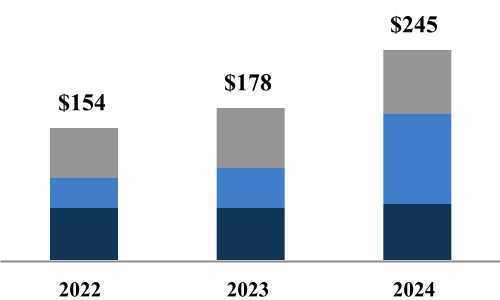
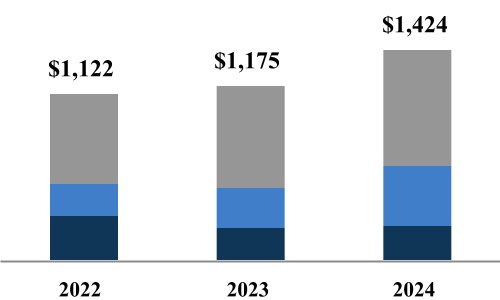
|
|
|
■ Long-term Private Funds |
■ Perpetual Strategies |
■ Liquid Strategies |
|
|
|
■ Long-term Private Funds |
■ Perpetual Strategies |
■ Liquid Strategies |
The following provides explanations of significant movements in Fee-Bearing Capital for the years then ended.
Fee-Bearing Capital
|
|
|
|
|
|
|
|
|
|
|
|
|
|
|
|
|
|
|
|
AS AT DECEMBER 31,
(MILLIONS) |
2024 |
|
2023 |
|
2022 |
|
|
| Long-term private funds |
$ |
74,697 |
|
|
$ |
69,046 |
|
|
$ |
56,245 |
|
|
|
| Permanent capital and perpetual strategies |
102,193 |
|
|
45,723 |
|
|
34,209 |
|
|
|
| Liquid strategies |
67,925 |
|
|
62,938 |
|
|
63,296 |
|
|
|
| Total Fee-Bearing Capital |
$ |
244,815 |
|
|
$ |
177,707 |
|
|
$ |
153,750 |
|
|
|
|
|
|
|
|
|
|
|
|
|
|
|
|
|
|
|
|
|
|
|
|
|
|
|
|
|
|
|
FOR THE YEARS ENDED DECEMBER 31,
(MILLIONS) |
|
|
|
|
2024 |
|
2023 |
|
2022 |
| Balance, beginning |
|
|
|
|
$ |
177,707 |
|
|
$ |
153,750 |
|
|
$ |
139,749 |
|
| Inflows |
|
|
|
|
102,211 |
|
|
40,455 |
|
|
50,137 |
|
| Outflows |
|
|
|
|
(27,396) |
|
|
(20,228) |
|
|
(21,699) |
|
| Distributions |
|
|
|
|
(8,700) |
|
|
(5,989) |
|
|
(2,434) |
|
| Market valuation |
|
|
|
|
6,074 |
|
|
7,703 |
|
|
(8,320) |
|
| Other |
|
|
|
|
(5,081) |
|
|
2,016 |
|
|
(3,683) |
|
| Change |
|
|
|
|
67,108 |
|
|
23,957 |
|
|
14,001 |
|
| Balance, ending |
|
|
|
|
$ |
244,815 |
|
|
$ |
177,707 |
|
|
$ |
153,750 |
|
For the year ended December 31, 2024
During the year ended December 31, 2024, Fee-Bearing Capital increased by $67.1 billion or 38% to $245 billion, primarily due to the AEL Mandate, resulting in $49 billion of inflows of Fee-Bearing Capital. BWS also contributed inflows of insurance-related capital.
Inflows of Fee-Bearing Capital also included our investment in Castlelake, capital deployed in our Oaktree credit, liquid credit, and other platform credit funds, as well as valuation gains in certain Oaktree liquid credit funds. These increases were partially offset by annuity-related outflows in BWS, redemptions in our liquid and perpetual strategies, and returns of capital within our Oaktree, infrastructure, and real estate debt strategies.
For the year ended December 31, 2023
During the year ended December 31, 2023, Fee-Bearing Capital increased by $24 billion or 16% to $178 billion, due to growth across all strategies. The increase in our long-term private funds was driven by deployments within our eleventh and twelfth flagship opportunistic credit funds, and capital deployed in certain of our debt funds. In addition, our perpetual strategies increased primarily due to capital deployments and inflows from BWS as well as higher market valuations in our liquid strategy and open-end credit portfolios. This overall increase was partially offset by redemptions adversely impacting our liquid strategies.
Fee Revenues
|
|
|
|
|
|
|
|
|
|
|
|
|
|
|
|
|
|
|
|
|
|
|
|
|
|
|
|
FOR THE YEARS ENDED DECEMBER 31,
(MILLIONS) |
|
|
|
|
2024 |
|
2023 |
|
2022 |
| Management and advisory fees |
|
|
|
|
|
|
|
|
|
| Long-term private funds |
|
|
|
|
$ |
781 |
|
|
$ |
678 |
|
|
$ |
604 |
|
Permanent and perpetual strategies |
|
|
|
|
400 |
|
|
266 |
|
|
206 |
|
Liquid strategies1 |
|
|
|
|
242 |
|
|
231 |
|
|
263 |
|
| Transaction and advisory fees |
|
|
|
|
1 |
|
|
— |
|
|
49 |
|
| Total Fee Revenues |
|
|
|
|
$ |
1,424 |
|
|
$ |
1,175 |
|
|
$ |
1,122 |
|
1.Represents open-end funds within our credit strategies, and Oaktree's investment in a fixed income manager, as well as in publicly listed securities.
For the year ended December 31, 2024
Fee Revenues increased by $249 million or 21% for the year ended December 31, 2024 relative to the year ended December 31, 2023. The increase was attributable to incremental fees earned on our perpetual strategies and long-term private funds. Fees from perpetual strategies increased by $134 million as a result of higher Fee-Bearing Capital driven by the AEL Mandate, and capital deployed across these strategies. In addition, fees from our long-term private funds increased due to deployments across our credit flagship and other debt funds and higher fees earned from our strategic partnerships.
For the year ended December 31, 2023
Fee Revenues increased by $53 million or 5% for the year ended December 31, 2023 relative to the year ended December 31, 2022. The increase was predominately attributable to incremental fees earned on our long-term private funds and perpetual strategies. Fees from our long-term private funds increased due to deployments across our credit flagship and other debt funds. In addition, fees from perpetual strategies increased by $60 million as a result of higher Fee-Bearing Capital driven by valuation increases and capital deployed across these strategies. These increases were partially offset by a $32 million decrease in our liquid strategies due to redemptions.
Reconciliation of U.S. GAAP to Non-GAAP Measures
Reconciliations of Distributable Earnings, Fee-Related Earnings and Fee Revenues to the most directly comparable financial measures calculated and presented in conformity with U.S. GAAP are presented below. In addition to net income and revenue, management assesses the performance of its business based on these non-GAAP financial measures. These non-GAAP financial measures should be considered in addition to, and not as a substitute for or superior to, net income or other financial measures presented in conformity with U.S. GAAP.
Reconciliation of Net Income to Fee-Related Earnings and Distributable Earnings
The following presents a reconciliation of net income to Fee-Related Earnings and Distributable Earnings for the years presented for the asset management business.
|
|
|
|
|
|
|
|
|
|
|
|
|
|
|
|
|
|
|
|
|
|
|
|
|
|
|
|
|
FOR THE YEARS ENDED DECEMBER 31,
(MILLIONS)
|
|
|
|
|
2024 |
|
2023 |
|
2022 |
| Net Income |
|
|
|
|
$ |
2,108 |
|
$ |
2,137 |
|
$ |
2,865 |
| Add or subtract the following: |
|
|
|
|
|
|
|
|
|
Provision for taxes(a) |
|
|
|
|
438 |
|
|
417 |
|
|
627 |
|
Depreciation and amortization(b) |
|
|
|
|
14 |
|
14 |
|
13 |
Carried interest allocations(c) |
|
|
|
|
(16) |
|
|
(399) |
|
|
(490) |
|
Carried interest allocation compensation(c) |
|
|
|
|
93 |
|
|
86 |
|
|
200 |
|
Other income and expenses(d) |
|
|
|
|
93 |
|
|
129 |
|
|
(1,090) |
|
Interest expense paid to related parties(e) |
|
|
|
|
22 |
|
|
14 |
|
|
154 |
|
Interest and dividend revenue(e) |
|
|
|
|
(143) |
|
|
(172) |
|
|
(258) |
|
Other revenues(f) |
|
|
|
|
(372) |
|
|
(300) |
|
|
(44) |
|
Share of income from equity method investments(g) |
|
|
|
|
(339) |
|
|
(167) |
|
|
(146) |
|
Fee-related earnings of partly owned subsidiaries at our share(g) |
|
|
|
|
330 |
|
|
271 |
|
|
252 |
|
Costs recovered from affiliates(h) |
|
|
|
|
218 |
|
|
156 |
|
|
— |
|
Non-recurring restructuring costs(i) |
|
|
|
|
— |
|
|
35 |
|
|
— |
|
Fee Revenues from BSREP III & other(j) |
|
|
|
|
10 |
|
|
20 |
|
|
25 |
|
| Fee-Related Earnings |
|
|
|
|
$ |
2,456 |
|
|
$ |
2,241 |
|
|
$ |
2,108 |
|
|
|
|
|
|
|
|
|
|
|
Cash taxes(k) |
|
|
|
|
(301) |
|
|
(196) |
|
|
(98) |
|
Equity-based compensation expense and other(l) |
|
|
|
|
208 |
|
|
199 |
|
|
86 |
|
| Distributable Earnings |
|
|
|
|
$ |
2,363 |
|
|
$ |
2,244 |
|
|
$ |
2,096 |
|
(a)This adjustment removes the impact of income tax provisions on the basis that we do not believe this item reflects the present value of the actual tax obligations that we expect to incur over the long-term due to the substantial deferred tax assets of our asset management business.
(b)This adjustment removes the depreciation and amortization on property, plant and equipment and intangible assets, which are non-cash in nature and therefore excluded from Fee-Related Earnings.
(c)These adjustments remove the impact of both unrealized and realized carried interest allocations and the associated compensation expense. Unrealized carried interest allocations and associated compensation expense are non-cash in nature. Carried interest allocations and associated compensation costs are included in Distributable Earnings once realized.
(d)This adjustment removes other income and expenses associated with fair value changes.
(e)This adjustment removes interest and charges paid or received from related party loans.
(f)This adjustment adds back other revenues earned that are non-cash in nature.
(g)These adjustments remove our share of partly owned subsidiaries' earnings, including items (a) to (f) above and include its share of partly owned subsidiaries' Fee-Related Earnings.
(h)This item adds back compensation costs that will be borne by affiliates.
(i)This item represents non-recurring restructuring costs that are not considered as part of the ongoing asset management business.
(j)This adjustment adds base management fees earned from funds that are eliminated upon consolidation and other items.
(k)Represents the impact of cash taxes paid by the business.
(l)This adjustment adds back equity-based compensation and other income associated with the Company's portion of partly owned subsidiaries’ investment income, realized carried interest, interest income received and charges paid on related party loans, and other income.
Reconciliation of Revenues to Fee Revenues
The following presents our reconciliation of management fee revenues to Fee Revenues for the years presented.
|
|
|
|
|
|
|
|
|
|
|
|
|
|
|
|
|
|
|
|
|
|
|
|
|
|
|
|
|
FOR THE YEARS ENDED DECEMBER 31,
(MILLIONS)
|
|
|
|
|
2024 |
|
2023 |
|
2022 |
| Base management and advisory fees |
|
|
|
|
$ |
2,957 |
|
|
$ |
2,766 |
|
|
$ |
2,500 |
|
Incentive fees(a) |
|
|
|
|
424 |
|
|
376 |
|
|
335 |
|
Fee Revenues from equity method investments(b) |
|
|
|
|
1,335 |
|
|
1,240 |
|
|
1,165 |
|
BSREP III Fees & other(c) |
|
|
|
|
(10) |
|
|
(1) |
|
|
48 |
|
| Fee Revenues |
|
|
|
|
$ |
4,706 |
|
|
$ |
4,381 |
|
|
$ |
4,048 |
|
(a)This adjustment adds incentive distributions that are included in Fee Revenues.
(b)This adjustment adds management fees at 100% ownership.
(c)This adjustment involves base management fees earned from BSREP III and other funds that are eliminated upon consolidation.
Fee Revenues by Geography
The majority of our revenues are earned in the U.S. The following tables set out Fee Revenues disaggregated by investment strategy and geography.
|
|
|
|
|
|
|
|
|
|
|
|
|
|
|
|
|
|
|
|
|
|
|
|
|
|
|
|
|
|
|
|
|
|
|
|
|
|
|
FOR THE YEAR ENDED DECEMBER 31, 2024
(MILLIONS) |
|
Renewable power and transition |
|
Infrastructure |
|
Real estate |
|
Private equity |
|
Credit |
|
Total |
| Management and advisory fees, net |
|
|
|
|
|
|
|
|
|
|
|
|
| United States of America |
|
$ |
111 |
|
|
$ |
124 |
|
|
$ |
634 |
|
|
$ |
227 |
|
|
$ |
1,055 |
|
|
$ |
2,151 |
|
| Canada |
|
159 |
|
|
354 |
|
|
40 |
|
|
74 |
|
|
40 |
|
|
667 |
|
| United Kingdom |
|
156 |
|
|
182 |
|
|
16 |
|
|
84 |
|
|
206 |
|
|
644 |
|
| Other |
|
87 |
|
|
247 |
|
|
278 |
|
|
85 |
|
|
123 |
|
|
820 |
|
| Incentive distributions |
|
129 |
|
|
295 |
|
|
— |
|
|
— |
|
|
— |
|
|
424 |
|
|
|
$ |
642 |
|
|
$ |
1,202 |
|
|
$ |
968 |
|
|
$ |
470 |
|
|
$ |
1,424 |
|
|
$ |
4,706 |
|
|
|
|
|
|
|
|
|
|
|
|
|
|
|
|
|
|
|
|
|
|
|
|
|
|
|
|
|
|
|
|
|
|
|
|
|
|
|
|
FOR THE YEAR ENDED DECEMBER 31, 2023
(MILLIONS) |
|
Renewable power and transition |
|
Infrastructure |
|
Real estate |
|
Private equity |
|
Credit |
|
Total |
| Management and advisory fees, net |
|
|
|
|
|
|
|
|
|
|
|
|
| United States of America |
|
$ |
103 |
|
|
$ |
210 |
|
|
$ |
642 |
|
|
$ |
222 |
|
|
$ |
864 |
|
|
$ |
2,041 |
|
| Canada |
|
176 |
|
|
422 |
|
|
44 |
|
|
104 |
|
|
12 |
|
|
758 |
|
| United Kingdom |
|
151 |
|
|
204 |
|
|
191 |
|
|
69 |
|
|
148 |
|
|
763 |
|
| Other |
|
53 |
|
|
114 |
|
|
43 |
|
|
80 |
|
|
151 |
|
|
441 |
|
| Incentive distributions |
|
112 |
|
|
266 |
|
|
— |
|
|
— |
|
|
— |
|
|
378 |
|
|
|
$ |
595 |
|
|
$ |
1,216 |
|
|
$ |
920 |
|
|
$ |
475 |
|
|
$ |
1,175 |
|
|
$ |
4,381 |
|
|
|
|
|
|
|
|
|
|
|
|
|
|
|
|
|
|
|
|
|
|
|
|
|
|
|
|
|
|
|
|
|
|
|
|
|
|
|
|
FOR THE YEAR ENDED DECEMBER 31, 2022
(MILLIONS) |
|
Renewable power and transition |
|
Infrastructure |
|
Real estate |
|
Private equity |
|
Credit |
|
Total |
| Management and advisory fees, net |
|
|
|
|
|
|
|
|
|
|
|
|
| United States of America |
|
$ |
131 |
|
|
$ |
201 |
|
|
$ |
573 |
|
|
$ |
223 |
|
|
$ |
900 |
|
|
$ |
2,028 |
|
| Canada |
|
182 |
|
|
346 |
|
|
46 |
|
|
89 |
|
|
8 |
|
|
671 |
|
| United Kingdom |
|
125 |
|
|
167 |
|
|
139 |
|
|
71 |
|
|
156 |
|
|
658 |
|
| Other |
|
43 |
|
|
91 |
|
|
113 |
|
|
51 |
|
|
58 |
|
|
356 |
|
| Incentive distributions |
|
95 |
|
|
240 |
|
|
— |
|
|
— |
|
|
— |
|
|
335 |
|
|
|
$ |
576 |
|
|
$ |
1,045 |
|
|
$ |
871 |
|
|
$ |
434 |
|
|
$ |
1,122 |
|
|
$ |
4,048 |
|
Liquidity and Capital Resources
Liquidity
BAM undertakes limited activities, primarily receiving dividends from our asset management business as its main source of income and, in turn, making distributions to shareholders in accordance with its dividend policy. It employs a limited number of resources which provide services to our asset management business and for whom associated costs are largely reimbursed. Additional liquidity is available through a credit facility that is provided by our asset management business.
BAM Credit Facility with the Asset Management Company
On November 8, 2022, the Asset Management Company, as lender, established a five-year revolving credit facility with BAM for the amount of $500 million. This is available in U.S. and Canadian dollars, where U.S. dollar borrowings are subject to the U.S. Base Rate or SOFR plus a margin of 165 basis points, and Canadian Dollar borrowings are subject to the Canadian Prime Rate or Canadian Overnight Repo Rate Average (“CORRA”) plus a margin of 165 basis points. As at December 31, 2024, BAM has drawn $219 million from this credit facility.
Our Asset Management Business Liquidity
Our asset management business maintains sufficient liquidity at all times, enabling it to participate in opportunities as they arise, withstand sudden adverse changes in economic conditions, and sustain distributions to BAM and BN. Its primary sources of liquidity, which we refer to as corporate liquidity, consist of cash, short-term financial assets, as well as the undrawn portions of the $300 million revolving credit facility established on November 8, 2022, with BN as lender, and a $750 million five-year revolving credit facility established on August 29, 2024 through bilateral agreements with a group of lenders. Both facilities are available in U.S. and Canadian dollars. U.S. dollar draws from the $300 million facility are subject to the U.S. Base Rate or SOFR plus a margin of 165 basis points, while Canadian dollar draws are subject to the Canadian Prime Rate or CORRA plus a margin of 165 basis points. U.S. dollar draws from the $750 million facility are subject to the U.S. Base Rate or SOFR plus a margin of 110 basis points, while Canadian dollar draws are subject to the Canadian Prime Rate or CORRA plus a margin of 110 basis points. As at December 31, 2024 both the $300 million and the $750 million facilities are undrawn.
As at December 31, 2024, corporate liquidity for our asset management business is $1.8 billion. This consists of $792 million in cash and short term financial assets, including cash on deposit with BN and investments that are convertible to cash within twelve months, as well as $1.1 billion in undrawn credit facilities. This liquidity can be deployed for use without any material tax consequences to support our asset management business in funding strategic transactions as well as seeding new investment products.
The following table presents deployable capital of our asset management business:
|
|
|
|
|
|
|
|
|
|
|
|
|
|
|
|
|
|
|
|
|
|
|
|
|
|
|
|
|
Corporate |
|
Group(a) |
AS AT
(MILLIONS) |
December 31 |
|
December 31 |
|
|
|
December 31 |
|
December 31 |
|
|
| 2024 |
|
2023 |
|
|
|
2024 |
|
2023 |
|
|
| Cash and financial assets, net |
$ |
792 |
|
|
$ |
2,847 |
|
|
|
|
$ |
54,329 |
|
|
$ |
29,222 |
|
|
|
| Undrawn committed credit facilities |
1,050 |
|
|
103 |
|
|
|
|
7,928 |
|
|
5,764 |
|
|
|
| Corporate liquidity |
$ |
1,842 |
|
|
$ |
2,950 |
|
|
|
|
$ |
62,257 |
|
|
$ |
34,986 |
|
|
|
| Uncalled private fund commitments |
— |
|
|
— |
|
|
|
|
91,463 |
|
|
85,658 |
|
|
|
| Total deployable capital |
$ |
1,842 |
|
|
$ |
2,950 |
|
|
|
|
$ |
153,720 |
|
|
$ |
120,644 |
|
|
|
(a) Group deployable capital consists of: (1) corporate liquidity of the Company and the perpetual affiliates, and (2) uncalled private fund commitments, which are third-party commitments available for drawdown in the private funds of our asset management business.
Uncalled Fund Commitments
The following presents our Uncalled Fund Commitments as of December 31, 2024 by period and December 31, 2023:
|
|
|
|
|
|
|
|
|
|
|
|
|
|
|
|
|
|
|
|
|
|
|
|
|
|
|
|
|
|
|
|
|
|
|
|
|
|
|
|
|
|
|
AS AT DECEMBER 31,
(MILLIONS)
|
2025 |
|
2026 |
|
2027 |
|
2028 |
|
2029 + |
|
Total 2024 |
|
Dec. 2023 |
| Renewable power and transition |
$ |
181 |
|
|
$ |
— |
|
|
$ |
— |
|
|
$ |
753 |
|
|
$ |
20,081 |
|
|
$ |
21,015 |
|
|
$ |
17,129 |
|
| Infrastructure |
234 |
|
|
— |
|
|
— |
|
|
255 |
|
|
12,359 |
|
|
12,848 |
|
|
14,264 |
|
| Real estate |
701 |
|
|
1,834 |
|
|
— |
|
|
— |
|
|
13,110 |
|
|
15,645 |
|
|
22,507 |
|
| Private equity |
471 |
|
|
— |
|
|
112 |
|
|
1,190 |
|
|
9,587 |
|
|
11,360 |
|
|
8,788 |
|
| Credit |
1,394 |
|
|
2,022 |
|
|
914 |
|
|
126 |
|
|
26,139 |
|
|
30,595 |
|
|
22,970 |
|
|
$ |
2,981 |
|
|
$ |
3,856 |
|
|
$ |
1,026 |
|
|
$ |
2,324 |
|
|
$ |
81,276 |
|
|
$ |
91,463 |
|
|
$ |
85,658 |
|
Approximately $53 billion of the Uncalled Fund Commitments are currently not earning fees, but will become fee-bearing once the capital is invested. Once invested, we expect these commitments will earn approximately $530 million of additional Fee Revenues.
Capital Resources
Clawback Obligations
Performance allocations are subject to clawback to the extent that the performance allocations received to date with respect to a fund exceeding the amount due to our asset management business based on cumulative results of that fund. The amounts and nature of our clawback obligations are described in Note 2 “Summary of Significant Accounting Policies” of the Consolidated and Combined Financial Statements of the Asset Management Company as at December 31, 2024, and December 31, 2023, and for the years ended December 31, 2024, December 31, 2023, and December 31, 2022.
Capital Requirements
Certain U.S. and non-U.S. entities of BAM are subject to various investment advisor and other financial regulatory rules and requirements that may include minimum net capital requirements. These requirements have been met for the year ended December 31, 2024.
Contractual Obligations
On January 31, 2019, a subsidiary of the Company committed $2.8 billion to BSREP III, of which $2.1 billion has been funded as at December 31, 2024 (December 31, 2023 – $2.1 billion). The remainder of the commitment will be funded by BN.
In the normal course of business, the Company enters into contractual obligations which include commitments to provide bridge financing and other equity commitments. As at December 31, 2024, the Company had $3.3 billion of such commitments outstanding (2023 – $ 2.1 billion).
The Company established a $750 million five-year revolving credit facility on August 29, 2024 through bilateral agreements with a group of lenders. The facility is available in U.S. and Canadian dollars, where U.S. dollar draws are subject to the U.S. Base Rate or SOFR plus a margin of 110 basis points, while Canadian dollar draws are subject to the Canadian Prime Rate or CORRA plus a margin of 110 basis points. As at December 31, 2024, the Company has not made any draws on the $750 million facility.
The following table presents the contractual obligations of BAM and the asset management business by payment periods:
|
|
|
|
|
|
|
|
|
|
|
|
|
|
|
|
|
|
|
|
|
|
|
|
|
|
|
|
|
|
|
Payments Due by Period of BAM |
AS AT DEC. 31, 2024
(MILLIONS) |
Less than 1 Year |
|
1 – 3
Years |
|
4 – 5
Years |
|
After 5
Years |
|
Total |
|
|
|
|
|
|
|
|
|
|
| Accounts payable and other, net |
$ |
175 |
|
|
$ |
226 |
|
|
$ |
207 |
|
|
$ |
271 |
|
|
$ |
879 |
|
| Due to affiliates |
229 |
|
|
— |
|
|
— |
|
|
— |
|
|
229 |
|
|
|
|
|
|
|
|
|
|
|
|
Payments Due by Period of the Company |
AS AT DEC. 31, 2024
(MILLIONS) |
Less than 1 Year |
|
1 – 3
Years |
|
4 – 5
Years |
|
After 5
Years |
|
Total |
|
|
|
|
|
|
|
|
|
|
| Accounts payable and other, net |
$ |
716 |
|
|
$ |
27 |
|
|
$ |
70 |
|
|
$ |
489 |
|
|
$ |
1,302 |
|
| Due to affiliates |
891 |
|
|
60 |
|
|
62 |
|
|
80 |
|
|
1,093 |
|
| Lease obligations |
9 |
|
|
14 |
|
|
22 |
|
|
2 |
|
|
47 |
|
|
|
|
|
|
|
|
|
|
|
Accounts payable and other, net of BAM represent amounts owing to employees for carried interest compensation and share based compensation, both of which have vesting periods of up to 5 years. Due to affiliates of BAM represents amount due to the asset management business associated with the revolving credit facility established with the Company. This revolving credit facility is due on demand.
Accounts payable and other, net of the Company represents amounts due to employees for equity-based compensations costs and carried interest compensation costs. Most awards have a vesting period of up to 5 years. Due to affiliates represents amounts owed to related parties associated with equity and liability-based compensation as well as carried interest compensation. Lease obligations represent expected payments associated with current leases entered into by the Company.
Exposures to Financial Instruments
As discussed elsewhere in this report, we utilize various financial instruments in our business to manage risk and make better use of our capital. The fair values of these instruments that are reflected on our balance sheets are disclosed in Note 5 “Fair Value Measurements of Financial Instruments” to our Consolidated and Combined Financial Statements of the Asset Management Company as at December 31, 2024, and December 31, 2023 and for the years ended December 31, 2024, December 31, 2023, and December 31, 2022.
Off-Balance Sheet Arrangements
BAM may from time to time enter into guarantees given in respect of co-investments in which there is carried interest. The amount guaranteed is up to the carry amount paid to the General Partner, net of taxes. No known amounts are currently due or owed under these guarantees.
Related Party Transactions
BAM and our asset management business entered into a number of related party transactions with BN and other affiliates. See Note 17 “Related Party Transactions” of the Consolidated and Combined Financial Statements of the Asset Management Company and Note 7 “Related Party Transactions” of the Consolidated Financial Statements of BAM as at December 31, 2024, and 2023 and for the years ended December 31, 2024, 2023, and the period from July 4, 2022 to December 31, 2022.
BAM Dividends
The dividends paid by BAM on outstanding securities for the years ended December 31, 2024, 2023, and 2022 are summarized in the table below.
|
|
|
|
|
|
|
|
|
|
|
|
|
|
|
|
|
|
|
|
| |
Distribution per Security |
| |
2024 |
|
2023 |
|
2022 |
|
|
Per Class A Share and Class B Share |
$ |
1.52 |
|
|
$ |
1.28 |
|
|
$ |
— |
|
|
|
Summary of Significant Accounting Policies
Critical Accounting Policies, Critical Accounting Estimates and Judgements of BAM
BAM prepares consolidated financial statements in conformity with U.S. GAAP. The preparation of the consolidated financial statements in conformity with U.S. GAAP requires management to make estimates that affect the amounts reported. Management believes that estimates utilized in the preparation of the consolidated financial statements are presented fairly, in all material respects. Such estimates include those used in the valuation of investments and the measurement of deferred tax balances (including valuation allowances) and the determination of control or significant influence. Actual results could differ from those estimates and such differences could be material. BAM believes the following critical accounting policies could potentially produce materially different results of BAM, if underlying assumptions, estimates and/or judgments were to be changed. For a full description of accounting policies, see Note 2 “Summary of Significant Accounting Policies” of the Consolidated Financial Statements of BAM as at December 31, 2024 and 2023 and for the years ended December 31, 2024, 2023, and the period from July 4, 2022 to December 31, 2022.
All intercompany balances and transactions have been eliminated on consolidation.
Equity Method Investments
Investments in which BAM is deemed to exert significant influence, but not control, are accounted for using the equity method of accounting. BAM has significant influence over the Asset Management Company and therefore accounts for its investment under the equity method.
The carrying value of equity method investments is determined based on amounts invested by BAM, adjusted for the equity in earnings or losses of the investee allocated based on the relevant agreements, less distributions received. Further, the carrying value of the equity method investment is adjusted as a result of any share-based awards granted by BAM to employees of the Asset Management Company. Under the equity method of accounting, BAM's share of earnings from equity investments is included in the share of income from equity investments in the Consolidated Statements of Comprehensive Income. BAM evaluates its equity method investments for impairment whenever events or changes in circumstances indicate that the carrying amounts of such investments may not be recoverable.
Refer to Note 3 “Investments” of the Consolidated Financial Statements of BAM for further details of BAM's equity method investments.
Critical Accounting Estimates and Judgements of BAM
Management is required to make critical judgements and estimates when applying its accounting policies. The following judgements and estimates have the most significant effect on the consolidated financial statements.
Control or Level of Influence
When determining the appropriate basis of accounting for BAM's and the asset management business’ investees, BAM makes judgments about the degree of influence that it exerts directly or through an arrangement over the investees’ relevant activities. This may include the ability to elect investee directors or appoint management. Control is obtained when BAM has the power to direct the relevant investing, financing and operating decisions of an entity and does so in its capacity as principal of the operations, rather than as an agent for other investors. Operating as a principal includes having sufficient capital at risk in any investee and exposure to the variability of the returns generated as a result of the decisions of BAM as principal. Judgment is used in determining the sufficiency of the capital at risk or variability of returns. In making these judgments, BAM considers the ability of other investors to remove BAM as a manager or general partner in a controlled partnership.
Indicators of Impairment
Judgment is applied when determining whether indicators of impairment exist when assessing the carrying values of BAM ULC’s assets, including: the determination of BAM’s ability to hold financial assets; the determination of discount and capitalization rates; and when an asset’s carrying value is above the value derived using publicly traded prices which are quoted in a liquid market.
Income Taxes
BAM makes judgments when determining the future tax rates applicable and identifying the temporary differences. Deferred income tax assets and liabilities are measured at the tax rates that are expected to apply during the year when the assets are realized or the liabilities settled, using the tax rates and laws enacted or substantively enacted at the consolidated balance sheet dates.
Carried Interest Allocations - Unrealized
The change in the fair value of investments is a significant input into carried interest allocations - unrealized. Estimates and assumptions are made when determining the fair value of the underlying investments within the funds. See “Fair Value” below for further discussion related to significant estimates and assumptions used for determining fair value of the underlying investments.
Fair Value
The asset management business uses fair value throughout the reporting process. For details of our accounting policies related to fair value refer to Note 2. “Summary of Significant Accounting Policies — Fair Value of Financial Instruments” and “Summary of Significant Accounting Policies — Revenue Recognition” in the “Notes to Consolidated and Combined Financial Statements”. The following discussion is intended to provide supplemental information about how the application of fair value principles impact our financial results, and management’s process for implementing those principles including areas of significant judgment.
The fair value of the investments held by the asset management business's funds is the primary input to the calculation of certain of our management fees, incentive fees, performance fees and the related compensation we recognize. In the absence of observable market prices, we utilize valuation methodologies applied on a consistent basis and assumptions that we believe market participants would use to determine the fair value of the investments. For investments where little market activity exists management’s determination of fair value is based on the best information available in the circumstances, which may incorporate management’s own assumptions and involves a significant degree of judgment, and the consideration of a combination of internal and external factors, including the appropriate risk adjustments for non-performance and liquidity risks.
Management has elected the fair value option for certain equity method investments. Additionally, management is required to measure specific financial instruments at fair value, including debt instruments, equity securities, and freestanding derivatives.
Our primary approach to determining the fair value of our investments is generally the income approach, which estimates fair value based on the present value of expected future cash flows generated by a business. The most commonly used method within this approach is the discounted cash flow method, which incorporates key assumptions about the investment’s projected net earnings or cash flows, discount rate, capitalization rate, and exit multiple.
Alternatively, management uses the market approach as a secondary methodology. This approach primarily relies on valuations of comparable public companies, transactions, or assets, requiring judgment in selecting appropriate comparables. Depending on the specific facts and circumstances of the investment, alternative primary and secondary methodologies may be applied, including option value, contingent claims or scenario analysis, yield analysis, projected cash flow through maturity or expiration, discount to sale, probability-weighted methods, or recent financing rounds.
Assessments and Changes in Internal Control over Financial Reporting
Management has evaluated the effectiveness of BAM’s internal control over financial reporting (as defined in the applicable U.S. and Canadian securities laws) as of December 31, 2024 and based on that assessment concluded that, as of December 31, 2024, our internal control over financial reporting was effective. Refer to “Part II—Item 9A. Controls and Procedures—Management’s Report on Internal Control Over Financial Reporting.” There have been no changes in our internal control over financial reporting during the quarter or year ended December 31, 2024 that have materially affected, or are reasonably likely to materially affect, our internal control over financial reporting.
Management, including the CEO and Chief Financial Officer, has evaluated the effectiveness of BAM's disclosure controls and procedures (as defined in the applicable U.S. and Canadian securities laws) as of December 31, 2024. Based on that evaluation, the CEO and Chief Financial Officer concluded that such disclosure controls and procedures were effective as of December 31, 2024.
ITEM 7A. QUANTITATIVE AND QUALITATIVE DISCLOSURES ABOUT MARKET RISK
Quantitative and Qualitative Risk Disclosures
BAM has limited activities and operations. BAM’s exposure to market, foreign currency, interest rate and credit risk is driven by its equity interest in our asset management business. There have been no material changes to BAM’s financial risk exposure or risk management activities since December 31, 2023. Please refer to Item 1A of this report for a detailed description of BAM’s financial risk exposure and risk management activities.
Market Risk
The primary market risk exposure of our asset management business relates to its role as an asset manager of the publicly listed permanent capital vehicles and the sensitivity of base management fees earned from these affiliates due to movements in their underlying trading price. Specifically, with respect to the market risk related to base management fees earned based on the market capitalization of BEP, BIP and BBU.
The table below outlines the impact to base management and advisory fee revenues if there was a 10% decline in the market capitalization of the aforementioned permanent capital vehicles:
|
|
|
|
|
|
|
|
|
|
|
|
|
|
|
|
|
|
|
|
|
FOR THE YEARS ENDED DECEMBER 31,
(MILLIONS)
|
2024 |
|
2023 |
|
2022 |
|
|
| BEP |
$ |
20 |
|
|
$ |
22 |
|
|
$ |
19 |
|
|
|
| BIP |
33 |
|
|
32 |
|
|
33 |
|
|
|
| BBU |
7 |
|
|
4 |
|
|
7 |
|
|
|
|
|
|
|
|
|
|
|
| Revenues |
$ |
60 |
|
|
$ |
58 |
|
|
$ |
59 |
|
|
|
Foreign Currency Risk
We have very limited exposure to foreign currency risk as a majority of our private funds are denominated in USD. This means that a majority of the Fee Revenues that we earn are paid in USD, irrespective of the local currency of our underlying investment base. Additionally, the majority of our revenues are earned in the U.S.
Interest Rate Risk
BAM has interest rate exposure through balances held with affiliates and does not hold debt or term deposits with third parties. BAM incurs interest expense on its revolving credit facility borrowings with the Asset Management Company at variable rates. In fiscal 2024, a 50 basis-point increase (or decrease) in interest rates, with all other variables held constant, would have resulted in an approximate increase (or decrease) of $1.1 million in interest expense. Assuming December 31, 2024 year-end balances remain constant throughout 2025, a similar 50 basis-point change in interest rates would result in an approximate increase (or decrease) of $1.1 million in interest expense.
The Asset Management Company has interest rate exposure through balances held with affiliates, as well as its internal revolving credit facility with BN and its external revolving credit facility which is currently undrawn. The Asset Management Company earns interest income on its deposit balance with BN and as the lender on the revolving credit facility it extends to BAM. The Asset Management Company incurs interest expense on its revolving credit facility borrowings with BN. Interest income and expenses on these balances are at variable rates. In fiscal 2024, a 50 basis-point increase (decrease) in interest rates, with all other variables held constant, would have resulted in an approximate increase (decrease) of $7.4 million in net interest income. A 50 basis-point increase (decrease) in interest rates would result in an approximate increase (decrease) of $1.8 million in net interest income assuming December 31, 2024 year end balances remain constant throughout 2025.
Credit Risk
Investors in our private funds make capital commitments to these vehicles via subscription agreements. When a private fund makes an investment, these capital commitments are then satisfied by our investors via capital contributions as prescribed under these subscription agreements. Investors in our private funds may default on their capital commitment obligations, which could have an adverse impact on our earnings or result in other negative implications to our businesses such as the requirement to deploy our own capital to cover such obligations. This impact would be magnified if the investor that does so is in multiple funds. Given the diversity and creditworthiness of our over 2,300 clients, including some of the world’s largest institutional investors, sovereign wealth funds and pension plans, we are of the view that there is not a material credit risk present in our asset management business.
ITEM 8. FINANCIAL STATEMENTS AND SUPPLEMENTARY DATA
Index to Brookfield Asset Management Ltd. Consolidated Financial Statements
Index to Brookfield Asset Management ULC Consolidated and Combined Financial Statements
Index to Oaktree Asset Management Operating Group Combined and Consolidated Financial Statements
REPORT OF INDEPENDENT REGISTERED PUBLIC ACCOUNTING FIRM
To the shareholders and the Board of Directors of Brookfield Asset Management Ltd.
Opinion on Internal Control over Financial Reporting
We have audited the internal control over financial reporting of Brookfield Asset Management Ltd. and subsidiaries (“BAM”) as of December 31, 2024, based on criteria established in Internal Control — Integrated Framework (2013) issued by the Committee of Sponsoring Organizations of the Treadway Commission (COSO). In our opinion, BAM maintained, in all material respects, effective internal control over financial reporting as of December 31, 2024, based on criteria established in Internal Control — Integrated Framework (2013) issued by COSO.
We have also audited, in accordance with the standards of the Public Company Accounting Oversight Board (United States) (PCAOB), the consolidated financial statements as at and for the year ended December 31, 2024, of BAM and our report dated March 17, 2025, expressed an unqualified opinion on those financial statements.
Basis for Opinion
BAM’s management is responsible for maintaining effective internal control over financial reporting and for its assessment of the effectiveness of internal control over financial reporting, included in the accompanying Management’s Report on Internal Control Over Financial Reporting. Our responsibility is to express an opinion on BAM’s internal control over financial reporting based on our audit. We are a public accounting firm registered with the PCAOB and are required to be independent with respect to BAM in accordance with the U.S. federal securities laws and the applicable rules and regulations of the Securities and Exchange Commission and the PCAOB.
We conducted our audit in accordance with the standards of the PCAOB. Those standards require that we plan and perform the audit to obtain reasonable assurance about whether effective internal control over financial reporting was maintained in all material respects. Our audit included obtaining an understanding of internal control over financial reporting, assessing the risk that a material weakness exists, testing and evaluating the design and operating effectiveness of internal control based on the assessed risk, and performing such other procedures as we considered necessary in the circumstances. We believe that our audit provides a reasonable basis for our opinion.
Definition and Limitations of Internal Control over Financial Reporting
A company’s internal control over financial reporting is a process designed to provide reasonable assurance regarding the reliability of financial reporting and the preparation of financial statements for external purposes in accordance with generally accepted accounting principles. A company’s internal control over financial reporting includes those policies and procedures that (1) pertain to the maintenance of records that, in reasonable detail, accurately and fairly reflect the transactions and dispositions of the assets of the company; (2) provide reasonable assurance that transactions are recorded as necessary to permit preparation of financial statements in accordance with generally accepted accounting principles, and that receipts and expenditures of the company are being made only in accordance with authorizations of management and directors of the company; and (3) provide reasonable assurance regarding prevention or timely detection of unauthorized acquisition, use, or disposition of the company’s assets that could have a material effect on the financial statements.
Because of its inherent limitations, internal control over financial reporting may not prevent or detect misstatements. Also, projections of any evaluation of effectiveness to future periods are subject to the risk that controls may become inadequate because of changes in conditions, or that the degree of compliance with the policies or procedures may deteriorate.
/s/ Deloitte LLP
Chartered Professional Accountants
Licensed Public Accountants
Toronto, Canada
March 17, 2025
REPORT OF INDEPENDENT REGISTERED PUBLIC ACCOUNTING FIRM
To the shareholders and the Board of Directors of Brookfield Asset Management Ltd.
Opinion on the Financial Statements
We have audited the accompanying consolidated balance sheets of Brookfield Asset Management Ltd. and subsidiaries (“BAM”) as at December 31, 2024 and 2023, the related consolidated statements of comprehensive income, changes in equity, and cash flows, for each of the two years in the period ended December 31, 2024 and for the period from July 4, 2022 to December 31, 2022, and the related notes (collectively referred to as the "financial statements"). In our opinion, the financial statements present fairly, in all material respects, the financial position of BAM as at December 31, 2024 and 2023, and the results of its operations and its cash flows for each of the two years in the period ended December 31, 2024 and for the period from July 4, 2022 to December 31, 2022, in conformity with accounting principles generally accepted in the United States of America.
We have also audited, in accordance with the standards of the Public Company Accounting Oversight Board (United States) (PCAOB), BAM's internal control over financial reporting as of December 31, 2024, based on criteria established in Internal Control - Integrated Framework (2013) issued by the Committee of Sponsoring Organizations of the Treadway Commission and our report dated March 17, 2025, expressed an unqualified opinion on BAM's internal control over financial reporting.
Basis for Opinion
These financial statements are the responsibility of BAM's management. Our responsibility is to express an opinion on BAM's financial statements based on our audits. We are a public accounting firm registered with the PCAOB and are required to be independent with respect to BAM in accordance with the U.S. federal securities laws and the applicable rules and regulations of the Securities and Exchange Commission and the PCAOB.
We conducted our audits in accordance with the standards of the PCAOB. Those standards require that we plan and perform the audit to obtain reasonable assurance about whether the financial statements are free of material misstatement, whether due to error or fraud. Our audits included performing procedures to assess the risks of material misstatement of the financial statements, whether due to error or fraud, and performing procedures that respond to those risks. Such procedures included examining, on a test basis, evidence regarding the amounts and disclosures in the financial statements. Our audits also included evaluating the accounting principles used and significant estimates made by management, as well as evaluating the overall presentation of the financial statements. We believe that our audits provide a reasonable basis for our opinion.
Critical Audit Matter
The critical audit matter communicated below is a matter arising from the current-period audit of the financial statements that was communicated or required to be communicated to the audit committee and that (1) relates to accounts or disclosures that are material to the financial statements and (2) involved our especially challenging, subjective, or complex judgments. The communication of critical audit matters does not alter in any way our opinion on the financial statements, taken as a whole, and we are not, by communicating the critical audit matter below, providing a separate opinion on the critical audit matter or on the accounts or disclosures to which it relates.
Accounting for Equity Method Investment in Brookfield Asset Management ULC – Refer to Notes 2 and 3 to the financial statements
Critical Audit Matter Description
BAM has an approximate 27% interest in Brookfield Asset Management ULC and the remaining approximate 73% interest is held by Brookfield Corporation. BAM has accounted for its interest in Brookfield Asset Management ULC under the equity method of accounting, as it is deemed to exert significant influence over the investee. The carrying value of the equity method investment is determined based on the amounts invested by BAM, adjusted for the equity in earnings or losses of the investee allocated based on the relevant agreements, less distributions received and impairment losses, if any.
We identified the accounting for equity method investment as a critical audit matter because of the significance of the equity method investment and earnings impact to BAM’s financial statements, which resulted in an increased extent of audit effort.
How the Critical Audit Matter Was Addressed in the Audit
Our audit procedures related to accounting for the equity method investment in Brookfield Asset Management ULC included the following, among others:
•Tested the effectiveness of controls related to the accounting for the equity method investment in Brookfield Asset Management ULC, which includes management’s receipt and review of Brookfield Asset Management ULC financial information;
•Evaluated significant judgments and estimates at the underlying equity method investment by obtaining and assessing information relating to the audit of Brookfield Asset Management ULC to understand significant judgments and estimates, significant findings or issues identified, actions taken to address them, and conclusions reached;
•Agreed the underlying information related to the changes in the equity method investment to the audited financial statements of Brookfield Asset Management ULC; and
•Performed procedures to evaluate subsequent events related to the equity method investment and to assess their impact, if any, on the financial information, up to the date of our auditor’s report on BAM’s financial statements.
/s/ Deloitte LLP
Chartered Professional Accountants
Licensed Public Accountants
Toronto, Canada
March 17, 2025
We have served as BAM's auditor since 2022.
BROOKFIELD ASSET MANAGEMENT LTD.
CONSOLIDATED BALANCE SHEETS
|
|
|
|
|
|
|
|
|
|
|
|
|
AS AT DECEMBER 31,
(MILLIONS, EXCEPT SHARE AMOUNTS)
|
2024 |
|
2023 |
| Assets |
|
|
|
| Cash and cash equivalents |
$ |
12 |
|
|
$ |
9 |
|
|
|
|
|
| Due from affiliates |
968 |
|
|
886 |
|
| Other assets |
75 |
|
|
40 |
|
| Investment in Brookfield Asset Management ULC |
3,331 |
|
|
2,270 |
|
|
|
|
|
| Total assets |
$ |
4,386 |
|
|
$ |
3,205 |
|
|
|
|
|
| Liabilities |
|
|
|
| Accounts payable and accrued liabilities |
$ |
879 |
|
|
$ |
859 |
|
| Due to affiliates |
229 |
|
|
261 |
|
| Total liabilities |
1,108 |
|
|
1,120 |
|
|
|
|
|
| Commitment and contingencies |
|
|
|
|
|
|
|
| Equity |
|
|
|
| Common Stock: |
|
|
|
Class A, unlimited authorized, 443,135,847 (2023 – 413,026,253) issued and 420,217,136 (2023 – 388,733,466) outstanding as at December 31, 2024 |
3,475 |
|
|
2,354 |
|
Class B, unlimited authorized, 21,280 (2023 – 21,280) issued and outstanding as at December 31, 2024 |
— |
|
|
— |
|
Class A held in treasury, 22,918,711 (2023 – 24,292,787) shares as at December 31, 2024 |
(651) |
|
|
(649) |
|
| Additional paid-in-capital |
565 |
|
|
403 |
|
| Retained deficit |
(143) |
|
|
(35) |
|
| Accumulated other comprehensive income |
1 |
|
|
3 |
|
| Total common equity |
3,247 |
|
|
2,076 |
|
| Non-controlling interest |
31 |
|
|
9 |
|
| Total equity |
3,278 |
|
|
2,085 |
|
| Total liabilities, non-controlling interest and equity |
$ |
4,386 |
|
|
$ |
3,205 |
|
BROOKFIELD ASSET MANAGEMENT LTD.
CONSOLIDATED STATEMENTS OF COMPREHENSIVE INCOME
|
|
|
|
|
|
|
|
|
|
|
|
|
|
|
|
|
|
|
|
|
|
|
|
|
|
|
|
|
FOR THE YEARS ENDED DECEMBER 31, 2024 AND 2023 AND FOR THE PERIOD JULY 4, 2022 TO DECEMBER 31, 2022
(MILLIONS, EXCEPT PER SHARE AMOUNTS)
|
|
|
|
|
2024 |
|
2023 |
|
2022 |
| Operating recoveries |
|
|
|
|
$ |
482 |
|
|
$ |
383 |
|
|
$ |
37 |
|
|
|
|
|
|
|
|
|
|
|
| Expenses |
|
|
|
|
|
|
|
|
|
| Compensation and benefits |
|
|
|
|
(368) |
|
|
(326) |
|
|
(1) |
|
| Other operating expense |
|
|
|
|
(7) |
|
|
(5) |
|
|
(35) |
|
| Carried interest allocation compensation |
|
|
|
|
|
|
|
|
|
| Realized |
|
|
|
|
(61) |
|
|
(24) |
|
|
— |
|
| Unrealized |
|
|
|
|
(59) |
|
|
(38) |
|
|
(3) |
|
| Total carried interest allocation compensation |
|
|
|
|
(120) |
|
|
(62) |
|
|
(3) |
|
| Interest expense |
|
|
|
|
(16) |
|
|
(9) |
|
|
— |
|
| Total expenses |
|
|
|
|
(511) |
|
|
(402) |
|
|
(39) |
|
| Share of income from Brookfield Asset Management ULC |
|
|
|
|
570 |
|
|
470 |
|
|
21 |
|
|
|
|
|
|
|
|
|
|
|
|
|
|
|
|
|
|
|
|
|
| Net income |
|
|
|
|
$ |
541 |
|
|
$ |
451 |
|
|
$ |
19 |
|
|
|
|
|
|
|
|
|
|
|
Comprehensive income: |
|
|
|
|
|
|
|
|
|
| Net income |
|
|
|
|
$ |
541 |
|
|
$ |
451 |
|
|
$ |
19 |
|
| Other comprehensive (loss) income: |
|
|
|
|
|
|
|
|
|
| Share of other comprehensive (loss) income from Brookfield Asset Management ULC |
|
|
|
|
(2) |
|
|
3 |
|
|
— |
|
| Other comprehensive (loss) income |
|
|
|
|
(2) |
|
|
3 |
|
|
— |
|
| Comprehensive income |
|
|
|
|
$ |
539 |
|
|
$ |
454 |
|
|
$ |
19 |
|
|
|
|
|
|
|
|
|
|
|
| Earnings per share |
|
|
|
|
|
|
|
|
|
| Basic |
|
|
|
|
$ |
1.31 |
|
|
$ |
1.15 |
|
|
$ |
0.05 |
|
| Diluted |
|
|
|
|
$ |
1.28 |
|
|
$ |
1.13 |
|
|
$ |
0.05 |
|
|
|
|
|
|
|
|
|
|
|
| Weighted-average shares |
|
|
|
|
|
|
|
|
|
| Basic |
|
|
|
|
409.4 |
|
|
391.7 |
|
|
396.2 |
|
| Diluted |
|
|
|
|
419.6 |
|
|
396.5 |
|
|
400.9 |
|
BROOKFIELD ASSET MANAGEMENT LTD.
CONSOLIDATED STATEMENTS OF CHANGES IN EQUITY
|
|
|
|
|
|
|
|
|
|
|
|
|
|
|
|
|
|
|
|
|
|
|
|
|
|
|
|
|
|
|
|
|
|
|
|
|
|
|
|
|
|
|
|
|
|
|
|
|
|
|
|
|
|
AS AT
(MILLIONS, EXCEPT SHARE AMOUNTS) |
Shares of Brookfield Asset Management Ltd. |
|
Brookfield Asset Management Ltd. |
| Class A common stock |
|
Class B common stock |
|
Common stock |
|
Treasury stock |
|
Additional paid-in-capital |
|
Retained earnings (deficit) |
|
Accumulated
other
comprehensive
income |
|
Non-controlling interest |
|
Total equity |
| Balance at July 4, 2022 |
— |
|
|
— |
|
|
$ |
— |
|
|
$ |
— |
|
|
$ |
— |
|
|
$ |
— |
|
|
$ |
— |
|
|
$ |
— |
|
|
$ |
— |
|
| Net income |
— |
|
|
— |
|
|
— |
|
|
— |
|
|
— |
|
|
19 |
|
|
— |
|
|
— |
|
|
19 |
|
| Share subscriptions |
2,404,747 |
|
|
— |
|
|
52 |
|
|
— |
|
|
— |
|
|
— |
|
|
— |
|
|
— |
|
|
52 |
|
| Acquisition of treasury shares, net |
— |
|
|
— |
|
|
— |
|
|
(330) |
|
|
— |
|
|
— |
|
|
— |
|
|
— |
|
|
(330) |
|
| Capital contribution |
393,749,981 |
|
|
21,280 |
|
|
2,358 |
|
|
— |
|
|
278 |
|
|
— |
|
|
— |
|
|
— |
|
|
2,636 |
|
| Balance at December 31, 2022 |
396,154,728 |
|
|
21,280 |
|
|
2,410 |
|
|
(330) |
|
|
278 |
|
|
19 |
|
|
— |
|
|
— |
|
|
2,377 |
|
| Net income |
— |
|
|
— |
|
|
— |
|
|
— |
|
|
— |
|
|
451 |
|
|
— |
|
|
— |
|
|
451 |
|
| Other comprehensive income |
— |
|
|
— |
|
|
— |
|
|
— |
|
|
— |
|
|
— |
|
|
3 |
|
|
— |
|
|
3 |
|
| Share subscriptions |
813,290 |
|
|
— |
|
|
— |
|
|
— |
|
|
(4) |
|
|
— |
|
|
— |
|
|
— |
|
|
(4) |
|
| Acquisition of treasury shares, net |
(8,234,552) |
|
|
— |
|
|
— |
|
|
(319) |
|
|
— |
|
|
— |
|
|
— |
|
|
— |
|
|
(319) |
|
| Contributions |
— |
|
|
— |
|
|
— |
|
|
— |
|
|
129 |
|
|
— |
|
|
— |
|
|
9 |
|
|
138 |
|
Distributions ($1.28 per share) |
— |
|
|
— |
|
|
(56) |
|
|
— |
|
|
— |
|
|
(505) |
|
|
— |
|
|
— |
|
|
(561) |
|
|
|
|
|
|
|
|
|
|
|
|
|
|
|
|
|
|
|
|
|
|
|
|
|
|
|
|
|
|
|
|
|
|
|
|
|
|
|
|
|
|
|
|
|
|
|
|
|
|
|
|
|
|
|
|
|
|
|
|
|
|
|
|
|
|
|
|
|
|
|
|
|
|
|
|
|
|
|
|
|
|
|
|
|
|
|
|
|
|
|
|
|
|
|
|
|
|
|
|
|
|
|
|
|
|
|
|
|
|
|
|
|
|
|
|
|
|
|
|
|
|
|
|
|
|
|
| Balance at December 31, 2023 |
388,733,466 |
|
|
21,280 |
|
|
2,354 |
|
|
(649) |
|
|
403 |
|
|
(35) |
|
|
3 |
|
|
9 |
|
|
2,085 |
|
| Net income |
— |
|
|
— |
|
|
— |
|
|
— |
|
|
— |
|
|
541 |
|
|
— |
|
|
— |
|
|
541 |
|
| Other comprehensive loss |
— |
|
|
— |
|
|
— |
|
|
— |
|
|
— |
|
|
— |
|
|
(2) |
|
|
— |
|
|
(2) |
|
| Share subscriptions |
30,109,594 |
|
|
— |
|
|
1,121 |
|
|
— |
|
|
(8) |
|
|
— |
|
|
— |
|
|
— |
|
|
1,113 |
|
| Acquisition of treasury shares, net |
1,374,076 |
|
|
— |
|
|
— |
|
|
(2) |
|
|
— |
|
|
— |
|
|
— |
|
|
— |
|
|
(2) |
|
| Contributions |
— |
|
|
— |
|
|
— |
|
|
— |
|
|
170 |
|
|
(19) |
|
|
— |
|
|
22 |
|
|
173 |
|
Distributions ($1.52 per share) |
— |
|
|
— |
|
|
— |
|
|
— |
|
|
— |
|
|
(630) |
|
|
— |
|
|
— |
|
|
(630) |
|
| Balance at December 31, 2024 |
420,217,136 |
|
|
21,280 |
|
|
$ |
3,475 |
|
|
$ |
(651) |
|
|
$ |
565 |
|
|
$ |
(143) |
|
|
$ |
1 |
|
|
$ |
31 |
|
|
$ |
3,278 |
|
BROOKFIELD ASSET MANAGEMENT LTD.
CONSOLIDATED STATEMENTS OF CASH FLOWS
|
|
|
|
|
|
|
|
|
|
|
|
|
|
|
|
|
|
|
|
|
|
|
|
|
|
|
|
|
|
FOR THE YEARS ENDED DECEMBER 31, 2024 AND 2023
AND FOR THE PERIOD JULY 4, 2022 TO DECEMBER 31, 2022
(MILLIONS) |
|
|
|
|
2024 |
|
2023 |
|
2022 |
| Operating activities |
|
|
|
|
|
|
|
|
|
| Net income |
|
|
|
|
$ |
541 |
|
|
$ |
451 |
|
|
$ |
19 |
|
| Non-cash adjustments: |
|
|
|
|
|
|
|
|
|
|
|
|
|
|
|
|
|
|
|
| Share of income from Brookfield Asset Management ULC, net of dividends received |
|
|
|
|
83 |
|
|
56 |
|
|
(21) |
|
|
|
|
|
|
|
|
|
|
|
| Stock-based equity awards |
|
|
|
|
3 |
|
|
6 |
|
|
— |
|
| Other expense, net |
|
|
|
|
— |
|
|
— |
|
|
1 |
|
| Other working capital and non-cash operating items |
|
|
|
|
|
|
|
|
|
| Accounts payable and other, net |
|
|
|
|
(133) |
|
|
63 |
|
|
781 |
|
| Due from affiliates |
|
|
|
|
130 |
|
|
(70) |
|
|
(782) |
|
|
|
|
|
|
|
|
|
|
|
|
|
|
|
|
|
|
|
|
|
|
|
|
|
|
|
|
|
|
|
| Due to affiliates |
|
|
|
|
1 |
|
|
2 |
|
|
— |
|
| Other non-cash operating items |
|
|
|
|
2 |
|
|
— |
|
|
— |
|
|
|
|
|
|
627 |
|
|
508 |
|
|
(2) |
|
| Investing activities |
|
|
|
|
|
|
|
|
|
|
|
|
|
|
|
|
|
|
|
| Purchase of other assets |
|
|
|
|
(41) |
|
|
(41) |
|
|
— |
|
|
|
|
|
|
(41) |
|
|
(41) |
|
|
— |
|
| Financing activities |
|
|
|
|
|
|
|
|
|
| Distributions paid to common stockholders |
|
|
|
|
(630) |
|
|
(505) |
|
|
— |
|
| Prepayment from affiliates |
|
|
|
|
94 |
|
|
104 |
|
|
— |
|
| Share repurchases, net of subscriptions |
|
|
|
|
(10) |
|
|
(323) |
|
|
(278) |
|
| Change in due to affiliates |
|
|
|
|
(37) |
|
|
256 |
|
|
281 |
|
| Capital provided by non-controlling interests |
|
|
|
|
— |
|
|
9 |
|
|
— |
|
|
|
|
|
|
(583) |
|
|
(459) |
|
|
3 |
|
| Cash and cash equivalents |
|
|
|
|
|
|
|
|
|
| Change in cash and cash equivalents |
|
|
|
|
3 |
|
|
8 |
|
|
1 |
|
| Balance, beginning of period |
|
|
|
|
9 |
|
|
1 |
|
|
— |
|
| Balance, end of period |
|
|
|
|
$ |
12 |
|
|
$ |
9 |
|
|
$ |
1 |
|
|
|
|
|
|
|
|
|
|
|
|
|
|
|
|
|
|
|
|
|
|
|
|
|
|
|
|
|
|
|
|
|
|
|
|
|
|
|
|
|
|
|
|
|
|
|
|
|
|
|
|
|
|
|
|
|
|
|
|
|
|
|
|
|
|
|
|
|
|
|
|
|
|
|
|
|
|
|
|
|
|
|
|
|
|
|
|
|
|
|
|
|
|
|
|
|
|
|
|
|
|
|
|
|
|
|
|
|
|
|
| Supplemental disclosure of cash flow information |
|
|
|
|
|
|
|
|
|
| Income taxes paid |
|
|
|
|
$ |
— |
|
|
$ |
— |
|
|
$ |
— |
|
| Interest paid |
|
|
|
|
$ |
16 |
|
|
$ |
9 |
|
|
$ |
— |
|
| Supplemental disclosure of non-cash investing and financing activities |
|
|
|
|
|
|
|
|
|
| Equity issuance for the acquisition of investments |
|
|
|
|
$ |
1,144 |
|
|
$ |
— |
|
|
$ |
— |
|
| Settlement of due to affiliates |
|
|
|
|
$ |
— |
|
|
$ |
56 |
|
|
$ |
278 |
|
BROOKFIELD ASSET MANAGEMENT LTD.
NOTES TO THE CONSOLIDATED FINANCIAL STATEMENTS
1. ORGANIZATION
Brookfield Asset Management Ltd. (“BAM”), through its investment in Brookfield Asset Management ULC (“asset management business”, the “Asset Management Company” or the “Company”) is an alternative asset manager. BAM is listed on the New York and Toronto stock exchanges under the symbol BAM. BAM was incorporated on July 4, 2022 and its head office is located at Brookfield Place, 250 Vesey Street, 15th Floor, New York, NY, 10281-0221 and its registered office is located at 1055 West Georgia Street, 1500 Royal Centre, P.O. Box 11117, Vancouver, British Columbia V6E 4N7.
On December 9, 2022, Brookfield Corporation (“BN”) completed the spin-off of 25% of its interest in Brookfield Asset Management ULC (the “2022 Arrangement”). BAM was incorporated for the purpose of holding a 25% interest in Brookfield Asset Management ULC and to facilitate the 2022 Arrangement. As part of the 2022 Arrangement, BN contributed certain indirect wholly-owned asset management subsidiaries to Brookfield Asset Management ULC. The contribution of these entities was considered a common control transaction and was measured at historical cost. Further, BN contributed a 25% interest of Brookfield Asset Management ULC to BAM, and in exchange, BAM issued securities of BAM to BN’s shareholders at that time on a pro-rata basis.
BAM entered into several agreements and arrangements resulting from the 2022 Arrangement, among which include:
•The Asset Management Services Agreement (the “AMSA”) under which BAM provides the services of its employees and its Chief Executive Officer to Brookfield Asset Management ULC which pays BAM for the services of these individuals on a cost recovery basis. Most of BAM's employees/executives spend their time discharging their duties as officers and employees of BAM and towards responsibilities related to Brookfield Asset Management ULC which include investment, corporate and other services. In addition, at the request of Brookfield Asset Management ULC, BAM may provide options and long term incentive awards to its employees, which will be reimbursed under this agreement. See discussion of the accounting for this agreement in the Operating Recoveries accounting policy in Note 2;
•The Transitional Services Agreement (the “TSA”) pursuant to which (i) Brookfield Asset Management ULC will provide BN and BAM, on a transitional basis, certain services to support day-to-day corporate activities (including services relating to finance, treasury, accounting, legal and regulatory, marketing, communications, human resources, internal audit, information technology), and (ii) BN will provide, on a transitional basis, certain services to Brookfield Asset Management ULC to facilitate the orderly transfer of the asset management business. See discussion of the accounting for this agreement in the Related Parties accounting policy in Note 2; and
•The Relationship Agreement under which certain employee share-based and performance-based compensation costs are recovered from BN. See discussion of the accounting for this agreement in the Operating Recoveries accounting policy in Note 2.
On May 2, 2024, Brookfield Wealth Solutions (“BWS”) completed the acquisition of the remaining outstanding common stock of American Equity Investment Life Holding Company (“AEL”) that it did not already own. In connection with the transaction, BAM issued approximately 28.8 million Class A limited voting shares totaling consideration of $1.1 billion to BN in exchange for 28.8 million common shares of the Asset Management Company (the “AEL Mandate”). The AEL Mandate was non-dilutive to BAM Ltd. shareholders and increased BAM's ownership in the Asset Management Company from approximately 25% to approximately 27%. This incremental ownership in the Asset Management Company was reflected in our earnings in the period.
2. SUMMARY OF SIGNIFICANT ACCOUNTING POLICIES
Basis of Presentation
The accompanying Consolidated Financial Statements of BAM have been prepared in conformity with accounting principles generally accepted in the United States of America (“U.S. GAAP”) and are presented in U.S. Dollars. The Consolidated Financial Statements have been prepared in accordance with the accounting policies set out below.
Use of Estimates
The preparation of the Consolidated Financial Statements in accordance with U.S. GAAP requires management to make estimates that affect the amounts reported in the Consolidated Financial Statements and accompanying notes. Management believes that estimates utilized in the preparation of the Consolidated Financial Statements are reasonable. Such estimates include those used in the valuation of investments and the accounting for share-based and performance-based compensation. Actual results may differ from those estimates and such differences may be material.
Consolidation
BAM consolidates all entities that it controls through a majority voting interest and all variable interest entities (“VIE”) for which it is the primary beneficiary. An enterprise is determined to be the primary beneficiary of a VIE if it holds a controlling financial interest. A controlling financial interest is defined as (a) the power to direct the activities of a VIE that most significantly impact the entity’s economic performance and (b) the obligation to absorb losses of the entity or the right to receive benefits from the entity that could potentially be significant to the VIE. BAM determines whether it is the primary beneficiary of a VIE at the time it becomes involved with a VIE and upon events warranting reconsideration. In determining whether BAM is the primary beneficiary, the Company evaluates its control rights as well as economic interests in the entity held either directly or indirectly by the Company. Investments and redemptions (either by BAM, affiliates of the Company or third parties) and amendments to governing documents could affect an entity’s status as a VIE or the determination of the primary beneficiary, and management will re-evaluate its assessment as or when such events occur. As at December 31, 2024, BAM is not the primary beneficiary of any VIE.
All intercompany balances and transactions have been eliminated on consolidation.
Foreign Currency
In the normal course of business, BAM may enter into transactions not denominated in U.S. Dollars. Foreign exchange gains and losses arising on such transactions are recorded in Net Income. In addition, where BAM consolidates entities that have a non-U.S. Dollar functional currency those non-U.S. Dollar denominated assets and liabilities are translated to U.S. Dollars at the exchange rate prevailing at the reporting date and income, expenses, gains and losses are translated at the prevailing exchange rate on the dates that they were recorded. Cumulative translation adjustments arising from the translation of non-U.S. Dollar denominated operations are recorded in Other Comprehensive Income.
Cash and Cash Equivalents
Cash and cash equivalents represent cash on hand and cash held in banks. Interest income from cash and cash equivalents is recorded in the Consolidated Statements of Comprehensive Income.
Equity Method Investments
Investments in which BAM is deemed to exert significant influence, but do not have a controlling financial interest, are accounted for using the equity method of accounting. BAM has significant influence over Brookfield Asset Management ULC and therefore accounts for its investment under the equity method.
The carrying value of equity method investments is determined based on amounts invested by the Company, adjusted for the share of earnings or losses of the investee allocated based on the relevant agreements, less distributions received. Under the equity method of accounting, BAM's share of earnings from equity investments is included in the share of income from equity method investments in the Consolidated Statements of Comprehensive Income. BAM evaluates its equity method investments for impairment whenever events or changes in circumstances indicate that the carrying amounts of such investments may not be recoverable.
When BAM acquires an additional interest in an existing equity method investment, resulting in a step-up in basis, the difference between the purchase price and BAM's proportionate share of the book value of the investee’s net assets is identified and allocated to the fair value of the identifiable assets and liabilities of the investee at the acquisition date. The excess of the purchase price over the book value of the net assets acquired is allocated to intangible assets and goodwill. The basis difference is generally amortized over the remaining useful lives of the finite life intangible assets, while any amount allocated to indefinite life intangibles and goodwill is not amortized but is tested for impairment annually. The amortization of the basis difference affects BAM’s share of the investee’s net income or loss and is included in the “Share of income from Brookfield Asset Management ULC” line item in the Consolidated Statements of Comprehensive Income. The amortization periods for the intangible assets to which the basis difference is allocated are consistent with the estimated useful lives of those assets.
Refer to Note 3 for further details of BAM's equity method investments.
Accounts Payable and Accrued Liabilities
Accounts payable primarily consists of long-term compensation liabilities due to the employees of BAM.
Other Assets
Other assets include options to acquire shares of the Company. BAM has elected the measurement alternative for equity investments without readily determinable fair values to be measured at cost minus accumulated impairment, if any. The carrying amount of these investments as of December 31, 2024 was $75 million (2023 – $40 million). For the year ended December 31, 2024, there has been no downward or upward adjustments made to the carrying amount of these investments due to impairment or observable price changes in orderly transactions for identical or similar investment of the same issuer.
Operating Recoveries
Operating Recoveries arise from the AMSA between BAM and Brookfield Asset Management ULC and the Relationship Agreement between BAM, Brookfield Asset Management ULC and BN.
Under the AMSA, recoveries are recognized on a cost recovery basis such that neither party receives financial gain nor suffers financial loss. Income generated under the AMSA relating to these services is recognized as Operating Recoveries in the Consolidated Statements of Comprehensive Income on a gross basis as and when the services are performed by BAM.
Under the Relationship Agreement, certain employee share-based and performance-based compensation costs are recovered from BN. Income generated under the Relationship Agreement relating to these awards is recognized as Operating Recoveries in the Consolidated Statements of Comprehensive Income on a gross basis.
Certain liabilities classified as share-based awards covered by the AMSA and the Relationship Agreement are required to be revalued at each balance sheet date. As a result, where the revaluation results in an increase in the share-based award liability, BN and Brookfield Asset Management ULC will reimburse BAM while conversely, where the revaluation results in a decrease in the share-based award liability, BAM will be responsible for refunding the difference to BN and Brookfield Asset Management ULC.
Under the TSA, BAM is responsible for the costs of transitional services provided by Brookfield Asset Management ULC and BN. Such costs are recognized as Operating Recoveries in the Consolidated Statements of Comprehensive Income when services are performed.
To the extent that Brookfield Asset Management ULC makes payments to BAM under the AMSA for share-based awards before they vest, such prepayments are recognized by BAM as deferred income included in Accounts payable and accrued liabilities on the Consolidated Balance Sheets.
Compensation and Benefits
Compensation consists of (a) salary and bonus, and benefits paid and payable to employees and (b) share-based compensation associated with the grants of share-based awards to employees of BAM. Compensation costs relating to the issuance of share-based awards to senior management and employees of BAM is accounted for in accordance with ASC 718, Compensation - Stock Compensation, which measures the equity-classified awards at fair value on the grant date and expenses the awards over the vesting period. Cash settled share-based awards and awards settled in a variable number of shares for a fixed monetary amount are classified as liabilities and are remeasured at the end of each reporting period, with forfeitures recognized as they occur.
In the normal course of business, BAM issues share-based compensation awards to employees of Brookfield Asset Management ULC. Such awards are accounted for as awards issued to employees of equity method investees under ASC 323 Investments – Equity Method and Joint Ventures. As the awards vest, BAM recognizes the entire cost of the awards as an expense included in share of income from equity method investments, as no proportionate funding by the other investors occurs and BAM does not receive any increase in its relative ownership percentage of Brookfield Asset Management ULC. However, the cost associated with BAM’s ownership interest is recognized when BAM recognizes its share of Brookfield Asset Management ULC’s earnings. Brookfield Asset Management ULC reimburses BAM for such awards, which BAM recognizes as income included in share of income from equity method investments in the same period as the associated cost of the awards. As such, this arrangement with Brookfield Asset Management ULC has no net impact on BAM’s Consolidated Statements of Comprehensive Income. To the extent that Brookfield Asset Management ULC reimburses BAM for such awards before they vest, BAM recognizes the reimbursement in additional paid-in capital.
Refer to Note 5 for further details of BAM's share-based compensation.
Carried Interest Compensation Expense
Carried interest is performance-based compensation associated with realized or unrealized carried interest earned on the performance of investments on a fund-by-fund basis. Employees of BAM earn carried interest compensation which is subject to both positive and negative adjustments and recoverable from Brookfield Asset Management ULC and BN under the terms of the ASMA and the Relationship Agreement.
Related Parties
In the normal course of operations, BAM enters into various transactions on market terms with related parties, including amounts in Due from/to affiliates. BAM and its subsidiaries may also transact with entities that share a common parent. Amounts owed to and by equity method investments are not eliminated on consolidation. See Note 7 for further detail.
Dividends
Dividends are reflected in the Consolidated Financial Statements when declared.
Earnings per Share
BAM uses the two class method to calculate basic and diluted net income per share. Earnings for each period are allocated to participating securities based on the contractual participation rights of the security to share in the current earnings as if all current period earnings had been distributed. Undistributed losses are not allocated to participating securities that do not have a contractual obligation to share in losses.
Diluted net income per share reflects the impact of dilutive instruments, which are generally determined using the treasury stock method. For potentially dilutive instruments that are also participating securities, the treasury stock method or the two-class method, whichever, produces the more diluted result, is used to determine diluted net income per share.
Segment Reporting
We operate as one reportable and operating segment with our primary activity being the management of our investment in the Asset Management Company. ASC 280, Segment Reporting, requires the use of the “management approach” to align segment reporting with our internal reporting, and our Chief Operating Decision Maker (“CODM”), BAM's Chief Executive Officer, manages operations on a consolidated basis and regularly reviews net income as the primary measure for assessing BAM's performance and allocating resources. Asset management decisions are made at the BAM level and deployment of capital decisions are made based on our single operating segment for which the key measure is U.S. GAAP net income and aligned with the Consolidated Statements of Comprehensive Income. Substantially all of BAM's revenues and assets are recognized and domiciled in North America. Significant segment expenses that are regularly provided to and reviewed by BAM's CODM would be consistent with the consolidated expenses as presented in the Consolidated Statements of Comprehensive Income. The measure of segment assets is reported in the Consolidated Balance Sheets, as BAM is managed on a consolidated basis.
Recent Accounting Pronouncements
BAM considers the applicability and impact of all Accounting Standard Updates (“ASUs”) issued by the Financial Accounting Standards Board (“FASB”). ASUs not listed below were assessed and either determined to be not applicable or expected to have minimal impact on the Company's Consolidated Financial Statements.
In November 2023, the FASB issued ASU 2023-07. ASU 2023-07 intends to improve reportable segment disclosure requirements, primarily through enhanced disclosures about significant segment expenses. This is effective for fiscal years beginning after December 15, 2023, and interim periods within fiscal years beginning after December 15, 2024. BAM adopted this accounting standard effective for the year ended December 31, 2024 and its adoption did not have a material impact on BAM's Consolidated Financial Statements.
In November 2024, the FASB issued ASU 2024-03, which requires public business entities to disclose specific information about existing costs and expenses in the notes to its financial statements. This ASU is intended to provide users with useful information about expenses critical to understanding an entity's performance. This standard requires that a public business entity disclose key expenses including, but not limited to, employee compensation, depreciation and amortization, and associated qualitative disclosures about the nature of expenses. ASU 2024-03 is effective for fiscal years beginning after December 15, 2026 and interim periods beginning after December 15, 2027. BAM is currently assessing the impact of this update.
3. INVESTMENTS
BAM has a variable interest in the Company, an unconsolidated VIE. It has been determined that BAM is not the primary beneficiary mainly due to its lack of power to unilaterally make decisions about the activities that most significantly impact the VIE’s returns. BAM accounts for its interest in the Company using the equity method of accounting as it has significant influence from its approximate 27% (2023 – 25%) equity interest and its ability to appoint two of four directors on the VIE’s board.
During the year ended December 31, 2024, BAM issued 28,803,599 Class A limited voting shares with a fair value of $1.1 billion to BN in exchange for 28,803,599 shares of the Asset Management Company. This transaction increased BAM's ownership interest in the Company to approximately 27%. BAM accounted for the step-up in basis by allocating the excess of the purchase price over the proportionate share of the book value of the net assets acquired to the identifiable assets and liabilities of the Company.
Additionally, during the year ended December 31, 2024, BAM acquired redeemable preferred shares of a subsidiary of the asset management business valued at $47 million in exchange for common shares of the Asset Management Company which has been accounted for as a debt security held at amortized cost.
As at December 31, 2024, the carrying value of the equity method investment was equal to BAM’s interest in the Company’s underlying net assets.
The summarized financial information and results of BAM’s equity method investee, Brookfield Asset Management ULC, are outlined in the tables below:
|
|
|
|
|
|
|
|
|
|
|
|
AS AT DECEMBER 31,
(MILLIONS) |
2024 |
|
2023 |
| Cash |
$ |
404 |
|
|
$ |
2,667 |
|
| Investments |
9,113 |
|
|
7,522 |
|
| Assets |
14,157 |
|
|
14,290 |
|
| Liabilities |
2,966 |
|
|
2,825 |
|
| Preferred shares redeemable non-controlling interest |
2,103 |
|
|
2,166 |
|
| Equity |
9,088 |
|
|
9,299 |
|
|
|
|
|
|
|
|
|
|
|
|
|
|
|
|
|
|
|
|
|
|
|
|
|
|
|
|
|
|
FOR THE YEARS ENDED DECEMBER 31, 2024 AND 2023 AND FOR THE PERIOD JULY 4, 2022 TO DECEMBER 31, 2022
(MILLIONS)
|
|
|
|
|
2024 |
|
2023 |
|
2022 |
| Revenues |
|
|
|
|
$ |
3,980 |
|
|
$ |
4,062 |
|
|
$ |
174 |
|
| Expenses |
|
|
|
|
(1,680) |
|
|
(1,546) |
|
|
(61) |
|
| Net income |
|
|
|
|
2,108 |
|
|
2,137 |
|
|
84 |
|
|
|
|
|
|
|
|
|
|
|
| Net loss (income) attributable to preferred shares redeemable non-controlling interest |
|
|
|
|
211 |
|
|
(262) |
|
|
(35) |
|
| Net (income) attributable to non-controlling interest |
|
|
|
|
(151) |
|
|
(36) |
|
|
(6) |
|
| Net income attributable to the common stockholders |
|
|
|
|
2,168 |
|
|
1,839 |
|
|
43 |
|
For the year ended December 31, 2024, BAM’s share of net income from the Company was $570 million (2023 – $470 million; period from December 9, 2022 to December 31, 2022 – $21 million) and BAM received cash distributions from the Company of $653 million (2023 – $526 million; period from December 9, 2022 to December 31, 2022 – $nil).
The assets and liabilities recognized in BAM’s Consolidated Balance Sheets as of December 31, 2024 and 2023, related to its maximum exposure to the loss of the Company as an unconsolidated VIE, are as follows:
|
|
|
|
|
|
|
|
|
|
|
|
AS AT DECEMBER 31,
(MILLIONS) |
2024 |
|
2023 |
Investments |
$ |
3,331 |
|
|
$ |
2,270 |
|
Due from affiliates |
199 |
|
|
394 |
|
VIE related assets |
3,530 |
|
|
2,664 |
|
Accounts payable |
879 |
|
|
859 |
|
Due to affiliates |
220 |
|
|
256 |
|
Maximum exposure to loss |
$ |
4,629 |
|
|
$ |
3,779 |
|
BAM has not provided financial or other support to the Company during the periods presented above.
4. INCOME TAXES
The income before provision of taxes consists of income earned in the jurisdictions in which we operate. BAM does not currently carry a provision for taxes as there is no tax obligation on current period net income. BAM's equity-accounted investment in the Company is expected to be realized through non-taxable dividends. Accordingly, no tax provision has been recorded.
BAM's effective income tax rate is different from BAM's statutory income tax rate due to the following differences set out below:
|
|
|
|
|
|
|
|
|
|
|
|
|
|
|
|
|
|
|
FOR THE YEARS ENDED DECEMBER 31, 2024 AND 2023 AND FOR THE PERIOD JULY 4, 2022 TO DECEMBER 31, 2022
(MILLIONS)
|
2024 |
|
2023 |
|
2022 |
| Statutory income tax rate |
27 |
% |
|
27 |
% |
|
27 |
% |
| (Reduction) increase in rate resulting from: |
|
|
|
|
|
Non-taxable amounts |
(28) |
% |
|
(28) |
% |
|
(27) |
% |
Valuation allowance |
1 |
% |
|
1 |
% |
|
— |
% |
| Effective income tax rate |
— |
% |
|
— |
% |
|
— |
% |
A summary of the tax effects of the temporary differences is as follows:
|
|
|
|
|
|
|
|
|
|
|
|
|
|
|
|
|
|
|
AS AT DECEMBER 31,
(MILLIONS)
|
2024 |
|
2023 |
|
2022 |
|
|
|
|
|
|
| Losses |
$ |
8 |
|
|
$ |
2 |
|
|
$ |
— |
|
| Valuation allowance |
(8) |
|
|
(2) |
|
|
— |
|
Deferred income tax assets |
$ |
— |
|
|
$ |
— |
|
|
$ |
— |
|
As at December 31, 2024, BAM did not have any material unrecognized tax benefits related to uncertain tax positions.
BAM files its tax returns as prescribed by the tax laws of the jurisdictions in which it operates. In the normal course of business, BAM is subject to examination by U.S and other local tax authorities. As at December 31, 2024, no tax returns were subject to examination.
5. SHARE-BASED COMPENSATION
BAM, the Asset Management Company, and BN have granted share-based compensation awards to certain employees and directors of BAM, under a number of compensation plans (the “Equity Plans”). The Equity Plans provide for the granting of share options, restricted shares, escrowed shares and deferred share and restricted share units which contain certain service or performance requirements of BAM or BN.
For the year ended December 31, 2024, BAM granted 6.1 million (2023 – 7.9 million) stock options at a weighted average exercise price of $40.07 (2023 – $35.13). The compensation expense for the year ended December 31, 2024 was calculated using the Black-Scholes method of valuation, assuming an average 7.5 year term (2023 – 7.5 year term), 29.2% volatility (2023 – 28.5%), a weighted average expected dividend yield of 4.8% annually (2023 – 4.6%), a risk-free rate of 4.2% (2023 – 3.9%) and a liquidity discount of 25% (2023 – 25%), with a fair value of $6.12 per unit (2023 – $5.26). The total fair value of the options granted during the year ended December 31, 2024 was $37.5 million (2023 – $41.3 million).
For the year ended December 31, 2024, BAM did not grant any escrowed shares. For the year ended December 31, 2023, BAM granted 4.8 million escrowed shares at a weighted average exercise price of $35.13. The compensation expense for the year ended December 31, 2024 and 2023 was calculated using the Black-Scholes method of valuation, assuming an average 7.5 year term, 28.5% volatility, a weighted average expected dividend yield of 4.6% annually, a risk-free rate of 3.9% and a liquidity discount of 25%, with a fair value of $5.26 per unit. The total fair value of the escrowed shares granted during the year ended December 31, 2023 was $25.2 million.
The expenses of the share-based compensation are recognized on the financial statements of BAM and are summarized in the following table:
|
|
|
|
|
|
|
|
|
|
|
|
|
|
|
|
|
|
|
|
|
|
|
|
|
|
|
|
|
FOR THE YEARS ENDED DECEMBER 31, 2024 AND 2023 AND FOR THE PERIOD JULY 4, 2022 TO DECEMBER 31, 2022
(MILLIONS)
|
|
|
|
|
2024 |
|
2023 |
|
2022 |
Expense arising from equity classified share-based payment transactions: |
|
|
|
|
|
|
|
|
|
| Management Share Option Plan |
|
|
|
|
$ |
10 |
|
|
$ |
10 |
|
|
$ |
1 |
|
| Escrowed Stock Plan |
|
|
|
|
44 |
|
|
20 |
|
|
3 |
|
| Restricted Stock Plan |
|
|
|
|
7 |
|
|
7 |
|
|
1 |
|
|
|
|
|
|
$ |
61 |
|
|
$ |
37 |
|
|
$ |
5 |
|
|
|
|
|
|
|
|
|
|
|
| Expense (recovery) arising from cash-settled share-based payment transactions |
|
|
|
|
|
|
|
|
|
| Deferred Share Unit Plan |
|
|
|
|
$ |
162 |
|
|
$ |
113 |
|
|
$ |
(24) |
|
| Restricted Share Unit Plan |
|
|
|
|
5 |
|
|
43 |
|
|
(21) |
|
|
|
|
|
|
$ |
167 |
|
|
$ |
156 |
|
|
$ |
(45) |
|
Management Share Option Plan
BAM recognizes any awards associated with the existing Equity Plans for its employees irrespective of whether the awards were granted by BN or BAM. Options issued under the Management Share Option Plan (“MSOP”) of both BN and BAM vest over a period of up to five years, expire ten years after the grant date and are settled through issuance of Class A shares of BN or BAM. The exercise price is equal to the market price at the grant date.
For the year ended December 31, 2024, the total expense incurred by BAM with respect to MSOP totaled $10 million (2023 – $10 million, for the period from July 4, 2022 to December 31, 2022 – $1 million).
The change in the number of options during the year ended December 31, 2024 was as follows:
|
|
|
|
|
|
|
|
|
|
|
|
|
|
|
|
|
|
|
|
|
|
|
|
|
Number of Brookfield Asset Management Ltd. Options1 |
|
Number of Brookfield Corporation Options2 |
|
Number of Options (000's) |
|
Weighted-Average Exercise Price |
|
Number of Options (000's) |
|
Weighted-Average Exercise Price |
|
|
|
|
|
|
|
|
|
|
|
|
|
|
|
|
|
|
|
|
|
|
|
|
|
|
|
|
|
|
|
|
|
|
|
|
|
|
|
|
Outstanding as at January 1, 2024 |
5,758 |
|
|
$ |
26.57 |
|
|
15,088 |
|
|
$ |
24.48 |
|
| Transferred |
(32) |
|
|
26.59 |
|
|
(40) |
|
|
28.51 |
|
| Granted |
1,769 |
|
|
40.07 |
|
|
— |
|
|
— |
|
| Exercised |
(1,212) |
|
|
19.15 |
|
|
(4,198) |
|
|
20.12 |
|
| Cancelled |
(198) |
|
|
36.39 |
|
|
(95) |
|
|
40.34 |
|
Outstanding as at December 31, 2024 |
6,085 |
|
|
$ |
31.67 |
|
|
10,755 |
|
|
$ |
26.07 |
|
|
1. Represents the continuity of BAM options relating to only those employees of BAM based on the BAM's weighted average exercise price which differs from that of BN. The 14.1 million remaining shares, not included in the table above, are BAM options related to employees of the Asset Management Company and BN.
2. Represents the continuity of BN's options relating to only those employees of BAM based on BN's weighted average exercise price which differs from that of BAM.
|
The change in the number of options during the year ended December 31, 2023 was as follows:
|
|
|
|
|
|
|
|
|
|
|
|
|
|
|
|
|
|
|
|
|
|
|
|
|
Number of Brookfield Asset Management Ltd. Options1 |
|
Number of Brookfield Corporation Options2 |
|
Number of Options (000's) |
|
Weighted-Average Exercise Price |
|
Number of Options (000's) |
|
Weighted-Average Exercise Price |
|
|
|
|
|
|
|
|
|
|
|
|
|
|
|
|
|
|
|
|
|
|
|
|
|
|
|
|
|
|
|
|
|
|
|
|
|
|
|
|
| Outstanding as at January 1, 2023 |
3,639 |
|
|
$ |
22.45 |
|
|
14,553 |
|
|
$ |
25.38 |
|
| Transferred |
778 |
|
18.54 |
|
|
3,111 |
|
|
20.95 |
|
| Granted |
2,104 |
|
|
35.13 |
|
|
— |
|
|
— |
|
| Exercised |
(710) |
|
|
14.31 |
|
|
(2,535) |
|
|
16.12 |
|
| Cancelled |
(53) |
|
|
35.02 |
|
|
(41) |
|
|
38.89 |
|
Outstanding as at December 31, 2023 |
5,758 |
|
|
$ |
26.57 |
|
|
15,088 |
|
|
$ |
24.48 |
|
|
1. Represents the continuity of BAM options relating to only those employees of BAM based on the BAM's weighted average exercise price which differs from that of BN. The 11.4 million remaining shares, not included in the table above, are BAM options related to employees of the Asset Management Company and BN.
2. Represents the continuity of BN's options relating to only those employees of BAM based on BN's weighted average exercise price which differs from that of BAM.
|
The change in the number of options for the period from July 4, 2022 to December 31, 2022 was as follows:
|
|
|
|
|
|
|
|
|
|
|
|
|
|
|
|
|
|
|
|
|
|
|
|
|
Number of Brookfield Asset Management Ltd. Options1 |
|
Number of Brookfield Corporation Options2 |
|
Number of Options (000's) |
|
Weighted-Average Exercise Price |
|
Number of Options (000's) |
|
Weighted-Average Exercise Price |
|
|
|
|
|
|
|
|
|
|
|
|
|
|
|
|
|
|
|
|
|
|
|
|
|
|
|
|
|
|
|
|
|
|
|
|
|
|
|
|
| Outstanding as at July 4, 2022 |
— |
|
|
$ |
— |
|
|
— |
|
|
$ |
— |
|
| Transferred |
— |
|
|
— |
|
|
13,972 |
|
|
23.77 |
|
| Granted |
3,663 |
|
|
22.39 |
|
|
899 |
|
|
46.62 |
|
| Exercised |
(24) |
|
|
12.18 |
|
|
(309) |
|
|
13.90 |
|
| Cancelled |
— |
|
|
— |
|
|
(9) |
|
|
46.62 |
|
| Outstanding as at December 31, 2022 |
3,639 |
|
|
$ |
22.45 |
|
|
14,553 |
|
|
$ |
25.38 |
|
|
1. Represents the continuity of BAM options relating to only those employees of BAM based on the BAM's weighted average exercise price which differs from that of BN.
2. Represents the continuity of BN's options relating to only those employees of BAM based on BN's weighted average exercise price which differs from that of BAM.
|
The weighted-average grant date fair value of BAM MSOP granted for the year ended December 31, 2024, December 31, 2023 and the period from July 4, 2022 to December 31, 2022 were $6.12, $5.26, and $3.50 respectively, and was determined using the Black-Scholes valuation model, with inputs to the model as follows:
|
|
|
|
|
|
|
|
|
|
|
|
|
|
|
|
|
|
|
|
|
|
|
|
|
FOR THE YEARS ENDED DECEMBER 31, 2024 AND 2023 AND FOR THE PERIOD JULY 4, 2022 TO DECEMBER 31, 2022
(MILLIONS)
|
Unit |
|
2024 |
|
2023 |
|
2022 |
| Weighted-average share price |
US$ |
|
$ |
40.07 |
|
|
$ |
35.13 |
|
|
$ |
22.39 |
|
| Average term to exercise |
Years |
|
7.5 |
|
7.5 |
|
7.4 |
Share price volatility1 |
% |
|
29.2 |
|
|
28.5 |
|
|
22.2 |
|
| Liquidity discount |
% |
|
25.0 |
|
|
25.0 |
|
|
25.0 |
|
| Weighted-average annual dividend yield |
% |
|
4.8 |
|
|
4.6 |
|
|
1.8 |
|
| Risk-free rate |
% |
|
4.2 |
|
|
3.9 |
|
|
2.1 |
|
| 1. Share price volatility was determined based on historical share prices of a similar or comparable entity for the prior period to the average term to exercise. |
The weighted-average grant date fair value of BN MSOP granted for the period from July 4, 2022 to December 31, 2022 was $8.82, and was determined using the Black-Scholes valuation model, with inputs to the model as follows:
|
|
|
|
|
|
|
|
|
|
|
|
|
|
|
|
|
|
|
|
|
|
|
|
|
|
|
FOR THE PERIODS YEARS ENDED
(MILLIONS)
|
Unit |
|
|
|
2024 |
|
2023 |
|
2022 |
| Weighted-average share price |
US$ |
|
|
|
N/A |
|
N/A |
|
$ |
46.62 |
|
| Average term to exercise |
Years |
|
|
|
N/A |
|
N/A |
|
7.5 |
Share price volatility1 |
% |
|
|
|
N/A |
|
N/A |
|
24.8 |
|
| Liquidity discount |
% |
|
|
|
N/A |
|
N/A |
|
25.0 |
|
| Weighted-average annual dividend yield |
% |
|
|
|
N/A |
|
N/A |
|
1.4 |
|
| Risk-free rate |
% |
|
|
|
N/A |
|
N/A |
|
1.9 |
|
| 1. Share price volatility was determined based on implied volatilities consistent with Brookfield Corporation's historical share price of a similar or comparable entity for the prior period to the average term to exercise. |
Escrowed Stock Plan
The Escrowed Stock (“ES”) shares generally vest over five years and must be held to the fifth anniversary of the grant date. At a date no more than ten years from the grant date, all outstanding ES shares will be exchanged for Class A shares issued by BN or BAM based on the market value of the respective Class A shares at the time of the exchange. The number of Class A shares issued on exchange will be less than the Class A shares purchased under the ES Plan resulting in a net reduction in the number of Class A shares issued by BAM.
For the year ended December 31, 2024, the total expense incurred with respect to the ES Plan totaled $44 million.
|
|
|
|
|
|
|
|
|
|
|
|
|
|
|
|
|
|
|
|
|
|
|
|
|
|
|
|
|
|
|
|
|
|
|
|
|
Number of Brookfield Asset Management Ltd. Options1 |
|
Number of Brookfield Asset Management ULC Options2 |
|
Number of Brookfield Corporation Options3 |
|
Number of Options (000's) |
|
Weighted-Average Exercise Price |
|
Number of Options (000's) |
|
Weighted-Average Exercise Price |
|
Number of Options (000's) |
|
Weighted-Average Exercise Price |
|
|
|
|
|
|
|
|
|
|
|
|
|
|
|
|
|
|
|
|
|
|
|
|
|
|
|
|
|
|
|
|
|
|
|
|
Outstanding as at January 1, 2024 |
9,038 |
|
|
$ |
31.62 |
|
|
— |
|
|
$ |
— |
|
|
17,668 |
|
|
$ |
34.84 |
|
| Transferred |
— |
|
|
— |
|
|
— |
|
|
— |
|
|
— |
|
|
— |
|
| Granted |
— |
|
|
— |
|
|
3,410 |
|
|
40.32 |
|
|
— |
|
|
— |
|
|
|
|
|
|
|
|
|
|
|
|
|
|
|
|
|
|
|
|
|
|
|
|
|
Outstanding as at December 31, 2024 |
9,038 |
|
|
$ |
31.62 |
|
|
3,410 |
|
|
$ |
40.32 |
|
|
17,668 |
|
|
$ |
34.84 |
|
1. Represents the continuity of BAM ES relating to only those employees of BAM based on BAM's weighted average exercise price which differs from that of BN.
2. Represents the continuity of BAM ULC ES relating to only those employees of BAM based on BAM's weighted average exercise price which differs from that of BN.
3. Represents the continuity of BN ES relating to only those employees of BAM. Based on BN's weighted average exercise price which differs from that of BAM. |
For the year ended December 31, 2023, the total expense incurred with respect to the ES Plan totaled $20 million.
|
|
|
|
|
|
|
|
|
|
|
|
|
|
|
|
|
|
|
|
|
|
|
|
|
Number of Brookfield Asset Management Ltd. Options1 |
|
Number of Brookfield Corporation Options2 |
|
Number of Options (000's) |
|
Weighted-Average Exercise Price |
|
Number of Options (000's) |
|
Weighted-Average Exercise Price |
|
|
|
|
|
|
|
|
|
|
|
|
|
|
|
|
|
|
|
|
|
|
|
|
| Outstanding as at January 1, 2023 |
5,452 |
|
|
$ |
29.64 |
|
|
16,324 |
|
|
$ |
34.84 |
|
| Transferred |
335 |
|
|
29.64 |
|
|
1,344 |
|
|
34.85 |
|
| Granted |
3,251 |
|
|
35.13 |
|
|
— |
|
|
— |
|
|
|
|
|
|
|
|
|
|
|
|
|
|
|
|
|
| Outstanding as at December 31, 2023 |
9,038 |
|
|
$ |
31.62 |
|
|
17,668 |
|
|
$ |
34.84 |
|
1. Represents the continuity of BAM ES relating to only those employees of BAM based on BAM's weighted average exercise price which differs from that of BN.
2. Represents the continuity of BN ES relating to only those employees of BAM. Based on BN's weighted average exercise price which differs from that of BAM. |
For the period from July 4, 2022 to December 31, 2022, the total expense incurred with respect to the ES Plan totaled $3 million.
|
|
|
|
|
|
|
|
|
|
|
|
|
|
|
|
|
|
|
|
|
|
|
|
|
Number of Brookfield Asset Management Ltd. Options1 |
|
Number of Brookfield Corporation Options2 |
|
Number of Options (000's) |
|
Weighted-Average Exercise Price |
|
Number of Options (000's) |
|
Weighted-Average Exercise Price |
|
|
|
|
|
|
|
|
|
|
|
|
|
|
|
|
|
|
|
|
|
|
|
|
| Outstanding as at July 4, 2022 |
— |
|
|
$ |
— |
|
|
— |
|
|
$ |
— |
|
| Transferred |
— |
|
|
— |
|
|
5 |
|
|
42.62 |
|
| Granted |
5,452 |
|
|
29.64 |
|
|
16,319 |
|
|
34.84 |
|
|
|
|
|
|
|
|
|
|
|
|
|
|
|
|
|
| Outstanding as at December 31, 2022 |
5,452 |
|
|
$ |
29.64 |
|
|
16,324 |
|
|
$ |
34.84 |
|
1. Represents the continuity of BAM ES relating to only those employees of BAM based on BAM's weighted average exercise price which differs from that of BN.
2. Represents the continuity of BN ES relating to only those employees of BAM. Based on BN's weighted average exercise price which differs from that of BAM. |
The weighted-average grant date fair value of BAM ULC escrowed shares granted for the year ended December 31, 2024 was $6.17 and the weighted-average grant date fair value of BAM escrowed shares granted for the year ended December 31, 2023 and the period ended December 31, 2022 were $5.26 and $3.83, respectively, and were determined using the Black-Scholes model of valuation with inputs to the model as follows:
|
|
|
|
|
|
|
|
|
|
|
|
|
|
|
|
|
|
|
|
|
|
|
|
|
FOR THE YEARS ENDED DECEMBER 31, 2024 AND 2023 AND FOR THE PERIOD JULY 4, 2022 TO DECEMBER 31, 2022
(MILLIONS)
|
Unit |
|
2024 |
|
2023 |
|
2022 |
| Weighted-average share price |
US$ |
|
$ |
40.32 |
|
|
$ |
35.13 |
|
|
$ |
29.64 |
|
| Average term to exercise |
Years |
|
7.5 |
|
7.5 |
|
6.9 |
Share price volatility1 |
% |
|
29.2 |
|
|
28.5 |
|
|
28.9 |
|
| Liquidity discount |
% |
|
25.0 |
|
|
25.0 |
|
|
25.0 |
|
| Weighted-average annual dividend yield |
% |
|
4.8 |
|
|
4.6 |
|
|
5.3 |
|
| Risk-free rate |
% |
|
4.2 |
|
|
3.9 |
|
|
3.7 |
|
| 1. Share price volatility was determined based on implied volatilities consistent with Brookfield Corporation's historical share price of a similar or comparable entity for the prior period to the average term to exercise. |
The weighted-average grant date fair value of BN escrowed shares granted for the period from July 4, 2022 to December 31, 2022 was $7.50, and was determined using the Black-Scholes valuation model, with inputs to the model as follows:
|
|
|
|
|
|
|
|
|
|
|
|
|
|
|
|
|
|
|
|
|
|
|
|
|
|
|
FOR THE YEARS ENDED DECEMBER 31, 2024 AND 2023 AND FOR THE PERIOD JULY 4, 2022 TO DECEMBER 31, 2022
(MILLIONS)
|
Unit |
|
2024 |
|
2023 |
|
|
|
2022 |
| Weighted-average share price |
US$ |
|
N/A |
|
N/A |
|
|
|
$ |
34.84 |
|
| Average term to exercise |
Years |
|
N/A |
|
N/A |
|
|
|
7.10 |
Share price volatility1 |
% |
|
N/A |
|
N/A |
|
|
|
27.00 |
|
| Liquidity discount |
% |
|
N/A |
|
N/A |
|
|
|
25.00 |
|
| Weighted-average annual dividend yield |
% |
|
N/A |
|
N/A |
|
|
|
1.00 |
|
| Risk-free rate |
% |
|
N/A |
|
N/A |
|
|
|
4.00 |
|
| 1. Share price volatility was determined based on historical share prices of a similar or comparable entity for the prior period to the average term to exercise. |
Restricted Stock Plan
The Restricted Stock Plan awards executives with Class A shares of BN and BAM purchased on the open market (“Restricted Shares”). Under the Restricted Stock Plan, Restricted Shares awarded vest over a period of up to five years, except for Restricted Shares awarded in lieu of a cash bonus, which may vest immediately. Vested and unvested Restricted Shares are subject to a hold period of up to five years. Holders of Restricted Shares are entitled to vote Restricted Shares and to receive associated dividends. Employee compensation expense for the Restricted Stock Plan is charged against income over the vesting period.
Compensation expense recognized for the year ended December 31, 2024 was $7 million (2023 – $7 million; for the period ended December 31, 2022 – $1 million).
Deferred Share Unit Plan
The Deferred Share Unit (“DSU”) Plan provides for the issuance of DSUs. Under the plan, qualifying employees and directors receive varying percentages of their annual incentive bonus or directors’ fees in the form of DSUs. The DSUs vest over periods of up to five years, and accumulate additional DSUs at the same rate as dividends on Class A shares of BN and BAM based on the market value of the Class A Shares at the time of the dividend. Participants may convert vested DSUs into cash upon retirement or cessation of employment.
The value of these DSUs, when converted to cash, will be equivalent to the market value of the Class A shares of BN and BAM at the time the conversion takes place. The fair value of the vested DSUs as at December 31, 2024 was $488 million (December 31, 2023 – $336 million).
Employee compensation expense is charged against income over the vesting period of the DSUs. As these awards are classified as liabilities, the amount payable in respect of vested DSUs changes as a result of dividends and share price movements. All of the amounts attributable to changes in the amounts payable by the Company are recorded as employee compensation expense in the period of the change. For awards issued as part of the 2022 Arrangement, the mark-to-market movement in the awards is recoverable from the Asset Management Company. For the year ended December 31, 2024, employee compensation expense totaled $162 million (2023 – $113 million; for the period ended 2022 – recovery of $45 million), due to a change in the underlying share price.
Restricted Share Unit Plan
The Restricted Share Unit (“RSU”) Plan provides for the issuance of RSUs. Under the plan, qualifying employees and directors receive varying percentages of their annual incentive bonus or directors’ fees in the form of RSUs. The RSUs vest over periods of up to five years. Participants may convert vested RSUs into cash upon retirement or cessation of employment.
The value of the RSUs, when converted into cash, will be equivalent to the difference between the market price of equivalent number of Class A shares of BN or BAM at the time the conversion takes place and the market price on the date the RSUs are granted. Employee compensation expense is charged against income over the vesting period of the RSUs. As these awards are liability classified, the amount payable in respect of vested RSUs changes as a result of dividends and share price movements. All of the amounts attributable to changes in the amounts payable by the Company are recorded as employee compensation expense in the period of the change. For awards issued as part of the 2022 Arrangement, the mark-to-market movement in the awards is recoverable from the Asset Management Company.
During the year ended December 31, 2024, the RSU Plan was settled and all participating BAM employees and directors received a cash settlement equal to the liability at the date of settlement. As the RSU Plan was a plan of BN, all costs associated with settlement were reimbursed by BN. As the RSUs have been settled, the fair value is $nil as at December 31, 2024 (December 31, 2023 – $195 million).
For the year ended December 31, 2024, employee compensation expense totaled $5 million (2023 – $43 million), due to the change in the underlying share price.
The change in the number of BN DSUs and RSUs outstanding to employees of BAM for the year ended December 31, 2024 was as follows:
|
|
|
|
|
|
|
|
|
|
|
|
|
|
|
|
|
|
|
DSUs |
|
RSUs |
|
Number of Units Tracking to BAM Ltd. share price (000's) |
Number of Units Tracking to BN share price (000's) |
|
Number of Units Tracking to BN share price (000's) |
Weighted-Average Exercise Price (CAD) |
|
|
|
|
|
|
|
|
|
|
|
|
|
|
|
|
|
|
Outstanding as at January 1, 2024 |
1,503 |
|
6,834 |
|
|
5,488 |
|
$ |
6.11 |
|
| Transferred |
83 |
|
129 |
|
|
— |
|
— |
|
| Granted and reinvested |
108 |
|
47 |
|
|
— |
|
— |
|
| Exercised and cancelled |
— |
|
— |
|
|
(5,488) |
|
6.11 |
|
Outstanding as at December 31, 2024 |
1,694 |
|
7,010 |
|
|
— |
|
$ |
— |
|
The change in the number of BN DSUs and RSUs outstanding to employees of BAM for the year ended December 31, 2023 was as follows:
|
|
|
|
|
|
|
|
|
|
|
|
|
|
|
|
|
|
|
DSUs |
|
RSUs |
|
Number of Units Tracking to BAM Ltd. share price (000's) |
Number of Units Tracking to BN share price (000's) |
|
Number of Units Tracking to BN share price (000's) |
Weighted-Average Exercise Price (CAD) |
|
|
|
|
|
|
|
|
|
|
|
|
|
|
|
|
|
|
| Outstanding as at January 1, 2023 |
1,207 |
|
6,067 |
|
|
5,488 |
|
$ |
6.11 |
|
| Transferred |
190 |
|
747 |
|
|
— |
|
— |
|
| Granted and reinvested |
115 |
|
56 |
|
|
— |
|
— |
|
| Exercised and cancelled |
(9) |
|
(36) |
|
|
— |
|
— |
|
| Outstanding as at December 31, 2023 |
1,503 |
|
6,834 |
|
|
5,488 |
|
$ |
6.11 |
|
The change in the number of BN DSUs and RSUs outstanding to employees of BAM for period from July 4, 2022 to December 31, 2022 was as follows:
|
|
|
|
|
|
|
|
|
|
|
|
|
|
|
|
|
|
|
DSUs |
|
RSUs |
|
Number of Units Tracking to BAM Ltd. share price (000's) |
Number of Units Tracking to BN share price (000's) |
|
Number of Units Tracking to BN share price (000's) |
Weighted-Average Exercise Price (CAD) |
|
|
|
|
|
|
|
|
|
|
|
|
|
|
|
|
|
|
| Outstanding as at July 4, 2022 |
— |
|
— |
|
|
— |
|
$ |
— |
|
| Transferred |
— |
|
6,011 |
|
|
5,488 |
|
6.11 |
|
| Granted and reinvested |
1,207 |
|
56 |
|
|
— |
|
— |
|
| Exercised and cancelled |
— |
|
— |
|
|
— |
|
— |
|
| Outstanding as at December 31, 2022 |
1,207 |
|
6,067 |
|
|
5,488 |
|
$ |
6.11 |
|
6. EARNINGS PER SHARE
Basic earnings per share is computed by dividing net income by the weighted average number of common shares outstanding during the period. BAM applies the two-class method in calculating earnings per share for each of its two classes of shares and participating securities, based on their pro-rata share of earnings. Class A shares held under the ES Plans in one or more private wholly-owned subsidiaries of BAM are classified as treasury shares and have been excluded from the calculation of earnings per share. BAM has certain dilutive securities relating to outstanding restricted stock and options held by employees and non-employees and have been reflected accordingly in diluted earnings per share figures. Basic and diluted net income per share of common stock for the year ended December 31, 2024, year ended December 31, 2023 and for the period from July 4, 2022 to December 31, 2022 was calculated as follows:
|
|
|
|
|
|
|
|
|
|
|
|
|
|
|
|
|
|
|
|
|
|
|
|
|
|
|
|
|
|
|
|
|
|
|
|
|
|
|
|
|
|
|
|
|
|
|
|
|
|
|
|
|
|
FOR THE YEARS ENDED DECEMBER 31, 2024 AND 2023
AND FOR THE PERIOD JULY 4, 2022 TO DECEMBER 31, 2022
(MILLIONS) |
|
|
|
|
2024 |
|
2023 |
|
2022 |
|
|
|
|
|
|
Class A Shares |
|
Class B Shares |
|
Class A Shares |
|
Class B Shares |
|
Class A Shares |
|
Class B Shares |
|
| Numerator |
|
|
|
|
|
|
|
|
|
|
|
|
|
|
|
|
| Net income |
|
|
|
|
$ |
538 |
|
|
$ |
— |
|
|
$ |
449 |
|
$ |
— |
|
$ |
— |
|
|
$ |
19 |
|
|
$ |
— |
|
|
| Denominator |
|
|
|
|
|
|
|
|
|
|
|
|
|
|
|
|
| Weighted average of common stock outstanding - basic |
|
|
|
|
409.4 |
|
|
— |
|
|
391.7 |
|
— |
|
— |
|
|
396.2 |
|
|
— |
|
|
| Dilutive effect of conversion of options and escrowed shares using treasury stock method |
|
|
|
|
10.2 |
|
|
— |
|
|
4.8 |
|
— |
|
— |
|
|
4.7 |
|
|
— |
|
|
| Weighted average of common stock outstanding - diluted |
|
|
|
|
419.6 |
|
|
— |
|
|
396.5 |
|
— |
|
— |
|
|
400.9 |
|
|
— |
|
|
| Net Income per Share |
|
|
|
|
|
|
|
|
|
|
|
|
|
|
|
|
| Earnings per share - basic |
|
|
|
|
$ |
1.31 |
|
|
$ |
1.30 |
|
|
$ |
1.15 |
|
$ |
— |
|
$ |
1.15 |
|
|
$ |
0.05 |
|
|
$ |
0.05 |
|
|
| Earnings per share - diluted |
|
|
|
|
$ |
1.28 |
|
|
$ |
1.30 |
|
|
$ |
1.13 |
|
$ |
— |
|
$ |
1.15 |
|
|
$ |
0.05 |
|
|
$ |
0.05 |
|
|
The following weighted average potentially dilutive securities were evaluated under the treasury stock method for potentially dilutive effects and have been excluded in the above computation of diluted net income per share attributable to common shareholders for the period presented due to their anti-dilutive effect:
|
|
|
|
|
|
|
|
|
|
|
|
|
|
|
|
|
|
|
|
|
|
|
|
|
|
|
|
FOR THE YEARS ENDED DECEMBER 31, 2024 AND 2023
AND FOR THE PERIOD JULY 4, 2022 TO DECEMBER 31, 2022
(MILLIONS) |
|
|
|
|
2024 |
|
2023 |
|
2022 |
| Management stock options of BAM |
|
|
|
|
4.2 |
|
|
8.2 |
|
|
3.4 |
|
| Escrow shares of BAM |
|
|
|
|
3.7 |
|
|
5.0 |
|
|
0.8 |
|
| Restricted shares of BAM |
|
|
|
|
— |
|
|
— |
|
|
0.6 |
|
| Total |
|
|
|
|
7.9 |
|
|
13.2 |
|
|
4.8 |
|
7. RELATED PARTY TRANSACTIONS
In the normal course of business, BAM enters into transactions with related parties by recovering or bearing the cost of certain employee compensation with BN and Brookfield Asset Management ULC and by borrowing on its $500 million credit facility with Brookfield Asset Management ULC to fund short-term working capital requirements.
Under the AMSA, BAM provides the services of its employees and its Chief Executive Officer to Brookfield Asset Management ULC on a cost recovery basis. For the year ended December 31, 2024, under this arrangement BAM has recognized $181 million (2023 – $177 million; period ended December 31, 2022 – $nil) in Operating Recoveries. In addition, for the year ended December 31, 2024, BAM recovered $9 million (2023 – $4 million, period ended December 31, 2022 – $nil) in unrealized carried interest compensation expense from the asset management business.
As outlined in the Relationship Agreement, BN is responsible for the share-based awards issued by BN, some of which are subject to revaluation at each balance sheet date and will also bear the cost of the employee entitlement to carried interest on mature funds either directly or indirectly through reimbursement to the Company. For the year ended December 31, 2024, BAM has recognized Operating Recoveries of $234 million (2023 – $206 million; period ended December 31, 2022 – $35 million).
Under the TSA, Brookfield Asset Management ULC will provide BN and BAM certain services to support day-to-day corporate activities on a transitional basis. For services provided to BAM, costs are recorded on a gross basis in the Consolidated Statements of Comprehensive Income. For the year ended December 31, 2024, BAM has recognized less than $1 million (2023 – less than $1 million; period ended December 31, 2022 – less than $1 million), in the Consolidated Statements of Comprehensive Income under this arrangement.
For the year ended December 31, 2024, BAM received from Brookfield Asset Management ULC prepayments under the AMSA for share-based compensation of $15 million (2023 – $16 million, period ended December 31, 2022 – $nil), respectively, which represent deferred income and has been included in Accounts payable and accrued liabilities. For the year ended December 31, 2024, BAM received from Brookfield Asset Management ULC advanced reimbursements for BAM share-based awards issued to employees of Brookfield Asset Management ULC of $79 million (2023 – $88 million; period ended December 31, 2022 – $nil), respectively, which has been recorded in additional paid-in capital.
Due from affiliates and Due to affiliates consisted of the following:
|
|
|
|
|
|
|
|
|
|
|
|
|
|
AS AT DECEMBER 31,
(MILLIONS) |
2024 |
|
2023 |
|
|
| Due from Affiliates |
|
|
|
|
|
| Receivables related to share and cash-based compensation |
$ |
898 |
|
|
$ |
824 |
|
|
|
| Other transactions with related parties |
70 |
|
|
62 |
|
|
|
|
$ |
968 |
|
|
$ |
886 |
|
|
|
|
|
|
|
|
|
| Due to Affiliates |
|
|
|
|
|
| Borrowings on short-term credit facility |
$ |
219 |
|
|
$ |
256 |
|
|
|
| Other transactions with related parties |
10 |
|
|
5 |
|
|
|
|
$ |
229 |
|
|
$ |
261 |
|
|
|
In addition, BAM owns options to acquire Brookfield Asset Management ULC’s shares. These options track certain options issued under our Management Share Option Plan and are automatically exercised at the same time and the same exercise prices as the tracked BAM options. As of December 31, 2024, the carrying amount of these options is $75 million (2023 – $40 million) and is included in other assets on the Consolidated Balance Sheets.
8. COMMITMENTS AND CONTINGENCIES
Guarantees
BAM may from time to time enter into guarantees in respect of certain co-investments in which there is carried interest. The amount guaranteed is up to the carry amount paid to the general partners of the respective funds, net of taxes. In the event that the general partners default on their carry clawback obligations, BAM will make payments under the guarantees. As at December 31, 2024, BAM has not recognized any liabilities with respect to such guarantees as no carry has been paid in the relevant funds.
Litigation
BAM may from time to time be involved in litigation and claims incidental to the conduct of its business. BAM’s business is also subject to extensive regulation, which may result in regulatory proceedings against the Company. As of December 31, 2024, there is no outstanding litigation.
BAM accrues a liability for legal proceedings only when those matters present loss contingencies that are both probable and reasonably estimable. In such cases, there may be an exposure to loss in excess of any amounts accrued. Although there can be no assurance of the outcome of such legal actions, based on information known by management, BAM does not have a potential liability related to any current legal proceeding or claim that would individually or in the aggregate materially affect its results of operations, financial position or cash flows.
9. SUBSEQUENT EVENTS
Quarterly Dividend
On February 11, 2025, the Board of BAM declared a quarterly dividend of $0.4375 per share, payable on March 31, 2025 to shareholders of record as at the close of business on February 28, 2025.
BAM Announces Completion of Enhanced Corporate Structure
On February 4, 2025, BAM completed a corporate restructuring with BN by way of a court-approved plan of arrangement (the “2025 Plan of Arrangement”), which was originally announced on October 31, 2024, whereby BN transferred its approximate 73% interest in the Asset Management Company to BAM in exchange for newly issued Class A Shares of BAM, on a one-for-one basis (the “2025 Arrangement”).
Upon completion of the 2025 Arrangement on February 4, 2025, BAM issued 1,194,021,145 Class A Shares to BN and certain of its subsidiaries in exchange for all of the common shares of the Asset Management Company currently owned by BN and its subsidiaries on a one-for-one basis.
The 2025 Arrangement will be accounted for as a reverse asset acquisition in which BAM ULC is considered the accounting acquirer and have issued shares to acquire the net assets of BAM. BAM will continue to be the SEC registrant and its Consolidated Financial Statements, including historical results, other than legal share capital, will be that of BAM ULC.
INDEPENDENT AUDITOR’S REPORT
To the Board of Directors of Brookfield Asset Management ULC
Opinion
We have audited the consolidated and combined financial statements of Brookfield Asset Management ULC and subsidiaries (the “Company”), which comprise the consolidated and combined balance sheet as at December 31, 2024 and 2023, and the related consolidated and combined statements of operations, comprehensive income, changes in equity and cash flows for the years ended December 31, 2024, 2023, and 2022, and the related notes to the consolidated and combined financial statements (collectively referred to as the “financial statements”).
In our opinion, the accompanying financial statements present fairly, in all material respects, the financial position of the Company as at December 31, 2024 and 2023, and the results of its operations and its cash flows for the years ended December 31, 2024, 2023, and 2022 in accordance with accounting principles generally accepted in the United States of America.
Basis for Opinion
We conducted our audits in accordance with auditing standards generally accepted in the United States of America (GAAS). Our responsibilities under those standards are further described in the Auditor’s Responsibilities for the Audit of the Financial Statements section of our report. We are required to be independent of the Company and to meet our other ethical responsibilities, in accordance with the relevant ethical requirements relating to our audits. We believe that the audit evidence we have obtained is sufficient and appropriate to provide a basis for our audit opinion.
Responsibilities of Management for the Financial Statements
Management is responsible for the preparation and fair presentation of the financial statements in accordance with accounting principles generally accepted in the United States of America, and for the design, implementation, and maintenance of internal control relevant to the preparation and fair presentation of financial statements that are free from material misstatement, whether due to fraud or error.
In preparing the financial statements, management is required to evaluate whether there are conditions or events, considered in the aggregate, that raise substantial doubt about the Company’s ability to continue as a going concern for one year after the date that the financial statements are issued.
Auditor’s Responsibilities for the Audit of the Financial Statements
Our objectives are to obtain reasonable assurance about whether the financial statements as a whole are free from material misstatement, whether due to fraud or error, and to issue an auditor’s report that includes our opinion. Reasonable assurance is a high level of assurance but is not absolute assurance and therefore is not a guarantee that an audit conducted in accordance with GAAS will always detect a material misstatement when it exists. The risk of not detecting a material misstatement resulting from fraud is higher than for one resulting from error, as fraud may involve collusion, forgery, intentional omissions, misrepresentations, or the override of internal control. Misstatements are considered material if there is a substantial likelihood that, individually or in the aggregate, they would influence the judgment made by a reasonable user based on the financial statements.
In performing an audit in accordance with GAAS, we:
•Exercise professional judgment and maintain professional skepticism throughout the audit.
•Identify and assess the risks of material misstatement of the financial statements, whether due to fraud or error, and design and perform audit procedures responsive to those risks. Such procedures include examining, on a test basis, evidence regarding the amounts and disclosures in the financial statements.
•Obtain an understanding of internal control relevant to the audit in order to design audit procedures that are appropriate in the circumstances, but not for the purpose of expressing an opinion on the effectiveness of the Company’s internal control. Accordingly, no such opinion is expressed.
•Evaluate the appropriateness of accounting policies used and the reasonableness of significant accounting estimates made by management, as well as evaluate the overall presentation of the financial statements.
•Conclude whether, in our judgment, there are conditions or events, considered in the aggregate, that raise substantial doubt about the Company’s ability to continue as a going concern for a reasonable period of time.
We are required to communicate with those charged with governance regarding, among other matters, the planned scope and timing of the audit, significant audit findings, and certain internal control-related matters that we identified during the audit.
/s/ Deloitte LLP
Chartered Professional Accountants
Licensed Public Accountants
Toronto, Canada
March 17, 2025
BROOKFIELD ASSET MANAGEMENT ULC
CONSOLIDATED AND COMBINED BALANCE SHEETS
|
|
|
|
|
|
|
|
|
|
|
|
|
AS AT DECEMBER 31,
(MILLIONS, EXCEPT SHARE AMOUNTS)
|
2024 |
|
2023 |
| Assets |
|
|
|
| Cash and cash equivalents |
$ |
404 |
|
|
$ |
2,667 |
|
| Accounts receivable and other, net |
483 |
|
|
551 |
|
| Financial assets |
231 |
|
|
37 |
|
| Due from affiliates |
2,500 |
|
|
2,504 |
|
| Investments |
9,113 |
|
|
7,522 |
|
| Investments held for sale |
242 |
|
|
— |
|
| Investments in consolidated funds |
251 |
|
|
— |
|
| Property, plant and equipment, net |
58 |
|
|
73 |
|
| Intangible assets, net |
38 |
|
|
42 |
|
| Goodwill |
251 |
|
|
251 |
|
| Deferred income tax assets |
586 |
|
|
643 |
|
| Total assets |
$ |
14,157 |
|
|
$ |
14,290 |
|
|
|
|
|
| Liabilities |
|
|
|
| Accounts payable and other, net |
$ |
1,349 |
|
|
$ |
1,677 |
|
| Financial liabilities |
228 |
|
|
122 |
|
| Due to affiliates |
1,092 |
|
|
986 |
|
| Deferred income tax liabilities |
46 |
|
|
40 |
| Non-recourse borrowings in consolidated funds |
251 |
|
|
— |
|
| Total liabilities |
2,966 |
|
|
2,825 |
|
|
|
|
|
| Commitments and contingencies |
|
|
|
|
|
|
|
| Preferred shares redeemable non-controlling interest |
2,103 |
|
|
2,166 |
|
|
|
|
|
| Equity |
|
|
|
Common shares: |
|
|
|
| Common shares, unlimited authorized, 1,635,428,404 (2023 – 1,635,349,629) issued and 1,630,525,104 (2023 – 1,635,349,629) outstanding as at December 31, 2024 |
9,017 |
|
|
9,014 |
|
| Common shares held in treasury, 4,903,300 (2023 – nil) shares as at December 31, 2024 |
(91) |
|
|
— |
|
| Retained deficit |
(488) |
|
|
(178) |
|
| Accumulated other comprehensive income |
162 |
|
|
168 |
|
| Additional paid-in capital |
152 |
|
|
122 |
|
| Total common equity |
8,752 |
|
|
9,126 |
|
| Non-controlling interest |
336 |
|
|
173 |
|
| Total equity |
9,088 |
|
|
9,299 |
|
| Total liabilities, redeemable non-controlling interest and equity |
$ |
14,157 |
|
|
$ |
14,290 |
|
BROOKFIELD ASSET MANAGEMENT ULC
CONSOLIDATED AND COMBINED STATEMENTS OF OPERATIONS
|
|
|
|
|
|
|
|
|
|
|
|
|
|
|
|
|
|
|
|
|
|
|
|
|
|
|
|
|
|
|
FOR THE YEARS ENDED DECEMBER 31,
(MILLIONS)
|
|
|
|
|
2024 |
|
2023 |
|
2022 |
| Revenues |
|
|
|
|
|
|
|
|
|
| Base management and advisory fees |
|
|
|
|
$ |
2,957 |
|
|
$ |
2,766 |
|
|
$ |
2,500 |
|
| Incentive fees |
|
|
|
|
424 |
|
|
376 |
|
|
335 |
|
|
|
|
|
|
|
|
|
|
|
| Investment income |
|
|
|
|
|
|
|
|
|
| Carried interest allocations |
|
|
|
|
|
|
|
|
|
| Realized |
|
|
|
|
25 |
|
|
51 |
|
|
241 |
|
| Unrealized |
|
|
|
|
(9) |
|
|
348 |
|
|
249 |
|
| Total investment income |
|
|
|
|
16 |
|
|
399 |
|
|
490 |
|
| Interest and dividend revenue |
|
|
|
|
143 |
|
|
172 |
|
|
258 |
|
| Other revenues |
|
|
|
|
440 |
|
|
349 |
|
|
44 |
|
| Total revenues |
|
|
|
|
3,980 |
|
|
4,062 |
|
|
3,627 |
|
| Expenses |
|
|
|
|
|
|
|
|
|
| Compensation, operating, and general and administrative expenses |
|
|
|
|
|
|
|
|
|
| Compensation and benefits |
|
|
|
|
(1,154) |
|
|
(1,048) |
|
|
(700) |
|
| Other operating expenses |
|
|
|
|
(347) |
|
|
(342) |
|
|
(236) |
|
| General, administrative and other |
|
|
|
|
(64) |
|
|
(56) |
|
|
(81) |
|
| Total compensation, operating, and general and administrative expenses |
|
|
|
|
(1,565) |
|
|
(1,446) |
|
|
(1,017) |
|
| Carried interest allocation compensation |
|
|
|
|
|
|
|
|
|
| Realized |
|
|
|
|
(69) |
|
|
(26) |
|
|
(61) |
|
| Unrealized |
|
|
|
|
(24) |
|
|
(60) |
|
|
(139) |
|
| Total carried interest allocation compensation |
|
|
|
|
(93) |
|
|
(86) |
|
|
(200) |
|
| Interest expense |
|
|
|
|
(22) |
|
|
(14) |
|
|
(154) |
|
| Total expenses |
|
|
|
|
(1,680) |
|
|
(1,546) |
|
|
(1,371) |
|
| Other (expenses) income, net |
|
|
|
|
(93) |
|
|
(129) |
|
|
1,090 |
|
| Share of income from equity method investments |
|
|
|
|
339 |
|
|
167 |
|
|
146 |
|
| Income before taxes |
|
|
|
|
2,546 |
|
|
2,554 |
|
|
3,492 |
|
| Income tax expense |
|
|
|
|
(438) |
|
|
(417) |
|
|
(627) |
|
| Net income |
|
|
|
|
2,108 |
|
|
2,137 |
|
|
2,865 |
|
| Net (income) loss attributable to: |
|
|
|
|
|
|
|
|
|
| Redeemable non-controlling interests in consolidated funds |
|
|
|
|
— |
|
|
— |
|
|
(909) |
|
| Preferred shares redeemable non-controlling interest |
|
|
|
|
211 |
|
|
(262) |
|
|
(35) |
|
| Non-controlling interest |
|
|
|
|
(151) |
|
|
(36) |
|
|
(6) |
|
| Net income attributable to the common stockholders |
|
|
|
|
$ |
2,168 |
|
|
$ |
1,839 |
|
|
$ |
1,915 |
|
BROOKFIELD ASSET MANAGEMENT ULC
CONSOLIDATED AND COMBINED STATEMENTS OF COMPREHENSIVE INCOME
|
|
|
|
|
|
|
|
|
|
|
|
|
|
|
|
|
|
|
|
|
|
|
|
|
|
|
FOR THE YEARS ENDED DECEMBER 31,
(MILLIONS)
|
2024 |
|
2023 |
|
2022 |
|
|
|
| Net income |
$ |
2,108 |
|
|
$ |
2,137 |
|
|
$ |
2,865 |
|
|
|
|
| Currency translation |
(6) |
|
|
15 |
|
|
(32) |
|
|
|
|
| Comprehensive income |
2,102 |
|
|
2,152 |
|
|
2,833 |
|
|
|
|
| Comprehensive (income) loss attributable to: |
|
|
|
|
|
|
|
|
| Redeemable non-controlling interest in consolidated funds |
— |
|
|
— |
|
|
(909) |
|
|
|
|
| Preferred share redeemable non-controlling interest |
211 |
|
|
(262) |
|
|
(35) |
|
|
|
|
| Non-controlling interest |
(151) |
|
|
(36) |
|
|
(6) |
|
|
|
|
| Comprehensive income attributable to common stockholders |
$ |
2,162 |
|
|
$ |
1,854 |
|
|
$ |
1,883 |
|
|
|
|
|
|
|
|
|
|
|
|
|
BROOKFIELD ASSET MANAGEMENT ULC
CONSOLIDATED AND COMBINED STATEMENTS OF CHANGES IN EQUITY
|
|
|
|
|
|
|
|
|
|
|
|
|
|
|
|
|
|
|
|
|
|
|
|
|
|
|
|
|
|
|
|
|
|
|
|
|
|
|
|
|
|
|
|
|
|
|
|
|
|
|
|
|
|
|
|
|
|
|
|
|
|
|
|
AS AT
(MILLIONS, EXCEPT SHARE AMOUNTS) |
|
|
|
|
Common equity |
|
|
|
|
|
|
|
|
Common Shares of Brookfield Asset Management ULC |
|
Net Parent Investment |
|
Common
shares |
|
Common
shares held in treasury |
|
Additional
paid-in
capital |
|
Retained earnings
(deficit) |
|
Accumulated
other
comprehensive
income |
|
Total
common equity |
|
Non-controlling
interest |
|
Total
equity |
|
|
|
|
|
|
|
|
|
|
|
|
|
|
|
|
|
|
|
|
|
|
|
|
|
|
|
|
|
|
|
|
|
|
|
|
|
|
|
|
|
|
|
|
|
|
|
|
|
|
|
|
|
|
|
|
|
|
|
|
|
|
|
|
|
|
|
|
|
|
|
|
|
|
|
|
|
|
|
|
|
|
|
|
|
|
|
|
|
|
|
|
|
|
|
|
|
|
|
|
|
|
|
|
|
|
|
|
|
|
|
|
|
|
|
|
|
|
|
|
|
|
| Balance at December 31, 2021 |
|
|
— |
|
|
$ |
9,715 |
|
|
$ |
— |
|
|
$ |
— |
|
|
$ |
— |
|
|
$ |
— |
|
|
$ |
156 |
|
|
$ |
9,871 |
|
|
$ |
— |
|
|
$ |
9,871 |
|
|
|
| Net income |
|
|
— |
|
|
1,831 |
|
|
— |
|
|
— |
|
|
— |
|
|
84 |
|
|
— |
|
|
1,915 |
|
|
6 |
|
|
1,921 |
|
|
|
| Currency translation |
|
|
— |
|
|
(29) |
|
|
— |
|
|
— |
|
|
— |
|
|
— |
|
|
(3) |
|
|
(32) |
|
|
— |
|
|
(32) |
|
|
|
| Contributions |
|
|
— |
|
|
3,897 |
|
|
— |
|
|
— |
|
|
— |
|
|
— |
|
|
— |
|
|
3,897 |
|
|
92 |
|
|
3,989 |
|
|
|
| Distributions |
|
|
— |
|
|
(6,143) |
|
|
— |
|
|
— |
|
|
— |
|
|
— |
|
|
— |
|
|
(6,143) |
|
|
— |
|
|
(6,143) |
|
|
|
| Transfer of interest |
|
|
1,635,327,858 |
|
|
(9,271) |
|
|
9,271 |
|
|
— |
|
|
— |
|
|
— |
|
|
— |
|
|
— |
|
|
— |
|
|
— |
|
|
|
| Balance at December 31, 2022 |
|
|
1,635,327,858 |
|
|
— |
|
|
9,271 |
|
|
— |
|
|
— |
|
|
84 |
|
|
153 |
|
|
9,508 |
|
|
98 |
|
|
9,606 |
|
|
|
| Net income |
|
|
— |
|
|
— |
|
|
— |
|
|
— |
|
|
— |
|
|
1,839 |
|
|
— |
|
|
1,839 |
|
|
36 |
|
|
1,875 |
|
|
|
| Other comprehensive income |
|
|
— |
|
|
— |
|
|
— |
|
|
— |
|
|
— |
|
|
— |
|
|
15 |
|
|
15 |
|
|
— |
|
|
15 |
|
|
|
| Contributions |
|
|
21,771 |
|
|
— |
|
|
1 |
|
|
— |
|
|
122 |
|
|
— |
|
|
— |
|
|
123 |
|
|
10 |
|
|
133 |
|
|
|
| Distributions |
|
|
— |
|
|
— |
|
|
(229) |
|
|
— |
|
|
— |
|
|
(2,101) |
|
|
— |
|
|
(2,330) |
|
|
— |
|
|
(2,330) |
|
|
|
| Transfer of interest |
|
|
— |
|
|
— |
|
|
(29) |
|
|
— |
|
|
— |
|
|
— |
|
|
— |
|
|
(29) |
|
|
29 |
|
|
— |
|
|
|
| Balance at December 31, 2023 |
|
|
1,635,349,629 |
|
|
— |
|
|
9,014 |
|
|
— |
|
|
122 |
|
|
(178) |
|
|
168 |
|
|
9,126 |
|
|
173 |
|
|
9,299 |
|
|
|
| Net income |
|
|
— |
|
|
— |
|
|
— |
|
|
— |
|
|
— |
|
|
2,168 |
|
|
— |
|
|
2,168 |
|
|
151 |
|
|
2,319 |
|
|
|
| Other comprehensive loss |
|
|
— |
|
|
— |
|
|
— |
|
|
— |
|
|
— |
|
|
— |
|
|
(6) |
|
|
(6) |
|
|
— |
|
|
(6) |
|
|
|
| Share subscriptions |
|
|
78,775 |
|
|
— |
|
|
3 |
|
|
— |
|
|
— |
|
|
— |
|
|
— |
|
|
3 |
|
|
— |
|
|
3 |
|
|
|
| Acquisition of treasury shares |
|
|
(4,903,300) |
|
|
— |
|
|
— |
|
|
(91) |
|
|
— |
|
|
— |
|
|
— |
|
|
(91) |
|
|
— |
|
|
(91) |
|
|
|
| Contributions |
|
|
— |
|
|
— |
|
|
— |
|
|
— |
|
|
30 |
|
|
— |
|
|
— |
|
|
30 |
|
|
16 |
|
|
46 |
|
|
|
| Distributions |
|
|
— |
|
|
— |
|
|
— |
|
|
— |
|
|
— |
|
|
(2,478) |
|
|
— |
|
|
(2,478) |
|
|
(4) |
|
|
(2,482) |
|
|
|
| Balance at December 31, 2024 |
|
|
1,630,525,104 |
|
|
$ |
— |
|
|
$ |
9,017 |
|
|
$ |
(91) |
|
|
$ |
152 |
|
|
$ |
(488) |
|
|
$ |
162 |
|
|
$ |
8,752 |
|
|
$ |
336 |
|
|
$ |
9,088 |
|
|
|
BROOKFIELD ASSET MANAGEMENT ULC
CONSOLIDATED AND COMBINED STATEMENTS OF CASH FLOWS
|
|
|
|
|
|
|
|
|
|
|
|
|
|
|
|
|
|
|
|
|
|
|
|
|
|
|
|
|
FOR THE YEARS ENDED DECEMBER 31,
(MILLIONS)
|
|
|
|
|
2024 |
|
2023 |
|
2022 |
| Operating activities |
|
|
|
|
|
|
|
|
|
| Net income |
|
|
|
|
$ |
2,108 |
|
|
$ |
2,137 |
|
|
$ |
2,865 |
|
| Other expenses (income), net |
|
|
|
|
69 |
|
|
54 |
|
|
(1,090) |
|
| Share of income from equity method investments, net of cash dividends |
|
|
|
|
(122) |
|
|
21 |
|
|
22 |
|
| Depreciation and amortization |
|
|
|
|
14 |
|
|
14 |
|
|
13 |
|
| Deferred income taxes |
|
|
|
|
274 |
|
|
92 |
|
|
336 |
|
| Stock-based equity awards |
|
|
|
|
103 |
|
|
33 |
|
|
(48) |
|
| Unrealized carried interest allocation, net |
|
|
|
|
33 |
|
|
(288) |
|
|
(110) |
|
| Other working capital and non-cash operating items |
|
|
|
|
(616) |
|
|
(624) |
|
|
(2,362) |
|
|
|
|
|
|
1,863 |
|
|
1,439 |
|
|
(374) |
|
| Investing activities |
|
|
|
|
|
|
|
|
|
| Acquisitions |
|
|
|
|
|
|
|
|
|
| Investments |
|
|
|
|
(1,909) |
|
|
(286) |
|
|
(363) |
|
| Investments held for sale |
|
|
|
|
(249) |
|
|
— |
|
|
— |
|
| Investments in consolidated funds |
|
|
|
|
(251) |
|
|
— |
|
|
— |
|
| Other assets |
|
|
|
|
(8) |
|
|
(17) |
|
|
(13) |
|
| Dispositions and distributions received |
|
|
|
|
|
|
|
|
|
|
|
|
|
|
|
|
|
|
|
| Investments |
|
|
|
|
385 |
|
|
84 |
|
|
2,082 |
|
|
|
|
|
|
|
|
|
|
|
| Repayments from (advances to) related parties |
|
|
|
|
37 |
|
|
(256) |
|
|
— |
|
|
|
|
|
|
(1,995) |
|
|
(475) |
|
|
1,706 |
|
| Financing activities |
|
|
|
|
|
|
|
|
|
| Distributions to common stockholders |
|
|
|
|
(2,478) |
|
|
(2,101) |
|
|
(3,184) |
|
| Issuance of non-recourse borrowings in consolidated funds |
|
|
|
|
251 |
|
|
— |
|
|
— |
|
| Issuance of related party loans |
|
|
|
|
67 |
|
|
197 |
|
|
172 |
|
| Distributions to non-controlling and redeemable non-controlling interests |
|
|
|
|
(52) |
|
|
(44) |
|
|
(1,328) |
|
| Contributions from parent |
|
|
|
|
56 |
|
|
— |
|
|
5,155 |
|
| Corporate borrowings |
|
|
|
|
— |
|
|
— |
|
|
(1,612) |
|
| Contributions from redeemable non-controlling interests |
|
|
|
|
— |
|
|
2 |
|
|
517 |
|
| Issuance of tracking option |
|
|
|
|
37 |
|
|
41 |
|
|
— |
|
| Preferred equity issuances |
|
|
|
|
— |
|
|
63 |
|
|
— |
|
|
|
|
|
|
(2,119) |
|
|
(1,842) |
|
|
(280) |
|
| Cash and cash equivalents |
|
|
|
|
|
|
|
|
|
| Change in cash and cash equivalents |
|
|
|
|
(2,251) |
|
|
(878) |
|
|
1,052 |
|
| Effect of exchange rate changes on cash and cash equivalents |
|
|
|
|
(12) |
|
|
— |
|
|
(1) |
|
| Balance, beginning of year |
|
|
|
|
2,667 |
|
|
3,545 |
|
|
2,494 |
|
| Balance, end of year |
|
|
|
|
$ |
404 |
|
|
$ |
2,667 |
|
|
$ |
3,545 |
|
|
|
|
|
|
|
|
|
|
|
|
|
|
|
|
|
|
|
|
|
|
|
|
|
|
|
|
|
|
|
|
|
|
|
|
|
|
|
|
|
|
|
|
|
|
|
|
|
|
|
|
|
|
|
|
|
|
|
|
|
|
|
|
|
|
|
|
|
|
|
|
|
|
|
|
|
|
|
|
|
|
|
|
|
|
|
|
|
|
|
|
|
|
|
|
|
|
|
|
|
|
|
|
|
|
|
|
|
|
|
|
|
|
|
|
|
|
|
|
|
|
|
|
|
|
|
|
|
|
|
|
|
|
|
|
|
|
|
|
|
BROOKFIELD ASSET MANAGEMENT ULC
CONSOLIDATED AND COMBINED STATEMENTS OF CASH FLOWS
|
|
|
|
|
|
|
|
|
|
|
|
|
|
|
|
|
|
|
|
|
|
|
|
|
|
|
|
|
|
|
FOR THE YEARS ENDED DECEMBER 31,
(MILLIONS)
|
|
|
|
|
2024 |
|
2023 |
|
2022 |
| Supplemental cash flow disclosures |
|
|
|
|
|
|
|
|
|
| Other working capital and non-cash operating items |
|
|
|
|
|
|
|
|
|
| Accounts receivable and other, net |
|
|
|
|
$ |
(51) |
|
|
$ |
(200) |
|
|
$ |
(205) |
|
| Accounts payable and other, net |
|
|
|
|
(426) |
|
|
(26) |
|
|
(30) |
|
| Due from affiliates |
|
|
|
|
(89) |
|
|
(559) |
|
|
4,611 |
|
| Due to affiliates |
|
|
|
|
(76) |
|
|
372 |
|
|
(7,396) |
|
| Other non-cash operating items |
|
|
|
|
26 |
|
|
18 |
|
|
658 |
|
|
|
|
|
|
$ |
(616) |
|
|
$ |
(395) |
|
|
$ |
(2,362) |
|
|
|
|
|
|
|
|
|
|
|
| Supplemental disclosure of cash flow information |
|
|
|
|
|
|
|
|
|
| Income taxes paid |
|
|
|
|
$ |
449 |
|
|
$ |
171 |
|
|
$ |
291 |
|
| Interest paid |
|
|
|
|
$ |
22 |
|
|
$ |
11 |
|
|
$ |
37 |
|
|
|
|
|
|
|
|
|
|
|
|
|
|
|
|
|
|
|
|
|
| Supplemental disclosure of non-cash investing and financing activities |
|
|
|
|
|
|
|
|
|
| Non-cash issuance of preferred shares redeemable non-controlling interest |
|
|
|
|
$ |
195 |
|
|
$ |
— |
|
|
$ |
— |
|
| Non-cash acquisition of investments |
|
|
|
|
$ |
68 |
|
|
$ |
— |
|
|
$ |
— |
|
| Non-cash contributions from non-controlling interest |
|
|
|
|
$ |
10 |
|
|
$ |
— |
|
|
$ |
— |
|
| Non-cash contribution |
|
|
|
|
$ |
— |
|
|
$ |
42 |
|
|
$ |
— |
|
| Non-cash distribution |
|
|
|
|
$ |
— |
|
|
$ |
229 |
|
|
$ |
— |
|
BROOKFIELD ASSET MANAGEMENT ULC
NOTES TO THE CONSOLIDATED AND COMBINED FINANCIAL STATEMENTS
1. ORGANIZATION
Brookfield Asset Management ULC (“our asset management business” or “the Company” or “Asset Management Company”) was formed on July 4, 2022 as an unlimited liability company under, and governed by, the laws of British Columbia. The registered office of the Company is 1055 West Georgia Street, 1500 Royal Centre, P.O. Box 11117, Vancouver, British Columbia V6E 4N7.
On May 12, 2022, Brookfield Corporation (“BN”) announced that it would separately list and distribute to its shareholders a 25% interest in its asset management business. The transaction was completed on December 9, 2022 by way of an arrangement agreement (the “2022 Arrangement”), which resulted in the transfer of BN's historical asset management business into the newly incorporated Brookfield Asset Management ULC. On completion of the 2022 Arrangement, BN transferred a 25% interest in Brookfield Asset Management ULC to Brookfield Asset Management Ltd. (“BAM”).
References in these financial statements to “us,” “we,” “our” or “the Company” refer to our asset management business and its direct and indirect subsidiaries and consolidated entities. Brookfield Asset Management ULC's asset management business focuses on renewable power and transition, infrastructure, real estate, private equity, and credit, operating in various markets globally.
The Company entered into several agreements and arrangements resulting from the 2022 Arrangement, among which include:
•The Asset Management Services Agreement (the “AMSA”) under which BAM provides the services of its employees and its Chief Executive Officer to the Company who in turn pays BAM for the services of these individuals on a cost recovery basis. Most of BAM's employees/executives spend their time discharging their duties as officers and employees of BAM and towards responsibilities related to the Company which include investment, corporate and other services. In addition, at the request of the Company, BAM may provide options and long term incentive awards to its employees, which will be reimbursed under this agreement. See discussion of the accounting for this agreement in the Other Revenues accounting policy in Note 2;
•The Transitional Services Agreement (the “TSA”) pursuant to which the Company provides BN and BAM, on a transitional basis, certain services to support day-to-day corporate activities. The transitional services are provided, at cost, for a period of three years from December 9, 2022, unless extended by mutual agreement. The Company also provides to BN, as required from time to time and on a cost recovery basis, services of its investment personnel to assist in acquisitions or other transactions undertaken by BN. See discussion of the accounting for this agreement in the Related Parties accounting policy in Note 2; and
•The Relationship Agreement under which (i) carried interest generated by our asset management business is allocated to BN at 100% with respect to mature funds and at 33.3% with respect to current funds, new funds and open-ended funds, through the Company’s non-controlling interest and redeemable preferred shares non-controlling interest held by BN, and (ii) certain employee share-based and performance-based compensation costs are recovered from BN. See discussion of the accounting for this agreement in the Other Revenues accounting policy in Note 2.
2. SUMMARY OF SIGNIFICANT ACCOUNTING POLICIES
Basis of Presentation
The financial statements for periods prior to and through the date of the 2022 Arrangement were prepared on a combined standalone basis and were derived from the consolidated and combined financial statements and accounting records of BN. The financial statements for the year ended December 31, 2024 2023, and 2022 and as of December 31, 2024 and 2023 are consolidated and combined financial statements of the Company and its subsidiaries and is based on the financial position and results of operations of the Company as a standalone company. Intercompany balances and transactions between consolidated entities have been eliminated. These consolidated and combined financial statements reflect the historical results of operations, financial position and cash flows of the Company in accordance with accounting principles generally accepted in the United States (“U.S. GAAP”). The historical results of operations and cash flows of the Company prior to the 2022 Arrangement presented in these consolidated and combined financial statements may not be indicative of what they would have been had the Company been an independent standalone entity, nor are they necessarily indicative of the Company's future results of operations, financial position and cash flows.
The consolidated and combined statements of operations for periods prior to and through the 2022 Arrangement include all revenues and costs directly attributable to the Company and an allocation of expenses related to certain Corporation corporate functions. These allocated costs and expenses include executive management, finance, treasury, tax, audit, legal, information technology, human resources and risk management functions and the related benefit/cost associated with such functions, including employee share-based and performance based compensation. These costs and expenses have been allocated to the Company based on direct usage or benefit where specifically identifiable, with the remaining expenses allocated primarily on a pro rata basis using an applicable measure of
revenues, headcount or other relevant measures. The Company considers these allocations to be a reasonable reflection of the utilization of services or the benefit received.
The preparation of the Company's consolidated and combined financial statements in conformity with U.S. GAAP requires management to make estimates and assumptions that affect the amounts reported in these financial statements and accompanying notes. Actual results could differ from those estimates. Generally, actual experience has been consistent with management's prior estimates and assumptions. In many cases, management's estimates and assumptions are dependent on estimates of such future developments which may change in the future. In the opinion of management, all adjustments considered necessary for a fair presentation have been included in the accompanying consolidated and combined financial statements.
Certain of the comparative figures have been reclassified to conform to the consolidated and combined financial statement presentation adopted in the current year.
Use of Estimates
The preparation of the Consolidated and Combined Financial Statements in accordance with U.S. GAAP requires management to make estimates that affect the amounts reported in the Consolidated and Combined Financial Statements and accompanying notes. Management believes that estimates utilized in the preparation of the Consolidated and Combined Financial Statements are reasonable. Such estimates include those used in the valuation of investments and financial instruments, the measurement of deferred tax balances (including valuation allowances), accrued carried interest, incentive distributions and the accounting for share-based and performance-based compensation. Actual results may differ from those estimates and such differences may be material.
Consolidation
The Company consolidates all entities that it controls through a majority voting interest and all variable interest entities (“VIE”) for which it is the primary beneficiary. An enterprise is determined to be the primary beneficiary if it holds a controlling financial interest. A controlling financial interest is defined as (a) the power to direct the activities of a VIE that most significantly impact the entity’s economic performance and (b) the obligation to absorb losses of the entity or the right to receive benefits from the entity that could potentially be significant to the VIE. The Company determines whether it is the primary beneficiary of a VIE at the time it becomes involved with a variable interest entity and reconsiders that conclusion upon certain events. In determining whether the Company is the primary beneficiary, the Company evaluates its control rights as well as economic interests in the entity held either directly or indirectly by the Company. Assets of a consolidated VIE can only be used to settle obligations of the consolidated VIE and creditors and other beneficial interest holders do not have recourse to the Company with respect to liabilities of its consolidated VIEs. The Company’s other disclosures regarding VIEs are discussed in Note 4.
The Company consolidates the financial position and results of operations of certain funds, in which it is the primary beneficiary. In the current period, the Company invested in two Brookfield-sponsored funds in which it has been determined to be the primary beneficiary.
All intercompany balances and transactions have been eliminated on consolidation.
Redeemable Preferred Shares Non-Controlling Interest
Upon completion of the 2022 Arrangement, the Company issued various special tracking preferred shares of subsidiaries of the Company (“Tracking Shares”) which provides BN with a redemption right, upon a liquidation or redemption event, to receive a preferred amount equal to the fair value of carried interest entitlement from certain tracked assets, net of any compensation related costs. These returns are realized through the payment of cumulative dividends, as and when declared by the board of directors of the relevant Brookfield Asset Management ULC subsidiaries. These tracking shares are entitled to vote, together with the common shares owned indirectly by the Company, in respect of those subsidiaries. The tracking shares are presented as preferred share redeemable non-controlling interest within the Consolidated and Combined Balance Sheets, outside of permanent equity.
The first series of Tracking Shares issued by Brookfield U.S. Holdings Inc. (“BUSHI”), a subsidiary of the Company, provides BN with economic interest equal to effectively 100% of the carried interest earned in mature funds. This series of Tracking Shares has a redemption clause whereby the issuer, whose board is controlled by BN, may elect to redeem the tracking shares upon the tenth anniversary of issuance. While this series of tracking shares are not currently redeemable, the Company considers that it is probable that the instrument will become redeemable as the redemption requirement is only through passage of time. As such, the relevant redeemable non-controlling interest recognized outside of permanent equity requires remeasurement at each reporting period.
The second series of Tracking Shares issued by Brookfield Manager Holdings Ltd. (“BMHL”) provides BN with the economic interest equal to effectively a 33.3% share of similar distributions on open-ended funds. This series of Tracking Shares can only be redeemed upon exceptional circumstances that cause a materially adverse impact to the subsidiary. As the instrument is not currently redeemable and the Company considers such a triggering event to be remote and outside of the control of the entity, the relevant redeemable non-controlling interest recognized outside of permanent equity does not require remeasurement at each reporting period.
In addition to the Tracking Shares, BUSHI also has class B senior preferred shares and class B preferred shares outstanding as at December 31, 2024, all of which are held by BN. The class B senior preferred shares entitle the holder to cumulative preferential cash dividends at $1.36375 per share per annum and are ranked senior to the BUSHI Tracking Shares, class B preferred shares and common shares. The class B senior preferred shares are redeemable by the issuer, whose board is controlled by BN, upon the tenth anniversary of issuance at a redemption amount of $25 per share plus accrued and unpaid dividends. The class B preferred shares of BUSHI are redeemable at the option of both the holder and the issuer at a redemption amount of $25 per share plus declared and unpaid dividends, and title the holder to non-cumulative preferential cash dividends at 6.7% per annum on the redemption amount. These preferred shares are non-voting and rank junior to the class B senior preferred shares and the BUSHI Tracking Shares and senior to common shares of the entity. Due to the currently exercisable holder redemption option, these shares are presented as a part of preferred share redeemable non-controlling interest within the Company’s Consolidated and Combined Balance Sheets, outside of permanent equity and measured at their redemption amount plus any dividends declared and unpaid at each reporting date.
Additionally, the Company, as part of various equity-based compensation arrangements, has issued class A preferred shares to BN and BAM. The shares rank junior to the Class B senior preferred and Tracking Shares and are redeemable at the option of the holder and the issuer at a redemption amount of $25 per share plus accrued and unpaid dividends and these preferred shares are non-voting. Due to the currently exercisable holder redemption option, these shares are presented as a part of preferred share redeemable non-controlling interest within the Company’s Consolidated and Combined Balance Sheets, outside of permanent equity and measured at their redemption amount plus any dividends declared and unpaid at each reporting date.
The Company recognizes any change of the carrying amount of its preferred shares redeemable non-controlling interest in net (income) loss attributable to preferred share redeemable non-controlling interest in its Consolidated and Combined Statements of Operations.
Non-Controlling Interest
Upon completion of the 2022 Arrangement, the Company issued various classes of equity interests of the Company’s subsidiaries to BN which have rights to priority distributions. Net income (loss) and other comprehensive income, if applicable, generated by the respective subsidiaries is allocated to non-controlling interest in consolidated entities based on the substantive contractual terms of the subsidiaries’ governing agreements that specify the allocation of income or loss.
Revenue Recognition
Revenue is measured based on the amount the Company expects to be entitled to under the contract with the customer and excludes amounts collected on behalf of third parties. A performance obligation is a promise in a contract to transfer a distinct good or service (or a bundle of goods and services) to the customer and is the unit of account in ASC 606. In determining the transaction price, an entity may include variable consideration only to the extent that it is probable that a significant reversal in the amount of cumulative revenue recognized would not occur when the uncertainty associated with the variable consideration is resolved. A contract’s transaction price is allocated to each distinct performance obligation and recognized as revenue, as, or when, the performance obligation is satisfied. The Company recognizes revenue when it transfers control of a product or service to a customer.
Revenues primarily consist of management and advisory fees, incentive fees (including incentive distributions and performance fees).
Management and advisory fees — Management and advisory fees are comprised of base management fees and transaction, advisory and other fees and are accounted for as contracts with customers.
The Company earns base management fees from its customers at a fixed percentage of a calculation base which is typically committed capital or invested capital or net asset value. The Company identifies its customers on a fund-by-fund basis in accordance with the terms and circumstances of the individual fund. Generally, the customer is identified as the investor in its managed funds and investment vehicles, but for certain widely held funds or vehicles, the fund or vehicle itself may be identified as the customer. These customer contracts require the Company to provide investment management services over a period of time, which represents a performance obligation that the Company satisfies over time. Management fees are a form of variable consideration because the fees that the Company is entitled to vary based on fluctuations in the basis for the management fee. The amount recorded as revenue is generally determined at the end of the period because these management fees are payable on a regular basis (typically quarterly) and are not subject to clawback once paid.
Transaction, advisory and other fees are principally fees charged to the investors of funds indirectly through the managed funds and portfolio companies. These fees are based on a fixed percentage of enterprise value or equity value of pooled capital raised and are earned which generally coincides with when the capital is called. These fees are not tied to performance or ongoing investment management services, are not subject to clawback and are recorded in the period in which the related transaction closes.
Accrued but unpaid management and advisory fees, net of management fee reductions and management fee offsets, as of the reporting date are included in Accounts receivable and other, net or Due from affiliates in the Consolidated and Combined Balance Sheets.
Incentive fees — Incentive fees include incentive distributions and performance fees and are accounted for as contracts with customers.
Incentive distributions are incentive payments to reward the Company for meeting or exceeding certain performance thresholds of managed entities. They are comprised of incentive distributions and performance fees.
Incentive distributions paid to us by our permanent capital vehicles are determined by contractual arrangements and represent a portion of distributions paid by the permanent capital vehicles above a predetermined hurdle. They are accrued as revenue on the respective affiliates’ distribution record dates only if the predetermined hurdle has been achieved. They are not subject to clawback.
Performance fees are generated when the unit value of a perpetual affiliate or a limited-life fund exceeds a prescribed high-water mark and are accrued on a quarterly or annual basis. These fees are not subject to clawback.
Incentive distributions and performance fees will not be recognized until (a) it is probable that a significant reversal in the amount of cumulative revenue recognized will not occur, or (b) the uncertainty associated with the variable consideration is subsequently resolved.
Accrued but unpaid incentive distributions and performance fees are recorded within Due from affiliates in the Consolidated and Combined Balance Sheets as of the reporting date.
Investment income (loss) — Investment income (loss) represents the unrealized and realized gains and losses on carried interest and movements in the fair value of the Company's principal investments and is accounted for outside of ASC 606.
Carried interest is a performance fee arrangement in which the Company receives a percentage of investment returns, generated within a private fund on carry eligible capital, based on a contractual formula. We are eligible to earn carried interest from a fund once returns exceed the fund’s contractually defined performance hurdles at which point, we earn an accelerated percentage of the additional fund profit until we have earned the percentage of total fund profit, net of fees and expenses, to which we are entitled. At the end of each reporting period, the Company calculates the balance of accrued carried interest that would be due to the Company for each fund, pursuant to the fund agreements, as if the fair value of the underlying investments were realized as of such date, irrespective of whether such amounts have been realized. As the fair value of underlying investments varies between reporting periods, it is necessary to make adjustments to amounts recorded as accrued carried interest to reflect either (a) positive performance resulting in an increase in the accrued carried interest to the general partner or (b) negative performance that would cause the amount due to the Company to be less than the amount previously recognized as revenue, resulting in a negative adjustment to the accrued carried interest to the general partner. These adjustments are recorded in the Consolidated and Combined Statements of Operations as unrealized carried interest allocations in Investment income. In each scenario, it is necessary to calculate the accrued carried interest on cumulative results compared to the accrued carried interest recorded to date and make the required positive or negative adjustments. The Company ceases to record negative carried interest once previously accrued carried interest for such funds have been fully reversed. The Company is not obligated to pay guaranteed returns or hurdles, and therefore, cannot have negative carried interest over the life of a fund. Accrued carried interest as of the reporting date is reflected in Investments on the Consolidated and Combined Balance Sheets.
Carried interest is realized when an underlying investment is profitably disposed of and the fund’s cumulative returns are in excess of the preferred return or, in limited instances, after certain thresholds for return of capital are met. Carried interest is subject to clawback to the extent that the carried interest received to date exceeds the amount due to the Company based on cumulative results. The accrual for potential repayment of previously received carried interest would represent amounts previously paid to the Company that would need to be repaid if these funds accruing carry were to be liquidated based on the fair value of their underlying investments. This amount is estimated to be $nil for all periods presented and as a result no clawback provision has been recognized in these Consolidated and Combined Financial Statements.
Fair value gains (losses) on principal investments include the unrealized and realized gains and losses on the Company’s principal investments, including its investments in the funds that are not consolidated and receive pro-rata allocations and other principal investments. Income (loss) on principal investments is realized when the Company redeems all or a portion of its investment or when the Company receives cash income, such as dividends or distributions. Unrealized income (loss) on principal investments results from changes in the fair value of the underlying investment as well as the reversal of unrealized gain (loss) at the time an investment is realized.
Interest and dividend revenue — Interest and dividend revenue comprise primarily of interest and dividend income earned on principal investments not accounted for under the equity method held by the Company.
Other revenues
Other revenues arises from the AMSA between BAM and the Company and the Relationship Agreement between BAM, the Company, and BN.
Under the AMSA, BAM provides the services of its employees on a cost recovery basis. Expenses incurred under the AMSA relating to these services is recognized as Other Revenues in the Consolidated and Combined Statements of Operations on a gross basis as and when the services are performed by BAM.
Under the Relationship Agreement, certain employee share-based and performance-based compensation costs are recovered from BN. Income generated under the Relationship Agreement relating to these instruments is recognized as Other Revenues in the Consolidated and Combined Statements of Operations on a gross basis as the instruments vest.
Certain liability classified share-based awards covered by the AMSA and Relationship Agreement are required to be revalued at each balance sheet date. As a result, where the revaluation results in an increase in the share-based award liability, BN and the Company will reimburse BAM while conversely, where the revaluation results in a decrease in the share-based award liability, BAM will be responsible for reimbursing the difference to BN or the Company.
Other revenues includes certain performance fees which are accounted for as contracts with customers. Amounts are accrued on a quarterly or annual basis and are not recognized until (a) it is probable that a significant reversal in the amount of cumulative revenue recognized will not occur, or (b) the uncertainty associated with the variable consideration is subsequently resolved. Certain amounts are subject to clawback.
Fair Value of Financial Instruments
U.S. GAAP establishes a hierarchical disclosure framework which prioritizes and ranks the level of market price observability used in measuring financial instruments at fair value. Market price observability is affected by a number of factors, including the type of financial instrument, the characteristics specific to the financial instrument and the state of the marketplace, including the existence and transparency of transactions between market participants. Financial instruments with readily available quoted prices in active markets generally will have a higher degree of market price observability and a lesser degree of judgment used in measuring fair value.
Financial instruments measured and reported at fair value are classified and disclosed based on the observability of inputs used in the determination of fair values, as follows:
•Level I — Quoted prices are available in active markets for identical financial instruments as of the reporting date. The types of financial instruments in Level I include listed equities and mutual funds with quoted prices. The Company does not adjust the quoted price for these investments, even in situations where the Company holds a large position and a sale could reasonably impact the quoted price.
•Level II — Pricing inputs are other than quoted prices in active markets, which are either directly or indirectly observable as of the reporting date, and fair value is determined through the use of models or other valuation methodologies.
•Level III — Pricing inputs are unobservable for the financial instruments and include situations where there is little, if any, market activity for the financial instrument. The inputs into the determination of fair value require significant management judgment or estimation.
In certain cases, the inputs used to measure fair value may fall into different levels of the fair value hierarchy. In such cases, the determination of which category within the fair value hierarchy is appropriate for any given financial instrument is based on the lowest level of input that is significant to the fair value measurement. The Company’s assessment of the significance of a particular input to the fair value measurement in its entirety requires judgment and considers factors specific to the financial instrument.
Level II Valuation Techniques
Financial instruments classified within Level II of the fair value hierarchy are comprised of certain equity securities.
The valuation techniques used to value financial instruments classified within Level II of the fair value hierarchy are as follows:
•Equity Securities are valued on the basis of prices from an orderly transaction between market participants provided by reputable dealers or pricing services. In determining the value of a particular investment, the Company may use certain information with respect to quotations from dealers, pricing matrices and market transactions in comparable investments and various relationships between investments. The valuation of certain equity securities is based on an observable price for an identical security adjusted for the effect of a restriction that is embodied in the security.
Level III Valuation Techniques
In the absence of observable market prices, the Company values its investments using valuation methodologies applied on a consistent basis. For some investments where little market activity may exist; management’s determination of fair value is then based on the best information available in the circumstances and may incorporate management’s own assumptions and involves a significant degree of judgment, taking into consideration a combination of internal and external factors, including the appropriate risk adjustments for non-performance and liquidity risks.
The Company uses both the discounted cash flow method or the direct capitalization method to value the investments held in consolidated funds. Valuations may be derived by referencing observable valuation measures for comparable assets and recent market transactions, adjusted for asset specific factors. Where a discounted cash flow method is used, a terminal value is derived by referencing to a stabilized exit EBITDA and a capitalization rate.
Net Asset Value
Investment funds are typically measured using Net Asset Value (“NAV”) as a practical expedient in determining fair value and are not classified in the fair value hierarchy. The carrying value reflects a pro rata ownership percentage as indicated by NAV in the investment fund financial statements, which may be adjusted if it is determined NAV is not calculated consistent with investment company fair value principles. The underlying investments of the investment funds may have significant unobservable inputs, which may include but are not limited to, comparable multiples and WACC rates applied in valuation models or a discounted cash flow model.
Derivatives
Derivative financial instruments under ASC 815, Derivative and Hedging are recognized on the Consolidated and Combined Balance Sheets at fair value with changes in fair value recognized in earnings.
Purchased or written options on equity interests of several of our equity method investments that do not meet the definition of a derivative are recognized on the Consolidated and Combined Balance Sheets on a gross basis as Financial Assets or Financial Liabilities, respectively. These financial instruments are measured at fair value with changes in fair value recognized in Other (expenses) income, net.
Investments
Investments include (i) investments held by funds which the Company controls and consolidates and (ii) the Company’s ownership interests (typically general partner interests) in nonconsolidated funds which are accounted for as equity method investments.
(i) Investments at fair value under Consolidated Funds
Investments held in consolidated funds, which are investment companies under ASC 946, Financial Services - Investment Companies, are measured at fair value as disclosed in Note 3.
(ii) Company’s ownership interests in funds and other asset management businesses accounted for as equity method investments
Investments in which the Company is deemed to exert significant influence, but not control, are accounted for using the equity method of accounting. The Company has significant influence over certain Brookfield funds in which it invests but does not consolidate. Therefore, its investments in such Brookfield funds, which include both a proportionate and disproportionate allocation of the profits and losses, are accounted for under the equity method. The Company also has investments in equity interests of other asset management businesses that provide it with significant influence and therefore accounts for such investments using the equity method for its proportionate share of the investees' comprehensive income or losses.
When the Company acquires an additional interest in an existing equity method investment, resulting in a step-up in basis, the difference between the purchase price and the Company's proportionate share of the book value of the investee’s net assets is identified and allocated to the fair value of the identifiable assets and liabilities of the investee at the acquisition date. The excess of the purchase price over the book value of the net assets acquired is allocated to intangible assets and goodwill. The basis difference is generally amortized over the remaining useful lives of the intangible assets, while any amount allocated to goodwill is not amortized but is tested for impairment annually. The amortization of the basis difference affects the Company’s share of the investee’s net income or loss and is included in the “Share of Income from Equity Method Investments” line item in the Consolidated and Combined Statements of Operations. The amortization periods for the intangible assets to which the basis difference is allocated are consistent with the estimated useful lives of those assets. The Company evaluates its equity method investments for impairment whenever events or changes in circumstances indicate that the carrying amounts of such investments may not be recoverable.
In cases where the Company’s equity method investments provide for a disproportionate allocation of the profits and losses, the Company’s share of earnings (losses) from equity method investments is determined using a balance sheet approach referred to as the
hypothetical liquidation at book value (“HLBV”) method. Under the HLBV method, at the end of each reporting period the Company calculates the accrued carried interest that would be due to the Company pursuant to fund agreements as if the fair value of the underlying investments were realized as of such date, irrespective of whether such amounts have been realized. As the fair value of the underlying investments varies between reporting periods, it is necessary to make adjustments to the amounts recorded as carried interest to reflect either a positive performance resulting in an increase in the carried interest allocated to the general partner or a negative performance that would cause the amount due to the Company to be less than the amount previously recognized, resulting in a negative adjustment to carried interest allocated to the general partner. In each case, such accrued carried interest will be recognized in the Consolidated and Combined Statements of Operations.
The Company has elected to account for certain equity method investments such as equity securities through the election of the fair value option under ASC 825, Financial Instruments. These are investments in limited partnerships that represent more than a minor interest in the investees where the Company does not have the practical ability to exert significant influence.
Refer to Note 3 for details in relation to equity method investments.
Cash and Cash Equivalents
Cash and cash equivalents represents cash on hand, cash held in banks, money market funds and liquid investments with original maturities of three months or less. Interest income from cash and cash equivalents is recorded in Interest and dividend revenue in the Consolidated and Combined Statements of Operations.
Intangibles and Goodwill
Identifiable finite-lived intangible assets are amortized on a straight-line basis over their estimated useful lives, ranging from three to twenty years, reflecting the contractual lives of such assets. Amortization expense is included within General and administrative in the Consolidated and Combined Statements of Operations. Intangible assets are reviewed for impairment when events or changes in circumstances indicate that the carrying amount may not be recoverable.
Goodwill is reviewed for impairment at least annually utilizing a qualitative or quantitative approach, and more frequently if circumstances indicate impairment may have occurred. The impairment testing for goodwill under the qualitative approach is based first on a qualitative assessment to determine if it is more likely than not that the fair value of the Company’s operating segments is less than their respective carrying values. The operating segments are considered the reporting units for testing the impairment of goodwill. If it is determined that it is more likely than not that an operating segment’s fair value is less than its carrying value or when the quantitative approach is used, an impairment loss is recognized to the extent by which the carrying value exceeds the fair value, not to exceed the total amount of goodwill allocated to that reporting unit.
Property, Plant and Equipment, net
Property, plant and equipment, net consist primarily of leasehold improvements, furniture, fixtures and equipment, computer hardware and software and are recorded at cost less accumulated depreciation and amortization. Depreciation and amortization are calculated using the straight-line method over the assets’ estimated useful economic lives, which for leasehold improvements are the lesser of the lease term or the life of the asset, generally ten to fifteen years, and three to seven years for other fixed assets. The Company evaluates long-lived assets for impairment whenever events or changes in circumstances indicate that the carrying amount may not be recoverable.
Accounts Receivable, net
Accounts receivable, net includes management fees receivable from limited partners, receivables from underlying funds in the fund of hedge funds business, placement and advisory fees receivables, receivables relating to unsettled sale transactions and loans extended to unaffiliated third parties. Accounts receivable, net are assessed for credit loss at each reporting date. Amounts determined to be uncollectible are charged directly to General and administrative expenses in the Consolidated and Combined Statements of Operations.
Foreign Currency
The U.S. Dollar is the functional and presentation currency of the Company. The Company consolidates a number of entities that have a non-U.S. Dollar functional currency. Each of the Company’s subsidiaries and associates determines its own functional currency and items of each subsidiary and associate included in the Consolidated and Combined financial statements are measured using that functional currency. Assets and liabilities of foreign operations having a functional currency other than the U.S. Dollar are translated at the rate of exchange prevailing at the reporting date and revenues and expenses at average rates during the year. Gains or losses on translation are accumulated as a component of equity. On the disposal of a foreign operation, or the loss of control, joint control or significant influence, the component of Accumulated other comprehensive income relating to that foreign operation is reclassified to Net income in the Consolidated and Combined Statements of Operations. Gains or losses on foreign currency denominated balances and transactions that are designated as hedges of net investments in these operations are reported in the same manner.
Foreign currency-denominated monetary assets and liabilities of the Company are translated using the rate of exchange prevailing at the reporting date, and non-monetary assets and liabilities measured at fair value are translated at the rate of exchange prevailing at the date when the fair value was determined. Revenues and expenses are measured at average rates during the year. Gains or losses on translation of these items are included in earnings. Foreign currency denominated non-monetary assets and liabilities, measured at historic cost, are translated at the rate of exchange at the transaction date.
Compensation, benefits and fund operating expenses — Compensation and carried interest compensation
Compensation — Compensation consists of (a) salary and bonus, and benefits paid and payable to employees, and (b) share-based compensation associated with the grants of share-based awards to employees. Compensation costs relating to the issuance of share-based awards to senior management and employees is accounted for in accordance with ASC 718, Compensation — Stock Compensation. These awards are measured at fair value at the grant date and expensed over the vesting period, except in the case of share-based awards that do not require future service, which are expensed immediately. Cash settled share-based awards and awards settled in a variable number of shares for a fixed monetary amount are classified as liabilities and are remeasured at the end of each reporting period. The Company accounts for forfeitures as they occur.
Prior to the completion of the 2022 Arrangement, share-based compensation expense was allocated to the Company based on the awards and terms previously granted to its employees under BN's share-based compensation plans. The value of these long term incentive plans changed as a result of the spin-off of the asset management business. In order to make award participants whole following the 2022 Arrangement, BN and BAM modified the strike price of the historical awards and issued additional BAM awards such that participants would receive the same economic outcome immediately before and after the spin-off. As part of the execution of the 2022 Arrangement, certain employees are now employed by the Company and any unvested amounts cease to be recognized by the non-employing entity. The Company assessed the fair value of the modified instruments immediately before and after the spin-off date to determine if there was any change in value and will account for the impact of the modification and recognizes any relevant incremental fair value generated at the time of the spin-off prospectively.
In addition, BAM may issue options and other long-term incentive awards to employees of the Company, and the Company may reimburse BAM for the costs associated with these awards. Compensation costs associated with these instruments are recorded on a gross basis in the Statements of Operations as the instruments vest.
Refer to Note 9 for further details of the Company's share-based compensation.
Carried Interest Compensation — Unrealized and realized carried interest is performance-based compensation associated with realized or unrealized carried interest based on performance of investments on a fund-by-fund basis. Such compensation expense is subject to both positive and negative adjustments.
Other (expenses) income, net
Other (expenses) income, net in the Consolidated and Combined Statements of Operations includes net unrealized gains (losses) resulting from changes in the fair value of the Company’s investments in common shares, financial instruments associated with options to acquire additional interests in various investments, and investments in its sponsored funds.
Income taxes
The Company is an unlimited liability company organized under the provincial laws of British Columbia and is subject to Canadian federal and provincial income taxes.
Prior to the 2022 Arrangement, the Company's domestic and foreign operating results were included in the income tax returns of BN. The Company accounted for income taxes under the separate return method. Under this approach, the Company determined its deferred tax assets and liabilities and related tax expenses as if it were filing separate tax returns.
The provision for income taxes is determined using the asset and liability approach of accounting for income taxes. Under this approach, deferred taxes represent the future tax consequences expected to occur when the reported amounts of assets and liabilities are recovered or paid. Income taxes as presented attribute deferred income taxes of the Company's standalone Consolidated and Combined Financial Statements in a manner that is systematic, rational, and consistent with the asset and liability method.
The provision for income taxes represents income taxes paid or payable for the current year plus the change in deferred taxes during the year. Deferred taxes result from differences between the financial and tax basis of the Company's assets and liabilities and are adjusted for changes in tax rates and tax laws when such changes are enacted. Valuation allowances are recorded to reduce deferred tax assets when it is more likely than not that a tax benefit will not be realized.
The Company analyzes its tax filing positions in all jurisdictions where it is required to file income tax returns, as well as for all open tax years in these jurisdictions. Tax benefits associated with actual or expected income tax positions are recognized when the “more
likely than not” recognition threshold is met. The tax benefits are measured at the largest amount of benefit that is greater than 50% likely to be realized upon settlement with the related tax authority.
The Company recognizes accrued interest and penalties related to uncertain tax positions within the provision for income taxes in the Consolidated and Combined Statements of Operations.
Related parties
In the normal course of operations, the Company enters into various transactions on market terms with related parties, including amounts in Due from/to affiliates. The Company and its subsidiaries may also transact with entities that share a common parent. Amounts owed to and by associates and joint ventures are not eliminated on consolidation.
The Company has certain loans and receivables within Due from Affiliates which are long-term in nature. These receivables are initially recognized at fair value and subsequently measured at their amortized cost bases with interest recognized using the interest method.
In addition to the Relationship Agreement and AMSA, BN, BAM and the Company have entered into the TSA pursuant to which (i) the Company agrees to provide BN and BAM, on a transitional basis, certain services to support day-to-day corporate activities (including services related to finance, treasury, accounting, legal and regulatory, marketing, communications, human resources, internal audit, information technology) and (ii) BN provides, on a transitional basis, certain services to BAM and the Company to facilitate the orderly transition of the asset management business (the services, collectively, being “Transitional Services”). The Transitional Services are provided, at cost, for a period of three years from December 9, 2022, unless extended by mutual agreement. The Company also provides to BN, as required from time to time and on a cost recovery basis, services of its investment personnel to assist in acquisitions or other transactions undertaken by BN.
In the normal course of business, BAM issues its share-based compensation awards to the Company’s employees. The Company accounts for such transactions in accordance with ASC 323 Equity Method Investments and Joint Ventures, and recognizes the entire cost of the awards, as they vest, as compensation expense and a corresponding increase in additional paid-in capital. As the Company reimburses BAM for the cost of these awards, the reimbursement is recognized as a decrease in additional paid-in capital. As such, this arrangement with BAM has a net impact on the Company’s Consolidated and Combined Financial Statements as if the Company had paid for the employee compensation in cash. To the extent that the Company reimburses BAM before the associated awards vest, the Company recognizes the prepayment in Due from Affiliates.
See Note 17 for further detail on related party transactions.
Dividends
Dividends are reflected in the Consolidated and Combined Financial Statements when declared.
Recent accounting pronouncements
The Company considers the applicability and impact of all Accounting Standard Updates (“ASUs”) issued by the Financial Accounting Standards Board (“FASB”). ASUs not listed below were assessed and either determined to be not applicable or expected to have minimal impact on the Company's consolidated financial statements.
In November 2024, the FASB issued ASU 2024-03, which requires public business entities to disclose specific information about existing costs and expenses in the notes to its financial statements. This ASU is intended to provide users with useful information about expenses critical to understanding an entity's performance. This standard requires that a public business entity disclose key expenses including, but not limited to, employee compensation, depreciation and amortization, and associated qualitative disclosures about the nature of expenses. ASU 2024-03 is effective for fiscal years beginning after December 15, 2026 and interim periods beginning after December 15, 2027. The Company is currently assessing the impact of this update.
3. INVESTMENTS
|
|
|
|
|
|
|
|
|
|
|
|
|
|
AS AT DECEMBER 31,
(MILLIONS)
|
2024 |
|
2023 |
|
| Common and preferred shares (a) |
$ |
400 |
|
|
$ |
77 |
|
|
| Investments in affiliates (b) |
1,116 |
|
|
1,197 |
|
|
| Accrued carried interest - mature funds (c) |
931 |
|
|
1,394 |
|
|
| Accrued carried interest - new funds (c) |
693 |
|
|
305 |
|
|
| Equity method investments (d) |
|
|
|
|
| Equity interest in Oaktree |
4,612 |
|
|
4,191 |
|
|
| Equity interest in Castlelake |
538 |
|
|
— |
|
|
| Equity interest in other affiliates |
823 |
|
|
358 |
|
|
|
$ |
9,113 |
|
|
$ |
7,522 |
|
|
Where appropriate, the accounting for the Company’s investments incorporates the changes in fair value of those investments.
a.As at December 31, 2024, common and preferred shares were $400 million (2023 – $77 million). Common shares primarily represents investments of $64 million in Brookfield Renewable Energy L.P. (2023 – $64 million) and $25 million in Brookfield Infrastructure Income Fund Inc. Preferred shares represent investments made by the Company which, as of December 31, 2024, are $249 million of preferred shares in GEMS Education and $50 million preferred shares of Cherry Coatings. Common and preferred share investments are carried at fair value with changes in fair value recorded in the Consolidated and Combined Statements of Operations.
b.As at December 31, 2024, Investments in affiliates are primarily comprised of an interest in BSREP III of $1.0 billion (2023 – $1.1 billion) which is accounted for as an equity investment measured at its NAV in accordance with ASC 321, Investments – Equity Securities.
c.Accrued carried interest represents the disproportionate allocation of capital from our private funds to the extent that such interest is provided for in the relevant fund agreements. Accrued carried interest is accounted for using the equity method of accounting based on the Company’s entitlement to the funds’ net assets as if all investments were liquidated at fair value and all liabilities were satisfied, net of the cumulative amounts that have already been realized. As stipulated in the Relationship Agreement, accrued carried interest in mature funds, as defined therein, is all attributed to BN and accrued carried interest in new funds, including current funds and open-ended funds, as defined therein, is attributed to BN at 33.3%. Such attribution is achieved via Tracking Shares and non-controlling interests in certain subsidiaries that are entitled to such carried interest.
The change in the Company’s accrued carried interest for mature funds for the years ended December 31, 2024, 2023, and 2022 is as follows:
|
|
|
|
|
|
|
|
|
|
|
|
|
|
|
|
|
|
|
|
|
|
|
|
|
|
|
|
|
FOR THE YEARS ENDED DECEMBER 31,
(MILLIONS)
|
|
|
|
|
2024 |
|
2023 |
|
2022 |
| Balance, beginning |
|
|
|
|
$ |
1,394 |
|
|
$ |
1,147 |
|
|
$ |
676 |
|
| Changes in fund fair values |
|
|
|
|
(438) |
|
|
298 |
|
|
600 |
|
|
|
|
|
|
|
|
|
|
|
| Realized carried interest |
|
|
|
|
(25) |
|
|
(51) |
|
|
(129) |
|
| Balance, ending |
|
|
|
|
$ |
931 |
|
|
$ |
1,394 |
|
|
$ |
1,147 |
|
The change in the Company’s accrued carried interest for new funds during the years ended December 31, 2024, 2023 and 2022 is as follows:
|
|
|
|
|
|
|
|
|
|
|
|
|
|
|
|
|
|
|
|
|
|
|
|
|
|
|
FOR THE YEARS ENDED DECEMBER 31,
(MILLIONS)
|
|
|
|
|
2024 |
|
2023 |
|
2022 |
| Balance, beginning |
|
|
|
|
$ |
305 |
|
|
$ |
124 |
|
|
$ |
— |
|
| Changes in fund fair values |
|
|
|
|
388 |
|
|
181 |
|
|
124 |
|
|
|
|
|
|
|
|
|
|
|
| Balance, ending |
|
|
|
|
$ |
693 |
|
|
$ |
305 |
|
|
$ |
124 |
|
d.The Company has significant influence, but not control, over the operating and financial policies of its equity method investees by virtue of having the ability to appoint members of these investees' governing bodies. The Company’s equity method investments include:
i.An approximate 73% economic interest in Oaktree of $4.6 billion (2023 – $4.2 billion);
ii.An economic interest in Castlelake of $538 million;
iii.A 49.9% economic interest in LCM Partner Group of $186 million (2023 – $189 million);
iv.A 35% economic interest in Primary Wave of $147 million (2023 – $110 million);
v.An approximate 11% economic interest in Pretium of $351 million for which the Asset Management Company has elected the fair value option under ASC 825 Financial Instruments upon initial recognition with changes in fair value recognized in net income. For the year ended December 31, 2024, a gain (loss) of nil has been recognized on the value of the investment;
vi.A number of general partner interests in our private funds; and other various equity method investments.
Oaktree
During the year ended December 31, 2024, the Company increased its investment in Oaktree resulting in a step-up in the basis of the investment. The step-up occurred due to the Company’s purchase of additional equity interest, which increased the Company’s ownership percentage from approximately 68% to approximately 73%. The Company accounted for the step-up in basis by allocating the excess of the purchase price over the proportionate share of the book value of the net assets acquired to the identifiable assets and liabilities, as well as goodwill. The amortization of the basis difference will be recognized over the respective useful lives of the identified assets and liabilities. The allocation to goodwill will not be amortized.
Castlelake
During the year ended December 31, 2024, the Company acquired an interest in Castlelake for cash consideration of $489 million. The interest acquired entitles the Company to a 51% stake in Castlelake’s fee-related earnings, a 7.5% stake in carried interest from Castlelake's managed funds, 20% of returns from GP commitments, and 51% of GP commitments for in-market and future Castlelake funds. As part of the purchase agreement, the Company may be required to make additional payments as contingent consideration based on Castlelake's fee-related earnings from 2024 to 2026. The Company has estimated the day one value of this contingent consideration which is included as part of the initial investment. Additionally, certain put and call options were entered into as part of the arrangement and the underlying value has been separately recognized from the day one value of the equity method investment.
SVB Capital
During the year ended December 31, 2024, the Company, along with our partner, Sequoia Heritage, completed the acquisition of SVB Capital for $18 million of which the Company's interest is 50%. As part of the transaction, the Company acquired 100% of Redwood Evergreen Fund LP for $249 million. The Company's interest in SVB Capital has been accounted for as an equity method investment and the investment in the fund has been classified as a disposal group held for sale as a sale is expected to be completed during the first half of the 2025 fiscal year. As of December 31, 2024, Redwood Evergreen Fund LP is measured at fair value less costs to sell at $242 million, and the difference from the acquisition price has been recognized in the Consolidated and Combined Statements of Operations.
The Company recognized in Share of Income from Equity Method Investments in its Consolidated and Combined Statements of Operations its share of earnings (losses) from all of its equity method investments of $339 million (2023 – $167 million; 2022 – $146 million) for the year ended December 31, 2024.
The summarized financial information of all of the Company’s equity method investees, in aggregate, as at December 31, 2024 and 2023, and for the years ended December 31, 2024, 2023 and 2022, is as follows:
|
|
|
|
|
|
|
|
|
|
|
|
|
|
|
|
|
|
|
|
|
|
|
AS AT DECEMBER 31,
(MILLIONS)
|
|
|
|
|
2024 |
|
2023 |
| Investments |
|
|
|
|
$ |
79,740 |
|
|
$ |
64,978 |
|
| Assets |
|
|
|
|
86,488 |
|
|
69,392 |
|
| Liabilities |
|
|
|
|
19,318 |
|
|
22,324 |
|
| Capital |
|
|
|
|
67,020 |
|
|
46,606 |
|
| Non-controlling interest |
|
|
|
|
196 |
|
|
462 |
|
|
|
|
|
|
|
|
|
|
|
|
|
|
|
|
|
|
|
|
|
|
|
|
|
|
|
|
|
|
FOR THE YEARS ENDED DECEMBER 31,
(MILLIONS)
|
|
|
|
|
2024 |
|
2023 |
|
2022 |
| Revenues |
|
|
|
|
$ |
5,156 |
|
|
$ |
2,426 |
|
|
$ |
3,462 |
|
| Expenses |
|
|
|
|
(3,997) |
|
|
(2,806) |
|
|
(3,559) |
|
| Net income (loss) |
|
|
|
|
1,160 |
|
|
(380) |
|
|
(97) |
|
| Net income attributable to non-controlling interest |
|
|
|
|
20 |
|
|
12 |
|
|
186 |
|
Investments in Consolidated Funds
The summary of the Company's investments held in consolidated funds as at December 31, 2024 and 2023, is as follows:
|
|
|
|
|
|
|
|
|
|
|
|
|
|
|
|
|
|
|
AS AT DECEMBER 31,
(MILLIONS)
|
Fair value as at December 31, |
|
% of total investments as at December 31, |
|
2024 |
2023 |
|
2024 |
2023 |
|
|
|
|
|
|
| Equity securities, at fair value |
$ |
251 |
|
$ |
— |
|
|
100 |
% |
— |
% |
| Total investments, at fair value |
$ |
251 |
|
$ |
— |
|
|
100 |
% |
— |
% |
As of December 31, 2024 and 2023, no single issuer or investment, including derivative instruments and underlying portfolio investments of the Consolidated Funds, had a fair value that exceeded 5% of the Company’s total assets.
Net gains (losses) from investment activities in the Consolidated and Combined Statements of Operations consist primarily of realized and unrealized gains and losses on the consolidated funds’ investments (including foreign exchange gains and losses attributable to foreign-denominated investments and related activities) and other financial instruments. Unrealized gains or losses result from changes in the fair value of these investments and other financial instruments. Upon disposition of an investment, unrealized gains or losses are reversed and an offsetting realized gain or loss is recognized in the current period. For the year ended December 31, 2024, there were no gains or losses recognized from investment activities (2023 – nil).
4. VARIABLE INTEREST ENTITIES
The Company consolidates certain VIEs for which it is the primary beneficiary either directly or indirectly, through another consolidated entity. VIEs include certain credit focused entities within the Oaktree platform, whereby the purpose of such VIEs is to provide a vehicle that allocates our share of its performance-based fees between the Company and BN, as well as certain consolidated funds where BAM is the primary beneficiary. The fundamental risks of these consolidated VIEs, mainly include loss of invested capital and performance-based fees. The Company does not provide performance guarantees and has no other financial obligation to provide funding to consolidated VIEs. The assets of consolidated VIEs may only be used to settle obligations of these entities. In addition, there is no recourse to the Company for the consolidated VIEs’ liabilities. As at December 31, 2024, the Company had unfunded commitments of $750 million to the consolidated funds.
|
|
|
|
|
|
|
|
|
|
|
|
|
AS AT DECEMBER 31,
(MILLIONS)
|
2024 |
|
2023 |
| Cash and Cash Equivalents |
$ |
— |
|
|
$ |
— |
|
| Investments |
1,083 |
|
|
891 |
|
| Investments in consolidated funds |
251 |
|
|
— |
|
| Other Assets |
— |
|
|
— |
|
| Total Assets |
$ |
1,334 |
|
|
$ |
891 |
|
|
|
|
|
| Non-recourse borrowings in consolidated funds |
$ |
251 |
|
|
$ |
— |
|
| Other Liabilities |
— |
|
|
— |
|
| Total Liabilities |
$ |
251 |
|
|
$ |
— |
|
|
|
|
|
|
|
|
|
|
|
|
|
|
|
|
|
|
|
|
|
|
|
|
|
The Company holds variable interests in certain VIEs which are not consolidated as it has been determined that the Company is not the primary beneficiary. VIEs that are not consolidated predominately include investment funds sponsored by or managed by the Company. The Company's investment strategies differ by investment fund; however, the fundamental risks have similar characteristics, including loss of invested capital and loss of management and performance income. The Company's maximum exposure to loss as a result of its investments in the unconsolidated investment funds is the carrying value of such investments, including the Company's capital interest and any unrealized carried interest. For the year ended December 31, 2024 and 2023, the Company did not provide any financial and other support to unconsolidated VIEs other than its obligated commitments.
The assets and liabilities recognized in the Company's Consolidated and Combined Balance Sheets related to its maximum exposure to loss of those VIEs of which the Company is determined not to be the primary beneficiary, the non-consolidated VIEs, are as follows:
|
|
|
|
|
|
|
|
|
|
|
|
|
|
|
|
AS AT DECEMBER 31,
(MILLIONS) |
2024 |
|
2023 |
|
|
| Investments |
$ |
1,472 |
|
|
$ |
893 |
|
|
|
|
|
| Due from affiliates |
9 |
|
|
5 |
|
|
|
|
|
| VIE related assets |
1,481 |
|
|
898 |
|
|
|
|
|
| Maximum exposure to loss |
$ |
1,481 |
|
|
$ |
898 |
|
|
|
|
|
|
|
|
|
|
|
|
|
|
|
|
|
|
|
|
|
|
|
|
|
|
|
|
|
|
|
|
|
|
|
|
|
5. FAIR VALUE MEASUREMENTS OF FINANCIAL INSTRUMENTS
Fair value approximates carrying value for the following financial instruments that are not measured at fair value in the Consolidated and Combined Financial Statements: Cash, Accounts receivable and other, net, Accounts payable and other, net, and Due to affiliates and Due from affiliates.
Financial Instruments
The following tables summarizes the fair value hierarchy of financial assets and liabilities of the Company that are measured at fair value as at December 31, 2024 and 2023:
|
|
|
|
|
|
|
|
|
|
|
|
|
|
|
|
|
|
|
|
|
|
|
|
|
|
|
|
|
|
|
2024 |
|
AS AT DECEMBER 31,
(MILLIONS)
|
Level I |
|
Level II |
|
Level III |
|
NAV |
|
Total |
| Assets |
|
|
|
|
|
|
|
|
|
| Cash equivalents |
$ |
172 |
|
|
$ |
— |
|
|
$ |
— |
|
|
$ |
— |
|
|
$ |
172 |
|
| Financial assets |
— |
|
|
— |
|
|
231 |
|
|
— |
|
|
231 |
|
| Investments: |
|
|
|
|
|
|
|
|
|
| Common and preferred shares |
10 |
|
|
— |
|
|
363 |
|
|
25 |
|
|
398 |
|
| Investments in affiliates |
— |
|
|
— |
|
|
— |
|
|
1,026 |
|
|
1,026 |
|
| Equity method investments under fair value option |
— |
|
|
— |
|
|
351 |
|
|
— |
|
|
351 |
|
| Investments held for sale |
— |
|
|
— |
|
|
242 |
|
|
— |
|
|
242 |
|
| Total assets at fair value |
$ |
182 |
|
|
$ |
— |
|
|
$ |
1,187 |
|
|
$ |
1,051 |
|
|
$ |
2,420 |
|
| Liabilities |
|
|
|
|
|
|
|
|
|
| Financial liabilities |
$ |
— |
|
|
$ |
— |
|
|
$ |
228 |
|
|
$ |
— |
|
|
$ |
228 |
|
| Total liabilities at fair value |
$ |
— |
|
|
$ |
— |
|
|
$ |
228 |
|
|
$ |
— |
|
|
$ |
228 |
|
|
|
|
|
|
|
|
|
|
|
|
|
|
|
|
|
|
|
|
|
|
|
|
|
|
|
|
|
|
|
|
|
|
|
|
|
|
|
|
|
|
2023 |
|
AS AT DECEMBER 31,
(MILLIONS)
|
Level I |
|
Level II |
|
Level III |
|
NAV |
|
Total |
| Assets |
|
|
|
|
|
|
|
|
|
| Cash equivalents |
$ |
2,483 |
|
|
$ |
— |
|
|
$ |
— |
|
|
$ |
— |
|
|
$ |
2,483 |
|
| Financial assets |
— |
|
|
— |
|
|
37 |
|
|
— |
|
|
37 |
|
| Investments: |
|
|
|
|
|
|
|
|
|
| Common and preferred shares |
— |
|
|
— |
|
|
64 |
|
|
— |
|
|
64 |
|
| Investments in affiliates |
— |
|
|
— |
|
|
— |
|
|
1,138 |
|
|
1,138 |
|
| Investments held for sale |
— |
|
|
— |
|
|
— |
|
|
— |
|
|
— |
|
| Total assets at fair value |
$ |
2,483 |
|
|
$ |
— |
|
|
$ |
101 |
|
|
$ |
1,138 |
|
|
$ |
3,722 |
|
| Liabilities |
|
|
|
|
|
|
|
|
|
| Financial liabilities |
$ |
— |
|
|
$ |
— |
|
|
$ |
122 |
|
|
$ |
— |
|
|
$ |
122 |
|
| Total liabilities at fair value |
$ |
— |
|
|
$ |
— |
|
|
$ |
122 |
|
|
$ |
— |
|
|
$ |
122 |
|
|
|
|
|
|
|
|
|
|
|
Financial Instruments of Consolidated Funds
The following tables summarizes the fair value hierarchy of financial assets and liabilities measured at fair value for the Company's consolidated funds as at December 31, 2024 and 2023:
|
|
|
|
|
|
|
|
|
|
|
|
|
|
|
|
|
|
|
|
|
|
|
|
|
|
|
|
|
|
|
|
|
|
|
|
|
|
|
|
|
|
|
|
|
|
|
|
|
2024 |
|
2023 |
|
AS AT DECEMBER 31,
(MILLIONS)
|
Level I |
|
Level II |
|
Level III |
|
Total |
|
Level I |
|
Level II |
|
Level III |
|
Total |
| Assets |
|
|
|
|
|
|
|
|
|
|
|
|
|
|
|
|
|
|
|
|
|
|
|
|
|
|
|
|
|
|
|
|
|
|
|
|
|
|
|
|
|
|
|
|
|
|
|
| Investments in equity securities |
$ |
— |
|
|
$ |
— |
|
|
$ |
251 |
|
|
$ |
251 |
|
|
$ |
— |
|
|
$ |
— |
|
|
$ |
— |
|
|
$ |
— |
|
| Total assets at fair value |
$ |
— |
|
|
$ |
— |
|
|
$ |
251 |
|
|
$ |
251 |
|
|
$ |
— |
|
|
$ |
— |
|
|
$ |
— |
|
|
$ |
— |
|
| Liabilities |
|
|
|
|
|
|
|
|
|
|
|
|
|
|
|
|
|
|
|
|
|
|
|
|
|
|
|
|
|
|
|
| Non-recourse borrowings |
$ |
251 |
|
|
$ |
— |
|
|
$ |
— |
|
|
$ |
251 |
|
|
$ |
— |
|
|
$ |
— |
|
|
$ |
— |
|
|
$ |
— |
|
| Total liabilities at fair value |
$ |
251 |
|
|
$ |
— |
|
|
$ |
— |
|
|
$ |
251 |
|
|
$ |
— |
|
|
$ |
— |
|
|
$ |
— |
|
|
$ |
— |
|
|
|
|
|
|
|
|
|
|
|
|
|
|
|
|
|
Level III Measurements
The fair value measurement of items categorized in Level III of the fair value hierarchy is subject to valuation uncertainty arising from the use of significant unobservable inputs. The significant unobservable inputs used in the fair value measurement of financial assets and liabilities recurringly measured at fair value are discount rates, capitalization rates, volatility assumptions, and inputs to prescribed settlement formulas on certain of our options. Significant changes in these inputs in isolation would have resulted in a significantly higher or lower fair value measurement.
The following tables summarize the quantitative inputs and assumptions used for items categorized in Level III of the fair value hierarchy as at December 31, 2024 and 2023:
|
|
|
|
|
|
|
|
|
|
|
|
|
|
|
|
|
|
|
|
|
|
|
|
|
|
|
|
|
|
|
|
|
|
|
|
|
|
|
|
AS AT DECEMBER 31, 2024
(MILLIONS)
|
|
|
|
|
|
|
|
|
|
|
|
|
| Asset/Liability |
|
Fair Value |
|
Valuation
Techniques |
|
Unobservable
Inputs |
|
Ranges |
|
Weighted
Average (a) |
|
Impact to Valuation from an Increase in Input |
| Financial assets (b) |
|
$ |
231 |
|
|
Option pricing model |
|
Volatility |
|
30 - 40% |
|
38 |
% |
|
Higher |
|
|
|
|
|
|
Discount rate |
|
5% - 9% |
|
6 |
% |
|
Lower |
| Common and preferred shares (c) |
|
363 |
|
|
Market approach |
|
N/A |
|
N/A |
|
N/A |
|
N/A |
| Equity method investments under fair value option (d) |
|
351 |
|
|
Market approach |
|
N/A |
|
N/A |
|
N/A |
|
N/A |
| Investments held for sale (e) |
|
242 |
|
|
Market approach |
|
N/A |
|
N/A |
|
N/A |
|
N/A |
| Financial liabilities (f) |
|
228 |
|
|
Option pricing model |
|
Volatility |
|
30 - 40% |
|
38 |
% |
|
Higher |
|
|
|
|
|
|
Discount rate |
|
5% - 8% |
|
5 |
% |
|
Lower |
|
|
|
|
|
|
|
|
|
|
|
|
|
|
|
|
|
|
|
|
|
|
|
|
|
|
|
|
|
|
|
|
|
|
|
|
|
|
|
|
AS AT DECEMBER 31, 2023
(MILLIONS)
|
|
|
|
|
|
|
|
|
|
|
|
|
| Asset/Liability |
|
Fair Value |
|
Valuation
Techniques |
|
Unobservable
Inputs |
|
Ranges |
|
Weighted
Average (a) |
|
Impact to Valuation from an Increase in Input |
| Financial assets (b) |
|
$ |
37 |
|
|
Option pricing model |
|
Volatility |
|
40 |
% |
|
40 |
% |
|
Higher |
|
|
|
|
|
|
Discount rate |
|
5% - 9% |
|
6 |
% |
|
Lower |
| Common and preferred shares (c) |
|
64 |
|
|
Discounted cash flows |
|
Discount rate |
|
5% - 9% |
|
6 |
% |
|
Lower |
| Financial liabilities (f) |
|
122 |
|
|
Option pricing model |
|
Volatility |
|
40 |
% |
|
40 |
% |
|
Higher |
|
|
|
|
|
|
Discount rate |
|
8 |
% |
|
8 |
% |
|
Lower |
(a)Unobservable inputs were weighted based on the fair value of the investments included in the range.
(b)Financial assets relate to a call option held by the Company to acquire additional shares of Primary Wave from other investors of the investee using a prescribed valuation methodology in exchange for cash, Class A shares of BN or other forms of consideration at the discretion of the Company. The balance also includes other items such as call options associated with the Company's investment in Castlelake. The fair value of these instruments is determined quarterly using a Monte Carlo simulation and various inputs prepared by management.
(c)Common shares categorized as Level III represents investments of $64 million in Brookfield Renewable Energy L.P. (2023 – $64 million). Preferred shares represent investments made by the Company which, as of December 31, 2024, are $249 million of preferred shares in GEMS Education and $50 million preferred shares of Cherry Coatings. Common and preferred share investments are carried at fair value with changes in fair value recorded in the Consolidated and Combined Statements of Operations.
(d)Equity method investments under fair value option represents an approximate 11% economic interest in Pretium of $351 million for which the Asset Management Company has elected the fair value option under ASC 825 Financial Instruments upon initial recognition with changes in fair value recognized in the Consolidated and Combined Statements of Operations.
(e)The Company acquired 100% of Redwood Evergreen Fund LP for $249 million, which has been classified as a disposal group held for sale as a sale is expected to be completed during the first half of the 2025 fiscal year. As of December 31, 2024, Redwood Evergreen Fund LP is measured at fair value less costs to sell at $242 million, and the difference from the acquisition price has been recognized in the Consolidated and Combined Statements of Operations.
(f)Financial liabilities relate to put options held by other investors of Oaktree and Primary Wave under which the Company may be required to purchase additional shares of these investees using a prescribed valuation methodology in exchange for cash, Class A shares of BN or other forms of consideration at the discretion of the Company. The balance also includes put options associated with the Company's investment in Castlelake, as well as a financial instrument associated with contingent consideration. The fair value of these instruments is determined quarterly using a Monte Carlo simulation and various inputs prepared by management.
Level III Measurements of Consolidated Funds
|
|
|
|
|
|
|
|
|
|
|
|
|
|
|
|
|
|
|
|
|
|
|
|
|
|
|
|
|
|
|
|
|
|
|
|
|
|
|
|
AS AT DECEMBER 31, 2024
(MILLIONS)
|
|
|
|
|
|
|
|
|
|
|
|
|
| Level III Asset/Liability |
|
Fair Value |
|
Valuation
Techniques |
|
Unobservable
Inputs |
|
Ranges |
|
Weighted
Average (a) |
|
Impact to Valuation from an Increase in Input |
|
|
|
|
|
|
|
|
|
|
|
|
|
|
|
|
|
|
|
|
|
|
|
|
|
|
|
|
|
|
|
|
|
|
|
|
|
|
|
|
|
|
|
|
|
|
|
|
|
|
|
|
| Investments in equity securities |
|
$ |
251 |
|
|
Market approach |
|
N/A |
|
N/A |
|
N/A |
|
N/A |
|
|
|
|
|
|
|
|
|
|
|
|
|
|
|
|
|
|
|
|
|
|
|
|
|
|
Level III Changes in Fair Value
During the year ended December 31, 2024, there have been no changes in valuation techniques within Level III that have had a material impact on the valuation of financial instruments.
The following tables summarize the changes in financial assets and liabilities measured at fair value for which the Company has used Level III inputs to determine fair value. These tables also exclude financial assets and liabilities measured at fair value on a non-recurring basis. Total realized and unrealized gains and losses recorded for Level III investments are reported in Other (expenses) income, net in the Consolidated and Combined Statements of Operations.
|
|
|
|
|
|
|
|
|
|
|
|
|
|
|
|
|
|
|
|
|
|
|
|
|
|
|
|
|
|
|
AS AT AND FOR THE YEAR ENDED DECEMBER 31, 2024
(MILLIONS) |
Financial assets |
|
Common and preferred shares |
|
Equity method investments under fair value option |
|
|
|
|
|
Financial liabilities |
|
|
|
| Balance, beginning |
$ |
37 |
|
|
$ |
64 |
|
|
$ |
— |
|
|
|
|
|
|
$ |
122 |
|
|
|
|
| Fair value changes in net income |
68 |
|
|
— |
|
|
— |
|
|
|
|
|
|
(7) |
|
|
|
|
|
|
|
|
|
|
|
|
|
|
|
|
|
|
|
|
|
|
|
|
|
|
|
|
|
|
|
|
|
|
|
|
|
|
|
|
|
|
|
|
|
|
|
|
|
| Purchases |
126 |
|
|
532 |
|
|
351 |
|
|
|
|
|
|
113 |
|
|
|
|
| Sales |
— |
|
|
(233) |
|
|
— |
|
|
|
|
|
|
— |
|
|
|
|
|
|
|
|
|
|
|
|
|
|
|
|
|
|
|
|
|
|
|
|
|
|
|
|
|
|
|
|
|
|
| Balance, ending |
$ |
231 |
|
|
$ |
363 |
|
|
$ |
351 |
|
|
|
|
|
|
$ |
228 |
|
|
|
|
|
|
|
|
|
|
|
|
|
|
|
|
|
|
|
|
|
|
|
|
|
|
|
|
|
|
|
|
|
|
|
|
|
|
|
|
|
|
|
|
|
|
|
|
|
|
|
|
|
|
|
|
|
|
|
|
AS AT AND FOR THE YEAR ENDED DECEMBER 31, 2023
(MILLIONS) |
Financial assets |
|
Common and preferred shares |
|
|
|
|
|
|
|
Financial liabilities |
|
|
| Balance, beginning |
$ |
52 |
|
|
$ |
64 |
|
|
|
|
|
|
|
|
$ |
190 |
|
|
|
| Fair value changes in net income |
(15) |
|
|
— |
|
|
|
|
|
|
|
|
(68) |
|
|
|
|
|
|
|
|
|
|
|
|
|
|
|
|
|
|
|
|
|
|
|
|
|
|
|
|
|
|
|
|
|
|
|
|
|
|
|
|
|
|
|
|
|
|
|
|
|
|
|
|
|
|
|
|
|
|
|
|
|
|
|
|
|
|
|
|
|
|
|
|
|
|
|
|
|
|
|
|
|
|
|
|
|
|
|
|
|
|
|
|
|
|
|
|
|
|
|
|
|
| Balance, ending |
$ |
37 |
|
|
$ |
64 |
|
|
|
|
|
|
|
|
$ |
122 |
|
|
|
Level III Changes in Fair Value of Consolidated Funds
|
|
|
|
|
|
|
|
|
|
|
|
|
|
|
|
AS AT AND FOR THE YEAR ENDED DECEMBER 31, 2024
(MILLIONS) |
|
Investments in equity securities |
|
|
|
|
|
|
|
| Balance, beginning |
|
$ |
— |
|
|
|
|
|
|
|
|
| Fair value changes in net income |
|
— |
|
|
|
|
|
|
|
|
|
|
|
|
|
|
|
|
|
|
|
|
|
|
|
|
|
|
|
|
|
|
|
|
|
|
|
|
|
|
| Purchases |
|
251 |
|
|
|
|
|
|
|
|
|
|
|
|
|
|
|
|
|
|
|
|
|
|
|
|
|
|
|
|
|
|
|
|
|
|
|
|
|
|
| Balance, ending |
|
$ |
251 |
|
|
|
|
|
|
|
|
|
|
|
|
|
|
|
|
|
|
|
|
|
|
|
|
|
|
|
|
6. BORROWINGS OF CONSOLIDATED FUNDS
Certain consolidated funds may maintain revolving credit facilities that are secured by the assets of the fund or may issue senior variable rate notes to fund investments on a longer term basis, generally up to ten years. The obligations of the consolidated funds are non-recourse to the Company.
The consolidated funds has the following debt obligations outstanding:
|
|
|
|
|
|
|
|
|
|
|
|
|
|
|
|
|
|
|
|
|
|
|
|
|
|
|
|
|
|
|
|
|
|
|
|
|
|
|
|
|
|
|
|
|
|
|
|
|
|
AS AT DECEMBER 31,
(MILLIONS) |
2024 |
|
2023 |
|
Facility Capacity |
|
Weighted Average Interest Rate |
|
Weighted Average Remaining Maturity |
|
Commitment fee rate |
|
|
| Revolving credit facilities |
$ |
251 |
|
|
$ |
— |
|
|
$ |
675 |
|
|
6.4% - 6.7% |
|
13 months |
|
0.3 |
% |
|
|
|
|
|
|
|
|
|
|
|
|
|
|
|
|
| Total debt obligations |
$ |
251 |
|
|
$ |
— |
|
|
|
|
|
|
|
|
|
|
|
|
|
|
|
|
|
|
|
|
|
|
|
|
|
|
|
|
|
|
|
|
|
|
|
|
|
|
|
7. REVENUE
The Company offers investment products on a number of strategies, specifically renewable power and transition, infrastructure, real estate, private equity, and credit, operating in more than 30 countries. The majority of management and advisory fees, net are earned in the United States of America.
The following table sets out revenue disaggregated by investment strategy and geography.
|
|
|
|
|
|
|
|
|
|
|
|
|
|
|
|
|
|
|
|
|
|
|
|
|
|
|
|
|
|
|
|
|
|
|
|
|
|
|
|
FOR THE YEAR ENDED DECEMBER 31, 2024
(MILLIONS)
|
|
Renewable power and transition |
|
Infrastructure |
|
Real estate |
|
Private equity |
|
Credit |
|
Total |
| Management and advisory fees, net |
|
|
|
|
|
|
|
|
|
|
|
|
| United States of America |
|
$ |
105 |
|
|
$ |
204 |
|
|
$ |
558 |
|
|
$ |
120 |
|
|
$ |
214 |
|
|
$ |
1,201 |
|
| Canada |
|
172 |
|
|
374 |
|
|
23 |
|
|
71 |
|
|
25 |
|
|
665 |
|
| United Kingdom |
|
163 |
|
|
189 |
|
|
252 |
|
|
83 |
|
|
— |
|
|
687 |
|
| Other |
|
105 |
|
|
171 |
|
|
80 |
|
|
48 |
|
|
— |
|
|
404 |
|
| Incentive fees |
|
129 |
|
|
295 |
|
|
— |
|
|
— |
|
|
— |
|
|
424 |
|
|
|
$ |
674 |
|
|
$ |
1,233 |
|
|
$ |
913 |
|
|
$ |
322 |
|
|
$ |
239 |
|
|
$ |
3,381 |
|
|
|
|
|
|
|
|
|
|
|
|
|
|
|
|
|
|
|
|
|
|
|
|
|
|
|
|
|
|
|
|
|
|
|
|
|
|
|
|
|
FOR THE YEAR ENDED DECEMBER 31, 2023
(MILLIONS)
|
|
Renewable power and transition |
|
Infrastructure |
|
Real estate |
|
Private equity |
|
Credit |
|
Total |
| Management and advisory fees, net |
|
|
|
|
|
|
|
|
|
|
|
|
| United States of America |
|
$ |
103 |
|
|
$ |
190 |
|
|
$ |
556 |
|
|
$ |
104 |
|
|
$ |
126 |
|
|
$ |
1,079 |
|
| Canada |
|
176 |
|
|
422 |
|
|
44 |
|
|
104 |
|
|
12 |
|
|
758 |
|
| United Kingdom |
|
151 |
|
|
200 |
|
|
174 |
|
|
45 |
|
|
— |
|
|
570 |
|
| Other |
|
71 |
|
|
140 |
|
|
78 |
|
|
70 |
|
|
— |
|
|
359 |
|
| Incentive fees |
|
111 |
|
|
265 |
|
|
— |
|
|
— |
|
|
— |
|
|
376 |
|
|
|
$ |
612 |
|
|
$ |
1,217 |
|
|
$ |
852 |
|
|
$ |
323 |
|
|
$ |
138 |
|
|
$ |
3,142 |
|
|
|
|
|
|
|
|
|
|
|
|
|
|
|
|
|
|
|
|
|
|
|
|
|
|
|
|
|
|
|
|
|
|
|
|
|
|
|
|
|
FOR THE YEAR ENDED DECEMBER 31, 2022
(MILLIONS)
|
|
Renewable power and transition |
|
Infrastructure |
|
Real estate |
|
Private equity |
|
Credit |
|
Total |
| Management and advisory fees, net |
|
|
|
|
|
|
|
|
|
|
|
|
| United States of America |
|
$ |
131 |
|
|
$ |
185 |
|
|
$ |
573 |
|
|
$ |
85 |
|
|
$ |
122 |
|
|
$ |
1,096 |
|
| Canada |
|
182 |
|
|
346 |
|
|
46 |
|
|
89 |
|
|
8 |
|
|
671 |
|
| United Kingdom |
|
125 |
|
|
164 |
|
|
139 |
|
|
43 |
|
|
— |
|
|
471 |
|
| Other |
|
41 |
|
|
111 |
|
|
62 |
|
|
48 |
|
|
— |
|
|
262 |
|
| Incentive fees |
|
95 |
|
|
240 |
|
|
— |
|
|
— |
|
|
— |
|
|
335 |
|
|
|
$ |
574 |
|
|
$ |
1,046 |
|
|
$ |
820 |
|
|
$ |
265 |
|
|
$ |
130 |
|
|
$ |
2,835 |
|
8. INCOME TAXES
The Company’s statutory income tax rate has remained consistent at 27% during the years ended December 31, 2024, 2023 and 2022.
The following is a summary of the Company's income tax (benefit) expense.
The income before provision for taxes consists of the following:
|
|
|
|
|
|
|
|
|
|
|
|
|
|
|
|
|
|
|
|
|
FOR THE YEARS ENDED DECEMBER 31,
(MILLIONS)
|
2024 |
|
2023 |
|
2022 |
|
|
| United States |
$ |
671 |
|
|
$ |
828 |
|
|
$ |
2,367 |
|
|
|
| Canada |
503 |
|
|
599 |
|
|
410 |
|
|
|
| Other |
1,372 |
|
|
1,127 |
|
|
715 |
|
|
|
|
$ |
2,546 |
|
|
$ |
2,554 |
|
|
$ |
3,492 |
|
|
|
The provision (benefit) for taxes consists of the following:
|
|
|
|
|
|
|
|
|
|
|
|
|
|
|
|
|
|
|
|
|
FOR THE YEARS ENDED DECEMBER 31,
(MILLIONS)
|
2024 |
|
2023 |
|
2022 |
|
|
| Current |
|
|
|
|
|
|
|
| United States |
$ |
89 |
|
|
$ |
157 |
|
|
$ |
52 |
|
|
|
| Canada |
(92) |
|
|
65 |
|
|
173 |
|
|
|
| Other |
167 |
|
|
113 |
|
|
66 |
|
|
|
| Total provision for current tax |
164 |
|
|
335 |
|
|
291 |
|
|
|
| Deferred |
|
|
|
|
|
|
|
| United States |
60 |
|
|
47 |
|
|
313 |
|
|
|
| Canada |
208 |
|
|
31 |
|
|
30 |
|
|
|
| Other |
6 |
|
|
4 |
|
|
(7) |
|
|
|
| Total provision for deferred tax |
274 |
|
|
82 |
|
|
336 |
|
|
|
| Provision for income tax |
|
|
|
|
|
|
|
| United States |
149 |
|
|
204 |
|
|
365 |
|
|
|
| Canada |
116 |
|
|
96 |
|
|
203 |
|
|
|
| Other |
173 |
|
|
117 |
|
|
59 |
|
|
|
| Total Provision for income tax |
$ |
438 |
|
|
$ |
417 |
|
|
$ |
627 |
|
|
|
The Company's effective income tax rate is different from the Company's statutory income tax rate due to the following differences set out below:
|
|
|
|
|
|
|
|
|
|
|
|
|
|
|
|
|
|
|
|
|
FOR THE YEARS ENDED DECEMBER 31,
(MILLIONS)
|
2024 |
|
2023 |
|
2022 |
|
|
| Statutory income tax rate |
27 |
% |
|
27 |
% |
|
27 |
% |
|
|
| (Reduction) increase in rate resulting from: |
|
|
|
|
|
|
|
| Incentive distributions |
(3) |
% |
|
(3) |
% |
|
(3) |
% |
|
|
| International operations subject to different tax rates |
(2) |
% |
|
(4) |
% |
|
— |
% |
|
|
| Taxable income attributable to non-controlling interests |
(1) |
% |
|
(1) |
% |
|
(7) |
% |
|
|
| Portion of gains subject to different tax rates |
(2) |
% |
|
(2) |
% |
|
— |
% |
|
|
| Other |
(2) |
% |
|
(1) |
% |
|
1 |
% |
|
|
| Effective income tax rate |
17 |
% |
|
16 |
% |
|
18 |
% |
|
|
A summary of the tax effects of the temporary differences is as follows:
|
|
|
|
|
|
|
|
|
|
|
|
|
|
|
|
|
|
|
AS AT DECEMBER 31,
(MILLIONS)
|
2024 |
|
2023 |
|
2022 |
| Assets |
|
|
|
|
|
| Losses (United States) |
$ |
552 |
|
|
$ |
720 |
|
|
$ |
1,017 |
|
| Losses (Canada) |
— |
|
|
— |
|
|
24 |
|
| Losses (Other) |
6 |
|
|
6 |
|
|
6 |
|
| Investment basis differences/net unrealized gains and losses |
28 |
|
|
(83) |
|
|
(308) |
|
| Deferred income tax assets |
$ |
586 |
|
|
$ |
643 |
|
|
$ |
739 |
|
|
|
|
|
|
|
| Liabilities |
|
|
|
|
|
| Investment basis differences/net unrealized gains and losses |
46 |
|
|
40 |
|
|
17 |
|
| Deferred income tax liabilities |
$ |
46 |
|
|
$ |
40 |
|
|
$ |
17 |
|
As at December 31, 2024, the Company has net operating loss carryforwards in the United States of approximately $2.6 billion (2023 – $3.5 billion) that expire after 2026.
As at December 31, 2024, the Company has accumulated undistributed earnings generated by certain foreign subsidiaries, which it intends to indefinitely reinvest and have not recorded any deferred taxes with respect to outside tax basis differences on these subsidiaries.
The Company files its tax returns as prescribed by the tax laws of the jurisdictions in which it operates. In the normal course of business, the Company is subject to examination by U.S. and other local tax authorities. As of December 31, 2024, certain of the Company's U.S income tax returns for 2015 through 2023 are open to or are under examination and certain of the Company's other non-U.S. income tax returns for 2018 through 2023 are open to or are under examination.
9. SHARE-BASED COMPENSATION
BAM and BN, related parties of the Company, have granted share-based compensation awards to certain employees and non-employee directors of the Company under a number of compensation plans (the “Equity Plans”). The Equity Plans provide for the granting of share options, restricted shares, escrowed shares and deferred share and restricted share units which contain certain service or performance requirements of BAM or BN.
During the year ended December 31, 2024, the Company granted 4.9 million (2023 – nil; 2022 – nil) escrowed shares at a weighted average exercise price of $40.25 (2023 – nil; 2022 – nil). The compensation expense was calculated using the Black-Scholes method of valuation, assuming an average 7.5 year term (2023 – nil; 2022 – nil), 29.2% volatility (2023 – nil; 2022 – nil), a weighted average expected dividend yield of 4.8% (2023 – nil; 2022 – nil) annually, a risk-free rate of 4.2% (2023 – nil, 2022 – nil) and a liquidity discount of 25%, with a fair value of $6.15 per unit (2023 – nil; 2022 – nil). The total fair value of the escrowed shares granted was $30.2 million (2023 – nil; 2022 – nil).
The expense recognized for share-based compensation is summarized in the following table:
|
|
|
|
|
|
|
|
|
|
|
|
|
|
|
|
|
|
|
|
|
|
|
|
|
|
|
|
FOR THE YEARS ENDED DECEMBER 31,
(MILLIONS) |
|
|
|
|
2024 |
|
2023 |
|
2022 |
| Expense arising from equity-settled share-based payment transactions |
|
|
|
|
|
$ |
53 |
|
|
|
|
| Management Share Option Plan |
|
|
|
|
$ |
24 |
|
|
$ |
24 |
|
|
$ |
26 |
|
| Escrowed Stock Plan |
|
|
|
|
20 |
|
|
14 |
|
|
51 |
|
| Restricted Stock Plan |
|
|
|
|
51 |
|
|
48 |
|
|
55 |
|
|
|
|
|
|
$ |
95 |
|
|
$ |
86 |
|
|
$ |
132 |
|
|
|
|
|
|
|
|
|
|
|
| Expense/(Recovery) arising from cash-settled share-based payment transactions |
|
|
|
|
|
98 |
|
|
|
|
| Deferred Share Unit Plan |
|
|
|
|
$ |
42 |
|
|
$ |
15 |
|
|
$ |
(80) |
|
| Restricted Share Unit Plan |
|
|
|
|
1 |
|
|
(3) |
|
|
(115) |
|
|
|
|
|
|
$ |
43 |
|
|
$ |
12 |
|
|
$ |
(195) |
|
The share-based payment plans are described below.
Management Share Option Plan
Options issued under the Management Share Option Plan (“MSOP”) of both BN and BAM vest over a period of up to five years, expire ten years after the grant date and are settled through issuance of Class A shares of BN or BAM. The exercise price is equal to the market price at the grant date. For the year ended December 31, 2024, the total expense incurred with respect to MSOP totaled $24 million, respectively (2023 – $24 million; 2022 – $26 million).
The change in the number of options during the year ended December 31, 2024 was as follows:
|
|
|
|
|
|
|
|
|
|
|
|
|
|
|
|
|
|
|
|
|
|
|
|
|
Number of Brookfield Asset Management Ltd. Options1 |
|
Number of Brookfield Corporation Options2 |
|
Number of Options (000's) |
|
Weighted-Average Exercise Price |
|
Number of Options (000's) |
|
Weighted-Average Exercise Price |
|
|
|
|
|
|
|
|
|
|
|
|
|
|
|
|
|
|
|
|
|
|
|
|
|
|
|
|
|
|
|
|
|
|
|
|
|
|
|
|
| Outstanding as at January 1, 2024 |
9,969 |
|
|
$ |
30.81 |
|
|
18,467 |
|
|
$ |
28.15 |
|
| Transferred |
(363) |
|
|
32.80 |
|
|
(1,203) |
|
|
27.73 |
|
| Granted |
4,319 |
|
|
40.07 |
|
|
— |
|
|
— |
|
| Exercised |
(1,004) |
|
|
20.64 |
|
|
(3,833) |
|
|
21.10 |
|
| Cancelled |
(356) |
|
|
36.96 |
|
|
(128) |
|
|
41.73 |
|
| Outstanding as at December 31, 2024 |
12,565 |
|
|
$ |
34.54 |
|
|
13,303 |
|
|
$ |
30.10 |
|
|
1. Represents the continuity of BAM options relating to only those employees of the Company based on BAM's weighted average exercise price which differs from that of BN.
2. Represents the continuity of BN's options relating to only those employees of the Company based on BN's weighted average exercise price which differs from that of BAM.
|
The change in the number of options during the year ended December 31, 2023 was as follows:
|
|
|
|
|
|
|
|
|
|
|
|
|
|
|
|
|
|
|
|
|
|
|
|
|
Number of Brookfield Asset Management Ltd. Options1 |
|
Number of Brookfield Corporation Options2 |
|
Number of Options (000's) |
|
Weighted-Average Exercise Price |
|
Number of Options (000's) |
|
Weighted-Average Exercise Price |
|
|
|
|
|
|
|
|
|
|
|
|
|
|
|
|
|
|
|
|
|
|
|
|
|
|
|
|
|
|
|
|
|
|
|
|
|
|
|
|
| Outstanding as at January 1, 2023 |
5,631 |
|
|
$ |
22.87 |
|
|
21,828 |
|
|
$ |
25.61 |
|
| Transferred |
(455) |
|
|
19.18 |
|
|
(1,771) |
|
|
21.60 |
|
| Granted |
5,721 |
|
|
35.13 |
|
|
— |
|
|
— |
|
| Exercised |
(652) |
|
|
16.99 |
|
|
(1,351) |
|
|
17.18 |
|
| Cancelled |
(276) |
|
|
35.27 |
|
|
(239) |
|
|
39.87 |
|
Outstanding as at December 31, 2023 |
9,969 |
|
|
$ |
30.81 |
|
|
18,467 |
|
|
$ |
28.15 |
|
|
1. Represents the continuity of BAM options relating to only those employees of the Company based on BAM's weighted average exercise price which differs from that of BN.
2. Represents the continuity of BN's options relating to only those employees of the Company based on BN's weighted average exercise price which differs from that of BAM.
|
The weighted-average grant date fair value of BAM MSOP granted for the year ended December 31, 2024 was $6.12 (2023 – $5.26; 2022 – $3.50), and was determined using the Black-Scholes valuation model, with inputs to the model as follows:
|
|
|
|
|
|
|
|
|
|
|
|
|
|
|
|
|
|
|
|
|
|
|
|
|
|
|
FOR THE YEAR ENDED DECEMBER 31
(MILLIONS)
|
Unit |
|
|
|
2024 |
|
2023 |
|
2022 |
| Weighted-average share price |
US$ |
|
|
|
$ |
40.07 |
|
|
$ |
35.13 |
|
|
$ |
22.90 |
|
| Average term to exercise |
Years |
|
|
|
7.5 |
|
|
7.5 |
|
|
7.4 |
|
Share price volatility1 |
% |
|
|
|
29.2 |
|
|
28.5 |
|
|
22.2 |
|
| Liquidity discount |
% |
|
|
|
25.0 |
|
|
25.0 |
|
|
25.0 |
|
| Weighted-average annual dividend yield |
% |
|
|
|
4.8 |
|
|
4.6 |
|
|
1.8 |
|
| Risk-free rate |
% |
|
|
|
4.2 |
|
|
3.9 |
|
|
2.1 |
|
| 1. Share price volatility was determined based on implied volatilities consistent with Brookfield Corporation's historical share prices over a similar period to the average term to exercise. |
The weighted-average grant date fair value of BN MSOP granted for the year ended December 31, 2022 was $8.82, and was determined using the Black-Scholes valuation model, with inputs to the model as follows:
|
|
|
|
|
|
|
|
|
|
|
|
|
|
|
FOR THE YEAR ENDED DECEMBER 31
(MILLIONS)
|
Unit |
|
|
|
2022 |
| Weighted-average share price |
US$ |
|
|
|
$ |
46.62 |
|
| Average term to exercise |
Years |
|
|
|
7.5 |
Share price volatility1 |
% |
|
|
|
24.8 |
|
| Liquidity discount |
% |
|
|
|
25.0 |
|
| Weighted-average annual dividend yield |
% |
|
|
|
1.4 |
|
| Risk-free rate |
% |
|
|
|
1.9 |
|
| 1. Share price volatility was determined based on implied volatilities consistent with Brookfield Corporation's historical share price over a similar period to the average term to exercise. |
Escrowed Stock Plan
Under the Escrowed Stock (“ES”) Plans, executives are granted common shares (the “ES Shares”) in one or more private escrowed companies that own Class A shares of BAM, the Asset Management Company, and BN. The ES Shares generally vest over five years and must be held to the fifth anniversary of the grant date. At a date no more than ten years from the grant date, all outstanding ES Shares will be exchanged for Class A shares issued by BN or BAM based on the increase in market value between the date of grant and date of exercise of the respective Class A shares at the time of the exchange. An equal number of Class A shares held in the private escrow companies may be cancelled such that the issuance of shares to employees is non-dilutive. In general, the shares issued on exchange will be less than the Class A shares purchased under the ES Plan resulting in a net reduction in the number of Class A shares issued. For the year ended December 31, 2024, the total expense incurred with respect to the ES Plan totaled $20 million (2023 – $14 million; 2022 – $51 million).
During the year ended December 31, 2024, a subsidiary of the Asset Management Company, as part of establishing various equity-based compensation vehicles associated with the ES Plans, issued a total of 7,797,441 class A preferred shares to BN and BAM for consideration of $147 million and $48 million, respectively. The class A preferred shares are redeemable at the option of the holder
and the issuer at a redemption amount of $25 per share plus accrued and unpaid dividends and these preferred shares are non-voting. The consideration received for this share issuance was the contribution of 3,671,149 of the Asset Management Company's common shares by BN and the contribution of 1,232,151 common shares of the Asset Management Company by BAM. The Asset Management Company has utilized the common shares received to structure various equity-based compensation vehicles owned by the Asset Management Company.
The changes in the number of ES shares during 2024 were as follows:
|
|
|
|
|
|
|
|
|
|
|
|
|
|
|
|
|
|
|
|
|
|
|
|
|
|
|
|
|
|
|
|
|
|
|
|
|
Number of Brookfield Asset Management Ltd. Options1 |
|
Number of Brookfield Asset Management ULC Options2 |
|
Number of Brookfield Corporation Options3 |
|
Number of Options (000's) |
|
Weighted-Average Exercise Price |
|
Number of Options (000's) |
|
Weighted-Average Exercise Price |
|
Number of Options (000's) |
|
Weighted-Average Exercise Price |
| Outstanding as at January 1, 2024 |
3,321 |
|
|
$ |
32.18 |
|
|
— |
|
|
$ |
— |
|
|
7,827 |
|
|
$ |
35.36 |
|
| Transferred |
— |
|
|
— |
|
|
— |
|
|
— |
|
|
(12) |
|
|
41.61 |
|
| Granted |
— |
|
|
— |
|
|
1,494 |
|
|
40.07 |
|
|
— |
|
|
— |
|
| Exercised |
(79) |
|
|
29.64 |
|
|
— |
|
|
— |
|
|
(557) |
|
|
36.75 |
|
| Cancelled |
— |
|
|
— |
|
|
— |
|
|
— |
|
|
(6) |
|
|
45.51 |
|
| Outstanding as at December 31, 2024 |
3,242 |
|
|
$ |
32.24 |
|
|
1,494 |
|
|
$ |
40.07 |
|
|
7,252 |
|
$ |
32.18 |
|
$ |
35.24 |
|
1. Represents the continuity of BAM ES relating to only those employees of the Company based on BAM's weighted average exercise price which differs from that of BN.
2. Represents the continuity of BAM ULC ES relating to only those employees of the Company based on BAM's weighted average exercise price which differs from that of BN.
3. Represents the continuity of BN ES relating to only those employees of the Company based on BN's weighted average exercise price which differs from that of BAM. |
The changes in the number of ES shares during 2023 were as follows:
|
|
|
|
|
|
|
|
|
|
|
|
|
|
|
|
|
|
|
|
|
|
|
|
|
Number of Brookfield Asset Management Ltd. Options1 |
|
Number of Brookfield Corporation Options2 |
|
Number of Options (000's) |
|
Weighted-Average Exercise Price |
|
Number of Options (000's) |
|
Weighted-Average Exercise Price |
| Outstanding as at January 1, 2023 |
2,361 |
|
|
$ |
29.64 |
|
|
10,141 |
|
|
$ |
35.23 |
|
| Transferred |
(575) |
|
|
29.64 |
|
|
(2,299) |
|
|
34.71 |
|
| Granted |
1,535 |
|
|
35.13 |
|
|
— |
|
|
— |
|
|
|
|
|
|
|
|
|
| Cancelled |
— |
|
|
— |
|
|
(15) |
|
|
43.51 |
|
| Outstanding as at December 31, 2023 |
3,321 |
|
|
$ |
32.18 |
|
|
7,827 |
|
$ |
32.18 |
|
$ |
35.36 |
|
1. Represents the continuity of BAM ES relating to only those employees of the Company based on BAM's weighted average exercise price which differs from that of BN.
2. Represents the continuity of BN ES relating to only those employees of the Company based on BN's weighted average exercise price which differs from that of BAM. |
The weighted-average grant date fair value of BAM ULC escrowed shares granted for the year ended December 31, 2024 was $6.12 and weighted-average grant date fair value of BAM escrowed shares granted for the year ended December 31, 2023 was $5.26 (2022 – $3.83), and was determined using the Black-Scholes model of valuation with inputs to the model as follows:
|
|
|
|
|
|
|
|
|
|
|
|
|
|
|
|
|
|
|
|
|
|
|
|
FOR THE YEARS AND PERIOD ENDED DECEMBER 31,
(MILLIONS) |
Unit |
|
2024 |
|
2023 |
|
2022 |
| Weighted-average share price |
US$ |
|
$ |
40.07 |
|
|
$ |
35.13 |
|
|
$ |
29.64 |
|
| Average term to exercise |
Years |
|
7.5 |
|
|
7.5 |
|
|
6.9 |
|
Share price volatility1 |
% |
|
29.2 |
|
|
28.5 |
|
|
28.9 |
|
| Liquidity discount |
% |
|
25.0 |
|
|
25.0 |
|
|
25.0 |
|
| Weighted-average annual dividend yield |
% |
|
4.8 |
|
|
4.6 |
|
|
5.3 |
|
| Risk-free rate |
% |
|
4.2 |
|
|
3.9 |
|
|
3.7 |
|
1. Share price volatility was determined based on implied volatilities consistent with BN's historical share prices over a similar period to the average term to exercise. |
The weighted-average grant date fair value of Brookfield Corporation escrowed shares granted for the year ended December 31, 2022 was $7.66, and was determined using the Black-Scholes model of valuation with inputs to the model as follows:
|
|
|
|
|
|
|
|
|
|
|
|
|
|
|
|
|
|
|
|
|
|
|
|
|
FOR THE YEARS ENDED DECEMBER 31
(MILLIONS) |
Unit |
|
2024 |
|
2023 |
|
|
2022 |
| Weighted-average share price |
US$ |
|
N/A |
|
N/A |
|
|
$ |
36.28 |
|
| Average term to exercise |
Years |
|
N/A |
|
N/A |
|
|
7.2 |
|
Share price volatility1 |
% |
|
N/A |
|
N/A |
|
|
26.7 |
|
| Liquidity discount |
% |
|
N/A |
|
N/A |
|
|
25.0 |
|
| Weighted-average annual dividend yield |
% |
|
N/A |
|
N/A |
|
|
1.0 |
|
| Risk-free rate |
% |
|
N/A |
|
N/A |
|
|
3.7 |
|
1. Share price volatility was determined based on implied volatilities consistent with BN's historical share prices over a similar period to the average term to exercise. |
Restricted Stock Plan
The Restricted Stock Plan awards executives with Class A shares of BN and BAM purchased on the open market (“Restricted Shares”). Under the Restricted Stock Plan, Restricted Shares awarded vest over a period of up to five years, except for Restricted Shares awarded in lieu of a cash bonus, which may vest immediately. Vested and unvested Restricted Shares are subject to a hold period of up to five years. Holders of Restricted Shares are entitled to vote Restricted Shares and to receive associated dividends. Employee compensation expense for the Restricted Stock Plan is charged against income over the vesting period.
Compensation expense for the year ended December 31, 2024 was $51 million (2023 – $48 million; 2022 – $55 million).
Deferred Share Unit Plan
The Deferred Share Unit (“DSU”) Plan provides for the issuance of DSUs. Under the plan, qualifying employees and directors receive varying percentages of their annual incentive bonus or directors’ fees in the form of DSUs. The DSUs vest over periods of up to five years, and accumulate additional DSUs at the same rate as dividends on Class A shares of BN and BAM based on the market value of the Class A shares at the time of the dividend. Participants are not allowed to convert DSUs into cash until retirement or cessation of employment.
The value of the DSUs, when converted to cash, will be equivalent to the market value of the Class A shares of BN and BAM at the time the conversion takes place. The fair value of the vested DSUs as at December 31, 2024 was $150 million (December 31, 2023 – $160 million).
Employee compensation expense for these plans is charged against net income over the vesting period of the DSUs. For those awards issued as part of the 2022 Arrangement, the mark-to-market movement is recoverable from BN. The amount payable in respect of vested DSUs changes as a result of dividends and share price movements. All of the amounts attributable to changes in the amounts payable by the Company are recorded as employee compensation expense in the period of the change. For the year ended December 31, 2024, employee compensation expense totaled $42 million (2023 – $15 million; 2022 – recovery of $195 million).
Restricted Share Unit Plan
The Restricted Share Unit (“RSU”) Plan provides for the issuance of RSUs. Under the plan, qualifying employees and directors receive varying percentages of their annual incentive bonus or directors’ fees in the form of RSUs. The RSUs vest over periods of up to five years. Participants are not allowed to convert RSUs into cash until retirement or cessation of employment. The value of the RSUs, when converted into cash, will be equivalent to the difference between the market price of equivalent number of Class A shares of BN or BAM at the time the conversion takes place and the market price on the date the RSUs are granted.
Employee compensation expense for these plans is charged against net income over the vesting period of the RSUs. For those awards issued as part of the 2022 Arrangement, the mark-to-market movement is recoverable from BN. The amount payable in respect of vested RSUs changes as a result of dividends and share price movements. All of the amounts attributable to changes in the amounts payable by the Company are recorded as employee compensation expense in the period of the change.
During the year ended December 31, 2024, the RSU Plan was settled and participating employees and directors of the Asset Management Company received a cash settlement equal to the value of the RSUs at the date of settlement or an option to acquire preferred shares in subsidiaries of BN with a redemption value equal to the value of their RSUs on the date of the settlement of the RSU plan.
The value of the outstanding options associated with the settlement of the RSU plan as at December 31, 2024 was $21 million (2023 – $nil) and the fair value of outstanding RSUs was $nil (December 31, 2023 – $21 million).
For the year ended December 31, 2024, employee compensation expense totaled $1 million (2023 – recovery of $3 million).
The change in the number of DSUs and RSUs outstanding for the year ended December 31, 2024 was as follows:
|
|
|
|
|
|
|
|
|
|
|
|
|
|
|
|
|
|
|
DSUs |
|
RSUs |
|
Number of Units Tracking to BAM Ltd. share price (000's) |
Number of Units Tracking to BN share price (000's) |
|
Number of Units Tracking to BN share price (000's) |
Weighted-Average Exercise Price (CAD) |
| Outstanding as at January 1, 2024 |
788 |
|
3,203 |
|
|
570 |
|
$ |
3.92 |
|
| Transferred |
(7) |
|
(65) |
|
|
— |
|
— |
|
| Granted and reinvested |
30 |
|
17 |
|
|
— |
|
— |
|
| Exercised and cancelled |
(424) |
|
(1,624) |
|
|
(570) |
|
3.92 |
|
| Outstanding as at December 31, 2024 |
387 |
|
1,531 |
|
|
— |
|
$ |
— |
|
The change in the number of DSUs and RSUs outstanding for the year ended December 31, 2023 was as follows:
|
|
|
|
|
|
|
|
|
|
|
|
|
|
|
|
|
|
|
DSUs |
|
RSUs |
|
Number of Units Tracking to BAM Ltd. share price (000's) |
Number of Units Tracking to BN share price (000's) |
|
Number of Units Tracking to BN share price (000's) |
Weighted-Average Exercise Price (CAD) |
| Outstanding as at January 1, 2023 |
915 |
|
3,856 |
|
|
823 |
|
$ |
3.92 |
|
| Transferred |
(123) |
|
(547) |
|
|
(253) |
|
3.92 |
|
| Granted and reinvested |
30 |
|
27 |
|
|
— |
|
— |
|
| Exercised and cancelled |
(34) |
|
(133) |
|
|
— |
|
— |
|
| Outstanding as at December 31, 2023 |
788 |
|
3,203 |
|
|
570 |
|
$ |
3.92 |
|
The change in the number of DSUs and RSUs outstanding for the year ended December 31, 2022 was as follows:
|
|
|
|
|
|
|
|
|
|
|
|
|
|
|
|
|
|
|
DSUs |
|
RSUs |
|
Number of Units Tracking to BAM Ltd. share price (000's) |
Number of Units Tracking to BN share price (000's) |
|
Number of Units Tracking to BN share price (000's) |
Weighted-Average Exercise Price (CAD) |
| Outstanding as at January 1, 2022 |
— |
|
3,397 |
|
|
823 |
|
$ |
3.92 |
|
| Transferred |
— |
|
225 |
|
|
— |
|
— |
|
| Granted and reinvested |
915 |
|
234 |
|
|
— |
|
— |
|
| Exercised and cancelled |
— |
|
— |
|
|
— |
|
— |
|
| Outstanding as at December 31, 2022 |
915 |
|
3,856 |
|
|
823 |
|
$ |
3.92 |
|
10. PREFERRED SHARES REDEEMABLE NON-CONTROLLING INTEREST
As at December 31, 2024, subsidiaries of the Company have issued and outstanding certain classes of preferred shares which are outlined below:
|
|
|
|
|
|
|
|
|
|
|
|
|
|
|
|
|
|
|
|
|
|
|
|
|
|
|
|
|
2024 |
|
|
2023 |
|
|
|
|
AS AT DECEMBER 31,
(MILLIONS, EXCEPT SHARE AMOUNTS)
|
Number of Shares |
|
Value |
|
|
Number of Shares |
|
Value |
|
|
|
| BUSHI Preferred Shares |
|
|
|
|
|
|
|
|
|
|
|
| BUSHI Tracking Shares |
100 |
|
|
$ |
1,804 |
|
|
|
100 |
|
|
$ |
2,062 |
|
|
|
|
| Class B senior preferred |
1,621,093 |
|
|
41 |
|
|
|
1,621,093 |
|
|
41 |
|
|
|
|
| Class B preferred |
2,520,571 |
|
|
63 |
|
|
|
2,520,571 |
|
|
63 |
|
|
|
|
| Class A preferred |
7,797,431 |
|
|
195 |
|
|
|
— |
|
|
— |
|
|
|
|
| BMHL Preferred Shares |
100 |
|
|
— |
|
|
|
100 |
|
|
— |
|
|
|
|
|
|
|
$ |
2,103 |
|
|
|
|
|
$ |
2,166 |
|
|
|
|
The movement in the carrying value of the preferred shares redeemable non-controlling interest is as follows:
|
|
|
|
|
|
|
|
|
|
|
|
|
|
|
|
|
|
|
|
|
|
|
AS AT AND FOR THE YEARS ENDED DECEMBER 31,
(MILLIONS)
|
|
|
|
|
2024 |
|
2023 |
| Balance, beginning |
|
|
|
|
$ |
2,166 |
|
|
$ |
1,811 |
|
| Net issuances |
|
|
|
|
148 |
|
|
93 |
|
| Changes in redemption value included in net income attributable to preferred shares non-controlling interest |
|
|
|
|
(211) |
|
|
262 |
|
| Balance, ending |
|
|
|
|
$ |
2,103 |
|
|
$ |
2,166 |
|
BUSHI and BMHL Tracking Shares
In December 2022, at the time of the spin-off, BUSHI and BMHL, subsidiaries of the Company, entered into arrangements with BN whereby BUSHI and BMHL issued preferred shares to BN in exchange for BN's holdings in BUSHI's and BMHL's common shares.
The preferred shares, which we also refer to as Tracking Shares, represent a class of ownership senior to common stock and subordinate to debt and are entitled to quarterly dividends when declared by BUSHI and BMHL. The BUSHI preferred shares are redeemable at the option of the issuer, whose board is controlled by the holder, after 10 years and the BMHL preferred shares are redeemable when a redemption triggering event has occurred. As the Company does not solely control the redemption event, these preferred shares are accounted for as redeemable non-controlling interests.
Class B senior preferred and preferred shares
In addition to the Tracking Shares, BUSHI has also issued class B senior preferred shares and class B preferred shares. The class B senior preferred shares entitle the holder to cumulative preferential cash dividends at $1.36375 per share per annum and are ranked senior to the Tracking Shares, class B preferred shares and common shares. The class B senior preferred shares are redeemable by the issuer, whose board is controlled by BN, upon the tenth anniversary of issuance at a redemption amount of $25 per share plus accrued and unpaid dividend. The class B preferred shares are redeemable at the option of both the holder and the issuer at $25 per share (the redemption amount) plus unpaid dividends. These preferred shares are non-voting and rank junior to the BUSHI tracking shares and senior to common shares of the entity, and are entitled to non-cumulative cash dividends at 6.7% per annum on their redemption amount.
Class A preferred shares
During the year ended December 31, 2024, a subsidiary of the Asset Management Company issued 5,909,372 class A preferred shares to BN and 1,888,059 class A preferred shares to BAM for consideration of $148 million and $47 million, respectively. The class A preferred shares are redeemable at the option of the holder and the issuer at a redemption amount of $25 per share plus accrued and unpaid dividends and these preferred shares are non-voting. Refer to Note 9 for further details.
The Company accounts for the changes in the value of the redeemable non-controlling interest in accordance with ASC 480, Distinguishing Liabilities from Equity. The Company elects for the BUSHI tracking shares and class B senior preferred shares to recognize changes in the redemption value immediately as they occur and adjust the carrying amount to equal the redemption value at the end of each reporting period. As the BMHL tracking shares are not currently redeemable and management has determined that it is not probable that the instrument will become redeemable no subsequent adjustment in the value of the preferred shares is expected. The BUSHI class B preferred shares are currently redeemable and are therefore measured at their redemption amount at each reporting
date. However, no adjustment to the carrying value of the class B preferred shares is expected as dividends declared are expected to be paid on or prior to each reporting date.
11. NON-CONTROLLING INTEREST
Upon completion of the 2022 Arrangement, the Company issued various classes of equity interests of the Company’s subsidiaries to BN which have rights to priority distributions. Net income (loss) generated by the respective subsidiaries is allocated to non-controlling interest in consolidated entities based on the substantive contractual terms of the subsidiaries’ governing agreements that specify the allocation of income or loss. Majority of income attributable to non-controlling interest is comprised of BN's one third share of carried interest revenue generated on new funds.
The movement in the carrying value of non-controlling interest is as follows:
|
|
|
|
|
|
|
|
|
|
|
|
|
|
|
|
|
|
|
|
|
|
|
AS AT AND FOR THE YEARS ENDED DECEMBER 31,
(MILLIONS)
|
|
|
|
|
2024 |
|
2023 |
| Balance, beginning |
|
|
|
|
$ |
173 |
|
|
$ |
98 |
|
| Net income |
|
|
|
|
151 |
|
|
36 |
|
| Contributions |
|
|
|
|
16 |
|
|
10 |
|
| Distributions |
|
|
|
|
(4) |
|
|
— |
|
| Transfer of interest |
|
|
|
|
— |
|
|
29 |
|
| Balance, ending |
|
|
|
|
$ |
336 |
|
|
$ |
173 |
|
Non-Controlling Interests in Consolidated Funds
The following table sets forth a summary of changes in the non-controlling interests in consolidated funds. Dividends reinvested and in-kind contributions or distributions are non-cash in nature and have been presented on a gross basis in the table below.
|
|
|
|
|
|
|
|
|
|
|
|
|
|
|
|
|
|
|
|
|
|
|
AS AT AND FOR THE YEARS ENDED DECEMBER 31,
(MILLIONS)
|
|
|
|
|
2024 |
|
2023 |
| Balance, beginning |
|
|
|
|
$ |
— |
|
|
$ |
— |
|
| Interest in assets acquired attributable to non-controlling interest |
|
|
|
|
138 |
|
|
— |
|
| Debt issuance attributable to non-controlling interest |
|
|
|
|
(138) |
|
|
— |
|
| Balance, ending |
|
|
|
|
$ |
— |
|
|
$ |
— |
|
12. ACCOUNTS RECEIVABLE AND OTHER, NET
|
|
|
|
|
|
|
|
|
|
|
|
|
|
|
|
|
|
|
|
|
|
|
|
|
AS AT DECEMBER 31,
(MILLIONS)
|
|
|
|
|
2024 |
|
2023 |
|
|
| Accounts receivable |
|
|
|
|
$ |
225 |
|
|
$ |
278 |
|
|
|
| Prepaid expenses |
|
|
|
|
175 |
|
|
124 |
|
|
|
| Other assets |
|
|
|
|
83 |
|
|
149 |
|
|
|
|
|
|
|
|
$ |
483 |
|
|
$ |
551 |
|
|
|
|
|
|
|
|
|
|
|
|
|
|
|
|
|
|
|
|
|
|
|
|
|
|
|
|
|
|
|
|
|
|
|
|
|
|
|
|
|
|
|
Other assets is primarily comprised of tax recoveries not yet collected.
13. ACCOUNTS PAYABLE AND OTHER, NET
|
|
|
|
|
|
|
|
|
|
|
|
|
|
|
|
|
|
|
|
|
|
|
|
|
AS AT DECEMBER 31,
(MILLIONS)
|
|
|
|
|
2024 |
|
2023 |
|
|
| Accounts payable |
|
|
|
|
$ |
490 |
|
|
$ |
537 |
|
|
|
| Accrued liabilities |
|
|
|
|
602 |
|
|
774 |
|
|
|
| Other liabilities |
|
|
|
|
257 |
|
|
366 |
|
|
|
|
|
|
|
|
$ |
1,349 |
|
|
$ |
1,677 |
|
|
|
|
|
|
|
|
|
|
|
|
|
|
|
|
|
|
|
|
|
|
|
|
|
|
|
|
|
|
|
|
|
|
|
|
|
|
|
|
|
|
|
Other liabilities are primarily comprised of current taxes payable and accrued bonuses.
14. PROPERTY, PLANT AND EQUIPMENT, NET
|
|
|
|
|
|
|
|
|
|
|
|
|
|
|
|
|
AS AT DECEMBER 31,
(MILLIONS)
|
2024 |
|
2023 |
| Property, plant, and equipment, net |
$ |
30 |
|
|
$ |
33 |
|
| Leasehold improvements, net |
28 |
|
|
40 |
|
|
|
|
|
|
$ |
58 |
|
|
$ |
73 |
|
15. GOODWILL AND INTANGIBLE ASSETS, NET
The carrying value of goodwill was $251 million as of December 31, 2024 (2023 – $251 million).
Intangible assets, net consists of the following:
|
|
|
|
|
|
|
|
|
|
|
|
|
|
|
|
|
|
|
|
|
|
|
|
|
AS AT DECEMBER 31,
(MILLIONS)
|
|
|
|
|
2024 |
|
2023 |
|
|
| Contractual customer relationships |
|
|
|
|
$ |
145 |
|
|
$ |
155 |
|
|
|
| Accumulated amortization and impairment |
|
|
|
|
(107) |
|
|
(113) |
|
|
|
| Intangible assets, net |
|
|
|
|
$ |
38 |
|
|
$ |
42 |
|
|
|
|
|
|
|
|
|
|
|
|
|
|
|
|
|
|
|
|
|
|
|
|
|
|
|
|
|
|
|
|
|
|
|
|
|
|
|
|
|
|
|
Changes in intangible assets, net consists of the following:
|
|
|
|
|
|
|
|
|
|
|
|
|
|
|
|
|
|
|
|
|
|
|
|
|
AS AT DECEMBER 31,
(MILLIONS)
|
|
|
|
|
2024 |
|
2023 |
|
|
| Balance, beginning of year |
|
|
|
|
$ |
42 |
|
|
$ |
59 |
|
|
|
|
|
|
|
|
|
|
|
|
|
| Amortization |
|
|
|
|
(4) |
|
|
(3) |
|
|
|
| Impairment and other |
|
|
|
|
— |
|
|
(14) |
|
|
|
| Balance, end of year |
|
|
|
|
$ |
38 |
|
|
$ |
42 |
|
|
|
|
|
|
|
|
|
|
|
|
|
|
|
|
|
|
|
|
|
|
|
|
|
|
|
|
|
|
|
|
|
|
|
|
|
|
|
|
|
|
|
Intangible assets, net consist of acquired contractual rights to earn future fee income, which have a weighted-average amortization period of 6 years as well as indefinite life intangible assets. Amortization of intangible assets held at December 31, 2024 is expected to be $3 million, $2 million, $2 million, and $2 million for each of the years ending December 31, 2025, 2026, 2027 and 2028, respectively.
In accordance with ASC 350 Intangibles — Goodwill and Other, management has performed an annual impairment assessment of goodwill. In each instance the fair value was found to be in excess of the carrying value of the relevant reporting unit.
In addition, an assessment of impairment was performed with respect to certain intangible assets and no impairment was identified.
The fair value of the reporting units for both goodwill and intangibles was determined utilizing a discounted cashflow model along with inputs from assessing multiples of publicly traded companies.
The key assumptions used in the calculation of fair value included assumptions on growth rates, effective tax rates, operating margins, and the weighted average cost of capital, (“WACC”). Specifically, we calculated the residual value by dividing the residual free cash flow by a capitalization rate equal to the WACC 14.5% (2023 – 15.5%) minus the expected long-term growth rate of the free cash flows 4.0% (2023 – 3.0%). No significant changes have occurred since the impairment test was performed.
16. CASH AND CASH EQUIVALENTS
|
|
|
|
|
|
|
|
|
|
|
|
|
|
|
|
|
|
|
|
|
|
|
AS AT DECEMBER 31, |
2024 |
|
|
|
|
|
|
2023 |
| Cash |
$ |
232 |
|
|
|
|
|
|
|
$ |
184 |
|
| Cash equivalents |
172 |
|
|
|
|
|
|
|
2,483 |
|
|
$ |
404 |
|
|
|
|
|
|
|
$ |
2,667 |
|
The carrying value of cash and cash equivalents approximates their fair value. Cash equivalents comprise of a deposit with BN of $132 million (2023 – $2.5 billion).
17. RELATED PARTY TRANSACTIONS
In the normal course of business, the Company entered into transactions with related parties and derived the majority of its revenue from the provision of asset management services to funds. as well as subsidiaries and operating entities of BN. During the year ended December 31, 2024, the Company recorded revenues of $3.8 billion (2023 – $3.5 billion; 2022 – $3.2 billion) derived from related party transactions on its Consolidated and Combined Statements of Operations.
In the normal course of business, the Company entered into transactions with related parties by providing and borrowing on short-term credit facilities, working capital facilities, as well as unsecured loans. The balances due and from these facilities as well as those amounts due and from share-based compensation recharge and recovery arrangements are recorded as Due from affiliates and Due to affiliates on the Consolidated and Combined Balance Sheets.
Under the AMSA, BAM provides the services of its employees and its Chief Executive Officer to the Company on a cost recovery basis. For services received, costs are recorded on a gross basis in the Consolidated and Combined Statements of Operations. During
the year ended December 31, 2024, under this arrangement, the Company has recognized an expense of $181 million (2023 – $177 million; 2022 – $6 million), in the Consolidated and Combined Statements of Operations which includes the impacts of the fair value movements of the cash-settled equity instruments provided by BAM to employees of the Company. BAM is also entitled to reimbursement for costs incurred associated with stock-based compensation awards issued to employees of the Asset Management Company by BAM. During the year ended December 31, 2024, the Company paid BAM $79 million (2023 – $16 million; 2022 – $nil), as a prepayment for equity-based compensation granted to the Company's employees. For the year ended December 31, 2024, the Company also made a $15 million (2023 – $16 million; 2022 – $nil) prepayment to BAM under the AMSA for equity-based compensation. During the year ended December 31, 2024, the Company issued to BAM options to acquire the Company’s shares, which are accounted for as the Company’s equity in Additional Paid-in Capital at their fair value on issuance date. As of December 31, 2024, the carrying amount of these options is $75 million (2023 – $40 million).
As outlined in the Relationship Agreement, BN is responsible for costs associated with certain share-based awards for certain employees, some of which are subject to revaluation at each balance sheet date, and will also bear the cost of the employee entitlement to carried interest on mature funds either directly or indirectly through reimbursement to the Company. Income generated under the Relationships Agreement relating to these instruments is recognized as Other revenues in the Consolidated and Combined Statements of Operations on a gross basis as the instruments vest. During the year ended December 31, 2024, the Asset Management Company has recognized a recharge of $178 million (2023 – $142 million; 2022 – charge of $12 million) in the Consolidated and Combined Statements of Operations under this arrangement.
Under the TSA, Brookfield Asset Management ULC will provide BN and BAM certain services to support day-to-day corporate activities on a transitional basis. For services provided to BN, costs are recorded on a gross basis in the Consolidated and Combined Statements of Operations. For the year ended December 31, 2024, BN has recognized $13 million (2023 – $14 million; 2022 – $nil) in the Consolidated and Combined Statements of Operations under this arrangement.
During the year ended December 31, 2024 a subsidiary of the Asset Management Company issued class A preferred shares to BAM and BN for consideration of $189 million as part of the establishment of share-based compensation vehicles. Refer to Note 9 for further details.
During the year ended December 31, 2024, the Company acquired an 11% interest in Pretium for $351 million from a related party of the Company.
For the year ended December 31, 2024 the Company recognized tax attributes purchased from a related party of $114 million (2023 – $90 million).
For the year ended December 31, 2024, as part of a strategic partnership between the Company and Oaktree, the Company recorded $20 million (2023 - $17 million; 2022 - $8 million) related to reimbursements of general and administrative expense which have been recognized as Other revenues in the Consolidated and Combined Statements of Operations. As of December 31, 2024, the Company recorded $2 million (2023 - $5 million) in due from affiliates in the Consolidated and Combined Balance Sheets.
Due from affiliates and due to affiliates consisted of the following:
|
|
|
|
|
|
|
|
|
|
|
|
|
AS AT DECEMBER 31,
(MILLIONS)
|
2024 |
|
2023 |
| Due from Affiliates |
|
|
|
| Loans to affiliates |
$ |
1,768 |
|
|
$ |
1,854 |
|
| Receivables from affiliates related to share and cash-based compensation |
732 |
|
|
650 |
|
|
$ |
2,500 |
|
|
$ |
2,504 |
|
|
|
|
|
| Due to Affiliates |
|
|
|
| Operating payables due to related parties |
$ |
897 |
|
|
$ |
659 |
|
| Payables to affiliates related to share and cash-based compensation to carried interest |
195 |
|
|
129 |
|
| Borrowings from related parties |
— |
|
|
198 |
|
|
$ |
1,092 |
|
|
$ |
986 |
|
Due from affiliates
Due from affiliates of $2.5 billion (2023 – $2.5 billion) consists of $1.8 billion (2023 – $1.9 billion) of loans from affiliates which are comprised of asset management fees receivables, working capital facilities, and other outstanding short-term credit facilities provided to BN and its subsidiaries in the normal course of business. Loans to affiliates are unsecured with floating rates of Secured Overnight Financing Rate published by the Federal Reserve Bank of New York (“SOFR”) plus 235 bps or a fixed interest rate of 0.9% to 3.8%. Maturities on loans to related parties range from 2025 to 2057. The loans were generally issued to finance acquisitions and fund commitments.
Due to affiliates
Due to affiliates of $1.1 billion (2023 – $986 million) consists of amounts payable to related parties for services received in the normal course of business including operating expenses payable and borrowings from BN under the line of credit.
18. COMMITMENTS AND CONTINGENCIES
Commitments
On January 31, 2019, a subsidiary of the Company committed $2.8 billion to BSREP III, of which $2.1 billion has been funded as at December 31, 2024 (2023 – $2.1 billion). The remainder of the commitment will be funded by BN.
In the normal course of business, the Company enters into contractual obligations which include commitments to provide bridge financing and other equity commitments. As at December 31, 2024, the Company had $3.3 billion of such commitments outstanding (2023 – $2.1 billion).
The Company established a $750 million five-year revolving credit facility on August 29, 2024 through bilateral agreements with a group of lenders. The facility is available in U.S. and Canadian dollars, where U.S. dollar draws are subject to the U.S. Base Rate or SOFR plus a margin of 110 basis points, while Canadian dollar draws are subject to the Canadian Prime Rate or CORRA plus a margin of 110 basis points. As at December 31, 2024, the Company has not made any draws on the $750 million facility.
Guarantees
The Company may from time to time enter into guarantees to assist the general partners of specific funds in securing financing. In the event that the general partners default on their financing obligations, the Company will be liable for outstanding payments under the guarantees. As at December 31, 2024, the Company had $300 million of such guarantees outstanding (December 31, 2023 –$nil).
Contingencies
Carried interests clawback
Carried interests are realized when an underlying investment is profitably disposed of after the fund’s cumulative returns have met a certain thresholds for return of capital. When applicable, the Company records a liability for potential clawback obligations due to changes in the unrealized value of a fund’s remaining investments and where the Company has previously received carried interest distributions.
The actual clawback liability, however, generally does not become payable until the end of a fund’s life. No liability for potential clawback obligations has been recorded associated with any of our funds as at December 31, 2024 and December 31, 2023.
Litigation
The Company may from time to time be involved in litigation and claims incidental to the conduct of its business. The Company’s businesses are also subject to extensive regulation, which may result in regulatory proceedings against the Company. As of December 31, 2024 there is no outstanding litigation.
The Company accrues a liability for legal proceedings only when those matters present loss contingencies that are both probable and reasonably estimable. In such cases, there may be exposure to loss in excess of any amounts accrued. Although there can be no assurance of the outcome of such legal actions, based on information known by management, the Company does not have a potential liability related to any current legal proceeding or claim that would individually or in the aggregate materially affect its results of operations, financial condition or cash flows.
Taxation
We operate in jurisdictions with differing tax laws and tax regulations. Certain jurisdictions in which we operate have proposed draft legislation, which if not enacted in their current form, may result in a change to our effective income tax rate.
These tax laws and regulations are complex and involve uncertainties in the application to our facts and circumstances that may be open to interpretation. We recognize benefits for these uncertain tax positions based upon a process that requires judgment regarding the technical application of the laws, regulations, and various related judicial opinions. If, in our judgment, it is more likely than not (defined as a likelihood of more than 50%) that the tax uncertainty will be resolved favorably for us, we estimate an amount that ultimately will be realized. This process is inherently subjective since it requires our assessment of the probability of future outcomes. We evaluate these uncertain tax positions on a quarterly basis, including consideration of changes in facts and circumstances, such as new regulations or recent judicial opinions, as well as the status of audit activities by taxing authorities. Changes to our estimate of the amount to be realized are recorded in our provision for income taxes during the period in which the change occurred.
19. SUBSEQUENT EVENTS
The Company evaluated events and transactions occurring from January 1, 2025 up to March 17, 2025. Except for as disclosed below, no subsequent events were identified.
BAM Announces Completion of Enhanced Corporate Structure
On February 4, 2025, BAM completed a corporate restructuring with BN by way of a court-approved plan of arrangement (the “2025 Plan of Arrangement”), which was originally announced on October 31, 2024, whereby BN transferred its approximate 73% interest in the Asset Management Company to BAM in exchange for newly issued Class A Shares of BAM, on a one-for-one basis (the “2025 Arrangement”).
Upon completion of the 2025 Arrangement on February 4, 2025, BAM issued 1,194,021,145 Class A Shares to BN and certain of its subsidiaries in exchange for all of the common shares of the Asset Management Company currently owned by BN and its subsidiaries on a one-for-one basis.
The 2025 Arrangement will be accounted for as a reverse asset acquisition in which BAM ULC is considered the accounting acquirer and have issued shares to acquire the net assets of BAM. BAM will continue to be the SEC registrant and its consolidated financial statements, including historical results, other than legal share capital, will be that of BAM ULC.
Other Items
On March 11, 2025, the Asset Management Company completed the final close of its Brookfield Infrastructure Structured Solutions Fund (“BISS”), a middle-market infrastructure fund, achieving its fundraising target of approximately $1 billion of capital commitments. The Asset Management Company’s commitment of approximately $250 million in BISS represents an approximate 24% ownership interest in the fund upon the final close.
Report of Independent Auditors
The Unitholders of Oaktree Asset Management Operating Group
Opinion
We have audited the combined and consolidated financial statements of Oaktree Capital II, L.P., Oaktree Capital Management, L.P., Oaktree AIF Investments, L.P., Oaktree Capital Management (Cayman), L.P., and Oaktree Investment Holdings, L.P., and their consolidated subsidiaries (collectively, the “Oaktree Asset Management Operating Group” or the “Company” as defined in Note 1), which comprise the combined and consolidated statements of financial condition as of December 31, 2024 and 2023, and the combined and consolidated statements of operations, comprehensive income, cash flows, and changes in unitholders’ capital for each of the three years in the period ended December 31, 2024, and the related notes (collectively referred to as the “financial statements”).
In our opinion, the accompanying financial statements present fairly, in all material respects, the financial position of the Company at December 31, 2024 and 2023, and the results of its operations and its cash flows for each of the three years in the period ended December 31, 2024 in accordance with accounting principles generally accepted in the United States of America.
Basis for Opinion
We conducted our audits in accordance with auditing standards generally accepted in the United States of America (GAAS). Our responsibilities under those standards are further described in the Auditor’s Responsibilities for the Audit of the Financial Statements section of our report. We are required to be independent of the Company and to meet our other ethical responsibilities in accordance with the relevant ethical requirements relating to our audits. We believe that the audit evidence we have obtained is sufficient and appropriate to provide a basis for our audit opinion.
Responsibilities of Management for the Financial Statements
Management is responsible for the preparation and fair presentation of the financial statements in accordance with accounting principles generally accepted in the United States of America, and for the design, implementation, and maintenance of internal control relevant to the preparation and fair presentation of financial statements that are free of material misstatement, whether due to fraud or error.
In preparing the financial statements, management is required to evaluate whether there are conditions or events, considered in the aggregate, that raise substantial doubt about the Company’s ability to continue as a going concern for one year after the date that the financial statements are available to be issued.
Auditor’s Responsibilities for the Audit of the Financial Statements
Our objectives are to obtain reasonable assurance about whether the financial statements as a whole are free of material misstatement, whether due to fraud or error, and to issue an auditor’s report that includes our opinion. Reasonable assurance is a high level of assurance but is not absolute assurance and therefore is not a guarantee that an audit conducted in accordance with GAAS will always detect a material misstatement when it exists. The risk of not detecting a material misstatement resulting from fraud is higher than for one resulting from error, as fraud may involve collusion, forgery, intentional omissions, misrepresentations, or the override of internal control. Misstatements are considered material if there is a substantial likelihood that, individually or in the aggregate, they would influence the judgment made by a reasonable user based on the financial statements.
In performing an audit in accordance with GAAS, we:
•Exercise professional judgment and maintain professional skepticism throughout the audit.
•Identify and assess the risks of material misstatement of the financial statements, whether due to fraud or error, and design and perform audit procedures responsive to those risks. Such procedures include examining, on a test basis, evidence regarding the amounts and disclosures in the financial statements.
•Obtain an understanding of internal control relevant to the audit in order to design audit procedures that are appropriate in the circumstances, but not for the purpose of expressing an opinion on the effectiveness of the Company’s internal control. Accordingly, no such opinion is expressed.
•Evaluate the appropriateness of accounting policies used and the reasonableness of significant accounting estimates made by management, as well as evaluate the overall presentation of the financial statements.
•Conclude whether, in our judgment, there are conditions or events, considered in the aggregate, that raise substantial doubt about the Company’s ability to continue as a going concern for a reasonable period of time.
We are required to communicate with those charged with governance regarding, among other matters, the planned scope and timing of the audit, significant audit findings, and certain internal control-related matters that we identified during the audit.
/s/ Ernst & Young LLP
Los Angeles, California
March 17, 2025
OAKTREE ASSET MANAGEMENT OPERATING GROUP
COMBINED AND CONSOLIDATED STATEMENTS OF FINANCIAL CONDITION
|
|
|
|
|
|
|
|
|
|
|
|
|
AS AT DECEMBER 31
(THOUSANDS)
|
2024 |
|
2023 |
Assets |
|
|
|
Cash and cash-equivalents |
$ |
302,282 |
|
|
$ |
167,622 |
|
U.S. Treasury and other securities |
211,572 |
|
276,766 |
Corporate investments (includes $41,424 and $14,596 measured at fair value as of December 31, 2024 and 2023, respectively) |
2,002,041 |
|
1,687,825 |
| Management fee receivable |
84,628 |
|
|
82,859 |
|
| Incentive income receivable |
215,956 |
|
|
143,482 |
|
Due from affiliates |
171,974 |
|
|
131,879 |
|
| Fixed assets (net of accumulated depreciation and amortization of $123,041 and $112,328) |
95,461 |
|
|
98,126 |
|
| Intangible assets (net of accumulated amortization of $166,838 and $156,684) |
180,614 |
|
|
190,768 |
|
Deferred tax assets |
2,524 |
|
|
3,068 |
|
Other assets |
186,671 |
|
|
158,750 |
|
Right-of-use assets |
66,234 |
|
|
68,318 |
|
Assets of consolidated funds: |
|
|
|
Cash and cash-equivalents |
476,318 |
|
|
582,800 |
|
Investments, at fair value |
8,389,527 |
|
|
11,216,640 |
|
Dividends and interest receivable |
65,177 |
|
|
84,176 |
|
Receivable for securities sold |
74,214 |
|
|
74,629 |
|
Derivative assets, at fair value |
10,444 |
|
|
115 |
Other assets, net |
3,668 |
|
|
4,852 |
|
Total assets |
$ |
12,539,305 |
|
|
$ |
14,972,675 |
|
|
|
|
|
Liabilities and Unitholders’ Capital |
|
|
|
Liabilities: |
|
|
|
Accrued compensation expense |
$ |
1,485,179 |
|
|
$ |
1,323,375 |
|
Accounts payable, accrued expenses and other liabilities |
171,920 |
|
|
167,679 |
|
Due to affiliates |
244,268 |
|
|
6,911 |
|
Debt obligations |
994,728 |
|
|
1,044,441 |
|
Operating lease liabilities |
81,654 |
|
|
87,282 |
|
Liabilities of consolidated funds: |
|
|
|
Accounts payable, accrued expenses and other liabilities |
85,420 |
|
|
133,847 |
|
Payables for securities purchased |
361,433 |
|
|
461,357 |
|
Derivative liabilities, at fair value |
518 |
|
|
1,630 |
|
Distributions payable |
610 |
|
|
484 |
|
Debt obligations of the consolidated funds |
791,260 |
|
|
515,175 |
|
Debt obligations of CLOs |
6,651,570 |
|
|
9,475,575 |
|
Total liabilities |
10,868,560 |
|
|
13,217,756 |
|
|
|
|
|
Non-controlling redeemable interests in consolidated funds |
157,164 |
|
|
457,235 |
|
Unitholders’ capital: |
|
|
|
Total unitholders’ capital |
1,513,581 |
|
|
1,297,684 |
|
|
|
|
|
Total liabilities and unitholders’ capital |
$ |
12,539,305 |
|
|
$ |
14,972,675 |
|
Please see accompanying notes to combined and consolidated financial statements.
OAKTREE ASSET MANAGEMENT OPERATING GROUP
COMBINED AND CONSOLIDATED STATEMENTS OF OPERATIONS
|
|
|
|
|
|
|
|
|
|
|
|
|
|
|
|
|
|
|
FOR THE YEARS ENDED DECEMBER 31
(THOUSANDS, EXCEPT PER UNIT AMOUNTS)
|
2024 |
|
2023 |
|
2022 |
Revenues |
|
|
|
|
|
Management fees |
$ |
1,170,811 |
|
|
$ |
1,091,452 |
|
|
$ |
1,066,236 |
|
Incentive fees and carried interest allocation |
393,512 |
|
169,398 |
|
220,797 |
Total revenues |
1,564,323 |
|
1,260,850 |
|
1,287,033 |
|
|
|
|
|
|
Expenses |
|
|
|
|
|
Compensation and benefits |
(715,505) |
|
|
(681,152) |
|
|
(603,320) |
Equity-based compensation |
(25,494) |
|
|
(23,754) |
|
|
(36,578) |
Performance related compensation |
(248,037) |
|
|
(149,691) |
|
|
(158,083) |
Total compensation and benefits expense |
(989,036) |
|
|
(854,597) |
|
|
(797,981) |
General and administrative |
(239,564) |
|
|
(214,875) |
|
|
(191,716) |
Depreciation and amortization |
(22,114) |
|
|
(20,850) |
|
|
(20,900) |
Consolidated fund expenses |
(7,643) |
|
|
(8,649) |
|
|
(20,272) |
Total expenses |
(1,258,357) |
|
|
(1,098,971) |
|
|
(1,030,869) |
|
|
|
|
|
|
Other income (loss) |
|
|
|
|
|
Interest expense |
(612,633) |
|
(654,311) |
|
(297,578) |
Interest and dividend income |
821,444 |
|
938,142 |
|
523,870 |
Net realized loss on consolidated funds’ investments |
(51,157) |
|
(44,466) |
|
(38,748) |
Net change in unrealized appreciation (depreciation) on consolidated funds’ investments |
11,245 |
|
(101,390) |
|
42,217 |
Investment income |
68,004 |
|
48,569 |
|
60,581 |
Other income, net |
(14,341) |
|
(7,371) |
|
(2,998) |
Total other income |
222,562 |
|
179,173 |
|
287,344 |
Income before income taxes |
528,528 |
|
|
341,052 |
|
|
543,508 |
|
|
|
|
|
|
Income taxes |
(20,064) |
|
|
(16,151) |
|
|
(26,069) |
Net income |
508,464 |
|
|
324,901 |
|
|
517,439 |
|
|
|
|
|
|
Less: |
|
|
|
|
|
Net income attributable to non-controlling interests in consolidated funds |
(19,960) |
|
(4,831) |
|
(159,609) |
Net income attributable to non-controlling interests in consolidated subsidiaries |
— |
|
— |
|
(1,377) |
|
|
|
|
|
|
Net income attributable to Oaktree Asset Management Operating Group |
$ |
488,504 |
|
|
$ |
320,070 |
|
|
$ |
356,453 |
|
Please see accompanying notes to combined and consolidated financial statements.
OAKTREE ASSET MANAGEMENT OPERATING GROUP
COMBINED AND CONSOLIDATED STATEMENTS OF COMPREHENSIVE INCOME
|
|
|
|
|
|
|
|
|
|
|
|
|
|
|
|
|
|
|
FOR THE YEARS ENDED DECEMBER 31
(THOUSANDS)
|
2024 |
|
2023 |
|
2022 |
Net income |
$ |
508,464 |
|
|
$ |
324,901 |
|
|
$ |
517,439 |
|
Other comprehensive income (loss), net of tax: |
|
|
|
|
|
Foreign currency translation adjustments |
(7,401) |
|
|
12,536 |
|
|
(8,357) |
Other comprehensive income (loss), net of tax |
(7,401) |
|
|
12,536 |
|
|
(8,357) |
Total comprehensive income |
501,063 |
|
337,437 |
|
509,082 |
Less: |
|
|
|
|
|
Comprehensive income attributable to non-controlling interests in consolidated funds |
(19,960) |
|
(4,831) |
|
(159,609) |
Comprehensive income attributable to non-controlling interests in consolidated subsidiaries |
— |
|
— |
|
(1,377) |
Comprehensive income attributable to Oaktree Asset Management Operating Group unitholders |
$ |
481,103 |
|
|
$ |
332,606 |
|
|
$ |
348,096 |
|
Please see accompanying notes to combined and consolidated financial statements.
OAKTREE ASSET MANAGEMENT OPERATING GROUP
COMBINED AND CONSOLIDATED STATEMENTS OF CASH FLOWS
|
|
|
|
|
|
|
|
|
|
|
|
|
|
|
|
|
|
|
FOR THE YEARS ENDED DECEMBER 31
(THOUSANDS)
|
2024 |
|
2023 |
|
2022 |
Operating activities |
|
|
|
|
|
Net income |
$ |
508,464 |
|
|
$ |
324,901 |
|
|
$ |
517,439 |
|
Adjustments to reconcile net income to net cash used in operating activities: |
|
|
|
|
|
Carried interest allocation, performance related revenue |
(393,512) |
|
|
(169,398) |
|
|
(220,797) |
|
Performance related compensation, net recognized performance related compensation |
46,521 |
|
|
36,145 |
|
|
32,276 |
|
Investment income |
(68,004) |
|
|
(48,569) |
|
|
(60,581) |
|
Depreciation and amortization |
22,114 |
|
|
20,850 |
|
|
20,900 |
|
Equity-based compensation |
25,494 |
|
|
23,754 |
|
|
36,578 |
|
Net realized and unrealized (gain) loss from consolidated funds’ investments |
39,912 |
|
|
145,856 |
|
|
(3,469) |
|
Accretion of original issue and market discount of consolidated funds’ investments, net |
(24,136) |
|
|
(36,864) |
|
|
(15,187) |
|
Income distributions from corporate investments in funds and companies |
279,961 |
|
|
205,129 |
|
|
271,072 |
|
Other non-cash items |
872 |
|
|
915 |
|
|
911 |
|
Cash flows due to changes in operating assets and liabilities: |
|
|
|
|
|
Decrease in deferred tax assets |
284 |
|
|
366 |
|
|
321 |
|
| Decrease (increase) in management fees receivable |
80 |
|
|
(11,832) |
|
|
(12,406) |
|
| Increase in incentive income receivable |
(72,474) |
|
|
(36,007) |
|
|
(52,588) |
|
Decrease (increase) in other assets |
(7,908) |
|
|
(33,254) |
|
|
14,171 |
|
Increase (decrease) in net due to affiliates |
198,651 |
|
|
31,926 |
|
|
(149,481) |
|
Increase in accrued compensation expense |
116,612 |
|
|
86,123 |
|
|
76,727 |
|
Decrease in accounts payable, accrued expenses and other liabilities |
(12,112) |
|
|
(15,474) |
|
|
(7,836) |
|
Cash flows due to changes in operating assets and liabilities of consolidated funds |
|
|
|
|
|
Decrease (increase) in dividends and interest receivable |
6,132 |
|
|
(31,561) |
|
|
(21,339) |
|
Decrease in due from brokers |
2,409 |
|
|
— |
|
|
— |
|
Decrease (increase) in receivables for securities sold |
(18,419) |
|
|
(30,985) |
|
|
164,265 |
|
Decrease (increase) in other assets |
(1,642) |
|
|
3,151 |
|
|
(6,189) |
|
Increase (decrease) in accounts payable, accrued expenses and other liabilities |
(6,145) |
|
|
38,969 |
|
|
29,328 |
|
Increase (decrease) in payables for securities purchased |
49,776 |
|
|
87,921 |
|
|
(499,715) |
|
Purchases of securities |
(3,613,621) |
|
|
(4,487,581) |
|
|
(4,219,282) |
|
Proceeds from maturities and sales of securities |
4,110,261 |
|
|
2,653,682 |
|
|
2,665,006 |
|
Net cash provided (used in) by operating activities |
1,189,570 |
|
(1,241,837) |
|
(1,439,876) |
Cash flows from investing activities |
|
|
|
|
|
Purchases of U.S. Treasury and other securities |
(50,712) |
|
(353,885) |
|
(215,624) |
Proceeds from maturities and sales of U.S. Treasury and other securities |
115,774 |
|
395,967 |
|
178,065 |
Corporate investments in funds and companies |
(172,753) |
|
(78,373) |
|
(570,970) |
Distributions and proceeds from corporate investments in funds and companies |
147,629 |
|
60,112 |
|
688,463 |
Purchases of fixed assets |
(9,401) |
|
(12,504) |
|
(6,953) |
Net cash provided by investing activities |
$ |
30,537 |
|
|
$ |
11,317 |
|
|
$ |
72,981 |
|
Please see accompanying notes to combined and consolidated financial statements.
OAKTREE ASSET MANAGEMENT OPERATING GROUP
COMBINED AND CONSOLIDATED STATEMENTS OF CASH FLOWS (CONT’D)
|
|
|
|
|
|
|
|
|
|
|
|
|
|
|
|
|
|
|
FOR THE YEARS ENDED DECEMBER 31
(THOUSANDS)
|
2024 |
|
2023 |
|
2022 |
Cash flows from financing activities |
|
|
|
|
|
Capital contributions |
$ |
— |
|
|
$ |
— |
|
|
$ |
50,000 |
|
Distributions to unitholders |
(289,841) |
|
(292,636) |
|
(178,370) |
Proceeds from issuance of debt obligations |
75,000 |
|
— |
|
400,000 |
Payment of debt issuance costs |
(586) |
|
(8) |
|
(1,848) |
Repayment of debt obligations |
(125,000) |
|
— |
|
(255,000) |
|
|
|
|
|
|
Cash flows from financing activities of consolidated funds |
|
|
|
|
|
Contributions from non-controlling interests |
112,194 |
|
70,760 |
|
141,542 |
Distributions to non-controlling interests |
(113,636) |
|
(134,139) |
|
(61,889) |
Proceeds from debt obligations issued by CLOs |
3,173,650 |
|
1,919,294 |
|
2,581,282 |
Payment of debt issuance costs |
(4,672) |
|
(3,720) |
|
(7,611) |
Repayment on debt obligations issued by CLOs |
(3,795,409) |
|
(768,524) |
|
(1,049,450) |
Borrowings on credit facilities |
240,248 |
|
492,808 |
|
361,350 |
Repayments on credit facilities |
(326,145) |
|
(187,229) |
|
(128,350) |
Net cash provided by (used in) financing activities |
(1,054,197) |
|
1,096,606 |
|
1,851,656 |
|
|
|
|
|
|
Effect of exchange rate changes on cash |
9,695 |
|
(15,580) |
|
(28,088) |
Net increase (decrease) in cash and cash-equivalents |
175,605 |
|
(149,494) |
|
456,673 |
Initial consolidation (deconsolidation) of funds |
(139,569) |
|
1,771 |
|
(246,949) |
Cash and cash-equivalents, beginning balance |
761,904 |
|
909,623 |
|
699,899 |
|
|
|
|
|
|
Cash and cash-equivalents, ending balance |
$ |
797,940 |
|
|
$ |
761,900 |
|
|
$ |
909,623 |
|
|
|
|
|
|
|
Supplemental cash flow disclosures: |
|
|
|
|
|
Cash paid for interest |
$ |
442,443 |
|
|
$ |
523,570 |
|
|
$ |
218,952 |
|
Cash paid for income taxes |
14,649 |
|
|
16,862 |
|
23,212 |
|
|
|
|
|
|
Supplemental disclosure of non-cash activities: |
|
|
|
|
|
Net assets related to the initial consolidation of funds |
— |
|
24,031 |
|
— |
Net assets related to the deconsolidation of funds |
477,074 |
|
15,112 |
|
1,952,580 |
|
|
|
|
|
|
Reconciliation of cash and cash equivalents |
|
|
|
|
|
Cash and cash-equivalents – Oaktree |
302,282 |
|
167,622 |
|
436,342 |
Cash and cash-equivalents – Oaktree restricted cash |
19,340 |
|
11,478 |
|
16,360 |
Cash and cash-equivalents – Consolidated funds |
476,318 |
|
582,800 |
|
456,921 |
Total cash and cash-equivalents |
$ |
797,940 |
|
|
$ |
761,900 |
|
|
$ |
909,623 |
|
Please see accompanying notes to combined and consolidated financial statements.
OAKTREE ASSET MANAGEMENT OPERATING GROUP
COMBINED AND CONSOLIDATED STATEMENTS OF CHANGES IN UNITHOLDERS' CAPITAL
|
|
|
|
|
|
|
|
|
|
|
|
|
|
|
|
|
|
|
|
|
|
|
|
|
|
|
|
YEAR ENDED DECEMBER 31, 2022
(THOUSANDS)
|
|
Unitholders’ Capital |
|
Accumulated Other Comprehensive Loss |
|
Non-controlling Interests in Consolidated Subsidiaries |
|
Total Unitholders’ Capital |
Unitholders’ capital beginning of period |
|
$ |
996,497 |
|
|
$ |
1,009 |
|
|
$ |
— |
|
|
$ |
997,506 |
|
Activity for the period: |
|
|
|
|
|
|
|
|
Capital contributions |
|
50,000 |
|
|
— |
|
|
— |
|
|
50,000 |
|
Distributions declared |
|
(176,993) |
|
|
— |
|
|
(1,377) |
|
|
(178,370) |
|
Capital increase related to equity-based compensation expense |
|
36,578 |
|
|
— |
|
|
— |
|
|
36,578 |
|
Net income |
|
356,453 |
|
|
— |
|
|
1,377 |
|
|
357,830 |
|
Foreign currency translation adjustment and other |
|
(10,063) |
|
|
(8,357) |
|
|
— |
|
|
(18,420) |
|
Unitholders’ capital end of period |
|
$ |
1,252,472 |
|
|
$ |
(7,348) |
|
|
$ |
— |
|
|
$ |
1,245,124 |
|
|
|
|
|
|
|
|
|
|
|
YEAR ENDED DECEMBER 31, 2023
(THOUSANDS)
|
|
|
|
|
|
|
|
|
Unitholders’ capital beginning of period |
|
$ |
1,252,472 |
|
|
$ |
(7,348) |
|
|
$ |
— |
|
|
$ |
1,245,124 |
|
Activity for the period: |
|
|
|
|
|
|
|
|
Distributions declared |
|
(292,636) |
|
|
— |
|
|
— |
|
|
(292,636) |
|
Capital increase related to equity-based compensation expense |
|
23,754 |
|
|
— |
|
|
— |
|
|
23,754 |
|
Net income |
|
320,070 |
|
|
— |
|
|
— |
|
|
320,070 |
|
Foreign currency translation adjustment and other |
|
(11,164) |
|
|
12,536 |
|
|
— |
|
|
1,372 |
|
Unitholders’ capital end of period |
|
$ |
1,292,496 |
|
|
$ |
5,188 |
|
|
$ |
— |
|
|
$ |
1,297,684 |
|
|
|
|
|
|
|
|
|
|
|
YEAR ENDED DECEMBER 31, 2024
(THOUSANDS)
|
|
|
|
|
|
|
|
|
Unitholders’ capital beginning of period |
|
$ |
1,292,496 |
|
|
$ |
5,188 |
|
|
$ |
— |
|
|
$ |
1,297,684 |
|
Activity for the period: |
|
|
|
|
|
|
|
|
Distributions declared |
|
(289,841) |
|
|
— |
|
|
— |
|
|
(289,841) |
|
Capital increase related to equity-based compensation expense |
|
25,494 |
|
|
— |
|
|
— |
|
|
25,494 |
|
Net income |
|
488,504 |
|
|
— |
|
|
— |
|
|
488,504 |
|
Foreign currency translation adjustment and other |
|
(859) |
|
|
(7,401) |
|
|
— |
|
|
(8,260) |
|
Unitholders’ capital end of period |
|
$ |
1,515,794 |
|
|
$ |
(2,213) |
|
|
$ |
— |
|
|
$ |
1,513,581 |
|
Please see accompanying notes to combined and consolidated financial statements.
OAKTREE ASSET MANAGEMENT OPERATING GROUP
NOTES TO THE COMBINED AND CONSOLIDATED FINANCIAL STATEMENTS
As of and for the years ended December 2024, 2023, and 2022
1. ORGANIZATION AND BASIS OF PRESENTATION
Oaktree is a leader among global investment managers specializing in alternative investments. Oaktree emphasizes an opportunistic, value-oriented and risk-controlled approach to investments in credit, equity, and real estate. Funds managed by Oaktree (the “Oaktree funds”) include commingled funds, separate accounts, collateralized loan obligation vehicles (“CLOs”) and business development companies (“BDCs”). Commingled funds include open-end and closed-end limited partnerships in which Oaktree makes an investment and for which it serves as the general partner. CLOs are structured finance vehicles in which Oaktree typically makes an investment and for which it serves as collateral manager.
The Oaktree business is conducted through a group of six operating entities collectively referred to as the “Oaktree Operating Group.” The accompanying combined and consolidated financial statements include the five operating entities that represent operations related to Brookfield Asset Management ULC (“Brookfield Asset Management Company”). These entities, which are under common control by Oaktree Capital Group Holdings, L.P. (“OCGH”), include Oaktree Capital II, L.P. (“Oaktree Capital II”), Oaktree Capital Management, L.P. (“OCM”), Oaktree AIF Investments, L.P. (“Oaktree AIF”), Oaktree Capital Management (Cayman) L.P. (“OCM Cayman”) and Oaktree Investment Holdings, L.P. (“Oaktree Investment Holdings) and their consolidated subsidiaries (herein collectively referred to as “Oaktree Asset Management Operating Group,” “Oaktree”, or the “Company”).
The Company’s current ownership and operational structure through December 31, 2024 were the results of (i) certain mergers with affiliates of Brookfield Corporation (“BN”) completed on September 30, 2019 (“Merger”) and a subsequent restructuring (“Restructuring”) completed on October 1, 2019 in connection with the Merger, and (ii) a subsequent restructuring (“2022 Restructuring”) completed on November 30, 2022 to facilitate the separation of Brookfield’s capital business and asset management business (collectively, the Mergers). See audited consolidated financial statements included in Brookfield Oaktree Holdings, LLC’s (“BOH”) Annual Report on Form 10-K for the year ended December 31, 2019 filed with the Securities and Exchange Commission (“SEC”) for more information regarding the Merger and Restructuring. See Item 1.01 of the Company’s Current Report on Form 8-K filed with the SEC on December 6, 2022 for more information about the 2022 Restructuring.
The interests in the Oaktree Asset Management Operating Group are referred to as the “Oaktree Asset Management Operating Group units.” An Oaktree Asset Management Operating Group unit is not a separate legal interest but represents one limited partnership interest in each of the Oaktree Asset Management Operating Group entities. As of December 31, 2024, total outstanding Oaktree Asset Management Operating Group units was 160,195,444.
OCGH, which is owned by Oaktree’s senior executives, current and former employees, and certain other investors has a direct economic interest in each of the five Oaktree Asset Management Operating Group entities.
As of December 31, 2024, Brookfield Asset Management Company owned approximately 73% of the Company and the senior executives of the Company controlled 79% of the total combined voting power.
Brookfield Asset Management Company and Brookfield Corporation are collectively referred to as “Brookfield”.
Basis of Presentation
The accompanying combined and consolidated financial statements are prepared in accordance with accounting principles generally accepted in the United States of America (“GAAP”). The combined and consolidated financial statements include the accounts of the Company, its wholly-owned or majority-owned subsidiaries and entities in which the Company is deemed to have a direct or indirect controlling financial interest based on either a variable interest model or voting interest model. Certain of the Oaktree funds consolidated by the Company are investment companies that follow a specialized basis of accounting established by GAAP. All intercompany transactions and balances have been eliminated in combination and consolidation.
Use of Estimates
The preparation of the combined and consolidated financial statements in accordance with GAAP requires the Company to make estimates and assumptions that affect the reported amounts of assets and liabilities as of the date of the combined and consolidated financial statements, as well as the reported amounts of income and expenses during the period then ended. Actual results could differ from these estimates.
2. SUMMARY OF SIGNIFICANT ACCOUNTING POLICIES
Accounting Policies of the Company
Consolidation
The Company consolidates entities in which it has a direct or indirect controlling financial interest based on either a variable interest model or voting interest model. A limited partnership or similar entity is a variable interest entity (“VIE”) if the unaffiliated limited partners do not have substantive kick-out or participating rights. Most of the Oaktree funds are VIEs because they have not granted unaffiliated limited partners substantive kick-out or participating rights. The Company consolidates those VIEs in which it is the primary beneficiary. An entity is deemed to be the primary beneficiary if it holds a controlling financial interest. A controlling financial interest is defined as (a) the power to direct the activities of a VIE that most significantly impact the entity’s economic performance and (b) the obligation to absorb losses of the entity or the right to receive benefits from the entity that could potentially be significant to the VIE. The consolidation guidance requires an analysis to determine (a) whether an entity in which the Company holds a variable interest is a VIE and (b) whether the Company’s involvement, through holding interests directly or indirectly in the entity or contractually through other variable interests (e.g., management and performance-based fees), would give it a controlling financial interest. A decision maker’s fee arrangement is not considered a variable interest if (a) it is compensation for services provided, commensurate with the level of effort required to provide those services, and part of a compensation arrangement that includes only terms, conditions or amounts that are customarily present in arrangements for similar services negotiated at arm’s length (“at-market”), and (b) the decision maker does not hold any other variable interests that absorb more than an insignificant amount of the potential VIE’s expected residual returns.
The Company determines whether it is the primary beneficiary of a VIE at the time it becomes involved with a VIE and reconsiders that conclusion at each reporting date. In evaluating whether the Company is the primary beneficiary, the Company evaluates its economic interests in the entity held either directly by the Company or indirectly through related parties. The consolidation analysis can generally be performed qualitatively; however, if it is not readily apparent that the Company is not the primary beneficiary, a quantitative analysis may also be performed. Investments and redemptions (either by the Company, affiliates of the Company or third parties) or amendments to the governing documents of the respective Oaktree funds could affect an entity’s status as a VIE or the determination of the primary beneficiary. The Company does not consolidate most of the Oaktree funds because it is not the primary beneficiary of those funds due to the fact that its fee arrangements are considered at-market and thus not deemed to be variable interests, and it does not hold any other interests in those funds that are considered to be more than insignificant. Please see note 4 for more information regarding both consolidated and unconsolidated VIEs. For entities that are not VIEs, consolidation is evaluated through a majority voting interest model.
“Consolidated funds” refers to Oaktree-managed funds and CLOs that the Company is required to consolidate. When funds or CLOs are consolidated, the Company reflects the assets, liabilities, revenues, expenses and cash flows of the funds or CLOs on a gross basis, and the majority of the economic interests in those funds or CLOs, which are held by third-party investors, are reflected as non-controlling interests in consolidated funds or debt obligations of CLOs in the combined and consolidated financial statements. All of the revenues earned by the Company as investment manager of the consolidated funds are eliminated in consolidation. However, because the eliminated amounts are earned from and funded by third-party investors, the consolidation of a fund does not impact net income or loss attributable to the Company.
Certain entities in which the Company has the ability to exert significant influence, including unconsolidated Oaktree funds for which the Company acts as general partner, are accounted for under the equity method of accounting.
Non-controlling Redeemable Interests in Consolidated Funds
The Company records non-controlling interests to reflect the economic interests of the unaffiliated limited partners. These interests are presented as non-controlling redeemable interests in consolidated funds within the combined and consolidated statements of financial condition, outside of the permanent capital section. Limited partners in open-end and evergreen funds generally have the right to withdraw their capital, subject to the terms of the respective limited partnership agreements, over periods ranging from one month to three years. While limited partners in consolidated closed-end funds generally have not been granted redemption rights, these limited partners do have withdrawal or redemption rights in certain limited circumstances that are beyond the control of the Company, such as instances in which retaining the limited partnership interest could cause the limited partner to violate a law, regulation or rule.
The allocation of net income or loss to non-controlling redeemable interests in consolidated funds is based on the relative ownership interests of the unaffiliated limited partners after the consideration of contractual arrangements that govern allocations of income or loss. At the consolidated level, potential incentives are allocated to non-controlling redeemable interests in consolidated funds until such incentives become allocable to the Company under the substantive contractual terms of the limited partnership agreements of the funds.
Non-controlling Interests in Consolidated Subsidiaries
Non-controlling interests in consolidated subsidiaries reflect the portion of unitholders’ capital attributable to OCGH unitholders (“OCGH non-controlling interest”) and third parties. All non-controlling interests in consolidated subsidiaries are attributed a share of income or loss in the respective consolidated subsidiary based on the relative economic interests of the OCGH unitholders or third parties after consideration of contractual arrangements that govern allocations of income or loss.
Fair Value of Financial Instruments
GAAP establishes a hierarchical disclosure framework that prioritizes the inputs used in measuring financial instruments at fair value into three levels based on their market observability. Market price observability is affected by a number of factors, such as the type of instrument and the characteristics specific to the instrument. Financial instruments with readily available quoted prices from an active market or for which fair value can be measured based on actively quoted prices generally will have a higher degree of market price observability and a lesser degree of judgment inherent in measuring fair value.
Financial assets and liabilities measured and reported at fair value are classified as follows:
•Level I – Quoted unadjusted prices for identical instruments in active markets to which the Company has access at the date of measurement. The types of investments in Level I include exchange-traded equities, debt and derivatives with quoted prices.
•Level II – Quoted prices for similar instruments in active markets; quoted prices for identical or similar instruments in markets that are not active; and model-derived valuations in which all significant inputs are directly or indirectly observable. Level II inputs include interest rates, yield curves, volatilities, prepayment risks, loss severities, credit risks and default rates. The types of investments in Level II generally include corporate bonds and loans, government and agency securities, less liquid and restricted equity investments, over-the-counter traded derivatives, debt obligations of consolidated CLOs, and other investments where the fair value is based on observable inputs.
•Level III – Valuations for which one or more significant inputs are unobservable. These inputs reflect the Company’s assessment of the assumptions that market participants use to value the investment based on the best available information. Level III inputs include prices of quoted securities in markets for which there are few transactions, less public information exists or prices vary among brokered market makers. The types of investments in Level III include non-publicly traded equity, debt, real estate and derivatives.
In some instances, the inputs used to value an instrument may fall into multiple levels of the fair-value hierarchy. In such instances, the instrument’s level within the fair-value hierarchy is based on the lowest of the three levels (with Level III being the lowest) that is significant to the fair-value measurement. The Company’s assessment of the significance of an input requires judgment and considers factors specific to the instrument. Transfers of assets into or out of each fair value hierarchy level as a result of changes in the observability of the inputs used in measuring fair value are accounted for as of the beginning of the reporting period. Transfers resulting from a specific event, such as a reorganization or restructuring, are accounted for as of the date of the event that caused the transfer.
In the absence of observable market prices, the Company values Level III investments inclusive of the Company’s investments in unconsolidated Oaktree funds using valuation methodologies applied on a consistent basis. The quarterly valuation process for Level III investments begins with each portfolio company, property or security being valued by the investment and/or valuation teams. With the exception of open-end funds, all unquoted Level III investment values are reviewed and approved by (i) the Company’s valuation officer, who is independent of the investment teams, (ii) a designated investment professional of each strategy and (iii) for a substantial majority of unquoted Level III holdings as measured by market value, a valuation committee of the respective strategy. For open-end funds, unquoted Level III investment values are reviewed and approved by the Company’s valuation officer. For certain investments, the valuation process also includes a review by independent valuation parties, at least annually, to determine whether the fair values determined by management are reasonable. Results of the valuation process are evaluated each quarter, including an assessment of whether the underlying calculations should be adjusted or recalibrated. In connection with this process, the Company periodically evaluates changes in fair-value measurements for reasonableness, considering items such as industry trends, general economic and market conditions, and factors specific to the investment.
Certain assets are valued using prices obtained from pricing vendors or brokers. The Company seeks to obtain prices from at least two pricing vendors for the subject or similar securities. In cases where vendor pricing is not reflective of fair value, a secondary vendor is unavailable, or no vendor pricing is available, a comparison value made up of quotes for the subject or similar securities received from broker dealers may be used. These investments may be classified as Level III because the quoted prices may be indicative in nature for securities that are in an inactive market, may be for similar securities, or may require adjustment for investment-specific factors or restrictions. The Company evaluates the prices obtained from brokers or pricing vendors based on available market information, including trading activity of the subject or similar securities, or by performing a comparable security analysis to ensure that fair values are reasonably estimated. The Company also performs back-testing of valuation information obtained from pricing vendors and brokers against actual prices received in transactions. In addition to ongoing monitoring and back-testing, the Company performs due
diligence procedures surrounding pricing vendors to understand their methodology and controls to support their use in the valuation process.
Fair Value Option
The Company has elected the fair value option for the financial assets and financial liabilities of its consolidated CLOs. The assets and liabilities of CLOs are primarily reflected within the investments, at fair value and within the debt obligations of CLOs line items in the combined and consolidated statements of financial condition. The Company’s accounting for CLO assets is similar to its accounting for its funds with respect to both carrying investments held by CLOs at fair value and the valuation methods used to determine the fair value of those investments. The fair value of CLO liabilities is measured as the fair value of CLO assets less the sum of (a) the fair value of any beneficial interests held by the Company and (b) the carrying value of any beneficial interests that represent compensation for services. Realized gains or losses and changes in the fair value of CLO assets, respectively, are included in net realized gain on consolidated funds’ investments and net change in unrealized appreciation (depreciation) on consolidated funds’ investments in the condensed consolidated statements of operations. Interest income of CLOs is included in interest and dividend income, and interest expense and other expenses, respectively, are included in interest expense and consolidated fund expenses in the condensed consolidated statements of operations. Changes in the fair value of a CLO’s financial liabilities in accordance with the CLO measurement guidance are included in net change in unrealized appreciation (depreciation) on consolidated funds’ investments in the condensed consolidated statements of operations. Please see notes 6 and 8 for more information.
Foreign Currency
The assets and liabilities of the Company’s foreign subsidiaries with non-U.S. dollar functional currencies are translated at exchange rates prevailing at the end of each reporting period. The results of foreign operations are translated at the weighted average exchange rate for each reporting period. Translation adjustments are included in other comprehensive income (loss) within the combined and consolidated statements of financial condition until realized. Gains and losses resulting from foreign-currency transactions are included in general and administrative expense.
Derivatives and Hedging
A derivative is a financial instrument whose value is derived from an underlying financial instrument or index, such as interest rates, equity securities, currencies, commodities or credit spreads. Derivatives include futures, forwards, swaps or option contracts, and other financial instruments with similar characteristics. Derivative contracts often involve future commitments to exchange interest payment streams or currencies based on a notional or contractual amount (e.g., interest-rate swaps, foreign-currency forwards or cross-currency swaps).
The Company enters into derivatives as part of its overall risk management strategy or to facilitate its investment management activities. The Company manages its exposure to interest rate and foreign exchange market risks, when deemed appropriate, through the use of derivatives, including foreign currency forward and option contracts, interest-rate and cross currency swaps with financial counterparties. Risks associated with fluctuations in interest rates and foreign-currency exchange rates in the normal course of business are addressed as part of the Company’s overall risk management strategy that may result in the use of derivatives to economically hedge or reduce these exposures. From time to time, the Company may enter into (a) foreign-currency option and forward contracts to reduce earnings and cash-flow volatility associated with changes in foreign-currency exchange rates, and (b) interest-rate swaps to manage all or a portion of the interest-rate risk associated with its variable-rate borrowings. As a result of the use of these or other derivative contracts, the Company is exposed to the risk that counterparties will fail to fulfill their contractual obligations. The Company attempts to mitigate this counterparty risk by entering into derivative contracts only with major financial institutions that have investment-grade credit ratings. Counterparty credit risk is evaluated in determining the fair value of derivatives.
The Company recognizes all derivatives as assets or liabilities in its combined and consolidated statements of financial condition at fair value. In connection with its derivative activities, the Company generally enters into agreements subject to enforceable master netting arrangements that allow the Company to offset derivative assets and liabilities in the same currency by specific derivative type or, in the event of default by the counterparty, to offset derivative assets and liabilities with the same counterparty. While these derivatives are eligible to be offset in accordance with applicable accounting guidance, the Company has elected to present derivative assets and liabilities based on gross fair value in its combined and consolidated statements of financial condition.
When the Company enters into a derivative contract, it may or may not elect to designate the derivative as a hedging instrument and apply hedge accounting as part of its overall risk management strategy. In other situations, when a derivative does not qualify for hedge accounting or when the derivative and the hedged item are both recorded in current-period earnings and thus deemed to be economic hedges, hedge accounting is not applied. Freestanding derivatives are financial instruments that we enter into as part of our overall risk management strategy but do not utilize hedge accounting. These financial instruments may include foreign-currency exchange contracts, interest-rate swaps and other derivative contracts.
Leases
The Company determines whether an arrangement contains a lease at inception. A lease is a contract that provides the right to control an identified asset for a period of time in exchange for consideration. For identified leases, the Company determines whether it should be classified as an operating or finance lease. Operating leases are recorded in the combined and consolidated statements of financial condition as separate line items: right-of-use assets and operating lease liabilities. Right-of-use assets represent the Company’s right to use an underlying asset for the lease term and operating lease liabilities represent the Company’s obligation to make lease payments arising from the lease. Right-of-use assets and operating lease liabilities are recognized at the commencement date of the lease and measured based on the present value of lease payments over the lease term. The right-of-use asset amount also includes deferred rent liabilities and lease incentives. The Company’s lease arrangements generally do not provide an implicit rate. As a result, in such situations the Company uses its incremental borrowing rate based on the information available at commencement date in determining the present value of lease payments. The Company may also include options to extend or terminate the lease when it is reasonably certain that it will exercise that option in the measurement of its right-of-use assets and liabilities. Lease expense for operating leases is recognized on a straight-line basis over the lease term. The Company has lease agreements with lease and non-lease components, which are generally accounted for separately. Please see note 11 for more information.
Cash and Cash-equivalents
Cash and cash-equivalents include demand deposit accounts, money market funds and other short-term investments with maturities of three months or less at the date of acquisition.
At December 31, 2024 and 2023, the Company had cash balances with financial institutions in excess of Federal Deposit Insurance Corporation insured limits. The Company monitors the credit standing of these financial institutions.
Restricted cash consists of balances that are not readily available for the Company’s general operating needs, typically due to collateral, escrow, or legal requirements. The Company presents restricted cash in Other Assets.
U.S. Treasury and Other Securities
U.S. Treasury and other securities include holdings of U.S. Treasury bills, notes and bonds, time deposit securities, commercial paper and investment grade debt securities, including sovereign debt, domestic and international corporate fixed and floating rate debt, structured credit and debt issued or guaranteed by U.S. government-sponsored entities with maturities greater than three months from the date of acquisition. These securities are classified as trading and are recorded at fair value with changes in fair value included in investment income. The interest income earned on the U.S. Treasury and other securities is included in the interest and dividend income.
Corporate Investments
Corporate investments consist of investments in funds, including carried interest, companies in which the Company does not have a controlling financial interest and non-investment grade debt securities. Investments for which the Company is deemed to exert significant influence are accounted for under the equity method of accounting and reflect Oaktree’s ownership interest in each fund or company. In the case of investments for which the Company is not deemed to exert significant influence or control, the fair value option of accounting has been elected. Investment income represents the Company’s pro-rata share of income or loss from these funds or companies, or the change in fair value of the investment, as applicable. When we make an investment that qualifies for the equity method of accounting, there may be a difference in the purchase price of the investment and the proportional interest in the underlying equity in the net assets of the investee — often referred to as a basis difference. The basis difference of $91.8 million on the Company’s investment in 17Capital Newco Limited is amortized against the Company’s equity earnings included in investment income. We amortized $23.7 million and $25.0 million of the basis difference for the years ended December 31, 2024 and 2023, respectively. Oaktree’s general partnership interests are generally illiquid. While investments in funds reflect each respective fund’s holdings at fair value, equity-method investments in 17Capital Newco Limited, DoubleLine Capital LP and its affiliates (collectively, “DoubleLine”) and other companies are not adjusted to reflect the fair value of the underlying company. The fair value of the underlying investments in Oaktree funds is based on the Company’s assessment, which takes into account expected cash flows, earnings multiples and/or comparisons to similar market transactions, among other factors. Valuation adjustments reflecting consideration of credit quality, concentration risk, sales restrictions and other liquidity factors are integral to valuing these instruments.
Non-investment grade debt securities include domestic and international corporate fixed and floating rating debt and structured credit investments. These securities are classified as trading and are recorded at fair value with changes in fair value included in investment income.
Revenue Recognition
The Company earns management fees, carried interest, and incentive fees from the investment advisory services it provides to its customers. Revenue is recognized when control of the promised services is transferred to customers in an amount that reflects the consideration the Company expects to receive in exchange for those services. The Company typically enters into contracts with
investment funds to provide investment management and administrative services. These services are generally capable of being distinct and each is accounted for as separate performance obligations comprised of distinct service periods because the services are performed over time. The Company determined that for accounting purposes, based on certain facts and circumstances specific to each investment fund structure, that either the investment fund or individual investors may be considered the customer with respect to commingled funds, while the individual investors are the customers with respect to separate account and fund-of-one vehicles. In cases where the individual investors are determined to be the customer, placement fees may be capitalized as a cost to acquire a customer contract. Capitalized placement fees are amortized over the life of the customer contract. The Company receives management fees, carried interest, and incentive fees with respect to its investment management services, and it is reimbursed by the funds for expenses incurred or paid on behalf of the funds with respect to its investment advisory services and its administrative services. The Company evaluates whether it is the principal (i.e., report as management fees on a gross basis) or agent (i.e., report as management fees on a net basis) with respect to each performance obligation and associated reimbursement arrangements. The Company has elected to apply the variable consideration exemption for its fee arrangements with its customers. Please see note 3 for more information on revenues.
Management Fees
Management fees are recognized over the period in which the investment management services are performed because customers simultaneously consume and receive benefits that are satisfied over time. The contractual terms of management fees generally vary by fund structure. For closed-end funds, the management fee rate is generally applied against committed capital, contributed capital, or cost basis during the fund’s investment period and the lesser of aggregate contributed capital or cost basis of assets in the liquidation period. For closed-end funds that pay management fees based on committed capital, Oaktree may elect to delay the start of the fund’s investment period and thus its full management fees, in which case it earns management fees based on contributed capital, until the Company elects to start the fund’s investment period. The Company’s right to receive management fees typically ends after 10 or 11 years from the start of the investment period, even if assets remain in the fund. In the case of CLOs, the management fee is based on the aggregate par value of collateral assets and principal cash, as defined in the applicable CLO indentures, and a portion of the management fees is dependent on the sufficiency of the particular vehicle’s cash flow. For open-end and evergreen funds, the management fee is generally based on the NAV of the fund. For the BDCs, the management fee is based on gross assets (including assets acquired with leverage), net of cash or net assets. In the case of certain open-end fund accounts, the Company has the potential to earn performance-based fees, typically in reference to a relevant benchmark index or hurdle rate, which are classified as management fees. The Company also earns quarterly incentive fees on the investment income from certain evergreen funds, such as the BDCs and other fund accounts, which are generally recurring in nature and reflected as management fees.
The ultimate amount of management fees that will be earned over the life of the contract is subject to a large number and broad range of possible outcomes due to market volatility and other factors outside of Oaktree’s control. As a result, the amount of revenue earned in any given period is generally determined at the end of each reporting period and relates to services performed during that period. Included in this amount is a gross-up for reimbursable costs incurred on behalf of the Oaktree funds in which the Company has determined it is the principal within the principal and agent relationship of the related fund. Such reimbursable costs are presented in compensation and benefits and general and administrative expenses.
Incentive fees
Incentive fees earned on the performance of certain fund structures are recognized based on the fund’s performance during the period, subject to the achievement of minimum return levels with the respective returns set out in each fund’s investment management agreement. Incentives are typically subject to reversal until the end of a defined performance period, as these fees are affected by changes in the fair value of the assets under management or advisement over such performance period.
The Company recognizes incentive fees only when these amounts are realized and no longer subject to significant risk of reversal, which is typically at the end of a defined performance period and/or upon expiration of the associated clawback period (i.e., crystallization).
Carried interest allocation
Carried interest is earned from those arrangements where the Company has a general partner capital interest and is entitled to a disproportionate allocation of investment income (referred to hereafter as “carried interest”). Each of these general partners is generally entitled to a carried interest that allocates to it 20% of the net profits realized by the limited partners from the fund’s investment subject to the return of contributed capital and a preferred return of typically 8% per annum to the limited partners. The Company accounts for its general partner interests in capital allocation-based arrangements as financial instruments and records equity method income based on the proportionate share of the income of the investment fund, including carried interest, assuming the investment fund was liquidated as of each reporting date pursuant to each investment fund’s governing agreements. Accordingly, carried interest allocations are not deemed to be within the scope of ASC 606.
Carried interest is allocated to the general partner based on cumulative fund performance to date, and where applicable, subject to a preferred return to the funds’ limited partners. At the end of each reporting period, the Company calculates the carried interest that would be due to the Company for each investment fund, pursuant to the fund agreements, as if the fair value of the underlying
investments were realized as of such date, irrespective of whether such amounts have been realized. As the fair value of underlying investments varies between reporting periods, it is necessary to make adjustments to amounts recorded as carried interest to reflect either (a) positive performance resulting in an increase in unrealized carried interest or (b) negative performance that would cause the amount due to the Company to be less than the amount previously recognized, resulting in a negative adjustment to unrealized carried interest. The Company ceases to record negative unrealized carried interest once previously recognized unrealized carried interest for an investment fund have been fully reversed. Unrealized carried interest reverses when carried interest is realized.
Total Compensation and Benefits
Compensation and Benefits
Compensation and benefits expense reflects all compensation-related items not directly related to incentive fees and carried interest allocation, investment income or equity-based compensation, and includes salaries, bonuses, compensation based on management fees or a definition of profits, employee benefits, payroll taxes, phantom equity awards, and long-term incentive plan. Bonuses are generally accrued over the related service period. Phantom equity awards represent liability-classified awards subject to vesting and remeasurement at the end of each reporting period. The remeasurement is based on changes in the value of OCGH or OEP units, as applicable.
Equity-based Compensation
Equity-based compensation expense reflects the non-cash charge associated with grants of Converted OCGH units, OCGH units, Oaktree Equity Plan (“OEP” or the “Plan”) units, Oaktree Equity Units (“OEU”), deferred equity units and other performance-based units, and is calculated based on the grant-date fair value of the unit award.
Equity-based awards that do not require future service (i.e., awards vested at grant) are expensed immediately. Equity-based awards that require future service are expensed on a straight-line basis over the requisite service period. Cash-settled equity-based awards are classified as liabilities and are remeasured at the end of each reporting period.
With respect to forfeitures, the Company made an accounting policy election to account for forfeitures when they occur. Accordingly, no forfeitures have been assumed in the calculation of compensation expense.
Performance Related Compensation
Performance related compensation expense primarily reflects compensation directly related to carried interest and incentive fees, which generally consists of percentage interests (sometimes referred to as “points”) that the Company grants to its investment professionals associated with the particular fund that generates the incentive fees and carried interest allocation, and secondarily, compensation directly related to investment income. The Company has an obligation to pay a fixed percentage of the carried interest earned from a particular fund to specified investment professionals responsible for the management of the fund. Performance related compensation is recognized in the same period that the related carried interests are recognized. Performance related compensation can be reversed during periods when there is a reversal of carried interest that was previously recognized.
Performance related compensation payable represents the amounts payable to professionals who are entitled to a proportionate share of carried interest in one or more funds. The liability is calculated based upon the change to realize and unrealized carried interest but not payable until the carried interest itself is realized.
Fixed Assets
Fixed assets consist of furniture and equipment, capitalized software, office leasehold improvements and a company-owned aircraft and are amortized over their estimated useful lives.
Depreciation and Amortization
Depreciation and amortization expense includes costs associated with the purchase of furniture and equipment, capitalized software, office leasehold improvements, corporate aircraft and acquired intangibles. Furniture and equipment and capitalized software costs are depreciated using the straight-line method over the estimated useful life of the asset, generally three to five years beginning in the first full month after the asset is placed in service. Leasehold improvements are amortized using the straight-line method over the shorter of the respective estimated useful life or the lease term. The corporate aircraft is depreciated using the straight-line method over its estimated useful life of twenty years. Acquired intangibles primarily relate to contractual rights and are amortized over their estimated useful lives on a straight-line basis, which range from seven to 25 years.
Goodwill and Intangibles
Goodwill represents the excess of cost over the fair value of identifiable net assets of acquired businesses. Goodwill has an indefinite useful life and is not amortized, but instead is tested for impairment annually in the fourth quarter of each fiscal year, or more frequently when events or circumstances indicate that impairment may have occurred.
The Company’s acquired identifiable intangible assets primarily relate to contractual rights to earn future management fees and incentive fee. Finite-lived intangible assets are amortized over their estimated useful lives, which range from seven to 25 years, and are reviewed for impairment whenever events or circumstances indicate that the carrying amount of the asset may not be recoverable.
Other Income (Expense), Net
Other income (expense), net represents non-operating income or expense items.
Income Taxes
The five limited partnerships of the Company are treated as partnerships for tax purposes, with the tax effects of its activities flowing through to the income tax returns of its unitholders. Consequently, no provision for income taxes is made except for non-U.S. and state and local income taxes incurred directly by the Company. The Company recorded tax expense of $20.1 million, $16.2 million and $26.1 million for the years ended December 31, 2024, 2023 and 2022, respectively.
Oaktree analyzes its tax filing positions for all open tax years in all of the non-U.S. and state and local tax jurisdictions where it is required to file income tax returns. If the Company determines that uncertainties in tax positions exist, a reserve is established. Oaktree recognizes accrued interest and penalties related to uncertain tax positions within income tax expense in the consolidated and combined statements of operations. As of December 31, 2024 and 2023, there is an income tax reserve balance of $3.4 million and $12.9 million.
When assessing the realizability of deferred tax assets, the Company considers whether it is probable that some or all of the deferred tax assets will not be realized. In determining whether the deferred tax assets are realizable, the Company considers the period of expiration of the tax asset, historical and projected taxable income, and tax liabilities for the tax jurisdiction in which the tax asset is located. The deferred tax asset recognized by the Company, as it relates to the higher tax basis in the carrying value of certain assets compared to the book basis of those assets, will be recognized in future years by these taxable entities. Deferred tax assets are based on the amount of the tax benefit that the Company’s management has determined is more likely than not to be realized in future periods. In determining the realizability of this tax benefit, management considered numerous factors that will give rise to pre-tax income in future periods. Among these are the historical and expected future book and tax basis pre-tax income of the Company and unrealized gains in the Company’s assets at the determination date. Based on these and other factors, the Company determined that, as of December 31, 2024, all deferred tax assets were more likely than not to be realized in future periods.
The Company files its tax returns as prescribed by the tax laws of the jurisdictions in which it operates. In the normal course of business, the Company is subject to examination by federal, state, local and non-U.S. tax regulators. With limited exceptions, the Company is no longer subject to income tax audits by taxing authorities for the years before 2021. Although the outcome of tax audits is always uncertain, the Company does not believe the outcome of any current audit will have a material adverse effect on the Company’s consolidated and combined financial statements.
Tax authorities currently are examining certain income tax returns of Oaktree, with a portion of these examinations at an advanced stage. Over the next four quarters through December 31, 2025, the Company believes that it is possible that one outcome of these current examinations may be the settlement of up to approximately $12.1 million of previously accrued income taxes. The Company believes that it has adequately provided for any reasonably foreseeable outcomes related to its tax examinations and that any settlements related thereto will not have a material adverse effect on the Company’s financial position or results of operations; however, there can be no assurances as to the ultimate outcomes.
Tax laws are complex and subject to different interpretations by the taxpayer and respective governmental taxing authorities. Significant judgment is required in determining tax expense and in evaluating tax positions, including evaluating uncertainties. The Company reviews its tax positions quarterly and adjusts its tax balances as new information becomes available.
The Oaktree funds are generally not subject to U.S. federal and state income taxes and, consequently, no income tax provision has been made in the accompanying combined and consolidated financial statements because individual partners are responsible for their proportionate share of the taxable income.
Comprehensive Income (Loss)
Comprehensive income (loss) consists of net income (loss) and other gains and losses affecting unitholders’ capital that are excluded from net income (loss). Other gains and losses result from foreign-currency translation adjustments, net of tax.
Accounting Policies of Consolidated Funds
Investment Transactions and Income Recognition
The consolidated funds record investment transactions at cost on trade date for publicly-traded securities or when they have an enforceable right to acquire the security, which is generally on the closing date if not publicly traded. Realized gains and losses on investments are recorded on a specific-identification basis. The consolidated funds record dividend income on the ex-dividend date
and interest income on an accrual basis, unless the related investment is in default or if collection of the income is otherwise considered doubtful. The consolidated funds may hold investments that provide for interest payable in-kind rather than in cash, in which case the related income is recorded at its estimated net realizable amount.
Income Taxes
The consolidated funds may invest in operating entities that are treated as partnerships for U.S. federal income tax purposes which may give rise to unrelated business taxable income or income effectively connected with a U.S. trade or business. In such situations, the consolidated funds permit certain investors to elect to participate in these investments through a “blocker structure” using entities that are treated as corporations for U.S. federal income tax purposes and are generally subject to U.S. federal, state and local taxes. The consolidated funds withhold blocker expenses and tax payments from electing limited partners, which are treated as deemed distributions to such limited partners pursuant to the terms of the respective limited partnership agreement.
Foreign Currency
Investments denominated in non-U.S. currencies are recorded in the combined and consolidated financial statements after translation into U.S. dollars utilizing rates of exchange on the last business day of the period. Interest and dividend income is recorded net of foreign withholding taxes and calculated using the exchange rate in effect when the income is recognized. The effect of changes in exchange rates on assets and liabilities, income, and realized gains or losses is included as part of net realized gain (loss) on consolidated funds’ investments and net change in unrealized appreciation (depreciation) on consolidated funds’ investments in the consolidated statements of operations.
Cash and Cash-equivalents
Cash and cash-equivalents held at the consolidated funds represent cash that, although not legally restricted, is not available to support the general liquidity needs of the Company as the use of such amounts is generally limited to the investment activities of the consolidated funds. Cash-equivalents, a Level I valuation, include highly liquid investments such as money market funds, whose carrying value approximates fair value due to its short-term nature.
Receivable for Investments Sold
Receivables for investments sold by the consolidated funds are recorded at net realizable value. Changes in net realizable value are reflected within net change in unrealized appreciation (depreciation) on consolidated funds’ investments and realizations are reflected within net realized gain on consolidated funds’ investments in the consolidated statements of operations.
Investments, at Fair Value
The consolidated funds include investment limited partnerships and CLOs that reflect their investments, including majority-owned and controlled investments, at fair value. The Company has retained the specialized investment company accounting guidance for investment limited partnerships with respect to consolidated investments and has elected the fair value option for the financial assets of CLOs. Thus, the consolidated investments are reflected in the combined and consolidated statements of financial condition at fair value, with unrealized gains and losses resulting from changes in fair value reflected as a component of net change in unrealized appreciation (depreciation) on consolidated funds’ investments in the consolidated statements of operations. Fair value is the amount that would be received to sell an asset or paid to transfer a liability in an orderly transaction between market participants at the measurement date (i.e., the exit price).
Non-publicly traded debt and equity securities and other securities or instruments for which reliable market quotations are not available are valued by management using valuation methodologies applied on a consistent basis. These securities may initially be valued at the acquisition price as the best indicator of fair value. The Company reviews the significant unobservable inputs, valuations of comparable investments and other similar transactions for investments valued at acquisition price to determine whether another valuation methodology should be utilized. Subsequent valuations will depend on the facts and circumstances known as of the valuation date and the application of valuation methodologies as further described below under “—Non-publicly Traded Equity and Real Estate Investments.” The fair value may also be based on a pending transaction expected to close after the valuation date.
Exchange-traded Investments
Securities listed on one or more national securities exchanges are valued at their last reported sales price on the date of valuation. If no sale occurred on the valuation date, the security is valued at the mean of the last “bid” and “ask” prices on the valuation date. Securities that are not readily marketable due to legal restrictions that may limit or restrict transferability are generally valued at a discount from quoted market prices. The discount would reflect the amount market participants would require due to the risk relating to the inability to access a public market for the security for the specified period and would vary depending on the nature and duration of the restriction and the perceived risk and volatility of the underlying securities. Securities with longer duration restrictions or higher volatility are generally valued at a higher discount. Such discounts are generally estimated based on put option models or an analysis of market studies. Instances where the Company has applied discounts to quoted prices of restricted listed securities have
been infrequent. The impact of such discounts is not material to the Company’s combined and consolidated statements of financial condition and results of operations for all periods presented.
Credit-oriented Investments (including Real Estate Loan Portfolios)
Investments in corporate and government debt which are not listed or admitted to trading on any securities exchange are valued at the mean of the last bid and ask prices on the valuation date based on quotations supplied by recognized quotation services or by reputable broker-dealers.
The market-yield approach is considered in the valuation of non-publicly traded debt securities, utilizing expected future cash flows and discounted using estimated current market rates. Discounted cash-flow calculations may be adjusted to reflect current market conditions and/or the perceived credit risk of the borrower. Consideration is also given to a borrower’s ability to meet principal and interest obligations; this may include an evaluation of collateral and/or the underlying value of the borrower utilizing techniques described below under “—Non-publicly Traded Equity and Real Estate Investments.”
Non-publicly Traded Equity and Real Estate Investments
The fair value of equity and real estate investments is determined using a cost, market or income approach. The cost approach is based on the current cost of reproducing a real estate investment less deterioration and functional and economic obsolescence. The market approach utilizes valuations of comparable public companies and transactions, and generally seeks to establish the enterprise value of the portfolio company or investment property using a market-multiple methodology. This approach takes into account the financial measure (such as EBITDA, adjusted EBITDA, free cash flow, net operating income, net income, book value or net asset value) believed to be most relevant for the given company or investment property. Consideration also may be given to factors such as acquisition price of the security or investment property, historical and projected operational and financial results for the portfolio company, the strengths and weaknesses of the portfolio company or investment property relative to its comparable companies or properties, industry trends, general economic and market conditions, and others deemed relevant. The income approach is typically a discounted cash-flow method that incorporates expected timing and level of cash flows. It incorporates assumptions in determining growth rates, income and expense projections, discount and capitalization rates, capital structure, terminal values, and other factors. The applicability and weight assigned to market and income approaches are determined based on the availability of reliable projections and comparable companies and transactions.
The valuation of securities may be impacted by expectations of investors’ receptiveness to a public offering of the securities, the size of the holding of the securities and any associated control, information with respect to transactions or offers for the securities (including the transaction pursuant to which the investment was made and the elapsed time from the date of the investment to the valuation date), and applicable restrictions on the transferability of the securities.
These valuation methodologies involve a significant degree of management judgment. Accordingly, valuations by the Company do not necessarily represent the amounts that eventually may be realized from sales or other dispositions of investments. Fair values may differ from the values that would have been used had a ready market for the investment existed, and the differences could be material to the consolidated financial statements.
Securities Sold Short
Securities sold short represent obligations of the consolidated funds to make a future delivery of a specific security and, correspondingly, create an obligation to purchase the security at prevailing market prices (or deliver the security, if owned by the consolidated funds) as of the delivery date. As a result, these short sales create the risk that the funds’ obligations to satisfy the delivery requirement may exceed the amount recorded in the accompanying combined and consolidated statements of financial condition.
Securities sold short are recorded at fair value, with the resulting change in value reflected as a component of net change in unrealized appreciation (depreciation) on consolidated funds’ investments in the consolidated statements of operations. When the securities are delivered, any gain or loss is included in net realized gain on consolidated funds’ investments. The funds maintain cash deposits with prime brokers in order to cover their obligations on short sales. These amounts are included in due from brokers in the combined and consolidated statements of financial condition.
Options
The purchase price of a call option or a put option is recorded as an investment, which is carried at fair value. If a purchased option expires, a loss in the amount of the cost of the option is realized. When there is a closing sale transaction, a gain or loss is realized if the proceeds are greater or less than, respectively, the cost of the option. When a call option is exercised, the cost of the security purchased upon exercise is increased by the premium originally paid.
When a consolidated fund writes an option, the premium received is recorded as a liability and is subsequently adjusted to the current fair value of the option written. If a written option expires, a gain is realized in the amount of the premium received. The difference
between the premium and the amount paid on effecting a closing purchase transaction, including brokerage commissions, is also treated as a realized gain or loss. The writer of an option bears the market risk of an unfavorable change in the price of the security underlying the written option. Options written are included in accounts payable, accrued expenses and other liabilities in the combined and consolidated statements of financial condition.
Total-return Swaps
A total-return swap is an agreement to exchange cash flows based on an underlying asset. Pursuant to these agreements, a fund may deposit collateral with the counterparty and may pay a swap fee equal to a fixed percentage of the value of the underlying security (notional amount). A fund earns interest on cash collateral held on account with the counterparty and may be required to deposit additional collateral equal to the unrealized appreciation or depreciation on the underlying asset. Changes in the value of the swaps, which are recorded as unrealized gains or losses, are based on changes in the underlying value of the security. All amounts exchanged with the swap counterparty representing capital appreciation or depreciation, dividend income and expense, items of interest income on short proceeds, borrowing costs on short sales, and commissions are recorded as realized gains or losses. Dividend income and expense on the underlying assets are accrued as unrealized gains or losses on the ex-date.
Due From Brokers
Due from brokers represents cash owned by the consolidated funds and cash collateral on deposit with brokers and counterparties that are used as collateral for the consolidated funds’ securities and swaps.
Risks and Uncertainties
Certain consolidated funds invest primarily in the securities of entities that are undergoing, or are considered likely to undergo, reorganization, debt restructuring, liquidation or other extraordinary transactions. Investments in such entities are considered speculative and involve substantial risk of principal loss. Certain of the consolidated funds’ investments may also consist of securities that are thinly traded, securities and other assets for which no market exists, and securities which are restricted as to their transferability. Additionally, investments are subject to concentration and industry risks, reflecting numerous factors, including political, regulatory or economic issues that could cause the investments and their markets to be relatively illiquid and their prices relatively volatile. Investments denominated in non-U.S. currencies or involving non-U.S. domiciled entities are subject to risks and special considerations not typically associated with U.S. investments. Such risks may include, but are not limited to, investment and repatriation restrictions; currency exchange-rate fluctuations; adverse political, social and economic developments; less liquidity; smaller capital markets; and certain local tax law considerations.
Credit risk is the potential loss that may be incurred from the failure of a counterparty or an issuer to make payments according to the terms of a contract. Some consolidated funds are subject to additional credit risk due to strategies of investing in debt of financially distressed issuers or derivatives, as well as involvement in privately-negotiated structured notes and structured-credit transactions. Counterparties include custodian banks, major brokerage houses and their affiliates. The Company monitors the creditworthiness of the financial institutions with which it conducts business.
Bank debt has exposure to certain types of risk, including interest rate, market, and the potential non-payment of principal and interest as a result of default or bankruptcy of the issuer. Loans are generally subject to prepayment risk, which will affect the maturity of such loans. The consolidated funds may enter into bank debt participation agreements through contractual relationships with a third-party intermediary, causing the consolidated funds to assume the credit risk of both the borrower and the intermediary.
Certain consolidated funds may invest in real property and real estate-related investments, including commercial mortgage-backed securities (“CMBS”) and real estate loans, that entail substantial inherent risks. There can be no assurance that such investments will increase in value or that significant losses will not be incurred. CMBS are subject to a number of risks, including credit, interest rate, prepayment and market. These risks can be affected by a number of factors, including general economic conditions, particularly those in the area where the related mortgaged properties are located, the level of the borrowers’ equity in the mortgaged properties, and the relative timing and rate of delinquencies and prepayments of mortgage loans bearing a higher rate of interest. Real estate loans include residential or commercial loans that are non-performing at the time of their acquisition or that become non-performing following their acquisition. Non-performing real estate loans may require a substantial amount of workout negotiations or restructuring, which may entail, among other things, a substantial reduction in the interest rate and/or write-down of the principal balance. Moreover, foreclosure on collateral securing one or more real estate loans held by the consolidated funds may be necessary, which may be lengthy and expensive. Residential loans are typically subject to risks associated with the value of the underlying properties, which may be affected by a number of factors including general economic conditions, mortgage qualification standards, local market conditions such as employment levels, the supply of homes, and the safety, convenience and attractiveness of the properties and neighborhoods. Commercial loans are typically subject to risks associated with the ability of the borrower to repay, which may be impacted by general economic conditions, as well as borrower-specific factors including the quality of management, the ability to generate sufficient income to make scheduled principal and interest payments, or the ability to obtain alternative financing to repay the loan.
Certain consolidated funds hold over-the-counter derivatives that may allow counterparties to terminate derivative contracts prior to maturity under certain circumstances, thereby resulting in an accelerated payment of any net liability owed to the counterparty.
Recent Accounting Developments
In March 2020, the Financial Accounting Standards Board (“FASB”) issued guidance which provides temporary optional expedients and exceptions to the U.S. GAAP guidance on contract modifications and hedge accounting to ease the financial reporting burdens of the expected market transition from LIBOR and other interbank offered rates to alternative reference rates. The guidance is effective upon issuance and generally may be elected over time through December 31, 2024. The Company did not adopt any of the optional expedients or exceptions.
In December 2023, the FASB issued ASU 2023-09, Improvements to Income Tax Disclosures, which enhances existing annual income tax disclosures, primarily disaggregation of: (i) effective tax rate reconciliation using both percentages and amounts into specific categories, with further disaggregation by nature and/or jurisdiction of certain categories that meet the threshold of 5% of expected tax; and (ii) income taxes paid (net of refunds received) between federal, state/local and foreign, with further disaggregation by jurisdiction if 5% or more of total income taxes paid (net of refunds received). The ASU also eliminates existing disclosures related to: (a) reasonably possible significant changes in total amount of unrecognized tax benefits within 12 months of reporting date; and (b) cumulative amount of each type of temporary difference for which deferred tax liability has not been recognized (due to exception to recognizing deferred taxes related to subsidiaries and corporate joint ventures). This ASU is effective January 1, 2026, with early adoption permitted in the interim or annual periods. Transition is prospective with the option to apply retrospective application. The Company will adopt the ASU on a prospective basis and does not expect this new guidance to have a material impact on its annual income tax disclosures.
3. REVENUES
The Company provides investment management services to funds and separate accounts. The Company earns revenues from the management fees, incentive fees, and carried interest allocations generated by the funds that it manages. Revenues are affected by economic factors related to the asset class composition of the holdings and the contractual terms such as the basis for calculating the management fees and investors’ ability to redeem. Revenues by fund structure are set forth below.
|
|
|
|
|
|
|
|
|
|
|
|
|
|
|
|
|
|
|
Year Ended December 31 |
|
2024 |
|
2023 |
|
2022 |
| Management Fees |
|
|
|
|
|
| Closed-end |
$ |
787,355 |
|
|
$ |
738,706 |
|
|
$ |
762,052 |
|
| Open-end |
160,448 |
|
|
147,035 |
|
|
139,440 |
|
| Evergreen |
223,008 |
|
|
205,711 |
|
|
164,744 |
|
| Total |
$ |
1,170,811 |
|
|
$ |
1,091,452 |
|
|
$ |
1,066,236 |
|
|
|
|
|
|
|
| Incentive fees and carried interest allocations |
|
|
|
|
|
| Incentive fee |
$ |
22,259 |
|
|
$ |
11,149 |
|
|
$ |
211 |
|
| Carried interest allocations |
371,253 |
|
|
158,249 |
|
|
220,586 |
|
| Total |
$ |
393,512 |
|
|
$ |
169,398 |
|
|
$ |
220,797 |
|
Contract Balances
The Company received management fees monthly or quarterly in accordance with its contracts with customers. Incentive fees are received generally after all contributed capital and the preferred return on that capital have been distributed to the fund’s investors. Contract assets relate to the Company’s conditional right to receive payment for its performance completed under the contract. Receivables are recorded when the right to consideration becomes unconditional (i.e., only requires the passage of time). Contract liabilities (i.e., deferred revenues) relate to payments received in advance of performance under the contract. Contract liabilities are recognized as revenues when the Company provides investment management services. In cases where the limited partners are deemed to be the customers, placement fees are capitalized as a cost to obtain a contract and amortized over the life of the contract.
Capitalized placement fees associated with the acquisition of customer contracts of $51.0 million and $49.9 million, as of December 31, 2024 and 2023, respectively, are included in other assets. For the years ended December 31, 2024, 2023, and 2022, amortization of capitalized placement fees were $11.1 million, $7.3 million, and $4.0 million, respectively.
The table below sets forth contract balances for the periods indicated:
|
|
|
|
|
|
|
|
|
|
|
|
|
As of December 31 |
|
2024 |
|
2023 |
| Receivables |
$ |
118,070 |
|
|
$ |
111,715 |
|
Contract assets (1). |
189,680 |
|
316,335 |
Contract liabilities (2) |
(37,075) |
|
(34,097) |
(1) The changes in the balances primarily relate to accruals, net of payments received.
(2) Revenue recognized for the year ended December 31, 2024 and 2023 from amounts included in the contract liability balance were $6.3 million and $5 million, respectively.
4. VARIABLE INTEREST ENTITIES
The Company consolidates VIEs for which it is the primary beneficiary. VIEs include funds managed by Oaktree and CLOs for which Oaktree acts as collateral manager. The purpose of these VIEs is to provide investment opportunities for investors in exchange for management fees and, in certain cases, performance-based fees. While the investment strategies of the funds and CLOs differ by product, in general the fundamental risks of the funds and CLOs have similar characteristics, including loss of invested capital and reduction or absence of management and performance-based fees. As general partner or collateral manager, respectively, Oaktree generally considers itself the sponsor of the applicable fund or CLO. The Company does not provide performance guarantees and, other than capital commitments, has no financial obligation to provide funding to VIEs.
Consolidated VIEs
As of December 31, 2024, the Company consolidated 25 VIEs for which it was the primary beneficiary, including 7 funds managed by Oaktree and 18 CLOs for which Oaktree served as collateral manager. As of December 31, 2023, the Company consolidated 31 VIEs, including 9 funds managed by Oaktree and 22 CLOs for which Oaktree served as collateral manager.
As of December 31, 2024, the assets and liabilities of the 25 consolidated VIEs representing funds and CLOs amounted to $9.0 billion and $7.9 billion, respectively. As of December 31, 2023, the assets and liabilities of the 31 consolidated VIEs representing funds and CLOs amounted to $12.0 billion and $10.6 billion, respectively. The assets of these consolidated VIEs primarily consisted of investments in debt and equity securities, while their liabilities primarily represented debt obligations issued by CLOs. The assets of these VIEs may be used only to settle obligations of the same VIE. In addition, there is no recourse to the Company for the VIEs’ liabilities. In exchange for managing either the funds or CLOs collateral, the Company typically earns management fees and may earn performance fees, all of which are eliminated in consolidation. As of December 31, 2024 and 2023, the Company’s investments in consolidated VIEs had a carrying value of $970.0 million, and $902.7 million, respectively, which represented its maximum risk of loss as of that date. The Company’s investments in CLOs are generally subordinated to other interests in the CLOs and entitle the Company to receive a pro-rata portion of the residual cash flows, if any, from the CLOs. Please see note 10 for more information on CLO debt obligations.
Unconsolidated VIEs
The Company holds variable interests in certain VIEs in the form of direct equity interests that are not consolidated because it is not the primary beneficiary, inasmuch as its fee arrangements are considered at-market and it does not hold interests in those entities that are considered more than insignificant.
The carrying value of the Company’s investments in VIEs that were not consolidated are shown below.
|
|
|
|
|
|
|
|
|
|
|
|
|
As of December 31 |
|
2024 |
|
2023 |
| Corporate investments |
$ |
1,816,214 |
|
|
$ |
1,486,942 |
|
| Due from affiliates |
399,931 |
|
|
320,906 |
|
| Due to affiliates |
(7,105) |
|
|
(7,659) |
|
| Maximum exposure to loss |
$ |
2,209,040 |
|
|
$ |
1,800,189 |
|
5. INVESTMENTS
Corporate Investments
Corporate investments consisted of the following:
|
|
|
|
|
|
|
|
|
|
|
|
|
As of December 31 |
| Corporate Investments |
2024 |
|
2023 |
| Equity-method investments: |
|
|
|
| Funds |
$ |
720,400 |
|
|
$ |
558,456 |
|
| Companies |
162,011 |
|
182,886 |
| Other investments, at fair value |
41,424 |
|
14,596 |
| Accrued carried interest allocations |
1,078,206 |
|
931,887 |
| Total corporate investments |
$ |
2,002,041 |
|
|
$ |
1,687,825 |
|
The components of investment income are set forth below:
|
|
|
|
|
|
|
|
|
|
|
|
|
|
|
|
|
|
|
Year Ended December 31 |
| Investment Income (Loss) |
2024 |
|
2023 |
|
2022 |
| Equity-method investments: |
|
|
|
|
|
| Funds |
$ |
46,227 |
|
|
$ |
23,055 |
|
|
$ |
42,078 |
|
| Companies |
18,339 |
|
15,049 |
|
33,436 |
| Other investments, at fair value |
3,438 |
|
10,465 |
|
(14,933) |
| Total investment income |
$ |
68,004 |
|
|
$ |
48,569 |
|
|
$ |
60,581 |
|
Equity-method Investments
The Company’s equity-method investments include its investments in Oaktree funds for which it serves as general partner, and other third-party funds and companies that are not consolidated, but for which the Company is deemed to exert significant influence. The Company’s share of income or loss generated by these investments is recorded within investment income in the consolidated statements of operations. The Company’s equity-method investments in Oaktree funds principally reflect the Company’s general partner interests in those funds, which typically does not exceed 2.5% in each fund. The Oaktree funds are investment companies that follow a specialized basis of accounting established by GAAP.
Other Investments, at Fair Value
Other investments, at fair value primarily consist of: (a) investments in certain Oaktree and non-Oaktree funds, (b) non-investment grade debt securities, and (c) derivatives utilized to hedge the Company’s exposure to investment income earned from its funds.
The following table summarizes net gains (losses) attributable to the Company’s other investments:
|
|
|
|
|
|
|
|
|
|
|
|
|
|
|
|
|
|
|
Year Ended December 31 |
|
2024 |
|
2023 |
|
2022 |
| Realized gain |
$ |
2,020 |
|
|
$ |
3,900 |
|
|
$ |
155 |
|
| Net change in unrealized gain (loss) |
1,418 |
|
6,565 |
|
(15,088) |
| Total gain (loss) |
$ |
3,438 |
|
|
$ |
10,465 |
|
|
$ |
(14,933) |
|
Investments of Consolidated Funds
Investments, at Fair Value
Investments held and securities sold short by the consolidated funds are summarized below:
|
|
|
|
|
|
|
|
|
|
|
|
|
|
|
|
|
|
|
|
|
|
|
|
|
Fair Value as of December 31 |
|
Fair Value as a Percentage of Investments of Consolidated Funds as of December 31 |
| Investments |
2024 |
|
2023 |
|
2024 |
|
2023 |
| United States: |
|
|
|
|
|
|
|
| Debt securities: |
|
|
|
|
|
|
|
| Communication services |
$ |
293,228 |
|
|
$ |
558,668 |
|
|
3.5 |
% |
|
5.0 |
% |
| Consumer discretionary |
375,592 |
|
|
938,144 |
|
4.5 |
|
8.4 |
| Consumer staples |
140,028 |
|
|
218,659 |
|
1.7 |
|
1.9 |
| Energy |
156,300 |
|
|
253,225 |
|
1.9 |
|
2.3 |
| Financials |
278,695 |
|
|
416,106 |
|
3.3 |
|
3.7 |
| Health care |
500,255 |
|
|
741,643 |
|
6.0 |
|
6.6 |
| Industrials |
656,325 |
|
|
1,239,922 |
|
7.8 |
|
11.1 |
| Information technology |
623,301 |
|
|
874,303 |
|
7.4 |
|
7.8 |
| Materials |
359,112 |
|
|
521,623 |
|
4.3 |
|
4.7 |
| Real estate |
51,998 |
|
|
72,507 |
|
0.6 |
|
0.6 |
| Utilities |
128,883 |
|
|
284,703 |
|
1.5 |
|
2.5 |
| Other |
1,170 |
|
|
3,290 |
|
0.0 |
|
— |
| Total debt securities (cost: $3,775,471 and $6,309,652 as of December 31, 2024 and 2023, respectively) |
3,564,887 |
|
|
6,122,793 |
|
42.5 |
|
54.6 |
|
|
|
|
|
|
|
|
| Equity securities: |
|
|
|
|
|
|
|
| Communication services |
205 |
|
7,420 |
|
0.0 |
|
0.1 |
| Consumer discretionary |
1,077 |
|
1,042 |
|
0.0 |
|
0.0 |
| Energy |
1,602 |
|
151 |
|
0.0 |
|
0.0 |
| Financials |
107 |
|
205 |
|
0.0 |
|
— |
| Health care |
24,267 |
|
19,024 |
|
0.3 |
|
0.2 |
| Industrials |
398 |
|
298,611 |
|
0.0 |
|
2.7 |
| Information technology |
601 |
|
— |
|
0.0 |
|
— |
| Materials |
4,599 |
|
18,357 |
|
0.1 |
|
0.2 |
| Real Estate |
— |
|
15,651 |
|
0.0 |
|
0.1 |
| Utilities |
240 |
|
5 |
|
0.0 |
|
0.0 |
| Total equity securities (cost: $60,923 and $333,462 as of December 31, 2024 and 2023, respectively) |
33,096 |
|
360,466 |
|
0.4 |
|
3.3 |
|
|
|
|
|
|
|
|
| Real estate: |
|
|
|
|
|
|
|
| Real estate |
— |
|
5,880 |
|
— |
|
0.1 |
| Total real estate securities (cost: $24,453 and $24,453 as of December 31, 2024 and 2023, respectively) |
— |
|
5,880 |
|
— |
|
0.1 |
|
|
|
|
|
|
|
|
|
|
|
|
|
|
|
|
|
|
|
|
|
|
|
|
|
Fair Value as of December 31 |
|
Fair Value as a Percentage of Investments of Consolidated Funds as of December 31 |
| Investments |
2024 |
|
2023 |
|
2024 |
|
2023 |
| Europe: |
|
|
|
|
|
|
|
| Debt securities: |
|
|
|
|
|
|
|
| Communication services |
$ |
636,326 |
|
|
$ |
688,602 |
|
|
7.7 |
% |
|
6.1 |
% |
| Consumer discretionary |
820,295 |
|
|
891,591 |
|
9.8 |
|
7.9 |
| Consumer staples |
384,294 |
|
|
315,186 |
|
4.6 |
|
2.8 |
| Energy |
8,576 |
|
|
574 |
|
0.0 |
|
0.0 |
| Financials |
131,924 |
|
|
51,587 |
|
1.6 |
|
0.5 |
| Health care |
890,928 |
|
|
776,337 |
|
10.6 |
|
6.9 |
| Industrials |
907,796 |
|
|
789,548 |
|
10.8 |
|
7.0 |
| Information technology |
327,058 |
|
|
346,831 |
|
3.9 |
|
3.1 |
| Materials |
571,198 |
|
|
603,825 |
|
6.8 |
|
5.4 |
| Real estate |
69,962 |
|
|
58,910 |
|
0.8 |
|
0.5 |
| Utilities |
7,061 |
|
|
532 |
|
0.1 |
|
— |
| Total debt securities (cost: $4,812,572 and $4,584,485 as of December 31, 2024 and 2023, respectively) |
4,755,418 |
|
|
4,523,523 |
|
56.7 |
|
40.2 |
|
|
|
|
|
|
|
|
| Equity securities: |
|
|
|
|
|
|
|
| Health care |
4,297 |
|
470 |
|
0.1 |
|
0.0 |
| Industrials |
1,649 |
|
— |
|
0.0 |
|
0.0 |
| Total equity securities (cost: $5,135 and $1,854 as of December 31, 2024 and 2023, respectively) |
5,946 |
|
470 |
|
0.1 |
|
0.0 |
|
|
|
|
|
|
|
|
| Asia and other: |
|
|
|
|
|
|
|
| Debt securities: |
|
|
|
|
|
|
|
| Communication services |
148 |
|
2,453 |
|
0.0 |
|
0.0 |
| Consumer discretionary |
7,901 |
|
67,021 |
|
0.2 |
|
0.6 |
| Consumer staples |
— |
|
43,335 |
|
0.0 |
|
0.4 |
| Energy |
46 |
|
16,742 |
|
0.0 |
|
0.1 |
| Financials |
1,917 |
|
8,664 |
|
0.0 |
|
0.1 |
| Health care |
1,739 |
|
16,871 |
|
0.0 |
|
0.2 |
| Industrials |
2,240 |
|
22,276 |
|
0.0 |
|
0.2 |
| Information technology |
— |
|
14,399 |
|
0.0 |
|
0.1 |
| Materials |
8,356 |
|
10,762 |
|
0.1 |
|
0.1 |
| Real estate |
263 |
|
203 |
|
0.0 |
|
0.0 |
| Utilities |
— |
|
782 |
|
0.0 |
|
0.0 |
| Total debt securities (cost: $32,870 and $219,437 as of December 31, 2024 and 2023, respectively) |
22,610 |
|
|
203,508 |
|
0.3 |
|
1.8 |
|
|
|
|
|
|
|
|
|
|
|
|
|
|
|
|
|
|
|
|
|
|
|
|
|
Fair Value as of December 31 |
|
Fair Value as a Percentage of Investments of Consolidated Funds as of December 31 |
| Investments |
2024 |
|
2023 |
|
2024 |
|
2023 |
| Asia and other: |
|
|
|
|
|
|
|
| Equity securities: |
|
|
|
|
|
|
|
| Health care |
7,570 |
|
|
— |
|
0.1 |
|
— |
| Total equity securities (cost: $6,850 and $0 as of December 31, 2024 and 2023, respectively) |
7,570 |
|
|
— |
|
— |
|
— |
|
|
|
|
|
|
|
|
| Total debt securities |
8,342,915 |
|
|
10,849,824 |
|
|
99.4 |
|
96.6 |
| Total equity securities |
46,612 |
|
|
360,936 |
|
|
0.6 |
|
3.3 |
| Total real estate |
— |
|
5,880 |
|
|
0.0 |
|
0.1 |
| Total investments, at fair value |
$ |
8,389,527 |
|
|
$ |
11,216,640 |
|
|
100 |
% |
|
100 |
% |
As of December 31, 2024, the following issuers or investments had a fair value that exceeded 5% of Oaktree’s total consolidated net assets.
|
|
|
|
|
|
|
|
|
|
|
|
|
|
|
| Principal Amount/ Number of Shares |
|
Investments |
|
Combined Fair Value |
| 82,587 |
|
Ineos Styrolution Holding GmbH |
|
$ |
87,781 |
|
| 81,649 |
|
Lorca Aggregator Ltd |
|
85,348 |
| 84,410 |
|
Establishment Labs Holdings Inc |
|
84,551 |
| 248,646 |
|
|
|
$ |
257,680 |
|
As of December 31, 2023, the following issuers or investments had a fair value that exceeded 5% of Oaktree’s total consolidated net assets.
|
|
|
|
|
|
|
|
|
|
|
|
|
|
|
| Principal Amount/ Number of Shares |
|
Investments |
|
Combined Fair Value |
| 32 |
|
Watco Companies, LLC |
|
$ |
94,034 |
|
| 85,517 |
|
Lorca Aggregator Ltd |
|
93,627 |
|
| 85,549 |
|
|
|
$ |
187,661 |
|
Net Gains (Losses) From Investment Activities of Consolidated Funds
Net gains (losses) from investment activities in the consolidated statements of operations consist primarily of realized and unrealized gains and losses on the consolidated funds’ investments (including foreign exchange gains and losses attributable to foreign-denominated investments and related activities) and other financial instruments. Unrealized gains or losses result from changes in the fair value of these investments and other financial instruments. Upon disposition of an investment, unrealized gains or losses are reversed and an offsetting realized gain or loss is recognized in the current period.
The following table summarizes net gains (losses) from investment activities:
|
|
|
|
|
|
|
|
|
|
|
|
|
|
|
|
|
|
|
|
|
|
|
|
|
|
|
|
|
|
|
|
|
|
|
|
|
Year Ended December 31 |
|
2024 |
|
2023 |
|
2022 |
|
Net Realized Gain (Loss) on Investments |
|
Net Change in Unrealized Appreciation (Depreciation) on Investments |
|
Net Realized Gain (Loss) on Investments |
|
Net Change in Unrealized Appreciation (Depreciation) on Investments |
|
Net Realized Gain (Loss) on Investments |
|
Net Change in Unrealized Appreciation (Depreciation) on Investments |
| Investments and other financial instruments |
$ |
(3,614) |
|
|
$ |
(1,672) |
|
|
$ |
(20,194) |
|
|
$ |
4,227 |
|
|
$ |
(9,475) |
|
|
$ |
152,857 |
|
CLO liabilities (1) |
(46,803) |
|
1,602 |
|
(24,173) |
|
(105,341) |
|
(33,252) |
|
(108,997) |
Foreign-currency forward contracts (2) |
(256) |
|
11,407 |
|
(300) |
|
(345) |
|
1,719 |
|
(1,640) |
Options and futures (2) |
(526) |
|
(92) |
|
190 |
|
86 |
|
472 |
|
3 |
Commodity swaps (2) |
42 |
|
— |
|
11 |
|
(17) |
|
1,788 |
|
(6) |
| Total |
$ |
(51,157) |
|
|
$ |
11,245 |
|
|
$ |
(44,466) |
|
|
$ |
(101,390) |
|
|
$ |
(38,748) |
|
|
$ |
42,217 |
|
(1) Represents the net change in the fair value of CLO liabilities based on the more observable fair value of CLO assets, as measured under the CLO measurement guidance. Please see note 2 for more information.
(2) Please see note 7 for additional information.
6. FAIR VALUE
Fair Value of Financial Assets and Liabilities
The short-term nature of cash and cash-equivalents, receivables and accounts payable causes each of their carrying values to approximate fair value. The fair value of short-term investments included in cash and cash-equivalents is a Level I valuation. The Company’s other financial assets and financial liabilities by fair-value hierarchy level are set forth below. Please see notes 10 and 15 for the fair value of the Company’s outstanding debt obligations and amounts due from/to affiliates, respectively.
|
|
|
|
|
|
|
|
|
|
|
|
|
|
|
|
|
|
|
|
|
|
|
|
|
|
|
|
|
|
|
|
|
|
|
|
|
|
|
|
|
|
|
|
|
|
|
|
|
As of December 31, 2024 |
|
As of December 31, 2023 |
|
Level I |
|
Level II |
|
Level III |
|
Total |
|
Level I |
|
Level II |
|
Level III |
|
Total |
| Assets |
|
|
|
|
|
|
|
|
|
|
|
|
|
|
|
U.S. Treasury and other securities (1) |
$ |
197 |
|
|
$ |
210,423 |
|
|
$ |
952 |
|
|
$ |
211,572 |
|
|
$ |
41,843 |
|
|
$ |
234,923 |
|
|
$ |
— |
|
|
$ |
276,766 |
|
| Corporate investments |
796 |
|
|
40,426 |
|
|
— |
|
|
41,222 |
|
|
863 |
|
|
13,941 |
|
|
5 |
|
|
14,809 |
|
| Foreign-currency forward contracts included in corporate investments |
— |
|
|
202 |
|
|
— |
|
|
202 |
|
|
— |
|
|
— |
|
|
— |
|
|
— |
|
| Foreign-currency forward contracts included in other assets |
— |
|
|
4,561 |
|
|
— |
|
|
4,561 |
|
|
— |
|
|
4,134 |
|
|
— |
|
|
4,134 |
|
| Total assets |
$ |
993 |
|
|
$ |
255,612 |
|
|
$ |
952 |
|
|
$ |
257,557 |
|
|
$ |
42,706 |
|
|
$ |
252,998 |
|
|
$ |
5 |
|
|
$ |
295,709 |
|
|
|
|
|
|
|
|
|
|
|
|
|
|
|
|
|
| Liabilities |
|
|
|
|
|
|
|
|
|
|
|
|
|
|
|
| Foreign-currency forward contracts included in corporate investments |
$ |
— |
|
|
$ |
— |
|
|
$ |
— |
|
|
$ |
— |
|
|
$ |
— |
|
|
$ |
(213) |
|
|
$ |
— |
|
|
$ |
(213) |
|
| Foreign-currency forward contracts included in other liabilities |
— |
|
|
(4,029) |
|
|
— |
|
|
(4,029) |
|
|
— |
|
|
(2,404) |
|
|
— |
|
|
(2,404) |
|
| Total liabilities |
$ |
— |
|
|
$ |
(4,029) |
|
|
$ |
— |
|
|
$ |
(4,029) |
|
|
$ |
— |
|
|
$ |
(2,617) |
|
|
$ |
— |
|
|
$ |
(2,617) |
|
(1) For U.S. Treasury securities the carrying value approximates fair value due to their short-term nature and are classified as Level I investments within the fair value hierarchy detailed above.
The table below sets forth a summary of changes in the fair value of Level III financial instruments:
|
|
|
|
|
|
|
|
|
|
|
|
|
Year Ended December 31 |
|
2024 |
|
2023 |
|
Corporate Investments |
|
Corporate Investments |
| Corporate Investments: |
|
|
|
| Beginning balance |
$ |
5 |
|
|
$ |
1,039 |
|
| Contributions or additions |
999 |
|
— |
| Transfers into Level II |
2,790 |
|
|
2,034 |
| Transfers out of Level III |
(2,950) |
|
(3,021) |
| Net gain included in earnings |
108 |
|
(47) |
| Ending balance |
$ |
952 |
|
|
$ |
5 |
|
|
|
|
|
| Net change in unrealized gains (losses) attributable to financial instruments still held at end of period |
$ |
108 |
|
|
$ |
(47) |
|
(1) Transfers in to Level III and out of Level III are due to changes in the observability of inputs used in valuations.
The table below sets forth a summary of the valuation techniques and quantitative information utilized in determining the fair value of the Level III financial instruments:
|
|
|
|
|
|
|
|
|
|
|
|
|
|
|
|
|
|
|
|
|
|
|
|
|
|
|
|
|
|
|
|
|
|
|
Fair Value as of |
|
|
|
Significant Unobservable Input |
|
|
|
Weighted Average |
| Financial Instrument |
|
December 31, 2024 |
|
Valuation Technique |
|
|
Input Value |
|
|
|
|
|
|
|
|
|
|
|
|
| Credit-oriented investment |
|
$ |
952 |
|
|
Recent market information |
|
Broker quotations |
|
N/A |
|
N/A |
Fair Value of Financial Instruments Held By Consolidated Funds
The short-term nature of cash and cash-equivalents held at the consolidated funds causes their carrying value to approximate fair value. The fair value of cash-equivalents is a Level I valuation. Derivatives may relate to a mix of Level I, II or III investments, and therefore their fair-value hierarchy level may not correspond to the fair-value hierarchy level of the economically hedged investment. The table below summarizes the investments and other financial instruments of the consolidated funds by fair-value hierarchy level:
|
|
|
|
|
|
|
|
|
|
|
|
|
|
|
|
|
|
|
|
|
|
|
|
|
|
|
|
|
|
|
|
|
|
|
|
|
|
|
|
|
|
|
|
|
|
|
|
|
As of December 31, 2024 |
|
As of December 31, 2023 |
| Level I |
|
Level II |
|
Level III |
|
Total |
|
Level I |
|
Level II |
|
Level III |
|
Total |
| Assets |
|
|
|
|
|
|
|
|
|
|
|
|
|
|
|
| Investments: |
|
|
|
|
|
|
|
|
|
|
|
|
|
|
|
| Corporate debt – bank debt |
$ |
— |
|
|
$ |
6,072,397 |
|
|
$ |
1,364,785 |
|
|
$ |
7,437,182 |
|
|
$ |
— |
|
|
$ |
8,796,884 |
|
|
$ |
1,013,214 |
|
|
$ |
9,810,098 |
|
| Corporate debt – all other |
— |
|
|
880,331 |
|
|
17,379 |
|
|
897,710 |
|
|
— |
|
|
961,505 |
|
|
78,221 |
|
|
1,039,726 |
|
| Equities – common stock |
1,305 |
|
|
310 |
|
|
25,061 |
|
|
26,676 |
|
|
1,072 |
|
|
75 |
|
|
344,943 |
|
|
346,090 |
|
| Equities – preferred stock |
— |
|
|
— |
|
|
19,936 |
|
|
19,936 |
|
|
— |
|
|
— |
|
|
14,846 |
|
|
14,846 |
|
| Real estate |
— |
|
|
— |
|
|
— |
|
|
— |
|
|
— |
|
|
— |
|
|
5,880 |
|
|
5,880 |
|
| CLO |
— |
|
|
— |
|
|
8,023 |
|
|
8,023 |
|
|
— |
|
|
— |
|
|
— |
|
|
— |
|
| Total investments |
1,305 |
|
6,953,038 |
|
|
1,435,184 |
|
|
8,389,527 |
|
|
1,072 |
|
9,758,464 |
|
1,457,104 |
|
11,216,640 |
| Derivatives: |
|
|
|
|
|
|
|
|
|
|
|
|
|
|
|
| Foreign-currency forward contracts |
— |
|
10,444 |
|
— |
|
10,444 |
|
— |
|
26 |
|
— |
|
26 |
| Options and futures |
— |
|
— |
|
— |
|
— |
|
89 |
|
— |
|
— |
|
89 |
Total derivatives (1) |
— |
|
10,444 |
|
— |
|
10,444 |
|
89 |
|
26 |
|
— |
|
115 |
| Total assets |
$ |
1,305 |
|
|
$ |
6,963,482 |
|
|
$ |
1,435,184 |
|
|
$ |
8,399,971 |
|
|
$ |
1,161 |
|
|
$ |
9,758,490 |
|
|
$ |
1,457,104 |
|
|
$ |
11,216,755 |
|
|
|
|
|
|
|
|
|
|
|
|
|
|
|
|
|
| Liabilities |
|
|
|
|
|
|
|
|
|
|
|
|
|
|
|
| CLO debt obligations: |
|
|
|
|
|
|
|
|
|
|
|
|
|
|
|
| Senior secured notes |
$ |
— |
|
|
$ |
(6,391,010) |
|
|
$ |
— |
|
|
$ |
(6,391,010) |
|
|
$ |
— |
|
|
$ |
(9,170,914) |
|
|
$ |
— |
|
|
$ |
(9,170,914) |
|
| Subordinated notes |
— |
|
|
(260,560) |
|
|
— |
|
|
(260,560) |
|
|
— |
|
|
(304,661) |
|
|
— |
|
|
(304,661) |
|
Total CLO debt obligations (2) |
— |
|
|
(6,651,570) |
|
|
— |
|
|
(6,651,570) |
|
|
— |
|
|
(9,475,575) |
|
|
— |
|
|
(9,475,575) |
|
| Derivatives: |
|
|
|
|
|
|
|
|
|
|
|
|
|
|
|
| Foreign-currency forward contracts |
— |
|
|
(501) |
|
|
— |
|
|
(501) |
|
|
— |
|
|
(1,630) |
|
|
— |
|
|
(1,630) |
|
| Options and futures |
(17) |
|
|
— |
|
|
— |
|
|
(17) |
|
|
— |
|
|
— |
|
|
— |
|
|
— |
|
Total derivatives (3) |
(17) |
|
|
(501) |
|
|
— |
|
|
(518) |
|
|
— |
|
|
(1,630) |
|
|
— |
|
|
(1,630) |
|
| Total liabilities |
$ |
(17) |
|
|
$ |
(6,652,071) |
|
|
$ |
— |
|
|
$ |
(6,652,088) |
|
|
$ |
— |
|
|
$ |
(9,477,205) |
|
|
$ |
— |
|
|
$ |
(9,477,205) |
|
(1) Amounts are included in other assets under “assets of consolidated funds” in the combined and consolidated statements of financial condition.
(2) The fair value of CLO liabilities is classified based on the more observable fair value of CLO assets. Please see notes 2 and 10 for more information.
(3) Amounts are included in accounts payable, accrued expenses and other liabilities under “liabilities of consolidated funds” in the combined and consolidated statements of financial condition.
The following tables set forth a summary of changes in the fair value of Level III investments:
|
|
|
|
|
|
|
|
|
|
|
|
|
|
|
|
|
|
|
|
|
|
|
|
|
|
|
|
|
|
|
|
|
|
|
|
|
|
|
|
|
|
|
Corporate Debt – Bank Debt |
|
Corporate Debt – All Other |
|
Equities – Common Stock |
|
Equities – Preferred Stock |
|
Real Estate |
|
CLO |
|
Total |
| 2024 |
|
|
|
|
|
|
|
|
|
|
|
|
|
| Beginning balance |
$ |
1,013,214 |
|
|
$ |
78,221 |
|
|
$ |
344,943 |
|
|
$ |
14,846 |
|
|
$ |
5,880 |
|
|
$ |
— |
|
|
$ |
1,457,104 |
|
| Deconsolidation of funds |
(45,020) |
|
|
(50,997) |
|
|
(307,865) |
|
|
(8,293) |
|
|
— |
|
|
— |
|
|
(412,175) |
|
| Initial consolidation of funds |
— |
|
|
— |
|
|
— |
|
|
— |
|
|
— |
|
|
8,023 |
|
|
8,023 |
|
| Transfers into Level III |
36,417 |
|
|
2,333 |
|
|
789 |
|
|
9,253 |
|
|
— |
|
|
— |
|
|
48,792 |
|
| Transfers out of Level III |
(107,776) |
|
|
(1,056) |
|
|
(407) |
|
|
— |
|
|
— |
|
|
— |
|
|
(109,239) |
|
| Purchases |
663,700 |
|
|
8,553 |
|
|
15,417 |
|
|
6,710 |
|
|
— |
|
|
— |
|
|
694,380 |
|
| Sales |
(198,189) |
|
|
(18,393) |
|
|
(9,334) |
|
|
(1,985) |
|
|
— |
|
|
— |
|
|
(227,901) |
|
| Realized gain (loss), net |
7,798 |
|
|
278 |
|
|
(19,308) |
|
|
(409) |
|
|
— |
|
|
— |
|
|
(11,641) |
|
| Unrealized appreciation (depreciation), net |
(5,359) |
|
|
(1,560) |
|
|
826 |
|
|
(186) |
|
|
(5,880) |
|
|
— |
|
|
(12,159) |
|
| Ending balance |
$ |
1,364,785 |
|
|
$ |
17,379 |
|
|
$ |
25,061 |
|
|
$ |
19,936 |
|
|
$ |
— |
|
|
$ |
8,023 |
|
|
$ |
1,435,184 |
|
| Net change in unrealized appreciation (depreciation) attributable to assets still held at end of period |
$ |
(9,616) |
|
|
$ |
(3,174) |
|
|
$ |
(5,370) |
|
|
$ |
488 |
|
|
$ |
— |
|
|
$ |
— |
|
|
$ |
(17,672) |
|
|
|
|
|
|
|
|
|
|
|
|
|
|
|
| 2023 |
|
|
|
|
|
|
|
|
|
|
|
|
|
| Beginning balance |
$ |
489,024 |
|
|
$ |
72,918 |
|
|
$ |
293,950 |
|
|
$ |
43,552 |
|
|
$ |
— |
|
|
$ |
— |
|
|
$ |
899,444 |
|
| Deconsolidation of funds |
(32,444) |
|
|
(1) |
|
|
— |
|
|
— |
|
|
— |
|
|
— |
|
|
(32,445) |
|
| Initial consolidation of funds |
— |
|
|
— |
|
|
— |
|
|
— |
|
|
22,260 |
|
|
— |
|
|
22,260 |
|
| Transfers into Level III |
125,397 |
|
|
2,775 |
|
|
14,480 |
|
|
— |
|
|
— |
|
|
— |
|
|
142,652 |
|
| Transfers out of Level III |
(112,035) |
|
|
(1,906) |
|
|
(114) |
|
|
— |
|
|
— |
|
|
— |
|
|
(114,055) |
|
| Purchases |
661,303 |
|
|
9,284 |
|
|
65,094 |
|
|
(20,584) |
|
|
— |
|
|
— |
|
|
715,097 |
|
| Sales |
(101,515) |
|
|
(526) |
|
|
(20,141) |
|
|
— |
|
|
— |
|
|
— |
|
|
(122,182) |
|
| Realized loss, net |
(15,492) |
|
|
66 |
|
|
(11,517) |
|
|
(1,758) |
|
|
— |
|
|
— |
|
|
(28,701) |
|
| Unrealized depreciation, net |
(1,024) |
|
|
(4,389) |
|
|
3,191 |
|
|
(6,364) |
|
|
(16,380) |
|
|
— |
|
|
(24,966) |
|
| Ending balance |
$ |
1,013,214 |
|
|
$ |
78,221 |
|
|
$ |
344,943 |
|
|
$ |
14,846 |
|
|
$ |
5,880 |
|
|
$ |
— |
|
|
$ |
1,457,104 |
|
| Net change in unrealized depreciation attributable to assets still held at end of period |
$ |
(2,597) |
|
|
$ |
(4,683) |
|
|
$ |
(12,692) |
|
|
$ |
(7,915) |
|
|
$ |
— |
|
|
$ |
— |
|
|
$ |
(27,887) |
|
Total realized and unrealized gains and losses recorded for Level III investments are included in net realized gain on consolidated funds’ investments or net change in unrealized appreciation (depreciation) on consolidated funds’ investments in the consolidated statements of operations.
Transfers out of Level III are generally attributable to certain investments that experienced a more significant level of market trading activity or completed an initial public offering during the respective period and thus were valued using observable inputs. Transfers into Level III typically reflect either investments that experienced a less significant level of market trading activity during the period or portfolio companies that undertook restructurings or bankruptcy proceedings and thus were valued in the absence of observable inputs.
The following table sets forth a summary of the valuation techniques and quantitative information utilized in determining the fair value of the consolidated funds’ Level III investments as of December 31, 2024:
|
|
|
|
|
|
|
|
|
|
|
|
|
|
|
|
|
|
|
|
|
|
|
|
|
|
|
|
|
|
|
|
|
| Investment Type |
|
Fair Value |
|
Valuation Technique |
|
Significant Unobservable Inputs (1)(2) |
|
Range |
|
Weighted Average (3) |
| Credit-oriented investments: |
|
|
|
|
|
|
|
|
|
|
| Financials: |
|
$ |
85,026 |
|
|
Discounted cash flow (6) |
|
Discount rate |
|
6% – 19% |
|
10% |
|
|
11,183 |
|
|
Recent market information (5) |
|
Quoted prices |
|
Not applicable |
|
Not applicable |
| Health Care: |
|
526,814 |
|
|
Discounted cash flow (6) |
|
Discount rate |
|
8% – 24% |
|
13% |
|
|
2,820 |
|
|
Recent transaction price (4) |
|
Quoted prices |
|
Not applicable |
|
Not applicable |
|
|
6,318 |
|
|
Recent market information (5) |
|
Quoted prices |
|
Not applicable |
|
Not applicable |
|
|
2,626 |
|
|
Market approach (comparable companies) (7) |
|
Earnings multiple (10) |
|
11x – 11x |
|
11x |
| Industrials: |
|
178,760 |
|
|
Discounted cash flow (6) |
|
Discount rate |
|
6% – 17% |
|
11% |
|
|
7,661 |
|
|
Recent market information (5) |
|
Quoted prices |
|
Not applicable |
|
Not applicable |
|
|
706 |
|
|
Recent transaction price (4) |
|
Quoted prices |
|
Not applicable |
|
Not applicable |
| Information Technology: |
|
222,151 |
|
|
Discounted cash flow (6) |
|
Discount rate |
|
8% – 13% |
|
10% |
|
|
1,535 |
|
|
Market approach (comparable companies) (7) |
|
Earnings multiple (10) |
|
2.1x – 2.1x |
|
2.1x |
| Materials: |
|
6,617 |
|
|
Discounted cash flow (6) |
|
Discount rate |
|
11% – 14% |
|
12% |
|
|
48,801 |
|
|
Recent transaction price (4) |
|
Quoted prices |
|
Not applicable |
|
Not applicable |
|
|
40,197 |
|
|
Market approach (comparable companies) (7) |
|
Earnings multiple (10) |
|
5.5x – 5.5x |
|
5.5x |
| Other: |
|
9,518 |
|
|
Recent market information (5) |
|
Quoted prices |
|
Not applicable |
|
Not applicable |
|
|
9,498 |
|
|
Market approach (comparable companies) (7) |
|
Earnings multiple (10) |
|
6.6x – 8.3x |
|
6.7x |
|
|
40,336 |
|
|
Recent transaction price (4) |
|
Quoted prices |
|
Not applicable |
|
Not applicable |
|
|
189,620 |
|
|
Discounted cash flow (6) |
|
Discount rate |
|
8% – 25% |
|
13% |
| Equity investments: |
|
|
|
|
|
|
|
|
|
|
|
|
1,648 |
|
|
Recent transaction price (4) |
|
Quoted prices |
|
Not applicable |
|
Not applicable |
|
|
107 |
|
|
Market approach (comparable companies) |
|
Multiple of underlying assets (9) |
|
1.5x – 1.5x |
|
1.5x |
|
|
11,725 |
|
|
Market approach (comparable companies) (7) |
|
Earnings multiple (10) |
|
3.0x – 11.0x |
|
7.4x |
|
|
17,029 |
|
|
Discounted cash flow (6) |
|
Discount rate |
|
13% – 17% |
|
15% |
|
|
6,233 |
|
|
Black Scholes |
|
Not applicable |
|
Not applicable |
|
Not applicable |
|
|
8,004 |
|
|
Market approach (comparable companies) (7) |
|
Revenue multiple (8) |
|
0.4x – 5.5x |
|
3.5x |
|
|
251 |
|
|
Recent market information (5) |
|
Quoted prices |
|
Not applicable |
|
Not applicable |
| Total Level III investments
|
|
$ |
1,435,184 |
|
|
|
|
|
|
|
|
|
The following table sets forth a summary of the valuation techniques and quantitative information utilized in determining the fair value of the consolidated funds’ Level III investments as of December 31, 2023:
|
|
|
|
|
|
|
|
|
|
|
|
|
|
|
|
|
|
|
|
|
|
|
|
|
|
|
|
|
|
|
|
|
| Investment Type |
|
Fair Value |
|
Valuation Technique |
|
Significant Unobservable Inputs (1)(2) |
|
Range |
|
Weighted Average (3) |
| Credit-oriented investments: |
|
|
|
|
|
|
|
|
|
|
|
|
$ |
77,625 |
|
|
Recent transaction price (4) |
|
Quoted prices |
|
Not applicable |
|
Not applicable |
| Health care: |
|
27,481 |
|
|
Recent market information (5) |
|
Quoted prices |
|
Not applicable |
|
Not applicable |
|
|
408,003 |
|
|
Discounted cash flow (6) |
|
Discount rate |
|
11% – 23% |
|
14% |
|
|
13,410 |
|
|
Market approach (comparable companies) (7) |
|
Revenue multiple (8) |
|
0.3x – 0.3x |
|
0.3x |
| Industrials |
|
63,838 |
|
|
Discounted cash flow (6) |
|
Discount rate |
|
11% – 16% |
|
12% |
|
|
1,900 |
|
|
Market approach (comparable companies) (7) |
|
Multiple of underlying assets (9) |
|
1.2x – 1.2x |
|
1.2x |
|
|
45,042 |
|
|
Market approach (comparable companies) (7) |
|
Earnings multiple (10) |
|
10x – 10x |
|
10x |
|
|
21,558 |
|
|
Recent market information (5) |
|
Quoted prices |
|
Not applicable |
|
Not applicable |
|
|
71,490 |
|
|
Recent transaction price (4) |
|
Quoted prices |
|
Not applicable |
|
Not applicable |
| Other: |
|
107,616 |
|
|
Recent market information (5) |
|
Quoted prices |
|
Not applicable |
|
Not applicable |
|
|
62,942 |
|
|
Discounted cash flow (6) |
|
Discount rate |
|
11% – 18% |
|
13% |
|
|
2,682 |
|
|
Recent transaction price (4) |
|
Quoted prices |
|
Not applicable |
|
Not applicable |
|
|
25,785 |
|
|
Market approach (comparable companies) |
|
Earnings multiple (10) |
|
2.3x – 8.2x |
|
3.7x |
|
|
1,450 |
|
|
Market approach (comparable companies) |
|
Multiple of underlying assets (9) |
|
0.2x – 0.2x |
|
0.2x |
| Information Technology: |
|
8,476 |
|
|
Recent market information (5) |
|
Quoted prices |
|
Not applicable |
|
Not applicable |
|
|
152,137 |
|
|
Discounted cash flow (6) |
|
Discount rate |
|
11% – 15% |
|
13% |
| Equity investments: |
|
|
|
|
|
|
|
|
|
|
|
|
6,432 |
|
|
Recent transaction price (4) |
|
Quoted prices |
|
Not applicable |
|
Not applicable |
|
|
|
|
Discounted cash flow (6) / market approach (comparable companies) |
|
Discount rate |
|
8% – 12% |
|
10% |
|
|
305,685 |
|
|
|
Earnings multiple (9) |
|
9.0x – 16x |
|
13.0x |
|
|
|
|
|
Price per stall (9) |
|
30 - 32 |
|
31 |
|
|
24,167 |
|
|
Market approach (comparable companies) (7) |
|
Earnings multiple (10) |
|
2.3x – 9.3x |
|
3.1x |
|
|
6,703 |
|
|
Discounted cash flow (6) |
|
Discount rate |
|
15% – 17% |
|
17% |
|
|
214 |
|
|
Market approach (comparable companies) (7) |
|
Revenue multiple (8) |
|
0.2x – 0.2x |
|
0.2x |
|
|
16,588 |
|
|
Recent market information (5) |
|
Quoted prices |
|
Not applicable |
|
Not applicable |
| Real estate-oriented: |
|
|
|
|
|
|
|
|
|
|
|
|
5,880 |
|
|
Discounted cash flow (6) |
|
Discount rate |
|
9% – 9% |
|
9% |
Total Level III
investments |
|
$ |
1,457,104 |
|
|
|
|
|
|
|
|
|
(1) The discount rate is the significant unobservable input used in the fair-value measurement of performing credit-oriented investments in which the consolidated funds do not have a controlling interest in the underlying issuer, as well as certain equity investments and real estate loan portfolios. An increase (decrease) in the discount rate would result in a lower (higher) fair-value measurement.
(2) Multiple of either earnings or underlying assets is the significant unobservable input used in the market approach for the fair-value measurement of distressed credit-oriented investments, credit-oriented investments in which the consolidated funds have a controlling interest in the underlying issuer, equity investments and certain real estate-oriented investments. An increase (decrease) in the multiple would result in a higher (lower) fair-value measurement.
(3) The weighted average is based on the fair value of the investments included in the range.
(4) Certain investments are valued based on recent transactions, generally defined as investments purchased or sold within six months of the valuation date. The fair value may also be based on a pending transaction expected to close after the valuation date.
(5) Certain investments are valued using vendor prices or broker quotes for the subject or similar securities. Generally, investments valued in this manner are classified as Level III because the quoted prices may be indicative in nature for securities that are in an inactive market, may be for similar securities, or may require adjustment for investment-specific factors or restrictions.
(6) A discounted cash-flow method is generally used to value performing credit-oriented investments in which the consolidated funds do not have a controlling interest in the underlying issuer, as well as certain equity investments, real estate-oriented investments and real estate loan portfolios.
(7) A market approach is generally used to value distressed investments and investments in which the consolidated funds have a controlling interest in the underlying.
(8) Revenue multiples are based on comparable public companies and transactions with comparable companies. The Company typically applies the multiple to trailing twelve-months’ revenue. However, in certain cases other revenue measures, such as pro forma revenue, may be utilized if deemed to be more relevant.
(9) A market approach using the value of underlying assets utilizes a multiple, based on comparable companies, of underlying assets or the net book value of the portfolio company. The Company typically obtains the value of underlying assets from the underlying portfolio company’s financial statements or from pricing vendors. The Company may value the underlying assets by using prices and other relevant information from market transactions involving comparable assets.
(10) Earnings multiples are based on comparable public companies and transactions with comparable companies. The Company typically utilizes multiples of EBITDA; however, in certain cases the Company may use other earnings multiples believed to be most relevant to the investment. The Company typically applies the multiple to trailing twelve-months’ EBITDA. However, in certain cases other earnings measures, such as pro forma EBITDA, may be utilized if deemed to be more relevant.
A significant amount of judgment may be required when using unobservable inputs, including assessing the accuracy of source data and the results of pricing models. The Company assesses the accuracy and reliability of the sources it uses to develop unobservable inputs. These sources may include third-party vendors that the Company believes are reliable and commonly utilized by other marketplace participants. As described in note 2, other factors beyond the unobservable inputs described above may have a significant impact on investment valuations.
During the year ended December 31, 2024, there were no changes in the valuation techniques for Level III securities. During the year ended December 31, 2023, the valuation techniques for three credit-oriented investment were changed from discounted cash flow to market approach (comparable companies), one credit-oriented investment was changed from discounted cash flow to recent transaction price, one credit-oriented investment was changed from recent market information to discounted cash flow, one credit-oriented investment was changed from recent transaction price to discounted cash flow and one equity investment was changed from recent transaction price to market approach (comparable companies).
7. DERIVATIVES AND HEDGING
The fair value of freestanding derivatives consisted of the following:
|
|
|
|
|
|
|
|
|
|
|
|
|
|
|
|
|
|
|
|
|
|
|
|
|
Assets |
|
Liabilities |
|
Notional |
|
Fair Value |
|
Notional |
|
Fair Value |
| As of December 31, 2024 |
|
|
|
|
|
|
|
| Foreign-currency forward contracts |
$ |
140,167 |
|
|
$ |
4,763 |
|
|
$ |
(150,395) |
|
|
$ |
(4,029) |
|
|
|
|
|
|
|
|
|
| As of December 31, 2023 |
|
|
|
|
|
|
|
| Foreign-currency forward contracts |
$ |
168,935 |
|
|
$ |
4,134 |
|
|
$ |
(120,136) |
|
|
$ |
(2,617) |
|
Realized and unrealized gains and losses arising from freestanding derivatives were recorded in the consolidated statements of operations as follows:
|
|
|
|
|
|
|
|
|
|
|
|
|
|
|
|
|
|
|
Year Ended December 31 |
|
2024 |
|
2023 |
|
2022 |
General and administrative expense (1) |
13,076 |
|
|
1,473 |
|
|
(1,469) |
|
| Total gain (loss) |
$ |
13,076 |
|
|
$ |
1,473 |
|
|
$ |
(1,469) |
|
(1) To the extent that the Company’s freestanding derivatives are utilized to hedge its foreign-currency exposure to investment income and management fees earned from consolidated funds, the related hedged items are eliminated in consolidation, with the derivative impact (a positive number reflects a reduction in expenses) reflected in consolidated general and administrative expense.
There were no derivatives outstanding that were designated as hedging instruments for accounting purposes as of December 31, 2024 and 2023.
Derivatives Held By Consolidated Funds
Certain consolidated funds utilize derivatives in their ongoing investment operations. These derivatives primarily consist of foreign-currency forward contracts and options utilized to manage currency risk, interest-rate swaps to hedge interest-rate risk, options and
futures used to hedge certain exposures for specific securities, and total-return swaps utilized mainly to obtain exposure to leveraged loans or to participate in foreign markets not readily accessible. The primary risk exposure for options and futures is price, while the primary risk exposure for total-return swaps is credit. None of the derivative instruments are accounted for as a hedging instrument utilizing hedge accounting.
The fair value of derivatives held by the consolidated funds consisted of the following:
|
|
|
|
|
|
|
|
|
|
|
|
|
|
|
|
|
|
|
|
|
|
|
|
|
Assets |
|
Liabilities |
|
Notional |
|
Fair Value |
|
Notional |
|
Fair Value |
| As of December 31, 2024 |
|
|
|
|
|
|
|
| Foreign-currency forward contracts |
$ |
141,698 |
|
|
$ |
10,444 |
|
|
$ |
(18,461) |
|
|
$ |
(501) |
|
| Options and futures |
— |
|
|
— |
|
|
(48,996) |
|
|
(17) |
|
| Total |
$ |
141,698 |
|
|
$ |
10,444 |
|
|
$ |
(67,457) |
|
|
$ |
(518) |
|
|
|
|
|
|
|
|
|
| As of December 31, 2023 |
|
|
|
|
|
|
|
| Foreign-currency forward contracts |
$ |
22,264 |
|
|
$ |
26 |
|
|
$ |
(22,566) |
|
|
$ |
(1,630) |
|
| Options and futures |
5,544 |
|
|
89 |
|
|
— |
|
|
— |
|
| Total |
$ |
27,808 |
|
|
$ |
115 |
|
|
$ |
(22,566) |
|
|
$ |
(1,630) |
|
The impact of derivatives held by the consolidated funds in the consolidated statements of operations was as follows:
|
|
|
|
|
|
|
|
|
|
|
|
|
|
|
|
|
|
|
|
|
|
|
|
|
|
|
|
|
|
|
|
|
|
|
|
|
Year Ended December 31 |
|
2024 |
|
2023 |
|
2022 |
|
Net Realized Gain (Loss) on Investments |
|
Net Change in Unrealized Appreciation (Depreciation) on Investments |
|
Net Realized Gain (Loss) on Investments |
|
Net Change in Unrealized Appreciation (Depreciation) on Investments |
|
Net Realized Gain (Loss) on Investments |
|
Net Change in Unrealized Appreciation (Depreciation) on Investments |
| Foreign-currency forward contracts |
$ |
(256) |
|
|
$ |
11,407 |
|
|
$ |
(300) |
|
|
$ |
(345) |
|
|
$ |
1,719 |
|
|
$ |
(1,640) |
|
| Options and futures |
(526) |
|
|
(92) |
|
|
190 |
|
|
86 |
|
|
472 |
|
|
3 |
|
| Commodity swaps |
42 |
|
|
— |
|
|
11 |
|
|
(17) |
|
|
1,788 |
|
|
(6) |
|
| Total |
$ |
(740) |
|
|
$ |
11,315 |
|
|
$ |
(99) |
|
|
$ |
(276) |
|
|
$ |
3,979 |
|
|
$ |
(1,643) |
|
Balance Sheet Offsetting
The Company recognizes all derivatives as assets or liabilities at fair value in its combined and consolidated statements of financial condition. In connection with its derivative activities, the Company generally enters into agreements subject to enforceable master netting arrangements that allow the Company to offset derivative assets and liabilities in the same currency by specific derivative type or, in the event of default by the counterparty, to offset derivative assets and liabilities with the same counterparty. While these derivatives are eligible to be offset in accordance with applicable accounting guidance, the Company has elected to present derivative assets and liabilities based on gross fair value in its combined and consolidated statements of financial condition. The table below sets forth the setoff rights and related arrangements associated with derivatives held by the Company. The “gross amounts not offset in statements of financial condition” columns represent derivatives that management has elected not to offset in the combined and consolidated statements of financial condition even though they are eligible to be offset in accordance with applicable accounting guidance.
|
|
|
|
|
|
|
|
|
|
|
|
|
|
|
|
|
|
|
|
|
|
|
|
|
Gross Amounts of Assets (Liabilities) Presented |
|
Gross Amounts Not Offset in Statements of Financial Condition |
|
Net Amount |
| As of December 31, 2024 |
|
Derivative Assets (Liabilities) |
|
Cash Collateral Received (Pledged) |
|
| Derivative Assets: |
|
|
|
|
|
|
|
| Foreign-currency forward contracts |
$ |
4,763 |
|
|
$ |
— |
|
|
$ |
— |
|
|
$ |
4,763 |
|
| Derivative assets of consolidated funds: |
|
|
|
|
|
|
|
| Foreign-currency forward contracts |
10,444 |
|
— |
|
— |
|
10,444 |
| Subtotal |
10,444 |
|
— |
|
— |
|
10,444 |
| Total |
$ |
15,207 |
|
|
$ |
— |
|
|
$ |
— |
|
|
$ |
15,207 |
|
| Derivative Liabilities: |
|
|
|
|
|
|
|
| Foreign-currency forward contracts |
$ |
(4,029) |
|
|
$ |
— |
|
|
$ |
— |
|
|
$ |
(4,029) |
|
| Derivative liabilities of consolidated funds: |
|
|
|
|
|
|
|
| Foreign-currency forward contracts |
(501) |
|
— |
|
— |
|
(501) |
| Options and futures |
(17) |
|
— |
|
— |
|
(17) |
| Subtotal |
(518) |
|
— |
|
— |
|
(518) |
| Total |
$ |
(4,547) |
|
|
$ |
— |
|
|
$ |
— |
|
|
$ |
(4,547) |
|
|
|
|
|
|
|
|
|
|
|
|
|
|
|
|
|
|
|
|
|
|
|
|
|
|
Gross Amounts of Assets (Liabilities) Presented |
|
Gross Amounts Not Offset in Statements of Financial Condition |
|
Net Amount |
| As of December 31, 2023 |
|
Derivative Assets (Liabilities) |
|
Cash Collateral Received (Pledged) |
|
| Derivative Assets: |
|
|
|
|
|
|
|
| Foreign-currency forward contracts |
$ |
4,134 |
|
|
$ |
— |
|
|
$ |
— |
|
|
$ |
4,134 |
|
| Derivative assets of consolidated funds: |
|
|
|
|
|
|
|
| Foreign-currency forward contracts |
$ |
26 |
|
|
$ |
— |
|
|
$ |
— |
|
|
$ |
26 |
|
| Options and futures |
$ |
89 |
|
|
$ |
— |
|
|
$ |
— |
|
|
$ |
89 |
|
| Subtotal |
$ |
115 |
|
|
$ |
— |
|
|
$ |
— |
|
|
$ |
115 |
|
| Total |
$ |
4,249 |
|
|
$ |
— |
|
|
$ |
— |
|
|
$ |
4,249 |
|
| Derivative Liabilities: |
|
|
|
|
|
|
|
| Foreign-currency forward contracts |
$ |
(2,617) |
|
|
$ |
— |
|
|
$ |
— |
|
|
$ |
(2,617) |
|
| Derivative liabilities of consolidated funds: |
|
|
|
|
|
|
|
| Foreign-currency forward contracts |
(1,630) |
|
|
— |
|
|
— |
|
|
(1,630) |
|
| Subtotal |
(1,630) |
|
|
— |
|
|
— |
|
|
(1,630) |
|
| Total |
$ |
(4,247) |
|
|
$ |
— |
|
|
$ |
— |
|
|
$ |
(4,247) |
|
8. FIXED ASSETS
Fixed assets primarily consist of furniture and equipment, capitalized software, office leasehold improvements and corporate aircraft.
The following table sets forth the Company’s fixed assets and accumulated depreciation:
|
|
|
|
|
|
|
|
|
|
|
|
|
As of December 31, |
|
2024 |
|
2023 |
| Furniture, equipment and capitalized software |
$ |
44,402 |
|
|
$ |
39,975 |
|
| Leasehold improvements |
103,090 |
|
99,289 |
| Corporate aircraft |
66,120 |
|
66,120 |
| Other |
4,890 |
|
5,070 |
| Fixed assets |
218,502 |
|
210,454 |
| Accumulated depreciation |
(123,041) |
|
(112,328) |
| Fixed assets, net |
$ |
95,461 |
|
|
$ |
98,126 |
|
9. GOODWILL AND INTANGIBLES
Goodwill represents the excess of cost over the fair value of identifiable net assets of acquired businesses. Goodwill has an indefinite useful life and is not amortized, but instead is tested for impairment annually in the fourth quarter of each fiscal year, or more frequently if events or circumstances indicate that impairment may have occurred. Goodwill is included in other assets in the consolidated statements of financial position. As of December 31, 2024, the Company determined there was no goodwill impairment.
The carrying value of goodwill was $50.8 million as of December 31, 2024 and 2023, and is included in other assets in the combined and consolidated statements of financial condition.
The following table summarizes the carrying value of intangible assets:
|
|
|
|
|
|
|
|
|
|
|
|
|
As of December 31, |
|
2024 |
|
2023 |
| Contractual rights |
$ |
347,452 |
|
|
$ |
347,452 |
|
| Accumulated amortization |
(166,838) |
|
(156,684) |
| Intangible assets, net |
$ |
180,614 |
|
|
$ |
190,768 |
|
Amortization expense associated with the Company’s intangible assets was $10.2 million for the years ended December 31, 2024, 2023 and 2022.
Amortization of intangible assets held as of December 31, 2024 is estimated to be as follows:
|
|
|
|
|
|
| 2025 |
$ |
10,154 |
|
| 2026 |
10,154 |
| 2027 |
10,154 |
| 2028 |
10,154 |
| 2029 |
10,154 |
| Thereafter |
129,844 |
| Total |
$ |
180,614 |
|
10. DEBT OBLIGATIONS AND CREDIT FACILITIES
Oaktree had the following debt obligations outstanding:
|
|
|
|
|
|
|
|
|
|
|
|
|
As of December 31 |
|
2024 |
|
2023 |
| Senior unsecured notes |
|
|
|
| $50,000, 3.91%, issued in September 2014, payable on September 3, 2024 |
$ |
— |
|
|
$ |
50,000 |
|
| $100,000, 4.01%, issued in September 2014, payable on September 3, 2026 |
100,000 |
|
100,000 |
| $100,000, 4.21%, issued in September 2014, payable on September 3, 2029 |
100,000 |
|
100,000 |
| $100,000, 3.69%, issued in July 2016, payable on July 12, 2031 |
100,000 |
|
100,000 |
| $250,000, 3.78%, issued in December 2017, payable on December 18, 2032 |
250,000 |
|
250,000 |
| $200,000, 3.64%, issued in July 2020, payable on July 22, 2030 |
200,000 |
|
200,000 |
| $50,000, 3.84%, issued in July 2020, payable on July 22, 2035 |
50,000 |
|
50,000 |
| $200,000, 3.06%, issued in November 2021, payable on January 12, 2037 |
200,000 |
|
200,000 |
| Total remaining principal |
1,000,000 |
|
1,050,000 |
| Less: Debt issuance costs |
(5,272) |
|
(5,559) |
| Debt obligations |
$ |
994,728 |
|
|
$ |
1,044,441 |
|
On May 19, 2020, the Company entered into a credit agreement with a subsidiary of BN that provides for a subordinated credit facility maturing on May 19, 2023. The subordinated credit facility has a revolving loan commitment of $250 million and borrowings generally bear interest at a spread to either LIBOR or an alternative base rate. Borrowings on the subordinated credit facility are subordinate to the outstanding debt obligations and borrowings on the primary credit facility of Oaktree. On October 6, 2023, an amendment was signed to further extend the maturity date to October 6, 2028 and updated the interest rate to the secured overnight financing rate (“SOFR”) plus 1.6% or an alternative base rate plus 0.5%. The amendment also provided that the maturity date will automatically extend annually in one-year increments until the lenders notify the borrowers of their intention to terminate the subordinated credit facility. No amounts were outstanding on the subordinated credit facility as of December 31, 2024.
On October 4, 2024, OCM, Oaktree Capital I, Oaktree Capital II and Oaktree AIF (collectively, the “Borrowers”) entered into the Eighth Amendment to Credit Agreement, dated as of March 31, 2014, by and among the Borrowers, Wells Fargo Bank, National Association (“Wells Fargo”) and the other lenders party thereto. The credit facility was amended to among other things, extend the maturity date of the Credit Agreement from December 15, 2027 to October 4, 2029 with the potential to extend the maturity for up to two additional years, and changed certain lenders who are party to the Credit Agreement. Based on the current credit ratings of OCM, the interest rate on borrowings is the term SOFR reference rate plus 1.10% per annum and the commitment fee on the unused portions of the revolving credit facility is 0.10% per annum. The term SOFR reference rate is determined by the tenor of the borrowings and set by the CME Group Benchmark Administration Limited (CBA). The credit agreement contains customary financial covenants and restrictions, including ones regarding a maximum leverage ratio and a minimum required level of fee-generating assets under management (as defined in the credit agreement, as amended above). As of December 31, 2024, the Borrowers had no outstanding borrowings under the revolving credit facility.
On October 14, 2021, OCM received commitments from certain accredited investors to purchase $200 million of senior unsecured notes that bear a 3.06% fixed rate of interest and a maturity of 2037. The notes are guaranteed by Oaktree Capital I, Oaktree Capital II and Oaktree AIF, as co-obligors. On November 4, 2021, OCM and the co-obligors entered into a note and guaranty agreement. The offering closed on January 12, 2022 and OCM received proceeds of $200 million on the closing date.
As of December 31, 2024, future scheduled principal payments of debt obligations were as follows:
|
|
|
|
|
|
| 2025 |
$ |
— |
|
| 2026 |
100,000 |
| 2027 |
— |
| 2028 |
— |
| 2029 |
100,000 |
| Thereafter |
800,000 |
| Total |
$ |
1,000,000 |
|
The Borrowers were in compliance with all financial maintenance covenants associated with its senior unsecured notes and bank credit facility as of December 31, 2024 and 2023.
The fair value of the Company’s debt obligations, which are carried at amortized cost, is a Level III valuation that is estimated based on a discounted cash-flow calculation using estimated rates that would be offered to Oaktree for debt of similar terms and maturities. The fair value of these debt obligations, gross of debt issuance costs, was $916.7 million and $965.5 million as of December 31, 2024 and 2023, respectively, utilizing average borrowing rates of 5.0%, respectively.
Oaktree Asset Management Operating Group Guaranty Agreements
On March 30, 2022, Oaktree Capital I entered into a note and guaranty agreement with certain accredited investors pursuant to which Oaktree Capital I agreed to issue and sell to such investors €50 million of its 2.20% Senior Notes, Series A, due 2032, €75 million of its 2.40% Senior Notes, Series B, due 2034, and €75 million of its 2.58% Senior Notes, Series C, due 2037. These notes are senior unsecured obligations of Oaktree Capital I, and jointly and severally guaranteed by the Oaktree Asset Management Operating Group. The offering closed on June 8, 2022, and Oaktree Capital I received proceeds of €200 million on the closing date.
These notes are senior unsecured obligations of Oaktree Capital I and jointly and severally guaranteed by OCM, Oaktree Capital II and Oaktree AIF, entities under the Oaktree Asset Management Operating Group, as co-obligors. The outstanding principal and interest payments guaranteed by the Company will not be included in the Company’s financial statements unless an event of default occurs.
|
|
|
|
|
|
|
|
|
|
As of December 31, |
|
2024 |
2023 |
| Senior unsecured notes |
|
|
| €50,000, 2.20%, issued in June 2022, payable on June 8, 2032 |
$ |
51,903 |
|
$ |
55,233 |
|
| €75,000, 2.40%, issued in June 2022, payable on June 8, 2034 |
77,854 |
82,849 |
|
| €75,000, 2.58%, issued in June 2022, payable on June 8, 2037 |
77,854 |
82,849 |
|
| Total remaining principal |
207,611 |
220,931 |
|
| Less: Debt issuance costs |
(1,129) |
(1,249) |
|
| Total debt obligations, net |
$ |
206,482 |
|
$ |
219,682 |
|
Debt Obligations of the Consolidated Funds
Certain consolidated funds may maintain revolving credit facilities that are secured by the assets of the fund or may issue senior variable rate notes to fund investments on a longer term basis, generally up to ten years. The obligations of the consolidated funds are nonrecourse to the Company.
The consolidated funds had the following debt obligations outstanding:
|
|
|
|
|
|
|
|
|
|
|
|
|
|
|
|
|
|
|
|
|
|
|
|
|
|
|
|
|
|
|
|
|
|
|
|
|
|
|
|
|
|
|
Outstanding Amount as of December 31 |
|
Key terms as of December 31, 2024 |
| Credit Agreement |
2024 |
|
2023 |
|
Facility Capacity |
|
Weighted Average Interest Rate |
|
Weighted Average Remaining Maturity (years) |
|
Commitment Fee Rate |
|
L/C Fee |
Revolving credit facilities (1) |
$ |
35,155 |
|
|
$ |
106,743 |
|
|
$153,358 |
|
6.84% |
|
3.58 |
|
0.49% |
|
N/A |
Secured borrowings (1) |
756,855 |
|
409,805 |
|
824,715 |
|
10.87% |
|
3.61 |
|
0.0% |
|
N/A |
| Total debt obligations |
792,010 |
|
516,548 |
|
|
|
|
|
|
|
|
|
|
| Less: Debt issuance costs |
(750) |
|
(1,373) |
|
|
|
|
|
|
|
|
|
|
| Total debt obligations, net |
$ |
791,260 |
|
|
$ |
515,175 |
|
|
|
|
|
|
|
|
|
|
|
(1) The credit facility and secured borrowings capacity is calculated on a pro rata basis using fund commitments as of December 31, 2024.
As of December 31, 2024 and 2023, the consolidated funds had debt obligations with an aggregate outstanding principal balance of $792.0 million and $516.5 million, respectively.
Debt Obligations of CLOs
Debt obligations of CLOs represent amounts due to holders of debt securities issued by the CLOs, as well as term loans of CLOs that had not priced as of period end. Outstanding debt obligations of CLOs were as follows:
|
|
|
|
|
|
|
|
|
|
|
|
|
|
|
|
|
|
|
|
|
|
|
|
|
|
|
|
|
|
|
|
|
|
|
|
|
As of December 31, 2024 |
|
As of December 31, 2023 |
|
Fair Value (1) |
|
Weighted Average Interest Rate |
|
Weighted Average Remaining Maturity (years) |
|
Fair Value (1) |
|
Weighted Average Interest Rate |
|
Weighted Average Remaining Maturity (years) |
| Senior secured notes |
$ |
6,391,010 |
|
|
5.65% |
|
10.4 |
|
$ |
9,170,914 |
|
|
6.67% |
|
10.2 |
Subordinated notes (2) |
260,560 |
|
N/A |
|
10.3 |
|
304,661 |
|
N/A |
|
10.2 |
| Total CLO debt obligations |
$ |
6,651,570 |
|
|
|
|
|
|
$ |
9,475,575 |
|
|
|
|
|
(1) The fair value of CLO liabilities was measured as the fair value of CLO assets less the sum of (a) the fair value of any beneficial interests held by the Company and (b) the carrying value of any beneficial interests that represent compensation for services. The fair value of the beneficial interests was calculated using a discounted cash flow model specific to each investment structure. Please see notes 2 and 6 for more information, including the significant valuation inputs such as input range and weighted average rate.
(2) The subordinated notes do not have a contractual interest rate; instead, they receive distributions from the excess cash flows generated by the CLO.
The following table set forth the significant valuation inputs, including the input range and weighted average rate utilized in determining the fair value of the Company’s CLO beneficial interests held at December 31, 2024:
|
|
|
|
|
|
|
|
|
|
|
|
|
|
|
|
|
|
|
|
|
|
|
|
|
|
|
| Valuation Technique |
|
Significant Unobservable Input |
|
Low |
|
High |
|
Weighted Average Rate |
Discounted cash flow (1) |
|
Discount Rates |
|
9.0% |
|
22.0% |
|
14.8% |
|
Constant default rates |
|
2.0% |
|
2.0% |
|
2.0% |
|
Recovery rates |
|
65.0% |
|
65.0% |
|
65.0% |
| Recent transaction price |
|
N/A |
|
N/A |
|
N/A |
|
N/A |
Other (2) |
|
N/A |
|
N/A |
|
N/A |
|
N/A |
(1) The fair value of the Company’s CLO beneficial interests held at December 31, 2024 was calculated using a discounted cash flow model specific to each investment structure.
(2) The fair value of the Company’s CLO beneficial interest held at December 31, 2024 was valued at net asset value.
The debt obligations of CLOs are nonrecourse to the Company and are backed by the investments held by the respective CLO. Assets of one CLO may not be used to satisfy the liabilities of another. As of December 31, 2024 and 2023, the fair value of CLO assets was $7.3 billion and $10.4 billion, respectively, and consisted of cash, corporate loans, corporate bonds and other securities.
11. LEASES
The Company has operating leases related to office space and certain equipment with remaining lease terms expiring within one year through 2031, some of which include options to extend the leases for up to five years and some of which include options to terminate the leases within one year. As of December 31, 2024 and 2023, respectively, there were no finance leases outstanding.
The components of lease expense included in general and administrative expense were as follows:
|
|
|
|
|
|
|
|
|
|
|
|
|
|
|
|
|
|
|
|
|
|
|
Twelve months ended December 31, 2024 |
|
Twelve months ended December 31, 2023 |
|
Twelve months ended December 31, 2022 |
| Operating lease cost |
|
$ |
18,517 |
|
|
$ |
17,419 |
|
|
$ |
17,047 |
|
| Sublease income |
|
(407) |
|
(351) |
|
(358) |
| Total lease cost |
|
$ |
18,110 |
|
|
$ |
17,068 |
|
|
$ |
16,689 |
|
Supplemental cash flow information related to leases was as follows:
|
|
|
|
|
|
|
Twelve months ended December 31, 2024 |
| Cash paid for amounts included in the measurement of lease liabilities: |
|
| Operating cash flows used for operating leases |
$ |
21,247 |
| Weighted average remaining lease term for operating leases (in years) |
4.87 |
| Weighted average discount rate for operating leases |
4.6 |
% |
As of December 31, 2024, maturities of operating lease liabilities were as follows:
|
|
|
|
|
|
| 2025 |
$ |
22,833 |
|
| 2026 |
22,873 |
| 2027 |
11,349 |
| 2028 |
15,465 |
| 2029 |
12,586 |
| Thereafter |
7,954 |
| Total lease payments |
93,060 |
| Less: imputed interest |
(11,406) |
| Total operating lease liabilities |
$ |
81,654 |
|
12. NON-CONTROLLING REDEEMABLE INTERESTS IN CONSOLIDATED FUNDS
The following table sets forth a summary of changes in the non-controlling redeemable interests in the consolidated funds. Dividends reinvested and in-kind contributions or distributions are non-cash in nature and have been presented on a gross basis in the table below.
|
|
|
|
|
|
|
|
|
|
|
|
|
|
|
|
|
|
|
Year Ended December 31 |
|
2024 |
|
2023 |
|
2022 |
| Beginning balance |
$ |
457,235 |
|
|
$ |
466,020 |
|
|
$ |
2,141,523 |
|
| Initial consolidation of a fund |
— |
|
23,790 |
|
— |
| Deconsolidation of funds |
(326,831) |
|
— |
|
(1,834,358) |
| Contributions |
112,194 |
|
70,760 |
|
141,542 |
| Distributions |
(113,326) |
|
(133,647) |
|
(139,901) |
| Net income |
19,960 |
|
4,831 |
|
159,609 |
| Change in distributions payable |
(126) |
|
(484) |
|
(5,213) |
| Foreign-currency translation and other |
8,058 |
|
|
25,965 |
|
|
2,819 |
| Ending balance |
$ |
157,164 |
|
|
$ |
457,235 |
|
|
$ |
466,021 |
|
13. EQUITY-BASED AND OTHER DEFERRED COMPENSATION
Long-Term Incentive Plan Awards
In March 2020, the Company adopted the Oaktree Operating Group Long-Term Incentive Plan (the “LTIP”). The LTIP provides for the granting of cash-based incentive awards to senior executives, directors, officers, partners, employees, consultants and advisors of the Company and its affiliates. Awards may be denominated in U.S. dollars or other currencies determined by the LTIP’s plan administrator. The unvested value of each LTIP award adjusts over its vesting period to track the performance of a fund designated by the plan administrator or by the award recipient from investment options selected by the plan administrator. Investment options may include funds managed by Company affiliates or by third parties. Awards do not represent an actual interest in the funds whose performance they track. Such fund investments are purely nominal and solely for the purpose of calculating the value of an award on each vesting or payment date. Awards under the LTIP represent only a contractual right to receive a cash payment upon vesting from the Company or the affiliate that issued the award. Awards tracking the performance of funds that make periodic distributions to their investors may provide for award recipients to receive corresponding payments from the Company or the affiliate issuing the award, with the remaining unvested value of the award reduced to reflect the amount of each such payment. Each payment under an award is fully vested upon receipt. Awards denominated in currencies other than U.S. dollars which track the performance of U.S. dollar-denominated funds are nominally converted into U.S. dollars for performance tracking purposes, with amounts payable under the
awards converted back into the original currency at a market rate at the time of each vesting payment. Certain recipients of awards denominated in currencies other than U.S. dollars which track the performance of U.S. dollar-denominated funds receive the option to hedge the value of their awards to a currency other than U.S. dollars. All such currency hedges are calculated on a purely hypothetical basis and do not represent a right to participate in actual currency hedging contracts.
For the years ended December 31, 2024 and 2023, the Company granted LTIP awards valued at $111.8 million and $107.5 million, respectively, to employees, partners and directors of the Company and its subsidiaries, subject to annual vesting over a weighted average period of approximately 3.9 years and 4.2 years, respectively. For the years ended December 31, 2024, 2023 and 2022, $2.3 million, $8.7 million and $12.6 million, respectively, of the LTIP awards were forfeited. As of December 31, 2024, the Company expected to recognize compensation expense on its unvested LTIP awards of $176.7 million, subject to adjustment based on future performance, over a weighted average period of 3.1 years. For the years ended December 31, 2024, 2023 and 2022, the Company recognized $122.7 million, $106.8 million and $72.9 million, respectively, of compensation expense related to the LTIP, which was included in compensation and benefits expense in the consolidated and combined statements of operations.
Equity-Based Compensation
In December 2011, BOH adopted the 2011 Oaktree Capital Group, LLC Equity Incentive Plan (the “2011 Plan”). The 2011 Plan provides for the granting of options, unit appreciation rights, restricted unit awards, unit bonus awards, phantom equity awards or other unit-based awards to senior executives, directors, officers, certain employees, consultants, and advisors of the Company and its affiliates. As of December 31, 2024, a maximum of 24,284,317 units have been authorized to be awarded pursuant to the 2011 Plan, and 21,563,682 units have been awarded under the 2011 Plan. Each Class A and OCGH unit, when issued, represents an indirect interest in one Oaktree Operating Group unit.
Restated Exchange Agreement
At the closing of the Mergers, Oaktree entered into a Fourth Amended and Restated Exchange Agreement that will, among other things, allow limited partners of OCGH to exchange (“Exchanges”) certain vested limited partnership units of OCGH (“OCGH Units”) for cash, Brookfield Class A Shares, notes issued by a Brookfield subsidiary or equity interests in a subsidiary of OCGH that will entitle such limited partners to the proceeds from a note, or a combination of the foregoing. Either of such notes will have a three-year maturity and will accrue interest at the then-current 5-year treasury note rate plus 3%. Only Converted OCGH Units, OCGH Units issued and outstanding at the time of the closing of the Mergers, OCGH Units issued after the closing of the Mergers pursuant to agreements in effect on March 13, 2019, OCGH Units issuable upon vesting of certain phantom equity awards (“Phantom Units”) and other OCGH Units consented-to by Brookfield will be, when vested, eligible to participate in an Exchange. The form of the consideration in an Exchange is generally at the discretion of Brookfield, subject to certain limitations. On May 14, 2024, Oaktree entered into a Fifth Amended and Restated Exchange Agreement to, among other things, add Brookfield Asset Management Ltd. (“BAM”) to the Restated Exchange Agreement, and allow Brookfield to elect and deliver the BAM Class A Shares as consideration for a portion of the Exchange.
In general, OCGH limited partners are entitled to provide an election notice to participate in an Exchange with respect to eligible vested OCGH Units and Converted OCGH Units during the first 60 calendar days of each year beginning January 1, 2022 (an “Open Period”). Each Exchange is thereafter consummated within the first 155 days of such calendar year, subject to extension in certain circumstances.
Valuation
Except as described below, each OCGH Unit is valued (i) by applying a 13.5x multiple to the trailing three-year average (or two-year average for Exchanges in 2022) of fee-related earnings less stock-based compensation at grant value and excluding depreciation and amortization and a 6.75x multiple to the trailing three-year average of net incentives created, and (ii) adding 100% of the value of net cash (defined as cash less the face value of debt and preferred stock, other than certain preferred stock issued in connection with certain Exchanges), 100% of the value of corporate investments and 75% of fund-level net accrued incentives as of December 31 of the prior year, in each case subject to certain adjustments. Amounts received in respect of each OCGH Unit is reduced by the amount of any non-tax related distributions received in the calendar year in which the Exchange occurs, but increased by an amount accruing daily from January 1 of such year to the date of the closing of the Exchange at a rate per annum equal to the 5-year treasury note rate as of December 31 of the prior year plus 3%. Converted OCGH Units and Phantom Units is valued using the same methodology applied to all other OCGH Units.
OCGH Unit Awards
The Company granted 80,689 and 136,776 OCGH units during the years ended December 31, 2024 and 2023, respectively.
As of December 31, 2024, the Company expected to recognize compensation expense on its unvested OCGH unit awards of $42.5 million over a weighted average period of 3.5 years. With respect to forfeitures, the Company made an accounting policy election to account for forfeitures when they occur. Accordingly, no forfeitures have been assumed in the calculation of compensation expense.
Deferred Equity Units
A deferred equity unit represents a special unit award that, when vested, will be settled with an unvested OCGH unit on a one-for-one basis. The number of deferred equity units that will vest is based on the achievement of certain performance targets through October 2032. Once a performance target has been met, the applicable number of OCGH units will be issued as unvested units and begin to vest over periods of up to 5.0 years. The holder of a deferred equity unit is not entitled to any distributions until settled by the issuance of an OCGH unit. As of December 31, 2024, there were 617,720 deferred equity units outstanding, 140,028 of which were expected to be issued. For the twelve months ended December 31, 2024 and 2023, 212,399 and 131,709 units were issued and the Company recognized $3.1 million and $3.4 million, respectively, of compensation expense related to the deferred equity units, which were included in equity-based compensation expense in the consolidated and combined statements of operations.
Oaktree Equity Plan
In April 2022, OCM established OEP, through which certain employees of OCM’s indirect subsidiaries participate in certain equity interests in the Oaktree Operating Group.
During the years ended December 31, 2024 and 2023, the Company did not grant any OEP awards. For the twelve months ended December 31, 2024 and 2023, 367,901 and 0 units were vested and the Company recognized $5.0 million and $5.2 million, respectively, of compensation expense related to the OEP awards, which were included in equity-based compensation expense in the combined and consolidated statements of operations. For the year ended December 31, 2024 and 2023, 103,843 and 59,338 units of the OEP awards were forfeited. As of December 31, 2024 and 2023, there were 3,311,106 and 3,782,850 unvested OEP units outstanding. As of December 31, 2024, the Company expected to recognize compensation expense on its unvested OEP unit awards of $30.2 million over a weighted average period of 2.5 years.
Valuation
The Company uses the Black-Scholes option pricing model to determine the grant date fair value of the OEP units. This model requires the Company to estimate the expected volatility and the expected term of the OEP units which are highly complex and subjective variables. The variables take into consideration, among other things, projected OEP unit exercise behavior. The Company uses a predicted volatility of its stock price during the expected life of the units that is based on the historical performance of the Company’s stock price as well as including an estimate using guideline companies. The expected term is computed using the simplified method as the Company’s best estimate given its lack of actual exercise history. The Company has selected a risk-free rate based on the implied yield available on U.S. Treasury securities with a maturity equivalent to the expected term of the award. Forfeitures are recognized as incurred. The OEP units granted in April 2022 were valued at $9.13 per unit, net of the upfront cash consideration from the employee.
Oaktree Equity Units
In December 2024, OCM established OEU, through which certain employees of OCM’s indirect subsidiaries participate in certain interests in the Oaktree Operating Group.
During the year ended December 31, 2024, the Company granted 1,700,000 OEU units. For the twelve months ended December 31, 2024, no units were vested and the Company recognized $4.2 million, of compensation expense related to the OEU awards, which were included in equity-based compensation expense in the combined and consolidated statements of operations. As of December 31, 2024, there are 1,700,000 unvested OEU units. As of December 31, 2024, the Company expected to recognize compensation expense on its unvested OEU unit awards of $48.5 million over a weighted average period of 3.8 years.
Valuation
The Company uses the Black-Scholes option pricing model to determine the grant date fair value of the OEU units. This model requires the Company to estimate the expected volatility and the expected term of the OEU units which are highly complex and subjective variables. The variables take into consideration, among other things, projected OEU unit exercise behavior. The Company uses a predicted volatility of its stock price during the expected life of the units that is based on the historical performance of the Company’s stock price as well as including an estimate using guideline companies. The expected term is computed using the simplified method as the Company’s best estimate given its lack of actual exercise history. The Company has selected a risk-free rate based on the implied yield available on U.S. Treasury securities with a maturity equivalent to the expected term of the award. Forfeitures are recognized as incurred. The OEU units granted in December 2024 were valued at $31.29 per unit for those subject to 5-year standard vesting and $29.01 per unit for those subject to 2.5-year vesting.
14. COMMITMENTS AND CONTINGENCIES
In the normal course of business, Oaktree enters into contracts that contain certain representations, warranties and indemnifications. The Company’s exposure under these arrangements would involve future claims that have not yet been asserted. Inasmuch as no such claims currently exist or are expected to arise, the Company has not accrued any liability in connection with these indemnifications.
Legal Actions
Oaktree, its affiliates, investment professionals, and portfolio companies are routinely involved in litigation and other legal actions in the ordinary course of their business and investing activities. In addition, Oaktree is subject to the authority of a number of U.S. and non-U.S. regulators, including the SEC and the Financial Industry Regulatory Authority, and those authorities periodically conduct examinations of Oaktree and make other inquiries that may result in the commencement of regulatory proceedings against Oaktree and its personnel. Oaktree is currently not subject to any pending actions or regulatory proceedings that either individually or in the aggregate are expected to have a material impact on its consolidated financial statements.
Commitments to Funds
As of December 31, 2024 and 2023, the Company, generally in its capacity as general partner, had undrawn capital commitments of $161.3 million and $254.9 million, respectively, including commitments to both unconsolidated and consolidated funds.
Investment Commitments of the Consolidated Funds
Certain of the consolidated funds are parties to credit arrangements that provide for the issuance of letters of credit and/or revolving loans, which may require the particular fund to extend loans to investee companies. The consolidated funds use the same investment criteria in making these commitments as they do for investments that are included in the combined and consolidated statements of financial condition. The unfunded liability associated with these credit arrangements is equal to the amount by which the contractual loan commitment exceeds the sum of funded debt and cash held in escrow, if any. As of December 31, 2024 and 2023, the consolidated funds had no aggregate potential credit and investment commitments.
A consolidated fund may agree to guarantee the repayment obligations of certain investee companies. As of December 31, 2024 and December 31, 2023, there were no guaranteed amounts under such arrangements.
Certain consolidated funds are investment companies that are required to disclose financial support provided or contractually required to be provided to any of their portfolio companies. During the year ended December 31, 2024, the consolidated funds did not provide any financial support to portfolio companies.
Operating Leases
Oaktree leases its main headquarters office in Los Angeles and offices in 22 other cities in the U.S., Europe, Asia and Australia, pursuant to current lease terms expiring through 2031. As of December 31, 2024 and 2023, the estimated aggregate minimum commitments with lease terms expiring through 2031 under leases for which the Company serves as lessee were $93.1 million and $98.6 million, respectively.
15. RELATED PARTY TRANSACTIONS
The Company receives a substantial portion of its management fees, incentive fees and carried interest allocation, and investment income from Oaktree-managed investment limited partnerships for which it serves as general partner.
Loans To Affiliates and Employees
Loans primarily consist of interest-bearing loans made to OCGH and OEP unitholders, primarily employees, to purchase or pay tax obligations related to equity awards. The balances of loans to OCGH and OEP unitholders were $10.7 million and $6.9 million as of December 31, 2024 and 2023, respectively and are included in due from affiliates. The carrying value of loan balances approximated fair value due to their short-term nature or because their weighted average interest rate approximated the Company’s cost of debt. The loans, which are generally recourse to the borrower or secured by vested equity and other collateral, typically bear interest at the Company’s cost of debt and generated interest income of $0.5 million, $0.3 million, and $0.5 million for the years ended December 31, 2024, 2023 and 2022, respectively.
On May 7, 2021 the Company, through its consolidated subsidiary OCM entered into two revolving line of credit notes with Oaktree Capital I, one as a borrower and the other as a lender. Both revolving line of credit notes allow for outstanding principal amounts not to exceed $250.0 million and mature on May 7, 2024. On February 17, 2023, the revolving line of credit notes were replaced with an intercompany loan agreement with a maturity of February 17, 2026.
As of December 31, 2024, OCM had borrowed $222.0 million from Oaktree Capital I and interest expense of $2.7 million was incurred for the year ended December 31, 2024. As of December 31, 2024, there was no loans to affiliates and interest income of $0.6 million for the year ended December 31, 2024.
As of December 31, 2023, OCM had borrowed $26.0 million from Oaktree Capital I and incurred interest expense of $810 thousand for the year ended December 31, 2023. As of December 31, 2023, OCM had lent $48.0 million to Oaktree Capital I and generated interest income of $1.4 million for the year ended December 31, 2023.
Due To/From Oaktree Funds and Affiliates
In the normal course of business, the Company advances certain expenses on behalf of Oaktree funds. Certain expenses paid by the Company, which typically are employee travel and other costs associated with particular portfolio company holdings, are reimbursed to the Company by the portfolio companies. As of December 31, 2024 and 2023, amounts due from unconsolidated Oaktree funds and affiliates amounted to $161.5 million and $126.0 million, respectively. As of December 31, 2024 and 2023, amounts due to unconsolidated Oaktree funds and affiliates amounted to $244.3 million and $6.9 million, respectively, which is included in due to affiliates.
Revenues Earned From Oaktree Funds
In aggregate, management fees, incentive fees, and carried interest allocation earned from unconsolidated Oaktree funds totaled $1.6 billion, $1.3 billion and $1.3 billion for the years ended December 31, 2024, 2023 and 2022, respectively.
Other Investment Transactions
The Company’s senior executives, directors and senior professionals are permitted to invest their own capital (or the capital of family trusts or other estate planning vehicles they control) in Oaktree funds, for which they typically pay the particular fund’s management fee but not its incentive allocation. To facilitate the funding of capital calls by funds in which employees are invested, the Company periodically advances on a short-term basis the capital calls on certain employees’ behalf. These advances are reimbursed generally toward the end of the calendar quarter in which the capital calls occurred. As of December 31, 2024 and 2023, the employee advances were $3.5 million and $3.0 million respectively and are included in due from affiliates.
Aircraft Services
OCM owns an aircraft for business purposes. Howard Marks, the Company’s Co-Chairman, may use this aircraft for personal travel and will reimburse OCM to the extent his use of the aircraft for personal travel exceeds a certain threshold pursuant to an Oaktree policy. Oaktree also provides certain senior executives a personal travel allowance for private aircraft usage up to a certain threshold pursuant to the same Oaktree policy. Additionally, Oaktree occasionally makes use of an aircraft owned by one of its senior executives for business purposes at a price to Oaktree that is based on market rates.
Special Allocations
Certain senior executives receive special allocations based on a percentage of profits of the Oaktree Operating Group. These special allocations, which are recorded as compensation expense, are made on a current basis for so long as they remain senior executives of the Company, with limited exceptions.
Administrative Services
As of October 1, 2019, OCM provides certain administrative and other services relating to the operations of BOH’s business pursuant to a Services Agreement between BOH and OCM (as amended from time to time, the “Services Agreement”).
On an annual basis, BOH will reimburse OCM $750,000 of the costs incurred for providing these administrative services. This reimbursement is payable quarterly, in equal installments, and relates to BOH’s allocable portion of overhead and other expenses (facilities and personnel) incurred by OCM in performing its obligations under the Services Agreement. This amount includes BOH’s allocable portion of (i) the rent of BOH’s principal executive offices (which are located in a building owned by an affiliate of Brookfield) at market rates and (ii) the costs of compensation and related expenses of various personnel at Oaktree that perform duties for BOH. The Services Agreement may be terminated by either party without penalty upon 90 days’ written notice to the other.
For each of the years ended December 31, 2024, 2023 and 2022, OCM earned administrative services income of $0.8 million.
Leases
The Company leases certain office space from affiliates of Brookfield. Rent expense associated with these leases was $4.5 million for the years ended December 31, 2024, 2023 and 2022. Future lease obligations associated with these leases are $31.0 million for the remaining lease commitments through 2030.
Subordinated Credit Facility
On May 19, 2020, Oaktree entered into a credit agreement with a subsidiary of BN that provides for a subordinated credit facility maturing on May 19, 2023. The subordinated credit facility has a revolving loan commitment of $250 million and borrowings generally bear interest at a spread to either LIBOR or an alternative base rate. Borrowings on the subordinated credit facility are subordinate to the outstanding debt obligations and borrowings on the primary credit facility as detailed in note 9. Oaktree Operating Group members as co-borrowers are jointly and severally liable for outstanding borrowings on the subordinated credit facility. In March 2022, this credit facility was amended to extend the revolving credit maturity date from May 19, 2023 to September 14, 2026. On October 6, 2023, an amendment was signed to further extend the maturity date to October 6, 2028 and update the interest rate to SOFR plus 1.6% or an alternative base rate plus 0.5%. The amendment also provided that the maturity date will automatically extend annually in one-year increments until the lenders notify the borrowers of their intention to terminate the subordinated credit facility. No amounts were outstanding on the subordinated credit facility as of December 31, 2024 and 2023.
Brookfield Oaktree Wealth Solutions
In April 2021, the Company and Brookfield Asset Management Company formed a strategic partnership, Brookfield Oaktree Wealth Solutions (“BOWS’), to enhance both firms’ ability to raise capital through North American financial intermediaries such as brokerage firms, banks and registered investment advisors. The Company reimburses BOWS for their share of expenses on a quarterly basis. For the years ended December 31, 2024 and 2023, respectively, the Company recorded $20.0 million and $17.0 million related to these reimbursements, which were included in general and administrative expense in the combined and consolidated statements of operations. As of December 31, 2024 and 2023, respectively, the Company recorded $2.0 million and $5.0 million in due to affiliates on the statement of financial condition.
Management Fees
The Company recorded management fees from affiliates of Brookfield of $13.5 million, $11.4 million and $7.5 million for the years ended December 31, 2024, 2023 and 2022, respectively.
Deposit Agreement with Brookfield Corporation
On May 1, 2023, BN and OCM, Oaktree Capital I, Oaktree Capital II, OCM Cayman, Oaktree AIF and Oaktree Investment Holdings, L.P. (collectively, the “Oaktree Depositors”) entered into a deposit agreement under which each of the Oaktree Depositors has the ability to place up to $750 million in the aggregate at any time on deposit with BN. This deposit arrangement is set up to facilitate a more efficient use of cash across Brookfield and provides Oaktree with the option to deposit excess operational cash.
Oaktree can deposit cash from time to time, subject to the aggregate limits, and can withdraw deposited funds on two business days’ notice. Each deposit will earn interest on the outstanding principal amount at an agreed rate. There is no set maturity on any deposit balance.
As of December 31, 2024, OCM had no amounts on deposit with BN. For the year ended December 31, 2024, OCM generated $0.9 million interest income, on an average deposit balance of $15.6 million, which was included in interest and dividend income.
As of December 31, 2023, OCM had $40.0 million on deposit with BN which was included in the U.S. Treasury and other securities. For the year ended December 31, 2023, OCM generated $7.1 million interest income on an average deposit balance of $192.5 million which was included in interest and dividend income.
16. SUBSEQUENT EVENTS
Unit Distribution
A distribution of $0.99 per unit was paid on February 25, 2025 to holders of record at the close of business on February 15, 2025.
Private Placement Notes
On March 5, 2025, Oaktree Capital I received commitments from certain accredited investors to purchase $300 million of its 5.55% Senior Notes, due 2036. These notes are senior unsecured obligations of Oaktree Capital I, and jointly and severally guaranteed by OCM, Oaktree Capital II, Oaktree AIF, and OCM Cayman, as co-obligors. The offering is subject to the execution of definitive documents which is expected to occur on March 19, 2025 with funding expected to occur on June 5, 2025.
ITEM 9. CHANGES IN AND DISAGREEMENTS WITH ACCOUNTANTS ON ACCOUNTING AND FINANCIAL DISCLOSURE
None.
ITEM 9A. CONTROLS AND PROCEDURES
Evaluation of Disclosure Controls and Procedures
We maintain “disclosure controls and procedures,” as such term is defined in Rules 13a-15(e) and 15d-15(e) under the Securities Exchange Act of 1934, as amended (the “Exchange Act”), that are designed to ensure that information required to be disclosed by us in reports that we file or submit under the Exchange Act is recorded, processed, summarized and reported within the time periods specified in Securities and Exchange Commission rules and forms, and that such information is accumulated and communicated to our management, including our Chief Executive Officer and Chief Financial Officer, as appropriate, to allow timely decisions regarding required disclosure. In designing disclosure controls and procedures, our management necessarily was required to apply its judgment in evaluating the cost-benefit relationship of possible disclosure controls and procedures. The design of any disclosure controls and procedures also is based in part upon certain assumptions about the likelihood of future events, and there can be no assurance that any design will succeed in achieving its stated goals under all potential future conditions. Any controls and procedures, no matter how well designed and operated, can provide only reasonable assurance of achieving the desired objectives.
Our management, including our Chief Executive Officer and Chief Financial Officer, evaluated the effectiveness of our disclosure controls and procedures pursuant to Rule 13a-15(e) and 15d-15(e) under the Exchange Act as of the end of the period covered by this report. Based on that evaluation, our Chief Executive Officer and Chief Financial Officer have concluded that, as of the end of the period covered by this Annual Report on Form 10-K, our disclosure controls and procedures (as defined in Rule 13a-15(e) and 15d-15(e) under the Exchange Act) are effective at the reasonable assurance level to accomplish their objectives of ensuring that information we are required to disclose in reports that we file or submit under the Exchange Act is recorded, processed, summarized and reported within the time periods specified in Securities and Exchange Commission rules and forms, and that such information is accumulated and communicated to our management, including our Chief Executive Officer and Chief Financial Officer, as appropriate, to allow timely decisions regarding required disclosure.
Changes in Internal Control Over Financial Reporting
No change in our internal control over financial reporting (as such term is defined in Rules 13a–15(f) and 15d–15(f) under the Exchange Act) occurred during our most recent year that has materially affected, or is reasonably likely to materially affect, our internal control over financial reporting.
Management's Report on Internal Control Over Financial Reporting
Management of Brookfield Asset Management Ltd. (“BAM”) is responsible for establishing and maintaining adequate internal control over financial reporting as such term is defined in Rule 13a-15(f) and 15d–15(f) under the Exchange Act. Internal control over financial reporting is a process designed by, or under the supervision of, the Chief Executive Officer and the Chief Financial Officer and effected by the Board of Directors, management and other personnel to provide reasonable assurance regarding the reliability of financial reporting and the preparation of financial statements for external purposes in accordance with generally accepted accounting principles.
Management assessed the effectiveness of BAM’s internal control over financial reporting as of December 31, 2024, based on the criteria set forth in Internal Control – Integrated Framework (2013) issued by the Committee of Sponsoring Organizations of the Treadway Commission. Based on this assessment, management concludes that, as of December 31, 2024, BAM’s internal control over financial reporting is effective.
BAM’s internal control over financial reporting as of December 31, 2024, has been audited by Deloitte LLP, the Independent Registered Public Accounting Firm, who also audited BAM’s consolidated financial statements for the year ended December 31, 2024. As stated in the Report of Independent Registered Public Accounting Firm, Deloitte LLP expressed an unqualified opinion on the effectiveness of BAM’s internal control over financial reporting as of December 31, 2024.
Attestation Report of the Independent Registered Public Accounting Firm
Deloitte LLP, our independent registered public accounting firm that audited BAM's consolidated financial statements included in this report, has issued its attestation report on BAM's internal control over financial reporting, which is included in Item 8. Financial Statements and Supplementary Data.
ITEM 9B. OTHER INFORMATION
None.
ITEM 9C. DISCLOSURES REGARDING FOREIGN JURISDICTIONS THAT PREVENT INSPECTIONS
Not applicable.
PART III
ITEM 10. DIRECTORS, EXECUTIVE OFFICERS AND CORPORATE GOVERNANCE
Directors and Executive Officers
Our directors are:(a)
|
|
|
|
|
|
|
|
|
|
|
|
| Name |
Age |
Position |
Principal Location |
| Barry Blattman |
62 |
Director |
United States |
| Angela F. Braly |
63 |
Director |
United States |
| Marcel R. Coutu |
71 |
Director (Lead Independent Director) |
United States |
| Scott Cutler |
55 |
Director |
United States |
| Bruce Flatt |
59 |
Director (Chair of the Board) |
United States |
| Olivia (Liv) Garfield |
49 |
Director |
United Kingdom |
| Nili Gilbert |
46 |
Director |
United States |
| Keith Johnson |
49 |
Director |
United States |
| Brian W. Kingston |
51 |
Director |
United States |
| Cyrus Madon |
59 |
Director |
United States |
| Diana Noble |
63 |
Director |
United Kingdom |
| William Powell |
66 |
Director |
United States |
(a)Messrs. Blattman, Cutler and Powell and Ms. Braly were appointed to the Board effective March 17, 2025. Messrs. Samuel J.B. Pollock and Satish Rai and Ms. Allison Kirkby stepped down from the Board effective March 17, 2025. Ms. Kirkby has taken on the role of Senior Advisor for Brookfield's Infrastructure business. Mr. Pollock remains CEO of Brookfield's Infrastructure business. Mr. Rai joined the board of directors of BN, effective March 17, 2025.
Our executive officers are:
|
|
|
|
|
|
|
|
|
|
|
|
| Name |
Age |
Position |
Principal Location |
| Bruce Flatt |
59 |
Chief Executive Officer, BAM |
United States |
| Hadley Peer Marshall |
51 |
Chief Financial Officer, BAM |
United States |
| Connor Teskey |
37 |
President, BAM; CEO, Renewable Power and Transition |
United Kingdom |
| Brian W. Kingston |
51 |
Head of U.S., BAM; CEO, Real Estate |
United States |
| Cyrus Madon |
59 |
Executive Vice Chair, BAM; Executive Chair, Private Equity |
United States |
Bruce Flatt is the CEO and Chair of the Board of BAM. He is also the CEO of BN. Mr. Flatt joined Brookfield in 1990 and became CEO of BN in 2002. He has been a director and the CEO of BAM since 2022. Under his leadership, Brookfield has developed a global operating presence in more than 30 countries. Mr. Flatt has served on many public company boards over the past three decades.
Hadley Peer Marshall is the Chief Financial Officer of BAM, a position she has held since 2024. In this role, she is responsible for overseeing the firm’s finance, treasury, tax and investor relations functions. She is also a Managing Partner and Co-Head of Brookfield’s infrastructure debt and structured solutions businesses, a position she has held since 2021, where she oversees the origination, execution and asset management of Brookfield's infrastructure credit and structured solutions investments. Prior to joining Brookfield in 2015, Ms. Peer Marshall was Co-Head of the project finance and infrastructure group at a leading investment bank, where she was responsible for originating, structuring, executing and advising on infrastructure and project financings for clients. Ms. Peer Marshall holds a Master of Business Administration degree and a Bachelor of Science degree from the University of North Carolina at Chapel Hill.
Connor Teskey is President of BAM, a position he has held since 2022. He is also the head of Brookfield’s Renewable Power and Transition business and CEO of Brookfield Renewable Partners, positions he has held since 2020. In these roles, he is responsible for investments, operations and the expansion of the Renewable Power and Transition business. Mr. Teskey joined Brookfield in 2012 and has held a variety of investment and management roles. Prior to Brookfield, he worked in corporate debt origination at a Canadian bank. Mr. Teskey holds a Bachelor of Business Administration degree from the University of Western Ontario.
Brian W. Kingston is Head of U.S., BAM and has been a director of BAM since 2022. He is also the CEO of Brookfield’s Real Estate business; in this role, he is responsible for investments, operations and the expansion of the Real Estate business. Prior to his current role, Mr. Kingston led Brookfield’s Australian business activities, holding the positions of CEO of Brookfield Office Properties Australia, CEO of Prime Infrastructure and CFO of Multiplex. Mr. Kingston joined Brookfield in 2001. Under his leadership, Brookfield has conducted a wide range of mergers and acquisitions activities, including investments in Forest City Realty Trust, General Growth Properties and Canary Wharf. Mr. Kingston holds a Bachelor of Commerce degree from Queen’s University.
Cyrus Madon is Executive Vice Chair of BAM and has been a director of BAM since 2022. He is also the Executive Chair of Brookfield’s Private Equity Group; in this role, he is responsible for developing strategy and providing investment oversight, while supporting the broader team in executing our growth initiatives. He is a member of Brookfield's Executive Committee. Mr. Madon joined Brookfield in 1998 and has held a number of senior roles across the organization, including CEO of Brookfield's Private Equity business. Mr. Madon holds a Bachelor of Commerce degree from Queen’s University. He is also on the board of the C.D. Howe Institute.
Barry Blattman is a Vice Chair of BAM and has been a director since 2025. In this role, he focuses on senior, strategic client and business relationships, and contributes to general business development and transaction strategy globally. He is also a director of BWS. Prior to joining Brookfield in 2002, Mr. Blattman was a Managing Director at Merrill Lynch, having begun his career with Salomon Brothers in 1986. Mr. Blattman holds a Master of Business Administration degree from New York University and a Bachelor of Arts degree from the University of Michigan. He serves on the board of Montefiore Health System, and chairs its Real Estate Planning and Development Committee.
Angela F. Braly has been a director of BAM since 2025. She is the former Chair of the Board, President and Chief Executive Officer of WellPoint, Inc. (“WellPoint”), a health benefits company now known as Elevance Health Inc. She was Chair of the Board of WellPoint from 2010 to 2012 and President and Chief Executive Officer and a Board member from 2007 to 2012. Prior to that, Ms. Braly served as Executive Vice President, General Counsel and Chief Public Affairs Officer of WellPoint and President and Chief Executive Officer of Blue Cross Blue Shield of Missouri. Since 2016, she has served on the board of Exxon Mobil Corporation. She served on the board of BN from 2015 to 2025, Lowe’s Companies, Inc. from 2013 to 2021 and The Procter & Gamble Company from 2009 to 2024, including serving on the Audit Committee. She has a Juris Doctor degree from Southern Methodist University School of Law and a Bachelor of Business Administration in Finance, BBA from Texas Tech University.
Marcel R. Coutu has been a director since 2022. He previously served as a director of BN from 2006 to 2022. Mr. Coutu is the past Chairman of Syncrude Canada Ltd., a former President and CEO of Canadian Oil Sands Ltd., Senior Vice-President and Chief Financial Officer of Gulf Canada Resources Limited, and has held a number of senior roles in corporate finance, investment banking, mining and oil and gas exploration and development. Mr. Coutu is a board director of IGM Financial Inc., Power Corporation of Canada, Great-West Lifeco Inc. and the Calgary Stampede Foundation Board. He is a member of the Canadian Council of Chief Executives, a past member of the Board of Governors of the Canadian Association of Petroleum Producers and a past member of the Association of Professional Engineers, Geologists and Geophysicists of Alberta. Mr. Coutu holds a Bachelor of Science (Honours) in Geology from the University of Waterloo and an MBA from the University of Western Ontario.
Scott Cutler has been a director of BAM since 2025. He is the Chief Executive Officer and a director of HealthEquity, Inc., the largest health savings account custodian in the U.S. Prior to joining HealthEquity, Mr. Cutler served as Chief Executive Officer of StockX from 2019 to 2024, and prior to that as Senior Vice President of the Americas at eBay, Inc., from 2017 to 2019. From 2015 to 2017, he served as President of StubHub. Before joining StubHub, Mr. Cutler spent nine years as Executive Vice President at the New York Stock Exchange. Mr. Cutler holds a Bachelor of Science in economics from Brigham Young University and a Juris Doctor from the University of California, Hastings College of Law. He currently serves on the non-profit board of Vibrant Emotional Health, and previously served on the board of Brookfield Renewable Partners and Brookfield Renewable Corporation from 2020 to 2025 and Brookfield Property Partners from 2019 to 2020.
Olivia (Liv) Garfield has been a director since 2022. She is the CEO of Severn Trent, a FTSE 100 water utilities company. Before joining Severn Trent, Ms. Garfield was CEO of Openreach, part of the BT Group, where she spearheaded and oversaw the commercial roll-out of fibre broadband to two-thirds of the country. She joined BT in 2002 and held the pivotal roles of Group Director of Strategy and Regulation, Managing Director Commercial and Brands, Global Services and UK Customer Services Director. From 1998 to 2002, Ms. Garfield worked for Accenture as a consultant in the Communications and High Tech Market Unit, designing and implementing business change solutions across a number of industry sectors. In October 2020, Ms. Garfield was appointed Commander of the Order of the British Empire (CBE) in the Queen’s Birthday Honours for services to the water industry. Ms. Garfield holds a Bachelor of Arts (Honours) from Murray Edwards College, University of Cambridge.
Nili Gilbert has been a director since 2022. She is the Vice Chairwoman of Carbon Direct, a leader in scaling carbon management into a global industry through climate investment, technology, and client advisory. She is also Chair of the Glasgow Financial Alliance for Net Zero’s Advisory Panel of technical experts, as well as a member of its CEO Principals Group, in addition to serving as a Chairwoman of both the David Rockefeller Fund and the Synergos Institute Investment Committees. She is also a Senior Advisor at Boston Consulting Group, a member of the Clinton Global Initiative Advisory Council, and a member of the Harvard Institute for Climate and Sustainability Advisory Board. Previously, she was Co-Founder and Portfolio Manager of Matarin Capital, which became one of the larger women-owned asset managers in the US. She also previously served as a member of the State of California’s Climate-Related Financial Risk Advisory Group, the Social Mission Board of Seventh Generation, a wholly-owned subsidiary of Unilever, and the TED Vision Council. She is a permanent member of both the Council on Foreign Relations and the Economic Club of New York. Ms. Gilbert received her Bachelor of Arts, magna cum laude, from Harvard University, her MBA from Columbia Business School, where she was a Toigo Fellow, and she has completed programs in leadership and sustainability at Oxford and Stanford Universities.
Keith Johnson has been a director since 2022. He is Founding Partner and CEO of Sequoia Heritage, a global, evergreen private investment partnership investing on behalf of entrepreneurs, families, and philanthropies established in 2010. Prior to Sequoia Heritage, Mr. Johnson held several investment and wealth management positions with the Stanford Management Company, Bel Air Investment Advisors and Salomon Smith Barney (acquired by Morgan Stanley). Mr. Johnson holds a Bachelor of Science in Statistics from the Brigham Young University and an MBA from the UCLA Anderson School of Management. Mr. Johnson is a CFA charterholder.
Diana Noble has been a director since 2022. Ms. Noble’s background is in private equity, venture capital and international development. She was a partner of Schroder Ventures, later Permira, for 10 years, founder CEO of eVentures and Reed Elsevier Ventures and from 2011 to 2017 was CEO of British International Investment, the British Government’s development finance institution, investing solely in Africa and South Asia, with a dual mission of financial return and development impact. She is currently a member of the Bank of England’s Court (the Bank’s governing board), chair of the Remuneration Committee and chaired the 2021 Court Review into Ethnic Diversity and Inclusion at the Bank. She is also a Governor of Wellcome, a global charitable foundation, supporting scientific research for step changes in health outcomes, chairs the People and Remuneration Committee and is a member of the Investment Committee. Her advisory business, Kirkos Partners, advises leaders of PE/VC firms on leadership transition. She has recently published research on this topic (“When to Go and How to Go” – Founder and Leader Transition in Private Equity) with Professor Josh Lerner of Harvard Business School.
William Powell is a Managing Partner in Brookfield’s Credit Group and has been a director of BAM since 2025. He currently leads Brookfield’s real estate debt team. Since joining Brookfield in 2002, Mr. Powell has held many roles across the organization including Partner in Brookfield’s initial Real Estate Finance business, and Chief Operating Officer of the Brookfield Property Group. Mr. Powell served as CEO of Brookfield’s Australian and Asian businesses from 2013 to 2017. Prior to joining Brookfield in 2002, Mr. Powell held various senior management positions within the real estate capital markets groups at a number of investment management firms. He holds a Master of Business Administration degree from the Darden School of the University of Virginia and a Bachelor of Science degree from the University of Richmond.
Governance
BAM is committed to good corporate governance. As such, we aim to continue to strengthen Board and management accountability to maintain public trust in BAM, and promote the long-term interests of BAM and our shareholders.
|
|
|
|
|
|
|
|
|
|
Corporate Governance
•Majority independent Board, with seven independent directors
•Lead Independent Director
•Private sessions of independent directors after each Board and committee meeting
•Only independent directors on Audit Committee and Governance, Nominating and Compensation Committee
•Risk oversight by the Board and Audit Committee
•Oversight of sustainability matters
•Board and committee self-evaluations
•Robust Code of Business Conduct and Ethics
•Board Diversity Policy
•Directors attended 100% of meetings held
|
|
Compensation
•Executive compensation program with emphasis on long-term incentives where rewards are reflective of strong performance over time (described in more detail in the “Compensation Discussion and Analysis” section of this report)
•Director share ownership guidelines requiring directors to hold shares and share units having a value of at least 2 times their annual retainer
•Independent directors required to take 33.3% of their annual retainer in deferred share units, regardless of existing ownership
•Share retention policy of at least 5 times annual salary and post-exercise hold period requirements for executives
•Executives’ incentive awards/equity compensation subject to clawback
•Anti-hedging, short sale and pledging restrictions
|
|
|
|
|
|
Shareholder Rights
•Annual election of directors
•Majority voting for directors
•Cumulative voting for directors
•Active shareholder engagement
|
|
|
|
|
BAM’s comprehensive corporate governance policies and practices are consistent with the requirements of the SEC, the listing standards of the NYSE and the applicable provisions under the U.S. Sarbanes-Oxley Act of 2002, as amended (the “Sarbanes-Oxley Act”). They are also consistent with the guidelines adopted by the CSA and the TSX.
Board of Directors
Mandate of the Board
The Board oversees the management of BAM’s business and affairs directly and through two committees: the Audit Committee and the Governance, Nominating and Compensation Committee (the “GNCC”, each of the Audit Committee and the GNCC, a “Committee” and collectively, the “Committees”). The responsibilities of the Board and each Committee are set out in written charters, which are reviewed and approved annually by the Board. All Board and Committee charters are posted on BAM’s website, https://bam.brookfield.com under “Corporate Governance”.
The Board is responsible for:
•overseeing BAM’s long-term strategic planning process and reviewing and approving its annual business plan;
•overseeing management’s approach to managing the key risks facing BAM;
•safeguarding shareholders’ equity interests through the optimum utilization of BAM’s capital resources;
•promoting effective corporate governance;
•overseeing BAM’s sustainability program and related practices;
•reviewing major strategic initiatives to determine whether management’s proposed actions accord with long-term corporate goals and shareholder objectives;
•assessing management’s performance against approved business plans;
•appointing the Chief Executive Officer (the “CEO”), overseeing the CEO’s selection of other members of senior management and reviewing succession planning; and
•reviewing and approving the reports issued to shareholders, including annual and interim financial statements.
Expectations of Directors
The Board has adopted a charter of expectations for directors (the “Charter of Expectations”), which sets out BAM’s expectations for personal and professional competencies, share ownership, meeting attendance, conflicts of interest, changes of circumstance, and resignation events. Directors are expected to bring any potential conflict of interest to the attention of the Chair or a Committee Chair in advance, and refrain from voting on such matters. Directors are also expected to submit their resignations to the Chair if: (i) they become unable to attend at least 75% of the Board’s regularly scheduled meetings or (ii) if they become involved in a legal dispute, regulatory or similar proceedings, take on new responsibilities, or experience other changes in personal or professional circumstances that could adversely affect BAM or their ability to serve as a director. The Charter of Expectations is reviewed annually and a copy is posted on BAM’s website, https://bam.brookfield.com under “Corporate Governance”.
Meetings of the Board
The agenda for each Board meeting is set by the Chair, in consultation with the CFO and Corporate Secretary, before circulation to the full Board.
The Board meets at least quarterly to review and approve earnings, consider dividend payments and review specific items of business, including transactions and strategic initiatives. The Board holds additional meetings as necessary to consider special business. The Board also meets once a year to review BAM’s annual business plan and long-term strategy.
Meetings of the Board are primarily held in New York, NY. In 2024, there were six scheduled Board meetings, consisting of four regular meetings, one special meeting and one annual strategy session held in October 2024. With the exception of one board meeting held in London, UK, all of the meetings were held in New York, NY. In 2025, there are five scheduled Board meetings, consisting of four regular meetings and one annual strategy session.
Meetings of Independent Directors
Private sessions of the independent directors without management directors present are held at the end of each regularly scheduled and special Board meeting, as well as at the end of the annual strategy session. Each private session of the Board is chaired by the Lead Independent Director, who reports back to the CEO on any matters requiring action by management. There were six private meetings of independent directors in 2024.
Private sessions of the Committees without management directors present are also held after each Committee meeting, chaired by the respective Committee Chair, who reports back to an appropriate executive on any matters requiring action by management.
Independent Directors
The Board has a policy that the Lead Independent Director and at least a majority of its directors are independent in order to ensure that the Board operates independent of management and effectively oversees the conduct of management. BAM obtains information from its directors annually to determine their independence. The Board decides which directors are considered to be independent based on the recommendation of the GNCC, which evaluates director independence based on the guidelines set forth under applicable securities laws.
In this process, the Board conducts an analysis of each director nominee to determine if they are an affiliated director (all director nominees who are also current members of management are, by definition, affiliated directors) or an independent director.
The Chair of the Board is Mr. Flatt, who is not an independent director. However, each of the Committees are fully comprised of independent directors and the Board has a Lead Independent Director, Mr. Coutu. In addition, special committees of independent directors may be formed from time to time to review particular matters or transactions. The Board encourages regular and open dialogue between the independent directors and the Chair to discuss matters raised by independent directors.
The following table shows our current directors and whether each director is an Independent(a) or Management(b) director.
|
|
|
|
|
|
|
|
|
|
|
|
| Director |
Independent |
Management |
Reason for Management Status |
| Barry Blattman |
|
ü |
Mr. Blattman is a Vice Chair of BAM |
| Angela F. Braly |
ü |
|
|
| Marcel R. Coutu |
ü |
|
|
| Scott Cutler |
ü |
|
|
Bruce Flatt |
|
ü |
Mr. Flatt is the CEO of BAM |
| Olivia (Liv) Garfield |
ü |
|
|
| Nili Gilbert |
ü |
|
|
| Keith Johnson |
ü |
|
|
| Brian W. Kingston |
|
ü |
Mr. Kingston is the Head of U.S., BAM and CEO of Real Estate |
| Cyrus Madon |
|
ü |
Mr. Madon is the Executive Vice-Chair, BAM and Executive Chair, Private Equity |
| Diana Noble |
ü |
|
|
| William Powell |
|
ü |
Mr. Powell is a Managing Partner in Brookfield's Credit Group |
(a)“Independent” refers to the Board’s determination of whether a director is “independent” under NYSE rules relating to corporate governance matters and section 1.2 of National Instrument 58-101 — Disclosure of Corporate Governance Practices.
(b)“Management” refers to a director who is a current member of management of BAM.
The Board considers that the seven directors listed as “Independent” above (approximately 58% of the Board) are independent.
Term Limits and Board Renewal
The GNCC leads the effort to identify and recruit candidates to join the Board. In this context, the GNCC’s view is that the Board should reflect a balance between the experience that comes with longevity of service on the Board and the need for renewal and fresh perspectives.
The GNCC does not support a mandatory retirement age, director term limits or other mandatory Board turnover mechanisms because its view is that such policies are overly prescriptive; therefore, BAM does not have term limits or other mechanisms that compel Board turnover. The GNCC does believe that periodically adding new voices to the Board can help BAM adapt to a changing business environment and Board renewal continues to be a priority.
The GNCC reviews the composition of the Board on a regular basis in relation to approved director criteria and skill requirements and recommends changes as appropriate to renew the Board (see the “Governance, Nominating and Compensation Committee” section in this report for further information on BAM’s process to identify candidates for election to the Board).
Board Diversity Policy
BAM is committed to enhancing the diversity of the Board. Our deep roots in many global jurisdictions inform our perspective on diversity and our view that the Board should reflect a diversity of backgrounds relevant to its strategic priorities. This includes (but is not limited to) such factors as diversity based on gender, race and ethnicity, as well as diversity of business expertise and international experience.
To achieve the Board’s diversity goals, it has adopted the following written policy:
•Board appointments will be based on merit, having due regard for the benefits of diversity on the Board, so that each nominee possesses the necessary skills, knowledge and experience to serve effectively as a director;
•In the director identification and selection process, diversity on the Board, including the factors referenced above, will influence succession planning and be a key criterion in identifying and nominating new candidates for election to the Board; and
•The Board has an ongoing gender diversity target of ensuring at least 30% of directors are women.
The Board reflects a diversity of gender, ethnic and racial backgrounds. Of the 12 directors, two directors self-identify as ethnically diverse and four are women; therefore, 17% of the Board is ethnically diverse, and 57% of the independent directors and approximately 33% of the entire Board are women, as shown in the gender metrics table below for the directors.
Women on the Board
|
|
|
|
|
|
|
|
|
|
|
|
| Number |
Percentage |
Minimum Target Percentage |
Target Met |
| 4 |
33% |
30% |
Met |
The GNCC is responsible for implementing the Board diversity policy, monitoring progress towards the achievement of its objectives and recommending to the Board any necessary changes that should be made to the policy.
Director Share Ownership Guidelines
The Charter of Expectations sets forth share ownership requirements of directors, which are in place because BAM believes that directors can better represent shareholders if they have economic exposure to BAM themselves. BAM requires that each director hold Class A Shares, Restricted Shares and/or Deferred Share Units (“DSUs”) having, in the aggregate, a value equal to at least two times the director’s annual retainer fee (“Annual Retainer”), as determined by the Board from time to time. New directors have six years from the date of joining the Board to achieve this minimum economic ownership requirement. All directors are required to take one-third of their Annual Retainer in the form of DSUs.
Director Orientation
BAM’s director orientation program consists of private educational sessions with members of senior management and a comprehensive orientation package. These sessions include information on BAM’s various businesses, its culture, its corporate governance practices, its approach to sustainability matters and risk management, as well as information regarding the Board and Committees framework in place to manage BAM’s affairs and oversee management. Each new director is informed of the expectations that will be placed on them and the commitment they will be asked to make to BAM.
Director Education and Site Visits
BAM provides regular continuing education for directors. Time is set aside at all regularly scheduled Board meetings for presentations on different areas of BAM’s businesses, led by executives responsible for or familiar with these operations. On a rotating basis, directors are provided with an in-depth analysis of a business unit of BAM in order to further educate the directors about BAM and its business activities. Directors also receive presentations on new developments and trends in corporate governance and director fiduciary duties as appropriate.
Director dinners, with select management present, are held before or immediately following all regularly scheduled Board meetings, and director education is provided at these dinners by way of presentations on areas relevant to BAM’s business. These dinners increase director knowledge of various business activities and initiatives. Often more junior executives are invited to Board dinners in order to provide directors with exposure to the next generation of executives and better enable the Board to assess BAM’s bench strength from a succession standpoint.
BAM’s quarterly Board materials include a general market report which incorporates detailed information on developed and emerging economies. As well, throughout the course of the year, the directors are privy to a number of educational sessions as part of the Board and Committee meetings and outside of such meetings, attend BAM’s “Director Education Series”. To date, BAM has held educational sessions on topics including human resources function, internal audit and artificial intelligence.
BAM has undertaken to provide off-site visits for the Board to BAM’s business operations and other relevant destinations in key markets outside of New York and London, where regularly scheduled Board meetings are normally held. These off-site visits will be designed to provide an opportunity for directors to gain direct exposure to BAM’s operations and a more detailed understanding of its asset management operations. Off-site visits also offer directors an opportunity to meet and assess BAM’s regional leadership in these markets.
Director Commitments
The GNCC monitors the demands placed on each director’s time and attention outside of their service on the Board. This includes, among other things, reviewing the number of other public company boards that a director sits on to ensure that no director has excessive commitments to other public companies that may result in a reduced ability for the director to provide effective oversight as a Board member. In this regard, each director is required to notify the Chair prior to accepting a directorship at another public company.
The view of the GNCC is that a policy limiting the number of other public company boards that a director can sit on is overly prescriptive and would unnecessarily limit our pool of candidate directors. Instead, the GNCC’s philosophy is to consider all outside commitments of a director in context and make a determination whether each director is able to serve effectively on behalf of BAM’s shareholders.
Interlocking Directorships
The GNCC monitors interlocking board and committee memberships among all directors. Board interlocks exist when two directors of one public company sit on the board of another company and committee interlocks exist when two directors sit together on another board and are also members of the same board committee. There are currently no interlocking board or committee memberships among the directors of BAM.
Committees of the Board
The Committees of the Board assist in the effective functioning of the Board and help ensure that the views of independent directors are effectively represented:
•Audit Committee; and
•GNCC.
The responsibilities of these Committees are each set out in written Charters, which are reviewed and approved annually by the Board. The Charter of each Committee, which includes the position description of its respective Committee Chair, can be found on BAM’s website, https://bam.brookfield.com under “Corporate Governance”. It is the Board’s policy that the Committees must consist entirely of independent directors. Special committees may be formed from time to time to review particular matters or transactions. While the Board retains overall responsibility for corporate governance matters, each Committee has specific responsibilities for certain aspects of corporate governance in addition to its other responsibilities, as described below.
Audit Committee
The Audit Committee is responsible for monitoring BAM’s systems and procedures for financial reporting and associated internal controls, and the performance of BAM’s external and internal auditors. It is responsible for reviewing certain public disclosure documents before their approval by the full Board and release to the public, such as BAM’s quarterly and annual financial statements and management’s discussion and analysis. The Audit Committee is also responsible for recommending the independent registered public accounting firm to be nominated for appointment as the external auditor, and for approving the assignment of any non-audit work to be performed by the external auditor, subject to the Audit Committee’s Audit Policy. The Audit Committee meets regularly in private session with BAM’s external auditor and internal auditors, without management present, to discuss and review specific issues as appropriate. The Audit Committee met four times in 2024.
In addition to being independent directors as described above, all members of the Audit Committee must meet an additional “independence” test under the Sarbanes-Oxley Act and Canadian securities laws, in that their directors’ fees must be and are the only compensation they receive, directly or indirectly, from BAM. Further, the Audit Committee requires that all its members disclose any form of association with a present or former internal or external auditor of BAM to the Board for a determination as to whether this association affects the independent status of the director.
As at March 17, 2025, the Audit Committee was comprised of the following three directors: Mr. Coutu (Chair) and Mses. Braly and Gilbert. The Board has determined that all of these directors are independent for Audit Committee service and financially literate in accordance with the rules of the NYSE, and that Mr. Coutu is qualified as an “audit committee financial expert” as defined under the Exchange Act. Mr. Coutu has a Master of Business Administration and over 26 years of experience in investment banking and corporate finance. He is the former President and CEO of Canadian Oil Sands Limited, and former Chief Financial Officer of Gulf Canada Resources Limited. Ms. Braly is the former CEO, President and Chair of the Board of WellPoint, Inc. and has extensive audit committee experience, including having served on the audit committees of BN and The Procter & Gamble Company. Ms. Gilbert has a Master of Business Administration from Columbia Business School and is a Chartered Financial Analyst (“CFA”) and Chartered Alternative Investments Analyst charterholder. Ms. Gilbert has over 20 years of professional experience in the asset management business and is the chair of the Glasgow Financial Alliance for Net Zero’s Advisory Panel of technical experts, as well as a member of its CEO Principals Group and serves as Chairwoman of the Investment Committees of both the David Rockefeller Fund and the Synergos Institute.
Governance, Nominating and Compensation Committee
It is the responsibility of the GNCC, in consultation with the Chair, to assess from time to time the size and composition of the Board and its Committees; to review the effectiveness of the Board’s operations and its relations with management; to assess the performance of the Board, its Committees and individual directors; to review BAM’s statement of corporate governance practices and to review and recommend the directors’ compensation. The GNCC met eight times in 2024, consisting of three regular meetings and five meetings held in connection with the 2025 Arrangement.
The Board has in place a formal procedure for evaluating the performance of the Board, its Committees and individual directors – the GNCC reviews the performance of the Board, its Committees and the contribution of individual directors on an annual basis (see the “Board, Committee and Director Evaluation” section in this Statement of Corporate Governance Practices for further information on the annual director evaluation process).
The GNCC is also responsible for reviewing the credentials of proposed nominees for election or appointment to the Board and for recommending candidates for Board membership, including the candidates proposed to be nominated for election to the Board at the annual meeting of shareholders. To do this, the GNCC maintains an “evergreen” list of candidates to ensure outstanding candidates with needed skills can be quickly identified to fill planned or unplanned vacancies. Candidates are assessed in relation to the criteria established by the Board to ensure that the Board has the appropriate mix of talent, quality, skills, diversity, perspectives and other requirements necessary to promote sound governance and Board effectiveness. The GNCC is also responsible for overseeing BAM’s approach to sustainability matters, which includes a review of their sustainability initiatives and any material disclosures regarding sustainability matters.
The GNCC reviews, at least once a year, the composition of the Committees to ensure that Committee membership complies with the relevant governance guidelines, that the workload for independent directors is balanced, and that Committee positions are rotated as appropriate. In doing so, the GNCC consults with the Chair and makes recommendations to the Board, which appoints Committee members.
The GNCC is also responsible for reviewing and reporting to the Board on management resource matters for BAM, including ensuring a diverse pool for succession planning, the job descriptions and annual objectives of senior executives, the form of executive compensation in general, including an assessment of the risks associated with the compensation plans and the levels of compensation of the CEO and other senior executives. Mr. Flatt’s compensation in his capacity as BAM’s CEO is set by the GNCC. The GNCC also reviews the performance of senior management against written objectives and reports thereon. In addition, the GNCC is responsible for reviewing any allegations of workplace misconduct claims that are brought to the Committee’s attention through BAM’s ethics hotline, a referral from BAM’s human resources department, or otherwise.
In reviewing BAM’s compensation policies and practices each year, the GNCC will seek to ensure the executive compensation program provides an appropriate balance of risk and reward consistent with the company’s risk profile. The GNCC will also seek to ensure BAM and our asset management business’ compensation practices do not encourage excessive risk-taking behavior by the senior management team. The participation in long-term incentive plans is intended to discourage executives from taking excessive risks in order to achieve short-term unsustainable performance.
All members of the GNCC meet the standard director independence test in that they have no relationship which could, in the view of the Board, be reasonably expected to interfere with the exercise of their independent judgment. The Board has adopted a heightened test of independence for all members of the GNCC, which entails that the Board has determined that no GNCC member has a relationship with senior management that would impair the member’s ability to make independent judgments about BAM’s executive compensation. This additional independence test complies with the test in the listing standards of the NYSE. Additionally, the GNCC evaluates the independence of any advisor it retains in order to comply with the aforementioned NYSE listing standards.
In addition, on an annual basis, the GNCC reviews and recommends for approval to the Board, a number of BAM’s conduct guidelines and corporate policies, including the Code of Business Conduct and Ethics (the “Code of Conduct”) and guidelines which apply to BAM’s directors, officers and employees as well BAM’s investment and capital markets activities, including the thresholds and other criteria governing when such activities can be approved by management and when Board approval is required. The full text of our Code of Conduct is published on BAM’s website, https://bam.brookfield.com under “Corporate Governance”. If we make any amendments to the Code of Conduct, or grant any waiver from a provision of either code to any executive officer or director, we will promptly disclose the nature of the amendment or waiver on our website or in a report on Form 8-K.
As at March 17, 2025, the GNCC was comprised of the following four directors: Mses. Garfield (Chair), Gilbert and Noble and Mr. Cutler, all of whom are independent directors and were members of the GNCC throughout 2024, except for Mr. Cutler, who was appointed to the GNCC effective March 17, 2025.
Reporting
Each Committee Chair provides a report to the Board following a meeting of their Committee. A Committee’s report to the Board provides a review of the matters that came before the Committee during its meeting, a summary of any decisions that the Committee made, and any other information that the Committee deems relevant. Additionally, as part of the Committee’s report, the Committee will recommend any resolutions that it proposes for adoption by the Board. On an annual basis, each Committee provides a report to shareholders highlighting its work and achievements during the prior year.
Board, Committee and Director Evaluation
The Board believes that a regular and formal process of evaluation improves the performance of the Board as a whole, the Committees and individual directors. Each year, a survey is sent to independent directors inviting comments and suggestions on areas for improving the effectiveness of the Board and its Committees. The results of this survey are reviewed by the GNCC, which makes recommendations to the Board as required. Each independent director also receives a self-assessment questionnaire and all directors are required to complete a skill-set evaluation which is used by the GNCC for planning purposes.
The Chair or the Lead Independent Director holds private interviews with each non-management director annually to discuss the operations of the Board and its Committees, and to provide any feedback on individual director’s contributions. This interview process also includes a peer review, where each director provides feedback to the Chair or the Lead Independent Director on the performance of their colleagues on the Board. The Chair or the Lead Independent Director reports on these interviews to the GNCC as a basis for recommending to the Board measures to improve individual director performance and the overall effectiveness of the Board.
Board and Management Responsibilities
Lead Independent Director
BAM does not have a separate Chair and CEO, as the Chair and CEO is Mr. Flatt. Since the Board has not appointed an independent Chair, the Board has appointed Mr. Coutu as Lead Independent Director. The Board has adopted written position descriptions for each of the Chair, the Lead Independent Director and CEO, which are summarized below, as well as position descriptions for each Committee Chair. These position descriptions are reviewed annually by the Board and posted on BAM’s website, https://bam.brookfield.com under “Corporate Governance”.
The Chair manages the business of the Board and ensures that the functions identified in the Board’s Charter are being carried out effectively by the Board and its Committees. In addition, the Chair is responsible for: approving the agenda for each Board meeting after consultation with the CEO, President, CFO, COO and Corporate Secretary; ensuring directors receive the information required to perform their duties; ensuring an appropriate committee structure is in place; providing an evaluation system to assess the performance of the Board as a whole, the Committees and individual directors; and working with the CEO and senior management of BAM in monitoring progress on strategic planning, policy implementation and succession planning.
The Lead Independent Director is generally responsible for facilitating the functioning of the Board independent of management and the non-independent Chair. The responsibilities of the Lead Independent Director include: maintaining and enhancing the quality of corporate governance; coordinating the activities of the other independent directors; consulting and communicating directly with shareholders of BAM and other stakeholders, when appropriate; presiding over all private sessions of BAM’s independent and unaffiliated directors and ensuring that matters raised during these meetings are reviewed with the CEO and Chair and acted upon in a timely fashion; providing leadership to the Board if circumstances arise in which the Chair may be, or may be perceived to be, in conflict, in responding to any reported conflicts of interest, or potential conflicts of interest, arising for any director; and calling meetings of the independent directors, if necessary.
The CEO provides leadership to BAM and, subject to approved policies and direction by the Board, manages the business and affairs of BAM and oversees the execution of its strategic plan. In addition, the CEO is responsible for the following functions: presenting to the Board for approval an annual strategic plan for BAM; presenting to the Board for approval BAM’s capital and operating plans on an ongoing basis; acting as the primary spokesperson for BAM; presenting to the Board for approval an annual assessment of senior management and succession plans; appointing or terminating senior executives of BAM; setting the direction for BAM’s approach to sustainability within its corporate and asset management activities; and, together with the CFO, establishing and maintaining controls and procedures appropriate to ensure the accuracy and integrity of BAM’s financial reporting and public disclosures.
Management’s Relationship to the Board
BAM’s senior management team reports to and is accountable to the Board. Members of management attend Board meetings at the invitation of the Chair, and Committee meetings at the invitation of the respective Committee Chairs.
The information provided by management to directors is critical to Board effectiveness. In addition to the reports presented to the Board and its Committees at meetings, the directors are also kept informed by management on a timely basis of corporate developments and key decisions taken by management in pursuing corporate objectives. The directors annually evaluate the quality, completeness and timeliness of information provided by management to the Board.
Strategic Planning
The Board oversees BAM’s strategy to be a leading global alternative asset manager across renewable power and transition, infrastructure, private equity, real estate, and credit. To facilitate this strategy, BAM develops an annual business plan to ensure the compatibility of shareholder, Board and management views on BAM’s strategic direction and performance targets, and the effective use of shareholder capital. The Board meets once a year at an annual strategy session to review the strategic initiatives and annual business plan submitted by senior management.
At the Board’s annual strategy session, the Board reviews BAM’s business model, which is to grow fee-related earnings and distributable earnings by raising and managing Fee-Bearing Capital in various forms from institutional and public market investors. BAM is able to raise capital by creating new investment strategies that help its clients meet their financial objectives and by generating attractive risk-adjusted returns for its clients. In order to deliver strong performance returns on its funds, BAM utilizes its global reach to identify and acquire high quality assets at favorable valuations, finance them prudently, and then seek to enhance the cash flows and values of these assets through established operating business groups.
BAM’s strategic plan is designed to achieve attractive long-term total returns for shareholders while minimizing risk and enhancing value across our various stakeholder groups in the best interests of BAM. At the annual strategy session, the Board evaluates the strategic plan and management’s annual accomplishments versus the corporate objectives set forth in the plan.
The Board approves an annual business plan, which guides senior management in the conduct of BAM’s affairs over the ensuing year. Business planning sessions typically occur during the early part of the fourth quarter of each year, where the Board reviews and provides input into management’s business plan for the coming year. Material proposed deviations from the approved annual business plan are reported to and considered by the Board.
Time is spent at each Board meeting discussing BAM’s strategy with management in the context of corporate opportunities and strategic initiatives across the organization. On a quarterly basis, the Board reviews the current global economic climate as applicable to BAM and its business, based on which adjustments to BAM’s strategy may be considered.
Risk Management Oversight
Managing risk is an integral part of the Board’s activities. BAM has established a risk management framework for managing risks across the organization and the Board plays a central role in overseeing a disciplined and focused approach to risk management.
Given the diversification and scope of BAM’s operations, BAM seeks to ensure that risk is managed as close to its source as possible, and by management teams that have direct and ongoing knowledge and expertise in the business or risk area. As such, business specific risks are generally managed at the business unit level, as the risks of each business vary based on its unique nature and operational characteristics. At the same time, BAM utilizes a coordinated approach to risks with the potential to impact the asset management business as a whole, as well as risks that tend to be more pervasive and correlated in their impact across the organization. A coordinated approach is also emphasized where management can bring together specialized knowledge to better manage such risks.
At least quarterly, management reports to the Board and its Committees on developments and progress made on strategies for managing key risks.
The Board has governance oversight for risk management with a focus on the more significant risks facing BAM, and builds upon management’s risk assessment processes. The Board has delegated responsibility for the oversight of specific categories of risks to its Committees as follows:
Audit Committee
Oversees the management of risks related to BAM’s systems and procedures for financial reporting, as well as for associated audit processes (both internal and external). Part of the Audit Committee’s responsibilities is the review and approval of the internal audit plan, which is designed to ensure alignment with risk management activities and organizational priorities.
Governance, Nominating and Compensation Committee
Oversees the management of risks related to BAM’s governance structure and management resource matters, including the effectiveness of Board and Committee activities and potential conflicts of interest, succession planning, executive compensation, and the roles and annual objectives of senior executives, as well as performance against those objectives.
Related Party Transactions
Pursuant to its charter, the GNCC is responsible for reviewing and conducting oversight of all significant related party transactions involving BAM and situations involving a potential conflict of interest, which includes transactions between BAM and an executive officer, director, principal shareholder or their immediate family members. The GNCC is also responsible for ensuring that no related party transaction entered into is inconsistent with the interests of BAM and its shareholders. Where a related party transaction or situation involving a potential conflict of interest is required to be dealt with by an independent special committee pursuant to applicable securities laws, BAM will form such a committee. See “Governance, Nominating and Compensation Committee” on page
204 of this report for more information about the GNCC.
Location of Annual Meeting of Shareholders
Beginning in 2025, BAM will transition from a virtual-only meeting format for its annual meeting of shareholders to an in-person meeting held in New York, NY, while continuing to offer an option for virtual participation.
Controlled Company Exception and Director Independence
After giving effect to the 2025 Arrangement, BN, directly and indirectly, holds more than 50% of the voting power for the election of directors, and as such, BAM is a “controlled company” within the meaning of the corporate governance standards of the NYSE.
Under these standards, a “controlled company” may elect not to comply with certain corporate governance standards, including the requirements (a) that a majority of its board of directors consist of independent directors, (b) that its board of directors have a compensation committee that is comprised entirely of independent directors with a written charter addressing the committee’s purpose and responsibilities and (c) that its board of directors have a nominating and corporate governance committee that is comprised entirely of independent directors with a written charter addressing the committee’s purpose and responsibilities. We currently do not rely on any of these exemptions; in particular, we currently have and intend to continue to maintain a majority independent board of directors. If, in the future, we rely on these exemptions, but cease to be a “controlled company” and our Class A Shares continue to be listed on the NYSE, we will be required to comply with these provisions within the applicable transition periods. While we are exempt from the NYSE rules requiring a majority of independent directors, we currently have and intend to continue to maintain a majority independent board of directors.
As at the date of this report, our Board has a total of 12 members, including seven members, Messrs. Coutu, Cutler and Johnson, and Mses. Braly, Garfield, Gilbert and Noble, who are independent under NYSE rules relating to corporate governance matters and the independence standards described in our governance policies.
Insider Trading Policies
BAM has an insider trading policy, incorporated by reference in the Code of Conduct, governing the purchase, sale, and other dispositions of BAM’s securities that applies to all BAM personnel, including directors, officers, employees, and other covered persons. We believe our insider trading policy is reasonably designed to promote compliance with insider trading laws, rules and regulations, and listing standards applicable to BAM.
ITEM 11. EXECUTIVE COMPENSATION
Compensation Discussion and Analysis Overview
Brookfield’s investment approach is to acquire high quality assets and businesses that are reasonably valued and actively utilize the breadth of our operating experience to enhance the value of what we buy. Once we have optimized the earning profile and the investment has been de-risked, we seek to sell the business opportunistically to realize maximum risk-adjusted returns. Our goal is to create long-term sustainable growth in fee-related earnings and carried interest flow from our alternative investment business that increases long-term shareholder value. We believe that the price of the Class A Shares over the long-term is the most relevant and appropriate measure of whether we have achieved this goal.
Successfully executing on this investment approach requires a management team with a long-term focus on running the business, predicated on collaborative relationships, the discipline to follow our investment strategy in good and more difficult times, and the entrepreneurship to focus on the long-term. In furtherance of our investment approach, we employ a talent management strategy designed to (i) attract people who embrace this long-term focus and demonstrate our values of collaboration, discipline, and entrepreneurship, and (ii) ensure we develop and retain them. The policies and practices we adopt to do this are deliberate. We follow them because they have demonstrably supported, and we believe will continue to support, our long-term approach to running the business.
The primary objectives of our talent management strategy are to:
•Attract and retain highly qualified and motivated executives who have confidence in, and are committed to, BAM’s overall business strategy to create shareholder value over the long-term;
•Emphasize long-term decision-making with a focus on capital preservation and achievement of attractive risk-adjusted returns;
•Encourage collaboration across the organization to ensure we harness the power of the breadth of our platform;
•Reward consistent, long-term performance aligned with the interests and expectations of our investors; and
•Be transparent to the employees and the shareholders of BAM.
Compensation Approach
A critical component of our talent management strategy is our approach to compensation. Our decades of experience has taught us that the approach we take to compensation is essential to executing our long-term business plan. Some highlights of our approach to compensation include:
|
|
|
|
|
|
|
|
|
|
|
|
|
|
|
|
|
|
|
•Alignment of pay with appreciation in our Class A Share price over the long-term.
•Compensation programs that reward behaviors that align with long-term value creation.
•Long-term incentives that are competitive with our industry in form and level allowing for the attraction of top talent.
•Pay mix heavily weighted to long-term incentives.
•Five-year vesting period for all long-term incentive awards and mandatory hold period upon vest for executive officers.
•Departing executives forfeit unvested awards.
•Clawback policy triggered by detrimental conduct or accounting misstatement.
•Minimum share ownership requirements for executive officers.
•Say on Pay advisory vote on executive compensation programs.
|
|
|
|
|
|
|
|
|
|
|
|
|
|
|
|
|
|
|
Our emphasis on equity compensation, which has long-term vesting and retention requirements, ensures that our executives make decisions and take risks in a manner that aligns with the long-term interests of shareholders. Executives in dedicated fund management groups in most cases have compensation arrangements that also include a component more directly linked to the long-term performance of the fund being managed. This includes BAM’s CFO who, in addition to being responsible for overseeing the firm’s finance, treasury, tax and investor relations functions, is a co-head of Brookfield’s infrastructure debt and structured solutions businesses and has a percentage of her long-term compensation tied to the long-term performance of this business. The value created for the applicable fund’s investors directly relates to the payments made under such plans and this value, in turn, benefits BAM. The timing of these payments to executives who are dedicated to a fund are delayed until the fund’s performance is substantially realized and risk outcomes are determined, ensuring that the principles of rewarding risk management and value creation over the long-term are consistent across each of our businesses. Awards under these plans have the same 5-year vesting period and departing executives forfeit unvested awards.
In addition, vested award may be forfeited for non-compliance in certain circumstances. Unless specifically noted otherwise, the remainder of the discussion in this report focuses on the Named Executive Officers (as defined on page 211 of this report) but also pertains to executives of BAM who have corporate responsibilities.
Compensation Arrangements Create Alignment of Interests between Shareholders and Management
While the goals of our compensation arrangements are similar to the goals expressed by many companies, the policies and practices we use to achieve these goals differ in certain respects from market convention. Our compensation policies and practices have been shaped to align our executives with our goal of creating exceptional value for our shareholders with a focus on long-term stewardship of the business. More specifically, our compensation programs consistently focus on the long term:
•All executives receive a significant portion of their compensation in the form of equity which vests for a minimum of a 5-year period in arrears. As individuals progress in seniority, more of their compensation is in the form of long-term awards. The Named Executive Officers, in aggregate, have on average received approximately 77% of their 2024 annual compensation in the form of long-term awards.
•Cash bonuses represent a relatively modest proportion of each Named Executive Officer’s total average annual compensation. Further, Named Executive Officers are eligible to elect to receive their cash bonuses in the form of long-term incentives.
•Our Option and Escrowed Share awards have a 10-year life and reward executives for share price appreciation over the period. Our senior management team (“Executive Officers”), which includes the Named Executive Officers, has consistently held these equity-based awards for over eight years on average; moreover, upon exercise and/or exchange, our Executive Officers have retained a substantial majority of the net proceeds in the form of Class A Shares of BAM. The Named Executive Officers of BN have historically retained a majority of these equity-based awards for over eight years, and this practice is expected to continue for BAM.
•Executive officers are required to hold a minimum of five times their salary in BAM equity and all executive officers meet and, in most cases, far exceed this requirement. This high share ownership further demonstrates management’s strong alignment with and belief in the long-term prospects of the business.
•Management, executive officers and directors of BAM hold direct, indirect and economic interests in BAM representing approximately 100 million Class A Shares and share equivalents of BAM. Put simply, our management team acts like, thinks like, and is a significant owner, alongside all of our shareholders, of the business.
In addition, we have adopted the following policies which further support a long-term ownership focus and alignment with shareholders:
•Executive officers are required to hold, for at least one year, an interest in Class A Shares equal to the net proceeds realized on the exercise of options or the exchange of Escrowed Shares.
•Departing executives forfeit all unvested long-term incentive plans awards unless a different arrangement is specifically approved by the GNCC.
•Our clawback policy provides for the reimbursement of incentive and equity-based compensation by executive officers in the event of conduct that is detrimental to the business or an accounting restatement, and is designed to comply with the clawback rules of the SEC and the related exchange listing standards (the “U.S. Clawback Rules”).
In light of the significant long-term nature of our approach to compensation, we do not add performance conditions to our vesting terms. In general, performance vesting involves setting specific performance metrics which BAM is required to meet over a specified performance period before executives are entitled to receive value under the long-term plan. It is quite common for these provisions to include performance periods of three years. As noted above, our compensation programs provide for longer vesting periods of five years. We believe that adding short-term performance metrics to our compensation plans would be detrimental to our overall long-term focus and would threaten to introduce the risk of behavior that favors short-term performance over long-term value creation. While we are respectful of those who use these metrics, we have reviewed this approach and do not believe it is in the best interests of our shareholders or of the business.
Value creation for our senior management team is virtually 100% based on share price over the long term — we do not provide performance multipliers that pay out for strong performance in a weak market or for achieving internal targets set by management — our management receive value from their equity awards only when our shareholders realize value over the long-term.
The following sections provide a detailed description of BAM’s executive compensation philosophy and programs and the decisions of our GNCC under these programs, as well as the factors considered in making its decisions.
Overview of the Business in 2024
BAM’s operations are organized into five principal investment strategies in addition to our corporate activities. These strategies consist of renewable power and transition, infrastructure, private equity, real estate and credit. Certain executives who: (i) have responsibility for overall corporate activity; (ii) are in charge of one of BAM’s principal business units, divisions or functions; or (iii) perform a similar policy making function for BAM, are executive officers of BAM. As at December 31, 2024, there were nine executive officers.
BAM’s compensation philosophy described in the Compensation Discussion and Analysis is applicable for all corporate executives; however, the focus is on the compensation of our “Named Executive Officers” for 2024 who were:
|
|
|
|
|
|
| Named Executive Officer |
Position |
Bruce Flatt |
CEO, BAM |
Hadley Peer Marshall(a) |
CFO, BAM |
Bahir Manios(a) |
Former CFO, BAM |
| Connor Teskey |
President, BAM; CEO, Renewable Power and Transition |
| Brian W. Kingston |
CEO, Real Estate |
Anuj Ranjan(b) |
CEO, Private Equity |
(a) On March 19, 2024, BAM announced the appointment of Hadley Peer Marshall as CFO of BAM effective May 31, 2024.
(b) On February 1, 2024, Anuj Ranjan was formally appointed as CEO, Private Equity.
The GNCC recommends to the full Board for the final approval of the compensation for the Named Executive Officers and the other executive officers of BAM.
The Board has charged the executive officers with building a global asset management business focused on long-term sustainable growth in cash flows. The following table outlines the key business accomplishments for 2024:
2024 Business Achievements
•Expanded our asset management activities:
•Increased Assets Under Management to over $1 trillion and Fee-Bearing Capital to $539 billion.
•Raised $137 billion of capital for the full year.
•Deployed $48 billion of capital over the year, most notably within credit (over $26 billion), real estate ($6.1 billion), and private equity ($5.9 billion). Additionally, we sold assets and businesses valued at nearly $40 billion, representing $30 billion of equity capital.
•Our asset management business recorded strong financial results, generating $2.5 billion of Fee-Related Earnings in the year, up 10% from the prior year, and $2.4 billion of Distributable Earnings, up 5% from the prior year.
•Increased our quarterly dividend by 15% to $1.75 per share on an annual basis.
Role of the Governance, Nominating and Compensation Committee
Governance, Nominating and Compensation Committee Members and Expertise
Mses. Garfield (Chair) and Noble were appointed to the GNCC on December 9, 2022, Ms. Gilbert was appointed to the GNCC on June 9, 2023, and Mr. Cutler was appointed to the GNCC effective March 17, 2025. Each of the four members of the GNCC are independent, and the Board believes that the GNCC collectively has the knowledge, skills, experience and background required to fulfill its mandate.
Governance, Nominating and Compensation Committee Mandate
The GNCC has a specific written mandate to review and approve compensation for the executive officers. This includes an annual evaluation of the performance of the Named Executive Officers and other executive officers. The GNCC makes recommendations to the Board with respect to the compensation of the Named Executive Officers and the Board gives final approval on compensation matters.
The GNCC meets as required, and at least annually, to monitor and review management compensation policies, management succession planning, diversity and the overall composition and quality of BAM’s management resources. The GNCC held eight meetings in 2024, consisting of three regular meetings and five meetings held in connection with the 2025 Arrangement, and there are four regular meetings scheduled for 2025. None of the recommendations of the GNCC have been rejected or modified by the Board during 2024.
Benchmarking Executive Compensation and Compensation Peer Group
Salary and short-term incentives are elements of compensation that can be easily benchmarked; however, long-term incentives are more difficult to benchmark since their value is dependent on the underlying assumptions used by each organization and may not be consistent across organizations. Since long-term incentives are a significant focus of BAM’s incentive programs, the GNCC has not defined a peer group or benchmarked Named Executive Officer compensation against a peer group. Management conducts annual compensation benchmarking for executives and results are shared with the GNCC as appropriate. As described above, the GNCC believes that BAM’s current compensation policies have assisted in attracting and retaining top talent and encouraging executives to assess the risks related to their decisions and actions, and minimizing the ability of executives to benefit from taking risks that increase the performance of BAM in the short-term at the expense of long-term value. The GNCC also believes that BAM’s current compensation policies meet BAM’s other objectives, as described under “Compensation Approach” on page
209 of this report.
Independent Compensation Advisors
The GNCC has the authority to retain independent compensation advisors, but did not do so in 2024. If the GNCC engages outside compensation advisors in the future, it will take appropriate steps to ensure they are independent from, and provide no other services to, BAM or its management.
Succession Planning
Each year the GNCC assesses the availability of suitable succession candidates for the executive officer positions, including the CEO and other Named Executive Officers. Specifically, the GNCC is provided with a list of potential leadership candidates and reviews the performance, skills, current responsibilities and plans for their continued development. In addition, the GNCC spends time each year reviewing, with management, the performance and development of junior executives. The GNCC believes that this review is important for succession planning purposes and for the compensation awarding process. Brookfield has a long history of developing executives from within rather than hiring externally and the awarding of long-term incentives is an important component of rewarding and retaining these executives.
Diversity
BAM is committed to workplace diversity; both ethnic and gender diversity are important to BAM’s long-term success and BAM actively supports the development and advancement of a diverse group of employees capable of achieving leadership positions. Leadership appointments are solely based on merit, and not on other factors because management and the Board believe that merit should be the guiding factor in determining whether a particular candidate is capable of bringing value to BAM. As such, the Board has not adopted formal targets for female representation in executive positions. However, a cornerstone of BAM’s succession planning process is a tailored approach to the development and advancement of employees capable of achieving executive officer positions. Tailoring the development plan for each individual permits BAM to consider the needs of the individual, including considerations that are gender-based. This tailored approach to developing executives starts with identifying individuals who demonstrate the skills and attributes required to achieve executive officer positions within BAM. The progress of these individuals is reviewed annually in order to ensure that each individual is being provided opportunities to achieve their potential. Development opportunities include exposure to a new competency or skill, a transfer between business units, a relocation, a role expansion and other stretch opportunities.
While BAM has not adopted formal targets for female representation in executive officer positions, management and the GNCC actively monitor the percentage of females identified as capable of achieving executive officer positions in aggregate, by business unit and by geography. In 2024, of the individuals identified as having the potential to achieve executive officer positions, approximately 48% self-identified as ethnically diverse and approximately 37% were women. Management and the GNCC review annually a summary of high performance employees, including by gender and geography, the type of development opportunities provided to these individuals and changes to their compensation year over year in order to monitor BAM’s activities related to increasing female representation in senior management positions.
Compensation Related Risk
Annually, the GNCC reviews BAM’s compensation approach, policies and practices as well as BAM’s incentive plans at the corporate level and within its business units. In 2024, the GNCC completed this review in November 2024.
The GNCC also reviews the terms and conditions of the Long-Term Share Ownership Plans, as well as any proposed amendments, and considers the appropriateness and effectiveness of the plans in the context of current compensation practices, regulatory changes and BAM’s objectives. The GNCC receives an update on the financial arrangements entered into by BAM to hedge the impact on BAM of future increases in the market price of its Class A Shares against the liability incurred under BAM’s Deferred Share Unit Plan. For 2024, the GNCC determined that the plans are appropriate and effective.
The GNCC reviewed BAM’s compensation policies and practices, including the design of BAM’s incentive plans to ensure that they:
•encourage management to consider the risks associated with their decisions;
•minimize management’s ability to benefit from taking risks that increase performance in the short-term at the expense of long-term value creation;
•hold management accountable for their decisions both during employment with, and post-departure from, BAM; and
•provide discretion to the GNCC, where appropriate, to prevent unintended consequences which either unduly benefit or penalize management.
This review separately considered businesses that deploy capital (e.g. private fund business) and businesses that do not deploy capital (e.g. fee for service business) since the compensation risks associated with these businesses are different.
The GNCC reported the results of its 2024 review to the Board in November 2024. The GNCC did not identify any risks which are reasonably likely to have a material adverse effect on BAM. It was concluded that BAM’s compensation approach, policies and practices for its executives at the corporate level and within its business units appropriately:
•encourage executives to consider the risks associated with their decisions and actions; and
•do not result in the probability that excessive payouts will be made before the outcome of risks are known.
In reaching their conclusion, the GNCC considered the following:
•the emphasis on long-term compensation for executives in businesses that allocate capital including five-year vesting periods and the forfeiture terms related to departure;
•the fact that the design of incentive arrangements for businesses that deploy capital considers the additional risk relative to businesses that do not deploy capital;
•the direct link between the payout to the executive and the performance of the businesses; and
•the timing of payouts to executives who are dedicated to a fund are delayed until the funds’ performance is substantially realized and risk outcomes are determined.
The GNCC also reported that the compensation arrangements for the Named Executive Officers are consistent with the objectives of BAM’s compensation program as outlined under “Compensation Approach” on page
209 of this report, support the creation of shareholder value over the longer term, as well as the attraction and retention of executives who make decisions with a long-term view, and encourage an assessment of risk related to the decisions made and actions taken. The following practices related to the compensation of the executive officers support this conclusion:
•the highest percentage of total annual compensation is granted as Long-Term Share Ownership Plan awards which vest over five years with overlapping vesting periods;
•the significant level of equity ownership by management;
•management remains exposed to the long-term risks associated with their decision-making through their equity ownership and compensation granted as long-term incentives;
•the fact that options and escrowed shares are held well beyond their vesting period and generally until close to their expiry date; and
•the length of tenure of management with Brookfield.
Key Elements of Compensation
|
|
|
|
|
|
|
|
|
|
|
|
|
|
|
|
|
|
|
During the past three years, total compensation for the Named Executive Officers has been comprised of approximately 12% Base Salary, 10% Annual Management Incentive Plan awards and 78% Long-Term Share Ownership Plan awards.
|
|
In order to achieve our compensation objective to create alignment of interests between shareholders and management, while minimizing management’s ability to benefit from taking risks that increase performance in the short-term at the expense of long-term value creation, executives receive a substantial portion of their compensation in awards under the Long-Term Share Ownership Plans as described on pages 215 to 217 of this report which:
•reinforces the focus on long-term value creation;
•aligns the interests of executives with other shareholders of BAM; and
•encourages management to follow a rigorous forward-looking risk assessment process when making business decisions.
|
|
|
|
|
|
|
|
|
|
|
Total compensation for executives with corporate responsibilities is comprised of the following elements: Base Salary, Annual Management Incentive Plan awards (“Bonus”) and participation in BAM’s Long Term Share Ownership Plans and standard benefits.
Total compensation for executives who are at earlier stages in their careers also includes awards pursuant to BAM’s Long-Term Share Ownership Plans but a larger percentage of their total compensation is in the form of Base Salary and Bonus awards in recognition of their personal needs and to be competitive within the alternative asset management industry. Furthermore, changes in total compensation from year to year often vary more for these executives as they take on increasing responsibility.
As executives progress within BAM, they have the opportunity to receive their annual Bonus in DSUs instead of cash under BAM’s Deferred Share Unit Plan or Restricted Shares under BAM’s Restricted Stock Plan. This enables executives to increase their ownership interest in BAM over time.
The following table provides an overview of each of the elements of compensation, followed by further details related to BAM’s Bonus and Long-Term Share Ownership Plans.
|
|
|
|
|
|
|
|
|
| Element |
Purpose |
How Determined |
| Base Salary |
•Deliver the only form of fixed compensation
•CEO Base Salary is similar to other executive officers, subject to cost of living differentials between employment locations
•Not intended to be the most significant component of an executive’s compensation
|
•Base Salaries for senior and other executives are reviewed annually to reflect the relative experience and contribution of each executive |
|
Annual Management Incentive Plan (Bonus)
Maximum target annual incentive is 100% of Base Salary
(There is a detailed description of the plan on page 215 and 2024 awards are outlined on page 220 of this report) |
•Motivate and reward participants for achieving annual business objectives and for making decisions and taking actions consistent with BAM’s long-term focus
•Foster a collaborative approach to meeting long-term objectives
•Not intended to be the most significant component of an executive’s compensation
•Executives may elect to take bonuses in the form of DSUs or Restricted Shares
|
•Annual cash bonuses are discretionary, based on individual, team and corporate performance
•Awards are based on performance and consider the specific operational and individual annual performance targets, but are not formulaic
|
|
Long-Term Share Ownership Plans
(There is a detailed description of each of the plans on pages 215 to 217 and 2024 awards are also outlined on page 220 of this report)
|
•Align the executive’s interests with those of BAM’s shareholders
•Foster a collaborative approach to meeting long-term objectives
•Enable participants to create personal wealth through an increase in the value of BAM’s shares
•Motivate executives to improve BAM’s long-term financial success
•Intended to be the most significant component
of an executive’s compensation
|
•BAM currently operates three Long-Term Share Ownership Plans and executives receive their long-term incentive awards in one of the following Plans:
1. Share Option Plans
•Management Share Option Plan
•Non-qualified Management Share Option Plan
2. Deferred Share Unit Plan
3. Restricted Stock Plans
•Restricted Stock Plan
•Escrowed Stock Plan
•Annual participation in each plan is dependent on the business unit and the level of the executive
•Named Executive Officers receive their long-term incentive award in the form of Escrowed Shares under the Escrowed Stock Plan
|
| Group Benefits |
|
|
| Health Insurance |
•Provide health and dental benefits and life and disability insurance coverage |
•All employees, including the Named Executive Officers, are eligible to participate in health, dental and insurance plans which vary by location |
Retirement Savings Plan |
•Provide tax deferred retirement savings |
•All employees, including the Named Executive Officers, are eligible to receive an annual contribution to a registered retirement savings plan equivalent to a nominal percentage of Base Salary based on local market practice. The percentage is the same for all executives
•There are no defined benefit pension plans in place for the Named Executive Officers or any other executives
|
Annual Management Incentive Plan (“Bonus Plan”)
BAM believes that, given its focus on the long-term when making decisions, the impact of which is difficult to assess in the short-term, a heavy emphasis on annual incentives and a formulaic calculation of awards based on the achievement of annual operational or individual performance targets may not appropriately reflect decisions that are fully aligned with the long-term strategy of BAM. Accordingly, the awards made under the Bonus Plan typically represents approximately 10% of an executive officer’s total compensation.
The GNCC believes that its ability to exercise discretion and judgment is critical to ensuring that annual incentives reflect the assessment of risk in the decisions and actions taken by management and consider unexpected circumstances or events that have occurred during the year. Accordingly, for the executive officers, including the Named Executive Officers, the GNCC starts with a review of the management team’s collective performance in meeting the broader business plan objectives. These objectives include both short-term operational goals and objectives related to the implementation of the long-term business strategy. Given the emphasis on long-term value creation, it is not unusual for some of the objectives set at the beginning of the year to change during the year. Each year, the GNCC reviews:
•the accomplishments during the year;
•why certain objectives were not met or certain actions were not undertaken; and
•additional initiatives undertaken by management, which were not contemplated in the initial objectives.
Accordingly, annual incentive awards are determined based on the GNCC’s:
•assessment of management’s decisions and actions and how those decisions and actions align with BAM’s long-term strategy of value creation and how management considered the risks associated with such decisions; and
•determination of whether any objectives were not met because management made decisions in the best long-term interests of BAM or due to factors outside of management’s control.
The compensation structure for Mr. Flatt includes a Base Salary and Long-Term Share Ownership award only, further reinforcing a focus on long-term decision-making. In addition, given BAM’s view that a collaborative approach is fundamental to meeting its long-term objectives, the Bonus Plan awards for the Named Executive Officers tend to be similar in amount and typically do not fluctuate significantly from year to year.
For other executives, the incentive award is based more on the performance of the individual executive (as measured by the achievement of specific objectives) and less on collective performance.
Long-Term Share Ownership Plans
BAM’s Long-Term Share Ownership Plans are intended to:
•encourage share ownership;
•increase executives’ interest in the success of BAM;
•encourage executives to remain with BAM as a result of the delayed vesting of awards; and
•attract new members of management by remaining competitive in terms of total compensation arrangements.
BAM has three types of Long-Term Share Ownership Plans. Awards are made under the following plans:
|
|
|
|
|
|
|
|
|
| Award |
Key Terms |
Basis for Award |
Option Plans |
|
|
| Management Share Option Plan and Non-Qualified Management Share Option Plan (collectively, the “Option Plans”) |
|
|
|
Options to purchase Class A Shares (“options”) which are settled in Class A Shares
The Option Plans are administered by the Board and described in detail under “Security-Based Compensation Arrangements” beginning on page 225 of this report |
•10 year term
•Each award vests 20% per year over five years in arrears
•No entitlement to dividends
•Exercise price based on the volume-weighted average price of a Class A Share for the five business days preceding the grant date
|
•Generally granted in the first quarter of each year
as part of the annual compensation review:
◦Number of options is determined based on executive’s level of responsibility and performance
◦Consideration is given to the number and value of previous option awards
•Also granted:
◦From time to time as additional discretionary awards to executives who have demonstrated an ability to take on additional responsibility or who have consistently performed at a high level
◦In certain circumstances, to executives commencing employment with BAM
•The CEO recommends all awards to the GNCC
•The GNCC recommends the award for the CEO
•The Board, at the recommendation of the GNCC, approves all awards
|
|
2024 Awards and Exercises
In 2024, we granted a total of 6,125,975 options under the Option Plans, representing approximately 1.3% of BAM’s issued and outstanding Class A Shares as at December 31, 2024, and 0.4% of BAM’s issued and outstanding Class A Shares as at March 7, 2025, reflecting the increase in BAM’s issued and outstanding Class A Shares after giving effect to the 2025 Arrangement, each on a fully diluted basis.
In total during 2024, 2.6 million options with an aggregate in-the-money value of $61 million were disposed of or exercised.
|
Deferred Share Unit Plans |
Deferred Share Unit Plan |
|
|
Settled by a cash payment equal to the value of the Class A Shares |
•Vesting period over five years in arrears
•DSUs awarded in lieu of an annual cash bonus vest immediately
•Only redeemed for cash upon cessation of employment through retirement, resignation, termination or death
•Dividends are received in the form of additional DSUs
|
•Annual cash bonus taken in the form of DSUs at the executive’s election
•A mandatory deferral of a cash bonus in certain businesses
•Additional discretionary awards may be granted to executives who have demonstrated an ability to take on additional responsibility or who have consistently performed at a high level
|
|
2024 Awards
In 2024, we awarded 15,625 DSUs in lieu of cash bonuses.
|
|
|
|
|
|
|
|
|
|
| Award |
Key Terms |
Basis for Award |
| Restricted Stock Plans |
|
|
Restricted Stock Plan |
|
|
Class A Shares purchased directly or indirectly on the open market subject to certain restrictions (“Restricted Shares”) |
•Vesting period over five years
•Restricted Shares awarded in lieu of an annual cash bonus vest immediately
•Vested and unvested Restricted Shares must be held until the vesting date (or in certain jurisdictions, until the fifth anniversary of the award date)
•Dividends are received in the form of cash, unless otherwise elected
|
•Annual cash bonus taken in the form of Restricted Shares at the executive’s election
•A mandatory deferral of a cash bonus in certain businesses
•Additional discretionary awards are also granted to executives who have demonstrated an ability to take on additional responsibility or who have consistently performed at a high level
•Occasionally awarded as long-term incentives
|
|
2024 Awards
In 2024, we granted a total of 1,858,261 Restricted Shares.
|
Escrowed Stock Plan |
|
|
Non-voting common shares (“Escrowed Shares”) of one or more private companies (each, an “Escrowed Company”). Each Escrowed Company is capitalized with common shares and preferred shares issued to BAM and BN for shares of Brookfield Asset Management ULC, Class A Shares or cash proceeds. Regular dividends paid to each Escrowed Company on the shares of Brookfield Asset Management ULC or the Class A Shares acquired by the Escrowed Company will be used to pay dividends on the preferred shares which are held by BAM and BN. |
•Typically vest 20% each year commencing on
the first anniversary of the date of the award
•Right to exchange Escrowed Shares for Class A Shares issued from treasury no later than the 10th anniversary of the award date
•Any Class A Shares acquired by an Escrowed Company will not be voted
•Any Class A Shares acquired by the Escrowed Companies are purchased in the open market, thereby limiting dilution for shareholders
|
•Generally awarded in the first quarter of each year as part of the annual compensation review and only to the executive officers and certain senior management(a)
•The CEO recommends all awards to the GNCC
•The GNCC recommends the award for the CEO
•The Board, at the recommendation of the GNCC, approves all awards
|
|
2024 Awards and Settlements
In 2024, BAM granted a total of 4,903,300 Escrowed Shares and 89,490 Class A Shares were issued under the Escrowed Stock Plan for settlement of existing awards.
|
(a)For corporate executives, the annual long-term incentive award is typically in the form of options, Escrowed Shares or occasionally Restricted Shares. The number of options, Escrowed Shares or Restricted Shares awarded is dependent on the executive’s annual target (the “Target”). The Target is a function of the executive’s role, level and contribution. Accordingly, an individual’s Target typically increases over time. The number of options or Escrowed Shares awarded to an executive is calculated as (i) the Target divided by (ii) the price of the Class A Shares at the time the award is determined. In certain circumstances, awards in excess of the Target are granted to executives who have taken on additional responsibility, or who have consistently performed at a high level.
Key Policies and Practices to Support Alignment
The GNCC maintains compensation programs that incorporate leading compensation governance principles. Highlighted below are some of BAM’s executive compensation policies and practices that are designed to (i) encourage executives to consider the risks associated with their decisions, (ii) minimize the risk that executives are rewarded in the short-term for actions which are detrimental in the long-term, and (iii) reinforce the alignment of the interests of management with the long-term interests of shareholders.
The following outlines BAM’s policies and practices which incorporate leading compensation governance principles:
ü Require executive officers to own a significant interest in BAM
ü Require executive officers to hold for at least one year, an interest in Class A Shares equal to the net
proceeds realized on exercise of options or exchange of Escrowed Shares
ü Provide for clawback of incentive and equity-based compensation in the event of accounting restatements or detrimental conduct
ü Require long-term incentives to vest over five years
ü Termination provisions generally require departing executives to forfeit unvested awards
ü Do not provide defined benefit pension plans for any executives
ü Restrict hedging of shares or share-based incentives
Share Ownership Guidelines
The executive officers are required to hold Class A Shares, DSUs, Restricted Shares or other equity securities that own underlying Class A Shares with a value equal to five times Base Salary, based on the market value of the securities held, and which must be attained within five years of being designated as executive officers. As at March 7, 2025, all of the Executive Officers and Named Executive Officers who are required to have met the share ownership requirement have done so.
Any Executive Officer who has not yet met the ownership requirement remains on track to fulfill the ownership requirement within the applicable timeframe.
Reimbursement of Incentive and Equity-Based Compensation (Clawback)
Pursuant to BAM’s Clawback Policy (the “Clawback Policy”), executive officers may be required to pay to BAM an amount equal to some or all of any cash payments or equity awards granted or paid to, or earned by, such executive officer under the terms of any of BAM’s incentive compensation or long-term incentives plans (collectively, “Awards”). This payment may be required in the event that (i) BAM is required to prepare an accounting restatement due to BAM’s material noncompliance with any financial reporting requirement under United States federal securities laws or to avoid a material accounting misstatement or (ii) an executive officer is determined to have engaged in conduct which the GNCC determines is detrimental to BAM.
The GNCC has full and final authority to make all determinations under the Clawback Policy including, without limitation, whether the Clawback Policy applies and if so, the amount of compensation to be repaid or forfeited by the executive officer. In the event that BAM is required to prepare an accounting restatement, the GNCC will review all incentive-based compensation earned by its executive officers (i) after beginning service as an executive officer, (ii) during the three completed fiscal years immediately preceding the date on which BAM is required to prepare the accounting restatement (as well as during any transition period specified in the U.S. Clawback Rules), (iii) while BAM has a class of securities listed on a U.S. stock exchange, and (iv) after the U.S. Clawback Rules became effective. If the GNCC determines that one or more executive officers received any erroneously awarded compensation in connection with an accounting restatement, the GNCC will seek recoupment from such executive officers of all such erroneously awarded compensation, unless it determines that one of the impracticality exceptions set forth in the U.S. Clawback Rules is available.
In order to protect BAM’s reputation and competitive ability, the Clawback Policy may also apply to executive officers that engage in conduct that is detrimental to BAM during or after the cessation of such executive officer’s employment with BAM. Detrimental conduct includes any conduct or activity, whether or not related to the business of BAM, that is determined in individual cases by the GNCC, to constitute: (i) fraud, theft-in-office, embezzlement or other illegal activity; (ii) failure to abide by applicable financial reporting, disclosure and/or accounting guidelines; (iii) material violations of BAM’s Code; or (iv) material violations of BAM’s Positive Work Environment Policy (including the sexual harassment related provisions thereof). In the event that it is determined that detrimental conduct has occurred, the Clawback Policy relates to any Awards received: (i) on or after the date the executive officer is determined to have engaged in detrimental conduct; and/or (ii) the two year period prior to the date the executive officer is determined to have engaged in detrimental conduct.
Where it is determined (i) through an accounting restatement that incentive-based compensation was erroneously awarded to an executive officer or (ii) that the executive officer engaged in detrimental conduct, the GNCC will have the ability to: (x) require the executive officer to re-pay any Award paid to the executive officer; (y) cancel/revoke any prior Award that has not yet vested, and any Award that has vested but has not yet been exercised, to the executive officer; and/or (z) require the executive officer to re-pay the cash value realized by the executive officer on any Award that has already vested to the executive officer. Awards include all plans under which cash payments or equity awards granted or paid are currently being made (DSUs, Escrowed Shares and Restricted Shares) or any plans which are no longer operating but still have outstanding awards.
Hedging of Economic Risks for Personal Equity Ownership
All executives are prohibited from entering into transactions that have the effect of hedging the economic value of any direct or indirect interests by the executive in Class A Shares, including their participation in Long-Term Share Ownership Plans. Under limited circumstances, an executive may be permitted to enter into a transaction that has the effect of hedging the economic value of any direct or indirect interests held by such executive, but only to the extent that the transaction (i) is executed and disclosed in full compliance with all applicable rules and regulations; (ii) has been approved by the CEO, President and CFO and, if appropriate, the GNCC; and (iii) is in respect of interests directly or indirectly held by such individual in excess of the interests that such individual is required to hold under the Share Ownership Guidelines. To date, no executive has hedged the economic value of their direct or indirect interests in BAM.
Option Exercise Hold Periods During and Post-Employment
In order to minimize any possibility of executives opportunistically exercising options and selling the securities received at an inappropriate time, and to require share ownership post-employment, executive officers are required to continue to hold, for at least one year, an interest in Class A Shares equal to any net after-tax cash proceeds realized from the exercise of options or exchange of Escrowed Shares. This requirement is distinct and in addition to any share ownership guidelines.
Termination and Change of Control Provisions
As a general practice, BAM does not provide contractual termination or post-termination payments or change of control arrangements to employees. Specifically, BAM has not entered into contractual termination, post-termination or change of control arrangements, employment contracts or golden parachutes with any of its Named Executive Officers.
The following table provides a summary of the termination provisions in BAM’s Long-Term Share Ownership Plan. No incremental entitlements are triggered by termination, resignation, retirement or a change in control. Any exceptions to these provisions are approved on an individual basis at the time of cessation of employment. Exceptions are approved by the Chair of the GNCC or the Board, depending on the circumstances.
Long-Term Share Ownership Plan Termination Provisions(a)
|
|
|
|
|
|
|
|
|
|
|
|
Termination Event |
DSUs |
Options |
Restricted Shares /
Escrowed Shares |
|
Retirement
(as determined at the discretion of the Board)
|
Vested units are redeemable on the day employment terminates. Unvested units are forfeited. |
Vesting ceases on retirement. Vested options are exercisable until their expiration date. Unvested options are cancelled. |
Vested shares are redeemable on the day employment terminates, subject to the hold period. Unvested shares are forfeited. |
| Termination Without Cause |
Vested units are redeemable on the day employment terminates. Unvested units are forfeited. |
Upon the date of termination, unvested options are cancelled and vested options continue to be exercisable for 60 days(b) from the termination date, after which unexercised options are cancelled immediately. |
Vested shares are redeemable on the day employment terminates, subject to the hold period. Unvested shares are forfeited. |
| Termination With Cause |
Upon date of termination, all unvested and vested units are forfeited, with the exception of DSUs awarded as a result of a participant’s election to take their annual bonus in the form of DSUs. |
All vested and unvested options are cancelled upon the close of business on the termination date. |
Upon date of termination, all vested and unvested shares are forfeited. |
| Resignation |
Vested units are redeemable on the day employment terminates. Unvested units are forfeited. |
Upon the date of termination, all vested and unvested options are cancelled. |
Vested shares are redeemable on the day employment terminates, and remain subject to the hold period. Unvested shares are forfeited. |
| Death |
Vested units are redeemable on the date of death. Unvested units are forfeited. |
Options continue to vest and are exercisable for six months following date of death(b) after which all unexercised options are cancelled immediately. |
Vested shares are redeemable on the date of death, and remain subject to the hold period. Unvested shares are forfeited. |
(a)This table represents a summary of the termination provisions in the Long-Term Share Ownership Plans provided by BAM and should not be construed as the complete terms.
(b)Up to, but not beyond the expiry date of options.
2024 Compensation Decisions
The Board has charged Mr. Flatt and his management team with expanding the asset management business globally in a manner consistent with the creation of shareholder value over the long term. Mr. Flatt’s personal performance, as well as the performance of the executive officers, is reviewed each year by the Board and the GNCC in relation to operational results, the achievement of other objectives set out at the beginning of the year related to the implementation of the long-term business strategy and other accomplishments.
Each year, the CEO presents an annual business plan to the Board. The plan incorporates both short-term and long-term growth objectives. This annual business plan sets out the strategic direction of BAM, together with specific operational targets and objectives related to the implementation of BAM’s long-term business strategy. The targets and objectives are aggressive and, given the opportunistic and entrepreneurial nature of the organization, provide the Board with examples of various transactions and initiatives that management believes will create shareholder value over the long-term.
The determination of annual incentive awards and long-term ownership awards is not formulaic but instead is entirely based on the Board’s assessment of the specific actions taken during the year by the team to implement BAM’s strategic plans and any amendments to the plans, all in the context of long-term value creation, and other actions taken in response to unforeseen developments during the year.
Information Reviewed by the Governance, Nominating and Compensation Committee
In February 2025, the GNCC received a report detailing the compensation arrangements for the executive officers, including the Named Executive Officers. The report summarized the total 2024 compensation, including proposed annual incentive awards and Long-Term Share Ownership Plan awards as well as the proposed 2025 Base Salaries. The report also presented a wealth accumulation analysis, including the “in-the-money” value of vested and unvested Long-Term Share Ownership Plan awards previously granted and the options exercised during the year for each executive officer.
The report included an analysis of the expected value of 2024 compensation awards to the Named Executive Officers that would be paid under various performance results. The GNCC determined that the resulting compensation was reasonable and appropriate based on the projected performance of the Class A Shares over a 10-year period.
The extent of equity ownership by all executives is an important consideration for the GNCC. It demonstrates the extent to which executives will benefit from, and will be motivated to achieve, the long-term enhancement of shareholder value. Accordingly, the report also contained an analysis of equity ownership by all executives. It also summarized the equity ownership by the most senior executives including Class A Shares held directly and indirectly as well as through Long-Term Share Ownership Plans, along with a summary of the tenure with the organization of each executive officer. The GNCC determined that the significant level of equity ownership of the executive officers creates an alignment of interests to enhance shareholder value over the longer term.
In addition, the report contained a summary of regular and additional discretionary option awards to all executives as recommended by the executive officers. The GNCC has determined that these arrangements are reasonable and appropriate.
2024 Incentive Awards
The GNCC considered the significant achievements by BAM in 2024 as outlined on page
211 of this report. After considering these achievements, the GNCC determined that management had advanced the long-term business strategy in a manner consistent with the creation of shareholder value over the longer term. Accordingly, the annual and long-term incentive awards for 2024 were as follows:
|
|
|
|
|
|
|
|
|
| Named Executive Officer |
Annual Incentive ($)
|
Long-Term Incentive Value ($)
|
Bruce Flatt(a) |
— |
4,470,600 |
| Hadley Peer Marshall |
690,000 |
2,889,125 |
| Connor Teskey |
1,000,000 |
5,588,250 |
| Brian W. Kingston |
750,000 |
5,588,250 |
| Anuj Ranjan |
1,000,000 |
5,588,250 |
(a)Mr. Flatt is not eligible for an annual incentive. His compensation consists of a Base Salary and an award under one of BAM’s Long-Term Share Ownership Plans. In addition, Mr. Flatt, who remains CEO of BN, will also be eligible for BN compensation, including Long-Term Share Ownership Plans. In 2024, Mr. Flatt also received $7,135,240 in Long-Term Incentive Value as BN compensation in his capacity as CEO of BN. |
The GNCC considered these awards to be aligned with the compensation approach of rewarding long-term value creation and consistent with BAM’s compensation philosophy of providing a significant portion of executive compensation in the form of long-term equity-based awards.
The Named Executive Officers also received an annual contribution to a retirement savings plan. Their participation in these retirement savings plans is on the same basis as all other employees of BAM subject to geographic and market differentials, and they do not have any entitlement to future pension benefits or other post-employment benefits from BAM. As a result, BAM has no post-employment obligation to provide pension, medical or other employee benefits to the Named Executive Officers.
Named Executive Officer Compensation Mix
On average, approximately 74% of the value of compensation awarded to our Named Executive Officers for 2024, excluding Mr. Flatt, is in the form of long-term incentive awards. Approximately 92% of the value of compensation awarded to Mr. Flatt for 2024 is in the form of long-term share ownership awards. The actual value of this compensation, which is earned over time, depends upon the performance of the Class A Shares. The compensation mix for the Named Executive Officers, in 2024, is set out in the table below.
|
|
|
|
|
|
|
|
|
|
|
|
|
|
|
|
|
|
| Annual Management Incentive |
|
Base Salary |
Cash Bonus |
DSUs / Restricted Shares |
Long-Term Share Ownership |
Percentage of Compensation at Risk |
| One Year (2024) |
|
|
|
|
|
| Chief Executive Officer |
8% |
— |
— |
92% |
92% |
| Other Named Executive Officers |
13% |
13% |
— |
74% |
74% |
| Three Years (2022 - 2024) |
|
|
|
|
|
| Chief Executive Officer |
9% |
— |
— |
91% |
91% |
| Other Named Executive Officers |
13% |
13% |
5% |
69% |
74% |
Details of the components of the compensation paid to Mr. Flatt and the other Named Executive Officers for 2024 is set out in the Summary Compensation Table on page
223 of this report.
Chief Executive Officer Ownership Interests in BAM
Consistent with BAM’s philosophy of aligning the interests of management and shareholders and fostering an entrepreneurial environment that encourages a focus on long-term value creation, Mr. Flatt has, over his 35 years with Brookfield, and as a result of the treatment of outstanding long-term incentive awards in the Arrangement, accumulated a number of ownership interests in BAM in the form of DSUs and Escrowed Shares. In addition, and separate from any compensation arrangements, but relevant to the extent it aligns Mr. Flatt’s interests with shareholders, Mr. Flatt owns a significant number of Class A Shares. These ownership interests are held both directly and through ownership in PVI.
Class A Share Performance Graphs
The following graphs detail the share performance of BAM’s Class A Shares on the NYSE and TSX.
The total return on the NYSE for the period from December 9, 2022 (the date of BAM’s public listing) to December 31, 2024 has been 82.1%. Total average compensation for the Named Executive Officers has increased by approximately 21.2% over the same period.
NYSE (Symbol: BAM)
The following shows the cumulative total shareholder return for BAM’s Class A Shares (assuming reinvestment of dividends) since December 9, 2022, in comparison with the cumulative total return of the NYSE Composite Total Return Index.
|
|
|
|
|
|
|
|
|
|
|
|
|
|
|
|
December 9, 2022 |
December 31, 2022 |
December 31, 2023 |
December 31, 2024 |
| Class A Shares (BAM) |
100 |
89.6 |
130.4 |
182.1 |
| NYSE Composite Total Return Index |
100 |
99.5 |
113.3 |
131.4 |
TSX (Symbol: BAM)
The following shows the cumulative total shareholder return for BAM’s Class A Shares (assuming reinvestment of dividends) since December 9, 2022, in comparison with the cumulative total return of the S&P/TSX Composite Total Return Index.
|
|
|
|
|
|
|
|
|
|
|
|
|
|
|
|
December 9, 2022 |
December 31, 2022 |
December 31, 2023 |
December 31, 2024 |
| Class A Shares (BAM) |
100 |
85.8 |
122.4 |
185.6 |
| S&P/TSX Composite Total Return Index |
100 |
97.4 |
109.0 |
132.6 |
|
|
|
|
|
Ratio of Named Executive Officer Compensation to Fee-Related Earnings
The following table illustrates the total compensation awarded to the Named Executive Officers for 2022, 2023 and 2024 as a percentage of FRE:
|
|
|
|
|
|
|
|
|
|
|
|
|
2024 |
2023 |
2022 |
Aggregate Named Executive Officer Compensation(a) |
$32,419,360 |
$27,951,689 |
$26,745,890 |
As a Percentage of FRE(b)(c) |
1.32 |
% |
1.25 |
% |
1.27 |
% |
(a)Aggregate Named Executive Officer Compensation is defined as the Total Compensation as it appears in the Summary Compensation Table on page
223 of this report.
(b)FRE totaled $2.456 billion, $2.241 billion and $2.108 billion in 2024, 2023, and 2022, respectively.
(c)FRE is a non-GAAP measure. See the “Certain Terms Used in this Report” on page
5 of this report.
Compensation of Named Executive Officers
The compensation paid and disclosed in the table below represents aggregate amounts earned by the Named Executive Officers for the years ended December 31, 2024, 2023 and 2022. For the year ended December 31, 2024 and December 31, 2023 the compensation paid and disclosed reflects the amounts solely borne by BAM for services provided. For the year ended December 31, 2022, each of BN and BAM paid their prorated portion of such compensation for the year, which in the case of BAM represents the period from December 9 to December 31, 2022. Prior to the period, Mr. Flatt’s full compensation was paid by BN. Mr. Flatt, who served as CEO of both BAM and BN, also received, compensation paid and disclosed by BN in the year ended December 31, 2024 and December 31, 2023.
Summary Compensation Table(a)
|
|
|
|
|
|
|
|
|
|
|
|
|
|
|
|
|
|
|
|
|
|
|
|
Name and Principal Position |
Year |
Annual Base Salary
($) |
Annual Incentive Cash
($) |
Restricted Shares/DSUs
($)
|
Escrowed Shares /
Options(e)(f)
($)
|
All Other Compensation(g)
($)
|
Total Compensation
($) |
|
Bruce Flatt(b)
CEO
|
2024 |
375,000 |
|
— |
— |
4,470,600 |
|
— |
4,845,600 |
|
| 2023 |
375,000 |
|
— |
— |
2,755,485 |
|
— |
3,130,485 |
|
| 2022 |
742,643 |
|
— |
— |
7,046,055 |
|
— |
7,788,698 |
|
|
Hadley Peer Marshall(c)
CFO
|
2024 |
690,000 |
|
690,000 |
|
— |
2,889,125 |
|
— |
|
4,269,125 |
|
2023 |
675,000 |
|
675,000 |
|
— |
1,136,484 |
|
— |
|
2,486,484 |
|
| 2022 |
625,000 |
|
625,000 |
|
— |
478,983 |
|
— |
|
1,728,983 |
|
Connor Teskey(d) President; CEO, Renewable Power and Transition |
2024 |
1,000,000 |
|
1,000,000 |
|
— |
5,588,250 |
|
232,289 |
|
7,820,539 |
|
| 2023 |
894,740 |
|
894,740 |
|
2,835,040 |
|
4,362,851 |
|
89,042 |
|
9,076,413 |
|
| 2022 |
766,920 |
|
766,920 |
|
— |
3,922,875 |
|
178,819 |
|
5,635,534 |
|
| Brian W. Kingston CEO, Real Estate |
2024 |
750,000 |
|
750,000 |
|
— |
5,588,250 |
|
— |
7,088,250 |
|
| 2023 |
750,000 |
|
750,000 |
|
— |
4,592,475 |
|
— |
6,092,475 |
|
| 2022 |
750,000 |
|
750,000 |
|
— |
3,138,300 |
|
— |
|
4,638,300 |
|
Anuj Ranjan
CEO, Private Equity |
2024 |
1,000,000 |
|
1,000,000 |
|
— |
5,588,250 |
|
183,249 |
|
7,771,499 |
|
| 2023 |
775,117 |
|
775,117 |
|
— |
4,592,475 |
|
347,719 |
|
6,490,428 |
|
| 2022 |
775,117 |
|
775,117 |
|
— |
3,922,875 |
|
117,076 |
|
5,590,185 |
|
(a)Mr. Flatt’s compensation consists of an annual Base Salary and Escrowed Shares. Each other Named Executive Officer is awarded an annual incentive which they can elect to receive in cash, DSUs or Restricted Shares.
(b)Mr. Flatt also received compensation paid by BN in recognition of his role as CEO of BN for the year ended December 31, 2024. Such compensation consisted of a salary of $375,000 and an Escrowed Share award with a grant date fair value of $7,135,240 based on the grant date price of a BN Class A Share on the NYSE on February 24, 2025 of $60.28. This value awarded is determined by the BN Board and considers the stock market price of the BN Class A Shares at the time of the award and the potential increase in value based on a hold period of 7.5 years, a volatility of 31.32%, a risk free rate of 4.36% and a dividend yield of 0.8%. These values have been discounted by 25% to reflect the five-year vesting.
(c)Ms. Peer Marshall was appointed as Chief Financial Officer effective May 31, 2024. Prior to May 31, 2024, the CFO role was filled by Mr. Bahir Manios who was appointed as Senior Advisor effective May 31, 2024. Mr. Manios’s compensation is as follows:
|
|
|
|
|
|
|
|
|
|
|
|
|
|
|
|
|
|
|
|
|
| Year |
Annual Base Salary ($) |
Annual Incentive Cash ($) |
Restricted Shares/DSUs ($) |
Escrowed Shares / Options ($) |
All Other Compensation ($) |
Total Compensation ($) |
| 2024 |
474,500 |
— |
— |
— |
149,847 |
624,347 |
2023 |
474,500 |
474,500 |
— |
495,528 |
29,363 |
1,473,891 |
| 2022 |
456,250 |
456,250 |
— |
593,008 |
29,751 |
1,535,259 |
(d)To provide for alignment with BN (as majority shareholder of BAM) consistent with that of other BAM Named Executive Officers, Mr. Teskey also received an award of BN Escrowed Shares granted by BN on February 24, 2025. The BN Escrowed Shares have a grant date fair value of $8,919,050 based on the grant date price of a BN Class A Share on the NYSE on February 24, 2025 of $60.28. The value of the Escrowed Shares is determined by the BN Board and considers the stock market price of the BN Class A Shares at the time of the award and the potential increase in value based on a hold period of 7.5 years, a volatility of 31.32%, a risk free rate of 4.36% and a dividend yield of 0.8%. These values, for the annual grants, have been discounted by 25% to reflect the five-year vesting.
(e)The amounts for 2024 reflect grants of Escrowed Shares for all Named Executive Officers. The value awarded under the Escrowed Stock Plan for annual grants is determined by the Board and considers the stock market price of the Class A Shares at the time of the award and the potential increase in value based on a hold period of 7.5 years, a volatility of 29.91%, a risk free rate of 4.36% and a dividend yield of 3.71%. These values, for the annual grants, have been discounted by 25% to reflect the five-year vesting.
(f)For additional disclosure, the following table shows the number of Escrowed Shares granted during the fiscal year 2022 pursuant to adjustments made to outstanding equity-based awards of BN (the “Arrangement Adjustments”) in connection with the 2022 Arrangement, in their capacity as employees of BN.
|
|
|
|
|
|
|
|
|
| Name |
Escrowed Shares (#) |
Grant Date Fair Value ($) |
| Bruce Flatt |
2,140,892 |
8,199,616 |
|
| Connor Teskey |
420,107 |
1,609,010 |
|
| Brian W. Kingston |
755,864 |
2,894,959 |
|
| Anuj Ranjan |
631,090 |
|
2,417,075 |
|
| Bahir Manios |
30,538 |
116,961 |
|
(g)These amounts include annual retirement savings contributions and participation in the executive medical program. These amounts also include advance payments in 2022, 2023 and 2024 made to Mr. Teskey under the carried interest plans for Brookfield Capital Partners IV, and to Mr. Ranjan under the carried interest plans for Brookfield Strategic Real Estate Partners.
Incentive Plan Awards
Mr. Flatt is not eligible for an annual cash incentive award; he receives an annual Base Salary and Escrowed Shares. BAM has no long-term non-equity incentive plan programs. The following four tables show, for each Named Executive Officer (i) outstanding vested and unvested options at December 31, 2024, (ii) unvested Escrowed Shares, Restricted Shares and DSUs and the market value of vested and unvested Escrowed Shares, Restricted Shares and DSUs at December 31, 2024, and (iii) the value of all option and share-based awards which vested during 2024.
Outstanding Option and Share-Based Awards at December 31, 2024
|
|
|
|
|
|
|
|
|
|
|
|
|
|
|
|
Name and Principal Position
|
Number of Securities Underlying Unexercised Option
(#) |
Option Exercise Price
($)
|
Option Expiration Date |
Market Value of Unexercised Options
at December 31, 2024(a)
($)
|
Hadley Peer Marshall
CFO |
2,118 |
|
32.75 |
February 24, 2030 |
45,407 |
|
| 3,031 |
|
31.46 |
February 21, 2031 |
68,903 |
|
| 10,825 |
|
41.24 |
February 17, 2032 |
140,177 |
|
|
91,575 |
|
35.13 |
February 15, 2033 |
1,745,557 |
|
|
185,600 |
|
40.07 |
February 15, 2034 |
2,620,969 |
|
| Total |
293,149 |
|
|
|
4,621,013 |
|
|
Connor Teskey
President; CEO, Renewable Power and Transition
|
76,715 |
|
21.36 |
February 25, 2029 |
2,518,768 |
|
| 151,368 |
|
32.75 |
February 24, 2030 |
3,245,103 |
|
| 25,000 |
|
31.46 |
February 21, 2031 |
568,315 |
|
| Total |
253,083 |
|
|
|
6,332,186 |
|
| Brian W. Kingston CEO, Real Estate
|
262,500 |
|
14.77 |
February 22, 2026 |
10,347,593 |
|
| 225,000 |
|
17.81 |
February 16, 2027 |
8,185,230 |
|
Total |
487,500 |
|
|
|
18,532,823 |
|
Anuj Ranjan
CEO, Private Equity |
34,125 |
|
17.81 |
February 16, 2027 |
1,241,427 |
|
| 56,250 |
|
17.81 |
February 16, 2027 |
2,046,308 |
|
| 112,500 |
|
19.50 |
February 25, 2028 |
3,902,074 |
|
|
93,750 |
|
21.36 |
February 25, 2029 |
3,078,075 |
|
| Total |
296,625 |
|
|
|
10,267,884 |
|
| Grand Total |
1,330,357 |
|
|
|
39,753,906 |
|
(a) The market value of the options is the amount by which the closing price of the Class A Shares on December 31, 2024 exceeded the exercise price of the options. All values are calculated using the closing price of a Class A Share on December 31, 2024 on the NYSE of $54.19.
Escrowed Shares, Restricted Shares and DSUs(a)
|
|
|
|
|
|
|
|
|
|
|
|
|
|
|
|
|
|
|
|
|
|
|
|
|
|
|
|
|
|
|
Escrowed Shares |
Share-Based Awards
Restricted Shares (RSs)
|
Deferred Share Units (DSUs) |
|
Number of Unvested Escrowed
Shares |
Market Value of Unvested Escrowed Shares(b) |
Market Value of Vested Escrowed Shares(b) |
Number
of Unvested
RSs |
Market Value of Unvested
RSs |
Market Value of Vested
RSs |
Number
of Unvested
DSUs |
Market Value
of Unvested
DSUs(c)
|
Market Value of Vested DSUs(c)
|
| Name |
(#) |
($) |
($) |
(#) |
($) |
($) |
(#) |
($) |
($) |
| Bruce Flatt |
2,114,535 |
|
45,129,704 |
|
22,831,919 |
|
— |
|
— |
|
— |
|
— |
|
— |
|
22,735,101 |
|
Hadley Peer Marshall(d) |
— |
|
— |
|
— |
|
576 |
|
31,196 |
|
— |
|
— |
|
— |
|
— |
|
| Connor Teskey |
1,625,641 |
|
29,185,234 |
|
5,484,940 |
|
— |
|
— |
|
— |
|
— |
|
— |
|
122,231 |
|
| Brian W. Kingston |
1,683,518 |
|
30,873,282 |
|
9,709,088 |
|
— |
|
— |
|
— |
|
— |
|
— |
|
10,356,925 |
|
| Anuj Ranjan |
— |
|
— |
|
40,378,754 |
|
— |
|
— |
|
— |
|
— |
|
— |
|
18,361 |
|
(a)The values do not include the most recent Escrowed Share, Restricted Share and DSU awards made to the Named Executive Officers on February 24, 2025.
(b)The value of the Escrowed Shares is equal to the value of the Class A Shares held by the Escrowed Company less the net liabilities and preferred share obligations of the Escrowed Company. Includes Escrowed Shares issued in connection with the Arrangement Adjustments.
(c)Includes DSUs issued by BN, which track the value of a Class A Share, issued in connection with the Arrangement Adjustments. Values are calculated using the closing price of the Class A Shares on the TSX on December 31, 2024 of $54.21 (C$77.96, converted into U.S. dollars at the Bloomberg mid-market exchange rate on that date of C$1.00 = US$0.6953) and $54.19 on the NYSE, as applicable.
(d)Ms. Peer Marshall was appointed as Chief Financial Officer effective May 31, 2024. Prior to May 31, 2024, the CFO role was filled by Mr. Bahir Manios who was appointed as Senior Advisor effective May 31, 2024. Information on Mr. Bahir’s Escrowed Shares, Restricted Shares and Deferred Share Units held as at December 31, 2024 are as follows:
|
|
|
|
|
|
|
|
|
|
|
|
|
|
|
|
|
|
|
|
|
|
|
|
|
|
|
|
|
|
|
Escrowed Shares |
Share-Based Awards
Restricted Shares (RSs)
|
Deferred Share Units (DSUs) |
|
Number of Unvested Escrowed
Shares |
Market Value of Unvested Escrowed Shares |
Market Value of Vested Escrowed Shares |
Number
of Unvested
RSs |
Market Value of Unvested
RSs |
Market Value of Vested
RSs |
Number
of Unvested
DSUs |
Market Value
of Unvested
DSUs |
Market Value of Vested DSUs |
|
(#) |
($) |
($) |
(#) |
($) |
($) |
(#) |
($) |
($) |
| Bahir Manios |
— |
— |
749,619 |
— |
— |
— |
— |
— |
460,616 |
Option and Share-Based Awards Vested During 2024
|
|
|
|
|
|
|
|
|
|
|
|
|
|
|
Value Vested During 2024(a) |
Named Executive Officer |
Options(b)
($)
|
DSUs(c)
($)
|
Restricted Shares ($)
|
Escrowed Shares(d)
($)
|
| Bruce Flatt |
— |
|
— |
|
— |
|
11,065,026 |
|
Hadley Peer Marshall(e) |
122,884 |
|
— |
|
11,992 |
|
— |
|
| Connor Teskey |
609,854 |
|
— |
|
1,531,125 |
|
2,169,687 |
|
| Brian W. Kingston |
— |
|
— |
|
— |
|
4,399,569 |
|
| Anuj Ranjan |
371,490 |
|
— |
|
— |
|
10,837,012 |
|
(a)All values are calculated using the closing price of a Class A Share on the vesting date on the TSX and NYSE, as applicable, and converted into U.S. dollars using the average Bloomberg mid-market exchange rate for 2024 of C$1.00 = US$0.6953.
(b)The value represents the amount by which the value of the Class A Shares exceeded the exercise price on the day the options vested.
(c)Values in this column represent the value of DSUs vested in 2024.
(d)The value of the Escrowed Shares is equal to the Class A Shares held by the Escrowed Company less the net liabilities and preferred share obligations of the Escrowed Company.
(e)Ms. Peer Marshall was appointed to Chief Financial Officer effective May 31, 2024. Prior to May 31, 2024, the CFO role was filled by Mr. Bahir Manios who was appointed to Senior Advisor effective May 31, 2024. Mr. Bahir’s Options and Share-Based awards that vested during 2024 are described below:
|
|
|
|
|
|
|
|
|
|
|
|
|
|
|
Value Vested During 2024(a) |
|
Options
($)
|
DSUs
($)
|
Restricted Shares ($)
|
Escrowed Shares
($)
|
| Bahir Manios |
449,838 |
|
— |
|
— |
|
— |
|
Security-Based Compensation Arrangements
BAM’s only security-based compensation arrangements are its Option Plans and its Escrowed Stock Plan.
2022 Management Share Option Plan
The 2022 Management Share Option Plan (the “2022 Plan”) was approved by the BN Board on September 23, 2022 and by the holders of Class A Shares of BN at the Special Meeting of Shareholders held on November 9, 2022. The 2022 Plan provides for the issuance of 17,500,000 Class A Shares (representing approximately 3.95% of BAM’s issued and outstanding Class A Shares as at December 31, 2024, and 1.07% as at March 7, 2025, reflecting the increase in BAM’s issued and outstanding Class A Shares after giving effect to the 2025 Arrangement). Options to acquire 8,887,513 Class A Shares have been granted but not exercised, representing approximately 2.01% and 0.54%, respectively, of BAM’s issued and outstanding Class A Shares as at December 31, 2024 and March 7, 2025. 4,481,396 Class A Shares are available for future option grants, representing approximately 1.01% and 0.27%, respectively, of BAM’s issued and outstanding Class A Shares as at December 31, 2024 and March 7, 2025.
2022 Non-Qualified Management Share Option Plan
The 2022 Non-Qualified Management Share Option Plan (the “2022 Non-Qualified Plan”) was approved by the BN Board on September 23, 2022 and by the holders of Class A Shares of BN at the Special Meeting of Shareholder held on November 9, 2022. The 2022 Non-Qualified Plan provides for the issuance of 12,500,000 Class A Shares (representing approximately 2.82% and 0.76% of BAM’s issued and outstanding Class A Shares as at December 31, 2024 and March 7, 2025, respectively. As at December 31, 2024, 3,444,066 Class A Shares were issuable pursuant to options granted under the 2022 Non-Qualified Plan, representing approximately 0.78% and 0.21% of BAM’s issued and outstanding Class A Shares as at December 31, 2024 and March 7, 2025, respectively. As at December 31, 2024, 9,038,169 Class A Shares remained available for future option grants, representing 2.04% and 0.55% of BAM’s issued and outstanding Class A Shares as at December 31, 2024 and March 7, 2025, respectively.
General Terms of Option Plans
The Board establishes the exercise price of each option at the time it is granted, which may not be less than the volume-weighted average price of a Class A Share on the NYSE for the five trading days preceding the effective grant date. If options are approved during a restricted trading period, the effective grant date may not be less than six business days after the restricted trading period ends.
The following is a summary of the other key provisions of the 2022 Management Share Option Plan and 2022 Non-Qualified Management Share Option Plan (collectively, the “Option Plans”). Employees, officers and consultants of BAM and its affiliates and others designated by the Board are eligible to participate in the Option Plans. Non-employee directors are not eligible to participate in the Option Plans. The number of Class A Shares issuable to insiders at any time, or issued in any one year to insiders, under any of BAM’s security-based compensation arrangements cannot exceed in either case 10% of the issued and outstanding shares of this class; and no more than 5% of the issued and outstanding shares may be issued under these arrangements to any one person. The Board determines the vesting period for each option grant, which is normally 20% per year over five years commencing the first year after the grant.
The Board also sets the expiry period for each option grant, which may not exceed 10 years, except where the expiry date falls during or shortly after a restricted trading period, in which case the expiry date is 10 days after the restricted trading period ends.
The Option Plans set out provisions regarding the exercise and cancellation of options following a change in the employment status of a plan participant. In general, all vested options must be exercised by, and all unvested options are cancelled on, a participant’s termination date, except as follows: in the event of termination by BAM for reasons other than cause or due to a continuous leave of absence as a result of a disability, vested options must be exercised within 60 days following the termination date; in the event of retirement, vested options continue to be exercisable until the applicable expiry date; and in the event of death, all granted options continue to vest and be exercisable for six months following death. No incremental entitlements are triggered by a change in control of BAM under the Option Plans.
The Option Plans permit participants to exercise vested options in exchange for a number of Class A Shares equivalent in value to (i) the aggregate fair market value of the Class A Shares underlying the options on the exercise date over the aggregate exercise price of the options, less (ii) applicable withholding taxes (only to the extent such taxes have not otherwise been satisfied by the participant). This provides for a reduction in shareholder dilution upon the exercise of options using this feature.
The Option Plans also provide that each person that is an officer, employee or consultant of BN or any of its affiliates shall, for so long as such person remains an officer, employee or consultant of BN or any of its affiliates, be permitted to hold and exercise his or her options in accordance with their terms as though such person was an officer, employee or consultant, as applicable, of BAM or any of its affiliates. The 2022 Plan also permits participants to pay the applicable exercise price and acquire the full number of Class A Shares underlying the options.
Procedure for Amending Option Plans
The Option Plans contain an amending provision setting out the types of amendments which can be approved by the Board without shareholder approval and those which require shareholder approval. Shareholder approval is required for any amendment that increases the number of shares issuable under the Option Plans, that lengthens the period of time after a restricted trading period during which options may be exercised, results in the exercise price being lower than fair market value of a Class A Share at the date of grant, reduces the exercise price or any cancellation and reissuance of an option which would be considered a repricing under TSX rules, expands insider participation, extends the term of an option beyond its expiry date, adds a provision which results in participants receiving shares for no consideration or other amendments required by law to be approved by shareholders. The Option Plans also require shareholder approval for any amendment which would permit options to be transferable or assignable other than for normal estate planning purposes, any amendment to the amendment provisions, any amendment expanding the categories of eligible participants which may permit the introduction or reintroduction of non-employee directors on a discretionary basis and any amendment to remove or exceed the insider participation limit. Shareholder approval is not required for any amendment to the Option Plans or any option that is of a housekeeping or administrative nature, that is necessary to comply with applicable laws or to qualify for favorable tax treatment, that is to the vesting, termination or early termination provisions (provided that the amendment does not entail an extension beyond the expiry period of the options), that adds or modifies a cashless exercise feature that provides for a full deduction of the number of Class A Shares from the Option Plan reserve, and to suspend or terminate an Option Plan. No amendments to the Option Plans were made in 2024.
Other Features of the Option Plans
BAM does not provide any financial assistance to plan participants to facilitate the purchase of Class A Shares issued pursuant to the exercise of options under the Option Plans. Options granted under the Option Plans may be assigned by the plan participant to (i) his or her spouse, descendants or any other immediate family member; or (ii) a trust, the beneficiaries of which are one or more of the plan participant and the participant’s spouse, descendants or immediate family members; or (iii) a corporation or limited liability company controlled by the plan participant or by one or more of the participant and the participant’s spouse, and/or the immediate family members, the shares or interests of which are held directly or indirectly by the plan participant, participant’s spouse and/or immediate family members; or (iv) such other transferees for estate planning purposes as may be permitted by the Board in its discretion.
The Board, on the recommendation of the GNCC, approves all option awards. The GNCC recommends the long-term incentive award for the CEO. All other option awards are recommended by the CEO to the GNCC.
BAM has established a number of policies related to its long-term share ownership plans, including option exercise hold periods, to reinforce the importance of equity ownership by its senior executives over the longer term. See also “Key Policies and Practices to Support Alignment” beginning on page
217 of this report.
The Escrowed Stock Plan
The Escrowed Stock Plan was approved by the BN Board on September 23, 2022 and by holders of Class A Shares of BN at the Special Meeting of Shareholders held on November 9, 2022. The Escrowed Stock Plan governs the award of Escrowed Shares of one or more Escrowed Company to executives or other individuals designated by the Board.
Each Escrowed Company is capitalized with common shares and preferred shares issued to BAM and BN in exchange for shares of Brookfield Asset Management ULC, Class A Shares or cash proceeds. Each Escrowed Company may use its cash resources to directly or indirectly purchase Class A Shares in the open market. Participants are either awarded Escrowed Shares or provided an election to contribute Class A Shares or previously awarded Escrowed Shares as consideration for the Escrowed Shares. Dividends paid to each Escrowed Company on the shares of Brookfield Asset Management ULC or the Class A Shares acquired by the Escrowed Company will be used to pay dividends on the preferred shares which are held by BAM and BN. If a participant elects to contribute Class A Shares as consideration, dividends paid to the Escrowed Company on the contributed Class A Shares will be paid on the common shares held by the participants.
Except as otherwise determined by the Board, 20% of Escrowed Shares will vest on the first anniversary of the granting of such shares, with an additional 20% vesting on each subsequent anniversary, up to and including the fifth anniversary of the grant of the Escrowed Shares.
On date(s) determined by the holders of the Escrowed Shares no later than 10 years after the initial grant, the vested Escrowed Shares will be acquired by BAM in exchange for the issuance of Class A Shares from treasury, where the value of the Class A Shares being issued is equal to the value of the Escrowed Shares being acquired. The value of the Escrowed Shares will be equal to the increase in value of the Class A Shares and shares of Brookfield Asset Management ULC held by the Escrowed Company since the grant date of the Escrowed Shares, as applicable, based on the volume-weighted average price of a Class A Share on the NYSE on the date of the exchange. Participants are not permitted to exchange Escrowed Shares during a restricted trading period, except with the consent of the Board. Once all participants of an Escrowed Company have elected to exchange their Escrowed Shares, the Escrowed Company will be wound up or merged and BAM will (i) cancel at least that number of Class A Shares that is equivalent to the number of Class A Shares that have been issued to holders of the Escrowed Shares of the Escrowed Company on exchanges and/or (ii) increase its interest in BAM ULC by a proportionate amount, such that the economic dilutive effect of the issuance of Class A Shares is wholly offset.
A maximum of 11,000,000 Class A Shares may be issued under the Escrowed Stock Plan, representing 2.48% and 0.67% of BAM’s issued and outstanding Class A Shares as at December 31, 2024 and March 7, 2025, respectively, reflecting the increase in BAM’s issued and outstanding Class A Shares after giving effect to the 2025 Arrangement. When Class A Shares are issued in exchange for Escrowed Shares, the number of Class A Shares remaining for future issuance under the Escrowed Stock Plan will be reduced. On the wind-up or merger of an Escrowed Company, the number of Class A Shares held by one or more Escrowed Companies are cancelled in respect of Class A Shares issued by BAM in exchange for Escrowed Shares and are added back to the number of Class A Shares available for future issuance. The combined effect on wind-up or merger of an Escrowed Company is that the economic effect of the Class A Share issuance is wholly offset. 112,228 Class A Shares have been issued (representing 0.03% and 0.01% of BAM’s issued and outstanding Class A Shares as at December 31, 2024 and March 7, 2025, respectively) and 22,738 Class A Shares have been cancelled under the Escrowed Stock Plan. As at December 31, 2024, 10,910,510 Class A Shares are available for future issuance, representing approximately 2.46% and 0.67% of BAM’s issued and outstanding Class A Shares as at December 31, 2024 and March 7, 2025, respectively.
Eligibility for participation in the Escrowed Stock Plan is restricted to designated executives of BAM and its affiliates or any other persons designated by the Board. The number of Escrowed Shares to be granted to each participant is determined at the discretion of the Board, on the recommendation of the GNCC. The GNCC recommends the award of Escrowed Shares for the CEO. All other awards of Escrowed Shares are recommended by the CEO to the GNCC. The number of Class A Shares issuable to insiders at any time, or issued in any one year to insiders, under any of BAM’s security-based compensation arrangements cannot exceed in either case 10% of the issued and outstanding shares of this class; and no more than 5% of the issued and outstanding shares may be issued under these arrangements to any one person. Aside from transfers to BAM (in the case of termination of employment, described in the table under “Termination and Change of Control Provisions” on page
218 of this report or for personal tax planning purposes, transfers of Escrowed Shares are not permitted. No incremental entitlements are triggered by a change in control of BAM under the Escrowed Stock Plan.
The number of Escrowed Shares granted under the Escrowed Stock Plan annually, expressed as a percentage of the weighted average number of Class A Shares outstanding in the year, was nil in 2022, 0.15% in 2023, and 0.29% in 2024. See also “Dilution of Class A Shares” on page 228 of this report for information on the rate of Class A Share issuances under the Escrowed Stock Plan.
The Escrowed Stock Plan also provides that each person that is an officer, employee or consultant of BN or any of its affiliates shall, for so long as such person remains an officer, employee or consultant of BN or any of its affiliates, be permitted to hold and exchange his or her Escrowed Shares in accordance with their terms as though such person was an officer, employee or consultant, as applicable, of BAM or any of its affiliates.
Procedure for Amending Escrowed Stock Plan
The Escrowed Stock Plan contains an amending provision setting out the types of amendments which can be approved by the Board without shareholder approval and those which require shareholder approval. Shareholder approval is required for any amendment that increases the number of Class A Shares issuable under the Escrowed Stock Plan, expands insider participation, expands participation to include non-employee directors of BAM, any amendment to the amendment provisions or other amendments required by law to be approved by shareholders.
Shareholder approval is not required for any amendment to the Escrowed Stock Plan that is of a housekeeping or administrative nature, that is necessary to comply with applicable laws or to qualify for favorable tax treatment, that is to vesting provisions, that is to the termination or early termination provisions (provided that the amendment does not entail an extension beyond the tenth anniversary of the award date for any particular Escrowed Company), and to suspend or terminate the Escrowed Stock Plan.
Dilution of Class A Shares
|
|
|
|
|
|
|
|
|
|
|
|
Options Outstanding under the 2022 Plan and Class A Shares Issued under the 2022 Non-Qualified Plan and the Escrowed Stock Plan as a Percentage of Issued and Outstanding Class A Shares |
|
2024 |
2023 |
2022 |
| 2022 Plan |
2.0% |
2.7% |
2.7% |
2022 Non-Qualified Plan(a) |
0.8% |
— |
— |
Escrowed Stock Plan(b) |
1.9% |
— |
— |
(a)Reflects the number of Class A Shares to be issued upon exchange of the in-the-money Options under the 2022 Non-Qualified Plan during the applicable year.
(b)Reflects the number of Class A Shares to be issued upon exchange of the in-the-money Escrowed Shares, less the number of Class A Shares cancelled under the Escrowed Stock Plan during the applicable year. Although the number of Class A Shares outstanding may increase over time as a result of issuances of Class A Shares pursuant to the Escrowed Stock Plan, the Escrowed Stock Plan continues to be economically non-dilutive as BAM will cancel Class A Shares held by Escrowed Companies that are wound up or merged.
Grants Issued as a Percentage of Shares Outstanding
The following table shows the number of Class A Shares issuable under awards granted under each of the Option Plans and the Escrowed Stock Plan as a percentage of the average Class A Shares outstanding (the “rate of grants issued”) in 2024. The rate of grants issued is defined as the number of Class A Shares issuable under awards granted in a fiscal year, divided by the basic weighted average number of Class A Shares outstanding in that year.
|
|
|
|
|
|
|
|
|
|
|
|
|
2024 |
2023 |
2022 |
Grants under the 2022 Plan(a) |
354,248 |
1,706,775 |
11,285,399 |
| Rate of Grants Issued |
0.1% |
0.4% |
2.7% |
Grants under the 2022 Non Qualified Plan(a) |
1,465,020 |
741,852 |
— |
| Rate of Grants Issued |
0.34% |
0.18% |
— |
Grants under the Escrowed Stock Plan(b) |
1,261,666 |
600,628 |
— |
| Rate of Grants Issued |
0.29% |
0.15% |
— |
(a)Includes Class A Shares issuable on exercise of the options as of each fiscal year end. Holders of options under the 2022 Non-Qualified Plan are only entitled to receive a number of Class A Shares equal to the in-the-money value of the options at the time of exercise.
(b)Includes Class A Shares issuable on exchange as of each fiscal year end for information purposes. Although the number of Class A Shares outstanding may increase over time as a result of issuances of Class A Shares pursuant to the Escrowed Stock Plan, the Escrowed Stock Plan continues to be economically non-dilutive as BAM will cancel Class A Shares held by Escrowed Companies that are wound up or merged.
Securities Authorized for Issue Under Incentive Plans
The following table sets out information on BAM’s Option Plans and Escrowed Stock Plan as at December 31, 2024.
|
|
|
|
|
|
|
|
|
|
|
|
Plan Category |
Number of securities to be issued upon exercise of outstanding options, warrants and rights |
Weighted-average exercise price of outstanding options, warrants and rights(a) |
Number of securities remaining available for future issuance under equity compensation plans |
Equity compensation plans approved by security holders |
|
|
|
| 2022 Plan |
8,887,513 |
$27.31 |
4,481,396 |
2022 Non-Qualified Plan(b) |
3,444,066 |
$37.60 |
9,038,169 |
Escrowed Stock Plan(c) |
8,362,694 |
— |
10,910,510 |
| Total |
20,694,273 |
|
24,430,075 |
(a)Converted into U.S. dollars using the average Bloomberg mid-market exchange rate for 2024 of C$1.00 = US$0.6953.
(b)This value represents the number of Class A Shares at December 31, 2024 which could be issued under this plan. Up to December 31, 2024, 17,765 Class A Shares have been issued in connection with this plan.
(c)This value represents the number of Class A Shares at December 31, 2024 which could be issued under this plan. Up to December 31, 2024, 112,228 Class A Shares have been issued and 22,738 Class A Shares have been cancelled in connection with this plan.
Pension and Retirement Benefits
BAM’s Named Executive Officers and its other senior executives do not participate in a registered defined benefit plan or any other post-retirement supplementary compensation plans. The Named Executive Officers do not have any entitlement to future pension benefits or other post-employment benefits from BAM. BAM has not entered into contractual termination, post-termination or change of control arrangements, employment contracts or golden parachutes with any of its Named Executive Officers.
Director Compensation
Compensation Elements
The compensation program of the Board for the 2024 fiscal year was as follows:
|
|
|
|
|
|
|
|
|
| Compensation Elements |
Amount |
Comments |
| Director Retainer |
$250,000 |
|
| Lead Independent Director Retainer |
— |
No additional compensation is received by the director serving in the capacity of Lead Independent Director. |
| Audit Committee Chair Retainer |
$35,000 |
|
| GNCC Chair Retainer |
$15,000 |
|
| Audit Committee Member Retainer (Non-Chair) |
$10,000 |
|
| Travel stipend – for non-residents of the New York City area |
$15,000 |
This payment recognizes the time it takes these directors to travel long distances to attend all regularly scheduled meetings, and is in addition to reimbursement for travel and other out-of-pocket expenses. |
Members of management who serve as directors of BAM do not receive any compensation in their capacity as directors.
The GNCC annually reviews the compensation paid to the non-management directors, taking into account the complexity of BAM’s operations, the risks and responsibilities involved in being a director of BAM, the requirement to participate in regularly scheduled and special Board meetings, expected participation on Committees and the compensation paid to directors of comparable companies.
In 2024, the directors, excluding Messrs. Carney, Flatt, Kingston, Madon and Pollock, collectively received annual director compensation having a total value of $1,899,344, excluding all other compensation unrelated to Board membership. Directors’ compensation was comprised of cash and other compensation of $445,925 and DSUs of BAM valued at $1,453,419, which represented approximately 23% and 77%, respectively, of total compensation paid to these directors during 2024.
Other than cash and DSU compensation set forth in the prior paragraph, no other compensation was paid to non-management directors in relation to their Board membership.
2024 Director Compensation
The following table sets out compensation received during 2024 by BAM’s directors(a):
|
|
|
|
|
|
|
|
|
|
|
|
|
|
|
|
|
|
|
|
|
| Name |
Board Position |
Fees Earned
in Cash
($) |
Share-Based
Award (DSUs)
($)(b)
|
Option-Based Award /Escrowed Shares
($) |
All Other Compensation
($) |
Compensation
Total
($)(c)
|
| Marcel R. Coutu |
Lead Independent Director and Audit Committee Chair |
— |
|
300,000 |
|
— |
|
— |
|
300,000 |
|
| Olivia (Liv) Garfield |
Chair of the GNCC |
— |
|
280,000 |
|
— |
|
— |
|
280,000 |
|
| Nili Gilbert |
|
130,000 |
|
130,000 |
|
— |
|
— |
|
260,000 |
|
| Keith Johnson |
|
— |
|
269,344 |
|
— |
|
— |
|
269,344 |
|
| Allison Kirkby |
|
183,425 |
|
91,575 |
|
— |
|
— |
|
275,000 |
|
| Diana Noble |
|
132,500 |
|
132,500 |
|
— |
|
— |
|
265,000 |
|
| Satish Rai |
|
— |
|
250,000 |
|
— |
|
— |
|
250,000 |
|
| Total |
|
445,925 |
|
1,453,419 |
|
— |
|
— |
|
1,899,344 |
|
(a)Messrs. Carney, Flatt, Kingston, Madon and Pollock did not receive any compensation in their capacity as directors of BAM. For Messrs. Flatt and Kingston’s compensation as Named Executive Officers (as defined in this report), see page
222 of this report. Messrs. Carney, Madon and Pollock received compensation in their capacity as employees of BAM. In total, the amounts paid to these three employees were $4,000,000 in base salaries, $3,500,000 in cash bonuses and $67,439 in annual retirement savings contributions and participation in the executive medical program in 2024. Messrs. Madon and Pollock also received a total of $8,941,200 in Escrowed Shares in 2024.
(b)The value of each DSU is equal to the closing price of a Class A Share on the NYSE on the grant date of the DSU.
(c)Includes annual travel stipend to eligible directors of $15,000.
Directors are also reimbursed for travel and other out-of-pocket expenses incurred to attend Board or Committee meetings. During 2024, the directors, excluding Messrs. Carney, Flatt, Kingston, Madon and Pollock, received an aggregate of $375,491 for reimbursement of such expenses.
The following tables set out information relating to options and other share-based awards granted to directors, excluding Messrs. Flatt and Kingston, whose awards relate to their roles as employees of BAM and is disclosed under “Compensation of Named Executive Officers” beginning on page
222 of this report.
Outstanding Share-Based Awards as at December 31, 2024 (Named Executive Officer directors excluded)
The following table shows the number and market value of vested DSUs awarded to and held by the BAM directors at December 31, 2024.
|
|
|
|
|
|
|
|
|
|
Share-Based Awards
Deferred Share Units (DSUs)
|
| Name |
Number of Vested DSUs (#) |
Market Value of Vested DSUs ($)(a) |
Mark Carney(b) |
— |
|
— |
|
| Marcel R. Coutu |
45,218 |
|
2,450,352 |
|
| Olivia (Liv) Garfield |
15,610 |
|
845,904 |
|
| Nili Gilbert |
7,264 |
|
393,626 |
|
| Keith Johnson |
15,249 |
|
826,339 |
|
Allison Kirkby |
4,558 |
|
246,989 |
|
Cyrus Madon(b) |
56,083 |
|
3,039,142 |
|
| Diana Noble |
5,919 |
|
320,741 |
|
Samuel J.B. Pollock(b) |
20,639 |
|
1,118,419 |
|
Satish Rai |
11,258 |
|
610,045 |
|
(a)The market value is based on the closing price of a Class A Share on the TSX on December 31, 2024 of $54.21 (C$77.96 converted into U.S. dollars at the Bloomberg mid-market exchange rate on that date of C$1.00 = US$0.6953) and $54.19 on the NYSE as applicable.
(b)Messrs. Madon and Pollock’s DSUs were issued in their capacity as an employee of BAM. Mr. Carney did not receive any DSUs in his capacity as an employee or director of BAM.
Outstanding Escrowed Shares as at December 31, 2024 (Named Executive Officer directors excluded)
The following table shows the number and market value of Escrowed Shares awarded to and held by BAM directors at December 31, 2024:
|
|
|
|
|
|
|
|
|
|
Escrowed Shares |
| Name |
Number of Vested Escrowed Shares
(#)(a) |
Market Value as at December 31, 2024
($)(b) |
| Cyrus Madon |
741,967 |
17,582,289 |
| Samuel J.B. Pollock |
731,257 |
17,319,400 |
(a)Mr. Madon has 1,975,450 unvested Escrowed Shares and Mr. Pollock has 1,959,386 unvested Escrowed Shares outstanding.
(b)The value of the Escrowed Shares is equal to the value of the Class A Shares held by the Escrowed Company less the net liabilities and preferred share obligations of the Escrowed Company.
Outstanding Options as at December 31, 2024 (Named Executive Officer directors excluded)
The following table shows the number and market value of unexercised options awarded to and held by the BAM directors at December 31, 2024.
|
|
|
|
|
|
|
|
|
|
|
|
|
|
|
|
Options |
|
Name
|
Number of Securities Underlying Unexercised Option
(#) |
Option Exercise Price
($)
|
Option Expiration Date |
Market Value of Unexercised Options
at December 31, 2024(b)
($)
|
Mark Carney(a) |
209,300 |
|
35.13 |
February 15, 2033 |
3,989,572 |
|
|
200,000 |
|
40.07 |
February 15, 2034 |
2,824,320 |
|
| Total |
409,300 |
|
|
|
6,813,892 |
|
(a)Mr. Carney’s Options were granted in his capacity as an employee of BAM.
(b)The market value of the options is the amount by which the closing price of the Class A Shares on December 31, 2024 exceeded the exercise price of the options. All values are calculated using the closing price of the Class A Shares on December 31, 2024 on the TSX and NYSE, as applicable. The closing price of the Class A
Shares on the TSX on December 31, 2024 was $54.21 (C$77.96 converted into U.S. dollars at the Bloomberg mid-market exchange rate on that date of C$1.00 = US$0.6953) and on the NYSE was $54.19.
Equity Ownership of Directors
Director Share and DSU Ownership Requirements
The Board believes that its directors can better represent BAM’s shareholders if they have an alignment of economic interest. Accordingly, directors are required to hold Class A Shares, DSUs and/or Restricted Shares of BAM having a value of at least two times their aggregate annual retainer (the “Director Share Ownership Guidelines”). This minimum ownership requirement is currently $500,000 for non-management directors. A director must achieve this minimum ownership requirement within six years of joining the Board.
All independent directors are required to receive at least 33.3% of their Annual Retainer in DSUs (see “Long-Term Share Ownership Plans” on pages 215 to 217 of this report). Subject to these requirements, all non-management directors have the option of electing to receive their Annual Retainer in DSUs or cash.
Anti-Hedging Policy
In order to maintain the alignment of interests between BAM and its directors, BAM generally prohibits all directors, including management and affiliated directors, from using derivatives or other financial instruments to retain legal ownership of their shares or share units in BAM while reducing their exposure to changes in BAM’s share price. Moreover, a director may not hold a short position in any security of BAM or its affiliates, either by way of a short sale or by utilizing derivatives. This allows shareholders to determine a director’s true economic exposure to BAM’s equity. Under limited circumstances, a director may be permitted to enter into a transaction that has the effect of hedging the economic value of any direct or indirect interests held by the such director, but only to the extent that the transaction (i) is executed and disclosed in full compliance with all applicable rules and regulations; (ii) has been approved by the CEO, President or the CFO and, if appropriate, the GNCC; and (iii) is in respect of interests directly or indirectly held by such director in excess of the interests that such director is required to hold under the Director Share Ownership Guidelines. To date, no director has hedged the economic value of their direct or indirect interests in BAM.
ITEM 12. SECURITY OWNERSHIP OF CERTAIN BENEFICIAL OWNERS AND MANAGEMENT AND RELATED STOCKHOLDERS
All of the Class B Shares are held by the BAM Partnership.
The table below sets forth information regarding the beneficial ownership of our Class A Shares as at March 7, 2025 by:
•each person known to us to beneficially own 5% of Class A Shares based on our review of filings with the SEC,
•each of our directors and named executive officers,
•all of our directors and executive officers as a group.
The percentage of beneficial ownership is based on 1,637,295,707 Class A Shares issued and outstanding as at March 7, 2025. The amounts and percentage of Class A Shares beneficially owned are reported on the basis of regulations of the SEC governing the determination of beneficial ownership of securities. Under the rules of the SEC, a person is deemed to be a “beneficial owner” of a security if that person has or shares “voting power”, which includes the power to vote or to direct the voting of such security, or “investment power”, which includes the power to dispose of or to direct the disposition of such security. Under these rules, more than one person may be deemed a beneficial owner of the same securities and a person may be deemed a beneficial owner of securities as to which he has no economic interest.
|
|
|
|
|
|
|
|
|
|
|
|
|
|
|
|
|
Shares of Common Stock Beneficially Owned |
Name of Beneficial Owner(a) |
|
Number(b) |
|
% of Class |
| 5% Stockholders |
|
|
|
|
| Brookfield Corporation |
|
1,193,021,145 |
|
72.9 |
|
|
|
|
|
| Directors and Named Executive Officers |
|
|
|
|
Barry Blattman(c) |
|
1,382,823 |
|
* |
| Angela F. Braly |
|
— |
|
|
* |
| Marcel R. Coutu |
|
33,277 |
|
* |
| Scott Cutler |
|
— |
|
|
* |
Bruce Flatt(d) |
|
15,861,935 |
|
* |
| Olivia (Liv) Garfield |
|
— |
|
|
* |
| Nili Gilbert |
|
— |
|
|
* |
| Keith Johnson |
|
— |
|
|
* |
Brian W. Kingston(e) |
|
3,028,535 |
|
* |
Cyrus Madon(f) |
|
4,782,982 |
|
* |
| Diana Noble |
|
— |
|
|
* |
| Hadley Peer Marshall |
|
272,681 |
|
|
* |
William Powell(g) |
|
29,373 |
|
* |
| Anuj Ranjan |
|
2,741,348 |
|
* |
| Connor Teskey |
|
2,617,610 |
|
* |
| Current directors and named executive officers as a group |
|
30,750,564 |
|
1.8 |
_______________
* Less than one percent.
(a)The address of Brookfield Corporation is Brookfield Place, 181 Bay Street, Suite 100, Toronto, Ontario, M5J 2T3. The address of Messrs. Blattman, Coutu, Cutler, Flatt, Johnson, Kingston, Madon and Powell and Mses. Braly, Gilbert and Peer Marshall is Brookfield Place, 250 Vesey Street, 15th Floor, New York, NY, 10281-0221. The address of Mr. Teskey and Mses. Garfield and Noble is One Canada Square, Level 25, Canary Wharf, London, E14 5AA, United Kingdom.
(b)The figures in this column include (i) the individual’s Class A Shares, held directly and indirectly, including under the Restricted Stock Plan; (ii) the individual’s pro rata interests in Class A Shares held by PVI (on a consolidated basis); and (iii) the individual’s Escrowed Shares, which also represent an indirect pro rata interest in Class A Shares. The value of these indirect pro rata interests is impacted by a number of factors, including the terms of their ownership, the capital structure of each company, the value of the Class A Shares held by each company and their net liabilities and preferred share obligations.
(c)Mr. Blattman holds 1,022,579 Class A Shares directly and indirectly as of the date of this report, which excludes his pro rata interests held in Class A Shares through PVI.
(d)Mr. Flatt holds 2,006,843 Class A Shares directly and indirectly as of the date of this report, which excludes his pro rata interests held in Class A Shares referenced above in clause (ii) and (iii) of (b).
(e)Mr. Kingston holds 273,812 Class A Shares directly and indirectly as of the date of this report, which excludes his pro rata interests held in Class A Shares referenced above in clause (ii) and (iii) of (b).
(f)Mr. Madon holds 1,407,475 Class A Shares directly and indirectly as of the date of this report, which excludes his pro rata interests held in Class A Shares referenced above in clause (ii) and (iii) of (b).
(g)Mr. Powell holds 10,807 Class A Shares directly and indirectly as of the date of this report, which excludes his pro rata interests held in Class A Shares referenced above in clause (ii) and (iii) of (b).
Securities Authorized for Issuance Under Equity Compensation Plans
Please refer to the table set out under “Part III—Item 11. Executive Compensation—Compensation of Named Executive Officers—Securities Authorized for Issue Under Incentive Plans”. For descriptions of these plans, see “Part III—Item 11. Executive Compensation—Long-Term Shares Ownership Awards”, above.
ITEM 13. CERTAIN RELATIONSHIPS AND RELATED TRANSACTIONS, AND DIRECTOR INDEPENDENCE
The following description is a summary of the material terms of the agreements described below, and does not contain all of the information that you may be relevant to you. For additional information, you should read the copies of such agreements, all of which have been previously filed with the SEC or incorporated by reference as exhibits to this report.
Relationship Agreement
BN, BAM and the Asset Management Company entered into an agreement to govern aspects of their relationship following the 2022 Arrangement (the “Relationship Agreement”). Under the Relationship Agreement, BN, directly or through its subsidiaries (excluding our asset management business) or BWS, has the right (but not the obligation) to participate up to 25% in each new sponsored fund or other entity of our asset management business. Any commitment of our asset management business to such sponsored fund is separate from the up to 25% allocation of BN. For the BN’s perpetual affiliates, existing fee arrangements continue to apply. For any capital committed by BN or a subsidiary (other than a perpetual affiliate) or BWS, a fee may be paid as agreed between the relevant party and our asset management business; in other cases, particularly where such capital is of strategic value to supporting our asset management business’ activities, no fee may apply.
BN has no obligation to provide backstops or other guarantees relating to new investments or acquisitions, or to commit capital on a transitional basis while other investors are being sourced, but any arrangements or understandings existing at the time of completion of the 2022 Arrangement have been continued. Moreover, if BN (i) makes transitory investments, it is generally entitled to receive the same cost of carry for such investment as the relevant fund of our asset management business is entitled to under its fund documents (typically 8%) or (ii) provides backstops or guarantees, it is entitled to receive stand-by / commitment fees at market rates, in each case, unless otherwise agreed to by the parties. In connection with other arrangements, BN is entitled to receive such other compensation as otherwise may be mutually agreed between the parties.
BAM and the Asset Management Company provide services to BN's perpetual affiliates – BEP, BIP, BBU and BPY. Our asset management business includes the service providers to the perpetual affiliates (collectively with their affiliates, the “Service Providers”) and, in the case of BEP and BIP, has acquired the subsidiary of BN that is entitled to receive incentive distributions. Our asset management business, the other Service Providers and their respective affiliates remain and are bound by the terms of the agreements relating to the governance and management of the perpetual affiliates, being relationship agreements (the “Affiliate Relationship Agreements”) and the master services agreements (“Master Services Agreements”).
BN retains all of the ownership interests in the perpetual affiliates. The Asset Management Company is entitled to receive the incentive distributions (if any) paid. In addition, BAM and the Asset Management Company agree with BN that they perform (or cause the Service Providers to perform) all obligations that the Service Providers have under the applicable Master Services Agreements and Affiliate Relationship Agreements. The base management fee is earned by the Service Providers and the parties agree that these agreements cannot be terminated without BN's consent.
From a management perspective, Bruce Flatt, BN's CEO, is also the CEO of BAM and allocates his time between the two companies. In addition to other senior management personnel of BAM or the Asset Management Company, the CEO of BAM and BAM's business group CEOs, who are currently Messrs. Kingston, Ranjan, Pollock and Teskey, serve on the investment committees suitable to their business group. Additionally, BN's CEO and another senior management nominee from BN serve on the investment committees for each of our strategies.
BN is entitled to receive 33.3% of the carried interest on new sponsored funds of our asset management business (which includes more recently raised funds such as BIF V, BGTF I, BGTF II, BCP VI, BSREP IV and BSREP V) and similar distributions in open-end funds (such as Brookfield Super-Core Infrastructure Partners and Brookfield Premier Real Estate Partners) and retains 100% of the carried interest earned on mature funds (including, for example, BSREP I and BSREP II). BN and the Asset Management Company are responsible for clawback obligations in relation to carried interest or similar distributions in the same proportion as their entitlements.
The Asset Management Company has a pre-emptive right over acquisition opportunities presented to BN that relate to businesses whose revenues are predominantly derived from asset management activities, but BN is not otherwise subject to restrictions in its pursuit of any other types of acquisitions or transactions.
Our asset management business continues to be supported by Brookfield’s operating capabilities, including its approximately 250,000 operating employees, on commercial terms that are in accordance with agreed rates (wherever in place) or otherwise on terms consistent with protocols and past practice. In addition, the parties implement secondment and other initiatives among them, their subsidiaries and their portfolio companies that are designed to develop employees and allocate resources effectively, all on terms consistent with protocols and past practice.
Customary office sharing arrangements have been entered into among BN, BAM and other affiliates with our asset management business to share physical office space, in line with BN's existing affiliate transaction protocols and subject to agreement on corporate cost allocation.
For so long as BAM is required to provide financial information related to our asset management business to its shareholders, BAM's Audit Committee has the right to engage directly with the external and internal auditors of our asset management business and to be involved in the preparation of quarterly and annual financial statements and management’s discussion and analysis for the Asset Management Company. Each of BN and BAM also has the right to request access to information, in its capacity as a shareholder, including to present to its board of directors or board committees or for the preparation of its financial statements. In addition, BAM’s Governance, Nominating and Compensation Committee is permitted to oversee the review and setting of the compensation policies and practices of our asset management business.
BN is indemnified for any claims, liabilities, losses, damages, costs or expenses (including legal fees) arising in connection with the business and activities in respect of or arising from any of the Affiliate Relationship Agreements or the Master Services Agreements, to the extent that the claims, liabilities, losses, damages, costs or expenses (including legal fees) are determined to have resulted from the bad faith, fraud, willful misconduct or gross negligence of BAM or our asset management business, respectively, or in the case of a criminal matter, action that the person knew to have been unlawful. The maximum amount of the aggregate liability of BAM / the Asset Management Company, or any of their affiliates, or of any director, officer, employee, contractor, agent, advisor, member, partner, shareholder or other representative of BAM / the Asset Management Company, under this indemnity is equal to the amounts previously paid in the two most recent calendar years by the service recipients pursuant to the applicable Master Services Agreement.
The Relationship Agreement continues in perpetuity and is only terminable with the mutual consent of BN and BAM.
Incentive Distributions
Our asset management business is entitled to performance or incentive distributions in respect of some of the perpetual affiliates. The aggregate incentive distributions from the perpetual affiliates for the year ended December 31, 2024 was $424 million. To the extent that a perpetual affiliate or one of its related entities pays to BN (including our asset management business) any comparable performance or incentive distribution, the amount of any future incentive distributions payable by the perpetual affiliate is reduced in an equitable manner to avoid duplication of distributions.
Sharing of Carried Interest and Other Distributions
Our revenues consist of contractual base management fees, transaction and advisory fees, and performance income or carried interest and similar distributions. BAM’s returns are earned from its interest in our asset management business.
For new and more recent funds and open-end funds, our asset management business receives 66.7% of the gross carried interest or similar distributions generated by our managed assets (a portion of which is used by our asset management business to cover management compensation and other costs), with the remainder being received by BN. BN is entitled to receive similar interests in future funds pursuant to the terms of the Relationship Agreement, regardless of participation. BN and our asset management business are responsible for clawback obligations in relation to carried interest or similar distributions in the same proportions noted above. This economic interest does not entitle BN to any governance rights or direct influence over these funds except as described below or as otherwise described in the Relationship Agreement.
For mature funds that have already been largely deployed, BN retains the right to receive 100% of the gross carried interest distributions received by our asset management business in respect of the funds, as well as, for certain funds, any distributions received in respect of BN’s limited partner interest, which are also contributed into our asset management business. BN receives these amounts, as well as its 33.3% share of similar distributions on certain open-end funds, through the payment of dividends, as and when declared by the board of directors of subsidiaries of our asset management business, on minority investments (the “Tracking Shares”) that BN owns in the subsidiaries. These subsidiaries pay dividends to BN on the Tracking Shares in an amount equal to the distributions received from the tracked carried interest (or, in the case of certain open-end funds, 33.3% of the similar distributions received). These Tracking Shares are entitled to vote, together with the common shares owned indirectly by our asset management business, in respect of the applicable subsidiary of our asset management business. On a liquidation or redemption of the applicable subsidiary, the holder of the Tracking Shares is entitled to receive a preferred amount equal to the fair market value of the tracked distributions. To the extent that any employees of BAM or our asset management business are entitled to receive any carried interest from the older funds, BAM either distributes such carried interest directly to these employees or reimburses their employing entities for a matching amount.
Asset Management Services Agreement
BAM provides the services of its employees to our asset management business on a cost recovery basis under a perpetual agreement between BAM and the Asset Management Company (the “Asset Management Services Agreement”). The services provided to our asset management business by these individuals include investment, asset management services, fundraising, investor relations services and other services. The Asset Management Company pays BAM for the services of these individuals on a cost recovery basis such that neither party receives financial gain nor suffers financial loss.
Other than Mr. Flatt, BAM’s employees/executives spend all their time discharging their duties as officers and employees of BAM and towards responsibilities related to our asset management business, in accordance with the Asset Management Services Agreement.
BAM awards options or other long-term incentive awards to its employees. Further, as may be agreed with the Asset Management Company from time to time, BAM may award options or other long-term incentive awards to employees of our asset management business. Our asset management business compensates BAM for the costs associated with these awards.
Transitional Services Agreement
BN, BAM and the Asset Management Company have entered into an agreement (the “Transitional Services Agreement”) in which (i) our asset management business agrees to provide BN and BAM, on a transitional basis, certain services to support day-to-day corporate activities (including services relating to finance, treasury, accounting, legal and regulatory, marketing, communications, human resource, internal audit and information technology) and (ii) BN provides, on a transitional basis, certain services to BAM and the Asset Management Company to facilitate the orderly transition of our asset management business (the services, collectively, being “Transitional Services”). The Transitional Services are provided, at cost, for a period of three years after the effective date of the 2022 Arrangement, unless extended by mutual agreement.
Our asset management business also provides to BN, as requested from time to time and on a cost recovery basis, services of its investment personnel to assist in acquisitions or other transactions undertaken by BN.
Trust Agreement
BAM, the BAM Partnership and Computershare Trust Company of Canada entered into the Trust Agreement to provide, among other things, that the BAM Partnership will not sell any Class B Shares, directly or indirectly, pursuant to a takeover bid at a price per share in excess of 115% of the market price of the Class A Shares or as part of a transaction involving purchases made from more than five persons or companies in the aggregate, unless a concurrent offer is made to all holders of Class A Shares. The Trust Agreement also provides that the concurrent offer must be: (i) for the same percentage of Class A Shares as the percentage of Class B Shares offered to be purchased from the BAM Partnership; (ii) at a price per share at least as high as the highest price per share paid pursuant to the takeover bid for the Class B Shares; and (iii) on the same terms in all material respects as the offer for the Class B Shares.
These provisions in the Trust Agreement also apply to any transaction that would be deemed an indirect offer for the Class B Shares under applicable takeover bid legislation in Canada. Additionally, the BAM Partnership agrees to prevent any person or company from carrying out a direct or indirect sale of Class B Shares in contravention of the Trust Agreement.
BAM-Asset Management Company Credit Facility
BAM entered into a credit agreement with the Asset Management Company pursuant to which the Asset Management Company is providing a five-year revolving $500 million credit facility to BAM (the “BAM Credit Facility”). The BAM Credit Facility is available in U.S. and Canadian dollars, where U.S. dollar borrowings are subject to the U.S. Base Rate or SOFR plus a margin of 165 basis points, and Canadian Dollar borrowings are subject to the Canadian Prime Rate or Canadian Overnight Repo Rate Average (“CORRA”) plus a margin of 165 basis points. In addition, the BAM Credit Facility contemplates deposit arrangements pursuant to which BAM would, with the consent of the Asset Management Company, deposit funds on a demand basis to the borrower’s account at a reduced rate of interest. There were approximately $4 million in net draws on the BAM Credit Facility during the 12-months ended December 31, 2024. Since the BAM Credit Facility was entered into, the largest amount outstanding was $259 million. As at December 31, 2024, approximately $219 million was outstanding under the BAM Credit Facility.
Asset Management Company-BN Credit Facility
The Asset Management Company has a $300 million revolving credit facility established on November 8, 2022, with BN as lender. The facility is available in U.S. and Canadian dollars, where U.S. dollar borrowings are subject to the U.S. Base Rate or SOFR plus a margin of 165 basis points, while Canadian Dollar borrowings are subject to the Canadian Prime Rate or CORRA plus a margin of 165 basis points. This liquidity is readily available for use without any material tax consequences and can be deployed to support our asset management business in funding strategic transactions as well as seeding new investment products. Since this facility was entered into, the largest amount outstanding was $202 million. As at December 31, 2024 the Asset Management Company had fully repaid this credit facility.
External Credit Facility
The Asset Management Company established a $750 million five-year revolving credit facility on August 29, 2024 through bilateral agreements with a group of lenders. The facility is available in U.S. and Canadian dollars, where U.S. dollar draws are subject to the U.S. Base Rate or SOFR plus a margin of 110 basis points, while Canadian dollar draws are subject to the Canadian Prime Rate or CORRA plus a margin of 110 basis points. As at December 31, 2024, the Company has not made any draws on the $750 million facility.
Deposit Arrangement
Our asset management business has $404 million of cash available to fund future growth opportunities, of which, as at December 21, 2024, $132 million is on deposit with BN until it is deployed by our asset management business.
Tax Matters Agreement
In connection with the 2022 Arrangement, BN, BAM and the Asset Management Company entered into the tax matters agreement (the “Tax Matters Agreement”) that governs each parties’ respective rights, responsibilities and obligations with respect to allocation of tax liabilities, the preparation and filing of tax returns, the payment of taxes, the control of tax contests, and certain other matters regarding taxes.
Covenants
The Tax Matters Agreement contains certain customary covenants with respect to the filing of tax returns, payment of taxes, cooperation, assistance, document retention and certain other administration and procedural matters regarding taxes. In general, the Tax Matters Agreement provides that the party that is responsible for filing and making any tax payments under applicable law generally shall be the party primarily responsible for preparing and filing such tax returns. The Tax Matters Agreement also assigns responsibilities for administrative tax matters, such retention of records and the control and conduct of tax audits, examinations or other similar proceedings. The party responsible for preparing and filing a given tax return generally has authority to control tax contests related to any such tax return, subject to certain notice, assistance and cooperation provisions to the extent the resolution of such tax contest has the potential of impacting another party’s tax liability.
The Tax Matters Agreement also contains certain covenants that, for the period ending December 9, 2024, may prohibit, except in specific circumstances, the parties from taking or failing to take certain actions that could cause the preliminary transactions taken to reorganize the business of BN undertaken to facilitate the 2022 Arrangement, the 2022 Arrangement or any transaction contemplated by the arrangement agreement dated September 23, 2022 among BN, BAM, the Asset Management Company and 2451634 Alberta Inc. entered into in connection with the 2022 Arrangement, to be taxed in a manner that is inconsistent with the manner provided for in the U.S. and Canadian tax opinions delivered in connection with the 2022 Arrangement. The foregoing restrictions may limit for a period of time BN’s, BAM’s and the entities conducting the asset management business’ ability to pursue certain strategic transactions or other transactions; however, are designed to preserve the intended U.S. and Canadian federal income tax treatment of the 2022 Arrangement.
Indemnification
Pursuant to the Tax Matters Agreement, the parties each agree to indemnify and hold harmless the other parties and their representatives against any losses suffered or incurred by the others as a result of or in connection with a breach of any covenant made by the indemnifying party under the Tax Matters Agreement.
Trademark Sublicense Agreement
BAM has entered into an agreement with BN pursuant to which BAM has obtained a non-exclusive, royalty-free license to use the name “Brookfield” and the “Brookfield” logo (the “Trademark Sublicense Agreement”). Other than under this limited license, BAM does not have a legal right to the “Brookfield” name or the “Brookfield” logo. Our asset management business is also entitled to use the “Brookfield” name and the “Brookfield” logo under a similar license.
BN may terminate the Trademark Sublicense Agreement upon 30 days’ prior written notice of termination if any of the following occurs:
•the termination of the Relationship Agreement or the Voting Agreement;
•the licensee defaults in the performance of any material term, condition or agreement contained in the agreement and the default continues for a period of 30 days after written notice of the breach is given to the licensee;
•the licensee assigns, sublicenses, pledges, mortgages or otherwise encumbers the intellectual property rights granted to it pursuant to the licensing agreement;
•certain events relating to a bankruptcy or insolvency of the licensee; or
•BN ceases to own at least 25% of the common shares of our asset management business.
Arrangement Agreement
On October 31, 2024, BAM and BN entered into an arrangement agreement (the “Arrangement Agreement”) to provide for the terms of the 2025 Arrangement and certain customary covenants.
Covenants Regarding the Arrangement
The Arrangement Agreement contains certain customary covenants of the parties that they will, subject to the terms of the Arrangement Agreement, (i) use their respective commercially reasonable efforts to implement the 2025 Arrangement, (ii) cooperate with and assist each other in dealing with transitional and other matters relating to or arising from the 2025 Arrangement or the Arrangement Agreement, and (iii) satisfy the conditions precedent to the completion of the 2025 Arrangement. BAM has also agreed to conduct its business in the ordinary course, consistent with past practice, from the date of the Arrangement Agreement until the 2025 Arrangement is completed.
Completion of the 2025 Arrangement is subject to certain customary conditions precedent, including: (i) approval of the resolution approving the 2025 Arrangement by the shareholders of BAM; (ii) granting of exemptive relief or the approval of the Arrangement by shareholders of BN; (iii) obtaining the Interim Order and the Final Order; (iv) NYSE and TSX approval of the additional listing of the Class A Shares to be issued to BN under the 2025 Arrangement; and (v) there having not occurred a material adverse effect in respect of the Asset Management Company. On November 11, 2024, the TSX provided its conditional approval of the issuance of Class A Shares to BN pursuant to the 2025 Arrangement. The conditions precedent in the Arrangement Agreement for each of BAM and BN may be waived, in whole or in part, in BAM’s or BN’s respective sole discretion. Certain conditions precedent to the completion of the 2025 Arrangement in the Arrangement Agreement will be deemed to be satisfied, waived or released upon on the 2025 Plan of Arrangement becoming effective.
Amendments
The Arrangement Agreement provides that, subject to the provisions of the interim order from the Supreme Court of British Columbia in respect of the 2025 Arrangement, the 2025 Plan of Arrangement and applicable law, at any time and from time to time before the Effective Time of the 2025 Arrangement, the Arrangement Agreement and the 2025 Plan of Arrangement may be amended, modified or supplemented by written agreement of BAM and BN, without further notice to or authorization on the part of the shareholders of BAM.
Termination
The Arrangement Agreement may be terminated at any time before the implementation of the 2025 Arrangement (i) by mutual written agreement of BAM and BN; or (ii) by either BAM or BN if the implementation of the 2025 Arrangement has not occurred by March 31, 2025.
Director Independence
See “Part III—Item 10. Directors, Executive Officers and Corporate Governance” for information on director independence.
ITEM 14. PRINCIPAL ACCOUNTANT FEES AND SERVICES
Deloitte LLP is the principal external auditor of BAM. The following table provides information about the aggregate fees billed to BAM and the Asset Management Company for professional services rendered by Deloitte LLP during 2024 and 2023. The Audit Committee pre-approves all audit and non-audit services provided to BAM by Deloitte LLP.
|
|
|
|
|
|
|
|
|
|
|
|
|
|
|
YEARS ENDED DECEMBER 31
(Millions) |
|
2024 |
|
2023 |
| Audit Fees |
|
$ |
3.2 |
|
|
$ |
2.6 |
|
| Audit-Related Fees |
|
— |
|
|
— |
|
| Tax Fees |
|
— |
|
|
— |
|
| All Other Fees |
|
— |
|
|
— |
|
| Total |
|
$ |
3.2 |
|
|
$ |
2.6 |
|
Audit Fees. Audit fees include fees for services that would normally be provided by the external auditor in connection with our audit of BAM, including fees for services necessary to perform an audit or review in accordance with the standards of the Public Company Accounting Oversight Board (United States). This category also includes services that generally only the external auditor reasonably can provide, including comfort letters and consents relating to certain documents filed with securities regulatory authorities.
Audit-Related Fees. Audit-related fees are for other statutory audits, assurance and related services, such as due diligence services, that traditionally are performed by the external auditor. More specifically, these services include, among others: statutory audits of our subsidiaries, employee benefit plan audits, accounting consultations and audits in connection with acquisitions, attest services that are not required by statute or regulation, and consultation concerning financial accounting and reporting standards.
Tax Fees. Tax fees are principally for assistance in tax return preparation and tax advisory services.
All Other Fees. All other fees include fees for certain permissible consulting and advisory services.
PART IV
ITEM 15. EXHIBITS AND FINANCIAL STATEMENT SCHEDULES
(a) and (c) The following documents are filed as part of this annual report.
1. Financial Statements:
See Item 8 above.
2. Financial Statement Schedules:
The (i) audited consolidated and combined financial statements of Brookfield Asset Management ULC and its subsidiaries are included in Item 8 and Exhibit 99.1 of this Annual Report and (ii) audited combined and consolidated financial statements of Oaktree Capital II, L.P., Oaktree Capital Management, L.P., Oaktree AIF Investments, L.P., Oaktree Capital Management (Cayman), L.P., and Oaktree Investment Holdings, L.P., and their consolidated subsidiaries are included in Item 8 and Exhibit 99.2 of this Annual Report, in each case pursuant to Rule 3-09 of Regulation S-X. Other schedules for which provision is made in the applicable accounting regulations of the SEC are not required under the related instructions or are not applicable, and therefore have been omitted.
(b) Exhibits:
|
|
|
|
|
|
|
|
|
| Exhibit Number |
|
Exhibit Description |
| 2.1 |
|
|
| 3.1 |
|
|
| 4.1* |
|
|
| 10.1 |
|
|
| 10.2 |
|
|
| 10.3 |
|
|
| 10.4 |
|
|
| 10.5 |
|
Master Services Agreement dated June 1, 2016 among Brookfield Asset Management Inc., Brookfield Business Partners L.P., Brookfield Business L.P., Brookfield BBP Canada Holdings Inc., Brookfield BBP US Holdings LLC, Brookfield BBP Bermuda Holdings Limited, Brookfield Asset Management Private Institutional Capital Adviser (Private Equity), L.P., Brookfield Canadian Business Advisor L.P., Brookfield BBP Canadian GP L.P., Brookfield Asset Management (Barbados) Inc. and Brookfield Global Business Advisor Limited. |
| 10.6 |
|
|
| 10.7 |
|
|
| 10.8 |
|
|
| 10.9 |
|
|
| 10.10* |
|
|
| 10.11 |
|
|
| 10.12+ |
|
|
| 10.13+ |
|
|
|
|
|
|
|
|
|
|
|
| 10.14*+ |
|
|
| 10.15+ |
|
|
| 19.1* |
|
|
| 21.1† |
|
Not applicable. |
| 23.1* |
|
|
| 23.2* |
|
|
| 23.3* |
|
|
| 31.1* |
|
|
| 31.2* |
|
|
| 32.1** |
|
|
| 32.2** |
|
|
| 97.1* |
|
|
| 99.1* |
|
|
| 99.2* |
|
The audited combined and consolidated financial statements of Oaktree Capital II, L.P., Oaktree Capital Management, L.P., Oaktree AIF Investments, L.P., Oaktree Capital Management (Cayman), L.P., and Oaktree Investment Holdings, L.P., and their consolidated subsidiaries. |
| 101.INS* |
|
Inline XBRL Instance Document. |
| 101.SCH* |
|
Inline XBRL Taxonomy Extension Schema Document. |
| 101.CAL* |
|
Inline XBRL Taxonomy Extension Calculation Linkbase Document. |
| 101.DEF* |
|
Inline XBRL Taxonomy Extension Definition Linkbase Document. |
| 101.LAB* |
|
Inline XBRL Taxonomy Extension Label Linkbase Document. |
| 101.PRE* |
|
Inline XBRL Taxonomy Extension Presentation Linkbase Document. |
| 104* |
|
Cover Page Interactive Data File (formatted as Inline XBRL and contained in Exhibit 101). |
____________________
* Filed herewith.
** Furnished herewith.
+ Management contract or compensatory plan or arrangement in which directors or executive officers are eligible to participate.
† The registrant has no principal subsidiaries.
The agreements and other documents filed as exhibits to this report are not intended to provide factual information or other disclosures other than with respect to the terms of the agreements or other documents themselves, and you should not rely on them for that purpose. In particular, any representations and warranties made by us in these agreements or other documents were made solely within the specific context of the relevant agreement or document and may not describe the actual state of affairs as of the date they were made or at any other time.
ITEM 16. FORM 10-K SUMMARY
None.
Signatures
Pursuant to the requirements of Section 13 or 15(d) of the Securities Exchange Act of 1934, the Registrant has duly caused this report to be signed on its behalf by the undersigned, thereunto duly authorized.
Date: March 17, 2025
|
|
|
|
|
|
|
|
|
|
|
|
|
|
Brookfield Asset Management Ltd. |
|
|
|
/s/ Hadley Peer Marshall |
|
|
Name: |
Hadley Peer Marshall |
|
|
Title: |
Chief Financial Officer |
|
|
|
(Principal Financial Officer and Authorized Signatory) |
Pursuant to the requirements of the Securities Exchange Act of 1934, this report has been signed below by the following persons on behalf of the registrant and in the capacities indicated on this 17th day of March, 2025.
|
|
|
|
|
|
|
|
|
| /s/ Bruce Flatt |
|
/s/ Hadley Peer Marshall |
| Bruce Flatt, Chief Executive Officer |
|
Hadley Peer Marshall, Chief Financial Officer |
| (Principal Executive Officer and Chair of the Board) |
|
(Principal Financial Officer) |
|
|
|
| /s/ Barry Blattman |
|
/s/ Angela F. Braly |
| Barry Blattman, Director |
|
Angela F. Braly, Director |
|
|
|
| /s/ Marcel R. Coutu |
|
/s/ Scott Cutler |
| Marcel R. Coutu, Director |
|
Scott Cutler, Director |
|
|
|
| /s/ Olivia (Liv) Garfield |
|
/s/ Nili Gilbert |
| Olivia (Liv) Garfield, Director |
|
Nili Gilbert, Director |
|
|
|
| /s/ Keith Johnson |
|
/s/ Brian W. Kingston |
| Keith Johnson, Director |
|
Brian W. Kingston, Director |
|
|
|
| /s/ Cyrus Madon |
|
/s/ Diana Noble |
| Cyrus Madon, Director |
|
Diana Noble, Director |
|
|
|
| /s/ William Powell |
|
|
| William Powell, Director |
|
|
EX-4.1
2
exh41descriptionofsecuriti.htm
EX-4.1
Document
Exhibit 4.1
DESCRIPTION OF SECURITIES
REGISTERED UNDER SECTION 12 OF THE EXCHANGE ACT
As of December 31, 2024, Brookfield Asset Management Ltd. (the “BAM”) had the following securities registered pursuant to Section 12(b) of the Exchange Act:
|
|
|
|
|
|
|
|
|
|
|
|
|
|
|
|
|
|
|
|
|
|
|
|
|
|
|
|
|
|
|
|
|
|
|
|
|
|
|
|
|
|
|
|
|
|
|
|
|
|
|
|
|
|
|
|
|
|
|
|
| Title of class |
|
Trading symbol |
|
Name of exchange on which registered |
| Class A Limited Voting Shares |
|
BAM |
|
New York Stock Exchange |
MEMORANDUM AND ARTICLES OF ASSOCIATION
BAM is authorized to issue an unlimited number of class A preference shares (“Class A Preference Shares”), an unlimited number of class A limited voting shares (“Class A Shares”) and 21,280 class B limited voting shares (“Class B Shares”).
The following is a summary of certain provisions attaching to or affecting the Class A Shares and Class B Shares. This description is in all respects subject to and qualified in its entirety by applicable law and the provisions of the notice of articles and articles of BAM (the “Articles”).
Class A Shares and Class B Shares
The attributes of the Class A Shares and the Class B Shares are substantially equivalent, except for the differing voting rights attached to the two classes of shares.
Priority
Subject to the prior rights of the holders of the Class A Preference Shares and any other senior-ranking shares outstanding from time to time, holders of Class A Shares and Class B Shares rank on a parity with each other with respect to the payment of dividends (if, as and when declared by the board of directors of BAM(the “Board”)) and the return of capital on the liquidation, dissolution or winding up of BAM or any other distribution of the assets of BAM among its shareholders for the purpose of winding up its affairs.
Voting Rights
Except as set out below under “Election of Directors”, each holder of Class A Shares and Class B Shares is entitled to notice of, and to attend and vote at, all meetings of BAM’s shareholders, other than meetings at which holders of only a specified class or series may vote, and is entitled to cast one vote per share. Subject to applicable law and in addition to any other required shareholder approvals, all matters to be approved by shareholders (other than the election of directors), must be approved: by a majority or, in the case of matters that require approval by a special resolution of shareholders, at least 66 2⁄3%, of the votes cast by holders of Class A Shares who vote in respect of the resolution or special resolution, as the case may be; and by a majority or, in the case of matters that require approval by a special resolution of shareholders, at least 66 2⁄3%, of the votes cast by holders of Class B Shares who vote in respect of the resolution or special resolution, as the case may be. On any matters for BAM that require shareholder approval, approval must be obtained from the holders of the Class A Shares and the holder of the Class B Shares, in each case voting separately as a class. In the event that holders of Class A Shares vote for a resolution and the holder of Class B Shares votes against, or vice versa, such resolution would not receive the requisite approval and would therefore not be passed.
Election of Directors
As of December 31, 2024, in the election of directors, holders of Class A Shares are entitled to elect one-half of the Board and holders of Class B Shares are entitled to elect the other one-half of the Board.
On February 4, 2025, following the completion of a plan of arrangement (the “Arrangement”) between BAM and Brookfield Corporation (“BN”), the Articles were amended to provide that, at any time that: (a) BN (or its successor) and its subsidiaries beneficially own a number of Class A Shares that exceeds 50% of the aggregate number of all the issued and outstanding Class A Shares and Class B Shares as of the record date for any meeting of shareholders, holders of Class A Shares and holders of Class B Shares will vote together as a single class in the election of the Board at such meeting of shareholders; or (b) BN (or its successor) and its subsidiaries beneficially own a number of Class A Shares that is not less than 20% but does not exceed 50% of the sum of all the issued and outstanding Class A Shares and Class B Shares as of the record date for any meeting of shareholders: (i) BN (or its successor) will be entitled to elect one of the directors who would otherwise be elected by other holders of the Class A Shares at such meeting of shareholders; (ii) holders of Class A Shares, including BN (or its successor) solely in respect of any Class A Shares that it and its subsidiaries beneficially own in number that exceeds 20% of the sum of all the issued and outstanding Class A Shares and Class B Shares, will be entitled to elect one-half of the Board less such number of directors to be elected by BN (or its successor) under (i) above at such meeting of shareholders; and (iii) holders of Class B Shares will be entitled to elect the other one-half of the Board at such meeting of shareholders.
The Articles provide that each holder of shares of a class or series of shares of BAM entitled to vote in an election of directors has the right to cast a number of votes equal to the number of votes attached to the shares held by the holder multiplied by the number of directors to be elected by the holder and the holders of shares of the classes or series of shares entitled to vote with the holder in the election of directors. A holder may cast all such votes in favour of one candidate or distribute such votes among its candidates in any manner the holder sees fit. Where a holder has voted for more than one candidate without specifying the distribution of votes among such candidates, the holder shall be deemed to have divided the holder’s votes equally among the candidates for whom the holder voted.
The Articles provide that decisions of the directors are to be decided by a majority of votes and do not contain processes or procedures, such as a casting vote, to break a decision-making deadlock at the Board.
Other Provisions
On December 9, 2022, BAM, BAM Partners Trust (the “Partnership”) and Computershare Trust Company of Canada entered into a trust agreement relating to the Class B Shares (the “2022 Trust Agreement”). The 2022 Trust Agreement provides, among other things, that the Partnership will not sell any Class B Shares, directly or indirectly, pursuant to a takeover bid at a price per share in excess of 115% of the market price of the Class A Shares or as part of a transaction involving purchases made from more than five persons or companies in the aggregate, unless a concurrent offer is made to all holders of Class A Shares. The 2022 Trust Agreement also provides that the concurrent offer must be: (i) for the same percentage of Class A Shares as the percentage of Class B Shares offered to be purchased from the Partnership; (ii) at a price per share at least as high as the highest price per share paid pursuant to the takeover bid for the Class B Shares; and (iii) on the same terms in all material respects as the offer for the Class B Shares.
These provisions in the 2022 Trust Agreement also apply to any transaction that would be deemed an indirect offer for the Class B Shares under applicable takeover bid legislation in Canada. Additionally, the Partnership agrees to prevent any person or company from carrying out a direct or indirect sale of Class B Shares in contravention of the 2022 Trust Agreement.
Charter Documents
Under the Business Corporations Act (British Columbia) (“BCBCA”), a company’s charter documents consist of a “notice of articles”, which set forth, among other things, the name of the company, the amount and type of authorized capital and whether any special rights and restrictions are attached to each class or series thereof, and certain information about the directors of the company, and the “articles”, which govern the management of the company’s affairs and set forth the special rights and restrictions attached to each authorized class or series of shares. The notice of articles is filed with the BC Registrar, while articles are filed only with the company’s records office.
Shareholder Resolution Approvals
Under the BCBCA, generally the vote of shareholders required to pass resolutions approving matters is a simple majority of votes cast at a meeting. However, fundamental changes generally require a resolution passed by a special majority of the votes cast by shareholders entitled to vote on the resolutions (i.e., two-third of the votes cast, unless a greater majority of up to three-quarters is required by the articles), unless the BCBCA or the articles require a different type of resolution to make such change. Accordingly, certain alterations to a British Columbia company, such as a name change or certain changes in its authorized share structure, can be approved by a different type of resolution where specified in the articles, subject always to the requirement that a right or special right attached to issued shares must not be prejudiced or interfered with under the BCBCA or under the notice of articles or articles unless the shareholders holding shares of a class or series of shares to which such right or special right is attached consent by a special separate resolution of those shareholders.
The Articles provide that directors are elected by ordinary resolution (defined as a majority of the votes cast) and that alterations to BAM’s authorized share structure requires approval of the shareholders by special resolution (defined as two-thirds of the votes cast), other than in the case of alterations to subdivide or consolidate all or any of BAM’s unissued, or fully paid issued, shares or alter the identifying name of any of its shares, which require approval by resolution of the directors. The Articles provide that the name of the company may be changed by resolution of the directors. The Articles also provide that directors may be removed by special resolution. The Articles provide that each holder of Class A Shares and Class B Shares is entitled to notice of, and to attend and vote at, all meetings of BAM’s shareholders, other than meetings at which holders of only a specified class or series may vote, and is entitled to cast one vote per share. Subject to applicable law and in addition to any other required shareholder approvals, all matters to be approved by shareholders (other than the election of directors), must be approved: by a majority or, in the case of matters that require approval by a special resolution of shareholders, at least 66 2⁄3%, of the votes cast by holders of Class A Shares who vote in respect of the resolution or special resolution, as the case may be; and by a majority or, in the case of matters that require approval by a special resolution of shareholders, at least 66 2⁄3%, of the votes cast by holders of Class B Shares who vote in respect of the resolution or special resolution, as the case may be. In the election of directors, holders of Class A Shares are entitled to elect one-half of the Board and holders of Class B Shares are entitled to elect the other one-half of the Board. Further, the Articles provide for cumulative voting for the election of directors. See “Cumulative Voting”.
Shareholder Rights to Requisition Meetings
The BCBCA provides that one or more shareholders of a company holding not less than 5% of the issued voting shares of the company may give notice to the directors requiring them to call and hold a general meeting within four months.
Shareholder Proposals
Under the BCBCA, a proposal may only be submitted by qualified shareholders, which means an owner (whether registered or beneficial) of shares that carry a right to vote at a general meeting who has been such a shareholder for an uninterrupted period of at least two years before the date of signing the proposal, provided that such shareholder has not, within two years before the date of the signing of the proposal, failed to present, in person or by proxy, at any annual general meeting, an earlier proposal submitted by such shareholder in respect of which the company complied with its obligations under the BCBCA, and provided such shareholder either (i) holds at least one percent (1%) of issued shares of the company that carry the right to vote at a general meeting, or (ii) holds shares of the company that have a fair market value in excess of C$2,000 in the aggregate.
Shareholder Action by Written Consent
Under the BCBCA, generally, shareholder action without a meeting may only be taken by consent resolution of the shareholders entitled to vote on the resolution: with a written consent executed by shareholders holding two-thirds of the shares that carry the right to vote at general meetings being effective to approve an action requiring an ordinary resolution; or with a written consent executed by all shareholders that carry the right to vote at general meetings or by all of the shareholders holding shares of the applicable class or series of shares, as the case may be, being effective to approve an action requiring a special resolution.
Inspection Rights
Under the BCBCA, directors and shareholders may, without charge, inspect certain of a company’s records. Former shareholders and directors may also inspect certain of the company’s records, free of charge, but only those records pertaining to the times that they were shareholders or directors. Public companies must allow all persons to inspect certain records of the company free of charge. The Articles prohibit shareholders from inspecting or obtaining any accounting records of the company, unless the directors determine otherwise, or unless otherwise determined by ordinary resolution.
Dividends and Repurchases of Shares
Under the BCBCA, a company may not declare or pay dividends or purchase or redeem its shares if there are reasonable grounds for believing that the company is insolvent, or the action would render the company insolvent. Insolvent is defined to mean that a company is unable to pay its debts as they become due in the ordinary course of business. The BCBCA does not impose a net asset insolvency test for these purposes.
Authority to Issue Shares
Under the BCBCA, a company’s notice of articles must set out the name and kind of each class or series of shares and, for each class or series, the maximum number of shares of that class or series that the company is authorized to issue. The company’s articles must set out, in respect of each class and series of shares, any special rights and restrictions in respect of those shares. Following completion of the Arrangement, BAM’s authorized share capital consists of: (i) an unlimited number of Class A Preference Shares; (ii) an unlimited number of Class A Shares; and (iii) 21,280 Class B Shares. The special rights and restrictions in respect of these shares is set out in the Articles.
Removal of Directors
Under the BCBCA, the shareholders of a company may remove one or more directors by a special resolution or, if the articles provide that a director may be removed by a resolution of the shareholders entitled to vote at general meetings passed by less than a special majority or may be removed by some other method, by the resolution or method specified in the articles. If holders of a class or series of shares have the exclusive right to elect or appoint one or more directors, a director so elected or appointed may only be removed by a separate resolution of those shareholders passed by a majority of votes that is less than the majority of votes required to pass a special separate resolution or may be removed by some other method, by the resolution or method specified in the articles. Under the Articles, directors may be removed by special resolution and in that event the shareholders may elect, or appoint by ordinary resolution, a director to fill the resulting vacancy. If the shareholders do not elect or appoint a director to fill the resulting vacancy contemporaneously with the removal, then the directors may appoint or the shareholders may elect, or appoint by ordinary resolution, a director to fill that vacancy. The Articles also provide that the directors may remove any director before the expiration of his or her term if the director is convicted of an indictable offence, or if the director ceases to be qualified to act as a director.
Cumulative Voting
The BCBCA does not contemplate cumulative voting. However, the Articles provide for cumulative voting for the election of directors. Each holder of shares of a class or series of shares of BAM entitled to vote in an election of directors has the right to cast a number of votes equal to the number of votes attached to the shares held by the holder multiplied by the number of directors to be elected by the holder and the holders of shares of the classes or series of shares entitled to vote with the holder in the election of directors. A holder may cast all such votes in favor of one candidate or distribute such votes among the candidates in any manner the holder sees fit. Where a holder has voted for more than one candidate without specifying the distribution of votes among such candidates, the holder shall be deemed to have distributed the holder’s votes equally among the candidates for whom the holder voted.
Vacancies on the Board of Directors
Under the BCBCA, if a company’s articles so provide, the directors may appoint one or more additional directors, provided that the number of additional directors so appointed may not exceed one-third of the number of the current directors who were elected or appointed (excluding any such additional directors). Where a quorum of directors exists, the remaining directors are generally entitled to fill a casual vacancy on the board. The Articles do not provide directors with the right to appoint additional directors. Vacancies on the Board may be filled by the directors.
Shareholder Suits
Under the BCBCA, a complainant may, with judicial leave, bring an action in the name and on behalf of the company or any of its subsidiaries or intervene in an action to which a company or any of its subsidiaries is a party, for the purpose of prosecuting, defending or discontinuing the action on behalf of the company or subsidiary. These rights only extend to shareholders (in connection with a derivative action, the term “shareholder” includes beneficial shareholders and any other person who the court considers to be an appropriate person to make such an application) and directors.
Oppression Remedy
Under the BCBCA, a shareholder may apply to court for an order on the grounds that the affairs of the company are being or have been conducted, or that the powers of the directors are being or have been exercised, in a manner oppressive to one or more of the shareholders, including the applicant, or that act of the company has been done or is threatened, or that some resolution of the shareholders or of the shareholders holding shares of a class or series of shares has been passed or is proposed, that is unfairly prejudicial to one or more of the shareholders, including the applicant. The oppression remedy is only available to shareholders (although in connection with an oppression action, the term “shareholder” includes beneficial shareholders and any other person who the court considers to be an appropriate person to make such an application). The shareholder can complain only of oppressive conduct of the company. Pursuant to the BCBCA, the applicant must bring the application in a timely manner. The court may make an order in respect of the complaint if it is satisfied that the application was brought by the shareholder in a timely manner. Under the BCBCA, the court may make such order as it sees fit, including an order to prohibit any act proposed by the company. Under the BCBCA, if there are reasonable grounds for believing that the company is, or after a payment to a successful applicant in an oppression claim would be, unable to pay its debts as they become due in the ordinary course of business, the company must make as much of the payment as possible and pay the balance when the company is able to do so.
Investigation/Appointment of Inspectors
Under the BCBCA, a company may by special resolution, appoint an inspector to conduct an investigation of the affairs and management of the company and to report in the manner and to the persons the resolution directs. Shareholders holding, in the aggregate, at least 20% of the issued shares of a company may apply to the court for the appointment of an inspector.
The court must consider whether there are reasonable grounds for believing that (i) the affairs of the company are being or have been conducted, or the powers of the directors are being or have been exercised, in a manner that is oppressive or unfairly prejudicial to one or more shareholders; (ii) the business of the company is being or has been carried on with intent to defraud any person; (iii) the company was formed for a fraudulent or unlawful purpose or is to be dissolved for a fraudulent or unlawful purpose; or (iv) persons concerned with the formation, business or affairs of the company have, in connection with it, acted fraudulently or dishonestly.
Reorganizations, Mergers and Extraordinary Transactions
Under the BCBCA, various extraordinary corporate transactions, including any: amalgamation; continuance to another jurisdiction; sale, lease or exchange of all or substantially all the property of the company, liquidation and dissolution of the company; changes to the authorized share structure, or reduction of the capital of the company for a class or series of shares, must be passed by way of special resolution. In certain cases, an action that prejudices, adds restrictions to or interferes with a right or special right attached to issued shares of a class or series of shares must be approved separately by the holders of the class or series of shares being affected, by special resolution. See “- Shareholder Resolution Approvals”.
Subject to applicable securities laws, which may impose certain tender offer requirements, under the BCBCA, arrangements with shareholders, creditors and other persons are permitted and a company may make any proposal it considers appropriate “despite any other provision” of the BCBCA. In general, a plan of arrangement is approved by a company’s board of directors and then is submitted to a court for approval. It is customary for a company in such circumstances to apply to a court initially for an interim order governing various procedural matters prior to calling any security holder meeting to consider the proposed arrangement. Plans of arrangement involving shareholders must be approved by a special resolution of shareholders, including holders of shares not normally entitled to vote. The court may, in respect of an arrangement proposed with persons other than shareholders and creditors, require that those persons approve the arrangement in the manner and to the extent required by the court. The court determines, among other things, to whom notice shall be given and whether, and in what manner, approval of any person is to be obtained and also determines whether any shareholders may dissent from the proposed arrangement and receive payment of the fair value of their shares. Following compliance with the procedural steps contemplated in any such interim order (including as to obtaining security holder approval), the court would conduct a final hearing, which would, among other things, assess the fairness of the arrangement and approve or reject the proposed arrangement.
Dissent and Appraisal Rights
Under the BCBCA, the shareholders of a British Columbia company have the right to dissent in respect of a resolution: (i) to alter its articles to alter the restrictions, if any, on the powers of the company or the business carried on by the company, (ii) to approve certain mergers, (iii) to approve an arrangement, the terms of which permit dissent, (iv) to continue the company into another jurisdiction or (v) to sell, lease or otherwise dispose of all or substantially all of the company’s undertaking. Dissent may also be permitted in respect of any other resolution if authorized by such resolution. A court may also make an order permitting a shareholder to dissent in certain circumstances. A shareholder who dissents in accordance with the BCBCA is entitled to be paid the fair value of their shares by the company.
Compulsory Acquisition
The BCBCA provides a right of compulsory acquisition for an offeror that acquires 90% of a company’s securities pursuant to a take-over bid or issuer bid. Specifically, the BCBCA provides that if, within 4 months after the making of an offer to acquire shares, or any class of shares, of a company, the offer is accepted by the holders of not less than 90% of the shares (other than the shares held by the offeror or an affiliate of the offeror) of any class of shares to which the offer relates, the offeror is entitled, upon giving proper notice within 5 months after the date of the offer, to acquire (on the same terms on which the offeror acquired shares from those holders of shares who accepted the offer) the shares held by those holders of shares of that class who did not accept the offer. The BCBCA also provides that where an offeror does not use the compulsory acquisition right when entitled to do so, a security holder who did not accept the original offer may require the offeror to acquire the security holder’s securities on the same terms contained in the original offer.
Offerees may apply to the court, within 2 months of receiving notice, and the court may set a different price or terms of payment and may make any consequential orders or directions as it considers appropriate.
Transferability of Shares
Unless the articles of a BCBCA company contain restrictions on the transfer of shares, under the BCBCA, shares are presumed to be freely transferrable. The Articles do not contain any restriction on the transfer of shares. However, the Partnership, as the sole holder of the Class B Shares, is a party to the 2022 Trust Agreement which provides, among other things, that the Partnership will not sell any Class B Shares, directly or indirectly, pursuant to a takeover bid at a price per share in excess of 115% of the market price of the Class A Shares or as part of a transaction involving purchases made from more than five persons or companies in the aggregate, unless a concurrent offer is made to all holders of Class A Shares. The 2022 Trust Agreement also provides that the concurrent offer must be: (i) for the same percentage of Class A Shares as the percentage of Class B Shares offered to be purchased from the Partnership; (ii) at a price per share at least as high as the highest price per share paid pursuant to the takeover bid for the Class B Shares; and (iii) on the same terms in all material respects as the offer for the Class B Shares. These provisions in the 2022 Trust Agreement also apply to any transaction that would be deemed an indirect offer for the Class B Shares under applicable takeover bid legislation in Canada. Additionally, the Partnership agrees to prevent any person or company from carrying out a direct or indirect sale of Class B Shares in contravention of the 2022 Trust Agreement.
EX-10.10
3
exh1010corporationcreditfa.htm
EX-10.10
Document
Exhibit 10.10
CREDIT AGREEMENT
between
BROOKFIELD ASSET MANAGEMENT ULC
and each other Person who becomes a party hereto as a Borrower as Borrowers
and
BROOKFIELD ASSET MANAGEMENT INC.
and each other Person who becomes a party hereto as a Lender as Lenders
November 8, 2022
CREDIT AGREEMENT
THIS CREDIT AGREEMENT is dated as of November 8, 2022 and is entered into between Brookfield Asset Management ULC and each other Person that becomes a Borrower hereunder from time to time, as Borrowers, and Brookfield Asset Management Inc. and each other Person that becomes a Lender hereunder from time to time, as Lenders.
The parties hereto agree as follows:
As used in this Agreement, the following terms have the meanings specified below:
“Adjusted Term SOFR” means, for purposes of any calculation, the rate per annum equal to (a) Term SOFR for such calculation plus (b) 0.10% per annum.
“Agreement” means this credit agreement and all exhibits attached hereto, as amended, restated or supplemented from time to time.
“Applicable Law” means, in respect of any Person, property, transaction, event or other matter, as applicable, all Laws relating or applicable to such Person, property, transaction, event or matter.
“Applicable Margin” means, with respect to any Loan under the Credit Facility, the applicable rate per annum, expressed as a percentage, set forth in the relevant row of the table below:
|
|
|
|
|
|
Type of Loan |
Applicable Margin |
Canadian Prime Rate Loan |
0.65% |
U.S. Base Rate Loan |
0.65% |
CDOR Loan |
1.65% |
SOFR Loan |
1.65% |
“Authorization” means, with respect to any Person, any authorization, order, permit, approval, grant, licence, consent, franchise, privilege, certificate, judgment, writ, injunction, award, determination, direction, decree, by-law, rule or regulation of any Governmental Authority having jurisdiction over such Person and legally binding on such Person.
“Available Amount” means the amount of the Credit Facility as set out in Section
2.1 as reduced from time to time in accordance with the provisions of this Agreement.
“Available Tenor” means, as of any date of determination and with respect to the then- current Benchmark, as applicable, (a) if such Benchmark is a term rate, any tenor for such
Benchmark (or component thereof) that is or may be used for determining the length of an Interest Period pursuant to this Agreement or (b) otherwise, any payment period for interest calculated with reference to such Benchmark (or component thereof) that is or may be used for determining any frequency of making payments of interest calculated with reference to such Benchmark pursuant to this Agreement, in each case, as of such date and not including any tenor for such Benchmark that is then-removed from the definition of “Interest Period” pursuant to Section
2.11.3.
“Benchmark” means, initially, (a) with respect to Loans in Dollars, the Term SOFR Reference Rate, and (b) with respect to Loans in Canadian Dollars, CDOR; provided that if a Benchmark Transition Event has occurred with respect to the Term SOFR Reference Rate or the then-current Benchmark, or the replacement of the Benchmark has occurred pursuant to Section
2.11.2, as applicable, then “Benchmark” means the applicable Benchmark Replacement to the extent that such Benchmark Replacement has replaced such prior benchmark rate pursuant to Section
2.11.1 or
2.11.2.
“Benchmark Replacement” means, for any Available Tenor:
(a)in the case of any Loan denominated in Dollars, the first alternative set forth in the order below that can be determined by the Lenders on the applicable Benchmark Replacement Date:
(i)the sum of: (x) Daily Simple SOFR and (y) the related Benchmark Replacement Adjustment;
(ii)the sum of: (x) the alternate benchmark rate that has been selected by the Lenders and the Borrowers giving due consideration to (A) any selection or recommendation of a replacement benchmark rate or the mechanism for determining such a rate by the Relevant Governmental Body or (B) any evolving or then-prevailing market convention for determining a benchmark rate as a replacement for the then-current Benchmark for Dollar-denominated syndicated credit facilities at such time and (y) the related Benchmark Replacement Adjustment;
(b)in the case of a Loan denominated in Canadian Dollars for purposes of Section
2.11.1, the sum of (i) the alternate benchmark rate and (b) an adjustment (which may be a positive or negative value or zero), in each case, that has been selected by the Lenders and the Borrowers as the replacement for such Available Tenor of such Benchmark giving due consideration to any evolving or then-prevailing market convention, including any applicable recommendations made by the Relevant Governmental Body, for Canadian dollar-denominated syndicated credit facilities at such time.
(c)for purposes of Section
2.11.2, the first alternative set forth below that can be determined by the Lenders:
(i)the sum of: (i) Term CORRA and (ii) 0.29547% (29.547 basis points) for an Available Tenor of one-month’s duration, and 0.32138% (32.138 basis points) for an Available Tenor of three- months’ duration, or
(ii)the sum of: (i) Daily Compounded CORRA and (ii) 0.29547% (29.547 basis points) for an Available Tenor of one-month’s duration, and 0.32138% (32.138 basis points) for an Available Tenor of three-months’ duration.
If the Benchmark Replacement as determined pursuant to clause (a), (b) or (c) above would be less than the Floor, the Benchmark Replacement will be deemed to be the Floor hereunder.
“Benchmark Replacement Adjustment” means, with respect to any replacement of the then current Benchmark with an Unadjusted Benchmark Replacement for any applicable Interest Period and Available Tenor for any setting of such Unadjusted Benchmark Replacement:
(a)for purposes of clause (a)(i) of the definition of “Benchmark Replacement,” the first alternative set forth in the order below that can be determined by the Lenders: (i) the spread adjustment, or method for calculating or determining such spread adjustment, (which may be a positive or negative value or zero) as of the time that such Benchmark Replacement is first set for such Interest Period that has been selected or recommended by the Relevant Governmental Body for the replacement of such Benchmark with the applicable Unadjusted Benchmark Replacement for the applicable Corresponding Tenor; or (ii) the spread adjustment (which may be a positive or negative value or zero) as of the time such Benchmark Replacement is first set for such Interest Period that would apply to the fallback rate for a derivative transaction referencing the ISDA Definitions to be effective upon an index cessation event with respect to such Benchmark for the applicable Corresponding Tenor; and
(b)for purposes of clause (a)(ii) of the definition of “Benchmark Replacement,” the spread adjustment, or method for calculating or determining such spread adjustment, (which may be a positive or negative value or zero) that has been selected by the Lenders and the Borrowers giving due consideration to (i) any selection or recommendation of a spread adjustment, or method for calculating or determining such spread adjustment, for the replacement of such Benchmark with the applicable Unadjusted Benchmark Replacement by the Relevant Governmental Body or (ii) any evolving or then-prevailing market convention for determining a spread adjustment, or method for calculating or determining such spread adjustment, for the replacement of such Benchmark with the applicable Unadjusted Benchmark Replacement for Dollar-denominated syndicated credit facilities.
“Benchmark Replacement Conforming Changes” means, with respect to the use, administration, adoption or implementation of any Benchmark Replacement, any technical, administrative or operational changes (including changes to the definition of “U.S. Base Rate,” the definition of “Canadian Prime Rate”, the definition of “Business Day,” the definition of “Interest Period” or any similar or analogous definition (or the addition of a concept of “interest period”), timing and frequency of determining rates and making payments of interest, timing of borrowing requests or prepayment, conversion or continuation notices, the applicability and length of lookback periods and other technical, administrative or operational matters) that the Lenders decide, in consultation with the Borrowers, may be appropriate to reflect the adoption and implementation of any such rate or to permit the use and administration thereof by the Lenders in a manner substantially consistent with market practice (or, if the Lenders decide that adoption of any portion of such market practice is not administratively feasible or if the Lenders determine that no market practice for the administration of any such rate exists, in such other manner of administration as the Lenders decide, in consultation with the Borrowers, is reasonably necessary in connection with the administration of this Agreement).
“Benchmark Replacement Date” means the earliest to occur of the following events with respect to the then-current Benchmark:
(a)in the case of clause (a) or (b) of the definition of “Benchmark Transition Event,” the later of (i) the date of the public statement or publication of information referenced therein and (ii) the date on which the administrator of such Benchmark (or the published component used in the calculation thereof) permanently or indefinitely ceases to provide all Available Tenors of such Benchmark (or such component thereof); and
(b)in the case of clause (c) of the definition of “Benchmark Transition Event,” the first date on which such Benchmark (or the published component used in the calculation thereof) has been determined and announced by the regulatory supervisor for the administrator of such Benchmark (or such component thereof) to be non-representative; provided that such non- representativeness will be determined by reference to the most recent statement or publication referenced in such clause (c) and even if any Available Tenor of such Benchmark (or such component thereof) continues to be provided on such date.
Notwithstanding anything herein to the contrary, the “Benchmark Replacement Date” will be deemed to have occurred in the case of clause (a) or (b) with respect to any Benchmark upon the occurrence of the applicable event or events set forth therein with respect to all then-current Available Tenors of such Benchmark (or the published component used in the calculation thereof).
“Benchmark Transition Event” means the occurrence of one or more of the following events with respect to the then-current Benchmark other than CDOR:
(a)a public statement or publication of information by or on behalf of the administrator of such Benchmark (or the published component used in the calculation thereof) announcing that such administrator has ceased or will cease to provide all Available Tenors of such Benchmark (or such component thereof), permanently or indefinitely; provided that, at the time of such statement or publication, there is no successor administrator that will continue to provide any Available Tenor of such Benchmark (or such component thereof);
(b)a public statement or publication of information by the regulatory supervisor for the administrator of such Benchmark (or the published component used in the calculation thereof), the Federal Reserve Board, the NYFRB, the Bank of Canada, an insolvency official with jurisdiction over the administrator for such Benchmark (or such component), a resolution authority with jurisdiction over the administrator for such Benchmark (or such component) or a court or an entity with similar insolvency or resolution authority over the administrator for such Benchmark (or such component), which states that the administrator of such Benchmark (or such component) has ceased or will cease to provide all Available Tenors of such Benchmark (or such component thereof) permanently or indefinitely; provided that, at the time of such statement or publication, there is no successor administrator that will continue to provide any Available Tenor of such Benchmark (or such component thereof); or
(c)a public statement or publication of information by or on behalf of the administrator of such Benchmark (or the published component used in the calculation thereof) or the regulatory supervisor for the administrator of such Benchmark (or such component thereof) announcing that all Available Tenors of such Benchmark (or such component thereof) are no longer, or as of a specified future date will no longer be, representative or do not, or as a specified future date will not, comply with the International Organization of Securities Commissions (IOSCO) Principles for Financial Benchmarks.
Notwithstanding anything herein to the contrary, a “Benchmark Transition Event” will be deemed to have occurred with respect to any Benchmark if a public statement or publication of information set forth above has occurred with respect to each then-current Available Tenor of such Benchmark (or the published component used in the calculation thereof).
“Benchmark Unavailability Period” means, the period (if any) (a) beginning at the time that a Benchmark Replacement Date has occurred if, at such time, no Benchmark Replacement has replaced the then-current Benchmark for all purposes hereunder in accordance with Section 2.11 and (b) ending at the time that a Benchmark Replacement has replaced the then-current Benchmark for all purposes hereunder in accordance with Section 2.11.
“Borrowers” means, collectively, Brookfield Asset Management ULC and each other Person that becomes a Borrower pursuant to Section
2.15; and “Borrower” means any one of them.
“Borrowing” means any availment of the Credit Facility and includes a continuation or conversion of any outstanding Loan.
“Borrowing Request” means a request by any Borrower for a Borrowing pursuant to Section
2.3.
“Business Day” means any day that is not a Saturday, Sunday or other day on which commercial banks in Toronto, Ontario or New York, New York are authorized or required by Applicable Law to remain closed and, in the case of any SOFR Loan, is also not a day on which the Securities Industry and Financial Markets Association recommends that the fixed income departments of its members be closed for the entire day for purposes of trading in United States government securities.
“Canadian Dollars” and “Cdn$” refer to lawful money of Canada.
“Canadian Prime Borrowing” means a Borrowing comprised of one or more Canadian Prime Rate Loans.
“Canadian Prime Rate” means, on any day, the annual rate of interest equal to the greater of (a) the annual rate of interest announced by the Canadian Reference Lender and in effect as its prime rate at its principal office in Toronto, Ontario on such day for determining interest rates on Canadian Dollar-denominated commercial loans in Canada, and (b) the annual rate of interest equal to the sum of the one-month CDOR in effect on such day plus 1.0% per annum.
“Canadian Prime Rate Loan” means a Loan denominated in Canadian Dollars which bears interest at a rate based upon the Canadian Prime Rate.
“Canadian Reference Lender” means such bank that is listed on Schedule I of the Bank Act (Canada) that is selected by the Lenders by giving written notice thereof to the Borrowers.
“CDOR” means, with respect to a CDOR Loan, the rate per annum equal to the average per annum rate applicable to Canadian Dollar bankers’ acceptances having an identical or comparable term as the proposed CDOR Loan displayed and identified as such on the CDOR Page of RBSL, rounded to the nearest 1/100th of 1% (with .005% being rounded up), at approximately 10:00 a.m.
(Toronto time) on the first day of the Interest Period for such CDOR Loan, with a term equivalent to the Interest Period of such CDOR Loan or if such Interest Period is not equal to a number of months, with a term equivalent to the number of months closest to such Interest Period, plus 0.10%; provided that if such rate does not appear on the CDOR Page of RBSL on such date as contemplated, then the CDOR on such date shall be calculated as the rate for the term referred to above applicable to Canadian Dollar bankers’ acceptances quoted by the Canadian Reference Lender as of 10:00 a.m. (Toronto time) on such date or, if such date is not a Business Day, then on the immediately preceding Business Day, plus 0.10%. If no CDOR is available for a particular Interest Period but CDOR is available for maturities both longer and shorter than such Interest Period, then the CDOR for such Interest Period shall be the CDOR Interpolated Rate plus 0.10%. If CDOR is less than the Floor at any time, it shall be deemed to be the Floor hereunder.
“CDOR Borrowing” means a Borrowing comprised of one or more CDOR Loans.
“CDOR Interpolated Rate” means, in relation to any CDOR Loan and its Interest Period, a rate per annum determined by the Lenders (which determination shall be conclusive and binding absent manifest error) to be equal to the rate that results from interpolating on a linear basis between (a) the applicable CDOR for the longest period for which a CDOR is available that is shorter than such Interest Period and (b) the applicable CDOR for the shortest period for which a CDOR is available that is longer than such Interest Period, in each case as of 11:00 a.m. (Toronto time) on the day two Business Days prior to the first day of such Interest Period.
“CDOR Loan” means a Loan denominated in Canadian Dollars which bears interest at a rate based upon CDOR.
“Change in Law” means (a) the adoption or taking effect of any new Law after the date of this Agreement, (b) any change in any Law or in the administration, interpretation, implementation or application thereof by any Governmental Authority after the date of this Agreement, or (c) compliance by any Lender or any of its lenders with any request, guideline or directive (whether or not having the force of law, but in the case of a request, guideline or directive not having the force of law, being a request, guideline or directive with which Persons customarily, and are expected by the relevant Governmental Authority to, comply and nevertheless considered to be binding on a Person or such Person’s property) of any Governmental Authority made or issued after the date of this Agreement.
“CORRA” means the Canadian Overnight Repo Rate Average administered and published by the Bank of Canada (or any successor administrator).
“Corresponding Tenor” with respect to any Available Tenor means, as applicable, either a tenor (including overnight) or an interest payment period having approximately the same length (disregarding business day adjustment) as such Available Tenor.
“Credit Facility” has the meaning specified in Section
2.1.1.
“Daily Compounded CORRA” means, for any day, CORRA with interest accruing on a compounded daily basis, with the methodology and conventions for this rate (which will include compounding in arrears with a lookback) being established by the Lenders in accordance with the methodology and conventions for this rate selected or recommended by the Relevant Governmental Body for determining compounded CORRA for business loans; provided that if the Lenders decide that any such convention is not administratively feasible for the Lenders, then the Lenders may establish another convention in its reasonable discretion; and provided that if the administrator has not provided or published CORRA and a Benchmark Transition Event with respect to CORRA has not occurred, then, in respect of any day for which CORRA is required, references to CORRA will be deemed to be references to the last provided or published CORRA.
“Daily Simple SOFR” means, for any day, SOFR, with the conventions for this rate (which will include a lookback) being established by the Lenders in accordance with the conventions for this rate selected or recommended by the Relevant Governmental Body for determining “Daily Simple SOFR” for syndicated business loans; provided that, if the Lenders decide that any such convention is not administratively feasible for the Lenders, then the Lenders may establish another convention in its reasonable discretion.
“Default” means any event or condition which constitutes an Event of Default or which, upon notice, lapse of time or both, would, unless cured or waived, become an Event of Default.
“Distribution” means, with respect to any Person: (a) the retirement, redemption, retraction, purchase or other acquisition of any Equity Securities of such Person; (b) the declaration or payment of any dividend, return of capital or other distribution (in cash, securities or other property or otherwise) of, on or in respect of, any Equity Securities of such Person; (c) any other payment or distribution (in cash, securities or other property, or otherwise) of, on or in respect of any Equity Securities of such Person; or (d) any payment, prepayment or repayment on account of any subordinated debt (or any other debt that by its terms, is expressly subordinated to senior debt of a Borrower) owing by such Person, including in respect of principal, interest, bonus, premium or otherwise.
“Dollar Amount” means at any time with respect to outstanding Loans under the Credit Facility, the aggregate of (a) the amount in Dollars of all Loans that are denominated in Dollars, and (b) the Dollar Equivalent at such time of all Loans that are denominated in Canadian Dollars.
“Dollar Equivalent” means, at the date of determination, the amount of Dollars that the Lenders could purchase, in accordance with its normal practice, with a specified amount of Canadian Dollars based on the Exchange Rate on such date.
“Dollars” and “$” refer to lawful money of the United States unless otherwise indicated. “Effective Date” has the meaning specified in Section
4.1.
“Environmental Laws” means all applicable federal, provincial, local or foreign laws, rules, regulations, codes, ordinances, orders, decrees, judgements, injunctions, notices or binding agreements issued, promulgated or entered into by any Governmental Authority, having the force of law and relating to the environment, health and safety, or health protection, including the preservation or reclamation of natural resources and the generation, use, handling, collection, treatment, storage, transportation, recovery, recycling, release, threatened release or disposal of any hazardous or regulated material.
“Equity Securities” means, with respect to any Person, any and all shares, units, interests, participations, rights in, or other equivalents (however designated and whether voting and non-voting) of, such Person’s capital, whether outstanding on the date hereof or issued after the date hereof, including without limitation any interest in a partnership, limited partnership or other similar Person and any unit or beneficial interest in a trust, and any and all rights, warrants, options or other rights exchangeable for or convertible into any of the foregoing.
“Event of Default” has the meaning specified in Section
7.1.
“Exchange Rate” means, on any day, the rate at which Canadian Dollars may be exchanged into Dollars as set forth at approximately 11:00 a.m. New York City time on such date on the relevant Reuters screen for Canadian Dollars; provided that if such rate does not appear on any Reuters screen on any date, the Exchange Rate shall be determined by reference to such other publicly available service for displaying exchange rates as may be reasonably selected by the Lenders.
“Federal Funds Effective Rate” means, for any period, a fluctuating rate of interest per annum equal for each day during such period to (a) the weighted average of the rates on overnight federal funds transactions with members of the Federal Reserve System arranged by federal funds brokers, as published for such day (or, if such day is not a Business Day, for the immediately preceding Business Day) by the NYFRB, or (b) if such rate is not so published for any day which is a Business Day, the average of the quotations for such day on such transactions received by the Lenders from three federal funds brokers of recognized standing selected by it. Notwithstanding the foregoing, if the Federal Funds Effective Rate is less than the Floor, it shall be deemed to be the Floor hereunder.
“Federal Reserve Board” means the Board of Governors of the Federal Reserve System of the United States.
“Floor” means 0.00% per annum.
“GAAP” means generally accepted accounting principles in Canada in effect from time to time which, for clarity, will be determined with reference to IFRS as at the date hereof.
“Governmental Authority” means the Government of Canada, any other nation or any political subdivision thereof, whether provincial, state, territorial or local, and any agency, authority, instrumentality, regulatory body, court or other entity exercising executive, legislative, judicial, taxing, regulatory or administrative powers or functions of or pertaining to government.
“Hostile Acquisition” means a proposed acquisition by any Borrower or any Subsidiary in circumstances in which the Person subject to such acquisition will not have, as of the date of the acquisition notice in respect of such acquisition, evidenced its agreement or agreement in principle to such acquisition.
“IFRS” means the International Financial Reporting Standards as issued by the International Accounting Standards Board and as in effect from time to time.
“Indemnitee” has the meaning specified in Section
9.4.2.
“Interest Payment Date” means, (a) in the case of any Canadian Prime Rate Loan or U.S. Base Rate Loan, the first Business Day of each month, and (b) in the case of any CDOR Loan or SOFR Loan, the last day of the Interest Period relating to such Loan, provided that if an Interest Period for any CDOR Loan or SOFR Loan exceeds three months, then “Interest Payment Date” shall also include each date which occurs at each three month interval during such Interest Period.
“Interest Period” means with respect to a CDOR Loan or SOFR Loan, the period commencing on the date of such Borrowing and ending on the numerically corresponding day in the calendar month that is one, three or six months thereafter or such other periods thereafter as may from time to time be agreed to by the Borrower requesting such Loan and the Lenders; provided that (a) if any Interest Period would end on a day other than a Business Day, such Interest Period shall be extended to the immediately succeeding Business Day unless such immediately succeeding Business Day would fall in the next calendar month, in which case such Interest Period shall end on the immediately preceding Business Day, (b) any Interest Period pertaining to a SOFR Loan that commences on the last Business Day of a calendar month (or on a day for which there is no numerically corresponding day in the last calendar month of such Interest Period) shall end on the last Business Day of the last calendar month of such Interest Period, and (c) no Interest Period shall extend beyond the Maturity Date. For purposes hereof, the date of a Borrowing initially shall be the date on which such Borrowing is made and, in the case of a converted or continued Borrowing, thereafter shall be the effective date of the most recent conversion or continuation of such Borrowing. No tenor that is subsequently permanently removed as part of any Benchmark Replacement Conforming Changes shall be available for specification in a Borrowing Request.
“ISDA Definitions” means the 2006 ISDA Definitions published by the International Swaps and Derivatives Association, Inc. or any successor thereto, as amended or supplemented from time to time, or any successor definitional booklet for interest rate derivatives published from time to time by the International Swaps and Derivatives Association, Inc. or such successor thereto.
“Laws” means all applicable federal, state, provincial, municipal, foreign and international statutes, acts, codes, ordinances, decrees, treaties, rules, regulations, municipal by-laws, judicial or arbitral or administrative or ministerial or departmental or regulatory judgments, orders, decisions, rulings or awards or any provisions of the foregoing, and all policies, practices, directives and guidelines in each case of any Governmental Authority and having the force of law; and “Law” means any one or more of the foregoing.
“Lenders” means, collectively, Brookfield Asset Management Inc. and each Person that becomes a Lender hereunder from time to time.
“Loan” means any SOFR Loan, Canadian Prime Rate Loan, CDOR Loan or U.S. Base Rate Loan made by the Lenders to a Borrower pursuant to this Agreement.
“Material Adverse Effect” means any event, development or circumstance which has had or would have (a) a material adverse effect on the business, assets, properties, operations or financial condition of the Borrowers and their Subsidiaries taken as a whole, or (b) a material adverse effect on the ability of the Borrowers (taken as a whole) to perform their obligations under this Agreement.
“Maturity Date” means the date that is five (5) years from the Effective Date. “Money Laundering Laws” has the meaning specified in Section
3.12. “NYFRB” means the Federal Reserve Bank of New York.
“Obligations” means all present and future debts, liabilities and obligations of the Borrowers to the Lenders under this Agreement, whether absolute or contingent, due or to become due, existing on the Effective Date or thereafter arising, including without limitation with respect to all Loans, and all interest and fees owing hereunder (including those that accrue after the commencing by or against any Borrower of any insolvency or similar proceeding).
“OFAC” has the meaning specified in Section
3.13. “OFAC Lists” has the meaning specified in Section
3.13.
“Person” includes any natural person, corporation, company, limited liability company, unlimited liability company, trust, joint venture, association, incorporated organization, partnership, limited partnership, Governmental Authority or other entity.
“RBSL” means Refinitiv Canadian Benchmark Services (UK) Limited.
“Relevant Governmental Body” means (i) with respect to Loans denominated in Dollars, the Federal Reserve Board or the NYFRB, or a committee officially endorsed or convened by the Federal Reserve Board or the NYFRB, or any successor thereto, and (ii) with respect to Loans denominated in Canadian Dollars, the Bank of Canada, or a committee officially endorsed or convened by the Bank of Canada, or any successor thereto.
“Responsible Officer” means, in respect of any Person, any director or officer of such Person or the general or managing partner of such Person.
“SOFR” means, with respect to any Business Day, a rate per annum equal to the secured overnight financing rate for such Business Day published by the SOFR Administrator on the SOFR Administrator’s Website on the immediately succeeding Business Day.
“SOFR Administrator” means the NYFRB (or a successor administrator of the secured overnight financing rate).
“SOFR Administrator’s Website” means the website of the NYFRB, currently at http://www.newyorkfed.org, or any successor source for the secured overnight financing rate identified as such by the SOFR Administrator from time to time.
“SOFR Borrowing” means a Borrowing comprised of one or more SOFR Loans.
“SOFR Loan” means a Loan that bears interest at a rate based on Adjusted Term SOFR, other than pursuant to the clause (c) of the definition of “U.S. Base Rate”.
“Specified Threshold Amount” means $125,000,000.
“Subsidiaries” means, collectively, the subsidiaries of the Borrowers, and “Subsidiary” means any of them.
“subsidiary” means, with respect to any Person at any date, any corporation, limited liability company, partnership, limited partnership, trust or other entity of which securities or other ownership interests representing more than 50% of the combined voting stock are owned, directly or indirectly, by such Person or by any one or more subsidiaries of such Person.
“Taxes” means all present and future taxes, charges, fees, levies, imposts, surtaxes, duties and other assessments, including all income, sales, use, goods and services, value added, capital, capital gains, alternative, net worth, transfer, profits, withholding, payroll, employer health, excise, real property and personal property taxes, and any other taxes, customs duties, fees, assessments, or similar charges of any nature, imposed by any Governmental Authority and whether disputed or not.
“Term CORRA” means, for the applicable corresponding tenor, the forward-looking term rate based on CORRA that has been selected or recommended by the Relevant Governmental Body, and that is published by an authorized Benchmark administrator and is displayed on a screen or other information service, as identified or selected by the Lenders in their reasonable discretion at approximately a time and as of a date prior to the commencement of an Interest Period determined by the Lenders in their reasonable discretion in a manner substantially consistent with market practice.
“Term CORRA Notice” means the notification by the Lenders to the Borrowers of the occurrence of a Term CORRA Transition Event.
“Term CORRA Transition Date” means, in the case of a Term CORRA Transition Event, the date that is set forth in the Term CORRA Notice provided to the Borrowers, for the replacement of the then-current Benchmark with the Benchmark Replacement described in clause (c)(I) of such definition, which date shall be at least thirty (30) Business Days from the date of the Term CORRA Notice.
“Term CORRA Transition Event” means the determination by the Lenders that (a) Term CORRA has been recommended for use by the Relevant Governmental Body, and is determinable for any Available Tenor, (b) the administration of Term CORRA is administratively feasible for the Lenders and (c) a Benchmark Replacement, other than Term CORRA, has replaced CDOR in accordance with Section
2.11.2.
“Term SOFR” means, for the applicable tenor, the Term SOFR Reference Rate on the day (such day, the “Term SOFR Determination Day”) that is two (2) Business Days prior to the first day of such applicable Interest Period, as such rate is published by the Term SOFR Administrator; provided, however, that if as of 5:00 p.m. (New York City time) on any Term SOFR Determination Day the Term SOFR Reference Rate for the applicable tenor has not been published by the Term SOFR Administrator and a Benchmark Replacement Date with respect to the Term SOFR Reference Rate has not occurred, then Term SOFR will be the Term SOFR Reference Rate for such tenor as published by the Term SOFR Administrator on the first preceding Business Day for which such Term SOFR Reference Rate for such tenor was published by the Term SOFR Administrator so long as such first preceding Business Day is not more than three (3) Business Days prior to such Term SOFR Determination Day, provided, that if Term SOFR determined as provided above shall ever be less than the Floor, then Term SOFR shall be deemed to be the Floor hereunder.
“Term SOFR Administrator” means CME Group Benchmark Administration Limited (CBA) (or a successor administrator of the Term SOFR Reference Rate selected by the Lenders in their reasonable discretion).
“Term SOFR Reference Rate” means the forward-looking term rate based on SOFR.
“Type”, when used in reference to any Loan or Borrowing, refers to whether such Loan or Borrowing is a U.S. Base Rate Loan, Canadian Prime Rate Loan, SOFR Loan or CDOR Loan or a U.S. Base Rate Borrowing, Canadian Prime Borrowing, SOFR Borrowing or CDOR Borrowing, as the case may be.
“Unadjusted Benchmark Replacement” means the applicable Benchmark Replacement excluding the related Benchmark Replacement Adjustment.
“U.S. Base Rate” means, on any day, the annual rate of interest equal to the greater of (a) the annual rate of interest announced by a commercial Canadian bank selected by the Lenders and in effect as its base rate at its principal office in Toronto, Ontario on such day for determining interest rates on Dollar demand commercial loans in Canada, and (b) the sum of the Federal Funds Effective Rate plus 0.75% per annum. Any change in the U.S. Base Rate due to a change in the applicable base rate or the Federal Funds Effective Rate shall be effective from and including the effective date of such change in the applicable base rate or the Federal Funds Effective Rate.
“U.S. Base Rate Borrowing” means a Borrowing comprised of one or more U.S. Base Rate Loans.
“U.S. Base Rate Loan” means a Loan denominated in Dollars which bears interest at a rate based upon the U.S. Base Rate.
“Withholdings” has the meaning given to that term in Section
2.14.
1.2Terms Generally
The definitions of terms herein will apply equally to the singular and plural forms of the terms defined. Whenever the context may require, any pronoun will include the corresponding masculine, feminine and neuter forms. The words “include”, “includes” and “including” will be deemed to be followed by the phrase “without limitation”.
Unless the context requires otherwise:
(a) any definition of or reference to any agreement, instrument or other document herein will be construed as referring to such agreement, instrument or other document as from time to time amended, amended and restated, supplemented or otherwise modified (subject to any restrictions on such amendments, supplements or modifications set forth herein); (b) any reference herein to any statute or any Section thereof will, unless otherwise expressly stated, be deemed to be a reference to such statute or Section as amended, restated or re-enacted from time to time; (c) any reference herein to any Person will be construed to include such Person’s successors and permitted assigns; (d) the words “herein”, “hereof” and “hereunder”, and words of similar import, will be construed to refer to this Agreement in its entirety and not to any particular provision hereof; (e) all references herein to Articles, Sections and Exhibits will be construed to refer to Articles and Sections of, and Exhibits to, this Agreement; and (f) the words “asset” and “property” will be construed to have the same meaning and effect and to refer to any and all tangible and intangible assets and properties, including cash, securities, accounts and contractual rights.
1.3Accounting Terms; GAAP
Except as otherwise expressly provided herein, all terms of an accounting or financial nature will be construed in accordance with GAAP, as in effect from time to time.
1.4Time
All time references herein will, unless otherwise specified, be references to local time in Toronto, Ontario, Canada. Time is of the essence of this Agreement.
1.5Borrowers Jointly and Severally Liable
Each Person that becomes a Borrower is jointly and severally liable for all Obligations, including the obligation to pay all amounts owing hereunder to the Lenders on the dates such amounts are due and on the Maturity Date. Each Borrower agrees that if any of the Obligations are not paid in full when due (whether at stated maturity, as a mandatory repayment, by acceleration or otherwise), the Borrowers will, jointly and severally, promptly pay the same without any demand or notice whatsoever and each Borrower jointly and severally irrevocably and unconditionally accepts joint and several liability with respect to the payment and performance of all Obligations of each other Borrower, it being the intention of the parties hereto that all Obligations be joint and several obligations of each Borrower without preference or distinction among them. Each Borrower agrees that delivery of funds to any Borrower under this Agreement shall constitute valuable consideration and reasonably equivalent value to all Borrowers for purposes of binding them and their assets on a joint and several basis for the Obligations hereunder. Each Borrower agrees that it will not seek payment, directly or indirectly, from any other Borrower through a claim of indemnity, contribution, subrogation or otherwise until all Obligations have been repaid in full and the Credit Facility has terminated.
1.6Borrowers Bound by Delivered Certificates and Notices
Each Borrower hereby authorizes each other Borrower to deliver or submit to the Lenders on behalf of such Borrower (and all other Borrowers) any Borrowing Request, notice or certificate required or permitted to be delivered or submitted by it or on its behalf hereunder and agrees that it will be bound by, and shall be responsible for any information set forth in any such Borrowing Request, notice or certificate to the same extent as if such Borrowing Request, notice or certificate had been executed by a Responsible Officer of such Borrower and delivered or submitted by such Borrower.
1.7Currency Equivalents
For purposes of determining (a) whether the amount of any Borrowing, together with all other Borrowings then outstanding or to be borrowed at the same time as such Borrowing, would exceed the Available Amount, (b) the unutilized amount of the Credit Facility, and (c) the outstanding principal amount of any Borrowing, the outstanding principal amount of any Loan that is denominated in Canadian Dollars shall be deemed to be the Dollar Equivalent of such amount determined as of the applicable determination date.
1.8Amount of Credit
Any reference herein to the amount of credit outstanding means, at any particular time:
(a)in the case of a Canadian Prime Rate Loan or CDOR Loan, the Dollar Equivalent of the principal amount thereof; and
(b)in the case of a SOFR Loan or U.S. Base Rate Loan, the principal amount of such Loan.
1.9Divisions
For all purposes of this Agreement, in connection with any division or plan of division under Delaware law (or any comparable event under a different jurisdiction’s laws): (a) if any asset, right, obligation or liability of any Person becomes the asset, right, obligation or liability of a different Person, then it shall be deemed to have been transferred from the original Person to the subsequent Person; and (b) if any Person comes into existence, such new Person shall be deemed to have been organized on the first date of its existence by the holders of its Equity Securities at such time.
1.10Exhibits
The following are the Exhibits annexed hereto, incorporated by reference and deemed to be a part hereof:
Exhibit
A - Borrowing Request Exhibit
B - Form of Deposit Record
ARTICLE 2
THE CREDIT FACILITY
1.1Establishment of Credit Facility
1.1.1Subject to the terms and conditions set forth herein, the Lenders hereby establishes in favour of the Borrowers an unsecured revolving credit facility (the “Credit Facility”) in the amount of $300,000,000 (the “Available Amount”) and commits to make Loans to the Borrowers from time to time during the period commencing on the Effective Date and ending on the Maturity Date, provided that the aggregate outstanding principal amount of all such Loans will not at any time exceed the Available Amount. Subject to the terms and conditions of this Agreement, the Borrowers may borrow, repay and re-borrow Loans.
1.1.2Advances under the Credit Facility are to be used by the Borrowers for their general corporate purposes, provided that in no event will the Credit Facility be used to finance a Hostile Acquisition without the consent of the Lenders.
1.2Loans and Borrowings
1.2.1Each Borrowing under the Credit Facility will be comprised of U.S. Base Rate Borrowings or SOFR Borrowings in Dollars, or Canadian Prime Borrowings or CDOR Borrowings in Canadian Dollars, as any Borrower may request in accordance herewith.
1.2.2Each Borrowing under the Credit Facility will be in an aggregate amount that is not less than $1,000,000 in the case of Borrowings in Dollars and Cdn$1,000,000 in the case of Borrowings in Canadian Dollars.
1.3Requests for Borrowings
1.3.1To request a Borrowing under the Credit Facility, any Borrower shall notify the Lenders of such request by written Borrowing Request substantially in the form of
Exhibit A not later than 11:00 a.m. (Toronto time) four (4) Business Days before the date of the proposed Borrowing or such shorter period as the Lenders may agree to. Each Borrowing Request shall be irrevocable. The Lenders are entitled to rely upon and act upon any Borrowing Request given or purportedly given by any Borrower, and each Borrower hereby waives the right to dispute the authenticity and validity of any such transaction once the Lenders have advanced funds, based on such Borrowing Request. Each Borrowing Request shall specify the following information:
(a)the aggregate amount of the requested Borrowing;
(b)the date of such Borrowing, which shall be a Business Day;
(c)whether such Borrowing is to be a U.S. Base Rate Borrowing, a SOFR Borrowing, a Canadian Prime Borrowing or a CDOR Borrowing;
(d)in the case of a CDOR Borrowing or SOFR Borrowing, the initial Interest Period to be applicable to such Borrowing, which shall be a period contemplated by the definition of the term “Interest Period”; and
(e)the location and number of the applicable Borrower’s account to which funds are to be disbursed.
1.3.2Each CDOR Borrowing and SOFR Borrowing under the Credit Facility initially shall have the Interest Period specified in the applicable Borrowing Request. Thereafter, a Borrower may elect to convert such Borrowing to a different Type or to continue such Borrowing and elect a new Interest Period therefor. A Borrower may elect different options with respect to different portions of the affected Borrowing, and the Loans comprising each such portion shall be considered a separate Borrowing. To make an election pursuant to this Section
2.3.2, a Borrower shall notify the Lenders of such election by delivering a Borrowing Request required under Section
2.3.1 as if such Borrower were requesting a Borrowing to be made on the effective date of such election. Each such Borrowing Request shall be irrevocable. In addition to the information specified in Section
2.3.1, each Borrowing Request delivered pursuant to this Section
2.3.2 shall specify the Loan to which such request applies and, if different options are elected with respect to different portions thereof, the portions thereof to be allocated to each resulting Borrowing. If no election is made pursuant to this Section
2.3.2 at the end of an Interest Period applicable to any CDOR Loan or SOFR Loan, the applicable Borrower shall be deemed to have elected an Interest Period of one month for such CDOR Loan or SOFR Loan for the immediately following Interest Period. Notwithstanding any contrary provision hereof, if an Event of Default has occurred and is continuing and the Lenders so notify the Borrowers, then so long as an Event of Default is continuing (a) no outstanding Loan may be converted to or continued as a CDOR Borrowing or SOFR Borrowing and (b) unless repaid, each CDOR Loan and SOFR Loan shall be converted to a Canadian Prime Borrowing or U.S. Base Rate Borrowing, respectively, at the end of the then-current Interest Period applicable thereto.
1.3.3Each CDOR Borrowing and SOFR Borrowing will be subject to Sections
2.9 and
2.12.
1.4Interest
1.4.1The Loans under the Credit Facility comprising each U.S. Base Rate Borrowing and Canadian Prime Borrowing shall bear interest (computed on the basis of the actual number of days elapsed over a year of 365 days or 366 days, as the case may be) at a rate per annum equal to the U.S. Base Rate and Canadian Prime Rate, respectively, plus the Applicable Margin from time to time in effect.
1.4.2The Loans under the Credit Facility comprising each CDOR Borrowing shall bear interest (computed on the basis of the actual number of days in the relevant Interest Period over a year of 365 or 366 days, as the case may be) at CDOR for the Interest Period in effect for such CDOR Loans plus the Applicable Margin from time to time in effect.
1.4.3The Loans under the Credit Facility comprising each SOFR Borrowing shall bear interest (computed on the basis of the actual number of days in the relevant Interest Period over a year of 360 days) at Adjusted Term SOFR for the Interest Period in effect for such SOFR Loans plus the Applicable Margin from time to time in effect.
1.4.4Notwithstanding the foregoing, if an Event of Default has occurred and is continuing, the Loans will bear interest to the extent permitted by Applicable Law, after as well as before judgment, at a rate per annum equal to 2.0% plus the rate otherwise applicable to such Loans. All other amounts owing under this Agreement will bear interest at an interest rate equal to the one month Adjusted Term SOFR plus 4.0% per annum.
1.4.5The applicable U.S. Base Rate, Canadian Prime Rate, Adjusted Term SOFR and CDOR shall be determined by the Lenders, and such determination shall, absent manifest error, constitute prima facie evidence thereof.
1.4.6Accrued interest on each Loan shall be payable in arrears on each Interest Payment Date and upon termination of the Credit Facility, and in the event of any repayment or prepayment of any Loan, accrued interest on the principal amount repaid or prepaid shall be payable on the date of such repayment or prepayment together with all breakage costs required to be paid pursuant to Section
2.9.
1.4.7All interest hereunder shall be payable for the actual number of days elapsed (including the first day but excluding the last day). Any Loan that is repaid on the same day on which it is made shall bear interest for one day.
1.4.8For the purposes of the Interest Act (Canada) and disclosure thereunder, whenever any interest or any fee to be paid hereunder or in connection herewith is to be calculated on the basis of any period of time that is less than a calendar year, the yearly rate of interest to which the rate used in such calculation is equivalent is the rate so used multiplied by the actual number of days in the calendar year in which the same is to be ascertained and divided by 360, 365 or 366, as applicable. The rates of interest under this Agreement are nominal rates, and not effective rates or yields. The principle of deemed reinvestment of interest does not apply to any interest calculation under this Agreement.
1.4.9If any provision of this Agreement would oblige any Borrower to make any payment of interest or other amount payable to the Lenders in an amount or calculated at a rate which would be prohibited by Law or would result in a receipt by the Lenders of “interest” at a “criminal rate” (as such terms are construed under the Criminal Code (Canada)), then, notwithstanding such provision, such amount or rate shall be deemed to have been adjusted with retroactive effect to the maximum amount or rate of interest, as the case may be, as would not be so prohibited by Law or so result in a receipt by the Lenders of “interest” at a “criminal rate”, such adjustment to be effected, to the extent necessary (but only to the extent necessary), as follows:
(a)first, by reducing the amount or rate of interest required to be paid to the Lenders under this Section
2.4; and
(b)thereafter, by reducing any fees, commissions, premiums and other amounts required to be paid to the Lenders which would constitute interest for purposes of Section 347 of the Criminal Code (Canada).
1.5Evidence of Debt
1.5.1The Lenders shall maintain accounts in which it shall record (a) the amount of each Loan made hereunder and the relevant Interest Period applicable thereto, (b) the amount of any principal or interest due and payable or to become due and payable from the Borrowers to the Lenders hereunder, and (c) the amount of any sum received by the Lenders hereunder.
1.5.2The entries made in the accounts maintained pursuant to Section
2.5.1 shall be prima facie evidence (absent manifest error) of the existence and amounts of the obligations recorded therein; provided that the failure of the Lenders to maintain such accounts or any error therein shall not in any manner affect the obligation of the Borrowers to repay the Loans and all other amounts payable in connection therewith, including interest and fees, in accordance with the terms of this Agreement.
1.6Repayment of Loans on Maturity
Each Borrower hereby unconditionally promises to pay to the Lenders the then unpaid principal amount of each Loan on the Maturity Date (or such earlier date that the Loans have been accelerated pursuant to the last paragraph of Section
7.1) together with all interest accrued thereon and other amounts outstanding under this Agreement.
1.7Mandatory Repayments of Excess Drawn Amounts
If at any time the Lenders determine that the Dollar Amount outstanding under the Credit Facility exceeds the Available Amount, then upon written notice from the Lenders to such effect, the Borrowers will, within 24 hours, make a prepayment of the Credit Facility in an amount equal to such excess.
1.8Voluntary Prepayments and Cancellation
The Borrowers may, from time to time at their option, prepay any Loan without premium or penalty, or permanently reduce the Available Amount, provided that:
(a)any prepayment or reduction is in a minimum amount of $1,000,000 or Cdn$1,000,000, as applicable;
(b)the Borrowers pay concurrently with any such prepayment all interest accrued on the amount prepaid together with all breakage costs required to be paid pursuant to Section
2.9;
(c)the Lenders receive written notice of such prepayment or reduction, at least three Business Days prior to the date of such prepayment or reduction, and specifying the amount and date of such prepayment or reduction. Any such notice shall be irrevocable and the Borrowers shall be bound to prepay or reduce the Available Amount in accordance with such notice; and
(d)in the event that the notice provided to the Lenders in accordance with (c) above indicates that the prepaid amount is to permanently prepay the Credit Facility pursuant to this Section 2.8, then the amount prepaid may not be re-borrowed thereunder (otherwise, the Borrowers will retain the right to re-borrow amounts prepaid in accordance with the terms and conditions of this Agreement).
1.9Breakage Costs
If (a) any Borrower fails to borrow or continue any CDOR Loan or SOFR Loan on the date specified in any Borrowing Request delivered pursuant hereto, or (b) any CDOR Loan or SOFR Loan is paid for any reason on any day other than on the last day of the Interest Period applicable thereto (including as a result of an Event of Default or voluntary or mandatory prepayment), then the Borrowers will compensate the Lenders for all losses, costs and expenses that the Lenders incur in connection with such event (including all losses, costs and expenses that any Lender incurs under its own credit facilities), as determined by the Lenders. A certificate of the Lenders setting forth any amount or amounts that the Lenders are entitled to receive pursuant to this Section
2.9 will be delivered to the Borrowers and will, absent manifest error, constitute prima facie evidence thereof. The Borrowers will pay the Lenders the amount shown as due on any such certificate within 30 days after receipt thereof.
1.10Alternate Rate of Interest
If prior to the commencement of any Interest Period for a CDOR Borrowing or SOFR Borrowing:
(a)the Lenders determine that adequate and reasonable means do not exist for ascertaining CDOR or SOFR for such Interest Period; or
(b)the Lenders determine that CDOR or SOFR for such Interest Period will not adequately and fairly reflect the cost to the Lenders of making or maintaining CDOR Loans or SOFR Loans included in such Borrowing for such Interest Period;
then the Lenders shall give notice thereof to the Borrowers as promptly as practicable thereafter and, until the Lenders notify the Borrowers that the circumstances giving rise to such notice no longer exist, (i) any Borrowing Request that requests the continuation of any Borrowing as an affected CDOR Borrowing or a SOFR Borrowing (as applicable) shall be deemed to request conversion to a Canadian Prime Borrowing or U.S. Base Rate Borrowing (as applicable), and (ii) any Borrowing Request that requests an affected CDOR Borrowing or SOFR Borrowing (as applicable) shall be made as a Canadian Prime Borrowing or U.S. Base Rate Borrowing (as applicable).
1.11Benchmark Replacement
1.11.1Benchmark Replacement Setting. Notwithstanding anything to the contrary herein, if a Benchmark Transition Event and its related Benchmark Replacement Date have occurred prior to any setting of the then-current Benchmark, then (x) if a Benchmark Replacement is determined in accordance with clause (a)(i) of the definition of “Benchmark Replacement” for such Benchmark Replacement Date, such Benchmark Replacement will replace such Benchmark for all purposes hereunder in respect of such Benchmark setting and subsequent Benchmark settings without any amendment to, or further action or consent of any other party to, this Agreement, (y) if a Benchmark Replacement is
determined in accordance with clause (a)(ii) of the definition of “Benchmark Replacement” for such Benchmark Replacement Date, such Benchmark Replacement will replace such Benchmark for all purposes hereunder in respect of any Benchmark setting at or after 5:00 p.m. (New York City time) on the fifth (5th) Business Day after the date notice of such Benchmark Replacement is provided to the Borrowers without any amendment to, or further action or consent of any other party to, this Agreement and
(z) if a Benchmark Replacement is determined in accordance with clause (b) of the definition of “Benchmark Replacement” for such Benchmark Replacement Date, such Benchmark Replacement will replace such Benchmark for all purposes hereunder in respect of any Benchmark setting at or after 5:00 p.m. (Toronto time) on the fifth (5th) Business Day after the date notice of such Benchmark Replacement is provided to the Borrowers without any amendment to, or further action or consent of any other party to, this Agreement. If the Benchmark Replacement is Daily Simple SOFR, all interest payments will be payable on a quarterly basis.
1.11.2Replacing CDOR. On May 16, 2022, RBSL, the administrator of CDOR, announced in a public statement that the calculation and publication of all tenors of CDOR will permanently cease immediately following a final publication on Friday, June 28, 2024. On the date that all Available Tenors of CDOR have either permanently or indefinitely ceased to be provided by RBSL, if the then-current Benchmark is CDOR, the Benchmark Replacement will replace such Benchmark for all purposes hereunder in respect of any setting of such Benchmark on such day and all subsequent settings without any amendment to, or further action or consent of any other party to this Agreement. If the Benchmark Replacement is Daily Compounded CORRA, all interest payments will be payable on a quarterly basis.
1.11.3Benchmark Replacement Conforming Changes. In connection with the implementation of a Benchmark Replacement, the Lenders will have the right to make Benchmark Replacement Conforming Changes from time to time and, notwithstanding anything to the contrary herein, any amendments implementing such Benchmark Replacement Conforming Changes will become effective without any further action or consent of any other party to this Agreement.
1.11.4Notices; Standards for Decisions and Determinations. The Lenders will promptly notify the Borrowers of (i) the implementation of any Benchmark Replacement, (ii) the occurrence of a Term CORRA Transition Event and (iii) the effectiveness of any Benchmark Replacement Conforming Changes in connection with the use, administration, adoption or implementation of a Benchmark Replacement. The Lenders will notify the Borrowers of (x) the removal or reinstatement of any tenor of a Benchmark pursuant to Section
2.11.1 and (y) the commencement of any Benchmark Unavailability Period. Any determination, decision or election that may be made by the Lenders pursuant to this Section
2.11, as applicable, including any determination with respect to a tenor, rate or adjustment or of the occurrence or non-occurrence of an event, circumstance or date and any decision to take or refrain from taking any action or any selection, will be conclusive and binding absent manifest error and may be made in its sole discretion and without consent from any other party hereto, except, in each case, as expressly required pursuant to this Section
2.11.
1.11.5Unavailability of Benchmark. Notwithstanding anything to the contrary herein, at any time (including in connection with the implementation of a Benchmark Replacement), (i) if the then-current Benchmark is a term rate (including the Term SOFR Reference Rate, Term CORRA or CDOR) and either (A) any tenor for such Benchmark is not displayed on a screen or other information service that publishes such rate from time to time as selected by the Lenders in their reasonable discretion or (B) the regulatory supervisor for the administrator of such Benchmark has provided a public statement or publication of information announcing that any tenor for such Benchmark is not or will not be representative, then the Lenders may modify the definition of “Interest Period” (or any similar or analogous definition) for any Benchmark settings at or after such time to remove such unavailable or non-representative tenor and (ii) if a tenor that was removed pursuant to clause (i) above either (A) is subsequently displayed on a screen or information service for a Benchmark (including a Benchmark Replacement) or (B) is not, or is no longer, subject to an announcement that it is not or will not be representative for a Benchmark (including a Benchmark Replacement), then the Lenders may modify the definition of “Interest Period” (or any similar or analogous definition) for all Benchmark settings at or after such time to reinstate such previously removed tenor.
1.11.6Secondary Term CORRA Conversion. Notwithstanding anything to the contrary herein and subject to the proviso below in this Section
2.11.6, if a Term CORRA Transition Event and its related Term CORRA Transition Date have occurred, then on and after such Term CORRA Transition Date (i) the Benchmark Replacement described in clause (c)(i) of such definition will replace the then-current Benchmark for all purposes hereunder in respect of any setting of such Benchmark on such day and all subsequent settings, without any amendment to, or further action or consent of any other party to, this Agreement; and
(ii) each Loan outstanding on the Term CORRA Transition Date bearing interest based on the then-current Benchmark shall convert, at the start of the next interest payment period, into a Loan bearing interest at the Benchmark Replacement described in clause (c)(i) of such definition for the respective Available Tenor as selected by the applicable Borrower as is available for the then-current Benchmark; provided that, this Section
2.11.6 shall not be effective unless the Lenders have delivered to the Borrowers a Term CORRA Notice.
1.11.7Conversions or Continuations to Base Rate Loans. Upon the Borrowers’ receipt of notice of the commencement of a Benchmark Unavailability Period, any Borrower may revoke any pending request for a SOFR Borrowing or CDOR Borrowing, or conversion to or continuation of SOFR Loans or CDOR Loans to be made, converted or continued during any Benchmark Unavailability Period and, failing that, the Borrowers will be deemed to have converted (i) any request for a SOFR Borrowing or a conversion to or continuation of a SOFR Borrowing into a request for a Borrowing of or conversion to a U.S. Base Rate Loan and (ii) any request for a CDOR Borrowing or a conversion to or continuation of a CDOR Borrowing into a request for a Borrowing of or conversion to a Canadian Prime Rate Loan. During a Benchmark Unavailability Period or at any time that a tenor for the then-current Benchmark is not an Available Tenor, the component of U.S. Base Rate or Canadian Prime Rate based upon the then-current Benchmark or such tenor for such Benchmark, as applicable, will not be used in any determination of U.S. Base Rate or Canadian Prime Rate, as applicable.
1.12Increased Costs; Illegality
1.12.1If any Change in Law shall:
(a)impose, modify or deem applicable any reserve, special deposit, additional capital, compulsory loan, insurance charge or similar requirement against assets of, deposits with or for the account of, or credit extended by, any Lender or any of its lenders; or
(b)impose on any Lender or any of its lenders any other condition affecting any cost or charge directly or indirectly incurred by such Lender in connection with a Loan hereunder (including the imposition on such Lender or any of its lenders of, or any change to, any Tax or other charge with respect to its or their CDOR Loans or SOFR Loans or participation therein, or its obligation to make CDOR Loans or SOFR Loans);
and the result of any of the foregoing shall be to increase the cost to such Lender of making, continuing, converting to or maintaining any Loan (or of maintaining its obligation to make any such Loan) or to reduce the amount of any sum received or receivable by such Lender hereunder (whether of principal, interest or otherwise), then the Borrowers will pay to such Lender such additional amount or amounts as will compensate such Lender for such additional costs incurred or reduction suffered.
1.12.2If a Lender determines that any Change in Law regarding capital requirements has or would have the effect of reducing such Lender’s rate of return with respect to the Loans made by such Lender to a level below that which such Lender would have achieved but for such Change in Law prior to the occurrence of such Change in Law, then from time to time the Borrowers will pay to such Lender such additional amount or amounts as will compensate such Lender for any such reduction suffered.
1.12.3A certificate of a Lender setting forth the amount or amounts necessary to compensate such Lender as specified in Sections
2.12.1 or
2.12.2 shall be delivered to the Borrowers, and any such certificate shall include a brief description of the Change in Law and a calculation of the amount or amounts necessary to compensate such Lender and shall, absent manifest error, be prima facie evidence of the amount of such compensation. The Borrowers shall pay the applicable Lender the amount shown as due on any such certificate within 30 days after receipt thereof.
1.12.4Failure or delay on the part of a Lender to demand compensation pursuant to this Section
2.12 shall not constitute a waiver of such Lender’s right to demand such compensation.
1.12.5In the event that a Lender shall have determined (which determination shall be reasonably exercised and shall, absent manifest error, constitute prima facie evidence thereof) at any time that the making or continuance of any Type of Loan has become unlawful or materially restricted as a result of compliance by such Lender in good faith with any Applicable Law, then, in any such event, such Lender shall give prompt notice (by telephone and confirmed in writing) to the Borrowers of such determination. Upon the giving of the notice to the Borrowers referred to in this Section 2.12.5, the Borrowers’ right to request (by continuation or otherwise), and such Lender’s obligation to make, Loans of that Type shall be immediately suspended and if the affected Type of Loans are then outstanding, the Borrowers shall immediately, or if permitted by Applicable Law, no later than the date permitted thereby, upon at least one Business Day prior written notice to the Lenders, convert each such affected Type of Loan into a Type of Loan that is not so affected.
1.13Payments Generally
The Borrowers shall make each payment required to be made by them hereunder (whether of principal, interest or fees, amounts payable under any of Sections
2.9 or
2.12 or otherwise) prior to 12:00 p.m. (Toronto time) on the date when due, in immediately available funds, without set- off or counterclaim except for any deductions or withholdings for any present or future Taxes or similar charges that a Borrower is required to make pursuant to Applicable Law. Any amounts received after such time on any date may, in the discretion of the Lenders, be deemed to have been received on the next succeeding Business Day for purposes of calculating interest thereon. If any payment hereunder shall be due on a day that is not a Business Day, the date for payment shall be extended to the next succeeding Business Day and, in the case of any payment accruing interest, interest thereon shall be payable for the period of such extension. The Borrowers shall make payments to the Lenders in accordance with instructions provided by the Lenders to the Borrowers.
1.14Withholding Tax
1.14.1Any and all payments required to be made by or on behalf of the Borrowers under this Agreement will be made free and clear of, and without deduction or withholding for, or on account of, any present or future Taxes or similar charges (collectively, the “Withholdings”) unless such Withholdings are required to be made under Applicable Law. If a Borrower is so required to deduct or withhold any Withholdings from any amount payable to the Lenders:
(a)the applicable Borrower will remit the Withholdings to the appropriate taxation authority following its deduction or withholding prior to the date on which penalties attach thereto; and
(b)within 30 days after such Withholdings have been remitted, the applicable Borrower will deliver to the Lenders evidence satisfactory to the Lenders, acting reasonably, that the Taxes or charges in respect of which such deduction or withholding was made have been remitted to the appropriate taxation authority.
1.14.2The Borrowers will pay any and all present or future stamp or documentary taxes or any other taxes arising from any payment made hereunder or from the execution, delivery or enforcement of, or otherwise with respect to, this Agreement to the relevant Governmental Authority in accordance with Applicable Law.
1.15Addition of Borrowers
A Borrower may elect from time to time to designate another Subsidiary as a Borrower hereunder subject to delivering to the Lenders a signed accession agreement in the form required by the Lenders, and from and after the date of such designation, such Subsidiary shall for all purposes be a “Borrower” hereunder.
ARTICLE 3 REPRESENTATIONS AND WARRANTIES
Each Borrower represents and warrants to the Lenders that:
1.1Organization; Powers
It is organized, validly existing and in good standing under the laws of the jurisdiction of its organization, has all requisite power and authority and holds all requisite licences, permits, approvals and qualifications necessary to carry on its business as presently conducted, and is qualified to do business in, and is in good standing in, every jurisdiction where such qualification is required, except to the extent that the failure to be so qualified would not have a Material Adverse Effect.
1.2Authorization; Enforceability
This Agreement is within its corporate or partnership power and has been authorized by all necessary corporate and other action. This Agreement has been executed and delivered by it and constitutes legal, valid and binding obligations of it, enforceable in accordance with its terms, subject to applicable bankruptcy, insolvency, reorganization, moratorium or other Laws affecting creditors’ rights generally and subject to general principles of equity, regardless of whether considered in a proceeding in equity or at law.
1.3Governmental Approvals; No Conflicts
This Agreement, except for matters that, individually or in the aggregate would not result in a Material Adverse Effect, (a) does not require any consent or approval of, registration or filing with, or any other action by, any Governmental Authority, (b) does not violate any Applicable Law or its constating or organizational documents or any order of any Governmental Authority, (c) does not violate in any material way or result in a default under any indenture, agreement or other instrument binding upon it or any of its assets, or give rise to a right thereunder to require any payment to be made by it, and (d) does not result in the creation or imposition of any lien on any of its assets.
1.4Financial Information
1.4.1All financial statements delivered to the Lenders pursuant to this Agreement in respect of a Borrower present fairly, in all material respects, the financial position and results of operations and cash flows of such Borrower as of such dates and for such periods of such financial statements, in accordance with GAAP.
1.4.2All written information (including that disclosed in all financial statements) pertaining to the Borrowers that has been made available to the Lenders by any Borrower or any authorized representative of any Borrower, taken as a whole, was, when furnished, complete and correct in all material respects and did not, when furnished, contain any untrue statement of a material fact or omit to state a material fact necessary in order to make the statements contained therein not materially misleading in light of the circumstances under which such statements were made.
1.5Litigation
There are no actions, suits or proceedings pending or, to any Borrower’s actual knowledge, threatened in writing against or affecting any Borrower, any of the Subsidiaries or any of their assets that would, if determined adversely, affect the legality or enforceability of this Agreement or have a Material Adverse Effect.
1.6Compliance with Laws and Agreements
Except for any matters that, individually or in the aggregate, would not result in a Material Adverse Effect, the Borrowers and the Subsidiaries are in compliance with all Laws applicable to them or their property (including all labour laws) and all indentures, agreements and other instruments binding upon them or their property (including all labour contracts). Except for any matters that, individually or in the aggregate, would not result in a Material Adverse Effect, the Borrowers and the Subsidiaries have not violated or failed to obtain any Authorization necessary to the ownership of their property or assets or the conduct of their businesses.
1.7Taxes
The Borrowers and the Subsidiaries have timely filed or caused to be filed all Tax returns and reports required to have been filed and have paid or caused to be paid all Taxes required to have been paid (including all instalments with respect to the current period) and have made adequate provision for Taxes for the current period, except Taxes which individually or in the aggregate would not have a Material Adverse Effect.
1.8Pension Plans
All material obligations of the Borrowers and the Subsidiaries (including fiduciary, funding, investment and administration obligations) required to be performed in connection with their pension and benefit plans and the funding agreements therefor have been performed on a timely basis and there are no unfunded or undisclosed liabilities thereunder, except to the extent that the same, individually or in aggregate, would not result in a Material Adverse Effect.
1.9No Order or Judgments
There are no orders, judgments, awards or decrees outstanding against any Borrower or any Subsidiary, or affecting their assets, that would have a Material Adverse Effect.
1.10Solvency
No Borrower is an “insolvent person” within the meaning of the Bankruptcy and Insolvency Act (Canada).
1.11Environmental Matters
Neither the property of the Borrowers and the Subsidiaries, nor the operations conducted thereon, violate any applicable order of any Governmental Authority made pursuant to Environmental Laws, where such violation would result in remedial obligations having a Material Adverse Effect.
1.12Money Laundering Laws
The operations of the Borrowers are and have been conducted at all times in compliance with applicable financial recordkeeping and reporting requirements of the U.S. Currency and Foreign Transactions Reporting Act of 1970, as amended, the Proceeds of Crime (Money Laundering) and Terrorist Financing Act (Canada) and the other applicable money laundering Laws to which they are subject, including the rules and regulations thereunder (collectively, the “Money Laundering Laws”) and no action, suit or proceeding by or before any court or governmental agency, authority or body involving any of them with respect to the Money Laundering Laws is pending, except as disclosed in writing to the Lenders or as would not have a Material Adverse Effect.
1.13Office of Foreign Assets Control
No Borrower is, and none of their respective directors, officers, Subsidiaries, or, to their knowledge, employees is (a) a person included in the Specially Designated Nationals and Blocked Persons Lists (the “OFAC Lists”), as published from time to time by the Office of Foreign Assets Control of the U.S. Treasury Department (“OFAC”), or (b) currently subject to any U.S. economic sanctions administered by OFAC.
1.14Survival of Representations and Warranties
The representations and warranties set out in this
Article 3 and in any certificate or notice delivered pursuant to this Agreement will survive the execution and delivery of this Agreement notwithstanding any investigation or examination that may be made by the Lenders.
1.15Deemed Repetition
The representations and warranties of the Borrowers contained in this
Article 3 will be deemed to be repeated on the date of the delivery of each Borrowing Request and each continuation or conversion of a Borrowing as if made on each such date, unless such representations and warranties expressly refer to a different date.
ARTICLE 4 CONDITIONS PRECEDENT TO LOANS
The obligations of the Lenders to make Loans hereunder shall not become effective until the date (such date, the “Effective Date”) on which the Lenders confirm to the Borrowers that each of the following conditions is satisfied (or waived by the Lenders in accordance with Section
9.3):
1.1.1Credit Agreement. The Lenders shall have received from the Borrowers a counterpart of this Agreement signed on behalf of the Borrowers.
1.1.2Other Documentation. The Lenders shall have received such other documents and instruments as are both customary for transactions of this type and as it may reasonably request.
1.1.3Completion of Arrangement. The “Corporation Spin-off Butterfly” transactions under the Arrangement shall have been completed. For purposes hereof, “Arrangement” means the plan of arrangement pursuant to which, among other things, Brookfield Asset Management Inc. transfers its asset management business to Brookfield Asset Management ULC.
1.2Each Borrowing
The obligation of the Lenders to make a Loan on the occasion of any Borrowing (including on the occasion of the initial Borrowing hereunder), is subject to the satisfaction of the following conditions, it being understood that the conditions are included for the exclusive benefit of the Lenders and may be waived in writing in whole or in part by the Lenders at any time:
(a)the representations and warranties of the Borrowers set forth in this Agreement shall be true and correct on and as of the date of each such Borrowing, as if made on such date unless such representations and warranties expressly refer to a different date;
(b)at the time of and immediately after giving effect to such Borrowing, no Default or Event of Default shall have occurred and be continuing; and
(c)the Lenders shall have received a Borrowing Request in the manner and within the time period required by Section
2.3.
ARTICLE 5 AFFIRMATIVE COVENANTS
From (and including) the Effective Date until the expiry or termination of the Credit Facility and the payment in full of all Obligations owing hereunder, the Borrowers covenant and agree with the Lenders that:
1.1Financial Statements and Other Information
The Borrowers will furnish or cause to be furnished to the Lenders:
1.1.1at the request of any Lender, the most recently prepared financial statements of any Borrower;
1.1.2forthwith after a Responsible Officer of a Borrower learns of the existence of a Default or Event of Default, a certificate of such Borrower, signed by a Responsible Officer, specifying the event which constitutes a Default or Event of Default and the steps being taken to cure such Default or Event of Default;
1.1.3forthwith after a Responsible Officer of a Borrower learns that any representation or warranty is inaccurate in any material respect when made or deemed to have been made, notice thereof;
1.1.4forthwith upon receipt thereof, notice to the Lenders of any action, suit or proceeding affecting any Borrower or any Subsidiary that would, if determined adversely, have a Material Adverse Effect and will, from time to time, furnish the Lenders with such information reasonably required by the Lenders with respect to the status of any such action, suit or proceeding; and
1.1.5such other information as any Lender may from time to time reasonably request.
1.2Existence; Conduct of Business
Each Borrower will maintain its existence in good standing and conduct its businesses in a prudent manner.
1.3Timely Payment
The Borrowers will make due and timely payment, as provided for herein, of the principal of all Loans, all interest thereon and all fees and other amounts required to be paid hereunder.
1.4Books and Records
The Borrowers will at all times keep true and complete financial books and records and accounts in accordance with, to the extent applicable, GAAP.
1.5Compliance with Laws
The Borrowers will, and will cause the Subsidiaries to, comply with all Laws applicable to them or their property, except where the occurrence of such non-compliance, individually or in the aggregate, would not result in a Material Adverse Effect. The Borrowers will not directly or indirectly (a) lend or contribute by way of equity the proceeds of the Loans to any Person on the OFAC Lists at the time of such loan or contribution or any Person that is known to the Borrowers as being owned or controlled by a Person on the OFAC Lists at such time, or (b) knowingly use or otherwise knowingly make available the proceeds of the Loans to any subsidiary, joint venture partner or other Person in violation of any of the U.S. economic sanctions administered by OFAC.
1.6Insurance
The Borrowers will, and will cause the Subsidiaries to, maintain or cause to be maintained, with financially sound and reputable insurers, insurance with respect to their respective properties and businesses against such liabilities, casualties, risks and contingencies and in such types (including business interruption insurance and, to the extent available at commercially reasonable rates, flood insurance) and amounts as is customary in the case of Persons engaged in the same or similar businesses, except where the occurrence of such non-compliance, individually or in the aggregate, would not result in a Material Adverse Effect.
1.7Operation of Business
The Borrowers will, and will cause the Subsidiaries to, maintain all necessary licences, approvals and permits and manage and operate their businesses in compliance in all material respects with all Applicable Laws, except where a failure to so maintain, manage and operate would not result in a Material Adverse Effect.
1.8Maintenance of Assets
The Borrowers will cause their properties and the properties of the Subsidiaries, to be maintained and kept in good condition, repair and working order and supplied with all necessary equipment and will cause to be made all necessary repairs, renewals, replacements, betterments and improvements thereof, all as in their judgment may be necessary so that the business carried on in connection therewith may be properly and advantageously conducted at all times except where a failure to take any of the foregoing actions would not result in a Material Adverse Effect. Nothing in this Section will prevent or restrict the sale, abandonment or other disposition of any such properties that would not result in a Material Adverse Effect.
1.9Payment of Taxes
The Borrowers will, and will cause the Subsidiaries to, on or before the date for payment thereof, pay all Taxes imposed upon them or upon their assets, the non-payment of which would result in a Material Adverse Effect, except any such Tax that is being contested in good faith and by proper proceedings and as to which appropriate reserves are maintained in accordance with generally accepted accounting principles.
1.10Use of Proceeds
The Borrowers will use the proceeds of all Borrowings obtained under the Credit Facility only for the purposes set out in Section
2.1.2 of this Agreement.
ARTICLE 6 NEGATIVE COVENANTS
From (and including) the Effective Date until the termination or expiry of the Credit Facility and the payment in full of all Obligations owing hereunder, the Borrowers covenant and agree with the Lenders that:
1.1Fundamental Changes
None of the Borrowers (in each case, a “Predecessor”) will enter into any transaction whereby all or substantially all of its assets would become the property of any other Person (a “Successor”) whether by way of reorganization, reconstruction, consolidation, amalgamation, merger, transfer, sale or otherwise, unless:
(a)no Default or Event of Default will have occurred and remain outstanding, and such transaction will not result in the occurrence of any Default or Event of Default;
(b)prior to or contemporaneously with the consummation of such transaction the Predecessor and/or the Successor have executed such instruments and delivered such legal opinions as the Lenders reasonably request in forms acceptable to the Lenders, acting reasonably, and done such things as are necessary or advisable to establish that upon the consummation of such transaction:
(i)the Successor will have assumed all the covenants and obligations of the Predecessor under this Agreement; and
(ii)this Agreement will be a valid and binding obligation of the Successor entitling the Lenders, as against the Successor, to exercise all its rights under its Agreement.
(whereupon such Successor will become a Borrower hereunder, entitled to exercise every right and power of the Predecessor hereunder with the same effect as if such Successor had been named as a Borrower hereunder, whereupon the Predecessor will be released from all of its covenants and the Obligations); and
(c)the Lenders, having received such information relating to such proposed transaction as the Lenders may have reasonably requested, have confirmed in writing that such Successor is acceptable to the Lenders, acting reasonably.
The foregoing will not apply to any transfer of any assets by any Borrower to any other Borrower or to any Subsidiary.
ARTICLE 7 EVENTS OF DEFAULT
If any of the following events (“Events of Default”) occurs:
(a)the Borrowers fail to pay the principal of any Loan when due and payable by it, including on the Maturity Date;
(b)the Borrowers fail to pay interest or any other amount owing by it hereunder when due and such failure continues unremedied for a period of five Business Days after written notice thereof from the Lenders;
(c)any representation or warranty made or deemed to be made by or on behalf of any Borrower hereunder will prove to have been incorrect in any material respect when made or deemed to be made and, if such incorrect representation or warranty can reasonably be expected to be cured within 15 Business Days, such incorrect representation or warranty is not remedied within 15 Business Days after notice thereof from the Lenders;
(d)any Borrower fails to observe or perform any other covenant, condition or agreement contained in this Agreement and such failure continues unremedied for a period of 20 Business Days after the earlier of (i) a Responsible Officer becoming aware of such failure or (ii) written notice thereof from the Lenders;
(e)any Borrower:
(i)becomes insolvent, or generally does not or becomes unable to pay its debts or meet its liabilities as the same become due, or admits in writing its inability to pay its debts generally, or declares any general moratorium on its indebtedness, or proposes a compromise or arrangement between it and any class of its creditors;
(ii)commits an act of bankruptcy under the Bankruptcy and Insolvency Act (Canada) or under analogous foreign law, or makes an assignment of its property for the general benefit of its creditors under such Act or under analogous foreign law, or makes a proposal (or files a notice of its intention to do so) under such Act or under analogous foreign law;
(iii)institutes any proceeding seeking to adjudicate it an insolvent, or seeking liquidation, dissolution, winding-up, reorganization, compromise, arrangement, adjustment, protection, moratorium, relief, stay of proceedings of creditors generally (or any class of creditors), or composition of it or its debts or any other relief, under any federal, provincial or foreign Law in effect on the Effective Date or thereafter arising relating to bankruptcy, winding-up, insolvency, reorganization, receivership, plans of arrangement or relief or protection of debtors (including the Bankruptcy and Insolvency Act (Canada), the Companies’ Creditors Arrangement Act (Canada) and any applicable corporations legislation) or at common law or in equity, or files an answer admitting the material allegations of a petition filed against it in any such proceeding;
(iv)applies for the appointment of, or the taking of possession by, a receiver, interim receiver, receiver/manager, sequestrator, conservator, custodian, administrator, trustee, liquidator or other similar official for it or any substantial part of its property; or
(v)threatens to do any of the foregoing, or takes any action, corporate or otherwise, to approve, effect, consent to or authorize any of the actions described in this Section
7.1(e) or in Section
7.1(f), or otherwise acts in furtherance thereof or fails to act in a timely and appropriate manner in defence thereof;
(f)any petition, proposal or notice of intention to file a proposal is filed, application made or other proceeding instituted against or in respect of any Borrower:
(i)seeking to adjudicate it an insolvent;
(ii)seeking a receiving order against it under the Bankruptcy and Insolvency Act (Canada) or under analogous foreign law;
(iii)seeking liquidation, dissolution, winding-up, reorganization, compromise, arrangement, adjustment, protection, moratorium, relief, stay of proceedings of creditors generally (or any class of creditors), or composition of it or its debts or any other relief under any federal, provincial or foreign Law in effect on the Effective Date or thereafter arising relating to bankruptcy, winding-up, insolvency, reorganization, receivership, plans of arrangement or relief or protection of debtors (including the Bankruptcy and Insolvency Act (Canada), the Companies’ Creditors Arrangement Act (Canada) and any applicable corporations legislation) or at common law or in equity; or
(iv)seeking the entry of an order for relief or the appointment of, or the taking of possession by, a receiver, interim receiver, receiver/manager, sequestrator, conservator, custodian, administrator, trustee, liquidator or other similar official for it or any substantial part of its property;
and such petition, application or proceeding continues undismissed, or unstayed and in effect, for a period of 60 days after the institution thereof; provided that if an order, decree or judgment is granted or entered (whether or not entered or subject to appeal) against such Borrower in the interim, such grace period will cease to apply, and provided further that if such Borrower files an answer admitting the material allegations of a petition filed against it in any such proceeding, such grace period will cease to apply;
(g)any other event occurs which, under the Laws of any applicable jurisdiction, has an effect equivalent to any of the events referred to in either of Sections
7.1(e) or
(f) and, if the event is equivalent to the event referred to in
(f) (subject to the same provisos), the 60 day grace period will apply as set out in
(f);
(h)any one or more judgments for the payment of borrowed money in an aggregate amount in excess of the Specified Threshold Amount is rendered against any Borrower and such Borrower has not (i) provided for the discharge of such judgment in accordance with its terms within 30 days from the date of entry thereof, or (ii) procured a stay of execution within 30 days from the date of entry thereof and within such period, or such longer period during which execution of such judgment continues to be stayed, appealed such judgment and caused the execution thereof to be stayed during such appeal; provided that if enforcement and/or realization proceedings or similar processes are lawfully commenced in respect thereof in the interim, such grace period will cease to apply;
(i)any property of any Borrower having a fair market value in excess of the Specified Threshold Amount is seized (including by way of execution, attachment, garnishment, levy or distraint) or any lien thereon securing indebtedness is enforced against such property, or such property has become subject to any charging order or equitable execution of a Governmental Authority, or any writ of execution or distress warrant exists in respect of such property, or any sheriff or other Person becomes lawfully entitled by operation of law or otherwise to seize or distrain upon such property, and in any case such seizure, enforcement, execution, attachment, garnishment, distraint, charging order or equitable execution or other seizure or right continues in effect and is not released or discharged for more than 30 days or such longer period during which entitlement to the use of such property continues with the affected Borrower and the affected Borrower is contesting the same in good faith and by appropriate proceedings; provided that if the property is removed from the use of the affected Borrower or is sold in the interim, such grace period shall cease to apply;
(j)any event or condition occurs that results in any indebtedness for borrowed money (other than indebtedness owing hereunder) of any Borrower in an aggregate amount in excess of the Specified Threshold Amount becoming due prior to its scheduled maturity or that enables or permits (with or without the giving of notice, the lapse of time or both) the holders of such indebtedness for borrowed money to cause any such indebtedness to become due prior to its scheduled maturity (where all applicable grace or cure periods have expired) and, in either such case, such event or condition is not waived by the holders of such indebtedness; or
(k)this Agreement, at any time for any reason, terminates or ceases to be in full force and effect and a legally valid, binding and enforceable obligation of the Borrowers, is declared to be void or voidable or is repudiated, or the validity, binding effect, legality or enforceability hereof is at any time contested by any Borrower, or any Borrower denies that it has any or any further liability or obligation hereunder, or any action or proceeding is commenced to enjoin or restrain the performance or observance by the Borrower of any material terms hereof or to question the validity or enforceability hereof,
then, and in every such event (other than an event with respect to a Borrower described in clause (e), (f) or (g) above), and at any time thereafter during the continuance of such event or any other such event, the Lenders may, by notice to the Borrowers, take either or both of the following actions, at the same or different times: (i) terminate the availability of the Credit Facility, and thereupon the Credit Facility will terminate immediately, and (ii) declare all Loans and Obligations then outstanding to be due and payable in whole (or in part, in which case any principal not so declared to be due and payable may thereafter be declared to be due and payable), and thereupon the principal of all Loans so declared to be due and payable, together with accrued interest thereon and all fees and other Obligations of the Borrowers accrued hereunder, will become due and payable immediately, without presentment, demand, protest or other notice of any kind except as set forth earlier in this paragraph, all of which are hereby waived by the Borrowers; and in the case of any event with respect to a Borrower described in clause (e), (f) or (g) above, the Credit Facility will automatically terminate and the principal of all Loans then outstanding, together with accrued interest thereon and all fees and other Obligations of the Borrowers accrued hereunder, will automatically become due and payable, without presentment, demand, protest or other notice of any kind, all of which are hereby waived by the Borrowers.
1.2Legal Proceedings
If any Event of Default occurs, the Lenders may, in their discretion, exercise any right or recourse and/or proceed by any action, suit, remedy or proceeding against the Borrowers authorized or permitted by Law for the recovery of all the indebtedness and liabilities of the Borrowers to the Lenders and proceed to exercise any and all rights and remedies hereunder, and no such remedy for the enforcement of the rights of the Lenders will be exclusive of or dependent on any other remedy but any one or more of such remedies may from time to time be exercised independently or in combination.
1.3Non-Merger
The taking of a judgment or judgments or any other action or dealing whatsoever by the Lenders in respect of this Agreement will not operate as a merger of any indebtedness of any Borrower to the Lenders or in any way suspend payment or affect or prejudice the rights, remedies and powers, legal or equitable, which the Lenders may have in connection with such liabilities and the surrender, cancellation or any other dealings with any security for such liabilities will not release or affect the liability of the Borrower hereunder.
ARTICLE 8 DEPOSITS
1.1Deposits
Until the Maturity Date, any Lender or its nominee may from time to time request to place amounts on deposit with a Borrower or its nominee. If a Borrower or its nominee agrees to accept such a deposit, then the parties hereto agree that the terms set out in
Exhibit B will govern such deposit and the parties to such arrangement will execute a Deposit Record substantially in the form of
Exhibit B.
1.1.1The initial Lender, and any other Lender added to this Agreement pursuant to this Section
9.1.1, may at any time and from time to time add any Person as a Lender hereunder by delivering written notice of such designation to the Borrowers. From and after the delivery of any such written notice by any Lender, each Person that is so designated as a Lender hereunder will be entitled to all rights and benefits of this Agreement and be jointly and severally liable with each other Lender hereunder for the obligations of the Lenders hereunder. The Lenders may designate and appoint one or more of the Lenders or any other Person as their agents under this Agreement for the purposes of receiving all notices and requests to be issued, giving all consents and approvals and receiving all payments to be made to the Lenders hereunder and the Borrowers will be entitled to rely on any such designation and appointment and will be deemed to have discharged their obligations hereunder if such notices and requests are delivered, consents and approvals are obtained and payments are made in accordance with such designations and appointments. The Borrowers agree to execute and deliver such amendments as may be reasonably requested by the Lenders to give effect to a multi-lender credit agreement.
1.1.2The Lenders agree that, unless they agree otherwise as between themselves with respect to any Loans or any of their obligations hereunder, the following provisions shall apply to govern their respective rights and obligations as between each other:
(a)all Loans will be advanced by the Lenders equally, with each of the Lenders existing as at the date of this Agreement advancing one-third of each Loan requested by the Borrowers hereunder;
(b)notwithstanding Section
9.1.2(a), each of the Lenders will be jointly and severally liable to the Borrowers for the obligations of the Lenders to advance Loans to the Borrowers hereunder;
(c)all payments received by the Lenders (or any of them) in respect of the Obligations (whether from the Borrowers, by the exercise of remedies, by set-off or otherwise) will be applied in the following order of priority:
(i)first, to reimburse the Lenders for all unreimbursed expenses and costs incurred by them and indemnification amounts owing to them, with each Lender receiving its pro rata share based on the aggregate of such amounts owing to it;
(ii)second, to pay all accrued but unpaid interest and breakage costs owing to the Lenders, on a pro rata basis based on the respective amounts owing to them;
(iii)third, to pay all principal owing to the Lenders, on a pro rata basis based on the respective amounts of principal owing to them; and
(iv)fourth, to pay any other Obligations owing to the Lenders, on a pro rata basis based on their share of such Obligations; and
(d)all decisions will be made by the Lenders unanimously.
1.2Notices
Except in the case of notices and other communications expressly permitted to be given by telephone, all notices and other communications provided for herein will be in writing and will be delivered by hand or overnight courier service, mailed by certified or registered mail or sent by email in each case to the addressee, as follows:
1.2.1if to the Borrowers:
c/o Brookfield Asset Management ULC Brookfield Place
181 Bay Street, Suite 100 Toronto, Ontario M5J 2T3
Attention: Kathy Sarpash
Email: kathy.sarpash@brookfield.com
1.2.2if to the Lenders:
c/o Brookfield Asset Management Inc. Brookfield Place
181 Bay Street, Suite 100 Toronto, Ontario M5J 2T3
Attention: Swati Mandava
E-mail: swati.mandava@brookfield.com
Any party hereto may change its address or facsimile number for notices and other communications hereunder by notice to the other parties hereto. All notices and other communications given to any party hereto in accordance with the provisions of this Agreement will be deemed to have been given on the date of receipt.
1.3Waivers
No failure or delay by the Lenders in exercising any right or power hereunder will operate as a waiver thereof, nor will any single or partial exercise of any such right or power, or any abandonment or discontinuance of steps to enforce such a right or power, preclude any other or further exercise thereof or the exercise of any other right or power. The rights and remedies of the Lenders hereunder are cumulative and are not exclusive of any rights or remedies that it would otherwise have. Any waiver of any provision of this Agreement or consent to any departure by the Borrowers therefrom will be effective only in the specific instance and for the purpose for which given. Without limiting the generality of the foregoing, the making of any Loan will not be construed as a waiver of any Default, regardless of whether the Lenders may have had notice or knowledge of such Default at the time.
1.4Expenses; Indemnity
1.4.1The Borrowers will pay (a) all reasonable out-of-pocket expenses incurred by the Lenders, including the reasonable fees, charges and disbursements of external counsel for the Lenders in connection with the negotiation and preparation of this Agreement (whether or not the transactions contemplated hereby will be consummated), the management and administration of Loans and this Agreement (whether or not any Borrowings are made hereunder) and any amendments, modifications or waivers of the provisions of this Agreement, and (b) all out-of-pocket expenses incurred by the Lenders, including the fees, charges and disbursements of external counsel for the Lenders in connection with the collection, enforcement or protection of the Lenders’ rights in connection with this Agreement, including all such out-of-pocket expenses incurred during any workout, restructuring or negotiations in respect of the Credit Facility and the Loans.
1.4.2The Borrowers will indemnify the Lenders, its directors, officers and employees (each such Person including the directors, officers and employees herein referred to as an “Indemnitee”) against, and hold each Indemnitee harmless from, any and all losses, claims, cost recovery actions, damages, expenses and liabilities of whatsoever nature or kind asserted by third parties, and all reasonable out-of-pocket expenses to which any Indemnitee may become subject arising out of or in connection with (a) the execution or delivery by the Lenders of this Agreement or any agreement or instrument contemplated hereby, the performance by the Lenders of their obligations hereunder and the consummation of the transactions contemplated hereunder, (b) any Loan or any actual or proposed use of the proceeds therefrom, (c) any actual or prospective claim, litigation, investigation or proceeding relating to any of the foregoing, whether based on contract, tort or any other theory and regardless of whether any Indemnitee is a party thereto, (d) any other aspect of this Agreement, and (e) the enforcement of any Indemnitee’s rights hereunder and any related investigation, defence, preparation of defence, litigation and enquiries; provided that such indemnity will not, as to any Indemnitee, be available to the extent that such losses, claims, damages, liabilities or related expenses are determined by a court of competent jurisdiction by final and non-appealable judgment to have resulted from the gross negligence, wilful misconduct or wilful material breach of this Agreement by such Indemnitee.
1.5Currency Indemnity
If, for the purposes of obtaining judgment in any court in any jurisdiction with respect to this Agreement, it becomes necessary to convert into the currency of such jurisdiction (the “Judgment Currency”) any amount due under this Agreement in any currency other than the Judgment Currency (the “Currency Due”), then conversion shall be made at the rate of exchange prevailing on the Business Day before the day on which judgment is given. For this purpose “rate of exchange” means the rate at which the Lenders are able, on the relevant date, to purchase the Currency Due with the Judgment Currency in accordance with their normal practice.
In the event that there is a change in the rate of exchange prevailing between the Business Day before the day on which the judgment is given and the date of receipt by the Lenders of the amount due, the Borrowers will, on the date of receipt by the Lenders, pay such additional amounts, if any, or be entitled to receive reimbursement of such amount, if any, as may be necessary to ensure that the amount received by the Lenders on such date is the amount in the Judgment Currency which when converted at the rate of exchange prevailing on the date of receipt by the Lenders is the amount then due under this Agreement in the Currency Due. If the amount of the Currency Due which the Lenders are so able to purchase is less than the amount of the Currency Due originally due to it, the Borrowers shall indemnify and save the Lenders harmless from and against all loss or damage arising as a result of such deficiency. This indemnity shall constitute an obligation separate and independent from the other obligations contained in this Agreement, shall give rise to a separate and independent cause of action, shall apply irrespective of any indulgence granted by the Lenders from time to time and shall continue in full force and effect notwithstanding any judgment or order for a liquidated sum in respect of an amount due under this Agreement or under any judgment or order.
1.6Successors and Assigns; Addition of Lenders
1.6.1The provisions of this Agreement will be binding upon and inure to the benefit of the parties hereto and their respective successors and assigns permitted hereby, except that no Borrower may, without the prior written consent of the Lenders, assign or otherwise transfer any of its rights or obligations hereunder to any Person other than a Successor pursuant to a transaction that is completed in compliance with Section
6.1.
1.6.2A Lender may assign to one or more assignees all or any portion of its rights and obligations under this Agreement at any time upon giving the Borrowers written notice thereof.
1.7Survival
All covenants, agreements, representations and warranties made by the Borrowers herein will be considered to have been relied upon by the Lenders and will survive the execution and delivery of this Agreement and the making of any Loans, and all such covenants and agreements will continue in full force and effect as long as the principal of or any accrued interest on any Loan or any fee or any other amount payable under this Agreement is outstanding and unpaid and so long as the Credit Facility has not expired or been terminated other than those amounts claimed or capable of being claimed under Sections of this Agreement which by the terms of this Agreement, survive termination of this Agreement. Sections
2.9,
9.4 and
9.7 will survive and remain in full force and effect, regardless of the repayment of the Obligations or the expiration or termination of the Credit Facility or this Agreement or any provision hereof.
1.8Senior Indebtedness
The obligations hereunder are intended to (a) be “senior indebtedness” of each Borrower, (b) rank pari passu with other senior indebtedness of each Borrower, and (c) rank in priority to any obligations of each Borrower that are by their terms expressly subordinated.
1.9Counterparts; Integration
This Agreement may be executed in counterparts (and by different parties hereto on different counterparts), each of which will constitute an original, but all of which when taken together will constitute a single contract. This Agreement and any separate letter agreements with respect to fees payable to the Lenders, constitute the entire contract among the parties relating to the subject matter hereof and supersede any and all previous agreements and understandings, oral or written, relating to the subject matter hereof. This Agreement will be binding upon and inure to the benefit of the parties hereto and their respective successors and assigns. Delivery of an executed original counterpart of a signature page of this Agreement by facsimile will be as effective as delivery of a manually executed original counterpart of this Agreement.
1.10Electronic Signatures
The words “execution,” “signed,” “signature,” and words of like import in this Agreement shall be deemed to include electronic signatures or electronic records (including without limitation those generated by DocuSign and similar programs), each of which shall be of the same legal effect, validity or enforceability as a manually executed signature or the use of a paper-based recordkeeping system, as the case may be, to the extent and as provided for in any Applicable Law.
1.11Severability
Any provision of this Agreement held to be invalid, illegal or unenforceable in any jurisdiction will, as to such jurisdiction, be ineffective to the extent of such invalidity, illegality or unenforceability without affecting the validity, legality and enforceability of the remaining provisions hereof, and the invalidity of a particular provision in a particular jurisdiction will not invalidate such provision in any other jurisdiction.
1.12Right of Set Off
If an Event of Default will have occurred and be continuing, each Lender is hereby authorized at any time and from time to time, to the fullest extent permitted by Law, to set off and apply any and all deposits (general or special, time or demand, provisional or final) at any time held and other obligations at any time owing by such Lender to or for the credit or the account of any Borrower against any of and all of the obligations of the Borrowers under this Agreement held by such Lender, irrespective of whether or not such Lender will have made any demand under this Agreement and although such obligations may be unmatured. The rights of the Lenders under this Section are in addition to other rights and remedies (including other rights of set off) which the Lenders may have.
1.13Governing Law; Jurisdiction
This Agreement will be construed in accordance with and governed by the Laws of the Province of Ontario. Each Borrower hereby irrevocably and unconditionally submits, for itself and its property, to the non-exclusive jurisdiction of the Courts of the Province of Ontario.
1.14Waiver of Jury Trial
Each party hereto waives, to the fullest extent permitted by Applicable Law, any right it may have to trial by jury in any legal proceeding directly or indirectly arising out of or relating to this Agreement.
1.15Headings
Article and Section headings and the Table of Contents used herein are for convenience of reference only, are not part of this Agreement and will not affect the construction of, or be taken into consideration in interpreting, this Agreement.
|
|
|
IN WITNESS WHEREOF, the parties hereto have caused this Agreement to be duly executed by their respective authorized officers as of the day and year first above written. |
BROOKFIELD ASSET MANAGEMENT ULC,
as Borrower
By: /s/ Justin Beber Name: Justin B. Beber
Title: Director
BROOKFIELD ASSET MANAGEMENT INC.,
as Lender
By: /s/ Nicholas H. Goodman Name: Nicholas H. Goodman
Title: Chief Financial Officer
|
|
|
[Signature Page- Corporation Credit Facility] |
FORM OF BORROWING REQUEST
Date:
The undersigned, Brookfield Asset Management ULC (the “Borrower”), refers to the Credit Agreement dated as of November 8, 2022 between, inter alia, the undersigned, as a Borrower, and Brookfield Asset Management Inc. and the other Persons party thereto as Lenders, as Lenders (the “Credit Agreement”). Capitalized terms used herein and not otherwise defined herein will have the meanings assigned to such terms in the Credit Agreement.
The Borrower hereby gives you notice pursuant to Section
2.3 of the Credit Agreement that it requests a Borrowing under the Credit Agreement as follows:
(A)Amount and Interest Period: a Loan in the amount of $ [and with an Interest Period of months].
(B)Date of Borrowing:
(C)Account of the Borrower to which the funds are to be disbursed:
(D)The undersigned confirms having read the provisions of the Credit Agreement which are relevant to the furnishing of this Borrowing Request. The undersigned confirms that the Borrowers have complied with all conditions precedent for the requested Borrowing.
The Borrower hereby certifies that the representations and warranties of the Borrowers set forth in the Credit Agreement are true and correct on and as of the date hereof as if made as of the date hereof, and that no Default or Event of Default exists.
|
|
|
BROOKFIELD ASSET MANAGEMENT ULC |
|
Per:
|
|
Name:
|
Title: |
FORM OF DEPOSIT RECORD
FOR VALUE RECEIVED, (“Depositee”), having its principal office at , promises to pay on demand to the order of (“Depositor”), having its principal office at , the Principal Amounts (as defined below) as Depositor may from time to time advance to Depositee, together with interest from the date hereof at the Applicable Interest Rate (as defined below), calculated and compounded monthly, both before and after maturity, default and judgment and until actual payment, with interest on overdue interest at the same rate.

WHEREAS, Depositor may make deposits with Depositee from time to time (each a “Deposit”);
NOW, THEREFORE, in consideration of the foregoing and for other good and valuable consideration, the receipt and sufficiency of which are hereby acknowledged, the parties hereto hereby agree as follows:

WHEN USED HEREIN, the following capitalized terms will have the following meanings: “Applicable Interest Rate” will mean the rate specified in the attached grid schedule as
applying to a Deposit from time to time.
“Business Day” means any day except a Saturday, Sunday or other day on which commercial banks in New York City or Toronto, Canada are authorized or required by law to close.
“Deposit Date” will be the date of each advance under this Note.
“Deposits” mean, collectively, all Deposits advanced by Depositor to Depositee from time to time.
“Events of Default” means the occurrence of any of the following, each of which will constitute an Event of Default under this Note:
(i)Failure to make any payment of interest or principal on this Note when due, or failure to pay the principal balance of this Note on demand; or
(ii)Failure to pay any other amount payable pursuant to this Note when due and payable in accordance with the provisions hereof, with such failure continuing for ten (10) Business Days after Depositor delivers written notice thereof to Depositee; or
(iii)Any default in the performance of the obligations pursuant to Section 3; or
(iv)Any insolvency or bankruptcy of Depositee.
“Governmental Authority” will mean any nation or government, any federal, state, provincial, local or other political subdivision thereof and any entity exercising executive, legislative, judicial, regulatory or administrative functions of or pertaining to government.
“Material Adverse Effect” will mean any event or condition that has a material adverse effect on the ability of Depositee to repay the principal and interest of the Obligations as they become due.
“Note” means this deposit record; and “Notes” means, collectively, all such deposit records evidencing Deposits advanced by Depositor to Depositee from time to time.
“Obligations” means all obligations, liabilities and indebtedness of every nature of Depositee from time to time owing to Depositor under or in connection with this Note and the Deposits (including all Principal Amounts and all interest accrued thereon).
“Payment Dates” will be and in each calendar year, commencing on .
“Person” will mean an individual, a corporation, a partnership, an association, a trust, a limited liability company or any other entity or organization, including a government or political subdivision or an agency or instrumentality thereof.
“Principal Amount” will mean, with respect to any Deposit, the principal amount of such Deposit.
“Requirements of Law” will mean, as to any Person, the articles and by-laws or other organizational or governing documents of such Person, and any law, rule or regulation, or determination of an arbitrator or a court or other Governmental Authority, in each case applicable to or binding upon such Person or any of its property or to which such Person or any of its property is subject.
1.The Obligations will be due and payable in lawful money of [Canada/the United States of America] as follows:
(a)On each Payment Date until this Note is paid in full on demand, Depositee will pay to Depositor all interest then accrued on each Principal Amount at the Applicable Interest Rate. Depositee may request, and Depositor may, in its sole discretion, agree that any interest payable by Depositee under this Note will continue to accrue until such date as Depositor may agree to.
(b)On demand, but in any event, no later than , Depositee will pay to Depositor the Obligations then outstanding.
(c)Amounts due on this Note will be payable, without any counterclaim, setoff or deduction whatsoever except for any withholding taxes that Depositee is required to withhold at law, at the office of Depositor or its agent or designee at the address set forth in the first paragraph of this Note or at such other place as Depositor or its agent or designee may from time to time designate in writing.
(d)Depositee acknowledges that the actual recording of amounts advanced and amounts paid on the attached grid schedule shall, in the absence of manifest error, be prima facie evidence of the same; provided that the failure of Depositor to record the same on the grid schedule shall not affect the obligation of the undersigned to pay or repay the amounts advanced by Depositor, together with interest thereon at the Applicable Interest Rate.
2.In order to induce Depositor to make the Deposits, Depositee makes the following representations and warranties as of each Deposit Date, each of which will survive the effectiveness of this Note, the execution and delivery hereof and the making of the Deposits:
(a)Depositee (i) is duly formed, validly existing and in good standing under the laws of the jurisdiction of its formation, (ii) is duly authorized and qualified to do business and is in good standing under the laws of each jurisdiction where such qualification is required, except where the failure to be so qualified and in good standing would not result in a Material Adverse Effect, and (iii) has all powers and all material governmental licenses, authorizations, consents and approvals required to carry on its business as now conducted or as it is presently proposed to be conducted except where the failure to have the same would not result in a Material Adverse Effect.
(b)Depositee has the power and authority to execute, deliver and carry out the terms and provisions of this Note and has taken all necessary action to authorize the execution and delivery on behalf of Depositee and the performance by Depositee hereof. Depositee has duly executed and delivered this Note and this Note constitutes the legal, valid and binding obligation of Depositee, enforceable against Depositee in accordance with its terms.
(c)Neither the execution, delivery or performance by Depositee of this Note, nor compliance by Depositee with the terms and provisions hereof, nor the consummation of the transactions contemplated hereby, (i) will contravene any applicable provision of any material law, statute, rule, regulation, order, writ, injunction or decree of any court or governmental instrumentality that is binding on Depositee or its property, or (ii) will conflict, in any material respect, with or result in any breach of, any of the terms, covenants, conditions or provisions of, or constitute a material default under, any agreement to which Depositee is a party or by which it or any of its assets is bound.
3.Depositee covenants and agrees that so long as the Deposits are outstanding and until payment in full of all of the Obligations, unless Depositor has otherwise given its prior written consent:
(a)Depositee will at all times maintain its existence and preserve and keep in full force and effect its rights and franchises material to its businesses, except where the loss or termination of such rights and franchises would not have a Material Adverse Effect;
(b)Depositee will remain qualified to do business and maintain its good standing in each jurisdiction in which the nature of its business and the ownership of its property requires it to be so qualified and in good standing, except where noncompliance would not have a Material Adverse Effect; and
(c)Depositee will comply with all Requirements of Law, except where noncompliance would not have a Material Adverse Effect.
4.Depositee may prepay the Principal Amount of any Deposit in full or in part at any time together with all interest accrued on such prepaid amount.
5.If Depositee defaults in the payment of any payment that is due on any Payment Date (or such later date as Depositor has agreed pursuant to section 1(a) that such installment is due), then Depositee will pay to Depositor a late payment charge in an amount equal to five percent (5%) of the amount of the installment not paid as aforesaid. Said late charge payments, if payable, will be payable without notice or demand by Depositor, and are independent of and have no effect upon the rights of Depositor under paragraph 1 above.
6.This Note will be governed by and construed in accordance with the laws of the Province of Ontario and the federal laws of Canada applicable therein.
7.Depositee will execute and acknowledge (or cause to be executed and acknowledged) and deliver to Depositor all documents, and take all actions, reasonably required by Depositor from time to time to confirm the rights created or now or hereafter intended to be created under this Note, to protect and further the validity and enforceability of this Note, or to otherwise carry out the purposes of this Note and the transactions contemplated hereunder; provided, however, that no such further actions, assurances and confirmations will increase Depositee’s obligations under this Note.
8.No modification, amendment, extension, discharge, termination or waiver (a “Modification”) of this Note or any provision thereof, nor consent to any departure by Depositee therefrom, will in any event be effective unless the same will be in a writing signed by Depositor, and then such waiver or consent will be effective only in the specific instance, and for the purpose, for which given. Except as otherwise expressly agreed to by Depositor in writing, no Modification will entitle Depositee to any other or future Modification, whether in the same, similar or other circumstances. The Depositor does not hereby agree to, nor does Depositor hereby commit itself to, enter into any Modification.
IN WITNESS WHEREOF, Depositee has caused this Note to be executed and delivered as of the day and year first above written.
[DEPOSITEE]
By: Name:
Title:
Currency: [Canadian Dollars/US Dollars]
|
|
|
|
|
|
|
|
|
|
|
|
|
|
|
|
|
|
|
|
|
DATE |
DEPOSIT NUMBER |
ADVANCES |
APPLICABLE INTEREST RATE |
PRINCIPAL PAYMENTS |
UNPAID BALANCE |
NOTATION MADE BY |
|
|
 1 |
|
|
|
|
|
EX-10.14
4
exh1014brookfieldassetmana.htm
EX-10.14
Document
Exhibit 10.14
ESCROWED STOCK PLAN
Brookfield Asset Management Ltd.
Amended February 6, 2024
BROOKFIELD ASSET MANAGEMENT LTD.
ESCROWED STOCK PLAN
Section 1GENERAL PROVISIONS
1.1Purpose
The purpose of the Plan is to award designated executives with compensation that provides the opportunity to earn investment returns tied to the performance of Class A Limited Voting Shares of Manager and aligns their long-term interests with those of Manager’s shareholders.
1.2Definitions
The following terms, when used in the Plan, shall have the respective meanings set forth below:
(a)“2022 Arrangement Escrowed Shares” means Escrowed Shares issued pursuant to the 2022 Plan of Arrangement.
(b)“2022 Plan of Arrangement” means the plan of arrangement of Brookfield in connection with the arrangement agreement dated September 23, 2022 between Brookfield, the Manager, the Asset Management Company and 2451634 Alberta Inc. under Section 182 of the Business Corporations Act (Ontario), as it may be amended, modified or supplemented from time to time in accordance with its terms.
(c)“Affiliate” of a person means any entity which is an “affiliate” of the person for the purposes of National Instrument 45-106 - Prospectus Exemptions, as amended from time to time, and with respect to Manager, includes the Asset Management Company, its subsidiaries and any entity with outstanding securities that are exchangeable into Manager Shares.
(d)“Amalco” means the amalgamated company after an Amalgamation.
(e)“Amalgamation” means an amalgamation between a Company and a subsidiary of Manager or the Asset Management Company, as applicable (and, in the case of an Indirect Purchase Structure, a Subco), as a result of which, among other things, each issued and outstanding Escrowed Share (other than those acquired by Manager or the Asset Management Company, as applicable) will be exchanged for a number of Manager Shares equal to the Exchange Amount and cash will be paid in lieu of any fractional Manager Shares.
(f)“Arrangement Participant” has the meaning given to that term in section 3.1.
(g)“Asset Management Company” means Brookfield Asset Management ULC and its successors or assigns.
(h)“Asset Management Company Shares” means common shares of the Asset Management Company.
(i)“Blackout Period” means the period imposed by Manager during which specified individuals, including insiders of Manager, may not trade in Manager’s securities, (including, for greater certainty, when specific individuals are restricted from trading because they have material non-public information), but does not include any period when a regulator has halted trading in Manager’s securities.
(j)“Board” means the board of directors of Manager.
(k)“Brazil Sub-Plan” means the sub-plan to this Plan, the terms of which shall apply to Escrowed Shares offered to Participants in Brazil.
(l)“Brookfield” means the corporation existing under the Business Corporations Act (Ontario) that, prior to the Effective Date, was named “Brookfield Asset Management Inc.” and that, pursuant to
the 2022 Plan of Arrangement on the Effective Date, was renamed “Brookfield Corporation”, and includes any successor corporation thereof.
(m)“Brookfield Group” means Manager, Brookfield, the Asset Management Company and their respective Affiliates.
(n)“Call” has the meaning given to that term in section 2.7(c)(i).
(o)“Call Notice” has the meaning given to that term in section 2.7(c)(ii).
(p)“Cause” means:
(i)a Participant’s willful failure or refusal to perform his or her employment duties after being given notice and a reasonable opportunity to remedy such failure or refusal;
(ii)a Participant’s gross misconduct in connection with the Participant’s employment;
(iii)a Participant’s act of dishonesty or breach of trust in connection with the Participant’s employment;
(iv)a Participant’s conviction of, or a plea of guilty or no contest to, any indictable criminal offence or any other criminal offense involving fraud, dishonesty or misappropriation;
(v)a Participant’s breach of confidentiality, non-solicitation or non-competition obligations;
(vi)a Participant’s conduct which is likely to injure the reputation or business of the Brookfield Group, including, without limitation, any breach of the Code of Conduct of any member of the Brookfield Group or the willful violation by the Participant of any of Brookfield Group’s policies; or
(vii)any other conduct of a Participant which would be treated as cause under the laws of the jurisdiction in which the termination occurs.
(q)“Code” means the Internal Revenue Code of 1986, as amended.
(r)“Common Share” means a non-voting common share in the capital of a Company that is not a Tracking Common Share.
(s)“Company” means any corporation created to facilitate participation in the Plan and any of their respective successors.
(t)“Direct Purchase Structure” has the meaning given to that term in section 1.7.
(u)“Effective Date” has the meaning given to that term in section 3.12.
(v)“Electing Shareholders” has the meaning given to that term in section 2.7.
(w)“Escrow Agent” means the person appointed by a Company to hold Unvested Shares on behalf of Participants.
(x)“Escrowed Plans” means this Plan and the Brazil Sub-Plan.
(y)“Escrowed Share” means a Common Share granted to a Participant pursuant to the Plan.
(z)“Exchange” has the meaning given to that term in section 2.7.
(aa)“Exchange Amount” means:
(i)following the delivery of an Exchange Notice, the Net Asset Value per Share divided by the Fair Market Value for a Manager Share, each as calculated on the date of delivery of the Exchange Notice; and
(ii)in the case of an Amalgamation that does not follow the delivery of an Exchange Notice, (i) the Net Asset Value per Share divided by the Fair Market Value for a Manager Share, each as calculated on the Settlement Date or (ii) if the Settlement Date is during a Blackout Period, the Net Asset Value per Share divided by the Fair Market Value of a Manager Share, each as calculated for the period of five trading days following the end of such Blackout Period.
(ab)“Exchange Notice” has the meaning given to that term in section 2.7.
(ac)“Fair Market Value” means the volume weighted average price of a Manager Share as reported on the NYSE on the applicable date(s) (or if the NYSE is not open on such date, the immediately following date on which the NYSE is open). If the applicable date is during a Blackout Period, the Fair Market Value shall be calculated for the period of five trading days following the end of such Blackout Period. For purposes of determining the Fair Market Value on the Grant Date, unless otherwise determined by the Board, the Fair Market Value shall be calculated for the period of five trading days immediately preceding such Grant Date.
(ad)“Final Exchange” has the meaning given to that term in section 1.3(b).
(ae)“Forfeited Shares” has the meaning given to that term in section 2.5.
(af)“Forward Agreement” means one or more forward share purchase agreements providing for the purchase of Manager Shares, Asset Management Company Shares or securities exchangeable into Manager Shares or Asset Management Company Shares at a date in the future, as applicable.
(ag)“Grant Agreement” has the meaning given to that term in section 2.2(c).
(ah)“Grant Date” means the date of grant of awards under this Plan, which shall be, unless otherwise determined by the Board (i) in the case of a grant of awards approved by the Board during a Blackout Period, the sixth trading day following the end of such Blackout Period and (ii) in the case of all other grants of awards, the sixth trading day following the date such awards are approved by the Board, provided, in each case, that if a subsequent Blackout Period is imposed prior to the Grant Date, the Grant Date shall be deferred until the sixth trading day following the end of such subsequent Blackout Period.
(ai)“Indirect Purchase Structure” means a grant of Escrowed Shares and/or an issuance of Tracking Common Shares under the Plan by a Company that has: (i) entered into a Forward Agreement with a Subco to purchase Manager Shares, Asset Management Company Shares or securities exchangeable into Manager Shares or Asset Management Company Shares, as applicable, at a date set in the future or (ii) acquired interests in a Subco that holds (or is entitled to acquire) Manager Shares, Asset Management Company Shares, Escrowed Shares and/or securities exchangeable into Manager Shares or Asset Management Company Shares, as applicable, either in addition to or as an alternative to acquiring Manager Shares directly.
(aj)“Issued Manager Shares” has the meaning given to that term in section 1.7.
(ak)“Management Shareholder” means an individual who is a shareholder of a Company.
(al)“Manager” means Brookfield Asset Management Ltd. and its successors and assigns.
(am)“Manager Group” means Manager, the Asset Management Company and their respective Affiliates.
(an)“Manager Share” means a Class A Limited Voting Share of Manager.
(ao)“Net Asset Value per Share” on any particular day is defined as the value of the Manager Shares, Asset Management Company Shares, securities exchangeable into Manager Shares or Asset Management Company Shares and Escrowed Shares held by the Company plus (minus) the amount by which the value of the other assets of the Company exceed (are less than) the liabilities (including any extraordinary liabilities) of the Company as at the relevant date, all as determined by the board of directors of the Company, divided by the total number of Common Shares outstanding. For greater certainty, (i) any common shares of Subco owned by the Company will be valued based on their net asset value, calculated in the same manner as the Net Asset Value per Share, (ii) any Tracking Common Shares will be treated as liabilities for purposes of determining Net Asset Value per Share and will be valued based on the Net Asset Value per Tracking Share as of such date, (iii) any preferred shares of the Company or the Subco (as the case may be) will be treated as liabilities for purposes of determining Net Asset Value per Share and will be valued based on the redemption price plus any accrued and unpaid dividends, (iv) Manager Shares, Asset Management Company Shares and securities exchangeable into Manager Shares or Asset Management Company Shares will be valued at the Fair Market Value on such day (or for such other period contemplated in this Agreement), (v) Escrowed Shares will be valued at the net asset value of such Escrowed Shares as at the relevant date, as determined by the board of directors of the issuer of such Escrowed Shares, and (vi) any Forward Agreement will have a value equal to the value of the Manager Shares or Asset Management Company Shares, as applicable, to be acquired under such agreement minus the purchase price for such shares; if such amount is greater than zero the Forward Agreement will be treated as an asset, if less than zero, it will be treated as a liability.
(ap)“Net Asset Value per Tracking Common Share” on any particular day is defined as the net asset value of the Escrowed Shares of another Company owned by such Company as at the relevant date, as determined by the board of directors of the issuer of such Escrowed Shares, divided by the total number of Tracking Common Shares outstanding.
(aq)“NYSE” means the New York Stock Exchange, or successor thereto.
(ar)“Participant” means a person eligible to participate in the Plan pursuant to section 2.1(a).
(as)“Plan” means the Escrowed Stock Plan of Manager as set forth herein.
(at)“Retirement” means the resignation of employment with a member of the Brookfield Group in circumstances determined by the Board, in its absolute discretion, to be retirement.
(au)“Section 83(b) Election” has the meaning given to that term in section 3.10(b).
(av)“Security-Based Compensation Arrangement” has the meaning given to that term in the TSX Company Manual.
(aw)“Settlement Date” for a grant under this Plan means, unless otherwise determined by the Board, the tenth anniversary of the Grant Date.
(ax)“Specified Maximum” has the meaning given to that term in section 1.3(a).
(ay)“Subco” means any corporation created to facilitate the use of the Indirect Purchase Structure by holding Manager Shares, Asset Management Company Shares, Escrowed Shares and/or securities exchangeable into Manager Shares or Asset Management Company Shares, or by being entitled to acquire Manager Shares or Asset Management Company Shares, in each case as applicable.
(az)“Termination Date” means, unless otherwise determined by the Board:
(i)if the Participant’s employment is terminated by the Brookfield Group for any reason other than as set out in (ii), (iii) or (iv) below, the date and time notice of termination is delivered to the Participant;
(ii)if the Participant resigns or has a Retirement, the effective date of the resignation or Retirement, as applicable;
(iii)if a Participant dies, the date of the Participant’s death; and
(iv)if a Participant is on a continuous leave of absence, including for disability, the earlier of (a) the date and time notice of termination is delivered to the Participant, and (b) two years from the start of the Participant’s leave of absence,
(v)in each case, (A) without regard to whether the Participant’s employment with the Brookfield Group is terminated with or without Cause, or through actions or events constituting constructive dismissal, with or without notice or compensation in lieu of notice, and (B) does not include any period during, or in respect of, which a Participant is receiving or is entitled to receive payments in lieu of notice (whether by way of lump sum or salary continuance), benefits continuance, severance pay, or any other termination related payments or benefits. Any such severance period or notice period shall not be considered a period of employment for the purposes of a Participant’s rights under the Plan.
(ba)“Terminated Participant” has the meaning given to that term in section 2.5.
(bb)“Tracking Common Shares” means the non-voting common shares in the capital of a Company that track the value of any Escrowed Shares of another Company held directly or indirectly by the Company and are exchangeable for Manager Shares.
(bc)“Tracking Common Share Exchange Amount” means:
(i)following the delivery of an Exchange Notice, the Net Asset Value per Tracking Common Share divided by the Fair Market Value for a Manager Share, each as calculated on the date of delivery of the Exchange Notice; and
(ii)in the case of an Amalgamation that does not follow the delivery of an Exchange Notice, (i) the Net Asset Value per Tracking Common Share divided by the Fair Market Value for a Manager Share, each as calculated on the Settlement Date or (ii) if the Settlement Date is during a Blackout Period, the Net Asset Value per Tracking Common Share divided by the Fair Market Value of a Manager Share, each as calculated for the period of five trading days following the end of such Blackout Period.
(bd)“Unanimous Shareholders’ Agreement” means the unanimous shareholders’ agreement for each Company among Manager or the Asset Management Company, as applicable, the shareholders of such Company and such Company.
(be)“Unvested Shares” means Escrowed Shares and Tracking Common Shares that have not Vested pursuant to section 2.4.
(bf)“U.S. Participant” means a Participant who is a citizen of the United States or a resident alien within the meaning of Section 7701(b)(1)(A) of the Code.
(bg)“Vest” or “Vested” means required to be released to the Participant by the Escrow Agent from escrow.
Words importing the singular number only shall include the plural and vice versa and words importing the masculine shall include the feminine.
1.3Shares Reserved
(a)The only securities of Manager issued or issuable under the Plan shall be Manager Shares.
(b)Management has fixed 11,000,000 Manager Shares as the maximum number of shares that may be issued in aggregate under the Escrowed Plans (the “Specified Maximum”). In connection with an Exchange pursuant to section 2.7(a) (Optional Exchange), the number of Manager Shares to be deducted from the Specified Maximum shall equal the number of new Manager Shares issued in connection with the Exchange. Following the Amalgamation of any Company or the exchange of all Escrowed Shares and Tracking Common Shares of such Company held by Management Shareholders, an aggregate number of Manager Shares that have been (i) previously issued by such Company pursuant to Section 2.7(a) of the Plan and section 2.7(a) of the Brazil Sub-Plan and
(ii) issued pursuant to section 2.7(b) (Concurrent Exchange) or section 2.7(c)(i) (Mandatory Exchange) (the “Final Exchange”) that is equivalent to the number of Manager Shares cancelled in connection with such Amalgamation or Final Exchange shall be added back to the Specified Maximum and will be available for subsequent issuance under the Escrowed Plans. The Specified Maximum is subject to adjustment in accordance with the provisions of the Escrowed Plans.
(c)The maximum number of Manager Shares that are issuable to any one person at any time pursuant to the Plan and all other Security-Based Compensation Arrangements of Manager shall not exceed 5% of the issued and outstanding Manager Shares.
(d)The maximum number of Manager Shares that are issuable to insiders of Manager at any time pursuant to the Plan and all other Security-Based Compensation Arrangements of Manager shall not exceed 10% of the issued and outstanding Manager Shares.
(e)The maximum number of Manager Shares that are issued to insiders of Manager within a one-year period pursuant to the Plan and all other Security-Based Compensation Arrangements of Manager shall not exceed 10% of the issued and outstanding Manager Shares.
(f)In the event of any change in the outstanding Manager Shares by reason of any stock dividend or split, recapitalization, merger, consolidation, combination or exchange of shares, or other corporate change, the Board shall make, subject to the prior approval of the relevant stock exchanges, if required, appropriate substitution or adjustment in the number or kind of shares or other securities reserved for issuance pursuant to the Plan, however, no substitution or adjustment shall obligate Manager to issue or sell fractional shares.
(g)In the event of the reorganization of Manager or the Asset Management Company or the amalgamation, merger or consolidation of Manager or the Asset Management Company with another corporation, or the payment of a special or extraordinary dividend, the Board shall make such provision for the protection of the rights of Participants as the Board in its discretion deems appropriate.
1.4Non-Exclusivity
Nothing contained herein shall prevent the Board from adopting other or additional compensation arrangements, subject to any required approval.
1.5Amendment and Termination
(a)The Board may amend, suspend or terminate this Plan, or any portion thereof, at any time, subject to those provisions of applicable law (including, without limitation, applicable stock exchange rules, regulations and policies), if any, that require the approval of shareholders or any governmental or regulatory body. However, except as expressly set forth herein, no action of the Board or shareholders may adversely alter or impair the rights of a Participant without the consent of the affected Participant with respect to any Escrowed Shares and/or Tracking Common Shares previously granted or issued to the Participant. Without limiting the generality of the foregoing, the Board may make the following types of amendments to the Plan without seeking shareholder approval, including but not limited to:
(i)amendments of a “housekeeping” or administrative nature including, without limiting the generality of the foregoing, any amendment for the purpose of curing any ambiguity, error or omission in the Plan or to correct or supplement any provision of the Plan that is inconsistent with any other provision of the Plan;
(ii)amendments necessary to comply with the provisions of applicable law (including, without limitation, applicable stock exchange rules, regulations and policies);
(iii)amendments necessary for awards to qualify for favorable treatment under applicable tax laws;
(iv)any amendment to the vesting provisions of the Plan;
(v)any amendment to the termination or early termination provisions of the Plan, provided such amendment does not entail an extension beyond the Settlement Date; and
(vi)amendments necessary to suspend or terminate the Plan.
(b)Shareholder approval will be required for the following types of amendments:
(i)amendments to the number of Manager Shares issuable under the Plan, including an increase to the Specified Maximum or a change from the Specified Maximum to a fixed maximum percentage;
(ii)any amendment expanding the categories of eligibility under the Plan which would have the potential of broadening or increasing insider participation;
(iii)any amendment to this section 1.5; or
(iv)amendments required to be approved by shareholders under applicable law (including, without limitation, applicable stock exchange rules, regulations and policies).
1.6Administration
(a)The Plan shall be administered by the Board with the Manager Group being responsible for all costs relating to the administration of the Plan.
(b)The Board is authorized, subject to the provisions of the Plan, to establish such rules and regulations as it deems necessary for the proper administration of the Plan and to make determinations and take such other action in connection with or in relation to the Plan as it deems necessary or advisable. Each determination or action made or taken pursuant to the Plan, including interpretation of the Plan, shall be final and conclusive for all purposes and binding upon all parties.
1.7Incorporation and Termination of Companies
Grants under this Plan can be made by Manager or the Asset Management Company incorporating one or more Companies for such purpose and (a) in the case of Companies incorporated by the Manager, the Manager Group funding each Company to the extent necessary to acquire Manager Shares (or securities exchangeable into Manager Shares) or (b) in the case of Companies incorporated by the Asset Management Company, the Asset Management Company or its Affiliates funding each Company to the extent necessary to acquire Manager Shares and/or Asset Management Company Shares (or securities exchangeable into Manager Shares or Asset Management Company Shares, as applicable), in each case underlying each grant of Escrowed Shares and/or issuance of Tracking Common Shares (the “Direct Purchase Structure”). Participants may also contribute Manager Shares and/or Escrowed Shares (with the approval of the Board) to the Company as consideration for the grant of Escrowed Shares and/or the issuance of Tracking Common Shares.
Grants under this Plan can also be made pursuant to the Indirect Purchase Structure whereby Manager or the Asset Management Company will incorporate one or more Companies and Subcos for such purpose and (a) in the case of Companies and Subcos incorporated by the Manager, the Manager Group will fund each Company and Subco to the extent necessary to acquire the Manager Shares (or securities exchangeable into Manager Shares) or (b) in the case of Companies and Subcos incorporated by the Asset Management Company, the Asset Management Company or its Affiliates funding each Company to the extent necessary to acquire Manager Shares and/or Asset Management Company Shares (or securities exchangeable into Manager Shares or Asset Management Company Shares, as applicable), in each case underlying each grant of Escrowed Shares and/or issuance of Tracking Common Shares. Participants may also contribute Manager Shares and/or Escrowed Shares (with the approval of the Board) to the Company and Subco as consideration for the grant of Escrowed Shares and/or the issuance of Tracking Common Shares.
Immediately following the Amalgamation of any Company or the exchange of all Escrowed Shares and/or Tracking Common Shares of such Company held by Management Shareholders and/or other Companies, Manager and/or the Asset Management Company, will cause, as applicable, the relevant Amalco, Company and/or Subco to be wound up or merged into Manager or the Asset Management Company, respectively, and (a) a number of Manager Shares held by one or more Companies, Amalcos and/or Subcos that is equal to or less than the number of Manager Shares issued by such Company (the “Issued Manager Shares”) to Management Shareholders and/or other Companies (i) pursuant to the Amalgamation or Exchange, as applicable, and (ii) pursuant to Section 2.7(a) of the Plan and section 2.7(a) of the Brazil Sub-Plan at any time prior to such Amalgamation or Exchange, to be cancelled and/or (b) Manager to increase its interest in the Asset Management Company by a number of Asset Management Company Shares equivalent to the number of Issued Manager Shares less the number of Manager Shares cancelled pursuant to (a).
Section 2AWARDS OF ESCROWED SHARES
2.1Eligibility
(a)Any executive of the Manager Group designated by the Board, or any other person designated by the Board, is eligible to participate in the Plan.
(b)Escrowed Shares are granted under this Plan as follows:
(i)as additional discretionary compensation;
(ii)in consideration for Manager Shares or Asset Management Company Shares, as applicable, contributed to a Company by a Participant; or
(iii)in consideration for Escrowed Shares of a different Company contributed to a Company by a Participant.
(c)Tracking Common Shares of a Company may be issued under this Plan to a Participant who contributed existing Escrowed Shares of a different Company.
2.2Grant of Escrowed Shares and Tracking Common Shares
(a)Escrowed Shares and/or Tracking Common Shares will be granted or issued pursuant to section 2.1(b) and 2.1(c), respectively, above.
(b)The number of Escrowed Shares and/or Tracking Common Shares to be granted or issued to each Participant will be determined at the discretion of the Board.
(c)As soon as practicable after determining the number of Escrowed Shares and/or Tracking Common Shares and any terms and conditions of the Escrowed Shares and/or Tracking Common Shares to be granted or issued to a Participant, (i) the Board shall cause an agreement in writing to be given to the Participant advising the Participant as to the number of Escrowed Shares and/or Tracking Common Shares and any terms and conditions pertaining to the Escrowed Shares and/or Tracking Common Shares granted or issued to the Participant under the Plan or as determined by the Board from time to time in such form as may be approved by the Board from time to time (the “Grant Agreement”) and (ii) Manager or the Asset Management Company, as applicable, shall transfer to the Participant the Escrowed Shares and/or the relevant Company shall issue to the Participant the Tracking Common Shares. A grant of Escrowed Shares and/or issuance of Tracking Common Shares is conditional on the Participant signing the Grant Agreement and/or purchase agreement and the applicable Unanimous Shareholders’ Agreement.
2.3Transfer of Escrowed Shares and Tracking Common Shares
Except for transfers to a member of the Brookfield Group or as expressly provided by section 3.6 or the provisions of a Unanimous Shareholders’ Agreement, a Management Shareholder shall not sell, transfer, assign, mortgage, pledge or otherwise dispose of or cease to be the beneficial holder of any Escrowed Shares and/or Tracking Common Shares. Certificates for Escrowed Shares and/or Tracking Common Shares shall be endorsed with
reference to the restrictions on transfer of such Escrowed Shares and/or Tracking Common Shares and other provisions contained in the Unanimous Shareholders’ Agreement, as amended or superseded from time to time.
2.4Vesting of Escrowed Shares and/or Tracking Common Shares
Unless otherwise determined by the Board,
(a)Escrowed Shares will become Vested as to 20% at the first anniversary of the applicable Grant Date and as to 20% on each subsequent anniversary of the applicable Grant Date up to and including the fifth anniversary of the applicable Grant Date; and
(b)Tracking Common Shares will vest on the same schedule as the Escrowed Shares that they track.
(c)Unvested Shares shall be held by an Escrow Agent for the benefit of the Participants. The Participants shall be entitled to exercise any voting rights associated with the Escrowed Shares and/or Tracking Common Shares, including the Unvested Shares. The Unvested Shares held by the Escrow Agent for the benefit of a Participant shall be released to the Participant on the date such Escrowed Shares and/or Tracking Common Shares Vest, provided that, a Termination Date has not occurred in respect of the Participant on or prior to such date.
2.5Change in Employment Status
Unless otherwise determined by the Board, the following provisions apply to the ownership of Escrowed Shares and Tracking Common Shares by a Participant (including any permitted transferee) if a Termination Date has occurred in respect of the Participant (including such permitted transferee, a “Terminated Participant”):
(a)In the event of a termination for Cause, all of the Escrowed Shares and Tracking Common Shares of a Terminated Participant (including the Vested Escrowed Shares and the Vested Tracking Common Shares) will be subject to purchase pursuant to section 2.6.
(b)In the event of a termination other than for Cause (including resignation, Retirement, death and disability), the Unvested Shares of a Terminated Participant on the Termination Date will be subject to purchase pursuant to section 2.6.
Escrowed Shares and Tracking Common Shares subject to purchase pursuant to section 2.6 are referred to as “Forfeited Shares”. Any Escrowed Shares and Tracking Common Shares that are not Forfeited Shares and are held by a Terminated Participant will continue to be owned by the Terminated Participant and will be eligible to be purchased or exchanged for Manager Shares pursuant to section 2.7 or in the Amalgamation. However, a Terminated Participant will not be eligible to deliver an Exchange Notice. The Board will have the right to require a Terminated Participant to Exchange his or her Escrowed Shares and Tracking Common Shares that are not Forfeited Shares or the right to Call a Terminated Participant’s Escrowed Shares and Tracking Common Shares that are not Forfeited Shares within 60 days of the applicable Termination Date pursuant to section 2.7(c)(ii).
2.6Repurchase on Termination
Where a Termination Date has occurred in respect of a Participant, Manager or the Asset Management Company, as applicable, shall have the right to purchase all (but not less than all) of the Forfeited Shares held by the Terminated Participant. Purchases shall be made for a price of $0.0001 per Forfeited Share, and no further amount shall be payable to the Participant in respect thereof as compensation, damages or otherwise, including on account of severance, payment in lieu of notice or damages for wrongful dismissal. Any purchase and sale of Forfeited Shares under the Plan shall be made for cash within 60 days after the applicable Termination Date.
2.7Right of Exchange or Call
(a)Optional Exchange. In the case of (i) Escrowed Shares granted by any particular Company, unless otherwise determined by the Board, at any time after the first anniversary of the applicable Grant Date or (ii) the Tracking Common Shares issued by any particular Company, at any time after they Vest, any Management Shareholders (other than Terminated Participants) and any other
Company that owns Escrowed Shares of such Company (the “Electing Shareholders”) shall be entitled to elect that Manager or the Asset Management Company, as applicable, acquire all or a portion of the Vested Escrowed Shares and/or Vested Tracking Common Shares the Electing Shareholders hold in exchange for Manager Shares (the “Exchange”) by giving written notice of such election (“Exchange Notice”). Manager shall issue to the Electing Shareholders (either pursuant to an Amalgamation or otherwise) a number of Manager Shares equal to the number of Escrowed Shares being Exchanged multiplied by the Exchange Amount and/or the number of Tracking Common Shares being Exchanged multiplied by the Tracking Common Share Exchange Amount. Cash will be paid in lieu of fractional Manager Shares based on the Fair Market Value of a Manager Share as calculated for purposes of the Exchange Amount or the Tracking Common Share Exchange Amount, as applicable. If requested by an Electing Shareholder, Manager or the Asset Management Company, as applicable, will jointly execute and file elections in prescribed form within the prescribed time under section 85 of the Income Tax Act (Canada) and the corresponding provisions of applicable provincial income tax statutes in respect of the transfer hereunder of the Escrowed Shares and/or Tracking Common Shares with the elected amount specified by such Electing Shareholder.
(b)Concurrent Exchange. If all Management Shareholders of a Company and any other Company that owns Escrowed Shares and/or Tracking Common Shares of such Company elect an Exchange, then, immediately following the Exchange (either pursuant to an Amalgamation or otherwise), Manager and/or the Asset Management Company, as applicable, will cause the Company, Amalco and/or Subco, as applicable, to be wound up or merged into Manager or the Asset Management Company, respectively, and (i) a number of Manager Shares held by one or more Companies, Amalcos and/or Subcos, as applicable, that is equal to or less than the number of Issued Manager Shares, to be cancelled and/or (ii) Manager to increase its interest in the Asset Management Company by a number of Asset Management Company Shares equivalent to the number of Issued Manager Shares less the number of Manager Shares cancelled pursuant to (i), in each case forthwith.
(c)Mandatory Exchange or Call.
(i)Each Escrowed Share and/or Tracking Common Share held by Management Shareholders and by any other Company which has not been subject to Exchange prior to the Settlement Date will be exchanged for Manager Shares on the Settlement Date (the “Call”) (either pursuant to an Amalgamation or otherwise). The number of Manager Shares to be transferred to a Management Shareholder or other Company shall be equal to the number of Escrowed Shares held by such shareholder that is subject to the Call multiplied by the Exchange Amount and/or the number of Tracking Common Shares held by such holder that is subject to the Call multiplied by the Tracking Common Share Exchange Amount, and cash will be paid in lieu of any fractional Manager Share based on the Fair Market Value of a Manager Share as calculated on the Settlement Date. Such transfer of Manager Shares shall be made within 5 days of the applicable Settlement Date (or, if the Settlement Date is during a Blackout Period, within 10 days after the end of the Blackout Period).
(ii)Where a Participant has been terminated other than for Cause, Manager or the Asset Management Company, as applicable, has the right to Call the Participant’s Vested Escrowed Shares and/or Vested Tracking Common Shares to be exchanged for Manager Shares by giving written notice of such election (the “Call Notice”) within 60 days of the Termination Date. The number of Manager Shares to be transferred to the Participant shall be equal to the number of Vested Escrowed Shares subject to the Call multiplied by the Exchange Amount and/or the number of Vested Tracking Common Shares subject to the Call multiplied by the Tracking Common Share Exchange Amount, and cash will be paid in lieu of fractional Manager Shares (which shall, in any event, be determined based on the Fair Market Value of Manager Shares on the applicable Termination Date). Such transfer of Manager Shares shall be made within 10 days of the Call Notice (or if the Call Notice is delivered during a Blackout Period, within 10 days after the end of the Blackout Period).
Section 3OTHER PROVISIONS
3.1Approval by the Board of Directors of the Asset Management Company
This Plan, and the Asset Management Company’s participation hereunder, has been approved by the board of directors of the Asset Management Company. Approval of the board of directors of the Asset Management Company will be required for (i) any proposed grant of Escrowed Shares to be made by the Asset Management Company and (ii) any amendment made to the Plan that affects the Asset Management Company’s participation hereunder.
3.22022 Arrangement Escrowed Shares
Notwithstanding anything contained herein to the contrary, each Participant that is an officer, director or employee of Brookfield or its Affiliates who holds 2022 Arrangement Escrowed Shares (each an “Arrangement Participant”) shall, for so long as such Arrangement Participant remains an officer, director or employee of Brookfield or its Affiliates and has not experienced a Termination Date, be permitted to hold and exchange his or her 2022 Arrangement Escrowed Shares in accordance with their terms as though such Arrangement Participant is an officer or employee, as applicable, of Manager or its Affiliates.
3.3No Right to Service
Neither participation in the Plan nor any action under the Plan shall be construed to give any Participant a right to be retained in the service of the Brookfield Group. Nothing in the Plan may be construed to provide any Participant with any rights whatsoever to compensation or damages in lieu of notice or continued participation in, or entitlements under, the Plan as a consequence of a Participant’s Termination Date (regardless of the reason for the termination and the party causing the termination, including a termination without Cause). The Participant’s common law or civil law rights to the Escrowed Shares and/or Tracking Common Shares and other property hereunder during any reasonable notice period including any rights to compensation for the loss, or continued vesting, of the Escrowed Shares and/or Tracking Common Shares during any reasonable notice period may be limited or removed under the Plan.
3.4No Liability for Decrease in Value of Escrowed Shares, Tracking Common Shares and / or Manager Shares
Manager, the Asset Management Company and their Affiliates, and their respective directors and officers, shall not be liable to any Participant, permitted transferee or legal representative for any decrease in the value of an Escrowed Share, Tracking Common Share or a Manager Share that may occur for any reason.
3.5Restrictions
Each Company and the Management Shareholders shall be bound by the Manager trading policy. In addition, no transfer, purchase or exchange of securities of a Company (or delivery of an Exchange Notice) may be made during a Blackout Period except with the consent of the Board.
3.6Permitted Transfers
(a)At any time and from time to time, a Participant may sell or transfer all but not less than all of his or her Escrowed Shares and/or Tracking Common Shares to a trust, the beneficiaries of which are such Participant’s family members or to a corporation or other entity provided that (i) such transferee remains at all times while it is a shareholder of the Company under the control (within the meaning of the Business Corporations Act (British Columbia)) of such Participant or another shareholder of the Company who has agreed to be bound by the provisions of this Plan, and (ii) such transferee shall have agreed prior to such transaction to be bound by the terms of the applicable Unanimous Shareholders’ Agreement, and not to sell, transfer, assign or convey the Escrowed Shares and/or Tracking Common Shares except in accordance with the provisions of such Agreement.
(b)At any time and from time to time, a Participant may sell or transfer all or less than all of his or her Escrowed Shares of a Company to another Company provided that (i) the Board, in its discretion, consents to such transfer, and (ii) the transferee Company shall have agreed prior to such transaction to be bound by the terms of the applicable Unanimous Shareholders’ Agreement, and not to sell, transfer, assign or convey the Escrowed Shares except in accordance with the provisions of such Agreement.
(c)In the event of a transfer under this section 3.6, the transferring shareholder shall continue to be principally liable, jointly and severally with the transferee, to the other shareholders of the Company and the Company in respect of all of the obligations of the transferee hereunder, and shall not, as a result of any such transfer, be released from such obligations without the prior written consent of a majority of the individual shareholders of the Company.
3.7Currency
References to $ in this Plan mean United States dollars and all payments and calculations required under this Plan shall be made in United States dollars.
3.8Successors and Assigns
The Plan shall be binding on all successors and assigns of Manager and each Participant, including, without limitation, the estate of such Participant and the executor, administrator or trustee of such estate, or any receiver or trustee in bankruptcy or representative of the Participant’s creditors.
3.9Withholdings
As a condition of the grant or issuance of any Escrowed Shares and/or Tracking Common Shares pursuant to the Plan or in connection with any other event that gives rise to a federal, provincial, state or local tax withholding or deduction obligation on the part of a member of the Manager Group relating to an award:
(a)Any member of the Manager Group may deduct or withhold (or cause to be deducted or withheld) from any payment or distribution to the Participant, whether or not pursuant to the Plan;
(b)Any member of the Manager Group shall be entitled to require that the Participant remit cash or other consideration to Manager; or
(c)Any member of the Manager Group may enter into any other suitable arrangements to withhold or deduct, in each case, in an amount sufficient in the opinion of Manager to satisfy such withholding or deduction obligation.
3.10Tax Matters
(a)General
(b)Participants are urged to consult their own personal tax, legal and financial advisors regarding their participation in the Plan.
(c)Section 83(b) Election
A U.S. Participant may make an election under Section 83(b) of the Code (a “Section 83(b) Election”) with respect to the Escrowed Shares. Any such election must be made within thirty (30) days after the Grant Date. If the U.S. Participant elects to make a Section 83(b) Election, the U.S. Participant shall provide Manager with a copy of an executed version and satisfactory evidence of the filing of the executed Section 83(b) Election with the United States Internal Revenue Service. The U.S. Participant agrees to assume full responsibility for ensuring that the Section 83(b) Election is actually and timely filed with the United States Internal Revenue Service and for all tax consequences resulting from the Section 83(b) Election.
3.11Governing Law
The validity, construction and effect of the Plan and any actions taken or relating to the Plan shall be governed by and interpreted and construed in accordance with the laws of the Province of Ontario and the laws of Canada applicable therein.
3.12Effective Date
The Plan was originally adopted effective as of December 9, 2022 (the “Effective Date”).
3.13Amendments
On February 7, 2023, the Plan was amended to remove the five-year hold period applicable to Escrowed Shares, including all currently outstanding Escrowed Shares.
On June 9, 2023, the Plan was amended to allow Participants to contribute existing Escrowed Shares of another Company to a Company in consideration for new Escrowed Shares of that Company and to reflect other consequential amendments.
On February 6, 2024, the Plan was amended to (i) provide Manager the flexibility to maintain the economic non-dilutive nature of the Plan on the issuance of Manager Shares to Participants pursuant to the Plan by (a) cancelling a number Manager Shares held by one or more Companies, Amalcos and/or Subcos that is equal to or less than the number of Issued Manager Shares and/or (b) Manager increasing its interest in the Asset Management Company by a number of Asset Management Company Shares equivalent to the number of Issued Manager Shares less the number of Manager Shares cancelled pursuant to (a), and (ii) provide that Companies and Subcos may also be formed by the Asset Management Company and that such Companies and Subcos may hold Manager Shares and/or Asset Management Company Shares.
EX-19.1
5
exh191personaltradingpolicy.htm
EX-19.1
Document

Exhibit 19.1
PERSONAL TRADING POLICY
May 2024
Brookfield Asset Management Ltd.
Brookfield Asset Management ULC
TABLE OF CONTENTS Page
INTRODUCTION 1
CONSEQUENCES OF NON-COMPLIANCE 1
APPLICATION OF THIS POLICY 2
CERTIFICATION AND REPORTING 3
PART I: GENERAL RULES APPLICABLE TO ALL DIRECTORS AND EMPLOYEES 4
PART II: ADDITIONAL RULES APPLICABLE TO DIRECTORS 7
PART III: ADDITIONAL RULES APPLICABLE TO MAJOR SUBSIDIARIES 7
PART IV: ADDITIONAL RULES APPLICABLE TO COVERED PERSONS 8
APPENDIX A – Legal and Compliance Contact Information
APPENDIX B – Canadian Insider Reporting Guidelines
APPENDIX C – Reportable Accounts
Introduction
APPENDIX D – Trading Plan Certification This Personal Trading Policy (this “Policy”) applies to all individuals as set out herein including all directors and employees of Brookfield Asset Management Ltd. (“Manager”), Brookfield Asset Management ULC, and each of their respective wholly-owned subsidiaries, collectively referred to in this Policy as “we,” “us,” “our” or “Brookfield”.1
Note that the activities of your spouse, partner and family members who live in the same dwelling as you (collectively “Family Members” and each a “Family Member”) are also subject to the restrictions set out in this Policy to the same extent they apply to you. You are responsible for ensuring compliance with this Policy by your Family Members.
The objective of this Policy is to provide guidance on when it is permissible for directors and employees of Brookfield (and their Family Members) to trade in securities2 for their personal accounts, when such actions are prohibited, and the protocol to be followed when personal trading is conducted. In all cases, this Policy is designed with a view to avoid the risk of situations arising whereby you and/or Brookfield could be harmed through damaged reputation or legal action.
For the purposes of this Policy, your personal trading activities are considered to include your own trading activities and those of your Family Members, as well as activities in any other account(s) over which you and/or your Family Members have trading authority or exercise similar influence, other than in the course of employment (e.g. this Policy applies to your activities as the treasurer or investment officer of a charitable organization or foundation or acting as a formal or informal investment advisor for relatives, friends or investment clubs). This Policy covers trading in all types of securities, including those issued pursuant to an initial public offering or a private placement, or traded in the secondary market.
The provisions of this Policy prohibiting trading and other activities while in possession of material non-public information (as defined below) apply not only during the course of your tenure with Brookfield, but also after the completion or termination of such service. There is no specified period of time over which those provisions of this Policy may apply following your tenure at Brookfield, as they will only cease once the information in your possession is no longer: (i) material or (ii) non-public.
Under certain limited circumstances, the Legal & Regulatory Group may grant exceptions to the requirements set out in this Policy as they deem appropriate. Any such exception must be recorded in writing and saved in files.
If you have questions regarding this Policy or the best course of action in a particular situation, you should seek guidance from the Legal & Regulatory Group (as set out in Appendix A).
Consequences of Non-Compliance
As is the case with policies of this nature, it is important to use common sense. If a securities trade becomes the subject of scrutiny, it will be viewed after the fact by regulators and others with the benefit of hindsight and may expose you to the risk that the trade was improper, either because a real or perceived conflict of interest existed, the trade violated securities laws or otherwise. Before engaging in any trade, you should carefully consider how the trade may be construed with the benefit of hindsight.
Violations of this Policy can have severe consequences. If you (or a Family Member) trade contrary to what is permitted in this Policy, or fail to pre-clear a trade when required, you may be asked to cancel or reverse the trade and/or your trading privileges may be suspended for an indefinite period of time. If required to reverse or cancel a trade, you (or a Family Member) would be responsible for any trading losses, while Brookfield reserves the right to compel you (or a Family Member) to forfeit any trading gains to Brookfield. A trading violation could also result in
1 References to “you” or “your” throughout this Policy refer to personnel (including directors and employees) of Brookfield who are subject to this Policy, as applicable and as set out in more detail herein.
2 “Securities” include, but are not limited to, common shares, preferred shares, warrants, rights, options, notes, bonds, convertible securities, derivatives, and partnership units, whether issued pursuant to an initial public offering, a private placement or traded in the secondary market.
disciplinary action by Brookfield up to and including dismissal for cause, depending upon the severity of the violation. Additionally, the criminal and civil consequences of violating securities laws (see page 5), such as the prohibitions on insider trading and “tipping,” can be severe and may include fines, sanctions, substantial jail terms and penalties of several times the amount of profits gained or losses avoided. Directors and employees must also comply with all securities laws as a matter of corporate policy.
Brookfield has zero tolerance for insider trading and related activities (e.g., tipping). In addition, regardless of whether we or you deem the information to be material, you and your Family Members must refrain from making personal trades on the basis of confidential information learned in connection with Brookfield’s business activities, including trading in securities of: (a) the company to which the information directly relates and (b) a related company (such as a competitor or peer company, customer, supplier, or economically linked company).
For your protection, Brookfield strongly encourages you and your Family Members to have your personal financial investments managed through Blind Trusts or Discretionary Accounts (in each case, as defined in Part III) that are managed by third parties who are not Family Members. While these accounts need to be reported to Brookfield (and are subject to verification with the third-party manager), trading through such accounts is not reportable to Brookfield and is not subject to pre-clearance requirements, as set out in more detail in the Policy.
We would note that personal trading activities generally are permitted, provided they are in compliance with the requirements set out in the Policy and do not otherwise conflict with or have adverse implications to Brookfield, such as a high level of trading activity that prevents an employee from adequately discharging their duties to Brookfield.
Application of this Policy
Brookfield personnel and their Family Members are required to conduct personal trading activities in compliance with securities laws, Brookfield’s Code of Business Conduct and Ethics, and this Policy.
This Policy is divided into four parts:
Part I – requirements for all Brookfield personnel that are subject to this Policy;
Part II – additional requirements for non-employee directors (i.e., in addition to Part I);
Part III – additional requirements with respect to major subsidiaries of Brookfield; and
Part IV– additional requirements for designated employees known as “Covered Persons” (i.e., in addition to Part I).
There are three types of Covered Persons: Investment Access Persons, Access Persons and Insiders:
•Investment Access Persons (“IAPs”) – means individuals who regularly participate in Brookfield’s investment advisory business by virtue of their position, role, responsibility and/or activities and are designated as IAPs by Brookfield in its sole discretion. If you are designated as an IAP, Brookfield’s Human Resources department will advise you of this;
•Access Persons (“APs”) – means individuals who regularly participate in Brookfield’s investment advisory business by virtue of their position, role, responsibility and/or activities and are designated as APs by Brookfield in its sole discretion. If you are designated as an AP, Brookfield’s Human Resources department will advise you of this; and
•“Insiders” – means individuals who do not regularly participate in Brookfield’s investment advisory business (e.g., personnel that focus on providing operations (i.e., non-investment advisory) services to assets and portfolio companies held by Brookfield and its client accounts) but that: (a) reside in the main office for Brookfield’s investment advisory business in each country (each, a “Brookfield Advisory Headquarter Office”) or (b) reside in a non-Brookfield Advisory Headquarter Office and are deemed by Brookfield, in its sole discretion, to have access to confidential investment advisory information based on
one or more factors that it deems relevant, including for example: (i) the number of IAPs and/or APs that reside in the office, (ii) the level of investment advisory activity in the office, (iii) the business need to share confidential investment advisory information with non-IAPs and non-APs in the office, (iv) the lack of controls to limit access to confidential investment advisory information to IAPs and APs only, and (iv) such other factors (if any) that Brookfield deems relevant in its sole discretion from time to time (each such office, an “Insider Office”)3.
Insiders are identified by Brookfield in its sole discretion. If you are designated an Insider, Brookfield’s Human Resources department will advise you of this.
Lists of all Covered Persons are maintained by Human Resources in Workday. If you have any questions regarding your designation or which rules apply to you, you should seek guidance from Brookfield’s Legal & Regulatory Group.
Certification and Reporting
Upon joining Brookfield, you will be provided with a copy of this Policy. All Covered Persons will be required to certify annually that they, and their Family Members, have conformed to the requirements of this Policy. Covered Persons may also have ongoing internal or external reporting obligations, as noted in this Policy.
PART I: GENERAL RULES APPLICABLE TO ALL DIRECTORS AND EMPLOYEES
Securities Laws
Insider Trading
As a rule, if you have “material” “non-public” information about any entity, and if you directly or indirectly through any person acting on your behalf, buy or sell securities of that entity before the information is public or no longer material, then you will have violated securities laws. Such trades are therefore not permitted under this Policy.
3 A full list of Brookfield Headquarter Advisory Offices and Brookfield Insider Offices is set out on our Intranet at “Policies, Legal & Regulatory – Regulatory Compliance – My Compliance Center”. Brookfield’s assessment and designation of Insider Offices is conducted annually and memorialized in writing.
Information about an entity is “material” if a reasonable investor would consider it important when deciding to buy, sell or hold that entity’s securities or if the information would reasonably be expected to result in a change in the market price or value of the securities. 4
Information is “non-public” until it has been generally disclosed to the public and adequate time has passed for the securities markets to digest the information.
Material non-public information includes various types of information regarding an issuer, such as for example advance notice regarding: (i) changes in senior management; (ii) mergers, acquisitions or other strategic transactions (e.g., privatization, credit arrangement, a private investment in public equity (or PIPE) transaction, etc.); (iii) entry into or cancellation of material contracts, licenses, permits or concessions; (iv) significant pending or threatened litigation; (v) upcoming securities offerings; (vi) dividend increase or decrease; and/or (vii) financial results or estimates(e.g., earnings guidance).
If you are not sure whether information is material or non-public, consult with Brookfield’s Legal & Regulatory Group for guidance before engaging in a transaction.5
Tipping
“Tipping” arises when you disclose material non-public information about any publicly-traded entity to another person and that person either: (i) trades in a security related to the information that you provided; or (ii) provides the information to a third person who then makes a trade in a related security. Tipping is a violation of law, even if you do not personally make a trade or otherwise benefit from disclosing the information. You are prohibited from disclosing material non-public information to others outside Brookfield, including relatives and friends. You must also refrain from discussing material non-public information with others at Brookfield unless they have a business need to know this information.
Trading Advice
If you have material non-public information about Brookfield or an entity with which Brookfield does business, or may do business with, or Brookfield has invested in, or has otherwise acquired information regarding, you are not permitted to, and should not give trading advice of any kind to any person, including relatives or friends, while in possession of that information.
Other Prohibited Transactions
•Hedging Transactions and Short Sales – You are prohibited from short selling any securities issued by the Manager, Brookfield Corporation, Brookfield Corporation’s perpetual affiliates,6 and Brookfield Reinsurance Ltd. (collectively, “Brookfield Securities” and each a “Brookfield Security”) or buying or selling call or put options or other derivatives in respect of Brookfield Securities. You are also prohibited from entering into any other transactions which have the effect of hedging the economic value of any Brookfield Security. Under limited circumstances, a director or executive may be permitted to enter into a hedging transaction in respect of interests held by such individual in excess of the interests such individual is required to hold under the applicable share ownership guidelines and subject to the approval of any two of the Chief Executive Officer (“CEO”), President or the Chief Financial Officer (“CFO”) of the relevant entity.
•Short-term Trading – You should not purchase or sell Brookfield Securities with the intention of reselling or buying them back in a relatively short period of time in the expectation of a rise or fall in the market price of the securities. Once purchased, a Brookfield Security is expected to be held for at
4 See Disclosure Policy for further guidance on what may be considered “material” information.
5 When you are trading in securities within a jurisdiction subject to one or more regional insider trading policies, those policies should also be consulted, such as the UK and EU Market Abuse Policy.
6 Perpetual affiliates means: Brookfield Business Partners LP (“BBU”), Brookfield Infrastructure Partners LP (“BIP”), Brookfield Property Partners LP (“BPY”), Brookfield Renewable Partners LP (“BEP”), Brookfield Business Corporation (“BBUC”), Brookfield Infrastructure Corporation (“BIPC”), and Brookfield Renewable Corporation (“BEPC”).
least 90 days from the date of the trade unless acquired pursuant to the exercise of rights under a stock option plan. Similarly, once sold, a Brookfield Security shall not be repurchased for at least 90 days from the date of the trade unless acquired pursuant to a grant under an executive compensation plan.
•Pledging of Securities – Brookfield Securities must not be pledged as collateral for a loan unless such transactions are executed in full compliance with all applicable regulations and have been previously approved by either the CEO, President or CFO of the Manager (or, in the case of the securities of Brookfield Corporation, Brookfield Corporation’s perpetual affiliates, and Brookfield Reinsurance Ltd., the CEO or CFO of such relevant entity), and if such officers deem appropriate, the Governance and Nominating Committee of the applicable board of directors. Notwithstanding the foregoing, you are permitted to place Brookfield Securities that you own which are actual common or preferred shares as collateral for a brokerage account with a reputable financial institution in which the institution lends you up to 50% of the value (commonly known as a “margin” account), provided that: (i) the placement of the Brookfield Securities as collateral for the brokerage account is pre-cleared in accordance with the pre-clearance requirements set out in this Policy (i.e., as if you were seeking to sell the securities), and (ii) any subsequent dealings that you undertake in Brookfield Securities in connection with the account (e.g., funding a margin call with additional Brookfield Securities, authorizing the sale of Brookfield Securities that have already been placed as collateral in the margin account in order to satisfy a margin call) are pre-cleared in accordance with the pre-clearance requirements set out in this Policy (i.e., as if you were seeking to sell the securities).7
•“Phantom” Stock Options – Brookfield may, from time to time, establish “phantom” option plans, where an individual may be eligible to receive a cash bonus based on the value of a stated number of Brookfield Securities at any specified period of time. No individual may exercise entitlements under a “phantom” stock option plan during a restricted period8 unless permitted by the CEO, President or CFO of the Manager (or, in the case of “phantom” stock option plan of Brookfield Corporation, Brookfield Corporation’s perpetual affiliates, and Brookfield Reinsurance Ltd., the CEO or CFO of such relevant entity) in accordance with this Policy.
•“Deferred Share Units” / “Restricted Share Units” – Although Deferred Share Units and Restricted Share Units of Brookfield (collectively, “Units”) are not technically securities, for reputational reasons Units are subject to all the same restrictions as Brookfield Securities. Therefore, no individual may hedge against their Units, or pledge their Units as collateral for a loan without the approval of the CEO, President or CFO of the Manager (or, in the case of the securities of Brookfield Corporation, Brookfield Corporation’s perpetual affiliates, and Brookfield Reinsurance Ltd., the CEO or CFO of such relevant entity). Additionally, ordinarily Units are valued for cash payment on the date an individual leaves Brookfield; however, Units will not be valued for cash payment while the Brookfield entity associated with the Units is in a restricted period and will be valued as soon as practicable following the end of such period.
Insider Reporting
Certain directors and employees of Brookfield may be considered “reporting insiders” under applicable securities laws (“Reporting Insiders”) and are required to file insider reports for particular Brookfield publicly reporting entities. In general, Reporting Insiders are persons who hold certain high-level Brookfield positions and those persons who both: (i) receive or have access, in the ordinary course, to material non-public information about a Brookfield entity; and (ii) have the ability to exercise, directly or indirectly, significant power or influence over the business, operations, capital or development of such entity. This would generally include the boards of directors of our public entities and their CEO, President, CFO, Chief Operating Officer (“COO”) and others with similar levels
7 For clarification purposes, the broker with whom the margin account has been opened does not need to pre-clear any activities it takes with respect to collateral in the account, including the sale of Brookfield Securities to fund a margin call. However, your activities with respect to Brookfield Securities, including, for example, causing the broker’s sale of Brookfield Securities pledged as collateral in the account by not funding a margin call with additional collateral, must be pre-cleared.
8 For greater clarity, please refer to the Restricted Periods in Brookfield Securities section herein or on our Intranet at “Policies, Legal & Regulatory – Restricted Trading Dates (Blackout Dates)”.
of authority. Brookfield’s Legal & Regulatory Group maintains a list of all individuals who are considered Reporting Insiders for Brookfield’s public reporting entities.
If you fall within the definition of a Reporting Insider for a particular Brookfield entity, you must comply with any applicable insider reporting requirements in respect of transactions in the securities of such entity. A description of the relevant Canadian insider reporting guidelines is set out in Appendix B.
Application of Policy to former Covered Persons and Directors
As noted above, the provisions of this Policy prohibiting trading and other activities while in possession of material non-public information continue to apply to Covered Persons and directors after the completion or termination of their tenure or service with Brookfield, as applicable.9 Indeed, former Covered Persons and directors remain subject to applicable securities law and are therefore prohibited from trading, tipping or recommending trades in Brookfield Securities or any other securities while in possession of material non-public information relating to such securities.
PART II: ADDITIONAL RULES APPLICABLE TO NON-EMPLOYEE DIRECTORS
Transactions by non-employee directors and their Family Members in Brookfield Securities are permitted, provided that such trades are pre-cleared in accordance with this Policy.
Subject to the prohibitions in PART I, transactions by non-employee directors in any securities other than Brookfield Securities are permitted without restriction and these transactions do not need to be pre-cleared with Brookfield.
To pre-clear a trade in a Brookfield Security, a director must email and receive approval from internal legal counsel. Approved transactions must be executed by the end of the second business day following the receipt of such approval (e.g., if a trade request is approved on a Monday then the trade must be executed by close of business on Wednesday). Directors should speak with internal counsel to determine whether a trade in a Brookfield Security requires an insider report to be filed, in which case the director will file an insider report in accordance with the guidelines set forth on Appendix B and/or other applicable laws.
Brookfield may, from time to time, notify you of additional securities that should be subject to the pre-clearance requirements on a temporary basis based on information that is expected to be shared with the relevant board of directors; however, regardless of whether such notification has or has not been provided with respect to information shared with directors, directors are subject to applicable securities law and the prohibition on transacting with material non-public information. Directors should contact Brookfield’s Legal & Regulatory Group if there is any uncertainty as to whether information shared with the director is material non-public information regarding an issuer.
The applicable list of non-Brookfield Securities in which directors of Brookfield must pre-clear is distributed to each respective board on a quarterly basis.
However, a director may, in the course of his or her directorship with a Brookfield entity, come into contact with material non-public information regarding entities other than Brookfield, and it is incumbent upon the director to take due caution in his or her personal trading in such situations to ensure no securities laws are breached. A director should consult with a member of Brookfield’s internal legal team if he or she encounters such situations.
9 This applies regardless of whether, (i) in the case of a Covered Person, the employee was terminated, resigned, retired, or became an employee of a portfolio company or, (ii) in the case of a director, the director resigned or was removed from the applicable board.
PART III: ADDITIONAL RULES APPLICABLE WITH RESPECT TO MAJOR SUBSIDIARIES OF BROOKFIELD
Internal legal counsel for Brookfield is responsible for determining which of their subsidiaries are “major subsidiaries” (as such term is defined under applicable Canadian securities law)10 and implementing appropriate measures to ensure compliance with applicable securities laws.
PART IV: ADDITIONAL RULES APPLICABLE TO COVERED PERSONS
Personal Trading
The following additional rules govern the personal trading of all Covered Persons:
Blind Trusts / Discretionary Accounts
All Covered Persons and their Family Members are permitted to open the following accounts and have securities trades executed on their behalf in such accounts:
•Blind Trusts (i.e., trusts in which you (and/or a Family Member) are a beneficiary but for which you (and/or a Family Member) do not receive any reporting and have no knowledge regarding investments); or
•accounts managed on your (and/or a Family Member’s) behalf by a third party (non-Family Member) financial advisor who has full discretion over investment decisions – i.e., accounts over which you and/or Family Members have no investment discretion, influence or control and for which no trading instructions are given other than customary general client investment objectives and similar information (“Discretionary Accounts”).
Blind Trusts and Discretionary Accounts are subject to internal reporting obligations (see “Internal Reporting Obligations” below). However, trading activity in these accounts is not subject to the pre-clearance requirements of this Policy.
Reporting Insiders for a Brookfield Security may not hold such security in a Blind Trust or a Discretionary Account due to insider reporting requirements. In the event that a Reporting Insider holds any securities in a Blind Trust or Discretionary Account they must direct the manager of such account not to acquire Brookfield Securities that will be beneficially owned by the Reporting Insider.
Permitted Securities
Transactions by Covered Persons and their Family Members in the following types of securities (“Permitted Securities”) are exempt from the pre-clearance requirements of this Policy, provided that such securities are not convertible, exchangeable or exercisable for or into Marketable Securities (as defined under “Marketable Securities”) in the discretion of the investor; however, while Brookfield does not expect to come into possession of material non-public information regarding these types of securities, Covered Persons remain subject to applicable securities laws in connection with transactions in Permitted Securities, including restrictions on trading in Permitted Securities while in possession of material non-public information relating to such securities:
•government securities, foreign or domestic;
•short-term instruments, such as certificates of deposit (“CDs”) and guaranteed investment certificates, of financial intermediaries including life insurance companies and banks where these instruments are purchased for holding to maturity;
•bankers’ acceptances, bank CDs, repurchase agreements or commercial paper of non-financial institutions with a maturity of 180 days or less where these instruments are purchased for holding to maturity;
10 A “major subsidiary” means a subsidiary of an issuer if (a) the assets of the subsidiary are 30 per cent or more of the consolidated assets of the issuer reported on that balance sheet or statement of financial position, as the case may be or (b) the revenue of the subsidiary is 30 percent or more of the consolidated revenue of the issuer reported on that statement.
•automatic purchases under dividend reinvestment plans (“DRIPs”);
•open-end mutual funds (or the equivalent, including funds of funds) that hold a diversified portfolio of securities (see guidance regarding what constitutes a “diversified portfolio of securities” below);
•closed-end mutual funds (or the equivalent) that hold a diversified portfolio of securities;
•exchange-traded funds or “ETFs” or the equivalent (e.g., Holders, iShares, OPALS) that hold a diversified portfolio of securities;
•debt instruments, structured products or the equivalent issued by large and highly rated financial institutions that are typically held to maturity, not actively traded and the return on which is based on the aggregated performance of a diversified portfolio of securities and not on the performance of individual securities;
•non-equity options (e.g., index funds);
•foreign exchange securities (e.g., currency forwards);
•cryptocurrencies (e.g., bitcoin);
•commodity futures (e.g., oil, corn and sugar); and
•insurance products in which underlying investment options are open-end mutual funds or ETFs.
A “diversified portfolio of securities” generally is one where: (a) there are at least twenty component securities; (b) no component security comprises more than 20 percent of the portfolio; and (c) each component security is listed on a regulated securities exchange, publicly traded and highly liquid.
Brookfield Securities
Trading in Brookfield Securities
Transactions by Covered Persons (and their Family Members) in Brookfield Securities are permitted, provided they are (a) pre-cleared in advance of execution and (b) not executed during the restricted period applicable to the relevant Brookfield entity, notwithstanding when pre-clearance for the trade was obtained. If a Covered Person wishes to execute an order in Brookfield Securities, they must submit a request for pre-clearance through Brookfield’s automated trade pre-approval system (ComplySci). While pre-cleared transactions generally must be executed within a two-business day period, a trade in a Brookfield entity’s securities in respect of which pre-clearance was obtained less than two business days prior to the beginning of the entity’s restricted period must be executed prior to the beginning of the restricted period. The restricted periods applicable to Brookfield entities are listed on the Intranet.
This Policy only applies to actual trades in Brookfield Securities. Pre-clearance and receipt of pre-approval for the exercise of stock options into Brookfield Securities by a Covered Person are outside the scope of this Policy. Rather these types of trades are governed by Brookfield’s stock option exercise procedures. For further information on stock options, contact a representative from human resources.
Specific approval is also not required for transactions in Brookfield Securities that are either: (i) non-volitional in nature, including mergers, recapitalizations, distributions-in-kind or similar transactions; or (ii) purchases that are part of an automatic DRIP. Note that the decision to enter into or exit a DRIP, however, must be pre-cleared in accordance with this Policy.
Restricted Periods in Brookfield Securities
Covered Persons and directors are not permitted to, directly or indirectly through any person acting on their behalf, buy or sell Brookfield Securities during a trading restricted period. Regular trading restricted periods generally commence at the close of business on the last business day of a quarter and end on the beginning of the first business day following the earnings call discussing the quarterly results.
Also, from time to time, other types of material non-public information regarding Brookfield (such as negotiations of mergers, acquisitions or dispositions) may be pending and not publicly disclosed. While such information is pending, special restricted periods may also be imposed on some or all Covered Persons and directors. When Brookfield imposes a special restricted period on a security, no Covered Person or director subject to the special restricted period is permitted to trade in the blacked-out security until the restriction has been lifted.
The prohibition on trading during a restricted period also applies to any securities issued pursuant to a Brookfield DRIP. Covered Persons and directors may not make any election under a Brookfield DRIP during a restricted period, including an election to enter into the DRIP or exit the DRIP. Covered Persons and directors seeking to participate in a Brookfield DRIP must elect to enter into the DRIP during a non- restricted period and may only elect to exit this DRIP during a non- restricted period.
Although Covered Persons are prohibited from exercising stock options for cash during a restricted period, they are not prohibited from exercising stock options during a restricted period if such exercise is conducted as a bilateral transaction solely involving the company and the Covered Person and results in the Covered Person owning Brookfield Securities, since the “strike price” does not vary with the market but is fixed by the terms of the applicable option agreement or plan. Upon an option exercise and acquisition of Brookfield Securities, Covered Persons could not then transfer such securities until the relevant restricted period ends. Notwithstanding the foregoing, Reporting Insiders for a Brookfield Security may not exercise options for that security during a restricted period for reputational reasons.
In certain very limited circumstances, Covered Persons and/or directors may be permitted to sell Brookfield Securities directly to Brookfield during a restricted period, subject to a limitation that the price is not greater than the average closing price over the preceding 20 trading days, or to otherwise trade in such securities during a restricted period. These transactions will be permitted only in special circumstances and must be approved in advance by either the CEO, President or CFO of Brookfield on the advice of internal legal counsel.
In addition, in certain very limited circumstances and at the discretion of the CEO, President or CFO of Brookfield and on the advice of internal legal counsel, a Covered Person and/or director may be permitted to sell Brookfield Securities in the public markets during a quarterly restricted period, including through the exercise of stock options, provided that the Manager is not in possession of material non-public information. Such circumstances typically include where an individual has departed or will be departing Brookfield.
Restricted periods will be reflected in Brookfield’s automated trade approval system and pre-clearance requests for trading in securities that are subject to a restricted period will be automatically denied.
Marketable Securities
All securities that are not: (i) Permitted Securities, or (ii) Brookfield Securities, are “Marketable Securities”. Marketable Securities include, among others, stocks, warrants, rights, options, and corporate bonds and debentures. The following additional rules govern the personal trading of IAPs, APs and Insiders, respectively, in Marketable Securities:
Investment Access Persons
IAPs and their Family Members11 are prohibited from conducting personal securities transactions in Marketable Securities at any time. IAPs and their Family Members must conduct any such activity through: (i) a Blind Trust; or (ii) a Discretionary Account.
The following types of personal transactions in Marketable Securities are exempt from this prohibition, subject to complying with the trade pre-clearance obligations of this Policy:
11 A Family Member whose primary occupation is in professional investment management or securities trading is permitted to trade if he or she is conducting such transactions on behalf of non-Family Member third parties (alongside a limited amount of the Family Member’s own funds) in such capacity, in which case such Family Member is not subject to the pre-clearance or reporting requirements of this Policy.
1)The purchase or sale of securities in small private companies managed by friends and/or family;
2)The purchase or sale of privately placed hedge funds (or equivalent (excluding private equity funds)) that are not concentrated in one security and are managed by an independent third-party on a discretionary basis;
3)Flow-through and similar transactions that involve the simultaneous (or near simultaneous) purchase or sale of Marketable Securities on an exchange but do not involve any market risk; and
4)Simultaneous (or near simultaneous) purchases and sales of the same Marketable Securities in substantially the same amount for tax planning purposes.
An IAP may contact Brookfield’s compliance department to request an exemption on behalf of his or her Family Member(s) only to permit such Family Member(s) to trade in Marketable Securities (subject to the pre-clearance and reporting requirements that would otherwise be applicable to such trading). If granted, the exemption will be noted in the IAP’s file. Generally, an exemption request by an IAP on behalf of a Family Member(s) will be approved provided that Brookfield’s compliance department is satisfied that appropriate safeguards are in place to ensure that such Family Member(s) trading activities are conducted at arm’s length from the related IAP, and the IAP and/or his or her Family Member make certain legal representations to Brookfield. Brookfield’s compliance department reserves the right not to approve a Family Member exemption request.
For clarity, if any Family Member is employed or otherwise affiliated with an issuer of Marketable Securities (e.g. a Family Member is employed by a public company and seeks to trade in securities issued by the public company or its affiliates), then an exemption for the Family Member is required and, if granted, the pre-clearance and reporting requirements set out in this Policy will apply to any trading conducted pursuant to the exemption. Where the Family Member of an IAP has received an exemption, as part of the annual certification described above under “Certification and Reporting”, the IAP will be required to certify that the IAP: (i) has not shared any confidential information with the Family Member; and (ii) has no involvement in the trading of Marketable Securities by the Family Member.
In the event that an exemption for a Family Member of an IAP is granted, the IAP must pre-clear all trades in Marketable Securities made by an exempt Family Member and provide copies of account statements for the accounts in which such trades are made. Approved transactions must be executed by the end of the second business day following the receipt of approval. Marketable Securities issued in connection with an initial public offering or private placement also require pre-clearance and may involve an additional request for information from Brookfield’s Legal & Regulatory Group.
IAPs and/or their Family Members may have ownership positions in Marketable Securities that predate: (i) March 2, 2015 (the date on which IAPs and their Family Members became prohibited from conducting personal securities transactions in Marketable Securities); (ii) joining Brookfield; and/or (iii) becoming an IAP. In addition, subsequent to March 2, 2015, IAPs and/or their Family Members may receive gifts or bequests of Marketable Securities. All such holdings of Marketable Securities must be disclosed to the compliance department as soon as practicable, if they have not been disclosed already, so that they may be recorded as “grand parented” Marketable Securities. Should the IAP or a Family Member wish to sell one of these grand parented Marketable Securities, pre-clearance approval must be sought through Brookfield’s automated trade approval system. Approved transactions must be executed by the end of the second business day following the receipt of such approval.
Access Persons / Insiders
Transactions in Marketable Securities are permitted for Insiders and APs (and their Family Members) pursuant to the requirements of this Policy. To transact in Marketable Securities (which include securities issued in connection with an initial public offering or a private placement), Insiders and APs must submit a pre-clearance request (either on their own behalf or on behalf of a Family Member) through ComplySci.
A pre-clearance request to transact in Marketable Securities may be in the form of a request to buy or sell a security in the future and not at the current market price pursuant to a “stop loss” or other “limit order” involving Marketable Securities. Any termination or suspension of a previously approved “stop loss” or “limit order” must similarly be pre-cleared.
We will endeavor to approve or deny a trade request within 24 hours of the request being submitted and additional information may be required by Brookfield’s Legal & Regulatory Group prior to a decision being made. Approved transactions, including “stop loss” or “limit order” trades, must be executed by the end of the second business day following receipt of approval.
Approved “stop loss” or “limit order” trades may also be made pursuant to a written trading plan (“Trading Plan”) executed by, and giving trading authority to, a reputable broker-dealer in accordance with the following:
Trades executed pursuant to a Trading Plan are not subject to the trading restrictions imposed by this Policy as long as (a) the plan was established at a time that the person that established it was not aware of material non-public information with respect to the securities subject to the plan, (b) entry into the Trading Plan was pre-cleared by Brookfield’s legal and compliance team and adopted by no later than the second business day following clearance; (c) once the Trading Plan is adopted, the person that established it does not exercise any influence or control over the amount of securities to be traded, the price at which they are to be traded or the timing of trading; and (d) any amendment, termination, or suspension of the Trading Plan that is at the direction of the Insider or AP (or their Family Members) is pre-cleared by Brookfield’s legal and compliance team and adopted by no later than the second business day following clearance. The Trading Plan must either specify (including by formula) the amount, pricing and timing of transactions in advance or delegate discretion on those matters to an independent third party (i.e., the administering broker-dealer). Insiders and APs (and their Family Members) who obtain pre-approval to trade under these circumstances must comply with the following requirements:
1)The Trading Plan must be entered into in good faith and not as part of a plan or scheme to evade the prohibitions of this Policy and applicable legal and regulatory requirements;
2)The Trading Plan must provide that no trade may be executed until 30 days have elapsed after execution of the plan;
3)The Insider or AP (or their Family Member) must submit to Brookfield’s compliance department (1) a copy of the executed Trading Plan and (2) a certification in writing and signed by the Insider or AP in the form attached hereto as Appendix D;
4)Any amendment, termination, or suspension of the Trading Plan that is at the direction of the Insider or AP (or their Family Member) must be pre-cleared.
5)If a Trading Plan is amended, terminated, or suspended by the Insider or AP (or their Family Member), or by the administering broker-dealer, the Insider or AP (or their Family Member) must make a new pre-clearance request and provide a certification, all in accordance with the Policy, before re-initiating trades under the existing or any new Trading Plan, and any such new trades must not commence until 30 days have elapsed after re-initiation of the existing or execution of the new Trading Plan;
6)The Insider or AP (or their Family Member) may not enter into or alter a corresponding or hedging transaction or position with respect to the securities that are the subject of the Trading Plan; and
7)Upon request by Brookfield’s compliance department, the Insider or AP (or their Family Member) must re-certify that he/she does not have and has not had any direct or indirect influence or control over the trading activities of the administering broker-dealer with respect to the securities covered by the Trading Plan.
Employees are encouraged to contact Brookfield’s compliance department with any questions about the above requirements.
As with Brookfield Securities, specific approval is not required for transactions in Marketable Securities that are either: (i) non-volitional in nature, including mergers, recapitalizations, distributions-in-kind or similar transactions; or (ii) purchases that are part of an automatic DRIP. Note that the decision to enter into or exit a DRIP, however, must be pre-cleared in accordance with this Policy.
In certain situations, including where there is a conflict or perceived conflict between positions held or being acquired by Brookfield and those held by any Covered Person (or their Family Member), the Covered Person (or Family Member) who holds Marketable Securities may not be permitted to sell a security when pre-clearance for the sale is requested. When this is the case, such restriction could be in place for an indeterminate period of time. In the event a restriction is in place, Brookfield is not responsible for any losses that may be incurred by the delay.
Internal Reporting Obligations
Blind Trusts / Discretionary Accounts
Each Covered Person that has personal securities investments for themselves or their Family Members managed through Blind Trusts or Discretionary Accounts must identify each such Blind Trust and Discretionary Account on ComplySci. In addition, each such Covered Person must provide Brookfield’s compliance department back-up with respect to each such Blind Trust and Discretionary Account to substantiate that the Covered Person (and his/her Family Members) do not have any direct or indirect influence or control over the trading activities in such accounts, which may include one or more of the following (as requested by Brookfield’s compliance department from time to time): (i) a copy of the trust deed (with respect to each Blind Trust) and/or account agreement (with respect to each Discretionary Account); (ii) a periodic certification from the Covered Person that the trustee (with respect to each Blind Trust) and/or the third party manager (with respect to each Discretionary Account) is an independent professional of an unaffiliated firm and is not the Covered Person’s (or Family Member’s) personal friend or relative; (iii) a periodic certification that the Covered Person (and any Family Member) do not have, and have not exercised, any direct or indirect influence or control over the trading activities in any Blind Trust and/or Discretionary Account (as applicable); (iv) a periodic certification from the trustee (for each Blind Trust) and/or manager (for each Discretionary Account) regarding the Covered Person’s lack of influence or control over the Blind Trust and Discretionary Account (as applicable); and (v) account statements (or holdings / transactions reports) for each Blind Trust and/or Discretionary Account (which, if requested, must be provided within 10 days of such request).
Other Accounts
APs and Insiders are required to identify all of their Reportable Accounts (as defined in Appendix C) on ComplySci so that trading activities in those accounts can be monitored and Brookfield can ensure that all trades have been made in accordance with this Policy, and that no trades have been made in Marketable Securities unless such trades have been pre-cleared or an exemption has been granted, as applicable.
APs and Insiders must identify their Reportable Accounts within 10 days of being notified of such designation. Statements for each Reportable Account must be provided to the compliance department initially when an individual becomes an Access Person or an Insider, and on an ongoing basis within 30 days of each quarter-end. APs and Insiders are required to promptly notify the compliance department when a Reportable Account is opened or closed. APs and Insiders may be asked to facilitate the provision of statements directly from the financial institution to the compliance department. Investments that are not held through a broker must be reported to the compliance department prior to any initial investment, or becoming an AP or an Insider, and annually thereafter.
APPENDIX A
LEGAL AND COMPLIANCE CONTACT INFORMATION
Legal
Brookfield Asset Management Ltd.
Kathy Sarpash
Managing Director, Legal & Regulatory
kathy.sarpash@brookfield.com
Brookfield Asset Management ULC
Kathy Sarpash
Managing Director, Legal & Regulatory
kathy.sarpash@brookfield.com
Brookfield Business Partners
A.J. Silber
Managing Director, Legal & Regulatory
aj.silber@brookfield.com
416-359-8598
Brookfield Infrastructure Partners
Michael Ryan
Managing Director and Counsel
michael.ryan@brookfield.com
+ 61 2 9158 5254
Brookfield Property Partners
Michelle Campbell
Senior Vice President, Legal & Regulatory
michelle.campbell@brookfield.com
212-417-7514
Brookfield Renewable Partners
Jennifer Mazin
Managing Partner, Legal & Regulatory
jennifer.mazin@brookfield.com
416-369-3369
Compliance
Ronald Fisher-Dayn
Managing Partner, Legal & Regulatory
ronald.fisher-dayn@brookfield.com
212-978-1763
Inquiries from Brookfield Property Group/Brookfield Private Equity Group should be directed to:
Jennifer Vakiener
Senior Vice President, Legal & Regulatory
jennifer.vakiener@brookfield.com
212-978-1746
Inquiries from Brookfield Infrastructure Group/Brookfield Renewables Group should be directed to:
Megan Kultgen
Senior Vice President, Legal & Regulatory
megan.kultgen@brookfield.com
646-663-3874
APPENDIX B
CANADIAN INSIDER REPORTING GUIDELINES
Reporting Insiders
Under the insider reporting rules, reporting insiders of a reporting issuer (“Reporting Insiders”) must file insider reports upon becoming a Reporting Insider and upon any change in their holdings of securities of the reporting issuer. In general, these reporting requirements are intended to apply to persons who both (i) receive or have access, in the ordinary course, to material undisclosed information about the reporting issuer and (ii) have the ability to exercise, directly or indirectly, significant power or influence over the business, operations, capital or development of the reporting issuer. This would generally include the board of directors, CEO, President, CFO, COO, heads of principal business units and others with similar levels of authority. Brookfield’s Legal & Regulatory Group maintains a list of all individuals who are considered Reporting Insiders.
Canadian Insider Reporting
A person who becomes a Reporting Insider under Canadian securities law rules must file an insider report within 10 calendar days (or shorter period if prescribed by the regulations) of becoming a Reporting Insider. In addition, a Reporting Insider must also file an insider report when there is any change in their holdings of securities of the reporting issuer within five calendar days (or shorter period if prescribed by the regulations) of the change.
In the insider report, a Reporting Insider must report not only their direct holdings of securities of the reporting issuer, but any indirect beneficial ownership of securities, as well as securities of reporting issuer over which they exercise control or direction. Under the insider reporting rules, beneficial ownership passes on the day of the trade, not the day of settlement. An insider report must include not only all publicly-traded securities of the issuer held by the Reporting Insider, whether they be voting or non-voting, debt, equity and trust units, but also related financial instruments which include the grant, exercise or expiry of any options and deferred or restricted share units related to these securities.
Insider reports should be filed electronically through the System for Electronic Disclosure (SEDI). The consequences for failure to file in a timely manner or filing a report that contains information that is materially misleading may include late filing fees; the Reporting Insider being identified as a late filer on a public database of late filers maintained by certain securities regulators; the issuance of a cease trade order that prohibits the Reporting Insider from trading in securities of the applicable reporting issuer or any reporting issuer until a specified period of time has elapsed or enforcement proceedings.
It is the personal responsibility of each Reporting Insider to ensure that the required insider reports are filed in a timely fashion. Brookfield’s internal legal counsel can assist you with the filing of these reports.
All Reporting Insiders for a Brookfield Security are required to report to Brookfield’s internal legal counsel any trades of this Brookfield Security within 2 business days of a transaction so that an appropriate insider report can be filed.
APPENDIX C
REPORTABLE ACCOUNTS
A “Reportable Account” is an account over which the Covered Person has investment discretion, influence or control, and in which the Covered Person may benefit from profits in the account, other than:
•Any account in which transactions are effected only pursuant to an automatic investment plan;
•Any account which holds only bank certificates of deposit, bankers’ acceptances, commercial paper, direct obligations of the Government of Canada or the United States, money market funds, and open end mutual funds (not managed by Brookfield).
Reportable Accounts, as defined above, may include:
•Personal brokerage accounts (including, but not limited to: individual and joint accounts, 401(k)s, RSPs, IRAs, UGMAs, RESPs, TFSAs, LIRAs, Keogh Plans, trusts, family limited partnerships, guardianship or conservatorships accounts);
•Accounts of Family Members;
•Investment club accounts;
•Accounts for business interests outside of Brookfield;
•Accounts for which you are a trustee or for which you have discretionary authority; and
•Employer sponsored retirement accounts if they are self-directed or if they hold securities other than open-end mutual funds (i.e., profit sharing and 401(k)s). This includes Brookfield’s 401(k) plan.
Reportable Accounts, as defined above, do not include:
•Accounts managed by a professional third party financial advisor who has full discretion over investment decisions and for which you do not provide any trading instructions;
•A blind trust in which you are a beneficiary but for which you do not receive any reporting and have no knowledge regarding the investments in the account;
•Accounts in which you are permitted to hold only Permitted Securities, including, for example, open-end mutual funds and ETFs that, in each case, hold a diversified portfolio of securities (i.e., but in which you are not permitted to hold Marketable Securities); and
•Insurance products only if the underlying investment options are mutual funds or exchange-traded funds that are not concentrated in one security.
APPENDIX D
TRADING PLAN CERTIFICATION
Pursuant to the Brookfield Personal Trading Policy (the “Policy”), in connection with my entry into a written trading plan (“Trading Plan”) for pre-approved “stop loss” or “limit order” trades, I hereby represent, warrant, certify and covenant as follows:
1.I am familiar with the requirements of the Policy, including in particular the section entitled “Marketable Securities—Access Persons / Insiders,” and the requirements therein regarding entry into a Trading Plan.
2.The attached Trading Plan is a true and correct, executed copy of my Trading Plan, and I will promptly notify Brookfield’s compliance department immediately upon termination of, and prior to suspending or making any amendments to, the plan.
3.At the time of entering into the Trading Plan, I did not possess any material non-public information regarding the companies or the securities that are the subject of the plan.
4.I am familiar with regulatory requirements applicable to Trading Plans, including the following requirements:
a.I cannot exercise any subsequent influence over how, when, or whether to effect purchases or sales under my Trading Plan;
b.A purchase or sale will not be considered to be pursuant to the plan if I alter or deviate from my Trading Plan or enter into or alter a corresponding or hedging transaction or position with respect to the securities that are the subject of the plan;
c.I must enter into my Trading Plan in good faith and not as part of a plan or scheme to evade the prohibitions of the Policy or applicable legal and regulatory requirements relating to personal trading; and
d.I must pre-clear any amendment, termination, or suspension of the Trading Plan if such amendment, termination, or suspension is at my direction (or the direction or my Family Member).
5.I have complied and will comply with the requirements of the Policy and will promptly notify the Brookfield compliance department if I fail to do so.
6.To the extent I have internal or external regulatory reporting obligations in connection with trading in the securities subject to the Trading Plan, my Trading Plan will facilitate my ability to timely and properly fulfill those obligations, and I will ensure that I fulfill them.
EX-23.1
6
exh231consentofdeloittellp.htm
EX-23.1
Document
Exhibit 23.1
CONSENT OF INDEPENDENT REGISTERED PUBLIC ACCOUNTING FIRM
We consent to the incorporation by reference in Registration Statement No. 333-268783 on Form S-8 and Registration Statement No. 333-279599 on Form F-10 of our reports dated March 17, 2025, relating to the financial statements of Brookfield Asset Management Ltd. and the effectiveness of Brookfield Asset Management Ltd.’s internal control over financial reporting appearing in this Annual Report on Form 10-K for the year ended December 31, 2024.
/s/ Deloitte LLP
Chartered Professional Accountants
Licensed Public Accountants
Toronto, Canada
March 17, 2025
EX-23.2
7
exh232consentofdeloittellp.htm
EX-23.2
Document
Exhibit 23.2
CONSENT OF INDEPENDENT AUDITORS
We consent to the incorporation by reference in Registration Statement No. 333-268783 on Form S-8 and Registration Statement No. 333-279599 on Form F-10 of Brookfield Asset Management Ltd. of our report dated March 17, 2025, relating to the financial statements of Brookfield Asset Management ULC appearing in the Annual Report on Form 10-K of Brookfield Asset Management Ltd. for the year ended December 31, 2024.
/s/ Deloitte LLP
Chartered Professional Accountants
Licensed Public Accountants
Toronto, Canada
March 17, 2025
EX-23.3
8
exh233consentofernstyoungl.htm
EX-23.3
Document
Consent of Independent Auditors
We consent to the incorporation by reference in the Registration Statement (Form S-8 No. 333-268783) of Brookfield Asset Management Ltd. of our report dated March 17, 2025, with respect to the combined and consolidated financial statements of Oaktree Asset Management Operating Group, included in this Annual Report (Form 10-K) for the year ended December 31, 2024, filed with the Securities and Exchange Commission.
/s/ Ernst & Young LLP
Los Angeles, California
March 17, 2025
EX-31.1
9
exh311certificationofthech.htm
EX-31.1
Document
Exhibit 31.1
Chief Executive Officer Certification
I, Bruce Flatt, certify that:
1.I have reviewed this Annual Report on Form 10-K for the year ended December 31, 2024 of Brookfield Asset Management Ltd.;
2.Based on my knowledge, this report does not contain any untrue statement of a material fact or omit to state a material fact necessary to make the statements made, in light of the circumstances under which such statements were made, not misleading with respect to the period covered by this report;
3.Based on my knowledge, the financial statements, and other financial information included in this report, fairly present in all material respects the balance sheets, results of operations and cash flows of the Registrant as of, and for, the periods presented in this report;
4.The Registrant’s other certifying officer and I are responsible for establishing and maintaining disclosure controls and procedures (as defined in Exchange Act Rules 13a-15(e) and 15d-15(e)) and internal control over financial reporting (as defined in Exchange Act Rules 13a-15(f) and 15d-15(f)) for the Registrant and have:
a.Designed such disclosure controls and procedures, or caused such disclosure controls and procedures to be designed under our supervision, to ensure that material information relating to the Registrant, including its consolidated subsidiaries, is made known to us by others within those entities, particularly during the period in which this report is being prepared;
b.Designed such internal control over financial reporting, or caused such internal control over financial reporting to be designed under our supervision, to provide reasonable assurance regarding the reliability of financial reporting and the preparation of financial statements for external purposes in accordance with generally accepted accounting principles;
c.Evaluated the effectiveness of the Registrant’s disclosure controls and procedures and presented in this report our conclusions about the effectiveness of the disclosure controls and procedures, as of the end of the period covered by this report based on such evaluation; and
d.Disclosed in this report any change in the Registrant’s internal control over financial reporting that occurred during the Registrant’s most recent fiscal quarter (the Registrant’s fourth fiscal quarter in the case of an annual report) that has materially affected, or is reasonably likely to materially affect, the Registrant’s internal control over financial reporting; and
5.The Registrant’s other certifying officer and I have disclosed, based on our most recent evaluation of internal control over financial reporting, to the Registrant’s auditors and the audit committee of the Registrant’s board of directors (or persons performing the equivalent functions):
a.All significant deficiencies and material weaknesses in the design or operation of internal control over financial reporting which are reasonably likely to adversely affect the Registrant’s ability to record, process, summarize and report financial information; and
b.Any fraud, whether or not material, that involves management or other employees who have a significant role in the Registrant’s internal control over financial reporting.
Date: March 17, 2025
|
|
|
|
|
|
|
|
|
|
|
/s/ Bruce Flatt |
|
|
Bruce Flatt |
|
|
Chief Executive Officer |
EX-31.2
10
exh312certificationofthech.htm
EX-31.2
Document
Exhibit 31.2
Chief Financial Officer Certification
I, Hadley Peer Marshall, certify that:
1.I have reviewed this Annual Report on Form 10-K for the year ended December 31, 2024 of Brookfield Asset Management Ltd.;
2.Based on my knowledge, this report does not contain any untrue statement of a material fact or omit to state a material fact necessary to make the statements made, in light of the circumstances under which such statements were made, not misleading with respect to the period covered by this report;
3.Based on my knowledge, the financial statements, and other financial information included in this report, fairly present in all material respects the balance sheets, results of operations and cash flows of the Registrant as of, and for, the periods presented in this report;
4.The Registrant’s other certifying officer and I are responsible for establishing and maintaining disclosure controls and procedures (as defined in Exchange Act Rules 13a-15(e) and 15d-15(e)) and internal control over financial reporting (as defined in Exchange Act Rules 13a-15(f) and 15d-15(f)) for the Registrant and have:
a.Designed such disclosure controls and procedures, or caused such disclosure controls and procedures to be designed under our supervision, to ensure that material information relating to the Registrant, including its consolidated subsidiaries, is made known to us by others within those entities, particularly during the period in which this report is being prepared;
b.Designed such internal control over financial reporting, or caused such internal control over financial reporting to be designed under our supervision, to provide reasonable assurance regarding the reliability of financial reporting and the preparation of financial statements for external purposes in accordance with generally accepted accounting principles;
c.Evaluated the effectiveness of the Registrant’s disclosure controls and procedures and presented in this report our conclusions about the effectiveness of the disclosure controls and procedures, as of the end of the period covered by this report based on such evaluation; and
d.Disclosed in this report any change in the Registrant’s internal control over financial reporting that occurred during the Registrant’s most recent fiscal quarter (the Registrant’s fourth fiscal quarter in the case of an annual report) that has materially affected, or is reasonably likely to materially affect, the Registrant’s internal control over financial reporting; and
5.The Registrant’s other certifying officer and I have disclosed, based on our most recent evaluation of internal control over financial reporting, to the Registrant’s auditors and the audit committee of the Registrant’s board of directors (or persons performing the equivalent functions):
a.All significant deficiencies and material weaknesses in the design or operation of internal control over financial reporting which are reasonably likely to adversely affect the Registrant’s ability to record, process, summarize and report financial information; and
b.Any fraud, whether or not material, that involves management or other employees who have a significant role in the Registrant’s internal control over financial reporting.
Date: March 17, 2025
|
|
|
|
|
|
|
|
|
|
|
/s/ Hadley Peer Marshall |
|
|
Hadley Peer Marshall |
|
|
Chief Financial Officer |
EX-32.1
11
exh321certificationofthech.htm
EX-32.1
Document
Exhibit 32.1
Certification of the Chief Executive Officer
Pursuant to 18 U.S.C. Section 1350,
As Adopted Pursuant to Section 906 of the Sarbanes-Oxley Act of 2002
In connection with the Annual Report of Brookfield Asset Management Ltd. (the “Company”) on Form 10-K for the year ended December 31, 2024 as filed with the Securities and Exchange Commission on the date hereof (the “Report”), I, Bruce Flatt, Chief Executive Officer of the Company, certify, pursuant to 18 U.S.C. Section § 1350, as adopted pursuant to Section 906 of the Sarbanes-Oxley Act of 2002, that, to my knowledge:
(1) The Report fully complies with the requirements of Section 13(a) or 15(d) of the Securities Exchange Act of 1934; and
(2) The information contained in the Report fairly presents, in all material respects, the financial condition and results of operations of the Company.
Date: March 17, 2025
|
|
|
|
|
|
|
|
|
|
|
/s/ Bruce Flatt |
|
|
Bruce Flatt |
|
|
Chief Executive Officer |
__________________
* The foregoing certification is being furnished solely pursuant to 18 U.S.C. Section 1350 and is not being filed as part of
the Report or as a separate disclosure document.
EX-32.2
12
exh322certificationofthech.htm
EX-32.2
Document
Exhibit 32.2
Certification of the Chief Financial Officer
Pursuant to 18 U.S.C. Section 1350,
As Adopted Pursuant to Section 906 of the Sarbanes-Oxley Act of 2002
In connection with the Annual Report of Brookfield Asset Management Ltd. (the “Company”) on Form 10-K for the year ended December 31, 2024 as filed with the Securities and Exchange Commission on the date hereof (the “Report”), I, Hadley Peer Marshall, Chief Financial Officer of the Company, certify, pursuant to 18 U.S.C. Section § 1350, as adopted pursuant to Section 906 of the Sarbanes-Oxley Act of 2002, that, to my knowledge:
(1) The Report fully complies with the requirements of Section 13(a) or 15(d) of the Securities Exchange Act of 1934; and
(2) The information contained in the Report fairly presents, in all material respects, the financial condition and results of operations of the Company.
Date: March 17, 2025
|
|
|
|
|
|
|
|
|
|
|
/s/ Hadley Peer Marshall |
|
|
Hadley Peer Marshall |
|
|
Chief Financial Officer |
__________________
* The foregoing certification is being furnished solely pursuant to 18 U.S.C. Section 1350 and is not being filed as part of
the Report or as a separate disclosure document.
EX-97.1
13
exh971brookfieldassetmanag.htm
EX-97.1
Document

Exhibit 97.1
CLAWBACK POLICY
May 2024
Scope
This Clawback Policy (the “Policy”) applies to any individual who, at the relevant time, is or was an Executive Officer (as defined below) of Brookfield Asset Management Ltd., its wholly-owned subsidiaries and Brookfield Asset Management ULC and its wholly-owned subsidiaries (“Brookfield”), as applicable at the relevant time.
Purpose
Brookfield has, over many years, built a reputation for conducting business with integrity. Integrity, fairness and respect are hallmarks of our culture; our shared success depends on it. Brookfield expects its Executive Officers to lead by example. Should (i) an Executive Officer of Brookfield engage in Detrimental Conduct (as defined below) or (ii) Brookfield be required to prepare an Accounting Restatement (as defined below), Brookfield will have the right to claw back certain excess Incentive-Based Compensation (as defined below) from its Executive Officers, on and subject to the terms provided for in this Policy.
Definitions
For the purposes of this Policy, the following terms will have the meanings set forth below:
|
|
|
|
|
|
“Accounting Restatement” |
means any accounting restatement of Brookfield’s financial statements due to material noncompliance with any financial reporting requirement under United States federal securities laws, including any required accounting restatement to correct a material error in Brookfield’s previously-issued financial statements, or to avoid a material misstatement if the error were corrected in the current period or left uncorrected in the current period. |
“Award” |
means any cash payments or equity awards granted or paid to an Executive Officer under the terms of any of Brookfield’s incentive compensation or short- or long-term incentive plans, including those plans listed on Schedule A to this Policy, at any point: (i) on or after the date the Executive Officer is determined to have engaged in Detrimental Conduct; and/or (ii) the two-year period prior to the date the Executive Officer is determined to have engaged in Detrimental Conduct. |
“Detrimental Conduct” |
means any conduct or activity, whether or not related to the business of Brookfield, that is determined in individual cases by the GNCC (as defined below), to constitute: (i) fraud, embezzlement, theft-in-office or other indictable offences; (ii) failure to abide by applicable financial reporting, disclosure and/or accounting guidelines; (iii) material violations of Brookfield’s Code of Business Conduct & Ethics; or (iv) material violations of Brookfield’s Positive Work Environment Policy (including the sexual harassment related provisions thereof). |
“Erroneously Awarded Compensation” |
means, in connection with any Accounting Restatement, the amount of Incentive-Based Compensation received by an Executive Officer, that exceeds the amount of Incentive-Based Compensation that otherwise would have been received by such Executive Officer had such Incentive-Based Compensation been determined based on the restated amounts after giving effect to such Accounting Restatement, without regard to any taxes paid by such Executive Officer. |
“Exchange Act” |
means the United States Securities Exchange Act of 1934, as amended. |
“Executive Officer” |
means any person that is considered an “executive officer” of Brookfield within the meaning of Rule 10D-1(d) under the Exchange Act and the applicable U.S. Stock Exchange Rules, and including the senior executive officers listed as, or holding the position designated as being, senior management in Brookfield’s most recently filed annual report.
For clarity, in applying a Restatement Clawback, “Executive Officer” will include any person who served as an Executive Officer at any time during the performance period for the Incentive-Based Compensation subject to such Restatement Clawback. |
| “Financial Reporting Measures” |
means measures that are determined and presented in accordance with the accounting principles used in Brookfield’s financial statements, and any measures that are derived wholly or in part from such measures, including stock price and total shareholder return. |
“GNCC” |
means the Governance, Nominating and Compensation Committee of Brookfield’s Board of Directors. |
|
|
|
|
|
|
“Incentive-Based Compensation” |
means: (i) for purposes of applying a Restatement Clawback, any compensation to any Executive Officer that is granted, earned, or vested based wholly or in part upon the attainment of a Financial Reporting Measure (including any Award that constitutes compensation described in this clause (i)); and (ii) for purposes of applying a clawback due to a Detrimental Conduct, any Award. |
“Restatement Clawback” |
means recovery and repayment of Erroneously Awarded Compensation from an Executive Officer when Brookfield is required to prepare an Accounting Restatement. |
“Restatement Date” |
means the date on which Brookfield is required to prepare an Accounting Restatement (such date as determined by Rule 10D-1(b)(1)(ii) under the Exchange Act and the applicable U.S. Stock Exchange Rules). |
“SEC” |
means the U.S. Securities and Exchange Commission. |
“U.S. Stock Exchange” |
means the New York Stock Exchange and/or any other U.S. national securities exchange(s) on which Brookfield’s securities are listed. |
“U.S. Stock Exchange Rules” |
means Section 303A.14 of the New York Stock Exchange Listed Company Manual and/or the listing standards of any other U.S. national securities exchange(s) on which Brookfield’s securities are listed to implement Rule 10D-1 under the Exchange Act. |
Accounting Restatements
In the event Brookfield is required to prepare an Accounting Restatement, the GNCC will review all Incentive-Based Compensation received by Executive Officers (a) after beginning service as an Executive Officer, (b) during the three completed fiscal years immediately preceding the applicable Restatement Date (as well as during any transition period specified in Rule 10D-1(b)(1)(i)(D) under the Exchange Act and the applicable U.S. Stock Exchange Rules), (c) while Brookfield has a class of securities listed on a U.S. Stock Exchange, and (d) after the U.S. Stock Exchange Rules became effective. Incentive-Based Compensation is deemed “received” in the fiscal period during which the Financial Reporting Measure specified in the Incentive-Based Compensation is attained, even if the payment or grant of Incentive-Based Compensation occurs after the end of that period. If the GNCC determines that one or more Executive Officers received any Erroneously Awarded Compensation in connection with such Accounting Restatement, the GNCC shall, reasonably promptly after the Restatement Date, seek recoupment from such Executive Officers of all such Erroneously Awarded Compensation, subject to the exceptions set forth below under “—Recoupment Exceptions”. The GNCC will determine, in its sole discretion, the method for recouping Erroneously Awarded Compensation hereunder.
Calculation of Erroneously Awarded Compensation
For Incentive-Based Compensation based on stock price or total shareholder return where the amount of Erroneously Awarded Compensation is not subject to mathematical recalculation directly from the information in an Accounting Restatement: (i) the amount of Erroneously Awarded Compensation must be based on a reasonable estimate of the effect of the Accounting Restatement on such stock price or total shareholder return upon which the Incentive-Based Compensation was received; and (ii) Brookfield must maintain documentation of the determination of that reasonable estimate and provide such documentation to the applicable U.S. Stock Exchange. Reference is further made to Rule 10D-1(b)(1)(iii) under the Exchange Act and the applicable U.S. Stock Exchange Rules for calculation of Erroneously Awarded Compensation.
Recoupment Exceptions
Brookfield must recover any Erroneously Awarded Compensation unless the GNCC determines that any of the impracticality exceptions set forth in Rule 10D-1(b)(1)(iv) under the Exchange Act and/or the applicable U.S. Stock Exchange Rules are available.
Brookfield’s obligation to recover Erroneously Awarded Compensation is not dependent on if or when the restated financial statements in connection with the Accounting Restatement have been filed.
Recoupment of Erroneously Awarded Compensation due to an Accounting Restatement will be made on a “no fault” basis, without regard to whether any misconduct or Detrimental Conduct occurred or whether any Executive Officer is responsible for the noncompliance that resulted in the Accounting Restatement.
Detrimental Conduct
In the event an Executive Officer of Brookfield is determined to have engaged in Detrimental Conduct, all Incentive-Based Compensation granted or paid to that Executive Officer may be subject to reduction, forfeiture, recoupment or similar treatment, in accordance with the terms of this Policy (to the extent not otherwise recoverable in connection with a Restatement Clawback pursuant to “—Accounting Restatements” above).
Where Detrimental Conduct is determined to have occurred, the GNCC will have the ability to: (i) require the Executive Officer to re-pay any Incentive-Based Compensation granted or paid to the Executive Officer; (ii) cancel/revoke any prior Incentive-Based Compensation that has not yet vested to, and any Incentive-Based Compensation that has vested to but has not yet been exercised or settled by, the Executive Officer; and/or (iii) require the Executive Officer to repay the cash value realized by the Executive Officer on any Incentive-Based Compensation that has already vested to the Executive Officer.
No Indemnification of Executive Officers
Brookfield shall not indemnify any Executive Officer against the loss of any Incentive-Based Compensation as a result of a Restatement Clawback under this Policy.
Indemnification of the Board
Any members of the GNCC who assist in the administration of this Policy will not be personally liable for any action, determination or interpretation made with respect to this Policy and will be fully indemnified by Brookfield to the fullest extent under applicable law and Brookfield’s policy with respect to any such action, determination or interpretation. The foregoing sentence will not limit any other rights to indemnification of the members of the GNCC under applicable law or any Brookfield policy.
Applicability
Each Award agreement or other document setting forth the terms and conditions of any Incentive-Based Compensation granted or paid to an Executive Officer will include (or will be deemed to include) a provision incorporating this Policy or the requirements of this Policy. The remedies specified in this Policy shall not be exclusive and shall be in addition to every other right or remedy at law or in equity that may be available to Brookfield.
Filing with the SEC
This Policy and any amendments thereto shall be filed with the SEC as an exhibit to Brookfield’s annual report on Form 40-F (or other applicable form) beginning with the first report as specified under applicable U.S. Stock Exchange Rules.
Further Reference to Applicable SEC and U.S. Stock Exchange Rules
The foregoing policy in respect of Restatement Clawbacks shall be qualified by reference to, is designed to comply with, and will be interpreted consistent with applicable SEC rules (including, without limitation, Section 10D of the Exchange Act and Rule 10D-1 under the Exchange Act) and the applicable U.S. Stock Exchange Rules.
Interpretation
The GNCC shall have full and final authority to make all determinations under this Policy with respect to any Erroneously Awarded Compensation including, without limitation, whether the Policy applies and if so, the amount of compensation to be repaid or forfeited by an Executive Officer. All determinations and decisions made by the GNCC pursuant to the provisions of this Policy shall be final, conclusive and binding on all parties.
This Policy supersedes and replaces any previous clawback or clawback-related policies.
___________________________
This Policy was reviewed and approved by the Board of Directors of Brookfield effective as of May 7, 2024.
SCHEDULE A
Incentive Plans
To confirm, Incentive-Based Compensation granted or paid out under any Brookfield short- and long-term incentive plans/programs are and will continue to be subject to the terms of this Policy, including but not limited to the following:
•Management Incentive Plan
•Brookfield’s Global Management Stock Option Plan
•Brookfield’s Deferred Share Unit Plan
•Brookfield’s Escrowed Stock Plan /Escrowed Stock Investment
•Brookfield’s Management Share Option Plan
•Brookfield’s Restricted Stock Plan
EX-99.1
14
exh991theauditedconsolidat.htm
EX-99.1
Document
INDEPENDENT AUDITOR’S REPORT
To the Board of Directors of Brookfield Asset Management ULC
Opinion
We have audited the consolidated and combined financial statements of Brookfield Asset Management ULC and subsidiaries (the “Company”), which comprise the consolidated and combined balance sheet as at December 31, 2024 and 2023, and the related consolidated and combined statements of operations, comprehensive income, changes in equity and cash flows for the years ended December 31, 2024, 2023, and 2022, and the related notes to the consolidated and combined financial statements (collectively referred to as the “financial statements”).
In our opinion, the accompanying financial statements present fairly, in all material respects, the financial position of the Company as at December 31, 2024 and 2023, and the results of its operations and its cash flows for the years ended December 31, 2024, 2023, and 2022 in accordance with accounting principles generally accepted in the United States of America.
Basis for Opinion
We conducted our audits in accordance with auditing standards generally accepted in the United States of America (GAAS). Our responsibilities under those standards are further described in the Auditor’s Responsibilities for the Audit of the Financial Statements section of our report. We are required to be independent of the Company and to meet our other ethical responsibilities, in accordance with the relevant ethical requirements relating to our audits. We believe that the audit evidence we have obtained is sufficient and appropriate to provide a basis for our audit opinion.
Responsibilities of Management for the Financial Statements
Management is responsible for the preparation and fair presentation of the financial statements in accordance with accounting principles generally accepted in the United States of America, and for the design, implementation, and maintenance of internal control relevant to the preparation and fair presentation of financial statements that are free from material misstatement, whether due to fraud or error.
In preparing the financial statements, management is required to evaluate whether there are conditions or events, considered in the aggregate, that raise substantial doubt about the Company’s ability to continue as a going concern for one year after the date that the financial statements are issued.
Auditor’s Responsibilities for the Audit of the Financial Statements
Our objectives are to obtain reasonable assurance about whether the financial statements as a whole are free from material misstatement, whether due to fraud or error, and to issue an auditor’s report that includes our opinion. Reasonable assurance is a high level of assurance but is not absolute assurance and therefore is not a guarantee that an audit conducted in accordance with GAAS will always detect a material misstatement when it exists. The risk of not detecting a material misstatement resulting from fraud is higher than for one resulting from error, as fraud may involve collusion, forgery, intentional omissions, misrepresentations, or the override of internal control. Misstatements are considered material if there is a substantial likelihood that, individually or in the aggregate, they would influence the judgment made by a reasonable user based on the financial statements.
In performing an audit in accordance with GAAS, we:
•Exercise professional judgment and maintain professional skepticism throughout the audit.
•Identify and assess the risks of material misstatement of the financial statements, whether due to fraud or error, and design and perform audit procedures responsive to those risks. Such procedures include examining, on a test basis, evidence regarding the amounts and disclosures in the financial statements.
•Obtain an understanding of internal control relevant to the audit in order to design audit procedures that are appropriate in the circumstances, but not for the purpose of expressing an opinion on the effectiveness of the Company’s internal control. Accordingly, no such opinion is expressed.
•Evaluate the appropriateness of accounting policies used and the reasonableness of significant accounting estimates made by management, as well as evaluate the overall presentation of the financial statements.
•Conclude whether, in our judgment, there are conditions or events, considered in the aggregate, that raise substantial doubt about the Company’s ability to continue as a going concern for a reasonable period of time.
We are required to communicate with those charged with governance regarding, among other matters, the planned scope and timing of the audit, significant audit findings, and certain internal control-related matters that we identified during the audit.
/s/ Deloitte LLP
Chartered Professional Accountants
Licensed Public Accountants
Toronto, Canada
March 17, 2025
BROOKFIELD ASSET MANAGEMENT ULC
CONSOLIDATED AND COMBINED BALANCE SHEETS
|
|
|
|
|
|
|
|
|
|
|
|
|
AS AT DECEMBER 31,
(MILLIONS, EXCEPT SHARE AMOUNTS)
|
2024 |
|
2023 |
| Assets |
|
|
|
| Cash and cash equivalents |
$ |
404 |
|
|
$ |
2,667 |
|
| Accounts receivable and other, net |
483 |
|
|
551 |
|
| Financial assets |
231 |
|
|
37 |
|
| Due from affiliates |
2,500 |
|
|
2,504 |
|
| Investments |
9,113 |
|
|
7,522 |
|
| Investments held for sale |
242 |
|
|
— |
|
| Investments in consolidated funds |
251 |
|
|
— |
|
| Property, plant and equipment, net |
58 |
|
|
73 |
|
| Intangible assets, net |
38 |
|
|
42 |
|
| Goodwill |
251 |
|
|
251 |
|
| Deferred income tax assets |
586 |
|
|
643 |
|
| Total assets |
$ |
14,157 |
|
|
$ |
14,290 |
|
|
|
|
|
| Liabilities |
|
|
|
| Accounts payable and other, net |
$ |
1,349 |
|
|
$ |
1,677 |
|
| Financial liabilities |
228 |
|
|
122 |
|
| Due to affiliates |
1,092 |
|
|
986 |
|
| Deferred income tax liabilities |
46 |
|
|
40 |
| Non-recourse borrowings in consolidated funds |
251 |
|
|
— |
|
| Total liabilities |
2,966 |
|
|
2,825 |
|
|
|
|
|
| Commitments and contingencies |
|
|
|
|
|
|
|
| Preferred shares redeemable non-controlling interest |
2,103 |
|
|
2,166 |
|
|
|
|
|
| Equity |
|
|
|
Common shares: |
|
|
|
| Common shares, unlimited authorized, 1,635,428,404 (2023 – 1,635,349,629) issued and 1,630,525,104 (2023 – 1,635,349,629) outstanding as at December 31, 2024 |
9,017 |
|
|
9,014 |
|
| Common shares held in treasury, 4,903,300 (2023 – nil) shares as at December 31, 2024 |
(91) |
|
|
— |
|
| Retained deficit |
(488) |
|
|
(178) |
|
| Accumulated other comprehensive income |
162 |
|
|
168 |
|
| Additional paid-in capital |
152 |
|
|
122 |
|
| Total common equity |
8,752 |
|
|
9,126 |
|
| Non-controlling interest |
336 |
|
|
173 |
|
| Total equity |
9,088 |
|
|
9,299 |
|
| Total liabilities, redeemable non-controlling interest and equity |
$ |
14,157 |
|
|
$ |
14,290 |
|
BROOKFIELD ASSET MANAGEMENT ULC
CONSOLIDATED AND COMBINED STATEMENTS OF OPERATIONS
|
|
|
|
|
|
|
|
|
|
|
|
|
|
|
|
|
|
|
|
|
|
|
|
|
|
|
|
|
|
|
FOR THE YEARS ENDED DECEMBER 31,
(MILLIONS)
|
|
|
|
|
2024 |
|
2023 |
|
2022 |
| Revenues |
|
|
|
|
|
|
|
|
|
| Base management and advisory fees |
|
|
|
|
$ |
2,957 |
|
|
$ |
2,766 |
|
|
$ |
2,500 |
|
| Incentive fees |
|
|
|
|
424 |
|
|
376 |
|
|
335 |
|
|
|
|
|
|
|
|
|
|
|
| Investment income |
|
|
|
|
|
|
|
|
|
| Carried interest allocations |
|
|
|
|
|
|
|
|
|
| Realized |
|
|
|
|
25 |
|
|
51 |
|
|
241 |
|
| Unrealized |
|
|
|
|
(9) |
|
|
348 |
|
|
249 |
|
| Total investment income |
|
|
|
|
16 |
|
|
399 |
|
|
490 |
|
| Interest and dividend revenue |
|
|
|
|
143 |
|
|
172 |
|
|
258 |
|
| Other revenues |
|
|
|
|
440 |
|
|
349 |
|
|
44 |
|
| Total revenues |
|
|
|
|
3,980 |
|
|
4,062 |
|
|
3,627 |
|
| Expenses |
|
|
|
|
|
|
|
|
|
| Compensation, operating, and general and administrative expenses |
|
|
|
|
|
|
|
|
|
| Compensation and benefits |
|
|
|
|
(1,154) |
|
|
(1,048) |
|
|
(700) |
|
| Other operating expenses |
|
|
|
|
(347) |
|
|
(342) |
|
|
(236) |
|
| General, administrative and other |
|
|
|
|
(64) |
|
|
(56) |
|
|
(81) |
|
| Total compensation, operating, and general and administrative expenses |
|
|
|
|
(1,565) |
|
|
(1,446) |
|
|
(1,017) |
|
| Carried interest allocation compensation |
|
|
|
|
|
|
|
|
|
| Realized |
|
|
|
|
(69) |
|
|
(26) |
|
|
(61) |
|
| Unrealized |
|
|
|
|
(24) |
|
|
(60) |
|
|
(139) |
|
| Total carried interest allocation compensation |
|
|
|
|
(93) |
|
|
(86) |
|
|
(200) |
|
| Interest expense |
|
|
|
|
(22) |
|
|
(14) |
|
|
(154) |
|
| Total expenses |
|
|
|
|
(1,680) |
|
|
(1,546) |
|
|
(1,371) |
|
| Other (expenses) income, net |
|
|
|
|
(93) |
|
|
(129) |
|
|
1,090 |
|
| Share of income from equity method investments |
|
|
|
|
339 |
|
|
167 |
|
|
146 |
|
| Income before taxes |
|
|
|
|
2,546 |
|
|
2,554 |
|
|
3,492 |
|
| Income tax expense |
|
|
|
|
(438) |
|
|
(417) |
|
|
(627) |
|
| Net income |
|
|
|
|
2,108 |
|
|
2,137 |
|
|
2,865 |
|
| Net (income) loss attributable to: |
|
|
|
|
|
|
|
|
|
| Redeemable non-controlling interests in consolidated funds |
|
|
|
|
— |
|
|
— |
|
|
(909) |
|
| Preferred shares redeemable non-controlling interest |
|
|
|
|
211 |
|
|
(262) |
|
|
(35) |
|
| Non-controlling interest |
|
|
|
|
(151) |
|
|
(36) |
|
|
(6) |
|
| Net income attributable to the common stockholders |
|
|
|
|
$ |
2,168 |
|
|
$ |
1,839 |
|
|
$ |
1,915 |
|
BROOKFIELD ASSET MANAGEMENT ULC
CONSOLIDATED AND COMBINED STATEMENTS OF COMPREHENSIVE INCOME
|
|
|
|
|
|
|
|
|
|
|
|
|
|
|
|
|
|
|
|
|
|
|
|
|
|
|
FOR THE YEARS ENDED DECEMBER 31,
(MILLIONS)
|
2024 |
|
2023 |
|
2022 |
|
|
|
| Net income |
$ |
2,108 |
|
|
$ |
2,137 |
|
|
$ |
2,865 |
|
|
|
|
| Currency translation |
(6) |
|
|
15 |
|
|
(32) |
|
|
|
|
| Comprehensive income |
2,102 |
|
|
2,152 |
|
|
2,833 |
|
|
|
|
| Comprehensive (income) loss attributable to: |
|
|
|
|
|
|
|
|
| Redeemable non-controlling interest in consolidated funds |
— |
|
|
— |
|
|
(909) |
|
|
|
|
| Preferred share redeemable non-controlling interest |
211 |
|
|
(262) |
|
|
(35) |
|
|
|
|
| Non-controlling interest |
(151) |
|
|
(36) |
|
|
(6) |
|
|
|
|
| Comprehensive income attributable to common stockholders |
$ |
2,162 |
|
|
$ |
1,854 |
|
|
$ |
1,883 |
|
|
|
|
|
|
|
|
|
|
|
|
|
BROOKFIELD ASSET MANAGEMENT ULC
CONSOLIDATED AND COMBINED STATEMENTS OF CHANGES IN EQUITY
|
|
|
|
|
|
|
|
|
|
|
|
|
|
|
|
|
|
|
|
|
|
|
|
|
|
|
|
|
|
|
|
|
|
|
|
|
|
|
|
|
|
|
|
|
|
|
|
|
|
|
|
|
|
|
|
|
|
|
|
|
|
|
|
AS AT
(MILLIONS, EXCEPT SHARE AMOUNTS) |
|
|
|
|
Common equity |
|
|
|
|
|
|
|
|
Common Shares of Brookfield Asset Management ULC |
|
Net Parent Investment |
|
Common
shares |
|
Common
shares held in treasury |
|
Additional
paid-in
capital |
|
Retained earnings
(deficit) |
|
Accumulated
other
comprehensive
income |
|
Total
common equity |
|
Non-controlling
interest |
|
Total
equity |
|
|
|
|
|
|
|
|
|
|
|
|
|
|
|
|
|
|
|
|
|
|
|
|
|
|
|
|
|
|
|
|
|
|
|
|
|
|
|
|
|
|
|
|
|
|
|
|
|
|
|
|
|
|
|
|
|
|
|
|
|
|
|
|
|
|
|
|
|
|
|
|
|
|
|
|
|
|
|
|
|
|
|
|
|
|
|
|
|
|
|
|
|
|
|
|
|
|
|
|
|
|
|
|
|
|
|
|
|
|
|
|
|
|
|
|
|
|
|
|
|
|
| Balance at December 31, 2021 |
|
|
— |
|
|
$ |
9,715 |
|
|
$ |
— |
|
|
$ |
— |
|
|
$ |
— |
|
|
$ |
— |
|
|
$ |
156 |
|
|
$ |
9,871 |
|
|
$ |
— |
|
|
$ |
9,871 |
|
|
|
| Net income |
|
|
— |
|
|
1,831 |
|
|
— |
|
|
— |
|
|
— |
|
|
84 |
|
|
— |
|
|
1,915 |
|
|
6 |
|
|
1,921 |
|
|
|
| Currency translation |
|
|
— |
|
|
(29) |
|
|
— |
|
|
— |
|
|
— |
|
|
— |
|
|
(3) |
|
|
(32) |
|
|
— |
|
|
(32) |
|
|
|
| Contributions |
|
|
— |
|
|
3,897 |
|
|
— |
|
|
— |
|
|
— |
|
|
— |
|
|
— |
|
|
3,897 |
|
|
92 |
|
|
3,989 |
|
|
|
| Distributions |
|
|
— |
|
|
(6,143) |
|
|
— |
|
|
— |
|
|
— |
|
|
— |
|
|
— |
|
|
(6,143) |
|
|
— |
|
|
(6,143) |
|
|
|
| Transfer of interest |
|
|
1,635,327,858 |
|
|
(9,271) |
|
|
9,271 |
|
|
— |
|
|
— |
|
|
— |
|
|
— |
|
|
— |
|
|
— |
|
|
— |
|
|
|
| Balance at December 31, 2022 |
|
|
1,635,327,858 |
|
|
— |
|
|
9,271 |
|
|
— |
|
|
— |
|
|
84 |
|
|
153 |
|
|
9,508 |
|
|
98 |
|
|
9,606 |
|
|
|
| Net income |
|
|
— |
|
|
— |
|
|
— |
|
|
— |
|
|
— |
|
|
1,839 |
|
|
— |
|
|
1,839 |
|
|
36 |
|
|
1,875 |
|
|
|
| Other comprehensive income |
|
|
— |
|
|
— |
|
|
— |
|
|
— |
|
|
— |
|
|
— |
|
|
15 |
|
|
15 |
|
|
— |
|
|
15 |
|
|
|
| Contributions |
|
|
21,771 |
|
|
— |
|
|
1 |
|
|
— |
|
|
122 |
|
|
— |
|
|
— |
|
|
123 |
|
|
10 |
|
|
133 |
|
|
|
| Distributions |
|
|
— |
|
|
— |
|
|
(229) |
|
|
— |
|
|
— |
|
|
(2,101) |
|
|
— |
|
|
(2,330) |
|
|
— |
|
|
(2,330) |
|
|
|
| Transfer of interest |
|
|
— |
|
|
— |
|
|
(29) |
|
|
— |
|
|
— |
|
|
— |
|
|
— |
|
|
(29) |
|
|
29 |
|
|
— |
|
|
|
| Balance at December 31, 2023 |
|
|
1,635,349,629 |
|
|
— |
|
|
9,014 |
|
|
— |
|
|
122 |
|
|
(178) |
|
|
168 |
|
|
9,126 |
|
|
173 |
|
|
9,299 |
|
|
|
| Net income |
|
|
— |
|
|
— |
|
|
— |
|
|
— |
|
|
— |
|
|
2,168 |
|
|
— |
|
|
2,168 |
|
|
151 |
|
|
2,319 |
|
|
|
| Other comprehensive loss |
|
|
— |
|
|
— |
|
|
— |
|
|
— |
|
|
— |
|
|
— |
|
|
(6) |
|
|
(6) |
|
|
— |
|
|
(6) |
|
|
|
| Share subscriptions |
|
|
78,775 |
|
|
— |
|
|
3 |
|
|
— |
|
|
— |
|
|
— |
|
|
— |
|
|
3 |
|
|
— |
|
|
3 |
|
|
|
| Acquisition of treasury shares |
|
|
(4,903,300) |
|
|
— |
|
|
— |
|
|
(91) |
|
|
— |
|
|
— |
|
|
— |
|
|
(91) |
|
|
— |
|
|
(91) |
|
|
|
| Contributions |
|
|
— |
|
|
— |
|
|
— |
|
|
— |
|
|
30 |
|
|
— |
|
|
— |
|
|
30 |
|
|
16 |
|
|
46 |
|
|
|
| Distributions |
|
|
— |
|
|
— |
|
|
— |
|
|
— |
|
|
— |
|
|
(2,478) |
|
|
— |
|
|
(2,478) |
|
|
(4) |
|
|
(2,482) |
|
|
|
| Balance at December 31, 2024 |
|
|
1,630,525,104 |
|
|
$ |
— |
|
|
$ |
9,017 |
|
|
$ |
(91) |
|
|
$ |
152 |
|
|
$ |
(488) |
|
|
$ |
162 |
|
|
$ |
8,752 |
|
|
$ |
336 |
|
|
$ |
9,088 |
|
|
|
BROOKFIELD ASSET MANAGEMENT ULC
CONSOLIDATED AND COMBINED STATEMENTS OF CASH FLOWS
|
|
|
|
|
|
|
|
|
|
|
|
|
|
|
|
|
|
|
|
|
|
|
|
|
|
|
|
|
FOR THE YEARS ENDED DECEMBER 31,
(MILLIONS)
|
|
|
|
|
2024 |
|
2023 |
|
2022 |
| Operating activities |
|
|
|
|
|
|
|
|
|
| Net income |
|
|
|
|
$ |
2,108 |
|
|
$ |
2,137 |
|
|
$ |
2,865 |
|
| Other expenses (income), net |
|
|
|
|
69 |
|
|
54 |
|
|
(1,090) |
|
| Share of income from equity method investments, net of cash dividends |
|
|
|
|
(122) |
|
|
21 |
|
|
22 |
|
| Depreciation and amortization |
|
|
|
|
14 |
|
|
14 |
|
|
13 |
|
| Deferred income taxes |
|
|
|
|
274 |
|
|
92 |
|
|
336 |
|
| Stock-based equity awards |
|
|
|
|
103 |
|
|
33 |
|
|
(48) |
|
| Unrealized carried interest allocation, net |
|
|
|
|
33 |
|
|
(288) |
|
|
(110) |
|
| Other working capital and non-cash operating items |
|
|
|
|
(616) |
|
|
(624) |
|
|
(2,362) |
|
|
|
|
|
|
1,863 |
|
|
1,439 |
|
|
(374) |
|
| Investing activities |
|
|
|
|
|
|
|
|
|
| Acquisitions |
|
|
|
|
|
|
|
|
|
| Investments |
|
|
|
|
(1,909) |
|
|
(286) |
|
|
(363) |
|
| Investments held for sale |
|
|
|
|
(249) |
|
|
— |
|
|
— |
|
| Investments in consolidated funds |
|
|
|
|
(251) |
|
|
— |
|
|
— |
|
| Other assets |
|
|
|
|
(8) |
|
|
(17) |
|
|
(13) |
|
| Dispositions and distributions received |
|
|
|
|
|
|
|
|
|
|
|
|
|
|
|
|
|
|
|
| Investments |
|
|
|
|
385 |
|
|
84 |
|
|
2,082 |
|
|
|
|
|
|
|
|
|
|
|
| Repayments from (advances to) related parties |
|
|
|
|
37 |
|
|
(256) |
|
|
— |
|
|
|
|
|
|
(1,995) |
|
|
(475) |
|
|
1,706 |
|
| Financing activities |
|
|
|
|
|
|
|
|
|
| Distributions to common stockholders |
|
|
|
|
(2,478) |
|
|
(2,101) |
|
|
(3,184) |
|
| Issuance of non-recourse borrowings in consolidated funds |
|
|
|
|
251 |
|
|
— |
|
|
— |
|
| Issuance of related party loans |
|
|
|
|
67 |
|
|
197 |
|
|
172 |
|
| Distributions to non-controlling and redeemable non-controlling interests |
|
|
|
|
(52) |
|
|
(44) |
|
|
(1,328) |
|
| Contributions from parent |
|
|
|
|
56 |
|
|
— |
|
|
5,155 |
|
| Corporate borrowings |
|
|
|
|
— |
|
|
— |
|
|
(1,612) |
|
| Contributions from redeemable non-controlling interests |
|
|
|
|
— |
|
|
2 |
|
|
517 |
|
| Issuance of tracking option |
|
|
|
|
37 |
|
|
41 |
|
|
— |
|
| Preferred equity issuances |
|
|
|
|
— |
|
|
63 |
|
|
— |
|
|
|
|
|
|
(2,119) |
|
|
(1,842) |
|
|
(280) |
|
| Cash and cash equivalents |
|
|
|
|
|
|
|
|
|
| Change in cash and cash equivalents |
|
|
|
|
(2,251) |
|
|
(878) |
|
|
1,052 |
|
| Effect of exchange rate changes on cash and cash equivalents |
|
|
|
|
(12) |
|
|
— |
|
|
(1) |
|
| Balance, beginning of year |
|
|
|
|
2,667 |
|
|
3,545 |
|
|
2,494 |
|
| Balance, end of year |
|
|
|
|
$ |
404 |
|
|
$ |
2,667 |
|
|
$ |
3,545 |
|
|
|
|
|
|
|
|
|
|
|
|
|
|
|
|
|
|
|
|
|
|
|
|
|
|
|
|
|
|
|
|
|
|
|
|
|
|
|
|
|
|
|
|
|
|
|
|
|
|
|
|
|
|
|
|
|
|
|
|
|
|
|
|
|
|
|
|
|
|
|
|
|
|
|
|
|
|
|
|
|
|
|
|
|
|
|
|
|
|
|
|
|
|
|
|
|
|
|
|
|
|
|
|
|
|
|
|
|
|
|
|
|
|
|
|
|
|
|
|
|
|
|
|
|
|
|
|
|
|
|
|
|
|
|
|
|
|
|
|
|
BROOKFIELD ASSET MANAGEMENT ULC
CONSOLIDATED AND COMBINED STATEMENTS OF CASH FLOWS
|
|
|
|
|
|
|
|
|
|
|
|
|
|
|
|
|
|
|
|
|
|
|
|
|
|
|
|
|
|
|
FOR THE YEARS ENDED DECEMBER 31,
(MILLIONS)
|
|
|
|
|
2024 |
|
2023 |
|
2022 |
| Supplemental cash flow disclosures |
|
|
|
|
|
|
|
|
|
| Other working capital and non-cash operating items |
|
|
|
|
|
|
|
|
|
| Accounts receivable and other, net |
|
|
|
|
$ |
(51) |
|
|
$ |
(200) |
|
|
$ |
(205) |
|
| Accounts payable and other, net |
|
|
|
|
(426) |
|
|
(26) |
|
|
(30) |
|
| Due from affiliates |
|
|
|
|
(89) |
|
|
(559) |
|
|
4,611 |
|
| Due to affiliates |
|
|
|
|
(76) |
|
|
372 |
|
|
(7,396) |
|
| Other non-cash operating items |
|
|
|
|
26 |
|
|
18 |
|
|
658 |
|
|
|
|
|
|
$ |
(616) |
|
|
$ |
(395) |
|
|
$ |
(2,362) |
|
|
|
|
|
|
|
|
|
|
|
| Supplemental disclosure of cash flow information |
|
|
|
|
|
|
|
|
|
| Income taxes paid |
|
|
|
|
$ |
449 |
|
|
$ |
171 |
|
|
$ |
291 |
|
| Interest paid |
|
|
|
|
$ |
22 |
|
|
$ |
11 |
|
|
$ |
37 |
|
|
|
|
|
|
|
|
|
|
|
|
|
|
|
|
|
|
|
|
|
| Supplemental disclosure of non-cash investing and financing activities |
|
|
|
|
|
|
|
|
|
| Non-cash issuance of preferred shares redeemable non-controlling interest |
|
|
|
|
$ |
195 |
|
|
$ |
— |
|
|
$ |
— |
|
| Non-cash acquisition of investments |
|
|
|
|
$ |
68 |
|
|
$ |
— |
|
|
$ |
— |
|
| Non-cash contributions from non-controlling interest |
|
|
|
|
$ |
10 |
|
|
$ |
— |
|
|
$ |
— |
|
| Non-cash contribution |
|
|
|
|
$ |
— |
|
|
$ |
42 |
|
|
$ |
— |
|
| Non-cash distribution |
|
|
|
|
$ |
— |
|
|
$ |
229 |
|
|
$ |
— |
|
BROOKFIELD ASSET MANAGEMENT ULC
NOTES TO THE CONSOLIDATED AND COMBINED FINANCIAL STATEMENTS
1. ORGANIZATION
Brookfield Asset Management ULC (“our asset management business” or “the Company” or “Asset Management Company”) was formed on July 4, 2022 as an unlimited liability company under, and governed by, the laws of British Columbia. The registered office of the Company is 1055 West Georgia Street, 1500 Royal Centre, P.O. Box 11117, Vancouver, British Columbia V6E 4N7.
On May 12, 2022, Brookfield Corporation (“BN”) announced that it would separately list and distribute to its shareholders a 25% interest in its asset management business. The transaction was completed on December 9, 2022 by way of an arrangement agreement (the “2022 Arrangement”), which resulted in the transfer of BN's historical asset management business into the newly incorporated Brookfield Asset Management ULC. On completion of the 2022 Arrangement, BN transferred a 25% interest in Brookfield Asset Management ULC to Brookfield Asset Management Ltd. (“BAM”).
References in these financial statements to “us,” “we,” “our” or “the Company” refer to our asset management business and its direct and indirect subsidiaries and consolidated entities. Brookfield Asset Management ULC's asset management business focuses on renewable power and transition, infrastructure, real estate, private equity, and credit, operating in various markets globally.
The Company entered into several agreements and arrangements resulting from the 2022 Arrangement, among which include:
•The Asset Management Services Agreement (the “AMSA”) under which BAM provides the services of its employees and its Chief Executive Officer to the Company who in turn pays BAM for the services of these individuals on a cost recovery basis. Most of BAM's employees/executives spend their time discharging their duties as officers and employees of BAM and towards responsibilities related to the Company which include investment, corporate and other services. In addition, at the request of the Company, BAM may provide options and long term incentive awards to its employees, which will be reimbursed under this agreement. See discussion of the accounting for this agreement in the Other Revenues accounting policy in Note 2;
•The Transitional Services Agreement (the “TSA”) pursuant to which the Company provides BN and BAM, on a transitional basis, certain services to support day-to-day corporate activities. The transitional services are provided, at cost, for a period of three years from December 9, 2022, unless extended by mutual agreement. The Company also provides to BN, as required from time to time and on a cost recovery basis, services of its investment personnel to assist in acquisitions or other transactions undertaken by BN. See discussion of the accounting for this agreement in the Related Parties accounting policy in Note 2; and
•The Relationship Agreement under which (i) carried interest generated by our asset management business is allocated to BN at 100% with respect to mature funds and at 33.3% with respect to current funds, new funds and open-ended funds, through the Company’s non-controlling interest and redeemable preferred shares non-controlling interest held by BN, and (ii) certain employee share-based and performance-based compensation costs are recovered from BN. See discussion of the accounting for this agreement in the Other Revenues accounting policy in Note 2.
2. SUMMARY OF SIGNIFICANT ACCOUNTING POLICIES
Basis of Presentation
The financial statements for periods prior to and through the date of the 2022 Arrangement were prepared on a combined standalone basis and were derived from the consolidated and combined financial statements and accounting records of BN. The financial statements for the year ended December 31, 2024 2023, and 2022 and as of December 31, 2024 and 2023 are consolidated and combined financial statements of the Company and its subsidiaries and is based on the financial position and results of operations of the Company as a standalone company. Intercompany balances and transactions between consolidated entities have been eliminated. These consolidated and combined financial statements reflect the historical results of operations, financial position and cash flows of the Company in accordance with accounting principles generally accepted in the United States (“U.S. GAAP”). The historical results of operations and cash flows of the Company prior to the 2022 Arrangement presented in these consolidated and combined financial statements may not be indicative of what they would have been had the Company been an independent standalone entity, nor are they necessarily indicative of the Company's future results of operations, financial position and cash flows.
The consolidated and combined statements of operations for periods prior to and through the 2022 Arrangement include all revenues and costs directly attributable to the Company and an allocation of expenses related to certain Corporation corporate functions. These allocated costs and expenses include executive management, finance, treasury, tax, audit, legal, information technology, human resources and risk management functions and the related benefit/cost associated with such functions, including employee share-based and performance based compensation. These costs and expenses have been allocated to the Company based on direct usage or benefit where specifically identifiable, with the remaining expenses allocated primarily on a pro rata basis using an applicable measure of
revenues, headcount or other relevant measures. The Company considers these allocations to be a reasonable reflection of the utilization of services or the benefit received.
The preparation of the Company's consolidated and combined financial statements in conformity with U.S. GAAP requires management to make estimates and assumptions that affect the amounts reported in these financial statements and accompanying notes. Actual results could differ from those estimates. Generally, actual experience has been consistent with management's prior estimates and assumptions. In many cases, management's estimates and assumptions are dependent on estimates of such future developments which may change in the future. In the opinion of management, all adjustments considered necessary for a fair presentation have been included in the accompanying consolidated and combined financial statements.
Certain of the comparative figures have been reclassified to conform to the consolidated and combined financial statement presentation adopted in the current year.
Use of Estimates
The preparation of the Consolidated and Combined Financial Statements in accordance with U.S. GAAP requires management to make estimates that affect the amounts reported in the Consolidated and Combined Financial Statements and accompanying notes. Management believes that estimates utilized in the preparation of the Consolidated and Combined Financial Statements are reasonable. Such estimates include those used in the valuation of investments and financial instruments, the measurement of deferred tax balances (including valuation allowances), accrued carried interest, incentive distributions and the accounting for share-based and performance-based compensation. Actual results may differ from those estimates and such differences may be material.
Consolidation
The Company consolidates all entities that it controls through a majority voting interest and all variable interest entities (“VIE”) for which it is the primary beneficiary. An enterprise is determined to be the primary beneficiary if it holds a controlling financial interest. A controlling financial interest is defined as (a) the power to direct the activities of a VIE that most significantly impact the entity’s economic performance and (b) the obligation to absorb losses of the entity or the right to receive benefits from the entity that could potentially be significant to the VIE. The Company determines whether it is the primary beneficiary of a VIE at the time it becomes involved with a variable interest entity and reconsiders that conclusion upon certain events. In determining whether the Company is the primary beneficiary, the Company evaluates its control rights as well as economic interests in the entity held either directly or indirectly by the Company. Assets of a consolidated VIE can only be used to settle obligations of the consolidated VIE and creditors and other beneficial interest holders do not have recourse to the Company with respect to liabilities of its consolidated VIEs. The Company’s other disclosures regarding VIEs are discussed in Note 4.
The Company consolidates the financial position and results of operations of certain funds, in which it is the primary beneficiary. In the current period, the Company invested in two Brookfield-sponsored funds in which it has been determined to be the primary beneficiary.
All intercompany balances and transactions have been eliminated on consolidation.
Redeemable Preferred Shares Non-Controlling Interest
Upon completion of the 2022 Arrangement, the Company issued various special tracking preferred shares of subsidiaries of the Company (“Tracking Shares”) which provides BN with a redemption right, upon a liquidation or redemption event, to receive a preferred amount equal to the fair value of carried interest entitlement from certain tracked assets, net of any compensation related costs. These returns are realized through the payment of cumulative dividends, as and when declared by the board of directors of the relevant Brookfield Asset Management ULC subsidiaries. These tracking shares are entitled to vote, together with the common shares owned indirectly by the Company, in respect of those subsidiaries. The tracking shares are presented as preferred share redeemable non-controlling interest within the Consolidated and Combined Balance Sheets, outside of permanent equity.
The first series of Tracking Shares issued by Brookfield U.S. Holdings Inc. (“BUSHI”), a subsidiary of the Company, provides BN with economic interest equal to effectively 100% of the carried interest earned in mature funds. This series of Tracking Shares has a redemption clause whereby the issuer, whose board is controlled by BN, may elect to redeem the tracking shares upon the tenth anniversary of issuance. While this series of tracking shares are not currently redeemable, the Company considers that it is probable that the instrument will become redeemable as the redemption requirement is only through passage of time. As such, the relevant redeemable non-controlling interest recognized outside of permanent equity requires remeasurement at each reporting period.
The second series of Tracking Shares issued by Brookfield Manager Holdings Ltd. (“BMHL”) provides BN with the economic interest equal to effectively a 33.3% share of similar distributions on open-ended funds. This series of Tracking Shares can only be redeemed upon exceptional circumstances that cause a materially adverse impact to the subsidiary. As the instrument is not currently redeemable and the Company considers such a triggering event to be remote and outside of the control of the entity, the relevant redeemable non-controlling interest recognized outside of permanent equity does not require remeasurement at each reporting period.
In addition to the Tracking Shares, BUSHI also has class B senior preferred shares and class B preferred shares outstanding as at December 31, 2024, all of which are held by BN. The class B senior preferred shares entitle the holder to cumulative preferential cash dividends at $1.36375 per share per annum and are ranked senior to the BUSHI Tracking Shares, class B preferred shares and common shares. The class B senior preferred shares are redeemable by the issuer, whose board is controlled by BN, upon the tenth anniversary of issuance at a redemption amount of $25 per share plus accrued and unpaid dividends. The class B preferred shares of BUSHI are redeemable at the option of both the holder and the issuer at a redemption amount of $25 per share plus declared and unpaid dividends, and title the holder to non-cumulative preferential cash dividends at 6.7% per annum on the redemption amount. These preferred shares are non-voting and rank junior to the class B senior preferred shares and the BUSHI Tracking Shares and senior to common shares of the entity. Due to the currently exercisable holder redemption option, these shares are presented as a part of preferred share redeemable non-controlling interest within the Company’s Consolidated and Combined Balance Sheets, outside of permanent equity and measured at their redemption amount plus any dividends declared and unpaid at each reporting date.
Additionally, the Company, as part of various equity-based compensation arrangements, has issued class A preferred shares to BN and BAM. The shares rank junior to the Class B senior preferred and Tracking Shares and are redeemable at the option of the holder and the issuer at a redemption amount of $25 per share plus accrued and unpaid dividends and these preferred shares are non-voting. Due to the currently exercisable holder redemption option, these shares are presented as a part of preferred share redeemable non-controlling interest within the Company’s Consolidated and Combined Balance Sheets, outside of permanent equity and measured at their redemption amount plus any dividends declared and unpaid at each reporting date.
The Company recognizes any change of the carrying amount of its preferred shares redeemable non-controlling interest in net (income) loss attributable to preferred share redeemable non-controlling interest in its Consolidated and Combined Statements of Operations.
Non-Controlling Interest
Upon completion of the 2022 Arrangement, the Company issued various classes of equity interests of the Company’s subsidiaries to BN which have rights to priority distributions. Net income (loss) and other comprehensive income, if applicable, generated by the respective subsidiaries is allocated to non-controlling interest in consolidated entities based on the substantive contractual terms of the subsidiaries’ governing agreements that specify the allocation of income or loss.
Revenue Recognition
Revenue is measured based on the amount the Company expects to be entitled to under the contract with the customer and excludes amounts collected on behalf of third parties. A performance obligation is a promise in a contract to transfer a distinct good or service (or a bundle of goods and services) to the customer and is the unit of account in ASC 606. In determining the transaction price, an entity may include variable consideration only to the extent that it is probable that a significant reversal in the amount of cumulative revenue recognized would not occur when the uncertainty associated with the variable consideration is resolved. A contract’s transaction price is allocated to each distinct performance obligation and recognized as revenue, as, or when, the performance obligation is satisfied. The Company recognizes revenue when it transfers control of a product or service to a customer.
Revenues primarily consist of management and advisory fees, incentive fees (including incentive distributions and performance fees).
Management and advisory fees — Management and advisory fees are comprised of base management fees and transaction, advisory and other fees and are accounted for as contracts with customers.
The Company earns base management fees from its customers at a fixed percentage of a calculation base which is typically committed capital or invested capital or net asset value. The Company identifies its customers on a fund-by-fund basis in accordance with the terms and circumstances of the individual fund. Generally, the customer is identified as the investor in its managed funds and investment vehicles, but for certain widely held funds or vehicles, the fund or vehicle itself may be identified as the customer. These customer contracts require the Company to provide investment management services over a period of time, which represents a performance obligation that the Company satisfies over time. Management fees are a form of variable consideration because the fees that the Company is entitled to vary based on fluctuations in the basis for the management fee. The amount recorded as revenue is generally determined at the end of the period because these management fees are payable on a regular basis (typically quarterly) and are not subject to clawback once paid.
Transaction, advisory and other fees are principally fees charged to the investors of funds indirectly through the managed funds and portfolio companies. These fees are based on a fixed percentage of enterprise value or equity value of pooled capital raised and are earned which generally coincides with when the capital is called. These fees are not tied to performance or ongoing investment management services, are not subject to clawback and are recorded in the period in which the related transaction closes.
Accrued but unpaid management and advisory fees, net of management fee reductions and management fee offsets, as of the reporting date are included in Accounts receivable and other, net or Due from affiliates in the Consolidated and Combined Balance Sheets.
Incentive fees — Incentive fees include incentive distributions and performance fees and are accounted for as contracts with customers.
Incentive distributions are incentive payments to reward the Company for meeting or exceeding certain performance thresholds of managed entities. They are comprised of incentive distributions and performance fees.
Incentive distributions paid to us by our permanent capital vehicles are determined by contractual arrangements and represent a portion of distributions paid by the permanent capital vehicles above a predetermined hurdle. They are accrued as revenue on the respective affiliates’ distribution record dates only if the predetermined hurdle has been achieved. They are not subject to clawback.
Performance fees are generated when the unit value of a perpetual affiliate or a limited-life fund exceeds a prescribed high-water mark and are accrued on a quarterly or annual basis. These fees are not subject to clawback.
Incentive distributions and performance fees will not be recognized until (a) it is probable that a significant reversal in the amount of cumulative revenue recognized will not occur, or (b) the uncertainty associated with the variable consideration is subsequently resolved.
Accrued but unpaid incentive distributions and performance fees are recorded within Due from affiliates in the Consolidated and Combined Balance Sheets as of the reporting date.
Investment income (loss) — Investment income (loss) represents the unrealized and realized gains and losses on carried interest and movements in the fair value of the Company's principal investments and is accounted for outside of ASC 606.
Carried interest is a performance fee arrangement in which the Company receives a percentage of investment returns, generated within a private fund on carry eligible capital, based on a contractual formula. We are eligible to earn carried interest from a fund once returns exceed the fund’s contractually defined performance hurdles at which point, we earn an accelerated percentage of the additional fund profit until we have earned the percentage of total fund profit, net of fees and expenses, to which we are entitled. At the end of each reporting period, the Company calculates the balance of accrued carried interest that would be due to the Company for each fund, pursuant to the fund agreements, as if the fair value of the underlying investments were realized as of such date, irrespective of whether such amounts have been realized. As the fair value of underlying investments varies between reporting periods, it is necessary to make adjustments to amounts recorded as accrued carried interest to reflect either (a) positive performance resulting in an increase in the accrued carried interest to the general partner or (b) negative performance that would cause the amount due to the Company to be less than the amount previously recognized as revenue, resulting in a negative adjustment to the accrued carried interest to the general partner. These adjustments are recorded in the Consolidated and Combined Statements of Operations as unrealized carried interest allocations in Investment income. In each scenario, it is necessary to calculate the accrued carried interest on cumulative results compared to the accrued carried interest recorded to date and make the required positive or negative adjustments. The Company ceases to record negative carried interest once previously accrued carried interest for such funds have been fully reversed. The Company is not obligated to pay guaranteed returns or hurdles, and therefore, cannot have negative carried interest over the life of a fund. Accrued carried interest as of the reporting date is reflected in Investments on the Consolidated and Combined Balance Sheets.
Carried interest is realized when an underlying investment is profitably disposed of and the fund’s cumulative returns are in excess of the preferred return or, in limited instances, after certain thresholds for return of capital are met. Carried interest is subject to clawback to the extent that the carried interest received to date exceeds the amount due to the Company based on cumulative results. The accrual for potential repayment of previously received carried interest would represent amounts previously paid to the Company that would need to be repaid if these funds accruing carry were to be liquidated based on the fair value of their underlying investments. This amount is estimated to be $nil for all periods presented and as a result no clawback provision has been recognized in these Consolidated and Combined Financial Statements.
Fair value gains (losses) on principal investments include the unrealized and realized gains and losses on the Company’s principal investments, including its investments in the funds that are not consolidated and receive pro-rata allocations and other principal investments. Income (loss) on principal investments is realized when the Company redeems all or a portion of its investment or when the Company receives cash income, such as dividends or distributions. Unrealized income (loss) on principal investments results from changes in the fair value of the underlying investment as well as the reversal of unrealized gain (loss) at the time an investment is realized.
Interest and dividend revenue — Interest and dividend revenue comprise primarily of interest and dividend income earned on principal investments not accounted for under the equity method held by the Company.
Other revenues
Other revenues arises from the AMSA between BAM and the Company and the Relationship Agreement between BAM, the Company, and BN.
Under the AMSA, BAM provides the services of its employees on a cost recovery basis. Expenses incurred under the AMSA relating to these services is recognized as Other Revenues in the Consolidated and Combined Statements of Operations on a gross basis as and when the services are performed by BAM.
Under the Relationship Agreement, certain employee share-based and performance-based compensation costs are recovered from BN. Income generated under the Relationship Agreement relating to these instruments is recognized as Other Revenues in the Consolidated and Combined Statements of Operations on a gross basis as the instruments vest.
Certain liability classified share-based awards covered by the AMSA and Relationship Agreement are required to be revalued at each balance sheet date. As a result, where the revaluation results in an increase in the share-based award liability, BN and the Company will reimburse BAM while conversely, where the revaluation results in a decrease in the share-based award liability, BAM will be responsible for reimbursing the difference to BN or the Company.
Other revenues includes certain performance fees which are accounted for as contracts with customers. Amounts are accrued on a quarterly or annual basis and are not recognized until (a) it is probable that a significant reversal in the amount of cumulative revenue recognized will not occur, or (b) the uncertainty associated with the variable consideration is subsequently resolved. Certain amounts are subject to clawback.
Fair Value of Financial Instruments
U.S. GAAP establishes a hierarchical disclosure framework which prioritizes and ranks the level of market price observability used in measuring financial instruments at fair value. Market price observability is affected by a number of factors, including the type of financial instrument, the characteristics specific to the financial instrument and the state of the marketplace, including the existence and transparency of transactions between market participants. Financial instruments with readily available quoted prices in active markets generally will have a higher degree of market price observability and a lesser degree of judgment used in measuring fair value.
Financial instruments measured and reported at fair value are classified and disclosed based on the observability of inputs used in the determination of fair values, as follows:
•Level I — Quoted prices are available in active markets for identical financial instruments as of the reporting date. The types of financial instruments in Level I include listed equities and mutual funds with quoted prices. The Company does not adjust the quoted price for these investments, even in situations where the Company holds a large position and a sale could reasonably impact the quoted price.
•Level II — Pricing inputs are other than quoted prices in active markets, which are either directly or indirectly observable as of the reporting date, and fair value is determined through the use of models or other valuation methodologies.
•Level III — Pricing inputs are unobservable for the financial instruments and include situations where there is little, if any, market activity for the financial instrument. The inputs into the determination of fair value require significant management judgment or estimation.
In certain cases, the inputs used to measure fair value may fall into different levels of the fair value hierarchy. In such cases, the determination of which category within the fair value hierarchy is appropriate for any given financial instrument is based on the lowest level of input that is significant to the fair value measurement. The Company’s assessment of the significance of a particular input to the fair value measurement in its entirety requires judgment and considers factors specific to the financial instrument.
Level II Valuation Techniques
Financial instruments classified within Level II of the fair value hierarchy are comprised of certain equity securities.
The valuation techniques used to value financial instruments classified within Level II of the fair value hierarchy are as follows:
•Equity Securities are valued on the basis of prices from an orderly transaction between market participants provided by reputable dealers or pricing services. In determining the value of a particular investment, the Company may use certain information with respect to quotations from dealers, pricing matrices and market transactions in comparable investments and various relationships between investments. The valuation of certain equity securities is based on an observable price for an identical security adjusted for the effect of a restriction that is embodied in the security.
Level III Valuation Techniques
In the absence of observable market prices, the Company values its investments using valuation methodologies applied on a consistent basis. For some investments where little market activity may exist; management’s determination of fair value is then based on the best information available in the circumstances and may incorporate management’s own assumptions and involves a significant degree of judgment, taking into consideration a combination of internal and external factors, including the appropriate risk adjustments for non-performance and liquidity risks.
The Company uses both the discounted cash flow method or the direct capitalization method to value the investments held in consolidated funds. Valuations may be derived by referencing observable valuation measures for comparable assets and recent market transactions, adjusted for asset specific factors. Where a discounted cash flow method is used, a terminal value is derived by referencing to a stabilized exit EBITDA and a capitalization rate.
Net Asset Value
Investment funds are typically measured using Net Asset Value (“NAV”) as a practical expedient in determining fair value and are not classified in the fair value hierarchy. The carrying value reflects a pro rata ownership percentage as indicated by NAV in the investment fund financial statements, which may be adjusted if it is determined NAV is not calculated consistent with investment company fair value principles. The underlying investments of the investment funds may have significant unobservable inputs, which may include but are not limited to, comparable multiples and WACC rates applied in valuation models or a discounted cash flow model.
Derivatives
Derivative financial instruments under ASC 815, Derivative and Hedging are recognized on the Consolidated and Combined Balance Sheets at fair value with changes in fair value recognized in earnings.
Purchased or written options on equity interests of several of our equity method investments that do not meet the definition of a derivative are recognized on the Consolidated and Combined Balance Sheets on a gross basis as Financial Assets or Financial Liabilities, respectively. These financial instruments are measured at fair value with changes in fair value recognized in Other (expenses) income, net.
Investments
Investments include (i) investments held by funds which the Company controls and consolidates and (ii) the Company’s ownership interests (typically general partner interests) in nonconsolidated funds which are accounted for as equity method investments.
(i) Investments at fair value under Consolidated Funds
Investments held in consolidated funds, which are investment companies under ASC 946, Financial Services - Investment Companies, are measured at fair value as disclosed in Note 3.
(ii) Company’s ownership interests in funds and other asset management businesses accounted for as equity method investments
Investments in which the Company is deemed to exert significant influence, but not control, are accounted for using the equity method of accounting. The Company has significant influence over certain Brookfield funds in which it invests but does not consolidate. Therefore, its investments in such Brookfield funds, which include both a proportionate and disproportionate allocation of the profits and losses, are accounted for under the equity method. The Company also has investments in equity interests of other asset management businesses that provide it with significant influence and therefore accounts for such investments using the equity method for its proportionate share of the investees' comprehensive income or losses.
When the Company acquires an additional interest in an existing equity method investment, resulting in a step-up in basis, the difference between the purchase price and the Company's proportionate share of the book value of the investee’s net assets is identified and allocated to the fair value of the identifiable assets and liabilities of the investee at the acquisition date. The excess of the purchase price over the book value of the net assets acquired is allocated to intangible assets and goodwill. The basis difference is generally amortized over the remaining useful lives of the intangible assets, while any amount allocated to goodwill is not amortized but is tested for impairment annually. The amortization of the basis difference affects the Company’s share of the investee’s net income or loss and is included in the “Share of Income from Equity Method Investments” line item in the Consolidated and Combined Statements of Operations. The amortization periods for the intangible assets to which the basis difference is allocated are consistent with the estimated useful lives of those assets. The Company evaluates its equity method investments for impairment whenever events or changes in circumstances indicate that the carrying amounts of such investments may not be recoverable.
In cases where the Company’s equity method investments provide for a disproportionate allocation of the profits and losses, the Company’s share of earnings (losses) from equity method investments is determined using a balance sheet approach referred to as the
hypothetical liquidation at book value (“HLBV”) method. Under the HLBV method, at the end of each reporting period the Company calculates the accrued carried interest that would be due to the Company pursuant to fund agreements as if the fair value of the underlying investments were realized as of such date, irrespective of whether such amounts have been realized. As the fair value of the underlying investments varies between reporting periods, it is necessary to make adjustments to the amounts recorded as carried interest to reflect either a positive performance resulting in an increase in the carried interest allocated to the general partner or a negative performance that would cause the amount due to the Company to be less than the amount previously recognized, resulting in a negative adjustment to carried interest allocated to the general partner. In each case, such accrued carried interest will be recognized in the Consolidated and Combined Statements of Operations.
The Company has elected to account for certain equity method investments such as equity securities through the election of the fair value option under ASC 825, Financial Instruments. These are investments in limited partnerships that represent more than a minor interest in the investees where the Company does not have the practical ability to exert significant influence.
Refer to Note 3 for details in relation to equity method investments.
Cash and Cash Equivalents
Cash and cash equivalents represents cash on hand, cash held in banks, money market funds and liquid investments with original maturities of three months or less. Interest income from cash and cash equivalents is recorded in Interest and dividend revenue in the Consolidated and Combined Statements of Operations.
Intangibles and Goodwill
Identifiable finite-lived intangible assets are amortized on a straight-line basis over their estimated useful lives, ranging from three to twenty years, reflecting the contractual lives of such assets. Amortization expense is included within General and administrative in the Consolidated and Combined Statements of Operations. Intangible assets are reviewed for impairment when events or changes in circumstances indicate that the carrying amount may not be recoverable.
Goodwill is reviewed for impairment at least annually utilizing a qualitative or quantitative approach, and more frequently if circumstances indicate impairment may have occurred. The impairment testing for goodwill under the qualitative approach is based first on a qualitative assessment to determine if it is more likely than not that the fair value of the Company’s operating segments is less than their respective carrying values. The operating segments are considered the reporting units for testing the impairment of goodwill. If it is determined that it is more likely than not that an operating segment’s fair value is less than its carrying value or when the quantitative approach is used, an impairment loss is recognized to the extent by which the carrying value exceeds the fair value, not to exceed the total amount of goodwill allocated to that reporting unit.
Property, Plant and Equipment, net
Property, plant and equipment, net consist primarily of leasehold improvements, furniture, fixtures and equipment, computer hardware and software and are recorded at cost less accumulated depreciation and amortization. Depreciation and amortization are calculated using the straight-line method over the assets’ estimated useful economic lives, which for leasehold improvements are the lesser of the lease term or the life of the asset, generally ten to fifteen years, and three to seven years for other fixed assets. The Company evaluates long-lived assets for impairment whenever events or changes in circumstances indicate that the carrying amount may not be recoverable.
Accounts Receivable, net
Accounts receivable, net includes management fees receivable from limited partners, receivables from underlying funds in the fund of hedge funds business, placement and advisory fees receivables, receivables relating to unsettled sale transactions and loans extended to unaffiliated third parties. Accounts receivable, net are assessed for credit loss at each reporting date. Amounts determined to be uncollectible are charged directly to General and administrative expenses in the Consolidated and Combined Statements of Operations.
Foreign Currency
The U.S. Dollar is the functional and presentation currency of the Company. The Company consolidates a number of entities that have a non-U.S. Dollar functional currency. Each of the Company’s subsidiaries and associates determines its own functional currency and items of each subsidiary and associate included in the Consolidated and Combined financial statements are measured using that functional currency. Assets and liabilities of foreign operations having a functional currency other than the U.S. Dollar are translated at the rate of exchange prevailing at the reporting date and revenues and expenses at average rates during the year. Gains or losses on translation are accumulated as a component of equity. On the disposal of a foreign operation, or the loss of control, joint control or significant influence, the component of Accumulated other comprehensive income relating to that foreign operation is reclassified to Net income in the Consolidated and Combined Statements of Operations. Gains or losses on foreign currency denominated balances and transactions that are designated as hedges of net investments in these operations are reported in the same manner.
Foreign currency-denominated monetary assets and liabilities of the Company are translated using the rate of exchange prevailing at the reporting date, and non-monetary assets and liabilities measured at fair value are translated at the rate of exchange prevailing at the date when the fair value was determined. Revenues and expenses are measured at average rates during the year. Gains or losses on translation of these items are included in earnings. Foreign currency denominated non-monetary assets and liabilities, measured at historic cost, are translated at the rate of exchange at the transaction date.
Compensation, benefits and fund operating expenses — Compensation and carried interest compensation
Compensation — Compensation consists of (a) salary and bonus, and benefits paid and payable to employees, and (b) share-based compensation associated with the grants of share-based awards to employees. Compensation costs relating to the issuance of share-based awards to senior management and employees is accounted for in accordance with ASC 718, Compensation — Stock Compensation. These awards are measured at fair value at the grant date and expensed over the vesting period, except in the case of share-based awards that do not require future service, which are expensed immediately. Cash settled share-based awards and awards settled in a variable number of shares for a fixed monetary amount are classified as liabilities and are remeasured at the end of each reporting period. The Company accounts for forfeitures as they occur.
Prior to the completion of the 2022 Arrangement, share-based compensation expense was allocated to the Company based on the awards and terms previously granted to its employees under BN's share-based compensation plans. The value of these long term incentive plans changed as a result of the spin-off of the asset management business. In order to make award participants whole following the 2022 Arrangement, BN and BAM modified the strike price of the historical awards and issued additional BAM awards such that participants would receive the same economic outcome immediately before and after the spin-off. As part of the execution of the 2022 Arrangement, certain employees are now employed by the Company and any unvested amounts cease to be recognized by the non-employing entity. The Company assessed the fair value of the modified instruments immediately before and after the spin-off date to determine if there was any change in value and will account for the impact of the modification and recognizes any relevant incremental fair value generated at the time of the spin-off prospectively.
In addition, BAM may issue options and other long-term incentive awards to employees of the Company, and the Company may reimburse BAM for the costs associated with these awards. Compensation costs associated with these instruments are recorded on a gross basis in the Statements of Operations as the instruments vest.
Refer to Note 9 for further details of the Company's share-based compensation.
Carried Interest Compensation — Unrealized and realized carried interest is performance-based compensation associated with realized or unrealized carried interest based on performance of investments on a fund-by-fund basis. Such compensation expense is subject to both positive and negative adjustments.
Other (expenses) income, net
Other (expenses) income, net in the Consolidated and Combined Statements of Operations includes net unrealized gains (losses) resulting from changes in the fair value of the Company’s investments in common shares, financial instruments associated with options to acquire additional interests in various investments, and investments in its sponsored funds.
Income taxes
The Company is an unlimited liability company organized under the provincial laws of British Columbia and is subject to Canadian federal and provincial income taxes.
Prior to the 2022 Arrangement, the Company's domestic and foreign operating results were included in the income tax returns of BN. The Company accounted for income taxes under the separate return method. Under this approach, the Company determined its deferred tax assets and liabilities and related tax expenses as if it were filing separate tax returns.
The provision for income taxes is determined using the asset and liability approach of accounting for income taxes. Under this approach, deferred taxes represent the future tax consequences expected to occur when the reported amounts of assets and liabilities are recovered or paid. Income taxes as presented attribute deferred income taxes of the Company's standalone Consolidated and Combined Financial Statements in a manner that is systematic, rational, and consistent with the asset and liability method.
The provision for income taxes represents income taxes paid or payable for the current year plus the change in deferred taxes during the year. Deferred taxes result from differences between the financial and tax basis of the Company's assets and liabilities and are adjusted for changes in tax rates and tax laws when such changes are enacted. Valuation allowances are recorded to reduce deferred tax assets when it is more likely than not that a tax benefit will not be realized.
The Company analyzes its tax filing positions in all jurisdictions where it is required to file income tax returns, as well as for all open tax years in these jurisdictions. Tax benefits associated with actual or expected income tax positions are recognized when the “more
likely than not” recognition threshold is met. The tax benefits are measured at the largest amount of benefit that is greater than 50% likely to be realized upon settlement with the related tax authority.
The Company recognizes accrued interest and penalties related to uncertain tax positions within the provision for income taxes in the Consolidated and Combined Statements of Operations.
Related parties
In the normal course of operations, the Company enters into various transactions on market terms with related parties, including amounts in Due from/to affiliates. The Company and its subsidiaries may also transact with entities that share a common parent. Amounts owed to and by associates and joint ventures are not eliminated on consolidation.
The Company has certain loans and receivables within Due from Affiliates which are long-term in nature. These receivables are initially recognized at fair value and subsequently measured at their amortized cost bases with interest recognized using the interest method.
In addition to the Relationship Agreement and AMSA, BN, BAM and the Company have entered into the TSA pursuant to which (i) the Company agrees to provide BN and BAM, on a transitional basis, certain services to support day-to-day corporate activities (including services related to finance, treasury, accounting, legal and regulatory, marketing, communications, human resources, internal audit, information technology) and (ii) BN provides, on a transitional basis, certain services to BAM and the Company to facilitate the orderly transition of the asset management business (the services, collectively, being “Transitional Services”). The Transitional Services are provided, at cost, for a period of three years from December 9, 2022, unless extended by mutual agreement. The Company also provides to BN, as required from time to time and on a cost recovery basis, services of its investment personnel to assist in acquisitions or other transactions undertaken by BN.
In the normal course of business, BAM issues its share-based compensation awards to the Company’s employees. The Company accounts for such transactions in accordance with ASC 323 Equity Method Investments and Joint Ventures, and recognizes the entire cost of the awards, as they vest, as compensation expense and a corresponding increase in additional paid-in capital. As the Company reimburses BAM for the cost of these awards, the reimbursement is recognized as a decrease in additional paid-in capital. As such, this arrangement with BAM has a net impact on the Company’s Consolidated and Combined Financial Statements as if the Company had paid for the employee compensation in cash. To the extent that the Company reimburses BAM before the associated awards vest, the Company recognizes the prepayment in Due from Affiliates.
See Note 17 for further detail on related party transactions.
Dividends
Dividends are reflected in the Consolidated and Combined Financial Statements when declared.
Recent accounting pronouncements
The Company considers the applicability and impact of all Accounting Standard Updates (“ASUs”) issued by the Financial Accounting Standards Board (“FASB”). ASUs not listed below were assessed and either determined to be not applicable or expected to have minimal impact on the Company's consolidated financial statements.
In November 2024, the FASB issued ASU 2024-03, which requires public business entities to disclose specific information about existing costs and expenses in the notes to its financial statements. This ASU is intended to provide users with useful information about expenses critical to understanding an entity's performance. This standard requires that a public business entity disclose key expenses including, but not limited to, employee compensation, depreciation and amortization, and associated qualitative disclosures about the nature of expenses. ASU 2024-03 is effective for fiscal years beginning after December 15, 2026 and interim periods beginning after December 15, 2027. The Company is currently assessing the impact of this update.
3. INVESTMENTS
|
|
|
|
|
|
|
|
|
|
|
|
|
|
AS AT DECEMBER 31,
(MILLIONS)
|
2024 |
|
2023 |
|
| Common and preferred shares (a) |
$ |
400 |
|
|
$ |
77 |
|
|
| Investments in affiliates (b) |
1,116 |
|
|
1,197 |
|
|
| Accrued carried interest - mature funds (c) |
931 |
|
|
1,394 |
|
|
| Accrued carried interest - new funds (c) |
693 |
|
|
305 |
|
|
| Equity method investments (d) |
|
|
|
|
| Equity interest in Oaktree |
4,612 |
|
|
4,191 |
|
|
| Equity interest in Castlelake |
538 |
|
|
— |
|
|
| Equity interest in other affiliates |
823 |
|
|
358 |
|
|
|
$ |
9,113 |
|
|
$ |
7,522 |
|
|
Where appropriate, the accounting for the Company’s investments incorporates the changes in fair value of those investments.
a.As at December 31, 2024, common and preferred shares were $400 million (2023 – $77 million). Common shares primarily represents investments of $64 million in Brookfield Renewable Energy L.P. (2023 – $64 million) and $25 million in Brookfield Infrastructure Income Fund Inc. Preferred shares represent investments made by the Company which, as of December 31, 2024, are $249 million of preferred shares in GEMS Education and $50 million preferred shares of Cherry Coatings. Common and preferred share investments are carried at fair value with changes in fair value recorded in the Consolidated and Combined Statements of Operations.
b.As at December 31, 2024, Investments in affiliates are primarily comprised of an interest in BSREP III of $1.0 billion (2023 – $1.1 billion) which is accounted for as an equity investment measured at its NAV in accordance with ASC 321, Investments – Equity Securities.
c.Accrued carried interest represents the disproportionate allocation of capital from our private funds to the extent that such interest is provided for in the relevant fund agreements. Accrued carried interest is accounted for using the equity method of accounting based on the Company’s entitlement to the funds’ net assets as if all investments were liquidated at fair value and all liabilities were satisfied, net of the cumulative amounts that have already been realized. As stipulated in the Relationship Agreement, accrued carried interest in mature funds, as defined therein, is all attributed to BN and accrued carried interest in new funds, including current funds and open-ended funds, as defined therein, is attributed to BN at 33.3%. Such attribution is achieved via Tracking Shares and non-controlling interests in certain subsidiaries that are entitled to such carried interest.
The change in the Company’s accrued carried interest for mature funds for the years ended December 31, 2024, 2023, and 2022 is as follows:
|
|
|
|
|
|
|
|
|
|
|
|
|
|
|
|
|
|
|
|
|
|
|
|
|
|
|
|
|
FOR THE YEARS ENDED DECEMBER 31,
(MILLIONS)
|
|
|
|
|
2024 |
|
2023 |
|
2022 |
| Balance, beginning |
|
|
|
|
$ |
1,394 |
|
|
$ |
1,147 |
|
|
$ |
676 |
|
| Changes in fund fair values |
|
|
|
|
(438) |
|
|
298 |
|
|
600 |
|
|
|
|
|
|
|
|
|
|
|
| Realized carried interest |
|
|
|
|
(25) |
|
|
(51) |
|
|
(129) |
|
| Balance, ending |
|
|
|
|
$ |
931 |
|
|
$ |
1,394 |
|
|
$ |
1,147 |
|
The change in the Company’s accrued carried interest for new funds during the years ended December 31, 2024, 2023 and 2022 is as follows:
|
|
|
|
|
|
|
|
|
|
|
|
|
|
|
|
|
|
|
|
|
|
|
|
|
|
|
FOR THE YEARS ENDED DECEMBER 31,
(MILLIONS)
|
|
|
|
|
2024 |
|
2023 |
|
2022 |
| Balance, beginning |
|
|
|
|
$ |
305 |
|
|
$ |
124 |
|
|
$ |
— |
|
| Changes in fund fair values |
|
|
|
|
388 |
|
|
181 |
|
|
124 |
|
|
|
|
|
|
|
|
|
|
|
| Balance, ending |
|
|
|
|
$ |
693 |
|
|
$ |
305 |
|
|
$ |
124 |
|
d.The Company has significant influence, but not control, over the operating and financial policies of its equity method investees by virtue of having the ability to appoint members of these investees' governing bodies. The Company’s equity method investments include:
i.An approximate 73% economic interest in Oaktree of $4.6 billion (2023 – $4.2 billion);
ii.An economic interest in Castlelake of $538 million;
iii.A 49.9% economic interest in LCM Partner Group of $186 million (2023 – $189 million);
iv.A 35% economic interest in Primary Wave of $147 million (2023 – $110 million);
v.An approximate 11% economic interest in Pretium of $351 million for which the Asset Management Company has elected the fair value option under ASC 825 Financial Instruments upon initial recognition with changes in fair value recognized in net income. For the year ended December 31, 2024, a gain (loss) of nil has been recognized on the value of the investment;
vi.A number of general partner interests in our private funds; and other various equity method investments.
Oaktree
During the year ended December 31, 2024, the Company increased its investment in Oaktree resulting in a step-up in the basis of the investment. The step-up occurred due to the Company’s purchase of additional equity interest, which increased the Company’s ownership percentage from approximately 68% to approximately 73%. The Company accounted for the step-up in basis by allocating the excess of the purchase price over the proportionate share of the book value of the net assets acquired to the identifiable assets and liabilities, as well as goodwill. The amortization of the basis difference will be recognized over the respective useful lives of the identified assets and liabilities. The allocation to goodwill will not be amortized.
Castlelake
During the year ended December 31, 2024, the Company acquired an interest in Castlelake for cash consideration of $489 million. The interest acquired entitles the Company to a 51% stake in Castlelake’s fee-related earnings, a 7.5% stake in carried interest from Castlelake's managed funds, 20% of returns from GP commitments, and 51% of GP commitments for in-market and future Castlelake funds. As part of the purchase agreement, the Company may be required to make additional payments as contingent consideration based on Castlelake's fee-related earnings from 2024 to 2026. The Company has estimated the day one value of this contingent consideration which is included as part of the initial investment. Additionally, certain put and call options were entered into as part of the arrangement and the underlying value has been separately recognized from the day one value of the equity method investment.
SVB Capital
During the year ended December 31, 2024, the Company, along with our partner, Sequoia Heritage, completed the acquisition of SVB Capital for $18 million of which the Company's interest is 50%. As part of the transaction, the Company acquired 100% of Redwood Evergreen Fund LP for $249 million. The Company's interest in SVB Capital has been accounted for as an equity method investment and the investment in the fund has been classified as a disposal group held for sale as a sale is expected to be completed during the first half of the 2025 fiscal year. As of December 31, 2024, Redwood Evergreen Fund LP is measured at fair value less costs to sell at $242 million, and the difference from the acquisition price has been recognized in the Consolidated and Combined Statements of Operations.
The Company recognized in Share of Income from Equity Method Investments in its Consolidated and Combined Statements of Operations its share of earnings (losses) from all of its equity method investments of $339 million (2023 – $167 million; 2022 – $146 million) for the year ended December 31, 2024.
The summarized financial information of all of the Company’s equity method investees, in aggregate, as at December 31, 2024 and 2023, and for the years ended December 31, 2024, 2023 and 2022, is as follows:
|
|
|
|
|
|
|
|
|
|
|
|
|
|
|
|
|
|
|
|
|
|
|
AS AT DECEMBER 31,
(MILLIONS)
|
|
|
|
|
2024 |
|
2023 |
| Investments |
|
|
|
|
$ |
79,740 |
|
|
$ |
64,978 |
|
| Assets |
|
|
|
|
86,488 |
|
|
69,392 |
|
| Liabilities |
|
|
|
|
19,318 |
|
|
22,324 |
|
| Capital |
|
|
|
|
67,020 |
|
|
46,606 |
|
| Non-controlling interest |
|
|
|
|
196 |
|
|
462 |
|
|
|
|
|
|
|
|
|
|
|
|
|
|
|
|
|
|
|
|
|
|
|
|
|
|
|
|
|
|
FOR THE YEARS ENDED DECEMBER 31,
(MILLIONS)
|
|
|
|
|
2024 |
|
2023 |
|
2022 |
| Revenues |
|
|
|
|
$ |
5,156 |
|
|
$ |
2,426 |
|
|
$ |
3,462 |
|
| Expenses |
|
|
|
|
(3,997) |
|
|
(2,806) |
|
|
(3,559) |
|
| Net income (loss) |
|
|
|
|
1,160 |
|
|
(380) |
|
|
(97) |
|
| Net income attributable to non-controlling interest |
|
|
|
|
20 |
|
|
12 |
|
|
186 |
|
Investments in Consolidated Funds
The summary of the Company's investments held in consolidated funds as at December 31, 2024 and 2023, is as follows:
|
|
|
|
|
|
|
|
|
|
|
|
|
|
|
|
|
|
|
AS AT DECEMBER 31,
(MILLIONS)
|
Fair value as at December 31, |
|
% of total investments as at December 31, |
|
2024 |
2023 |
|
2024 |
2023 |
|
|
|
|
|
|
| Equity securities, at fair value |
$ |
251 |
|
$ |
— |
|
|
100 |
% |
— |
% |
| Total investments, at fair value |
$ |
251 |
|
$ |
— |
|
|
100 |
% |
— |
% |
As of December 31, 2024 and 2023, no single issuer or investment, including derivative instruments and underlying portfolio investments of the Consolidated Funds, had a fair value that exceeded 5% of the Company’s total assets.
Net gains (losses) from investment activities in the Consolidated and Combined Statements of Operations consist primarily of realized and unrealized gains and losses on the consolidated funds’ investments (including foreign exchange gains and losses attributable to foreign-denominated investments and related activities) and other financial instruments. Unrealized gains or losses result from changes in the fair value of these investments and other financial instruments. Upon disposition of an investment, unrealized gains or losses are reversed and an offsetting realized gain or loss is recognized in the current period. For the year ended December 31, 2024, there were no gains or losses recognized from investment activities (2023 – nil).
4. VARIABLE INTEREST ENTITIES
The Company consolidates certain VIEs for which it is the primary beneficiary either directly or indirectly, through another consolidated entity. VIEs include certain credit focused entities within the Oaktree platform, whereby the purpose of such VIEs is to provide a vehicle that allocates our share of its performance-based fees between the Company and BN, as well as certain consolidated funds where BAM is the primary beneficiary. The fundamental risks of these consolidated VIEs, mainly include loss of invested capital and performance-based fees. The Company does not provide performance guarantees and has no other financial obligation to provide funding to consolidated VIEs. The assets of consolidated VIEs may only be used to settle obligations of these entities. In addition, there is no recourse to the Company for the consolidated VIEs’ liabilities. As at December 31, 2024, the Company had unfunded commitments of $750 million to the consolidated funds.
|
|
|
|
|
|
|
|
|
|
|
|
|
AS AT DECEMBER 31,
(MILLIONS)
|
2024 |
|
2023 |
| Cash and Cash Equivalents |
$ |
— |
|
|
$ |
— |
|
| Investments |
1,083 |
|
|
891 |
|
| Investments in consolidated funds |
251 |
|
|
— |
|
| Other Assets |
— |
|
|
— |
|
| Total Assets |
$ |
1,334 |
|
|
$ |
891 |
|
|
|
|
|
| Non-recourse borrowings in consolidated funds |
$ |
251 |
|
|
$ |
— |
|
| Other Liabilities |
— |
|
|
— |
|
| Total Liabilities |
$ |
251 |
|
|
$ |
— |
|
|
|
|
|
|
|
|
|
|
|
|
|
|
|
|
|
|
|
|
|
|
|
|
|
The Company holds variable interests in certain VIEs which are not consolidated as it has been determined that the Company is not the primary beneficiary. VIEs that are not consolidated predominately include investment funds sponsored by or managed by the Company. The Company's investment strategies differ by investment fund; however, the fundamental risks have similar characteristics, including loss of invested capital and loss of management and performance income. The Company's maximum exposure to loss as a result of its investments in the unconsolidated investment funds is the carrying value of such investments, including the Company's capital interest and any unrealized carried interest. For the year ended December 31, 2024 and 2023, the Company did not provide any financial and other support to unconsolidated VIEs other than its obligated commitments.
The assets and liabilities recognized in the Company's Consolidated and Combined Balance Sheets related to its maximum exposure to loss of those VIEs of which the Company is determined not to be the primary beneficiary, the non-consolidated VIEs, are as follows:
|
|
|
|
|
|
|
|
|
|
|
|
|
|
|
|
AS AT DECEMBER 31,
(MILLIONS) |
2024 |
|
2023 |
|
|
| Investments |
$ |
1,472 |
|
|
$ |
893 |
|
|
|
|
|
| Due from affiliates |
9 |
|
|
5 |
|
|
|
|
|
| VIE related assets |
1,481 |
|
|
898 |
|
|
|
|
|
| Maximum exposure to loss |
$ |
1,481 |
|
|
$ |
898 |
|
|
|
|
|
|
|
|
|
|
|
|
|
|
|
|
|
|
|
|
|
|
|
|
|
|
|
|
|
|
|
|
|
|
|
|
|
5. FAIR VALUE MEASUREMENTS OF FINANCIAL INSTRUMENTS
Fair value approximates carrying value for the following financial instruments that are not measured at fair value in the Consolidated and Combined Financial Statements: Cash, Accounts receivable and other, net, Accounts payable and other, net, and Due to affiliates and Due from affiliates.
Financial Instruments
The following tables summarizes the fair value hierarchy of financial assets and liabilities of the Company that are measured at fair value as at December 31, 2024 and 2023:
|
|
|
|
|
|
|
|
|
|
|
|
|
|
|
|
|
|
|
|
|
|
|
|
|
|
|
|
|
|
|
2024 |
|
AS AT DECEMBER 31,
(MILLIONS)
|
Level I |
|
Level II |
|
Level III |
|
NAV |
|
Total |
| Assets |
|
|
|
|
|
|
|
|
|
| Cash equivalents |
$ |
172 |
|
|
$ |
— |
|
|
$ |
— |
|
|
$ |
— |
|
|
$ |
172 |
|
| Financial assets |
— |
|
|
— |
|
|
231 |
|
|
— |
|
|
231 |
|
| Investments: |
|
|
|
|
|
|
|
|
|
| Common and preferred shares |
10 |
|
|
— |
|
|
363 |
|
|
25 |
|
|
398 |
|
| Investments in affiliates |
— |
|
|
— |
|
|
— |
|
|
1,026 |
|
|
1,026 |
|
| Equity method investments under fair value option |
— |
|
|
— |
|
|
351 |
|
|
— |
|
|
351 |
|
| Investments held for sale |
— |
|
|
— |
|
|
242 |
|
|
— |
|
|
242 |
|
| Total assets at fair value |
$ |
182 |
|
|
$ |
— |
|
|
$ |
1,187 |
|
|
$ |
1,051 |
|
|
$ |
2,420 |
|
| Liabilities |
|
|
|
|
|
|
|
|
|
| Financial liabilities |
$ |
— |
|
|
$ |
— |
|
|
$ |
228 |
|
|
$ |
— |
|
|
$ |
228 |
|
| Total liabilities at fair value |
$ |
— |
|
|
$ |
— |
|
|
$ |
228 |
|
|
$ |
— |
|
|
$ |
228 |
|
|
|
|
|
|
|
|
|
|
|
|
|
|
|
|
|
|
|
|
|
|
|
|
|
|
|
|
|
|
|
|
|
|
|
|
|
|
|
|
|
|
2023 |
|
AS AT DECEMBER 31,
(MILLIONS)
|
Level I |
|
Level II |
|
Level III |
|
NAV |
|
Total |
| Assets |
|
|
|
|
|
|
|
|
|
| Cash equivalents |
$ |
2,483 |
|
|
$ |
— |
|
|
$ |
— |
|
|
$ |
— |
|
|
$ |
2,483 |
|
| Financial assets |
— |
|
|
— |
|
|
37 |
|
|
— |
|
|
37 |
|
| Investments: |
|
|
|
|
|
|
|
|
|
| Common and preferred shares |
— |
|
|
— |
|
|
64 |
|
|
— |
|
|
64 |
|
| Investments in affiliates |
— |
|
|
— |
|
|
— |
|
|
1,138 |
|
|
1,138 |
|
| Investments held for sale |
— |
|
|
— |
|
|
— |
|
|
— |
|
|
— |
|
| Total assets at fair value |
$ |
2,483 |
|
|
$ |
— |
|
|
$ |
101 |
|
|
$ |
1,138 |
|
|
$ |
3,722 |
|
| Liabilities |
|
|
|
|
|
|
|
|
|
| Financial liabilities |
$ |
— |
|
|
$ |
— |
|
|
$ |
122 |
|
|
$ |
— |
|
|
$ |
122 |
|
| Total liabilities at fair value |
$ |
— |
|
|
$ |
— |
|
|
$ |
122 |
|
|
$ |
— |
|
|
$ |
122 |
|
|
|
|
|
|
|
|
|
|
|
Financial Instruments of Consolidated Funds
The following tables summarizes the fair value hierarchy of financial assets and liabilities measured at fair value for the Company's consolidated funds as at December 31, 2024 and 2023:
|
|
|
|
|
|
|
|
|
|
|
|
|
|
|
|
|
|
|
|
|
|
|
|
|
|
|
|
|
|
|
|
|
|
|
|
|
|
|
|
|
|
|
|
|
|
|
|
|
2024 |
|
2023 |
|
AS AT DECEMBER 31,
(MILLIONS)
|
Level I |
|
Level II |
|
Level III |
|
Total |
|
Level I |
|
Level II |
|
Level III |
|
Total |
| Assets |
|
|
|
|
|
|
|
|
|
|
|
|
|
|
|
|
|
|
|
|
|
|
|
|
|
|
|
|
|
|
|
|
|
|
|
|
|
|
|
|
|
|
|
|
|
|
|
| Investments in equity securities |
$ |
— |
|
|
$ |
— |
|
|
$ |
251 |
|
|
$ |
251 |
|
|
$ |
— |
|
|
$ |
— |
|
|
$ |
— |
|
|
$ |
— |
|
| Total assets at fair value |
$ |
— |
|
|
$ |
— |
|
|
$ |
251 |
|
|
$ |
251 |
|
|
$ |
— |
|
|
$ |
— |
|
|
$ |
— |
|
|
$ |
— |
|
| Liabilities |
|
|
|
|
|
|
|
|
|
|
|
|
|
|
|
|
|
|
|
|
|
|
|
|
|
|
|
|
|
|
|
| Non-recourse borrowings |
$ |
251 |
|
|
$ |
— |
|
|
$ |
— |
|
|
$ |
251 |
|
|
$ |
— |
|
|
$ |
— |
|
|
$ |
— |
|
|
$ |
— |
|
| Total liabilities at fair value |
$ |
251 |
|
|
$ |
— |
|
|
$ |
— |
|
|
$ |
251 |
|
|
$ |
— |
|
|
$ |
— |
|
|
$ |
— |
|
|
$ |
— |
|
|
|
|
|
|
|
|
|
|
|
|
|
|
|
|
|
Level III Measurements
The fair value measurement of items categorized in Level III of the fair value hierarchy is subject to valuation uncertainty arising from the use of significant unobservable inputs. The significant unobservable inputs used in the fair value measurement of financial assets and liabilities recurringly measured at fair value are discount rates, capitalization rates, volatility assumptions, and inputs to prescribed settlement formulas on certain of our options. Significant changes in these inputs in isolation would have resulted in a significantly higher or lower fair value measurement.
The following tables summarize the quantitative inputs and assumptions used for items categorized in Level III of the fair value hierarchy as at December 31, 2024 and 2023:
|
|
|
|
|
|
|
|
|
|
|
|
|
|
|
|
|
|
|
|
|
|
|
|
|
|
|
|
|
|
|
|
|
|
|
|
|
|
|
|
AS AT DECEMBER 31, 2024
(MILLIONS)
|
|
|
|
|
|
|
|
|
|
|
|
|
| Asset/Liability |
|
Fair Value |
|
Valuation
Techniques |
|
Unobservable
Inputs |
|
Ranges |
|
Weighted
Average (a) |
|
Impact to Valuation from an Increase in Input |
| Financial assets (b) |
|
$ |
231 |
|
|
Option pricing model |
|
Volatility |
|
30 - 40% |
|
38 |
% |
|
Higher |
|
|
|
|
|
|
Discount rate |
|
5% - 9% |
|
6 |
% |
|
Lower |
| Common and preferred shares (c) |
|
363 |
|
|
Market approach |
|
N/A |
|
N/A |
|
N/A |
|
N/A |
| Equity method investments under fair value option (d) |
|
351 |
|
|
Market approach |
|
N/A |
|
N/A |
|
N/A |
|
N/A |
| Investments held for sale (e) |
|
242 |
|
|
Market approach |
|
N/A |
|
N/A |
|
N/A |
|
N/A |
| Financial liabilities (f) |
|
228 |
|
|
Option pricing model |
|
Volatility |
|
30 - 40% |
|
38 |
% |
|
Higher |
|
|
|
|
|
|
Discount rate |
|
5% - 8% |
|
5 |
% |
|
Lower |
|
|
|
|
|
|
|
|
|
|
|
|
|
|
|
|
|
|
|
|
|
|
|
|
|
|
|
|
|
|
|
|
|
|
|
|
|
|
|
|
AS AT DECEMBER 31, 2023
(MILLIONS)
|
|
|
|
|
|
|
|
|
|
|
|
|
| Asset/Liability |
|
Fair Value |
|
Valuation
Techniques |
|
Unobservable
Inputs |
|
Ranges |
|
Weighted
Average (a) |
|
Impact to Valuation from an Increase in Input |
| Financial assets (b) |
|
$ |
37 |
|
|
Option pricing model |
|
Volatility |
|
40 |
% |
|
40 |
% |
|
Higher |
|
|
|
|
|
|
Discount rate |
|
5% - 9% |
|
6 |
% |
|
Lower |
| Common and preferred shares (c) |
|
64 |
|
|
Discounted cash flows |
|
Discount rate |
|
5% - 9% |
|
6 |
% |
|
Lower |
| Financial liabilities (f) |
|
122 |
|
|
Option pricing model |
|
Volatility |
|
40 |
% |
|
40 |
% |
|
Higher |
|
|
|
|
|
|
Discount rate |
|
8 |
% |
|
8 |
% |
|
Lower |
(a)Unobservable inputs were weighted based on the fair value of the investments included in the range.
(b)Financial assets relate to a call option held by the Company to acquire additional shares of Primary Wave from other investors of the investee using a prescribed valuation methodology in exchange for cash, Class A shares of BN or other forms of consideration at the discretion of the Company. The balance also includes other items such as call options associated with the Company's investment in Castlelake. The fair value of these instruments is determined quarterly using a Monte Carlo simulation and various inputs prepared by management.
(c)Common shares categorized as Level III represents investments of $64 million in Brookfield Renewable Energy L.P. (2023 – $64 million). Preferred shares represent investments made by the Company which, as of December 31, 2024, are $249 million of preferred shares in GEMS Education and $50 million preferred shares of Cherry Coatings. Common and preferred share investments are carried at fair value with changes in fair value recorded in the Consolidated and Combined Statements of Operations.
(d)Equity method investments under fair value option represents an approximate 11% economic interest in Pretium of $351 million for which the Asset Management Company has elected the fair value option under ASC 825 Financial Instruments upon initial recognition with changes in fair value recognized in the Consolidated and Combined Statements of Operations.
(e)The Company acquired 100% of Redwood Evergreen Fund LP for $249 million, which has been classified as a disposal group held for sale as a sale is expected to be completed during the first half of the 2025 fiscal year. As of December 31, 2024, Redwood Evergreen Fund LP is measured at fair value less costs to sell at $242 million, and the difference from the acquisition price has been recognized in the Consolidated and Combined Statements of Operations.
(f)Financial liabilities relate to put options held by other investors of Oaktree and Primary Wave under which the Company may be required to purchase additional shares of these investees using a prescribed valuation methodology in exchange for cash, Class A shares of BN or other forms of consideration at the discretion of the Company. The balance also includes put options associated with the Company's investment in Castlelake, as well as a financial instrument associated with contingent consideration. The fair value of these instruments is determined quarterly using a Monte Carlo simulation and various inputs prepared by management.
Level III Measurements of Consolidated Funds
|
|
|
|
|
|
|
|
|
|
|
|
|
|
|
|
|
|
|
|
|
|
|
|
|
|
|
|
|
|
|
|
|
|
|
|
|
|
|
|
AS AT DECEMBER 31, 2024
(MILLIONS)
|
|
|
|
|
|
|
|
|
|
|
|
|
| Level III Asset/Liability |
|
Fair Value |
|
Valuation
Techniques |
|
Unobservable
Inputs |
|
Ranges |
|
Weighted
Average (a) |
|
Impact to Valuation from an Increase in Input |
|
|
|
|
|
|
|
|
|
|
|
|
|
|
|
|
|
|
|
|
|
|
|
|
|
|
|
|
|
|
|
|
|
|
|
|
|
|
|
|
|
|
|
|
|
|
|
|
|
|
|
|
| Investments in equity securities |
|
$ |
251 |
|
|
Market approach |
|
N/A |
|
N/A |
|
N/A |
|
N/A |
|
|
|
|
|
|
|
|
|
|
|
|
|
|
|
|
|
|
|
|
|
|
|
|
|
|
Level III Changes in Fair Value
During the year ended December 31, 2024, there have been no changes in valuation techniques within Level III that have had a material impact on the valuation of financial instruments.
The following tables summarize the changes in financial assets and liabilities measured at fair value for which the Company has used Level III inputs to determine fair value. These tables also exclude financial assets and liabilities measured at fair value on a non-recurring basis. Total realized and unrealized gains and losses recorded for Level III investments are reported in Other (expenses) income, net in the Consolidated and Combined Statements of Operations.
|
|
|
|
|
|
|
|
|
|
|
|
|
|
|
|
|
|
|
|
|
|
|
|
|
|
|
|
|
|
|
AS AT AND FOR THE YEAR ENDED DECEMBER 31, 2024
(MILLIONS) |
Financial assets |
|
Common and preferred shares |
|
Equity method investments under fair value option |
|
|
|
|
|
Financial liabilities |
|
|
|
| Balance, beginning |
$ |
37 |
|
|
$ |
64 |
|
|
$ |
— |
|
|
|
|
|
|
$ |
122 |
|
|
|
|
| Fair value changes in net income |
68 |
|
|
— |
|
|
— |
|
|
|
|
|
|
(7) |
|
|
|
|
|
|
|
|
|
|
|
|
|
|
|
|
|
|
|
|
|
|
|
|
|
|
|
|
|
|
|
|
|
|
|
|
|
|
|
|
|
|
|
|
|
|
|
|
|
| Purchases |
126 |
|
|
532 |
|
|
351 |
|
|
|
|
|
|
113 |
|
|
|
|
| Sales |
— |
|
|
(233) |
|
|
— |
|
|
|
|
|
|
— |
|
|
|
|
|
|
|
|
|
|
|
|
|
|
|
|
|
|
|
|
|
|
|
|
|
|
|
|
|
|
|
|
|
|
| Balance, ending |
$ |
231 |
|
|
$ |
363 |
|
|
$ |
351 |
|
|
|
|
|
|
$ |
228 |
|
|
|
|
|
|
|
|
|
|
|
|
|
|
|
|
|
|
|
|
|
|
|
|
|
|
|
|
|
|
|
|
|
|
|
|
|
|
|
|
|
|
|
|
|
|
|
|
|
|
|
|
|
|
|
|
|
|
|
|
AS AT AND FOR THE YEAR ENDED DECEMBER 31, 2023
(MILLIONS) |
Financial assets |
|
Common and preferred shares |
|
|
|
|
|
|
|
Financial liabilities |
|
|
| Balance, beginning |
$ |
52 |
|
|
$ |
64 |
|
|
|
|
|
|
|
|
$ |
190 |
|
|
|
| Fair value changes in net income |
(15) |
|
|
— |
|
|
|
|
|
|
|
|
(68) |
|
|
|
|
|
|
|
|
|
|
|
|
|
|
|
|
|
|
|
|
|
|
|
|
|
|
|
|
|
|
|
|
|
|
|
|
|
|
|
|
|
|
|
|
|
|
|
|
|
|
|
|
|
|
|
|
|
|
|
|
|
|
|
|
|
|
|
|
|
|
|
|
|
|
|
|
|
|
|
|
|
|
|
|
|
|
|
|
|
|
|
|
|
|
|
|
|
|
|
|
|
| Balance, ending |
$ |
37 |
|
|
$ |
64 |
|
|
|
|
|
|
|
|
$ |
122 |
|
|
|
Level III Changes in Fair Value of Consolidated Funds
|
|
|
|
|
|
|
|
|
|
|
|
|
|
|
|
AS AT AND FOR THE YEAR ENDED DECEMBER 31, 2024
(MILLIONS) |
|
Investments in equity securities |
|
|
|
|
|
|
|
| Balance, beginning |
|
$ |
— |
|
|
|
|
|
|
|
|
| Fair value changes in net income |
|
— |
|
|
|
|
|
|
|
|
|
|
|
|
|
|
|
|
|
|
|
|
|
|
|
|
|
|
|
|
|
|
|
|
|
|
|
|
|
|
| Purchases |
|
251 |
|
|
|
|
|
|
|
|
|
|
|
|
|
|
|
|
|
|
|
|
|
|
|
|
|
|
|
|
|
|
|
|
|
|
|
|
|
|
| Balance, ending |
|
$ |
251 |
|
|
|
|
|
|
|
|
|
|
|
|
|
|
|
|
|
|
|
|
|
|
|
|
|
|
|
|
6. BORROWINGS OF CONSOLIDATED FUNDS
Certain consolidated funds may maintain revolving credit facilities that are secured by the assets of the fund or may issue senior variable rate notes to fund investments on a longer term basis, generally up to ten years. The obligations of the consolidated funds are non-recourse to the Company.
The consolidated funds has the following debt obligations outstanding:
|
|
|
|
|
|
|
|
|
|
|
|
|
|
|
|
|
|
|
|
|
|
|
|
|
|
|
|
|
|
|
|
|
|
|
|
|
|
|
|
|
|
|
|
|
|
|
|
|
|
AS AT DECEMBER 31,
(MILLIONS) |
2024 |
|
2023 |
|
Facility Capacity |
|
Weighted Average Interest Rate |
|
Weighted Average Remaining Maturity |
|
Commitment fee rate |
|
|
| Revolving credit facilities |
$ |
251 |
|
|
$ |
— |
|
|
$ |
675 |
|
|
6.4% - 6.7% |
|
13 months |
|
0.3 |
% |
|
|
|
|
|
|
|
|
|
|
|
|
|
|
|
|
| Total debt obligations |
$ |
251 |
|
|
$ |
— |
|
|
|
|
|
|
|
|
|
|
|
|
|
|
|
|
|
|
|
|
|
|
|
|
|
|
|
|
|
|
|
|
|
|
|
|
|
|
|
7. REVENUE
The Company offers investment products on a number of strategies, specifically renewable power and transition, infrastructure, real estate, private equity, and credit, operating in more than 30 countries. The majority of management and advisory fees, net are earned in the United States of America.
The following table sets out revenue disaggregated by investment strategy and geography.
|
|
|
|
|
|
|
|
|
|
|
|
|
|
|
|
|
|
|
|
|
|
|
|
|
|
|
|
|
|
|
|
|
|
|
|
|
|
|
|
FOR THE YEAR ENDED DECEMBER 31, 2024
(MILLIONS)
|
|
Renewable power and transition |
|
Infrastructure |
|
Real estate |
|
Private equity |
|
Credit |
|
Total |
| Management and advisory fees, net |
|
|
|
|
|
|
|
|
|
|
|
|
| United States of America |
|
$ |
105 |
|
|
$ |
204 |
|
|
$ |
558 |
|
|
$ |
120 |
|
|
$ |
214 |
|
|
$ |
1,201 |
|
| Canada |
|
172 |
|
|
374 |
|
|
23 |
|
|
71 |
|
|
25 |
|
|
665 |
|
| United Kingdom |
|
163 |
|
|
189 |
|
|
252 |
|
|
83 |
|
|
— |
|
|
687 |
|
| Other |
|
105 |
|
|
171 |
|
|
80 |
|
|
48 |
|
|
— |
|
|
404 |
|
| Incentive fees |
|
129 |
|
|
295 |
|
|
— |
|
|
— |
|
|
— |
|
|
424 |
|
|
|
$ |
674 |
|
|
$ |
1,233 |
|
|
$ |
913 |
|
|
$ |
322 |
|
|
$ |
239 |
|
|
$ |
3,381 |
|
|
|
|
|
|
|
|
|
|
|
|
|
|
|
|
|
|
|
|
|
|
|
|
|
|
|
|
|
|
|
|
|
|
|
|
|
|
|
|
|
FOR THE YEAR ENDED DECEMBER 31, 2023
(MILLIONS)
|
|
Renewable power and transition |
|
Infrastructure |
|
Real estate |
|
Private equity |
|
Credit |
|
Total |
| Management and advisory fees, net |
|
|
|
|
|
|
|
|
|
|
|
|
| United States of America |
|
$ |
103 |
|
|
$ |
190 |
|
|
$ |
556 |
|
|
$ |
104 |
|
|
$ |
126 |
|
|
$ |
1,079 |
|
| Canada |
|
176 |
|
|
422 |
|
|
44 |
|
|
104 |
|
|
12 |
|
|
758 |
|
| United Kingdom |
|
151 |
|
|
200 |
|
|
174 |
|
|
45 |
|
|
— |
|
|
570 |
|
| Other |
|
71 |
|
|
140 |
|
|
78 |
|
|
70 |
|
|
— |
|
|
359 |
|
| Incentive fees |
|
111 |
|
|
265 |
|
|
— |
|
|
— |
|
|
— |
|
|
376 |
|
|
|
$ |
612 |
|
|
$ |
1,217 |
|
|
$ |
852 |
|
|
$ |
323 |
|
|
$ |
138 |
|
|
$ |
3,142 |
|
|
|
|
|
|
|
|
|
|
|
|
|
|
|
|
|
|
|
|
|
|
|
|
|
|
|
|
|
|
|
|
|
|
|
|
|
|
|
|
|
FOR THE YEAR ENDED DECEMBER 31, 2022
(MILLIONS)
|
|
Renewable power and transition |
|
Infrastructure |
|
Real estate |
|
Private equity |
|
Credit |
|
Total |
| Management and advisory fees, net |
|
|
|
|
|
|
|
|
|
|
|
|
| United States of America |
|
$ |
131 |
|
|
$ |
185 |
|
|
$ |
573 |
|
|
$ |
85 |
|
|
$ |
122 |
|
|
$ |
1,096 |
|
| Canada |
|
182 |
|
|
346 |
|
|
46 |
|
|
89 |
|
|
8 |
|
|
671 |
|
| United Kingdom |
|
125 |
|
|
164 |
|
|
139 |
|
|
43 |
|
|
— |
|
|
471 |
|
| Other |
|
41 |
|
|
111 |
|
|
62 |
|
|
48 |
|
|
— |
|
|
262 |
|
| Incentive fees |
|
95 |
|
|
240 |
|
|
— |
|
|
— |
|
|
— |
|
|
335 |
|
|
|
$ |
574 |
|
|
$ |
1,046 |
|
|
$ |
820 |
|
|
$ |
265 |
|
|
$ |
130 |
|
|
$ |
2,835 |
|
8. INCOME TAXES
The Company’s statutory income tax rate has remained consistent at 27% during the years ended December 31, 2024, 2023 and 2022.
The following is a summary of the Company's income tax (benefit) expense.
The income before provision for taxes consists of the following:
|
|
|
|
|
|
|
|
|
|
|
|
|
|
|
|
|
|
|
|
|
FOR THE YEARS ENDED DECEMBER 31,
(MILLIONS)
|
2024 |
|
2023 |
|
2022 |
|
|
| United States |
$ |
671 |
|
|
$ |
828 |
|
|
$ |
2,367 |
|
|
|
| Canada |
503 |
|
|
599 |
|
|
410 |
|
|
|
| Other |
1,372 |
|
|
1,127 |
|
|
715 |
|
|
|
|
$ |
2,546 |
|
|
$ |
2,554 |
|
|
$ |
3,492 |
|
|
|
The provision (benefit) for taxes consists of the following:
|
|
|
|
|
|
|
|
|
|
|
|
|
|
|
|
|
|
|
|
|
FOR THE YEARS ENDED DECEMBER 31,
(MILLIONS)
|
2024 |
|
2023 |
|
2022 |
|
|
| Current |
|
|
|
|
|
|
|
| United States |
$ |
89 |
|
|
$ |
157 |
|
|
$ |
52 |
|
|
|
| Canada |
(92) |
|
|
65 |
|
|
173 |
|
|
|
| Other |
167 |
|
|
113 |
|
|
66 |
|
|
|
| Total provision for current tax |
164 |
|
|
335 |
|
|
291 |
|
|
|
| Deferred |
|
|
|
|
|
|
|
| United States |
60 |
|
|
47 |
|
|
313 |
|
|
|
| Canada |
208 |
|
|
31 |
|
|
30 |
|
|
|
| Other |
6 |
|
|
4 |
|
|
(7) |
|
|
|
| Total provision for deferred tax |
274 |
|
|
82 |
|
|
336 |
|
|
|
| Provision for income tax |
|
|
|
|
|
|
|
| United States |
149 |
|
|
204 |
|
|
365 |
|
|
|
| Canada |
116 |
|
|
96 |
|
|
203 |
|
|
|
| Other |
173 |
|
|
117 |
|
|
59 |
|
|
|
| Total Provision for income tax |
$ |
438 |
|
|
$ |
417 |
|
|
$ |
627 |
|
|
|
The Company's effective income tax rate is different from the Company's statutory income tax rate due to the following differences set out below:
|
|
|
|
|
|
|
|
|
|
|
|
|
|
|
|
|
|
|
|
|
FOR THE YEARS ENDED DECEMBER 31,
(MILLIONS)
|
2024 |
|
2023 |
|
2022 |
|
|
| Statutory income tax rate |
27 |
% |
|
27 |
% |
|
27 |
% |
|
|
| (Reduction) increase in rate resulting from: |
|
|
|
|
|
|
|
| Incentive distributions |
(3) |
% |
|
(3) |
% |
|
(3) |
% |
|
|
| International operations subject to different tax rates |
(2) |
% |
|
(4) |
% |
|
— |
% |
|
|
| Taxable income attributable to non-controlling interests |
(1) |
% |
|
(1) |
% |
|
(7) |
% |
|
|
| Portion of gains subject to different tax rates |
(2) |
% |
|
(2) |
% |
|
— |
% |
|
|
| Other |
(2) |
% |
|
(1) |
% |
|
1 |
% |
|
|
| Effective income tax rate |
17 |
% |
|
16 |
% |
|
18 |
% |
|
|
A summary of the tax effects of the temporary differences is as follows:
|
|
|
|
|
|
|
|
|
|
|
|
|
|
|
|
|
|
|
AS AT DECEMBER 31,
(MILLIONS)
|
2024 |
|
2023 |
|
2022 |
| Assets |
|
|
|
|
|
| Losses (United States) |
$ |
552 |
|
|
$ |
720 |
|
|
$ |
1,017 |
|
| Losses (Canada) |
— |
|
|
— |
|
|
24 |
|
| Losses (Other) |
6 |
|
|
6 |
|
|
6 |
|
| Investment basis differences/net unrealized gains and losses |
28 |
|
|
(83) |
|
|
(308) |
|
| Deferred income tax assets |
$ |
586 |
|
|
$ |
643 |
|
|
$ |
739 |
|
|
|
|
|
|
|
| Liabilities |
|
|
|
|
|
| Investment basis differences/net unrealized gains and losses |
46 |
|
|
40 |
|
|
17 |
|
| Deferred income tax liabilities |
$ |
46 |
|
|
$ |
40 |
|
|
$ |
17 |
|
As at December 31, 2024, the Company has net operating loss carryforwards in the United States of approximately $2.6 billion (2023 – $3.5 billion) that expire after 2026.
As at December 31, 2024, the Company has accumulated undistributed earnings generated by certain foreign subsidiaries, which it intends to indefinitely reinvest and have not recorded any deferred taxes with respect to outside tax basis differences on these subsidiaries.
The Company files its tax returns as prescribed by the tax laws of the jurisdictions in which it operates. In the normal course of business, the Company is subject to examination by U.S. and other local tax authorities. As of December 31, 2024, certain of the Company's U.S income tax returns for 2015 through 2023 are open to or are under examination and certain of the Company's other non-U.S. income tax returns for 2018 through 2023 are open to or are under examination.
9. SHARE-BASED COMPENSATION
BAM and BN, related parties of the Company, have granted share-based compensation awards to certain employees and non-employee directors of the Company under a number of compensation plans (the “Equity Plans”). The Equity Plans provide for the granting of share options, restricted shares, escrowed shares and deferred share and restricted share units which contain certain service or performance requirements of BAM or BN.
During the year ended December 31, 2024, the Company granted 4.9 million (2023 – nil; 2022 – nil) escrowed shares at a weighted average exercise price of $40.25 (2023 – nil; 2022 – nil). The compensation expense was calculated using the Black-Scholes method of valuation, assuming an average 7.5 year term (2023 – nil; 2022 – nil), 29.2% volatility (2023 – nil; 2022 – nil), a weighted average expected dividend yield of 4.8% (2023 – nil; 2022 – nil) annually, a risk-free rate of 4.2% (2023 – nil, 2022 – nil) and a liquidity discount of 25%, with a fair value of $6.15 per unit (2023 – nil; 2022 – nil). The total fair value of the escrowed shares granted was $30.2 million (2023 – nil; 2022 – nil).
The expense recognized for share-based compensation is summarized in the following table:
|
|
|
|
|
|
|
|
|
|
|
|
|
|
|
|
|
|
|
|
|
|
|
|
|
|
|
|
FOR THE YEARS ENDED DECEMBER 31,
(MILLIONS) |
|
|
|
|
2024 |
|
2023 |
|
2022 |
| Expense arising from equity-settled share-based payment transactions |
|
|
|
|
|
$ |
53 |
|
|
|
|
| Management Share Option Plan |
|
|
|
|
$ |
24 |
|
|
$ |
24 |
|
|
$ |
26 |
|
| Escrowed Stock Plan |
|
|
|
|
20 |
|
|
14 |
|
|
51 |
|
| Restricted Stock Plan |
|
|
|
|
51 |
|
|
48 |
|
|
55 |
|
|
|
|
|
|
$ |
95 |
|
|
$ |
86 |
|
|
$ |
132 |
|
|
|
|
|
|
|
|
|
|
|
| Expense/(Recovery) arising from cash-settled share-based payment transactions |
|
|
|
|
|
98 |
|
|
|
|
| Deferred Share Unit Plan |
|
|
|
|
$ |
42 |
|
|
$ |
15 |
|
|
$ |
(80) |
|
| Restricted Share Unit Plan |
|
|
|
|
1 |
|
|
(3) |
|
|
(115) |
|
|
|
|
|
|
$ |
43 |
|
|
$ |
12 |
|
|
$ |
(195) |
|
The share-based payment plans are described below.
Management Share Option Plan
Options issued under the Management Share Option Plan (“MSOP”) of both BN and BAM vest over a period of up to five years, expire ten years after the grant date and are settled through issuance of Class A shares of BN or BAM. The exercise price is equal to the market price at the grant date. For the year ended December 31, 2024, the total expense incurred with respect to MSOP totaled $24 million, respectively (2023 – $24 million; 2022 – $26 million).
The change in the number of options during the year ended December 31, 2024 was as follows:
|
|
|
|
|
|
|
|
|
|
|
|
|
|
|
|
|
|
|
|
|
|
|
|
|
Number of Brookfield Asset Management Ltd. Options1 |
|
Number of Brookfield Corporation Options2 |
|
Number of Options (000's) |
|
Weighted-Average Exercise Price |
|
Number of Options (000's) |
|
Weighted-Average Exercise Price |
|
|
|
|
|
|
|
|
|
|
|
|
|
|
|
|
|
|
|
|
|
|
|
|
|
|
|
|
|
|
|
|
|
|
|
|
|
|
|
|
| Outstanding as at January 1, 2024 |
9,969 |
|
|
$ |
30.81 |
|
|
18,467 |
|
|
$ |
28.15 |
|
| Transferred |
(363) |
|
|
32.80 |
|
|
(1,203) |
|
|
27.73 |
|
| Granted |
4,319 |
|
|
40.07 |
|
|
— |
|
|
— |
|
| Exercised |
(1,004) |
|
|
20.64 |
|
|
(3,833) |
|
|
21.10 |
|
| Cancelled |
(356) |
|
|
36.96 |
|
|
(128) |
|
|
41.73 |
|
| Outstanding as at December 31, 2024 |
12,565 |
|
|
$ |
34.54 |
|
|
13,303 |
|
|
$ |
30.10 |
|
|
1. Represents the continuity of BAM options relating to only those employees of the Company based on BAM's weighted average exercise price which differs from that of BN.
2. Represents the continuity of BN's options relating to only those employees of the Company based on BN's weighted average exercise price which differs from that of BAM.
|
The change in the number of options during the year ended December 31, 2023 was as follows:
|
|
|
|
|
|
|
|
|
|
|
|
|
|
|
|
|
|
|
|
|
|
|
|
|
Number of Brookfield Asset Management Ltd. Options1 |
|
Number of Brookfield Corporation Options2 |
|
Number of Options (000's) |
|
Weighted-Average Exercise Price |
|
Number of Options (000's) |
|
Weighted-Average Exercise Price |
|
|
|
|
|
|
|
|
|
|
|
|
|
|
|
|
|
|
|
|
|
|
|
|
|
|
|
|
|
|
|
|
|
|
|
|
|
|
|
|
| Outstanding as at January 1, 2023 |
5,631 |
|
|
$ |
22.87 |
|
|
21,828 |
|
|
$ |
25.61 |
|
| Transferred |
(455) |
|
|
19.18 |
|
|
(1,771) |
|
|
21.60 |
|
| Granted |
5,721 |
|
|
35.13 |
|
|
— |
|
|
— |
|
| Exercised |
(652) |
|
|
16.99 |
|
|
(1,351) |
|
|
17.18 |
|
| Cancelled |
(276) |
|
|
35.27 |
|
|
(239) |
|
|
39.87 |
|
Outstanding as at December 31, 2023 |
9,969 |
|
|
$ |
30.81 |
|
|
18,467 |
|
|
$ |
28.15 |
|
|
1. Represents the continuity of BAM options relating to only those employees of the Company based on BAM's weighted average exercise price which differs from that of BN.
2. Represents the continuity of BN's options relating to only those employees of the Company based on BN's weighted average exercise price which differs from that of BAM.
|
The weighted-average grant date fair value of BAM MSOP granted for the year ended December 31, 2024 was $6.12 (2023 – $5.26; 2022 – $3.50), and was determined using the Black-Scholes valuation model, with inputs to the model as follows:
|
|
|
|
|
|
|
|
|
|
|
|
|
|
|
|
|
|
|
|
|
|
|
|
|
|
|
FOR THE YEAR ENDED DECEMBER 31
(MILLIONS)
|
Unit |
|
|
|
2024 |
|
2023 |
|
2022 |
| Weighted-average share price |
US$ |
|
|
|
$ |
40.07 |
|
|
$ |
35.13 |
|
|
$ |
22.90 |
|
| Average term to exercise |
Years |
|
|
|
7.5 |
|
|
7.5 |
|
|
7.4 |
|
Share price volatility1 |
% |
|
|
|
29.2 |
|
|
28.5 |
|
|
22.2 |
|
| Liquidity discount |
% |
|
|
|
25.0 |
|
|
25.0 |
|
|
25.0 |
|
| Weighted-average annual dividend yield |
% |
|
|
|
4.8 |
|
|
4.6 |
|
|
1.8 |
|
| Risk-free rate |
% |
|
|
|
4.2 |
|
|
3.9 |
|
|
2.1 |
|
| 1. Share price volatility was determined based on implied volatilities consistent with Brookfield Corporation's historical share prices over a similar period to the average term to exercise. |
The weighted-average grant date fair value of BN MSOP granted for the year ended December 31, 2022 was $8.82, and was determined using the Black-Scholes valuation model, with inputs to the model as follows:
|
|
|
|
|
|
|
|
|
|
|
|
|
|
|
FOR THE YEAR ENDED DECEMBER 31
(MILLIONS)
|
Unit |
|
|
|
2022 |
| Weighted-average share price |
US$ |
|
|
|
$ |
46.62 |
|
| Average term to exercise |
Years |
|
|
|
7.5 |
Share price volatility1 |
% |
|
|
|
24.8 |
|
| Liquidity discount |
% |
|
|
|
25.0 |
|
| Weighted-average annual dividend yield |
% |
|
|
|
1.4 |
|
| Risk-free rate |
% |
|
|
|
1.9 |
|
| 1. Share price volatility was determined based on implied volatilities consistent with Brookfield Corporation's historical share price over a similar period to the average term to exercise. |
Escrowed Stock Plan
Under the Escrowed Stock (“ES”) Plans, executives are granted common shares (the “ES Shares”) in one or more private escrowed companies that own Class A shares of BAM, the Asset Management Company, and BN. The ES Shares generally vest over five years and must be held to the fifth anniversary of the grant date. At a date no more than ten years from the grant date, all outstanding ES Shares will be exchanged for Class A shares issued by BN or BAM based on the increase in market value between the date of grant and date of exercise of the respective Class A shares at the time of the exchange. An equal number of Class A shares held in the private escrow companies may be cancelled such that the issuance of shares to employees is non-dilutive. In general, the shares issued on exchange will be less than the Class A shares purchased under the ES Plan resulting in a net reduction in the number of Class A shares issued. For the year ended December 31, 2024, the total expense incurred with respect to the ES Plan totaled $20 million (2023 – $14 million; 2022 – $51 million).
During the year ended December 31, 2024, a subsidiary of the Asset Management Company, as part of establishing various equity-based compensation vehicles associated with the ES Plans, issued a total of 7,797,441 class A preferred shares to BN and BAM for consideration of $147 million and $48 million, respectively. The class A preferred shares are redeemable at the option of the holder
and the issuer at a redemption amount of $25 per share plus accrued and unpaid dividends and these preferred shares are non-voting. The consideration received for this share issuance was the contribution of 3,671,149 of the Asset Management Company's common shares by BN and the contribution of 1,232,151 common shares of the Asset Management Company by BAM. The Asset Management Company has utilized the common shares received to structure various equity-based compensation vehicles owned by the Asset Management Company.
The changes in the number of ES shares during 2024 were as follows:
|
|
|
|
|
|
|
|
|
|
|
|
|
|
|
|
|
|
|
|
|
|
|
|
|
|
|
|
|
|
|
|
|
|
|
|
|
Number of Brookfield Asset Management Ltd. Options1 |
|
Number of Brookfield Asset Management ULC Options2 |
|
Number of Brookfield Corporation Options3 |
|
Number of Options (000's) |
|
Weighted-Average Exercise Price |
|
Number of Options (000's) |
|
Weighted-Average Exercise Price |
|
Number of Options (000's) |
|
Weighted-Average Exercise Price |
| Outstanding as at January 1, 2024 |
3,321 |
|
|
$ |
32.18 |
|
|
— |
|
|
$ |
— |
|
|
7,827 |
|
|
$ |
35.36 |
|
| Transferred |
— |
|
|
— |
|
|
— |
|
|
— |
|
|
(12) |
|
|
41.61 |
|
| Granted |
— |
|
|
— |
|
|
1,494 |
|
|
40.07 |
|
|
— |
|
|
— |
|
| Exercised |
(79) |
|
|
29.64 |
|
|
— |
|
|
— |
|
|
(557) |
|
|
36.75 |
|
| Cancelled |
— |
|
|
— |
|
|
— |
|
|
— |
|
|
(6) |
|
|
45.51 |
|
| Outstanding as at December 31, 2024 |
3,242 |
|
|
$ |
32.24 |
|
|
1,494 |
|
|
$ |
40.07 |
|
|
7,252 |
|
$ |
32.18 |
|
$ |
35.24 |
|
1. Represents the continuity of BAM ES relating to only those employees of the Company based on BAM's weighted average exercise price which differs from that of BN.
2. Represents the continuity of BAM ULC ES relating to only those employees of the Company based on BAM's weighted average exercise price which differs from that of BN.
3. Represents the continuity of BN ES relating to only those employees of the Company based on BN's weighted average exercise price which differs from that of BAM. |
The changes in the number of ES shares during 2023 were as follows:
|
|
|
|
|
|
|
|
|
|
|
|
|
|
|
|
|
|
|
|
|
|
|
|
|
Number of Brookfield Asset Management Ltd. Options1 |
|
Number of Brookfield Corporation Options2 |
|
Number of Options (000's) |
|
Weighted-Average Exercise Price |
|
Number of Options (000's) |
|
Weighted-Average Exercise Price |
| Outstanding as at January 1, 2023 |
2,361 |
|
|
$ |
29.64 |
|
|
10,141 |
|
|
$ |
35.23 |
|
| Transferred |
(575) |
|
|
29.64 |
|
|
(2,299) |
|
|
34.71 |
|
| Granted |
1,535 |
|
|
35.13 |
|
|
— |
|
|
— |
|
|
|
|
|
|
|
|
|
| Cancelled |
— |
|
|
— |
|
|
(15) |
|
|
43.51 |
|
| Outstanding as at December 31, 2023 |
3,321 |
|
|
$ |
32.18 |
|
|
7,827 |
|
$ |
32.18 |
|
$ |
35.36 |
|
1. Represents the continuity of BAM ES relating to only those employees of the Company based on BAM's weighted average exercise price which differs from that of BN.
2. Represents the continuity of BN ES relating to only those employees of the Company based on BN's weighted average exercise price which differs from that of BAM. |
The weighted-average grant date fair value of BAM ULC escrowed shares granted for the year ended December 31, 2024 was $6.12 and weighted-average grant date fair value of BAM escrowed shares granted for the year ended December 31, 2023 was $5.26 (2022 – $3.83), and was determined using the Black-Scholes model of valuation with inputs to the model as follows:
|
|
|
|
|
|
|
|
|
|
|
|
|
|
|
|
|
|
|
|
|
|
|
|
FOR THE YEARS AND PERIOD ENDED DECEMBER 31,
(MILLIONS) |
Unit |
|
2024 |
|
2023 |
|
2022 |
| Weighted-average share price |
US$ |
|
$ |
40.07 |
|
|
$ |
35.13 |
|
|
$ |
29.64 |
|
| Average term to exercise |
Years |
|
7.5 |
|
|
7.5 |
|
|
6.9 |
|
Share price volatility1 |
% |
|
29.2 |
|
|
28.5 |
|
|
28.9 |
|
| Liquidity discount |
% |
|
25.0 |
|
|
25.0 |
|
|
25.0 |
|
| Weighted-average annual dividend yield |
% |
|
4.8 |
|
|
4.6 |
|
|
5.3 |
|
| Risk-free rate |
% |
|
4.2 |
|
|
3.9 |
|
|
3.7 |
|
1. Share price volatility was determined based on implied volatilities consistent with BN's historical share prices over a similar period to the average term to exercise. |
The weighted-average grant date fair value of Brookfield Corporation escrowed shares granted for the year ended December 31, 2022 was $7.66, and was determined using the Black-Scholes model of valuation with inputs to the model as follows:
|
|
|
|
|
|
|
|
|
|
|
|
|
|
|
|
|
|
|
|
|
|
|
|
|
FOR THE YEARS ENDED DECEMBER 31
(MILLIONS) |
Unit |
|
2024 |
|
2023 |
|
|
2022 |
| Weighted-average share price |
US$ |
|
N/A |
|
N/A |
|
|
$ |
36.28 |
|
| Average term to exercise |
Years |
|
N/A |
|
N/A |
|
|
7.2 |
|
Share price volatility1 |
% |
|
N/A |
|
N/A |
|
|
26.7 |
|
| Liquidity discount |
% |
|
N/A |
|
N/A |
|
|
25.0 |
|
| Weighted-average annual dividend yield |
% |
|
N/A |
|
N/A |
|
|
1.0 |
|
| Risk-free rate |
% |
|
N/A |
|
N/A |
|
|
3.7 |
|
1. Share price volatility was determined based on implied volatilities consistent with BN's historical share prices over a similar period to the average term to exercise. |
Restricted Stock Plan
The Restricted Stock Plan awards executives with Class A shares of BN and BAM purchased on the open market (“Restricted Shares”). Under the Restricted Stock Plan, Restricted Shares awarded vest over a period of up to five years, except for Restricted Shares awarded in lieu of a cash bonus, which may vest immediately. Vested and unvested Restricted Shares are subject to a hold period of up to five years. Holders of Restricted Shares are entitled to vote Restricted Shares and to receive associated dividends. Employee compensation expense for the Restricted Stock Plan is charged against income over the vesting period.
Compensation expense for the year ended December 31, 2024 was $51 million (2023 – $48 million; 2022 – $55 million).
Deferred Share Unit Plan
The Deferred Share Unit (“DSU”) Plan provides for the issuance of DSUs. Under the plan, qualifying employees and directors receive varying percentages of their annual incentive bonus or directors’ fees in the form of DSUs. The DSUs vest over periods of up to five years, and accumulate additional DSUs at the same rate as dividends on Class A shares of BN and BAM based on the market value of the Class A shares at the time of the dividend. Participants are not allowed to convert DSUs into cash until retirement or cessation of employment.
The value of the DSUs, when converted to cash, will be equivalent to the market value of the Class A shares of BN and BAM at the time the conversion takes place. The fair value of the vested DSUs as at December 31, 2024 was $150 million (December 31, 2023 – $160 million).
Employee compensation expense for these plans is charged against net income over the vesting period of the DSUs. For those awards issued as part of the 2022 Arrangement, the mark-to-market movement is recoverable from BN. The amount payable in respect of vested DSUs changes as a result of dividends and share price movements. All of the amounts attributable to changes in the amounts payable by the Company are recorded as employee compensation expense in the period of the change. For the year ended December 31, 2024, employee compensation expense totaled $42 million (2023 – $15 million; 2022 – recovery of $195 million).
Restricted Share Unit Plan
The Restricted Share Unit (“RSU”) Plan provides for the issuance of RSUs. Under the plan, qualifying employees and directors receive varying percentages of their annual incentive bonus or directors’ fees in the form of RSUs. The RSUs vest over periods of up to five years. Participants are not allowed to convert RSUs into cash until retirement or cessation of employment. The value of the RSUs, when converted into cash, will be equivalent to the difference between the market price of equivalent number of Class A shares of BN or BAM at the time the conversion takes place and the market price on the date the RSUs are granted.
Employee compensation expense for these plans is charged against net income over the vesting period of the RSUs. For those awards issued as part of the 2022 Arrangement, the mark-to-market movement is recoverable from BN. The amount payable in respect of vested RSUs changes as a result of dividends and share price movements. All of the amounts attributable to changes in the amounts payable by the Company are recorded as employee compensation expense in the period of the change.
During the year ended December 31, 2024, the RSU Plan was settled and participating employees and directors of the Asset Management Company received a cash settlement equal to the value of the RSUs at the date of settlement or an option to acquire preferred shares in subsidiaries of BN with a redemption value equal to the value of their RSUs on the date of the settlement of the RSU plan.
The value of the outstanding options associated with the settlement of the RSU plan as at December 31, 2024 was $21 million (2023 – $nil) and the fair value of outstanding RSUs was $nil (December 31, 2023 – $21 million).
For the year ended December 31, 2024, employee compensation expense totaled $1 million (2023 – recovery of $3 million).
The change in the number of DSUs and RSUs outstanding for the year ended December 31, 2024 was as follows:
|
|
|
|
|
|
|
|
|
|
|
|
|
|
|
|
|
|
|
DSUs |
|
RSUs |
|
Number of Units Tracking to BAM Ltd. share price (000's) |
Number of Units Tracking to BN share price (000's) |
|
Number of Units Tracking to BN share price (000's) |
Weighted-Average Exercise Price (CAD) |
| Outstanding as at January 1, 2024 |
788 |
|
3,203 |
|
|
570 |
|
$ |
3.92 |
|
| Transferred |
(7) |
|
(65) |
|
|
— |
|
— |
|
| Granted and reinvested |
30 |
|
17 |
|
|
— |
|
— |
|
| Exercised and cancelled |
(424) |
|
(1,624) |
|
|
(570) |
|
3.92 |
|
| Outstanding as at December 31, 2024 |
387 |
|
1,531 |
|
|
— |
|
$ |
— |
|
The change in the number of DSUs and RSUs outstanding for the year ended December 31, 2023 was as follows:
|
|
|
|
|
|
|
|
|
|
|
|
|
|
|
|
|
|
|
DSUs |
|
RSUs |
|
Number of Units Tracking to BAM Ltd. share price (000's) |
Number of Units Tracking to BN share price (000's) |
|
Number of Units Tracking to BN share price (000's) |
Weighted-Average Exercise Price (CAD) |
| Outstanding as at January 1, 2023 |
915 |
|
3,856 |
|
|
823 |
|
$ |
3.92 |
|
| Transferred |
(123) |
|
(547) |
|
|
(253) |
|
3.92 |
|
| Granted and reinvested |
30 |
|
27 |
|
|
— |
|
— |
|
| Exercised and cancelled |
(34) |
|
(133) |
|
|
— |
|
— |
|
| Outstanding as at December 31, 2023 |
788 |
|
3,203 |
|
|
570 |
|
$ |
3.92 |
|
The change in the number of DSUs and RSUs outstanding for the year ended December 31, 2022 was as follows:
|
|
|
|
|
|
|
|
|
|
|
|
|
|
|
|
|
|
|
DSUs |
|
RSUs |
|
Number of Units Tracking to BAM Ltd. share price (000's) |
Number of Units Tracking to BN share price (000's) |
|
Number of Units Tracking to BN share price (000's) |
Weighted-Average Exercise Price (CAD) |
| Outstanding as at January 1, 2022 |
— |
|
3,397 |
|
|
823 |
|
$ |
3.92 |
|
| Transferred |
— |
|
225 |
|
|
— |
|
— |
|
| Granted and reinvested |
915 |
|
234 |
|
|
— |
|
— |
|
| Exercised and cancelled |
— |
|
— |
|
|
— |
|
— |
|
| Outstanding as at December 31, 2022 |
915 |
|
3,856 |
|
|
823 |
|
$ |
3.92 |
|
10. PREFERRED SHARES REDEEMABLE NON-CONTROLLING INTEREST
As at December 31, 2024, subsidiaries of the Company have issued and outstanding certain classes of preferred shares which are outlined below:
|
|
|
|
|
|
|
|
|
|
|
|
|
|
|
|
|
|
|
|
|
|
|
|
|
|
|
|
|
2024 |
|
|
2023 |
|
|
|
|
AS AT DECEMBER 31,
(MILLIONS, EXCEPT SHARE AMOUNTS)
|
Number of Shares |
|
Value |
|
|
Number of Shares |
|
Value |
|
|
|
| BUSHI Preferred Shares |
|
|
|
|
|
|
|
|
|
|
|
| BUSHI Tracking Shares |
100 |
|
|
$ |
1,804 |
|
|
|
100 |
|
|
$ |
2,062 |
|
|
|
|
| Class B senior preferred |
1,621,093 |
|
|
41 |
|
|
|
1,621,093 |
|
|
41 |
|
|
|
|
| Class B preferred |
2,520,571 |
|
|
63 |
|
|
|
2,520,571 |
|
|
63 |
|
|
|
|
| Class A preferred |
7,797,431 |
|
|
195 |
|
|
|
— |
|
|
— |
|
|
|
|
| BMHL Preferred Shares |
100 |
|
|
— |
|
|
|
100 |
|
|
— |
|
|
|
|
|
|
|
$ |
2,103 |
|
|
|
|
|
$ |
2,166 |
|
|
|
|
The movement in the carrying value of the preferred shares redeemable non-controlling interest is as follows:
|
|
|
|
|
|
|
|
|
|
|
|
|
|
|
|
|
|
|
|
|
|
|
AS AT AND FOR THE YEARS ENDED DECEMBER 31,
(MILLIONS)
|
|
|
|
|
2024 |
|
2023 |
| Balance, beginning |
|
|
|
|
$ |
2,166 |
|
|
$ |
1,811 |
|
| Net issuances |
|
|
|
|
148 |
|
|
93 |
|
| Changes in redemption value included in net income attributable to preferred shares non-controlling interest |
|
|
|
|
(211) |
|
|
262 |
|
| Balance, ending |
|
|
|
|
$ |
2,103 |
|
|
$ |
2,166 |
|
BUSHI and BMHL Tracking Shares
In December 2022, at the time of the spin-off, BUSHI and BMHL, subsidiaries of the Company, entered into arrangements with BN whereby BUSHI and BMHL issued preferred shares to BN in exchange for BN's holdings in BUSHI's and BMHL's common shares.
The preferred shares, which we also refer to as Tracking Shares, represent a class of ownership senior to common stock and subordinate to debt and are entitled to quarterly dividends when declared by BUSHI and BMHL. The BUSHI preferred shares are redeemable at the option of the issuer, whose board is controlled by the holder, after 10 years and the BMHL preferred shares are redeemable when a redemption triggering event has occurred. As the Company does not solely control the redemption event, these preferred shares are accounted for as redeemable non-controlling interests.
Class B senior preferred and preferred shares
In addition to the Tracking Shares, BUSHI has also issued class B senior preferred shares and class B preferred shares. The class B senior preferred shares entitle the holder to cumulative preferential cash dividends at $1.36375 per share per annum and are ranked senior to the Tracking Shares, class B preferred shares and common shares. The class B senior preferred shares are redeemable by the issuer, whose board is controlled by BN, upon the tenth anniversary of issuance at a redemption amount of $25 per share plus accrued and unpaid dividend. The class B preferred shares are redeemable at the option of both the holder and the issuer at $25 per share (the redemption amount) plus unpaid dividends. These preferred shares are non-voting and rank junior to the BUSHI tracking shares and senior to common shares of the entity, and are entitled to non-cumulative cash dividends at 6.7% per annum on their redemption amount.
Class A preferred shares
During the year ended December 31, 2024, a subsidiary of the Asset Management Company issued 5,909,372 class A preferred shares to BN and 1,888,059 class A preferred shares to BAM for consideration of $148 million and $47 million, respectively. The class A preferred shares are redeemable at the option of the holder and the issuer at a redemption amount of $25 per share plus accrued and unpaid dividends and these preferred shares are non-voting. Refer to Note 9 for further details.
The Company accounts for the changes in the value of the redeemable non-controlling interest in accordance with ASC 480, Distinguishing Liabilities from Equity. The Company elects for the BUSHI tracking shares and class B senior preferred shares to recognize changes in the redemption value immediately as they occur and adjust the carrying amount to equal the redemption value at the end of each reporting period. As the BMHL tracking shares are not currently redeemable and management has determined that it is not probable that the instrument will become redeemable no subsequent adjustment in the value of the preferred shares is expected. The BUSHI class B preferred shares are currently redeemable and are therefore measured at their redemption amount at each reporting
date. However, no adjustment to the carrying value of the class B preferred shares is expected as dividends declared are expected to be paid on or prior to each reporting date.
11. NON-CONTROLLING INTEREST
Upon completion of the 2022 Arrangement, the Company issued various classes of equity interests of the Company’s subsidiaries to BN which have rights to priority distributions. Net income (loss) generated by the respective subsidiaries is allocated to non-controlling interest in consolidated entities based on the substantive contractual terms of the subsidiaries’ governing agreements that specify the allocation of income or loss. Majority of income attributable to non-controlling interest is comprised of BN's one third share of carried interest revenue generated on new funds.
The movement in the carrying value of non-controlling interest is as follows:
|
|
|
|
|
|
|
|
|
|
|
|
|
|
|
|
|
|
|
|
|
|
|
AS AT AND FOR THE YEARS ENDED DECEMBER 31,
(MILLIONS)
|
|
|
|
|
2024 |
|
2023 |
| Balance, beginning |
|
|
|
|
$ |
173 |
|
|
$ |
98 |
|
| Net income |
|
|
|
|
151 |
|
|
36 |
|
| Contributions |
|
|
|
|
16 |
|
|
10 |
|
| Distributions |
|
|
|
|
(4) |
|
|
— |
|
| Transfer of interest |
|
|
|
|
— |
|
|
29 |
|
| Balance, ending |
|
|
|
|
$ |
336 |
|
|
$ |
173 |
|
Non-Controlling Interests in Consolidated Funds
The following table sets forth a summary of changes in the non-controlling interests in consolidated funds. Dividends reinvested and in-kind contributions or distributions are non-cash in nature and have been presented on a gross basis in the table below.
|
|
|
|
|
|
|
|
|
|
|
|
|
|
|
|
|
|
|
|
|
|
|
AS AT AND FOR THE YEARS ENDED DECEMBER 31,
(MILLIONS)
|
|
|
|
|
2024 |
|
2023 |
| Balance, beginning |
|
|
|
|
$ |
— |
|
|
$ |
— |
|
| Interest in assets acquired attributable to non-controlling interest |
|
|
|
|
138 |
|
|
— |
|
| Debt issuance attributable to non-controlling interest |
|
|
|
|
(138) |
|
|
— |
|
| Balance, ending |
|
|
|
|
$ |
— |
|
|
$ |
— |
|
12. ACCOUNTS RECEIVABLE AND OTHER, NET
|
|
|
|
|
|
|
|
|
|
|
|
|
|
|
|
|
|
|
|
|
|
|
|
|
AS AT DECEMBER 31,
(MILLIONS)
|
|
|
|
|
2024 |
|
2023 |
|
|
| Accounts receivable |
|
|
|
|
$ |
225 |
|
|
$ |
278 |
|
|
|
| Prepaid expenses |
|
|
|
|
175 |
|
|
124 |
|
|
|
| Other assets |
|
|
|
|
83 |
|
|
149 |
|
|
|
|
|
|
|
|
$ |
483 |
|
|
$ |
551 |
|
|
|
|
|
|
|
|
|
|
|
|
|
|
|
|
|
|
|
|
|
|
|
|
|
|
|
|
|
|
|
|
|
|
|
|
|
|
|
|
|
|
|
Other assets is primarily comprised of tax recoveries not yet collected.
13. ACCOUNTS PAYABLE AND OTHER, NET
|
|
|
|
|
|
|
|
|
|
|
|
|
|
|
|
|
|
|
|
|
|
|
|
|
AS AT DECEMBER 31,
(MILLIONS)
|
|
|
|
|
2024 |
|
2023 |
|
|
| Accounts payable |
|
|
|
|
$ |
490 |
|
|
$ |
537 |
|
|
|
| Accrued liabilities |
|
|
|
|
602 |
|
|
774 |
|
|
|
| Other liabilities |
|
|
|
|
257 |
|
|
366 |
|
|
|
|
|
|
|
|
$ |
1,349 |
|
|
$ |
1,677 |
|
|
|
|
|
|
|
|
|
|
|
|
|
|
|
|
|
|
|
|
|
|
|
|
|
|
|
|
|
|
|
|
|
|
|
|
|
|
|
|
|
|
|
Other liabilities are primarily comprised of current taxes payable and accrued bonuses.
14. PROPERTY, PLANT AND EQUIPMENT, NET
|
|
|
|
|
|
|
|
|
|
|
|
|
|
|
|
|
AS AT DECEMBER 31,
(MILLIONS)
|
2024 |
|
2023 |
| Property, plant, and equipment, net |
$ |
30 |
|
|
$ |
33 |
|
| Leasehold improvements, net |
28 |
|
|
40 |
|
|
|
|
|
|
$ |
58 |
|
|
$ |
73 |
|
15. GOODWILL AND INTANGIBLE ASSETS, NET
The carrying value of goodwill was $251 million as of December 31, 2024 (2023 – $251 million).
Intangible assets, net consists of the following:
|
|
|
|
|
|
|
|
|
|
|
|
|
|
|
|
|
|
|
|
|
|
|
|
|
AS AT DECEMBER 31,
(MILLIONS)
|
|
|
|
|
2024 |
|
2023 |
|
|
| Contractual customer relationships |
|
|
|
|
$ |
145 |
|
|
$ |
155 |
|
|
|
| Accumulated amortization and impairment |
|
|
|
|
(107) |
|
|
(113) |
|
|
|
| Intangible assets, net |
|
|
|
|
$ |
38 |
|
|
$ |
42 |
|
|
|
|
|
|
|
|
|
|
|
|
|
|
|
|
|
|
|
|
|
|
|
|
|
|
|
|
|
|
|
|
|
|
|
|
|
|
|
|
|
|
|
Changes in intangible assets, net consists of the following:
|
|
|
|
|
|
|
|
|
|
|
|
|
|
|
|
|
|
|
|
|
|
|
|
|
AS AT DECEMBER 31,
(MILLIONS)
|
|
|
|
|
2024 |
|
2023 |
|
|
| Balance, beginning of year |
|
|
|
|
$ |
42 |
|
|
$ |
59 |
|
|
|
|
|
|
|
|
|
|
|
|
|
| Amortization |
|
|
|
|
(4) |
|
|
(3) |
|
|
|
| Impairment and other |
|
|
|
|
— |
|
|
(14) |
|
|
|
| Balance, end of year |
|
|
|
|
$ |
38 |
|
|
$ |
42 |
|
|
|
|
|
|
|
|
|
|
|
|
|
|
|
|
|
|
|
|
|
|
|
|
|
|
|
|
|
|
|
|
|
|
|
|
|
|
|
|
|
|
|
Intangible assets, net consist of acquired contractual rights to earn future fee income, which have a weighted-average amortization period of 6 years as well as indefinite life intangible assets. Amortization of intangible assets held at December 31, 2024 is expected to be $3 million, $2 million, $2 million, and $2 million for each of the years ending December 31, 2025, 2026, 2027 and 2028, respectively.
In accordance with ASC 350 Intangibles — Goodwill and Other, management has performed an annual impairment assessment of goodwill. In each instance the fair value was found to be in excess of the carrying value of the relevant reporting unit.
In addition, an assessment of impairment was performed with respect to certain intangible assets and no impairment was identified.
The fair value of the reporting units for both goodwill and intangibles was determined utilizing a discounted cashflow model along with inputs from assessing multiples of publicly traded companies.
The key assumptions used in the calculation of fair value included assumptions on growth rates, effective tax rates, operating margins, and the weighted average cost of capital, (“WACC”). Specifically, we calculated the residual value by dividing the residual free cash flow by a capitalization rate equal to the WACC 14.5% (2023 – 15.5%) minus the expected long-term growth rate of the free cash flows 4.0% (2023 – 3.0%). No significant changes have occurred since the impairment test was performed.
16. CASH AND CASH EQUIVALENTS
|
|
|
|
|
|
|
|
|
|
|
|
|
|
|
|
|
|
|
|
|
|
|
AS AT DECEMBER 31, |
2024 |
|
|
|
|
|
|
2023 |
| Cash |
$ |
232 |
|
|
|
|
|
|
|
$ |
184 |
|
| Cash equivalents |
172 |
|
|
|
|
|
|
|
2,483 |
|
|
$ |
404 |
|
|
|
|
|
|
|
$ |
2,667 |
|
The carrying value of cash and cash equivalents approximates their fair value. Cash equivalents comprise of a deposit with BN of $132 million (2023 – $2.5 billion).
17. RELATED PARTY TRANSACTIONS
In the normal course of business, the Company entered into transactions with related parties and derived the majority of its revenue from the provision of asset management services to funds. as well as subsidiaries and operating entities of BN. During the year ended December 31, 2024, the Company recorded revenues of $3.8 billion (2023 – $3.5 billion; 2022 – $3.2 billion) derived from related party transactions on its Consolidated and Combined Statements of Operations.
In the normal course of business, the Company entered into transactions with related parties by providing and borrowing on short-term credit facilities, working capital facilities, as well as unsecured loans. The balances due and from these facilities as well as those amounts due and from share-based compensation recharge and recovery arrangements are recorded as Due from affiliates and Due to affiliates on the Consolidated and Combined Balance Sheets.
Under the AMSA, BAM provides the services of its employees and its Chief Executive Officer to the Company on a cost recovery basis. For services received, costs are recorded on a gross basis in the Consolidated and Combined Statements of Operations. During
the year ended December 31, 2024, under this arrangement, the Company has recognized an expense of $181 million (2023 – $177 million; 2022 – $6 million), in the Consolidated and Combined Statements of Operations which includes the impacts of the fair value movements of the cash-settled equity instruments provided by BAM to employees of the Company. BAM is also entitled to reimbursement for costs incurred associated with stock-based compensation awards issued to employees of the Asset Management Company by BAM. During the year ended December 31, 2024, the Company paid BAM $79 million (2023 – $16 million; 2022 – $nil), as a prepayment for equity-based compensation granted to the Company's employees. For the year ended December 31, 2024, the Company also made a $15 million (2023 – $16 million; 2022 – $nil) prepayment to BAM under the AMSA for equity-based compensation. During the year ended December 31, 2024, the Company issued to BAM options to acquire the Company’s shares, which are accounted for as the Company’s equity in Additional Paid-in Capital at their fair value on issuance date. As of December 31, 2024, the carrying amount of these options is $75 million (2023 – $40 million).
As outlined in the Relationship Agreement, BN is responsible for costs associated with certain share-based awards for certain employees, some of which are subject to revaluation at each balance sheet date, and will also bear the cost of the employee entitlement to carried interest on mature funds either directly or indirectly through reimbursement to the Company. Income generated under the Relationships Agreement relating to these instruments is recognized as Other revenues in the Consolidated and Combined Statements of Operations on a gross basis as the instruments vest. During the year ended December 31, 2024, the Asset Management Company has recognized a recharge of $178 million (2023 – $142 million; 2022 – charge of $12 million) in the Consolidated and Combined Statements of Operations under this arrangement.
Under the TSA, Brookfield Asset Management ULC will provide BN and BAM certain services to support day-to-day corporate activities on a transitional basis. For services provided to BN, costs are recorded on a gross basis in the Consolidated and Combined Statements of Operations. For the year ended December 31, 2024, BN has recognized $13 million (2023 – $14 million; 2022 – $nil) in the Consolidated and Combined Statements of Operations under this arrangement.
During the year ended December 31, 2024 a subsidiary of the Asset Management Company issued class A preferred shares to BAM and BN for consideration of $189 million as part of the establishment of share-based compensation vehicles. Refer to Note 9 for further details.
During the year ended December 31, 2024, the Company acquired an 11% interest in Pretium for $351 million from a related party of the Company.
For the year ended December 31, 2024 the Company recognized tax attributes purchased from a related party of $114 million (2023 – $90 million).
For the year ended December 31, 2024, as part of a strategic partnership between the Company and Oaktree, the Company recorded $20 million (2023 - $17 million; 2022 - $8 million) related to reimbursements of general and administrative expense which have been recognized as Other revenues in the Consolidated and Combined Statements of Operations. As of December 31, 2024, the Company recorded $2 million (2023 - $5 million) in due from affiliates in the Consolidated and Combined Balance Sheets.
Due from affiliates and due to affiliates consisted of the following:
|
|
|
|
|
|
|
|
|
|
|
|
|
AS AT DECEMBER 31,
(MILLIONS)
|
2024 |
|
2023 |
| Due from Affiliates |
|
|
|
| Loans to affiliates |
$ |
1,768 |
|
|
$ |
1,854 |
|
| Receivables from affiliates related to share and cash-based compensation |
732 |
|
|
650 |
|
|
$ |
2,500 |
|
|
$ |
2,504 |
|
|
|
|
|
| Due to Affiliates |
|
|
|
| Operating payables due to related parties |
$ |
897 |
|
|
$ |
659 |
|
| Payables to affiliates related to share and cash-based compensation to carried interest |
195 |
|
|
129 |
|
| Borrowings from related parties |
— |
|
|
198 |
|
|
$ |
1,092 |
|
|
$ |
986 |
|
Due from affiliates
Due from affiliates of $2.5 billion (2023 – $2.5 billion) consists of $1.8 billion (2023 – $1.9 billion) of loans from affiliates which are comprised of asset management fees receivables, working capital facilities, and other outstanding short-term credit facilities provided to BN and its subsidiaries in the normal course of business. Loans to affiliates are unsecured with floating rates of Secured Overnight Financing Rate published by the Federal Reserve Bank of New York (“SOFR”) plus 235 bps or a fixed interest rate of 0.9% to 3.8%. Maturities on loans to related parties range from 2025 to 2057. The loans were generally issued to finance acquisitions and fund commitments.
Due to affiliates
Due to affiliates of $1.1 billion (2023 – $986 million) consists of amounts payable to related parties for services received in the normal course of business including operating expenses payable and borrowings from BN under the line of credit.
18. COMMITMENTS AND CONTINGENCIES
Commitments
On January 31, 2019, a subsidiary of the Company committed $2.8 billion to BSREP III, of which $2.1 billion has been funded as at December 31, 2024 (2023 – $2.1 billion). The remainder of the commitment will be funded by BN.
In the normal course of business, the Company enters into contractual obligations which include commitments to provide bridge financing and other equity commitments. As at December 31, 2024, the Company had $3.3 billion of such commitments outstanding (2023 – $2.1 billion).
The Company established a $750 million five-year revolving credit facility on August 29, 2024 through bilateral agreements with a group of lenders. The facility is available in U.S. and Canadian dollars, where U.S. dollar draws are subject to the U.S. Base Rate or SOFR plus a margin of 110 basis points, while Canadian dollar draws are subject to the Canadian Prime Rate or CORRA plus a margin of 110 basis points. As at December 31, 2024, the Company has not made any draws on the $750 million facility.
Guarantees
The Company may from time to time enter into guarantees to assist the general partners of specific funds in securing financing. In the event that the general partners default on their financing obligations, the Company will be liable for outstanding payments under the guarantees. As at December 31, 2024, the Company had $300 million of such guarantees outstanding (December 31, 2023 –$nil).
Contingencies
Carried interests clawback
Carried interests are realized when an underlying investment is profitably disposed of after the fund’s cumulative returns have met a certain thresholds for return of capital. When applicable, the Company records a liability for potential clawback obligations due to changes in the unrealized value of a fund’s remaining investments and where the Company has previously received carried interest distributions.
The actual clawback liability, however, generally does not become payable until the end of a fund’s life. No liability for potential clawback obligations has been recorded associated with any of our funds as at December 31, 2024 and December 31, 2023.
Litigation
The Company may from time to time be involved in litigation and claims incidental to the conduct of its business. The Company’s businesses are also subject to extensive regulation, which may result in regulatory proceedings against the Company. As of December 31, 2024 there is no outstanding litigation.
The Company accrues a liability for legal proceedings only when those matters present loss contingencies that are both probable and reasonably estimable. In such cases, there may be exposure to loss in excess of any amounts accrued. Although there can be no assurance of the outcome of such legal actions, based on information known by management, the Company does not have a potential liability related to any current legal proceeding or claim that would individually or in the aggregate materially affect its results of operations, financial condition or cash flows.
Taxation
We operate in jurisdictions with differing tax laws and tax regulations. Certain jurisdictions in which we operate have proposed draft legislation, which if not enacted in their current form, may result in a change to our effective income tax rate.
These tax laws and regulations are complex and involve uncertainties in the application to our facts and circumstances that may be open to interpretation. We recognize benefits for these uncertain tax positions based upon a process that requires judgment regarding the technical application of the laws, regulations, and various related judicial opinions. If, in our judgment, it is more likely than not (defined as a likelihood of more than 50%) that the tax uncertainty will be resolved favorably for us, we estimate an amount that ultimately will be realized. This process is inherently subjective since it requires our assessment of the probability of future outcomes. We evaluate these uncertain tax positions on a quarterly basis, including consideration of changes in facts and circumstances, such as new regulations or recent judicial opinions, as well as the status of audit activities by taxing authorities. Changes to our estimate of the amount to be realized are recorded in our provision for income taxes during the period in which the change occurred.
19. SUBSEQUENT EVENTS
The Company evaluated events and transactions occurring from January 1, 2025 up to March 17, 2025. Except for as disclosed below, no subsequent events were identified.
BAM Announces Completion of Enhanced Corporate Structure
On February 4, 2025, BAM completed a corporate restructuring with BN by way of a court-approved plan of arrangement (the “2025 Plan of Arrangement”), which was originally announced on October 31, 2024, whereby BN transferred its approximate 73% interest in the Asset Management Company to BAM in exchange for newly issued Class A Shares of BAM, on a one-for-one basis (the “2025 Arrangement”).
Upon completion of the 2025 Arrangement on February 4, 2025, BAM issued 1,194,021,145 Class A Shares to BN and certain of its subsidiaries in exchange for all of the common shares of the Asset Management Company currently owned by BN and its subsidiaries on a one-for-one basis.
The 2025 Arrangement will be accounted for as a reverse asset acquisition in which BAM ULC is considered the accounting acquirer and have issued shares to acquire the net assets of BAM. BAM will continue to be the SEC registrant and its consolidated financial statements, including historical results, other than legal share capital, will be that of BAM ULC.
Other Items
On March 11, 2025, the Asset Management Company completed the final close of its Brookfield Infrastructure Structured Solutions Fund (“BISS”), a middle-market infrastructure fund, achieving its fundraising target of approximately $1 billion of capital commitments. The Asset Management Company’s commitment of approximately $250 million in BISS represents an approximate 24% ownership interest in the fund upon the final close.
EX-99.2
15
exh992theauditedcombinedan.htm
EX-99.2
Document
Report of Independent Auditors
The Unitholders of Oaktree Asset Management Operating Group
Opinion
We have audited the combined and consolidated financial statements of Oaktree Capital II, L.P., Oaktree Capital Management, L.P., Oaktree AIF Investments, L.P., Oaktree Capital Management (Cayman), L.P., and Oaktree Investment Holdings, L.P., and their consolidated subsidiaries (collectively, the “Oaktree Asset Management Operating Group” or the “Company” as defined in Note 1), which comprise the combined and consolidated statements of financial condition as of December 31, 2024 and 2023, and the combined and consolidated statements of operations, comprehensive income, cash flows, and changes in unitholders’ capital for each of the three years in the period ended December 31, 2024, and the related notes (collectively referred to as the “financial statements”).
In our opinion, the accompanying financial statements present fairly, in all material respects, the financial position of the Company at December 31, 2024 and 2023, and the results of its operations and its cash flows for each of the three years in the period ended December 31, 2024 in accordance with accounting principles generally accepted in the United States of America.
Basis for Opinion
We conducted our audits in accordance with auditing standards generally accepted in the United States of America (GAAS). Our responsibilities under those standards are further described in the Auditor’s Responsibilities for the Audit of the Financial Statements section of our report. We are required to be independent of the Company and to meet our other ethical responsibilities in accordance with the relevant ethical requirements relating to our audits. We believe that the audit evidence we have obtained is sufficient and appropriate to provide a basis for our audit opinion.
Responsibilities of Management for the Financial Statements
Management is responsible for the preparation and fair presentation of the financial statements in accordance with accounting principles generally accepted in the United States of America, and for the design, implementation, and maintenance of internal control relevant to the preparation and fair presentation of financial statements that are free of material misstatement, whether due to fraud or error.
In preparing the financial statements, management is required to evaluate whether there are conditions or events, considered in the aggregate, that raise substantial doubt about the Company’s ability to continue as a going concern for one year after the date that the financial statements are available to be issued.
Auditor’s Responsibilities for the Audit of the Financial Statements
Our objectives are to obtain reasonable assurance about whether the financial statements as a whole are free of material misstatement, whether due to fraud or error, and to issue an auditor’s report that includes our opinion. Reasonable assurance is a high level of assurance but is not absolute assurance and therefore is not a guarantee that an audit conducted in accordance with GAAS will always detect a material misstatement when it exists. The risk of not detecting a material misstatement resulting from fraud is higher than for one resulting from error, as fraud may involve collusion, forgery, intentional omissions, misrepresentations, or the override of internal control. Misstatements are considered material if there is a substantial likelihood that, individually or in the aggregate, they would influence the judgment made by a reasonable user based on the financial statements.
In performing an audit in accordance with GAAS, we:
•Exercise professional judgment and maintain professional skepticism throughout the audit.
•Identify and assess the risks of material misstatement of the financial statements, whether due to fraud or error, and design and perform audit procedures responsive to those risks. Such procedures include examining, on a test basis, evidence regarding the amounts and disclosures in the financial statements.
•Obtain an understanding of internal control relevant to the audit in order to design audit procedures that are appropriate in the circumstances, but not for the purpose of expressing an opinion on the effectiveness of the Company’s internal control. Accordingly, no such opinion is expressed.
•Evaluate the appropriateness of accounting policies used and the reasonableness of significant accounting estimates made by management, as well as evaluate the overall presentation of the financial statements.
•Conclude whether, in our judgment, there are conditions or events, considered in the aggregate, that raise substantial doubt about the Company’s ability to continue as a going concern for a reasonable period of time.
We are required to communicate with those charged with governance regarding, among other matters, the planned scope and timing of the audit, significant audit findings, and certain internal control-related matters that we identified during the audit.
/s/ Ernst & Young LLP
Los Angeles, California
March 17, 2025
OAKTREE ASSET MANAGEMENT OPERATING GROUP
COMBINED AND CONSOLIDATED STATEMENTS OF FINANCIAL CONDITION
|
|
|
|
|
|
|
|
|
|
|
|
|
AS AT DECEMBER 31
(THOUSANDS)
|
2024 |
|
2023 |
Assets |
|
|
|
Cash and cash-equivalents |
$ |
302,282 |
|
|
$ |
167,622 |
|
U.S. Treasury and other securities |
211,572 |
|
276,766 |
Corporate investments (includes $41,424 and $14,596 measured at fair value as of December 31, 2024 and 2023, respectively) |
2,002,041 |
|
1,687,825 |
| Management fee receivable |
84,628 |
|
|
82,859 |
|
| Incentive income receivable |
215,956 |
|
|
143,482 |
|
Due from affiliates |
171,974 |
|
|
131,879 |
|
| Fixed assets (net of accumulated depreciation and amortization of $123,041 and $112,328) |
95,461 |
|
|
98,126 |
|
| Intangible assets (net of accumulated amortization of $166,838 and $156,684) |
180,614 |
|
|
190,768 |
|
Deferred tax assets |
2,524 |
|
|
3,068 |
|
Other assets |
186,671 |
|
|
158,750 |
|
Right-of-use assets |
66,234 |
|
|
68,318 |
|
Assets of consolidated funds: |
|
|
|
Cash and cash-equivalents |
476,318 |
|
|
582,800 |
|
Investments, at fair value |
8,389,527 |
|
|
11,216,640 |
|
Dividends and interest receivable |
65,177 |
|
|
84,176 |
|
Receivable for securities sold |
74,214 |
|
|
74,629 |
|
Derivative assets, at fair value |
10,444 |
|
|
115 |
Other assets, net |
3,668 |
|
|
4,852 |
|
Total assets |
$ |
12,539,305 |
|
|
$ |
14,972,675 |
|
|
|
|
|
Liabilities and Unitholders’ Capital |
|
|
|
Liabilities: |
|
|
|
Accrued compensation expense |
$ |
1,485,179 |
|
|
$ |
1,323,375 |
|
Accounts payable, accrued expenses and other liabilities |
171,920 |
|
|
167,679 |
|
Due to affiliates |
244,268 |
|
|
6,911 |
|
Debt obligations |
994,728 |
|
|
1,044,441 |
|
Operating lease liabilities |
81,654 |
|
|
87,282 |
|
Liabilities of consolidated funds: |
|
|
|
Accounts payable, accrued expenses and other liabilities |
85,420 |
|
|
133,847 |
|
Payables for securities purchased |
361,433 |
|
|
461,357 |
|
Derivative liabilities, at fair value |
518 |
|
|
1,630 |
|
Distributions payable |
610 |
|
|
484 |
|
Debt obligations of the consolidated funds |
791,260 |
|
|
515,175 |
|
Debt obligations of CLOs |
6,651,570 |
|
|
9,475,575 |
|
Total liabilities |
10,868,560 |
|
|
13,217,756 |
|
|
|
|
|
Non-controlling redeemable interests in consolidated funds |
157,164 |
|
|
457,235 |
|
Unitholders’ capital: |
|
|
|
Total unitholders’ capital |
1,513,581 |
|
|
1,297,684 |
|
|
|
|
|
Total liabilities and unitholders’ capital |
$ |
12,539,305 |
|
|
$ |
14,972,675 |
|
Please see accompanying notes to combined and consolidated financial statements.
OAKTREE ASSET MANAGEMENT OPERATING GROUP
COMBINED AND CONSOLIDATED STATEMENTS OF OPERATIONS
|
|
|
|
|
|
|
|
|
|
|
|
|
|
|
|
|
|
|
FOR THE YEARS ENDED DECEMBER 31
(THOUSANDS, EXCEPT PER UNIT AMOUNTS)
|
2024 |
|
2023 |
|
2022 |
Revenues |
|
|
|
|
|
Management fees |
$ |
1,170,811 |
|
|
$ |
1,091,452 |
|
|
$ |
1,066,236 |
|
Incentive fees and carried interest allocation |
393,512 |
|
169,398 |
|
220,797 |
Total revenues |
1,564,323 |
|
1,260,850 |
|
1,287,033 |
|
|
|
|
|
|
Expenses |
|
|
|
|
|
Compensation and benefits |
(715,505) |
|
|
(681,152) |
|
|
(603,320) |
Equity-based compensation |
(25,494) |
|
|
(23,754) |
|
|
(36,578) |
Performance related compensation |
(248,037) |
|
|
(149,691) |
|
|
(158,083) |
Total compensation and benefits expense |
(989,036) |
|
|
(854,597) |
|
|
(797,981) |
General and administrative |
(239,564) |
|
|
(214,875) |
|
|
(191,716) |
Depreciation and amortization |
(22,114) |
|
|
(20,850) |
|
|
(20,900) |
Consolidated fund expenses |
(7,643) |
|
|
(8,649) |
|
|
(20,272) |
Total expenses |
(1,258,357) |
|
|
(1,098,971) |
|
|
(1,030,869) |
|
|
|
|
|
|
Other income (loss) |
|
|
|
|
|
Interest expense |
(612,633) |
|
(654,311) |
|
(297,578) |
Interest and dividend income |
821,444 |
|
938,142 |
|
523,870 |
Net realized loss on consolidated funds’ investments |
(51,157) |
|
(44,466) |
|
(38,748) |
Net change in unrealized appreciation (depreciation) on consolidated funds’ investments |
11,245 |
|
(101,390) |
|
42,217 |
Investment income |
68,004 |
|
48,569 |
|
60,581 |
Other income, net |
(14,341) |
|
(7,371) |
|
(2,998) |
Total other income |
222,562 |
|
179,173 |
|
287,344 |
Income before income taxes |
528,528 |
|
|
341,052 |
|
|
543,508 |
|
|
|
|
|
|
Income taxes |
(20,064) |
|
|
(16,151) |
|
|
(26,069) |
Net income |
508,464 |
|
|
324,901 |
|
|
517,439 |
|
|
|
|
|
|
Less: |
|
|
|
|
|
Net income attributable to non-controlling interests in consolidated funds |
(19,960) |
|
(4,831) |
|
(159,609) |
Net income attributable to non-controlling interests in consolidated subsidiaries |
— |
|
— |
|
(1,377) |
|
|
|
|
|
|
Net income attributable to Oaktree Asset Management Operating Group |
$ |
488,504 |
|
|
$ |
320,070 |
|
|
$ |
356,453 |
|
Please see accompanying notes to combined and consolidated financial statements.
OAKTREE ASSET MANAGEMENT OPERATING GROUP
COMBINED AND CONSOLIDATED STATEMENTS OF COMPREHENSIVE INCOME
|
|
|
|
|
|
|
|
|
|
|
|
|
|
|
|
|
|
|
FOR THE YEARS ENDED DECEMBER 31
(THOUSANDS)
|
2024 |
|
2023 |
|
2022 |
Net income |
$ |
508,464 |
|
|
$ |
324,901 |
|
|
$ |
517,439 |
|
Other comprehensive income (loss), net of tax: |
|
|
|
|
|
Foreign currency translation adjustments |
(7,401) |
|
|
12,536 |
|
|
(8,357) |
Other comprehensive income (loss), net of tax |
(7,401) |
|
|
12,536 |
|
|
(8,357) |
Total comprehensive income |
501,063 |
|
337,437 |
|
509,082 |
Less: |
|
|
|
|
|
Comprehensive income attributable to non-controlling interests in consolidated funds |
(19,960) |
|
(4,831) |
|
(159,609) |
Comprehensive income attributable to non-controlling interests in consolidated subsidiaries |
— |
|
— |
|
(1,377) |
Comprehensive income attributable to Oaktree Asset Management Operating Group unitholders |
$ |
481,103 |
|
|
$ |
332,606 |
|
|
$ |
348,096 |
|
Please see accompanying notes to combined and consolidated financial statements.
OAKTREE ASSET MANAGEMENT OPERATING GROUP
COMBINED AND CONSOLIDATED STATEMENTS OF CASH FLOWS
|
|
|
|
|
|
|
|
|
|
|
|
|
|
|
|
|
|
|
FOR THE YEARS ENDED DECEMBER 31
(THOUSANDS)
|
2024 |
|
2023 |
|
2022 |
Operating activities |
|
|
|
|
|
Net income |
$ |
508,464 |
|
|
$ |
324,901 |
|
|
$ |
517,439 |
|
Adjustments to reconcile net income to net cash used in operating activities: |
|
|
|
|
|
Carried interest allocation, performance related revenue |
(393,512) |
|
|
(169,398) |
|
|
(220,797) |
|
Performance related compensation, net recognized performance related compensation |
46,521 |
|
|
36,145 |
|
|
32,276 |
|
Investment income |
(68,004) |
|
|
(48,569) |
|
|
(60,581) |
|
Depreciation and amortization |
22,114 |
|
|
20,850 |
|
|
20,900 |
|
Equity-based compensation |
25,494 |
|
|
23,754 |
|
|
36,578 |
|
Net realized and unrealized (gain) loss from consolidated funds’ investments |
39,912 |
|
|
145,856 |
|
|
(3,469) |
|
Accretion of original issue and market discount of consolidated funds’ investments, net |
(24,136) |
|
|
(36,864) |
|
|
(15,187) |
|
Income distributions from corporate investments in funds and companies |
279,961 |
|
|
205,129 |
|
|
271,072 |
|
Other non-cash items |
872 |
|
|
915 |
|
|
911 |
|
Cash flows due to changes in operating assets and liabilities: |
|
|
|
|
|
Decrease in deferred tax assets |
284 |
|
|
366 |
|
|
321 |
|
| Decrease (increase) in management fees receivable |
80 |
|
|
(11,832) |
|
|
(12,406) |
|
| Increase in incentive income receivable |
(72,474) |
|
|
(36,007) |
|
|
(52,588) |
|
Decrease (increase) in other assets |
(7,908) |
|
|
(33,254) |
|
|
14,171 |
|
Increase (decrease) in net due to affiliates |
198,651 |
|
|
31,926 |
|
|
(149,481) |
|
Increase in accrued compensation expense |
116,612 |
|
|
86,123 |
|
|
76,727 |
|
Decrease in accounts payable, accrued expenses and other liabilities |
(12,112) |
|
|
(15,474) |
|
|
(7,836) |
|
Cash flows due to changes in operating assets and liabilities of consolidated funds |
|
|
|
|
|
Decrease (increase) in dividends and interest receivable |
6,132 |
|
|
(31,561) |
|
|
(21,339) |
|
Decrease in due from brokers |
2,409 |
|
|
— |
|
|
— |
|
Decrease (increase) in receivables for securities sold |
(18,419) |
|
|
(30,985) |
|
|
164,265 |
|
Decrease (increase) in other assets |
(1,642) |
|
|
3,151 |
|
|
(6,189) |
|
Increase (decrease) in accounts payable, accrued expenses and other liabilities |
(6,145) |
|
|
38,969 |
|
|
29,328 |
|
Increase (decrease) in payables for securities purchased |
49,776 |
|
|
87,921 |
|
|
(499,715) |
|
Purchases of securities |
(3,613,621) |
|
|
(4,487,581) |
|
|
(4,219,282) |
|
Proceeds from maturities and sales of securities |
4,110,261 |
|
|
2,653,682 |
|
|
2,665,006 |
|
Net cash provided (used in) by operating activities |
1,189,570 |
|
(1,241,837) |
|
(1,439,876) |
Cash flows from investing activities |
|
|
|
|
|
Purchases of U.S. Treasury and other securities |
(50,712) |
|
(353,885) |
|
(215,624) |
Proceeds from maturities and sales of U.S. Treasury and other securities |
115,774 |
|
395,967 |
|
178,065 |
Corporate investments in funds and companies |
(172,753) |
|
(78,373) |
|
(570,970) |
Distributions and proceeds from corporate investments in funds and companies |
147,629 |
|
60,112 |
|
688,463 |
Purchases of fixed assets |
(9,401) |
|
(12,504) |
|
(6,953) |
Net cash provided by investing activities |
$ |
30,537 |
|
|
$ |
11,317 |
|
|
$ |
72,981 |
|
Please see accompanying notes to combined and consolidated financial statements.
OAKTREE ASSET MANAGEMENT OPERATING GROUP
COMBINED AND CONSOLIDATED STATEMENTS OF CASH FLOWS (CONT’D)
|
|
|
|
|
|
|
|
|
|
|
|
|
|
|
|
|
|
|
FOR THE YEARS ENDED DECEMBER 31
(THOUSANDS)
|
2024 |
|
2023 |
|
2022 |
Cash flows from financing activities |
|
|
|
|
|
Capital contributions |
$ |
— |
|
|
$ |
— |
|
|
$ |
50,000 |
|
Distributions to unitholders |
(289,841) |
|
(292,636) |
|
(178,370) |
Proceeds from issuance of debt obligations |
75,000 |
|
— |
|
400,000 |
Payment of debt issuance costs |
(586) |
|
(8) |
|
(1,848) |
Repayment of debt obligations |
(125,000) |
|
— |
|
(255,000) |
|
|
|
|
|
|
Cash flows from financing activities of consolidated funds |
|
|
|
|
|
Contributions from non-controlling interests |
112,194 |
|
70,760 |
|
141,542 |
Distributions to non-controlling interests |
(113,636) |
|
(134,139) |
|
(61,889) |
Proceeds from debt obligations issued by CLOs |
3,173,650 |
|
1,919,294 |
|
2,581,282 |
Payment of debt issuance costs |
(4,672) |
|
(3,720) |
|
(7,611) |
Repayment on debt obligations issued by CLOs |
(3,795,409) |
|
(768,524) |
|
(1,049,450) |
Borrowings on credit facilities |
240,248 |
|
492,808 |
|
361,350 |
Repayments on credit facilities |
(326,145) |
|
(187,229) |
|
(128,350) |
Net cash provided by (used in) financing activities |
(1,054,197) |
|
1,096,606 |
|
1,851,656 |
|
|
|
|
|
|
Effect of exchange rate changes on cash |
9,695 |
|
(15,580) |
|
(28,088) |
Net increase (decrease) in cash and cash-equivalents |
175,605 |
|
(149,494) |
|
456,673 |
Initial consolidation (deconsolidation) of funds |
(139,569) |
|
1,771 |
|
(246,949) |
Cash and cash-equivalents, beginning balance |
761,904 |
|
909,623 |
|
699,899 |
|
|
|
|
|
|
Cash and cash-equivalents, ending balance |
$ |
797,940 |
|
|
$ |
761,900 |
|
|
$ |
909,623 |
|
|
|
|
|
|
|
Supplemental cash flow disclosures: |
|
|
|
|
|
Cash paid for interest |
$ |
442,443 |
|
|
$ |
523,570 |
|
|
$ |
218,952 |
|
Cash paid for income taxes |
14,649 |
|
|
16,862 |
|
23,212 |
|
|
|
|
|
|
Supplemental disclosure of non-cash activities: |
|
|
|
|
|
Net assets related to the initial consolidation of funds |
— |
|
24,031 |
|
— |
Net assets related to the deconsolidation of funds |
477,074 |
|
15,112 |
|
1,952,580 |
|
|
|
|
|
|
Reconciliation of cash and cash equivalents |
|
|
|
|
|
Cash and cash-equivalents – Oaktree |
302,282 |
|
167,622 |
|
436,342 |
Cash and cash-equivalents – Oaktree restricted cash |
19,340 |
|
11,478 |
|
16,360 |
Cash and cash-equivalents – Consolidated funds |
476,318 |
|
582,800 |
|
456,921 |
Total cash and cash-equivalents |
$ |
797,940 |
|
|
$ |
761,900 |
|
|
$ |
909,623 |
|
Please see accompanying notes to combined and consolidated financial statements.
OAKTREE ASSET MANAGEMENT OPERATING GROUP
COMBINED AND CONSOLIDATED STATEMENTS OF CHANGES IN UNITHOLDERS' CAPITAL
|
|
|
|
|
|
|
|
|
|
|
|
|
|
|
|
|
|
|
|
|
|
|
|
|
|
|
|
YEAR ENDED DECEMBER 31, 2022
(THOUSANDS)
|
|
Unitholders’ Capital |
|
Accumulated Other Comprehensive Loss |
|
Non-controlling Interests in Consolidated Subsidiaries |
|
Total Unitholders’ Capital |
Unitholders’ capital beginning of period |
|
$ |
996,497 |
|
|
$ |
1,009 |
|
|
$ |
— |
|
|
$ |
997,506 |
|
Activity for the period: |
|
|
|
|
|
|
|
|
Capital contributions |
|
50,000 |
|
|
— |
|
|
— |
|
|
50,000 |
|
Distributions declared |
|
(176,993) |
|
|
— |
|
|
(1,377) |
|
|
(178,370) |
|
Capital increase related to equity-based compensation expense |
|
36,578 |
|
|
— |
|
|
— |
|
|
36,578 |
|
Net income |
|
356,453 |
|
|
— |
|
|
1,377 |
|
|
357,830 |
|
Foreign currency translation adjustment and other |
|
(10,063) |
|
|
(8,357) |
|
|
— |
|
|
(18,420) |
|
Unitholders’ capital end of period |
|
$ |
1,252,472 |
|
|
$ |
(7,348) |
|
|
$ |
— |
|
|
$ |
1,245,124 |
|
|
|
|
|
|
|
|
|
|
|
YEAR ENDED DECEMBER 31, 2023
(THOUSANDS)
|
|
|
|
|
|
|
|
|
Unitholders’ capital beginning of period |
|
$ |
1,252,472 |
|
|
$ |
(7,348) |
|
|
$ |
— |
|
|
$ |
1,245,124 |
|
Activity for the period: |
|
|
|
|
|
|
|
|
Distributions declared |
|
(292,636) |
|
|
— |
|
|
— |
|
|
(292,636) |
|
Capital increase related to equity-based compensation expense |
|
23,754 |
|
|
— |
|
|
— |
|
|
23,754 |
|
Net income |
|
320,070 |
|
|
— |
|
|
— |
|
|
320,070 |
|
Foreign currency translation adjustment and other |
|
(11,164) |
|
|
12,536 |
|
|
— |
|
|
1,372 |
|
Unitholders’ capital end of period |
|
$ |
1,292,496 |
|
|
$ |
5,188 |
|
|
$ |
— |
|
|
$ |
1,297,684 |
|
|
|
|
|
|
|
|
|
|
|
YEAR ENDED DECEMBER 31, 2024
(THOUSANDS)
|
|
|
|
|
|
|
|
|
Unitholders’ capital beginning of period |
|
$ |
1,292,496 |
|
|
$ |
5,188 |
|
|
$ |
— |
|
|
$ |
1,297,684 |
|
Activity for the period: |
|
|
|
|
|
|
|
|
Distributions declared |
|
(289,841) |
|
|
— |
|
|
— |
|
|
(289,841) |
|
Capital increase related to equity-based compensation expense |
|
25,494 |
|
|
— |
|
|
— |
|
|
25,494 |
|
Net income |
|
488,504 |
|
|
— |
|
|
— |
|
|
488,504 |
|
Foreign currency translation adjustment and other |
|
(859) |
|
|
(7,401) |
|
|
— |
|
|
(8,260) |
|
Unitholders’ capital end of period |
|
$ |
1,515,794 |
|
|
$ |
(2,213) |
|
|
$ |
— |
|
|
$ |
1,513,581 |
|
Please see accompanying notes to combined and consolidated financial statements.
OAKTREE ASSET MANAGEMENT OPERATING GROUP
NOTES TO THE COMBINED AND CONSOLIDATED FINANCIAL STATEMENTS
As of and for the years ended December 2024, 2023, and 2022
1. ORGANIZATION AND BASIS OF PRESENTATION
Oaktree is a leader among global investment managers specializing in alternative investments. Oaktree emphasizes an opportunistic, value-oriented and risk-controlled approach to investments in credit, equity, and real estate. Funds managed by Oaktree (the “Oaktree funds”) include commingled funds, separate accounts, collateralized loan obligation vehicles (“CLOs”) and business development companies (“BDCs”). Commingled funds include open-end and closed-end limited partnerships in which Oaktree makes an investment and for which it serves as the general partner. CLOs are structured finance vehicles in which Oaktree typically makes an investment and for which it serves as collateral manager.
The Oaktree business is conducted through a group of six operating entities collectively referred to as the “Oaktree Operating Group.” The accompanying combined and consolidated financial statements include the five operating entities that represent operations related to Brookfield Asset Management ULC (“Brookfield Asset Management Company”). These entities, which are under common control by Oaktree Capital Group Holdings, L.P. (“OCGH”), include Oaktree Capital II, L.P. (“Oaktree Capital II”), Oaktree Capital Management, L.P. (“OCM”), Oaktree AIF Investments, L.P. (“Oaktree AIF”), Oaktree Capital Management (Cayman) L.P. (“OCM Cayman”) and Oaktree Investment Holdings, L.P. (“Oaktree Investment Holdings) and their consolidated subsidiaries (herein collectively referred to as “Oaktree Asset Management Operating Group,” “Oaktree”, or the “Company”).
The Company’s current ownership and operational structure through December 31, 2024 were the results of (i) certain mergers with affiliates of Brookfield Corporation (“BN”) completed on September 30, 2019 (“Merger”) and a subsequent restructuring (“Restructuring”) completed on October 1, 2019 in connection with the Merger, and (ii) a subsequent restructuring (“2022 Restructuring”) completed on November 30, 2022 to facilitate the separation of Brookfield’s capital business and asset management business (collectively, the Mergers). See audited consolidated financial statements included in Brookfield Oaktree Holdings, LLC’s (“BOH”) Annual Report on Form 10-K for the year ended December 31, 2019 filed with the Securities and Exchange Commission (“SEC”) for more information regarding the Merger and Restructuring. See Item 1.01 of the Company’s Current Report on Form 8-K filed with the SEC on December 6, 2022 for more information about the 2022 Restructuring.
The interests in the Oaktree Asset Management Operating Group are referred to as the “Oaktree Asset Management Operating Group units.” An Oaktree Asset Management Operating Group unit is not a separate legal interest but represents one limited partnership interest in each of the Oaktree Asset Management Operating Group entities. As of December 31, 2024, total outstanding Oaktree Asset Management Operating Group units was 160,195,444.
OCGH, which is owned by Oaktree’s senior executives, current and former employees, and certain other investors has a direct economic interest in each of the five Oaktree Asset Management Operating Group entities.
As of December 31, 2024, Brookfield Asset Management Company owned approximately 73% of the Company and the senior executives of the Company controlled 79% of the total combined voting power.
Brookfield Asset Management Company and Brookfield Corporation are collectively referred to as “Brookfield”.
Basis of Presentation
The accompanying combined and consolidated financial statements are prepared in accordance with accounting principles generally accepted in the United States of America (“GAAP”). The combined and consolidated financial statements include the accounts of the Company, its wholly-owned or majority-owned subsidiaries and entities in which the Company is deemed to have a direct or indirect controlling financial interest based on either a variable interest model or voting interest model. Certain of the Oaktree funds consolidated by the Company are investment companies that follow a specialized basis of accounting established by GAAP. All intercompany transactions and balances have been eliminated in combination and consolidation.
Use of Estimates
The preparation of the combined and consolidated financial statements in accordance with GAAP requires the Company to make estimates and assumptions that affect the reported amounts of assets and liabilities as of the date of the combined and consolidated financial statements, as well as the reported amounts of income and expenses during the period then ended. Actual results could differ from these estimates.
2. SUMMARY OF SIGNIFICANT ACCOUNTING POLICIES
Accounting Policies of the Company
Consolidation
The Company consolidates entities in which it has a direct or indirect controlling financial interest based on either a variable interest model or voting interest model. A limited partnership or similar entity is a variable interest entity (“VIE”) if the unaffiliated limited partners do not have substantive kick-out or participating rights. Most of the Oaktree funds are VIEs because they have not granted unaffiliated limited partners substantive kick-out or participating rights. The Company consolidates those VIEs in which it is the primary beneficiary. An entity is deemed to be the primary beneficiary if it holds a controlling financial interest. A controlling financial interest is defined as (a) the power to direct the activities of a VIE that most significantly impact the entity’s economic performance and (b) the obligation to absorb losses of the entity or the right to receive benefits from the entity that could potentially be significant to the VIE. The consolidation guidance requires an analysis to determine (a) whether an entity in which the Company holds a variable interest is a VIE and (b) whether the Company’s involvement, through holding interests directly or indirectly in the entity or contractually through other variable interests (e.g., management and performance-based fees), would give it a controlling financial interest. A decision maker’s fee arrangement is not considered a variable interest if (a) it is compensation for services provided, commensurate with the level of effort required to provide those services, and part of a compensation arrangement that includes only terms, conditions or amounts that are customarily present in arrangements for similar services negotiated at arm’s length (“at-market”), and (b) the decision maker does not hold any other variable interests that absorb more than an insignificant amount of the potential VIE’s expected residual returns.
The Company determines whether it is the primary beneficiary of a VIE at the time it becomes involved with a VIE and reconsiders that conclusion at each reporting date. In evaluating whether the Company is the primary beneficiary, the Company evaluates its economic interests in the entity held either directly by the Company or indirectly through related parties. The consolidation analysis can generally be performed qualitatively; however, if it is not readily apparent that the Company is not the primary beneficiary, a quantitative analysis may also be performed. Investments and redemptions (either by the Company, affiliates of the Company or third parties) or amendments to the governing documents of the respective Oaktree funds could affect an entity’s status as a VIE or the determination of the primary beneficiary. The Company does not consolidate most of the Oaktree funds because it is not the primary beneficiary of those funds due to the fact that its fee arrangements are considered at-market and thus not deemed to be variable interests, and it does not hold any other interests in those funds that are considered to be more than insignificant. Please see note 4 for more information regarding both consolidated and unconsolidated VIEs. For entities that are not VIEs, consolidation is evaluated through a majority voting interest model.
“Consolidated funds” refers to Oaktree-managed funds and CLOs that the Company is required to consolidate. When funds or CLOs are consolidated, the Company reflects the assets, liabilities, revenues, expenses and cash flows of the funds or CLOs on a gross basis, and the majority of the economic interests in those funds or CLOs, which are held by third-party investors, are reflected as non-controlling interests in consolidated funds or debt obligations of CLOs in the combined and consolidated financial statements. All of the revenues earned by the Company as investment manager of the consolidated funds are eliminated in consolidation. However, because the eliminated amounts are earned from and funded by third-party investors, the consolidation of a fund does not impact net income or loss attributable to the Company.
Certain entities in which the Company has the ability to exert significant influence, including unconsolidated Oaktree funds for which the Company acts as general partner, are accounted for under the equity method of accounting.
Non-controlling Redeemable Interests in Consolidated Funds
The Company records non-controlling interests to reflect the economic interests of the unaffiliated limited partners. These interests are presented as non-controlling redeemable interests in consolidated funds within the combined and consolidated statements of financial condition, outside of the permanent capital section. Limited partners in open-end and evergreen funds generally have the right to withdraw their capital, subject to the terms of the respective limited partnership agreements, over periods ranging from one month to three years. While limited partners in consolidated closed-end funds generally have not been granted redemption rights, these limited partners do have withdrawal or redemption rights in certain limited circumstances that are beyond the control of the Company, such as instances in which retaining the limited partnership interest could cause the limited partner to violate a law, regulation or rule.
The allocation of net income or loss to non-controlling redeemable interests in consolidated funds is based on the relative ownership interests of the unaffiliated limited partners after the consideration of contractual arrangements that govern allocations of income or loss. At the consolidated level, potential incentives are allocated to non-controlling redeemable interests in consolidated funds until such incentives become allocable to the Company under the substantive contractual terms of the limited partnership agreements of the funds.
Non-controlling Interests in Consolidated Subsidiaries
Non-controlling interests in consolidated subsidiaries reflect the portion of unitholders’ capital attributable to OCGH unitholders (“OCGH non-controlling interest”) and third parties. All non-controlling interests in consolidated subsidiaries are attributed a share of income or loss in the respective consolidated subsidiary based on the relative economic interests of the OCGH unitholders or third parties after consideration of contractual arrangements that govern allocations of income or loss.
Fair Value of Financial Instruments
GAAP establishes a hierarchical disclosure framework that prioritizes the inputs used in measuring financial instruments at fair value into three levels based on their market observability. Market price observability is affected by a number of factors, such as the type of instrument and the characteristics specific to the instrument. Financial instruments with readily available quoted prices from an active market or for which fair value can be measured based on actively quoted prices generally will have a higher degree of market price observability and a lesser degree of judgment inherent in measuring fair value.
Financial assets and liabilities measured and reported at fair value are classified as follows:
•Level I – Quoted unadjusted prices for identical instruments in active markets to which the Company has access at the date of measurement. The types of investments in Level I include exchange-traded equities, debt and derivatives with quoted prices.
•Level II – Quoted prices for similar instruments in active markets; quoted prices for identical or similar instruments in markets that are not active; and model-derived valuations in which all significant inputs are directly or indirectly observable. Level II inputs include interest rates, yield curves, volatilities, prepayment risks, loss severities, credit risks and default rates. The types of investments in Level II generally include corporate bonds and loans, government and agency securities, less liquid and restricted equity investments, over-the-counter traded derivatives, debt obligations of consolidated CLOs, and other investments where the fair value is based on observable inputs.
•Level III – Valuations for which one or more significant inputs are unobservable. These inputs reflect the Company’s assessment of the assumptions that market participants use to value the investment based on the best available information. Level III inputs include prices of quoted securities in markets for which there are few transactions, less public information exists or prices vary among brokered market makers. The types of investments in Level III include non-publicly traded equity, debt, real estate and derivatives.
In some instances, the inputs used to value an instrument may fall into multiple levels of the fair-value hierarchy. In such instances, the instrument’s level within the fair-value hierarchy is based on the lowest of the three levels (with Level III being the lowest) that is significant to the fair-value measurement. The Company’s assessment of the significance of an input requires judgment and considers factors specific to the instrument. Transfers of assets into or out of each fair value hierarchy level as a result of changes in the observability of the inputs used in measuring fair value are accounted for as of the beginning of the reporting period. Transfers resulting from a specific event, such as a reorganization or restructuring, are accounted for as of the date of the event that caused the transfer.
In the absence of observable market prices, the Company values Level III investments inclusive of the Company’s investments in unconsolidated Oaktree funds using valuation methodologies applied on a consistent basis. The quarterly valuation process for Level III investments begins with each portfolio company, property or security being valued by the investment and/or valuation teams. With the exception of open-end funds, all unquoted Level III investment values are reviewed and approved by (i) the Company’s valuation officer, who is independent of the investment teams, (ii) a designated investment professional of each strategy and (iii) for a substantial majority of unquoted Level III holdings as measured by market value, a valuation committee of the respective strategy. For open-end funds, unquoted Level III investment values are reviewed and approved by the Company’s valuation officer. For certain investments, the valuation process also includes a review by independent valuation parties, at least annually, to determine whether the fair values determined by management are reasonable. Results of the valuation process are evaluated each quarter, including an assessment of whether the underlying calculations should be adjusted or recalibrated. In connection with this process, the Company periodically evaluates changes in fair-value measurements for reasonableness, considering items such as industry trends, general economic and market conditions, and factors specific to the investment.
Certain assets are valued using prices obtained from pricing vendors or brokers. The Company seeks to obtain prices from at least two pricing vendors for the subject or similar securities. In cases where vendor pricing is not reflective of fair value, a secondary vendor is unavailable, or no vendor pricing is available, a comparison value made up of quotes for the subject or similar securities received from broker dealers may be used. These investments may be classified as Level III because the quoted prices may be indicative in nature for securities that are in an inactive market, may be for similar securities, or may require adjustment for investment-specific factors or restrictions. The Company evaluates the prices obtained from brokers or pricing vendors based on available market information, including trading activity of the subject or similar securities, or by performing a comparable security analysis to ensure that fair values are reasonably estimated. The Company also performs back-testing of valuation information obtained from pricing vendors and brokers against actual prices received in transactions. In addition to ongoing monitoring and back-testing, the Company performs due
diligence procedures surrounding pricing vendors to understand their methodology and controls to support their use in the valuation process.
Fair Value Option
The Company has elected the fair value option for the financial assets and financial liabilities of its consolidated CLOs. The assets and liabilities of CLOs are primarily reflected within the investments, at fair value and within the debt obligations of CLOs line items in the combined and consolidated statements of financial condition. The Company’s accounting for CLO assets is similar to its accounting for its funds with respect to both carrying investments held by CLOs at fair value and the valuation methods used to determine the fair value of those investments. The fair value of CLO liabilities is measured as the fair value of CLO assets less the sum of (a) the fair value of any beneficial interests held by the Company and (b) the carrying value of any beneficial interests that represent compensation for services. Realized gains or losses and changes in the fair value of CLO assets, respectively, are included in net realized gain on consolidated funds’ investments and net change in unrealized appreciation (depreciation) on consolidated funds’ investments in the condensed consolidated statements of operations. Interest income of CLOs is included in interest and dividend income, and interest expense and other expenses, respectively, are included in interest expense and consolidated fund expenses in the condensed consolidated statements of operations. Changes in the fair value of a CLO’s financial liabilities in accordance with the CLO measurement guidance are included in net change in unrealized appreciation (depreciation) on consolidated funds’ investments in the condensed consolidated statements of operations. Please see notes 6 and 8 for more information.
Foreign Currency
The assets and liabilities of the Company’s foreign subsidiaries with non-U.S. dollar functional currencies are translated at exchange rates prevailing at the end of each reporting period. The results of foreign operations are translated at the weighted average exchange rate for each reporting period. Translation adjustments are included in other comprehensive income (loss) within the combined and consolidated statements of financial condition until realized. Gains and losses resulting from foreign-currency transactions are included in general and administrative expense.
Derivatives and Hedging
A derivative is a financial instrument whose value is derived from an underlying financial instrument or index, such as interest rates, equity securities, currencies, commodities or credit spreads. Derivatives include futures, forwards, swaps or option contracts, and other financial instruments with similar characteristics. Derivative contracts often involve future commitments to exchange interest payment streams or currencies based on a notional or contractual amount (e.g., interest-rate swaps, foreign-currency forwards or cross-currency swaps).
The Company enters into derivatives as part of its overall risk management strategy or to facilitate its investment management activities. The Company manages its exposure to interest rate and foreign exchange market risks, when deemed appropriate, through the use of derivatives, including foreign currency forward and option contracts, interest-rate and cross currency swaps with financial counterparties. Risks associated with fluctuations in interest rates and foreign-currency exchange rates in the normal course of business are addressed as part of the Company’s overall risk management strategy that may result in the use of derivatives to economically hedge or reduce these exposures. From time to time, the Company may enter into (a) foreign-currency option and forward contracts to reduce earnings and cash-flow volatility associated with changes in foreign-currency exchange rates, and (b) interest-rate swaps to manage all or a portion of the interest-rate risk associated with its variable-rate borrowings. As a result of the use of these or other derivative contracts, the Company is exposed to the risk that counterparties will fail to fulfill their contractual obligations. The Company attempts to mitigate this counterparty risk by entering into derivative contracts only with major financial institutions that have investment-grade credit ratings. Counterparty credit risk is evaluated in determining the fair value of derivatives.
The Company recognizes all derivatives as assets or liabilities in its combined and consolidated statements of financial condition at fair value. In connection with its derivative activities, the Company generally enters into agreements subject to enforceable master netting arrangements that allow the Company to offset derivative assets and liabilities in the same currency by specific derivative type or, in the event of default by the counterparty, to offset derivative assets and liabilities with the same counterparty. While these derivatives are eligible to be offset in accordance with applicable accounting guidance, the Company has elected to present derivative assets and liabilities based on gross fair value in its combined and consolidated statements of financial condition.
When the Company enters into a derivative contract, it may or may not elect to designate the derivative as a hedging instrument and apply hedge accounting as part of its overall risk management strategy. In other situations, when a derivative does not qualify for hedge accounting or when the derivative and the hedged item are both recorded in current-period earnings and thus deemed to be economic hedges, hedge accounting is not applied. Freestanding derivatives are financial instruments that we enter into as part of our overall risk management strategy but do not utilize hedge accounting. These financial instruments may include foreign-currency exchange contracts, interest-rate swaps and other derivative contracts.
Leases
The Company determines whether an arrangement contains a lease at inception. A lease is a contract that provides the right to control an identified asset for a period of time in exchange for consideration. For identified leases, the Company determines whether it should be classified as an operating or finance lease. Operating leases are recorded in the combined and consolidated statements of financial condition as separate line items: right-of-use assets and operating lease liabilities. Right-of-use assets represent the Company’s right to use an underlying asset for the lease term and operating lease liabilities represent the Company’s obligation to make lease payments arising from the lease. Right-of-use assets and operating lease liabilities are recognized at the commencement date of the lease and measured based on the present value of lease payments over the lease term. The right-of-use asset amount also includes deferred rent liabilities and lease incentives. The Company’s lease arrangements generally do not provide an implicit rate. As a result, in such situations the Company uses its incremental borrowing rate based on the information available at commencement date in determining the present value of lease payments. The Company may also include options to extend or terminate the lease when it is reasonably certain that it will exercise that option in the measurement of its right-of-use assets and liabilities. Lease expense for operating leases is recognized on a straight-line basis over the lease term. The Company has lease agreements with lease and non-lease components, which are generally accounted for separately. Please see note 11 for more information.
Cash and Cash-equivalents
Cash and cash-equivalents include demand deposit accounts, money market funds and other short-term investments with maturities of three months or less at the date of acquisition.
At December 31, 2024 and 2023, the Company had cash balances with financial institutions in excess of Federal Deposit Insurance Corporation insured limits. The Company monitors the credit standing of these financial institutions.
Restricted cash consists of balances that are not readily available for the Company’s general operating needs, typically due to collateral, escrow, or legal requirements. The Company presents restricted cash in Other Assets.
U.S. Treasury and Other Securities
U.S. Treasury and other securities include holdings of U.S. Treasury bills, notes and bonds, time deposit securities, commercial paper and investment grade debt securities, including sovereign debt, domestic and international corporate fixed and floating rate debt, structured credit and debt issued or guaranteed by U.S. government-sponsored entities with maturities greater than three months from the date of acquisition. These securities are classified as trading and are recorded at fair value with changes in fair value included in investment income. The interest income earned on the U.S. Treasury and other securities is included in the interest and dividend income.
Corporate Investments
Corporate investments consist of investments in funds, including carried interest, companies in which the Company does not have a controlling financial interest and non-investment grade debt securities. Investments for which the Company is deemed to exert significant influence are accounted for under the equity method of accounting and reflect Oaktree’s ownership interest in each fund or company. In the case of investments for which the Company is not deemed to exert significant influence or control, the fair value option of accounting has been elected. Investment income represents the Company’s pro-rata share of income or loss from these funds or companies, or the change in fair value of the investment, as applicable. When we make an investment that qualifies for the equity method of accounting, there may be a difference in the purchase price of the investment and the proportional interest in the underlying equity in the net assets of the investee — often referred to as a basis difference. The basis difference of $91.8 million on the Company’s investment in 17Capital Newco Limited is amortized against the Company’s equity earnings included in investment income. We amortized $23.7 million and $25.0 million of the basis difference for the years ended December 31, 2024 and 2023, respectively. Oaktree’s general partnership interests are generally illiquid. While investments in funds reflect each respective fund’s holdings at fair value, equity-method investments in 17Capital Newco Limited, DoubleLine Capital LP and its affiliates (collectively, “DoubleLine”) and other companies are not adjusted to reflect the fair value of the underlying company. The fair value of the underlying investments in Oaktree funds is based on the Company’s assessment, which takes into account expected cash flows, earnings multiples and/or comparisons to similar market transactions, among other factors. Valuation adjustments reflecting consideration of credit quality, concentration risk, sales restrictions and other liquidity factors are integral to valuing these instruments.
Non-investment grade debt securities include domestic and international corporate fixed and floating rating debt and structured credit investments. These securities are classified as trading and are recorded at fair value with changes in fair value included in investment income.
Revenue Recognition
The Company earns management fees, carried interest, and incentive fees from the investment advisory services it provides to its customers. Revenue is recognized when control of the promised services is transferred to customers in an amount that reflects the consideration the Company expects to receive in exchange for those services. The Company typically enters into contracts with
investment funds to provide investment management and administrative services. These services are generally capable of being distinct and each is accounted for as separate performance obligations comprised of distinct service periods because the services are performed over time. The Company determined that for accounting purposes, based on certain facts and circumstances specific to each investment fund structure, that either the investment fund or individual investors may be considered the customer with respect to commingled funds, while the individual investors are the customers with respect to separate account and fund-of-one vehicles. In cases where the individual investors are determined to be the customer, placement fees may be capitalized as a cost to acquire a customer contract. Capitalized placement fees are amortized over the life of the customer contract. The Company receives management fees, carried interest, and incentive fees with respect to its investment management services, and it is reimbursed by the funds for expenses incurred or paid on behalf of the funds with respect to its investment advisory services and its administrative services. The Company evaluates whether it is the principal (i.e., report as management fees on a gross basis) or agent (i.e., report as management fees on a net basis) with respect to each performance obligation and associated reimbursement arrangements. The Company has elected to apply the variable consideration exemption for its fee arrangements with its customers. Please see note 3 for more information on revenues.
Management Fees
Management fees are recognized over the period in which the investment management services are performed because customers simultaneously consume and receive benefits that are satisfied over time. The contractual terms of management fees generally vary by fund structure. For closed-end funds, the management fee rate is generally applied against committed capital, contributed capital, or cost basis during the fund’s investment period and the lesser of aggregate contributed capital or cost basis of assets in the liquidation period. For closed-end funds that pay management fees based on committed capital, Oaktree may elect to delay the start of the fund’s investment period and thus its full management fees, in which case it earns management fees based on contributed capital, until the Company elects to start the fund’s investment period. The Company’s right to receive management fees typically ends after 10 or 11 years from the start of the investment period, even if assets remain in the fund. In the case of CLOs, the management fee is based on the aggregate par value of collateral assets and principal cash, as defined in the applicable CLO indentures, and a portion of the management fees is dependent on the sufficiency of the particular vehicle’s cash flow. For open-end and evergreen funds, the management fee is generally based on the NAV of the fund. For the BDCs, the management fee is based on gross assets (including assets acquired with leverage), net of cash or net assets. In the case of certain open-end fund accounts, the Company has the potential to earn performance-based fees, typically in reference to a relevant benchmark index or hurdle rate, which are classified as management fees. The Company also earns quarterly incentive fees on the investment income from certain evergreen funds, such as the BDCs and other fund accounts, which are generally recurring in nature and reflected as management fees.
The ultimate amount of management fees that will be earned over the life of the contract is subject to a large number and broad range of possible outcomes due to market volatility and other factors outside of Oaktree’s control. As a result, the amount of revenue earned in any given period is generally determined at the end of each reporting period and relates to services performed during that period. Included in this amount is a gross-up for reimbursable costs incurred on behalf of the Oaktree funds in which the Company has determined it is the principal within the principal and agent relationship of the related fund. Such reimbursable costs are presented in compensation and benefits and general and administrative expenses.
Incentive fees
Incentive fees earned on the performance of certain fund structures are recognized based on the fund’s performance during the period, subject to the achievement of minimum return levels with the respective returns set out in each fund’s investment management agreement. Incentives are typically subject to reversal until the end of a defined performance period, as these fees are affected by changes in the fair value of the assets under management or advisement over such performance period.
The Company recognizes incentive fees only when these amounts are realized and no longer subject to significant risk of reversal, which is typically at the end of a defined performance period and/or upon expiration of the associated clawback period (i.e., crystallization).
Carried interest allocation
Carried interest is earned from those arrangements where the Company has a general partner capital interest and is entitled to a disproportionate allocation of investment income (referred to hereafter as “carried interest”). Each of these general partners is generally entitled to a carried interest that allocates to it 20% of the net profits realized by the limited partners from the fund’s investment subject to the return of contributed capital and a preferred return of typically 8% per annum to the limited partners. The Company accounts for its general partner interests in capital allocation-based arrangements as financial instruments and records equity method income based on the proportionate share of the income of the investment fund, including carried interest, assuming the investment fund was liquidated as of each reporting date pursuant to each investment fund’s governing agreements. Accordingly, carried interest allocations are not deemed to be within the scope of ASC 606.
Carried interest is allocated to the general partner based on cumulative fund performance to date, and where applicable, subject to a preferred return to the funds’ limited partners. At the end of each reporting period, the Company calculates the carried interest that would be due to the Company for each investment fund, pursuant to the fund agreements, as if the fair value of the underlying
investments were realized as of such date, irrespective of whether such amounts have been realized. As the fair value of underlying investments varies between reporting periods, it is necessary to make adjustments to amounts recorded as carried interest to reflect either (a) positive performance resulting in an increase in unrealized carried interest or (b) negative performance that would cause the amount due to the Company to be less than the amount previously recognized, resulting in a negative adjustment to unrealized carried interest. The Company ceases to record negative unrealized carried interest once previously recognized unrealized carried interest for an investment fund have been fully reversed. Unrealized carried interest reverses when carried interest is realized.
Total Compensation and Benefits
Compensation and Benefits
Compensation and benefits expense reflects all compensation-related items not directly related to incentive fees and carried interest allocation, investment income or equity-based compensation, and includes salaries, bonuses, compensation based on management fees or a definition of profits, employee benefits, payroll taxes, phantom equity awards, and long-term incentive plan. Bonuses are generally accrued over the related service period. Phantom equity awards represent liability-classified awards subject to vesting and remeasurement at the end of each reporting period. The remeasurement is based on changes in the value of OCGH or OEP units, as applicable.
Equity-based Compensation
Equity-based compensation expense reflects the non-cash charge associated with grants of Converted OCGH units, OCGH units, Oaktree Equity Plan (“OEP” or the “Plan”) units, Oaktree Equity Units (“OEU”), deferred equity units and other performance-based units, and is calculated based on the grant-date fair value of the unit award.
Equity-based awards that do not require future service (i.e., awards vested at grant) are expensed immediately. Equity-based awards that require future service are expensed on a straight-line basis over the requisite service period. Cash-settled equity-based awards are classified as liabilities and are remeasured at the end of each reporting period.
With respect to forfeitures, the Company made an accounting policy election to account for forfeitures when they occur. Accordingly, no forfeitures have been assumed in the calculation of compensation expense.
Performance Related Compensation
Performance related compensation expense primarily reflects compensation directly related to carried interest and incentive fees, which generally consists of percentage interests (sometimes referred to as “points”) that the Company grants to its investment professionals associated with the particular fund that generates the incentive fees and carried interest allocation, and secondarily, compensation directly related to investment income. The Company has an obligation to pay a fixed percentage of the carried interest earned from a particular fund to specified investment professionals responsible for the management of the fund. Performance related compensation is recognized in the same period that the related carried interests are recognized. Performance related compensation can be reversed during periods when there is a reversal of carried interest that was previously recognized.
Performance related compensation payable represents the amounts payable to professionals who are entitled to a proportionate share of carried interest in one or more funds. The liability is calculated based upon the change to realize and unrealized carried interest but not payable until the carried interest itself is realized.
Fixed Assets
Fixed assets consist of furniture and equipment, capitalized software, office leasehold improvements and a company-owned aircraft and are amortized over their estimated useful lives.
Depreciation and Amortization
Depreciation and amortization expense includes costs associated with the purchase of furniture and equipment, capitalized software, office leasehold improvements, corporate aircraft and acquired intangibles. Furniture and equipment and capitalized software costs are depreciated using the straight-line method over the estimated useful life of the asset, generally three to five years beginning in the first full month after the asset is placed in service. Leasehold improvements are amortized using the straight-line method over the shorter of the respective estimated useful life or the lease term. The corporate aircraft is depreciated using the straight-line method over its estimated useful life of twenty years. Acquired intangibles primarily relate to contractual rights and are amortized over their estimated useful lives on a straight-line basis, which range from seven to 25 years.
Goodwill and Intangibles
Goodwill represents the excess of cost over the fair value of identifiable net assets of acquired businesses. Goodwill has an indefinite useful life and is not amortized, but instead is tested for impairment annually in the fourth quarter of each fiscal year, or more frequently when events or circumstances indicate that impairment may have occurred.
The Company’s acquired identifiable intangible assets primarily relate to contractual rights to earn future management fees and incentive fee. Finite-lived intangible assets are amortized over their estimated useful lives, which range from seven to 25 years, and are reviewed for impairment whenever events or circumstances indicate that the carrying amount of the asset may not be recoverable.
Other Income (Expense), Net
Other income (expense), net represents non-operating income or expense items.
Income Taxes
The five limited partnerships of the Company are treated as partnerships for tax purposes, with the tax effects of its activities flowing through to the income tax returns of its unitholders. Consequently, no provision for income taxes is made except for non-U.S. and state and local income taxes incurred directly by the Company. The Company recorded tax expense of $20.1 million, $16.2 million and $26.1 million for the years ended December 31, 2024, 2023 and 2022, respectively.
Oaktree analyzes its tax filing positions for all open tax years in all of the non-U.S. and state and local tax jurisdictions where it is required to file income tax returns. If the Company determines that uncertainties in tax positions exist, a reserve is established. Oaktree recognizes accrued interest and penalties related to uncertain tax positions within income tax expense in the consolidated and combined statements of operations. As of December 31, 2024 and 2023, there is an income tax reserve balance of $3.4 million and $12.9 million.
When assessing the realizability of deferred tax assets, the Company considers whether it is probable that some or all of the deferred tax assets will not be realized. In determining whether the deferred tax assets are realizable, the Company considers the period of expiration of the tax asset, historical and projected taxable income, and tax liabilities for the tax jurisdiction in which the tax asset is located. The deferred tax asset recognized by the Company, as it relates to the higher tax basis in the carrying value of certain assets compared to the book basis of those assets, will be recognized in future years by these taxable entities. Deferred tax assets are based on the amount of the tax benefit that the Company’s management has determined is more likely than not to be realized in future periods. In determining the realizability of this tax benefit, management considered numerous factors that will give rise to pre-tax income in future periods. Among these are the historical and expected future book and tax basis pre-tax income of the Company and unrealized gains in the Company’s assets at the determination date. Based on these and other factors, the Company determined that, as of December 31, 2024, all deferred tax assets were more likely than not to be realized in future periods.
The Company files its tax returns as prescribed by the tax laws of the jurisdictions in which it operates. In the normal course of business, the Company is subject to examination by federal, state, local and non-U.S. tax regulators. With limited exceptions, the Company is no longer subject to income tax audits by taxing authorities for the years before 2021. Although the outcome of tax audits is always uncertain, the Company does not believe the outcome of any current audit will have a material adverse effect on the Company’s consolidated and combined financial statements.
Tax authorities currently are examining certain income tax returns of Oaktree, with a portion of these examinations at an advanced stage. Over the next four quarters through December 31, 2025, the Company believes that it is possible that one outcome of these current examinations may be the settlement of up to approximately $12.1 million of previously accrued income taxes. The Company believes that it has adequately provided for any reasonably foreseeable outcomes related to its tax examinations and that any settlements related thereto will not have a material adverse effect on the Company’s financial position or results of operations; however, there can be no assurances as to the ultimate outcomes.
Tax laws are complex and subject to different interpretations by the taxpayer and respective governmental taxing authorities. Significant judgment is required in determining tax expense and in evaluating tax positions, including evaluating uncertainties. The Company reviews its tax positions quarterly and adjusts its tax balances as new information becomes available.
The Oaktree funds are generally not subject to U.S. federal and state income taxes and, consequently, no income tax provision has been made in the accompanying combined and consolidated financial statements because individual partners are responsible for their proportionate share of the taxable income.
Comprehensive Income (Loss)
Comprehensive income (loss) consists of net income (loss) and other gains and losses affecting unitholders’ capital that are excluded from net income (loss). Other gains and losses result from foreign-currency translation adjustments, net of tax.
Accounting Policies of Consolidated Funds
Investment Transactions and Income Recognition
The consolidated funds record investment transactions at cost on trade date for publicly-traded securities or when they have an enforceable right to acquire the security, which is generally on the closing date if not publicly traded. Realized gains and losses on investments are recorded on a specific-identification basis. The consolidated funds record dividend income on the ex-dividend date
and interest income on an accrual basis, unless the related investment is in default or if collection of the income is otherwise considered doubtful. The consolidated funds may hold investments that provide for interest payable in-kind rather than in cash, in which case the related income is recorded at its estimated net realizable amount.
Income Taxes
The consolidated funds may invest in operating entities that are treated as partnerships for U.S. federal income tax purposes which may give rise to unrelated business taxable income or income effectively connected with a U.S. trade or business. In such situations, the consolidated funds permit certain investors to elect to participate in these investments through a “blocker structure” using entities that are treated as corporations for U.S. federal income tax purposes and are generally subject to U.S. federal, state and local taxes. The consolidated funds withhold blocker expenses and tax payments from electing limited partners, which are treated as deemed distributions to such limited partners pursuant to the terms of the respective limited partnership agreement.
Foreign Currency
Investments denominated in non-U.S. currencies are recorded in the combined and consolidated financial statements after translation into U.S. dollars utilizing rates of exchange on the last business day of the period. Interest and dividend income is recorded net of foreign withholding taxes and calculated using the exchange rate in effect when the income is recognized. The effect of changes in exchange rates on assets and liabilities, income, and realized gains or losses is included as part of net realized gain (loss) on consolidated funds’ investments and net change in unrealized appreciation (depreciation) on consolidated funds’ investments in the consolidated statements of operations.
Cash and Cash-equivalents
Cash and cash-equivalents held at the consolidated funds represent cash that, although not legally restricted, is not available to support the general liquidity needs of the Company as the use of such amounts is generally limited to the investment activities of the consolidated funds. Cash-equivalents, a Level I valuation, include highly liquid investments such as money market funds, whose carrying value approximates fair value due to its short-term nature.
Receivable for Investments Sold
Receivables for investments sold by the consolidated funds are recorded at net realizable value. Changes in net realizable value are reflected within net change in unrealized appreciation (depreciation) on consolidated funds’ investments and realizations are reflected within net realized gain on consolidated funds’ investments in the consolidated statements of operations.
Investments, at Fair Value
The consolidated funds include investment limited partnerships and CLOs that reflect their investments, including majority-owned and controlled investments, at fair value. The Company has retained the specialized investment company accounting guidance for investment limited partnerships with respect to consolidated investments and has elected the fair value option for the financial assets of CLOs. Thus, the consolidated investments are reflected in the combined and consolidated statements of financial condition at fair value, with unrealized gains and losses resulting from changes in fair value reflected as a component of net change in unrealized appreciation (depreciation) on consolidated funds’ investments in the consolidated statements of operations. Fair value is the amount that would be received to sell an asset or paid to transfer a liability in an orderly transaction between market participants at the measurement date (i.e., the exit price).
Non-publicly traded debt and equity securities and other securities or instruments for which reliable market quotations are not available are valued by management using valuation methodologies applied on a consistent basis. These securities may initially be valued at the acquisition price as the best indicator of fair value. The Company reviews the significant unobservable inputs, valuations of comparable investments and other similar transactions for investments valued at acquisition price to determine whether another valuation methodology should be utilized. Subsequent valuations will depend on the facts and circumstances known as of the valuation date and the application of valuation methodologies as further described below under “—Non-publicly Traded Equity and Real Estate Investments.” The fair value may also be based on a pending transaction expected to close after the valuation date.
Exchange-traded Investments
Securities listed on one or more national securities exchanges are valued at their last reported sales price on the date of valuation. If no sale occurred on the valuation date, the security is valued at the mean of the last “bid” and “ask” prices on the valuation date. Securities that are not readily marketable due to legal restrictions that may limit or restrict transferability are generally valued at a discount from quoted market prices. The discount would reflect the amount market participants would require due to the risk relating to the inability to access a public market for the security for the specified period and would vary depending on the nature and duration of the restriction and the perceived risk and volatility of the underlying securities. Securities with longer duration restrictions or higher volatility are generally valued at a higher discount. Such discounts are generally estimated based on put option models or an analysis of market studies. Instances where the Company has applied discounts to quoted prices of restricted listed securities have
been infrequent. The impact of such discounts is not material to the Company’s combined and consolidated statements of financial condition and results of operations for all periods presented.
Credit-oriented Investments (including Real Estate Loan Portfolios)
Investments in corporate and government debt which are not listed or admitted to trading on any securities exchange are valued at the mean of the last bid and ask prices on the valuation date based on quotations supplied by recognized quotation services or by reputable broker-dealers.
The market-yield approach is considered in the valuation of non-publicly traded debt securities, utilizing expected future cash flows and discounted using estimated current market rates. Discounted cash-flow calculations may be adjusted to reflect current market conditions and/or the perceived credit risk of the borrower. Consideration is also given to a borrower’s ability to meet principal and interest obligations; this may include an evaluation of collateral and/or the underlying value of the borrower utilizing techniques described below under “—Non-publicly Traded Equity and Real Estate Investments.”
Non-publicly Traded Equity and Real Estate Investments
The fair value of equity and real estate investments is determined using a cost, market or income approach. The cost approach is based on the current cost of reproducing a real estate investment less deterioration and functional and economic obsolescence. The market approach utilizes valuations of comparable public companies and transactions, and generally seeks to establish the enterprise value of the portfolio company or investment property using a market-multiple methodology. This approach takes into account the financial measure (such as EBITDA, adjusted EBITDA, free cash flow, net operating income, net income, book value or net asset value) believed to be most relevant for the given company or investment property. Consideration also may be given to factors such as acquisition price of the security or investment property, historical and projected operational and financial results for the portfolio company, the strengths and weaknesses of the portfolio company or investment property relative to its comparable companies or properties, industry trends, general economic and market conditions, and others deemed relevant. The income approach is typically a discounted cash-flow method that incorporates expected timing and level of cash flows. It incorporates assumptions in determining growth rates, income and expense projections, discount and capitalization rates, capital structure, terminal values, and other factors. The applicability and weight assigned to market and income approaches are determined based on the availability of reliable projections and comparable companies and transactions.
The valuation of securities may be impacted by expectations of investors’ receptiveness to a public offering of the securities, the size of the holding of the securities and any associated control, information with respect to transactions or offers for the securities (including the transaction pursuant to which the investment was made and the elapsed time from the date of the investment to the valuation date), and applicable restrictions on the transferability of the securities.
These valuation methodologies involve a significant degree of management judgment. Accordingly, valuations by the Company do not necessarily represent the amounts that eventually may be realized from sales or other dispositions of investments. Fair values may differ from the values that would have been used had a ready market for the investment existed, and the differences could be material to the consolidated financial statements.
Securities Sold Short
Securities sold short represent obligations of the consolidated funds to make a future delivery of a specific security and, correspondingly, create an obligation to purchase the security at prevailing market prices (or deliver the security, if owned by the consolidated funds) as of the delivery date. As a result, these short sales create the risk that the funds’ obligations to satisfy the delivery requirement may exceed the amount recorded in the accompanying combined and consolidated statements of financial condition.
Securities sold short are recorded at fair value, with the resulting change in value reflected as a component of net change in unrealized appreciation (depreciation) on consolidated funds’ investments in the consolidated statements of operations. When the securities are delivered, any gain or loss is included in net realized gain on consolidated funds’ investments. The funds maintain cash deposits with prime brokers in order to cover their obligations on short sales. These amounts are included in due from brokers in the combined and consolidated statements of financial condition.
Options
The purchase price of a call option or a put option is recorded as an investment, which is carried at fair value. If a purchased option expires, a loss in the amount of the cost of the option is realized. When there is a closing sale transaction, a gain or loss is realized if the proceeds are greater or less than, respectively, the cost of the option. When a call option is exercised, the cost of the security purchased upon exercise is increased by the premium originally paid.
When a consolidated fund writes an option, the premium received is recorded as a liability and is subsequently adjusted to the current fair value of the option written. If a written option expires, a gain is realized in the amount of the premium received. The difference
between the premium and the amount paid on effecting a closing purchase transaction, including brokerage commissions, is also treated as a realized gain or loss. The writer of an option bears the market risk of an unfavorable change in the price of the security underlying the written option. Options written are included in accounts payable, accrued expenses and other liabilities in the combined and consolidated statements of financial condition.
Total-return Swaps
A total-return swap is an agreement to exchange cash flows based on an underlying asset. Pursuant to these agreements, a fund may deposit collateral with the counterparty and may pay a swap fee equal to a fixed percentage of the value of the underlying security (notional amount). A fund earns interest on cash collateral held on account with the counterparty and may be required to deposit additional collateral equal to the unrealized appreciation or depreciation on the underlying asset. Changes in the value of the swaps, which are recorded as unrealized gains or losses, are based on changes in the underlying value of the security. All amounts exchanged with the swap counterparty representing capital appreciation or depreciation, dividend income and expense, items of interest income on short proceeds, borrowing costs on short sales, and commissions are recorded as realized gains or losses. Dividend income and expense on the underlying assets are accrued as unrealized gains or losses on the ex-date.
Due From Brokers
Due from brokers represents cash owned by the consolidated funds and cash collateral on deposit with brokers and counterparties that are used as collateral for the consolidated funds’ securities and swaps.
Risks and Uncertainties
Certain consolidated funds invest primarily in the securities of entities that are undergoing, or are considered likely to undergo, reorganization, debt restructuring, liquidation or other extraordinary transactions. Investments in such entities are considered speculative and involve substantial risk of principal loss. Certain of the consolidated funds’ investments may also consist of securities that are thinly traded, securities and other assets for which no market exists, and securities which are restricted as to their transferability. Additionally, investments are subject to concentration and industry risks, reflecting numerous factors, including political, regulatory or economic issues that could cause the investments and their markets to be relatively illiquid and their prices relatively volatile. Investments denominated in non-U.S. currencies or involving non-U.S. domiciled entities are subject to risks and special considerations not typically associated with U.S. investments. Such risks may include, but are not limited to, investment and repatriation restrictions; currency exchange-rate fluctuations; adverse political, social and economic developments; less liquidity; smaller capital markets; and certain local tax law considerations.
Credit risk is the potential loss that may be incurred from the failure of a counterparty or an issuer to make payments according to the terms of a contract. Some consolidated funds are subject to additional credit risk due to strategies of investing in debt of financially distressed issuers or derivatives, as well as involvement in privately-negotiated structured notes and structured-credit transactions. Counterparties include custodian banks, major brokerage houses and their affiliates. The Company monitors the creditworthiness of the financial institutions with which it conducts business.
Bank debt has exposure to certain types of risk, including interest rate, market, and the potential non-payment of principal and interest as a result of default or bankruptcy of the issuer. Loans are generally subject to prepayment risk, which will affect the maturity of such loans. The consolidated funds may enter into bank debt participation agreements through contractual relationships with a third-party intermediary, causing the consolidated funds to assume the credit risk of both the borrower and the intermediary.
Certain consolidated funds may invest in real property and real estate-related investments, including commercial mortgage-backed securities (“CMBS”) and real estate loans, that entail substantial inherent risks. There can be no assurance that such investments will increase in value or that significant losses will not be incurred. CMBS are subject to a number of risks, including credit, interest rate, prepayment and market. These risks can be affected by a number of factors, including general economic conditions, particularly those in the area where the related mortgaged properties are located, the level of the borrowers’ equity in the mortgaged properties, and the relative timing and rate of delinquencies and prepayments of mortgage loans bearing a higher rate of interest. Real estate loans include residential or commercial loans that are non-performing at the time of their acquisition or that become non-performing following their acquisition. Non-performing real estate loans may require a substantial amount of workout negotiations or restructuring, which may entail, among other things, a substantial reduction in the interest rate and/or write-down of the principal balance. Moreover, foreclosure on collateral securing one or more real estate loans held by the consolidated funds may be necessary, which may be lengthy and expensive. Residential loans are typically subject to risks associated with the value of the underlying properties, which may be affected by a number of factors including general economic conditions, mortgage qualification standards, local market conditions such as employment levels, the supply of homes, and the safety, convenience and attractiveness of the properties and neighborhoods. Commercial loans are typically subject to risks associated with the ability of the borrower to repay, which may be impacted by general economic conditions, as well as borrower-specific factors including the quality of management, the ability to generate sufficient income to make scheduled principal and interest payments, or the ability to obtain alternative financing to repay the loan.
Certain consolidated funds hold over-the-counter derivatives that may allow counterparties to terminate derivative contracts prior to maturity under certain circumstances, thereby resulting in an accelerated payment of any net liability owed to the counterparty.
Recent Accounting Developments
In March 2020, the Financial Accounting Standards Board (“FASB”) issued guidance which provides temporary optional expedients and exceptions to the U.S. GAAP guidance on contract modifications and hedge accounting to ease the financial reporting burdens of the expected market transition from LIBOR and other interbank offered rates to alternative reference rates. The guidance is effective upon issuance and generally may be elected over time through December 31, 2024. The Company did not adopt any of the optional expedients or exceptions.
In December 2023, the FASB issued ASU 2023-09, Improvements to Income Tax Disclosures, which enhances existing annual income tax disclosures, primarily disaggregation of: (i) effective tax rate reconciliation using both percentages and amounts into specific categories, with further disaggregation by nature and/or jurisdiction of certain categories that meet the threshold of 5% of expected tax; and (ii) income taxes paid (net of refunds received) between federal, state/local and foreign, with further disaggregation by jurisdiction if 5% or more of total income taxes paid (net of refunds received). The ASU also eliminates existing disclosures related to: (a) reasonably possible significant changes in total amount of unrecognized tax benefits within 12 months of reporting date; and (b) cumulative amount of each type of temporary difference for which deferred tax liability has not been recognized (due to exception to recognizing deferred taxes related to subsidiaries and corporate joint ventures). This ASU is effective January 1, 2026, with early adoption permitted in the interim or annual periods. Transition is prospective with the option to apply retrospective application. The Company will adopt the ASU on a prospective basis and does not expect this new guidance to have a material impact on its annual income tax disclosures.
3. REVENUES
The Company provides investment management services to funds and separate accounts. The Company earns revenues from the management fees, incentive fees, and carried interest allocations generated by the funds that it manages. Revenues are affected by economic factors related to the asset class composition of the holdings and the contractual terms such as the basis for calculating the management fees and investors’ ability to redeem. Revenues by fund structure are set forth below.
|
|
|
|
|
|
|
|
|
|
|
|
|
|
|
|
|
|
|
Year Ended December 31 |
|
2024 |
|
2023 |
|
2022 |
| Management Fees |
|
|
|
|
|
| Closed-end |
$ |
787,355 |
|
|
$ |
738,706 |
|
|
$ |
762,052 |
|
| Open-end |
160,448 |
|
|
147,035 |
|
|
139,440 |
|
| Evergreen |
223,008 |
|
|
205,711 |
|
|
164,744 |
|
| Total |
$ |
1,170,811 |
|
|
$ |
1,091,452 |
|
|
$ |
1,066,236 |
|
|
|
|
|
|
|
| Incentive fees and carried interest allocations |
|
|
|
|
|
| Incentive fee |
$ |
22,259 |
|
|
$ |
11,149 |
|
|
$ |
211 |
|
| Carried interest allocations |
371,253 |
|
|
158,249 |
|
|
220,586 |
|
| Total |
$ |
393,512 |
|
|
$ |
169,398 |
|
|
$ |
220,797 |
|
Contract Balances
The Company received management fees monthly or quarterly in accordance with its contracts with customers. Incentive fees are received generally after all contributed capital and the preferred return on that capital have been distributed to the fund’s investors. Contract assets relate to the Company’s conditional right to receive payment for its performance completed under the contract. Receivables are recorded when the right to consideration becomes unconditional (i.e., only requires the passage of time). Contract liabilities (i.e., deferred revenues) relate to payments received in advance of performance under the contract. Contract liabilities are recognized as revenues when the Company provides investment management services. In cases where the limited partners are deemed to be the customers, placement fees are capitalized as a cost to obtain a contract and amortized over the life of the contract.
Capitalized placement fees associated with the acquisition of customer contracts of $51.0 million and $49.9 million, as of December 31, 2024 and 2023, respectively, are included in other assets. For the years ended December 31, 2024, 2023, and 2022, amortization of capitalized placement fees were $11.1 million, $7.3 million, and $4.0 million, respectively.
The table below sets forth contract balances for the periods indicated:
|
|
|
|
|
|
|
|
|
|
|
|
|
As of December 31 |
|
2024 |
|
2023 |
| Receivables |
$ |
118,070 |
|
|
$ |
111,715 |
|
Contract assets (1). |
189,680 |
|
316,335 |
Contract liabilities (2) |
(37,075) |
|
(34,097) |
(1) The changes in the balances primarily relate to accruals, net of payments received.
(2) Revenue recognized for the year ended December 31, 2024 and 2023 from amounts included in the contract liability balance were $6.3 million and $5 million, respectively.
4. VARIABLE INTEREST ENTITIES
The Company consolidates VIEs for which it is the primary beneficiary. VIEs include funds managed by Oaktree and CLOs for which Oaktree acts as collateral manager. The purpose of these VIEs is to provide investment opportunities for investors in exchange for management fees and, in certain cases, performance-based fees. While the investment strategies of the funds and CLOs differ by product, in general the fundamental risks of the funds and CLOs have similar characteristics, including loss of invested capital and reduction or absence of management and performance-based fees. As general partner or collateral manager, respectively, Oaktree generally considers itself the sponsor of the applicable fund or CLO. The Company does not provide performance guarantees and, other than capital commitments, has no financial obligation to provide funding to VIEs.
Consolidated VIEs
As of December 31, 2024, the Company consolidated 25 VIEs for which it was the primary beneficiary, including 7 funds managed by Oaktree and 18 CLOs for which Oaktree served as collateral manager. As of December 31, 2023, the Company consolidated 31 VIEs, including 9 funds managed by Oaktree and 22 CLOs for which Oaktree served as collateral manager.
As of December 31, 2024, the assets and liabilities of the 25 consolidated VIEs representing funds and CLOs amounted to $9.0 billion and $7.9 billion, respectively. As of December 31, 2023, the assets and liabilities of the 31 consolidated VIEs representing funds and CLOs amounted to $12.0 billion and $10.6 billion, respectively. The assets of these consolidated VIEs primarily consisted of investments in debt and equity securities, while their liabilities primarily represented debt obligations issued by CLOs. The assets of these VIEs may be used only to settle obligations of the same VIE. In addition, there is no recourse to the Company for the VIEs’ liabilities. In exchange for managing either the funds or CLOs collateral, the Company typically earns management fees and may earn performance fees, all of which are eliminated in consolidation. As of December 31, 2024 and 2023, the Company’s investments in consolidated VIEs had a carrying value of $970.0 million, and $902.7 million, respectively, which represented its maximum risk of loss as of that date. The Company’s investments in CLOs are generally subordinated to other interests in the CLOs and entitle the Company to receive a pro-rata portion of the residual cash flows, if any, from the CLOs. Please see note 10 for more information on CLO debt obligations.
Unconsolidated VIEs
The Company holds variable interests in certain VIEs in the form of direct equity interests that are not consolidated because it is not the primary beneficiary, inasmuch as its fee arrangements are considered at-market and it does not hold interests in those entities that are considered more than insignificant.
The carrying value of the Company’s investments in VIEs that were not consolidated are shown below.
|
|
|
|
|
|
|
|
|
|
|
|
|
As of December 31 |
|
2024 |
|
2023 |
| Corporate investments |
$ |
1,816,214 |
|
|
$ |
1,486,942 |
|
| Due from affiliates |
399,931 |
|
|
320,906 |
|
| Due to affiliates |
(7,105) |
|
|
(7,659) |
|
| Maximum exposure to loss |
$ |
2,209,040 |
|
|
$ |
1,800,189 |
|
5. INVESTMENTS
Corporate Investments
Corporate investments consisted of the following:
|
|
|
|
|
|
|
|
|
|
|
|
|
As of December 31 |
| Corporate Investments |
2024 |
|
2023 |
| Equity-method investments: |
|
|
|
| Funds |
$ |
720,400 |
|
|
$ |
558,456 |
|
| Companies |
162,011 |
|
182,886 |
| Other investments, at fair value |
41,424 |
|
14,596 |
| Accrued carried interest allocations |
1,078,206 |
|
931,887 |
| Total corporate investments |
$ |
2,002,041 |
|
|
$ |
1,687,825 |
|
The components of investment income are set forth below:
|
|
|
|
|
|
|
|
|
|
|
|
|
|
|
|
|
|
|
Year Ended December 31 |
| Investment Income (Loss) |
2024 |
|
2023 |
|
2022 |
| Equity-method investments: |
|
|
|
|
|
| Funds |
$ |
46,227 |
|
|
$ |
23,055 |
|
|
$ |
42,078 |
|
| Companies |
18,339 |
|
15,049 |
|
33,436 |
| Other investments, at fair value |
3,438 |
|
10,465 |
|
(14,933) |
| Total investment income |
$ |
68,004 |
|
|
$ |
48,569 |
|
|
$ |
60,581 |
|
Equity-method Investments
The Company’s equity-method investments include its investments in Oaktree funds for which it serves as general partner, and other third-party funds and companies that are not consolidated, but for which the Company is deemed to exert significant influence. The Company’s share of income or loss generated by these investments is recorded within investment income in the consolidated statements of operations. The Company’s equity-method investments in Oaktree funds principally reflect the Company’s general partner interests in those funds, which typically does not exceed 2.5% in each fund. The Oaktree funds are investment companies that follow a specialized basis of accounting established by GAAP.
Other Investments, at Fair Value
Other investments, at fair value primarily consist of: (a) investments in certain Oaktree and non-Oaktree funds, (b) non-investment grade debt securities, and (c) derivatives utilized to hedge the Company’s exposure to investment income earned from its funds.
The following table summarizes net gains (losses) attributable to the Company’s other investments:
|
|
|
|
|
|
|
|
|
|
|
|
|
|
|
|
|
|
|
Year Ended December 31 |
|
2024 |
|
2023 |
|
2022 |
| Realized gain |
$ |
2,020 |
|
|
$ |
3,900 |
|
|
$ |
155 |
|
| Net change in unrealized gain (loss) |
1,418 |
|
6,565 |
|
(15,088) |
| Total gain (loss) |
$ |
3,438 |
|
|
$ |
10,465 |
|
|
$ |
(14,933) |
|
Investments of Consolidated Funds
Investments, at Fair Value
Investments held and securities sold short by the consolidated funds are summarized below:
|
|
|
|
|
|
|
|
|
|
|
|
|
|
|
|
|
|
|
|
|
|
|
|
|
Fair Value as of December 31 |
|
Fair Value as a Percentage of Investments of Consolidated Funds as of December 31 |
| Investments |
2024 |
|
2023 |
|
2024 |
|
2023 |
| United States: |
|
|
|
|
|
|
|
| Debt securities: |
|
|
|
|
|
|
|
| Communication services |
$ |
293,228 |
|
|
$ |
558,668 |
|
|
3.5 |
% |
|
5.0 |
% |
| Consumer discretionary |
375,592 |
|
|
938,144 |
|
4.5 |
|
8.4 |
| Consumer staples |
140,028 |
|
|
218,659 |
|
1.7 |
|
1.9 |
| Energy |
156,300 |
|
|
253,225 |
|
1.9 |
|
2.3 |
| Financials |
278,695 |
|
|
416,106 |
|
3.3 |
|
3.7 |
| Health care |
500,255 |
|
|
741,643 |
|
6.0 |
|
6.6 |
| Industrials |
656,325 |
|
|
1,239,922 |
|
7.8 |
|
11.1 |
| Information technology |
623,301 |
|
|
874,303 |
|
7.4 |
|
7.8 |
| Materials |
359,112 |
|
|
521,623 |
|
4.3 |
|
4.7 |
| Real estate |
51,998 |
|
|
72,507 |
|
0.6 |
|
0.6 |
| Utilities |
128,883 |
|
|
284,703 |
|
1.5 |
|
2.5 |
| Other |
1,170 |
|
|
3,290 |
|
0.0 |
|
— |
| Total debt securities (cost: $3,775,471 and $6,309,652 as of December 31, 2024 and 2023, respectively) |
3,564,887 |
|
|
6,122,793 |
|
42.5 |
|
54.6 |
|
|
|
|
|
|
|
|
| Equity securities: |
|
|
|
|
|
|
|
| Communication services |
205 |
|
7,420 |
|
0.0 |
|
0.1 |
| Consumer discretionary |
1,077 |
|
1,042 |
|
0.0 |
|
0.0 |
| Energy |
1,602 |
|
151 |
|
0.0 |
|
0.0 |
| Financials |
107 |
|
205 |
|
0.0 |
|
— |
| Health care |
24,267 |
|
19,024 |
|
0.3 |
|
0.2 |
| Industrials |
398 |
|
298,611 |
|
0.0 |
|
2.7 |
| Information technology |
601 |
|
— |
|
0.0 |
|
— |
| Materials |
4,599 |
|
18,357 |
|
0.1 |
|
0.2 |
| Real Estate |
— |
|
15,651 |
|
0.0 |
|
0.1 |
| Utilities |
240 |
|
5 |
|
0.0 |
|
0.0 |
| Total equity securities (cost: $60,923 and $333,462 as of December 31, 2024 and 2023, respectively) |
33,096 |
|
360,466 |
|
0.4 |
|
3.3 |
|
|
|
|
|
|
|
|
| Real estate: |
|
|
|
|
|
|
|
| Real estate |
— |
|
5,880 |
|
— |
|
0.1 |
| Total real estate securities (cost: $24,453 and $24,453 as of December 31, 2024 and 2023, respectively) |
— |
|
5,880 |
|
— |
|
0.1 |
|
|
|
|
|
|
|
|
|
|
|
|
|
|
|
|
|
|
|
|
|
|
|
|
|
Fair Value as of December 31 |
|
Fair Value as a Percentage of Investments of Consolidated Funds as of December 31 |
| Investments |
2024 |
|
2023 |
|
2024 |
|
2023 |
| Europe: |
|
|
|
|
|
|
|
| Debt securities: |
|
|
|
|
|
|
|
| Communication services |
$ |
636,326 |
|
|
$ |
688,602 |
|
|
7.7 |
% |
|
6.1 |
% |
| Consumer discretionary |
820,295 |
|
|
891,591 |
|
9.8 |
|
7.9 |
| Consumer staples |
384,294 |
|
|
315,186 |
|
4.6 |
|
2.8 |
| Energy |
8,576 |
|
|
574 |
|
0.0 |
|
0.0 |
| Financials |
131,924 |
|
|
51,587 |
|
1.6 |
|
0.5 |
| Health care |
890,928 |
|
|
776,337 |
|
10.6 |
|
6.9 |
| Industrials |
907,796 |
|
|
789,548 |
|
10.8 |
|
7.0 |
| Information technology |
327,058 |
|
|
346,831 |
|
3.9 |
|
3.1 |
| Materials |
571,198 |
|
|
603,825 |
|
6.8 |
|
5.4 |
| Real estate |
69,962 |
|
|
58,910 |
|
0.8 |
|
0.5 |
| Utilities |
7,061 |
|
|
532 |
|
0.1 |
|
— |
| Total debt securities (cost: $4,812,572 and $4,584,485 as of December 31, 2024 and 2023, respectively) |
4,755,418 |
|
|
4,523,523 |
|
56.7 |
|
40.2 |
|
|
|
|
|
|
|
|
| Equity securities: |
|
|
|
|
|
|
|
| Health care |
4,297 |
|
470 |
|
0.1 |
|
0.0 |
| Industrials |
1,649 |
|
— |
|
0.0 |
|
0.0 |
| Total equity securities (cost: $5,135 and $1,854 as of December 31, 2024 and 2023, respectively) |
5,946 |
|
470 |
|
0.1 |
|
0.0 |
|
|
|
|
|
|
|
|
| Asia and other: |
|
|
|
|
|
|
|
| Debt securities: |
|
|
|
|
|
|
|
| Communication services |
148 |
|
2,453 |
|
0.0 |
|
0.0 |
| Consumer discretionary |
7,901 |
|
67,021 |
|
0.2 |
|
0.6 |
| Consumer staples |
— |
|
43,335 |
|
0.0 |
|
0.4 |
| Energy |
46 |
|
16,742 |
|
0.0 |
|
0.1 |
| Financials |
1,917 |
|
8,664 |
|
0.0 |
|
0.1 |
| Health care |
1,739 |
|
16,871 |
|
0.0 |
|
0.2 |
| Industrials |
2,240 |
|
22,276 |
|
0.0 |
|
0.2 |
| Information technology |
— |
|
14,399 |
|
0.0 |
|
0.1 |
| Materials |
8,356 |
|
10,762 |
|
0.1 |
|
0.1 |
| Real estate |
263 |
|
203 |
|
0.0 |
|
0.0 |
| Utilities |
— |
|
782 |
|
0.0 |
|
0.0 |
| Total debt securities (cost: $32,870 and $219,437 as of December 31, 2024 and 2023, respectively) |
22,610 |
|
|
203,508 |
|
0.3 |
|
1.8 |
|
|
|
|
|
|
|
|
|
|
|
|
|
|
|
|
|
|
|
|
|
|
|
|
|
Fair Value as of December 31 |
|
Fair Value as a Percentage of Investments of Consolidated Funds as of December 31 |
| Investments |
2024 |
|
2023 |
|
2024 |
|
2023 |
| Asia and other: |
|
|
|
|
|
|
|
| Equity securities: |
|
|
|
|
|
|
|
| Health care |
7,570 |
|
|
— |
|
0.1 |
|
— |
| Total equity securities (cost: $6,850 and $0 as of December 31, 2024 and 2023, respectively) |
7,570 |
|
|
— |
|
— |
|
— |
|
|
|
|
|
|
|
|
| Total debt securities |
8,342,915 |
|
|
10,849,824 |
|
|
99.4 |
|
96.6 |
| Total equity securities |
46,612 |
|
|
360,936 |
|
|
0.6 |
|
3.3 |
| Total real estate |
— |
|
5,880 |
|
|
0.0 |
|
0.1 |
| Total investments, at fair value |
$ |
8,389,527 |
|
|
$ |
11,216,640 |
|
|
100 |
% |
|
100 |
% |
As of December 31, 2024, the following issuers or investments had a fair value that exceeded 5% of Oaktree’s total consolidated net assets.
|
|
|
|
|
|
|
|
|
|
|
|
|
|
|
| Principal Amount/ Number of Shares |
|
Investments |
|
Combined Fair Value |
| 82,587 |
|
Ineos Styrolution Holding GmbH |
|
$ |
87,781 |
|
| 81,649 |
|
Lorca Aggregator Ltd |
|
85,348 |
| 84,410 |
|
Establishment Labs Holdings Inc |
|
84,551 |
| 248,646 |
|
|
|
$ |
257,680 |
|
As of December 31, 2023, the following issuers or investments had a fair value that exceeded 5% of Oaktree’s total consolidated net assets.
|
|
|
|
|
|
|
|
|
|
|
|
|
|
|
| Principal Amount/ Number of Shares |
|
Investments |
|
Combined Fair Value |
| 32 |
|
Watco Companies, LLC |
|
$ |
94,034 |
|
| 85,517 |
|
Lorca Aggregator Ltd |
|
93,627 |
|
| 85,549 |
|
|
|
$ |
187,661 |
|
Net Gains (Losses) From Investment Activities of Consolidated Funds
Net gains (losses) from investment activities in the consolidated statements of operations consist primarily of realized and unrealized gains and losses on the consolidated funds’ investments (including foreign exchange gains and losses attributable to foreign-denominated investments and related activities) and other financial instruments. Unrealized gains or losses result from changes in the fair value of these investments and other financial instruments. Upon disposition of an investment, unrealized gains or losses are reversed and an offsetting realized gain or loss is recognized in the current period.
The following table summarizes net gains (losses) from investment activities:
|
|
|
|
|
|
|
|
|
|
|
|
|
|
|
|
|
|
|
|
|
|
|
|
|
|
|
|
|
|
|
|
|
|
|
|
|
Year Ended December 31 |
|
2024 |
|
2023 |
|
2022 |
|
Net Realized Gain (Loss) on Investments |
|
Net Change in Unrealized Appreciation (Depreciation) on Investments |
|
Net Realized Gain (Loss) on Investments |
|
Net Change in Unrealized Appreciation (Depreciation) on Investments |
|
Net Realized Gain (Loss) on Investments |
|
Net Change in Unrealized Appreciation (Depreciation) on Investments |
| Investments and other financial instruments |
$ |
(3,614) |
|
|
$ |
(1,672) |
|
|
$ |
(20,194) |
|
|
$ |
4,227 |
|
|
$ |
(9,475) |
|
|
$ |
152,857 |
|
CLO liabilities (1) |
(46,803) |
|
1,602 |
|
(24,173) |
|
(105,341) |
|
(33,252) |
|
(108,997) |
Foreign-currency forward contracts (2) |
(256) |
|
11,407 |
|
(300) |
|
(345) |
|
1,719 |
|
(1,640) |
Options and futures (2) |
(526) |
|
(92) |
|
190 |
|
86 |
|
472 |
|
3 |
Commodity swaps (2) |
42 |
|
— |
|
11 |
|
(17) |
|
1,788 |
|
(6) |
| Total |
$ |
(51,157) |
|
|
$ |
11,245 |
|
|
$ |
(44,466) |
|
|
$ |
(101,390) |
|
|
$ |
(38,748) |
|
|
$ |
42,217 |
|
(1) Represents the net change in the fair value of CLO liabilities based on the more observable fair value of CLO assets, as measured under the CLO measurement guidance. Please see note 2 for more information.
(2) Please see note 7 for additional information.
6. FAIR VALUE
Fair Value of Financial Assets and Liabilities
The short-term nature of cash and cash-equivalents, receivables and accounts payable causes each of their carrying values to approximate fair value. The fair value of short-term investments included in cash and cash-equivalents is a Level I valuation. The Company’s other financial assets and financial liabilities by fair-value hierarchy level are set forth below. Please see notes 10 and 15 for the fair value of the Company’s outstanding debt obligations and amounts due from/to affiliates, respectively.
|
|
|
|
|
|
|
|
|
|
|
|
|
|
|
|
|
|
|
|
|
|
|
|
|
|
|
|
|
|
|
|
|
|
|
|
|
|
|
|
|
|
|
|
|
|
|
|
|
As of December 31, 2024 |
|
As of December 31, 2023 |
|
Level I |
|
Level II |
|
Level III |
|
Total |
|
Level I |
|
Level II |
|
Level III |
|
Total |
| Assets |
|
|
|
|
|
|
|
|
|
|
|
|
|
|
|
U.S. Treasury and other securities (1) |
$ |
197 |
|
|
$ |
210,423 |
|
|
$ |
952 |
|
|
$ |
211,572 |
|
|
$ |
41,843 |
|
|
$ |
234,923 |
|
|
$ |
— |
|
|
$ |
276,766 |
|
| Corporate investments |
796 |
|
|
40,426 |
|
|
— |
|
|
41,222 |
|
|
863 |
|
|
13,941 |
|
|
5 |
|
|
14,809 |
|
| Foreign-currency forward contracts included in corporate investments |
— |
|
|
202 |
|
|
— |
|
|
202 |
|
|
— |
|
|
— |
|
|
— |
|
|
— |
|
| Foreign-currency forward contracts included in other assets |
— |
|
|
4,561 |
|
|
— |
|
|
4,561 |
|
|
— |
|
|
4,134 |
|
|
— |
|
|
4,134 |
|
| Total assets |
$ |
993 |
|
|
$ |
255,612 |
|
|
$ |
952 |
|
|
$ |
257,557 |
|
|
$ |
42,706 |
|
|
$ |
252,998 |
|
|
$ |
5 |
|
|
$ |
295,709 |
|
|
|
|
|
|
|
|
|
|
|
|
|
|
|
|
|
| Liabilities |
|
|
|
|
|
|
|
|
|
|
|
|
|
|
|
| Foreign-currency forward contracts included in corporate investments |
$ |
— |
|
|
$ |
— |
|
|
$ |
— |
|
|
$ |
— |
|
|
$ |
— |
|
|
$ |
(213) |
|
|
$ |
— |
|
|
$ |
(213) |
|
| Foreign-currency forward contracts included in other liabilities |
— |
|
|
(4,029) |
|
|
— |
|
|
(4,029) |
|
|
— |
|
|
(2,404) |
|
|
— |
|
|
(2,404) |
|
| Total liabilities |
$ |
— |
|
|
$ |
(4,029) |
|
|
$ |
— |
|
|
$ |
(4,029) |
|
|
$ |
— |
|
|
$ |
(2,617) |
|
|
$ |
— |
|
|
$ |
(2,617) |
|
(1) For U.S. Treasury securities the carrying value approximates fair value due to their short-term nature and are classified as Level I investments within the fair value hierarchy detailed above.
The table below sets forth a summary of changes in the fair value of Level III financial instruments:
|
|
|
|
|
|
|
|
|
|
|
|
|
Year Ended December 31 |
|
2024 |
|
2023 |
|
Corporate Investments |
|
Corporate Investments |
| Corporate Investments: |
|
|
|
| Beginning balance |
$ |
5 |
|
|
$ |
1,039 |
|
| Contributions or additions |
999 |
|
— |
| Transfers into Level II |
2,790 |
|
|
2,034 |
| Transfers out of Level III |
(2,950) |
|
(3,021) |
| Net gain included in earnings |
108 |
|
(47) |
| Ending balance |
$ |
952 |
|
|
$ |
5 |
|
|
|
|
|
| Net change in unrealized gains (losses) attributable to financial instruments still held at end of period |
$ |
108 |
|
|
$ |
(47) |
|
(1) Transfers in to Level III and out of Level III are due to changes in the observability of inputs used in valuations.
The table below sets forth a summary of the valuation techniques and quantitative information utilized in determining the fair value of the Level III financial instruments:
|
|
|
|
|
|
|
|
|
|
|
|
|
|
|
|
|
|
|
|
|
|
|
|
|
|
|
|
|
|
|
|
|
|
|
Fair Value as of |
|
|
|
Significant Unobservable Input |
|
|
|
Weighted Average |
| Financial Instrument |
|
December 31, 2024 |
|
Valuation Technique |
|
|
Input Value |
|
|
|
|
|
|
|
|
|
|
|
|
| Credit-oriented investment |
|
$ |
952 |
|
|
Recent market information |
|
Broker quotations |
|
N/A |
|
N/A |
Fair Value of Financial Instruments Held By Consolidated Funds
The short-term nature of cash and cash-equivalents held at the consolidated funds causes their carrying value to approximate fair value. The fair value of cash-equivalents is a Level I valuation. Derivatives may relate to a mix of Level I, II or III investments, and therefore their fair-value hierarchy level may not correspond to the fair-value hierarchy level of the economically hedged investment. The table below summarizes the investments and other financial instruments of the consolidated funds by fair-value hierarchy level:
|
|
|
|
|
|
|
|
|
|
|
|
|
|
|
|
|
|
|
|
|
|
|
|
|
|
|
|
|
|
|
|
|
|
|
|
|
|
|
|
|
|
|
|
|
|
|
|
|
As of December 31, 2024 |
|
As of December 31, 2023 |
| Level I |
|
Level II |
|
Level III |
|
Total |
|
Level I |
|
Level II |
|
Level III |
|
Total |
| Assets |
|
|
|
|
|
|
|
|
|
|
|
|
|
|
|
| Investments: |
|
|
|
|
|
|
|
|
|
|
|
|
|
|
|
| Corporate debt – bank debt |
$ |
— |
|
|
$ |
6,072,397 |
|
|
$ |
1,364,785 |
|
|
$ |
7,437,182 |
|
|
$ |
— |
|
|
$ |
8,796,884 |
|
|
$ |
1,013,214 |
|
|
$ |
9,810,098 |
|
| Corporate debt – all other |
— |
|
|
880,331 |
|
|
17,379 |
|
|
897,710 |
|
|
— |
|
|
961,505 |
|
|
78,221 |
|
|
1,039,726 |
|
| Equities – common stock |
1,305 |
|
|
310 |
|
|
25,061 |
|
|
26,676 |
|
|
1,072 |
|
|
75 |
|
|
344,943 |
|
|
346,090 |
|
| Equities – preferred stock |
— |
|
|
— |
|
|
19,936 |
|
|
19,936 |
|
|
— |
|
|
— |
|
|
14,846 |
|
|
14,846 |
|
| Real estate |
— |
|
|
— |
|
|
— |
|
|
— |
|
|
— |
|
|
— |
|
|
5,880 |
|
|
5,880 |
|
| CLO |
— |
|
|
— |
|
|
8,023 |
|
|
8,023 |
|
|
— |
|
|
— |
|
|
— |
|
|
— |
|
| Total investments |
1,305 |
|
6,953,038 |
|
|
1,435,184 |
|
|
8,389,527 |
|
|
1,072 |
|
9,758,464 |
|
1,457,104 |
|
11,216,640 |
| Derivatives: |
|
|
|
|
|
|
|
|
|
|
|
|
|
|
|
| Foreign-currency forward contracts |
— |
|
10,444 |
|
— |
|
10,444 |
|
— |
|
26 |
|
— |
|
26 |
| Options and futures |
— |
|
— |
|
— |
|
— |
|
89 |
|
— |
|
— |
|
89 |
Total derivatives (1) |
— |
|
10,444 |
|
— |
|
10,444 |
|
89 |
|
26 |
|
— |
|
115 |
| Total assets |
$ |
1,305 |
|
|
$ |
6,963,482 |
|
|
$ |
1,435,184 |
|
|
$ |
8,399,971 |
|
|
$ |
1,161 |
|
|
$ |
9,758,490 |
|
|
$ |
1,457,104 |
|
|
$ |
11,216,755 |
|
|
|
|
|
|
|
|
|
|
|
|
|
|
|
|
|
| Liabilities |
|
|
|
|
|
|
|
|
|
|
|
|
|
|
|
| CLO debt obligations: |
|
|
|
|
|
|
|
|
|
|
|
|
|
|
|
| Senior secured notes |
$ |
— |
|
|
$ |
(6,391,010) |
|
|
$ |
— |
|
|
$ |
(6,391,010) |
|
|
$ |
— |
|
|
$ |
(9,170,914) |
|
|
$ |
— |
|
|
$ |
(9,170,914) |
|
| Subordinated notes |
— |
|
|
(260,560) |
|
|
— |
|
|
(260,560) |
|
|
— |
|
|
(304,661) |
|
|
— |
|
|
(304,661) |
|
Total CLO debt obligations (2) |
— |
|
|
(6,651,570) |
|
|
— |
|
|
(6,651,570) |
|
|
— |
|
|
(9,475,575) |
|
|
— |
|
|
(9,475,575) |
|
| Derivatives: |
|
|
|
|
|
|
|
|
|
|
|
|
|
|
|
| Foreign-currency forward contracts |
— |
|
|
(501) |
|
|
— |
|
|
(501) |
|
|
— |
|
|
(1,630) |
|
|
— |
|
|
(1,630) |
|
| Options and futures |
(17) |
|
|
— |
|
|
— |
|
|
(17) |
|
|
— |
|
|
— |
|
|
— |
|
|
— |
|
Total derivatives (3) |
(17) |
|
|
(501) |
|
|
— |
|
|
(518) |
|
|
— |
|
|
(1,630) |
|
|
— |
|
|
(1,630) |
|
| Total liabilities |
$ |
(17) |
|
|
$ |
(6,652,071) |
|
|
$ |
— |
|
|
$ |
(6,652,088) |
|
|
$ |
— |
|
|
$ |
(9,477,205) |
|
|
$ |
— |
|
|
$ |
(9,477,205) |
|
(1) Amounts are included in other assets under “assets of consolidated funds” in the combined and consolidated statements of financial condition.
(2) The fair value of CLO liabilities is classified based on the more observable fair value of CLO assets. Please see notes 2 and 10 for more information.
(3) Amounts are included in accounts payable, accrued expenses and other liabilities under “liabilities of consolidated funds” in the combined and consolidated statements of financial condition.
The following tables set forth a summary of changes in the fair value of Level III investments:
|
|
|
|
|
|
|
|
|
|
|
|
|
|
|
|
|
|
|
|
|
|
|
|
|
|
|
|
|
|
|
|
|
|
|
|
|
|
|
|
|
|
|
Corporate Debt – Bank Debt |
|
Corporate Debt – All Other |
|
Equities – Common Stock |
|
Equities – Preferred Stock |
|
Real Estate |
|
CLO |
|
Total |
| 2024 |
|
|
|
|
|
|
|
|
|
|
|
|
|
| Beginning balance |
$ |
1,013,214 |
|
|
$ |
78,221 |
|
|
$ |
344,943 |
|
|
$ |
14,846 |
|
|
$ |
5,880 |
|
|
$ |
— |
|
|
$ |
1,457,104 |
|
| Deconsolidation of funds |
(45,020) |
|
|
(50,997) |
|
|
(307,865) |
|
|
(8,293) |
|
|
— |
|
|
— |
|
|
(412,175) |
|
| Initial consolidation of funds |
— |
|
|
— |
|
|
— |
|
|
— |
|
|
— |
|
|
8,023 |
|
|
8,023 |
|
| Transfers into Level III |
36,417 |
|
|
2,333 |
|
|
789 |
|
|
9,253 |
|
|
— |
|
|
— |
|
|
48,792 |
|
| Transfers out of Level III |
(107,776) |
|
|
(1,056) |
|
|
(407) |
|
|
— |
|
|
— |
|
|
— |
|
|
(109,239) |
|
| Purchases |
663,700 |
|
|
8,553 |
|
|
15,417 |
|
|
6,710 |
|
|
— |
|
|
— |
|
|
694,380 |
|
| Sales |
(198,189) |
|
|
(18,393) |
|
|
(9,334) |
|
|
(1,985) |
|
|
— |
|
|
— |
|
|
(227,901) |
|
| Realized gain (loss), net |
7,798 |
|
|
278 |
|
|
(19,308) |
|
|
(409) |
|
|
— |
|
|
— |
|
|
(11,641) |
|
| Unrealized appreciation (depreciation), net |
(5,359) |
|
|
(1,560) |
|
|
826 |
|
|
(186) |
|
|
(5,880) |
|
|
— |
|
|
(12,159) |
|
| Ending balance |
$ |
1,364,785 |
|
|
$ |
17,379 |
|
|
$ |
25,061 |
|
|
$ |
19,936 |
|
|
$ |
— |
|
|
$ |
8,023 |
|
|
$ |
1,435,184 |
|
| Net change in unrealized appreciation (depreciation) attributable to assets still held at end of period |
$ |
(9,616) |
|
|
$ |
(3,174) |
|
|
$ |
(5,370) |
|
|
$ |
488 |
|
|
$ |
— |
|
|
$ |
— |
|
|
$ |
(17,672) |
|
|
|
|
|
|
|
|
|
|
|
|
|
|
|
| 2023 |
|
|
|
|
|
|
|
|
|
|
|
|
|
| Beginning balance |
$ |
489,024 |
|
|
$ |
72,918 |
|
|
$ |
293,950 |
|
|
$ |
43,552 |
|
|
$ |
— |
|
|
$ |
— |
|
|
$ |
899,444 |
|
| Deconsolidation of funds |
(32,444) |
|
|
(1) |
|
|
— |
|
|
— |
|
|
— |
|
|
— |
|
|
(32,445) |
|
| Initial consolidation of funds |
— |
|
|
— |
|
|
— |
|
|
— |
|
|
22,260 |
|
|
— |
|
|
22,260 |
|
| Transfers into Level III |
125,397 |
|
|
2,775 |
|
|
14,480 |
|
|
— |
|
|
— |
|
|
— |
|
|
142,652 |
|
| Transfers out of Level III |
(112,035) |
|
|
(1,906) |
|
|
(114) |
|
|
— |
|
|
— |
|
|
— |
|
|
(114,055) |
|
| Purchases |
661,303 |
|
|
9,284 |
|
|
65,094 |
|
|
(20,584) |
|
|
— |
|
|
— |
|
|
715,097 |
|
| Sales |
(101,515) |
|
|
(526) |
|
|
(20,141) |
|
|
— |
|
|
— |
|
|
— |
|
|
(122,182) |
|
| Realized loss, net |
(15,492) |
|
|
66 |
|
|
(11,517) |
|
|
(1,758) |
|
|
— |
|
|
— |
|
|
(28,701) |
|
| Unrealized depreciation, net |
(1,024) |
|
|
(4,389) |
|
|
3,191 |
|
|
(6,364) |
|
|
(16,380) |
|
|
— |
|
|
(24,966) |
|
| Ending balance |
$ |
1,013,214 |
|
|
$ |
78,221 |
|
|
$ |
344,943 |
|
|
$ |
14,846 |
|
|
$ |
5,880 |
|
|
$ |
— |
|
|
$ |
1,457,104 |
|
| Net change in unrealized depreciation attributable to assets still held at end of period |
$ |
(2,597) |
|
|
$ |
(4,683) |
|
|
$ |
(12,692) |
|
|
$ |
(7,915) |
|
|
$ |
— |
|
|
$ |
— |
|
|
$ |
(27,887) |
|
Total realized and unrealized gains and losses recorded for Level III investments are included in net realized gain on consolidated funds’ investments or net change in unrealized appreciation (depreciation) on consolidated funds’ investments in the consolidated statements of operations.
Transfers out of Level III are generally attributable to certain investments that experienced a more significant level of market trading activity or completed an initial public offering during the respective period and thus were valued using observable inputs. Transfers into Level III typically reflect either investments that experienced a less significant level of market trading activity during the period or portfolio companies that undertook restructurings or bankruptcy proceedings and thus were valued in the absence of observable inputs.
The following table sets forth a summary of the valuation techniques and quantitative information utilized in determining the fair value of the consolidated funds’ Level III investments as of December 31, 2024:
|
|
|
|
|
|
|
|
|
|
|
|
|
|
|
|
|
|
|
|
|
|
|
|
|
|
|
|
|
|
|
|
|
| Investment Type |
|
Fair Value |
|
Valuation Technique |
|
Significant Unobservable Inputs (1)(2) |
|
Range |
|
Weighted Average (3) |
| Credit-oriented investments: |
|
|
|
|
|
|
|
|
|
|
| Financials: |
|
$ |
85,026 |
|
|
Discounted cash flow (6) |
|
Discount rate |
|
6% – 19% |
|
10% |
|
|
11,183 |
|
|
Recent market information (5) |
|
Quoted prices |
|
Not applicable |
|
Not applicable |
| Health Care: |
|
526,814 |
|
|
Discounted cash flow (6) |
|
Discount rate |
|
8% – 24% |
|
13% |
|
|
2,820 |
|
|
Recent transaction price (4) |
|
Quoted prices |
|
Not applicable |
|
Not applicable |
|
|
6,318 |
|
|
Recent market information (5) |
|
Quoted prices |
|
Not applicable |
|
Not applicable |
|
|
2,626 |
|
|
Market approach (comparable companies) (7) |
|
Earnings multiple (10) |
|
11x – 11x |
|
11x |
| Industrials: |
|
178,760 |
|
|
Discounted cash flow (6) |
|
Discount rate |
|
6% – 17% |
|
11% |
|
|
7,661 |
|
|
Recent market information (5) |
|
Quoted prices |
|
Not applicable |
|
Not applicable |
|
|
706 |
|
|
Recent transaction price (4) |
|
Quoted prices |
|
Not applicable |
|
Not applicable |
| Information Technology: |
|
222,151 |
|
|
Discounted cash flow (6) |
|
Discount rate |
|
8% – 13% |
|
10% |
|
|
1,535 |
|
|
Market approach (comparable companies) (7) |
|
Earnings multiple (10) |
|
2.1x – 2.1x |
|
2.1x |
| Materials: |
|
6,617 |
|
|
Discounted cash flow (6) |
|
Discount rate |
|
11% – 14% |
|
12% |
|
|
48,801 |
|
|
Recent transaction price (4) |
|
Quoted prices |
|
Not applicable |
|
Not applicable |
|
|
40,197 |
|
|
Market approach (comparable companies) (7) |
|
Earnings multiple (10) |
|
5.5x – 5.5x |
|
5.5x |
| Other: |
|
9,518 |
|
|
Recent market information (5) |
|
Quoted prices |
|
Not applicable |
|
Not applicable |
|
|
9,498 |
|
|
Market approach (comparable companies) (7) |
|
Earnings multiple (10) |
|
6.6x – 8.3x |
|
6.7x |
|
|
40,336 |
|
|
Recent transaction price (4) |
|
Quoted prices |
|
Not applicable |
|
Not applicable |
|
|
189,620 |
|
|
Discounted cash flow (6) |
|
Discount rate |
|
8% – 25% |
|
13% |
| Equity investments: |
|
|
|
|
|
|
|
|
|
|
|
|
1,648 |
|
|
Recent transaction price (4) |
|
Quoted prices |
|
Not applicable |
|
Not applicable |
|
|
107 |
|
|
Market approach (comparable companies) |
|
Multiple of underlying assets (9) |
|
1.5x – 1.5x |
|
1.5x |
|
|
11,725 |
|
|
Market approach (comparable companies) (7) |
|
Earnings multiple (10) |
|
3.0x – 11.0x |
|
7.4x |
|
|
17,029 |
|
|
Discounted cash flow (6) |
|
Discount rate |
|
13% – 17% |
|
15% |
|
|
6,233 |
|
|
Black Scholes |
|
Not applicable |
|
Not applicable |
|
Not applicable |
|
|
8,004 |
|
|
Market approach (comparable companies) (7) |
|
Revenue multiple (8) |
|
0.4x – 5.5x |
|
3.5x |
|
|
251 |
|
|
Recent market information (5) |
|
Quoted prices |
|
Not applicable |
|
Not applicable |
| Total Level III investments
|
|
$ |
1,435,184 |
|
|
|
|
|
|
|
|
|
The following table sets forth a summary of the valuation techniques and quantitative information utilized in determining the fair value of the consolidated funds’ Level III investments as of December 31, 2023:
|
|
|
|
|
|
|
|
|
|
|
|
|
|
|
|
|
|
|
|
|
|
|
|
|
|
|
|
|
|
|
|
|
| Investment Type |
|
Fair Value |
|
Valuation Technique |
|
Significant Unobservable Inputs (1)(2) |
|
Range |
|
Weighted Average (3) |
| Credit-oriented investments: |
|
|
|
|
|
|
|
|
|
|
|
|
$ |
77,625 |
|
|
Recent transaction price (4) |
|
Quoted prices |
|
Not applicable |
|
Not applicable |
| Health care: |
|
27,481 |
|
|
Recent market information (5) |
|
Quoted prices |
|
Not applicable |
|
Not applicable |
|
|
408,003 |
|
|
Discounted cash flow (6) |
|
Discount rate |
|
11% – 23% |
|
14% |
|
|
13,410 |
|
|
Market approach (comparable companies) (7) |
|
Revenue multiple (8) |
|
0.3x – 0.3x |
|
0.3x |
| Industrials |
|
63,838 |
|
|
Discounted cash flow (6) |
|
Discount rate |
|
11% – 16% |
|
12% |
|
|
1,900 |
|
|
Market approach (comparable companies) (7) |
|
Multiple of underlying assets (9) |
|
1.2x – 1.2x |
|
1.2x |
|
|
45,042 |
|
|
Market approach (comparable companies) (7) |
|
Earnings multiple (10) |
|
10x – 10x |
|
10x |
|
|
21,558 |
|
|
Recent market information (5) |
|
Quoted prices |
|
Not applicable |
|
Not applicable |
|
|
71,490 |
|
|
Recent transaction price (4) |
|
Quoted prices |
|
Not applicable |
|
Not applicable |
| Other: |
|
107,616 |
|
|
Recent market information (5) |
|
Quoted prices |
|
Not applicable |
|
Not applicable |
|
|
62,942 |
|
|
Discounted cash flow (6) |
|
Discount rate |
|
11% – 18% |
|
13% |
|
|
2,682 |
|
|
Recent transaction price (4) |
|
Quoted prices |
|
Not applicable |
|
Not applicable |
|
|
25,785 |
|
|
Market approach (comparable companies) |
|
Earnings multiple (10) |
|
2.3x – 8.2x |
|
3.7x |
|
|
1,450 |
|
|
Market approach (comparable companies) |
|
Multiple of underlying assets (9) |
|
0.2x – 0.2x |
|
0.2x |
| Information Technology: |
|
8,476 |
|
|
Recent market information (5) |
|
Quoted prices |
|
Not applicable |
|
Not applicable |
|
|
152,137 |
|
|
Discounted cash flow (6) |
|
Discount rate |
|
11% – 15% |
|
13% |
| Equity investments: |
|
|
|
|
|
|
|
|
|
|
|
|
6,432 |
|
|
Recent transaction price (4) |
|
Quoted prices |
|
Not applicable |
|
Not applicable |
|
|
|
|
Discounted cash flow (6) / market approach (comparable companies) |
|
Discount rate |
|
8% – 12% |
|
10% |
|
|
305,685 |
|
|
|
Earnings multiple (9) |
|
9.0x – 16x |
|
13.0x |
|
|
|
|
|
Price per stall (9) |
|
30 - 32 |
|
31 |
|
|
24,167 |
|
|
Market approach (comparable companies) (7) |
|
Earnings multiple (10) |
|
2.3x – 9.3x |
|
3.1x |
|
|
6,703 |
|
|
Discounted cash flow (6) |
|
Discount rate |
|
15% – 17% |
|
17% |
|
|
214 |
|
|
Market approach (comparable companies) (7) |
|
Revenue multiple (8) |
|
0.2x – 0.2x |
|
0.2x |
|
|
16,588 |
|
|
Recent market information (5) |
|
Quoted prices |
|
Not applicable |
|
Not applicable |
| Real estate-oriented: |
|
|
|
|
|
|
|
|
|
|
|
|
5,880 |
|
|
Discounted cash flow (6) |
|
Discount rate |
|
9% – 9% |
|
9% |
Total Level III
investments |
|
$ |
1,457,104 |
|
|
|
|
|
|
|
|
|
(1) The discount rate is the significant unobservable input used in the fair-value measurement of performing credit-oriented investments in which the consolidated funds do not have a controlling interest in the underlying issuer, as well as certain equity investments and real estate loan portfolios. An increase (decrease) in the discount rate would result in a lower (higher) fair-value measurement.
(2) Multiple of either earnings or underlying assets is the significant unobservable input used in the market approach for the fair-value measurement of distressed credit-oriented investments, credit-oriented investments in which the consolidated funds have a controlling interest in the underlying issuer, equity investments and certain real estate-oriented investments. An increase (decrease) in the multiple would result in a higher (lower) fair-value measurement.
(3) The weighted average is based on the fair value of the investments included in the range.
(4) Certain investments are valued based on recent transactions, generally defined as investments purchased or sold within six months of the valuation date. The fair value may also be based on a pending transaction expected to close after the valuation date.
(5) Certain investments are valued using vendor prices or broker quotes for the subject or similar securities. Generally, investments valued in this manner are classified as Level III because the quoted prices may be indicative in nature for securities that are in an inactive market, may be for similar securities, or may require adjustment for investment-specific factors or restrictions.
(6) A discounted cash-flow method is generally used to value performing credit-oriented investments in which the consolidated funds do not have a controlling interest in the underlying issuer, as well as certain equity investments, real estate-oriented investments and real estate loan portfolios.
(7) A market approach is generally used to value distressed investments and investments in which the consolidated funds have a controlling interest in the underlying.
(8) Revenue multiples are based on comparable public companies and transactions with comparable companies. The Company typically applies the multiple to trailing twelve-months’ revenue. However, in certain cases other revenue measures, such as pro forma revenue, may be utilized if deemed to be more relevant.
(9) A market approach using the value of underlying assets utilizes a multiple, based on comparable companies, of underlying assets or the net book value of the portfolio company. The Company typically obtains the value of underlying assets from the underlying portfolio company’s financial statements or from pricing vendors. The Company may value the underlying assets by using prices and other relevant information from market transactions involving comparable assets.
(10) Earnings multiples are based on comparable public companies and transactions with comparable companies. The Company typically utilizes multiples of EBITDA; however, in certain cases the Company may use other earnings multiples believed to be most relevant to the investment. The Company typically applies the multiple to trailing twelve-months’ EBITDA. However, in certain cases other earnings measures, such as pro forma EBITDA, may be utilized if deemed to be more relevant.
A significant amount of judgment may be required when using unobservable inputs, including assessing the accuracy of source data and the results of pricing models. The Company assesses the accuracy and reliability of the sources it uses to develop unobservable inputs. These sources may include third-party vendors that the Company believes are reliable and commonly utilized by other marketplace participants. As described in note 2, other factors beyond the unobservable inputs described above may have a significant impact on investment valuations.
During the year ended December 31, 2024, there were no changes in the valuation techniques for Level III securities. During the year ended December 31, 2023, the valuation techniques for three credit-oriented investment were changed from discounted cash flow to market approach (comparable companies), one credit-oriented investment was changed from discounted cash flow to recent transaction price, one credit-oriented investment was changed from recent market information to discounted cash flow, one credit-oriented investment was changed from recent transaction price to discounted cash flow and one equity investment was changed from recent transaction price to market approach (comparable companies).
7. DERIVATIVES AND HEDGING
The fair value of freestanding derivatives consisted of the following:
|
|
|
|
|
|
|
|
|
|
|
|
|
|
|
|
|
|
|
|
|
|
|
|
|
Assets |
|
Liabilities |
|
Notional |
|
Fair Value |
|
Notional |
|
Fair Value |
| As of December 31, 2024 |
|
|
|
|
|
|
|
| Foreign-currency forward contracts |
$ |
140,167 |
|
|
$ |
4,763 |
|
|
$ |
(150,395) |
|
|
$ |
(4,029) |
|
|
|
|
|
|
|
|
|
| As of December 31, 2023 |
|
|
|
|
|
|
|
| Foreign-currency forward contracts |
$ |
168,935 |
|
|
$ |
4,134 |
|
|
$ |
(120,136) |
|
|
$ |
(2,617) |
|
Realized and unrealized gains and losses arising from freestanding derivatives were recorded in the consolidated statements of operations as follows:
|
|
|
|
|
|
|
|
|
|
|
|
|
|
|
|
|
|
|
Year Ended December 31 |
|
2024 |
|
2023 |
|
2022 |
General and administrative expense (1) |
13,076 |
|
|
1,473 |
|
|
(1,469) |
|
| Total gain (loss) |
$ |
13,076 |
|
|
$ |
1,473 |
|
|
$ |
(1,469) |
|
(1) To the extent that the Company’s freestanding derivatives are utilized to hedge its foreign-currency exposure to investment income and management fees earned from consolidated funds, the related hedged items are eliminated in consolidation, with the derivative impact (a positive number reflects a reduction in expenses) reflected in consolidated general and administrative expense.
There were no derivatives outstanding that were designated as hedging instruments for accounting purposes as of December 31, 2024 and 2023.
Derivatives Held By Consolidated Funds
Certain consolidated funds utilize derivatives in their ongoing investment operations. These derivatives primarily consist of foreign-currency forward contracts and options utilized to manage currency risk, interest-rate swaps to hedge interest-rate risk, options and
futures used to hedge certain exposures for specific securities, and total-return swaps utilized mainly to obtain exposure to leveraged loans or to participate in foreign markets not readily accessible. The primary risk exposure for options and futures is price, while the primary risk exposure for total-return swaps is credit. None of the derivative instruments are accounted for as a hedging instrument utilizing hedge accounting.
The fair value of derivatives held by the consolidated funds consisted of the following:
|
|
|
|
|
|
|
|
|
|
|
|
|
|
|
|
|
|
|
|
|
|
|
|
|
Assets |
|
Liabilities |
|
Notional |
|
Fair Value |
|
Notional |
|
Fair Value |
| As of December 31, 2024 |
|
|
|
|
|
|
|
| Foreign-currency forward contracts |
$ |
141,698 |
|
|
$ |
10,444 |
|
|
$ |
(18,461) |
|
|
$ |
(501) |
|
| Options and futures |
— |
|
|
— |
|
|
(48,996) |
|
|
(17) |
|
| Total |
$ |
141,698 |
|
|
$ |
10,444 |
|
|
$ |
(67,457) |
|
|
$ |
(518) |
|
|
|
|
|
|
|
|
|
| As of December 31, 2023 |
|
|
|
|
|
|
|
| Foreign-currency forward contracts |
$ |
22,264 |
|
|
$ |
26 |
|
|
$ |
(22,566) |
|
|
$ |
(1,630) |
|
| Options and futures |
5,544 |
|
|
89 |
|
|
— |
|
|
— |
|
| Total |
$ |
27,808 |
|
|
$ |
115 |
|
|
$ |
(22,566) |
|
|
$ |
(1,630) |
|
The impact of derivatives held by the consolidated funds in the consolidated statements of operations was as follows:
|
|
|
|
|
|
|
|
|
|
|
|
|
|
|
|
|
|
|
|
|
|
|
|
|
|
|
|
|
|
|
|
|
|
|
|
|
Year Ended December 31 |
|
2024 |
|
2023 |
|
2022 |
|
Net Realized Gain (Loss) on Investments |
|
Net Change in Unrealized Appreciation (Depreciation) on Investments |
|
Net Realized Gain (Loss) on Investments |
|
Net Change in Unrealized Appreciation (Depreciation) on Investments |
|
Net Realized Gain (Loss) on Investments |
|
Net Change in Unrealized Appreciation (Depreciation) on Investments |
| Foreign-currency forward contracts |
$ |
(256) |
|
|
$ |
11,407 |
|
|
$ |
(300) |
|
|
$ |
(345) |
|
|
$ |
1,719 |
|
|
$ |
(1,640) |
|
| Options and futures |
(526) |
|
|
(92) |
|
|
190 |
|
|
86 |
|
|
472 |
|
|
3 |
|
| Commodity swaps |
42 |
|
|
— |
|
|
11 |
|
|
(17) |
|
|
1,788 |
|
|
(6) |
|
| Total |
$ |
(740) |
|
|
$ |
11,315 |
|
|
$ |
(99) |
|
|
$ |
(276) |
|
|
$ |
3,979 |
|
|
$ |
(1,643) |
|
Balance Sheet Offsetting
The Company recognizes all derivatives as assets or liabilities at fair value in its combined and consolidated statements of financial condition. In connection with its derivative activities, the Company generally enters into agreements subject to enforceable master netting arrangements that allow the Company to offset derivative assets and liabilities in the same currency by specific derivative type or, in the event of default by the counterparty, to offset derivative assets and liabilities with the same counterparty. While these derivatives are eligible to be offset in accordance with applicable accounting guidance, the Company has elected to present derivative assets and liabilities based on gross fair value in its combined and consolidated statements of financial condition. The table below sets forth the setoff rights and related arrangements associated with derivatives held by the Company. The “gross amounts not offset in statements of financial condition” columns represent derivatives that management has elected not to offset in the combined and consolidated statements of financial condition even though they are eligible to be offset in accordance with applicable accounting guidance.
|
|
|
|
|
|
|
|
|
|
|
|
|
|
|
|
|
|
|
|
|
|
|
|
|
Gross Amounts of Assets (Liabilities) Presented |
|
Gross Amounts Not Offset in Statements of Financial Condition |
|
Net Amount |
| As of December 31, 2024 |
|
Derivative Assets (Liabilities) |
|
Cash Collateral Received (Pledged) |
|
| Derivative Assets: |
|
|
|
|
|
|
|
| Foreign-currency forward contracts |
$ |
4,763 |
|
|
$ |
— |
|
|
$ |
— |
|
|
$ |
4,763 |
|
| Derivative assets of consolidated funds: |
|
|
|
|
|
|
|
| Foreign-currency forward contracts |
10,444 |
|
— |
|
— |
|
10,444 |
| Subtotal |
10,444 |
|
— |
|
— |
|
10,444 |
| Total |
$ |
15,207 |
|
|
$ |
— |
|
|
$ |
— |
|
|
$ |
15,207 |
|
| Derivative Liabilities: |
|
|
|
|
|
|
|
| Foreign-currency forward contracts |
$ |
(4,029) |
|
|
$ |
— |
|
|
$ |
— |
|
|
$ |
(4,029) |
|
| Derivative liabilities of consolidated funds: |
|
|
|
|
|
|
|
| Foreign-currency forward contracts |
(501) |
|
— |
|
— |
|
(501) |
| Options and futures |
(17) |
|
— |
|
— |
|
(17) |
| Subtotal |
(518) |
|
— |
|
— |
|
(518) |
| Total |
$ |
(4,547) |
|
|
$ |
— |
|
|
$ |
— |
|
|
$ |
(4,547) |
|
|
|
|
|
|
|
|
|
|
|
|
|
|
|
|
|
|
|
|
|
|
|
|
|
|
Gross Amounts of Assets (Liabilities) Presented |
|
Gross Amounts Not Offset in Statements of Financial Condition |
|
Net Amount |
| As of December 31, 2023 |
|
Derivative Assets (Liabilities) |
|
Cash Collateral Received (Pledged) |
|
| Derivative Assets: |
|
|
|
|
|
|
|
| Foreign-currency forward contracts |
$ |
4,134 |
|
|
$ |
— |
|
|
$ |
— |
|
|
$ |
4,134 |
|
| Derivative assets of consolidated funds: |
|
|
|
|
|
|
|
| Foreign-currency forward contracts |
$ |
26 |
|
|
$ |
— |
|
|
$ |
— |
|
|
$ |
26 |
|
| Options and futures |
$ |
89 |
|
|
$ |
— |
|
|
$ |
— |
|
|
$ |
89 |
|
| Subtotal |
$ |
115 |
|
|
$ |
— |
|
|
$ |
— |
|
|
$ |
115 |
|
| Total |
$ |
4,249 |
|
|
$ |
— |
|
|
$ |
— |
|
|
$ |
4,249 |
|
| Derivative Liabilities: |
|
|
|
|
|
|
|
| Foreign-currency forward contracts |
$ |
(2,617) |
|
|
$ |
— |
|
|
$ |
— |
|
|
$ |
(2,617) |
|
| Derivative liabilities of consolidated funds: |
|
|
|
|
|
|
|
| Foreign-currency forward contracts |
(1,630) |
|
|
— |
|
|
— |
|
|
(1,630) |
|
| Subtotal |
(1,630) |
|
|
— |
|
|
— |
|
|
(1,630) |
|
| Total |
$ |
(4,247) |
|
|
$ |
— |
|
|
$ |
— |
|
|
$ |
(4,247) |
|
8. FIXED ASSETS
Fixed assets primarily consist of furniture and equipment, capitalized software, office leasehold improvements and corporate aircraft.
The following table sets forth the Company’s fixed assets and accumulated depreciation:
|
|
|
|
|
|
|
|
|
|
|
|
|
As of December 31, |
|
2024 |
|
2023 |
| Furniture, equipment and capitalized software |
$ |
44,402 |
|
|
$ |
39,975 |
|
| Leasehold improvements |
103,090 |
|
99,289 |
| Corporate aircraft |
66,120 |
|
66,120 |
| Other |
4,890 |
|
5,070 |
| Fixed assets |
218,502 |
|
210,454 |
| Accumulated depreciation |
(123,041) |
|
(112,328) |
| Fixed assets, net |
$ |
95,461 |
|
|
$ |
98,126 |
|
9. GOODWILL AND INTANGIBLES
Goodwill represents the excess of cost over the fair value of identifiable net assets of acquired businesses. Goodwill has an indefinite useful life and is not amortized, but instead is tested for impairment annually in the fourth quarter of each fiscal year, or more frequently if events or circumstances indicate that impairment may have occurred. Goodwill is included in other assets in the consolidated statements of financial position. As of December 31, 2024, the Company determined there was no goodwill impairment.
The carrying value of goodwill was $50.8 million as of December 31, 2024 and 2023, and is included in other assets in the combined and consolidated statements of financial condition.
The following table summarizes the carrying value of intangible assets:
|
|
|
|
|
|
|
|
|
|
|
|
|
As of December 31, |
|
2024 |
|
2023 |
| Contractual rights |
$ |
347,452 |
|
|
$ |
347,452 |
|
| Accumulated amortization |
(166,838) |
|
(156,684) |
| Intangible assets, net |
$ |
180,614 |
|
|
$ |
190,768 |
|
Amortization expense associated with the Company’s intangible assets was $10.2 million for the years ended December 31, 2024, 2023 and 2022.
Amortization of intangible assets held as of December 31, 2024 is estimated to be as follows:
|
|
|
|
|
|
| 2025 |
$ |
10,154 |
|
| 2026 |
10,154 |
| 2027 |
10,154 |
| 2028 |
10,154 |
| 2029 |
10,154 |
| Thereafter |
129,844 |
| Total |
$ |
180,614 |
|
10. DEBT OBLIGATIONS AND CREDIT FACILITIES
Oaktree had the following debt obligations outstanding:
|
|
|
|
|
|
|
|
|
|
|
|
|
As of December 31 |
|
2024 |
|
2023 |
| Senior unsecured notes |
|
|
|
| $50,000, 3.91%, issued in September 2014, payable on September 3, 2024 |
$ |
— |
|
|
$ |
50,000 |
|
| $100,000, 4.01%, issued in September 2014, payable on September 3, 2026 |
100,000 |
|
100,000 |
| $100,000, 4.21%, issued in September 2014, payable on September 3, 2029 |
100,000 |
|
100,000 |
| $100,000, 3.69%, issued in July 2016, payable on July 12, 2031 |
100,000 |
|
100,000 |
| $250,000, 3.78%, issued in December 2017, payable on December 18, 2032 |
250,000 |
|
250,000 |
| $200,000, 3.64%, issued in July 2020, payable on July 22, 2030 |
200,000 |
|
200,000 |
| $50,000, 3.84%, issued in July 2020, payable on July 22, 2035 |
50,000 |
|
50,000 |
| $200,000, 3.06%, issued in November 2021, payable on January 12, 2037 |
200,000 |
|
200,000 |
| Total remaining principal |
1,000,000 |
|
1,050,000 |
| Less: Debt issuance costs |
(5,272) |
|
(5,559) |
| Debt obligations |
$ |
994,728 |
|
|
$ |
1,044,441 |
|
On May 19, 2020, the Company entered into a credit agreement with a subsidiary of BN that provides for a subordinated credit facility maturing on May 19, 2023. The subordinated credit facility has a revolving loan commitment of $250 million and borrowings generally bear interest at a spread to either LIBOR or an alternative base rate. Borrowings on the subordinated credit facility are subordinate to the outstanding debt obligations and borrowings on the primary credit facility of Oaktree. On October 6, 2023, an amendment was signed to further extend the maturity date to October 6, 2028 and updated the interest rate to the secured overnight financing rate (“SOFR”) plus 1.6% or an alternative base rate plus 0.5%. The amendment also provided that the maturity date will automatically extend annually in one-year increments until the lenders notify the borrowers of their intention to terminate the subordinated credit facility. No amounts were outstanding on the subordinated credit facility as of December 31, 2024.
On October 4, 2024, OCM, Oaktree Capital I, Oaktree Capital II and Oaktree AIF (collectively, the “Borrowers”) entered into the Eighth Amendment to Credit Agreement, dated as of March 31, 2014, by and among the Borrowers, Wells Fargo Bank, National Association (“Wells Fargo”) and the other lenders party thereto. The credit facility was amended to among other things, extend the maturity date of the Credit Agreement from December 15, 2027 to October 4, 2029 with the potential to extend the maturity for up to two additional years, and changed certain lenders who are party to the Credit Agreement. Based on the current credit ratings of OCM, the interest rate on borrowings is the term SOFR reference rate plus 1.10% per annum and the commitment fee on the unused portions of the revolving credit facility is 0.10% per annum. The term SOFR reference rate is determined by the tenor of the borrowings and set by the CME Group Benchmark Administration Limited (CBA). The credit agreement contains customary financial covenants and restrictions, including ones regarding a maximum leverage ratio and a minimum required level of fee-generating assets under management (as defined in the credit agreement, as amended above). As of December 31, 2024, the Borrowers had no outstanding borrowings under the revolving credit facility.
On October 14, 2021, OCM received commitments from certain accredited investors to purchase $200 million of senior unsecured notes that bear a 3.06% fixed rate of interest and a maturity of 2037. The notes are guaranteed by Oaktree Capital I, Oaktree Capital II and Oaktree AIF, as co-obligors. On November 4, 2021, OCM and the co-obligors entered into a note and guaranty agreement. The offering closed on January 12, 2022 and OCM received proceeds of $200 million on the closing date.
As of December 31, 2024, future scheduled principal payments of debt obligations were as follows:
|
|
|
|
|
|
| 2025 |
$ |
— |
|
| 2026 |
100,000 |
| 2027 |
— |
| 2028 |
— |
| 2029 |
100,000 |
| Thereafter |
800,000 |
| Total |
$ |
1,000,000 |
|
The Borrowers were in compliance with all financial maintenance covenants associated with its senior unsecured notes and bank credit facility as of December 31, 2024 and 2023.
The fair value of the Company’s debt obligations, which are carried at amortized cost, is a Level III valuation that is estimated based on a discounted cash-flow calculation using estimated rates that would be offered to Oaktree for debt of similar terms and maturities. The fair value of these debt obligations, gross of debt issuance costs, was $916.7 million and $965.5 million as of December 31, 2024 and 2023, respectively, utilizing average borrowing rates of 5.0%, respectively.
Oaktree Asset Management Operating Group Guaranty Agreements
On March 30, 2022, Oaktree Capital I entered into a note and guaranty agreement with certain accredited investors pursuant to which Oaktree Capital I agreed to issue and sell to such investors €50 million of its 2.20% Senior Notes, Series A, due 2032, €75 million of its 2.40% Senior Notes, Series B, due 2034, and €75 million of its 2.58% Senior Notes, Series C, due 2037. These notes are senior unsecured obligations of Oaktree Capital I, and jointly and severally guaranteed by the Oaktree Asset Management Operating Group. The offering closed on June 8, 2022, and Oaktree Capital I received proceeds of €200 million on the closing date.
These notes are senior unsecured obligations of Oaktree Capital I and jointly and severally guaranteed by OCM, Oaktree Capital II and Oaktree AIF, entities under the Oaktree Asset Management Operating Group, as co-obligors. The outstanding principal and interest payments guaranteed by the Company will not be included in the Company’s financial statements unless an event of default occurs.
|
|
|
|
|
|
|
|
|
|
As of December 31, |
|
2024 |
2023 |
| Senior unsecured notes |
|
|
| €50,000, 2.20%, issued in June 2022, payable on June 8, 2032 |
$ |
51,903 |
|
$ |
55,233 |
|
| €75,000, 2.40%, issued in June 2022, payable on June 8, 2034 |
77,854 |
82,849 |
|
| €75,000, 2.58%, issued in June 2022, payable on June 8, 2037 |
77,854 |
82,849 |
|
| Total remaining principal |
207,611 |
220,931 |
|
| Less: Debt issuance costs |
(1,129) |
(1,249) |
|
| Total debt obligations, net |
$ |
206,482 |
|
$ |
219,682 |
|
Debt Obligations of the Consolidated Funds
Certain consolidated funds may maintain revolving credit facilities that are secured by the assets of the fund or may issue senior variable rate notes to fund investments on a longer term basis, generally up to ten years. The obligations of the consolidated funds are nonrecourse to the Company.
The consolidated funds had the following debt obligations outstanding:
|
|
|
|
|
|
|
|
|
|
|
|
|
|
|
|
|
|
|
|
|
|
|
|
|
|
|
|
|
|
|
|
|
|
|
|
|
|
|
|
|
|
|
Outstanding Amount as of December 31 |
|
Key terms as of December 31, 2024 |
| Credit Agreement |
2024 |
|
2023 |
|
Facility Capacity |
|
Weighted Average Interest Rate |
|
Weighted Average Remaining Maturity (years) |
|
Commitment Fee Rate |
|
L/C Fee |
Revolving credit facilities (1) |
$ |
35,155 |
|
|
$ |
106,743 |
|
|
$153,358 |
|
6.84% |
|
3.58 |
|
0.49% |
|
N/A |
Secured borrowings (1) |
756,855 |
|
409,805 |
|
824,715 |
|
10.87% |
|
3.61 |
|
0.0% |
|
N/A |
| Total debt obligations |
792,010 |
|
516,548 |
|
|
|
|
|
|
|
|
|
|
| Less: Debt issuance costs |
(750) |
|
(1,373) |
|
|
|
|
|
|
|
|
|
|
| Total debt obligations, net |
$ |
791,260 |
|
|
$ |
515,175 |
|
|
|
|
|
|
|
|
|
|
|
(1) The credit facility and secured borrowings capacity is calculated on a pro rata basis using fund commitments as of December 31, 2024.
As of December 31, 2024 and 2023, the consolidated funds had debt obligations with an aggregate outstanding principal balance of $792.0 million and $516.5 million, respectively.
Debt Obligations of CLOs
Debt obligations of CLOs represent amounts due to holders of debt securities issued by the CLOs, as well as term loans of CLOs that had not priced as of period end. Outstanding debt obligations of CLOs were as follows:
|
|
|
|
|
|
|
|
|
|
|
|
|
|
|
|
|
|
|
|
|
|
|
|
|
|
|
|
|
|
|
|
|
|
|
|
|
As of December 31, 2024 |
|
As of December 31, 2023 |
|
Fair Value (1) |
|
Weighted Average Interest Rate |
|
Weighted Average Remaining Maturity (years) |
|
Fair Value (1) |
|
Weighted Average Interest Rate |
|
Weighted Average Remaining Maturity (years) |
| Senior secured notes |
$ |
6,391,010 |
|
|
5.65% |
|
10.4 |
|
$ |
9,170,914 |
|
|
6.67% |
|
10.2 |
Subordinated notes (2) |
260,560 |
|
N/A |
|
10.3 |
|
304,661 |
|
N/A |
|
10.2 |
| Total CLO debt obligations |
$ |
6,651,570 |
|
|
|
|
|
|
$ |
9,475,575 |
|
|
|
|
|
(1) The fair value of CLO liabilities was measured as the fair value of CLO assets less the sum of (a) the fair value of any beneficial interests held by the Company and (b) the carrying value of any beneficial interests that represent compensation for services. The fair value of the beneficial interests was calculated using a discounted cash flow model specific to each investment structure. Please see notes 2 and 6 for more information, including the significant valuation inputs such as input range and weighted average rate.
(2) The subordinated notes do not have a contractual interest rate; instead, they receive distributions from the excess cash flows generated by the CLO.
The following table set forth the significant valuation inputs, including the input range and weighted average rate utilized in determining the fair value of the Company’s CLO beneficial interests held at December 31, 2024:
|
|
|
|
|
|
|
|
|
|
|
|
|
|
|
|
|
|
|
|
|
|
|
|
|
|
|
| Valuation Technique |
|
Significant Unobservable Input |
|
Low |
|
High |
|
Weighted Average Rate |
Discounted cash flow (1) |
|
Discount Rates |
|
9.0% |
|
22.0% |
|
14.8% |
|
Constant default rates |
|
2.0% |
|
2.0% |
|
2.0% |
|
Recovery rates |
|
65.0% |
|
65.0% |
|
65.0% |
| Recent transaction price |
|
N/A |
|
N/A |
|
N/A |
|
N/A |
Other (2) |
|
N/A |
|
N/A |
|
N/A |
|
N/A |
(1) The fair value of the Company’s CLO beneficial interests held at December 31, 2024 was calculated using a discounted cash flow model specific to each investment structure.
(2) The fair value of the Company’s CLO beneficial interest held at December 31, 2024 was valued at net asset value.
The debt obligations of CLOs are nonrecourse to the Company and are backed by the investments held by the respective CLO. Assets of one CLO may not be used to satisfy the liabilities of another. As of December 31, 2024 and 2023, the fair value of CLO assets was $7.3 billion and $10.4 billion, respectively, and consisted of cash, corporate loans, corporate bonds and other securities.
11. LEASES
The Company has operating leases related to office space and certain equipment with remaining lease terms expiring within one year through 2031, some of which include options to extend the leases for up to five years and some of which include options to terminate the leases within one year. As of December 31, 2024 and 2023, respectively, there were no finance leases outstanding.
The components of lease expense included in general and administrative expense were as follows:
|
|
|
|
|
|
|
|
|
|
|
|
|
|
|
|
|
|
|
|
|
|
|
Twelve months ended December 31, 2024 |
|
Twelve months ended December 31, 2023 |
|
Twelve months ended December 31, 2022 |
| Operating lease cost |
|
$ |
18,517 |
|
|
$ |
17,419 |
|
|
$ |
17,047 |
|
| Sublease income |
|
(407) |
|
(351) |
|
(358) |
| Total lease cost |
|
$ |
18,110 |
|
|
$ |
17,068 |
|
|
$ |
16,689 |
|
Supplemental cash flow information related to leases was as follows:
|
|
|
|
|
|
|
Twelve months ended December 31, 2024 |
| Cash paid for amounts included in the measurement of lease liabilities: |
|
| Operating cash flows used for operating leases |
$ |
21,247 |
| Weighted average remaining lease term for operating leases (in years) |
4.87 |
| Weighted average discount rate for operating leases |
4.6 |
% |
As of December 31, 2024, maturities of operating lease liabilities were as follows:
|
|
|
|
|
|
| 2025 |
$ |
22,833 |
|
| 2026 |
22,873 |
| 2027 |
11,349 |
| 2028 |
15,465 |
| 2029 |
12,586 |
| Thereafter |
7,954 |
| Total lease payments |
93,060 |
| Less: imputed interest |
(11,406) |
| Total operating lease liabilities |
$ |
81,654 |
|
12. NON-CONTROLLING REDEEMABLE INTERESTS IN CONSOLIDATED FUNDS
The following table sets forth a summary of changes in the non-controlling redeemable interests in the consolidated funds. Dividends reinvested and in-kind contributions or distributions are non-cash in nature and have been presented on a gross basis in the table below.
|
|
|
|
|
|
|
|
|
|
|
|
|
|
|
|
|
|
|
Year Ended December 31 |
|
2024 |
|
2023 |
|
2022 |
| Beginning balance |
$ |
457,235 |
|
|
$ |
466,020 |
|
|
$ |
2,141,523 |
|
| Initial consolidation of a fund |
— |
|
23,790 |
|
— |
| Deconsolidation of funds |
(326,831) |
|
— |
|
(1,834,358) |
| Contributions |
112,194 |
|
70,760 |
|
141,542 |
| Distributions |
(113,326) |
|
(133,647) |
|
(139,901) |
| Net income |
19,960 |
|
4,831 |
|
159,609 |
| Change in distributions payable |
(126) |
|
(484) |
|
(5,213) |
| Foreign-currency translation and other |
8,058 |
|
|
25,965 |
|
|
2,819 |
| Ending balance |
$ |
157,164 |
|
|
$ |
457,235 |
|
|
$ |
466,021 |
|
13. EQUITY-BASED AND OTHER DEFERRED COMPENSATION
Long-Term Incentive Plan Awards
In March 2020, the Company adopted the Oaktree Operating Group Long-Term Incentive Plan (the “LTIP”). The LTIP provides for the granting of cash-based incentive awards to senior executives, directors, officers, partners, employees, consultants and advisors of the Company and its affiliates. Awards may be denominated in U.S. dollars or other currencies determined by the LTIP’s plan administrator. The unvested value of each LTIP award adjusts over its vesting period to track the performance of a fund designated by the plan administrator or by the award recipient from investment options selected by the plan administrator. Investment options may include funds managed by Company affiliates or by third parties. Awards do not represent an actual interest in the funds whose performance they track. Such fund investments are purely nominal and solely for the purpose of calculating the value of an award on each vesting or payment date. Awards under the LTIP represent only a contractual right to receive a cash payment upon vesting from the Company or the affiliate that issued the award. Awards tracking the performance of funds that make periodic distributions to their investors may provide for award recipients to receive corresponding payments from the Company or the affiliate issuing the award, with the remaining unvested value of the award reduced to reflect the amount of each such payment. Each payment under an award is fully vested upon receipt. Awards denominated in currencies other than U.S. dollars which track the performance of U.S. dollar-denominated funds are nominally converted into U.S. dollars for performance tracking purposes, with amounts payable under the
awards converted back into the original currency at a market rate at the time of each vesting payment. Certain recipients of awards denominated in currencies other than U.S. dollars which track the performance of U.S. dollar-denominated funds receive the option to hedge the value of their awards to a currency other than U.S. dollars. All such currency hedges are calculated on a purely hypothetical basis and do not represent a right to participate in actual currency hedging contracts.
For the years ended December 31, 2024 and 2023, the Company granted LTIP awards valued at $111.8 million and $107.5 million, respectively, to employees, partners and directors of the Company and its subsidiaries, subject to annual vesting over a weighted average period of approximately 3.9 years and 4.2 years, respectively. For the years ended December 31, 2024, 2023 and 2022, $2.3 million, $8.7 million and $12.6 million, respectively, of the LTIP awards were forfeited. As of December 31, 2024, the Company expected to recognize compensation expense on its unvested LTIP awards of $176.7 million, subject to adjustment based on future performance, over a weighted average period of 3.1 years. For the years ended December 31, 2024, 2023 and 2022, the Company recognized $122.7 million, $106.8 million and $72.9 million, respectively, of compensation expense related to the LTIP, which was included in compensation and benefits expense in the consolidated and combined statements of operations.
Equity-Based Compensation
In December 2011, BOH adopted the 2011 Oaktree Capital Group, LLC Equity Incentive Plan (the “2011 Plan”). The 2011 Plan provides for the granting of options, unit appreciation rights, restricted unit awards, unit bonus awards, phantom equity awards or other unit-based awards to senior executives, directors, officers, certain employees, consultants, and advisors of the Company and its affiliates. As of December 31, 2024, a maximum of 24,284,317 units have been authorized to be awarded pursuant to the 2011 Plan, and 21,563,682 units have been awarded under the 2011 Plan. Each Class A and OCGH unit, when issued, represents an indirect interest in one Oaktree Operating Group unit.
Restated Exchange Agreement
At the closing of the Mergers, Oaktree entered into a Fourth Amended and Restated Exchange Agreement that will, among other things, allow limited partners of OCGH to exchange (“Exchanges”) certain vested limited partnership units of OCGH (“OCGH Units”) for cash, Brookfield Class A Shares, notes issued by a Brookfield subsidiary or equity interests in a subsidiary of OCGH that will entitle such limited partners to the proceeds from a note, or a combination of the foregoing. Either of such notes will have a three-year maturity and will accrue interest at the then-current 5-year treasury note rate plus 3%. Only Converted OCGH Units, OCGH Units issued and outstanding at the time of the closing of the Mergers, OCGH Units issued after the closing of the Mergers pursuant to agreements in effect on March 13, 2019, OCGH Units issuable upon vesting of certain phantom equity awards (“Phantom Units”) and other OCGH Units consented-to by Brookfield will be, when vested, eligible to participate in an Exchange. The form of the consideration in an Exchange is generally at the discretion of Brookfield, subject to certain limitations. On May 14, 2024, Oaktree entered into a Fifth Amended and Restated Exchange Agreement to, among other things, add Brookfield Asset Management Ltd. (“BAM”) to the Restated Exchange Agreement, and allow Brookfield to elect and deliver the BAM Class A Shares as consideration for a portion of the Exchange.
In general, OCGH limited partners are entitled to provide an election notice to participate in an Exchange with respect to eligible vested OCGH Units and Converted OCGH Units during the first 60 calendar days of each year beginning January 1, 2022 (an “Open Period”). Each Exchange is thereafter consummated within the first 155 days of such calendar year, subject to extension in certain circumstances.
Valuation
Except as described below, each OCGH Unit is valued (i) by applying a 13.5x multiple to the trailing three-year average (or two-year average for Exchanges in 2022) of fee-related earnings less stock-based compensation at grant value and excluding depreciation and amortization and a 6.75x multiple to the trailing three-year average of net incentives created, and (ii) adding 100% of the value of net cash (defined as cash less the face value of debt and preferred stock, other than certain preferred stock issued in connection with certain Exchanges), 100% of the value of corporate investments and 75% of fund-level net accrued incentives as of December 31 of the prior year, in each case subject to certain adjustments. Amounts received in respect of each OCGH Unit is reduced by the amount of any non-tax related distributions received in the calendar year in which the Exchange occurs, but increased by an amount accruing daily from January 1 of such year to the date of the closing of the Exchange at a rate per annum equal to the 5-year treasury note rate as of December 31 of the prior year plus 3%. Converted OCGH Units and Phantom Units is valued using the same methodology applied to all other OCGH Units.
OCGH Unit Awards
The Company granted 80,689 and 136,776 OCGH units during the years ended December 31, 2024 and 2023, respectively.
As of December 31, 2024, the Company expected to recognize compensation expense on its unvested OCGH unit awards of $42.5 million over a weighted average period of 3.5 years. With respect to forfeitures, the Company made an accounting policy election to account for forfeitures when they occur. Accordingly, no forfeitures have been assumed in the calculation of compensation expense.
Deferred Equity Units
A deferred equity unit represents a special unit award that, when vested, will be settled with an unvested OCGH unit on a one-for-one basis. The number of deferred equity units that will vest is based on the achievement of certain performance targets through October 2032. Once a performance target has been met, the applicable number of OCGH units will be issued as unvested units and begin to vest over periods of up to 5.0 years. The holder of a deferred equity unit is not entitled to any distributions until settled by the issuance of an OCGH unit. As of December 31, 2024, there were 617,720 deferred equity units outstanding, 140,028 of which were expected to be issued. For the twelve months ended December 31, 2024 and 2023, 212,399 and 131,709 units were issued and the Company recognized $3.1 million and $3.4 million, respectively, of compensation expense related to the deferred equity units, which were included in equity-based compensation expense in the consolidated and combined statements of operations.
Oaktree Equity Plan
In April 2022, OCM established OEP, through which certain employees of OCM’s indirect subsidiaries participate in certain equity interests in the Oaktree Operating Group.
During the years ended December 31, 2024 and 2023, the Company did not grant any OEP awards. For the twelve months ended December 31, 2024 and 2023, 367,901 and 0 units were vested and the Company recognized $5.0 million and $5.2 million, respectively, of compensation expense related to the OEP awards, which were included in equity-based compensation expense in the combined and consolidated statements of operations. For the year ended December 31, 2024 and 2023, 103,843 and 59,338 units of the OEP awards were forfeited. As of December 31, 2024 and 2023, there were 3,311,106 and 3,782,850 unvested OEP units outstanding. As of December 31, 2024, the Company expected to recognize compensation expense on its unvested OEP unit awards of $30.2 million over a weighted average period of 2.5 years.
Valuation
The Company uses the Black-Scholes option pricing model to determine the grant date fair value of the OEP units. This model requires the Company to estimate the expected volatility and the expected term of the OEP units which are highly complex and subjective variables. The variables take into consideration, among other things, projected OEP unit exercise behavior. The Company uses a predicted volatility of its stock price during the expected life of the units that is based on the historical performance of the Company’s stock price as well as including an estimate using guideline companies. The expected term is computed using the simplified method as the Company’s best estimate given its lack of actual exercise history. The Company has selected a risk-free rate based on the implied yield available on U.S. Treasury securities with a maturity equivalent to the expected term of the award. Forfeitures are recognized as incurred. The OEP units granted in April 2022 were valued at $9.13 per unit, net of the upfront cash consideration from the employee.
Oaktree Equity Units
In December 2024, OCM established OEU, through which certain employees of OCM’s indirect subsidiaries participate in certain interests in the Oaktree Operating Group.
During the year ended December 31, 2024, the Company granted 1,700,000 OEU units. For the twelve months ended December 31, 2024, no units were vested and the Company recognized $4.2 million, of compensation expense related to the OEU awards, which were included in equity-based compensation expense in the combined and consolidated statements of operations. As of December 31, 2024, there are 1,700,000 unvested OEU units. As of December 31, 2024, the Company expected to recognize compensation expense on its unvested OEU unit awards of $48.5 million over a weighted average period of 3.8 years.
Valuation
The Company uses the Black-Scholes option pricing model to determine the grant date fair value of the OEU units. This model requires the Company to estimate the expected volatility and the expected term of the OEU units which are highly complex and subjective variables. The variables take into consideration, among other things, projected OEU unit exercise behavior. The Company uses a predicted volatility of its stock price during the expected life of the units that is based on the historical performance of the Company’s stock price as well as including an estimate using guideline companies. The expected term is computed using the simplified method as the Company’s best estimate given its lack of actual exercise history. The Company has selected a risk-free rate based on the implied yield available on U.S. Treasury securities with a maturity equivalent to the expected term of the award. Forfeitures are recognized as incurred. The OEU units granted in December 2024 were valued at $31.29 per unit for those subject to 5-year standard vesting and $29.01 per unit for those subject to 2.5-year vesting.
14. COMMITMENTS AND CONTINGENCIES
In the normal course of business, Oaktree enters into contracts that contain certain representations, warranties and indemnifications. The Company’s exposure under these arrangements would involve future claims that have not yet been asserted. Inasmuch as no such claims currently exist or are expected to arise, the Company has not accrued any liability in connection with these indemnifications.
Legal Actions
Oaktree, its affiliates, investment professionals, and portfolio companies are routinely involved in litigation and other legal actions in the ordinary course of their business and investing activities. In addition, Oaktree is subject to the authority of a number of U.S. and non-U.S. regulators, including the SEC and the Financial Industry Regulatory Authority, and those authorities periodically conduct examinations of Oaktree and make other inquiries that may result in the commencement of regulatory proceedings against Oaktree and its personnel. Oaktree is currently not subject to any pending actions or regulatory proceedings that either individually or in the aggregate are expected to have a material impact on its consolidated financial statements.
Commitments to Funds
As of December 31, 2024 and 2023, the Company, generally in its capacity as general partner, had undrawn capital commitments of $161.3 million and $254.9 million, respectively, including commitments to both unconsolidated and consolidated funds.
Investment Commitments of the Consolidated Funds
Certain of the consolidated funds are parties to credit arrangements that provide for the issuance of letters of credit and/or revolving loans, which may require the particular fund to extend loans to investee companies. The consolidated funds use the same investment criteria in making these commitments as they do for investments that are included in the combined and consolidated statements of financial condition. The unfunded liability associated with these credit arrangements is equal to the amount by which the contractual loan commitment exceeds the sum of funded debt and cash held in escrow, if any. As of December 31, 2024 and 2023, the consolidated funds had no aggregate potential credit and investment commitments.
A consolidated fund may agree to guarantee the repayment obligations of certain investee companies. As of December 31, 2024 and December 31, 2023, there were no guaranteed amounts under such arrangements.
Certain consolidated funds are investment companies that are required to disclose financial support provided or contractually required to be provided to any of their portfolio companies. During the year ended December 31, 2024, the consolidated funds did not provide any financial support to portfolio companies.
Operating Leases
Oaktree leases its main headquarters office in Los Angeles and offices in 22 other cities in the U.S., Europe, Asia and Australia, pursuant to current lease terms expiring through 2031. As of December 31, 2024 and 2023, the estimated aggregate minimum commitments with lease terms expiring through 2031 under leases for which the Company serves as lessee were $93.1 million and $98.6 million, respectively.
15. RELATED PARTY TRANSACTIONS
The Company receives a substantial portion of its management fees, incentive fees and carried interest allocation, and investment income from Oaktree-managed investment limited partnerships for which it serves as general partner.
Loans To Affiliates and Employees
Loans primarily consist of interest-bearing loans made to OCGH and OEP unitholders, primarily employees, to purchase or pay tax obligations related to equity awards. The balances of loans to OCGH and OEP unitholders were $10.7 million and $6.9 million as of December 31, 2024 and 2023, respectively and are included in due from affiliates. The carrying value of loan balances approximated fair value due to their short-term nature or because their weighted average interest rate approximated the Company’s cost of debt. The loans, which are generally recourse to the borrower or secured by vested equity and other collateral, typically bear interest at the Company’s cost of debt and generated interest income of $0.5 million, $0.3 million, and $0.5 million for the years ended December 31, 2024, 2023 and 2022, respectively.
On May 7, 2021 the Company, through its consolidated subsidiary OCM entered into two revolving line of credit notes with Oaktree Capital I, one as a borrower and the other as a lender. Both revolving line of credit notes allow for outstanding principal amounts not to exceed $250.0 million and mature on May 7, 2024. On February 17, 2023, the revolving line of credit notes were replaced with an intercompany loan agreement with a maturity of February 17, 2026.
As of December 31, 2024, OCM had borrowed $222.0 million from Oaktree Capital I and interest expense of $2.7 million was incurred for the year ended December 31, 2024. As of December 31, 2024, there was no loans to affiliates and interest income of $0.6 million for the year ended December 31, 2024.
As of December 31, 2023, OCM had borrowed $26.0 million from Oaktree Capital I and incurred interest expense of $810 thousand for the year ended December 31, 2023. As of December 31, 2023, OCM had lent $48.0 million to Oaktree Capital I and generated interest income of $1.4 million for the year ended December 31, 2023.
Due To/From Oaktree Funds and Affiliates
In the normal course of business, the Company advances certain expenses on behalf of Oaktree funds. Certain expenses paid by the Company, which typically are employee travel and other costs associated with particular portfolio company holdings, are reimbursed to the Company by the portfolio companies. As of December 31, 2024 and 2023, amounts due from unconsolidated Oaktree funds and affiliates amounted to $161.5 million and $126.0 million, respectively. As of December 31, 2024 and 2023, amounts due to unconsolidated Oaktree funds and affiliates amounted to $244.3 million and $6.9 million, respectively, which is included in due to affiliates.
Revenues Earned From Oaktree Funds
In aggregate, management fees, incentive fees, and carried interest allocation earned from unconsolidated Oaktree funds totaled $1.6 billion, $1.3 billion and $1.3 billion for the years ended December 31, 2024, 2023 and 2022, respectively.
Other Investment Transactions
The Company’s senior executives, directors and senior professionals are permitted to invest their own capital (or the capital of family trusts or other estate planning vehicles they control) in Oaktree funds, for which they typically pay the particular fund’s management fee but not its incentive allocation. To facilitate the funding of capital calls by funds in which employees are invested, the Company periodically advances on a short-term basis the capital calls on certain employees’ behalf. These advances are reimbursed generally toward the end of the calendar quarter in which the capital calls occurred. As of December 31, 2024 and 2023, the employee advances were $3.5 million and $3.0 million respectively and are included in due from affiliates.
Aircraft Services
OCM owns an aircraft for business purposes. Howard Marks, the Company’s Co-Chairman, may use this aircraft for personal travel and will reimburse OCM to the extent his use of the aircraft for personal travel exceeds a certain threshold pursuant to an Oaktree policy. Oaktree also provides certain senior executives a personal travel allowance for private aircraft usage up to a certain threshold pursuant to the same Oaktree policy. Additionally, Oaktree occasionally makes use of an aircraft owned by one of its senior executives for business purposes at a price to Oaktree that is based on market rates.
Special Allocations
Certain senior executives receive special allocations based on a percentage of profits of the Oaktree Operating Group. These special allocations, which are recorded as compensation expense, are made on a current basis for so long as they remain senior executives of the Company, with limited exceptions.
Administrative Services
As of October 1, 2019, OCM provides certain administrative and other services relating to the operations of BOH’s business pursuant to a Services Agreement between BOH and OCM (as amended from time to time, the “Services Agreement”).
On an annual basis, BOH will reimburse OCM $750,000 of the costs incurred for providing these administrative services. This reimbursement is payable quarterly, in equal installments, and relates to BOH’s allocable portion of overhead and other expenses (facilities and personnel) incurred by OCM in performing its obligations under the Services Agreement. This amount includes BOH’s allocable portion of (i) the rent of BOH’s principal executive offices (which are located in a building owned by an affiliate of Brookfield) at market rates and (ii) the costs of compensation and related expenses of various personnel at Oaktree that perform duties for BOH. The Services Agreement may be terminated by either party without penalty upon 90 days’ written notice to the other.
For each of the years ended December 31, 2024, 2023 and 2022, OCM earned administrative services income of $0.8 million.
Leases
The Company leases certain office space from affiliates of Brookfield. Rent expense associated with these leases was $4.5 million for the years ended December 31, 2024, 2023 and 2022. Future lease obligations associated with these leases are $31.0 million for the remaining lease commitments through 2030.
Subordinated Credit Facility
On May 19, 2020, Oaktree entered into a credit agreement with a subsidiary of BN that provides for a subordinated credit facility maturing on May 19, 2023. The subordinated credit facility has a revolving loan commitment of $250 million and borrowings generally bear interest at a spread to either LIBOR or an alternative base rate. Borrowings on the subordinated credit facility are subordinate to the outstanding debt obligations and borrowings on the primary credit facility as detailed in note 9. Oaktree Operating Group members as co-borrowers are jointly and severally liable for outstanding borrowings on the subordinated credit facility. In March 2022, this credit facility was amended to extend the revolving credit maturity date from May 19, 2023 to September 14, 2026. On October 6, 2023, an amendment was signed to further extend the maturity date to October 6, 2028 and update the interest rate to SOFR plus 1.6% or an alternative base rate plus 0.5%. The amendment also provided that the maturity date will automatically extend annually in one-year increments until the lenders notify the borrowers of their intention to terminate the subordinated credit facility. No amounts were outstanding on the subordinated credit facility as of December 31, 2024 and 2023.
Brookfield Oaktree Wealth Solutions
In April 2021, the Company and Brookfield Asset Management Company formed a strategic partnership, Brookfield Oaktree Wealth Solutions (“BOWS’), to enhance both firms’ ability to raise capital through North American financial intermediaries such as brokerage firms, banks and registered investment advisors. The Company reimburses BOWS for their share of expenses on a quarterly basis. For the years ended December 31, 2024 and 2023, respectively, the Company recorded $20.0 million and $17.0 million related to these reimbursements, which were included in general and administrative expense in the combined and consolidated statements of operations. As of December 31, 2024 and 2023, respectively, the Company recorded $2.0 million and $5.0 million in due to affiliates on the statement of financial condition.
Management Fees
The Company recorded management fees from affiliates of Brookfield of $13.5 million, $11.4 million and $7.5 million for the years ended December 31, 2024, 2023 and 2022, respectively.
Deposit Agreement with Brookfield Corporation
On May 1, 2023, BN and OCM, Oaktree Capital I, Oaktree Capital II, OCM Cayman, Oaktree AIF and Oaktree Investment Holdings, L.P. (collectively, the “Oaktree Depositors”) entered into a deposit agreement under which each of the Oaktree Depositors has the ability to place up to $750 million in the aggregate at any time on deposit with BN. This deposit arrangement is set up to facilitate a more efficient use of cash across Brookfield and provides Oaktree with the option to deposit excess operational cash.
Oaktree can deposit cash from time to time, subject to the aggregate limits, and can withdraw deposited funds on two business days’ notice. Each deposit will earn interest on the outstanding principal amount at an agreed rate. There is no set maturity on any deposit balance.
As of December 31, 2024, OCM had no amounts on deposit with BN. For the year ended December 31, 2024, OCM generated $0.9 million interest income, on an average deposit balance of $15.6 million, which was included in interest and dividend income.
As of December 31, 2023, OCM had $40.0 million on deposit with BN which was included in the U.S. Treasury and other securities. For the year ended December 31, 2023, OCM generated $7.1 million interest income on an average deposit balance of $192.5 million which was included in interest and dividend income.
16. SUBSEQUENT EVENTS
Unit Distribution
A distribution of $0.99 per unit was paid on February 25, 2025 to holders of record at the close of business on February 15, 2025.
Private Placement Notes
On March 5, 2025, Oaktree Capital I received commitments from certain accredited investors to purchase $300 million of its 5.55% Senior Notes, due 2036. These notes are senior unsecured obligations of Oaktree Capital I, and jointly and severally guaranteed by OCM, Oaktree Capital II, Oaktree AIF, and OCM Cayman, as co-obligors. The offering is subject to the execution of definitive documents which is expected to occur on March 19, 2025 with funding expected to occur on June 5, 2025.
 エドガーで原本を確認する