- 1 - VERIFIED COMPLAINT FOR DECLARATORY RELIEF 1 2 3 4 5 6 7 8 9 10 11 12 13 14 15 16 17 18 19 20 21 22 23 24 25 26 27 28 ALSTON & BIRD LLP JEFFREY D. DINTZER, SBN 139056 jeffrey.dintzer@alston.com GARRETT B. STANTON, SBN 324775 garrett.stanton@alston.com 350 South Grand Avenue, 51st Floor Los Angeles, CA 90071-1410 Telephone: (213) 576-1000 Facsimile: (213) 576-1100 PAUL HASTINGS BENJAMIN J. HANELIN, SBN 237595 benjaminhanelin@paulhastings.com NATALIE C. ROGERS, SBN 301254 natalierogers@paulhastings.com 1999 Avenue of the Stars, 27th Floor Century City, California, 90067 Telephone: (310) 620-5879 Facsimile: (310) 620-5899 Attorneys for Plaintiffs PACIFIC PIPELINE COMPANY SUPERIOR COURT OF CALIFORNIA COUNTY OF KERN PACIFIC PIPELINE COMPANY, a Delaware corporation, Plaintiffs, v. STATE OF CALIFORNIA and DOES 1 through 25, inclusive, Defendants. Case No. _____, VERIFIED COMPLAINT FOR DECLARATORY RELIEF (Code Civ. Proc. § 1060)
- 2 - VERIFIED COMPLAINT FOR DECLARATORY RELIEF 1 2 3 4 5 6 7 8 9 10 11 12 13 14 15 16 17 18 19 20 21 22 23 24 25 26 27 28 Plaintiff Pacific Pipeline Company brings this Complaint for Declaratory Relief against Defendant the State of California. By this verified pleading, Plaintiff alleges as follows: INTRODUCTION 1. Pacific Pipeline Company owns the Las Flores Pipelines, which include Line CA- 324 and Line CA-325 (collectively, the “Las Flores Pipelines”). Portions of the Las Flores Pipelines are located in Kern County, with other portions in San Luis Obispo and an unincorporated area of the County of Santa Barbara (“County”) that sits in the Coastal Zone. 2. Sable Offshore Corp. (“Sable”) owns the Santa Ynez Unit oil production infrastructure (“SYU Facilities”) located both offshore of and onshore in the County’s Gaviota Coast. Sable acquired the SYU Facilities and Pacific Pipeline Company, which owns the Las Flores Pipelines, in February 2024. 3. Since that time, Pacific Pipeline Company has worked with federal and state agencies toward resuming petroleum transportation from the SYU Facilities through the Las Flores Pipelines, including performing repair and maintenance work on the Las Flores Pipelines. 4. On September 13, 2025, the California Legislature adopted Senate Bill (“SB”) 237. 5. Among other things, SB 237 adds Section 51014.1 of the Government Code, which provides that “[a]ny existing oil pipeline that is six inches or larger that has been idle, inactive, or out of service for five years or more, shall not be restarted without passing a spike hydrostatic testing program.” 6. SB 237 also amends Section 30262 of the California Coastal Act to require a person to obtain a new coastal development permit (“CDP”) for the “[r]epair, reactivation, and maintenance of an oil and gas facility, including an oil pipeline, that has been idled, inactive, or out of service for five years or more.” 7. SB 237 does not define “idled, inactive, or out of service.” 8. On September 19, 2025, Governor Gavin Newsom signed SB 237 into law.
- 3 - VERIFIED COMPLAINT FOR DECLARATORY RELIEF 1 2 3 4 5 6 7 8 9 10 11 12 13 14 15 16 17 18 19 20 21 22 23 24 25 26 27 28 9. The State of California has taken the position that the Las Flores Pipelines have been idled, inactive, or out of service for five years or more. Pacific Pipeline Company disagrees. The Las Flores Pipelines are active. They are not idle and not out of service. In fact, the pipelines have retained their active status under state and federal law since 2015. More recently, Pacific Pipeline Company has been diligently performing necessary work on the Las Flores Pipelines to resume petroleum transportation. Under all relevant and applicable meanings of the words, the Las Flores Pipelines are not idle, inactive, or out of service. 10. An actual and present controversy exists between Pacific Pipeline Company and Defendant concerning their respective rights and duties regarding the Las Flores Pipelines’ status. Consequently, Pacific Pipeline Company seeks a judicial declaration from this Court that the Las Flores Pipelines are not idle, inactive, or out of service as those terms are used in SB 237. THE PARTIES 11. Plaintiff Pacific Pipeline Company is a Delaware Corporation and does business in Kern County, California. Pacific Pipeline Company owns the Las Flores Pipelines. 12. Pacific Pipeline Company is a “person interested under a statute” within the meaning of Code of Civil Procedure § 1060, because Pacific Pipeline Company’s rights and obligations under SB 237 are directly at issue in this action. 13. Defendant State of California is responsible for enacting and enforcing the laws of the State of California. 14. Pacific Pipeline Company is unaware of the true names and/or capacities of Defendants DOES 1 through 25, inclusive, and therefore sues said Defendants by such fictitious names. Pacific Pipeline Company will amend this pleading to insert the true names and/or capacities of DOES 1 through 25, inclusive, when the same have been ascertained. Pacific Pipeline Company is informed and believe and thereon alleges that each such fictitiously named Defendant is, in some manner or for some reason, responsible for the actions or omissions alleged in this pleading, and each is subject to the relief being sought herein.
- 4 - VERIFIED COMPLAINT FOR DECLARATORY RELIEF 1 2 3 4 5 6 7 8 9 10 11 12 13 14 15 16 17 18 19 20 21 22 23 24 25 26 27 28 JURISDICTION AND VENUE 15. This Court has subject-matter jurisdiction over this action under California Constitution, article VI, section 10, and section 1060 of the Code of Civil Procedure. 16. Venue is proper in this Court pursuant to Code of Civil Procedure section 392 because portions of the Las Flores Pipelines at issue in this litigation are located in the County of Kern. FACTUAL AND LEGAL STATEMEMT A. The SYU Facilities 17. The Santa Ynez Unit consists of sixteen federal leases across approximately 76,000 acres of outer continental shelf and produces crude oil and natural gas from Platforms Hondo, Harmony, and Heritage, located in federal waters off the California Coast in the Santa Barbara Channel. 18. The oil and gas are transported through the subsea SYU Facilities to the onshore Las Flores Canyon Oil and Gas Plant and the Pacific Offshore Pipeline Company Gas Plant, both of which are located in Las Flores Canyon in unincorporated Santa Barbara County. 19. The onshore facilities in Las Flores Canyon separate oil, propane, butane, sulfur products, and fuel quality gas. The natural gas is dried, treated, compressed, and delivered to a local utility company. Oil is transferred through the Las Flores Pipelines to a refinery for final processing. 20. In February 1988, the California Coastal Commission (“Coastal Commission”) reviewed and analyzed Sable’s predecessor-in-interest’s (Exxon Company U.S.A.) proposal for the construction, operation, and ongoing maintenance of the SYU Facilities, as part of a “Development and Production Plan” (“DPP”) submitted to the federal Minerals Management Service in 1987. 21. The Coastal Commission issued two approvals for the SYU Facilities: (1) Consistency Certification No. CC-64-87, which confirmed pursuant to the federal Coastal Zone Management Act (“CZMA”) that construction, operation, and maintenance of the SYU Facilities
- 5 - VERIFIED COMPLAINT FOR DECLARATORY RELIEF 1 2 3 4 5 6 7 8 9 10 11 12 13 14 15 16 17 18 19 20 21 22 23 24 25 26 27 28 would be consistent with the Coastal Act, and (2) CDP No. E-88-1 (the “Offshore CDP”), which authorized the construction, operation, and maintenance of those portions of the SYU Facilities located in California state waters. B. The Las Flores Pipelines 22. Line CA-325 is a thirty-inch diameter pipeline with a maximum permitted throughput capacity of 300,000-barrels of crude oil per day and transports crude oil approximately 113.5 miles north from the Gaviota Pump Station to the Sisquoc Pump Station, then east through the Los Padres National Forest and Cuyama Valley, ultimately delivering crude oil to the existing Pentland Delivery Point in the San Joaquin Valley in Kern County. 23. Line CA-324 is a twenty-four-inch diameter pipeline with a maximum permitted throughput capacity of 150,000-barrels of crude oil per day. Line CA-324 transports crude oil approximately 10.9 miles from the Las Flores Pump Station in Las Flores Canyon, west along the Gaviota Coast, to the existing Gaviota Pump Station located approximately one mile east of Gaviota State Park in Santa Barbara County. 24. In the mid-1980s, the California State Lands Commission, federal Bureau of Land Management, and Department of the Interior prepared a joint Environmental Impact Report and Environmental Impact Statement (“EIR/EIS”) for the Celeron Pipeline Project, which includes analysis of the construction and long-term operation of Lines CA-324 and CA-325. The locations of Lines CA-324 and CA-325 were identified as an environmentally superior alignment to minimize impacts to environmental resources. The State Lands Commission certified the EIR/EIS in January 1985. 25. After reviewing the EIR/EIS, the County Planning Commission made a final decision to approve the Celeron Pipeline Project and associated entitlements in February 1986. The County’s approval was not challenged during the appeal period, and the Planning Commission’s approval action became final and effective. 26. Pursuant to the County of Santa Barbara’s certified Local Coastal Program (“LCP”), the County issued CDP No. 86-CDP-189 for the Celeron Pipeline Project on July 27,
- 6 - VERIFIED COMPLAINT FOR DECLARATORY RELIEF 1 2 3 4 5 6 7 8 9 10 11 12 13 14 15 16 17 18 19 20 21 22 23 24 25 26 27 28 1986. CDP No. 86-CDP-189 approved “[c]learing, grading and trenching activities for [the] Celeron Pipeline Project.” On August 5, 1986, the County issued CDP No. 86-CDP-205 for the “[r]emainder of all construction activities for the Celeron Pipeline [P]roject.” The CDPs were not appealed by any party and are, therefore, final, valid, and not subject to further appeal. 27. Although the County has issued separate CDPs for major improvements, such as relocations and realignments of pipeline segments since the Las Flores Pipelines’ CDPs were first issued, the County has not required new or amended CDPs for repair and maintenance work on the Las Flores Pipelines. C. The Refugio Oil Spill and Resulting Repair Work 28. On May 19, 2015, a leak along CA-324 resulted in an oil spill. The Las Flores Pipelines have remained active, but petroleum has not flowed through them since that time. To maintain the Las Flores Pipelines in an active state, they were filled with nitrogen to prevent oxidation and internal corrosion, and the cathodic protection system is active and has been regularly inspected and maintained. 29. On March 13, 2020, the prior owner and operator of the Las Flores Pipelines and SYU Facilities entered into a federal Consent Decree with the United States and the State of California on behalf of several federal and state regulatory agencies to resolve issues related to the oil spill. (See Consent Decree, United States of America et al. v. Plains All American Pipeline, L.P. et al., Case No. 2:20-cv-02415 (C.D. Cal. Mar. 13, 2020).) 30. Since that time, Pacific Pipeline Company (including its predecessor in interest, Plains Pipeline, L.P. (“Plains”)), has maintained the pipelines as active and has undertaken substantial efforts to diligently repair the Las Flores Pipelines to ensure compliance with industry standards for active pipelines and resume petroleum transportation. 31. For example, in April 2021, Plains secured approval from the Office of the State Fire Marshal (“OSFM”) to retrofit the Pipelines with 16 safety valves as required by law, including seven valves in the Coastal Zone. In December 2021, Plains submitted applications to
- 7 - VERIFIED COMPLAINT FOR DECLARATORY RELIEF 1 2 3 4 5 6 7 8 9 10 11 12 13 14 15 16 17 18 19 20 21 22 23 24 25 26 27 28 the County for approval to complete the safety valve installation work. Pacific Pipeline Company has since installed the safety valves in the Las Flores Pipelines. 32. In addition, multiple in-line inspections (“ILI”) have been conducted on the Las Flores Pipelines: a. Two ILI runs have been performed on Line CA-324, one in February 2022 and another in December 2022; b. An ILI run was performed on a portion of on Line CA-325 in September 2023; and c. An ILI run was performed on the remainder of Line CA-325 in October 2023. 33. In May 2024, Pacific Pipeline Company separately began anomaly1 repair and maintenance work on the pipelines per the Consent Decree and under the County’s 1986 approvals and permits that authorized ongoing pipeline maintenance. On February 12 and March 21, 2025, in response to Pacific Pipeline Company’s request to address claims from the Coastal Commission that the repair and maintenance work was not authorized, the County confirmed that no further permits were required for Pacific Pipeline Company’s anomaly repair work. Pacific Pipeline Company has completed the anomaly repairs, as well as subsequent pipeline hydrotesting, under OSFM supervision. 34. In compliance with the Consent Decree, in April 2024, Pacific Pipeline Company submitted “State Waiver” applications to OSFM for Lines CA-324 and CA-325 to modify regulatory pipeline safety requirements based on the specifications applicable to the individual pipeline facilities. On December 17, 2024, OSFM granted both State Waivers and imposed over sixty separate conditions on Pacific Pipeline Company’s operation of the Las Flores Pipelines, conditional on the Pipeline and Hazardous Materials Safety Administration (“PHMSA”) expressing no objection to the State Waivers. On February 11, 2025, PHMSA notified OSFM that it had no objection to its issuance of the State Waivers. 1 A pipeline anomaly refers to a pipeline segment with some deviation from its original configuration.
- 8 - VERIFIED COMPLAINT FOR DECLARATORY RELIEF 1 2 3 4 5 6 7 8 9 10 11 12 13 14 15 16 17 18 19 20 21 22 23 24 25 26 27 28 35. The Consent Decree separately requires Pacific Pipeline Company to submit and obtain OSFM’s approval of a written “Restart Plan” before resuming petroleum transportation in either Line CA-324 or Line CA-325. Pacific Pipeline Company submitted a Restart Plan to OSFM for review on July 29, 2024. OSFM is currently reviewing Pacific Pipeline Company’s Restart Plan and associated documentation, and in August and September 2025, OSFM performed multiple inspections of the Las Flores Pipelines in connection with its review of the Restart Plan. 36. As of May 15, 2025, Sable resumed petroleum transportation from the SYU Facilities’ offshore platforms to its storage facilities in Las Flores Canyon. 37. At all times, Pacific Pipeline Company intended to resume petroleum transportation from Sable’s storage facilities in Las Flores Canyon through the Las Flores Pipelines. Pacific Pipeline Company and its predecessors never abandoned the Las Flores Pipelines, rather they have been operated as active pipelines under the law and Pacific Pipeline Company has worked diligently to maintain their use under existing and valid CDPs. D. Senate Bill 237 38. On September 13, 2025, the California Legislature passed SB 237. On September 19, 2025, Governor Newsom signed SB 237 into law. 39. SB 237 adds Section 51014.1 of the Government Code, which states in part, “[a]ny existing oil pipeline that is six inches or larger that has been idle, inactive, or out of service for five years or more, shall not be restarted without passing a spike hydrostatic testing program.” (Emphasis added). 40. SB 237 also amends Section 30262 of the Coastal Act to provide, in relevant part: (2) Repair, reactivation, and maintenance of an oil and gas facility, including an oil pipeline, that has been idled, inactive, or out of service for five years or more shall be considered a new or expanded development requiring a new coastal development permit. (3) Development associated with the repair, reactivation, or maintenance of an oil pipeline that has been idled, inactive, or out of service for five years or more requires a new coastal development permit consistent with this section. (Pub. Res. Code §§ 30262(b)(2) and (3)).

- 9 - VERIFIED COMPLAINT FOR DECLARATORY RELIEF 1 2 3 4 5 6 7 8 9 10 11 12 13 14 15 16 17 18 19 20 21 22 23 24 25 26 27 28 41. State law does not define the terms “idled,” “inactive,” and “out of service.” However, such terms are defined or described by PHMSA, the federal agency that administers the federal law pursuant to which the pipelines are regulated. 42. The Pipelines are subject to the federal Hazardous Liquid Pipeline Safety Act (“Pipeline Safety Act”) administered by PHMSA. (49 U.S.C. §§ 60101 et seq.) The Pipeline Safety Act provides that state agencies may apply to and become certified by PHMSA to enforce equivalent or more stringent intrastate pipeline safety regulations (49 U.S.C. § 60105.) In California, the Legislature has vested OSFM with the “exclusive safety[,] regulatory and enforcement authority over intrastate hazardous liquid pipelines …” (Gov. Code, § 51010.) 43. PHMSA recognizes two categories of pipeline status: (i) active and (ii) abandoned. (See 81 Fed. Reg. 54512 [federal “regulations consider pipelines to be either active and fully subject to all relevant parts of the safety regulations or abandoned.”]; see also PHMSA Advisory Bulletin ADB 2016-0075 (Aug. 11, 2016).) Federal regulations for hazardous liquid pipelines define the term “abandoned” to mean “permanently removed from service.” (See 49 C.F.R. 195.3.) 44. Federal regulations do not recognize “idle,” “inactive,” or “out of service” status at all. (See 81 Fed. Reg. 54512.) “If a pipeline is not properly abandoned and may be used in the future for transportation of hazardous liquid or gas, PHMSA regulations consider it as an active pipeline.” (81 Fed. Reg. 54513.) “Owners and operators of pipelines that are not operating but contain hazardous liquids and gas must comply with all applicable safety requirements, including periodic maintenance, integrity management assessments, damage prevention programs, response planning, and public awareness programs.” (Ibid.) 45. Pacific Pipeline Company is informed and believes, and on that basis alleges, that it is the position of the State of California that the Las Flores Pipelines have been “idled, inactive, or out of service for five years or more” and, therefore, repair, reactivation, maintenance, and development associated with such work is new or expanded development requiring a new CDP.
- 10 - VERIFIED COMPLAINT FOR DECLARATORY RELIEF 1 2 3 4 5 6 7 8 9 10 11 12 13 14 15 16 17 18 19 20 21 22 23 24 25 26 27 28 46. The State, through the Coastal Commission and the Legislature, has previously made numerous statements and findings concerning its position on the Las Flores Pipelines’ status. 47. The Staff Report for the Coastal Commission’s Cease and Desist Order CCC-25- CD-01, Restoration Order CCC-25-RO-01, and Administrative Civil Penalty Order CCC-25- AP3-01, characterizes the Pipelines as “offline and out-of-service” since the 2015 oil spill. (Staff Report, p. 3.) “[T]he pipelines remained in service until the 2015 oil spill, at which point they were placed out of service.” (Ibid.) The Staff Report also characterizes the Pipelines as “inoperable,” having “sat inactive for a decade.” (Id., p. 65.) 48. Similarly, the Senate Rules Committee digest for SB 237 makes clear that SB 237 is intended to apply to the Las Flores Pipelines. (See Sen. Com. on Natural Resources, Analysis of Senate Bill No. 237 (2025-2026 Reg. Sess.) as amended on Sept. 10, 2025, attached hereto as Exhibit A.) a. “This Bill [applies to] pipelines of a certain size that have been out of service for more than five years (which would notably include certain pipelines serving the Sable Corporation’s Santa Ynez Unit)[.]” (Ex. A, p. 3.) b. “Preventing oil spills from pipelines. On May 19, 2015 an offshore pipeline ruptured, spilling over 140,000 gallons of heavy crude oil along the Gaviota coast at Refugio Beach in Santa Barbara County. Sable announced they were restarting oil production in the Santa Ynez unit (in federal waters) on May 15, 2025, and restarting the use of those two pipelines. Sable has not replaced, but has rather made repairs to the pipelines. Some of the provisions of SB 237 are intended to address concerns surrounding the safety of restarting use of the repaired pipelines by requiring testing of the pipelines’ durability.” (Ex. A, p. 5.) 49. Based on the State’s authority under the Coastal Act and SB 237, Pacific Pipeline Company faces an immediate choice to either (i) resume petroleum transportation pursuant to its existing entitlements, permits, and approvals, including County-issued CDPs, but risk possible
- 11 - VERIFIED COMPLAINT FOR DECLARATORY RELIEF 1 2 3 4 5 6 7 8 9 10 11 12 13 14 15 16 17 18 19 20 21 22 23 24 25 26 27 28 enforcement action, fines, and other penalties by the State; or (ii) not resume petroleum transportation at all. State law provides no administrative procedure for addressing a dispute concerning the applicability of SB 237 to the Las Flores Pipelines. 50. Given the absence of a process under the law for resolving this dispute, a judicial determination concerning the applicability of SB 237 to the Las Flores Pipelines is necessary. FIRST CAUSE OF ACTION Declaratory Relief (Code of Civ. Proc., § 1060) 51. Pacific Pipeline Company realleges and incorporates by reference each of the above paragraphs as though fully set forth herein. 52. Pacific Pipeline Company is a “person interested” under Code of Civil Procedure § 1060, because Pacific Pipeline Company owns and operates the Las Flores Pipelines pursuant to existing CDPs issued by the County and is the target of the amendments to the Government Code and Coastal Act enacted by SB 237. 53. The Las Flores Pipelines have not been “idled, inactive, or out of service for five years or more” within the meaning of SB 237, because Pacific Pipeline Company has diligently undertaken repair and maintenance efforts since the 2015 spill under existing entitlements, permits, and approvals to resume petroleum transportation through the Las Flores Pipelines. The Las Flores Pipelines have not been “abandoned” under federal or state law applicable to oil and gas pipelines. Rather, the Las Flores Pipelines are deemed “active” under these laws by the agencies who administer them. 54. Further, the Legislature did not make SB 237 retroactive. As such, SB 237 and its new rules for what is an idled, inactive, or out of service pipelines and what permitting standards may or may not be followed only applies prospectively. This means that SB 237 can only apply to pipelines that are eventually “idled, inactive, or out of service for five years or more” commencing on January 1, 2026. Thus, since the five-year idle, inactive, or out of service period must commence on January 1, 2026, the earliest a pipeline could be “idled, inactive, or out of service for five years or more” is January 1, 2031 (i.e., five years from SB 237’s effective date).
- 12 - VERIFIED COMPLAINT FOR DECLARATORY RELIEF 1 2 3 4 5 6 7 8 9 10 11 12 13 14 15 16 17 18 19 20 21 22 23 24 25 26 27 28 55. Given statements the State, through the Coastal Commission and Legislature, has previously made concerning the Las Flores Pipelines’ status as “idle,” “inactive,” and “out of service” for more than five years, an actual, present controversy exists between the parties concerning the applicability of SB 237 to the Las Flores Pipelines. This controversy is definite and concrete, touches the legal relations of parties with adverse legal interests, and is of sufficient immediacy and reality to warrant declaratory relief. (City of Cotati v. Cashman (2002) 29 Cal.4th 69, 79–80.) 56. This action does not seek an advisory opinion or abstract interpretation of law. Pacific Pipeline Company must make immediate operational and financial decisions regarding whether to resume petroleum transportation under its existing CDPs at the risk of enforcement actions, penalties, or orders by the State. This presents a justiciable controversy under Code of Civil Procedure § 1060. (Meyer v. Sprint Spectrum L.P. (2009) 45 Cal.4th 634, 647.) 57. Declaratory relief is necessary and proper within the meaning of Code of Civil Procedure § 1061, because a judicial declaration will clarify the parties’ rights and duties, guide Pacific Pipeline Company’s conduct, and prevent multiplicity of actions. 58. Accordingly, Pacific Pipeline Company seeks a judicial declaration that the Las Flores Pipelines have not been “idled, inactive, or out of service for five years or more” under SB 237. PRAYER FOR RELIEF WHEREFORE, Pacific Pipeline Company respectfully prays for judgment against the Defendant as follows: 1. For a judicial declaration that the Las Flores Pipelines have not been “idled, inactive, or out of service for five years or more” under Government Code Section 51014.1 and Public Resources Code Sections 30262 (b)(1) and (b)(2), as amended by SB 237; 2. For costs of suit incurred herein; and 3. For such other and further relief as the Court deems just and proper, including supplemental relief under Code of Civil Procedure § 1062.
- 13 - VERIFIED COMPLAINT FOR DECLARATORY RELIEF 1 2 3 4 5 6 7 8 9 10 11 12 13 14 15 16 17 18 19 20 21 22 23 24 25 26 27 28 Respectfully submitted, DATED: September 29, 2025 ALSTON & BIRD LLP By: JEFFREY D. DINTZER Attorney for Plaintiff PACIFIC PIPELINE COMPANY

EXHIBIT A
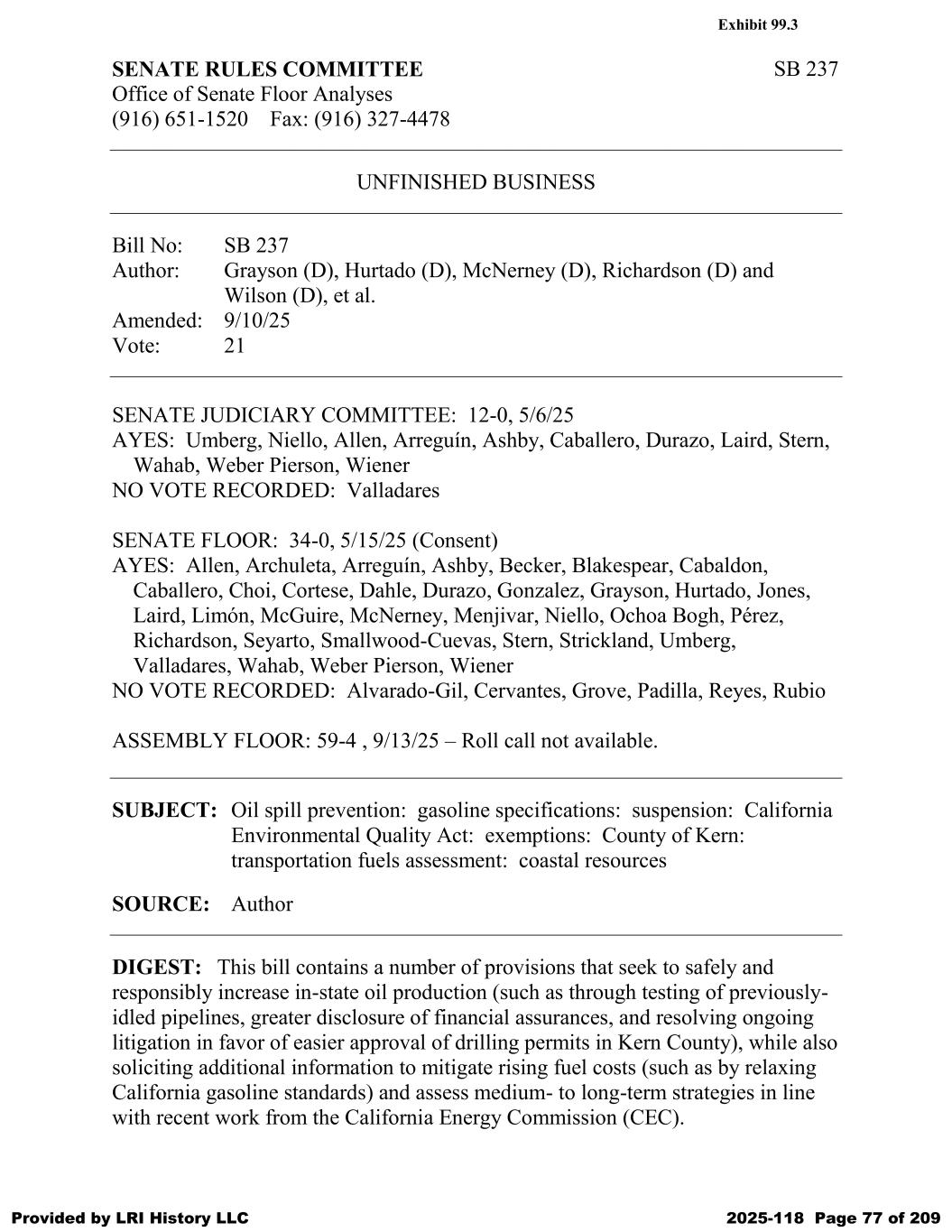
SENATE RULES COMMITTEE Office of Senate Floor Analyses (916) 651-1520 Fax: (916) 327-4478 SB 237 UNFINISHED BUSINESS Bill No: SB 237 Author: Grayson (D), Hurtado (D), McNerney (D), Richardson (D) and Wilson (D), et al. Amended: 9/10/25 Vote: 21 SENATE JUDICIARY COMMITTEE: 12-0, 5/6/25 AYES: Umberg, Niello, Allen, Arreguín, Ashby, Caballero, Durazo, Laird, Stern, Wahab, Weber Pierson, Wiener NO VOTE RECORDED: Valladares SENATE FLOOR: 34-0, 5/15/25 (Consent) AYES: Allen, Archuleta, Arreguín, Ashby, Becker, Blakespear, Cabaldon, Caballero, Choi, Cortese, Dahle, Durazo, Gonzalez, Grayson, Hurtado, Jones, Laird, Limón, McGuire, McNerney, Menjivar, Niello, Ochoa Bogh, Pérez, Richardson, Seyarto, Smallwood-Cuevas, Stern, Strickland, Umberg, Valladares, Wahab, Weber Pierson, Wiener NO VOTE RECORDED: Alvarado-Gil, Cervantes, Grove, Padilla, Reyes, Rubio ASSEMBLY FLOOR: 59-4 , 9/13/25 – Roll call not available. SUBJECT: Oil spill prevention: gasoline specifications: suspension: California Environmental Quality Act: exemptions: County of Kern: transportation fuels assessment: coastal resources SOURCE: Author DIGEST: This bill contains a number of provisions that seek to safely and responsibly increase in-state oil production (such as through testing of previously- idled pipelines, greater disclosure of financial assurances, and resolving ongoing litigation in favor of easier approval of drilling permits in Kern County), while also soliciting additional information to mitigate rising fuel costs (such as by relaxing California gasoline standards) and assess medium- to long-term strategies in line with recent work from the California Energy Commission (CEC). Provided by LRI History LLC 2025-118 Page 77 of 209
Assembly Amendments of 9/10/25 rewrote the bill entirely. ANALYSIS: Existing law: 1) Establishes the CEC tasks it with monitoring, analyzing, and making recommendations on statewide trends in the energy sector, including fuel supply and demand. (Public Resources Code §25200 et. seq.) 2) Establishes California Geologic Energy Management Division (CalGEM) for the purposes of overseeing the drilling, operation, maintenance, and removal of oil and gas wells. (Public Resources Code §3000 et. seq.) 3) Requires the Office of the State Fire Marshal (OSFM) to adopt hazardous liquid pipeline safety regulations that comply with federal law regarding hazardous liquid pipeline safety. (Government Code §51010 et. seq.) 4) Establishes the Office of Oil Spill Prevention and Response (OSPR) in the California Department of Fish and Wildlife as the state’s principal regulator for oil spill prevention and response. (Government Code (GOV) §§8574.1 et seq., GOV §§8670.1 et seq., Public Resources Code §§8750 et seq.). 5) Institutes the California Environmental Quality Act (CEQA), which requires lead agencies with the principal responsibility for carrying out or approving a project to prepare a negative declaration (ND), mitigated negative declaration (MND), or environmental impact report (EIR) for the project, unless the project is exempt from CEQA. (Public Resources Code (PRC) §21000 et seq.). (CEQA Guidelines §15064(a)(1), (f)(1)) 6) Establishes and defines a Program EIR (PEIR) in the CEQA guidelines as an EIR which may be prepared for a series of actions that can be characterized as one large project and are related either: a) Geographically; b) As logical parts in the chain of contemplated actions; c) In connection with issuance of rules, regulations, plans, or other general criteria to govern the conduct of a continuing program; or d) As individual activities carried out under the same authorizing statutory or regulatory authority and having generally similar environmental effects which can be mitigated in similar ways. (California Code of Regulations CEQA Guidelines § 15168) Provided by LRI History LLC 2025-118 Page 78 of 209
This bill: 1) Makes findings and declarations regarding, among other things, California’s mid-transition phase of the energy transition. 2) Requires the OSPR to solicit feedback on and periodically update its worst case scenario spill volumes. 3) Requires the OSPR to list, among other things, all applications for certificates of financial responsibility, and to revise worst case scenario spill volumes, and operators’ assurance of financial responsibility in case of a spill. 4) Requires pipelines of a certain size that have been out of service for more than five years (which would notably include certain pipelines serving the Sable Corporation’s Santa Ynez Unit), to meet specific testing requirements. 5) Permits the Governor to, under certain circumstances and with specified considerations, suspend the requirement “summer blend” gasoline in order to protect against “extraordinary gasoline price increases,” among other things. 6) Deems the Kern County Second Supplemental Recirculated Environmental Impact Report (SCH2013081079; the SSREIR), including all appendices (SSREIR, March 2025), until January 1, 2036, sufficient for full compliance with CEQA. 7) Directs CEC to, as part of the next Transportation Fuels Assessment, evaluate the cost and supply impacts of gasoline that is not “California reformulated gasoline blendstock for oxygenate blending” (CARBOB), and, among other things, potentially make various recommendations regarding how such non- CARBOB gasoline could benefit California. 8) Requires CEC to, on or before March 31, 2026, submit an assessment to the Legislature that evaluates certain information in the June 2025 letter to Governor Newsom from CEC Vice Chair Siva Gunda. 9) Requires oil produced offshore by new, expanded, or reactivated operations (of the same types of pipelines covered by #4 above) to be transported once Provided by LRI History LLC 2025-118 Page 79 of 209
onshore by pipelines using the best available technology, as defined, and certain projects require a new Coastal Development Permit. Background Declining domestic oil production may impact in-state oil pipelines. California’s reliance on crude oil has steadily declined since the 1980s; however, oil consumption recently increased from pandemic lows in 2020. Despite this rebound, California’s in-state production of petroleum remains low and California largely relies on imports for its petroleum supplies. Several refineries maintain existing petroleum supplies by using pipelines to in-state oil fields. However, as supply from those fields decreases, the economic viability of those pipelines sharply declines. Some of the policies advanced by this bill (namely restoring the pipelines for offshore oil production in Sable’s Santa Ynez Unit and the Kern County SSREIR being deemed approved) appear to address this problem by increasing in-state oil production. a) Tests for moving oil safely via pipelines. To prevent accidents and spills, state and federal regulations require pipeline operators to conduct hydrostatic pressure tests to ensure the integrity of their pipelines. b) Financial assurances in the case of oil spills. Because the threat of an oil spill is never zero, OSPR issues Certificate of Financial Responsibility to facilities, vessels, and pipelines that are required to have a California Oil Spill Contingency Plan, following submittal of an application and proof that the applicant has the financial resources to cover the cost of response for a “worst-case scenario” spill. Kern County oil and gas ordinance’s iterative EIRs. In 2013, Kern County began the process of amending its zoning ordinance addressing local permitting for oil and gas exploration, development and production. For the last ten years, the County has gone back and forth in litigation as plaintiffs challenged the ordinance and the drilling permitted under it. Courts have at different times and to various degrees sided with one side or the other, and the original EIR has been revisited in supplemental EIRs (SEIR). As of 2025, the most recent iteration of the EIR, the Second Supplemental Recirculated EIR (SSREIR), faces legal challenge. Energy Commission Recommendations for the mid transition. On June 27, 2025, the Vice Chair of the energy commission submitted a letter to the Governor outlining the CEC’s recommendation’s on changes to state policy to ensure Provided by LRI History LLC 2025-118 Page 80 of 209
“adequate transportation fuels supply during this pivotal time in our state’s clean energy transition.” The letter recommended pursuit of three concurrent strategies, briefly: c) Stabilize fuel supply through imports of refined fuels and maintaining in- state refining capacity; d) Provide sufficient confidence to industry to invest in maintaining reliable and safe infrastructure operations to meet demand; and e) Develop and execute a holistic transportation fuels transition strategy. Comments Purpose of Bill. According to the author, “California faces an affordability crisis on a number of fronts, most notably when it comes to the cost of fuel. This affects all of us—both directly and indirectly—whether it be at the gas pump, where Californians pay some of the prices in the country, or in the form of higher prices for goods and services, which are also affected by the higher costs of energy to produce and deliver. As was noted in a June 27, 2025 report by California Energy Commission Vice-Chair, Siva Gunda, “If a lack of proactive management during this phase of the transition leads to rising energy prices and less reliable fuel supplies, that instability could erode support for continued decarbonization.” SB 273 seeks to answers this call for proactive management.” Preventing oil spills from pipelines. On May 19, 2015 an offshore pipeline ruptured, spilling over 140,000 gallons of heavy crude oil along the Gaviota coast at Refugio Beach in Santa Barbara County. Sable announced they were restarting oil production in the Santa Ynez unit (in federal waters) on May 15, 2025, and restarting the use of those two pipelines. Sable has not replaced, but has rather made repairs to the pipelines. Some of the provisions of SB 237 are intended to address concerns surrounding the safety of restarting use of the repaired pipelines by requiring testing of the pipelines’ durability. Updating financial assurances for oil spills. There is no requirement that the regulations governing worst-case spills be regularly updated, and as such, they have not been. The marine facility reasonable “worst-case spill” volume calculations were established in regulation in 1993 using methods aligned with federal worst-case discharge calculations, and there have only been minor and infrequent updates since then. SB 237 would require more disclosure about and decadal updates of the certificates of financial responsibility. Provided by LRI History LLC 2025-118 Page 81 of 209

Ending the Kern Oil and Gas Ordinance litigation, with some guardrails. SB 237 ‘puts the lid’ on any further revisions to or legal objections against Kern County’s zoning ordinance focused on oil and gas (except purely typographical fixes). SB 237 also specifies that the zoning ordinance SSREIR is sufficient to meet the requirements of CEQA for compliant projects, meaning that no further, project- specific EIR’s for a given oil well are required so long as the new wells fit in the four corners of the existing SSREIR. However, SB 237 could prevent appropriate mitigations measures or other environmental considerations from being applied to drilling projects that are atypical, use emerging technology or technology not considered the SSREIR, or are otherwise not considered in the SSREIR. To help address some of these concerns, SB 237 adds some environmental guardrails to the application of the SSREIR, briefly: a) It sets a cap for drilling in Kern County at 2,000 new oil wells, a 26% reduction in total planned wells per year compared to the original estimate in Kern County’s oil and gas ordinance EIR. (However, this can be waived under certain CEC findings); b) It contains a ten-year sunset on the provisions that specify that the SSREIR is sufficient, complete, and not subject to lawsuits for new drilling (However, the SSREIR itself would remain in effect after the sunset); c) It specifies that CalGEM, rather than Kern County, must be the lead agency in a health protection zone, presumably making it harder to drill new wells in those zone (although not impossible). Maintaining capacity to stabilize fuel supply. Several of this bill’s provisions appear to follow recommendations in CEC Vice Chair Gunda’s June letter, and would be expected to boost in-state production, which would be expected to support California’s refinery capacity, which would be expected to help keep refineries operating in state. Using more tools in the toolbox to manage gas prices. Parts of SB 237 contemplate changes to California’s fuel blend to reduce fuel prices. Summer blend gasoline in California contributes less to smog, but is more expensive. California’s unique gasoline blendstock, CARBOB, was formulated to help meet California’s nation- leading air pollution challenges. However, it also means that fuel in neighboring states cannot be used in California. Both of these measures could be expected to reduce fuel prices, at the cost of increased air pollution. However, these do not address the long-term challenges the state faces in larger-scale decarbonization Provided by LRI History LLC 2025-118 Page 82 of 209

across all sectors of the economy. Navigating the mid-transition. Whether through the intentional phase-down of fossil fuels in California, shifting global market dynamics, the costs associated with repair and maintenance, or a combination of all of the above and more, it is clearly becoming more and more difficult to profitably operate fossil fuel infrastructure in California. How do we embrace and deploy clean technologies while they are more expensive than the fossil fuel alternatives? How do we maintain the fossil fuel supply we need as it becomes less lucrative and less feasible to do so? We are in a period described by academics as the “mid-transition”. As described in a recent review: “Many aspects of transition will be felt, and shaped, directly by individuals because of our direct interactions with energy systems. Even rare missteps are likely to have significant and potentially system design relevant impacts on perception, political support, and implementation. Comparisons of the new system to the old system are likely to rest on experience of a world less affected by climate change, such that concerns about lower reliability, higher costs, and other challenges might be perceived as inherent to zero-carbon systems, versus energy systems facing consequences of climate change and longterm underinvestment.”1 California’s economy today relies on an immense volume of fossil fuels (by some accounts as much as 84% of our total energy today)2. In turn, extracting, transporting, refining, distributing, and using those fossil fuels relies on an immense network of infrastructure owned by a number of private companies and operated by tens of thousands of skilled workers. Those private companies rely on certainty about the profitability of their investments. What happens when—not if— it is no longer profitable to operate fossil fuel infrastructure in California? What— if not profit—would compel private companies to continue maintaining and operating their infrastructure? How can California keep its economy afloat and its people thriving in the crucial period between when fossil fuels stop being profitable, and when they stop being needed? Pursuant to SBX1-2, the California Energy Commission produced a Transportation 1 Grubert and Hastings-Simon, 2022. Designing the mid-transition: A review of medium-term challenges for coordinated decarbonization in the United States. WIRES Climate Change, Vol 13, Issue 3. 2 California State Profile & Energy Estimates. U.S. Energy Information Administration. https://www.eia.gov/state/?sid=CA Provided by LRI History LLC 2025-118 Page 83 of 209
Fuels Assessment, which has begun to wrestle with some of these questions. One of several possible solutions under consideration is state ownership of refineries, in which, “The State of California would purchase and own refineries in the State to manage the supply and price of gasoline.” However, doing so would be extremely costly and represent a significant departure from how this industry has operated in California to date. As the Legislature considers this bill and other proposals to assuage or mitigate the very real tensions of the mid-transition, it is worth also contemplating solutions on the longer time horizon as well. There is no clear best way to transition the world’s fourth largest economy off of fossil fuels. California is leading the way and charting a path to navigate this transition. This monumental task will have consequences, both expected and unforeseen. Nevertheless, the Legislature should evaluate the information and options available and take action before GHG emissions continue unabated, fossil fuel infrastructure falls into disrepair (with potentially catastrophic results), and communities surrounding this infrastructure continue to face air pollution and economic uncertainty alike. Vice Chair Gunda’s June letter described the importance of a holistic strategy for a managed transition away from fossil fuels, alongside more pressing and immediate matters. Boosting in-state production today, as SB 237 proposes to do, to keep critical infrastructure online is a reasonable response to less-than-ideal circumstances. But what lessons can be learned? What could California begin doing now to make the next refinery to announce its closure less disruptive to California’s well-being, not more? What information is needed about California’s refineries (both their operations and the financial liabilities associated with their site remediation) to better equip California to handle the next stage of this transition? Although SB 237 does not answer these questions, it helps get information that might. These continue to be questions the Legislature should consider, lest we find ourselves blindsided by the next nigh-inevitable refinery closure. FISCAL EFFECT: Appropriation: No Fiscal Com.: Yes Local: Yes SUPPORT: (Verified 9/13/25) 350 Humboldt Associated Builders and Contractors of California Berry Petroleum Company, LLC California Business Roundtable California Independent Petroleum Association Provided by LRI History LLC 2025-118 Page 84 of 209

California Resources Corporation and Subsidiaries California State Association of Electrical Workers California State Pipe Trades Council City of Bakersfield Climate Action California County of Kern OPPOSITION: (Verified 9/13/25) Asian Pacific Environmental Network Action California Coastal Protection Network California Environmental Justice Alliance Action California Environmental Voters Campaign for a Safe and Healthy California Ceja Action Center for Biological Diversity Center on Race, Poverty & the Environment Central California Environmental Justic Network Central California Environmental Justice Network Clean Water Action Climate First: Replacing Oil & Gas Communities for a Better Environment Consumer Watchdog Earthjustice Leadership Council for Justice and Accountability Natural Resources Defense Council Natural Resources Defense Council Physicians for Social Responsibility - Los Angeles Sierra Club Sierra Club California The Climate Center Prepared by: Heather Walters / E.Q. / (916) 651-4108 9/13/25 11:10:30 **** END **** Provided by LRI History LLC 2025-118 Page 85 of 209
 エドガーで原本を確認する