FALSE00016914212025FYhttp://fasb.org/us-gaap/2025#OtherAssetshttp://fasb.org/us-gaap/2025#OtherAssetshttp://fasb.org/us-gaap/2025#AccruedLiabilitiesAndOtherLiabilitieshttp://fasb.org/us-gaap/2025#AccruedLiabilitiesAndOtherLiabilities1169iso4217:USDxbrli:sharesiso4217:USDxbrli:shareslmnd:securityxbrli:purelmnd:segmentlmnd:claimlmnd:directorlmnd:floor00016914212025-01-012025-12-3100016914212025-06-3000016914212026-02-2400016914212025-10-012025-12-3100016914212025-12-3100016914212024-12-3100016914212024-01-012024-12-3100016914212023-01-012023-12-310001691421us-gaap:CommonStockMember2022-12-310001691421us-gaap:AdditionalPaidInCapitalMember2022-12-310001691421us-gaap:RetainedEarningsMember2022-12-310001691421us-gaap:AccumulatedOtherComprehensiveIncomeMember2022-12-3100016914212022-12-310001691421us-gaap:CommonStockMember2023-01-012023-12-310001691421us-gaap:AdditionalPaidInCapitalMember2023-01-012023-12-310001691421us-gaap:RetainedEarningsMember2023-01-012023-12-310001691421us-gaap:AccumulatedOtherComprehensiveIncomeMember2023-01-012023-12-310001691421us-gaap:CommonStockMember2023-12-310001691421us-gaap:AdditionalPaidInCapitalMember2023-12-310001691421us-gaap:RetainedEarningsMember2023-12-310001691421us-gaap:AccumulatedOtherComprehensiveIncomeMember2023-12-3100016914212023-12-310001691421us-gaap:CommonStockMember2024-01-012024-12-310001691421us-gaap:AdditionalPaidInCapitalMember2024-01-012024-12-310001691421us-gaap:CommonStockMember2025-01-012025-12-310001691421us-gaap:RetainedEarningsMember2024-01-012024-12-310001691421us-gaap:AccumulatedOtherComprehensiveIncomeMember2024-01-012024-12-310001691421us-gaap:CommonStockMember2024-12-310001691421us-gaap:AdditionalPaidInCapitalMember2024-12-310001691421us-gaap:RetainedEarningsMember2024-12-310001691421us-gaap:AccumulatedOtherComprehensiveIncomeMember2024-12-310001691421us-gaap:AdditionalPaidInCapitalMember2025-01-012025-12-310001691421us-gaap:RetainedEarningsMember2025-01-012025-12-310001691421us-gaap:AccumulatedOtherComprehensiveIncomeMember2025-01-012025-12-310001691421us-gaap:CommonStockMember2025-12-310001691421us-gaap:AdditionalPaidInCapitalMember2025-12-310001691421us-gaap:RetainedEarningsMember2025-12-310001691421us-gaap:AccumulatedOtherComprehensiveIncomeMember2025-12-310001691421us-gaap:ComputerEquipmentMember2025-12-310001691421lmnd:FurnitureAndEquipmentMember2025-12-310001691421us-gaap:SoftwareDevelopmentMember2025-12-310001691421us-gaap:EmployeeStockOptionMember2025-01-012025-12-310001691421us-gaap:CorporateDebtSecuritiesMember2025-12-310001691421us-gaap:USGovernmentAgenciesDebtSecuritiesMember2025-12-310001691421us-gaap:AssetBackedSecuritiesMember2025-12-310001691421us-gaap:ForeignGovernmentDebtSecuritiesMember2025-12-310001691421us-gaap:CorporateDebtSecuritiesMember2024-12-310001691421us-gaap:USGovernmentAgenciesDebtSecuritiesMember2024-12-310001691421us-gaap:AssetBackedSecuritiesMember2024-12-310001691421us-gaap:ForeignGovernmentDebtSecuritiesMember2024-12-310001691421us-gaap:FixedIncomeSecuritiesMember2025-12-310001691421us-gaap:FixedIncomeSecuritiesMember2024-12-310001691421us-gaap:CashAndCashEquivalentsMember2025-01-012025-12-310001691421us-gaap:CashAndCashEquivalentsMember2024-01-012024-12-310001691421us-gaap:CashAndCashEquivalentsMember2023-01-012023-12-310001691421us-gaap:DebtSecuritiesMember2025-01-012025-12-310001691421us-gaap:DebtSecuritiesMember2024-01-012024-12-310001691421us-gaap:DebtSecuritiesMember2023-01-012023-12-310001691421us-gaap:ShortTermInvestmentsMember2025-01-012025-12-310001691421us-gaap:ShortTermInvestmentsMember2024-01-012024-12-310001691421us-gaap:ShortTermInvestmentsMember2023-01-012023-12-310001691421lmnd:DepositWithStateInsuranceDepartmentMember2025-12-310001691421lmnd:DepositWithStateInsuranceDepartmentMember2024-12-310001691421stpr:DElmnd:DepositWithStateInsuranceDepartmentMember2025-12-310001691421stpr:DElmnd:DepositWithStateInsuranceDepartmentMember2024-12-310001691421stpr:NYlmnd:DepositWithStateInsuranceDepartmentMember2025-12-310001691421stpr:NYlmnd:DepositWithStateInsuranceDepartmentMember2024-12-310001691421stpr:WAlmnd:DepositWithStateInsuranceDepartmentMember2025-12-310001691421stpr:WAlmnd:DepositWithStateInsuranceDepartmentMember2024-12-310001691421stpr:COlmnd:DepositWithStateInsuranceDepartmentMember2025-12-310001691421stpr:COlmnd:DepositWithStateInsuranceDepartmentMember2024-12-310001691421stpr:VAlmnd:DepositWithStateInsuranceDepartmentMember2025-12-310001691421stpr:VAlmnd:DepositWithStateInsuranceDepartmentMember2024-12-310001691421stpr:NMlmnd:DepositWithStateInsuranceDepartmentMember2025-12-310001691421stpr:NMlmnd:DepositWithStateInsuranceDepartmentMember2024-12-310001691421stpr:OHlmnd:DepositWithStateInsuranceDepartmentMember2025-12-310001691421stpr:OHlmnd:DepositWithStateInsuranceDepartmentMember2024-12-310001691421stpr:NJlmnd:DepositWithStateInsuranceDepartmentMember2025-12-310001691421stpr:NJlmnd:DepositWithStateInsuranceDepartmentMember2024-12-310001691421stpr:NClmnd:DepositWithStateInsuranceDepartmentMember2025-12-310001691421stpr:NClmnd:DepositWithStateInsuranceDepartmentMember2024-12-310001691421stpr:NVlmnd:DepositWithStateInsuranceDepartmentMember2025-12-310001691421stpr:NVlmnd:DepositWithStateInsuranceDepartmentMember2024-12-310001691421stpr:ARlmnd:DepositWithStateInsuranceDepartmentMember2025-12-310001691421stpr:ARlmnd:DepositWithStateInsuranceDepartmentMember2024-12-310001691421stpr:FLlmnd:DepositWithStateInsuranceDepartmentMember2025-12-310001691421stpr:FLlmnd:DepositWithStateInsuranceDepartmentMember2024-12-310001691421stpr:MAlmnd:DepositWithStateInsuranceDepartmentMember2025-12-310001691421stpr:MAlmnd:DepositWithStateInsuranceDepartmentMember2024-12-310001691421stpr:KSlmnd:DepositWithStateInsuranceDepartmentMember2025-12-310001691421stpr:KSlmnd:DepositWithStateInsuranceDepartmentMember2024-12-310001691421stpr:KYlmnd:DepositWithStateInsuranceDepartmentMember2025-12-310001691421stpr:KYlmnd:DepositWithStateInsuranceDepartmentMember2024-12-310001691421stpr:GAlmnd:DepositWithStateInsuranceDepartmentMember2025-12-310001691421stpr:GAlmnd:DepositWithStateInsuranceDepartmentMember2024-12-310001691421us-gaap:CorporateDebtSecuritiesMemberus-gaap:FairValueInputsLevel1Member2025-12-310001691421us-gaap:CorporateDebtSecuritiesMemberus-gaap:FairValueInputsLevel2Member2025-12-310001691421us-gaap:CorporateDebtSecuritiesMemberus-gaap:FairValueInputsLevel3Member2025-12-310001691421us-gaap:USGovernmentAgenciesDebtSecuritiesMemberus-gaap:FairValueInputsLevel1Member2025-12-310001691421us-gaap:USGovernmentAgenciesDebtSecuritiesMemberus-gaap:FairValueInputsLevel2Member2025-12-310001691421us-gaap:USGovernmentAgenciesDebtSecuritiesMemberus-gaap:FairValueInputsLevel3Member2025-12-310001691421us-gaap:AssetBackedSecuritiesMemberus-gaap:FairValueInputsLevel1Member2025-12-310001691421us-gaap:AssetBackedSecuritiesMemberus-gaap:FairValueInputsLevel2Member2025-12-310001691421us-gaap:AssetBackedSecuritiesMemberus-gaap:FairValueInputsLevel3Member2025-12-310001691421us-gaap:ForeignGovernmentDebtSecuritiesMemberus-gaap:FairValueInputsLevel1Member2025-12-310001691421us-gaap:ForeignGovernmentDebtSecuritiesMemberus-gaap:FairValueInputsLevel2Member2025-12-310001691421us-gaap:ForeignGovernmentDebtSecuritiesMemberus-gaap:FairValueInputsLevel3Member2025-12-310001691421us-gaap:FairValueInputsLevel1Member2025-12-310001691421us-gaap:FairValueInputsLevel2Member2025-12-310001691421us-gaap:FairValueInputsLevel3Member2025-12-310001691421us-gaap:WarrantMemberus-gaap:FairValueInputsLevel1Member2025-12-310001691421us-gaap:WarrantMemberus-gaap:FairValueInputsLevel2Member2025-12-310001691421us-gaap:WarrantMemberus-gaap:FairValueInputsLevel3Member2025-12-310001691421us-gaap:WarrantMember2025-12-310001691421us-gaap:CorporateDebtSecuritiesMemberus-gaap:FairValueInputsLevel1Member2024-12-310001691421us-gaap:CorporateDebtSecuritiesMemberus-gaap:FairValueInputsLevel2Member2024-12-310001691421us-gaap:CorporateDebtSecuritiesMemberus-gaap:FairValueInputsLevel3Member2024-12-310001691421us-gaap:USGovernmentAgenciesDebtSecuritiesMemberus-gaap:FairValueInputsLevel1Member2024-12-310001691421us-gaap:USGovernmentAgenciesDebtSecuritiesMemberus-gaap:FairValueInputsLevel2Member2024-12-310001691421us-gaap:USGovernmentAgenciesDebtSecuritiesMemberus-gaap:FairValueInputsLevel3Member2024-12-310001691421us-gaap:AssetBackedSecuritiesMemberus-gaap:FairValueInputsLevel1Member2024-12-310001691421us-gaap:AssetBackedSecuritiesMemberus-gaap:FairValueInputsLevel2Member2024-12-310001691421us-gaap:AssetBackedSecuritiesMemberus-gaap:FairValueInputsLevel3Member2024-12-310001691421us-gaap:ForeignGovernmentDebtSecuritiesMemberus-gaap:FairValueInputsLevel1Member2024-12-310001691421us-gaap:ForeignGovernmentDebtSecuritiesMemberus-gaap:FairValueInputsLevel2Member2024-12-310001691421us-gaap:ForeignGovernmentDebtSecuritiesMemberus-gaap:FairValueInputsLevel3Member2024-12-310001691421us-gaap:FairValueInputsLevel1Member2024-12-310001691421us-gaap:FairValueInputsLevel2Member2024-12-310001691421us-gaap:FairValueInputsLevel3Member2024-12-310001691421us-gaap:WarrantMemberus-gaap:FairValueInputsLevel1Member2024-12-310001691421us-gaap:WarrantMemberus-gaap:FairValueInputsLevel2Member2024-12-310001691421us-gaap:WarrantMemberus-gaap:FairValueInputsLevel3Member2024-12-310001691421us-gaap:WarrantMember2024-12-310001691421Reinsurance Program2024-07-012024-07-0100016914212023-07-012023-07-010001691421Proportional Reinsurance Contracts2023-07-012023-07-010001691421srt:MaximumMemberProperty Per Risk Excess of Loss Reinsurance2023-07-012023-07-010001691421Property Per Risk Excess of Loss Reinsurance2023-07-012023-07-010001691421lmnd:LemonadeInsuranceCompanyMemberAutomatic Facultative Property Per Risk Excess of Loss2024-06-302024-06-300001691421lmnd:LemonadeInsuranceCompanyMemberAutomatic Facultative Property Per Risk Excess of Loss Reinsurance2024-06-302024-06-300001691421Excess of Loss Reinsurance Contract2023-07-012023-07-010001691421lmnd:HannoverRueckSEMembersrt:AMBestAPlusRatingMemberus-gaap:CededCreditRiskUnsecuredMember2025-12-310001691421lmnd:HannoverRueckSEMembersrt:AMBestAPlusRatingMemberus-gaap:CededCreditRiskUnsecuredMember2024-12-310001691421lmnd:MAPFREReCompaniaDeReasegurosSAMembersrt:AMBestARatingMemberus-gaap:CededCreditRiskUnsecuredMember2025-12-310001691421lmnd:MAPFREReCompaniaDeReasegurosSAMembersrt:AMBestARatingMemberus-gaap:CededCreditRiskUnsecuredMember2024-12-310001691421lmnd:SwissReinsuranceAmericaCorporationMembersrt:AMBestAPlusRatingMemberus-gaap:CededCreditRiskUnsecuredMember2025-12-310001691421lmnd:SwissReinsuranceAmericaCorporationMembersrt:AMBestAPlusRatingMemberus-gaap:CededCreditRiskUnsecuredMember2024-12-310001691421lmnd:AvivaInsuranceLimitedMembersrt:AMBestAPlusRatingMemberus-gaap:CededCreditRiskUnsecuredMember2025-12-310001691421lmnd:AvivaInsuranceLimitedMembersrt:AMBestAPlusRatingMemberus-gaap:CededCreditRiskUnsecuredMember2024-12-310001691421lmnd:LloydsUnderwriterSyndicateNo2791MAPMemberus-gaap:CededCreditRiskUnsecuredMember2025-12-310001691421lmnd:LloydsUnderwriterSyndicateNo2791MAPMemberus-gaap:CededCreditRiskUnsecuredMember2024-12-310001691421lmnd:TokioMarineNichidoFireInsuranceCompanyLimitedMembersrt:AMBestAPlusPlusRatingMemberus-gaap:CededCreditRiskUnsecuredMember2025-12-310001691421lmnd:TokioMarineNichidoFireInsuranceCompanyLimitedMembersrt:AMBestAPlusPlusRatingMemberus-gaap:CededCreditRiskUnsecuredMember2024-12-310001691421lmnd:LloydsUnderwriterSyndicateNo1084CSLMemberus-gaap:CededCreditRiskUnsecuredMember2025-12-310001691421lmnd:LloydsUnderwriterSyndicateNo1084CSLMemberus-gaap:CededCreditRiskUnsecuredMember2024-12-310001691421lmnd:TheTravellersIndemnityCompanyMembersrt:AMBestAPlusPlusRatingMemberus-gaap:CededCreditRiskUnsecuredMember2025-12-310001691421lmnd:TheTravellersIndemnityCompanyMembersrt:AMBestAPlusPlusRatingMemberus-gaap:CededCreditRiskUnsecuredMember2024-12-310001691421lmnd:OdysseyReinsuranceCompanyMembersrt:AMBestAPlusRatingMemberus-gaap:CededCreditRiskUnsecuredMember2025-12-310001691421lmnd:OdysseyReinsuranceCompanyMembersrt:AMBestAPlusRatingMemberus-gaap:CededCreditRiskUnsecuredMember2024-12-310001691421lmnd:LloydsUnderwriterSyndicateNo2001AMLMembersrt:AMBestAPlusRatingMemberus-gaap:CededCreditRiskUnsecuredMember2025-12-310001691421lmnd:LloydsUnderwriterSyndicateNo2001AMLMembersrt:AMBestAPlusRatingMemberus-gaap:CededCreditRiskUnsecuredMember2024-12-310001691421lmnd:TopReinsurersMemberus-gaap:CededCreditRiskUnsecuredMember2025-12-310001691421lmnd:TopReinsurersMemberus-gaap:CededCreditRiskUnsecuredMember2024-12-310001691421lmnd:OtherReinsurersMemberus-gaap:CededCreditRiskUnsecuredMember2025-12-310001691421lmnd:OtherReinsurersMemberus-gaap:CededCreditRiskUnsecuredMember2024-12-310001691421us-gaap:CededCreditRiskUnsecuredMember2025-12-310001691421us-gaap:CededCreditRiskUnsecuredMember2024-12-310001691421lmnd:ComputerEquipmentAndSoftwareMember2025-12-310001691421lmnd:ComputerEquipmentAndSoftwareMember2024-12-310001691421us-gaap:LeaseholdImprovementsMember2025-12-310001691421us-gaap:LeaseholdImprovementsMember2024-12-310001691421lmnd:FurnitureAndEquipmentMember2024-12-310001691421lmnd:InsuranceLicensesMember2025-12-310001691421lmnd:InsuranceLicensesMember2024-12-310001691421us-gaap:TrademarksMember2025-12-310001691421us-gaap:TrademarksMember2024-12-310001691421lmnd:TechnologyMember2025-01-012025-12-310001691421lmnd:TechnologyMember2025-12-310001691421lmnd:TechnologyMember2024-12-310001691421lmnd:ValueOfBusinessAcquiredMember2025-01-012025-12-310001691421lmnd:ValueOfBusinessAcquiredMember2025-12-310001691421lmnd:ValueOfBusinessAcquiredMember2024-12-310001691421lmnd:CaliforniaWildfiresMember2025-01-012025-12-310001691421lmnd:CaliforniaWildfiresMember2025-03-012025-03-310001691421lmnd:HurricaneHeleneMember2024-01-012024-12-310001691421lmnd:HurricaneBerylMember2024-01-012024-12-310001691421lmnd:WinterStormElliotMember2023-01-012023-12-310001691421lmnd:TexasHailStormMember2023-01-012023-12-310001691421us-gaap:PropertyInsuranceProductLineMemberus-gaap:ShortdurationInsuranceContractsAccidentYear2016Member2016-12-310001691421us-gaap:PropertyInsuranceProductLineMemberus-gaap:ShortdurationInsuranceContractsAccidentYear2016Member2017-12-310001691421us-gaap:PropertyInsuranceProductLineMemberus-gaap:ShortdurationInsuranceContractsAccidentYear2016Member2018-12-310001691421us-gaap:PropertyInsuranceProductLineMemberus-gaap:ShortdurationInsuranceContractsAccidentYear2016Member2019-12-310001691421us-gaap:PropertyInsuranceProductLineMemberus-gaap:ShortdurationInsuranceContractsAccidentYear2016Member2020-12-310001691421us-gaap:PropertyInsuranceProductLineMemberus-gaap:ShortdurationInsuranceContractsAccidentYear2016Member2021-12-310001691421us-gaap:PropertyInsuranceProductLineMemberus-gaap:ShortdurationInsuranceContractsAccidentYear2016Member2022-12-310001691421us-gaap:PropertyInsuranceProductLineMemberus-gaap:ShortdurationInsuranceContractsAccidentYear2016Member2023-12-310001691421us-gaap:PropertyInsuranceProductLineMemberus-gaap:ShortdurationInsuranceContractsAccidentYear2016Member2024-12-310001691421us-gaap:PropertyInsuranceProductLineMemberus-gaap:ShortdurationInsuranceContractsAccidentYear2016Member2025-12-310001691421us-gaap:PropertyInsuranceProductLineMemberus-gaap:ShortDurationInsuranceContractsAccidentYear2017Member2017-12-310001691421us-gaap:PropertyInsuranceProductLineMemberus-gaap:ShortDurationInsuranceContractsAccidentYear2017Member2018-12-310001691421us-gaap:PropertyInsuranceProductLineMemberus-gaap:ShortDurationInsuranceContractsAccidentYear2017Member2019-12-310001691421us-gaap:PropertyInsuranceProductLineMemberus-gaap:ShortDurationInsuranceContractsAccidentYear2017Member2020-12-310001691421us-gaap:PropertyInsuranceProductLineMemberus-gaap:ShortDurationInsuranceContractsAccidentYear2017Member2021-12-310001691421us-gaap:PropertyInsuranceProductLineMemberus-gaap:ShortDurationInsuranceContractsAccidentYear2017Member2022-12-310001691421us-gaap:PropertyInsuranceProductLineMemberus-gaap:ShortDurationInsuranceContractsAccidentYear2017Member2023-12-310001691421us-gaap:PropertyInsuranceProductLineMemberus-gaap:ShortDurationInsuranceContractsAccidentYear2017Member2024-12-310001691421us-gaap:PropertyInsuranceProductLineMemberus-gaap:ShortDurationInsuranceContractsAccidentYear2017Member2025-12-310001691421us-gaap:PropertyInsuranceProductLineMemberus-gaap:ShortDurationInsuranceContractsAccidentYear2018Member2018-12-310001691421us-gaap:PropertyInsuranceProductLineMemberus-gaap:ShortDurationInsuranceContractsAccidentYear2018Member2019-12-310001691421us-gaap:PropertyInsuranceProductLineMemberus-gaap:ShortDurationInsuranceContractsAccidentYear2018Member2020-12-310001691421us-gaap:PropertyInsuranceProductLineMemberus-gaap:ShortDurationInsuranceContractsAccidentYear2018Member2021-12-310001691421us-gaap:PropertyInsuranceProductLineMemberus-gaap:ShortDurationInsuranceContractsAccidentYear2018Member2022-12-310001691421us-gaap:PropertyInsuranceProductLineMemberus-gaap:ShortDurationInsuranceContractsAccidentYear2018Member2023-12-310001691421us-gaap:PropertyInsuranceProductLineMemberus-gaap:ShortDurationInsuranceContractsAccidentYear2018Member2024-12-310001691421us-gaap:PropertyInsuranceProductLineMemberus-gaap:ShortDurationInsuranceContractsAccidentYear2018Member2025-12-310001691421us-gaap:PropertyInsuranceProductLineMemberus-gaap:ShortDurationInsuranceContractAccidentYear2019Member2019-12-310001691421us-gaap:PropertyInsuranceProductLineMemberus-gaap:ShortDurationInsuranceContractAccidentYear2019Member2020-12-310001691421us-gaap:PropertyInsuranceProductLineMemberus-gaap:ShortDurationInsuranceContractAccidentYear2019Member2021-12-310001691421us-gaap:PropertyInsuranceProductLineMemberus-gaap:ShortDurationInsuranceContractAccidentYear2019Member2022-12-310001691421us-gaap:PropertyInsuranceProductLineMemberus-gaap:ShortDurationInsuranceContractAccidentYear2019Member2023-12-310001691421us-gaap:PropertyInsuranceProductLineMemberus-gaap:ShortDurationInsuranceContractAccidentYear2019Member2024-12-310001691421us-gaap:PropertyInsuranceProductLineMemberus-gaap:ShortDurationInsuranceContractAccidentYear2019Member2025-12-310001691421us-gaap:PropertyInsuranceProductLineMemberus-gaap:ShortDurationInsuranceContractAccidentYear2020Member2020-12-310001691421us-gaap:PropertyInsuranceProductLineMemberus-gaap:ShortDurationInsuranceContractAccidentYear2020Member2021-12-310001691421us-gaap:PropertyInsuranceProductLineMemberus-gaap:ShortDurationInsuranceContractAccidentYear2020Member2022-12-310001691421us-gaap:PropertyInsuranceProductLineMemberus-gaap:ShortDurationInsuranceContractAccidentYear2020Member2023-12-310001691421us-gaap:PropertyInsuranceProductLineMemberus-gaap:ShortDurationInsuranceContractAccidentYear2020Member2024-12-310001691421us-gaap:PropertyInsuranceProductLineMemberus-gaap:ShortDurationInsuranceContractAccidentYear2020Member2025-12-310001691421us-gaap:PropertyInsuranceProductLineMemberus-gaap:ShortDurationInsuranceContractAccidentYear2021Member2021-12-310001691421us-gaap:PropertyInsuranceProductLineMemberus-gaap:ShortDurationInsuranceContractAccidentYear2021Member2022-12-310001691421us-gaap:PropertyInsuranceProductLineMemberus-gaap:ShortDurationInsuranceContractAccidentYear2021Member2023-12-310001691421us-gaap:PropertyInsuranceProductLineMemberus-gaap:ShortDurationInsuranceContractAccidentYear2021Member2024-12-310001691421us-gaap:PropertyInsuranceProductLineMemberus-gaap:ShortDurationInsuranceContractAccidentYear2021Member2025-12-310001691421us-gaap:PropertyInsuranceProductLineMemberus-gaap:ShortDurationInsuranceContractAccidentYear2022Member2022-12-310001691421us-gaap:PropertyInsuranceProductLineMemberus-gaap:ShortDurationInsuranceContractAccidentYear2022Member2023-12-310001691421us-gaap:PropertyInsuranceProductLineMemberus-gaap:ShortDurationInsuranceContractAccidentYear2022Member2024-12-310001691421us-gaap:PropertyInsuranceProductLineMemberus-gaap:ShortDurationInsuranceContractAccidentYear2022Member2025-12-310001691421us-gaap:PropertyInsuranceProductLineMemberus-gaap:ShortDurationInsuranceContractAccidentYear2023Member2023-12-310001691421us-gaap:PropertyInsuranceProductLineMemberus-gaap:ShortDurationInsuranceContractAccidentYear2023Member2024-12-310001691421us-gaap:PropertyInsuranceProductLineMemberus-gaap:ShortDurationInsuranceContractAccidentYear2023Member2025-12-310001691421us-gaap:PropertyInsuranceProductLineMemberus-gaap:ShortDurationInsuranceContractAccidentYear2024Member2024-12-310001691421us-gaap:PropertyInsuranceProductLineMemberus-gaap:ShortDurationInsuranceContractAccidentYear2024Member2025-12-310001691421us-gaap:PropertyInsuranceProductLineMemberus-gaap:ShortDurationInsuranceContractAccidentYear2025Member2025-12-310001691421us-gaap:PropertyInsuranceProductLineMember2025-12-310001691421us-gaap:PropertyInsuranceProductLineMember2023-12-310001691421us-gaap:PropertyInsuranceProductLineMember2022-12-310001691421us-gaap:PropertyInsuranceProductLineMember2020-12-310001691421us-gaap:PropertyInsuranceProductLineMember2024-12-310001691421us-gaap:PropertyInsuranceProductLineMember2016-12-310001691421us-gaap:PropertyInsuranceProductLineMember2017-12-310001691421us-gaap:PropertyInsuranceProductLineMember2019-12-310001691421us-gaap:PropertyInsuranceProductLineMember2021-12-310001691421lmnd:PetInsuranceMemberus-gaap:ShortDurationInsuranceContractAccidentYear2020Member2020-12-310001691421lmnd:PetInsuranceMemberus-gaap:ShortDurationInsuranceContractAccidentYear2020Member2021-12-310001691421lmnd:PetInsuranceMemberus-gaap:ShortDurationInsuranceContractAccidentYear2020Member2022-12-310001691421lmnd:PetInsuranceMemberus-gaap:ShortDurationInsuranceContractAccidentYear2020Member2023-12-310001691421lmnd:PetInsuranceMemberus-gaap:ShortDurationInsuranceContractAccidentYear2020Member2024-12-310001691421lmnd:PetInsuranceMemberus-gaap:ShortDurationInsuranceContractAccidentYear2020Member2025-12-310001691421lmnd:PetInsuranceMemberus-gaap:ShortDurationInsuranceContractAccidentYear2021Member2021-12-310001691421lmnd:PetInsuranceMemberus-gaap:ShortDurationInsuranceContractAccidentYear2021Member2022-12-310001691421lmnd:PetInsuranceMemberus-gaap:ShortDurationInsuranceContractAccidentYear2021Member2023-12-310001691421lmnd:PetInsuranceMemberus-gaap:ShortDurationInsuranceContractAccidentYear2021Member2024-12-310001691421lmnd:PetInsuranceMemberus-gaap:ShortDurationInsuranceContractAccidentYear2021Member2025-12-310001691421lmnd:PetInsuranceMemberus-gaap:ShortDurationInsuranceContractAccidentYear2022Member2022-12-310001691421lmnd:PetInsuranceMemberus-gaap:ShortDurationInsuranceContractAccidentYear2022Member2023-12-310001691421lmnd:PetInsuranceMemberus-gaap:ShortDurationInsuranceContractAccidentYear2022Member2024-12-310001691421lmnd:PetInsuranceMemberus-gaap:ShortDurationInsuranceContractAccidentYear2022Member2025-12-310001691421lmnd:PetInsuranceMemberus-gaap:ShortDurationInsuranceContractAccidentYear2023Member2023-12-310001691421lmnd:PetInsuranceMemberus-gaap:ShortDurationInsuranceContractAccidentYear2023Member2024-12-310001691421lmnd:PetInsuranceMemberus-gaap:ShortDurationInsuranceContractAccidentYear2023Member2025-12-310001691421lmnd:PetInsuranceMemberus-gaap:ShortDurationInsuranceContractAccidentYear2024Member2024-12-310001691421lmnd:PetInsuranceMemberus-gaap:ShortDurationInsuranceContractAccidentYear2024Member2025-12-310001691421lmnd:PetInsuranceMemberus-gaap:ShortDurationInsuranceContractAccidentYear2025Member2025-12-310001691421lmnd:PetInsuranceMember2025-12-310001691421lmnd:CarInsuranceMemberus-gaap:ShortdurationInsuranceContractsAccidentYear2016Member2016-12-310001691421lmnd:CarInsuranceMemberus-gaap:ShortdurationInsuranceContractsAccidentYear2016Member2017-12-310001691421lmnd:CarInsuranceMemberus-gaap:ShortdurationInsuranceContractsAccidentYear2016Member2018-12-310001691421lmnd:CarInsuranceMemberus-gaap:ShortdurationInsuranceContractsAccidentYear2016Member2019-12-310001691421lmnd:CarInsuranceMemberus-gaap:ShortdurationInsuranceContractsAccidentYear2016Member2020-12-310001691421lmnd:CarInsuranceMemberus-gaap:ShortdurationInsuranceContractsAccidentYear2016Member2021-12-310001691421lmnd:CarInsuranceMemberus-gaap:ShortdurationInsuranceContractsAccidentYear2016Member2022-12-310001691421lmnd:CarInsuranceMemberus-gaap:ShortdurationInsuranceContractsAccidentYear2016Member2023-12-310001691421lmnd:CarInsuranceMemberus-gaap:ShortdurationInsuranceContractsAccidentYear2016Member2024-12-310001691421lmnd:CarInsuranceMemberus-gaap:ShortdurationInsuranceContractsAccidentYear2016Member2025-12-310001691421lmnd:CarInsuranceMemberus-gaap:ShortDurationInsuranceContractsAccidentYear2017Member2017-12-310001691421lmnd:CarInsuranceMemberus-gaap:ShortDurationInsuranceContractsAccidentYear2017Member2018-12-310001691421lmnd:CarInsuranceMemberus-gaap:ShortDurationInsuranceContractsAccidentYear2017Member2019-12-310001691421lmnd:CarInsuranceMemberus-gaap:ShortDurationInsuranceContractsAccidentYear2017Member2020-12-310001691421lmnd:CarInsuranceMemberus-gaap:ShortDurationInsuranceContractsAccidentYear2017Member2021-12-310001691421lmnd:CarInsuranceMemberus-gaap:ShortDurationInsuranceContractsAccidentYear2017Member2022-12-310001691421lmnd:CarInsuranceMemberus-gaap:ShortDurationInsuranceContractsAccidentYear2017Member2023-12-310001691421lmnd:CarInsuranceMemberus-gaap:ShortDurationInsuranceContractsAccidentYear2017Member2024-12-310001691421lmnd:CarInsuranceMemberus-gaap:ShortDurationInsuranceContractsAccidentYear2017Member2025-12-310001691421lmnd:CarInsuranceMemberus-gaap:ShortDurationInsuranceContractsAccidentYear2018Member2018-12-310001691421lmnd:CarInsuranceMemberus-gaap:ShortDurationInsuranceContractsAccidentYear2018Member2019-12-310001691421lmnd:CarInsuranceMemberus-gaap:ShortDurationInsuranceContractsAccidentYear2018Member2020-12-310001691421lmnd:CarInsuranceMemberus-gaap:ShortDurationInsuranceContractsAccidentYear2018Member2021-12-310001691421lmnd:CarInsuranceMemberus-gaap:ShortDurationInsuranceContractsAccidentYear2018Member2022-12-310001691421lmnd:CarInsuranceMemberus-gaap:ShortDurationInsuranceContractsAccidentYear2018Member2023-12-310001691421lmnd:CarInsuranceMemberus-gaap:ShortDurationInsuranceContractsAccidentYear2018Member2024-12-310001691421lmnd:CarInsuranceMemberus-gaap:ShortDurationInsuranceContractsAccidentYear2018Member2025-12-310001691421lmnd:CarInsuranceMemberus-gaap:ShortDurationInsuranceContractAccidentYear2019Member2019-12-310001691421lmnd:CarInsuranceMemberus-gaap:ShortDurationInsuranceContractAccidentYear2019Member2020-12-310001691421lmnd:CarInsuranceMemberus-gaap:ShortDurationInsuranceContractAccidentYear2019Member2021-12-310001691421lmnd:CarInsuranceMemberus-gaap:ShortDurationInsuranceContractAccidentYear2019Member2022-12-310001691421lmnd:CarInsuranceMemberus-gaap:ShortDurationInsuranceContractAccidentYear2019Member2023-12-310001691421lmnd:CarInsuranceMemberus-gaap:ShortDurationInsuranceContractAccidentYear2019Member2024-12-310001691421lmnd:CarInsuranceMemberus-gaap:ShortDurationInsuranceContractAccidentYear2019Member2025-12-310001691421lmnd:CarInsuranceMemberus-gaap:ShortDurationInsuranceContractAccidentYear2020Member2020-12-310001691421lmnd:CarInsuranceMemberus-gaap:ShortDurationInsuranceContractAccidentYear2020Member2021-12-310001691421lmnd:CarInsuranceMemberus-gaap:ShortDurationInsuranceContractAccidentYear2020Member2022-12-310001691421lmnd:CarInsuranceMemberus-gaap:ShortDurationInsuranceContractAccidentYear2020Member2023-12-310001691421lmnd:CarInsuranceMemberus-gaap:ShortDurationInsuranceContractAccidentYear2020Member2024-12-310001691421lmnd:CarInsuranceMemberus-gaap:ShortDurationInsuranceContractAccidentYear2020Member2025-12-310001691421lmnd:CarInsuranceMemberus-gaap:ShortDurationInsuranceContractAccidentYear2021Member2021-12-310001691421lmnd:CarInsuranceMemberus-gaap:ShortDurationInsuranceContractAccidentYear2021Member2022-12-310001691421lmnd:CarInsuranceMemberus-gaap:ShortDurationInsuranceContractAccidentYear2021Member2023-12-310001691421lmnd:CarInsuranceMemberus-gaap:ShortDurationInsuranceContractAccidentYear2021Member2024-12-310001691421lmnd:CarInsuranceMemberus-gaap:ShortDurationInsuranceContractAccidentYear2021Member2025-12-310001691421lmnd:CarInsuranceMemberus-gaap:ShortDurationInsuranceContractAccidentYear2022Member2022-12-310001691421lmnd:CarInsuranceMemberus-gaap:ShortDurationInsuranceContractAccidentYear2022Member2023-12-310001691421lmnd:CarInsuranceMemberus-gaap:ShortDurationInsuranceContractAccidentYear2022Member2024-12-310001691421lmnd:CarInsuranceMemberus-gaap:ShortDurationInsuranceContractAccidentYear2022Member2025-12-310001691421lmnd:CarInsuranceMemberus-gaap:ShortDurationInsuranceContractAccidentYear2023Member2023-12-310001691421lmnd:CarInsuranceMemberus-gaap:ShortDurationInsuranceContractAccidentYear2023Member2024-12-310001691421lmnd:CarInsuranceMemberus-gaap:ShortDurationInsuranceContractAccidentYear2023Member2025-12-310001691421lmnd:CarInsuranceMemberus-gaap:ShortDurationInsuranceContractAccidentYear2024Member2024-12-310001691421lmnd:CarInsuranceMemberus-gaap:ShortDurationInsuranceContractAccidentYear2024Member2025-12-310001691421lmnd:CarInsuranceMemberus-gaap:ShortDurationInsuranceContractAccidentYear2025Member2025-12-310001691421lmnd:CarInsuranceMember2025-12-310001691421lmnd:CustomerInvestmentAgreementMemberus-gaap:LineOfCreditMember2023-06-280001691421lmnd:CustomerInvestmentAgreementMemberus-gaap:LineOfCreditMember2023-06-282023-06-280001691421lmnd:AmendedAndRestatedCustomerInvestmentAgreementMemberus-gaap:LineOfCreditMember2024-01-080001691421lmnd:AmendedAndRestatedCustomerInvestmentAgreementMemberus-gaap:LineOfCreditMember2025-02-030001691421lmnd:GCCustomerValueArrangerLLCMemberlmnd:CustomerInvestmentAgreementMemberus-gaap:LineOfCreditMember2023-06-282023-06-280001691421lmnd:CustomerInvestmentAgreementMemberus-gaap:LineOfCreditMember2025-12-310001691421lmnd:CustomerInvestmentAgreementMemberus-gaap:LineOfCreditMember2024-12-310001691421lmnd:CustomerInvestmentAgreementMemberus-gaap:LineOfCreditMember2025-01-012025-12-310001691421lmnd:CustomerInvestmentAgreementMemberus-gaap:LineOfCreditMember2024-01-012024-12-310001691421lmnd:CustomerInvestmentAgreementMemberus-gaap:LineOfCreditMember2023-01-012023-12-310001691421lmnd:LemonadeFoundationMembersrt:AffiliatedEntityMember2020-01-012020-12-310001691421lmnd:LemonadeInc.Membersrt:AffiliatedEntityMemberlmnd:LemonadeFoundationMember2024-12-310001691421lmnd:LemonadeInc.Membersrt:AffiliatedEntityMemberlmnd:LemonadeFoundationMember2025-12-310001691421lmnd:OmnibusAgreementMemberus-gaap:WarrantMember2022-12-310001691421lmnd:OmnibusAgreementMember2022-12-310001691421lmnd:OmnibusAgreementMember2022-01-012022-12-310001691421lmnd:OmnibusAgreementMemberus-gaap:WarrantMember2025-04-040001691421lmnd:IncentiveCompensationPlan2020Member2020-07-020001691421lmnd:IncentiveCompensationPlan2020Member2020-07-022020-07-020001691421lmnd:IncentiveCompensationPlan2020Member2025-12-310001691421lmnd:EmployeeStockPurchasePlan2020Member2020-07-020001691421lmnd:EmployeeStockPurchasePlan2020Member2020-07-022020-07-020001691421lmnd:EmployeeStockPurchasePlan2020Member2025-12-310001691421lmnd:IncentiveShareOptionPlan2015Memberus-gaap:EmployeeStockOptionMember2015-07-012015-07-310001691421lmnd:IncentiveShareOptionPlan2015Member2015-07-310001691421lmnd:IncentiveShareOptionPlan2015Member2025-12-310001691421lmnd:IncentiveStockPlan2021Member2022-01-012022-12-310001691421lmnd:IncentiveCompensationPlan2020Memberus-gaap:SubsequentEventMember2026-01-012026-01-010001691421lmnd:EmployeeSharePurchasePlanESPPMember2026-01-012026-01-010001691421us-gaap:EmployeeStockOptionMember2024-01-012024-12-310001691421us-gaap:RestrictedStockUnitsRSUMember2024-12-310001691421us-gaap:RestrictedStockUnitsRSUMember2025-01-012025-12-310001691421us-gaap:RestrictedStockUnitsRSUMember2025-12-310001691421lmnd:ClaimsAndClaimsAdjustmentExpenseMember2025-01-012025-12-310001691421lmnd:ClaimsAndClaimsAdjustmentExpenseMember2024-01-012024-12-310001691421lmnd:ClaimsAndClaimsAdjustmentExpenseMember2023-01-012023-12-310001691421lmnd:OtherInsuranceExpenseMember2025-01-012025-12-310001691421lmnd:OtherInsuranceExpenseMember2024-01-012024-12-310001691421lmnd:OtherInsuranceExpenseMember2023-01-012023-12-310001691421us-gaap:SellingAndMarketingExpenseMember2025-01-012025-12-310001691421us-gaap:SellingAndMarketingExpenseMember2024-01-012024-12-310001691421us-gaap:SellingAndMarketingExpenseMember2023-01-012023-12-310001691421us-gaap:ResearchAndDevelopmentExpenseMember2025-01-012025-12-310001691421us-gaap:ResearchAndDevelopmentExpenseMember2024-01-012024-12-310001691421us-gaap:ResearchAndDevelopmentExpenseMember2023-01-012023-12-310001691421us-gaap:GeneralAndAdministrativeExpenseMember2025-01-012025-12-310001691421us-gaap:GeneralAndAdministrativeExpenseMember2024-01-012024-12-310001691421us-gaap:GeneralAndAdministrativeExpenseMember2023-01-012023-12-310001691421us-gaap:WarrantMember2025-01-012025-12-310001691421us-gaap:WarrantMember2024-01-012024-12-310001691421us-gaap:WarrantMember2023-01-012023-12-310001691421us-gaap:EmployeeStockOptionMember2023-01-012023-12-310001691421us-gaap:RestrictedStockUnitsRSUMember2024-01-012024-12-310001691421us-gaap:RestrictedStockUnitsRSUMember2023-01-012023-12-310001691421us-gaap:EmployeeStockOptionMember2025-12-310001691421lmnd:OmnibusAgreementMemberus-gaap:WarrantMember2022-01-012022-12-310001691421lmnd:OmnibusAgreementMemberus-gaap:WarrantMember2024-04-300001691421country:IL2025-01-012025-12-310001691421country:IL2024-01-012024-12-310001691421country:IL2023-01-012023-12-310001691421us-gaap:ForeignTaxJurisdictionOtherMember2025-01-012025-12-310001691421us-gaap:ForeignTaxJurisdictionOtherMember2024-01-012024-12-310001691421country:US2025-01-012025-12-310001691421country:US2024-01-012024-12-310001691421country:US2023-01-012023-12-310001691421country:NL2025-01-012025-12-310001691421country:NL2024-01-012024-12-310001691421country:NL2023-01-012023-12-310001691421us-gaap:DomesticCountryMember2025-12-310001691421us-gaap:StateAndLocalJurisdictionMember2025-12-310001691421us-gaap:EmployeeStockOptionMember2025-01-012025-12-310001691421us-gaap:EmployeeStockOptionMember2024-01-012024-12-310001691421us-gaap:EmployeeStockOptionMember2023-01-012023-12-310001691421us-gaap:RestrictedStockMember2025-01-012025-12-310001691421us-gaap:RestrictedStockMember2024-01-012024-12-310001691421us-gaap:RestrictedStockMember2023-01-012023-12-310001691421us-gaap:WarrantMember2025-01-012025-12-310001691421us-gaap:WarrantMember2024-01-012024-12-310001691421us-gaap:WarrantMember2023-01-012023-12-310001691421lmnd:MetromileMember2024-01-012024-12-310001691421lmnd:MetromileMember2025-01-012025-12-310001691421lmnd:MetromileMember2023-01-012023-12-310001691421us-gaap:RelatedPartyMember2025-12-310001691421lmnd:LemonadeFoundationMembersrt:AffiliatedEntityMember2025-01-012025-12-310001691421lmnd:LemonadeFoundationMembersrt:AffiliatedEntityMember2025-12-310001691421lmnd:LemonadeFoundationMembersrt:AffiliatedEntityMember2024-12-310001691421us-gaap:PropertyLeaseGuaranteeMember2025-12-310001691421lmnd:CaliforniaWildfiresMember2025-02-280001691421stpr:NY2025-01-012025-12-310001691421lmnd:AmsterdamMember2025-01-012025-12-310001691421lmnd:TelAvivMember2025-01-012025-12-310001691421lmnd:SanFranciscoMember2025-01-012025-12-310001691421stpr:NY2023-09-300001691421stpr:NY2024-01-012024-12-310001691421stpr:NY2023-01-012023-12-310001691421lmnd:SanFranciscoMember2024-01-012024-12-310001691421lmnd:SanFranciscoMember2023-01-012023-12-310001691421lmnd:LemonadeInsuranceCompanyMember2025-12-310001691421lmnd:LemonadeInsuranceCompanyMember2024-12-310001691421lmnd:MetromileInsuranceCompanyMember2025-12-310001691421lmnd:MetromileInsuranceCompanyMember2024-12-310001691421lmnd:ReportableSegmentMember2025-01-012025-12-310001691421lmnd:ReportableSegmentMember2024-01-012024-12-310001691421lmnd:ReportableSegmentMember2023-01-012023-12-310001691421us-gaap:DomesticCountryMemberlmnd:CARESActERCProgramMember2025-01-012025-12-310001691421stpr:NY2024-01-012024-12-310001691421lmnd:MetromileMember2023-12-310001691421stpr:CA2025-01-012025-12-310001691421stpr:CAus-gaap:GeographicConcentrationRiskMemberlmnd:PremiumsWrittenGrossBenchmarkMember2025-01-012025-12-310001691421stpr:CA2024-01-012024-12-310001691421stpr:CAus-gaap:GeographicConcentrationRiskMemberlmnd:PremiumsWrittenGrossBenchmarkMember2024-01-012024-12-310001691421stpr:CA2023-01-012023-12-310001691421stpr:CAus-gaap:GeographicConcentrationRiskMemberlmnd:PremiumsWrittenGrossBenchmarkMember2023-01-012023-12-310001691421stpr:TX2025-01-012025-12-310001691421stpr:TXus-gaap:GeographicConcentrationRiskMemberlmnd:PremiumsWrittenGrossBenchmarkMember2025-01-012025-12-310001691421stpr:TX2024-01-012024-12-310001691421stpr:TXus-gaap:GeographicConcentrationRiskMemberlmnd:PremiumsWrittenGrossBenchmarkMember2024-01-012024-12-310001691421stpr:TX2023-01-012023-12-310001691421stpr:TXus-gaap:GeographicConcentrationRiskMemberlmnd:PremiumsWrittenGrossBenchmarkMember2023-01-012023-12-310001691421stpr:NY2025-01-012025-12-310001691421stpr:NYus-gaap:GeographicConcentrationRiskMemberlmnd:PremiumsWrittenGrossBenchmarkMember2025-01-012025-12-310001691421stpr:NYus-gaap:GeographicConcentrationRiskMemberlmnd:PremiumsWrittenGrossBenchmarkMember2024-01-012024-12-310001691421stpr:NY2023-01-012023-12-310001691421stpr:NYus-gaap:GeographicConcentrationRiskMemberlmnd:PremiumsWrittenGrossBenchmarkMember2023-01-012023-12-310001691421stpr:WA2025-01-012025-12-310001691421stpr:WAus-gaap:GeographicConcentrationRiskMemberlmnd:PremiumsWrittenGrossBenchmarkMember2025-01-012025-12-310001691421stpr:WA2024-01-012024-12-310001691421stpr:WAus-gaap:GeographicConcentrationRiskMemberlmnd:PremiumsWrittenGrossBenchmarkMember2024-01-012024-12-310001691421stpr:WA2023-01-012023-12-310001691421stpr:WAus-gaap:GeographicConcentrationRiskMemberlmnd:PremiumsWrittenGrossBenchmarkMember2023-01-012023-12-310001691421stpr:IL2025-01-012025-12-310001691421stpr:ILus-gaap:GeographicConcentrationRiskMemberlmnd:PremiumsWrittenGrossBenchmarkMember2025-01-012025-12-310001691421stpr:IL2024-01-012024-12-310001691421stpr:ILus-gaap:GeographicConcentrationRiskMemberlmnd:PremiumsWrittenGrossBenchmarkMember2024-01-012024-12-310001691421stpr:IL2023-01-012023-12-310001691421stpr:ILus-gaap:GeographicConcentrationRiskMemberlmnd:PremiumsWrittenGrossBenchmarkMember2023-01-012023-12-310001691421stpr:NJ2025-01-012025-12-310001691421stpr:NJus-gaap:GeographicConcentrationRiskMemberlmnd:PremiumsWrittenGrossBenchmarkMember2025-01-012025-12-310001691421stpr:NJ2024-01-012024-12-310001691421stpr:NJus-gaap:GeographicConcentrationRiskMemberlmnd:PremiumsWrittenGrossBenchmarkMember2024-01-012024-12-310001691421stpr:NJ2023-01-012023-12-310001691421stpr:NJus-gaap:GeographicConcentrationRiskMemberlmnd:PremiumsWrittenGrossBenchmarkMember2023-01-012023-12-310001691421stpr:CO2025-01-012025-12-310001691421stpr:COus-gaap:GeographicConcentrationRiskMemberlmnd:PremiumsWrittenGrossBenchmarkMember2025-01-012025-12-310001691421stpr:CO2024-01-012024-12-310001691421stpr:COus-gaap:GeographicConcentrationRiskMemberlmnd:PremiumsWrittenGrossBenchmarkMember2024-01-012024-12-310001691421stpr:CO2023-01-012023-12-310001691421stpr:COus-gaap:GeographicConcentrationRiskMemberlmnd:PremiumsWrittenGrossBenchmarkMember2023-01-012023-12-310001691421stpr:FL2025-01-012025-12-310001691421stpr:FLus-gaap:GeographicConcentrationRiskMemberlmnd:PremiumsWrittenGrossBenchmarkMember2025-01-012025-12-310001691421stpr:FL2024-01-012024-12-310001691421stpr:FLus-gaap:GeographicConcentrationRiskMemberlmnd:PremiumsWrittenGrossBenchmarkMember2024-01-012024-12-310001691421stpr:FL2023-01-012023-12-310001691421stpr:FLus-gaap:GeographicConcentrationRiskMemberlmnd:PremiumsWrittenGrossBenchmarkMember2023-01-012023-12-310001691421stpr:PA2025-01-012025-12-310001691421stpr:PAus-gaap:GeographicConcentrationRiskMemberlmnd:PremiumsWrittenGrossBenchmarkMember2025-01-012025-12-310001691421stpr:PA2024-01-012024-12-310001691421stpr:PAus-gaap:GeographicConcentrationRiskMemberlmnd:PremiumsWrittenGrossBenchmarkMember2024-01-012024-12-310001691421stpr:PA2023-01-012023-12-310001691421stpr:PAus-gaap:GeographicConcentrationRiskMemberlmnd:PremiumsWrittenGrossBenchmarkMember2023-01-012023-12-310001691421stpr:AZ2025-01-012025-12-310001691421stpr:AZus-gaap:GeographicConcentrationRiskMemberlmnd:PremiumsWrittenGrossBenchmarkMember2025-01-012025-12-310001691421stpr:AZ2024-01-012024-12-310001691421stpr:AZus-gaap:GeographicConcentrationRiskMemberlmnd:PremiumsWrittenGrossBenchmarkMember2024-01-012024-12-310001691421stpr:AZ2023-01-012023-12-310001691421stpr:AZus-gaap:GeographicConcentrationRiskMemberlmnd:PremiumsWrittenGrossBenchmarkMember2023-01-012023-12-310001691421lmnd:AllOtherStatesMember2025-01-012025-12-310001691421lmnd:AllOtherStatesMemberus-gaap:GeographicConcentrationRiskMemberlmnd:PremiumsWrittenGrossBenchmarkMember2025-01-012025-12-310001691421lmnd:AllOtherStatesMember2024-01-012024-12-310001691421lmnd:AllOtherStatesMemberus-gaap:GeographicConcentrationRiskMemberlmnd:PremiumsWrittenGrossBenchmarkMember2024-01-012024-12-310001691421lmnd:AllOtherStatesMember2023-01-012023-12-310001691421lmnd:AllOtherStatesMemberus-gaap:GeographicConcentrationRiskMemberlmnd:PremiumsWrittenGrossBenchmarkMember2023-01-012023-12-310001691421country:US2025-01-012025-12-310001691421country:USus-gaap:GeographicConcentrationRiskMemberlmnd:PremiumsWrittenGrossBenchmarkMember2025-01-012025-12-310001691421country:US2024-01-012024-12-310001691421country:USus-gaap:GeographicConcentrationRiskMemberlmnd:PremiumsWrittenGrossBenchmarkMember2024-01-012024-12-310001691421country:US2023-01-012023-12-310001691421country:USus-gaap:GeographicConcentrationRiskMemberlmnd:PremiumsWrittenGrossBenchmarkMember2023-01-012023-12-310001691421lmnd:EuropeAndUintedKindomMember2025-01-012025-12-310001691421lmnd:EuropeAndUintedKindomMemberus-gaap:GeographicConcentrationRiskMemberlmnd:PremiumsWrittenGrossBenchmarkMember2025-01-012025-12-310001691421lmnd:EuropeAndUintedKindomMember2024-01-012024-12-310001691421lmnd:EuropeAndUintedKindomMemberus-gaap:GeographicConcentrationRiskMemberlmnd:PremiumsWrittenGrossBenchmarkMember2024-01-012024-12-310001691421lmnd:EuropeAndUintedKindomMember2023-01-012023-12-310001691421lmnd:EuropeAndUintedKindomMemberus-gaap:GeographicConcentrationRiskMemberlmnd:PremiumsWrittenGrossBenchmarkMember2023-01-012023-12-310001691421us-gaap:GeographicConcentrationRiskMemberlmnd:PremiumsWrittenGrossBenchmarkMember2025-01-012025-12-310001691421us-gaap:GeographicConcentrationRiskMemberlmnd:PremiumsWrittenGrossBenchmarkMember2024-01-012024-12-310001691421us-gaap:GeographicConcentrationRiskMemberlmnd:PremiumsWrittenGrossBenchmarkMember2023-01-012023-12-310001691421us-gaap:ValuationAllowanceOfDeferredTaxAssetsMember2024-12-310001691421us-gaap:ValuationAllowanceOfDeferredTaxAssetsMember2025-01-012025-12-310001691421us-gaap:ValuationAllowanceOfDeferredTaxAssetsMember2025-12-310001691421us-gaap:AllowanceForUncollectiblePremiumsReceivableMember2024-12-310001691421us-gaap:AllowanceForUncollectiblePremiumsReceivableMember2025-01-012025-12-310001691421us-gaap:AllowanceForUncollectiblePremiumsReceivableMember2025-12-310001691421us-gaap:ValuationAllowanceOfDeferredTaxAssetsMember2023-12-310001691421us-gaap:ValuationAllowanceOfDeferredTaxAssetsMember2024-01-012024-12-310001691421us-gaap:AllowanceForUncollectiblePremiumsReceivableMember2023-12-310001691421us-gaap:AllowanceForUncollectiblePremiumsReceivableMember2024-01-012024-12-310001691421lmnd:OfficerTradingArrangementMember2025-01-012025-12-310001691421lmnd:MayaProsorMember2025-10-012025-12-310001691421lmnd:MayaProsorMember2025-12-31
UNITED STATES
SECURITIES AND EXCHANGE COMMISSION
WASHINGTON, D.C. 20549
FORM 10-K
☑ ANNUAL REPORT PURSUANT TO SECTION 13 OR 15(d) OF THE SECURITIES EXCHANGE ACT OF 1934
For the fiscal year ended December 31, 2025
OR
☐ TRANSITION REPORT PURSUANT TO SECTION 13 OR 15(d) OF THE SECURITIES EXCHANGE ACT OF 1934
for the transition period from to
Commission file number: 001-39367
Lemonade, Inc.
(Exact name of Registrant as specified in its charter)
|
|
|
|
|
|
|
|
|
|
|
|
| Delaware |
|
|
32-0469673 |
|
(State or other jurisdiction of
incorporation or organization)
|
|
|
(I.R.S. Employer
Identification No.)
|
5 Crosby Street, 3rd Floor
New York, New York 10013
(Address of principal executive offices) (Zip Code)
(844) 733-8666
(Registrant’s telephone number including area code)
Securities registered pursuant to Section 12(b) of the Act:
|
|
|
|
|
|
|
|
|
|
|
|
|
|
|
| Title of each class |
|
Trading Symbol(s) |
|
Name of each exchange on which registered |
| Common Stock, $0.00001 par value per share |
|
LMND |
|
The New York Stock Exchange |
|
|
|
|
|
Securities registered pursuant to Section 12(g) of the Act: None
Indicate by check mark if the registrant is a well-known seasoned issuer, as defined in Rule 405 of the Securities Act. ☑ Yes ☐ No
Indicate by check mark if the registrant is not required to file reports pursuant to Section 13 or Section 15(d) of the Act. ☐ Yes ☑ No
Indicate by check mark whether the registrant (1) has filed all reports required to be filed by Section 13 or 15(d) of the Securities Exchange Act of 1934 during the preceding 12 months (or for such shorter period that the registrant was required to file such reports), and (2) has been subject to such filing requirements for the past 90 days. ☑ Yes ☐ No
Indicate by check mark whether the registrant has submitted electronically every Interactive Data File required to be submitted pursuant to Rule 405 of Regulation S-T (§ 232.405 of this chapter) during the preceding 12 months (or for such shorter period that the registrant was required to submit such files). ☑ Yes ☐ No
Indicate by check mark whether the registrant is a large accelerated filer, an accelerated filer, a non-accelerated filer, a smaller reporting company, or an emerging growth company. See the definitions of "large accelerated filer," "accelerated filer," "smaller reporting company," and "emerging growth company" in Rule 12b-2 of the Exchange Act.
|
|
|
|
|
|
|
|
|
|
|
|
|
|
|
| Large accelerated filer |
☑ |
|
Accelerated filer |
☐ |
| Non-accelerated filer |
☐ |
|
Smaller reporting company |
☐ |
|
|
|
Emerging growth company |
☐ |
If an emerging growth company, indicate by check mark if the registrant has elected not to use the extended transition period for complying with any new or revised financial accounting standards provided pursuant to Section 13(a) of the Exchange Act. ☐
Indicate by check mark whether the registrant has filed a report on and attestation to its management’s assessment of the effectiveness of its internal control over financial reporting under Section 404(b) of the Sarbanes-Oxley Act (15 U.S.C. 7262(b)) by the registered public accounting firm that prepared or issued its audit report. ☑
If securities are registered pursuant to Section 12(b) of the Act, indicate by check mark whether the financial statements of the registrant included in the filing reflect the correction of an error to previously issued financial statements. ☐
Indicate by check mark whether any of those error corrections are restatements that required a recovery analysis of incentive-based compensation received by any of the registrant’s executive officers during the relevant recovery period pursuant to §240.10D-1(b). ☐
Indicate by check mark whether the registrant is a shell company (as defined in Rule 12b-2 of the Act). ☐ Yes ☑ No
The aggregate market value of the common stock held by non-affiliates of the registrant, based on the closing sales price of $43.81 on June 30, 2025, was approximately $2,880,712,049.
Registrant had 76,383,438 shares of common stock outstanding as of February 24, 2026.
DOCUMENTS INCORPORATED BY REFERENCE
Portions of the Registrant’s definitive Proxy Statement relating to its 2026 Annual Meeting of Stockholders, to be filed with the Securities and Exchange Commission within 120 days after the end of the fiscal year to which this report relates, are incorporated by reference into Part III of this Annual Report on Form 10-K where indicated.
|
|
|
|
|
|
|
|
|
|
|
Page |
| Part I |
|
|
|
|
|
|
|
| Item 1 |
|
|
| Item 1A. |
|
|
| Item 1B. |
|
|
Item 1C. |
|
|
| Item 2. |
|
|
| Item 3. |
|
|
| Item 4. |
|
|
|
|
|
| Part II |
|
| Item 5. |
|
|
| Item 6. |
|
|
| Item 7. |
|
|
| Item 7A. |
|
|
| Item 8. |
|
|
|
|
|
|
|
|
|
|
|
|
|
|
|
|
|
| Item 9. |
|
|
| Item 9A. |
|
|
| Item 9B. |
|
|
| Item 9C. |
|
|
| Part III |
|
| Item 10. |
|
|
| Item 11. |
|
|
| Item 12. |
|
|
| Item 13. |
|
|
| Item 14. |
|
|
| Part IV |
|
| Item 15. |
|
|
|
|
|
| Item 16. |
|
|
|
|
CAUTIONARY NOTE REGARDING FORWARD-LOOKING STATEMENTS
This Annual Report on Form 10-K (the “Annual Report”) contains forward-looking statements. We intend such forward-looking statements to be covered by the safe harbor provisions for forward-looking statements contained in Section 27A of the Securities Act of 1933, as amended and Section 21E of the Securities Exchange Act of 1934, as amended, or the Exchange Act. All statements other than statements of historical fact contained in this Annual Report are forward-looking statements, including without limitation, statements regarding our future results of operations and financial position, our ability to expand our business, our ability to effectively manage the growth of our business, our ability to achieve profitability, our ability to attract, retain and expand our customer base, our ability to operate under and maintain our business model, our ability to maintain and enhance our brand and reputation, the effects of seasonal trends on our results of operations, the impact of catastrophe events or natural disasters on our results of operations, our ability to attain greater value from each customer, our ability to compete effectively in our industry, the future performance of the markets in which we operate, our ability to maintain reinsurance contracts, the adequacy of our loss and loss adjustment reserves, the impact of the evolving conflict in Israel and surrounding region, the potential effects of macroeconomic conditions including inflation, changes in trade policy and tariffs on our claims costs and results of operations, our ability to develop and deploy artificial intelligence and technology, our ability to expand into new products and geographic markets, anticipated benefits of and our ability to maintain our financing arrangements, the impact of current and future laws and regulations including tax legislation, the sufficiency of our capital and liquidity, and the plans and objectives of management for future operations and capital expenditures. These statements involve known and unknown risks, uncertainties and other important factors that may cause our actual results, performance or achievements to be materially different from any future results, performance or achievements expressed or implied by the forward-looking statements.
In some cases, you can identify forward-looking statements by terms such as “may,” “will,” “should,” “expect,” “plan,” “anticipate,” “could,” “intend,” “target,” “project,” “contemplate,” “believe,” “estimate,” “predict,” “potential”, or “continue” or the negative of these terms or other similar expressions. The forward-looking statements in this Annual Report are only predictions. We have based these forward-looking statements largely on our current expectations and projections about future events and financial trends that we believe may affect our business, financial condition and results of operations. These forward-looking statements speak only as of the date of this Annual Report and are subject to a number of important factors that could cause actual results to differ materially from those in the forward-looking statements, including the factors described under the sections in this Annual Report titled “Risk Factors” and “Management’s Discussion and Analysis of Financial Condition and Results of Operations.”
You should read this Annual Report and the documents that we reference in this Annual Report completely and with the understanding that our actual future results may be materially different from what we expect. We qualify all of our forward-looking statements by these cautionary statements. Except as required by applicable law, we do not plan to publicly update or revise any forward-looking statements contained herein, whether as a result of any new information, future events, changed circumstances or otherwise.
In this Annual Report, unless we indicate otherwise or the context otherwise requires, "Lemonade," the “Company," "we," "our," "ours" and "us" refer to Lemonade, Inc. and its consolidated subsidiaries, including Lemonade Insurance Company, Lemonade Insurance Agency, LLC, Metromile, Inc. and Metromile Insurance Company.
SUMMARY RISK FACTORS
Our business is subject to numerous risks and uncertainties, including those described in Part I Item 1A. “Risk Factors” in this Annual Report. You should carefully consider these risks and uncertainties, together with all of the other information contained in this Annual Report, when investing in our common stock. The principal risks and uncertainties affecting our business include the following:
•We have a history of losses and we may not achieve or maintain profitability in the future.
•Our success and ability to grow our business depend on retaining and expanding our customer base.
•Denial of claims or our failure to accurately and timely pay claims could materially and adversely affect our business, financial condition, results of operations, and prospects.
•Our future revenue growth depends on our ability to increase the lifetime value of our customers and attaining greater value from each customer.
•Intense competition in the segments of the insurance industry in which we operate could negatively affect our ability to attain or increase profitability.
•Our proprietary artificial intelligence algorithms may not operate properly or as we expect them to which could cause us to write policies we should not write, price those policies inappropriately or overpay claims that are made by our customers.
•Failure to maintain our risk-based capital at the required levels could adversely affect the ability of our insurance subsidiaries to maintain regulatory authority to conduct our business.
•If we are unable to maintain and implement relationships with third-party service providers, or renew contracts with them on favorable terms, or if those parties are adversely impacted by financial, reputational, regulatory and other tasks, our prospects for future growth and our business may be adversely affected.
•If we are unable to expand our product offerings, or penetrate new markets, our future growth may be limited.
•We rely on artificial intelligence, telematics, mobile technology, and our digital platforms to collect data and any legal or regulatory requirements that prohibit or restrict our ability to collect or use this data could adversely affect our business.
•If we are unable to underwrite risks accurately and charge competitive yet profitable rates our business will be adversely affected.
•Our pricing model for self-driving technologies and reliance on direct vehicle telemetry may not function as expected.
•We may require additional capital to grow our business, which may not be available on terms acceptable to us or at all.
•Interruptions or delays in the services provided by our sole provider of third-party data centers could impair the operability of our website.
•Security incidents or real or perceived errors, failures or bugs in our systems could impair our operations.
•We are periodically subject to examinations by our primary state insurance regulators, which could result in adverse examination findings and necessitate remedial actions.
•Reinsurance may be unavailable at current levels and prices, which may limit our ability to write new business and impact our capital needs.
•We may face particular privacy, data security, and data protection risks as we continue to expand into Europe and the UK in connection with the GDPR and other data protection regulations.
•We may be unable to prevent or address the misappropriation of our data.
•If our customers were to claim that the policies they purchased failed to provide adequate or appropriate coverage, we could face claims.
•Our product development cycles are complex and subject to regulatory approval, and we may incur significant expenses before we generate revenues.
•Litigation and legal proceedings filed by or against us and our subsidiaries could have a material adverse effect.
•The "Lemonade" brand may not become as widely known as incumbents' brands or the brand may become tarnished.
•Our expansion within the United States and any future international expansion strategy will subject us to additional costs and risks.
•There may be an adverse impact of the Customer Investment Agreement.
•We are subject to extensive insurance industry regulations.
•Severe weather events and other catastrophes are inherently unpredictable and may have a material adverse effect on our financial results and financial condition.
•We rely on data from our customers and third parties for pricing and underwriting our insurance policies handling claims and maximizing automation, the unavailability or inaccuracy of which could limit the functionality of our products and disrupt our business.
•Our results of operations and financial condition may be adversely affected due to limitations in the analytical models used to assess and predict our exposure to catastrophe losses.
•Our actual incurred losses may be greater than our loss and loss adjustment expense reserves, which could have a material adverse effect on our financial condition and results of operations.
•Our insurance subsidiaries are subject to minimum capital and surplus requirements, and our failure to meet these requirements could subject us to regulatory action.
PART I
Item 1. Business
Overview
Lemonade is rebuilding insurance from the ground up on a digital substrate and an innovative business model. By leveraging technology, data, artificial intelligence, contemporary design, and social impact, we believe we are making insurance more delightful, more affordable, and more precise. To that end, we have built a vertically-integrated company with wholly-owned insurance carriers in the United States and Europe, including the UK, and the full technology stack to power them.
A brief chat with our bot, AI Maya, is all it takes to get covered with renters, homeowners, pet, car or life insurance, and we expect to offer a similar experience for other insurance products over time. Claims are filed by chatting with another bot, AI Jim, who pays claims in as little as two seconds. This breezy experience belies the extraordinary technology that enables it: a state-of-the-art platform that spans marketing to underwriting, customer care to claims processing, finance to regulation. Our architecture melds artificial intelligence with the human kind, and learns from the prodigious data it generates to become ever better at delighting customers and evaluating risk.
In addition to digitizing insurance end-to-end, we also reimagined the underlying business model to minimize volatility while maximizing trust and social impact. To lessen the volatility inherent in an industry directly impacted by the weather, we utilize several forms of reinsurance, with the goal of reducing the impact on our gross margin.
Our Business Model
At the foundation of our business model is a direct, digital, customer-centric experience that enables rapid growth and strong retention. Our customer-centricity runs deep, and our underlying business model is designed to align interests between us and our customers. This technology-first customer acquisition and retention strategy, combined with our unconflicted business model, results in a highly attractive financial model.
We leverage technology in everything we do. AI Maya and our APIs sell 98% of Lemonade's policies. Homeowners insurance policies in the United States are sold primarily via agents, making a platform that finds, onboards, and digitally serves consumers end-to-end very much an outlier. Our digital substrate enables us to integrate marketing and onboarding with underwriting and claims processing, collecting and deploying data throughout, to constantly drive efficient customer acquisition, enhance the customer experience, and mitigate risk. This approach results in significant, rapid scaling coupled with high customer satisfaction.
To align our interests with those of our customers, encourage good behavior and build a long-term relationship based on mutual trust, we endeavor to decouple our financial incentives from variability in claims. Unlike many of our competitors, we work to minimize incentives to deny legitimate claims as we aim to give back, rather than keep the remaining monies. Our reinsurance contracts lessen the volatility in our operating results, as a portion of claims are borne by our reinsurance partners. See "Risk Factors - Risks Relating to Our Business”. In the future, reinsurance may be unavailable at current levels and prices, which may limit our ability to write new business and impact our capital needs. Furthermore, reinsurance subjects us to counterparty risk and may not be adequate to protect us against losses, which could have a material effect on our results of operations and financial condition.
After our customers purchase a policy, we ask them to designate a charitable cause for us to support. As a result, we believe customers are less inclined to embellish claims as they could be hurting a nonprofit they care about, rather than an insurance company they do not.
Strong retention rates and a subscription-based model create highly-recurring and naturally-growing revenue streams, and provide visibility into our topline results. Our reinsurance construct, in turn, mitigates the volatility inherent in traditional insurance companies, where profits quite literally depend on the weather. With our reinsurance agreements reducing the impact of excess claims, and our Giveback policy, we have two powerful ballasts that reduce volatility, while creating an aligned, trustful, and values-rich relationship with our customers.
This combination of a customer-focused onboarding experience, a customer-aligned business model, and a revenue stream that grows along with our customers' insurance needs, has created a sustainable financial model that we are proud of. Over time, we believe our platform will continue to efficiently acquire new customers and give us the ability to service their growing needs at a lower cost, and with higher satisfaction levels, than the industry at large.
Our Technology
Data Advantage
Our proprietary and entirely integrated technology stack is a key enabler of our strategy and business model. Interactions with our customers across our platform generate a trove of data, which in turn improves interactions with our customers across our platform.
AI Maya
AI Maya, our playful onboarding and customer experience bot, uses natural language to guide customers through an easy and fun process of joining Lemonade. Maya handles everything from collecting information and personalizing coverage to creating quotes and facilitating payments securely. By asking customers a limited number of high-impact questions, and adapting based on their responses, AI Maya is able to dramatically reduce onboarding times while still collecting and utilizing the data that is central to our continuous improvement.
AI Jim
AI Jim is our claims bot, and, as of December 31, 2025, 96% of the time, it is AI Jim that will take the first notice of loss from a Lemonade customer without human intervention (and with zero claims overhead, known as loss adjustment expense, or “LAE”). As of December 31, 2025, roughly 55% of our claims were automated, resulting in instant or near-instant processing from start to finish. AI Jim triages and assigns claims he is not authorized to settle, or ones where he identifies concerns, to human claims experts, analyzing each expert's specialty, qualifications, workload, and schedule to determine to whom to assign the claim. Even where human escalation is needed, AI Jim will have done much of the heavy lifting so our team can settle claims and support customers in their hour of need as quickly and smoothly as possible.
The claims process represents the most acute pain point in the insurance experience, and it is where animosity toward the industry is most commonly cultivated. Re-imagining claims for the benefit of the customer, by aligning interests and incentives and by endeavoring to remove friction, hassle, cost, and delays, is therefore a key driver of our leadership in customer satisfaction.
CX.AI
CX.AI is our bot platform built to understand and resolve customer requests without human intervention. Currently, over half of Lemonade’s customer inquiries are handled this way. Customers often require assistance pre- or post-purchase, ranging from coverage questions to making changes to their policy, such as adding a spouse, updating coverage amounts, changing payment methods, or adding newly purchased items. CX.AI uses Natural Language Processing to analyze and understand customers' requests, helping them perform a growing set of tasks.
Our customer-facing technologies, AI Maya, AI Jim, and CX.AI deliver a superior experience at a fraction of the cost, all the while collecting and utilizing far more data than their human counterparts. A similar construct powers the rest of the Company.
Our 'behind the scenes technology' is structured within three proprietary applications: Forensic Graph, Blender, and Cooper.
Forensic Graph
Forensic Graph utilizes the combined power of behavioral economics, big data, and AI to predict, deter, detect, and block fraud throughout the customer engagement. Insurance fraud is a complicated problem to solve for traditional insurers, mostly due to data paucity. Forensic Graph tracks untold signals and analyzes relationships between things which may appear trivial or invisible to humans, but in which our machine learning uncovers complex multivariate links that have helped us avoid millions of dollars' worth of potential losses.
Blender
Blender is a robust insurance management platform that we built with customer centricity and exponential efficiency in mind. This is a built-from-scratch, cutting edge backend system, designed as a single, cohesive, and streamlined management tool for our customer experience, underwriting, claims, growth, marketing, finance, and risk teams. When a claims experience specialist logs in to Blender, for example, they instantly see all claims assigned to them by AI Jim. Blender then provides them with instructions for next steps, and when possible, includes coverage determinations, and alerts of suspicious activity. Critically, they will also see an extraordinary amount of information about the users' behavior patterns and their claim, background information, risk indicators, insurance history, and much more. If a vendor is needed, for example, to assess the damage, all appropriate suppliers will appear in Blender, and can be dispatched to the field, and paid, at the push of a button. Blender brings similar integrated, customer-centric, and focused workflows to the other Lemonade teams as well.
Cooper
Cooper is our internal bot (we like to think of him as our own Jarvis) who runs important parts of our Company. Cooper handles complex as well as repetitive tasks, from helping our customer experience team handle lengthy, manual processes such as processing paper checks, to automatically running tens of thousands of tests on each release of our software. Cooper continuously analyzes spectrometry imaging beamed from NASA's satellites, identifying wildfires in real time and blocking ads and sales in the affected areas; Cooper collates and formats materials for our regulatory filings; and he even handles most of our engineering task allocation, code deployment, QA, and more. Cooper makes our team dramatically more efficient and keeps evolving and learning with time.
Blender, Forensic Graph and Cooper, together with AI Maya, AI Jim, and CX.AI, run atop our Customer Cortex. The Customer Cortex, like a central nervous system, is the place where all data about our customers is transmitted, continuously analyzed, and then used by all six applications.
Growth Opportunities
Acquire more customers
We recently passed 3 million customers, proof that people are ready for insurance to work differently. We are well positioned to continue to grow our customer base by continuing to attract first time buyers, an underserved population that continually replenishes.
Our delightful experience and competitive pricing also attract customers who switch from their existing carriers. Our bot automatically files the necessary paperwork to cancel a customer's old policy, removing what is typically a barrier to switching. As we continue to strengthen brand recognition and execute our marketing strategy, we will look to increase the number of customers migrating to the Lemonade platform.
Grow within our existing customer base
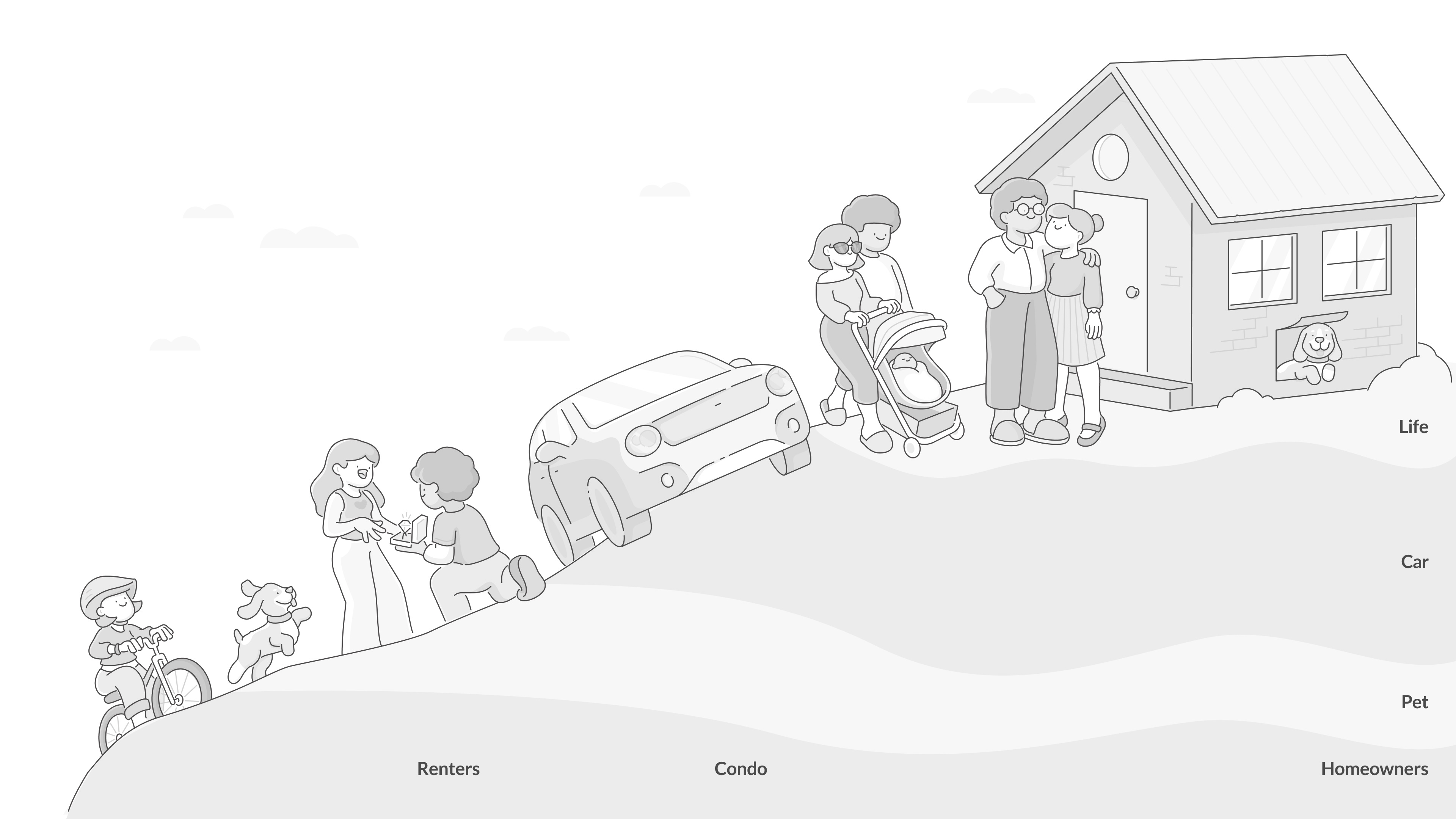
As our customers move up the economic ladder and through lifecycle events, their insurance needs evolve to higher value products: renters typically acquire more property and frequently upgrade to successively larger homes. Growing households often need car, pet, and life insurance, and additional coverage. These progressions regularly trigger orders of magnitude jumps in insurance premiums, and within states that offer all of Lemonade’s “suite of products” - Renters, Home, Car, Pet, and Life - we see a growing proportion of customers with multiple Lemonade policies and see ripe opportunities for the business. For instance, we see a significant opportunity for Lemonade Car in selling to our existing customers, allowing us to acquire customers at little or no cost. Of the approximately 3,000,000 customers we have today, about 1.9 million already have car insurance—that translates to a potential multi-billion dollar opportunity in car premiums at nearly zero acquisition costs. We aim to provide an unmatched user experience in order to retain customers throughout their lifespan, expanding their lifetime value without incurring any incremental costs of acquisition.
Expand to new products
Our strategy of growing with our customers also lends itself to expanding into new lines of insurance, as lifecycle events trigger the need for additional insurance products.
Our regulatory framework, technology stack, and brand are all extensible to new lines of insurance, and we anticipate that these will contribute to our growth in the future. In the last five years, we have added life, pet and car insurance to our growing portfolio of offerings, and have expanded product offerings in certain countries in Europe and the UK.
Expand to new geographies
The Lemonade platform is inherently multilingual and agile by design, so that we can efficiently expand into new markets and new product offerings both within the United States and internationally. We are licensed to sell renters, homeowners, pet and/or car insurance policies in 50 states of the United States and Washington, D.C. As of December 31, 2025, we operate in 41 of those states and Washington, D.C., which collectively represent approximately 95% of the U.S. population. Our strong brand and unique business model drive rapid growth and allow us to quickly gain share in new markets. We also hold a pan-European license, enabling us to passport into and sell in 30 countries across Europe. We currently operate in Germany, the Netherlands, France and the UK and will continue to expand our product offerings in other countries.
Our Product Offerings
Renters and Homeowners Insurance
We offer our products to renters and homeowners in the United States, France, the Netherlands and the UK (in addition to liability insurance) and contents and liability insurance in Germany. The insurance we offer in the United States covers stolen or damaged property, and personal liability, which protects our customers if they are responsible for an accident or damage to another person or their property. In a number of states, we also offer landlord insurance policies to condo and co-op owners who rent out their property less than five times a year.
In the past two years, we expanded our offerings to include Buildings insurance in the UK, the Netherlands and France, giving homeowners the ability to purchase extensive coverage for their home and belongings. Both expansions in the UK and France were supported by existing partnerships with Aviva in the UK and BNP Paribas Cardif in France, providing coverage options unique to each locale through our fully digital experience.
The full Lemonade experience is available through our iOS and Android apps, as well as through our website. Before a customer purchases one of our policies, we allow the customer to review a summary of their coverage and a sample policy. We also enable the customer to reconfigure their coverage and other policy settings, such as the deductible and start date. After payment via a credit or debit card, we instantly issue the customer their policy documents and send it to them via email. From start to finish, the entire process is completed digitally.
In the U.S., our products automatically cover all residents of a household who are related to the customer by marriage, blood, or adoption. In addition to the base coverage we offer for personal property, electronics, furniture, and clothing, our customers can purchase extra coverage to protect against accidental loss, damage, and theft, worldwide, of their jewelry, fine art, and other personal property.
Pet Insurance
We currently offer pet insurance that covers diagnostics, procedures, medication, accidents or illness. Even our basic pet insurance offering covers blood tests, urinalysis, X-rays, MRIs, lab work, and CT scans. We also offer two optional add-ons to the basic plan, a wellness package and an extended accident and illness package. These provide additional coverage for preventative care costs, including annual exams and vaccines, and recovery treatments, including physical therapy and hydrotherapy.
We believe our expansion into pet insurance will allow us to further achieve our long-term strategy of growing with our young customer base by offering new insurance experiences to customers as they progress in their lifecycles. Our leadership in leveraging AI has also allowed us to create a highly-efficient business. Our Pet book of business has increased more than 35x (in IFP), dropped 39 points from the loss ratio, and increased efficiencies by 78%, driving down the cost per claim from $65 to $14. About 87% of our pet insurance policies were sold to new customers, and about 5% of those have already added a renters or homeowners policy to their pet policy as of December 31, 2025. Customers that bundle our insurance offerings typically save money. The remaining 13% or so of pet insurance policies were sold to existing customers, whose median premium per customer grew roughly 3.8x with little to no incremental customer acquisition costs.
Car Insurance
We offer car insurance in a number of states. Lemonade Car insurance covers car accidents, weather damage, theft and vandalism, damage from fire, trees, or animals, glass and windshield repair, liability for bodily injury and property damage, medical expenses, roadside assistance, and reimburses drivers for expenses relating to temporary transportation when a car is being repaired, subject to certain exceptions.
Recently, we have integrated a pricing model in certain markets that utilizes direct vehicle telemetry to distinguish between human-driven and autonomous miles. This allows us to offer specialized rates for self-driving technologies specifically pricing autonomous miles at significant discount to reflect the differing risk profiles of AI-assisted driving.
Life Insurance
Lemonade also provides life insurance through a partnership arrangement with a third-party carrier, Legal & General Group. With Lemonade’s term life insurance offering individuals can apply online for up to $1.5 million or more in coverage, for a term of 10 to 40 years. Applicants use Lemonade’s interface to receive an initial quote estimate and then are transferred to our partner to complete their final application.
Giveback Feature
Giveback is a distinctive Lemonade policy to which the Company continues to have a deep commitment. Each year, we aim to donate funds to cause our customers care about. After our customers purchase a policy, we ask them to select from a list of charitable causes categories to support. We determine the annual Giveback based on our review of the Company’s financial performance and our customers’ chosen causes, and aim to donate funds quarterly.
The Giveback is paid only if payment is authorized by our board of directors in its sole discretion and consistent with its duty of care. See "Risk Factors — We could be forced to modify or eliminate our Giveback, which could undermine our business model and have a material adverse effect on our results of operations and financial condition." Since 2017, we have donated over $12 million to causes chosen by our customers under our Giveback program. The Giveback is not a contractual obligation to any customer or to any cause, and customers may not take a tax deduction related to the donations.
Although a new and untested concept, we believe that donating funds to causes our customers care about will discourage fraud and promote greater trust between us and our customers. The Giveback program, and its underlying ethos, has also helped build an honest relationship with our consumers. They trust us, and they also become part of a community; our policyholders are helping others while protecting their valuables, insuring their home, or making sure their pet can afford vital medical care.
Our Vertically Integrated Platform
Sales and Marketing
Our goal is to increase brand awareness and the number of customers migrating to our platform by utilizing a number of marketing channels to aid our direct-to-consumer sales model. Our primary channel of advertisement is the internet, where we promote our ads and services through various media and social media platforms, including Facebook, TikTok, YouTube, X and Instagram. We also use the data generated in customer support interactions to constantly refine and improve our marketing campaigns. We conduct drip campaigns via email to follow up with those who have inquired about us or started the onboarding process. Additionally, we enter into agreements with parties who have access to potential customers, including insurance agencies, apartment building owners, and property management companies.
Underwriting
Our digital platform enables us to ask fewer questions of our customers but derive many times more data points from each customer interaction than our competitors. Applying machine learning to these data allows us to identify predictive patterns, and these inform our underwriting. Our underwriting process involves collecting this information, classifying and evaluating each individual risk exposure, assessing the impact of the risk on our existing portfolio, and pricing the risk accordingly.
Claims Process
Our claims process is conducted via our digital platform, which includes our iOS and Android mobile apps. Claims can be substantiated with receipts, notes of where and when the item was purchased, and in certain cases, police reports. We also ask the customer to record a video explaining their claim to enhance the claim review process. After the customer completes a claim report on our mobile app, the customer is asked to enter bank account information. If the claim is approved, a payment is issued and deposited directly into the customer's account. Claims are often paid or declined through our claims bot, AI Jim, within seconds.
While a meaningful portion of simple theft and standard pet claims are paid almost instantly, in many cases the incident is also reviewed by a human before the claim is approved, and certain property damage claims or liability claims may take longer to settle. In an event that requires immediate assistance or temporary housing as a result of fire, ongoing water damage, or structural damage that leaves the customer's home exposed, we contact the customer to assess the situation and provide emergency services, such as water or fire damage cleanup, temporary housing, or a designated specialist.
Reinsurance
Insurance companies typically experience highly recurring revenue streams, and hence predictable top lines, but with significant bottom line volatility, as profits can literally fluctuate with the weather. Earthquakes, hailstorms, wildfires and hurricanes strike with caprice, and can push an otherwise profitable business deep into the red with little or no warning.
The first-order consequence of this uncertainty is that insurers often see unwelcome swings in their results. The second-order consequence is that regulators require insurers to keep significant reserves to absorb these swings, making them capital intensive. We set out to architect our business to be at once capital-light and possessed of a predictable and growing gross margin. Through judicious use of "reinsurance," we believe we have largely achieved these goals.
Reinsurance is a financial instrument under which one insurer, the "reinsurer," agrees to cover a portion of the claims of another insurer, the "primary insurer," in return for a portion of their premiums. While this description characterizes all reinsurance, implementations come in different flavors, each with its own costs and benefits. We have entered into a range of reinsurance agreements, differing in both duration and terms, which combine, we believe, to deliver maximum capital efficiency, while optimizing our gross margin for both stability and size.
Proportional Reinsurance: Maximize Capital Efficiency
The low cost of capital for reinsurance companies creates an opportunity to share premiums and maintain our gross margin while reducing our capital requirements. We maintain proportional reinsurance contracts which transfers, or “cedes”, a specified percentage of the premium to reinsurers (“Proportional Reinsurance Contracts”).
Under U.S. and E.U. regulatory laws, insurance companies are required to set aside "surplus capital" in accordance with various formulae. Our proportional reinsurance structure shifts much of that surplus capital requirement to the reinsurer, reducing these capital requirements.
Non-Proportional Reinsurance: Optimize Gross Margin
As described above, our Proportional Reinsurance Contracts provide that we cede a portion of our premiums to our reinsurers, improving our capital efficiency. We manage the remaining portion of our business with alternative forms of reinsurance, with a view to maximizing profitability.
These two remaining goals live in tension with one another: leaving zero "wiggle room" around our fixed fee would guarantee its stability, but would diminish the benefit from an improved loss ratio. Conversely, any room for improved profitability would also introduce additional volatility.
To balance our desire for both growing and stable gross margin, we set out to structure our remaining reinsurance such that variability in our gross margin is reduced, though not eliminated entirely. We believe we have achieved this through a combination of reinsurance structures known as "per risk reinsurance" (the "Non-Proportional Reinsurance Contracts"), which together reduce the maximum amount we would need to pay for any one claim.
Our business is exposed to the risk of severe weather conditions and other catastrophes which are inherently unpredictable. To reduce this risk, we also purchase a catastrophe excess of loss policy with a one year term.
We formed a risk-bearing entity, Lemonade Re SPC, in the Cayman Islands, where we hold some of our retained risk. We also established a captive cell facility at a Bermuda transformer vehicle that is authorized to write and purchase insurance / reinsurance where we retain most of our tail catastrophe exposure.
We believe our reinsurance structure achieves these important goals: making us capital-light, buffering our gross margin from the vicissitudes of claims, and leaving room for our gross margin to grow.
Duration
Our book of business was reinsured approximately 55% through June 30, 2025 and approximately 20% through June 30, 2026, under agreements renewed and renegotiated on an annual basis. The Proportional Reinsurance Contracts with a term of one year that expires on June 30, 2026 are issued by Hannover Ruck SE and MAPFRE Re Compania De Reaseguros S.A., each holding an ‘A’ or better rating from A.M. Best, and each holding a share of the agreement’s commitments. In addition, Lemonade Insurance Company (LIC) and Metromile Insurance Company (“MIC”) cedes approximately 15% and 35% of their premiums and losses, respectively, to our Cayman Islands-based captive reinsurer.
Our Non-Proportional Reinsurance Contracts are issued by a collection of reinsurers, each holding an ‘A’ or better rating from A.M. Best, and have a one-year term that expires on June 30, 2026. We also have a reinsurance contract between LIC and MIC, and a Bermuda-based segregated cell insurer to cover catastrophe risks over the initial $50,000,000 limit for each loss occurrence, and further subject to a limit of $80,000,000 for each loss occurrence and in aggregate.
We believe that the terms of our reinsurance arrangements provide an appropriate balance between maximizing predictability, and enabling us to capture more margin over time.
Investments
Our portfolio of investable assets is primarily held in cash, money market funds, and fixed income securities which include U.S. and non-US government and government agency obligations, corporate debt securities and asset-backed securities of relatively short durations. We manage the portfolio in accordance with investment policies and guidelines approved by our board of directors.
We have designed our investment policy and objectives to provide a balance between current yield, conservation of capital, and liquidity requirements of our operations, setting guidelines that provide for a well-diversified investment portfolio that is compliant with insurance regulations applicable to the states in which we operate. Furthermore, our investment policy prohibits investments in sectors such as oil and gas, coal, tobacco, controversial weapons, and entities that exhibit non-compliance with the United Nations Global Compact. The policy, which may change from time to time, is approved by the board of directors and is reviewed on a regular basis to ensure that the policy evolves in response to changes in the financial markets and our risk profile. See "Note 4 — Summary of Significant Accounting Policies" in the Notes to Consolidated Financial Statements included in this Annual Report.
Competition
The homeowners, pet, car and, to a lesser extent, the renters insurance industries in which we operate are highly competitive. While we believe we are well positioned to execute our business model and reinvent insurance, we face significant competition from traditional insurance companies such as Allstate, Farmers, Liberty Mutual, State Farm, GEICO, Progressive and Travelers. Although we are tapping into markets that our competitors have struggled to reach, the incumbent insurance companies are larger than us and have significant competitive advantages over us, including increased name recognition, higher financial ratings, greater resources, additional access to capital. In particular, many of these competitors offer consumers the ability to purchase homeowners and multiple other types of insurance products and "bundle" them together, and in certain circumstances, to include an umbrella liability policy for additional coverage at competitive prices. Moreover, as we expand into new lines of business and offer additional products beyond renters and homeowners insurance, pet and car insurance, we may face intense competition from traditional insurance companies that are already established in such markets. Competitors in the pet insurance space include companies such as Nationwide, Embrace, and Trupanion. Competitors in the car insurance space include companies such as Progressive, GEICO and Allstate.
We also compete with new market entrants. Competition is based on many factors, including the reputation and experience of the insurer, coverages offered, pricing and other terms and conditions, customer service, relationships with brokers and agents (including ease of doing business, service provided, and commission rates paid), size, and financial strength ratings, among other considerations. We believe we compete favorably across many of these factors, and have developed a digital platform and business model based on artificial intelligence and behavioral economics that we believe will be difficult for incumbent insurance providers to emulate.
Intellectual Property
The protection of our technology and intellectual property is an important aspect of our business. We intend to rely upon a combination of trademarks, trade secrets, copyrights, confidentiality procedures, contractual commitments, and other legal rights to establish and protect our intellectual property. We generally enter into confidentiality agreements and invention of work product assignment agreements with our employees and consultants to control access to, and clarify ownership of, our proprietary information.
As of December 31, 2025, we have 5 issued patents in the United States. The issued patents generally relate to determining the route and parking location of a vehicle, recording trip data associated with a vehicle, and estimating the usage of a vehicle based on refueling events. The issued patents will expire between September 1, 2035 and January 11, 2036. We do not own any foreign patents and do not have any foreign patent applications pending. As of December 31, 2025, we hold 137 foreign registered trademarks and 8 registered trademarks in the United States, including the Lemonade and Metromile marks, and have no foreign trademark applications pending and no U.S. trademark applications pending. We also hold 3 copyrights in the United States, covering certain videos, texts, photographs, and artwork displayed on our mobile apps and website. We continually review our development efforts to assess the existence and patentability of intellectual property.
Intellectual property laws, procedures, and restrictions provide only limited protection and any of our intellectual property rights may be challenged, invalidated, circumvented, infringed, or misappropriated. Further, the laws of certain countries do not protect proprietary rights to the same extent as the laws of the United States, and, therefore, in certain jurisdictions, we may be unable to protect our proprietary technology.
Certified B Corp Status
While not required by Delaware law or the terms of our certificate of incorporation, we have been designated as a Certified B Corp. The term "Certified B Corp" does not refer to a particular form of legal entity, but instead refers to companies that are certified by B Lab, an independent nonprofit organization, as meeting rigorous standards of social and environmental performance, accountability, and transparency.
The first step in becoming a Certified B Corp is completing a comprehensive and objective assessment of a business's positive impact on society and the environment. The assessment varies depending on the company's size (number of employees), and sector. The standards in the assessment are created and revised by an independent governing body that determines eligibility to be a Certified B Corp.
Based on responses to a set of over 200 questions that reflect impact indicators, best practices, and outcomes, a company receives a composite score on a 200-point scale representative of its overall impact on its employees, customers, communities, and the environment. Representative indicators in the assessment range from payment of living wage, employee benefits, charitable giving/community service, and use of renewable energy.
Recognition as a Certified B Corp currently requires that a company achieve a reviewed assessment score of at least 80. The review process includes a phone review and a random selection of indicators for purposes of verifying documentation. The assessment also includes a corporate structure review and a disclosure questionnaire, including certain practices, fines, and sanctions related to the company or its partners.
Our certification also required us to adopt the public benefit corporation structure, a step we have already completed. Once certified, every Certified B Corp must make its assessment score transparent on the independent non-profit organization's website. Acceptance as a Certified B Corp and continued certification is at the sole discretion of the independent nonprofit organization.
Human Capital Resources
Employees
As of December 31, 2025, we had 1,282 employees, 810 of whom were based in the United States and the rest of whom were based outside of the United States, primarily in Israel and the Netherlands. In the Netherlands, certain employees are subject to a collective agreement between the Dutch Association of Insurers and various trade unions. The collective agreement covers wages and terms and conditions of employment. Participation in the collective agreement is mandatory for members of the Dutch Association of Insurers, a leading association of private insurance companies operating in the Netherlands. Beyond this, to our knowledge, none of our employees are represented by a labor union. We consider our relationships with our employees to be good and have not experienced any interruptions of operations due to labor disagreements.
As of December 31, 2025, and based on public information from five competing insurance companies in the United States, we estimate that the number of customers per employee for those companies ranges from approximately 300 to approximately 600 customers per employee. We base this estimate on publicly available information, which we have adjusted for comparability. The calculation of "employees" includes insurance agents and brokers because they are a significant cost component for other insurance companies. In comparison to these competitors, our number of customers per employee was approximately 2,300 as of December 31, 2025.
Culture and Values
Our status as a Certified B Corp and our commitment to charitable giving, in particular our Giveback program, distinguishes us from our competitors, with the goal of building a trusting relationship between us, our employees, and our customers. We value the power of creativity and encourage and support the sharing of ideas to enhance our business model. Like the industry in which we operate, we understand the importance and value of a community pooling its resources together for the public good. We value inclusivity, respecting differences, and seamless teamwork in every facet of our business.
We issued 500,000 shares of common stock in 2020 as the initial endowment of the Lemonade Foundation, a 501(c)(4) social welfare organization established under Arizona law. By contributing approximately 1% of our common stock to the Lemonade Foundation, we hope to promote charitable giving and other community-centric activities with a nexus to our community.
In 2023, the Foundation, launched a first of its kind blockchain-based insurance product benefitting some of the world’s most vulnerable farmers. The product was built with a goal of protecting subsistence farmers against the effects of climate variability. Thousands of families in Kenya have already been protected by this product, and the Foundation expects to continue scaling this product in the coming years. The product was launched as part of the Lemonade Foundation Crypto Climate Coalition - in cooperation with a number of strategic partners, including Hannover Re, Pula, Chainlink, Avalanche, Etherisc and DAOstack.
Human Capital Management
We understand that strength lies in the unique backgrounds of our employees that drive the innovation behind our product. We encourage employees to bring their lived experiences, and personal strengths, to develop new ideas, improve customer experiences and shape our brand. We engage with employees for ideas of nonprofits to partner with, or resources to learn more about a social issue, and their candid (and anonymous, should they choose) feedback about our workplace culture and environment. Additionally, our employees organize several education groups across the Company addressing these important topics.
Health, Safety and Wellness
As a B Corp, it is part of our legal mission to advance the health and well-being of employees. To that end, employees have access to health and wellness programs, and healthcare plans.
Geographic Scope of Business
In the United States, as of December 31, 2025, LIC and MIC are licensed to sell our insurance products in the following states:
We also hold a pan-European license, which enables us to sell in 30 countries across Europe, and currently operate and sell our insurance products in Germany, the Netherlands, France and the UK.
Seasonality
For information regarding the seasonality of our business, please refer to Part II, Item 7 “Management’s Discussion and Analysis of Financial Condition and Results of Operations” of this Annual Report.
Regulation of our Business
Insurance Regulation
Our U.S. insurance subsidiaries are regulated by insurance regulatory authorities in the states in which we operate. State insurance laws and regulations generally are designed to protect the interests of customers, consumers, and claimants rather than stockholders or other investors. State regulators generally have broad administrative power with respect to all aspects of the insurance business. The regulatory requirements and restrictions include, among others, the following:
•approval of policy forms and premium rates;
•approval for intercompany service agreements;
•advertising, marketing, and trade practices; and
•restrictions on the ability of our regulated insurance subsidiaries to pay dividends to us or enter into certain related party transactions
Regulation of insurance companies constantly changes as governmental agencies and legislatures react to real or perceived issues.
Required Licensing
Our regulated U.S. insurance subsidiaries are domiciled and admitted in the states of New York and Delaware. Under a provision of the California Insurance Code, MIC is deemed “commercially domiciled” in California, meaning that the California Department of Insurance is entitled to regulate certain aspects of MIC’s business as if it were actually domiciled in California.
LIC, MIC, Lemonade Insurance Agency, LLC, Lemonade Life Insurance Agency, LLC, Lemonade E&S Insurance Agency, LLC and Metromile Insurance Services LLC must apply for and maintain licenses to provide and sell insurance in those jurisdictions in which they transact insurance businesses.
Our insurance company and insurance producer subsidiaries are required to adhere to myriad laws and regulatory requirements. The insurance regulators in the states in which our subsidiaries do the business of insurance are empowered to conduct on-site visits and examine the financial affairs and market conduct practices of those entities. Insurance regulators have broad administrative powers to impose monetary penalties and/or restrict or revoke licenses to transact business for violations of applicable laws and regulations.
Restrictions on Paying Dividends
We are a holding company that transacts a majority of our business through operating subsidiaries. Consequently, our ability to pay dividends to stockholders and meet our debt payment obligations is largely dependent on dividends and other distributions from our subsidiaries. Applicable insurance laws restrict the ability of our regulated insurance subsidiaries to declare stockholder dividends. Applicable insurance regulators require insurance companies to maintain specified levels of statutory capital and surplus.
Insurance regulators have broad powers to prevent reduction of statutory surplus to inadequate levels, and there is no assurance that dividends of the maximum amounts calculated under any applicable formula would be permitted to be made by our insurance subsidiaries. State insurance regulatory authorities that have jurisdiction over the payment of dividends by our regulated insurance subsidiaries may in the future adopt statutory provisions more restrictive than those currently in effect.
Investment Regulation
LIC is subject to New York’s insurance laws and MIC is subject to Delaware and California’s laws regarding the composition of their investments. Those laws generally require diversification of their investment portfolios and limits on the amount of their investments in certain categories. Failure to comply with these laws and regulations would cause non-conforming investments to be treated as non-admitted assets for purposes of measuring statutory surplus and, in some instances, would require those companies to sell those investments.
Licensing of Our Employees and Adjusters
In most states in which we operate, insurance claims adjusters are required to be licensed and some must fulfill annual continuing education requirements. In most instances, our employees who are negotiating coverage terms are underwriters and are not required to be licensed agents. As of December 31, 2025, 382 employees were required to maintain and did maintain requisite licenses for these activities as required by the states in which we operate.
Enterprise Risk, Cybersecurity, and Other Recent Developments
The National Association of Insurance Commissioners (“NAIC”) has engaged in a concerted effort to strengthen the ability of U.S. state insurance regulators to monitor U.S. insurance holding company groups. Among other things, the NAIC’s model, when adopted, requires the ultimate controlling person of an insurance company to submit an annual enterprise risk management report that describes the risk that an activity, circumstance, event, or series of events involving one or more affiliates of an insurer will, if not remedied promptly, be likely to have a material adverse effect upon the financial condition or liquidity of the insurer or its insurance holding company system as a whole. Recently, the NAIC has developed model laws requiring annual reports concerning the nature of corporate governance within an insurance holding company.
The NAIC in 2012 adopted the Risk Management and Own Risk and Solvency Assessment (“ORSA”) Model Act (the “ORSA Model Act”) to require domestic insurers to maintain a risk management framework and establishes a legal requirement for domestic insurers to conduct an ORSA in accordance with the NAIC’s ORSA Guidance Manual. The ORSA Model Act provides that domestic insurers, or their insurance group, must regularly conduct an ORSA consistent with a process comparable to the ORSA Guidance Manual process. The ORSA Model Act also provides that, no more than once a year, an insurer’s domiciliary regulator may request that an insurer submit an ORSA summary report, or any combination of reports that together contain the information described in the ORSA Guidance Manual, with respect to the insurer and the insurance group of which it is a member. When the ORSA Model Act is adopted by a particular state, it imposes more extensive filing requirements on parents and affiliates of domestic insurers. Delaware and New York have adopted the ORSA Model Act.
In the course of our business, we collect and maintain confidential and personal information. As a result, we are subject to U.S. federal and state and international privacy and data security laws and regulations that, among other things, require that we institute and maintain certain policies and procedures to safeguard this information from improper use or disclosure. For example, in 2017, the New York Department of Financial Services (“NY DFS") adopted a broad cybersecurity regulation that requires financial services institutions to, among other things, implement and maintain a cybersecurity program and a cybersecurity policy that will be monitored and tested periodically, develop controls and technology standards for data protection, meet minimum standards in response to any cybersecurity breach and annually certify their compliance with the regulation. The NY DFS in 2023 issued a significant amendment to the cybersecurity requirements, mandating that covered entities adopt specific standards and controls to secure sensitive data. The recent amendment significantly expands obligations of entities regulated by NY DFS to report cybersecurity incidents and enhance their consumer data protection and cybersecurity infrastructure. Regulated entities were generally required to comply with the new requirements imposed by the Amendment in phases throughout 2024 and 2025.
The NAIC in 2017 adopted the Insurance Data Security Model Law, which established standards for data security and for the investigation and notification of insurance commissioners of cybersecurity events involving unauthorized access to, or the misuse of, certain nonpublic information. Many states have enacted the Insurance Data Security Model Law or similar laws, and we expect more states to follow.
Additionally, a growing set of privacy regulations have created intense scrutiny by legislative, regulatory, and self-regulatory bodies, privacy advocates, academics, and commercial interests in the United States and abroad that focus on consumer data protection and privacy regarding interest-based advertising, or the use of data to draw inferences about a consumer’s interests and deliver relevant advertising to that consumer. In particular, much of this scrutiny has focused on the use of cookies and other tracking technologies that collect or aggregate information about consumers’ online browsing and mobile app usage activity. It is essential that we monitor legal requirements and other developments in this area, domestically and globally, maintain a robust privacy and security compliance program, and engage in responsible privacy practices, including providing consumers with notice of the types of data we collect, how we collect it, with whom we share it, how we use that data to provide our solutions, and the applicable choices we offer consumers.
California has enacted legislation restricting the use of automated systems to communicate with people online. California enacted a statute making it unlawful for any person to use a bot to communicate with another person in California online with the intent to mislead the other person about its artificial identity for the purpose of knowingly deceiving the person about the content of the communication in order to incentivize a purchase or sale of goods or services in a commercial transaction. The statute provides that a person using a bot will not be liable under the statute if the person discloses that it is a bot. See “Risk Factors — Risks Relating to Our Business — New legislation or legal requirements may affect how we communicate with our customers, which could have a material adverse effect on our business model, financial condition, and results of operations.”
GDPR
The General Data Protection Regulation (E.U.) 2016/679 (the “E.U. GDPR”) applies to our activities to the extent that those activities take place in the context of our establishments in the European Union, and the UK General Data Protection Regulation and Data Protection Act 2018 (collectively, the “UK GDPR”) applies to our activities to the extent that those activities take place in the context of our establishments in the UK (EU GDPR and UK GDPR together referred to as the “GDPR”). In addition, the GDPR may apply to our activities that involve the processing of personal data of individuals in the European Union or UK to whom we offer our products or services. The GDPR could also apply to our business if we were to monitor the activities of individuals in the European Union or UK. As we expand into Europe or UK, the compliance obligations under the GDPR will become more significant. See “Risk Factors — Risks Relating to Our Business — We may face particular privacy, data security, and data protection risks as we continue to expand into Europe and the UK. in connection with the GDPR and other data protection regulations.”
Federal and State Legislative and Regulatory Changes
A number of federal laws affect and apply to the insurance industry, including various privacy laws, the Fair Credit Reporting Act (“FCRA”), and the economic and trade sanctions implemented by the Office of Foreign Assets Control (“OFAC”) of the U.S. Department of the Treasury. OFAC maintains and enforces economic sanctions against certain foreign countries and groups and prohibits U.S. persons from engaging in certain transactions with certain persons or entities. OFAC has imposed civil penalties on persons, including insurance and reinsurance companies, arising from violations of its economic sanctions program.
Credit for Reinsurance
State insurance laws permit U.S. insurance companies, as ceding insurers, to take financial statement credit for reinsurance that is ceded, so long as the assuming reinsurer satisfies the state’s credit for reinsurance laws. There are several different ways in which the credit for reinsurance laws may be satisfied by an assuming reinsurer, including being licensed in the state, being accredited in the state, or maintaining certain types of qualifying collateral. We ensure that LIC and MIC are able to take full financial statement credit for their reinsurance.
Insolvency Funds and Associations, Mandatory Pools, and Insurance Facilities
Most states require admitted property and casualty insurance companies to become members of insolvency funds or associations which generally protect customers against the insolvency of the admitted insurance companies. Members of the fund or association must contribute to the payment of certain claims made against insolvent insurance companies through annual assessments. The annual assessments required in any one year will vary from state to state, and are subject to various maximum assessments per line of insurance.
California Wildfires
In January 2025, the Greater Los Angeles area experienced significant wildfires (the “January 2025 California Wildfires”). The Company incurred net losses of approximately $19.6 million related to these events. Additionally, the Company received a $6.9 million assessment from the California FAIR Plan in February 2025, which was paid and expensed in the first quarter of 2025. The Company received regulatory approval for recoupment of up to 50% of the assessment over a period of two years beginning in 2026. See “Risk Factors - Our exposure to loss activity and regulation may be greater in states where we currently have most of our customers: California, New York and Texas.” and “Management's Discussion and Analysis” for additional information.
Risk-Based Capital
Risk-based capital laws are designed to assess the minimum amount of capital that an insurance company needs to support its overall business operations and to ensure that it has an acceptably low expectation of becoming financially impaired. State insurance regulators use risk-based capital ratios to set capital requirements, considering the size and degree of risk taken by the insurer and taking into account various risk factors including asset risk, credit risk, underwriting risk, and interest rate risk. As the ratio of an insurer’s total adjusted capital and surplus decreases relative to its risk-based capital, the risk-based capital laws provide for increasing levels of regulatory intervention culminating with mandatory control of the operations of the insurer by the domiciliary insurance department at the so-called mandatory control level. Our regulators in New York, Delaware and California require annual reporting to confirm that LIC and MIC hold in excess of the minimum amount of risk-based capital necessary for their operations. Insurers falling below a calculated threshold may be subject to varying degrees of regulatory action. Failure to maintain risk-based capital at the required levels could adversely affect the ability of LIC and MIC to maintain the regulatory approvals necessary to conduct their businesses. As of December 31, 2025, LIC maintained a risk-based capital level of 586% and MIC maintained a risk-based capital level of 625%.
IRIS Ratios
The NAIC Insurance Regulatory Information System (“IRIS”) is a collection of analytical tools designed to provide state insurance regulators with an integrated approach to screening and analyzing the financial condition of insurance companies operating in their respective states. IRIS consists of two phases: statistical and analytical. In the statistical phase, the NAIC database generates key financial ratio results based on financial information obtained from insurers’ annual statutory statements. The statistical phase highlights those insurers that merit the highest priority in the allocation of the state insurance regulators’ resources. The ratios are not, in themselves, indicative of adverse financial conditions. The analytical phase is a review of the annual statements, financial ratios, and other automated solvency tools. An insurance company may fall out of the usual range for one or more ratios for any number of reasons and a ratio falling outside the prescribed "usual range" is not considered a failing result. Rather, unusual values are viewed as part of the regulatory early monitoring system. The primary goal of the analytical phase is to identify companies that appear to require immediate regulatory attention.
Statutory Accounting Principles
Statutory accounting principles (“SAP”) is a basis of accounting developed by U.S. insurance regulators to monitor and regulate the solvency of insurance companies. In developing SAP, insurance regulators were primarily concerned with evaluating an insurer’s ability to pay all its current and future obligations to customers. As a result, statutory accounting focuses on conservatively valuing the assets and liabilities of insurers, generally in accordance with standards specified by the insurer’s domiciliary jurisdiction. Uniform statutory accounting practices are established by the NAIC and generally adopted by regulators in the various U.S. jurisdictions. These accounting principles and related regulations determine, among other things, the amounts our regulated insurance subsidiaries may pay to us as dividends and differ somewhat from U.S. Generally Accepted Accounting Principles (“GAAP”), which are designed to measure a business on a going-concern basis. GAAP gives consideration to matching of revenue and expenses and, as a result, certain expenses are capitalized when incurred and then amortized over the life of the associated policies. The valuation of assets and liabilities under GAAP is based in part on best estimate assumptions made by the insurer. Stockholders’ equity represents both amounts currently available and amounts expected to emerge over the life of the business. As a result, the values for assets, liabilities, and equity reflected in financial statements prepared in accordance with GAAP may be different from those reflected in financial statements prepared under SAP.
Rate Regulation
Nearly all states have insurance laws requiring personal property and casualty insurers to file rating plans, policy or coverage forms, and other information with the state’s regulatory authority. In many cases, such rating plans, policy forms, or both must be approved prior to use.
The speed with which an insurer can change rates in response to competition or increasing costs depends, in part, on whether the rating laws are (i) prior approval, (ii) file-and-use, or (iii) use-and-file laws. In states having prior approval laws, the regulator must approve a rate before the insurer may use it. In states having file-and-use laws, the insurer does not have to wait for the regulator’s approval to use a rate, but the rate must be filed with the regulatory authority prior to being used. A use-and-file law requires an insurer to file rates within a certain period of time after the insurer begins using them. Eighteen states, including California and New York, have prior approval laws. Under all three types of rating laws, the regulator has the authority to disapprove a rate filing.
An insurer’s ability to adjust its rates in response to competition or to changing costs is dependent on an insurer’s ability to demonstrate to the regulator that its rates or proposed rating plan meets the requirements of the rating laws. In those states that significantly restrict an insurer’s discretion in selecting the business that it wants to underwrite, an insurer can manage its risk of loss by charging a rate that reflects the cost and expense of providing the insurance. In those states that significantly restrict an insurer’s ability to charge a rate that reflects the cost and expense of providing the insurance, the insurer can manage its risk of loss by being more selective in the type of business it underwrites. When a state significantly restricts both underwriting and pricing, it becomes more difficult for an insurer to maintain its profitability.
From time to time, the personal lines insurance industry comes under pressure from state regulators, legislators, and special interest groups to reduce, freeze, or set rates at levels that do not correspond with our analysis of underlying costs and expenses. We expect this kind of pressure to persist. State regulators may interpret existing law or rely on future legislation or regulations to impose new restrictions that adversely affect profitability or growth. We cannot predict the impact on our business of possible future legislative and regulatory measures regarding insurance rates.
European Regulation
Our European insurance entities consist of Lemonade Insurance N.V., Lemonade Agency B.V., their respective UK branch undertakings, and Lemonade B.V.. We also establish and maintain an entity for the provision of intercompany support services; Lemonade Technology B.V.. Lemonade Insurance N.V. is a licensed non-life insurer established in the Netherlands and is subject to key financial rules and regulations including the Second European Solvency Directive 2009/138/EC (as amended, the “Solvency II Directive”); Commission Delegated Regulation (EU) 2015/35 (as amended, the “Delegated Regulation”, together with the Solvency II Directive referred to as the “Solvency II Regulations”); the implementing technical standards and regulatory technical standards issued by the European Insurance and Occupational Pensions Authority (“EIOPA”); the European Insurance Distribution Directive (Directive (EU) 2016/97, “IDD”); the Dutch Financial Supervision Act (Wet op het financieel toezicht, “DFSA”) and the lower rules and regulations promulgated thereunder; the International Financial Reporting Standards as adopted by the European Union ("IFRS EU"); and national regulations, as well as local conduct of business requirements, in each of the jurisdictions in which it operates. Currently, the European Commission is preparing for a review of the Solvency II Directive. Lemonade Agency B.V. is subject to the IDD, the DFSA and national regulations, as well as local business conduct requirements and consumer laws, in each of the jurisdictions in which it operates. Lemonade B.V. is an insurance holding company within the meaning of article 212 of the Solvency II Directive, as implemented in article 1:1 DFSA.
In addition to the regulations noted above, we are also subject to the European Accessibility Act (Directive (EU) 2019/882, the “EAA”), a landmark directive establishing common accessibility requirements for a range of products and services across the EU, including those related to financial services, e-commerce, and information technology. The EAA mandates accessibility standards to ensure that our digital products and customer service channels are accessible to people with disabilities and our operations and customer-facing technologies meet these mandatory standards.
Lemonade has operated in the UK market since 2022 and is therefore also subject to relevant UK regulation including the Financial Services and Markets Act 2000 (the “FSMA”), the Insurance Act 2015, and relevant subsidiary regulations. By virtue of its authorisation and oversight by both the Prudential Regulation Authority (the “PRA”) and the Financial Conduct Authority (the “FCA”) in the UK, Lemonade is also subject to the regulatory requirements of the PRA Rulebook and the FCA Handbook respectively as they pertain to Insurers, distributing agents and financial service providers generally.
The Solvency II Regulations
The Solvency II Directive, as implemented in the DFSA and other national regulations, such as the German Insurance Supervisory Act (Versicherungsaufsichtsgesetz), prescribes uniform rules for insurers and their activities and services. More specifically, the Solvency II Directive provides rules and regulations relating to, inter alia, Lemonade Insurance N.V.’s authorization requirements (including the European “passport” regime), its minimum own funds and solvency and its governance. Governance requirements include the need to ensure sound business operations, implement mandatory key functions (including Actuarial, Compliance, Internal Audit and Risk) and requirements relating to Lemonade Insurance N.V.’s Management Board members, Supervisory Board Members and other key personnel. The Delegated Regulation is promulgated under the Solvency II Directive and provides detailed requirements relating to some of the Solvency II Directive’s broader requirements.
IDD and other conduct of business rules
The IDD provides a harmonized regime for insurance distribution activities. It regulates the way insurance products are designed and sold both by insurance intermediaries (e.g. Lemonade Agency B.V.) and directly by insurance undertakings (e.g. Lemonade Insurance N.V.). The rules and regulations set out in the IDD have been implemented in the DFSA. The provisions set out in the IDD mainly relate to standards of product disclosure, promotional materials and product governance and oversight. Local regulations and conduct of business rules implemented in each of the European member states in which both Lemonade Agency B.V. and Lemonade Insurance N.V. do business supplement the requirements set out in the IDD.
Financial and other Regulators
Lemonade Insurance N.V. is subject to primary supervision by the Dutch Central Bank (De Nederlandsche Bank, “DNB”) as the supervisory authority of its home member state. In addition, it is subject to supervision by the Dutch Authority for the Financial Markets (Autoriteit Financiële Markten, “AFM”). The AFM is the regulator tasked with conduct supervision relating to Lemonade Insurance N.V.’s Dutch activities. The German Federal Financial Supervisory Authority (Bundesanstalt für Finanzdienstleistungsaufsicht, “BaFin”), as the supervisory authority of a host member state. BaFin is the competent regulator tasked with the supervision of Lemonade Insurance N.V.’s compliance with German regulations and conduct requirements. The French Autorité de Contrôle Prudentiel et de Résolution ("ACPR"), which is charged with preserving the stability of the financial system and protecting the customers, insurance policyholders, members and beneficiaries of the persons that it supervises, and Organisme pour le Registre des Intermédiaires en Assurance ("ORIAS"), an association under the supervision of the Treasury Department in France and in charge of approving insurance intermediaries operating on the French market; the Bank of England’s Prudential Regulation Authority in charge of prudentially regulating and supervising financial services firms operating in the UK; the British Financial Conduct Authority, whose role includes protecting consumers, keeping the industry stable, and promoting healthy competition between financial service providers.
Lemonade Agency B.V. is subject to supervision by the AFM. Lemonade B.V., as parent, and Lemonade Insurance N.V., as subsidiary, is an E.U. sub-group within the meaning of Article 213(2)(b) of Solvency II, as implemented in article 3:285 (2) DFSA. Lemonade B.V. is subject to group supervision by DNB under the Solvency II Directive. The relevant EU supervisory body for insurers, EIOPA, has limited supervisory powers in the Netherlands, however it plays an important role in drafting and issuing technical standards and preparing guidance relating to various European directives and regulations. EIOPA aims to accomplish efficient and harmonized financial supervision across the European Union.
DNB and AFM employ a risk-based and proportionate approach to supervision, comprising a firm systemic framework, which focuses on the continuous assessment of how firms manage the risks they create and identifying the root causes of risk. DNB regularly proactively contacts insurers to discuss matters of strategy, day-to-day operations and the current (and expected future) financial standing of the undertaking, in order to assess what parts of a regulated undertaking, if any, could pose systemic risks. In addition, DNB monitors operations and business through monthly updates, the submission of Quantitative Reporting Templates, by reviewing annual reports, approving prospective Management Board and Supervisory Board members prior to their appointment and through scheduled and unannounced audits.
DNB also regulates the acquisition and increase of control over certain authorized firms, including insurers. Under the DFSA, any person intending to acquire control of, or increase (or decrease) control over, an insurer must first obtain the consent of the DNB. In considering whether to grant or withhold its approval for the acquisition of control, DNB must be satisfied that the acquirer is a fit and proper person and that the interests of consumers would not be threatened by their acquisition of, or increase in, control. A person will be treated as increasing (or decreasing) their control over an insurer if the level of their percentage of (indirect) shareholding or voting power in the insurer crosses the 10, 20, 33, 50 percent or 100 percent thresholds.
Both Lemonade Insurance N.V. and Lemonade Agency B.V. commenced operations in the UK under the Temporary Permission Regime in accordance with which certain European Economic Area based firms may continue to operate in the UK for a limited period following the UK's departure from the European Union. During 2023, the UK branch establishments of Lemonade Insurance N.V., and Lemonade Agency B.V. (“UK branch establishments”) received a third country branch authorization in the UK allowing both companies to continue to operate in the UK market on a permanent basis. Lemonade Agency B.V., UK Branch (BR024862) is the UK establishment of Lemonade Agency B.V.. Lemonade Insurance N.V., UK branch (BR025196), is the UK establishment of Lemonade Insurance N.V.. See Required Licensing section below for a description.
Enforcement
DNB and AFM expect firms to avoid actions that jeopardize compliance with their statutory objectives and applicable rules and regulations and have extensive powers to intervene in the affairs of a regulated firm. When DNB is concerned that an insurer may present a risk, this may lead to negative consequences, including the requirement to maintain a higher level of regulatory capital (via capital “add-ons” under the Solvency II Directive) to match the higher perceived risks and enforcement action where the risks identified breach applicable rules and regulations. In case of a breach of our license requirements or obligations arising from the applicable rules and regulations, although both DNB and AFM must apply the principle of proportionality in all of their actions, the regulators have a large amount of discretion in determining what measures to impose, if any, in order to address, remedy, or sanction the breach. DNB and the AFM have a large amount of enforcement tools at their disposal to sanction breaches of applicable rules and regulations, including public formal warnings, orders to adopt a certain course of conduct, incremental penalties, and administrative fines. In addition, breaches may lead to a revocation of an undertaking license and, in the case of insurers, where the breach relates to material prudential shortcomings, DNB may impose emergency measures, including the appointment of an administrator or the imposition of measures aimed at winding-up the undertaking).
Required Licensing
Our subsidiary Lemonade Insurance N.V. is licensed and supervised by the insurance supervision division of DNB as a Solvency II non-life insurance company. DNB, as the supervisory authority of its home member state, has permitted us to sell in other European countries, such as Germany and France, on a Freedom of Services basis. In general, in addition to continuing to meet the threshold conditions to authorization, Lemonade Insurance N.V. and Lemonade Agency B.V. are obliged to comply with European regulations, European directives (in as far as these directives have direct effect in the Netherlands or other European member states in which our subsidiaries do business), the DFSA and the lower regulations set out thereunder, and other national regulations, all of which contain detailed rules covering, among other things, systems and controls, conduct of business, and prudential (i.e. capital and solvency) requirements.
Lemonade Insurance N.V. launched its first product in the UK market in October 2022, and operates in the UK through its registered branch establishment, Lemonade Insurance N.V., UK Branch (BR025196) which received third-country branch authorization from the Prudential Regulation Authority in the UK in May 2023. This allows the company to operate in the UK market permanently. Lemonade Insurance N.V. is licensed as an insurance company by De Nederlandsche Bank in the Netherlands (R162036). Authorized by the Prudential Regulation Authority. Subject to regulation by the Financial Conduct Authority and limited regulation by the Prudential Regulation Authority (FRN 846181).
Lemonade Agency B.V. commenced operations in the UK under the TPR as described above, and received third country branch authorisation through its registered branch establishment Lemonade Agency B.V., UK Branch (BR024862) in 2023. Lemonade Agency B.V., UK Branch is authorised and regulated by the Financial Conduct Authority (FRN: 989294).
Additional Information
Our internet website address is www.lemonade.com. In addition to the information about us and our subsidiaries contained in this Annual Report, information about us can be found on our website. Our website and information included in or linked to our website are not part of this Annual Report.
Our annual reports on Form 10-K, quarterly reports on Form 10-Q, current reports on Form 8-K and amendments to those reports filed or furnished pursuant to Section 13(a) or 15(d) of the Securities Exchange Act of 1934, as amended, are available free of charge through our website as soon as reasonably practicable after they are electronically filed with or furnished to the Securities and Exchange Commission (the “SEC”). Additionally, the SEC maintains an internet site that contains reports, proxy and information statements and other information at www.sec.gov.
Item 1A. Risk Factors
Investing in our common stock involves a high degree of risk. You should carefully consider the following risks, together with all of the other information contained in this Annual Report, before deciding to invest in our common stock. Our business, financial condition, results of operations or prospects could be materially and adversely affected by any of these risks or uncertainties. In that case, the trading price of our common stock could decline, and you may lose all or part of your investment.
Risks Relating to Our Business
We have a history of losses and we may not achieve or maintain profitability in the future.
We have not been profitable since our inception in 2015 and had an accumulated deficit of $1,464.3 million and $1,298.8 million as of December 31, 2025 and December 31, 2024, respectively. We incurred net losses of $165.5 million and $202.2 million in the years ended December 31, 2025 and December 31, 2024, respectively. We expect to make significant investments to further develop and expand our business, particularly in marketing and advertising to expand our consumer base. As a public company, we have incurred and expect to continue to incur significant legal, accounting and other expenses. Despite these investments, we may not succeed in increasing our revenue on the timeline that we expect or in an amount sufficient to lower our net loss and ultimately become profitable. In addition, if we reduce variable costs to respond to losses, this may limit our ability to sign up new customers and grow our revenues. Accordingly, we may not achieve or maintain profitability and we may continue to incur significant losses in the future.
Our success and ability to grow our business depend on retaining and expanding our customer base. If we fail to add new customers or retain current customers, our business, revenue, operating results and financial condition could be harmed.
We have experienced significant customer growth since we commenced operations; however, we may not be able to maintain this growth and thus, our customer base could stop growing or even shrink over time.
Our ability to attract new customers and retain existing customers depends, in large part, on our ability to continue to be perceived as providing delightful and superior insurance-buying and claims- filing customer experiences, competitive pricing, and adequate insurance coverage. In order to maintain this perception, we may be required to incur significantly higher marketing and advertising expenses, costs related to improving our service, and lower margins in order to attract new customers and retain existing customers. If we fail to remain competitive on customer experience, pricing, and insurance coverage options, our ability to grow our business and generate revenue by attracting and retaining customers may be adversely affected.
There are many factors that could negatively affect our ability to grow our customer base, including if:
•we are unable to cost-effectively attract and convert customers through digital distribution channels (e.g., search, social media, app stores, and online advertising);
•underwriting constraints, competitive pressures (including competitors replicating our digital model), or failure to expand geographically or offer competitive new products limit growth;
•our digital platform is disrupted or performs poorly—whether due to our systems or third parties—resulting in degraded customer experience or impaired quoting, policy servicing, or claims payments; or
•customer trust in our brand, including perceptions of our chatbots and concerns regarding content, privacy, and security, deteriorates due to actual or alleged issues or negative publicity.
Our inability to overcome these challenges could impair our ability to attract new customers and retain existing customers, and could have a material adverse effect on our business, revenue, operating results and financial condition.
Denial of claims or our failure to accurately and timely pay claims could materially and adversely affect our business, financial condition, results of operations, and prospects.
We must accurately and timely evaluate and pay claims that are made under our policies. Many factors affect our ability to pay claims accurately and timely, including the efficacy of our artificial intelligence claims processing, the training and experience of our claims adjusters, including our third-party claims administrators, and our ability to develop or select and implement appropriate procedures and systems to support our claims functions.
The speed by which our artificial intelligence technology allows us to process and pay claims is a differentiating factor for our business and an increase in the average time to process claims could undermine our reputation and position in the insurance marketplace. Any failure to pay claims accurately or timely could also lead to regulatory and administrative actions or material litigation, or result in damage to our reputation, any one of which could materially and adversely affect our business, financial condition, results of operations, and prospects.
If our claims adjusters or third party claims administrators are unable to effectively process our volume of non-automated claims, our ability to grow our business while maintaining high levels of customer satisfaction could be compromised, which in turn, could adversely affect our operating margins.
Our future revenue growth depends on our ability to increase the lifetime value of our customers and attaining greater value from each customer.
Our future growth and prospects depend on our ability to increase the premium per customer, as described in the section titled "Management's Discussion and Analysis of Financial Condition and Results of Operations." Our business model is premised on the expectation we can win customers early in their financial lives and retain them throughout their insurance life cycle.
•Failure to Retain Customers During Life Transitions: The purchase of a home or a new vehicle is a significant life event where customers are exposed to third-party service providers (such as mortgage brokers, real estate agents, or car dealers) who may influence their insurance choices in ways we cannot. If we cannot successfully transition our core renters base into higher-premium products like homeowners or car insurance, our ability to increase premium per customer will be materially impaired.
•Perception of Brand Quality vs. Incumbents: While we are a preferred brand among the next generation of buyers, as customers’ assets grow, they may perceive traditional, larger insurers as offering higher quality or more "stable" coverage due to their longevity and financial ratings. If this perception leads customers to switch to incumbents as their insurance expenditures increase, we will fail to capture the anticipated growth.
•Competitive Pricing Sensitivity: During major purchasing decisions, such as buying a home, the relative price difference between our products and those of our competitors may appear less significant to a consumer. If we are unable to maintain a competitive edge in both price and user experience during these transitions, our growth prospects will suffer.
•Acquisition of New High-Value Customers: Beyond retaining existing customers, our growth depends on successfully acquiring new homeowners and car owners directly or through partners. If we are unable to penetrate these higher-priced segments effectively, our revenue growth may stagnate.
If we fail to effectively manage these transitions or if our customers do not "graduate" to higher-premium products as expected, our results of operations and financial condition could be materially and adversely affected.
Intense competition in the segments of the insurance industry in which we operate could negatively affect our ability to attain or increase profitability.
The markets in which we provide insurance are highly competitive. We compete against large traditional carriers who possess significant advantages in name recognition, financial ratings, capital resources, and the ability to offer "bundled" policies coverage at scale. Our future growth depends heavily on our ability to compete in all markets, including the homeowners and auto market where these traditional advantages are most pronounced. Furthermore, we face intense competition in specialized lines from Embrace and Trupanion in pet insurance, and from Progressive and GEICO in car insurance.
We also face increasing pressure from technology companies entering the insurance space, as well as traditional carriers adopting technology similar to ours to erode our current market advantages. These competitors may offer more aggressive pricing or superior resources, and our ability to counter them may be hindered if our new products face regulatory delays or fail to receive approval. If we are unable to compete effectively against both established insurance giants and tech-first entrants, our business and financial results will be materially and adversely affected.
Our proprietary artificial intelligence algorithms may not operate properly or as we expect them to, which could cause us to write policies we should not write, price those policies inappropriately or overpay claims that are made by our customers.
We use artificial intelligence (“AI”) machine learning, and automated decision-making technologies, including proprietary AI and machine learning algorithms and models, (collectively “AI Technologies”) throughout our business, and are making significant investments in this area. For example, we utilize the data gathered from the insurance application process to determine whether or not to write a particular policy and, if so, how to price that particular policy. Similarly, we use proprietary AI Technologies to process many of our claims. The data that we gather through our interactions with our customers is evaluated and curated by proprietary AI Technologies.
We expect that increased investment will be required in the future to continuously improve our use of AI Technologies. As with many technological innovations, there are significant risks involved in developing, maintaining and deploying these technologies and there can be no assurance that the usage of or our investments in such technologies will always enhance our products or services or be beneficial to our business, including our efficiency or profitability.
In particular, if the models underlying our AI Technologies are incorrectly designed or implemented; trained or reliant on incomplete, inadequate, inaccurate, biased or otherwise poor quality data, or on data to which we do not have sufficient rights or in relation to which we and/or the providers of such data have not implemented sufficient legal compliance measures; used without sufficient oversight and governance to ensure their responsible use; and/or adversely impacted by unforeseen defects, technical challenges, cybersecurity threats or material performance issues, the performance of our business, as well as our reputation could suffer or we could incur liability resulting from the violation of laws or contracts to which we are a party or civil claims. In addition, we may incorrectly price insurance products for our customers or incorrectly pay or deny claims made by our customers, either of which could result in customer dissatisfaction with us, which could cause customers to cancel their insurance policies with us, prevent prospective customers from obtaining new insurance policies, or cause us to underprice policies or overpay claims.
Failure to maintain our risk-based capital at the required levels could adversely affect the ability of our insurance subsidiaries to maintain regulatory authority to conduct our business.
We must have sufficient capital to comply with insurance regulatory requirements and maintain authority to conduct our business. The NAIC has developed a system to test the adequacy of statutory capital of U.S.-based insurers, known as risk-based capital that all states have adopted. This system establishes the minimum amount of capital necessary for an insurance company to support its overall business operations. It identifies insurers, including property-casualty insurers, that may be inadequately capitalized by looking at certain inherent risks of each insurer's assets and liabilities and its mix of net written premiums. Insurers falling below a calculated threshold may be subject to varying degrees of regulatory action, including supervision, rehabilitation or liquidation. Moreover, as a new entrant to the insurance industry, we may face additional capital requirements as compared to those of our larger and more established competitors. Failure to maintain adequate risk-based capital at the required levels could adversely affect the ability of our insurance subsidiaries to maintain regulatory authority to conduct its business. See "Regulation — Risk-Based Capital." Some parts of our business depend on our relationships and contractual arrangements with third parties.
If we are unable to maintain and implement relationships with third-party service providers, or renew contracts with them on favorable terms, or if those parties are adversely impacted by financial, reputational, regulatory and other risks, our prospects for future growth and our business may be adversely affected.
If our third parties terminate business arrangements with us, or renew contracts on terms less favorable to us, we may fail to meet our business objectives and targets, and our cash flows, results of operations and financial condition could be adversely affected. For example, our life insurance product is offered through an arrangement with a life insurance provider. In these relationships, we rely on the third-party’s internal controls, to manage the product. Our monitoring efforts of the third party providers and other service providers may not be adequate, or our providers could exceed their authorities or otherwise breach obligations owed to us, which could result in operational disruption, reputational damage and regulatory intervention and otherwise have a material adverse effect on our results of operation and financial condition. Furthermore, these third parties are subject to many of the same risks that we face, including those related to cybersecurity and fraudulent claims. These parties also experience intense competition in the segments of the insurance industry in which they operate. They may be acquired or form alliances with our competitors thereby reducing or eliminating their business with us. If we are unsuccessful in our ability to maintain successful relationships with these third-party service providers and implement our arrangements with them for any of these reasons, our business may be adversely affected.
If we are unable to expand our product offerings, or penetrate new markets, our future growth may be limited; conversely, effectively managing any such growth may strain our resources.
Our ability to increase revenue depends on our capacity to successfully launch new product offerings and expand into new geographic markets. Since 2020, we have diversified our portfolio by launching pet, life, and car insurance to complement our core renters and homeowners products, and in 2024, we expanded our offerings in the UK and France to include buildings insurance. However, entering these complex markets requires substantial investments of time and capital to gain a deep understanding of unique business challenges and customer needs; we may not be successful in these efforts. Furthermore, insurance regulations may limit our ability to introduce new products or restrict the states and countries in which we operate and regulatory approvals may take months to be obtained or may be rejected entirely.
Even if we successfully expand, managing this growth effectively presents significant operational risks. Our revenue grew from $429.8 million for the year ended December 31, 2023 to $526.5 million for the year ended December 31, 2024 and $737.9 million for the year ended December 31, 2025, placing substantial demands on our management, employees, and financial resources. As we add staff and enhance our internal controls, our organizational structure will become increasingly complex. This expansion requires significant capital expenditures and the allocation of management resources to ensure that our corporate culture of innovation and the quality of our customer experience are not undermined. If we cannot maintain the efficiency of our insurance-buying experience as we scale, our brand could be harmed, and our business, results of operations, and financial condition could be materially and adversely affected.
We rely on artificial intelligence, telematics, mobile technology, and our digital platforms to collect data that we evaluate in pricing and underwriting our insurance policies, managing claims and customer support, and improving business processes, and any legal or regulatory requirements that prohibit or restrict our ability to collect or use this data could materially and adversely affect our business, financial condition, results of operations and prospects.
We use artificial intelligence, telematics, mobile technology, and our digital platforms to collect data that we evaluate in pricing and underwriting certain of our insurance policies, managing claims and customer support, and improving business processes. If federal, state or international regulators or courts were to determine that the type of data we collect, the process we use for collecting this data or how we use it unfairly discriminates against or otherwise violates the rights of some groups of people, laws and regulations could be interpreted or implemented to prohibit or restrict our ability to collect or use this data.
State legislatures and insurance regulators have also shown interest in the use of external data and artificial intelligence in insurance practices, including underwriting, marketing and claims practices. The NAIC adopted its Artificial Intelligence Principles in August 2020, a model bulletin titled “Use of Artificial Intelligence Systems by Insurers,” and a number of states have had legislative or regulatory initiatives relating to the use of external data and artificial intelligence in the insurance industry, including bulletins issued in 2022 by the California and Connecticut Departments of Insurance, and more recently in July 2024 by the New York State Department of Financial Services, advising insurers of their obligations related to unfair discrimination when using big data and artificial intelligence.
Due to Proposition 103 in California, our largest market for car insurance, we are currently limited in our ability to use telematics data beyond miles-driven to underwrite insurance, including data on how the car is driven. This could hinder our ability to accurately assess the risks that we underwrite in other states if they were to pass similar laws or regulations. In three other states where we currently operate, we do not use behavioral telematics data because it is either (a) permitted, but we opted out given uncertainty regarding the impact such data would have on pricing, or (b) it is voluntary (meaning the policyholder has to opt in). As we aim to be a fully national provider of insurance across 50 states and Washington, D.C. in the future, we will need to comply with the rules and regulations of each market. At this time, we do not know which of our target markets prohibit, permit with conditions, or fully permit the use of behavioral telematics to set premiums, and if permitted, if this will be of benefit to us in pricing. While we are currently in discussions with regulators to allow the use of telematics to a greater extent to underwrite and price insurance policies, we cannot predict the outcome of these discussions, and there can be no assurance that state regulators will revise regulations accordingly, if at all, nor that current permissive states will further restrict the use of such data. Although there is currently limited federal and state legislation outside of California restricting our ability to collect driving behavior data, private organizations are implementing principles and guidelines to protect driver privacy. Some state regulators have expressed interest in the use of external data sources, algorithms and/or predictive models in insurance underwriting or rating. Specifically, regulators have raised questions about the potential for unfair discrimination, disparate impact, and lack of transparency associated with the use of external consumer data. Regulators may also require us to disclose the external data we use, algorithms and/or predictive matters prior to approving our underwriting models and rates. Such disclosures could put our intellectual property at risk.
Additionally, the regulatory framework for AI Technologies is rapidly evolving as many federal state and foreign government bodies and agencies have enacted or are currently considering laws and regulations governing AI. Additionally, existing laws and regulations may be interpreted or enforced in ways that would affect our use of AI Technologies. As a result, implementation standards and enforcement practices are likely to remain uncertain for the foreseeable future, and we cannot predict the impact future laws, regulations, or standards, or the market perception of their requirements, may have on our business or how we will respond to these laws or regulations.
In the United States, the regulatory framework for AI Technologies faces significant uncertainty. At the federal level, Congress has yet to enact meaningful AI legislation. Instead, federal policy on AI has been shaped by a series of executive orders that have shifted priorities and requirements substantially depending on the administration in power. In October 2023, President Biden issued an Executive Order on the Safe, Secure, and Trustworthy Development and Use of Artificial Intelligence, which emphasized AI safety and security and addressed topics such as civil rights, privacy, consumer protection, and accountable federal use of AI. In January and July 2025, President Trump issued three executive orders on AI, one of which repealed President Biden’s 2023 Executive Order, shifting the focus towards removing regulatory barriers to the adoption of AI Technologies and accelerating AI deployment.
In the absence of federal AI legislation, states have filled the void by enacting laws regulating different aspects of AI Technologies. For example, California has enacted laws and regulations related to AI safety protocols, reporting and transparency, among other AI-related topics. In addition, Colorado’s Artificial Intelligence Act will require developers and deployers of “high-risk” AI systems to implement certain safeguards against algorithmic discrimination (among other requirements), and the Texas Responsible Artificial Intelligence Governance Act prohibits the development and deployment of AI systems for certain purposes while establishing a regulatory sandbox. Moreover, state AI laws such as Colorado’s Artificial Intelligence Act and various comprehensive state privacy laws, including the California Consumer Privacy Act (“CCPA”), regulate the use of automated decision making technology that results in legal or similarly significant effects on individuals, and provide rights to individuals with respect to that automated decision making. Many states have also enacted sector-specific AI laws, including related to the use of AI in connection with the provision of financial services.
Numerous other states have enacted, passed, or are considering AI-focused legislation, creating a patchwork of regulations and a complex compliance challenge. However, the durability of these laws and the potential of additional state-level legislative activity faces uncertainty following President Trump’s December 2025 Executive Order “Ensuring a National Policy Framework for Artificial Intelligence.” This Executive Order establishes a federal policy favoring a uniform national AI regulatory framework designed to promote innovation and U.S. global competitiveness. The order directs federal agencies to identify, challenge, and potentially pre-empt state and local AI laws that are viewed as inconsistent with or burdensome to this national approach. It remains to be seen how agencies will effectuate this directive, and how states will approach AI legislation moving forward. Any or all of the foregoing regulatory developments could affect our use of AI Technologies and our ability to provide, improve or commercialize our services, require changes to our operations and processes, and materially adversely affect our business, results of operations, and financial condition. Further, any failure or perceived failure by us to comply with existing or newly enacted laws, regulations and other requirements relating to AI Technologies could result in legal claims or proceedings (including class actions), regulatory investigations or enforcement actions.
There is also increasing focus on regulating the use of artificial intelligence and machine learning in Europe. The EU Artificial Intelligence Act (“EU AI Act”) establishes a comprehensive, risk-based governance framework for artificial intelligence in the EU market and the majority of the substantive requirements will apply from August 2, 2026. The EU AI Act applies to companies like ours that develop, use and/ or provide artificial intelligence in the EU. It imposes requirements around ensuring AI literacy for staff and transparency in the use of AI. For high risk use cases which include the use of AI in offering of health or life insurance, it imposes an extensive range of obligations including risk assessments, conformity assessments and monitoring, as well as human oversight. While we do not currently offer health or life insurance in the EU, these provisions will impose onerous requirements should we wish to expand our offering to do so, which may impact our ability to expand. Fines under the EU AI Act are up to 7% of global turnover for use of AI and up to 3% for other non-compliance. In addition, the revised EU Product Liability Directive to be implemented into EU Member State national law by December 2026 extends the EU’s existing strict product liability regime to artificial intelligence technologies and artificial intelligence-enabled products and facilitates civil claims in respect of harm caused by artificial intelligence. The EU AI Act and the EU Product Liability Directive will have a material impact on the way artificial intelligence is regulated in the EU, and together with developing guidance and/ or decisions in this area, is likely to affect our use of artificial intelligence and our ability to provide and to improve our services, require additional compliance measures and changes to our operations and processes, result in increased compliance costs and potential increases in civil claims against us, and could adversely affect our business, operations and financial condition. See also “We may face particular privacy, data security, and data protection risks as we continue to expand into Europe and the UK in connection with the GDPR, UK GDPR, and other data protection regulations”.
On November 19, 2025, the European Commission published the “Digital Omnibus Package,” which is a proposal to simplify the EU’s digital rule book on data, cybersecurity, and artificial intelligence. As the proposal is still under legislative review and subject to change, its final scope and impact on our operations remain uncertain. We continue to monitor these developments.
It is possible that further new laws and regulations will be adopted in the United States, Europe, and in other non-U.S. jurisdictions, or that existing laws and regulations, including competition and, antitrust, data privacy and consumer protection laws, may be interpreted or enforced in ways that would limit our ability to use AI Technologies for our business, or require us to change the way we use AI Technologies in a manner that negatively affects the performance of our business and the way in which we use AI Technologies. We may need to expend resources to adjust our products or services in certain jurisdictions if the laws, regulations, or decisions are not consistent across jurisdictions. Further, the cost to comply with such laws, regulations, or decisions and/or guidance interpreting existing laws, could be significant and would increase our operating expenses (such as by imposing additional reporting obligations regarding our use of AI Technologies). Such an increase in operating expenses, as well as any actual or perceived failure to comply with such laws and regulations, could adversely affect our business, financial condition and results of operations. In addition, if we fail or are perceived to fail to comply with these laws and regulations, we may face lawsuits (including class actions), investigations, enforcement actions, negative reputational impacts, and other penalties that materially impact our business.
If we are unable to underwrite risks accurately and charge competitive yet profitable rates to our customers, our business, results of operations and financial condition will be adversely affected.
In general, the premiums for our insurance policies are established at the time a policy is issued and, therefore, before all of our underlying costs are known. The accuracy of our pricing is subject to our ability to adequately assess risks, estimate losses and comply with state insurance regulations. Like other insurance companies, we rely on estimates and assumptions in setting our premium rates. We also utilize the data that we gather through our interactions with our customers, as evaluated and curated by our proprietary artificial intelligence algorithms.
Establishing adequate premium rates is necessary, together with investment income, if any, to generate sufficient revenue to offset losses, loss adjustment expenses and other costs. Changes in U.S. trade policy, including tariffs on imported goods, may increase claims costs that are not immediately reflected in our premium rates due to regulatory approval timing. If we do not accurately assess the risks that we underwrite, we may not charge adequate premiums to cover our losses and expenses, which would adversely affect our results of operations and our profitability. Moreover, if we determine that our prices are too low, insurance regulations may preclude us from being able to cancel insurance contracts, non-renew customers, or raise prices. Alternatively, we could set our premiums too high, which could reduce our competitiveness and lead to lower revenues, which could have a material adverse effect on our business, results of operations and financial condition.
Pricing involves the acquisition and analysis of historical loss data and the projection of future trends, loss costs and expenses, and inflation trends, among other factors, for each of our products in multiple risk tiers and many different markets. In order to accurately price our policies, we must:
•collect and properly analyze a substantial volume of data from our customers;
•develop, test and apply appropriate actuarial projections and rating formulas;
•review and evaluate competitive product offerings and pricing dynamics;
•closely monitor and timely recognize changes in trends; and
•project both frequency and severity of our customers' losses with reasonable accuracy.
There are no assurances that we will have success in implementing our pricing methodology accurately in accordance with our assumptions. Our ability to accurately price our policies is subject to a number of risks and uncertainties, including:
•insufficient or unreliable data;
•incorrect or incomplete analysis of available data;
•uncertainties generally inherent in estimates and assumptions;
•our failure to implement appropriate actuarial projections and rating formulas or other pricing methodologies;
•incorrect or incomplete analysis of the competitive environment;
•regulatory constraints on rate increases; and
•our failure to accurately estimate investment yields and the duration of our liability for loss and loss adjustment expense, as well as unanticipated court decisions, legislation or regulatory action.
To address the potential inadequacy of our current business model, we may be compelled to increase the amount allocated to cover policy claims, increase premium rates or adopt tighter underwriting standards, any of which may result in a decline in new business and renewals and, as a result, could have a material adverse effect on our business, results of operations and financial condition.
Our pricing model for self driving technologies and reliance on direct vehicle telemetry may not function as expected, we may not be able to use it as expected, or could be adversely affected by shifting technology and safety data.
Our strategy for Lemonade Car involves a long-term orientation toward a future where insurance pricing reflects whether a human or AI is driving. We recently launched autonomous pricing for self-driving technologies which uses direct vehicle telemetry to distinguish between autonomous and human-driven miles, pricing the former at 50% of the human-driven rate. This model is subject to several risks:
Reliance on Safety Outcomes: Our current and future pricing for autonomous miles depends on data continuing to show improving safety outcomes for self-driving technologies If these outcomes fail to improve as expected or if data indicates increased risk, we may be forced to raise rates, which could reduce our competitiveness and growth.
Technological and Regulatory Shifts: While we believe we are positioned to capitalize on the shift toward autonomous driving, this field is evolving rapidly. Any significant changes in autonomous driving capabilities, real-world utilization, or regulations governing the use of vehicle telemetry for pricing could undermine our infrastructure and convictions regarding autonomy-aware pricing.
Data Precision and Interconnectivity: Our product relies on precisely mapping direct vehicle telemetry to separate autonomous and human miles. Any technical failure to accurately distinguish these miles or interruptions in data flow from vehicle manufacturers could lead to inaccurate pricing and materially affect our results of operations.
If we are unable to accurately price the risks associated with evolving driving technologies, if we are unable to utilize the information appropriately, or if incumbents move faster to adapt to these shifts, our business and financial condition could be adversely affected.
We may require additional capital to grow our business, which may not be available on terms acceptable to us or at all.
To the extent that our capital is insufficient at any point in time to meet future operating requirements (including regulatory capital requirements) or to cover losses, we may need to raise additional funds through financings or curtail our projected growth. Many factors will affect our capital needs as well as their amount and timing, including our growth and profitability, the availability of reinsurance, as well as market disruptions and other developments.
Historically, we have funded our operations, marketing expenditures and capital expenditures primarily through equity issuances, cash from operations and our Customer Investment Agreement with GC Customer Value Arranger LLC. We evaluate financing opportunities from time to time, and our ability to obtain financing will depend, among other things, on our development efforts, business plans and operating performance, and the condition of the capital markets at the time we seek financing. In addition, the NYDFS, Delaware Department of Insurance ("DE Dept."), California Department of Insurance ("CDI"), and other regulatory bodies may not permit additional equity issuances or other forms of financing that we may wish to pursue. We cannot be certain that additional financing will be available to us on favorable terms, or at all.
If we raise additional funds through the issuance of equity, equity-linked or debt securities, those securities may have rights, preferences or privileges senior to those of our common stock, and our existing stockholders may experience dilution. Furthermore, any debt financing secured by us in the future could require a substantial portion of our operating cash flow to be allocated to payment of interest and principal, which may reduce available funds for other business activities, and could involve restrictive covenants relating to our capital-raising activities and other financial and operational matters, which may make it more difficult for us to obtain additional capital and to pursue business opportunities.
If we are unable to obtain adequate financing or financing on terms satisfactory to us, when required, our ability to continue to support our business growth, maintain minimum amounts of risk-based capital and to respond to business challenges could be significantly limited, and our business, results of operations and financial condition could be adversely affected.
Interruptions or delays in the services provided by our sole provider of third-party data centers or our internet service providers could impair the operability of our website and our online app and may cause our business to suffer.
We offer our products through our website and online app using Amazon Web Services ("AWS") data centers, a provider of cloud infrastructure services. We do not have control over the operations of the facilities of AWS that we use. AWS’s facilities are vulnerable to damage or interruption from human error, intentional bad acts, earthquakes, floods, fires, severe storms, war, terrorist attacks, power losses, hardware failures, systems failures, telecommunications failures, and similar events, many of which are beyond our control, any of which could disrupt our services, prevent customers from accessing our products, destroy customer data, or prevent us from being able to continuously back up and record data. If our data centers or related systems fail to operate properly or become disabled even for a brief period of time, we could suffer financial loss, a disruption of our business, liability to customers or damage to our reputation. We may not be able to easily switch our AWS operations to another cloud or other data center provider if there are disruptions or interference with our use of AWS, and other cloud and data center providers are subject to the same risks. Moreover, negative publicity arising from these types of disruptions could damage our reputation and may adversely impact use of our website and online app. We may not carry sufficient business interruption insurance, it may not be sufficient to compensate us for the potentially significant losses, including the potential harm to the future growth of our business that may result from interruptions in our services or products.
AWS enables us to order and reserve server capacity in varying amounts and sizes distributed across multiple regions and provides us with computing and storage capacity pursuant to an agreement that continues until terminated by either party. Termination of the AWS agreement may harm our ability to access data centers we need to host our website and online app or to do so on terms as favorable as those we have with AWS.
As we continue to expand the number of customers to whom we provide our products and services, we may not be able to scale our technology to accommodate the increased capacity requirements, which may result in interruptions or delays in service. In addition, the failure of AWS data centers or third-party internet service providers to meet our capacity requirements could result in interruptions or delays in access to our website or online app or impede our ability to scale our operations. In the event that our AWS service agreements are terminated, or there is a lapse of service, interruption of internet service provider connectivity or damage to such facilities, we could experience interruptions in access to our website or online app as well as delays and additional expense in arranging new facilities and services, which could harm our business, results of operations, and financial condition.
Security incidents or real or perceived errors, failures or bugs in our systems, website or app could impair our operations, result in loss of personal customer information, damage our reputation and brand, and harm our business and operating results.
We rely on computer systems, hardware, software, technology infrastructure and online sites and networks for both internal and external operations that are critical to our business (collectively, “IT Systems”). We own and manage some of these IT Systems but also rely on third parties for a range of IT Systems and related products and services. We and certain of our third-party providers collect, maintain and process data about customers, employees, business partners and others, including information about individuals, as well as proprietary information belonging to our business such as trade secrets (collectively, “Confidential Information”). Our continued success is dependent on our IT Systems to meet the changing needs of our customers and users. We rely on our technology and engineering staff and vendors to successfully implement changes to and maintain our IT Systems in an efficient and secure manner. We face numerous and evolving cybersecurity risks that threaten the confidentiality, integrity and availability of our IT Systems and Confidential Information, including from diverse threat actors, such as state-sponsored organizations, opportunistic hackers and hacktivists, as well as through diverse attack vectors, such as social engineering/phishing, malware (including ransomware), malfeasance by insiders, human or technological error, and as a result of malicious code embedded in open-source software, or misconfigurations, bugs or other vulnerabilities in commercial software that is integrated into our (or our suppliers’ or service providers’) IT Systems, products or services.
Cyberattacks are expected to accelerate on a global basis in frequency and magnitude as threat actors are becoming increasingly sophisticated in using techniques and tools - including AI - that circumvent security controls, evade detection and remove forensic evidence. As a result, we may be unable to detect, investigate, remediate or recover from future attacks or incidents, or to avoid a material adverse impact to our IT Systems, Confidential Information or business. There can also be no assurance that our cybersecurity risk management program and processes, including our policies, controls or procedures, will be fully implemented, complied with or effective in protecting our IT Systems and Confidential Information. Furthermore, given the nature of complex systems, software and services like ours, and the scanning tools that we deploy across our networks and products, we regularly identify and track security vulnerabilities. We are unable to comprehensively apply patches or confirm that measures are in place to mitigate all such vulnerabilities, or that patches will be applied before vulnerabilities are exploited by a threat actor.
We and certain of our third-party providers regularly experience cyberattacks and other incidents, and we expect such attacks and incidents to continue in varying degrees. If we experience compromises to our security that result in technology performance, integrity, or availability problems, the complete shutdown of our website or our online app or the loss or unauthorized disclosure, access, acquisition, alteration or use of confidential information, customers may lose trust and confidence in us, and customers may decrease the use of our website or our online app, or stop using our website or our online app entirely. Further, outside parties may attempt to fraudulently induce employees or customers to disclose sensitive information in order to gain access to our Confidential Information. Because the techniques used to obtain unauthorized access, disable or degrade service, or sabotage systems change frequently, often they are not recognized until launched against a target, and may originate from less regulated and remote areas around the world, we may be unable to proactively address these techniques or to implement adequate preventative measures. Even if we take steps that we believe are adequate to protect us from cyber threats, hacking against our competitors or other companies could create the perception among our customers or potential customers that our digital platform is not safe to use. There can also be no assurance that our cybersecurity risk management program and processes, including our policies, controls or procedures, will be fully implemented, complied with or effective in protecting our IT Systems and Confidential Information.
Any adverse impact to the availability, integrity or confidentiality of our IT Systems or Confidential Information can result in legal claims or proceedings (such as class actions), regulatory investigations and enforcement actions, fines and penalties, negative reputational impacts that cause us to lose existing or future customers, and/or significant incident response, system restoration or remediation and future compliance costs. A significant impact on the performance, reliability, security, and availability of our systems, software, or services may harm our reputation, impair our ability to operate, retain existing customers or attract new customers, and expose us to legal claims and government action. Any or all of the foregoing could materially adversely affect our business, results of operations, and financial condition. Finally, we cannot guarantee that any costs and liabilities incurred in relation to an attack or incident will be covered by our existing insurance policies or that applicable insurance will be available to us in the future on economically reasonable terms or at all.
We are periodically subject to examinations by our primary U.S. state insurance regulators, which could result in adverse examination findings and necessitate remedial actions.
We provide insurance through our U.S. subsidiaries, LIC and MIC. Since LIC is a New York State-domiciled insurance company, LIC’s primary insurance regulator responsible for supervision and examination is the NYDFS. Since MIC is domiciled in Delaware and is commercially domiciled in California, MIC’s primary insurance regulators responsible for supervision and examination are the Delaware Department of Insurance and the California Department of Insurance. LIC and MIC are subject to a financial examination by their primary insurance regulators generally every three to five years, under which they will evaluate the financial condition and identify current and prospective risks of each company by obtaining information about each company including corporate governance, identifying and assessing inherent risks within each company and evaluating system controls and procedures used to mitigate those risks. In 2024, the NYDFS completed a group financial exam of LIC and MIC covering the years 2019 through 2022 for LIC, and 2021 and 2022 for MIC. All required remediation pursuant to the group financial exam was completed in 2024, however, we cannot predict with precision the likelihood, nature, or extent of any necessary remedial actions in any future examinations.
In addition, insurance regulators of other states in which we are licensed to operate periodically conduct market conduct examinations or other targeted investigations. We are presently subject to, and in the future will continue to be subject to, such examination and investigations. Any regulatory or enforcement action or any regulatory order imposing remedial, injunctive, or other corrective action against us resulting from these examinations or investigations could have a material adverse effect on our business, reputation, financial condition or results of operations. The results of each examination can give rise to fines and monetary penalties as well as regulatory orders requiring remedial, injunctive, or other corrective action.
Reinsurance may be unavailable at current levels and prices, which may limit our ability to write new business and impact our capital needs. Furthermore, reinsurance subjects us to counterparty risk and may not be adequate to protect us against losses, which could have a material effect on our results of operations and financial condition.
Reinsurance is a contract by which an insurer, which may be referred to as the ceding insurer, agrees with a second insurer, called a reinsurer, that the reinsurer will cover a portion of the losses incurred by the ceding insurer in the event a claim is made under a policy issued by the ceding insurer, in exchange for a premium. Our insurance subsidiaries, LIC, MIC and NV, obtain reinsurance to help manage their exposure to property and casualty insurance risks. Although our reinsurance counterparties are liable to us according to the terms of the reinsurance policies, we remain primarily liable to our policyholders as the direct insurers on all risks reinsured. As a result, reinsurance does not eliminate the obligation of our insurance subsidiaries to pay all claims, and we are subject to the risk that one or more of our reinsurers will be unable or unwilling to honor its obligations, that the reinsurers will not pay in a timely fashion, or that our losses are so large that they exceed the limits inherent in our reinsurance contracts, limiting recovery. Reinsurers may become financially unsound by the time that they are called upon to pay amounts due, which may not occur for many years, in which case we may have no legal ability to recover what is due to us under our agreement with such reinsurer. Any disputes with reinsurers regarding coverage under reinsurance contracts could be time consuming, costly, and uncertain of success.
Under the Proportional Reinsurance Contracts, we transfer, or “cede,” a specified percentage of our premiums to our reinsurers. In exchange, these reinsurers pay us a “ceding commission” on all premiums ceded to the Reinsurers, in addition to funding the corresponding claims, subject to certain limitations. We have also opted to manage the remaining portion of our business with alternative forms of reinsurance through the Non-Proportional Reinsurance Contracts. Our business is exposed to the risk of severe weather conditions and other catastrophes which are inherently unpredictable. If we are unable to renegotiate, at the same or more favorable terms, the Proportional Reinsurance Contracts or the Non-Proportional Reinsurance Contracts when each expires, such changes could have an adverse impact on our business model.
We may change the structure of our reinsurance arrangement in the future, which may impact our overall risk profile and financial and capital condition. We may be unable to negotiate a new reinsurance contract to provide continuous coverage or negotiate reinsurance on the same terms and rates as are currently available, as such availability depends in part on factors outside of our control. A new contract may not provide sufficient reinsurance protection. Market forces and external factors, such as significant losses from hurricanes or terrorist attacks or an increase in capital requirements, impact the availability and cost of the reinsurance we purchase. If we were unable to maintain our current level of reinsurance, extend our reinsurance contracts or purchase new reinsurance protection in amounts that we consider sufficient at acceptable prices, we would have to either accept an increase in our exposure, reduce our insurance writings or develop or seek other alternatives.
The unavailability of acceptable reinsurance cover would have an adverse impact on our business model, which depends on reinsurance companies to absorb any unfavorable variance from the level of losses anticipated at underwriting. If we are unable to obtain adequate reinsurance at reasonable rates, we would have to increase our risk exposure or reduce the level of our underwriting commitments, each of which could have a material adverse effect upon our business volume and profitability. Alternatively, we could elect to pay higher than reasonable rates for reinsurance coverage, which could have a material adverse effect upon our profitability until policy premium rates could be raised, in most cases subject to approval by state regulators, to offset this additional cost. Moreover, if adequate reinsurance cannot be obtained or maintained at reasonable rates, we may be unable to make contributions to the nonprofit causes selected by our customers as part of our Giveback, which could erode customer trust, damage our brand, and have a material adverse effect on our financial condition and results of operations.
We may face particular privacy, data security, and data protection risks as we continue to expand into Europe and the UK in connection with the GDPR and other data protection regulations.
The GDPR applies to the processing of personal data by our business in the context of our establishments in the European Union and/or the UK. In addition, all portions of our business established outside the European Union and the UK may be required to comply with the requirements of the GDPR with respect to the offering of products or services to individuals in the European Union or UK. The GDPR could also apply to our establishments of business outside the European Union and the UK if we were to monitor the activities of individuals. The GDPR increases the maximum level of fines for the most serious compliance failures to the greater of four percent of annual worldwide turnover or €20,000,000 / GBP17,500,000, respectively.
We may also be subject to the local privacy and data protection laws of the E.U. Member States in which we offer products or services, which can carry penalties and potential criminal sanctions.
The regulatory requirements and restrictions set out in the GDPR include, among others, the following:
•The GDPR imposes a number of principles with respect to the processing of personal data, including requirements to process personal data lawfully, fairly, and in a transparent manner, to process personal data only to the extent necessary for the purposes required, maintain the accuracy of personal data, limit the retention of personal data for no longer than is necessary, and maintain appropriate technical and organizational security measures against unauthorized processing or accidental loss, destruction, or damage. We are implementing external and internal policies and procedures, technical measures and internal training designed to adhere to those principles;
•In relation to the transparency principle, the GDPR requires us to provide individuals in the European Union and the UK whose personal data we process ("data subjects") with certain information regarding the processing of their personal data by us, and we have an EU and UK privacy policy, which can be found at https://www.lemonade.com/de/en/privacy-policy (with respect to Germany), https://www.lemonade.com/nl/en/privacy-policy (with respect to the Netherlands) and http://www.lemonade.com/fr/en/privacy-policy (with respect to France); and https://www.lemonade.com/uk/privacy-policy (with respect to UK);
•The GDPR requires us to maintain internal records of our processing activities and to make those records available to regulators on demand;
•The GDPR requires us to include mandatory terms in our agreements with third parties that process personal data subject to the GDPR on our behalf ("Processors"). To comply with this requirement, we enter into Data Processing Addenda (“DPA’s”) with Processors to contractually ensure they process data only according to our instructions. If a third party violates the terms of the DPA, it could lead to regulatory penalties or an an adverse impact on our business;
•The GDPR grants data subjects various rights, including the right to access, copy, or object to the processing of their personal data. as well as the right to erasure {“right to be forgotten”). We have implemented internal policies and procedures, including specific response timelines and data retention protocols, designed to systematically address and fulfill these requests in compliance with regulatory requirements;
•The GDPR prohibits automated decision making, i.e. a decision evaluating a data subject's personal aspects based solely on automated processing that produces legal effects or other significant effects for that data subject, except where such decision making is necessary for entering into or performing a contract or is based on the data subject's explicit consent. There is not yet any clear precedent as to whether use of artificial intelligence to make insurance offers to individuals will be considered necessary even though it is integral to our business model. If our automated decision making processes cannot meet this necessity threshold, we cannot use these processes with E.U. data subjects unless we obtain their explicit consent. Notably for the UK, in 2025, the Data Use and Access Act (“DUAA”) came into force, which relaxed the restrictions around automated decision-making to only apply when the decision involves special category data such as health, race, region, or biometric data. However, this change under UK law does not alter the fact that automated decision-making of non-special category data must still be communicated to the data subject. Relying on consent to conduct this type of processing holds its own risks because consent must be considered freely given (commentators argue that seeking consent by tying it to a service may be problematic) and consent can be withdrawn by a data subject at any time. We are continually monitoring for updates to guidance in this area, however, if subsequent guidance and/or decisions limit our ability to use our artificial intelligence models, that may decrease our operational efficiency and result in an increase to the costs of operating our business. Automated decision making also attracts a higher regulatory burden under the GDPR, which requires the existence of such automated decision making be disclosed to the data subject including a meaningful explanation of the logic used in such decision making, and safeguards must be implemented to safeguard individual rights, including the right to obtain human intervention and to contest any decision. Further obligations in terms of transparency have and are likely to continue to be imposed under new laws regulating AI, including the EU AI Act with the majority of its substantive requirements applying from August 2, 2026. See “We rely on artificial intelligence, telematics, mobile technology, and our digital platforms to collect data that we evaluate in pricing and underwriting our insurance policies, managing claims and customer support, and improving business processes, and any legal or regulatory requirements that prohibit or restrict our ability to collect or use this data could materially and adversely affect our business, financial condition, results of operations and prospects”; and
•The GDPR also places limits on the profiling of individuals, i.e. processing of personal data to evaluate certain personal aspects, like analyzing or predicting aspects of a person's economic situation, health, personal preferences, location, etc. There is increasing enforcement related to the lawfulness, fairness and transparency of this processing, and there is still uncertainty about the relevant lawful basis for this activity (i.e., consent or legitimate interests) and, in the case of legitimate interests, it is unclear what kind of opt-out or objection mechanism would be required to achieve GDPR compliance. We are continually monitoring for updates to guidance in this area, however, if subsequent guidance and/or decisions limit our ability to engage in profiling, that may decrease our operational efficiency and result in an increase to the costs of operating our business.
The DUAA brought about other key changes as well. For instance, there is a new lawful basis for data processing in the form of “recognized legitimate interests.” These recognized legitimate interests are specific types of processing activities that are automatically considered lawful, for example, fraud detection and prevention, information security, crime prevention, and public health and safety. Contrary to regular legitimate interests, recognized legitimate interests do not require the controller to conduct and document a legitimate interest assessment to ensure that processing activities fulfil the contemplated purpose, are necessary, and override the interests and fundamental rights and freedoms of a data subject. A considerable number of Lemonade’s processing activities serve the purpose of fraud detection/prevention. In the future, when Lemonade seeks a lawful basis for its UK processing activities that serve a recognized legitimate interest, it will not need to conduct a legitimate interest assessment.
We are also subject to European Union rules with respect to cross-border transfers of personal data out of the European Economic Area (“EEA”) and the UK.
We currently rely on the EU standard contractual clauses and the UK Addendum to the EU standard contractual clauses and the UK International Data Transfer Agreement as relevant to transfer personal data outside the EEA and the UK with respect to both intragroup and third party transfers. We expect the existing legal complexity and uncertainty regarding international personal data transfers to continue and international transfers to the United States and to other jurisdictions more generally to continue to be subject to enhanced scrutiny by regulators. As the regulatory guidance and enforcement landscape in relation to data transfers continue to develop, we could suffer additional costs, complaints and/or regulatory investigations or fines; we may have to stop using certain tools and vendors and make other operational changes; we may have to implement revised standard contractual clauses for existing intragroup, customer and vendor arrangements within required time frames; and/or it could otherwise affect the manner in which we provide our services, and could adversely affect our business, operations and financial condition.
In respect of the GDPR’s obligations, we rely on positions and interpretations of the law that have yet to be fully tested before the relevant courts and regulators. If a regulator or court of competent jurisdiction determined that one or more of our compliance efforts does not satisfy the applicable requirements of the GDPR, or if any party brought a claim in this regard, there could be potential governmental or regulatory investigations, enforcement actions, regulatory fines, compliance orders, litigation or public statements against us by consumer advocacy groups or others, and that could cause customers to lose trust in us and damage our reputation. Likewise, a change in guidance could be costly and have an adverse effect on our business.
We are also subject to evolving EU and UK privacy laws on cookies, tracking technologies and e-marketing. Recent European court and regulator decisions are driving increased attention to cookies and tracking technologies. If the trend of increasing enforcement by regulators of the strict approach to opt-in consent for all but essential use cases, as seen in recent guidance and decisions continues this may increase the cost of operating our business and lead to a decline in revenues and impair our ability to collect user information. However, note that pursuant to the DUAA, consent will no longer be required for the placement of certain types of storage and access technologies (e.g., cookies), including analytics, site optimization, and website functionality. In addition, legal uncertainties about the legality of cookies and other tracking technologies may lead to regulatory scrutiny and increase potential civil liability under data protection or consumer protection laws. Any such changes may force us to incur substantial costs or require us to change our business practices which could compromise our ability to pursue our growth strategy effectively and may adversely affect our ability to acquire customers or otherwise harm our business, financial condition and operating results. In light of the complex and evolving nature of EU, EU Member State and UK privacy laws on cookies and tracking technologies be successful in our efforts to comply with such laws; violations of such laws could result in regulatory investigations, fines, orders to cease/ change our use of such technologies, as well as civil claims including class actions, and reputational damage.
In August 2025, Amendment 13 to the Israeli Protection of Privacy Law, 5741-1981, came into force, significantly reforming Israeli privacy laws. The Amendment expanded the enforcement powers of the Israeli Privacy Protection Authority, including its authority to impose substantial financial fines of up to 5% of an organization’s annual turnover. It also introduced additional requirements for the processing of personal data, broadened certain existing obligations, and expanded the authority of the courts to award statutory damages without proof of damage for violations. The Amendment therefore could affect our operations in Israel regarding the processing of personal data.
We also continue to monitor developments in private litigation in the U.S. arising from the use of online tracking technologies. Over the past several years, plaintiffs’ firms have filed numerous class action lawsuits alleging that website operators deploy third-party analytics or targeted advertising tools without first obtaining users’ affirmative consent. These suits generally assert that, by allowing such third-party trackers to collect data, the website operator has facilitated the unlawful interception of user communications in violation of the California Invasion of Privacy Act (“CIPA”), the federal Electronic Communications Privacy Act (“ECPA”), and similar state statutes.
More recently, plaintiffs have advanced related theories claiming that the use of these tracking technologies constitutes the operation of an unlawful pen register or trap-and-trace process under these same laws. Although these statutes are criminal in nature, they provide private rights of action that may include statutory damages on a per-violation basis (for example, up to $5,000 per alleged violation under CIPA). These claims remain active and continue to evolve, and adverse outcomes could result in significant monetary exposure or injunctive obligations.
Any significant change to applicable laws, regulations, interpretations of laws or regulations, or market practices, regarding the use of personal data, or regarding the manner in which we seek to comply with applicable laws and regulations, could require us to make modifications to our products, services, policies, procedures, notices, and business practices, including potentially material changes. Such changes could potentially have an adverse impact on our business.
We may be unable to prevent or address the misappropriation of our data.
From time to time, third parties may misappropriate our data through website scraping, bots or other means and aggregate this data on their websites with data from other companies. In addition, copycat websites or online apps may misappropriate data and attempt to imitate our brand or the functionality of our website or our online app. If we become aware of such websites or online apps, we intend to employ technological or legal measures in an attempt to halt their operations. However, we may be unable to detect all such websites or online apps in a timely manner and, even if we could, technological and legal measures may be insufficient to halt their operations. In some cases, particularly in the case of websites or online apps operating outside of the United States, our available remedies may not be adequate to protect us against the effect of the operation of such websites or online apps. Regardless of whether we can successfully enforce our rights against the operators of these websites or online apps, any measures that we may take could require us to expend significant financial or other resources, which could harm our business, results of operations or financial condition. In addition, to the extent that such activity creates confusion among consumers or advertisers, our brand and business could be harmed.
If our customers were to claim that the policies they purchased failed to provide adequate or appropriate coverage, we could face claims that could harm our business, results of operations and financial condition.
Customers could purchase policies that prove to be inadequate or inappropriate, and if such customers were to bring a claim or claims alleging that we failed in our responsibilities to provide them with the type or amount of coverage that they sought to purchase, Lemonade Insurance Agency, LLC or Metromile Insurance Services LLC could be found liable, resulting in an adverse effect on our business, results of operations and financial condition. While we maintain agents errors and omissions insurance coverage to protect us against such liability, such coverage may be insufficient or inadequate.
Our product development cycles are complex and subject to regulatory approval, and we may incur significant expenses before we generate revenues, if any, from new products.
Because our products are highly-advanced and require rigorous testing and regulatory approvals, development cycles can be complex. Moreover, development projects can be technically challenging and expensive, and may be delayed or defeated by the inability to obtain licensing or other regulatory approvals. The nature of these development cycles may cause us to experience delays between the time we incur expenses associated with research and development and the time we generate revenues, if any, from such expenses. If we expend a significant amount of resources on research and development and our efforts do not lead to the successful introduction or improvement of products that are competitive in the marketplace, this could materially and adversely affect our business and results of operations. Additionally, anticipated customer demand for a product we are developing could decrease after the development cycle has commenced. Such decreased customer demand may cause us to fall short of our sales targets, and we may nonetheless be unable to avoid substantial costs associated with the product's development. If we are unable to complete product development cycles successfully and in a timely fashion and generate revenues from such future products, the growth of our business may be harmed.
Litigation and legal proceedings filed by or against us and our subsidiaries could have a material adverse effect on our business, results of operations and financial condition.
Litigation and other proceedings may include, but are not limited to, complaints from or litigation by customers or reinsurers, related to alleged breaches of contract or otherwise. As our market share increases, competitors may pursue litigation to require us to change our business practices or offerings and limit our ability to compete effectively. As is typical in the insurance industry, we continually face risks associated with litigation of various types arising in the normal course of our business operations, including disputes relating to insurance claims under our policies as well as other general commercial and corporate litigation. Although we are not currently involved in any material litigation with our customers, us and other members of the insurance industry are the target of class action lawsuits and other types of litigation, some of which involve claims for substantial or indeterminate amounts, and the outcomes of which are unpredictable. This litigation is based on a variety of issues, including sale of insurance and claim settlement practices. In addition, because we employ artificial intelligence to collect data points, customers or consumer groups have brought and could bring individual or class action claims alleging that our methods of collecting or using data and pricing risk are impermissibly discriminatory or otherwise improper. We cannot predict with any certainty whether we will be involved in such material litigation in the future or what impact such material litigation would have on our business. If we were to be involved in litigation and it was determined adversely, it could require us to pay significant damage amounts or to change aspects of our operations, either of which could have a material adverse effect on our financial results. Even claims without merit can be time-consuming and costly to defend and may divert management's attention and resources away from our business and adversely affect our business, results of operations and financial condition. Additionally, routine lawsuits over claims that are not individually material could in the future become material if aggregated with a substantial number of similar lawsuits. In addition to increasing costs, a significant volume of customer complaints or litigation could adversely affect our brand and reputation, regardless of whether such allegations are valid or whether we are liable. We cannot predict with certainty the costs of defense, the costs of prosecution, insurance coverage or the ultimate outcome of litigation or other proceedings filed by or against us, including remedies or damage awards, and adverse results in such litigation, and other proceedings may harm our business and financial condition. See "Legal Proceedings." The "Lemonade" brand may not become as widely known as incumbents' brands or the brand may become tarnished.
Many of our competitors have brands that are well recognized. As a relatively new entrant into the insurance market, we spend considerable money and other resources to create brand awareness and build our reputation. We may not be able to build brand awareness, and our efforts at building, maintaining and enhancing our reputation could fail. Complaints or negative publicity about our business practices, our marketing and advertising campaigns, our compliance with applicable laws and regulations, the integrity of the data that we provide to consumers or business partners, data privacy and security issues, and other aspects of our business, whether valid or not, could diminish confidence in our brand, which could adversely affect our reputation and business. As we expand our product offerings and enter new markets, we need to establish our reputation with new customers, and to the extent we are not successful in creating positive impressions, our business in current and new markets could be adversely affected. We may not be able to maintain or enhance our reputation, and failure to do so could materially adversely affect our business, results of operations and financial condition. If we are unable to maintain or enhance consumer awareness of our brand cost-effectively, our business, results of operations and financial condition could be materially adversely affected.
Our expansion within the United States and any future international expansion strategy will subject us to additional costs and risks and our plans may not be successful.
Our success depends in significant part on our ability to expand into additional markets in the United States and abroad. As of December 31, 2025, we were licensed to sell renters, homeowners, pet and/or car insurance policies in 50 states of the United States and Washington D.C. We operate in 41 of those states and Washington D.C. covering approximately 95% of the U.S. population. We have targeted coverage across all 50 states, but we cannot guarantee that we will be able to provide nationwide coverage in the near term or at all. Moreover, one or more states could revoke our license to operate, or implement additional regulatory hurdles that could inhibit our ability to obtain or maintain our license in such states.
In addition to growing our domestic business, we continue to expand our presence internationally, particularly in Europe. We hold a pan-European license, which enables us to sell in 30 countries across Europe. We also hold branch authorization permits in the UK which allows us to operate on a permanent basis in the UK market. We currently operate in Germany, the Netherlands, France and the UK and will continue to expand our product offerings in other countries. Operating outside of the United States may require significant management attention to oversee operations over a broad geographic area with varying cultural norms and customs, in addition to placing strain on our finance, analytics, compliance, legal, engineering, and operations teams. Moreover, international operations are subject to risks and uncertainties inherent in operating in these regions, including political unrest, such as the current situation with Ukraine and Russia. We may incur significant operating expenses and may not be successful in our international expansion for a variety of reasons, including:
•obtaining any required government approvals, licenses or other authorizations;
•complying with varying laws and regulatory standards, including with respect to the insurance business and insurance distribution, capital and outsourcing requirements, data privacy, tax and local regulatory restrictions;
•recruiting and retaining talented and capable employees in foreign countries;
•competition from local incumbents that better understand the local market, may market and operate more effectively and may enjoy greater local affinity or awareness;
•differing demand dynamics, which may make our product offerings less successful;
•currency exchange restrictions or costs and exchange rate fluctuations;
•operating in jurisdictions that do not protect intellectual property rights to the same extent as the United States; and
•limitations on the repatriation and investment of funds as well as foreign currency exchange restrictions.
Our limited experience in operating our business internationally increases the risk that any potential future expansion efforts that we may undertake may not be successful. If we invest substantial time and resources to expand our operations internationally and are unable to manage these risks effectively, our business, results of operations and financial condition could be adversely affected.
In addition, international expansion may increase our risks in complying with various laws and standards, including with respect to anti-corruption, anti-bribery, anti-money laundering, export controls, and trade and economic sanctions.
Expansion into new markets here and abroad will require additional investments by us in both regulatory approvals and marketing. These incremental costs may include hiring additional personnel, as well as engaging third-party service providers and other research and development costs. If we fail to grow our geographic footprint or geographic growth occurs at a slower rate than expected, our business, results of operations and financial condition could be materially and adversely affected.
The impact of the Customer Investment Agreement with General Catalyst is unpredictable, and the arrangement may not function as expected, and its failure to do so could materially and adversely impact our financial condition and results of operations.
On February 3, 2025, we entered into the Amended and Restated Customer Investment Agreement with GC (both as defined in Note 13 of the consolidated financial statements and below), extending our arrangement with GC to provide financing our sales and marketing growth efforts. Under the Amended and Restated Customer Investment Agreement, GC will provide up to an additional $200 million of financing from January 1, 2026 to December 31, 2026.
As of December 31, 2025, we had $158.1 million of outstanding borrowings under the Amended and Restated Agreement. We incurred interest expense of $17.3 million for the year ended December 31, 2025. Under the Amended and Restated Customer Investment Agreement, GC finances up to 80% of our growth spend (the “Investment Amount”), after which we are obligated to pay GC a percentage of premium collections from customers until the Investment Amount, plus 16% rate of return, is repaid. The Amended and Restated Customer Investment Agreement is intended to deliver cash flow benefits to support our sales and marketing growth efforts. There can be no guarantee that this financing structure will function as intended, and its failure to do so could materially and adversely impact our financial condition and results of operations.
Regulators may limit our ability to develop or implement our proprietary artificial intelligence algorithms and/or may eliminate or restrict the confidentiality of our proprietary technology, which could have a material adverse effect on our financial condition and results of operations.
Our future success depends on our ability to continue to develop and implement our proprietary artificial intelligence algorithms, and to maintain the confidentiality of this technology. Changes to existing regulations, their interpretation or implementation, or new regulations could impede our use of this technology, or require that we disclose our proprietary technology to our competitors, which could impair our competitive position and result in a material adverse effect on our business, results of operations, and financial condition.
Existing and evolving regulations concerning artificial intelligence and automated communications may restrict our business practices, affect our business model, financial condition, or lead to significant legal liability.
U.S. state and federal, and foreign lawmakers, and insurance regulators are focusing upon the use of AI broadly, including concerns about transparency, deception, and fairness in particular. Changes in laws or regulations, or changes in the interpretation of laws or regulations by a regulatory authority, specific to the use of AI, may decrease our revenues and earnings and may require us to change the manner in which we conduct some aspects of our business. In addition, our business and operations are subject to various U.S. federal, state, and local, and foreign, consumer protection laws, including laws which place restrictions on the use of automated and non-automated tools and technologies to communicate with wireless telephone subscribers or consumers generally.
The Company is subject to various laws and regulations at the local, state, and U.S. federal laws as well as laws in Europe and Israel that govern, and may restrict, communications via emails, calls, faxes, SMS text messages or communications done by bots. While the Company has taken steps to mitigate our liability for violations of the laws restricting the use of electronic communication tools, no assurance can be given that we will not be exposed to civil litigation or regulatory enforcement. We could face allegations that we have violated laws, rules and regulations, and even if these allegations are without merit, we could face regulatory inquiries, lawsuits and related defense costs, liability (such as fines, damages, consent decrees, and injunctions), harm to our reputation and other losses that could harm our business.
Further, to the extent that any changes in law or regulation further restrict the ways in which we communicate with prospective or current customers before or during onboarding, customer care, or claims management, these restrictions could result in a material reduction in our customer acquisition and retention, reducing the growth prospects of our business, and adversely affecting our financial condition and future cash flows.
Our ability to attract and convert customers depends on third-party digital platforms, search engines and social media; interference or changes to these services could significantly impair our growth and financial results.
Our success depends on our ability to attract consumers to our website and our online app and convert them into customers in a cost-effective manner. We depend, in large part, on search engines, social media platforms, digital app stores, content-based online advertising and other online sources for traffic to our website and our online app.
We rely on both paid and free algorithmic search listings; consequently, any modification to our relationships with search providers or changes in their display methodologies could increase our expenses or reduce our prominence in search results. Such shifts, along with the increasing use of ad-blocking software by consumers, could lead to a material decline in traffic to our website and app, adversely affecting our business and operating results.
Shifting regulations and commercial practices may restrict the ability of major digital platforms like Google and social media platforms like Meta to collect and monetize user data for targeted advertising. This proposed legislation could mandate annual SEC disclosures regarding the aggregate value of user data and specific revenue-generation models. Any resulting increase in advertising costs may force us to allocate additional marketing spend, potentially harming our operating results. Similarly, heightened scrutiny of insurance distribution may limit our reliance on third-party platforms, such as the Lemonade API, if those partners are unable to comply with evolving insurance laws and regulations.
Our ability to market and distribute our insurance products depends on maintaining cost-effective, satisfactory relationships with Apple and Google, as most of our customers access our services exclusively through their respective app stores. Both Apple and Google have broad discretion to change their respective terms and conditions applicable to the distribution of our online app, including those relating to the amount of (and requirement to pay) certain fees associated with purchases facilitated by Apple and Google through our online app, to interpret their respective terms and conditions in ways that may limit, eliminate or otherwise interfere with our ability to distribute online app through their stores, the features we provide and the manner in which we market in-app products. We cannot be certain that Apple or Google will not limit, eliminate or otherwise interfere with the distribution of our online app, the features we provide and the manner in which we market our online app. To the extent either or both of them do so, our business, results of operations and financial condition could be adversely affected.
Compliance with evolving data privacy and security laws and regulations relating to the processing of Personal Information necessitates significant expenditure and resources, and any failure by us or our vendors to comply may result in significant liability, negative publicity, and/or erosion of trust, which could damage our reputation and brand and harm our business and operating results.
In connection with running our business, we receive, store, use and otherwise process information that relates to individuals and/or constitutes “personal data,” “personal information,” “personally identifiable information,” or similar terms under applicable data privacy laws (collectively, “Personal Information”), including from and about actual and prospective customers, as well as our employees and business contacts. We also depend on third party vendors in relation to the operation of our business, a number of which process personal information on our behalf.
We and our vendors are subject to a variety of federal, state [and foreign] data privacy laws, rules, regulations, industry standards and other requirements, including those that apply generally to the processing of Personal Information, and those that are specific to certain industries, sectors, contexts, or locations. These requirements, and their application, interpretation and amendment are constantly evolving. It is also possible that new laws, regulations and other requirements, or amendments to or changes in interpretations of existing laws, regulations and other requirements, may require us to incur significant costs, implement new processes, or change our processing of information and business operations, which could ultimately hinder our ability to grow our business by extracting value from our data assets.
For example, the CCPA requires businesses that process personal information of California residents to, among other things: provide certain disclosures to California residents regarding the business’s collection, use, and disclosure of their personal information; receive and respond to requests from California residents to access, delete, and correct their personal information, or to opt-out of certain disclosures of their personal information; and enter into specific contractual provisions with service providers that process California resident personal information on the business’s behalf.
The enactment of the CCPA is prompting a wave of similar legislative developments in other states in the United States, which creates a patchwork of overlapping but different state laws. For example, since the CCPA went into effect, comprehensive privacy statutes that share similarities with the CCPA are now in effect and enforceable in numerous states, and will soon be enforceable in several other states as well. Similar laws have been proposed in many other states and at the federal level as well. Other state privacy laws have exempted from compliance financial institutions regulated under the Gramm-Leach-Bliley Act (the “GLBA”). A small number of states, including California, exempt only personal information collected pursuant to the GLBA, leaving a gap where the state law could apply where the company collects non-GLBA regulated information. However, other than California, those states have exempted insurance companies from compliance with the state privacy law. It is possible that more states will pass laws that regulate Lemonade similarly to California. The effects of the privacy laws are potentially significant and may require us to modify our data processing practices and policies and to incur substantial costs and potential liability in an effort to comply with such legislation.
Further, we are considered a “financial institution” under the GLBA. The GLBA regulates, among other things, the use of certain information about individuals (“non-public personal information”) in the context of the provision of financial services, including by insurance companies and other financial institutions. The GLBA includes both a “Privacy Rule,” which imposes obligations on financial institutions relating to the use or disclosure of non-public personal information, and a “Safeguards Rule,” which imposes obligations on financial institutions and, indirectly, their service providers to implement and maintain physical, administrative and technological measures to protect the security of non-public personal financial information. Any failure to comply with the GLBA could result in substantial financial penalties.
As we continue to expand into Europe and the UK, we may also face particular privacy, data security, and data protection risks in connection with requirements of the GDPR and other data protection regulations. The GDPR imposes comprehensive data privacy compliance obligations in relation to our collection, processing, sharing, disclosure, transfer and other use of data relating to an identifiable living individual or “personal data” , including a principal of accountability and the obligation to demonstrate compliance through policies, procedures, training and audit. Any failure or perceived failure to comply with these rules may result in regulatory fines or penalties including orders that require us to change the way we process data (including by way of our algorithms). In the event of a data breach, we are also subject to breach notification laws in the jurisdictions in which we operate, including U.S. state laws and the GDPR, and the risk of litigation and regulatory enforcement actions. In addition, a number of federal and state laws and regulations relating to privacy affect and apply to the insurance industry specifically, including those imposed by the NYDFS. See "Business - Regulation."
Additionally, we are subject to the terms of our privacy policies and privacy-related obligations to third parties. Any failure or perceived failure by us to comply with our privacy policies, our privacy-related obligations to customers or other third parties, or our privacy-related legal obligations, or any compromise of security that results in the unauthorized release or transfer of sensitive information, which could include Personal Information or other user data, may result in governmental or regulatory investigations, enforcement actions, regulatory fines, compliance orders, litigation or public statements against us by consumer advocacy groups or others, and could cause customers to lose trust in us, all of which could be costly and have an adverse effect on our business. In addition, new and changed rules and regulations regarding privacy, data protection (in particular those that impact the use of artificial intelligence) and cross-border transfers of Personal Information could cause us to delay planned uses and disclosures of data to comply with applicable privacy and data protection requirements. Moreover, if third parties that we work with violate applicable laws or our policies, such violations also may put Personal Information at risk, which may result in increased regulatory scrutiny and have a material adverse effect to our reputation, business and operating results.
We employ third-party licensed software for use in our business, and the inability to maintain these licenses, errors in the software we license or the terms of open source licenses could result in increased costs or reduced service levels, which would adversely affect our business.
Our business relies on certain third-party software obtained under licenses from other companies. We anticipate that we will continue to rely on such third-party software in the future. Although we believe that there are commercially reasonable alternatives to the third-party software we currently license, this may not always be the case, or it may be difficult or costly to replace. In addition, integration of new third-party software may require significant work and require substantial investment of our time and resources. Our use of additional or alternative third-party software would require us to enter into license agreements with third parties, which may not be available on commercially reasonable terms or at all. Many of the risks associated with the use of third-party software cannot be eliminated, and these risks could negatively affect our business.
Additionally, the software powering our technology systems incorporates software covered by open source licenses. The terms of many open source licenses have not been interpreted by U.S. courts, and there is a risk that the licenses could be construed in a manner that imposes unanticipated conditions or restrictions on our ability to operate our systems. In the event that portions of our proprietary software are determined to be subject to an open source license, we could be required to publicly release the affected portions of our source code or re-engineer all or a portion of our technology systems, each of which could reduce or eliminate the value of our technology systems. Such risk could be difficult or impossible to eliminate and could adversely affect our business, financial condition, and results of operations.
We may be subject to compliance obligations arising from medical information privacy regulations.
By processing certain personal injury data on behalf of our clients, we may be subject to specific compliance obligations under privacy and data security-related laws specific to the protection of healthcare information. Although we may be subject to the Health Insurance Portability and Accountability Act, the Health Information Technology for Economic and Clinical Health Act, and related state laws, we do not have a process in place to assess or align our privacy and security practices specifically against requirements for protecting medical information.
We rely on the experience and expertise of our Co-Founders, senior management team, highly-specialized insurance experts, key technical employees and other highly skilled personnel.
Our success depends upon the continued service of our co-founders, Daniel Schreiber and Shai Wininger (our "Co-Founders"), as Chief Executive Officer and President, respectively, and senior management team, highly-specialized insurance experts and key technical employees, as well as our ability to continue to attract and retain additional highly qualified personnel. If we are unable to attract the requisite personnel, our business and prospects may be adversely affected. Each of our Co-Founders, executive officers, specialized insurance experts and key technical personnel could terminate his or her relationship with us at any time which may delay or prevent the achievement of our strategic business objectives and could harm our business. Competition in our industry for qualified employees is intense. Our compensation arrangements, such as our equity award programs, may not always be successful in attracting new employees and retaining and motivating our existing employees. Moreover, if and when the stock options or other equity awards are substantially vested, employees under such equity arrangements may be more likely to leave, particularly when the underlying shares have seen a value appreciation.
We face competition for personnel and to attract top talent, we offer, and will need to continue to offer, competitive compensation and benefits packages. We may also need to increase our employee compensation levels. Failure to hire quickly, manage staffing needs, or successfully integrate new employees could diminish our efficiency, productivity, and morale, while impairing our ability to meet forecasts and retain talent, which in turn could have an adverse effect on our business, results of operations and financial condition.
We conduct certain of our operations in Israel and therefore our results may be adversely affected by political, economic and military instability in Israel and the surrounding region.
We maintain offices in Israel and some of our officers, employees and directors are located in Israel, including our Co-Founders and some of our product development staff, help desk and online sales support operations. As of December 31, 2025, we had approximately 310 full-time employees in Israel. Although we do not currently sell our insurance products in Israel, political, economic and military conditions in Israel and the surrounding region may directly affect our Israeli operations. In recent years, including most recently after the events in October 2023, Israel has been involved in sporadic armed conflicts with (i) the Islamic Republic of Iran, (ii) Hamas, an Islamist terrorist group that controls the Gaza Strip, (iii) Hezbollah, an Islamist terrorist group that controls large portions of Southern Lebanon, (iv) Iranian-backed military forces in Syria and (v) the Houthis, an Islamist terrorist group that controls significant portions of Yemen. Some of these hostilities were accompanied by missile strikes against civilian targets in various parts of Israel, including areas in which our officers, employees and directors are located, and negatively affected conditions in Israel. As of December 31, 2025, the tension between Israel and Iran and/or these groups persist and could intensify in the future, which could materially and adversely affect conditions in Israel in general and our operations in particular.
Furthermore, many Israeli citizens are obligated to perform several days, and in some cases more, of annual military reserve duty each year until they reach the age of 40 (or older, for reservists who are military officers or who have certain occupations) and, in the event of a military conflict, may be called to active duty. In response to the recent hostilities as mentioned above, there have been call-ups of military reservists and it is possible that there will be increases in military reserve duty call-ups in the future. Some of our officers and employees based in Israel have been called upon to perform military reserve duty and/or active duty, and others may be called in the future. Our operations have been and may continue to be partially disrupted by these employee absences, which could materially adversely affect our business and results of operations. We have contingency plans and structures in place to mitigate these risks, and we continue to monitor our ongoing activities and will make any needed adjustments to ensure the continuity of our business, while supporting the safety and well-being of our employees.
If regional security conditions intensify, our suppliers in Israel could be affected, whether through workforce shortages caused by military reserve-duty mobilizations or disruptions to shipping lanes resulting from ongoing hostilities. Such disruptions could, in turn, affect our operations in Israel.
Parties with whom we do business may sometimes decline to travel to Israel during periods of heightened unrest or tension, forcing us to make alternative arrangements when necessary to meet our business partners in person. Further, shifting economic and political conditions in the United States and in other countries may result in changes in how the United States and other countries conduct business and other relations with Israel, which may have an adverse impact on our Israeli operations and a material adverse impact on our business. In addition, several countries, principally in the Middle East, restrict doing business with Israel, and additional countries may impose restrictions on doing business with Israel and Israeli companies whether as a result of hostilities in the region or otherwise. Moreover, there have been increased efforts by organizations and movements to cause companies and consumers to boycott Israeli goods based on Israeli government policies. Any hostilities, armed conflicts or political instability involving Israel could adversely affect our results of operations. With regards to the recent hostilities, there is still uncertainty regarding the extent to which it will impact our operations in Israel, which we continue to evaluate.
Our commercial insurance may not cover losses that could occur as a result of events associated with the security situation in the Middle East. Any losses or damages incurred by us could have a material adverse effect on our business. Continued hostilities between Israel and its neighbors and any future armed conflict, terrorist activity or political instability in the region could adversely affect our operations in Israel and adversely affect the market price of our common stock. An escalation of tensions or violence might result in a significant downturn in the economic or financial condition of Israel, which could have a material adverse effect on our operations in Israel and our business.
In addition, the Israeli government has recently and may in the future pursue extensive changes to Israel’s judicial system. In response to such changes, many individuals, organizations and institutions, both within and outside of Israel, have in the past and may in the future voice concerns that the proposed changes may negatively impact the business environment in Israel, due to potential reluctance of foreign investors to invest or transact business in Israel, increased currency fluctuations, downgrades in credit rating, increased interest rates, increased volatility in securities markets, and other changes in macroeconomic conditions.
To the extent that any of these negative developments occur, they may have an adverse effect on our business, our results of operations, or our ability to raise additional funds, if deemed necessary by our management and board of directors.
We may become subject to claims under Israeli law for remuneration or royalties for assigned service invention rights by our Israel-based employees or consultants, which could result in litigation and adversely affect our business.
We enter into assignment of invention agreements with employees and consultants, pursuant to which such individuals assign to us all rights to any inventions created in the scope of their employment or engagement with us. Under the Israeli Patent Law, 5727-1967 (the "Israel Patent Law"), inventions conceived by an employee or a person deemed to be an employee (for example a consultant that was deemed to be an employee by the Israeli labor courts) during and in consequence of their employment are regarded as "service inventions," which belong to the employer, absent a specific agreement between employee and employer. Nevertheless, in the case of a service invention, employees and former employees may petition the Israeli Compensation and Royalties Committee established under the Israel Patent Law to determine whether they are entitled to remuneration for their service inventions. Although in the assignment of invention agreements with our employees they agree to waive their right to any additional compensation with respect to the service inventions, the Israeli Compensation and Royalties Committee and the Supreme Court have held that employees may be entitled to remuneration for their service inventions despite having waived such rights, resulting in uncertainty under Israeli law with respect to the efficacy of waivers of service invention rights. As such, we may face claims demanding remuneration in consideration for assigned service inventions, and as a consequence of such claims, we could be required to pay additional remuneration or royalties to our current or former employees (or consultants that might be deemed as employees), or be forced to litigate such claims, which could negatively affect our business.
Our company culture has contributed to our success and if we cannot maintain this culture as we grow, our business could be harmed.
We believe that our company culture has been critical to our success. Our status as a Certified B Corp and commitment to charitable giving distinguish us from our competitors and promote a relationship among our employees and customers founded on trust. We not only seek to engender a trusting relationship between our brand and our customers, but also among our employees. Our ability to continue to cultivate and maintain this culture is essential to our growth and continued success. We face a number of challenges that may affect our ability to sustain our corporate culture, including:
•failure to identify, attract, reward and retain people in leadership positions in our organization who share and further our culture, values and mission;
•the increasing size and geographic diversity of our workforce, and our ability to promote a uniform and consistent culture across all our offices and employees;
•the market perception about our charitable contributions and social and political stances;
•competitive pressures to move in directions that may divert us from our mission, vision and values;
•the continued challenges of a rapidly-evolving industry; and
•the increasing need to develop expertise in new areas of business that affect us.
Our unique culture is one of our core characteristics that helps us to attract and retain key personnel. If we are not able to maintain our culture, we would have to incur additional costs and find alternative methods to recruit key employees, which in turn could cause our business, results of operations and financial condition to be adversely affected.
Our exposure to loss activity and regulation may be greater in states where we currently have most of our customers: California, New York and Texas.
Approximately 45% of our gross written premium for the year ended December 31, 2025 originated from customers in California, New York, and Texas. As a result of this concentration, if a significant catastrophe event or series of such events occurs and causes material loss in California, New York and Texas, our business, financial condition and results of operation could be materially adversely affected. For example, the January 2025 California Wildfires resulted in net incurred losses of $19.6 million and a California FAIR Plan assessment of $6.9 million. As a result of our concentration in this key market, any adverse changes in the regulatory environment affecting property and casualty insurance in California, New York and Texas may expose us to more significant risks. Further, as compared to our competitors who operate on a wider geographic scale, any adverse changes in the regulatory environment affecting property and casualty insurance in California, New York and Texas may expose us to more significant risks.
Failure to protect or enforce our intellectual property rights could harm our business, results of operations and financial condition.
Our success is dependent in part on protecting our intellectual property rights and technology (such as source code, information, data, processes and other forms of information, knowhow and technology). We rely on a combination of copyrights, trademarks, service marks, trade secret laws and contractual restrictions to establish and protect our intellectual property. However, there are steps that we have not yet taken to protect our intellectual property on a global basis. Additionally, the steps that we have already taken to protect our intellectual property may not be sufficient or effective. Even if we do detect violations, we may need to engage in litigation to enforce our rights.
While we take precautions designed to protect our intellectual property, it may still be possible for competitors and other unauthorized third parties to copy our technology and use our proprietary brand, content and information to create or enhance competing solutions and services, which could adversely affect our competitive position in our rapidly evolving and highly competitive industry. Some license provisions that protect against unauthorized use, copying, transfer and disclosure of our technology may be unenforceable under the laws of certain jurisdictions and foreign countries. We enter into confidentiality and invention assignment agreements with our employees and consultants and enter into confidentiality agreements with our third-party providers and strategic partners. We cannot assure you that these agreements will be effective in controlling access to, and use and distribution of, our platform and proprietary information. Further, these agreements do not prevent our competitors from independently developing technologies that are substantially equivalent or superior to our offerings. Such arrangements may limit our ability to protect, maintain, enforce or commercialize such intellectual property rights, including requiring agreement with or payment to our joint development partners before protecting, maintaining, licensing or initiating enforcement of such intellectual property rights, and may allow such joint development partners to register, maintain, enforce or license such intellectual property rights in a manner that may affect the value of the jointly-owned intellectual property or our ability to compete in the market.
We have filed, and may continue in the future to file, applications to protect certain of our innovations and intellectual property. We do not know whether any of our applications will result in the issuance of a patent, trademark or copyright, as applicable, or whether the examination process will require us to narrow our claims. In addition, we may not receive competitive advantages from the rights granted under our intellectual property. Our existing intellectual property, and any intellectual property granted to us or that we otherwise acquire in the future, may be contested, circumvented or invalidated, and we may not be able to prevent third parties from infringing our rights to our intellectual property. Therefore, the exact effect of the protection of this intellectual property cannot be predicted with certainty. In addition, given the costs, effort, risks and downside of obtaining patent protection, including the requirement to ultimately disclose the invention to the public, we may choose not to seek patent protection for certain innovations. Any failure to adequately obtain such patent protection, or other intellectual property protection, could later prove to adversely impact our business.
We currently hold various domain names relating to our brand, including Lemonade and Lemonade.com. Failure to protect our domain names could adversely affect our reputation and brand and make it more difficult for users to find our website and our online app. We may be unable, without significant cost or at all, to prevent third parties from acquiring domain names that are similar to, infringe upon or otherwise decrease the value of our trademarks and other proprietary rights.
We may be required to spend significant resources in order to monitor and protect our intellectual property rights, and some violations may be difficult or impossible to detect. Litigation to protect and enforce our intellectual property rights could be costly, time-consuming and distracting to management and could result in the impairment or loss of portions of our intellectual property. Our efforts to enforce our intellectual property rights may be met with defenses, counterclaims and countersuits attacking the validity and enforceability of our intellectual property rights. Our inability to protect our proprietary technology against unauthorized copying or use, as well as any costly litigation or diversion of our management's attention and resources, could impair the functionality of our platform, delay introductions of enhancements to our platform, result in our substituting inferior or more costly technologies into our platform or harm our reputation or brand. In addition, we may be required to license additional technology from third parties to develop and market new offerings or platform features, which may not be on commercially reasonable terms or at all and could adversely affect our ability to compete.
If we are unable to prevent the unauthorized use or exploitation of our intellectual property, the value of our brand, content, and other intangible assets may be diminished, competitors may be able to more effectively mimic our service and methods of operations, the perception of our business and service to customers and potential customers may become confused, and our ability to attract customers may be adversely affected. Any inability or failure to protect our intellectual property could adversely impact our business, results of operations and financial condition.
Claims by others that we infringed their proprietary technology or other intellectual property rights could harm our business.
Companies in the internet and technology industries are frequently subject to litigation based on allegations of infringement or other violations of intellectual property rights. In addition, certain companies and rights holders seek to enforce and monetize patents or other intellectual property rights they own, have purchased or otherwise obtained. As we gain an increasingly high public profile, the possibility of intellectual property rights claims against us grows. From time to time, third parties may assert claims of infringement of intellectual property rights against us. We may not be successful in defending against these allegations or reaching a business resolution that is satisfactory to us. Our competitors and others may now and in the future have significantly larger and more mature patent portfolios than us. In addition, future litigation may involve patent holding companies or other adverse patent owners who have no relevant product or service revenue and against whom our own patents may therefore provide little or no deterrence or protection. Many potential litigants, including some of our competitors and patent-holding companies, have the ability to dedicate substantial resources to assert their intellectual property rights. Any claim of infringement by a third party, even those without merit, could cause us to incur substantial costs defending against the claim, could distract our management from our business and could require us to cease use of such intellectual property. Furthermore, because of the substantial amount of discovery required in connection with intellectual property litigation, we risk compromising our confidential information during this type of litigation. We may be required to pay substantial damages, royalties or other fees in connection with a claimant securing a judgment against us, we may be subject to an injunction or other restrictions that prevent us from using or distributing our intellectual property, or from operating under our brand, or we may agree to a settlement that prevents us from distributing our offerings or a portion thereof, which could adversely affect our business, results of operations and financial condition.
With respect to any intellectual property rights claim, we may have to seek out a license to continue operations found to violate such rights, which may not be available on favorable or commercially reasonable terms and may significantly increase our operating expenses. Some licenses may be non-exclusive, and therefore our competitors may have access to the same technology licensed to us. If a third party does not offer us a license to its intellectual property on reasonable terms, or at all, we may be required to develop alternative, non-infringing technology, which could require significant time (during which we would be unable to continue to offer our affected offerings), effort and expense and may ultimately not be successful. Any of these events could adversely affect our business, results of operations and financial condition.
We may not be able to utilize our net operating loss carryforwards ("NOLs") to offset future taxable income for U.S. federal income tax purposes, which could adversely affect our net income and cash flows.
As of December 31, 2025, we had gross accumulated federal NOLs for tax purposes of $321.0 million, which can be offset against our future taxable income. Of these federal NOLs, $23.7 million in losses will begin to expire in 2036 and $297.3 million in losses can be carried forward indefinitely. As of December 31, 2025, the Company has gross accumulated state and local losses for tax purposes of $38.9 million which will begin to expire in 2030.
We may be unable to use our NOLs. Under Section 382 of the Code, if a corporation undergoes an "ownership change" (very generally defined as a greater than 50% change, by value, in the corporation's equity ownership by certain shareholders or groups of shareholders over a rolling three- year period), the corporation's ability to use its pre-ownership change NOLs to offset its post-ownership change income may be limited. We have experienced ownership changes in the past, and we may experience ownership changes in the future as a result of subsequent shifts in our stock ownership, some of which may be outside of our control. If we have undergone an ownership change, we may be prevented from fully utilizing our NOLs existing at the time of the ownership change prior to their expiration. Future regulatory changes could also limit our ability to utilize our NOLs. To the extent we are not able to offset future taxable income with our NOLs, our net income and cash flows may be adversely affected.
The enactment of legislation implementing changes in tax legislation or policies in different geographic jurisdictions may impact our business, financial condition and results of operations.
We conduct business globally and file income tax returns in multiple jurisdictions. Our consolidated effective income tax rate could be materially adversely affected by several factors, including: changing tax laws, regulations and treaties, or the interpretation thereof (such as the Inflation Reduction Act which, among other changes, introduced a 15% corporate minimum tax on certain United States corporations and a 1% excise tax on certain stock redemptions by United States corporations, and the One Big Beautiful Bill Act which, among other changes, expanded the rules related to deductibility of executive compensation, reinstated bonus depreciation deductions for qualified property, restored EBITDA-based business interest expense limitation and implemented changes relating to the computation of certain taxes in respect of non-US activities); tax policy initiatives and reforms in effect or under consideration (such as those related to the OECD/G20 Inclusive Framework on Base Erosion and Profit Sharing or other projects , including the “Pillar Two” framework to set a minimum global corporate tax rate of 15% which has been or may be implemented in many jurisdictions); the practices of tax authorities in jurisdictions in which we operate; and the resolution of issues arising from tax audits or examinations and any related interest or penalties. In January 2026, more than 145 countries in the OECD/G20 Inclusive Framework agreed to have U.S.-headquartered companies remain subject to only U.S. global minimum taxes while exempting them from Pillar Two. This side-by-side agreement recognizes the tax sovereignty of the United States over the worldwide operations of U.S. companies and the tax sovereignty of other countries over business activity within their own borders. However, the precise contours of this side-by-side agreement as well as the details about its implementation by specific jurisdictions are uncertain.
We are unable to predict what tax reforms may be proposed or enacted in the future or what effect such changes would have on our business, but such changes, to the extent they are brought into tax legislation, regulations, policies or practices in jurisdictions in which we operate, could increase the estimated tax liability that we have expensed to date and paid or accrued on our consolidated statements of operations and comprehensive loss, and otherwise affect our future results of operations, cash flows in a particular period and overall or effective tax rates in the future in countries where we have operations, reduce post-tax returns to our shareholders and increase the complexity, burden and cost of tax compliance.
Fluctuations in foreign currency exchange rates may adversely affect our financial results.
Since we conduct limited operations in Israel, Europe and the UK, portions of our revenues, expenses, assets and liabilities are denominated in New Israeli Shekels, Euros and GBP pounds. Because our consolidated financial statements are presented in U.S. dollars, we must translate non-U.S. dollar denominated revenues, income and expenses, as well as assets and liabilities, into U.S. dollars at exchange rates in effect during or at the end of each reporting period. Therefore, increases or decreases in the value of the U.S. dollar against the other currencies may affect our revenues, income and the value of balance sheet items denominated in foreign currencies.
External events such as Brexit, global pandemics, the ongoing uncertainty regarding actual and potential shifts in U.S. and foreign, trade, economic and other policies, including under the current U.S. Presidential administration, the passage of U.S. taxation reform legislation, and concerns over interest rates (particularly short-term rates) each have caused, and may continue to cause, significant volatility in currency exchange rates, especially among the U.S. dollar, Euros and the GBP pounds. If global economic and market conditions, or economic conditions in the UK, European Union, the United States or other key markets remain uncertain or deteriorate further, the value of the GBP pounds and Euros, and the global credit markets may further weaken.
Risks Relating to Our Industry
The insurance market is cyclical and our results are subject to seasonality and volatility, which may cause fluctuations in premium rates, underwriting capacity, and our quarterly and annual operating results.
Historically, insurers have experienced significant fluctuations in operating results due to competition, frequency and severity of catastrophic events, levels of capacity, adverse litigation trends, regulatory constraints, general economic conditions, and other factors. The supply of insurance is related to prevailing prices, the level of insured losses and the level of capital available to the industry that, in turn, may fluctuate in response to changes in rates of return on investments being earned in the insurance industry. As a result, the insurance business historically has been a cyclical industry characterized by periods of intense price competition due to excessive underwriting capacity as well as periods when shortages of capacity increased premium levels. Demand for insurance depends on numerous factors, including the frequency and severity of catastrophic events, levels of capacity, the introduction of new capital providers and general economic conditions. All of these factors fluctuate and may contribute to price declines generally in the insurance industry.
We cannot predict with certainty whether market conditions will improve, remain constant or deteriorate. Negative market conditions may impair our ability to underwrite insurance at rates we consider appropriate and commensurate relative to the risk assumed. Additionally, negative market conditions could result in a decline in policies sold, an increase in the frequency of claims and premium defaults, and an uptick in the frequency of falsification of claims. If we cannot underwrite insurance at appropriate rates, our ability to transact business will be materially and adversely affected. Any of these factors could lead to an adverse effect on our business, results of operations and financial condition.
Our revenue and results of operations may vary significantly from period to period due to a variety of factors, some of which are outside of our control, including changes in the number of customers purchasing our products and fluctuations in the timing and amount of our expenses. The insurance industry, and particularly renters and homeowners insurance, is also subject to seasonal patterns and volatility, including weather-related events that may be seasonal and may result in variability in claims reporting and payment patterns. As a result, period-to-period comparisons of our operating results may not be meaningful, and the results of any single period should not be relied upon as an indication of future performance. If our results of operations do not meet the expectations of investors or research analysts, our stock price could be adversely affected.
We have experienced, and expect to continue to experience, seasonal fluctuations in revenues and growth rates driven by insurance purchasing patterns. For example, our revenues may be disproportionately higher in our third fiscal quarter due to seasonality in renter and homeowner move-in activity, which historically occurs in July, August, and September, and our growth may also be greater during that period. As our business expands and matures, additional seasonality trends may develop, and the seasonality and customer behavior we experience may change. Volatility in our key operating metrics, or failure to meet quarterly guidance or the expectations of research analysts or investors, could adversely affect our financial results and investor perceptions of our business prospects and cause our stock price to decline.
We are subject to extensive insurance industry regulations.
As of December 31, 2025, we were licensed to sell renters, homeowners, pet and/or car insurance policies in 50 states of the United States, and operate in 41 of those states, and Washington, D.C. We also hold a pan-European license, which enables us to sell in 30 countries across Europe, and currently operate in Germany, the Netherlands, France. In addition, we also hold branch authorization permits in the UK which allows us to operate on a permanent basis in the UK market.
In the United States, each state regulator retains the authority to license insurers in their states, and an insurer generally may not operate in a state in which it is not licensed. Accordingly, we are not permitted to sell insurance to residents of the remaining states and territories of the United States, which is likely to put us at a disadvantage among many of our competitors that have been in business much longer than us and are licensed to sell their insurance products in most, if not all, U.S. jurisdictions. We have a reinsurance captive subsidiary, Lemonade Re SPC, domiciled in the Cayman Islands which is subject to inspections by the Cayman Islands Monetary Authority.
We are subject to extensive regulation and supervision in the states in which we transact business by the individual state insurance departments. This regulation is generally designed to protect the interests of customers, and not necessarily the interests of insurers or agents, their shareholders or other investors. Numerous aspects of our insurance business are subject to regulation, including, but not limited to, premium rates, mandatory covered risks, limitations on the ability to renew or elect not to renew business, prohibited exclusions, licensing and appointment of agents, restrictions on the size of risks that may be insured under a single policy, reserves and provisions for unearned premiums, losses and other obligations, deposits of securities for the benefit of customers, investments and capital, policy forms and coverages, advertising and other conduct, including restrictions on the use of credit information and other factors in underwriting, as well as other underwriting and claims practices. To the extent we decide to expand our current product offerings to include other insurance products, this would subject us to additional regulatory requirements and scrutiny in each state in which we elect to offer such products. States have also adopted legislation defining and prohibiting unfair methods of competition and unfair or deceptive acts and practices in the business of insurance. Prohibited practices include, but are not limited to, misrepresentations, false advertising, coercion, disparaging other insurers, unfair claims settlement procedures, and discrimination in the business of insurance. Noncompliance with any of such state statutes may subject us to regulatory action by the relevant state insurance regulator, and, in certain states, private litigation. States also regulate various aspects of the contractual relationships between insurers and independent agents.
Such laws, rules and regulations are usually overseen and enforced by the various state insurance departments, as well as through private rights of action and by state attorneys general. Such regulations or enforcement actions are often responsive to current consumer and political sensitivities, such as homeowners insurance rates and coverage forms, or which may arise after a major event. Such rules and regulations may result in rate suppression, limit our ability to manage our exposure to unprofitable or volatile risks, or lead to fines, premium refunds or other adverse consequences. The federal government also may regulate aspects of our businesses, such as the protection of consumer confidential information or the use of consumer insurance (credit) scores to underwrite and assess the risk of customers under the Fair Credit Reporting Act ("FCRA"). Among other things, the FCRA requires insurance companies to have a permissible purpose before obtaining and using a consumer report for underwriting purposes, as well as comply with related notice and recordkeeping requirements. Failure to comply with federal requirements under the FCRA or any other applicable federal laws would subject us to regulatory fines and other sanctions. In addition, given our short operating history to-date and rapid speed of growth, we are particularly vulnerable to regulators identifying errors in the policy forms we use, the rates we charge, and our customer communications. As a result of such noncompliance, regulators could impose fines, rebates or other penalties, including cease-and-desist orders for an individual state, or all states, until the identified noncompliance is rectified.
Our ability to retain state licenses depends on our ability to meet licensing requirements established by the NAIC and adopted by each state, subject to variations across states. If we are unable to satisfy the applicable licensing requirements of any particular state, we could lose our license to do business in such state, which would result in the temporary or permanent cessation of our operations in that state. Alternatively, if we are unable to satisfy applicable state licensing requirements, we may be subject to additional regulatory oversight, have our license suspended, or be subject to seizure of assets. Any such events could adversely affect our business, results of operations or financial condition. See "Regulation — Required Licensing."
In addition, as a condition to writing business in certain states, insurers are required to participate in various pools or risk sharing mechanisms or to accept certain classes of risk, regardless of whether such risks meet their underwriting requirements for voluntary business. Some states also limit or impose restrictions on the ability of an insurer to withdraw from certain classes of business. New York, among other states, imposes significant restrictions on a company's ability to materially reduce its exposures or to withdraw from certain lines of business. The state insurance departments can impose significant charges on an insurer in connection with a market withdrawal or refuse to approve withdrawal plans on the grounds that they could lead to market disruption. Laws and regulations that limit cancellation and non-renewal of policies or that subject withdrawal plans to prior approval requirements may significantly restrict our ability to exit unprofitable markets.
Such actions and related regulatory restrictions may limit our ability to reduce our potential exposure to hurricane-related losses.
Our European insurance entities, Lemonade Insurance N.V., Lemonade Agency B.V. and Lemonade B.V., are subject to primary supervision by the Dutch Central Bank (De Nederlandsche Bank, "DNB") as the supervisory authority of its home member state, the Dutch Authority for the Financial Markets (Autoriteit Financiële Markten, "AFM"), and the German Federal Financial Supervisory Authority (Bundesanstalt für Finanzdienstleistungsaufsicht, "BaFin") as the supervisory authority of a host member state. DNB and AFM expect firms to avoid actions that jeopardize compliance with their statutory objectives and applicable rules and regulations and have extensive powers to intervene in the affairs of a regulated firm. When DNB is concerned that an insurer may present a risk, this may lead to negative consequences, including the requirement to maintain a higher level of regulatory capital (via capital "add-ons" under the Solvency II Directive) to match the higher perceived risks and enforcement action where the risks identified breach applicable rules and regulations. In the case of a breach of our license requirements or obligations arising from the applicable rules and regulations, we may be subject to the DNB and the AFM's sanctions, including (public) formal warnings, orders to adopt a certain course of conduct, incremental penalties and administrative fines, revocation of an undertaking license and, in the case of insurers, where the breach relates to material prudential shortcomings, emergency measures (including the appointment of an administrator or the imposition of measures aimed at winding-up the undertaking). Any such events could adversely affect our business, results of operations or financial condition. See "Business - Regulation - European Regulation.
State insurance regulators impose additional reporting requirements regarding enterprise risk on insurance holding company systems, with which we must comply as an insurance holding company.
We are subject to the insurance holding company laws of New York, Delaware and California, which require LIC and MIC to register with the NYDFS, DE Dept. and CDI, as applicable, and furnish information concerning the operations of companies within the holding company system that may materially affect the operations, management or financial condition of LIC and MIC. These statutes also provide that all transactions among members of a holding company system must be fair and reasonable and, if material or of specified types, such transactions require prior notice and approval or non-disapproval by the NYDFS, DE Dept. or the CDI, as applicable. These prior notification and approval requirements may result in business delays and additional business expenses. If we fail to comply with such requirements or fail to comply with other applicable insurance regulations in New York, Delaware or California, we may be subject to fines and penalties imposed by the applicable state insurance departments.
In the past decade, various state insurance regulators have increased their focus on risks within an insurer's holding company system that may pose enterprise risk to the insurer. In 2012, the NAIC adopted significant changes to the insurance holding company act and regulations (the "NAIC Amendments"). The NAIC Amendments, when adopted by the various states, are designed to respond to perceived gaps in the regulation of insurance holding company systems in the United States. One of the major changes is a requirement that an insurance holding company system's ultimate controlling person submit annually to its lead state insurance regulator an "enterprise risk report" that identifies activities, circumstances or events involving one or more affiliates of an insurer that, if not remedied properly, are likely to have a material adverse effect upon the financial condition or liquidity of the insurer or its insurance holding company system as a whole. Other changes include requiring a controlling person to submit prior notice to its domiciliary insurance regulator of a divestiture of control, having detailed minimum requirements for cost sharing and management agreements between an insurer and its affiliates and expanding of the agreements between an insurer and its affiliates to be filed with its domiciliary insurance regulator. The NAIC Amendments must be adopted by the individual state legislatures and insurance regulators in order to be effective. New York State, Delaware and California include a form of the enterprise risk report requirement.
Various other regulations may also be enacted by states, including the ORSA Model Act as described in “Business - Regulation”. We cannot predict the impact, if any, that the NAIC Amendments, compliance with the ORSA Model Act, or any other regulatory requirements may have on our business, financial condition or results of operations. See "Business - Regulation”.
The increasing adoption by states of cybersecurity regulations could impose additional compliance burdens on us and expose us to additional liability.
In response to the growing threat of cyber-attacks in the insurance industry, certain jurisdictions, including New York, have begun to consider new cybersecurity measures, including the adoption of cybersecurity regulations. In March 2017, the NYDFS promulgated Cybersecurity Requirements for Financial Services Companies, which requires covered financial institutions, including LIC, to establish and maintain a cybersecurity program and implement and maintain cybersecurity policies and procedures with specific requirements. On November 1, 2023, the NYDFS amended the Cybersecurity Requirements for Financial Services Companies to expand such requirements and add new obligations. Additionally, on October 24, 2017, the NAIC adopted its Insurance Data Security Model Law, intended to serve as model legislation for states to enact in order to govern cybersecurity and data protection practices of insurers, insurance agents, and other licensed entities registered under state insurance laws. More than half of the United States have adopted versions of the NAIC Insurance Data Security Model Law, each with a different effective date, and other states may adopt versions of the NAIC Insurance Data Security Model Law in the future.
In the EU, we are subject to the requirements of the Digital Operational Resilience Act (DORA) which became applicable as of January 2025. DORA aims to ensure that financial entities better manage ICT (Information Communication Technologies) risks and become more resilient to cyber threats and ICT disruptions. To this end, DORA contains various requirements, including for managing the risks arising from the use of ICT third party service providers. Although we take steps to comply with financial industry cybersecurity regulations and believe we are materially compliant with their requirements, our failure to comply with new or existing cybersecurity regulations could result in regulatory actions and other penalties. Any perceived non-compliance may result in regulatory scrutiny, and if found to be non-compliant, significant fines and corrective orders under DORA (and, where applicable, criminal penalties under Member State national law), See "Business - Regulation of Enterprise Risk, Cybersecurity, and Other Recent Developments".
Severe weather events and other catastrophes, including the effects of climate change and global pandemics, are inherently unpredictable and may have a material adverse effect on our financial results and financial condition.
Increased frequency or severity of natural disasters, severe weather, catastrophes and other events could drive higher claims, limit our ability to manage exposures, reduce capital available to write new business, and increase reliance on reinsurance that may be unavailable or unaffordable, or may not perform as expected. Various weather and natural events may also affect insurance and reinsurance pricing and availability and the value of our investment portfolio. Pandemics and other public health events can disrupt economies and markets, increase claims and fraud, and reduce customers’ ability to pay premiums. In addition, evolving and fragmented climate‑related laws, regulations, and transition policies across jurisdictions may increase compliance costs and require operational or capital expenditures In addition, governmental and regulatory responses to these events—including new or changing laws, regulations, and enforcement priorities—may increase our compliance and administrative costs, restrict our underwriting or pricing flexibility, and otherwise adversely affect our business and financial condition.
Scrutiny, actions and changing expectations from investors, clients, regulators and our employees and other stakeholders with respect to environmental, social and governance (“ESG”) matters may impose additional costs on us, impact our access to capital, or expose us to new or additional risks.
Heightened or shifting scrutiny by regulators, investors, employees, clients, and other stakeholders regarding ESG matters—such as environmental stewardship, climate change, human capital management, responsible use of artificial intelligence, and cybersecurity and data privacy—could increase our costs (including compliance, monitoring, reporting, and stakeholder engagement), harm our reputation, and adversely affect our business performance. If we do not, or are not perceived to, adequately address these matters or demonstrate progress toward current or future ESG goals, negative publicity (including on social media) could damage our reputation and our relationships with regulators and the communities in which we operate, and could reduce employee engagement and retention and customers’ willingness to do business with us.
ESG-related regulation and disclosure requirements are evolving and have received increased attention in the United States, the European Union, and the United Kingdom. Divergent, changing, or conflicting requirements across or within jurisdictions (including between U.S. federal and state regimes) may create a complex and fragmented regulatory landscape and increase the risk, burden, and cost of compliance. In addition, there has been an increase in activism and litigation in opposition to certain ESG or human capital management initiatives. To the extent we are subject to such activism or challenges, it may require us to incur additional costs or otherwise adversely affect our business.
Stakeholder expectations may diverge, and we may face criticism for the content, extent, or pace of our ESG initiatives, as well as for adopting ESG practices at all, including in jurisdictions considering or enacting “anti-ESG” policies or legislation. Actual or perceived shortcomings in our ESG practices or disclosures, or a failure to manage stakeholder expectations, could erode trust, harm our reputation, subject us to shareholder activism or litigation, and adversely affect our business, financial condition, results of operations, and cash flows.
Third-party and investor-developed ESG ratings and scoring frameworks are widely publicized and may influence investment and voting decisions. Unfavorable ratings of the Company or our industry, or exclusion from ESG-oriented investment funds, could negatively affect investor sentiment, divert investment to other issuers or sectors, and adversely impact our stock price and our access to, and cost of, capital.
We rely on data from our customers and third parties for pricing and underwriting our insurance policies, handling claims and maximizing automation, the unavailability or inaccuracy of which could limit the functionality of our products and disrupt our business.
We use data, technology and intellectual property licensed from unaffiliated third parties in certain of our products, including insurance industry proprietary information that we license from Insurance Services Office, Inc. ("ISO"), and we may license additional third-party technology and intellectual property in the future. Any errors or defects in this third-party technology and intellectual property could result in errors that could harm our brand and business. In addition, licensed technology and intellectual property may not continue to be available on commercially reasonable terms, or at all. Also, should ISO refuse to license its proprietary information to us on the same terms that it offers to our competitors, we could be placed at a significant competitive disadvantage.
Further, although we believe that there are currently adequate replacements for the third-party technology and intellectual property we presently use other than proprietary information provided by ISO, the loss of our right to use any of this technology and intellectual property could result in delays in producing or delivering affected products until equivalent technology or intellectual property is identified, licensed or otherwise procured, and integrated. Our business would be disrupted if any technology and intellectual property we license from others or functional equivalents of this software were either no longer available to us or no longer offered to us on commercially reasonable terms. In either case, we would be required either to attempt to redesign our products to function with technology and intellectual property available from other parties or to develop these components ourselves, which would result in increased costs and could result in delays in product sales and the release of new product offerings. Alternatively, we might be forced to limit the features available in affected products. Any of these results could harm our business, results of operations and financial condition.
Our results of operations and financial condition may be adversely affected due to limitations in the analytical models used to assess and predict our exposure to catastrophe losses.
Along with others in the insurance industry, models developed internally and by third party vendors are used along with our own historical data in assessing property insurance exposure to catastrophe losses. These models assume various conditions and probability scenarios; however, they do not necessarily accurately predict future losses or measure losses currently incurred. Further, the accuracy of such models may be negatively impacted by changing climate conditions. Catastrophe models use historical information and scientific research about natural events, such as hurricanes and earthquakes, as well as detailed information about our in-force business. This information is used in connection with pricing and risk management activities. However, since actual catastrophic events vary considerably, there are limitations with respect to its usefulness in predicting losses in any reporting period. Other limitations are evident in significant variations in estimates between models, material increases and decreases in results due to model changes and refinements of the underlying data elements and actual conditions that are not yet well understood or may not be properly incorporated into the models.
We are subject to payment processing risk.
We currently rely on third-party vendors to provide payment processing services, including the processing of payments from credit cards and debit cards, and our business would be disrupted if these vendors become unwilling or unable to provide these services to us and we are unable to find a suitable replacement on a timely basis. If we or our processing vendor fail to maintain adequate systems for the authorization and processing of credit card transactions, it could cause one or more of the major credit card companies to disallow our continued use of their payment products. In addition, if these systems fail to work properly and, as a result, we do not charge our customers' credit cards on a timely basis or at all, our business, revenue, results of operations and financial condition could be harmed.
The payment methods that we offer also subject us to potential fraud and theft by criminals, who are becoming increasingly more sophisticated, seeking to obtain unauthorized access to or exploit weaknesses that may exist in the payment systems. If we fail to comply with applicable rules or requirements for the payment methods we accept, or if payment-related data are compromised due to a breach of data, we may be liable for significant costs incurred by payment card issuing banks and other third parties or subject to fines and higher transaction fees, or our ability to accept or facilitate certain types of payments may be impaired. In addition, our customers could lose confidence in certain payment types, which may result in a shift to other payment types or potential changes to our payment systems that may result in higher costs. If we fail to adequately control fraudulent credit card transactions, we may face civil liability, diminished public perception of our security measures, and significantly higher credit card-related costs, each of which could harm our business, results of operations and financial condition.
Our success depends upon the insurance industry continuing to move online at its current pace and the continued growth and acceptance of online products and services as effective alternatives to traditional offline products and services.
We provide renters, homeowners, pet, life and car insurance products through our website and our online app that compete with traditional offline counterparts. We do not generally offer insurance through traditional, offline brokers. We believe that the continued growth and acceptance of online products and services generally will depend, to a large extent, on the continued growth in commercial use of the internet and the continued migration of traditional offline markets and industries online.
Purchasers of insurance may develop the perception that purchasing insurance products online is not as effective as purchasing such products through a broker or other traditional offline methods, and the homeowners and renters insurance markets may not migrate online as quickly as (or at the levels that) we expect. Moreover, if, for any reason, an unfavorable perception develops that data automation, artificial intelligence and/or bots are less efficacious than traditional offline methods of purchasing insurance, underwriting, claims processing, and other functions that use data automation, artificial intelligence and/or bots, our business, results of operations and financial condition could be adversely affected.
Our actual incurred losses may be greater than our loss and loss adjustment expense reserves, which could have a material adverse effect on our financial condition and results of operations.
Our results of operations and financial condition depend, in part, on the adequacy of our loss and loss adjustment expense (“LAE”) reserves. These reserves are estimates and are inherently uncertain; actual claim payments and related expenses may differ, potentially materially, from the amounts we have recorded.
Our reserve estimates are based on, among other things, reported claims, assumptions regarding future claim frequency and severity, inflation, catastrophe activity (including severe weather and the effects of climate change), economic conditions, and developments in the legal, judicial, and regulatory environment, including changes in laws, litigation trends, and judicial interpretations of coverage and liability. Our estimates also depend on actuarial methods and models (including those that assume historical loss development patterns will continue), as well as operational factors such as claims handling and settlement practices, product mix, policy terms and conditions, loss management programs, and changes in claim reporting patterns.
We regularly review and update our reserves as new information becomes available and as assumptions, methods, and practices are refined. Nevertheless, there can be no assurance that our reserves will prove adequate. If our reserves are insufficient for any reason, we may be required to increase reserves, which would reduce net income and stockholders’ equity in the period the deficiency is identified and could adversely affect future earnings, liquidity, and financial strength ratings. Any such adverse effects could also impair our ability to write new business, retain existing customers, or obtain reinsurance on acceptable terms.
Our insurance subsidiaries are subject to minimum capital and surplus requirements, and our failure to meet these requirements could subject us to regulatory action.
Our insurance subsidiaries are subject to risk-based capital standards and other minimum capital and surplus requirements imposed under the laws of the State of New York and Delaware, respectively. The risk-based capital standards, based upon the Risk-Based Capital Model Act adopted by the NAIC, require our insurance subsidiaries to report their results of risk-based capital calculations to the NYDFS, or DE Dept., as applicable and the NAIC. These risk-based capital standards provide for different levels of regulatory attention depending upon the ratio of an insurance company's total adjusted capital, as calculated in accordance with NAIC guidelines, to its authorized control level risk-based capital. Authorized control level risk-based capital is determined using the NAIC's risk-based capital formula, which measures the minimum amount of capital that an insurance company needs to support its overall business operations.
An insurance company with total adjusted capital that is less than 200% of its authorized control level risk-based capital is at a company action level, which would require the insurance company to file a risk-based capital plan that, among other things, contains proposals of corrective actions the Company intends to take that are reasonably expected to result in the elimination of the Company action level event. Additional action level events occur when the insurer's total adjusted capital falls below 150%, 100%, and 70% of its authorized control level risk-based capital. The lower the percentage, the more severe the regulatory response, including, in the event of a mandatory control level event (total adjusted capital falls below 70% of the insurer's authorized control level risk-based capital), placing the insurance company into receivership. As of December 31, 2025, our risk-based capital ratio was 586% for LIC and 625% for MIC.
Our wholly-owned, Cayman Islands-based captive reinsurer, Lemonade Re SPC, is subject to capital and other regulatory requirements imposed by the Cayman Islands Monetary Authority (“CIMA”). Although these capital requirements are generally less constraining than U.S. capital requirements, failure to satisfy these requirements could result in regulatory actions from the CIMA or loss of or modification of Lemonade Re SPC’s insurer license, which could adversely impact our ability to improve our overall capital efficiency.
Our insurance subsidiaries in Europe are subject to prudential solvency and minimum capital requirements under the Solvency II framework as implemented in their local jurisdictions, including related governance and reporting obligations.
In addition, our insurance subsidiaries are required to maintain certain minimum capital and surplus and to limit its written premiums to specified multiples of its capital and surplus. The insurance subsidiaries could exceed these ratios if its volume increases faster than anticipated or if its surplus declines due to catastrophe or non-catastrophe losses or excessive underwriting and operational expenses.
Any failure by our insurance subsidiaries to meet the applicable risk-based capital or minimum statutory capital requirements or the writings ratio limitations imposed by the laws of the State of New York or Delaware, as applicable (or other states where currently or may in the future conduct business), or Solvency II and minimum capital requirements applicable to our insurance subsidiaries in Europe, could subject them to further examination or corrective action imposed by regulators, including limitations on our writing of additional business, state supervision, or liquidation.
Any changes in existing risk-based capital requirements, minimum statutory capital requirements, or applicable writings ratios may require us to increase our statutory capital levels, which we may be unable to do. See "Business - Regulation of Our Business — Risk-Based Capital." The insurance laws of many states subject property and casualty insurers doing business in those states to statutory property and casualty guaranty fund assessments.
We are subject to assessments and other surcharges from state guaranty funds, and mandatory state insurance facilities, which may affect our ability to achieve profitability.
The purpose of a guaranty fund is to protect customers by requiring that solvent property and casualty insurers pay the insurance claims of insolvent insurers. These guaranty associations generally pay these claims by assessing solvent insurers proportionately based on each insurer's share of voluntary premiums written in the state. While most guaranty associations provide for recovery of assessments through subsequent rate increases, surcharges or premium tax credits, there is no assurance that insurers will ultimately recover these assessments, which could be material, particularly following a large catastrophe or in markets which become disrupted.
Maximum contributions required by law in any one year vary by state. We cannot predict with certainty the amount of future assessments because they depend on factors outside our control, such as insolvencies of other insurance companies. Significant assessments could have a material adverse effect on our financial condition and results of operations. See "Business - Regulation of Our Business — Insolvency Funds and Associations, Mandatory Pools, and Insurance Facilities."
Our ability to compete in the property and casualty insurance industry and our ability to expand our business is partially dependent on us maintaining our Demotech, Inc. rating, and may be negatively affected by the fact that we do not have a rating from A.M. Best.
Our insurance subsidiary, LIC, currently has a Financial Stability Rating ("FSR") of 'A' Exceptional from Demotech, Inc., where insurers with this rating are expected to have a positive surplus at least 18 months from the initial date of rating assignment. Demotech, Inc. is a financial analysis firm that provides FSRs as well as consulting services for property and casualty insurance companies and title underwriters. Demotech, Inc. provides financial stability ratings to insurance companies of all sizes. When providing a rating, Demotech, Inc. evaluates total assets, liabilities, revenues and expenses, working capital, administrative expenses, net income, surplus, receivables, amount of business written, industry focus and business model, among others.
While our Demotech, Inc. rating has proved satisfactory to date, we cannot assure that this rating will remain at its current level and it is possible that some prospective customers may be reluctant to do business with a company that is not rated by A.M. Best. We have not been reviewed by A.M. Best and do not currently intend to seek a rating from A.M. Best. Unlike Demotech, Inc., A.M. Best may penalize companies that are highly leveraged, including those companies that utilize reinsurance to support premium writings. We do not plan to give up revenues or efficiency of size as a means to qualify for an acceptable A.M. Best rating. Not having an A.M. Best rating may prevent us from expanding our business or limit our access to credit from certain financial institutions, which may in turn limit our ability to compete with large, national insurance companies and certain regional insurance companies.
Performance of our investment portfolio is subject to a variety of investment risks that may adversely affect our financial results.
Our results of operations depend, in part, on the performance of our investment portfolio. We seek to hold a diversified portfolio of investments in accordance with our investment policy and routinely reviewed by our Investment Committee. However, our investments are subject to general economic and market risks as well as risks inherent to particular securities.
Our primary market risk exposures are to changes in interest rates and equity prices. See Part II Item 7A. “Quantitative and Qualitative Disclosures about Market Risk.” A protracted low interest rate environment could place pressure on our net investment income, particularly as it relates to fixed income securities and short-term investments, which, in turn, may adversely affect our operating results. A protracted high interest rate environment could cause the values of our fixed income securities portfolios to decline, with the magnitude of the decline depending on the duration of securities included in our portfolio and the amount by which interest rates increase. Some fixed income securities have call or prepayment options, which create possible reinvestment risk in declining rate environments. Other fixed income securities, such as mortgage-backed and asset-backed securities, carry prepayment risk or, in a rising interest rate environment, may not prepay as quickly as expected.
The value of our investment portfolio is subject to the risk that certain investments may default or become impaired due to deterioration in the financial condition of one or more issuers of the securities we hold, or due to deterioration in the financial condition of an insurer that guarantees an issuer's payments on such investments. Downgrades in the credit ratings of fixed maturities also have a significant negative effect on the market valuation of such securities.
Such factors could reduce our net investment income and result in realized investment losses. Our investment portfolio is subject to increased valuation uncertainties when investment markets are illiquid. The valuation of investments is more subjective when markets are illiquid, thereby increasing the risk that the estimated fair value (i.e., the carrying amount) of the securities we hold in our portfolio does not reflect prices at which actual transactions would occur.
We may also invest in marketable equity securities. These securities are carried on the balance sheet at fair market value and are subject to potential losses and declines in market value.
Risks for all types of securities are managed through the application of our investment policy, which establishes investment parameters that include, but are not limited to, maximum percentages of investment in certain types of securities and minimum levels of credit quality, which we believe are within applicable guidelines established by the NAIC, the NYDFS and the DE Department.
Although we seek to preserve our capital, we cannot be certain that our investment objectives will be achieved, and results may vary substantially over time. In addition, although we seek to employ investment strategies that are not correlated with our insurance and reinsurance exposures, losses in our investment portfolio may occur at the same time as underwriting losses and, therefore, exacerbate the adverse effect of the losses on us.
Unexpected changes in the interpretation of our coverage or provisions, including loss limitations and exclusions, in our policies could have a material adverse effect on our financial condition and results of operations.
Specifically negotiated loss limitations or exclusions in our policies may not be enforceable in the manner we intend. As industry practices and legal, judicial, social, and other conditions change, unexpected and unintended issues related to claims and coverage may emerge. For example, many of our policies limit the period during which a customer may bring a claim, which may be shorter than the statutory period under which such claims can be brought against our customers. While these limitations and exclusions help us assess and mitigate our loss exposure, it is possible that a court or regulatory authority could nullify or void a limitation or exclusion or legislation could be enacted modifying or barring the use of such limitations or exclusions. These types of governmental actions could result in higher than anticipated loss and loss adjustment expense, which could have a material adverse effect on our financial condition or results of operations. In addition, court decisions could read policy exclusions narrowly so as to expand coverage, thereby requiring insurers to create and write new exclusions. These issues may adversely affect our business by either broadening coverage beyond our underwriting intent or by increasing the frequency or severity of claims. In some instances, these changes may not become apparent until sometime after we have issued insurance contracts that are affected by the changes. As a result, the full extent of liability under our insurance contracts may not be known for many years after a contract is issued.
We could be forced to modify or eliminate our Giveback, which could undermine our business model and have a material adverse effect on our results of operations and financial condition.
Our Giveback works to align our interests with those of our customers, which we believe builds trust, minimizes fraud, and keeps our costs down. If a state, federal authority or foreign jurisdiction finds that the Giveback is a rebate rather than a charitable contribution, or impermissible on other grounds, it could force us to abandon the Giveback in part or entirely, either of which could materially and adversely affect our brand, financial condition and results of operations.
Additionally, we could modify, reduce or eliminate the Giveback at our discretion for a variety of reasons. The Company’s board of directors may determine the amount and distribution of the Giveback by taking into consideration various factors such as the current goodwill and reputation of the causes selected by customers, the amount of funds available for distribution, the reasonableness of such contribution, and general shareholders' interests, such as the proposed amount and distribution of the Giveback against factors like overall shareholder returns, our financial and operating performance, and our social responsibility and the benefits shareholders and their communities receive from proposed contributions.
Further, our commitment to charitable giving through our Giveback program may not align our interests with those of our customers or prospective customers to the extent anticipated. Our commitment to charitable giving may not resonate with our existing customers or may fail to attract new customers. The amount contributed to causes may be viewed as insufficient by existing or new customers. If after weighing any of these factors, the Company's board of directors were to reduce or eliminate the Giveback, our business model would be impacted, which, in turn, could materially and adversely affect our brand, financial condition and results of operations.
Our status as a Delaware public benefit corporation and a Certified B Corp may negatively impact our financial performance, limit stockholder influence, and subject us to increased litigation.
As a public benefit corporation (PBC) we are legally required to operate in a responsible and sustainable manner, balancing the financial interests of our stockholders with the best interests of those materially affected by our conduct and the specific public benefits identified in our Amended Charter. To retain our B Corp certification we must meet high standards of verified performance, accountability, and transparency set by B Lab. This unique structure introduces several significant risks:
•Conflict of Fiduciary Duties: Unlike traditional corporations that focus exclusively on maximizing stockholder value, our directors have a fiduciary duty to consider our specific public benefit and other stakeholders. Consequently, we may take actions that we believe serve our public benefit purpose even if they do not maximize financial results or distributions to stockholders. There is no guarantee that conflicts between stockholder interests and our public benefit goals will be resolved in favor of stockholders.
•Reputational and Certification Risks: Our brand relies on the credibility and trust built through our Certified B Corp status. If we lose this certification, or if our publicly reported B Corp score declines, it may create a perception that we are no longer committed to our values, harming our reputation and business. Furthermore, we must publicly disclose a biennial report on our public benefit performance; any failure to provide this report or a negative perception of its contents could damage our status.
•Reduced Attractiveness for Takeovers and Activism: Our PBC status makes us a less attractive target for acquisitions and activist investors. Delaware law requires a two-thirds vote to merge with an entity that does not contain identical public benefit provisions. Additionally, the requirement for directors to consider multiple constituencies may make it easier for the board to reject hostile bids that might otherwise provide a short-term financial yield to stockholders.
•Derivative Litigation Exposure: Stockholders owning at least 2% of our shares may file derivative lawsuits claiming our directors failed to balance stockholder and public benefit interests—a liability that does not exist for traditional corporations. Such litigation could be costly and divert management's attention from executing our business strategy.
•Regulatory Interference with Charitable Contributions: State or federal regulators could restrict or delay our ability to donate residual premiums to customer-selected nonprofits through our Giveback program. Any such interference could erode customer trust, weaken incentives for good customer behavior, and adversely affect demand for our products.
Any failure to achieve our public benefit purpose or maintain our certifications could have a material adverse effect on our reputation, business, results of operations, and stock price.
Risks Relating to Ownership of Our Common Stock
The market price of our common stock may be volatile or decline, and you may not be able to resell your shares at or above the price you initially paid for our common stock.
The trading price of our common stock could be volatile, and you could lose all or part of your investment. The following factors, in addition to other factors described in this "Risk Factors" section and included elsewhere in this document may have a significant impact on the market price of our common stock:
•the occurrence of severe weather conditions and other catastrophes;
•our operating and financial performance, quarterly or annual earnings relative to similar companies;
•publication of research reports or news stories about us, our competitors or our industry, or positive or negative recommendations or withdrawal of research coverage by securities analysts;
•the public's reaction to our press releases, our other public announcements and our filings with the SEC;
•announcements by us or our competitors of acquisitions, business plans or commercial relationships;
•any major change in our board of directors or senior management, including the departure of either of our Co-Founders;
•additional sales of our common stock by us, our directors, executive officers, principal shareholders, or our Co-Founders;
•adverse market reaction to any indebtedness we may incur or securities we may issue in the future;
•short sales, hedging and other derivative transactions in our common stock;
•exposure to capital market risks related to changes in interest rates, realized investment losses, credit spreads, equity prices, foreign exchange rates and performance of insurance- linked investments;
•our creditworthiness, financial condition, performance, and prospects;
•our dividend policy and whether dividends on our common stock have been, and are likely to be, declared and paid from time to time;
•perceptions of the investment opportunity associated with our common stock relative to other investment alternatives;
•regulatory or legal developments;
•changes in general market, economic, and political conditions;
•conditions or trends in our industry, geographies or customers;
•short selling activities
•changes in accounting standards, policies, guidance, interpretations or principles; and
•threatened or actual litigation or government investigations.
In addition, broad market and industry factors may negatively affect the market price of our common stock, regardless of our actual operating performance, and factors beyond our control may cause our stock price to decline rapidly and unexpectedly. In addition, in the past, companies that have experienced volatility in the market price of their stock have been subject to securities class action litigation. We may be the target of this type of litigation in the future. Litigation of this type could result in substantial costs and diversion of management's attention and resources, which could have a material adverse effect on our business, financial condition, results of operations or prospects. Any adverse determination in litigation could also subject us to significant liabilities.
Some provisions of our charter documents and Delaware law may have anti-takeover effects that could discourage an acquisition of us by others, even if an acquisition would be beneficial to our stockholders, and may prevent attempts by our stockholders to replace or remove our current management.
Provisions in our Amended Charter and our Amended Bylaws, as well as provisions of the Delaware General Corporation Law (the "DGCL"), could make it more difficult for a third party to acquire us or increase the cost of acquiring us, even if doing so would benefit our stockholders, including transactions in which stockholders might otherwise receive a premium for their shares. These provisions include:
•our board of directors is classified into three classes of directors with staggered three-year terms and directors are only able to be removed from office for cause;
•nothing in our Amended Charter precludes future issuances without stockholder approval of the authorized but unissued shares of our common stock;
•advance notice procedures apply for stockholders to nominate candidates for election as directors or to bring matters before an annual meeting of stockholders;
•our stockholders will only be able to take action at a meeting of stockholders and not by written consent;
•only our chairman of the board of directors, our chief executive officer, our president (in the absence of the chief executive officer), or a majority of the board of directors are authorized to call a special meeting of stockholders;
•no provision in our Amended Charter or Amended Bylaws provides for cumulative voting, which limits the ability of minority stockholders to elect director candidates;
•directors will only be able to be removed for cause;
•certain amendments to our Amended Charter will require the approval of two-thirds of the then outstanding voting power of our capital stock;
•our Amended Bylaws will provide that the affirmative vote of two-thirds of the then-outstanding voting power of our capital stock, voting as a single class, is required for stockholders to amend or adopt any provision of our bylaws;
•our Amended Charter authorizes undesignated preferred stock, the terms of which may be established and shares of which may be issued, without the approval of the holders of our capital stock; and
•certain litigation against us can only be brought in Delaware.
These anti-takeover defenses could discourage, delay or prevent a transaction involving a change in control of our Company. These provisions could also discourage proxy contests and make it more difficult for you and other stockholders to elect directors of your choosing and cause us to take corporate actions other than those you desire.
Applicable insurance laws may make it difficult to effect a change of control.
Under applicable state insurance laws and regulations, no person may acquire control of a domestic insurer until written approval is obtained from the state insurance commissioner following a public hearing on the proposed acquisition. Such approval would be contingent upon the state insurance commissioner's consideration of a number of factors including, among others, the financial strength of the proposed acquiror, the acquiror's plans for the future operations of the domestic insurer and any anti- competitive results that may arise from the consummation of the acquisition of control. LIC is domiciled in New York and MIC is domiciled in Delaware. Per the applicable laws and regulations of New York and Delaware, respectively, generally no person may acquire control of any insurer, whether by purchase of its securities or otherwise, unless it gives prior notice to the insurer and has received prior approval from the superintendent or Commissioner of Financial Services. Under New York and Delaware insurance law, an entity is presumed to have control of an insurance company if it owns, directly or indirectly, 10% or more of the voting stock of that insurance company or its parent company. These requirements may discourage potential acquisition proposals and may delay, deter, or prevent a change of control of Lemonade, Inc., including through transactions that some or all of the stockholders might consider to be desirable.
Our Amended Charter designates the Court of Chancery of the State of Delaware as the exclusive forum for certain litigation that may be initiated by our stockholders, which could limit our stockholders' ability to obtain a favorable judicial forum for disputes with us.
Our Amended Charter provides that the Court of Chancery of the State of Delaware will be the sole and exclusive forum for (i) any derivative action or proceeding brought on our behalf, (ii) any action asserting a claim of breach of a fiduciary duty owed to us or our stockholders by any of our directors, officers, employees or agents, (iii) any action asserting a claim against us arising under the DGCL or (iv) any action asserting a claim against us that is governed by the internal affairs doctrine; provided that, the exclusive forum provision will not apply to suits brought to enforce any liability or duty created by the Securities Act or the Exchange Act, or to any claim for which the federal courts have exclusive jurisdiction. By becoming a stockholder in the Company, you will be deemed to have notice of and have consented to the provisions of our Amended Charter related to choice of forum. The choice of forum provision in our Amended Charter may limit our stockholders' ability to obtain a favorable judicial forum for disputes with us. Additionally, the enforceability of choice of forum provisions in other companies’ governing documents has been challenged in legal proceedings, and it is possible that, in connection with any applicable action brought against us, a court could find the choice of forum provisions contained in our Amended
Charter to be inapplicable or unenforceable in such action. If so, we may incur additional costs associated with resolving such action in other jurisdictions, which could harm our business, results of operations, and financial condition.
We are subject to rules and regulations established from time to time by the SEC and the NYSE regarding our internal control over financial reporting. Failure to establish and maintain effective internal controls in accordance with Section 404 of the Sarbanes-Oxley Act could have a material adverse effect on our business and stock price.
We are subject to the rules and regulations established from time to time by the SEC and the New York Stock Exchange (“NYSE”). These rules and regulations require, among other things, that we establish and periodically evaluate procedures with respect to our internal control over financial reporting. Such reporting obligations place a considerable strain on our financial and management systems, processes and controls, as well as our personnel.
In addition, we are required to document and test our internal controls over financial reporting pursuant to Section 404 of the Sarbanes-Oxley Act (“SOX”) so that our management can certify as to the effectiveness of our control over financial reporting by the time our annual report is filed with the SEC. Section 404(b) also requires our independent registered public accounting firm to issue an annual report that addresses the effectiveness of our internal control over financial reporting. If we identify material weaknesses in our internal control over financial reporting or if we are unable to comply in a timely manner with the requirements of Section 404 of the SOX, we may be unable to accurately report our financial results, or report them within the timeframes required by the SEC. We also could become subject to sanctions or investigations by the SEC or other regulatory authorities. In addition, if we are unable to assert that our internal control over financial reporting is effective, or if our independent registered public accounting firm is unable to express an opinion as to the effectiveness of our internal control over financial reporting, when required, investors may lose confidence in the accuracy and completeness of our financial reports, we may face restricted access to the capital markets and our stock price may be adversely affected.
We depend on the ability of our subsidiaries to transfer funds to us to meet our obligations, and our insurance subsidiaries ability to pay dividends to us is restricted by law.
We are a holding company that transacts a majority of our business through operating subsidiaries. Our ability to meet our operating and financing cash needs depends on the surplus and earnings of our subsidiaries, and upon the ability of our insurance subsidiaries to pay dividends to us.
Payments of dividends by our insurance subsidiaries are restricted by state insurance laws, including laws establishing minimum solvency and liquidity thresholds. The limitations are based on income and surplus determined in accordance with statutory accounting principles, not GAAP. In addition, our insurance subsidiaries could be subject to contractual restrictions in the future, including those imposed by indebtedness we may incur in the future. Our insurance subsidiaries may also face competitive pressures in the future to maintain insurance financial stability or strength ratings. These restrictions and other regulatory requirements would affect the ability of our insurance subsidiaries to make dividend payments and we may not receive dividends in the amounts necessary to meet our obligations. See "Business - Regulation of Our Business — Restrictions on Paying Dividends."
We do not currently expect to pay any cash dividends.
We do not currently expect to pay any cash dividends on our common stock for the foreseeable future. Instead, we intend to retain future earnings, if any, for the future operation and expansion of our business. Any determination to pay dividends in the future will be at the discretion of our board of directors and will depend on our results of operations (including our ability to generate cash flow in excess of expenses and our expected or actual net income), liquidity, cash requirements, financial condition, retained earnings and collateral and capital requirements, general business conditions, contractual restrictions, legal, tax and regulatory limitations, the effect of a dividend or dividends upon our financial strength ratings, and other factors that our board of directors deems relevant. See "Dividends."
Because we are a holding company and all of our business is conducted through our subsidiaries, dividends, distributions and other payments from, and cash generated by, our subsidiaries will be our principal sources of cash to fund operations and pay dividends. Accordingly, our ability to pay dividends to our stockholders is dependent on the earnings and distributions of funds from our subsidiaries. Our ability to pay dividends may also be restricted by the terms of any future credit agreement or any of our future debt or preferred equity securities or our subsidiaries. Accordingly, if you purchase shares of our common stock, realization of a gain on your investment will depend on the appreciation of the price of shares of our common stock, which may never occur. Investors seeking cash dividends in the foreseeable future should not purchase our common stock.
An active, liquid trading market for our common stock may not be sustained, which may cause our common stock to trade at a discount from the public offering price and make it difficult for you to sell the common stock you purchase.
We cannot predict the extent to which investor interest in us will sustain a trading market on the NYSE or how active and liquid that market may remain. If an active and liquid trading market is not sustained, you may have difficulty selling any of our common stock that you purchase at a price above the price you purchase it or at all. The failure of an active and liquid trading market to continue would likely have a material adverse effect on the value of our common stock. The market price of our common stock may decline below the public offering price, and you may not be able to sell your shares of our common stock at or above the price you paid or at all. An inactive market may also impair our ability to raise capital to continue to fund operations by selling shares and may impair our ability to acquire other companies or technologies by using our shares as consideration.
If securities or industry analysts cease publishing research or reports about us, our business or our markets, or if they adversely change their recommendations or publish negative reports regarding our business or our stock, our stock price and trading volume could materially decline.
The trading market for our common stock will be influenced by the research and reports that industry or securities analysts may publish about us, our business, our markets, or our competitors. Analysts may not continue to cover us or provide favorable coverage. If any of the analysts who may cover us adversely change their recommendation regarding our stock, or provide more favorable relative recommendations about our competitors, our stock price could materially decline. If any analyst who may cover us were to cease coverage of the Company or fail to regularly publish reports on us, we could lose visibility in the financial markets, which in turn could cause our stock price or trading volume to materially decline.
Item 1B. Unresolved Staff Comments
None.
Item 1C. Cybersecurity
Cybersecurity Risk Management and Strategy
We have developed and implemented a cybersecurity risk management program intended to protect the confidentiality, integrity, and availability of our critical systems and information.
Our cybersecurity risk management program is informed by best practice approaches relevant to the technologies we use, the environments in which our services are designed and deployed, our business needs, and relevant regulatory requirements. This does not imply that we meet any particular technical standards, specifications, or requirements, only that we use the various standards and frameworks as guides to help us identify, assess, and manage cybersecurity risks relevant to our business.
Our cybersecurity risk management program is integrated into our overall enterprise risk management program, and shares common approaches, reporting channels, and governance processes that apply the enterprise risk management program to other legal, compliance, strategic, operational, and financial risk areas.
Our cybersecurity risk management program includes, but is not limited to the following:
•Risk assessments designed to help identify risks from cybersecurity threats to our critical systems and information;
•A security team principally responsible for managing (1) our cybersecurity risk assessment processes, (2) our security controls, and (3) our response to cybersecurity incidents;
•The use of external service providers, where appropriate, to assess, test or otherwise assist with aspects of our security processes;
•Security tools deployed in the IT environment for protection against and monitoring of suspicious events;
•Security awareness training of our employees, including incident response personnel, and senior management;
•A cybersecurity incident response plan that includes procedures for responding to cybersecurity incidents; and
•A third-party risk management process for key service providers based on our assessment of their criticality to our operations and respective risk profile.
We have not identified known cybersecurity threats to date that could have materially affected or are reasonably likely to materially affect us, including our operations, business strategy, results of operations, or financial condition. We face certain ongoing risks from cybersecurity threats such as loss or theft of data, disruptive attacks from financially motivated bad actors, and third party supply chain issues that, if realized, are reasonably likely to materially affect us, including our operations, business strategy, results of operations, or financial condition. See “Risk Factors – Risks Relating to Our Business.”
Cybersecurity Governance
Our Board considers cybersecurity risk as a critical part of its risk oversight function and has delegated to the Audit Committee oversight of cybersecurity risks, including management’s implementation of our cybersecurity risk management.
The Audit Committee periodically receives reports on our cybersecurity risks from our Chief Information Security Officer (“CISO”) or his designee. In addition, management updates the Audit Committee, where it deems appropriate, regarding cybersecurity incidents it considers significant or potentially significant.
The Audit Committee regularly reports its activities, including those related to cybersecurity, to the full Board. The full Board also receives briefings from management on our cyber risk management. As part of the Board’s continuing education on topics that impact public companies, Board members receive presentations on cybersecurity topics from our CISO or his designee.
The management team delegates responsibility for assessing and managing our cybersecurity risks to the CISO. The CISO has primary responsibility for our overall cybersecurity risk management and supervises both our internal cybersecurity personnel and any external cybersecurity consultants. The CISO has over two decades of security work that includes work for large global enterprises, managing global security teams, and establishing and running security programs for both conventional and high-tech companies, including publicly traded and regulated companies. The CISO reports to an internal security committee periodically regarding current security posture, risk, and trending security incidents and threats relevant to the Company. The security committee comprises key management personnel, department heads, and business unit leaders.
Our management team takes steps to stay informed about and monitor efforts to prevent, detect, mitigate, and remediate cybersecurity risks and incidents through various means, which includes managing a security team and security tools, and as appropriate may include briefings from internal security personnel threat intelligence and other information obtained from governmental, public or private sources, including external consultants engaged by us; and alerts and reports produced by security tools deployed in our IT environment.
Item 2. Properties
The Company does not own any real property. Our principal office is located at 5 Crosby Street, 3rd Floor, New York, New York 10013 under a lease agreement that terminates in February 2029. This office space is used for corporate functions and business operations.
The Company leases additional office space in Tel Aviv and Amsterdam, to support our operations in Israel, and Europe. See “Note 21 - Leases”. We believe that our facilities are sufficient to meet our current needs and that suitable additional space will be available as and when needed.
Item 3. Legal Proceedings
The Company is occasionally a party to routine claims or litigation incidental to its business. See “Note 20 - Commitments and Contingencies” in our consolidated financial statements included elsewhere in this Annual Report. The Company does not believe that it is a party to any pending legal proceeding that is likely to have a material adverse effect on its business, financial condition or results of operations.
Item 4. Mine Safety Disclosures
Not applicable.
INFORMATION ABOUT OUR EXECUTIVE OFFICERS AND DIRECTORS
The following table sets forth information regarding our executive officers and directors as of the date of this Annual Report.
|
|
|
|
|
|
|
|
|
|
|
|
|
|
|
| Name |
|
Age |
|
Position |
| Executive Officers |
|
|
|
|
| Daniel Schreiber |
|
54 |
|
Co-Founder, Chief Executive Officer, Chairman and Director |
| Shai Wininger |
|
52 |
|
Co-Founder, President and Director |
| Adina Eckstein |
|
41 |
|
Chief Operating Officer |
| Tim Bixby |
|
61 |
|
Chief Financial Officer |
| John Peters |
|
54 |
|
Chief Insurance Officer |
| Maya Prosor |
|
41 |
|
Chief Business Officer |
| Directors |
|
|
|
|
| Michael Eisenberg (2)(3) |
|
54 |
|
Director |
Dr. Samer Haj-Yehia (1) |
|
56 |
|
Director |
Prashant Ratanchandani (1) |
|
45 |
|
Director |
| Debra Schwartz (1)(3) |
|
47 |
|
Director |
Geoff Seeley (2) |
|
54 |
|
Director |
Maria Angelidis-Smith (2)(3) |
|
47 |
|
Director |
(1) Member of the Audit Committee
(2) Member of the Compensation Committee
(3) Member of the Nominating and Corporate Governance Committee
The following is a brief biography of each of our executive officers and directors:
Daniel Schreiber has served as our Co-Founder, Chief Executive Officer, and Chairman of our board of directors since our founding in June 2015. Prior to co-founding Lemonade in 2015, Mr. Schreiber served as President and a member of the board of directors of Powermat Technologies Ltd., a wireless charging solutions and technology company, from 2011 to 2015. From 2003 to 2011, he served as Senior Vice President of Marketing and Vice President of Marketing and Business Development at SanDisk and M-Systems (which was acquired by SanDisk in 2006), respectively. In 1997, Mr. Schreiber co-founded and acted as the Chief Executive Officer of Alchemedia Inc., an internet security software company acquired by Finjan Software in 2002. Prior to that, Mr. Schreiber practiced corporate commercial law at Herzog, Fox & Neeman, and was a member of the Israeli Bar Association. He holds a Bachelor of Laws with First Class Honors from King’s College London.
Shai Wininger has served in various roles, including as our Co-Founder, Co-Chief Executive Officer, Secretary, Treasurer, and Chief Technology Officer, since our founding in June 2015. Mr. Wininger has served as our President since January 1, 2024, and is a member of our board of directors since June 2015. Prior to co-founding Lemonade in 2015, Mr. Wininger founded Fiverr Ltd. in 2009, and as the Chief Technology Officer, managed the engineering, design, and product departments. Prior to 2010, Mr. Wininger served in senior management capacities for companies including: from 2005 to 2010, Mobideo Aerospace, an industrial grade analytics and control platform; from 2003 to 2005, Handsmart Software, a mobile licensing platform for content driven, mobile apps; and from 1999 to 2003, Trimus Inc., a virtual reality web browser. Mr. Wininger also served as a resident faculty member of Computer Graphics at The Neri Bloomfield Academy of Design and Education from 2002 to 2007 in Haifa, Israel.
Adina Eckstein has served as the Company’s Chief Operating Officer since July 2021. Prior to becoming our Chief Operating Officer, Ms. Eckstein served as our Vice President of Operations since November 2020. Prior to joining the Company in 2019, Ms. Eckstein served as Chief Operating Officer of HSBC, where she helped one of the world’s largest financial institutions with the digitization of its business. Prior to that, from 2014 to 2016, Ms. Eckstein served as Vice President of Programme and Portfolio at BBC Worldwide, where she led the development and operations of all consumer digital technology. She holds a Bachelor of Arts in Economics in Hebrew University and a Master of Business Administration from Tel Aviv University.
Tim Bixby has served as our Chief Financial Officer since June 2017. From February 2021 through October 2025, he served as a director and as chair of the audit committee of the board of directors of Rent the Runway, a leading e-commerce fashion rental and resale business. Prior to joining Lemonade, Mr. Bixby served as Chief Financial Officer of Shutterstock, Inc., a digital content licensing marketplace, from 2011 to 2015. From 1999 to 2011 he served as the Chief Financial Officer, President, and a member of the board of directors of LivePerson, Inc., a provider of cloud mobile and online business messaging solutions. He holds a Bachelor of Arts in Mathematics from Dartmouth College and a Master of Business Administration from Harvard Business School.
John Peters has served as our Chief Insurance Officer since September 2016. Prior to joining Lemonade, he served as the Executive Vice President of Commercial Insurance Operations and the Chief Underwriting and Product Officer, Regional Companies Group for Liberty Mutual Insurance from 2011 to 2016. Mr. Peters also spent ten years with McKinsey & Company’s global property-casualty insurance practice, serving in various roles including partner. He holds a Bachelor of Arts in Mathematics and German from Bowdoin College and is a former fellow of the Casualty Actuarial Society.
Maya Prosor is a founding team member of Lemonade and has served as our Chief Business Officer since July 2022. Prior to becoming our Chief Business Officer, Ms. Prosor served in different roles at Lemonade, including Homeowners company lead from July 2020 to July 2022, and VP business development from August 2015 to July 2020. Prior to joining Lemonade in 2015, Ms. Prosor was the AVP of market development for the joint venture of Duracell and Powermat Technologies Ltd. a wireless charging solutions and technology company, from 2010 to 2015. She holds a Bachelor’s Art from the Reichman University in Business Administration and Entrepreneurship and is a graduate of the Zell Entrepreneurship Program.
Michael Eisenberg has served as a member of our board of directors since July 2015. Mr. Eisenberg is a Partner at Aleph, an early stage venture capital fund that invests in Israeli entrepreneurs, which he joined in July 2013. In addition to his role on our board of directors, Mr. Eisenberg serves as a member of the board of several private companies. He holds a Bachelor of Arts in Political Science from Yeshiva University.
Dr. Samer Haj-Yehia has served as a member of our board of directors since November 2023. Dr. Haj-Yehia brings extensive executive and board experience at various conglomerates across multiple industries in Israel and the US. Until October 2023, he was the Group Executive Chairman of Bank Leumi, Israel’s largest and oldest bank. Under his leadership since 2019, Leumi became the largest and most efficient bank in Israel, grew its income and profitability, and underwent technological transformation and innovation. While in the US, Dr. Haj-Yehia practiced investment management, trading, and fintech innovation at leading financial institutions, including at Fidelity. He also served as a member of public and government committees, teaches finance and fintech at Reichman University, and is a guest speaker at international conferences. Dr. Haj-Yehia holds a Ph.D. in economics from MIT, and an MBA (summa cum laude), LLB, MA (magna cum laude) in economics, and BA (magna cum laude) in accounting, all from Hebrew University. He is a CFA charterholder.
Prashant Ratanchandani has served as a member of our board of directors since October 2025. Mr. Ratanchandani is the VP of Engineering for AI Products at Meta, supporting the engineering teams responsible for building Meta’s Generative AI products. He has held several leadership roles at Meta, building and scaling technical organizations responsible for core experiences across Meta products. Prior to Meta, he held leadership roles at Microsoft, with a focus on the fundamentals of the Windows operating system. He holds a Bachelor of Technology in Computer Science from the Indian Institute of Technology, Kharagpur where he received the B.C Roy Gold Medal, and also holds a Master of Science degree from the University of Illinois at Urbana Champaign.
Debra Schwartz has served as a member of our board of directors since November 2023. Ms. Schwartz is a seasoned financial leader skilled at enabling companies to innovate, grow and scale. She is currently the Chief Financial Officer at Goldbelly, Inc., the leading curated marketplace for American food culture. Prior to Goldbelly, She served as CFO at H1, a leading healthcare data technology company whose mission is to connect the world to the right doctors. She previously served as CFO at Cameo, the celebrity video shoutout pioneer, and at Bustle Digital Group, the digital media provider. Ms. Schwartz spent more than a decade as an equity analyst with Goldman Sachs and Credit Suisse, and holds an MBA from Harvard University, and a BA/BS from the University of Pennsylvania.
Geoff Seeley has served as a member of our board of directors since October 2025. Mr. Seeley is the Chief Marketing Officer of PayPal Holdings, Inc., a role he has held since February 2024, where he leads global marketing for PayPal and Venmo. Previously, Mr. Seeley served as Global Chief Marketing and Communications Officer at Afterpay, where he helped scale both consumer and merchant adoption —culminating in the $29 billion sale to Block, Inc. (formerly Square). Previously, he led global marketing at Airbnb, driving brand equity resulting in guest and host growth. Mr. Seeley previously held senior roles at Unilever and Pearson over a 30+ year career spanning brand strategy and performance marketing, large-scale rebrands, and modernization of marketing technology and analytics. He is a frequent speaker at industry forums. Mr. Seeley holds a B.Sc. from University College London.
Maria Angelidis-Smith has served as a member of our board of directors since October 2024. Ms. Angelidis-Smith is the Chief Product Officer of Reddit, Inc. Prior to Reddit, she served as Chief Product and Technology Officer of Personio, Europe’s leading HR software provider empowering small and mid-sized organizations and Vice President of Product and General Manager at Meta, leading and scaling the monetization of the Facebook App as well as billion+ user products such as Facebook Groups, Events and Profile. She previously held leadership roles with several companies, including Intuit and The Boston Consulting Group, focused primarily on product development, growth strategies, and marketing. She holds a BBA in Economics, Operations and Marketing from Athens University of Economics and Business, and an MBA from University of Michigan - Stephen M. Ross School of Business, where she was a Fulbright Scholar.
PART II
Item 5. Market for Registrant’s Common Equity, Related Stockholder Matters and Issuer Purchases of Equity Securities
Market Information
The Company’s common stock is listed and traded on the New York Stock Exchange under the trading symbol “LMND”.
Holders
As of February 24, 2026, there were 134 holders of record of the Company’s common stock.
Dividends
We have never declared or paid any cash dividends on our capital stock. We currently intend to retain any future earnings and do not expect to pay any dividends in the foreseeable future. Any future determination to declare cash dividends will be made at the discretion of our board of directors, subject to applicable laws, and will depend on a number of factors, including our financial condition, results of operations, capital requirements, contractual restrictions, general business conditions, and other factors that our board of directors may deem relevant.
Performance Graph
The following performance graph compares the cumulative total shareholder return of an investment in our common shares since July 2, 2020 (first day of trading) through December 31, 2025 to the cumulative total return of Nasdaq Composite Stock Index (“Nasdaq Index”) and the Nasdaq Insurance Index (“Nasdaq Insurance Index”). The graph assumes that $100 was invested on July 2, 2020 and the reinvestment of dividends, if any. The share price performance presented below is not necessarily indicative of future results.
|
|
|
|
|
|
|
|
|
|
|
|
|
|
|
|
|
|
|
|
|
|
|
|
|
July 2, 2020 |
December 31, 2020 |
December 31, 2021 |
December 31, 2022 |
December 31, 2023 |
December 31, 2024 |
December 31, 2025 |
| Lemonade, Inc. |
$ |
100.00 |
|
$ |
422.41 |
|
$ |
145.21 |
|
$ |
47.17 |
|
$ |
55.62 |
|
$ |
126.48 |
|
$ |
245.45 |
|
| Nasdaq Composite Index |
$ |
100.00 |
|
$ |
123.78 |
|
$ |
153.27 |
|
$ |
102.54 |
|
$ |
147.06 |
|
$ |
189.18 |
|
$ |
227.69 |
|
| Nasdaq Insurance Index |
$ |
100.00 |
|
$ |
123.27 |
|
$ |
140.90 |
|
$ |
143.68 |
|
$ |
155.54 |
|
$ |
193.05 |
|
$ |
191.99 |
|
The foregoing performance graph and data shall not be deemed “filed” as part of this Annual Report for purposes of Section 18 of the Securities Exchange Act of 1934, as amended, or otherwise subject to the liabilities of that section and should not be deemed incorporated by reference into any other filing of the Company under the Securities Act of 1933, as amended, or the Securities Exchange Act of 1934, except to the extent the Company specifically incorporates it by reference into such filing.
Recent Sales of Unregistered Securities
There have been no recent sales of unregistered securities.
Purchases of Equity Securities by the Issuer and Affiliated Purchasers
None.
Item 6. [Reserved]
Item 7. Management’s Discussion and Analysis of Financial Condition and Results of Operations
The following discussion and analysis of our financial condition and results of operations should be read in conjunction with our consolidated financial statements, the accompanying notes and other information included elsewhere in this Annual Report. This discussion and analysis below includes forward-looking statements that are subject to risks, uncertainties and other factors described in the “Risk Factors” section that could cause actual results to differ materially from such forward-looking statements. Additionally, our historical results are not necessarily indicative of the results that may be expected for any period in the future. A discussion of the year ended December 31, 2024 compared to the year ended December 31, 2023 has been reported previously under “Management’s Discussion and Analysis of Financial Condition and Results of Operations” in our Annual Report on Form 10-K for the year ended December 31, 2024 filed with the SEC on February 26, 2025 (the “2024 Annual Report”).
In this Annual Report, unless we indicate otherwise or the context requires, "Lemonade, Inc.," "Lemonade," "the Company," "we," "our," "ours" and "us" refer to Lemonade, Inc. and its consolidated subsidiaries, including Lemonade Insurance Company, Lemonade Insurance Agency, LLC, and Metromile, Inc.
Overview
Lemonade is rebuilding insurance from the ground up on a digital substrate and an innovative business model. By leveraging technology, data, artificial intelligence, contemporary design, and social impact, we believe we are making insurance more delightful, more affordable, and more precise. To that end, we have built a vertically-integrated company with wholly-owned insurance carriers in the United States and Europe, including the UK and the full technology stack to power them.
A brief chat with our bot, AI Maya, is all it takes to get covered with renters, homeowners, pet, car or life insurance, and we expect to offer a similar experience for other insurance products over time. Claims are filed by chatting with another bot, AI Jim, who pays claims in as little as two seconds. This breezy experience belies the extraordinary technology that enables it: a state-of-the-art platform that spans marketing to underwriting, customer care to claims processing, finance to regulation. Our architecture melds artificial intelligence with the human kind, and learns from the prodigious data it generates to become even better at delighting customers and evaluating risks.
In addition to digitizing insurance end-to-end, we also reimagined the underlying business model to minimize volatility while maximizing trust and social impact. To lessen the volatility inherent in an industry directly impacted by the weather, we utilize several forms of reinsurance, with the goal of dampening the impact on our gross margin. The result is that excess claims are generally offloaded to reinsurers, while excess premiums can be donated to nonprofits selected by our customers as part of our "Giveback". These two ballasts, reinsurance and Giveback, reduce volatility, while creating an aligned, trustful, and values-rich relationship with our customers. See “Business - Our Business Model” and “Business - Our Product Offerings - Giveback Feature.”
Customer Investment Agreement
On June 28, 2023, we entered into a Customer Investment Agreement (the “Agreement”), with GC Customer Value Arranger, LLC (a General Catalyst company) ("GC") under which GC agreed to provide up to $150 million of financing for our sales and marketing growth efforts through December 31, 2024. Under the Agreement, subject to certain terms and conditions specified therein, at the start of each growth period, an Investment Amount of up to 80% of our growth spend (the "Investment Amount") will be advanced by GC. During each growth period, we repay each Investment Amount including a 16% rate of return based upon an agreed schedule. Once fully repaid, we retain all future reference income related to each respective Investment Amount.
The Agreement has been amended and restated on several occasions to extend the commitment period and increase the financing agreement. On January 8, 2024, the Agreement was amended and restated to provide up to an additional $140 million of financing December 31, 2025. On February 3, 2025, the Agreement was further amended to provide up to an additional $200 million of financing from January 1, 2026 through December 31, 2026 for our sales and marketing growth efforts. In addition, the Agreement was amended in April 2024, June 2024 and December 2025 to clarify certain provisions with no changes to material terms. The Agreement, as amended and restated (the “Amended and Restated Agreement”) contains standard customary representations, warranties and covenants by the parties, and will continue in effect unless terminated by any party pursuant to its terms.
As of December 31, 2025, we had $158.1 million of outstanding borrowings under the Amended and Restated Agreement. We incurred interest expense of $17.3 million for the year ended December 31, 2025.
Key Factors and Trends Affecting our Operating Results
Our financial condition and results of operations have been, and will continue to be, affected by a number of factors, including the following:
Seasonality
Seasonal patterns can impact both our rate of customer acquisition and the incurrence of claims and losses.
Based on historical experience, existing and potential customers move more frequently in the third quarter, compared to the rest of the calendar year. As a result, we may see greater demand for new or expanded insurance coverage, and increased online engagement resulting in proportionately more growth during the third quarter. We expect that as we grow our customers, expand geographically and launch new products, the impact of seasonal variability on our rate of growth may decrease.
Additionally, seasonal weather patterns impact the level and amount of claims we receive. These patterns include hurricanes, wildfires, and coastal storms in the fall, cold weather patterns and changing home heating needs in the winter, and tornados and hailstorms in the spring and summer. The mix of geographic exposure and products within our customer base impacts our exposure to these weather patterns. For additional information, see "Risk Factors — Risks Relating to our Industry — Severe weather events and other catastrophes, including the effects of climate change and global pandemics, are inherently unpredictable and may have a material adverse effect on our financial results and financial condition."
Current Macroeconomic Environment
Changing U.S. and global conditions may impact our business. Evolving U.S. trade policy, including tariffs imposed on imported goods in 2025, could affect our claims costs. In February 2026, the United States Supreme Court ruled that the use of the International Emergency Economic Powers Act ("IEEPA") to impose tariffs was not authorized by Congress, invalidating a significant portion of tariffs that had been in effect since April 2025. While the ruling struck down the IEEPA-based tariffs, it does not prevent the administration from imposing tariffs using other legal authorities. Following the ruling, the administration invoked alternative statutory authorities imposing a global tariff, and the administration has indicated its intention to continue to pursue alternative statutory mechanisms to reinstate or impose new tariffs. Tariffs on building materials may increase home repair costs, tariffs on automotive parts may increase vehicle repair and replacement costs, and tariffs on consumer goods may increase the cost of replacing covered personal property. To the extent tariff-driven cost increases are sustained, we may seek premium rate adjustments, subject to regulatory approval in applicable states; however, there may be a lag between when we experience increased claims costs and when we are able to implement corresponding rate increases, which could negatively impact our loss ratios in the interim. More broadly, inflation, whether driven by tariffs, supply chain disruptions, labor market conditions, or other factors, if any, has impacted and could continue to our claims costs, product pricing and investment yield, among other impacts. Capital market volatility may also affect our investment portfolio and access to capital. The actual effects of these macroeconomic factors on our results remains to be unknown and cannot be estimated with precision.
We conduct certain of our operations in Israel and therefore our results may be adversely affected by political, economic and military instability and conflict in Israel and the surrounding region. There is still uncertainty regarding the extent to which the war and its broader macroeconomic implications will impact our operations in Israel. We will continue to evaluate the extent to which this may impact our business, financial condition, or results of operations. These and other uncertainties could result in changes to our current expectations. For additional information, see “Risk Factors - Risks Relating to our Business - We conduct certain of our operations in Israel and therefore our results may be adversely affected by political, economic and military instability in Israel and the surrounding region.”
Reinsurance
We obtain reinsurance to help manage our exposure to property and casualty insurance risks. Although our reinsurance counterparties are liable to us according to the terms of the reinsurance policies, we remain primarily liable to our policyholders as the direct insurers on all risks reinsured, see "Risk Factors - Risks Relating to Our Business” and “Risks Relating to Our Industry.” As a result, reinsurance does not eliminate the obligation of our insurance subsidiaries to pay all claims, and we are subject to the risk that one or more of our reinsurers will be unable or unwilling to honor its obligations, that the reinsurers will not pay in a timely fashion, or that our losses are so large that they exceed the limits inherent in our reinsurance contracts, each of which could have a material effect on our results of operations and financial condition. Furthermore, reinsurance may be unavailable at current levels and prices, which may limit our ability to write new business.
We maintain proportional reinsurance contracts which cover all of the Company's products and geographies, and transfer, or “cede,” a specified percentage of the premium to reinsurers. We also manage the remaining percentage of the business with alternative forms of reinsurance through non-proportional reinsurance contracts.
We agreed to the terms of our reinsurance program effective July 1, 2024 through June 30, 2025 which included Whole Account Quota Share Reinsurance Contracts by and among the Company, LIC, MIC and Lemonade Insurance N.V. ("LINV"), and each of Hannover Ruck SE ("Hannover"), MAPFRE Re Compania De Reaseguros S.A. ("MAPFRE"), and Swiss Reinsurance America Corporation (collectively referred to as “Reinsurers”) ("Reinsurance Program"). Under the Reinsurance Program, which covers all products and geographies, the Company transfers, or "cedes," approximately 55% of premium to the Reinsurers. In exchange, these Reinsurers pay us a ceding commission on all premiums ceded to the Reinsurers, in addition to funding the corresponding claims, subject to certain limitations, including but not limited to, the exclusion of hurricane losses, and a limit of $10,000,000 per occurrence for non-hurricane catastrophe losses. The Per Risk Cap across the contracts is $750,000. Additionally, these contracts are subject to loss ratio caps and variable ceding commission, which align our interests with those of our Reinsurers and is settled primarily on a funds withheld basis. We renewed the Reinsurance Program with Hannover and MAPFRE effective July 1, 2025 and will expire on June 30, 2026, with a reduced effective cession rate of 20% and with other terms similar to the contracts that expired on June 30, 2025.
LIC and MIC entered into a Property Per Risk Excess of Loss Reinsurance Contract with a panel of reinsurance companies (the "PPR Contract") which was effective July 1, 2024 and expired on June 30, 2025. Under the PPR Contract, claims in excess of $750,000 were 100% ceded up to a maximum recovery of $2,250,000, subject to certain limitations. The PPR Contract was renewed at similar terms effective July 1, 2025 and will expire on June 30, 2026.
LIC entered into an Automatic Facultative PPR Contract with Arch Reinsurance, which was effective July 1, 2023 and expired on June 30, 2024. The Automatic Facultative PPR Contract, in which claims in excess of $3,000,000 were 100% ceded with a potential recovery of at least $10,000,000, subject to certain limitations, which expired on June 30, 2024, and was not renewed.
We also entered into an Excess of Loss Reinsurance Contract (the "XOL reinsurance contract") through a captive in Bermuda in which we have a variable interest. This XOL reinsurance contract primarily covers catastrophe risk on property and car business underwritten by LIC and MIC over the initial $50,000,000 limit for each loss occurrence, and further subject to a limit of $80,000,000 for each loss occurrence and in aggregate. This XOL reinsurance contract effective July 1, 2024 expired on June 30, 2025, and was renewed at similar terms effective July 1, 2025 and expiring on June 30, 2026.
We are also exposed to some risks on property, auto and pet insurance underwritten by LIC and MIC ceded through Quota Share Reinsurance Contracts (the "QS reinsurance contracts") which is retained in an offshore captive subsidiary, Lemonade Re SPC in the Cayman Islands. The MIC QS reinsurance contract which became effective July 1, 2023 was terminated and the parties agreed to a new QS reinsurance contract effective July 1, 2025 on the same terms except for the increase in cession rate to 35% and ceding commission rate effective July 1, 2025. The new MIC QS reinsurance contract will remain effective for an indefinite period until terminated by either party. The LIC QS reinsurance contract became effective on July 1, 2025 and will expire on June 30, 2026.
Through our captives, we are exposed to the risk of natural catastrophe events and other covered risks under the reinsurance agreements from assumed risks from policies underwritten by both LIC and MIC.
Components of our Results of Operations
Revenue
Gross Written Premium
Gross written premium is the amount received, or to be received, for insurance policies written by us during a specific period of time without reduction for premiums ceded to reinsurers. Gross written premium includes direct and assumed premium. The volume of our gross written premium in any given period is generally influenced by new business submissions, binding of new business submissions into policies, renewals of existing policies, and average size and premium rate of bound policies.
Ceded Written Premium
Ceded written premium is the amount of gross written premium ceded to reinsurers. We enter into reinsurance contracts to limit our exposure to potential losses as well as to provide additional capacity for growth. Ceded written premium is earned over the reinsurance contract period in proportion to the period of risk covered. The volume of our ceded written premium is impacted by the level of our gross written premium and any decision we make to increase or decrease in reinsurance limits, retention levels and co-participation. Our ceded written premium can also be impacted significantly in certain periods due to changes in reinsurance agreements. In periods where we start or stop ceding a large volume of our premium, ceded written premium may increase or decrease significantly compared to prior periods and these fluctuations may not be indicative of future trends.
Gross Earned Premium
Gross earned premium represents the earned portion of our gross written premium. Gross earned premium includes direct and assumed premium. Our insurance policies generally have a term of one year and premium is earned pro rata over the term of the policy. In addition, we also include earned premiums from the pay-per-mile car insurance policies which are written for six-month terms. Premium for the policy provides a base rate per month for the entire policy term upon binding of the policy plus a per-mile rate multiplied by the miles driven each day (based on data from the telematics device, subject to a daily maximum).
Ceded Earned Premium
Ceded earned premium is the amount of gross earned premium ceded to reinsurers.
Net Earned Premium
Net earned premium represents the earned portion of our gross written premium, less the earned portion that is ceded to third-party reinsurers under our reinsurance agreements. Premium is earned pro rata over the term of the policy, which is generally one year. Net earned premiums from the pay-per-mile car insurance policies is earned over the term of the policy which is written for six-month terms.
Ceding Commission Income
Ceding commission income is commission we receive based on the premium ceded to third-party reinsurers to reimburse us for acquisition and underwriting expenses. We earn commissions on reinsurance premium ceded in a manner consistent with the recognition of the earned premium on the underlying insurance policies, on a pro-rata basis over the terms of the policies reinsured. The portion of ceding commission income which represents reimbursement of successful acquisition costs related to the underlying policies is recorded as an offset to other insurance expense.
Net Investment Income
Net investment income represents interest earned from fixed maturity securities, short term and other investments, net of investment fees paid to the Company’s investment manager. Our cash and invested assets are primarily comprised of fixed maturity securities, and may also include cash and cash equivalents, equity securities, and short-term investments. The principal factors that influence net investment income are the size of our investment portfolio and the yield on that portfolio. As measured by amortized cost (which excludes changes in fair value, such as changes in interest rates), the size of our investment portfolio is mainly a function of our invested equity capital along with premium we receive from our customers less payments on customer claims. Over time, we expect that net investment income will represent a more meaningful component of our results of operations.
Commission and Other Income
Commission income consists of commissions earned for policies placed with third-party insurance companies where we have no exposure to the insured risk. Such commission is recognized on the effective date of the associated policy which is when the performance obligation is completed. Other income primarily consists of fees collected from policyholders relating to installment premiums. These fees are recognized at the time each policy installment is billed. Other income also includes net realized gains or losses from sale of investments and sublease income.
Expense
Loss and Loss Adjustment Expense, Net
Loss and loss adjustment expense (“LAE”), net represent the costs incurred for losses net of amounts ceded to reinsurers. We enter into reinsurance contracts to limit our exposure to potential losses as well as to provide additional capacity for growth. These expenses are a function of the size and term of the insurance policies we write and the loss experience associated with the underlying risks. Loss and LAE are based on an actuarial analysis of the estimated losses, including losses incurred during the period and changes in estimates from prior periods. Loss and LAE may be paid out over a period of years. Certain policies we write are subject to catastrophe losses. Catastrophe losses are losses resulting from events involving claims and policyholders, including earthquakes, hurricanes, floods, storms, terrorist acts or other aggregating events that are designated by internationally recognized organizations, such as Property Claims Services, that track and report on insured losses resulting from catastrophic events.
Other Insurance Expense
Other insurance expense consists primarily of amortization of commissions and premium taxes incurred on the successful acquisition of business written on a direct basis, and credit card processing fees not charged to our customers. Other insurance expense also includes employee compensation, including stock-based compensation and benefits, of our underwriting teams as well as allocated occupancy costs and related overhead based on headcount. Other insurance expense is offset by the portion of ceding commission income which represents reimbursement of successful acquisition costs related to the underlying policies.
Sales and Marketing
Sales and marketing includes third-party marketing, advertising, branding, public relations and sales expenses. Sales and marketing also includes associated employee compensation, including employee and non employee stock-based compensation and benefits, as well as allocated occupancy costs and related overhead based on headcount. Sales and marketing costs are expensed as incurred.
We plan to continue to invest in sales and marketing to attract and acquire new customers and increase our brand awareness. We expect that, in the long-term, our sales and marketing costs will decrease as a percentage of revenue as we continue to drive customer acquisition efficiencies and as the proportion of renewals to our total business increases.
Technology Development
Technology development consists of employee compensation, including stock-based compensation and benefits, and expenses related to vendors engaged in product management, design, development and testing of our websites and products. Technology development also includes allocated occupancy costs and related overhead based on headcount. We expense technology development costs as incurred, except for costs that are capitalized related to internal-use software development projects and subsequently depreciated over the expected useful life of the developed software.
We expect to continue to incur product technology development costs, a portion of which will be capitalized, to continue to grow in the foreseeable future as we identify opportunities to invest in the development of new products and internal tools and enhancement of our existing products and technologies that we believe will drive the long-term profitability of the business.
General and Administrative
General and administrative includes employee compensation, including stock-based compensation and benefits for executive, finance, accounting, legal, business operations, and other administrative personnel. In addition, general and administrative includes outside professional services, non-income based taxes, insurance, charitable donations, bad debt expense and allocated occupancy costs and related overhead based on headcount. Depreciation and amortization expense, interest expense on borrowings under the financing agreement, and non-recurring items, if any are also recorded as a component of general and administrative.
We expect to continue to incur incremental general and administrative costs to support our global operational growth and enhancements to support our reporting and planning functions.
We have incurred and expect to continue to incur significant additional general and administrative expense as a result of operating as a public company, including expenses related to compliance with the rules and regulations of the SEC and the listing standards of the NYSE, additional corporate, director and officer insurance expenses, greater investor relations expenses and increased legal, audit and consulting fees.
Income Tax Expense
Our provision for income taxes consists primarily of foreign income taxes related to income generated by our subsidiaries organized under the laws of the Netherlands and Israel. As we expand the scale of our international business activities, any changes in the U.S. and foreign taxation of such activities may increase our overall provision for income taxes in the future.
We have a valuation allowance for our U.S. deferred tax assets, including federal and state net operating losses. We expect to maintain this valuation allowance until it becomes more likely than not that the benefit of our federal and state deferred tax assets will be realized through expected future taxable income in the U.S.
Key Operating and Financial Metrics
We regularly review a number of metrics, including the following key operating and financial metrics, to evaluate our business, measure our performance, identify trends in our business, prepare financial projections and make strategic decisions. We believe these non-GAAP and operational measures are useful in evaluating our performance, in addition to our financial results prepared in accordance with U.S. generally accepted accounting principles (“GAAP”). See "— Non-GAAP Financial Measures" for additional information on non-GAAP financial measures and a reconciliation to the most directly comparable financial measures prepared in accordance with U.S. GAAP.
The following table sets forth these metrics as of and for the periods presented:
|
|
|
|
|
|
|
|
|
|
|
Year Ended
December 31, |
|
|
2025 |
2024 |
|
|
($ in millions,
except Premium per customer) |
|
| Customers (end of period) |
2,984,513 |
|
2,430,056 |
|
|
| In force premium (end of period) |
$ |
1,236.5 |
|
$ |
943.7 |
|
|
| Premium per customer (end of period) |
$ |
414 |
|
$ |
388 |
|
|
Annual dollar retention (end of period) |
85 |
% |
86 |
% |
|
| Total revenue |
$ |
737.9 |
|
$ |
526.5 |
|
|
| Gross earned premium |
$ |
1,050.8 |
|
$ |
827.3 |
|
|
| Gross profit |
$ |
293.4 |
|
$ |
166.9 |
|
|
| Adjusted gross profit |
$ |
304.5 |
|
$ |
174.9 |
|
|
| Net loss |
$ |
(165.5) |
|
$ |
(202.2) |
|
|
| Adjusted EBITDA |
$ |
(118.1) |
|
$ |
(149.7) |
|
|
| Gross profit margin |
40 |
% |
32 |
% |
|
| Adjusted gross profit margin |
41 |
% |
33 |
% |
|
| Ratio of Adjusted Gross Profit to Gross Earned Premium |
29 |
% |
21 |
% |
|
| Gross loss ratio |
64 |
% |
73 |
% |
|
| Net loss ratio |
65 |
% |
75 |
% |
|
Customers
We define customers as the number of current policyholders underwritten by us or placed by us with third party insurance partners (who pay us recurring commissions) as of the period end date. A customer that has more than one policy count as a single customer for the purposes of this metric. We view customers as an important metric to assess our financial performance because customer growth drives our revenue, expands brand awareness, deepens our market penetration, creates additional upsell and cross-sell opportunities, and generates additional data to continue to improve the functioning of our platform.
In Force Premium
We define in force premium (“IFP”) as the aggregate annualized premium for customers as of the period end date. At each period end date, we calculate IFP as the sum of:
i)In force written premium — the annualized premium of in force policies underwritten by us; and
ii)In force placed premium — the annualized premium of in force policies placed with third party insurance companies for which we earn a recurring commission payment. In force placed premium currently reflects approximately 4% of IFP.
The annualized value of premiums is a legal and contractual determination made by assessing the contractual terms with our customers. The annualized value of contracts is not determined by reference to historical revenues, deferred revenues, or any other GAAP financial measure over any period. IFP is not a forecast of future revenues nor is it a reliable indicator of revenue expected to be earned in any given period. We believe that our calculation of IFP is useful to analysts and investors because it captures the impact of growth in customers and premium per customer at the end of each reported period, without adjusting for known or projected policy updates, cancellations, rescissions, and non-renewals. We use IFP because we believe it gives our management useful insight into the total reach of our platform by showing all in force policies underwritten and placed by us. Other companies, including companies in our industry, may calculate IFP differently or not at all, which reduces the usefulness of IFP as a tool for comparison.
Premium per customer
We define premium per customer as the average annualized premium customers pay for products underwritten by us or placed by us with third-party insurance partners. We calculate premium per customer by dividing IFP by customers. We view premium per customer as an important metric to assess our financial performance because premium per customer reflects the average amount of money our customers spend on our products, which helps drive strategic initiatives.
Annual Dollar Retention
We define Annual Dollar Retention (“ADR”), as the percentage of IFP retained over a twelve month period, inclusive of changes in policy value, changes in number of policies, changes in policy type, and churn. To calculate ADR we first aggregate the IFP from all active customers at the beginning of the period and then aggregate the IFP from those same customers at the end of the period. ADR is then equal to the ratio of ending IFP to beginning IFP. We believe that our calculation of ADR is useful to analysts and investors because it captures our ability to retain customers and sell additional products and coverage to them over time. We view ADR as an important metric to measure our ability to provide a delightful end-to-end customer experience, satisfy our customers’ evolving insurance needs and maintain our customers’ trust in our products. Our customers become more valuable to us every year they continue to subscribe to our products. Other companies, including companies in our industry, may calculate ADR differently or not at all, which reduces the usefulness of ADR as a tool for comparison.
Gross Earned Premium
Gross earned premium is the earned portion of our gross written premium. Gross earned premium includes direct and assumed premium. We have assumed premium related to car insurance policies written in Texas in connection with our fronting arrangement with a third party carrier in Texas.
We use this operating metric as we believe it gives our management and other users of our financial information useful insight into the gross economic benefit generated by our business operations and allows us to evaluate our underwriting performance without regard to changes in our underlying reinsurance structure. See ‘‘— Components of Our Results of Operations — Revenue — Gross Earned Premium.’’
Unlike net earned premium, gross earned premium excludes the impact of premiums ceded to reinsurers, and therefore should not be used as a substitute for net earned premium, total revenue, or any other measure presented in accordance with GAAP.
Gross Profit
Gross profit is calculated in accordance with GAAP as total revenue less loss and loss adjustment expense, net, other insurance expense, and depreciation and amortization (allocated to cost of revenue).
Adjusted Gross Profit
We define adjusted gross profit, a non-GAAP financial measure, as:
•Gross profit, excluding net investment income, interest income and other income, plus
•Employee-related expense, plus
•Professional fees and other, plus
•Depreciation and amortization (allocated to cost of revenue).
See — “Non-GAAP Financial Measures” for a reconciliation of total revenue to adjusted gross profit.
Adjusted EBITDA
We define adjusted EBITDA, a non-GAAP financial measure, as net loss excluding the impact of income tax expense, depreciation and amortization, stock-based compensation, interest expense, interest income and others, net investment income, amortization of fair value adjustment on insurance contract intangible liability relating to the acquisition of Metromile, and other one time and non-cash adjustments and other transactions that we consider to be unique in nature. See “- Non-GAAP Financial Measures” for a reconciliation of net loss to adjusted EBITDA in accordance with GAAP.
Gross Profit Margin
We define gross profit margin, expressed as a percentage, as the ratio of gross profit to total revenue.
Adjusted Gross Profit Margin
We define adjusted gross profit margin, a non-GAAP financial measure, expressed as a percentage, as the ratio of adjusted gross profit to total revenue. See "— Non-GAAP Financial Measures."
Ratio of Adjusted Gross Profit to Gross Earned Premium
We define Ratio of Adjusted Gross Profit to Gross Earned Premium, a non-GAAP financial measure, expressed as a percentage, as the ratio of adjusted gross profit to gross earned premium. Our Ratio of Adjusted Gross Profit to Gross Earned Premium provides management with useful insight into our operating performance. See ‘‘— Non-GAAP Financial Measures.’’
Gross Loss Ratio
We define gross loss ratio, expressed as a percentage, as the ratio of losses and loss adjustment expense to gross earned premium.
Net Loss Ratio
We define net loss ratio, expressed as a percentage, as the ratio of losses and loss adjustment expense, less amounts ceded to reinsurers, to net earned premium.
Results of Operations
The following table presents our results of operations:
|
|
|
|
|
|
|
|
|
|
|
|
|
|
|
|
|
|
|
|
|
|
|
|
|
Years Ended
December 31, |
|
|
|
|
|
2025 |
|
2024 |
|
Change |
|
% Change |
|
($ in millions) |
|
|
| Revenue |
|
|
|
|
|
|
|
| Net earned premium |
$ |
536.3 |
|
|
$ |
370.6 |
|
|
$ |
165.7 |
|
|
45 |
% |
| Ceding commission income |
122.7 |
|
|
91.1 |
|
|
31.6 |
|
|
35 |
% |
| Net investment income |
37.8 |
|
|
34.0 |
|
|
3.8 |
|
|
11 |
% |
| Commission and other income |
41.1 |
|
|
30.8 |
|
|
10.3 |
|
|
33 |
% |
| Total revenue |
737.9 |
|
|
526.5 |
|
|
211.4 |
|
|
40 |
% |
| Expense |
|
|
|
|
|
|
|
| Loss and loss adjustment expense, net |
347.0 |
|
|
277.0 |
|
|
70.0 |
|
|
25 |
% |
| Other insurance expense |
93.7 |
|
|
76.8 |
|
|
16.9 |
|
|
22 |
% |
| Sales and marketing |
224.4 |
|
|
166.3 |
|
|
58.1 |
|
|
35 |
% |
| Technology development |
93.9 |
|
|
85.8 |
|
|
8.1 |
|
|
9 |
% |
| General and administrative |
139.8 |
|
|
124.5 |
|
|
15.3 |
|
|
12 |
% |
| Total expense |
898.8 |
|
|
730.4 |
|
|
168.4 |
|
|
23 |
% |
| Loss before income taxes |
(160.9) |
|
|
(203.9) |
|
|
43.0 |
|
|
(21) |
% |
Income tax expense (benefit) |
4.6 |
|
|
(1.7) |
|
|
6.3 |
|
|
(371) |
% |
| Net loss |
$ |
(165.5) |
|
|
$ |
(202.2) |
|
|
$ |
36.7 |
|
|
(18) |
% |
Comparison of the Years Ended December 31, 2025 and 2024
Net Earned Premium
Net earned premium increased by $165.7 million, or 45%, to $536.3 million for the year ended December 31, 2025 compared to the year ended December 31, 2024 primarily due to the earning of increased gross written premium and impact of our new reinsurance program as discussed in more detail in the “Reinsurance” section above.
|
|
|
|
|
|
|
|
|
|
|
|
|
|
|
|
|
|
|
|
|
|
|
|
|
Years Ended
December 31, |
|
|
|
|
|
2025 |
|
2024 |
|
Change |
|
% Change |
|
($ in millions) |
|
|
| Gross written premium |
$ |
1,171.3 |
|
|
$ |
929.0 |
|
|
$ |
242.3 |
|
|
26 |
% |
| Ceded written premium |
(407.8) |
|
|
(513.9) |
|
|
106.1 |
|
|
(21) |
% |
| Net written premium |
$ |
763.5 |
|
|
$ |
415.1 |
|
|
$ |
348.4 |
|
|
84 |
% |
Gross written premium increased $242.3 million, or 26%, to $1,171.3 million for the year ended December 31, 2025 compared to the year ended December 31, 2024. The increase was primarily due to a 23% increase in net added customers year over year, driven by the success of our digital advertising campaigns and partnerships. We also continued to expand our geographic footprint and product offerings. In addition, we saw a 7% increase in premiums per customer year over year due to an increasing prevalence of multiple policies per customer, growth in the overall average policy value, and continued shift in the mix of underlying products toward higher value policies. Assumed premium related to car insurance policies written in Texas through our fronting arrangement with a third party carrier in Texas also contributed to the increase in gross written premium during the period.
Ceded written premium decreased $106.1 million, or 21%, to $407.8 million for the year ended December 31, 2025 compared to the year ended December 31, 2024, primarily due to impact of our reinsurance program effective July 1, 2025. See "Reinsurance" above for further information.
Net written premium increased $348.4 million, or 84%, to $763.5 million for the year ended December 31, 2025 compared to the year ended December 31, 2024 due to factors noted above.
The table below shows the amount of premium we earned on a gross and net basis. Ceded earned premium as a percentage of gross earned premium decreased to 49% for the year ended December 31, 2025, as compared to 55% for the year ended December 31, 2024 consistent with our participation rate in our reinsurance contracts as discussed in more detail in the “Reinsurance” section above.
|
|
|
|
|
|
|
|
|
|
|
|
|
|
|
|
|
|
|
|
|
|
|
|
|
Years Ended
December 31, |
|
|
|
|
|
2025 |
|
2024 |
|
Change |
|
% Change |
|
($ in millions) |
|
|
| Gross earned premium |
$ |
1,050.8 |
|
|
$ |
827.3 |
|
|
$ |
223.5 |
|
|
27 |
% |
| Ceded earned premium |
(514.5) |
|
|
(456.7) |
|
|
(57.8) |
|
|
13 |
% |
| Net earned premium |
$ |
536.3 |
|
|
$ |
370.6 |
|
|
$ |
165.7 |
|
|
45 |
% |
Ceding Commission Income
Ceding commission income increased $31.6 million, or 35% to $122.7 million for the year ended December 31, 2025 compared to the year ended December 31, 2024, consistent with the increase in ceded earned premium and impact of our variable ceding commission arrangement with reinsurers driven by favorable loss ratio development in comparison to prior year.
Net Investment Income
Net investment income increased $3.8 million, or 11%, to $37.8 million for the year ended December 31, 2025 compared to the year ended December 31, 2024. The increase was primarily driven by the diversification of the Company’s investment portfolio with higher returns, offset by investment expenses of $0.4 million. We mainly invest in cash, money market funds, U.S. Treasury bills, corporate debt securities, asset-backed securities, notes and other obligations issued or guaranteed by the U.S. governments and non-US governments.
Commission and Other Income
Commission and other income increased $10.3 million, or 33% to $41.1 million for the year ended December 31, 2025 compared to year ended December 31, 2024, primarily due to growth in premiums placed with third-party insurance companies, installment fees, interest income and sublease income from our New York and San Francisco office space.
Loss and Loss Adjustment Expense, Net
Loss and LAE, net increased $70.0 million, or 25%, to $347.0 million for the year ended December 31, 2025 compared to the year ended December 31, 2024. The increase was due to growth in premium offset by reserve releases due to better than expected loss reserve emergence on homeowners multi-peril line of business and car. Net incurred losses included the impact of the California Wildfires in January 2025 in the amount of $19.6 million.
Other Insurance Expense
Other insurance expense increased $16.9 million, or 22%, to $93.7 million for the year ended December 31, 2025 compared to the year ended December 31, 2024 consistent with growth in premium and the California FAIR Plan assessment charge of $6.9 million related to the January 2025 California Wildfires. Credit card fees increased $6.5 million, or 37%, as a result of the increase in customers and associated premium. Amortization of deferred acquisition costs, net of ceded commissions also increased by $2.8 million, or 20% as compared to the year ended December 31, 2024, consistent with growth in business. Underwriting data costs increased $2.1 million, or 18%, as compared to the year ended December 31, 2024. Insurance regulatory fees decreased $1.7 million, or 31% as compared to the year ended December 31, 2024.
Sales and Marketing
Sales and marketing expense increased $58.1 million, or 35%, to $224.4 million for the year ended December 31, 2025 compared to the year ended December 31, 2024. Expense related to brand and performance advertising increased by $65.8 million, or 54%, as a result of increased spending on search advertising and other customer acquisition channels. Compensation expense related to the warrant shares decreased $11.7 million, or 180%, as compared to December 31, 2024 due to the termination of the Warrant Agreement with Chewy.
Technology
Technology development expense increased $8.1 million, or 9%, to $93.9 million for the year ended December 31, 2025 compared to the year ended December 31, 2024. Employee-related expense, including stock based compensation, net of capitalized costs for the development of internal-use software, increased $9.5 million, or 14%, as compared to the year ended December 31, 2024, driven by increase in headcount and related payroll and stock compensation expense for product, engineering, design and quality assurance personnel. Software expense increase $2.0 million, or 53%, as compared to the year ended December 31, 2024. Hosting and development decreased $1.8 million, or 21%, as compared to the year ended December 31, 2024. Payments made to contractors decreased $1.8 million, or 44%. as compared to the year ended December 31, 2024.
General and Administrative
General and administrative expense increased $15.3 million, or 12%, to $139.8 million for the year ended December 31, 2025 compared to the year ended December 31, 2024. Interest expense related to borrowings from financing agreement with GC increased $11.1 million, or 179%, as compared to the year ended December 31, 2024. Bad debt expense increased by $11.1 million, or 101%, as compared to the year ended December 31, 2024. Employee related expense, including stock-based compensation, increased by $10.1 million, or 18%, as compared to the year ended December 31, 2024. Software increased by $1.0 million, or 17%, as compared to the year ended December 31, 2024. Depreciation and amortization expense decreased $4.8 million, or 24%, as compared to year ended December 31, 2024. During the second quarter of 2025, we recorded $11.7 million of tax refund received under the Employee Retention Credit program and $2.3 million of gain on early lease termination related to the Company’s office space in San Francisco.
Income tax
Income tax expense increased $6.3 million, or 371%, from $1.7 million income tax benefit for the year ended December 31, 2024 to $4.6 million income tax expense for the year ended December 31, 2025, primarily due to a change in uncertain tax positions related to the change in transfer pricing methodology in prior year.
Net loss
Net loss decreased $36.7 million, or 18%, to $165.5 million for the year ended December 31, 2025 compared to the year ended December 31, 2024 due to the factors described above.
Non-GAAP Financial Measures
The non-GAAP financial measures below have not been calculated in accordance with GAAP and should be considered in addition to results prepared in accordance with GAAP and should not be considered as a substitute for, or superior to, GAAP results. In addition, adjusted gross profit, adjusted gross profit margin, ratio of adjusted gross profit to gross earned premium, and adjusted EBITDA should not be construed as indicators of our operating performance, liquidity or cash flows generated by operating, investing and financing activities, as there may be significant factors or trends that they fail to address. We caution investors that non-GAAP financial information, by its nature, departs from traditional accounting conventions. Therefore, its use can make it difficult to compare our current results with our results from other reporting periods and with the results of other companies.
Our management uses these non-GAAP financial measures, in conjunction with GAAP financial measures, as an integral part of managing our business and to, among other things: (i) monitor and evaluate the performance of our business operations and financial performance; (ii) facilitate internal comparisons of the historical operating performance of our business operations; (iii) facilitate external comparisons of the results of our overall business to the historical operating performance of other companies that may have different capital structures and debt levels; (iv) review and assess the operating performance of our management team; (v) analyze and evaluate financial and strategic planning decisions regarding future operating investments; and (vi) plan for and prepare future annual operating budgets and determine appropriate levels of operating investments.
Adjusted Gross Profit and Adjusted Gross Profit Margin
We define adjusted gross profit, a non-GAAP financial measure, as gross profit excluding net investment income, interest income and other income, plus fixed costs and overhead associated with our underwriting operations including employee-related expense, professional fees and other, and depreciation and amortization allocated to cost of revenue, and other adjustments that we would consider to be unique in nature. After these adjustments, the resulting calculation is inclusive of only those variable costs of revenue incurred on the successful acquisition of business and without the volatility of investment income. We use adjusted gross profit as a key measure of our progress towards profitability and to consistently evaluate the variable contribution to our business from underwriting operations from period to period.
We define adjusted gross profit margin, a non-GAAP financial measure, expressed as a percentage, as the ratio of adjusted gross profit to total revenue.
The following table provides a reconciliation of total revenue and gross profit margin to adjusted gross profit and the related adjusted gross profit margin, respectively, for the periods presented:
|
|
|
|
|
|
|
|
|
|
|
|
|
Years Ended
December 31, |
|
2025 |
|
2024 |
|
($ in millions) |
| Total revenue |
$ |
737.9 |
|
|
$ |
526.5 |
|
| Adjustments: |
|
|
|
| Loss and loss adjustment expense, net |
$ |
(347.0) |
|
|
$ |
(277.0) |
|
| Other insurance expense |
(93.7) |
|
|
(76.8) |
|
| Depreciation and amortization |
(3.8) |
|
|
(5.8) |
|
| Gross profit |
$ |
293.4 |
|
|
$ |
166.9 |
|
| Gross profit margin (% of total revenue) |
40 |
% |
|
32 |
% |
| Adjustments: |
|
|
|
| Net investment income |
$ |
(37.8) |
|
|
$ |
(34.0) |
|
Interest income and other income |
(7.9) |
|
|
(9.3) |
|
Employee related expense |
22.8 |
|
|
21.8 |
|
| Professional fees and other |
30.2 |
|
|
23.7 |
|
| Depreciation and amortization |
3.8 |
|
|
5.8 |
|
| Adjusted gross profit |
$ |
304.5 |
|
|
$ |
174.9 |
|
| Adjusted gross profit margin (% of total revenue) |
41 |
% |
|
33 |
% |
Ratio of Adjusted Gross Profit to Gross Earned Premium
We define the Ratio of Adjusted Gross Profit to Gross Earned Premium as the ratio of adjusted gross profit to gross earned premium. The Ratio of Adjusted Gross Profit to Gross Earned Premium measures the relationship between the underlying business volume and gross economic benefit generated by our underwriting operations, on the one hand, and our underlying profitability trends, on the other. We rely on this measure, which supplements our gross profit ratio as calculated in accordance with GAAP, because it provides management with insight into our underlying profitability trends over time.
We use gross earned premium as the denominator in calculating this ratio, which excludes the impact of premiums ceded to reinsurers, because we believe that it reflects the business volume and the gross economic benefit generated by our underlying underwriting operations, which in turn are the key drivers of our future profit opportunities. We exclude the impact of ceded premiums from the denominator because ceded premiums can change rapidly and significantly based on the type and mix of reinsurance structures we use and, therefore, add volatility that is not indicative of our underlying profitability. For example, a shift to a proportional reinsurance arrangement would result in an increase in ceded premium, with offsetting benefits to gross profit from ceded losses and ceding commissions earned, resulting in a nominal overall economic impact. This shift would result in a steep decline in total revenue with a corresponding spike in gross margin, whereas we expect that the Ratio of Adjusted Gross Profit to Gross Earned Premium would remain relatively unchanged. We expect our reinsurance structure to evolve along with our costs and capital requirements, and we believe that our reinsurance structure at a given time does not reflect the performance of our underlying underwriting operations, which we expect to be the key driver of our costs of reinsurance over time.
On the other hand, the numerator, which is adjusted gross profit, includes the net impact of all reinsurance, including ceded premiums and the benefits of ceded losses and ceding commissions earned. Because our reinsurance structure is a key component of our risk management and a key driver of our profitability or loss in a given period, we believe this is meaningful.
Therefore, by providing this Ratio of Adjusted Gross Profit to Gross Earned Premium for a given period, we are able to assess the relationship between business volume and profitability, while eliminating the volatility from the cost of our then-current reinsurance structure, which is driven primarily by the performance of our insurance underwriting platform rather than our business volume.
The following table sets forth our calculation of the Ratio of Adjusted Gross Profit to Gross Earned Premium for the periods presented:
|
|
|
|
|
|
|
|
|
|
|
|
|
Year Ended
December 31, |
|
2025 |
|
2024 |
|
($ in millions) |
| Numerator: Adjusted gross profit |
$ |
304.5 |
|
|
$ |
174.9 |
|
| Denominator: Gross earned premium |
$ |
1,050.8 |
|
|
$ |
827.3 |
|
| Ratio of Adjusted Gross Profit to Gross Earned Premium |
29 |
% |
|
21 |
% |
Adjusted EBITDA
We define Adjusted EBITDA, a non-GAAP financial measure, as net loss excluding income tax expense, depreciation and amortization, stock-based compensation, interest expense, interest income and others, net investment income, amortization of fair value adjustment on insurance contract intangible liability relating to the acquisition of Metromile, and other one time and non-cash adjustments and other transactions that we would consider to be unique in nature. We exclude these items from Adjusted EBITDA because we do not consider them to be directly attributable to our underlying operating performance. We use Adjusted EBITDA as an internal performance measure in the management of our operations because we believe it gives our management and other customers of our financial information useful insight into our results of operations and our underlying business performance. Adjusted EBITDA should not be viewed as substitute for net loss calculated in accordance with GAAP, and other companies may define adjusted EBITDA differently.
The following table provides a reconciliation of Adjusted EBITDA to net loss for the periods presented.
|
|
|
|
|
|
|
|
|
|
|
|
|
Year Ended
December 31, |
|
2025 |
|
2024 |
|
($ in millions) |
| Net loss |
$ |
(165.5) |
|
|
$ |
(202.2) |
|
| Adjustments: |
|
|
|
Income tax expense (benefit) |
4.6 |
|
|
(1.7) |
|
| Depreciation and amortization |
15.2 |
|
|
20.0 |
|
Stock-based compensation (1) |
61.3 |
|
|
64.5 |
|
|
|
|
|
Interest expense |
17.3 |
|
|
6.2 |
|
Interest income and others |
(4.9) |
|
|
(6.2) |
|
| Net investment income |
(37.8) |
|
|
(34.0) |
|
|
|
|
|
Amortization of fair value adjustment on insurance contract intangible liability relating to the Metromile acquisition |
(0.2) |
|
|
(0.4) |
|
Other adjustments (2)(3)(4)(5)(6) |
(8.1) |
|
|
4.1 |
|
| Adjusted EBITDA |
$ |
(118.1) |
|
|
$ |
(149.7) |
|
(1) Includes the impact of canceled unvested warrant shares for contract year 2 related to the termination of the Warrant Agreement with Chewy of $5.2 million for the year ended December 31, 2025 and compensation expense related to the warrant shares of $6.5 million for the year ended December 31, 2024, respectively (See Note 16 of the consolidated financial statements).
(2) Includes the California FAIR Plan assessment of $6.9 million related to the January 2025 California Wildfires for the year ended December 31, 2025 (See Note 20 of the consolidated financial statements).
(3) Includes $11.7 million of tax refund received under the Employee Retention Credit Program for the year ended December 31, 2025 (See Note 17 of the consolidated financial statements).
(4) Includes $2.3 million of gain on early lease termination related to the Company's office space in San Francisco for the year ended December 31, 2025 (See Note 21 of the consolidated financial statements).
(5) Includes $1.0 million of gain from settlement of previously disclosed data security matter for the year ended December 31, 2025 (See Note 20 of the consolidated financial statements).
(6) Includes $3.9 million extra-contractual car claim liability related to pre-acquisition Metromile (see Note 12 of the consolidated financial statements), and impairment charge of $0.3 million related to a portion of the New York office sublease, net of gain on termination of lease for the year ended December 31, 2024 (See Note 21 of the consolidated financial statements).
Liquidity and Capital Resources
As of December 31, 2025, we had $385.0 million in cash and cash equivalents, and $722.9 million in investments. From the date we commenced operations, we have generated negative cash flows from operations, and we have financed our operations primarily through private and public sales of equity securities and third-party financing. Our principal sources of funds are insurance premiums, investment income, reinsurance recoveries and proceeds from maturity and sale of invested assets. These funds are primarily used to pay claims, operating expenses and taxes. We entered into an Agreement with GC in June 2023, where up to $150 million of financing would be provided for our sales and marketing growth efforts through December 31, 2024. The Agreement was amended and restated in January 2024, pursuant to which an additional financing of $140 million would be provided for our sales and marketing growth efforts through December 31, 2025, and was further amended and restated in April 2024 and June 2024 to clarify certain provisions and all material terms and conditions remain unchanged. On February 3, 2025, the Agreement was further amended under which GC will provide up to an additional $200 million of financing for our sales and marketing growth efforts from January 1, 2026 to December 31, 2026. As of December 31, 2025, we had $158.1 million of outstanding borrowings under the Amended and Restated Agreement with GC. We believe our existing cash and cash equivalents as of December 31, 2025 will be sufficient to meet our working capital, liquidity and capital expenditure needs over at least the next 12 months. This Agreement with GC was further amended and restated in December 2025 to clarify certain provisions with no changes to material terms. This belief is subject, to a certain extent, on general economic, financial, competitive, regulatory and other factors that are beyond our control.
Our cash flows used in operations may differ substantially from our net loss due to non-cash charges or due to changes in balance sheet accounts.
The timing of our cash flows from operating activities can also vary among periods due to the timing of payments made or received. Some of our payments and receipts, including loss settlements and subsequent reinsurance receipts, can be significant. Therefore, their timing can influence cash flows from operating activities in any given period. The potential for a large claim under an insurance or reinsurance contract means that our insurance subsidiaries may need to make substantial payments within relatively short periods of time, which would have a negative impact on our operating cash flows.
We are a holding company that transacts a majority of our business through operating subsidiaries. Consequently, our ability to pay dividends to stockholders, meet debt payment obligations and pay taxes and operating expenses is largely dependent on dividends or other distributions from our subsidiaries and affiliates, whose ability to pay us is highly regulated.
Our U.S. and Dutch insurance company subsidiaries, and our Dutch insurance holding company, are restricted by statute as to the amount of dividends that they may pay without the prior approval of their respective competent regulatory authorities. As of December 31, 2025, cash and investments held by these companies was $773.0 million and statutory surplus amounted to $329.8 million.
Insurance companies in the United States are also required by state law to maintain a minimum level of policyholder's surplus. Insurance regulators in the states in which we operate have a risk-based capital standard designed to identify property and casualty insurers that may be inadequately capitalized based on inherent risks of the insurer's assets and liabilities and its mix of net written premium. Insurers falling below a calculated threshold may be subject to varying degrees of regulatory action. As of December 31, 2025, the total adjusted capital of our U.S. insurance subsidiaries was in excess of its respective prescribed risk-based capital requirements.
The following table summarizes our cash flow data for the periods presented:
|
|
|
|
|
|
|
|
|
|
|
|
|
December 31, |
|
2025 |
|
2024 |
|
($ in millions) |
| Net cash used in operating activities |
$ |
(16.5) |
|
|
$ |
(11.4) |
|
Net cash (used in) provided by investing activities |
$ |
(89.1) |
|
|
$ |
40.6 |
|
| Net cash provided by financing activities |
$ |
106.6 |
|
|
$ |
87.7 |
|
Operating Activities
Cash used in operating activities was $16.5 million for the year ended December 31, 2025, an increase of $5.1 million from $11.4 million for the year ended December 31, 2024. This reflected the $36.7 million decrease in our net loss, primarily offset by changes in our operating assets and liabilities. The increase in cash used in operating activities from year ended December 31, 2025 compared to year ended December 31, 2024 was primarily due to claims payments and settlements with our reinsurance partners, offset by collection of premiums and recoveries from reinsurance partners.
Cash used in operating activities was $11.4 million for the year ended December 31, 2024, a decrease of $107.7 million from $119.1 million for the year ended December 31, 2023. This reflected the $34.7 million decrease in our net loss, primarily offset by changes in our operating assets and liabilities. The decrease in cash used in operating activities from the year ended December 31, 2024 compared to December 31, 2023 was primarily due to claims payments, settlements with our reinsurance partners, and decreased spend related to growth and expansion, offset by collection of premiums and recoveries from reinsurance partners.
Investing Activities
Cash used in investing activities was $89.1 million for the year ended December 31, 2025 primarily due to purchases of U.S. and non-US government obligations, corporate debt securities, asset-backed securities, short term investments offset by proceeds from sales and maturities of U.S. and non-US government obligations, corporate debt securities, asset-backed securities, short term investments. We also purchased property and equipment during the year.
Cash provided by investing activities was $40.6 million for the year ended December 31, 2024 primarily due to proceeds from sales and maturities of U.S. government obligations, corporate debt securities, asset-backed securities, short term investments, offset by purchases of U.S. and non-US government obligations, corporate debt securities, asset-backed securities, short term investments. We also purchased property and equipment purchased during the year.
Financing Activities
Cash provided by financing activities was $106.6 million for the year ended December 31, 2025 primarily due to borrowings under the Amended and Restated Agreement with GC and proceeds from stock exercises.
Cash provided by financing activities was $87.7 million for the year ended December 31, 2024 primarily due to borrowings under the financing agreement and proceeds from stock exercises.
We do not have any current plans for material capital expenditures other than current operating requirements. We currently have a financing agreement with GC, the Amended and Restated Agreement with GC (see “Note 13 - Borrowings under financing agreement”). To the extent our future operating cash flows are insufficient to cover our net losses from catastrophic events, we had $1,026.4 million in cash and cash equivalents, and investments available at December 31, 2025. We may also seek to raise additional capital through third-party borrowings, sales of our equity, issuance of debt securities or entrance into new reinsurance arrangements. There can be no assurance that we will be able to raise additional capital on favorable terms or at all.
The following table summarizes the Company’s contractual obligations and commitments as of December 31, 2025, and the effect of such obligations are expected to have on our liquidity and cash flows in the future periods.
|
|
|
|
|
|
|
|
|
|
|
|
|
|
|
|
|
|
|
|
|
|
|
|
|
|
|
|
|
|
|
Payments Due by Period |
|
Total |
|
Less than
1 Year |
|
1 to 3
Years |
|
4 to 5
Years |
|
More than
5 Years |
|
($ in millions) |
Unpaid losses and loss adjustment expense(1) |
$ |
303.1 |
|
|
$ |
209.0 |
|
|
$ |
81.0 |
|
|
$ |
11.9 |
|
|
$ |
1.2 |
|
Borrowings under financing agreement |
158.1 |
|
|
70.3 |
|
|
84.4 |
|
|
3.4 |
|
|
— |
|
| Operating lease commitments |
25.6 |
|
|
7.2 |
|
|
10.0 |
|
|
7.4 |
|
|
1.0 |
|
| Total |
$ |
486.8 |
|
|
$ |
286.5 |
|
|
$ |
175.4 |
|
|
$ |
22.7 |
|
|
$ |
2.2 |
|
___________
(1)The reserve for losses and loss adjustment expenses represent management's estimate of the ultimate cost of settling losses. As more fully discussed in "Critical Accounting Policies and Estimates — Unpaid loss and loss adjustment expenses", the estimation of the unpaid losses and loss adjustment expenses is based on various complex and subjective judgments. Actual losses paid may differ, perhaps significantly, from the reserve estimates reflected in our consolidated financial statements. Similarly, the timing of payment of our estimated losses is not fixed and there may be significant changes in actual payment activity. The assumptions used in estimating the likely payments due by period are based on our historical claims payment experience and industry payment patterns, but due to the inherent uncertainty in the process of estimating the timing of such payments, there is a risk that the amounts paid can be significantly different from the amounts disclosed.
The amounts in the above table represent our gross estimates of known liabilities as of December 31, 2025 and do not include any allowance for claims for future events within the time period specified. Accordingly, we expect that the total amounts of obligations paid by us in the time periods shown will be greater than those indicated in the table.
We also have the ability to access additional capital through third-party borrowings, sales of our equity, issuance of debt securities or entrance into new reinsurance arrangements. There can be no assurance that we will be able to raise additional capital on favorable terms or at all.
Critical Accounting Policies and Estimates
Our financial statements are prepared in accordance with GAAP in the United States. The preparation of the consolidated financial statements in conformity with accounting principles generally accepted in the United States requires our management to make a number of estimates and assumptions relating to the reported amounts of assets and liabilities, the disclosure of contingent assets and liabilities at the date of the consolidated financial statements and the reported amounts of revenue and expenses during the period. We evaluate our significant estimates on an ongoing basis, including, but not limited to, estimates related to unpaid loss and loss adjustment expense, stock-based compensation, income tax assets and liabilities, including recoverability of our net deferred tax asset, income tax provisions and certain non-income tax accruals. We base our estimates on historical experience and on various other assumptions that we believe to be reasonable under the circumstances, the results of which form the basis for making judgments about the carrying value of assets and liabilities that are not readily apparent from other sources. Actual results could differ from those estimates.
We believe that the accounting policies described below involve a significant degree of judgment and complexity. Accordingly, we believe these are the most critical to aid in fully understanding and evaluating our consolidated financial condition and results of operations. For further information, see “Note 4 — Summary of Significant Accounting Policies” in the Notes to Consolidated Financial Statements included in this Annual Report.
Unpaid loss and loss adjustment expense
The reserves for loss and LAE represent management's best estimate of the ultimate cost of all reported and unreported losses and LAE incurred through the balance sheet date. Unpaid losses and LAE are based on the assumption that past developments are an appropriate indicator of future events. The incurred but not reported portion of unpaid losses and LAE is based on past experience and other factors.
The estimate of the unpaid loss and loss adjustment expense relies on several key judgments:
•the determination of the actuarial models used as the basis for these estimates;
•the relative weights given to these models;
•the underlying assumptions used in these models; and
•the determination of the appropriate groupings of similar product lines and, in some cases, the disaggregation of dissimilar losses.
Because actual experience can differ from key assumptions used in establishing reserves, there is potential for significant variation in the development of loss reserves.
For property coverage, the nature of claims is generally a short reporting period with volatility arising from occasional severe events. The process for estimating and recording unpaid losses and LAE is dependent on historical reported claims, industry information, the frequency and latency of claims reported, and assumptions of current environmental factors.
The following tables summarize our gross and net reserves for unpaid loss and LAE as of December 31, 2025 and 2024, respectively:
|
|
|
|
|
|
|
|
|
|
|
|
|
|
|
|
|
|
|
|
|
|
|
|
|
December 31, 2025 |
|
Gross |
|
% of total |
|
Net |
|
% of Total |
|
($ in millions) |
| Loss and loss adjustment reserves |
|
|
|
|
|
|
|
| Case reserve |
$ |
101.7 |
|
|
34 |
% |
|
$ |
57.8 |
|
|
34 |
% |
| IBNR |
201.4 |
|
|
66 |
% |
|
111.6 |
|
|
66 |
% |
| Total reserves |
$ |
303.1 |
|
|
100 |
% |
|
$ |
169.4 |
|
|
100 |
% |
|
|
|
|
|
|
|
|
|
|
|
|
|
|
|
|
|
|
|
|
|
|
|
|
|
December 31, 2024 |
|
Gross |
|
% of total |
|
Net |
|
% of Total |
|
($ in millions) |
| Loss and loss adjustment reserves |
|
|
|
|
|
|
|
| Case reserve |
$ |
101.7 |
|
|
34 |
% |
|
$ |
48.4 |
|
|
33 |
% |
| IBNR |
196.4 |
|
|
66 |
% |
|
100.2 |
|
|
67 |
% |
| Total reserves |
$ |
298.1 |
|
|
100 |
% |
|
$ |
148.6 |
|
|
100 |
% |
We have assessed the impact of potential reserve deviations from our carried reserve at December 31, 2025. We applied sensitivity factors to incurred losses for the three most recent accident years and to the carried reserve for all prior accident years combined. Due to our contractual arrangements with our reinsurers, the sensitivity analysis results in no change to our previous income or stockholders' equity.
The amount by which estimated losses differ from those originally reported for a period is known as "Development”.
Development is unfavorable when the losses ultimately settle for more than the amount reserved or subsequent estimates indicate a basis for reserve increases on unresolved claims. Development is favorable when losses ultimately settle for less than the amount reserved, or subsequent estimates indicate a basis for reducing loss reserves on unresolved claims. We reflect favorable or unfavorable development of loss reserves in the results of operations in the period the estimates are changed.
The following tables summarize our Gross Ultimate Losses and LAE, and Net Ultimate Losses and LAE as of December 31, 2025 and 2024, respectively.
|
|
|
|
|
|
|
|
|
|
|
|
|
|
|
|
|
|
| Gross Ultimate Losses and LAE |
|
($ in millions) |
|
|
|
Calendar Year |
|
Development |
| Accident Year |
2025 |
(2.7) |
|
2024 |
|
2024 to 2025 |
| 2016 |
$ |
— |
|
|
$ |
— |
|
|
$ |
— |
|
| 2017 |
4.8 |
|
|
4.6 |
|
|
0.2 |
|
| 2018 |
25.7 |
|
|
25.9 |
|
|
(0.2) |
|
| 2019 |
59.8 |
|
|
60.1 |
|
|
(0.3) |
|
| 2020 |
119.2 |
|
|
119.2 |
|
|
— |
|
| 2021 |
261.6 |
|
|
263.3 |
|
|
(1.7) |
|
| 2022 |
434.7 |
|
|
437.1 |
|
|
(2.4) |
|
| 2023 |
551.0 |
|
|
559.1 |
|
|
(8.1) |
|
2024 |
575.7 |
|
|
618.1 |
|
|
(42.4) |
|
2025 |
729.8 |
|
|
N/A |
|
N/A |
|
|
|
|
|
$ |
(54.9) |
|
|
|
|
|
|
|
|
|
|
|
|
|
|
|
|
|
|
|
| Net Ultimate Losses and LAE |
|
($ in millions) |
|
|
|
Calendar Year |
|
Development |
| Accident Year |
2025 |
|
2024 |
|
2024 to 2025 |
| 2016 |
$ |
3.3 |
|
|
$ |
3.3 |
|
|
$ |
— |
|
| 2017 |
40.0 |
|
|
39.7 |
|
|
0.3 |
|
| 2018 |
55.2 |
|
|
55.5 |
|
|
(0.3) |
|
| 2019 |
77.5 |
|
|
77.8 |
|
|
(0.3) |
|
| 2020 |
68.1 |
|
|
68.5 |
|
|
(0.4) |
|
| 2021 |
151.0 |
|
|
152.8 |
|
|
(1.8) |
|
| 2022 |
208.6 |
|
|
211.3 |
|
|
(2.7) |
|
| 2023 |
248.1 |
|
|
266.5 |
|
|
(18.4) |
|
2024 |
271.2 |
|
|
278.2 |
|
|
(7.0) |
|
2025 |
372.1 |
|
|
N/A |
|
N/A |
|
|
|
|
|
$ |
(30.6) |
|
Income tax assets and liabilities, including recoverability of our net deferred tax asset
The evaluation of the recoverability of our deferred tax asset and the need for a valuation allowance requires us to weigh all positive and negative evidence to reach a conclusion that it is more likely than not that all or some portion of the deferred tax asset will not be realized. The weight given to the evidence is commensurate with the extent to which it can be objectively verified. The more negative evidence that exists, the more positive evidence is necessary and the more difficult it is to support a conclusion that a valuation allowance is not needed.
We consider a number of factors to reliably estimate future taxable income so we can determine the extent of our ability to realize NOLs, foreign tax credits, realized capital loss and other carryforwards. These factors include forecasts of future income for each of our businesses and actual and planned business and operational changes, both of which include assumptions about future macroeconomic and company-specific conditions and events. We subject the forecasts to stresses of key assumptions and evaluate the effect on tax attribute utilization.
Goodwill
Goodwill represents the excess of purchase price over the fair value of net assets acquired from our acquisition. Goodwill is not amortized, but instead is reviewed for impairment at the reporting unit level on an annual basis, during the fourth quarter, or more frequently if indicators of impairment exist. The annual impairment test for goodwill is initially completed through a qualitative assessment to determine if it is more likely than not that the fair value of a reporting unit is less than its carrying amount. If facts and circumstances determine that it is not more likely than not that a reporting unit fair value is less than its carrying amount, then additional testing of goodwill is not required. However, if we determine that it is more likely than not that the value of a reporting unit is less than the carrying amount, then we will perform a quantitative analysis. The quantitative analysis compares the estimated fair value of a reporting unit to its book value, including goodwill. If the fair value exceeds the book value, goodwill is considered not impaired. However, if the book value exceeds the fair value of a reporting unit, an impairment loss will be recognized in the amount of the excess book value over fair value limited by the total amount of goodwill for the reporting unit.
Stock-based compensation
We account for stock-based compensation in accordance with ASC Topic 718, "Compensation — Stock Compensation”. Stock options are mainly awarded to employees and members of our board of directors and measured at fair value at each grant date. We calculate the fair value of share options on the date of grant using the Black-Scholes option-pricing model and the expense is recognized over the requisite service period for awards expected to vest using the straight-line method. The requisite service period for share options is generally four years. We recognize forfeitures as they occur.
See “Note 16 - Stock-based compensation” in the Notes to Consolidated Financial Statements included in this Annual Report for a complete description of the accounting for stock-based awards.
Recently Issued and Adopted Accounting Pronouncements
See "Note 4 — Summary of Significant Accounting Policies" in the Notes to Consolidated Financial Statements included in this Annual Report for a discussion of accounting pronouncements recently issued and pending adoption.
Item 7A. Quantitative and Qualitative Disclosures About Market Risk
Market risk is the risk of economic losses due to adverse changes in the estimated fair value of a financial instrument as the result of changes in equity prices, interest rates, foreign currency exchange rates and commodity prices. Our consolidated balance sheets include assets and liabilities with estimated fair values that are subject to market risk, and the primary components of market risk affecting the Company are interest rate risk and credit risk on investments in fixed maturities. The Company does not have equity price risk or exposure to commodity risk.
Overview
The Company’s investment portfolio is primarily fixed income securities issued by the U.S. government and government agencies, non-U.S. government and corporate issuers with relatively short durations. The investment portfolio is managed in accordance with the investment policies and guidelines approved by the board of directors. The Company’s investment policy and objectives provide a balance between current yield, conservation of capital, and liquidity requirements of the Company’s operations setting guidelines that provide for a well-diversified investment portfolio that is compliant with insurance regulations applicable in the states in which we operate. The policy, which may change from time to time, and is approved by the board of directors and reviewed on a regular basis in order to ensure that the policy evolves in response to changes in the financial markets.
Interest Rate Risk
Interest rate risk is the risk that the Company will incur a loss due to adverse changes in interest rates relative to the interest rate characteristics of interest bearing assets and liabilities. Our fixed maturities portfolio is exposed to interest rate risk. Changes in interest rates have a direct impact on the market valuation of these securities. As market interest rates increase, market value of fixed maturities decrease, and vice versa. Certain of our securities are held in an unrealized loss position, and we do not intend to sell and believe we will not be required to sell any of these securities held in an unrealized loss position before its anticipated recovery. A common measure of the interest sensitivity of fixed maturities is modified duration, a calculation that utilizes maturity, coupon rate, yield and call terms to calculate an average age to receive the present value of all the cash flows generated by such assets, including reinvestment of interest. The longer the duration, the more sensitive the asset is to market interest rate fluctuations. We manage this interest rate risk by investing in securities with relatively short durations. In addition, if a 10% change in interest rates were to have immediately occurred on December 31, 2025, this change would not have a material effect on the fair value of our investments as of that date.
Credit Risk
We are also exposed to credit risk on our investment portfolio and reinsurance recoverable. Credit risk results from uncertainty in a counterparty’s ability to meet its obligations. We monitor our investment portfolio to ensure that credit risk does not exceed prudent levels. The majority of our investment portfolio is invested in high credit quality, investment grade fixed maturity securities. As of December 31, 2025 and 2024, none of our fixed maturity securities were unrated or rated below investment grade. To reduce credit exposure to reinsurance recoverable balances, the Company obtains letters of credit from certain reinsurers that are not authorized as reinsurers under U.S. state insurance regulations. In addition, under the terms of its reinsurance contracts, the Company may retain funds due to reinsurers as security for those recoverable balances. The Company also has reinsurance recoverable balances from reinsurers with a majority of the reinsurers having an A.M. Best rating of A (Excellent) or better.
Inflation Risk
Inflationary factors such as increases in overhead costs may adversely affect our operating results. In addition, inflation could lead to higher interest rates which may impact the market value of our investment portfolio. The current short duration of the Company's fixed maturity portfolio minimizes the negative effects of higher interest rates.
Item 8. Financial Statements and Supplementary Data
Index to the Consolidated Financial Statements
|
|
|
|
|
|
Report of Independent Registered Public Accounting Firm (PCAOB ID: 42) |
|
|
|
| Consolidated Financial Statements |
|
Consolidated Balance Sheets as of December 31, 2025 and 2024 |
|
Consolidated Statements of Operations and Comprehensive Loss for the Years Ended December 31, 2025, 2024 and 2023 |
|
Consolidated Statements of Changes in Stockholders' Equity for the Years Ended December 31, 2025, 2024 and 2023 |
|
Consolidated Statements of Cash Flows for the Years Ended December 31, 2025, 2024 and 2023 |
|
| Notes to Consolidated Financial Statements |
|
| Note 1 - Nature of Business |
|
| Note 2 - Basis of Presentation |
|
| Note 3 - Use of Estimates |
|
| Note 4 - Summary of Significant Accounting Policies |
|
Note 5 - Investments |
|
Note 6 - Fair Value Measurements |
|
Note 7 - Reinsurance |
|
Note 8 - Deferred Acquisition Costs |
|
Note 9 - Property and Equipment |
|
Note 10 - Intangible Assets |
|
Note 11 - Other Assets |
|
Note 12 - Unpaid Loss and Loss Adjustment Expenses |
|
Note 13 - Borrowings under Financing Agreement |
|
Note 14 - Other Liabilities and Accrued Expenses |
|
Note 15 - Stockholders’ Equity |
|
Note 16 - Stock-based Compensation |
|
Note 17 - Income Taxes |
|
Note 18 - Net Loss per Share |
|
Note 19 - Related Party Transactions |
|
Note 20 - Commitments and Contingencies |
|
Note 21 - Leases |
|
Note 22 - Statutory Financial Information |
|
Note 23 - Segment Information |
|
|
|
|
|
REPORT OF INDEPENDENT REGISTERED PUBLIC ACCOUNTING FIRM
To the Stockholders and the Board of Directors of Lemonade, Inc.
Opinion on the Financial Statements
We have audited the accompanying consolidated balance sheets of Lemonade, Inc. and subsidiaries (the Company) as of December 31, 2025 and 2024, the related consolidated statements of operations and comprehensive loss, changes in stockholders' equity and cash flows for each of the three years in the period ended December 31, 2025, and the related notes and financial statement schedule listed in the Index at Item 15(a)(2) (collectively referred to as the “consolidated financial statements”). In our opinion, the consolidated financial statements present fairly, in all material respects, the financial position of the Company at December 31, 2025 and 2024, and the results of its operations and its cash flows for each of the three years in the period ended December 31, 2025, in conformity with U.S. generally accepted accounting principles.
We also have audited, in accordance with the standards of the Public Company Accounting Oversight Board (United States) (PCAOB), the Company's internal control over financial reporting as of December 31, 2025, based on criteria established in Internal Control—Integrated Framework issued by the Committee of Sponsoring Organizations of the Treadway Commission (2013 framework), and our report dated February 25, 2026 expressed an unqualified opinion thereon.
Basis for Opinion
These financial statements are the responsibility of the Company's management. Our responsibility is to express an opinion on the Company’s financial statements based on our audits. We are a public accounting firm registered with the PCAOB and are required to be independent with respect to the Company in accordance with the U.S. federal securities laws and the applicable rules and regulations of the Securities and Exchange Commission and the PCAOB.
We conducted our audits in accordance with the standards of the PCAOB. Those standards require that we plan and perform the audit to obtain reasonable assurance about whether the financial statements are free of material misstatement, whether due to error or fraud. Our audits included performing procedures to assess the risks of material misstatement of the financial statements, whether due to error or fraud, and performing procedures that respond to those risks. Such procedures included examining, on a test basis, evidence regarding the amounts and disclosures in the financial statements. Our audits also included evaluating the accounting principles used and significant estimates made by management, as well as evaluating the overall presentation of the financial statements. We believe that our audits provide a reasonable basis for our opinion.
Critical Audit Matter
The critical audit matter communicated below is a matter arising from the current period audit of the financial statements that was communicated or required to be communicated to the audit committee and that: (1) relates to accounts or disclosures that are material to the financial statements and (2) involved our especially challenging, subjective or complex judgments. The communication of the critical audit matter does not alter in any way our opinion on the consolidated financial statements, taken as a whole, and we are not, by communicating the critical audit matter below, providing a separate opinion on the critical audit matter or on the accounts or disclosures to which it relates.
|
|
|
|
|
|
|
|
|
|
|
Valuation of Incurred but Not Reported Reserves |
|
|
|
| Description of the Matter |
|
At December 31, 2025, the Company’s unpaid losses and loss adjustment expenses balance was $303.1 million, of which a significant portion relates to incurred but not reported (“IBNR”) reserves. The carrying amount is management’s best estimate of the ultimate liability, which is comprised of known reported losses and an estimate of incurred losses that have not been reported to the Company. As described in Note 4 of the consolidated financial statements, there is inherent complexity and subjectivity in determining management’s best estimate of the ultimate loss settlement cost which is used to determine the IBNR reserves. In particular, the estimate of IBNR reserves is subject to a number of variables, including historical trends involving claims reported, average case incurred amounts, case development, severity and payment patterns.
Auditing management’s best estimate of the IBNR reserves involved the use of actuarial specialists and a high degree of subjectivity in evaluating management’s assumptions which have a significant effect on the valuation of the IBNR reserves.
|
|
|
|
| How We Addressed the Matter in Our Audit |
|
We obtained an understanding, evaluated the design and tested the operating effectiveness of controls over the process to estimate the IBNR reserves, including, among others, the controls management has in place for the methods and assumptions used in estimating the IBNR reserves.
To test the IBNR reserves, our procedures included, among others, the involvement of actuarial specialists to assist with the evaluation of the Company’s selection of actuarial methods and assumptions used in their analysis. We also independently calculated a range of reasonable reserve estimates and performed independent projections for certain lines of business. We compared the range of reasonable reserve estimates to management’s recorded best estimate and performed a review of the historical results of the development of the estimate.
|
|
|
|
|
/s/ Ernst & Young LLP
We have served as the Company's auditor since 2015.
|
New York, New York
February 25, 2026
REPORT OF INDEPENDENT REGISTERED PUBLIC ACCOUNTING FIRM
To the Stockholders and the Board of Directors of Lemonade, Inc.
Opinion on Internal Control over Financial Reporting
We have audited Lemonade, Inc. and subsidiaries’ internal control over financial reporting as of December 31, 2025, based on criteria established in Internal Control—Integrated Framework issued by the Committee of Sponsoring Organizations of the Treadway Commission (2013 framework) (the COSO criteria). In our opinion, Lemonade, Inc. and subsidiaries (the Company) maintained, in all material respects, effective internal control over financial reporting as of December 31, 2025, based on the COSO criteria.
We also have audited, in accordance with the standards of the Public Company Accounting Oversight Board (United States) (PCAOB), the consolidated balance sheets of the Company as of December 31, 2025 and 2024, the related consolidated statements of operations and comprehensive loss, changes in stockholders’ equity and cash flows for each of the three years in the period ended December 31, 2025, and the related notes and financial statement schedule listed in the Index at Item 15(a)(2) and our report dated February 25, 2026 expressed an unqualified opinion thereon.
Basis for Opinion
The Company’s management is responsible for maintaining effective internal control over financial reporting and for its assessment of the effectiveness of internal control over financial reporting included in the accompanying Management’s Annual Report on Internal Control over Financial Reporting. Our responsibility is to express an opinion on the Company’s internal control over financial reporting based on our audit. We are a public accounting firm registered with the PCAOB and are required to be independent with respect to the Company in accordance with the U.S. federal securities laws and the applicable rules and regulations of the Securities and Exchange Commission and the PCAOB.
We conducted our audit in accordance with the standards of the PCAOB. Those standards require that we plan and perform the audit to obtain reasonable assurance about whether effective internal control over financial reporting was maintained in all material respects.
Our audit included obtaining an understanding of internal control over financial reporting, assessing the risk that a material weakness exists, testing and evaluating the design and operating effectiveness of internal control based on the assessed risk, and performing such other procedures as we considered necessary in the circumstances. We believe that our audit provides a reasonable basis for our opinion.
Definition and Limitations of Internal Control Over Financial Reporting
A company’s internal control over financial reporting is a process designed to provide reasonable assurance regarding the reliability of financial reporting and the preparation of financial statements for external purposes in accordance with generally accepted accounting principles. A company’s internal control over financial reporting includes those policies and procedures that (1) pertain to the maintenance of records that, in reasonable detail, accurately and fairly reflect the transactions and dispositions of the assets of the company; (2) provide reasonable assurance that transactions are recorded as necessary to permit preparation of financial statements in accordance with generally accepted accounting principles, and that receipts and expenditures of the company are being made only in accordance with authorizations of management and directors of the company; and (3) provide reasonable assurance regarding prevention or timely detection of unauthorized acquisition, use, or disposition of the company’s assets that could have a material effect on the financial statements.
Because of its inherent limitations, internal control over financial reporting may not prevent or detect misstatements. Also, projections of any evaluation of effectiveness to future periods are subject to the risk that controls may become inadequate because of changes in conditions, or that the degree of compliance with the policies or procedures may deteriorate.
/s/ Ernst & Young LLP
New York, New York
February 25, 2026
LEMONADE, INC. AND SUBSIDIARIES
CONSOLIDATED BALANCE SHEETS
($ in millions, except share and per share amounts)
|
|
|
|
|
|
|
|
|
|
|
|
|
December 31, |
|
2025 |
|
2024 |
| Assets |
|
|
|
| Investments |
|
|
|
Fixed maturities available-for-sale, at fair value (amortized cost: $706.0 million and $607.1 million as of December 31, 2025 and 2024, respectively) |
$ |
708.8 |
|
|
$ |
607.4 |
|
Short-term investments (cost: $14.1 million and $27.5 million as of December 31, 2025 and 2024, respectively) |
14.1 |
|
|
27.5 |
|
| Total investments |
722.9 |
|
|
634.9 |
|
| Cash, cash equivalents and restricted cash |
396.8 |
|
|
385.7 |
|
Premium receivable, net of allowance for credit losses of $4.1 million and $2.8 million as of December 31, 2025 and 2024, respectively |
402.3 |
|
|
301.2 |
|
| Reinsurance recoverable |
153.4 |
|
|
170.4 |
|
| Prepaid reinsurance premium |
147.9 |
|
|
253.6 |
|
| Deferred acquisition costs |
12.1 |
|
|
12.2 |
|
| Property and equipment, net |
15.8 |
|
|
16.1 |
|
| Intangible assets |
8.1 |
|
|
13.6 |
|
| Goodwill |
19.0 |
|
|
19.0 |
|
| Other assets |
47.4 |
|
|
42.4 |
|
| Total assets |
$ |
1,925.7 |
|
|
$ |
1,849.1 |
|
|
|
|
|
| Liabilities and Stockholders' Equity |
|
|
|
| Unpaid losses and loss adjustment expenses |
$ |
303.1 |
|
|
$ |
298.1 |
|
| Unearned premium |
577.0 |
|
|
455.0 |
|
| Trade payables |
0.5 |
|
|
4.5 |
|
| Funds held for reinsurance treaties |
169.5 |
|
|
219.6 |
|
| Deferred ceding commission |
38.2 |
|
|
65.6 |
|
| Ceded premium payable |
23.9 |
|
|
23.8 |
|
Borrowings under financing agreement |
158.1 |
|
|
83.4 |
|
| Other liabilities and accrued expenses |
121.8 |
|
|
105.7 |
|
| Total liabilities |
1,392.1 |
|
|
1,255.7 |
|
Commitments and contingencies (Note 20) |
|
|
|
| Stockholders' equity |
|
|
|
Common stock, $0.00001 par value, 200,000,000 shares authorized as of December 31, 2025 and 2024; 75,907,215 shares and 72,720,866 shares issued and outstanding as of December 31, 2025 and 2024, respectively |
— |
|
|
— |
|
| Additional paid-in capital |
1,991.5 |
|
|
1,898.3 |
|
| Accumulated deficit |
(1,464.3) |
|
|
(1,298.8) |
|
Accumulated other comprehensive income (loss) |
6.4 |
|
|
(6.1) |
|
| Total stockholders' equity |
533.6 |
|
|
593.4 |
|
| Total liabilities and stockholders' equity |
$ |
1,925.7 |
|
|
$ |
1,849.1 |
|
The accompanying notes are an integral part of the consolidated financial statements.
LEMONADE, INC. AND SUBSIDIARIES
CONSOLIDATED STATEMENTS OF OPERATIONS AND COMPREHENSIVE LOSS
($ in millions, except share and per share amounts)
|
|
|
|
|
|
|
|
|
|
|
|
|
|
|
|
|
|
|
|
|
|
|
Year Ended December 31, |
|
|
2025 |
|
2024 |
|
2023 |
| Revenue |
|
|
|
|
|
|
| Net earned premium |
|
$ |
536.3 |
|
|
$ |
370.6 |
|
|
$ |
315.2 |
|
| Ceding commission income |
|
122.7 |
|
|
91.1 |
|
|
69.8 |
|
| Net investment income |
|
37.8 |
|
|
34.0 |
|
|
24.7 |
|
| Commission and other income |
|
41.1 |
|
|
30.8 |
|
|
20.1 |
|
| Total revenue |
|
737.9 |
|
|
526.5 |
|
|
429.8 |
|
|
|
|
|
|
|
|
| Expense |
|
|
|
|
|
|
| Loss and loss adjustment expense, net |
|
347.0 |
|
|
277.0 |
|
|
280.4 |
|
| Other insurance expense |
|
93.7 |
|
|
76.8 |
|
|
59.2 |
|
| Sales and marketing |
|
224.4 |
|
|
166.3 |
|
|
101.9 |
|
| Technology development |
|
93.9 |
|
|
85.8 |
|
|
88.8 |
|
| General and administrative |
|
139.8 |
|
|
124.5 |
|
|
129.3 |
|
| Total expense |
|
898.8 |
|
|
730.4 |
|
|
659.6 |
|
| Loss before income taxes |
|
(160.9) |
|
|
(203.9) |
|
|
(229.8) |
|
Income tax expense (benefit) |
|
4.6 |
|
|
(1.7) |
|
|
7.1 |
|
| Net loss |
|
$ |
(165.5) |
|
|
$ |
(202.2) |
|
|
$ |
(236.9) |
|
|
|
|
|
|
|
|
Other comprehensive income (loss), net of tax |
|
|
|
|
|
|
Unrealized gain on investments in fixed maturities |
|
2.4 |
|
|
5.6 |
|
|
18.6 |
|
| Foreign currency translation adjustment |
|
10.1 |
|
|
(2.7) |
|
|
— |
|
| Comprehensive loss |
|
$ |
(153.0) |
|
|
$ |
(199.3) |
|
|
$ |
(218.3) |
|
|
|
|
|
|
|
|
| Per share data: |
|
|
|
|
|
|
| Net loss per share attributable to common stockholders — basic and diluted |
|
$ |
(2.24) |
|
|
$ |
(2.85) |
|
|
$ |
(3.40) |
|
|
|
|
|
|
|
|
| Weighted average common shares outstanding — basic and diluted |
|
73,943,632 |
|
|
71,023,115 |
|
|
69,658,912 |
|
The accompanying notes are an integral part of the consolidated financial statements.
LEMONADE, INC. AND SUBSIDIARIES
CONSOLIDATED STATEMENTS OF CHANGES IN STOCKHOLDERS' EQUITY
($ in millions, except share amounts)
|
|
|
|
|
|
|
|
|
|
|
|
|
|
|
|
|
|
|
|
|
|
|
|
|
|
|
|
|
|
|
|
|
|
|
|
|
|
|
|
|
|
|
|
|
Common Stock |
|
Additional
Paid-In
Capital |
|
Accumulated
Deficit |
|
Accumulated
Other
Comprehensive
Income (Loss)
|
|
Total
Stockholders'
Equity |
|
|
|
|
|
|
Shares |
|
Amount |
|
|
|
|
| Balance as of December 31, 2022 |
|
|
|
|
|
69,275,030 |
|
|
$ |
— |
|
|
$ |
1,754.1 |
|
|
$ |
(859.7) |
|
|
$ |
(27.6) |
|
|
$ |
866.8 |
|
| Exercise of stock options and distribution of restricted stock units |
|
|
|
|
|
888,673 |
|
|
— |
|
|
0.5 |
|
|
— |
|
|
— |
|
|
0.5 |
|
| Stock-based compensation |
|
|
|
|
|
— |
|
|
— |
|
|
59.9 |
|
|
— |
|
|
— |
|
|
59.9 |
|
| Net loss |
|
|
|
|
|
— |
|
|
— |
|
|
— |
|
|
(236.9) |
|
|
— |
|
|
(236.9) |
|
| Other comprehensive income |
|
|
|
|
|
— |
|
|
— |
|
|
— |
|
|
— |
|
|
18.6 |
|
|
18.6 |
|
| Balance as of December 31, 2023 |
|
|
|
|
|
70,163,703 |
|
|
$ |
— |
|
|
$ |
1,814.5 |
|
|
$ |
(1,096.6) |
|
|
$ |
(9.0) |
|
|
$ |
708.9 |
|
| Exercise of stock options and distribution of restricted stock units |
|
|
|
|
|
2,376,082 |
|
|
— |
|
|
19.3 |
|
|
— |
|
|
— |
|
|
19.3 |
|
| Exercise of warrant shares (Note 16) |
|
|
|
|
|
181,081 |
|
|
— |
|
|
— |
|
|
— |
|
|
— |
|
|
— |
|
| Stock-based compensation |
|
|
|
|
|
— |
|
|
— |
|
|
64.5 |
|
|
— |
|
|
— |
|
|
64.5 |
|
| Net loss |
|
|
|
|
|
— |
|
|
— |
|
|
— |
|
|
(202.2) |
|
|
— |
|
|
(202.2) |
|
| Other comprehensive income |
|
|
|
|
|
— |
|
|
— |
|
|
— |
|
|
— |
|
|
2.9 |
|
|
2.9 |
|
| Balance as of December 31, 2024 |
|
|
|
|
|
72,720,866 |
|
|
$ |
— |
|
|
$ |
1,898.3 |
|
|
$ |
(1,298.8) |
|
— |
|
$ |
(6.1) |
|
|
$ |
593.4 |
|
| Exercise of stock options and distribution of restricted stock units |
|
|
|
|
|
3,186,349 |
|
|
— |
|
|
31.9 |
|
|
— |
|
|
— |
|
|
31.9 |
|
| Stock-based compensation |
|
|
|
|
|
— |
|
|
— |
|
|
61.3 |
|
|
— |
|
|
— |
|
|
61.3 |
|
| Net loss |
|
|
|
|
|
— |
|
|
— |
|
|
— |
|
|
(165.5) |
|
|
— |
|
|
(165.5) |
|
| Other comprehensive income |
|
|
|
|
|
— |
|
|
— |
|
|
— |
|
|
— |
|
|
12.5 |
|
|
12.5 |
|
| Balance as of December 31, 2025 |
|
|
|
|
|
75,907,215 |
|
|
$ |
— |
|
|
$ |
1,991.5 |
|
|
$ |
(1,464.3) |
|
|
$ |
6.4 |
|
|
$ |
533.6 |
|
|
|
|
|
|
|
|
|
|
|
|
|
|
|
|
|
|
The accompanying notes are an integral part of the consolidated financial statements
LEMONADE, INC. AND SUBSIDIARIES
CONSOLIDATED STATEMENTS OF CASH FLOWS
($ in millions)
|
|
|
|
|
|
|
|
|
|
|
|
|
|
|
|
|
|
|
Year Ended December 31, |
|
2025 |
|
2024 |
|
2023 |
| Cash flows from operating activities: |
|
|
|
|
|
Net loss |
$ |
(165.5) |
|
|
$ |
(202.2) |
|
|
$ |
(236.9) |
|
| Adjustments to reconcile net loss to net cash used in operating activities: |
|
|
|
|
|
| Depreciation and amortization |
15.2 |
|
|
20.0 |
|
|
20.0 |
|
| Stock-based compensation |
61.3 |
|
|
64.5 |
|
|
59.9 |
|
Amortization of bond discount |
(5.8) |
|
|
(6.1) |
|
|
(2.6) |
|
| Provision for bad debt |
22.1 |
|
|
11.0 |
|
|
8.1 |
|
Gain on early lease termination |
(2.3) |
|
|
— |
|
|
— |
|
| Asset impairment charge |
— |
|
|
0.3 |
|
|
3.7 |
|
| Changes in operating assets and liabilities: |
|
|
|
|
|
| Premium receivable |
(123.2) |
|
|
(90.2) |
|
|
(50.5) |
|
| Reinsurance recoverable |
17.0 |
|
|
(32.0) |
|
|
18.4 |
|
| Prepaid reinsurance premium |
105.7 |
|
|
(57.3) |
|
|
(31.8) |
|
| Deferred acquisition costs |
0.1 |
|
|
(3.4) |
|
|
(1.9) |
|
| Other assets |
(8.2) |
|
|
21.2 |
|
|
8.9 |
|
| Unpaid losses and loss adjustment expenses |
5.0 |
|
|
35.8 |
|
|
6.1 |
|
| Unearned premium |
122.0 |
|
|
101.3 |
|
|
65.7 |
|
| Trade payables |
(4.0) |
|
|
3.9 |
|
|
(0.5) |
|
| Funds held for reinsurance treaties |
(50.1) |
|
|
90.8 |
|
|
(7.2) |
|
| Deferred ceding commission |
(27.4) |
|
|
24.2 |
|
|
1.7 |
|
| Ceded premium payable |
0.1 |
|
|
0.6 |
|
|
4.8 |
|
| Other liabilities and accrued expenses |
21.5 |
|
|
6.2 |
|
|
15.0 |
|
| Net cash used in operating activities |
(16.5) |
|
|
(11.4) |
|
|
(119.1) |
|
| Cash flows from investing activities: |
|
|
|
|
|
| Proceeds from short-term investments sold or matured |
41.6 |
|
|
77.5 |
|
|
143.5 |
|
| Proceeds from bonds sold or matured |
383.1 |
|
|
336.3 |
|
|
349.6 |
|
| Cost of short-term investments acquired |
(27.7) |
|
|
(58.1) |
|
|
(71.5) |
|
| Cost of bonds acquired |
(476.7) |
|
|
(305.7) |
|
|
(323.7) |
|
| Purchases of property and equipment |
(9.4) |
|
|
(9.4) |
|
|
(9.2) |
|
Net cash (used in) provided by investing activities |
(89.1) |
|
|
40.6 |
|
|
88.7 |
|
| Cash flows from financing activities: |
|
|
|
|
|
| Proceeds from borrowings under financing agreement |
133.0 |
|
|
96.1 |
|
|
19.1 |
|
| Payment on borrowings under financing agreement |
(58.3) |
|
|
(27.7) |
|
|
(4.2) |
|
| Proceeds from stock exercises |
31.9 |
|
|
19.3 |
|
|
0.5 |
|
| Net cash provided by financing activities |
106.6 |
|
|
87.7 |
|
|
15.4 |
|
| Effect of exchange rate changes on cash, cash equivalents and restricted cash |
10.1 |
|
|
(2.7) |
|
|
— |
|
| Net increase (decrease) in cash, cash equivalents and restricted cash |
11.1 |
|
|
114.2 |
|
|
(15.0) |
|
| Cash, cash equivalents and restricted cash at beginning of year |
385.7 |
|
|
271.5 |
|
|
286.5 |
|
| Cash, cash equivalents and restricted cash at end of year |
$ |
396.8 |
|
|
$ |
385.7 |
|
|
$ |
271.5 |
|
|
|
|
|
|
|
| Supplemental disclosure of cash flow information: |
|
|
|
|
|
| Cash paid for income taxes |
$ |
2.5 |
|
|
$ |
2.5 |
|
|
$ |
0.7 |
|
| Cash paid for interest expense on borrowings under financing agreement |
$ |
16.3 |
|
|
$ |
5.0 |
|
|
$ |
0.3 |
|
|
|
|
|
|
|
| Non-cash transactions: |
|
|
|
|
|
Right-of-use assets derecognized due to lease modification |
$ |
3.1 |
|
|
$ |
— |
|
|
$ |
— |
|
The accompanying notes are an integral part of the consolidated financial statements.
LEMONADE, INC. AND SUBSIDIARIES
NOTES TO CONSOLIDATED FINANCIAL STATEMENTS
1. Nature of the Business
Lemonade, Inc. is a public benefit corporation organized under Delaware law on June 17, 2015. It provides certain personnel, facilities and services to each of its property and casualty insurance subsidiaries and non-insurance subsidiaries (together with Lemonade, Inc., the "Company"), all of which are wholly-owned, directly or indirectly, by Lemonade, Inc.
The Company consists of the following entities, which support Lemonade, Inc.'s operations in the United States, Europe and the United Kingdom: (1) Lemonade Insurance Company (“LIC”), a licensed and regulated stock property and casualty insurance company in New York and in all other states where the Company's insurance products are available; (2) Lemonade Insurance Agency, LLC (“LIA”), a licensed insurance agent in New York and in all other states where LIC’s insurance products are available, and also acts as an agent for other insurance companies in distributing their insurance products; (3) Lemonade Ltd., a company organized under the laws of Israel which provides technology, research and development, management, marketing and other services to the companies in the group; (4) Lemonade Insurance N.V., a Netherlands public limited company; (5) Lemonade Agency B.V., a Netherlands private limited liability company, (6) Lemonade B.V., a Netherlands private limited liability company; (7) Lemonade Life Insurance Agency, LLC, a limited liability company which acts as the distribution and marketing agent for the sale and servicing of life insurance products; (8) Lemonade E&S Insurance Agency, LLC, a limited liability company licensed as an excess and surplus lines insurance broker; (9) Metromile, LLC, a limited liability company, which is an intermediate holding company for other entities; (10) Metromile Operating Company, a corporation, which provides certain services for its subsidiaries; (11) Metromile Insurance Company (“MIC”), a stock property and casualty insurance company in Delaware and all other states where MIC’s insurance products are available; (12) Metromile Insurance Services LLC, a limited liability company licensed as an insurance agent in California and in all other states where MIC’s insurance products are available, and acts as an agent for other insurance companies in distributing their insurance products; (13) Metromile Enterprise Solutions, LLC, a California limited liability company; (14) Lemonade Tech B.V., a Netherlands private limited liability company which provides technology, research and development services to the companies in the group; and (15) Lemonade Re SPC, a Cayman Islands entity which is licensed to underwrite risks assumed from related parties through the set up of segregated portfolios.
2. Basis of Presentation
The Company presents its financial statements on a consolidated basis including all of its wholly-owned subsidiaries and a variable interest entity for which the Company is deemed to be the primary beneficiary. All intercompany balances and transactions have been eliminated. All foreign currency amounts in the consolidated statements of operations and comprehensive income (loss) have been translated using an average rate for the reporting period. All foreign currency balances in the consolidated balance sheets have been translated using the spot rate at the end of the year. All figures expressed, except share amounts are represented in U.S. dollars in millions.
Risks and Uncertainties
Lemonade, Inc. conducts certain of its operations in Israel. The evolving conflict in Israel and surrounding region has increased global economic and political uncertainty. There is still uncertainty regarding the extent to which the war and its broader macroeconomic implications will impact our operations in Israel. The Company will continue to evaluate the extent to which this may impact the Company’s business, financial condition, or results of operations.
3. Use of Estimates
The preparation of the consolidated financial statements in conformity with U.S. Generally Accepted Accounting Principles ("GAAP") requires management to make estimates and assumptions that affect the amounts reported in the consolidated financial statements and accompanying notes. On an ongoing basis, the Company’s management evaluates estimates, including those related to contingent assets and liabilities as of the date of the consolidated financial statements as well as the reported amounts of revenue and expense during the reporting period. Such estimates are based on historical experience and on various other assumptions that are believed to be reasonable, the results of which form the basis for making judgments about the carrying values of assets and liabilities. These estimates, judgments and assumptions can affect the reported amounts of assets and liabilities at the dates of the consolidated financial statements, and the reported amounts of expenses during the reporting period. Actual results could differ from those estimates. All revisions to accounting estimates are recognized in the period in which the estimates are revised. Significant estimates reflected in the Company's consolidated financial statements include, but are not limited to, reserves for loss and loss adjustment expense, reinsurance recoverable on unpaid losses, uncertain tax position and valuation allowance on deferred tax assets.
4. Summary of Significant Accounting Policies
Cash, cash equivalents and restricted cash
The following represents the Company's cash, cash equivalents and restricted cash as of December 31, 2025 and 2024, ($ in millions).
|
|
|
|
|
|
|
|
|
|
|
|
|
December 31, |
|
2025 |
|
2024 |
| Cash and cash equivalents |
$ |
385.0 |
|
|
$ |
376.0 |
|
| Restricted cash |
11.8 |
|
|
9.7 |
|
| Total cash, cash equivalents and restricted cash |
$ |
396.8 |
|
|
$ |
385.7 |
|
Cash and cash equivalents consist primarily of bank deposits and money market accounts with maturities of three months or less at the date of acquisition and are stated at cost, which approximates fair value. The Company's restricted cash primarily relates to insurance policy premiums collected by the Company that it holds in a segregated cash account for transmittal to the underwriting carrier, or settlement of insurance related claims. The Company also has restricted cash relating to security deposits for certain office leases. The carrying value of restricted cash approximates fair value.
Investments
Investments consist of fixed maturity securities and short-term investments. The Company considers all of its fixed maturity securities as available-for-sale and are carried at fair value. Fixed maturity securities consist of securities with an initial fixed maturity of more than one year. Unrealized gains and losses related to bonds are included in accumulated other comprehensive income as a separate component of stockholders' equity. The discount or premium on bonds is amortized using the effective yield method. Short-term investments, which may include commercial paper, certificates of deposit, and fixed maturity securities with an initial maturity of one year or less, are carried at amortized cost, which approximates fair value.
The fair value of bonds is principally derived from market price data for identical assets from exchange or dealer markets and from market observable inputs such as interest rates and yield curves that are observable at commonly quoted intervals. For certain bonds for which market prices are not readily available, if applicable, market values are principally estimated using values obtained from independent pricing services, broker quotes and internal estimates.
Interest income, as well as prepayment fees and the amortization of the related premium or discount, is reported in net investment income. Realized gains or losses on the sale of investments are determined on the basis of specific identification.
The Company continuously monitors the difference between cost and the estimated fair value of its investments. Each reporting period, securities with unrealized losses are reviewed to determine whether the decline in fair value requires the recognition of an allowance for credit losses. Factors considered in the review include (i) current market interest rates, (ii) general financial condition of the issuer, (iii) issuers industry and future business prospects, (iv) issuers past defaults in principal and interest payments, and (v) the payment structure of the investment and the issuers ability to make contractual payments on the investment.
The Company also considers whether it intends to sell the security, or if it is more likely than not that it will be required to sell the security before recovery of its amortized cost. When assessing whether it intends to sell a fixed-maturity security or if it is likely to be required to sell a fixed-maturity security before recovery of its amortized cost, the Company evaluates certain relevant facts and circumstances which may include, but not limited to, business prospects, credit ratings and available information from asset managers and rating agencies for individual securities.
For fixed-maturity securities where a decline in fair value is below the amortized cost basis and the Company intends to sell the security, or it is more likely than not that the Company will be required to sell the security before recovery of its amortized cost, a credit-loss charge is recognized in net income based on the fair value of the security at the time of assessment. For fixed-maturity securities that the Company has the intent and ability to hold, the Company compares the estimated present value of the cash flows expected to be collected to the amortized cost of the security. The extent to which the estimated present value of the cash flows expected to be collected is less than the amortized cost of the security and represents the credit-related portion of the impairment, such is recognized in net income through an allowance for credit losses. Any remaining decline in fair value represents the noncredit portion of the impairment, which is recognized in other comprehensive income.
Accrued interest receivable is recorded as a component of accrued investment income on its consolidated balance sheet which is presented separately from available-for-sale securities. The Company does not measure an allowance for credit losses on accrued interest receivable and would instead write off accrued interest receivable at the time an issuer defaults or is expected to default on payments.
Fair value of financial instruments
Fair value is defined as the price that would be received upon the sale of an asset or paid to transfer a liability in an orderly transaction between willing, able and knowledgeable market participants at the measurement date. Fair value measurements are not adjusted for transaction costs. In addition, a three-tiered hierarchy for inputs is used in management's determination of fair value of financial instruments that emphasizes the use of observable inputs over the use of unobservable inputs by requiring that the observable inputs be used when available. Observable inputs are market participant assumptions based on market data obtained from sources independent of the Company. Unobservable inputs are the reporting entity's own assumptions about market participant assumptions based on the best information available under the circumstances. In assessing the appropriateness of using observable inputs in making its fair value determinations, the Company considers whether the market for a particular security is "active" or not based on all the relevant facts and circumstances.
To determine the fair value of its investments, the Company utilizes third-party valuation service providers to gather, analyze and interpret market information and derive fair values based upon relevant methodologies and assumptions for individual instruments.
Valuation service providers typically obtain data about market transactions and other key valuation model inputs from multiple sources and, through the use of widely accepted valuation models, provide a single fair value measurement for individual securities for which a fair value has been requested under the terms of service agreements. The inputs used by the valuation service providers include, but are not limited to, market prices from recently completed transactions and transactions of comparable securities, interest rate yield curves, credit spreads, currency rates and other market observable information, as applicable. The valuation models consider, among other things, market observable information as of the measurement date as well as the specific attributes of the security being valued including its term, interest rate, credit rating, industry sector and, when applicable, collateral quality and other issue or issuer specific information. When market transactions or other market observable data is limited, the extent to which judgment is applied in determining fair value is greatly increased.
As a basis for considering such assumptions, a three-tier value hierarchy is used in management's determination of fair value based on the reliability and observability of inputs as follows:
Level 1 - Valuations are based on unadjusted quoted prices in active markets that the Company has the ability to access for identical, unrestricted assets and do not involve any meaningful degree of judgment. An active market is defined as a market where transactions for the financial instrument occur with sufficient frequency and volume to provide pricing information on an ongoing basis;
Level 2 - Valuations are based on direct and indirect observable inputs other than quoted market prices included in Level 1. Level 2 inputs include quoted prices for similar assets in active markets and inputs other than quoted prices that are observable for the asset, such as the terms of the security and market-based inputs;
Level 3 - Valuations are based on techniques that use significant inputs that are unobservable. The valuation of Level 3 assets and liabilities requires the greatest degree of judgment. These measurements may be made under circumstances in which there is little, if any, market activity for the asset or liability. The Company's assessment of the significance of a particular input to the fair value measurement in its entirety requires judgment. In making the assessment, the Company considers factors specific to the asset. In certain cases, the inputs used to measure fair value may fall into different levels of the fair value hierarchy. In such cases, the level in the fair value hierarchy within which the fair value measurement is classified is determined based on the lowest level input that is significant to the fair value measurement in its entirety.
The Company's fair value measurements include investments, warrants liability and stock options.
Concentrations of credit risk
Financial instruments that potentially subject the Company to concentrations of credit risk consist principally of cash and cash equivalents, fixed maturity securities and reinsurance recoverables. Cash and cash equivalents are held with financial institutions of high credit quality, and fixed maturity securities primarily on U.S. government, U.S. government agencies, and high credit quality issuers of debt securities. Cash and cash equivalent balances may exceed the amount of insurance provided on such balances. The Company evaluates the financial condition of its reinsurers, and reinsures its business primarily with highly rated reinsurers, and may retain funds due to reinsurers or require letters of credit as security for those recoverable balances (Note 7).
Premium receivable
Premium receivable is reported net of an allowance for estimated uncollectible premium amounts. Premiums receivable are short-term in nature and due within a year. Allowance is based upon the ongoing review of amounts outstanding, length of collection periods, the creditworthiness of the insured and other relevant factors. Amounts deemed to be uncollectible are written off against the allowance. Allowance for credit losses amounted to $4.1 million as of December 31, 2025 and $2.8 million as of December 31, 2024.
Reinsurance
Reinsurance is used to mitigate the exposure to losses, manage capacity and protect capital resources. Reinsuring loss exposures does not relieve the Company from its obligations to policyholders. Reinsurance recoverable, including amounts related to incurred but not reported claims (“IBNR”) and prepaid reinsurance premium, is reported as an asset. To minimize exposure to losses related to a reinsurer's inability to pay, the financial condition of such reinsurer is evaluated initially upon placement of the reinsurance and periodically thereafter. In addition to considering the financial condition of a reinsurer, the collectability of the reinsurance recoverable is evaluated based upon a number of other factors. Such factors include the amounts outstanding, length of collection periods, disputes, any collateral or letters of credit held and other relevant factors. To the extent that an allowance for uncollectible reinsurance recoverable is established, amounts deemed to be uncollectible would be written off against the allowance for estimated uncollectible reinsurance recoverable. The Company has no historical experience on credit losses from reinsurance recoverables and has not recorded any allowance for uncollectible reinsurance recoverable as of December 31, 2025 and December 31, 2024.
Amounts recoverable from reinsurers are estimated in a manner consistent with the liability associated with the reinsured business and consistent with the terms of the underlying contract.
Ceded premium written is recorded in accordance with the applicable terms of the reinsurance contracts and ceded premium earned is charged against revenue over the period of the reinsurance contracts. Ceded losses incurred reduce net loss and loss adjustment expense incurred over the applicable periods of the reinsurance contracts with third-party reinsurers.
The ceding of insurance does not legally discharge the Company from its primary liability for the full amount of the policy coverage, and therefore the Company will be required to pay the loss and bear collection risk if the reinsurer fails to meet its obligations under the reinsurance agreement. To minimize exposure to significant losses from reinsurance insolvencies, the Company evaluates the financial condition of its reinsurers and monitors concentrations of credit risk.
Prepaid reinsurance premiums represents the unearned portion of premiums ceded to reinsurers. Funds held under reinsurance treaties represent amounts retained by the Company on behalf of the reinsurer based on terms of the reinsurance agreements.
Deferred acquisition costs
Direct acquisition costs, which primarily consist of commissions and premium taxes, related to each policy the Company successfully writes are deferred and amortized to expense in proportion to the premium earned, generally over a period of one year. Deferred acquisition costs are reviewed at least annually to determine their recoverability from future income. If any such costs are determined not to be recoverable they are charged to expense. Anticipated net loss and loss adjustment expense and estimated remaining costs of servicing contracts are considered when evaluating recoverability of deferred acquisition costs. The amount of deferred acquisition costs amortized to income was $32.1 million, $30.5 million, and $21.8 million for the years ended December 31, 2025, 2024, and 2023, respectively, and are included in “Other insurance expense” on the consolidated statements of operations and comprehensive income (loss).
Property and equipment, net
Property and equipment are stated at cost, net of accumulated depreciation. Depreciation is calculated using the straight-line method over the estimated useful life of the assets at the following rates:
|
|
|
|
|
|
| |
Years |
| Computers and electronic equipment |
3 |
| Furniture and equipment |
6 |
| Leasehold improvements |
Shorter of lease term or useful life |
Capitalized internal use software
The Company defers certain costs related to the development of internal use software, which are incurred during the application development stage, and amortizes them over the software's estimated useful life. The amounts capitalized include employee payroll and payroll-related costs directly associated with the development activities. The Company's policy is to amortize capitalized costs using the straight-line method over the estimated useful life, which is currently two years, beginning when the software is substantially complete and ready for its intended use. Costs incurred in the preliminary and post-implementation stages of the Company's products are expensed as incurred.
Intangible assets
Intangible assets are recorded at their acquisition date fair values which involves the use of valuation methodologies appropriate for determining the market value of each asset. These valuation methodologies use various assumptions that are inherently subjective. Identifiable intangible assets consist of value of business acquired and technology, which are subject to amortization, and insurance licenses and trademark associated with the Company’s name acquired in 2019, which are not subject to amortization.
Indefinite-lived intangible assets are tested for impairment at least annually, or more frequently if events or such as a change in business circumstances that indicates the carrying value of the assets may not be recoverable. The annual impairment test for indefinite-lived intangible assets may be completed through a qualitative assessment to determine if the fair value of the indefinite-lived intangible assets is more likely than not greater than the carrying amount. The Company may elect to bypass the qualitative assessment, or if a qualitative assessment indicates it is more likely than not that the estimated carrying value exceeds the fair value, the Company will test for impairment using a quantitative process. If the Company determines that impairment of its intangible assets may exist, the amount of impairment loss is measured as the excess of carrying value over fair value. The estimates in the determination of the fair value of indefinite-lived intangible assets include the anticipated future revenues of the Company and the resulting cash flows. There were no circumstances that indicate that the carrying amount of intangible assets deemed to have an indefinite useful life may not be recoverable for the years ended December 31, 2025 and 2024.
Intangible assets subject to amortization are amortized over the estimated useful life and reviewed for impairment when indicators exist.
Goodwill
Goodwill is the excess of purchase price over the fair value of net assets acquired. Goodwill is not amortized, but instead is reviewed for impairment at the reporting unit level on an annual basis, during the fourth quarter, or more frequently if indicators of impairment exist. The annual impairment test for goodwill is initially completed through a qualitative assessment to determine if it is more likely than not that the fair value of a reporting unit is less than its carrying value. If facts and circumstances determine that it is not more likely than not that a reporting unit fair value is less than its carrying amount, then additional testing of goodwill is not required. However, if the Company determines that it is more likely than not that the fair value of a reporting unit is less than the carrying value, then the Company will perform a quantitative analysis. The quantitative analysis compares the estimated fair value of a reporting unit to its carrying value, including goodwill. If the fair value exceeds the carrying value, there is no impairment on recorded goodwill. However, if the carrying value exceeds the fair value of a reporting unit, an impairment loss will be recognized in the amount of the excess carrying value over fair value limited by the total amount of goodwill for the reporting unit. The Company elected to bypass the qualitative assessment allowed under the guidance and performed a quantitative goodwill impairment assessment during the fourth quarter of 2025, and estimated the fair value of the reporting unit using the income approach, based on the discounted cash flow valuation techniques, and the market valuation approach. Based on the quantitative analysis, the estimated fair value exceeded the carrying value of the reporting unit and concluded that there was no impairment of the recorded goodwill as of December 31, 2025.
Variable Interest
The Company accounts for its variable interest entity (“VIE”) in accordance with Accounting Standards Codification (“ASC”) Topic 810, Consolidation, which requires consolidation of VIEs by the primary beneficiary. A VIE is an entity where the investor lacks certain essential characteristics of a controlling financial interest, which may include a simple majority kick-out rights, or lacks sufficient funds to finance its own activities without financial support provided by other entities. The Company is deemed to have a controlling financial interest when it has both the ability to direct the activities that most significantly impact the economic performance of the VIE and the obligation to absorb losses or right to receive benefits from the VIE that could potentially be significant to the VIE. The Company consolidates the VIE in its consolidated financial statements when it is determined to be the primary beneficiary. The Company reassesses its determination of whether the Company is the primary beneficiary of a VIE, upon changes in facts and circumstances that could potentially alter the Company’s assessment.
The Company in 2023 established a captive cell facility at a Bermuda transformer vehicle that is authorized to write and purchase insurance and reinsurance to retain most of the Company’s windstorm exposure (Note 7). Through the Company’s participation interest in this arrangement which is considered a VIE, the Company determined that it is the primary beneficiary of the VIE since it has the power to direct and exercise control over the significant activities and has the obligation to absorb losses or the right to receive residual returns of the VIE. As a result, the Company included the VIE in the consolidated financial statements.
Unpaid loss and loss adjustment expense
The reserves for loss and loss adjustment expense represent management's best estimate of the ultimate cost of all reported and unreported loss incurred through the balance sheet date. Unpaid loss and loss adjustment are based upon the assumption that past developments are an appropriate indicator of future events. The Incurred But Not Reported (“IBNR”) portion of unpaid loss and loss adjustment expense is based on past experience and other factors. The methods of making such estimates and for establishing the resulting reserves are periodically reviewed and updated. Any resulting adjustments are reflected in income. Unpaid loss and loss adjustment expense consists of the estimated ultimate cost of settling claims incurred within the reporting period (net of related reinsurance recoverable), including IBNR claims, plus changes in estimates of prior period losses. The Company reports its unpaid loss and loss adjustment expense on an undiscounted basis.
The estimation of the liability for unpaid loss and loss adjustment expense is inherently complex and subjective, especially in view of changes in the legal and economic environment, which impact the development of unpaid loss and loss adjustment expense, and therefore quantitative techniques frequently have to be supplemented by subjective considerations and managerial judgment. In addition, trends that have affected development of liabilities in the past may not necessarily occur or affect liability development to the same degree in the future. Therefore, there can be no assurance that the ultimate liability will not materially differ from amounts reserved with a resulting material effect on the operating results of the Company.
The unpaid loss and loss adjustment expense estimate is generally calculated by first projecting the ultimate cost of all claims that have been incurred and then subtracting reported losses and loss adjustment expenses. Reported losses include cumulative paid losses and loss adjustment expenses plus case reserves. Therefore, the IBNR also includes provision for expected development on reported claims.
The Company's actuarial analysis of the historical data provides the factors the Company uses in its actuarial analysis in estimating its loss and loss adjustment reserves. These factors are measures over time of claims reported, average case incurred amounts, case development, severity and payment patterns. However, these factors cannot be directly used as they do not take into consideration changes in business mix, claims management, regulatory issues, and other subjective factors. The Company uses multiple actuarial methods in determining its estimates of the ultimate unpaid claim liabilities. Each of these methods require judgment and assumptions. The methods can include, but are not limited to:
•Paid Development Method - uses historical, cumulative paid losses by accident year and develops those actual losses to estimated ultimate losses based upon the assumption that each accident year will develop to estimated ultimate cost in a manner that is analogous to prior years.
•Paid Bornhuetter-Ferguson Method - a combination of the Paid Development Method and the Expected Loss Method, the Paid Bornhuetter-Ferguson Method estimates ultimate losses by adding actual paid losses and projected future unpaid losses. The amounts produced are then added to cumulative paid losses to produce the final estimates of ultimate incurred losses.
•Incurred Development Method - uses historical, cumulative incurred losses by accident year and develops those actual losses to estimated ultimate losses based upon the assumption that each accident year will develop to estimated ultimate cost in a manner that is analogous to prior years.
•Incurred Bornhuetter - Ferguson Method - a combination of the Incurred Development Method and the Expected Loss Method, the Incurred Bornhuetter-Ferguson Method estimates ultimate losses by adding actual incurred losses and projected future unreported losses. The amounts produced are then added to cumulative incurred losses to produce an estimate of ultimate incurred losses.
•Expected Loss Method - utilizes an expected ultimate loss ratio based on historical experience adjusted for trends multiplied by earned premium to project ultimate losses.
For each method, losses are projected to the ultimate amount to be paid. The Company then analyzes the results and may emphasize or de-emphasize some or all of the outcomes to reflect actuarial judgment regarding their reasonableness in relation to supplementary information and operational and industry changes. These outcomes are then aggregated to produce a single selected point estimate that is the basis for the actuary's point estimate for loss reserves.
Contingent liabilities
The Company accounts for its contingent liabilities in accordance with ASC Topic 450, Contingencies (“ASC 450”). A provision is recorded when it is both probable that a liability has been incurred and the amount of the loss can be reasonably estimated. With respect to legal matters, provisions are reviewed and adjusted to reflect the impact of negotiations, estimated settlements, legal rulings, advice of legal counsel and other information and events pertaining to a particular matter.
Comprehensive income (loss)
Comprehensive income (loss) includes net loss as well as other changes in stockholders' equity that result from transactions and economic events other than those with stockholders.
Employee related obligations
The Company established a defined contribution savings plan under Section 401(k) of the Internal Revenue Code for employees based in the United States. This plan covers substantially all employees who meet minimum age and service requirements and allows participants to defer a portion of their annual compensation on a pre-tax basis. Company contributions to the plan may be made at the discretion of the Company's board of directors. The matching contributions made by the Company amounted to $2.6 million, $2.6 million and $2.6 million for the years ended December 31, 2025, 2024 and 2023, respectively.
Revenue
Premium is earned on a pro-rata basis over the term of the related insurance coverage. Unearned premium and prepaid reinsurance premium represent the portion of gross premium written and ceded premium written, respectively, related to the unexpired terms of related policies. Premium ceded to third party reinsurers is reported as a reduction of earned premium.
A premium deficiency is recognized if the sum of expected loss and loss adjustment expense, unamortized acquisition costs, and policy maintenance costs exceeds the remaining unearned premium. A premium deficiency would first be recognized by charging any unamortized acquisition costs to expense to the extent required to eliminate the deficiency. If the premium deficiency were greater than unamortized acquisition costs, a liability would be accrued for the excess deficiency. The Company does not consider anticipated investment income when determining if a premium deficiency exists. There was no premium deficiency as of December 31, 2025 and 2024.
Ceding commission income represents commission received based on premium ceded to third-party reinsurers to reimburse us for acquisition and underwriting expenses. Commissions on reinsurance premium ceded is recorded as earned consistent with the recognition of earned premium on the underlying insurance policies, on a pro-rata basis over the terms of the policies reinsured. The portion of ceding commission income which represents reimbursement of successful acquisition costs related to the underlying policies is recorded as an offset to other insurance expense.
Net investment income represents interest earned from fixed maturity securities, short term securities and other investments, and gains or losses from sale of investments. Investment income is recorded as earned. Investment income consists primarily of interest income which is recognized on an accrual basis. Net investment income represents investment income, net of investment fees paid to the Company’s investment manager and other investment expenses.
Commission income consists of commissions earned on policies written on behalf of third-party insurance companies where the Company has no exposure to the insured risk. Such commission is recognized on the effective date of the associated policy which is when the performance obligation is completed.
Other income consists of fees collected from policyholders relating to installment premiums, and are recognized at the time each policy installment is billed. Other income also includes net realized gains or losses from sale of investments, interest income and sublease income (Note 21).
Other insurance expense
Other insurance expense consists of the amortization of deferred acquisition costs, which includes commissions and premium taxes incurred on the successful acquisition of business written on a direct basis, and merchant processing fees. Other insurance expense also includes employee compensation, including stock-based compensation and benefits, of the Company's underwriting teams, as well as allocated occupancy costs and related overhead costs based on headcount.
Sales and marketing
Sales and marketing includes third-party marketing, advertising, branding, public relations and sales expenses. Sales and marketing also includes associated employee compensation, including stock-based compensation and benefits, as well as allocated occupancy costs and related overhead based on headcount. Sales and marketing costs are expensed as incurred. Advertising expenses totaled $187.3 million, $121.5 million and $55.2 million for the years ended December 31, 2025, 2024 and 2023, respectively.
Technology development
Technology development consists of employee compensation, including stock-based compensation and benefits, and expenses related to vendors engaged in product management, design, development and testing of the Company's websites and products. Technology development also includes allocated occupancy costs and related overhead costs based on headcount. Technology development costs are expensed as incurred, except for costs that are capitalized related to internal-use software development projects which are subsequently depreciated over the expected useful life of the developed software.
General and administrative
General and administrative includes employee compensation, including stock-based compensation and benefits for executive, finance, accounting, legal, business operations and other administrative personnel. In addition, general and administrative includes outside legal, tax and accounting services, non-income based taxes, insurance, charitable donations, and allocated occupancy costs and related overhead costs based on headcount.
Leases
The Company determines whether an arrangement is, or includes, a lease at its inception in accordance with ASC Topic 842, Leases (“ASC 842”). Operating lease liabilities are recognized at the lease commencement date based on the estimated present value of lease payments over the lease term. Right-of-Use (“RoU”) assets are equal to the operating lease liabilities with certain adjustments made for prepaid rent, lease incentives, or initial direct costs, as applicable. Operating lease RoU assets are presented under “Other assets” (Note 11) and Operating lease liabilities are presented under “Other Liabilities and Accrued Expenses” (Note 14). To determine the present value of lease payments, the Company uses an estimated incremental borrowing rate for leases of office spaces, as the rate implicit in the leases is not determinable, which is derived from information available at the lease commencement date. For certain leases that contain options to extend, the options are included in operating lease liabilities only if the Company is reasonably certain that the option will be exercised. Variable lease costs are recorded as expense when the events determining the amount of variable consideration to be paid have occurred and are not included in the Company’s operating lease liabilities. The Company accounts for the lease and non-lease components as a single lease component for leases for real estate. Operating lease expense is recognized on a straight-line basis over the lease term.
Income from operating subleases where the Company is the sublessor is recognized on a straight-line basis over the lease term, which is presented under “Other Income” in the consolidated statements of operations and comprehensive income (loss).
Operating lease RoU assets are evaluated for impairment at the asset group level whenever events or changes in circumstances indicate that the carrying amount of the asset group may not be recoverable. The carrying amount of an asset group, which includes the operating lease RoU asset is not recoverable if the carrying amount exceeds the sum of the undiscounted cash flows expected to result from the use of the asset group over the life of the primary asset in the asset group. The assessment is based on the carrying amount of the asset group, including the operating lease RoU asset and the related operating lease liability, at the date it is tested for recoverability and an impairment loss is measured and recognized as the amount by which the carrying amount of the asset group exceeds its fair value.
Any impairment loss is allocated to each asset in the asset group, including the operating RoU asset, on a pro-rata basis.
Accounting for stock-based compensation
The Company accounts for stock-based compensation in accordance with ASC Topic 718, Compensation - Stock Compensation (“ASC 718”). Stock options are mainly awarded to employees and members of the Company's board of directors and measured at fair value at each grant date. The Company calculates the fair value of share options on the date of grant using the Black-Scholes option-pricing model and the expense is recognized over the requisite service period for awards expected to vest using the straight-line method. The requisite service period for share options is generally four years. The Company recognizes forfeitures as they occur.
The Black-Scholes option-pricing model requires the Company to make a number of assumptions, including the value of the Company's common stock, expected volatility, expected term, risk-free interest rate and expected dividends. The Company evaluates the assumptions used to value option awards upon each grant of stock options. The expected option term was calculated based on the simplified method, which uses the midpoint between the vesting date and the contractual term, in accordance with ASC 718. The risk-free interest rate is based on observed interest rates appropriate for the term of the Company’s stock options. The dividend yield assumption is based on the Company’s history. The Company has not paid dividends and has no foreseeable plans to pay dividends. For restricted stock awards, the Company utilizes the fair value of the Company’s common stock on the date of grant to establish the fair value of the award.
Nonemployee stock-based compensation transactions in which the Company receives goods or services as consideration for its own equity instruments are accounted for as stock-based compensation transactions. The Company establishes and measures the fair value of these equity instruments at grant date, and is not remeasured. The fair value of a nonemployee award is estimated using the Black-Scholes option pricing model, which uses various inputs including the fair value of the Company’s common stock at grant date, contractual term, estimated volatility, risk-free interest rate and expected dividend yields of the common stock. The Company recognizes compensation expense over the vesting period subject to certain vesting events and thresholds, for each of the installment for a period of five years. The Company does not apply forfeiture for these awards given the nature of the vesting events and thresholds under the agreements (Notes 15 and 16).
Foreign currency
Financial statement accounts expressed in foreign currencies are translated into U.S. dollars. Functional currency assets and liabilities are translated into U.S. dollars generally using rates of exchange prevailing at the balance sheet date of each respective subsidiaries, and the related translation adjustments are recorded as a separate component of accumulated other comprehensive income, net of any related taxes.
Income taxes
The Company accounts for income taxes in accordance with the liability method whereby deferred tax assets and liability account balances are determined based on the differences between financial reporting and the tax basis for assets and liabilities and are measured using the enacted tax rates and laws that will be in effect when the differences are expected to reverse. The Company provides a valuation allowance, if necessary, to reduce deferred tax assets to the amounts that are more-likely-than-not to be realized. The Company assessed the positive and negative evidence of the realizability of the deferred tax assets amounts and determined that a valuation allowance was required. Accordingly, the Company provided a full valuation allowance against its deferred tax assets as of December 31, 2025 and 2024.
ASC Topic 740, Income Taxes ("ASC 740") clarifies the accounting for uncertainties in income taxes by establishing minimum standards for the recognition and measurement of tax positions taken or expected to be taken in a tax return. Under the requirements of ASC 740, the Company reviews all of its tax positions and makes a determination as to whether its position is more-likely-than-not to be sustained upon examination by regulatory authorities. If a tax position meets the more-likely-than-not standard, then the related tax benefit is measured based on a cumulative probability analysis of the amount that is more-likely-than-not to be realized upon ultimate settlement or disposition of the underlying issue.
The Company classifies all interest and penalties related to uncertain tax positions as income tax expense.
Net loss per share
Basic net loss per share attributable to common stockholders is computed by dividing the net loss attributable to common stockholders by the weighted average number of common shares outstanding for the period. Diluted net loss attributable to common stockholders is computed by adjusting net loss attributable to common stockholders to reallocate undistributed earnings based on the potential impact of dilutive securities. Diluted net loss per share attributable to common stockholders is computed by dividing the diluted net loss attributable to common stockholders by the weighted average number of common shares outstanding for the period, including potential dilutive common shares. For purpose of this calculation, outstanding stock options and assumed warrants to purchase common shares of the Company are considered potential dilutive common shares.
In periods in which the Company reports a net loss attributable to common stockholders, diluted net loss per share attributable to common stockholders is the same as basic net loss per share attributable to common stockholders, since dilutive common shares are not assumed to have been issued if their effect is anti-dilutive. The Company reported a net loss attributable to common stockholders for the years ended December 31, 2025, 2024 and 2023.
Accounting Pronouncements
Recently Adopted Accounting Pronouncements
In November 2023, the Financial Accounting Standards Board (FASB) issued Accounting Standards Update (“ASU”) 2023-07, Segment Reporting - Improvements to Reportable Segment Disclosures, requiring disclosure of significant expenses for each reportable segment and amount regularly provided to the CODM and included in the reported measure(s) of the segment profit or loss. This ASU also clarifies that single reportable segment entities are subject to the required disclosures in its entirety under ASC Topic 280. The ASU does not change the identification and determination of its operating segments, aggregation of operating segment or application of quantitative thresholds to determine its reportable segments. This ASU is effective for fiscal years beginning after December 15, 2023. Amendments in the ASU apply retrospectively to all period presented in the financial statements unless impracticable to do so. The Company adopted this new disclosure guidance in 2024 and applied the amendments retrospectively to all prior periods presented (Note 23).
In December 2023, the FASB issued ASU 2023-09, Income Taxes - Improvement to Income Tax Disclosures, requiring enhancements and further transparency to certain income tax disclosures, most notably the tax rate reconciliation and income taxes paid. This ASU is effective for fiscal years beginning after December 15, 2024 on a prospective basis and retrospective application is permitted. The Company adopted this new disclosure guidance in 2025 and applied and amendments retrospectively to all prior periods presented (Note 17).
Recently Issued Accounting Pronouncements Pending Adoption
In December 2024, the FASB issued ASU 2024-03, Disaggregation of Income Statement Expenses, requiring additional disclosures in the financial statements which disaggregates information underlying certain relevant income statement expense caption in tabular format. This ASU is effective for annual period beginning after December 15, 2026, and interim periods within fiscal years beginning after December 31, 2027, and retrospective application is permitted. The Company is currently evaluating the impact of the adoption of this standard.
In September 2025, the FASB issued ASU 2025-06, which amends the guidance in ASC 350-40, Intangibles - Goodwill and Other - Internal-Use Software. The amendment modernizes the recognition and disclosure for internal-use software costs, removes previous references to project stages and introduced a more judgment-based approach in capitalizing costs. This ASU is effective for annual periods beginning after December 15, 2027, on a prospective, retrospective or modified transition approach. The Company is currently evaluating the impact of the adoption of this standard.
There are no other new accounting standards identified and not yet implemented that are expected to have a material effect on the Company’s consolidated financial statements.
5. Investments
Unrealized gains and losses
The following tables present cost or amortized cost and fair values of investments in fixed maturities at December 31, 2025 and 2024, respectively ($ in millions):
|
|
|
|
|
|
|
|
|
|
|
|
|
|
|
|
|
|
|
|
|
|
|
|
|
Cost or
Amortized
Cost |
|
Gross
Unrealized |
|
Fair
Value |
|
|
Gains |
|
Losses |
|
| December 31, 2025 |
|
|
|
|
|
|
|
| Corporate debt securities |
$ |
499.2 |
|
|
$ |
2.0 |
|
|
$ |
— |
|
|
$ |
501.2 |
|
| U.S. Government obligations |
139.5 |
|
|
0.6 |
|
|
— |
|
|
140.1 |
|
| Asset-backed securities |
45.3 |
|
|
0.2 |
|
|
— |
|
|
45.5 |
|
Non-U.S. government obligations |
22.0 |
|
|
— |
|
|
— |
|
|
22.0 |
|
|
|
|
|
|
|
|
|
| Total |
$ |
706.0 |
|
|
$ |
2.8 |
|
|
$ |
— |
|
|
$ |
708.8 |
|
|
|
|
|
|
|
|
|
| December 31, 2024 |
|
|
|
|
|
|
|
| Corporate debt securities |
$ |
470.6 |
|
|
$ |
1.3 |
|
|
$ |
(1.1) |
|
|
$ |
470.8 |
|
| U.S. Government obligations |
107.6 |
|
|
0.3 |
|
|
(0.2) |
|
|
107.7 |
|
| Asset-backed securities |
22.9 |
|
|
— |
|
|
— |
|
|
22.9 |
|
Non-U.S. government obligations |
6.0 |
|
|
— |
|
|
— |
|
|
6.0 |
|
|
|
|
|
|
|
|
|
Total |
$ |
607.1 |
|
|
$ |
1.6 |
|
|
$ |
(1.3) |
|
|
$ |
607.4 |
|
Gross unrealized losses for investments in fixed maturities was less than $0.1 million and $1.3 million as of December 31, 2025 and 2024, respectively. Gross unrealized gains and losses were recorded as a component of accumulated other comprehensive income.
Contractual maturities of bonds
The following table presents the cost or amortized cost and estimated fair value of investments in fixed maturities as of December 31, 2025 by contractual maturity ($ in millions). Expected maturities may differ from contractual maturities because borrowers may have the right to call or prepay obligations with or without call or prepayment penalties.
|
|
|
|
|
|
|
|
|
|
|
|
|
December 31, 2025 |
|
Cost or
Amortized
Cost |
|
Fair Value |
| Due in one year or less |
$ |
198.0 |
|
|
$ |
198.6 |
|
| Due after one year through five years |
505.1 |
|
|
507.2 |
|
| Due after five years through ten years |
2.9 |
|
|
3.0 |
|
| Due after ten years |
— |
|
|
— |
|
| Total |
$ |
706.0 |
|
|
$ |
708.8 |
|
Aging of gross unrealized losses
The following tables present the gross unrealized losses and related fair values for the Company's investment in fixed maturities, grouped by duration of time in a continuous unrealized loss position as of December 31, 2025 and 2024 ($ in millions):
|
|
|
|
|
|
|
|
|
|
|
|
|
|
|
|
|
|
|
|
|
|
|
|
|
|
|
|
|
|
|
|
|
|
|
|
|
Less than 12 Months |
|
12 Months or More |
|
Total |
|
Fair Value |
|
Gross
Unrealized
Losses |
|
Fair Value |
|
Gross
Unrealized
Losses |
|
Fair Value |
|
Gross
Unrealized
Losses |
| December 31, 2025 |
|
|
|
|
|
|
|
|
|
|
|
| Corporate debt securities |
$ |
45.9 |
|
|
$ |
— |
|
|
$ |
4.9 |
|
|
$ |
— |
|
|
$ |
50.8 |
|
|
$ |
— |
|
| U.S. Government obligations |
0.4 |
|
|
— |
|
|
— |
|
|
— |
|
|
0.4 |
|
|
— |
|
| Asset-backed securities |
— |
|
|
— |
|
|
— |
|
|
— |
|
|
— |
|
|
— |
|
Non-U.S. government obligations |
7.2 |
|
|
— |
|
|
— |
|
|
— |
|
|
7.2 |
|
|
— |
|
|
|
|
|
|
|
|
|
|
|
|
|
| Total |
$ |
53.5 |
|
|
$ |
— |
|
|
$ |
4.9 |
|
|
$ |
— |
|
|
$ |
58.4 |
|
|
$ |
— |
|
|
|
|
|
|
|
|
|
|
|
|
|
| December 31, 2024 |
|
|
|
|
|
|
|
|
|
|
|
| Corporate debt securities |
$ |
149.4 |
|
|
$ |
(0.6) |
|
|
$ |
53.0 |
|
|
$ |
(0.5) |
|
|
$ |
202.4 |
|
|
$ |
(1.1) |
|
| U.S. Government obligations |
27.6 |
|
|
(0.2) |
|
|
— |
|
|
— |
|
|
27.6 |
|
|
(0.2) |
|
| Asset-backed securities |
5.8 |
|
|
— |
|
|
— |
|
|
— |
|
|
5.8 |
|
|
— |
|
Non-U.S. government obligations |
— |
|
|
— |
|
|
— |
|
|
— |
|
|
— |
|
|
— |
|
|
|
|
|
|
|
|
|
|
|
|
|
| Total |
$ |
182.8 |
|
|
$ |
(0.8) |
|
|
$ |
53.0 |
|
|
$ |
(0.5) |
|
|
$ |
235.8 |
|
|
$ |
(1.3) |
|
As of December 31, 2025, 54 of the securities held were in an unrealized loss position. Investments in fixed maturities with gross unrealized losses for twelve months or more was less than $0.1 million and $0.5 million for the years ended December 31, 2025 and 2024, respectively. The Company determined that unrealized losses on investment in fixed maturities were primarily due to the interest rate environment, and not credit risk related to the issuers of these securities. The Company does not intend to sell these investments in fixed maturities, and it is not more likely than not that that the Company will be required to sell these investments in fixed maturities before the recovery of the amortized cost basis. No allowance for credit losses related to any of these securities was recorded for the years ended December 31, 2025 and 2024.
Net investment income
An analysis of net investment income follows ($ in millions):
|
|
|
|
|
|
|
|
|
|
|
|
|
|
|
|
|
|
|
December 31, |
|
2025 |
|
2024 |
|
2023 |
| Interest on cash and cash equivalents |
$ |
8.2 |
|
|
$ |
8.3 |
|
|
$ |
4.2 |
|
| Fixed maturities |
29.1 |
|
|
24.4 |
|
|
17.0 |
|
| Short-term investments |
0.9 |
|
|
1.6 |
|
|
3.8 |
| Total |
38.2 |
|
|
34.3 |
|
|
25.0 |
|
| Investment expense |
0.4 |
|
|
0.3 |
|
0.3 |
|
| Net investment income |
$ |
37.8 |
|
|
$ |
34.0 |
|
|
$ |
24.7 |
|
Investment gains and losses
The Company had pre-tax net realized capital gains of $0.4 million and $0.1 million for the years ended December 31, 2025 and 2024, respectively, and pre-tax net realized capital loss of $0.6 million for the year ended December 31, 2023.
Special deposits
Bonds with a total carrying value of $12.5 million and $12.2 million at December 31, 2025 and 2024, respectively, which are included in fixed maturities available-for-sale in the consolidated balance sheets, were deposited with various state insurance departments, as required, to comply with state insurance laws. The carrying value of bonds deposited with each respective state is as follows ($ in millions):
|
|
|
|
|
|
|
|
|
|
|
|
|
December 31, |
| U.S. State |
2025 |
|
2024 |
| Delaware |
$ |
2.8 |
|
|
$ |
2.8 |
|
| New York |
2.6 |
|
|
2.6 |
|
| Washington |
1.2 |
|
|
1.2 |
|
| Colorado |
1.1 |
|
|
1.1 |
|
| Virginia |
0.8 |
|
|
0.9 |
|
| New Mexico |
0.7 |
|
|
0.7 |
|
| Ohio |
0.7 |
|
|
0.4 |
|
| New Jersey |
0.6 |
|
|
0.6 |
|
| North Carolina |
0.6 |
|
|
0.6 |
|
| Nevada |
0.4 |
|
|
0.4 |
|
| Arkansas |
0.3 |
|
|
0.3 |
|
| Florida |
0.2 |
|
|
0.2 |
|
| Massachusetts |
0.2 |
|
|
0.2 |
|
| Kansas |
0.1 |
|
|
0.1 |
|
| Kentucky |
0.1 |
|
|
0.1 |
|
| Georgia |
0.1 |
|
|
— |
|
| Total |
$ |
12.5 |
|
|
$ |
12.2 |
|
Restricted investments
Restricted investments are held in a trust account securing the Company’s insurance subsidiary's contractual obligations under the Property Catastrophe Excess of Loss reinsurance contract with a captive in Bermuda (Note 7) which will not be released until the underlying risks have expired or have been settled. Restricted investments include certain investments in debt securities and short-term investments of $81.5 million and $81.3 million as of December 31, 2025 and 2024, respectively.
6. Fair Value Measurements
The following tables present the Company's fair value hierarchy for financial assets and liabilities measured as of December 31, 2025 and 2024 ($ in millions):
|
|
|
|
|
|
|
|
|
|
|
|
|
|
|
|
|
|
|
|
|
|
|
|
|
December 31, 2025 |
|
Level 1 |
|
Level 2 |
|
Level 3 |
|
Total |
| Financial Assets: |
|
|
|
|
|
|
|
| Corporate debt securities |
$ |
— |
|
|
$ |
501.2 |
|
|
$ |
— |
|
|
$ |
501.2 |
|
| U.S. Government obligations |
— |
|
|
140.1 |
|
|
— |
|
|
140.1 |
|
| Asset-backed securities |
— |
|
|
45.5 |
|
|
— |
|
|
45.5 |
|
| Non U.S. government obligations |
— |
|
|
22.0 |
|
|
— |
|
|
22.0 |
|
|
|
|
|
|
|
|
|
| Fixed maturities |
— |
|
|
708.8 |
|
|
— |
|
|
708.8 |
|
| Short term investments |
— |
|
|
14.1 |
|
|
— |
|
|
14.1 |
|
| Total |
$ |
— |
|
|
$ |
722.9 |
|
|
$ |
— |
|
|
$ |
722.9 |
|
|
|
|
|
|
|
|
|
| Financial Liabilities: |
|
|
|
|
|
|
|
Warrant liability (1) |
$ |
— |
|
|
$ |
— |
|
|
$ |
— |
|
|
$ |
— |
|
(1) Fair value of Public and Private warrant liability classified as Level 1 amounted to less than $0.1 million as of December 31, 2025.
|
|
|
|
|
|
|
|
|
|
|
|
|
|
|
|
|
|
|
|
|
|
|
|
|
December 31, 2024 |
|
Level 1 |
|
Level 2 |
|
Level 3 |
|
Total |
| Financial Assets: |
|
|
|
|
|
|
|
| Corporate debt securities |
$ |
— |
|
|
$ |
470.8 |
|
|
$ |
— |
|
|
470.8 |
|
| U.S. Government obligations |
— |
|
|
107.7 |
|
|
— |
|
|
107.7 |
|
| Asset-backed securities |
— |
|
|
22.9 |
|
|
— |
|
|
22.9 |
|
| Non U.S. government obligations |
— |
|
|
6.0 |
|
|
— |
|
|
6.0 |
|
|
|
|
|
|
|
|
|
| Fixed maturities |
— |
|
|
607.4 |
|
|
— |
|
|
607.4 |
|
| Short term investments |
— |
|
|
27.5 |
|
|
— |
|
|
27.5 |
|
| Total |
$ |
— |
|
|
$ |
634.9 |
|
|
$ |
— |
|
|
$ |
634.9 |
|
|
|
|
|
|
|
|
|
| Financial Liabilities: |
|
|
|
|
|
|
|
Warrant liability (1) |
$ |
— |
|
|
$ |
— |
|
|
$ |
— |
|
|
$ |
— |
|
(1) Fair value of Public and Private warrant liability classified as Level 1 amounted to less than $0.1 million as of December 31, 2024.
The fair value of all our different classes of Level 2 fixed maturities and short-term investments are estimated by using quoted prices from a third-party valuation service provider to gather, analyze and interpret market information and derive fair values based upon relevant methodologies and assumptions for individual instruments.
There were no transfers between Level 1, Level 2, or Level 3 during the years ended December 31, 2025 and 2024.
7. Reinsurance
In the ordinary course of business, the Company cedes losses and LAE to other reinsurance companies. These arrangements reduce the net loss potentially arising from large or catastrophic risks and to manage regulatory capital requirements. Certain of these arrangements consist of excess of loss and catastrophe contracts, which protect against losses exceeding stipulated amounts. The ceding of risk through reinsurance does not relieve the Company from its obligations to policyholders and the Company remains primarily liable with respect to ceded losses and LAE in the event that any reinsurer does not meet obligations assumed under the reinsurance agreements. The Company does not have any significant unsecured aggregate recoverable for losses, paid and unpaid including IBNR, loss adjustment expenses, and unearned premium with any individual reinsurer.
The Company maintains proportional reinsurance contracts which cover all of the Company's products and geographies, and transferred, or “cedes,” a specified percentage of the premium to reinsurers. The Company also opted to manage the remaining percentage of the business with alternative forms of reinsurance through non-proportional reinsurance contracts.
Whole Account Quota Share Reinsurance Contracts
The Company agreed to the terms of a reinsurance program effective July 1, 2024 through June 30, 2025 which included Whole Account Quota Share Reinsurance Contracts by and among the Company, LIC, MIC and Lemonade Insurance N.V. ("LINV"), and each of Hannover Ruck SE (“Hannover”), MAPFRE Re Compania De Reaseguros S.A. (“MAPFRE”), and Swiss Reinsurance America Corporation (collectively referred to as “Reinsurers”) ("Reinsurance Program"). Under the Reinsurance Program, which covers all products and geographies, the Company transfers, or "cedes," approximately 55% to the Reinsurers. In exchange, these Reinsurers pay the Company a ceding commission on all premiums ceded to the Reinsurers, in addition to funding the corresponding claims, subject to certain limitations, including but not limited to, the exclusion of hurricane losses, and a limit of $10,000,000 per occurrence for non-hurricane catastrophe losses. The Per Risk Cap across the contracts is $750,000. Additionally, the contracts are subject to loss ratio caps and variable ceding commission levels, which align the Company's interests with those of its Reinsurers, and is settled primarily on a funds-withheld basis. The Reinsurance Program with Hannover and MAPFRE was renewed effective July 1, 2025 and will expire on June 30, 2026, with a reduced effective cession rate of approximately 20% and with other terms similar to the contracts that expired on June 30, 2025.
Property Per Risk Excess of Loss and Auto Facultative Property Per Risk Reinsurance Contracts
LIC and MIC entered into a Property Per Risk Excess of Loss Reinsurance Contract with a panel of reinsurance companies (the "PPR Contract") which was effective July 1, 2024 and expired on June 30, 2025. Under the PPR Contract, claims in excess of $750,000 were 100% ceded up to a maximum recovery of $2,250,000, and further subject to certain limitations. The PPR Contract was renewed at similar terms effective July 1, 2025 and will expire on June 30, 2026.
LIC entered into an Automatic Facultative Property Per Risk Excess of Loss Reinsurance Contract with Arch Reinsurance (the “Automatic Facultative PPR Contract”), which was effective July 1, 2023 and expired on June 30, 2024. The Automatic Facultative PPR Contract, in which claims in excess of $3,000,000 were 100% ceded with a potential recovery of at least $10,000,000, subject to certain limitations, expired on June 30, 2024, and was not renewed.
Captives
The Company entered into an Excess of Loss ("XOL") Reinsurance Contract through a captive in Bermuda in which the Company has variable interest. This XOL reinsurance contract primarily to covers catastrophe risk on property and auto business underwritten by LIC and MIC over the initial $50,000,000 limit for each loss occurrence, and further subject to a limit of $80,000,000 for each loss occurrence and in aggregate. This XOL reinsurance contract effective July 1, 2024 expired on June 30, 2025, and was renewed at similar terms effective July 1, 2025 and will expire on June 30, 2026.
The Company is also exposed to some risks on property, auto and pet insurance underwritten by LIC and MIC ceded through the Quota Share ("QS") Reinsurance Contract which is retained in an offshore captive subsidiary, Lemonade Re SPC. The MIC QS reinsurance contract which became effective July 1, 2023 was terminated and the parties agreed to a new QS reinsurance contract effective July 1, 2025 on the same terms except for the increase in cession rate to 35% and ceding commission. The new MIC QS reinsurance contract shall remain effective for an indefinite period until terminated by either party. The LIC QS reinsurance contract was effective on July 1, 2025 and will expire on June 30, 2026.
Through the offshore captives, the Company is exposed to the risk of natural catastrophe events and other covered risks under the reinsurance contracts from policies underwritten by LIC and MIC.
Reinsurance recoverable
Amounts recoverable from reinsurers are recognized in a manner consistent with the claims liabilities associated with the reinsurance placement and presented on the balance sheet as reinsurance recoverable. Such balance as of December 31, 2025 and 2024 are presented in the table below ($ in millions).
|
|
|
|
|
|
|
|
|
|
|
|
|
December 31, |
|
2025 |
|
2024 |
| Reinsurance recoverable on paid losses |
$ |
19.6 |
|
|
$ |
20.9 |
|
| Ceded unpaid loss and LAE |
133.8 |
|
|
149.5 |
|
| Total reinsurance recoverable |
$ |
153.4 |
|
|
$ |
170.4 |
|
To reduce credit exposure to reinsurance recoverable balances, the Company obtains letters of credit from certain reinsurers that are not authorized as reinsurers under U.S. state insurance regulations. In addition, under the terms of its reinsurance contracts, the Company may retain funds due to reinsurers as security for those recoverable balances. The Company has the following unsecured reinsurance recoverable balances from reinsurers at December 31, 2025 and 2024 with a majority of the reinsurers having A.M. Best rating of A (Excellent) or better ($ in millions):
|
|
|
|
|
|
|
|
|
|
|
|
|
|
|
|
|
|
|
|
|
AM Best
Rating |
|
|
|
December 31, |
|
Reinsurer |
|
2025 |
|
2024 |
| A+ |
|
Hannover Rueck SE |
|
$ |
48.9 |
|
|
$ |
104.0 |
|
| A |
|
MAPFRE Re, Compania De Reaseguros S.A. |
|
29.3 |
|
|
34.0 |
|
| A+ |
|
Swiss Reinsurance America Corporation |
|
13.2 |
|
|
26.3 |
|
| A+ |
|
Aviva Insurance Limited |
|
8.9 |
|
|
2.7 |
|
| NR |
|
Lloyd's Underwriter Syndicate no. 2791 MAP |
|
1.2 |
|
|
2.1 |
|
| A++ |
|
Tokio Marine & Nichido Fire Insurance Company Limited |
|
1.2 |
|
|
1.9 |
|
| NR |
|
Lloyd's Underwriter Syndicate no. 1084 CSL |
|
0.7 |
|
|
1.1 |
|
| A++ |
|
The Travellers Indemnity Company |
|
0.1 |
|
|
0.4 |
|
| A+ |
|
Odyssey Reinsurance Company |
|
0.1 |
|
|
0.2 |
|
| A+ |
|
Lloyd's Underwriter Syndicate No. 2001 AML |
|
0.1 |
|
|
0.2 |
|
|
|
|
|
|
|
|
|
|
|
|
|
|
|
|
|
|
|
|
|
|
| |
|
|
|
$ |
103.7 |
|
|
$ |
172.9 |
|
| |
|
Other reinsurers |
|
0.2 |
|
|
0.4 |
|
| |
|
|
|
$ |
103.9 |
|
|
$ |
173.3 |
|
Premium written, earned and losses and LAE incurred
The impact of reinsurance treaties on the Company's consolidated statements of operations and comprehensive income (loss) is as follows ($ in millions):
|
|
|
|
|
|
|
|
|
|
|
|
|
|
|
|
|
|
|
December 31, |
|
2025 |
|
2024 |
|
2023 |
| Premium written: |
|
|
|
|
|
| Direct |
$ |
1,142.0 |
|
|
$ |
916.4 |
|
|
$ |
730.9 |
|
| Assumed |
29.3 |
|
|
12.6 |
|
|
7.5 |
|
| Ceded |
(407.8) |
|
|
(513.9) |
|
|
(389.1) |
|
| Net premium written |
$ |
763.5 |
|
|
$ |
415.1 |
|
|
$ |
349.3 |
|
|
|
|
|
|
|
| Premium earned: |
|
|
|
|
|
| Direct |
$ |
1,026.8 |
|
|
$ |
815.9 |
|
|
$ |
667.2 |
|
| Assumed |
24.0 |
|
|
11.4 |
|
|
5.1 |
|
| Ceded |
(514.5) |
|
|
(456.7) |
|
|
(357.1) |
|
| Net premium earned |
$ |
536.3 |
|
|
$ |
370.6 |
|
|
$ |
315.2 |
|
|
|
|
|
|
|
| Loss and LAE incurred: |
|
|
|
|
|
| Direct |
$ |
650.2 |
|
|
$ |
593.3 |
|
|
$ |
563.4 |
|
| Assumed |
21.8 |
|
|
11.7 |
|
|
6.0 |
|
| Ceded |
(325.0) |
|
|
(328.0) |
|
|
(289.0) |
|
| Net loss and LAE incurred |
$ |
347.0 |
|
|
$ |
277.0 |
|
|
$ |
280.4 |
|
8. Deferred Acquisition Costs
Deferred acquisition costs consist primarily of commissions and premium taxes incurred that are directly related to the successful acquisition of insurance policies written on a direct basis. The amortization of deferred acquisition costs is included in “Other insurance expense” in the consolidated statements of operations and comprehensive income (loss). The following table presents the policy acquisition costs deferred and amortized ($ in millions):
|
|
|
|
|
|
|
|
|
|
|
|
|
December 31, |
|
2025 |
|
2024 |
| Deferred Acquisition Costs: |
|
|
|
| Balance, January 1 |
$ |
12.2 |
|
|
$ |
8.8 |
|
| Add: |
|
|
|
Premium taxes |
23.1 |
|
|
21.2 |
|
| Direct commissions |
8.9 |
|
|
12.7 |
|
| Less: |
|
|
|
| Amortization of net deferred acquisition costs |
(32.1) |
|
|
(30.5) |
|
| Balance, December 31 |
$ |
12.1 |
|
|
$ |
12.2 |
|
|
|
|
|
| Other Insurance Expense: |
|
|
|
| Amortization of net deferred acquisition costs |
$ |
32.1 |
|
|
$ |
30.5 |
|
| Period costs |
61.6 |
|
|
46.3 |
|
| Total other insurance expense |
$ |
93.7 |
|
|
$ |
76.8 |
|
9. Property and Equipment, net
Property and equipment, net consists of the following ($ in millions):
|
|
|
|
|
|
|
|
|
|
|
|
|
December 31, |
|
2025 |
|
2024 |
| Computer equipment and software |
$ |
47.3 |
|
|
$ |
37.8 |
|
| Leasehold improvements |
13.1 |
|
|
13.1 |
|
| Furniture and equipment |
3.5 |
|
|
3.6 |
|
|
63.9 |
|
|
54.5 |
|
| Accumulated depreciation |
(48.1) |
|
|
(38.4) |
|
| Property and equipment, net |
$ |
15.8 |
|
|
$ |
16.1 |
|
Depreciation expense was $9.7 million, $10.7 million and $10.2 million for the years ended December 31, 2025, 2024 and 2023, respectively, and included in “General and administrative expense” in the consolidated statements of operations and comprehensive income (loss).
The Company capitalized costs related to the development of internal-use software of $42.4 million and $33.0 million for the years ended December 31, 2025 and 2024, respectively. Capitalized amounts are included as a component of “Property and equipment” under “Computer equipment and software”.
10. Intangible Assets
Identifiable intangible assets consist of the following ($ in millions):
|
|
|
|
|
|
|
|
|
|
|
|
|
|
|
|
|
|
|
|
|
|
|
|
|
|
|
|
|
|
|
|
|
|
|
|
|
|
|
|
|
|
|
|
|
|
|
|
|
December 31, 2025 |
|
December 31, 2024 |
|
|
Weighted Average Useful Life |
|
Gross Carrying Amount |
|
Accumulated Amortization |
|
Net Carrying Amount |
|
Gross Carrying Amount |
|
Accumulated Amortization |
|
Net Carrying Amount |
| Insurance licenses |
|
Indefinite |
|
$ |
7.5 |
|
|
$ |
— |
|
|
$ |
7.5 |
|
|
$ |
7.5 |
|
|
$ |
— |
|
|
$ |
7.5 |
|
| Trademark |
|
Indefinite |
|
0.6 |
|
|
— |
|
|
0.6 |
|
|
0.6 |
|
|
— |
|
|
0.6 |
|
| Technology |
|
3 |
|
28.0 |
|
|
28.0 |
|
|
— |
|
|
28.0 |
|
|
22.5 |
|
|
5.5 |
|
| VOBA |
|
0.5 |
|
1.7 |
|
|
1.7 |
|
|
— |
|
|
1.7 |
|
|
1.7 |
|
|
— |
|
|
|
|
|
$ |
37.8 |
|
|
$ |
29.7 |
|
|
$ |
8.1 |
|
|
$ |
37.8 |
|
|
$ |
24.2 |
|
|
$ |
13.6 |
|
Intangible assets noted in the above table were acquired as part of the Metromile acquisition except for trademark associated with the Company’s name which was acquired in 2019. The Company intends to maintain the trademark and renewals will take place as needed.
Amortization expense amounted to $5.5 million and $9.3 million for the year ended December 31, 2025 and 2024, respectively, and is included in “General and administrative expense” in the consolidated statements of operations and comprehensive income (loss).
11. Other Assets
Other assets consists of the following ($ in millions):
|
|
|
|
|
|
|
|
|
|
|
|
|
December 31, |
|
2025 |
|
2024 |
| Right-of-use assets (Note 21) |
$ |
19.8 |
|
|
$ |
15.2 |
|
| Prepaid expenses |
7.8 |
|
|
8.9 |
|
| Investment income due and accrued |
6.5 |
|
|
6.7 |
|
| Receivable from carriers |
6.1 |
|
|
3.8 |
|
| Commission and service fee receivable |
6.1 |
|
|
3.8 |
|
| Security deposits |
1.0 |
|
|
1.1 |
|
|
|
|
|
|
|
|
|
| Other |
0.1 |
|
|
2.9 |
|
| Total other assets |
$ |
47.4 |
|
|
42.4 |
|
12. Unpaid Loss and Loss Adjustment Expense
The following table presents the activities in the liability for unpaid loss and loss adjustment expense (“LAE”) as of December 31, 2025, 2024 and 2023 ($ in millions):
|
|
|
|
|
|
|
|
|
|
|
|
|
|
|
|
|
|
|
December 31, |
|
2025 |
|
2024 |
|
2023 |
| Unpaid loss and LAE as of January 1 |
$ |
298.1 |
|
|
$ |
262.3 |
|
|
$ |
256.2 |
|
Less: Reinsurance recoverable(1) |
149.5 |
|
|
120.2 |
|
|
124.6 |
|
| Net unpaid loss and LAE as of January 1 |
148.6 |
|
|
142.1 |
|
|
131.6 |
|
| Add: Incurred losses and LAE, net of reinsurance, related to: |
|
|
|
|
|
| Current year |
377.4 |
|
|
287.0 |
|
|
286.2 |
|
| Prior years |
(30.4) |
|
|
(10.0) |
|
|
(5.8) |
|
| Total incurred |
347.0 |
|
|
277.0 |
|
|
280.4 |
|
| Deduct: Paid losses and LAE, net of reinsurance, related to: |
|
|
|
|
|
| Current year |
252.2 |
|
|
195.4 |
|
|
189.4 |
|
| Prior years |
74.1 |
|
|
74.9 |
|
|
80.5 |
|
| Total paid |
326.3 |
|
|
270.3 |
|
|
269.9 |
|
|
|
|
|
|
|
|
|
|
|
|
|
Unpaid loss and LAE, net of reinsurance recoverable, as of December 31 |
169.3 |
|
|
148.6 |
|
|
142.1 |
|
Reinsurance recoverable as of December 31(1) |
133.8 |
|
|
149.5 |
|
|
120.2 |
|
| Unpaid loss and LAE, gross of reinsurance recoverable, as of December 31 |
$ |
303.1 |
|
|
$ |
298.1 |
|
|
$ |
262.3 |
|
(1) Reinsurance recoverable in this table includes only ceded unpaid loss and LAE.
Unpaid loss and LAE includes anticipated salvage and subrogation recoverable.
Considerable variability is inherent in the estimate of the reserve for losses and LAE. Although management believes the liability recorded for losses and LAE is adequate, the variability inherent in this estimate could result in changes to the ultimate liability, which may be material to stockholders' equity. Additional variability exists due to accident year allocations of ceded amounts in accordance with reinsurance agreements, which is not expected to result in any changes to the ultimate liability. The Company had favorable development on net loss and LAE reserves of $30.4 million, $10.0 million and $5.8 million as of December 31, 2025, December 31, 2024 and December 31, 2023, respectively. No additional premium or returned premium have been accrued as a result of prior year effects.
For the year ended December 31, 2025, current accident year incurred loss and LAE included $19.6 million related to the January 2025 California Wildfires, excluding the impact of the aggregate catastrophe cap limits, and represents the Company’s best estimates based upon available information, including but not limited to industry data, reported claims, reinsurance recoveries and subrogation.
In March 2025, the Company entered into the Participation of Recovery Rights Agreements to sell its subrogation rights related to the January 2025 California wildfires resulting in a reduction of $4.2 million in net unpaid losses.
For the year ended December 31, 2024, current accident year incurred loss and LAE included net incurred loss and LAE of $3.5 million from Hurricane Helene and $4.0 million from Hurricane Beryl. The net incurred loss and LAE from Hurricane Helene and Hurricane Beryl as of December 31, 2024 represents the Company’s best estimates based upon available information.
For the year ended December 31, 2023, current accident year incurred loss and LAE included net incurred loss and LAE of $10.4 million from winter storm Elliott and $4.2 million from the hail storm that impacted customers in Texas. The net incurred loss and LAE from winter storm Elliott and from the hail storm that impacted customers in Texas represents the Company’s best estimates based upon available information.
The Company compiles and aggregates its claims data by grouping the claims according to the year in which the claim occurred (Accident Year) when analyzing claim payment and emergence patterns and trends over time. For the purpose of defining claims frequency, the number of reported claims is by loss occurrence and includes claims that do not result in a liability or payment associated with these claims.
The following information is about incurred and paid loss development as of December 31, 2025, net of reinsurance, as well as cumulative claim frequency and the total of IBNR liabilities included within the net incurred loss amounts. The Company separates home and renters claim experience from its pet and car claim experience when analyzing incurred and paid loss and allocated loss adjustment expenses, as there are distinct differences in the development and claim count emergence patterns. The information about incurred and paid claims development for the years ended prior to December 31, 2025 is presented as unaudited supplementary information.
Home and Renters Incurred loss and allocated loss adjustment expense ("ALAE"), net of reinsurance
The following table presents incurred loss and ALAE, net of reinsurance, as well as IBNR loss reserves, net of reinsurance, and the number of reported claims ($ in millions, except for number of claims):
|
|
|
|
|
|
|
|
|
|
|
|
|
|
|
|
|
|
|
|
|
|
|
|
|
|
|
|
|
|
|
|
|
|
|
|
|
|
|
|
|
|
|
|
|
|
|
|
|
|
|
|
|
|
|
|
|
|
|
|
|
|
|
|
|
|
|
|
|
|
|
|
|
|
|
|
|
|
|
|
|
|
|
|
|
|
|
|
|
|
|
|
|
December 31, 2025 |
|
|
|
|
|
|
|
|
|
|
|
|
|
|
|
|
|
|
|
|
|
|
|
Cumulative
Number of
Reported Claims |
| Accident Year |
December 31, |
|
|
|
| 2016 |
|
2017 |
|
2018 |
|
2019 |
|
2020 |
|
2021 |
|
2022 |
|
2023 |
|
2024 |
|
2025 |
|
IBNR (2) |
|
|
(unaudited) |
|
(unaudited) |
|
(unaudited) |
|
(unaudited) |
|
(unaudited) |
|
(unaudited) |
|
(unaudited) |
|
(unaudited) |
|
(unaudited) |
|
|
|
|
|
|
2016 (1) |
$ |
— |
|
|
$ |
— |
|
|
$ |
— |
|
|
$ |
— |
|
|
$ |
— |
|
|
$ |
— |
|
|
$ |
— |
|
|
$ |
— |
|
|
$ |
— |
|
|
$ |
— |
|
|
$ |
— |
|
|
8 |
|
| 2017 |
— |
|
|
1.7 |
|
|
1.7 |
|
|
1.7 |
|
|
1.7 |
|
|
1.7 |
|
|
1.7 |
|
|
1.7 |
|
|
1.6 |
|
|
1.7 |
|
|
— |
|
|
1,759 |
|
| 2018 |
— |
|
|
— |
|
|
15.0 |
|
|
13.5 |
|
|
13.4 |
|
|
13.4 |
|
|
13.4 |
|
|
13.4 |
|
|
13.4 |
|
|
13.4 |
|
|
— |
|
|
10,534 |
|
| 2019 |
— |
|
|
— |
|
|
— |
|
|
46.0 |
|
|
46.1 |
|
|
46.3 |
|
|
46.3 |
|
|
46.1 |
|
|
46.2 |
|
|
46.2 |
|
|
— |
|
|
19,512 |
|
| 2020 |
— |
|
|
— |
|
|
— |
|
|
— |
|
|
53.0 |
|
|
51.5 |
|
|
51.5 |
|
|
52.4 |
|
|
52.4 |
|
|
52.6 |
|
|
— |
|
|
30,372 |
|
| 2021 |
— |
|
|
— |
|
|
— |
|
|
— |
|
|
— |
|
|
59.4 |
|
|
55.9 |
|
|
58.4 |
|
|
58.6 |
|
|
58.6 |
|
|
0.2 |
|
|
53,560 |
|
| 2022 |
— |
|
|
— |
|
|
— |
|
|
— |
|
|
— |
|
|
— |
|
|
96.5 |
|
|
92.6 |
|
|
93.8 |
|
|
94.0 |
|
|
1.4 |
|
|
56,105 |
|
| 2023 |
— |
|
|
— |
|
|
— |
|
|
— |
|
|
— |
|
|
— |
|
|
— |
|
|
143.2 |
|
|
136.5 |
|
|
133.6 |
|
|
3.0 |
|
|
60,868 |
|
| 2024 |
— |
|
|
— |
|
|
— |
|
|
— |
|
|
— |
|
|
— |
|
|
— |
|
|
— |
|
|
154.7 |
|
|
138.9 |
|
|
9.0 |
|
|
68,389 |
|
| 2025 |
— |
|
|
— |
|
|
— |
|
|
— |
|
|
— |
|
|
— |
|
|
— |
|
|
— |
|
|
— |
|
|
179.3 |
|
|
51.0 |
|
|
68,526 |
|
| Total incurred losses and ALAE, net |
|
|
|
|
|
|
|
|
|
|
|
|
|
$ |
718.3 |
|
|
$ |
64.6 |
|
|
369,633 |
|
(1) Amounts in accident year 2016 for the years ended December 31, 2016, 2017, 2018, 2019, 2020, 2021, 2022, 2023, 2024 and 2025 were less than $0.1 million, respectively.
(2) IBNR, net of reinsurance as of December 31, 2025 for accident years 2016, 2017, 2018, 2019, and 2020 was less than $0.1 million.
Home and Renters Cumulative paid loss and ALAE, net of reinsurance
The following table presents cumulative paid loss and ALAE, net of reinsurance ($ in millions):
|
|
|
|
|
|
|
|
|
|
|
|
|
|
|
|
|
|
|
|
|
|
|
|
|
|
|
|
|
|
|
|
|
|
|
|
|
|
|
|
|
|
|
|
|
|
|
|
|
|
|
|
|
|
|
|
|
|
|
|
| Accident Year |
December 31, |
| 2016 |
|
2017 |
|
2018 |
|
2019 |
|
2020 |
|
2021 |
|
2022 |
|
2023 |
|
2024 |
|
2025 |
|
(unaudited) |
|
(unaudited) |
|
(unaudited) |
|
(unaudited) |
|
(unaudited) |
|
(unaudited) |
|
(unaudited) |
|
(unaudited) |
|
(unaudited) |
|
|
2016 (1) |
$ |
— |
|
|
$ |
— |
|
|
$ |
— |
|
|
$ |
— |
|
|
$ |
— |
|
|
$ |
— |
|
|
$ |
— |
|
|
$ |
— |
|
|
$ |
— |
|
|
$ |
— |
|
| 2017 |
— |
|
|
1.6 |
|
|
1.7 |
|
|
1.7 |
|
|
1.7 |
|
|
1.7 |
|
|
1.7 |
|
|
1.7 |
|
|
1.7 |
|
|
1.8 |
|
| 2018 |
— |
|
|
— |
|
|
13.2 |
|
|
13.3 |
|
|
13.4 |
|
|
13.4 |
|
|
13.4 |
|
|
13.4 |
|
|
13.4 |
|
|
13.4 |
|
| 2019 |
— |
|
|
— |
|
|
— |
|
|
36.4 |
|
|
46.1 |
|
|
46.3 |
|
|
46.3 |
|
|
46.2 |
|
|
46.2 |
|
|
46.2 |
|
| 2020 |
— |
|
|
— |
|
|
— |
|
|
— |
|
|
43.1 |
|
|
50.2 |
|
|
51.3 |
|
|
52.0 |
|
|
52.1 |
|
|
52.5 |
|
| 2021 |
— |
|
|
— |
|
|
— |
|
|
— |
|
|
— |
|
|
37.8 |
|
|
53.4 |
|
|
56.7 |
|
|
57.8 |
|
|
58.2 |
|
| 2022 |
— |
|
|
— |
|
|
— |
|
|
— |
|
|
— |
|
|
— |
|
|
52.7 |
|
|
85.5 |
|
|
90.7 |
|
|
92.7 |
|
| 2023 |
— |
|
|
— |
|
|
— |
|
|
— |
|
|
— |
|
|
— |
|
|
— |
|
|
88.9 |
|
|
122.3 |
|
|
128.3 |
|
| 2024 |
— |
|
|
— |
|
|
— |
|
|
— |
|
|
— |
|
|
— |
|
|
— |
|
|
— |
|
|
89.1 |
|
|
123.6 |
|
| 2025 |
— |
|
|
— |
|
|
— |
|
|
— |
|
|
— |
|
|
— |
|
|
— |
|
|
— |
|
|
— |
|
|
96.2 |
|
| Total paid losses and ALAE, net |
|
|
|
|
|
|
|
|
|
|
|
|
|
|
|
$ |
612.9 |
|
| Total unpaid loss and ALAE reserves, net |
|
|
|
|
|
|
|
|
|
|
|
|
|
|
$ |
105.4 |
|
| Ceded unpaid loss and ALAE |
|
|
|
|
|
|
|
|
|
|
|
|
|
|
|
88.1 |
|
| Gross unpaid loss and ALAE |
|
|
|
|
|
|
|
|
|
|
|
|
|
|
|
$ |
193.5 |
|
(1) Cumulative paid loss and ALAE, net of reinsurance related to accident year 2016 was less than $0.1 million during the years ended December 31, 2016, 2017, 2018, 2019, 2020, 2021 , 2022, 2023, 2024, and 2025, respectively.
Average annual percentage payout of accident year incurred claims by age, net of reinsurance (unaudited supplementary information)
|
|
|
|
|
|
|
|
|
|
|
|
|
|
|
|
|
|
|
Year 1 |
|
Year 2 |
|
Year 3 |
| Home and renters |
74 |
% |
|
18 |
% |
|
8 |
% |
Pet Incurred loss and allocated loss adjustment expense, net of reinsurance
The following table presents incurred loss and ALAE, net of reinsurance, as well as IBNR loss reserves, net of reinsurance, and the number of reported claims ($ in millions, except for number of claims):
|
|
|
|
|
|
|
|
|
|
|
|
|
|
|
|
|
|
|
|
|
|
|
|
|
|
|
|
|
|
|
|
|
|
|
|
|
|
|
|
|
|
|
|
|
|
|
|
|
|
|
|
|
|
|
|
|
|
|
|
|
|
|
|
|
December 31, 2025 |
|
|
|
|
|
|
|
|
|
|
|
|
|
|
|
|
Cumulative
Number of
Reported Claims |
|
December 31, |
|
|
|
| Accident Year |
|
2020 |
|
2021 |
|
2022 |
|
2023 |
|
2024 |
|
2025 |
|
IBNR |
|
|
|
(unaudited) |
|
(unaudited) |
|
(unaudited) |
|
(unaudited) |
|
(unaudited) |
|
|
|
|
|
|
| 2020 |
|
$ |
0.7 |
|
|
$ |
0.6 |
|
|
$ |
1.0 |
|
|
$ |
0.6 |
|
|
$ |
0.7 |
|
|
$ |
0.7 |
|
|
$ |
— |
|
|
20,922 |
| 2021 |
|
— |
|
|
10.0 |
|
|
9.7 |
|
|
9.5 |
|
|
9.5 |
|
|
9.5 |
|
|
— |
|
|
197,014 |
| 2022 |
|
— |
|
|
— |
|
|
27.4 |
|
|
25.3 |
|
|
25.2 |
|
|
25.1 |
|
|
— |
|
|
375,674 |
| 2023 |
|
— |
|
|
— |
|
|
— |
|
|
51.9 |
|
|
48.9 |
|
|
49.0 |
|
|
— |
|
|
510,111 |
| 2024 |
|
— |
|
|
— |
|
|
— |
|
|
— |
|
|
72.3 |
|
|
71.8 |
|
|
— |
|
|
697,403 |
| 2025 |
|
— |
|
|
— |
|
|
— |
|
|
— |
|
|
— |
|
|
129.7 |
|
|
6.2 |
|
|
963,770 |
| Total incurred losses and ALAE, net |
|
|
|
|
|
|
|
$ |
285.8 |
|
|
$ |
6.2 |
|
|
2,764,894 |
Pet Cumulative paid loss and ALAE, net of reinsurance
The following table presents cumulative paid loss and ALAE, net of reinsurance ($ in millions):
|
|
|
|
|
|
|
|
|
|
|
|
|
|
|
|
|
|
|
|
|
|
|
|
|
|
|
|
|
|
|
|
|
|
|
|
|
|
|
|
December 31, |
| Accident Year |
|
2020 |
|
2021 |
|
2022 |
|
2023 |
|
2024 |
|
2025 |
|
|
(unaudited) |
|
(unaudited) |
|
(unaudited) |
|
(unaudited) |
|
(unaudited) |
|
|
| 2020 |
|
$ |
0.4 |
|
|
$ |
0.6 |
|
|
$ |
0.7 |
|
|
$ |
0.7 |
|
|
$ |
0.7 |
|
|
$ |
0.7 |
|
| 2021 |
|
— |
|
|
7.6 |
|
|
9.4 |
|
|
9.5 |
|
|
9.5 |
|
|
9.5 |
|
| 2022 |
|
— |
|
|
— |
|
|
21.8 |
|
|
25.1 |
|
|
25.1 |
|
|
25.1 |
|
| 2023 |
|
— |
|
|
— |
|
|
— |
|
|
45.8 |
|
|
48.9 |
|
|
49.0 |
|
| 2024 |
|
— |
|
|
— |
|
|
— |
|
|
— |
|
|
67.6 |
|
|
71.8 |
|
| 2025 |
|
— |
|
|
— |
|
|
— |
|
|
— |
|
|
— |
|
|
118.9 |
|
| Total paid losses and ALAE, net |
|
|
|
|
|
|
|
$ |
275.0 |
|
| Total unpaid loss and ALAE reserves, net |
|
|
|
|
|
|
|
|
|
$ |
10.8 |
|
| Ceded unpaid loss and ALAE |
|
|
|
|
|
|
|
6.6 |
|
| Gross unpaid loss and ALAE |
|
|
|
|
|
|
|
$ |
17.4 |
|
Average annual percentage payout of accident year incurred claims by age, net of reinsurance (unaudited supplementary information)
|
|
|
|
|
|
|
|
|
|
|
|
|
|
|
|
|
|
|
Year 1 |
|
Year 2 |
|
Year 3 |
| Pet |
98 |
% |
|
2 |
% |
|
— |
% |
Car Incurred loss and allocated loss adjustment expense ("ALAE"), net of reinsurance (1)
The following table presents incurred loss and ALAE, net of reinsurance, as well as IBNR loss reserves, net of reinsurance, and the number of reported claims ($ in millions, except for number of claims):
|
|
|
|
|
|
|
|
|
|
|
|
|
|
|
|
|
|
|
|
|
|
|
|
|
|
|
|
|
|
|
|
|
|
|
|
|
|
|
|
|
|
|
|
|
|
|
|
|
|
|
|
|
|
|
|
|
|
|
|
|
|
|
|
|
|
|
|
|
|
|
|
|
|
|
|
|
|
|
|
|
|
|
|
|
|
|
|
|
|
|
|
|
|
|
|
|
December 31, 2025 |
|
|
|
|
|
|
|
|
|
|
|
|
|
|
|
|
|
|
|
|
|
|
|
|
Cumulative
Number of
Reported Claims |
| Accident Year |
|
December 31, |
|
|
|
| |
2016 |
|
2017 |
|
2018 |
|
2019 |
|
2020 |
|
2021 |
|
2022 |
|
2023 |
|
2024 |
|
2025 |
|
IBNR |
|
|
|
(unaudited) |
|
(unaudited) |
|
(unaudited) |
|
(unaudited) |
|
(unaudited) |
|
(unaudited) |
|
(unaudited) |
|
(unaudited) |
|
(unaudited) |
|
|
|
|
|
|
2016 (1) |
|
$ |
1.6 |
|
|
$ |
2.0 |
|
|
$ |
1.7 |
|
|
$ |
1.7 |
|
|
$ |
1.7 |
|
|
$ |
1.8 |
|
|
$ |
2.0 |
|
|
$ |
3.4 |
|
|
$ |
3.3 |
|
|
$ |
3.3 |
|
|
$ |
— |
|
|
1,628 |
|
| 2017 |
|
— |
|
|
28.6 |
|
|
30.0 |
|
|
30.2 |
|
|
31.4 |
|
|
32.3 |
|
|
32.5 |
|
|
38.0 |
|
|
38.1 |
|
|
38.3 |
|
|
— |
|
|
29,056 |
|
| 2018 |
|
— |
|
|
— |
|
|
31.4 |
|
|
29.7 |
|
|
31.9 |
|
|
31.8 |
|
|
33.9 |
|
|
38.6 |
|
|
42.1 |
|
|
41.8 |
|
|
— |
|
|
44,104 |
|
| 2019 |
|
— |
|
|
— |
|
|
— |
|
|
24.2 |
|
|
24.9 |
|
|
23.2 |
|
|
24.6 |
|
|
33.2 |
|
|
31.6 |
|
|
31.3 |
|
|
0.2 |
|
|
51,136 |
|
| 2020 |
|
— |
|
|
— |
|
|
— |
|
|
— |
|
|
10.8 |
|
|
12.0 |
|
|
11.8 |
|
|
16.7 |
|
|
15.4 |
|
|
14.8 |
|
|
0.3 |
|
|
37,326 |
|
| 2021 |
|
— |
|
|
— |
|
|
— |
|
|
— |
|
|
— |
|
|
75.3 |
|
|
75.3 |
|
|
86.8 |
|
|
84.7 |
|
|
82.9 |
|
|
0.8 |
|
|
43,119 |
|
| 2022 |
|
— |
|
|
— |
|
|
— |
|
|
— |
|
|
— |
|
|
— |
|
|
83.1 |
|
|
92.0 |
|
|
92.3 |
|
|
89.5 |
|
|
3.1 |
|
|
46,802 |
|
2023 (2) |
|
— |
|
|
— |
|
|
— |
|
|
— |
|
|
— |
|
|
— |
|
|
— |
|
|
79.1 |
|
|
81.1 |
|
|
65.5 |
|
|
3.4 |
|
|
39,211 |
|
2024 (2) |
|
— |
|
|
— |
|
|
— |
|
|
— |
|
|
— |
|
|
— |
|
|
— |
|
|
— |
|
|
51.2 |
|
|
60.5 |
|
|
8.6 |
|
|
28,193 |
|
2025 (2) |
|
— |
|
|
— |
|
|
— |
|
|
— |
|
|
— |
|
|
— |
|
|
— |
|
|
— |
|
|
— |
|
|
63.1 |
|
|
24.1 |
|
|
25,923 |
|
| Total incurred losses and ALAE, net |
|
|
|
|
|
|
|
|
|
|
|
|
|
$ |
491.0 |
|
|
$ |
40.5 |
|
|
346,498 |
|
(1) Table above retrospectively includes Metromile's historical incurred accident year claim information for periods presented.
(2) Includes Lemonade Re SPC incurred accident year claim information.
Car Cumulative paid loss and ALAE, net of reinsurance (1)
The following table presents cumulative paid loss and ALAE, net of reinsurance ($ in millions):
|
|
|
|
|
|
|
|
|
|
|
|
|
|
|
|
|
|
|
|
|
|
|
|
|
|
|
|
|
|
|
|
|
|
|
|
|
|
|
|
|
|
|
|
|
|
|
|
|
|
|
|
|
|
|
|
|
|
|
|
|
|
|
|
|
December 31, |
| Accident Year |
|
2016 |
|
2017 |
|
2018 |
|
2019 |
|
2020 |
|
2021 |
|
2022 |
|
2023 |
|
2024 |
|
2025 |
|
|
(unaudited) |
|
(unaudited) |
|
(unaudited) |
|
(unaudited) |
|
(unaudited) |
|
(unaudited) |
|
(unaudited) |
|
(unaudited) |
|
(unaudited) |
|
|
| 2016 |
|
$ |
0.2 |
|
|
$ |
1.2 |
|
|
$ |
1.5 |
|
|
$ |
1.6 |
|
|
$ |
1.6 |
|
|
$ |
1.7 |
|
|
$ |
1.9 |
|
|
$ |
2.2 |
|
|
$ |
3.3 |
|
|
$ |
3.3 |
|
| 2017 |
|
— |
|
|
17.3 |
|
|
24.3 |
|
|
28.1 |
|
|
30.1 |
|
|
30.8 |
|
|
31.7 |
|
|
24.6 |
|
|
38.3 |
|
|
38.3 |
|
| 2018 |
|
— |
|
|
— |
|
|
16.8 |
|
|
24.4 |
|
|
28.2 |
|
|
27.6 |
|
|
30.2 |
|
|
25.1 |
|
|
41.7 |
|
|
41.8 |
|
| 2019 |
|
— |
|
|
— |
|
|
— |
|
|
13.5 |
|
|
18.7 |
|
|
14.5 |
|
|
18.8 |
|
|
22.3 |
|
|
30.7 |
|
|
31.0 |
|
| 2020 |
|
— |
|
|
— |
|
|
— |
|
|
— |
|
|
5.2 |
|
|
(0.9) |
|
|
5.6 |
|
|
15.0 |
|
|
14.0 |
|
|
14.4 |
|
| 2021 |
|
— |
|
|
— |
|
|
— |
|
|
— |
|
|
— |
|
|
38.4 |
|
|
58.9 |
|
|
77.1 |
|
|
80.2 |
|
|
81.5 |
|
| 2022 |
|
— |
|
|
— |
|
|
— |
|
|
— |
|
|
— |
|
|
— |
|
|
45.4 |
|
|
74.0 |
|
|
81.4 |
|
|
85.7 |
|
2023 (3) |
|
— |
|
|
— |
|
|
— |
|
|
— |
|
|
— |
|
|
— |
|
|
— |
|
|
43.2 |
|
|
58.4 |
|
|
60.3 |
|
2024 (3) |
|
— |
|
|
— |
|
|
— |
|
|
— |
|
|
— |
|
|
— |
|
|
— |
|
|
— |
|
|
31.8 |
|
|
49.9 |
|
2025 (3) |
|
— |
|
|
— |
|
|
— |
|
|
— |
|
|
— |
|
|
— |
|
|
— |
|
|
— |
|
|
— |
|
|
31.7 |
|
| Total paid losses and ALAE, net |
|
|
|
|
|
|
|
|
|
|
|
|
|
|
|
$ |
437.9 |
|
Total unpaid loss and ALAE reserves, net (2) |
|
|
|
|
|
|
|
|
|
|
|
|
|
|
|
$ |
53.1 |
|
| Ceded unpaid loss and ALAE |
|
|
|
|
|
|
|
|
|
|
|
|
|
|
|
$ |
39.1 |
|
| Gross unpaid loss and ALAE |
|
|
|
|
|
|
|
|
|
|
|
|
|
|
|
$ |
92.2 |
|
(1) Table above retrospectively includes Metromile's historical paid accident year claim information for periods presented.
(2) Includes the fair value adjustment on insurance contract intangible liability of $0.2 million.
(3) Includes Lemonade Re SPC paid accident year claim information.
Average annual percentage payout of accident year incurred claims by age, net of reinsurance (unaudited supplementary information)
|
|
|
|
|
|
|
|
|
|
|
|
|
|
|
|
|
|
|
Year 1 |
|
Year 2 |
|
Year 3 |
| Car |
54 |
% |
|
25 |
% |
|
21 |
% |
The reconciliation of the net incurred and paid loss information in the loss reserve rollforward table and development tables with respect to the current accident year is as follows ($ in millions):
|
|
|
|
|
|
|
|
|
December 31, 2025 |
|
|
| Unpaid Loss and ALAE, net |
|
|
|
| Home and renters |
$ |
105.4 |
|
|
|
| Pet |
10.8 |
|
|
|
| Car |
53.1 |
|
|
|
|
169.3 |
|
|
|
| Reinsurance recoverable on Unpaid Loss and ALAE, net |
|
|
|
| Home and renters |
88.1 |
|
|
|
| Pet |
6.6 |
|
|
|
| Car |
39.1 |
|
|
|
|
133.8 |
|
|
|
| Unallocated LAE |
— |
|
|
|
| Gross Unpaid Loss and Loss Adjustment Expenses |
$ |
303.1 |
|
|
|
13. Borrowings under Financing Agreement
On June 28, 2023, the Company entered into a Customer Investment Agreement (the “Agreement”), with GC Customer Value Arranger, LLC (a General Catalyst company) ("GC"). Under the Agreement, up to $150 million of financing would be provided for the Company’s sales and marketing growth efforts. The Agreement had a commitment period of 18 months which expired on December 31, 2024 (“Original Commitment End Date”).
On January 8, 2024, the Company entered into an Amended and Restated Customer Investment Agreement with GC to provide up to an additional $140 million of financing to the Company from the Original Commitment End Date through December 31, 2025 for sales and marketing growth efforts. This was further amended and restated in April 2024 and June 2024 to clarify certain provisions with no changes to material terms and conditions of the Agreement. On February 3, 2025, the Agreement was further amended under which GC will provide up to an additional $200 million of financing for sales and marketing growth efforts from January 1, 2026 to December 31, 2026 (collectively, the “Amended and Restated Agreement”). The Amended and Restated Agreement as of February 2025 contains standard customary representations, warranties and covenants by the parties, and will continue in effect unless terminated by any party pursuant to its terms. This was further amended and restated in December 2025 to clarify certain provisions with no changes to material terms. Under all of these agreements, subject to certain terms and conditions specified therein, at the start of each growth period, an Investment Amount of up to 80% of the Company’s growth spend (the "Investment Amount") will be advanced by GC. During each growth period, the Company will repay each Investment Amount including a 16% rate of return based upon an agreed schedule. Once fully repaid, the Company will retain all future reference income related to each respective Investment Amount.
The Company had $158.1 million and $83.4 million of outstanding borrowings under the financing agreement as of December 31, 2025 and 2024, respectively. The Company incurred interest expense of $17.3 million, $6.2 million and $0.4 million for the years ended December 31, 2025, 2024 and 2023, respectively, and included in “General and administrative expense” in the consolidated statements of operations and comprehensive income (loss).
14. Other Liabilities and Accrued Expenses
Other liabilities and accrued expenses consists of the following ($ in millions):
|
|
|
|
|
|
|
|
|
|
|
|
|
December 31, |
|
2025 |
|
2024 |
| Accrued advertising costs |
$ |
26.2 |
|
|
$ |
13.4 |
|
| Lease liabilities (Note 21) |
24.0 |
|
|
23.8 |
|
| Employee compensation |
14.7 |
|
|
13.2 |
|
| Uncertain tax position |
12.9 |
|
|
9.7 |
|
| Payable to carriers |
11.0 |
|
|
6.2 |
|
| Premium taxes payable |
8.9 |
|
|
8.1 |
|
| Accrued professional fees |
5.2 |
|
|
5.1 |
|
| Advance premium |
3.8 |
|
|
3.1 |
|
| Reinsurance payable |
2.5 |
|
|
2.8 |
|
| Interest payable |
2.3 |
|
|
1.3 |
|
| Ceding commission payable |
0.8 |
|
|
3.9 |
|
| Income tax payable |
0.6 |
|
|
1.5 |
|
| Other payables |
8.9 |
|
|
13.6 |
|
| Total |
$ |
121.8 |
|
|
$ |
105.7 |
|
15. Stockholders' Equity
Common stock
The Company’s certificate of incorporation, as amended and restated, authorized the Company to issue 200,000,000 shares of common stock with par value of $0.00001 per share, and 10,000,000 shares of undesignated preferred stock, with par value of $0.00001 per share. The voting, dividend and liquidation rights of the holders of the Company's common stock is subject to and qualified by the rights, powers and preferences of the holders of the preferred stock. There were 75,907,215 and 72,720,866 total issued an outstanding shares as of December 31, 2025 and 2024.
The Company in 2020 made a contribution of 500,000 issued shares of common stock to the Lemonade Foundation, a related party (Note 19), of which 400,000 shares were owned as of both December 31, 2025 and 2024.
Undesignated Preferred Stock
The Company's certificate of incorporation, as amended and restated in 2020, authorized the Company to issue up to 10,000,000 shares of undesignated preferred stock, with par value of $0.00001 per share. As of December 31, 2025 and 2024, there were no shares of undesignated preferred stock issued or outstanding.
Warrants
The Company in 2022 entered into an omnibus agreement (the “Omnibus Agreement”) and a warrant agreement (the “Warrant Agreement” and, together with the Omnibus Agreement, the “Agreements”) with Chewy Insurance Services, LLC (the “Warrantholder” or “Chewy”) in connection with the execution of an agency agreement on the same date between the Company, LIA, LIC and the Warrantholder. In connection with the Agreements, the Company is authorized to issue to the Warrantholder 3,352,025 shares of the Company’s common stock underlying the warrant with an exercise price of $0.01 per share, which will vest in installments, in increasing amounts over a period of five years. The Warrant Agreement allows the Company to cancel unvested warrant shares which are subject to certain vesting events and thresholds. On April 4, 2025, the Company terminated the Agreements with Chewy and canceled the remaining 3,170,834 unvested warrant shares.
The agency agreement remains in effect between the Company, LIA, LIC and Chewy.
16. Stock-based Compensation
Share option plans
2020 Incentive Compensation Plan
On July 2, 2020, the Company’s board of directors adopted and the Company’s stockholders approved the 2020 Incentive Compensation Plan (the “2020 Plan”), which became effective immediately prior to the effectiveness of the registration statement for the Company’s initial public offering (“IPO”) in 2020. The 2020 Plan provides for the issuance of incentive stock options, non-qualified stock options, stock awards, stock units, stock appreciation rights and other stock-based awards.
The number of shares initially reserved for issuance under the 2020 Plan is 5,503,678 shares, inclusive of available shares previously reserved for issuance under the 2015 Incentive Share Option Plan, as amended and restated on September 4, 2019 (the “2015 Plan”). In addition, the number of shares reserved for issuance under the 2020 Plan is subject to increase for awards previously issued under the 2015 Plan which are forfeited or lapse unexercised. Annually, on the first day of each calendar year beginning on January 1, 2021 and ending on and including January 1, 2030, the reserve will be increased by an amount equal to the lesser of (A) 5% of the shares outstanding (on an as-converted basis) on the last day of the immediately preceding fiscal year and (B) such smaller number of shares as determined by the Company’s board of directors, provided that no more than 3,650,000 shares may be issued upon the exercise of incentive stock options. As of December 31, 2025, there were 8,333,678 shares of common stock available for future grants.
2020 Employee Stock Purchase Plan
On July 2, 2020, the Company's board of directors adopted and the Company's stockholders approved the 2020 Employee Stock Purchase Plan (the "2020 ESPP"), which became effective immediately prior to the effectiveness of the registration statement for the Company's IPO in 2020. The total shares of common stock initially reserved for issuance under the 2020 ESPP is limited to 1,000,000 shares. In addition, the number of shares available for issuance under the 2020 ESPP will be annually increased on January 1 of each calendar year beginning on January 1, 2021 and ending on and including January 1, 2030, by an amount equal to the lesser of (A) 1,000,000 shares, (B) 1% of the shares outstanding on the final day of the immediately preceding calendar year and (C) such smaller number of shares as is determined by the board of directors. The board of directors or a committee of the board of directors will administer and will have authority to interpret the terms of the 2020 ESPP and determine eligibility of participants. There were no shares issued under the 2020 ESPP as of December 31, 2025.
2015 Incentive Share Option Plan
In July 2015, the Company adopted the 2015 Incentive Share Option Plan (“2015 Plan”). The 2015 Plan has been amended and restated from time to time to increase the number of shares reserved for grant and to enable the grant of options to employees of the Company's subsidiaries. Under the 2015 Plan, options to purchase common stock of the Company may be granted to employees, officers, directors and consultants of the Company. Each option granted can be exercised for one share of common stock of the Company. Options granted to employees generally vest over a period of no more than four years. The options expire ten years from the date of grant.
Pursuant to the 2015 Plan, the Company had reserved 7,312,590 shares of common stock for issuance. Effective immediately upon the approval of the 2020 Plan, the remaining shares of common stock available for future grant under the 2015 Plan were transferred to the 2020 Plan. As of December 31, 2025, there were no shares of common stock available for future grant under the 2015 Plan. Subsequent to the approval of the 2020 Plan, no additional grants were made under the 2015 Plan and any outstanding awards under the 2015 Plan will continue with their original terms.
Assumed Share Option Plans
As part of the acquisition of Metromile in 2022, the Company assumed the Metromile 2011 Incentive Stock Plan (“2011 Plan”) and Metromile 2021 Incentive Stock Plan (“2021 Plan”) (collectively referred to as “Assumed Plans”). The Company assumed equity awards of 404,207 which were granted from the respective Assumed Plans and will be settled in the Company’s common stock. The remaining unallocated shares reserved under both the 2011 and 2021 Plans were cancelled and no new awards will be granted under these Assumed Plans.
Share-pool increase in 2020 Incentive Compensation Plan and 2020 Employee Stock Purchase Plan
On January 1, 2026, the 2020 Plan share pool was increased by 3,650,000 shares, equal to the maximum increase allowed under the 2020 Plan. There was no increase in the 2020 ESPP share pool as of January 1, 2026.
Options granted to employees and non-employees
The fair value of each option granted during the years ended December 31, 2025 and 2024 is estimated on the date of grant using the Black-Scholes model with the following assumptions:
|
|
|
|
|
|
|
|
|
|
|
|
|
December 31, |
|
2025 |
|
2024 |
| Weighted average expected term (years) |
5.8 |
|
5.8 |
| Risk-free interest rate |
4.0% |
|
4.1% |
| Volatility |
81% |
|
77% |
| Expected dividend yield |
0% |
|
0% |
Expected volatility is calculated based on implied volatility from market comparisons of certain publicly traded companies and other factors. The expected term of options granted is based on the simplified method, which uses the midpoint between the vesting date and the contractual term in accordance with ASC 718. The risk-free interest rate is based on observed interest rates appropriate for the term of the Company's stock options. The dividend yield assumption is based on the Company's historical and expected future dividend payouts and may be subject to substantial change in the future.
The following tables summarize activity of stock options and restricted stock units (“RSU’s”):
Stock options
|
|
|
|
|
|
|
|
|
|
|
|
|
|
|
|
|
|
|
|
|
|
|
|
|
Number of
Options |
|
Weighted-
Average
Exercise
Price |
|
Weighted-
Average
Remaining
Contractual
Term
(Years) |
|
Aggregate
Intrinsic
Value |
|
|
|
|
|
|
|
($ in millions) |
Outstanding as of December 31, 2024 |
9,376,193 |
|
|
$ |
36.03 |
|
|
6.81 |
|
$ |
106.8 |
|
Granted |
608,928 |
|
|
$ |
58.31 |
|
|
|
|
|
| Exercised |
(1,346,225) |
|
|
$ |
23.73 |
|
|
|
|
|
Canceled/forfeited |
(1,385,045) |
|
|
$ |
85.55 |
|
|
|
|
|
| Outstanding as of December 31, 2025 |
7,253,851 |
|
|
$ |
30.76 |
|
|
6.39 |
|
$ |
302.9 |
|
| Options exercisable as of December 31, 2025 |
5,295,891 |
|
|
$ |
30.71 |
|
|
5.74 |
|
$ |
224.0 |
|
| Options unvested as of December 31, 2025 |
1,957,960 |
|
|
$ |
30.91 |
|
|
8.15 |
|
$ |
78.9 |
|
Restricted Stock Units
|
|
|
|
|
|
|
|
|
|
|
|
|
Number of shares |
|
Grant Date Fair Value |
Outstanding as of December 31, 2024 |
4,278,383 |
|
|
$ |
20.00 |
|
Granted |
1,189,864 |
|
|
$ |
49.90 |
|
| Vested |
(1,840,124) |
|
|
$ |
21.62 |
|
Canceled/forfeited |
(432,051) |
|
|
$ |
21.59 |
|
Outstanding as of December 31, 2025 |
3,196,072 |
|
|
$ |
29.98 |
|
Stock-based compensation expense
Stock-based compensation expense from stock options and RSUs, including equity awards from the Assumed Plans as discussed above and warrants (Note 15), were included and presented in the consolidated statements of operations and comprehensive income (loss) as follows ($ in millions):
|
|
|
|
|
|
|
|
|
|
|
|
|
|
|
|
|
|
|
December 31, |
|
2025 |
|
2024 |
|
2023 |
| Loss and loss adjustment expense, net |
$ |
2.3 |
|
|
$ |
2.1 |
|
|
$ |
2.8 |
|
| Other insurance expense |
2.9 |
|
|
2.5 |
|
|
2.2 |
|
Sales and marketing (1) |
(1.5) |
|
|
10.6 |
|
|
6.4 |
|
| Technology development |
29.1 |
|
|
26.2 |
|
|
25.7 |
|
| General and administrative |
28.5 |
|
|
23.1 |
|
|
22.8 |
|
| Total stock-based compensation expense |
$ |
61.3 |
|
|
$ |
64.5 |
|
|
$ |
59.9 |
|
(1) Includes the impact of the canceled unvested warrant shares for contract year 2 related to the termination of the Warrant Agreement with Chewy in the amount of $5.2 million for the year ended December 31, 2025, and compensation expense related to warrant shares of $6.5 million and $2.5 million for the years ended December 31, 2024 and 2023.
Stock-based compensation expense classified by award type as included in the consolidated statements of operations and comprehensive income (loss) is as follows ($ in millions):
|
|
|
|
|
|
|
|
|
|
|
|
|
|
|
|
|
|
|
December 31, |
|
2025 |
|
2024 |
|
2023 |
| Stock options |
$ |
25.2 |
|
|
$ |
29.8 |
|
|
$ |
37.6 |
|
| RSUs |
41.3 |
|
|
28.2 |
|
|
19.8 |
|
Warrant shares |
(5.2) |
|
|
6.5 |
|
|
2.5 |
|
| Total stock-based compensation expense |
$ |
61.3 |
|
|
$ |
64.5 |
|
|
$ |
59.9 |
|
The total unrecognized expense for outstanding stock options and RSU’s granted to employees and nonemployee amounted to $35.2 million for stock options and $89.6 million for RSUs as of December 31, 2025, with a remaining weighted average vesting period of 1.1 years for stock options and 1.3 years for RSUs.
Warrants
In connection with the Warrant Agreement as discussed in Note 15, the Company is authorized to issue 3,352,025 warrant shares with a grant date fair value of $20.37 that will vest in installments on a yearly basis in increasing amounts over a period of five years. Compensation expense is recognized over the vesting period, for each of the installments, in increasing amounts over five years and presented under “Sales and marketing expense” in the consolidated statements of operations and comprehensive income (loss). The Company recognized compensation expense in the amount of $6.5 million and $2.5 million related to these equity-classified warrants for the years ended December 31, 2024 and 2023, respectively. There were 181,191 warrant shares that vested in April 2024 and were exercised in June 2024. As a result of the termination of the Warrant Agreement as discussed in Note 10, the remaining unvested warrant shares of 3,170,834 were canceled. The Company recognized the impact of the canceled unvested warrant shares for contract year 2 in the amount of $5.2 million for the year ended December 31, 2025.
17. Income Taxes
Corporate tax rates
Lemonade, Inc., together with its U.S. subsidiaries, is taxed under the tax laws of the United States and the statutory enacted corporate income tax rate for the years ended December 31, 2025 and 2024 is 21%.
The statutory enacted corporate tax rate in Israel, the Netherlands and the United Kingdom is 23.0%, 25.8% and 25.0%, respectively.
Deferred taxes
Deferred income taxes reflect the net tax effects of temporary differences between the carrying amounts of assets and liabilities for financial reporting purposes and the amounts used for income tax purposes. The Company's deferred tax assets are comprised of operating loss carryforwards and other temporary differences.
The components of the net deferred tax assets are as follows ($ in millions):
|
|
|
|
|
|
|
|
|
|
|
|
|
December 31, |
|
2025 |
|
2024 |
| Deferred tax assets: |
|
|
|
| Net operating loss carryforwards |
$ |
359.9 |
|
|
$ |
331.4 |
|
| Net unearned premium |
18.3 |
|
|
8.6 |
|
| Deferred ceding commission |
6.5 |
|
|
13.3 |
|
| Stock-based compensation |
6.1 |
|
|
5.5 |
|
| Depreciation and amortization |
4.8 |
|
|
3.3 |
|
| Charitable contribution |
2.5 |
|
|
2.3 |
|
| Lease liabilities |
1.6 |
|
|
4.3 |
|
|
|
|
|
| Startup costs |
0.3 |
|
|
0.4 |
|
|
|
|
|
| Total gross deferred tax assets |
400.0 |
|
|
369.1 |
|
|
|
|
|
| Deferred tax liabilities: |
|
|
|
| Deferred acquisition costs |
(2.5) |
|
|
(2.5) |
|
| Right-of-use assets |
(1.1) |
|
|
(2.5) |
|
| Unrealized gain on investments |
(0.6) |
|
|
(0.1) |
|
|
|
|
|
|
|
|
|
| Total gross deferred tax liabilities |
(4.2) |
|
|
(5.1) |
|
|
|
|
|
| Valuation allowance |
(395.8) |
|
|
(364.0) |
|
| Total deferred tax assets, net |
$ |
— |
|
|
$ |
— |
|
Income tax expense
Loss before income tax consists of the following ($ in millions):
|
|
|
|
|
|
|
|
|
|
|
|
|
|
|
|
|
|
|
December 31, |
|
2025 |
|
2024 |
|
2023 |
| United States |
$ |
(122.8) |
|
|
$ |
(170.3) |
|
|
$ |
(208.5) |
|
| Foreign |
(38.1) |
|
|
(33.6) |
|
|
(21.3) |
|
| Total |
$ |
(160.9) |
|
|
$ |
(203.9) |
|
|
$ |
(229.8) |
|
Income tax expense consists of the following ($ in millions):
|
|
|
|
|
|
|
|
|
|
|
|
|
|
|
|
|
|
|
December 31, |
|
2025 |
|
2024 |
|
2023 |
| Current: |
|
|
|
|
|
| Federal |
$ |
— |
|
|
$ |
— |
|
|
$ |
— |
|
| State |
0.1 |
|
|
— |
|
|
— |
|
| Foreign |
4.5 |
|
|
(1.7) |
|
|
7.1 |
|
| Total current |
4.6 |
|
|
(1.7) |
|
|
7.1 |
|
|
|
|
|
|
|
| Deferred: |
|
|
|
|
|
| Federal |
$ |
— |
|
|
$ |
— |
|
|
$ |
— |
|
| State |
— |
|
|
— |
|
|
— |
|
| Foreign |
— |
|
|
— |
|
|
— |
|
| Total deferred |
— |
|
|
— |
|
|
— |
|
| Total income tax expense |
$ |
4.6 |
|
|
$ |
(1.7) |
|
|
$ |
7.1 |
|
As of December 31, 2025 and 2024 respectively, $12.9 million and $9.7 million of unrealized tax benefits, if recognized, would decrease the effective tax rate.
The activity in unrecognized tax benefits for the year ended December 31, 2024 is related to establishing additional reserves for its foreign jurisdictions, and offset by a change in estimate resulting from updated benchmarking analyses in the current year.
The Company recognizes interest and penalties related to unrecognized tax benefits on the income tax expense line in the accompanying consolidated statement of operations and comprehensive income (loss). The Company accrued and recognized interest expense related to uncertain tax positions of $0.8 million, $0.5 million and $0.4 million for the years ended December 31, 2025, December 31, 2024 and December 31, 2023, respectively. There are no penalties related to the uncertain tax positions for the years ended December 31, 2025 and 2024.
The Company believes it is reasonably possible that our unrecognized tax benefits could increase or decrease within the next 12 months.
|
|
|
|
|
|
Balance at December 31, 2024 |
$ |
9.7 |
|
Increase on tax positions for prior years |
0.3 |
|
Increase on tax positions for current year |
2.9 |
|
| Settlements with taxing authorities |
— |
|
| Reduction due to lapse of the applicable statute of limitations |
— |
|
Balance at December 31, 2025 |
$ |
12.9 |
|
The provision for federal and foreign income taxes incurred is different from that which would be obtained by applying the statutory federal income tax rate to income before income taxes.
A reconciliation of the Company's statutory income tax rate to the Company's effective income tax rate is as follows ($ in millions):
|
|
|
|
|
|
|
|
|
|
|
|
|
|
|
|
|
|
|
|
|
|
|
|
|
|
|
|
|
|
|
|
|
|
|
|
|
December 31, |
|
2025 |
|
2024 |
|
2023 |
Income tax expense (benefit) at US statutory rate |
$ |
(33.8) |
|
|
21.0 |
% |
|
$ |
(42.8) |
|
|
21.0 |
% |
|
$ |
(48.3) |
|
|
21.0 |
% |
| State taxes, net of federal benefit |
0.1 |
|
|
(0.1) |
% |
|
(0.1) |
|
|
(0.1) |
% |
|
(0.4) |
|
|
0.2 |
% |
Foreign tax effects |
|
|
|
|
|
|
|
|
|
|
|
Stock compensation - Israel |
8.7 |
|
|
(5.4) |
% |
|
8.3 |
|
|
(4.1) |
% |
|
8.5 |
|
|
(3.7) |
% |
Other foreign effects |
0.5 |
|
|
(0.3) |
% |
|
0.3 |
|
|
(0.1) |
% |
|
— |
|
|
— |
% |
Effect of changes in tax laws or rates enacted |
— |
|
|
— |
% |
|
— |
|
|
— |
% |
|
— |
|
|
— |
% |
Effect of cross-border tax laws |
— |
|
|
— |
% |
|
— |
|
|
— |
% |
|
0.9 |
|
|
(0.4) |
% |
Tax credits |
— |
|
|
— |
% |
|
— |
|
|
— |
% |
|
— |
|
|
— |
% |
Changes in valuation allowance |
29.2 |
|
|
(18.1) |
% |
|
36.3 |
|
|
(17.8) |
% |
|
39.7 |
|
|
(17.3) |
% |
Non-taxable or nondeductible items |
|
|
|
|
|
|
|
|
|
|
|
Stock compensation - US |
(5.7) |
|
|
3.5 |
% |
|
— |
|
|
— |
% |
|
— |
|
|
— |
% |
Other non-taxable or nondeductible items |
2.3 |
|
|
(1.4) |
% |
|
(0.1) |
|
|
— |
% |
|
1.4 |
|
|
(0.6) |
% |
Change in uncertain tax position |
3.2 |
|
|
(2.0) |
% |
|
(3.6) |
|
|
1.8 |
% |
|
5.3 |
|
|
(2.3) |
% |
Other |
0.1 |
|
|
(0.1) |
% |
|
— |
|
|
— |
% |
|
— |
|
|
— |
% |
| Total income taxes |
$ |
4.6 |
|
|
(2.9) |
% |
|
$ |
(1.7) |
|
|
0.8 |
% |
|
$ |
7.1 |
|
|
(3.1) |
% |
Florida accounted for more than fifty percent of the Company's total state income tax expense for the year ended December 31, 2025. There was no state income tax expense for the years ended December 31, 2024 and December 31, 2023. The Company continues to evaluate its filing positions in other jurisdictions and recognized income tax expense based on enacted laws and regulations.
Income Taxes Paid, net of refunds
The Company paid income taxes of $2.5 million, $2.5 million and $0.7 million for the years ended December 31, 2025, 2024 and 2023, respectively, and tax refund amounted to $2.4 million and $3.4 million for the years ended December 31, 2024 and 2023, respectively. The components of income taxes paid, net of refunds received were as follows ($ in millions):
|
|
|
|
|
|
|
|
|
|
|
|
|
|
|
|
|
|
|
|
|
|
|
December 31, |
|
|
2025 |
|
2024 |
|
2023 |
Foreign - Israel |
|
$ |
0.7 |
|
|
$ |
(2.0) |
|
|
$ |
(2.9) |
|
Foreign - Netherlands |
|
1.7 |
|
|
2.1 |
|
|
0.2 |
|
State |
|
0.1 |
|
|
— |
|
|
— |
|
Total income taxes |
|
$ |
2.5 |
|
|
$ |
0.1 |
|
|
$ |
(2.7) |
|
Tax reform in the U.S.
The Company elected to apply the "period cost method" to account for Global Intangible Low-Taxed Income (GILTI), and treated it as a current-period expense in its taxable income. Gross inclusion amounted to none for the years ended December 31, 2025 and 2024 and there was $4.1 million for the year ended December 31, 2023.
Net operating loss carryforward
As of December 31, 2025, the Company has federal losses for tax purposes of $321.0 million, which can be offset against future taxable income. Of this federal loss carryforward, $23.7 million in losses will begin to expire in 2036 and $297.3 million in losses can be carried forward indefinitely. As of December 31, 2025, the Company has state and local losses for tax purposes of $38.9 million which will begin to expire in 2030.
The Company's income tax returns for 2022 through 2024 remain subject to examination by the U.S. tax authorities.
Inflation Reduction Act
The Inflation Reduction Act which was enacted on August 16, 2022, created a new corporate alternative minimum tax (CAMT) which became effective for calendar year January 1, 2023. Based upon projected adjusted financial statement income for 2025 and 2024, the reporting entity (or the controlled group of corporations of which the reporting entity is a member) has determined that average "adjusted financial statement income" is below the thresholds for the 2025 and 2024 tax years, such that it does not expect to be required to perform the CAMT calculations, nor be liable for any CAMT.
382 Limitation
On March 12, 2018, the Company underwent a change of control under Section 382 of the Internal Revenue Code by the purchase of interest by additional investors. Accordingly, a portion of the Company’s deferred tax assets are subject to an annual limitation under Section 382. The annual deduction limitations apply to approximately $43.0 million of net operating losses. The Company is not expected to write off any deferred tax assets as a result of these limitations. The Company may experience ownership changes in the future as a result of subsequent shifts in our stock ownership.
Bermuda Corporate Income Tax Regime
On December 18, 2023, Bermuda enacted a 15% corporate income tax regime (the “Bermuda CIT”) that applies to Bermuda businesses that are part of multinational enterprise groups with annual revenue of €750 million or more and is effective for tax years beginning on or after January 1, 2025. The Company does not expect that this will impact income tax provision until the Company meets the required annual revenue threshold.
One Big Beautiful Bill Act
On July 4, 2025, a new U.S. tax legislation was signed into law known as the One Big Beautiful Bill Act of 2025 ("OBBBA") which includes both tax and non-tax provisions. The changes resulting from the tax provisions in OBBBA did not have a material impact on the Company's results of operations.
18. Net Loss per Share
Basic and diluted net loss per share attributable to common stockholders was calculated as follows:
|
|
|
|
|
|
|
|
|
|
|
|
|
|
|
|
|
|
|
Year Ended December 31, |
|
2025 |
|
2024 |
|
2023 |
| Numerator: |
|
|
|
|
|
| Net loss attributable to common stockholders (in millions) |
$ |
(165.5) |
|
|
$ |
(202.2) |
|
|
$ |
(236.9) |
|
| Denominator: |
|
|
|
|
|
|
Weighted average common shares outstanding —
basic and diluted
|
73,943,632 |
|
|
71,023,115 |
|
|
69,658,912 |
|
|
Net loss per share attributable to common stockholders —
basic and diluted
|
$ |
(2.24) |
|
|
$ |
(2.85) |
|
|
$ |
(3.40) |
|
The Company's potentially dilutive securities, which include stock options, unvested RSUs and warrants for common stock, have been excluded from the computation of diluted net loss per share as the effect would be to anti-dilutive. Therefore, the weighted average number of common shares outstanding used to calculate both basic and diluted net loss per share attributable to common stockholders is the same. The Company excluded the following potential common shares, presented based on amounts outstanding at each period end, from the computation of diluted net loss per share attributable to common stockholders for the periods indicated because including them would have had an anti-dilutive effect.
|
|
|
|
|
|
|
|
|
|
|
|
|
|
|
|
|
|
|
December 31, |
|
2025 |
|
2024 |
|
2023 |
| Options to purchase common stock |
7,253,851 |
|
|
9,376,193 |
|
|
9,595,257 |
|
| Unvested restricted stock |
3,196,072 |
|
|
4,278,383 |
|
|
3,568,735 |
|
Warrants for common stock (1) |
412,969 |
|
|
412,969 |
|
|
412,969 |
|
|
10,862,892 |
|
|
14,067,545 |
|
|
13,576,961 |
|
(1) Each outstanding warrant of Metromile assumed by the Company are converted automatically into warrants denominated in the Company’s common stock with the number of warrants and exercise price adjusted based on the exchange ratio of 0.05263. These warrants expired on February 9, 2026.
19. Related Party Transactions
The Company’s Chief Executive Officer and President, both of whom are also members of the Company’s board of directors, are the two sole members of the board of directors of the Lemonade Foundation. The Company contributed 500,000 shares of common stock with a fair market value of $24.36 per share (Note 15), of which 400,000 shares were owned by the Lemonade Foundation as of December 31, 2025 and 2024. There was no outstanding amount due from the Lemonade Foundation as of December 31, 2025 and there was less than $0.1 million of outstanding amount due from the Lemonade Foundation as of December 31, 2024.
20. Commitments and Contingencies
Litigation
The Company is occasionally a party to routine claims or litigation incidental to its business. The Company records accruals for loss contingencies with these legal matters when it is probable that a liability will be incurred, and the amount of loss can be reasonably estimated.
The Company finalized settlements with the state of New York in connection with a previously disclosed data security matter related to Metromile’s online insurance application process. A liability was recorded in the third quarter of 2023 in accordance with ASC 450, and the settlements were completed in September 2025.
The Company has a potential liability exposure related to its car insurance quote flow that likely led to the exposure of certain data received by a third party data provider. In accordance with ASC 450, the Company has determined that a liability is probable for this matter, however, the amount of liability cannot currently be estimated. The Company will continue to monitor all legal issues and assess whether to accrue liability in accordance with ASC 450 based on new information and as further developments arise.
Charges and guarantees
The Company provided guarantees in an aggregate amount of $2.7 million for each of the years as of December 31, 2025, 2024 and 2023, with respect to certain office leases.
Assessments
The Company is a member of the California FAIR Plan ("FAIR Plan") which is an insurance pool that provides coverage to California homeowners who are unable to obtain insurance in the voluntary market. To the extent the FAIR Plan is unable to pay losses during a catastrophe event, it may seek regulatory approval to assess member companies based on their relevant market share. Members are also allowed to request prior approval for temporary supplemental fees to recoup up to 50% of the assessed amount. The Company in February 2025 received an assessment charge of $6.9 million from the FAIR Plan related to the January 2025 California Wildfires which was paid and expensed in the first quarter of 2025. This expense is presented under “Other Insurance Expense” in the condensed consolidated statements of operations and comprehensive income (loss). During the third quarter of 2025, the Company received regulatory approval for recoupment of up to 50% of the assessment over a period of 2 years and will be implemented in 2026.
21. Leases
The Company and its subsidiaries lease office space under various operating lease agreements with the following lease expiration dates as summarized below:
|
|
|
|
|
|
|
|
|
Location |
|
Lease expiration dates |
New York City, New York (headquarters) |
|
February 2029 |
San Francisco, California |
|
November 2026 |
Amsterdam, Netherlands |
|
April 2032 |
Tel Aviv, Israel |
|
December 2030 |
Operating Leases
Lease Extensions
In 2024 and 2025, the Company extended its office space lease for certain locations. The lease extensions were accounted for as lease modifications, and the lease classification continued to be classified as operating leases. These office lease extensions included a renewal option provision to further extend each of the lease term, in which the Company is not reasonably certain to exercise. The related RoU assets and lease liabilities were remeasured as a result of the lease modification which resulted in an increase in RoU asset as presented in “Other Assets” and lease liability as presented in “Other Liabilities and Accrued Expenses” in the consolidated balance sheets. The following are the details of the office lease extensions and impact of the lease modification ($ amount in millions):
|
|
|
|
|
|
|
|
|
|
|
|
|
|
|
|
|
|
Impact of Lease Modification |
Location |
Lease Extension Effective Date |
Lease
Expiration Date
|
RoU Asset |
Lease Liability |
New York (1) |
November 2024 |
February 2029 |
$ |
4.5 |
|
$ |
4.3 |
|
Amsterdam |
November 2025 |
April 2032 |
$ |
3.3 |
|
$ |
3.4 |
|
Tel Aviv |
December 2025 |
December 2030 |
$ |
12.0 |
|
$ |
12.1 |
|
(1) lease extension for two floors through February 2029 and lease for the remaining floors expired on November 2025.
Early Lease Termination
The Company opted to early terminate its office space in San Francisco, California and will continue to lease the office space through November 2026 ("early termination effective date"). This office space is currently under a sublease with a third party which is expected to continue through the early termination effective date. Upon modifying the lease agreement for the early termination, the Company recognized a gain of $2.3 million for the year ended December 31, 2025, which is presented under "General and Administrative expense" in the consolidated statements of operations and comprehensive income (loss). RoU assets in the amount of $3.1 million were derecognized due to the modified lease liability.
Other Leases
Office lease agreements for Tempe, Arizona and Scottsdale, Arizona expired in October 2024 and November 2024, respectively, and were not renewed by the Company.
Operating lease cost under ASC 842 for leased facilities is presented below ($ in millions):
|
|
|
|
|
|
|
|
|
|
|
|
|
December 31, |
|
2025 |
|
2024 |
Operating lease cost |
$ |
7.0 |
|
|
$ |
7.9 |
|
| Short term lease expense |
0.1 |
|
|
0.1 |
|
Variable lease costs |
0.9 |
|
|
0.4 |
|
|
$ |
8.0 |
|
|
$ |
8.4 |
|
Operating lease cost is included within continuing operations in the consolidated statements of operations and comprehensive income (loss).
Supplemental cash flow information related to operating leases is as follows ($ in millions):
|
|
|
|
|
|
|
|
|
|
|
|
|
December 31, |
|
2025 |
|
2024 |
| Operating cash outflow from operating leases |
$ |
8.6 |
|
|
$ |
9.9 |
|
Operating cash inflow from operating subleases |
$ |
3.5 |
|
|
$ |
2.6 |
|
RoU assets obtained in exchange for modification of operating lease liabilities |
$ |
15.3 |
|
|
$ |
4.5 |
|
Weighted-average remaining lease term and discount rate are as follows:
|
|
|
|
|
|
|
|
|
|
|
|
|
December 31, |
|
2025 |
|
2024 |
| Weighted-average remaining lease term (in years) |
4.8 |
|
3.9 |
| Weighted-average discount rate |
6.50 |
% |
|
6.14 |
% |
Maturities of operating lease liabilities as of December 31, 2025 is as follows ($ in millions):
|
|
|
|
|
|
|
|
|
| 2026 |
|
$ |
7.2 |
|
| 2027 |
|
4.9 |
|
| 2028 |
|
5.1 |
|
| 2029 |
|
3.8 |
|
| 2030 |
|
3.6 |
|
| thereafter |
|
1.0 |
|
| Total undiscounted lease payments |
|
$ |
25.6 |
|
| Present value discount |
|
1.6 |
|
Lease liabilities |
|
$ |
24.0 |
|
Sublease
New York
The Company subleased two floors of its New York office space beginning September 2023 through November 2025, which are classified as operating leases. As a result of the sublease, the Company evaluated RoU asset associated with the original lease for impairment, using the undiscounted cash flows from the sublease. There was no impairment charge recognized related to the New York office sublease as of December 31, 2023.
The Company also entered into a sublease agreement for a portion of its office space in New York which commenced in June 2024 through November 2025, which is classified as an operating lease. The Company recorded an impairment charge related to the sublease of $0.3 million which reduced the carrying value of RoU assets and the related furniture and equipment and leasehold improvements as of December 31, 2024.
The Company recognized sublease income from the above sublease agreements of $2.0 million, $1.9 million and $0.4 million, respectively, for the years ended December 31, 2025, 2024 and 2023, respectively.
San Francisco
The Company subleased its San Francisco office space beginning November 2023 through November 2026, and is classified as an operating lease. The Company recorded an impairment charge related to the sublease of $3.7 million which reduced the carrying value of RoU assets and the related leasehold improvements as of December 31, 2023.
The Company recognized sublease income of $1.1 million, $1.1 million and $0.2 million for the years ended December 31, 2025, 2024 and 2023, respectively. Sublease income is presented under “Commission and other income” in the consolidated statements of operations and comprehensive income (loss).
The impairment charge related to the sublease is presented under “General and administrative expenses” in the consolidated statements of operations and comprehensive income (loss). The Company estimated the fair value of the RoU asset based on the net present value of the sublease rental income during the sublease term.
22. Statutory Financial Information
U.S. state insurance laws and regulations prescribe accounting practices for determining statutory net income and capital and surplus for insurance companies. In addition, state regulators may permit statutory accounting practices that differ from prescribed practices. Statutory accounting practices ("SAP") prescribed or permitted by regulatory authorities for statements of the Company's insurance subsidiaries are (a) policy acquisition costs are expensed as incurred under SAP, whereas they are deferred and amortized under GAAP, (b) certain assets are not admitted for purposes of determining surplus under SAP, (c) investments in fixed income securities are carried at amortized cost under SAP, whereas such securities are carried at fair value under GAAP, and (d) the criteria for recognizing net deferred tax assets and the methodologies used to determine such amounts are different under SAP and GAAP.
Risk-based capital (“RBC”) requirements promulgated by the National Association of Insurance Commissioners require property/casualty insurers to maintain minimum capitalization levels determined based on formulas incorporating various business risks of the insurance subsidiaries.
LIC’s statutory capital and surplus amounted to $233.7 million and $195.1 million as of December 31, 2025 and 2024, respectively. LIC’s capital and surplus exceeded its authorized control level RBC of $39.9 million and $33.8 million as of December 31, 2025 and 2024, respectively.
MIC’s statutory capital and surplus amounted to $43.0 million and $25.2 million as of December 31, 2025 and 2024. MIC’s capital and surplus exceeded its authorized control level RBC of $6.9 million and $4.8 million as of December 31, 2025 and 2024, respectively.
Statutory Dividend Restriction
The payment of dividends by LIC is restricted by state insurance regulations. Under New York insurance law, LIC may pay cash dividends only out of its statutory earned surplus. Generally, the maximum amount of dividends that LIC may pay without regulatory approval in any twelve-month period is the lesser of adjusted net investment income or 10% of statutory policyholders' surplus as of the end of the most recently reported quarter unless the NYS Department of Financial Services, upon prior application, approves a greater dividend distribution. Adjusted net investment income is defined for this purpose to include net investment income for the thirty-six months immediately preceding the declaration or distribution of the current dividend less any dividends declared or distributed during the period commencing thirty-six months prior to the declaration or distribution of the current dividend and ending twelve months prior thereto. As of December 31, 2025 and 2024, LIC was not eligible to make dividend payments.
The payment of dividends by MIC is restricted by the laws of the State of Delaware. The maximum amount that can be paid without prior notice or approval is the greater of 10% of policyholders’ surplus as of the preceding December 31, or net income not including realized capital gains for the twelve-month period ending the preceding December 31. Because the Company has an unassigned deficit at December 31, 2025 and 2024, MIC’s dividend policy is governed by Section 5005(B) of the Delaware insurance code whereby a domestic insurer may not declare or pay a dividend or other distribution from any source other than earned surplus without the commissioner’s prior approval. MIC paid no dividends to the Company in 2025 and 2024.
23. Segment Information
The Company operates in one report segment providing personal property and casualty insurance products within the United States and Europe, including the UK. Insurance coverage under the homeowners multi-peril, inland marine and general liability and private passenger auto lines of business are offered to individual customers through its direct to consumer distribution channel which follows the same underwriting and claims process. The Company's Chief Operating Decision Makers (“CODM”) is the Chief Executive Officer. The CODM manages the Company’s operations, evaluates the operating performance and decides on allocation of resources based on segment / consolidated net income (loss). Loss and loss adjustment expenses and advertising expenses (growth spend), as included in “Sales and marketing expenses”, in the consolidated statements of operations and comprehensive income (loss), represents the significant expenses which are regularly provided and reviewed by the CODM. The operating results of the personal property and casualty insurance reportable segment is presented in the following table below ($ in millions):
|
|
|
|
|
|
|
|
|
|
|
|
|
|
|
|
|
|
|
|
|
|
|
Years ended December 31, |
|
|
2025 |
|
2024 |
|
2023 |
|
|
|
|
|
|
|
|
|
|
|
|
|
|
|
|
|
|
|
|
|
|
|
|
|
|
|
|
| Total revenue |
|
$ |
737.9 |
|
|
$ |
526.5 |
|
|
$ |
429.8 |
|
| less: Loss and loss adjustment expenses, net |
|
347.0 |
|
|
277.0 |
|
|
280.4 |
|
| Other insurance expense |
|
93.7 |
|
|
76.8 |
|
|
59.2 |
|
| Sales and marketing |
|
37.1 |
|
|
44.8 |
|
|
46.7 |
|
| Advertising expenses |
|
187.3 |
|
|
121.5 |
|
|
55.2 |
|
| Technology development |
|
93.9 |
|
|
85.8 |
|
|
88.8 |
|
| General and administrative |
|
122.3 |
|
|
98.0 |
|
|
102.2 |
|
| Interest expense |
|
17.3 |
|
|
6.2 |
|
|
0.4 |
|
| Depreciation and amortization |
|
15.2 |
|
|
20.0 |
|
|
20.0 |
|
Other expenses (1)(2)(3) |
|
(15.0) |
|
|
0.3 |
|
|
6.7 |
|
| Income tax (benefit) expense |
|
4.6 |
|
|
(1.7) |
|
|
7.1 |
|
| Segment / Consolidated Net loss |
|
$ |
(165.5) |
|
|
$ |
(202.2) |
|
|
$ |
(236.9) |
|
(1) Includes $11.7 million of tax refund under the Employee Retention Credit Program (Note 17), $2.3 million of gain from early lease termination (Note 21) and $1.0 million recovery related to a liability claim exposure (Note 20) for the year ended December 31, 2025.
(2) Includes asset impairment charge of $0.3 million related to the New York office sublease (Note 21) for the year ended December 31, 2024.
(3) Includes asset impairment charge of $3.7 million related to the San Francisco office sublease (Note 21) and $3.0 million accrual for a potential liability claim related to Metromile (Note 20) for the year ended December 31, 2023.
The measure of segment assets is based on total assets as reported on the consolidated balance sheets. The Company does not allocate its assets, including investments, or income taxes in evaluating the segment / consolidated net income (loss).
The Company operates primarily within the U.S. and does not have revenue from transactions with a single policyholder representing 10% or more of its revenues. Gross written premium by location is as follows ($ in millions):
|
|
|
|
|
|
|
|
|
|
|
|
|
|
|
|
|
|
|
|
|
|
|
|
|
|
|
|
|
|
|
|
|
|
|
|
| |
Years ended December 31, |
| |
2025 |
|
2024 |
|
2023 |
| Location |
Amount |
|
% of GWP |
|
Amount |
|
% of GWP |
|
Amount |
|
% of GWP |
| California |
$ |
256.8 |
|
|
21.9 |
% |
|
$ |
225.6 |
|
|
24.3 |
% |
|
$ |
191.6 |
|
|
25.9 |
% |
| Texas |
148.8 |
|
|
12.7 |
% |
|
133.7 |
|
|
14.4 |
% |
|
117.5 |
|
|
15.9 |
% |
| New York |
116.4 |
|
|
9.9 |
% |
|
96.3 |
|
|
10.4 |
% |
|
80.8 |
|
|
10.9 |
% |
| Washington |
60.2 |
|
|
5.1 |
% |
|
38.9 |
|
|
4.2 |
% |
|
25.9 |
|
|
3.5 |
% |
| Illinois |
54.0 |
|
|
4.6 |
% |
|
43.7 |
|
|
4.7 |
% |
|
35.3 |
|
|
4.8 |
% |
| New Jersey |
52.7 |
|
|
4.5 |
% |
|
44.3 |
|
|
4.8 |
% |
|
37.6 |
|
|
5.1 |
% |
| Colorado |
40.9 |
|
|
3.5 |
% |
|
29.2 |
|
|
3.1 |
% |
|
22.0 |
|
|
3.0 |
% |
| Florida |
33.8 |
|
|
2.9 |
% |
|
19.4 |
|
|
2.1 |
% |
|
9.3 |
|
|
1.3 |
% |
| Pennsylvania |
33.0 |
|
|
2.8 |
% |
|
24.9 |
|
|
2.7 |
% |
|
19.7 |
|
|
2.7 |
% |
| Arizona |
29.4 |
|
|
2.5 |
% |
|
22.4 |
|
|
2.4 |
% |
|
18.0 |
|
|
2.4 |
% |
| All others |
299.0 |
|
|
25.6 |
% |
|
230.6 |
|
|
24.7 |
% |
|
171.4 |
|
|
23.2 |
% |
| United States |
$ |
1,125.0 |
|
|
96.0 |
% |
|
$ |
909.0 |
|
|
97.8 |
% |
|
$ |
729.1 |
|
|
98.7 |
% |
Europe and UK |
46.3 |
|
|
4.0 |
% |
|
20.0 |
|
|
2.2 |
% |
|
9.3 |
|
|
1.3 |
% |
| Total |
$ |
1,171.3 |
|
|
100.0 |
% |
|
$ |
929.0 |
|
|
100.0 |
% |
|
$ |
738.4 |
|
|
100.0 |
% |
Schedule V
LEMONADE, INC. AND SUBSIDIARIES
VALUATION AND QUALIFYING ACCOUNTS
|
|
|
|
|
|
|
|
|
|
|
|
|
|
|
|
|
|
|
|
|
|
|
|
|
|
|
|
|
|
|
|
|
|
|
|
|
Additions |
|
|
|
|
| ($ in millions) |
|
Balance at
beginning
of period |
|
Charged to
costs and
expenses |
|
Charge
to other
accounts |
|
(Deductions) |
|
Balance at
end of
period |
Year Ended December 31, 2025 |
|
|
|
|
|
|
|
|
|
|
| Valuation allowance for deferred tax assets |
|
$ |
364.0 |
|
|
$ |
31.8 |
|
|
$ |
— |
|
|
$ |
— |
|
|
$ |
395.8 |
|
| Allowance for premium receivables |
|
$ |
2.8 |
|
|
$ |
1.3 |
|
|
$ |
— |
|
|
$ |
— |
|
|
$ |
4.1 |
|
|
|
|
|
|
|
|
|
|
|
|
Year Ended December 31, 2024 |
|
|
|
|
|
|
|
|
|
|
| Valuation allowance for deferred tax assets |
|
$ |
322.4 |
|
|
$ |
41.6 |
|
|
$ |
— |
|
|
$ |
— |
|
|
$ |
364.0 |
|
| Allowance for premium receivables |
|
$ |
2.5 |
|
|
$ |
0.3 |
|
|
$ |
— |
|
|
$ |
— |
|
|
$ |
2.8 |
|
Item 9. Changes in and Disagreements with Accountants on Accounting and Financial Disclosure
None.
Item 9A. Controls and Procedures
Limitations on Effectiveness of Controls and Procedures
In designing and evaluating our disclosure controls and procedures, management recognizes that any controls and procedures, no matter how well designed and operated, can provide only reasonable assurance of achieving the desired control objectives. In addition, the design of disclosure controls and procedures must reflect the fact that there are resource constraints and that management is required to apply judgment in evaluating the benefits of possible controls and procedures relative to their costs.
Evaluation of Disclosure Controls and Procedures
Our management, with the participation of our principal executive officer and principal financial officer, evaluated, as of the end of the period covered by this Annual Report, the effectiveness of our disclosure controls and procedures (as defined in Rules 13a-15(e) and 15d-15(e) under the Exchange Act). Based on that evaluation, our principal executive officer and principal financial officer concluded that, as of December 31, 2025, our disclosure controls and procedures were effective at the reasonable assurance level.
Changes in Internal Control over Financial Reporting
There were no changes in our internal control over financial reporting (as defined in Rules 13a-15(f) and 15(d)-15(f) under the Exchange Act) during the quarter ended December 31, 2025 that have materially affected, or are reasonably likely to materially affect, our internal control over financial reporting.
Management’s Annual Report on Internal Control over Financial Reporting
Our management is responsible for establishing and maintaining adequate internal control over financial reporting, as such term is defined in Rules 13a-15(f) and 15d-15(f) under the Exchange Act. Internal Control over Financial Reporting is a process designed by, or under the supervision of, a company’s principal executive and principal financial officers, or persons performing similar functions, and effected by the company’s board of directors, management and other personnel, to provide reasonable assurance regarding the reliability of financial reporting and the preparation of financial statements for external purposes in accordance with U.S. generally accepted accounting principles. It includes those policies and procedures that:
•pertain to the maintenance of records that in reasonable detail accurately and fairly reflect the transactions and dispositions of the assets of the company;
•provide reasonable assurance that transactions are recorded as necessary to permit preparation of financial statements in accordance with U.S. generally accepted accounting principles, and that receipts and expenditures of the company are being made only in accordance with authorizations of management and directors of the company; and
•provide reasonable assurance regarding prevention or timely detection of unauthorized acquisition, use or disposition of the company’s assets that could have a material effect on the financial statements.
Because of its inherent limitations, internal control over financial reporting may not prevent or detect misstatements. Also, projections of any evaluation of effectiveness to future periods are subject to the risk that controls may become inadequate because of changes in conditions, or that the degree of compliance with the policies or procedures may deteriorate.
Our management, including our principal executive officer and principal financial officer conducted an assessment of the effectiveness of our internal control over financial reporting based on the criteria set forth in “Internal Control-Integrated Framework (2013)” issued by the Committee of Sponsoring Organizations of the Treadway Commission. Based on this assessment, management concluded that, as of December 31, 2025, our internal control over financial reporting was effective.
The effectiveness of our internal control over financial reporting as of December 31, 2025, has been audited by Ernst & Young LLP, an independent registered public accounting firm. See Report of Independent Registered Public Accounting Firm elsewhere in this Annual Report.
Item 9B. Other Information
(a) None.
(b) Insider Trading Arrangements and Policies
|
|
|
|
|
|
|
|
|
|
|
|
|
|
|
|
|
|
|
|
|
|
|
|
Trading Arrangement |
|
|
|
Action |
Date |
Rule 10b5-1* |
Non-Rule 10b5-1** |
Total Shares to be Sold |
Expiration Date |
Maya Prosor |
Adopted |
December 12, 2025 |
x |
|
10,000 |
May 30, 2026 |
Chief Business Officer |
|
|
|
|
|
|
|
|
|
|
|
|
|
|
|
|
|
|
|
|
|
|
|
|
|
|
|
|
|
|
|
|
|
|
*Intended to satisfy the affirmative defense of Rule 10b5-1(c)
**Not intended to satisfy the affirmative defense of Rule 10b5-1(c)
Except for the foregoing, during the three months ended December 31, 2025, no director or officer of the Company adopted or terminated a “Rule 10b5-1 trading arrangement” or a “non-Rule 10b5-1 trading arrangement”, as each term is defined in Item 408 of Regulation S-K.
Item 9C. Disclosure Regarding Foreign Jurisdictions that Prevent Inspections
Not Applicable.
PART III
Item 10. Directors, Executive Officers and Corporate Governance
Code of Ethics
Our board of directors has adopted a written Code of Business Conduct and Ethics applicable to all officers, directors and employees, including our principal executive officer, principal financial officer, principal accounting officer or controller, or persons performing similar functions. We have posted a current copy of our Code of Business Conduct and Ethics on our website at www.lemonade.com in the “Investors Relations” section under “Governance.” We intend to satisfy the disclosure requirement under Item 5.05 of Form 8-K regarding amendment to, or waiver from, a provision of our Code of Business Conduct and Ethics, as well as NYSE’s requirement to disclose waivers with respect to directors and executive officers, by posting such information on our website at the address and location specified above. The information contained on our website is not incorporated by reference into this Annual Report.
Insider Trading Compliance Policy
Our board of directors has adopted a written Insider Trading Compliance Policy applicable to all officers, directors, employees and other covered persons, governing the purchase, sale and/or other disposition of our securities that we believe are reasonably designed to promote compliance with insider trading laws, rules and regulations and applicable NYSE listing standards. A copy of our Insider Trading Compliance Policy is filed as Exhibit 19.1 to this Annual Report.
Executive Officers and Directors
The information concerning our executive officers and directors required by this Item 10 is contained under the caption “Information about our Executive Officers and Directors” at the end of Part I of this Annual Report. The remainder of the response to this Item 10 will be included in our definitive Proxy Statement for the 2026 Annual Meeting of Stockholders under the headings “Delinquent Section 16(a) Reports” (if applicable) and “Committees of the Board” and is incorporated herein by reference.
Item 11. Executive Compensation
The information required by this Item 11 will be included in our definitive Proxy Statement for the 2026 Annual Meeting of Stockholders under the headings “Executive and Director Compensation” and “Compensation Committee Interlocks and Insider Participation” (if applicable) and is incorporated herein by reference.
Item 12. Security Ownership of Certain Beneficial Owners and Management and Related Stockholder Matters
Securities Authorized for Issuance under Equity Compensation Plans
|
|
|
|
|
|
|
|
|
|
|
|
| Plan Category |
Number of Securities to be Issued Upon Exercise of Outstanding Options, RSUs, Warrants, and Rights |
Weighted-Average Exercise Price of Outstanding Options, RSUs, Warrants, and Rights (2)(3) |
Number of Securities Remaining Available for Future Issuance Under Equity Compensation Plans (4) |
| Equity compensation plans approved by security holders (1) |
10,449,923 |
$30.76 |
11,529,750 |
| Equity compensation plans not approved by security holders |
— |
|
— |
|
— |
|
| Total |
10,449,923 |
$30.76 |
11,529,750 |
(1) Consists of Lemonade, Inc.’s 2020 Plan, 2020 ESPP, the 2011 Plan and the 2021 Plan.
(2) Includes 5,295,891 shares of common stock issuable upon exercise of stock options under the 2020 Plan, inclusive of available shares previously reserved for issuance under the 2015 Plan. Includes 72,410 shares of common stock issuable upon exercise of stock options under the 2011 Plan. Includes 331,797 shares of common stock issuable upon exercise of stock options under the 2021 Plan.
(3) As of December 31, 2025, the weighted average exercise price of outstanding options under the 2020 Plan, the 2011 Plan and 2021 Plan, inclusive of available shares previously reserved for issuance under the 2015 Plan, was $30.76.
(4) Includes 11,529,750 shares available for future issuance under the 2020 Plan. The 2020 Plan provides for an annual increase on the first day of each calendar year beginning January 1, 2021 and ending on and including January 1, 2030, equal to the lesser of (A) 5% of the aggregate number of shares of common stock outstanding on the final day of the immediately preceding calendar year and (B) such smaller number of shares as is determined by the board of directors, provided that no more than 3,650,000 shares be available for issuance pursuant to the exercise of incentive stock options. On January 1, 2026, the 2020 Plan was increased by 3,650,000 shares as of December 31, 2025. The number of shares available for issuance under the 2020 ESPP will be annually increased on January 1 of each calendar year beginning January 1, 2021 and ending on and including January 1, 2030, by an amount equal to the lesser of (A) 1,000,000 Shares, (B) 1% of the shares outstanding on the final day of the immediately preceding calendar year and (C) such smaller number of shares as is determined by the board of directors. On January 1, 2026, the Board took action such that no shares were added to the 2020 ESPP.
The remaining information required by this Item 12 will be included in our definitive Proxy Statement for the 2026 Annual Meeting of Stockholders under the heading “Security Ownership of Certain Beneficial Owners and Management” and is incorporated herein by reference.
Item 13. Certain Relationships and Related Transactions and Director Independence
The information required by this Item 13 will be included in our definitive Proxy Statement for the 2026 Annual Meeting of Stockholders under the headings “Corporate Governance” and “Certain Relationships and Related Person Transactions” and is incorporated herein by reference.
Item 14. Principal Accountant Fees and Services
The information required by this Item 14 will be included in our definitive Proxy Statement for the 2026 Annual Meeting of Stockholders under the heading “Independent Registered Public Accounting Firm Fees and Other Matters” and is incorporated herein by reference.
PART IV
Item 15. Exhibits and Financial Statement Schedules
(a)(1) Financial Statements.
The financial statements required by this item are listed in Part II, Item 8 “Financial Statements and Supplementary Data” herein.
(a)(2) Financial Statement Schedules.
Other than Schedule V included in Part II, Item 8 “Financial Statements and Supplemental Data”, all financial statement schedules have been omitted because they are not applicable, not required or the information required is shown in the financial statements or the notes thereto.
(a)(3) Exhibits.
The following is a list of exhibits filed as part of this Annual Report.
INDEX TO EXHIBITS
|
|
|
|
|
|
|
|
|
|
|
|
|
|
|
|
|
|
|
|
|
|
|
|
|
|
|
|
|
|
|
|
|
|
|
|
Exhibit No. |
|
Exhibit Description |
|
Form |
|
File No. |
|
Exhibit |
|
Filing Date |
|
| 2.1 |
|
Agreement and Plan of Merger, dated as of November 8, 2021, by and among Lemonade, Inc., Metromile, Inc., Citrus Merger Sub A, Inc. a wholly-owned subsidiary of Lemonade, Inc. and Citrus Merger Sub B, LLC, a wholly-owned subsidiary of Lemonade, Inc. |
|
S-4 |
|
333-261629 |
|
2.3 |
|
12/14/2021 |
|
3.1 |
|
|
|
8-K |
|
001-39367 |
|
3.1 |
|
7/10/2020 |
|
| 3.2 |
|
|
|
8-K |
|
001-39367 |
|
3.1 |
|
12/20/2023 |
|
| 4.1 |
|
|
|
S-1/A |
|
333-239007 |
|
4.1 |
|
6/23/2020 |
|
| 4.2 |
|
|
|
10-K |
|
001-39367 |
|
4.2 |
|
3/3/2023 |
|
| 4.3 |
|
|
|
|
|
|
|
|
|
|
|
10.1 |
|
|
|
S-1 |
|
333-239007 |
|
10.2 |
|
6/8/2020 |
|
| 10.2# |
|
|
|
S-1/A |
|
333-239007 |
|
10.9 |
|
6/23/2020 |
|
10.3# |
|
|
|
S-1 |
|
333-252017 |
|
10.9 |
|
1/11/2021 |
|
10.4# |
|
|
|
|
|
|
|
|
|
|
|
| 10.5# |
|
|
|
S-1/A |
|
333-239007 |
|
10.20 |
|
6/23/2020 |
|
10.6# |
|
|
|
10-Q |
|
001-39367 |
|
10.11 |
|
8/12/2020 |
|
10.7# |
|
|
|
10-Q |
|
001-39367 |
|
10.12 |
|
8/12/2020 |
|
10.8# |
|
|
|
10-Q |
|
001-39367 |
|
10.13 |
|
8/12/2020 |
|
10.9# |
|
|
|
10-Q |
|
001-39367 |
|
10.14 |
|
8/12/2020 |
|
10.10# |
|
|
|
S-1 |
|
333-239007 |
|
10.6 |
|
6/8/2020 |
|
10.11# |
|
|
|
S-1 |
|
333-239007 |
|
10.8 |
|
6/8/2020 |
|
| 10.12# |
|
|
|
S-1 |
|
333-252017 |
|
10.6 |
|
1/11/2021 |
|
| 10.13# |
|
|
|
S-1 |
|
333-252017 |
|
10.7 |
|
1/11/2021 |
|
10.14# |
|
|
|
S-1 |
|
333-239007 |
|
10.10 |
|
6/8/2020 |
|
10.15# |
|
|
|
S-1 |
|
333-239007 |
|
10.11 |
|
6/8/2020 |
|
10.16# |
|
|
|
S-1 |
|
333-239007 |
|
10.12 |
|
6/8/2020 |
|
| 10.17 |
|
|
|
S-1 |
|
333-239007 |
|
10.13 |
|
6/8/2020 |
|
10.18# |
|
|
|
10-Q |
|
001-39367 |
|
10.1 |
|
8/11/2021 |
|
| 10.19 |
|
|
|
10-Q |
|
001-39367 |
|
10.2 |
|
11/9/2021 |
|
10.20# |
|
|
|
10-Q |
|
001-39367 |
|
10.2 |
|
8/11/2021 |
|
10.21# |
|
|
|
10-Q |
|
001-39367 |
|
10.1 |
|
5/12/2021 |
|
10.22 † |
|
|
|
8-K |
|
001-39367 |
|
10.1 |
|
10/20/2022 |
|
10.23# |
|
|
|
S-8 |
|
333-266362 |
|
99.2 |
|
7/28/2022 |
|
10.24# |
|
|
|
S-8 |
|
333-266362 |
|
99.3 |
|
7/28/2022 |
|
10.25# |
|
|
|
10-Q |
|
001-39367 |
|
10.1 |
|
11/3/2023 |
|
10.26 † |
|
|
|
|
|
|
|
|
|
|
|
|
|
|
|
|
|
|
|
|
|
|
|
|
|
|
|
|
|
|
|
|
|
|
|
|
|
|
|
|
|
|
|
|
|
|
|
Exhibit No. |
|
Exhibit Description |
|
Form |
|
File No. |
|
Exhibit |
|
Filing Date |
|
10.27 † |
|
|
|
|
|
|
|
|
|
|
|
10.28 † |
|
|
|
|
|
|
|
|
|
|
|
10.29 † |
|
|
|
|
|
|
|
|
|
|
|
10.30# |
|
|
|
10-K |
|
001-39367 |
|
10.32 |
|
2/28/2024 |
|
| 19.1 |
|
|
|
10-K |
|
001-39367 |
|
19.1 |
|
2/26/2025 |
|
| 21.1 |
|
|
|
10-K |
|
001-39367 |
|
21.1 |
|
2/26/2025 |
|
| 23.1* |
|
|
|
|
|
|
|
|
|
|
|
| 31.1* |
|
|
|
|
|
|
|
|
|
|
|
31.2* |
|
|
|
|
|
|
|
|
|
|
|
32.1** |
|
|
|
|
|
|
|
|
|
|
|
32.2** |
|
|
|
|
|
|
|
|
|
|
|
| 97.1 |
|
|
|
10-K |
|
001-39367 |
|
97.1 |
|
2/28/2024 |
|
| 101.INS* |
|
Inline XBRL Instance Document - the instance document appear in the Interactive Data File because its XBRL tags are embedded within the Inline XBRL document |
|
|
|
|
|
|
|
|
|
| 101.SCH* |
|
Inline XBRL Taxonomy Extension Schema Document |
|
|
|
|
|
|
|
|
|
| 101.CAL* |
|
Inline XBRL Taxonomy Extension Calculation Linkbase Document. |
|
|
|
|
|
|
|
|
|
| 101.DEF* |
|
Inline XBRL Taxonomy Extension Definition Linkbase Document. |
|
|
|
|
|
|
|
|
|
| 101.LAB* |
|
Inline XBRL Taxonomy Extension Label Linkbase Document. |
|
|
|
|
|
|
|
|
|
| 104 |
|
Cover Page Interactive Data File (formatted as Inline XBRL and contained in Exhibit 101) |
|
|
|
|
|
|
|
|
|
* Filed herewith.
** Furnished herewith.
# Indicates management contract or compensatory plan.
† Portions of this exhibit have been redacted in compliance with Regulation S-K Item 601(b)(10)(iv).
Item 16. Form 10-K Summary
None.
SIGNATURES
Pursuant to the requirements of Section 13 or 15(d) of the Securities Act of 1934, as amended, the Registrant has duly caused this Report to be signed on its behalf by the undersigned, thereunto duly authorized.
|
|
|
|
|
|
|
|
|
|
|
|
|
Lemonade, Inc. |
|
|
|
|
|
|
By: |
/s/ Daniel Schreiber |
|
|
|
Name: Daniel Schreiber
Title: Chief Executive Officer
|
|
|
|
|
|
|
By: |
/s/ Tim Bixby |
|
|
|
Name: Tim Bixby
Title: Chief Financial Officer |
|
Pursuant to the requirements of the Securities Exchange Act of 1934 (as amended), this Report has been signed below by the following persons on behalf of the Registrant in the capacities and on the dates indicated.
|
|
|
|
|
|
|
|
|
|
|
|
|
|
|
Signature |
|
Title |
|
Date |
|
|
|
|
|
/s/ Daniel Schreiber |
|
Chief Executive Officer (Principal Executive Officer) and Chairman of the Board of Directors |
|
February 25, 2026 |
| Daniel Schreiber |
|
|
|
|
|
|
|
/s/ Tim Bixby |
|
Chief Financial Officer (Principal Financial Officer and Principal Accounting Officer) |
|
February 25, 2026 |
Tim Bixby |
|
|
|
|
|
|
|
/s/ Shai Wininger |
|
President and Director |
|
February 25, 2026 |
| Shai Wininger |
|
|
|
|
|
|
|
/s/ Michael Eisenberg |
|
Director |
|
February 25, 2026 |
| Michael Eisenberg |
|
|
|
|
|
|
|
/s/ Dr. Samer Haj-Yehia |
|
Director |
|
February 25, 2026 |
Dr. Samer Haj-Yehia |
|
|
|
|
|
|
|
/s/ Prashant Ratanchandani |
|
Director |
|
February 25, 2026 |
Prashant Ratanchandani |
|
|
|
|
|
|
|
/s/ Debra Schwartz |
|
Director |
|
February 25, 2026 |
Debra Schwartz |
|
|
|
|
|
|
|
/s/ Geoff Seeley |
|
Director |
|
February 25, 2026 |
Geoff Seeley |
|
|
|
|
|
|
|
/s/ Maria Angelidis-Smith |
|
Director |
|
February 25, 2026 |
Maria Angelidis-Smith |
|
|
EX-4.3
2
exhibit43-lemonadeincdescr.htm
EX-4.3
Document
Exhibit 4.3
DESCRIPTION OF THE REGISTRANT’S SECURITIES
REGISTERED PURSUANT TO SECTION 12 OF THE
SECURITIES EXCHANGE ACT OF 1934, AS AMENDED
Lemonade, Inc. has one class of securities registered under Section 12 of the Securities Exchange Act of 1934, as amended (the “Exchange Act”): our common stock, par value $0.00001 per share. References herein to, “we,” “us,” “our”, and “our company” refer to Lemonade, Inc. and not to any of its subsidiaries.
The following description of our capital stock and certain provisions of our amended and restated certificate of incorporation ("Amended Charter"), amended and restated bylaws ("Amended Bylaws") are summaries and are qualified in their entirety by reference to the full text of our Amended Charter and our Amended Bylaws, each of which has been publicly filed with the Securities and Exchange Commission (the “SEC”). We encourage you to read the full text of our Amended Charter and our Amended Bylaws and the applicable provisions of the Delaware General Corporation Law (the “DGCL”) for additional information.
Authorized Capital Stock
Our authorized capital stock consists of 200,000,000 shares of common stock, par value $0.00001 per share, and 10,000,000 shares of preferred stock, par value $0.00001 per share, the rights and preferences of which the board of directors may establish from time to time.
Common Stock
Dividend Rights
Holders of shares of our common stock are entitled to receive dividends when, as and if declared by our board of directors out of funds legally available therefor, subject to any statutory or contractual restrictions on the payment of dividends and to any restrictions on the payment of dividends imposed by the terms of any outstanding stock. Under Delaware law, we can only pay dividends either out of “surplus” or out of the current or the immediately preceding year’s net profits. Surplus is defined as the excess, if any, at any given time, of the total assets of a corporation over its total liabilities and statutory capital. The value of a corporation’s assets can be measured in a number of ways and may not necessarily equal their book value.
Applicable insurance laws restrict the ability of our insurance subsidiary to declare stockholder dividends and require insurance companies to maintain specified levels of statutory capital and surplus. Insurance regulators have broad powers to prevent reduction of statutory surplus to inadequate levels, and there is no assurance that dividends of the maximum amounts calculated under any applicable formula would be permitted. State insurance regulatory authorities that have jurisdiction over the payment of dividends by our insurance subsidiary may in the future adopt statutory provisions more restrictive than those currently in effect.
Voting Rights
Holders of our common stock are entitled to one vote for each share held on all matters submitted to a vote of stockholders. The holders of our common stock vote together as a single class, unless otherwise required by law. The holders of our common stock do not have cumulative voting rights in the election of directors.
Our Amended Bylaws and Amended Charter provide for a classified board of directors consisting of three classes of approximately equal size, each serving staggered three-year terms. If the number of directors is changed, any increase or decrease shall be apportioned among the classes by the board of directors so as to maintain the number of directors in each class as nearly equal as possible, and any additional director of any class elected to fill a vacancy resulting from an increase in such class shall hold office for a term that shall coincide with the remaining term of that class. In no case will a decrease in the number of directors shorten the term of any incumbent director.
Our Amended Charter further provides that no holder of common stock and/or preferred stock (collectively, the “Capital Stock”) shall be permitted to vote more than 9.90% of the then outstanding Capital Stock without first obtaining approval from the New York Department of Financial Services, as provided in all applicable regulations. In the event that such approval does not permit the holder to vote more than 9.90%, the positive excess of voting rights shall be distributed pro rata among the stockholders not subject to this restriction.
No Preemptive or Similar Rights
Our common stock is not entitled to preemptive rights, and is not subject to conversion, redemption, or sinking fund provisions.
Right to Receive Liquidation Distributions
If we become subject to a liquidation, dissolution, or winding-up, the assets legally available for distribution to our stockholders would be distributable ratably among the holders of our common stock and any participating preferred stock outstanding at that time, subject to prior satisfaction of all outstanding debt and liabilities and the preferential rights of and the payment of liquidation preferences, if any, on any outstanding shares of preferred stock.
Preferred Stock
No shares of preferred stock are outstanding. Our Amended Charter authorizes our board of directors to establish one or more series of preferred stock. Unless required by law or any stock exchange, the authorized shares of preferred stock will be available for issuance without further action by the holders of our common stock. Our board of directors is able to determine, without stockholder approval and with respect to any series of preferred stock, the powers (including voting powers), preferences and relative, participating, optional, or other special rights, and the qualifications, limitations, or restrictions thereof.
We could issue a series of preferred stock that could, depending on the terms of the series, impede or discourage an acquisition attempt or other transaction that some, or a majority, of the holders of our common stock might believe to be in their best interests or in which the holders of our common stock might receive a premium over the market price of the shares of our common stock. Additionally, the issuance of preferred stock may adversely affect the rights of holders of our common stock by restricting dividends on the common stock, diluting the voting power of the common stock or subordinating the liquidation rights of the common stock. As a result of these or other factors, the issuance of preferred stock could have an adverse impact on the market price of our common stock.
We have no current plan for the issuance of any shares of preferred stock.
Investors’ Rights Agreement
We are party to an Amended and Restated Investors’ Rights Agreement (the “Investors’ Rights Agreement”), dated October 14, 2022 with certain holders of our capital stock. Under our Investors’ Rights Agreement, certain holders of our capital stock have the right to demand that we file a registration statement or request that their shares of our capital stock be covered by a registration statement that we are otherwise filing. Pursuant to the Investors’ Rights Agreement, certain holders of our common stock are entitled to rights with respect to the registration of their shares under the Securities Act of 1933, as amended (the “Securities Act”).
The registration rights set forth in the Investors’ Rights Agreement expires (a) on October 14, 2029 or (b) with respect to any particular stockholder, when such stockholder is able to sell all of its shares pursuant to Rule 144 of the Securities Act or holds 1% or less of the Company’s outstanding common stock and all Registrable Securities (as such term is defined in the Investors’ Rights Agreement) held by such holder can be sold in any three month period, in compliance with Rule 144.
We will pay the registration expenses (other than underwriting discounts and commissions) of the holders of the shares registered pursuant to the registrations described below. In an underwritten offering, the managing underwriter, if any, has the right, subject to specified conditions, to limit the number of shares such holders may include.
Demand Registration Rights
Certain holders under the Investors’ Rights Agreement are entitled to certain demand registration rights. The holders of at least a majority of these shares then outstanding can request that we register the offer and sale of their shares. Such request for registration must cover securities, the anticipated aggregate public offering price of which is at least $15 million. We are obligated to effect only two such registrations that have been declared or ordered effective. If we determine in good faith that it would be seriously detrimental to us and our stockholders to effect such a demand registration, we have the right to defer such registration, not more than once in any 12-month period, for a period of up to 90 days.
Piggyback Registration Rights
If we propose to register the offer and sale of shares of our common stock under the Securities Act, in connection with the public offering of such common stock certain holders will be entitled to certain “piggyback” registration rights allowing such holders to include their shares in such registration, subject to certain marketing and other limitations. As a result, whenever we propose to file a registration statement under the Securities Act, other than with respect to (i) a registration pursuant to the demand registration rights described above, (ii) a registration in which the only common stock being registered is common stock issuable upon conversion of debt securities that are also being registered, (iii) a registration related to any stock plan, (iv) a corporate reorganization or other transaction covered by Rule 145 promulgated under the Securities Act, or (v) a registration on any registration form which does not include substantially the same information as would be required to be included in a registration statement covering the public offering of our common stock, the holders of these shares are entitled to notice of the registration and have the right, subject to certain limitations, to include their shares in the registration.
S-3 Registration Rights
Under the Investors’ Rights Agreement, holders of at least 20% of the registrable securities may make a written request that we register the offer and sale of their shares on a registration statement on Form S-3. The Company will not be obligated to effect any such registration if (i) Form S-3 is not available for such offering by the holders, (ii) the holders, together with the holders of any other securities of the company entitled to inclusion in such registration, propose to sell securities at an aggregate price to the public of less than $10 million, net of any underwriters’ discounts or commissions, (iii) the Company has effected two registrations on Form S-3 within the 12-month period preceding the date of the request, and (iv) the Company determines in good faith that it would be seriously detrimental to us and our stockholders to effect such a registration, in which case we have the right to defer such registration, not more than once in any 12-month period, for a period of up to 90 days.
Anti-Takeover Effects of Provisions of our Amended Charter and Amended Bylaws
Our Amended Charter and our Amended Bylaws also contain provisions that may delay, defer or discourage another party from acquiring control of us. We expect that these provisions, which are summarized below, will discourage coercive takeover practices or inadequate takeover bids. These provisions are also designed to encourage persons seeking to acquire control of us to first negotiate with our board of directors, which we believe may result in an improvement of the terms of any such acquisition in favor of our stockholders. However, they also give our board of directors the power to discourage acquisitions that some stockholders may favor.
Amended Charter and Amended Bylaw Provisions
Our Amended Charter and our Amended Bylaws include a number of provisions that could deter hostile takeovers or delay or prevent changes in control of our board of directors or management team, including the following:
Classified Board of Directors
Our Amended Bylaws provide that our board of directors is classified into three classes of directors, each of which will hold office for a three-year term. In addition, directors may only be removed from the board of directors for cause and only by the affirmative vote of the holders of at least two-thirds in voting power of the outstanding shares of capital stock entitled to vote thereon. Any newly-created directorship or vacancy on the board of directors may only be filled by the affirmative vote of a majority of the directors then in office, although less than a quorum, or by a sole remaining director, any may not be filled by the stockholders. The existence of a classified board could delay a potential acquirer from obtaining majority control of our board of directors, and the prospect of that delay might deter a potential acquirer.
Authorized but Unissued Shares
The authorized but unissued shares of common stock and preferred stock are available for future issuance without stockholder approval, subject to any limitations imposed by the listing standards of the New York Stock Exchange (the “NYSE”). These additional shares may be used for a variety of corporate finance transactions, acquisitions and employee benefit plans. The existence of authorized but unissued and unreserved common stock and preferred stock could make more difficult or discourage an attempt to obtain control of us by means of a proxy contest, tender offer, merger or otherwise.
Requirements for Advance Notification of Stockholder Meetings, Nominations and Proposals
Our Amended Bylaws provide advance notice procedures for stockholders seeking to bring business before our annual meeting of stockholders or to nominate candidates for election as directors at our annual meeting of stockholders. Our Amended Bylaws also specify certain requirements regarding the form and content of a stockholder’s notice. These provisions might preclude our stockholders from bringing matters before our annual meeting of stockholders or from making nominations for directors at our annual meeting of stockholders if the proper procedures are not followed. We expect that these provisions may also discourage or deter a potential acquirer from conducting a solicitation of proxies to elect the acquirer’s own slate of directors or otherwise attempting to obtain control of our company.
Stockholder Action by Written Consent; Special Meeting of Stockholders
Pursuant to Section 228 of the DGCL, any action required to be taken at any annual or special meeting of the stockholders may be taken without a meeting, without prior notice, and without a vote if a consent or consents in writing, setting forth the action so taken, is signed by the holders of outstanding stock having not less than the minimum number of votes that would be necessary to authorize or take such action at a meeting at which all shares of our stock entitled to vote thereon were present and voted, unless the company’s certificate of incorporation provides otherwise. Our Amended Charter provides that our stockholders may not take action by written consent, but may only take action at annual or special meetings of our stockholders. As a result, a holder controlling a majority of our capital stock would not be able to amend our Amended Bylaws or remove directors without holding a meeting of our stockholders called in accordance with our Amended Bylaws. Our Amended Bylaws further provide that special meetings of our stockholders may be called only by our board of directors, the chairperson of our board of directors, our Chief Executive Officer, or our President (in the absence of a chief executive officer), thus prohibiting a stockholder from calling a special meeting. These provisions might delay the ability of our stockholders to force consideration of a proposal or for stockholders controlling a majority of our capital stock to take any action, including the removal of directors.
No Cumulative Voting
The DGCL provides that stockholders are not entitled to cumulate votes in the election of directors unless a corporation’s certificate of incorporation provides otherwise. Our Amended Charter does not provide for cumulative voting.
Amendment of Amended Charter or Amended Bylaws
Our Amended Charter requires the approval of the holders of at least two-thirds in the voting power of the outstanding shares of our capital stock in order to amend certain provisions including those relating to removal of directors, rights and privileges of the common stock, indemnification, exclusive forum, and the prohibition on stockholder action by written consent. Our Amended Bylaws provide that the approval of the holders of at least two-thirds in voting power of the outstanding shares of our capital stock entitled to vote thereon is required for stockholders to amend or adopt any provision of our Amended Bylaws.
The foregoing provisions of our Amended Charter and Amended Bylaws could discourage potential acquisition proposals and could delay or prevent a change in control. These provisions are intended to enhance the likelihood of continuity and stability in the composition of our board of directors and in the policies formulated by our board of directors and to discourage certain types of transactions that may involve an actual or threatened change of control. These provisions are designed to reduce our vulnerability to an unsolicited acquisition proposal. The provisions also are intended to discourage certain tactics that may be used in proxy fights. However, such provisions could have the effect of discouraging others from making tender offers for our shares and, as a consequence, they also may inhibit fluctuations in the market price of our shares of common stock that could result from actual or rumored takeover attempts. Such provisions also may have the effect of preventing changes in our management or delaying or preventing a transaction that might benefit you or other minority stockholders.
Issuance of Undesignated Preferred Stock
Our board of directors has the authority, without further action by our stockholders, to issue up to 10,000,000 shares of undesignated preferred stock with rights and preferences, including voting rights, designated from time to time by our board of directors. The existence of authorized but unissued shares of preferred stock would enable our board of directors to render more difficult or to discourage an attempt to obtain control of us by means of a merger, tender offer, proxy contest or other means.
Exclusive Venue
Our Amended Charter requires, to the fullest extent permitted by law, that (i) any derivative action or proceeding brought on our behalf, (ii) any action asserting a claim of breach of a fiduciary duty owed by any of our directors, officers, or other employees to us or our stockholders, (iii) any action asserting a claim against us arising pursuant to any provision of the DGCL or our Amended Charter or Amended Bylaws, or (iv) any action asserting a claim against us governed by the internal affairs doctrine will have to be brought only in the Court of Chancery in the State of Delaware; provided that, the exclusive forum provision will not apply to suits brought to enforce any liability or duty created by the Exchange Act, or to any claim for which the federal courts have exclusive jurisdiction. Our Amended Charter also provides that unless we consent in writing to the selection of an alternative forum, the U.S. federal district courts shall be the exclusive forum for the resolution of any claims arising under the Securities Act. Any person or entity purchasing or otherwise acquiring any interest in our securities shall be deemed to have notice of and consented to this provision. Although we believe this provision benefits us by providing increased consistency in the application of Delaware law in the types of lawsuits to which it applies, the provision may have the effect of discouraging lawsuits against our directors and officers.
Delaware Anti-Takeover Statute
Pursuant to Article XIII of the Amended Charter, we have opted out of Section 203 of the DGCL until immediately following the time at which both the following conditions exist (a) Section 203 by its terms would, but for Article XIII of the Amended Charter, apply to the Company; and (b) Daniel Schreiber and Shai Wininger do not beneficially own shares of capital stock of the Company representing at least fifteen percent (15%) of the voting power of all the then outstanding shares of capital stock of the Company, and the Company shall thereafter be governed by Section 203 if and for so long as Section 203 by its terms shall apply to the Company.
Section 203 of the DGCL prohibits persons deemed to be “interested stockholders” from engaging in a “business combination” with a publicly held Delaware corporation for three years following the date these persons become interested stockholders unless the business combination is, or the transaction in which the person became an interested stockholder was, approved in a prescribed manner or another prescribed exception applies. Generally, an “interested stockholder” is a person who, together with affiliates and associates, owns, or within three years prior to the determination of interested stockholder status did own, 15% or more of a corporation’s voting stock. Generally, a “business combination” includes a merger, asset or stock sale, or other transaction resulting in a financial benefit to the interested stockholder. If applicable, the existence of this provision may have an anti-takeover effect with respect to transactions not approved in advance by the board of directors.
Limitations on Liability and Indemnification of Officers and Directors
The DGCL authorizes corporations to limit or eliminate the personal liability of directors to corporations and their stockholders for monetary damages for breaches of directors’ fiduciary duties, subject to certain exceptions. Our Amended Charter includes a provision that eliminates the personal liability of directors for monetary damages to the corporation or its stockholders for any breach of fiduciary duty as a director, except to the extent such exemption from liability or limitation thereof is not permitted under the DGCL. The effect of these provisions is to eliminate the rights of us and our stockholders, through stockholders’ derivative suits on our behalf, to recover monetary damages from a director for breach of fiduciary duty as a director, including breaches resulting from grossly negligent behavior. However, exculpation does not apply to any breaches of the director’s duty of loyalty, any acts or omissions not in good faith or that involve intentional misconduct or knowing violation of law, any authorization of dividends or stock redemptions or repurchases paid or made in violation of the DGCL, or for any transaction from which the director derived an improper personal benefit.
Our Amended Bylaws generally provide that we must indemnify and advance expenses to our directors and officers to the fullest extent authorized by the DGCL. We also are expressly authorized to carry directors’ and officers’ liability insurance providing indemnification for our directors, officers, and certain employees for some liabilities. We believe that these indemnification and advancement provisions and insurance are useful to attract and retain qualified directors and executive officers.
The limitation of liability, indemnification, and advancement provisions in our Amended Charter and Amended Bylaws may discourage stockholders from bringing a lawsuit against directors for breach of their fiduciary duty. These provisions also may have the effect of reducing the likelihood of derivative litigation against directors and officers, even though such an action, if successful, might otherwise benefit us and our stockholders. In addition, your investment may be adversely affected to the extent we pay the costs of settlement and damage awards against directors and officers pursuant to these indemnification provisions.
Corporate Opportunities
Our Amended Charter provides that, to the fullest extent permitted by law, we have renounced any interest or expectancy in, or in being offered an opportunity to participate in, an Excluded Opportunity. An “Excluded Opportunity” is any matter, transaction or interest that is presented to, or acquired, created or developed by, or which otherwise comes into the possession of, (i) any director who is not an employee of Lemonade or any of its subsidiaries, or (ii) any holder of preferred stock or any partner, member, director, stockholder, employee or agent of any such holder, other than someone who is an employee of Lemonade or any of its subsidiaries (collectively, “Covered Persons”), unless such matter, transaction or interest is presented to, or acquired, created or developed by, or otherwise comes into the possession of, a Covered Person expressly and solely in such Covered Person’s capacity as a director.
Dissenters’ Rights of Appraisal and Payment
Under the DGCL, with certain exceptions, our stockholders have appraisal rights in connection with a merger or consolidation of Lemonade. Pursuant to the DGCL, stockholders who properly request and perfect appraisal rights in connection with such merger or consolidation will have the right to receive payment of the fair value of their shares as determined by the Court of Chancery in the State of Delaware.
Stockholders’ Derivative Actions
Under the DGCL, any of our stockholders may bring an action in our name to procure a judgment in our favor, also known as a derivative action, provided that the stockholder bringing the action is a holder of our shares at the time of the transaction to which the action relates or such stockholder’s shares thereafter devolved by operation of law and such suit is brought in the Court of Chancery in the State of Delaware. See “- Exclusive Venue” above.
Stock Exchange Listing
Our common stock is listed on the NYSE under the symbol “LMND.”
Transfer Agent and Registrar
The transfer agent and registrar for our common stock is Fidelity Stock Transfer. The transfer agent and registrar's address is Fidelity Stock Transfer Solutions PO Box 770017 Cincinnati, OH 45277 and its telephone number is (833) 500-1036.
Public Benefit Corporation Status
We are incorporated in Delaware as a public benefit corporation as a demonstration of our long-term commitment to make insurance a public good. Our public benefit, as provided in our certificate of incorporation, is: to harness novel business models, technologies, and private-nonprofit partnerships to deliver insurance products where charitable giving is a core feature, for the benefit of communities and their common causes.
We must have approval of two-thirds of the outstanding stock of the company entitled to vote to:
•amend our certificate of incorporation to delete or amend the requirements of our public benefit purpose;
•or merge or consolidate with an entity that would result in the company losing its status as a public benefit corporation or with an entity that does not contain identical provisions identifying the public benefits of the company.
Stockholders of the company owning individually or collectively, as of the date of instituting a derivative suit, at least 2% of the company’s outstanding shares may maintain a derivative lawsuit to enforce the requirements that the board of directors will manage or direct the business and affairs of the company in a manner that balances the pecuniary interests of the stockholders, the best interests of those materially affected by the company’s conduct, and the specific public benefits identified in our certificate of incorporation.
EX-10.4
3
exhibit104-lemonadenonxemp.htm
EX-10.4
Document
Lemonade, Inc.
Non-Employee Director Compensation Policy
Non-employee members of the board of directors (the “Board”) of Lemonade, Inc. (the “Company”) shall be eligible to receive cash and equity compensation as set forth in this Non-Employee Director Compensation Policy (this “Policy”). The cash and equity compensation described in this Policy shall be paid or be made, as applicable, automatically and without further action of the Board, to each member of the Board who is not an employee of the Company or any parent or subsidiary of the Company (each, a “Non-Employee Director”) who may be eligible to receive such cash or equity compensation, unless such Non-Employee Director declines the receipt of such cash or equity compensation by written notice to the Company. This Policy shall become effective after the effectiveness of the Company’s initial public offering (the “IPO”) and shall remain in effect until it is revised or rescinded by further action of the Board. This Policy may be amended, modified or terminated by the Board at any time in its sole discretion. The terms and conditions of this Policy shall supersede any prior cash and/or equity compensation arrangements for service as a member of the Board between the Company and any of its Non-Employee Directors and between any subsidiary of the Company and any of its non-employee directors.
(1)Cash Compensation.
(a)Annual Retainers. Each Non-Employee Director shall receive an annual retainer of $30,000 for service on the Board.
(b)Additional Annual Retainers. In addition, a Non-Employee Director shall receive the following annual retainers:
(i)Chairperson of the Board. A Non-Employee Director serving as Chairperson of the Board shall receive an additional annual retainer of $20,000 for such service.
(ii)Audit Committee. A Non-Employee Director serving as Chairperson of the Audit Committee shall receive an additional annual retainer of $20,000 for such service. A Non-Employee Director serving as a member of the Audit Committee (other than the Chairperson) shall receive an additional annual retainer of $7,500 for such service.
(iii)Compensation Committee. A Non-Employee Director serving as Chairperson of the Compensation Committee shall receive an additional annual retainer of $10,000 for such service. A Non-Employee Director serving as a member of the Compensation Committee (other than the Chairperson) shall receive an additional annual retainer of $5,000 for such service.
(iv)Nominating and Corporate Governance Committee. A Non-Employee Director serving as Chairperson of the Nominating and Corporate Governance Committee shall receive an additional annual retainer of $7,500 for such service. A Non-Employee Director serving as a member of the Nominating and Corporate Governance Committee (other than the Chairperson) shall receive an additional annual retainer of $3,500 for such service.
(c)Payment of Retainers. The annual retainers described in Sections 1(a) and 1(b) shall be earned on a quarterly basis based on a calendar quarter and shall be paid by the Company in arrears not later than the fifteenth day following the end of each calendar quarter. In the event a Non-Employee Director does not serve as a Non-Employee Director, or in the applicable positions described in Section 1(b), for an entire calendar quarter, such Non-Employee Director shall receive a prorated portion of the retainer(s) otherwise payable to such Non-Employee Director for such calendar quarter pursuant to Sections 1(a) and 1(b), with such prorated portion determined by multiplying such otherwise payable retainer(s) by a fraction, the numerator of which is the number of days during which the Non-Employee Director serves as a Non-Employee Director or in the applicable positions described in Section 1(b) during the applicable calendar quarter and the denominator of which is the number of days in the applicable calendar quarter.
(2) Equity Compensation. Non-Employee Directors shall be granted the equity awards described below. The awards described below shall be granted under and shall be subject to the terms and provisions of the Company’s 2020 Incentive Award Plan or any other applicable Company equity incentive plan then-maintained by the Company (such plan, as may be amended from time to time, the “Equity Plan”) and shall be granted subject to the execution and delivery of award agreements, including attached exhibits, in substantially the forms previously approved by the Board. All applicable terms of the Equity Plan apply to this Policy as if fully set forth herein, and all equity grants hereunder are subject in all respects to the terms of the Equity Plan.
(a)Annual Awards. Each Non-Employee Director who (i) serves on the Board as of the date of any annual meeting of the Company’s stockholders (an “Annual Meeting”) and (ii) will continue to serve as a Non-Employee Director immediately following such Annual Meeting shall be automatically granted, on the date of such Annual Meeting, an award of restricted stock units that have an aggregate fair value on the date of grant of $150,000 (as determined in accordance with ASC 718 and subject to adjustment as provided in the Equity Plan). The awards described in this Section 2(a) shall be referred to as the “Annual Awards.” For the avoidance of doubt, a Non-Employee Director elected for the first time to the Board at an Annual Meeting shall receive only an Annual Award in connection with such election, and shall not receive any Initial Award on the date of such Annual Meeting as well.
(b)Initial Awards. Except as otherwise determined by the Board, each Non-Employee Director who is initially elected or appointed to the Board on any date other than the date of an Annual Meeting shall be automatically granted, on the date of such Non-Employee Director’s initial election or appointment (such Non-Employee Director’s “Start Date) an award of restricted stock units that have an aggregate fair value on the date of grant equal to $175,000 (as determined in accordance with ASC 718 and subject to adjustment as provided in the Equity Plan). The awards described in this Section 2(b) shall be referred to as “Initial Awards.” For the avoidance of doubt, no Non-Employee Director shall be granted more than one Initial Award.
(c)Termination of Employment of Employee Directors. Members of the Board who are employees of the Company or any parent or subsidiary of the Company who subsequently terminate their employment with the Company and any parent or subsidiary of the Company and remain on the Board will not receive an Initial Award pursuant to Section 2(c) above, but to the extent that they are otherwise eligible, will be eligible to receive, after termination from employment with the Company and any parent or subsidiary of the Company, Annual Awards as described in Section 2(a) above.
(d)Vesting of Awards Granted to Non-Employee Directors. Each Initial Award shall vest shall vest annually in three equal installments of one-third each, on each of the first three anniversaries of the Start Date, subject to the Non-Employee Director continuing in service on the Board through the applicable vesting date. Each Annual Award shall vest and become exercisable on the earlier of (i) the day immediately preceding the date of the first Annual Meeting following the date of grant and (ii) the first anniversary of the date of grant, subject to the Non-Employee Director continuing in service on the Board through the applicable vesting date. No portion of an Annual Award or Initial Award that is unvested at the time of a Non-Employee Director’s termination of service on the Board shall become vested and exercisable thereafter. All of a Non-Employee Director’s Annual Awards and Initial Awards shall vest in full immediately prior to the occurrence of a Change in Control (as defined in the Equity Plan), to the extent outstanding at such time.
* * * * *
EX-10.26
4
exhibit1026-gcamendedfourt.htm
EX-10.26
Document
[***] Certain information in this document has been excluded pursuant to Regulation S-K, Item (601)(b)(10) because it is both not material and the type of information that the registrant treats as private or confidential.
|
|
|
|
|
|
|
|
|
|
|
|
|
|
|
|
|
|
Dated as of January 31, 2025 |
|
LEMONADE, INC.,
as Company
and
GC CUSTOMER VALUE ARRANGER, LLC,
as Arranger, on behalf of the Investors
|
|
FOURTH AMENDED AND RESTATED CUSTOMER INVESTMENT AGREEMENT |
|
3. Conditions of Advances
13
4. Representations and Warranties of Company
15
5. Covenants of Company
17
6. Administration of Invested Receivables
22
7. Indemnities and Set-Off
23
8. Retained Obligations
23
9. Costs and Expenses; Default Rate
24
11. Tax and Accounting Treatment.
24
14. Governing Law; Venue; Waiver of Jury Trial; etc
25
16. Dispute Resolution
26
17. General Provisions
26
FOURTH AMENDED AND RESTATED CUSTOMER INVESTMENT AGREEMENT
This FOURTH AMENDED AND RESTATED CUSTOMER INVESTMENT AGREEMENT (this "Agreement") is entered into as of January 31, 2025, by and between Lemonade, Inc., a Delaware public benefit corporation (together with its affiliates, successors and assigns, "Company") and GC CUSTOMER VALUE ARRANGER, LLC, a Delaware limited liability company, as arranger (in such capacity, together with its successors and assigns in such capacity, the "Arranger"), on behalf of certain funds and accounts specified as "Investors" in acceptance herewith (the "Investors").
RECITALS
Company and Arranger entered into that certain customer investment agreement, dated as of June 28, 2023 (the "Original Agreement") facilitating funding to Company by Arranger on the terms contained therein. Company and Arranger amended and restated the Original Agreement as of January 8, 2024 (the "First Amended and Restated Agreement"), amended and restated the First Amended and Restated Agreement as of April 3, 2024 (the "Second Amended and Restated Agreement") and further amended and restated the Second Amended and Restated Agreement as of June 27, 2024 (the "Third Amended and Restated Agreement"), in its entirety.
Company and Arranger have agreed to further amend and restate the Third Amended and Restated Agreement in its entirety, for good and valuable consideration, the receipt and sufficiency of which are hereby recognized, and the mutual agreements herein contained and in reliance thereon, and execute this Agreement which shall facilitate funding to Company pursuant to the terms of this Agreement and as further set forth in each Investment Request, to fund the acquisition of Reference Cohorts during a given Growth Period through advertising, marketing, or other related expenses designed to attract new Customers.
As further outlined herein (including the Specified Commercial Terms in Schedule A hereto), Arranger shall, pursuant to the terms hereof and of any such agreed and countersigned Investment Request, facilitate funding by Investors of the Investment Amount, and the related Investors shall be entitled to certain Reference Income from Company based on such Reference Cohorts.
The parties hereto agree that the Third Amended and Restated Agreement is hereby amended and restated as follows:
AGREEMENT
The parties agree as follows:
1.Definitions and Construction.
1.1Definitions. As used in this Agreement, the following terms shall have the following definitions:
"Actual Growth Spend" means, with respect to any Growth Period, the actual amount of Growth Spend by Company during such period.
"Affiliate" means, with respect to any Person, any Person that Controls such Person, any Person that Controls or is Controlled by or is under common Control with such Person, and each of such Person's senior executive officers, directors, and partners.
"Anti-Corruption Laws" means (a) The U.S. Foreign Corrupt Practices Act of 1977, as amended; (b) the U.K. Bribery Act 2010, as amended; and (c) any other applicable anti-bribery or anti-corruption Laws, regulations or ordinances of any jurisdiction in which Company is located or doing business.
"Anti-Money Laundering Laws" means all applicable Laws in any jurisdiction in which Arranger or Company is located, incorporated, established, organized, resident or domiciled or doing business that relates to money laundering or terrorism financing, any predicate crime to money laundering, or any financial record keeping and reporting requirements related thereto, including the Money Laundering Control Act, 18 U.S.C. §§ 1956 and 1957, as amended, and the Bank Secrecy Act, 31 U.S.C. §§ 5311 et seq., as amended by the Uniting and Strengthening America by Providing Appropriate Tools Required to Intercept and Obstruct Terrorism Act of 2001 (Title III of Pub. L. 107-56), the Anti-Money Laundering Act of 2020, and its implementing regulations (collectively, the "Bank Secrecy Act"), and any applicable related or similar rules, regulations or guidelines, which in each case are issued, administered or enforced by any Governmental Authority from time to time.
"Arranger" has the meaning assigned thereto in the introductory paragraph of this Agreement.
"Availability Period" means the period of time from the Effective Date through and including the last day of the Commitment Period (as may be extended). Upon the date that is thirty (30) days prior to the end of the Availability Period (such end of the Availability Period, the "Roll Date"), the Availability Period shall automatically be modified to end on the date that is the one (1) year anniversary of the Roll Date provided neither Company nor Arranger provide notice in writing to the other party indicating its desire to not extend the Availability Period at least thirty (30) days before the Roll Date.
"Borderline Cohort" has the meaning specified in the definition of Funding Threshold Breach below.
"Borderline Funding Threshold Test" has the meaning set forth in the Specified Commercial Terms.
"Business Day" means any day that is not a Saturday, Sunday, or other day on which banks in New York City are authorized or required to close.
"Cancellation Event" means the occurrence of (i) a Sale of Company about which Arranger has not been notified, (ii) an Insolvency Proceeding with respect to Company, (iii) any
representation or warranty by Company hereunder is incorrect when made and such inaccuracy has resulted or is reasonably likely to result in a Material Adverse Change, or (iv) a breach by Company of any covenants set forth in Section 5 or of any other term of this Agreement that has resulted or is reasonably likely to result in a Material Adverse Change.
"Cash" means cash and Cash Equivalents.
"Cash Equivalents" means (a) marketable direct obligations issued or unconditionally guaranteed by the United States or any agency or any State thereof having maturities of not more than one (1) year from the date of acquisition; (b) commercial paper maturing no more than one (1) year after its creation and having the highest rating from either Standard & Poor's Ratings Group or Moody's Investors Service, Inc.; and (c) certificates of deposit issued maturing no more than one (1) year after issue.
"Cohort Threshold Breach" means, with respect to any Tested Cohort, the failure to satisfy on any day the Cohort Threshold Test set forth in the Specified Commercial Terms.
"Cohort Threshold Test" has the meaning set forth in the Specified Commercial Terms.
"Commitment Period" has the meaning set forth in the Specified Commercial Terms.
"Control" of any Person means the possession, directly or indirectly, of either (a) the power to vote, or the beneficial ownership of, 50.1% or more of the equity interests having ordinary voting power for the election of directors of such Person or (b) the power to direct or cause the direction of the management and policies of such Person, whether through the ability to exercise voting power, by contract or otherwise.
"Controlled Investment Affiliate" of any Person means any fund or investment vehicle that (a) is organized or managed by such Person for the purpose of making equity or debt investments or (b) is Controlled by such Person or an Affiliate of such Person.
"Customer" means each Person who entered into a Customer Agreement with Company or any Affiliate of Company.
"Customer Agreement" means, with respect to any Customer, each of the agreements and other documents entered into between such Customer and Company (whether by the execution of a single contract or through the acceptance of generally available terms of service) governing their commercial relationship.
"Data Protection Law" means any law, rule or regulation applicable from time to time governing the protection, privacy, security, or processing of data in any jurisdiction applicable to Company or data processed by Company, including (without limitation) the General Data Protection Regulation (EU) 2016/679 (the "GDPR"), the Data Protection Act 2018 ("DPA 2018"), the UK GDPR (as defined in section 3(10) (as supplemented by section 205(4)) of the Data Protection Act 2018), the Privacy and Electronic Communications (EC Directive) Regulations 2003 (and any applicable implementing legislation), the California Consumer
Privacy Act ("CCPA"), the California Privacy Rights Act ("CPRA") and the Massachusetts Data Security Regulation, in each case as the same may be re-enacted, applied, amended, superseded, repealed or consolidated.
"Default Rate" shall be a rate equal to 16.00% per annum.
"Disbursement Date" means fourteen (14) days after the date that any Disbursement Date Report is required to be delivered hereunder.
"Disbursement Date Report" has the meaning assigned thereto in Section 2.2(b).
"Early Termination Event" means (a) it has been determined by a court of competent jurisdiction in a final and nonappealable judgment or by a regulatory authority with jurisdiction over the Company or any of its Affiliates that the Company and/or any of its Affiliates committed and/or engaged in fraud, embezzlement, gross malfeasance or any other form of willful misconduct, or (b) the Company and/or any of its Affiliates violated any applicable state or national insurance capital requirements or any term of any reinsurance contract, and such violation could be reasonably expected to have a material adverse effect on the collectability of the Invested Receivables or Investor's ability to receive its investment return.
"Effective Date" means June 28, 2023.
"ERISA" means the Employee Retirement Income Security Act of 1974, as amended, and the regulations thereunder.
"Excluded Taxes" means any of the following taxes imposed on or with respect to Arranger or any Investor (or any assignee) or required to be withheld or deducted from a payment to Arranger, on behalf of the related Investors (or any assignee) (a) any taxes imposed on or measured by net income (however denominated), franchise taxes, and branch profits taxes, in each case, (x) imposed as a result of Arranger or any Investor being organized under the laws of, or having its principal office or its applicable transacting office located in, the jurisdiction imposing such tax, or in any political subdivision thereof or (y)imposed as a result of a present or former connection between Arranger or any Investor and the jurisdiction imposing such tax (other than connections arising from such Investor having executed, delivered, become a party to, performed its obligations under, received payments under, received or perfected a security interest under, engaged in any other transaction pursuant to or enforced this Agreement, or sold or assigned an interest in any Invested Receivable), (b) any U.S. federal withholding taxes imposed on amounts payable to or for the account of Arranger or any Investor pursuant to a law in effect on the date on which (i) Investor acquires such interest in the applicable Invested Receivable or (ii) Investor changes its transacting office, (c) taxes attributable to Arranger's failure to comply with Section 10 hereof, and (d) any U.S. backup withholding taxes.
"Expected Growth Spend" means, with respect to any Growth Period, the amount of Growth Spend that Company expects in good faith to spend during such Growth Period, as indicated on Schedule B (as amended from time to time), which is expected to be sales and
marketing spend as shown on the face of the Company's statement of profit and loss, less all employee related costs, general overhead and non-cash expenses.
"Funding Adjustment" shall mean an update to the Schedule of Investments attached hereto as Annex I to account for a Spend Reconciliation in the form attached hereto as Exhibit B.
"Funding Threshold Breach" means, with respect to any Tested Cohort, the failure to satisfy on any day the Funding Threshold Test set forth in the Specified Commercial Terms; provided, however, that if only one (1) Tested Cohort (such Tested Cohort, a "Borderline Cohort") does not satisfy the Funding Threshold Test but such Borderline Cohort does satisfy the Borderline Funding Threshold Test, then such Borderline Cohort will be deemed to have satisfied the Funding Threshold Test and no Funding Threshold Breach will have occurred. For the avoidance of doubt, a Funding Threshold Breach will occur if at any time there is more than one (1) Tested Cohort which does not satisfy the Funding Threshold Test or if there is only one (1) Borderline Cohort, but the Borderline Cohort does not satisfy the Borderline Funding Threshold Test.
"Funding Threshold Test" has the meaning set forth in the Specified Commercial Terms.
"GAAP" means generally accepted accounting principles in the United States as in effect from time to time.
"Government Entity" means (a) a Governmental Authority; (b) a government-owned/government-run/government-controlled association, organization, business, or enterprise; or (c) a political party.
"Government Official" means (a) an employee, officer, or representative of, or any person otherwise acting in an official capacity for or on behalf of a Government Entity; (b) a legislative, administrative, or judicial official; (c) a candidate for political office; or (d) an individual who holds any other official, ceremonial, or other appointed or inherited position with a government or any of its agencies.
"Governmental Authority" means the government of the United States or any other nation, or of any political subdivision thereof, whether state or local, and any agency, authority, instrumentality, regulatory body, court, central bank or other entity exercising executive, legislative, judicial, taxing, regulatory or administrative powers or functions of or pertaining to government (including, without limitation, any supra-national bodies such as the European Union or the European Central Bank).
"Indebtedness" of any Person at any date means, without duplication, (a) all obligations of such Person for borrowed money, (b) all obligations of such Person evidenced by bonds, debentures, notes or other similar instruments, (c) all obligations of such Person to pay the deferred purchase price of property or services, except trade accounts payable arising in the ordinary course of business, (d) all obligations of such Person under leases which are or should be, in accordance with GAAP, recorded as capital leases in respect of which such Person is
liable, (e) all obligations of such Person to purchase securities (or other property) which arise out of or in connection with the sale of the same or substantially similar securities (or property), (f) all deferred obligations of such Person to reimburse any bank or other Person in respect of amounts paid or advanced under a letter of credit or other instrument, (g) all debt of others of the type set forth in (a) through (f) above secured by a Lien on any asset of such Person, whether or not such debt is assumed by such Person, (h) all debt of others of the type set forth in (a) through (f) above guaranteed directly or indirectly by such Person or as to which such Person has an obligation substantially the economic equivalent of a guaranty, and (i) interests of a vendor or lessor under any conditional sale agreement, capital lease or other title retention agreement relating to property of Company (excluding accounts payable arising in the ordinary course of business).
"Insolvency Proceeding" means any proceeding commenced by or against any person or entity under any provision of the United States Bankruptcy Code, the equivalent bankruptcy, insolvency, liquidation, conservatorship, winding up, reorganization or restructuring Law under any other jurisdiction, in each case as amended, or under any other bankruptcy, liquidation, conservatorship or insolvency law, including assignments for the benefit of creditors, formal or informal moratoria, receivership, compositions, extension generally with its creditors, proceedings seeking reorganization, arrangement, or other relief or similar laws affecting the rights of creditors generally.
"Investment Amount" shall mean, with respect to any Invested Receivable, the investment amount set forth in the Investment Request for the Growth Period associated with such Reference Cohort that has been requested by Company and funded by the applicable Investors upon the acceptance by Arranger of such Investment Request, subject to adjustment outlined in Section 2.1(d).
"Investment Company Act" means the Investment Company Act of 1940, as amended or otherwise modified from time to time.
"Investment Funding Date" means the date Investors actually fund the requested Investment Amount in response to any applicable Investment Request.
"Investment Request" means a request from Company to Arranger for the funding of an Investment Amount in the form attached hereto as Exhibit A.
"Investment Request Date" means the date of the applicable Investment Request.
"Investor" means the Persons listed on Schedule C, as such Schedule may be amended, restated or otherwise revised by Arranger in accordance with this Agreement.
"Investor Cap Amount" has the meaning set forth in the Specified Commercial Terms.
"Investor Cap Percentage" has the meaning set forth in the Specified Commercial Terms.
"Investor Funding Percentage" has the meaning set forth in the Specified Commercial Terms.
"Investor Sharing Percentage" has the meaning set forth in the Specified Commercial Terms.
"Laws" means, collectively, all international, foreign, federal, state and local statutes, treaties, rules, guidelines, regulations, ordinances, codes and administrative or judicial precedents or authorities, including the interpretation or administration thereof by any Governmental Authority charged with the enforcement, interpretation or administration thereof, and all applicable administrative orders, directed duties, requests, licenses, authorizations and permits of, and agreements with, any Governmental Authority, in each case whether or not having the force of law.
"Lien" means any mortgage, lien (statutory or otherwise), deed of trust, charge, pledge, hypothecation, assignment, deposit arrangement, security interest or other encumbrance or preferential arrangement of any kind, in each case, in the nature of security. For the avoidance of doubt, other agreements similar in nature to this Agreement made by Company that pledge income associated with an Invested Receivable (or similar) shall also constitute a "Lien" on such Invested Receivable.
"Material Adverse Change" means an event that results or is reasonably likely to result in (a) a material adverse effect or the ability of Company to fulfill its obligations hereunder, (b) a material deterioration in the Company's ability to collect upon or receive value from Invested Receivables in a timely manner or (c) the impairment of the validity or enforceability of, or a material adverse effect on the rights or remedies available to, Arranger under this Agreement.
"OFAC" means the Office of Foreign Assets Control of the U.S. Department of the Treasury.
"Open Reference Cohort" means any Reference Cohort during the period from the Investment Request Date related thereto until the earlier of (i) the date that the Outstanding Investor Share attributable to such Reference Cohort is equal to $0.00 and (ii) the date that is ten (10) years following the last day of the Growth Period in which such Reference Cohort was originated.
"Outstanding Investor Share" means, with respect to any Reference Cohort on any date of determination, the greater of (x) zero (0) and (y) the difference between (i) the Investor Cap Amount for such Reference Cohort, minus (ii) the aggregate amount of Reference Income for such Reference Cohort remitted to the applicable Investors by Company on or before such date; provided that on and after the date that is ten (10) years following the last day of the Growth Period in which such Reference Cohort was originated, the "Outstanding Investor Share" with respect to such Reference Cohort shall be zero ($0.00).
"Percentage Interest" means, with respect to any Periodic Funding Amount and any related individual Investor, the percentage obtained by dividing (a) the aggregate payments
advanced by such Investor in relation to such Periodic Funding Amount by (b) the total amount of such Periodic Funding Amount.
"Periodic Funding Amount" has the meaning set forth in the Specified Commercial Terms.
"Permitted Liens" means the following: (a) Liens for taxes, fees, assessments or other governmental charges or levies that are not delinquent and (b) Liens arising by applicable Law or deposits to secure the performance of bids, tenders, trade contracts (other than for borrowed money), leases, government contracts, statutory obligations, surety, stay, customs and appeal bonds, performance and return of money bonds and other obligations of a like nature incurred in the ordinary course of business (other than for indebtedness or any Liens arising under ERISA).
"Person" means any individual, sole proprietorship, partnership, limited liability company, joint venture, trust, unincorporated organization, association, corporation, institution, public benefit corporation, firm, joint stock company, estate, entity or governmental agency.
"Product Wind-Down Event" means Company has ceased offering or renewing/continuing policies and such termination of policies is for reasons other than a decision by Customers to not renew such policies. For the avoidance of doubt, any decision of Company to terminate or not renew the policies of individual policyholders for reasons specific to those policyholders shall not constitute a Product Wind-Down Event.
"Product Wind-Down Event Makewhole Amount" means, following the occurrence of a Product Wind-Down Event, for each Open Reference Cohort with at least one (1) Customer subject to a Product Wind-Down Event, as of any date of calculation, the product of (i) the Outstanding Investor Share as of such date for such Open Reference Cohort and (ii) the Wind-Down Event Percentage for such Open Reference Cohort.
"Program Document" means this Agreement and any other agreement or instrument executed and/or delivered in connection herewith.
"Reference Cohort" has the meaning set forth in the Specified Commercial Terms.
"Reference Income" has the meaning set forth in the Specified Commercial Terms.
"Responsible Officer" of any Person means the chief executive officer, the president, any executive vice president, any senior vice president, any vice president, chief operating officer or any financial officer of such Person and any other individual or similar official thereof responsible for the administration of the obligations of such Person in respect of this Agreement, and, as to any document delivered on the Effective Date, shall include any secretary or assistant secretary or any other individual or similar official thereof with substantially equivalent responsibilities. Any document delivered hereunder that is signed by a Responsible Officer of Company shall be conclusively presumed to have been authorized by all necessary corporate, partnership and/or other action on the part of Company and such Responsible Officer shall be conclusively presumed to have acted on behalf of Company.
"Growth Excess Spend" has the meaning set forth in Section 2.1(d)(i).
"Growth Period" has the meaning set forth in the Specified Commercial Terms (each commencing on the first day of the relevant month and ending on the last day of such month).
"Growth Spend" has the meaning set forth in the Specified Commercial Terms.
"Growth Underspend" has the meaning set forth in Section 2.1(d)(ii).
"Sale of Company" means any of the following: (a) any liquidation or winding up of Company, (b) a merger, consolidation or transfer of equity securities (pursuant to a single transaction or series of related transactions) of Company, with or to any independent third party, which, in any case, results in the equity holders of Company immediately prior to such transaction possessing less than a majority of the beneficial voting power or ownership interests of Company's or any successor entity's issued and outstanding equity securities immediately after such transaction or series of such transactions; or (c) a sale, lease or exclusive license, in a single transaction or series of related transactions, to an independent third party of all or substantially all of Company's assets; provided, that, the introduction of one (1) or more holding companies above Company shall not constitute a Sale of Company hereunder.
"Sanction" or "Sanctions" means individually and collectively, respectively, economic or financial sanctions, sectoral sanctions, secondary sanctions, or trade embargoes or restrictive measures and anti-terrorism Laws, including but not limited to those imposed, administered or enforced from time to time by (a) the U.S. government, including those administered by OFAC, or the U.S. Department of State, the U.S. Department of Commerce, the U.S. Department of the Treasury, or through any existing or future Executive Order, (b) the United Nations Security Council, (c) the European Union or any Member State of the European Union, (d) the United Kingdom or (e) any other Governmental Authority with jurisdiction over Company, except to the extent inconsistent with U.S. law.
"Sanctioned Country" means a country or territory that is the target of comprehensive Sanctions (which comprise, as of the date of this Agreement, Cuba, Iran, North Korea, Syria, the Crimea region of Ukraine, the so-called Donetsk People's Republic of Ukraine and the so-called Luhansk People's Republic regions of Ukraine).
"Sanctioned Entity" means any Person that is the target of any Sanctions, including without limitation, (a) any Person listed in any Sanctions-related list of designated Persons maintained by OFAC, the U.S. Department of State or the U.S. Department of Commerce, the United Nations Security Council, the European Union, any Member State of the European Union or the United Kingdom; (b) any Person organized under the laws of a Sanctioned Country or ordinarily resident in a Sanctioned Country; (c) the government of a Sanctioned Country or the Government of Venezuela; or (d) any Person 50% or more owned, individually or in the aggregate, directly or indirectly, or controlled by any Person or Persons identified in (a) – (c) or acting for or on behalf of such Person or Persons.
"Specified Commercial Terms" means the commercial terms contained in Schedule A appended hereto.
"Spend Reconciliation" has the meaning set forth in Section 2.1(d).
"Subsidiary": of a Person means a corporation, partnership, joint venture, limited liability company or other business entity of which a majority of the shares of securities or other interests having ordinary voting power for the election of directors or other governing body (other than securities or interests having such power only by reason of the happening of a contingency) are at the time beneficially owned, or the management of which is otherwise controlled, directly, or indirectly through one (1) or more intermediaries, or both, by such Person. Unless otherwise specified, all references herein to a "Subsidiary" or to "Subsidiaries" shall refer to a Subsidiary or Subsidiaries of Company.
"Termination Date" means the later of (x) the date that is thirty (30) days following the date on which the Outstanding Investor Share for each Reference Cohort is equal to zero ($0.00) and (y) the end of the Availability Period.
"Wind-Down Event Percentage" means, for any Open Reference Cohort and as of any date of calculation, the quotient of (i) the Reference Income attributable to such Open Reference Cohort over the prior three (3) full Growth Periods that have occurred immediately prior to the date of calculation, which Reference Income is associated with Customers within such Open Reference Cohort who were subsequently subject to a Product Wind-Down Event, over (ii) the total Reference Income attributable to such Open Reference Cohort over the prior three (3) full Growth Periods that have occurred immediately prior to the date of calculation.
1.2General Interpretive Provisions. The definitions of terms herein shall apply equally to the singular and plural forms of the terms defined. Whenever the context may require, any pronoun shall include the corresponding masculine, feminine and neuter forms. The words "include," "includes" and "including" shall be deemed to be followed by the phrase "without limitation." The word "will" shall be construed to have the same meaning and effect as the word "shall." Unless the context requires otherwise, (i) any definition of or reference to any agreement, instrument or other document (including the Program Documents and any organization document) shall be construed as referring to such agreement, instrument or other document as from time to time amended, modified, extended, restated, replaced or supplemented from time to time (subject to any restrictions on such amendments, supplements or modifications set forth herein or in any other Program Document), (ii) any reference herein to any Person shall be construed to include such Person's successors and assigns, (iii) the words "hereto," "herein," "hereof" and "hereunder," and words of similar import when used in any Program Document, shall be construed to refer to such Program Document in its entirety and not to any particular provision thereof, (iv) all references in a Program Document to Articles, Sections, Preliminary Statements, Exhibits and Schedules shall be construed to refer to Articles and Sections of, and Preliminary Statements, Exhibits and Schedules to, the Program Document in which such references appear, (v) any reference to any Law shall include all statutory and regulatory rules, regulations, orders and provisions consolidating, amending, replacing or interpreting such Law and any reference to any Law or regulation shall, unless otherwise specified, refer to such Law or regulation as amended, modified, extended, restated, replaced or supplemented from time to time, and (vi) the words "asset" and "property" shall be construed to have the same meaning and
effect and to refer to any and all tangible and intangible assets and properties, including Cash, securities, accounts and contract rights.
1.3Accounting Terms. All accounting terms not specifically defined herein shall be construed in accordance with GAAP and all calculations made hereunder shall be made in accordance with GAAP as in effect from time to time. When used herein, the terms "financial statements" shall include the notes and schedules thereto.
1.4Times of Day. Unless otherwise specified, all references herein to times of day shall be references to New York time (daylight or standard, as applicable).
1.5Business Days. In the event that any amount or other item is due on a day that is not a Business Day, that amount or other item shall be deemed to be due on the immediately preceding Business Day.
2.Investment.
2.1Investments.
(a)Investment Request. Commencing on the Effective Date and ending upon the expiration of the Availability Period, Company may from time to time make an offer for Investors to invest in a Reference Cohort for the subsequent Growth Period by delivering to Arranger a request substantially in the form of Exhibit A attached hereto (each, an "Investment Request").
(b)Obligation of Arranger to Facilitate Advances. Subject to Company meeting each of the conditions outlined in the Specified Commercial Terms contained in Section 2.1 of Schedule A attached hereto, during the Commitment Period, Arranger shall accept an offer for investment in a Reference Cohort set forth in an Investment Request by execution thereof and delivery of the related countersigned Investment Request to Company within five (5) Business Days of its receipt thereof. Upon any such acceptance of an Investment Request by Arranger, subject to the satisfaction (or waiver, at Arranger's sole discretion) of the conditions precedent set forth in Section 3.2 hereof, on the related Investment Funding Date, Arranger shall facilitate the funding by one (1) or more Investors of the related Investment Amount to Company by wire transfer to the account designated by Company within five (5) Business Days of the date of acceptance and shall thereafter be entitled to payment from Company of an amount up to the Investor Cap Amount with respect to the Invested Receivables. Except for the indemnification obligations of Company under Section 7, and Company's other express payment obligations hereunder, each investment in the Invested Receivables shall entitle the related Investors solely to the investment return, if any, until the date that the Outstanding Investor Share attributable to the Reference Cohort corresponding to such investment is equal to $0.00. Subject to Section 2.1(d), the Investment Amount for each Growth Period shall be adjusted to account for any Growth Excess Spend or Growth Underspend, as applicable. Any such adjustment or any additional adjustment required to account for any applicable Spend Reconciliation shall be evidenced by a Funding Adjustment. Notwithstanding the foregoing, any failure by Arranger to facilitate a Funding Adjustment for any Growth Excess Spend, Growth Underspend or other applicable Spend Reconciliation shall not constitute a waiver of amounts due to related Investors of Reference Income. Notwithstanding anything herein to the contrary, Arranger shall be required to accept no more than one (1) Investment Request per Growth Period. As of the Effective Date, Arranger expects that the Investors for future Investment Requests will be as set forth on Schedule D; provided, that the actual Investors for an Investment Amount will in all cases be as reflected on the executed Investment Request delivered by Arranger in connection therewith. Arranger also may deliver an updated Schedule D at any time
to reflect changes in expectations regarding the Investors that will fund future Investment Amounts.
(c)Sharing of Reference Income. Upon funding an Investment Amount during any Growth Period, the related Investors will be entitled to, and Company hereby agrees to remit to Arranger, on behalf of such Investors, in accordance with the terms hereof, the applicable Investor Sharing Percentage of all Reference Income from the Reference Cohort associated with such Growth Period until such Investors have received Reference Income from such Reference Cohort equal to the Investor Cap Amount. For any given Growth Period, Arranger may reduce the Investment Request amount by the portion of the Reference Income owed to Investors from the prior Growth Period or Company may remit only the portion of the Reference Income owed to Investors in excess of the Investment Request for the following Growth Period, as applicable.
(d)Reconciliation of Growth Spend. Company shall use commercially reasonable best efforts to fully utilize the Expected Growth Spend for each Growth Period, provided that, for any Growth Period, if the Actual Growth Spend is greater than [***] of or less than [***]% of the Expected Growth Spend indicated on Schedule B (as amended from time to time), the Company shall notify the Arranger as soon as reasonably practicable after obtaining actual knowledge thereof. Following the end of each Growth Period for which Investors funded an Investment Amount, Company shall promptly (and, in any event, no later than the first Disbursement Date for the Reference Cohort associated with such Growth Period) notify Arranger in writing of the Actual Growth Spend for such Growth Period and any deviation from the Expected Growth Spend for such period and any updates to be made with respect to the applicable Investment Request (each, a "Spend Reconciliation").
(i)In the event that the Actual Growth Spend for any Growth Period for which Investors advanced a Periodic Funding Amount exceeds the Expected Growth Spend for such period (a "Growth Excess Spend"), Arranger may elect, in its sole discretion, to either (1) increase the Periodic Funding Amount for such period by causing Investors to advance additional amounts to Company equal to the product of: (i) the Investor Funding Percentage and (ii) the difference between the Actual Growth Spend for such period and the Expected Growth Spend for such period, or (2) reduce its Investor Funding Percentage to the product of the Investor Funding Percentage and quotient of (x) the Expected Growth Spend for such period divided by (y) the Actual Growth Spend for such period. For the avoidance of doubt, Arranger may elect to engage in a ratable combination of the foregoing clauses (1) and (2) as described in the applicable related Funding Adjustment.
(ii)In the event that the Actual Growth Spend for any Growth Period for which Investors advanced a Periodic Funding Amount is less than the Expected Growth Spend for such period (a "Growth Underspend"), such Growth Underspend will, at Arranger's discretion, (x) roll over to the next period for which no Periodic Funding Amount has yet been advanced and be netted against such period's Investment Request or (y) be refunded to the related Investors based on their respective Percentage Interests. As used herein, a Growth Underspend shall equal the product of: (i) the Investor Funding Percentage and (ii) the difference between the Actual Growth Spend for such period and the Expected Growth Spend for such period. For the avoidance of doubt, Arranger may elect to engage in a ratable combination of the foregoing clauses (1) and (2) as described in the applicable related Funding Adjustment.
2.2Sharing of Reference Income; Term; Termination.
(a)Application of Reference Income. On each Disbursement Date during the term of this Agreement, Company shall, and hereby agrees to, remit to Arranger, on behalf of the applicable Investors, the Investor Sharing Percentage of Reference Income
generated during the Growth Period corresponding to such Disbursement Date for each Reference Cohort, in each case in immediately available funds in accordance with payment instructions provided to Company by Arranger from time to time; provided, that, in no event will Company be required to remit Reference Income to Arranger for any Reference Cohort in an aggregate amount greater than the amount necessary to reduce the Outstanding Investor Share for such Reference Cohort to $0.00.
(b)Calculation of Reference Income. (i) With respect to any Investment Request relating to any Reference Cohort that originated prior to July 1, 2024, no later than [***] days following the end of such Growth Period, and (ii) with respect to any Investment Request relating to any Reference Cohort that originated on or after July 1, 2024, no later than [***] following the end of such Growth Period, Company will provide Arranger with a calculation of Actual Growth Spend, Reference Income and the Investor Sharing Percentage of Reference Income for each Open Reference Cohort along with such backup information reasonably requested by Arranger in connection therewith (such calculation, a "Disbursement Date Report"). In the event that Arranger disagrees with any information set forth in a Disbursement Date Report or the payments made under Section 2.2(a), Company agrees to make itself available to discuss the calculations and the basis for such disagreement.
(c)Early Termination. In the event that Arranger on behalf of the Investors elects to terminate the commitment to make further investments under this Agreement following the occurrence of a Cancellation Event, Company shall continue to remit Reference Income to Arranger, on behalf of the applicable Investors, in accordance with Section 2.2(a) above until the Outstanding Investor Share for each Reference Cohort is equal to $0.00. Upon the occurrence of an Early Termination Event, Arranger may demand payment in full of the applicable Investors' Outstanding Investor Share as of such time, and such amount shall be due, (x) with respect to an Early Termination Event falling within limb (a) of the definition thereof, within ten (10) Business Days, and (y) with respect to an Early Termination Event falling within limb (b) of the definition thereof, within twenty-five (25) Business Days of Arranger's written demand, provided that in the event an Early Termination Event is reasonably curable, Arranger may, in its sole discretion, reverse such demand.
(d)Term; Termination. This Agreement shall become effective on the Effective Date and shall continue in full force and effect until the Termination Date.
(e)Product Wind-Down Event. In the event a Cohort Threshold Breach occurs which the Arranger concludes in its reasonable judgement is attributable to a Product Wind-Down Event, the Arranger may demand the Product Wind-Down Event Makewhole Amount, and such amounts shall be due within ten (10) Business Days of Arranger's written demand.
3.Conditions of Advances.
3.1Conditions to the Effectiveness of Agreement. The effectiveness of this Agreement is subject to the receipt by Arranger, on behalf of the Investors, on or prior to the Effective Date of the following documents (a) through (d), each in form and substance satisfactory to Arranger on behalf of the Investors:
(a)an executed copy of this Agreement signed by all parties hereto;
(b)a good standing certificate for Company from the Secretary of State (or similar official) of the state of Company's organization;
(c)a certificate of Responsible Officer certifying the names and true signatures of the incumbent officers authorized on behalf of Company to execute and deliver this Agreement and any other documents to be executed or delivered by it hereunder, together with its organizational documents and board resolutions, evidencing corporate action necessary for Company to execute, deliver and perform its obligations under this Agreement; and
(d)all documents and other evidence that Arranger requires for its know-your-customer and other compliance checks on Company.
3.2Conditions to Each Investment. Arranger's obligation to cause the advance the Periodic Funding Amount to Company on any Investment Funding Date is subject to the satisfaction or waiver by Arranger of the following conditions:
(a)The conditions set forth in Schedule A hereto shall have been satisfied;
(b)solely in the case of the first Investment Funding Date, receipt by Arranger, on behalf of the Investors of an opinion of counsel to Company with respect to corporate matters of Company reasonably acceptable to Arranger;
(c)there exists no event which has or is reasonably likely to result in a Material Adverse Change;
(d)Arranger shall have received (i) an Investment Request with respect to such Periodic Funding Amount satisfying the requirements set forth in Section 2.1(a) and (ii) if applicable, an amended copy of Schedule B hereto;
(e)Arranger shall have received, in form and substance satisfactory to Arranger, any additional documents and other evidence that Arranger requires for its know-your-customer and other compliance checks on Company;
(f)as of the related Investment Request Date:
(i)the representations and warranties of Company contained in this Agreement shall be true and correct in all material respects;
(ii)Company shall be in compliance with each term, covenant and other provision of this Agreement applicable to it in all material respects;
(iii)no Cancellation Event shall have occurred and be continuing;
(iv)Arranger continues to have a favorable assessment of the continued viability of Company as a going concern, as of the Investment Funding Date;
(v)to the best of Company's knowledge, the Expected Growth Spend for such Growth Period and all prior Growth Periods is accurate, or if not, a Funding Adjustment has been submitted for all relevant Growth Periods for which an adjustment is required;
(vi)Company shall have demonstrated to Arranger that all Funding Threshold Tests have been satisfied;
(vii)Arranger, on behalf of the applicable Investors, shall have received all payments then due that Company are obligated to pay to Arranger under this Agreement as of the applicable Investment Funding Date; and
(viii)upon satisfaction of the conditions in this Section 3.2 with respect to a Periodic Funding Amount, Arranger shall execute the Investment Request, which Investment Request shall supplement Schedule C by identifying the Investors and their respective Percentage Interests.
4.Representations and Warranties of Company.
Company represents and warrants as follows:
4.1Existence; Good Standing. Company is a duly formed corporation, validly existing and in good standing under the laws of its state of formation and is duly qualified to do business, and is in good standing, in every jurisdiction where the nature of its business requires it to be so qualified. Company is not subject to any Insolvency Proceeding.
4.2No Conflict, etc. The execution, delivery and performance by Company of this Agreement and each other document to be delivered by Company hereunder, (i) are within Company's corporate or other organizational powers, (ii) have been duly authorized by all necessary corporate or other organizational action, and (iii) do not contravene (A) Company's organizational documents, (B) any contractual restriction binding on or affecting Company or its property, or (C) any order, writ, judgment, award, injunction or decree binding on or affecting Company or its property. This Agreement has been duly executed and delivered by Company. No competing notice of assignment or payment instruction or other notice inconsistent with the transactions contemplated in this Agreement is in effect with respect to any Invested Receivable.
4.3Authorizations; Filings. No authorization, approval, permit, license or other action by, and no notice to or filing with, any governmental entity is required for the due execution, delivery and performance by Company of this Agreement or any other Program Document.
4.4Enforceability. This Agreement constitutes the legal, valid and binding obligation of Company, enforceable against Company, in accordance with its terms, except as limited by bankruptcy, insolvency, moratorium, fraudulent conveyance or other Laws relating to the enforcement of creditors' rights generally and general principles of equity (regardless of whether enforcement is sought at equity or Law).
4.5Sale of Company. There is no executed agreement for a Sale of Company about which Arranger has not been notified.
4.6Litigation Matters. There is no pending (or, to its knowledge, threatened in writing) action, proceeding, investigation or injunction, writ or restraining order affecting Company or any of its Affiliates before any court, governmental entity or arbitrator which could reasonably be expected to materially adversely affect the value of Invested Receivables, and Company is not currently the subject of, and has no present intention of taking any action to commence, an Insolvency Proceeding.
4.7Taxes; Liens Against Company. Company has (i) timely filed all tax federal and material state and local returns required to be filed by it and (ii) paid, or caused to be paid, all taxes, assessments and other governmental charges, if any, other than taxes, assessments and other governmental charges being contested in good faith by appropriate proceedings and as
to which adequate reserves have been provided in accordance with GAAP, except to the extent that any such non-filing or non-payment could not reasonably be expected to adversely affect the value of Invested Receivables.
4.8Compliance With Laws. Company has complied with the Laws applicable to it in all material respects. Neither Company nor, to its knowledge, any director, officer, member, manager or other controlling person thereof has engaged in any fraud, embezzlement, malfeasance, gross mismanagement or misappropriation of funds, willful misconduct or any similar activities, and no allegations of any of the foregoing or charges in respect of the foregoing have been made, brought against or threatened in writing against Company or, to its knowledge, any director, officer, member, manager or other controlling person thereof.
4.9Review. Company has discussed and reviewed this Agreement with its representative accountants, independent auditors and counsel to the extent Company deemed reasonably necessary.
4.10Investment Company Act. Company is not required to register as an "investment company" as defined in the Investment Company Act.
4.11No Brokers or Finders. Company has not incurred or become liable for any broker's commission or finder's fee relating to the transactions contemplated by this Agreement.
4.12Company Provided Data. The information delivered by Company to Arranger in respect of Reference Cohorts, historical performance and other relevant areas as determined by Arranger in its sole and reasonable discretion is, to the knowledge of Company, true and correct and does not omit to state a fact necessary in order to make the information contained therein not misleading.
4.13Invested Receivables. Company is the legal owner of each Invested Receivable free and clear of any Lien, subject to Permitted Liens. Company has not authorized the filing of and is not aware of any financing statements filed against Company that include a description of collateral covering such Invested Receivable other than any financing statement that has been terminated or amended to reflect the release of any security interest in such Invested Receivable except for in connection with Permitted Liens.
4.14Anti-Corruption Laws & Sanctions. Company has implemented and maintains in effect policies and procedures reasonably designed to ensure compliance by it and its directors, officers, employees and agents, when acting at the direction of or for the benefit of Company, with Anti-Corruption Laws and applicable Sanctions. Company and, to the knowledge of Company, its respective officers, employees and directors are in compliance with Anti-Corruption Laws and applicable Sanctions. Neither Company nor any of its subsidiaries has taken, paid, offered, promised, or authorized the payment of money or anything of value, directly or indirectly, to any Government Official for the purpose of: (a) influencing any act or decision of such person in their official capacity; (b) inducing such person to act (including through action or omission) in violation of the lawful duty of such person; (c) securing any improper advantage; or (d) inducing such person to use their influence to affect or influence any act or decision of a Government Entity, in order to assist Company, any of its subsidiaries, or any other Person in obtaining or retaining business for or with, or directing business to, any Person. Neither Company, any of its subsidiaries nor, to the knowledge of Company, any Affiliate of any of the foregoing, (a) is a Sanctioned Entity; (b) to its knowledge is under investigation for an alleged breach of Sanction(s) by any Governmental Authority that enforces Sanctions; (c) has not, within the last five (5) years, engaged in a transaction or dealing, directly or indirectly, with
or involving a Sanctioned Country or Sanctioned Entity that violated applicable Sanctions; or (d) will fund any payment in connection with the Invested Receivables with proceeds derived from any transaction that would be prohibited by applicable Sanctions or would otherwise cause any Investor or Arranger to be in breach of any applicable Sanctions. The transactions contemplated by this Agreement will not violate Anti-Corruption Laws, Anti-Money Laundering Laws, or applicable Sanctions.
4.15Insurance Policy. Company shall maintain or cause to be maintained, with insurance companies that Company believes (in good faith judgment of the management of Company) are financially sound and reputable insurers at the time the relevant coverage is placed or renewed, insurance coverage with respect to liabilities, losses or damage in respect of the assets, properties and businesses of Company and its subsidiaries as may customarily be carried or maintained under similar circumstances by Persons of established reputation engaged in similar businesses, in each case in such amounts (giving effect to self-insurance), with such deductibles, covering such risks and otherwise on such terms and conditions as shall be customary for such Persons.
5.Covenants of Company.
From the Effective Date until the Termination Date, Company shall do all of the following:
5.1Notice of Disputes, Breaches. Together with all information delivered pursuant to Section 5.9 below, Company will provide written notice to Arranger (i) of the occurrence of any dispute with a Customer who is a member of any Reference Cohort related to any Invested Receivable where the amount at risk exceeds the lesser of (x) [***]% of the Periodic Funding Amount for the applicable Open Reference Cohort or (y) [***] in respect of any Invested Receivable, (ii) of the occurrence of any material breach by a Reference Cohort that may reasonably give rise to Customer failing to pay an amount due in excess of lesser of (x) [***]% of the Periodic Funding Amount for the applicable Open Reference Cohort or (y) [***] under any Invested Receivable, (iii) any Insolvency Proceeding with respect to any Reference Cohort for any Invested Receivable in excess of [***], or (iv) it becoming illegal or highly impracticable for a Reference Cohort to pay all or any part of the amount due in respect of the Invested Receivable.
5.2Invested Receivables. Company, at its expense, shall timely and fully perform all terms, covenants and other provisions required to be performed by it under each agreement with its Reference Cohorts and for the enforcement of the related obligations thereunder and shall promptly notify Arranger of any material breaches of any agreement with a Reference Cohort by Company.
5.3Existence. Company shall (i) comply in all material respects with all applicable laws, rules, regulations and orders and (ii) preserve and maintain its organizational existence, rights, franchises, required qualifications, and privileges, except in the case of (i) or (ii), as could not reasonably be expected to result in a Material Adverse Change. Other than for a corporate reorganization or other valid corporate reason, Company shall keep its state of organization as in effect on the date of this Agreement and principal place of business and chief executive office and the office where it keeps its records concerning the Invested Receivables at the address set forth in Section 12 hereof or, in each case, upon ten (10) Business Days' prior written notice to Arranger, at any other locations in jurisdictions where all actions reasonably necessary to protect and maintain Arranger's, on behalf of the applicable Investors, interest in the Invested Receivables have been taken and completed.
5.4Books and Records. Company shall maintain accurate books and accounts with respect to the Invested Receivables. Company shall maintain and implement administrative and operating procedures (including, without limitation, an ability to recreate records evidencing the Invested Receivables in the event of the destruction of the originals thereof), and keep and maintain all documents, books, records and other information reasonably necessary or advisable for collecting the Invested Receivables (including, without limitation, records adequate to permit the daily identification of the Invested Receivables and all collections of and adjustments to the existing Invested Receivables).
5.5Ongoing Data Access. Company shall grant Arranger continuous access to its internal systems that provide all underlying detailed data for Customers, Reference Cohorts, Reference Income, calculation of Cohort Threshold Tests, Actual Growth Spend and all other related information reasonably needed by Arranger, on behalf of the applicable Investors. Company shall not make any personal information, as defined by any Data Protection Law applicable to Company or the information, accessible to Arranger in breach of applicable Data Protection Laws. Company shall notify Arranger within five (5) business days after discovery of any such personal information made accessible to Arranger in Company's systems in breach of applicable Data Protection Laws.
5.6Sales and Liens; Indebtedness.
(a)Company shall not sell, assign (by operation of law or otherwise) or otherwise dispose of, or create or suffer to exist any Lien, encumbrance or security interest upon or with respect to, any Invested Receivable, except for Permitted Liens. Other than this Agreement, Company will not accept any investment in the Invested Receivables that entitles the applicable investor to receive a return directly or indirectly based on the collections of the Invested Receivables.
(b)Company shall not create, incur, assume, suffer to exist or otherwise become liable for any Indebtedness unless subject to an intercreditor or subordination agreement in form and substance reasonably satisfactory to and approved in writing by Arranger.
5.7Extension or Amendment of Invested Receivables. Company shall not materially extend the payment terms under any Invested Receivable, materially amend any Invested Receivable or otherwise waive or permit or agree to any material deviation from the terms or conditions of any Invested Receivable in excess of the lesser of (x) [***]% of the Periodic Funding Amount for the applicable Open Reference Cohort or (y) [***] unless, in each case (i) Arranger, on behalf of the applicable Investors, shall have provided its prior written consent thereto, (ii) such alteration, amendment, deviation or waiver does not result in a change to the investment return or (iii) Company shall have offered Arranger, on behalf of the applicable Investors, such other financial accommodation that is acceptable to Arranger in its sole discretion.
5.8[Reserved].
5.9Reporting and Notice Requirements.
(a)On or before the 15th day following the end of each calendar month, for the reporting period ending on the last day of such month, Company shall provide Arranger with its unaudited income statement.
(b)No more than thirty (30) days after completion and signing of the applicable audit, Company shall provide Arranger with its annual audited financial statements; provided that, if Company's annual audited financial statements are not available within one
hundred twenty (120) days after the end of Company's fiscal year, (i) Company shall provide Arranger with a written explanation regarding such unavailability and Company's annual unaudited financial statements and (ii) Company shall provide Arranger with annual audited financial statements promptly upon such statements becoming available.
(c)On or before the 30th day following the end of each calendar month, Company shall provide Arranger with a calculation of the Cohort Threshold Test for each Tested Cohort.
(d)Company represents and warrants that it will take reasonable measures to ensure that no information is revealed, transmitted, or made available to Arranger that is deemed "personal information" (or equivalent) in breach of any Data Protection Law applicable to Company, or the information in question. Insofar as Company reveals, transmits, or makes available to Arranger any personal information, Company agrees to indemnify Arranger (together with its affiliates, officers, directors, agents, representatives, shareholders, counsel and employees) from and against any and all claims, losses and liabilities (including, without limitation, reasonable and documented attorneys' fees) resulting from breach of data protection and data security laws or regulations with respect to that personal information, other than for breaches resulting from Arranger's actions or omissions.
(e)As soon as reasonably practicable following Arranger's written request (and in no event later than thirty (30) days thereafter), Company will provide to Arranger such other information regarding its business, financial condition, operations and such other matters as Arranger, on behalf of the Investors, may reasonably request.
(f)Substantially concurrently with the distribution thereof, Company will provide to Arranger copies of all materials, meeting invitations, business information, corporate presentations and 'decks', financial reports and other documents and information which Company provides to any of its equity holders or financing providers; provided that if Company is restricted by applicable Law or existing contractual obligations from providing any such information, Company shall provide notice and explanation of why the same were not provided, together with a reasonably detailed summary of such omitted information (to the extent practicable and permitted by such applicable Laws or contractual restrictions).
(g)On or before the date that is two (2) Business Days prior to any Disbursement Date, Company shall complete and deliver to Arranger a Growth Period Funds Flow ("Growth Period Funds Flow") substantially in the form of Exhibit C hereof.
(h)If applicable, on the Effective Date and thereafter, within fourteen (14) days upon the incurrence thereof (and in no event later than the date of the Disbursement Date Report following the incurrence thereof), Company shall disclose to Arranger (in writing in reasonable detail) any financing arrangements and other indebtedness (including without limitation letters of credit, interest rate and currency hedging, swap and cap agreements, capital lease obligations, deferred purchase price obligations, guarantees and other contingent obligations, and other indebtedness), whether or not relating to Invested Receivables, which (i) is in an aggregate amount in excess of $25,000,000, (ii) contains any financial covenants or limitations on Liens or indebtedness of Company and/or (iii) contains any 'most favored nation', cross-default or cross-acceleration provisions in respect of this Agreement or any other indebtedness of Company.
(i)On or before the date that is fourteen (14) days prior to the start of any calendar quarter, Company shall provide to Arranger in writing its final projections for its Expected Growth Spend for each Growth Period in the upcoming calendar quarter.
(j)Company will promptly provide Investors with copies of any correspondence between Company and/or its Affiliates and any reinsurers, regulators or any other Person discussing circumstances involving the Company's capital position and/or the termination/renewal of any contracts which circumstances could reasonably be expected to lead to a Material Adverse Change.
(k)On or before the 20th day following the end of each calendar month, for the reporting period ending on the last day of such month, Company shall provide Arranger with a monthly reporting packet including key financial/operational information (abbreviated income statement and balance sheet) immediately available to Company, the preparation of which does not incur unreasonable burden on Company.
5.10Taxes. Company will pay any and all (i) taxes relating to, or arising out of the investment in the performance of the Invested Receivables (including applicable gross-up for any withholding taxes) and (ii) any taxes in the nature of net income or franchise taxes payable in connection with the Invested Receivables.
5.11Not Adversely Affect Investors' Rights. Company shall refrain from any act or omission that, in its reasonable judgment, is likely to prejudice or limit in any material respect any Investor's ability to receive its share of any Reference Income.
5.12Compliance with Laws. Company shall comply with all Laws applicable to it in all material respects.
5.13Further Assurances. Company shall, at its expense, promptly execute and deliver all further instruments and documents, and take all further action that Arranger may reasonably request, from time to time, and to the extent not inconsistent with the terms hereof, in order to protect or more fully evidence any investment in the Invested Receivables, or to enable Arranger to exercise or enforce its rights on behalf of the Investors to receive the investment return in respect of the Invested Receivables.
5.14Sanctions. Neither Company, nor any Person directly or indirectly Controlling Company, and no Person directly or indirectly Controlled by Company, and no other Affiliate of any of the foregoing, in each case directly or indirectly, shall use any portion of any Investment Amount paid hereunder, or lend, contribute, or otherwise make available any portion of any Investment Amount paid hereunder to any subsidiary, joint venture partner, or other Person (i) to fund any activities or business of or with a Sanctioned Entity (with respect to sectoral sanctions, to the extent prohibited by applicable Sanctions), or (ii) in any manner that would be prohibited by applicable Sanctions or would otherwise cause Arranger or any Investor to be in breach of any applicable Sanctions. Company shall comply with all applicable Anti-Corruption Laws and Sanctions in all material respects, and shall maintain policies and procedures reasonably designed to ensure compliance with Sanctions. Company will not, and will not permit any Person directly or indirectly Controlled by Company to (i) become a Sanctioned Entity (including by virtue of being owned or controlled by a Sanctioned Entity) or own or control a Sanctioned Entity, or (ii) engage in any dealing or transaction with any Person if such dealing or transaction would be in breach of Sanctions or would cause Company any Person Controlled by Company, Arranger or any Investor to be in breach of Sanctions or (b) could expose any of the foregoing to a risk of designation under any Sanctions.
5.15Anti-Corruption Laws and Anti-Money Laundering Laws. Company, each Person directly or indirectly Controlling Company, and each Person directly or indirectly Controlled by Company shall, (i) comply with all applicable Anti-Money Laundering Laws and Anti-Corruption Laws; (ii) maintain policies and procedures reasonably designed to ensure compliance with all applicable Anti-Money Laundering Laws and Anti-Corruption Laws;
(iii) not use any portion of any Investment Amount paid hereunder in violation of any Anti-Corruption Laws or Anti-Money Laundering Laws; and (iv) not take, pay, offer, promise, or authorize the payment of money or anything of value, directly or indirectly, to any Government Official for the purpose of: (a) influencing any act or decision of such person in their official capacity; (b) inducing such person to act (including through action or omission) in violation of the lawful duty of such person; (c) securing any improper advantage; or (d) inducing such person to use their influence to affect or influence any act or decision of a Government Entity, in order to assist Company, any of its subsidiaries, or any other Person in obtaining or retaining business for or with, or directing business to, any Person.
5.16Examination and Visits. Company shall, upon Arranger's reasonable request, at Arranger's reasonable expense, during regular business hours, permit Arranger, or its agents or representatives, upon reasonable prior notice, (i) on a confidential basis, to examine all books, records and documents (including, without limitation, computer tapes and disks) in its possession or under its control relating to each Invested Receivable including and (ii) to visit its offices and properties for the purpose of examining such materials described in clause (i) above, and to discuss matters relating to each Invested Receivable or Company's performance hereunder with any of its officers or employees having knowledge of such matters.
5.17Accuracy of Information. All information furnished by Company to Arranger hereunder will be a true, correct and accurate in all material respects to the knowledge of Company, on the date such information is provided, stated or certified and will not contain any material misstatement of fact or omit to state a material fact or any fact necessary to make the statements contained therein not misleading.
5.18Anti-Cash Hoarding. To the extent any Subsidiary of Company receives (or is entitled to receive) any Reference Income which constitutes the Investor Sharing Percentage or any other amounts payable to Investor hereunder, Company shall cause such Subsidiary to distribute such amounts to Company when payment is due pursuant to this Agreement and the applicable Investment Request prior to any payments being made pursuant to this Agreement and the applicable Investment Request, such amount to be added to the Growth Period Funds Flow for such Growth Period and further paid over to the Investor as and when such amounts are required to be paid to Investor under this Agreement.
6.Administration of Invested Receivables.
6.1Invested Receivables. Company shall administer and service the Invested Receivables and perform all obligations as servicer and all commercially reasonable, customary and appropriate commercial collection activities in arranging the timely payment of amounts due and owing by any Customer all in accordance with applicable Laws, with commercially reasonable care and diligence, including, without limitation, diligently and faithfully performing all servicing and collection actions. In connection with its servicing obligations, Company will perform its obligations and exercise its rights under each Invested Receivable with the same care and applying the same policies as it applies to receivables similar to the Invested Receivables generally as if Investors had not invested in such Invested Receivables and shall act in a commercially reasonable manner to maximize collections on the Invested Receivables. Company may perform any and all of its duties and exercise its rights and powers as servicer by or through any one (1) or more agents appointed by it, provided that, notwithstanding the appointment of any such agents, Company shall remain liable for the performance of the obligations in this Section 6.
6.2Terms of Service. Company shall engage in commercially reasonable customer service, promotional and marketing activities with respect to Customers constituting part of any Reference Cohort under all existing and future receivables, which customer service,
promotional and marketing activities are, to the extent applicable, consistent with those customer service, promotional and marketing activities engaged in by Company with Customers under similar receivables and future receivables of Company for which the Investors have not invested in the performance thereof.
7.Indemnities and Set-Off.
7.1General Indemnification. Company agrees to indemnify Arranger and Investors (together with their respective Affiliates, officers, directors, agents, representatives, shareholders, counsel and employees, each, an "Indemnified Party") from and against any and all claims, losses and liabilities (including, without limitation, reasonable and documented attorneys' fees of one (1) counsel) arising out of or resulting from any Cancellation Event. The foregoing indemnification shall not apply in the case of any claims, losses or liabilities to the extent resulting solely from the gross negligence, bad faith, fraud or willful misconduct of an Indemnified Party. Company will have the right at any time to conduct and control the defense of, negotiate, settle or otherwise control any claims pursuant to this Section 7.1 and to select counsel of reasonable experience and expertise in the relevant area(s) of law implicated by such claims; provided, however, that if the defendants in any such action include Company and Arranger and the Indemnified Parties shall have reasonably concluded that there may be legal defenses available to it or them and/or other Indemnified Parties that are different from or additional to those available to Company or that such that joint representation of the parties would create an ethical conflict of interest for counsel, the Indemnified Party or parties shall have the right to elect for the Indemnified Parties to be represented by one (1) separate counsel to assert such legal defenses and to otherwise participate in the defense of such action on behalf of such Indemnified Party or parties. Company agrees that it shall not, without the consent of the Indemnified Party, effect any settlement of any pending or threatened proceeding in respect of which any Indemnified Party is or could reasonably have been a party and indemnity could reasonably have been sought hereunder by such Indemnified Party, unless such settlement includes an unconditional release of such Indemnified Party from all liability on claims that are the subject matter of such proceeding and does not include a statement as to or an admission of fault, culpability or a failure to act by or on behalf of such Indemnified Party.
7.2Tax Indemnification. Company will indemnify Arranger and Investors for (i) any taxes withheld or deducted (from payments on an Invested Receivable whether by the related Customer or by the Company) (ii) any taxes payable by Company pursuant to Section 10 of this Agreement and (iii) costs, expenses and reasonable and documented fees of counsel selected by Arranger in defending against the same, whether arising by reason of the acts to be performed by Company hereunder or otherwise, in each case, other than Excluded Taxes. For purposes of this Section 7.2, the term "Tax" or "Taxes" shall include any interest, additions to tax or penalties applicable thereto.
8.Retained Obligations. Neither Arranger nor any Investor shall have any responsibility for, or have any liability with respect to, the performance of the Invested Receivables. All obligations of Company under each Invested Receivable and Customer Agreement, including all representations and warranty obligations, all servicing obligations and all maintenance obligations, shall be retained by Company (the "Retained Obligations"). Neither any claim that Company may have against any Reference Cohort or any other Person, nor the failure of any Reference Cohort to fulfill its obligations under the related Invested Receivable, shall affect the obligations of Company to perform its obligations and make payments required to be made by Company hereunder, and none of such events or circumstances
shall be used as a defense or as set-off, counterclaim or cross-complaint as against the performance or payment of any of Company's obligations hereunder.
9.Costs and Expenses; Default Rate. Any fees, expenses or other amounts payable by Company to Arranger or Investors in connection with this Agreement (other than, in each case, any legal, accounting, tax or consultant fees and/or expenses) shall bear interest each day from the date following the date due therefor, until paid in full at the Default Rate, whether before or after judgment. Fees are deemed payable on the date or dates set forth herein; expenses, indemnity, or other amounts payable by Company to Arranger or Investors are due five (5) Business Days after receipt by Company of written demand thereof. All interest amounts calculated under this Section 9 on a per annum basis shall be calculated on the basis of a year of three hundred sixty (360) days consisting of twelve (12) 30-day months.
10.General Payments. All amounts payable by Company to Arranger, on behalf of the applicable Investors, under this Agreement shall be paid in full, free and clear of all deductions, set-off or withholdings whatsoever except only as may be required by Law, and shall be paid on the date such amount is due to Arranger, on behalf of the applicable Investors. If any deduction or withholding is required by Law, Company shall pay to Arranger, on behalf of the applicable Investors, such additional amount as necessary to ensure that the net amount actually received by Arranger, on behalf of the applicable Investors, equals to the full amount Arranger, on behalf of the applicable Investors, should have received had no such deduction or withholding been required. All payments to be made or due hereunder shall be in United States dollars, including, but not limited to, Reference Income and Investment Amount. Any amounts that would fall due for payment on a day other than a Business Day shall be payable on the succeeding Business Day. All interest amounts calculated on a per annum basis hereunder are calculated on the basis of a year of three hundred sixty (360) days consisting of twelve (12) 30-day months.
11.Tax and Accounting Treatment. Each of Company and Arranger, and each applicable Investor, shall treat each Investment Amount as debt for tax and accounting purposes and shall not report on any applicable tax return or financial statement in a manner that is inconsistent with such treatment. Further this Agreement and any Investment Amount shall not be treated as creating a partnership (for tax purposes or otherwise) between any of Company and Arranger or any applicable Investor. Company shall make all disclosures required by applicable law or regulation with respect to Investors' investment in the performance of the Invested Receivables and account for such investment in accordance with GAAP.
12.Notices. Unless otherwise provided herein, any notice, request or other communication which Arranger or Company may be required or may desire to give to the other party under any provision of this Agreement shall be in writing and sent by e-mail, hand delivery, courier or first class mail, certified or registered and postage prepaid, and shall be deemed to have been given or made when transmitted (i) if delivered by e-mail, after receipt of an electronic receipt from the recipient's e-mail system or confirmation or acknowledgment of receipt by the recipient, (ii) if delivered by hand, after actual receipt and (iii) if delivered by courier or certified or registered mail, after receipt of a delivery confirmation, and in each case addressed to Arranger or Company as set forth below. Any party hereto may change the address to which all notices, requests and other communications are to be sent to it by giving written notice of such address change to the other parties in conformity with this paragraph, but such change shall not be effective until notice of such change has been received by the other parties.
If to Company:
Lemonade, Inc.
attn: General Counsel
5 Crosby Street, 3rd Floor
New York, NY 10013
Email: legal@lemonade.com
If to Arranger:
GC Customer Value Arranger, LLC
20 University Rd 4th Fl.
Cambridge, MA 02138
Email: legal@generalcatalyst.com
Company agrees that Arranger may presume the authenticity, genuineness, accuracy, completeness and due execution of any email or fax communication bearing a facsimile or scanned signature resembling a signature of an authorized Person of Company, without further verification or inquiry by Arranger. Notwithstanding the foregoing, Arranger in its sole discretion may elect not to act or rely upon such a communication and shall be entitled (but not obligated) to make inquiries or require further action by Company to authenticate any such communication.
13.Survival. All covenants, representations and warranties made herein shall continue in full force and effect until the Termination Date; provided that, Company's obligations to indemnify the Indemnified Parties pursuant to Section 6 hereof shall survive until the 3rd anniversary of the Termination Date.
14.Governing Law; Venue; Waiver of Jury Trial; etc.
14.1This Agreement shall be governed by the Laws of the State of New York, without giving effect to conflict of laws principles that would require the application of the Law of any other jurisdiction.
14.2Each of the parties hereto irrevocably and unconditionally submits, for itself and its property, to the nonexclusive jurisdiction of any federal court of the United States, or New York state court if required by Law, sitting in the Borough of Manhattan, New York City, and any appellate court from any thereof, in any action or proceeding arising out of or relating to this Agreement, or for recognition or enforcement of any judgment. Each of the parties hereto hereby irrevocably and unconditionally agrees that all claims in respect of any such action or proceeding may be heard and determined in any such federal court or New York State court to the extent required by Law to be heard in such state court. A final judgment in any such action or proceeding shall be conclusive and may be enforced in other jurisdictions by suit on the judgment or in any other manner provided by Law. Each of the parties hereto irrevocably and unconditionally waives, to the fullest extent it may legally and effectively do so, any objection that it may now or hereafter have to the laying of venue of any suit, action or proceeding arising out of or relating to this Agreement in any federal court located in the Borough of Manhattan. Each of the parties hereto hereby irrevocably waives, to the fullest extent permitted by Law, the defense of inconvenient forum to the maintenance of such action or proceeding in any such court.
14.3EACH PARTY HERETO IRREVOCABLY WAIVES ANY RIGHT THAT SUCH PERSON MAY HAVE TO A JURY TRIAL OF ANY CLAIM OR CAUSE OF
ACTION BASED UPON OR ARISING OUT OF ANY OF THE TRANSACTIONS CONTEMPLATED HEREIN, INCLUDING CONTRACT CLAIMS, TORT CLAIMS, BREACH OF DUTY CLAIMS AND ALL OTHER COMMON LAW OR STATUTORY CLAIMS.
15.Fees and Expenses. On the Effective Date, Company shall pay (i) all reasonable and documented out-of-pocket expenses, including but not limited to legal and accounting fees, incurred by Arranger in connection with the preparation, execution, delivery and administration of this Agreement and the Program Documents and related documentation, including in connection with any amendments, modifications or waivers of the provisions of any Program Documents (whether or not the transactions contemplated thereby shall be consummated, but only to the extent such amendments, modifications or waivers were requested by Company to be prepared); provided that to the extent the expenses and fees described in this clause (i) exceed $100,000, Arranger shall pay the amount of such excess and (ii) all reasonable and documented out-of-pocket expenses incurred by Arranger in connection with the enforcement, collection or protection of its rights in connection with the Program Documents, including its rights under this Section 15, or in connection with the investments made hereunder. Other than to the extent required to be paid on the Effective Date, all amounts due under this Section 15 shall be payable by Company within thirty (30) days of receipt of an invoice relating thereto, setting forth such expenses in reasonable detail and together with backup documentation supporting such reimbursement requests (or as otherwise agreed by Company).
16.Dispute Resolution. In Arranger's sole discretion, any controversy or claim arising out of or relating to this contract, or the breach thereof, may be settled by arbitration administered by the American Arbitration Association in accordance with its Commercial Arbitration Rules, and judgment on the award rendered by the arbitrator(s) may be entered in any court having jurisdiction thereof.
17.General Provisions.
17.1This Agreement represents the final agreement of the parties with respect to the subject matter hereof and supersedes all prior and contemporaneous understandings and agreements with respect to such subject matter. No provision of this Agreement may be amended or waived except by a writing (including by email) provided by the parties hereto. Notwithstanding the foregoing, the Schedule of Investments may be updated by Arranger and Company at the time of execution of each Investment Request and the signatures to each such Investment Request shall constitute written consent of each party for each such update.
17.2This Agreement shall bind and inure to the benefit of the respective successors and permitted assigns of each of the parties; provided, however, that Company may not assign any rights hereunder without Arranger's prior written consent, given or withheld in Arranger's sole discretion; provided, further, that Arranger may assign this Agreement (i) to any of its Controlled Investment Affiliates at any time without the prior written consent of Company and (ii) to any other party with the written consent of Company (such consent not to be unreasonably withheld, conditioned or delayed). The rights and obligations of any Investor hereunder may be assigned by delivery of an amended Exhibit A to the relevant Investment Request. Following each such assignment, Arranger shall deliver an updated Schedule C; provided that the failure to deliver an updated Schedule C shall not affect the validity of any assignment. Each Investor shall be an intended third party beneficiary of the Agreement entitled to enforce the Agreement as though it were a party hereto.
17.3Each provision of this Agreement shall be severable from every other provision hereof for the purpose of determining the legal enforceability of any specific provision. This Agreement may be executed in any number of counterparts and by different parties on
separate counterparts, each of which, when executed and delivered, shall be deemed to be an original, and all of which, when taken together, shall constitute but one (1) and the same agreement. Each party agrees that this Agreement and any other documents to be delivered in connection herewith may be electronically signed, and that any electronic signatures appearing on this Agreement or such other documents are the same as handwritten signatures for the purposes of validity, enforceability, and admissibility.
17.4It is understood and agreed that money damages would not be a sufficient remedy for any breach or threatened breach of this Agreement by Company and that Arranger and Investors shall be entitled to seek specific performance and injunctive or other equitable relief as a remedy for any such breach or threatened breach to the extent permitted by Law. In the event that such equitable relief is granted, such remedy or remedies shall not be deemed to be the exclusive remedy or remedies for breach or threatened breach of this Agreement but shall be in addition to all other remedies available to Arranger and Investors at law or equity.
18.Confidentiality. Arranger agrees to maintain the confidentiality of any Confidential Information (as defined below) received from Company and shall not disclose such Confidential Information to any third party except (a) as set forth in the Agreement, (b) to any employee, contractor, officer, director or agent who has a need to know such information, (c) to any existing or potential investor in, acquiror of, or lender or other financing source to, the receiving party in connection with such investor, acquiror lender or other financing source's existing or potential investment in, acquisition of or providing financing to the receiving party, so long as such investor, acquiror, lender or other financing source is bound by a written confidentiality agreement that covers such Confidential Information or (d) to members, managers, partners, affiliates, consultants, legal, financial and other advisors, representatives, and others who, in each case, agree to be bound by at least the same confidentiality undertakings as those set forth herein with respect to such Confidential Information. "Confidential Information" shall mean information of a party that is clearly identified as being "Confidential Information" or which a reasonable person would understand to be confidential, proprietary and/or non-public. "Confidential Information" shall not include any information that (i) is part of the public domain without any breach of this Agreement by the receiving party; (ii) is or becomes generally known to the general public or organizations engaged in the same or similar businesses as the receiving party on a non-confidential basis, through no wrongful act of such party; (iii) is known by the receiving party prior to disclosure to it hereunder without any obligation to keep it confidential; (iv) is disclosed to it by a third party which, to the best of the receiving party's knowledge, is not required to maintain the information as proprietary or confidential; (v) is independently developed by the receiving party without reference to Confidential Information of the other party; or (vi) is the subject of a written agreement whereby the other party consents to the disclosure of such Confidential Information on a non-confidential basis. Arranger may disclose Confidential Information, without the consent of Company, if such party becomes legally compelled (by applicable law, rule, regulation, oral questions, interrogatories, request for information or documents, subpoena, civil investigative demand or similar process) to disclose any of the Confidential Information provided that the receiving party promptly notifies the disclosing party of the demand for such a disclosure in order that the disclosing party may undertake any available means to oppose such a disclosure that are in its discretion necessary and appropriate. The obligations under this Section 18 shall terminate on the date which is seven (7) years from the date of the termination of this Agreement, except that with respect to any Confidential Information which is a trade secret, such obligations shall continue until such trade secret is no longer Confidential Information, if ever. Arranger shall require that its employees, contractors, officers, directors and agents enter into confidentiality agreements which prevent the further disclosure of the disclosing party's Confidential Information except in furtherance of the transactions contemplated hereunder.
IN WITNESS WHEREOF, each of the parties have caused this Agreement to be executed as of the date first above written.
LEMONADE, INC., as Company
By: /s/ Tim Bixby
Name: Tim Bixby
Title: CFO
|
|
|
|
|
|
|
Fourth A&R Customer Investment Agreement |
GC CUSTOMER VALUE ARRANGER, LLC, as Arranger
By: General Catalyst Group Management LLC, its Manager
By: /s/ Sara Chehrehsa
Name: Sara Chehrehsa
Title: Associate General Counsel
|
|
|
|
|
|
|
Fourth A&R Customer Investment Agreement |
Schedule A
SPECIFIED COMMERCIAL TERMS
1.Defined Terms.
1.1Definitions. Capitalized terms used but not defined in this Schedule A shall have the meanings set forth in the Agreement:
"Borderline Funding Threshold Test" means a test which is satisfied for any Tested Cohort if each of the following, calculated as of the end of each Growth Period, is satisfied: (i) the Threshold M0 is equal to or greater than [***] %; (ii) the Threshold M6 is equal to or greater than [***]%; (iii) the Threshold M12 is equal to or greater than [***]%; (iv) the Threshold M24 is equal to or greater than [***]%; and (v) the Threshold Delta M+1 is greater than or equal to [***]%.
"Cohort Threshold Test" means a test which is satisfied for any Tested Cohort if each of the following, calculated as of the end of each Growth Period, is satisfied: (i) (x) for Reference Cohorts originated from the Effective Date through January 31, 2025, the Threshold M0 is equal to or greater than [***]% and (y) otherwise, the Threshold M0 is equal to or greater than [***]%; (ii) the Threshold M6 is equal to or greater than [***]%; (iii) the Threshold M12 is equal to or greater than [***]%; (iv) the Threshold M24 is equal to or greater than [***]%; and (v) the Threshold Delta M+1 is greater than or equal to [***]%.
"Commitment Period" means the period of time from the Effective Date through December 31, 2026; provided that, the Commitment Period may be modified upon mutual written agreement of Company and Arranger (which written agreement may be in email form).
"Funding Threshold Test" means a test which is satisfied for any Tested Cohort if each of the following, calculated as of the end of each Growth Period, is satisfied: (i) the Threshold M0 is equal to or greater than [***]%; (ii) the Threshold M6 is equal to or greater than [***]%; (iii) the Threshold M12 is equal to or greater than [***]%; (iv) the Threshold M24 is equal to or greater than [***]%; and (v) the Threshold Delta M+1 is greater than or equal to [***]%.
"Gross Margin Percentage" means (i) for all Reference Cohorts that originated prior to July 1, 2024, [***]%; (ii) for all Reference Cohorts that originated on or after July 1, 2024 but prior to October 1, 2025, a percentage elected by Company, as indicated by Company on the Investment Request related to such Reference Cohort, provided that, such percentage shall not exceed [***]% and shall be no less than [***]% and (iii) for all Reference Cohorts that originated on or after October 1, 2025, [***]. For the avoidance of doubt, (x) the Gross Margin Percentage elected pursuant to prong (ii) or (iii) above (as applicable) shall be fixed for the Reference Cohort for which the Investment Request is issued until the Investor Cap Amount for such Reference Cohort is met, unless both Company and Arranger mutually agree in writing to amend such Gross Margin Percentage, and (y) if no Gross Margin Percentage is provided for a given Reference Cohort, the Gross Margin percentage shall be equal to [***]%.
"Growth Period" means each monthly period, commencing on July 1, 2023.
"Growth Spend" means the total amount (without duplication) of marketing and sales expenses that are recognized on the income statement of Company for such Growth Period (including the amortized portion of any marketing and sales expenditures capitalized in prior periods, which expenditures shall be recorded and presented to Arranger in a separate pro forma income statement which sets forth the applicable amount) that Company determines in good faith to be tied to the acquisition or retention of customers. From time to time, the Company may engage in new channel experiments (i.e., marketing channels which Company has not previously invested in prior to the Effective Date) and such new channel experiments shall be excluded from Growth Spend for purposes of this Agreement.
"Internal Rate of Return" means the rate of return, expressed as a percentage, obtained by running the XIRR function in Microsoft Excel, Google Sheets, or similar spreadsheet tool or computer program, with such function taking as inputs the cash disbursements/collections and associated dates of such disbursements/collections as described when such term is used in this Agreement. For the avoidance of doubt, cash disbursements from Arranger to Company shall be expressed as negative amounts and cash disbursements from Company to Arranger shall be expressed as positive amounts in the calculation of such Internal Rate of Return.
"Invested Receivable" means, collectively, an amount owed to Company by a Reference Cohort, payment processor or other source expected to generate Reference Income.
"Investor Cap Amount" means, with respect to any Reference Cohort, the lesser of (a) the greater of (i) 0 and (ii) the amount which, taking into consideration (x) all prior Reference Income and any amounts remitted to Investors pursuant to Section 2.1(d), along with the actual dates of such remittances related to the applicable Reference Cohort, and (y) all prior Investment Amounts, including any amounts remitted to Company pursuant to Section 2.1(d), and the Investment Funding Dates of such remittances, would, as of any date of calculation, lead Investors to realize an Internal Rate of Return of 16% across all such cash remittances; and (b) the product of (i) [***]% and (ii) the Periodic Funding Amount; provided that, on and after the date that is 10 years following the last day of the Growth Period in which such Reference Cohort was originated, the "Investor Cap Amount" with respect to such Reference Cohort shall be zero.
"Investor Funding Percentage" means, with respect to any Reference Cohort for a Growth Period, the quotient of (i) the applicable Periodic Funding Amount divided by (ii) the respective Expected Growth Spend; provided, however, that in the case of a Spend Reconciliation, the Investor Funding Percentage may be revised pursuant to a Funding Adjustment; provided further, that the Investor Funding Percentage shall not exceed the Investor Funding Percentage Cap, unless otherwise agreed to in the related Investment Request in Arranger's sole discretion.
"Investor Funding Percentage Cap" means [***]; provided, however, that the Investor Funding Percentage Cap for any Reference Cohort originated during a Growth Period occurring after the first six (6) full Growth Periods following the Effective Date have elapsed shall be [***] if, as of the applicable Investment Funding Dates each of the following is satisfied: (i) the Funding Threshold Test has been met for all Tested Cohorts at all times since the Effective Date, (ii) no Cohort Threshold Breach has occurred at any time since the Effective
Date and (ii) all of the conditions in Section 3.1 and 3.2 of this Agreement have been satisfied at all times since the Effective Date.
"Investor Sharing Percentage" means, with respect to any Reference Cohort, a percentage equal to the Investor Funding Percentage; provided, however, that immediately in the event of a Cohort Threshold Breach with respect to such Reference Cohort, the Investor Sharing Percentage for such Reference Cohort shall be equal to 100%.
"Periodic Funding Amount" means, with respect to any Reference Cohort, the Investment Amount, subject to any adjustment pursuant to Section 2.1(d), for the Growth Period in which such Reference Cohort was originated.
"Reference Cohort" means, with respect to any Growth Period, the group of Customers each of which is identified as having its first nonzero transaction date in such Growth Period by reference to the "accounting_date" column in the dataset provided by Company to Arranger.
"Reference Income" means, with respect to any Reference Cohort, an amount equal to the product of (i) (x) for payments associated with Customers underwritten by Company, including its Affiliates, the total such gross cash payments (including premium) collected by Company and its Affiliates, and (y) for payments associated with Customers whose related insurance contracts are 'placed' by Company with a third party, the total such gross cash payments (including premium) paid by the Customer, including to the related third party as well as to Company and its Affiliates and (ii) the Gross Margin Percentage.
"Tested Cohort" means (i) any Open Reference Cohort and (ii) the groups of Customers that would constitute Reference Cohorts for each of the twelve (12) monthly periods that occurred immediately prior to the Effective Date, if this Agreement were in effect and such periods were Growth Periods; provided, that any Tested Cohort shall cease to be a Tested Cohort on and after the date on which the cumulative Reference Income associated with such Tested Cohort exceeds the Actual Growth Spend for the related Growth Period or monthly period, as applicable, during which such Tested Cohort was originated.
"Threshold Delta M+1" means, with respect to a Tested Cohort and any Growth Period starting with the second full Growth Period after the first date on which such Tested Cohort began to be originated, an amount (expressed as a percentage) equal to aggregate Reference Income across all associated members of such Tested Cohort for such Growth Period divided by the Actual Growth Spend for the Growth Period in which such Tested Cohort was originated.
"Threshold M0" means, with respect to any Tested Cohort, an amount (expressed as a percentage) equal to the aggregate Reference Income across all associated members of such Tested Cohort during the Growth Period in which such Tested Cohort was originated divided by the Actual Growth Spend for the Growth Period in which such Tested Cohort was originated.
"Threshold M6" means, with respect to any Tested Cohort, an amount (expressed as a percentage) equal to the aggregate Reference Income across all associated members of such Tested Cohort during the first seven (7) full Growth Periods after the first date on which such
Tested Cohort began to be originated (measured cumulatively) divided by the Actual Growth Spend for the Growth Period in which such Tested Cohort was originated.
"Threshold M12" means, with respect to any Tested Cohort, an amount (expressed as a percentage) equal to aggregate Reference Income across all associated members of such Tested Cohort during the first thirteen (13) full Growth Periods after the first date on which such Tested Cohort began to be originated (measured cumulatively) divided by the Actual Growth Spend for the Growth Period in which such Tested Cohort was originated.
"Threshold M24" means, with respect to any Tested Cohort, an amount (expressed as a percentage) equal to aggregate Reference Income across all associated members of such Tested Cohort during the first twenty-five (25) full Growth Periods after the first date on which such Tested Cohort began to be originated (measured cumulatively) divided by the Actual Growth Spend for the Growth Period in which such Tested Cohort was originated.
2.Specified Commercial Terms.
2.1Committed Facility Commercial Terms
(a)Notwithstanding anything to the contrary herein, (i) the maximum invested amount for all Investment Requests funded by Arranger prior to the Original Commitment End Date shall not exceed $150,000,000, (ii) the maximum invested amount for all Investment Requests funded by Arranger from the Original Commitment End Date through December 31, 2025 shall not exceed $140,000,000, (iii) the maximum invested amount for all Investment Requests funded by Arranger from January 1, 2026 through December 31, 2026 shall not exceed $200,000,000; (iv) the Investment Amount for any given Growth Period (other than the initial Growth Period following the Effective Date) shall not exceed the product of [***]% and Investment Amount for the immediately preceding Growth Period and (v) the Investment Amount for any Growth Period shall not exceed [***], in each case without Arranger's prior written consent.
(b)For any Growth Period during the Commitment Period, in the event that Company does not issue Investment Requests to Arranger for an aggregate Investment Amount of at least [***] of the Actual Growth Spend (such amount, the "Minimum Investment Amount") with respect to such Growth Period, Company shall be deemed to have received an Investment Amount equal to the Minimum Investment Amount for purposes of this Agreement.
(c)Commitment Termination. Arranger may immediately cancel and terminate any further commitment to honor any Investment Requests made to Arranger, on behalf of the applicable Investors, hereunder upon the occurrence of any of the following: (i) a Funding Threshold Breach by Company, (ii) a Cancellation Event, (iii) the representations and warranties of Company contained this Agreement ceasing to be true and correct, or (iv) breach by Company of any of the covenants and other undertakings set forth herein, provided that with respect to the foregoing clauses (iii) and (iv), to the extent such breach is (x) curable, (y) does not result in a Material Adverse Change with respect to any Invested Receivable, and (z) has not previously occurred during the term of the Agreement, Company may provide prompt notice to Arranger of its intent to cure such breach or failure and shall cure such breach or failure within a period of twenty (20) days thereafter (and upon receipt of such notice of intent to cure, Arranger shall forbear from terminating its commitments hereunder, and may, but shall not be obligated to, honor any further Investment Requests during such cure period in its sole discretion); provided further that, Arranger, on behalf of the applicable Investors, and Company shall make
reasonable efforts to reach an agreement to resume such commitment, and such commitment shall be resumed upon mutual election by Arranger and Company.
Schedule B
EX-10.27
5
exhibit1027-propertyperris.htm
EX-10.27
Document
[***] Certain information in this document has been excluded pursuant to Regulation S-K, Item (601)(b)(10) because it is both not material and the type of information that the registrant treats as private or confidential.
PROPERTY PER RISK EXCESS OF LOSS REINSURANCE CONTRACT
issued to
LEMONADE INSURANCE COMPANY
New York, New York
and
METROMILE INSURANCE COMPANY
Wilmington, Delaware
|
|
|
|
|
|
|
|
|
|
|
|
|
|
|
|
|
|
|
PROPERTY PER RISK EXCESS OF LOSS REINSURANCE CONTRACT
TABLE OF CONTENTS
|
|
Article |
|
Page |
|
|
|
|
|
|
|
|
Preamble |
|
|
1 |
|
Business Covered |
|
|
2 |
|
Retention and Limit |
|
|
3 |
|
Term |
|
|
4 |
|
Special Termination |
|
|
5 |
|
Territory |
|
|
6 |
|
Sanction Limitation Clause |
|
|
7 |
|
Exclusions |
|
|
8 |
|
Special Acceptance |
|
|
9 |
|
Premium |
|
|
10 |
|
Reports and Remittances |
|
|
11 |
|
Definitions |
|
|
12 |
|
Extra Contractual Obligations/Excess of Policy Limits |
|
|
13 |
|
Net Retained Liability |
|
|
14 |
|
Original Conditions |
|
|
15 |
|
No Third Party Rights |
|
|
16 |
|
Notice of Loss and Loss Settlements |
|
|
17 |
|
Offset |
|
|
18 |
|
Currency |
|
|
19 |
|
Unauthorized Reinsurance |
|
|
20 |
|
Taxes |
|
|
21 |
|
Access to Records |
|
|
22 |
|
Confidentiality |
|
|
23 |
|
Indemnification and Errors and Omissions |
|
|
24 |
|
Insolvency |
|
|
25 |
|
Arbitration |
|
|
26 |
|
Service of Suit |
|
|
27 |
|
Severability |
|
|
28 |
|
Governing Law |
|
|
29 |
|
Entire Agreement |
|
|
30 |
|
Non-Waiver |
|
|
31 |
|
Agency Agreement |
|
|
32 |
|
Intermediary |
|
|
33 |
|
Mode of Execution |
|
|
|
|
Company Signing Block |
|
|
|
|
|
|
|
|
|
|
|
|
|
|
|
|
|
|
|
|
|
|
|
|
|
|
|
|
|
|
|
|
|
|
|
|
|
|
|
|
PROPERTY PER RISK EXCESS OF LOSS REINSURANCE CONTRACT
TABLE OF CONTENTS
|
|
Attachments |
|
Page |
|
|
|
|
|
|
|
|
Nuclear Incident Exclusion Clause - Physical Damage - Reinsurance - U.S.A. |
|
|
|
|
|
Nuclear Incident Exclusion Clause - Liability - Reinsurance - U.S.A. |
|
|
|
|
Nuclear Energy Risks Exclusion Clause (Reinsurance) (1994) (Worldwide Excluding U.S.A. and Canada) |
|
|
|
|
Trust Agreement Requirements Clause |
|
|
|
|
Pools, Associations & Syndicates Exclusion Clause |
|
|
|
|
Communicable Disease Exclusion (Property Treaty Reinsurance) |
|
|
|
|
Cyber Loss Limited Exclusion Clause (Property Treaty Reinsurance) No. 1 |
|
|
PROPERTY PER RISK EXCESS OF LOSS REINSURANCE CONTRACT
(the “Contract”)
issued to
LEMONADE INSURANCE COMPANY
New York, New York
and
METROMILE INSURANCE COMPANY
Wilmington, Delaware
(collectively, the “Company”)
by
THE SUBSCRIBING REINSURER(S) IDENTIFIED
IN THE INTERESTS AND LIABILITIES AGREEMENT(S)
ATTACHED TO AND FORMING PART OF THIS CONTRACT
(the “Reinsurer”)
A. This Contract shall extend to cover all insurance companies that, subject to the non-disapproval of the Superintendent of the New York Department of Financial Services, may hereafter become affiliated with the Company to the extent and under the same conditions and limitations as would be provided by this Contract if such affiliated companies were made a party under this Contract, provided that notice be given to the Reinsurer of any such companies that may hereafter become affiliated with the Company as soon as practicable, with full particulars as to how such affiliation is likely to affect this Contract. In the event of either party maintaining that such affiliation calls for alteration in existing terms, and an agreement not being arrived at, then the business of such affiliated company is covered only for a period of forty-five days after notice by either party that they do not wish the company so affiliated to be covered.
B. Balances payable or recoverable by the Reinsurer or individually named reinsured company shall not serve to offset any balances payable or recoverable to or from any other individually named reinsured company party to this Contract. Reports and remittances made to the Reinsurer in accordance with the provisions of this Contract are to be in sufficient detail to identify both the Reinsurer’s loss obligations due each individually named reinsured company and each individually named reinsured company’s premium remittance under the report.
C. Any limits, retentions and premiums due hereunder may be treated as applying to each individually named reinsured company in accordance with the allocation agreement between those companies.
ARTICLE 1
BUSINESS COVERED
This Contract is to indemnify the Company in respect of the liability that may accrue to the Company as a result of loss or losses under all Policies in force at the inception of this Contract, or written or renewed by the Company during the term of this Contract and classified by the Company as Property business, as well as Third Party Property Damage for Renters’, Condo and Co-op business, subject to the terms and conditions herein contained.
ARTICLE 2
RETENTION AND LIMIT
A. The Reinsurer shall be liable in respect of each loss, each risk, for the Ultimate Net Loss over and above an initial Ultimate Net Loss of $750,000 each loss, each risk, subject to a limit of liability to the Reinsurer of $2,250,000 each loss, each risk, and further subject to a limit of liability to the Reinsurer of $9,000,000 each Loss Occurrence.
B. Notwithstanding the above, the Reinsurer shall be subject to a limit of liability of $20,250,000 in the aggregate for all losses occurring during the term of this Contract.
ARTICLE 3
TERM
A. This Contract shall take effect at 12:01 a.m., Standard Time, July 1, 2025, and shall remain in effect until 12:01 a.m., Standard Time, July 1, 2026, applying to losses occurring during the term of this Contract. “Standard Time” shall be as defined in the Company’s Policies.
B. The Reinsurer shall have no liability for losses occurring after expiration of this Contract.
C. However, at the Company’s option, the Reinsurer shall remain liable hereunder in respect of Policies in force at expiration, until the earlier of the expiration or next renewal of such Policies. In such event, the Company shall pay to the Reinsurer an additional premium equal to the rate set forth in the Premium Article, multiplied by the Gross Net Earned Premium Income during the run-off period, payable within 45 days after the end of each quarter.
D. In the event this Contract expires on a run-off basis, the Reinsurer’s liability hereunder shall continue if the Company is required by statute or regulation to continue coverage, until the earliest date on which the Company may cancel the Policy.
ARTICLE 4
SPECIAL TERMINATION
A. The Company may terminate a Subscribing Reinsurer’s percentage share in this Contract at any time by giving written notice to the Subscribing Reinsurer in the event of any of the following circumstances:
1. The Subscribing Reinsurer ceases underwriting operations.
2. A state insurance department or other legal authority orders the Subscribing Reinsurer to cease writing business, or the Subscribing Reinsurer is placed under regulatory supervision.
3. The Subscribing Reinsurer has become insolvent or has been placed into liquidation or receivership (whether voluntary or involuntary), or there have been instituted against it proceedings for the appointment of a receiver, liquidator, rehabilitator, conservator, trustee in bankruptcy, or other agent known by whatever name, to take possession of its assets or control of its operations.
4. The Subscribing Reinsurer’s policyholders’ surplus (or the equivalent under the Subscribing Reinsurer’s accounting system) as reported in such financial statements of the Subscribing Reinsurer as designated by the Company, has been reduced by 20% of the amount thereof at any date during the prior 12-month period (including the period prior to the inception of this Contract).
5. The Subscribing Reinsurer has merged with or has become acquired or controlled by any company, corporation, or individual(s) not controlling the Subscribing Reinsurer’s operations at the inception of this Contract.
6. The Subscribing Reinsurer has retroceded its entire liability under this Contract without the Company’s prior written consent, except for retrocessions to members of the Subscribing Reinsurer’s holding company group.
7. The Subscribing Reinsurer has been assigned an A.M. Best’s rating of less than “A-” and/or an S&P rating of less than “BBB+.” However, as respects Underwriting Members of Lloyd’s, London, a Lloyd’s Market Rating of less than “A-” by A.M. Best and/or less than “BBB+” by S&P shall apply.
8. The Subscribing Reinsurer has transferred or delegated its claims-paying authority, as respects business subject to this Contract, to an unaffiliated entity; however, agreement by a Lloyd’s syndicate to follow claim settlement procedures under the Lloyd’s Claims Scheme (Combined) shall not constitute a transfer or delegation of its claims-paying authority for purposes of this subparagraph.
9. The Subscribing Reinsurer engages in the process of Scheme of Arrangement or similar procedure related to this Contract, including but not limited to an insurance business transfer scheme pursuant to Part VII of the Financial Services and Markets Act 2000 (U.K.), as may be amended from time to time.
10. The Subscribing Reinsurer in any other way has assigned its interests or delegated its obligations under this Contract to an unaffiliated entity.
11. The Subscribing Reinsurer has failed to post or maintain required collateral to secure its obligations as required under this Contract, and has not cured such deficiency within 30 days following written notice thereof from the Company.
12. There is a severance or obstruction of free and unfettered communication and/or normal commercial and/or financial intercourse between the country in which the Company is incorporated and the country in which the Subscribing Reinsurer is incorporated or has its principal office, as a result of war, currency regulation, or any circumstance arising out of political, financial or economic emergency.
13. The Subscribing Reinsurer resides or is incorporated in countries where any regulation, whether by decree or otherwise, be enforced by the government which shall restrict or prohibit its performance of any or all of its obligations under this Contract or any contract in consideration of which this Contract has been completed.
B. Termination shall be effected on a cut-off or run-off basis at the option of the Company as outlined in the Term Article. The reinsurance premium due the Subscribing Reinsurer hereunder (including any minimum reinsurance premium) shall be prorated based on the period of the Subscribing Reinsurer’s participation hereon, and the Subscribing Reinsurer shall immediately return any excess reinsurance premium received. Reinstatement premium, if any, shall be calculated based on the Subscribing Reinsurer’s reinsurance premium earned during the period of the Subscribing Reinsurer’s participation hereon.
C. Additionally, in the event of any of the circumstances listed in paragraph A of this Article, the Company shall have the option to commute the Subscribing Reinsurer’s liability for losses on Policies covered by this Contract. In the event the Company and the Subscribing Reinsurer cannot agree on the commutation amount, they shall appoint an actuary and/or appraiser to assess such amount and shall share equally any expense of the actuary and/or appraiser. If the Company and the Subscribing Reinsurer cannot agree on an actuary and/or appraiser, the Company and the Subscribing Reinsurer each shall nominate three individuals, of whom the other shall decline two, and the final appointment shall be made by drawing lots. Payment by the Subscribing Reinsurer of the amount of liability ascertained shall constitute a complete and final release of both parties in respect of liability arising from the Subscribing Reinsurer’s participation under this Contract.
D. The Company’s option to require commutation under paragraph C above shall survive the termination or expiration of this Contract.
ARTICLE 5
TERRITORY
This Contract applies to losses arising out of Policies written in the United States of America, its territories and possessions, wherever occurring.
ARTICLE 6
SANCTION LIMITATION CLAUSE
No Reinsurer shall be deemed to provide cover and no Reinsurer shall be liable to pay any claim or provide any benefit hereunder to the extent that the provision of such cover, payment of such claim or provision of such benefit would expose that Reinsurer to any sanction, prohibition or restriction under United Nations’ resolutions or the trade or economic sanctions, laws or regulations of the European Union, United Kingdom or United States of America.
ARTICLE 7
EXCLUSIONS
This Contract shall not apply to and specifically excludes:
A. Losses excluded by the attached:
1. Nuclear Incident Exclusion Clause – Physical Damage – Reinsurance – U.S.A.
2. Nuclear Incident Exclusion Clause – Liability – Reinsurance – U.S.A.
3. Nuclear Energy Risks Exclusion Clause (Reinsurance) (1994) (Worldwide Excluding U.S.A. and Canada).
B. Liability of the Company arising by contract, operation of law, or otherwise, from its participation or membership, whether voluntary or involuntary, in any Insolvency Fund. “Insolvency Fund” includes any guaranty fund, insolvency fund, plan, pool, association, fund or other arrangement, howsoever denominated, established or governed, that provides for any assessment of or payment or assumption by the Company of part or all of any claim, debt, charge, fee, or other obligation of an insurer, or its successors or assigns, that has been declared by any competent authority to be insolvent, or that is otherwise deemed unable to meet any claim, debt, charge, fee or other obligation in whole or in part.
C. Loss or liability excluded by the attached Pools, Associations & Syndicates Exclusion Clause.
D. Any loss resulting from an “Act of Terrorism,” as defined herein, when the loss directly or indirectly involves a release of biological, chemical, radiological or nuclear materials.
E. Any loss or damage which is occasioned by war, invasion, hostilities, acts of foreign enemies, civil war, rebellion, insurrection, military or usurped power, or martial law or confiscation by order of any government or public authority, but not excluding loss or damage which would be covered under a standard Policy form containing a standard war exclusion clause.
F. Financial Guarantee and Insolvency.
G. All treaty reinsurance assumed by the Company.
H. Loss resulting from pollution, to the extent excluded under the Company’s Policy involved in the loss.
I. The perils of flood and earthquake when written on a stand-alone basis.
J. Loss or liability in any way or to any extent arising out of the actual, alleged or threatened presence of fungi, including, but not limited to, mold, mildew, mycotoxins, microbial volatile organic compounds or other “microbial contamination.” This includes:
1. Any supervision, instruction, recommendations, warnings or advice given or which should have been given in connection with the above; and
2. Any obligation to share damages with or repay someone else who must pay damages because of such injury or damage.
For purposes of this exclusion, “microbial contamination” means any contamination, either airborne or surface, which arises out of or is related to the presence of fungi, mold, mildew, mycotoxins, microbial volatile organic compounds or spores, including, without limitation, Penicillium, Aspergillus, Fursarium, Aspergillis Flavus and Stachybotrys chartarum.
Losses resulting from the above causes are excluded hereunder unless arising out of one or more of the following perils, in which case this exclusion does not apply:
Fire, lightning, explosion, aircraft or vehicle impact, escape of water from appliances, falling objects, windstorm, hail, tornado, cyclone, hurricane, earthquake, volcano, flood, freeze or weight of snow.
K. Aviation.
L. Fidelity and Surety.
M. Credit insurance.
N. Title insurance.
O. Any policy or policy endorsement written by the Company that is 100% reinsured to another company.
P. Loss or liability excluded by the attached Communicable Disease Exclusion (Property Treaty Reinsurance).
Q. Loss or liability excluded by the attached Cyber Loss Limited Exclusion Clause (Property Treaty Reinsurance) No. 1.
ARTICLE 8
SPECIAL ACCEPTANCE
Business that is not within the scope of this Contract may be submitted to Hannover Rück SE, Swiss Reinsurance America Corporation, and Lloyd’s Underwriter Syndicate No. 2791 MAP (the “Lead Reinsurers”) for special acceptance hereunder, and such business, if accepted by the Lead Reinsurers shall be covered hereunder, subject to the terms and conditions of this Contract, except as modified by the special acceptance. Any special acceptance agreed to by the Lead Reinsurers shall be binding on all Subscribing Reinsurers hereon. The Lead Reinsurers shall be deemed to have accepted a risk, if it has not responded within three business days after receiving the underwriting information on such risk. Any renewal of a special acceptance agreed to for a predecessor contract to this Contract shall automatically be covered hereunder.
ARTICLE 9
PREMIUM
[***]
ARTICLE 10
REPORTS AND REMITTANCES
In accordance with the Premium Article and the Notice of Loss and Loss Settlements Article, the Company shall provide to the Reinsurer a report of premiums and losses, and payment of losses, no less frequently than on a quarterly basis, unless there is no activity during that period. The report should be provided within 45 days from the end of each quarter. Remittances should be settled within 15 days upon receipt of the report.
ARTICLE 11
DEFINITIONS
A. The Company shall be the sole judge of what constitutes “one risk” for purposes of this Contract. It is understood and agreed that as respects HO-4 and HO-6 Policies the Company may combine the total insured values of all insured at a single location as “one risk”.
B. 1. “Ultimate Net Loss” means the actual loss paid by the Company or which the Company becomes liable to pay, such loss to include Loss Adjustment Expense, 90% of any Extra Contractual Obligation and 90% of any Loss in Excess of Policy Limits as defined in the Extra Contractual Obligations/Excess of Policy Limits Article. For the avoidance of doubt, the “Ultimate Net Loss” shall include loss arising from the Third Party Property Damage coverage provided under the HO-4 and HO-6 Policies consistent with the definition of “one risk” as outlined in under paragraph A above.
2. Salvages and all recoveries (including amounts due from all reinsurances that inure to the benefit of this Contract, whether recovered or not), shall be first deducted from such loss to arrive at the amount of liability attaching hereunder.
3. All salvages, recoveries or payments recovered or received subsequent to loss settlement hereunder shall be applied as if recovered or received prior to the aforesaid settlement, and all necessary adjustments shall be made by the parties hereto.
4. Notwithstanding the above, Loss Adjustment Expense incurred in obtaining salvages or recoveries, or in the reduction or reversal of any award or judgment, shall be apportioned between the Company and the Reinsurer in the proportion that each benefits from such salvage, recovery, reduction or reversal. However, if such expense exceeds the amount recovered, the expense shall be included in Ultimate Net Loss.
5. The Company shall be deemed to be “liable to pay” a loss when a judgment has been rendered that the Company does not plan to appeal, and/or the Company has obtained a release, and/or the Company has accepted a proof of loss.
6. Nothing in this clause shall be construed to mean that losses are not recoverable hereunder until the Company’s “Ultimate Net Loss” has been ascertained.
C. “Loss Adjustment Expense” means costs and expenses incurred by the Company in connection with the investigation, appraisal, adjustment, settlement, litigation, defense or appeal of a specific claim or loss, or alleged loss, including but not limited to:
1. court costs;
2. costs of supersedeas and appeal bonds;
3. monitoring counsel expenses;
4. legal expenses and costs incurred in connection with coverage questions and legal actions connected thereto, including but not limited to declaratory judgment actions;
5. post-judgment interest;
6. pre-judgment interest, unless included as part of an award or judgment;
7. a pro rata share of salaries and expenses of Company employees, calculated in accordance with the time occupied in adjusting such loss, and expenses of other Company employees who have been temporarily diverted from their normal and customary duties and assigned to the adjustment of losses covered by this Contract; and
8. subrogation, salvage and recovery expenses.
“Loss Adjustment Expense” does not include salaries and expenses of the Company’s employees, except as provided in subparagraph (7) above, and office and other overhead expenses.
D. “Policy” means any binder, policy, or contract of insurance or reinsurance issued, accepted or held covered provisionally or otherwise, by or on behalf of the Company.
E. “Act(s) of Terrorism” shall be defined as in the Company’s original Policies or, if not defined therein, shall mean: the use of force or violence and/or the threat thereof committed for political, religious, or ideological purposes and with the intention to influence any government and/or to put the public, or any section of the public, in fear.
F. “Gross Net Earned Premium Income” means gross earned premium of the Company for the classes of business reinsured hereunder, less the earned portion of premiums ceded by the Company for reinsurance that inures to the benefit of this Contract.
G. 1. “Loss Occurrence” [***]
ARTICLE 12
EXTRA CONTRACTUAL OBLIGATIONS/EXCESS OF POLICY LIMITS
A. This Contract shall cover Extra Contractual Obligations, as provided in the definition of Ultimate Net Loss. “Extra Contractual Obligations” shall be defined as those liabilities not covered under any other provision of this Contract and that arise from the handling of any claim on business covered hereunder, such liabilities arising because of, but not limited to, the following: failure by the Company to settle within the Policy limit, or by reason of alleged or actual negligence, fraud or bad faith in rejecting an offer of settlement or in the preparation of the defense or in the trial of any action against its insured or reinsured or in the preparation or prosecution of an appeal consequent upon such action.
B. This Contract shall cover Loss in Excess of Policy Limits, as provided in the definition of Ultimate Net Loss. “Loss in Excess of Policy Limits” shall be defined as Loss in excess of the Policy limit, having been incurred because of, but not limited to, failure by the Company to settle within the Policy limit or by reason of alleged or actual negligence, fraud or bad faith in rejecting an offer of settlement or in the preparation of the defense or in the trial of any action against its insured or reinsured or in the preparation or prosecution of an appeal consequent upon such action.
C. An Extra Contractual Obligation and/or Loss in Excess of Policy Limits shall be deemed to have occurred on the same date as the loss covered under the Company’s Policy, and shall constitute part of the original loss.
D. For the purposes of the Loss in Excess of Policy Limits coverage hereunder, the word “Loss” shall mean any amounts for which the Company would have been contractually liable to pay had it not been for the limit of the original Policy.
E. Loss Adjustment Expense in respect of Extra Contractual Obligations and/or Loss in Excess of Policy Limits shall be covered hereunder in the same manner as other Loss Adjustment Expense.
F. However, this Article shall not apply where the loss has been incurred due to final legal adjudication of fraud of a member of the Board of Directors or a corporate officer of the Company acting individually or collectively or in collusion with any individual or corporation or any other organization or party involved in the presentation, defense or settlement of any claim covered hereunder.
G. In no event shall coverage be provided to the extent not permitted under New York State law.
ARTICLE 13
NET RETAINED LIABILITY
A. This Contract applies only to that portion of any loss that the Company retains net for its own account (prior to deduction of any reinsurance that inures solely to the benefit of the Company).
B. The amount of the Reinsurer’s liability hereunder in respect of any loss or losses shall not be increased by reason of the inability of the Company to collect from any other reinsurer(s), whether specific or general, any amounts that may have become due from such reinsurer(s), whether such inability arises from the insolvency of such other reinsurer(s) or otherwise.
ARTICLE 14
ORIGINAL CONDITIONS
All reinsurance under this Contract shall be subject to the same terms, conditions, waivers and interpretations, and to the same modifications and alterations as the respective Policies of the Company. However, in no event shall this be construed in any way to provide coverage outside the terms and conditions set forth in this Contract.
ARTICLE 15
NO THIRD PARTY RIGHTS
This Contract is solely between the Company and the Reinsurer, and in no instance shall any insured, claimant or other third party have any rights under this Contract except as may be expressly provided otherwise herein.
ARTICLE 16
NOTICE OF LOSS AND LOSS SETTLEMENTS
A. The Company shall advise the Reinsurer promptly of all losses that, in the opinion of the Company based upon its reasonable knowledge, may result in a claim hereunder and of all subsequent developments thereto that may materially affect the position of the Reinsurer.
B. The Company alone and at its full discretion shall adjust, settle or compromise all claims and losses.
C. As respects losses subject to this Contract, all loss settlements made by the Company, whether under strict Policy terms or by way of compromise, and any Extra Contractual Obligations and/or Loss in Excess of Policy Limits, shall be binding upon the Reinsurer, and the Reinsurer agrees to pay or allow, as the case may be, its share of each such settlement immediately upon receipt of proof of loss.
ARTICLE 17
OFFSET
Each party hereto shall have, and may exercise at any time and from time to time, the right to offset any and all balances due from a party to the other arising under this Contract. In the event of the insolvency of a party hereto, offsets shall only be allowed in accordance with the provisions of any applicable law governing offset entitlement.
ARTICLE 18
CURRENCY
A. Where the word “Dollars” and/or the sign “$” appear in this Contract, they shall mean United States Dollars, and all payments hereunder shall be in United States Dollars.
B. For purposes of this Contract, where the Company receives premiums or pays losses in currencies other than United States Dollars, such premiums or losses shall be converted into United States Dollars at the actual rates of exchange at which these premiums or losses are entered in the Company’s books.
ARTICLE 19
UNAUTHORIZED REINSURANCE
A. This Article applies:
1. only to the extent a Subscribing Reinsurer does not qualify for credit with any insurance regulatory authority having jurisdiction over the Company’s reserves, or
2. to a Subscribing Reinsurer qualified as a reciprocal jurisdiction reinsurer with any such insurance regulatory authority in the event such Subscribing Reinsurer resists enforcement of a final judgment that is enforceable under the law of the jurisdiction in which it was obtained or a properly enforceable arbitration award, whether obtained by the Company or by its legal successor on behalf of its resolution estate, in which case such Subscribing Reinsurer shall fund 100% of its share of the Reinsurer’s Obligations as hereinafter provided.
B. The Company agrees, in respect of its Policies or bonds falling within the scope of this Contract, that when it files with its insurance regulatory authority, or sets up on its books liabilities as required by law, it shall forward to the Reinsurer a statement showing the proportion of such liabilities applicable to the Reinsurer. The “Reinsurer’s Obligations” shall be defined as follows:
1. unearned premium (if applicable);
2. known outstanding losses that have been reported to the Reinsurer and Loss Adjustment Expense relating thereto;
3. losses and Loss Adjustment Expense paid by the Company but not recovered from the Reinsurer;
4. losses incurred but not reported and Loss Adjustment Expense relating thereto;
5. all other amounts for which the Company cannot take credit on its financial statements unless funding is provided by the Reinsurer.
C. The Reinsurer’s Obligations shall be funded by funds withheld, cash advances, Trust Agreement or a Letter of Credit (LOC). The Reinsurer shall have the option of determining the method of funding provided it is acceptable to the Company and insurance regulatory authorities having jurisdiction over the Company’s reserves.
D. When funding by Trust Agreement, the Reinsurer shall ensure that the Trust Agreement complies with the provisions of the “Trust Agreement Requirements Clause” attached hereto. When funding by an LOC, the Reinsurer agrees to apply for and secure timely delivery to the Company of a clean, irrevocable and unconditional LOC issued by a bank and containing provisions acceptable to the insurance regulatory authorities having jurisdiction over the Company’s reserves in an amount equal to the Reinsurer’s Obligations. Such LOC shall be issued for a period of not less than one year, and shall be automatically extended for one year from its date of expiration or any future expiration date unless 30 days (or such other time period as may be required by insurance regulatory authorities), prior to any expiration date the issuing bank shall notify the Company by certified or registered mail that the issuing bank elects not to consider the LOC extended for any additional period.
E. The Reinsurer and the Company agree that any funding provided by the Reinsurer pursuant to the provisions of this Contract may be drawn upon at any time, notwithstanding any other provision of this Contract, and be utilized by the Company or any successor, by operation of law, of the Company including, without limitation, any liquidator, rehabilitator, receiver or conservator of the Company, for the following purposes, unless otherwise provided for in a separate Trust Agreement:
1. to reimburse the Company for the Reinsurer’s Obligations, the payment of which is due under the terms of this Contract and that has not been otherwise paid;
2. to make refund of any sum that is in excess of the actual amount required to pay the Reinsurer’s Obligations under this Contract (or in excess of 102% of the Reinsurer’s Obligations, if funding is provided by a Trust Agreement);
3. to fund an account with the Company for the Reinsurer’s Obligations. Such cash deposit shall be held in an interest bearing account separate from the Company’s other assets, and interest thereon not in excess of the prime rate shall accrue to the benefit of the Reinsurer. Any taxes payable on accrued interest shall be paid out of the assets in the account that are in excess of the Reinsurer’s Obligations (or in excess of 102% of the Reinsurer’s Obligations, if funding is provided by a Trust Agreement). If the assets are inadequate to pay taxes, any taxes due shall be paid or reimbursed by the Reinsurer;
4. to pay the Reinsurer’s share of any other amounts the Company claims are due under this Contract.
F. If the amount drawn by the Company is in excess of the actual amount required for paragraphs E(1) or E(3) above, or in the case of paragraph E(4) above, the actual amount determined to be due, the Company shall promptly return to the Reinsurer the excess amount so drawn. All of the foregoing shall be applied without diminution because of insolvency on the part of the Company or the Reinsurer.
G. The issuing bank shall have no responsibility whatsoever in connection with the propriety of withdrawals made by the Company or the disposition of funds withdrawn, except to ensure that withdrawals are made only upon the order of properly authorized representatives of the Company.
H. At annual intervals, or more frequently at the discretion of the Company, but never more frequently than quarterly, the Company shall prepare a specific statement of the Reinsurer’s Obligations for the sole purpose of amending the LOC or other method of funding, in the following manner:
1. If the statement shows that the Reinsurer’s Obligations exceed the balance of the LOC as of the statement date, the Reinsurer shall, within 30 days after receipt of the statement, secure delivery to the Company of an amendment to the LOC increasing the amount of credit by the amount of such difference. Should another method of funding be used, the Reinsurer shall, within the time period outlined above, increase such funding by the amount of such difference.
2. If, however, the statement shows that the Reinsurer’s Obligations are less than the balance of the LOC (or that 102% of the Reinsurer’s Obligations are less than the trust account balance if funding is provided by a Trust Agreement), as of the statement date, the Company shall, within 30 days after receipt of written request from the Reinsurer, release such excess credit by agreeing to secure an amendment to the LOC reducing the amount of credit available by the amount of such excess credit. Should another method of funding be used, the Company shall, within the time period outlined above, decrease such funding by the amount of such excess.
ARTICLE 20
TAXES
A. In consideration of the terms under which this Contract is issued, the Company undertakes not to claim any deduction of the premium hereon when making Canadian tax returns or when making tax returns, other than Income or Profits Tax returns, to any state or territory of the United States of America or to the District of Columbia.
B. 1. Each Subscribing Reinsurer has agreed to allow, for the purpose of paying the Federal Excise Tax, the applicable percentage of the premium payable hereon (as imposed under the Internal Revenue Code) to the extent such premium is subject to Federal Excise Tax.
2. In the event of any return of premium becoming due hereunder, the Subscribing Reinsurer shall deduct the applicable percentage of the premium from the amount of the return, and the Company or its agent should take steps to recover the Tax from the U.S. Government.
ARTICLE 21
ACCESS TO RECORDS
A. The Reinsurer or its duly authorized representatives shall have the right to visit the offices of the Company to inspect, examine, audit, and verify any of the policy, accounting or claim files (“Records”) relating to business reinsured under this Contract during regular business hours after giving five working days’ prior notice. This right shall be exercisable during the term of this Contract or after the expiration of this Contract. Notwithstanding the above, the Reinsurer shall not have any right of access to the Records of the Company if it is not current in all undisputed payments due the Company.
B. Notwithstanding the above, the Company reserves the right to withhold from the Reinsurer any Privileged Documents. However, the Company shall permit and not object to the Reinsurer’s access to Privileged Documents in connection with the underlying claim reinsured hereunder following final settlement or final adjudication of the case or cases involving such claim, with prejudice against all claimants and all parties to such adjudications; the Company may defer release of such Privileged Documents if there are subrogation, contribution, or other third party actions with respect to that claim or case, and the Company’s defense might be jeopardized by release of such Privileged Documents. In the event that the Company seeks to defer release of such Privileged Documents, it shall, in consultation with the Reinsurer, take other steps as reasonably necessary to provide the Reinsurer with the information it reasonably requires to indemnify the Company without causing a loss of such privileges or protections. The Reinsurer shall not have access to Privileged Documents relating to any dispute between the Company and the Reinsurer.
C. For purposes of this Article:
1. “Privileged Documents” means any documents that are Attorney-Client Privilege Documents and/or Work Product Privilege Documents.
2. “Attorney-Client Privilege Documents” means communications of a confidential nature between (a) the Company, or anyone retained by or at the direction of the Company, or its in-house or outside legal counsel, or anyone in the control of such legal counsel, and (b) any in-house or outside legal counsel, if such communications relate to legal advice being sought by the Company and/or contain legal advice being provided to the Company.
3. “Work Product Privilege Documents” means communications, written materials and tangible things prepared by or for in-house or outside counsel, or prepared by or for the Company, in anticipation of or in connection with litigation, arbitration, or other dispute resolution proceedings.
ARTICLE 22
CONFIDENTIALITY
A. The Reinsurer hereby acknowledges that the documents, information and data provided to it by the Company, whether directly or through an authorized agent, in connection with the placement and execution of this Contract (“Confidential Information”) are proprietary and confidential to the Company. Confidential Information shall not include documents, information or data that the Reinsurer can show:
1. are publicly known or have become publicly known through no unauthorized act of the Reinsurer;
2. have been rightfully received from a third person without obligation of confidentiality; or
3. were known by the Reinsurer prior to the placement of this Contract without an obligation of confidentiality; or
4. is or has been independently acquired or developed by the Reinsurer without violating any of its obligations under this Article.
B. Absent the written consent of the Company, the Reinsurer shall not disclose any Confidential Information to any third parties, except:
1. when required by retrocessionaires as respects business ceded to this Contract;
2. when required by regulators; or
3. when required by external auditors performing an audit of the Reinsurer’s records in the normal course of business;
4. when required by attorneys or arbitrators in connection with an actual or potential dispute hereunder; or
5. when necessary for the performance of services by advisors, affiliates and subsidiaries, contractors, consultants or external service providers engaged by the Reinsurer on the basis that no Confidential Information shall be disclosed by the Reinsurer to any third party in competition with the Company with regard to the lines of business subject to this Contract;
provided any party receiving such Confidential Information under subparagraphs B(1), B(3), B(4) and B(5) herein is advised by the Reinsurer of the confidential nature of the information and agrees to abide by the restrictions set forth in this Contract. Further, the Reinsurer agrees not to use any Confidential Information for any purpose not related to the performance of its obligations or enforcement of its rights under this Contract or not related to the underwriting, management or administrative obligations related to this Contract and the Reinsurer’s own internal operations, risk management, retrocession and portfolio arrangements.
C. Notwithstanding the above, in the event that the Reinsurer is required by court order, other legal process or any regulatory authority to release or disclose any or all of the Confidential Information, the Reinsurer agrees to provide the Company with written notice of same at least 10 days prior to such release or disclosure, to the extent permitted by law, and to use its best efforts to assist the Company in maintaining the confidentiality provided for in this Article.
D. The Reinsurer may store Confidential Information in its group-wide IT systems to use for ordinary business purposes such as administration, risk management, governance, claims handling, business analysis, auditing and accounting purposes in support of its business operations. Further, the Reinsurer warrants and represents that anyone having legal access to its respective group-wide IT systems is contractually and/or legally bound and/or required by internal policy to hold all information that is being made available through these systems in strict confidence.
E. The provisions of this Article shall extend to the officers, directors and employees of the Reinsurer and its affiliates, and shall be binding upon their successors and assigns.
F. Notwithstanding the above, this Confidentiality Article and the Access to Records Article of this Contract shall comply with the confidentiality and non-disclosure agreement previously signed by the Company and the Reinsurer (the “NDA”). The provisions of the NDA shall prevail in the event of conflict between the provisions of this Contract and the provisions of the NDA.
ARTICLE 23
INDEMNIFICATION AND ERRORS AND OMISSIONS
A. The Reinsurer is reinsuring, subject to the terms and conditions of this Contract, the obligations of the Company under any Policy. The Company shall be the sole judge as to:
1. what shall constitute a claim or loss covered under any Policy;
2. the Company’s liability thereunder;
3. the amount or amounts that it shall be proper for the Company to pay thereunder.
B. The Reinsurer shall be bound by the judgment of the Company, subject to the terms and conditions of this Contract, as to the obligation(s) and liability(ies) of the Company under any Policy.
C. Any inadvertent error, omission or delay in complying with the terms and conditions of this Contract shall not be held to relieve either party hereto from any liability that would attach to it hereunder if such error, omission or delay had not been made, provided such error, omission or delay is rectified immediately upon discovery.
ARTICLE 24
INSOLVENCY
A. If more than one reinsured company is referenced within the definition of “Company” in the Preamble to this Contract, this Article shall apply severally to each such company. Further, this Article and the laws of the domiciliary location shall apply in the event of the insolvency of any company covered hereunder. In the event of a conflict between any provision of this Article and the laws of the domiciliary location of any company covered hereunder, that domiciliary location’s laws shall prevail.
B. In the event of the insolvency of the Company, this reinsurance shall be payable directly to the Company, or to its liquidator, receiver, conservator or statutory successor, either: (1) on the basis of the liability of the Company, or (2) on the basis of claims filed and allowed in the liquidation proceeding, whichever may be required by applicable statute, without diminution because of the insolvency of the Company or because the liquidator, receiver, conservator or statutory successor of the Company has failed to pay all or a portion of any claim. It is agreed, however, that the liquidator, receiver, conservator or statutory successor of the Company shall give written notice to the Reinsurer of the pendency of a claim against the Company indicating the Policy or bond reinsured, which claim would involve a possible liability on the part of the Reinsurer within a reasonable time after such claim is filed in the conservation or liquidation proceeding or in the receivership, and that during the pendency of such claim, the Reinsurer may investigate such claim and interpose, at its own expense, in the proceeding where such claim is to be adjudicated any defense or defenses that it may deem available to the Company or its liquidator, receiver, conservator or statutory successor. The expense thus incurred by the Reinsurer shall be chargeable, subject to the approval of the court, against the Company as part of the expense of conservation or liquidation to the extent of a pro rata share of the benefit that may accrue to the Company solely as a result of the defense undertaken by the Reinsurer.
C. Where two or more reinsurers are involved in the same claim and a majority in interest elect to interpose defense to such claim, the expense shall be apportioned in accordance with the terms of this reinsurance Contract as though such expense had been incurred by the Company.
D. As to all reinsurance made, ceded, renewed or otherwise becoming effective under this Contract, the reinsurance shall be payable as set forth above by the Reinsurer to the Company or to its liquidator, receiver, conservator or statutory successor, (except as provided by Section 4118(a)(1)(A) of the New York Insurance Law, provided the conditions of 1114(c) of such law have been met, if New York law applies) or except (1) where the Contract specifically provides another payee in the event of the insolvency of the Company, or (2) where the Reinsurer, with the consent of the direct insured or insureds, has assumed such Policy obligations of the Company as direct obligations of the Reinsurer to the payees under such Policies and in substitution for the obligations of the Company to such payees. Then, and in that event only, the Company, with the prior approval of the certificate of assumption on New York risks by the Superintendent of Financial Services of the State of New York, or with the prior approval of such other regulatory authority as may be applicable, is entirely released from its obligation and the Reinsurer shall pay any loss directly to payees under such Policy.
ARTICLE 25
ARBITRATION
A. Any dispute arising out of the interpretation, performance or breach of this Contract, including the formation or validity thereof, shall be submitted for decision to a panel of three arbitrators. Notice requesting arbitration shall be in writing and sent certified or registered mail, return receipt requested.
B. One arbitrator shall be chosen by each party and the two arbitrators shall then choose an impartial third arbitrator who shall preside at the hearing. If either party fails to appoint its arbitrator within 30 days after being requested to do so by the other party, the latter, after 10 days’ prior notice by certified or registered mail of its intention to do so, may appoint the second arbitrator.
C. If the two arbitrators do not agree on a third arbitrator within 60 days of their appointment, the third arbitrator shall be chosen in accordance with the procedures for selecting the third arbitrator in force on the date the arbitration is demanded, established by the AIDA Reinsurance and Insurance Arbitration Society – U.S. (ARIAS). The members of the arbitration panel will be impartial, disinterested, and not currently representing any party participating in the arbitration, and will be current or former senior officers of insurance or reinsurance concerns, experienced in the line(s) of business that are the subject of this Contract. If a member of the panel dies, becomes disabled or is otherwise unwilling or unable to serve, a substitute shall be selected in the same manner as the departing member was chosen and the arbitration shall continue.
D. Within 30 days after all arbitrators have been appointed, the panel shall meet and determine timely periods for briefs, discovery procedures and schedules of hearings.
E. The panel shall be relieved of all judicial formality and shall not be bound by the strict rules of procedure and evidence. Notwithstanding anything to the contrary in this Contract, the arbitrators may at their discretion, consider underwriting and placement information provided by the Company to the Reinsurer, as well as any correspondence exchanged by the parties that is related to this Contract. Unless the panel agrees otherwise, arbitration shall take place in New York, New York, but the venue may be changed when deemed by the panel to be in the best interest of the arbitration proceeding. Insofar as the arbitration panel looks to substantive law, it shall consider the law of the State of New York. The decision of any two arbitrators when rendered in writing shall be final and binding. The panel is empowered to grant interim relief as it may deem appropriate.
F. The panel shall interpret this Contract as an honorable engagement rather than as merely a legal obligation and shall make its decision considering the custom and practice of the applicable insurance and reinsurance business as promptly as possible after the hearings. Judgment upon an award may be entered in any court having jurisdiction thereof.
G. Each party shall bear the expense of its own arbitrator and shall jointly and equally bear with the other party the cost of the third arbitrator. The remaining costs of the arbitration shall be allocated by the panel. The panel may, at its discretion, award such further costs and expenses as it considers appropriate, including but not limited to attorneys’ fees, to the extent permitted by law.
ARTICLE 26
SERVICE OF SUIT
A. This Article applies only to those Subscribing Reinsurers not domiciled in the United States of America, and/or not authorized in any state, territory and/or district of the United States of America where authorization is required by insurance regulatory authorities.
B. This Article shall not be read to conflict with or override the obligations of the parties to arbitrate their disputes as provided for in the Arbitration Article. This Article is intended as an aid to compelling arbitration or enforcing such arbitration or arbitral award, not as an alternative to the Arbitration Article for resolving disputes arising out of this Contract.
C. In the event of the failure of the Reinsurer to perform its obligations hereunder, the Reinsurer, at the request of the Company, shall submit to the jurisdiction of a court of competent jurisdiction within the United States. Nothing in this Article constitutes or should be understood to constitute a waiver of the Reinsurer’s rights to commence an action in any court of competent jurisdiction in the United States, to remove an action to a United States District Court, or to seek a transfer of a case to another court as permitted by the laws of the United States or of any state in the United States. The Reinsurer, once the appropriate court is selected, whether such court is the one originally chosen by the Company and accepted by the Reinsurer or is determined by removal, transfer, or otherwise, as provided for above, shall comply with all requirements necessary to give said court jurisdiction and, in any suit instituted against the Reinsurer upon this Contract, shall abide by the final decision of such court or of any appellate court in the event of an appeal.
D. Service of process in such suit may be made upon:
1. as respects Underwriting Members of Lloyd’s, London: Lloyd’s America, Inc., Attention: Legal Department, 280 Park Avenue, East Tower, 25th Floor, New York, New York 10017;
2. as respects any other Subscribing Reinsurer: Messrs. Mendes and Mount, 750 Seventh Avenue, New York, New York 10019-6829, or another party specifically designated in the Subscribing Reinsurer’s Interests and Liabilities Agreement attached hereto.
The above-named are authorized and directed to accept service of process on behalf of the Reinsurer in any such suit.
E. Further, pursuant to any statute of any state, territory or district of the United States that makes provision therefor, the Reinsurer hereby designates the Superintendent, Commissioner or Director of Insurance, or other officer specified for that purpose in the statute, or his successor or successors in office, as its true and lawful attorney upon whom may be served any lawful process in any action, suit or proceeding instituted by or on behalf of the Company or any beneficiary hereunder arising out of this Contract, and hereby designates the above-named as the person to whom the said officer is authorized to mail such process or a true copy thereof.
ARTICLE 27
SEVERABILITY
If any provision of this Contract shall be rendered illegal or unenforceable by the laws, regulations or public policy of any state, such provision shall be considered void in such state, but this shall not affect the validity or enforceability of any other provision of this Contract or the enforceability of such provision in any other jurisdiction.
ARTICLE 28
GOVERNING LAW
This Contract shall be governed as to performance, administration and interpretation by the laws of the State of New York, exclusive of conflict of law rules. However, with respect to credit for reinsurance, the rules of all applicable states shall apply.
ARTICLE 29
ENTIRE AGREEMENT
This Contract, together with the Non-Disclosure Agreement with the Reinsurer, sets forth all of the duties and obligations between the Company and the Reinsurer and supersedes any and all prior or contemporaneous written agreements with respect to matters referred to in this Contract. This Contract may only be modified or changed by an amendment in writing that shall be signed by both parties and submitted for approval to the Superintendent of the New York Department of Financial Services. However, this Article shall not be construed as limiting the admissibility of evidence regarding the formation, interpretation, purpose or intent of this Contract.
ARTICLE 30
NON-WAIVER
The failure of the Company or the Reinsurer to insist on compliance with this Contract or to exercise any right or remedy hereunder shall not constitute a waiver of any rights contained in this Contract nor prevent either party from thereafter demanding full and complete compliance nor prevent either party from exercising such remedy in the future.
ARTICLE 31
AGENCY AGREEMENT
For purposes of sending and receiving notices and payments required by this Contract, Lemonade Insurance Company shall be deemed the agent of all other reinsured companies referenced in this Contract. In no event, however, shall any reinsured company be deemed the agent of another with respect to the terms of the Insolvency Article.
ARTICLE 32
INTERMEDIARY
[***], is hereby recognized as the Intermediary negotiating this Contract for all business hereunder. All communications (including notices, statements, premiums, return premiums, commissions, taxes, losses, Loss Adjustment Expenses, salvages, and loss settlements) relating thereto shall be transmitted to the Company or the Reinsurer through the Intermediary. Payments by the Company to the Intermediary shall be deemed payment to the Reinsurer.
Payments by the Reinsurer to the Intermediary shall be deemed payment to the Company only to the extent that such payments are actually received by the Company.
ARTICLE 33
MODE OF EXECUTION
A. This Contract may be executed by:
1. an original written ink signature of paper documents;
2. an exchange of facsimile copies showing the original written ink signature of paper documents;
3. electronic signature technology employing computer software and a digital signature or digitizer pen pad to capture a person’s handwritten signature in such a manner that the signature is unique to the person signing, is under the sole control of the person signing, is capable of verification to authenticate the signature and is linked to the document signed in such a manner that if the data is changed, such signature is invalidated.
B. The use of any one or a combination of these methods of execution shall constitute a legally binding and valid signing of this Contract. This Contract may be executed in one or more counterparts, each of which, when duly executed, shall be deemed an original.
IN WITNESS WHEREOF, the Company has caused this Contract to be executed by its duly authorized representative(s), who also confirms the Company’s review of and agreement to be bound by the terms and conditions of the Interests and Liabilities Agreements attached to and forming part of this Contract,
Signed in _________________ this ______day of _________________, in the year of 20__.
LEMONADE INSURANCE COMPANY
By: /s/ Daniel Schreiber Title: President/CEO
and signed in ________________ this __23___day of ____July________, in the year of 2025 .
METROMILE INSURANCE COMPANY
By: /s/ Daniel Schreiber Title:
PROPERTY PER RISK EXCESS OF LOSS REINSURANCE CONTRACT
NUCLEAR INCIDENT EXCLUSION CLAUSE - PHYSICAL DAMAGE - REINSURANCE - U.S.A.
1. This Reinsurance does not cover any loss or liability accruing to the Reassured, directly or indirectly, and whether as Insurer or Reinsurer, from any Pool of Insurers or Reinsurers formed for the purpose of covering Atomic or Nuclear Energy risks.
2. Without in any way restricting the operation of paragraph (1) of this clause, this Reinsurance does not cover any loss or liability accruing to the Reassured, directly or indirectly and whether as Insurer or Reinsurer, from any insurance against Physical Damage (including business interruption or consequential loss arising out of such Physical Damage) to:
I. Nuclear reactor power plants including all auxiliary property on the site, or
II. Any other nuclear reactor installation, including laboratories handling radioactive materials in connection with reactor installations, and “critical facilities” as such, or
III. Installations for fabricating complete fuel elements or for processing substantial quantities of “special nuclear material”, and for reprocessing, salvaging, chemically separating, storing or disposing of “spent” nuclear fuel or waste materials, or
IV. Installations other than those listed in paragraph (2) III above using substantial quantities of radioactive isotopes or other products of nuclear fission.
3. Without in any way restricting the operations of paragraphs (1) and (2) hereof, this Reinsurance does not cover any loss or liability by radioactive contamination accruing to the Reassured, directly or indirectly, and whether as Insurer or Reinsurer, from any insurance on property which is on the same site as a nuclear reactor power plant or other nuclear installation and which normally would be insured therewith except that this paragraph (3) shall not operate
(a) where Reassured does not have knowledge of such nuclear reactor power plant or nuclear installation, or
(b) where said insurance contains a provision excluding coverage for damage to property caused by or resulting from radioactive contamination, however caused. However on and after 1st January 1960 this sub-paragraph (b) shall only apply provided the said radioactive contamination exclusion provision has been approved by the Governmental Authority having jurisdiction thereof.
4. Without in any way restricting the operations of paragraphs (1), (2) and (3) hereof, this Reinsurance does not cover any loss or liability by radioactive contamination accruing to the Reassured, directly or indirectly, and whether as Insurer or Reinsurer, when such radioactive contamination is a named hazard specifically insured against.
5. It is understood and agreed that this clause shall not extend to risks using radioactive isotopes in any form where the nuclear exposure is not considered by the Reassured to be the primary hazard.
6. The term “special nuclear material” shall have the meaning given it in the Atomic Energy Act of 1954 or by any law amendatory thereof.
7. Reassured to be sole judge of what constitutes:
(a) substantial quantities, and
(b) the extent of installation, plant or site.
Note: Without in any way restricting the operation of paragraph (1) hereof, it is understood and agreed that
(a) all policies issued by the Reassured on or before 31st December 1957 shall be free from the application of the other provisions of this Clause until expiry date or 31st December 1960 whichever first occurs whereupon all the provisions of this Clause shall apply.
(b) with respect to any risk located in Canada policies issued by the Reassured on or before 31st December 1958 shall be free from the application of the other provisions of this Clause until expiry date or 31st December 1960 whichever first occurs whereupon all the provisions of this Clause shall apply.
12/12/57
NMA 1119
|
|
|
NOTES: Wherever used herein the terms: |
“Reassured” shall be understood to mean “Company”, “Reinsured”, “Reassured” or whatever other term is used in the attached reinsurance document to designate the reinsured company or companies.
“Agreement” shall be understood to mean “Agreement”, “Contract”, “Policy” or whatever other term is used to designate the attached reinsurance document.
“Reinsurers” shall be understood to mean “Reinsurers”, “Underwriters” or whatever other term is used in the attached reinsurance document to designate the reinsurer or reinsurers.
NUCLEAR INCIDENT EXCLUSION CLAUSE - LIABILITY - REINSURANCE - U.S.A.
(1) This reinsurance does not cover any loss or liability accruing to the Reassured as a member of, or subscriber to, any association of insurers or reinsurers formed for the purpose of covering nuclear energy risks or as a direct or indirect reinsurer of any such member, subscriber or association.
(2) Without in any way restricting the operation of paragraph (1) of this Clause it is understood and agreed that for all purposes of this reinsurance all the original policies of the Reassured (new, renewal and replacement) of the classes specified in Clause II of this paragraph (2) from the time specified in Clause III in this paragraph (2) shall be deemed to include the following provision (specified as the Limited Exclusion Provision):
Limited Exclusion Provision.*
I. It is agreed that the policy does not apply under any liability coverage, to
injury, sickness, disease, death or destruction
bodily injury or property damage
with respect to which an insured under the policy is also an insured under a nuclear energy liability policy issued by Nuclear Energy Liability Insurance Association, Mutual Atomic Energy Liability Underwriters or Nuclear Insurance Association of Canada, or would be an insured under any such policy but for its termination upon exhaustion of its limit of liability.
II. Family Automobile Policies (liability only), Special Automobile Policies (private passenger automobiles, liability only), Farmers Comprehensive Personal Liability Policies (liability only), Comprehensive Personal Liability Policies (liability only) or policies of a similar nature; and the liability portion of combination forms related to the four classes of policies stated above, such as the Comprehensive Dwelling Policy and the applicable types of Homeowners Policies.
III. The inception dates and thereafter of all original policies as described in II above, whether new, renewal or replacement, being policies which either
(a) become effective on or after 1st May, 1960, or
(b) become effective before that date and contain the Limited Exclusion Provision set out above;
provided this paragraph (2) shall not be applicable to Family Automobile Policies, Special Automobile Policies, or policies or combination policies of a similar nature, issued by the Reassured on New York risks, until 90 days following approval of the Limited Exclusion Provision by the Governmental Authority having jurisdiction thereof.
(3) Except for those classes of policies specified in Clause II of paragraph (2) and without in any way restricting the operation of paragraph (1) of this Clause, it is understood and agreed that for all purposes of this reinsurance the original liability policies of the Reassured (new, renewal and replacement) affording the following coverages:
Owners, Landlords and Tenants Liability, Contractual Liability, Elevator Liability, Owners or Contractors (including railroad) Protective Liability, Manufacturers and Contractors Liability, Product Liability, Professional and Malpractice Liability, Storekeepers Liability, Garage Liability, Automobile Liability (including Massachusetts Motor Vehicle or Garage Liability)
shall be deemed to include, with respect to such coverages, from the time specified in Clause V of this paragraph (3), the following provision (specified as the Broad Exclusion Provision):
Broad Exclusion Provision.*
It is agreed that the policy does not apply:
I. Under any Liability Coverage, to
injury, sickness, disease, death or destruction
bodily injury or property damage
(a) with respect to which an insured under the policy is also an insured under a nuclear energy liability policy issued by Nuclear Energy Liability Insurance Association, Mutual Atomic Energy Liability Underwriters or Nuclear Insurance Association of Canada, or would be an insured under any such policy but for its termination upon exhaustion of its limit of liability; or
(b) resulting from the hazardous properties of nuclear material and with respect to which (1) any person or organization is required to maintain financial protection pursuant to the Atomic Energy Act of 1954, or any law amendatory thereof, or (2) the insured is, or had this policy not been issued would be, entitled to indemnity from the United States of America, or any agency thereof, under any agreement entered into by the United States of America, or any agency thereof, with any person or organization.
II. Under any Medical Payments Coverage, or under any Supplementary Payments Provision relating to
immediate medical or surgical relief
first aid,
to expenses incurred with respect to
bodily injury, sickness, disease or death
bodily injury
resulting from the hazardous properties of nuclear material and arising out of the operation of a nuclear facility by any person or organization.
III. Under any Liability Coverage, to
injury, sickness, disease, death or destruction
bodily injury or property damage
resulting from the hazardous properties of nuclear material, if
(a) the nuclear material (1) is at any nuclear facility owned by, or operated by or on behalf of, an insured or (2) has been discharged or dispersed therefrom;
(b) the nuclear material is contained in spent fuel or waste at any time possessed, handled, used, processed, stored, transported or disposed of by or on behalf of an insured; or
(c) the
injury, sickness, disease, death or destruction
bodily injury or property damage
arises out of the furnishing by an insured of services, materials, parts or equipment in connection with the planning, construction, maintenance, operation or use of any nuclear facility, but if such facility is located within the United States of America, its territories or possessions or Canada, this exclusion (c) applies only to
injury to or destruction of property at such nuclear facility.
property damage to such nuclear facility and any property thereat.
IV. As used in this endorsement:
“hazardous properties” include radioactive, toxic or explosive properties; “nuclear material” means source material, special nuclear material or byproduct material; “source material”, “special nuclear material”, and “byproduct material” have the meanings given them in the Atomic Energy Act of 1954 or in any law amendatory thereof; “spent fuel” means any fuel element or fuel component, solid or liquid, which has been used or exposed to radiation in a nuclear reactor; “waste” means any waste material (1) containing byproduct material other than the tailings or wastes produced by the extraction or concentration of uranium or thorium from any ore processed primarily for its source material content and (2) resulting from the operation by any person or organization of any nuclear facility included under the first two paragraphs of the definition of nuclear facility; “nuclear facility” means
(a) any nuclear reactor,
(b) any equipment or device designed or used for (1) separating the isotopes of uranium or plutonium, (2) processing or utilizing spent fuel, or (3) handling, processing or packaging waste,
(c) any equipment or device used for the processing, fabricating or alloying of special nuclear material if at any time the total amount of such material in the custody of the insured at the premises where such equipment or device is located consists of or contains more than 25 grams of plutonium or uranium 233 or any combination thereof, or more than 250 grams of uranium 235,
(d) any structure, basin, excavation, premises or place prepared or used for the storage or disposal of waste,
and includes the site on which any of the foregoing is located, all operations conducted on such site and all premises used for such operations; “nuclear reactor” means any apparatus designed or used to sustain nuclear fission in a self-supporting chain reaction or to contain a critical mass of fissionable material;
With respect to injury to or destruction of property, the word “injury” or “destruction” includes all forms of radioactive contamination of property. “property damage” includes all forms of radioactive contamination of property.
V. The inception dates and thereafter of all original policies affording coverages specified in this paragraph (3), whether new, renewal or replacement, being policies which become effective on or after 1st May, 1960, provided this paragraph (3) shall not be applicable to
(i) Garage and Automobile Policies issued by the Reassured on New York risks, or
(ii) statutory liability insurance required under Chapter 90, General Laws of Massachusetts,
until 90 days following approval of the Broad Exclusion Provision by the Governmental Authority having jurisdiction thereof.
(4) Without in any way restricting the operation of paragraph (1) of this Clause, it is understood and agreed that paragraphs (2) and (3) above are not applicable to original liability policies of the Reassured in Canada and that with respect to such policies this Clause shall be deemed to include the Nuclear Energy Liability Exclusion Provisions adopted by the Canadian Underwriters’ Association or the Independent Insurance Conference of Canada.
|
|
|
*NOTE. The words printed in italics in the Limited Exclusion Provision and in the Broad Exclusion Provision shall apply only in relation to original liability policies which include a Limited Exclusion Provision or a Broad Exclusion Provision containing those words. |
|
|
|
NOTES: Wherever used herein the terms: |
“Reassured” shall be understood to mean “Company”, “Reinsured”, “Reassured” or whatever other term is used in the attached reinsurance document to designate the reinsured company or companies.
“Agreement” shall be understood to mean “Agreement”, “Contract”, “Policy” or whatever other term is used to designate the attached reinsurance document.
“Reinsurers” shall be understood to mean “Reinsurers”, “Underwriters” or whatever other term is used in the attached reinsurance document to designate the reinsurer or reinsurers.
21/9/67
NMA 1590 (amended)
NUCLEAR ENERGY RISKS EXCLUSION CLAUSE (REINSURANCE) (1994) (WORLDWIDE EXCLUDING U.S.A. AND CANADA)
This Agreement shall exclude Nuclear Energy Risks whether such risks are written directly and/or by way of reinsurance and/or via Pools and/or Associations.
For all purposes of this Agreement Nuclear Energy Risks shall mean all first party and/or third party insurances or reinsurances (other than Workers’ Compensation and Employers’ Liability) in respect of:
(I) All Property on the site of a nuclear power station.
Nuclear Reactors, reactor buildings and plant and equipment therein on any site other than a nuclear power station.
(II) All Property, on any site (including but not limited to the sites referred to in (I) above) used or having been used for:
(a) the generation of nuclear energy; or
(b) the Production, Use or Storage of Nuclear Material.
(III) Any other Property eligible for insurance by the relevant local Nuclear Insurance Pool and/or Association but only to the extent of the requirements of that local Pool and/or Association.
(IV) The supply of goods and services to any of the sites, described in (I) to (III) above, unless such insurances or reinsurances shall exclude the perils of irradiation and contamination by Nuclear Material.
Except as undernoted, Nuclear Energy Risks shall not include:
(i) Any insurance or reinsurance in respect of the construction or erection or installation or replacement or repair or maintenance or decommissioning of Property as described in (I) to (III) above (including contractors’ plant and equipment);
(ii) Any Machinery Breakdown or other Engineering insurance or reinsurance not coming within the scope of (i) above.
Provided always that such insurance or reinsurance shall exclude the perils of irradiation and contamination by Nuclear Material.
However, the above exemption shall not extend to:
(1) The provision of any insurance or reinsurance whatsoever in respect of:
(a) Nuclear Material;
(b) Any Property in the High Radioactivity Zone or Area of any Nuclear Installation as from the introduction of Nuclear Material or - for reactor
installations - as from fuel loading or first criticality where so agreed with the relevant local Nuclear Insurance Pool and/or Association.
(2) The provision of any insurance or reinsurance for the undernoted perils:
- fire, lightning, explosion;
- earthquake;
- aircraft and other aerial devices or
- articles dropped therefrom;
- irradiation and radioactive contamination;
- any other peril insured by the relevant
local Nuclear Insurance Pool and/or Association;
in respect of any other Property not specified in (1) above which directly involves the Production, Use or Storage of Nuclear Material as from the introduction of Nuclear Material into such Property.
Definitions
“Nuclear Material” means:
(i) Nuclear fuel, other than natural uranium and depleted uranium, capable of producing energy by a self-sustaining chain process of nuclear fission outside a Nuclear Reactor, either alone or in combination with some other material; and
(ii) Radioactive Products or Waste.
“Radioactive Products or Waste” means any radioactive material produced in, or any material made radioactive by exposure to the radiation incidental to the production or utilization of nuclear fuel, but does not include radioisotopes which have reached the final stage of fabrication so as to be usable for any scientific, medical, agricultural, commercial or industrial purpose.
“Nuclear Installation” means:
(i) Any Nuclear Reactor;
(ii) Any factory using nuclear fuel for the production of Nuclear Material, or any factory for the processing of Nuclear Material, including any factory for the reprocessing of irradiated nuclear fuel; and
(iii) Any facility where Nuclear Material is stored, other than storage incidental to the carriage of such material.
“Nuclear Reactor” means any structure containing nuclear fuel in such an arrangement that a self-sustaining chain process of nuclear fission can occur therein without an additional source of neutrons.
“Production, Use or Storage of Nuclear Material” means the production, manufacture, enrichment, conditioning, processing, reprocessing, use, storage, handling and disposal of Nuclear Material.
“Property” shall mean all land, buildings, structures, plant, equipment, vehicles, contents (including but not limited to liquids and gases) and all materials of whatever description whether fixed or not.
“High Radioactivity Zone or Area” means:
(i) For nuclear power stations and Nuclear Reactors, the vessel or structure which immediately contains the core (including its supports and shrouding) and all the contents thereof, the fuel elements, the control rods and the irradiated fuel store; and
(ii) For non-reactor Nuclear Installations, any area where the level of radioactivity requires the provision of a biological shield.
N.M.A. 1975(a)
April 1, 1994
NOTES: Wherever used herein the terms:
“Reinsured” shall be understood to mean “Company”, “Reinsured”, “Reassured” or whatever other term is used in the attached reinsurance document to designate the reinsured company or companies.
“Agreement” shall be understood to mean “Agreement”, “Contract”, “Policy” or whatever other term is used to designate the attached reinsurance document.
“Reinsurers” shall be understood to mean “Reinsurers”, “Underwriters” or whatever other term is used in the attached reinsurance document to designate the reinsurer or reinsurers.
TRUST AGREEMENT REQUIREMENTS CLAUSE
A. Except as provided in paragraph B of this Clause, if the Reinsurer satisfies its funding obligations under the Unauthorized Reinsurance Article by providing a Trust Agreement, the Reinsurer shall ensure that the Trust Agreement:
1. Requires the Reinsurer to establish a trust account for the benefit of the Company, and specifies what the Trust Agreement is to cover;
2. Stipulates that assets deposited in the trust account shall be valued according to their current fair market value and shall consist only of cash (United States legal tender), certificates of deposit (issued by a United States bank and payable in United States legal tender), and investments of the types permitted by the regulatory authorities having jurisdiction over the Company’s reserves, or any combination of the three, provided that the investments are issued by an institution that is not the parent, subsidiary or affiliate of either the Reinsurer or the Company;
3. Requires the Reinsurer, prior to depositing assets with the trustee, to execute assignments or endorsements in blank, or to transfer legal title to the trustee of all shares, obligations or any other assets requiring assignments, in order that the Company, or the trustee upon the direction of the Company, may whenever necessary negotiate these assets without consent or signature from the Reinsurer or any other entity;
4. Requires that all settlements of account between the Company and the Reinsurer be made in cash or its equivalent; and
5. Provides that assets in the trust account shall be withdrawn only as permitted in this Contract, without diminution because of the insolvency of the Company or the Reinsurer.
B. If a ceding insurer is domiciled in California and the Reinsurer satisfies its funding obligations under the Unauthorized Reinsurance Article by providing a Trust Agreement, the Reinsurer shall ensure that the Trust Agreement:
1. Provides that assets deposited in the trust account shall be valued according to their current fair market value and shall consist only of cash in United States dollars, certificates of deposit issued by a United States financial institution as defined in California Insurance Code Section 922.7(a) and payable in United States dollars, and investments permitted by the California Insurance Code, or any combination of the above.
2. Provides that investments in or issued by an entity controlling, controlled by or under common control with either the grantor or the beneficiary of the trust shall not exceed 5% of total investments.
3. Requires the Reinsurer, prior to depositing assets with the trustee, to execute assignments or endorsements in blank, or to transfer legal title to the trustee of all shares, obligations or any other assets requiring assignments, in order that the ceding insurer, or the trustee upon the direction of the ceding insurer, may, whenever
necessary, negotiate these assets without consent or signature from the Reinsurer or any other entity.
4. Provides that assets in the trust account shall be withdrawn only as permitted in this Contract, without diminution because of the insolvency of the ceding insurer or the Reinsurer.
C. If there are multiple ceding insurers that collectively comprise the Company, “regulatory authorities” as referenced in subparagraph A(2) above, shall mean the individual ceding insurer’s domestic regulator.
POOLS, ASSOCIATIONS & SYNDICATES EXCLUSION CLAUSE
Section A:
This Contract excludes:
a. All business derived directly or indirectly from any Pool, Association or Syndicate which maintains its own reinsurance facilities.
b. Any Pool or Scheme (whether voluntary or mandatory) formed after March 1, 1968 for the purpose of insuring property, whether on a country-wide basis or in respect of designated areas. This exclusion shall not apply to so-called Automobile Insurance Plans or other Pools formed to provide coverage for Automobile Physical Damage.
Section B:
1. This Contract excludes business written by the Company for the same perils, which is known at the time to be insured by, or in excess of underlying amounts placed in, any Pool, Association or Syndicate, whether by way of insurance or reinsurance, formed for the purpose of writing any of the following:
Oil, Gas or Petro-Chemical Plants
Oil or Gas Drilling Rigs and/or
Aviation Risks
2. The exclusion under paragraph 1 of this Section B does not apply:
a. Where the Total Insured Value over all interests of the risk in question is less than $250,000,000.
b. To interests traditionally underwritten as Inland Marine and/or Stock and/or Contents written on a Blanket basis.
c. To Contingent Business Interruption, except when the Company is aware that the key location is known at the time to be insured in any Pool, Association or Syndicate named above, other than as provided for under subparagraph (a).
|
|
|
NOTES: Wherever used herein the terms: |
“Company” shall be understood to mean “Company”, “Reinsured”, “Reassured” or whatever other term is used in the attached reinsurance document to designate the reinsured company or companies.
“Agreement” shall be understood to mean “Agreement”, “Contract”, “Policy” or whatever other term is used to designate the attached reinsurance document.
“Reinsurers” shall be understood to mean “Reinsurers”, “Underwriters” or whatever other term is used in the attached reinsurance document to designate the reinsurer or reinsurers.
COMMUNICABLE DISEASE EXCLUSION (PROPERTY TREATY REINSURANCE)
1. Notwithstanding any provision to the contrary within this reinsurance agreement, this reinsurance agreement excludes any loss, damage, liability, claim, cost or expense of whatsoever nature, directly or indirectly caused by, contributed to by, resulting from, arising out of, or in connection with a Communicable Disease or the fear or threat (whether actual or perceived) of a Communicable Disease regardless of any other cause or event contributing concurrently or in any other sequence thereto.
2. As used herein, a Communicable Disease means any disease which can be transmitted by means of any substance or agent from any organism to another organism where:
2.1. the substance or agent includes, but is not limited to, a virus, bacterium, parasite or other organism or any variation thereof, whether deemed living or not, and
2.2. the method of transmission, whether direct or indirect, includes but is not limited to, airborne transmission, bodily fluid transmission, transmission from or to any surface or object, solid, liquid or gas or between organisms, and
2.3. the disease, substance or agent can cause or threaten damage to human health or human welfare or can cause or threaten damage to, deterioration of, loss of value of, marketability of or loss of use of property.
3. Notwithstanding the foregoing, losses directly or indirectly caused by, contributed to by, resulting from, arising out of, or in connection with any one of the following perils: fire, lightning, explosion, aircraft or vehicle impact, falling objects, windstorm, hail, tornado, cyclone, hurricane, earthquake, volcano, tsunami, flood, freeze or weight of snow, riot, riot attending a strike, civil commotion, vandalism and malicious mischief shall be covered.
LMA5394 As amended
27 March 2020
CYBER LOSS LIMITED EXCLUSION CLAUSE (PROPERTY TREATY REINSURANCE) NO. 1
1. Notwithstanding any provision to the contrary within this reinsurance agreement or any endorsement thereto, this reinsurance agreement excludes all loss, damage, liability, cost or expense of whatsoever nature directly or indirectly caused by, contributed to by, resulting from, arising out of or in connection with:
1.1 any loss of, alteration of, or damage to or a reduction in the functionality, availability or operation of a Computer System, unless subject to the provisions of paragraph 2;
1.2 any loss of use, reduction in functionality, repair, replacement, restoration or reproduction of any Data, including any amount pertaining to the value of such Data.
2. Subject to the other terms, conditions and exclusions contained in this reinsurance agreement, this reinsurance agreement will cover physical damage to property insured under the original policies
3. and any Time Element Loss directly resulting therefrom where such physical damage is directly occasioned by any of the following perils:
fire, lightning, explosion, aircraft or vehicle impact, falling objects, windstorm, hail, tornado, cyclone, hurricane, earthquake, volcano, tsunami, flood, freeze or weight of snow
Definitions
4. Computer System means any computer, hardware, software, communications system, electronic device (including, but not limited to, smart phone, laptop, tablet, wearable device), server, cloud or microcontroller including any similar system or any configuration of the aforementioned and including any associated input, output, data storage device, networking equipment or back up facility.
5. Data means information, facts, concepts, code or any other information of any kind that is recorded or transmitted in a form to be used, accessed, processed, transmitted or stored by a Computer System.
Time Element Loss means business interruption, contingent business interruption or any other consequential losses.
INTERESTS AND LIABILITIES AGREEMENT
(the “Agreement”)
of
REINSURER
(the “Subscribing Reinsurer”)
as respects the
PROPERTY PER RISK EXCESS OF LOSS REINSURANCE CONTRACT
Effective: July 1, 2025
(the “Contract”)
issued to and executed by
LEMONADE INSURANCE COMPANY
New York, New York
and
METROMILE INSURANCE COMPANY
Wilmington, Delaware
(collectively, the “Company”)
The Subscribing Reinsurer’s share in the interests and liabilities of the Reinsurer as set forth in the Contract shall be [***]%.
The share of the Subscribing Reinsurer in the interests and liabilities of the Reinsurer in respect of the Contract shall be separate and apart from the shares of other subscribing reinsurers, if any, on the Contract. The interests and liabilities of the Subscribing Reinsurer shall not be joint with those of such other subscribing reinsurers and in no event shall the Subscribing Reinsurer participate in the interests and liabilities of such other subscribing reinsurers.
This Agreement shall become effective at 12:01 a.m., Standard Time, July 1, 2025 and shall be subject to the provisions of the Term Article and the Special Termination Article and all other terms and conditions of the Contract.
Notwithstanding the foregoing, as respects the Subscribing Reinsurer’s participation in the Contract, the following shall apply:
1. The following shall apply in lieu of paragraph A of the Preamble:
A. Subject to the written agreement of the Reinsurer, this Contract shall extend to cover all insurance company(ies) that, subject to the non-disapproval of the Superintendent of the New York Department of Financial Services, may hereafter become affiliated with the Company. Unless otherwise agreed, the parties acknowledge that coverage hereunder shall be extended under the same conditions and limitations as would be provided by this Contract if such affiliated companies were an original party under this Contract.
2. The following shall apply in lieu of subparagraphs A(4), A(5), and A(9) of Article 4 – Special Termination:
4. The Subscribing Reinsurer’s policyholders’ surplus (or the equivalent under the Subscribing Reinsurer’s accounting system) as reported in such financial statements of the Subscribing Reinsurer as designated by the Company, has been reduced by 20% of the amount thereof at any date during the prior 12-month period after the inception of this Contract.
5. The Subscribing Reinsurer has merged with or has become acquired or controlled by any company, corporation, or individual(s) not controlling the Subscribing Reinsurer’s operations at the inception of this Contract without the Company’s prior consent.
9. The Subscribing Reinsurer engages in the process of an insolvent Scheme of Arrangement or similar procedure related to this Contract, including but not limited to an insurance business transfer scheme pursuant to Part VII of the Financial Services and Markets Act 2000 (U.K.), as may be amended from time to time.
3. The following Sanction Limitation Clause Article shall apply in lieu of Article 6 –Sanction Limitation Clause:
No Reinsurer shall be deemed to provide cover and no Reinsurer shall be liable to pay any claim or provide any benefit hereunder to the extent that the provision of such cover, payment of such claim or provision of such benefit would expose that Reinsurer to any sanction, prohibition or restriction under United Nations’ resolutions or the trade or economic sanctions, laws or regulations of the European Union, United Kingdom or United States of America unless such trade or economic sanctions, laws or regulations of the United Kingdom or United States of America would contravene the laws or regulations of the European Union or Germany.
4. The following shall apply in lieu of the second to last sentence of Article 8 – Special Acceptance:
The Lead Reinsurers shall be deemed to have accepted a risk, if it has not responded within five business days after receiving the underwriting information on such risk.
5. The following shall apply in lieu of subparagraph G(3) of Article 11 – Definitions:
[***]
6. The following shall apply in lieu of paragraph F of Article 22 – Confidentiality:
F. This clause shall supersede all previous Non-Disclosure Agreements and/or Confidentiality Agreements between the parties on the confidentiality of information in connection with the business hereunder.
7. The following shall apply in lieu of paragraphs A and C of Article 23 – Indemnification and Errors and Omissions:
A. The Reinsurer is reinsuring, subject to the terms and conditions of this Contract, the obligations of the Company under any Policy. The Company shall be the sole judge, always subject to the terms and conditions of the Policies, as to:
1. what shall constitute a claim or loss covered under any Policy;
2. the Company’s liability thereunder;
3. the amount or amounts that it shall be proper for the Company to pay thereunder.
C. Any inadvertent error, omission or delay in complying with the terms and conditions of this Contract shall not be held to relieve either party hereto from any liability nor shall the Reinsurer be subject to any greater liability that would attach to it hereunder if such error, omission or delay had not been made, provided such error, omission or delay is rectified immediately upon discovery.
8. The following shall apply in lieu of the first sentence of paragraph C of Article 25 – Arbitration:
C. If the two arbitrators do not agree on a third arbitrator within 30 days of their appointment, the third arbitrator shall be chosen in accordance with the procedures for selecting the third arbitrator in force on the date the arbitration is demanded, established by the AIDA Reinsurance and Insurance Arbitration Society – U.S. (ARIAS).
9. The following Entire Agreement Article shall apply in lieu of Article 29 – Entire Agreement:
This Contract sets forth all of the duties and obligations between the Company and the Reinsurer and supersedes any and all prior or contemporaneous written agreements with respect to matters referred to in this Contract. This Contract may only be modified or changed by an amendment in writing that shall be signed by both parties and submitted for approval to the Superintendent of the New York Department of Financial Services. However, this Article shall not be construed as limiting the admissibility of evidence regarding the formation, interpretation, purpose or intent of this Contract. In any case, a copy shall be served to the Reinsurer's appointed law firm.
Premium and loss payments made to [***] shall be deposited in a Premium and Loss Account in accordance with Section 32.3(a)(1) of Regulation 98 of the Department of Financial Services of the State of New York. The Subscribing Reinsurer consents to withdrawals from said account in accordance with Section 32.3(a)(3) of the Regulation, including interest and Federal Excise Tax.
Brokerage hereunder is [***]% of gross ceded premium.
IN WITNESS WHEREOF, the Subscribing Reinsurer has caused this Agreement to be executed by its duly authorized representative as follows:
on this day of , in the year .
REINSURER
Signature: __________________________________
Printed Name: ______________________________
Printed Title: _______________________________
Reference:
LEMONADE INSURANCE COMPANY
METROMILE INSURANCE COMPANY
PROPERTY PER RISK EXCESS OF LOSS REINSURANCE CONTRACT
EX-10.28
6
exhibit1028-wholeaccountqu.htm
EX-10.28
Document
[***] Certain information in this document has been excluded pursuant to Regulation S-K, Item (601)(b)(10) because it is both not material and the type of information that the registrant treats as private or confidential.
WHOLE ACCOUNT QUOTA SHARE REINSURANCE CONTRACT
issued to
LEMONADE INSURANCE COMPANY
New York, New York
and
LEMONADE INSURANCE N.V.
Amsterdam, Netherlands
and
METROMILE INSURANCE COMPANY
Wilmington, Delaware
|
|
|
|
|
|
|
|
|
|
|
|
|
|
|
|
|
|
|
WHOLE ACCOUNT QUOTA SHARE REINSURANCE CONTRACT
TABLE OF CONTENTS
|
|
Article |
|
Page |
|
|
|
|
|
|
|
|
Preamble |
|
|
1 |
|
Business Covered |
|
|
2 |
|
Cover |
|
|
3 |
|
Representations |
|
|
4 |
|
Term |
|
|
5 |
|
Special Termination |
|
|
6 |
|
Territory |
|
|
7 |
|
Trade and Economic Sanctions |
|
|
8 |
|
Exclusions |
|
|
9 |
|
Special Acceptance |
|
|
10 |
|
Premium and Reinsurer’s Margin |
|
|
11 |
|
Ceding Commission |
|
|
12 |
|
Reports and Remittances |
|
|
13 |
|
Funds Withheld Account |
|
|
14 |
|
Definitions |
|
|
15 |
|
Extra Contractual Obligations/Excess of Policy Limits |
|
|
16 |
|
Net Retained Liability |
|
|
17 |
|
Inuring Reinsurance |
|
|
18 |
|
Original Conditions |
|
|
19 |
|
No Third Party Rights |
|
|
20 |
|
Loss Settlements |
|
|
21 |
|
Commutation |
|
|
22 |
|
Salvage and Subrogation |
|
|
23 |
|
Currency |
|
|
24 |
|
Unauthorized Reinsurance |
|
|
25 |
|
Taxes |
|
|
26 |
|
Access to Records |
|
|
27 |
|
Confidentiality |
|
|
28 |
|
Data Protection |
|
|
29 |
|
Indemnification and Errors and Omissions |
|
|
30 |
|
Insolvency |
|
|
31 |
|
Arbitration |
|
|
32 |
|
Service of Suit |
|
|
33 |
|
Severability |
|
|
34 |
|
Governing Law |
|
|
35 |
|
Entire Agreement |
|
|
36 |
|
Offset |
|
|
37 |
|
Additional Costs |
|
|
|
|
|
|
|
|
|
|
|
|
|
|
|
|
|
|
|
|
|
|
|
|
|
|
|
|
|
|
|
WHOLE ACCOUNT QUOTA SHARE REINSURANCE CONTRACT
TABLE OF CONTENTS
|
|
Articles (Cont’d) |
|
Page |
|
|
|
|
|
|
|
38 |
|
Non-Waiver |
|
|
39 |
|
Agency Agreement |
|
|
40 |
|
Intermediary |
|
|
41 |
|
Mode of Execution |
|
|
|
|
Company Signing Block |
|
|
|
|
|
|
|
Attachments |
|
|
|
|
|
Nuclear Incident Exclusion Clause - Physical Damage - Reinsurance - U.S.A. |
|
|
|
|
Nuclear Incident Exclusion Clause - Liability - Reinsurance - U.S.A. |
|
|
|
|
Nuclear Energy Risks Exclusion Clause (Reinsurance) (1994) (Worldwide Excluding U.S.A. and Canada) |
|
|
|
|
Trust Agreement Requirements Clause |
|
|
|
|
Pools, Associations & Syndicates Exclusion Clause |
|
|
|
|
Communicable Disease Exclusion (Property Treaty Reinsurance) |
|
|
|
|
Cyber Loss Limited Exclusion Clause (Property Treaty Reinsurance) No. 1 |
|
|
|
|
PFAS (Perfluorinated Compounds, Perfluoroalkyl and Polyfluoroalkyl Substances) Absolute Exclusion |
|
|
WHOLE ACCOUNT QUOTA SHARE REINSURANCE CONTRACT
(the “Contract”)
issued to
LEMONADE INSURANCE COMPANY
New York, New York
and
LEMONADE INSURANCE N.V.
Amsterdam, Netherlands
and
METROMILE INSURANCE COMPANY
Wilmington, Delaware
(collectively, the “Company”)
by
THE SUBSCRIBING REINSURER(S) IDENTIFIED
IN THE INTERESTS AND LIABILITIES AGREEMENT(S)
ATTACHED TO AND FORMING PART OF THIS CONTRACT
(the “Reinsurer”)
PREAMBLE
A. Subject to the written agreement of the Reinsurer, this Contract shall extend to cover all insurance company(ies) that may hereafter become affiliated with the Company. Unless otherwise agreed, the parties acknowledge that coverage hereunder shall be extended under the same conditions and limitations as would be provided by this Contract if such affiliated companies were an original party under this Contract.
B. Reports and remittances made to the Reinsurer in accordance with the provisions of this Contract are to be in sufficient detail to identify both the Reinsurer’s loss obligations due each individually named reinsured company and each individually named reinsured company’s premium remittance under the report.
ARTICLE 1
BUSINESS COVERED
This Contract is to indemnify the Company in respect of the liability that may accrue to the Company as a result of loss or losses under all Policies written or renewed by the Company during the term of this Contract and classified by the Company as personal property insurance, personal liability insurance, including but not limited to private passenger auto insurance, and pet insurance, subject to the terms and conditions herein contained.
ARTICLE 2
COVER
A. The Company shall cede, and the Reinsurer shall accept as reinsurance 100% of all business reinsured hereunder (“ceded”) based on the variable quota share percentages for each individually named reinsured company (collectively, “the Cessions”) as follows:
1. [***] of 100% as respects Lemonade Insurance Company;
2 [***] of 100% as respects Lemonade Insurance N.V.; and
3. [***] of 100% as respects Metromile Insurance Company.
The Reinsurer shall pay to the Company the Reinsurer’s quota share of losses under the Policies (“Policy loss”), Loss Adjustment Expense, Extra Contractual Obligations, and Loss in Excess of Policy Limits covered under this Contract.
B. The Reinsurer’s limit of liability for Policy loss, Loss Adjustment Expense, Extra Contractual Obligations, and Loss in Excess of Policy Limits will not exceed $750,000 any one property risk.
C. As respects the Cessions, the Reinsurer’s limit of liability for Policy loss, Loss Adjustment Expense, Extra Contractual Obligations, and Loss in Excess of Policy Limits will not exceed [***].
D. Notwithstanding the above in this Article, the Reinsurer’s ceded limit of liability for the Cessions shall not exceed [***] of the Final Ceded Premium during the term of this Contract (“Loss Ratio Cap”).
1. The Reinsurer’s provisional limit of liability for the Loss Ratio Cap will be [***], based on estimated ceded Gross Net Written Premium Income at the inception of this Contract.
2. Such provisional limit of liability for the Loss Ratio Cap will be subject to a final adjustment 24 months after expiration or termination of this Contract when the Company’s ceded Gross Net Written Premium Income for the term of this Contract has fully earned and there are no further deductions possible from Gross Net Written Premium Income.
3. When the final determination of the Company’s ceded Gross Net Written Premium Income for the term of this Contract is known, then all loss payments based on the Loss Ratio Cap provisional limit of liability shall be adjusted, either by reimbursement from the Company or by additional loss payments from the Reinsurer, if applicable.
E. [***]
F. “Final Ceded Premium” shall mean Gross Net Written Premium Income received by the Reinsurer after deduction for reinsurance that inures to the benefit of the Contract but prior to deduction for brokerage.
G. As respects paragraphs C and D only, to the extent that the Reinsurer’s ceded limits of liability are exceeded by any one Loss Occurrence, and/or by the sum of all Loss Occurrences during the term of the Contract, and/or with respect to the Loss Ratio Cap during the term of this Contract, then any allocation of excess ceded liabilities between Lemonade Insurance Company, Lemonade Insurance N.V., and Metromile Insurance Company, shall be as per the allocation agreement between those entities, as kept on file by the Company.
H. The Company shall be the sole judge of what constitutes a “risk” for purposes of this Contract, always subject to the terms and conditions of this Contract.
ARTICLE 3
REPRESENTATIONS
A. The Company agrees to provide the Reinsurer with a quarterly update of operations by way of teleconference on a date of the Company’s choosing, if so requested by the Reinsurer.
B. The Company hereby represents that it has met, fulfilled or complied with any and all legal requirements or obligations (including but not limited to all statutory, regulatory, taxation, contractual and accounting duties; hereinafter collectively referred to as the “Legal Requirements”), in terms of any applicable laws, that are required to be met, fulfilled or complied with for the performance of all benefits and all obligations connected with this Contract.
C. The Company agrees that the Reinsurer is not liable in any way for any losses of whatsoever nature suffered by the Company as a result of any failure on the part of the Company to adequately and effectively investigate and evaluate any Legal Requirements that may arise before or after signature of this Contract, except for those caused or arising out of fraud or willful default by the Reinsurer.
D. In addition, the Company agrees to indemnify the Reinsurer, its subsidiaries, directors, officers, and employees against all liabilities to any persons whatsoever, and losses, liabilities, claims, demands, costs, damages, and expenses arising directly out of or incurred directly in connection with the failure on the part of the Company to adequately and effectively investigate and evaluate any Legal Requirements that may arise before or after signature of this Contract, except for those caused or arising out of fraud, willful misconduct, or willful default by the Reinsurer.
ARTICLE 4
TERM
A. This Contract shall take effect at 12:01 a.m., Standard Time, July 1, 2025, and shall remain in effect until 12:01 a.m., Standard Time, July 1, 2026, in respect of Policies written or renewed during the term of this Contract. “Standard Time” shall be as defined in the Company’s Policies.
B. At expiration or termination of this Contract, the Reinsurer shall remain liable for all Policies covered by this Contract that are in force at expiration or termination, until the termination, expiration or renewal of such Policies, whichever occurs first, plus any extended reporting periods.
C. However, at expiration or termination of this Contract, the Company shall have the option to require a return of the ceded unearned premium, net of ceding commission, as of the date of expiration or termination, on business in force at that date, in which event the Reinsurer shall be released from liability for losses occurring, or claims made as applicable, after expiration or termination, except for claims made under extended reporting periods attaching to Policies that expired during the term of this Contract. For purposes of this Contract, premium for an extended reporting period shall be considered fully earned on the last day of the final period of the Policy to which the extended reporting period applies.
D. In the event this Contract expires or terminates on a run-off basis, the Reinsurer’s liability hereunder shall continue if the Company is required by statute or regulation to continue coverage, until the earliest date on which the Company may cancel the Policy.
ARTICLE 5
SPECIAL TERMINATION
A. The Company may terminate a Subscribing Reinsurer’s percentage share in this Contract at any time by giving written notice to the Subscribing Reinsurer in the event of any of the following circumstances:
1. The Subscribing Reinsurer ceases underwriting operations.
2. A state insurance department or other legal authority orders the Subscribing Reinsurer to cease writing business, or the Subscribing Reinsurer is placed under regulatory supervision.
3. The Subscribing Reinsurer has become insolvent or has been placed into liquidation or receivership (whether voluntary or involuntary), or there have been instituted against it proceedings for the appointment of a receiver, liquidator, rehabilitator, conservator, trustee in bankruptcy, or other agent known by whatever name, to take possession of its assets or control of its operations.
4. The Subscribing Reinsurer’s policyholders’ surplus (or the equivalent under the Subscribing Reinsurer’s accounting system) as reported in such financial statements of the Subscribing Reinsurer as designated by the Company, has been reduced by 20% of the amount thereof at any date during the prior 12-month period after inception of this Contract.
5. The Subscribing Reinsurer has merged with or has become acquired or controlled by any company, corporation, or individual(s) not controlling the Subscribing Reinsurer’s operations at the inception of this Contract without the Company’s prior written consent.
6. The Subscribing Reinsurer has retroceded its entire liability under this Contract without the Company’s prior written consent, except for retrocessions to members of the Subscribing Reinsurer’s holding company group.
7. The Subscribing Reinsurer has been assigned an A.M. Best’s rating of less than “A-” and/or an S&P rating of less than “BBB+.” However, as respects Underwriting Members of Lloyd’s, London, a Lloyd’s Market Rating of less than “A-” by A.M. Best and/or less than “BBB+” by S&P shall apply.
B. Termination shall be effected on a run-off or cut-off basis at the option of the Company as outlined in the Term Article. The reinsurance premium due the Subscribing Reinsurer hereunder (including any minimum reinsurance premium) shall be prorated based on the period of the Subscribing Reinsurer’s participation hereon, and the Subscribing Reinsurer shall immediately return any excess reinsurance premium received. Reinstatement premium, if any, shall be calculated based on the Subscribing Reinsurer’s reinsurance premium earned during the period of the Subscribing Reinsurer’s participation hereon.
C. Additionally, in the event of any of the circumstances listed in paragraph A. of this Article, the Company shall have the option to commute the Subscribing Reinsurer’s liability for losses on Policies covered by this Contract. In the event the Company and the Subscribing Reinsurer cannot agree on the commutation amount, they shall appoint an actuary and/or appraiser to assess such amount and shall share equally any expense of the actuary and/or appraiser. If the Company and the Subscribing Reinsurer cannot agree on an actuary and/or appraiser, the Company and the Subscribing Reinsurer each shall nominate three individuals, of whom the other shall decline two, and the final appointment shall be made by drawing lots. Payment by the Subscribing Reinsurer of the amount of liability ascertained shall constitute a complete and final release of both parties in respect of liability arising from the Subscribing Reinsurer’s participation under this Contract.
D. The Company’s option to require commutation under paragraph C. above shall survive the expiration or termination of this Contract.
ARTICLE 6
TERRITORY
The territorial limits of this Contract shall be identical with those of the Company’s Policies.
ARTICLE 7
TRADE AND ECONOMIC SANCTIONS
No party shall be deemed to provide cover and no party shall be liable to pay any claim or provide any benefit hereunder to the extent that the provision of such cover, payment of such claim or provision of such benefit would expose that party to any sanction, prohibition or restriction under United Nations resolutions or the trade or economic sanctions, laws or regulations of the European Union, United Kingdom or United States of America, unless such trade or economic sanctions, laws or regulations of the United Kingdom or United States of America would contravene the laws or regulations of the European Union or Germany.
ARTICLE 8
EXCLUSIONS
This Contract shall not apply to and specifically excludes:
A. Losses excluded by the attached:
1. Nuclear Incident Exclusion Clause – Physical Damage – Reinsurance – U.S.A.
2. Nuclear Incident Exclusion Clause – Liability – Reinsurance – U.S.A.
3. Nuclear Energy Risks Exclusion Clause (Reinsurance) (1994) (Worldwide Excluding U.S.A. and Canada).
B. Liability of the Company arising by contract, operation of law, or otherwise, from its participation or membership, whether voluntary or involuntary, in any Insolvency Fund. “Insolvency Fund” includes any guaranty fund, insolvency fund, plan, pool, association, fund or other arrangement, howsoever denominated, established or governed, that provides for any assessment of or payment or assumption by the Company of part or all of any claim, debt, charge, fee, or other obligation of an insurer, or its successors or assigns, that has been declared by any competent authority to be insolvent, or that is otherwise deemed unable to meet any claim, debt, charge, fee or other obligation in whole or in part.
C. Loss or liability excluded by the attached Pools, Associations & Syndicates Exclusion Clause.
D. Any loss resulting from an “Act of Terrorism,” as defined herein, when the loss directly or indirectly involves a release of biological, chemical, radiological or nuclear materials.
“Act of Terrorism” shall mean:
(i) the intentional use, release or escape of nuclear materials that directly results in nuclear reaction or nuclear radiation or radioactive contamination at a level sufficient to cause harm to property; or
(ii) the intentional dispersal or application of pathogenic biological materials or poisonous chemical materials in a quantity sufficient to cause harm to property; or
(iii) the release of pathogenic biological materials or poisonous chemical materials in a quantity sufficient to cause harm to property, where one purpose of the Act of Terrorism was the intentional release of such materials.
This exclusion shall not be construed to apply to loss occasioned by riots, strikes, civil commotion, vandalism or malicious damage as those terms have been interpreted by United States Courts to apply to insurance policies, nor to fire following an Act of Terrorism when the Company is prohibited from excluding such risk from its Policies.
E. Any loss or damage which is occasioned by war, invasion, hostilities, acts of foreign enemies, civil war, rebellion, insurrection, military or usurped power, or martial law or confiscation by order of any government or public authority, but not excluding loss or damage which would be covered under a standard Policy form containing a standard war exclusion clause.
F. Financial Guarantee and Insolvency.
G. All treaty reinsurance assumed by the Company, but not to exclude inter-company reinsurance and reinsurance of Policies issued by another carrier at the Company’s request, underwritten and reinsured 100% by the Company.
H. Loss resulting from pollution, to the extent excluded under the Company’s Policy involved in the loss.
I. [***]
J. The perils of flood and earthquake when written on a stand-alone basis. For avoidance of doubt, this exclusion shall not apply to fire following earthquake.
K. Loss or liability in any way or to any extent arising out of the actual, alleged or threatened presence of fungi, including, but not limited to, mold, mildew, mycotoxins, microbial volatile organic compounds or other “microbial contamination.” This includes:
1. Any supervision, instruction, recommendations, warnings or advice given or which should have been given in connection with the above; and
2. Any obligation to share damages with or repay someone else who must pay damages because of such injury or damage.
For purposes of this exclusion, “microbial contamination” means any contamination, either airborne or surface, which arises out of or is related to the presence of fungi, mold, mildew, mycotoxins, microbial volatile organic compounds or spores, including, without limitation, Penicillium, Aspergillus, Fursarium, Aspergillis Flavus and Stachybotrys chartarum.
Losses resulting from the above causes are excluded hereunder unless arising out of one or more of the following perils, in which case this exclusion does not apply:
Fire, lightning, explosion, aircraft or vehicle impact, falling objects, windstorm, hail, tornado, cyclone, hurricane, earthquake, volcano, flood, freeze, weight of snow, or water damage as covered in the Company’s original Policies.
L. Aviation.
M. Fidelity and Surety.
N. Credit insurance.
O. Title insurance.
P. Any policy or policy endorsement written by the Company that is 100% reinsured to another company.
Q. Losses directly or indirectly occasioned by:
1. Loss of, alteration of or damage to; or
2. A reduction in the functionality or operation of;
a computer system, hardware, program, software, data, information repository, microchip, integrated circuit or similar device in computer equipment or non-computer equipment, whether the property of the policyholder of the Company or not. This exclusion shall not apply to losses arising out of one or more of the following perils:
Fire, theft, lightning, explosion, aircraft or vehicle impact, falling objects, windstorm, hail, tornado, cyclone, hurricane, earthquake, volcano, tsunami, flood, freeze or weight of snow.
R. Loss or liability excluded by the attached Communicable Disease Exclusion (Property Treaty Reinsurance).
S. Loss or liability excluded by the attached Cyber Loss Limited Exclusion Clause (Property Treaty Reinsurance) No. 1.
T. Any kind of looting, pillage, malicious damage and any kind of violence including but not limited to burglary, vandalism, any form of theft or robbery, attack to seize goods or property, breaking glass, windows and other structures, breaking into a room or other storage or space or any comparable activities if they occur in connection with a War and/or a Political Risk, which is also excluded under this Contract.
ARTICLE 9
SPECIAL ACCEPTANCE
Business that is not within the scope of this Contract may be submitted to Hannover Rück SE (the “Lead Reinsurer”) for special acceptance hereunder, and such business, if accepted by the Lead Reinsurer shall be covered hereunder, subject to the terms and conditions of this Contract, except as modified by the special acceptance. Any special acceptance agreed to by the Lead Reinsurer shall be binding on all Subscribing Reinsurers hereon. The Lead Reinsurer shall be deemed to have accepted a risk, if it has not responded within five business days after receiving the underwriting information on such risk. Any renewal of a special acceptance agreed to for a predecessor contract to this Contract shall automatically be covered hereunder.
ARTICLE 10
PREMIUM AND REINSURER’S MARGIN
[***]
ARTICLE 11
CEDING COMMISSION
A. [***]
B. The provisional commission allowed the Company shall be adjusted in accordance with the provisions set forth herein as of the Adjustment Period.
C. The adjusted commission rate shall be calculated as follows and be applied to Premiums Earned:
1. [***];
2. [***];
3. [***];
4. [***].
D. “Adjustment Period” means 12 months from the effective date of this Contract and each subsequent quarter (3) month period shall be a separate Adjustment Period. However, if this Contract is terminated, the final Adjustment Period shall be from the beginning of the then current Adjustment Period through the date of termination if this Contract is terminated on a “cutoff” basis, or the end of the runoff period if this Contract is terminated on a “runoff” basis.
E. “Losses Incurred” means ceded Policy losses, Loss Adjustment Expense, Extra Contractual Obligations, Excess of Policy Limits paid as of the effective date of calculation, plus the ceded reserves for Policy losses and Loss Adjustment Expense outstanding as of the same date.
F. “Premiums Earned” means ceded Gross Net Written Premium Income for Policies with effective or renewal dates during the term of this Contract, less the unearned portion thereof as of the effective date of calculation or, if this Contract is terminated on a “cutoff” basis, at the time of termination.
ARTICLE 12
REPORTS AND REMITTANCES
A. Within 45 days following the end of each calendar quarter, the Company shall furnish to the Reinsurer a report with the following information:
1. Ceded unearned premium income as of the end of the quarter;
2. Ceded Gross Net Written Premium Income accounted for during the quarter;
3. The ceding commission allowed on subparagraph A.2. above;
4. The provisional Reinsurer’s Margin of [***] on subparagraph A.2. above;
5. Ceded Policy losses, Loss Adjustment Expense, Extra Contractual Obligations, and Excess of Policy Limits paid during the quarter;
6. Subrogation, salvage or other recoveries received during the quarter on subject losses;
7. Ceded outstanding Policy loss and Loss Adjustment Expenses as of the end of the quarter,
8. Outstanding case reserves and incurred but not reported (IBNR) reserves as of the end of the quarter;
9. The Funds Withheld Account balance.
B. The Company shall remit to the Reinsurer the amount shown in subparagraph A.4. above with its report.
C. All remittances of loss payments shall be made first by reduction to the Funds Withheld Account balance until such time as such Funds Withheld Account balance is exhausted, such exhaustion to be a condition precedent to any other settlement of any loss by the Reinsurer under this Contract. Then, if any excess amount is due subsequent to the exhaustion of the Funds Withheld Account balance, the Reinsurer’s share of such amounts shall be paid in cash to the Company by the Reinsurer on the Settlement Date that such payment is due.
D. Annually, the Company shall furnish to the Reinsurer any other information which the Reinsurer may require for its annual convention statement which is reasonably available to the Company; provided, however, that (i) the Company shall only be required to provide such information in its current format as held on the Company’s information technology systems; (ii) the Reinsurer shall provide the Company with at least 45 days’ advance written notice of such requirements; and (iii) that the provision of such information shall not be a condition precedent for the payment of any amount to the Company from the Reinsurer.
E. Should the amount recoverable under this Contract exceed [***] as respects any one risk, Policy loss, or Loss Occurrence, the Company may give the Reinsurer notice of payment made or its intention to make payment on a certain date. If the company has paid the loss, then payment shall be made by the Reinsurer within three business days. If the Company intends to pay the loss by a certain date and has submitted a proof of loss or similar document, then payment shall be due from the Reinsurer 24 hours prior to that date, provided the Reinsurer has a period of 15 days after receipt of said notice to dispatch the payment. Cash loss amounts specifically remitted by the Reinsurer as set forth herein shall be credited to the next quarterly account.
F. It is further understood that the provisional Reinsurer’s Margin of [***] shall first be adjusted 12 months from the effective date of this Contract and each subsequent quarter (3) month period thereafter aligning to the provisions of the Ceding Commission Article . Should the adjusted commission rate as calculated in paragraphs C and D of the Ceding Commission Article differ from the provisional ceding commission, then the Reinsurer’s Margin percentage shall be reduced to a percentage equal to [***]% less the adjusted commission rate less the ratio of Losses Incurred to Premiums Earned, as of the Adjustment Period.
ARTICLE 13
FUNDS WITHHELD ACCOUNT
A. Subject to the terms hereof, the Company shall retain the reinsurance premium on a funds withheld basis, provided that the Reinsurer’s Margin shall be paid to the Reinsurer in cash when due.
B. The change in the Funds Withheld Account balance for each calendar quarter shall be calculated on the Settlement Date for that calendar quarter and shall be equal to:
1. Ceded Gross Net Written Premium Income accounted for during the quarter; less
2. The ceding commission as allowed in the Ceding Commission Article; less
3. [***]; less
4. The ceded Policy loss, Loss Adjustment Expense, Extra Contractual Obligations and Loss in Excess of Policy Limits paid during the quarter.
C. In the event this Contract expires on a cut-off basis, the Funds Withheld Account shall be adjusted to reflect the earned premium ceded under this Contract.
ARTICLE 14
DEFINITIONS
A. “Loss Adjustment Expense” means costs and expenses incurred by the Company in connection with the investigation, appraisal, adjustment, settlement, litigation, defense or appeal of a specific claim or loss, or alleged loss, including but not limited to:
1. court costs;
2. costs of supersedeas and appeal bonds;
3. monitoring counsel expenses;
4. legal expenses and costs incurred in connection with coverage questions and legal actions connected thereto, including but not limited to declaratory judgment actions;
5. post-judgment interest;
6. pre-judgment interest, unless included as part of an award or judgment;
7. a pro rata share of salaries and expenses of Company employees, calculated in accordance with the time occupied in adjusting such loss, and expenses of other Company employees who have been temporarily diverted from their normal and customary duties and assigned to the adjustment of losses covered by this Contract; and
8. subrogation, salvage and recovery expenses.
“Loss Adjustment Expense” does not include salaries and expenses of the Company’s employees, except as provided in subparagraph A.7. above, and office and other overhead expenses.
B. “Gross Net Written Premium Income” means gross written premium of the Company for the classes of business reinsured hereunder, less written portion of premiums ceded by the Company for reinsurance that inures to the benefit of this Contract.
C. “Policy” means any binder, policy, or contract of insurance or reinsurance issued, accepted or held covered provisionally or otherwise, by or on behalf of the Company.
D. 1. “Loss Occurrence” means [***].
E. “Settlement Date” for purposes of this Contract shall be the first business day on or after the 45th day after the end of each quarter.
F. “Reinsurer’s Margin” is defined to mean the amount of cash remittance made to the Reinsurer in each quarterly settlement, which is not payable in addition to any amount otherwise payable to the Reinsurer. The Reinsurer’s Margin shall be allowed as described in the Premium and Reinsurer’s Margin Article subject to adjustment in accordance with the Reports and Remittances Article and paid to the Reinsurer as described in the Funds Withheld Account Article. For avoidance of doubt, the Reinsurer's Margin is not an explicit fee or guaranteed profit to the Reinsurer.
ARTICLE 15
EXTRA CONTRACTUAL OBLIGATIONS/EXCESS OF POLICY LIMITS
A. This Contract shall cover Extra Contractual Obligations, as provided in the Cover Article. “Extra Contractual Obligations” shall be defined as those liabilities not covered under any other provision of this Contract and that arise from the handling of any claim on business covered hereunder, such liabilities arising because of, but not limited to, the following: failure by the Company to settle within the Policy limit, or by reason of alleged or actual negligence, fraud or bad faith in rejecting an offer of settlement or in the preparation of the defense or in the trial of any action against its insured or reinsured or in the preparation or prosecution of an appeal consequent upon such action.
B. This Contract shall cover Loss in Excess of Policy Limits, as provided in the Cover Article. “Loss in Excess of Policy Limits” shall be defined as Loss in excess of the Policy limit, having been incurred because of, but not limited to, failure by the Company to settle within the Policy limit or by reason of alleged or actual negligence, fraud or bad faith in rejecting an offer of settlement or in the preparation of the defense or in the trial of any action against its insured or reinsured or in the preparation or prosecution of an appeal consequent upon such action.
C. An Extra Contractual Obligation and/or Loss in Excess of Policy Limits shall be deemed to have occurred on the same date as the loss covered under the Company’s Policy, and shall constitute part of the original loss.
D. For the purposes of the Loss in Excess of Policy Limits coverage hereunder, the word “Loss” shall mean any amounts for which the Company would have been contractually liable to pay had it not been for the limit of the original Policy.
E. Loss Adjustment Expense in respect of Extra Contractual Obligations and/or Loss in Excess of Policy Limits shall be covered hereunder in the same manner as other Loss Adjustment Expense.
F. However, this Article shall not apply where the loss has been incurred due to final legal adjudication of fraud of a member of the Board of Directors or a corporate officer of the Company acting individually or collectively or in collusion with any individual or corporation or any other organization or party involved in the presentation, defense or settlement of any claim covered hereunder.
G. In no event shall coverage be provided to the extent not permitted under New York State law.
ARTICLE 16
NET RETAINED LIABILITY
Recoveries under all reinsurance contracts of the Company, whether collected or not, shall inure to the full benefit of this cover, subject to the provisions of the Inuring Reinsurance Article. All reinsurance contracts of the Company shall be deemed to be in place until all liability herein is finalized. Material change in inuring reinsurance is subject to mutual agreement by the Reinsurer and the Company.
ARTICLE 17
INURING REINSURANCE
Recoveries under all reinsurance contracts of the Company, whether collected or not, shall inure to the full benefit of this cover. All reinsurance contracts of the Company shall be deemed to be in place until all liability herein is finalized. Material change in inuring reinsurance is subject to mutual agreement by the Reinsurer and the Company; however, this provision shall not apply to any inuring catastrophe reinsurance as purchased by the Company. Notwithstanding the foregoing, it is hereby recognized that (a) the Company’s inuring Property Catastrophe Excess of Loss Reinsurance Agreement, effective 12:01 a.m., Standard Time, July 1, 2025 through 12:01 a.m., Standard Time, July 1, 2026, and (b) any cessions to an affiliate, shall inure to the sole benefit of the Company on a losses occurring basis.
ARTICLE 18
ORIGINAL CONDITIONS
All reinsurance under this Contract shall be subject to the same terms, conditions, waivers and interpretations, and to the same modifications and alterations as the respective Policies of the Company. However, in no event shall this be construed in any way to provide coverage outside the terms and conditions set forth in this Contract.
ARTICLE 19
NO THIRD PARTY RIGHTS
This Contract is solely between the Company and the Reinsurer, and in no instance shall any insured, claimant or other third party have any rights under this Contract except as may be expressly provided otherwise herein.
ARTICLE 20
LOSS SETTLEMENTS
A. The Company alone and at its full discretion shall adjust, settle or compromise all claims and losses.
B. As respects losses subject to this Contract, all loss settlements made by the Company, whether under strict Policy terms or by way of compromise, and any Extra Contractual Obligations and/or Loss in Excess of Policy Limits, shall be binding upon the Reinsurer, and the Reinsurer agrees to pay or allow, as the case may be, its share of each such settlement in accordance with this Contract.
C. Notwithstanding the above, individual ex-gratia loss payments greater than $25,000 require prior approval from the Reinsurer. “Ex-gratia payment” means a payment for which there is no possibility of legal obligation on the part of the Company under the terms and conditions of the Policy and which is made solely to maintain the good will of the original insured.
ARTICLE 21
COMMUTATION
[***]
ARTICLE 22
SALVAGE AND SUBROGATION
A. Salvages and all recoveries (including amounts due from all reinsurances that inure to the benefit of this Contract, whether recovered or not), shall be first deducted from any loss to arrive at the amount of liability attaching hereunder.
B. All salvages, recoveries or payments recovered or received subsequent to loss settlement hereunder shall be applied as if recovered or received prior to the aforesaid settlement, and all necessary adjustments shall be made by the parties hereto.
ARTICLE 23
CURRENCY
A. Where the word “Dollars” and/or the sign “$” appear in this Contract, they shall mean United States Dollars, and all payments hereunder shall be in United States Dollars.
B. For purposes of this Contract, where the Company receives premiums or pays losses in currencies other than United States Dollars, such premiums or losses shall be converted into United States Dollars at the actual rates of exchange at which these premiums or losses are entered in the Company’s books.
ARTICLE 24
UNAUTHORIZED REINSURANCE
A. This Article applies:
1. only to the extent a Subscribing Reinsurer does not qualify for credit with any insurance regulatory authority having jurisdiction over the Company’s reserves, or
2. to a Subscribing Reinsurer qualified as a reciprocal jurisdiction reinsurer with any such insurance regulatory authority in the event such Subscribing Reinsurer resists enforcement of a final judgment that is enforceable under the law of the jurisdiction in which it was obtained or a properly enforceable arbitration or arbitral award obtained by the Company or any legal successor, in which case such Subscribing Reinsurer shall fund 100% of its share of the Reinsurer’s Obligations as hereinafter provided.
B. The Company agrees, in respect of its Policies or bonds falling within the scope of this Contract, that when it files with its insurance regulatory authority, or sets up on its books liabilities as required by law, it shall forward to the Reinsurer a statement showing the proportion of such liabilities applicable to the Reinsurer. The “Reinsurer’s Obligations” shall be defined as follows:
1. unearned premium (if applicable);
2. known outstanding losses that have been reported to the Reinsurer and Loss Adjustment Expense relating thereto;
3. losses and Loss Adjustment Expense paid by the Company but not recovered from the Reinsurer;
4. losses incurred but not reported (IBNR) and Loss Adjustment Expense relating thereto;
5. all other amounts for which the Company cannot take credit on its financial statements unless funding is provided by the Reinsurer.
C. The Reinsurer’s Obligations shall be funded by funds withheld, cash advances, Trust Agreement or a Letter of Credit (LOC). The Reinsurer shall have the option of determining the method of funding provided it is acceptable to the Company and insurance regulatory authorities having jurisdiction over the Company’s reserves.
D. When funding by Trust Agreement, the Reinsurer shall ensure that the Trust Agreement complies with the provisions of the “Trust Agreement Requirements Clause” attached hereto. When funding by an LOC, the Reinsurer agrees to apply for and secure timely delivery to the Company of a clean, irrevocable and unconditional LOC issued by a bank and containing provisions acceptable to the insurance regulatory authorities having jurisdiction over the Company’s reserves in an amount equal to the Reinsurer’s Obligations. Such LOC shall be issued for a period of not less than one year, and shall be automatically extended for one year from its date of expiration or any future expiration date unless 30 days (or such other time period as may be required by insurance regulatory authorities), prior to any expiration date the issuing bank shall notify the Company by certified or registered mail that the issuing bank elects not to consider the LOC extended for any additional period.
E. The Reinsurer and the Company agree that any funding provided by the Reinsurer pursuant to the provisions of this Contract may be drawn upon at any time, notwithstanding any other provision of this Contract, and be utilized by the Company or any successor, by operation of law, of the Company including, without limitation, any liquidator, rehabilitator, receiver or conservator of the Company, for the following purposes, unless otherwise provided for in a separate Trust Agreement:
1. to reimburse the Company for the Reinsurer’s Obligations, the payment of which is due under the terms of this Contract and that has not been otherwise paid;
2. to make refund of any sum that is in excess of the actual amount required to pay the Reinsurer’s Obligations under this Contract (or in excess of 102% of the Reinsurer’s Obligations, if funding is provided by a Trust Agreement);
3. to fund an account with the Company for the Reinsurer’s Obligations. Such cash deposit shall be held in an interest bearing account separate from the Company’s other assets, and interest thereon not in excess of the prime rate shall accrue to the benefit of the Reinsurer. Any taxes payable on accrued interest shall be paid out of the assets in the account that are in excess of the Reinsurer’s Obligations (or in excess of 102% of the Reinsurer’s Obligations, if funding is provided by a Trust Agreement). If the assets are inadequate to pay taxes, any taxes due shall be paid or reimbursed by the Reinsurer;
4. to pay the Reinsurer’s share of any other amounts the Company claims are due under this Contract.
F. If the amount drawn by the Company is in excess of the actual amount required for paragraphs E.1. or E.3. above, or in the case of paragraph E.4. above, the actual amount determined to be due, the Company shall promptly return to the Reinsurer the excess amount so drawn. All of the foregoing shall be applied without diminution because of insolvency on the part of the Company or the Reinsurer.
G. The issuing bank shall have no responsibility whatsoever in connection with the propriety of withdrawals made by the Company or the disposition of funds withdrawn, except to ensure that withdrawals are made only upon the order of properly authorized representatives of the Company.
H. At annual intervals, or more frequently at the discretion of the Company, but never more frequently than quarterly, the Company shall prepare a specific statement of the Reinsurer’s Obligations for the sole purpose of amending the LOC or other method of funding, in the following manner:
1. If the statement shows that the Reinsurer’s Obligations exceed the balance of the LOC as of the statement date, the Reinsurer shall, within 30 days after receipt of the statement, secure delivery to the Company of an amendment to the LOC increasing the amount of credit by the amount of such difference. Should another method of funding be used, the Reinsurer shall, within the time period outlined above, increase such funding by the amount of such difference.
2. If, however, the statement shows that the Reinsurer’s Obligations are less than the balance of the LOC (or that 102% of the Reinsurer’s Obligations are less than the trust account balance if funding is provided by a Trust Agreement), as of the statement date, the Company shall, within 30 days after receipt of written request from the Reinsurer, release such excess credit by agreeing to secure an amendment to the LOC reducing the amount of credit available by the amount of such excess credit. Should another method of funding be used, the Company shall, within the time period outlined above, decrease such funding by the amount of such excess.
ARTICLE 25
TAXES
A. In consideration of the terms under which this Contract is issued, the Company undertakes not to claim any deduction of the premium hereon when making Canadian tax returns or when making tax returns, other than Income or Profits Tax returns, to any state or territory of the United States of America or to the District of Columbia.
B. 1. Each Subscribing Reinsurer has agreed to allow, for the purpose of paying the Federal Excise Tax, the applicable percentage of the premium payable hereon (as imposed under the Internal Revenue Code) to the extent such premium is subject to Federal Excise Tax.
2. In the event of any return of premium becoming due hereunder, the Subscribing Reinsurer shall deduct the applicable percentage of the premium from the amount of the return, and the Company or its agent should take steps to recover the Tax from the U.S. Government.
ARTICLE 26
ACCESS TO RECORDS
A. The Reinsurer or its duly authorized representatives shall have the right to visit the offices of the Company to inspect, examine, audit, and verify any of the policy, accounting or claim files (“Records”) relating to business reinsured under this Contract during regular business hours after giving five working days’ prior notice. This right shall be exercisable during the term of this Contract or after the expiration or termination of this Contract. Notwithstanding the above, the Reinsurer shall not have any right of access to the Records of the Company if it is not current in all undisputed payments due the Company.
B. Notwithstanding the above, the Company reserves the right to withhold from the Reinsurer any Privileged Documents. However, the Company shall permit and not object to the Reinsurer’s access to Privileged Documents in connection with the underlying claim reinsured hereunder following final settlement or final adjudication of the case or cases involving such claim, with prejudice against all claimants and all parties to such adjudications; the Company may defer release of such Privileged Documents if there are subrogation, contribution, or other third party actions with respect to that claim or case, and the Company’s defense might be jeopardized by release of such Privileged Documents. In the event that the Company seeks to defer release of such Privileged Documents, it shall, in consultation with the Reinsurer, take other steps as reasonably necessary to provide the Reinsurer with the information it reasonably requires to indemnify the Company without causing a loss of such privileges or protections. The Reinsurer shall not have access to Privileged Documents relating to any dispute between the Company and the Reinsurer.
C. For purposes of this Article:
1. “Privileged Documents” means any documents that are Attorney-Client Privilege Documents and/or Work Product Privilege Documents.
2. “Attorney-Client Privilege Documents” means communications of a confidential nature between (a) the Company, or anyone retained by or at the direction of the Company, or its in-house or outside legal counsel, or anyone in the control of such legal counsel, and (b) any in-house or outside legal counsel, if such communications relate to legal advice being sought by the Company and/or contain legal advice being provided to the Company.
3. “Work Product Privilege Documents” means communications, written materials and tangible things prepared by or for in-house or outside counsel, or prepared by or for the Company, in anticipation of or in connection with litigation, arbitration, or other dispute resolution proceedings.
ARTICLE 27
CONFIDENTIALITY
A. The Reinsurer hereby acknowledges that the documents, information and data provided to it by the Company, whether directly or through an authorized agent, in connection with the placement and execution of this Contract (“Confidential Information”) are proprietary and confidential to the Company. Confidential Information shall not include documents, information or data that the Reinsurer can show:
1. are publicly known or have become publicly known through no unauthorized act of the Reinsurer; or
2. have been rightfully received from a third person without obligation of confidentiality; or
3. were known by the Reinsurer prior to the placement of this Contract without an obligation of confidentiality; or
4. were independently developed by the Reinsurer without reliance on the information provided by the Company.
B. Absent the written consent of the Company, the Reinsurer shall not disclose any Confidential Information to any third parties, including any affiliated companies, except:
1. when required by retrocessionaires as respects business ceded to this Contract;
2. when required by regulators; or
3. when required by external auditors performing an audit of the Reinsurer’s records or affiliates and subsidiaries, accountants, loss adjusters, attorneys, consultants, modelling agencies, or any other professional advisors retained by the Reinsurer in the normal course of business.
Further, the Reinsurer agrees not to use any Confidential Information for any purpose not related to the performance of its obligations or enforcement of its rights under this Contract or its risk management (e.g. risks and data analysis, handling, accumulation control, monitoring and review of risks).
C. Notwithstanding the above, in the event that the Reinsurer is required by court order, other legal process or any regulatory authority to release or disclose any or all of the Confidential Information, the Reinsurer agrees to provide the Company with written notice of same at least 10 days prior to such release or disclosure and to use its best efforts to assist the Company in maintaining the confidentiality provided for in this Article.
D. The provisions of this Article shall extend to the officers, directors and employees of the Reinsurer and its affiliates, and shall be binding upon their successors and assigns.
E. This clause shall supersede all previous Non-Disclosure Agreements and/or Confidentiality Agreements between the parties on the confidentiality of information in connection with the business hereunder.
ARTICLE 28
DATA PROTECTION
A. The term “Data Protection Laws” used in this clause means the General Data Protection Regulation EU 2016/679 (GDPR) and any corresponding or equivalent national laws or regulations of the European Union (EU) or EU Member States that are applicable to the Parties’ processing, privacy or use of Personal Data under this Contract.
B. The terms “Controller” (or data controller), “Personal Data,” “Data Subjects,” and “processing” used in this clause shall have the same meaning as those prescribed in the Data Protection Laws.
C. The Parties acknowledge and agree that they are acting as independent Controllers in respect of the Personal Data that they process under this Contract. Accordingly, the Parties shall comply with their respective obligations placed upon them as Controllers under the Data Protection Laws.
D. The Company confirms that it has the right to supply the reinsurer with all personal Data as required by this Contract and that it has provided the Data Subjects with all relevant information regarding the processing of their personal Data by the Reinsurer. Further the Company confirms that it has obtained and undertakes that it will obtain on a continuing basis all necessary consents from Data Subjects and that it has complied with all necessary requirements (i) to transfer Personal Data to the Reinsurer and (ii) to permit the Reinsurer to process all Personal Data, including the transfer to agents, subcontractors and retrocessionaires of the Reinsurer.
E. The Company acknowledges and agrees that the Reinsurer in particular may use, store and process Personal Data to perform its obligations under this Contract, for risk or claims assessment, control of risk accumulation, accounting purposes, internal statistical purposes or other related purposes.
F. Each Party shall ensure that it has in place and maintains in place all appropriate technical and organizational measures against unauthorized or unlawful processing of Personal Data and against accidental loss or destruction of, or damage to, Personal Data, taking into account the nature of the Personal Data.
G. Each Party shall provide all reasonable assistance and cooperation to the other Party in order to fulfil their respective obligations under the Data Protection Laws in relation to the processing of Personal Data, particularly with regard to responding to requests or notices from Data Subjects that exercise their rights.
ARTICLE 29
INDEMNIFICATION AND ERRORS AND OMISSIONS
A. The Reinsurer is reinsuring, subject to the terms and conditions of this Contract, the obligations of the Company under any Policy. The Company shall be the sole judge, always subject to the terms and conditions of the Policies, as to:
1. what shall constitute a claim or loss covered under any Policy;
2. the Company’s liability thereunder;
3. the amount or amounts that it shall be proper for the Company to pay thereunder.
B. The Reinsurer shall be bound by the judgment of the Company, subject to the terms and conditions of this Contract, as to the obligation(s) and liability(ies) of the Company under any Policy.
C. Any inadvertent error, omission or delay in complying with the terms and conditions of this Contract shall not be held to relieve either party hereto from any liability nor shall the Reinsurer be subject to any greater liability that would attach to it hereunder if such error, omission or delay had not been made, provided such error, omission or delay is rectified immediately upon discovery.
ARTICLE 30
INSOLVENCY
A. If more than one reinsured company is referenced within the definition of “Company” in the Preamble to this Contract, this Article shall apply severally to each such company. Further, this Article and the laws of the domiciliary location shall apply in the event of the insolvency of any company covered hereunder. In the event of a conflict between any provision of this Article and the laws of the domiciliary location of any company covered hereunder, that domiciliary location’s laws shall prevail.
B. In the event of the insolvency of the Company, this reinsurance (or the portion of any risk or obligation assumed by the Reinsurer, if required by applicable law) shall be payable directly to the Company, or to its liquidator, receiver, conservator or statutory successor, either: (1) on the basis of the liability of the Company, or (2) on the basis of claims filed and allowed in the liquidation proceeding, whichever may be required by applicable statute, without diminution because of the insolvency of the Company or because the liquidator, receiver, conservator or statutory successor of the Company has failed to pay all or a portion of any claim. It is agreed, however, that the liquidator, receiver, conservator or statutory successor of the Company shall give written notice to the Reinsurer of the pendency of a claim against the Company indicating the Policy or bond reinsured, which claim would involve a possible liability on the part of the Reinsurer within a reasonable time after such claim is filed in the conservation or liquidation proceeding or in the receivership, and that during the pendency of such claim, the Reinsurer may investigate such claim and interpose, at its own expense, in the proceeding where such claim is to be adjudicated any defense or defenses that it may deem available to the Company or its liquidator, receiver, conservator or statutory successor. The expense thus incurred by the Reinsurer shall be chargeable, subject to the approval of the court, against the Company as part of the expense of conservation or liquidation to the extent of a pro rata share of the benefit that may accrue to the Company solely as a result of the defense undertaken by the Reinsurer.
C. Where two or more reinsurers are involved in the same claim and a majority in interest elect to interpose defense to such claim, the expense shall be apportioned in accordance with the terms of this reinsurance Contract as though such expense had been incurred by the Company.
D. As to all reinsurance made, ceded, renewed or otherwise becoming effective under this Contract, the reinsurance shall be payable as set forth above by the Reinsurer to the Company or to its liquidator, receiver, conservator or statutory successor, (except as provided by Section 4118(a)(1)(A) of the New York Insurance Law, provided the conditions of 1114(c) of such law have been met, if New York law applies) or except (1) where the Contract specifically provides another payee in the event of the insolvency of the Company, or (2) where the Reinsurer, with the consent of the direct insured or insureds, has assumed such Policy obligations of the Company as direct obligations of the Reinsurer to the payees under such Policies and in substitution for the obligations of the Company to such payees. Then, and in that event only, the Company, with the prior approval of the certificate of assumption on New York risks by the Superintendent of Financial Services of the State of New York, or with the prior approval of such other regulatory authority as may be applicable, is entirely released from its obligation and the Reinsurer shall pay any loss directly to payees under such Policy.
ARTICLE 31
ARBITRATION
A. Any dispute arising out of the interpretation, performance or breach of this Contract, including the formation or validity thereof, shall be submitted for decision to a panel of three arbitrators. Notice requesting arbitration shall be in writing and sent certified or registered mail, return receipt requested.
B. One arbitrator shall be chosen by each party and the two arbitrators shall then choose an impartial third arbitrator who shall preside at the hearing. If either party fails to appoint its arbitrator within 30 days after being requested to do so by the other party, the latter, after 10 days’ prior notice by certified or registered mail of its intention to do so, may appoint the second arbitrator.
C. If the two arbitrators do not agree on a third arbitrator within 30 days of their appointment, the third arbitrator shall be chosen in accordance with the procedures for selecting the third arbitrator in force on the date the arbitration is demanded, established by the AIDA Reinsurance and Insurance Arbitration Society – U.S. (ARIAS). The members of the arbitration panel will be impartial, disinterested, and not currently representing any party participating in the arbitration, and will be current or former senior officers of insurance or reinsurance concerns, experienced in the line(s) of business that are the subject of this Contract or professional advisers serving within the industry. If a member of the panel dies, becomes disabled or is otherwise unwilling or unable to serve, a substitute shall be selected in the same manner as the departing member was chosen and the arbitration shall continue.
D. Within 30 days after all arbitrators have been appointed, the panel shall meet and determine timely periods for briefs, discovery procedures and schedules of hearings.
E. The panel shall be relieved of all judicial formality and shall not be bound by the strict rules of procedure and evidence. Notwithstanding anything to the contrary in this Contract, the arbitrators may at their discretion, consider underwriting and placement information provided by the Company to the Reinsurer, as well as any correspondence exchanged by the parties that is related to this Contract. Unless the panel agrees otherwise, arbitration shall take place in New York, New York, but the venue may be changed when deemed by the panel to be in the best interest of the arbitration proceeding. Insofar as the arbitration panel looks to substantive law, it shall consider the law of the State of New York. The decision of any two arbitrators when rendered in writing shall be final and binding. The panel is empowered to grant interim relief as it may deem appropriate.
F. The panel shall interpret this Contract as an honorable engagement rather than as merely a legal obligation and shall make its decision considering the custom and practice of the applicable insurance and reinsurance business as promptly as possible after the hearings. Judgment upon an award may be entered in any court having jurisdiction thereof.
G. Each party shall bear the expense of its own arbitrator and shall jointly and equally bear with the other party the cost of the third arbitrator. The remaining costs of the arbitration shall be allocated by the panel. The panel may, at its discretion, award such further costs and expenses as it considers appropriate, including but not limited to attorneys’ fees, to the extent permitted by law.
ARTICLE 32
SERVICE OF SUIT
A. This Article applies only to those Subscribing Reinsurers not domiciled in the United States of America, and/or not authorized in any state, territory and/or district of the United States of America where authorization is required by insurance regulatory authorities.
B. This Article shall not be read to conflict with or override the obligations of the parties to arbitrate their disputes as provided for in the Arbitration Article. This Article is intended as an aid to compelling arbitration or enforcing such arbitration or arbitral award, not as an alternative to the Arbitration Article for resolving disputes arising out of this Contract.
C. In the event of the failure of the Reinsurer to perform its obligations hereunder, the Reinsurer, at the request of the Company, shall submit to the jurisdiction of a court of competent jurisdiction within the United States. Nothing in this Article constitutes or should be understood to constitute a waiver of the Reinsurer’s rights to commence an action in any court of competent jurisdiction in the United States, to remove an action to a United States District Court, or to seek a transfer of a case to another court as permitted by the laws of the United States or of any state in the United States. The Reinsurer, once the appropriate court is selected, whether such court is the one originally chosen by the Company and accepted by the Reinsurer or is determined by removal, transfer, or otherwise, as provided for above, shall comply with all requirements necessary to give said court jurisdiction and, in any suit instituted against the Reinsurer upon this Contract, shall abide by the final decision of such court or of any appellate court in the event of an appeal.
D. Service of process in such suit may be made upon Messrs. Mendes and Mount, 750 Seventh Avenue, New York, New York 10019-6829, or another party specifically designated in the applicable Interests and Liabilities Agreement attached hereto. The above-named are authorized and directed to accept service of process on behalf of the Reinsurer in any such suit.
E. Further, pursuant to any statute of any state, territory or district of the United States that makes provision therefor, the Reinsurer hereby designates the Superintendent, Commissioner or Director of Insurance, or other officer specified for that purpose in the statute, or his successor or successors in office, as its true and lawful attorney upon whom may be served any lawful process in any action, suit or proceeding instituted by or on behalf of the Company or any beneficiary hereunder arising out of this Contract, and hereby designates the above-named as the person to whom the said officer is authorized to mail such process or a true copy thereof. In any case, a copy shall be served to the Reinsurer’s appointed law firm.
ARTICLE 33
SEVERABILITY
If any provision of this Contract shall be rendered illegal or unenforceable by the laws, regulations or public policy of any location, such provision shall be considered void in such location, but this shall not affect the validity or enforceability of any other provision of this Contract or the enforceability of such provision in any other jurisdiction.
ARTICLE 34
GOVERNING LAW
This Contract shall be governed as to performance, administration and interpretation by the laws of the State of New York, exclusive of conflict of law rules. However, with respect to credit for reinsurance, the rules of all applicable states shall apply.
ARTICLE 35
ENTIRE AGREEMENT
This Contract sets forth all of the duties and obligations between the Company and the Reinsurer and supersedes any and all prior or contemporaneous written agreements with respect to matters referred to in this Contract. This Contract may only be modified or changed by an amendment in writing that shall be signed by both parties and submitted for approval to the Superintendent of the New York Department of Financial Services. However, this Article shall not be construed as limiting the admissibility of evidence regarding the formation, interpretation, purpose or intent of this Contract.
ARTICLE 36
OFFSET
The Company and the Reinsurer may offset any balance or amount due from one party to the other under this Contract, whether acting as assuming reinsurer or ceding company. This provision shall not be affected by the insolvency of either party to this Contract.
ARTICLE 37
ADDITIONAL COSTS
Any additional costs and any additional taxes related to this Agreement shall be borne by the Company. Notwithstanding the foregoing, the Company shall not be responsible for paying any Federal Excise Tax as payable by the Reinsurer.
ARTICLE 38
NON-WAIVER
The failure of the Company or the Reinsurer to insist on compliance with this Contract or to exercise any right or remedy hereunder shall not constitute a waiver of any rights contained in this Contract nor prevent either party from thereafter demanding full and complete compliance nor prevent either party from exercising such remedy in the future.
ARTICLE 39
AGENCY AGREEMENT
For purposes of sending and receiving notices and payments required by this Contract, Lemonade Insurance Company shall be deemed the agent of all other reinsured companies referenced in this Contract. In no event, however, shall any reinsured company be deemed the agent of another with respect to the terms of the Insolvency Article.
ARTICLE 40
INTERMEDIARY
[***] is hereby recognized as the Intermediary negotiating this Contract for all business hereunder. All communications (including notices, statements, premiums, return premiums, commissions, taxes, losses, Loss Adjustment Expenses, salvages, and loss settlements) relating thereto shall be transmitted to the Company or the Reinsurer through the Intermediary. Payments by the Company to the Intermediary shall be deemed payment to the Reinsurer. Payments by the Reinsurer to the Intermediary shall be deemed payment to the Company only to the extent that such payments are actually received by the Company.
ARTICLE 41
MODE OF EXECUTION
A. This Contract may be executed by:
1. an original written ink signature of paper documents;
2. an exchange of facsimile copies showing the original written ink signature of paper documents;
3. electronic signature technology employing computer software and a digital signature or digitizer pen pad to capture a person’s handwritten signature in such a manner that the signature is unique to the person signing, is under the sole control of the person signing, is capable of verification to authenticate the signature and is linked to the document signed in such a manner that if the data is changed, such signature is invalidated.
B. The use of any one or a combination of these methods of execution shall constitute a legally binding and valid signing of this Contract. This Contract may be executed in one or more counterparts, each of which, when duly executed, shall be deemed an original.
IN WITNESS WHEREOF, the Company has caused this Contract to be executed by its duly authorized representative(s), who also confirms the Company’s review of and agreement to be bound by the terms and conditions of the Interests and Liabilities Agreements attached to and forming part of this Contract,
Signed in _________________ this ______day of _________________, in the year of 20____.
LEMONADE INSURANCE COMPANY
By: /s/ Daniel Schreiber Title: President/CEO
and signed in ________________ this __23__day of _____July_______, in the year of 225___.
LEMONADE INSURANCE N.V.
By: /s/ Ron Voortman Title: Chairman
and signed in _Amsterdam_____ this __24____day of ___July__________, in the year of 2025__.
METROMILE INSURANCE COMPANY
By: /s/ Daniel Schreiber Title:
WHOLE ACCOUNT QUOTA SHARE REINSURANCE CONTRACT
NUCLEAR INCIDENT EXCLUSION CLAUSE - PHYSICAL DAMAGE - REINSURANCE - U.S.A.
1. This Reinsurance does not cover any loss or liability accruing to the Reassured, directly or indirectly, and whether as Insurer or Reinsurer, from any Pool of Insurers or Reinsurers formed for the purpose of covering Atomic or Nuclear Energy risks.
2. Without in any way restricting the operation of paragraph (1) of this clause, this Reinsurance does not cover any loss or liability accruing to the Reassured, directly or indirectly and whether as Insurer or Reinsurer, from any insurance against Physical Damage (including business interruption or consequential loss arising out of such Physical Damage) to:
I. Nuclear reactor power plants including all auxiliary property on the site, or
II. Any other nuclear reactor installation, including laboratories handling radioactive materials in connection with reactor installations, and “critical facilities” as such, or
III. Installations for fabricating complete fuel elements or for processing substantial quantities of “special nuclear material”, and for reprocessing, salvaging, chemically separating, storing or disposing of “spent” nuclear fuel or waste materials, or
IV. Installations other than those listed in paragraph (2) III above using substantial quantities of radioactive isotopes or other products of nuclear fission.
3. Without in any way restricting the operations of paragraphs (1) and (2) hereof, this Reinsurance does not cover any loss or liability by radioactive contamination accruing to the Reassured, directly or indirectly, and whether as Insurer or Reinsurer, from any insurance on property which is on the same site as a nuclear reactor power plant or other nuclear installation and which normally would be insured therewith except that this paragraph (3) shall not operate
(a) where Reassured does not have knowledge of such nuclear reactor power plant or nuclear installation, or
(b) where said insurance contains a provision excluding coverage for damage to property caused by or resulting from radioactive contamination, however caused. However on and after 1st January 1960 this sub-paragraph (b) shall only apply provided the said radioactive contamination exclusion provision has been approved by the Governmental Authority having jurisdiction thereof.
4. Without in any way restricting the operations of paragraphs (1), (2) and (3) hereof, this Reinsurance does not cover any loss or liability by radioactive contamination accruing to the Reassured, directly or indirectly, and whether as Insurer or Reinsurer, when such radioactive contamination is a named hazard specifically insured against.
5. It is understood and agreed that this clause shall not extend to risks using radioactive isotopes in any form where the nuclear exposure is not considered by the Reassured to be the primary hazard.
6. The term “special nuclear material” shall have the meaning given it in the Atomic Energy Act of 1954 or by any law amendatory thereof.
7. Reassured to be sole judge of what constitutes:
(a) substantial quantities, and
(b) the extent of installation, plant or site.
Note: Without in any way restricting the operation of paragraph (1) hereof, it is understood and agreed that
(a) all policies issued by the Reassured on or before 31st December 1957 shall be free from the application of the other provisions of this Clause until expiry date or 31st December 1960 whichever first occurs whereupon all the provisions of this Clause shall apply.
(b) with respect to any risk located in Canada policies issued by the Reassured on or before 31st December 1958 shall be free from the application of the other provisions of this Clause until expiry date or 31st December 1960 whichever first occurs whereupon all the provisions of this Clause shall apply.
12/12/57
NMA 1119
|
|
|
NOTES: Wherever used herein the terms: |
“Reassured” shall be understood to mean “Company”, “Reinsured”, “Reassured” or whatever other term is used in the attached reinsurance document to designate the reinsured company or companies.
“Agreement” shall be understood to mean “Agreement”, “Contract”, “Policy” or whatever other term is used to designate the attached reinsurance document.
“Reinsurers” shall be understood to mean “Reinsurers”, “Underwriters” or whatever other term is used in the attached reinsurance document to designate the reinsurer or reinsurers.
NUCLEAR INCIDENT EXCLUSION CLAUSE - LIABILITY - REINSURANCE - U.S.A.
(1) This reinsurance does not cover any loss or liability accruing to the Reassured as a member of, or subscriber to, any association of insurers or reinsurers formed for the purpose of covering nuclear energy risks or as a direct or indirect reinsurer of any such member, subscriber or association.
(2) Without in any way restricting the operation of paragraph (1) of this Clause it is understood and agreed that for all purposes of this reinsurance all the original policies of the Reassured (new, renewal and replacement) of the classes specified in Clause II of this paragraph (2) from the time specified in Clause III in this paragraph (2) shall be deemed to include the following provision (specified as the Limited Exclusion Provision):
Limited Exclusion Provision.*
I. It is agreed that the policy does not apply under any liability coverage, to
injury, sickness, disease, death or destruction
bodily injury or property damage
with respect to which an insured under the policy is also an insured under a nuclear energy liability policy issued by Nuclear Energy Liability Insurance Association, Mutual Atomic Energy Liability Underwriters or Nuclear Insurance Association of Canada, or would be an insured under any such policy but for its termination upon exhaustion of its limit of liability.
II. Family Automobile Policies (liability only), Special Automobile Policies (private passenger automobiles, liability only), Farmers Comprehensive Personal Liability Policies (liability only), Comprehensive Personal Liability Policies (liability only) or policies of a similar nature; and the liability portion of combination forms related to the four classes of policies stated above, such as the Comprehensive Dwelling Policy and the applicable types of Homeowners Policies.
III. The inception dates and thereafter of all original policies as described in II above, whether new, renewal or replacement, being policies which either
(a) become effective on or after 1st May, 1960, or
(b) become effective before that date and contain the Limited Exclusion Provision set out above;
provided this paragraph (2) shall not be applicable to Family Automobile Policies, Special Automobile Policies, or policies or combination policies of a similar nature, issued by the Reassured on New York risks, until 90 days following approval of the Limited Exclusion Provision by the Governmental Authority having jurisdiction thereof.
(3) Except for those classes of policies specified in Clause II of paragraph (2) and without in any way restricting the operation of paragraph (1) of this Clause, it is understood and agreed that for all purposes of this reinsurance the original liability policies of the Reassured (new, renewal and replacement) affording the following coverages:
Owners, Landlords and Tenants Liability, Contractual Liability, Elevator Liability, Owners or Contractors (including railroad) Protective Liability, Manufacturers and Contractors Liability, Product Liability, Professional and Malpractice Liability, Storekeepers Liability, Garage Liability, Automobile Liability (including Massachusetts Motor Vehicle or Garage Liability)
shall be deemed to include, with respect to such coverages, from the time specified in Clause V of this paragraph (3), the following provision (specified as the Broad Exclusion Provision):
Broad Exclusion Provision.*
It is agreed that the policy does not apply:
I. Under any Liability Coverage, to
injury, sickness, disease, death or destruction
bodily injury or property damage
(a) with respect to which an insured under the policy is also an insured under a nuclear energy liability policy issued by Nuclear Energy Liability Insurance Association, Mutual Atomic Energy Liability Underwriters or Nuclear Insurance Association of Canada, or would be an insured under any such policy but for its termination upon exhaustion of its limit of liability; or
(b) resulting from the hazardous properties of nuclear material and with respect to which (1) any person or organization is required to maintain financial protection pursuant to the Atomic Energy Act of 1954, or any law amendatory thereof, or (2) the insured is, or had this policy not been issued would be, entitled to indemnity from the United States of America, or any agency thereof, under any agreement entered into by the United States of America, or any agency thereof, with any person or organization.
II. Under any Medical Payments Coverage, or under any Supplementary Payments Provision relating to
immediate medical or surgical relief
first aid,
to expenses incurred with respect to
bodily injury, sickness, disease or death
bodily injury
resulting from the hazardous properties of nuclear material and arising out of the operation of a nuclear facility by any person or organization.
III. Under any Liability Coverage, to
injury, sickness, disease, death or destruction
bodily injury or property damage
resulting from the hazardous properties of nuclear material, if
(a) the nuclear material (1) is at any nuclear facility owned by, or operated by or on behalf of, an insured or (2) has been discharged or dispersed therefrom;
(b) the nuclear material is contained in spent fuel or waste at any time possessed, handled, used, processed, stored, transported or disposed of by or on behalf of an insured; or
(c) the
injury, sickness, disease, death or destruction
bodily injury or property damage
arises out of the furnishing by an insured of services, materials, parts or equipment in connection with the planning, construction, maintenance, operation or use of any nuclear facility, but if such facility is located within the United States of America, its territories or possessions or Canada, this exclusion (c) applies only to
injury to or destruction of property at such nuclear facility.
property damage to such nuclear facility and any property thereat.
IV. As used in this endorsement:
“hazardous properties” include radioactive, toxic or explosive properties; “nuclear material” means source material, special nuclear material or byproduct material; “source material”, “special nuclear material”, and “byproduct material” have the meanings given them in the Atomic Energy Act of 1954 or in any law amendatory thereof; “spent fuel” means any fuel element or fuel component, solid or liquid, which has been used or exposed to radiation in a nuclear reactor; “waste” means any waste material (1) containing byproduct material other than the tailings or wastes produced by the extraction or concentration of uranium or thorium from any ore processed primarily for its source material content and (2) resulting from the operation by any person or organization of any nuclear facility included under the first two paragraphs of the definition of nuclear facility; “nuclear facility” means
(a) any nuclear reactor,
(b) any equipment or device designed or used for (1) separating the isotopes of uranium or plutonium, (2) processing or utilizing spent fuel, or (3) handling, processing or packaging waste,
(c) any equipment or device used for the processing, fabricating or alloying of special nuclear material if at any time the total amount of such material in the custody of the insured at the premises where such equipment or device is located consists of or contains more than 25 grams of plutonium or uranium 233 or any combination thereof, or more than 250 grams of uranium 235,
(d) any structure, basin, excavation, premises or place prepared or used for the storage or disposal of waste,
and includes the site on which any of the foregoing is located, all operations conducted on such site and all premises used for such operations; “nuclear reactor” means any apparatus designed or used to sustain nuclear fission in a self-supporting chain reaction or to contain a critical mass of fissionable material;
With respect to injury to or destruction of property, the word “injury” or “destruction” includes all forms of radioactive contamination of property. “property damage” includes all forms of radioactive contamination of property.
V. The inception dates and thereafter of all original policies affording coverages specified in this paragraph (3), whether new, renewal or replacement, being policies which become effective on or after 1st May, 1960, provided this paragraph (3) shall not be applicable to
(i) Garage and Automobile Policies issued by the Reassured on New York risks, or
(ii) statutory liability insurance required under Chapter 90, General Laws of Massachusetts,
until 90 days following approval of the Broad Exclusion Provision by the Governmental Authority having jurisdiction thereof.
(4) Without in any way restricting the operation of paragraph (1) of this Clause, it is understood and agreed that paragraphs (2) and (3) above are not applicable to original liability policies of the Reassured in Canada and that with respect to such policies this Clause shall be deemed to include the Nuclear Energy Liability Exclusion Provisions adopted by the Canadian Underwriters’ Association or the Independent Insurance Conference of Canada.
|
|
|
*NOTE. The words printed in italics in the Limited Exclusion Provision and in the Broad Exclusion Provision shall apply only in relation to original liability policies which include a Limited Exclusion Provision or a Broad Exclusion Provision containing those words. |
|
|
|
NOTES: Wherever used herein the terms: |
“Reassured” shall be understood to mean “Company”, “Reinsured”, “Reassured” or whatever other term is used in the attached reinsurance document to designate the reinsured company or companies.
“Agreement” shall be understood to mean “Agreement”, “Contract”, “Policy” or whatever other term is used to designate the attached reinsurance document.
“Reinsurers” shall be understood to mean “Reinsurers”, “Underwriters” or whatever other term is used in the attached reinsurance document to designate the reinsurer or reinsurers.
21/9/67
NMA 1590 (amended)
NUCLEAR ENERGY RISKS EXCLUSION CLAUSE (REINSURANCE) (1994) (WORLDWIDE EXCLUDING U.S.A. AND CANADA)
This Agreement shall exclude Nuclear Energy Risks whether such risks are written directly and/or by way of reinsurance and/or via Pools and/or Associations.
For all purposes of this Agreement Nuclear Energy Risks shall mean all first party and/or third party insurances or reinsurances (other than Workers’ Compensation and Employers’ Liability) in respect of:
(I) All Property on the site of a nuclear power station.
Nuclear Reactors, reactor buildings and plant and equipment therein on any site other than a nuclear power station.
(II) All Property, on any site (including but not limited to the sites referred to in (I) above) used or having been used for:
(a) the generation of nuclear energy; or
(b) the Production, Use or Storage of Nuclear Material.
(III) Any other Property eligible for insurance by the relevant local Nuclear Insurance Pool and/or Association but only to the extent of the requirements of that local Pool and/or Association.
(IV) The supply of goods and services to any of the sites, described in (I) to (III) above, unless such insurances or reinsurances shall exclude the perils of irradiation and contamination by Nuclear Material.
Except as undernoted, Nuclear Energy Risks shall not include:
(i) Any insurance or reinsurance in respect of the construction or erection or installation or replacement or repair or maintenance or decommissioning of Property as described in (I) to (III) above (including contractors’ plant and equipment);
(ii) Any Machinery Breakdown or other Engineering insurance or reinsurance not coming within the scope of (i) above.
Provided always that such insurance or reinsurance shall exclude the perils of irradiation and contamination by Nuclear Material.
However, the above exemption shall not extend to:
(1) The provision of any insurance or reinsurance whatsoever in respect of:
(a) Nuclear Material;
(b) Any Property in the High Radioactivity Zone or Area of any Nuclear Installation as from the introduction of Nuclear Material or - for reactor
installations - as from fuel loading or first criticality where so agreed with the relevant local Nuclear Insurance Pool and/or Association.
(2) The provision of any insurance or reinsurance for the undernoted perils:
- fire, lightning, explosion;
- earthquake;
- aircraft and other aerial devices or
- articles dropped therefrom;
- irradiation and radioactive contamination;
- any other peril insured by the relevant
local Nuclear Insurance Pool and/or Association;
in respect of any other Property not specified in (1) above which directly involves the Production, Use or Storage of Nuclear Material as from the introduction of Nuclear Material into such Property.
Definitions
“Nuclear Material” means:
(i) Nuclear fuel, other than natural uranium and depleted uranium, capable of producing energy by a self-sustaining chain process of nuclear fission outside a Nuclear Reactor, either alone or in combination with some other material; and
(ii) Radioactive Products or Waste.
“Radioactive Products or Waste” means any radioactive material produced in, or any material made radioactive by exposure to the radiation incidental to the production or utilization of nuclear fuel, but does not include radioisotopes which have reached the final stage of fabrication so as to be usable for any scientific, medical, agricultural, commercial or industrial purpose.
“Nuclear Installation” means:
(i) Any Nuclear Reactor;
(ii) Any factory using nuclear fuel for the production of Nuclear Material, or any factory for the processing of Nuclear Material, including any factory for the reprocessing of irradiated nuclear fuel; and
(iii) Any facility where Nuclear Material is stored, other than storage incidental to the carriage of such material.
“Nuclear Reactor” means any structure containing nuclear fuel in such an arrangement that a self-sustaining chain process of nuclear fission can occur therein without an additional source of neutrons.
“Production, Use or Storage of Nuclear Material” means the production, manufacture, enrichment, conditioning, processing, reprocessing, use, storage, handling and disposal of Nuclear Material.
“Property” shall mean all land, buildings, structures, plant, equipment, vehicles, contents (including but not limited to liquids and gases) and all materials of whatever description whether fixed or not.
“High Radioactivity Zone or Area” means:
(i) For nuclear power stations and Nuclear Reactors, the vessel or structure which immediately contains the core (including its supports and shrouding) and all the contents thereof, the fuel elements, the control rods and the irradiated fuel store; and
(ii) For non-reactor Nuclear Installations, any area where the level of radioactivity requires the provision of a biological shield.
N.M.A. 1975(a)
April 1, 1994
NOTES: Wherever used herein the terms:
“Reinsured” shall be understood to mean “Company”, “Reinsured”, “Reassured” or whatever other term is used in the attached reinsurance document to designate the reinsured company or companies.
“Agreement” shall be understood to mean “Agreement”, “Contract”, “Policy” or whatever other term is used to designate the attached reinsurance document.
“Reinsurers” shall be understood to mean “Reinsurers”, “Underwriters” or whatever other term is used in the attached reinsurance document to designate the reinsurer or reinsurers.
TRUST AGREEMENT REQUIREMENTS CLAUSE
A. Except as provided in paragraph B of this Clause, if the Reinsurer satisfies its funding obligations under the Unauthorized Reinsurance Article by providing a Trust Agreement, the Reinsurer shall ensure that the Trust Agreement:
1. Requires the Reinsurer to establish a trust account for the benefit of the Company, and specifies what the Trust Agreement is to cover;
2. Stipulates that assets deposited in the trust account shall be valued according to their current fair market value and shall consist only of cash (United States legal tender), certificates of deposit (issued by a United States bank and payable in United States legal tender), and investments of the types permitted by the regulatory authorities having jurisdiction over the Company’s reserves, or any combination of the three, provided that the investments are issued by an institution that is not the parent, subsidiary or affiliate of either the Reinsurer or the Company;
3. Requires the Reinsurer, prior to depositing assets with the trustee, to execute assignments or endorsements in blank, or to transfer legal title to the trustee of all shares, obligations or any other assets requiring assignments, in order that the Company, or the trustee upon the direction of the Company, may whenever necessary negotiate these assets without consent or signature from the Reinsurer or any other entity;
4. Requires that all settlements of account between the Company and the Reinsurer be made in cash or its equivalent; and
5. Provides that assets in the trust account shall be withdrawn only as permitted in this Contract, without diminution because of the insolvency of the Company or the Reinsurer.
B. If a ceding insurer is domiciled in California and the Reinsurer satisfies its funding obligations under the Unauthorized Reinsurance Article by providing a Trust Agreement, the Reinsurer shall ensure that the Trust Agreement:
1. Provides that assets deposited in the trust account shall be valued according to their current fair market value and shall consist only of cash in United States dollars, certificates of deposit issued by a United States financial institution as defined in California Insurance Code Section 922.7(a) and payable in United States dollars, and investments permitted by the California Insurance Code, or any combination of the above.
2. Provides that investments in or issued by an entity controlling, controlled by or under common control with either the grantor or the beneficiary of the trust shall not exceed 5% of total investments.
3. Requires the Reinsurer, prior to depositing assets with the trustee, to execute assignments or endorsements in blank, or to transfer legal title to the trustee of all shares, obligations or any other assets requiring assignments, in order that the ceding insurer, or the trustee upon the direction of the ceding insurer, may, whenever
necessary, negotiate these assets without consent or signature from the Reinsurer or any other entity.
4. Provides that assets in the trust account shall be withdrawn only as permitted in this Contract, without diminution because of the insolvency of the ceding insurer or the Reinsurer.
C. If there are multiple ceding insurers that collectively comprise the Company, “regulatory authorities” as referenced in subparagraph A(2) above, shall mean the individual ceding insurer’s domestic regulator.
POOLS, ASSOCIATIONS & SYNDICATES EXCLUSION CLAUSE
Section A:
This Contract excludes:
a. All business derived directly or indirectly from any Pool, Association or Syndicate which maintains its own reinsurance facilities.
b. Any Pool or Scheme (whether voluntary or mandatory) formed after March 1, 1968 for the purpose of insuring property, whether on a country-wide basis or in respect of designated areas. This exclusion shall not apply to so-called Automobile Insurance Plans or other Pools formed to provide coverage for Automobile Physical Damage.
Section B:
1. This Contract excludes business written by the Company for the same perils, which is known at the time to be insured by, or in excess of underlying amounts placed in, any Pool, Association or Syndicate, whether by way of insurance or reinsurance, formed for the purpose of writing any of the following:
Oil, Gas or Petro-Chemical Plants
Oil or Gas Drilling Rigs and/or
Aviation Risks
2. The exclusion under paragraph 1 of this Section B does not apply:
a. Where the Total Insured Value over all interests of the risk in question is less than $250,000,000.
b. To interests traditionally underwritten as Inland Marine and/or Stock and/or Contents written on a Blanket basis.
c. To Contingent Business Interruption, except when the Company is aware that the key location is known at the time to be insured in any Pool, Association or Syndicate named above, other than as provided for under subparagraph (a).
|
|
|
NOTES: Wherever used herein the terms: |
“Company” shall be understood to mean “Company”, “Reinsured”, “Reassured” or whatever other term is used in the attached reinsurance document to designate the reinsured company or companies.
“Agreement” shall be understood to mean “Agreement”, “Contract”, “Policy” or whatever other term is used to designate the attached reinsurance document.
“Reinsurers” shall be understood to mean “Reinsurers”, “Underwriters” or whatever other term is used in the attached reinsurance document to designate the reinsurer or reinsurers.
COMMUNICABLE DISEASE EXCLUSION (PROPERTY TREATY REINSURANCE)
1.Notwithstanding any provision to the contrary within this reinsurance agreement, this reinsurance agreement excludes any loss, damage, liability, claim, cost or expense of whatsoever nature, directly or indirectly caused by, contributed to by, resulting from, arising out of, or in connection with a Communicable Disease or the fear or threat (whether actual or perceived) of a Communicable Disease regardless of any other cause or event contributing concurrently or in any other sequence thereto.
2.As used herein, a Communicable Disease means any disease which can be transmitted by means of any substance or agent from any organism to another organism where:
2.1.the substance or agent includes, but is not limited to, a virus, bacterium, parasite or other organism or any variation thereof, whether deemed living or not, and
2.2.the method of transmission, whether direct or indirect, includes but is not limited to, airborne transmission, bodily fluid transmission, transmission from or to any surface or object, solid, liquid or gas or between organisms, and
2.3.the disease, substance or agent can cause or threaten damage to human health or human welfare or can cause or threaten damage to, deterioration of, loss of value of, marketability of or loss of use of property.
3.Notwithstanding the foregoing, losses directly or indirectly caused by, contributed to by, resulting from, arising out of, or in connection with any one of the following perils: fire, lightning, explosion, aircraft or vehicle impact, falling objects, windstorm, hail, tornado, cyclone, hurricane, earthquake, volcano, tsunami, flood, freeze or weight of snow, riot, riot attending a strike, civil commotion, vandalism and malicious mischief shall be covered.
LMA5394
As amended 27 March 2020
CYBER LOSS LIMITED EXCLUSION CLAUSE (PROPERTY TREATY REINSURANCE) NO. 1
1.Notwithstanding any provision to the contrary within this reinsurance agreement or any endorsement thereto, this reinsurance agreement excludes all loss, damage, liability, cost or expense of whatsoever nature directly or indirectly caused by, contributed to by, resulting from, arising out of or in connection with:
1.1any loss of, alteration of, or damage to or a reduction in the functionality, availability or operation of a Computer System, unless subject to the provisions of paragraph 2;
1.2any loss of use, reduction in functionality, repair, replacement, restoration or reproduction of any Data, including any amount pertaining to the value of such Data.
2.Subject to the other terms, conditions and exclusions contained in this reinsurance agreement, this reinsurance agreement will cover physical damage to property insured under the original policies
3.and any Time Element Loss directly resulting therefrom where such physical damage is directly occasioned by any of the following perils:
fire, lightning, explosion, aircraft or vehicle impact, falling objects, windstorm, hail, tornado, cyclone, hurricane, earthquake, volcano, tsunami, flood, freeze or weight of snow
Definitions
4.Computer System means any computer, hardware, software, communications system, electronic device (including, but not limited to, smart phone, laptop, tablet, wearable device), server, cloud or microcontroller including any similar system or any configuration of the aforementioned and including any associated input, output, data storage device, networking equipment or back up facility.
5.Data means information, facts, concepts, code or any other information of any kind that is recorded or transmitted in a form to be used, accessed, processed, transmitted or stored by a Computer System.
Time Element Loss means business interruption, contingent business interruption or any other consequential losses.
PFAS (PERFLUORINATED COMPOUNDS, PERFLUOROALKYL AND POLYFLUOROALKYL SUBSTANCES) ABSOLUTE EXCLUSION
It is hereby understood and agreed that, notwithstanding any provision of this contract, or any policy reinsured by this contract, to the contrary, this contract excludes and shall not cover PFAS losses, as defined herein.
This contract does not apply to:
1) any bodily injury, property damage, personal and advertising injury loss, liability, damage, compensation, sickness, disease, death, medical payment, defence cost, cost, expense or any other amount directly or indirectly and regardless of any other cause contributing concurrently or in any sequence, originating from, caused by, arising out of, contributed to by, resulting from, or otherwise in connection with the actual, alleged, or threatened contaminative, pathogenic, toxic or other hazardous properties of PFAS; and
2) any and all losses, costs and expenses resulting from any claim, litigation, dispute, arbitration, investigation or any other legal proceeding or dispute resolution in whole or in part directly or indirectly caused by, arising out of, resulting from, based upon or in any way related to, any of the following conducts, included but not limited to:
a) Actual, alleged or threatened inhalation of, ingestion of, consumption of, contact with, exposure to, existence of or presence of PFAS containing products or materials; or
b) Design, manufacturing, production, use, sale, installation, placing on the market, removal, distribution, handling, packaging, storage, marketing, processing of or any other similar business-related activity relating to PFAS-containing products or materials; or
c) Testing for, monitoring, cleaning up, abating, removing, containing, treating, detoxifying, neutralizing, remediating, disposing of or in any way responding to, or assessing the effect(s) of PFAS-containing products or materials; or
d) Failure to report any PFAS-containing products or materials to authorities; or
e) Failure to warn of potential consequences arising from, or the inadequacy of any warning, relating to any of the conduct described in a) through d) above.
If the Reinsurer alleges that this exclusion applies to any claim under this reinsurance contract the burden of proving the contrary shall be upon the Reinsured.
Definition
As used herein “PFAS” means:
Perfluorinated Compounds, Perfluoroalkyl and Polyfluoroalkyl Substances in any form, including but not limited to:
a) any organic molecule, salt, free radical or ion, the composition of which includes at least one
i) perfluorinated methyl group (-CF3); or
ii) perfluorinated methylene group (-CF2-); or
b) any breakdown of any organic molecule, salt, free radical or ion, the composition thereof; or
c) any good, product or material that has the same or similar chemical formula or structure as such Perfluorinated Compounds, Perfluoroalkyl and Polyfluoroalkyl Substances; or
d) its presence or use in any alloy, by-product, compound or other material or waste that includes or is derived from such compounds or substances.
INTERESTS AND LIABILITIES AGREEMENT
(the “Agreement”)
of
HANNOVER RÜCK SE
(the “Subscribing Reinsurer”)
as respects the
WHOLE ACCOUNT QUOTA SHARE REINSURANCE CONTRACT
Effective: July 1, 2025
(the “Contract”)
issued to and executed by
LEMONADE INSURANCE COMPANY
New York, New York
and
LEMONADE INSURANCE N.V.
Amsterdam, Netherlands
and
METROMILE INSURANCE COMPANY
Wilmington, Delaware
(collectively, the “Company”)
The Subscribing Reinsurer’s share in the interests and liabilities of the Reinsurer as set forth in the Contract shall be [***]% share of 100.00%.
The share of the Subscribing Reinsurer in the interests and liabilities of the Reinsurer in respect of the Contract shall be separate and apart from the shares of other subscribing reinsurers, if any, on the Contract. The interests and liabilities of the Subscribing Reinsurer shall not be joint with those of such other subscribing reinsurers and in no event shall the Subscribing Reinsurer participate in the interests and liabilities of such other subscribing reinsurers.
This Agreement shall become effective at 12:01 a.m., Standard Time, July 1, 2025 and shall be subject to the provisions of the Term Article and the Special Termination Article and all other terms and conditions of the Contract.
Premium and loss payments made to [***] shall be deposited in a Premium and Loss Account in accordance with Section 32.3(a)(1) of Regulation 98 of the Department of Financial Services of the State of New York. The Subscribing Reinsurer consents to withdrawals from said account in accordance with Section 32.3(a)(3) of the Regulation, including interest and Federal Excise Tax.
Brokerage hereunder is [***]% on the ceded unearned premium as of the inception of the Contract and all Net Subject Written Premium Income (without duplication of ceded unearned premium) ceded to the Reinsurer.
IN WITNESS WHEREOF, the Subscribing Reinsurer has caused this Agreement to be executed by its duly authorized representative as follows:
on this 23rd day of July , in the year 2025 .
HANNOVER RÜCK SE
By: /s/ Hugo Mouton Title: /s/ Beate Ludka
General Manager Digital Business Associate Underwriter, Cyber & Digital
Reference:
LEMONADE INSURANCE COMPANY
LEMONADE INSURANCE N.V.
METROMILE INSURANCE COMPANY
WHOLE ACCOUNT QUOTA SHARE REINSURANCE CONTRACT
EX-10.29
7
exhibit1029-wholeaccountqu.htm
EX-10.29
Document
[***] Certain information in this document has been excluded pursuant to Regulation S-K, Item (601)(b)(10) because it is both not material and the type of information that the registrant treats as private or confidential.
WHOLE ACCOUNT QUOTA SHARE REINSURANCE CONTRACT
issued to
LEMONADE INSURANCE COMPANY
New York, New York
and
LEMONADE INSURANCE N.V.
Amsterdam, Netherlands
and
METROMILE INSURANCE COMPANY
Wilmington, Delaware
|
|
|
|
|
|
|
|
|
|
|
|
|
|
|
|
|
|
|
WHOLE ACCOUNT QUOTA SHARE REINSURANCE CONTRACT
TABLE OF CONTENTS
|
|
Article |
|
Page |
|
|
|
|
|
|
|
|
Preamble |
|
|
1 |
|
Business Covered |
|
|
2 |
|
Cover |
|
|
3 |
|
Term |
|
|
4 |
|
Special Termination |
|
|
5 |
|
Territory |
|
|
6 |
|
Trade and Economic Sanctions |
|
|
7 |
|
Exclusions |
|
|
8 |
|
Special Acceptance |
|
|
9 |
|
Premium |
|
|
10 |
|
Ceding Commission |
|
|
11 |
|
Reports and Remittances |
|
|
12 |
|
Definitions |
|
|
13 |
|
Extra Contractual Obligations/Excess of Policy Limits |
|
|
14 |
|
Net Retained Liability |
|
|
15 |
|
Inuring Reinsurance |
|
|
16 |
|
Original Conditions |
|
|
17 |
|
No Third Party Rights |
|
|
18 |
|
Loss Settlements |
|
|
19 |
|
Salvage and Subrogation |
|
|
20 |
|
Currency |
|
|
21 |
|
Unauthorized Reinsurance |
|
|
22 |
|
Taxes |
|
|
23 |
|
Access to Records |
|
|
24 |
|
Confidentiality |
|
|
25 |
|
Indemnification and Errors and Omissions |
|
|
26 |
|
Insolvency |
|
|
27 |
|
Arbitration |
|
|
28 |
|
Service of Suit |
|
|
29 |
|
Severability |
|
|
30 |
|
Governing Law |
|
|
31 |
|
Entire Agreement |
|
|
32 |
|
Non-Waiver |
|
|
33 |
|
Agency Agreement |
|
|
34 |
|
Intermediary |
|
|
35 |
|
Mode of Execution |
|
|
|
|
Company Signing Block |
|
|
|
|
|
|
|
|
|
|
|
|
|
|
|
|
|
|
|
|
|
|
|
|
|
|
|
|
|
|
|
|
|
|
|
|
WHOLE ACCOUNT QUOTA SHARE REINSURANCE CONTRACT
TABLE OF CONTENTS
|
|
Attachments |
|
Page |
|
|
|
|
|
|
|
|
Nuclear Incident Exclusion Clause - Physical Damage - Reinsurance - U.S.A. |
|
|
|
|
Nuclear Incident Exclusion Clause - Liability - Reinsurance - U.S.A. |
|
|
|
|
Nuclear Energy Risks Exclusion Clause (Reinsurance) (1994) (Worldwide Excluding U.S.A. and Canada) |
|
|
|
|
Trust Agreement Requirements Clause |
|
|
|
|
Pools, Associations & Syndicates Exclusion Clause |
|
|
|
|
Communicable Disease Exclusion (Property Treaty Reinsurance) |
|
|
|
|
Cyber Loss Limited Exclusion Clause (Property Treaty Reinsurance) No. 1 |
|
|
WHOLE ACCOUNT QUOTA SHARE REINSURANCE CONTRACT
(the “Contract”)
issued to
LEMONADE INSURANCE COMPANY
New York, New York
and
LEMONADE INSURANCE N.V.
Amsterdam, Netherlands
and
METROMILE INSURANCE COMPANY
Wilmington, Delaware
(collectively, the “Company”)
by
THE SUBSCRIBING REINSURER(S) IDENTIFIED
IN THE INTERESTS AND LIABILITIES AGREEMENT(S)
ATTACHED TO AND FORMING PART OF THIS CONTRACT
(the “Reinsurer”)
PREAMBLE
A. Wherever the word “Company” is used in this Contract, such term shall be held to include all insurance companies that may hereafter become affiliated with the Company to the extent and under the same conditions and limitations as would be provided by this Contract if such affiliated companies were made a party under this Contract, provided that notice be given to the Reinsurer of any such companies that may hereafter become affiliated with the Company as soon as practicable, with full particulars as to how such affiliation is likely to affect this Contract. In the event of either party maintaining that such affiliation calls for alteration in existing terms, and an agreement not being arrived at, then the business of such affiliated company is covered only for a period of 45 days after notice by either party that they do not wish the company so affiliated to be covered.
B. Reports and remittances made to the Reinsurer in accordance with the provisions of this Contract are to be in sufficient detail to identify both the Reinsurer’s loss obligations due each individually named reinsured company and each individually named reinsured company’s premium remittance under the report.
ARTICLE 1
BUSINESS COVERED
This Contract is to indemnify the Company in respect of the liability that may accrue to the Company as a result of loss or losses under all Policies written or renewed by the Company during the term of this Contract and classified by the Company as personal property insurance, personal liability insurance, including but not limited to private passenger auto insurance, and pet insurance, subject to the terms and conditions herein contained.
ARTICLE 2
COVER
A. The Company shall cede, and the Reinsurer shall accept as reinsurance 100% of all business reinsured hereunder (“ceded”) based on the variable quota share percentages for each individually named reinsured company (collectively, “the Cessions”) as follows:
1. [***] of 100% as respects Lemonade Insurance Company;
2 [***] of 100% as respects Lemonade Insurance N.V.; and
3. [***] of 100% as respects Metromile Insurance Company.
The Reinsurer shall pay to the Company the Reinsurer’s quota share of losses under the Policies (“Policy loss”), Loss Adjustment Expense, Extra Contractual Obligations, and Loss in Excess of Policy Limits covered under this Contract.
B. The Reinsurer’s limit of liability for Policy loss, Loss Adjustment Expense, Extra Contractual Obligations, and Loss in Excess of Policy Limits will not exceed:
1. $750,000 any one property risk;
2. $1,000,000 limit per liability Policy restriction.
C. As respects the Cessions, the Reinsurer’s limit of liability for Policy loss, Loss Adjustment Expense, Extra Contractual Obligations, and Loss in Excess of Policy Limits will not exceed [***] any one Loss Occurrence during the term of this Contract.
D. Notwithstanding the above in this Article, the Reinsurer’s ceded limit of liability for the Cessions shall not exceed [***] of the Final Ceded Premium during the term of this Contract (“Loss Ratio Cap”).
1. The Reinsurer’s provisional limit of liability for the Loss Ratio Cap will be [***], based on estimated ceded Gross Net Written Premium Income at the inception of this Contract.
2. Such provisional limit of liability for the Loss Ratio Cap will be subject to a final adjustment 24 months after expiration or termination of this Contract when the Company’s ceded Gross Net Written Premium Income for the term of this Contract has fully earned and there are no further deductions possible from Gross Net Written Premium Income.
3. When the final determination of the Company’s ceded Gross Net Written Premium Income for the term of this Contract is known, then all loss payments based on the Loss Ratio Cap provisional limit of liability shall be adjusted, either by reimbursement from the Company or by additional loss payments from the Reinsurer, if applicable.
E. “Final Ceded Premium” shall mean Gross Net Written Premium Income received by the Reinsurer after deduction for reinsurance that inures to the benefit of the Contract but prior to deduction for brokerage.
F. As respects paragraphs C and D only, to the extent that the Reinsurer’s ceded limits of liability are exceeded by any one Loss Occurrence and/or with respect to the Loss Ratio Cap during the term of this Contract, then any allocation of excess ceded liabilities between Lemonade Insurance Company, Lemonade Insurance N.V., and Metromile Insurance Company, shall be as per the allocation agreement between those entities, as kept on file by the Company.
G. [***]
ARTICLE 3
TERM
A. This Contract shall take effect at 12:01 a.m., Standard Time, July 1, 2025, and shall remain in effect until 12:01 a.m., Standard Time, July 1, 2026, in respect of Policies written or renewed during the term of this Contract. “Standard Time” shall be as defined in the Company’s Policies.
B. At expiration or termination of this Contract, the Reinsurer shall remain liable for all Policies covered by this Contract that are in force at expiration or termination, until the termination, expiration or renewal of such Policies, whichever occurs first, plus any extended reporting periods.
C. However, at expiration or termination of this Contract, the Company shall have the option to require a return of the ceded unearned premium, net of ceding commission, as of the date of expiration or termination, on business in force at that date, in which event the Reinsurer shall be released from liability for losses occurring, or claims made as applicable, after expiration or termination, except for claims made under extended reporting periods attaching to Policies that expired during the term of this Contract. For purposes of this Contract, premium for an extended reporting period shall be considered fully earned on the last day of the final period of the Policy to which the extended reporting period applies.
D. In the event this Contract expires or terminates on a run-off basis, the Reinsurer’s liability hereunder shall continue if the Company is required by statute or regulation to continue coverage, until the earliest date on which the Company may cancel the Policy.
ARTICLE 4
SPECIAL TERMINATION
A. The Company may terminate a Subscribing Reinsurer’s percentage share in this Contract at any time by giving written notice to the Subscribing Reinsurer in the event of any of the following circumstances:
1. The Subscribing Reinsurer ceases underwriting operations.
2. A state insurance department or other legal authority orders the Subscribing Reinsurer to cease writing business, or the Subscribing Reinsurer is placed under regulatory supervision.
3. The Subscribing Reinsurer has become insolvent or has been placed into liquidation or receivership (whether voluntary or involuntary), or there have been instituted against it proceedings for the appointment of a receiver, liquidator, rehabilitator, conservator, trustee in bankruptcy, or other agent known by whatever name, to take possession of its assets or control of its operations.
4. The Subscribing Reinsurer’s policyholders’ surplus (or the equivalent under the Subscribing Reinsurer’s accounting system) as reported in such financial statements of the Subscribing Reinsurer as designated by the Company, has been reduced by 20% of the amount thereof at any date during the prior 12-month period (including the period prior to the inception of this Contract).
5. The Subscribing Reinsurer has merged with or has become acquired or controlled by any company, corporation, or individual(s) not controlling the Subscribing Reinsurer’s operations at the inception of this Contract.
6. The Subscribing Reinsurer has retroceded its entire liability under this Contract without the Company’s prior written consent, except for retrocessions to members of the Subscribing Reinsurer’s holding company group.
7. The Subscribing Reinsurer has been assigned an A.M. Best’s rating of less than “A-” and/or an S&P rating of less than “BBB+.” However, as respects Underwriting Members of Lloyd’s, London, a Lloyd’s Market Rating of less than “A-” by A.M. Best and/or less than “BBB+” by S&P shall apply.
B. Termination shall be effected on a run-off or cut-off basis at the option of the Company as outlined in the Term Article. The reinsurance premium due the Subscribing Reinsurer hereunder (including any minimum reinsurance premium) shall be prorated based on the period of the Subscribing Reinsurer’s participation hereon, and the Subscribing Reinsurer shall immediately return any excess reinsurance premium received. Reinstatement premium, if any, shall be calculated based on the Subscribing Reinsurer’s reinsurance premium earned during the period of the Subscribing Reinsurer’s participation hereon.
C. Additionally, in the event of any of the circumstances listed in paragraph A. of this Article, the Company shall have the option to commute the Subscribing Reinsurer’s liability for losses on Policies covered by this Contract. In the event the Company and the Subscribing Reinsurer cannot agree on the commutation amount, they shall appoint an actuary and/or appraiser to assess such amount and shall share equally any expense of the actuary and/or appraiser. If the Company and the Subscribing Reinsurer cannot agree on an actuary and/or appraiser, the Company and the Subscribing Reinsurer each shall nominate three individuals, of whom the other shall decline two, and the final appointment shall be made by drawing lots. Payment by the Subscribing Reinsurer of the amount of liability ascertained shall constitute a complete and final release of both parties in respect of liability arising from the Subscribing Reinsurer’s participation under this Contract.
D. The Company’s option to require commutation under paragraph C. above shall survive the expiration or termination of this Contract.
ARTICLE 5
TERRITORY
The territorial limits of this Contract shall be identical with those of the Company’s Policies.
ARTICLE 6
TRADE AND ECONOMIC SANCTIONS
No (re)insurer shall be deemed to provide cover and no (re)insurer shall be liable to pay any claim or provide any benefit hereunder to the extent that the provision of such cover, payment of such claim or provision of such benefit would expose that (re)insurer to any sanction, prohibition or restriction under United Nations resolutions or the trade or economic sanctions, laws or regulations of the European Union, United Kingdom or United States of America.
ARTICLE 7
EXCLUSIONS
This Contract shall not apply to and specifically excludes:
A. Losses excluded by the attached:
1. Nuclear Incident Exclusion Clause – Physical Damage – Reinsurance – U.S.A.
2. Nuclear Incident Exclusion Clause – Liability – Reinsurance – U.S.A.
3. Nuclear Energy Risks Exclusion Clause (Reinsurance) (1994) (Worldwide Excluding U.S.A. and Canada).
B. Liability of the Company arising by contract, operation of law, or otherwise, from its participation or membership, whether voluntary or involuntary, in any Insolvency Fund. “Insolvency Fund” includes any guaranty fund, insolvency fund, plan, pool, association, fund or other arrangement, howsoever denominated, established or governed, that provides for any assessment of or payment or assumption by the Company of part or all of any claim, debt, charge, fee, or other obligation of an insurer, or its successors or assigns, that has been declared by any competent authority to be insolvent, or that is otherwise deemed unable to meet any claim, debt, charge, fee or other obligation in whole or in part.
C. Loss or liability excluded by the attached Pools, Associations & Syndicates Exclusion Clause.
D. Any loss resulting from an “Act of Terrorism,” as defined herein, when the loss directly or indirectly involves a release of biological, chemical, radiological or nuclear materials.
“Act of Terrorism” shall mean:
(i) the intentional use, release or escape of nuclear materials that directly results in nuclear reaction or nuclear radiation or radioactive contamination at a level sufficient to cause harm to property; or
(ii) the intentional dispersal or application of pathogenic biological materials or poisonous chemical materials in a quantity sufficient to cause harm to property; or
(iii) the release of pathogenic biological materials or poisonous chemical materials in a quantity sufficient to cause harm to property, where one purpose of the Act of Terrorism was the intentional release of such materials.
This exclusion shall not be construed to apply to loss occasioned by riots, strikes, civil commotion, vandalism or malicious damage as those terms have been interpreted by United States Courts to apply to insurance policies, nor to fire following an Act of Terrorism when the Company is prohibited from excluding such risk from its Policies.
E. Any loss or damage which is occasioned by war, invasion, hostilities, acts of foreign enemies, civil war, rebellion, insurrection, military or usurped power, or martial law or confiscation by order of any government or public authority, but not excluding loss or damage which would be covered under a standard Policy form containing a standard war exclusion clause.
F. Financial Guarantee and Insolvency.
G. All treaty reinsurance assumed by the Company, but not to exclude inter-company reinsurance and reinsurance of Policies issued by another carrier at the Company’s request, underwritten and reinsured 100% by the Company.
H. Loss resulting from pollution, to the extent excluded under the Company’s Policy involved in the loss.
I. [***]
J. The perils of flood and earthquake when written on a stand-alone basis. For avoidance of doubt, this exclusion shall not apply to fire following earthquake.
K. Mold, as per the Company’s Policies.
L. Aviation.
M. Fidelity and Surety.
N. Credit insurance.
O. Title insurance.
P. Any policy or policy endorsement written by the Company that is 100% reinsured to another company.
Q. As respect business classified by the Company as auto insurance:
Liability, including all loss, cost or expense associated with the following classes and/or activities and known to the Company at time of binding:
1. Motorcycles, motorized scooters, motorized bicycles, racing vehicles, all-terrain vehicles, and other off-the-road motorized vehicles.
2. Operation or use of police, fire, and emergency vehicles, including ambulances.
3. Vehicles which may be classified as “public vehicles.” For purposes of this exclusion “public vehicles” shall be defined as vehicles which are defined as Public Auto’s in the ISO Commercial Auto Manual, except for purposes of this exclusion such term shall be deemed not to include vehicles used as school or church buses.
4. Fleets of fifty or more vehicles at the inception of or last anniversary of the Company’s Policy, whichever is later. This exclusion shall not apply to business derived from automobiles assigned risk plans (including JUAs), which meets the definition of the Cover and/or Exclusions Articles.
5. Any transportation, including hauling and/or handling of any “Hazardous Waste” and/or “Hazardous Materials,” as these terms are defined or determined by the United States Environmental protection Agency (“EPA”) and/or the applicable equivalent of a State EPA of the state in which the insured is insured or domiciled and/or the location of the loss. This exclusion shall not be interpreted to apply to a personal auto insured who may incidentally transport motor oil, petroleum, and/or gasoline products for personal use.
6. Vehicles used in or while practice or preparation for, a prearranged racing, speed exhibition or demolition contest.
7. Airport service vehicles.
8. Vehicles used on parts of airport premises to which the public does not have free vehicular access.
In the event the Company is inadvertently bound on any exclusion enumerated under this paragraph P, the reinsurance provided under this Contract shall apply until discovery by the Company of the existence of the inadvertent binding and for 30 days thereafter, and shall then cease unless, within the 30 day period, the Company has received from the Reinsurer written notice of its approval of such binding.
R. 1. Any loss, cost, or expense directly occasioned by or arising out of any strike, riot, civil commotion, vandalism and/or malicious mischief.
2. Subject to the other terms, conditions and exclusions contained in this Contract, this exclusion does not apply to any covered loss, cost or expense directly occasioned by or arising out of one or more of the perils otherwise covered under this Contract. For the avoidance of doubt, any such losses as described in this paragraph will not be diminished regardless of any other cause or event contributing concurrently or in any other sequence to a strike, riot, civil commotion and/or malicious mischief.
S. Notwithstanding anything to the contrary in this Contract, this Contract excludes any loss, damage, liability, cost or expense of whatsoever nature, directly or indirectly arising from or in respect of any:
1. entity domiciled, resident, located, incorporated, registered or established in an Excluded Territory;
2. property or asset located in an Excluded Territory
3. individual that is resident in or located in an Excluded Territory;
4. claim, action, suit or enforcement proceeding brought or maintained in an Excluded Territory; or
5. payment in an Excluded Territory.
This exclusion will not apply to any coverage or benefit required to be provided by the insurer by law or regulation applicable to that insurer, however, the terms of any sanctions clause will prevail. For purposes of this exclusion, “Excluded Territory” means
-Belarus (Republic of Belarus); and
-Russian Federation; and
-Ukraine (including the Crimean Peninsula and the Donetsk and Luhansk regions).
T. Loss or liability excluded by the attached Communicable Disease Exclusion (Property Treaty Reinsurance).
U. Loss or liability excluded by the attached Cyber Loss Limited Exclusion Clause (Property Treaty Reinsurance) No. 1.
ARTICLE 8
SPECIAL ACCEPTANCE
Business that is not within the scope of this Contract may be submitted to the Reinsurer for special acceptance hereunder, and such business, if accepted by the Reinsurer shall be covered hereunder, subject to the terms and conditions of this Contract, except as modified by the special acceptance.
The Reinsurer shall be deemed to have accepted a risk, if it has not responded within three days after receiving the underwriting information on such risk. Any renewal of a special acceptance agreed to for a predecessor contract to this Contract shall automatically be covered hereunder.
ARTICLE 9
PREMIUM
A.[***]
B.[***]
ARTICLE 10
CEDING COMMISSION
A. [***]
B. The provisional commission allowed the Company shall be adjusted in accordance with the provisions set forth herein as of the Adjustment Period.
C. The adjusted commission rate shall be calculated as follows and be applied to Premiums Earned:
1. [***];
2. [***];
3. [***];
4. [***].
D. “Adjustment Period” means 24 months from the effective date of this Contract and each subsequent quarter (3) month period shall be a separate Adjustment Period. However, if this Contract is terminated, the final Adjustment Period shall be from the beginning of the then current Adjustment Period through the date of termination if this Contract is terminated on a “cutoff” basis, or the end of the runoff period if this Contract is terminated on a “runoff” basis.
E. “Losses Incurred” means ceded Policy losses, Loss Adjustment Expense, Extra Contractual Obligations, Excess of Policy Limits paid as of the effective date of calculation, plus the ceded reserves for Policy losses and Loss Adjustment Expense outstanding as of the same date.
F. “Premiums Earned” means ceded Gross Net Written Premium Income for Policies with effective or renewal dates during the term of this Contract, less the unearned portion thereof as of the effective date of calculation or, if this Contract is terminated on a “cutoff” basis, at the time of termination.
ARTICLE 11
REPORTS AND REMITTANCES
A. 1. Within 45 days following the end of each quarter, the Company shall furnish the Reinsurer with a report summarizing:
a. reinsurance premium on Gross Net Written Premium Income collected for during the quarter; less
b. the provisional ceding commission as provided for in the Ceding Commission Article; less
c. ceded loss and Loss Adjustment Expense paid during the quarter; plus
d. ceded subrogation, salvage, or other recoveries during the quarter; and
e. the net balance due either party.
2. The net balance shall be paid within 15 days after receipt of the report.
3. In addition, the Company shall furnish the Reinsurer with a quarterly statement showing the unearned premium reserves, and the reserves for outstanding losses including Loss Adjustment Expense. The Company shall also provide the Reinsurer with such other information as may be required by the Reinsurer for completion of its financial statements.
B. Should the amount recoverable under this Contract exceed [***] as respects any one risk, Policy loss, or Loss Occurrence, the Company may give the Reinsurer notice of payment made or its intention to make payment on a certain date. If the Company has paid the loss, then payment shall be made by the Reinsurer immediately. If the Company intends to pay the loss by a certain date and has submitted a proof of loss or similar document, then payment shall be due from the Reinsurer 24 hours prior to that date, provided the Reinsurer has a period of 15 days after receipt of said notice to dispatch the payment. Cash loss amounts specifically remitted by the Reinsurer as set forth herein shall be credited to the next quarterly account.
ARTICLE 12
DEFINITIONS
A. “Loss Adjustment Expense” means costs and expenses incurred by the Company in connection with the investigation, appraisal, adjustment, settlement, litigation, defense or appeal of a specific claim or loss, or alleged loss, including but not limited to:
1. court costs;
2. costs of supersedeas and appeal bonds;
3. monitoring counsel expenses;
4. legal expenses and costs incurred in connection with coverage questions and legal actions connected thereto, including but not limited to declaratory judgment actions;
5. post-judgment interest;
6. pre-judgment interest, unless included as part of an award or judgment;
7. a pro rata share of salaries and expenses of Company employees, calculated in accordance with the time occupied in adjusting such loss, and expenses of other Company employees who have been temporarily diverted from their normal and customary duties and assigned to the adjustment of losses covered by this Contract; and
8. subrogation, salvage and recovery expenses.
“Loss Adjustment Expense” does not include salaries and expenses of the Company’s employees, except as provided in subparagraph (7) above, and office and other overhead expenses.
B. “Gross Net Written Premium Income” means gross written premium of the Company for the classes of business reinsured hereunder, less written portion of premiums ceded by the Company for reinsurance that inures to the benefit of this Contract.
C. “Policy” means any binder, policy, or contract of insurance or reinsurance issued, accepted or held covered provisionally or otherwise, by or on behalf of the Company.
D. 1. “Loss Occurrence” [***].
.
ARTICLE 13
EXTRA CONTRACTUAL OBLIGATIONS/EXCESS OF POLICY LIMITS
A. This Contract shall cover Extra Contractual Obligations, as provided in the Cover Article. “Extra Contractual Obligations” shall be defined as those liabilities not covered under any other provision of this Contract and that arise from the handling of any claim on business covered hereunder, such liabilities arising because of, but not limited to, the following: failure by the Company to settle within the Policy limit, or by reason of alleged or actual negligence, fraud or bad faith in rejecting an offer of settlement or in the preparation of the defense or in the trial of any action against its insured or reinsured or in the preparation or prosecution of an appeal consequent upon such action.
B. This Contract shall cover Loss in Excess of Policy Limits, as provided in the Cover Article. “Loss in Excess of Policy Limits” shall be defined as Loss in excess of the Policy limit, having been incurred because of, but not limited to, failure by the Company to settle within the Policy limit or by reason of alleged or actual negligence, fraud or bad faith in rejecting an offer of settlement or in the preparation of the defense or in the trial of any action against its insured or reinsured or in the preparation or prosecution of an appeal consequent upon such action.
C. An Extra Contractual Obligation and/or Loss in Excess of Policy Limits shall be deemed to have occurred on the same date as the loss covered under the Company’s Policy, and shall constitute part of the original loss.
D. For the purposes of the Loss in Excess of Policy Limits coverage hereunder, the word “Loss” shall mean any amounts for which the Company would have been contractually liable to pay had it not been for the limit of the original Policy.
E. Loss Adjustment Expense in respect of Extra Contractual Obligations and/or Loss in Excess of Policy Limits shall be covered hereunder in the same manner as other Loss Adjustment Expense.
F. However, this Article shall not apply where the loss has been incurred due to final legal adjudication of fraud of a member of the Board of Directors or a corporate officer of the Company acting individually or collectively or in collusion with any individual or corporation or any other organization or party involved in the presentation, defense or settlement of any claim covered hereunder.
G. In no event shall coverage be provided to the extent not permitted under New York State law.
ARTICLE 14
NET RETAINED LIABILITY
A. This Contract applies only to that portion of any loss that the Company retains net for its own account (prior to deduction of any reinsurance that inures solely to the benefit of the Company).
B. The amount of the Reinsurer’s liability hereunder in respect of any loss or losses shall not be increased by reason of the inability of the Company to collect from any other reinsurer(s), whether specific or general, any amounts that may have become due from such reinsurer(s), whether such inability arises from the insolvency of such other reinsurer(s) or otherwise.
ARTICLE 15
INURING REINSURANCE
Recoveries under all reinsurance contracts of the Company, whether collected or not, shall inure to the full benefit of this cover. All reinsurance contracts of the Company shall be deemed to be in place until all liability herein is finalized. Material change in inuring reinsurance is subject to mutual agreement by the Reinsurer and the Company; however, this provision shall not apply to any inuring catastrophe reinsurance as purchased by the Company. Notwithstanding the foregoing, it is hereby recognized that (a) the Company’s inuring Property Catastrophe Excess of Loss Reinsurance Agreement, effective 12:01 a.m., Standard Time, July 1, 2025 through 12:01 a.m., Standard Time, July 1, 2026, and (b) any cessions to an affiliate, shall inure to the sole benefit of the Company on a losses occurring basis.
ARTICLE 16
ORIGINAL CONDITIONS
All reinsurance under this Contract shall be subject to the same terms, conditions, waivers and interpretations, and to the same modifications and alterations as the respective Policies of the Company. However, in no event shall this be construed in any way to provide coverage outside the terms and conditions set forth in this Contract.
ARTICLE 17
NO THIRD PARTY RIGHTS
This Contract is solely between the Company and the Reinsurer, and in no instance shall any insured, claimant or other third party have any rights under this Contract except as may be expressly provided otherwise herein.
ARTICLE 18
LOSS SETTLEMENTS
A. The Company alone and at its full discretion shall adjust, settle or compromise all claims and losses.
B. As respects losses subject to this Contract, all loss settlements made by the Company, whether under strict Policy terms or by way of compromise, and any Extra Contractual Obligations and/or Loss in Excess of Policy Limits, shall be binding upon the Reinsurer, and the Reinsurer agrees to pay or allow, as the case may be, its share of each such settlement in accordance with this Contract.
ARTICLE 19
SALVAGE AND SUBROGATION
A. Salvages and all recoveries (including amounts due from all reinsurances that inure to the benefit of this Contract, whether recovered or not), shall be first deducted from any loss to arrive at the amount of liability attaching hereunder.
B. All salvages, recoveries or payments recovered or received subsequent to loss settlement hereunder shall be applied as if recovered or received prior to the aforesaid settlement, and all necessary adjustments shall be made by the parties hereto.
ARTICLE 20
CURRENCY
A. Where the word “Dollars” and/or the sign “$” appear in this Contract, they shall mean United States Dollars, and all payments hereunder shall be in United States Dollars.
B. For purposes of this Contract, where the Company receives premiums or pays losses in currencies other than United States Dollars, such premiums or losses shall be converted into United States Dollars at the actual rates of exchange at which these premiums or losses are entered in the Company’s books.
ARTICLE 21
UNAUTHORIZED REINSURANCE
A. This Article applies:
1. only to the extent a Subscribing Reinsurer does not qualify for credit with any insurance regulatory authority having jurisdiction over the Company’s reserves, or
2. to a Subscribing Reinsurer qualified as a reciprocal jurisdiction reinsurer with any such insurance regulatory authority in the event such Subscribing Reinsurer resists enforcement of a final judgment that is enforceable under the law of the jurisdiction in which it was obtained or a properly enforceable arbitration or arbitral award obtained by the Company or any legal successor, in which case such Subscribing Reinsurer shall fund 100% of its share of the Reinsurer’s Obligations as hereinafter provided.
B. The Company agrees, in respect of its Policies or bonds falling within the scope of this Contract, that when it files with its insurance regulatory authority, or sets up on its books liabilities as required by law, it shall forward to the Reinsurer a statement showing the proportion of such liabilities applicable to the Reinsurer. The “Reinsurer’s Obligations” shall be defined as follows:
1. unearned premium (if applicable);
2. known outstanding losses that have been reported to the Reinsurer and Loss Adjustment Expense relating thereto;
3. losses and Loss Adjustment Expense paid by the Company but not recovered from the Reinsurer;
4. losses incurred but not reported (IBNR) and Loss Adjustment Expense relating thereto;
5. all other amounts for which the Company cannot take credit on its financial statements unless funding is provided by the Reinsurer.
C. The Reinsurer’s Obligations shall be funded by funds withheld, cash advances, Trust Agreement or a Letter of Credit (LOC). The Reinsurer shall have the option of determining the method of funding provided it is acceptable to the Company and insurance regulatory authorities having jurisdiction over the Company’s reserves.
D. When funding by Trust Agreement, the Reinsurer shall ensure that the Trust Agreement complies with the provisions of the “Trust Agreement Requirements Clause” attached hereto. When funding by an LOC, the Reinsurer agrees to apply for and secure timely delivery to the Company of a clean, irrevocable and unconditional LOC issued by a bank and containing provisions acceptable to the insurance regulatory authorities having jurisdiction over the Company’s reserves in an amount equal to the Reinsurer’s Obligations. Such LOC shall be issued for a period of not less than one year, and shall be automatically extended for one year from its date of expiration or any future expiration date unless 30 days (or such other time period as may be required by insurance regulatory authorities), prior to any expiration date the issuing bank shall notify the Company by certified or registered mail that the issuing bank elects not to consider the LOC extended for any additional period.
E. The Reinsurer and the Company agree that any funding provided by the Reinsurer pursuant to the provisions of this Contract may be drawn upon at any time, notwithstanding any other provision of this Contract, and be utilized by the Company or any successor, by operation of law, of the Company including, without limitation, any liquidator, rehabilitator, receiver or conservator of the Company, for the following purposes, unless otherwise provided for in a separate Trust Agreement:
1. to reimburse the Company for the Reinsurer’s Obligations, the payment of which is due under the terms of this Contract and that has not been otherwise paid;
2. to make refund of any sum that is in excess of the actual amount required to pay the Reinsurer’s Obligations under this Contract (or in excess of 102% of the Reinsurer’s Obligations, if funding is provided by a Trust Agreement);
3. to fund an account with the Company for the Reinsurer’s Obligations. Such cash deposit shall be held in an interest bearing account separate from the Company’s other assets, and interest thereon not in excess of the prime rate shall accrue to the benefit of the Reinsurer. Any taxes payable on accrued interest shall be paid out of the assets in the account that are in excess of the Reinsurer’s Obligations (or in excess of 102% of the Reinsurer’s Obligations, if funding is provided by a Trust Agreement). If the assets are inadequate to pay taxes, any taxes due shall be paid or reimbursed by the Reinsurer;
4. to pay the Reinsurer’s share of any other amounts the Company claims are due under this Contract.
F. If the amount drawn by the Company is in excess of the actual amount required for paragraphs E(1) or E(3) above, or in the case of paragraph E(4) above, the actual amount determined to be due, the Company shall promptly return to the Reinsurer the excess amount so drawn. All of the foregoing shall be applied without diminution because of insolvency on the part of the Company or the Reinsurer.
G. The issuing bank shall have no responsibility whatsoever in connection with the propriety of withdrawals made by the Company or the disposition of funds withdrawn, except to ensure that withdrawals are made only upon the order of properly authorized representatives of the Company.
H. At annual intervals, or more frequently at the discretion of the Company, but never more frequently than quarterly, the Company shall prepare a specific statement of the Reinsurer’s Obligations for the sole purpose of amending the LOC or other method of funding, in the following manner:
1. If the statement shows that the Reinsurer’s Obligations exceed the balance of the LOC as of the statement date, the Reinsurer shall, within 30 days after receipt of the statement, secure delivery to the Company of an amendment to the LOC increasing the amount of credit by the amount of such difference. Should another method of funding be used, the Reinsurer shall, within the time period outlined above, increase such funding by the amount of such difference.
2. If, however, the statement shows that the Reinsurer’s Obligations are less than the balance of the LOC (or that 102% of the Reinsurer’s Obligations are less than the trust account balance if funding is provided by a Trust Agreement), as of the statement date, the Company shall, within 30 days after receipt of written request from the Reinsurer, release such excess credit by agreeing to secure an amendment to the LOC reducing the amount of credit available by the amount of such excess credit. Should another method of funding be used, the Company shall, within the time period outlined above, decrease such funding by the amount of such excess.
ARTICLE 22
TAXES
A. In consideration of the terms under which this Contract is issued, the Company undertakes not to claim any deduction of the premium hereon when making Canadian tax returns or when making tax returns, other than Income or Profits Tax returns, to any state or territory of the United States of America or to the District of Columbia.
B. 1. Each Subscribing Reinsurer has agreed to allow, for the purpose of paying the Federal Excise Tax, the applicable percentage of the premium payable hereon (as imposed under the Internal Revenue Code) to the extent such premium is subject to Federal Excise Tax.
2. In the event of any return of premium becoming due hereunder, the Subscribing Reinsurer shall deduct the applicable percentage of the premium from the amount of the return, and the Company or its agent should take steps to recover the Tax from the U.S. Government.
ARTICLE 23
ACCESS TO RECORDS
A. The Reinsurer or its duly authorized representatives shall have the right to visit the offices of the Company to inspect, examine, audit, and verify any of the policy, accounting or claim files (“Records”) relating to business reinsured under this Contract during regular business hours after giving five working days’ prior notice. This right shall be exercisable during the term of this Contract or after the expiration or termination of this Contract. Notwithstanding the above, the Reinsurer shall not have any right of access to the Records of the Company if it is not current in all undisputed payments due the Company.
B. Notwithstanding the above, the Company reserves the right to withhold from the Reinsurer any Privileged Documents. However, the Company shall permit and not object to the Reinsurer’s access to Privileged Documents in connection with the underlying claim reinsured hereunder following final settlement or final adjudication of the case or cases involving such claim, with prejudice against all claimants and all parties to such adjudications; the Company may defer release of such Privileged Documents if there are subrogation, contribution, or other third party actions with respect to that claim or case, and the Company’s defense might be jeopardized by release of such Privileged Documents. In the event that the Company seeks to defer release of such Privileged Documents, it shall, in consultation with the Reinsurer, take other steps as reasonably necessary to provide the Reinsurer with the information it reasonably requires to indemnify the Company without causing a loss of such privileges or protections. The Reinsurer shall not have access to Privileged Documents relating to any dispute between the Company and the Reinsurer.
C. For purposes of this Article:
1. “Privileged Documents” means any documents that are Attorney-Client Privilege Documents and/or Work Product Privilege Documents.
2. “Attorney-Client Privilege Documents” means communications of a confidential nature between (a) the Company, or anyone retained by or at the direction of the Company, or its in-house or outside legal counsel, or anyone in the control of such legal counsel, and (b) any in-house or outside legal counsel, if such communications relate to legal advice being sought by the Company and/or contain legal advice being provided to the Company.
3. “Work Product Privilege Documents” means communications, written materials and tangible things prepared by or for in-house or outside counsel, or prepared by or for the Company, in anticipation of or in connection with litigation, arbitration, or other dispute resolution proceedings.
ARTICLE 24
CONFIDENTIALITY
A. The Reinsurer hereby acknowledges that the documents, information and data provided to it by the Company, whether directly or through an authorized agent, in connection with the placement and execution of this Contract (“Confidential Information”) are proprietary and confidential to the Company. Confidential Information shall not include documents, information or data that the Reinsurer can show:
1. are publicly known or have become publicly known through no unauthorized act of the Reinsurer;
2. have been rightfully received from a third person without obligation of confidentiality; or
3. were known by the Reinsurer prior to the placement of this Contract without an obligation of confidentiality.
B. Absent the written consent of the Company, the Reinsurer shall not disclose any Confidential Information to any third parties, including any affiliated companies, except:
1. when required by retrocessionaires as respects business ceded to this Contract;
2. when required by regulators performing an audit of the Reinsurer’s records and/or financial condition; or
3. when required by external auditors performing an audit of the Reinsurer’s records in the normal course of business.
Further, the Reinsurer agrees not to use any Confidential Information for any purpose not related to the performance of its obligations or enforcement of its rights under this Contract.
C. Notwithstanding the above, in the event that the Reinsurer is required by court order, other legal process or any regulatory authority to release or disclose any or all of the Confidential Information, the Reinsurer agrees to provide the Company with written notice of same at least 10 days prior to such release or disclosure and to use its best efforts to assist the Company in maintaining the confidentiality provided for in this Article.
D. The provisions of this Article shall extend to the officers, directors and employees of the Reinsurer and its affiliates, and shall be binding upon their successors and assigns.
E. Notwithstanding the above, this Confidentiality Article and the Access to Records Article of this Contract shall comply with the confidentiality and non-disclosure agreement previously signed by the Company and the Reinsurer (the “NDA”). The provisions of the NDA shall prevail in the event of conflict between the provisions of this Contract and the provisions of the NDA.
ARTICLE 25
INDEMNIFICATION AND ERRORS AND OMISSIONS
A. The Reinsurer is reinsuring, subject to the terms and conditions of this Contract, the obligations of the Company under any Policy. The Company shall be the sole judge as to:
1. what shall constitute a claim or loss covered under any Policy;
2. the Company’s liability thereunder;
3. the amount or amounts that it shall be proper for the Company to pay thereunder.
B. The Reinsurer shall be bound by the judgment of the Company as to the obligation(s) and liability(ies) of the Company under any Policy.
C. Any inadvertent error, omission or delay in complying with the terms and conditions of this Contract shall not be held to relieve either party hereto from any liability that would attach to it hereunder if such error, omission or delay had not been made, provided such error, omission or delay is rectified immediately upon discovery.
ARTICLE 26
INSOLVENCY
A. If more than one reinsured company is referenced within the definition of “Company” in the Preamble to this Contract, this Article shall apply severally to each such company. Further, this Article and the laws of the domiciliary location shall apply in the event of the insolvency of any company covered hereunder. In the event of a conflict between any provision of this Article and the laws of the domiciliary location of any company covered hereunder, that domiciliary location’s laws shall prevail.
B. In the event of the insolvency of the Company, this reinsurance (or the portion of any risk or obligation assumed by the Reinsurer, if required by applicable law) shall be payable directly to the Company, or to its liquidator, receiver, conservator or statutory successor, either: (1) on the basis of the liability of the Company, or (2) on the basis of claims filed and allowed in the liquidation proceeding, whichever may be required by applicable statute, without diminution because of the insolvency of the Company or because the liquidator, receiver, conservator or statutory successor of the Company has failed to pay all or a portion of any claim. It is agreed, however, that the liquidator, receiver, conservator or statutory successor of the Company shall give written notice to the Reinsurer of the pendency of a claim against the Company indicating the Policy or bond reinsured, which claim would involve a possible liability on the part of the Reinsurer within a reasonable time after such claim is filed in the conservation or liquidation proceeding or in the receivership, and that during the pendency of such claim, the Reinsurer may investigate such claim and interpose, at its own expense, in the proceeding where such claim is to be adjudicated any defense or defenses that it may deem available to the Company or its liquidator, receiver, conservator or statutory successor. The expense thus incurred by the Reinsurer shall be chargeable, subject to the approval of the court, against the Company as part of the expense of conservation or liquidation to the extent of a pro rata share of the benefit that may accrue to the Company solely as a result of the defense undertaken by the Reinsurer.
C. Where two or more reinsurers are involved in the same claim and a majority in interest elect to interpose defense to such claim, the expense shall be apportioned in accordance with the terms of this reinsurance Contract as though such expense had been incurred by the Company.
D. As to all reinsurance made, ceded, renewed or otherwise becoming effective under this Contract, the reinsurance shall be payable as set forth above by the Reinsurer to the Company or to its liquidator, receiver, conservator or statutory successor, (except as provided by Section 4118(a)(1)(A) of the New York Insurance Law, provided the conditions of 1114(c) of such law have been met, if New York law applies) or except (1) where the Contract specifically provides another payee in the event of the insolvency of the Company, or (2) where the Reinsurer, with the consent of the direct insured or insureds, has assumed such Policy obligations of the Company as direct obligations of the Reinsurer to the payees under such Policies and in substitution for the obligations of the Company to such payees. Then, and in that event only, the Company, with the prior approval of the certificate of assumption on New York risks by the Superintendent of Financial Services of
the State of New York, or with the prior approval of such other regulatory authority as may be applicable, is entirely released from its obligation and the Reinsurer shall pay any loss directly to payees under such Policy.
ARTICLE 27
ARBITRATION
A. Any dispute arising out of the interpretation, performance or breach of this Contract, including the formation or validity thereof, shall be submitted for decision to a panel of three arbitrators. Notice requesting arbitration shall be in writing and sent certified or registered mail, return receipt requested.
B. One arbitrator shall be chosen by each party and the two arbitrators shall then choose an impartial third arbitrator who shall preside at the hearing. If either party fails to appoint its arbitrator within 30 days after being requested to do so by the other party, the latter, after 10 days’ prior notice by certified or registered mail of its intention to do so, may appoint the second arbitrator.
C. If the two arbitrators do not agree on a third arbitrator within 60 days of their appointment, the third arbitrator shall be chosen in accordance with the procedures for selecting the third arbitrator in force on the date the arbitration is demanded, established by the AIDA Reinsurance and Insurance Arbitration Society – U.S. (ARIAS). The members of the arbitration panel will be impartial, disinterested, and not currently representing any party participating in the arbitration, and will be current or former senior officers of insurance or reinsurance concerns, experienced in the line(s) of business that are the subject of this Contract. If a member of the panel dies, becomes disabled or is otherwise unwilling or unable to serve, a substitute shall be selected in the same manner as the departing member was chosen and the arbitration shall continue.
D. Within 30 days after all arbitrators have been appointed, the panel shall meet and determine timely periods for briefs, discovery procedures and schedules of hearings.
E. The panel shall be relieved of all judicial formality and shall not be bound by the strict rules of procedure and evidence. Notwithstanding anything to the contrary in this Contract, the arbitrators may at their discretion, consider underwriting and placement information provided by the Company to the Reinsurer, as well as any correspondence exchanged by the parties that is related to this Contract. Unless the panel agrees otherwise, arbitration shall take place in New York, New York, but the venue may be changed when deemed by the panel to be in the best interest of the arbitration proceeding. Insofar as the arbitration panel looks to substantive law, it shall consider the law of the State of New York. The decision of any two arbitrators when rendered in writing shall be final and binding. The panel is empowered to grant interim relief as it may deem appropriate.
F. The panel shall interpret this Contract as an honorable engagement rather than as merely a legal obligation and shall make its decision considering the custom and practice of the applicable insurance and reinsurance business as promptly as possible after the hearings. Judgment upon an award may be entered in any court having jurisdiction thereof.
G. Each party shall bear the expense of its own arbitrator and shall jointly and equally bear with the other party the cost of the third arbitrator. The remaining costs of the arbitration shall be allocated by the panel. The panel may, at its discretion, award such further costs and expenses as it considers appropriate, including but not limited to attorneys’ fees, to the extent permitted by law.
ARTICLE 28
SERVICE OF SUIT
A. This Article applies only to those Subscribing Reinsurers not domiciled in the United States of America, and/or not authorized in any state, territory and/or district of the United States of America where authorization is required by insurance regulatory authorities.
B. This Article shall not be read to conflict with or override the obligations of the parties to arbitrate their disputes as provided for in the Arbitration Article. This Article is intended as an aid to compelling arbitration or enforcing such arbitration or arbitral award, not as an alternative to the Arbitration Article for resolving disputes arising out of this Contract.
C. In the event of the failure of the Reinsurer to perform its obligations hereunder, the Reinsurer, at the request of the Company, shall submit to the jurisdiction of a court of competent jurisdiction within the United States. Nothing in this Article constitutes or should be understood to constitute a waiver of the Reinsurer’s rights to commence an action in any court of competent jurisdiction in the United States, to remove an action to a United States District Court, or to seek a transfer of a case to another court as permitted by the laws of the United States or of any state in the United States. The Reinsurer, once the appropriate court is selected, whether such court is the one originally chosen by the Company and accepted by the Reinsurer or is determined by removal, transfer, or otherwise, as provided for above, shall comply with all requirements necessary to give said court jurisdiction and, in any suit instituted against the Reinsurer upon this Contract, shall abide by the final decision of such court or of any appellate court in the event of an appeal.
D. Service of process in such suit may be made upon Messrs. Mendes and Mount, 750 Seventh Avenue, New York, New York 10019-6829, or another party specifically designated in the applicable Interests and Liabilities Agreement attached hereto. The above-named are authorized and directed to accept service of process on behalf of the Reinsurer in any such suit.
E. Further, pursuant to any statute of any state, territory or district of the United States that makes provision therefor, the Reinsurer hereby designates the Superintendent, Commissioner or Director of Insurance, or other officer specified for that purpose in the statute, or his successor or successors in office, as its true and lawful attorney upon whom may be served any lawful process in any action, suit or proceeding instituted by or on behalf of the Company or any beneficiary hereunder arising out of this Contract, and hereby designates the above-named as the person to whom the said officer is authorized to mail such process or a true copy thereof.
ARTICLE 29
SEVERABILITY
If any provision of this Contract shall be rendered illegal or unenforceable by the laws, regulations or public policy of any location, such provision shall be considered void in such location, but this shall not affect the validity or enforceability of any other provision of this Contract or the enforceability of such provision in any other jurisdiction.
ARTICLE 30
GOVERNING LAW
This Contract shall be governed as to performance, administration and interpretation by the laws of the State of New York, exclusive of conflict of law rules. However, with respect to credit for reinsurance, the rules of all applicable states shall apply.
ARTICLE 31
ENTIRE AGREEMENT
This Contract, together with the Non Disclosure Agreement with the Reinsurer, sets forth all of the duties and obligations between the Company and the Reinsurer and supersedes any and all prior or contemporaneous written agreements with respect to matters referred to in this Contract. This Contract may only be modified or changed by an amendment in writing that shall be signed by both parties and submitted for approval to the Superintendent of the New York Department of Financial Services. However, this Article shall not be construed as limiting the admissibility of evidence regarding the formation, interpretation, purpose or intent of this Contract.
ARTICLE 32
NON-WAIVER
The failure of the Company or the Reinsurer to insist on compliance with this Contract or to exercise any right or remedy hereunder shall not constitute a waiver of any rights contained in this Contract nor prevent either party from thereafter demanding full and complete compliance nor prevent either party from exercising such remedy in the future.
ARTICLE 33
AGENCY AGREEMENT
For purposes of sending and receiving notices and payments required by this Contract, Lemonade Insurance Company shall be deemed the agent of all other reinsured companies referenced in this Contract. In no event, however, shall any reinsured company be deemed the agent of another with respect to the terms of the Insolvency Article.
ARTICLE 34
INTERMEDIARY
[***], is hereby recognized as the Intermediary negotiating this Contract for all business hereunder. All communications (including notices, statements, premiums, return premiums, commissions, taxes, losses, Loss Adjustment Expenses, salvages, and loss settlements) relating thereto shall be transmitted to the Company or the Reinsurer through the Intermediary. Payments by the Company to the Intermediary shall be deemed payment to the Reinsurer. Payments by the Reinsurer to the Intermediary shall be deemed payment to the Company only to the extent that such payments are actually received by the Company.
ARTICLE 35
MODE OF EXECUTION
A. This Contract may be executed by:
1. an original written ink signature of paper documents;
2. an exchange of facsimile copies showing the original written ink signature of paper documents;
3. electronic signature technology employing computer software and a digital signature or digitizer pen pad to capture a person’s handwritten signature in such a manner that the signature is unique to the person signing, is under the sole control of the person signing, is capable of verification to authenticate the signature and is linked to the document signed in such a manner that if the data is changed, such signature is invalidated.
B. The use of any one or a combination of these methods of execution shall constitute a legally binding and valid signing of this Contract. This Contract may be executed in one or more counterparts, each of which, when duly executed, shall be deemed an original.
IN WITNESS WHEREOF, the Company has caused this Contract to be executed by its duly authorized representative(s), who also confirms the Company’s review of and agreement to be bound by the terms and conditions of the Interests and Liabilities Agreements attached to and forming part of this Contract,
Signed in _________________ this ______day of _________________, in the year of 20____.
LEMONADE INSURANCE COMPANY
By: /s/ Daniel Schreiber Title: President/CEO
and signed in ________________ this __23__day of ___July________, in the year of 20_25___.
LEMONADE INSURANCE N.V.
By: /s/ Ron Voortman Title: Chairman
METROMILE INSURANCE COMPANY
By: /s/ Daniel Schreiber Title:
WHOLE ACCOUNT QUOTA SHARE REINSURANCE CONTRACT
NUCLEAR INCIDENT EXCLUSION CLAUSE - PHYSICAL DAMAGE - REINSURANCE - U.S.A.
1. This Reinsurance does not cover any loss or liability accruing to the Reassured, directly or indirectly, and whether as Insurer or Reinsurer, from any Pool of Insurers or Reinsurers formed for the purpose of covering Atomic or Nuclear Energy risks.
2. Without in any way restricting the operation of paragraph (1) of this clause, this Reinsurance does not cover any loss or liability accruing to the Reassured, directly or indirectly and whether as Insurer or Reinsurer, from any insurance against Physical Damage (including business interruption or consequential loss arising out of such Physical Damage) to:
I. Nuclear reactor power plants including all auxiliary property on the site, or
II. Any other nuclear reactor installation, including laboratories handling radioactive materials in connection with reactor installations, and “critical facilities” as such, or
III. Installations for fabricating complete fuel elements or for processing substantial quantities of “special nuclear material”, and for reprocessing, salvaging, chemically separating, storing or disposing of “spent” nuclear fuel or waste materials, or
IV. Installations other than those listed in paragraph (2) III above using substantial quantities of radioactive isotopes or other products of nuclear fission.
3. Without in any way restricting the operations of paragraphs (1) and (2) hereof, this Reinsurance does not cover any loss or liability by radioactive contamination accruing to the Reassured, directly or indirectly, and whether as Insurer or Reinsurer, from any insurance on property which is on the same site as a nuclear reactor power plant or other nuclear installation and which normally would be insured therewith except that this paragraph (3) shall not operate
(a) where Reassured does not have knowledge of such nuclear reactor power plant or nuclear installation, or
(b) where said insurance contains a provision excluding coverage for damage to property caused by or resulting from radioactive contamination, however caused. However on and after 1st January 1960 this sub-paragraph (b) shall only apply provided the said radioactive contamination exclusion provision has been approved by the Governmental Authority having jurisdiction thereof.
4. Without in any way restricting the operations of paragraphs (1), (2) and (3) hereof, this Reinsurance does not cover any loss or liability by radioactive contamination accruing to the Reassured, directly or indirectly, and whether as Insurer or Reinsurer, when such radioactive contamination is a named hazard specifically insured against.
5. It is understood and agreed that this clause shall not extend to risks using radioactive isotopes in any form where the nuclear exposure is not considered by the Reassured to be the primary hazard.
6. The term “special nuclear material” shall have the meaning given it in the Atomic Energy Act of 1954 or by any law amendatory thereof.
7. Reassured to be sole judge of what constitutes:
(a) substantial quantities, and
(b) the extent of installation, plant or site.
Note: Without in any way restricting the operation of paragraph (1) hereof, it is understood and agreed that
(a) all policies issued by the Reassured on or before 31st December 1957 shall be free from the application of the other provisions of this Clause until expiry date or 31st December 1960 whichever first occurs whereupon all the provisions of this Clause shall apply.
(b) with respect to any risk located in Canada policies issued by the Reassured on or before 31st December 1958 shall be free from the application of the other provisions of this Clause until expiry date or 31st December 1960 whichever first occurs whereupon all the provisions of this Clause shall apply.
12/12/57
NMA 1119
|
|
|
NOTES: Wherever used herein the terms: |
“Reassured” shall be understood to mean “Company”, “Reinsured”, “Reassured” or whatever other term is used in the attached reinsurance document to designate the reinsured company or companies.
“Agreement” shall be understood to mean “Agreement”, “Contract”, “Policy” or whatever other term is used to designate the attached reinsurance document.
“Reinsurers” shall be understood to mean “Reinsurers”, “Underwriters” or whatever other term is used in the attached reinsurance document to designate the reinsurer or reinsurers.
NUCLEAR INCIDENT EXCLUSION CLAUSE - LIABILITY - REINSURANCE - U.S.A.
(1) This reinsurance does not cover any loss or liability accruing to the Reassured as a member of, or subscriber to, any association of insurers or reinsurers formed for the purpose of covering nuclear energy risks or as a direct or indirect reinsurer of any such member, subscriber or association.
(2) Without in any way restricting the operation of paragraph (1) of this Clause it is understood and agreed that for all purposes of this reinsurance all the original policies of the Reassured (new, renewal and replacement) of the classes specified in Clause II of this paragraph (2) from the time specified in Clause III in this paragraph (2) shall be deemed to include the following provision (specified as the Limited Exclusion Provision):
Limited Exclusion Provision.*
I. It is agreed that the policy does not apply under any liability coverage, to
injury, sickness, disease, death or destruction
bodily injury or property damage
with respect to which an insured under the policy is also an insured under a nuclear energy liability policy issued by Nuclear Energy Liability Insurance Association, Mutual Atomic Energy Liability Underwriters or Nuclear Insurance Association of Canada, or would be an insured under any such policy but for its termination upon exhaustion of its limit of liability.
II. Family Automobile Policies (liability only), Special Automobile Policies (private passenger automobiles, liability only), Farmers Comprehensive Personal Liability Policies (liability only), Comprehensive Personal Liability Policies (liability only) or policies of a similar nature; and the liability portion of combination forms related to the four classes of policies stated above, such as the Comprehensive Dwelling Policy and the applicable types of Homeowners Policies.
III. The inception dates and thereafter of all original policies as described in II above, whether new, renewal or replacement, being policies which either
(a) become effective on or after 1st May, 1960, or
(b) become effective before that date and contain the Limited Exclusion Provision set out above;
provided this paragraph (2) shall not be applicable to Family Automobile Policies, Special Automobile Policies, or policies or combination policies of a similar nature, issued by the Reassured on New York risks, until 90 days following approval of the Limited Exclusion Provision by the Governmental Authority having jurisdiction thereof.
(3) Except for those classes of policies specified in Clause II of paragraph (2) and without in any way restricting the operation of paragraph (1) of this Clause, it is understood and agreed that for all purposes of this reinsurance the original liability policies of the Reassured (new, renewal and replacement) affording the following coverages:
Owners, Landlords and Tenants Liability, Contractual Liability, Elevator Liability, Owners or Contractors (including railroad) Protective Liability, Manufacturers and Contractors Liability, Product Liability, Professional and Malpractice Liability, Storekeepers Liability, Garage Liability, Automobile Liability (including Massachusetts Motor Vehicle or Garage Liability)
shall be deemed to include, with respect to such coverages, from the time specified in Clause V of this paragraph (3), the following provision (specified as the Broad Exclusion Provision):
Broad Exclusion Provision.*
It is agreed that the policy does not apply:
I. Under any Liability Coverage, to
injury, sickness, disease, death or destruction
bodily injury or property damage
(a) with respect to which an insured under the policy is also an insured under a nuclear energy liability policy issued by Nuclear Energy Liability Insurance Association, Mutual Atomic Energy Liability Underwriters or Nuclear Insurance Association of Canada, or would be an insured under any such policy but for its termination upon exhaustion of its limit of liability; or
(b) resulting from the hazardous properties of nuclear material and with respect to which (1) any person or organization is required to maintain financial protection pursuant to the Atomic Energy Act of 1954, or any law amendatory thereof, or (2) the insured is, or had this policy not been issued would be, entitled to indemnity from the United States of America, or any agency thereof, under any agreement entered into by the United States of America, or any agency thereof, with any person or organization.
II. Under any Medical Payments Coverage, or under any Supplementary Payments Provision relating to
immediate medical or surgical relief
first aid,
to expenses incurred with respect to
bodily injury, sickness, disease or death
bodily injury
resulting from the hazardous properties of nuclear material and arising out of the operation of a nuclear facility by any person or organization.
III. Under any Liability Coverage, to
injury, sickness, disease, death or destruction
bodily injury or property damage
resulting from the hazardous properties of nuclear material, if
(a) the nuclear material (1) is at any nuclear facility owned by, or operated by or on behalf of, an insured or (2) has been discharged or dispersed therefrom;
(b) the nuclear material is contained in spent fuel or waste at any time possessed, handled, used, processed, stored, transported or disposed of by or on behalf of an insured; or
(c) the
injury, sickness, disease, death or destruction
bodily injury or property damage
arises out of the furnishing by an insured of services, materials, parts or equipment in connection with the planning, construction, maintenance, operation or use of any nuclear facility, but if such facility is located within the United States of America, its territories or possessions or Canada, this exclusion (c) applies only to
injury to or destruction of property at such nuclear facility.
property damage to such nuclear facility and any property thereat.
IV. As used in this endorsement:
“hazardous properties” include radioactive, toxic or explosive properties; “nuclear material” means source material, special nuclear material or byproduct material; “source material”, “special nuclear material”, and “byproduct material” have the meanings given them in the Atomic Energy Act of 1954 or in any law amendatory thereof; “spent fuel” means any fuel element or fuel component, solid or liquid, which has been used or exposed to radiation in a nuclear reactor; “waste” means any waste material (1) containing byproduct material other than the tailings or wastes produced by the extraction or concentration of uranium or thorium from any ore processed primarily for its source material content and (2) resulting from the operation by any person or organization of any nuclear facility included under the first two paragraphs of the definition of nuclear facility; “nuclear facility” means
(a) any nuclear reactor,
(b) any equipment or device designed or used for (1) separating the isotopes of uranium or plutonium, (2) processing or utilizing spent fuel, or (3) handling, processing or packaging waste,
(c) any equipment or device used for the processing, fabricating or alloying of special nuclear material if at any time the total amount of such material in the custody of the insured at the premises where such equipment or device is located consists of or contains more than 25 grams of plutonium or uranium 233 or any combination thereof, or more than 250 grams of uranium 235,
(d) any structure, basin, excavation, premises or place prepared or used for the storage or disposal of waste,
and includes the site on which any of the foregoing is located, all operations conducted on such site and all premises used for such operations; “nuclear reactor” means any apparatus designed or used to sustain nuclear fission in a self-supporting chain reaction or to contain a critical mass of fissionable material;
With respect to injury to or destruction of property, the word “injury” or “destruction” includes all forms of radioactive contamination of property. “property damage” includes all forms of radioactive contamination of property.
V. The inception dates and thereafter of all original policies affording coverages specified in this paragraph (3), whether new, renewal or replacement, being policies which become effective on or after 1st May, 1960, provided this paragraph (3) shall not be applicable to
(i) Garage and Automobile Policies issued by the Reassured on New York risks, or
(ii) statutory liability insurance required under Chapter 90, General Laws of Massachusetts,
until 90 days following approval of the Broad Exclusion Provision by the Governmental Authority having jurisdiction thereof.
(4) Without in any way restricting the operation of paragraph (1) of this Clause, it is understood and agreed that paragraphs (2) and (3) above are not applicable to original liability policies of the Reassured in Canada and that with respect to such policies this Clause shall be deemed to include the Nuclear Energy Liability Exclusion Provisions adopted by the Canadian Underwriters’ Association or the Independent Insurance Conference of Canada.
|
|
|
*NOTE. The words printed in italics in the Limited Exclusion Provision and in the Broad Exclusion Provision shall apply only in relation to original liability policies which include a Limited Exclusion Provision or a Broad Exclusion Provision containing those words. |
|
|
|
NOTES: Wherever used herein the terms: |
“Reassured” shall be understood to mean “Company”, “Reinsured”, “Reassured” or whatever other term is used in the attached reinsurance document to designate the reinsured company or companies.
“Agreement” shall be understood to mean “Agreement”, “Contract”, “Policy” or whatever other term is used to designate the attached reinsurance document.
“Reinsurers” shall be understood to mean “Reinsurers”, “Underwriters” or whatever other term is used in the attached reinsurance document to designate the reinsurer or reinsurers.
21/9/67
NMA 1590 (amended)
NUCLEAR ENERGY RISKS EXCLUSION CLAUSE (REINSURANCE) (1994) (WORLDWIDE EXCLUDING U.S.A. AND CANADA)
This Agreement shall exclude Nuclear Energy Risks whether such risks are written directly and/or by way of reinsurance and/or via Pools and/or Associations.
For all purposes of this Agreement Nuclear Energy Risks shall mean all first party and/or third party insurances or reinsurances (other than Workers’ Compensation and Employers’ Liability) in respect of:
(I) All Property on the site of a nuclear power station.
Nuclear Reactors, reactor buildings and plant and equipment therein on any site other than a nuclear power station.
(II) All Property, on any site (including but not limited to the sites referred to in (I) above) used or having been used for:
(a) the generation of nuclear energy; or
(b) the Production, Use or Storage of Nuclear Material.
(III) Any other Property eligible for insurance by the relevant local Nuclear Insurance Pool and/or Association but only to the extent of the requirements of that local Pool and/or Association.
(IV) The supply of goods and services to any of the sites, described in (I) to (III) above, unless such insurances or reinsurances shall exclude the perils of irradiation and contamination by Nuclear Material.
Except as undernoted, Nuclear Energy Risks shall not include:
(i) Any insurance or reinsurance in respect of the construction or erection or installation or replacement or repair or maintenance or decommissioning of Property as described in (I) to (III) above (including contractors’ plant and equipment);
(ii) Any Machinery Breakdown or other Engineering insurance or reinsurance not coming within the scope of (i) above.
Provided always that such insurance or reinsurance shall exclude the perils of irradiation and contamination by Nuclear Material.
However, the above exemption shall not extend to:
(1) The provision of any insurance or reinsurance whatsoever in respect of:
(a) Nuclear Material;
(b) Any Property in the High Radioactivity Zone or Area of any Nuclear Installation as from the introduction of Nuclear Material or - for reactor
installations - as from fuel loading or first criticality where so agreed with the relevant local Nuclear Insurance Pool and/or Association.
(2) The provision of any insurance or reinsurance for the undernoted perils:
- fire, lightning, explosion;
- earthquake;
- aircraft and other aerial devices or
- articles dropped therefrom;
- irradiation and radioactive contamination;
- any other peril insured by the relevant
local Nuclear Insurance Pool and/or Association;
in respect of any other Property not specified in (1) above which directly involves the Production, Use or Storage of Nuclear Material as from the introduction of Nuclear Material into such Property.
Definitions
“Nuclear Material” means:
(i) Nuclear fuel, other than natural uranium and depleted uranium, capable of producing energy by a self-sustaining chain process of nuclear fission outside a Nuclear Reactor, either alone or in combination with some other material; and
(ii) Radioactive Products or Waste.
“Radioactive Products or Waste” means any radioactive material produced in, or any material made radioactive by exposure to the radiation incidental to the production or utilization of nuclear fuel, but does not include radioisotopes which have reached the final stage of fabrication so as to be usable for any scientific, medical, agricultural, commercial or industrial purpose.
“Nuclear Installation” means:
(i) Any Nuclear Reactor;
(ii) Any factory using nuclear fuel for the production of Nuclear Material, or any factory for the processing of Nuclear Material, including any factory for the reprocessing of irradiated nuclear fuel; and
(iii) Any facility where Nuclear Material is stored, other than storage incidental to the carriage of such material.
“Nuclear Reactor” means any structure containing nuclear fuel in such an arrangement that a self-sustaining chain process of nuclear fission can occur therein without an additional source of neutrons.
“Production, Use or Storage of Nuclear Material” means the production, manufacture, enrichment, conditioning, processing, reprocessing, use, storage, handling and disposal of Nuclear Material.
“Property” shall mean all land, buildings, structures, plant, equipment, vehicles, contents (including but not limited to liquids and gases) and all materials of whatever description whether fixed or not.
“High Radioactivity Zone or Area” means:
(i) For nuclear power stations and Nuclear Reactors, the vessel or structure which immediately contains the core (including its supports and shrouding) and all the contents thereof, the fuel elements, the control rods and the irradiated fuel store; and
(ii) For non-reactor Nuclear Installations, any area where the level of radioactivity requires the provision of a biological shield.
N.M.A. 1975(a)
April 1, 1994
NOTES: Wherever used herein the terms:
“Reinsured” shall be understood to mean “Company”, “Reinsured”, “Reassured” or whatever other term is used in the attached reinsurance document to designate the reinsured company or companies.
“Agreement” shall be understood to mean “Agreement”, “Contract”, “Policy” or whatever other term is used to designate the attached reinsurance document.
“Reinsurers” shall be understood to mean “Reinsurers”, “Underwriters” or whatever other term is used in the attached reinsurance document to designate the reinsurer or reinsurers.
TRUST AGREEMENT REQUIREMENTS CLAUSE
A. Except as provided in paragraph B of this Clause, if the Reinsurer satisfies its funding obligations under the Unauthorized Reinsurance Article by providing a Trust Agreement, the Reinsurer shall ensure that the Trust Agreement:
1. Requires the Reinsurer to establish a trust account for the benefit of the Company, and specifies what the Trust Agreement is to cover;
2. Stipulates that assets deposited in the trust account shall be valued according to their current fair market value and shall consist only of cash (United States legal tender), certificates of deposit (issued by a United States bank and payable in United States legal tender), and investments of the types permitted by the regulatory authorities having jurisdiction over the Company’s reserves, or any combination of the three, provided that the investments are issued by an institution that is not the parent, subsidiary or affiliate of either the Reinsurer or the Company;
3. Requires the Reinsurer, prior to depositing assets with the trustee, to execute assignments or endorsements in blank, or to transfer legal title to the trustee of all shares, obligations or any other assets requiring assignments, in order that the Company, or the trustee upon the direction of the Company, may whenever necessary negotiate these assets without consent or signature from the Reinsurer or any other entity;
4. Requires that all settlements of account between the Company and the Reinsurer be made in cash or its equivalent; and
5. Provides that assets in the trust account shall be withdrawn only as permitted in this Contract, without diminution because of the insolvency of the Company or the Reinsurer.
B. If a ceding insurer is domiciled in California and the Reinsurer satisfies its funding obligations under the Unauthorized Reinsurance Article by providing a Trust Agreement, the Reinsurer shall ensure that the Trust Agreement:
1. Provides that assets deposited in the trust account shall be valued according to their current fair market value and shall consist only of cash in United States dollars, certificates of deposit issued by a United States financial institution as defined in California Insurance Code Section 922.7(a) and payable in United States dollars, and investments permitted by the California Insurance Code, or any combination of the above.
2. Provides that investments in or issued by an entity controlling, controlled by or under common control with either the grantor or the beneficiary of the trust shall not exceed 5% of total investments.
3. Requires the Reinsurer, prior to depositing assets with the trustee, to execute assignments or endorsements in blank, or to transfer legal title to the trustee of all shares, obligations or any other assets requiring assignments, in order that the ceding insurer, or the trustee upon the direction of the ceding insurer, may, whenever
necessary, negotiate these assets without consent or signature from the Reinsurer or any other entity.
4. Provides that assets in the trust account shall be withdrawn only as permitted in this Contract, without diminution because of the insolvency of the ceding insurer or the Reinsurer.
C. If there are multiple ceding insurers that collectively comprise the Company, “regulatory authorities” as referenced in subparagraph A(2) above, shall mean the individual ceding insurer’s domestic regulator.
POOLS, ASSOCIATIONS & SYNDICATES EXCLUSION CLAUSE
Section A:
This Contract excludes:
a. All business derived directly or indirectly from any Pool, Association or Syndicate which maintains its own reinsurance facilities.
b. Any Pool or Scheme (whether voluntary or mandatory) formed after March 1, 1968 for the purpose of insuring property, whether on a country-wide basis or in respect of designated areas. This exclusion shall not apply to so-called Automobile Insurance Plans or other Pools formed to provide coverage for Automobile Physical Damage.
Section B:
1. This Contract excludes business written by the Company for the same perils, which is known at the time to be insured by, or in excess of underlying amounts placed in, any Pool, Association or Syndicate, whether by way of insurance or reinsurance, formed for the purpose of writing any of the following:
Oil, Gas or Petro-Chemical Plants
Oil or Gas Drilling Rigs and/or
Aviation Risks
2. The exclusion under paragraph 1 of this Section B does not apply:
a. Where the Total Insured Value over all interests of the risk in question is less than $250,000,000.
b. To interests traditionally underwritten as Inland Marine and/or Stock and/or Contents written on a Blanket basis.
c. To Contingent Business Interruption, except when the Company is aware that the key location is known at the time to be insured in any Pool, Association or Syndicate named above, other than as provided for under subparagraph (a).
|
|
|
NOTES: Wherever used herein the terms: |
“Company” shall be understood to mean “Company”, “Reinsured”, “Reassured” or whatever other term is used in the attached reinsurance document to designate the reinsured company or companies.
“Agreement” shall be understood to mean “Agreement”, “Contract”, “Policy” or whatever other term is used to designate the attached reinsurance document.
“Reinsurers” shall be understood to mean “Reinsurers”, “Underwriters” or whatever other term is used in the attached reinsurance document to designate the reinsurer or reinsurers.
COMMUNICABLE DISEASE EXCLUSION (PROPERTY TREATY REINSURANCE)
1. Notwithstanding any provision to the contrary within this reinsurance agreement, this reinsurance agreement excludes any loss, damage, liability, claim, cost or expense of whatsoever nature, directly or indirectly caused by, contributed to by, resulting from, arising out of, or in connection with a Communicable Disease or the fear or threat (whether actual or perceived) of a Communicable Disease regardless of any other cause or event contributing concurrently or in any other sequence thereto.
2. As used herein, a Communicable Disease means any disease which can be transmitted by means of any substance or agent from any organism to another organism where:
2.1. the substance or agent includes, but is not limited to, a virus, bacterium, parasite or other organism or any variation thereof, whether deemed living or not, and
2.2. the method of transmission, whether direct or indirect, includes but is not limited to, airborne transmission, bodily fluid transmission, transmission from or to any surface or object, solid, liquid or gas or between organisms, and
2.3. the disease, substance or agent can cause or threaten damage to human health or human welfare or can cause or threaten damage to, deterioration of, loss of value of, marketability of or loss of use of property.
3. Notwithstanding the foregoing, losses directly or indirectly caused by, contributed to by, resulting from, arising out of, or in connection with any one of the following perils: fire, lightning, explosion, aircraft or vehicle impact, falling objects, windstorm, hail, tornado, cyclone, hurricane, earthquake, volcano, tsunami, flood, freeze or weight of snow, riot, riot attending a strike, civil commotion, vandalism and malicious mischief shall be covered.
LMA5394 As amended
27 March 2020
CYBER LOSS LIMITED EXCLUSION CLAUSE (PROPERTY TREATY REINSURANCE) NO. 1
1. Notwithstanding any provision to the contrary within this reinsurance agreement or any endorsement thereto, this reinsurance agreement excludes all loss, damage, liability, cost or expense of whatsoever nature directly or indirectly caused by, contributed to by, resulting from, arising out of or in connection with:
1.1 any loss of, alteration of, or damage to or a reduction in the functionality, availability or operation of a Computer System, unless subject to the provisions of paragraph 2;
1.2 any loss of use, reduction in functionality, repair, replacement, restoration or reproduction of any Data, including any amount pertaining to the value of such Data.
2. Subject to the other terms, conditions and exclusions contained in this reinsurance agreement, this reinsurance agreement will cover physical damage to property insured under the original policies
3. and any Time Element Loss directly resulting therefrom where such physical damage is directly occasioned by any of the following perils:
fire, lightning, explosion, aircraft or vehicle impact, falling objects, windstorm, hail, tornado, cyclone, hurricane, earthquake, volcano, tsunami, flood, freeze or weight of snow
Definitions
4. Computer System means any computer, hardware, software, communications system, electronic device (including, but not limited to, smart phone, laptop, tablet, wearable device), server, cloud or microcontroller including any similar system or any configuration of the aforementioned and including any associated input, output, data storage device, networking equipment or back up facility.
5. Data means information, facts, concepts, code or any other information of any kind that is recorded or transmitted in a form to be used, accessed, processed, transmitted or stored by a Computer System.
Time Element Loss means business interruption, contingent business interruption or any other consequential losses.
INTERESTS AND LIABILITIES AGREEMENT
(the “Agreement”)
of
MAPFRE RE, COMPAÑIA DE REASEGUROS S. A.
(the “Subscribing Reinsurer”)
as respects the
WHOLE ACCOUNT QUOTA SHARE REINSURANCE CONTRACT
Effective: July 1, 2025
(the “Contract”)
issued to and executed by
LEMONADE INSURANCE COMPANY
New York, New York
and
LEMONADE INSURANCE N.V.
Amsterdam, Netherlands
and
METROMILE INSURANCE COMPANY
Wilmington, Delaware
(collectively, the “Company”)
The Subscribing Reinsurer’s share in the interests and liabilities of the Reinsurer as set forth in the Contract shall be [***]% share of 100.00%.
The share of the Subscribing Reinsurer in the interests and liabilities of the Reinsurer in respect of the Contract shall be separate and apart from the shares of other subscribing reinsurers, if any, on the Contract. The interests and liabilities of the Subscribing Reinsurer shall not be joint with those of such other subscribing reinsurers and in no event shall the Subscribing Reinsurer participate in the interests and liabilities of such other subscribing reinsurers.
This Agreement shall become effective at 12:01 a.m., Standard Time, July 1, 2025 and shall be subject to the provisions of the Term Article and the Special Termination Article and all other terms and conditions of the Contract.
Premium and loss payments made to [***] shall be deposited in a Premium and Loss Account in accordance with Section 32.3(a)(1) of Regulation 98 of the Department of Financial Services of the State of New York. The Subscribing Reinsurer consents to withdrawals from said account in accordance with Section 32.3(a)(3) of the Regulation, including interest and Federal Excise Tax.
Brokerage hereunder is [***]% of gross ceded premium.
IN WITNESS WHEREOF, the Subscribing Reinsurer has caused this Agreement to be executed by its duly authorized representative as follows:
on this day of , in the year .
MAPFRE RE, COMPAÑIA DE REASEGUROS S. A.
By: Title:
Regional Manager EMEA Life Deputy General Manager & CUO
/s/ Castelblanque Vicente, Julio Antonio /s/ San Basilio Pardo, Javier Maria
Reference:
LEMONADE INSURANCE COMPANY
and
LEMONADE INSURANCE N.V.
and
METROMILE INSURANCE COMPANY
WHOLE ACCOUNT QUOTA SHARE REINSURANCE CONTRACT
EX-23.1
8
exhibit231-eyconsentletter.htm
EX-23.1
Document
EXHIBIT 23.1
Consent of Independent Registered Public Accounting Firm
We consent to the incorporation by reference in the following Registration Statements:
(1)Registration Statement (Form S-8 No. 333-266362) pertaining to the 2020 Incentive Award Plan of Lemonade, Inc., Metromile, Inc. 2021 Equity Incentive Plan, and the Metromile, Inc. Amended and Restated 2011 Equity Incentive Plan,
(2)Registration Statement (Form S-8 No. 333-254011) pertaining to the 2020 Incentive Award Plan and 2020 Employee Stock Purchase Plan of Lemonade, Inc.,
(3)Registration Statement (Form S-8 No. 333-239656) pertaining to the 2020 Incentive Award Plan, 2020 Employee Stock Purchase Plan, and the Amended and Restated 2015 Incentive Share Option Plan,
(4)Registration Statement (Form S-3ASR No. 333-268695) of Lemonade, Inc.,
(5)Registration Statement (Form S-8 No. 333-270247) pertaining to the 2020 Incentive Award Plan,
(6)Registration Statement (Form S-8 No. 333-333-277485) pertaining to the 2020 Incentive Award Plan, and
(7)Registration Statement (Form S-8 No. 333-285282) pertaining to the 2020 Incentive Award Plan
of our reports dated February 25, 2026, with respect to the consolidated financial statements and schedule listed in the Index at Item 15(a)(2) of Lemonade, Inc. and subsidiaries and the effectiveness of internal control over financial reporting of Lemonade, Inc. and subsidiaries included in this Annual Report (Form 10-K) of Lemonade, Inc. for the year ended December 31, 2025.
/s/ Ernst & Young LLP
New York, New York
February 25, 2026
EX-31.1
9
lmndye25ex311ceocertificat.htm
EX-31.1
Document
Exhibit 31.1
CERTIFICATION
I, Daniel Schreiber, certify that:
1. I have reviewed this Annual Report on Form 10-K of Lemonade, Inc.;
2. Based on my knowledge, this report does not contain any untrue statement of a material fact or omit to state a material fact necessary to make the statements made, in light of the circumstances under which such statements were made, not misleading with respect to the period covered by this report;
3. Based on my knowledge, the financial statements, and other financial information included in this report, fairly present in all material respects the financial condition, results of operations and cash flows of the registrant as of, and for, the periods presented in this report;
4. The registrant’s other certifying officer(s) and I are responsible for establishing and maintaining disclosure controls and procedures (as defined in Exchange Act Rules 13a-15(e) and 15d-15(e)) and internal control over financial reporting (as defined in Exchange Act Rules 13a-15(f) and 15d-15(f)) for the registrant and have:
(a) Designed such disclosure controls and procedures, or caused such disclosure controls and procedures to be designed under our supervision, to ensure that material information relating to the registrant, including its consolidated subsidiaries, is made known to us by others within those entities, particularly during the period in which this report is being prepared;
(b) Designed such internal control over financial reporting, or caused such internal control over financial reporting to be designed under our supervision, to provide reasonable assurance regarding the reliability of financial reporting and the preparation of financial statements for external purposes in accordance with generally accepted accounting principles;
(c) Evaluated the effectiveness of the registrant’s disclosure controls and procedures and presented in this report our conclusions about the effectiveness of the disclosure controls and procedures, as of the end of the period covered by this report based on such evaluation; and
(d) Disclosed in this report any change in the registrant’s internal control over financial reporting that occurred during the registrant’s most recent fiscal quarter (the registrant’s fourth fiscal quarter in the case of an annual report) that has materially affected, or is reasonably likely to materially affect, the registrant’s internal control over financial reporting; and
5. The registrant’s other certifying officer(s) and I have disclosed, based on our most recent evaluation of internal control over financial reporting, to the registrant’s auditors and the audit committee of the registrant’s board of directors (or persons performing the equivalent functions):
(a) All significant deficiencies and material weaknesses in the design or operation of internal control over financial reporting which are reasonably likely to adversely affect the registrant’s ability to record, process, summarize and report financial information; and
(b) Any fraud, whether or not material, that involves management or other employees who have a significant role in the registrant’s internal control over financial reporting.
|
|
|
|
|
|
|
|
|
|
|
|
|
|
|
| Date: |
February 25, 2026 |
|
By: |
/s/ Daniel Schreiber |
|
|
|
|
Daniel Schreiber |
|
|
|
|
Chief Executive Officer |
|
|
|
|
(principal executive officer) |
EX-31.2
10
lmndye25ex312cfocertificat.htm
EX-31.2
Document
Exhibit 31.2
CERTIFICATION
I, Tim Bixby, certify that:
1. I have reviewed this Annual Report on Form 10-K of Lemonade, Inc.;
2. Based on my knowledge, this report does not contain any untrue statement of a material fact or omit to state a material fact necessary to make the statements made, in light of the circumstances under which such statements were made, not misleading with respect to the period covered by this report;
3. Based on my knowledge, the financial statements, and other financial information included in this report, fairly present in all material respects the financial condition, results of operations and cash flows of the registrant as of, and for, the periods presented in this report;
4. The registrant’s other certifying officer(s) and I are responsible for establishing and maintaining disclosure controls and procedures (as defined in Exchange Act Rules 13a-15(e) and 15d-15(e)) and internal control over financial reporting (as defined in Exchange Act Rules 13a-15(f) and 15d-15(f)) for the registrant and have:
(a) Designed such disclosure controls and procedures, or caused such disclosure controls and procedures to be designed under our supervision, to ensure that material information relating to the registrant, including its consolidated subsidiaries, is made known to us by others within those entities, particularly during the period in which this report is being prepared;
(b) Designed such internal control over financial reporting, or caused such internal control over financial reporting to be designed under our supervision, to provide reasonable assurance regarding the reliability of financial reporting and the preparation of financial statements for external purposes in accordance with generally accepted accounting principles;
(c) Evaluated the effectiveness of the registrant’s disclosure controls and procedures and presented in this report our conclusions about the effectiveness of the disclosure controls and procedures, as of the end of the period covered by this report based on such evaluation; and
(d) Disclosed in this report any change in the registrant’s internal control over financial reporting that occurred during the registrant’s most recent fiscal quarter (the registrant’s fourth fiscal quarter in the case of an annual report) that has materially affected, or is reasonably likely to materially affect, the registrant’s internal control over financial reporting; and
5. The registrant’s other certifying officer(s) and I have disclosed, based on our most recent evaluation of internal control over financial reporting, to the registrant’s auditors and the audit committee of the registrant’s board of directors (or persons performing the equivalent functions):
(a) All significant deficiencies and material weaknesses in the design or operation of internal control over financial reporting which are reasonably likely to adversely affect the registrant’s ability to record, process, summarize and report financial information; and
(b) Any fraud, whether or not material, that involves management or other employees who have a significant role in the registrant’s internal control over financial reporting.
|
|
|
|
|
|
|
|
|
|
|
|
|
|
|
| Date: |
February 25, 2026 |
|
By: |
/s/ Tim Bixby |
|
|
|
|
Tim Bixby |
|
|
|
|
Chief Financial Officer |
|
|
|
|
(principal financial officer) |
EX-32.1
11
lmndye25ex321ceocertificat.htm
EX-32.1
Document
Exhibit 32.1
CERTIFICATION PURSUANT TO
18 U.S.C. SECTION 1350, AS ADOPTED PURSUANT TO
SECTION 906 OF THE SARBANES-OXLEY ACT OF 2002
In connection with the Annual Report on Form 10-K of Lemonade, Inc. (the “Company”) for the year ended December 31, 2025, as filed with the Securities and Exchange Commission on the date hereof (the “Report”), I, Daniel Schreiber, Chief Executive Officer of the Company, certify, pursuant to 18 U.S.C. § 1350, as adopted pursuant to § 906 of the Sarbanes-Oxley Act of 2002, that, to my knowledge:
1. The Report fully complies with the requirements of section 13(a) or 15(d) of the Securities Exchange Act of 1934; and
2. The information contained in the Report fairly presents, in all material respects, the financial condition and results of operations of the Company.
|
|
|
|
|
|
|
|
|
|
|
|
|
|
|
| Date: |
February 25, 2026 |
|
By: |
/s/ Daniel Schreiber |
|
|
|
|
Daniel Schreiber |
|
|
|
|
Chief Executive Officer |
|
|
|
|
(principal executive officer) |
EX-32.2
12
lmndye25ex322cfocertificat.htm
EX-32.2
Document
Exhibit 32.2
CERTIFICATION PURSUANT TO
18 U.S.C. SECTION 1350, AS ADOPTED PURSUANT TO
SECTION 906 OF THE SARBANES-OXLEY ACT OF 2002
In connection with the Annual Report on Form 10-K of Lemonade, Inc. (the “Company”) for the year ended December 31, 2025, as filed with the Securities and Exchange Commission on the date hereof (the “Report”), I, Tim Bixby, Chief Financial Officer of the Company, certify, pursuant to 18 U.S.C. § 1350, as adopted pursuant to § 906 of the Sarbanes-Oxley Act of 2002, that, to my knowledge:
1. The Report fully complies with the requirements of section 13(a) or 15(d) of the Securities Exchange Act of 1934; and
2. The information contained in the Report fairly presents, in all material respects, the financial condition and results of operations of the Company.
|
|
|
|
|
|
|
|
|
|
|
|
|
|
|
| Date: |
February 25, 2026 |
|
By: |
/s/ Tim Bixby |
|
|
|
|
Tim Bixby |
|
|
|
|
Chief Financial Officer |
|
|
|
|
(principal financial officer) |
 エドガーで原本を確認する