 エドガーで原本を確認する
UNITED STATES
SECURITIES AND EXCHANGE COMMISSION
WASHINGTON, D.C. 20549
FORM 20-F
☐ REGISTRATION STATEMENT PURSUANT TO SECTION 12(b) OR (g) OF THE SECURITIES EXCHANGE ACT OF 1934
OR
☒ ANNUAL REPORT PURSUANT TO SECTION 13 OR 15(d) OF THE SECURITIES EXCHANGE ACT OF 1934
For the fiscal year ended December 31, 2024
OR
☐ TRANSITION REPORT PURSUANT TO SECTION 13 OR 15(d) OF THE SECURITIES EXCHANGE ACT OF 1934
OR
☐ SHELL COMPANY REPORT PURSUANT TO SECTION 13 OR 15(d) OF THE SECURITIES EXCHANGE ACT OF 1934
Date of event requiring this shell company report
For the transition period from to
Commission file number: 001-41804
Davis Commodities Limited
(Exact name of Registrant as specified in its charter)
N/A
(Translation of Registrant’s name into English)
Cayman Islands
(Jurisdiction of incorporation or organization)
10 Bukit Batok Crescent, #10-01, The Spire
Singapore 658079
(Address of principal executive offices)
Ai Imm Lim, Group Financial Controller
Telephone: +65 6896 5333
Email: imm@daviscl.com
At the address of the Company set forth above
(Name, Telephone, E-mail and/or Facsimile number and Address of Company Contact Person)
Securities registered or to be registered pursuant to Section 12(b) of the Act.
| Title of each class | Trading Symbol(s) | Name of each exchange on which registered | ||
| Ordinary Shares | DTCK | The Nasdaq Stock Market LLC |
Securities registered or to be registered pursuant to Section 12(g) of the Act.
None
(Title of Class)
Securities for which there is a reporting obligation pursuant to Section 15(d) of the Act.
None
(Title of Class)
Indicate the number of outstanding shares of each of the issuer’s classes of capital or common stock as of the close of the period covered by the annual report.
An aggregate of 24,500,625 ordinary shares, par value $0.000000430108 per share, as of December 31, 2024.
Indicate by check mark if the registrant is a well-known seasoned issuer, as defined in Rule 405 of the Securities Act.
Yes ☐ No ☒
If this report is an annual or transition report, indicate by check mark if the registrant is not required to file reports pursuant to Section 13 or 15(d) of the Securities Exchange Act of 1934.
Yes ☐ No ☒
Indicate by check mark whether the registrant (1) has filed all reports required to be filed by Section 13 or 15(d) of the Securities Exchange Act of 1934 during the preceding 12 months (or for such shorter period that the registrant was required to file such reports), and (2) has been subject to such filing requirements for the past 90 days.
Yes ☒ No ☐
Indicate by check mark whether the registrant has submitted electronically every Interactive Data File required to be submitted pursuant to Rule 405 of Regulation S-T (§232.405 of this chapter) during the preceding 12 months (or for such shorter period that the registrant was required to submit such files).
Yes ☒ No ☐
Indicate by check mark whether the registrant is a large-accelerated filer, an accelerated filer, a non-accelerated filer, or an emerging growth company. See definition of “large-accelerated filer,” “accelerated filer,” and “emerging growth company” in Rule 12b-2 of the Exchange Act.
| Large-accelerated filer | ☐ | Accelerated filer | ☐ |
| Non-accelerated filer | ☒ | Emerging growth company | ☒ |
If an emerging growth company that prepares its financial statements in accordance with U.S. GAAP, indicate by check mark if the registrant has elected not to use the extended transition period for complying with any new or revised financial accounting standards provided pursuant to Section 13(a) of the Exchange Act. ☐
Indicate by check mark whether the registrant has filed a report on and attestation to its management’s assessment of the effectiveness of its internal control over financial reporting under Section 404(b) of the Sarbanes-Oxley Act (15 U.S.C. 7262(b)) by the registered public accounting firm that prepared or issued its audit report. ☐
If securities are registered pursuant to Section 12(b) of the Act, indicate by check mark whether the financial statements of the registrant included in the filing reflect the correction of an error to previously issued financial statements. ☐
Indicate by check mark whether any of those error corrections are restatements that required a recovery analysis of incentive-based compensation received by any of the registrant’s executive officers during the relevant recovery period pursuant to §240.10D 1(b). ☐
Indicate by check mark which basis of accounting the registrant has used to prepare the financial statements included in this filing:
| U.S. GAAP ☒ | International Financial Reporting Standards as issued by the International Accounting Standards Board ☐ | Other ☐ |
| * | If “Other” has been checked in response to the previous question, indicate by check mark which financial statement item the registrant has elected to follow. Item 17 ☐ Item 18 ☐ |
If this is an annual report, indicate by check mark whether the registrant is a shell company (as defined in Rule 12b-2 of the Exchange Act). Yes ☐ No ☒ In this annual report on Form 20-F, unless the context otherwise requires, references to:
|
|
TABLE OF CONTENTS
|
|
INTRODUCTION
| · | “Davis Commodities” are to Davis Commodities Limited, an exempted company with limited liability incorporated under the laws of the Cayman Islands; | |
| · | “Davis Commodities (Singapore)” are to Davis Commodities Pte. Ltd., a private company limited by shares incorporated under the laws of Singapore, which is wholly owned by Maxwill (as defined below); | |
| · | “LP Grace” are to LP Grace Pte. Ltd., a private company limited by shares incorporated under the laws of Singapore, which is a wholly owned subsidiary of Maxwill (as defined below); | |
| · | “Maxwill” are to Maxwill Pte. Ltd., a private company limited by shares incorporated under the laws of Singapore, which is a wholly owned subsidiary of Davis Commodities Limited; | |
| · | “Maxwill (Asia)” are to Maxwill (Asia) Pte Ltd, a private company limited by shares incorporated under the laws of Singapore, which is a wholly owned subsidiary of Maxwill; | |
| · | “Maxwill Foodlink” are to Maxwill Foodlink Pte. Ltd., a private company limited by shares incorporated under the laws of Singapore, which is a wholly owned subsidiary of Maxwill; | |
| · | “Ordinary Shares” are to the ordinary shares of Davis Commodities, par value $0.000000430108 per share; | |
| · | “Singapore dollars,” “SGD,” and “S$” are to the legal currency of Singapore; | |
| · | “U.S. dollars,” “US$,” “$,” and “dollars” are to the legal currency of the United States; and | |
| · | “we,” “us,” “our,” “our Company,” or the “Company” are to one or more of Davis Commodities Limited and its subsidiaries, as the case may be. |
This annual report on Form 20-F includes our audited consolidated financial statements for the fiscal years ended December 31, 2024, 2023, and 2022. In this annual report, we refer to assets, obligations, commitments, and liabilities in our consolidated financial statements in U.S. dollars. Certain dollar references are based on the exchange rate of Singapore dollars to U.S. dollars, determined as of a specific date or for a specific period. Changes in the exchange rate will affect the amount of our obligations and the value of our assets in terms of U.S. dollars which may result in an increase or decrease in the amount of our obligations (expressed in dollars) and the value of our assets, including accounts receivable (expressed in dollars).
This annual report contains translations of certain Singapore dollars into U.S. dollars at specified rates. Unless otherwise stated, the following exchange rates are used in this annual report:
| December 31, | ||||||
| US$ Exchange Rate | 2024 | 2023 | 2022 | |||
| At the end of the year – SGD | SGD1.3435 to $1.00 | SGD1.3465 to $1.00 | SGD1.3900 to $1.00 | |||
| Average rate for the year – SGD | SGD1.3367 to $1.00 | SGD1.3578 to $1.00 | SGD1.3853 to $1.00 | |||
|
|
PART I
Item 1. IDENTITY OF DIRECTORS, SENIOR MANAGEMENT AND ADVISERS
Not Applicable.
Item 2. OFFER STATISTICS AND EXPECTED TIMETABLE
Not Applicable.
Item 3. KEY INFORMATION
A. [Reserved]
B. Capitalization and Indebtedness
Not applicable.
C. Reasons for the Offer and Use of Proceeds
Not applicable.
D. Risk Factors
Risks Related to Our Business and Industry
Our business is geographically concentrated, which subjects us to greater risks from changes in local or regional conditions.
Our business operations are concentrated in Asia, Africa and the Middle East regions. Due to this geographic concentration, our results of operations and financial conditions are subject to greater risks from changes in general economic and other conditions in these regions, than the operations of more geographically diversified competitors. These risks include:
| · | changes in economic conditions and unemployment rates; | |
| · | changes in laws and regulations; | |
| · | changes in competitive environment; and | |
| · | adverse weather conditions and natural disasters (including weather or road conditions that limit access to our stores). |
As a result of the geographic concentration of our business, we face a greater risk of a negative impact on our business, financial condition, results of operations, and prospects in the event that any of the regions to which we sell our products is more severely impacted by any such adverse condition, as compared to other regions.
|
|
Import or export restrictions by other countries on the commodity products may have a material adverse impact on our business, financial condition, results of operations, cash flows and prospects.
Official and unofficial policies implemented by other countries or international organizations to limit imports from certain countries and/or exports of sugar, rice, and oil and fat products (such as the imposition of qualitative or quantitative restrictions, increased inspections and quarantines or additional requirements for sales) may affect our ability to sell such products abroad. For example, we procure raw and white sugar products from India, because in May 2022, the Indian government implemented an export quota for sugar to curb overseas sales and protect food supplies. This quota was further tightened in early 2023, with the government imposing additional restrictions on sugar exports to manage domestic supply and inflation concerns. Additionally, in September 2022, the Indian government imposed a 20% levy on rice exports of key varieties, such as un-milled and husk brown rice, and banned the export of broken rice. As of the date of this annual report, the aforementioned actions taken by the Indian government have had no adverse impact on our business, financial condition, results of operations, cash flows or prospects, because we are not dependent on suppliers from India, and we have alternative supply sources from Pakistan, Thailand and Vietnam. However, export restrictions by countries from which we procure sugar and rice or any import restrictions implemented on the commodity products by other countries or international organizations that we sell to may have a material adverse effect on our business, financial condition, results of operations, cash flows and prospects. While import or export restrictions implemented by countries have not affected our ability to procure and export commodity products into the markets where our customers are based in the past, we cannot assure you that we will not encounter such disruptions in the future, which may have a material adverse effect on our business, financial condition, results of operations, cash flows and prospects.
Our operations are dependent on the availability and price of raw materials such as sugar, rice, palm oil, palm olein, and coconut oil. Unfavorable global weather conditions, the lack of long-term contracts at fixed prices with our suppliers, and the seasonal nature of crops, may have an adverse effect on the price and availability of such raw materials. Any increase in the cost of or shortfall in the availability of such raw materials could have an adverse effect on our business, financial condition, results of operations, cash flows and prospects. Seasonable variations could also result in fluctuations in our results of operations.
We source our finished packaged commodity products from global suppliers, which are predominantly sugar products from Brazil, India, Malaysia, Thailand and Indonesia, rice products from Thailand, India, Vietnam and Pakistan, and oil and fat products from Indonesia and Malaysia. We are not involved in the milling, processing and/or refining of raw materials used to produce the finished package commodity products that we sell to our customers. We purchase finished packaged commodities from our suppliers, after which we engage with third-party freight and/or shipping companies for the transportation of these products, and then distribute these products to our customers. Nevertheless, our business is highly dependent on the price reasonability and availability of high quality raw agricultural commodity materials which serve as inputs that our suppliers use to manufacture the commodity products that we distribute to our customers.
The price and availability of such raw materials depend on several factors beyond our control, including overall economic conditions, production levels, market demand and competition for such raw materials, production and transportation costs, duties and taxes and trade restrictions. Negative developments pertaining to such factors may have an adverse impact on the availability and prices of raw materials used in our suppliers’ manufacturing operations, which may consequently increase the costs of our operations as well as negatively affect our business, financial condition, results of operations, cash flows and prospects.
Additionally, we do not have long-term supply contracts with any of our suppliers. We typically place orders with them in advance of our anticipated requirements for some of our products. For example, we typically pre-order sugar products from certain suppliers for the upcoming calendar year based on the annual forecasted demand. We will place additional orders with the relevant suppliers when inventory levels run low. The absence of long-term contracts at fixed prices exposes us to volatility in the prices of raw materials that are used to manufacture the sugar, rice, and oil and fat products and we cannot assure you that we will always be able to pass on any consequent cost increases from our suppliers to our customers, nor that volumes purchased by our customers can be maintained should selling prices to our customers increase.
Furthermore, the supply of raw materials used by our suppliers to manufacture our commodity products is subject to seasonal variations. For example, the supply of raw materials is generally dependent on the harvesting season of various crops such as sugar cane, rice and palm. As a result of such seasonal fluctuations, and given that we do not have access to storage infrastructure such as warehouses for off-season sales, our sales and results of operations may vary by financial quarter, and the sales and results of operations of any given financial quarter may not be relied upon as indicators of the sales or results of operations of other financial quarters or of our future performance. Such seasonal fluctuations may also result in a shortfall in the availability of the raw materials required by our suppliers to manufacture the commodity products during certain periods, which could lead to a shortage in production of the finished commodity products we distribute to our customers, and, consequently, have an adverse effect on our business, financial condition, results of operations, cash flows and prospects.
|
|
Risks relating to climate change and episodes of extreme weather events could have an adverse effect on the price and availability of raw materials on which our operations are dependent.
Our business is highly dependent on the price reasonability and availability of high quality raw agricultural commodity materials such as sugar, rice, palm oil, palm olein, and coconut oil, which serve as inputs that our suppliers use to manufacture the finished commodity products that we distribute to our customers.
The physical effects of climate change, which may include extreme weather events, resource shortages, changes in rainfall and storm patterns, water shortages, changing sea levels and temperatures, including higher temperatures, may have an adverse effect on our business and operations. Unfavorable global weather conditions, including extreme weather, such as drought, floods and natural disasters, may have an adverse effect on the price reasonability and availability of raw materials. Additionally, such events or conditions could also have other adverse effects on the operations, workforce and/or the local communities surrounding our suppliers or customers, including an increased risk of food insecurity, water scarcity, civil unrest and the prevalence of disease. There is growing concern that carbon dioxide and other greenhouse gases in the atmosphere may have an adverse impact on global temperatures, weather patterns and the frequency and severity of extreme weather and natural disasters. The availability of raw materials used to manufacture the finished commodity products for our business, which include, amongst others, sugar, rice, palm oil, palm olein, and coconut oil, may be adversely affected by longer than usual periods of heavy rainfall in certain regions or a drought caused by weather conditions such as El Niño. For example, excessive rainfall may lead to poor pollination of palms, decrease the effectiveness of fertilizers and affect harvesting. Adverse weather conditions may also result in decreased availability of water, which could impact the processing and refining of the raw materials.
Our business depends on consistent supplies of finished commodity products from our suppliers to operate efficiently. In the event that the effects of climate change, including extreme weather events, cause prolonged disruptions to the delivery of raw materials, essential commodities and/or other essential inputs used in our suppliers’ manufacturing operations, or affect the prices or availability thereof, it may in turn increase the costs of our operations or the availability of finished commodity products that we sell to our customers, which will consequently negatively affect our business, financial condition, results of operations, cash flows and prospects.
We depend significantly on the procurement of finished products, and various factors may result in an inadequate supply or result in an increase in our costs in order to secure sufficient products to meet our deliverable requirements to customers.
Although all the finished commodity products are imported from global suppliers which are typically reliable, it is nevertheless possible for there to be an inadequate supply of finished commodity products due to a breach in performance obligation(s) by a certain supplier, by export restrictions imposed by governments of foreign countries from which we export the finished commodity products, or for any other reason, which could hamper our business and operations. Additionally, we estimate the transportation time for the export of the finished commodities several months in advance of the actual time that they are required by our customers, and any error in our estimate or any change in market conditions by the time the products are delivered may lead to a shortfall in the relevant sugar, rice, and oil and fat products to fulfill the orders placed by our customers. Even in situations where it is possible to meet our customers’ requirements or demands, our inability to predict the transportation lead time may result in an increase in our costs if we are required to secure sufficient products from alternative sources or suppliers. Although we may seek to pass on some or all of any such additional costs to customers, we cannot assure you that we will be successful in doing so. This may adversely affect our business, financial condition, results of operations, cash flows and prospects.
It is also possible that from time to time, one or more of our existing suppliers may discontinue their supply of finished commodity products to us, and any inability on our part to procure the commodity products from alternative suppliers in a timely fashion, or on commercially acceptable terms, may adversely affect our operations. If, for any reason, primary suppliers curtail or discontinue their delivery of the commodity products to us in the quantities we need, or on commercially acceptable terms, our delivery schedules could be disrupted, and our business, financial condition, results of operations, cash flows and prospects could be adversely affected.
|
|
We have a diverse range of products in three main categories of agricultural commodities and our inability to manage our diversified operations may have an adverse effect on our business, financial condition, results of operations, cash flows and prospects.
We offer a diverse range of products across three main categories of agricultural commodities: sugar, rice, and oil and fat products. Accordingly, our management requires considerable expertise and skill to manage and allocate an appropriate amount of time and attention to each category of commodity products. Merchandizing a diverse range of products also makes forecasting future revenue and operating results difficult, which may impair our operations and your ability to assess our financial prospects. In addition, our cost controls, internal controls, and accounting and reporting systems must be integrated and upgraded on a continual basis to support our operations. In order to manage and integrate our products and operations, we are required to, among other things, stay abreast with key developments in each geography in which we operate, implement and continue to improve our operational, financial and management systems, develop the management skills of our managers and continue to train, motivate and manage our employees. If we are unable to manage our business and operations, our business, financial condition, results of operations, cash flows and prospects may be adversely affected.
We derive a significant portion of our revenue from sugar products and any reduction in demand or in the production of sugar products could have an adverse effect on our business, financial condition, results of operations, cash flows and prospects.
We derive a significant portion of our revenue from the sale and distribution of sugar products. For the fiscal years ended December 31, 2024, 2023 and 2022, our revenue from the sale of sugar products amounted to approximately US$86.6 million, US$116.4 million and US$154.8 million, or approximately 65.5%, 61.0% and 74.9% of our revenue, respectively. For details on the sugar products distributed by our Company, please see the section entitled “Item 4. Information on the Company – B. Business Overview – Our Main Business Activities – Sugar”. Consequently, any reduction in demand or a temporary or permanent discontinuation of manufacturing of the sugar products by any of our suppliers could have an adverse effect on our business, financial condition, results of operations, cash flows and prospects.
Our products are commodities in nature, and their prices are subject to fluctuations that may affect our profitability.
Our earnings are, to a large extent, dependent on the prices of the sugar, rice, and oil and fat products that we sell, which are commodities in nature. These prices fluctuate due to factors beyond our control, including, among other things, world supply and demand, supply of raw materials, weather, crop yields, trade disputes between governments of key producing and consuming countries and governmental regulation. Global demand for agricultural commodities may be adversely affected in periods of sustained economic downturn, while supply may be affected due to weather conditions or long-term technological developments, all of which are factors are beyond our control.
We strive to minimize our commodity price risks by either selling the sugar, rice, and oil and fat products on a cost-plus basis (a pricing method whereby a fixed percentage is added to the cost it takes to produce one unit of a product), or by hedging prices of the sugar products through futures contracts on the commodity exchanges. The rice and oil and fat products and others, specifically tomato puree, together accounted for approximately 34.5% of our revenue for the fiscal year ended December 31, 2024, and we sell all of the rice products and oil and fat products to our customers on a cost-plus basis. The sugar products accounted for approximately 65.5% of our revenue for the fiscal year ended December 31, 2024, and we typically pre-order sugar products from certain suppliers for the upcoming calendar year based on the annual forecasted sugar product demand. While we sell most of our sugar product volume on a cost-plus basis, we have had open positions on sugar product prices for approximately 20% of our annual sugar product volume, historically. These open positions on sugar product prices are a result of the sugar product pricing at the point of purchase from the relevant supplier possibly varying with the sugar product prices at the point of sales to our customers, and may lead to uncertainty in our sugar product margins. We mitigate against this risk by hedging the sugar products which are exposed to open positions by trading sugar futures over the futures exchanges, including the ICE Futures Europe and ICE Futures U.S. Our hedging positions enable us to fix the price of the sell future contracts at the point of purchase for the total purchase amount of the sugar products purchased from certain suppliers against adverse fluctuations in the sugar product prices and, upon maturity of such sell future contract. In addition, a buy future contract is simultaneously executed at sugar product’s spot price in order to close such sell future contract.
Although we have thus far been able to pass on any increased costs to our customers by increasing prices for our products, and may be adequately hedged against adverse fluctuations in commodity product prices through our practice of hedging our purchases, we cannot assure you that we will always be successful in doing so. It is difficult to predict the specific price fluctuations that may occur and the exact impact which they may have on our earnings, and such price fluctuations may adversely affect our business, financial condition, results of operations, cash flows and prospects.
|
|
Fluctuation in the exchange rate between the US$ and foreign currencies may have an adverse effect on our business.
Although some of our clients and producers are located in jurisdictions that use currencies other than US$, S$ or Euros€, the majority of our trades are conducted using US$ and we have minimal trades which are conducted using € and S$. While we follow established risk management practices, we are nevertheless exposed to risks from foreign exchange rate fluctuations, since our business is dependent on imports and exports entailing large foreign exchange transactions, in currencies including the US$, S$ and €. Exchange rates between some of these currencies and the US$ in recent years have fluctuated significantly and may do so in the future, thereby impacting our results of operations and cash flows in US$ terms. However, we do not hedge our exposure to foreign exchange fluctuations through derivatives or any other means. For the fiscal years ended December 31, 2022, 2023 and 2024, we recognized a foreign exchange loss of US$22,379, US$1,778 and US$26,256, respectively. Further, given that we rely on the importation of commodity products, any adverse movement in currency exchange rates may result in an increase in the costs of the commodity products that we procure, which could have an adverse effect on our business, financial condition, results of operations, cash flows and prospects.
Our inability to effectively manage our growth could have an adverse effect on our business, financial condition, results of operations, cash flows and prospects.
For the fiscal years ended December 31, 2024, 2023 and 2022, our total revenue was approximately US$132.4 million, US$190.7 million and US$206.7 million, respectively, representing a decrease by approximately 30.6% from fiscal year 2023 to 2024, and a decrease by approximately 7.7% from fiscal year 2022 to 2023; our net loss was approximately US$3.5 million in 2024, and net profit of approximately US$1.1 million and US$4.6 million, respectively, representing a decrease by approximately 425.0% from fiscal year 2023 to fiscal year 2024, and a decrease by approximately 76.5% from fiscal year 2022 to fiscal year 2023. Our inability to manage our expansion effectively and execute our growth strategy in a timely manner, or within budget estimates, or our inability to meet the expectations of our customers and other stakeholders, could have an adverse effect on our business, financial condition, results of operations, cash flows and prospects. We intend to continue expanding our business. Our future prospects will depend on our ability to grow our business and operations, which could be affected by many factors, including our ability to introduce new products and maintain the quality of the products, general political and economic conditions, government policies or strategies in respect of specific industries, prevailing interest rates, price of commodity products we procure, energy supply and currency exchange rates.
In order to manage our growth effectively, we must implement, upgrade and improve our operational systems, procedures and internal controls on a timely basis. If we fail to implement these systems, procedures and controls on a timely basis, or if there are weaknesses in our internal controls that would result in inconsistent internal standard operating procedures, we may not be able to meet our customers’ needs, hire and retain new employees or operate our business effectively. Moreover, our ability to sustain our rate of growth depends significantly upon our ability to select and retain key managerial personnel, maintain effective risk management practices and train managerial personnel to address emerging challenges.
We cannot assure you that our existing or future management, operational and financial systems, procedures and controls will be adequate to support future operations or establish or develop business relationships beneficial to future operations. Failure to manage growth effectively could have an adverse effect on our business, financial condition, results of operations, cash flows and prospects.
The improper handling or storage of commodity products, spoilage of and damage to such commodity products, or any real or perceived contamination in the commodity products, could subject us to regulatory and legal action, damage our reputation and have an adverse effect on our business, financial condition, results of operations, cash flows and prospects.
The commodity products that we procure and distribute are subject to risks of contamination, adulteration and product tampering during their processing, transport or storage. In the event that our products fail to meet quality standards, including as prescribed by the Singapore Food Agency, or are alleged to result in harm to our customers, we may be exposed to the risks of product liability or recall claims. For example, any occurrence of negligence and/or oversight in the process of refining by our suppliers, may result in us selling impure oil to our customers which may cause harm to their health. Although we only purchase finished commodity products from our suppliers and have no involvement in the processing, refining or milling of commodities, such incidents may nonetheless expose us to liabilities and claims by our customers, which could adversely affect our reputation, growth and profitability. Additionally, storage of our products entails risks associated with the storage environment, including the risk of moisture, adverse temperature and humidity levels and pests. Excessively high or low levels of moisture, temperature or humidity may result in damage to our stored products, which may have a material adverse effect on our business, financial condition, results of operations, cash flows and prospects.
|
|
While such risks may be controlled, albeit not eliminated, by adherence to good manufacturing practices and finished product testing, we have little control over the manufacturing processes of our suppliers or their third-party manufacturers. We cannot assure you that there will not be incidents of contaminated products or ingredients in the future which may result in product liability claims, product recalls and negative publicity. Such product liability claims may also result legal proceedings brought against us by our consumers, distributors and government agencies. If we are made a party to product liability proceedings, we may incur considerable expenses in defending such claims which would also require the diversion of management’s attention and the diversion of significant resources away from our core profitable business areas. For the fiscal years ended December 31, 2022, 2023 and 2024, we did not incur any costs associated with product liability claims. We do not maintain product liability insurance coverage for our domestic and international markets. We are, accordingly, not able to claim any losses and/or receive compensation from insurers in connection with any product liability claims. Any product recalls, product liability claims or adverse regulatory action may adversely affect our reputation and brand image, as well as entail significant costs, which could adversely affect our reputation, business, financial condition, results of operations, cash flows and prospects.
We rely heavily on our existing brands, the dilution of which could adversely affect our business.
We have no commitment from any customer to purchase a certain amount of our products, even those who are under these exclusive or established distributorships. Our brands and reputation are among our most important assets and serve in attracting customers to our products in preference over those of our competitors. We believe that continuing to develop awareness of these brands, through focused and consistent branding and marketing initiatives, among retail consumers and institutional customers, is important for our ability to increase our sales volumes and our revenues, grow our existing market share and expand into new markets. Any decrease in product quality due to reasons beyond our control or allegations of product defects, even when false or unfounded, could tarnish the image of the established brands and may cause consumers to choose other products. Our brands and reputation could also be affected by social, health and cultural organizations and any negative publicity campaigns (such as the introduction of low-sugar or low-fat campaigns), which could lead to a decline in our sales volume. Further, the considerable expansion in the use of social media over recent years has compounded the impact of those groups’ negative publicity. Consequently, any adverse publicity involving these brands, our Company or our products may impair our reputation, dilute the impact of our branding and marketing initiatives and adversely affect our business and our prospects. Any adverse publicity involving our brands may result in a substantial impairment to our reputation and negatively affect our business, financial condition, results of operations, cash flows and prospects.
We procure commodity products from our suppliers and utilize the services of certain third-party service providers for our operations. Any deficiency or interruption in their services and/or the imposition of tariffs, quotas or other restrictions could adversely affect our business, financial condition, results of operations, cash flows and prospects.
We rely on global suppliers for the supply of finished sugar, rice, and oil and fat products which we purchase. We also utilize and depend on the services of certain third-party service providers for our operations. For instance, we depend on third-party transport providers, such as international haulers, shipping lines and transport companies, for freight forwarding and shipping services. The agreements entered into with such third parties include provisions which may allow the third-party to terminate the agreement with limited prior notice. In the event that any of such third parties determine to terminate or breach their respective agreements, we cannot assure you that we will be able to obtain a replacement in a timely manner, or at all, which may reduce our sales volumes and adversely affect our business, financial condition, results of operations, cash flows and prospects.
In addition, our reliance on global suppliers and international logistics exposes us to risks associated with trade wars, tariffs, and other trade barriers. The imposition of tariffs, quotas, or other restrictions on the import or export of the products we procure, or on the raw agricultural commodity materials and finished commodity products, could increase our costs, limit our sourcing options, or disrupt our supply chain. Trade disputes between countries, changes in trade policies, or the introduction of new tariffs or retaliatory measures could result in delays, increased expenses, or reduced availability of key products and services. Such developments may also lead to volatility in commodity prices and exchange rates, further impacting our procurement costs and operational efficiency. Any of these factors could adversely affect our ability to source products competitively and reliably, and may also have a material adverse effect on our business, financial condition, results of operations, cash flows and prospects.
We cannot assure you that we will be successful in continuing to receive uninterrupted, high quality service from various third parties on whom we rely for materially all of our current and future products and related services. Any termination or breach of contract, disruption or inefficiencies in the operations of these third parties may adversely affect our business, financial condition, results of operations, cash flows and prospects.
|
|
Our inability to expand or effectively manage our distribution network may have an adverse effect on our business, financial condition, results of operations, cash flows and prospects.
Our customers in Asia, Africa and the Middle East are located in over 20 countries. In addition to traditional distribution channels, we have utilized third-party e-commerce platforms to market and distribute the sugar, rice, and oil and fat products. Our ability to expand and grow our product reach significantly depends on the reach and effective management of our distribution network. We continuously seek to increase the market penetration of our products by appointing new distributors targeted at different customer groups and geographies. We cannot assure you that we will be able to successfully identify or appoint new distributors or effectively manage our existing distribution network. If the terms offered to such distributors by our competitors are more favorable than those offered by us, distributors may decline to distribute our products and terminate their arrangements with us. We may be unable to appoint replacement distributors in a timely fashion, or at all, which may reduce our sales volumes and adversely affect our business, financial condition, results of operations, cash flows and prospects.
Further, our competitors may have exclusive arrangements with certain distributors who may be unable to stock and distribute our products, which may limit our ability to expand our distribution network. Similarly, our competitors may adopt innovative distribution models, which could be more effective than traditional distribution models resulting in a reduction in the sales of our products. We may also face disruptions in the distribution and delivery of the products for various reasons beyond our control, including poor handling by distributors of our products, transportation bottlenecks, natural disasters and labor issues which could lead to delayed or lost deliveries, and any failure to provide distributors with sufficient inventories of our products may result in a reduction in the sales. If our distributors fail to distribute our products in a timely manner, or adhere to the terms of the distribution arrangement, or if our distribution arrangements are terminated, our business, financial condition, results of operations, cash flows and prospects may be adversely affected.
If we pursue strategic acquisitions or joint ventures, we may not be able to successfully consummate favorable transactions or successfully integrate acquired businesses.
As of the date of this annual report, we have not identified any such strategic acquisitions. We may evaluate potential acquisitions or joint ventures that would further our strategic objectives, from time to time. However, we may not be able to identify suitable target assets or companies, consummate a transaction on terms that are favorable to us, or achieve the anticipated synergies, expected returns and other benefits as a result of integration challenges or anti-monopoly regulations. Companies or operations acquired, or joint ventures created by us may not be profitable or may not achieve sales levels and profitability that justify the investments made. Our corporate development activities may entail financial and operational risks, including diversion of management attention from its existing core businesses, difficulty in integrating or separating personnel, financial, information technology and other systems, difficulty in retaining key employees, and negative impacts on existing business relationships with suppliers and customers. The potential for future acquisitions could also result in potentially dilutive issuances of equity securities, the incurrence of debt and such issuances or incurrences, or the perception that such issuances or incurrences may occur, could depress the market price of our equity securities. Potential future acquisitions may also increase our contingent liabilities and operating expenses, all of which could adversely affect our business, financial condition, results of operations, cash flows and prospects.
Our existing loan agreements contain certain covenants and restrictions that may limit the flexibility of our Company in the way in which we organize our subsidiaries and/or operate our business.
Certain of our Company’s financing agreements contain covenants that limit its ability to undertake or permit, among other things, any re-organization or change of shareholders, without the prior written consent of the relevant lender. Such limitations could hinder strategic initiatives, restructuring efforts, or capital allocation decisions, potentially impacting the Company's growth prospects, financial flexibility, and ability to adapt to changing market conditions. Failure to comply with these covenants could result in breaches of contractual obligations, triggering default provisions and leading to adverse consequences, including acceleration of debt repayment or other enforcement actions by lenders.
Notwithstanding the above, the total outstanding debt facilities our Company had with these lenders amounted to approximately US$346,904 as of April 30, 2025. Our cash and cash balances position as of December 31, 2024 amounted to US$677,544. In the event that all our borrowings require immediate repayment, our directors and management believe that the total amounts can be repaid without severely affecting our cash flows and/or operations.
|
|
If we are unable to introduce new products and respond to changing consumer preferences in a timely and effective manner, the demand for our products may decline, which may have an adverse effect on our business, financial condition, results of operations, cash flows and prospects. There is no guarantee that we will be successful in the new business segments or products that we plan to expand into.
The success of our business depends upon our ability to anticipate and identify changes in consumer preferences and offer commodity products that consumers require. Consumer inclination towards purchasing healthier food varieties has increased. Consumers are now seeking healthier, less processed, raw sugar varieties such as brown and organic sugar to reduce its negative impact on the body following its consumption. Many sugar manufacturers are developing innovative varieties to keep up with market demand. The growing concerns with regards to lifestyle related health conditions such as obesity and diabetes is expected to further drive demand for healthier sugar varieties. Additionally, such consumer preferences are influenced by a number of factors beyond our control, such as the prices of alternative products and economic conditions. Although we seek to identify such trends and introduce new products, we recognize that customer tastes cannot be predicted with certainty and can change rapidly, and that there is no certainty that these will be commercially viable or effective or accepted by our customers, or that we will be able to successfully compete in such new product segments. Our failure to successfully predict such consumer preferences and trends as they relate to our selection of products in a cost effective and/or timely manner could increase our costs and lead to us being less competitive in terms of our prices or variety of products we sell, which could adversely affect our business, financial condition, results of operations, cash flows and prospects.
Before we can introduce a new product, we must successfully execute a number of steps, including obtaining required approvals and registrations, effective branding and marketing strategies for target customers, while engaging with the relevant third-party suppliers to increase or change the nature and quantities of the finished commodity products supplied. We also depend on the successful introduction of new production and manufacturing processes by our suppliers such as manufacturing facilities and processing plants to create innovative products, achieve operational efficiencies and adapt to advances in, or obsolescence of technology. We cannot assure you that our suppliers will be able to successfully keep up with technological improvements in order to meet our customers’ needs or that the technology developed by others will not render our products less competitive or attractive. Our failure to successfully adopt such technologies in our selection of third-party suppliers and/or service providers in a cost effective and/or timely manner could increase our costs and lead to us being less competitive in terms of our prices or quality of products we sell, which may adversely affect our business, financial condition, results of operations, cash flows and prospects.
The commercialization process of a new product would require us to spend considerable time and capital. Delays in any part of the process, our inability to obtain necessary regulatory approvals for the products or failure of a product to be successful at any stage could adversely affect our business. Consequently, any failure on our part to successfully introduce new products may have an adverse effect on our business, financial condition, results of operations, cash flows and prospects.
Our inability to accurately forecast demand for our products may have an adverse effect on our business, financial condition, results of operations, cash flows and prospects.
Our business depends on our estimate of the demand for the sugar products from our customers. We typically pre-order the sugar products from certain suppliers for the upcoming calendar year based on the annual forecasted demand. We constantly monitor our inventory levels and will place additional orders with the relevant suppliers when inventory levels run low. If we underestimate demand or have inadequate capacity due to conditions for which we are unable to meet the demand for the sugar products, we may place orders for fewer quantities of products than required, which could result in the loss of business. While we forecast the demand for the sugar products and accordingly plan our purchase volumes, any error in our forecast could result in a reduction in our profit margins and/or surplus or insufficient stock, which may result in additional storage cost and any surplus stock may not be sold in a timely manner, or at all. In the event we overestimate demand, we may incur additional costs to secure capacity from suppliers or purchase more products than required. Additionally, our inability to accurately forecast demand for our products may have an adverse effect on our business, financial condition, results of operations, cash flows and prospects.
|
|
Our suppliers and customers may be subject to extensive government regulations and if they fail to obtain, maintain or renew required statutory and regulatory licenses, permits and approvals required for the import and/or export of the commodity products, our business, financial condition, results of operations, cash flows and prospects may be adversely affected.
Our suppliers and customers may be subject to extensive government regulations and may be required to obtain and maintain a number of statutory and regulatory licenses, permits, certificates and approvals. Customers may also be required to comply with international rules and regulations in respect of the delivery and importation of the commodity products. To ensure that our operations are not disrupted by such regulatory requirements, we seek customers that have the relevant licenses, permits, certificates and approvals required to import the commodity products into their markets and to receive deliveries of such commodity products.
While we have not encountered any incident in the past involving non-compliance by any of our suppliers or customers, we cannot assure you that all our suppliers and/or customers would have obtained or renewed the relevant permits, certificates and approvals prior to entering into any transaction with us. If our suppliers and customers do not receive such approvals or are not able to renew the approvals in a timely manner, our business and operations may be adversely affected. Further, the relevant authorities may initiate penal action against them, restrain their operations, impose fines or penalties, or initiate legal proceedings for their inability to renew/obtain approvals in a timely manner or at all, which will consequently have an adverse impact on our business, financial condition, results of operations, cash flows and prospects.
The approvals required by our suppliers and customers may also be subject to numerous conditions and we cannot assure you that these would not be suspended or revoked in the event of non-compliance or alleged non-compliance with any terms or conditions thereof, or pursuant to any regulatory action. If there is any failure by our suppliers and customers to comply with the applicable regulations or if the regulations governing their businesses are amended, they may incur increased costs, be subject to penalties, have their approvals and permits revoked or suffer a disruption in their operations, any of which would in turn adversely affect our business.
We engage various third-party suppliers, some of which may operate manufacturing facilities and processing plants. We cannot assure you that the suppliers operating such manufacturing facilities and processing plants will be able to obtain and maintain relevant approvals for continuous operations of such facilities. Failure of such suppliers to maintain requisite government approvals may lead to a disruption at the manufacturing facilities and consequently in the production and supply of the commodity products that we distribute, which may adversely affect our business, financial condition, results of operations, cash flows and prospects.
We may inadvertently deliver genetically modified organisms (“GMOs”) to those customers that request GMO-free products.
Adverse publicity about genetically modified food has led to governmental regulations that limit or prevent sales of GMO products in some of the markets in which we distribute commodity products. It is possible that new restrictions on GMO products will be imposed in major markets for the commodity products or that our customers will decide to purchase lower levels of GMO products or not buy GMO products.
We may not always be able to verify all aspects of how and where the raw materials that are used to produce the finished commodity products that we procure from our suppliers, and under what conditions they are so produced, and it is therefore possible that we may inadvertently deliver products that contain GMOs to those customers that request GMO-free products. As a result, we could lose customers and may incur liability. We may also incur significant expenses related to upgrading procedures to detect GMO-derived materials and/or produce products which are completely GMO-free. GMO products that have not received regulatory approval may also enter the food chain that are used to produce the finished commodity products that we procure. If we encounter incidents of this type, they can be costly and time-consuming to rectify, may damage our reputation and may subject us to litigation. If regulators in the countries that restrict or prohibit the sale of GMO products or customers who request GMO-free products do not have confidence in our products, we could lose customers and could be prohibited from selling our commodity products in those countries, which could, in turn, affect our business, financial condition, results of operations, cash flows and prospects.
|
|
Our inability to protect or use our intellectual property rights may adversely affect our business.
We consider our brands and intellectual property to be one of our most valuable assets and we have several trademarks registered in Singapore, Malaysia, Vietnam and the People’s Republic of China. The applications to register trademarks for certain of our brands are still pending, and we have not applied for trademark registration for certain of our other brands. If our trademark registration applications are unsuccessful for reasons which may include our inability to remove objections to our trademark applications, or if any of our unregistered trademarks are first registered in favor of or used by a third-party, we may not be able to claim registered ownership of such trademarks and, consequently, we may not be able to seek adequate remedies for infringement of those trademarks by third parties, which may cause damage to our business prospects, reputation and goodwill.
It is possible that third parties may adopt trade service names that are similar to our trademarks which are registered or pending registration. It is also possible that third parties may register trademarks that are identical or similar to ours overseas which may create barriers to our entry in such markets in the future. If any of our trademarks is infringed or if our trademark applications are challenged or revoked, or if we are unsuccessful in enforcing our intellectual property rights in legal proceedings at a reasonable cost, or at all, or if such legal proceedings result in monetary liability in the form of damages and/or prevent us from further using our trademarks, our business, financial condition and results of operations may be materially and adversely affected.
While we take care to ensure that we comply with the intellectual property rights of others, we cannot determine with certainty whether we will infringe or are infringing upon any existing third-party intellectual property rights, which may force us to alter our product offerings. We may also be susceptible to claims from third parties asserting infringement and other related claims. If such claims are raised in the future, these claims could result in costly litigation, divert management’s attention and resources, subject us to significant liabilities and require us to enter into potentially expensive royalty or licensing agreements or to cease offering certain products. Any of the foregoing could have an adverse effect on our business, financial condition, results of operations, cash flows and prospects.
We are dependent on the strength of brands and reputation of our Company.
Our revenue, results of operation, business and prospects are, to a certain extent, dependent on the strength of the brands and reputation of our Company. While we believe that our Maxwill and Taffy brands are well-recognized, we may be vulnerable to adverse market and customer perception, particularly in an industry where integrity, trust and customer confidence are paramount. The risk of litigation, misconduct, operational failure, adverse publicity (including through social media) or press speculation could adversely affect our brands and reputation. Our reputation could also be affected if the commodity products that we offer under our brands do not meet expected expectations, whether or not the expectations are founded. We may also be exposed to adverse publicity relating to the commodities industry as a whole. An incident related to us, or the conduct of a competitor unrelated to us, may taint the reputation of the industry as a whole and may affect the perception of customers and the attitude of market regulators. Further, adverse publicity may result in greater regulatory scrutiny of our operations and of the industry generally. If we are unable to maintain our brand name and our reputation, or if there is reputational harm to our Company, our business, financial condition, results of operations, cash flows and prospects could be adversely affected.
Competition could result in a reduction in our market share or require us to incur substantial expenditure on advertising and marketing, either of which could adversely affect our business, financial condition, results of operations, cash flows and prospects.
We compete with several regional and local companies, as well as large multi-national companies that are larger and have substantially greater resources than we do, including the ability to spend more on advertising and marketing. We also face competition from new entrants, who may have more flexibility in responding to changing business and economic conditions. Competition in our business can be based on, among other things, pricing, innovation, perceived value, brand recognition, promotional activities, advertising, special events, new product introductions and other activities. It is difficult for us to predict the timing and scale of our competitors’ actions in these areas. We expect competition to continue to be intense as our existing competitors expand their operations and introduce new products. Our failure to compete effectively, including any delay in responding to changes in the industry and market, together with increased spending on advertising, may affect the competitiveness of our products, which may result in a decline in our revenues and profitability.
|
|
Some of our competitors may be larger than us, or develop alliances to compete against us, have more financial and other resources and have products with greater brand recognition than ours. Our competitors in certain regions may also have better access or exclusive arrangements to procure similar products as us and may procure them at lower costs than us and are consequently able to sell their products at lower prices. Some of our international competitors may be able to capitalize on their overseas experience to compete in our markets. As a result, we cannot assure you that we will be able to compete successfully in the future against our existing or potential competitors, or that our business, financial condition, results of operations, cash flows and prospects will not be adversely affected by increased competition.
If we are unable to raise additional capital, our business prospects could be adversely affected.
We intend to fund our expansion plans through our cash on hand, cash flow from operations and from subsequent financings. We will continue to incur significant expenditure in maintaining and growing our existing business. We cannot assure you that we will have sufficient capital resources for our current operations or any future expansion plans that we may have. While we expect our cash on hand and cash flow from operations to be adequate to fund our existing commitments, our ability to incur any future borrowings is dependent upon the success of our operations. Additionally, the inability to obtain sufficient financing could adversely affect our ability to complete expansion plans. Our ability to arrange financing and the costs of capital of such financing are dependent on numerous factors, including general economic and capital market conditions, credit availability from banks, investor confidence, the continued success of our operations and other laws that are conducive to our raising capital in this manner. If we decide to meet our capital requirements through debt financing, we may be subject to certain restrictive covenants. If we are unable to raise adequate capital in a timely manner and on acceptable terms, or at all, our business, financial condition, results of operations, cash flows and prospects could be adversely affected.
We are dependent on a number of key personnel, including our senior management, and the loss of, or our inability to attract or retain such persons could adversely affect our business, financial condition, results of operations, cash flows and prospects.
Our performance depends largely on the efforts and abilities of our senior management and other key personnel. We believe that the inputs and experience of our key managerial personnel are valuable for the development of business and operations and the strategic directions taken by us. We cannot assure you that we will be able to retain these employees or find adequate replacements in a timely manner, or at all. We may require a long period of time to hire and train replacement personnel if or when such qualified personnel terminate their employment with us. We may also be required to increase our levels of employee compensation more rapidly than in the past to remain competitive in attracting employees that our business requires. Competition for qualified personnel with relevant industry expertise is intense and the loss of the services of our key personnel may adversely affect our business, financial condition, results of operations, cash flows and prospects.
Pandemics and epidemics, natural disasters, terrorist activities, political unrest, trade disputes and other geopolitical risks could disrupt our production, delivery, and operations, which could materially and adversely affect our business, financial condition, results of operations, cash flows and prospects.
Global pandemics, epidemics, or fear of the spread of contagious diseases, as well as hurricanes, earthquakes, tsunamis, or other natural disasters could disrupt our business operations, reduce or restrict our supply of materials and services, cause us to incur significant costs to protect our employees and facilities, or result in regional or global economic distress, any of which events may materially and adversely affect our business, financial condition, results of operations, cash flows and prospects. Actual or threatened war, terrorist activities, political unrest, civil strife, and other geopolitical risks could have a similar adverse effect on our business, financial condition, results of operations, cash flows and prospects. Such events may cause our customers to suspend their decisions on purchasing our products, as well as giving rise to sudden significant changes in regional and global economic conditions and cycles. These events also pose significant risks to our personnel, physical facilities, and operations, which could materially adversely affect our financial results.
|
|
In February 2022, Russian military forces launched a military action in Ukraine. The ongoing military action between Russia and Ukraine, sanctions and other measures imposed against Russia, Belarus, the Crimea Region of Ukraine, the so-called Donetsk People’s Republic and the so-called Luhansk People’s Republic by the U.S. and other countries and bodies around the world, as well as the existing and potential further responses from Russia or other countries to such sanctions, tensions and military actions, has in the past and in the future could continue to adversely affect the global economy and financial markets and could adversely affect our business, financial condition and results of operations. Additional potential sanctions and penalties have also been proposed and/or threatened. In addition, the ongoing conflict between Israel and Hamas, which escalated significantly in October 2023, has introduced further instability in the Middle East region. This conflict, and any potential escalation or involvement of other regional or global actors, could have wide-ranging effects on global economic conditions, energy prices, commodity markets, and international trade routes. The conflict has the potential to disrupt supply chains, particularly for commodities and energy, and may result in increased costs, delays, or shortages affecting our procurement and distribution activities. Furthermore, the imposition of new sanctions, trade restrictions, or other governmental measures in response to the conflict could further impact global markets and our operations. Although our operations have not experienced any material and adverse impact on our supply chain or other aspects of our business from the ongoing conflict between Russia and Ukraine or the Israel-Hamas conflict to date, during times of war and other major conflicts, we and the third parties upon which we rely may be vulnerable to a heightened risk of these attacks, that could materially disrupt our systems and operations, supply chain of finished commodity products from our suppliers, and ability to produce, sell and distribute our products. Furthermore, travel restrictions and protective measures could cause us to incur additional unexpected labor costs and expenses or could restrain our ability to retain highly skilled personnel we need for our operations. The extent and duration of the military action, sanctions and resulting market disruptions could be significant, could result in increases in commodity, freight, logistics and input costs and could potentially have substantial impacts on the global economy and our business for an unknown period of time.
In February and March 2025, the Trump administration implemented tariffs on certain goods imported from various countries and announced an intention to implement targeted and broad-based tariffs on certain other goods imported from several countries and/or increase the rate or scope of existing tariffs. Canada and the People's Republic of China retaliated by imposing tariffs on certain goods imported from the U.S., and other countries also announced intentions to implement tariffs on goods imported from the U.S. and/or increase the rate or scope of existing tariffs if the U.S. follows through with the implementation of proposed tariffs. Although discussions continue regarding global trade policies, there remains significant uncertainty over whether tariffs, surtaxes, or other restrictive trade measures or countermeasures will ultimately be implemented and, if so, the scope, impact, and duration of any such measures. The imposition of restrictive trade measures or countermeasures, if implemented for any period of time, could have adverse effects on the Company's operations, and overall financial performance and could have a material adverse effect on the U.S. and/or global economies. Any retaliatory measures by other countries or prolonged trade disputes may further increase regulatory uncertainty. While the Company continues to monitor trade policies and adapt its strategies, any prolonged restrictive trade measures could negatively impact overall market conditions.
Risks Related to Our Ordinary Shares and the Trading Market
We are a “controlled company” within the meaning of Nasdaq rules and we qualify for and may rely on exemptions from certain corporate governance requirements in the future.
As of the date of this annual report, our Executive Chairwoman and Executive Director, Ms. Li Peng Leck, beneficially owns approximately 67.4% of the aggregate voting power of our issued and outstanding Ordinary Shares. As a result, we are a “controlled company” for the purpose of the Nasdaq Listing Rules. As a controlled company, we are permitted to elect to rely on certain exemptions from the obligations to comply with certain corporate governance requirements, including the requirements that:
| · | a majority of our board of directors consist of independent directors; | |
| · | our director nominees be selected or recommended solely by independent directors; and | |
| · | we have a nominating committee and a remuneration committee that are composed entirely of independent directors with a written charter addressing the purposes and responsibilities of the committees. |
Although we do not intend to rely on the controlled company exemptions under the Nasdaq Listing Rules, we could elect to rely on these exemptions in the future, and if so, you would not have the same protection afforded to shareholders of companies that are subject to all of the corporate governance requirements of Nasdaq, which could make our Ordinary Shares less attractive to investors or otherwise harm our share price.
|
|
If we fail to implement and maintain an effective system of internal controls, we may be unable to accurately or timely report our results of operations or prevent fraud, and investor confidence and the market price of our Ordinary Shares may be materially and adversely affected.
We are subject to reporting obligations under U.S. securities laws. The SEC adopted rules pursuant to Section 404 of the Sarbanes-Oxley Act of 2002 requiring every public company to include a management report on such company’s internal control over financial reporting in its annual report, which contains management’s assessment of the effectiveness of its internal control over financial reporting. In addition, if we cease to be an “emerging growth company” as such term is defined in the JOBS Act, our independent registered public accounting firm must attest to and report on the effectiveness of our internal control over financial reporting on an annual basis. Our management may conclude that our internal control over financial reporting is not effective. Moreover, even if our management concludes that our internal control over financial reporting is effective, our independent registered public accounting firm, after conducting its own independent testing, may issue a report that is qualified if it is not satisfied with our internal controls or the level at which our controls are documented, designed, operated or reviewed, or if it interprets the relevant requirements differently from us. In addition, after we become a public company, our reporting obligations may place a burden on our management, operational and financial resources and systems for the foreseeable future. We may be unable to timely complete our evaluation testing and any required remediation.
Our failure to implement and maintain effective internal controls over financial reporting could result in errors in our financial statements that could result in a restatement of our financial statements, cause us to fail to meet our reporting obligations and cause investors to lose confidence in our reported financial information, which may result in volatility in and a decline in the market price of our Ordinary Shares.
During the course of documenting and testing our internal control procedures, in order to satisfy the requirements of Section 404, we may identify material weaknesses and deficiencies in our internal control over financial reporting. The Public Company Accounting Oversight Board, or PCAOB, has defined a material weakness as “a deficiency, or a combination of deficiencies in internal control over financial reporting, such that there is a reasonable possibility that a material misstatement of the annual or interim statements will not be prevented or detected on a timely basis.”
In addition, if we fail to maintain the adequacy of our internal control over financial reporting, as these standards are modified, supplemented or amended from time to time, we may not be able to conclude on an ongoing basis that we have effective internal control over financial reporting in accordance with Section 404. Generally speaking, if we fail to achieve and maintain an effective internal control environment, we could suffer material misstatements in our financial statements and fail to meet our reporting obligations, which would likely cause investors to lose confidence in our reported financial information. This could in turn limit our access to capital markets, harm our results of operations and lead to a decline in the trading price of our Ordinary Shares. Additionally, ineffective internal control over financial reporting could expose us to increased risk of fraud, misuse of corporate assets and legal actions under the United States securities laws and subject us to potential delisting from Nasdaq, to regulatory investigations and to civil or criminal sanctions.
We are an “emerging growth company” within the meaning of the Securities Act, and if we take advantage of certain exemptions from disclosure requirements available to emerging growth companies, this could make it more difficult to compare our performance with other public companies.
We are an “emerging growth company” within the meaning of the Securities Act, as modified by the JOBS Act. Section 102(b)(1) of the JOBS Act exempts emerging growth companies from being required to comply with new or revised financial accounting standards until private companies (that is, those that have not had a Securities Act registration statement declared effective or do not have a class of securities registered under the Exchange Act) are required to comply with the new or revised financial accounting standards. The JOBS Act provides that a company can elect to opt out of the extended transition period and comply with the requirements that apply to non-emerging growth companies but any such an election to opt out is irrevocable. We have elected not to opt out of such extended transition period, which means that when a standard is issued or revised, and it has different application dates for public or private companies, we, as an emerging growth company, can adopt the new or revised standard at the time private companies adopt the new or revised standard. This may make comparison of our financial statements with another public company which is neither an emerging growth company nor an emerging growth company which has opted out of using the extended transition period difficult or impossible because of the potential differences in accountant standards used.
|
|
As an “emerging growth company” under applicable law, we will be subject to lessened disclosure requirements. Such reduced disclosure may make our Ordinary Shares less attractive to investors.
For as long as we remain an “emerging growth company,” as defined in the JOBS Act, we will elect to take advantage of certain exemptions from various reporting requirements that are applicable to other public companies that are not “emerging growth companies”, including, but not limited to, not being required to comply with the auditor attestation requirements of Section 404 of the Sarbanes-Oxley Act, reduced disclosure obligations regarding executive compensation in our periodic reports and proxy statements, and exemptions from the requirements of holding a non-binding advisory vote on executive compensation and shareholder approval of any golden parachute payments not previously approved. Because of these lessened regulatory requirements, our shareholders would be left without information or rights available to shareholders of more mature companies. If some investors find our Ordinary Shares less attractive as a result, there may be a less active trading market for our Ordinary Shares and our share price may be more volatile.
The requirements of being a public company may strain our resources and divert management’s attention.
As a public company, we are subject to the reporting requirements of the Exchange Act, the Sarbanes-Oxley Act of 2002, or the “Sarbanes-Oxley Act,” the Dodd-Frank Wall Street Reform and Consumer Protection Act, the listing requirements of Nasdaq, and other applicable securities rules and regulations. Despite recent reforms made possible by the Jumpstart Our Business Startups Act of 2012, or the “JOBS Act,” compliance with these rules and regulations will nonetheless increase our legal, accounting, and financial compliance costs and investor relations and public relations costs, make some activities more difficult, time-consuming, or costly, and increase demand on our systems and resources, particularly after we are no longer an “emerging growth company.” The Exchange Act requires, among other things, that we file annual and current reports with respect to our business and operating results as well as proxy statements.
As a result of disclosure of information in the Form 20-F and in filings required of a public company, our business and financial condition are more visible, which we believe may result in threatened or actual litigation, including by competitors and other third parties. If such claims are successful, our business and operating results could be harmed, and even if the claims do not result in litigation or are resolved in our favor, these claims, and the time and resources necessary to resolve them, could divert the resources of our management and adversely affect our business, brand and reputation and results of operations.
Being a public company and these new rules and regulations make it more expensive for us to maintain directors’ and officers’ liability insurance, and we may be required to accept reduced coverage or incur substantially higher costs to obtain coverage. These factors could also make it more difficult for us to attract and retain qualified members of our board of directors, particularly to serve on our audit committee and compensation committee, and qualified executive officers.
Substantial future sales of our Ordinary Shares or the anticipation of future sales of our Ordinary Shares in the public market could cause the price of our Ordinary Shares to decline.
Sales of substantial amounts of our Ordinary Shares in the public market, or the perception that these sales could occur, could cause the market price of our Ordinary Shares to decline. An aggregate of 24,500,625 Ordinary Shares are issued and outstanding as of the date of this annual report and 3,250,625 Ordinary Shares are freely tradable. The remaining Ordinary Shares are “restricted securities” as defined in Rule 144. These Ordinary Shares may be sold without registration under the Securities Act to the extent permitted by Rule 144 or other exemptions under the Securities Act.
We do not intend to pay dividends for the foreseeable future and you must rely on price appreciation of our Ordinary Shares for a return on your investment.
We currently intend to retain any future earnings to finance the operation and expansion of our business, and we do not expect to declare or pay any dividends in the foreseeable future. As a result, you may only receive a return on your investment in our Ordinary Shares if the market price of our Ordinary Shares increases. Therefore, you should not rely on an investment in our Ordinary Shares as a source for any future dividend income. All dividends are subject to certain restrictions under Cayman Islands law, namely that the Company may only pay dividends out of profits or share premium account, and provided that under no circumstances may a dividend be paid out of its share premium if this would result in the Company being unable to pay its debts as they fall due in the ordinary course of business. Even if our board of directors decides to declare and pay dividends, the timing, amount and form of future dividends, if any, will depend on, among other things, our future results of operations and cash flow, our capital requirements and surplus, the amount of distributions, if any, received by us from our subsidiaries, our financial condition, contractual restrictions and other factors deemed relevant by our board of directors. Accordingly, the return on your investment in our Ordinary Shares will likely depend entirely upon any future price appreciation of our Ordinary Shares. We cannot assure you that our Ordinary Shares will appreciate in value or even maintain the price at which you purchased the Ordinary Shares. You may not realize a return on your investment in our Ordinary Shares and you may even lose your entire investment in our Ordinary Shares.
|
|
If securities or industry analysts do not publish research or reports about our business, or if they publish a negative report regarding our Ordinary Shares, the price of our Ordinary Shares and trading volume could decline.
Any trading market for our Ordinary Shares may depend in part on the research and reports that industry or securities analysts publish about us or our business. We do not have any control over these analysts. If one or more of the analysts who cover us downgrade us, the price of our Ordinary Shares would likely decline. If one or more of these analysts cease coverage of our Company or fail to regularly publish reports on us, we could lose visibility in the financial markets, which could cause the price of our Ordinary Shares and the trading volume to decline.
The market price of our Ordinary Shares is likely to be volatile, which could result in substantial losses to our investors.
From the closing of our initial public offering on September 21, 2023 to the date of this annual report, the trading price of our Ordinary Shares has ranged from $0.4180 to $9.00 per Ordinary Share. The trading price of our Ordinary Shares is likely to continue to be volatile and could fluctuate widely due to factors beyond our control. This may happen because of broad market and industry factors, including the performance and fluctuation of the market prices of other companies with business operations overseas that have listed their securities in the United States. The securities of some of these companies have experienced significant volatility since their initial public offerings, including, in some cases, substantial price declines in their trading prices. The trading performances of other companies’ securities after their offerings may affect the attitudes of investors toward companies listed in the United States in general and consequently may impact the trading performance of our Ordinary Shares, regardless of our actual operating performance. The market price of our Ordinary Shares may fluctuate significantly in response to numerous factors, many of which are beyond our control, including:
| · | actual or anticipated fluctuations in our revenue and other operating results; | |
| · | the financial projections we may provide to the public, any changes in these projections or our failure to meet these projections; | |
| · | actions of securities analysts who initiate or maintain coverage of us, changes in financial estimates by any securities analysts who follow our Company, or our failure to meet these estimates or the expectations of investors; | |
| · | announcements by us or our competitors of significant products or features, technical innovations, acquisitions, strategic partnerships, joint ventures, or capital commitments; | |
| · | price and volume fluctuations in the overall stock market, including as a result of trends in the economy as a whole; | |
| · | lawsuits threatened or filed against us; and | |
| · | other events or factors, including those resulting from war or incidents of terrorism, or responses to these events. |
In addition, the stock markets have experienced extreme price and volume fluctuations that have affected and continue to affect the market prices of equity securities of many companies. Stock prices of many companies have fluctuated in a manner unrelated or disproportionate to the operating performance of those companies. In the past, shareholders have filed securities class action litigation following periods of market volatility. If we were to become involved in securities litigation, it could subject us to substantial costs, divert resources and the attention of management from our business, and adversely affect our business.
|
|
If we cease to qualify as a foreign private issuer, we would be required to comply fully with the reporting requirements of the Exchange Act applicable to U.S. domestic issuers, and we would incur significant additional legal, accounting and other expenses that we would not incur as a foreign private issuer.
As a foreign private issuer, we are exempt from the rules under the Exchange Act prescribing the furnishing and content of proxy statements, and our officers, directors and principal shareholders are exempt from the reporting and short-swing profit recovery provisions contained in Section 16 of the Exchange Act. In addition, we are not required under the Exchange Act to file periodic reports and financial statements with the SEC as frequently or as promptly as United States domestic issuers, and we are not required to disclose in our periodic reports all of the information that United States domestic issuers are required to disclose. While we currently are qualified as a foreign private issuer, we may cease to qualify as a foreign private issuer in the future, in which case we would incur significant additional expenses that could have a material adverse effect on our results of operations.
Because we are a foreign private issuer and are exempt from certain Nasdaq corporate governance standards applicable to U.S. issuers, you will have less protection than you would have if we were a domestic issuer.
Nasdaq listing rules require listed companies to have, among other things, a majority of its board members be independent. As a foreign private issuer, however, we are permitted to, and we may follow home country practice in lieu of the above requirements, or we may choose to comply with the above requirement within one year of listing. The corporate governance practice in our home country, the Cayman Islands, does not require a majority of our board to consist of independent directors. Thus, although a director must act in the best interests of the Company, it is possible that fewer board members will be exercising independent judgment and the level of board oversight on the management of our Company may decrease as a result. In addition, Nasdaq Listing Rules also require U.S. domestic issuers to have a compensation committee, a nominating/corporate governance committee composed entirely of independent directors, and an audit committee with a minimum of three members. We, as a foreign private issuer, are not subject to these requirements. Nasdaq Listing Rules may require shareholder approval for certain corporate matters, such as requiring that shareholders be given the opportunity to vote on all equity compensation plans and material revisions to those plans, certain ordinary share issuances. We intend to continue to comply with the requirements of Nasdaq Listing Rules in determining whether shareholder approval is required on such matters and to appoint a nominating and corporate governance committee. We may, however, consider following home country practice in lieu of the requirements under Nasdaq Listing Rules with respect to certain corporate governance standards which may afford less protection to investors.
Although as a Foreign Private Issuer we are exempt from certain corporate governance standards applicable to U.S. issuers, if we cannot satisfy, or continue to satisfy, the continued listing requirements and other rules of the Nasdaq Capital Market, our securities may be delisted, which could negatively impact the price of our securities and your ability to sell them.
Our securities are listed on the Nasdaq Capital Market. We cannot assure you that our securities will continue to be listed on the Nasdaq Capital Market. In order to maintain our listing on the Nasdaq Capital Market, we are required to comply with certain rules of the Nasdaq Capital Market, including those regarding minimum stockholders’ equity, minimum share price, minimum market value of publicly held shares, and various additional requirements. Even if we currently meet the listing requirements and other applicable rules of the Nasdaq Capital Market, we may not be able to continue to satisfy these requirements and applicable rules. If we are unable to satisfy the Nasdaq Capital Market criteria for maintaining our listing, our securities could be subject to delisting.
If the Nasdaq Capital Market subsequently delists our securities from trading, we could face significant consequences, including:
| · | a limited availability for market quotations for our securities; | |
| · | reduced liquidity with respect to our securities; | |
| · | a determination that our Ordinary Share is a “penny stock,” which will require brokers trading in our Ordinary Shares to adhere to more stringent rules and possibly result in a reduced level of trading activity in the secondary trading market for our Ordinary Shares; | |
| · | limited amount of news and analyst coverage; and | |
| · | a decreased ability to issue additional securities or obtain additional financing in the future. |
|
|
Anti-takeover provisions in our second amended and restated memorandum and articles of association may discourage, delay, or prevent a change in control.
Some provisions of our second amended and restated memorandum of association (the “Memorandum”) and the second amended and restated articles of association (the “Articles of Association”), as amended from time to time (collectively the “Memorandum and Articles of Association”), may discourage, delay or prevent a change in control of our Company or management that shareholders may consider favorable, including, among other things, the following:
| · | provisions that authorize our board of directors to issue preference shares in one or more series and to designate the rights, preferences and restrictions of such preference shares without any further vote or action by our shareholders to the extent of available authorized but unissued shares; and | |
| · | provisions that limit the ability of our shareholders to requisition and convene general meetings of shareholders. |
Our board of directors may decline to register transfers of Ordinary Shares in certain circumstances.
Except in connection with the settlement of trades, transactions or transfers of Ordinary Shares entered into through the facilities of a stock exchange or automated quotation system on which our Ordinary Shares are listed or traded from time to time, our board of directors may, in its sole discretion, decline to register any transfer of any Ordinary Share which is not fully paid up or on which we have a lien. Our directors may also decline to register any transfer of any Ordinary Share unless (i) the instrument of transfer is lodged with us, accompanied by the certificate for the shares to which it relates and such other evidence as our board of directors may reasonably require to show the right of the transferor to make the transfer; (ii) the instrument of transfer is in respect of only one class of shares; (iii) the instrument of transfer is properly stamped, if required; (iv) in the case of a transfer to joint holders, the number of joint holders to whom the share is to be transferred does not exceed four; (v) the shares transferred are free of any lien in favor of us; and (vi) a fee of such maximum sum as the Nasdaq Capital Market may determine to be payable, or such lesser sum as our board of directors may from time to time require, is paid to us in respect thereof.
If our directors refuse to register a transfer they shall, within two months after the date on which the instrument of transfer was lodged, send to each of the transferor and the transferee notice of such refusal. The registration of transfers may, after compliance with any notice required in accordance with the rules of the relevant stock exchange, be suspended and our register of members closed at such times and for such periods as our board of directors may from time to time determine, provided, however, that the registration of transfers shall not be suspended nor the register of members closed for more than 30 days in any year.
This, however, is unlikely to affect market transactions of the Ordinary Shares purchased by investors in the public offering. Our Ordinary Shares are listed on the Nasdaq Capital Market, and the legal title to such Ordinary Shares and the registration details of those Ordinary Shares in the Company’s register of members remain with the Depository Trust Company (“DTC”). All market transactions with respect to those Ordinary Shares are carried out without the need for any kind of registration by the directors, as the market transactions are conducted through the DTC systems.
Because we are an “emerging growth company,” we may not be subject to requirements that other public companies are subject to, which could affect investor confidence in us and our Ordinary Shares.
For as long as we remain an “emerging growth company,” as defined in the JOBS Act, we will elect to take advantage of certain exemptions from various reporting requirements that are applicable to other public companies that are not “emerging growth companies”, including, but not limited to, not being required to comply with the auditor attestation requirements of Section 404 of the Sarbanes-Oxley Act, reduced disclosure obligations regarding executive compensation in our periodic reports and proxy statements, and exemptions from the requirements of shareholder approval of any golden parachute payments not previously approved. Because of these lessened regulatory requirements, our shareholders would be left without information or rights available to shareholders of more mature companies. If some investors find our Ordinary Shares less attractive as a result, there may be a less active trading market for our Ordinary Shares and our share price may be more volatile.
|
|
The laws of the Cayman Islands may not provide our shareholders with benefits comparable to those provided to shareholders of corporations incorporated in the United States.
Our corporate affairs are governed by our Memorandum and Articles of Association, by the Companies Act (As Revised) of the Cayman Islands and by the common law of the Cayman Islands. The rights of shareholders to take action against our directors, actions by minority shareholders and the fiduciary duties of our directors to us under Cayman Islands law are to a large extent governed by the common law of the Cayman Islands. The common law of the Cayman Islands is derived in part from comparatively limited judicial precedent in the Cayman Islands as well as from the common law of England, the decisions of whose courts are of persuasive authority, but are not binding, on a court in the Cayman Islands. The rights of our shareholders and the fiduciary duties of our directors under Cayman Islands law are not as clearly established as they would be under statutes or judicial precedents in the United States. In particular, the Cayman Islands has a less developed body of securities laws than the United States. In addition, Cayman Islands companies may not have the standing to initiate a shareholder derivative action in a federal court of the United States. Therefore, our public shareholders may have more difficulty protecting their interests in the face of actions by our management, directors or controlling shareholders than they would as public shareholders of a corporation incorporated in a jurisdiction in the United States.
You may be unable to present proposals before annual general meetings or extraordinary general meetings not called by shareholders.
The Companies Act does not provide shareholders with any right to requisition a general meeting or to put any proposal before a general meeting. These rights, however, may be provided in a company’s articles of association. Our Articles of Association allow our shareholders holding shares which carry in aggregate not less than one-third of all votes attaching to the issued and outstanding shares of the Company entitled to vote at general meetings to requisition an extraordinary general meeting of our shareholders, in which case our board of directors is obliged to convene an extraordinary general meeting and to put the resolutions so requisitioned to a vote at such meeting within two months after the deposit of such requisition. If within twenty-one days of such deposit, our board fails to proceed to convene such meeting, the requisitionist(s) may do so in the same manner, and all reasonable expenses incurred by the requisitionist(s) as a result of the failure of our board of directors to convene such meeting shall be reimbursed by the Company. Advance notice of not less than ten clear days is required for the convening of our annual general shareholders’ meeting (if any) and any other general meeting of our shareholders. A quorum required for a general meeting of shareholders consists of, at the time when the meeting proceeds to business, two shareholders holding shares which carry in aggregate (or representing by proxy) not less than one-third in nominal value of the total issued shares in the Company entitled to vote at such general meeting of the Company.
It is not certain if we will be classified as a Singapore tax resident.
Under the Income Tax Act 1947 of Singapore (“Singapore Income Tax Act”), a company established outside Singapore but whose governing body, being the board of directors, usually exercises de facto control and management of its business in Singapore could be considered a tax resident in Singapore. However, such control and management of the business should not be deemed to be in Singapore if physical board meetings are conducted outside of Singapore. Where board resolutions are passed in the form of written consent signed by the directors, each acting in their own jurisdictions, or where the board meetings are held by teleconference or videoconference, it is possible that the place of de facto control and management will be considered to be where the majority of the board of directors are located when they sign such consent or attend such conferences.
We believe that the Company, which is a Cayman Islands exempted company, is not a Singapore tax resident for Singapore income tax purposes. However, the tax residence status of the Company is subject to determination by the Inland Revenue Authority of Singapore (“IRAS”), and uncertainties remain with respect to the interpretation of the term “control and management” for the purposes of the Singapore Income Tax Act.
|
|
If IRAS determines that the Company is a Singapore tax resident for Singapore income tax purposes, the portion of the Company’s single company income on an unconsolidated basis that is received or deemed by the Singapore Income Tax Act to be received in Singapore, where applicable, may be subject to Singapore income tax at the prevailing tax rate of 17% before applicable income tax exemptions or relief. If the Company is regarded as a Singapore tax resident, any dividends received or deemed received by the Company in Singapore from our subsidiary located in a foreign jurisdiction with a rate of income tax or tax of a similar nature of no more than 15% may generally be subject to additional Singapore income tax where there is no other applicable tax treaty between such foreign jurisdiction and Singapore. Income is considered to have been received in Singapore when it is: (i) remitted to, transmitted, or brought into Singapore; (ii) applied in or towards the satisfaction of any debt incurred in respect of a trade or business carried on in Singapore; or (iii) applied to purchase any movable property that is brought into Singapore.
In addition, as Singapore does not impose withholding tax on dividends declared by Singapore resident companies. If the Company is considered a Singapore tax resident, dividends paid to the holders of our ordinary shares will not be subject to withholding tax in Singapore. Regardless of whether or not the Company is regarded as a Singapore tax resident, holders of our Ordinary Shares who are not Singapore tax residents would generally not be subject to Singapore income tax on gains derived from the disposal of our Ordinary Shares if such shareholders do not maintain a permanent establishment in Singapore, to which the disposition gains may be effectively connected, and the entire process (including the negotiation, deliberation, execution of the acquisition and sale, etc.) leading up to the actual acquisition and sale of our ordinary shares is performed outside of Singapore. For Singapore resident shareholders, if the gain from disposal of our Ordinary Shares is considered by IRAS as income in nature, such gain will generally be subject to Singapore income tax, and not taxable in Singapore if the gain is considered by IRAS as capital gains in nature.
If we are classified as a passive foreign investment company, United States taxpayers who own our Ordinary Shares may have adverse United States federal income tax consequences.
A non-U.S. corporation such as ourselves will be classified as a passive foreign investment company, which is known as a PFIC, for any taxable year if, for such year, either
| · | At least 75% of our gross income for the year is passive income; or | |
| · | The average percentage of our assets (determined at the end of each quarter) during the taxable year which produce passive income or which are held for the production of passive income is at least 50%. |
Passive income generally includes dividends, interest, rents and royalties (other than rents or royalties derived from the active conduct of a trade or business), and gains from the disposition of passive assets.
If we are determined to be a PFIC for any taxable year (or portion thereof) that is included in the holding period of a U.S. taxpayer who holds our Ordinary Shares, the U.S. taxpayer may be subject to increased U.S. federal income tax liability and may be subject to additional reporting requirements.
Based on our operations and the composition of our assets we do not expect to be treated as a PFIC under the current PFIC rules. It was determined we are not a PFIC for the current year. However, we must make a separate determination each year as to whether we are a PFIC, and there can be no assurance with respect to our status as a PFIC for any future taxable year. Depending on the amount of assets held for the production of passive income, it is possible that, for any subsequent taxable year, more than 50% of our assets may be assets held for the production of passive income. We will make this determination following the end of any particular tax year. In addition, because the value of our assets for purposes of the asset test will generally be determined based on the market price of our Ordinary Shares, our PFIC status will depend in large part on the market price of our Ordinary Shares. Accordingly, fluctuations in the market price of the Ordinary Shares may cause us to become a PFIC. In addition, the application of the PFIC rules is subject to uncertainty in several respects and the composition of our income and assets will be affected by how, and how quickly, we spend our liquid assets. We are under no obligation to take steps to reduce the risk of our being classified as a PFIC, and as stated above, the determination of the value of our assets will depend upon material facts (including the market price of our Ordinary Shares from time to time) that may not be within our control. If we are a PFIC for any year during which you hold Ordinary Shares, we will continue to be treated as a PFIC for all succeeding years during which you hold Ordinary Shares. If we cease to be a PFIC and you did not previously make a timely “mark-to-market” election as described below, you still may avoid some of the adverse effects of the PFIC regime by making a “purging election” (as described below) with respect to the Ordinary Shares.
For a more detailed discussion of the application of the PFIC rules to us and the consequences to U.S. taxpayers if we were or are determined to be a PFIC, see “Item 10. Additional Information—E. Taxation—United States Federal Income Taxation—Passive Foreign Investment Company (“PFIC”)”
|
|
Our shareholders may be held liable for claims by third parties against us to the extent of distributions received by them.
If we make a liquidating distribution, any distributions received by shareholders could be viewed as an unlawful payment if it was proved that immediately following the date on which the distribution was made, we were unable to pay our debts as they fall due in the ordinary course of business. As a result, a liquidator could seek to recover some or all amounts received by our shareholders. Furthermore, our directors may be viewed as having breached their fiduciary duties to us or our creditors and/or may have acted in bad faith, thereby exposing themselves and our Company to claims, by paying public shareholders prior to addressing the claims of creditors. We cannot assure you that claims will not be brought against us for these reasons. Under Cayman Islands law, a Cayman Islands company may pay a dividend out of either profit or its share premium account, provided that in no circumstances may a dividend be paid out of the share premium account if this would result in the company being unable to pay its debts as they fall due in the ordinary course of business. Our Company and any director or manager of the Company who knowingly and willfully authorizes or permits any distribution or dividend to be paid out of our share premium account while we were unable to pay our debts as they fall due in the ordinary course of business would commit an offence and may be liable to a fine of Cayman Islands dollars 15,000 and to imprisonment for five years in the Cayman Islands.
You may face difficulties in protecting your interests as a shareholder, as Cayman Islands law provides substantially less protection when compared to the laws of the United States and it may be difficult for a shareholder of ours to effect service of process or to enforce judgements obtained in the U.S. courts.
Our Company is an exempted company incorporated under the laws of the Cayman Islands. Our corporate affairs are governed by our Memorandum and Articles of Association, as amended and by the Companies Act (As Revised) and common law of the Cayman Islands. The rights of shareholders to take legal action against our directors, officers and us, actions by minority shareholders and the fiduciary duties of our directors to us under Cayman Islands law are to a large extent governed by the common law of the Cayman Islands. The common law of the Cayman Islands is derived in part from comparatively limited judicial precedent in the Cayman Islands as well as from English common law. Decisions of the English courts are generally of persuasive authority but are not binding on the courts of the Cayman Islands. The rights of our shareholders and the fiduciary duties of our directors under Cayman Islands law are not as clearly established as they would be under statutes or judicial precedents in the United States. In particular, the Cayman Islands has a less developed body of securities laws as compared to the United States, and provides significantly less protection to investors. In addition, Cayman Islands companies may not have standing to initiate a shareholder derivative action before the U.S. federal courts.
Further, it is unclear if original actions predicated on civil liabilities based solely upon U.S. federal securities laws are enforceable in courts outside the United States, including in the Cayman Islands. Courts of the Cayman Islands may not, in an original action in the Cayman Islands, recognize or enforce judgments of U.S. courts predicated upon the civil liability provisions of the securities laws of the United States or any state of the United States on the grounds that such provisions are penal in nature. Although there is no statutory enforcement in the Cayman Islands of judgments obtained in the United States, courts of the Cayman Islands will recognize and enforce a foreign judgment of a court of competent jurisdiction if such judgment is final and conclusive and for a liquidated sum, provided it is not in respect of taxes or a fine or penalty, is not inconsistent with a Cayman Islands’ judgment in respect of the same matters, and was not obtained by fraud or in a manner which is contrary to the public policy of the Cayman Islands. In addition, a Cayman Islands court may stay proceedings if concurrent proceedings are being brought elsewhere.
Currently, all of our operations are conducted outside the United States, and substantially all of our assets are located outside the United States. All of our directors and officers are nationals or residents of jurisdictions other than the United States and all or a substantial portion of their assets are located outside the United States. As a result, it may be difficult for a shareholder to effect service of process within the United States upon these persons, or to enforce against us or them judgments obtained in U.S. courts, including judgments predicated upon the civil liability provisions of the securities laws of the United States or any state in the United States.
As a result of all of the above, our shareholders may have more difficulty in protecting their interests through actions against us or our officers, directors or major shareholders than would shareholders of a corporation incorporated in a jurisdiction in the United States.
|
|
Risks Related to Regulations and Litigation
We are subject to evolving laws, regulations, standards and policies, and any actual or perceived failure to comply could harm our brands and reputation, subject us to significant fines and liability, or otherwise adversely affect our business.
The laws, regulations, standards and policies governing the import and export of food products and the distribution and sale of food products vary from jurisdiction to jurisdiction. The application of these types of laws to our operations continues to be difficult to predict but could pose operational challenges for us in the future. Because laws vary from jurisdiction to jurisdiction, our distribution and service processes must be continually monitored for compliance with the various rules and requirements, which may change from time to time. Furthermore, the costs of compliance, including remediation of any discovered issues and any changes to our operations mandated by new or amended laws, may be significant, and any failures to comply could result in additional expenses, delays or fines. The applicable laws, regulations, standards and policies relating to the import and export of commodity products and food products in the different jurisdictions in which our customers are located in continue to rapidly change, which increases the likelihood of a patchwork of complex or conflicting regulations, or which could adversely increase our compliance costs or otherwise affect our business.
All sugar, rice, and oil and fat products sold must comply with applicable standards and requirements, including mandated safety standards, in each market where such commodities products are produced by our suppliers and sold to our customers. Failure by the relevant commodities products to satisfy applicable standards and requirements would materially and adversely affect our business, financial condition, results of operations, cash flows and prospects.
Our business could be adversely affected by trade tariffs, export control laws or other trade barriers.
Our business could be affected by the imposition of tariffs, export control laws and other trade barriers, which may make it more costly or difficult for us to export the relevant commodities products to the imposing country. We may become subject to additional tariffs, laws and barriers as we enter into new markets. We may experience cost increases as a result of existing or future tariffs, and may not be able to pass on such additional costs to our customers, or otherwise mitigate the costs. In the event that we raise prices to help cover the higher costs, we may face lower demand for the relevant commodities products. A violation of export control laws could subject us to whistle-blower complaints, adverse media coverage, investigations, and severe administrative, civil and criminal penalties, collateral consequences, remedial measures and legal expenses. Any of the foregoing could materially and adversely affect our business, financial condition, results of operations, cash flows and prospects.
Our Company may be involved in certain legal proceedings from time to time. Any adverse decision in such proceedings may render us liable to liabilities and may adversely affect our business, financial condition, results of operations, cash flows and prospects.
Our Company may be involved in legal proceedings from time to time. For example, in August 2021, BSRAT DMCC, a Dubai Limited Liability Company, which was our customer and is in the business of general trading and distribution of mainly food stuffs, including rice, filed a claim against us in the District Court of Singapore alleging that we had failed to supply the bags of rice in conformity with the contracts of sale and sought compensation for damages amounting up to approximately US$255,000. The claim was dismissed on September 27, 2022. In addition to the related cost, managing and defending litigation can divert our management's attention. We may also need to pay damages to settle the claim with a substantial amount of cash. Any related costs could have a material adverse effect on our business, financial condition, results of operations, cash flows and prospects.
|
|
Our insurance coverage may not be sufficient or may not adequately protect us against all material hazards and other business risks, which may adversely affect our business, financial condition, results of operations, cash flows and prospects.
Our principal insurance coverage is marine cargo insurance and property all risk insurance. While we believe that the insurance coverage we maintain is reasonably adequate to cover the normal risks associated with the operation of our business, we cannot be certain that our coverage will be sufficient to cover all future claims against us and any other business-related risks, including any losses resulting from accidents that arise out of our operations and/or from any warehouse handling, storage and other logistical services provided to our customers. Such incidences may lead to unforeseen costs and we may have to compensate for any losses or damages suffered by third parties as a result of such incidents and which are not covered by our insurance policies. In the event of personal injuries, fires or other accidents suffered by our employees or other people, we could face claims alleging that we were negligent, provided inadequate supervision or be otherwise liable for the injuries.
In addition, we cannot assure you that any claim under the insurance policies maintained by us will be honored fully, in part or on time, or that we have sufficient insurance to cover all our losses. In addition, our insurance coverage may expire from time to time. We apply for the renewal of our insurance coverage in the normal course of our business, but we cannot assure you that such renewals will be granted in a timely manner, at acceptable cost or at all. To the extent that we suffer loss or damage for which we did not obtain or maintain insurance, and which is not covered by insurance, exceeds our insurance coverage or where our insurance claims are rejected, the loss would have to be borne by us and our business, financial condition, results of operations, cash flows and prospects could be adversely affected.
Item 4. INFORMATION ON THE COMPANY
A. History and Development of the Company
Corporate History and Structure
Our operations commenced on September 11, 1999 through our wholly owned subsidiary, Maxwill (Asia), in Singapore, of which our Executive Chairwoman and Executive Director Ms. Li Peng Leck has been a director since December 2003. On January 15, 2004, Maxwill Foodlink was established as a private company limited by shares in Singapore. On November 1, 2004, Maxwill was established as a private company limited by shares in Singapore. On January 11, 2008, LP Grace was established in Singapore as a private company limited by shares. On July 1, 2022, Ms. Li Peng Leck, our Executive Chairwoman and Executive Director, was appointed as a director to the boards of directors of each of Maxwill, LP Grace and Maxwill Foodlink.
In connection with the initial public offering, we have undertaken a reorganization of our corporate structure (the “Reorganization”) in the following steps:
| · | on August 29, 2022, Maxwill acquired 100% of the equity interests in LP Grace and Maxwill Foodlink; and on August 30, 2022, Maxwill acquired 100% of the equity interests in Maxwill (Asia); | |
| · | on September 20, 2022, we incorporated Davis Commodities Limited as an exempted company limited by shares under the laws of the Cayman Islands; and | |
| · | on September 20, 2022, Davis Commodities Limited acquired 100% of the equity interests in Maxwill from its original shareholders. Consequently, Davis Commodities Limited, through a restructuring which is accounted for as a reorganization of entities under common control, became the ultimate holding company of all other entities mentioned above. |
On June 22, 2023, we undertook a series of corporate actions, including a subdivision of our issued and outstanding Ordinary Shares and an increase in our authorized share capital.
|
|
Completion of the Initial Public Offering (“IPO”)
On September 21, 2023, we closed our IPO of 1,250,625 Ordinary Shares at a public offering price of $4.00 per share, which included 163,125 Ordinary Shares issued pursuant to the full exercise of the underwriters’ over-allotment option. Gross proceeds of our IPO, including the proceeds from the sale of the over-allotment shares, totaled approximately US$5.00 million, before deducting underwriting discounts and other related expenses. The Company received net proceeds of approximately $4.47 million after the deduction of approximately $0.53 million of offering costs. The Ordinary Shares were previously approved for listing on The Nasdaq Capital Market and commenced trading under the ticker symbol “DTCK” on September 19, 2023.
Incorporation of Davis Commodities Pte. Ltd.
On September 15, 2023, we incorporated Davis Commodities Pte. Ltd., as a private company limited by shares in Singapore and a wholly owned subsidiary of Maxwill Pte. Ltd.
The following chart illustrates our corporate structure as of the date of this annual report.
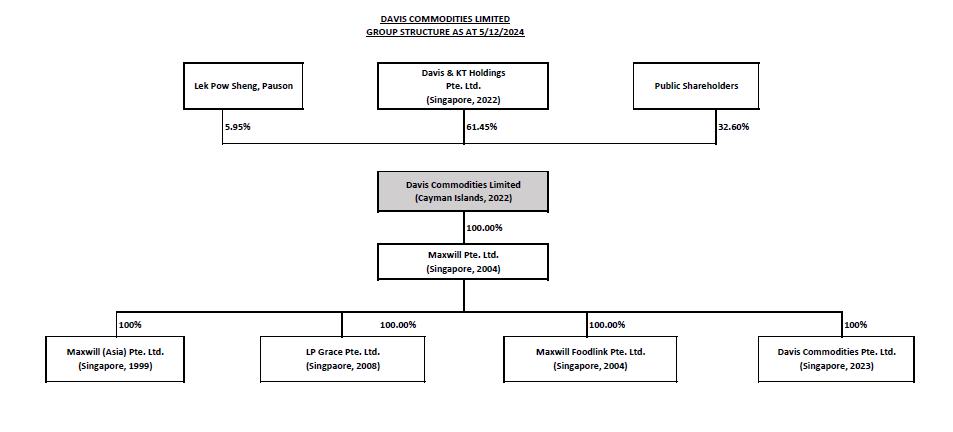
For details of our principal shareholders’ ownership, please refer to the beneficial ownership table in “Item 6. Directors, Senior Management and Employees—E. Share Ownership.”
|
|
Corporate Information
Our principal executive offices are located at 10 Bukit Batok Crescent, #10-01, The Spire, Singapore 658079, and our phone number is +65 6896 5333. Our registered office in the Cayman Islands is located at Cricket Square, Hutchins Drive, PO Box 2681, Grand Cayman, KY1-1111, Cayman Islands. Our website address is https://daviscl.com. The information contained in, or accessible from, our website or any other website does not constitute a part of this annual report. Our agent for service of process in the United States is Cogency Global Inc., located at 122 East 42nd Street, 18th Floor, New York, NY 10168.
The SEC maintains a website at www.sec.gov that contains reports, proxy, and information statements, and other information regarding issuers that file electronically with the SEC using its EDGAR system.
B. Business Overview
Overview
We are an agricultural commodity trading company based in Singapore which specializes in trading of three main categories of agricultural commodities: sugar, rice, and oil and fat products. We distribute agricultural commodities to various markets, including Asia, Africa and the Middle East. We also provide customers of our commodity offerings with complementary, ancillary services such as warehouse handling and storage and logistics services. We are an asset light business and utilize an established global network of third-party commodity suppliers and logistics service providers in order to distribute sugar, rice, and oil and fat products to customers in over 20 countries as of the fiscal year ended December 31, 2024.
We source and market the commodities we distribute under two main brands: Maxwill and Taffy. The Maxwill brand is owned by us and is used for the sugar products and oil and fat products that we distribute outside of Singapore. We have also appointed Tong Seng Produce Pte. Ltd., an established distributor of rice, oil, sugar, flour and fiber products in Singapore, for the exclusive distribution of certain sugar products under our Taffy brand.
We specialize in the sourcing and distribution of sugar products, with sugar products contributing to approximately 65.5%, 61.0% and 74.9% of our revenue for the fiscal years ended December 31, 2024, 2023 and 2022, respectively. We procure sugar products from various origins in order to offer a wide range of sugar products to our customers in Singapore, as well as in different markets in Asia, Africa and the Middle East regions. We are a member of The Refined Sugar Association in London, which is the trade association for the international white refined sugar trade. We also source and sell a wide selection of rice products and oil and fat products to our customers in Africa and the People’s Republic of China, or the PRC.
We pride ourselves on the quality of our products and our ability to provide a ‘one-stop service’ to customers. We engage third-party service providers for services such as warehouse handling and storage and logistics services (including distribution, freight forwarding and shipping services) to distribute the commodity products from our suppliers to our customers. We also arrange for our customers’ insurance and security coverage, including cargo insurance for the commodities which pass through our supply chain. Our operations are connected to a large network of such service providers, including freight and shipping companies, which are experienced in handling commodities. Their experienced network, in turn, enables us to coordinate, organize and manage our operations efficiently and offer our customers timely and cost-effective services. We are also able to oversee the quality of the products from the point of procurement to the point of distribution to our customers.
We are led by a devoted management team which is highly experienced in the agricultural commodities industry and has a keen understanding of market dynamics through our regional network of customers, suppliers and service providers. Since our establishment in 1999, we have experienced significant growth. For the fiscal years ended December 31, 2022, 2023 and 2024, we had total revenue of approximately US$206.7 million, US$190.7 million and US$132.4 million, respectively, representing a decrease by 7.7% from fiscal year 2022 to 2023, and a decrease by 30.6% from fiscal year 2023 to 2024. According to Frost & Sullivan, whom we commissioned in June 2022 to produce the Frost & Sullivan Report, we were the largest sugar supplier in Singapore, based on revenue in 2021, with an approximate market share of 7.5% in the sugar market in Singapore.
|
|
Our Strengths
We believe that we are well-positioned to achieve our strategic goals through several key business strengths, including the following:
Strong Relationships across the Value Chain
Our operations are supported by a network of third-party commodity product suppliers, as well as logistics service providers which have expertise in handling commodities, with whom we have established long-standing relationships. We have developed a strong network across the value chain: from procurement of the commodity products from various refineries and millers in Asia, to transport and warehouse handling and storage of the finished products through third-party service providers, and then distribution to our customers across the Asia Pacific region and other distributors in the Middle East and Africa regions. Our access to this extensive sales and distribution networks enables us to procure and distribute the sugar, rice and oil and fat products in an efficient manner, and enjoy certain cost savings from economies of scale and efficiencies in the transportation and logistics of the commodity products. Accordingly, we believe we are well positioned to take advantage of the growth in the respective markets in which we operate to further increase our sales and revenue.
Established relationships with certain suppliers and distributors have also supported our successful distribution of the commodity products. We have appointed Tong Seng Produce Pte. Ltd., an established distributor of rice, oil, sugar, flour and fiber products in Singapore, for the exclusive distribution of certain sugar products under our Taffy brand in Singapore. The sugar supplying market in Singapore is relatively fragmented, according to the Frost & Sullivan Report. As a result of the strong relationships that we have established across the value chain, we are the largest sugar supplier in Singapore by revenue in 2021, according to the Frost & Sullivan Report.
Diversity in Product Range and Established Distribution Network
While we focus only on agricultural commodities, we do so in a highly diversified manner, covering various product categories of some of the world’s most traded agricultural commodities, namely, sugar, rice, and oil and fat products, according to the Frost & Sullivan Report. Our sugar product offerings include cane sugar, coconut sap sugar, natural brown sugar, refined sugar and liquid sugar. We also offer a wide selection of rice products from different origins including long grain rice, round rice, jasmine rice, white rice and glutinous rice. Our oil and fat products include palm oil and coconut oil.
The various products are packaged and branded depending on the relevant export market, with the Maxwill brand products packaged and exported to overseas customers, and the Taffy brand sugar products distributed in Singapore. The diversity of our product offerings contributes to our de-concentration risk, both on the market side and in terms of spreading credit risk among a wider base of market counterparties.
Since our establishment in 1999, we have built up an extensive distribution network in Asia, Africa and the Middle East regions. We distributed our sugar, rice and oil and fat products globally to customers in more than 20 countries in the fiscal year ended December 31, 2024. We believe that we can take advantage of our extensive and long-standing product sourcing capacities globally to further develop our distribution network in the growing markets of Asia and Africa. Our involvement at the local agri-business level through our suppliers, as well as our distribution network in the different geographical regions may afford us unique insight into the macro-drivers, such as foreign exchange fluctuations, farming activities, weather and government policies. Over the years, we have also developed a keen understanding of market dynamics through our regional network of customers, suppliers and service providers, and have become more attuned to market needs. When new market opportunities are identified, we expect to work closely with our suppliers on product improvement and packaging design for new market penetration and development. After leveraging market information and insights from our stakeholders, we believe we are able to manage supply and demand information, craft solutions to overcome distribution challenges and provide ancillary services to ensure timely delivery of products to fulfil the needs of our customers. Accordingly, we believe that our diversity in terms of product offerings and the geographical reach of our established distribution network is a key strength that allows us to improve access to evolving global commodity demands, while helping to mitigate regional risks.
|
|
An Experienced Management Team
Our management team has a proven track record of developing and growing the business. Since our establishment in 1999, our management team has overseen the expansion of our business into new markets and geographical areas such as the Africa and Middle East regions. We also have an experienced sales team which over the years has demonstrated the ability to identify new business opportunities, develop the business by growing our global distribution networks and manage volatility in prices and currencies. As a result, we have grown over the last 20 years to become the largest sugar supplier in Singapore, based on revenue in 2021, with an approximate market share of 7.5% in the sugar market in Singapore, according to the Frost & Sullivan Report.
Well-Managed and Flexible Financial Model
Our historical funding model has been based on our ability to use cash generated from our operations to meet our financial needs. As of the date of this annual report, we do not have any material bank loans; as of April 30, 2025, we have accounts with 4 outstanding bank facilities and finance lease with an aggregate principal balance of approximately US$346,904. As we have established relationships with local banks, we believe such relationships may enable us to have access to diversified potential sources of funding options that may permit us to expand while managing our liquidity position, should such financing become necessary. As of December 31, 2024, our cash and cash equivalents position was approximately US$677.5 million. We believe that our liquidity position and access to diverse funding sources has significantly contributed to our global expansion and business growth and has allowed us to remain flexible and resilient over the years.
Risk Management Capabilities
We believe that the ability to manage risk is one of our key strengths. Risk management is a core function under the supervision of our senior leadership structure. Risk is also a crucial consideration in our overall strategy, which is based on bulk sourcing, and managing transportation and delivery to our customers. We capture margins from the high volumes of the sugar, rice, and oil and fat products procured and sold. We believe that our sound risk management practices have contributed to our positive performance through the volatile market environment over recent years and helped to mitigate earnings volatility.
In particular, our profits from the sale of sugar products are relatively isolated from large market fluctuations, due to proactive and prudent risk management through our stringent hedging practice and because we purchase part of the sugar product volume based on forecasted demand. While we sell most of our sugar product volume on a cost-plus basis, historically, we have maintained open positions on sugar product prices for approximately 20% of our annual sugar product volume. These open positions on sugar product prices are a result of the sugar product pricing at the point of purchase from the relevant supplier possibly varying with the sugar product prices at the point of sales to our customers, and may lead to uncertainty in our sugar product margins. We also mitigate against this risk by hedging the sugar products which are exposed to open positions by trading sugar futures over the future exchanges, including the ICE Futures Europe and ICE Futures U.S. These hedged positions enable us to fix the price of the sell future contracts at the point of purchase for the total purchase amount of the sugar products purchased from certain suppliers against adverse fluctuations in the sugar product prices and, upon maturity of such sell future contract, a buy future contract is simultaneously executed at the spot price in order to close such sell future contract.
|
|
Our Strategies
Strengthen our Edge in Merchandizing
We believe that our success is derived from our knowledge of the markets in which we operate, and we have drawn on our knowledge of local markets and their specific characteristics to inform our distribution and risk management strategies. Supported by regional know-how over our diverse product range and from our distribution network, we have utilized such “on the ground” knowledge to obtain critical information, build and maintain sales volume, and support the supply chain management, in order to enjoy the synergies and economies of scale in our end-to-end operations, which is comprised of procuring commodity products, managing logistics through third-party providers, and delivery to our customers. We intend to further improve our core business by building up our sales team with a focus on market intelligence and by using innovative data science.
We plan to expand our sales team by hiring market researchers and traders. We aim to expand the team of market researchers who will be focused on conducting in-depth market research, including analysis of external reports and other data, and supply and demand projections, and to continuously monitor the markets to ensure that the local market knowledge is utilized effectively.
We also plan to increase the number of traders on our sales team, who will utilize our market research to assist with our arbitraging activities and to maximize the arbitrage opportunities. Apart from five traders as of the date of this annual report, we also have two marketing personnel on our sales team. Each trader covers all the different commodity products within a different geographical location and the expansion of our sales team will allow us to potentially expand into more markets. Our traders also participate in various regional and global exhibitions and conventions, such as the Gulfood trade fair, the Salon International de l'alimentation (SIAL) Paris trade fair, the Food & Hotel Asia (FHA) trade event and the THAIFEX tradeshow, which are also usually attended by our customers. The Gulfood trade fair is an annual food and beverage trade fair held in Dubai which is also attended by customers from Africa. The SIAL Paris trade fair is a biennial food exhibition held in Paris which is also attended by customers from North Africa. The FHA trade event is a biennial Asia-focused food and hospitality industry trade fair held in Singapore. The THAIFEX tradeshow is an annual Asia-focused trade exhibition held in Bangkok, Thailand, for the food and beverage industry.
We only merchandize our products at a single point in our value chain – to our customers. We believe this reduces complexity and mitigates risks, all of which are crucial to enable us to take advantage of market opportunities and effectively address demand and supply imbalances. We believe that our ability to procure supply chain and logistics services also support arbitraging activities because our ability to move products quickly and efficiently from one place to another will facilitate the optimization of geographical activities and allow us to capitalize on favorable market opportunities and ensure optimal pricing. To support the sales team, we also plan to invest in information technology to enhance information flow, better manage risks arising from our trading activities, and to ensure that the estimates and information gathered by our team are accurate and up-to-date. Our investment in information technology will also allow our traders to be better utilize data science and algorithms in their trading activities.
|
|
Expanding our Business by Strengthening our Market Position and Pursuing Strategic Acquisitions
While we are involved in various aspects of the value chain, we operate in an asset light manner, and engage third-party suppliers to produce and package the sugar, rice, and oil and fat products which we sell and distribute to our customers. We aim to strengthen our market position by expanding the scope of our product offerings and investing in equipment and technology to develop better products.
For example, we currently export liquid sugar to the People’s Republic of China, which is then further processed into rock sugar by third parties for sale and distribution to end consumers. We are in the early stages of studying the feasibility of developing our own facility for sugar products in the People’s Republic of China. We believe this will enable us to increase our sugar product offerings and expand our market share and brand awareness and other nearby regions by leveraging on our presence and our ability to distribute our products directly in the People’s Republic of China.
We also intend to pursue strategic acquisitions, both upstream and downstream in the value chain, when suitable opportunities arise. We expect to expand our geographic presence by pursuing upstream acquisitions or form partnerships or joint ventures with sugar mills and refineries and manufacturing facilities in Southeast Asia and/or the People's Republic of China. We also intend to pursue potential downstream acquisitions to strengthen our downstream portfolio across the three commodities products and solidify our presence in the relevant markets, or to consolidate market share through acquisitions of regional players. We may also seek to acquire brands and businesses from food and fast-moving consumer goods (“FMCG”) companies to expand our product and brand portfolios and to further increase our food and FMCG distribution access. We also hope to improve our overall business performance in terms of our top line and margins through such acquisitions. Apart from pursuing strategic acquisitions, we may also seek to form joint ventures with suitable partners.
Our Main Business Activities
We have over 20 years of experience as a physical commodities merchant. This has allowed us to develop and build upon our expertise in the diversified commodities portfolios which we merchandize and to cultivate long-term relationships with an established base of suppliers, logistics providers and customers across diverse industries and in several geographic regions. Merchandizing occurs at the end of the value chain, where we distribute products to our customers. We source a diversified range of sugar, rice, and oil and fat products from third-party suppliers, which process the raw materials and package the finished products based on our specifications. These finished sugar, rice, and oil and fat products are sold, usually with ancillary services such as warehouse handling and storage and logistics services (including freight services and arranging for insurance and security coverage) to a broad range of consumers and industrial commodity end users in Asia, the Middle East and Africa. The ability to store and transport the products efficiently and cost-effectively using third-party service providers provides an ancillary service which we believe enhances our product offerings.
Our products are sold under the Maxwill and Taffy brands. We own the Maxwill and Taffy brands and we distribute sugar products and oil and fat products under these brands to customers in Singapore and overseas markets, as the case may be.
With a presence in the value chain in the commodities markets of our product categories, we regularly do business with various counterparties in a number of geographic locations. Counterparties vary to some extent depending on the particular commodity, but generally include:
| · | on the product sourcing side: manufacturers and refineries; | |
| · | in the area of logistics: warehouse handling and storage, freight forwarding and shipping services; and | |
| · | in our merchandizing activities: wholesalers, food or industrial corporations. | |
|
|
We engage third-party service providers that have access to a global network of logistics assets, including international haulers, shipping lines and transport companies, to provide logistics services as part of the one-stop-service for customers of our commodities products, in order to ship cargo efficiently and cost-effectively, while maintaining control and quality of the products throughout the entire value chain.
All our customers may generate a credit and performance risk. We operate principally with short-term transactions on fixed pricing terms. Our customers may be required to pay 100% of the total contract value upon receipt of the shipping documents, or may be required to make payment of a deposit (which is calculated as a certain percentage of the total contract value) within a stipulated period from the date of order confirmation and with the balance amount payable upon receipt of the shipping documents. We have not entered into long-term contracts with any of our customers and suppliers.
In line with the industry in which we operate, the customer base is fragmented and there is no significant customer concentration in any of the areas in which we operate. One customer accounted for more than 10% of our total revenue for the fiscal year ended December 31, 2024 . The majority of our customers have contracts for one product line only, and crossover between our customer base and our supplier base is limited. Our business is not dependent on any patents or licenses, commercial or financial contracts or new manufacturing processes.
As part of our merchandizing business activities, our marketing team also undertakes both online and offline marketing efforts to maximize our brand awareness to end consumers in Singapore and overseas. Marketing efforts are mainly focused on reaching out to retail and commercial customers in Singapore and overseas. We utilize social media to advertise our products online, on platforms such as Facebook and Instagram. We also actively participate in trade fairs annually, such as Gulfood, an annual trade show held in Dubai, United Arab Emirates, and the biennial Salon International de l'Alimentation (SIAL) Paris, one of the largest food trade shows in the world held in France. We do not use any other marketing channels in our business. We buy and sell directly with our suppliers and customers. We do not utilize any special sales methods such as installment sales. We believe that doing so is a convenient and cost-effective channel into the FMCG market and enables our Company to build relationships with such stakeholders and partners.
Sugar
Sugar products contribute most significantly to our revenue and accounted for 65.5%, 61.0% and 74.9% of our revenue in the fiscal years ended December 31, 2024, 2023 and 2022, respectively. We currently procure raw and white sugar mainly from Brazil and India and sell to customers in Africa. We also buy from suppliers in Malaysia, Thailand and Indonesia and distribute our sugar products to Singapore as well as to the rest of Asia.
Our sugar product offerings include cane sugar, coconut sap sugar, natural brown sugar, refined sugar, and liquid sugar. We also distribute speciality sugar, such as organic certified low glycemic index (GI) coconut-sap sugar, made only from the pure nectar of the coconut plant. The sugar that we procure is already processed and refined depending on its intended end use and is sold to us as finished packaged commodities from our suppliers, including in sugar sachets and sticks for commercial retail use and small packs for end consumers. Large wholesale packs of 25 kilograms or 50 kilograms are also exported for distribution overseas under our Maxwill brand for use by commercial customers such as food and beverage companies, restaurants and other food and beverage establishments. We also distribute sugar products in Singapore under the Taffy brand to Tong Seng Produce Pte. Ltd., an established distributor of rice, oil, sugar, flour and fiber products in Singapore. The Taffy sugar products are distributed to leading local supermarket chains, as well as mini-marts and traditional provision stores in the heartlands.
According to the Frost & Sullivan Report, retail sales value in Singapore was maintained at approximately S$45 billion between 2016 to 2019. Due to the COVID-19 pandemic, where stringent quarantine and lockdown measures were imposed, retail sales value plummeted 14.8% year-on-year in 2020. Retail sales value declined at a CAGR of approximately 1.2% between 2016 to 2021. Going forward, retail sales value is expected to grow at CAGR of approximately 2.6% between 2022 to 2026, as the COVID-19 pandemic is expected to be gradually and effectively controlled. Additionally, the market size of sugar in Singapore is projected to reach US$137.1 million by 2026, primarily due to the extensive application of sugar in various industries such as baked goods, confectioneries, canned food, frozen foods, and pharmaceuticals, etc. The anticipated sugar market growth will be further bolstered by the rising consumption of sweet dishes and desserts, increasing investment and product innovation by major players, coupled with new product launches. As such, we expect demand for sugar in Singapore to remain robust.
|
|
We pre-order our sugar products from certain suppliers for the upcoming calendar year, based on forecasted annual demand. We constantly monitor our inventory levels and will place additional orders with the relevant suppliers when inventory levels run low. We arrange logistics services through third-party service providers such that arrangements can be made for the sugar products to be delivered from the sugar refineries and factories directly to the customers. We engage a third-party warehouse handling and storage service provider in Singapore to store sugar products for certain customers upon import into Singapore, prior to collection or delivery to such customers in Singapore.
We offer a wide selection of sugar products under the Maxwill and Taffy brands:
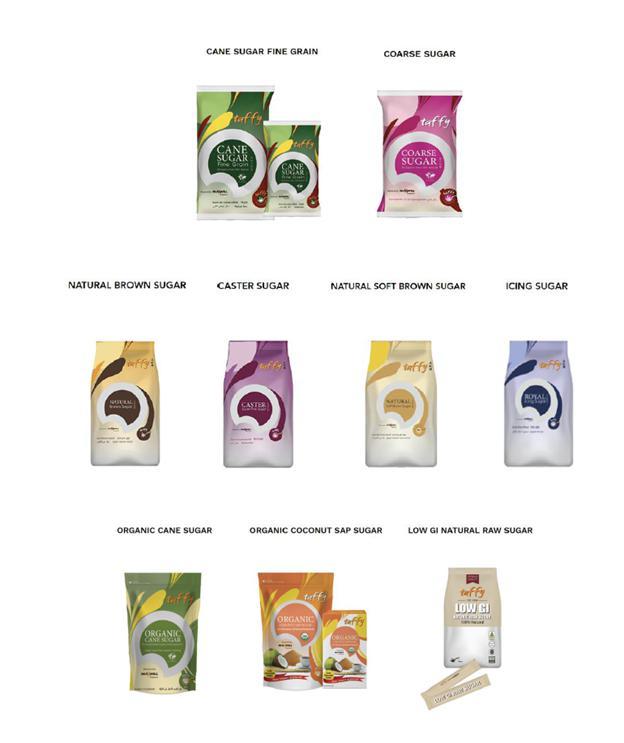
|
|
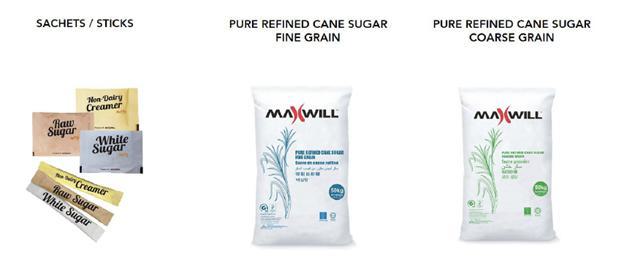
Rice
Rice products are our second largest revenue contributor, accounting for approximately 14.1%, 13.9% and 16.5% of our revenue in the fiscal years ended December 31, 2024, 2023 and 2022, respectively. We currently source rice primarily from trusted suppliers in Thailand, India, and Vietnam, and our rice products are exported for distribution in Africa and the People's Republic of China, mainly to customers who are wholesalers and merchants selling to wholesalers. The rice products are purchased and sold on a cost-plus basis. We place orders for the rice products with the rice mills and manufacturing facilities, which are then delivered directly to our customers.
According to the Frost & Sullivan Report, the market size of rice in Asia was valued at US$220.1 billion in 2021 and is projected to expand at a CAGR of 2.5% from 2022 to 2026. Rice is the staple food of the population in Asia and continued development in rice mill machinery and improved packaging increases the product demand in Asia. Additionally, the growing population coupled with increasing disposable income is expected to enhance the growth of demand for rice the global market. The growing demand for specialty rice varieties has increased the trade for long grain rice. Changing lifestyles and food habits among consumers are accelerating the fast-food industry market, which in turn drives significant growth of the market. Going forward, the expanding food and restaurant sector is forecasted to promote market growth in Asia. As manufacturers are offering a wide range of products such as jasmine, basmati, white, brown, and wild rice, among many other products, rice is expected to be further promoted as a staple food.
|
|
We source rice from various sources, which may go through various stages of post-harvest handling, and are able to offer our customers a wide selection of rice products:
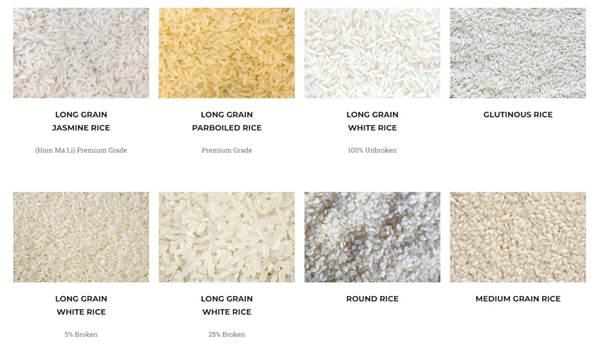
|
|
Oil and Fat Products
We procure and sell a range of oil and fat products. Our oil and fats products include palm-based cooking oil, coconut oil, shortening and margarine. Our oil and fat products are mainly used in human food consumption, such as cooking oils and for food processing. We merchandize a spectrum of oilseeds products, including refined palm oil and coconut oil. Our activities span the entire value chain - from procuring finished packaged products from our suppliers, to managing transportation and logistics provided by third parties, and finally downstream distribution to our customers. We source our oil and fat products from Malaysia and Indonesia, and transport and market these products under our proprietary brands, such as Maxwill Gold, to customers in Africa. Similar to rice products, we purchase and sell the oil and fat products on a cost-plus basis.
According to the Frost & Sullivan Report, the change in lifestyle, increase in disposable income and rise in awareness with regard to the benefits of nutrition plans has positively affected the oil market. The oil market in Asia was valued at US$41.3 billion in 2021 and is expected to reach US$60.2 billion by 2026, reflecting a CAGR of 7.8% between 2022 to 2026. The increase in consumer preference for dietary improvements is one of the major market drivers. The rise in functional food products further drives market growth. In addition, the increase in consumers seeking healthy and sustainable food options, along with the growing number of sports and gym enthusiasts, further supports the anticipated expansion of the market.
The key oil and fat product merchandized by us is palm-based cooking oil, which can be packaged in polyethylene terephthalate (PET) bottles, jerry cans, tins, pails, drums, bag-in-box (BIB) containers, intermediate bulk containers (IBC), ISO tanks and flexibags, such as the following:
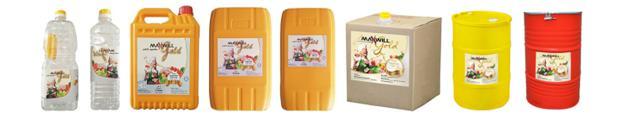
|
|
Supply Chain Management
To support our core business of merchandizing commodities, we provide services (through third-party service providers) such as warehouse handling and storage services in Singapore, and logistics services (including distribution, freight forwarding and shipping services). We also arrange for our customers’ insurance and security coverage for the commodity products which pass through our supply chain. As part of our integrated supply chain operations, we engage third-party service providers that have access to a global network of logistics services to provide the supply chain management services as an ancillary service to customers of our commodities products. Integration allows us to control costs, protect against non-availability risks and enhance synergies within the value-chain.
Quality Management
We believe that quality control is important to our business, and we have quality control measures in place to ensure that our products consistently meet the standards that our customers demand from us. Commodity orders include grade and quality specifications, and we have product quality measures in place in each product category to meet these customer requirements.
Each of our product categories has quality management personnel who are responsible for ensuring the quality of the products. Our quality management personnel engage external surveyors that inspect all our shipments which typically ship out on a weekly basis. The external surveyors we engage for our products monitor and conduct checks on the quantity and quality of the products on a random sampling basis, including monitoring for infestation, odor, packing and quality. For example, the surveyors will monitor the consistency of the packing size and quality of package material used. Upon completion of such inspections, a certificate will be issued by the relevant external surveyor indicating the specifications of the shipment inspected, including the condition, quantity and type of packaging of the relevant commodity products that were inspected.
Furthermore, we are a member of The Refined Sugar Association in London, which has established rules and regulations required for the proper conduct of the white refined sugar trade in the United Kingdom and international markets.
Information Technology
We consider information technology development aimed at improving systems, processes and security to be of importance, and invest in information technology systems and process improvements from time to time. We are mindful of the need to progressively replace legacy applications with better-integrated systems in the areas of commodity trading and risk management. Our aim is to implement systems which allow for better monitoring of processes and increased efficiency. We currently run a number of programs, including accounts-related software.
Environment, Health and Safety
Our operations may involve occupational health and safety risks. Our sites are monitored, both internally and externally, for product safety, compliance with applicable laws and regulations, safety and integrity of our office, equipment, processes, employee actions and those of our third-party contractors and suppliers, occupational health and safety and employee exposure, transportation safety, asset security, environmental protection, and operating loss and damage.
Brands and Intellectual Property
Since our establishment, we have focused on building established brand names for our commodities products to achieve brand recognition and to increase our market share. We believe that increased brand awareness will assist to increase sales and sales margins, and improve customer loyalty. We have consistently marketed our products under two brands: Maxwill and Taffy. The Maxwill and Taffy brands are owned by us, and we have registered trademarks for these two brands. We rely on our intellectual property rights to protect our brand names by registering trademarks in Singapore, Malaysia, Vietnam and China, as well as through confidentiality agreements and procedures with our employees, partners and others.
|
|
As of the date of this annual report, we have registered 13 trademarks in Singapore, Malaysia, Indonesia and the People’s Republic of China. The following table sets for the details of our trademarks which have been registered:
| No. | Description | Place of registration / application | Class | Registered proprietor / Applicant | Registration / Application No. | Registration / Application Date | Status | Expiry date |
| 1. |  |
Singapore | 30 | Maxwill Foodlink | T0408706G | June 1, 2004 | Registered | June 1, 2034 |
| 2. |  |
Singapore | 30 | Maxwill Foodlink | T0515234B | August 26, 2005 | Registered | August 26, 2025 |
| 3. |  |
Singapore | 29 |
Maxwill Foodlink |
40201518831W | October 29, 2015 | Registered | October 29, 2025 |
| 4. |  |
Singapore | 30 | Maxwill Foodlink | T0619501J | September 18, 2006 | Registered | September 18, 2026 |
| 5. |  |
Singapore | 29 | Maxwill (Asia) | 40201401085T | December 1, 2014 | Registered | December 1, 2023 |
| 6. |  |
Singapore | 30 | Maxwill Foodlink | T1204031G | March 23, 2012 | Registered |
March 23, 2032 |
| 7. |  |
Singapore | 35 | Davis Commodities (Singapore) | 40202321914R | September 29, 2023 | Registered | September 29, 2033 |
| 8. |  |
China | 30 | Maxwill (Asia) | 61540246 | July 14, 2022 | Registered | July 13, 2032 |
| 9. | |
Malaysia | 30 | Maxwill (Asia) | TM2021035671 | December 20, 2021 | Registered | December 20, 2031 |
| 10. |  |
Malaysia | 30 | Maxwill (Asia) | TM2021035668/1 | December 20, 2021 | Registered | December 20, 2031 |
| 11. | |
Indonesia | 30 | Maxwill (Asia) | DID2021091558 | December 23, 2021 | Registered | December 23, 2031 |
| 12. | |
Indonesia | 30 | Maxwill (Asia) | DID2021091566 | December 23, 2021 | Registered | December 23, 2031 |
| 13. | |
Vietnam | 30 | Maxwill (Asia) | 4-2021-50988 | December 21, 2021 | Registered | December 21, 2031 |
|
|
Domain Names
As of the date of this annual report, we have registered two domain names, being maxwillgroup.com and daviscl.com.
Employees
As of December 31, 2024, 2023 and 2022, we had 21, 22 and 15 employees, respectively, who are all based in Singapore. The following table sets forth a breakdown of our employees categorized by function as of December 31, 2024:
| Number of Employees | Percentage | |||||||
| Management | 5 | 24% | ||||||
| Trading | 3 | 14% | ||||||
| Sales & Marketing | 2 | 10% | ||||||
| Research | 3 | 14% | ||||||
| Warehouse Management | 1 | 5% | ||||||
| Logistics Services | 4 | 19% | ||||||
| Administration | 3 | 14% | ||||||
| Total | 21 | 100% | ||||||
We have developed various methods to ensure that employees are adequately and correctly trained for the functions they perform and are aware of the legislation affecting our business. Our success depends on our ability to attract, retain, and motivate qualified employees. We endeavor to offer employees competitive compensation packages and a positive, dynamic, and creative work environment. We believe that we maintain a good working relationship with our employees, and we have not experienced any material labor disputes or work stoppages. No collective bargaining agreement has been put in place.
We enter into standard labor contracts with our employees. We also enter into standard confidentiality agreements with all of our employees.
Facilities
Our headquarters are located in Singapore. We are an asset light business and we are renting the office space that we currently use for our headquarters and day-to-day operations. We also own one office space in Singapore which has been fully paid for, and which is currently being leased to a third-party. We believe that the income we receive from leasing our office space and expenses paid for office rental are both immaterial. The office space that we are leasing comprises 131.0 square meters with monthly rent of approximately US$2,257, while the office space that we are renting for use comprises 143.0 square meters, with monthly rent of approximately US$3,367.
Insurance
We have limited liability insurance coverage for our products and business operations, which comprises marine cargo insurance and property all risks insurance. We do not maintain third-party liability insurance or product liability insurance. We believe that our insurance coverage is consistent with industry standards and is adequate to cover our key assets, facilities and liabilities. Please see “Item 3. Key Information – Risk Factors – Our insurance coverage may not be sufficient or may not adequately protect us against all material hazards and other business risks, which may adversely affect our business, financial condition, results of operations, cash flows and prospects.”
|
|
Legal Proceedings
We may from time to time be subject to various legal or administrative claims and proceedings arising from the ordinary course of business. Litigation or any other legal or administrative proceeding, regardless of the outcome, is likely to result in substantial cost and diversion of our resources, including our management’s time and attention.
We were involved in a legal proceeding involving BSRAT DMCC, a Dubai Limited Liability Company, which is our customer and is in the business of general trading and distribution of mainly food stuffs, including rice. BSRAT DMCC filed a claim against us in the District Court of Singapore alleging that we had failed to supply bags of rice pursuant to 4 contracts of sale in conformity with the terms of such contracts, and sought compensation for damages amounting up to approximately US$255,000. The claim was dismissed on September 27, 2022. In addition to the related cost, managing and defending litigation can divert our management’s attention. We may also need to pay damages to settle claims with a substantial amount of cash. Please see “Item 3. Key Information – D. Risk Factors – Risks Related to Regulation and Litigation – Our Company may be involved in certain legal proceedings from time to time. Any adverse decision in such proceedings may render us liable to liabilities and may adversely affect our business, financial condition, results of operations, cash flows and prospects.”
Regulations
Singapore
Regulations on Food Sales
We sell and distribute sugar products in Singapore. The Sale of Food Act 1973 of Singapore (“Sale of Food Act”) regulates food to ensure that food for sale is safe and suitable for human consumption and to promote public health, for ensuring the provision of information relating to food to enable consumers to make informed choices and for preventing misleading conduct in connection with the sale of food. Under the Sale of Food Act, “food” includes, among other things, any substance or thing of a kind used, capable of being used, or represented as being for use, for human consumption, whether it is live, raw, prepared or partly prepared and any substance or thing of a kind used, capable of being used, or represented as being for use, as an ingredient or additive therein.
Pursuant to the Sale of Food Act, the Minister may make regulations, among other things, to prescribe the standard of strength, weight, quality or quantity of any food or of any ingredient or component part thereof; regulating the identification and labelling of food or food contact articles for sale, including specifying the matter that must or must not be contained in any such label and the manner of labelling; and setting out requirements that apply to imported food or food contact articles to ensure that the food or food contact article is safe and suitable and to support a secure and reliable supply of imported food in Singapore, including keeping of records in relation to the source or traceability and handling of the food or food contact article imported.
The Sale of Food Act prohibits the sale of any food that is packaged or labelled in a manner that does not comply with all applicable requirements therein relating to identification and labelling of that food. Pursuant to the Food Regulations (the “Food Regulations”), which is a subsidiary legislation to the Sale of Food Act, no person shall, among other things, import, advertise, sell, consign or deliver any prepacked food if the package of the prepacked food does not bear a label containing all the particulars required under the Food Regulations. Such label must, among other things, be marked on or securely attached in a prominent and conspicuous position with the prescribed particulars being clearly legible and appearing conspicuously and in a prominent position on the label. The Sale of Food Act also prohibits the sale of any food which is labelled or advertised in a manner that is false, misleading or deceptive or is likely to create an erroneous impression regarding its value, merit or safety. The Food Regulations further specify that false, misleading or deceptive statements, words, brands, pictures or marks whether in written, pictorial or other descriptive matter on food labels are generally prohibited. There are also limitations on the making of particular statements or claims on labels, such as statements claiming or suggesting that a food is a source of energy, or an excellent source of protein. The Food Regulations also regulate sugar and sugar products, including that sugar shall be the food chemically known as sucrose, and if sold as granulated, loaf cut, cube, milled or powdered shall contain not less than 99.5% (weight by weight) sucrose.
The Food (Amendment) Regulations 2025 has been gazetted on January 31, 2025 and will come into operation on January 30, 2026. This set of amendments makes changes to the Food Regulations with respect to labelling requirements for prepacked foods to incorporate relevant labelling provisions in certain Codex Standards.
|
|
Regulations on Imports and Exports
Registrations and Permits
Pursuant to the Food Regulations, no person shall import any food that has not been registered with the Director-General, Food Administration and imported food is deemed registered if it is imported under a permit to import issued under the Regulations of Imports and Exports Regulations, which is a subsidiary legislation to the Regulations of Imports and Exports Act 1995 of Singapore and the prescribed particulars appear on the permit to the satisfaction of the Director-General.
Pursuant to the terms of the Registration to Import Processed Food Products and Food Appliances issued by the Singapore Food Agency to the Company, the Company must obtain a permit from the Director-General, Food Administration for the import of each consignment of processed food and food appliances, which is issued under the Regulation of Imports and Exports Regulations. All commercial food imports that enter Singapore must originate from sources approved by the Singapore Food Agency. Processed food products, which include sugar products, must be obtained from establishments regulated by the overseas competent authorities. Only traders who are licensed or registered with the Singapore Food Agency can bring commercial shipments of food into Singapore.
As we import sugar products into Singapore for certain customers, the sugar products may be stored at the warehouse of a third-party warehouse handling and storage services provider in Singapore that we engage for our business and operations, prior to collection or delivery by such customers in Singapore. Accordingly, we are required to register with the Singapore Food Agency to import processed food products and food appliances.
United Nations Securities Council Sanctions
Singapore gives effect to various resolutions of the Security Council of the United Nations including in relation to sanctions against designated persons from certain jurisdictions. These are contained in various pieces of subsidiary legislation to the United Nations Act 2001 of Singapore, such as the United Nations (Sanctions – Democratic People’s Republic of Korea) Regulations 2010, which when read with the Regulation of Imports and Exports Regulations, prohibits the export of any goods that are for the purposes of trade with any person the Democratic People's Republic of Korea.
Regulations on Intellectual Property Rights
We have registered various trademarks, including the trademarks for our Maxwill and Taffy brands in Singapore. The Intellectual Property Office of Singapore is the national authority that registers and is responsible for the administration of intellectual property rights in Singapore, which includes copyrights, trademarks and patents. Singapore is a member of the main international conventions regulating intellectual property matters, and the World Trade Organization's Agreement on Trade Related Aspects of Intellectual Property Rights.
Trademarks
Singapore operates a first-to-file system in respect of registered trademarks under the Trade Marks Act 1998 of Singapore, and the registered proprietor is granted a statutory monopoly of the trademark in Singapore in relation to the product or service for which it is registered. The proprietor of a registered trademark may also authorize other persons to use the trademark in relation to the goods or services for which it is registered. In all legal proceedings relating to a registered trademark or any right thereunder, the registration of a person as proprietor of a registered trademark is prima facie evidence of the validity of the original registration in any subsequent assignment or other transmission of the registration. In the event of any trademark infringement, the registered proprietor will be able to rely on the registered trademark as proof of his right to the mark, and the infringement of a trademark may give rise to civil and criminal liabilities. Goods and services are classified, for the purposes of the registration of trademarks, according to a prescribed system of classification. Statutory protection of a registered trademark can last indefinitely, as long as the registration is renewed every 10 years. Unregistered trademarks are also protected under the common law of passing off, provided that the owner is able to prove that there is goodwill or reputation in the mark; misrepresentation on the part of the infringer; and damage to the mark as a result.
|
|
Regulations on Labor
The Employment Act
The Employment Act 1968 of Singapore (the “Employment Act”) is administered by the Ministry of Manpower of Singapore and sets out the basic terms and conditions of employment and the rights and responsibilities of employers as well as employees. It generally extends to all local and foreign employees under a contract of service with an employer, with the exception of certain groups of employees, including seafarers, domestic workers and statutory board employees or civil servants. The Employment Act prescribes certain minimum conditions of service that employers are required to provide to their employees, including (i) minimum days of statutory annual and sick leave; (ii) paid public holidays; (iii) statutory protection against wrongful dismissal; (iv) provision of key employment terms in writing; and (v) statutory maternity leave and childcare leave benefits. In addition, certain statutory protections relating to overtime and hours of work are prescribed under the Employment Act, but only apply to limited categories of employees, such as an employee (other than a workman) who is not employed in a managerial or executive position and who receives a salary of up to S$2,600 a month (“relevant employee”). Section 38(8) of the Employment Act provides that a relevant employee is not allowed to work for more than 12 hours in any one day except in specified circumstances, such as where the work is essential to the life of the community, defence or security. In addition, section 38(5) of the Employment Act limits the extent number of hours of overtime work that a relevant employee can perform in a month, to 72 overtime hours a month.
The Employment of Foreign Manpower Act
The employment of foreign manpower in Singapore is also governed by the Employment of Foreign Manpower Act 1990 of Singapore (the “Employment of Foreign Manpower Act”), which is administered by the Ministry of Manpower and prescribes the responsibilities and obligations for employing foreign employees in Singapore. The Employment of Foreign Manpower Act prohibits the employment of a foreign worker unless such foreign worker has obtained a valid work pass from the Controller of Work Passes. Under the Employment of Foreign Manpower (Work Passes) Regulations 2012, which is a subsidiary legislation to the Employment of Foreign Manpower Act, employers of an “S pass” and work permit holders (issued for mid-level skilled staff and semi-skilled foreign workers in the construction, manufacturing, marine shipyard, process or services sectors, respectively) must, among other things, bear the costs of such worker’s medical treatment (unless in excess of the minimum mandatory coverage in certain instances) and purchase and maintain medical insurance for inpatient care and day surgery.
The Central Provident Fund Act
Aside from minimum benefits in respect of the aforesaid terms of employment in the Employment Act, employees in Singapore are entitled to contributions to the central provident fund by the employer as prescribed under the Central Provident Fund Act 1953 of Singapore (the “CPF Act”). The CPF Act is administered by the Central Provident Fund Board and governs the contributions made by employers and employees into the central provident fund. The specific contribution rate to be made by employers varies depending on whether the employee is a Singapore citizen or permanent resident in the private or public sector and the age group and wage band of the employee. Generally, for employees who are Singapore citizens in the private sector or non-pensionable employees in the public sector, 55 years old or below and that earn more than or equal to S$750 a month, the employer's contribution rate is 17% of the employee’s wages and the employee’s contribution rate is 20% of the employee’s wages.
|
|
Regulations on Safety and Health of Our Employees
The Workplace Safety and Health Act 2006 of Singapore (the “WSH Act”) is the principal legislation governing the safety, health and welfare of persons at work in all workplaces. Among other things, the WSH Act imposes a duty on every employer and every principal to take, so far as is reasonably practicable, such measures as are necessary to ensure the safety and health of its employees, and any contractor, any direct or indirect subcontractor, and any employee employed by such contractor or subcontractor, when at work. These measures include, among other things, developing and implementing procedures for dealing with emergencies that may arise while the employees are at work and ensuring that the employee at work has adequate instruction, information, training and supervision as is necessary for that employee to perform his work. More specific duties imposed by the Ministry of Manpower on employers are laid out in the Workplace Safety and Health (General Provisions) Regulations. Some of these duties include, among other things, preventing the workplace from being overcrowded and ensuring adequate ventilation of the workplace.
People’s Republic of China
Regulations on Food Safety and Food Import
We export and sell sugar products and rice products in the PRC. The PRC has adopted comprehensive legislation governing food safety and food import.
Food Safety
Pursuant to the Food Safety Law of the PRC, or the Food Safety Law, which was promulgated by the Standing Committee of the National People’s Congress (the “SCNPC”) on February 28, 2009, and last amended on April 29, 2021 and made effective the same day, and the Implementing Rules on the Food Safety Law of the PRC, or the Implementing Rules on the Food Safety Law, which was promulgated by the PRC State Council on July 20, 2009 and amended on February 6, 2016 and October 11, 2019, in effect since December 1, 2019, food producers shall inspect the food produced by themselves in accordance with food safety standards established by the Food Safety Law. Food producers may either carry out inspection on the food on their own or entrust the inspection to a food inspection institution complying with the provisions of relevant PRC laws.
Food Recall System
Under the Food Safety Law, as well as the Implementing Rules on the Food Safety Law, the Administrative Measures for Food Recall was promulgated by the China Food and Drug Administration (the “CFDA”) on March 11, 2015 and entered into force on September 1, 2015, and last amended on October 23, 2020. The Administrative Measures for Food Recall provides the detailed rules on the food recall system. Where a food producer finds that the food produced by it does not comply with the food safety standards, it shall immediately stop the production, recall the food on the market for sale, notify the relevant producers and traders, as well as consumers, and record the recall and notification. Where a food trader finds that the food traded by it does not comply with the food safety standards, it shall immediately stop the trading, notify the relevant producers and traders, as well as consumers and record the cessation of trading and the notification. Where the food producers or traders fail to recall or stop trading of the food failing to comply with the food safety standards in accordance with the provisions of the Food Safety Law, as well as the Implementing Rules on the Food Safety Law, the food safety supervision and administration departments at or above the county level shall order them to recall or stop trading.
|
|
Food Import
Under the Food Safety Law, as well as the Implementing Rules on the Food Safety Law, the imported food, food additives and food-related products shall meet the national food safety standards of the PRC. A food importer shall apply for inspection with the entry and exit inspection and quarantine institution at the place of customs declaration by presenting necessary vouchers and relevant approval documents such as contract, invoices, packing note, bill of lading, etc. The imported food shall pass the inspection conducted by the entry and exit inspection and quarantine institution. For any food that is imported that is not regulated by the requirements of the national food safety standards, the overseas exporter, overseas food producer or its entrusted importer shall file and submit the applicable standards of relevant countries (regions) or international standard to the health administration department under the PRC State Council. The imported pre-packed food and food additives shall be accompanied with labels and instructions (if the instructions are required under relevant PRC laws and regulations) written in Chinese. The labels and instructions shall be consistent with the provisions of the Food Safety Law as well as the Implementing Rules on the Food Safety Law and other relevant laws and administrative regulations of the PRC and the requirements of the national food safety standards, and indicate the origin of food and name, address and contact methods of the domestic agent. Where any pre-packed food is not accompanied with labels or instructions in Chinese or the labels or instructions are not consistent with the requirements, the pre-packed food shall not be imported. The importer shall establish a food and food additives import and sale record system to truthfully record the names, specifications, quantities, dates of production, batch numbers of production or import, shelf life, names, address and contact methods of exporters and purchasers, dates of delivery, etc. of the food and food additives. Such import and sale records shall be true, and shall be kept for at least six months after the expiration of the shelf life; if there is no explicit shelf life, the records shall be kept for at least two years.
Regulations on Product Quality and Product Liability
Product Quality
In accordance with the Product Quality Law of the PRC (the “Product Quality Law”), as promulgated by the SCNPC on February 22, 1993, which became effective on September 1, 1993 and was last amended on December 29, 2018, producers and sellers are liable for the quality of the products they produce or sell. Where anyone produces or sells products that do not comply with the relevant national or industrial standards and requirements safeguarding the health and safety of persons and property, they shall be ordered by the relevant authorities to stop production and/or sale of the products; the products illegally produced and/or sold shall be confiscated; a fine not less than the equivalent of, but not more than three times, the value of the products illegally produced or sold (including those already sold and those not yet sold, hereinafter the same) shall be imposed concurrently; if there are illegal proceeds, such proceeds shall be confiscated concurrently. If the case constitutes a crime, criminal liability shall be investigated in accordance with relevant law.
As of the date of this annual report, we are not aware that any of our products sold to the PRC are in violation of the Product Quality Law.
Protection of Consumer Rights and Interests
The Law of the PRC on the Protection of Consumer Rights and Interests, as passed by the SCNPC on October 31, 1993 and last amended on October 25, 2013, contains the code of conduct for business operators when dealing with consumers, including but not limited to the requirement that: (i) the goods and services shall comply with the Product Quality Law and other relevant laws and regulations; (ii) accurate information about the goods and services and the quality and use of such goods and services; (iii) invoice shopping vouchers or service documents shall be issued to consumers in accordance with relevant national regulations, business practices or at the request of consumers; (iv) the actual quality and function of the goods or services shall be consistent with the quality of the goods or services indicated by advertising data, product descriptions, samples or other means; (v) business operators assume responsibility for repair, replacement, refund or other liability under national regulations or any agreement with consumers; and (vi) business operators shall not create terms that are unreasonable or unfair to consumers, or exempt themselves from civil liability when they damage consumers’ legitimate rights and interests.
|
|
Regulations on Intellectual Property Rights
As of the date of this annual report, we have one registered trademark in the PRC. The PRC has adopted comprehensive legislation governing intellectual property rights, including trademarks.
Trademarks
According to the Trademark Law of the PRC promulgated by the SCNPC in August 1982 and recently amended in April 2019, and its Implementation Regulation promulgated in August 2002 and amended in April 2014 by the PRC State Council, the period of validity for a registered trademark is ten years, commencing from the date of registration. The registrant must go through the formalities for renewal within twelve months prior to the expiry date of the trademark if continued use is intended. Where the registrant fails to do so, a grace period of six months may be granted. The validity period for each renewal of registration is ten years, commencing from the day immediately after the expiry of the preceding period of validity for the trademark. In the absence of a renewal upon expiry, the registered trademark will be cancelled. The Trademark Law and its Implementation Regulation also stipulate rules regarding trademark infringement and compensation. Industrial and commercial administrative authorities have the authority to investigate any alleged infringement of the exclusive right under a registered trademark. If there is a suspected criminal offense, the case shall be timely referred to and decided by a judicial authority. As of the date of this annual report, we are not aware of any infringement claims asserted or threatened against us in the PRC.
Vietnam
Regulations on Imports and Exports
Under Circular 12/2018/TT-BCT (as amended by Circular 08/2023/TT-BTC), refined sugar is not in the list of goods prohibited from import into Vietnam; it is instead in the list of commodities under import tariff quotas. Under the Law on Foreign Trade Management 2018, commodities under import tariff quotas are goods which have the tax rate applicable while within the quota portion lower than that while outside of the quota portion. However, under Circular No. 23/2019/TT-BCT, import tariff quotas shall not be applied to sugar commodities (HS Code 1701) of the Association of Southeast Asian Nations (“ASEAN”) member states’ origin. The quantities of sugar imported from the ASEAN member states shall not be counted as the annual import tariff quotas announced by the Ministry of Industry and Trade of Vietnam, according to the World Trade Organization’s schedule of commitments applicable to its member states. Import duty rates applied to sugar commodities of the ASEAN member states' origin shall be subject to the regulations of Vietnam Government.
Aside from the above, under the trading contracts based on Cost and Freight basis (CFR) of Incoterms, we are only responsible for delivering the goods to the destination port and provide the commercial invoice and transport document i.e., the Bill of Lading to purchasers for their customs clearance; thus, the importation of the goods does not fall within our responsibility. As such, there are no other material regulations on importation in Vietnam that are applicable to us. The purchasers, being the local entities, shall be responsible for carrying out the custom clearance and all other relevant import procedures, including, but not limited to, quota registrations, if required.
|
|
Regulations on Distributions
The distribution of products in the destination jurisdictions are the responsibility of the buyers. We do not have any entity, representative office of a foreign trader or branch of a foreign trader in Vietnam. As such, there are no material regulations that are applicable to us.
Notwithstanding the above, the customers, under the Law on Protection of Consumers’ Rights, are able to make compensation claims for damage caused by defective goods against the followings: (i) the entities producing goods, (ii) the entities importing goods, (iii) the entities attaching a trade name to goods or using a trademark or commercial indications, by which entities producing or importing goods could be identified, and/or (iv) the entities directly providing defective goods to consumers in case of failure to identify the entities to be held accountable for damages under items (i), (ii) and (iii) as aforementioned.
In addition, the Law on Protection of Consumers’ Rights also imposes responsibility for recalling defective goods to both the entities producing goods and the entities importing goods, which include the following steps: (i) promptly taking all necessary measures to stop the supply of defective goods in the market; (ii) informing the public about the defective goods and the recovery of the goods according to statutory timelines; (iii) implementation of the recovery of the defective goods in line with the publicly-informed content and bearing the expenses incurred in the recalling process; and (iv) reporting the results to the competent authority after completion of the recall.
Regulations on Intellectual Property Rights
We filed applications for registration of the following two (2) trademarks “MAXWILL, Device” and “taffy” in Vietnam and have been granted Decisions of Official Acceptance of Application No. 22251/QD-SHTT dated March 23, 2022 and No. 22252/QD-SHTT dated March 23, 2022, respectively, issued by the Intellectual Property Office of Vietnam. The Intellectual Property Office of Vietnam is an organization directly under the Ministry of Science and Technology, with the function of advising and assisting the Minister in unifying the state management of intellectual property, and directly managing the state and organizing the implementation of non-business activities on industrial property according to the provisions of law. Vietnam is a member of the main international conventions regulating intellectual property matters, and the World Trade Organization's Agreement on Trade Related Aspects of Intellectual Property Rights.
The above granted decisions indicate that we have completed the initial registration stage for our trademarks in Vietnam. If the applications are not denied, the Intellectual Property Office of Vietnam will grant Trademark Registration Certificates and record our trademarks in the national register of industrial property within, by law, 12 months from the date of such decisions.
Trademarks
The industrial property right to a trademark is established on the basis of a decision on grant of a Trademark Registration Certificate by the Intellectual Property Office of Vietnam to the applicant. The proprietor of a registered trademark is entitled to protection within the scope stated in the Trademark Registration Certificate, throughout the territory of Vietnam, with indefinite statutory protection, as long as the registration is renewed every 10 years. In all legal proceedings, the proprietor of a registered trademark is able to use the Trademark Registration Certificate as prima facie evidence for their rights without need of any other evidence. Any infringement of a registered trademark may give rise to civil and criminal liabilities. Goods and services are classified, for the purposes of the registration of trademarks, according to a published system of classification.
|
|
Indonesia
Import Prohibitions
According to Ministry of Trade of Republic of Indonesia (the “MOT”), Regulation No. 18 of 2021 on the Goods Prohibited for Export and Import, as amended by MOT Regulation No. 40 of 2022 (“MOT Regulation No. 18”), the Government of Indonesia prohibits the following commodities from being imported to Indonesia, among others:
| · | certain types of sugar, inter alia, (i) raw sugar; (ii) refined sugar; (iii) plantation white sugar, all in the solid form of cane or beet sugar and chemically pure sucrose with ICUMSA (International Commission for Uniform Methods of Sugar Analysis) below 600 IU (International Unit); and | |
| · | certain types of rice, inter alia, (i) glutinous rice; (ii) hom mali rice; (iii) basmati rice; and (iv) malys rice, half-milled or wholly milled (whether or not polished or glazed), with certain regulated solidity or breakage level. |
The above prohibitions are stipulated in relation to and consideration of: (i) the protection of health, safety of living beings (humans, animals, fishes, and plants), and the environment; (ii) national security and interests or public interests, including social, cultural and public morals; and/or (iii) the preservation of natural plants and wildlife. Violation by the importer to import any of the above prohibited commodities may result in the imposition of administrative sanctions by the MOT in the form of: (i) a written reprimand; (ii) withdrawal of goods from distribution; (iii) temporary suspension of business activities; (iv) closure of warehouse(s); (v) a fine in the amount of IDR (Indonesian rupiah) 5,000,000 for each day of delay in rectifying the violation (the maximum of delay is 30 calendar days from the date imposition of the initial fine); and/or (vi) revocation of business license.
The raw cane sugar we sell to Indonesia has the ICUMSA above 600 IU and, as of the date of this annual report, we have been in compliance with MOT Regulation No. 18.
Regulations on Intellectual Property Rights
Trademarks
In 2016, the Indonesian House of Representatives enacted Law No. 20 of 2016 on Trademark and Geographical Indication (the “Trademark Law”). The Trademark Law has expanded the scope of trademark protection and adopted the 1989 Protocol to the Madrid Agreement Concerning the International Registration of Marks (the “Madrid Protocol”) provisions for trademark registration in Indonesia. Pursuant to the Trademark Law, registration of a trademark will give protection and an exclusive right granted by the state to the owner of a registered trademark for a certain period of time to use the trademark by itself or give permission to other parties to use it. The right of a trademark is obtained after the trademark application is registered with the Directorate General of Intellectual Property (the “DGIP”). A registered trademark will obtain legal protection in the territory of Indonesia for a period of 10 years as of the filing date and it can be renewed for 10 year periods indefinitely. The protection of a registered trademark is limited to the class and type of goods and/or services covered in the relevant trademark registration.
As of the end of 2020, the enactment of Law No. 11 of 2020 on Job Creation (which has been amended by Government Regulation in Lieu of Law No. 2 of 2022 on Job Creation juncto Law No. 6 of 2023 on the Stipulation of Government Regulation in Lieu of Law No. 2 of 2022 on Job Creation into Law) shortens the trademark registration process and inserts an additional basis for the trademark examiner to reject a trademark application, namely, if such trademark consists of a shape that is functional. In addition, the Trademark Law recognizes two types of international trademark registration applications under the framework of the Madrid Protocol: (i) an application originating from Indonesia to a foreign country’s trademark office (“International Bureau”) which is filed through the DGIP, and (ii) an application addressed to Indonesia as the receiving office from an International Bureau. To be able to file an application in Indonesia for the international registration of a trademark through the Madrid Protocol, the applicant either must have applied for registration of the trademark in Indonesia or already own the trademark in Indonesia.
As of the date of this annual report, we have registered two trademarks in Indonesia.
|
|
Ghana
Importation of food products into Ghana by either foreign or national companies is regulated for safety, quality and conformity with nationally prescribed standards. Imported food products follow strict documentation processes and must adhere to Ghana’s internal laws. Ghana has established regulatory institutions mandated by law to ensure that imported goods, including food products consumed in Ghana, are wholesome and safe. These institutions have, acting based on enabling laws, laid down standards and regulations to promote and protect the public health of Ghanaians in relation to the consumption of food products, whether imported or locally produced.
Legal Framework for Regulation of Food Safety and Quality in Ghana
The principal laws regulating safety and quality are the Food and Drugs Act (PNDCL 305B), later amended by the Food and Drugs Act of 1996, and the Public Health Act 2012, (Act 851). The primary institutions mandated with the responsibility to ensure the safety and quality of food products in Ghana are the Food and Drugs Authority (GFDA) and the Ghana Standards Authority (GSA). In practice, the functions of these two agencies are sometime cross-cutting and overlapping. The GFDA is the national regulatory body responsible for the regulation of food, drugs, food supplements, herbal and homoeopathic medicines, veterinary medicines, cosmetics, medical devices, household chemical substances, tobacco and tobacco products, blood and blood products, as well as the conduct of clinical trials protocols. The GSA was established by the Ghana Standards Act 1973 and is overseen by the Ministry of Trade and Industry. The GSA is responsible for establishing and promoting standards to ensure that goods and services manufactured or imported into Ghana are of the highest quality and are safe for consumers.
Food and Drugs ACT (PNDCL 305B)
The Food and Drugs Act 1992 (PNDCL 305B) - amended by the Food and Drugs Act of 1996 (ACT 523) (the “Food and Drugs Act”) contains provisions relating to importing, manufacturing, packaging, labelling, storage, distribution and trading of food and drugs in Ghana. Section 1 of the Food and Drugs Act prohibits and criminalizes the sale or offer for sale of unwholesome, poisonous or harmful food and drugs. Section 3 proscribes the deception of consumers with respect to food and drugs. It provides that a person who manufactures, labels, packages, sells or advertises a food in a manner that is false, misleading or deceptive with regard to its character, nature, value, additives, substance, quality, composition, merit or safety, commits an offence. Section 4 provides for standards of food. It states that where a standard is prescribed under an enactment for food, a person who manufactures, labels, packages, sells or advertises food in a manner that the food is likely to be mistaken for food of the prescribed standard commits an offence. Generally, Sections 1 to 8 provide for offences relating to food safety, Section 9 provides for penalties in respect to offences and Section 10 provides for summary closure of premises where food is manufactured, prepared or sold, if the Food and Drugs Board (now the GFDA) has reason to believe that the food is exposed to the risk of contamination.
Public Health Act 2012 (Act 851)
The Public Health Act 2012 (Act 851) (the “Public Health Act”) regulates public health in Ghana. It contains general provisions relating to food safety and public health. The Public Health Act established the Food and Drugs Authority (GFDA) which took over the functions of the Food and Drugs Board established by PNDCL 305B. The GFDA is overseen by the Ministry of Health. Notably, Part 7 of the Public Health Act is dedicated to food regulation. Specifically, Section 80, under Part 7 establishes the GFDA, while Section 81 provides that the object of the GFDA is to provide and enforce standards for the sale of food, herbal medicinal products, cosmetics, drugs, medical devices and household chemical substances. Further, Section 97 (1), provides that a person shall not manufacture, import, export, distribute, sell or supply food or expose food for sale unless the GFDA has registered the food. However, Subsection 2 exempts from this general prohibition the importation of samples for purposes of registration of the food.
|
|
Regulations Specific to Importation and Sale of Food
Registration
All food products imported, advertised, sold or distributed in Ghana must first be registered with the GFDA under Sections 18 and 25 of the PNDCL 305B, Section 4 (b) of the Foods and Drugs (Amendment) Act 523, 1996 and Section 118 and 124 of the Public Health Act 851 of 2012. After registration, a certificate with a registration number is then issued with respect to the product. Only companies duly registered with the Registrar General’s Department shall be permitted to import food and drugs. Hence, failure to register any food item with the GFDA means the product cannot be imported. The GFDA may either re-export, destroy, confiscate, prosecute or enforce compliance with the law. It is important to note that; imported goods must conform with the national standards. Therefore, any consignment that does not comply with the laws shall be detained under modalities determined by the GFDA.
Labelling
According to Section 3 of the Ghana Standard Board (Food, Drugs and other Goods) General Labelling Rules, 1992 (L.I No. 1541), no person shall offer for sale, sell, distribute, or dispose of pre-packaged food or drugs unless the food or drug amongst others is labelled, there is an indication of code marks, date of manufacture and expiry. In addition, Section 3 of the Food and Drugs ACT (PNDCL 305B), with respect to the deception of consumers, provides that a person who manufactures, labels, packages, sells or advertises a food in a manner that is false, misleading or deceptive as regards its character, nature, value, additives, substance, quality, composition, merit or safety, commits an offence. Notably, under the Ghana Standards (Food Drugs and Other Goods) General Labelling Rules 1992, the GSA can seize improperly labelled food products when carrying out its market surveillance activities and such products may be forfeited and disposed of by the GSA.
Labelling plant-based foods – All vegetable oils, both imports and locally produced, are to bear the plant source of the oil and labelled, such as corn oil, ground-nut oil, sunflower oil, rapeseed oil, etc. Labels bearing ‘No/low Cholesterol’ or Cholesterol Free’ on edible vegetable oils are prohibited. According to the GFDA, the declaration of “No/low cholesterol” in the labelling of edible vegetable oils is considered a misleading claim unless it is stated on the label that all vegetable oils are cholesterol free. The GFDA will either remove products from the shelf or ask the importer to re-label the vegetable oil as required. The GFDA enforces the labelling laws at the ports of entry and manufacturing sites in the country. In addition, GFDA officials carry out routine inspections of imported goods at retail stores and outlets to ensure that labelling regulations are followed. There are no exceptions to the labelling regulations. Failure to comply with the labelling regulations will compel the GFDA to prohibit the importation, distribution, sale or use of any food product, temporarily or permanently, as well as impose a fine.
Packaging and Container
Under Section 7 of PNDCL 305B, “food should be stored and conveyed in such a manner as to preserve its composition, quality and purity and to minimize the dissipation of its nutritive properties from climatic and other deteriorating conditions”. GFDA officials carry out routine inspection and analysis of imported foods at the ports of entry and at the retail level. The GFDA has the mandate to seize and destroy any product found to be contaminated. The GFDA has no specific regulations on packaging, waste disposal laws or product recycling regulations that impact imported food products. The GFDA does not impose any specific restrictions on packaging materials.
Vitamin-Enrichment Requirements
Ghana’s Legislative Instrument (L.I.) (Act 523) on the amendment of the food law was enacted on November 6, 2009, makes it mandatory for vegetable oils, imported or produced locally, to be fortified with micronutrients in order to address nutrient deficiencies.
Sanctions and Penalties
Generally, any person or company found to be in violation of any provision of PNDCL 305B will be subjected to a court penalty or imprisoned for not more than two years or both. Also, the fine options provided under PNDCL 305B, have been increased by the amendment Act (ACT 523). Further, the GFDA has very broad powers to impose fines on entities in breach of Ghana food regulations. In respect of import, the GFDA has broad powers to ensure compliance with Ghana’s food law. As of the date of this annual report, we are not aware of any violations of PNDCL 305B by our Company.
|
|
Other Relevant Legislations and Legal Considerations
Sale of Goods Act
The Sale of Goods Act 1962 (Act 137) seeks to protect sellers and consumers by requiring that goods sold by description shall correspond to their descriptions and goods sold by sample shall correspond to their samples under Sections 11 and 12. This is because the buyer relies on the description and samples provided by the seller. This is an implied condition under the laws of Ghana, and it applies to the sale of food and food products.
Consumer Protection in Ghana
There is no single overarching consumer protection legislation in Ghana. Hence, the regulatory framework for consumer protection is fragmented and consists of both public and private law mechanisms. These cover various pieces of legislation and common law protections. From a common law perspective, consumers can rely on contract and tort law principles to address consumer protection issues. For example, the Sale of Goods Act 1962, contains general provisions relating to fitness of purpose of goods sold in Ghana.
Notably, the Drafting Department of the Attorney General’s office is currently involved in producing a consumer protection bill. The bill, among other things, proposes to introduce a single and more comprehensive consumer protection statute and a dedicated consumer protection authority to ensure that consumer protection efforts are coordinated coherently and given adequate attention.
Angola
Angola does not currently have a specific food safety law. However, a Public Health Bill which addresses food safety, among many other topics, is pending approval in the Angolan parliament. This Bill is an integral component of Angola’s broader National Health Development Plan (Plano Nacional de Desen volvimento de Saúde) 2012-2025, which sets strategic goals and priorities for the public health sector for the short, medium, and long term.
Plant Health Law No. 05/21
The Plant Health Law No. 5/21 approving the Plant Health Act repeals the Legislative Decree No. 3001/59 approving the Plant Health Regulation of Angola. The Law establishes the norms that aim to guarantee the phytosanitary protection of agricultural and forestry production and exploitation, as well as the transit, trade, import and export of plants, parts of plants intended for commercialization and consumption. This Law applies to vegetables, products of plant origin, and forestry articles. This Law also applies to natural and legal persons, public and private, engaged in agricultural and forestry activities, scientific studies, handling, production, transport, marketing, import and export of vegetables, storage, plant packaging, forestry, and other products.
|
|
Food Regulations
The principal regulatory authorities for food import into Angola, are (a) The Ministry of Agriculture and Forestry and (b) The Ministry of Industry and Commerce (note: the Ministry of Commerce merged with Ministry of Industry on April 1, 2020). These two ministries are responsible for the regulation and development of standards and administration of food sales, safety, and quality in Angola. In practice, the responsibilities of these ministries are sometimes overlapping and may cause ambiguities in the development and implementation of food import regulations.
Specific Regulatory Requirements Relating to Food Import and Sales
Labelling Requirements
According to Ministry of Industry and Commerce, certain information must appear on an imported food product label, as regulated by Consumer Protection Law No. 15/03, including type of product and name, producer’s name, batch reference, conditions of preservation and storage, production and expiration dates – the remaining shelf life must be at least 25 percent of the total shelf life of the product at the time of importation, fat content, volume and import eligibility.
Importers of food must note that Portuguese language labelling is mandatory on all agricultural products. Unlabelled or incorrectly labelled products can be confiscated. Stickers must be applied no later than at point of sale to the end user, with the supplier and importer coming to an agreement as to who will affix the sticker.
Packaging and Container Regulations
Generally, except for regulations affecting packaging of eggs, Angola does not have any specific packaging and container regulations. Also, Angola does not have any specific packaging sustainability measures, such as single-use bans, recycling regulations, recycled content, or other design requirements, nor does the government have any national strategies for reducing packaging waste.
Other relevant regulatory requirements
Sanitary and Phytosanitary Testing
Sanitary and phytosanitary laboratory testing is regulated by Presidential Decree No. 140/16 of 2016, which states that all products intended for human consumption shall be subject to laboratory testing. The decree also created a national network of laboratories for quality and control and defines rules that must be observed for the coordination of the laboratories tasked with conducting testing. It repealed all previous legislation that contradicts the law’s provisions.
|
|
Consumer Protection Laws
Chapter 3 of the Constitution of the Republic of Angola guarantees Economic, Cultural and Social rights of all Angolans. Article 78 (1), under Chapter 3, states that consumers shall have the right to good quality goods and services, information, and clarification, guarantees for products and protection with regard to consumer relations. Article 78 (2) provides that consumers shall have the right to be protected against the manufacture and supply of goods and services that are harmful to health and life and must receive compensation for any damages suffered. Further, Article 78 (30) provides that advertising of consumer goods and services shall be regulated by law and all forms of concealed, indirect, or misleading advertising shall be prohibited. Article 78 (4) stipulates that the laws of Angola shall protect consumers and guarantee to defend their interests.
In furtherance of the principles enunciated in Article 78 of the Constitution of the Republic of Angola, Consumer Protection Law No 15/03 of June 22, 2013 (“Law No. 15/03”), was enacted. Article 2 of Law No. 15/03 restates the responsibility of the Angolan government for protecting consumers, supporting the constitution and operation of consumer associations, as well as the implementation of the provisions in the Law No. 15/03. Article 4 of the Law No. 15/03 provides that the protected rights cover the following aspects: the quality of goods and services, protection of life, health and physical safety, freedom of choice and equality in contracts, the protection of economic interests and protection from misleading and abusive advertising, the prevention and repair of property, moral and individual damage.
Notably, under Article 10 of Law No. 15/03, the producer, manufacturer, and importer are, as a rule, responsible jointly, regardless of the existence of guilt, for repairing the damage caused to consumers, except where it has been proven that it has not placed the goods on the market or that, although it has been placed, the defect does not exist or is the sole fault of the consumer or a third party. Further, infringements of consumer protection standards are subject to administrative penalties such as fines, seizure of goods, destruction of goods, prohibition of the manufacture of goods or services, suspension of the supply of goods or services and temporary suspension of activity and/or prohibition of establishment.
Further, the National Institute for Consumer Protection (INADEC) was established by the Governmental Decree No. 9/03 of the Council of Ministers. INADEC has legal jurisdiction over consumer related issues, as stated in its Law No. 15/03. INADEC is also responsible for safeguarding consumer rights, and for coordinating and implementing measures for their protection, including providing information, education, and support for Consumer Protection Associations. By this mandate, INADEC undertakes the legal, administrative, technical facilitation of the protection of rights in legal proceedings.
As of the date of this annual report, we are not aware that any of our products sold in Angola have been subject to consumer protection claims or administrative penalties in respect of Law No. 15/03.
|
|
Nigeria
Edible commodities, such as sugar, rice, oil and fat products, and other consumables, are strictly regulated in Nigeria to ensure their quality and safety for consumption. Some of the existing legislation relating to food safety are outdated and characterized with overlaps and gaps. The following laws impose product liability on importers of food commodities and consumables into Nigeria:
| · | The Federal Competition and Consumer Protection Act, 2018 (the “FCCPA”); | |
| · | Consumer Protection Council Act, Chapter C25 of the Laws of the Federation of Nigeria 2004 (the “CPCA”); | |
| · | Food, Drugs and Related Products (Registration, etc.) Act of 1993 (now known as CAP F.33 LFN 2004); | |
| · | The Sale of Goods Law 2015(the “SGL”); | |
| · | Federal Competition and Consumer Protection Act, 2018 (the “FCCPA”); | |
| · | Standards Organisation of Nigeria Act 2015; | |
| · | The National Agency for Food and Drug Administration and the Control Act, Chapter N1 of the Laws of the Federation of Nigeria 2004. |
Consumer Protection Laws
The Federal Competition and Consumer Protection Act
The Federal Competition and Consumer Protection Act, 2018(the “FCCPA”) imposes product liability on manufacturers supplying defective or hazardous products or goods to consumers. In this regard, where a manufacturer of food products produces defective or hazardous commodities, which consumers buy and consume, such manufacturer may become liable under the FCCPA.
Product liability cannot be restricted or excluded by any contract with a supplier, intermediary, or consumer. Product liability may exist when consumer buys the goods directly from the manufacturer or enters into any form of contract with the manufacturer of such goods. Manufacturers may also be subject to liability where they misrepresent facts and such misrepresentation lead to pecuniary loss or health hazards on the part of the consumers. A manufacturer may not restrict or exclude any form of liability which it may be subject to.
Under the FCCPA, contravention of consumer rights incurs criminal liability, on the part of both the manufacturing company and the director of a company. The punishment for contravention for a director of a company found liable is a term of imprisonment not exceeding five years or a fine of up to N10, 000,000 (ten million naira), or a combination of both. Suppliers of the product, if found liable, are subject to the same punishment. As of the date of this annual report, we are not aware that any of our products sold in Nigeria have been claimed or determined to be in violation of the FCCPA.
|
|
Consumer Protection Council Act, Chapter C25 of the Laws of the Federation of Nigeria 2004 (the “CPCA”)
The CPCA established the Consumer Protection Council (the “CPC”) to provide speedy redress for consumer or community complaints through negotiation, mediation, and conciliation. The CPC also seeks to remove hazardous products from the market and ensures the offenders replace such products with safe and appropriate alternatives. The CPC publishes lists of products of which the consumption and sale have been banned, restricted, or have not been approved by Nigerian or foreign governments. The CPC may also require offenders to protect, compensate and provide relief and safeguards for injured consumers suffering adverse effects of harmful, violent, or hazardous products.
A consumer or community that has suffered loss, injury, or damage as a result of the use of any goods, product, or service may make a complaint in writing and seek redress through a state committee. Upon investigation, if it is established that the consumer’s rights have been violated or a wrong has been committed by way of trade, provision of services, or advertisement, which has caused injury or loss to the consumer, the CPC may take such action as it deems necessary, in addition to the right of the consumer to pursue legal action. The CPCA provides relief that is supplemental to redress by way of litigation.
Food, Drugs and Related Products (Registration, etc.) Act of 1993 (now known as CAP F33 LFN 2004)
The Food, Drugs and Related Products (Registration, etc.) Act of 1993 (now known as CAP F.33 LFN 2004) (“F.33 LFN 2004”) imposes product liability on manufacturers of processed food, drugs, drug products, cosmetics, medical devices or water. F33 LFN 2004 states that an item listed above shall not be manufactured, imported, exported, advertised, sold or distributed in Nigeria unless it has been registered in accordance with the provisions of F.33 LFN 2004 or regulations made under it. After a successful registration, a permit is issued. Where any individual contravenes a provision of F33 LFN 2004 or a regulation made under it, such individual shall be guilty of an offence and liable on conviction to a fine not exceeding N50, 000 or to imprisonment for a term not exceeding two years or to both fine and imprisonment. Where a company contravenes any provision of F33 LFN 2004, such company shall be liable to a fine not exceeding N100, 000.
A person convicted of an offence under F33 LFN 2004 or the related regulations may also get a forfeiture order of its asset to the federal Government i.e. any asset or property constituting, or derived from any proceeds the person obtained, directly or indirectly, as a result of the offence or any of the person's property or instrumentalities used in any manner to commit or to facilitate the commission of the offence. As of the date of this annual report, we are not aware of any claims or determinations that any of our products sold in Nigeria have been in violation of the Food and Drug Related Products (Registration, etc.) of 1993 (now known as CAP F33 LFN 2004).
The Sale of Goods Law (the “SGL”) 2015
Originally, the Sale of Goods Act 1893 had force throughout Nigeria. As of the date of this annual report, the operation of the Sale of Goods Act 1893 Act is confined only to Lagos State, where it was domesticated into a state law. The Western region of Nigeria, particularly Lagos state, repealed the Sale of Goods Act 1893 and replaced it with the Sale of Goods Law 1959, then later replaced it with the Sales of Goods Law 2015. Despite the change, the Sale of Goods Law 1959 is still an exact copy of the Sale of Goods Act, 1893.
The Sale of Goods Law Chapter S1 of the Laws of Lagos State 2015 stipulates that, where a contract provides for sale of goods by specification, an implied condition that the goods shall correspond with said specification arises. Also, where the buyer has expressly or impliedly made known to the seller the particular purpose for which the goods are required, an implied condition arises that the goods shall be reasonably fit for such purpose and that the goods are of merchantable quality. If the seller breaches any of the implied warranties or conditions, the buyer may maintain an action against the seller for damages for breach of warranty or condition. It provides a supplementary cause of action to the rights of the consumer under common law. The SGL, however, expressly permits the insertion of exclusion clauses in contracts of sale with negatively implied warranties or conditions.
On an overall basis, every product imported for sale, especially within Lagos state, must match its specification. Companies must ensure that their entire products listed for import and sale in Nigeria and especially Lagos state match their specification in other to avoid liability under this law.
|
|
Consumer Protection Agency Law (the “CPAL”)
The Consumer Protection Agency Law of Lagos State is a state domesticated version of the Federal Competition and Consumer Protection Act, 2018 (the “FCCPA”) and is applicable only in Lagos state. The Consumer Protection Agency Law of Lagos State in Chapter C13) established the Lagos State Consumer Protection Agency (the CPA).
Additionally, the CPAL sets out the following functions of the CPA, among others: (1) to ensure the replacement of hazardous products with safe products and seek ways and means of eliminating hazardous products from the market in conjunction with the relevant government agencies, (2) to initiate investigation in its own name, whether upon the receipt of a complaint or not, (3) to cause an offending company, firm, trade association or individual to compensate or provide relief to injured consumers or communities as a result of adverse effects of harmful products, (4) to cause, where necessary, quality tests to be concluded on a consumer product; and (5) to apply to a court to prevent the circulation of any product that constitutes an imminent public hazard, enforce and protect the rights of consumers, or seek relief or compensation for injured consumers where negotiation, conciliation or mediation fails. Where a manufacturer or seller sells defective or hazardous products within Lagos state which consumers use, such manufacturer may become liable.
Laws Concerning the Quality of Products Imported to Nigeria
Standards Organisation of Nigeria Act 2015
The Standards Organisation of Nigeria Act (No. 14 of 2015) empowers the relevant government agency to formulate and apply standards in the regulation of both imported and domestically manufactured goods.
In 2005, the Standard Organisation of Nigeria (the “SON”) introduced the Standard Organisation of Nigeria Conformity Assessment Program (the “SONCAP”) to prevent the importation of substandard and unsafe goods into Nigeria. A pre-shipment verification process is used to verify that the products to be imported into Nigeria are in conformity with the applicable Nigerian Industrial Standards (the “NIS”) or approved equivalents, and technical regulations before shipment.
All goods to be imported into Nigeria are required to be verified and tested at the country of supply (i.e. the exporting country), and a SONCAP Certificate or SONCAP Import Permit must be issued demonstrating that the products to be imported meet the applicable standards and regulations. Otherwise, where the goods do not comply with the set standards and regulations, a Non-Conformity Report (the “NCR”) may be issued; therefore, each shipment of goods or products subject to the SONCAP arriving at any Nigeria port must be accompanied by a SONCAP Certificate.
All products, except those specifically exempted in the list below, are regulated under the SONCAP program. Products exempt from the SONCAP program include the following: food products, drugs (medicines), chemicals used as raw material by bona fide manufacturers, military wares and equipment, goods classified as contraband by the Federal Government of Nigeria, used products other than automobiles, machinery or related spare parts for bona fide manufacturers who intend to use them for their own manufacturing purposes are advised to apply to the SON for a SONCAP import permit. The compliance process for obtaining the SONCAP Certificate must occur in the exporting country.
All regulated products arriving at Nigerian entry points (ports, airports, land borders) without the SONCAP Certificate will be rejected at the entry point and the Customs release will be refused. The importer/exporter will then be required to re-export the goods or it will face delays while the goods are sampled and tested for compliance with the Nigerian requirements. The exporter/importer will bear all the costs related to this (sampling, testing, delay at the border point).
As of the date of this annual report, we believe that none of our products sold in Nigeria have been in violation of the SONCAP program or Standards Organisation of Nigeria Act.
|
|
The National Agency for Food and Drug Administration and the Control Act, Chapter N1 of the Laws of the Federation of Nigeria 2004
The National Agency for Food and Drug Administration and the Control Act Cap N1 Laws of the Federation of Nigeria (the “LFN”) 2004 regulate and control the manufacture, importation, exportation, distribution, advertisement, sale, and use of food, drugs, cosmetics, medical devices, packaged water, chemicals, and detergents (collectively known as regulated products). The National Agency for Food and Drug Administration was officially established in October 1992.
For the purposes of the LFN, sugar, rice and oil and fat products are all regarded as food commodities. The only obligation owed by importers or manufacturers under the LFN is to ensure all products are harmless and in perfect condition, before they are imported into Nigeria.
Madagascar
Food Legal and Regulatory Framework
The food regulatory framework in Madagascar is mainly organized by the Health Act and the Law No. 2017-048 regulating health and safety of food intended for human consumption and animal feedstuffs. It is essentially grounded on authorizations and agreements from competent authorities and monitoring procedures.
Health Act and the Law Regulating Health and Safety of Food intended for Human Consumption and Animal Feedstuffs
The Health Act is the main legal instrument regulating the protection of food products intended for human consumption. To ensure the safety of food products, Article 42 imposes the legal obligation to obtain a certificate of suitability for human consumption (Certificat de consommabilité) issued by the National Agency for Food Health and Safety (Agence de Contrôle de la Sécurité Sanitaire et de la Qualité des Denrées Alimentaires). In the same vein, Article 43 of the Law regulating food provides that each operator is liable and responsible for the quality, health and safety of foods provided by it.
Subsidiary Legal and Regulatory Framework for the Food Sector
Decree No. 2013-260 establishes the national agency for food health and safety. This Decree came into force on April 9, 2013, and it provides the legal and organizational framework for the functioning of the National Agency for food, health and safety. The functions of the agency as provided under Article 1 is for the monitoring of food health, quality and safety in Madagascar.
Decree No. 2004-1072 established the National Nutrition Council. Article 1 of the Decree endows the National Nutrition Council with the legal power and responsibility for the implementation of the National Nutrition Policy, technical coordination, monitoring and evaluation, research and development of specific nutrition activities carried out by the various health care agencies in the country.
|
|
Other Relevant Laws Affecting the Sale and Distribution of Food Products
Consumer Protection Act
The Madagascar Consumer Protection Act aims at protecting consumers from risks related to health and safety of goods and services. The Madagascar Consumer Protection Act applies to the food industry, providing for, among other things, i) the protection of consumers against health risks related to hygiene and the quality of the goods, products and services placed on the market, ii) allowing consumers access to the information they want to make freely informed choices, according to their wants and needs, iii) educating consumers, particularly regarding their rights, and informing as to the socio-economic and environmental impact of the choices they make, iv) giving consumers the opportunity to obtain effective redress with the justice system with respect to what they purchase or consume, and v) granting consumers the right to form themselves into groups or consumer organizations and to giving these organizations the opportunity to put forward their views within the framework of the decisions made.
The Consumer Protection Act of Madagascar also has direct provisions affecting the importation of food into the country. According to Article 45, the import of a product likely to present a health hazard can be suspended by the Ministry of Industrialisation, Trade and Consumer Affairs, being ministry responsible for the supervision of enforcement of the Consumer Protection Act, which can cause the destruction of any amount of nonconforming products already in the national market.
Regulations Affecting Food Imports to Madagascar
General Food Import
In Madagascar, the registration of all food importers is a requirement. An importer is a natural or legal person exercising import operations, domiciled in the country, and registered on the Commercial Register under the tax administration and foreign exchange policies. From this registration, a unique tax registration number is assigned to the importer.
|
|
Imports of Rice, Sugar, and Oil and Fats Products
Rice is the most widely consumed product in Madagascar. Accordingly, the import of rice is exempt from any import duty, according to the Law No. 2005-015 - exemption from Customs Duty (DD) on the importation of rice. Further, specific attention is given to food products derived from vegetables, such as sugar and palm crude oil. Article 3 of Order No. 4736/2002 regulating the import of vegetables or products derived from vegetables imposes the following additional requirements:
| · | prior issuance by the Plant Quarantine Service (Service de la Quarantaine Végétale) to the importer of a permit of import mentioning the conditions and phytosanitary measures imposed on the plants and plant products concerned; | |
| · | the presentation of a trustworthy phytosanitary certificate issued by the National Organization of the Plant Protection of the sending country, certifying that the plants, plant products and packaging have been carefully examined before shipment and certifying the conditions imposed in the import permit; | |
| · | submission to phytosanitary control on arrival, at the end of which a report of inspection will be issued by the accredited agent for this purpose of the Plant Quarantine Service; | |
| · | the delivery of an import permit by the Plant Quarantine Service (Service de la Quarantaine Végétale) with mention of specific plant health requirements; | |
| · | the presentation of a Health Certificate provided by the export country’s national organization in charge of plant protection in good faith; and | |
| · | phytosanitary control on arrival leading to the issuance of a report established by an accredited agent from Plant Quarantine Service. |
Kenya
The Kenyan Constitution 2010 expressly provides for consumer protection rights which place great importance on consumers’ protection and observance. Article 43(1) of the Constitution of Kenya 2010 (referred to hereinafter as the “Constitution”) provides for economic and social rights, including the right to be free from hunger and to have adequate food of acceptable quality. Equally, Article 46 of the Constitution provides for consumer rights, exclusively. It provides that consumers have the right to goods and services of reasonable quality, to the information necessary for them to gain the full benefit from goods and services to the protection of their health, safety and economic interests and to compensation for loss or injury arising from defective goods or services. It further established the groundwork for legislation to protect consumer rights, culminating in the Consumer Protection Act No. 46 of 2012 (referred to hereinafter as the “Kenyan Consumer Protection Act”).
The Kenyan Consumer Protection Act, as well as other laws, such as the Food, Drug and Substance Act, the Sale of Goods Act and the Standards Act Cap No. 496 (referred to hereinafter as the “Standards Act”), provide that importers of goods have to comply with several regulations before they can comply with the Kenyan legal framework and successfully carry out trade in the country.
|
|
Consumer Protection Provisions
Kenyan Consumer Protection Act
The Constitution establishes the foundation for the protection of consumer’s rights through Articles 43 and 46. The Kenyan Consumer Protection Act was enacted in compliance with Article 46(2) of the Constitution. One of the Kenyan Consumer Protection Act’s objectives is to protect consumers and to establish a market that is generally fair to consumers, with a focus on protecting consumers from being exploited by suppliers.
The key provisions of the Kenyan Consumer Protection Act include the provision that consumers can institute class action suits against suppliers. The class action suits are flexible and do not require any rigid procedure to institute against a supplier. It is worth noting that any settlement entered on behalf of the class of represented people is binding upon the rest. The Kenyan Consumer Protection Act further imposes a provision requiring that the quality of goods is of merchantable quality. The Kenyan Consumer Protection Act also makes provisions defining unfair practices. It lists conduct such as the making of false and unconscionable representations as unfair under the Kenyan Consumer Protection Act. The definition of unfair practices includes making representations that goods supplied are of a standard, quality or grade that they are not, and that the goods contain ingredients that do not necessarily make up the composition of the good in question.
One of the remedies available to consumers provides a right to rescind the contract and demand damages (both exemplary and punitive) from the supplier as well as the option for litigation to resolve the dispute. Further, a disgruntled consumer can institute proceedings against a supplier for breach of their consumer rights.
Under the provisions on unfair practices, the Kenyan Consumer Protection Act waives the potential possibility that notice needs to be given by a consumer before instituting proceedings in a court and will allow a consumer who has been subject to the practices defined as unfair unfettered access to the courts.
Sale of Goods Act
Section 15 of the Sale of Goods Act Cap. No. 31 provides that goods shall match the description that was made for their sale and it is irrelevant that the bulk of the goods match the description if some goods do not conform with their description.
The Competition Act
Section 55 of the Competition Act No. 12 of 2010 expressly prohibits sellers from making false or misleading representations, such as goods are of a particular standard, quality, grade, benefits and uses when they are not. It further lists that a false representation includes the making of representations that goods are sponsored or affiliated or of a particular quality when they are not.
Food, Drugs and Substances Act
The Food, Drugs and Substances Act Cap No. 254 imposes conditions specific for Foods and Cosmetics. Section 5 and 7 of the Act provides for the standards of food and preparation of food under sanitary conditions. Section 5 imposes a sanction if someone does not comply and produce food according to those prescribed standards. Section 7 imposes a condition that goods need to be produced under sanitary conditions making them fit for human consumption.
The Public Health Board established for enforcement under the Food, Drugs and Substances Act Cap No. 254 is required to ensure compliance with all the requirements for Kenyan consumers. The Minister of Health and the board of Public Health may make regulations regarding the conditions for the importation of foods and cosmetics. The Food, Drugs and Substances Regulations (General and Food Labeling, Additives and Standards) of 1978 are lengthy and contain with greater detail standards for extracts used in foods, the manner of labeling and packaging, description of ingredients etc.
|
|
Standards and Quality of Substances Provisions
Standards Act
The Standards Act aims to provide standardization of commodities and establishes the Kenya Bureau of Standards (KEBS) to achieve its objective. As has been demonstrated above, the protection of consumers in Kenya is multi-faceted, perhaps because of it being entrenched in the country’s Supreme Law. The import of foodstuffs therefore goes through several stages before the arrival of the product to the market.
At the primary stage, importers have to contend with the Kenya Revenue Authority (KRA), which will require several conditions to be met before finally allowing goods into the market. The KRA needs a valid Certificate of Conformity (CoC) from the Pre-Verification of Conformity (PVoC) agent for regulated products, as well as an Import Standardization Mark (ISM) in addition to several tax compliances.
These certificates are obtained from KEBS. KEBS’ role includes providing standards, metrology, and conformity assessments (SMCA), and examining foods for microbial and chemical contamination. The Ministry of Agriculture’s Draft Food Safety Policy 2021 reiterates that KEBS controls food imports at several ports of entry, including Mombasa, Jomo Kenyatta International Airport (JKIA) and various official border posts. It states that certification programs are conducted on all processed food products destined both for export and domestic markets in accordance with the Standards Act.
The Standards (Verification of Conformity to Standards and other Applicable Regulations) Order, 2020 (the “Order”), is a subsidiary legislation to the Standards Act. It expressly provides that it applies to all imported products to Kenya. The Order imposes an obligation upon all importers to ensure that their products conform with all the standards in place in Kenya. Conformity with the Standards Act results in the importer being issued a CoC. KEBS adopted the Pre-Verification of Conformity (PVoC) program with specific listed countries. The program enables KEBS to contract testing and physical inspection of goods to third-party companies. After testing, a qualified third-party companies may issue the importers with a PVoC, which then vitiates the need for a CoC. KEBS issued a PVoC manual, which guides importers seeking a PVoC.
The PVoC manual provides for countries from which goods can have PVoCs issued with the companies. KEBS also makes public notices designating contracted PVoC agents for a period of time. The most recent notice was issued on July 27, 2022, stating that several inspection companies have been contracted to offer PVoC services for general goods for the next three (3) years, effective from June 23, 2022. The companies include: 1. China Certification & Inspection Group Company Ltd, 2. China Hansom Inspection & Certificate Co. Ltd, 3. Societe Generale de Surveillance, 4. TUV Austria Turk and 5. World Standardization Certification & Testing Group (Shenzhen) Co. Ltd.
The PVoC manual also alludes to three routes towards obtaining the CoCs. Food such as animal and fishery products, fresh dairy products, and bulk shipments of cereals such as rice shall be tested and physically inspected to demonstrate conformity to the relevant standards. Further, Guideline 8 of the PVoC manual stresses that goods from countries not eligible for the PVoC process shall be subject to the destination inspection process.
After all the relevant physical inspection and testing has been carried out, KEBS shall issue a local CoC. The importer can then apply for an Import Standardization Mark (ISM) using the local CoC. It is worth noting that goods with CoCs can be re-tested upon entry at the port in Mombasa or the various international airports at the discretion of KEBS. However, in the absence of CoCs, KEBS formulated destination inspection for all arriving goods in order to comply with the Standards Act.
|
|
Tanzania
The Tanzanian food import and sales policy is predicated on the need to control import and sale of food consumed within the country. The Tanzanian regulatory regime includes licensing requirements, compliance regulations and quality standards for imported foods. It also restricts food importation to individuals or businesses duly registered as importers and lays out specific requirements for the importation of food.
General Food Regulations
The principal legislation for the regulation of importation and sale of food and food products in Tanzania is the Food, Drugs and Cosmetics Act, 2003. The Food, Drugs and Cosmetics Act, 2003, under Section 4, established the Tanzania Food and Drugs Authority (TFDA) with the responsibility of ensuring safety and quality of food, drugs and cosmetics consumed or used in Tanzania. Section 5.1 (a) of the Act empowers TFDA to regulate all matters relating to quality, and safety of food, drugs, herbal drugs, medical devices, poisons and cosmetics. Also, Section 5.1. (b) empowers TFDA to regulate, in accordance with the Food, Drugs and Cosmetics Act, 2003, the importation, manufacture, labelling, marking or identification, storage, promotion, sale and distribution of food, drugs, cosmetics, herbal drugs and medical devices or any materials or substances used in the manufacture of products regulated under the Food, Drugs and Cosmetics Act, 2003.
The clear implication of Section 5.1 (b) of the Act is that importation and sale of food in Tanzania is within the regulatory purview of TFDA. Several regulations have been enacted pursuant to Food, Drugs and Cosmetics Act, 2003. The primary regulations affecting food import evaluation in Tanzania are:
Tanzania Food, Drugs and Cosmetics (Importation and Exportation), Regulations 2006
These regulations are made under Section 116 (1) (e) of the Food, Drugs and Cosmetics Act, 2003. The core objectives of these regulations are to place certain restrictions on importation of food, set conditions for the grant of food import permits, and designate ports of entry for food importation into Tanzania. Pursuant Section 4 (1) of the regulations, no person shall import food into Tanzania unless he is holder of a valid import permit issued by TFDA in respect of the specific food. Further, Subsection (2) provides that a fresh import permit shall be obtained from TFDA on every occasion the food importer places a fresh order, even for foods which are included in his original or previous orders. Section 5 (1) of the regulations provides for the conditions for the granting of a food import permit, while Section 6 restricts ports of entry for food into Tanzania to those ports listed in the First Schedule contained therein. However, it is noteworthy that under Subsection (2) of Section 6, food may in special circumstances be imported into Tanzania if the food importer makes prior arrangements consented to by the Tanzania Revenue Authority (TRA), TFDA and any other relevant regulatory authority.
Tanzania Food, Drugs and Cosmetics (Treatment and Disposal of Unfit Food) Regulations, 2006
These regulations govern the surrender and disposal of food that is unfit for human consumption. They shall apply to all areas to which the Tanzania Food, Drugs and Cosmetics Act, 2003 applies and shall affect all types of food, whether locally produced or imported, which are (suspected of being) unfit for human consumption or any food which is condemned by a court under the Food, Drugs and Cosmetics Act, 2003, or which is in any other way, found by an inspector to be manufactured, imported, distributed, sold, offered or exposed for sale, contrary to any of the provisions of the Food, Drugs and Cosmetics Act, 2003 or these Regulations. A food owner or his/her agent may, on being satisfied that his/her food is unfit for sale for human consumption, voluntarily surrender it to an inspector for condemnation. The inspector shall, prepare for the owner or his/her agent a voluntary surrender or condemnation certificate in the form set out in the schedule to these regulations. Any food which is in violation of the Food, Drugs and Cosmetics Act, 2003 or regulations made thereunder may at the discretion of an inspector and with the agreement of the owner of the food or his or her agent be re-conditioned in order to make it fit for human consumption.
|
|
Tanzania Food, Drugs and Cosmetics (Food Fortification) Regulations, 2011
Pursuant to Section 4 of the regulations, no person shall be authorized to manufacture for sale, import or export for sale any regulated food unless that food meets the minimum requirements for fortified food as prescribed in the First Schedule to the regulations. The First Schedule sets out the minimum requirement for fortified food in respect of three food vehicles, namely, Wheat Flour, Maize Flour, edible Fats and Oils. The permissible fortification compounds and the allowable minimum specifications for these food vehicles span a range of nutrients such as Iron, Zinc, Vitamin B12 and Folate. The minimum fortification requirements are mandatory in Tanzania. By Section 10 of the regulations, any person who contravenes any provisions of the regulations commits an offence. However, Section 11 (1) empowers the Director General of TFDA, or any officer authorized by him, to compound any offences committed under the regulations by accepting the fines set out in the principal Act- the Food and Drugs and Cosmetics Act, 2003.
Tanzania Food, Drugs and Cosmetics (Registration of Foods), 2011
These regulations were made under Sections 28 and 112 (1) (m) of the Food, Drugs and Cosmetics Act, 2003. The regulations apply to pre-packaged food and control of non-pre-packaged food in Tanzania. Pursuant to Section 4 of the regulations, except for emergency food, food donations and occasional foods, no person shall manufacture, sell, import or export, grant, distribute, provide as a gift or offer for sale any pre-packaged food unless it is registered by TFDA. Pursuant to Section 5 (1) of the regulations, an application for registration of pre-packaged food shall be made by filling out the prescribed form in the First Schedule to the regulations. Notably, by Section 5 (2) of the regulations, the application for registration of pre-packaged food may be made by the local manufacturer, importer or their recognized representative.
Standards Regulations
In addition to the specific regulations pertaining to food, an importer and seller of food products must be aware of regulations relating to standards. The Tanzania Bureau of Standards (TBS) is the national standard-setting body for Tanzania. TBS is mandated to monitor quality control of most products and to promote standardization. TBS is responsible for most matters concerning the importation and inspection of imported food products. Exporters should submit all documents at least seven days before the arrival of their shipments through appointed clearing and forwarding agents. Products shipped to Tanzania must have a corresponding Food Importer Registration Certificate (FIRC) issued by TFDA. Importers in Tanzania apply for a FIRC for each product they import. To obtain an FIRC the imported products must satisfy the Tanzania standards requirements as evaluated by TBS.
Packaging and Container Regulations
The Tanzania regulations incorporate packaging operations in respect of commodities to include food for packaging, handling, storage, sale and delivery. In Tanzania, regulators consider the packaging technology, packaging materials and packaging machinery, and related facts about the product nature and other characteristics, facts about the transport hazards, and facts about market.
|
|
Labelling Requirements
TFDA regulates food labelling and evaluates and registers pre-packaged foods before approval for distribution and marketing in Tanzania. The evaluation includes assessment of labelling information to ensure that it complies with the specifications of the TFDA (Food Labelling Regulation), 2006 and the Codex standard 1-1985. According to the Tanzania Food, Drugs and Cosmetics (Food Labelling Regulations), 2006 and the Codex General Standard for the Labelling of Pre-Packaged Foods (Codex Stan 1 -1985), the pre-packaged food labelling should include the name of the food, a list of ingredients, net content, name and address of the manufacturer and country of origin. Other information includes the batch /lot identification, date markings (manufacture and expiry dates), Quantitative Ingredient Declarations (QUID), storage conditions, nutrition information (composition) and instructions for use.
Tanzanian Import Procedure
General Procedure
Import procedures must be followed to clear goods from customs control, as per the East Africa Community Customs Management Act (EACCMA) 2004. Imports to Tanzania are subjected to different stages whereby the importer is advised to make a declaration through his appointed Clearing and Forwarding Agent by lodging documents at least seven days before arrival of the vessel.
Food Importation specific requirements
The additional requirements for food import and sales is as follows:
| · | Registration of the importer and food products to be imported. This is done by filling the online forms available at TFDA website. | |
| · | Application for importation by completing the online forms on the TFDA imports and exports portal. | |
| · | Inspection and approval of foods by the inspector at the point of entry prior to distribution in the market. | |
| · | Regular laboratory analysis of foods to check for compliance. | |
| · | Samples from suspect foods can be taken for laboratory analysis. | |
| · | Shelf life of non-perishable foods should be more than six months at the time it arrives at the official point of entry. | |
| · | Foods determined to be noncompliant at the point of entry are returned to the country of origin at the expense of the importer or can be destroyed at the expense of the importer. |
|
|
Other Certification and Testing Requirements for Food Import
TFDA is responsible for all matters concerning the importation and inspection of imported food products. To obtain a Food Importer Registration Certificate (FIRC), imported products must satisfy the Tanzanian import requirements as evaluated by TFDA. The FIRC provided by the Director General of the TFDA is valid for one year. A registered food importer shall be required to apply for an import permit by filling in prescribed forms as stipulated under Schedule III and Schedule IV for registrable and non-registrable foods, respectively.
C. Organizational Structure
See “—A. History and Development of the Company.”
D. Property, Plants and Equipment
See “—B. Business Overview—Facilities.”
Item 4A. UNRESOLVED STAFF COMMENTS
Not applicable.
Item 5. OPERATING AND FINANCIAL REVIEW AND PROSPECTS
Overview
We are an agricultural commodity trading company based in Singapore which specializes in trading of three main categories of agricultural commodities: sugar, rice, and oil and fat products. We distribute agricultural commodities to various markets, including Asia, Africa and the Middle East. We also provide customers of our commodity offerings with complementary, ancillary services such as warehouse handling and storage and logistics services. We are an asset light business and utilize an established global network of third-party commodity suppliers and logistics service providers in order to distribute sugar, rice, and oil and fat products to customers in over 20 countries as of the year ended December 31, 2024.
For the year ended December 31, 2022, 2023 and 2024, our revenue amounted to approximately US$206.7 million, US$190.7 million and US$132.4 million, respectively. Our net income amounted approximately US$4.6 million and US$1.1 million for the years ended December 31, 2022 and 2023. We recorded a net loss amounted to approximately US$3.5 million for the year ended December 31, 2024.
|
|
The following table sets forth certain operational data for the years ended December 31, 2022, 2023 and 2024, respectively.
| For the years ended December 31, | ||||||||||||
| 2022 | 2023 | 2024 | ||||||||||
| US$’000 | US$’000 | US$’000 | ||||||||||
| Revenues | 206,717 | 190,724 | 132,369 | |||||||||
| Cost of revenues | (193,840 | ) | (183,695 | ) | (130,044 | ) | ||||||
| Gross profit | 12,877 | 7,029 | 2,325 | |||||||||
| Operating expenses: | ||||||||||||
| Selling and marketing expenses | (5,307 | ) | (2,439 | ) | (1,723 | ) | ||||||
| General and administrative expenses | (2,287 | ) | (3,443 | ) | (4,302 | ) | ||||||
| Total operating expenses | (7,594 | ) | (5,882 | ) | (6,025 | ) | ||||||
| Income/(loss) from operations | 5,283 | 1,147 | (3,700 | ) | ||||||||
| Other income/(expense): | ||||||||||||
| Other income | 285 | 198 | 482 | |||||||||
| Interest expense | (33 | ) | (110 | ) | (133 | ) | ||||||
| Total other income | 252 | 88 | 349 | |||||||||
| Income/(loss) before tax expense | 5,535 | 1,235 | (3,351 | ) | ||||||||
| Income tax expense | (920 | ) | (149 | ) | (178 | ) | ||||||
| Net income/(loss) | 4,615 | 1,086 | (3,529 | ) | ||||||||
| Other comprehensive (loss)/income | ||||||||||||
| Foreign currency translation (loss)/gain, net of taxes | (2 | ) | 8 | (2 | ) | |||||||
| Total comprehensive income/(loss) | 4,613 | 1,094 | (3,531 | ) | ||||||||
Key Factors Affecting the Results of our Group’s Operations
In 2024, our operations in the sugar, rice and palm oil sectors faced a decline in revenue, driven by a range of supply chain disruptions, rising cost, regulatory challenges, and shift in market demand. Our financial performance and overall condition have been, and may continue to be, influenced by various factors and many of which are beyond our control. These include, but are not limited to, the matters outlined under the “Risk Factors” section in this Annual Report and those set out below:
Trade restrictions and regulatory barriers
Government-imposed trade restrictions and export quotas on sugar, rice, and palm oil in key producing and consuming countries – such as India, Vietname, Indonesia Thailand and China – limited the availability of these commodities for international trade. As these represent our main sources of both customers and suppliers, such measures disrupted our procurement activities and contributed to increased price, which in turn impacted our procurement activities and contributed to price volatility.
Impact of Increase in Operating and Raw Material Costs
Rising inflation throughout 2024 significantly increased our raw material and operating costs. The global surge in supply chain expenses has intensified cost pressures across our operations. These inflationary effects were particularly pronounced in the sourcing and transportation of sugar, rice and palm oil, leading to tighter margins and impacting our overall profitability.
|
|
Shifts in Demand and Weather-Driven Supply Constraints
Adverse weather conditions in key producing regions led to lower yields of sugar, rice, and palm oil, tightening global supply. At the same time, elevated prices resulting from these shortages prompted buyers to shift toward more affordable substitutes, such as soybean oil and alternative grains, which in turn weakened demand for our core products and affected overall sales volume.
Revenue
During the years ended December 31, 2022, 2023 and 2024, we derived revenue from the sales of sugar, rice and oil and fat products, and others, specifically, creamer and sales of tomato puree. The breakdown of revenue in terms of products for the years ended December 31, 2022, 2023 and 2024 is summarized below:
| For the year ended December 31, | ||||||||||||||||||||||||
| 2022 | % | 2023 | % | 2024 | % | |||||||||||||||||||
| US$’000 | US$’000 | US$’000 | ||||||||||||||||||||||
| Sale of sugar | $ | 154,757 | 74.9 | $ | 116,443 | 61.0 | $ | 86,599 | 65.5 | |||||||||||||||
| Sale of rice | 34,200 | 16.5 | 26,440 | 13.9 | 18,680 | 14.1 | ||||||||||||||||||
| Sale of oil and fat products | 17,568 | 8.5 | 47,623 | 25.0 | 26,642 | 20.1 | ||||||||||||||||||
| Sale of others | 192 | 0.1 | 218 | 0.1 | 448 | 0.3 | ||||||||||||||||||
| Total revenue | $ | 206,717 | 100.0 | $ | 190,724 | 100.0 | $ | 132,369 | 100.0 | |||||||||||||||
The breakdown of revenue in terms of geographic regions for the years ended December 31, 2022, 2023 and 2024 is summarized below:
| For the year ended December 31, | ||||||||||||||||||||||||
| 2022 | % | 2023 | % | 2024 | % | |||||||||||||||||||
| US$’000 | US$’000 | US$’000 | ||||||||||||||||||||||
| Africa | $ | 56,863 | 27.5 | $ | 80,637 | 42.3 | $ | 68,448 | 51.7 | |||||||||||||||
| China | 16,629 | 8.0 | 17,731 | 9.3 | 11,957 | 9.0 | ||||||||||||||||||
| Indonesia | 79,645 | 38.5 | 22,502 | 11.8 | 12,672 | 9.6 | ||||||||||||||||||
| Vietnam | 28,663 | 13.9 | 9,109 | 4.8 | 6,999 | 5.3 | ||||||||||||||||||
| Philippines | 3,237 | 1.6 | 19,372 | 10.2 | 2,850 | 2.2 | ||||||||||||||||||
| Thailand | 1,980 | 1.0 | 13,119 | 6.9 | 12,989 | 9.8 | ||||||||||||||||||
| Singapore | 8,808 | 4.3 | 18,889 | 9.9 | 10,105 | 7.6 | ||||||||||||||||||
| Other countries | 10,892 | 5.2 | 9,365 | 4.8 | 6,349 | 4.8 | ||||||||||||||||||
| Total revenue | $ | 206,717 | 100.0 | $ | 190,724 | 100.0 | $ | 132,369 | 100.0 | |||||||||||||||
Our total revenue decreased by approximately USD58.3 million, or 30.6%, to approximately USD132.4 million for the year ended December 31, 2024, from approximately USD190.7 million for the year ended December 31, 2023. The change was primarily due to a moderation in sales of our sugar and rice products, which saw reduced demand across key markets, particularly in Southeast Asia and Africa. The sugar segment saw lower volumes due to regulatory constraints and the limited availability of USD payments in certain African countries. Meanwhile, rice sales were affected by ongoing restrictions on exports from India, which disrupted sourcing and impacted pricing competitiveness.
|
|
Sales of oil and fat products, which had grown significantly in the prior year, adjusted during the period, reflecting a normalization in demand and pricing. Sales of others, consisting primarily of creamer and tomato puree, increased to approximately USD0.4 million, representing a growth of approximately USD0.2 million, or 105.5% from the year ended December 31, 2023, reflecting a gradual expansion in niche product offerings. Geographically, Africa remained our largest contributor, accounting for approximately USD68.4 million, or 51.7% of total revenue, representing a decrease of approximately USD12.2 million, or 15.1%, compared to the year ended December 31, 2023. China contributed approximately USD12.0 million, or 9.0%, decrease approximately USD5.8 million, or 32.6%, and Indonesia recorded approximately USD12.7 million, or 9.6%, reflecting a decrease of approximately USD9.8 million, or 43.7%. These three regions represented the most material changes in our geographic revenue mix for the year.
Our total revenue decreased by approximately USD16.0 million, or 7.7%, to approximately USD190.7 million for the year ended December 31, 2023, from approximately USD206.7 million for the year ended December 31, 2022. The reduction was influenced by adjustments in sugar and rice sales, reflecting a shift in regional demand patterns. In particular, sugar volumes were lower as the Company was not awarded import tenders in Indonesia and import quotas were tightened in Vietnam.
Despite this, there was strong performance in oil and fat products, which saw substantial growth supported by favourable palm oil prices and firm demand. Sales of others, primarily tomato puree, remained stable at approximately USD0.2 million, reflecting consistent but limited contribution to the overall revenue. The Company also benefited from strong sales momentum in Southeast Asia and Africa. Africa contributed approximately USD80.6 million, or 42.3% of total revenue, increase approximately USD23.8 million, or 41.8%, from the year ended December 31, 2022, driven by steady demand. The Philippines saw remarkable growth to approximately USD19.4 million, or 10.2%, representing an increase of approximately USD16.1 million, or 498.5%, supported by strong industrial demand and government import programs. Singapore also grew to approximately USD18.9 million, or 9.9%, an increase of approximately USD10.1 million, or 114.5%, reflecting improved market penetration and expanded capacity.
Cost of Revenue
The following table sets forth the breakdown of cost of revenue for the years ended December 31, 2022, 2023 and 2024, respectively:
| For the year ended December 31, | ||||||||||||||||||||||||
| 2022 | % | 2023 | % | 2024 | % | |||||||||||||||||||
| US$’000 | US$’000 | US$’000 | ||||||||||||||||||||||
| Cost of sale of sugar | $ | 145,071 | 74.8 | $ | 113,110 | 61.6 | $ | 85,390 | 65.7 | |||||||||||||||
| Cost of sale of rice | 32,100 | 16.6 | 25,325 | 13.8 | 18,582 | 14.3 | ||||||||||||||||||
| Cost of sale of oil and fat products | 16,489 | 8.5 | 45,065 | 24.5 | 25,673 | 19.7 | ||||||||||||||||||
| Cost of sale of others | 180 | 0.1 | 195 | 0.1 | 399 | 0.3 | ||||||||||||||||||
| Total cost of revenue | $ | 193,840 | 100.0 | $ | 183,695 | 100.0 | $ | 130,044 | 100.0 | |||||||||||||||
|
|
Our cost of revenue decreased by approximately USD53.7 million, or 29.2%, to approximately USD130.0 million for the year ended December 31, 2024, from approximately USD183.7 million for the year ended December 31, 2023. The decrease was mainly driven by lower costs across all major product segments. The cost of sugar sales fell by approximately USD27.7 million, or 24.5%, while rice and oil and fat products declined by approximately USD6.7 million, or 26.6%, and USD19.4 million, or 43.0%, respectively. The decline reflects lower sales volumes, product mix changes, and softer raw material prices. The cost of others, primarily creamer and tomato puree, rose slightly in line with increased sales volume, amounting to approximately USD0.4 million.
Our cost of revenue decreased by approximately USD10.1 million, or 5.2%, to approximately USD183.7 million for the year ended December 31, 2023, from approximately USD193.8 million for the year ended December 31, 2022. The decrease was mainly due to lower sugar and rice costs, which dropped by approximately USD32.0 million, or 22.0%, and USD6.8 million, or 21.1%, respectively. These were partially offset by an increase in the cost of oil and fat products, which rose by approximately USD28.6 million, or 173.3%, in line with volume and pricing growth. The cost of others remained stable at approximately USD0.2 million, reflecting marginal changes in sales volume.
Our cost of revenue for the year ended December 31, 2022 was approximately USD193.8 million, primarily driven by sugar and rice costs, which made up 74.8% and 16.6% of total cost of revenue, respectively. Oil and fat products accounted for approximately 8.5%, reflecting a smaller share before its expansion in the following year. Cost of others was minimal at approximately USD0.2 million, consistent with limited sales activity for the year ended December 31, 2022.
Gross Profit and Gross Profit Margin
Our gross profit and gross margins in terms of products for the years ended December 31, 2022, 2023 and 2024 are summarized below:
| For the year ended December 31, | ||||||||||||||||||||||||
| 2022 | % | 2023 | % | 2024 | % | |||||||||||||||||||
| Gross | Gross | Gross | ||||||||||||||||||||||
| Gross | Profit | Gross | Profit | Gross | Profit | |||||||||||||||||||
| Profit | Margin | Profit | Margin | Profit | Margin | |||||||||||||||||||
| US$’000 | % | US$’000 | % | US$’000 | % | |||||||||||||||||||
| Sale of sugar | $ | 9,686 | 6.3 | $ | 3,333 | 2.9 | $ | 1,209 | 1.4 | |||||||||||||||
| Sale of rice | 2,100 | 6.1 | 1,115 | 4.2 | 98 | 0.5 | ||||||||||||||||||
| Sale of oil and fat products | 1,079 | 6.1 | 2,558 | 5.4 | 969 | 3.6 | ||||||||||||||||||
| Sale of others | 12 | 6.3 | 23 | 10.6 | 49 | 10.9 | ||||||||||||||||||
| Overall | $ | 12,877 | 6.2 | $ | 7,029 | 3.7 | $ | 2,325 | 1.8 | |||||||||||||||
For the year ended December 31, 2024, our gross profit decreased by approximately USD4.7 million, or 66.9%, to approximately USD2.3 million, compared to approximately USD7.0 million for the year ended December 31, 2023. Gross margin declined to 1.8% from 3.7%, due to lower sales volumes, reduced pricing flexibility, and higher input costs arising from commodity price fluctuations and supply chain disruptions. Gross profit from sugar was approximately USD1.2 million, or 1.4%, rice was approximately USD0.098 million, or 0.5%, and oil and fat products contributed approximately USD0.9 million, or 3.6%. Gross profit from others, primarily creamer and tomato puree, was approximately USD0.04, or 10.9%, reflecting modest growth in volume but limited pricing leverage. For the year ended December 31, 2023, gross profit had already declined by approximately USD5.9 million, or 45.4%, from approximately USD12.9 million in 2022, with gross margin falling from 6.2%. Despite these challenges, we maintained positive gross profits across all major product segments in both years, supported by our cost-plus pricing and hedging strategy.
|
|
Selling and marketing expenses
The following table sets forth the breakdown of selling and marketing expenses for the years ended December 31, 2022, 2023 and 2024, respectively:
| For the year ended December 31, | ||||||||||||||||||||||||
| 2022 | 2023 | 2024 | ||||||||||||||||||||||
| USD’000 | % | USD’000 | % | USD’000 | % | |||||||||||||||||||
| Business development and marketing | $ | 53 | 1.0 | $ | 1,057 | 43.3 | $ | 578 | 33.5 | |||||||||||||||
| Sales commission | 5,085 | 95.8 | 1,181 | 48.4 | 928 | 53.9 | ||||||||||||||||||
| Transportation and travelling expenses | 169 | 3.2 | 201 | 8.3 | 217 | 12.6 | ||||||||||||||||||
| Total | $ | 5,307 | 100.0 | $ | 2,439 | 100.0 | $ | 1,723 | 100.0 | |||||||||||||||
For the year ended December 31, 2024, our selling and marketing expenses decreased by approximately USD0.7 million, or 29.4%, to approximately USD1.7 million, compared to approximately USD2.4 million for the year ended December 31, 2023. This decrease was mainly due to lower sales commissions and reduced business development activities.
For the year ended December 31, 2023, selling and marketing expenses had already decreased by approximately USD2.9 million, or 54.0%, from approximately USD5.3 million for the year ended December 31, 2022. The significant drop in 2023 was primarily due to scaled-down promotional activities and reduced incentive payments, following cost control measures in response to lower revenue.
These expenses primarily comprise business development and marketing efforts, sales commissions, and travel-related costs. Notably, transportation and travelling expenses increased in both 2023 and 2024, reflecting continued customer engagement activities, despite the overall reduction in spending.
General and administrative expenses
The following table sets forth the breakdown of general and administrative expenses for the years ended December 31, 2022, 2023 and 2024, respectively:
| For the year ended December 31, | ||||||||||||||||||||||||
| 2022 | 2023 | 2024 | ||||||||||||||||||||||
| USD’000 | % | USD’000 | % | USD’000 | % | |||||||||||||||||||
| Staff costs | $ | 1,225 | 53.5 | $ | 1,405 | 40.8 | $ | 1,553 | 36.1 | |||||||||||||||
| Depreciation | 58 | 2.5 | 99 | 2.9 | 97 | 2.3 | ||||||||||||||||||
| Office supplies and upkeep expenses | 41 | 1.8 | 71 | 2.1 | 63 | 1.5 | ||||||||||||||||||
| Entertainment | 152 | 6.7 | 75 | 2.2 | 118 | 2.7 | ||||||||||||||||||
| Legal and professional fees | 256 | 11.2 | 416 | 12.0 | 1,415 | 32.9 | ||||||||||||||||||
| Corporate secretarial and administrative fees | 2 | 0.1 | 10 | 0.3 | 10 | 0.2 | ||||||||||||||||||
| Property and related expenses | 12 | 0.5 | 18 | 0.5 | 11 | 0.3 | ||||||||||||||||||
| Overseas office expenses | 145 | 6.4 | 330 | 9.6 | 333 | 7.7 | ||||||||||||||||||
| Directors’ and officers’ liability insurance | – | – | 73 | 2.1 | 3 | 0.1 | ||||||||||||||||||
| Allowance for expected credit losses | – | – | 500 | 14.5 | 254 | 5.9 | ||||||||||||||||||
| Listing fees | – | – | – | – | 86 | 2.0 | ||||||||||||||||||
| Miscellaneous expenses | 396 | 17.3 | 446 | 13.0 | 359 | 8.3 | ||||||||||||||||||
| Total | $ | 2,287 | 100.0 | $ | 3,443 | 100.0 | $ | 4,302 | 100.0 | |||||||||||||||
|
|
For the year ended December 31, 2024, general and administrative expenses increased to approximately USD4.3 million, compared to approximately USD3.4 million for the year ended December 31, 2023, and approximately USD2.3 million for the year ended December 31, 2022.
The increase in 2024 was primarily attributable to higher listed company-related expenses, which accounted for approximately 35.4% of the total general and administrative expenses. These included legal and professional fees, listing fees, and other associated costs such as transfer agent fees, director fees, investor relations, audit fees and consultancy fees.
In addition, an allowance for expected credit losses of approximately USD0.3 million was recognized in 2024, comprising of approximately USD0.3 million for a convertible loan to a related party and approximately USD0.3 million for other receivables, offset by approximately USD0.3 million of reversal of allowance for expected credit losses for trade debtors,.
Staff costs remained the largest component of general and administrative expenses, representing approximately 36.1% of the total in 2024. These costs mainly comprised salaries, employee benefits, and director remuneration.
Legal and professional fees, which increased significantly to approximately USD1.4 million, represented consultancy fees, audit, tax, legal advisory, and other filing-related services.
Other income
The following table sets forth the breakdown of other income for the years ended December 31, 2022, 2023 and 2024, respectively:
| For the years ended December 31, | ||||||||||||
| 2022 | 2023 | 2024 | ||||||||||
| US$’000 | US$’000 | US$’000 | ||||||||||
| Interest income | 56 | 88 | 384 | |||||||||
| Government grants | 46 | 66 | 38 | |||||||||
| Rental income | 19 | 27 | 27 | |||||||||
| Bank interest income | – | * | * | |||||||||
| Others | 164 | 17 | 33 | |||||||||
| Total other income | 285 | 198 | 482 | |||||||||
Interest income represents interest charged to a related party, following an increase in loan amounts. Government grants primarily relate to support received from the government such as Job Support Scheme, Jobs Growth Incentive, CPF Transition Offset, and others. Rental income was derived from investment property rented out. Other income comprises various one-off items such as freight claims, cargo insurance claims, and sub-vessel brokerage claims.
Interest expense
| For the years ended December 31, | ||||||||||||
| 2022 | 2023 | 2024 | ||||||||||
| US$’000 | US$’000 | US$’000 | ||||||||||
| Interest expense to a related party | – | 75 | 110 | |||||||||
| Interest expense on lease liability | * | 5 | – | |||||||||
| Interest expense on finance lease | – | 2 | 4 | |||||||||
| Interest expense on bank loans | 33 | 28 | 19 | |||||||||
| 33 | 110 | 133 | ||||||||||
|
|
Interest expense increased by approximately USD0.023 million, or 20.9%, from approximately USD0.11 million for the year ended December 31, 2023 to approximately USD0.13 million for the year ended December 31, 2024. The increase was mainly due to full-year interest accrued to a related party, compared to interest that only began accruing from July 2023. The Company also acquired a motor vehicle in 2023 under a finance lease arrangement, which resulted in additional interest expense.
Income tax expense
Pursuant to the rules and regulations of the Cayman Islands, our Group is not subject to any income tax in the Cayman Islands. Our Group’s operations are based in Singapore, and we are subject to income tax on an entity basis on the estimated chargeable income arising in Singapore at the statutory rate of 17%.
Our Group had no tax obligation arising from any other jurisdiction during the years ended December 31, 2022, 2023, and 2024. During these years, our Group had no material dispute or unresolved tax issues with the relevant tax authorities. For the year ended December 31, 2024, although the Group recorded a consolidated loss, two of the subsidiaries incurred a minimal tax obligation, while the rest of the subsidiaries were in a net loss position and were therefore not subject to income tax.
Net income
Taking into account all of the above, the Group recorded a net loss of approximately USD3.5 million for the year ended December 31, 2024, compared to a net income of approximately USD1.1 million for the year ended December 31, 2023 and approximately USD4.6 million for the year ended December 31, 2022.
Liquidity and Capital Resources
The consolidated financial statements included in this annual report have been prepared on a going concern basis, which assumes that the Company will be able to continue in operation for the foreseeable future and will be able to realize its assets and discharge its liabilities and commitments in the normal course of business.
We were incorporated in the Cayman Islands as a holding company and did not have active business operations as of December 31, 2024 and as of the date of this annual report. Our consolidated assets and liabilities and consolidated revenue and net income are the operation results of our subsidiaries in Singapore. Subject to applicable laws and regulations in Singapore, our Singaporean subsidiaries’ ability to transfer funds to us in the form of loans or advances or cash dividends is not materially restricted. Our subsidiaries in Singapore are free to remit divestment proceeds, profits, dividends, or any income arising from our investment in Singapore.
Our Company has been financed through a combination of: (a) net cash generated from operations; (b) banking facilities, and (c) shareholders’ equity (including retained earnings). Our principal uses of cash in the short-term have been for: (a) financing of working capital, (b) repayment of bank borrowings with the incurred interest expenses, and (c) lease payments. In the short-term, net cash generated from operations as well as our shareholders’ equity is expected to be sufficient to generate adequate amounts of cash to meet our required uses of cash.
In the long-term, net cash generated from operations as well as our shareholders’ equity, including the funds raised from the initial public offering, is expected to be sufficient to generate adequate amounts of cash to meet our long-term requirements, of which the uses include: (a) the financing of working capital, (b) repayment of certain bank borrowings with the incurred interest expenses, (c) lease payments, and (d) funding all our long-term growth plans.
Our main financial objectives are to prudently manage financial risks, ensure consistent access to liquidity and minimize cost of capital in order to efficiently finance our business and maintain balance sheet strength. We generally finance our ongoing operations with cash flows generated from operations and term loans.
|
|
The following table sets forth our assets, liabilities and shareholders’ equity as of December 31, 2023 and 2024:
| As of December 31, | ||||||||
| 2023 | 2024 | |||||||
| US$’000 | US$’000 | |||||||
| Assets | ||||||||
| Current assets: | ||||||||
| Cash and cash equivalents | 1,330 | 678 | ||||||
| Accounts receivable, net | 15,267 | 7,692 | ||||||
| Prepaid expenses and other current assets, net | 6,131 | 3,521 | ||||||
| Inventory | 537 | 319 | ||||||
| Total current assets | 23,265 | 12,210 | ||||||
| Property, plant and equipment | 633 | 578 | ||||||
| Right-of-use asset | 73 | 37 | ||||||
| Loan to a related party, net | 5,907 | 5,972 | ||||||
| Other receivable – non-current, net | – | 891 | ||||||
| Total non-current assets | 6,613 | 7,478 | ||||||
| TOTAL ASSETS | 29,878 | 19,688 | ||||||
| Liabilities | ||||||||
| Current liabilities: | ||||||||
| Bank loans - current | 207 | 219 | ||||||
| Lease payable - current | 36 | 37 | ||||||
| Finance lease - current | 29 | 29 | ||||||
| Accounts payable | 14,323 | 9,134 | ||||||
| Accruals and other current liabilities | 3,850 | 2,236 | ||||||
| Income taxes payable | 713 | 35 | ||||||
| Total current liabilities | 19,158 | 11,690 | ||||||
| Bank loans – non-current | 323 | 103 | ||||||
| Lease payable – non-current | 38 | – | ||||||
| Finance lease – non-current | 101 | 72 | ||||||
| Deferred tax liabilities | – | – | ||||||
| Amount due to a related party | – | 1,096 | ||||||
| Total non-current liabilities | 462 | 1,271 | ||||||
| TOTAL LIABILITIES | 19,620 | 12,961 | ||||||
| Commitments and contingencies | ||||||||
| Shareholders’ equity | ||||||||
| Ordinary shares US$0.000000430108 par value per share; 232,500,000,000 authorized as of December 31, 2023 and 2024; 24,500,625 shares issued and outstanding** | * | * | ||||||
| Additional paid-in capital | 3,151 | 3,151 | ||||||
| Merger reserve | 1,113 | 1,113 | ||||||
| Retained earnings | 5,981 | 2,452 | ||||||
| Accumulated other comprehensive income | 13 | 11 | ||||||
| Total shareholders’ equity | 10,258 | 6,727 | ||||||
| TOTAL LIABILITIES AND SHAREHOLDERS’ EQUITY | 29,878 | 19,688 | ||||||
| * | Denotes amount less than US$’000. |
| ** | Retrospectively restated for the effect of a 2,325-for-1 share subdivision (see Note 12) |
|
|
Cash Flows
The following table summarizes our cash flows for the year ended December 31, 2022, 2023 and 2024:
| For the years ended December 31, | ||||||||||||
| 2022 | 2023 | 2024 | ||||||||||
| US$’000 | US$’000 | US$’000 | ||||||||||
| Cash and cash equivalents as of beginning of the year | 7,087 | 2,540 | 1,330 | |||||||||
| Net cash (used in)/provided by operating activities | (1,946 | ) | 1,809 | (777 | ) | |||||||
| Net cash provided by/(used in) investing activities | 42 | (208 | ) | (5 | ) | |||||||
| Net cash (used in)/provided by financing activities | (2,643 | ) | (2,811 | ) | 130 | |||||||
| Net change in cash and cash equivalents | (4,547 | ) | (1,210 | ) | (652 | ) | ||||||
| Cash and cash equivalents as of the end of the year | 2,540 | 1,330 | 678 | |||||||||
Cash flows from operating activities:
For the year ended December 31, 2024, our net cash used in operating activities was approximately USD0.8 million, primarily reflecting our net loss of approximately USD3.5 million, as positively adjusted by (i) non-cash expenses such as depreciation, unrealized loss on derivative contract at fair value, allowance for expected credit losses of approximately USD0.3 million, and interest expenses totaling approximately USD0.1 million, and (ii) a decrease in accounts receivable of approximately USD9.4 million. These were offset by (i) a decrease in accounts payable, accruals and other payables of approximately USD6.2 million, (ii) a decrease in income tax payable and lease liabilities totaling approximately USD0.7 million, and (iii) an increase in margin deposits of approximately USD0.04 million.
For the year ended December 31, 2023, our net cash generated from operating activities was approximately USD1.8 million, mainly due to our net income of approximately USD1.1 million, adjusted for (i) depreciation, allowance for expected credit losses, impairment losses, and interest expenses totaling approximately USD0.7 million, (ii) an increase in accounts payable and accruals of approximately USD8.3 million, and (iii) a decrease in margin deposits of approximately USD0.6 million. These were offset by (i) an increase in accounts receivable of approximately USD10.8 million, and (ii) a decrease in income tax payable of approximately USD0.6 million.
For the year ended December 31, 2022, our net cash used in operating activities was approximately USD1.9 million, despite recording a net income of approximately USD4.6 million, due to (i) non-cash expenses of approximately USD0.3 million, (ii) a decrease in accounts receivable of USD4.1 million, (iii) a decrease in margin deposits of USD0.6 million, and (iv) an increase in income tax payable of USD0.4 million. These were outweighed by (i) a decrease in accounts payable, accruals and other payables of approximately USD8.7 million, and (ii) an increase in inventories of USD2.1 million.
|
|
Cash flows from investing activities
Our cash flows used in investing activities primarily consisted of the purchase of property, plant and equipment.
For the year ended December 31, 2024, our net cash used in investing activities was approximately USD0.01 million, primarily for administrative and operational purpose.
For the year ended December 31, 2023, our net cash used in investing activities was approximately USD0.2 million, mainly due to the purchase of property, plant and equipment of approximately USD0.3 million for a company vehicle and the implementation of a new operation and accounting software, partially offset by interest received of USD0.09 million.
For the year ended December 31, 2022, our net cash provided by investing activities was approximately USD0.04 million, due to interest received of USD0.06 million, partially offset by capital expenditure of USD0.01 million, primarily for administrative and operational purpose.
Cash flows from financing activities
Our cash flows used in financing activities primarily consisted of dividend payments, repayment of bank borrowings and lease liabilities, and interest expenses, partially offset by proceeds from bank borrowings and share offering.
For the year ended December 31, 2024, our net cash provided by financing activities was approximately USD0.1 million, mainly attributable to advances from a related party of approximately USD0.5 million, partially offset by repayment of bank borrowings of approximately USD0.2 million, finance lease repayments of approximately USD0.03 million and interest payments totaling of approximately USD0.09 million.
For the year ended December 31, 2023, our net cash used in financing activities was approximately USD2.8 million, mainly due to (i) a loan to a related party of approximately USD5.9 million, and (ii) repayments of bank borrowings and finance lease liabilities of approximately USD0.2 million, along with related interest expenses. These were partially offset by (i) proceeds from a public offering of approximately USD3.2 million, and (ii) proceeds from a finance lease of USD0.1 million, relating to a bank loan for the purchase of a company vehicle.
For the year ended December 31, 2022, our net cash used in financing activities was approximately USD2.6 million, mainly due to (i) dividend payments of approximately USD3.0 million, and (ii) repayments of borrowings and lease liabilities of approximately USD0.2 million, together with related interest expenses. These were partially offset by proceeds from bank borrowings of approximately USD0.6 million.
Working capital
In assessing our liquidity, management monitors and analyzes our cash on-hand, our ability to generate sufficient revenue in the future, and our operating and capital expenditure commitments. However, we may incur additional capital needs in the long term. We may also seek additional financing, to the extent required, and there can be no assurance that such financing will be available on favorable terms, or at all. All of our business expansion endeavors involve risks and will require significant management, human resources, and capital expenditure. There is no assurance that the investment to be made by us as contemplated under our future plans will be successful and generate the expected return. If we are not able to manage our growth or execute our strategies effectively, or at all, our business, results of operations, and prospects may be materially and adversely affected.
|
|
Accounts Receivables, net
Our accounts receivable, net, decreased from approximately USD15.3 million as of December 31, 2023 to approximately USD7.7 million as of December 31, 2024. The decrease was primarily attributable to a reduction in sales and improved collections during the year ended December 31, 2024.
We do not charge any interest on, or hold any collateral as security over, these receivable balances. We generally offer credit periods of 30 to 90 days to our customers.
The following table sets forth the ageing analysis of our accounts receivable, net of allowance for doubtful accounts, based on the invoice date is as follows:
| December 31, | ||||||||
| 2023 | 2024 | |||||||
| US$’000 | US$’000 | |||||||
| Within 30 days | 5,933 | 4,694 | ||||||
| Between 31 and 60 days | 3,543 | 1,672 | ||||||
| Between 61 and 90 days | 2,049 | 690 | ||||||
| More than 90 days | 3,742 | 636 | ||||||
| 15,267 | 7,692 | |||||||
The movements in the allowance for expected credit losses for the years ended December 31, 2023 and 2024 are as follows:
| December 31, | ||||||||
| 2023 | 2024 | |||||||
| US$’000 | US$’000 | |||||||
| Balance at beginning of the year | – | 500 | ||||||
| Addition | 500 | 132 | ||||||
| Reversal | – | (482 | ) | |||||
| Balance at end of the year | 500 | 150 | ||||||
We apply a simplified approach in assessing expected credit losses on accounts receivable by applying a provision matrix based on historical credit loss experience, adjusted for current and forward-looking economic conditions. The ECL allowance is reviewed at the end of each reporting period and adjusted to reflect changes in credit risk.
Our accounts receivables are monitored on an ongoing basis, and any overdue balances are followed up actively. As of December 31, 2024, the Group reversed approximately USD0.5 million from the allowance following recoveries made on previously impaired balances, and recorded a further provision of approximately USD0.1 million.
|
|
Prepaid expenses and other current assets, net
Prepaid expenses and other current assets, net of our Group mainly represents advances made to suppliers and prepaid of operating expenses. The following table sets forth the breakdown of the prepaid expenses and other current assets, net as of the dates indicated:
| December 31, | ||||||||
| 2023 | 2024 | |||||||
| US$’000 | US$’000 | |||||||
| Deposits | 11 | 6 | ||||||
| GST receivable | 41 | 7 | ||||||
| Margin deposits | 25 | 66 | ||||||
| Other receivables – Third parties | 32 | 337 | ||||||
| Other receivables – Related party | 30 | 30 | ||||||
| Prepayment to suppliers – Third parties | 5,992 | 3,075 | ||||||
| 6,131 | 3,521 | |||||||
As of December 31, 2024, prepaid expenses and other current assets decreased to approximately USD3.5 million from approximately USD6.1 million in the prior year. The decrease was primarily attributable to lower prepayments to third-party suppliers, which declined from approximately USD5.99 million in 2023 to approximately USD3.1 million in 2024. This was due to a reduction in sales during the year, as well as the progressive recognition of prepayments as expenses over time. In addition, prepayment to two suppliers was reclassified to other receivables as the procurement agreements were cancelled. A repayment schedule was agreed with the suppliers and the portion to be settled after 2025 was reclassified as non-current assets accordingly.
Margin deposits increased from approximately USD0.03 million to approximately USD0.07 million, reflecting heightened hedging activity for commodity price risk management. Other receivables from third parties and related parties remained relatively stable year over year.
Inventory
| December 31, | ||||||||
| 2023 | 2024 | |||||||
| US$’000 | US$’000 | |||||||
| Finished goods | 553 | 319 | ||||||
| Impairment loss for damaged finished goods | (16 | ) | – | |||||
| 537 | 319 | |||||||
As of December 31, 2024, inventory amounted to approximately USD0.3 million, a decrease from approximately USD0.5 million in the previous year. The reduction in inventory was mainly due to lower levels of finished goods held at year-end, consistent with the decline in sales and streamlined inventory management during the year.
No impairment loss was recorded in 2024, compared to an impairment loss of approximately USD0.02 million recognized in 2023 for damaged finished goods.
|
|
Accounts payable
As of December 31, 2024, accounts payable decreased to approximately USD9.1 million from approximately USD14.3 million as of December 31, 2023. The decrease was mainly due to reduced purchase volume in line with lower sales during the year, as well as more timely settlement of supplier invoices.
Accruals and other current liabilities
As of December 31, 2024, accruals and other current liabilities amounted to approximately USD2.2 million, down from approximately USD3.9 million in the prior year. The decrease was primarily attributable to a reduction in advances from customers, which fell from approximately USD1.8 million to approximately USD0.3 million, in line with lower sales and fulfilment of prior orders. In addition, a supplementary agreement was signed, under which repayment of the outstanding balance due to a related party is to be made after 2025. As a result, the amount has been reclassified as a non-current liability.
Bank Indebtedness
As of December 31, 2024, our bank indebtedness amounted to an aggregate of approximately USD0.3 million, all of which is denominated in Singapore dollars and bears interest at a fixed rate of 4.5% per annum. The total bank borrowings consist of approximately US$0.2 million classified as current liabilities and approximately USD0.1 million classified as non-current liabilities.
As of December 31, 2023, our bank indebtedness amounted to approximately USD0.5 million, also fully denominated in Singapore dollars and bearing fixed interest rates of 4.5% per annum. Of this amount, approximately USD0.2 million was classified as current liabilities and approximately USD0.3 million as non-current liabilities.
All secured fixed rate bank loans are guaranteed by a related party of the Company.
In addition, the Company has finance lease liabilities arising from a motor vehicle acquired in July 2023 under a 60-month lease agreement. The lease carries an effective interest rate of 5.43% per annum, based on a principal amount of approximately USD0.1 million. As of December 31, 2024, the present value of lease liabilities stood at approximately USD0.1 million, comprising approximately USD0.03 million classified as current and approximately USD0.07 million as non-current.
Income tax payable
As of December 31, 2024, income tax payable decreased to approximately USD0.03 million, from approximately USD0.7 million as of December 31, 2023, primarily due to tax payments made during the year and lower taxable income.
|
|
Commitments
Capital commitments
As of December 31, 2023 and 2024, our Group did not have any capital commitments.
Capital Expenditures
For the year ended December 31, 2024, the Company recorded minimal capital expenditures of approximately USD5,334, mainly for office equipment and computers used for daily operations. There were no major capital investments during the year.
For the year ended December 31, 2023, the Company recorded capital expenditures of approximately USD0.3 million, primarily driven by the purchase of a company vehicle through finance lease and accounting and operation software to support operational needs.
All capital expenditures were funded through internally generated funds and finance lease during the years ended December 31, 2023 and 2024.
Divestments
Our Company did not make any divestments during the fiscal years ended December 31, 2023 and 2024, and through to the date of this annual report.
Contingencies
In the ordinary course of business, the Company may be subject to legal proceedings regarding contractual and employment relationships and a variety of other matters. The Company records contingent liabilities resulting from such claims, when a loss is assessed to be probable, and the amount of the loss is reasonably estimable. In the opinion of management, there were no pending or, to the knowledge of management, threatened claims and litigation as of December 31, 2023 and 2024 and through the date of this annual report.
Item 6. DIRECTORS, SENIOR MANAGEMENT AND EMPLOYEES
A. Directors and Senior Management
The following table sets forth information regarding our directors and executive officers as of the date of this annual report.
| Name | Age | Position(s) | ||||
| Ms. Li Peng Leck | 53 | Executive Chairwoman and Executive Director (Principal Executive Officer) | ||||
| Ms. Abbie Jillia Lee | 42 | Chief Administrative Officer and Executive Director | ||||
| Ms. Ai Imm Lim | 50 | Group Financial Controller (Principal Accounting and Financial Officer) | ||||
| Mr. Rui Wang(1) | 45 | Non-Executive and Independent Director | ||||
| Mr. Khor Khie Liem Alex | 56 | Non-Executive and Independent Director | ||||
| Mr. Long Jia Kwang | 46 | Non-Executive and Independent Director | ||||
| (1) | Mr. Boon Chay Lim, an independent director of the Company, a member of the audit committee, the compensation committee, and the nominating and corporate governance committee of the Board, and the chairperson of the nominating and corporate governance committee of the Board, notified the Company of his resignation as a director for personal reasons, effective August 1, 2024. Mr. Boon Chay Lim’s resignation from the Board was not a result of any disagreement with the Company on any matter related to the operations, policies, or practices of the Company. On August 1, 2024, the Board appointed Mr. Rui Wang as (i) an independent director of the Company, (ii) a member of each of the nominating and corporate governance committee, audit committee, and compensation committee of the Board, and the chairperson of the nominating and corporate governance committee of the Board. The foregoing appointment is intended to fill the vacancy created by Mr. Boon Chay Lim’s departure. |
|
|
The following is a brief biography of each of our executive officers and directors:
Ms. Li Peng Leck has served as our Executive Chairwoman and Executive Director since September 2022. Ms. Leck is the co-founder of Maxwill (Asia) and has served as its Director since December 2003. She manages and oversees the business operations of Maxwill (Asia). Ms. Leck also serves as Director of our subsidiaries, Maxwill, Maxwill Foodlink and LP Grace since July 2022, where she manages the affairs of those subsidiaries and oversees their strategic planning. Ms. Leck also serves as the director at our subsidiary Davis Commodities (Singapore).
Ms. Abbie Jillia Lee has served as our Chief Administrative Officer and Executive Director since December 2022. Since 2015, Ms. Lee has served as the Administrative Operations Manager at our subsidiary, Maxwill (Asia), where she oversees administrative matters of Maxwill (Asia). Ms. Lee also serves as the secretary at our subsidiary Davis Commodities (Singapore). Ms. Lee also served as the Senior Administrative Operations Officer at Maxwill (Asia) from 2010 to 2015, Administrative Operations Officer from 2005 to 2010 and Administrative Assistant from 2000 to 2005. Ms. Lee received a certificate from National University of Singapore Executive Education for the completion of Accounting and Finance for Non-Financial Managers in 2022.
Ms. Ai Imm Lim has served as our Group Financial Controller since December 2022. Ms. Lim has more than 20 years of experience in developing and implementing financial systems, strategies, processes and controls. Since July 2022, Ms. Lim has served as the Financial Controller at our subsidiary, Maxwill (Asia), where she is responsible for Maxwill (Asia)’s overall financial management and internal controls. From November 2009 to June 2022, Ms. Lim was self-employed at ACCT S-PECT, where she provided accounting services, including statutory audit and compilation, corporate taxation, corporate secretarial and bookkeeping services, to clients across a wide range of industries. From 2002 to 2007, Ms. Lim was an associate member of CPA Australia. She received her bachelor’s degree of commerce in Accountancy and Economics from The University of Sydney in 2000.
Mr. Rui Wang has served as our Non-Executive and Independent Director since August 2024. He is a seasoned attorney specializing in domestic and international dispute resolutions, cross-border mergers and acquisitions, initial public offerings, and foreign investments in China. Mr. Wang has served as a partner at Beijing Longan (Shenyang) Law Firm since July 2018. Prior to that, he served as a partner at Liaoning Changfeng Law Firm from May 2010 to July 2018. Mr. Wang is an arbitrator of Shenyang Arbitration Commission, a member of the Foreign-related law & Free Trade Zone Committee of Liaoning Lawyer’s Association & Shenyang Lawyer’s Association, and a member of the Profession Interaction & Foreign Affairs Committee of Shenyang Lawyer’s Association. Mr. Wang earned his bachelor’s degree in law from Shenyang University in March 2006.
Mr. Khor Khie Liem Alex has served as the Company’s independent director since November 2023. Mr. Khor has more than 26 years of experience in finance, capital markets, financial reporting and financial compliance. Since July 2004, Mr. Khor has served as the executive director of KBS Capital Partners (S) Pte. Ltd. (“KBS Capital”), a company founded by him. KBS Capital specializes in providing accounting, tax, company secretarial compliance and corporate advisory services for various transactions, including IPO, M&A and project financing. Mr. Khor has been an independent non-executive director and audit committee chairman of Sanai Health Industry Group Company Ltd (HK01889) since February 2021 and has been an independent non-executive director and nomination committee chairman of Pa Shun International Holdings Limited (HK0754) since March 2023 and independent non-executive director and audit committee chairman of JLogo Holdings Limited (HK8527) since April 2024. Mr. Khor was admitted as an associate and a fellow member of Association of Chartered Certified Accountants, UK in 1999 and 2002, respectively. Mr. Khor graduated with a Master of Business Administration from University of Leicester, UK in 2004. Mr. Khor is a Chartered Accountant of both of the Institute of Singapore Chartered Accountants and Malaysian Institute of Accountants.
Mr. Long Jia Kwang has served as the Company’s independent director since November 1, 2023. Mr. Long has extensive experience in accounting and financial management and has eight years of experience in managerial roles. Since January 2022, Mr. Long has served as the executive director and chief financial officer of JE Cleantech Holdings Limited, a company listed on Nasdaq (JCSE). Since December 2014, Mr. Long has served as the Financial Controller of JCS-Echigo Pte Ltd, a wholly owned subsidiary of JE Cleantech Holdings Limited, where he was responsible for overseeing the accounting and finance aspects of the company’s business operations and collaborations with business partners. From October 2007 to October 2014, Mr. Long served as the Audit Senior Manager of KPMG LLP, Singapore. From February 2000 to October 2007, Mr. Long served at KPMG Johor Bahru, where he was promoted from Audit Assistant to Deputy Manager. At KPMG Johor Bahru, Mr. Long performed a full spectrum of accounting functions, including audit testing for numerous financial accounts and tests of controls, developed audit plans, and trained new staff accountants. Mr. Long is a Chartered Accountant certified by the Institute of Singapore Chartered Accountants. Mr. Long received his Bachelor of Commerce Degree from the University of Adelaide, Australia in 1999.
|
|
Board Diversity
The table below provides certain information regarding the diversity of our board of directors as of the date of this annual report.
| Board Diversity Matrix | ||
| Country of Principal Executive Offices: | Singapore | |
| Foreign Private Issuer | Yes | |
| Disclosure Prohibited under Home Country Law | No | |
| Total Number of Directors | 5 | |
| Female | Male |
Non- Binary |
Did Not Disclose Gender | ||||
| Part I: Gender Identity | |||||||
| Directors | 2 | 3 | 0 | 0 | |||
| Part II: Demographic Background | |||||||
| Underrepresented Individual in Home Country Jurisdiction | 0 | ||||||
| LGBTQ+ | 0 | ||||||
| Did Not Disclose Demographic Background | 0 | ||||||
Family Relationships
None of our directors or executive officers has a family relationship as defined in Item 401 of Regulation S-K.
B. Compensation
For the fiscal year ended December 31, 2024, we paid an aggregate of US$414,590, as compensation to our directors, and our executive officers. We did not set aside or accrue any amounts to provide pension, retirement or similar benefits for directors and officers for the fiscal year ended December 31, 2023, and 2024, other than contributions to our Provident Fund Plan as social insurances and housing provident fund, which aggregated US$29,649 and US$31,503 for officers and directors.
C. Board Practices
Board of Directors
Our board of directors consists of five directors, three of whom are “independent” within the meaning of the corporate governance standards of the Nasdaq Listing Rules and meet the criteria for independence set forth in Rule 10A-3 of the Exchange Act.
|
|
Duties of Directors
Under Cayman Islands law, our directors owe fiduciary duties to our Company, including (i) a duty to act in good faith in what the director believes to be in the best interests of the company; (ii) a duty to exercise their powers for the purposes for which those powers were conferred and not for a collateral purpose; (iii) a duty not to make a personal profit based on his position as director (unless the company permits him to do so) and (iv) a duty not to put themselves in a position in which there is a conflict between their duty to the company and their personal interests. Our directors also owe to our Company a duty to act with skill and care. It was previously considered that a director need not exhibit in the performance of his duties a greater degree of skill than may reasonably be expected from a person of his knowledge and experience. However, English and Commonwealth courts have moved towards an objective standard with regard to the required skill and care and these authorities are likely to be followed in the Cayman Islands. In fulfilling their duty of care to us, our directors must ensure compliance with our memorandum and articles of association, as amended from time to time. The Companies Act (As Revised) of the Cayman Islands also imposes a number of statutory duties on a director. We have the right to seek damages if a duty owed by any of our directors is breached.
The functions and powers of our board of directors include, among others:
| · | appointing officers and determining the term of office of the officers; | |
| · | exercising the borrowing powers of the company and mortgaging or charging the property of the company; and | |
| · | maintaining a register of mortgages, charges, or other encumbrances of the company. |
Terms of Directors and Executive Officers
Our directors may be elected by a resolution of our board of directors, or by an ordinary resolution of our shareholders. Our directors are not subject to a term of office and may hold office until such time as they are removed from office by ordinary resolution of the shareholders. Under our Articles of Association, a director will cease to be a director if, among other things, the director (i) becomes bankrupt or has a receiving order made against him or suspends payment or compounds with his creditors; (ii) becomes of unsound mind or dies, (iii) resigns his office by notice in writing to the company, or (iv) without special leave of absence from our board, is absent from three consecutive board meetings and our directors resolve that his office be vacated. All of our executive officers are appointed by and serve at the discretion of our board of directors.
Qualification
There is currently no shareholding qualification for directors, although a shareholding qualification for directors may be fixed by our shareholders by ordinary resolution.
|
|
Employment Agreements and Indemnification Agreements
We have entered into employment agreements with each of our executive officers. Pursuant to employment agreements, we agree to employ each of our executive officers for a specified time period, which may be renewed upon both parties’ agreement 30 days before the end of the current employment term, and payment of cash compensation and benefits shall become payable when the Company becomes a public reporting company in the U.S. We may terminate the employment for cause, at any time, without notice or remuneration, for certain acts of the executive officer, including but not limited to the commitments of any serious or persistent breach or non-observance of the terms and conditions of the employment, conviction of a criminal offense, willful disobedience of a lawful and reasonable order, fraud or dishonesty, receipt of bribery, or severe neglect of his or her duties. An executive officer may terminate his or her employment at any time with one-month prior written notice. Each executive officer has agreed to hold, both during and after the employment agreement expires, in strict confidence and not to use or disclose to any person, corporation or other entity without written consent, any confidential information.
We have also entered into indemnification agreements with each of our directors and executive officers. Under these agreements, we agree to indemnify our directors and executive officers against certain liabilities and expenses incurred by such persons in connection with claims made by reason of their being a director or officer of our Company.
Committees of the Board of Directors
We have established three committees under the board of directors: an audit committee, a compensation committee, and a nominating and corporate governance committee. We have adopted a charter for each of the three committees. Each committee’s members and functions are described below.
Audit Committee. Our audit committee consists of Mr. Long Jia Kwang, Mr. Khor Khie Liem Alex and Mr. Rui Wang. Mr. Khor Khie Liem Alex serves as the chairperson of our audit committee. We have determined that each of our independent directors also satisfies the “independence” requirements of Rule 10A-3 under the Securities Exchange Act. Our board also has determined that Mr. Khor Khie Liem Alex qualifies as an audit committee financial expert within the meaning of the SEC rules or possesses financial sophistication within the meaning of the Nasdaq Listing Rules. The audit committee oversees our accounting and financial reporting processes and the audits of the financial statements of our Company. The audit committee is responsible for, among other things:
| · | appointing the independent auditors and pre-approving all auditing and non-auditing services permitted to be performed by the independent auditors; | |
| · | reviewing with the independent auditors any audit problems or difficulties and management’s response; | |
| · | discussing the annual audited financial statements with management and the independent auditors; | |
| · | reviewing the adequacy and effectiveness of our accounting and internal control policies and procedures and any steps taken to monitor and control major financial risk exposures; | |
| · | reviewing and approving all proposed related party transactions; | |
| · | meeting separately and periodically with management and the independent auditors; and | |
| · | monitoring compliance with our code of business conduct and ethics, including reviewing the adequacy and effectiveness of our procedures to ensure proper compliance. |
|
|
Compensation Committee. Our compensation committee consists of Mr. Long Jia Kwang, Mr. Khor Khie Liem Alex and Mr. Rui Wang. Mr. Long Jia Kwang serves as the chairperson of our compensation committee. We have determined that each of our independent directors also satisfies the “independence” requirements of Rule 10C-1 under the Securities Exchange Act. The compensation committee assists the board in reviewing and approving the compensation structure, including all forms of compensation, relating to our directors and executive officers. Our chief executive officer may not be present at any committee meeting during which his compensation is deliberated. The compensation committee is responsible for, among other things:
| · | reviewing and approving the total compensation package for our most senior executive officers; | |
| · | approving and overseeing the total compensation package for our executives other than the most senior executive officers; | |
| · | reviewing and recommending to the board with respect to the compensation of our directors; | |
| · | reviewing periodically and approving any long-term incentive compensation or equity plans; | |
| · | selecting compensation consultants, legal counsel or other advisors after taking into consideration all factors relevant to that person’s independence from management; and | |
| · | reviewing programs or similar arrangements, annual bonuses, employee pension and welfare benefit plans. |
Nominating and Corporate Governance Committee. Our nominating and corporate governance committee consists of Mr. Long Jia Kwang, Mr. Khor Khie Liem Alex and Mr. Rui Wang. Mr. Rui Wang serves as the chairperson of our nominating and corporate governance committee. The nominating and corporate governance committee assists the board of directors in selecting individuals qualified to become our directors and in determining the composition of the board and its committees. The nominating and corporate governance committee is responsible for, among other things:
| · | identifying and recommending nominees for election or re-election to our board of directors or for appointment to fill any vacancy; | |
| · | reviewing annually with our board of directors its current composition in light of the characteristics of independence, age, skills, experience and availability of service to us; | |
| · | identifying and recommending to our board the directors to serve as members of committees; | |
| · | advising the board periodically with respect to significant developments in the law and practice of corporate governance as well as our compliance with applicable laws and regulations, and making recommendations to our board of directors on all matters of corporate governance and on any corrective action to be taken; and | |
| · | monitoring compliance with our code of business conduct and ethics, including reviewing the adequacy and effectiveness of our procedures to ensure proper compliance. |
D. Employees
See “Item 4. Information on the Company—B. Business Overview—Employees.”
E. Share Ownership
The following table sets forth information with respect to the beneficial ownership, within the meaning of Rule 13d-3 under the Exchange Act, of our Ordinary Shares as of the date of this annual report for:
| · | each of our directors and executive officers; and | |
| · | monitoring compliance with our code of business conduct and ethics, including reviewing the adequacy and effectiveness of our procedures to ensure proper compliance. |
|
|
Beneficial ownership includes voting or investment power with respect to the securities. Except as indicated below, and subject to applicable community property laws, the persons named in the table have sole voting and investment power with respect to all Ordinary Shares shown as beneficially owned by them. Percentage of beneficial ownership of each listed person is based on 24,500,625 Ordinary Shares outstanding as of the date of this annual report.
Information with respect to beneficial ownership has been furnished by each director, officer, or beneficial owner of 5% or more of our Ordinary Shares. Beneficial ownership is determined in accordance with the rules of the SEC and generally requires that such person have voting or investment power with respect to securities. In computing the number of Ordinary Shares beneficially owned by a person listed below and the percentage ownership of such person, Ordinary Shares underlying options, warrants, or convertible securities, held by each such person that are exercisable or convertible within 60 days of the date of this annual report are deemed outstanding, but are not deemed outstanding for computing the percentage ownership of any other person.
| Ordinary Shares Beneficially Owned | ||||||||
| Number | Percent | |||||||
| Directors and Executive Officers(1): | ||||||||
| Li Peng Leck(2) | 16,514,981 | 67.40% | ||||||
| Ai Imm Lim | – | – | ||||||
| Abbie Jillia Lee | – | – | ||||||
| Boon Chay Lim (4) | – | – | ||||||
| Mr. Rui Wang (5) | – | – | ||||||
| Khor Khie Liem Alex | – | – | ||||||
| Long Jia Kwang | – | – | ||||||
| All directors and executive officers as a group (six individuals): | 16,514,981 | 67.40% | ||||||
| 5% Shareholders: | ||||||||
| Davis & KT Holdings Pte. Ltd.(3) | 15,056,700 | 61.45% | ||||||
| Mr. Lek Pow Sheng, Pauson | 1,458,281 | 5.95% | ||||||
| (1) | Unless otherwise indicated, the business address of each of the individuals is 10 Bukit Batok Crescent, #10-01, The Spire, Singapore. |
| (2) | The number of Ordinary Shares beneficially owned represents i) 15,056,700 Ordinary Shares held by Ms. Li Peng Leck through Davis & KT Holdings Pte. Ltd., in which Li Peng Leck is considered the controlling person and holds 100% voting and dispositive power over those shares and (ii) 21,458,281 ordinary shares directly held by Lek Pow Sheng, Pauson, who is the nephew of Li Peng Leck. Li Peng Leck shares voting and dispositive power over the ordinary shares held by Lek Pow Sheng, Pauson. |
| (3) | The number of Ordinary Shares beneficially owned represents 15,056,700 Ordinary Shares held by Davis & KT Holdings Pte. Ltd., a private company limited by shares incorporated under the laws of Singapore. Ms. Li Peng Leck is considered the controlling person of this entity. The registered address of Davis & KT Holdings Pte. Ltd. is 10 Bukit Batok Crescent, #10-01, The Spire, Singapore. |
| (4) | Mr. Boon Chay Lim, an independent director of the Company, a member of the audit committee, the compensation committee, and the nominating and corporate governance committee of the Board, and the chairperson of the nominating and corporate governance committee of the Board, notified the Company of his resignation as a director for personal reasons, effective August 1, 2024. Mr. Boon Chay Lim’s resignation from the Board was not a result of any disagreement with the Company on any matter related to the operations, policies, or practices of the Company. |
| (5) | On August 1, 2024, the Board appointed Mr. Rui Wang as (i) an independent director of the Company, (ii) a member of each of the nominating and corporate governance committee, audit committee, and compensation committee of the Board, and the chairperson of the nominating and corporate governance committee of the Board. |
|
|
As of the date of this annual report, approximately 29.66% of our issued and outstanding Ordinary Shares are held in the United States by one record holder (Cede and Company, as nominee for beneficial shareholders).
We are not aware of any arrangement that may, at a subsequent date, result in a change of control of our Company.
F. Disclosure of a Registrant’s Action to Recover Erroneously Awarded Compensation
Not applicable.
Item 7. MAJOR SHAREHOLDERS AND RELATED PARTY TRANSACTIONS
A. Major Shareholders
See “Item 6. Directors, Senior Management and Employees—E. Share Ownership.”
B. Related Party Transactions
Employment Agreements
See “Item 6. Directors, Senior Management and Employees—C. Board Practices—Employment Agreements and Indemnification Agreements.”
Material Transactions with Related Parties
The relationship and the nature of related party transactions are summarized as follow:
| Name of Related Party | Relationship to Us | |
| Mr. Tan Choo Kiat | Former director of Maxwill (Asia) (resigned on February 18, 2022), and spouse of our Director Ms. Li Peng Leck | |
| Ms. Li Peng Leck | Director of the Company | |
| Ms. Abbie Jillia Lee | Director of the Company | |
| Mr. Siua Chern Yong | Director of the subsidiary, Maxwill (Asia) Pte. Ltd. | |
| Mr. Wang Rui | Director of the Company | |
| Mr. Khor Khie Liam Alex | Director of the Company | |
| Mr. Long Jia Kwang | Director of the Company | |
| Carfax Commodities (Asia) Pte. Ltd. | An entity controlled by Mr. Tan Choo Kiat with 25% shareholdings | |
| Maxautoway Credit Pte Ltd | An entity controlled by Mr. Tan Choo Kiat with 100% shareholdings | |
|
Mai Wei Xiamen Trading Co. Ltd |
An entity controlled by Mr. Tan Choo Kiat with 100% shareholdings | |
| Davis Commodities (Thailand) Co. Ltd. | An entity controlled by Mr. Tan Choo Kiat with 49% shareholdings | |
| Maxwill International Sdn Bhd | An entity controlled by Mr. Tan Choo Kiat with 40% shareholdings |
| a. | Due (to)/from related parties |
|
|
Due (to)/from related parties consisted of the following:
| Name |
December 31, 2024 |
||||
| Mr. Tan Choo Kiat | US$ | (1,095,630 | ) | ||
| Maxautoway Credit Pte Ltd | US$ | (452,865 | ) | ||
| Davis Commodities (Thailand) Co Ltd | US$ | (92,236 | ) | ||
| Carfax Commodities (Asia) Pte Ltd | US$ | 6,291,237 | |||
| Mai Wei (Xiamen) Trading Co Ltd | US$ | 408,988 | |||
| Maxwill International Sdn Bhd | US$ | 30,000 | |||
As of December 31, 2024, the balance due to a related party amounted to US$1,095,630, which is unsecured, with an interest rate of 10% per annum and no fixed term of repayment.
As of December 31, 2024, the balance due to a related party amounted to US$452,865. The amount was unsecured, non-interest bearing, and fully repaid on January 8, 2025.
As of December 31, 2024, the balance due to a related party amounted to US$92,236, representing expenses incurred in the normal course of operation in support of the head office.
As of December 31, 2024, the balance due by a related party amounted US$408,988, representing trade sales made during the year.
As of December 31, 2024, the balance due by a related party amounted to US$30,000, representing refundable deposit paid in the normal course of operation.
Maxwill (Asia) (the “Lender”) had granted a convertible loan to Carfax Commodities (Asia) Pte. Ltd. (the “Borrower”) pursuant to a convertible loan agreement dated on November 30, 2020 (the “2020 Convertible Loan Agreement”), pursuant to which, the loan amount (capped at US$4,500,000) was granted by the Lender to the Borrower, with compounded interest to accrue at the rate prescribed by the Inland Revenue Authority of Singapore. The parties agreed to terminate the 2020 Convertible Loan Agreement with effect from November 30, 2023 and entered into a renewed loan agreement on November 30, 2023 (the “2023 Convertible Loan Agreement”). Pursuant to the terms of the 2023 Convertible Loan Agreement, a facility was granted by the Lender to the Borrower in the amount of up to US$6,000,000 (comprising (a) US$3,937,569, being the amount outstanding under the 2020 Convertible Loan Agreement as at November 30, 2023, and (b) US$2,062,431, being the additional loan amount, with interest to accrue on the principal amount outstanding at a rate of 6.5% per annum (the “2023 Loan”). The 2023 Loan expires on the earlier of (i) November 30, 2026 (or such other date that the Borrower and the Lender may otherwise agree in writing); and (ii) the date on which all (and not part) of the amount outstanding under the 2023 Convertible Loan Agreement is converted into ordinary shares of the Borrower. The 2023 Loan is convertible at the option of the Lender with written notice to the Borrower. As at December 31, 2024, the gross outstanding principal and interest due on the 2023 Loan was US$6,291,237.
| b. | Office rental expenses paid to a related party |
On January 1, 2023, Maxwill (Asia) entered into an office lease agreement with Mr. Tan Choo Kiat, the former director of Maxwill (Asia). Mr. Tan Choo Kiat is the landlord of the office premise. The lease agreement has a term of 3 years from January 1, 2023 to December 31, 2025 with monthly rent of S$4,500 (approximately US$3,366).
| c. | Directors’ remuneration and fees paid to related parties |
As of December 31, 2024, Ms. Leck Li Peng’s and Ms. Abbie Jillia Lee’s director remuneration was US$100,930 and US$53,756 respectively for the fiscal year ended December 31, 2024. Directors’ fees have been paid to Mr. Siua Chern Yong for our subsidiary Maxwill (Asia) Pte. Ltd. amounting to US$116,667 for the fiscal year ended December 31, 2024. As of December 31, 2024, the Company has paid US$18,000 each to Mr. Khor Khie Liem Alex and Mr. Long Jia Kwang. The Company paid US$10,500 to Mr. Lim Boon Chay, and US$7,500 to Mr. Wang Rui, who was appointed to replace Mr. Lim Boon Cha on August 1, 2024.
|
|
| d. | Related party remuneration |
As of December 31, 2024, the remuneration of US$138,924 was paid to Mr. Tan Choo Kiat for the fiscal year ended December 31, 2024.
| e. | Interest income from a related party |
Maxwill (Asia) reported interest income from Carfax Commodities (Asia) Pte. Ltd. amounting to US$383,972 for the fiscal year ended December 31, 2024.
| f. | Interest paid to a related party |
As of December 31, 2024, the interest amounting to US$109,563 was paid to Mr. Tan Choo Kiat for the fiscal year ended December 31, 2024.
| g. | Sales with a related party |
As of December 31, 2024, sales to a related party in China amounting to US$5,255,810 for the fiscal year ended December 31, 2024.
C. Interests of Experts and Counsel
Not applicable.
|
|
Item 8. FINANCIAL INFORMATION
A. Consolidated Statements and Other Financial Information
We have appended consolidated financial statements filed as part of this annual report. See “Item 18. Financial Statements.”
Legal Proceedings
We are currently not a party to any material legal proceeding. From time to time, however, we may be subject to various claims and legal actions arising in the ordinary course of business.
Dividend Policy
The payment of dividends will be determined at the discretion of our board of directors, and is also subject to Cayman Islands law and our articles of association, as amended from time to time. Under the laws of the Cayman Islands, a Cayman Islands company may pay a dividend out of profits or its share premium account, provided that in no circumstances may a dividend be paid out of the share premium account unless, immediately following the date on which the dividend is proposed to be paid, the company shall be able to pay its debts as they fall due in the ordinary course of business. Even if our board of directors decides to pay dividends, the form, frequency and amount will depend upon our future operations and earnings, capital requirements and surplus, general financial condition, contractual restrictions and other factors that the board of directors may deem relevant.
We have never declared or paid cash dividends on our Ordinary Shares and, as of the date of this annual report, we do not have any plans to pay cash dividends. Rather, we currently intend to retain all of our available funds and any future earnings to operate and grow our business. During the fiscal year ended December 31, 2021, our subsidiary, Maxwill (Asia), declared dividends totaling US$5,051,000 to its then shareholders, Tan Choo Kiat and Li Peng Leck, of which, US$2 million was offset against amounts due from our directors and US$3 million was paid in cash by us on January 25, 2022. During the fiscal year ended December 31, 2022, our subsidiary, Maxwill (Asia), declared dividends amounting to US$672,000 to Ms. Leck Li Peng, the ultimate controlling shareholder of our Company. During the fiscal year ended December 31, 2023, the company did not declare any dividends.
If we determine to pay dividends on any of our Ordinary Shares in the future, as a holding company, we will be dependent on the receipt of dividends and other distributions from our subsidiary, Maxwill. Maxwill will rely on payments made from its subsidiaries, Maxwill (Asia), LP Grace, Maxwill Foodlink and Davis Commodities (Singapore). Under the Companies Act 1967 of Singapore, no dividend is payable to the shareholders of any Singapore-incorporated company except out of profits. As a result, our ability to pay dividends depends upon dividends paid by Maxwill and its subsidiaries.
Cash dividends on our Ordinary Shares, if any, will be paid in U.S. dollars. All Singapore-tax resident companies are currently under a “one-tier” corporate tax system, or one-tier system. Under the one-tier system, the income tax paid by a tax resident company is a final tax and its distributable profits can be distributed to shareholders as tax exempt (one-tier) dividends. Such dividends are exempt from Singapore income tax in the hands of shareholders, regardless of the tax residence status, shareholding level or legal form of the shareholder. Accordingly, dividends received by our subsidiary, Maxwill, in respect of the shares held by Maxwill in its subsidiaries, Maxwill (Asia), LP Grace, Maxwill Foodlink, and Davis Commodities (Singapore), are not subject to Singapore income tax (whether by withholding or otherwise), on the basis that each of its subsidiaries, Maxwill (Asia), LP Grace, Maxwill Foodlink and Davis Commodities (Singapore), are a tax resident of Singapore and under the one-tier system. Likewise, dividends received by Davis Commodities, in respect of the shares held by Davis Commodities in our subsidiary, Maxwill, are not subject to Singapore income tax (whether by withholding or otherwise), on the basis that Maxwill is a tax resident of Singapore and under the one-tier system. See “Item 10. Additional Information—E. Taxation—Singapore Taxation.”
B. Significant Changes
Except as disclosed elsewhere in this annual report, we have not experienced any significant changes since the date of our audited consolidated financial statements included in this annual report.
|
|
Item 9. THE OFFER AND LISTING
A. Offer and Listing Details.
Our Ordinary Shares have been listed on the Nasdaq Capital Market since September 19, 2023 under the symbol “DTCK.”
B. Plan of Distribution
Not applicable.
C. Markets
Our Ordinary Shares have been listed on the Nasdaq Capital Market since September 19, 2023 under the symbol “DTCK.”
D. Selling Shareholders
Not applicable.
E. Dilution
Not applicable.
F. Expenses of the Issue
Not applicable.
|
|
Item 10. ADDITIONAL INFORMATION
A. Share Capital
Not applicable.
B. Memorandum and Articles of Association
We incorporate by reference into this annual report the description of our memorandum and articles of association, Exhibit 3.1, and the description of differences in corporate laws contained in our registration statement on Form F-1 (File No. 333-270427), as amended, initially filed with the SEC on March 9, 2023.
C. Material Contracts
We have not entered into any material contracts other than in the ordinary course of business and other than those described in “Item 4. Information on the Company” or elsewhere in this annual report.
D. Exchange Controls
There are no exchange control regulations or currency restrictions in the Cayman Islands.
E. Taxation
Singapore Taxation
Corporate Tax
A Singapore tax resident corporate taxpayer is subject to Singapore income tax on:
| · | income accrued in or derived from Singapore; and | |
| · | foreign sourced income received or deemed received in Singapore, unless otherwise exempted. |
Foreign-sourced income is deemed to be received in Singapore when it is:
| (a) | remitted to, transmitted or brought into Singapore; |
| (b) | used to pay off any debt incurred in respect of a trade or business carried on in Singapore; or |
| (c) | used to purchase any movable property brought into Singapore. |
|
|
Foreign income in the form of branch profits, dividends and service fee income (“specified foreign income”) received or deemed received in Singapore by a Singapore tax resident corporate taxpayer are exempted from Singapore tax provided that the following qualifying conditions are met:
| (a) | such income is subject to tax of a similar character to income tax (by whatever name called) under the law of the territory from which such income is received; |
| (b) | at the time such income is received in Singapore by the person resident in Singapore, the highest rate of tax of a similar character to income tax (by whatever name called) levied under the law of the territory from which such income is received on any gains or profits from any trade or business carried on by any company in that territory at that time is at least 15.0%; and |
| (c) | the Comptroller of Income Tax (“the Comptroller”) is satisfied that the tax exemption would be beneficial to the person resident in Singapore who is receiving or deemed to be receiving the specified foreign income. |
A non-Singapore tax resident corporate taxpayer, subject to certain exceptions, is subject to Singapore income tax on income accrued in or derived from Singapore, and on foreign income received or deemed received in Singapore.
A company is regarded as tax resident in Singapore if the control and management of the company’s business is exercised in Singapore. Control and management is defined as the making of decisions on strategic matters, such as those concerning the company’s policy and strategy. Generally, the location of the company’s board of directors meetings where strategic decisions are made determines where the control and management is exercised. However, under certain scenarios, holding board meetings in Singapore may not be sufficient and other factors will be considered to determine if the control and management of the business is indeed exercised in Singapore.
The prevailing corporate tax rate in Singapore is 17.0%.
With effect from year of assessment 2020, the partial tax exemption scheme will be limited to the first S$200,000 (instead of S$300,000 previously) of the normal chargeable income – 75.0% of the first S$10,000 and 50.0% of the next S$190,000. The remaining chargeable income that exceeds S$200,000 will be fully taxable at the prevailing corporate tax rate.
Dividend Distributions
All Singapore-tax resident companies are currently under the one-tier corporate tax system, or one-tier system. Under the one-tier system, the corporate tax paid by a tax resident company is a final tax and its distributable profits can be distributed to shareholders as tax exempt (one-tier) dividends. Such dividends are tax-exempt in the hands of the shareholders, regardless of whether the shareholder is a company or an individual and whether or not the shareholder is a Singapore tax resident.
Withholding Taxes
Singapore does not currently impose withholding tax on dividends paid to resident or non-resident shareholders.
|
|
Goods and Services Tax (“GST”)
GST in Singapore is a consumption tax that is levied on import of goods into Singapore, as well as nearly all supplies of goods and services in Singapore at a prevailing rate of 9.0%.
Estate Duty
With effect from February 15, 2008, Singapore estate duty has been abolished.
Cayman Islands Taxation
The Cayman Islands currently levies no taxes on individuals or corporations based upon profits, income, gains or appreciation and there is no taxation in the nature of inheritance tax or estate duty. There are no other taxes likely to be material to us levied by the government of the Cayman Islands except for stamp duties which may be applicable on instruments executed in, or, after execution, brought within the jurisdiction of the Cayman Islands. The Cayman Islands is a party to a double tax treaty entered into with the United Kingdom in 2010 but otherwise is not party to any double tax treaties. There are no exchange control regulations or currency restrictions in the Cayman Islands.
Our Company was incorporated under the laws of the Cayman Islands as an exempted company and has received an undertaking pursuant to the Tax Concessions Act of the Cayman Islands to the effect that, for a period of 20 years from September 23, 2022, no law which is thereafter enacted in the Cayman Islands imposing any tax to be levied on profits, income, gains or appreciations shall apply to our Company or its operations; and that no tax to be levied on profits, income, gains or appreciations or which is in the nature of estate duty or inheritance tax shall be payable (a) on or in respect of the shares, debentures or other obligations of our Company; or (b) by way of the withholding in whole or in part of any relevant payment as defined in the Tax Concessions Act of the Cayman Islands.
Payments of dividends and capital in respect of our Ordinary Shares will not be subject to taxation in the Cayman Islands and no withholding will be required under Cayman Islands laws on the payment of a dividend or capital to any holder of our Ordinary Shares, nor will gains derived from the disposal of our Ordinary Shares be subject to Cayman Islands income or corporate tax.
|
|
United States Federal Income Taxation
WE URGE POTENTIAL PURCHASERS OR OWNERS OF OUR ORDINARY SHARES TO CONSULT THEIR OWN TAX ADVISORS CONCERNING THE U.S. FEDERAL, STATE, LOCAL, AND NON-U.S. TAX CONSEQUENCES OF PURCHASING, OWNING, AND DISPOSING OF OUR ORDINARY SHARES.
The following does not address the tax consequences to any particular investor or to persons in special tax situations such as:
| · | banks; | |
| · | financial institutions; | |
| · | insurance companies; | |
| · | regulated investment companies; | |
| · | real estate investment trusts; | |
| · | broker-dealers; | |
| · | persons that elect to mark their securities to market; | |
| · | U.S. expatriates or former long-term residents of the U.S.; | |
| · | governments or agencies or instrumentalities thereof; | |
| · | tax-exempt entities; | |
| · | persons liable for alternative minimum tax; | |
| · | persons holding our Ordinary Shares as part of a straddle, hedging, conversion or integrated transaction; | |
| · | persons that actually or constructively own 10% or more of our voting power or value (including by reason of owning our Ordinary Shares); | |
| · | persons who acquired our Ordinary Shares pursuant to the exercise of any employee share option or otherwise as compensation; | |
| · | persons holding our Ordinary Shares through partnerships or other pass-through entities; | |
| · | beneficiaries of a Trust holding our Ordinary Shares; or | |
| · | persons holding our Ordinary Shares through a trust. |
The brief discussion set forth below is addressed only to U.S. Holders (defined below) that purchase our Ordinary Shares. Prospective purchasers and owners are urged to consult their own tax advisors about the application of the U.S. federal income tax rules to their particular circumstances as well as the state, local, foreign and other tax consequences to them of the purchase, ownership and disposition of our Ordinary Shares.
|
|
Material Tax Consequences Applicable to U.S. Holders of Our Ordinary Shares
The following sets forth a brief summary of the material U.S. federal income tax consequences related to the ownership and disposition of our Ordinary Shares. It is directed to U.S. Holders (as defined below) of our Ordinary Shares and is based upon laws and relevant interpretations thereof in effect as of the date of this annual report, all of which are subject to change. This brief description does not deal with all possible tax consequences relating to ownership and disposition of our Ordinary Shares or U.S. tax laws, other than the U.S. federal income tax laws, such as the tax consequences under non-U.S. tax laws, state, local and other tax laws.
The following brief description applies only to U.S. Holders (defined below) that hold Ordinary Shares as capital assets and that have the U.S. dollar as their functional currency. This brief description is based on the federal income tax laws of the United States in effect as of the date of this annual report and on U.S. Treasury regulations in effect or, in some cases, proposed, as of the date of this annual report, as well as judicial and administrative interpretations thereof available on or before such date. All of the foregoing authorities are subject to change, which change could apply retroactively and could affect the tax consequences described below.
The brief description below of the U.S. federal income tax consequences to “U.S. Holders” will apply to you if you are a beneficial owner of Ordinary Shares and you are, for U.S. federal income tax purposes,
| · | an individual who is a citizen or resident of the United States; | |
| · | a corporation (or other entity taxable as a corporation for U.S. federal income tax purposes) organized under the laws of the United States, any state thereof or the District of Columbia; | |
| · | an estate whose income is subject to U.S. federal income taxation regardless of its source; or | |
| · | a trust that (1) is subject to the primary supervision of a court within the United States and the control of one or more U.S. persons for all substantial decisions or (2) has a valid election in effect under applicable U.S. Treasury regulations to be treated as a U.S. person. |
If a partnership (or other entities treated as a partnership for United States federal income tax purposes) is a beneficial owner of our Ordinary Shares, the tax treatment of a partner in the partnership will depend upon the status of the partner and the activities of the partnership. Partnerships and partners of a partnership holding our Ordinary Shares are urged to consult their tax advisors regarding an investment in our Ordinary Shares.
|
|
Taxation of Dividends and Other Distributions on our Ordinary Shares
Subject to the PFIC rules discussed below, the gross amount of distributions made by us to you with respect to the Ordinary Shares (including the amount of any taxes withheld therefrom) will generally be includable in your gross income as dividend income on the date of receipt by you, but only to the extent that the distribution is paid out of our current or accumulated earnings and profits (as determined under U.S. federal income tax principles). With respect to corporate U.S. Holders, the dividends will not be eligible for the dividends-received deduction allowed to corporations in respect of dividends received from other U.S. corporations.
With respect to non-corporate U.S. Holders, including individual U.S. Holders, dividends will be taxed at the lower capital gains rate applicable to qualified dividend income, provided that (1) the Ordinary Shares are readily tradable on an established securities market in the United States, or we are eligible for the benefits of an approved qualifying income tax treaty with the United States that includes an exchange of information program, (2) we are not a PFIC (defined below) for either our taxable year in which the dividend is paid or the preceding taxable year, and (3) certain holding period requirements are met. Because there is not an income tax treaty between the United States and the Cayman Islands, clause (1) above can be satisfied only if the Ordinary Shares are readily tradable on an established securities market in the United States. Under U.S. Internal Revenue Service authority, Ordinary Shares are considered for purpose of clause (1) above to be readily tradable on an established securities market in the United States if they are listed on certain exchanges, which presently include the NYSE and the Nasdaq Stock Market. Our Ordinary Shares are currently traded on the Nasdaq Stock Market. You are urged to consult your tax advisors regarding the availability of the lower rate for dividends paid with respect to our Ordinary Shares, including the effects of any change in law after the date of this annual report.
Dividends will constitute foreign source income for foreign tax credit limitation purposes. If the dividends are taxed as qualified dividend income (as discussed above), the amount of the dividend taken into account for purposes of calculating the foreign tax credit limitation will be limited to the gross amount of the dividend, multiplied by the reduced rate divided by the highest rate of tax normally applicable to dividends. The limitation on foreign taxes eligible for credit is calculated separately with respect to specific classes of income. For this purpose, dividends distributed by us with respect to our Ordinary Shares will constitute “passive category income” but could, in the case of certain U.S. Holders, constitute “general category income.”
To the extent that the amount of the distribution exceeds our current and accumulated earnings and profits (as determined under U.S. federal income tax principles), it will be treated first as a tax-free return of your tax basis in your Ordinary Shares, and to the extent the amount of the distribution exceeds your tax basis, the excess will be taxed as capital gain. We do calculate our earnings and profits under U.S. federal income tax principles. Therefore, a U.S. Holder should expect that a distribution will be treated as a dividend even if that distribution would otherwise be treated as a non-taxable return of capital or as capital gain under the rules described above. For the fiscal year ended December 31, 2023, the Company did not declare any dividends.
Taxation of Dispositions of Ordinary Shares
Subject to the passive foreign investment company rules discussed below, you will recognize taxable gain or loss on any sale, exchange or other taxable disposition of a share equal to the difference between the amount realized (in U.S. dollars) for the share and your tax basis (in U.S. dollars) in the Ordinary Shares. The gain or loss will be capital gain or loss. If you are a non-corporate U.S. Holder, including an individual U.S. Holder, who has held the Ordinary Shares for more than one year, you will generally be eligible for reduced tax rates. The deductibility of capital losses is subject to limitations. Any such gain or loss that you recognize will generally be treated as United States source income or loss for foreign tax credit limitation purposes which will generally limit the availability of foreign tax credits.
|
|
Passive Foreign Investment Company (“PFIC”) Consequences
A non-U.S. corporation is considered a PFIC, as defined in Section 1297(a) of the US Internal Revenue Code, for any taxable year if either:
| · | at least 75% of its gross income for such taxable year is passive income; or | |
| · | at least 50% of the value of its assets (based on an average of the quarterly values of the assets during a taxable year) is attributable to assets that produce or are held for the production of passive income (the “asset test”). |
Passive income generally includes dividends, interest, rents and royalties (other than rents or royalties derived from the active conduct of a trade or business) and gains from the disposition of passive assets. We will be treated as owning our proportionate share of the assets and earning our proportionate share of the income of any other corporation in which we own, directly or indirectly, at least 25% (by value) of the stock. In determining the value and composition of our assets for purposes of the PFIC asset test, (1) the cash we raised in our offering will generally be considered to be held for the production of passive income and (2) the value of our assets must be determined based on the market value of our Ordinary Shares from time to time, which could cause the value of our non-passive assets to be less than 50% of the value of all of our assets on any particular quarterly testing date for purposes of the asset test.
Based on our operations and the composition of our assets we are not for the current year a PFIC under the current PFIC rules. We must make a separate determination each year as to whether we are a PFIC. However, there can be no assurance with respect to our status as a PFIC for any future taxable year. Based on the amount of cash we raised in our initial public offering, together with any other assets held for the production of passive income, for any subsequent taxable year, more than 50% of our assets may be assets held for the production of passive income. We will make this determination following the end of any particular tax year. In addition, because the value of our assets for purposes of the asset test will generally be determined based on the market price of our Ordinary Shares and because cash is generally considered to be an asset held for the production of passive income, our PFIC status will depend in large part on the market price of our Ordinary Shares. Accordingly, fluctuations in the market price of the Ordinary Shares may cause us to become a PFIC. In addition, the application of the PFIC rules is subject to uncertainty in several respects and the composition of our income and assets will be affected by how quickly we spend our liquid assets. We are under no obligation to take steps to reduce the risk of our being classified as a PFIC, and as stated above, the determination of the value of our assets will depend upon material facts (including the market price of our Ordinary Shares from time to time) that may not be within our control. If we are a PFIC for any year during which you hold Ordinary Shares, we will continue to be treated as a PFIC for all succeeding years during which you hold Ordinary Shares. If we cease to be a PFIC and you did not previously make a timely “mark-to-market” election as described below, you may avoid some of the adverse effects of the PFIC regime by making a “purging election” (as described below) with respect to the Ordinary Shares.
If we are a PFIC for your taxable year(s) during which you hold Ordinary Shares, you will be subject to special tax rules with respect to any “excess distribution” that you receive and any gain you realize from a sale or other disposition (including a pledge) of the Ordinary Shares, unless you make a “mark-to-market” election as discussed below. Distributions you receive in a taxable year that are greater than 125% of the average annual distributions you received during the shorter of the three preceding taxable years or your holding period for the Ordinary Shares will be treated as an excess distribution. Under these special tax rules:
| · | the excess distribution or gain will be allocated ratably over your holding period for the Ordinary Shares; |
| · | the amount allocated to your current taxable year, and any amount allocated to any of your taxable year(s) prior to the first taxable year in which we were a PFIC, will be treated as ordinary income, and | |
| · | the amount allocated to each of your other taxable year(s) will be subject to the highest tax rate in effect for that year and the interest charge generally applicable to underpayments of tax will be imposed on the resulting tax attributable to each such year. |
|
|
The tax liability for amounts allocated to years prior to the year of disposition or “excess distribution” cannot be offset by any net operating losses for such years, and gains (but not losses) realized on the sale of the Ordinary Shares cannot be treated as capital, even if you hold the Ordinary Shares as capital assets.
A U.S. Holder of “marketable stock” (as defined below) in a PFIC may make a mark-to-market election under Section 1296 of the US Internal Revenue Code for such stock to elect out of the tax treatment discussed above. If you make a mark-to-market election for first taxable year which you hold (or are deemed to hold) Ordinary Shares and for which we are determined to be a PFIC, you will include in your income each year an amount equal to the excess, if any, of the fair market value of the Ordinary Shares as of the close of such taxable year over your adjusted basis in such Ordinary Shares, which excess will be treated as ordinary income and not capital gain. You are allowed an ordinary loss for the excess, if any, of the adjusted basis of the Ordinary Shares over their fair market value as of the close of the taxable year. Such ordinary loss, however, is allowable only to the extent of any net mark-to-market gains on the Ordinary Shares included in your income for prior taxable years. Amounts included in your income under a mark-to-market election, as well as gain on the actual sale or other disposition of the Ordinary Shares, are treated as ordinary income. Ordinary loss treatment also applies to any loss realized on the actual sale or disposition of the Ordinary Shares, to the extent that the amount of such loss does not exceed the net mark-to-market gains previously included for such Ordinary Shares. Your basis in the Ordinary Shares will be adjusted to reflect any such income or loss amounts. If you make a valid mark-to-market election, the tax rules that apply to distributions by corporations which are not PFICs would apply to distributions by us, except that the lower applicable capital gains rate for qualified dividend income discussed above under “—Taxation of Dividends and Other Distributions on our Ordinary Shares” generally would not apply.
The mark-to-market election is available only for “marketable stock”, which is stock that is traded in other than de minimis quantities on at least 15 days during each calendar quarter (“regularly traded”) on a qualified exchange or other market (as defined in applicable U.S. Treasury regulations), including the Nasdaq Capital Market. If the Ordinary Shares continue to be regularly traded on the Nasdaq Capital Market and if you are a holder of Ordinary Shares, the mark-to-market election would be available to you were we to be or become a PFIC.
Alternatively, a U.S. Holder of stock in a PFIC may make a “qualified electing fund” election under Section 1295(b) of the US Internal Revenue Code with respect to such PFIC to elect out of the tax treatment discussed above. A U.S. Holder who makes a valid qualified electing fund election with respect to a PFIC will generally include in gross income for a taxable year such holder’s pro rata share of the corporation’s earnings and profits for the taxable year. The qualified electing fund election, however, is available only if such PFIC provides such U.S. Holder with certain information regarding its earnings and profits as required under applicable U.S. Treasury regulations. We do not intend to prepare or provide the information that would enable you to make a qualified electing fund election. If you hold Ordinary Shares in any taxable year in which we are a PFIC, you will be required to file U.S. Internal Revenue Service Form 8621 in each such year and provide certain annual information regarding such Ordinary Shares, including regarding distributions received on the Ordinary Shares and any gain realized on the disposition of the Ordinary Shares.
|
|
If you do not make a timely “mark-to-market” election (as described above), and if we were a PFIC at any time during the period you hold our Ordinary Shares, then such Ordinary Shares will continue to be treated as stock of a PFIC with respect to you even if we cease to be a PFIC in a future year, unless you make a “purging election” for the year we cease to be a PFIC. A “purging election” creates a deemed sale of such Ordinary Shares at their fair market value on the last day of the last year in which we are treated as a PFIC. The gain recognized by the purging election will be subject to the special tax and interest charge rules treating the gain as an excess distribution, as described above. As a result of the purging election, you will have a new basis (equal to the fair market value of the Ordinary Shares on the last day of the last year in which we are treated as a PFIC) and holding period (which new holding period will begin the day after such last day) in your Ordinary Shares for tax purposes.
IRC Section 1014(a) provides for a step-up in basis to the fair market value for our Ordinary Shares when inherited from a decedent that was previously a holder of our Ordinary Shares. However, if we are determined to be a PFIC and a decedent that was a U.S. Holder did not make either a timely qualified electing fund election for our first taxable year as a PFIC in which the U.S. Holder held (or was deemed to hold) our Ordinary Shares, or a mark-to-market election and ownership of those Ordinary Shares are inherited, a special provision in IRC Section 1291(e) provides that the new U.S. Holder’s basis should be reduced by an amount equal to the Section 1014 basis minus the decedent’s adjusted basis just before death. As such if we are determined to be a PFIC at any time prior to a decedent’s passing, the PFIC rules will cause any new U.S. Holder that inherits our Ordinary Shares from a U.S. Holder to not get a step-up in basis under Section 1014 and instead will receive a carryover basis in those Ordinary Shares.
You are urged to consult your tax advisors regarding the application of the PFIC rules to your investment in our Ordinary Shares and the elections discussed above.
Information Reporting and Backup Withholding
Dividend payments with respect to our Ordinary Shares and proceeds from the sale, exchange or redemption of our Ordinary Shares may be subject to information reporting to the U.S. Internal Revenue Service and possible U.S. backup withholding under Section 3406 of the US Internal Revenue Code with at a current flat rate of 24%. Backup withholding will not apply, however, to a U.S. Holder who furnishes a correct taxpayer identification number and makes any other required certification on U.S. Internal Revenue Service Form W-9 or who is otherwise exempt from backup withholding. U.S. Holders who are required to establish their exempt status generally must provide such certification on U.S. Internal Revenue Service Form W-9. U.S. Holders are urged to consult their tax advisors regarding the application of the U.S. information reporting and backup withholding rules.
Backup withholding is not an additional tax. Amounts withheld as backup withholding may be credited against your U.S. federal income tax liability, and you may obtain a refund of any excess amounts withheld under the backup withholding rules by filing the appropriate claim for refund with the U.S. Internal Revenue Service and furnishing any required information. We do not intend to withhold taxes for individual shareholders. Transactions effected through certain brokers or other intermediaries, however, may be subject to withholding taxes (including backup withholding), and such brokers or intermediaries may be required by law to withhold such taxes.
Under the Hiring Incentives to Restore Employment Act of 2010, certain U.S. Holders are required to report information relating to our Ordinary Shares, subject to certain exceptions (including an exception for Ordinary Shares held in accounts maintained by certain financial institutions), by attaching a complete Internal Revenue Service Form 8938, Statement of Specified Foreign Financial Assets, with their tax return for each year in which they hold Ordinary Shares.
F. Dividends and Paying Agents
Not applicable.
G. Statement by Experts
Not applicable.
|
|
H. Documents on Display
We have previously filed with the SEC our registration statements on Form F-1 (File No. 333-270427), as amended.
We are subject to the periodic reporting and other informational requirements of the Exchange Act. Under the Exchange Act, we are required to file reports and other information with the SEC. Specifically, we are required to file annually a Form 20-F within four months after the end of each fiscal year. The SEC maintains a website at http://www.sec.gov that contains reports, proxy and information statements, and other information regarding registrants that make electronic filings with the SEC using its EDGAR system. As a foreign private issuer, we are exempt from the rules of the Exchange Act prescribing, among other things, the furnishing and content of proxy statements to shareholders, and our executive officers, directors and principal shareholders are exempt from the reporting and short-swing profit recovery provisions contained in Section 16 of the Exchange Act.
I. Subsidiary Information
For a listing of our subsidiaries, see “Item 4. Information on the Company—A. History and Development of the Company.”
J. Annual Report to Security Holders
No applicable.
Item 11. QUANTITATIVE AND QUALITATIVE DISCLOSURES ABOUT MARKET RISK
Credit Risk
Credit risk is the potential financial loss to the Company resulting from the failure of a customer or a counterparty to settle its financial and contractual obligations to the Company, as and when they fall due. As the Company does not hold any collateral, the maximum exposure to credit risk is the carrying amounts of trade and other receivables (exclude prepayments), loan to a related party and cash and bank deposits presented on the consolidated statements of financial position. The Company has no other financial assets which carry significant exposure to credit risk.
Liquidity Risk
Liquidity risk is the risk that the Company will encounter difficulty in meeting the obligations associated with its financial liabilities that are settled by delivering cash or another financial asset. The Company’s approach to managing liquidity is to ensure, as far as possible, that it will always have sufficient liquidity to meet its liabilities when due, under both normal and stressed conditions, without incurring unacceptable losses or risking damage to the Company’s reputation.
Typically, the Company ensures that it has sufficient cash on demand to meet expected operational expenses for a period of 60 days, including the servicing of financial obligations; this excludes the potential impact of extreme circumstances that cannot reasonably be predicted, such as natural disasters.
|
|
Item 12. DESCRIPTION OF SECURITIES OTHER THAN EQUITY SECURITIES
A. Debt Securities
Not applicable.
B. Warrants and Rights
Not applicable.
C. Other Securities
Not applicable.
D. American Depositary Shares
Not applicable.
|
|
PART II
Item 13. DEFAULTS, DIVIDEND ARREARAGES AND DELINQUENCIES
None.
Item 14. MATERIAL MODIFICATIONS TO THE RIGHTS OF SECURITY HOLDERS AND USE OF PROCEEDS
See “Item 10. Additional Information” for a description of the rights of securities holders, which remain unchanged.
Use of Proceeds
Registration Statement on Form F-1, as amended (File Number 333-265635)
The following “Use of Proceeds” information relates to the registration statement on Form F-1, as amended (File Number 333-270427) for our initial public offering, which was declared effective by the SEC on September 19, 2023. In September 2023, we completed our initial public offering in which we issued and sold an aggregate of 1,250,625 Ordinary Shares, at a price of $4.00 per share for approximately $5.00 million. Univest Securities, LLC was the representative of the underwriters of our initial public offering.
We incurred approximately $534,824 in expenses in connection with our initial public offering, which included approximately $225,113 in underwriting discounts, approximately $94,711 in expenses paid to or for underwriters, and approximately $215,000 in other expenses. None of the transaction expenses included payments to directors or officers of our Company or their associates, persons owning more than 10% or more of our equity securities, or our affiliates. None of the net proceeds we received from the initial public offering were paid, directly or indirectly, to any of our directors or officers or their associates, persons owning 10% or more of our equity securities, or our affiliates.
We received net proceeds of approximately $4.47 million after the deduction of approximately $0.53 million of offering costs. As of the date of this annual report, we have used $1,750,000, $107,055, and $2,545,378 from the net proceeds for (i) business expansion, (ii) repayment of bank borrowings with the incurred interest expenses, and (iii) working capital and general corporate matters, respectively. The remaining $65,243 is deposited in a bank in Singapore as term deposit. We intend to use the remaining proceeds from our initial public offering in the manner disclosed in our registration statement on Form F-1, as amended (File Number 333-270427).
|
|
Item 15. CONTROLS AND PROCEDURES
Disclosure Controls and Procedures
Under the supervision and with the participation of our management, including our Executive Chairwoman and Executive Director (Principal Executive Officer) and Group Financial Controller (Principal Accounting and Financial Officer), we carried out an evaluation of the effectiveness of our disclosure controls and procedures, which is defined in Rules 13a-15(e) of the Exchange Act, as of December 31, 2024. Based on that evaluation, our Executive Chairwoman and Group Financial Controller concluded that our disclosure controls and procedures as of December 31, 2024 were ineffective.
Our conclusion is based on (i) the fact that we do not have sufficient in-house personnel in our accounting department with sufficient knowledge of the U.S. GAAP and SEC reporting rules and (ii) certain audit adjustments proposed by the auditor and recorded by the Company into the financial statements. Our management is currently in the process of evaluating the steps necessary to remediate the ineffectiveness, such as (i) hiring more qualified accounting personnel with relevant U.S. GAAP and SEC reporting experience and qualifications to strengthen the financial reporting function and to set up a financial and system control framework, (ii) implementing regular and continuous U.S. GAAP accounting and financial reporting training programs for our accounting and financial reporting personnel, and (iii) engaging an external consulting firm to assist us with assessment of Sarbanes-Oxley compliance requirements and improvement of overall internal control.
Management’s Annual Report on Internal Control over Financial Reporting
This annual report on Form 20-F does not include a report of management’s assessment regarding internal control over financial reporting or an attestation report of our registered public accounting firm, as permitted by the transition period established by rules of the SEC for newly public companies.
Attestation Report of the Registered Public Accounting Firm
This annual report on Form 20-F does not include an attestation report of our registered public accounting firm regarding internal control over financial reporting. Management’s report was not subject to attestation by our registered public accounting firm pursuant to rules of the SEC where domestic and foreign registrants that are non-accelerated filers, which we are, and “emerging growth companies,” which we also are, are not required to provide the auditor attestation report.
Changes in Internal Control over Financial Reporting
There were no changes in our internal controls over financial reporting that occurred during the period covered by this annual report on Form 20-F that have materially affected, or are reasonably likely to materially affect, our internal control over financial reporting.
|
|
Item 16. [RESERVED]
Item 16A. AUDIT COMMITTEE FINANCIAL EXPERT
Mr. Khor Khie Liem Alex qualifies as an “audit committee financial expert” as defined in Item 16A of Form 20-F. Mr. Khor Khie Liem Alex satisfies the “independence” requirements of Section 5605(a)(2) of the NASDAQ Listing Rules as well as the independence requirements of Rule 10A-3 under the Exchange Act.
Item 16B. CODE OF ETHICS
Our board of directors has adopted a code of business conduct and ethics, which is applicable to all of our directors, officers, and employees. Our code of business conduct and ethics is publicly available on our website.
Item 16C. PRINCIPAL ACCOUNTANT FEES AND SERVICES
The following table sets forth the aggregate fees by categories specified below in connection with certain professional services rendered and billed by Onestop Assurance PAC and AOGB CPA Limited, our independent registered public accounting firm for the respective periods indicated.
Onestop Assurance PAC
| For the Years Ended December 31, | ||||||||
| 2024 | 2023 | |||||||
| Audit fees(1) | $ | – | $ | 190,000 | ||||
| Audit-Related fees | – | – | ||||||
| Tax fees | – | – | ||||||
| All other fees(2) | 24,000 | 9,500 | ||||||
| Total | $ | 24,000 | $ | 199,500 | ||||
|
|
AOGB CPA Limited
| For the Years Ended December 31, | ||||||||
| 2024 | 2023 | |||||||
| Audit fees(1) | $ | 159,000 | $ | – | ||||
| Audit-Related fees | – | – | ||||||
| Tax fees | – | – | ||||||
| All other fees(2) | 6,000 | – | ||||||
| Total | $ | 165,000 | $ | – | ||||
| (1) | “Audit fees” means the aggregate fees billed in each of the fiscal years listed for professional services rendered by our principal auditors for the audit of our annual financial statements, and review of the interim financial statements. |
| (2) | means the aggregate fees billed in each of the fiscal years listed for professional services rendered by our principal auditors for the audit related services, including assistance with, review and consent of documents filed with the SEC. |
The policy of our audit committee is to pre-approve all audit and non-audit services provided by the independent auditors as described above, including audit services and other services as described above, other than those for de minimis services which are approved by the audit committee prior to the completion of the audit. The Audit Committee of the Board of Directors on an annual basis reviews audit and non-audit services performed by the independent auditors. All audit and non-audit services are pre-approved by the Audit Committee, which considers, among other things, the possible effect of the performance of such services on the auditors’ independence.
Item 16D. EXEMPTIONS FROM THE LISTING STANDARDS FOR AUDIT COMMITTEES
Not applicable.
Item 16E. PURCHASES OF EQUITY SECURITIES BY THE ISSUER AND AFFILIATED PURCHASERS
None.
|
|
Item 16F. CHANGE IN REGISTRANT’S CERTIFYING ACCOUNTANT
On August 30, 2024, the audit committee of the board of directors of the Company recommended, and the board of directors of the Company approved, the change of the Company’s independent auditor to AOGB CPA Limited (“AOGB”), in place of Onestop Assurance PAC (“Onestop”). The termination of the engagement with Onestop became effective from August 30, 2024, and the engagement of AOGB as the independent auditor of the Company became effective from August 30, 2024.
Onestop’s report on the Company’s financial statements for the fiscal years ended December 31, 2022 and 2023 did not contain an adverse opinion or disclaimer of opinion, nor was it qualified or modified as to uncertainty, audit scope, or accounting principles. Furthermore, during the Company’s two most recent fiscal years and through August 30, 2024, there were no disagreements with Onestop on any matter of accounting principles or practices, financial statement disclosure, or auditing scope or procedure, which disagreements, if not resolved to Onestop’s satisfaction, would have caused Onestop to make reference to the subject matter of the disagreement in connection with its reports on the Company’s financial statements for such periods. During the Company’s two most recent fiscal years and through August 30, 2024, there were no “reportable events” as that term is described in Item 16F(a)(1)(v) of Form 20-F, other than the ineffective disclosure controls and procedures reported by management under Item 15 of the Company’s annual report on Form 20-F for the fiscal year ended December 31, 2023, as filed with the U.S. Securities and Exchange Commission (the “Commission”) on May 15, 2024.
The Company has provided Onestop with a copy of the above disclosure and requested that Onestop furnish a letter addressed to the Commission stating whether or not it agrees with the above statements. A copy of Onestop’s letter is filed herewith as Exhibit 15.1.
During the two most recent fiscal years and any subsequent interim periods prior to the engagement of AOGB, neither the Company, nor someone on behalf of the Company, has consulted AOGB regarding either the application of accounting principles to a specified transaction, whether completed or proposed, or the type of audit opinion that might be rendered on the Company’s consolidated financial statements. Neither a written report was provided to the Company nor was any oral advice provided that AOGB concluded was an important factor considered by the Company in reaching a decision as to the accounting, auditing, or financial reporting issue. Additionally, neither the Company, nor anyone on behalf of it, has consulted AOGB regarding any matter that was the subject of a “disagreement” as defined in Item 16F(a)(1)(iv) of Form 20-F and related instructions to Item 16F of Form 20-F, or any “reportable events” as described in Item 16F(a)(1)(v) of Form 20-F.
|
|
Item 16G. CORPORATE GOVERNANCE
As a Cayman Islands company listed on the Nasdaq Capital Market, we are subject to the Nasdaq corporate governance listing standards. Nasdaq rules, however, permit a foreign private issuer like us to follow the corporate governance practices of its home country. Certain corporate governance practices in the Cayman Islands, which is our home country, may differ significantly from the Nasdaq corporate governance listing standards.
Nasdaq Listing Rule 5635 generally provides that shareholder approval is required of U.S. domestic companies listed on Nasdaq prior to issuance (or potential issuance) of securities (i) equaling 20% or more of the company’s common stock or voting power for less than the greater of market or book value (ii) resulting in a change of control of the company; and (iii) which is being issued pursuant to a stock option or purchase plan to be established or materially amended or other equity compensation arrangement made or materially amended. Notwithstanding this general requirement, Nasdaq Listing Rule 5615(a)(3)(A) permits foreign private issuers to follow their home country practice rather than these shareholder approval requirements. The Cayman Islands do not require shareholder approval prior to any of the foregoing types of issuances. We, therefore, are not required to obtain such shareholder approval prior to entering into a transaction with the potential to issue securities as described above. We intend to comply with the requirements of Nasdaq listing rules in determining whether shareholder approval is required on such matters. We may, however, consider following home country practice in lieu of the requirements under Nasdaq listing rules with respect to certain corporate governance standards which may afford less protection to investors.
Nasdaq Listing Rule 5605(b)(1) requires listed companies to have, among other things, a majority of its board members be independent. As a foreign private issuer, however, we are permitted to, and we may follow home country practice in lieu of the above requirements. The corporate governance practice in our home country, the Cayman Islands, does not require a majority of our board to consist of independent directors. Currently, a majority of our board members are independent. However, if we change our board composition such that independent directors do not constitute a majority of our board of directors, our shareholders may be afforded less protection than they would otherwise enjoy under Nasdaq’s corporate governance requirements applicable to U.S. domestic issuers. See “Item 3. Key Information—D. Risk Factors—Risks Relating to Our Ordinary Shares and the Trading Market—Because we are a foreign private issuer and are exempt from certain Nasdaq corporate governance standards applicable to U.S. issuers, you will have less protection than you would have if we were a domestic issuer.”
Item 16H. MINE SAFETY DISCLOSURE
Not applicable.
Item 16I. DISCLOSURE REGARDING FOREIGN JURISDICTIONS THAT PREVENT INSPECTIONS
Not applicable.
Item 16J. INSIDER TRADING POLICIES
Our board of directors has adopted insider trading policies and procedures governing the purchase, sale, and other dispositions of our securities by directors, senior management, and employees that are reasonably designed to promote compliance with applicable insider trading laws, rules, and regulations, and any listing standards applicable to us.
Item 16K. CYBERSECURITY
Risk
We have established cybersecurity risk management to identify, assess, and mitigate cybersecurity risks alongside other business risks. The process is in alignment with our strategic objectives and risk appetite. We may engage assessors, consultants, auditors, or other third parties to enhance our cyber security risk management processes. Any cybersecurity incidents are closely monitored for their potential impact on our business strategy, operations, and financial condition. As of the date of this annual report, we have not experienced any cybersecurity incidents that have materially affected or are reasonably likely to materially affect us, including our business strategy, results of operations, or financial condition. We continuously adapt our business strategy to enhance resilience, strengthen defenses and ensure the sustainability of our operations.
|
|
PART III
Item 17. FINANCIAL STATEMENTS
We have elected to provide financial statements pursuant to Item 18.
Item 18. FINANCIAL STATEMENTS
The consolidated financial statements of Davis Commodities Limited, and its operating entities are included at the end of this annual report.
Item 19. EXHIBITS
EXHIBIT INDEX
| Exhibit No. | Description | |
| 1.1 | Second Amended and Restated Memorandum and Articles of Association (incorporated by reference to Exhibit 3.1 of our Registration Statement on Form F-1 (File No. 333-270427), as amended, initially filed with the Securities and Exchange Commission on March 9, 2023) | |
| 2.1 | Specimen Certificate for Ordinary Shares (incorporated herein by reference to Exhibit 4.1 to the registration statement on Form F-1 (File No. 333-270427), as amended, initially filed with the Securities and Exchange Commission on March 9, 2023) | |
| 2.2* | Description of Securities | |
| 4.1 | Form of Employment Agreement by and between executive officers and the Registrant (incorporated herein by reference to Exhibit 10.1 to the registration statement on Form F-1 (File No. 333-270427), as amended, initially filed with the Securities and Exchange Commission on March 9, 2023) | |
| 4.2 | Form of Indemnification Agreement with the Registrant’s directors and officers (incorporated herein by reference to Exhibit 10.2 to the registration statement on Form F-1 (File No. 333-270427), as amended, initially filed with the Securities and Exchange Commission on March 9, 2023) | |
| 4.3 | Exclusive Distribution Agreement by and between Thai Roong Ruang Sugar Group and LP Grace Pte. Ltd. (incorporated herein by reference to Exhibit 10.3 to the registration statement on Form F-1 (File No. 333-270427), as amended, initially filed with the Securities and Exchange Commission on March 9, 2023) | |
| 4.4 | Exclusive Distribution Agreement by and between Tong Seng Produce Pte. Ltd. and Maxwill Foodlink Pte. Ltd. (incorporated herein by reference to Exhibit 10.4 to the registration statement on Form F-1 (File No. 333-270427), as amended, initially filed with the Securities and Exchange Commission on March 9, 2023) | |
| 4.5* | Tenancy Agreement, by and between Maxwill (Asia) Pte. Ltd. and EPG Engineering (Singapore) Pte Ltd. | |
| 8.1 | List of subsidiaries of the Registrant (incorporated herein by reference to Exhibit 8.1 to the Form 20-F (File No. 001-41804), filed with the Securities and Exchange Commission on May 15, 2024) | |
| 11.1 | Code of Business Conduct and Ethics of the Registrant (incorporated herein by reference to Exhibit 99.1 to the registration statement on Form F-1 (File No. 333-270427), as amended, initially filed with the Securities and Exchange Commission on March 9, 2023) | |
| 11.2 | Insider Trading Compliance Manual of the Registrant (incorporated herein by reference to Exhibit 11.2 to the Form 20-F (File No. 001-41804), filed with the Securities and Exchange Commission on May 15, 2024) | |
| 12.1* | Certification of Chief Executive Officer pursuant to Section 302 of the Sarbanes-Oxley Act of 2002 | |
| 12.2* | Certification of Chief Financial Officer pursuant to Section 302 of the Sarbanes-Oxley Act of 2002 | |
| 13.1** | Certification of Chief Executive Officer pursuant to 18 U.S.C. Section 1350, as adopted pursuant to Section 906 of the Sarbanes-Oxley Act of 2002 | |
| 13.2** | Certification of Chief Financial Officer pursuant to 18 U.S.C. Section 1350, as adopted pursuant to Section 906 of the Sarbanes-Oxley Act of 2002 | |
| 15.1 | Letter, dated August 30, 2024, from Onestop Assurance PAC addressed to the Commission (incorporated herein by reference to Exhibit 16.1 to the Form 6-K (File No. 001-41804), filed with the Securities and Exchange Commission on August 30, 2024) | |
| 97.1 | Compensation Recovery Policy of the Registrant (incorporated herein by reference to Exhibit 97.1 to the Form 20-F (File No. 001-41804), filed with the Securities and Exchange Commission on May 15, 2024) | |
| 101.INS* | Inline XBRL Instance Document | |
| 101.SCH* | Inline XBRL Taxonomy Extension Schema Document | |
| 101.CAL* | Inline XBRL Taxonomy Extension Calculation Linkbase Document | |
| 101.DEF* | Inline XBRL Taxonomy Extension Definition Linkbase Document | |
| 101.LAB* | Inline XBRL Taxonomy Extension Label Linkbase Document | |
| 101.PRE* | Inline XBRL Taxonomy Extension Presentation Linkbase Document | |
| 104* | Cover Page Interactive Data File (formatted as Inline XBRL and contained in Exhibit 101) |
| * | Filed with this annual report on Form 20-F |
| ** | Furnished with this annual report on Form 20-F |
|
|
SIGNATURES
The registrant hereby certifies that it meets all of the requirements for filing on Form 20-F and that it has duly caused and authorized the undersigned to sign this annual report on its behalf.
| Davis Commodities Limited | ||
| By: | /s/ Li Peng Leck | |
| Li Peng leck | ||
| Executive Chairwoman and Executive Director | ||
| (Principal Executive Officer) | ||
| Date: April 30, 2025 | ||
|
|
DAVIS COMMODITIES LIMITED
INDEX TO CONSOLIDATED FINANCIAL STATEMENTS
TABLE OF CONTENTS
| F- |
REPORT OF INDEPENDENT REGISTERED PUBLIC ACCOUNTING FIRM
| To: | The Board of Directors and Shareholders of |
| Davis Commodities Limited |
Opinion on the Consolidated Financial Statements
We have audited the accompanying consolidated balance sheets of Davis Commodities Limited and its subsidiaries (collectively the “Company”) as of December 31, 2024, and the related consolidated statements of operations and comprehensive income (loss), changes in shareholders’ equity, and cash flows for the year then ended and the related notes (collectively referred to as the consolidated financial statements). In our opinion, the consolidated financial statements present fairly, in all material respects, the financial position of the Company as of December 31, 2024 and the results of its operations and its cash flows for the year ended December 31, 2024, in conformity with accounting principles generally accepted in the United States of America.
Basis for Opinion
These consolidated financial statements are the responsibility of the Company’s management. Our responsibility is to express an opinion on the Company’s consolidated financial statements based on our audits. We are a public accounting firm registered with the Public Company Accounting Oversight Board (United States) (the “PCAOB”) and are required to be independent with respect to the Company in accordance with the U.S. federal securities laws and the applicable rules and regulations of the U.S. Securities and Exchange Commission and the PCAOB.
We conducted our audits in accordance with the standards of the PCAOB. Those standards require that we plan and perform the audit to obtain reasonable assurance about whether the consolidated financial statements are free of material misstatement, whether due to error or fraud. The Company is not required to have, nor were we engaged to perform, an audit of its internal control over financial reporting. As part of our audits, we are required to obtain an understanding of internal control over financial reporting, but not for the purpose of expressing an opinion on the effectiveness of the Company’s internal control over financial reporting. Accordingly, we express no such opinion.
Our audits included performing procedures to assess the risks of material misstatement of the consolidated financial statements, whether due to error or fraud, and performing procedures that respond to those risks. Such procedures included examining, on a test basis, evidence regarding the amounts and disclosures in the consolidated financial statements. Our audits also included evaluating the accounting principles used and significant estimates made by management, as well as evaluating the overall presentation of the consolidated financial statements. We believe that our audits provide a reasonable basis for our opinion.
/s/ AOGB CPA Limited
We have served as the Company’s auditor since August 2024.
Hong Kong, Hong Kong
April 30, 2025
| F- |
REPORT OF INDEPENDENT REGISTERED PUBLIC ACCOUNTING FIRM
| To: | The Board of Directors and Shareholders of |
| Davis Commodities Limited |
Opinion on the Financial Statements
We have audited the accompanying consolidated balance sheets of Davis Commodities Limited and its subsidiaries (collectively the “Company”) as of December 31, 2022 and 2023, and the related consolidated statements of operations and comprehensive income, changes in shareholders’ equity, and cash flows for each of the years in the three-year period ended December 31, 2021, 2022 and 2023 and the related notes (collectively referred to as the financial statements). In our opinion, the financial statements present fairly, in all material respects, the financial position of the Company as of December 31, 2022 and 2023, and the results of its operations and its cash flows for each of the years in the three-year period ended December 31, 2021, 2022 and 2023, in conformity with accounting principles generally accepted in the United States of America.
Basis for Opinion
These financial statements are the responsibility of the Company’s management. Our responsibility is to express an opinion on the Company’s financial statements based on our audits. We are a public accounting firm registered with the Public Company Accounting Oversight Board (United States) (the “PCAOB”) and are required to be independent with respect to the Company in accordance with the U.S. federal securities laws and the applicable rules and regulations of the U.S. Securities and Exchange Commission and the PCAOB.
We conducted our audits in accordance with the standards of the PCAOB. Those standards require that we plan and perform the audit to obtain reasonable assurance about whether the financial statements are free of material misstatement, whether due to error or fraud. The Company is not required to have, nor were we engaged to perform, an audit of its internal control over financial reporting. As part of our audits, we are required to obtain an understanding of internal control over financial reporting, but not for the purpose of expressing an opinion on the effectiveness of the Company’s internal control over financial reporting. Accordingly, we express no such opinion.
Our audits included performing procedures to assess the risks of material misstatement of the financial statements, whether due to error or fraud, and performing procedures that respond to those risks. Such procedures included examining, on a test basis, evidence regarding the amounts and disclosures in the financial statements. Our audits also included evaluating the accounting principles used and significant estimates made by management, as well as evaluating the overall presentation of the financial statements. We believe that our audits provide a reasonable basis for our opinion.
/s/ Onestop Assurance PAC
We have served as the Company’s auditor since May 2022.
Singapore
May 15, 2024
| F- |
DAVIS COMMODITIES LIMITED AND ITS SUBSIDIARIES
CONSOLIDATED BALANCE SHEETS
(Amount in thousands, except for share and per share data, or otherwise noted)
| As of December 31, | ||||||||
| 2023 | 2024 | |||||||
| US$’000 | US$’000 | |||||||
| Assets | ||||||||
| Current assets: | ||||||||
| Cash and cash equivalents | 1,330 | 678 | ||||||
| Accounts receivable, net | 15,267 | 7,692 | ||||||
| Prepaid expenses and other current assets, net | 6,131 | 3,521 | ||||||
| Inventory | 537 | 319 | ||||||
| Total current assets | 23,265 | 12,210 | ||||||
| Property, plant and equipment | 633 | 578 | ||||||
| Right-of-use asset | 73 | 37 | ||||||
| Loan to a related party, net | 5,907 | 5,972 | ||||||
| Other receivable – non-current, net | – | 891 | ||||||
| Total non-current assets | 6,613 | 7,478 | ||||||
| TOTAL ASSETS | 29,878 | 19,688 | ||||||
| Liabilities | ||||||||
| Current liabilities: | ||||||||
| Bank loans - current | 207 | 219 | ||||||
| Lease payable - current | 36 | 37 | ||||||
| Finance lease - current | 29 | 29 | ||||||
| Accounts payable | 14,323 | 9,134 | ||||||
| Accruals and other current liabilities | 3,850 | 2,236 | ||||||
| Income taxes payable | 713 | 35 | ||||||
| Total current liabilities | 19,158 | 11,690 | ||||||
| Bank loans – non-current | 323 | 103 | ||||||
| Lease payable – non-current | 38 | – | ||||||
| Finance lease – non-current | 101 | 72 | ||||||
| Deferred tax liabilities | – | – | ||||||
| Amount due to a related party | – | 1,096 | ||||||
| Total non-current liabilities | 462 | 1,271 | ||||||
| TOTAL LIABILITIES | 19,620 | 12,961 | ||||||
| Commitments and contingencies | ||||||||
| Shareholders’ equity | ||||||||
| Ordinary shares US$0.000000430108 par value per share; 232,500,000,000 authorized as of December 31, 2023 and 2024; 24,500,625 shares issued and outstanding** | * | * | ||||||
| Additional paid-in capital | 3,151 | 3,151 | ||||||
| Merger reserve | 1,113 | 1,113 | ||||||
| Retained earnings | 5,981 | 2,452 | ||||||
| Accumulated other comprehensive income | 13 | 11 | ||||||
| Total shareholders’ equity | 10,258 | 6,727 | ||||||
| TOTAL LIABILITIES AND SHAREHOLDERS’ EQUITY | 29,878 | 19,688 | ||||||
| * | Denotes amount less than US$’000. |
| ** | Retrospectively restated for the effect of a 2,325-for-1 share subdivision (see Note 12) |
The accompanying notes are an integral part of these consolidated financial statements.
| F- |
DAVIS COMMODITIES LIMITED AND ITS SUBSIDIARIES
CONSOLIDATED STATEMENTS OF OPERATIONS AND COMPREHENSIVE
INCOME
(Amount in thousands, except for share and per share data, or otherwise noted)
| For the years ended December 31, | ||||||||||||
| 2022 | 2023 | 2024 | ||||||||||
| US$’000 | US$’000 | US$’000 | ||||||||||
| Revenues | 206,717 | 190,724 | 132,369 | |||||||||
| Cost of revenues | (193,840 | ) | (183,695 | ) | (130,044 | ) | ||||||
| Gross profit | 12,877 | 7,029 | 2,325 | |||||||||
| Operating expenses: | ||||||||||||
| Selling and marketing expenses | (5,307 | ) | (2,439 | ) | (1,723 | ) | ||||||
| General and administrative expenses | (2,287 | ) | (3,443 | ) | (4,302 | ) | ||||||
| Total operating expenses | (7,594 | ) | (5,882 | ) | (6,025 | ) | ||||||
| Income/(loss) from operations | 5,283 | 1,147 | (3,700 | ) | ||||||||
| Other income/(expense): | ||||||||||||
| Other income | 285 | 198 | 482 | |||||||||
| Interest expense | (33 | ) | (110 | ) | (133 | ) | ||||||
| Total other income | 252 | 88 | 349 | |||||||||
| Income/(loss) before tax expense | 5,535 | 1,235 | (3,351 | ) | ||||||||
| Income tax expense | (920 | ) | (149 | ) | (178 | ) | ||||||
| Net income/(loss) | 4,615 | 1,086 | (3,529 | ) | ||||||||
| Other comprehensive (loss)/income | ||||||||||||
| Foreign currency translation (loss)/gain, net of taxes | (2 | ) | 8 | (2 | ) | |||||||
| Total comprehensive income/(loss) | 4,613 | 1,094 | (3,531 | ) | ||||||||
| Net income/(loss) per share attributable to ordinary shareholders | ||||||||||||
| Basic and diluted | $ | 0.20 | $ | 0.04 | $ | (0.14 | ) | |||||
| Weighted average number of ordinary shares used in computing net income per share | ||||||||||||
| Basic and diluted* | 23,250,000 | 24,500,625 | 24,500,625 | |||||||||
| * | Retrospectively restated for the effect of a 2,325-for-1 share subdivision (see Note 12) |
The accompanying notes are an integral part of these consolidated financial statements.
| F- |
DAVIS COMMODITIES LIMITED AND ITS SUBSIDIARIES
CONSOLIDATED STATEMENTS OF CHANGES IN SHAREHOLDERS’
EQUITY
(Amount in thousands, except for share and per share data, or otherwise noted)
| Ordinary shares | ||||||||||||||||||||||||||||
| No. of Shares ** | Amount | Additional Paid-In Capital | Accumulated Other Comprehensive Income | Merger Reserve | Retained Earnings | Total Stockholders’ Equity |
||||||||||||||||||||||
| US$'000 | US$'000 | US$'000 | US$'000 | US$'000 | US$'000 | |||||||||||||||||||||||
| Balance as of January 1, 2022 | 23,250,000 | *– | 1,113 | 7 | – | 952 | 2,072 | |||||||||||||||||||||
| Net income | – | – | – | – | – | 4,615 | 4,615 | |||||||||||||||||||||
| Foreign currency translation adjustment | – | – | – | (2 | ) | – | – | (2 | ) | |||||||||||||||||||
| Additional capital | – | – | *– | – | – | – | *– | |||||||||||||||||||||
| Dividend declared | – | – | – | – | – | (672 | ) | (672 | ) | |||||||||||||||||||
| Merger reserve arising from reorganization | – | – | (1,113 | ) | – | 1,113 | – | – | ||||||||||||||||||||
| Balance as of December 31, 2022 | 23,250,000 | *– | – | 5 | 1,113 | 4,895 | 6,013 | |||||||||||||||||||||
| Net income | – | – | – | – | – | 1,086 | 1,086 | |||||||||||||||||||||
| Foreign currency translation adjustment | – | – | – | 8 | – | – | 8 | |||||||||||||||||||||
| Issue of new shares | 1,250,625 | – | 3,151 | – | – | – | 3,151 | |||||||||||||||||||||
| Balance as of December 31, 2023 | 24,500,625 | *– | 3,151 | 13 | 1,113 | 5,981 | 10,258 | |||||||||||||||||||||
| Net loss | – | – | – | – | – | (3,529 | ) | (3,529 | ) | |||||||||||||||||||
| Foreign currency translation adjustment | – | – | – | (2 | ) | – | – | (2 | ) | |||||||||||||||||||
| Balance as of December 31, 2024 | 24,500,625 | *– | 3,151 | 11 | 1,113 | 2,452 | 6,727 | |||||||||||||||||||||
| * | Denotes amount less than US$1,000 |
| ** | Retrospectively restated for the effect of a 2,325-for-1 share subdivision (see Note 12) |
The accompanying notes are an integral part of these consolidated financial statements.
| F- |
DAVIS COMMODITIES LIMITED AND ITS SUBSIDIARIES
CONSOLIDATED STATEMENTS OF CASH FLOWS
(Amount in thousands, except for share and per share data, or otherwise noted)
| For the years ended December 31, | ||||||||||||
| 2022 | 2023 | 2024 | ||||||||||
| US$’000 | US$’000 | US$’000 | ||||||||||
| Net income/(loss) | 4,615 | 1,086 | (3,529 | ) | ||||||||
| Adjustments: | ||||||||||||
| Depreciation and amortization | 58 | 62 | 96 | |||||||||
| Unrealized loss on derivative contract at fair value | 218 | – | 14 | |||||||||
| Allowance for expected credit losses | – | 500 | 254 | |||||||||
| Impairment loss for damaged inventory | – | 16 | – | |||||||||
| Bad trade debts written off | – | 2 | *– | |||||||||
| Interest expense | 33 | 103 | 129 | |||||||||
| Interest expense on finance lease | – | 2 | 4 | |||||||||
| Interest expense on lease liability | *– | 5 | – | |||||||||
| Interest income | (56 | ) | (88 | ) | (384 | ) | ||||||
| 4,868 | 1,688 | (3,416 | ) | |||||||||
| Changes in operating assets: | ||||||||||||
| (Increase)/decrease in inventories | (2,082 | ) | 1,624 | 218 | ||||||||
| Decrease/(increase) in margin deposits | 559 | 571 | (41 | ) | ||||||||
| Decrease/(increase) of accounts and other receivables | 4,146 | (10,808 | ) | 9,398 | ||||||||
| (Increase)/decrease in deferred offering costs | (1,129 | ) | 1,129 | – | ||||||||
| (Decrease)/increase in accounts and other payables, and accruals | (8,727 | ) | 8,253 | (6,221 | ) | |||||||
| Decrease in amount due from directors | *– | – | – | |||||||||
| Decrease in operating lease liabilities | – | (3 | ) | (37 | ) | |||||||
| Increase/(decrease) in income tax payable | 419 | (645 | ) | (678 | ) | |||||||
| Cash (used in)/ provided by operating activities | (1,946 | ) | 1,809 | (777 | ) | |||||||
| Interest received | 56 | 88 | – | |||||||||
| Purchase of property, plant and equipment | (14 | ) | (296 | ) | (5 | ) | ||||||
| Cash provided by/(used in) investing activities | 42 | (208 | ) | (5 | ) | |||||||
| Advances from related parties | *– | – | 453 | |||||||||
| Loan to a related party | – | (5,907 | ) | – | ||||||||
| Issuance of share capital | *– | *– | – | |||||||||
| Dividend paid | (3,001 | ) | – | – | ||||||||
| Net proceeds from offering | – | 3,151 | – | |||||||||
| Proceeds from bank borrowings | 575 | – | – | |||||||||
| Proceeds from finance lease | – | 144 | – | |||||||||
| Repayment of bank borrowings | (146 | ) | (155 | ) | (208 | ) | ||||||
| Interest paid | (33 | ) | (28 | ) | (82 | ) | ||||||
| Principal payment of finance lease | – | (14 | ) | (29 | ) | |||||||
| Principal payment of lease liabilities | (38 | ) | – | – | ||||||||
| Payment of interest on finance lease | – | (2 | ) | (4 | ) | |||||||
| Payment of interest on lease liabilities | *– | – | – | |||||||||
| Cash (used in)/provided by financing activities | (2,643 | ) | (2,811 | ) | 130 | |||||||
| Net change in cash and cash equivalents | (4,547 | ) | (1,210 | ) | (652 | ) | ||||||
| Cash and cash equivalents as of beginning of the year | 7,087 | 2,540 | 1,330 | |||||||||
| Cash and cash equivalents as of the end of the year | 2,540 | 1,330 | 678 | |||||||||
| Supplementary Cash Flows Information | ||||||||||||
| Cash paid for taxes | (499 | ) | (791 | ) | (856 | ) | ||||||
| Operating lease asset obtained in exchange for operating lease obligations | – | 150 | – | |||||||||
| Dividend that was offset against loan assumed by shareholder/director | (671 | ) | – | – | ||||||||
| * | Denotes amount less than US$1,000 |
The accompanying notes are an integral part of these consolidated financial statements.
| F- |
DAVIS COMMODITIES LIMITED AND ITS SUBSIDIARIES
NOTES TO THE CONSOLIDATED FINANCIAL STATEMENTS
1. ORGANIZATION AND PRINCIPAL ACTIVITIES
Davis Commodities Limited was incorporated on September 20, 2022 in the Cayman Islands, as an investment holding company. Davis Commodities Limited conducts its primary operations through its wholly owned subsidiaries that are incorporated and domiciled in Singapore, namely: 1) Maxwill Pte. Ltd.; 2) Maxwill (Asia) Pte. Ltd.; 3) LP Grace Pte. Ltd; 4) Maxwill Foodlink Pte. Ltd.; and 5) Davis Commodities Pte. Ltd. (collectively the “Company”). The subsidiaries specialize in trading of three main categories of agricultural commodities: sugar, rice and oil and fat products. The Company distributes agricultural commodities to various markets, including providing warehouse storage and logistic services.
Reorganization
A summary of the formation of the group structure is as follows:
Maxwill Pte. Ltd.
On July 1, 2022, Li Peng Leck’s (“LPL’s”) spouse transferred two (2) shares, the then entire issued share capital of Maxwill Pte. Ltd., to LPL, as part of a family restructuring exercise. On the same day, it was resolved and approved that 98 new shares in the capital of Maxwill Pte. Ltd. would be issued to LPL and members of her immediate family as part of a family restructuring exercise.
On August 22, 2022, LPL and members of her immediate family transferred all 100 shares, the entire issued and share capital of Maxwill Pte. Ltd., to Davis & KT Holdings Pte. Ltd., as part of a family restructuring exercise. The beneficial interests of all the family members remain the same as they hold the same proportion of shares in Davis & KT Holdings Pte. Ltd.
Maxwill (Asia) Pte. Ltd.
On August 22, 2022, LPL and members of her immediate family transferred all their 1,483,000 shares, the entire issued and share capital of Maxwill (Asia) Pte. Ltd., to Maxwill Pte. Ltd., as part of a family restructuring exercise. The beneficial interests of all the family members remain the same as they hold the same proportion of shares in Davis & KT Holdings Pte. Ltd.
LP Grace Pte. Ltd.
On July 1, 2022, LPL’s mother transferred two (2) shares, the entire issued share capital of LP Grace Pte. Ltd. to LPL, as part of a family restructuring exercise. The Company further note that there is a trust deed entered into between LPL and her mother in relation to the two (2) shares, the then entire issued share capital of LP Grace Pte. Ltd., that sets out that the shares are held by LPL’s mother on trust for LPL.
On the same day, it was resolved and approved that 98 new shares in the capital of LP Grace Pte. Ltd. would be issued to LPL and members of her immediate family as part of a family restructuring exercise.
| F- |
On August 23, 2022, LPL and members of her immediate family transferred all 100 shares, the entire issued and share capital of LP Grace Pte. Ltd., to Maxwill Pte. Ltd., as part of a family restructuring exercise. The beneficial interests of all the family members remain the same as they hold the same proportion of shares in Davis & KT Holdings Pte. Ltd.
Maxwill Foodlink Pte. Ltd.
On August 23, 2022, LPL and members of her immediate family transferred all 60,002 shares, the entire issued and share capital of Maxwill Foodlink Pte. Ltd., to Maxwill Pte. Ltd., as part of a family restructuring exercise. The beneficial interests of all the family members remain the same as they hold the same proportion of shares in Davis & KT Holdings Pte. Ltd.
Davis Commodities Limited – Share Swap Agreement
Davis Commodities Limited was incorporated in the Cayman Islands as an exempted company with limited liability on September 20, 2022, with an initial share capital of 3,524 shares.
On September 20, 2022, Davis Commodities Limited entered into a share swap agreement with Davis & KT Holdings Pte. Ltd. (the “Share Swap Agreement”). Pursuant to the Share Swap Agreement, Davis & KT Holdings Pte. Ltd. transferred 100 shares, the total issued and paid up capital of Maxwill Pte. Ltd., to Davis Commodities Limited, while Davis Commodities Limited issued and allotted 6,476 shares to Davis & KT Holdings Pte. Ltd. (the “Share Swap”). Following the acquisition, Maxwill Pte. Ltd., together with all its subsidiaries, become wholly owned subsidiaries of Davis Commodities Limited. Davis Commodities Limited had an issued and paid up capital of 10,000 shares.
The Share Swap is considered as a merger of entities under common control. Under the guidance in ASC 805, for transactions between entities under common control, the assets, liabilities and results of operations, are recognized at their carrying amounts on the date of the Share Swap, which requires retrospective combination of the Company, Maxwill Pte. Ltd., Maxwill (Asia) Pte. Ltd., LP Grace Pte. Ltd. and Maxwill Foodlink Pte. Ltd. for all periods presented. The consolidated financial statements have been prepared as if the existing corporate structure had been in existence throughout all periods. This includes a retrospective presentation for all equity related disclosures, including issued shares and earnings per share, which have been revised to reflect the effects of the reorganization, as of December 31, 2023 and 2022.
After the reorganization, the Company wholly owns Maxwill Pte. Ltd., which is domiciled in Singapore; Maxwill Pte. Ltd. wholly owns Maxwill (Asia) Pte. Ltd., LP Grace Pte. Ltd. and Maxwill Foodlink Pte. Ltd., which are all incorporated and domiciled in Singapore. The Company is headquartered in Singapore and conducts its operations domestically.
On September 15, 2023, Davis Commodities Pte. Ltd. was incorporated and domiciled in Singapore, as a wholly owned subsidiary of Maxwill Pte. Ltd.
| F- |
Details of the subsidiaries of the Company are set out below:
| Schedule of details of the subsidiaries | |||||||||||
| Percentage of effective ownership | |||||||||||
| December 31, | |||||||||||
| Name | Date of Incorporation |
2023 | 2024 | Place of incorporation |
Principal Activities |
||||||
| Maxwill Pte. Ltd. | November 1, 2004 | 100% | 100% | Singapore | Holding company. | ||||||
| Maxwill (Asia) Pte. Ltd. | September 11, 1999 | 100% | 100% | Singapore | Trading of three main categories of agricultural commodities: sugar, rice and oil and fat products, and providing warehouse storage and logistic services. | ||||||
| LP Grace Pte. Ltd. | January 11, 2008 | 100% | 100% | Singapore | Trading of three main categories of agricultural commodities: sugar, rice and oil and fat products, and providing warehouse storage and logistic services. | ||||||
| Maxwill Foodlink Pte. Ltd. | January 15, 2004 | 100% | 100% | Singapore | Trading of three main categories of agricultural commodities: sugar, rice and oil and fat products and providing warehouse storage and logistic services. Trading of three main categories of agricultural commodities: sugar, rice and oil and fat products and providing warehouse storage and logistic services. | ||||||
| Davis Commodities Pte. Ltd. | September 15, 2023 | 100% | 100% | Singapore | Trading of three main categories of agricultural commodities: sugar, rice and oil and fat products and providing warehouse storage and logistic services. Trading of three main categories of agricultural commodities: sugar, rice and oil and fat products and providing warehouse storage and logistic services. | ||||||
2. SUMMARY OF SIGNIFICANT ACCOUNTING POLICIES
(a) Basis of presentation
The accompanying consolidated financial statements have been prepared in accordance with accounting principles generally accepted in the United States of America (“US GAAP”) and pursuant to the regulations of the U.S. Securities and Exchange Commission (“SEC”).
(b) Consolidation
The consolidated financial statements include the financial statements of the Company and its subsidiaries. All inter-company transactions, if any, and balances due to, due from subsidiaries, and registered paid in capital have been eliminated upon consolidation.
| F- |
On consolidation the entities should be combined for all periods that the relationship of common control started and the transaction would be treated as a capital transaction with any gain or loss on acquisition adjusted through equity. The consolidated entity would not recognize any goodwill and/or gain/losses from the acquisition and results of operations would be presented for all periods under common control.
The consolidated financial statements of the Company were prepared by applying the pooling of interest method. Under this method, the Company has been treated as the holding company of the subsidiaries for the financial years presented. Accordingly, the results of the Company include the results of the subsidiaries for three-year period ended December 31, 2024, 2023 and 2022. Such manner of presentation reflects the economic substance of the companies, which were under common control throughout the relevant periods, as a single economic enterprise, although the legal parent-subsidiary relationships may not have been established.
(c) Use of estimates
The preparation of consolidated financial statements in conformity with accounting principles generally accepted in the U.S. GAAP requires management to make estimates and assumptions that affect the reported amounts of assets and liabilities and disclosure of contingent assets and liabilities at the date of the consolidated financial statements and the reported amounts of revenues and expenses during the reporting period. The most significant estimates relate to allowance for uncollectible accounts receivable, other receivables and loan to a related party, inventory valuation, useful lives and impairment for property and plant and equipment. Actual results could vary from the estimates and assumptions that were used.
(d) Risks and uncertainties
The main operations of the Company are located in Singapore. Accordingly, the Company’s business, financial condition, and results of operations may be influenced by political, economic, and legal environments in Singapore, as well as by the general state of the economy in Singapore. The Company’s results may be adversely affected by changes in the political, regulatory and social conditions in Singapore. Although the Company has not experienced losses from these situations and believes that it is in compliance with existing laws and regulations including its organization and structure disclosed in Note 1, such experience may not be indicative of future results.
The Company’s business, financial condition and results of operations may also be negatively impacted by risks related to natural disasters, extreme weather conditions, health epidemics and other catastrophic incidents, which could significantly disrupt the Company’s operations.
(e) Foreign currency translation and transaction and Convenience translation
The accompanying consolidated financial statements are presented in U.S. dollar (“US$”), which is the reporting currency of the Company. The functional currency of the Company and its subsidiaries, Maxwill (Asia) Pte. Ltd., LP Grace Pte. Ltd., Davis Commodities Pte. Ltd. and Maxwill Pte. Ltd. are the U.S. dollar. Maxwill Foodlink Pte. Ltd. uses the Singapore dollar as its functional currency.
Assets and liabilities denominated in currencies other than the reporting currency are translated into the reporting currency at the rates of exchange prevailing at the balance sheet date. Translation gains and losses are recognized in the consolidated statements of operations and comprehensive loss as other comprehensive income or loss. Transactions in currencies other than the reporting currency are measured and recorded in the reporting currency at the exchange rate prevailing on the transaction date. The cumulative gain or loss from foreign currency transactions is reflected in the consolidated statements of income and comprehensive income as other income (other expenses).
| F- |
The value of foreign currency including, the Singapore dollar (“S$”), may fluctuate against the US$. Any significant variations of the aforementioned currency relative to the Singapore dollar may materially affect the Company’s financial condition in terms of reporting in US$. The following table outlines the currency exchange rates that were used in preparing the accompanying consolidated financial statements:
| Schedule of exchange rate | ||||||||
| December 31, | ||||||||
| 2023 | 2024 | |||||||
| US$ to S$ Year End | 1.3465 | 1.3435 | ||||||
| US$ to S$ Average Rate | 1.3578 | 1.3367 | ||||||
(f) Fair Value Measurement
Accounting guidance defines fair value as the price that would be received from selling an asset or paid to transfer a liability in an orderly transaction between market participants at the measurement date. When determining the fair value measurements for assets and liabilities required or permitted to be recorded at fair value, the Company considers the principal or most advantageous market in which it would transact, and it considers assumptions that market participants would use when pricing the asset or liability.
Accounting guidance establishes a fair value hierarchy that requires an entity to maximize the use of observable inputs and minimize the use of unobservable inputs when measuring fair value. A financial instrument’s categorization within the fair value hierarchy is based upon the lowest level of input that is significant to the fair value measurement. Accounting guidance establishes three levels of inputs that may be used to measure fair value:
| · | Level 1 applies to assets or liabilities for which there are quoted prices, in active markets for identical assets or liabilities. | |
| · | Level 2 applies to assets or liabilities for which there are inputs other than quoted prices included within Level 1 that are observable for the asset or liability such as quoted prices for similar assets or liabilities in active markets; quoted prices for identical asset or liabilities in markets with insufficient volume or infrequent transactions (less active markets); or model-derived valuations in which significant inputs are observable or can be derived principally from, or corroborated by, observable market data. | |
| · | Level 3 applies to asset or liabilities for which there are unobservable inputs to the valuation methodology that are significant to the measurement of the fair value of the assets or liabilities. |
Cash and cash equivalents, accounts receivable, other current assets, other receivables, loan to a related party, bank loans, lease payable, finance lease, amount due to a related party, accounts payables, accruals and other current liabilities are financial assets and liabilities. As at December 31, 2024, other than the unrealized losses on commodity future contracts measured at fair value (included in accruals and other current liabilities), the carrying amount of these financial instruments are approximated to their respective fair values. The commodity future contracts are derivative instruments that are marked to fair value and are accounted for as under Level 2.
(g) Related parties
We adopted ASC 850, Related Party Disclosures, for the identification of related parties and disclosure of related party transactions.
| F- |
(h) Cash and cash equivalents
Cash and cash equivalents consist of cash on hand, the Company’s demand deposit placed with financial institutions, which have original maturities of less than three months and unrestricted as to withdrawal and use.
Periodically, the Company may carry cash balances at financial institutions in excess of the respective subsidiaries’ government insured limits in Singapore, which were S$75,000 per institution as of December 31, 2023 and increased to S$100,000 per institution as of December 31, 2024. The amount in excess of government insurance as of December 31, 2024 and 2023, was approximately S$576,798 and S$1,297,238, respectively. The Company has not experienced losses on these accounts and management believes, based upon the quality of the financial institutions, that the credit risk with regard to these deposits is not significant.
(i) Accounts Receivable, net
Accounts receivable, net are stated at the original amount less an allowance for impairment loss on such receivables. The allowance for impairment loss is estimated based upon the Company’s assessment of various factors including historical experience, the age of the accounts receivable balances, current general economic conditions, future expectations and customer specific quantitative and qualitative factors that may affect the customers’ ability to pay. An allowance is also made when there is objective evidence for the Company to reasonably estimate the amount of probable loss.
(j) Inventories
Inventories are measured at the lower of cost and net realizable value. The cost of inventories is based on the first-in, first-out principle, and includes expenditure incurred in acquiring the inventories, production or conversion costs and other costs incurred in bringing them to their existing location and condition.
(k) Property, plant and equipment, net
Property, plant and equipment are stated at cost less accumulated depreciation and impairment, if any, and depreciated on a straight-line basis over the estimated useful lives of the assets. Cost represents the purchase price of the asset and other costs incurred to bring the asset into its intended use. Estimated useful lives are as follows:
| Schedule of estimated useful lives | ||
| Category | Estimated useful lives | |
| Investment property | 40 years | |
| Right-of-use asset | 4 years | |
| Furniture and fittings, office equipment, renovation and computer and software | 3 years | |
| Motor vehicle | 10 years |
Expenditures for repair and maintenance costs, which do not materially extend the useful lives of the assets, are charged to expenses as incurred, whereas the expenditures for major renewals and betterments that substantially extend the useful lives of property and equipment are capitalized as additions to the related assets. Retirements, sales and disposals of assets are recorded by removing the costs, accumulated depreciation and impairment with any resulting gain or loss recognized in the consolidated statements of income.
| F- |
(l) Impairment of long-lived assets
The Company reviews its long-lived assets for impairment whenever events or changes in circumstances indicate that the carrying amount of an asset may no longer be recoverable. When these events occur, the Company measures impairment by comparing the carrying value of the long-lived assets to the estimated undiscounted future cash flows expected to result from the use of the assets and their eventual disposition. If the sum of the expected undiscounted cash flow is less than the carrying amount of the assets, the Company would recognize an impairment loss, which is the excess of carrying amount over the fair value of the assets, using the expected future discounted cash flows. No impairment of long-lived assets was recognized as of December 31, 2024 and 2023.
(m) Commitments and contingencies
In the normal course of business, the Company is subject to commitments and contingencies, including operating lease commitments, legal proceedings and claims arising out of its business that relate to a wide range of matters, such as government investigations and tax matters. The Company recognizes a liability for such contingency if it determines it is probable that a loss will occur, and a reasonable estimate of the loss can be made. The Company may consider many factors in making these assessments on liability for contingencies, including historical and the specific facts and circumstances of each matter.
(n) Revenue recognition
In May 2014, the Financial Accounting Standards Board (“FASB”) issued Topic 606, “Revenue from Contracts with Customers”. This topic clarifies the principles for recognizing revenue and develops a common revenue standard for U.S. GAAP. Simultaneously, this topic supersedes the revenue recognition requirements in Topic 605, Revenue Recognition, and most industry-specific guidance throughout the Industry Topics of the Codification. The core principle of the guidance requires an entity to recognize revenue to depict the transfer of promised goods or services to customers in an amount that reflects the consideration to which the entity expects to be entitled in exchange for those goods or services.
The Company currently generates its revenue from the following main sources:
Revenue from goods sold and services provided
Revenue from sales of goods and services in the ordinary course of business is recognized when the Company satisfies a performance obligation (‘‘PO’’) by transferring control of a promised good or service to the customer. The amount of revenue recognized is the amount of the transaction price allocated to the satisfied PO.
The transaction price is allocated to each PO in the contract on the basis of the relative stand-alone selling prices of the promised goods or services. The individual standalone selling price of a good or service that has not previously been sold on a stand-alone basis, or has a highly variable selling price, is determined based on the residual portion of the transaction price after allocating the transaction price to goods and/or services with observable stand-alone selling price. A discount or variable consideration is allocated to one or more, but not all, of the performance obligations if it relates specifically to those performance obligations.
Transaction price is the amount of consideration in the contract to which the Company expects to be entitled in exchange for transferring the promised goods or services. The transaction price may be fixed or variable and is adjusted for time value of money if the contract includes a significant financing component. Consideration payable to a customer is deducted from the transaction price if the Company does not receive a separate identifiable benefit from the customer. When consideration is variable, if applicable, the estimated amount is included in the transaction price to the extent that it is highly probable that a significant reversal of the cumulative revenue will not occur when the uncertainty associated with the variable consideration is resolved.
| F- |
Revenue may be recognized at a point in time or over time following the timing of satisfaction of the PO. If a PO is satisfied over time, revenue is recognized based on the percentage of completion, reflecting the progress towards complete satisfaction of that PO. Typically, POs for products and services where the process is as described below, the PO is satisfied at a point in time.
For the sale of sugar, rice and fat and oil products, the Company typically receives purchase orders from its customers which will set forth the terms and conditions, including the transaction price, products to be delivered, terms of delivery, and terms of payment. The terms serve as the basis of the performance obligations that the Company must fulfill in order to recognize revenue. The key performance obligation is the delivery of the finished product to the customer at their location, at which point title to that asset passes to the customer. The completion of this earning process is evidenced by a transport document such as a bill of lading or delivery order. The Company recognizes gross product revenue at a time when the control of products or services is transferred to customers. Typical payment terms set forth in the purchase order ranges from 30 to 90 days from the date of delivery.
To distinguish a promise to provide products from a promise to facilitate the sale from a third party, the Company considers the guidance of control in ASC 606-10-55-37A and the indicators in 606-10-55-39. The Company considers this guidance in conjunction with the terms in the Company’s arrangements with both suppliers and customers.
In general, the Company controls the products, as it has the obligation to (i) fulfill the products’ delivery and (ii) bears any inventory risk as legal owners. In addition, when establishing the selling prices for delivery of the products, the Company has control to set its selling price to ensure it would generate profit for the products delivered. The Company believes that all these factors indicate that the Company is acting as a principal in this transaction. As a result, revenue from the sales of products is presented on a gross basis.
Shipping, storage and handling and insurance costs associated with outbound freight after control over a product has transferred to a customer are accounted for as a fulfillment cost and are included in cost of revenue.
Revenue from rental of investment property
In accordance with ASC 842 Lease Topics, the Company accounts for the rental of investment property as operating leases where, lease income from the perspective of lessor is recognized on the Company’s statement of income on a straight-line basis over the term of the lease once management has determined that the lease payments are reasonably expected to be collected. The performance obligation under these leasing arrangements is to lease the investment property to the lessee, and to ensure that the investment property is available for use over the life of the lease contract. Rental income from investment property included in Other Income amounted to US$27,086, US$26,637 and US$19,125 for the fiscal years ended December 31, 2024, 2023 and 2022, respectively.
(o) Cost of revenue
Cost of revenue mainly consists of cost of finished goods, labor costs, repacking costs, shipping, storage and handling and insurance costs.
(p) Selling and marketing expenses
Selling expenses mainly consists of promotion and marketing expenses and transportation expenses. The Company does not carry any capitalized contract acquisition costs that would be amortized to its results of operations over time, and potential expenses related to customer and contract acquisitions costs if any are accounted for as periodic costs.
| F- |
(q) General and administrative expenses
General and administrative expenses mainly consist of staff cost, depreciation, office supplies and upkeep expenses, travelling and entertainment, legal and professional fees, property and related expenses, other miscellaneous administrative expenses.
(r) Operating leases
The Company adopted ASC 842 on January 1, 2019. The Company determines if an arrangement is a lease at inception. Operating leases are included in operating lease right-of-use (“ROU”) assets, operating lease liability - current, and operating lease liability - non-current in the Company’s consolidated balance sheets. ROU assets represent the Company’s right to use an underlying asset for the lease term and lease liabilities represent the Company’s obligation to make lease payments arising from the lease. Operating lease ROU assets and liabilities are recognized at commencement date based on the present value of lease payments over the lease term. When determining the lease term, the Company includes options to extend or terminate the lease when it is reasonably certain that it will exercise that option, if any. As the Company’s leases do not provide an implicit rate, the Company used an incremental borrowing rate based on the information available at commencement date in determining the present value of lease payments. The Company has elected to adopt the following lease policies in conjunction with the adoption of ASU 2016-02: (i) for leases that have lease terms of 12 months or less and does not include a purchase option that is reasonably certain to exercise, the Company elected not to apply ASC 842 recognition requirements; and (ii) the Company elected to apply the package of practical expedients for existing arrangements entered into prior to January 1, 2019 to not reassess (a) whether an arrangement is or contains a lease, (b) the lease classification applied to existing leases, and (c) initial direct costs.
(s) Income taxes
The Company accounts for income taxes under ASC 740. Deferred tax assets and liabilities are recognized for the future tax consequences attributable to differences between the consolidated financial statement carrying amounts of existing assets and liabilities and their respective tax bases.
Deferred tax assets and liabilities are measured using enacted tax rates expected to apply to taxable income in the years in which those temporary differences are expected to be recovered or settled. The effect on deferred tax assets and liabilities of a change in tax rates is recognized in income in the period including the enactment date. Valuation allowances are established, when necessary, to reduce deferred tax assets to the amount expected to be realized. Current income taxes are provided for in accordance with the laws of the relevant taxing authorities.
The provisions of ASC 740-10-25, “Accounting for Uncertainty in Income Taxes,” prescribe a more-likely-than-not threshold for consolidated financial statement recognition and measurement of a tax position taken (or expected to be taken) in a tax return. This interpretation also provides guidance on the recognition of income tax assets and liabilities, classification of current and deferred income tax assets and liabilities, accounting for interest and penalties associated with tax positions, and related disclosures.
The Company did not accrue any liability, interest or penalties related to uncertain tax positions in its provision for income taxes line of its consolidated statements of income for the years ended December 31, 2024 and 2023, respectively. The Company does not expect that its assessment regarding unrecognized tax positions will materially change over the next 12 months.
Basic earnings per share is computed by dividing net earnings attributable to ordinary shareholders by the weighted average number of ordinary shares outstanding during the year. Diluted earnings per share reflect the potential dilution that could occur if securities or other contracts to issue ordinary shares were exercised or converted into ordinary shares.
| F- |
(u) Recent accounting pronouncements
Recent Adopted Standards
On October 28, 2021, the FASB issued ASU 2021-08, which amends ASC 805 to require acquiring entities to apply Topic 606 to recognize and measure contract assets and contract liabilities in a business combination. Under current GAAP, an acquirer generally recognizes such items at fair value on the acquisition date. According to the FASB, this Update is intended to improve the accounting for acquired revenue contracts with customers in a business combination by addressing diversity in practice and inconsistency related to the following: (1) recognition of an acquired contract liability, and (2) payment terms and their effect on subsequent revenue recognized by the acquirer. The ASU’s amendments are effective in fiscal years beginning after December 15, 2022, including interim periods within those fiscal years for public business entities, and are effective in fiscal years beginning after December 15, 2023, including interim periods within those fiscal years for all other entities. The Company has adopted this guidance and the application has had no material impact on the financial position, results of operations and cash flows.
In June 2022, the FASB issued ASU 2022-03, “Fair Value Measurement (Topic 820): Fair Value Measurement of Equity Securities Subject to Contractual Sale Restrictions”, which clarifies that a contractual restriction on the sale of an equity security is not considered part of the unit of account of the equity security and, therefore, is not considered in measuring fair value. The amendments also clarify that an entity cannot, as a separate unit of account, recognize and measure a contractual sale restriction. This guidance also requires certain disclosures for equity securities subject to contractual sale restrictions. The new guidance is required to be applied prospectively with any adjustments from the adoption of the amendments recognized in earnings and disclosed on the date of adoption. This guidance is effective for fiscal years beginning after December 15, 2023, including interim periods within those fiscal years. The Company has adopted this guidance and the application has had no material impact on the financial position, results of operations and cash flows.
In November 2023, the FASB issued ASU 2023-07. The amendments improve reportable segment disclosure requirements, primarily through enhanced disclosures about significant segment expenses. In addition, the amendments enhance interim disclosure requirements, clarify circumstances in which an entity can disclose multiple segment measures of profit or loss, provide new segment disclosure requirements for entities with a single reportable segment, and contain other disclosure requirements. The purpose of the amendments is to enable investors to better understand an entity’s overall performance and assess potential future cash flows. The ASU applies to all public entities that are required to report segment information in accordance with ASC 280. The Company has adopted this guidance and the application has had no material impact on the financial position, results of operations and cash flows.
Recent Accounting Pronouncements
In December 2023, the FASB issued ASU 2023-09, Improvements to Income Tax Disclosures (Topic 740). The ASU requires specific disaggregated information about a reporting entity’s effective tax rate reconciliation as well as additional information on income taxes paid. The ASU is effective on a prospective basis for annual periods beginning after December 15, 2024. Early adoption is also permitted for annual financial statements that have not yet been issued or made available for issuance. This ASU will result in the required additional disclosures being included in the consolidated financial statements, once adopted. The Company is in the process of evaluating the impact of the new guidance and does not expect it to have a significant impact on its consolidated financial statements.
In November 2024, the FASB issued ASU 2024-03, “Income Statement–Reporting Comprehensive Income–Expense Disaggregation Disclosures (Subtopic 220-40): Disaggregation of Income Statement Expenses” (“ASU 2024-03”), which requires the disaggregation of certain expenses in the financial statements notes, to provide enhanced transparency into the expense captions presented on the face of the consolidated statement of operations. ASU 2024-03 is effective for annual reporting periods beginning January 1, 2027 and interim periods beginning January 1, 2028 and may be applied either prospectively or retrospectively. The Company is currently evaluating the impact that ASU 2024-03 will have on its related disclosures, and the transition method.
| F- |
Other accounting standards that have been issued or proposed by FASB that do not require adoption until a future date are not expected to have a material impact on the consolidated financial statements upon adoption. The Company does not discuss recent pronouncements that are not anticipated to have an impact on or are unrelated to its consolidated financial condition, results of operations, cash flows or disclosures.
3. ACCOUNTS RECEIVABLE, NET
Accounts receivable, net, consists of the following:
| Schedule of accounts receivable, net | ||||||||
| December 31, | ||||||||
| 2023 | 2024 | |||||||
| US$’000 | US$’000 | |||||||
| Accounts receivable | 15,769 | 7,842 | ||||||
| Bad debts written off | (2 | ) | – | |||||
| Allowance for expected credit losses | (500 | ) | (150 | ) | ||||
| Accounts receivable, net | 15,267 | 7,692 | ||||||
The movements in the allowance for expected credit losses for the years ended December 31, 2023 and 2024 were as follows:
| Schedule of allowance for expected credit losses | ||||||||
| December 31, | ||||||||
| 2023 | 2024 | |||||||
| US$’000 | US$’000 | |||||||
| Balance at beginning of the year | – | 500 | ||||||
| Addition | 500 | 132 | ||||||
| Reversal | – | (482 | ) | |||||
| Balance at end of the year | 500 | 150 | ||||||
As of the end of each of the financial year, the ageing analysis of accounts receivable, net of allowance for doubtful accounts, based on the invoice date is as follows:
| Schedule of allowance for doubtful accounts | ||||||||
| December 31, | ||||||||
| 2023 | 2024 | |||||||
| US$’000 | US$’000 | |||||||
| Within 30 days | 5,933 | 4,694 | ||||||
| Between 31 and 60 days | 3,543 | 1,672 | ||||||
| Between 61 and 90 days | 2,049 | 690 | ||||||
| More than 90 days | 3,742 | 636 | ||||||
| 15,267 | 7,692 | |||||||
| F- |
4. PREPAID EXPENSES AND OTHER CURRENT ASSETS, NET
| Schedule of prepaid expenses and other current assets | ||||||||
| December 31, | ||||||||
| 2023 | 2024 | |||||||
| US$’000 | US$’000 | |||||||
| Deposits | 11 | 6 | ||||||
| GST receivable | 41 | 7 | ||||||
| Margin deposits * | 25 | 66 | ||||||
| Other receivables – Third parties** | 32 | 337 | ||||||
| Other receivables – Related party | 30 | 30 | ||||||
| Prepayment to suppliers – Third parties*** | 5,992 | 3,075 | ||||||
| 6,131 | 3,521 | |||||||
___________________
| * | Margin deposits relate to deposits placed with Phillip Nova Pte. Ltd. for derivative instruments entered into for the purpose of managing the Company’s commodity price risk (Note 15). |
| ** | The balance mainly represent current portion of the other receivables reclassified from prepayments made to suppliers. Certain prepayments to two suppliers made in 2023 of US$1,475,566 was reclassified to other receivables as the procurement agreements were cancelled. A repayment schedule was agreed with the suppliers in 2024 and the portion to be settled after 2025 was reclassified as “Other receivables - non-current, net” accordingly. As at December 31, 2024, allowance for expected credit losses of US$284,364 was provided for these other receivables. |
| *** | The amounts represent payments made to third parties for forthcoming goods and services to be derived at the end of the contract term. |
5. INVENTORY
| Schedule of inventory | ||||||||
| December 31, | ||||||||
| 2023 | 2024 | |||||||
| US$’000 | US$’000 | |||||||
| Finished goods | 553 | 319 | ||||||
| Impairment loss for damaged finished goods | (16 | ) | – | |||||
| 537 | 319 | |||||||
6. PROPERTY, PLANT AND EQUIPMENT
Property, plant and equipment, net, consists of the following:
| Schedule of property, plant and equipment, net | ||||||||
| December 31, | ||||||||
| 2023 | 2024 | |||||||
| US$’000 | US$’000 | |||||||
| Investment property | 442 | 442 | ||||||
| Computer software | 225 | 229 | ||||||
| Renovation | 87 | 87 | ||||||
| Office equipment | 15 | 16 | ||||||
| Furniture and fittings | 34 | 34 | ||||||
| Motor vehicle | 239 | 239 | ||||||
| Subtotal | 1,042 | 1,047 | ||||||
| Accumulated depreciation | (409 | ) | (469 | ) | ||||
| Property, plant and equipment, net | 633 | 578 | ||||||
| F- |
Depreciation expense was US$62,217 and US$60,430 for the years ended December 31, 2023 and 2024, respectively.
7. NON-CURRENT ASSETS – LOAN TO A RELATED PARTY, NET
| Schedule of non-current assets | ||||||||
| December 31, | ||||||||
| 2023 | 2024 | |||||||
| US$’000 | US$’000 | |||||||
| Loan to a related party | 5,907 | 6,291 | ||||||
| Allowance for expected credit losses | – | (319 | ) | |||||
| Loan to a related party | 5,907 | 5,972 | ||||||
Maxwill (Asia) Pte. Ltd. (the “Lender”) had granted a convertible loan to Carfax Commodities (Asia) Pte. Ltd. (the “Borrower”) pursuant to a convertible loan agreement dated on November 30, 2020 (the “2020 Convertible Loan Agreement”), pursuant to which the loan amount (capped at US$4,500,000) was granted by the Lender to the Borrower, with compounded interest to accrue at the rate prescribed by the Inland Revenue Authority of Singapore. The parties agreed to terminate the 2020 Convertible Loan Agreement with effect from November 30, 2023 and entered into a renewed loan agreement on November 30, 2023 (the “2023 Convertible Loan Agreement”). Pursuant to the terms of the 2023 Convertible Loan Agreement, a facility was granted by the Lender to the Borrower in the amount of up to US$6,000,000 (comprising (a) US$3,937,569, being the amount outstanding under the 2020 Convertible Loan Agreement as at November 30, 2023, and (b) US$2,062,431, being the additional loan amount), with interest to accrue on the principal amount outstanding at a rate of 6.5% per annum (the “2023 Loan”). The 2023 Loan expires on the earlier of (i) November 30, 2026 (or such other date that the Borrower and the Lender may otherwise agree in writing); and (ii) the date on which all (and not part) of the amount outstanding under the 2023 Convertible Loan Agreement is converted into ordinary shares of the Borrower. The 2023 Loan is convertible at the option of the Lender with written notice to the Borrower. As at December 31, 2024, the outstanding principal and interest on the 2023 Loan was US$6,291,237.
8. LEASES
Operating lease
As of December 31, 2024, the Company had operating lease for its office. The remaining lease terms are 1 year. The Company’s lease agreements do not contain any material residual value guarantees or material restrictive covenants. As of December 31, 2024, the weighted average remaining lease term was 1 year (2023: two years) and the weighted average discount rate was 5.25% (2023: 5.52%). Cash paid for operating lease included in the operating cash flows is US$40,406 during the year.
The following table presents the operating lease related assets and liabilities recorded on the Company’s consolidated balance sheet.
| Schedule of operating lease related assets and liabilities | ||||||||
| December 31, | ||||||||
| 2023 | 2024 | |||||||
| US$’000 | US$’000 | |||||||
| Right-of-use asset | 259 | 259 | ||||||
| Accumulated depreciation | (186 | ) | (222 | ) | ||||
| Right-of-use asset, net | 73 | 37 | ||||||
| December 31, | ||||||||
| 2023 | 2024 | |||||||
| US$’000 | US$’000 | |||||||
| Operating lease liabilities | ||||||||
| Current portion | 36 | 37 | ||||||
| Non-current portion | 38 | – | ||||||
| Total operating lease liabilities | 74 | 37 | ||||||
| F- |
The following table summarizes the maturity of operating lease liabilities as of December 31, 2024:
| Schedule of maturity of operating lease liabilities | ||||
| 2024 | ||||
| Future payment | US$’000 | |||
| 2025 | 38 | |||
| Total | 38 | |||
| Imputed interest | (1 | ) | ||
| Present value of lease liabilities | 37 | |||
Finance lease
On July 17, 2023, the Company acquired a vehicle through a finance lease agreement. The agreement entails 60 monthly installments, with an interest rate of 5.43% per annum, based on principal amount of US$144,356. As of December 31, 2023 and 2024, the weighted average remaining lease term was 4.5 years and 3.5 years.
The following table presents the finance lease related assets and liabilities recorded on the Company’s consolidated balance sheets.
| Schedule of finance lease related assets and liabilities | ||||||||
| December 31, | ||||||||
| 2023 | 2024 | |||||||
| US$’000 | US$’000 | |||||||
| Motor vehicle | 239 | 239 | ||||||
| Accumulated depreciation | (24 | ) | (48 | ) | ||||
| Motor vehicle, net | 215 | 191 | ||||||
| December 31, | ||||||||
| 2023 | 2024 | |||||||
| US$’000 | US$’000 | |||||||
| Finance lease liabilities | ||||||||
| Current portion | 29 | 29 | ||||||
| Non-current portion | 101 | 72 | ||||||
| Total finance lease liabilities | 130 | 101 | ||||||
The following table summarizes the maturity of finance lease liabilities as of December 31, 2024:
| Schedule of maturity of finance lease liabilities | ||||
| 2024 | ||||
| US$’000 | ||||
| 2025 | 33 | |||
| 2026 | 33 | |||
| 2027 | 33 | |||
| 2028 | 16 | |||
| Total | 115 | |||
| Imputed interest | (14 | ) | ||
| Present value of lease liabilities | 101 | |||
| F- |
9. BANK LOANS
The bank loans as of December 31, 2023 and 2024 are set out below:
| Schedule of bank loans | ||||||||||||||||
| Bank loans | Currency | Period | Effective Interest rate | Carrying amount | ||||||||||||
| US$’000 | ||||||||||||||||
| Secured fixed rate bank loan | SGD | 2026 | 4.5% | 163 | ||||||||||||
| Secured fixed rate bank loan | SGD | 2027 | 4.5% | 96 | ||||||||||||
| Secured fixed rate bank loan | SGD | 2026 | 4.5% | 271 | ||||||||||||
| December 31, 2023 | 530 | |||||||||||||||
| Secured fixed rate bank loan | SGD | 2026 | 4.5% | 111 | ||||||||||||
| Secured fixed rate bank loan | SGD | 2027 | 4.5% | 66 | ||||||||||||
| Secured fixed rate bank loan | SGD | 2026 | 4.5% | 145 | ||||||||||||
| December 31, 2024 | 322 | |||||||||||||||
The secured fixed rate bank loan is guaranteed by a related party of the Company.
| Schedule of bank loans guaranteed by related party | ||||||||||||||||||||
| Bank loans | Carrying amount | Within 1 year |
2025 | 2026 | 2027 | |||||||||||||||
| US$’000 | US$’000 | US$’000 | US$’000 | US$’000 | ||||||||||||||||
| Secured fixed rate bank loan | 163 | 52 | 54 | 57 | – | |||||||||||||||
| Secured fixed rate bank loan | 96 | 30 | 31 | 32 | 3 | |||||||||||||||
| Secured fixed rate bank loan | 271 | 125 | 135 | 11 | – | |||||||||||||||
| December 31, 2023 | 530 | 207 | 220 | 100 | 3 | |||||||||||||||
| Carrying amount | Within 1 year | 2026 | 2027 | |||||||||||||
| US$’000 | US$’000 | US$’000 | US$’000 | |||||||||||||
| Secured fixed rate bank loan | 111 | 54 | 57 | – | ||||||||||||
| Secured fixed rate bank loan | 66 | 31 | 32 | 3 | ||||||||||||
| Secured fixed rate bank loan | 145 | 134 | 11 | – | ||||||||||||
| December 31, 2024 | 322 | 219 | 100 | 3 | ||||||||||||
| F- |
10. ACCRUALS AND OTHER CURRENT LIABILITIES
Accrued expenses and other liabilities consist of the following:
| Schedule of accrued expenses and other liabilities | ||||||||
| December 31, | ||||||||
| 2023 | 2024 | |||||||
| US$’000 | US$’000 | |||||||
| Accrued operating expenses | 669 | 1,145 | ||||||
| Deposits | 204 | 204 | ||||||
| Advances from customers | 1,870 | 323 | ||||||
| Unrealized losses on commodity future contracts, at fair value | – | 14 | ||||||
| GST payables | 6 | 5 | ||||||
| Other payables – Third parties | 5 | – | ||||||
| Other payables – Related parties * | 1,096 | 545 | ||||||
| 3,850 | 2,236 | |||||||
| * | The amounts due to related parties are unsecured, including: |
| 1) |
On January 1, 2023, an agreement was entered into with the spouse of the Chairwoman and executive director for a loan of US$1,500,000 to the Company. The loan bears interest at 10% per annum and has no fixed term of repayment. Partial repayments were made during the year ended December 31, 2023, and the outstanding balance as of December 31, 2023 and 2024, was US$1,095,630; On December 31, 2024, supplementary agreement was signed, under which repayment of the outstanding balance is to be made after 2025 or at a later date. As a result, the amount has been reclassified as a non-current liability under the amount due to a related party; |
| 2) |
The Company had received advances of US$452,865 from another related party, which were free of interest and fully repaid on January 8, 2025; and |
| 3) | Payables to the Company’s overseas office, which is a related party, represented certain expenses paid by the overseas office on behalf of the Company in the normal course of its operation. |
11. DEFERRED TAX ASSETS/ LIABILITIES
| Schedule of deferred tax assets and liabilities | ||||||||
| December 31, | ||||||||
| 2023 | 2024 | |||||||
| US$’000 | US$’000 | |||||||
| Deferred tax assets | – | – | ||||||
| Deferred tax liabilities | – | – | ||||||
Following are the major deferred tax assets and liabilities recognized by the Company:
| Schedule of roll forward deferred tax assets and liabilities | ||||||||||||
| Provisions | Tax losses | Total | ||||||||||
| US$’000 | US$’000 | US$’000 | ||||||||||
| As of January 1,2022 | 1 | – | 1 | |||||||||
| Recognized in statement of operation | – | – | – | |||||||||
| As of December 31,2022 | 1 | – | 1 | |||||||||
| Reversal of tax liabilities | (1 | ) | – | (1 | ) | |||||||
| As of December 31, 2023 | – | – | – | |||||||||
| Reversal of tax liabilities | – | – | – | |||||||||
| As of December 31, 2024 | – | – | – | |||||||||
| F- |
12. EQUITY
For the sake of undertaking a public offering of the Company’s ordinary shares, the Company has performed a series of re-organizing transactions in 2023 resulting in 23,250,000 ordinary shares outstanding that have been retroactively restated to the beginning of the first period presented. The Company only has one single class of ordinary shares that are accounted for as permanent equity.
On September 21, 2023, the Company issued 1,250,625 ordinary shares pursuant to the initial public offering.
13. REVENUES BY PRODUCT
| Schedule revenues by product | ||||||||||||
| December 31, | ||||||||||||
| 2022 | 2023 | 2024 | ||||||||||
| US$’000 | US$’000 | US$’000 | ||||||||||
| Sale of sugar | 154,757 | 116,443 | 86,599 | |||||||||
| Sale of rice | 34,200 | 26,440 | 18,680 | |||||||||
| Sale of oils and fats products | 17,568 | 47,623 | 26,642 | |||||||||
| Sale of others | 192 | 218 | 448 | |||||||||
| 206,717 | 190,724 | 132,369 | ||||||||||
An operating segment is a component of the Company that engages in business activities from which it may earn revenues and incur expenses, and is identified on the basis of the internal financial reports that are provided to and regularly reviewed by the Company’s chief operating decision maker in order to allocate resources and assess performance of the segment.
In accordance with ASC 280, Segment Reporting, operating segments are defined as components of an enterprise about which separate financial information is available that is evaluated regularly by the chief operating decision maker (“CODM”), or decision-making group, in deciding how to allocate resources and in assessing performance. The Company uses the “management approach” in determining reportable operating segments. The management approach considers the internal organization and reporting used by the Company’s chief operating decision maker for making operating decisions and assessing performance as the source for determining the Company’s reportable segments. Management, including the chief operating decision maker, reviews operation results by the revenue of different services. Based on management’s assessment, the Company has determined that it has three operating segments as defined by ASC 280 as follow:
| 1. | Sale of sugar | |
| 2. | Sale of rice | |
| 3. | Sale of oil and fat products | |
| 4. | Sale of others |
Information regarding the results of each reportable segment is included below. Performance is measured based on segment revenue and gross profit, as included in the internal management reports that are reviewed by the Company’s CODM. Both segment revenue and gross profit are used to measure performance as management believes that such information is the most relevant in evaluating the level of activities and results of these segments.
| F- |
The following table presents summary information by product type for the years ended December 31, 2024, 2023 and 2022, respectively:
| Schedule of information by product type | ||||||||||||||||||||
| For the year ended December 31, 2024 |
||||||||||||||||||||
|
Sale of sugar |
Sale of rice | Sale of oil and fat products | Sale of others | Total | ||||||||||||||||
| US$’000 | US$’000 | US$’000 | US$’000 | US$’000 | ||||||||||||||||
| Revenue | 86,599 | 18,680 | 26,642 | 448 | 132,369 | |||||||||||||||
| Gross Profit | 1,209 | 98 | 969 | 49 | 2,325 | |||||||||||||||
| For the year ended December 31, 2023 |
||||||||||||||||||||
|
Sale of sugar |
Sale of rice | Sale of oil and fat products |
Sale of others |
Total | ||||||||||||||||
| US$’000 | US$’000 | US$’000 | US$’000 | US$’000 | ||||||||||||||||
| Revenue | 116,443 | 26,440 | 47,623 | 218 | 190,724 | |||||||||||||||
| Gross Profit | 3,333 | 1,115 | 2,558 | 23 | 7,029 | |||||||||||||||
| For the year ended December 31, 2022 |
||||||||||||||||||||
|
Sale of sugar |
Sale of rice | Sale of oil and fat products |
Sale of others |
Total | ||||||||||||||||
| US$’000 | US$’000 | US$’000 | US$’000 | US$’000 | ||||||||||||||||
| Revenue | 154,757 | 34,200 | 17,568 | 192 | 206,717 | |||||||||||||||
| Gross Profit | 9,686 | 2,100 | 1,079 | 12 | 12,877 | |||||||||||||||
The following table presents summary information by geographic region for the fiscal years ended December 31, 2022, 2023 and 2024, respectively.
| Schedule of information by geographic region | ||||||||||||
| For the year ended December 31, |
||||||||||||
| 2022 | 2023 | 2024 | ||||||||||
| US$’000 | US$’000 | US$’000 | ||||||||||
| Africa | 56,863 | 80,637 | 68,448 | |||||||||
| China | 16,629 | 17,731 | 11,957 | |||||||||
| Indonesia | 79,645 | 22,502 | 12,672 | |||||||||
| Vietnam | 28,663 | 9,109 | 6,999 | |||||||||
| Philippines | 3,237 | 19,372 | 2,850 | |||||||||
| Thailand | 1,980 | 13,119 | 12,989 | |||||||||
| Singapore | 8,808 | 18,889 | 10,105 | |||||||||
| Other countries | 10,892 | 9,365 | 6,349 | |||||||||
| Total | 206,717 | 190,724 | 132,369 | |||||||||
| F- |
In the following table, revenue is disaggregated by the timing of revenue recognition.
| Schedule of revenue by timing | ||||||||||||||||||||
| For the year ended December 31, 2024 |
||||||||||||||||||||
| Sale of sugar | Sale of rice | Sale of oil and fat products |
Sale of others |
Total | ||||||||||||||||
| US$’000 | US$’000 | US$’000 | US$’000 | US$’000 | ||||||||||||||||
| Timing of revenue recognition: | ||||||||||||||||||||
| Point in time | 86,599 | 18,680 | 26,642 | 448 | 132,369 | |||||||||||||||
| For the year ended December 31, 2023 |
||||||||||||||||||||
| Sale of sugar | Sale of rice | Sale of oil and fat products | Sale of others | Total | ||||||||||||||||
| US$’000 | US$’000 | US$’000 | US$’000 | US$’000 | ||||||||||||||||
| Timing of revenue recognition: | ||||||||||||||||||||
| Point in time | 116,443 | 26,440 | 47,623 | 218 | 190,724 | |||||||||||||||
| For the year ended December 31, 2022 |
||||||||||||||||||||
| Sale of sugar | Sale of rice | Sale of oil and fat products | Sale of others | Total | ||||||||||||||||
| US$’000 | US$’000 | US$’000 | US$’000 | US$’000 | ||||||||||||||||
| Timing of revenue recognition: | ||||||||||||||||||||
| Point in time | 154,757 | 34,200 | 17,568 | 192 | 206,717 | |||||||||||||||
All assets and operations of the Company are located in Singapore, and accordingly, no segmental analysis of segment assets is presented.
14. INCOME TAX EXPENSES
Caymans Islands
The Company is domiciled in the Cayman Islands. This locality currently enjoys permanent income tax holidays; accordingly, the Company does not accrue for income taxes.
Singapore
The Company’s subsidiaries, Maxwill Pte. Ltd., Maxwill (Asia) Pte. Ltd., LP Grace Pte. Ltd., Maxwill Foodlink Pte. Ltd. and Davis Commodities Pte. Ltd., are considered Singapore tax resident enterprises under Singapore tax laws. Accordingly, they are subject to enterprise income tax on their taxable income as determined under Singapore tax laws and accounting standards at a statutory tax rate of 17% (2023: 17%).
| F- |
The income tax provision consists of the following components:
| Schedule of income tax provision | ||||||||||||
| For the years ended December 31, |
||||||||||||
| 2022 | 2023 | 2024 | ||||||||||
| US$’000 | US$’000 | US$’000 | ||||||||||
| Income tax: | ||||||||||||
| Current year | 920 | 150 | 15 | |||||||||
| Underprovision in prior year | – | – | 163 | |||||||||
| Deferred tax | – | (1 | ) | – | ||||||||
| Income tax expense | 920 | 149 | 178 | |||||||||
The income tax expense varied from the amount of income tax expense determined by applying the Singapore income tax rate of 17% (2023: 17%) to profit before income tax as a result of the following differences:
| Schedule of income tax expense | ||||||||||||
| For the years ended December 31, |
||||||||||||
| 2022 | 2023 | 2024 | ||||||||||
| US$’000 | US$’000 | US$’000 | ||||||||||
| Income/(loss) before tax expenses: | 5,535 | 1,235 | (3,351 | ) | ||||||||
| Tax at the domestic income tax rate | 941 | 210 | (570 | ) | ||||||||
| Tax effect of expenses that are not deductible in determining taxable profit | 12 | 21 | 142 | |||||||||
| Non-taxable incomes | (6 | ) | (7 | ) | *– | |||||||
| Tax exemption | (26 | ) | (15 | ) | (15 | ) | ||||||
| Tax losses claimed | – | – | 473 | |||||||||
| Tax rebate | – | – | (15 | ) | ||||||||
| Capital allowances and rebate | (1 | ) | (155 | ) | – | |||||||
| Others | – | 95 | 163 | |||||||||
| Total income tax expenses | 920 | 149 | 178 | |||||||||
_______________
| * | denotes amount less than US$1,000. |
| F- |
15. DERIVATIVE INSTRUMENTS AND HEDGING ACTIVITIES
The Company uses derivative instruments to manage commodity price risk. The Company enters into derivatives to economically hedge its exposure against adverse fluctuations of commodity prices. Generally, derivative instruments are recorded at fair value in other current assets or current liabilities in the Company’s consolidated balance sheets.
The Company’s current assets and liabilities that were accounted for at fair value:
| Schedule of unrealized gain/loss on future contracts | ||||||||
| As of December 31, | ||||||||
| 2023 | 2024 | |||||||
| US$’000 | US$’000 | |||||||
| Current Asset | ||||||||
| Unrealized gain on commodity future contracts | – | – | ||||||
| Current Liability | ||||||||
| Unrealized loss on commodity future contracts | – | 14 | ||||||
The Company estimates fair values based on exchange quoted prices from broker market transactions. In such cases, these derivative contracts are classified within Level 2.
The Effect of Derivative Instruments on the Consolidated Statements of Income
The table below summarizes the net effect of derivative instruments on the consolidated statements of income for the years ended December 31, 2022, 2023 and 2024.
| Schedule of derivative instruments on statements of income | ||||||||||||
| Years ended December 31, | ||||||||||||
| 2022 | 2023 | 2024 | ||||||||||
| US$’000 | US$’000 | US$’000 | ||||||||||
| Income statement classification | ||||||||||||
| Cost of revenues | (55 | ) | 831 | (27 | ) | |||||||
| F- |
16. CREDIT FACILITIES
On October 21, 2024, the subsidiary Davis Commodities Pte. Ltd., has access to trade financing facilities with an aggregate limit of S$10 million (approximately U$7,443,245) from a financial institution. These facilities include Letter of Credit, Trust Receipts, Export Letters of Credit, Bills of Exchange Purchased, Export Invoice Financing and Bulk Receivables Financing. Interest rates applicable to the facilities range from 2.00% to 2.50% per annum over the relevant reference rates (SORA In Advance for SGD denominated bills and CME Term SOFR for USD drawdowns).
The facilities are secured by a corporate guarantee executed by the Company, a fixed charge over the Company’s Sales Collection Account, a first deed of debenture over all goods and receivables financed by the bank, and an assignment and charge over contracts and proceeds financed under the facility.
As of December 31, 2024, the Company had not drawn down on any of the trade financing facilities.
17. RELATED PARTY TRANSACTIONS
Related parties are entities with common direct or indirect shareholders and/or directors. Parties are considered to be related if one party has the ability to control the other party or exercise significant influence over the other party in making financial and operating decisions.
Some of the Company’s transactions and arrangements are with related parties and the effect of these on the basis determined between parties is reflected in these consolidated financial statements. The balances are unsecured, interest-free and repayable on demand unless otherwise stated.
The following transactions took place between the Company and its related parties during the year:
| Schedule of related party transactions | ||||||||||||
| December 31, | ||||||||||||
| 2022 | 2023 | 2024 | ||||||||||
| US$’000 | US$’000 | US$’000 | ||||||||||
| Interest income from a related party | 56 | 88 | 384 | |||||||||
| Loans assumed by a director | 671 | – | – | |||||||||
| Directors’ remuneration | 113 | 150 | 155 | |||||||||
| Directors’ fees of the subsidiary | 135 | 125 | 117 | |||||||||
| Directors’ fees of the Company | – | 9 | 54 | |||||||||
| Related party remuneration | 111 | 138 | 139 | |||||||||
| Rental expense paid to a related party | 39 | 40 | 40 | |||||||||
| Interest paid to a related party | – | 75 | 110 | |||||||||
| Loan from related parties | – | 1,096 | 453 | |||||||||
| Sales with a related party | – | 1,785 | 5,256 | |||||||||
| F- |
18. CONCENTRATIONS AND RISKS
Concentrations
Financial instruments that potentially expose the Company to concentrations of credit risk consist primarily of accounts receivable. The Company conducts credit evaluations of its customers, and generally does not require collateral or other security from them. The Company evaluates its collection experience and long outstanding balances to determine the need for an allowance for doubtful accounts. The Company conducts periodic reviews of the financial condition and payment practices of its customers to minimize collection risk on accounts receivable.
The following table sets forth a summary of single customers who represent 10% or more of the Company’s total revenue:
| Schedule of total revenue | ||||||||||||
| For the years ended December 31, |
||||||||||||
| 2022 | 2023 | 2024 | ||||||||||
| US$’000 | US$’000 | US$’000 | ||||||||||
| Customer A | 40,824 | 19,326 | N/A(i) | |||||||||
| Customer B | 38,821 | N/A(i) | N/A(i) | |||||||||
| Customer C | N/A(i) | N/A(i) | 27,560 | |||||||||
_______________
| (i) | Revenue from the relevant customer was less than 10% of the Company’s total revenue for the respective year. |
The following table sets forth a summary of single customers who represent 10% or more of the Company’s total accounts receivable:
| Schedule of total accounts receivable | ||||||||
| As of December 31, |
||||||||
| 2023 | 2024 | |||||||
| US$’000 | US$’000 | |||||||
| Customer D | 3,806 | N/A(ii) | ||||||
| Customer E | 1,785 | N/A(ii) | ||||||
| Customer F | N/A(ii) | 2,204 | ||||||
_______________
| (ii) | Accounts receivable from relevant customers was less than 10% of the Company’s total accounts receivable for the respective year. |
| F- |
The following table sets forth a summary of suppliers who represent 10% or more of the Company’s total purchases:
| Schedule of total purchases | ||||||||||||
| For the years ended December 31, |
||||||||||||
| 2022 | 2023 | 2024 | ||||||||||
| US$’000 | US$’000 | US$’000 | ||||||||||
| Supplier A | N/A(iii) | 20,470 | 13,241 | |||||||||
| Supplier B | 36,928 | N/A(iii) | N/A(iii) | |||||||||
| Supplier C | 35,071 | N/A(iii) | N/A(iii) | |||||||||
| Supplier D | N/A(iii) | 21,433 | N/A(iii) | |||||||||
| Supplier E | N/A(iii) | 19,430 | N/A(iii) | |||||||||
| Supplier F | N/A(iii) | N/A(iii) | 22,321 | |||||||||
| Supplier G | N/A(iii) | N/A(iii) | 14,167 | |||||||||
_______________
| (iii) | Purchase from relevant suppliers was less than 10% of the Company’s total purchase for the respective year. |
The following table sets forth a summary of suppliers who represent 10% or more of the Company’s total accounts payable:
| Schedule of total accounts payable | ||||||||
| As of December 31, | ||||||||
| 2023 | 2024 | |||||||
| US$’000 | US$’000 | |||||||
| Supplier H | 1,482 | N/A(iv) | ||||||
| Supplier G | 1,470 | 1,726 | ||||||
| Supplier J | 1,696 | N/A(iv) | ||||||
| Supplier F | N/A(iv) | 3,370 | ||||||
________________
| (iv) | Accounts payable from relevant suppliers was less than 10% of the Company’s total accounts payable for the respective year. |
Credit Risk
Credit risk is the potential financial loss to the Company resulting from the failure of a customer or a counterparty to settle its financial and contractual obligations to the Company, as and when they fall due. As the Company does not hold any collateral, the maximum exposure to credit risk is the carrying amounts of accounts receivable, other receivables, loan to a related party and cash and bank deposits presented on the consolidated balance sheets. The Company has no other financial assets which carry significant exposure to credit risk.
| F- |
Liquidity Risk
Liquidity risk is the risk that the Company will encounter difficulty in meeting the obligations associated with its financial liabilities that are settled by delivering cash or another financial asset. The Company’s approach to managing liquidity is to ensure, as far as possible, that it will always have sufficient liquidity to meet its liabilities when due, under both normal and stressed conditions, without incurring unacceptable losses or risking damage to the Company’s reputation.
Typically, the Company ensures that it has sufficient cash on demand to meet expected operational expenses for a period of 60 days, including the servicing of financial obligations; this excludes the potential impact of extreme circumstances that cannot reasonably be predicted, such as natural disasters.
19. COMMITMENTS AND CONTINGENCIES
Contingencies
In the ordinary course of business, the Company may be subject to legal proceedings regarding contractual and employment relationships and a variety of other matters. The Company records contingent liabilities resulting from such claims, when a loss is assessed to be probable, and the amount of the loss is reasonably estimable. In the opinion of management, there were no pending or threatened claims and litigation as of December 31, 2023 and 2024 and through the issuance date of these consolidated financial statements.
20. SUBSEQUENT EVENTS
The Company has assessed the subsequent events from December 31, 2024 through April 30, 2025, which is the date of the consolidated financial statements were available to be issued. There were no additional material reportable subsequent events that need to be disclosed, except that on March 24, 2025, the Company submitted a registration statement on Form F-3 to the U.S. Securities and Exchange Commission for a follow-on offering, which became effective.
| F- |
Exhibit 2.2
Description of Rights of Each Class of Securities
Registered under Section 12 of the Securities Exchange Act of 1934, as Amended (the “Exchange Act”)
Ordinary shares, par value US$0.000000430108 per share (“Ordinary Shares”), of Davis Commodities Limited (“we,” “our,” “our company,” or “us”) are listed and traded on the Nasdaq Capital Market, and in connection with this listing (but not for trading), its Ordinary Shares are registered under Section 12(b) of the Exchange Act. This exhibit contains a description of the rights of the holders of Ordinary Shares.
Description of Ordinary Shares
The following is a summary of material provisions of our second amended and restated memorandum and articles of association as well as the Companies Act (Revised) of the Cayman Islands (the “Companies Act”) insofar as they relate to the material terms of our Ordinary Shares. Notwithstanding this, because it is a summary, it may not contain all the information that you may otherwise deem important. For more complete information, you should read the entirety of our second amended and restated memorandum and articles of association, which have been filed with the U.S. Securities and Exchange Commission as exhibits to our Registration Statement on Form F-1 (File No. 333-270427), initially filed with the U.S. Securities and Exchange Commission on March 9, 2023.
Type and Class of Securities (Item 9.A.5 of Form 20-F)
Each Ordinary Share has a par value of US$0.000000430108 per share. The number of Ordinary Shares that have been issued as of the last day of the financial year ended December 31, 2024 is provided on the cover of the annual report on Form 20-F filed on April 30, 2025 (the “Form 20-F”). Our Ordinary Shares may be held in either certificated or uncertificated form.
Preemptive Rights (Item 9.A.3 of Form 20-F)
The holders of our Ordinary Shares do not have pre-emptive rights under the Companies Act or pursuant to our second amended and restated memorandum and articles of association.
Limitations or Qualifications (Item 9.A.6 of Form 20-F)
Each Ordinary Share entitles the holder thereof to one vote on all matters subject to the vote at general meetings of our company.
Rights of Other Types of Securities (Item 9.A.7 of Form 20-F)
Not applicable.
Rights of Ordinary Shares (Item 10.B.3 of Form 20-F)
Ordinary Shares
We are authorized to issue 232,500,000,000 Ordinary Shares, par value US$0.000000430108 per share. All of our issued and outstanding Ordinary Shares are fully paid and non-assessable. Our Ordinary Shares are issued in registered form and are issued when registered in our register of members. We may not issue shares to bearer. Our shareholders who are non-residents of the Cayman Islands may freely hold and vote their shares.
Dividends
The holders of our Ordinary Shares are entitled to such dividends as may be declared by our board of directors. Our second amended and restated memorandum and articles of association provide that dividends may be declared and paid out of the funds of our Company lawfully available therefor. Under the laws of the Cayman Islands, our Company may pay a dividend out of either profit or share premium account; provided that in no circumstances may a dividend be paid out of our share premium if this would result in our Company being unable to pay its debts as they fall due in the ordinary course of business.
|
|
Voting Rights
Voting at any meeting of shareholders is by way of a poll save that in the case of a physical meeting, the chairman of the meeting may decide that a vote be on a show of hands unless a poll is demanded by:
| · | at least three shareholders present in person or by proxy or (in the case of a shareholder being a corporation) by its duly authorized representative for the time being entitled to vote at the meeting; | |
| · | shareholder(s) present in person or by proxy or (in the case of a shareholder being a corporation) by its duly authorized representative representing not less than one-tenth of the total voting rights of all shareholders having the right to vote at the meeting; and | |
| · | shareholder(s) present in person or by proxy or (in the case of a shareholder being a corporation) by its duly authorized representative and holding shares in us conferring a right to vote at the meeting being shares on which an aggregate sum has been paid up equal to not less than one-tenth of the total sum paid up on all shares conferring that right. |
An ordinary resolution to be passed at a meeting by the shareholders requires the affirmative vote of a simple majority of the votes attaching to the Ordinary Shares cast at a meeting, while a special resolution requires the affirmative vote of no less than two-thirds of the votes cast attaching to the issued and outstanding Ordinary Shares at a meeting. A special resolution will be required for important matters such as a change of name, making changes to our second amended and restated memorandum and articles of association, a reduction of our share capital and a voluntary winding up of our Company (unless our company is unable to pay its debts in which case such voluntary winding up can be authorized by an ordinary resolution). Our shareholders may, among other things, divide or combine their shares by ordinary resolution.
General Meetings of Shareholders
As a Cayman Islands exempted company, we are not obliged by the Companies Act to call shareholders’ annual general meetings. Our second amended and restated memorandum and articles of association provide that we shall, if required by the Companies Act, in each year hold a general meeting as our annual general meeting, and shall specify the meeting as such in the notices calling it, and the annual general meeting shall be held at such time and place as may be determined by our directors. All general meetings (including an annual general meeting, any adjourned general meeting or postponed meeting) may be held as a physical meeting at such times and in any part of the world and at one or more locations, as a hybrid meeting or as an electronic meeting, as may be determined by our board of directors in its absolute discretion.
Shareholders’ general meetings may be convened by the chairperson of our board of directors or by a majority of our board of directors. Advance notice of not less than ten clear days is required for the convening of our annual general shareholders’ meeting (if any) and any other general meeting of our shareholders. No business other than the appointment of a chairman of the meeting shall be transacted at any general meeting unless a quorum is present at the commencement of the business. A quorum required for any general meeting of shareholders consists of two shareholders holding shares which carry in aggregate (or representing by proxy) not less than one-third of all votes attaching to issued and outstanding shares in our Company entitled to vote at such general meeting.
The Companies Act does not provide shareholders with any right to requisition a general meeting or to put any proposal before a general meeting. However, these rights may be provided in a company’s articles of association. Our second amended and restated memorandum and articles of association provide that upon the requisition of any one or more of our shareholders holding shares which carry in aggregate not less than one-third of all votes attaching to the issued and outstanding shares of our Company entitled to vote at general meetings, our board will convene an extraordinary general meeting and put the resolutions so requisitioned to a vote at such meeting within two months after the deposit of such requisition. If within twenty-one days of such deposit, our board fails to proceed to convene such meeting, the requisitionist(s) may do so in the same manner, and all reasonable expenses incurred by the requisitionist(s) as a result of the failure of our board to convene such meeting shall be reimbursed by the Company. However, our second amended and restated memorandum and articles of association do not provide our shareholders with any right to put any proposals before annual general meetings or extraordinary general meetings not called by such shareholders.
|
|
Transfer of Ordinary Shares
Subject to the restrictions set out below, any of our shareholders may transfer all or any of his or her Ordinary Shares by an instrument of transfer in the usual or common form or in a form prescribed by the relevant stock exchange or any other form approved by our board of directors. Notwithstanding the foregoing, Ordinary Shares may also be transferred in accordance with the applicable rules and regulations of the relevant stock exchange.
Our board of directors may, in its absolute discretion, decline to register any transfer of any Ordinary Share which is not fully paid up or on which we have a lien. Our board of directors may also decline to register any transfer of any Ordinary Share unless:
| · | the instrument of transfer is lodged with us, accompanied by the certificate for the Ordinary Shares to which it relates and such other evidence as our board of directors may reasonably require to show the right of the transferor to make the transfer; | |
| · | the instrument of transfer is in respect of only one class of Ordinary Shares; | |
| · | the instrument of transfer is properly stamped, if required; | |
| · | in the case of a transfer to joint holders, the number of joint holders to whom the Ordinary Share is to be transferred does not exceed four; and | |
| · | a fee of such maximum sum as the relevant stock exchange may determine to be payable or such lesser sum as our directors may from time to time require is paid to us in respect thereof. |
If our directors refuse to register a transfer they shall, within two months after the date on which the instrument of transfer was lodged, send to each of the transferor and the transferee notice of such refusal.
The registration of transfers may, after compliance with any notice required in accordance with the rules of the relevant stock exchange, be suspended and the register closed at such times and for such periods as our board of directors may from time to time determine; provided, however, that the registration of transfers shall not be suspended nor the register closed for more than 30 days in any year as our board may determine.
Liquidation
On the winding up of our Company, if the assets available for distribution amongst our shareholders shall be more than sufficient to repay the whole of the share capital at the commencement of the winding up, the surplus shall be distributed amongst our shareholders in proportion to the par value of the shares held by them at the commencement of the winding up, subject to a deduction from those shares in respect of which there are monies due, of all monies payable to our Company for unpaid calls or otherwise. If our assets available for distribution are insufficient to repay all of the paid-up capital, such the assets will be distributed so that, as nearly as may be, the losses are borne by our shareholders in proportion to the par value of the shares held by them.
Calls on Shares and Forfeiture of Shares
Our board of directors may from time to time make calls upon shareholders for any amounts unpaid on their shares in a notice served to such shareholders at least 14 days prior to the specified time and place of payment. The shares that have been called upon and remain unpaid are subject to forfeiture.
|
|
Redemption, Repurchase and Surrender of Shares
We may issue shares on terms that such shares are subject to redemption, at our option or at the option of the holders of these shares, on such terms and in such manner as may be determined by our board of directors. Our Company may also repurchase any of our shares on such terms and in such manner as have been approved by our board of directors. Under the Companies Act, the redemption or repurchase of any share may be paid out of our Company’s profits, share premium account or out of the proceeds of a new issue of shares made for the purpose of such redemption or repurchase, or out of capital if our Company can, immediately following such payment, pay its debts as they fall due in the ordinary course of business. In addition, under the Companies Act no such share may be redeemed or repurchased (a) unless it is fully paid up, (b) if such redemption or repurchase would result in there being no shares outstanding or (c) if the company has commenced liquidation. In addition, our Company may accept the surrender of any fully paid share for no consideration.
Issuance of Additional Shares
Our second amended and restated memorandum and articles of association authorizes our board of directors to issue additional Ordinary Shares from time to time as our board of directors shall determine, to the extent of available authorized but unissued shares.
Our second amended and restated memorandum and articles of association also authorizes our board of directors to establish from time to time one or more series of preference shares and to determine, with respect to any series of preference shares, the terms and rights of that series, including, among other things:
| · | the designation of the series; | |
| · | the number of shares of the series; | |
| · | the dividend rights, dividend rates, conversion rights and voting rights; and | |
| · | the rights and terms of redemption and liquidation preferences. |
Our board of directors may issue preference shares without action by our shareholders to the extent of available authorized but unissued shares. Issuance of these shares may dilute the voting power of holders of Ordinary Shares.
Inspection of Books and Records
Holders of our Ordinary Shares will have no general right under Cayman Islands law to inspect or obtain copies of our list of shareholders or our corporate records. However, our second amended and restated memorandum and articles of association have provisions that provide our register of shareholders be opened to inspection for such times and on such days as our board of directors shall determine without charge by our shareholders, and to receive our annual audited financial statements.
Requirements to Change the Rights of Holders of Ordinary Shares (Item 10.B.4 of Form 20-F)
Variations of Rights of Shares
Whenever the capital of our Company is divided into different classes the rights attached to any such class may, subject to any rights or restrictions for the time being attached to any class, only be varied with the sanction of a resolution passed by a majority of not less than two-thirds of the votes cast at a separate meeting of the holders of the shares of that class. The rights conferred upon the holders of the shares of any class issued with preferred or other rights shall not, unless otherwise expressly provided by the terms of issue of the shares of that class, be deemed to be varied by the creation, allotment or issue of further shares ranking pari passu with such existing class of shares.
|
|
Limitations on the Rights to Own Ordinary Shares (Item 10.B.6 of Form 20-F)
There are no limitations under the Companies Act or imposed by our second amended and restated memorandum and articles of association on the rights of non-resident or foreign shareholders to hold or exercise voting rights on our shares.
Provisions Affecting Any Change of Control (Item 10.B.7 of Form 20-F)
Anti-Takeover Provisions
Some provisions of our second amended and restated memorandum and articles of association may discourage, delay or prevent a change of control of our Company or management that shareholders may consider favorable, including provisions that:
| · | authorize our board of directors to issue preference shares in one or more series and to designate the price, rights, preferences, privileges and restrictions of such preference shares without any further vote or action by our shareholders; and | |
| · | limit the ability of shareholders to requisition and convene general meetings of shareholders. |
However, under Cayman Islands law, our directors may only exercise the rights and powers granted to them under our second amended and restated memorandum and articles of association for a proper purpose and for what they believe in good faith to be in the best interests of our Company.
Ownership Threshold (Item 10.B.8 of Form 20-F)
There are no provisions in our second amended and restated memorandum and articles of association governing the ownership threshold above which shareholder ownership must be disclosed.
Differences Between the Law of Different Jurisdictions (Item 10.B.9 of Form 20-F)
The Companies Act is derived, to a large extent, from the older Companies Acts of England but does not follow recent English statutory enactments and accordingly there are significant differences between the Companies Act and the current Companies Act of England. In addition, the Companies Act differs from laws applicable to U.S. corporations and their shareholders. Set forth below is a summary of certain significant differences between the provisions of the Companies Act applicable to us and the comparable laws applicable to companies incorporated the State of Delaware in the United States and their shareholders.
Mergers and Similar Arrangements. The Companies Act permits mergers and consolidations between Cayman Islands companies and between Cayman Islands companies and non-Cayman Islands companies. For these purposes, (a) “merger” means the merging of two or more constituent companies and the vesting of their undertaking, property and liabilities in one of such companies as the surviving company, and (b) a “consolidation” means the combination of two or more constituent companies into a consolidated company and the vesting of the undertaking, property and liabilities of such companies to the consolidated company. In order to effect such a merger or consolidation, the directors of each constituent company must approve a written plan of merger or consolidation, which must then be authorized by (a) a special resolution of the shareholders of each constituent company, and (b) such other authorization, if any, as may be specified in such constituent company’s articles of association. The plan must be filed with the Registrar of Companies of the Cayman Islands together with a declaration as to the solvency of the consolidated or surviving company, a list of the assets and liabilities of each constituent company and an undertaking that a copy of the certificate of merger or consolidation will be given to the members and creditors of each constituent company and that notification of the merger or consolidation will be published in the Cayman Islands Gazette. Court approval is not required for a merger or consolidation which is effected in compliance with these statutory procedures.
|
|
A merger between a Cayman parent company and its Cayman subsidiary or subsidiaries does not require authorization by a resolution of shareholders of that Cayman subsidiary if a copy of the plan of merger is given to every member of that Cayman subsidiary to be merged unless that member agrees otherwise. For this purpose, a company is a “parent” of a subsidiary if it holds issued shares that together represent at least ninety percent (90%) of the votes at a general meeting of the subsidiary.
The consent of each holder of a fixed or floating security interest over a constituent company is required unless this requirement is waived by a court in the Cayman Islands.
Save in certain limited circumstances, a shareholder of a Cayman constituent company who dissents from the merger or consolidation is entitled to payment of the fair value of his shares (which, if not agreed between the parties, will be determined by the Cayman Islands court) upon dissenting to the merger or consolidation, provided the dissenting shareholder complies strictly with the procedures set out in the Companies Act. The exercise of dissenter rights will preclude the exercise by the dissenting shareholder of any other rights to which he or she might otherwise be entitled by virtue of holding shares, save for the right to seek relief on the grounds that the merger or consolidation is void or unlawful.
Separate from the statutory provisions relating to mergers and consolidations, the Companies Act also contains statutory provisions that facilitate the reconstruction and amalgamation of companies by way of schemes of arrangement, provided that the arrangement is approved by seventy-five per cent in value of the members or class of members, as the case may be, with whom the arrangement is to be made or a majority in number of each class of creditors with whom the arrangement is to be made and who must in addition represent seventy-five per cent in value of each such class of creditors, as the case may be, that are present and voting either in person or by proxy at a meeting, or meetings, convened for that purpose. The convening of the meetings and subsequently the arrangement must be sanctioned by the Grand Court of the Cayman Islands. While a dissenting shareholder has the right to express to the court the view that the transaction ought not to be approved, the court can be expected to approve the arrangement if it determines that:
| · | the statutory provisions as to the required majority vote have been met; | |
| · | the shareholders have been fairly represented at the meeting in question and the statutory majority are acting bona fide without coercion of the minority to promote interests adverse to those of the class; | |
| · | the arrangement is such that may be reasonably approved by an intelligent and honest man of that class acting in respect of his interest; and | |
| · | the arrangement is not one that would more properly be sanctioned under some other provision of the Companies Act. |
The Companies Act also contains a statutory power of compulsory acquisition which may facilitate the “squeeze out” of a dissentient minority shareholder upon a tender offer. When a tender offer is made and accepted by holders of 90% of the shares affected within four months, the offeror may, within a two-month period commencing on the expiration of such four-month period, require the holders of the remaining shares to transfer such shares to the offeror on the terms of the offer. An objection can be made to the Grand Court of the Cayman Islands but this is unlikely to succeed in the case of an offer which has been so approved unless there is evidence of fraud, bad faith or collusion.
If an arrangement and reconstruction by way of scheme of arrangement is thus approved and sanctioned, or if a tender offer is made and accepted, in accordance with the foregoing statutory procedures, a dissenting shareholder would have no rights comparable to appraisal rights, save that objectors to a takeover offer may apply to the Grand Court of the Cayman Islands for various orders that the Grand Court of the Cayman Islands has a broad discretion to make, which would otherwise ordinarily be available to dissenting shareholders of Delaware corporations, providing rights to receive payment in cash for the judicially determined value of the shares.
|
|
The Companies Act also contains statutory provisions which provide that a company may present a petition to the Grand Court of the Cayman Islands for the appointment of a restructuring officer on the grounds that the company (a) is or is likely to become unable to pay its debts within the meaning of section 93 of the Companies Act; and (b) intends to present a compromise or arrangement to its creditors (or classes thereof) either, pursuant to the Companies Act, the law of a foreign country or by way of a consensual restructuring. The petition may be presented by a company acting by its directors, without a resolution of its members or an express power in its articles of association. On hearing such a petition, the Cayman Islands court may, among other things, make an order appointing a restructuring officer or make any other order as the court thinks fit.
Shareholders’ Suits. In principle, we will normally be the proper plaintiff and as a general rule a derivative action may not be brought by a minority shareholder. However, based on English authorities, which would in all likelihood be of persuasive authority in the Cayman Islands, the Cayman Islands courts can be expected to follow and apply the common law principles (namely the rule in Foss v. Harbottle and the exceptions thereto) so that a non-controlling shareholder may be permitted to commence a class action against or derivative actions in the name of the company to challenge actions where:
| · | a company acts or proposes to act illegally or ultra vires; | |
| · | the act complained of, although not ultra vires, could only be effected duly if authorized by more than the number of votes which have actually been obtained; and | |
| · | those who control the company are perpetrating a “fraud on the minority.” |
A shareholder may have a direct right of action against us where the individual rights of that shareholder have been infringed or are about to be infringed.
Indemnification of Directors and Executive Officers and Limitation of Liability. Cayman Islands law does not limit the extent to which a company’s memorandum and articles of association may provide for indemnification of officers and directors, except to the extent any such provision may be held by the Cayman Islands courts to be contrary to public policy, such as to provide indemnification against civil fraud or the consequences of committing a crime. Our second amended and restated memorandum and articles of association provide that that we shall indemnify our directors and officers, and their personal representatives, against all actions, proceedings, costs, charges, expenses, losses, damages or liabilities incurred or sustained by such persons, other than by reason of such person’s dishonesty, wilful default or fraud, in or about the conduct of our Company’s business or affairs (including as a result of any mistake of judgment) or in the execution or discharge of his duties, powers, authorities or discretions, including without prejudice to the generality of the foregoing, any costs, expenses, losses or liabilities incurred by such director or officer in defending (whether successfully or otherwise) any civil proceedings concerning our Company or its affairs in any court whether in the Cayman Islands or elsewhere. This standard of conduct is generally the same as permitted under the Delaware General Corporation Law for a Delaware corporation.
In addition, we have entered into indemnification agreements with our directors and executive officers that provide such persons with additional indemnification beyond that provided in our second amended and restated memorandum and articles of association.
Insofar as indemnification for liabilities arising under the Securities Act may be permitted to our directors, officers or persons controlling us under the foregoing provisions, we have been informed that in the opinion of the SEC, such indemnification is against public policy as expressed in the Securities Act and is therefore unenforceable.
Directors’ Fiduciary Duties. Under Delaware corporate law, a director of a Delaware corporation has a fiduciary duty to the corporation and its shareholders. This duty has two components: the duty of care and the duty of loyalty. The duty of care requires that a director acts in good faith, with the care that an ordinarily prudent person would exercise under similar circumstances. Under this duty, a director must inform himself of, and disclose to shareholders, all material information reasonably available regarding a significant transaction. The duty of loyalty requires that a director acts in a manner he reasonably believes to be in the best interests of the corporation. He must not use his corporate position for personal gain or advantage. This duty prohibits self-dealing by a director and mandates that the best interest of the corporation and its shareholders take precedence over any interest possessed by a director, officer or controlling shareholder and not shared by the shareholders generally. In general, actions of a director are presumed to have been made on an informed basis, in good faith and in the honest belief that the action taken was in the best interests of the corporation. However, this presumption may be rebutted by evidence of a breach of one of the fiduciary duties. Should such evidence be presented concerning a transaction by a director, the director must prove the procedural fairness of the transaction, and that the transaction was of fair value to the corporation.
|
|
As a matter of Cayman Islands law, a director of a Cayman Islands company is in the position of a fiduciary with respect to the company and therefore it is considered that he owes the following duties to the company - a duty to act in good faith in the best interests of the company, a duty not to make a personal profit based on his position as director (unless the company permits him to do so), a duty not to put himself in a position where the interests of the company conflict with his personal interest or his duty to a third-party and a duty to exercise powers for the purpose for which such powers were intended. A director of a Cayman Islands company owes to the company a duty to act with skill and care. It was previously considered that a director need not exhibit in the performance of his duties a greater degree of skill than may reasonably be expected from a person of his knowledge and experience. However, English and Commonwealth courts have moved towards an objective standard with regard to the required skill and care and these authorities are likely to be followed in the Cayman Islands. In fulfilling their duty of care to us, our directors must ensure compliance with our memorandum and articles of association, as amended from time to time. The Companies Act (As Revised) of the Cayman Islands also imposes a number of statutory duties on a director.
Shareholder Action by Written Consent. Under the Delaware General Corporation Law, a corporation may eliminate the right of shareholders to act by written consent by amendment to its certificate of incorporation. Our second amended and restated memorandum and articles of association provide that a resolution in writing signed by or on behalf of all persons for the time being entitled to receive notice of and to attend and vote at general meetings of our Company shall be treated as a resolution duly passed at a general meeting of our Company and, where relevant, as a special resolution so passed.
Shareholder Proposals. Under the Delaware General Corporation Law, a shareholder has the right to put any proposal before the annual meeting of shareholders, provided it complies with the notice provisions in the governing documents. A special meeting may be called by the board of directors or any other person authorized to do so in the governing documents, but shareholders may be precluded from calling special meetings.
The Companies Act does not provide shareholders with any right to requisition a general meeting or to put any proposal before a general meeting. However, these rights may be provided in a company’s articles of association. Our second amended and restated articles of association allow our shareholders holding shares which carry in aggregate not less than one-third of all votes attaching to the issued and outstanding shares of our Company entitled to vote at general meetings to requisition an extraordinary general meeting of our shareholders, in which case our board is obliged to convene an extraordinary general meeting and to put the resolutions so requisitioned to a vote at such meeting. Other than this right to requisition a shareholders’ meeting, our second amended and restated memorandum and articles of association do not provide our shareholders with any other right to put proposals before annual general meetings or extraordinary general meetings not called by such shareholders. As an exempted Cayman Islands company, we are not obliged by law to call shareholders’ annual general meetings.
Cumulative Voting. Under the Delaware General Corporation Law, cumulative voting for elections of directors is not permitted unless the corporation’s certificate of incorporation specifically provides for it. Cumulative voting potentially facilitates the representation of minority shareholders on a board of directors since it permits the minority shareholder to cast all the votes to which the shareholder is entitled on a single director, which increases the shareholder’s voting power with respect to electing such director. There are no prohibitions in relation to cumulative voting under the laws of the Cayman Islands but our second amended and restated memorandum and articles of association do not provide for cumulative voting. As a result, our shareholders are not afforded any less protections or rights on this issue than shareholders of a Delaware corporation.
Removal of Directors. Under the Delaware General Corporation Law, a director of a corporation with a classified board may be removed only for cause with the approval of a majority of the outstanding shares entitled to vote, unless the certificate of incorporation provides otherwise. Under our second amended and restated memorandum and articles of association, subject to certain restrictions as contained therein, directors may be removed with or without cause, by an ordinary resolution of our shareholders. An appointment of a director may be on terms that the director shall automatically retire from office (unless he has sooner vacated office) at the next or a subsequent annual general meeting or upon any specified event or after any specified period in a written agreement between the company and the director, if any; but no such term shall be implied in the absence of express provision. Under our second amended and restated memorandum and articles of association, a director’s office shall be vacated if the director (i) becomes bankrupt or has a receiving order made against him or suspends payment or compounds with his creditors; (ii) is found to be or becomes of unsound mind or dies; (iii) resigns his office by notice in writing to the company; (iv) without special leave of absence from our board of directors, is absent from three consecutive meetings of the board and the board resolves that his office be vacated; (v) is prohibited by law from being a director; or (vi) is removed from office pursuant to the laws of the Cayman Islands or any other provisions of our second amended and restated memorandum and articles of association.
|
|
Transactions with Interested Shareholders. The Delaware General Corporation Law contains a business combination statute applicable to Delaware corporations whereby, unless the corporation has specifically elected not to be governed by such statute by amendment to its certificate of incorporation, it is prohibited from engaging in certain business combinations with an “interested shareholder” for three years following the date that such person becomes an interested shareholder. An interested shareholder generally is a person or a group who or which owns or owned 15% or more of the target’s outstanding voting share within the past three years. This has the effect of limiting the ability of a potential acquirer to make a two-tiered bid for the target in which all shareholders would not be treated equally. The statute does not apply if, among other things, prior to the date on which such shareholder becomes an interested shareholder, the board of directors approves either the business combination or the transaction which resulted in the person becoming an interested shareholder. This encourages any potential acquirer of a Delaware corporation to negotiate the terms of any acquisition transaction with the target’s board of directors.
Cayman Islands law has no comparable statute. As a result, we cannot avail ourselves of the types of protections afforded by the Delaware business combination statute. However, although Cayman Islands law does not regulate transactions between a company and its significant shareholders, it does provide that such transactions must be entered into bona fide in the best interests of the company and not with the effect of constituting a fraud on the minority shareholders.
Dissolution; Winding up. Under the Delaware General Corporation Law, unless the board of directors approves the proposal to dissolve, dissolution must be approved by shareholders holding 100% of the total voting power of the corporation. Only if the dissolution is initiated by the board of directors may it be approved by a simple majority of the corporation’s outstanding shares. Delaware law allows a Delaware corporation to include in its certificate of incorporation a supermajority voting requirement in connection with dissolutions initiated by the board.
Under Cayman Islands law, a company may be wound up by either an order of the courts of the Cayman Islands or by a special resolution of its members or, if the company is unable to pay its debts, by an ordinary resolution of its members. The court has authority to order winding up in a number of specified circumstances including where it is, in the opinion of the court, just and equitable to do so.
Variation of Rights of Shares. Under the Delaware General Corporation Law, a corporation may vary the rights of a class of shares with the approval of a majority of the outstanding shares of such class, unless the certificate of incorporation provides otherwise. Under our second amended and restated memorandum and articles of association, if our share capital is divided into more than one class of shares, the rights attached to any such class may only be varied with the sanction of a resolution passed by a majority of not less than two-thirds of the votes cast at a separate meeting of the holders of the shares of that class.
Amendment of Governing Documents. Under the Delaware General Corporation Law, a corporation’s governing documents may be amended with the approval of a majority of the outstanding shares entitled to vote, unless the certificate of incorporation provides otherwise. Under Cayman Islands law, our second amended and restated memorandum and articles of association may only be amended with a special resolution of our shareholders.
Rights of Non-resident or Foreign Shareholders. There are no limitations imposed by our second amended and restated memorandum and articles of association on the rights of non-resident or foreign shareholders to hold or exercise voting rights on our shares. In addition, there are no provisions in our second amended and restated memorandum and articles of association governing the ownership threshold above which shareholder ownership must be disclosed.
Changes in Capital (Item 10.B.10 of Form 20-F)
Subject to the Companies Act, our shareholders may, by ordinary resolution:
| (a) | increase our share capital by such sum, to be divided into shares of such amounts, as the resolution shall prescribe; |
| (b) | consolidate and divide all or any of our share capital into shares of larger amount than our existing shares; |
|
|
| (c) | sub-divide our shares or any of them into shares of smaller amount than is fixed by our memorandum of association, subject nevertheless to the Companies Act, and the resolution whereby any share is sub-divided may determine that, as between the holders of the shares resulting from such sub-division, one or more of the shares may have any such preferred, deferred or other rights or be subject to any such restrictions as compared with the others as we have power to attach to unissued or new shares; |
| (d) | cancel any shares which, at the date of the passing of that ordinary resolution, have not been taken or agreed to be taken by any person, and diminish the amount of our share capital by the amount of the shares so cancelled; and |
| (e) | divide our shares into several classes and without prejudice to any special rights previously conferred on the holders of existing shares, attach to the shares respectively any preferential, deferred, qualified or special rights, privileges, conditions or such restrictions which in the absence of any such determination in a general meeting of our Company may be determined by our directors. |
We may, by special resolution, subject to any confirmation or consent required by the Companies Act, reduce our share capital or any capital redemption reserve in any manner permitted by law.
Debt Securities (Item 12.A of Form 20-F)
Not applicable.
Warrants and Rights (Item 12.B of Form 20-F)
Not applicable.
Other Securities (Item 12.C of Form 20-F)
Not applicable.
Description of American Depositary Shares (Items 12.D.1 and 12.D.2 of Form 20-F)
Not applicable.
|
|
Exhibit 4.5
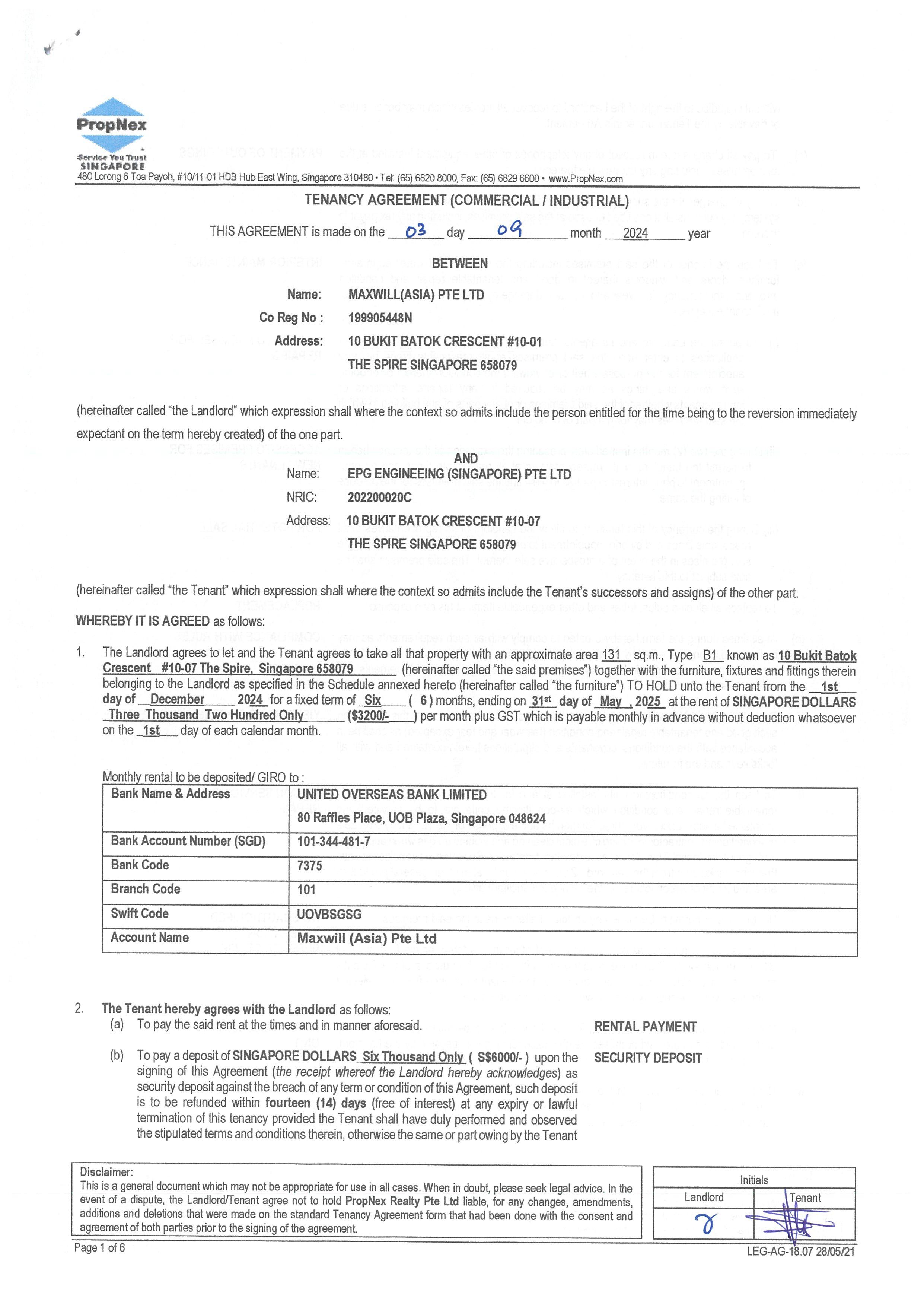
Initials Disclaimer : This is a general document which may not be appropriate for use in all cases . When in doubt please seek legal adv i ce . In the event of a dispute, the LandlordfTenant agree not to hold PropNex Realty Pte Ltd liable , for any changes , amendments, additions and deletions that were made on the standard Tenancy Agreement form that had been done with the consent and agreement of both parties prior to the signing of the agreement . Tpnant " J - - "' Landlord 7f ' Pr o • pNex $e,yt.., Yo• Thl•I SI N GA POH 480 L oron g6 Toa P a yoh , #1 0 /11 - 01HOB Hub East Win g, Singapore 310480 • Tel: ( 65)68208000 , Fa x: ( 65)6829 6600 • www.PropN ex.c om TENANCY AGREEMENT (COMMERCIAL/ INDUSTRIAL) THIS AGREEMENT is made on the o'.?» day O '1 BETWEEN month 2024 year Name: Co Reg No: Address: MAXWILL(ASIA) PTE LTD 199905448N 10 BUKIT BATOK CRESCENT #10 - 01 THE SPIRE SINGAPORE 658079 (hereinafter called " theLandlord ' which expression shall where the context so admits indude the person entitled for the time being to the reversion immediately expectant on the term hereby created) of the one part . AND Name: NRIC: Address: EPG ENGINEEING (SINGAPORE) PTE LTD 202200020C 10 BUKIT BATOK CRESCENT #10 - 07 THE SPIRE SINGAPORE 658079 (hereinafter called " the Tenanr which expression shall where the context so admits include the Tenant ' s successors and assigns) of the other part. WHEREBY IT IS AGREED as follows : 1 . The Landlord agrees to let and the Tenant agrees to take all that property with an approx i mate area fil_ sq . m . , Type ] 2 L known as 10 Bukit Batok Crescent # 10 - 07 The Spire, Singapore 658079 (he r einaftercalled " thesaid premises ' ) together with the furniture , fixtures and fittings therein belonging to the Landlord as specified in the Schedule annexed hereto (hereinafter called " the furniture ' ) TO HOLD unto the Tenant from the ---- 1 † . L_ day of December 2024 for a fixed term of ( 6 ) months , ending on 31 st day of 2025 at the rent of SINGAPORE DOLLARS Three Thousand Two Hundred Only ( $ 3200 / - ) per month plus GST which is payable monthly in advance without deduction whatsoever on the _jg_ day of each calendar month . Monthly rental to be deposited/ GIRO to : UNITED OVERSEAS BANK LIMITED 80 Raffles Place, UOB Plaza, Singapore 048624 Bank Name & Address 101 - 344 - 481 - 7 Bank Account Number (SGD) 7375 Bank Code 101 Branch Code UOVBSGSG Swift Code Maxwill (Asia) Pte Ltd Account Name 2. The Tenant hereby agrees with the Landlord as follows: (a) To pay the said rent at the times and in manner aforesaid . RENTAL PAYMENT (b) To pay a deposit of SINGAPORE DOLLARS Six Thousand Only ( S $ 6000 / - ) upon the signing of this Agreement (the receipt whereof the Landlord hereby acknowledges) as security deposit against the breach of any term or condition of this Agreement , such deposit is to be refunded within fourteen ( 14 ) days (free of i nterest) at any expiry or lawful termination of this tenancy provided the Tenant shall have du l y performed and observed the stipulated terms and conditions therein , otherwise the same or part owing by the Tenant SECURITY DEPOSIT Page 1 of 6 LEG - AG - 18 .
07 28 /2 1 Initials Disclaimer: This is a general document which may not be appropriate for use in all cases . When in doubt, please seek legal advice . In the event of a dispute, the Landlord/Tenant agree not to hold PropNex Realty Pie Ltd liable, for any changes, amendments, additions and deletions that were made on the standard Tenancy Agreement form that had been done with the consent and agreement of both parties prior to the signing of the agreement . i Tenant Landlord IA I "' --- , ' - " .07 28/05/21 Page 2 of 6 LEG - AG - 1 without prejudice to the right of the Landlord to recover all monies which may become due or payable by the Tenant under this Agreement. (c) To pay all charges due in respect of any telephones or other equipment installed at the PAYMENT OF OUTGOINGS said premises, including any tax payable thereon. (d) To pay all charges for the supply of water, electricity, gas and any water borne sewerage system, any such installations fitted or used at the said premises, including any tax payable thereon . (e) To keep the interior of the said premises including the sanitary and water apparatus, furniture, doors and windows thereof in good and tenantable repair and condition throughout this tenancy (fair wear and tear and damage by any act beyond the control of the Tenant excepted) . INTERIOR MAINTENANCE (f) (i) To permit the Landlord and its agents, surveyors and workmen with all necessary appliances to enter upon the said premises at all reasonable times by prior appointment for the purpose whether of viewing the condition thereof or of doing such works and things as may be required for any repairs, alterations or improvements whether of the said premises or of any parts of any building to which the said premises may form a part of or adjoin . (ii) During the two ( 2 ) months immediately preceding the expiration of the tenancy herein to permit the Landlord or its representatives at all reasonable times and by prior appointment to bring interested parties to view and the said premises for the purpose of letting the same . (iii) During the currency of this tenancy, to allow the Landlord or its representatives at all reasonable times and by prior appointment to bring any interested parties to view the said premises in the event of a prospective sale thereof . The said premises shall be sold subject to this tenancy . (g) To replace all electric bulbs, tubes and other expendable items at his own expense . (h) At all times during the term hereby created to comply with all such requirements as may be imposed upon the Tenant by Management Corporation requirements and or any statute legislation now or hereafter in force and any orders, rules, regulations, requirements and notices thereunder . (i) To yield up the said premises at the expiration or sooner determination of this tenancy in such good and tenantable repair and condition (fair wear and tear excepted) as shall be in accordance with the conditions, covenants and stipulations herein contained and with all locks keys and the furniture . U) To keep the air - conditioning units installed at and for the said premises in good and tenantable repair and condition which air - conditioning units are to be serviced and maintained at least once every three ( 3 ) months at the expense of the Tenant by a reliable air - conditioning contractor including chemical cleaning and topping up gas when applicable throughout the lease . This clause excluded the 4 defective Samsung air conditioner units that tenant take over from the Landlord . ( 2 units of aircon located in the general production area and 2 unit of aircon located in the 1 s 1 and 2 nd ancillary office . ) (k) Not to make or permit to be made any structural alterations to the said premises. (I) Not to use the said premises or any part thereof other than a *shop h01,1se /warehouse / B 1 factory Ancillary office in connection with and for the purpose of the Tenant's business and to obtain licences and permits at the Tenant's expense from the relevant authorities where necessary (*delete whichever is not appropriate) . (m) Not to exceed the maximum electricity load and not to load or permit to be loaded on any part of the floors of the said premises weights exceeding those specified by the Landlord, Management Corporation or other bodies (where applicable) .
(n) Not to assign sublet or part with the possession of the said premises or any part thereof without the written consent of the Landlord whose consent shall not be unreasonably withheld in the case of a respectable and responsible tenant This prohibition shall not ACCESS TO PREMISES FOR REPAIRS ACCESS TO PREMISES FOR NEW TENANTS FOR POTENTIAL SALE REPLACEMENT COMPLIANCE WITH RULES YIELDING UP OF PREMISES AIRCON SERVICING & REPAIR NO UNAUTHORISED ALTERATION PURPOSE OF USE ELECTRICAL LOADING UNIT NO ASSIGNMENT OR SUBLET Initials Disclaimer : This is a general document which may not be appropriate for use in all cases . When in doubt please seek legal advice . In the event of a dispute , the Landlord/fenant agree not to hold PropNex Realty Pte Ltd liable, for any changes , amendments , additions and deletions that were made on the standard Tenancy Agreement form that had been done with the consent and agreement of both parties prior to the signing of the agreement . enant Landlord ' apply to the occupation of the said premises or any part thereof by any person or persons employed or engaged by the Tenant or members of the Tenant's family where applicable. (o) Not to keep or permit to be kept on the said premises or any part thereof any materials of a dangerous or explosive nature or the keeping of which may contravene any statute or subsidiary legislation . (p) Not to do or permit to be dooe anything whereby the policy or policies of insurance on the said premises against damage by fire may become void or voidable or whereby the premium thereon may be increased . (q) Not to use the demised premises or any part thereof for any unlawful or immoral purposes and not to do or permit or suffer to be done upon the demised premises any act or thing which may become a nuisance to or annoyance toor give cause for reasonable complaints from the occupants of other parts of the Building or of adjoining or adjacent properties . (r) To be responsible for and to indemnify the Landlord from and against all claims and demands and against damage occasioned to the demised premises or any adjacent or neighbouring premises or injury caused to any person by any act default or negligence of the Tenant or the servants, agents, licensees or invitees of the Tenant . TO INDEMNIFY LANDLORD (s) Not to obstruct or cause or suffer to be obstructed the hall lobby staircases landings and NO OBSTRUCTION passages leading to the demised premises. (t) To apply for and obtain all necessary permits/licence etc from the relevant authorities for APPLICATION OF the use of the said premises for their trade . LICENSE/PERMIT 3. The Landlord hereby agrees with the Tenant as follows: (a) To pay all rates, taxes, maintenance charges and any surcharges thereon, assessments and outgoing (except as otherwise provided in this Agreement) which are or may hereafter be charged or imposed on the said premises including any surcharges payable thereon . (b) To insure the said premises against loss or damage by fire and to pay all premium INSURANCE thereon. (c) To be responsible for therepair and replacement of parts in respect of the air - conditioning units installed at the said premises save where the same are caused by any act, default , neglect or omission on the part of the Tenant or any of its servants , agents, occupiers, contractors, guests or visitors . This clause excluded the 4 defective Samsung air conditioner unit that Landlord hand over to the Tenant . ( 2 units of aircon located in the general production area and 2 units of aircon located in the 1 st and 2 nd ancillary office . ) (d) To maintain the structural condition of the said premises including sanitary pipes and electrical wiring and to keep the roof of the said premises in good and tenantable repair and condition . (e) That the Tenant paying the rent hereby reserved, observing and performing the several conditions , covenants and stipulations on the Tenant's part herein contained shall peaceably hold and enjoy the said premises during this tenancy without any interruption by the Landlord or any person rightfully claiming under or in trust for the Landlord . The tenant shall accept the Premises · asit where is ' on the date on which the Premises are made available to it . The Landlord or its agent shall not be bound by any statements , representations or promises with respect lo the Building or in respect of the Premises, except as expressly set forth herein or in the lease . The landlord does not expressly or impliedly warrant the Premises are or will be or remain adequate or suitable for all or any of the purposes of the Tenant and all warranties ( i f any) as to suitability or adequacy of the said premises implied by law are hereby expressly negated . NO DANGEROUS MATERIALS NOT TO VOID INSURANCE NO ILLEGAL/ IMMORAL USE AND NOT TO CAUSE NUISANCE PAYMENT OF TAXES REPAIR OF REPLACEMENT STRUCTURAL MAINTENANCE QUIET POSSESSION/ ENJOYMENT NO REPRESENTATION 4 .
Provided always and it is expressly agreed as follows : (a) If the rent hereby reserved shall not bepaid for seven ( 7 ) days after its due or if there shall be a breach of any of the conditions , covenants or stipulations on the part of the Tenant herein contained , the Landlord shall be entitled to re - enter upon the said premises and !hereupon this tenancy shall immediately absolutely determine but without prejudice lo any DEFAULT OF TENANT Page 3 of 6 LEG - AG - H .07 28KJ5/21 ' right of action of the Landlord for damage or otherwise in respect of any such breach or any antecedent breach . (b) In the event the rent remaining unpaid seven (7) days af t er becoming payable (whether formally demanded or not) , it shall be lawful for the Landlord to claim interest at ten per cent (10%) on an annual basis on the amount unpaid calculated from after the date due to the date of actual payment. The recommended formula will be as follows: Monthly rental x 10% x (No . of days payment is l ate)/ 365. RENT IN ARREARS (c) The Landlord shall not be liable to the Tenant or the Tenant's servants or agents or other persons in the said premises or persons calling upon the Tenant for any accidents happening, injury suffered, damage to or loss of any chattel property sustained on the said premises . LIMITED LIABILITY OF LANDLORD (d ) In case the said premises or any part thereof shall at any time during this tenancy be destroyed or damaged by fire lightning riot explosion or any other cause beyond the control of the parties hereto so as to be unfit for occupation and use , then and in every such case (unless the insurance money shall be wholly or partially irrecoverable by reason solely or in part of any act, default , neglect or omission of the Tenant or any of their servants agents occupiers guests or visitors), the rent hereby reserved or a just and fair proportion thereof accord i ng to the nature and e x tent of the destruction or damage sustained shall be suspended and cease t o be payab l ein respec t of any period while the said premises shall continue to be unfit for occupation and use by reason of such destruction or damage . UNTENANTABILITY LEADING TO SUSPENSION OF RENT (e) In case the said premises shall be destroyed or damaged as aforesaid , either party shall be at liberty by notice in writing to the other determine this tenancy , and upon such notice being given , this tenancy or the balance thereof shall absolutely cease and determine and the deposit paid hereunder together with a reasonable proportion of such advance rent as has been paid hereunder, where applicable , shall be refunded to the Tenant forthwith but without prejudice to any right of action of either party in respect of any antecedent breach of this Agreement by the other . UNTENANTABILITY LEADING TO TERMINATION OF LEASE (f) If the Tenant is in breach of any clause of this agreement , leading to an early termination of the tenancy, then the Tenant shall in any event reimburse the Landlord on a pro rata basis the commission the Landlord has paid to PROPNEX REALTY PTE LTD (hereinafter called 'the Agency' ) for the remaining unfulfilled term , without prejudice to any other rights of the Landlord to claim against the Tenant for any other breaches of this agreement . REIMBURSE COMMISSION FOR PREMATURE TERMINATION (g) It is expressly understood by the Landlord that the commission paid to the Agency as the brokerage fee in this transaction has been fully earned for services rendered and the Landlord shall have no claim against the Agency for a refund of the commission should the Tenant prematurely terminate the tenancy herein or for any other reasons . COMMISSION FULLY EARNED (h) In the event that the Landlord should grant the Tenant an extension of the said term herein then the Landlord and the Tenant shall pay their respective agency renewal commission of half month and GST for every one ( 1 ) year or less period of e x tensionof lease . RENEWAL COMMISSION (i) Any notice served under or in any way in connection with this Agreement shall be sufficiently served on the Tenant if left at the said premises or delivered to the Tenant personally or sent to the Tenant at the said premises by registered post and shall be sufficiently served on the Landlord if delivered to the Landlord personally or sent to the abovementioned address by registered post . Any notice sent by registered post shall deemed to be given at the time when in due course of post it would be delivered at the address to which it is sent . NOTICE U) The waiver by either party of a breach of default of any of the provisions in this Agreement shall not be construed as a waiver of any succeeding breach of the same or other provisions nor any delay or omission on the part of either party to exercise or avail itself of any right that it has or may have herein, operates as a waiver of any breach or default of the other party . WAIVER OF DEFAULTS (k) The stamp duty for stamping this Agreement in duplicate and any legal cost shall be borne by the Tenant and shall be paid on the date of signing of this Agreement. STAMP DUTY & LEGAL COST (I) This Agreement shall be subject to the laws of the Republic of Singapore. GOVERNING LAW Initials Landlord , ant 1) ' - \ - - j Disclaimer: This is a geoeral document which may not be appropriate for use in all cases . When in doubt please seek legal advice . In the event of a dispute , the Landlord/Tenant agree not to hold PropNex Realty Pie Ltd liable, for any changes, amendments, additions and deletions that were made on the standard Tenancy Agreement form that had been done with the consent and agreement of both parties prior to the signing of the agreement . Page4 of6 LEG - AG - 18.
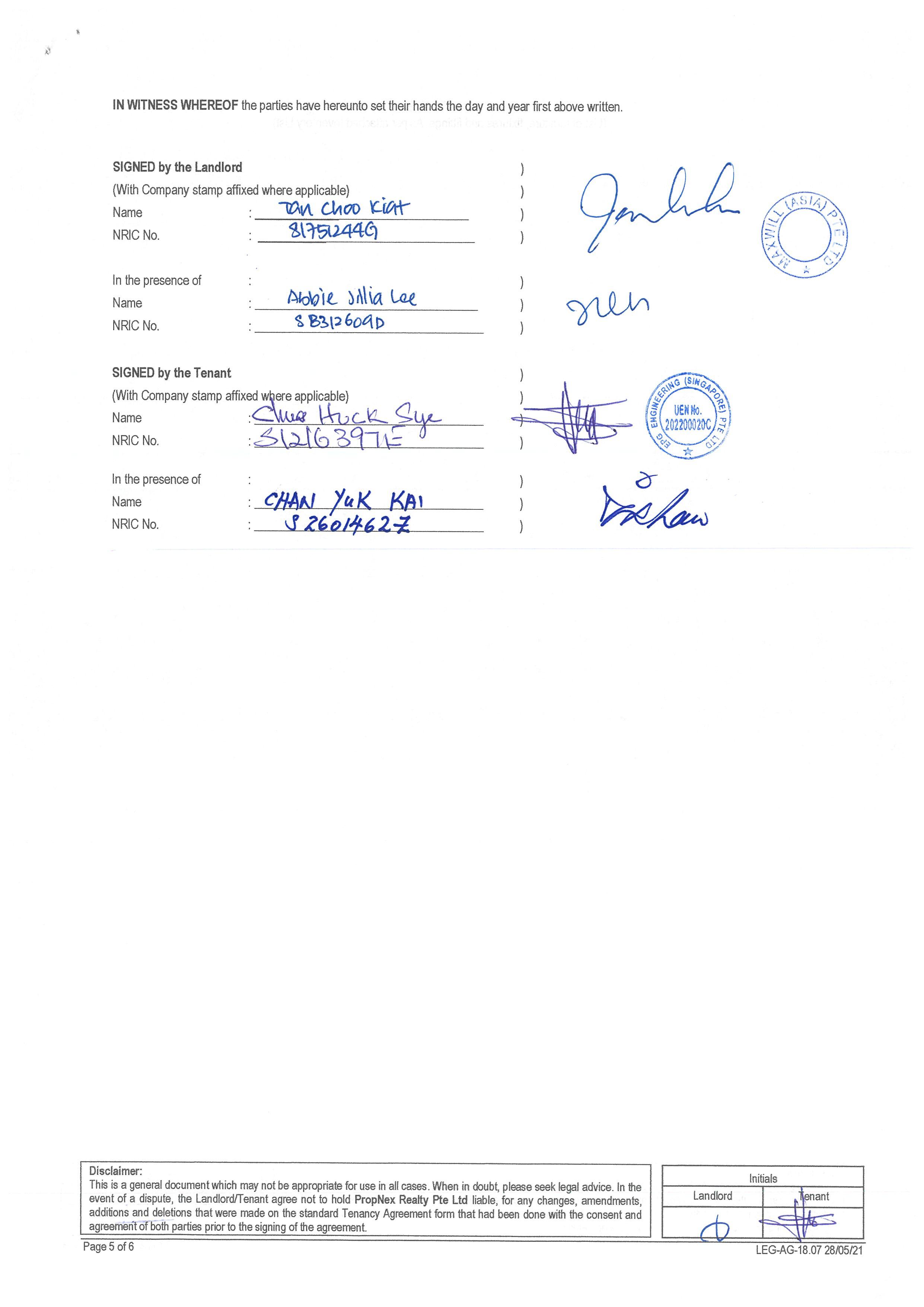
28/05121 IN WITNESS WHEREOF the parties have hereunto set their hands the day and year first above written . SIGNED by the Landlord (With Company stamp affixed where applicable) 72?w \ (1100 (.jAf - Name NRIC No. In the presence of Name NR!C No. SIGNED by the Tenant (With Company stamp affixed \ \ ' ere applicable) k \ J;L Q. Name : NRICNo. : 2> \ .)...t(62>97{; In the presence of Name NRIC No. Initials Landlord l!Jllant rh I I - Disclaimer: This is a general document which may not be appropriate for use in all cases . When in doub please seek legal advice . In the event of a dispute, the Landlord/Tenant agree not to hold PropNex Realty Pte Ltd liable, for any changes , amendments, additions and deletions that were made on the standard Tenancy Agreement form that had been done with the consent and agreemenl of both parties prior to the signing of the agreement . , \ Page5 of6 LEG - AG - 18 . 07 2Ml5/21 SCHEDULE (List of furniture, fixtures and fittings.
As per attached Inventory List) l • 4 r Initials l Landlord \ T nan! r{ ..,.. J L Disclaimer: This is a general document which may not be appropriate for use in all cases . When in daub please seek legal advice . In the event of a dispute, the Landlord/Tenant agree not to hold PropNex Realty Pie Ltd liable, for any changes, amendments, additions and deletions that were made on the standard Tenancy Agreement form that had been done with the consent and agreement of both parties prior to the signing of the agreement . - , " - Page 6 of 6 LEG - AG - 18.07 28/05/21
Exhibit 12.1
CERTIFICATION OF THE CHIEF EXECUTIVE OFFICER PURSUANT TO SECTION 302 OF THE SARBANES-OXLEY ACT OF 2002
I, Li Peng Leck, certify that:
1. I have reviewed this annual report on Form 20-F of Davis Commodities Limited (the “Company”);
2. Based on my knowledge, this report does not contain any untrue statement of a material fact or omit to state a material fact necessary to make the statements made, in light of the circumstances under which such statements were made, not misleading with respect to the period covered by this report;
3. Based on my knowledge, the financial statements, and other financial information included in this report, fairly present in all material respects the financial condition, results of operations, and cash flows of the Company as of, and for, the periods presented in this report;
4. The Company’s other certifying officer and I are responsible for establishing and maintaining disclosure controls and procedures (as defined in Exchange Act Rules 13a-15(e) and 15d-15(e)) and internal control over financial reporting (as defined in Exchange Act Rules 13a-15(f) and 15d-15(f)) for the Company and have:
(a) Designed such disclosure controls and procedures, or caused such disclosure controls and procedures to be designed under our supervision, to ensure that material information relating to the Company, including its consolidated subsidiaries, is made known to us by others within those entities, particularly during the period in which this report is being prepared;
(b) Designed such internal control over financial reporting, or caused such internal control over financial reporting to be designed under our supervision, to provide reasonable assurance regarding the reliability of financial reporting and the preparation of financial statements for external purposes in accordance with generally accepted accounting principles;
(c) Evaluated the effectiveness of the Company’s disclosure controls and procedures and presented in this report our conclusions about the effectiveness of the disclosure controls and procedures, as of the end of the period covered by this report based on such evaluation; and
(d) Disclosed in this report any change in the Company’s internal control over financial reporting that occurred during the period covered by the annual report that has materially affected, or is reasonably likely to materially affect, the Company’s internal control over financial reporting; and
5. The Company’s other certifying officer and I have disclosed, based on our most recent evaluation of internal control over financial reporting, to the Company’s auditors and the audit committee of the Company’s board of directors (or persons performing the equivalent functions):
(a) All significant deficiencies and material weaknesses in the design or operation of internal control over financial reporting which are reasonably likely to adversely affect the Company’s ability to record, process, summarize and report financial information; and
(b) Any fraud, whether or not material, that involves management or other employees who have a significant role in the Company’s internal control over financial reporting.
Date: April 30, 2025
| By: | /s/ Li Peng Leck | |
| Name: | Li Peng Leck | |
| Title: | Executive Chairwoman and Executive Director (Principal Executive Officer) |
Exhibit 12.2
CERTIFICATION OF THE CHIEF FINANCIAL OFFICER PURSUANT TO SECTION 302 OF THE SARBANES-OXLEY ACT OF 2002
I, Ai Imm Lim, certify that:
1. I have reviewed this annual report on Form 20-F of Davis Commodities Limited (the “Company”);
2. Based on my knowledge, this report does not contain any untrue statement of a material fact or omit to state a material fact necessary to make the statements made, in light of the circumstances under which such statements were made, not misleading with respect to the period covered by this report;
3. Based on my knowledge, the financial statements, and other financial information included in this report, fairly present in all material respects the financial condition, results of operations, and cash flows of the Company as of, and for, the periods presented in this report;
4. The Company’s other certifying officer and I are responsible for establishing and maintaining disclosure controls and procedures (as defined in Exchange Act Rules 13a-15(e) and 15d-15(e)) and internal control over financial reporting (as defined in Exchange Act Rules 13a-15(f) and 15d-15(f)) for the Company and have:
(a) Designed such disclosure controls and procedures, or caused such disclosure controls and procedures to be designed under our supervision, to ensure that material information relating to the Company, including its consolidated subsidiaries, is made known to us by others within those entities, particularly during the period in which this report is being prepared;
(b) Designed such internal control over financial reporting, or caused such internal control over financial reporting to be designed under our supervision, to provide reasonable assurance regarding the reliability of financial reporting and the preparation of financial statements for external purposes in accordance with generally accepted accounting principles;
(c) Evaluated the effectiveness of the Company’s disclosure controls and procedures and presented in this report our conclusions about the effectiveness of the disclosure controls and procedures, as of the end of the period covered by this report based on such evaluation; and
(d) Disclosed in this report any change in the Company’s internal control over financial reporting that occurred during the period covered by the annual report that has materially affected, or is reasonably likely to materially affect, the Company’s internal control over financial reporting; and
5. The Company’s other certifying officer and I have disclosed, based on our most recent evaluation of internal control over financial reporting, to the Company’s auditors and the audit committee of the Company’s board of directors (or persons performing the equivalent function):
(a) All significant deficiencies and material weaknesses in the design or operation of internal control over financial reporting which are reasonably likely to adversely affect the Company’s ability to record, process, summarize and report financial information; and
(b) Any fraud, whether or not material, that involves management or other employees who have a significant role in the Company’s internal control over financial reporting.
Date: April 30, 2025
| By: | /s/ Ai Imm Lim | |
| Name: | Ai Imm Lim | |
| Title: | Group Financial Controller (Principal Accounting and Financial Officer) |
Exhibit 13.1
CERTIFICATION OF THE CHIEF EXECUTIVE OFFICER PURSUANT TO SECTION 906 OF THE SARBANES-OXLEY ACT OF 2002
In connection with the Annual Report of Davis Commodities Limited (the “Company”) on Form 20-F for the year ended December 31, 2024, as filed with the Securities and Exchange Commission on the date hereof (the “Report”), I, Li Peng Leck, Executive Chairwoman and Executive Director (Principal Executive Officer) of the Company, certify, pursuant to 18 U.S.C. Section 1350, as adopted pursuant to Section 906 of the Sarbanes-Oxley Act of 2002, that to my knowledge:
(1) The Report fully complies with the requirements of Section 13(a) or 15(d) of the Securities Exchange Act of 1934; and
(2) The information contained in the Report fairly presents, in all material respects, the financial condition and results of operations of the Company.
Date: April 30, 2025
| By: | /s/ Li Peng Leck | |
| Name: | Li Peng Leck | |
| Title: |
Executive Chairwoman and Executive Director (Principal Executive Officer) |
Exhibit 13.2
CERTIFICATION OF THE CHIEF FINANCIAL OFFICER PURSUANT TO SECTION 906 OF THE SARBANES-OXLEY ACT OF 2002
In connection with the Annual Report of Davis Commodities Limited (the “Company”) on Form 20-F for the year ended December 31, 2024, as filed with the Securities and Exchange Commission on the date hereof (the “Report”), I, Ai Imm Lim, Group Financial Controller (Principal Accounting and Financial Officer) of the Company, certify, pursuant to 18 U.S.C. Section 1350, as adopted pursuant to Section 906 of the Sarbanes-Oxley Act of 2002, that to my knowledge:
(1) The Report fully complies with the requirements of Section 13(a) or 15(d) of the Securities Exchange Act of 1934; and
(2) The information contained in the Report fairly presents, in all material respects, the financial condition and results of operations of the Company.
Date: April 30, 2025
| By: | /s/ Ai Imm Lim | |
| Name: | Ai Imm Lim | |
| Title: |
Group Financial Controller (Principal Accounting and Financial Officer) |