 エドガーで原本を確認する
UNITED STATES
SECURITIES AND EXCHANGE COMMISSION
Washington, D.C. 20549
FORM 10-K
☒ Annual Report pursuant to Section 13 or 15(d) of Securities Exchange Act of 1934
For the fiscal year ended December 31, 2024
or
☐ Transition Report pursuant to Section 13 or 15(d) of Securities Exchange Act of 1934
For the transition period from __________ to __________
Commission File Number 001-38868
Beam Global
(Exact name of Registrant as specified in its charter)
| Nevada | 26-1342810 |
| (State of Incorporation) | (IRS Employer ID Number) |
5660 Eastgate Dr.
San Diego, California 92121
(858) 799-4583
(Address and telephone number of principal executive offices)
Securities registered pursuant to Section 12(b) of the Act:
| Title of each class | Trading Symbol(s) | Name of principal U.S. market on which traded |
| Common stock, $0.001 par value | BEEM | Nasdaq Capital Market |
Securities registered pursuant to Section 12(g) of the Act: None
Indicate by check mark if the registrant is a well-known seasoned issuer, as defined in Rule 405 of the Securities Act. Yes ☐ No ☒
Indicate by check mark if the registrant is not required to file reports pursuant to Section 13 or Section 15(d) of the Act. Yes ☐ No ☒
Indicate by check mark whether the registrant (1) has filed all reports required to be filed by Section 13 or 15(d) of the Securities Exchange Act of 1934 during the preceding 12 months (or for such shorter period that the registrant was required to file such reports), and (2) has been subject to such filing requirements for the past 90 days. Yes ☒ No ☐
Indicate by check mark whether the registrant has submitted electronically every Interactive Data File required to be submitted pursuant to Rule 405 of Regulation S-T (§232.405 of this chapter) during the preceding 12 months (or for such shorter period that the registrant was required to submit such files). Yes ☒ No ☐
Indicate by check mark whether the registrant is a large accelerated filer, an accelerated filer, a non-accelerated filer, a smaller reporting company, or an emerging growth company under Rule 12b-2 of the Exchange Act. See the definitions of “large accelerated filer,” “accelerated filer,” “smaller reporting company,” and “emerging growth company” in Rule 12b-2 of the Exchange Act.
| Large accelerated filer ☐ | Accelerated filer ☐ |
| Non-accelerated filer ☒ | Smaller reporting company ☒ |
| Emerging growth company ☐ |
If an emerging growth company, indicate by check mark if the registrant has elected not to use the extended transition period for complying with any new or revised financial accounting standards provided pursuant to Section 13(a) of the Exchange Act. ☐
Indicate by check mark whether the registrant has filed a report on and attestation to its management’s assessment of the effectiveness of its internal control over financial reporting under Section 404(b) of the Sarbanes-Oxley Act (15 U.S.C. 7262 (b)) by the registered public accounting firm that prepared or issued its audit report. ☐
If securities are registered pursuant to Section 12(b) of the Act, indicate by check mark whether the financial statements of the registrant included in the filing reflect the correction of an error to previously issued financial statements. ☐
Indicate by check mark whether any of those error corrections are restatements that required a recovery analysis of incentive-based compensation received by any of the registrant’s executive officers during the relevant recovery period pursuant to §240.10D-1(b). ☐
Indicate by check mark whether the Registrant is a shell company (as defined in Rule 12b-2 of the Act). Yes ☐ No ☒
The aggregate market value of the voting and non-voting common stock held by nonaffiliates of the registrant as of June 30, 2024 (the last business day of the registrant’s most recently completed second fiscal quarter) was approximately $65,075,516 based upon the closing price of $4.61 on the NASDAQ Capital Market on June 28, 2024.
The number of registrant's shares of common stock, $0.001 par value, issuable and outstanding as of April 8, 2025, was 15,494,852.
|
|
TABLE OF CONTENTS
|
|
PART I
References in this Report to “we,” “us,” “our,” the “Company” or “Beam” means Beam Global, a Nevada corporation, and its subsidiaries.
SPECIAL NOTE REGARDING FORWARD-LOOKING STATEMENTS
This report contains forward-looking statements that are based on current expectations, estimates, forecasts, and projections about us, the industry in which we operate and other matters, as well as management's beliefs and assumptions and other statements regarding matters that are not historical facts. These statements include, in particular, statements about our plans, strategies and prospects. For example, when we use words such as “projects,” “expects,” “anticipates,” “intends,” “plans,” “believes,” “seeks,” “estimates,” “should,” “would,” “could,” “will,” “opportunity,” “potential” or “may,” and variations of such words or other words that convey uncertainty of future events or outcomes, we are making forward-looking statements within the meaning of Section 27A of the Securities Act of 1933, as amended (the “Securities Act”) and Section 21E of the Securities Exchange Act of 1934, as amended (the “Exchange Act”).
These forward-looking statements are subject to numerous assumptions, risks and uncertainties that may cause the Company’s actual results to be materially different from any future results expressed or implied by the Company in those statements. The most important factors that could prevent the Company from achieving its stated goals include, but are not limited to, the following:
| (a) | volatility or decline of the Company’s stock price, or absence of stock price appreciation; | |
| (b) | fluctuation in quarterly results; | |
| (c) | failure of the Company to earn revenues or profits; | |
| (d) | inadequate capital to continue or expand its business, and the inability to raise additional capital or financing to implement its business plans; | |
| (e) | reductions in demand for the Company’s products and services, whether because of competition, general industry conditions, loss of tax incentives for solar power, technological obsolescence, or other reasons; | |
| (f) | litigation with or legal claims and allegations by outside parties; | |
| (g) | insufficient revenues to cover operating costs, resulting in persistent losses; | |
|
(h)
(i) |
rapid and significant changes to costs of raw materials from government tariffs or other market factors;
significant currency fluctuation or foreign regulations that could impact our business; |
|
| (j) | the preceding and other factors discussed in Part I, Item 1A, “Risk Factors,” and other reports we may file with the Securities and Exchange Commission from time to time; and | |
| (k) | the factors set forth in Part II, Item 7, “Management’s Discussion and Analysis of Financial Condition and Results of Operations.” |
We caution you that the foregoing list may not contain all of the forward-looking statements made in this annual report on Form 10-K.
|
|
You should not rely upon forward-looking statements as predictions of future events. We have based the forward-looking statements contained in this annual report on Form 10-K primarily on our current expectations and projections about future events and trends that we believe may affect our business, financial condition, results of operations and prospects. The outcome of the events described in these forward-looking statements is subject to risks, uncertainties and other factors described in the section titled "Risk Factors" and elsewhere in this annual report on Form 10-K. Moreover, we operate in a very competitive and rapidly changing environment. New risks and uncertainties emerge from time to time, and it is not possible for us to predict all risks and uncertainties that could have an impact on the forward-looking statements contained in this annual report on Form 10-K. We cannot assure you that the results, events and circumstances reflected in the forward-looking statements will be achieved or occur, and actual results, events or circumstances could differ materially from those described in the forward-looking statements.
The forward-looking statements made in this annual report on Form 10-K relate only to events as of the date on which the statements are made. We undertake no obligation to update any forward-looking statements to reflect events or circumstances or to reflect new information or the occurrence of unanticipated events, except as required by law.
| ITEM 1. | BUSINESS. |
Overview
Beam is a clean-technology innovation company headquartered in San Diego, California with factories in the U.S. in San Diego, California and Broadview, Illinois and in Europe in Belgrade and Kraljevo, Serbia. We develop, design, engineer, manufacture, and sell high-quality, renewably energized infrastructure products for electric vehicle (“EV”) charging, infrastructure for Smart Cities (a city that uses technology to improve the quality of life for its residents), energy security and disaster preparedness and highly energy-dense battery solutions in safe, compact and unique form-factors. Additionally, we manufacture steel structures with electronic integration such as street lighting, cell towers and energy infrastructure products as well as power electronics including invertors, charge controllers, power supplies and LED lighting. Beam’s energy storage products provide high energy density in safe, compact and bespoke form-factors, which we believe are ideal for the rapidly growing mobile and stationary equipment product market which often requires electrical energy without being connected to the electrical grid.
Our EV charging infrastructure products are powered by locally generated renewable energy and enable vital and highly valuable services in locations where it is either too expensive, disruptive, or impossible to connect to a utility grid, or where the requirements for electrical power are so important that grid failures, like blackouts, are intolerable. We do not compete with EV charging companies; rather, we assist these companies by offering infrastructure solutions that replace the time-consuming and expensive process of construction and electrical work which are usually required to install traditional grid-tied EV chargers. We also do not compete with utility companies. Our products enable utilities and others to deliver reliable and low-cost electricity to EV chargers and, in the case of a grid failure, to first responders and others, through our integrated emergency power panels.
Our charging products are rapidly deployed without the need for construction or electrical work. We compete with the highly fragmented and disintegrated ecosystem of general contractors, electrical contractors, consultants, engineers, permitting specialists and others, who are required to perform a traditional grid-tied EV charger installation construction and electrical project. Our clean-technology products are designed to replace a complicated, expensive, time-consuming and risk prone process with an easy, robust and reliable product at a low cost of total ownership.
We provide energy storage technologies that make commodity battery cells that we believe are safer, longer lasting and more energy efficient. Our battery management systems (BMS), and associated packaging, make batteries safer and usable in a variety of mobility, energy-security, and stationary applications.
Our street lighting and other street furniture products are mass produced and sold in 18 nations globally. We are increasingly adding power electronics, energy storage, computing, sensing and reporting to our street furniture products as we evolve them to provided greater levels of Smart Cities services.
|
|
Beam’s renewable energy infrastructure products and proprietary technology solutions target markets that are experiencing significant growth with annual global spending in billions of dollars.
| · | EV charging infrastructure; | |
| · | Smart Cities infrastructure; | |
| · | energy storage solutions; | |
| · | energy security and disaster preparedness; | |
| · | transportation infrastructure products; and | |
| · | Power electronics and telecommunications equipment |
The Company focuses on creating high-quality products that are powered primarily by renewable energy, rapidly deployable, have diverse use cases and are attractively designed. We believe that there is a clear need for rapidly deployable and highly scalable EV charging and infrastructure for Smart Cities, and that our EV ARC™, BeamSpot™ and other street furniture products fulfill that requirement. We are agnostic to the EV charging service equipment as we do not sell EV charging, rather we sell products which enable it. Our EV ARC™ and BeamSpot™ products replace the infrastructure required to support EV chargers, not the chargers themselves.
We have over thirty years of experience deploying street-lighting, transportation, energy and telecommunications infrastructure products as a result of our 2023 acquisition of Amiga in Serbia. We have relationships with existing customers to whom we are now able to sell our renewably energized EV charging infrastructure products as well as our Smart Cities products.
During the second-half of 2024 we significantly expanded our product portfolio with the addition of rapidly deployed and highly scalable charging infrastructure products for electric bicycles, electric scooters, and electric motorcycles. We also introduced de-salination as a capability to enhance the lifesaving aspects of our disaster preparedness products. Powered by 100% renewable energy, this self-sufficient water treatment system converts seawater into vital freshwater. It is equipped with four eMopeds for efficient and rapid transport in environments such as disaster or crisis zones, where people need it most.
Our ability to make commodity battery cells safer, longer lived and more energy efficient in bespoke enclosures is, we believe, a significant differentiator as we move to an increasingly electrified and untethered world. All of our renewably energized products generate their own electricity and store it in integrated batteries. Our ability to create batteries which are energy dense and very safe in unique shapes and sizes, enables us to expand our reach through selling to customers which require specialized batteries such as drone manufacturers, robotic and medical devices, submersibles, refrigerated trucking units, and many other applications. We are also able to enhance our patented products which provide electric vehicle charging, energy security disaster preparedness through the creation of bespoke energy-dense and safe battery products which are unique to our in-house portfolio.
We believe our chief differentiators are:
| · | Our patented, renewably energized products dramatically reduce the cost, time and complexity of the installation and operation of EV charging infrastructure when compared to traditional, utility grid tied alternatives; | |
| · | Our proprietary and patented energy storage solutions; | |
| · | Our first-to-market advantage with EV charging infrastructure products which are renewably energized, rapidly deployed and require no construction or electrical work on site; |
|
|
| · | Our products’ capability to operate during grid outages and to provide a source of EV charging and emergency power rather than becoming inoperable during times of emergency or other grid interruptions; | |
| · | Our ability to add electrical capacity to provide for the significant increase demand brought by EVs, without having to go through expensive, time-consuming and risky utility grid expansion (adding power stations, transmission lines and distribution infrastructure like substations); | |
| · | Our ability to create new and patentable products which are marketable and consist of a complex integration of our proprietary technology and parts with other commonly available engineered components, which create a further barrier to entry for our competition; | |
| · |
Our ability to create products which provide valuable solutions to nascent industries with very large market opportunities globally; |
|
| · | Our geographic footprint in North America and Europe, and existing customer base and contracts. |
Products and Technologies
Electric vehicle charging infrastructure.
Our clean energy infrastructure products currently incorporate the same underlying technology with a built-in renewable energy source in the form of attached solar panels and/or a light wind generator, along with battery storage, which enables our products to generate and store their own electricity while operating without connecting to the utility grid. Our products are also able to connect to the grid if a customer values that capability. We believe that the U.S. and global utility grids lack sufficient capacity to supply enough electricity to all EVs, data centers, electrified industry and other electrical devices which are becoming increasingly available to consumers and business, especially considering the number of national and state governments that have announced future bans on the sale of gasoline and diesel vehicles, as early as 2035 in Europe, with most bans being put in place no later than 2040. Even locations with a grid connection often lack circuits which have enough capacity to support EV charging in any meaningful way. For example, parking lots might have enough electrical capacity to power lighting but not enough to power EV charging. Beam products provide that power without a requirement to increase the electrical grid capacity at a site which can often be, and we believe will increasingly be, expensive, disruptive, complex and time consuming.
We believe that there will be an increasing demand and need for rapidly deployed and highly scalable EV charging infrastructure products which do not require construction or electrical work, and which do not rely on the utility grid for a supply of electricity. We are not aware of any other products which provide a similar solution for this need as effectively as our patented products which are listed below:
| · | EV ARC™ (Electric Vehicle Autonomous Renewable Charger) – Our most popular product- We believe this patented product is the world’s first and only transportable, solar powered EV charging infrastructure product on the market that fits in a parking space but does not reduce available parking. The EV ARC™ generates and stores all its own energy through its solar array so there are no utility bills to pay. EV ARC™ features our patented BeamTrakTM sun tracking technology that follows the sun to generate up to an additional 25% of solar electrical power. It does not need a grid connection which eliminates the need for lengthy construction projects, trenching, switch gear, or transformer upgrades. The EV ARCTM can be delivered to its intended location and is set up and charging in less than an hour. Because there is no foundation, trench or electrical infrastructure, the EV ARC™ typically does not require a building or any other kind of permit, and it is easily transportable if a different location is desired. EV ARC™ products support Level I, Level II and DC Fast Charging (requiring 4 interconnected units) and can charge between one and six EVs simultaneously. A single unit can provide EV charging to as many as 12 parking spaces. The electronics are elevated under the solar array which makes the unit flood-proof in up to nine and a half feet of water. EV ARC™ systems are independently rated to withstand winds up to 160mph. |
Because the EV ARC™ systems are solar powered, they are not disrupted during grid interruptions such as black-outs or brown-outs which is becoming increasingly important as more transportation relies on electricity for fuel. Current grid-tied EV chargers are often placed in locations where a suitable circuit is most easily accessed and cheapest to install, rather than in the most convenient and desirable locations for EV drivers. EV ARC™ systems do not need to be connected to the grid and as such, can be placed anywhere, making them a rapidly deployable and highly scalable solution for EV charging infrastructure.
We received a patent in 2024 for a version of the EV ARC™ which, when fully developed, will be able to provide wireless charging to suitably equipped EVs.
|
|
Because EV ARC™ systems are highly visible, we believe that they are an ideal platform for sponsored deployments wherein networks of EV ARC™ systems are deployed and owned by us and monetized through sponsorship and naming-rights agreements with corporate sponsors who are eager to have their brands associated with renewable, clean-energy by sponsoring a city-wide sponsorship of free EV charging through what we refer to as our Drive on Sunshine™ network. We intend to deploy our Drive on Sunshine™ network in highly populated areas where we will deliver free EV charging while monetizing the network of EV ARC™ systems through corporate sponsorship programs. Our products also create significant reductions in greenhouse gas and CO2 emissions which, we believe, is a further inducement to encourage corporations to sponsor our network as they may benefit from the carbon offsets generated by a network of EV ARC™ systems. In 2024 we deployed our first sponsorship funded network of EV ARC™ systems at Belgrade International Airport in Serbia. Beam Global retains title to the EV ARC™ and receives recurring payments from Globos Osiguranje, Serbia’s only domestic private insurance company. Globos Osiguranje benefits from the promotion of their business as a result of their branding being prominently displayed on the EV ARC™ systems which are deployed in parking spaces in parking lots nearest to the airport terminal buildings. The Globos Osiguranje branded EV ARC™ systems are placed in locations that are visible as you arrive and depart from the airport. We also entered into an agreement with Vinci Airports, the world’s leading private airport operator with over 70 airports under management internationally, which does not require us to pay rent because of the amenity value that is delivered to the airport through the provision of a free driving on sunshine experience for their visitors and guests. We believe that we may be able to repeat this model in other Vinci airports around the world. We also believe that now that we have successfully proved that this business model works, we can further expand it into different types of environments where there are sufficient densities of people to make the advertising worthwhile.
| · | SolarTree® Products – These patented products are used for larger scale solar powered EV charging applications. We believe our Solar Tree® product to be the only single column, sun tracking, solar support structure with integrated energy storage, EV charging and media platforms available today. The design of our Solar Tree® systems is ideal for charging electric buses, electric heavy-duty vehicles, electric agricultural equipment, public transportation, and electric vehicles used in the construction industry. In 2020, we launched our new generation of Solar Tree® DCFC products with on-board battery storage that do not require a utility grid connection (though grid connection capability is available). As a result, these products can be rapidly deployed and enable EV charging in remote locations where it would otherwise be impossible or economically infeasible, such as rest areas, park and ride locations, construction sites, or any location with insufficient grid connectivity. The costs and environmental impact associated with delivering a 50kW or greater circuit to a remote rest area may be prohibitive, whereas a Solar Tree® DCFC can be deployed with minimal site disturbance. | |
| We believe our Solar Tree® products with on-board battery storage can provide a highly reliable source of energy to provide emergency power to first responders during times of emergency or other grid failures. We also believe that our Solar Tree® products which may be optimized for branding can create a visually appealing platform for the delivery of a sponsor’s brand with a less onerous planning and entitlement process than that experienced with traditional signage. | ||
| · | EV ARC™ DCFC – DC Fast Charging system for charging EVs comprised of four interconnected EV ARC™ systems and a 24kW DC fast charger. | |
| · | BeamSpot™ – patent issued on December 31, 2019, and currently.in the process of initial installation. A streetlight, EV charging and emergency power product which uses an existing streetlight’s foundation and a combination of solar, wind, grid connection and onboard energy storage to provide curbside charging and emergency power without the need to do extensive construction or electrical work. | |
| · | BeamBike™ - rapidly deployed, construction free, solar-powered charging system based on the patented EV ARC™ platform which generates and stores its own clean electricity, accessed through twelve integrated, weatherized 120 V outlets supporting any eBike charger. Supports 12 eBikes and is available with or without bundled eBike packages. | |
| · | BeamPatrol™ - Rapidly deployed and easily transported, the BeamPatrol™ station allows law enforcement and safety personnel to charge and quickly access electric motorcycles without the need for any additional infrastructure or fuel. This innovative solution is ideal for law enforcement, customs and border patrol, the military, park services, air and seaport operations and any situation where the ability to rapidly gain access to an environment, without alerting targets of the operation, is required. BeamPatrol™ and the motorcycles generally have low maintenance and fuel costs and provide a highly reliable mobility solution while assisting in the carbon reduction efforts of the agencies that use the product. Available with, or without bundled Zero eMotorcyles. |
|
|
| · | BeamWell™ - based on the patented EV ARC™ system, is a self-sufficient, self-contained operational system for use in war zones and remote or disaster areas where only salt, brackish or dirty water is available because a reliable clean water supply is not available or has been interrupted. The BeamWell™ system provides three essential services to regions in crisis: it turns seawater into fresh water, which is then stored in an integrated 3000-liter tank that is replenished daily; it provides a source of electricity which can be used for medical or communications devices as well as cooking, refrigeration and lighting; and it charges four integrated and bundled Benzina Zero electric mopeds for the rapid distribution of food, water, medications or other vital resources, to those in need. | |
| · | Smart Cities Infrastructure products – Street lighting, street furniture, communications infrastructure products, energy infrastructure products, with electronics integration including renewable energy sources, battery storage, sensors and IoT integration. | |
| · | UAV ARC™ - patent issued on November 24, 2020, and currently under development. An off-grid, renewably energized and rapidly deployed product and network used to charge aerial drone (UAV) fleets. | |
| · | Power electronics and energy storage solutions for telecommunications, energy infrastructure and, in the future, our own patented product portfolio. |
Energy Storage Solutions
According to MarketsandMarkets Analysis, the global lithium-ion battery market size is projected to grow from $130 billion in 2024 to $350 billion by 2033; and it is expected to grow at a compound annual growth rate (CAGR) of 12% from 2024 to 2033. We are living in an increasingly electrified world and more of the devices we rely on are no longer connected to a wall socket or any kind of utility connection. This untethering requires energy storage to be more energy dense and packaged in increasingly smaller and lighter formats. Physics dictates that the storage and release of electrical energy will create heat. In extreme cases this can lead to a chain reaction within a group of battery cells that can be difficult to stop, known as “thermal runaway”, which has led to some well publicized fires. Our energy storage products create high performance energy storage solutions used in EV charging, electric vehicles, micro mobility, aviation, medical devices, robotics, stationary storage, and maritime applications. We believe that we are unique in the EV charging industry in that we use our own proprietary energy storage solutions in our EV ARC™, BeamSpot™ and other EV charging products. Our proprietary and patented passive thermal management, modular platform architecture, and scalable battery management systems (BMS), enhance safety and performance to prevent thermal events, while extending battery life and reducing lifetime stored energy costs. We provide safe, scalable and high-powered energy storage solutions which have enabled electrified applications in many formats for Fortune 100 companies in the U.S and Internationally.
Energy Security and Disaster Preparedness
Power outages cost the United States up to $150 billion per year according to the United States Department of Energy. Our products are fully sustainable and include battery energy storage that can be used during times of grid or hydrocarbon fueled generator failure or during public safety power shutoff (PSPS) as may be required in certain jurisdictions. Our primary focus in energy security is to ensure access to EV recharging infrastructure during grid failures, such as blackouts. As the adoption of EVs increases, it will be critical to have fuel (recharging) infrastructure that is not reliant on the utility grid with its centralized vulnerabilities. We have witnessed power outages in Texas due to cold weather, in California due to wildfires and in California and New York due to hot weather and in other parts of the nation whenever inclement conditions such as high winds or flooding occur. California has also been susceptible to public safety power shutoffs (PSPS) to prevent fires during high wind events. There have been kinetic and cyber-attacks on the grid and the U.S. government has evidence of intrusions by nefarious nation state actors. A Wall Street Journal article reported that attacks on the US power grid rose 71% in 2022 over 2021. In April 2024, North American Electric Reliability Corporation (NERC), a division of the grid oversight body, reported that physical assaults on the grid have remained high since rising in 2022, with about 2,800 reports of gunfire, vandalism and other strikes on electrical networks in 2023. Some 3% of those attacks led to outages or other operational problems. Events such as these constitute significant vulnerabilities which are expensive, disruptive, inconvenient, and dangerous. As we electrify our transportation fleets, these events may become catastrophic. The U.S. has a Strategic Petroleum Reserve to ensure that it never runs out of gasoline and diesel, but there is no strategic electric reserve. The electrical grid faces unprecedented challenges as a result of increased frequency and intensity of extreme weather events, such as heat waves, wildfires, hurricanes, floods and other climate events which can disrupt the generation, transmission and distribution of electricity.
|
|
Beam’s products are a highly robust and secure source of power for EVs and provide a hedge against grid failures. Our EV ARC™ and BeamSpot™ currently provide locally generated and stored electricity. We are engaged with government officials at every level to increase awareness of our products and the benefits they can bring to energy security. We are increasingly hearing suggestions that 25% of all EV charging infrastructure should be independent of the centralized grid. We believe that our products are uniquely positioned to fulfill this need. We believe that our current contracts with California, Florida, New York City, and the Federal government through our General Services Administration (GSA) Multiple Award Schedule Contract ideally position us to take advantage of what we believe will be a significant increase for the requirements of robust and sustainable EV charging infrastructure. We believe our products are valuable and politically popular regardless of which administration is currently in power because they provide:
| 1. | American made products | |
| 2. | Reliable Clean Energy | |
| 3. | Energy Security | |
| 4. | American fueled transportation | |
| 5. | Communications and energy infrastructure |
We believe that our products are ideally suited to fulfill all these requirements.
Traffic Telecommunications and Energy Infrastructure Products
On October 20, 2023, Beam acquired Amiga DOO Kraljevo (“Amiga”), a business located in Serbia that manufactures and distribute steel structures with electronic integration, which products listed below we sell throughout the European region:
| (i) | infrastructure products for public lighting; | |
| (ii) | infrastructure products for mobile telephone, networks, and transmission lines. | |
| (iii) | infrastructure products for tram, trolleybus, and railways. | |
| (iv) | infrastructure products for contact networks, masts, portals and semi-portals for road and railway signaling; | |
| (v) | large steel lattice structures for specific purposes (e.g., stadiums, factories, power plants, etc.); and (vi) distribution and command electrical cabinets. |
Our European operation has strong engineering, product development and manufacturing capabilities which is well suited to manufacture Beam’s current products, and assists in the development and manufacture of Beam’s new products, such as the BeamSpot™. We intend to introduce our portfolio of patented renewably energized products further in Europe the Middle East and Africa. Since Amiga's customer profile is similar to the customers with whom we have had success in selling our renewably energized products in the United States and we have observed that the sales cycles for these customers is generally faster.
On August 30, 2024, Beam acquired Telcom d.o.o. Beograd (“Telcom”), a business located in Serbia and engaged in the manufacturing of power electronics and telecommunications equipment. Telcom engineers and manufacturers specialized power electronics includer invertors, charge controllers, power supplies and LED lighting. Telcom has electrical engineering, product development and manufacturing capabilities which are ideally suited to improve the Company’s current and future products for the global market. Telcom has a well-respected and highly talented team of electrical engineers, focused on power electronics and the integration of renewables and energy storage. We intend to continue to grow Telcom’s legacy business, and we believe that. Telcom’s portfolio of existing customers also offer further opportunities for expansion of our products in Europe.
Outdoor Media Advertising
The Company believes there is opportunity in the outdoor advertising space to place outdoor advertising content on Beam’s infrastructure products. The objective is to sell advertising space on our products to a company, with the proceeds being used to fund the delivery of EV ARC™ systems. While we believe this is a proven, successful business model, and our EV ARCTM provides a good platform for advertising for a company who seeks to promote their support of clean energy. In November 2024, the Company announced its first sponsorship agreement with Globos Osiguranje, one of Serbia’s premier insurance companies. Under the agreement, Globos Osiguranje sponsored five EV ARC™ solar-powered EV charging stations that are now deployed at Belgrade Nikola Tesla Airport, Serbia’s busiest international travel hub, and will provide free public electric vehicle (EV) charging. In order to facilitate this sponsored “Driving on Sunshine” initiative, Beam Global previously secured an agreement with Belgrade Airport, part of VINCI Airports, an operator of over 70 airports in 14 nations across the globe, to operate the network in prime locations at Belgrade Nikola Tesla Airport with further cooperation with VINCI Airports to be considered.
|
|
This milestone three-way partnership marks Beam Global’s entry into an owner-operator business model, generating income through a long-term annuity stream with recurring payments. By retaining ownership of the EV ARC™ systems, Beam Global secures a steady, predictable revenue stream while delivering sustainable solutions. Globos Osiguranje is uniquely able to provide “Driving on Sunshine” sponsored EV charging for free to EV owners because EV ARC™ systems do not require utility electricity and do not generate costs for the energy dispensed. Providing the EV charging for free while monetizing the sponsorship significantly lowers administrative costs and risks. We believe that the amenity value delivered to site hosts enables Beam Global to receive highly favorable economic terms on the parking spaces in which the EV ARC™ systems are placed. This unique model means that sponsorship payments are not diluted by typical operating costs, which might burden companies that do not have Beam Global’s technology advantage.
Strategy
Target Markets
Beam’s target markets consist of several broad segments: state, municipal and federal governments and agencies, corporations, universities, retail, hospitality, and international markets. These segments can further be broken down into increasingly granular segments as different market opportunities are identified.
Beam’s largest customers include the U.S. Federal Government, including the U.S. Army, Department of Veterans Affairs, Department of Homeland Security, United States Marine Corps, and many other federal agencies, the State of California, which is a conglomeration of California state agencies and municipalities. We have expanded the sale of EV ARC™ systems to 41 states throughout the U.S., three international countries, Puerto Rico and the U.S. Virgin Islands in the Caribbean. The largest customers that we sold in 2024 were the US Army, Department of Homeland Security, followed by the State of California.
In October 2023, Beam acquired Amiga DOO Kraljevo (“Amiga”) which is a business located in Serbia and engaged in the manufacture and distribution of steel structures with electronic integration, such as streetlights, cell towers, and ski lift towers. Amiga’s manufacturing capabilities are well suited to manufacture and sell Beam’s current products into the European market, which is a larger market than the U.S. Amiga has also a strong engineering team that can help to develop our new products for sale in both the U.S. and Europe. We believe this provides a strong growth opportunity for Beam’s products. Amiga’s target customers have typically been of municipalities and other government entities. Amiga's target market has typically been very similar to the target market that we have pursued in the United States and as a result we are now able to expand our selling efforts into much larger markets with what we believe are significantly improved opportunities.
On August 30, 2024, Beam acquired Telcom d.o.o. Beograd (“Telcom”), a business located in Serbia and engaged in the manufacturing of power electronics and telecommunications equipment specializing in power electronics includer invertors, charge controllers, power supplies and LED lighting. Telcom has a well-respected and highly talented team of electrical engineers, focused on power electronics and the integration of renewables and energy storage. Telcom’s target customers have typically been focused on telecommunications infrastructure providers as well as providers of material rehandling equipment and other consumers of power electronics particularly where inversion and energy storage are concerned. Our energy security products with integrated battery storage renewable energy generation on power electronics deliver a further set of product opportunities for sales to Telcom’s existing customer base and to others with similar profiles. Therefore, we believe that the acquisition of Telcom creates opportunities for beam to broaden our target markets while at the same time improving our existing portfolio of products.
The factors below have been considered in determining favorable markets for our products:
| · | Economic Factors. Our ability to deploy infrastructure with a fixed cost in environments with difficult, time consuming permitting and regulatory requirements and high construction and electrical costs. | |
| · | Speed to deploy. As EV adoption increases and the stresses on existing utility grid infrastructure increase the requirement for EV charge and energy security infrastructure becomes more acute and more urgent. We are able to provide EV charging and energy security to locations in many cases in less time than it would take to pull permits for grid-tied solutions. | |
| · | Scalability. Because we are not constrained by local construction, electrical and permitting requirements we are able to scale up EV charging and other energy infrastructure deployments in a manner which is not feasible with traditional approaches because of construction, design and engineering challenges inherent in in-the-ground solutions. |
|
|
| · | Sociocultural Factors. High concentration of EV drivers and a cultural desire to be good stewards of the environment. | |
| · | Technological Factors. We believe our products are ideal for regions with good insolation, expensive energy costs, poor or degraded air quality, and a lack of capacity or expensive upgrade requirements for their utility grid. | |
| · | Consumer Products. Auto manufacturers are delivering more diverse and popular EV models such as Ford’s F150 Lightning, GM’s electric Hummer, Rivian’s RT1, Ford’s E Mustang and Kia’s EV6. | |
| · | Political Factors. Political statements, mandates and laws supporting policy to reduce carbon emissions through the electrification of transportation. State and local governments focusing on the transportation industry and the electrification of fleet vehicles to reduce carbon emissions. |
Many of these factors have been important since the early days of EV adoption. Government tail winds are stronger than ever even in light of the recent administration change in Washington, with many nations and states announcing the outright ban on gasoline and diesel vehicle sales during the next two decades. In the U.S., while the federal government has become less enthusiastic about the acquisition of electric vehicles and electric vehicle charging infrastructure, there are still currently nine states that have announced plans to prohibit the sale of new internal combustion engine automobiles after 2035. California has announced a similar ban and seventeen other states have historically followed California’s regulations. In addition to all-electric car manufacturers such as Tesla, BYD, Lucid Motors, Rivian, Polestar, etc., most car companies now offer electric vehicle options for various types of vehicles. General Motors has committed to only offer zero-emissions vehicles by 2035 and six major automakers including Ford, Mercedes-Benz, Volvo and 3 others, along with 30 nations, signed a pledge to eliminate sales of new gas and diesel-powered cars no later than 2040 in leading markets. Automotive manufacturers have started production of electric vehicles which are more consistent with traditional car models that have been popular with U.S. consumers. GM has launched an electric Hummer which has 1000HP (compared to the gasoline version with 300HP) with a similar acceleration rate as the F150. The European Union has also announced a ban of the sale of internal combustion engine vehicles in 2035. Europe is the largest automotive market in the world with 405 million cars versus 320 million in China and 290 million in the United states.
We believe that consumers will adopt EVs faster than many experts are predicting and that as a result, the requirement for growth in EV charging infrastructure will be more urgent than is currently forecasted or contemplated. We also believe that as the easiest (low hanging fruit) locations for grid-tied chargers are established, the process of deploying traditionally installed and powered grid-tied EV chargers will become more expensive and time consuming. At the same time, we believe that we will continue to reduce the costs of producing our products and become faster at deploying them. During a period of significant and increasing demand, we believe that our scalability and rapid deployment will create a significant advantage for our products and our position in the market.
Growth Strategy
Our growth strategy can be broken into the following sectors:
| 1. | Geographic expansion |
| 2. | Product and technology portfolio expansion |
| 3. | Customer segment diversification |
| 4. | Targeted selective acquisitions |
Geographic Expansion
Since the fourth quarter of 2023, we have been selling our products in the European market. We have undertaken a process of training salespeople in that region and equipping them with sales collateral so that they are able to adequately describe our product solutions and to educate our customers on the v Geographic expansion. That process has already borne fruit, most notably with our sales of EV ARCs™ to the British Army in Cyprus And the deployment of a sponsored network of EV ARCs™ at the Belgrade International Airport. Our Spanish partners GECI have sold EV ARCs™ in Spain And our Romanian partners have recently closed a sale in Romania. We now have sales representatives in many countries in Europe and the Balkans as well as in the Middle East and in Africa period. We believe that this level of geographic expansion will create many opportunities for us to expand our sales and revenues in the coming quarters. Historically our revenues and growth have all come from the US market. We're now selling into the US, North and South America, Europe, the Middle East and Africa. The needs in each of these markets are similar and our products capability of addressing those needs is, we believe, universal.
|
|
Product and technology portfolio expansion
Historically the majority of our revenues have been generated through the sale of a single product - the EV ARC. In the fourth quarter of 2024 beam global introduced several new products targeting energy security and the electrification of transportation.
| 1. | BeamBike™ |
| 2. | BeamPatrol™ |
| 3. | BeamSpot™ |
| 4. | BeamWell™ |
| 5. | BeamSkoot™ |
BeamBike™ is a rapidly deployed charging infrastructure product for electric bicycles. There's no construction or electrical work and because it generates and stores its own electricity it does not require a connection to the utility grid and it does not generate a utility bill. It is capable of charging 12 electric bicycles at the same time and we will sell it either without Electric bicycles so that existing owners and users can charge their e bikes outdoors, or as a bundle with the bicycles included through a partnership with our partner Benzina Zero.
BeamPatrol™ is a rapidly deployed charging infrastructure product for electric motorcycles. There's no construction or electrical work because it generates and stores its own electricity and does not require a connection to the utility grid and does not generate a utility bill. It is capable of charging 4 electric motorcycles at the same time and we will sell it either with out electric motorcycles so that existing owners and users can charge their electric motorcycles while they are out and about or we will sell it bundled with four electric motorcycles from zero motorcycles our partner. This product has been developed particularly to target the law enforcement community who are increasingly using electric motorcycles in place of gasoline models. Currently police departments in the US Europe and Asia are using these motorcycles and we believe that creating a bundle where the customer receives the motorcycles the charging infrastructure and all the fuel that the motorcycles will ever consume creates a significant opportunity for increased sales and revenues.
BeamSpot™ is a street light replacement product. It generates and stores its own electricity using a light wind generator and a tracking solar array period. The streetlight’s pole is full of our proprietary battery technology. This product has been designed to provide street lighting that does not fail during a blackout and also curbside electric vehicle charging without the need for extensive construction or electrical improvements. It is an ideal product for municipalities, airports, shopping malls, stadiums or any environment where there are large parking lots or the requirement to provide electric vehicle charging at the curb.
BeamWell™ is a rapidly deployed product which requires no construction or electrical work. It provides electricity for cooking refrigeration or other essential services. It is also equipped with a desalinization plant which enables it to convert salt water into clean drinking water. The product is further equipped with four highly ruggedized electric scooters which enable the operators of the product to deliver food, medical supplies or clean drinking water to constituents in environments where those resources are not readily available and because of wars or national disasters, it is not easy to drive larger 4 wheel vehicles to the locations where the people are in need. We have designed this product initially for deployment in Gaza where we expect non-government organizations to use it in the execution of their mission. We also believe that this will be an excellent product for post natural disaster recovery efforts. For example, hurricanes often knock out electrical supplies and spoil freshwater supplies due to saltwater storm surge. BeamWell™ Can be deployed in less than an hour after delivery and provide essential services to people in need either in war zones or in regions where natural disasters have struck.
BeamSkoot™ is a rapidly deployed charging infrastructure product for electric mopeds. There's no construction or electrical work and because it generates and stores its own electricity it does not require a connection to the utility grid and it does not generate a utility bill. It is capable of charging 4 electric mopeds at the same time, and we will sell it either without electric mopeds so that existing owners and users can charge outdoors, or as a bundle with the mopeds included through a partnership with our partner Benzina Zero.
As a result of our acquisition of Amiga in 2023, we are one of the largest manufacturers of streetlights in Europe. We have an extensive portfolio of bespoke and mass-produced street lighting solutions which we are selling in countries across the region. We also manufacture other steel structures with integrated electronics such as renewable energy production, telecommunications infrastructure and traffic portals.
|
|
We are increasingly enhancing our portfolio of products through the addition of software, power electronics and sensors period. A significant part of our growth strategy is based upon our belief that our customers will increasingly value data delivered to them from our extensive portfolio of products which we are continuing to make further developments in this area. We intend to make further developments in this area and we'll use a combination of in-house development solutions, so solutions acquired from others and potentially acquisitions. We believe that combining machine learning with AI in the type of sensor rich environments which we can deploy will create significant revenue opportunities.
Customer Segment Expansion
Historically a large proportion of our revenues have been derived through the sale of products to US governmental agencies. However, in 2024 we continued to increase the number of sales from corporate customers. Over 30% of our sales in 2024 were nongovernment sales. As part of our growth strategy for the last several quarters, we intend to continue to expand our focus on sales to nongovernment customers. We believe that our products provide a great deal of value to corporate customers who are increasingly concerned with energy security, carbon contribution reductions and technology solutions which do not require significant construction or electrical projects. At the same time, we will continue to focus significant selling resources on governmental agencies outside of the United States. In Europe, governments are still very actively pursuing the electrification of transportation and carbon reduction through the generation of electricity using renewable sources. In the Middle East there are large amounts of petrol dollars being spent on renewable energy technology and the electrification of transportation. We believe that Africa offers very significant opportunities as that continents 1.4 billion people increasingly adopt vehicles which are not powered by internal combustion engines. We believe that all these new customer segments will create opportunities for significant growth in 2025 and the years beyond.
Targeted Selective Acquisitions
Our strategic geographic and product portfolio expansion has been significantly enhanced by the acquisitions that we have already made. We have gained new technologies, new customers and new market opportunities while at the same time adding capabilities which have reduced our costs and enhanced our gross margins. Our acquisition of a battery manufacturing company in 2022 increased our patent portfolio, gave us access to new industries and opportunities, defended our supply chain, and has had a significant impact on reducing our cost of goods sold while improving our product. Our acquisition of a 250,000 square foot factory facility on 6 acres of land in Kraljevo, Serbia opened up new markets in Europe, the Middle East and Africa. It also enabled us to develop our BeamSpot™ product, reduce our cost of manufacturing both in Europe and the United states. It also enhanced our engineering and product development team in an extremely economically beneficial manner. Our acquisition of a power electronics company also based in Serbia means that we can now start to create bespoke electronics solutions for our products which will enable us to reduce our costs while improving our production periods. This acquisition also allowed us access to new customer segments. We take a highly disciplined and careful approach, where acquisitions are concerned, ensuring that we buy companies which are not only a good strategic fit for us but that also come with competent and engaged management teams at a price, and with a deal structure, which is not only good for everybody involved, but with particular emphasis on benefiting Beam Global shareholders. We continue to be acquisitive, and we are actively searching for opportunities which we believe will continue to improve our business model, our business operations, our revenues and profitability. We believe that there are areas of opportunity in further sourcing our manufacturing operations through the acquisition of companies who make components that are necessary to the operation of our products. We also believe that there are opportunities for us to acquire companies which may bring new technological progress to our organization in order to increase the barrier to entry for our competition and our ability to generate further revenues at higher gross profits. We will continue to seek targets and to endeavor to negotiate beneficial deals for Beam Global while at all times retaining our discipline and our commitment to making acquisitions that are well priced, well-structured and in the best interests of Beam Global shareholders
|
|
The electric vehicle market is expected to grow at a rapid pace, and it is expected that the EV infrastructure market will grow at a comparable pace to support the EVs. According to Market.us, research indicates that the EV infrastructure market is expected to reach $224.8 Billion by 2032 which is a 27.5% compound annual growth rate (CAGR) between 2024 – 2032. In December 2024, the California Energy Commission approved a plan for nearly $1.4 billion in funding for 17,000 new light-duty chargers statewide. We currently operate in three rapidly growing markets: EV charging infrastructure, energy storage (batteries), and energy security and disaster preparedness. We believe that our products have a global appeal and that we are at a very early stage in the development of our sector. We believe that our strategic growth plan will enable us to increase our user base and revenues while increasing profitability. Our strategic growth plan includes:
| · | Engaging government relations experts to educate decision makers on the value of our “Made in America” products. | |
| · | Increase marketing efforts to educate potential customers. | |
| · | Expanding our geographic footprint and customer base, especially in Europe, the world’s largest automative market. | |
| · | Increasing our gross margins by increasing production volumes, improving operating efficiencies and reducing the cost of materials and production. | |
| · | Increase leverage of outsourcing as our manufacturing process scales. | |
| · | Expand our recurring revenue business. | |
| · | Educate potential customers regarding federal and other government grants, investment tax credits, and other incentives available to our customers. | |
| · | Capture market share of the electrified personal and public transportation space, which is at a nascent phase. | |
| · | Continue to develop and innovate new products and build a strong IP portfolio. |
Sales and Marketing
Beam utilizes a combination of an in-house sales team and outside consultants, pairing customers with our sales specialists, or Clean Mobility Experts, to ensure their needs are met. Historically, almost all of our sales have been made by a relatively small in-house sales team based largely within the United States. In 2024, we started to execute on a new strategy of engaging outside sales resources such as distributors, resellers and agents. We view this salesforce strategy as an important part of our plan to increase sales while maintaining our operating costs at a low and stable level. The agreements we have put in place with distributors, resellers and agents are all performance based and as such we have no increase in our operational costs.
We believe we are increasingly able to be successful with an outside sales strategy due to the maturing of our internal sales processes and materials and collateral. We are currently in the process of designing a thorough selling process flow instruction manual. we're also developing a Sales Resource Center which will be hosted online and available to anyone we authorize.
We now have resellers and agents in the United States, Spain, Portugal, Italy, Caribbean, Central America, the Balkans, the Middle East, Africa and Australia. Certain of our selling collateral has already been translated into multiple languages and we are creating video and other content which will be used as selling aids by our own internal sales teams as well as the external resources we are engaging period. The external resources which we have recruited all have proven histories and good experience in selling infrastructure products to the types of customers with whom we have had success historically. Our European operations legacy business has for many years been supported by outsourced selling resources and we've been able to learn a great deal from their experiences while at the same time putting those same selling resources to work distributing the new products which we were introducing to the region. While it is early days for this relatively new strategy on our part, we are already starting to see the benefits from it and we believe that this will create significant opportunities for us to increase our revenues and profitability in new markets and the markets we're already addressing.
|
|
Our U.S. sales process is heavily focused on driving awareness of Beam Global solutions for charging needs. We have been investing more in marketing and videos. Beam uses research to identify potential customers, as well as contacts established through trade show events and in-bound calls. We also utilize a combination of regional and industry focused campaigns, nurturing campaigns, speaking opportunities, product demonstrations, press releases and social media (Facebook, Instagram, Twitter, and LinkedIn). Beam is, we believe, an industry leader in the sustainable EV charging infrastructure space, and we use our website and social media to highlight our innovative products and offerings.
Sales of our products can often have long sales cycles due to the capital expense, budgeting cycles, and the sophisticated nature of our products. We are working to decrease these sales cycles and believe with an increased focus beyond government agencies this will improve as we increase awareness and gain acceptance of our products as well as an increase in the urgency surrounding the deployment of EV charging infrastructure. Sales often rely on bureaucratic processes and funding approval which can result in extended sales cycles. We support our customers by identifying grants and the federal programs to reduce the cost of their purchase.
Our products may be eligible for various taxes and other incentives, which can significantly reduce the out-of-pocket expenses paid by our customers. Examples of these incentives include:
| · | Federal Solar Investment Tax Credit (ITC) (Section 48 of the tax code). This may provide a tax credit, which is currently at 30% of the amount of a solar energy system purchase. | |
| · | Rule 179 Depreciation or Bonus Depreciation - allows our customers to accelerate first-year bonus depreciation of their solar energy system up to 60% of the cost of the system for property placed in service during 2024, and 40% for 2025. | |
| · | The Inflation Reduction Act of 2022 extended and amended the 30C Alternative Fuel Vehicle Refueling Property Credit (30C credit) which provides an income tax credit for qualified alternative fuel vehicle refueling property, including certain property for the recharging of an electric vehicle. This program is available through January 1, 2033, and provides an income tax credit for businesses up to $100,000 per deployment, which helps to make EV chargers more accessible for commercial use. |
We believe that because our products are rapidly deployed, enhance energy security and are made in America, we are well positioned to benefit from these and other initiatives.
Major Customer Contracts
In 2024 and 2023, we had two major customer contracts, the State of California and the General Services Administration (GSA) Multiple Award Schedule (MAS) that accounted for 58% and 77% of revenues for the years ended December 31, 2024 and 2023, respectively. Each of these contract vehicles represents a highly diverse and dispersed customer prospect pool for Beam Global due to the extensive and varied nature of government departments within the Federal and California government spheres.
Contract with the California Department of General Services. Our contract with the California Department of General Services (the “California Contract”) permits California state and local government agencies, including cities, counties, special districts, California State universities, University of California systems, K-12 school districts, and community colleges, to purchase EV ARCs™, ARC Mobility™ Trailers, and our EV ARC™ DC Fast Charging Electric Vehicle Autonomous Renewable Charger and related accessories from us. The California Contract can also be used by state, local and municipal government entities throughout the U.S. Since 2018, we have sold 408 EV ARCs™ under the California Contract, for a total of $30.8 million through December 31, 2024, which includes 50 units totaling $3.9 million sold in 2023 and 124 units totaling $10.4 million sold in 2024. The term of the California Contract expires in June 2025, but the term may be extended upon mutual agreement for two additional one-year periods.
GSA MAS and GSA BPA Contracts. Effective November 2020, following an extensive evaluation process, Beam was awarded a five-year General Services Administration Multiple Award Schedule contract, which facilitates the purchase of various products by government agencies and other agencies seeking EV charging and disaster preparedness equipment. In addition, we were awarded a five-year GSA Blanket Purchase Agreement effective April 26, 2022, which allows federal agencies to purchase EV service equipment and related products. Both contracts help to simplify the federal procurement process and ensure the best pricing for the agency. We sold 717 EV ARCs™ through these contracts for $55.6 million in prior years and 189 EV ARCsTM for $16.5 million in 2024. We received several large contracts from the US Army, Department of Homeland Security, Department of Veteran Affairs, US Marine Corps and more through these cancellable contracts.
|
|
Competitors
EV Charging Infrastructure
We do not compete with EV charging companies or utilities. In fact, we support the major EV charging product and service providers by factory integrating their products onto ours, prior to deployment. We have deployed ChargePoint, Blink, Enel, Electrify America and many other quality charging brands. We also do not compete with utilities who use our product as another tool to provide electricity, primarily for EV charging to their customers. We currently have seven utility customers and anticipate that that number will grow as more utilities become engaged in EV charging and in deploying distributed generation resources to enhance grid stability. Our product is unique in that we are a complete solution for EV charging infrastructure requirements. Our product provides both a renewable energy source, and EV charging capability in a rapidly deployable and highly scalable construction-free format. We do compete with several companies which are involved in the design, construction and installation of fixed grid-connected EV charging stations that depend on the utility grid for a source of power, and on the construction and civil and electrical engineering services for the installation of traditional infrastructure.
Competition in the solar renewable energy and EV charging industries is intense, and competition is fragmented among a wide variety of entities. Companies such as Schneider, Eaton, Enel X, and Bosch manufacture EV charging units but do not offer charging services. Companies such as ChargePoint (NYSE: CHPT) and Blink (NASDAQ: BLNK) offer EV charging services and hardware but not, typically, installation. There are many companies which offer installation services for the EV charging market. They are typically electrical and general contracting companies as well as some larger project management firms such as Black and Veatch, Bechtel, CH2M Hill and AECOM. Our EV ARC™ units incorporate whatever charger the customer wants, so we are not competing with the charger company, but rather creating opportunities for them which they might not otherwise have had.
| · | EV Sheltron uses 20-foot shipping containers with batteries inside, solar panels on the roof and an EV charger bolted to the outside. They can deploy almost as fast as we can, and operate off grid, but there are several clear disadvantages: |
| o | Containers render a parking space unusable. Our products do not reduce available parking space, which is an aspect of our product that is protected by one of our patents. Most jurisdictions have a minimum number of parking spaces required for the use on the property. If you remove even one parking space, then the property can drop out of compliance. Our products do not reduce available parking but shipping containers in a parking space do. | |
| o | Based on EV Sheltron’s design, we do not believe that it can withstand the same environmental conditions such as wind and seismic that our EV ARC product can. | |
| o | A 20-foot shipping container does not fit into a standard legal parking space which measures nine feet by 18 feet. Two feet of the container will encroach on the drive aisle which is generally not a good idea and often illegal because drive aisles can also serve as fire lanes. | |
| o | Shipping containers do not have BeamTrak™, our patented sun tracking product and cannot get the same energy density which means less electricity to deliver to EVs. | |
| o | Shipping containers can be considered unsightly, and many property owners may not want them in their parking lots. |
| · | Paired Power offers a “pop-up” solar canopy, but we do not believe that it fits inside a legal sized parking space without reducing available parking. We also do not believe that it can withstand the same environmental conditions such as wind and seismic that our EV ARC™ product can. It also must be assembled by on-site personnel in contrast to our EV ARC™’s rapid assembly-free unfolding deployment. |
Many solar installation companies are now fixing EV chargers to their parking lot structures and some are offering packages combining solar rooftop installations and EV charger installations for the residential marketplace. These installations are almost always grid-tied, require construction and electrical work and do not include energy storage.
Electrify America is another example of an entity which is providing free or discounted EV charging infrastructure Electrify America plans to spend $2 billion by the end of 2026 on EV charging infrastructure access and education programs in the United States ($800 million in California). Electrify America is a customer of Beam Global and has used our products to assist in the expansion of their EV charging network.
|
|
We also face competition, to some extent, from entities which are offering free or discounted EV charging infrastructure to our prospective customers. Utilities such as the three large IOUs (investor-owned utilities) in California (SDG&E, PG&E, SCE) have successfully lobbied the California Public Utility Commission for permission to rate base the costs of installations of EV chargers. As a result, they can offer the installation, or “make readies” of electrical circuits and other civil infrastructure, for a lower price or in some instances for free, to certain customers. We are adding utilities to our customer base and have provided product to seven utilities to date. We do not view utilities as competition and instead view them as a significant opportunity as they increasingly add off grid solutions to their energy mix.
Our electric bike recharging product faces product competition from a variety of installers of bike sharing stalls and electric bike charging stations. Most electric bike stations that we are aware of are connected to utility grid and as a result rely on construction and electrical projects and the utility grid connection. We believe no other company is producing a robust on the rapidly deployed high school charging station which provides a secure location for the bicycles, the charging infrastructure, and all of the electricity that the bicycles will ever consume.
In general, adopters of electric motorcycles after engaged separate contractors and service providers for the provision of the charging which is necessary to keep those motorcycles active. We are not aware of any other company which provides a turnkey solution which includes a bundle with the motorcycles, the charging infrastructure and the fuel for the motorcycles under a single invoice there's no construction electrical work or project management or planning required.
Energy Security
Where energy security is concerned, we compete with companies that produce generators and combine solar and storage solutions. Companies in this space range from small startup companies like Green Charge Networks to behemoths like General Electric and NEC. Siemens, Eaton, Schneider, Generac, and other large electrical component companies are all also working on combined renewables/storage product solutions. We are in contact with all these companies and have not observed that any of them have a product which provides all the same value and differentiation that our EV ARC™ product delivers because our EV ARC™ systems are transportable, rapidly deployed and offer multiple layers of value beyond EV charging and emergency power.
Our competitive advantage over these other solutions includes:
| o | Rapid deploy ability and scalability of our products. Our products offer a turnkey solution, are manufactured in our facilities and can be deployed in less than an hour after delivery to a customer. This compares favorably with grid-tied alternatives which involve an entire ecosystem for the design, engineering, permitting, and constructing of civil projects which require engaging a company, or group of companies, including architects, civil engineers, electrical engineers, zoning specialists, consultants, general contractors, electrical contractors, and EVSE vendors. These grid-tied projects can take six months to two years to complete. | |
| o | Lower total cost of ownership. Beam’s products are powered by renewable sources. As a result, there is no charge for on-going energy to power vehicles because our products do not generate a utility bill. | |
| o | Ability to operate during blackouts and brownouts. Our battery storage enables our units to continue to operate when the utility grid is down because we rely on locally generated renewable sources for energy. Most of the EV ARC™ systems we deploy include an emergency power panel that provide emergency power to operate other devices and emergency equipment during outages. Typical grid-tied solutions fail during grid failures and do not provide a source of emergency power. Even those grid-tied solutions that have back up battery integration rely on the grid to charge their batteries. During prolonged grid failures, those systems fail while Beam products will continue to operate. | |
| o | Because a grid connection is not required, Beam’s EV ARC™ can be located anywhere, including prime locations in the front of buildings or remote locations that are hard to connect to a grid. Most grid-tied chargers are deployed in locations where the utility grid is easy and inexpensive to connect to, which may be locations that are not easily accessible or unsafe for drivers. We believe that as EV charging expands, the cost of grid tied installations will increase dramatically for desirable locations such as in front of stores or where people want to park due to the cost and complexity of bringing the grid to the charger. The cost and complexity to deploy our products will not increase and in fact, we believe that, like any other manufacturing company, our costs will decrease while our efficiency and deployment velocity increases. | |
| o | We believe that the utility grid lacks sufficient capacity to replace oil as transportation fuel. The grid was not designed and has not been updated to do this. In many markets the grid is already operating at maximum capacity particularly during hot weather when people increase their air conditioning requirements. Our products provide extra capacity to charge EVs without requiring complicated, time consuming, environmentally impactful, and risky expansions of the centralized utility grid infrastructure. |
|
|
| o | Environmentally sound product using clean energy. Grid-tied chargers rely upon electricity, more than 60% of which is generated by burning fossil fuels. The electricity our products provide is 100% emissions free. Furthermore, the construction activities required to dig trenches, manufacture, and pour concrete and perform the other tasks related to the construction and electrical installation of a grid-tied charger are environmentally impactful and reduce the environmental benefits of EVs. Our products are deployed with minimal or no disruption or environmental impact making them a cleaner choice. | |
| o | Beam products can be relocated which gives the customer the flexibility to move it if a job site changes or business needs change. Grid-tied installations are a permanent solution. Many of our customers operate in leased facilities. The transportability of our products means that a customer can remove them when a lease matures whereas grid-tied solutions become tenant improvements and a sunk investment. | |
| o | BeamTrak™, our patented solar tracking solution which causes the solar array to follow the sun generating up to 25 percent more electricity than a fixed array, is a significant advantage for our products over any similar offering. Our unique ability to deliver up to 25% more driving miles to an EV from an off-grid solar installation is, we believe, a significant differentiator. | |
| o |
Over time, we have continued to make improvements to our product, which increases our product’s energy production while reducing product costs, whereas the grid-tied competition is stuck at a theoretical maximum amount of energy that can be delivered at a given location.
Streetlights and integrated steel structures
The street light industry is highly competitive and there are several companies operating in Europe who directly compete with us. While cost is generally a major factor for our customers, the 30 years that our European facilities have spent successfully delivering product to customers gives us a competitive advantage, particularly with those customers with whom we've already done business. Smaller competitors are generally less well equipped and because they buy less raw materials, particularly steel, they tend to have higher cost structures where direct costs are concerned. We are often able to compete with the larger competitors through our local presence in the Balkans and through our more nimble and entrepreneurial approach to winning contracts.
Competitors: 1. Petitejean S.A.S. – France 2. Pali Campion SRL – Italy 3. Valmont Polska Sp. z.o.o.V– Poland 4. Dalekovod D.D. – Croatia 5. Omega D.D. - Croatia |
|
We believe that the combination of our legacy streetlight business with our patented portfolio of renewable energy security and EV charging products as well as our ability to create bespoke custom batteries, makes our product offering unique within the markets we are targeting period. We further believe that in certain circumstances the unique nature of our business will create a barrier to entry for our competition even in the legacy Street lighting and other integrated steel structure product businesses.
Manufacturing
We are headquartered in San Diego, California in a leased building of approximately 53,000 square feet professionally equipped to handle the significant growth possibilities we believe are in front of us. The facility houses our corporate operations, sales, design, engineering and product manufacturing. The San Diego lease expires on August 31, 2025 and we are currently exploring options.
We also lease a 37,800 square foot facility in Broadview, Illinois, where we produce our energy storage products for our own products and for a variety of other customers who need energy storage solutions. We intend to produce BeamSpot™ products in this facility as well.
In Europe we own a 45,033 square meter office and manufacturing facility in Kraljevo, Serbia on 6 acres of land that has adequate space and capacity to manufacture Amiga’s legacy product offerings as well as EV ARC™s and our other products as needed for the European market. We also lease a 465 square meter small business office in Belgrade, Serbia for Telcom.
|
|
All of our products are currently designed, developed and manufactured in one or more of these facilities. We have been able to reduce our costs and improve our quality by performing fabrication in-house. This also provides a good environment for improving the manufacturing process, as well as for the development of new products. Many of our suppliers are local, which allows for shorter lead times and lower transportation costs. The EV ARC™ product family including BeamBike™, BeamPatrol™, BeamWell™ and BeamSkoot™ requires no field installation work and is typically delivered to the customer site by us or by a third-party transportation company for a fee. Our BeamSpot™ product requires minor on site work you modify the existing three flights foundation so that it can support the extra load which beam spot with its solar array and wind turbine creates. We sell our Solar Tree® products as an engineered kit of parts to be installed by third parties employed by the buyer of the Solar Tree® kit.
We continually endeavor to reduce component costs and make production and design improvements in both our products and our processes to reduce our manufacturing costs, while maintaining the high quality for which we strive. As unit sales continue to increase, we anticipate that we will be able to spread our fixed overhead costs over more units, which, along with our other cost controlling efforts will reduce the cost per unit.
Customer Concentration
During 2024, 62% of our revenue was attributable to federal, state, and local governments, compared to 80% in 2023. Furthermore, 25% of our revenue was attributable to the state agencies and municipalities in the State of California, compared to 14% in 2023.
Backlog
Our backlog on December 31, 2024, was $5.6 million. Our backlog on December 31, 2023, was $21.7 million. Reported backlog represents firm purchase orders or contracts received by customers for deliveries scheduled in the future.
Government Regulation
Businesses in general are subject to extensive regulations at the federal, state, and local level. We are subject to extensive government regulation relating to employment, health, safety, working conditions, labor relations, and the environment during the conduct of our business. In order for our customers to enable the installation of some of our products, they can be required to obtain permits from local and other governmental agencies. In the event that our customers elect to connect our products to the utility grid, they must comply with the applicable rules and regulations of the relevant state public utility agencies. or our customers to take advantage of available tax and other governmental incentives associated with the installation of solar power production facilities, and the production and use or sale of solar power, they must comply with the applicable regulatory terms and conditions. There may also be government regulations that could impact us as we begin to sell into the European market. Changes to new government regulations may have a material adverse impact on our business, operating results, and financial condition.
Employees
As of December 31, 2024, we have 276 employees, of which 31 are temporary employees. Most of the temporary employees are retained through a temporary employment agency to maximize our flexibility and to reduce the risks and costs associated with permanent employees. We believe our employee relations to be good. None of our employees are represented by a labor union or collective bargaining agreement.
|
|
| ITEM 1A. | RISK FACTORS. |
You should carefully consider the following risk factors, in addition to the other information contained in this report on Form 10-K, including the section of this report titled “Management’s Discussion and Analysis of Financial Condition and Results of Operations” and our financial statements and related notes. If any of the events described in the following risk factors and the risks described elsewhere in this report occurs, our business operating results and financial condition could be seriously harmed. This report on Form 10-K also contains forward-looking statements that involve risks and uncertainties. Our actual results could differ materially from those anticipated in the forward-looking statements as a result of factors that are described below and elsewhere in this report.
We have sustained recurring losses since inception and expect to incur additional losses in the foreseeable future. We were formed on June 12, 2006, and have reported annual net losses since inception. For our fiscal years ended December 31, 2024 and December 31, 2023, we experienced net losses of $11.3 million and $16.1 million, respectively, including cash and non-cash expenses under generally accepted accounting principles. Non-cash expenses including depreciation, amortization, non-cash compensation and contingent consideration included in the above losses are $1.1 million and $4.3 million for fiscal years ended December 31, 2024 and December 31, 2023, respectively. Further, as of December 31, 2024, we had an accumulated deficit of $104.6 million. In addition, we expect to incur additional losses in the future, and there can be no assurance that we will achieve profitability. Our future viability, profitability and growth depend upon our ability to raise capital and successfully operate and expand our operations. We cannot ensure that any of our efforts will prove successful or that we will not continue to incur operating losses.
We may need to raise additional capital or financing to continue to execute and expand our business. We will require additional funding in the near term to fund our operations and provide working capital. However, there is no guarantee that we can raise capital at terms that are acceptable to the Company. We may be required to pursue sources of additional capital through various means, including private and public offerings of our securities, sale and leasing arrangements, and debt financing. If the amount of capital we can raise from financing activities, together with our revenues from operations, is not sufficient to satisfy our capital needs, we may have to reduce our operations accordingly. If we do not have sufficient funds to continue operations, we could be required to seek dissolution and liquidation, bankruptcy protection or other alternatives that would likely result in our shareholders losing some or all of their investment in us. Even if we obtain equity or debt financing, it may be on terms not favorable to us, it may be costly and it may require us to agree to covenants or other provisions that may adversely affect our business. Additional funding, if obtained, may also result in significant dilution to our shareholders.
Our revenues are concentrated in a small number of customers and our revenue may decrease significantly if we were to lose one of these customers. We have a few large customers including the U.S. Army and the Department of Homeland Security that generated 15% and 7%, respectively, of revenues in 2024. The loss of or a significant decline in sales to any of these customers could adversely affect our business, results of operations, and financial condition. In addition, we were awarded several federal contracts in 2022, that may not be renewed in the future. The contract with the State of California can be used by a diverse group of state and local agencies within the state or across the country for the purchase of our products. The receipt of orders under this contract has been irregular and can create fluctuation in our revenues. In addition, there is no obligation for this customer to purchase any additional units, or to renew the contract when it expires. The State of California contract will expire on June 23, 2025.
Our revenue growth, in part, depends on consumers’ willingness to adopt electric vehicles. Our growth is highly dependent upon the adoption of electric vehicles (“EV”). If the market for EVs does not gain broad market acceptance or develops more slowly than we expect, our business, prospects, financial condition and operating results may be harmed. The market for alternative fuel vehicles is relatively new, rapidly evolving, characterized by rapidly changing technologies, price competition, additional competitors, evolving government regulation and industry standards, frequent new vehicle announcements, long development cycles for EV original equipment manufacturers, and changing consumer demands and behaviors. Factors that may influence the purchase and use of alternative fuel vehicles, and specifically EVs, include:
| · | perceptions about EV quality, safety (in particular with respect to lithium-ion battery packs), design, performance and cost, especially if adverse events or accidents occur that are linked to the quality or safety of EVs; | |
| · | the limited range over which EVs may be driven on a single battery charge and concerns about running out of power without access to sufficient charging infrastructure; | |
| · | improvements in the fuel economy of the internal combustion engine; |
|
|
| · | the environmental consciousness of consumers; | |
| · | volatility in the cost of oil and gasoline; | |
| · | consumers’ perceptions of the dependency on oil from unstable or hostile countries and the impact of international conflicts; | |
| · | government regulations and economic incentives promoting fuel efficiency and alternate forms of energy; | |
| · | access to charging stations and consumers’ perceptions about convenience and cost to charge an EV; and | |
| · | the availability of tax and other governmental incentives to purchase and operate EVs or future regulation requiring increased use of nonpolluting vehicles. |
The influence of any of these factors may negatively impact the widespread consumer adoption of EVs, which could materially adversely affect our business, operating results, financial condition and prospects.
We may acquire other businesses, which could require significant management attention, disrupt our business, dilute stockholder value and harm our business, revenue and financial results. As part of our business strategy, we intend to make acquisitions to add complementary companies, products or technologies, such as our acquisitions of All Cell, Amiga and Telcom. Our acquisitions may not achieve our goals, and we may not realize benefits from any acquisition. Any integration process will require significant time and resources, and we may not be able to manage the process successfully. If we fail to successfully integrate acquisitions, or the personnel or technologies associated with those acquisitions, the business, revenue and financial results of the combined company could be harmed. We may not successfully evaluate or utilize the acquired assets and accurately forecast the financial impact of an acquisition, including accounting charges. We may also incur unanticipated liabilities that we assume as a result of acquiring companies. We may have to pay cash, incur debt or issue equity securities to pay for any such acquisition, each of which could affect our financial condition or the value of our securities. We would expect to finance any future acquisitions through one or a combination of equity, debt or cash from operations. The sale of equity to finance any such acquisitions could result in dilution to our stockholders. The incurrence of indebtedness would result in increased fixed obligations and could also include covenants or other restrictions that would impede our ability to manage our operations. In the future, we may not be able to find other suitable acquisition candidates, and we may not be able to complete acquisitions on favorable terms, if at all. Our acquisition strategy could require significant management attention, disrupt our business and harm our business, revenue and financial results.
We may fail to realize all of the anticipated benefits of our acquisitions of All Cell, Amiga and Telcom or those benefits may take longer to realize than expected and our business, financial condition and results of operation could be materially and adversely affected. We may also encounter significant difficulties in integrating Amiga with Beam and its operations.
Our ability to realize the anticipated benefits of our acquisitions of All Cell, Amiga and Telcom will depend, in part, on our ability to integrate them, which may be a complex, costly, and time-consuming process. We will be required to devote significant management attention and resources to integrate the business practices and operations of the acquired business. The integration process may disrupt our business and, if implemented ineffectively, could restrict the realization of the fully expected benefits. In addition, the integration of the acquired business may result in material unanticipated issues, expenses, liabilities, competitive responses, and diversion of management’s attention. The failure to meet the challenges involved in the integration process and to realize the anticipated benefits of the acquisition could cause an interruption of, or a loss of momentum in, our operations and could materially and adversely affect our business, financial condition and results of operations.
|
|
Many of these factors will be outside of our control and any one of them could result in increased costs, decreases in the amount of expected benefits and diversion of management’s time and energy, which could adversely affect our business, financial condition and results of operations and result in us becoming subject to litigation. In addition, even if the acquisition were to be integrated successfully, the anticipated benefits of the acquisition may not be realized within the anticipated time frame, or at all. We may not be able to maintain the results of operations or operating efficiency that we and the acquired business have achieved or might achieve separately. Further, additional unanticipated costs may be incurred in the integration process as a result of risks currently unknown to us. All these factors could cause reductions in our earnings per share, decrease or delay any accretive or other beneficial effect of the acquisition and negatively impact the price of our common stock.
Amiga and Telcom are private Serbian companies that have not been subject to an audit by an accounting firm under U.S. GAAP standards and has not previously been subject to the Sarbanes-Oxley Act of 2002, the rules and regulations of the SEC or other corporate governance requirements. Amiga and Telcom are private Serbian companies. Prior to our acquisition of Amiga and Telcom, they had not had financial statements reviewed or audited by an accounting firm under U.S. GAAP standards and has not been subject to the Sarbanes-Oxley Act of 2002, the rules and regulations of the SEC, or other corporate governance requirements to which public reporting companies may be subject. As a result, we are required to implement the appropriate internal control processes and procedures over their financial accounting and reporting. We may incur significant legal, accounting, and other expenses in efforts to ensure that they meet these requirements. Implementing the controls and procedures that are required to comply with the various applicable laws and regulations may place a significant burden on our management and internal resources. The diversion of management’s attention and any difficulties encountered in such an implementation could adversely affect our business, financial condition and operating results.
Our inability to successfully integrate Amiga and Telcom’s operations could adversely affect our operations; potential need for additional financing. Our acquisitions require significant attention and resources, which could reduce the likelihood of achievement of other corporate goals. We have experienced significant operating losses. As a result, we may need additional financing to help fund our business and satisfy our obligations, which will require additional management time to address. There is no assurance that we will realize the benefits of the acquisitions that we hope will be achieved.
As a result of the acquisitions of Amiga and Telcom, Beam expects to generate an increasing portion of its revenue internationally in the future and may become subject to various additional risks relating to its international activities, which could adversely affect its business, operating results and financial condition.
Beam has limited experience operating internationally and engaging in international business involves a number of difficulties and risks, including:
| · | the challenges associated with building local brand awareness, obtaining local key opinion leader support and clinical support, implementing reimbursement strategies and building local marketing and sales teams; | |
| · | required compliance with foreign regulatory requirements and laws, including regulations and laws; | |
| · | trade relations among the United States and those foreign countries in which Beam’s future customers, distributors, manufacturers and suppliers have operations, including protectionist measures such as tariffs and import or export licensing requirements, whether imposed by the United States or such foreign countries; | |
| · | difficulties and costs of staffing and managing foreign operations; | |
| · | difficulties protecting, procuring or enforcing intellectual property rights internationally; | |
| · | required compliance with anti-bribery laws, such as the U.S. Foreign Corrupt Practices Act, data privacy requirements, labor laws and anti-competition regulations; | |
| · | laws and business practices that may favor local companies; |
|
|
| · | longer payment cycles and difficulties in enforcing agreements and collecting receivables through certain foreign legal systems; | |
| · | political and economic instability; and | |
| · | potentially adverse tax consequences, tariffs, customs charges, bureaucratic requirements and other trade barriers. |
In the event that Beam dedicates significant resources to its international operations and is unable to manage these risks effectively, Beam’s business, operating results and financial condition may be adversely affected.
We are subject to foreign currency exchange rate and other related risks. With the acquisitions in Serbia, we are subject to foreign currency exchange rate risk to the extent that our costs are denominated in currencies other than those in which we earn revenues. In addition, since our financial statements are denominated in U.S. dollars, changes in foreign currency exchange rates, especially the Euro and the Serbian Dinar, between the U.S. dollar and other currencies will impact our results of operations, financial condition, and cash flows. We also face risks arising from the imposition of foreign exchange controls and currency devaluations. Foreign exchange controls may limit our ability to convert foreign currencies into U.S. dollars or to remit dividends and other payments by our foreign subsidiaries or businesses located in or conducted within a country imposing control. Currency devaluations result in a diminished value of funds denominated in the currency of the country instituting the devaluation.
We face intense competition, and many of our competitors have substantially greater resources than we do. Some companies are beginning to offer similar products that provide a similar infrastructure product that we do, utilizing solar energy to power EV charging in a transportable product, but currently they do not provide all of the features and advantages that we offer, and which are patent protected. However, we compete with traditional grid-tied charging stations. Our challenge is to market our products to ensure that potential customers in this industry are aware of our product offering. Competition in the solar renewable energy and EV charging industries is intense, and competition is fragmented among a wide variety of entities. We operate in a highly competitive environment that is characterized by price fluctuations and rapid technological change. Our competitors often have greater market recognition and substantially greater resources than we do. Competition in our market may intensify in the future. Competitors may develop products that may ultimately have costs similar to, or lower than, our projected costs. If we fail to compete successfully, our business will suffer and we may lose or be unable to gain market share and our business and results of operations would be adversely affected.
A significant portion of our revenue is derived from our core product category. We are dependent on revenues from our EV ARC™ products to be successful in the future. We also have energy storage products following our acquisition of All Cell Technologies, Inc. in 2022, steel structures with electronic integration from our acquisition of Amiga d.o.o Belgrade in 2023, specialized power electronics from our acquisition of Telcom in 2024, we offer our Solar Tree® product and we intend to bring our BeamSpot™ product to market, no assurance can be given that our sales will continue to have market acceptance or that they will continue to grow in the future. The loss or reduction of sales of this product category could have a material adverse effect on our business, results of operations, financial condition, and liquidity.
The renewably energized EV charging industry is an emerging market that is constantly evolving and may not develop to the size or at the rate we expect. Solar and wind powered EV charging, is an emerging and constantly evolving market. We believe the industry may take several years to fully develop and mature, and we cannot be certain that the market will grow at the rate we expect. Any future growth of EV charging, and the success of our products depend on many factors beyond our control. These factors include without limitation recognition and acceptance of EVs and EV charging products by customers and users, the pricing of alternative sources of energy, a favorable regulatory environment, the continuation of expected tax benefits and other incentives and our ability to provide our product offerings cost-effectively. If the markets for EV charging do not develop at the rate we expect, our business may be adversely affected.
Tariffs imposed pursuant to Section 201 of the Trade Act of 1974 could significantly and adversely affect our business, revenues, margins, results of operations, and cash flows. We currently have no plans to use solar modules which are subject to tariffs, however on January 23, 2018, the President of the United States issued Proclamation 9693, which approved recommendations to impose safeguard tariffs on imported solar cells and modules, based on the investigations, findings, and recommendations of the U.S. International Trade Commission (the “International Trade Commission”). Recently, we have purchased solar panels exclusively from one supplier who is exempt from these tariffs. However, additional tariffs were imposed on other products, including cells used in our batteries. It is possible that tariffs may increase the costs and restrict the supply of certain of our components, causing us harm. The imposition of tariffs is likely to result in a wide range of impacts on the targeted U.S. industries and the global market in general. Such tariffs, if our products or the parts we use to manufacture our products are ultimately determined to be subject to them, could result in significant additional costs to us. If we elected to pass such increase in costs on to our customers, they could cause a significant reduction in demand for our products.
|
|
We face risks related to the uncertainty regarding the future of international trade agreements and the United States’ position on international trade.
The U.S. government and persons involved in the Trump administration have made statements and taken certain actions that may lead to potential changes to U.S. and international trade policies. In February 2025, the U.S. government imposed tariffs on imports from China. If maintained and if extended to other countries, tariffs and the potential escalation of trade disputes with China and other countries could pose a risk to our business and could result in higher operating expenses. The extent and duration of any tariffs and the resulting impact on general economic conditions and on our business are uncertain and depend on various factors, such as negotiations between the United States and China and/or other countries, the response of such countries, exemptions or exclusions that may be granted, availability and cost of alternative sources of supply of materials we purchase from companies in China or other countries targeted with tariffs.
Trade tensions and conflicts between the U.S. and China have been escalating in recent years and, as such, we are exposed to the possibility of product supply disruption and increased costs and expenses in the event of changes to the laws, rules, regulations and policies of the governments of the U.S. or China, or due to geopolitical unrest and unstable economic conditions.
Any unfavorable government policies on international trade, such as export controls, capital controls or tariffs, may increase the cost of manufacturing our products, affect the demand for our products (if and once approved), the competitive position of our product candidates, and import of raw materials that we import from China. If any new tariffs, export controls, legislation and/or regulations are implemented, or if existing trade agreements are renegotiated or if either the U.S. or Chinese government takes retaliatory trade actions due to the recent trade tension, such changes could have an adverse effect on our business, financial condition and results of operations.
Existing regulations and policies and changes to these policies may present technical, regulatory, and economic barriers to the purchase and use of solar power products, which may significantly reduce demand for our products and services. The market for electric generation products is heavily influenced by federal, state and local government laws, regulations and policies concerning the electric utility industry in the United States and abroad, as well as policies adopted by electric utilities. Changes that make solar power less competitive with other power sources could result in a significant reduction in the demand for our products. The market for electric generation equipment is also influenced by trade and local content laws, regulations and policies that can discourage growth and competition in the solar industry and create economic barriers to the purchase of solar power products, thus reducing demand for our products. Any new regulations or policies pertaining to our products may result in significant additional expenses to us, which could cause a significant reduction in demand for our solar power products.
In high demand locations, the use of our products could exhaust its electricity supply on particular days, even with our storage batteries. Our solar products create and store electricity during daylight hours. While this process has generally been effective to meet daily EV charging and energy storage demand, it is possible that heavy charging could cause a power draw exceeding the onboard electricity generation and storage capacity. In such instances, except for our grid-connected products, the EV charger would have to recharge through solar energy replenishment or other direct outside charge before EV charging could resume.
Developments in alternative technologies or improvements in distributed solar energy generation may have a material adverse effect on demand for our offerings. Significant developments in alternative technologies, such as advances in other forms of distributed solar power generation, storage solutions, such as batteries, the widespread use or adoption of fuel cells for residential or commercial properties or improvements in other forms of centralized power production, transmission and distribution, may have a material adverse effect on our business and prospects. Any failure by us to adopt new, or enhanced technologies or processes, or to react to changes in existing technologies, could result in product obsolescence, the loss of competitiveness of our products, decreased revenue and a loss of market share to competitors.
Defects or performance problems in our products could result in loss of customers, reputational damage, and decreased revenue, and we may face warranty, indemnity, and product liability claims arising from defective products. Although our products meet our stringent quality requirements, they may contain undetected errors or defects, especially when first introduced or when new generations are released. Errors, defects, or poor performance can arise due to design flaws, defects in raw materials or components or manufacturing difficulties, which can affect both the quality and the yield of the product. Any actual or perceived errors, defects, or poor performance in our products could result in the replacement or recall of our products, shipment delays, rejection of our products, damage to our reputation, lost revenue, diversion of our engineering personnel from our product development efforts, and increases in customer service and support costs, all of which could have a material adverse effect on our business, financial condition, and results of operations.
|
|
We may be subject to product liability claims. If one of our products were to cause injury to someone or cause property damage, including as a result of product malfunctions, defects, or improper installation, then we could be exposed to product liability claims. We could incur significant costs and liabilities if we are sued and if damages are awarded against us. Further, any product liability claim we face could be expensive to defend and could divert management’s attention. The successful assertion of a product liability claim against us could result in potentially significant monetary damages, penalties or fines, subject us to adverse publicity, damage our reputation and competitive position, and adversely affect sales of our products. In addition, product liability claims, injuries, defects, or other problems experienced by other companies in the solar industry could lead to unfavorable market conditions for the industry as a whole and may have an adverse effect on our ability to attract new customers, thus harming our growth and financial performance.
If we are unable to keep up with advances in EV technology, we may suffer a decline in our competitive position. The EV industry is characterized by rapid technological change. We do not manufacture the EV service equipment (EVSE) which connects to the EV, rather, we deliver power to other vendors’ EVSE products. As such, we believe that we are less prone to impacts caused by changes in EV technology. Nevertheless, if we are unable to keep up with changes in EV technology or the costs associated with such changes, our competitive position may deteriorate which would materially and adversely affect our business, prospects, operating results and financial condition. As technologies change, we plan to upgrade or adapt our EV products in order to continue to provide EV charging services with the latest technology.
If a third party asserts that we are infringing upon its intellectual property, it could be costly and time-consuming litigation, and our business may be harmed. The EV and EV charging industries are characterized by the existence of a large number of patents, copyrights, trademarks and trade secrets. Although we are not presently aware of any current or threatened third party intellectual property rights claims against the Company, there is a risk that the Company could face third party intellectual rights claims against its products and challenges to the validity or enforceability of its products and trademarks in the future which could harm our relationships with our customers, may deter future customers from subscribing to our services or could expose us to litigation with respect to these claims.
The success of our business depends in large part on our ability to protect and enforce our intellectual property rights. We rely on a combination of patent, copyright, service mark, trademark, and trade secret laws, as well as confidentiality procedures and contractual restrictions, to establish and protect our proprietary rights. We cannot assure you, however, that we will be successful in obtaining these patents, service marks or trademarks, or that these applications will not be challenged, that others will not attempt to infringe upon our rights, or that these filings will afford us adequate protection or competitive advantages. If we are unable to protect our rights to our intellectual property or if such property infringes on the rights of others, our business could be materially adversely affected.
The success of our business depends on the continuing contributions of Desmond Wheatley and other key personnel who may terminate their employment with us at any time, and we will need to hire additional qualified personnel. We rely heavily on the services of Desmond Wheatley, our chairman and chief executive officer, as well as other management personnel. The loss of the services of Mr. Wheatley or any such individual would adversely impact our operations. In addition, we believe our technical personnel represent a significant asset and provide us with a competitive advantage over many of our competitors. Our future success will depend upon our ability to retain these key employees and our ability to attract and retain other skilled financial, engineering, technical and managerial personnel.
If we are unable to attract, train and retain highly qualified personnel, the quality of our services may decline, and we may not successfully execute our growth strategies. Our success depends in large part upon our ability to continue to attract, train, motivate and retain highly skilled and experienced employees, including technical personnel. The loss of personnel or our inability to hire or retain sufficient personnel at competitive rates of compensation could impair our ability to secure and complete customer engagements and could harm our business.
We are exposed to various possible claims and hazards relating to our business, and our insurance may not fully protect us. Although we maintain modest theft, casualty, liability and property insurance coverage, along with worker’s compensation and related insurance, we cannot assure that we will not incur uninsured liabilities and losses as a result of the conduct of our business. In particular, we may incur liability if one or more of our other products are deemed to have caused a personal injury. Should uninsured losses occur, they would have a material adverse effect on our operating results, financial condition, and business performance.
Cyber-attacks or other breaches of information technology security could adversely impact on our business and operations.
Cyber-attacks or other breaches of network or information technology security may cause equipment failure or disruption to our operations. Such attacks, which include the use of malware, computer viruses and other means for disruption or unauthorized access, on companies have increased in frequency, scope and potential harm in recent years. While, to the best of our knowledge, we have not been subject to cyber-attacks or to other cyber incidents which, individually or in the aggregate, have been material to our operations or financial conditions, the preventive actions we take to reduce the risk of cyber incidents and protect our information technology and networks may be insufficient to repel a major cyber-attack in the future. To the extent that any disruption or security breach results in a loss or damage to our data or unauthorized disclosure of confidential information, it could cause significant damage to our reputation, affect our relationship with our customers, suppliers and employees, and lead to claims against us and ultimately harm our business. Additionally, we may be required to incur significant costs to protect against damage caused by these disruptions or security breaches in the future.
|
|
We may face litigation in the future. As a manufacturer and seller of goods, we are exposed to the risk of litigation for a variety of reasons in addition to reasons relating to intellectual property rights, product liability lawsuits, employee lawsuits, commercial contract disputes, government enforcement actions, and other legal proceedings. We cannot assure that future litigation in which we may become involved will not have a material adverse effect on our financial condition, operating results, business performance, and business reputation.
The costs incurred by us to develop and manufacture our products may be higher than anticipated which could hurt our ability to earn a profit. We may incur substantial cost overruns in the development, manufacture, and distribution of products. Unanticipated costs may force us to obtain additional capital or financing from other sources and would hinder our ability to earn a profit. If we incur cost overruns, there is no assurance that we could obtain the financing or capital to cover them.
The equipment comprising our products currently charge at rates that are comparable to the average charging speed of competitors, but that may change in the future. Our standard EV ARC™ as a stand-alone does not provide a DC Fast Charge, rather, it charges EVs at a Level II pace which is consistent with the majority of installed EV chargers in the U.S. To date, we have found that since most EV trips are relatively short and local, the standard EV ARC™ has satisfied consumer demand. Our EV ARC™ HP DC Fast Charging Electric Vehicle Autonomous Renewable Charger can provide a DC Fast Charge, so we believe we can compete in that market. Nevertheless, the demand for faster EV charging may increase in the future, requiring us to adjust our marketing and sales strategies. There is no assurance that our equipment will remain competitive in the market in the future, causing possible customer complaints and claims, and a loss of sales in the future.
Our Company depends on key suppliers. The Company sources its materials and components from a wide variety of vendors. They are standard off-the-shelf components, but these components differ between manufacturers in terms of their specifications and performance. If one of these components became unavailable, it could hinder our ability to operate profitably and have a material adverse impact on our operating results, financial condition and business performance. We may be able to secure supply from another source and incorporate it in our design, but it would require modifications which could impact product deliveries. For these components, we maintain adequate supply to mitigate any supply risk.
We may be adversely affected by inflationary or market fluctuations, including impact of tariffs, in the cost of component products that are used in our products or our cost of labor. The prices we pay for the principal items we use for the production of our products its materials are dependent primarily on current market prices. Our products may be impacted by commodity pricing factors, including the impact of tariffs, which in many cases are unpredictable and outside of our control. Any increased costs for materials and components used in our products could adversely affect our operating performance. Our cost of labor may be influenced by factors in certain market areas. Our hourly employees could be affected by wage rate increases in the federal or state minimum wage rates, wage inflation or local job market adjustments which could adversely impact our operating performance.
We have experienced technological changes in our industry. New technologies may prove inappropriate and result in liability to us or may not gain market acceptance by our customers. The industries in which we operate are subject to constant technological change. Our future success will depend on our ability to appropriately respond to changing technologies and changes in function of products and quality. If we adopt products and technologies that are not attractive to consumers, we may not be successful in capturing or retaining a significant share of our market. In addition, some new technologies are relatively untested and unperfected and may not perform as expected or as desired, in which event our adoption of such products or technologies may cause us to lose money.
Existing regulations, and changes to such regulations, may present technical, regulatory and economic barriers to the purchase and use of our products, which may significantly reduce demand for our products. Installation of a small number of our products is subject to oversight and regulation in accordance with national and local ordinances, building codes, zoning, environmental protection regulation, utility interconnection requirements for metering and other rules and regulations. In particular, our new BeamSpot™ product, designed to provide curbside EV charging through existing or newly installed street lampposts owned by municipalities and utilities, will require close cooperation with, and supervision by, local government agencies. We attempt to keep up to date about these requirements on a national, state, and local level, and must design systems to comply with varying standards. Certain cities may have ordinances that increase the cost of installation of our products. In addition, new government regulations or utility policies pertaining to power systems are unpredictable and may result in significant additional expenses or delays in the installation of our grid-connected products and, as a result, could cause a significant reduction in demand, especially for our BeamSpot™ product.
|
|
Our media branding and advertising strategy may not be profitable. We are able to equip our EV ARC™ and Solar Tree® platforms with digital advertising screens with content that can be controlled directly, and in some cases, remotely. We may also sell other forms of media across our product platforms, such as naming rights or sponsorship deals, as well as traditional fixed media. There is no assurance that the revenue model crafted for this capability will be successful or profitable or will not result in operating losses or rejection by government regulators or consumers. Sponsors and advertisers for the service may not materialize or be willing to pay the rates sought by us or our customers.
Our business may be impacted by the availability to our customers of rebates, tax credits and other financial incentives, the reduction, elimination or uncertainty of which would reduce the demand for our products. Many states offer substantial incentives to offset the cost of solar power systems, battery storage systems and EV charging infrastructure. These incentives can take many forms, including direct rebates, state tax credits, system performance payments and Renewable Energy Credits (RECs). Moreover, the federal government currently offers a 30% tax credit for the installation of solar power systems and associated energy storage systems. This credit is in effect until 2032. There are additional federal grants available that encourage renewable investment. Businesses may also elect to accelerate the depreciation on their systems in the first year of ownership. Uncertainty about the introduction of, reduction in, or elimination of such incentives, or delays or interruptions in the implementation of favorable federal or state laws could substantially increase the cost of our systems to some of our customers, potentially resulting in significant reductions in demand for our products from non-governmental customers, which would negatively impact our sales.
Compliance with new and existing environmental laws and rules is required. Compliance with new and existing environmental laws and rules could significantly increase construction and start-up costs for our customers, deterring customers from purchasing a small sub-set of our products and services. To install Beam’s Solar Tree® products, our customers may be required to obtain and comply with a number of permitting requirements. As a condition of granting necessary permits, regulators could make demands that increase our customers’ expected costs of construction and operations, in which case they may delay or cancel delivery of certain sub-sets of our products. Environmental issues, such as contamination and compliance with applicable environmental standards could arise at any time during the construction and operation of a customer’s project. If this occurs, it could require a customer to spend additional resources to remedy the issues and may delay or prevent construction or operation of the project. This is why we have focused on the development of autonomous infrastructure products which do not require construction for their deployment.
The success of our product offering may in some instances require the availability of locations provided by municipalities or private owners of real estate. Our ability to sell branding opportunities or licenses could be highly dependent on the availability of real estate to locate our product, or municipal approval for visible branding. We cannot assure that these rights will be available to us in the future or will be available on terms acceptable to us. The lack of availability of these rights could have a material adverse effect on our results of operations and financial condition in our media business unit. We may operate part of our business in which leasing or licensing agreements with venues or municipalities are necessary, so the long-term success of this aspect of our business could depend upon our ability to initiate such agreements and to renew these agreements upon their termination. We cannot assure that we will be able to renew these agreements on acceptable terms or at all, or that we will be able to obtain attractive agreements with substitute venues.
Our cash and cash equivalents could be adversely affected if the financial institutions at which we hold our cash and cash equivalents fail.We maintain substantially all of our cash and cash equivalents in accounts with U.S. banks and financial institutions, including Bank of America and Silicon Valley Bank as a division of First Citizens Bank ("SVB"), and our deposits at these institutions exceed insured limits. Market conditions can impact the viability of these institutions. For example, on March 10, 2023, SVB was closed by the California Department of Financial Protection and Innovation, which appointed the Federal Deposit Insurance Corporation (“FDIC”) as receiver. The FDIC created a successor bridge bank, Silicon Valley Bridge Bank, N.A. (“SVBB”), and all deposits of SVB were transferred to SVBB under a systemic risk exception approved by the Federal Reserve, the U.S. Treasury Department, and the FDIC. While the Federal Reserve, the U.S. Treasury Department, and the FDIC announced in a joint statement on March 12, 2023 that all SVB deposits, including both insured and uninsured amounts, would be available in full to account holders, a similar failure of any of the financial institutions where we maintain our cash and cash equivalents could impact our ability to access uninsured funds in a timely manner or at all. There is no guarantee that the Federal Reserve Board, the U.S. Treasury Department and the FDIC will provide access to uninsured funds in the future in the event of the closure of any other banks or financial institutions in a timely fashion or at all. Any inability to access or delay in accessing these funds could adversely affect our business, financial position, and liquidity.
|
|
If we do not effectively diversify our bank deposits and investment portfolio, the value and liquidity of our investments may fluctuate substantially, which could affect our access to capital and results of operations in a material way. Furthermore, our access to our cash and cash equivalents in amounts adequate to finance our operations could be significantly impaired if the financial institutions with which we have arrangements directly face liquidity constraints or failures. Investor concerns regarding the U.S. or international financial systems could result in less favorable commercial financing terms, including higher interest rates or costs and tighter financial and operating covenants, or systemic limitations on access to credit and liquidity sources, thereby making it more difficult for us to acquire financing on acceptable terms or at all. Any material decline in available funding or our ability to access our cash and cash equivalents could adversely impact our results of operations and liquidity.
Privacy concerns and laws, or other domestic or foreign regulations, may adversely affect our business. We are currently subject, and/or may in the future be subject, to numerous privacy and data security laws. For example, some U.S. states, members of the European Economic Area and other jurisdictions in which we operate have adopted some form of privacy and data security laws and regulations which impose significant compliance obligations. Management’s attention may be diverted, and our compliance costs and potential liability may increase as a result of additional national and international regulatory requirements related to data privacy and data security.
Failure to comply with anticorruption and anti-money laundering laws, including the Foreign Corrupt Practices Act of 1977, as amended (the “FCPA”), and similar laws associated with activities outside of the United States, could subject us to penalties and other adverse consequences. We are subject to the FCPA, the U.S. domestic bribery statute contained in 18 U.S.C. § 201, the U.S. Travel Act, the USA PATRIOT Act, the Anti-Bribery Act, and possibly other anti-bribery and anti-money laundering laws in countries in which it conducts activities. It faces significant risks if it fails to comply with the FCPA and other anti-corruption laws that prohibit companies and their employees and third-party intermediaries from promising, authorizing, offering, or providing, directly or indirectly, improper payments or benefits to foreign government officials, political parties and private-sector recipients for the purpose of obtaining or retaining business, directing business to any person or securing any advantage. Any violation of the FCPA, other applicable anti-corruption laws, and anti-money laundering laws could result in whistleblower complaints, adverse media coverage, investigations, loss of export privileges, or severe criminal or civil sanctions, which could have a materially adverse effect on our reputation, business, operating results, and prospects. In addition, ensuring compliance may be costly and time-consuming, and responding to any enforcement action may result in a significant diversion of management’s attention and resources, significant defense costs, and other professional fees.
Risks Relating to our Organization and our Common Stock
Our failure to meet the continued listing requirements of Nasdaq could result in the delisting of our common stock, which could negatively impact the market price and liquidity of our common shares and our ability to access the capital markets. Our common stock is listed on the Nasdaq Capital Market. If we fail to satisfy the continued listing requirements of Nasdaq, such as the corporate governance requirements and the minimum bid price requirement, Nasdaq may take steps to delist our common stock. Such a delisting would have a negative effect on the price of our common stock, impair the ability to sell or purchase our common stock when people wish to do so, and any delisting materially adversely affect our ability to raise capital or pursue strategic restructuring, refinancing or other transactions on acceptable terms, or at all. Delisting from the Nasdaq Capital Market could also have other negative results, including the potential loss of institutional investor interest and fewer business development opportunities. In the event of a delisting, we would attempt to take actions to restore our compliance with Nasdaq’s listing requirements, but we can provide no assurance that any such action taken by us would allow our common stock to become listed again, stabilize the market price or improve the liquidity of our common stock, prevent our common stock from dropping below the Nasdaq minimum bid price requirement or prevent future non-compliance with Nasdaq’s listing requirements.
|
|
We have identified a material weakness in our internal controls over financial reporting. This material weakness could continue to adversely affect our ability to report our results of operations and financial condition accurately and in a timely manner. If we fail to comply with the rules under the Sarbanes-Oxley Act of 2002 related to disclosure controls and procedures, or, if we discover material weaknesses and other deficiencies in our internal controls over financial reporting, our stock price could decline and raising capital could be more difficult. Our management is responsible for establishing and maintaining adequate internal control over financial reporting designed to provide reasonable assurance regarding the reliability of financial reporting and the preparation of financial statements for external purposes in accordance with U.S. GAAP. Our management is likewise required, on a quarterly basis, to evaluate the effectiveness of our internal controls and to disclose any changes and material weaknesses identified through such evaluation in those internal controls. A material weakness is a deficiency, or a combination of deficiencies, in internal control over financial reporting, such that there is a reasonable possibility that a material misstatement of our annual or interim financial statements will not be prevented or detected on a timely basis. If we fail to comply with the rules under the Sarbanes-Oxley Act of 2002 related to disclosure controls and procedures, or, if we discover material weaknesses and other deficiencies in our internal control and accounting procedures, our stock price could significantly decline, and our business and financial condition could be adversely affected. If material weaknesses or significant deficiencies are discovered or if we otherwise fail to achieve and maintain the adequacy of our internal control, we may not be able to ensure that we can conclude on an ongoing basis that we have effective internal controls over financial reporting in accordance with Section 404 of the Sarbanes-Oxley Act. Moreover, effective internal controls are necessary for us to produce reliable financial reports and are important to helping prevent financial fraud. If we cannot provide reliable financial reports or prevent fraud, our business and operating results could be harmed, investors could lose confidence in our reported financial information, and the trading price of our common stock could decline significantly.
We implemented a new accounting and perpetual inventory system in Q4 2023 which automated manufacturing, purchasing and inventory tracking functions which we believe will alleviate the material weakness in the future. Prior to Q4 2023, the Company performed manual processes during the year to track and control inventory and purchases. However, we can give no assurance that such measures will remediate the material weakness identified or that any additional material weaknesses or restatements of financial results will not arise in the future.
Our stock price may be volatile. The public market trading price of our common stock is likely to be highly volatile, may decline, and could fluctuate widely in response to various factors, many of which are beyond our control, including the following:
| · | changes in our industry; | |
| · | competitive pricing pressures; | |
| · | our ability to obtain working capital financing; | |
| · | additions or departures of key personnel; | |
| · | limited “public float” in the hands of a small number of persons whose sales or lack of sales could result in positive or negative pricing pressure on the market price for our common stock; | |
| · | sales of our common stock privately or in the public market, by us or by other shareholders; | |
| · | our ability to execute our business plan; | |
| · | operating results that fall below expectations; | |
| · | loss of any strategic relationship; | |
| · | adverse regulatory developments; | |
| · | adverse economic and other external factors; | |
| · | additional dilution of ownership because of the issuance of new securities by us, and period-to-period fluctuations in our financial condition or operating results. |
|
|
In addition, the securities markets have, from time to time, experienced significant price and volume fluctuations that are unrelated to the operating performance of particular companies. These market fluctuations may also materially and adversely affect the market price of our common stock.
Offers or availability for sale of a substantial number of shares of our common stock may cause the price of our common stock to decline. If our stockholders sell substantial amounts of our common stock in the public market, or upon the expiration of any statutory holding period under Rule 144 or issued upon the exercise of outstanding options or warrants, the market price of our common stock could decline because of or in anticipation of the selling pressure. The existence of anticipated sales, whether or not sales have occurred or are occurring, also could make more difficult our ability to raise additional financing through the sale of equity or equity-related securities in the future at a time and price that we deem reasonable or appropriate.
| ITEM 1B. | UNRESOLVED STAFF COMMENTS. |
None.
| ITEM 1C | CYBERSECURITY. |
Risk and Strategy Management
We recognize the importance of identifying, assessing and managing material risks associated with cybersecurity threats, as such term is defined in Item 106(a) of Regulation S-K. These risks include, among other things: operational risks, intellectual property theft, fraud, extortion, harm to employees or customers and violation of data privacy or security laws.
Identifying and assessing cybersecurity risk is integrated into our overall risk management systems and processes. Cybersecurity risks related to our business, technical operations, privacy and compliance issues are identified and addressed through a multi-faceted approach including third party assessments, internal IT controls, governance, risk and compliance reviews.
We describe whether and how risks from cybersecurity threats are reasonably likely to materially affect us, including our results of operations and financial condition, under the heading “Cyber-attacks or other breaches of information technology security could adversely impact our business and operations.” in Item 1A, “Risk Factors” of Part I of this report.
We believe we maintain an information technology and cybersecurity program appropriate for a company our size, taking into account our operations and risks. We are committed to cybersecurity and vigilantly protecting all our resources and information from unauthorized access. Our cybersecurity approach incorporates an employee policy, external resources to manage and monitor the evolving threat landscape, effective board oversight of cybersecurity risks and knowledgeable teams responsible for preventing and detecting cybersecurity risks.
Management and Board Oversight
Our Audit Committee is responsible for overseeing cybersecurity risks and updates our Board of Directors on cybersecurity matters as needed. The Audit Committee receives periodic updates from management regarding cybersecurity matters and is notified as promptly as practicable of significant new cybersecurity threats or incidents.
Management is responsible for the operational oversight of the company-wide cybersecurity strategy, policy, and standards across relevant departments to assess and help prepare us to address cybersecurity risks.
Cybersecurity Risks
As of December 31, 2024, we are not aware of any cybersecurity threats, including as a result of any previous cybersecurity incidents that have materially affected the business strategy, results of operations or financial condition of the Company or are reasonably likely to have such a material effect. However, any future potential risks from cybersecurity threats, including but not limited to exploitation of vulnerabilities, ransomware, unauthorized transactions, or other similar threats may materially affect us, including our execution of business strategy, reputation, results of operations and/or financial condition.
|
|
| ITEM 2. | PROPERTIES. |
Our corporate headquarters are located at 5660 Eastgate Dr., San Diego, California 92121. We lease approximately 53,000 square feet of office and warehouse space pursuant to a five-year lease that terminates on August 31, 2025. Our Chicago, Illinois office consists of 37,800 square feet of office and warehouse space and is located at 2600 S. 25th Avenue, Suite Z, Broadview, Illinois, 60155 with a lease term through January 31, 2029. We own a 45,033 square meter office and manufacturing facility on 6 acres of land at 1G Aerodromska Street in Kraljevo, Serbia and we lease a small business office in Belgrade, Serbia. We also lease a 465 square meter small business office at 27 Svetog Nikole street, Belgrade, Serbia with an indefinite period of time. The San Diego lease expires on August 31, 2025 and we are currently exploring options.
| ITEM 3. | LEGAL PROCEEDINGS. |
The Company may be involved in legal actions and claims arising in the ordinary course of business from time to time. As of December 31, 2024, and the date of this report, the Company is not involved in any material litigation matters.
| ITEM 4. | MINE SAFETY DISCLOSURES. |
Not Applicable.
|
|
PART II
| ITEM 5. | MARKET FOR REGISTRANT’S COMMON EQUITY, RELATED STOCKHOLDER MATTERS AND ISSUER PURCHASES OF EQUITY SECURITIES. |
Our common stock is traded on the NASDAQ Capital Market under the symbol “BEEM.”
On March 28, 2025, there were approximately 172 holders of record of our common stock. Because some of our shares of common stock are held by brokers and other institutions on behalf of stockholders, we are unable to estimate the total number of beneficial stockholders represented by these record holders.
We have not declared or paid any cash dividends on our common stock and do not anticipate declaring or paying any cash dividends in the foreseeable future. We can give no assurance that we will ever have excess funds available to pay dividends.
Recent Sales of Unregistered Securities
None.
| ITEM 6. |
RESERVED. |
| ITEM 7. | MANAGEMENT’S DISCUSSION AND ANALYSIS OF FINANCIAL CONDITION AND RESULTS OF OPERATIONS. |
Beam develops, manufactures and sells high-quality, renewably energized infrastructure products for electric vehicle charging infrastructure, energy storage, energy security, disaster preparedness and outdoor media advertising.
The Company has multiple product lines that incorporate our proprietary technology. Our off-grid EV charging and energy security products produce a unique alternative to grid-tied charging, having a built-in renewable energy source in the form of attached solar panels and/or light wind generator to produce power and battery storage to store the power. Versions of our charging infrastructure products are modified to support EVs, eMotorcycles, eBikes, desalination and auxiliary power. Our Smart Cities products combine structural elements with built in electronics, renewable energy generation, battery storage, sensors and IoT capabilities. These products are scalable and attractively designed and include:
| - | EV ARC™ Electric Vehicle Autonomous Renewable Charger – a patented, rapidly deployed, infrastructure product that uses integrated solar power and battery storage to provide a mounting asset and a source of power for factory installed electric vehicle charging stations of any brand. The electronics are elevated to the underside of the sun-tracking solar array making the unit flood-proof up to nine and a half feet and allowing adequate space to park a vehicle on the engineered ballast and traction pad which gives the product stability and a certified wind rating of 160 miles per hour. | |
| - | Solar Tree® DCFC – Patented off-grid, renewably energized and rapidly deployed, single-column mounted smart generation and energy storage system with the capability to provide a 150kW DC fast charge to one or more electric vehicles or larger vehicles. | |
| - | EV ARC™ DCFC – DC Fast Charging system for charging EVs comprised of four interconnected EV ARC™ systems and a 24kW DC fast charger. | |
| - | BeamSpot™ – patent issued on December 31, 2019 and currently.in the process of initial installation. A streetlight, EV charging and emergency power product which uses an existing streetlight’s foundation and a combination of solar, wind, grid connection and onboard energy storage to provide curbside charging and emergency power. | |
| - | BeamBike™ - rapidly deployed, construction free, solar-powered charging system based on the patented EV ARC™ platform which generates and stores its own clean electricity, accessed through twelve integrated, weatherized 120 V outlets supporting any eBike charger. Supports 12 eBikes and is available with or without bundled eBike packages. |
|
|
| - | BeamPatrol™ - Rapidly deployed and easily transported, the BeamPatrol™ station allows law enforcement and safety personnel to charge and quickly access nimble, quiet and responsive motorcycles without the need for any additional infrastructure or fuel. This innovative solution is ideal for law enforcement, customs and border patrol, the military, park services, air and seaport operations and any situation where the ability to rapidly gain access to an environment, without alerting targets of the operation, is required. BeamPatrol™ and the motorcycles it supports generate low to no maintenance or fuel costs and provide a highly reliable mobility solution while assisting in the carbon reduction efforts of the agencies that use the product. Available with, or without bundled eMotorcyles. | |
| - | BeamWell™ - based on the patented EV ARC™ system, is a self-sufficient, self-contained operational system for use in war zones and remote or disaster areas where only salt, brackish or dirty water is available because a reliable clean water supply is not available or has been interrupted. The BeamWell™ system provides three essential services to regions in crisis: it turns seawater into fresh water, which is then stored in an integrated 3000-liter tank that is replenished daily; it provides a source of electricity which can be used for medical or communications devices as well as cooking and lighting; and it charges four integrated and bundled Benzina Zero electric mopeds for the rapid distribution of food, water, medications or other vital resources, to those in need. | |
| - | Smart Cities Infrastructure products – Street lighting, street furniture, communications infrastructure products, energy infrastructure products, with electronics integration including renewable energy sources, battery storage, sensors and IoT integration. | |
| - | UAV ARC™ - patent issued on November 24, 2020 and currently under development. An off grid, renewably energized and rapidly deployed product and network used to charge aerial drone (UAV) fleets. |
Beam AllCell™ designs, manufactures and sells custom, high-quality, bespoke lithium-ion energy storage solutions. Our world-class battery engineering team rigorously creates unique battery formats and shapes to the highest standards, delivering highly flexible solutions that maximize power in compact spaces. Our patented PCC™ phase change material, manufactured in-house, provides passive thermal management solution and critical safety features against thermal runaway. Our proprietary Smart BMS, designed by the Company, further differentiates our products, ensuring superior customer satisfaction. Our battery is ideal for applications requiring high energy density, high power, and safe, space efficient enclosures. Our batteries power drones, submersibles, medical devices, recreational products and micro-mobility solutions. The Company is integrating these advanced batteries and technologies into our new product designs under development.
On October 20, 2023, Beam acquired Amiga DOO Kraljevo (“Amiga”), a business located in Serbia and engaged in the manufacture and distribution of steel structures with electronic integration, including (i) infrastructure products for public lighting; (ii) infrastructure products for mobile telephone, networks and transmission lines; (iii) infrastructure products for tram, trolleybus, and railways; (iv) infrastructure products for contact networks, masts, portals and semi-portals for road and railway signaling; (v) large steel lattice structures for specific purposes (e.g., stadiums, factories, power plants, etc.); and (vi) distribution and command electrical cabinets. Amiga has engineering, product development and manufacturing capabilities which are well suited to manufacture and sell Beam’s current and future products in the European market. As a large European manufacturer of streetlights, Amiga is well positioned to assist in the development of the BeamSpot™ for both the European and US markets.
On August 30, 2024, Beam acquired Telcom d.o.o. Beograd (“Telcom”), a business located in Serbia and engaged in the manufacturing of power electronics and telecommunications equipment. Telcom engineers and manufacturers specialized power electronics includer invertors, charge controllers, power supplies and LED lighting. Telcom has electrical engineering, product development and manufacturing capabilities which Beam believes are ideally suited to improve the Company’s current and future products for the global market. Telcom has a well-respected and highly talented team of electrical engineers, focused on power electronics and the integration of renewables and energy storage.
We believe that there is a clear need for a rapidly deployable and highly scalable EV charging infrastructure, and that our products fulfill that requirement. Unlike grid-tied installations which require general and electrical contractors, engineers, consultants, digging trenches, permitting, pouring concrete, wiring, and ongoing utility bills, the EV ARC™ system can be deployed in minutes, not months, and is powered by renewable energy so there is no utility bill. We are agnostic as to the EV charging service equipment or provider and integrate best of breed solutions based upon our customers’ requirements. For example, our EV ARC™ and Solar Tree® products have been deployed with Chargepoint, Blink, Enel X, Electrify America and other high quality EV charging solutions. We can make recommendations to customers, or we can comply with their specifications and/or existing charger networks. Our products replace the infrastructure required to support EV chargers, not the chargers themselves. We do not sell EV charging, rather we sell products which enable it.
|
|
We believe our chief differentiators for our electric vehicle charging and energy security infrastructure products are:
| · | our patented, renewable energy products dramatically reduce the cost, time and complexity of the installation and operation of EV charging infrastructure and outdoor media platforms when compared to traditional, utility grid tied alternatives; | |
| · | our proprietary and patented energy storage solutions; | |
| · | our first-to-market advantage with EV charging infrastructure products which are renewably energized, rapidly deployed and require no construction or electrical work on site; | |
| · | our products’ capability to operate during grid outages and to provide a source of EV charging and emergency power rather than becoming inoperable during times of emergency or other grid interruptions; and | |
| · | our ability to continuously create new and patentable marketable inventions by integrating our proprietary technology and parts, and other commonly available engineered components, which create a further barrier to entry for our competition; | |
| · | our international operations in two of the three largest automotive markets in the world today. |
Beam’s revenue as of December 31, 2024 was $49.3 million compared to $67.4 million in 2023. Although a decrease year over year, this was a 124% increase over December 31, 2022 revenue of $22.0 million. We believe that the decrease in revenue is a result of order timing, uncertainty in the U.S. government’s zero emission vehicle strategy related to, and following the presidential election and evolving certification requirements for energy storage systems requiring updates to our EV ARC™ products which we believe will be completed in the first quarter of 2025. These matters have particularly impacted our larger federal customers and we do not believe that they signify any fundamental reduction in demand for our products. Our pipeline of prospective customer orders has increased during the same period, although we cannot be sure of when, or if, those prospective orders will turn into actual sales. As we have continued investment in our sales resources, in September of 2024, we hired a new Vice President of Sales in the U.S. and a new Director of Channel Partnerships in Europe to drive growth in commercial and government sectors. Revenues were diverse across federal, state and local governments, as well as enterprise and education sector customers. International customers comprised 25% of the revenues as of December 31, 2024 verses 15% for the year ended December 31, 2023. Revenues derived from non-government commercial entities increased by 229% for the twelve months from 2023 to 2024 and were 38% of total revenues in 2024. For the twelve months ended, December 31, 2024, the Company’s sales to federal, state and local governments represented 62% of revenues verses 80% of total revenues in 2023. We continue to invest in sales employees, marketing resources, diversifying our product portfolio with new product offerings and expanding our geographic footprint to reduce our reliance on single large orders of our EV ARC™ product by federal agencies, although we believe that that opportunity still exists. The receipt of orders may continue to be uneven due to the timing of customer approvals or budget cycles, however we believe that as EV adoption increases and our new and existing products are brought to larger international audiences, our business will be less impacted by specific variations in order timing.
We have in place a Multiple Award Schedule Contract with the General Services Administration (GSA) that helps streamline purchases from Federal agencies and state and local governments. In addition, the General Services Administration (GSA) awarded Beam Global a federal blanket purchase agreement (BPA) which provides federal agencies a streamlined procurement process for procuring EV ARC™ systems. We have continued to invest in our federal business channel, which has helped us to identify federal opportunities and increased awareness of our product and outreach with federal agencies. In the beginning of 2024, we saw strength in federal orders with a new order announced in January 2024 from the U.S. Army Corps of Engineers, Army Material Command (AMC) for $7.4 million. A number of federal tax incentives remain, like the 30% federal solar tax credit and Rule 179 accelerated depreciation, which provide strong financial incentives for many of our targeted commercial customers. In addition, there continues to be support for funding EV charging infrastructure at the state level.
|
|
With our acquisitions of Amiga and Telcom, we now have a facility in Europe that can manufacture and sell Beam products for the European market. Europe is the largest market in the world for electric vehicles and is a strong proponent of clean energy. We believe there is a lot of potential for growth in this region. We also expect the electric vehicle market to continue to experience significant growth over the next decade as evidenced by 61 new electric vehicles that were launched in 2022 which will require additional EV charging infrastructure. We believe our products are uniquely positioned to benefit from this growth. Our geographic expansion into Europe and our additional business development activities in the Middle East and Africa are, we believe, also providing opportunities for growth which are not dependent on, or impacted by, shifts in US government and zero emission vehicle strategies. The new products we have brought to market offer values which are also not dependent upon US federal government investment. The EU has mandated a transition to zero emission vehicles by 2035 and they are heavily focused on green and sustainable energy. An increase in electric vehicles adoptions will increase the demand for charging infrastructure. We believe that our sustainably energized EV ARCTM and BeamSpot™ products can play a major role in the provision of EV charging infrastructure in Europe.
Our energy security business is also connected with the deployment of our EV charging infrastructure products and serves as an additional benefit to the value proposition of our charging products which, along with their integrated emergency power panels, can continue to operate, charge EVs, and deliver emergency power during utility grid failures. Our state-of-the-art storage batteries installed on our EV charging systems are immune to grid failures and provide another benefit for customers such as municipalities, counties, states, the federal government, hospitals, fire departments, large private enterprises with substantial facilities, and vehicle fleet operators. Drones, submersibles, recreational products and a host of micro mobility and electric vehicle products are already benefiting from our Beam All-Cell™ highly differentiated products. With the continued growth of untethered electrification, we believe there is an opportunity for increased demand in these markets and others.
We are in development on our newest patented products which include- BeamSpot™, UAV ARC™ and others, which we expect will continue to expand our product offerings leveraging the same proprietary technology as our current products and allow us to expand into new markets. Amiga is one of Europe’s largest manufacturers of streetlights and has a team of qualified structural, electrical and civil engineers who are experts in the field of development and deployment of street lighting. They are working with our engineers in San Diego and Broadview to continually improve the engineering and development of our new BeamSpot™ product. We believe that BeamSpot™ may become our largest selling product when available for sale. BeamSpot™ is currently in the process of being installed and we received our first order for that product within two months of it being launched.
In addition, EV ARC™, BeamBike™, BeamWell™ and BeamPatrol™ products have fulfilled the requirements to receive the CE mark (Conformité Européenne), a mandatory symbol indicating that a product meets European Union (EU) health, safety and environmental protection requirements, allowing it to be freely traded within the European Economic Area (EEA).
The Company reported a positive gross profit of $7.3 million for 2024, compared to $1.2 million gross profit in 2023. Our gross margin improved as a percentage of sales, year over year, and was 14.8% for 2024, up thirteen percentage points from the gross margin reported in 2023. The increase was primarily because we have implemented cost improvements in late 2023 as a result of design changes to the EV ARCTM as well as operational improvements and positive margins generated from the acquisition of Amiga. Additionally, for the year ending December 31, 2024, 24.1% of ARC sales reflected the price increase implemented in 2023. Our gross profits included a negative impact of $3.2 million for non-cash depreciation and intangible amortization. Our gross margin net of non-cash items was 21.2%. We expect to see our costs of goods sold continue to decrease over time. We have continued to implement lean manufacturing process improvements and making engineering changes to our products which we expect to result in cost reductions. Many of the components that we integrate into our products are manufactured by others. This is consistent with our strategy to take advantage of the investment by large and well-funded organizations in the improvement, and reducing costs, of various components and sub-assemblies which we integrate into our final product. We continue to identify components and sub-assemblies that may be more cost effective to outsource, which we believe may further reduce our costs, increase our gross margins, and significantly increase the potential output from our factory. We expect that the receipt of orders may be inconsistent quarter over quarter, however, we expect that in the long term, our revenues will grow as we expand our product offerings and geographic reach and because we expect to see a significant increase in the demand for electric vehicle charging infrastructure. As such we do not anticipate significant pricing pressure on our products. The increase in demand for electric vehicle charging infrastructure and, we believe, over the long term, our revenues, combined with the cost-cutting measures described above, lead us to believe that we will continue to see improvement in our gross margins in the future. Beam Europe has the capability to perform several activities which we outsource in the US. We believe that in combination with a generally less expensive operating environment in Serbia, we will be able to produce our products in Europe less expensively than in the U.S., even as we continue to reduce our costs in the U.S.
|
|
Critical Accounting Estimates
The financial statements and related disclosures were prepared in accordance with U.S. generally accepted accounting principles which require us to make estimates and assumptions that affect the reported amounts of assets and liabilities at the date of the financial statements and the reported amounts of revenues and expenses during the reporting period. We base our estimates and assumptions on historical experience and on various other factors that we believe to be reasonable under the circumstances, and we continually evaluate our assumptions and modify as needed. To the extent there are material differences between our estimates and the actual results, our future results of operations will be affected.
Business Combination. The purchase price of an acquisition is allocated to the tangible and intangible assets acquired and liabilities assumed based on their estimated fair values at the acquisition date. To the extent the purchase price exceeds the fair value of the net identifiable tangible and intangible assets assumed, such excess is allocated to goodwill. Contingent consideration liability is estimated using a Monte Carlo simulation model to determine the probability of achieving certain milestones. There are a number of estimated inputs required to perform the fair value calculations including future expected revenues, expenses, capital expenditures, discount rates, market values of assets, etc. The fair value for contingent consideration is reviewed each quarter after the original valuation to determine if revised estimates are necessary. It is often very difficult to obtain information to help in the estimation process, depending on the sophistication of the acquired company or market data on this company’s products.
Valuation of Inventory and standard cost allocations. Inventory is stated at the lower of cost or net realizable value. Cost is determined using the first-in, first-out method of accounting. Inventory costs primarily relate to purchased raw materials and components used in the manufacturing of our products, work in process for products being manufactured, and finished goods. Included in these costs are direct labor and certain manufacturing overhead costs associated with normal capacity in the manufacturing process. During 2023, the Company applied labor and overhead based on a standard costing model that required a number of assumptions to determine an optimal labor and overhead allocation which requires an estimate of total shipments and forecasted spending. In addition, a review of inventory is required to estimate whether specific reserve estimates are needed for warranty or for excess or obsolete inventory. Changes in demand can significantly impact our amount of excess inventory or inventory shortages. Availability of product and unusually long lead times that were not anticipated could impact our production.
Valuation Allowance on Deferred Income Taxes. The Company ensures that taxes are computed in accordance with ASC 740 and the appropriate valuation allowance is recorded. Management estimates the percentage change in pre-tax book loss/income and makes projections of future taxable loss/income in order to perform this assessment. We have recorded a valuation allowance to reduce our net deferred tax assets to zero, primarily due to historical net operating losses (“NOLs”) and uncertainty of generating future taxable income. If we determine that it is more likely than not that we will realize a deferred tax asset that currently has a valuation allowance, we will need to reverse the valuation allowance, reflecting an income tax benefit in our statements of operations at that time. This type of adjustment could result in a material adjustment to our financial statements.
Valuation of Share-Based Costs. We currently have share-based awards that include warrants, stock options, restricted stock awards, restricted stock units and performance stock units. We measure and recognize compensation expenses for all share-based payments based on an estimation of grant date fair value of our share-based awards. The fair value of stock options and the warrants are calculated using a Black-Scholes model which requires input of interest rates, stock volatility, stock prices, etc. Share-based compensation expense is then recognized based on an allocation of the fair value on a straight-line basis over the requisite service periods of the awards. The RSU and RSAs fair value is based on the market price of our common stock on the date of grant. The determination of the amount of share-based compensation expense for our performance stock units requires the use of certain estimates and assumptions that affect the amount of share-based compensation expense recognized in our consolidated statements of operations. For performance RSUs, at each reported period, we reassess the probability of the achievement of corporate performance goals to estimate the number of shares to be recorded as a liability. Stock compensation expense is a very large expense on our statement of operations and poor estimates could have a material effect on our financial statements.
|
|
Results of Operations
Comparison of Results of Operations for Fiscal Years Ended December 31, 2024 and 2023
Revenues. For the year ended December 31, 2024, our revenues decreased 27% to $49.3 million compared to $67.4 million for 2023. Although a decrease year over year, this was a 124% increase over December 31, 2022 revenue of $22.0 million. During the year ended December 31, 2024, $15.5 million, or 32% product sales, were to Federal customers. State and Local governments customers accounted for 30% of revenues. We continue to invest in sales, marketing and government relation employees, resources and programs to raise awareness of the benefits and value of our products. The receipt of orders may continue to be uneven due to the timing of customer approvals or budget cycles, however we believe that as EV adoption increases in concert with increased availability of infrastructure funding, our business will be less impacted by specific variations in order timing.
Gross Profit/(Loss). The Company reported a positive gross profit of $7.3 million, a 14.8% gross margin for the year ended December 31, 2024, compared to a gross profit of $1.2 million, a 1.8% gross margin in 2023. As a percentage of sales, the margin improved by thirteen percentage points primarily because we have implemented cost improvements in late 2023 as a result of design changes to the EV ARCTM as well as operational improvements and positive margins generated from the acquisition of Amiga. Additionally, 24.1% of ARC sales in 2024 reflected the price increase implemented in 2023. The gross profit includes a non-cash negative impact of $0.7 million for amortization of intangible assets resulting from the All Cell acquisition. Without this non-cash expense, gross profit for 2024 would be $8.0 million, a 16.3% gross margin. Our engineering team has continued to implement design changes during 2024 which reduced the bill of materials for the EV ARCTM, improving the product margins throughout 2024. We expect the Company’s revenue to grow in the future and our fixed overhead absorption to continue to improve.
Operating Expenses. Total operating expenses were $19.0 million for the year ended December 31, 2024, compared to $17.5 million in the prior year. The 2024 operating expenses included $3.8 million increase due to having a full year of operations of the Serbian acquisitions offset by a decrease in operating expenses for our U.S. operations of $2.3 million. The $1.5 million increase in 2024 operating expense includes a benefit of $4.7 million related to the non-cash change in fair value of contingent consideration for the Amiga acquisition, offset by $3.8 million increase in operating expenses for Beam Europe (full year of operations), increase of $0.7 million for salaries, benefits and related costs, increase of $0.6 million for stock option expenses, increase of $0.4 million for audit, tax and outside service consultants and $0.4 million increase in customer service accommodation costs.
Liquidity and Capital Resources
At December 31, 2024, we had cash of $4.6 million, compared to cash of $10.4 million at December 31, 2023. We have historically met our cash needs through a combination of debt and equity financing and more recently through gross profit contributions. Our cash requirements are generally for operating activities and acquisitions.
Management believes the Company’s present cash flow will enable it to meet its obligations for twelve months from the date of these financial statements. Management will continue to assess its operational needs and seek additional financing as needed to fund its operations.
Our cash flows from operating, investing and financing activities, as reflected in the statements of cash flows, are summarized in the table below:
| December 31, | ||||||||
| 2024 | 2023 | |||||||
| Cash provided by (used in): | ||||||||
| Net cash used in operating activities | $ | (2,193 | ) | $ | (13,307 | ) | ||
| Net cash used in investing activities | $ | (4,054 | ) | $ | (5,708 | ) | ||
| Net cash provided by financing activities | $ | 1,203 | $ | 27,717 | ||||
|
|
For the year ended December 31, 2024, our cash used in operating activities was $2.2 million compared to $13.3 million for the year ended December 31, 2023 Net loss of $11.3 million for the year ended December 31, 2024 was decreased by $3.7 million of non-cash expense items that included $3.7 million for depreciation and amortization, $3.6 million for stock-based compensation and $0.8 million in amortization of operating leases offset by $4.4 million for change in fair value of contingent consideration liabilities pertaining to the true-up of the earnout payment for Amiga. Cash used in operations included a $0.9 million decrease in accounts payable, $0.6 million decrease in noncurrent liabilities related to the long term deferred tax liability, a $0.2 million decrease in accrued expenses related to short term taxes payable, $0.2 million increase in inventory and $0.1 million increase in prepaid expenses and other current assets. In addition, cash provided by operations included $8.2 million decrease in accounts receivable and $0.4 million increase in deferred revenue.
For the year ended December 31, 2023, our cash used in operating activities was $13.3 million compared to $18.1 million for the year ended December 31, 2022. Net loss of $16.1 million for the year ended December 31, 2023 was increased by $4.3 million of non-cash expense items that included $2.7 million for Stock-based compensation, $1.9 million for depreciation and amortization and $0.2 million for change in fair value of contingent consideration liabilities pertaining to the true-up of the 2022 earnout payment for All Cell, offset by a $0.5 million decrease in provision on credit losses pertaining to Amiga. Cash used in operations included a $9.5 million increase in accounts receivable due to the revenue increase and the acquisition of Amiga, $1.2 million decrease in deferred revenue because of lower customer deposits, $0.6 million for a decrease in operating lease liability, $0.9 million for an increase in prepaid expenses and other current assets and $0.3 million decrease in noncurrent liabilities. In addition, cash provided by operations included $4.8 million increase in accounts payable, $2.6 million decrease in inventory, $1.0 million increase in accrued expenses, $0.6 million decrease in operating lease right of use asset and $0.2 million increase in sales tax payable.
For the year ended December 31, 2024, cash used in investing activities was $4.1 million which included $2.7 million cash for payment of deferred consideration in connection with the acquisition of Amiga, $0.8 million for the purchase of equipment to increase the throughput in our facilities and $0.5 million cash for the acquisition of Telcom, net of cash acquired. Cash used in investing activities in the year ended December 31, 2023, included $4.7 million cash for the acquisition of Amiga, net of cash acquired, $0.9 million for the purchase of equipment to increase the throughput in our facilities to meet the increased production levels and $0.1 million for spending on patents.
For the year ended December 31, 2024, cash generated by our financing activities was $1.2 million which included $0.8 million proceeds from public warrant exercises, and $0.5 million from the sale of stock under our committed equity facility offset by $0.2 million used for restricted stock unit vesting. In 2023, cash generated by our financing activities was $27.7 million which included $25.4 million proceeds from a public offering to fund our acquisition of Amiga and for working capital, $2.1 million from the sale of stock under our committed equity facility and $0.2 million proceeds from public warrant exercises.
Current assets decreased to $27.1 million at December 31, 2024 from $40.7 million at December 31, 2023, primarily due to a $7.9 million decrease in accounts receivable and $5.8 million decrease in cash. Current liabilities decreased to $13.3 million at December 31, 2024 from $16.9 million at December 31, 2023, primarily due to a $2.7 million decrease in deferred consideration, current, for a cash payment owed for the Amiga acquisition paid at the beginning of 2024, $0.8 million decrease in accounts payable and $0.3 million decrease in accrued expenses, partially offset by an increase of $0.1 million contingent consideration and $0.1 million in other current lease liabilities. As a result, our working capital decreased to $13.8 million at December 31, 2024 compared to $23.8 million at December 31, 2023. While the Company did not identify an impairment as of December 31, 2024, it has noted a decline in stock price during the first quarter of 2025 that may indicate a decrease in the fair value of the Company which could trigger an impairment. The Company is in the process of conducting an assessment to determine if an impairment is indicated and believes a material impairment of goodwill is possible during 2025.
The Company has been focused on marketing and sales efforts to increase our revenues, and we believe those efforts have led to an increase in revenues by 144% from 2021 to 2022 and 206% from 2022 to 2023. Even though there was a decrease in revenues by 27% from 2023 to 2024, we believe our marketing and sales efforts have been impactful. The Company improved its gross profit in 2024, and it is expected to improve in the future as a result of a price increases and benefits from cost reductions from several design changes. As revenues increase, we expect to continue to see our fixed overhead costs spread over more units, which will reduce the cost per unit further. The Company continued to see material cost reductions as synergies are recognized, especially with steel and battery cells, and we expect this trend to continue. This combined with engineering and manufacturing improvements should result in increasing gross profit margin on the EV ARC™ in the future.
|
|
The Company may be required to raise capital to fund its operations until it achieves positive cash flow, which is predicated on increasing sales volumes and the continuation of production cost reduction measures. The Company could pursue other equity or debt financing. The proceeds from these offerings are expected to provide working capital to fund business operations and the development of new products. Management cannot currently predict when or if it will achieve positive cash flow. There is no guarantee that profitable operations will be achieved, or that additional capital or debt financing will be available on a timely basis, on favorable terms, or at all, and such funding, if raised, may not be sufficient to meet our obligations or enable us to continue to implement our long-term business strategy. In addition, obtaining additional funding or entering into other strategic transactions could result in significant dilution to our stockholders. The proceeds from these offerings are expected to provide working capital to fund business operations and the development of new products. Management cannot currently predict when or if it will achieve positive cash flow.
On March 22, 2023, the Company entered into that certain Supply Chain Line of Credit with OCI Limited (“OCI”), whereby OCI may provide a supply chain line of credit in the amount of up to $100 million based on the amounts of approved accounts receivable of the Company (the “Credit Facility”). In order to request a drawdown on the Credit Facility, the Company is required to submit a transaction request to OCI which sets forth the terms of the applicable account receivables, including but not limited to the name of the party responsible for the applicable account receivables (the “Obligor”), the terms of repayment and the amount of such receivables. The Company has no obligation to submit a drawdown request and OCI is not obligated to accept any drawdown request from the Company. In the event OCI accepts a drawdown request of the Company and upon satisfaction of certain conditions required by OCI to issue the drawdown, OCI will disburse funds to the Company for such drawdown in an amount equal to the full value of the applicable account receivables assigned to OCI minus any transaction expenses incurred by OCI and the full amount of interest to be incurred for such receivables over the term of the drawdown. The Company will pay interest on any drawdown at the Secured Overnight Financing Rate +300 basis points. Upon the disbursement of funds to the Company for a drawdown, the Company will assign all rights to such account receivables of the Obligor to OCI. The Company will act as collection agent on any account receivable assigned to OCI and agrees to establish a designated bank account for the purpose of collecting payment on any applicable account receivable that are assigned to OCI. In the event (i) the Company is in material breach of the Credit Facility, (ii) the Company or the Obligor is insolvent or is subject to reorganization or liquidation, or (iii) any dispute related to an agreement with an Obligor or non-payment by an Obligor, OCI has the right to exercise any contractual rights it may have against Obligor, increase the interest rate to the agreed upon default interest rate, and demand immediate repayment by the Company for the outstanding amounts owed under such account receivables. The Company has also agreed to indemnify OCI for any losses incurred by OCI in connection with the Credit Facility. Either party may terminate the Credit Facility at any time by providing fifteen (15) days prior written notice to the other party. To date, Beam Global has not drawn on this line of credit.
Management believes that evolution in the operations of the Company may allow it to execute its strategic plan and enable it to experience profitable growth in the future. This evolution is anticipated to include the following continual steps: addition of sales personnel and independent sales channels, reductions in direct costs due to engineering and manufacturing improvements, continued management of overhead costs, increased overhead absorption resulting from volume growth, process improvements and vendor negotiations leading to cost reductions, increased public awareness of the Company and its products, and the continued acceleration of average sales cycle opportunities. Management believes that these steps, if successful, may enable the Company to generate sufficient revenue to continue operations. There is no assurance, however, as to if or when the Company will be able to achieve those operating objectives.
Off-Balance Sheet Arrangements
We do not have any off-balance sheet arrangements that have, or are reasonably likely to have, a current or future effect on our financial condition, changes in financial condition, revenues or expenses, results of operations, liquidity, capital expenditures or capital resources, that are material to investors.
| ITEM 7A. | QUANTITATIVE AND QUALITATIVE DISCLOSURES ABOUT MARKET RISK. |
Not applicable.
|
|
| ITEM 8. | FINANCIAL STATEMENTS AND SUPPLEMENTARY DATA. |
The financial statements required by this item begin on page F-1 with the index to financial statements followed by the financial statements.
| ITEM 9. | CHANGES IN AND DISAGREEMENTS WITH ACCOUNTANTS ON ACCOUNTING AND FINANCIAL DISCLOSURE. |
None.
| ITEM 9A. | CONTROLS AND PROCEDURES |
Evaluation of Disclosure Controls and Procedures
Our management is responsible for establishing and maintaining disclosure controls and procedures that are designed to ensure that information required to be disclosed in our reports under the Securities Exchange Act of 1934 (the “Exchange Act”) is recorded, processed, summarized and reported within the time periods specified in the rules and forms of the Securities and Exchange Commission (the “SEC”), and that such information is accumulated and communicated to our management, including our Chief Executive Officer and Chief Financial Officer, as appropriate, to allow timely decisions regarding required disclosure based closely on the definition of “disclosure controls and procedures” in Rule 15d-15(e) under the Exchange Act. In designing and evaluating the disclosure controls and procedures, management recognized that any controls and procedures, no matter how well designed and operated, can provide only reasonable assurance of achieving the desired control objectives, and management was required to apply its judgment in evaluating the cost-benefit relationship of possible controls and procedures.
Our Chief Executive Officer and Chief Financial Officer have evaluated the effectiveness of the design and operation of our disclosure controls and procedures. Based upon the foregoing, our Chief Executive Officer and Chief Financial Officer concluded that, as of December 31, 2024, the disclosure controls and procedures of our Company were not effective to ensure that the information required to be disclosed in our Exchange Act reports was recorded, processed, summarized and reported on a timely basis due to material weakness in internal controls as identified below under “Management’s Report on Internal Control Over Financial Reporting”.
Management’s Report on Internal Control Over Financial Reporting
Our management is responsible for establishing and maintaining adequate internal controls over financial reporting, as such term is defined in Exchange Act Rule 13a-15(f). The design of any system of controls is based in part upon certain assumptions about the likelihood of future events, and there can be no assurance that any design will succeed in achieving its stated goals under all potential future conditions, regardless of how remote. All internal control systems, no matter how well designed, have inherent limitations. Because of its inherent limitations, internal control over financial reporting may not prevent or detect misstatements. Projections of any evaluation of effectiveness to future periods are subject to the risk that controls may become inadequate because of changes in conditions, or that the degree of compliance with the policies or procedures may deteriorate. Therefore, even those systems determined to be effective can provide only reasonable assurance with respect to financial statement preparation and presentation.
During the period covered by this filing, we conducted an evaluation, under the supervision and with the participation of our management, including our Chief Executive Officer and Chief Financial Officer, of the effectiveness of the design and operation of our internal controls over financial reporting using the framework in Internal Control – Integrated Framework (2013) issued by the Committee of Sponsoring Organizations of the Treadway Commission (COSO). Due to the short time period between the date of our acquisition of Telcom in August 2024 and our fiscal year end on December 31, 2024, we have excluded Telcom from the scope of our assessment and from management's report on internal control over financial reporting. Telcom is a small business and represents 0.9% of our 2024 revenues and 0.2% of our 2024 net loss. There was no material change to its internal control over financial reporting due to the acquisition. Based upon our evaluation, our Chief Executive Officer and Chief Financial Officer concluded that, as of December 31, 2024, we do not have sufficient internal controls over financial reporting and procedures to ensure that all the information required to be disclosed in our Exchange Act reports was recorded, processed, summarized and reported on a timely basis.
|
|
The following material weaknesses identified as of December 31, 2023 and continued to exist as of December 31, 2024. These material weaknesses will not be considered to be remediated until the applicable remediated controls are operating for a sufficient period of time and management has concluded, through testing, that these controls are operating effectively.
Material Weaknesses
| · | Ineffective design and implementation over Information Technology General Controls (“ITGCs”) | |
| · | The Company does not have sufficient controls in place to ensure that all inventory is appropriately tracked and recorded on a timely basis, given the lack of an automated tracking system and the manual nature of its current processes and controls surrounding inventory. | |
| · | The Company did not maintain adequate controls relating to documentation of the review and approval of reconciliations and other schedules prepared internally to be included or disclosed in the financial statements. Many of our reports and reconciliations are performed in Excel spreadsheets, and we did not adequately validate the segregation of duties between the preparer and the approver with a signature and time stamp. | |
| · | Appropriate segregation of duties that would adequately restrict user access and ensure adequate review of transactions. Because we are a small company, many employees have multiple job responsibilities, and during the implementation in Q4, the access was allowed for employees to access necessary tasks. As we move forward into 2025, we will assign access to ensure the proper segregation of duties. Additionally, we need to ensure the employees are adequately trained and able to resolve issues timely. The Company needs to establish appropriate procedures for change management to ensure changes to the system are formally approved, properly restricted to appropriate personnel, and adequately tested. | |
| · | The Company did not maintain sufficient controls related to Beam Europe | |
| · | The Company did not complete a Sarbanes-Oxley (SOX) Section 404A assessment |
Remediation Efforts
To address the material weaknesses described above, we have undertaken an action plan to strengthen internal controls and procedures including:
| · | Establishing policies and procedures in the information technology area to mitigate internal controls weaknesses; | |
| · | The Company implemented NetSuite ERP system to automate operations and accounting for the San Diego and Chicago locations, we continue to implement additional configuration to utilize the internal controls features of the system fully; | |
| · | Implemented a manual process for completing an allocation of labor and overhead to our products on a timely basis; | |
| · | Implemented a reconciliation and approval process that was active throughout 2024; | |
| · | Began to assign access to ensure the proper segregation of duties, despite being a small company where many employees have multiple responsibilities. |
We are currently working to improve and simplify our internal processes and implement enhanced controls, as discussed above, to address the material weaknesses in our internal control over financial reporting and to remedy the ineffectiveness of our disclosure controls and procedures. These material weaknesses will not be considered to be remediated until the applicable remediated controls are operating for a sufficient period of time and management has concluded, through testing, that these controls are operating effectively.
No Attestation Report by Independent Registered Accountant
The effectiveness of our internal control over financial reporting as of December 31, 2024, has not been audited by our independent registered public accounting firm by virtue of our exemption from such requirement as a smaller reporting company.
|
|
Changes in Internal Controls Over Financial Reporting
During the quarter ended December 31, 2024, the Company actively engaged in remediation efforts to address the previously identified material weaknesses in its internal control over financial reporting that has materially affected, or is reasonably likely to materially affect, its internal control over financial reporting. During the quarter ended December 31, 2024, we improved our accounting processes and documentation, introduced new accounting procedures, and provided training to our accounting personnel. Except for the remediation efforts described above, there have been no significant changes in our internal control over financial reporting during the last period covered by this report that have materially affected, or are reasonably likely to materially affect, our internal control over financial reporting.
| ITEM 9B. | OTHER INFORMATION. |
During the three months and the year ended December 31, 2024, no director or officer of the Company adopted or terminated a “Rule 10b5-1 trading arrangement” or “non-Rule 10b5-1 trading arrangement,” as each term is defined in Item 408(a) of Regulation S-K.
At Market Issuance Sales Agreement
On April 11, 2025, we entered into an At Market Issuance Sales Agreement (the “Sales Agreement”) with B. Riley Securities, Inc. (“B. Riley”), pursuant to which we may issue and sell shares of our common stock having an aggregate offering price of up to $8 million from time to time, at our option, through B. Riley as our sales agent, subject to certain terms and conditions. Upon our delivery and B. Riley’s acceptance of a placement notice, B. Riley will use commercially reasonable efforts to sell shares, consistent with its normal trading and sales practices, in transactions deemed to be “at the market” offerings as defined in Rule 415 of the Securities Act of 1933, as amended, including by means of ordinary brokers’ transactions at market prices, in block transactions or as otherwise agreed by B. Riley and us. B. Riley may also sell the shares of common stock in negotiated transactions, subject to our prior approval. Any shares sold will be sold pursuant to our effective shelf registration statement on Form S-3 (File No. 333-272396), as supplemented by a prospectus supplement dated April 11, 2025. We will pay B. Riley a commission of up to 3.0% of the gross proceeds of the sale of any shares sold through B. Riley. To date, no shares have been sold under the Sales Agreement. We are not obligated to make any sales under the Sales Agreement and no assurance can be given that we will sell any shares under the Sales Agreement, or, if we do, as to the price or amount of shares that we will sell, or the dates on which any such sales will take place. We have provided B. Riley with customary indemnification rights. The foregoing description of the Sales Agreement is not complete and is qualified in its entirety by reference to the full text of the Sales Agreement, a copy of which is filed as Exhibit 10 to this Annual Report.
| ITEM 9C. | DISCLOSURE REGARDING FOREIGN JURISDICTIONS THAT PREVENT INSPECTIONS. |
None.
|
|
PART III
| ITEM 10. | DIRECTORS, EXECUTIVE OFFICERS AND CORPORATE GOVERNANCE. |
The following table sets forth information about our directors and executive officers as of December 31, 2024:
| Name | Age | Position | ||
| Desmond Wheatley | 58 | President, Chief Executive Officer, and Chairman of the Board of Directors | ||
| Lisa Potok | 55 | Chief Financial Officer | ||
| Mark Myers | 49 | Chief Operating Officer | ||
| Anthony Posawatz | 64 | Director | ||
| Judy Krandel | 59 | Director | ||
| George Syllantavos | 60 | Director |
Below is a summary of the business experience of each of our executive officers and directors:
Desmond Wheatley has served as our president, chief operating officer, and secretary since September 2010. Mr. Wheatley was appointed chief executive officer and director in August 2011, and he became the chair of our board of directors in December 2016. He is an inventor of the EV ARC™, BeamTrak™, UAV ARC™ and EV Standard™. Mr. Wheatley has two decades of senior international management experience in technology systems integration, energy management, communications and renewable energy. Prior to joining Beam Global, Mr. Wheatley was a founding partner in the international consulting practice Crichton Hill LLC in 2009 and he was chief executive officer of iAxis FZ LLC, a Dubai based alternative energy and technology systems integration company from 2007 to 2009. From 2000 to 2007, Mr. Wheatley held a variety of senior management positions at San Diego-based Kratos Defense and Security Solutions, formally known as Wireless Facilities, with the last five years as president of ENS (Enterprise Network Solutions, a division of Wireless Facilities Inc (NASDAQ: WFII now KTOS)), then the largest independent security and energy management systems integrator in the United States. Prior to forming ENS in 2002, Mr. Wheatley held senior management positions in the cellular and broadband wireless industries, deploying infrastructure and lobbying in Washington DC on behalf of major wireless service providers. Mr. Wheatley’s teams led turnkey deployments of thousands of cellular sites and designed and deployed broadband wireless networks in many MTAs across the United States. Mr. Wheatley has founded, funded, and operated four profitable start-up companies and was previously engaged in merger and acquisition activities. Mr. Wheatley evaluated acquisition opportunities, conducted due diligence and raised commitments of $500 million in debt and equity.
Lisa Potok has served as our chief financial officer since December 2023. Ms. Potok served as chief financial officer, treasurer, and secretary of Nice North America LLC from 2022 to 2023. Prior to that, Ms. Potok held positions as the vice president of global finance, investor relations and M&A for Newegg Inc. (NASDAQ: NEGG) during 2021, vice president of global finance at Club Demonstration Services, (NASDAQ: ADV) from 2019 to 2020, a product demonstration company, and vice president of finance/divisional chief financial officer at FTD, Inc.’s Provide Commerce division (NASDAQ: FTD) from 2016 to 2019 . Ms. Potok is a CPA and holds a Bachelor of Arts in Accounting from Hillsdale College, and a Master of Business Administration from The Paul Merage School of Business at the University of California.
Mark Myers has served as our Chief Operating Officer since January 2024. Prior to joining Beam Global, Mr. Myers was the Senior Director of Operations of Bilstein of America, a wholly owned subsidiary of thyssenkrupp (traded on Frankfurt Stock Exchange: TKA) from 2021 to 2024, leading manufacturing, supply chain, distribution, and quality for high-quality aftermarket shock absorbers and suspension systems. Prior to that, he was the Director of Manufacturing Operations for General Atomics Electromagnetic Systems from 2010 to 2021, a Management Consultant at McKinsey & Co. from 2007 to 2010 and served as a Nuclear Navy Officer for the United States Navy from 1998 - 2006. Mr. Myers holds a Master of Science in Executive Leadership from the University of San Diego, Master of Science in Engineering Management from Old Dominion University and a Bachelor of Science in Naval Architecture and Marine Engineering from the Webb Institute.
|
|
Anthony Posawatz has served as a director of the Company since February 2016. He currently serves on our lead director and is a member of Compensation, Nominating and Governance and Equity Oversight Committees. Mr. Posawatz has been an automotive industry professional for over 40 years and over 30 years in an executive capacity. He currently serves as CEO of Fermata Energy and of his consulting advisory firm, Invictus iCAR LLC. He has previously served as the president, chief executive officer, and a director of Fisker Automotive from August 2012 to August 2013. Mr. Posawatz worked for General Motors (“GM”) for more than 30 years. As GM’s vehicle line director for the Chevrolet Volt and key leader of global electric vehicle development, he was responsible for bringing the Chevrolet Volt from concept to production launch in 2010. He currently serves on the boards of Zapp EV (NASDAQ: ZAPP), Nanoramic Laboratories and Fermata Energy. Mr. Posawatz is a licensed professional engineer (P. E.) in Michigan and was both a General Motors Undergraduate Scholar at Wayne State University where he earned a Bachelor of Science degree in Mechanical Engineering, and a Graduate Fellow at Dartmouth College, Tuck School of Business where he earned a Master of Business Administration degree.
Judy Krandel has served as director of the Company since December 2023. She currently serves on our Audit, Compensation, Nominating and Governance and Equity Oversight Committees. Mrs. Krandel currently serves as the CFO of Nephros, Inc (NASDAQ: NEPH). since November 2023. Mrs. Krandel served as the Chief Financial Officer of Recruiter.com Group, Inc. (NASDAQ: RCRT) from June 2020 to September 2023. From November 2016 until December 2019, she served as Chief Financial Officer, and then Senior Business Development Consultant for PeerStream, Inc. From March 2012 until November 2016, Mrs. Krandel was the Portfolio Manager for Juniper Investment Company, a small-cap hedge fund. Mrs. Krandel spent the early part of her career as an equity analyst and portfolio manager focusing on small-cap public equities. In the past, she had served on the board of directors of Lincoln First Bancorp, Snap Interactive (NASDAQ: PALT) and Cynergistek in the digital media and healthcare cybersecurity industries. She is a graduate of the Wharton School of Business of the University of Pennsylvania with a degree in finance and the Booth School of Business of the University of Chicago with an MBA in finance and accounting.
George Syllantavos has served as director of the Company since December 2023. He currently serves on our Audit, Compensation, Nominating and Governance and Equity Oversight Committees. My Syllantavos has served as the Founder, Co-CEO and CFO of Stellar V Capital Inc. since September 2022. Mr. Syllantavos is a member of the Board of Directors, member and chairman of the Audit Committee, member of the Compensation Committee, and member of the Nominating Committee of Cepton Inc. (NASDAQ: CPTN) since February 2022, and Non-Executive Director of SevenSeas Investment Fund since March 2019, Founder and Managing Director of Nautilus Energy Management since February 2013. Previously, Mr. Syllantavos was the Founder, co-CEO and CFO of Growth Capital Acquisition Corp. (NASDAQ: GCAC) from May 2020 to February 2022, has served as a board member and the Chair of the audit committee of ITHAX Acquisition Corp. (NASDAQ: ITHX) February 2021 to July 2022 and has served as a board member of Phunware Inc. (NASDAQ: PHUN) from December 2018 to December 2021. Mr. Syllantavos holds a bachelor’s degree in industrial engineering from Roosevelt University in Chicago, IL and a Masters of Business Administration in Operations Management, International Finance and Transportation Management from the Kellogg Graduate School at Northwestern University, in Evanston, IL.
Each executive officer serves at the discretion of our Board of Directors and holds office until his or her successor is duly elected and qualified or until his or her earlier resignation or removal. There are no family relationships among any of our directors or executive officers.
Director Experience, Qualifications, Attributes and Skills
We believe that the backgrounds and qualifications of our directors, considered as a group, provide a broad mix of experience, knowledge and abilities that will allow the Board to fulfill its responsibilities. We believe that our Board is composed of a group of leaders in their respective fields. All of the current directors have executive experience at public companies, as well as experience serving on other companies’ boards, which provides an understanding of different business processes, challenges and strategies facing other companies. Further, our directors also have other experiences that make them valuable members and provides insight into issues relevant to the Company.
The following highlights the specific experience, qualification, attributes and skills of our individual Board members, or nominees for the Board, that have led our Nominating and Governance Committee and the Board to conclude that these individuals are qualified to serve on our Board:
|
|
Mr. Wheatley provides leadership and industry experience to the Board of Directors gained by being our chief executive officer since August 2011 and president since September 2010. Mr. Wheatley has held numerous executive positions in international organizations including five years as president of a publicly traded technology and energy management company. Mr. Wheatley was the founding member of an international consulting company with expertise in the renewable and energy sectors. He has held various executive level positions in multiple infrastructure deployment companies and has been involved in energy management and renewables since 2002. Mr. Wheatley also provides the Board of Directors with significant corporate finance experience.
Mr. Posawatz provides leadership and industry experience to the Board of Directors gained by being the chief executive officer of several companies and leading the development of several electric vehicle products including GM’s Chevrolet Volt.
Mrs. Krandel provides leadership and industry experience to the Board of Directors gained by executive level and board of director positions at other NASDAQ companies. Mrs. Krandel’s experience in investment management provides the company with additional expertise in capital markets and investor relations.
Mr. Syllantavos provides leadership and industry experience to the Board of Directors gained by serving as a chief executive officer and chief financial officer of a number of public and private companies in the fields of transportation, logistics, infrastructure and technology. Mr. Syllantavos also brings on experience in transactions and mergers and acquisitions through his service in such executive positions and also contributes his corporate governance experience pursuant to his service on the Board of a number of public companies.
Director Independence
Our Board of Directors currently consists of four directors. Three of our directors are “independent” as defined in Rule 4200 of FINRA’s listing standards and the NASDAQ Capital Market criteria. In accordance with the standards of the NASDAQ Capital Market, these directors are considered “independent” because they are not employees or executive officers of the Company and have not been paid more than $120,000 of compensation by the Company, other than for their service as members of our Board of Directors, in any consecutive 12-month period during the past three years. Furthermore, they have no family members being paid compensation by the Company, and they do not serve as directors or officers of any companies that conduct business with the Company as outside vendors or service providers. We plan to appoint additional independent directors to our board of directors in the future.
Board Leadership Structure and Role in Risk Oversight
Our Board of Directors focuses on the most significant risks facing us and our general risk management strategy and also ensuring that risks undertaken by us are consistent with the Board’s appetite for risk. While the Board oversees our company’s risk management, management is responsible for day-to-day risk management processes. We believe this division of responsibilities is the most effective approach for addressing the risks facing us and that our Board leadership structure supports this approach.
Board Diversity
The following matrix discloses, as of December 31, 2024, the gender and demographic backgrounds of our Board as self-identified by its members in accordance with Nasdaq Listing Rule 5606.
BOARD DIVERSITY MATRIX AS OF DECEMBER 31, 2024
| Board size: | ||
| Total Number of Directors | 5 | |
| Female | Male | |
| Gender: | ||
| Directors | 1 | 4 |
| Demographic Background | ||
| White | 1 | 4 |
|
|
Board Committees
Our Board of Directors currently has an audit committee, a compensation committee, a nominating and governance committee and an equity oversight committee. The composition and responsibilities of each of the committees of our Board of Directors are described below. Members serve on these committees until their resignation or until otherwise determined by our Board of Directors.
Audit Committee. The Audit Committee of the Board of Directors currently consists of three independent directors of which at least one, the Chairman of the Audit Committee, qualifies as a qualified financial expert as defined in Item 407(d)(5)(ii) of Regulation S-K. Judy Krandel is the Chairman of the Audit Committee and our Audit Committee financial expert, and George Syllantavos and Anthony Posawatz are the other members of the Audit Committee. The Audit Committee's duties are to recommend to our Board of Directors the engagement of an independent registered public accounting firm to audit our consolidated financial statements and to review our accounting and auditing principles. The Audit Committee reviews the scope, timing and fees for the annual audit and the results of audit examinations performed by any internal auditors and independent public accountants, including their recommendations to improve the system of accounting and internal controls. The Audit Committee will at all times be composed exclusively of directors who are, in the opinion of our Board of Directors, free from any relationship that would interfere with the exercise of independent judgment as a committee member and who possess an understanding of consolidated financial statements and generally accepted accounting principles. The charter of the Audit Committee is available on our website at www.beamforall.com.
Compensation Committee. The Compensation Committee establishes our executive compensation policy, determines the salary and bonuses of our executive officers and recommends to the Board stock option grants for our executive officers. George Syllantavos is the Chairman of the Compensation Committee, and Anthony Posawatz and Judy Krandel and are the other directors who are members of the Compensation Committee. Each of the members is independent under NASDAQ’s independence standards for compensation committee members. Our chief executive officer often makes recommendations to the Compensation Committee and the Board concerning the compensation of other executive officers. The Compensation Committee seeks input on certain compensation policies from the chief executive officer. The charter of the Compensation Committee is available on our website at www.beamforall.com.
Nominating and Governance Committee. The Nominating and Governance Committee is responsible for matters relating to the corporate governance of our Company and the nomination of members of the Board and committees thereof. Anthony Posawatz is the Chairman of the Nominating and Governance Committee, and George Syllantavos and Judy Krandel are the other director members of the Committee. Each of the members is independent under NASDAQ’s independence standards. The charter of the Nominating and Governance Committee is available on our website at www.beamforall.com.
Equity Oversight Committee. The Equity Oversight Committee is responsible for matters related to the offering of securities of the Company. Anthony Posawatz, George Syllantavos, and Judy Krandel are members of the Equity Oversight Committee.
Board Meetings and Director Communications
In 2024, the Board of Directors held 3 meetings and each director attended at least 75% of the aggregate of (i) the total number of meetings of the Board of Directors held during the period for which such person has been a director and (ii) the total number of meetings held by all committees of the Board of Directors on which such person served during the periods that he or she served as a director. Although we have no formal policy regarding director attendance at annual meetings of stockholders, we encourage all directors to attend such meetings.
Stockholders and other interested parties may communicate with the non-management members of the Board of Directors by mail sent to the Company’s Corporate Secretary, addressed to the intended recipient and care of the Corporate Secretary. The Corporate Secretary will review all incoming stockholder communications (except for mass mailings, job inquiries, business solicitations and patently offensive or otherwise inappropriate material) and route such communications as appropriate to member(s) of the Board of Directors. For a more detailed description of stockholder communications, see “Communications with Our Board of Directors.”
|
|
Considerations in Evaluating Director Nominees
Our nominating and governance committee uses a variety of methods for identifying and evaluating director nominees. In its evaluation of director candidates, our nominating and governance committee will consider the current size and composition of our Board of Directors and the needs of our Board of Directors and the respective committees of our Board of Directors. Some of the qualifications that our nominating and governance committee considers include, without limitation: issues of character, integrity, and judgment; independence; diversity, including diversity of experience; experience in corporate management, operations, finance, business development, and mergers and acquisitions; experience relevant to the Company’s industry; experience as a board member or executive officer of another publicly held company; length of service; and any other relevant qualifications, attributes, or skills. Nominees also must have the ability to offer advice and guidance to our Chief Executive Officer based on past experience in positions with a high degree of responsibility and should be leaders in the companies or institutions with which they are affiliated. Director candidates must have sufficient time available in the judgment of our nominating and governance committee to perform all Board of Directors’ responsibilities and responsibilities of those committees on which they serve.
Members of our Board of Directors are expected to prepare for, attend, and participate in all Board of Directors and applicable committee meetings. Other than the foregoing, there are no stated minimum criteria for director nominees, although our nominating and governance committee may also consider such other factors as it may deem, from time to time, are in the best interests of the Company and its stockholders.
The policy of our nominating and governance committee is to consider properly submitted stockholder recommendations for candidates for membership on the Board. In evaluating such recommendations, the nominating and governance committee will address the membership criteria set forth above. After completing its review and evaluation of director candidates, our nominating and governance committee recommends to our full Board of Directors the director nominees for selection.
Although our Board of Directors does not maintain a specific policy with respect to board diversity, our Board of Directors believes that it should be a diverse body, and our nominating and governance committee considers a broad range of backgrounds and experiences. In making determinations regarding nominations of directors, our nominating and governance committee may take into account the benefits of diverse viewpoints. Our nominating and governance committee also considers these and other factors as it oversees the annual Board of Directors and committee evaluations.
Code of Business Conduct and Ethics
We have adopted a Code of Business Conduct and Ethics that is applicable to all of our employees, officers, and directors, including our Chief Executive Officer, Chief Financial Officer and other executive and senior financial officers. A copy of our Code of Business Conduct and Ethics is available in the Investors Relations section of our website at beamforall.com under “Governance Documents.”
Board Leadership Structure
The Board has not adopted a specific policy on whether the same person should serve as both the Chief Executive Officer and Chair of the Board or, if the roles are separate, whether the chair should be selected from the non-employee directors or should be an employee. The Board believes it is appropriate to retain discretion and flexibility to make these determinations from time to time as needed to provide appropriate leadership for the Company. At this time, the Board believes that a combined role of Chairman of the Board and Chief Executive Officer, along with Board committees that are chaired by independent directors is the appropriate leadership structure for the Company at this time. The combined role fosters open communication between the Board and management team, provides both groups with unified leadership and promotes efficient development and execution of the Company’s strategic plan. The board appointed Anthony Posawatz as its lead independent director on April 16, 2021.
The independent directors meet as frequently as they desire, but at least once per year, in an executive session.
|
|
Board’s Role in Risk Oversight
In addition to the responsibilities performed by our audit committee, the Board of Directors plays an active role in overseeing management of the Company’s risks. The Board of Directors focuses on the most significant operational risks facing our Company related to our business, assets, and liabilities, as well as our key financial risks, such as credit risk, interest rate risk, liquidity risk, and other market-related risk. Our Board seeks to ensure that risks undertaken by the Company are consistent with an overall risk profile that is appropriate for the Company and the achievement of its business objectives and strategies. The Board of Directors recognizes that risk management and oversight comprise a dynamic and continuous process and therefore reviews the Company’s risk model and process periodically. The Board of Directors performs these tasks both in collaboration with and independently of the audit committee and Company management.
Non-Employee Director Compensation
The following table summarizes compensation paid to our non-employee directors during the year ended December 31, 2024. Directors who are also our employees receive no additional compensation for their service as a director. During the year ended December 31, 2024, Mr. Wheatley, our current President and Chief Executive Officer, was an employee. Compensation for Mr. Wheatley is discussed in “Executive Compensation.”
| Name | Fees Earned or Paid in Cash(1) | Restricted Stock Awards | Total | |||||||||
| Anthony Posawatz | $ | 103,201 | $ | 125,000 | $ | 228,201 | ||||||
| Peter Davidson | $ | 51,168 | $ | 62,500 | $ | 113,668 | ||||||
| Judy Krandel | $ | 81,927 | $ | 125,000 | $ | 206,927 | ||||||
| George Syllantavos | $ | 84,102 | $ | 125,000 | $ | 209,102 | ||||||
| (1) | Represents the cash quarterly retainer and the meeting attendance fees earned by the non-employee directors. |
Non-Employee Director Compensation Policy
Cash Compensation
Each non-employee director received a quarterly cash retainer of $15,000 for serving on our Board of Directors. The retainer is payable in arrears, subject to such director’s continued service on the last day of the preceding quarter and prorated as necessary to reflect service commencement or termination during the quarter. In addition, each non-employee director receives an additional amount based on the committee position held per quarter as follows: (i) $10,000 lead director (ii) $5,000 audit chair (iii) $3,750 compensation chair and (iv) $2,500 nominating and governance chair.
All directors are reimbursed for reasonable expenses incurred in connection with attendance at board or committee meetings.
Equity Compensation
In January of each year, each non-employee director are granted a certain number of shares of restricted common stock equal to $125,000 divided by the average daily closing price of our common stock for the preceding month and rounded up to the nearest 100. The restricted common stock vests quarterly in four (4) equal installments.
Insider Trading Policy
We have adopted an Insider Trading Policy (the “Insider Trading Policy”) containing policies and procedures governing the purchase, sale and/or other dispositions of our securities by Company Insiders (including officers and directors as well as certain other employees identified pursuant to the Insider Trading Policy), or by us. Such policies and procedures are reasonably designed to promote compliance with insider trading laws, rules and regulations, and any listing standards applicable to us. A copy of our Insider Trading Policy is filed as an Exhibit to this annual report on Form 10-K. In addition, it is our practice to comply with applicable laws and regulations relating to insider trading.
|
|
Delinquent Section 16(a) Reports
Section 16(a) of the Exchange Act requires directors, certain officers, and ten percent (10%) stockholders to file reports of ownership and changes in ownership with the SEC. Based upon a review of filings with the SEC and/or written representations that no other reports were required, we believe, except as set forth below, that all reports for the Company’s officers and directors that were required to be filed under Section 16 of the Exchange Act were timely filed in 2024:
| · | Form 3 reporting the initial securities ownership of Mark Myers for shares granted in January 2024. | |
| · | Form 4 reporting stock award granted to Mark Myers in January 2024. |
| ITEM 11. | EXECUTIVE COMPENSATION. |
The following table sets forth all compensation awarded, earned or paid for services rendered in all capacities to the Company during the years ended December 31, 2024 and 2023 to (i) each person who served as the Company’s chief executive officer during fiscal 2024, (ii) the two most highly compensated officers other than the chief executive officer who were serving as executive officers at the end of fiscal 2024 and whose total compensation for such year exceeded $100,000, and (iii) up to two additional individuals for whom disclosures would have been provided in this table but for the fact that such persons were not serving as executive officers as of the end of 2024 (sometimes referred to collectively as the “Named Executive Officers”).
| Name and Principal Position | Fiscal Year | Salary ($) | Deferred Compensation ($) | Bonus ($) | Stock Awards ($) | Option Awards ($) | Non-Equity Incentive Plan Compensation ($) | All Other Compensation ($)(1) | Total ($) | ||||||||||||||||||||||||||
| Desmond Wheatley | 2024 | 384,616 | – | 400,000 | – | – | – | 264,317 | (1) | 1,048,932 | |||||||||||||||||||||||||
| President and Chief | 2023 | 400,000 | – | 400,000 | – | – | – | – | 800,000 | ||||||||||||||||||||||||||
| Executive Officer | |||||||||||||||||||||||||||||||||||
| Lisa Potok | 2024 | 298,702 | – | 155,000 | – | – | – | – | 453,702 | ||||||||||||||||||||||||||
| Chief Financial Officer | 2023 | 25,833 | – | 12,917 | – | 330,395 | – | – | 369,145 | ||||||||||||||||||||||||||
| Mark Myers | 2024 | 231,369 | – | 90,000 | – | 223,500 | 544,869 | ||||||||||||||||||||||||||||
| Chief Operating Officer | 2023 | – | – | – | – | – | – | – | – | ||||||||||||||||||||||||||
| Sandra Peterson | 2024 | 216,782 | – | – | – | 237,500 | 149,355 | (2) | 603,637 | ||||||||||||||||||||||||||
| VP of Sales and Marketing | 2023 | 195,000 | – | 39,000 | – | – | – | 219,644 | (2) | 453,644 | |||||||||||||||||||||||||
| Officers as a Group | 2024 | 1,131,469 | – | 645,000 | – | 461,000 | – | 413,672 | 2,651,141 | ||||||||||||||||||||||||||
| 2023 | 620,833 | – | 451,917 | – | 330,395 | – | 219,644 | 1,622,789 | |||||||||||||||||||||||||||
| (1) | Mr. Wheatley’s all other compensation reflects RSA’s and RSU’s vested. | |
| (2) | Ms. Peterson’s all other compensation reflects commission income. Ms. Peterson resigned from the company as of December 31, 2024. |
|
|
Executive Employment Arrangements
Desmond Wheatley. On February 9, 2021, the Company entered into an Amended and Restated Employment Agreement (the “Employment Agreement”) with Desmond Wheatley, the Company’s president and Chief Executive Officer. The Employment Agreement amends and restates Mr. Wheatley’s prior employment agreement effective as of January 1, 2016, and as amended on July 24, 2018. The Employment Agreement is on substantially the same terms and conditions as Mr. Wheatley’s prior employment agreement and extends the term of the Employment Agreement to December 31, 2025. Pursuant to the Employment Agreement, on April 1, 2021, the Company granted Mr. Wheatley 2,806 shares of restricted common stock. Fifty percent of the shares of restricted common stock vest in three (3) equal quarterly installments at the end of each calendar quarter following the grant date. The remaining fifty percent of the restricted stock vest in eleven (11) equal amounts at the end of each calendar quarter following the grant date. In addition, on January 1, 2022, the Company granted Mr. Wheatley 7,436 shares of restricted common stock equal to $150,000 based on the closing price of the Company’s common stock on such date. Fifty percent of the shares of restricted stock vest in four (4) equal quarterly installments at the end of each calendar quarter following the grant date. The remaining fifty percent of the restricted stock vest in twelve (12) equal amounts at the end of each calendar quarter following the grant date.
On November 10, 2022, the Board approved a stock grant under the Company’s 2021 Equity Incentive Plan, consisting of (i) a one-time grant of 142,500 restricted stock units (“RSUs”) and (ii) a target number of 142,500 performance restricted stock units (“PRSUs”) to further incentivize and align Mr. Wheatley’s interest with the Company. For the RSUs, 50% vested upon the grant date, 25% will vest on February 1, 2024 and 25% will vest on February 1, 2025. The PRSUs are tied to three year revenue and gross margin goals for the company and will vest upon determination of performance by the Compensation Committee during January or February 2025. On December 15, 2022, the Board approved an increase in Mr. Wheatley’s annual cash compensation from $300,000 to $400,000 and his target bonus was increased from 25% to 100% of his base pay effective January 1, 2022.
Lisa Potok. Ms. Potok, the Company’s Chief Financial Officer, and the Company agreed to an offer letter dated November 10, 2023, whereby the Company agreed to pay Ms. Potok an annual salary of $310,000 per year. Ms. Potok is eligible for an annual bonus up to 50% of her base salary subject to performance metrics established by the Company. Upon Ms. Potok’s appointment as its Chief Financial Officer, the Company also granted Ms. Potok an option to purchase up to 75,000 shares of the Company’s common stock at an exercise price equal to $5.50 which vests over a four-year period.
Sandra Peterson. Ms. Peterson, the Company’s former VP of Sales and Marketing, and the Company agreed to an offer letter dated December 16, 2019 whereby the Company agreed to pay Ms. Peterson an annual salary of $195,000 per year. Ms. Peterson is eligible for an annual bonus up to 20% of her base salary subject to performance metrics established by the Company as well as commission compensation equal to one half percent of the total, or portion of the total sales price actually received by the Company of any sale of our products after achieving an annual target of $10,000,000 in revenue. Upon Ms. Peterson’s appointment, the Company also granted Ms. Peterson an option to purchase up to 49,104 shares of the Company’s common stock at an exercise price equal to $4.57 which vested over a four-year period. The Company additionally granted Ms. Peterson 50,000 shares of the Company’s common stock on Jan 2, 2024, at an exercise price equal to $6.31 which vests over a four-year period. Ms. Peterson resigned from the Company effective as of December 31, 2025.
Mark Myers. Mr. Myers, the Company’s Chief Operating Officer, and the Company agreed to an offer letter dated December 19, 2023, whereby the Company agreed to pay Mr. Myers an annual salary of $250,000 per year. Mr. Myers was eligible for an annual bonus up to 50% of his base salary subject to performance metrics established by the Company. Upon Mr. Myers’s appointment as its Chief Operating Officer, the Company also granted Mr. Myers an option to purchase up to 50,000 shares of the Company’s common stock at an exercise price equal to $5.90 which vests over a four-year period.
Severance and Change in Control Agreements
Mr. Wheatley’s employment agreement with the Company provides for a payment in an amount equal to four times his annual compensation if he is terminated for reasons other than mutual agreement, his death, his breach or other cause, or upon his disability, as defined in the agreement.
On February 9, 2021, the Board adopted a Change in Control Severance Benefit Plan. The Plan provides severance benefits to eligible participants upon selected terminations of service in connection with a change of control of the Company. The Plan provides that upon termination of service of a participant by voluntary resignation of employment by the participant for good reason (which good reason occurred within the three (3) months prior to or twelve (12) months following the effective date of a change of control), or by the Company without cause, and the satisfaction of certain other requirements, the participant may receive certain (i) cash severance payments; (ii) bonus severance payments; (iii) health insurance premium payments; or (iv) acceleration of vesting of outstanding options or other equity awards as provided in the Plan. The Company’s Chief Financial Officer, Lisa Potok, the Company’s VP of Sales and Marketing, and the Company’s Chief Operating Officer, Mark Myers, are participants under the Plan.
|
|
Outstanding Equity Awards at Fiscal Year-End
The following table sets forth information regarding outstanding stock options held by our named executive officers as of December 31, 2024.
Option Awards
| Name and Principal Position | Number of securities underlying unexercised options (#) exercisable (1) | Number of securities underlying unexercised options (#) unexercisable | Option exercise price ($) | Option expiration date | ||||||||||||
| Desmond Wheatley | 87,000 | – | 7.50 | 10/17/2026 | ||||||||||||
| President and Chief Executive Officer | – | – | – | – | ||||||||||||
| Lisa Potok | 20,319 | 54,681 | (2) | 5.50 | 12/4/2033 | |||||||||||
| Chief Financial Officer | ||||||||||||||||
| Mark Myers | 12,188 | 37,813 | (3) | 5.90 | 1/15/2034 | |||||||||||
| Chief Operations Officer | ||||||||||||||||
| Sandra Peterson | 49,104 | – | 4.57 | 12/31/2025 | ||||||||||||
| VP of Sales and Marketing | 12,500 | (4) | 6.31 | 12/31/2025 | ||||||||||||
| (1) | Stock options to purchase our common stock were granted pursuant to our 2021 Stock Incentive Plan except for Ms. Peterson’s grant of 49,104 options and Mr. Wheatley’s grant of 87,000 options, which was granted pursuant to our 2011 Equity Incentive Plan. | |
| (2) | 1,563 of these stock options vest monthly and will be fully vested on November 30, 2027. | |
| (3) | 1,042 of these stock options vest monthly and will be fully vested on December 31, 2027. | |
| (4) | Ms. Peterson resigned from the company as of December 31, 2024 and her stock options expire on 12/31/2025. |
Equity Benefit and Stock Plans
Stock Incentive Plan
On August 10, 2011, in order to provide an incentive to attract and retain directors, officers, consultants, advisors and employees whose services are considered valuable, to encourage a sense of proprietorship and to stimulate an active interest of such persons in our development and financial success, the Company adopted the 2011 Stock Incentive Plan (the "2011 Plan"), pursuant to which 600,000 shares plus annual increases as provided in the 2011 Plan for a total of 30,000 shares as of December 31, 2019, were reserved for issuance as awards to employees, directors, consultants and other service providers. Under the 2011 Plan, we were authorized to issue incentive stock options intended to qualify under Section 422 of the Code and non-qualified stock options. The 2011 Plan is administered by our Board of Directors until such time as such authority has been delegated to a committee of the Board of Directors. The 2011 Plan was ratified by our shareholders in 2012 and expired in 2021.
On June 9, 2021, the Company’s stockholders approved the Beam Global 2021 Equity Incentive Plan (the “2021 Plan”) under which 2,000,000 shares of the Company’s common stock are reserved to be issued pursuant to the exercise of stock options or other awards granted under such plan in addition to the 630,000 shares previously reserved under the Beam Global 2011 Stock Incentive Plan. The number of shares reserved for issuance under the 2021 Plan will increase automatically on January 1 of each of 2022 through 2031 by the number of shares equal to 5% of the aggregate number of outstanding shares of the Company’s common stock as of the preceding December 31, or a lesser number as may be determined by our board of directors or compensation committee.
We provide the following discussion of the timing of option awards in relation to the disclosure of material nonpublic information, as required by Item 402(x) of Regulation S-K. Equity awards are discretionary, and our Compensation Committee did not take material nonpublic information into account when determining the timing and terms of equity awards in 2024, and the Company does not time the disclosure of material nonpublic information for the purpose of affecting the value of executive compensation.
|
|
Incentive Plan Awards
From January 1, 2024 through December 31, 2024, the Company granted a total of 358,700 stock options under the 2021 Plan, which were granted to 76 of its employees.
The following table sets forth certain information regarding our 2011 and 2021 Plan as of December 31, 2024:
| Number of Securities to be issued upon exercise of outstanding stock options | Weighted-average exercise price of outstanding stock options | Number of securities remaining available for future issuance under equity compensation plans | ||
| 663,004 | $6.69 | 3,679,528 |
Limitation of Liability and Indemnification Matters
Under Nevada General Corporation Law and our articles of incorporation, our directors and officers will have no personal liability to us or our stockholders for monetary damages incurred as the result of the breach or alleged breach by a director or officer of his “duty of care.” This provision does not eliminate or limit the liability of a director or officer for (i) acts or omissions that involve intentional misconduct or a knowing violation of law or (ii) the payment of dividend in violation of Section 78.300 of the Nevada Revised Statutes. This provision would generally absolve directors of personal liability for negligence in the performance of duties, including gross negligence.
The effect of this provision in our articles of incorporation is to eliminate the rights of Beam Global and our stockholders (through stockholder’s derivative suits on behalf of Beam Global) to recover monetary damages against a director or officer for breach of his fiduciary duty of care (including breaches resulting from negligent or grossly negligent behavior) except in the situations described in clauses (i) through (ii) above. This provision does not limit or eliminate the rights of Beam Global or any stockholder to seek non-monetary relief such as an injunction or rescission in the event of a breach of a director’s or officer’s duty of care. Nevada General Corporation Law grants corporations the right to indemnify their directors, officers, employees and agents in accordance with applicable law. Our bylaws provide for indemnification of such persons to the full extent allowable under applicable law. These provisions will not alter the liability of the directors under federal securities laws.
We intend to enter into agreements to indemnify our directors and officers, in addition to the indemnification provided for in our bylaws. These agreements, among other things, indemnify our directors and officers for certain expenses (including attorneys’ fees), judgments, fines, and settlement amounts incurred by any such person in any action or proceeding, including any action by or in the right of Beam Global, arising out of such person’s services as a director or officer of Beam Global, any subsidiary of Beam Global or any other company or enterprise to which the person provides services at the request of Beam Global. We believe that these provisions and agreements are necessary to attract and retain qualified directors and officers.
Insofar as indemnification for liabilities arising under the Securities Act may be permitted to directors, officers, or persons controlling Beam Global pursuant to the foregoing provisions, Beam Global has been informed that in the opinion of the Securities and Exchange Commission, such indemnification is against public policy as expressed in the Securities Act and is therefore unenforceable.
| ITEM 12. | SECURITY OWNERSHIP OF CERTAIN BENEFICIAL OWNERS AND MANAGEMENT AND RELATED STOCKHOLDER MATTERS. |
The following table sets forth information regarding beneficial ownership of our common stock as of March 28, 2025 by:
| (1) | each person or group of affiliated persons known by us to be the beneficial owner of more than 5% of our common stock; | |
| (2) | each of our named executive officers; | |
| (3) | each of our directors; and | |
| (4) | all of our executive officers and directors as a group. |
|
|
We have determined beneficial ownership in accordance with the rules of the SEC and the information is not necessarily indicative of beneficial ownership for any other purpose. Unless otherwise indicated below, to our knowledge, the persons and entities named in the table have sole voting and sole investment power with respect to all shares that they beneficially own, subject to community property laws where applicable. To our knowledge, no person or entity, except as set forth below, is the beneficial owner of more than 5% of the voting power of our common stock as of the close of business on March 28, 2025.
Under SEC rules, the calculation of the number of shares of our common stock beneficially owned by a person and the percentage ownership of that person includes both outstanding shares of our common stock then owned as well as any shares of our common stock subject to options or warrants held by that person that are currently exercisable or exercisable within 60 days of March 28, 2025. Shares subject to those options or warrants for a particular person are not included as outstanding, however, for the purpose of computing the percentage ownership of any other person. We have based percentage ownership of our common stock on 15,043,048 shares of our common stock outstanding as of March 28, 2025.
Unless otherwise indicated, the address of each beneficial owner listed in the table below is c/o Beam Global, 5660 Eastgate Drive, San Diego, California 92121.
| Name of Beneficial Owner | Number of Shares Beneficially Owned | Percent of Shares Outstanding | ||||||
| Named Executive Officers, Directors and Director Nominees: | ||||||||
| Desmond Wheatley (1) | 286,024 | 1.89% | ||||||
| Lisa Potok (2) | 28,125 | * | ||||||
| Sandra Peterson (3) | 68,896 | * | ||||||
| Mark Myers (4) | 17,709 | * | ||||||
| Anthony Posawatz (5) | 130,530 | * | ||||||
| Peter Davidson (6) | 63,190 | * | ||||||
| Judith Krandel (7) | 61,442 | * | ||||||
| George Syllantavos (8) | 61,206 | * | ||||||
| All current executive officers and directors as a group (8 persons) (9) | 717,126 | 4.70% | ||||||
| 5% Stockholders: | ||||||||
Represents beneficial ownership of less than 1% of the outstanding shares of our common stock.
| (1) | Mr. Wheatley is our President, Chief Executive Officer and Chairman of our Board of Directors. His beneficial ownership consists of 87,000 shares of common stock issuable pursuant to stock options exercisable within 60 days after March 28, 2025. |
| (2) | Ms. Potok is our Chief Financial Officer. Her beneficial ownership consists of shares of common stock issuable pursuant to stock options exercisable within 60 days after March 28, 2025. |
| (3) | Ms. Peterson was our VP of Sales and Marketing. Her beneficial ownership consists of shares of common stock issuable pursuant to stock options exercisable by December 31, 2025. Ms. Peterson resigned from the company as of December 31, 2024. |
| (4) | Mr. Myers is our Chief Operating Officer. His beneficial ownership consists of shares of common stock issuable pursuant to stock options exercisable within 60 days after March 28, 2025. |
| (5) | Mr. Posawatz serves as a member of our Board of Directors. His beneficial ownership consists of 130,534 shares that have been issued pursuant to RSAs. |
| (6) | Mr. Davidson serves as a member of our Board of Directors. His beneficial ownership consists of 63,190 shares that have been issued pursuant to RSAs. |
| (7) | Mrs. Krandel serves as a member of our Board of Directors. Her beneficial ownership consists of 61,442 shares that have been issued pursuant to RSAs. |
| (8) | Mr. Syllantavos serves as a member of our Board of Directors. His beneficial ownership consists of 61,206 shares that have been issued pursuant to RSAs. |
| (9) | Beneficial ownership consists of 132,834 shares of common stock subject to options exercisable within 60 days of March 28, 2025, in each case beneficially owned by our current executive officers and directors. |
|
|
| ITEM 13. | CERTAIN RELATIONSHIPS AND RELATED TRANSACTIONS, AND DIRECTOR INDEPENDENCE. |
In addition to the director and executive officer compensation arrangements and indemnification arrangements discussed above under “Directors, Executive Officers and Corporate Governance” and “Executive Compensation,” since January 1, 2022, we have not been a party to any transactions in which the amount involved exceeded or will exceed $120,000 and in which any of our directors, executive officers, beneficial holders of more than 5% of our capital stock, or entities affiliated with them, had or will have a direct or indirect material interest, other than compensation described above in “Non-Employee Director Compensation” and “EXECUTIVE COMPENSATION”.
Policies and Procedures for Related Party Transactions
Our audit committee charter states that our audit committee is responsible for reviewing and approving in advance any related party transaction, which is a transaction between us and related persons in which the aggregate amount involved exceeds or may be expected to exceed or will exceed the lesser of (i) $120,000 or (ii) one percent of the average of our total assets at year-end for the last two fiscal years, and in which a related person has or will have a direct or indirect interest. Our audit committee has adopted policies and procedures for review of, and standards for approval of, such a related party transaction. For purposes of these policies and procedures, a related person is defined as an executive officer, director, or nominee for director, including his or her immediate family members, or a beneficial owner of greater than 5% our common stock, in each case since the beginning of the most recently completed year. Prior to the creation of our audit committee, our full Board of Directors reviewed related party transactions, with any directors abstaining from matters in which the director had an interest.
It is our intention to ensure that all future transactions between us and our officers, directors, and principal stockholders and their affiliates are approved by the audit committee of our Board of Directors and are on terms no less favorable to us than those that we could obtain from unaffiliated third parties.
| ITEM 14. | PRINCIPAL ACCOUNTING FEES AND SERVICES. |
The following table sets forth all fees accrued or paid for audit and tax fees for the years ended December 31, 2024, and 2023:
| Year Ended December 31, | ||||||||
| 2024 | 2023 | |||||||
| Audit Fees (1) | $ | 798,765 | $ | 786,068 | ||||
| Audit Related Fees (2) | – | 255,200 | ||||||
| Tax Fees | – | – | ||||||
| All Other Fees | – | – | ||||||
| $ | 798,765 | $ | 1,041,268 | |||||
| (1) | Audit Fees consist of professional services rendered in connection with the audit of our annual consolidated financial statements, including audited financial statements and services that are normally provided by the independent registered public accountants in connection with statutory and regulatory filings or engagements for those fiscal years. | |
| (2) | Audit Related Fees consist of professional services related to issuance of consent letters. |
Pre-approval Policy. Under our audit committee’s policy governing our use of the services of our independent registered public accountants, the audit committee is required to pre-approve all audit and permitted non-audit services performed by our independent registered public accountants in order to ensure that the provision of such services does not impair the public accountants’ independence. In the years ended December 31, 2024 and 2023, all fees identified above under the captions “Audit Fees,” and “All Other Fees” that were billed and were approved by the audit committee in accordance with SEC requirements.
In the year ended December 31, 2024, there were no other professional services provided by Marcum LLP, other than those listed above, that would have required our audit committee to consider their compatibility with maintaining the independence of Marcum LLP.
|
|
PART IV
| ITEM 15. | EXHIBITS AND FINANCIAL STATEMENT SCHEDULES. |
| 1. | Financial Statements |
The financial statements required by this item are submitted in a separate section beginning on page F-1 of this annual report.
| 2. | Financial Statement Schedules |
None
| 3. | Exhibits |
The following exhibits are included with this filing:
|
|
|
|
|
|
| 97.1 | Clawback Policy | X | ||||||||||
| 101.INS | Inline XBRL Instance Document (the instance document does not appear in the Interactive Data File because its XBRL tags are embedded within the Inline XBRL document) | X | ||||||||||
| 101.SCH | Inline XBRL Taxonomy Extension Schema Document | X | ||||||||||
| 101.CAL | Inline XBRL Taxonomy Extension Calculation Linkbase Document | X | ||||||||||
| 101.DEF | Inline XBRL Taxonomy Extension Definition Linkbase Document | X | ||||||||||
| 101.LAB | Inline XBRL Taxonomy Extension Label Linkbase Document | X | ||||||||||
| 101.PRE | Inline XBRL Taxonomy Extension Presentation Linkbase Document | X | ||||||||||
| 104 | Cover Page Interactive Data File (formatted in IXBRL, and included in exhibit 101). | X |
* Indicates a management contract or compensatory plan or arrangement
| ITEM 16. | FORM 10-K SUMMARY |
Not applicable
|
|
Beam Global
Index to Financial Statements
| F- |
Report of Independent Registered Public Accounting Firm
To the Shareholders and Board of Directors of Beam Global
Opinion on the Financial Statements
We have audited the accompanying consolidated balance sheets of Beam Global (the “Company”) as of December 31, 2024 and 2023, the related consolidated statements of operations and comprehensive loss, changes in stockholders’ equity and cash flows for each of the two years in the period ended December 31, 2024, and the related notes (collectively referred to as the “financial statements”). In our opinion, the financial statements present fairly, in all material respects, the financial position of the Company as of December 31, 2024 and 2023, and the results of its operations and its cash flows for each of the two years in the period ended December 31, 2024, in conformity with accounting principles generally accepted in the United States of America.
Basis for Opinion
These financial statements are the responsibility of the Company's management. Our responsibility is to express an opinion on the Company's financial statements based on our audits. We are a public accounting firm registered with the Public Company Accounting Oversight Board (United States) ("PCAOB") and are required to be independent with respect to the Company in accordance with the U.S. federal securities laws and the applicable rules and regulations of the Securities and Exchange Commission and the PCAOB.
We conducted our audits in accordance with the standards of the PCAOB. Those standards require that we plan and perform the audits to obtain reasonable assurance about whether the financial statements are free of material misstatement, whether due to error or fraud. The Company is not required to have, nor were we engaged to perform, an audit of its internal control over financial reporting. As part of our audits, we are required to obtain an understanding of internal control over financial reporting but not for the purpose of expressing an opinion on the effectiveness of the Company's internal control over financial reporting. Accordingly, we express no such opinion.
Our audits included performing procedures to assess the risks of material misstatement of the financial statements, whether due to error or fraud, and performing procedures that respond to those risks. Such procedures included examining, on a test basis, evidence regarding the amounts and disclosures in the financial statements. Our audits also included evaluating the accounting principles used and significant estimates made by management, as well as evaluating the overall presentation of the financial statements. We believe that our audits provide a reasonable basis for our opinion.
Critical Audit Matters
The critical audit matter communicated below are matters arising from the current period audit of the financial statements that were communicated or required to be communicated to the audit committee and that: (1) relate to accounts or disclosures that are material to the financial statements and (2) involved our especially challenging, subjective, or complex judgments. The communication of critical audit matters does not alter in any way our opinion on the financial statements, taken as a whole, and we are not, by communicating the critical audit matters below, providing separate opinions on the critical audit matters or on the accounts or disclosures to which they relate.
Goodwill and Intangible Assets
Critical Audit Matter Description
As reflected in the Company’s consolidated financial statements, as of December 31, 2024, the Company’s goodwill and intangible assets were $10.6 million and $8.0 million respectively. As disclosed in Note 2 to the consolidated financial statements, goodwill is tested for impairment at least annually or more frequently if indicators of impairment require the performance of an interim impairment assessment. Intangible assets are tested for recoverability whenever events or changes in circumstances indicate that the carrying amount of the asset group may not be recoverable
Auditing management’s impairment test was complex and highly judgmental due to the significant measurement uncertainty in determining the fair values of the reporting units. Assumptions are affected by expected future market and economic conditions.
| F- |
How the Critical Audit Matter was Addressed in the Audit
Our audit procedures related to the management’s impairment analysis included the following, among others:
| · | Assessing methodologies and testing the completeness and accuracy of the underlying data used by the Company. | |
| · | We tested management’s reconciliation of the fair value of the reporting units to the market capitalization of the Company. | |
| · | We tested the assumptions used to estimate the fair values of the reporting unit. | |
| · | Performed sensitivity analyses over the significant assumptions to evaluate the change in the fair value of the reporting unit resulting from changes in the assumptions |
/s/ Marcum llp
Marcum LLP
We have served as the Company’s auditor since 2024.
New York, NY
April 11, 2025
| F- |
Beam Global
Consolidated Balance Sheets
(In thousands, except share and per share data)
| December 31, | December 31, | |||||||
| 2024 | 2023 | |||||||
| Assets | ||||||||
| Current assets | ||||||||
| Cash | $ | 4,572 | $ | 10,393 | ||||
| Accounts receivable, net of allowance for credit losses of $259 and $448 | 8,027 | 15,943 | ||||||
| Prepaid expenses and other current assets | 2,243 | 2,453 | ||||||
| Inventory, net | 12,284 | 11,933 | ||||||
| Total current assets | 27,126 | 40,722 | ||||||
| Property and equipment, net | 13,704 | 16,513 | ||||||
| Operating lease right of use assets | 1,893 | 1,026 | ||||||
| Goodwill | 10,580 | 10,270 | ||||||
| Intangible assets, net | 8,037 | 9,050 | ||||||
| Deposits | 119 | 62 | ||||||
| Total assets | $ | 61,459 | $ | 77,643 | ||||
| Liabilities and Stockholders' Equity | ||||||||
| Current liabilities | ||||||||
| Accounts payable | $ | 8,959 | $ | 9,732 | ||||
| Accrued expenses | 2,462 | 2,737 | ||||||
| Sales tax payable | 195 | 209 | ||||||
| Deferred revenue, current | 847 | 828 | ||||||
| Note payable, current | 63 | 40 | ||||||
| Deferred consideration | – | 2,713 | ||||||
| Contingent consideration, current | 93 | – | ||||||
| Operating lease liabilities, current | 696 | 615 | ||||||
| Total current liabilities | 13,315 | 16,874 | ||||||
| Deferred revenue, noncurrent | 800 | 402 | ||||||
| Note payable, noncurrent | 199 | 160 | ||||||
| Contingent consideration, noncurrent | 216 | 4,725 | ||||||
| Other liabilities, noncurrent | 3,380 | 3,787 | ||||||
| Deferred tax liabilities | 1,290 | 1,698 | ||||||
| Operating lease liabilities, noncurrent | 971 | 455 | ||||||
| Total liabilities | 20,171 | 28,101 | ||||||
| Commitments and contingencies (Note 10) | – | – | ||||||
| Stockholders' equity | ||||||||
| Preferred stock, $0.001 par value, 10,000,000 authorized, none outstanding as of December 31, 2024 and December 31, 2023. | – | – | ||||||
| Common stock, $0.001 par value, 350,000,000 shares authorized, 14,835,630 and 14,398,243 shares issued and outstanding as of December 31, 2024 and December 31, 2023, respectively. | 15 | 14 | ||||||
| Additional paid-in-capital | 147,072 | 142,265 | ||||||
| Accumulated deficit | (104,643 | ) | (93,361 | ) | ||||
| Accumulated Other Comprehensive Income (AOCI) | (1,156 | ) | 624 | |||||
| Total stockholders' equity | 41,288 | 49,542 | ||||||
| Total liabilities and stockholders' equity | $ | 61,459 | $ | 77,643 | ||||
The accompanying notes are an integral part of these Financial Statements
| F- |
Beam Global
Consolidated Statements of Operations and Comprehensive Loss
(In thousands, except per share data)
| Year Ended December 31, | ||||||||
| 2024 | 2023 | |||||||
| Revenues | $ | 49,336 | $ | 67,353 | ||||
| Cost of revenues | 42,040 | 66,149 | ||||||
| Gross profit | 7,296 | 1,204 | ||||||
| Operating expenses | 18,953 | 17,465 | ||||||
| Loss from operations | (11,657 | ) | (16,261 | ) | ||||
| Other income (expense) | ||||||||
| Interest income | 205 | 261 | ||||||
| Other income (expense) | 110 | (36 | ) | |||||
| Interest expense | (34 | ) | (12 | ) | ||||
| Other income | 281 | 213 | ||||||
| Loss before income tax expense | (11,376 | ) | (16,048 | ) | ||||
| Income tax (benefit) expense | (94 | ) | 12 | |||||
| Net Loss | (11,282 | ) | (16,060 | ) | ||||
| Net foreign currency translation adjustments | (1,781 | ) | 624 | |||||
| Total Comprehensive Loss | $ | (13,063 | ) | $ | (15,436 | ) | ||
| Net Income (loss) per share - basic/diluted | $ | (0.77 | ) | $ | (1.30 | ) | ||
| Weighted average shares outstanding - basic/diluted | 14,621 | 12,345 | ||||||
The accompanying notes are an integral part of these Financial Statements
| F- |
Beam Global
Consolidated Statements of Changes in Stockholders’ Equity
For the Years Ended December 31, 2024 and 2023
(In thousands)
| Common Stock | Additional Paid-in- | Accumulated | Accumulated Other Comprehensive | Total Stockholders' | ||||||||||||||||||||
| Stock | Amount | Capital | Deficit | Income | Equity | |||||||||||||||||||
| Balance at January 1, 2023 | 10,178 | $ | 10 | $ | 100,498 | $ | (77,301 | ) | $ | – | $ | 23,207 | ||||||||||||
| Stock issued for director services - vested | 31 | 0 | 382 | – | – | 382 | ||||||||||||||||||
| Stock issued to (released from) escrow account - unvested | (17 | ) | – | – | – | – | – | |||||||||||||||||
| Stock-based compensation to consultants | 6 | – | 1,704 | – | – | 1,704 | ||||||||||||||||||
| Settlement of earnout related to acquisition | 447 | 1 | 7,050 | – | – | 7,051 | ||||||||||||||||||
| Employee stock-based compensation expense | – | – | 1,950 | – | – | 1,950 | ||||||||||||||||||
| Proceeds from issuance of common stock, pursuant to public offering | 3,063 | 3 | 25,421 | – | – | 25,424 | ||||||||||||||||||
| Warrants exercised for cash | 29 | – | 185 | – | – | 185 | ||||||||||||||||||
| Accumulated Other Comprehensive Income (AOCI) | – | – | – | – | 624 | 624 | ||||||||||||||||||
| Stock issued for acquisition and expenses | 452 | – | 2,968 | – | – | 2,968 | ||||||||||||||||||
| Sale of stock under Committed Equity Facility | 209 | – | 2,107 | – | – | 2,107 | ||||||||||||||||||
| Net loss | – | – | – | (16,060 | ) | – | (16,060 | ) | ||||||||||||||||
| Balance at December 31, 2023 | 14,398 | $ | 14 | $ | 142,265 | $ | (93,361 | ) | $ | 624 | $ | 49,542 | ||||||||||||
| Stock issued for director services - vested | 72 | – | 462 | – | – | 463 | ||||||||||||||||||
| Stock issued to (released from) escrow account - unvested | 82 | – | – | – | – | – | ||||||||||||||||||
| Stock-based compensation to consultants | 62 | – | 278 | – | – | 278 | ||||||||||||||||||
| Employee stock-based compensation expense | – | – | 2,538 | – | – | 2,538 | ||||||||||||||||||
| Proceeds from issuance of common stock, pursuant to public offering | – | 1 | – | – | – | 1 | ||||||||||||||||||
| Warrants exercised for cash | 128 | – | 810 | – | – | 810 | ||||||||||||||||||
| Stock option exercise and restricted stock unit vestings (cashless) | 12 | – | (164 | ) | – | – | (164 | ) | ||||||||||||||||
| Impact of foreign currency translation | – | – | – | – | (1,780 | ) | (1,781 | ) | ||||||||||||||||
| Stock issued for acquisition and expenses | 83 | – | 387 | – | – | 387 | ||||||||||||||||||
| Sale of stock under Committed Equity Facility | 82 | – | 496 | – | – | 496 | ||||||||||||||||||
| Net loss | – | – | – | (11,282 | ) | – | (11,282 | ) | ||||||||||||||||
| Balance at December 31, 2024 | 14,919 | $ | 15 | $ | 147,072 | $ | (104,643 | ) | $ | (1,156 | ) | $ | 41,288 | |||||||||||
The accompanying notes are an integral part of these Financial Statements
| F- |
Beam Global
Consolidated Statements of Cash Flows
(In thousands)
| Year Ended December 31, | ||||||||
| 2024 | 2023 | |||||||
| Operating Activities: | ||||||||
| Net loss | $ | (11,282 | ) | $ | (16,060 | ) | ||
| Adjustments to reconcile net loss to net cash used in operating activities: | ||||||||
| Depreciation and amortization | 3,683 | 1,862 | ||||||
| Provision on credit losses | (189 | ) | (548 | ) | ||||
| Change in fair value of contingent consideration liabilities | (4,416 | ) | 259 | |||||
| Employee stock-based compensation | 3,601 | 2,675 | ||||||
| Disposal of property and equipment | 130 | – | ||||||
| Amortization of operating lease right of use asset | 817 | 612 | ||||||
| Abandoned patent costs | 65 | – | ||||||
| Changes in assets and liabilities: | ||||||||
| (Increase) decrease in: | ||||||||
| Accounts receivable | 8,182 | (9,452 | ) | |||||
| Prepaid expenses and other current assets | (142 | ) | 918 | |||||
| Inventory | (201 | ) | 2,584 | |||||
| Deposits | (57 | ) | ||||||
| Increase (decrease) in: | ||||||||
| Accounts payable | (889 | ) | 4,829 | |||||
| Accrued expenses | (242 | ) | 1,023 | |||||
| Operating lease liability | (1,098 | ) | (628 | ) | ||||
| Sales tax payable | (13 | ) | 175 | |||||
| Deferred revenue | 445 | (1,230 | ) | |||||
| Other long term liabilities | (587 | ) | – | |||||
| Deferred tax liabilities | – | (326 | ) | |||||
| Net cash used in operating activities | (2,193 | ) | (13,307 | ) | ||||
| Investing Activities: | ||||||||
| Acquisitions, net of cash acquired | (513 | ) | (4,651 | ) | ||||
| Purchase of property and equipment | (828 | ) | (937 | ) | ||||
| Payment of Deferred Consideration | (2,713 | ) | – | |||||
| Funding of patent costs | – | (120 | ) | |||||
| Net cash used in investing activities | (4,054 | ) | (5,708 | ) | ||||
| Financing Activities: | ||||||||
| Proceeds from sale of common stock under committed equity facility, net of offering costs | 496 | 2,107 | ||||||
| Taxes paid related to net share settlement of equity awards | (164 | ) | – | |||||
| Proceeds from warrant exercises | 809 | 185 | ||||||
| Borrowings of note payable | 61 | – | ||||||
| Payments of equity offering costs | – | – | ||||||
| Proceeds from issuance of common stock, pursuant to public offering | 1 | 25,425 | ||||||
| Net cash provided by financing activities | 1,203 | 27,717 | ||||||
| Effect of exchange rate changes | (777 | ) | 10 | |||||
| Net (decrease) increase in cash | (5,821 | ) | 8,712 | |||||
| Cash at beginning of period | 10,393 | 1,681 | ||||||
| Cash at end of period | $ | 4,572 | $ | 10,393 | ||||
| Supplemental Disclosure of Cash Flow Information: | ||||||||
| Cash paid for interest | 34 | $ | 12 | |||||
| Cash paid for taxes | $ | (94 | ) | $ | 12 | |||
| Supplemental Disclosure of Non-Cash Investing and Financing Activities: | ||||||||
| Fair value of common stock issued as consideration for business combination | $ | 387 | $ | 7,051 | ||||
| Purchase of property and equipment by incurring current liabilities | $ | 828 | $ | – | ||||
| Right-of-use assets obtained in exchange for lease liabilities | $ | 1,697 | $ | – | ||||
| Warrants issued for services to non-employee | $ | – | $ | 1,609 | ||||
| Shares issued for services to non-employee | $ | – | $ | 95 | ||||
The accompanying notes are an integral part of these Financial Statements
| F- |
BEAM GLOBAL
NOTES TO THE FINANCIAL STATEMENTS
DECEMBER 31, 2024 AND 2023
| 1. | CORPORATE ORGANIZATION, NATURE OF OPERATIONS |
CORPORATE ORGANIZATION
Beam Global was incorporated in June 2006 as a limited liability company (“LLC”). Through a series of transactions and mergers, including a series of 2010 transactions where the then existing entity was acquired by an inactive publicly held company in a transaction treated as a recapitalization of the Company, the resulting entity became a Nevada Corporation. On September 15, 2020, the Company announced its rebranding and changed its corporate name to Beam Global (hereinafter the “Company”, “us”, “we”, “our” or “Beam”) and trading on Nasdaq: BEEM.
On March 4, 2022, the Company acquired substantially all the assets of All Cell Technologies, LLC (“All Cell”), an energy storage solutions and technologies company based in Broadview, Illinois.
On October 20, 2023, the Company completed an acquisition of Amiga DOO Kraljevo (“Amiga”), a company engaged in the manufacture and distribution of steel structures with electronic integration located in Kraljevo, Serbia. Refer to note 4, Business Combination for additional details.
On August 30, 2024, Beam acquired Telcom d.o.o. Beograd (“Telcom”), a business located in Serbia and engaged in the manufacturing of power electronics and telecommunications equipment. Refer to note 4, Business Combinations for additional details.
NATURE OF OPERATIONS
Beam is a clean-technology innovation company headquartered in San Diego, California with factories in the U.S. in San Diego, California and Broadview, Illinois and in Europe in Belgrade and Kraljevo, Serbia. We develop, design, engineer, manufacture and sell high-quality, renewably energized Infrastructure products for electric vehicle (“EV”) charging, energy security and disaster preparedness and highly energy-dense battery solutions in safe, compact and unique form-factors. Additionally, we manufacture steel structures with electronic integration such as street lighting, cell towers and energy infrastructure products as well as power electronics including invertors, charge controllers, power supplies and LED lighting. Beam’s products enable vital and highly valuable energy production in locations where it is either too expensive or too impactful to connect to the utility grid, or where the requirements for electrical power are so important that grid failures, like blackouts, are intolerable. Beam’s energy storage products provide high energy density in safe, compact and bespoke form-factors, which are ideal for the rapidly growing mobile and stationary equipment product market which often requires electrical energy without being connected to the electrical grid.
Beam’s products and proprietary technology solutions target the following markets:
| · | electric vehicle (EV) charging infrastructure; | |
| · | energy storage solutions; | |
| · | energy security and disaster preparedness; | |
| · | mobile and stationary equipment; | |
| · | transportation infrastructure products; and | |
| · | power electronics and telecommunications equipment |
| F- |
| 2. | SUMMARY OF SIGNIFICANT ACCOUNTING POLICIES |
PRINCIPLES OF CONSOLIDATION
These financial statements are prepared in accordance with accounting principles generally accepted in the United States of America. The accompanying consolidated financial statements include our accounts. All intercompany accounts and transactions have been eliminated. Certain amounts in prior periods have been reclassified to conform to the current period presentation. The effects of the reclassification were not material to the consolidated financial statements.
USE OF ESTIMATES
The preparation of financial statements in conformity with accounting principles generally accepted in the United States of America requires management to make estimates and assumptions that affect the reported amounts of assets and liabilities and disclosure of contingent assets and liabilities at the date of the financial statements and the reported amounts of revenues and expenses during the reporting period. Actual results could differ from those estimates. Significant estimates in the accompanying financial statements include the allowance for credit losses (CECL), valuation of inventory and standard cost allocations, depreciable lives of property and equipment, valuation of contingent consideration liability, valuation of intangible assets, estimates of loss contingencies, estimates of the valuation of lease liabilities and the related right of use assets, valuation of share-based costs, and the valuation allowance on deferred tax assets.
CONCENTRATIONS
Credit Risk
Financial instruments that potentially subject us to concentrations of credit risk consist of cash and accounts receivable.
The Company maintains its cash in banks and financial institution deposits that at times may exceed federally insured limits. The Company has not experienced any losses in such accounts from inception through December 31, 2024. As of December 31, 2024, approximately $3.1 million of the Company’s cash deposits were greater than the federally insured limits.
Major Customers
The Company continually assesses the financial strength of its customers. We are not aware of any material credit risks associated with our customers. For the year ended December 31, 2024, one customer accounted for 15% of total revenues and for the year ended December 31, 2023, three customers accounted for 37%, 16% and 10% of total revenues, each with no other single customer accounting for more than 10% of revenues. At December 31, 2024, accounts receivable from one customer accounted for 27% of total accounts receivable and at December 31, 2023, accounts receivable from four customers accounted for 11%, 10%, 10% and 10% of total accounts receivable each with no other single customer accounting for more than 10% of the accounts receivable balance. For the years ended December 31, 2024 and 2023, the Company had a heavy concentration of sales to federal, state and local governments which represented 62% and 82% of revenues, respectively.
| F- |
Foreign Operations
The following summarizes key financial metrics associated with the Company’s continuing operations:
| Schedule of concentration risk | ||||||||
| December 31, | ||||||||
| 2024 | 2023 | |||||||
| Assets - Serbia | $ | 25,020 | $ | 23,716 | ||||
| Assets - U.S. | 36,439 | 53,927 | ||||||
| Total Assets | $ | 61,459 | $ | 77,643 | ||||
| Liabilities - Serbia | $ | 8,297 | $ | 8,177 | ||||
| Liabilities - U.S. | 11,874 | 19,924 | ||||||
| Total Liabilities | $ | 20,171 | $ | 28,101 | ||||
| December 31, | ||||||||
| 2024 | 2023 | |||||||
| Sales - Serbia | $ | 11,843 | $ | 3,396 | ||||
| Sales - U.S. | 37,493 | 63,957 | ||||||
| Total Revenues | $ | 49,336 | $ | 67,353 | ||||
| Net Loss - Serbia | $ | (732 | ) | $ | (366 | ) | ||
| Net Loss - U.S. | (10,550 | ) | (15,694 | ) | ||||
| Total Net Loss | $ | (11,282 | ) | $ | (16,060 | ) | ||
CASH
For the purposes of the statements of cash flows, the Company considers all liquid investments with an original maturity of three months or less when purchased to be cash equivalents. There were no cash equivalents at December 31, 2024 or December 31, 2023.
FOREIGN CURRENCY TRANSLATION
The Company’s reporting currency is U.S. dollars. The functional currency of the Company is the U.S. dollar. The functional currency of Amiga and Telcom is the Serbian Dinar. The Company translates the assets and liabilities at the exchange rates in effect on the balance sheet date. The Company translates the revenue, costs, and expenses at the average rate of exchange rates in effect during the period. The Company includes translation gains and losses in the stockholders’ equity section of the Company’s consolidated balance sheet in accumulated other comprehensive income or loss. Transactions undertaken in other currencies are translated using the exchange rate in effect as of the transaction date and any exchange gains and losses resulting from these transactions are included in the consolidated statements of operations in other income. The translation loss for the year ending December 31, 2024 was $1.8 million loss and $0.6 million gain for the year ending December 31, 2023, resulting from transactions between the Company, Amiga and Telcom, the timing of the transactions in relation to changes in exchange rates and the fluctuation in the exchange rate between foreign currencies and the U.S. dollar.
| F- |
FAIR VALUE MEASUREMENTS
The Company follows the authoritative guidance that establishes a formal framework for measuring fair values of assets and liabilities in the consolidated financial statements that are already required by generally accepted accounting principles to be measured at fair value. The guidance defines fair value as the price that would be received to sell an asset or paid to transfer a liability in an orderly transaction between market participants at the measurement date (exit price). The transaction is based on a hypothetical transaction in the principal or most advantageous market considered from the perspective of the market participant that holds the asset or owes the liability.
The Company utilizes market data or assumptions that market participants who are independent, knowledgeable, and willing and able to transact would use in pricing the asset or liability, including assumptions about risk and the risks inherent in the inputs to the valuation technique. These inputs can be readily observable, market corroborated or generally unobservable. The Company attempts to utilize valuation techniques that maximize the use of observable inputs and minimize the use of unobservable inputs.
The Company is able to classify fair value balances based on the observability of those inputs. The guidance establishes a formal fair value hierarchy based on the inputs used to measure fair value. The hierarchy gives the highest priority to Level 1 measurements and the lowest priority to level 3 measurements, and accordingly, Level 1 measurement should be used whenever possible.
The hierarchy is broken down into three levels based on the reliability of inputs as follows:
Level 1 – Quoted prices in active markets for identical assets or liabilities or published net asset value for alternative investments with characteristics similar to a mutual fund.
Level 2 – Inputs other than quoted prices included within Level 1 that are observable for the asset or liability, either directly or indirectly.
Level 3 – Unobservable inputs for the asset or liability.
The methods used may produce a fair value calculation that may not be indicative of net realizable value or reflective of future fair values. Furthermore, while management believes its valuation methods are appropriate, the fair value of certain financial instruments could result in a difference fair value measurement at the reporting date. There were no changes in the Company’s valuation methodologies from the prior year.
For purpose of this disclosure, the carrying amounts for financial assets and liabilities such as cash and cash equivalents, accounts receivable – trade, other prepaid expenses and current assets, accounts payable and other current liabilities, all approximate fair value due to their short-term nature as of December 31, 2024. The Company had Level 3 liabilities as of December 31, 2024. There were no transfers between levels during the reporting period.
| Schedule of contingent consideration | ||||||||||||
| Level 1 | Level 2 | Level 3 | ||||||||||
| Contingent Consideration as of December 31, 2022 | $ | – | $ | – | $ | – | ||||||
| Additions | – | – | 7,438 | |||||||||
| Change in fair value | – | – | 2,713 | ) | ||||||||
| Contingent Consideration as of December 31, 2023 | $ | – | $ | – | $ | 4,725 | ||||||
| Additions | – | – | 259 | |||||||||
| Change in fair value | – | – | (4,675 | ) | ||||||||
| Contingent Consideration as of December 31, 2024 | $ | – | $ | – | $ | 309 | ||||||
| F- |
ACCOUNTS RECEIVABLE
In 2023, the Company adopted Accounting Standards Update (ASU) 2016-13, Financial Instruments – Credit Losses (Topic 326): Measurement of Credit Losses on Financial Instruments. The amendments in this ASU replace the incurred loss model for recognition of credit losses with a methodology that reflects expected credit losses over the life of the loan and requires consideration of a broader range of reasonable and supportable information to calculate credit loss estimates. This update did not have a significant impact on the Company’s consolidated financial statements. The Company does business and extends credit based on an evaluation of each customer’s financial condition, generally without requiring collateral. Management reviews accounts receivable on a periodic basis to determine if any receivables may become uncollectible. Management’s evaluation includes several factors including the aging of the accounts receivable balances, a review of significant past due accounts, dialogue with the customer, the financial profile of a customer, our historical write-off experience, net of recoveries, and economic conditions. Exposure to losses on receivables is expected to vary by customer due to the financial condition of each customer. The Company estimates future credit losses based on the age of customer receivable balances, collection history and forecasted economic trends. The Company monitors exposure to credit losses and maintains allowances for anticipated losses considered necessary under the circumstances. The allowance for expected credit losses was $0.3 million at December 31, 2024 and $0.4 million at December 31, 2023.
| Schedule of accounts receivable | ||||||||
| (Dollars in Thousands) | December 31, 2024 |
December 31, 2023 |
||||||
| Allowance for credit losses: | ||||||||
| Beginning of period | $ | 448 | $ | – | ||||
| Net provision for credit losses | (72 | ) | 448 | |||||
| (Charge-offs)/recoveries, net | (117 | ) | – | |||||
| End of Period | $ | 259 | $ | 448 | ||||
INVENTORY
Inventory is stated at the lower of cost and net realizable value. Cost is determined using the first-in, first-out method of accounting. Inventory costs primarily relate to purchased raw materials and components used in the manufacturing of our products, work in process for products being manufactured, and finished goods. Included in these costs are direct labor and certain manufacturing overhead costs associated with normal capacity in the manufacturing process. The Company regularly reviews inventory components and quantities on hand and performs annual physical inventory counts.
PROPERTY, EQUIPMENT AND DEPRECIATION
Property and equipment is recorded at cost. Depreciation is computed using the straight-line method based on the estimated useful lives of the related assets of 3 to 7 years, except for leasehold improvements for which the depreciation is recorded over the shorter of the lease term or the estimated useful life. Expenditures for maintenance and repairs, along with fixed assets below our capitalization threshold, are expensed as incurred.
Long-lived assets are reviewed for impairment whenever events or changes in circumstances indicate that the carrying amount of an asset may not be recoverable. Recoverability of assets to be held and used is measured by a comparison of the carrying amount of an asset to future undiscounted net cash flows expected to be generated by the asset. If such assets are considered to be impaired, the impairment to be recognized is measured by the amount by which the carrying amount of the assets exceeds the fair value of the assets. There were no events triggering a review for impairment during the year ended December 31, 2024.
| F- |
Property and equipment are carried at cost, net of accumulated depreciation. Depreciation is computed using the straight-line method over the estimated useful life of the asset. Amortization of leasehold improvements is computed using the shorter of the lease term or estimated useful life of the asset. Additions and improvements are capitalized, while repairs and maintenance are expensed as incurred. Useful lives of each asset class are as follows:
| Asset Category | Useful Life |
| Office and furniture and equipment | 5-7 years |
| Computer equipment and software | 5 years |
| Land, buildings and leasehold improvements | Lesser of lease term or useful life |
| Autos | 5 years |
LEASES
At the inception of a contract the Company assesses whether the contract is, or contains, a lease. The Company’s assessment is based on: (1) whether the contract involves the use of a distinct identified asset, (2) whether we obtain the right to substantially all the economic benefit from the use of the asset throughout the period, and (3) whether it has the right to direct the use of the asset. The Company allocates the consideration in the contract to each lease component based on its relative stand-alone price to determine the lease payments. The Company has elected to not recognize right of use assets and lease liabilities for short term leases that have a term of 12 months or less.
BUSINESS COMBINATION
The purchase price of an acquisition is allocated to the tangible and intangible assets acquired and liabilities assumed based on their estimated fair values at the acquisition date. To the extent the purchase price exceeds the fair value of the net identifiable tangible and intangible assets assumed, such excess is allocated to goodwill. The Company determines the estimated fair values after review and consideration of relevant information, including discounted cash flows and estimates made by management. The Company records the net assets and results of operations of an acquired entity from the acquisition date. Acquisition-related costs are recognized separately from the acquisition and are expensed as incurred.
Assets acquired, including identifiable intangible assets, are recorded at fair value upon acquisition and are carried at cost less accumulated amortization. Identifiable intangible assets with finite lives are amortized on a straight-line basis over their estimated useful lives except for customer relationships, for which the amortization is recorded on an accelerated method over the estimate useful life.
Contingent consideration liability is recognized at the estimated fair value on the acquisition date. Subsequent changes to the fair value of contingent consideration liability are recognized in operating expenses in the statement of operations. Contingent consideration liability related to the acquisition consists of commercial milestone payments and are valued using a Monte Carlo simulation. The fair value of commercial milestone payments reflects management’s estimates of discount rates and probability of achieving certain milestones.
FINITE-LIVED INTANGIBLE ASSETS
Administrative costs for patents are accumulated on the balance sheet as a patent asset until such time as a patent is issued. The costs of these intangible assets are classified as a long-term asset and amortized on a straight-line basis over the legal life of such asset, which is typically 20 years. In the event a patent is denied or abandoned, all accumulated administrative costs will be expensed in the period in which the patent was denied or abandoned.
| F- |
GOODWILL
Goodwill represents the excess of the purchase prices of an acquired business over the fair value of the underlying net tangible and intangible assets. The Company is required to assess goodwill for impairment annually, or more frequently if circumstances indicate impairment may have occurred. Such assessment is performed at the reporting unit level, for which the Company has one. The Company first assesses qualitative factors to determine whether it is necessary to perform the quantitative goodwill impairment test, including macroeconomic conditions, industry and market considerations, and our overall financial performance. If, after completing the qualitative assessment, it is determined it is more likely than not that the estimated fair value is greater than the carrying value, the Company concludes no impairment exists. Alternatively, if the Company determines in the qualitative assessment, it is more likely than not that the fair value is less than its carrying value, then the Company performs a quantitative goodwill impairment test to identify both the existence of an impairment and the amount of impairment loss, by comparing the fair value of the reporting unit with its carrying amount, including goodwill. If the estimated fair value of the reporting unit is less than the carrying value, then a goodwill impairment charge is recognized in the amount by which the carrying amount exceeds the fair value, limited to the total amount of goodwill allocated to that reporting unit. The goodwill annual assessment test is performed in the fourth quarter of every year or when an event occurs, or circumstances change such that it is reasonably possible that an impairment may exist. There were no such triggering events during the year ended December 31, 2024 and the annual testing was performed in the fourth quarter with no impairment identified.
REVENUE RECOGNITION
Revenue is recognized by applying the following five steps: 1) identify the contracts with a customer; 2) identify the performance obligations in the contract; 3) determine the transaction price; 4) allocate the transaction price to the performance obligations; and 5) recognize revenue when (or as) we satisfy a performance obligation.
Revenues are primarily derived from the direct sales of manufactured products. Revenues may also consist of maintenance fees for the maintenance of previously sold products and revenues from sales of professional services.
Revenues from inventoried product are recognized upon the final delivery of such product to the customer or when legal transfer of ownership takes place. Revenue values are fixed price arrangements determined at the time an order is placed, or a contract is entered into. The customer is typically obligated to make payment for such products within a 30 to 45-day period after delivery.
Revenues from maintenance fees for services provided by the Company are recognized equally over the period of the maintenance term. Revenue values are fixed price arrangements determined at the time an order is placed, or a contract is entered into. The customer is typically obligated to make payment for the service in advance of the maintenance period.
| F- |
Extended maintenance or warranty services, where the customer has the option to purchase this extension as a separate purchase option, are considered a separate performance obligation. If the Company does not control the extended services, in terms of having the responsibility for fulfillment of the obligation or the option to choose who will perform the services, the Company is acting as an agent and would report the revenues on a net basis.
Revenues from professional services such as relocations, charger replacements or out of warranty repairs are recognized when services are performed. Revenue values are based upon fixed fee arrangements or hourly fee-based arrangements with agreed hourly rates of service categories in line with expertise requirements. These services are billed to a customer as such services are provided and the customer will be obligated to make payments for such services typically within a 30 to 45-day period.
Revenue is recorded net of discounts and sales taxes collected on behalf of governmental authorities; shipping and handling fees billed to customers are recorded as revenues.
Any deposits received from a customer prior to delivery of the purchased product or monies paid prior to the period for which a service is provided are accounted for as deferred revenue on the balance sheet.
The Company generally provides a standard one-year warranty on its EV charging infrastructure products for materials and workmanship but may provide multiple-year warranties as negotiated, and it will pass on the warranties from its vendors, if any, which generally covers this one-year period. Effective Q3 2024, the Company increased their warranties offered, in new customer orders, to five-year warranties. The Company accrues for product warranties when the loss is probable and can be reasonably estimated. During the year-ended December 31, 2024, the Company recorded a $6 thousand product warranty accrual in Accrued Expenses with an offset to Cost of Revenues, of which $13 thousand in repairs were completed during the year. For the year ended December 31, 2023, the Company recorded a $0.1 million product warranty accrual, of which $0.1 million in repairs were completed during the year.
Disaggregation of Revenue from Contracts with Customers
The following table disaggregates gross revenue from our clients by significant geographic area for the year ended December 31, 2024 and 2023:
| Schedule of disaggregation of revenue | Year Ended | |||||||
| December 31, | ||||||||
| 2024 | 2023 | |||||||
| United States | $ | 37,493 | $ | 63,957 | ||||
| Serbia | 6,951 | 291 | ||||||
| Romania | 1,970 | 436 | ||||||
| Cyprus | 1,008 | – | ||||||
| Montenegro | 646 | 775 | ||||||
| Croatia | 697 | 1,006 | ||||||
| Other | 571 | 888 | ||||||
| Total revenue | $ | 49,336 | $ | 67,353 | ||||
| F- |
COST OF REVENUES
The Company records direct material and component costs, direct labor and associated benefits, and manufacturing overhead costs such as supervision, manufacturing equipment depreciation, rent, and utility costs, all of which are capitalized into inventory prior to a sale, and once sold are recorded as costs of revenues. The Company further includes shipping and handling costs as cost of revenues.
RESEARCH AND DEVELOPMENT
Expenditures for research and development of the Company’s products are expensed when incurred and are included in operating expenses. The Company recognized research and development costs of $1.8 million and $2.3 million for the years ending December 31, 2024 and 2023, respectively.
ADVERTISING
The Company conducts advertising for the promotion of its products and services. Advertising costs are charged to operations and included in operating expenses when incurred. Such amounts aggregated $0.2 million for the year ending December 31, 2024 and $0.3 million for the year ending December 31, 2023.
Compensation expense related to stock awards is measured at estimated fair market value and the expense is amortized over the vesting period using the straight-line attribution method and expense for performance based stock grants is amortized over the service period.
The Company estimates the fair value of each stock option at the grant date by using the Black-Scholes option pricing model. Forfeitures are accounted for as incurred, as a reversal of share-based compensation expense related to awards that will not vest. The fair value of restricted stock units is determined based on the closing market price of the Company’s common stock on the grant date. Compensation expense for time-based restricted stock units (RSUs) is recognized ratably over the vesting period. A portion of RSUs granted contain performance conditions for vesting tied to specific company goals, such as gross margin and revenue targets (PSUs). The Company has calculated the results for fiscal year 2024 and determined that the “maximum” performance measure for cumulative revenue and the “threshold” performance measure for gross margin were achieved as of December 31, 2024.
INCOME TAXES
The Company accounts for income taxes pursuant to the provisions of ASC Topic 740, “Income Taxes,” which requires, among other things, an asset and liability approach to calculating deferred income taxes. The asset and liability approach requires the recognition of deferred tax assets and liabilities for the expected future tax consequences of temporary differences between the carrying amounts and the tax bases of assets and liabilities. A valuation allowance is provided to offset any net deferred tax assets for which management believes it is more likely than not that the net deferred asset will not be realized.
The benefit of a tax position is recognized in the financial statements in the period during which, based on all available evidence, management believes it is more likely than not that the position will be sustained upon examination, including the resolution of appeals or litigation processes, if any. Tax positions taken are not offset or aggregated with other positions. Tax positions that meet the more-likely-than-not recognition threshold are measured as the largest amount of tax benefit that is more than 50 percent likely of being realized upon settlement with the applicable taxing authority. The portion of the benefits associated with tax positions taken that exceeds the amount measured as described above should be reflected as a liability for unrecognized tax benefits in the accompanying balance sheets along with any associated interest and penalties that would be payable to the taxing authorities upon examination. The Company believes its tax positions are all highly certain of being upheld upon examination. As such, the Company has not recorded a liability for unrecognized tax benefits. All tax returns will remain open for examination by the federal and state taxing authorities for three and four years, respectively, from the date of utilization of any net operating loss carryforwards. The Company has received no notice of audit from the IRS for any of the open tax years.
| F- |
Basic net loss per share is computed by dividing the net loss by the weighted average number of shares of common stock outstanding during the periods presented. Diluted net loss per common share is computed using the weighted average number of common stock outstanding for the period, and, if dilutive, potential common stock outstanding during the period. Potential common stock consists of the incremental shares of common stock issuable upon the exercise of stock options, stock warrants, convertible debt instruments or other common stock equivalents. Potentially dilutive securities are excluded from the computation if their effect is anti-dilutive.
The following shares were not included in the computation of diluted loss per share for the years ended December 31, 2024 and 2023 because the effects would have been anti-dilutive. These options and warrants may dilute future earnings per share.
| Schedule of anti-dilutive | ||||||||
| December 31, | ||||||||
| 2024 | 2023 | |||||||
| Stock Options | 663,004 | 481,858 | ||||||
| Warrants | 200,000 | 610,745 | ||||||
| Restricted Stock Units | 178,125 | 213,750 | ||||||
| Total Shares | 1,041,129 | 1,306,353 | ||||||
COMMITMENTS AND CONTINGENCIES
Certain conditions may exist as of the date the financial statements are issued, which may result in a loss to the Company, but which will only be resolved when one or more future events occur or fail to occur. Company management and its legal counsel assess such contingent liabilities, and such assessment inherently involves an exercise of judgment. In assessing loss contingencies related to legal proceedings that are pending against the Company or unasserted claims that may result in such proceedings, the Company’s legal counsel evaluates the perceived merits of any legal proceedings or unasserted claims as well as the perceived merits of the amount of relief sought or expected to be sought therein. If the assessment of a contingency indicates that it is probable that a liability has been incurred and the amount of the liability can be reasonably estimated, then the estimated liability would be accrued in the Company’s financial statements. If the assessment indicates that a potentially material loss contingency is not probable but is reasonably possible, or is probable but cannot be reasonably estimated, then the nature of the contingent liability, together with an estimate of the range of possible loss if determinable would be disclosed. The Company does not include legal costs in its estimates of amounts to accrue.
RISKS AND UNCERTAINTIES
The continuing impacts of rising interest rates, inflation, changes in foreign currency exchange rates and geopolitical developments, such as the imposition of tariffs and shifts in international alliances, have resulted, and may continue to result, in a global slowdown of economic activity, which may decrease demand for a broad variety of goods and services, including those provided by the Company’s clients and as a result, the Company, while also disrupting supply channels, sales channels and advertising and marketing activities for an unknown period of time. Additionally, recent changes to U.S. policy implemented by the U.S. Congress, and the Executive Branch and the responses of other nations to such actions have impacted and may in the future impact, among other things, the U.S. and global economy, international alliances and trade relations, unemployment, immigration, healthcare, taxation, the U.S. regulatory environment, inflation and other areas. As a result of the current uncertainty regarding economic activity, the Company is unable to predict the size and duration of the impact of its revenue and its results of operations, if any, of actions taken to date and those that may occur in the future. The extent of the potential impact of these macroeconomic factors on the Company’s operational and financial performance will depend on a variety of factors, including the extent of geopolitical disruption and its impact on the Company’s clients, partners, industry and employees, all of which are uncertain at this time and cannot be accurately predicted. The Company continues to monitor the effects of these macroeconomic factors and intends to take steps deemed appropriate to limit the impact on its business.
There can be no assurance that precautionary measures, whether adopted by the Company or imposed by others, will be effective, and such measures could negatively affect its sales, marketing, and client service efforts, delay and lengthen its sales cycles, decrease its employees’, clients’, or partners’ productivity, or create operational or other challenges, any of which could harm its business and results of operations.
| F- |
SEGMENTS
The Company assesses its segment reporting based on how it internally manages and reports the results of its business to its chief operating decision maker. Management reviews financial results, manages the business and allocates resources on an aggregate basis. Therefore, financial results are reported in a single operating segment.
RECENT ACCOUNTING PRONOUNCEMENTS
Recently adopted pronouncements
In November 2023, the Financial Accounting Standards Board (“FASB”) issued Accounting Standards Update (“ASU”) 2023-07 requiring enhanced segment disclosures. ASU 2023-07 requires disclosure of significant segment expenses regularly provided to the chief operating decision maker (“CODM”) included within segment operating profit or loss. Additionally, ASU 12 2023-07 requires a description of how the CODM utilizes segment operating profit or loss to assess segment performance. The requirements of ASU 2023-07 are effective for annual periods beginning after December 15, 2023, and interim periods within fiscal years beginning after December 15, 2024. The Company's annual reporting requirements were effective for the year ending 2024 and interim reporting requirements will be effective beginning with the first quarter of fiscal 2025 and should be applied on a retrospective basis to all periods presented. We adopted this ASU retrospectively on December 31, 2024. See Note 15. Segment Reporting.
Recent pronouncement not yet adopted
In October 2023, the FASB issued ASU 2023-06, “Disclosure Improvements” (“ASU 2023-06”), which amends the disclosure or presentation requirements related to various subtopics in the FASB Accounting Standards Codification (the “Codification”). The ASU was issued in response to the SEC’s disclosure update and simplification initiative issued in August 2018. The effective date for the amendments for each topic will be the date on which the SEC’s removal of that related disclosure from Regulation S-X or Regulation S-K becomes effective, with early adoptions prohibited.
In December 2023, the FASB issued ASU No. 2023-09, “Income Taxes (Topic 740): Improvements to Income Tax Disclosures” (“ASU 2023-09”). ASU 2023-09 requires disaggregated information about a company’s effective tax rate reconciliation and information on income taxes paid. The standard is effective for Beam beginning with our annual financial statements for the fiscal year ending December 31, 2025. Early adoption is permitted. The Company is currently evaluating the impact that the updated standard will have on the consolidated financial statements.
| 3. | LIQUIDITY |
The Company has a history of net losses, including the accompanying financial statements for the years ended December 31, 2024 and 2023 where the Company had net losses of $11.3 million (which includes $1.1 million of non-cash expenses) and $16.1 million (which includes $4.3 million of non-cash expenses), respectively, and net cash used in operating activities of $2.2 million and $13.3 million, respectively. During 2024, the $2.2 million of operating cash usage included a $8.2 million decrease in accounts receivable offset by $4.4 million decrease in change in fair value of contingent consideration liabilities, $0.9 million decrease in accounts payable and $0.6 million decrease in other long term liabilities compared to 2023.
At December 31, 2024, the Company had a cash balance of $4.6 million and working capital of $13.8 million. Based on the Company’s current operating plan and the available working capital that can be converted to cash (specifically the accounts receivable balance of approximately $8.0 million), the Company believes that it has the ability to fund its operations and meet contractual obligations for at least twelve months from the date of this report.
| F- |
Furthermore, the Company may pursue other equity or debt financings. In addition, the Company’s exercised warrants have generated $0.8 million and $0.2 million of proceeds during the years ended December 31, 2024 and 2023, respectively.
The Company strives to become profitable in the next few years as our revenues grow, we improve our gross profit and we leverage our overhead costs, we expect to continue to incur losses for a period of time. If necessary, the Company may raise additional capital to finance its future operations through equity or debt financings. There is no guarantee that profitable operations will be achieved, or that additional capital or debt financing will be available on a timely basis, on favorable terms, or at all, and such funding, if raised, may not be sufficient to meet our obligations or enable us to continue to implement our long-term business strategy. In addition, obtaining additional funding or entering into other strategic transactions could result in significant dilution to our stockholders.
| 4. | BUSINESS COMBINATIONS |
Amiga DOO Kraljevo
On October 20, 2023, the Company acquired Amiga DOO Kraljevo (“Amiga”), pursuant to a Share Sale and Purchase Agreement dated October 6, 2023 (the “Purchase Agreement”) by and among the Company and the owners of Amiga (the “Sellers”). Pursuant to the terms of the Purchase Agreement, the Company acquired all the equity stock of Amiga from the Sellers in exchange for cash and common stock. With respect to the cash portion of the purchase price, the Company paid to the Sellers 4.6 million euros ($4.9 million) at closing and an additional 2.5 million euros ($2.7 million) was paid on January 2, 2024. With respect to the equity portion of the purchase price, the Company issued to the Sellers an aggregate of 451,807 shares of our common stock.
The Sellers are eligible to earn additional shares of the Company’s common stock if Amiga meets certain revenue milestones for the years ended December 31, 2024 and 2025 (the “Earnout Consideration”). The Earnout Consideration that Sellers are eligible to receive is equal to two times the amount of revenue of Amiga (“Amiga Net Revenue”) that is greater than specific revenue targets for each of the years ended December 31, 2024 and 2025. The Earnout Consideration will be paid in the Company’s stock for each annual target period and will be calculated based on the volume weighted average price of Beam’s common stock for the thirty trading days prior to the end of the applicable measurement period. In no event and under no circumstances will the Company issue to the Sellers an amount of the Company’s common stock that exceeds 19.99% of the total outstanding common stock of the Company immediately prior to the closing. An estimate of the fair value of the contingent consideration has been recorded in the opening balance sheet. On February 16, 2024, the Company and the Sellers entered into an amendment to the Purchase Agreement to remove the requirement that the Sellers shall be providing services to Amiga as a condition to receive the Earnout Consideration. As of December 31, 2024, the Company recorded a fair value adjustment of $4.7 million adjustment to reduce the liability for Earnout Consideration.
Amiga, located in Serbia, is engaged in the manufacture and distribution of steel structures with integrated electronics, such as streetlights, cell towers, and ski lift towers. The acquisition of Amiga is assisting in introducing our products to Europe, increasing and diversifying our revenues, enhancing our manufacturing and engineering capabilities, accelerating the development of BeamSpot™ and other products both in Europe and the U.S., adding new customer segments in both Europe and the U.S., and we believe, increasing barriers to entry for future competition, and advancing Beam’s position as a leader in the green economy.
The acquisition was accounted for as a business combination in accordance with Accounting Standards Codification (ASC) 805, Business Combinations. Goodwill represents the premium the Company paid over net fair value of tangible and intangible assets acquired.
On November 7, 2023, Amiga changed its name to Beam Europe LLC.
The valuation of the Earnout Consideration was performed using a two-factor Monte Carlo simulation, which includes estimates and assumptions such as forecasted revenues of Amiga, volatility, discount rates, share price and the milestone settlement value. As such valuation includes the use of unobservable inputs, it is considered to be a Level 3 measurement. The fair value of the Earnout Consideration is reassessed on a quarterly basis with the change recorded to operating expenses. Change in the fair value of the Earnout Consideration during the year ended December 31, 2023 and the year ended December 31, 2024 is as follows (in thousands):
| Schedule of change in the fair value of the earnout consideration | ||||
| Balance as of December 31, 2022 | $ | 4,488 | ||
| Change in fair value of the Earnout Consideration | 238 | |||
| Balance as of December 31, 2023 | $ | 4,725 | ||
| Change in fair value of the Earnout Consideration | (4,675 | ) | ||
| Balance as of December 31, 2024 | $ | 50 | ||
| F- |
The following table summarizes the estimated fair value allocation of consideration exchanged for the estimated fair value of tangible assets acquired and liabilities assumed at the acquisition date. The estimated fair value for working capital is generally equivalent to the net book value of the acquired assets and liabilities on the acquisition date. Fair value assigned to property, plant and equipment is based on real estate appraisals, market value comparisons, or acquired net book value of recently acquired assets. The valuation of the contingent consideration is based on a two-factor Monte Carlo simulation using the Company’s forecasted results for the operations for the two years subject to revenue earn-out targets. The Company incurred $0.2 million of transaction costs during the fiscal year ended December 31, 2023, directly related to the acquisition that are reflected in operating expenses in the statement of operations.
Consideration is comprised of the following (in thousands):
| Schedule of consideration comprised | ||||
| Cash | $ | 4,874 | ||
| Common Stock | 1,847 | |||
| Deferred Cash Consideration - Tranche 2 | 2,713 | |||
| Deferred Equity Consideration - Tranche 2 | 1,121 | |||
| Earnout Consideration | 4,725 | |||
| Total consideration | $ | 15,280 | ||
The following table shows the allocation of consideration to assets and liabilities at fair value (in thousands):
| Schedule of consideration to assets and liabilities | ||||
| Assets Acquired | ||||
| Cash and cash equivalents | $ | 222 | ||
| Accounts receivable | 1,454 | |||
| Inventory | 2,181 | |||
| Prepaid expenses | 414 | |||
| Property, plant and equipment | 14,282 | |||
| Goodwill | 5,445 | |||
| Total assets acquired | $ | 23,998 | ||
| Liabilities Assumed | ||||
| Accounts payable | $ | 1,948 | ||
| Accrued expenses | 219 | |||
| Deferred revenue | 971 | |||
| Deferred tax liabilities | 1,631 | |||
| Other liabilities | 3,949 | |||
| Total liabilities assumed | $ | 8,718 | ||
| Net assets acquired | $ | 15,280 | ||
Telcom
On August 30, 2024, the Company acquired Telcom d.o.o Beograd (“Telcom”), pursuant to a Share Sale and Purchase Agreement dated as of August 30, 2024 (the “Agreement”) with the owners (the “Sellers”) of Telcom. Telcom is a business located in Serbia and engaged in the manufacturing of telecommunications equipment. Beam acquired all of the equity stock of Telcom from the Sellers in exchange for cash and Beam common stock. The total purchase price was subject to adjustment based on the amount of cash held by Telcom at closing. Based on Telcom’s cash balance at closing equal to approximately EUR 220,298, Beam paid to the Sellers a purchase price equal to EUR 815,298 which was paid to the Sellers as follows: (i) EUR 430,000 cash and (ii) issued 82,506 shares of Beam common stock. At closing, Telcom had a positive working capital balance of approximately EUR 500,000 which consisted of (i) a cash balance equal to EUR 220,000, accounts receivables of approximately EUR 115,000, inventory of approximately EUR 275,000 and accounts payable of approximately EUR 110,000.
| F- |
In addition to the above payments, the Sellers are eligible to earn up to EUR 250,000 (the “Earnout Cap”) in additional shares of Beam common stock if Telcom meets certain revenue milestones for fiscal years 2024 and 2025 (the “Earnout Consideration”). The Telcom Earnout Consideration that Sellers are eligible to receive for 2024 will be equal to the amount the net revenue of Telcom (“Telcom Net Revenue”) exceeds EUR 850,000 for 2024 up to the Earnout Cap. Provided that Sellers Earnout Consideration was less than the Earnout Cap, the Sellers will be eligible for additional Telcom Earnout Consideration in 2025 if (i) 2025 Telcom Net Revenue exceeds 2024 Telcom Net Revenue, and (ii) 2025 Telcom Net Revenue exceeds EUR 850,000. The Telcom Earnout Consideration for 2025 will be calculated based on the amount the 2025 Net Revenue exceeds the 2024 Net Revenue subject to the Earnout Cap. In no event, will the Sellers Earnout Consideration for 2024 and 2025, in the aggregate, exceed the Earnout Cap. The Earnout Consideration for each period will be calculated based on the volume weighted average price of Beam’s common stock for the thirty trading days prior to the end of the applicable calendar year. In no event and under no circumstances will the Sellers receive from Beam or will Beam issue to the Sellers in connection with the transaction Beam’s common stock in an amount that exceeds 19.99% of the outstanding common stock of Beam immediately prior to closing.
The acquisition was accounted for as a business combination in accordance with Accounting Standards Codification (ASC) 805, Business Combinations. Goodwill represents the premium the Company paid over net fair value of tangible and intangible assets acquired.
The valuation of the Earnout Consideration was performed using a discounted cash flow analysis to determine the fair value of the contingent consideration, which includes estimates and assumptions such as forecasted revenues of Telcom, discount rates, and the milestone settlement value. As such valuation includes the use of unobservable inputs, it is considered to be a Level 3 measurement. The fair value of the Earnout Consideration will be reassessed on a quarterly basis with the change recorded to operating expenses. Change in the fair value of the Earnout Consideration during the twelve months ended December 31, 2024 is as follows (in thousands):
Schedule of change in the fair value of earnout consideration:
| Schedule of change in the fair value of the earnout consideration | ||||
| Balance as of December 31, 2023 | $ | – | ||
| Acquisition of Telcom | 276 | |||
| Balance as of December 31, 2024 | $ | 276 | ||
The following table summarizes the estimated fair value allocation of consideration exchanged for the estimated fair value of tangible assets acquired and liabilities assumed at the acquisition date. The estimated fair value for working capital is generally equivalent to the net book value of the acquired assets and liabilities on the acquisition date. Fair value assigned to property, plant and equipment is based on real estate appraisals, market value comparisons, or acquired net book value of recently acquired assets. The valuation of the contingent consideration is based on a discounted cash flow analysis using the Company’s forecasted results for the operations for the two years subject to revenue earn-out targets.
Consideration is comprised of the following (in thousands):
| Schedule of consideration is comprised | ||||
| Cash | $ | 481 | ||
| Common Stock | 387 | |||
| Earnout Consideration | 276 | |||
| Total consideration | $ | 1,144 | ||
| F- |
The following table shows the allocation of consideration to assets and liabilities at fair value (in thousands):
| Schedule of assets acquired and liabilities assumed | ||||
| Assets Acquired | ||||
| Cash and cash equivalents | $ | 244 | ||
| Accounts receivable | 224 | |||
| Inventory | 296 | |||
| Prepaid expenses | 2 | |||
| Property, plant and equipment | 30 | |||
| Goodwill | 692 | |||
| Total assets acquired | $ | 1,488 | ||
| Liabilities Assumed | ||||
| Accounts payable | $ | 266 | ||
| Accrued expenses | 10 | |||
| Other liabilities | 68 | |||
| Total liabilities assumed | $ | 344 | ||
| Net assets acquired | $ | 1,144 | ||
The Company believed it to be probable the maximum amount of Earnout Consideration would be earned and therefore accrued the full amount in the opening balance sheet. The estimated fair values were assigned to identifiable assets acquired and liabilities.
All Cell Technologies, LLC
On March 4, 2022, the Company acquired substantially all the assets of All Cell Technologies, LLC (“All Cell”), a leader in energy storage solutions. This acquisition has increased and diversified our Company’s revenue, intellectual property portfolio and customer base, and improved our gross profitability and manufacturing capabilities. The Company purchased substantially all of the assets and business of All Cell for 1,055,000 shares of our common stock (“Closing Consideration”) plus an additional $0.9 million in cash for the net working capital held by All Cell at closing.
The valuation of the Earnout Consideration was performed using a two-factor Monte Carlo simulation, which includes estimates and assumptions such as forecasted revenues of All Cell, volatility, discount rates, share price and the milestone settlement value. As such valuation includes the use of unobservable inputs, it is considered to be a Level 3 measurement. The fair value of the Earnout Consideration was determined to be zero during the year ended December 31, 2023 as follows (in thousands):
| Balance as of December 31, 2022 | $ | 6,791 | ||
| Issue earnout shares for 2022 | (7,051 | ) | ||
| Change in estimated fair value | 260 | |||
| Balance as of December 31, 2023 | $ | – |
| F- |
Pro Forma Unaudited Financial Information
The unaudited pro forma information for the periods set forth below gives effect to the acquisitions of Telcom as if it had occurred on January 1, 2024 and Amiga had it occurred on January 1, 2023. This pro forma information is presented for informational purposes only and is not necessarily indicative of the results of operations that would have been achieved had the transactions been consummated as of that time nor does in purport to be indicative of future financial operating results. The pro forma unaudited financial information includes a conservative estimate of sell-through of the Company’s legacy products, as well as updated depreciation related to the fair value adjustments from the acquisitions.
Pro forma net revenues for the years ended December 31, 2024 and 2023 are $49.9 million and $71.5 million, respectively. Proforma net loss for the years ended December 31, 2024 and 2023 are $11.4 million and $16.5 million, respectively.
The consolidated statement of operations includes revenue of $13.7 million and net loss of $5.3 million related to acquired operations for the year ended December 31, 2024 and revenue of $11.9 million and net loss of $5.8 million related to the acquired operations for the year ended December 31, 2023.
| 5. | PREPAID EXPENSES AND OTHER CURRENT ASSETS |
Prepaid expenses and other current assets are summarized as follows (in thousands):
| Schedule of other current assets | ||||||||
| December 31, | December 31, | |||||||
| 2024 | 2023 | |||||||
| Vendor prepayments | $ | 1,884 | $ | 2,253 | ||||
| Deferred equity offering costs | – | 11 | ||||||
| Prepaid insurance | 135 | 42 | ||||||
| Related party receivable | – | 116 | ||||||
| Other | 224 | 31 | ||||||
| Total prepaid expenses and other current | $ | 2,243 | $ | 2,453 | ||||
Related party receivables as of December 31, 2023 consisted primarily of payroll related taxes due for stock-based compensation.
| 6. | INVENTORY |
Inventories are stated at the lower of cost and net realizable value. Costs are determined using the first in-first out (FIFO) method. As of December 31, 2024 and 2023, inventory consists of the following (in thousands):
| Schedule of inventory | ||||||||
| December 31, | December 31, | |||||||
| 2024 | 2023 | |||||||
| Finished goods | $ | 4,929 | $ | 1,953 | ||||
| Work in process | $ | 1,147 | 2,006 | |||||
| Raw materials | $ | 6,208 | 7,974 | |||||
| Total inventory | $ | 12,284 | $ | 11,933 | ||||
| F- |
| 7. | PROPERTY AND EQUIPMENT |
Property and equipment consist of the following (in thousands):
| Schedule of property and equipment | ||||||||
| December 31, | December 31, | |||||||
| 2024 | 2023 | |||||||
| Office furniture and equipment | $ | 227 | $ | 227 | ||||
| Computer equipment and software | 283 | 248 | ||||||
| Land, buildings and leasehold improvements | 7,528 | 7,935 | ||||||
| Autos | 769 | 616 | ||||||
| Machinery and equipment | 9,207 | 9,200 | ||||||
| Total property and equipment | 18,014 | 18,226 | ||||||
| Less accumulated depreciation | (4,310 | ) | (1,713 | ) | ||||
| Property and Equipment, net | $ | 13,704 | $ | 16,513 | ||||
Depreciation expense for the years ended December 31, 2024 and 2023 was $2.6 million and $0.9 million, respectively. For both years ending December 31, 2024 and December 31, 2023, depreciation expense recognized in Operating expenses was $0.3 million in both years and $2.4 million and $0.5 million in Cost of Good Sold respectively. In 2024 and 2023, $0.2 million and $0.2 million of depreciation was capitalized into inventory as manufacturing overhead costs, respectively. See Note 4 for additional details of the acquisition of land, buildings and machinery and equipment.
| 8. | GOODWILL AND INTANGIBLE ASSETS |
Intangible assets, net as of December 31, 2024 and 2023 consists of the following (in thousands):
| Schedule of intangible assets | ||||||||||||||||
| December 31, 2023 | ||||||||||||||||
| Gross Carrying Amount | Accumulated Amortization | Net Carrying Amount | Weighted-average Amortization Period (yrs) | |||||||||||||
| Developed technology | $ | 8,074 | $ | (1,346 | ) | $ | 6,728 | 11 | ||||||||
| Trade name | 1,756 | (322 | ) | 1,434 | 10 | |||||||||||
| Customer relationships | 444 | (110 | ) | 334 | 13 | |||||||||||
| Backlog | 185 | (185 | ) | – | 1 | |||||||||||
| Patents | 611 | (57 | ) | 554 | 20 | |||||||||||
| Intangible assets | $ | 11,070 | $ | (2,020 | ) | $ | 9,050 | |||||||||
| F- |
| December 31, 2024 | ||||||||||||||||
| Gross Carrying Amount | Accumulated Amortization | Net Carrying Amount |
Weighted- average Amortization Period (yrs) |
|||||||||||||
| Developed technology | $ | 8,074 | $ | (2,080 | ) | $ | 5,994 | 11 | ||||||||
| Trade name | 1,756 | (498 | ) | 1,258 | 10 | |||||||||||
| Customer relationships | 444 | (158 | ) | 286 | 13 | |||||||||||
| Backlog | 185 | (185 | ) | – | 1 | |||||||||||
| Patents | 576 | (77 | ) | 499 | 20 | |||||||||||
| Intangible assets | $ | 11,035 | $ | (2,998 | ) | $ | 8,037 | |||||||||
Amortization expense for each of the years ended December 31, 2024 and 2023 was $1.0 million. Amortization expense for intangible assets held as of December 31, 2024 will be $1.0 million for each of the years 2025 – 2028. For both years ending December 31, 2024 and December 31, 2023, amortization expense recognized in Operating expenses was $0.2 million and $0.3 million respectively and $0.7 million and $0.8 million in Cost of Good Sold respectively.
The Company’s acquisitions identified Goodwill and intangible assets. Goodwill represents the purchase price in excess of fair values assigned to the underlying identifiable net assets of the acquired business. Goodwill as of December 31, 2024 and 2023 consists of the following (in thousands):
| Schedule of goodwill | Goodwill | |||
| Balance as of December 31, 2022 | $ | 4,600 | ||
| Acquisition of Amiga | 5,445 | |||
| Currency impact | 225 | |||
| Balance as of December 31, 2023 | $ | 10,270 | ||
| Acquisition of Telcom | 692 | |||
| Currency impact | (382 | ) | ||
| Balance as of December 31, 2024 | $ | 10,580 | ||
| F- |
| 9. | ACCRUED EXPENSES AND LONG-TERM LIABILITIES |
The major components of accrued expenses and long-term liabilities are summarized as follows (in thousands):
| Schedule of accrued expenses | ||||||||
| December 31, | December 31, | |||||||
| 2024 | 2023 | |||||||
| Accrued Expenses: | ||||||||
| Accrued vacation | $ | 271 | $ | 246 | ||||
| Accrued salaries and bonus | 1,498 | 1,086 | ||||||
| Vendor accruals | 75 | 50 | ||||||
| Accrued warranty | 6 | 27 | ||||||
| Customer prepayments | – | – | ||||||
| Other accrued expense | 612 | 1,328 | ||||||
| Total accrued expenses | $ | 2,462 | $ | 2,737 | ||||
| Other Long-Term Liabilities: | ||||||||
| Long-term deferred tax liability | $ | 1,290 | $ | 1,698 | ||||
| Acquired long-term liability | 3,380 | 3,787 | ||||||
| Total long-term liabilities | $ | 4,670 | $ | 5,485 | ||||
Acquired long-term liability of $3.4 million consists of a restructuring debt settlement from the acquisition of Amiga. Approximately $0.5 million is current and included in other accrued expenses and the rest is categorized in long-term liability. The debt restructuring was entered into in 2021 for a nine year term with six years remaining at December 31, 2024. Payments are due quarterly as a percentage of the remaining balance due. $31 thousand consists of non-current liabilities related to the acquisition of Telcom. Approximately $32 thousand is current and included in other accrued expenses and the rest is categorized in long-term liability.
| 10. | COMMITMENTS AND CONTINGENCIES |
Legal Matters:
The Company may from time to time become party to actions, claims, suits, investigations or proceedings arising from the ordinary course of our business, including actions with respect to intellectual property claims, breach of contract claims, labor and employment claims and other matters. Any litigation could divert management time and attention from the Company, could involve significant amounts of legal fees and other fees and expenses, or could result in an adverse outcome having a material adverse effect on our financial condition, cash flows or results of operations. Actions, claims, suits, investigations and proceedings are inherently uncertain, and their results cannot be predicted with certainty. We are not currently involved in any legal proceedings that we believe are, individually or in the aggregate, material to our business, results of operations or financial condition. However, regardless of the outcome, litigation can have an adverse impact on us because of associated cost and diversion of management time. As of December 31, 2024, after consulting with legal counsel, management believes there were no pending or threatened lawsuits that could reasonably be expected to have a material effect on the results of our operations.
| F- |
Other Commitments:
The Company enters into various contracts or agreements in the normal course of business whereby such contracts or agreements may contain commitments. Since inception, the Company entered into agreements to act as a reseller for certain vendors; joint development contracts with third parties; referral agreements where the Company would pay a referral fee to the referrer for business generated; sales agent agreements whereby sales agents would receive a fee equal to a percentage of revenues generated by the agent; business development agreements and strategic alliance agreements where both parties agree to cooperate and provide business opportunities to each other and in some instances, provide for a right of first refusal with respect to certain projects of the other parties; agreements with vendors where the vendor may provide marketing, investor relations, public relations, software licenses, technical consulting or subcontractor services, vendor arrangements with non-binding minimum purchasing provisions, and financial advisory agreements where the financial advisor would receive a fee and/or commission for raising capital for the Company.
| 11. | LEASES |
On September 1, 2020, the Company entered into a five-year operating lease for their headquarters building in San Diego, California, with two one-year options to extend the term of the lease. At this time, it is not reasonably certain that the Company will extend the term of the lease and, therefore, the renewal periods have been excluded from the right-of-use (“ROU”) asset.
As part of the All Cell acquisition, the Company assumed a facility lease located in Broadview, Illinois, and recorded $0.2 million in right-of-use asset and lease liability. The lease term ended on August 31, 2023 and contains clauses for annual rent escalation. The present values of the lease payment streams were calculated using an effective borrowing rate of 10%. The Company remained in the facility on a month-to-month lease and then entered into a five-year lease extension effective February 1, 2024 and recorded $1.4 million in right-of-use asset and lease liability.
As part of the acquisitions in Serbia, the Company assumed a lease for a small office and a few minimal leases in Belgrade, Serbia, which have an indefinite term and may be terminated at any time with 30 day’s notice. Because of the short term and small value, these leases were not capitalized.
During the twelve months ended December 31, 2024 and 2023, cash paid for amounts included in the measurement of operating lease liabilities were $1.1 million and $0.8 million, respectively. Operating lease costs for the twelve months ended December 31, 2024 and 2023 were $1.0 million and $0.8 million, respectively.
The table below summarizes the Company's lease-related assets and liabilities as of December 31, 2024 and 2023 (in thousands):
| Schedule of lease assets and liabilities | ||||||||
| Year Ended | ||||||||
| December 31, | ||||||||
| 2024 | 2023 | |||||||
| Lease assets | $ | 1,893 | $ | 1,026 | ||||
| Lease liabilities | ||||||||
| Current operating lease liabilities, included in current liabilities | $ | 696 | $ | 615 | ||||
| Noncurrent operating lease liabilities, included in long-term liabilities | 971 | 455 | ||||||
| Total Lease liabilities | $ | 1,667 | $ | 1,070 | ||||
| F- |
Supplemental cash flow information related to the lease is as follows:
| Year Ended | ||||||||
| December 31, | ||||||||
| 2024 | 2023 | |||||||
| Cash paid for amounts included in the measurement of lease liabilities: | ||||||||
| Operating cash flows from operating leases | $ | 1,098 | $ | 628 | ||||
| Right-of-use assets obtained in exchange for lease obligations: | ||||||||
| Operating leases | $ | 1,697 | $ | – | ||||
| Weighted Average Remaining Lease Term: | ||||||||
| Operating leases | 3.22 | 3.77 | ||||||
| Weighted Average Discount Rate: | ||||||||
| Operating leases | 10% | 10% | ||||||
As the Company’s leases do not provide an implicit rate, the Company uses its incremental borrowing rate to discount the lease payments to present value. The estimated incremental borrowing rate is derived from information available at the lease commencement date. The future minimum rental commitments for our operating leases is as follows (in thousands):
| Schedule of minimum lease payments | ||||
| 2025 | 820 | |||
| 2026 | 364 | |||
| 2027 | 377 | |||
| 2028 | 390 | |||
| Total undiscounted future minimum payments | 1,951 | |||
| Less imputed interest | (284 | ) | ||
| Total lease liability | $ | 1,667 | ||
| F- |
| 12. | STOCKHOLDERS’ EQUITY |
Stock Issued for Acquisitions
The Company issued 1,055,000 shares of its common stock upon acquiring certain assets of All Cell during the year ended December 31, 2022. An additional 446,815 shares were issued in 2023 to All Cell in payment of contingent consideration for 2022 results.
The Company issued 451,807 shares of its common stock upon acquiring Amiga during the year ended December 31, 2023. See further discussion in note 4. Business Combination.
The Company issued 82,506 shares of its commons stock upon acquiring Telcom during the year ended December 31, 2024. See further discussion in note 4. Business Combination.
Committed Equity Facility
In 2022, the Company entered into a Common Stock Purchase Agreement and Registration Rights Agreement with B. Riley Principal Capital II, LLC under which the Company issued 281,157 shares for approximately $3.0 million. As consideration for B. Riley’s commitment to purchase shares of the Company’s common stock, the Company issued B. Riley 10,484 shares of its common stock in both September 2022 and April 2023. The facility was terminated on October 1, 2024.
The Company issued 281,157 shares under the Purchase Agreement for $3.0 million in proceeds, of which $0.5 million was offset by the offering costs as of December 31, 2024.
Awards Under Stock Incentive Plans
On June 9, 2021, the Company’s stockholders approved the Beam Global 2021 Equity Incentive Plan (the “2021 Plan”) under which 2,000,000 shares of the Company’s common stock are allowed to be issued pursuant to the exercise of stock options or other awards granted under such plan in addition to the 630,000 shares previously allowed under the Beam Global 2011 Stock Incentive Plan. The number of shares reserved for issuance under the 2021 Plan will increase automatically on January 1 of each of 2022 through 2031 by the number of shares equal to 5% of the aggregate number of outstanding shares of the Company’s common stock as of the immediately preceding December 31, or a lesser number as may be determined by our board of directors or compensation committee. As of December 31, 2024, 2.9 million shares remain available to grant under the 2021 Plan.
Stock Options
Stock options are granted to new and existing employees. New employee option grants generally have a term of ten years and vest ratably over four years. Existing employee option grants generally have a term of ten years and vest immediately upon grant.
The fair value of each option is estimated on the date of grant using the Black-Scholes option-pricing model. This model incorporates certain assumptions for inputs including a risk-free market interest rate, expected dividend yield of the underlying common stock, expected option life and expected volatility in the market value of the underlying common stock based on our historical volatility. The Company uses the simplified method to estimate the expected term. The expected term of stock options granted to employees is equal to the contractual term of the option award. The Black-Scholes option-pricing model was developed for use in estimating the fair value of traded options, which have no vesting restrictions and are fully transferable. In addition, option valuation models require the input of highly subjective assumptions including the expected stock price volatility because the Company’s stock options and warrants have characteristics different from those of its traded stock, and because changes in the subjective input assumptions can materially affect the fair value estimate.
| F- |
We used the assumptions in the table below and we assumed there would not be dividends granted for the options granted in fiscal 2024 and 2023:
| Schedule of assumptions for options granted | ||||||||
| Year ended December 31, | ||||||||
| 2024 | 2023 | |||||||
| Expected volatility | 89.04% - 92.70% | 90.25% - 94.51% | ||||||
| Expected term | 5 - 7 Years | 5 - 7 Years | ||||||
| Risk-free interest rate | 3.63% - 4.48% | 3.55% - 4.47% | ||||||
| Weighted-average FV | $4.02 | $5.93 | ||||||
Option activity for the years ended December 31, 2024 and 2023 is as follows:
| Schedule of option activity | ||||||||||||||
| Weighted | Weighted | Aggregate | ||||||||||||
| Average | Average | Intrinsic | ||||||||||||
| Number of | Exercise | Remaining | Value | |||||||||||
| Options | Price | Contractual Life | (in thousands) | |||||||||||
| Outstanding at December 31, 2022 | 336,758 | $ | 12.54 | |||||||||||
| Granted | 169,800 | 7.54 | ||||||||||||
| Forfeited | (24,700 | ) | 19.70 | |||||||||||
| Outstanding at December 31, 2023 | 481,858 | $ | 10.41 | 7.25 Years | $ | 350 | ||||||||
| Exercisable at December 31, 2023 | 151,310 | $ | 5.55 | 7.18 Years | $ | 233 | ||||||||
| Granted | 358,700 | 5.13 | ||||||||||||
| Forfeited | 177,554 | 9.92 | ||||||||||||
| Outstanding at December 31, 2024 | 663,004 | $ | 6.69 | 7.75 Years | $ | – | ||||||||
| Exercisable at December 31, 2024 | 384,755 | $ | 8.63 | 6.65 Years | $ | – | ||||||||
The Company’s stock option compensation expense was $0.8 million and $0.7 million for the years ended December 31, 2024 and 2023, respectively, and there was $1.4 million of total unrecognized compensation costs related to outstanding stock options at December 31, 2024 which will be recognized over 3.8 years. There were no options exercised in the year ended December 31, 2024, and the total intrinsic value of options exercised was immaterial for the year ended December 31, 2023. Number of stock options vested and unvested as of December 31, 2024 were 384,755 and 278,249, respectively. During the years ended December 31, 2024 and 2023, the weighted average fair value of options granted was $4.02 and $5.93 per share, respectively. Stock-based compensation expense is generally included in selling, general and administrative expenses in the consolidated statement of operations.
Restricted Stock Units
In November 2022, the Company granted 285,000 restricted stock units (RSUs) to its Chief Executive Officer (CEO), half of which contain performance conditions (PSUs). 50% of the RSUs without performance conditions vested upon grant, and 25% vested on February 1st of 2024 and 25% vested on February 1st of 2025. The number of shares issuable under the PSUs are determined based on the achievement of performance metrics specific to the Company that are measured at the end of fiscal year 2024. The fair value of both the RSUs and PSUs were based on the stock price of $13.05 per share on the date of grant. The PSUs were further reviewed to determine estimated performance over the term and then a factor was applied ranging from 0% to 150% of the grant date fair value. As of December 31, 2024, the PSUs achieved the “maximum” three-year cumulative revenue payout at 150% and the “threshold” three-year average gross margin resulting in 75% resulting in an additional 44,531 PSUs granted for a total of 187,031 shares granted.
| F- |
A summary of activity of the RSUs for the year ended December 31, 2024 is as follows:
| Schedule of RSU activity | |||||||
| Shares | Weighted Average Grant Date Fair Value | ||||||
| Unvested at beginning of 2024 | 71 | $ | 13.05 | ||||
| Granted | – | – | |||||
| Vested | (36 | ) | $ | 7.25 | |||
| Forfeited | – | – | |||||
| Unvested at end of 2024 | 36 | $ | 13.05 | ||||
A summary of activity of the PSUs for the year ended December 31, 2024 is as follows:
| Schedule of RSU activity | Shares | Weighted Average Grant Date Fair Value | |||||
| Unvested at beginning of 2024 | 143 | $ | 13.05 | ||||
| Granted | 45 | $ | 13.05 | ||||
| Vested | (187 | ) | $ | 7.25 | |||
| Forfeited | – | – | |||||
| Unvested at end of 2024 | – | – | |||||
Stock compensation expense related to restricted stock units was $1.8 million during the year ended December 31, 2024, with $0.2 million in unrecognized stock compensation expense remaining to be recognized over 2 months as of December 31, 2024. There were 35,625 restricted stock units that vested during the year ended December 31, 2024.
Restricted Stock Awards
The Company issues restricted stock to the members of its board of directors as compensation for such members’ services. Such grants generally vest ratably over four quarters. Through 2022, the Company also issued restricted stock to its CEO, for which generally 50% of the shares granted vest ratably over four quarters and the remaining 50% vest ratably over twelve quarters. The common stock related to these awards are issued to an escrow account on the date of grant and released to the grantee upon vest. The fair value is determined based on the closing stock price of the Company’s common stock on the date granted and the related expense is recognized ratably over the vesting period.
A summary of activity of the restricted stock awards for the years ended December 31, 2024 and 2023 is as follows:
| Schedule of restricted stock awards | ||||||||
| Weighted- | ||||||||
| Nonvested | Average Grant- | |||||||
| Shares | Date Fair Value | |||||||
| Nonvested at December 31, 2022 | $ | 17,865 | $ | 14.11 | ||||
| Granted | 19,795 | 10.98 | ||||||
| Vested | (31,022 | ) | 12.29 | |||||
| Forfeited | (5,400 | ) | 11.68 | |||||
| Nonvested at December 31, 2023 | $ | 1,238 | $ | 20.17 | ||||
| Granted | 80,645 | 6.20 | ||||||
| Vested | (71,803 | ) | 6.44 | |||||
| Forfeited | (10,080 | ) | 6.20 | |||||
| Nonvested at December 31, 2024 | $ | – | $ | – | ||||
Stock compensation expense related to restricted stock awards was $0.5 million for the year ended December 31, 2024 and $0.4 million for the year ended December 31, 2023, respectively. Fair values of restricted stock vested during each of the years ended December 31, 2024 and 2023 were $0.4 million.
As of December 31, 2024, there were no unreleased shares of common stock.
| F- |
Warrants
During the year ended December 31, 2024, the Company had exercisable warrants to purchase up to 200,000 shares of the Company’s common stock at a price per share equal to $17.00 to a consultant for investor relations services to be provided over a five-year period. The warrants are immediately exercisable but are subject to repurchase by the Company until the required service is provided. The fair value of such warrants was $8.05 per share or $1.6 million on the date of grant using the Black-Scholes option-pricing model. This model incorporated certain assumptions for inputs including a risk-free market interest rate of 3.86%, expected dividend yield of the underlying common stock of 0%, expected life of 2.5 years and expected volatility in the market value of the underlying common stock based on our historical volatility of 99.6%. The fair value of the warrants was recorded to prepaid expenses and other current assets to be recognized over the service period. During the year ended December 31, 2024, $0.3 million was recorded as expense and at December 31, 2024, $1.0 million of cost has not been recognized and will be recognized over the next 3.25 years.
A summary of activity of warrants outstanding for the years ended December 31, 2024 and 2023 is as follows:
| Schedule of warrant outstanding | ||||||||
| Number of Warrants | Weighted Average Exercise Price | |||||||
| Outstanding at December 31, 2022 | 440,204 | $ | 6.30 | |||||
| Granted | 200,000 | 17.00 | ||||||
| Exercised | (29,459 | ) | 6.30 | |||||
| Outstanding at December 31, 2023 | 610,745 | $ | 9.80 | |||||
| Granted | – | – | ||||||
| Expired | (282,334 | ) | 6.40 | |||||
| Exercised | (128,411 | ) | 6.30 | |||||
| Outstanding at December 31, 2024 | 200,000 | 17.00 | ||||||
| Exercisable at December 31, 2024 | 200,000 | $ | 17.00 | |||||
Exercisable warrants as of December 31, 2024 have a weighted average remaining contractual life of 3.25 years and will expire in March 2028. The intrinsic value of the exercisable shares of the warrants at December 31, 2024 was $0.00.
During the year ended December 31, 2024, 128,411 warrants to purchase shares of the Company’s registered common stock were exercised generating $0.8 million, and in the year ended December 31, 2023, 29,459 warrants to purchase shares of the Company’s registered common stock were exercised generating $0.2 million.
| 13. | REVENUES |
For each of the identified periods, revenues can be categorized into the following (in thousands):
| Schedule of revenues | ||||||||
| Twelve Months Ended | ||||||||
| December 31, | ||||||||
| 2024 | 2023 | |||||||
| Product sales | $ | 46,057 | $ | 65,152 | ||||
| Maintenance fees | 129 | 83 | ||||||
| Professional services | 1,127 | 146 | ||||||
| Shipping and handling | 2,266 | 2,308 | ||||||
| Discounts and allowances | (243 | ) | (337 | ) | ||||
| Total revenues | $ | 49,336 | $ | 67,353 | ||||
| F- |
During the year ended December 31, 2024 and 2023, 62% and 80% of revenues were derived from federal, state and local governments, respectively. In addition, 25% of revenues in the year ended December 31, 2024 were international sales compared to 15% in the prior year.
At December 31, 2024 and 2023, deferred revenue was $1.6 million and $1.2 million, respectively. These amounts consisted mainly of customer deposits in the amount of $0.6 million and $0.7 million for December 31, 2024 and 2023, respectively and prepaid multi-year maintenance plans for previously sold products which account for $1.1 million and $0.5 million for December 31, 2024 and 2023, respectively, and pertain to services to be provided through 2035. Revenue recognized during the year ended December 31, 2024 and 2023 which pertained to revenue deferred in prior years was $1.0 million and $0.4 million respectively.
The balance of contract assets is driven the by the difference in timing of when revenue is recognized from performance obligations satisfied in the current reporting period and when amounts are invoiced to the customer. The balance of contract liabilities is driven by the difference in timing between when cash is received pursuant to a contract and when the Company’s performance obligations under the contract are satisfied.
The following table provides the activity for the contract liabilities recognized (in thousands):
| Schedule of contract liabilities | ||||||||
| For the Year Ended | ||||||||
| December 31, | ||||||||
| 2024 | 2023 | |||||||
| Beginning Balance | $ | 1,230 | $ | 1,449 | ||||
| Additions | 662 | 459 | ||||||
| Recognized in revenue | (245 | ) | (679 | ) | ||||
| Ending Balance | $ | 1,647 | $ | 1,230 | ||||
| 14. | INCOME TAXES |
There was no Federal income tax expense for the years ended December 31, 2024 and 2023 due to the Company’s net losses. Income tax expense represents the minimum state taxes due.
| F- |
The provision for income taxes consists of the following:
| Schedule of provision for income taxes | ||||||||
| 2024 | 2023 | |||||||
| Current: | ||||||||
| Federal | – | – | ||||||
| State | 13,922 | 14,240 | ||||||
| Foreign | 199,522 | – | ||||||
| Subtotal | 213,444 | 14,240 | ||||||
| Deferred: | ||||||||
| Federal | – | – | ||||||
| State | – | – | ||||||
| Foreign | (307,101 | ) | – | |||||
| Subtotal | (307,101 | ) | – | |||||
| Cushion | ||||||||
| Net provision (benefit) | (93,657 | ) | 14,240 | |||||
The pretax loss by country is shown below (in thousands):
| Schedule of pretax loss | ||||||||
| Year Ended December 31, | ||||||||
| 2024 | 2023 | |||||||
| United States | $ | (10,537 | ) | $ | (15,682 | ) | ||
| International | $ | (839 | ) | $ | (366 | ) | ||
The blended Federal and State tax rate of 27.31% applies to loss before taxes. The Company’s tax expense differs from the “expected” tax expense for Federal income tax purposes, (computed by applying the United States Federal tax rate of 21% to loss before taxes), as follows (in thousands):
| Schedule of income tax reconciliation | ||||||||
| Year Ended December 31, | ||||||||
| 2024 | 2023 | |||||||
| Computed “expected” tax expense (benefit) | $ | (2,389 | ) | $ | (3,370 | ) | ||
| State taxes, net of federal benefit | (761 | ) | (933 | ) | ||||
| Change in FV of Contingent Consideration | (982 | ) | – | |||||
| Non-deductible stock options | 336 | 14 | ||||||
| Non-deductible items | 11 | 48 | ||||||
| Foreign tax rate differential | 69 | 22 | ||||||
| True-up to tax return | 210 | 70 | ||||||
| Change in deferred tax asset valuation allowance | 3,412 | 4,161 | ||||||
| Total | $ | (94 | ) | $ | 12 | |||
| F- |
Deferred income taxes reflect the net tax effects of temporary differences between the carrying amounts of assets and liabilities for financial reporting purposes and the amounts used for income tax purposes. The effects of temporary differences that gave rise to significant portions of deferred tax assets and liabilities are as follows (in thousands):
| Schedule of deferred tax assets and liabilities | ||||||||
| Year Ended December 31, | ||||||||
| 2024 | 2023 | |||||||
| Deferred tax assets: | ||||||||
| Stock options | $ | 1,081 | $ | 1,115 | ||||
| Deferred Revenue | 151 | 147 | ||||||
| Capitalized R&D | 828 | 286 | ||||||
| Patents/Intangible Assets | 1,424 | 1,598 | ||||||
| Lease Liability | 456 | 297 | ||||||
| Other | 310 | 287 | ||||||
| Net operating loss carryforward | 22,167 | 19,035 | ||||||
| Total gross deferred tax assets | 26,417 | 22,765 | ||||||
| Less: Deferred tax asset valuation allowance | (25,913 | ) | (22,500 | ) | ||||
| Total net deferred tax assets | 504 | 265 | ||||||
| Deferred tax liabilities: | ||||||||
| ROU Asset | (442 | ) | (283 | ) | ||||
| Depreciation | (1,352 | ) | (1,680 | ) | ||||
| Total deferred tax liabilities | (1,794 | ) | (1,963 | ) | ||||
| Total net deferred taxes | $ | (1,290 | ) | $ | (1,698 | ) | ||
As a result of the Company’s history of incurring operating losses, a full valuation allowance has been established. The valuation allowance at December 31, 2024 was $25.9 million. The increase in the valuation allowance during 2024 was $3.4 million which was all recorded through deferred taxes.
At December 31, 2024, the Company has a Federal net operating loss carry forward of $79.0 million, of which $25.1 million is available to offset future net income through 2037, a State net operating loss carry forward of $84.7 million. The net operating loss (“NOL”) expires during the years 2027 to 2037 and $53.9 million may be carried forward indefinitely and limited to offsetting 80% of taxable income. The utilization of the net operating loss carryforwards is dependent upon the ability of the Company to generate sufficient taxable income during the carryforward period. In the event that a significant change in ownership of the Company occurs as a result of the Company’s issuance of common stock, the utilization of the NOL carry forward will be subject to limitation under certain provisions of the Internal Revenue Code. Management does not presently believe that such a change has occurred.
No liability related to uncertain tax positions is recorded on the financial statements related to uncertain tax positions. There are no unrecognized tax benefits as of December 31, 2024. The Company does not expect that uncertain tax benefits will materially change in the next 12 months.
The Company will file U.S. Federal, California, Illinois, Michigan, New York, Tennessee, Texas and Wisconsin State tax returns, and a New York City tax return. All tax returns will remain open for examination by the Federal and State taxing authorities for three and four years, respectively, from the date of utilization of any net operating loss carryforwards. No additional provision has been made for U.S. income taxes related to undistributed foreign earnings of the Company’s wholly owned Serbian subsidiary or for unrecognized deferred tax liabilities for temporary differences related to investments in subsidiaries. As such, earnings are expected to be permanently reinvested, the investments are permanent in duration, or the Company has estimated that no additional tax liability will arise as a result of the distribution of such earnings. A liability could arise if amounts are distributed by the subsidiary or if the subsidiary is ultimately disposed of. It is not practical to estimate the additional income taxes, if any, related to permanently reinvested earnings. There are no unremitted earnings as of December 31, 2024.
| 15. | SEGMENT REPORTING |
The Company has a single reportable segment focused around providing clean-technology innovation focused on providing high-quality, renewably energized products. The Company’s chief operating decision-maker (the “CODM”), who is the Chief Executive Officer, assesses performance for the reportable segment and decides how to allocate resources using net income (loss) as the primary measure of profitability. The CODM is not regularly provided with specific segment expenses, but focuses on revenue, gross profit, and net income. Expense information, including cost of sales, can be easily computed from the provided information. These segment (and consolidated) measures of profitability are shown in the statements of operations. The measure of segment assets are reported on the balance sheets as total assets.
| F- |
SIGNATURES
Pursuant to the requirements of Section 13 or 15(d) of the Securities Exchange Act of 1934, as amended, the Registrant has duly caused this report to be signed on its behalf by the undersigned, thereunto duly authorized.
| Beam Global | ||
| Dated: April 11, 2025 | By: | /s/ Desmond Wheatley |
| Desmond Wheatley, Chief Executive Officer President and Chairman |
||
Power of Attorney
Each person whose signature appears below constitutes and appoints each of Desmond Wheatley and Lisa A. Potok, true and lawful attorney-in-fact, with the power of substitution, for him in any and all capacities, to sign amendments to this Annual Report on Form 10-K, and to file the same, with all exhibits thereto and other documents in connection therewith, with the Securities and Exchange Commission, hereby ratifying and confirming all that said attorneys-in-fact, or his substitute or substitutes, may do or cause to be done by virtue thereof.
Pursuant to the requirements of the Securities Exchange Act of 1934, as amended, this report has been signed by the following persons in the capacities and on the dates indicated:
| Name | Title | Date | ||
| Principal Executive Officer: | ||||
| /s/ Desmond Wheatley | Chief Executive Officer, President and Chairman | April 11, 2025 | ||
| Desmond Wheatley | ||||
| Principal Financial Officer and Principal Accounting Officer: |
||||
| /s/ Lisa A. Potok | Chief Financial Officer | April 11, 2025 | ||
| Lisa A. Potok | ||||
| Directors: | ||||
| /s/ Anthony Posawatz | Director | April 11, 2025 | ||
| Anthony Posawatz | ||||
| /s/ Judy Krandel | Director | April 11, 2025 | ||
| Judy Krandel | ||||
| /s/ George Syllantavos | Director | April 11, 2025 | ||
| George Syllantavos | ||||
| /s/ Desmond Wheatley | Director | April 11, 2025 | ||
| Desmond Wheatley |
|
|
EXHIBIT 3.6
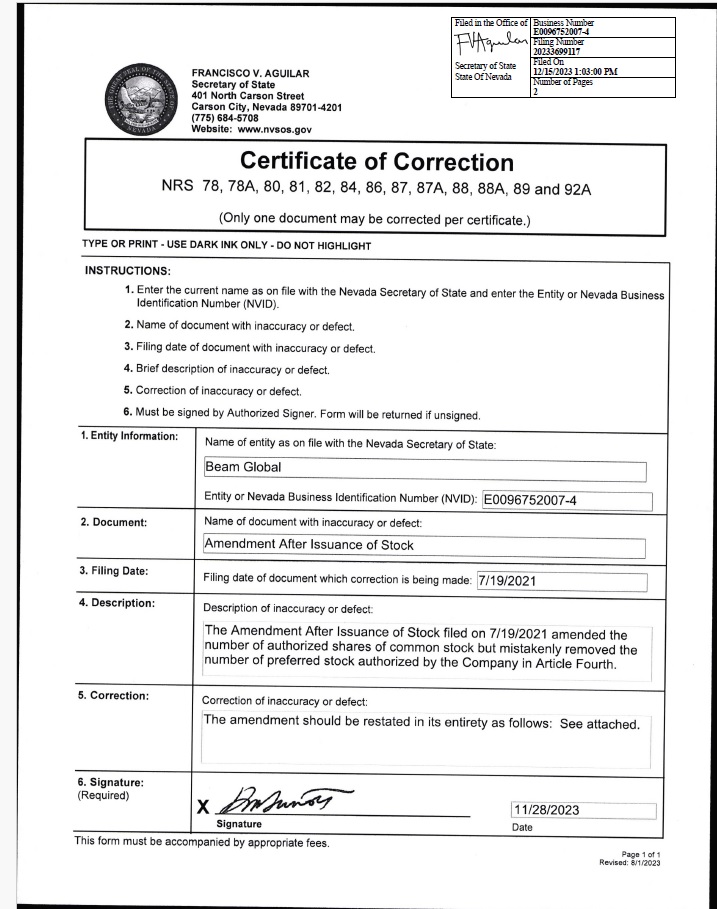
|
|

EXHIBIT 4.1
DESCRIPTION OF OUR SECURITIES
General. Our authorized capital stock consists of 350,000,000 shares of common stock, par value $0.001 per share, of which 15,043,045 shares are issued and outstanding as of April 2, 2025, and 10,000,000 shares of preferred stock, par value $0.001 per share with no shares issued or outstanding as of December 31, 2024. Under Nevada law and generally under state corporation laws, the holders of our common and preferred stock will have limited liability pursuant to which their liability is limited to the amount of their investment in us.
Common Stock. Holders of common stock are entitled to one vote per share held of record on all matters submitted to a vote of stockholders. The holders of common stock do not have cumulative voting rights in the election of directors. Accordingly, the holders of a majority of the outstanding shares of common stock entitled to vote in any election of directors may elect all of the directors standing for election. Subject to preferential rights with respect to any series of preferred stock that may be issued, holders of the common stock are entitled to receive ratably such dividends as may be declared by the board of directors on the common stock out of funds legally available therefore and, in the event of a liquidation, dissolution or winding-up of our affairs, are entitled to share equally and ratably in all of our remaining assets and funds.
Preferred Stock. We are authorized to issue 10,000,000 shares of Preferred Stock, par value $0.001 per share. We currently have no shares of Preferred Stock outstanding.
Anti-Takeover Provisions. Our articles of incorporation, our bylaws and the Nevada Revised Statutes contain provisions that could delay or make more difficult an acquisition of control of our company not approved by our board of directors, whether by means of a tender offer, open market purchases, proxy contests or otherwise. These provisions could have the effect of discouraging third parties from making proposals involving an acquisition or change of control of our company even if such a proposal, if made, might be considered desirable by a majority of our stockholders. These provisions may also have the effect of making it more difficult for third parties to cause the replacement of our current management without the concurrence of our board of directors.
Increase in the Number of Directors; Filling Vacancies
Our bylaws provide that our board may, without shareholder approval, increase or decrease the number of directors to not less than one nor more than fifteen members. In addition, the board is authorized to fill any vacancies on the board arising due to the death, resignation, removal of any director, or if the number of directors has increased. The board is also authorized to fill vacancies if the stockholders fail to elect the full authorized number of directors to be elected at any annual or special meeting of stockholders. Vacancies in the board may be filled by a majority of the remaining directors then in office, even though less than a quorum of the board, or by a sole remaining director.
No Cumulative Voting
Our bylaws and articles of incorporation do not provide the right to cumulate votes in the election of directors. This provision means that the holders of a plurality of the shares voting for the election of directors can elect all of the directors. Non-cumulative voting makes it more difficult for an insurgent minority stockholder to elect a person to the board of directors.
Amendments to Bylaws
Our bylaws give both the directors and the stockholders the power to adopt, alter or repeal the bylaws of the corporation. Any adoption, alteration, amendment, change or repeal of the bylaws by the stockholders requires an affirmative vote by a majority of the outstanding stock of the company. Any bylaw that has been adopted, amended, or repealed by the stockholders may be amended or repealed by the board, unless otherwise stated in the bylaws.
|
|
Business Combinations
The “business combination” provisions of Sections 78.411 to 78.444, inclusive, of the Nevada Revised Statutes, or NRS, generally prohibit a Nevada corporation with at least 200 stockholders from engaging in various “combination” transactions with any interested stockholder for a period of two years after the date of the transaction in which the person became an interested stockholder, unless the transaction is approved by the board of directors prior to the date the interested stockholder obtained such status or the combination is approved by the board of directors and thereafter is approved at a meeting of the stockholders by the affirmative vote of stockholders representing at least 60% of the outstanding voting power held by disinterested stockholders, and extends beyond the expiration of the two-year period, unless:
| • | the combination was approved by the board of directors prior to the person becoming an interested stockholder or the transaction by which the person first became an interested stockholder was approved by the board of directors before the person became an interested stockholder or the combination is later approved by a majority of the voting power held by disinterested stockholders; or | |
| • | if the consideration to be paid by the interested stockholder is at least equal to the highest of: (a) the highest price per share paid by the interested stockholder within the two years immediately preceding the date of the announcement of the combination or in the transaction in which it became an interested stockholder, whichever is higher, (b) the market value per share of common stock on the date of announcement of the combination and the date the interested stockholder acquired the shares, whichever is higher, or (c) for holders of preferred stock, the highest liquidation value of the preferred stock, if it is higher. |
A “combination” is generally defined to include mergers or consolidations or any sale, lease exchange, mortgage, pledge, transfer, or other disposition, in one transaction or a series of transactions, with an “interested stockholder” having: (a) an aggregate market value equal to 5% or more of the aggregate market value of the assets of the corporation, (b) an aggregate market value equal to 5% or more of the aggregate market value of all outstanding shares of the corporation, (c) 10% or more of the earning power or net income of the corporation, and (d) certain other transactions with an interested stockholder or an affiliate or associate of an interested stockholder.
In general, an “interested stockholder” is a person who, together with affiliates and associates, owns (or within two years, did own) 10% or more of a corporation’s voting stock. The statute could prohibit or delay mergers or other takeover or change in control attempts and, accordingly, may discourage attempts to acquire our Company even though such a transaction may offer our stockholders the opportunity to sell their stock at a price above the prevailing market price.
Control Share Acquisitions
The “control share” provisions of Sections 78.378 to 78.3793, inclusive, of the NRS apply to “issuing corporations” that are Nevada corporations with at least 200 stockholders, including at least 100 stockholders of record who are Nevada residents, and that conduct business directly or indirectly in Nevada. The control share statute prohibits an acquirer, under certain circumstances, from voting its shares of a target corporation’s stock after crossing certain ownership threshold percentages, unless the acquirer obtains approval of the target corporation’s disinterested stockholders. The statute specifies three thresholds: one-fifth or more but less than one-third, one-third but less than a majority, and a majority or more, of the outstanding voting power. Generally, once an acquirer crosses one of the above thresholds, those shares in an offer or acquisition and acquired within 90 days thereof become “control shares” and such control shares are deprived of the right to vote until disinterested stockholders restore the right. These provisions also provide that if control shares are accorded full voting rights and the acquiring person has acquired a majority or more of all voting power, all other stockholders who do not vote in favor of authorizing voting rights to the control shares are entitled to demand payment for the fair value of their shares in accordance with statutory procedures established for dissenters’ rights.
|
|
A corporation may elect to not be governed by, or “opt out” of, the control share provisions by making an election in its articles of incorporation or bylaws, provided that the opt-out election must be in place on the 10th day following the date an acquiring person has acquired a controlling interest, that is, crossing any of the three thresholds described above. We have not opted out of the control share statutes and will be subject to these statutes if we are an “issuing corporation” as defined in such statutes.
The effect of the Nevada control share statutes is that the acquiring person, and those acting in association with the acquiring person, will obtain only such voting rights in the control shares as are conferred by a resolution of the stockholders at an annual or special meeting. The Nevada control share law, if applicable, could have the effect of discouraging takeovers of our Company.
Listing
Our common stock is listed on the NASDAQ Capital Market under the symbol “BEEM”.
Transfer Agent and Registrar
The transfer agent and registrar for our common stock is EQ Shareowner Services.
|
|
EXHIBIT 5.1


April 11, 2025
Beam Global
5660 Eastgate Dr.
San Diego, CA 92121
RE: Prospectus Supplement for Registration Statement on Form S-3 (Registration No. 333-272396)
Ladies and Gentlemen:
We have acted as counsel to Beam Global, a Nevada corporation (the "Company"), in connection with the sale by the Company of an aggregate of up to $8,000,000 in shares of the Company’s common stock, $0.001 par value per share (the “Shares”). The Shares are to be sold pursuant to that certain At Market Issuance Sales Agreement dated April 11, 2025 (the “Sales Agreement”) between the Company and the purchasers named therein.
In connection with the offering and sale of the Shares, the Company has prepared and filed with the Securities and Exchange Commission (the “Commission”) (i) a registration statement on Form S-3 (File No. 333-272396) (as amended, the “Registration Statement”), (ii) a base prospectus dated December 22, 2023 (the “Base Prospectus”), and (iii) a prospectus supplement (the “Prospectus Supplement”) dated April 11, 2025 filed with the Commission pursuant to Rule 424(b) under the Securities Act of 1933, as amended (the “Securities Act”).
For the purpose of rendering this opinion, we assumed, without investigation, the genuineness of all signatures, the correctness of all certificates, the authenticity of all documents submitted to us as originals, the conformity to original documents of all documents submitted as certified or photostatic copies, and the authenticity of the originals of such copies, and the accuracy and completeness of all records made available to us by the Company. In addition, in rendering this opinion, we assumed that the Shares will be offered in the manner and on the terms identified or referred to in the Registration Statement, the Base Prospectus and the Prospectus Supplement, including all supplements and amendments thereto.
Our opinion is limited solely to matters set forth herein. The law covered by the opinions expressed herein is limited to the federal law of the United States, the laws of the State of California and the laws of the State of Nevada.
Based upon and subject to the foregoing, we are of the opinion that the Shares, when issued and delivered against payment of the consideration therefor specified in the Sales Agreement, will be validly issued, fully paid and nonassessable.
We hereby consent to the filing of this opinion as an exhibit to the Registration Statement, and we further consent to the use of our name under the caption “Legal Matters” in the Registration Statement, the Base Prospectus and the Prospectus Supplement. By giving these consents, we do not thereby admit that we are within the category of persons where consent is required under Section 7 of the Securities Act or the rules and regulations of the Commission.
Sincerely,
/s/ weintraub|tobin
Weintraub Tobin Chediak Coleman Grodin
EXHIBIT 10.13

December 19, 2023
Mark Joseph Myers
14245 Calle de Vista
Valley Center, CA 92082
Dear Mark,
On behalf of Beam Global (the “Company”), it is my pleasure to offer you the position of Chief Operations Officer reporting to the President and CEO, Desmond Wheatley. This letter constitutes the entire agreement relating to the terms of your employment.
The terms set forth below shall be effective as of your date of hire, January 15, 2024 (the “Effective Date”).
Title and Base Salary. Your title will be Chief Operations Officer and you will report directly to the CEO. As of the Effective Date, your annual base salary shall be $250,000. In this role, you will be responsible for setting and driving organizational vision and operations strategy for global manufacturing, engineering, supply chain, quality, safety and facilities. You will help to improve company performance and employee productivity by building an effective team and providing tools for success. Your job responsibilities will include setting goals, staffing, engineering improvements, new product releases, capital management, process improvement, lean manufacturing, setting quality standards, ensuring adherence to safety and policy guidelines, and more as the position requires. This full-time position is based on site at Beam Global’s headquarters in San Diego, CA.
Bonus Compensation. In addition to your base salary, you will be eligible for an annual incentive cash bonus, as mutually agreed upon within sixty (60) days of the Effective Date. Your annual incentive cash bonus shall have a target equal to 50% of your base salary as of the Effective Date, prorated for the portion of year during which you are employed by the Company. Your bonus milestones will include Company performance goals and individual objectives as agreed jointly between you and the executive team. You must be employed by the company at the time payment is made to be eligible for your bonus.
Equity Awards. Concurrent with the commencement of your employment, you will be granted an option to purchase shares of common stock of the Company (“Company Common Stock”) as follows, under the terms and conditions of a Non-Qualified Stock Option Agreement (an “Option”):
| Strike Price* | Number of Shares |
| FMV | 50,000 |
* FMV = the price of a share of the Company’s common stock at close of market on the date of grant.
Your Option shall vest and become exercisable in 48 equal monthly installments, with the first such monthly vesting date taking place on January 31, 2024, and subsequent vesting dates on the last day of the next 47 months thereafter, subject to your continued service through the applicable vesting date. The option grant will be subject to the terms of the applicable equity compensation plan or arrangement in effect at the time of grant. You should be aware that you may incur federal and state income taxes as a result of your receipt, or the vesting of any equity compensation awards and it shall be your responsibility to pay any such applicable taxes.
|
|
Other Benefits. You will be eligible for all Company adopted benefits, under the terms and conditions of such benefit plans. Your coverage for such benefits will become effective on the first of the month following your start of employment, February 1, 2024. You are eligible to enroll in the Company’s 401K plan beginning 3 months following your start date. The Company matches 50% of your contributions, equal to up to 6% of your annual salary.
Vacation. You will earn four (4) weeks of vacation and be eligible to accrue sick time in compliance with the San Diego Sick Leave ordinance.
Conditions of Employment.
Your employment is “at-will,” which means that either you or the Company may terminate the employment relationship at any time for any reason or for no reason. This at-will relationship may not be modified by any oral or implied agreement.
| · | In accordance with the Federal Immigration Reform and Control Act of 1986, we are required to have Employment Eligibility Verification form I-9 on file. On your first day of employment, you will be asked to provide the identification needed to complete the Form I-9 requirements. | |
| · | You will sign the Company’s confidentiality and proprietary information agreement. | |
| · | You will be required to comply with the Company’s personnel policies outlined in the Employee Handbook or as adopted from time to time by the Company. | |
| · | You represent to the Company that you are not subject to any obligation, contractual or otherwise, that prevents or restricts you from becoming employed by the Company, or that creates any potential or actual conflict of interest or places the Company at risk of liability for hiring you. | |
| · | You represent and agree that you have not taken and will not import or use any proprietary or trade secret information belonging to any other person or entity, including your former employer, in the discharge of your duties for the Company. |
The information contained in this letter represents the entire substance of the Company’s offer of employment to you and is contingent upon successful completion of all pre-and post-employment checks. If all the above terms and conditions meet with your approval, please sign this letter and return it by December 22, 2023.
I look forward to having you join the Beam team! If you should have any questions, please feel free to call me at 858-663-6125.
Sincerely,
/s/ Lisa Rosario
Lisa Rosario
Director of Human Resources
ACCEPTED BY:
/s/ Mark Myers
Mark J. Myers
December 20 , 2023
|
San Diego Headquarters 5660 Eastgate Dr. San Diego, CA 92121 |
BeamForAll.com BeamTeam@BeamForAll.com 858-799-4583 |
Chicago Offices 2600 S. 25th Ave, Suite Z Broadview, IL 60155 |
|
|
EXHIBIT 10.17
BEAM GLOBAL
Common Stock
(par value $0.001 per share)
At Market Issuance Sales Agreement
April 11, 2025
B. Riley Securities, Inc.
299 Park Avenue, 21st Floor
New York, NY 10171
Ladies and Gentlemen:
Beam Global, a Nevada corporation (the “Company”), confirms its agreement (this “Agreement”) with B. Riley Securities, Inc. (the “Agent”) as follows:
1. Issuance and Sale of Shares. The Company agrees that, from time to time during the term of this Agreement, on the terms and subject to the conditions set forth herein, it may issue and sell through or to the Agent, as sales agent or principal, shares (the “Placement Shares”), of the Company’s common stock, par value $0.001 per share (the “Common Stock”); provided, however, that in no event shall the Company issue or sell through the Agent such number or dollar amount of Placement Shares that exceeds (a) the number of shares or dollar amount of Common Stock registered on the effective Registration Statement (as defined below) pursuant to which the offering is being made, (b) the number of shares or dollar amount registered on the Prospectus Supplement (as defined below) or (c) the number of shares of dollar amount of Common Stock permitted to be sold under Form S-3 (including, and so long as applicable, General Instruction I.B.6 thereof) (the least of (a), (b) and (c) the “Maximum Amount”); and provided further, however, that in no event shall the aggregate number of Placement Shares sold pursuant to this Agreement exceed the number of authorized but unissued shares of Common Stock. Notwithstanding anything to the contrary contained herein, the parties hereto agree that compliance with the limitations set forth in this Section 1 on the number or dollar amount of Placement Shares issued and sold under this Agreement shall be the sole responsibility of the Company and that the Agent shall have no obligation in connection with such compliance. The issuance and sale of Placement Shares through the Agent will be effected pursuant to the Registration Statement, although nothing in this Agreement shall be construed as requiring the Company to use the Registration Statement to issue any Placement Shares.
The Company has filed, in accordance with the provisions of the Securities Act of 1933, as amended, and the rules and regulations promulgated thereunder (the “Securities Act”), with the Securities and Exchange Commission (the “Commission”), a registration statement on Form S-3 (File No. 333-272396), including a base prospectus, relating to certain securities, including the Placement Shares, to be issued from time to time by the Company, and which incorporates by reference documents that the Company has filed or will file in accordance with the provisions of the Securities Exchange Act of 1934, as amended, and the rules and regulations promulgated thereunder (the “Exchange Act”). The Company has prepared a prospectus supplement to the base prospectus included as part of such registration statement specifically relating to the Placement Shares (the “Prospectus Supplement”). The Company will furnish to the Agent, for use by the Agent, copies of the base prospectus included as part of such registration statement, as supplemented by the Prospectus Supplement, relating to the Placement Shares. Except where the context otherwise requires, such registration statement, and any post-effective amendment thereto, including all documents filed as part thereof or incorporated by reference therein, and including any information contained in a Prospectus (as defined below) subsequently filed with the Commission pursuant to Rule 424(b) under the Securities Act or deemed to be a part of such registration statement pursuant to Rule 430B of the Securities Act, or any subsequent registration statement on Form S-3 filed pursuant to Rule 415(a)(6) under the Securities Act by the Company to cover any Placement Shares, is herein called the “Registration Statement.” The base prospectus, including all documents incorporated or deemed incorporated therein by reference to the extent such information has not been superseded or modified in accordance with Rule 412 under the Securities Act (as qualified by Rule 430B(g) of the Securities Act), included in the Registration Statement, as it may be supplemented by the Prospectus Supplement, in the form in which such base prospectus and/or Prospectus Supplement have most recently been filed by the Company with the Commission pursuant to Rule 424(b) under the Securities Act is herein called the “Prospectus.” Any reference herein to the Registration Statement, the Prospectus or any amendment or supplement thereto shall be deemed to refer to and include the documents incorporated by reference therein, and any reference herein to the terms “amend,” “amendment” or “supplement” with respect to the Registration Statement or the Prospectus shall be deemed to refer to and include the filing after the execution hereof of any document with the Commission incorporated by reference therein (the “Incorporated Documents”).
|
|
For purposes of this Agreement, all references to the Registration Statement, the Prospectus or to any amendment or supplement thereto shall be deemed to include the most recent copy filed with the Commission pursuant to its Electronic Data Gathering Analysis and Retrieval System, or if applicable, the Interactive Data Electronic Application system when used by the Commission (collectively, “EDGAR”).
2. Placements. Each time that the Company wishes to issue and sell Placement Shares hereunder (each such transaction, a “Placement”), it will notify the Agent by electronic mail (or other method mutually agreed to in writing by the parties) of the number of Placement Shares to be sold, the time period during which sales are requested to be made, any limitation on the number of Placement Shares that may be sold in any one day and any minimum price below which sales may not be made (a “Placement Notice”), the form of which is attached hereto as Schedule 1. The Placement Notice shall originate from any of the individuals from the Company set forth on Schedule 3 (with a copy to each of the other individuals from the Company listed on such schedule), and shall be addressed to each of the individuals from the Agent set forth on Schedule 3, as such Schedule 3 may be amended from time to time. The Placement Notice shall be effective immediately upon receipt by the Agent unless and until (i) the Agent declines in writing (which may be in the form of electronic mail or other method mutually agreed to in writing by the Company and the Agent) to accept the terms contained therein for any reason, in its sole discretion, promptly following receipt of the Placement Notice from the Company, (ii) the entire amount of the Placement Shares thereunder has been sold, (iii) the Company suspends or terminates the Placement Notice, which suspension and termination rights may be exercised by the Company in its sole discretion, or (iv) this Agreement has been terminated under the provisions of Section 13. The amount of any discount, commission or other compensation to be paid by the Company to the Agent in connection with the sale of the Placement Shares shall be calculated in accordance with the terms set forth in Schedule 2. It is expressly acknowledged and agreed that neither the Company nor the Agent will have any obligation whatsoever with respect to a Placement or any Placement Shares unless and until the Company delivers a Placement Notice to the Agent and the Agent does not decline such Placement Notice pursuant to the terms set forth above, and then only upon the terms specified therein and herein. Notwithstanding anything to the contrary contained herein, no Placement Notice shall be delivered by the Company at any such time as the Company is, or could be deemed to be, in possession of material non-public information. In the event of a conflict between the terms of Sections 2 or 3 of this Agreement and the terms of a Placement Notice, the terms of the Placement Notice will control.
3. Sale of Placement Shares by the Agent. Subject to the terms and conditions of this Agreement, for the period specified in a Placement Notice, the Agent will use its commercially reasonable efforts consistent with its normal trading and sales practices and applicable state and federal laws, rules and regulations and the rules of the Nasdaq Capital Market or any nationally recognized successor thereto (the “Exchange”), to sell the Placement Shares up to the amount specified in, and otherwise in accordance with the terms of, such Placement Notice. The Agent will provide written confirmation via email correspondence to the Company no later than the opening of the Trading Day (as defined below) immediately following the Trading Day on which it has made sales of Placement Shares hereunder setting forth the number of Placement Shares sold on such day, the compensation payable by the Company to the Agent pursuant to Section 2 with respect to such sales, and the Net Proceeds (as defined below) payable to the Company, with an itemization of the deductions made by the Agent (as set forth in Section 5(b)) from the gross proceeds that it receives from such sales. Subject to the terms of a Placement Notice, the Agent may sell Placement Shares by any method permitted by law deemed to be an “at the market offering” as defined in Rule 415 of the Securities Act. “Trading Day” means any day on which shares of Common Stock are purchased and sold on the Exchange.
4. Suspension of Sales. The Company or the Agent may, upon notice to the other party in writing (including by email correspondence to each of the individuals of the other party set forth on Schedule 3, if receipt of such correspondence is actually acknowledged by any of the individuals to whom the notice is sent, other than via auto-reply) or by telephone (confirmed immediately by verifiable facsimile transmission or email correspondence to each of the individuals of the other party set forth on Schedule 3), suspend any sale of Placement Shares (a “Suspension”); provided, however, that such suspension shall not affect or impair any party’s obligations with respect to any Placement Shares sold hereunder prior to the receipt of such notice. While a Suspension is in effect, any obligation under Sections 7(l), 7(m), and 7(n) with respect to the delivery of certificates, opinions, or comfort letters to the Agent, shall be waived. Each of the parties agrees that no such notice under this Section 4 shall be effective against any other party unless it is made to at least one of the individuals named on Schedule 3 hereto, as such Schedule may be amended from time to time.
|
|
5. Sale and Delivery to the Agent; Settlement.
a. Sale of Placement Shares. On the basis of the representations and warranties herein contained and subject to the terms and conditions herein set forth, upon the Agent’s acceptance of the terms of a Placement Notice, and unless the sale of the Placement Shares described therein has been declined, suspended, or otherwise terminated in accordance with the terms of this Agreement, the Agent, for the period specified in the Placement Notice, will use its commercially reasonable efforts consistent with its normal trading and sales practices and applicable state and federal laws, rules and regulations and the rules of the Exchange to sell such Placement Shares up to the amount specified in, and otherwise in accordance with the terms of, such Placement Notice. The Company acknowledges and agrees that (i) there can be no assurance that the Agent will be successful in selling Placement Shares, (ii) the Agent will incur no liability or obligation to the Company or any other person or entity if it does not sell Placement Shares for any reason other than a failure by the Agent to use its commercially reasonable efforts consistent with its normal trading and sales practices and applicable state and federal laws, rules and regulations and the rules of the Exchange to sell such Placement Shares as required under this Agreement and (iii) the Agent shall be under no obligation to purchase Placement Shares on a principal basis pursuant to this Agreement, except as otherwise agreed by the Agent and the Company.
b. Settlement of Placement Shares. Unless otherwise specified in the applicable Placement Notice, settlement for sales of Placement Shares will occur on the first (1st) Trading Day following the date on which such sales are made (each, a “Settlement Date”). The Agent shall notify the Company of each sale of Placement Shares no later than the opening of trading on the Trading Day following the Trading Day that the Agent sold Placement Shares. Unless otherwise specified in the applicable Placement Notice, the amount of proceeds to be delivered to the Company on a Settlement Date against receipt of the Placement Shares sold (the “Net Proceeds”) will be equal to the aggregate sales price received by the Agent, after deduction for (i) the Agent’s commission, discount or other compensation for such sales payable by the Company pursuant to Section 2 hereof, and (ii) any transaction fees imposed by any governmental or self-regulatory organization in respect of such sales.
c. Delivery of Placement Shares. On or before each Settlement Date, the Company will, or will cause its transfer agent to, electronically transfer the Placement Shares being sold by crediting the Agent’s or its designee’s account (provided the Agent shall have given the Company written notice of such designee and such designee’s account information at least one Trading Day prior to the Settlement Date) at The Depository Trust Company through its Deposit and Withdrawal at Custodian System or by such other means of delivery as may be mutually agreed upon by the parties hereto which in all cases shall be freely tradable, transferable, registered shares in good deliverable form. On each Settlement Date, the Agent will deliver the related Net Proceeds in same day funds to an account designated by the Company on, or prior to, the Settlement Date. The Company agrees that if the Company, or its transfer agent (if applicable), defaults in its obligation to deliver Placement Shares on a Settlement Date through no fault of the Agent, then in addition to and in no way limiting the rights and obligations set forth in Section 11(a) hereto, it will (i) hold the Agent harmless against any loss, claim, damage, or reasonable, documented expense (including actual out-of-pocket reasonable and documented legal fees and expenses), as incurred, arising out of or in connection with such default by the Company or its transfer agent (if applicable) and (ii) pay to the Agent (without duplication) any commission, discount, or other compensation to which it would otherwise have been entitled absent such default.
d. Limitations on Offering Size. Under no circumstances shall the Company cause or request the offer or sale of any Placement Shares if, after giving effect to the sale of such Placement Shares, the aggregate number of Placement Shares sold pursuant to this Agreement would exceed the lesser of (A) together with all sales of Placement Shares under this Agreement, the Maximum Amount and (B) the amount available for offer and sale under the currently effective Registration Statement. Under no circumstances shall the Company cause or request the offer or sale of any Placement Shares pursuant to this Agreement at a price lower than the minimum price authorized from time to time by the Company’s board of directors, a duly authorized committee thereof or a duly authorized executive committee, and notified to the Agent in writing.
6. Representations and Warranties of the Company. The Company represents and warrants to, and agrees with the Agent that as of the date of this Agreement and as of each Applicable Time (as defined below), unless such representation, warranty or agreement specifies a different date or time:
|
|
a. Registration Statement and Prospectus. The transactions contemplated by this Agreement meet the requirements for and comply with the applicable conditions for the use of Form S-3 under the Securities Act. The Registration Statement shall be filed with the Commission and, before the Company delivers any Placement Notice hereunder, will have been declared effective under the Securities Act. The Prospectus Supplement will name the Agent as the agent in the section entitled “Plan of Distribution.” The Company has not received, and has no notice of, any order of the Commission preventing or suspending the use of the Registration Statement, or threatening or instituting proceedings for that purpose. The Registration Statement and the offer and sale of Placement Shares as contemplated hereby meet the requirements of Rule 415 under the Securities Act and comply in all material respects with said Rule. Any statutes, regulations, contracts or other documents that are required to be described in the Registration Statement or the Prospectus or to be filed as exhibits to the Registration Statement have been so described or filed, as applicable. Copies of the Registration Statement, the Prospectus, and any such amendments or supplements and all Incorporated Documents that were filed with the Commission on or prior to the date of this Agreement have been delivered, or are available through EDGAR, to the Agent and its counsel. The Company has not distributed and, prior to the later to occur of each Settlement Date and completion of the distribution of the Placement Shares, will not distribute any offering material in connection with the offering or sale of the Placement Shares other than the Registration Statement and the Prospectus and any Issuer Free Writing Prospectus (as defined below) to which the Agent has consented, which consent will not be unreasonably withheld or delayed, or that is required by applicable law or the listing maintenance requirements of the Exchange. The Common Stock is currently quoted on the Exchange under the trading symbol “BEEM.” The Company has not, in the 12 months preceding the date hereof, received notice from the Exchange to the effect that the Company is not in compliance with the listing or maintenance requirements of the Exchange. To the Company’s knowledge, it is in compliance with all such listing and maintenance requirements.
b. No Misstatement or Omission. At each Settlement Date, the Registration Statement and the Prospectus, as of such date, will conform in all material respects with the requirements of the Securities Act. The Registration Statement, when it became or becomes effective, did not, and will not, contain an untrue statement of a material fact or omit to state a material fact required to be stated therein or necessary to make the statements therein not misleading. The Prospectus and any amendment and supplement thereto, on the date thereof and at each Applicable Time (as defined below), did not or will not include an untrue statement of a material fact or omit to state a material fact necessary to make the statements therein, in light of the circumstances under which they were made, not misleading. The documents incorporated by reference in the Prospectus or any Prospectus Supplement did not, and any further documents filed and incorporated by reference therein will not, when filed with the Commission, contain an untrue statement of a material fact or omit to state a material fact required to be stated in such document or necessary to make the statements in such document, in light of the circumstances under which they were made, not misleading. The foregoing shall not apply to statements in, or omissions from, any such document made in reliance upon, and in conformity with, information furnished to the Company by the Agent specifically for use in the preparation thereof; provided that, for purposes of this Agreement, the only information so furnished shall be (i) the name of the Agent, and (ii) such other statements as may have been furnished, by notice given by the Agent to the Company in writing after the date of this Agreement, specifically for inclusion in the Registration Statement (or any amendment thereto), the Prospectus (or any amendment or supplement thereto) or any Issuer Free Writing Prospectus (collectively, the “Agent Information”).
c. Conformity with Securities Act and Exchange Act. The Registration Statement, the Prospectus, any Issuer Free Writing Prospectus or any amendment or supplement thereto, and the Incorporated Documents, when such documents were or are filed with the Commission under the Securities Act or the Exchange Act or became or become effective under the Securities Act, as the case may be, conformed or will conform in all material respects with the requirements of the Securities Act and the Exchange Act, as applicable.
d. Financial Information. The consolidated financial statements of the Company included or incorporated by reference in the Registration Statement and the Prospectus, together with the related notes and schedules, present fairly, in all material respects, the consolidated financial position of the Company and the Subsidiaries (as defined below) as of the dates indicated and the consolidated results of operations, cash flows and changes in stockholders’ equity of the Company and the Subsidiaries for the periods specified (subject, in the case of unaudited statements, to normal year-end audit adjustments which will not be material, either individually or in the aggregate) and have been prepared in compliance with the published requirements of the Securities Act and the Exchange Act, as applicable, and in conformity with generally accepted accounting principles in the United States (“GAAP”) applied on a consistent basis (except (i) for such adjustments to accounting standards and practices as are noted therein and (ii) in the case of unaudited interim financial statements, to the extent they may exclude footnotes or may be condensed or summary statements) during the periods involved; the other financial and statistical data with respect to the Company and the Subsidiaries contained or incorporated by reference in the Registration Statement and the Prospectus, are accurately and fairly presented and prepared on a basis consistent with the financial statements and books and records of the Company; there are no financial statements (historical or pro forma) that are required to be included or incorporated by reference in the Registration Statement, or the Prospectus that are not included or incorporated by reference as required; the Company and the Subsidiaries do not have any material liabilities or obligations, direct or contingent (including any off balance sheet obligations), not described in the Registration Statement, and the Prospectus which are required to be described in the Registration Statement or Prospectus; and all disclosures contained or incorporated by reference in the Registration Statement and the Prospectus, if any, regarding “non-GAAP financial measures” (as such term is defined by the rules and regulations of the Commission) comply in all material respects with Regulation G of the Exchange Act and Item 10 of Regulation S-K under the Securities Act, to the extent applicable.
|
|
e. Conformity with EDGAR Filing. The Prospectus delivered to the Agent for use in connection with the sale of the Placement Shares pursuant to this Agreement will be identical to the versions of the Prospectus created to be transmitted to the Commission for filing via EDGAR, except to the extent permitted by Regulation S-T.
f. Organization. The Company and any subsidiary that is a significant subsidiary (as such term is defined in Rule 1-02 of Regulation S-X promulgated by the Commission) (each, a “Subsidiary,” collectively, the “Subsidiaries”), are, and will be, duly organized, validly existing as a corporation and in good standing under the laws of their respective jurisdictions of organization. The Company and the Subsidiaries are duly licensed or qualified as a foreign corporation for transaction of business and in good standing under the laws of each other jurisdiction in which their respective ownership or lease of property or the conduct of their respective businesses requires such license or qualification, and have all corporate power and authority necessary to own or hold their respective properties and to conduct their respective businesses as described in the Registration Statement and the Prospectus, except where the failure to be so qualified or in good standing or have such power or authority would not, individually or in the aggregate, have a material adverse effect on the assets, business, operations, earnings, properties, condition (financial or otherwise), prospects, stockholders’ equity or results of operations of the Company and the Subsidiaries taken as a whole, or prevent the consummation of the transactions contemplated hereby (a “Material Adverse Effect”).
g. Subsidiaries. The Company owns directly or indirectly, all of the equity interests of each of the Subsidiaries free and clear of any lien, charge, security interest, encumbrance, right of first refusal or other restriction, and all the equity interests of the Subsidiaries are validly issued and are fully paid, nonassessable and free of preemptive and similar rights. The Company does not own or control, directly or indirectly, any corporation, association or other entity other than the subsidiaries listed in Exhibit 21.1 to the Company’s Annual Report on Form 10-K for the most recently ended fiscal year and other than (i) those subsidiaries not required to be listed on Exhibit 21.1 by Item 601 of Regulation S-K under the Exchange Act and (ii) those subsidiaries formed since the last day of the most recently ended fiscal year.
h. No Violation or Default. Neither the Company nor any Subsidiary is (i) in violation of its charter or by-laws or similar organizational documents; (ii) in default, and no event has occurred that, with notice or lapse of time or both, would constitute such a default, in the due performance or observance of any term, covenant or condition contained in any indenture, mortgage, deed of trust, loan agreement or other similar agreement or instrument to which the Company or any Subsidiary is a party or by which the Company or any Subsidiary is bound or to which any of the property or assets of the Company or any Subsidiary is subject; or (iii) in violation of any law or statute or any judgment, order, rule or regulation of any court or arbitrator or governmental or regulatory authority having jurisdiction over the Company or any Subsidiary, except, in the case of each of clauses (ii) and (iii) above, for any such violation or default that would not, individually or in the aggregate, have a Material Adverse Effect. To the Company’s knowledge, no other party under any material contract or other agreement to which it or any Subsidiary is a party is in default in any respect thereunder where such default would have a Material Adverse Effect.
i. No Material Adverse Effect. Since the date of the most recent financial statements of the Company included or incorporated by reference in the Registration Statement and Prospectus, there has not been (i) any Material Adverse Effect, or any development that would reasonably be expected to result in a Material Adverse Effect, (ii) any transaction which is material to the Company and the Subsidiaries taken as a whole, (iii) any obligation or liability, direct or contingent (including any off-balance sheet obligations), incurred by the Company or the Subsidiaries, which is material to the Company and the Subsidiaries taken as a whole, (iv) any material change in the Company’s capital stock (other than (A) the grant of additional options and other equity awards under the Company’s existing stock option, equity incentive plans, (B) changes in the number of outstanding shares of Common Stock of the Company due to the issuance of shares upon the exercise, conversion or settlement of securities exercisable for, convertible into or settleable in Common Stock outstanding on the date hereof, (C) as a result of the issuance of Placement Shares, (D) any repurchases of capital stock of the Company, (E) as described in a proxy statement filed on Schedule 14A or a Registration Statement on Form S-4, or (F) otherwise publicly announced) or outstanding long-term indebtedness of the Company or the Subsidiaries or (v) any dividend or distribution of any kind declared, paid or made on the capital stock of the Company or any Subsidiary, other than in each case above in the ordinary course of business or as otherwise disclosed in the Registration Statement or Prospectus (including any of the Incorporated Documents).
|
|
j. Capitalization. The issued and outstanding shares of capital stock of the Company have been validly issued, are fully paid and non-assessable and, other than as disclosed in the Registration Statement or the Prospectus, are not subject to any preemptive rights, rights of first refusal or similar rights. The Company’s authorized, issued and outstanding equity capitalization is as set forth in the Registration Statement and the Prospectus as of the dates referred to therein (other than (i) the grant of additional options or other equity awards under the Company’s existing equity incentive plans, (ii) changes in the number of outstanding shares of Common Stock of the Company due to the issuance of shares upon the exercise, conversion or settlement of securities exercisable for, convertible into or settleable in Common Stock outstanding on the date hereof, (iii) as a result of the issuance of Placement Shares, or (iv) any repurchases of capital stock of the Company) and such authorized capital stock conforms to the description thereof set forth in the Registration Statement and the Prospectus. The description of the Common Stock in the Registration Statement and the Prospectus is complete and accurate in all material respects. Except as disclosed in or contemplated by the Registration Statement or the Prospectus, the Company did not have outstanding any options to purchase, or any rights or warrants to subscribe for, or any securities or obligations convertible into, or exchangeable for, or any contracts or commitments to issue or sell, any shares of capital stock or other securities.
k. S-3 Eligibility. At the time the Registration Statement was or will be declared effective, and at the time the Company’s most recent Annual Report on Form 10-K was filed with the Commission, the Company met or will meet the then applicable requirements for the use of Form S-3 under the Securities Act, including, but not limited to, General Instruction I.B.6 of Form S-3, if applicable. As of the close of trading on the Exchange on February 18, 2025, the aggregate market value of the outstanding voting and non-voting common equity (as defined in Rule 405) of the Company held by persons other than affiliates of the Company (pursuant to Rule 144 of the Securities Act, those that directly, or indirectly through one or more intermediaries, control, or are controlled by, or are under common control with, the Company) (the “Non-Affiliate Shares”), was approximately $13,204,435 million (calculated by multiplying (x) the price at which the common equity of the Company was last sold on the Exchange on February 18, 2025 times (y) the number of Non-Affiliate Shares). The Company is not a shell company (as defined in Rule 405 under the Securities Act) and has not been a shell company for at least 12 calendar months previously and if it has been a shell company at any time previously, has filed current Form 10 information (as defined in General Instruction I.B.6 of Form S-3) with the Commission at least 12 calendar months previously reflecting its status as an entity that is not a shell company.
l. Authorization; Enforceability. The Company has full legal right, power and authority to enter into this Agreement and perform the transactions contemplated hereby. This Agreement has been duly authorized, executed and delivered by the Company and, assuming due authorization, execution and delivery by the Agent, is a legal, valid and binding agreement of the Company enforceable against the Company in accordance with its terms, except to the extent that (i) enforceability may be limited by bankruptcy, insolvency, reorganization, moratorium or similar laws affecting creditors’ rights generally and by general equitable principles, (ii) enforceability may be limited by laws relating to the availability of specific performance, injunctive relief or other equitable remedies and (iii) the indemnification and contribution provisions of Section 11 hereof may be limited by federal or state securities laws and public policy considerations in respect thereof.
m. Authorization of Placement Shares. The Placement Shares, when issued and delivered pursuant to this Agreement and pursuant to the terms approved by the board of directors of the Company or a duly authorized committee thereof, or a duly authorized executive committee, against payment therefor as provided herein, will be duly and validly authorized and issued and fully paid and nonassessable, free and clear of any pledge, lien, encumbrance, security interest or other claim (other than any pledge, lien, encumbrance, security interest or other claim arising from an act or omission of the Agent or a purchaser), including any statutory or contractual preemptive rights, resale rights, rights of first refusal or other similar rights, and will be registered pursuant to Section 12 of the Exchange Act. The Placement Shares, when issued, will conform in all material respects to the description thereof set forth in or incorporated by reference into the Prospectus.
n. No Consents Required. No consent, approval, authorization, order, registration or qualification of or with any court or arbitrator or any governmental or regulatory authority is required for the execution, delivery and performance by the Company of this Agreement, and the issuance and sale by the Company of the Placement Shares as contemplated hereby, except for such consents, approvals, authorizations, orders and registrations or qualifications (i) as may be required under applicable state securities laws or by the by-laws and rules of the Financial Industry Regulatory Authority (“FINRA”) or the Exchange, including any notices that may be required by the Exchange, in connection with the sale of the Placement Shares by the Agent, (ii) as may be required under the Securities Act and (iii) as have been previously obtained by the Company.
|
|
o. No Preferential Rights. (i) No person, as such term is defined in Rule 1-02 of Regulation S-X promulgated under the Securities Act (each, a “Person”), has the right, contractual or otherwise, to cause the Company to issue or sell to such Person any Common Stock or shares of any other capital stock or other securities of the Company (other than upon the exercise of options or warrants to purchase Common Stock, the vesting of restricted stock units, the conversion of convertible securities or upon the exercise of options or other equity awards that may be granted from time to time under the Company’s equity incentive plan), (ii) no Person has any preemptive rights, rights of first refusal, or any other rights (whether pursuant to a “poison pill” provision or otherwise) to purchase any Common Stock or shares of any other capital stock or other securities of the Company from the Company which have not been duly waived with respect to the offering contemplated hereby, (iii) no Person has the right to act as an underwriter or as a financial advisor to the Company in connection with the offer and sale of the Placement Shares pursuant to this Agreement, and (iv) no Person has the right, contractual or otherwise, to require the Company to register under the Securities Act any Common Stock or shares of any other capital stock or other securities of the Company, or to include any such shares or other securities in the Registration Statement or the offering contemplated thereby, whether as a result of the filing or effectiveness of the Registration Statement or the sale of the Placement Shares as contemplated thereby or otherwise, except in each case for such rights as have been waived on or prior to the date hereof.
p. Independent Public Accountant. Marcum LLP (the “Accountant”), whose report on the consolidated financial statements of the Company is filed with the Commission as part of the Company’s most recent Annual Report on Form 10-K filed with the Commission and incorporated into the Registration Statement, is and, during the periods covered by its report, was an independent public accounting firm within the meaning of the Securities Act and the Public Company Accounting Oversight Board (United States). To the Company’s knowledge, the Accountant is not in violation of the auditor independence requirements of the Sarbanes-Oxley Act of 2002, as amended (the “Sarbanes-Oxley Act”), with respect to the Company.
q. Enforceability of Agreements. All agreements between the Company and third parties expressly referenced in the Prospectus, other than such agreements that have expired by their terms or whose termination is disclosed in documents filed by the Company on EDGAR, are legal, valid and binding obligations of the Company and, to the Company’s knowledge, enforceable in accordance with their respective terms, except to the extent that (i) enforceability may be limited by bankruptcy, insolvency, reorganization, moratorium or similar laws affecting creditors’ rights generally and by general equitable principles, (ii) enforceability may be limited by laws relating to the availability of specific performance, injunctive relief or other equitable remedies and (iii) the indemnification provisions of certain agreements may be limited by federal or state securities laws or public policy considerations in respect thereof, and except for any unenforceability that, individually or in the aggregate, would not have a Material Adverse Effect.
r. No Litigation. There are no legal or governmental proceedings pending or, to the knowledge of the Company, threatened to which the Company or any Subsidiary is a party or to which any of the properties of the Company or any Subsidiary is subject (i) other than proceedings accurately described in all material respects in the Prospectus and proceedings that would not reasonably be expected to have a Material Adverse Effect on the Company and its subsidiaries, taken as a whole, or on the power or ability of the Company to perform its obligations under this Agreement or to consummate the transactions contemplated by the Prospectus or (ii) proceedings that are required to be described in the Registration Statement or the Prospectus and are not so described.
s. Licenses and Permits. The Company and the Subsidiaries possess or have obtained, all licenses, certificates, consents, orders, approvals, permits and other authorizations issued by, and have made all declarations and filings with, the appropriate federal, state, local or foreign governmental or regulatory authorities that are necessary for the ownership or lease of their respective properties or the conduct of their respective businesses as currently conducted, as described in the Registration Statement and the Prospectus (the “Permits”), except where the failure to possess, obtain or make the same would not, individually or in the aggregate, have a Material Adverse Effect. Neither the Company nor any Subsidiary has received written notice of any proceeding relating to revocation or modification of any such Permit or has any reason to believe that such Permit will not be renewed in the ordinary course, except where such revocation, modification or failure to obtain such renewal would not, individually or in the aggregate, have a Material Adverse Effect.
t. No Material Defaults. Neither the Company nor any Subsidiary has defaulted on any installment on indebtedness for borrowed money or on any rental on one or more long-term leases, which defaults, individually or in the aggregate, would reasonably be expected to have a Material Adverse Effect. The Company has not filed a report pursuant to Section 13(a) or 15(d) of the Exchange Act since the filing of its last Annual Report on Form 10-K, indicating that it (i) has failed to pay any dividend or sinking fund installment on preferred stock or (ii) has defaulted on any installment on indebtedness for borrowed money or on any rental on one or more long-term leases, which defaults, individually or in the aggregate, would have a Material Adverse Effect.
|
|
u. Certain Market Activities. Neither the Company, nor any Subsidiary, nor, to the knowledge of the Company, any of their respective directors, officers or controlling persons has taken, directly or indirectly, any action designed, or that has constituted or would reasonably be expected to cause or result in, under the Exchange Act or otherwise, the stabilization or manipulation of the price of any security of the Company to facilitate the sale or resale of the Placement Shares.
v. Broker/Dealer Relationships. Neither the Company nor any Subsidiary or any related entities (i) is required to register as a “broker” or “dealer” in accordance with the provisions of the Exchange Act or (ii) directly or indirectly through one or more intermediaries, controls or is a “person associated with a member” or “associated person of a member” (within the meaning set forth in the FINRA Manual). All of the information provided to the Agent or to their counsel, specifically for use by the Agent in connection with the preparation and filing with FINRA’s Corporate Financing Department via the Public Offering System of all documents and information required to be filed with FINRA pursuant to FINRA Rule 5110 with regard to the transactions contemplated by this Agreement (the “FINRA Filing”) (and related disclosure) with FINRA, by the Company, its counsel, its officers and directors and the holders of any securities (debt or equity) or options to acquire any securities of the Company in connection with the transactions contemplated by this Agreement is true, complete, correct and compliant with FINRA’s rules and any letters, filings or other supplemental information provided to FINRA pursuant to FINRA Rules.
w. No Reliance. The Company has not relied upon the Agent or legal counsel for the Agent for any legal, tax or accounting advice in connection with the offering and sale of the Placement Shares.
x. Taxes. The Company and the Subsidiaries have filed all federal, state, local and foreign tax returns which have been required to be filed and paid all taxes shown thereon through the date hereof, to the extent that such taxes have become due and are not being contested in good faith, except where the failure to do so would not reasonably be expected to have a Material Adverse Effect. Except as otherwise disclosed in or contemplated by the Registration Statement or the Prospectus, no tax deficiency has been determined adversely to the Company or any Subsidiary which has had, or would have, individually or in the aggregate, a Material Adverse Effect. The Company has no knowledge of any federal, state or other governmental tax deficiency, penalty or assessment which has been or might be asserted or threatened against it which would have a Material Adverse Effect.
y. Title to Real and Personal Property. The Company and the Subsidiaries have good and valid title in fee simple to all items of real property, to the extent applicable, and good and valid title to all personal property described in the Registration Statement or Prospectus as being owned by them that are material to the businesses of the Company or such Subsidiary, in each case free and clear of all liens, encumbrances and claims, except those that (i) do not materially interfere with the use made and proposed to be made of such property by the Company and the Subsidiaries or (ii) would not, individually or in the aggregate, reasonably be expected to have a Material Adverse Effect. Any real property described in the Registration Statement or Prospectus as being leased by the Company and the Subsidiaries is held by them under valid, existing and enforceable leases, except those that (A) do not materially interfere with the use made or proposed to be made of such property by the Company or the Subsidiaries or (B) would not, individually or in the aggregate, reasonably be expected to have a Material Adverse Effect.
z. Intellectual Property. The Company and the Subsidiary own or possess adequate enforceable rights to use all patents, patent applications, trademarks (both registered and unregistered), trade names, trademark registrations, service marks, service mark registrations, Internet domain name registrations, copyrights, copyright registrations, licenses and know-how (including trade secrets and other unpatented and/or unpatentable proprietary or confidential information, systems or procedures) (collectively, the “Intellectual Property”), necessary for the conduct of their respective businesses as conducted as of the date hereof, except to the extent that the failure to own or possess adequate rights to use such Intellectual Property would not, individually or in the aggregate, reasonably be expected to have a Material Adverse Effect. The Company and the Subsidiaries have not received any written notice of any claim of infringement or conflict which asserted Intellectual Property rights of others, which infringement or conflict, if the subject of an unfavorable decision, would reasonably be expected to result in a Material Adverse Effect. There are no pending, or to the Company’s knowledge, threatened judicial proceedings or interference proceedings challenging the Company’s or any Subsidiary’s rights in or to or the validity of the scope of any of the Company’s or its Subsidiaries’ patents, patent applications or proprietary information, except as would not, individually or in the aggregate, reasonably be expected to have a Material Adverse Effect. No other entity or individual has any right or claim in any of the Company’s or any of its Subsidiary’s patents, patent applications or any patent to be issued therefrom by virtue of any contract, license or other agreement entered into between such entity or individual and the Company or any Subsidiary or by any non-contractual obligation, other than by written licenses granted by the Company or any Subsidiary, except as would not, individually or in the aggregate, reasonably be expected to have a Material Adverse Effect. The Company has not received any written notice of any claim challenging the rights of the Company or its Subsidiaries in or to any Intellectual Property owned, licensed or optioned by the Company or any Subsidiary which claim, if the subject of an unfavorable decision, would reasonably be expected to result in a Material Adverse Effect.
|
|
aa. Compliance with Applicable Laws. The Company has not been advised, and has no reason to believe, that it and each of its subsidiaries are not conducting business in compliance with all applicable laws, rules and regulations of the jurisdictions in which it is conducting business, except where failure to be so in compliance would not result in a Material Adverse Effect.
bb. Environmental Laws. The Company and the Subsidiaries (i) are in compliance with any and all applicable federal, state, local and foreign laws, rules, regulations, decisions and orders relating to the protection of human health and safety, the environment or hazardous or toxic substances or wastes, pollutants or contaminants (collectively, “Environmental Laws”); (ii) have received and are in compliance with all permits, licenses or other approvals required of them under applicable Environmental Laws to conduct their respective businesses as described in the Registration Statement and the Prospectus; and (iii) have not received notice of any actual or potential liability for the investigation or remediation of any disposal or release of hazardous or toxic substances or wastes, pollutants or contaminants, except, in the case of any of clauses (i), (ii) or (iii) above, for any such failure to comply or failure to receive required permits, licenses, other approvals or liability as would not, individually or in the aggregate, have a Material Adverse Effect.
cc. Disclosure Controls. The Company maintains a system of internal accounting controls designed to provide reasonable assurance that (i) transactions are executed in accordance with management’s general or specific authorizations; (ii) transactions are recorded as necessary to permit preparation of financial statements in conformity with GAAP and to maintain asset accountability; (iii) access to assets is permitted only in accordance with management’s general or specific authorization; and (iv) the recorded accountability for assets is compared with the existing assets at reasonable intervals and appropriate action is taken with respect to any differences. Except as set forth in the Registration Statement and the Prospectus, the Company is not aware of any material weaknesses in its internal control over financial reporting (other than as set forth in the Registration Statement or the Prospectus). Since the date of the latest audited financial statements of the Company included in the Prospectus, except as set forth in the Registration Statement and the Prospectus, there has been no change in the Company’s internal control over financial reporting that has materially affected, or is reasonably likely to materially affect, the Company’s internal control over financial reporting (other than as set forth in the Registration Statement or the Prospectus). The Company has established disclosure controls and procedures (as defined in Exchange Act Rules 13a-15 and 15d-15) that comply with the requirements of the Exchange Act. The Company’s certifying officers have evaluated the effectiveness of the Company’s disclosure controls and procedures as of a date within 90 days prior to the filing date of the Form 10-K for the fiscal year most recently ended (such date, the “Evaluation Date”). The Company presented in its Form 10-K for the fiscal year most recently ended the conclusions of the certifying officers about the effectiveness of the disclosure controls and procedures based on their evaluations as of the most recent Evaluation Date and, except as set forth in the Registration Statement and the Prospectus, such “disclosure controls and procedures” are effective.
dd. Sarbanes-Oxley Act. Except as set forth in the Registration Statement and the Prospectus, there is and has been no failure on the part of the Company or, to the knowledge of the Company, any of the Company’s directors or officers, in their capacities as such, to comply in all material respects with any applicable provisions of the Sarbanes-Oxley Act and the rules and regulations promulgated thereunder. Each of the principal executive officer and the principal financial officer of the Company (or each former principal executive officer of the Company and each former principal financial officer of the Company as applicable) has made all certifications required by Sections 302 and 906 of the Sarbanes-Oxley Act with respect to all reports, schedules, forms, statements and other documents required to be filed by it or furnished by it to the Commission during the past 12 months. For purposes of the preceding sentence, “principal executive officer” and “principal financial officer” shall have the meanings given to such terms in the Exchange Act Rules 13a-15 and 15d-15.
ee. Finder’s Fees. Neither the Company nor any Subsidiary has incurred any liability for any finder’s fees, brokerage commissions or similar payments in connection with the transactions herein contemplated, except as may otherwise exist with respect to the Agent pursuant to this Agreement.
ff. Labor Disputes. No labor disturbance by or dispute with employees of the Company or any Subsidiary exists or, to the knowledge of the Company, is threatened which would result in a Material Adverse Effect.
gg. Investment Company Act. Neither the Company nor any Subsidiary is or, after giving effect to the offering and sale of the Placement Shares, will be required to register as an “investment company” or an entity “controlled” by an “investment company,” as such terms are defined in the Investment Company Act of 1940, as amended (the “Investment Company Act”).
|
|
hh. Operations. The operations of the Company and the Subsidiaries are and have been conducted at all times in compliance with applicable financial record keeping and reporting requirements of the Currency and Foreign Transactions Reporting Act of 1970, as amended, the money laundering statutes of all jurisdictions to which the Company or the Subsidiaries are subject, the rules and regulations thereunder and any related or similar rules, regulations or guidelines, issued, administered or enforced by any governmental agency having jurisdiction over the Company (collectively, the “Money Laundering Laws”), except where the failure to be in such compliance would not result in a Material Adverse Effect; and no action, suit or proceeding by or before any court or governmental agency, authority or body or any arbitrator involving the Company or any Subsidiary with respect to the Money Laundering Laws is pending or, to the knowledge of the Company, threatened.
ii. No Unlawful Contributions or Other Payments. None of the Company, any of its Subsidiaries nor any director, officer, nor, to the knowledge of the Company, agent, employee, affiliate or other person acting on behalf of the Company or any of its Subsidiaries has (i) used any corporate funds for any unlawful contribution, gift, entertainment or other unlawful expense relating to political activity; (ii) made or taken an act in furtherance of an offer, promise or authorization of any direct or indirect unlawful payment or benefit to any foreign or domestic government official or employee, including of any government-owned or controlled entity or of a public international organization, or any person acting in an official capacity for or on behalf of any of the foregoing, or any political party or party official or candidate for political office; (iii) violated or is in violation of any provision of the Foreign Corrupt Practices Act of 1977, as amended, or any applicable law or regulation implementing the OECD Convention on Combating Bribery of Foreign Public Officials in International Business Transactions, or committed an offence under the Bribery Act 2010 of the United Kingdom or any other applicable anti-bribery or anti-corruption law; or (iv) made, offered, agreed, requested or taken an act in furtherance of any unlawful bribe or other unlawful benefit, including, without limitation, any rebate, payoff, influence payment, kickback or other unlawful or improper payment or benefit, in each case in connection with or related to the Company or any of its Subsidiaries or businesses; and the Company, its Subsidiaries and, to the knowledge of the Company, its affiliates have conducted their businesses in material compliance with all applicable anti-bribery and anti-corruption laws and have instituted and maintain policies and procedures designed to ensure, and which are reasonably expected to continue to ensure, continued compliance therewith.
jj. Off-Balance Sheet Arrangements. There are no transactions, arrangements and other relationships between and/or among the Company, and/or, to the knowledge of the Company, any of its affiliates and any unconsolidated entity, including, but not limited to, any structured finance, special purpose or limited purpose entity (each, an “Off Balance Sheet Transaction”) that would reasonably be expected to affect materially the Company’s liquidity or the availability of or requirements for its capital resources, including those Off Balance Sheet Transactions described in the Commission’s Statement about Management’s Discussion and Analysis of Financial Conditions and Results of Operations (Release Nos. 33-8056; 34-45321; FR-61), required to be described in the Registration Statement or the Prospectus which have not been described as required.
kk. Underwriter Agreements. Other than with respect to this Agreement, the Company is not a party to any agreement with an agent or underwriter for any other “at the market” or continuous equity transaction.
ll. ERISA. To the knowledge of the Company, (i) each material employee benefit plan, within the meaning of Section 3(3) of the Employee Retirement Income Security Act of 1974, as amended (“ERISA”), that is maintained, administered or contributed to by the Company or any of its affiliates for employees or former employees of the Company and the Subsidiaries has been maintained in material compliance with its terms and the requirements of any applicable statutes, orders, rules and regulations, including but not limited to ERISA and the Internal Revenue Code of 1986, as amended (the “Code”); (ii) no prohibited transaction, within the meaning of Section 406 of ERISA or Section 4975 of the Code, has occurred which would result in a material liability to the Company with respect to any such plan excluding transactions effected pursuant to a statutory or administrative exemption; and (iii) for each such plan that is subject to the funding rules of Section 412 of the Code or Section 302 of ERISA, no “accumulated funding deficiency” as defined in Section 412 of the Code has been incurred, whether or not waived, and the fair market value of the assets of each such plan (excluding for these purposes accrued but unpaid contributions) equals or exceeds the present value of all benefits accrued under such plan determined using reasonable actuarial assumptions, other than, in the case of (i), (ii) and (iii) above, as would not reasonably be expected to have a Material Adverse Effect.
mm. Forward-Looking Statements. No forward-looking statement (within the meaning of Section 27A of the Securities Act and Section 21E of the Exchange Act) (a “Forward-Looking Statement”) contained in the Registration Statement and the Prospectus has been made or reaffirmed without a reasonable basis or has been disclosed other than in good faith.
|
|
nn. Margin Rules. Neither the issuance, sale and delivery of the Placement Shares nor the application of the proceeds thereof by the Company as described in the Registration Statement and the Prospectus will violate Regulation T, U or X of the Board of Governors of the Federal Reserve System.
oo. Insurance. The Company and the Subsidiaries carry, or are covered by, insurance in such amounts and covering such risks as the Company and the Subsidiaries reasonably believe are adequate for the conduct of their business.
pp. No Improper Practices. (i) Neither the Company, nor any of its Subsidiaries, nor to the Company’s knowledge, any of their respective executive officers or directors has, in the past five years, made any unlawful contributions to any candidate for any political office (or failed fully to disclose any contribution in violation of law) or made any contribution or other payment to any official of, or candidate for, any federal, state, municipal, or foreign office or other person charged with similar public or quasi-public duty in violation of any law or of the character required to be disclosed in the Prospectus; (ii) no relationship, direct or indirect, exists between or among the Company or, to the Company’s knowledge, the Subsidiaries or any affiliate of any of them, on the one hand, and the directors, officers and stockholders of the Company or, to the Company’s knowledge, the Subsidiaries, on the other hand, that is required by the Securities Act to be described in the Registration Statement and the Prospectus that is not so described; (iii) no relationship, direct or indirect, exists between or among the Company or the Subsidiaries or any affiliate of them, on the one hand, and the directors, officers, stockholders or directors of the Company or, to the Company’s knowledge, the Subsidiaries, on the other hand, that is required by the rules of FINRA to be described in the Registration Statement and the Prospectus that is not so described; (iv) there are no material outstanding loans or advances or material guarantees of indebtedness by the Company or, to the Company’s knowledge, the Subsidiaries to or for the benefit of any of their respective officers or directors or any of the members of the families of any of them; and (v) the Company has not offered, or caused any placement agent to offer, Common Stock to any person with the intent to influence unlawfully (A) a customer or supplier of the Company or the Subsidiaries to alter the customer’s or supplier’s level or type of business with the Company or the Subsidiaries or (B) a trade journalist or publication to write or publish favorable information about the Company or the Subsidiaries or any of their respective products or services, and, (vi) neither the Company nor the Subsidiaries nor, to the Company’s knowledge, any employee or agent of the Company or the Subsidiaries has made any payment of funds of the Company or the Subsidiaries or received or retained any funds in violation of any law, rule or regulation (including, without limitation, the Foreign Corrupt Practices Act of 1977), which payment, receipt or retention of funds is of a character required to be disclosed in the Registration Statement or the Prospectus.
qq. Status Under the Securities Act. The Company was not and is not an ineligible issuer as defined in Rule 405 under the Securities Act at the times specified in Rules 164 and 433 under the Securities Act in connection with the offering of the Placement Shares.
rr. No Misstatement or Omission in an Issuer Free Writing Prospectus. Each Issuer Free Writing Prospectus, if any, as of its issue date and as of each Applicable Time (as defined in Section 25 below), did not, does not and will not, through the completion of the Placement or Placements for which such Issuer Free Writing Prospectus is issued, include any information that conflicted, conflicts or will conflict with the information contained in the Registration Statement or the Prospectus, including any incorporated document deemed to be a part thereof that has not been superseded or modified. The foregoing sentence does not apply to the Agent Information.
ss. No Conflicts. Neither the execution of this Agreement, nor the issuance, offering or sale of the Placement Shares, nor the consummation of any of the transactions contemplated herein, nor the compliance by the Company with the terms and provisions hereof will conflict with, or will result in a breach of, any of the terms and provisions of, or has constituted or will constitute a default under, or has resulted in or will result in the creation or imposition of any lien, charge or encumbrance upon any property or assets of the Company pursuant to the terms of any contract or other agreement to which the Company may be bound or to which any of the property or assets of the Company is subject, except (i) such conflicts, breaches or defaults as may have been waived and (ii) such conflicts, breaches and defaults that would not have a Material Adverse Effect; nor will such action result (x) in any violation of the provisions of the organizational or governing documents of the Company, or (y) in any material violation of the provisions of any statute or any order, rule or regulation applicable to the Company or of any court or of any federal, state or other regulatory authority or other government body having jurisdiction over the Company, except where such violation would not have a Material Adverse Effect.
|
|
tt. OFAC.
i. Neither the Company nor any Subsidiary (collectively, the “Entity”) nor any director or officer of the Company nor, to the Company’s knowledge, any employee, agent, affiliate or representative of the Company, is a government, individual, or entity (in this paragraph (tt), “Person”) that is, or is owned or controlled by a Person that is:
(a) the subject or, to the Company’s knowledge, the target of any sanctions administered or enforced by the U.S. Department of Treasury’s Office of Foreign Assets Control (“OFAC”), the United Nations Security Council (“UNSC”), the European Union (“EU”), His Majesty’s Treasury (“HMT”), or other relevant sanctions authority (collectively, “Sanctions”), nor
(b) located, organized or resident in a country or territory that is the subject of Sanctions.
ii. The Entity will not, directly or indirectly, knowingly use the proceeds of the offering of the Placement Shares hereunder, or lend, contribute or otherwise make available such proceeds to any subsidiary, joint venture partner or other Person:
(a) to fund or facilitate any activities of or business with any Person or in any country or territory that, at the time of such funding or facilitation, is the subject of Sanctions; or
(b) in any other manner that will result in a violation of Sanctions by any Person (including any Person participating in the offering, whether as underwriter, advisor, investor or otherwise).
iii. The Entity represents and covenants that, except as detailed in the Registration Statement and the Prospectus, for the past 5 years, it has not knowingly engaged in and is not now knowingly engaged in any dealing or transactions with any Person, or in any country or territory, that at the time of the dealing or transaction is or was the subject of Sanctions.
uu. Stock Transfer Taxes. On each Settlement Date, all material stock transfer or other taxes (other than income taxes) which are required to be paid in connection with the sale and transfer of the Placement Shares to be sold hereunder will be, or will have been, fully paid or provided for by the Company and all laws imposing such taxes will be or will have been fully complied with by the Company in all material respects.
vv. IT Systems. (i)(x) Except as disclosed in the Registration Statement or the Prospectus, to the knowledge of Company, there has been no security breach or other compromise of any Company’s information technology and computer systems, networks, hardware, software, data (including the data of their respective customers, employees, suppliers, vendors and any third party data maintained by or on behalf of them), equipment or technology (collectively, “IT Systems and Data”) and (y) the Company has not been notified of, and has no knowledge of any event or condition that would reasonably be expected to result in, any security breach or other compromise to their IT Systems and Data; (ii) except as otherwise disclosed in the Registration Statement or the Prospectus, to the Company’s knowledge, the Company is presently in material compliance with all applicable laws or statutes and all judgments, orders, rules and regulations of any court or arbitrator or governmental or regulatory authority, internal policies and any legal obligations regarding the privacy and security of IT Systems and Data and to the protection of such IT Systems and Data from unauthorized use, access, misappropriation or modification, except as would not, in the case of this clause (ii), individually or in the aggregate, reasonably be expected to have a Material Adverse Effect; and (iii) the Company has implemented backup and disaster recovery technology consistent with industry standards and practices.
ww. Smaller Reporting Company Status. As of the date of this Agreement, the Company is, and as of the effective date of the Registration Statement the Company will be, a “smaller reporting company” as defined in Rule 12b-2 of the Exchange Act.
Any certificate signed by an officer of the Company and delivered to the Agent or to counsel for the Agent pursuant to or in connection with this Agreement shall be deemed to be a representation and warranty by the Company, as applicable, to the Agent as to the matters set forth therein.
|
|
7. Covenants of the Company. The Company covenants and agrees with the Agent that:
a. Registration Statement Amendments. After the date of this Agreement and during any period in which a prospectus relating to any Placement Shares is required to be delivered by the Agent under the Securities Act (including in circumstances where such requirement may be satisfied pursuant to Rule 172 under the Securities Act) (the “Prospectus Delivery Period”) (i) the Company will notify the Agent promptly of the time when any subsequent amendment to the Registration Statement, other than documents incorporated by reference or amendments not related to any Placement, has been filed with the Commission and/or has become effective or any subsequent supplement to the Prospectus has been filed and of any request by the Commission for any amendment or supplement to the Registration Statement or Prospectus related to the Placement or for additional information related to the Placement, (ii) the Company will prepare and file with the Commission, promptly upon the Agent’s request, any amendments or supplements to the Registration Statement or Prospectus that, upon the advice of the Company’s legal counsel, may be necessary or advisable in connection with the distribution of the Placement Shares by the Agent (provided, however, that the failure of the Agent to make such request shall not relieve the Company of any obligation or liability hereunder, or affect the Agent’s right to rely on the representations and warranties made by the Company in this Agreement and provided, further, that the only remedy the Agent shall have with respect to the failure to make such filing shall be to cease making sales of the Placement Shares under this Agreement until such amendment or supplement is filed); (iii) the Company will not file any amendment or supplement to the Registration Statement or Prospectus relating to the Placement Shares or a security convertible into the Placement Shares (other than an Incorporated Document) unless a copy thereof has been submitted to the Agent within a reasonable period of time before the filing and the Agent has not reasonably objected in writing thereto within two (2) Trading Days following submission thereof to the Agent (provided, however, that (A) the failure of the Agent to make such objection shall not relieve the Company of any obligation or liability hereunder, or affect the Agent’s right to rely on the representations and warranties made by the Company in this Agreement and (B) the Company has no obligation to provide the Agent any advance copy of such filing or to provide the Agent an opportunity to object to such filing if the filing does not name the Agent or does not relate to the transaction herein provided; and provided, further, that the only remedy the Agent shall have with respect to the failure by the Company to obtain such consent shall be to cease making sales of the Placement Shares under this Agreement) and the Company will furnish to the Agent at the time of filing thereof a copy of any document that upon filing is deemed to be incorporated by reference into the Registration Statement or Prospectus, except for those documents available via EDGAR; and (iv) the Company will cause each amendment or supplement to the Prospectus to be filed with the Commission as required pursuant to the applicable paragraph of Rule 424(b) of the Securities Act or, in the case of any document to be incorporated therein by reference, to be filed with the Commission as required pursuant to the Exchange Act, within the time period prescribed (the determination to file or not file any amendment or supplement with the Commission under this Section 7(a), based on the Company’s reasonable opinion or reasonable objections, shall be made exclusively by the Company).
b. Notice of Commission Stop Orders. The Company will advise the Agent, promptly after it receives notice or obtains knowledge thereof, of the issuance or threatened issuance by the Commission of any stop order suspending the effectiveness of the Registration Statement, of the suspension of the qualification of the Placement Shares for offering or sale in any jurisdiction, or of the initiation or threatening of any proceeding for any such purpose; and it will use its commercially reasonable efforts to prevent the issuance of any stop order or to obtain its withdrawal if such a stop order should be issued. The Company will advise the Agent promptly after it receives any request by the Commission for any amendments to the Registration Statement or any amendment or supplements to the Prospectus or any Issuer Free Writing Prospectus or for additional information related to the offering of the Placement Shares or for additional information related to the Registration Statement, the Prospectus or any Issuer Free Writing Prospectus.
c. Delivery of Prospectus; Subsequent Changes. During the Prospectus Delivery Period, the Company will comply with all requirements imposed upon it by the Securities Act, as from time to time in force, and to file on or before their respective due dates all reports and any definitive proxy or information statements required to be filed by the Company with the Commission pursuant to Sections 13(a), 13(c), 14, 15(d) or any other provision of or under the Exchange Act. If the Company has omitted any information from the Registration Statement pursuant to Rule 430A under the Securities Act, it will use its commercially reasonable efforts to comply with the provisions of and make all requisite filings with the Commission pursuant to said Rule 430A and to notify the Agent promptly of all such filings; provided, however, that the Company shall not be required to furnish any document to the Agent to the extent such document is available on EDGAR. If during the Prospectus Delivery Period any event occurs as a result of which the Prospectus as then amended or supplemented would include an untrue statement of a material fact or omit to state a material fact necessary to make the statements therein, in the light of the circumstances then existing, not misleading, or if during such Prospectus Delivery Period it is necessary to amend or supplement the Registration Statement or Prospectus to comply with the Securities Act, the Company will promptly notify the Agent to suspend the offering of Placement Shares during such period and the Company will promptly amend or supplement the Registration Statement or Prospectus (at the expense of the Company) so as to correct such statement or omission or effect such compliance; provided, however, that the Company may delay the filing of any amendment or supplement, if in the judgment of the Company, it is in the best interest of the Company.
|
|
d. Listing of Placement Shares. During the Prospectus Delivery Period, the Company will use its commercially reasonable efforts to cause the Placement Shares to be listed on the Exchange and to qualify the Placement Shares for sale under the securities laws of such jurisdictions in the United States as the Agent reasonably designates and to continue such qualifications in effect so long as required for the distribution of the Placement Shares; provided, however, that the Company shall not be required in connection therewith to qualify as a foreign corporation or dealer in securities, file a general consent to service of process, or subject itself to taxation in any jurisdiction if it is not otherwise so subject.
e. Delivery of Registration Statement and Prospectus. The Company will furnish to the Agent and its counsel (at the reasonable expense of the Company) copies of the Registration Statement, the Prospectus (including all documents incorporated by reference therein) and all amendments and supplements to the Registration Statement or Prospectus that are filed with the Commission during the Prospectus Delivery Period (including all documents filed with the Commission during such period that are deemed to be incorporated by reference therein), in each case as soon as reasonably practicable and in such quantities as the Agent may from time to time reasonably request and, at the Agent’s request, will also furnish copies of the Prospectus to each exchange or market on which sales of the Placement Shares may be made; provided, however, that the Company shall not be required to furnish any document (other than the Prospectus) to the Agent to the extent such document is available on EDGAR.
f. Earnings Statement. The Company will make generally available to its security holders as soon as practicable, but in any event not later than 15 months after the end of the Company’s current fiscal quarter, an earnings statement covering a 12-month period that satisfies the provisions of Section 11(a) and Rule 158 of the Securities Act.
g. Use of Proceeds. The Company will use the Net Proceeds as described in the Prospectus in the section entitled “Use of Proceeds.”
h. Notice of Other Sales. Without the prior written consent of the Agent, the Company will not, directly or indirectly, offer to sell, sell, contract to sell, grant any option to sell or otherwise dispose of any Common Stock (other than the Placement Shares offered pursuant to this Agreement) or securities convertible into or exchangeable for Common Stock, warrants or any rights to purchase or acquire, Common Stock during the period beginning on the date on which any Placement Notice is delivered to the Agent hereunder and ending on the third (3rd) Trading Day immediately following the final Settlement Date with respect to Placement Shares sold pursuant to such Placement Notice (or, if the Placement Notice has been terminated or suspended prior to the sale of all Placement Shares covered by a Placement Notice, the date of such suspension or termination); and will not directly or indirectly in any other “at the market” or continuous equity transaction offer to sell, sell, contract to sell, grant any option to sell or otherwise dispose of any Common Stock (other than the Placement Shares offered pursuant to this Agreement) or securities convertible into or exchangeable for Common Stock, warrants or any rights to purchase or acquire, Common Stock prior to the termination of this Agreement; provided, however, that such restrictions will not apply in connection with the Company’s issuance or sale of (i) Common Stock, options to purchase Common Stock or Common Stock issuable upon the exercise, vesting or settlement of options, warrants, restricted stock units or other equity awards, pursuant to any stock option or benefits plan or other employee compensation plan, stock ownership plan or dividend reinvestment plan (but not Common Stock subject to a waiver to exceed plan limits in its dividend reinvestment plan) of the Company whether now in effect or hereafter implemented; (ii) Common Stock issuable upon conversion of securities or the exercise of warrants, options or other rights in effect or outstanding, and disclosed in filings by the Company available on EDGAR or otherwise in writing to the Agent, (iii) Common Stock, or securities convertible into or exercisable for Common Stock, offered and sold in a privately negotiated transaction to vendors, customers, strategic partners or potential strategic partners or other investors conducted in a manner so as not to be integrated with the offering of Common Stock hereby, (iv) Common Stock in connection with any acquisition, strategic investment, commercial transaction or other similar transaction (including any joint venture, strategic alliance or partnership) and (v) Common Stock issuable as a matching contribution under the Company’s 401(k) plan. Notwithstanding the foregoing provisions, nothing herein shall be construed to restrict the Company’s ability, or require the Agent’s consent, to file a registration statement under the Securities Act.
i. Change of Circumstances. The Company will, at any time during the pendency of a Placement Notice advise the Agent promptly after it shall have received notice or obtained knowledge thereof, of any information or fact that would alter or affect in any material respect any opinion, certificate, letter or other document required to be provided to the Agent pursuant to this Agreement.
j. Due Diligence Cooperation. During the term of this Agreement, the Company will cooperate with any reasonable due diligence review conducted by the Agent or its representatives in connection with the transactions contemplated hereby, including, without limitation, providing information and making available documents and senior corporate officers, during regular business hours and at the Company’s principal offices, as the Agent may reasonably request.
|
|
k. Required Filings Relating to Placement of Placement Shares. The Company agrees that on such dates as the Securities Act shall require, the Company will (i) file a prospectus supplement with the Commission under the applicable paragraph of Rule 424(b) under the Securities Act (each and every date a filing under Rule 424(b) is made, a “Filing Date”), which prospectus supplement will set forth, within the relevant period, the amount of Placement Shares sold through the Agent, the Net Proceeds to the Company and the compensation payable by the Company to the Agent with respect to such Placement Shares, and (ii) deliver such number of copies of each such prospectus supplement to each exchange or market on which such sales were effected as may be required by the rules or regulations of such exchange or market.
l. Representation Dates; Certificate. Each time during the term of this Agreement that the Company:
i. amends or supplements (other than a prospectus supplement relating solely to an offering of securities other than the Placement Shares) the Registration Statement or the Prospectus relating to the Placement Shares by means of a post-effective amendment, sticker, or supplement but not by means of incorporation of documents by reference into the Registration Statement or the Prospectus relating to the Placement Shares;
ii. files an annual report on Form 10-K under the Exchange Act (including any Form 10-K/A containing amended audited financial information or a material amendment to the previously filed Form 10-K);
iii. files its quarterly reports on Form 10-Q under the Exchange Act; or
iv. files a current report on Form 8-K containing amended financial information (other than information “furnished” pursuant to Items 2.02 or 7.01 of Form 8-K or to provide disclosure pursuant to Item 8.01 of Form 8-K relating to the reclassification of certain properties as discontinued operations in accordance with Statement of Financial Accounting Standards No. 144) under the Exchange Act;
(Each date of filing of one or more of the documents referred to in clauses (i) through (iv) shall be a “Representation Date.”)
the Company shall furnish the Agent (but in the case of clause (iv) above only if the Agent reasonably determines that the information contained in such Form 8-K is material and informs the Company of such determination in writing) with a certificate, in the form attached hereto as Exhibit 7(1). The requirement to provide a certificate under this Section 7(1) shall be waived for any Representation Date occurring at a time at which no Placement Notice is pending, which waiver shall continue until the earlier to occur of the date the Company delivers a Placement Notice hereunder (which for such calendar quarter shall be considered a Representation Date) and the next occurring Representation Date on which the Company files its annual report on Form 10-K. Notwithstanding the foregoing, (i) upon the delivery of the first Placement Notice hereunder and (ii) if the Company subsequently decides to sell Placement Shares following a Representation Date when the Company relied on such waiver and did not provide the Agent with a certificate under this Section 7(1), then before the Agent sells any Placement Shares, the Company shall provide the Agent with a certificate, in the form attached hereto as Exhibit 7(1), dated the date of the Placement Notice.
m. Legal Opinion. On or prior to the date of the first Placement Notice given hereunder the Company shall cause to be furnished to the Agent a written opinion and a negative assurance letter of Weintraub Tobin Chediak Coleman Grodin Law Corporation, or other counsel reasonably satisfactory to the Agent (“Company Counsel”), each in form and substance reasonably satisfactory to the Agent. Thereafter, within five (5) Trading Days of each Representation Date with respect to which the Company is obligated to deliver a certificate in the form attached hereto as Exhibit 7(l) for which no waiver is applicable, the Company shall cause to be furnished to the Agent a negative assurance letter of Company Counsel in form and substance reasonably satisfactory to the Agent; provided that, in lieu of such negative assurance for subsequent periodic filings under the Exchange Act, Company Counsel may furnish the Agent with a letter (a “Reliance Letter”) to the effect that the Agent may rely on the negative assurance letter previously delivered under this Section 7(m) to the same extent as if it were dated the date of such letter (except that statements in such prior letter shall be deemed to relate to the Registration Statement and the Prospectus as amended or supplemented as of the date of the Reliance Letter).
|
|
n. Comfort Letter. On or prior to the date of the first Placement Notice given hereunder and within five (5) Trading Days after each subsequent Representation Date, other than pursuant to Section 7(l)(iii), the Company shall cause its independent accountants to furnish the Agent letters (the “Comfort Letters”), dated the date the Comfort Letter is delivered, which shall meet the requirements set forth in this Section 7(n). The Comfort Letter from the Company’s independent accountants shall be in a form and substance reasonably satisfactory to the Agent, (i) confirming that they are an independent public accounting firm within the meaning of the Securities Act and the Public Company Accounting Oversight Board (the “PCAOB”), (ii) stating, as of such date, the conclusions and findings of such firm with respect to the financial information and other matters ordinarily covered by accountants’ “comfort letters” to underwriters in connection with registered public offerings (the first such letter, the “Initial Comfort Letter”) and (iii) updating the Initial Comfort Letter with any information that would have been included in the Initial Comfort Letter had it been given on such date and modified as necessary to relate to the Registration Statement and the Prospectus, as amended and supplemented to the date of such letter.
o. CFO Certificate. On or prior to the date the first Placement Notice is given hereunder and within five (5) Trading Days after each subsequent Representation Date, other than pursuant to Section 7(l)(iii), the Company shall furnish the Agent with a certificate, signed on behalf of the Company by its Chief Financial Officer, in the form attached hereto as Exhibit 7(o), dated the date that the applicable certificate is delivered, and revised as appropriate to relate to the Registration Statement and the Prospectus, as amended and supplemented to the date of such certificate, and/or any Incorporated Documents therein (the “CFO Certificate”).
p. Market Activities. The Company will not, directly or indirectly, (i) take any action designed to cause or result in, or that constitutes or would constitute, the stabilization or manipulation of the price of any security of the Company to facilitate the sale or resale of Common Stock or (ii) sell, bid for, or purchase Common Stock in violation of Regulation M, or pay anyone any compensation for soliciting purchases of the Placement Shares other than the Agent.
q. Investment Company Act. The Company will conduct its affairs in such a manner so as to reasonably ensure that neither it nor the Subsidiaries will be or become, at any time prior to the termination of this Agreement, an “investment company,” as such term is defined in the Investment Company Act.
r. No Offer to Sell. Other than an Issuer Free Writing Prospectus approved in advance by the Company and the Agent in its capacity as agent hereunder pursuant to Section 23, neither of the Agent nor the Company (including its agents and representatives, other than the Agent in its capacity as such) will make, use, prepare, authorize, approve or refer to any written communication (as defined in Rule 405), required to be filed with the Commission, that constitutes an offer to sell or solicitation of an offer to buy Placement Shares hereunder.
s. Sarbanes-Oxley Act. The Company shall comply with the effective applicable provisions of the Sarbanes-Oxley Act, in all material respects.
8. Representations and Covenants of the Agent. The Agent represents and warrants that it is duly registered as a broker-dealer under FINRA, the Exchange Act and the applicable statutes and regulations of each state in which the Placement Shares will be offered and sold, except such states in which the Agent is exempt from registration or such registration is not otherwise required. The Agent shall continue, for the term of this Agreement, to be duly registered as a broker-dealer under FINRA, the Exchange Act and the applicable statutes and regulations of each state in which the Placement Shares will be offered and sold, except such states in which it is exempt from registration or such registration is not otherwise required, during the term of this Agreement. The Agent shall comply with all applicable law and regulations in connection with the transactions contemplated by this Agreement, including the issuance and sale through the Agent of the Placement Shares, including but not limited to Regulation M under the Exchange Act; neither it, nor any of its affiliates or subsidiaries, shall engage in any short sale of any security of the Company for the Agent’s (or its affiliates’ or subsidiaries’) own account.
|
|
9. Payment of Expenses. The Company will pay all expenses incident to the performance of its obligations under this Agreement, including (i) the preparation, filing, including any fees required by the Commission, and printing or electronic delivery of the Registration Statement (including financial statements and exhibits) as originally filed and of each amendment and supplement thereto and each Free Writing Prospectus, in such number as the Agent shall deem reasonably necessary, (ii) the printing and delivery to the Agent of this Agreement and such other documents as may be required in connection with the offering, purchase, sale, issuance or delivery of the Placement Shares, (iii) the preparation, issuance and delivery of the certificates, if any, for the Placement Shares to the Agent, including any stock or other transfer taxes and any capital duties, stamp duties or other duties or taxes payable upon the sale, issuance or delivery of the Placement Shares to the Agent, (iv) the fees and disbursements of Company Counsel and the accountants and other advisors to the Company, (v) the actual, reasonable and documented out-of-pocket fees and disbursements of counsel to the Agent (x) not to exceed $85,000 in connection with and as invoiced as promptly as reasonably practicable after the filing of this Agreement with the Commission and (y) not to exceed $7,500 per calendar quarter thereafter in connection with updates at the time of Representation Dates for any quarter in which the Company has furnished or caused to be furnished documents set forth in Sections 7(m) and 7(n); (vi) the fees and expenses of the transfer agent and registrar for the Common Stock, (vii) the filing fees incident to any review by FINRA of the terms of the sale of the Placement Shares, and (viii) the fees and expenses incurred in connection with the listing of the Placement Shares on the Exchange.
10. Conditions to the Agent’s Obligations. The obligations of the Agent hereunder with respect to a Placement will be subject to the continuing accuracy and completeness of the representations and warranties made by the Company herein (other than those representations and warranties made as of a specified date or time), to the due performance in all material respects by the Company of its obligations hereunder, to the completion by the Agent of a due diligence review satisfactory to it in its reasonable judgment, and to the continuing reasonable satisfaction (or waiver by the Agent in its sole discretion) of the following additional conditions:
a. Registration Statement Effective. The Registration Statement shall remain effective and shall be available for the sale of all Placement Shares contemplated to be issued by any Placement Notice.
b. No Material Notices. None of the following events shall have occurred and be continuing: (i) receipt by the Company of any request for additional information from the Commission or any other federal or state governmental authority during the period of effectiveness of the Registration Statement, the response to which would require any post-effective amendments or supplements to the Registration Statement or the Prospectus; (ii) the issuance by the Commission or any other federal or state governmental authority of any stop order suspending the effectiveness of the Registration Statement or receipt by the Company of notification of the initiation of any proceedings for that purpose; (iii) receipt by the Company of any notification with respect to the suspension of the qualification or exemption from qualification of any of the Placement Shares for sale in any jurisdiction or receipt by the Company of notification of the initiation of, or a written threat to initiate, any proceeding for such purpose; or (iv) the occurrence of any event that makes any material statement made in the Registration Statement or the Prospectus or any material Incorporated Document untrue in any material respect or that requires the making of any changes in the Registration Statement, the Prospectus or any material Incorporated Document so that, in the case of the Registration Statement, it will not contain any materially untrue statement of a material fact or omit to state any material fact required to be stated therein or necessary to make the statements therein not misleading and, that in the case of the Prospectus or any material Incorporated Document, it will not contain any materially untrue statement of a material fact or omit to state any material fact required to be stated therein or necessary to make the statements therein, in the light of the circumstances under which they were made, not misleading.
c. No Misstatement or Material Omission. The Agent shall not have advised the Company that the Registration Statement or Prospectus, or any amendment or supplement thereto, contains an untrue statement of fact that in the Agent’s reasonable opinion is material, or omits to state a fact that in the Agent’s reasonable opinion is material and is required to be stated therein or is necessary to make the statements therein not misleading.
d. Material Changes. Except as contemplated in the Prospectus, or disclosed in the Company’s reports filed with the Commission, there shall not have been any Material Adverse Effect, or any development that would cause a Material Adverse Effect, or a downgrading in or withdrawal of the rating assigned to any of the Company’s securities (other than asset backed securities) by any “nationally recognized statistical rating organization,” as such term is defined by the Commission for purposes of Rule 436(g)(2) under the Securities Act (a “Rating Organization”), or a public announcement by any Rating Organization that it has under surveillance or review its rating of any of the Company’s securities (other than asset backed securities), the effect of which, in the case of any such action by a Rating Organization described above, in the reasonable judgment of the Agent (without relieving the Company of any obligation or liability it may otherwise have), is so material as to make it impracticable or inadvisable to proceed with the offering of the Placement Shares on the terms and in the manner contemplated in the Prospectus.
|
|
e. Company Counsel Legal Opinion. The Agent shall have received the opinion and negative assurance letter (or Reliance Letter, as applicable) of Company Counsel required to be delivered pursuant to Section 7(m) on or before the date on which such delivery of such opinion and negative assurance letter (or Reliance Letter, as applicable) are required pursuant to Section 7(m).
f. Agent Counsel Legal Opinion. Agent shall have received from Morrison & Foerster LLP, counsel for the Agent, such opinion or opinions and negative assurance letter, on or before the date on which the delivery of the Company Counsel legal opinion is required pursuant to Section 7(m), with respect to such matters as the Agent may reasonably require, and the Company shall have furnished to such counsel such documents as they reasonably request for enabling them to pass upon such matters.
g. Comfort Letter. The Agent shall have received the Comfort Letter required to be delivered pursuant Section 7(n) on or before the date on which such delivery of such letter is required pursuant to Section 7(n).
h. Representation Certificate. The Agent shall have received the certificate required to be delivered pursuant to Section 7(1) on or before the date on which delivery of such certificate is required pursuant to Section 7(1).
i. Secretary’s Certificate. On or prior to the first Representation Date, the Agent shall have received a certificate, signed on behalf of the Company by its corporate Secretary, in form and substance reasonably satisfactory to the Agent and its counsel.
j. CFO Certificate. The Agent shall have received the CFO Certificate required to be delivered pursuant to Section 7(o) on or before the date on which delivery of such CFO Certificate is required pursuant to Section 7(o).
k. No Suspension. Trading in the Common Stock shall not have been suspended on the Exchange and the Common Stock shall not have been delisted from the Exchange.
l. Other Materials. On each date on which the Company is required to deliver a certificate pursuant to Section 7(1), the Company shall have furnished to the Agent such appropriate further information, certificates and documents as the Agent may reasonably request and which are usually and customarily furnished by an issuer of securities in connection with a securities offering of the type contemplated hereby. All such opinions, certificates, letters and other documents will be in compliance with the provisions hereof.
m. Securities Act Filings Made. All filings with the Commission required by Rule 424 under the Securities Act to have been filed prior to the issuance of any Placement Notice hereunder shall have been made within the applicable time period prescribed for such filing by Rule 424.
n. Approval for Listing. The Placement Shares shall either have been approved for listing on the Exchange, subject only to notice of issuance, or the Company shall have filed an application for listing of the Placement Shares on the Exchange at, or prior to, the issuance of any Placement Notice.
o. No Termination Event. There shall not have occurred any event that would permit the Agent to terminate this Agreement pursuant to Section 13(a).
p. FINRA No Objections. FINRA shall have raised no objection to the fairness and reasonableness of the underwriting terms and arrangements set forth in the Registration Statement and the Prospectus.
11. Indemnification and Contribution.
(a) Company Indemnification. The Company agrees to indemnify and hold harmless the Agent, its partners, members, directors, officers, employees and agents and each person, if any, who controls the Agent within the meaning of Section 15 of the Securities Act or Section 20 of the Exchange Act as follows:
|
|
(i) against any and all loss, liability, claim, damage and expense whatsoever, as incurred, joint or several, arising out of or based upon any untrue statement or alleged untrue statement of a material fact contained in the Registration Statement (or any amendment thereto), or the omission or alleged omission therefrom of a material fact required to be stated therein or necessary to make the statements therein not misleading, or arising out of any untrue statement or alleged untrue statement of a material fact included in any related Issuer Free Writing Prospectus or the Prospectus (or any amendment or supplement thereto), or the omission or alleged omission therefrom of a material fact necessary in order to make the statements therein, in the light of the circumstances under which they were made, not misleading;
(ii) against any and all loss, liability, claim, damage and expense whatsoever, as incurred, joint or several, to the extent of the aggregate amount paid in settlement of any litigation, or any investigation or proceeding by any governmental agency or body, commenced or threatened, or of any claim whatsoever based upon any such untrue statement or omission, or any such alleged untrue statement or omission; provided that (subject to Section 11(d) below) any such settlement is effected with the written consent of the Company, which consent shall not unreasonably be delayed or withheld; and
(iii) against any and all expense whatsoever, as incurred (including the reasonable and documented out-of-pocket fees and disbursements of counsel), reasonably incurred in investigating, preparing or defending against any litigation, or any investigation or proceeding by any governmental agency or body, commenced or threatened, or any claim whatsoever based upon any such untrue statement or omission, or any such alleged untrue statement or omission, to the extent that any such expense is not paid under (i) or (ii) above,
provided, however, that this indemnity agreement shall not apply to any loss, liability, claim, damage or expense to the extent arising out of any untrue statement or omission or alleged untrue statement or omission made solely in reliance upon and in conformity with the Agent Information.
(b) Indemnification by the Agent. The Agent agrees to indemnify and hold harmless the Company and its directors and officers, and each person, if any, who (i) controls the Company within the meaning of Section 15 of the Securities Act or Section 20 of the Exchange Act or (ii) is controlled by or is under common control with the Company against any and all loss, liability, claim, damage and expense described in the indemnity contained in Section 11(a), as incurred, but only with respect to untrue statements or omissions, or alleged untrue statements or omissions, made in the Registration Statement (or any amendments thereto) or in any related Issuer Free Writing Prospectus or the Prospectus (or any amendment or supplement thereto) in reliance upon and in conformity with the Agent Information.
(c) Procedure. Any party that proposes to assert the right to be indemnified under this Section 11 will, promptly after receipt of notice of commencement of any action against such party in respect of which a claim is to be made against an indemnifying party or parties under this Section 11, notify each such indemnifying party of the commencement of such action, enclosing a copy of all papers served, but the omission so to notify such indemnifying party will not relieve the indemnifying party from (i) any liability that it might have to any indemnified party otherwise than under this Section 11 and (ii) any liability that it may have to any indemnified party under the foregoing provisions of this Section 11 unless, and only to the extent that, such omission results in the forfeiture of substantive rights or defenses by the indemnifying party. If any such action is brought against any indemnified party and it notifies the indemnifying party of its commencement, the indemnifying party will be entitled to participate in and, to the extent that it elects by delivering written notice to the indemnified party promptly after receiving notice of the commencement of the action from the indemnified party, jointly with any other indemnifying party similarly notified, to assume the defense of the action, with counsel reasonably satisfactory to the indemnified party, and after notice from the indemnifying party to the indemnified party of its election to assume the defense, the indemnifying party will not be liable to the indemnified party for any legal or other expenses except as provided below and except for the reasonable costs of investigation subsequently incurred by the indemnified party in connection with the defense. The indemnified party will have the right to employ its own counsel in any such action, but the fees, expenses and other charges of such counsel will be at the expense of such indemnified party unless (1) the employment of counsel by the indemnified party has been authorized in writing by the indemnifying party, (2) the indemnified party has reasonably concluded (based on advice of counsel) that there may be legal defenses available to it or other indemnified parties that are different from or in addition to those available to the indemnifying party, (3) a conflict or potential conflict of interest exists (based on advice of counsel to the indemnified party) between the indemnified party and the indemnifying party (in which case the indemnifying party will not have the right to direct the defense of such action on behalf of the indemnified party) or (4) the indemnifying party has not in fact employed counsel to assume the defense of such action within a reasonable time after receiving notice of the commencement of the action, in each of which cases the reasonable and documented out-of-pocket fees, disbursements and other charges of counsel will be at the expense of the indemnifying party or parties. It is understood that the indemnifying party or parties shall not, in connection with any proceeding or related proceedings in the same jurisdiction, be liable for the reasonable and documented out-of-pocket fees, disbursements and other charges of more than one separate firm admitted to practice in such jurisdiction at any one time for all such indemnified party or parties. All such reasonable and documented out-of-pocket fees, disbursements and other charges will be reimbursed by the indemnifying party promptly after the indemnifying party receives a written invoice relating to fees, disbursements and other charges in reasonable detail. An indemnifying party will not, in any event, be liable for any settlement of any action or claim effected without its written consent. No indemnifying party shall, without the prior written consent of each indemnified party, settle or compromise or consent to the entry of any judgment in any pending or threatened claim, action or proceeding relating to the matters contemplated by this Section 11 (whether or not any indemnified party is a party thereto), unless such settlement, compromise or consent (1) includes an unconditional release of each indemnified party from all liability arising out of such litigation, investigation, proceeding or claim and (2) does not include a statement as to or an admission of fault, culpability or a failure to act by or on behalf of any indemnified party.
|
|
(d) Contribution. In order to provide for just and equitable contribution in circumstances in which the indemnification provided for in the foregoing paragraphs of this Section 11 is applicable in accordance with its terms but for any reason is held to be unavailable from the Company or the Agent, the Company and the Agent will contribute to the total losses, claims, liabilities, expenses and damages (including any investigative, legal and other expenses reasonably incurred in connection with, and any amount paid in settlement of, any action, suit or proceeding or any claim asserted, but after deducting any contribution received by the Company from persons other than the Agent, such as persons who control the Company within the meaning of the Securities Act or the Exchange Act, officers of the Company who signed the Registration Statement and directors of the Company, who also may be liable for contribution) to which the Company and the Agent may be subject in such proportion as shall be appropriate to reflect the relative benefits received by the Company on the one hand and the Agent on the other hand. The relative benefits received by the Company on the one hand and the Agent on the other hand shall be deemed to be in the same proportion as the total Net Proceeds from the sale of the Placement Shares (before deducting expenses) received by the Company bear to the total compensation (including commissions) received by the Agent (before deducting expenses) from the sale of Placement Shares on behalf of the Company. If, but only if, the allocation provided by the foregoing sentence is not permitted by applicable law, the allocation of contribution shall be made in such proportion as is appropriate to reflect not only the relative benefits referred to in the foregoing sentence but also the relative fault of the Company, on the one hand, and the Agent, on the other hand, with respect to the statements or omission that resulted in such loss, claim, liability, expense or damage, or action in respect thereof, as well as any other relevant equitable considerations with respect to such offering. Such relative fault shall be determined by reference to, among other things, whether the untrue or alleged untrue statement of a material fact or omission or alleged omission to state a material fact relates to information supplied by the Company or the Agent, the intent of the parties and their relative knowledge, access to information and opportunity to correct or prevent such statement or omission. The Company and the Agent agree that it would not be just and equitable if contributions pursuant to this Section 11(d) were to be determined by pro rata allocation or by any other method of allocation that does not take into account the equitable considerations referred to herein. The amount paid or payable by an indemnified party as a result of the loss, claim, liability, expense, or damage, or action in respect thereof, referred to above in this Section 11(d) shall be deemed to include, for the purpose of this Section 11(d), any legal or other expenses reasonably incurred by such indemnified party in connection with investigating or defending any such action or claim to the extent consistent with Section 11(c) hereof. Notwithstanding the foregoing provisions of this Section 11(d), the Agent shall not be required to contribute any amount in excess of the commissions received by it under this Agreement and no person found guilty of fraudulent misrepresentation (within the meaning of Section 11(f) of the Securities Act) will be entitled to contribution from any person who was not guilty of such fraudulent misrepresentation. For purposes of this Section 11(d), any person who controls a party to this Agreement within the meaning of the Securities Act or the Exchange Act, and any officers, directors, partners, employees or agents of the Agent, will have the same rights to contribution as that party, and each officer who signed the Registration Statement and director of the Company will have the same rights to contribution as the Company, subject in each case to the provisions hereof. Any party entitled to contribution, promptly after receipt of notice of commencement of any action against such party in respect of which a claim for contribution may be made under this Section 11(d), will notify any such party or parties from whom contribution may be sought, but the omission to so notify will not relieve that party or parties from whom contribution may be sought from any other obligation it or they may have under this Section 11(d) except to the extent that the failure to so notify such other party materially prejudiced the substantive rights or defenses of the party from whom contribution is sought. Except for a settlement entered into pursuant to the last sentence of Section 11(c) hereof, no party will be liable for contribution with respect to any action or claim settled without its written consent if such consent is required pursuant to Section 11(c) hereof.
12. Representations and Agreements to Survive Delivery. The indemnity and contribution agreements contained in Section 11 of this Agreement and all representations and warranties of the Company herein or in certificates delivered pursuant hereto shall survive, as of their respective dates, regardless of (i) any investigation made by or on behalf of the Agent, any controlling persons, or the Company (or any of their respective officers, directors or controlling persons), (ii) delivery and acceptance of the Placement Shares and payment therefor or (iii) any termination of this Agreement.
|
|
13. Termination.
a. The Agent may terminate this Agreement, by notice to the Company, as hereinafter specified at any time (1) if there has been, since the time of execution of this Agreement or since the date as of which information is given in the Prospectus, any Material Adverse Effect, or any development that would have a Material Adverse Effect that, in the sole judgment of the Agent, is material and adverse and makes it impractical or inadvisable to market the Placement Shares or to enforce contracts for the sale of the Placement Shares, (2) if there has occurred any material adverse change in the financial markets in the United States or the international financial markets, any outbreak of hostilities or escalation thereof or other calamity or crisis or any change or development involving a prospective change in national or international political, financial or economic conditions, in each case the effect of which is such as to make it, in the judgment of the Agent, impracticable or inadvisable to market the Placement Shares or to enforce contracts for the sale of the Placement Shares, (3) if trading in the Common Stock has been suspended or limited by the Commission or the Exchange, or if trading generally on the Exchange has been suspended or limited, or minimum prices for trading have been fixed on the Exchange, (4) if any suspension of trading of any securities of the Company on any exchange or in the over-the-counter market shall have occurred and be continuing, (5) if a major disruption of securities settlements or clearance services in the United States shall have occurred and be continuing, or (6) if a banking moratorium has been declared by either U.S. Federal or New York authorities. Any such termination shall be without liability of any party to any other party except that the provisions of Section 9 (Payment of Expenses), Section 11 (Indemnification and Contribution), Section 12 (Representations and Agreements to Survive Delivery), Section 18 (Governing Law and Time; Waiver of Jury Trial) and Section 19 (Consent to Jurisdiction) hereof shall remain in full force and effect notwithstanding such termination. If the Agent elects to terminate this Agreement as provided in this Section 13(a), the Agent shall provide the required notice as specified in Section 14 (Notices).
b. The Company shall have the right, by giving five (5) days’ notice as hereinafter specified to terminate this Agreement in its sole discretion at any time after the date of this Agreement. Any such termination shall be without liability of any party to any other party except that the provisions of Section 9 (Payment of Expenses), Section 11 (Indemnification and Contribution), Section 12 (Representations and Agreements to Survive Delivery), Section 18 (Governing Law and Time; Waiver of Jury Trial) and Section 19 (Consent to Jurisdiction) hereof shall remain in full force and effect notwithstanding such termination.
c. The Agent shall have the right, by giving five (5) days’ notice as hereinafter specified to terminate this Agreement in its sole discretion at any time after the date of this Agreement. Any such termination shall be without liability of any party to any other party except that the provisions of Section 9 (Payment of Expenses) (to the extent actually incurred prior to such termination), Section 11 (Indemnification and Contribution), Section 12 (Representations and Agreements to Survive Delivery), Section 18 (Governing Law and Time; Waiver of Jury Trial) and Section 19 (Consent to Jurisdiction) hereof shall remain in full force and effect notwithstanding such termination.
d. Unless earlier terminated pursuant to this Section 13, this Agreement shall automatically terminate upon the issuance and sale of all of the Placement Shares through the Agent on the terms and subject to the conditions set forth herein except that the provisions of Section 9 (Payment of Expenses), Section 11 (Indemnification and Contribution), Section 12 (Representations and Agreements to Survive Delivery), Section 18 (Governing Law and Time; Waiver of Jury Trial) and Section 19 (Consent to Jurisdiction) hereof shall remain in full force and effect notwithstanding such termination.
e. This Agreement shall remain in full force and effect unless terminated pursuant to Sections 13(a), (b), (c), or (d) above or otherwise by mutual agreement of the parties; provided, however, that any such termination by mutual agreement shall in all cases be deemed to provide that Section 9 (Payment of Expenses), Section 11 (Indemnification and Contribution), Section 12 (Representations and Agreements to Survive Delivery), Section 18 (Governing Law and Time; Waiver of Jury Trial) and Section 19 (Consent to Jurisdiction) shall remain in full force and effect. Upon termination of this Agreement, the Company shall not have any liability to the Agent for any discount, commission or other compensation with respect to any Placement Shares not otherwise sold by the Agent under this Agreement.
f. Any termination of this Agreement shall be effective on the date specified in such notice of termination; provided, however, that such termination shall not be effective until the close of business on the date of receipt of such notice by the Agent or the Company, as the case may be. If such termination shall occur prior to the Settlement Date for any sale of Placement Shares, such Placement Shares shall settle in accordance with the provisions of this Agreement.
|
|
14. Notices. All notices or other communications required or permitted to be given by any party to any other party pursuant to the terms of this Agreement shall be in writing, unless otherwise specified, and if sent to the Agent, shall be delivered to:
B. Riley Securities, Inc.
299 Park Avenue, 21st Floor
New York, NY 10171
Attention:General Counsel
Telephone: (212) 457-9947
Email: atmdesk@brileysecurities.com
with a copy to:
Morrison & Foerster LLP
2100 L Street NW, Suite 900
Washington, DC 20037
Attention: Andrew P. Campbell
Telephone: (202) 887-1584
Email: AndyCampbell@mofo.com
and if to the Company, shall be delivered to:
Beam Global
5600 Eastgate Dr.
San Diego, CA 92121
Attention: Desmond Wheatley
Telephone: 858 333 8031
Email:Desmond.Wheatley@beamforall.com
with a copy to:
Weintraub Tobin Chediak Coleman Grodin Law
Corp.
Attention: Jeffrey Pietsch
Telephone: (415) 772-9611
Email: jpietsch@weintraub.com
Each party to this Agreement may change such address for notices by sending to the parties to this Agreement written notice of a new address for such purpose. Each such notice or other communication shall be deemed given (i) when delivered personally, by email, on or before 4:30 p.m., New York City time, on a Business Day or, if such day is not a Business Day, on the next succeeding Business Day, (ii) on the next Business Day after timely delivery to a nationally-recognized overnight courier and (iii) on the Business Day actually received if deposited in the U.S. mail (certified or registered mail, return receipt requested, postage prepaid). For purposes of this Agreement, “Business Day” shall mean any day on which the Exchange and commercial banks in the City of New York are open for business.
An electronic communication (“Electronic Notice”) shall be deemed written notice for purposes of this Section 14 if sent to the electronic mail address specified by the receiving party under separate cover. Electronic Notice shall be deemed received at the time the party sending Electronic Notice receives verification of receipt by the receiving party. Any party receiving Electronic Notice may request and shall be entitled to receive the notice on paper, in a nonelectronic form (“Nonelectronic Notice”) which shall be sent to the requesting party within ten (10) days of receipt of the written request for Nonelectronic Notice.
|
|
15. Successors and Assigns. This Agreement shall inure to the benefit of and be binding upon the Company and the Agent and their respective successors and the affiliates, controlling persons, officers and directors referred to in Section 11 hereof. References to any of the parties contained in this Agreement shall be deemed to include the successors and permitted assigns of such party. Nothing in this Agreement, express or implied, is intended to confer upon any party other than the parties hereto or their respective successors and permitted assigns any rights, remedies, obligations or liabilities under or by reason of this Agreement, except as expressly provided in this Agreement. Neither the Company nor the Agent may assign its rights or obligations under this Agreement without the prior written consent of the other party.
16. Adjustments for Stock Splits. The parties acknowledge and agree that all share-related numbers contained in this Agreement shall be adjusted to take into account any share consolidation, stock split, stock dividend, corporate domestication or similar event effected with respect to the Placement Shares.
17. Entire Agreement; Amendment; Severability. This Agreement (including all schedules and exhibits attached hereto and Placement Notices issued pursuant hereto) constitutes the entire agreement and supersedes all other prior and contemporaneous agreements and undertakings, both written and oral, among the parties hereto with regard to the subject matter hereof. Neither this Agreement nor any term hereof may be amended except pursuant to a written instrument executed by the Company and the Agent. In the event that any one or more of the provisions contained herein, or the application thereof in any circumstance, is held invalid, illegal or unenforceable as written by a court of competent jurisdiction, then such provision shall be given full force and effect to the fullest possible extent that it is valid, legal and enforceable, and the remainder of the terms and provisions herein shall be construed as if such invalid, illegal or unenforceable term or provision was not contained herein, but only to the extent that giving effect to such provision and the remainder of the terms and provisions hereof shall be in accordance with the intent of the parties as reflected in this Agreement.
18. GOVERNING LAW AND TIME; WAIVER OF JURY TRIAL. THIS AGREEMENT SHALL BE GOVERNED BY AND CONSTRUED IN ACCORDANCE WITH THE LAWS OF THE STATE OF NEW YORK WITHOUT REGARD TO THE PRINCIPLES OF CONFLICTS OF LAWS. SPECIFIED TIMES OF DAY REFER TO NEW YORK CITY TIME. THE COMPANY AND THE AGENT EACH HEREBY IRREVOCABLY WAIVES, TO THE FULLEST EXTENT PERMITTED BY APPLICABLE LAW, ANY AND ALL RIGHT TO TRIAL BY JURY IN ANY LEGAL PROCEEDING ARISING OUT OF OR RELATING TO THIS AGREEMENT OR THE TRANSACTIONS CONTEMPLATED HEREBY.
19. CONSENT TO JURISDICTION. EACH PARTY HEREBY IRREVOCABLY SUBMITS TO THE NON-EXCLUSIVE JURISDICTION OF THE STATE AND FEDERAL COURTS SITTING IN THE CITY OF NEW YORK, BOROUGH OF MANHATTAN, FOR THE ADJUDICATION OF ANY DISPUTE HEREUNDER OR IN CONNECTION WITH ANY TRANSACTION CONTEMPLATED HEREBY, AND HEREBY IRREVOCABLY WAIVES, AND AGREES NOT TO ASSERT IN ANY SUIT, ACTION OR PROCEEDING, ANY CLAIM THAT IT IS NOT PERSONALLY SUBJECT TO THE JURISDICTION OF ANY SUCH COURT, THAT SUCH SUIT, ACTION OR PROCEEDING IS BROUGHT IN AN INCONVENIENT FORUM OR THAT THE VENUE OF SUCH SUIT, ACTION OR PROCEEDING IS IMPROPER. EACH PARTY HEREBY IRREVOCABLY WAIVES PERSONAL SERVICE OF PROCESS AND CONSENTS TO PROCESS BEING SERVED IN ANY SUCH SUIT, ACTION OR PROCEEDING BY MAILING A COPY THEREOF (CERTIFIED OR REGISTERED MAIL, RETURN RECEIPT REQUESTED) TO SUCH PARTY AT THE ADDRESS IN EFFECT FOR NOTICES TO IT UNDER THIS AGREEMENT AND AGREES THAT SUCH SERVICE SHALL CONSTITUTE GOOD AND SUFFICIENT SERVICE OF PROCESS AND NOTICE THEREOF. NOTHING CONTAINED HEREIN SHALL BE DEEMED TO LIMIT IN ANY WAY ANY RIGHT TO SERVE PROCESS IN ANY MANNER PERMITTED BY LAW.
20. Use of Information. The Agent may not use any information gained in connection with this Agreement and the transactions contemplated by this Agreement, including due diligence, to advise any party with respect to transactions not expressly approved by the Company.
21. Counterparts. This Agreement may be executed in two or more counterparts, each of which shall be deemed an original, but all of which together shall constitute one and the same instrument. Delivery of an executed Agreement by one party to the other may be made by facsimile transmission or email of a .pdf attachment.
|
|
22. Effect of Headings. The section, Schedule and Exhibit headings herein are for convenience only and shall not affect the construction hereof.
23. Permitted Free Writing Prospectuses. The Company represents, warrants and agrees that, unless it obtains the prior consent of the Agent, and the Agent represents, warrants and agrees that, unless it obtains the prior consent of the Company, it has not made and will not make any offer relating to the Placement Shares that would constitute an Issuer Free Writing Prospectus, or that would otherwise constitute a “free writing prospectus,” as defined in Rule 405, required to be filed with the Commission. Any such free writing prospectus consented to by the Agent or by the Company, as the case may be, is hereinafter referred to as a “Permitted Free Writing Prospectus.” The Company represents and warrants that it has treated and agrees that it will treat each Permitted Free Writing Prospectus as an “issuer free writing prospectus,” as defined in Rule 433, and has complied and will comply with the requirements of Rule 433 applicable to any Permitted Free Writing Prospectus, including timely filing with the Commission where required, legending and record keeping. For the purposes of clarity, the parties hereto agree that all free writing prospectuses, if any, listed in Exhibit 23 hereto are Permitted Free Writing Prospectuses.
24. Absence of Fiduciary Relationship. The Company acknowledges and agrees that:
a. The Agent is acting solely as agent in connection with the public offering of the Placement Shares and in connection with each transaction contemplated by this Agreement and the process leading to such transactions, and no fiduciary or advisory relationship between the Company or any of its respective affiliates, stockholders (or other equity holders), creditors or employees or any other party, on the one hand, and the Agent, on the other hand, has been or will be created in respect of any of the transactions contemplated by this Agreement, irrespective of whether or not the Agent has advised or is advising the Company on other matters, and the Agent has no obligation to the Company with respect to the transactions contemplated by this Agreement except the obligations expressly set forth in this Agreement;
b. it is capable of evaluating and understanding, and understands and accepts, the terms, risks and conditions of the transactions contemplated by this Agreement;
c. the Agent has not provided any legal, accounting, regulatory or tax advice with respect to the transactions contemplated by this Agreement and it has consulted its own legal, accounting, regulatory and tax advisors to the extent it has deemed appropriate;
d. it is aware that the Agent and its affiliates are engaged in a broad range of transactions which may involve interests that differ from those of the Company and the Agent has no obligation to disclose such interests and transactions to the Company by virtue of any fiduciary, advisory or agency relationship or otherwise; and
e. it waives, to the fullest extent permitted by law, any claims it may have against the Agent for breach of fiduciary duty or alleged breach of fiduciary duty in connection with the sale of Placement Shares under this Agreement and agrees that the Agent shall not have any liability (whether direct or indirect, in contract, tort or otherwise) to it in respect of such a fiduciary duty claim or to any person asserting a fiduciary duty claim on its behalf or in right of it or the Company, employees or creditors of Company, other than in respect of the Agent’s obligations under this Agreement and to keep information provided by the Company to the Agent and its counsel confidential to the extent not otherwise publicly-available.
25. Definitions. As used in this Agreement, the following terms have the respective meanings set forth below:
“Applicable Time” means (i) each Representation Date and (ii) the time of each sale of any Placement Shares pursuant to this Agreement.
“Issuer Free Writing Prospectus” means any “issuer free writing prospectus,” as defined in Rule 433, relating to the Placement Shares that (1) is required to be filed with the Commission by the Company, (2) is a “road show” that is a “written communication” within the meaning of Rule 433(d)(8)(i) whether or not required to be filed with the Commission, or (3) is exempt from filing pursuant to Rule 433(d)(5)(i) because it contains a description of the Placement Shares or of the offering that does not reflect the final terms, in each case in the form filed or required to be filed with the Commission or, if not required to be filed, in the form retained in the Company’s records pursuant to Rule 433(g) under the Securities Act.
|
|
“Rule 172,” “Rule 405,” “Rule 415,” “Rule 424,” “Rule 424(b),” “Rule 430B,” and “Rule 433” refer to such rules under the Securities Act.
All references in this Agreement to financial statements and schedules and other information that is “contained,” “included” or “stated” in the Registration Statement or the Prospectus (and all other references of like import) shall be deemed to mean and include all such financial statements and schedules and other information that is incorporated by reference in the Registration Statement or the Prospectus, as the case may be.
All references in this Agreement to the Registration Statement, the Prospectus or any amendment or supplement to any of the foregoing shall be deemed to include the copy filed with the Commission pursuant to EDGAR; all references in this Agreement to any Issuer Free Writing Prospectus (other than any Issuer Free Writing Prospectuses that, pursuant to Rule 433, are not required to be filed with the Commission) shall be deemed to include the copy thereof filed with the Commission pursuant to EDGAR; and all references in this Agreement to “supplements” to the Prospectus shall include, without limitation, any supplements, “wrappers” or similar materials prepared in connection with any offering, sale or private placement of any Placement Shares by the Agent outside of the United States.
26. Recognition of the U.S. Special Resolutions Regimes.
(a) In the event that the Agent is a Covered Entity (as defined below) and becomes subject to a proceeding under a U.S. Special Resolution Regime (as defined below), the transfer from the Agent of this Agreement, and any interest and obligation in or under this Agreement, will be effective to the same extent as the transfer would be effective under the U.S. Special Resolution Regime if this Agreement, and any such interest and obligation, were governed by the laws of the United States or a state of the United States.
(b) In the event that the Agent is a Covered Entity or a BHC Act Affiliate (as defined below) of the Agent becomes subject to a proceeding under a U.S. Special Resolution Regime, Default Rights (as defined below) under this Agreement that may be exercised against the Agent are permitted to be exercised to no greater extent than such Default Rights could be exercised under the U.S. Special Resolution Regime if this Agreement were governed by the laws of the United States or a state of the United States.
(c) For purposes of this Section a “BHC Act Affiliate” has the meaning assigned to the term “affiliate” in, and shall be interpreted in accordance with, 12 U.S.C. § 1841(k). “Covered Entity” means any of the following: (i) a “covered entity” as that term is defined in, and interpreted in accordance with, 12 C.F.R. § 252.82(b); (ii) a “covered bank” as that term is defined in, and interpreted in accordance with, 12 C.F.R. § 47.3(b); or (iii) a “covered FSI” as that term is defined in, and interpreted in accordance with, 12 C.F.R. § 382.2(b). “Default Right” has the meaning assigned to that term in, and shall be interpreted in accordance with, 12 C.F.R. §§ 252.81, 47.2 or 382.1, as applicable. “U.S. Special Resolution Regime” means each of (i) the Federal Deposit Insurance Act and the regulations promulgated thereunder, and (ii) Title II of the Dodd-Frank Wall Street Reform and Consumer Protection Act and the regulations promulgated thereunder.
[Remainder of the page intentionally left blank]
|
|
If the foregoing correctly sets forth the understanding between the Company and the Agent, please so indicate in the space provided below for that purpose, whereupon this letter shall constitute a binding agreement between the Company and the Agent.
| Very truly yours, | ||
| BEAM GLOBAL | ||
| By: | /s/ Desmond Wheatley | |
| Name: Desmond Wheatley Title: Chief Executive Officer |
||
| ACCEPTED as of the date first above written: | ||
| B. RILEY SECURITIES, INC. | ||
| By: | /s/ Matthew Feinberg | |
| Name: Matthew Feinberg Title: Sr. Managing Director |
||
|
|
SCHEDULE 1
______________________________________
FORM OF PLACEMENT NOTICE
______________________________________
| From: | Beam Global |
| To: | B. Riley Securities, Inc. |
| Attention: | [•] |
| Subject: | At Market Issuance--Placement Notice |
Ladies and Gentlemen:
Pursuant to the terms and subject to the conditions contained in the At Market Issuance Sales Agreement between Beam Global, a Nevada corporation (the “Company”), and B. Riley Securities, Inc. (the “Agent”), dated April 11, 2025, the Company hereby requests that the Agent sell up to [____] of the Company’s Common Stock, par value $0.001 per share, at a minimum market price of $ per share, during the time period beginning [month, day, time] and ending [month, day, time].
|
|
SCHEDULE 2
________________________
Compensation
________________________
The Company shall pay to the Agent in cash, upon each sale of Placement Shares pursuant to this Agreement, an amount up to 3.0% of the gross proceeds from each sale of Placement Shares.
|
|
SCHEDULE 3
________________________
Notice Parties
________________________
The Company
| Desmond Wheatley | Desmond.Wheatley@beamforall.com |
| Lisa Potok | Lisa.Potok@beamforall.com |
| B. Riley Securities | |
| Matt Feinberg | mfeinberg@brileysecurities.com |
| Seth Appel | sappel@brileysecurities.com |
| Keith Pompliano | kpompliano@brileysecurities.com |
| Scott Ammaturo | sammaturo@brileysecurities.com |
with a copy to atmdesk@brileysecurities.com
|
|
EXHIBIT 7(1)
Form of Representation Date Certificate
___________, 20___
This Representation Date Certificate (this “Certificate”) is executed and delivered in connection with Section 7(1) of the At Market Issuance Sales Agreement (the “Agreement”), dated April 11, 2025, and entered into between Beam Global (the “Company”) and B. Riley Securities, Inc. All capitalized terms used but not defined herein shall have the meanings given to such terms in the Agreement.
The Company hereby certifies as follows:
1. As of the date of this Certificate (i) the Registration Statement does not contain any untrue statement of a material fact or omit to state a material fact required to be stated therein or necessary in order to make the statements therein not misleading and (ii) neither the Registration Statement nor the Prospectus contain any untrue statement of a material fact or omit to state a material fact required to be stated therein or necessary in order to make the statements therein, in light of the circumstances under which they were made, not misleading and (iii) no event has occurred as a result of which it is necessary to amend or supplement the Prospectus in order to make the statements therein not untrue or misleading for this paragraph 1 to be true.
2. Each of the representations and warranties of the Company contained in the Agreement were, when originally made, and are, as of the date of this Certificate, true and correct in all material respects (unless such representation or warranty specifies a different date or time, in which case such representation or warranty is true and correct in all material respects as of such date or time, as applicable).
3. Except as waived by the Agent in writing, each of the covenants required to be performed by the Company in the Agreement on or prior to the date of the Agreement, this Representation Date, and each such other date prior to the date hereof as set forth in the Agreement, has been duly, timely and fully performed in all material respects and each condition required to be complied with by the Company on or prior to the date of the Agreement, this Representation Date, and each such other date prior to the date hereof as set forth in the Agreement has been duly, timely and fully complied with in all material respects.
4. Subsequent to the date of the most recent financial statements in the Prospectus, and except as described in the Prospectus, including Incorporated Documents, there has been no Material Adverse Effect.
5. No stop order suspending the effectiveness of the Registration Statement or of any part thereof has been issued, and no proceedings for that purpose have been instituted or are pending or, to the knowledge of the Company, threatened by any securities or other governmental authority (including, without limitation, the Commission).
6. No order suspending the effectiveness of the Registration Statement or the qualification or registration of the Placement Shares under the securities or Blue Sky laws of any jurisdiction are in effect and no proceeding for such purpose is pending before, or threatened, to the Company’s knowledge or in writing by, any securities or other governmental authority (including, without limitation, the Commission).
The undersigned has executed this Representation Date Certificate as of the date first written above.
| BEAM GLOBAL | |
| By: ___________________________ | |
| Name: _________________________ | |
| Title: __________________________ | |
|
|
EXHIBIT 7(o)
Form of CFO Certificate
|
|
EXHIBIT 23
Permitted Issuer Free Writing Prospectuses
None.
|
|
EXHIBIT 19.1
BEAM GLOBAL
INSIDER TRADING POLICY
SCOPE:
This Policy applies to all transactions in the securities of Beam Global (the “Company”), including common stock, options for common stock and any other securities the Company may issue from time to time, such as convertible preferred stock and warrants, as well as to derivative securities relating to the Company’s stock, whether or not issued by the Company, such as exchange-traded options. This Policy applies to all employees, officers and members of the Board of Directors of the Company. The Company may also determine that other persons should be subject to this Policy, such as contractors or consultants who receive or have access to material nonpublic information (“Inside Information”) regarding the Company. The basis for determining what constitutes Inside Information is discussed later in this Policy under the heading “Definition of Inside Information.” This group of people, members of their immediate families, members of their households, and entities for which they control (or share control of) investment decisions with respect to the Company’s securities (collectively, “Family and Controlled Entities”), are sometimes referred to in this Policy as “Insiders.” This Policy also applies to any person who receives Inside Information from the Company or any Insider. Any person who possesses Inside Information regarding the Company is an Insider for so long as the Information is not publicly known.
Remember, anyone scrutinizing transactions in the Company’s securities will be doing so after the fact, with the benefit of hindsight. As a practical matter, before engaging in any transaction, Insiders and employees should carefully consider how enforcement authorities and others might view the transaction in hindsight. This is the case even if for transactions conducted during an open trading window.
PURPOSE:
This Policy provides guidelines to employees, officers, members of the Board of Directors of the Company and others with respect to transactions in the Company’s securities. The Company has a designated Insider Trading Compliance Officer (“Compliance Officer”).
DEFINITION OF TERMS:
Material Nonpublic Information
Before trading, any director, employee or other person subject to this Policy needs to evaluate whether he or she is in possession of material information not available to the investing public.
It is not possible to define all categories of material information. However, information should be regarded as material if there is a reasonable likelihood that it would be considered important to an investor in making an investment decision regarding the purchase or sale of the Company’s securities. While it may be difficult under this standard to determine whether particular information is material, there are various categories of information that are particularly sensitive. Examples of such information may include:
| · | Identity of business development projects scheduled to close | |
| · | Financial results | |
| · | Projections of future earnings or losses | |
| · | New equity or debt offerings | |
| · | News of a pending or proposed merger, corporate partnership or licenses to or from third parties | |
| · | Patent office actions (such as allowing, issuing or denying a patent, or starting interference proceedings) | |
| · | News of the disposition of a subsidiary | |
| · | Impending bankruptcy or financial liquidity problems | |
| · | Stock splits | |
| · | Product or company acquisitions | |
| · | Significant litigation exposure due to actual or threatened litigation | |
| · | Major changes in senior management | |
| · | Unanticipated problems with products, suppliers or vendors | |
| · | Commencement of a new development effort |
|
|
Nonpublic information is information that has not been previously disclosed to the general public and is otherwise not available to the general public. Either positive or negative information can be material.
POLICY:
General Policy
It is the policy of the Company to oppose the unauthorized disclosure of any nonpublic information acquired in the workplace, and the misuse of Inside Information in securities trading. It is the policy of the Company that no director, officer or employee or any other person designated by this Policy or by the Compliance Officer as subject to this Policy, or relative of such person, who has material nonpublic information relating to the Company, may buy or sell securities of the Company or engage in other transactions in the Company’s securities except as permitted by this Policy, directly or indirectly (including through family members), or engage in any other action to take personal advantage of that information, or pass on such information to others or assist anyone else engaged in the foregoing activities. This policy also applies to material information relating to any other company, including customers or suppliers, obtained in the course of employment.
Specific Policies Applicable to All Employees and Directors
| a) | Trading on Material Nonpublic Information |
No director, officer, or employee of the Company or any other person subject to this Policy, and no member of the immediate family or household of any such person, shall engage in any transaction involving the Company’s securities from the date that he or she possesses Inside Information until the close of business on the second Trading Day following the date of public disclosure of that information, or until such nonpublic information is no longer material. “Trading Day” means a day on which national stock exchanges and the National Association of Securities Dealers, Inc. stock markets (NASDAQ), and the OTC Bulletin Board are open for trading.
In most cases, where Inside Information becomes available or when that information is imminent, the Compliance Officer will notify Insiders that the “trading window” in the Company’s stock is closed until further notice. Directors, officers and certain employees also must comply with the “window period” policies described below concerning any transaction involving the Company’s securities.
If a person possesses Inside Information, then subject to approved rule 10b5-1 trading plans as described below, he or she must forego any proposed transaction in the Company’s shares, even though he or she planned to make the transaction before he or she learned of the Inside Information, even though the failure to execute such transaction may result in loss or the inability to generate an anticipated profit, and regardless of whether the person received formal notification of a close in the “trading window.”
| b) | Tipping; Trading Advice |
An Insider shall not disclose (“tip”) Inside Information to any other person (including family members) where such information may be used by such person to his or her profit by trading in the securities of companies to which such information relates. An Insider or related person shall not make recommendations or express opinions on the basis of Inside Information as to trading in the Company’s securities.
The Company discourages all directors, officers and other employees from giving trading advice concerning Company securities to third parties even when they do not possess material non-public information.
| c) | Confidentiality of Nonpublic Information |
Nonpublic Information relating to the Company is the property of the Company and the unauthorized disclosure of such information is forbidden.
|
|
| d) | Option Exercises and Sales |
Holders of options to purchase stock of the Company utilizing any Company same day sale program that may be in effect are prohibited from same day exercises and sales if they possess Inside Information.
The exercise of stock options for cash under the Company’s stock option plans (but not the sale of any such shares) is exempt from this Policy, since the other party of the transaction is the Company itself and the price does not vary with the market but is fixed by the terms of the option agreement of the plan.
| e) | Rule 10b5- 1 Plans |
The Company recognizes the potential need of employees and may allow employees, with prior approval of the Compliance Officer, to enter into Rule 10b5-1 plan arrangements with brokerage and investment firms to facilitate the trading of Company securities. These arrangements should be pre-cleared by the Compliance Officer prior to execution to insure full compliance with Rule 10b5-1.
| f) | Short Sales |
No officer, employee, or director of the Company (or any other person designated by this Policy or by the Compliance Officer as subject to this Policy) may make a short sale or similar related transaction of the Company’s securities. Similarly, the Company strongly discourages directors or executive officers from engaging in hedging transactions. Any person wishing to enter into such an arrangement must first submit the proposed transaction for approval by the Compliance Officer. Any request for preclearance of a hedging or similar arrangement must be submitted to the Compliance Officer at least two weeks prior to the proposed execution of documents evidencing the proposed transaction and must set forth a justification for the proposed transaction.
Additional Requirements Applicable to Directors, Officers and Certain Employees
| a) | Preclearance of Trades |
All directors, officers and other persons listed in Exhibit A, and any other person that the Compliance Officer designates as being subject to these procedures (collectively, “Access Individuals”), shall not trade in the Company’s securities until after the individual has completed the Company’s “preclearance” process. Each such Access Individual should contact the Compliance Officer before commencing any trade in the Company’s securities and obtain the Compliance Officer’s approval before proceeding with the transaction. The Compliance Officer is under no obligation to approve a transaction submitted for preclearance and may determine not to permit the transaction. If a person seeks preclearance and permission to engage in the transaction is denied, then he or she should refrain from initiating any transaction in the Company’s securities and should not inform any other person of the restriction. When a request for preclearance is made, the requestor should carefully consider whether he or she may be aware of any material nonpublic information about the Company and should describe fully those circumstances to the Compliance Officer.
| b) | Trading Windows: Trading Blackout Periods |
Each Access Individual must confirm that the trade is consistent with the Company’s “Trading Windows” and “Trading Blackout Periods.” Trading Windows are the predetermined periods of time during which certain employees, officers and directors (and others subject to this Policy) can trade Company securities. As discussed below, the specific “Trading Window” applicable to an individual may depend upon his/her position in the Company, and whether he/she is in the possession of material, nonpublic information. “Blackout Periods” are the specific periods of time that the Company designates during which no Access Individual (or anyone else subject to Blackout Periods) may trade in Company securities. The Company may designate a special “Blackout Period” during which no trading in Company securities is permitted, even if the time period is during a “Trading Window.”
These Blackout Periods, and the Trading Windows during which you may trade in Company securities, are discussed below.
|
|
| c) | Quarterly Blackout Periods |
The Company’s announcement of quarterly financial results can have the potential to have a material effect on the market for the Company’s securities. Therefore, to avoid even the appearance of trading while aware of material nonpublic information, the Company has adopted quarterly blackout periods.
1. Blackout Periods for Access Individuals. Access Individuals, and their Family and Controlled Entities, may not trade in the Company’s securities during the period beginning on the 16th day of the last month of each fiscal quarter and ending after the close of trading on the second full Trading Day following the Company’s widespread public release of its quarterly or year-end earnings. Widespread public release may take the form of an earnings press release or, if the Company does not issue an earnings press release, the filing of a Quarterly Report on Form 10-Q (or in the case of annual results, an Annual Report on Form 10-K).
Under certain very limited circumstances, a person subject to this restriction may be permitted to trade during a Blackout Period, but only if the Compliance Officer concludes that the person does not in fact possess material nonpublic information. Persons wishing to trade during a Blackout Period must contact the Compliance Officer for approval at least two Trading Days in advance of any proposed transaction involving securities of the Company.
2. Blackout Periods for Employees who are not Access Individuals. The Company or the Compliance Officer may also from time to time designate other employees of the Company as being subject to the restrictions and procedures described as applicable to Access Individuals, by notice to such employees. All employees who are so designated, together with their Family and Controlled Entities, may not trade in the Company’s securities during the Blackout Periods described above or such other periods as the Compliance Officer may designate.
3. No Trading At Any Time While in the Possession of Material Nonpublic Information. Please remember that no director, officer or employee possessing material nonpublic information concerning the Company may trade in Company securities, including when they are not in a Blackout Period.
| d) | Event-specific Blackout Periods |
From time to time, an event may occur or circumstance may exist that is material to the Company and is known by only a few directors, executive officers and other employees. For so long as the event or circumstance remains material and nonpublic, Access Individuals and such other persons as are designated by the Compliance Officer, together with their Family and Controlled Entities, may not trade in the Company’s securities. The existence of an event-specific or circumstance-specific blackout will not be announced, other than to those who are aware of the event or circumstance giving rise to the blackout. If, however, a person whose trades are subject to pre-clearance requests permission to trade in the Company’s securities during an event-specific or circumstance-specific blackout, the Compliance Officer will inform the requester of the existence of a blackout period without disclosing the reason for the blackout. Any person made aware of the existence of an event-specific or circumstance-specific blackout should not disclose the existence of the blackout to any other person.
The failure of the Compliance Officer to designate a person as being subject to an event-specific or circumstance-specific blackout will not relieve that person of the obligation to not trade while aware of material nonpublic information. No person subject to the above trading window and blackout policies may trade in Company securities outside of the applicable permitted trading windows or during any special blackout periods that the Compliance Officer may designate. No director, officer or employee may disclose to any outside third party that a special blackout period has been designated.
|
|
| e) | Section 16(b) Compliance |
All persons who are “officers” as defined in Section 16 of the Exchange Act and the rules and regulations promulgated thereunder (“Section 16(b) Persons”) must also comply with the reporting obligations and limitations on short-swing transactions set forth in Section 16(b) of the Exchange Act. The Company may from time to time identify such persons on Exhibit A attached to this Policy. The practical effect of these provisions is that Section 16(b) Persons who purchase and sell the Company’s securities within a six-month period must return all profits to the Company whether or not they had knowledge of any Inside Information. Under these provisions, and so long as certain other criteria are met, neither the receipt of an option nor the exercise of the option is deemed a purchase under Section 16(b); however, the sale of any such shares is a sale under Section 16(b). Moreover, no Section 16(b) Person may ever make a short sale of the Company’s stock.
Section 16(b) Persons must report virtually all transactions in securities related to the Company, including transactions that are not otherwise subject to this Policy (such as stock option plan option exercises). Most transactions (including option grants) must be reported on a current basis, no later than two Trading Days after the date of the transaction. The failure to report or the late report of a transaction required to be reported by Section 16(b) is a violation of federal law, potentially subjecting the insider to monetary penalties and requiring the Company to disclose by name the person responsible for the delinquent or missing filing in the Company’s publicly filed documents.
The Chief Financial Officer or a staff member may assist Section 16(b) persons with the timely electronic (by EDGAR) filing of SEC reports, including Forms 3, 4 and 5. It is recommended that directors and officers provide the Chief Financial Officer with Power of Attorney to file such documents on their behalf. After pre-clearance of a transaction, the Section 16(b) person must immediately provide the Chief Financial Officer or designated staff person the details of each transaction, in order to expeditiously prepare and file the Form 4.
Applicability of Policy to Inside Information Regarding Other Companies
This Policy also applies to Inside Information relating to other companies, including the Company’s vendors, licensors or customers (“business partners”), when that information is obtained in the course of employment with, or other services performed on behalf of, the Company. Civil and criminal penalties, and termination of employment, may result from trading on inside information regarding the Company’s business partners. Inside Information about the Company’s business partners should be treated with the same care as Inside Information related directly to the Company.
| a) | Duties of Compliance Officer |
The Company has appointed a Compliance Officer. The duties of the Compliance Officer include, but are not limited to, the following:
| · | Notification of the closing of trading windows. | |
| · | Pre-clearing all transactions involving the Company’s securities by those individuals listed on Exhibit A to the Policy. | |
| · | Assisting in the preparation and timely filing of Section 16(b) reports. | |
| · | Serving as the designated recipient at the Company of copies of reports filed with the SEC by Section 16(b) Individuals. | |
| · | To the extent the Compliance Officer deems necessary, providing periodic reminders to all Section 16(b) Individuals regarding their obligations to report. | |
| · | Performing cross-checks of available materials to determine trading activity by officers, as needed. | |
| · | Circulating the Policy as described above. | |
| · | Coordinating compliance activities with respect to Rule 144 requirements. |
|
|
| b) | Individual Responsibility to Comply with Policy |
Persons subject to this Policy have ethical and legal obligations to maintain the confidentiality of information about the Company and to not engage in transactions in the Company’s securities while in possession of material nonpublic information. Each individual is responsible for making sure that he or she complies with this Policy, and that any family members, household member or entity whose transactions are subject to this Policy, also comply with this Policy. In all cases, the responsibility for determining whether an individual is in possession of material nonpublic information rests with that individual, and any action on the part of the Company, the Compliance Officer or any other employee or director pursuant to this Policy (or otherwise) does not in any way constitute legal advice or insulate an individual from liability under applicable securities laws. You could be subject to severe legal penalties and disciplinary action by the Company for any conduct prohibited by this Policy or applicable securities laws, as described below in more detail. Beyond the guidelines set forth in this Policy, appropriate judgment should be exercised in connection with any trade in the Company’s securities.
Potential Criminal and Civil Liability and/or Disciplinary Action
| a) | Liability for Insider Trading |
Persons may be subject to major financial fines and penalties and significant prison sentences for engaging in transactions in the Company’s securities at the time when they possess Inside Information regarding the Company.
The Company, as well as a director, officer, or other Company manager, is subject to liability under the federal securities laws if the Company or such person knew or recklessly disregarded the fact that a person directly or indirectly under the Company’s or such person’s control was likely to engage in insider trading and failed to take appropriate steps to prevent such an act before it occurred. The penalties for such inaction can be significant.
If material nonpublic information is inadvertently disclosed, no matter what the circumstances, by any Company director, officer, employee, or their relatives, the person making or discovering that disclosure should immediately report the facts to the Chief Executive Officer of the Company or the Audit Committee of the Board of Directors.
| b) | Liability for Tipping |
Persons may also be liable for improper transactions by any person (a “tippee”) to whom they have disclosed Inside Information regarding the Company or to whom they have made recommendations or expressed opinions on the basis of such information as to trading in the Company’s securities. The Securities and Exchange Commission (the “SEC”) has imposed large penalties even when the disclosing person did not profit from the trading. The SEC, the stock exchanges and the National Association of Securities Dealers, Inc. use sophisticated electronic surveillance techniques to uncover insider trading.
| c) | Possible Disciplinary Actions |
Employees of the Company who violate this Policy are subject to disciplinary action by the Company as determined by its officers. Penalties any include ineligibility for future participation in the Company’s equity incentive plans or termination of employment.
| d) | Post-Termination Transactions |
Please keep in mind that this Policy Statement will continue to impact your ability to trade in Company securities even after your employment ends. Specifically, if you are in possession of material nonpublic information when your employment terminates, you may not trade in Company securities until that information has become public or is no longer material.
Inquiries
Please direct your questions as to any of the matters discussed in this Policy to the Compliance Officer.
|
|
Exhibit A
Section 16(b) Persons
All Officers (as defined in Exchange Act Rule 16a-1) & Directors:
CEO
CFO
Directors
COO
Access Individuals
All directors and officers, as well as other employees that have access to material nonpublic information due to the nature of their positions with the Company. Currently, the additional Access individuals include:
VP of Sales & Marketing
Director of Operations
Director of Engineering
Senior Engineering Manager
Corporate Controller
Senior Accounting Manager
Senior Accountant
Plant Manager
Head of European Operations
The Compliance Officer, may, from time, designate consultants involved in one or more of the areas described below as being subject to this Policy, in each case where the nature of the consultant’s work is reasonably likely to give them access to material nonpublic information concerning the Company:
PR/IR
Business Development
Legal & Patents
Market Research
Research & Development
Financial Reporting
|
|
Exhibit B
BEAM GLOBAL
POLICY ON AVOIDANCE OF INSIDER TRADING
CERTIFICATION
I certify that I have received and reviewed the Company’s Policy on Avoidance of Insider Trading. I understand that the Chief Financial Officer is available to answer to any questions I have regarding the Policy.
Signature: _________________________________________________
Date: _________________________________________________
Print name: _________________________________________________
|
|
Exhibit C
REQUEST TO BUY OR SELL IN SECURITIES
| TO: | Chief Financial Officer of Beam Global |
| FROM: | ____________________________ |
| RE: | Pending Securities Transaction |
| DATE: | ____________________________ |
The undersigned intends to buy/sell __________________ shares of Common Stock of _____________________on or before________________ In connection with the pending transaction, the undersigned hereby requests permission from Beam Global to engage in the above described transaction and hereby certifies to Beam Global, that, to the best knowledge of the undersigned, I am not in possession of any information that is not also available to the public at large or which could affect the market price of the above security or to which a reasonable investor would attach importance in deciding whether to buy, sell, or retain such security.
_____________________________________
Approved this ___ day of_________ , ______.
BEAM GLOBAL
By: ___________________________________________
Name: ___________________________________________
Title: ___________________________________________
|
|
EXHIBIT 21.1
SUBSIDIARIES OF BEAM GLOBAL
| Name | State/Jurisdiction of Formation | |
| Amiga Doo Kraljevo, a Serbian company | Serbia | |
| Telcom Doo Beograd | Serbia |
EXHIBIT 23.1
Independent Registered Public Accounting Firm’s Consent
We consent to the incorporation by reference in the Registration Statement on Form S-3 (No. 333-272396) and Form S-8 (Nos. 333-248441 and 333-260036), of our report dated April 11, 2025 relating to the financial statements of Beam Global appearing in this Annual Report on Form 10-K for the year ended December 31, 2024.
Marcum llp
New York, NY
April 11, 2025
EXHIBIT 31.1
CERTIFICATION
I, Desmond Wheatley, certify that:
| 1. | I have reviewed this report on Form 10-K of Beam Global; |
| 2. | Based on my knowledge, this report does not contain any untrue statement of a material fact or omit to state a material fact necessary to make the statements made, in light of the circumstances under which such statements were made, not misleading with respect to the period covered by this report; |
| 3. | Based on my knowledge, the financial statements, and other financial information included in this report, fairly present in all material respects the financial condition, results of operations and cash flows of the registrant as of, and for, the periods presented in this report; |
| 4. | The registrant’s other certifying officer(s) and I are responsible for establishing and maintaining disclosure controls and procedures (as defined in Exchange Act Rules 13a-15(e) and 15d-15(e)) and internal control over financial reporting (as defined in Exchange Act Rules 13a-15(f) and 15d-15(f)) for the registrant and have: |
| a. | Designed such disclosure controls and procedures, or caused such disclosure controls and procedures to be designed under our supervision, to ensure that material information relating to the registrant, including its consolidated subsidiaries, is made known to us by others within those entities, particularly during the period in which this report is being prepared; |
| b. | Designed such internal control over financial reporting, or caused such internal control over financial reporting to be designed under our supervision, to provide reasonable assurance regarding the reliability of financial reporting and the preparation of financial statements for external purposes in accordance with generally accepted accounting principles; |
| c. | Evaluated the effectiveness of the registrant’s disclosure controls and procedures and presented in this report our conclusions about the effectiveness of the disclosure controls and procedures, as of the end of the period covered by this report based on such evaluation; and |
| d. | Disclosed in this report any change in the registrant’s internal control over financial reporting that occurred during the registrant’s most recent fiscal quarter (the registrant’s fourth fiscal quarter in the case of an annual report) that has materially affected, or is reasonably likely to materially affect, the registrant’s internal control over financial reporting. |
| 5. | The registrant’s other certifying officer(s) and I have disclosed, based on our most recent evaluation of internal control over financial reporting, to the registrant’s auditors and the audit committee of the registrant’s board of directors (of persons performing the equivalent functions): |
| a. | All significant deficiencies and material weaknesses in the design or operation of internal control over financial reporting which are reasonably likely to adversely affect the registrant’s ability to record, process, summarize and report financial information; and |
| b. | Any fraud, whether or not material, that involves management or other employees who have a significant role in the small business issuer’s internal control over financial reporting. |
Date: April 11, 2025
|
/s/ Desmond Wheatley Desmond Wheatley, Chief Executive Officer and President (Principal Executive Officer) |
EXHIBIT 31.2
CERTIFICATION
I, Lisa A. Potok, certify that:
| 1. | I have reviewed this report on Form 10-K of Beam Global; |
| 2. | Based on my knowledge, this report does not contain any untrue statement of a material fact or omit to state a material fact necessary to make the statements made, in light of the circumstances under which such statements were made, not misleading with respect to the period covered by this report; |
| 3. | Based on my knowledge, the financial statements, and other financial information included in this report, fairly present in all material respects the financial condition, results of operations and cash flows of the registrant as of, and for, the periods presented in this report; |
| 4. | The registrant’s other certifying officer(s) and I are responsible for establishing and maintaining disclosure controls and procedures (as defined in Exchange Act Rules 13a-15(e) and 15d-15(e)) and internal control over financial reporting (as defined in Exchange Act Rules 13a-15(f) and 15d-15(f)) for the registrant and have: |
| a. | Designed such disclosure controls and procedures, or caused such disclosure controls and procedures to be designed under our supervision, to ensure that material information relating to the registrant, including its consolidated subsidiaries, is made known to us by others within those entities, particularly during the period in which this report is being prepared; |
| b. | Designed such internal control over financial reporting, or caused such internal control over financial reporting to be designed under our supervision, to provide reasonable assurance regarding the reliability of financial reporting and the preparation of financial statements for external purposes in accordance with generally accepted accounting principles; |
| c. | Evaluated the effectiveness of the registrant’s disclosure controls and procedures and presented in this report our conclusions about the effectiveness of the disclosure controls and procedures, as of the end of the period covered by this report based on such evaluation; and |
| d. | Disclosed in this report any change in the registrant’s internal control over financial reporting that occurred during the registrant’s most recent fiscal quarter (the registrant’s fourth fiscal quarter in the case of an annual report) that has materially affected, or is reasonably likely to materially affect, the registrant’s internal control over financial reporting. |
| 5. | The registrant’s other certifying officer(s) and I have disclosed, based on our most recent evaluation of internal control over financial reporting, to the registrant’s auditors and the audit committee of the registrant’s board of directors (of persons performing the equivalent functions): |
| a. | All significant deficiencies and material weaknesses in the design or operation of internal control over financial reporting which are reasonably likely to adversely affect the registrant’s ability to record, process, summarize and report financial information; and |
| b. | Any fraud, whether or not material, that involves management or other employees who have a significant role in the small business issuer’s internal control over financial reporting. |
Date: April 11, 2025
|
/s/ Lisa A. Potok Lisa A. Potok, Chief Financial Officer (Principal Financial and Accounting Officer) |
EXHIBIT 32.1
CERTIFICATION PURSUANT TO
18 U.S.C. SECTION 1350,
AS ADOPTED PURSUANT TO
SECTION 906 OF THE SARBANES-OXLEY ACT OF 2002
In connection with the Annual Report of Beam Global (the “Company”) on Form 10-K for the period ending December 31, 2024 (the “Report”) I, Desmond Wheatley, Chief Executive Officer of the Company, certify, pursuant to 18 USC Section 1350, as adopted pursuant to Section 906 of the Sarbanes-Oxley Act of 2002, that to the best of my knowledge and belief:
(1) The Report fully complies with the requirements of Section 13(a) or 15(d) of the Securities Exchange Act of 1934; and
(2) The information contained in the Report fairly presents, in all material respects, the financial condition and results of operations of the Company.
| /s/ Desmond Wheatley | Date: April 11, 2025 | ||
| Desmond Wheatley, Chief Executive Officer | |||
| and President (Principal Executive Officer) |
This certification accompanies the Report pursuant to Section 906 of the Sarbanes-Oxley Act of 2002 and shall not, except to the extent required by the Sarbanes-Oxley Act of 2002, be deemed filed by the Company for purposes of Section 18 of the Securities Exchange Act of 1934, as amended.
EXHIBIT 32.2
CERTIFICATION PURSUANT TO
18 U.S.C. SECTION 1350,
AS ADOPTED PURSUANT TO
SECTION 906 OF THE SARBANES-OXLEY ACT OF 2002
In connection with the Annual Report of Beam Global (the “Company”) on Form 10-K for the period ending December 31, 2024 (the “Report”) I, Lisa A. Potok, Chief Financial Officer of the Company, certify, pursuant to 18 USC Section 1350, as adopted pursuant to Section 906 of the Sarbanes-Oxley Act of 2002, that to the best of my knowledge and belief:
(1) The Report fully complies with the requirements of Section 13(a) or 15(d) of the Securities Exchange Act of 1934; and
(2) The information contained in the Report fairly presents, in all material respects, the financial condition and results of operations of the Company.
| /s/ Lisa A. Potok | Date: April 11, 2025 | ||
| Lisa A. Potok, Chief Financial Officer | |||
| (Principal Financial/Accounting Officer) |
This certification accompanies the Report pursuant to Section 906 of the Sarbanes-Oxley Act of 2002 and shall not, except to the extent required by the Sarbanes-Oxley Act of 2002, be deemed filed by the Company for purposes of Section 18 of the Securities Exchange Act of 1934, as amended.
EXHIBIT 97.1
BEAM GLOBAL
EXECUTIVE OFFICER CLAWBACK POLICY
| I. | Purpose |
This Executive Officer Clawback Policy describes the circumstances under which Covered Persons of Beam Global and any of its direct or indirect subsidiaries (the “Company”) will be required to repay or return Erroneously Awarded Compensation to the Company.
This Policy and any terms used in this Policy shall be construed in accordance with any SEC regulations promulgated to comply with Section 954 of the Dodd-Frank Wall Street Reform and Consumer Protection Act of 2010, as codified in Section 10D of the Securities Exchange Act of 1934, as amended, and the listing rules adopted by Nasdaq that are applicable to the Company.
Each Covered Person of the Company shall sign an Acknowledgement and Agreement to the Clawback Policy in substantially the form attached hereto as Exhibit A as a condition to his or her participation in any of the Company’s incentive-based compensation programs.
| II. | Definitions |
For purposes of this Policy, the following capitalized terms shall have the meaning set forth below:
| (a) | “Accounting Restatement” shall mean an accounting restatement (i) due to the material noncompliance of the Company with any financial reporting requirement under the securities laws, including any required accounting restatement to correct an error in previously issued financial restatements that is material to the previously issued financial statements (a “Big R” restatement), or (ii) that corrects an error that is not material to previously issued financial statements, but would result in a material misstatement if the error were corrected in the current period or left uncorrected in the current period (a “little r” restatement). |
| (b) | “Board” shall mean the Board of Directors of the Company. |
| (c) | “Clawback-Eligible Incentive Compensation” shall mean, in connection with an Accounting Restatement, any Incentive-Based Compensation Received by a Covered Person (regardless of whether such Covered Person was serving at the time that Erroneously Awarded Compensation is required to be repaid) (i) on or after the Nasdaq Effective Date, (ii) after beginning service as a Covered Person, (iii) while the Company has a class of securities listed on a national securities exchange or national securities association, and (iv) during the Clawback Period. |
| (d) | “Clawback Period” shall mean, with respect to any Accounting Restatement, the three completed fiscal years immediately preceding the Restatement Date and any transition period (that results from a change in the Company’s fiscal year) of less than nine months within or immediately following those three completed fiscal years. |
| (e) | “Committee” shall mean the Compensation Committee of the Board. |
| (f) | “Covered Person” shall mean any person who is, or was at any time, during the Clawback Period, an Executive Officer of the Company. For the avoidance of doubt, Covered Person may include a former Executive Officer that left the Company, retired or transitioned to an employee role (including after serving as an Executive Officer in an interim capacity) during the Clawback Period. |
|
|
| (g) | “Erroneously Awarded Compensation” shall mean the amount of Clawback-Eligible Incentive Compensation that exceeds the amount of Incentive-Based Compensation that otherwise would have been Received had it been determined based on the restated amounts. This amount must be computed without regard to any taxes paid. |
| (h) | “Executive Officer” shall mean the Company’s president, principal financial officer, principal accounting officer (or if there is no such accounting officer, the controller), any vice-president in charge of a principal business unit, division, or function (such as sales, administration, or finance), any other officer who performs a policy-making function, or any other person (including an officer of the Company’s parent(s) or subsidiaries) who performs similar policy-making functions for the Company. For the sake of clarity, at a minimum, all persons who would be executive officers pursuant to Rule 401(b) under Regulation S-K shall be deemed “Executive Officers”. |
| (i) | “Financial Reporting Measures” shall mean measures that are determined and presented in accordance with the accounting principles used in preparing the Company’s financial statements, and all other measures that are derived wholly or in part from such measures. For purposes of this Policy, Financial Reporting Measures shall, without limitation, include stock price and total shareholder return (and any measures that are derived wholly or in part from stock price or total shareholder return). |
| (j) | “Incentive-Based Compensation” shall have the meaning set forth in Section III below. |
| (k) | “Nasdaq” shall mean The Nasdaq Stock Market. |
| (l) | “Nasdaq Effective Date” shall mean October 2, 2023. |
| (m) | “Policy” shall mean this Executive Officer Clawback Policy, as the same may be amended and/or restated from time to time. |
| (n) | “Received” shall mean Incentive-Based Compensation received, or deemed to be received, in the Company’s fiscal period during which the Financial Reporting Measure specified in the Incentive-Based Compensation is attained, even if the payment or grant occurs after the fiscal period. |
| (o) | “Repayment Agreement” shall have the meaning set forth in Section V below. |
| (p) | “Restatement Date” shall mean the earlier of (i) the date the Board, a committee of the Board or the officers of the Company authorized to take such action if Board action is not required, concludes, or reasonably should have concluded, that the Company is required to prepare an Accounting Restatement, or (ii) the date that a court, regulator or other legally authorized body directs the Company to prepare an Accounting Restatement. |
| (q) | “SARs” shall mean stock appreciation rights. |
| (r) | “SEC” shall mean the U.S. Securities and Exchange Commission. |
| III. | Incentive-Based Compensation |
“Incentive-Based Compensation” shall mean any compensation that is granted, earned or vested wholly or in part upon the attainment of a Financial Reporting Measure.
|
|
For purposes of this Policy, specific examples of Incentive-Based Compensation include, but are not limited to:
| • | Non-equity incentive plan awards that are earned based, wholly or in part, based on satisfaction of a Financial Reporting Measure performance goal; | |
| • | Bonuses paid from a “bonus pool,” the size of which is determined, wholly or in part, based on satisfaction of a Financial Reporting Measure performance goal; | |
| • | Other cash awards based on satisfaction of a Financial Reporting Measure performance goal; | |
| • | Restricted stock, restricted stock units, performance share units, stock options and SARs that are granted or become vested, wholly or in part, on satisfaction of a Financial Reporting Measure performance goal; and | |
| • | Proceeds received upon the sale of shares acquired through an incentive plan that were granted or vested based, wholly or in part, on satisfaction of a Financial Reporting Measure performance goal. |
For purposes of this Policy, Incentive-Based Compensation excludes:
| • | Any base salaries (except with respect to any salary increases earned, wholly or in part, based on satisfaction of a Financial Reporting Measure performance goal); | |
| • | Bonuses paid solely at the discretion of the Committee or Board that are not paid from a “bonus pool” that is determined by satisfying a Financial Reporting Measure performance goal; | |
| • | Bonuses paid solely upon satisfying one or more subjective standards and/or completion of a specified employment period; | |
| • | Non-equity incentive plan awards earned solely upon satisfying one or more strategic measures or operational measures; and | |
| • | Equity awards that vest solely based on the passage of time and/or satisfaction of one or more non-Financial Reporting Measures. |
| IV. | Determination and Calculation of Erroneously Awarded Compensation |
In the event of an Accounting Restatement, the Committee shall promptly (and in all events within ninety (90) days after the Restatement Date) determine the amount of any Erroneously Awarded Compensation for each Executive Officer in connection with such Accounting Restatement and shall promptly thereafter provide each Executive Officer with a written notice containing the amount of Erroneously Awarded Compensation and a demand for repayment or return, as applicable.
| (a) | Cash Awards. With respect to cash awards, the Erroneously Awarded Compensation is the difference between the amount of the cash award (whether payable as a lump sum or over time) that was Received and the amount that should have been received applying the restated Financial Reporting Measure. |
| (b) | Cash Awards Paid From Bonus Pools. With respect to cash awards paid from bonus pools, the Erroneously Awarded Compensation is the pro rata portion of any deficiency that results from the aggregate bonus pool that is reduced based on applying the restated Financial Reporting Measure. |
|
|
| (c) | Equity Awards. With respect to equity awards, if the shares, options or SARs are still held at the time of recovery, the Erroneously Awarded Compensation is the number of such securities Received in excess of the number that should have been received applying the restated Financial Reporting Measure (or the value in excess of that number). If the options or SARs have been exercised, but the underlying shares have not been sold, the Erroneously Awarded Compensation is the number of shares underlying the excess options or SARs (or the value thereof). If the underlying shares have already been sold, then the Committee shall determine the amount which most reasonably estimates the Erroneously Awarded Compensation. |
| (d) | Compensation Based on Stock Price or Total Shareholder Return. For Incentive-Based Compensation based on (or derived from) stock price or total shareholder return, where the amount of Erroneously Awarded Compensation is not subject to mathematical recalculation directly from the information in the applicable Accounting Restatement, the amount shall be determined by the Committee based on a reasonable estimate of the effect of the Accounting Restatement on the stock price or total shareholder return upon which the Incentive-Based Compensation was Received (in which case, the Committee shall maintain documentation of such determination of that reasonable estimate and provide such documentation to Nasdaq in accordance with applicable listing standards). |
| V. | Recovery of Erroneously Awarded Compensation |
Once the Committee has determined the amount of Erroneously Awarded Compensation recoverable from the applicable Covered Person, the Committee shall take all necessary actions to recover the Erroneously Awarded Compensation. Unless otherwise determined by the Committee, the Committee shall pursue the recovery of Erroneously Awarded Compensation in accordance with the below:
| (a) | Cash Awards. With respect to cash awards, the Committee shall either (i) require the Covered Person to repay the Erroneously Awarded Compensation in a lump sum in cash (or such property as the Committee agrees to accept with a value equal to such Erroneously Awarded Compensation) reasonably promptly following the Restatement Date, or (ii) if approved by the Committee, offer to enter into a Repayment Agreement. If the Covered Person accepts such offer and signs the Repayment Agreement within a reasonable time as determined by the Committee, the Company shall countersign such Repayment Agreement. |
| (b) | Unvested Equity Awards. With respect to those equity awards that have not yet vested, the Committee shall take all necessary action to cancel, or otherwise cause to be forfeited, the awards in the amount of the Erroneously Awarded Compensation. |
| (c) | Vested Equity Awards. With respect to those equity awards that have vested, and the underlying shares have not been sold, the Committee shall take all necessary action to cause the Covered Person to deliver and surrender the underlying shares in the amount of the Erroneously Awarded Compensation. |
In the event that the Covered Person has sold the underlying shares, the Committee shall either (i) require the Covered Person to repay the Erroneously Awarded Compensation in a lump sum in cash (or such property as the Committee agrees to accept with a value equal to such Erroneously Awarded Compensation) reasonably promptly following the Restatement Date, or (ii) if approved by the Committee, offer to enter into a Repayment Agreement. If the Covered Person accepts such offer and signs the Repayment Agreement within a reasonable time as determined by the Committee, the Company shall countersign such Repayment Agreement.
| (d) | Repayment Agreement. “Repayment Agreement” shall mean an agreement (in a form reasonably acceptable to the Committee) with the Covered Person for the repayment of the Erroneously Awarded Compensation as promptly as possible without unreasonable economic hardship to the Covered Person. |
| (e) | Effect of Non-Repayment. To the extent that a Covered Person fails to repay all Erroneously Awarded Compensation to the Company when due (as determined in accordance with this Policy), the Company shall, or shall cause one or more other members of the Company to take all actions reasonable and appropriate to recover such Erroneously Awarded Compensation from the applicable Covered Person. |
|
|
The Committee shall have broad discretion to determine the appropriate means of recovery of Erroneously Awarded Compensation based on all applicable facts and circumstances and taking into account the time value of money and the cost to shareholders of delaying recovery. However, in no event may the Company accept an amount that is less than the amount of Erroneously Awarded Compensation in satisfaction of a Covered Person’s obligations hereunder.
| VI. | Discretionary Recovery |
Notwithstanding anything herein to the contrary, the Company shall not be required to take action to recover Erroneously Awarded Compensation if any one of the following conditions are met and the Committee determines that recovery would be impracticable:
| (i) | The direct expenses paid to a third party to assist in enforcing this Policy against a Covered Person would exceed the amount to be recovered, after the Company has made a reasonable attempt to recover the applicable Erroneously Awarded Compensation, documented such attempts and provided such documentation to Nasdaq; | |
| (ii) | Recovery would violate home country law where that law was adopted prior to November 28, 2022, provided that, before determining that it would be impracticable to recover any amount of Erroneously Awarded Compensation based on violation of home country law, the Company has obtained an opinion of home country counsel, acceptable to Nasdaq, that recovery would result in such a violation and a copy of the opinion is provided to Nasdaq; or | |
| (iii) | Recovery would likely cause an otherwise tax-qualified retirement plan, under which benefits are broadly available to employees of the Company, to fail to meet the requirements of 26 U.S.C. 401(a)(13) or 26 U.S.C. 411(a) and regulations thereunder. |
| VII. | Reporting and Disclosure Requirements |
The Company shall file all disclosures with respect to this Policy in accordance with the requirements of the federal securities laws, including the disclosure required by the applicable filings required to be made with the SEC.
| VIII. | Effective Date |
This Policy shall be effective as of December 1, 2024. This Policy shall apply to any Incentive-Based Compensation Received on or after the Nasdaq Effective Date, even if such Incentive-Based Compensation was approved, awarded or granted to a Covered Person prior to such date.
| IX. | No Indemnification |
The Company shall not indemnify any Covered Person against the loss of Erroneously Awarded Compensation and shall not pay, or reimburse any Covered Persons for premiums, for any insurance policy to fund such Covered Person’s potential recovery obligations.
| X. | Administration |
The Committee has the sole discretion to administer this Policy and ensure compliance with Nasdaq Rules and any other applicable law, regulation, rule or interpretation of the SEC or Nasdaq promulgated or issued in connection therewith. Actions of the Committee pursuant to this Policy shall be taken by the vote of a majority of its members. The Committee shall, subject to the provisions of this Policy, make such determinations and interpretations and take such actions as it deems necessary, appropriate or advisable. All determinations and interpretations made by the Committee shall be final, binding and conclusive.
|
|
| XI. | Amendment; Termination |
The Committee may amend this Policy from time to time in its discretion and shall amend this Policy as it deems necessary, including as and when it determines that it is legally required by any federal securities laws, SEC rule or the rules of any national securities exchange or national securities association on which the Company’s securities are then listed. The Committee may terminate this Policy at any time. Notwithstanding anything in this Section XI to the contrary, no amendment or termination of this Policy shall be effective if such amendment or termination would (after taking into account any actions taken by the Company contemporaneously with such amendment or termination) cause the Company to violate any federal securities laws, SEC rule, or the rules of any national securities exchange or national securities association on which the Company’s securities are then listed.
| XII. | Other Recoupment Rights; No Additional Payments |
The Committee intends that this Policy will be applied to the fullest extent of the law. The Committee may require that any employment agreement, equity award agreement or any other agreement entered into on or after December 1, 2023 shall, as a condition to the grant of any benefit thereunder, require a Covered Person to agree to abide by the terms of this Policy. Any right of recoupment under this Policy is in addition to, and not in lieu of, any other rights under applicable law, regulation or rule or pursuant to the terms of any similar policy in any employment agreement, equity plan, equity award agreement or similar arrangement and any other legal remedies available to the Company. However, this Policy shall not provide for recovery of Incentive-Based Compensation that the Company has already recovered pursuant to Section 304 of the Sarbanes-Oxley Act or other recovery obligations.
| XIII. | Successors |
This Policy shall be binding and enforceable against all Covered Persons and their beneficiaries, heirs, executors, administrators or other legal representatives.
|
|
Exhibit A
ACKNOWLEDGEMENT AND AGREEMENT
TO THE
EXECUTIVE OFFICER CLAWBACK POLICY
OF
BEAM GLOBAL
By signing below, the undersigned acknowledges and confirms that the undersigned has received and reviewed a copy of Beam Global’s Executive Officer Clawback Policy (the “Policy”). Capitalized terms used but not otherwise defined in this Acknowledgement Form (this “Acknowledgement Form”) shall have the meanings ascribed to such terms in the Policy.
By signing this Acknowledgement Form, the undersigned acknowledges and agrees that the undersigned is and will continue to be subject to the Policy and that the Policy will apply both during and after the undersigned’s employment with the Company. Further, by signing below, the undersigned agrees to abide by the terms of the Policy, including, without limitation, by returning any Erroneously Awarded Compensation (as defined in the Policy) to the Company to the extent required by, and in a manner permitted by, the Policy. The undersigned acknowledges that notwithstanding any indemnity agreement between the undersigned and the Company or any other instrument or document providing for indemnification of the undersigned, the Company will not indemnity the undersigned, and shall have no obligation to indemnify the undersigned, against the loss of Erroneously Awarded Compensation and shall not pay, or reimburse the undersigned for premiums, for any insurance policy to fund the undersigned’s potential recovery obligations.
| Signature | ||
| Name | ||
| Date: | ||
|
|