 エドガーで原本を確認する
UNITED STATES
SECURITIES AND EXCHANGE COMMISSION
Washington, D.C. 20549
FORM 10-Q
| ☒ | QUARTERLY REPORT PURSUANT TO SECTION 13 OR 15(d) OF THE SECURITIES EXCHANGE ACT OF 1934. |
For the quarterly period ended June 30, 2025
OR
| ☐ | TRANSITION REPORT PURSUANT TO SECTION 13 OR 15(d) OF THE SECURITIES EXCHANGE ACT OF 1934 |
For the transition period from to
Commission File Number: 001-38529
AIRO Group Holdings, Inc.
(Exact name of registrant as specified in its charter)
| Delaware | 3721 | 88-0812695 | ||
|
(State or other jurisdiction of incorporation or organization) |
(Primary Standard Industrial Classification Code Number) |
(I.R.S. Employer Identification No.) |
5001 Indian School Road NE, Suite 100
Albuquerque, New Mexico 87110
(505) 338-2434
(Address, including zip code, and telephone number, including area code, of registrant’s principal executive offices)
Captain Joseph D. Burns
Chief Executive Officer
5001 Indian School Road NE, Suite 100
Albuquerque, New Mexico 87110
(505) 338-2434
(Name, address, including zip code, and telephone number, including area code, of agent for service)
Securities registered pursuant to Section 12(b) of the Act:
| Title of each class | Trading Symbol(s) | Name of each exchange on which registered | ||
| Common Stock, par value $0.000001 per share | AIRO | The NASDAQ Stock Market LLC |
Indicate by check mark whether the registrant (1) has filed all reports required to be filed by Section 13 or 15(d) of the Securities Exchange Act of 1934 during the preceding 12 months (or for such shorter period that the registrant was required to file such reports), and (2) has been subject to such filing requirements for the past 90 days. Yes ☒ No ☐
Indicate by check mark whether the registrant has submitted electronically, every Interactive Data File required to be submitted pursuant to Rule 405 of Regulation S-T (§232.405 of this chapter) during the preceding 12 months (or for such shorter period that the registrant was required to submit such files). Yes ☒ No ☐
Indicate by check mark whether the registrant is a large accelerated filer, an accelerated filer, a non-accelerated filer, a smaller reporting company, or an emerging growth company. See the definitions of “large accelerated filer,” “accelerated filer,” “smaller reporting company,” and “emerging growth company” in Rule 12b-2 of the Exchange Act.
| Large accelerated filer | Accelerated filer ☐ | ||
| Non-accelerated filer ☒ | Smaller reporting company ☒ | ||
| Emerging growth company ☒ |
If an emerging growth company, indicate by check mark if the registrant has elected not to use the extended transition period for complying with any new or revised financial accounting standards provided pursuant to Section 13(a) of the Exchange Act. ☐
Indicate by check mark whether the registrant is a shell company (as defined in Rule 12b-2 of the Exchange Act). Yes ☐ No ☒
As of August 13, 2025, there were 27,421,095 shares of the registrant’s common stock, $0.000001 par value, outstanding.
AIRO GROUP HOLDINGS, INC.
Table of Contents
|
|
Item 1. Financial Statements
AIRO GROUP HOLDINGS, INC.
Condensed Consolidated Balance Sheets
unaudited
| June 30, 2025 | December 31, 2024 | |||||||
| ASSETS | ||||||||
| Current assets: | ||||||||
| Cash | $ | 40,341,555 | $ | 20,740,590 | ||||
| Restricted cash | 193,780 | 170,088 | ||||||
| Accounts receivable, net | 23,655,866 | 8,960,705 | ||||||
| Related party receivables | 790,967 | 790,967 | ||||||
| Inventory | 10,609,390 | 8,822,721 | ||||||
| Prepaid expenses and other current assets | 3,572,701 | 2,309,676 | ||||||
| Deferred offering costs | - | 798,796 | ||||||
| Total current assets | 79,164,259 | 42,593,543 | ||||||
| Property and equipment, net | 7,390,447 | 6,833,817 | ||||||
| Right-of-use operating lease assets | 370,578 | 352,486 | ||||||
| Goodwill | 572,031,507 | 557,508,331 | ||||||
| Intangible assets, net | 88,647,429 | 93,502,277 | ||||||
| Other assets | 245,590 | 208,333 | ||||||
| Total assets | $ | 747,849,810 | $ | 700,998,787 | ||||
| LIABILITIES AND STOCKHOLDERS’ EQUITY | ||||||||
| Current liabilities: | ||||||||
| Accounts payable | $ | 14,213,380 | $ | 16,439,760 | ||||
| Related party payables | 1,104,525 | 1,099,970 | ||||||
| Accrued expenses | 18,796,560 | 17,457,155 | ||||||
| Operating lease liabilities, current | 267,763 | 212,591 | ||||||
| Deferred revenue | 3,942,806 | 10,339,978 | ||||||
| Related party borrowings | 5,601,091 | 5,971,281 | ||||||
| Revolving lines of credit | - | 126,589 | ||||||
| Current maturities of debt | 8,079,126 | 27,992,450 | ||||||
| Investor notes at fair value | 3,795,934 | 13,819,000 | ||||||
| Deferred compensation | 9,716,243 | - | ||||||
| Due to seller | 1,000,000 | 3,147,762 | ||||||
| Total current liabilities | 66,517,428 | 96,606,536 | ||||||
| Long-term debt, net of current maturities | 847,766 | 688,270 | ||||||
| Long-term deferred compensation | - | 11,218,573 | ||||||
| Deferred tax liability | 767,331 | 767,331 | ||||||
| Long-term deferred revenue | 7,943 | 10,158 | ||||||
| Operating lease liabilities, noncurrent | 99,746 | 146,214 | ||||||
| Other long-term liabilities | 50,000 | 50,000 | ||||||
| Contingent consideration | - | 42,782,276 | ||||||
| Total liabilities | 68,290,214 | 152,269,358 | ||||||
| Commitments and contingencies (Note 10) | - | - | ||||||
| Stockholders’ equity: | ||||||||
| Common stock, $0.000001 par value; 35,000,000 shares authorized; 27,025,503 and 16,387,180 shares issued and outstanding as of June 30, 2025 and December 31, 2024, respectively | 27 | 16 | ||||||
| Additional paid-in capital | 873,379,525 | 764,691,988 | ||||||
| Stockholder loan | (5 | ) | (5 | ) | ||||
| Accumulated other comprehensive loss | 8,735,660 | (9,509,285 | ) | |||||
| Accumulated deficit | (202,555,611 | ) | (206,453,285 | ) | ||||
| Total stockholders’ equity | 679,559,596 | 548,729,429 | ||||||
| Total liabilities and stockholders’ equity | $ | 747,849,810 | $ | 700,998,787 | ||||
The accompanying notes are an integral part of these condensed consolidated financial statements.
|
|
AIRO Group Holdings, Inc.
Condensed Consolidated Statements of Operations
unaudited
| Three months ended June 30, | Six months ended June 30, | |||||||||||||||
| 2025 | 2024 | 2025 | 2024 | |||||||||||||
| Revenue | $ | 24,550,193 | $ | 9,780,336 | $ | 36,344,878 | $ | 23,520,272 | ||||||||
| Cost of revenue | 9,515,626 | 4,005,251 | 14,377,786 | 9,258,106 | ||||||||||||
| Gross profit | 15,034,567 | 5,775,085 | 21,967,092 | 14,262,166 | ||||||||||||
| Operating expenses: | ||||||||||||||||
| Research and development | 4,101,005 | 3,161,395 | 7,767,469 | 6,318,255 | ||||||||||||
| Sales and marketing | 1,758,223 | 1,409,648 | 3,191,221 | 2,660,058 | ||||||||||||
| General and administrative | 28,864,680 | 3,897,598 | 33,778,492 | 8,440,883 | ||||||||||||
| Total operating expenses | 34,723,908 | 8,468,641 | 44,737,182 | 17,419,196 | ||||||||||||
| Loss from operations | (19,689,341 | ) | (2,693,556 | ) | (22,770,090 | ) | (3,157,030 | ) | ||||||||
| Other income (expense): | ||||||||||||||||
| Interest expense, net | (8,010,246 | ) | (953,260 | ) | (9,277,321 | ) | (1,241,748 | ) | ||||||||
| Gain on extinguishment of debt | 15,559,069 |
- | 15,559,069 |
- | ||||||||||||
| Other income (expense), net | 20,068,254 | (1,514,016 | ) | 22,730,295 | (1,782,165 | ) | ||||||||||
| Total other income (expense) | 27,617,077 | (2,467,276 | ) | 29,012,043 | (3,023,913 | ) | ||||||||||
| Income (loss) before income tax expense | 7,927,736 | (5,160,832 | ) | 6,241,953 | (6,180,943 | ) | ||||||||||
| Income tax expense | (2,057,307 | ) | (439,009 | ) | (2,344,279 | ) | (1,428,587 | ) | ||||||||
| Net income (loss) | $ | 5,870,429 | $ | (5,599,841 | ) | $ | 3,897,674 | $ | (7,609,530 | ) | ||||||
| Net income (loss) per share – basic(1) | $ | 0.32 | $ | (0.34 | ) | $ | 0.22 | $ | (0.46 | ) | ||||||
| Net income (loss) per share – diluted (1) | $ | 0.30 | $ | (0.34 | ) | $ | 0.20 | $ | (0.46 | ) | ||||||
| Weighted-average number of shares of common stock used in computing net income (loss) per share, basic (1) | 18,490,316 | 16,387,180 | 17,444,558 | 16,387,180 | ||||||||||||
| Weighted-average number of shares of common stock used in computing net income (loss) per share, diluted(1) | 19,472,648 | 16,387,180 | 19,592,255 | 16,387,180 | ||||||||||||
| (1) | Prior year share and per share amounts have been retroactively adjusted to reflect the impact of a 1-for-1.7 reverse stock split effected on March 7, 2025, as discussed in Note 1. |
The accompanying notes are an integral part of these condensed consolidated financial statements.
|
|
AIRO Group Holdings, Inc.
Condensed Consolidated Statements of Comprehensive Income (loss)
unaudited
Three months ended June 30, |
Six months ended June 30, |
|||||||||||||||
| 2025 | 2024 | 2025 | 2024 | |||||||||||||
| Net income (loss) | $ |
5,870,429 | $ |
(5,599,841 | ) | $ | 3,897,674 | $ | (7,609,530 | ) | ||||||
| Other comprehensive income (loss): | ||||||||||||||||
| Foreign currency translation, net of tax | 12,604,232 | (670,937 | ) | 18,244,945 | (3,052,010 | ) | ||||||||||
| Total other comprehensive income (loss) | 12,604,232 | (670,937 | ) | 18,244,945 | (3,052,010 | ) | ||||||||||
| Comprehensive income (loss) | $ | 18,474,661 | $ | (6,270,778 | ) | $ | 22,142,619 | $ | (10,661,540 | ) | ||||||
The accompanying notes are an integral part of these condensed consolidated financial statements.
|
|
AIRO Group Holdings, Inc.
Condensed Consolidated Statements of Stockholders’ Equity
unaudited
| Common Stock |
Additional Paid-In |
Stockholder |
Accumulated Other Comprehensive Income |
Accumulated |
Total Stockholders’ |
|||||||||||||||||||||||
| Shares | Amount | Capital | Loan | (Loss) | Deficit | Equity | ||||||||||||||||||||||
| Balance as of April 1, 2025 | 16,387,180 | $ | 16 | $ | 764,816,530 | $ | (5 | ) | $ | (3,868,572 | ) | $ | (208,426,040 | ) | $ | 552,521,929 | ||||||||||||
| Conversion of Coastal Defense promissory note | 203,707 | - | 2,037,070 | - | - | - | 2,037,070 | |||||||||||||||||||||
| Conversion of Aspen Bridge Notes | 440,584 | 1 | 4,405,840 | - | - | - | 4,405,841 | |||||||||||||||||||||
| Conversion of Jaunt Carter debt | 1,122,437 | 1 | 11,224,369 | - | - | - | 11,224,370 | |||||||||||||||||||||
| Issuance of investor note interest shares | 1,126,043 | 1 | 11,260,423 | - | - | - | 11,260,424 | |||||||||||||||||||||
| Conversion of Airo Drone debt | 37,080 | - | 370,800 | - | - | - | 370,800 | |||||||||||||||||||||
| Conversion of Agile Defense debt | 34,360 | - | 343,600 | - | - | - | 343,600 | |||||||||||||||||||||
| Conversion of Aspen Contingent Debt | 43,512 | - | 435,120 | - | - | - | 435,120 | |||||||||||||||||||||
| Conversion of Jaunt deferred compensation | 46,017 | - | 460,170 | - | - | - | 460,170 | |||||||||||||||||||||
| Reclassification of Libertas Warrants | - | - | 1,042,000 | - | - | - | 1,042,000 | |||||||||||||||||||||
Exercise of Libertas Warrants |
- | 2,088 | - | - | - | 2,088 | ||||||||||||||||||||||
| Issuance of Underwriter Warrants | - | - | 2,029,900 | - | - | - | 2,029,900 | |||||||||||||||||||||
| Sale of common stock in initial public offering, including over-allotment, net of $12,686,393 offering costs | 6,900,000 | 7 | 56,313,600 | - | - | - | 56,313,607 | |||||||||||||||||||||
| Shares issued to NGA | 33,995 | - | 339,950 | - | - | - | 339,950 | |||||||||||||||||||||
| Shares issued to Dangroup | 546,173 | 1 | 5,461,730 | - | - | - | 5,461,731 | |||||||||||||||||||||
| Stock-based compensation | - | - | 12,836,335 | - | - | - | 12,836,335 | |||||||||||||||||||||
| Foreign currency translation adjustment | - | - | - | - | 12,604,232 | - | 12,604,232 | |||||||||||||||||||||
| Net income | - | - | - | - | - | 5,870,429 | 5,870,429 | |||||||||||||||||||||
| Balance as of June 30, 2025 | 27,025,503 | $ | 27 | $ | 873,379,525 | $ | (5 | ) | $ | 8,735,660 | $ | (202,555,611 | ) | $ | 679,559,596 | |||||||||||||
| Common Stock |
Additional Paid-In |
Stockholder |
Accumulated Other Comprehensive |
Accumulated |
Total Stockholders’ |
|||||||||||||||||||||||
| Shares | Amount | Capital | Loan | Loss | Deficit | Equity | ||||||||||||||||||||||
| Balance as of April 1, 2024 (1) | 16,387,180 | $ | 16 | $ | 764,267,961 | $ | (5 | ) | $ | (3,142,236 | ) | $ | (169,768,735 | ) | $ | 591,357,001 | ||||||||||||
| Stock-based compensation | - | - | 179,022 | - | - | - | 179,022 | |||||||||||||||||||||
| Foreign currency translation adjustment | - | - | - | - | (670,937 | ) | - | (670,937 | ) | |||||||||||||||||||
| Net loss | - | - | - | - | - | (5,599,841 | ) | (5,599,841 | ) | |||||||||||||||||||
| Balance as of June 30, 2024(1) | 16,387,180 | $ | 16 | $ | 764,446,983 | $ | (5 | ) | $ | (3,813,173 | ) | $ | (175,368,576 | ) | $ | 585,265,245 | ||||||||||||
| Common Stock | Additional Paid-In |
Stockholder | Accumulated Other Comprehensive Income |
Accumulated | Total Stockholders’ |
|||||||||||||||||||||||
| Shares | Amount | Capital | Loan | (Loss) | Deficit | Equity | ||||||||||||||||||||||
| Balance as of January 1, 2025 | 16,387,180 | $ | 16 | $ | 764,691,988 | $ | (5 | ) | $ | (9,509,285 | ) | $ | (206,453,285 | ) | $ | 548,729,429 | ||||||||||||
| Conversion of Coastal Defense promissory note | 203,707 | - | 2,037,070 | - | - | - | 2,037,070 | |||||||||||||||||||||
| Conversion of Aspen Bridge notes | 440,584 | 1 | 4,405,840 | - | - | - | 4,405,841 | |||||||||||||||||||||
| Conversion of Jaunt Carter debt | 1,122,437 | 1 | 11,224,369 | - | - | - | 11,224,370 | |||||||||||||||||||||
| Issuance of investor note interest shares | 1,126,043 | 1 | 11,260,423 | - | - | - | 11,260,424 | |||||||||||||||||||||
| Conversion of Airo Drone debt | 37,080 | - | 370,800 | - | - | - | 370,800 | |||||||||||||||||||||
| Conversion of Agile Defense debt | 34,360 | - | 343,600 | - | - | - | 343,600 | |||||||||||||||||||||
| Conversion of Aspen Contingent Debt | 43,512 | - |
435,120 | - |
- |
- |
435,120 | |||||||||||||||||||||
| Conversion of Jaunt deferred compensation | 46,017 | - |
460,170 | - |
- |
- |
460,170 | |||||||||||||||||||||
| Reclassification of Libertas Warrants | - | - | 1,042,000 | - | - | - | 1,042,000 | |||||||||||||||||||||
Exercise of Libertas Warrants |
- |
2,088 |
- |
- |
- |
2,088 |
||||||||||||||||||||||
| Issuance of Underwriter Warrants | - |
- | 2,029,900 | - |
- |
- |
2,029,900 | |||||||||||||||||||||
| Sale of common stock in initial public offering, including over-allotment, net of $12,686,393 offering costs | 6,900,000 | 7 | 56,313,600 | - | - | - | 56,313,607 | |||||||||||||||||||||
| Shares issued to NGA | 33,995 | - | 339,950 | - | - | - | 339,950 | |||||||||||||||||||||
| Shares issued to Dangroup | 546,173 | 1 | 5,461,730 | - | - | - | 5,461,731 | |||||||||||||||||||||
| Stock-based compensation | - | - | 12,960,877 | - | - | - | 12,960,877 | |||||||||||||||||||||
| Foreign currency translation adjustment | - | - | - | - | 18,244,945 | - | 18,244,945 | |||||||||||||||||||||
| Net income | - | - | - | - | - | 3,897,674 | 3,897,674 | |||||||||||||||||||||
| Balance as of June 30, 2025 | 27,025,503 | $ | 27 | $ | 873,379,525 | $ | (5 | ) | $ | 8,735,660 | $ | (202,555,611 | ) | $ | 679,559,596 | |||||||||||||
| Common Stock | Additional Paid-In |
Stockholder | Accumulated Other Comprehensive |
Accumulated | Total Stockholders’ |
|||||||||||||||||||||||
| Shares | Amount | Capital | Loan | Loss | Deficit | Equity | ||||||||||||||||||||||
| Balance as of January 1, 2024 (1) | 16,387,180 | $ | 16 | $ | 763,975,896 | $ | (5 | ) | $ | (761,163 | ) | $ | (167,759,046 | ) | $ | 595,455,698 | ||||||||||||
| Stock-based compensation | - | - | 471,087 | - | - | - | 471,087 | |||||||||||||||||||||
| Foreign currency translation adjustment | - | - | - | - | (3,052,010 | ) | - | (3,052,010 | ) | |||||||||||||||||||
| Net loss | - | - | - | - | - | (7,609,530 | ) | (7,609,530 | ) | |||||||||||||||||||
| Balance as of June 30, 2024(1) | 16,387,180 | $ | 16 | $ | 764,446,983 | $ | (5 | ) | $ | (3,813,173 | ) | $ | (175,368,576 | ) | $ | 585,265,245 | ||||||||||||
| (1) | Share and per share amounts have been retroactively adjusted to reflect the impact of a 1-for-1.7 reverse stock split effected on March 7, 2025, as discussed in Note 1. |
The accompanying notes are an integral part of these condensed consolidated financial statements.
|
|
AIRO Group Holdings, Inc.
Condensed Consolidated Statements of Cash Flows
unaudited
| Six months ended June 30, | ||||||||
| 2025 | 2024 | |||||||
| Cash flows from operating activities: | ||||||||
| Net income (loss) | $ | 3,897,674 | $ | (7,609,530 | ) | |||
| Adjustments to reconcile net income (loss) to net cash used in operating activities: | - | |||||||
| Stock-based compensation | 18,762,558 | 471,087 | ||||||
| Non-cash gain on IPO transactions | (932,170 | ) | - | |||||
| Note issuance for legal settlement | 750,000 |
|||||||
| Provision for credit losses | 7,016 | 1,326 | ||||||
| Non-cash interest | 1,064,130 | 897,718 | ||||||
| Non-cash investor note interest | 6,731,103 |
- |
||||||
| Non-cash gain on debt extinguishment | (15,559,069 | ) | - | |||||
| Change in investor notes at fair value | 186,000 | - | ||||||
| Depreciation and amortization | 6,125,888 | 6,343,846 | ||||||
| Amortization of right-of-use lease assets | 86,221 | 143,758 | ||||||
| Change in fair value of contingent consideration | (20,271,826 | ) | 1,700,000 | |||||
| Change in fair value of warrant liability | (1,843,000) | - | ||||||
| Change in deferred taxes | - | (71,389 | ) | |||||
| Changes in operating assets and liabilities: | ||||||||
| Accounts receivable | (12,612,699 | ) | (2,866,043 | ) | ||||
| Related party receivables | - | (129,523 | ) | |||||
| Prepaid expenses and other assets | (119,036 | ) | (219,959 | ) | ||||
| Inventory | (633,018 | ) | (2,402,759 | ) | ||||
| Accounts payable, accrued expenses and other long-term liabilities | (9,404,463 | ) | 3,370,937 | |||||
| Related party payables | 4,555 | 74,257 | ||||||
| Lease liabilities | (103,575 | ) | (149,337 | ) | ||||
| Deferred revenue | (7,216,365 | ) | (8,531,557 | ) | ||||
| Deferred compensation | 325,130 | 1,148,410 | ||||||
| Net cash used in operating activities | (30,754,946 | ) | (7,828,758 | ) | ||||
| Cash flows from investing activities: | ||||||||
| Purchase of property and equipment and investment in intangible assets | (1,066,934 | ) | (454,254 | ) | ||||
| Net cash used in investing activities | (1,066,934 | ) | (454,254 | ) | ||||
| Cash flows from financing activities: | ||||||||
| Proceeds from the sale of common stock, net | 61,471,250 | - | ||||||
| Change in lines of credit | (127,396 | ) | (8,935 | ) | ||||
| Proceeds from borrowings | 8,500,000 | 1,700,000 |
||||||
| Repayments on borrowings | (14,071,726 | ) | (416,898 | ) | ||||
| Proceeds from related party borrowings | 230,900 | 834,000 | ||||||
| Repayments on related borrowings | (708,899 |
) | (25,000 | ) | ||||
| Debt issuance costs paid | (170,000 | ) | (25,000 | ) | ||||
| Proceeds from the exercise of warrants | 2,088 | - | ||||||
| Payment of contingent consideration | (3,266,622 |
) | - | |||||
Cash paid to seller |
(2,245,769 | ) | (1,311,941 |
) | ||||
| Net cash provided by financing activities | 49,613,826 | 746,226 | ||||||
| Effect of exchange rate changes | 1,832,711 | (311,566 | ) | |||||
| Net increase (decrease) in cash and restricted cash | 19,624,657 | (7,848,352 | ) | |||||
| Cash and restricted cash as of beginning of period | 20,910,678 | 13,102,312 | ||||||
| Cash and restricted cash as of end of period | $ | 40,535,335 | $ | 5,253,960 | ||||
| Supplemental disclosures of non-cash information: | ||||||||
| Deferred compensation settled in common stock | $ | 460,170 | $ | - | ||||
| Reclass between accrued expenses and notes payable | $ | 621,716 | $ | - | ||||
| Reclass between accrued expenses and contingent consideration | $ | 5,267,988 | $ | - | ||||
| Financing of insurance premiums | $ | 926,744 | $ | - | ||||
| Initial recognition of warrant liability | $ | 2,885,000 | $ | - | ||||
| Reclass of warrants to equity | $ | 1,042,000 | $ | - | ||||
Deferred offering cost in accounts payable |
$ |
3,125,655 |
$ |
- |
||||
| Debt settled in common stock | $ | 8,935,160 | $ | - | ||||
| Contingent consideration settled in common stock | $ | 13,975,851 | $ | - | ||||
The accompanying notes are an integral part of these condensed consolidated financial statements.
|
|
AIRO Group Holdings, Inc.
Notes to Unaudited Condensed Consolidated Financial Statements
| 1. | The Company and Summary of Significant Accounting Policies |
Nature of Operations
AIRO Group Holdings, Inc., a Delaware corporation (“Holdings” or the “Company”), is a technologically differentiated aerospace, autonomy, and air mobility platform targeting 21st century aerospace and defense opportunities. The Company is organized into four operating segments: (i) Drones, (ii) Avionics, (iii) Training and (iv) Electric Air Mobility. The Drones segment develops, manufactures, and sells drones and expects to provide drone services, such as Drone as a Service (“DaaS”), for military and commercial end users. The Avionics segment develops, manufactures, and sells avionics for military and general aviation aircraft, drones, and electric vertical takeoff and landing (“eVTOL”) aircraft. The Training segment currently provides military pilot training and expects to provide commercial pilot training in the future. The Electric Air Mobility segment is developing a rotorcraft eVTOL for cargo and passenger use for fixed route flights, on-demand trips, and cargo operations.
In October 2021, Holdings entered into agreements and plans of merger (the “Merger Agreements”) with AIRO Drone, LLC (“AIRO Drone”), Agile Defense, LLC (“Agile Defense”), Coastal Defense, Inc. (“Coastal Defense”), Jaunt Air Mobility, LLC (“Jaunt”), and Aspen Avionics, Inc. (“Aspen Avionics”). Holdings also entered into an equity purchase agreement (“Equity Purchase Agreement”) with Sky-Watch A/S (“Sky-Watch”). AIRO Drone, Agile Defense, Coastal Defense, Jaunt, Aspen Avionics and Sky-Watch together represent the “Merger Entities.” Under the Merger Agreements and Equity Purchase Agreement, the parties entered into a series of transactions in which Holdings acquired all of the equity of the Merger Entities. The acquisitions of the Merger Entities by Holdings were completed between February and April 2022.
On March 3, 2023, the Company entered into a Business Combination Agreement, as amended by that certain First Amendment to the Business Combination Agreement, dated August 29, 2023, that certain Second Amendment to the Business Combination Agreement, dated January 16, 2024, that certain Third Amendment to the Business Combination Agreement, dated February 5, 2024, and that certain Fourth Amendment to the Business Combination Agreement, dated June 24, 2024, with Kernel Group Holdings, Inc., a Cayman Islands exempted company (“Kernel”), AIRO Group, Inc., a Delaware corporation (“ParentCo”), Kernel Merger Sub, Inc., a Delaware corporation and a wholly owned subsidiary of ParentCo, AIRO Merger Sub, Inc., a Delaware corporation and a wholly owned subsidiary of ParentCo, VKSS Capital, LLC, a Delaware limited liability company, in the capacity as the representative for the stockholders of Kernel and ParentCo and also in the capacity as Kernel’s sponsor, and Dr. Chirinjeev Kathuria, in the capacity as the representative for the stockholders (the “Business Combination Agreement”), pursuant to which a series of transactions would have occurred that would have resulted in the Company becoming a wholly-owned subsidiary of ParentCo with ParentCo becoming a publicly listed company (collectively, the “BCA Transactions”). On August 5, 2024, the Business Combination Agreement (“BCA”) was terminated and, as a result, none of the BCA Transactions were effectuated.
On June 16, 2025, the Company completed its initial public offering of 6.9 million shares of its common stock (the “IPO”), which included an additional 0.9 million shares of common stock pursuant to the full exercise of the underwriters’ option to purchase additional shares, at an initial public offering price of $10.00 per share. The shares began trading on the Nasdaq Global Market under the ticker symbol “AIRO” on June 13, 2025. The net proceeds to AIRO from the IPO, after deducting $7.5 million of underwriting discounts and commissions and issuance costs paid were $61.5 million.
Consolidation and Basis of Presentation
The accompanying condensed consolidated financial statements include the accounts of Holdings and its wholly owned subsidiaries, including Old AGI, Inc. f/k/a AIRO Group, Inc. (“AIRO Group”), AIRO Drone, Agile Defense, Jaunt, Sky-Watch, Coastal Defense, and Aspen Avionics. All intercompany accounts and transactions have been eliminated in consolidation.
The accompanying unaudited interim condensed consolidated financial statements have been prepared in accordance with accounting principles generally accepted in the United States of America (“U.S. GAAP”) for interim financial information. In the opinion of management, the accompanying unaudited interim condensed consolidated financial statements reflect all adjustments, consisting of normal recurring adjustments, considered necessary for a fair presentation of such interim results. Certain information and disclosures normally included in unaudited condensed consolidated financial statements prepared in accordance with U.S. GAAP have been condensed or omitted. Accordingly, the unaudited condensed consolidated financial statements should be read in conjunction with the audited consolidated financial statements and notes included in the Company’s final prospectus, dated June 12, 2025, filed with the SEC pursuant to Rule 424(b) under the Securities Act of 1933, as amended (the “Securities Act”), on June 16, 2025 (the “Prospectus”) in connection with the IPO. The condensed consolidated balance sheet as of December 31, 2024 has been derived from the audited consolidated financial statements as of that date.
The results for the unaudited interim condensed consolidated statements of operations are not necessarily indicative of results to be expected for the year ending December 31, 2025 or for any future interim period.
Reverse Stock Split
On March 7, 2025, the Board of Directors approved a 1-for-1.7 reverse stock split (“Stock Split”) of the Company’s issued and outstanding shares of common stock and options to purchase common stock. The Stock Split reduced the number of shares of the Company’s issued and outstanding common stock, as well as the numbers of shares reserved and available for future issuance and underlying outstanding options to purchase common stock. No fractional shares were distributed as a result of the reverse stock split, and stockholders were entitled to a cash payment in lieu of fractional shares. The Stock Split did not affect the par values per share or total authorized common stock. Accordingly, all share and per share amounts for all periods presented in the condensed consolidated financial statements have been adjusted retroactively, where applicable, to reflect this Stock Split.
|
|
Liquidity and Management’s Plans
The accompanying condensed consolidated financial statements have been prepared on a going concern basis, which contemplates the realization of assets and satisfaction of liabilities in the normal course of business. As of March 31. 2025, the Company had incurred recurring losses from operations and negative cash flows, which raised substantial doubt about its ability to continue as a going concern. On June 16, 2025, the Company completed its IPO of common stock, which resulted in net proceeds of $61.5 million after deducting underwriting discounts and commissions and issuance costs paid of $7.5 million.
Management believes that the net proceeds from the IPO, together with existing cash on hand, are sufficient to meet its obligations and fund planned operations for at least the next twelve months from the date these condensed consolidated financial statements are issued. Accordingly, the conditions that previously raised substantial doubt about the Company’s ability to continue as a going concern have been alleviated.
As of June 30, 2025, the Company had cash and restricted cash of $40.5 million of which $0.2 million was either restricted or was designated to only being used for Sky-Watch operations and working capital of $12.6 million. Based on its current operating plan and available liquidity, management believes that the Company has sufficient cash and resources to meet its obligations and continue its operations for at least the next 12 months from the date of issuance of the financial statements.
The Company is opportunistically pursuing additional capital through equity or debt financing to support growth initiatives. There can be no assurance that additional financing will be available on terms acceptable to the Company, if at all.
Use of Estimates
The preparation of condensed consolidated financial statements in conformity with U.S. GAAP requires management to make judgments, estimates and assumptions that affect the reported amounts of assets and liabilities, the disclosure of contingent assets and liabilities at the date of the condensed consolidated financial statements and the reported amounts of revenues and expenses during the reporting period. These judgments, estimates and assumptions are used to determine litigation and claims and other asset and liability amounts. The Company bases its estimates and judgments on historical experience along with other pertinent information available at the time the estimate is made. However, future events are subject to change and the estimates and judgments may require adjustments. Actual results could differ from these estimates and these differences may be material.
Business Combinations and Asset Acquisitions
The Company recognizes identifiable assets acquired and liabilities assumed at their acquisition date fair values. Goodwill is measured as the excess of the consideration transferred over the fair value of assets acquired and liabilities assumed on the acquisition date. While the Company uses its best estimates and assumptions as part of the purchase price allocation process to accurately value assets acquired and liabilities assumed, these estimates are inherently uncertain and subject to refinement. Examples of estimates and assumptions in valuing certain of the intangible assets and goodwill the Company has acquired include, but are not limited to, future expected cash flows from acquired developed technologies, customer relationships, and tradenames. Unanticipated events and circumstances may occur that may affect the accuracy or validity of such assumptions, estimates or actual results.
The authoritative guidance allows a measurement period of the purchase price allocation that ends when the entity has obtained all relevant information about facts that existed at the acquisition date, and that cannot exceed one year from the date of acquisition. As a result, during the measurement period the Company may record adjustments to the fair values of assets acquired and liabilities assumed, with the corresponding offset to goodwill to the extent that it identifies adjustments to the preliminary purchase price allocation. Upon conclusion of the measurement period or final determination of the values of the assets acquired and liabilities assumed, whichever comes first, any subsequent adjustments will be recorded to the condensed consolidated statements of operations.
Where the purchase of an entity or net assets does not meet the definition of a business, the Company accounts for the transaction as an asset acquisition. In an asset acquisition, the purchase price is allocated to the net assets acquired on a relative fair value basis, and no goodwill is recognized in the transaction. Direct costs for asset acquisitions are generally considered part of the purchase price.
|
|
Business Risk and Concentration of Credit Risk
Financial instruments that potentially subject the Company to a concentration of credit risk consist primarily of cash and accounts receivable. Cash is maintained with financial institutions and the composition and maturities are regularly monitored by management. Deposits at any time may exceed federally insured limits. The Company performs ongoing credit evaluations of its customers and generally does not require collateral for accounts receivable. A large portion of the Company’s sales result in partial prepayments prior to shipment from customers. Otherwise, customer invoices generally have payment terms of net 30 days and do not have a significant financing component.
The Company’s operational structure includes an existing operating business and early-stage businesses in emerging and developing markets that are concentrated in an industry characterized by rapid technological advances, changes in customer requirements, and evolving regulatory requirements and industry standards. Any significant delays in the development or introduction of products or services, or any failure by the Company to anticipate or to respond adequately to technological developments in its industry, changes in customer requirements, or changes in regulatory requirements or industry standards, could have a material adverse effect on the Company’s business and operating results.
The Company’s business, results of operations, and financial condition for the foreseeable future will likely continue to depend on sales to a relatively small number of customers. In the future, these customers may decide not to purchase the Company’s products, may purchase fewer products than in previous years, or may alter their purchasing patterns. Further, the amount of revenue attributable to any single customer or customer concentration generally may fluctuate in any given period. In addition, a decline in the production levels of one or more of the Company’s major customers could reduce revenue. The loss of one or more key customers, a reduction in sales to any key customer or the Company’s inability to attract new significant customers could negatively impact revenue and adversely affect the Company’s business, results of operations, and financial condition.
Cash Equivalents
The Company considers all highly liquid investments with an original or remaining maturity of three months or less from the date of purchase to be cash equivalents. The Company had no cash equivalents as of June 30, 2025 and December 31, 2024.
Restricted Cash
The Company had $0.2 million in restricted cash as of June 30, 2025 and December 31, 2024. As of June 30, 2025 and December 31, 2024, restricted cash was primarily deposits from a customer contract that have been placed in an escrow account to be released upon shipment of orders.
Accounts Receivable, Net
Accounts receivable are reported on the accompanying condensed consolidated balance sheets at the gross outstanding amount adjusted for a provision for credit losses. The Company determines the provision for credit losses by regularly evaluating expected loss as well as individual customer receivables and considering a customer’s financial condition, credit history, and current economic conditions. As of June 30, 2025 and December 31, 2024, the Company provided a provision for credit losses of $0.1 million for amounts that may ultimately be uncollectible. Accounts receivable are written off when deemed uncollectible. Recoveries of accounts receivable previously written off are recorded when received.
|
|
Inventory
Inventory is stated at the lower of cost or net realizable value. Cost is primarily determined based on standard cost and approximates actual cost on a first-in, first-out basis. Work-in-process and finished goods include materials, labor and allocated overhead. The Company writes down its inventory for estimated obsolescence or unmarketable inventory equal to the difference between the cost of inventory and the estimated net realizable value based upon assumptions about future demand and market conditions. Reductions to the carrying value of inventory are charged to cost of revenue and a new, lower cost basis for that inventory is established. Subsequent changes to facts or circumstances do not result in the restoration or increase in the related inventory value. If actual market conditions are less favorable than those projected by management, additional inventory write-downs may be required.
Deferred Offering Costs
The Company capitalizes certain legal, professional, accounting, and other third-party fees that are directly associated with in-process equity issuances as deferred offering costs until such equity issuances are consummated. During the quarter ended June 30, 2025, $12.7 million of offering costs were recorded as a reduction to the net proceeds received from the IPO. As of December 31, 2024, the Company had a balance of $0.8 million of deferred offering costs on the condensed consolidated balance sheet.
Fair Value Measurements
The Company applies the requirements of the fair value measurements framework, which establishes a hierarchy for measuring fair value and requires enhanced disclosures about fair value measurements. The fair value measurement guidance clarifies that fair value is an exit price, representing the amount that would be received to sell an asset or paid to transfer a liability in an orderly transaction between market participants at the measurement date. The fair value measurement guidance also requires disclosure about how fair value is determined for assets and liabilities and establishes a hierarchy in which these assets and liabilities must be grouped based on significant levels of inputs as follows:
| Level 1: | Quoted prices in active markets for identical assets or liabilities. | |
| Level 2: | Quoted prices in active markets for similar assets and liabilities and inputs that are observable for the asset or liability. | |
| Level 3: | Unobservable inputs in which there is little or no market data, which requires the reporting entity to develop its own assumptions. |
The determination of where assets and liabilities fall within this hierarchy is based upon the lowest level of input that is significant to the fair value measurement.
The following is a summary of the financial liabilities measured at fair value on a recurring basis by caption and by level within the fair value hierarchy as of June 30, 2025 and December 31, 2024:
Summary of the Financial Liabilities Measured at Fair Value on a Recurring Basis
| Fair value as of June 30, 2025 | ||||||||||||||||
| Level 1 | Level 2 | Level 3 | Total | |||||||||||||
| Liabilities: | ||||||||||||||||
| Investor Notes at fair value | $ |
- | $ |
- | $ |
3,795,934 | $ |
3,795,934 | ||||||||
| Total financial liabilities | $ | - | $ | - | $ | 3,795,934 | $ | 3,795,934 | ||||||||
| Fair value as of December 31, 2024 | ||||||||||||||||
| Level 1 | Level 2 | Level 3 | Total | |||||||||||||
| Liabilities: | ||||||||||||||||
| Contingent consideration | $ | - | $ | - | $ | 42,782,276 | $ | 42,782,276 | ||||||||
| Investor Notes at fair value | - | - | 13,819,000 | 13,819,000 | ||||||||||||
| Total financial liabilities | $ | - | $ | - | $ | 56,601,276 | $ | 56,601,276 | ||||||||
There were no financial assets measured at fair value on a recurring basis as of June 30, 2025 and December 31, 2024. There were no transfers between Levels 1, 2, or 3 within the fair value hierarchy during the six months ended June 30, 2025 nor during the year ended December 31, 2024.
|
|
Contingent Consideration
As of December 31, 2024, contingent consideration included an obligation assumed from the Jaunt acquisition that was contingent on future cash receipts (the “Jaunt Contingent Arrangement”) and promissory notes issued in conjunction with the acquisitions of Agile Defense, Airo Drone, and Coastal Defense.
The contingent consideration liabilities were measured at fair value on a recurring basis for which there was no available quoted market prices or principal markets. The inputs for this measurement were unobservable and were, therefore, classified as Level 3 inputs.
The Jaunt Contingent Arrangement was valued using discounted cash flow models. As of December 31, 2024, the significant inputs included discount factors ranging from 21% to 45% and a 67% initial public offering (“IPO”) likelihood to arrive at a total fair value of $33.4 million.
The fair value of the contingent consideration promissory notes issued to the former equity holders of Agile Defense, AIRO Drone and Coastal Defense totaled $9.4 million as of December 31, 2024. Valuations were based on a 67% probability of the IPO closing and a discount rate of 3% as of December 31, 2024 based on proximity to an estimated closing date.
As a result of the closing of the IPO, the contingencies on the liabilities discussed above were resolved and the Company recorded the fair the value of the expected settlement in shares of common stock and cash, resulting in income of $17.5 million being recorded to other income (expense), net. During the three months ended June 30, 2025, 1.4 million shares were issued at a fair value of $10.00 per share and $3.3 million in cash was paid related to these obligations. The remaining cash obligations totaling $5.3 million are reflected as accrued expenses on the Company’s condensed consolidated balance sheet as of June 30, 2025. The Company funded $4.2 million of the remaining cash obligations in July 2025 and agreed to fund the remaining $1.1 million to Carter Aviation Technologies LLC on September 10, 2025 through an unsecured promissory note, dated July 10, 2025.
Investor Notes at fair value
The Company has historically issued unsecured promissory notes to certain investors (“the Investor Notes”), which have included various interest features in the form of both stock and cash and were contingently payable upon the closing of the IPO or qualified financing. The Company has evaluated these features and determined that they do not meet the criteria for being accounted as an embedded derivative under Accounting Standards Codification (“ASC”) 815. During the fourth quarter of 2024, certain Investor Notes were amended such that when the Company performed a significance test as of the modification date in accordance with ASC 470-50, the Company determined that the change in terms of these Investor Notes were substantially different than the previous terms such that the Company recorded a loss on extinguishment of $10.5 million.
As this significant modification created an election date for the fair value option and as the fair value election is applied on an instrument-by-instrument basis, the Company chose to record these Investor Notes at fair value beginning on the modification date in October 2024 (“Investor Notes at fair value”). Significant judgment was required in estimating the fair value of debt prior to the IPO. The fair value estimates are based on available historical information and on future expectations and assumptions deemed reasonable by management but are inherently uncertain.
To determine the fair value of Investor Notes at fair value, the Company estimated stock pricing and incorporated the probability of both the IPO and non-IPO scenario with the IPO probability being 67% as of December 31, 2024. Significant estimates and assumptions inherent in the valuations reflect a consideration of other marketplace participants and include the amount and timing of future cash flows. The Company used a present value model for the expected cash payments, and a probability-weighted calculation to fair value the contingent interest shares to be paid. This probability-weighted calculation incorporated expectations to complete the IPO as well as a probability derived from a lattice model with key assumptions being equity volatility and discount for lack of marketability (“DLOM”). Equity volatility rates utilized were 70% and the DLOM rates selected were 10% for December 31, 2024. As described in Note 2, the terms of the Investor Notes at fair value were further amended and then partially settled through the issuance of common stock during the six months ended June 30, 2025. As of June 30, 2025, the $3.8 million of Investor Notes at fair value included unpaid cash amounts of which $2.1 million was repaid in July of 2025. During July 2025, the Company modified the remaining notes which totaled $1.7 million such that $1.8 million, inclusive of a $0.1 million fee, would be due by December 16, 2025.
|
|
Warrant liability
During the quarter ended March 31, 2025, the Company entered into two warrant agreements whereby Libertas Funding, LLC (“Libertas”) agreed to purchase an aggregate of 0.5% of the fully diluted number of shares of common stock of the Company immediately before the closing of the Company’s IPO at an exercise price of $0.02 per share (“Libertas Warrants”). At inception, prior to the IPO, the Libertas Warrants did not meet the indexation criteria in ASC 815-40; accordingly, the Libertas Warrants were recorded as a liability measured at fair value as of March 31, 2025. During the three months ended March 31, 2025, in conjunction with the Libertas Agreements, as defined in Note 2, the Company allocated the net proceeds to the $2.9 million warrant liability with the residual proceeds then being allocated to the debt associated with the Libertas Agreements, which resulted in the recording of a debt discount of $2.9 million.
Upon the closing of the IPO, the number of shares issuable became fixed such that the Libertas Warrants became indexed to the Company’s stock and were eligible to be classified in stockholders’ equity on the Company’s condensed consolidated balance sheets at that time. As such, the Company reclassified the fair value of the warrant liability of $1.0 million as of June 12, 2025 to stockholders’ equity and recognized $1.8 million of income due to the change in fair value of the Libertas Warrants within other income (expense), net on the condensed consolidated statements of operations.
To determine the fair value of the Libertas Warrants, the Company utilized the Black-Scholes model to determine the common stock price on a non-controlling, non-marketable value basis. Key assumptions included equity volatility rate of 70%.
Debt
The Company modified certain debt arrangements as of March 31, 2022. The debt was recorded at present value to estimate the fair value of the debt obligation as of March 31, 2024 and December 31, 2023. Since the debt was fully accreted to its expected value during the six months ended June 30, 2024, the debt is no longer measured at fair value on a recurring basis and was transferred out of Level 3 fair value measurements.
The changes in fair value of the Level 3 financial liabilities for the three and six months ended June 30, 2025 and 2024 were as follows:
| Debt | Investor Notes at Fair Value |
Warrant liability |
Contingent Consideration |
|||||||||||||
| Balance as of April 1, 2025 | $ | - | $ | 14,005,000 | $ | 2,885,000 | $ | 40,044,022 | ||||||||
| Change in fair value | - | (5,679,746 | ) | (1,843,000 | ) | (17,533,572 | ) | |||||||||
| Settlement | - | (4,529,320 | ) | - | (17,242,462 | ) | ||||||||||
| Transfers out | - | - | (1,042,000 | ) | (5,267,988 | ) | ||||||||||
| Balance as of June 30, 2025 | $ | - | $ | 3,795,934 | $ | - | $ | - | ||||||||
| Debt | Investor Notes at Fair Value |
Warrant liability | Contingent consideration | |||||||||||||
| Balance as of April 1, 2024 | $ | 19,440,519 | $ | - | $ | - | $ | 45,382,276 | ||||||||
| Change in fair value | - | - | - | 1,500,000 | ||||||||||||
| Transfers out | (19,440,519 | ) | - | - | - | |||||||||||
| Balance as of June 30, 2024 | $ | - | $ | - | $ | - | $ | 46,882,276 |
| Debt |
Investor Notes at Fair Value |
Warrant liability |
Contingent Consideration |
|||||||||||||
| Balance as of January 1, 2025 | $ | - | $ | 13,819,000 | $ | - | $ | 42,782,276 | ||||||||
| Addition | - | - | 2,885,000 | - | ||||||||||||
| Change in fair value | - | (5,493,746 | ) | (1,843,000 | ) | (20,271,826 | ) | |||||||||
| Settlement | - | (4,529,320 | ) | - | (17,242,462 | ) | ||||||||||
| Transfers out | - | - | (1,042,000 | ) | (5,267,988 | ) | ||||||||||
| Balance as of June 30, 2025 | $ | - | $ | 3,795,934 | $ | - | $ | - | ||||||||
| Debt |
Investor Notes at Fair Value |
Warrant liability |
Contingent Consideration |
|||||||||||||
| Balance as of January 1, 2024 | $ | 19,426,848 | $ | - | $ | - | $ | 45,182,276 | ||||||||
| Change in fair value | 13,671 | - | - | 1,700,000 | ||||||||||||
| Transfers out | (19,440,519 |
) | - |
- |
- |
|||||||||||
| Balance as of June 30, 2024 | $ | - | $ | - | $ | - | $ | 46,882,276 | ||||||||
The change in the fair value of the debt is included in interest expense, net on the condensed consolidated statements of operations and represents the amortization of the debt discount. The change in the fair value of the Investor Notes at fair value is included in interest expense, net on the condensed consolidated statements of operations. The change in the fair value of the contingent consideration and warrant liability is included in other income (expense), net on the condensed consolidated statements of operations.
Fair Value of Financial Instruments
The carrying value of accounts receivable, prepaid expenses and other current assets, accounts payable, and accrued expenses approximate fair value due to the short time to maturity. The carrying value of the Company’s borrowings approximates fair value based on current rates available to the Company.
Income Taxes
The Company accounts for income taxes in accordance with the asset and liability approach method. Deferred tax assets and liabilities are recognized for future tax consequences attributable to temporary differences between the condensed consolidated financial statements carrying amounts of existing assets and liabilities and their respective tax bases, as well as for net operating losses and tax credit carryforwards. Deferred tax amounts are determined by using the enacted tax rates expected to be in effect when the temporary differences are expected to be recovered or settled. The effect on deferred tax assets and liabilities of a change in tax rates is recognized in income in the period that includes the enactment date. A valuation allowance reduces the deferred tax assets to the amount that is more-likely-than-not to be realized.
|
|
The Company evaluates its tax positions taken or expected to be taken in the course of preparing the Company’s tax returns to determine whether the tax positions will more-likely-than-not be sustained by the applicable tax authority. Tax positions not deemed to meet the more-likely-than-not threshold are not recorded as a tax benefit or expense in the current year. Interest and penalties, if applicable, are recorded in the period assessed as income tax expense. No interest or penalties have been accrued for as of June 30, 2025 or December 31, 2024. On July 4, 2025, the One Big Beautiful Bill Act (“OBBBA”) was enacted. While this event has no effect on the financial results for the three and six months ended June 30, 2025, we are currently evaluating the impact of the new legislation.
Property and equipment
Property and equipment are stated at cost, net of accumulated depreciation. Depreciation of property and equipment is provided primarily utilizing the straight-line method for condensed consolidated financial statement purposes at rates based on the following useful lives:
Schedule of Property and Equipment Estimated Useful Lives
| Aircraft equipment | 5 - 20 years | |
| Machinery and equipment | 2 - 15 years | |
| Furniture and fixtures | 3 - 10 years | |
| Leasehold improvements | The shorter of the useful life or term of the lease | |
| Software | 3 - 7 years |
Additions, improvements, and expenditures that significantly add to the productivity or extend the economic life of assets are capitalized. Any amounts incurred as recurring expenditures or that do not extend or improve the economic life of the asset are expensed as incurred.
Goodwill
Goodwill represents the excess of the aggregate purchase price over the fair value of net identifiable assets acquired in a business combination. Goodwill is not amortized and is tested at the reporting unit level for impairment on an annual basis or whenever events or changes in circumstances indicate that the carrying value may not be recoverable. The Company has selected October 1st as the date to perform its annual impairment test. In the valuation of goodwill, management must make assumptions regarding estimated future cash flows to be derived from the Company’s business. If these estimates or their related assumptions change in the future, the Company may be required to record an impairment for these assets. Management may first evaluate qualitative factors to assess if it is more likely than not that the fair value of a reporting unit is less than its carrying amount and to determine if an impairment test is necessary. Management may choose to proceed directly to the evaluation, bypassing the initial qualitative assessment. The impairment test involves comparing the fair value of the reporting unit to which goodwill is allocated to its net book value, including goodwill. A goodwill impairment loss would be the amount by which a reporting unit’s carrying value exceeds its fair value, however, the loss recognized should not exceed the total amount of goodwill allocated to that reporting unit. See Note 5 for additional considerations related to goodwill impairment recorded in 2024.
Definite-lived Intangible Assets
The Company performs valuations of assets acquired and liabilities assumed on each acquisition accounted for as a business combination and allocates the purchase price of the acquired business to the respective net tangible and intangible assets. The Company determines the appropriate useful life by performing an analysis of expected cash flows based on historical experience of the acquired businesses. Intangible assets are amortized over their estimated useful lives using the straight-line method which approximates the pattern in which the economic benefits are consumed. The Company capitalizes third-party legal costs and filing fees, if any, associated with obtaining patents. Once the patent asset has been placed in service, the Company amortizes these costs over the shorter of the asset’s legal life, generally 20 years from the initial filing date, or its estimated economic life using the straight-line method.
|
|
The estimated useful lives for the Company’s intangible assets are as follows:
Schedule of Estimated Useful Lives for Company’s Intangible Assets
| Estimated useful life | ||
| Developed technology | 8 to 13 years | |
| Tradenames - definite-lived | 4 to 8 years | |
| Customer relationships | 3 to 7 years | |
| Patents | up to 20 years |
Impairment of Long-Lived Assets
The Company evaluates long-lived assets, including property and equipment and intangible assets, for impairment whenever events or changes in circumstances indicate that the carrying amount of an asset may not be recoverable. Recoverability of assets held and used is measured by a comparison of the carrying amount of an asset or an asset group to estimated undiscounted future net cash flows expected to be generated by the asset or asset group. If such evaluation indicates that the carrying amount of the asset or the asset group is not recoverable, any impairment loss would be equal to the amount the carrying value exceeds the fair value.
Revenue Recognition
The Company recognizes revenue when, or as, it satisfies performance obligations by transferring promised products or services to its customers in an amount that reflects the consideration the Company expects to receive. The Company applies the following five steps: (1) identify the contract with a customer, (2) identify the performance obligations in the contract, (3) determine the transaction price, (4) allocate the transaction price to the performance obligations in the contract, and (5) recognize revenue when a performance obligation is satisfied. The Company accounts for a contract with a customer when there is a legally enforceable contract, the rights of the parties are identified, the contract has commercial terms, and collectibility of the contract consideration is probable.
For certain sales, the Company has contracts with customers that include multiple performance obligations. For these contracts, the Company accounts for individual performance obligations separately, by allocating the contract’s total transaction price to each performance obligation in an amount based on the relative standalone selling price (“SSP”) of each distinct good or service in the contract. The Company determines the SSP based on its overall pricing objectives, taking into consideration market conditions. Determining whether products or services are considered distinct performance obligations that should be accounted for separately versus together may require significant judgment. A contract’s transaction price is allocated to each distinct performance obligation and recognized as revenue when, or as, the performance obligation is satisfied. Revenue is recognized when control of the promised services is transferred to the customer in an amount that reflects the consideration the Company expects to be entitled to receive in exchange for those services. The Company’s contracts do not include highly variable components. The timing of revenue recognition, billings, and cash collections can result in billed accounts receivable, unbilled receivables (contract assets), and deferred revenue (contract liabilities). The costs to obtain contracts, primarily commission expenses, are expensed when incurred.
Amounts that are invoiced are recorded in accounts receivable and revenues or deferred revenue, depending on whether the revenue recognition criteria have been met. A large portion of the Company’s sales result in partial prepayments prior to shipment from customers. Otherwise customer invoices generally have payment terms of net 30 days and do not have a significant financing component.
The Company’s revenues are derived from various sources: (i) avionics products consisting primarily of hardware with embedded firmware sold to an authorized dealer network and avionics and global navigation satellite system technologies (“GNSS”) products sold to original equipment manufacturers (“OEMs”), (ii) research and development (“R&D”) projects, (iii) sales-based royalties related to GNSS technology licensed to OEMs, (iv) consultation and training services related to aerial integration and close air support providing the latest tactics, technique, and procedures (“TTP”) to incorporate contract close air support/intelligence surveillance reconnaissance (“CCAS/ISR”) with video downlink systems into tactical operations, (v) technology and equipment sales, (vi) mini unmanned aerial systems (“MUAS” or “commercial drones”) sales, including hardware, software, training, support and product service, and (vii) drone services, including surveys, imaging, security, and other drone applications.
|
|
The Company expenses costs to obtain a contract as incurred when the amortization period is one year or less.
In general, revenue is disaggregated by segment and geography. See Note 11. Segment Information.
Product Revenue
Product revenue, which includes avionics, MUAS/commercial drones and other equipment sales, is recognized upon the transfer of control of promised products to the customer in an amount that depicts the consideration the Company is entitled to for the related products. Product revenue is recognized upon shipment or delivery and title and risk of loss have transferred to the customer.
Service and Extended Warranty Revenue
Service revenue includes drone services, support, training, consultations, and out-of-warranty repairs. Revenue from services rendered is recognized over time in amounts that correspond directly with the value to the customer when performance is completed. Support revenue is recognized on a straight line basis over the support period, which is generally one year.
Extended warranties are service-type warranties and are typically sold under separate contracts. Revenue for those extended warranties is recognized over the contractual service period, which is typically two or three years.
Research and Development Contracts
Revenue from engineering development projects is recognized over a period of time based on the input method and is measured by the percentage of total labor and materials cost incurred to date to estimated total labor and materials cost at completion for each contract. The input method of accounting involves considerable use of estimates in determining revenues, costs, and profits and in assigning the amounts to accounting periods; as a result, there can be a significant disparity between earnings as reported and actual cash received by the Company during any reporting period.
Sales-based Royalties
Revenue for sales-based royalties is recognized at a point in time as subsequent sales occur.
The following table summarizes the revenue recognition based on time periods:
Schedule of Revenue Recognition based on Time Period
| Three Months ended June 30, | Six Months ended June 30, | |||||||||||||||
| 2025 | 2024 | 2025 | 2024 | |||||||||||||
| Point in time | $ | 22,814,809 | $ | 8,847,400 | $ | 32,734,066 | $ | 21,790,943 | ||||||||
| Over time | 1,735,384 | 932,936 | 3,610,812 | 1,729,329 | ||||||||||||
| Revenue | $ | 24,550,193 | $ | 9,780,336 | $ | 36,344,878 | $ | 23,520,272 | ||||||||
The contract liabilities as of June 30, 2025 and December 31, 2024 were $4.0 million and $10.4 million, respectively. The majority of contract liabilities are expected to be recognized as revenue through 2025. The Company had no significant contract assets as of June 30, 2025 and December 31, 2024. During the three and six months ended June 30, 2025, the Company recognized $1.6 million and $8.7 million, respectively, in revenue previously included in contract liabilities as of December 31, 2024.
|
|
Cost of Revenue
Cost of revenue includes labor cost and direct material cost, including freight and duties. Indirect production costs comprising of consumables, cost of sales freight, quality related costs and production maintenance costs are also included in cost of revenue.
Shipping and Handling
Shipping charges billed to customers are included in revenue and related costs are included in cost of revenue.
Research and Development
Research and development costs are expensed when incurred.
Product Warranty
Drone Product Warranty
The Company provides a one-year warranty on drone sales. Estimated future warranty obligations related to those products are recorded as a component of cost of revenue in the condensed consolidated statements of operations at the time of sale.
Avionics Product Warranty
The Company establishes warranty reserves based on estimates of avionics product warranty return rates over two or three years depending on the product and the related warranty period and the expected costs to repair or to replace the avionics products under warranty. The warranty provision is recorded as a component of cost of revenue in the condensed consolidated statements of operations. The Company does not offer returns unless special circumstances exist and the return is approved by the Company.
Stock-Based Compensation
The Company recognizes compensation expense for stock-based awards based on the grant-date estimated fair value of the awards. Options and restricted stock awards may be granted as time-based awards, performance-based awards or combinations of the time-based and performance-based awards. The Company expenses the fair value of its options to employees and non-employees on a straight-line basis over the associated service period for time-based awards, which is generally the vesting period. The performance-based awards begin their period of ratable vesting at the time that the Company determines that the achievement of the performance thresholds is probable. The Company accounts for forfeitures as they occur and does not estimate forfeitures at the time of grant. Ultimately, the actual expense recognized over the vesting period will be for only those options that vest.
Comprehensive Income (Loss)
Comprehensive income (loss) generally represents all changes in the equity of a business except those resulting from investments or contributions by stockholders. Unrealized gains and losses on foreign currency translation adjustments, net of tax are included in the Company’s components of comprehensive income (loss), which are excluded from net loss.
Lease Accounting
At contract inception, the Company determines whether the contract is, or contains, a lease and whether the lease should be classified as an operating or a financing lease and reassesses that conclusion if the contract is modified. Operating leases are recorded in operating lease right-of-use (“ROU”) assets, lease liability, current and lease liability, noncurrent on the condensed consolidated balance sheets. The Company did not have any finance leases during the periods presented.
|
|
The Company recognizes operating lease ROU assets and operating lease liabilities based on the present value of the future minimum lease payments over the lease term at commencement date. The lease ROU asset is reduced for tenant incentives, if any, and excludes any initial direct costs incurred, if any. The Company uses its incremental borrowing rate based on the information available at commencement date to determine the present value of future payments and the appropriate lease classification. In determining the inputs to the incremental borrowing rate calculation, the Company makes judgments about the value of the leased asset, its credit rating and the lease term including the probability of its exercising options to extend or terminate the underlying lease. The Company defines the initial lease term to include renewal options determined to be reasonably certain. If the Company determines the option to extend or terminate is reasonably certain, it is included in the determination of lease assets and liabilities. The Company reassesses the lease term if and when a significant event or change in circumstances occurs within the control of the Company, such as construction of significant leasehold improvements that are expected to have economic value when the option becomes exercisable.
The Company recognizes a single lease cost on a straight-line basis over the term of the lease, and the Company classifies all cash payments within operating activities in the condensed consolidated statements of cash flows.
The Company has lease agreements with lease and non-lease components, which it has elected to not combine for all asset classes. In addition, the Company does not recognize ROU assets or lease liabilities for leases with a term of 12 months or less of all asset classes.
Basic net income (loss) per share is determined using the weighted average number of common shares outstanding during the period. Diluted net income (loss) per share is determined using the weighted average number of common shares and potential common shares (representing the hypothetical number of incremental shares issuable under the assumed exercise of outstanding stock options and vesting of outstanding RSUs) during the period using the treasury stock method. The calculation of dilutive shares outstanding excludes securities that would have an antidilutive effect on net income per share.
Schedule of Basic and Diluted Net Income (Loss) Per Share
| Three Months ended June 30, | Six Months ended June 30, | |||||||||||||||
| 2025 | 2024 | 2025 | 2024 | |||||||||||||
| Numerator: Net income (loss) | $ | 5,870,429 | $ | (5,599,841 | ) | $ | 3,897,674 | $ | (7,609,530 | ) | ||||||
| Denominator: Basic weighted average shares outstanding | 18,490,316 | 16,387,180 | 17,444,558 | 16,387,180 | ||||||||||||
| Dilutive effect of common equivalent shares outstanding | 982,332 | - | 2,147,697 | - | ||||||||||||
| Diluted weighted average shares outstanding | 19,472,648 | 16,387,180 | 19,592,255 | 16,387,180 | ||||||||||||
| Net income (loss) per share – basic | $ | 0.32 | $ | (0.34 | ) | $ | 0.22 | $ | (0.46 | ) | ||||||
| Net income (loss) per share - diluted | $ | 0.30 | $ | (0.34 | ) | $ | 0.20 | $ | (0.46 | ) | ||||||
| Anti-dilutive securities | - | 2,972,284 | - | 2,972,284 | ||||||||||||
Debt Discounts
Debt issuance costs are presented as a discount to the related debt and are amortized over the term of the related loan for which the fees were incurred using the straight-line method, which approximates the effective interest method. As of June 30, 2025 and December 31, 2024, unamortized debt discount totaled $0.0 million and $0.3 million, respectively.
Foreign Currency
The functional currency of the Company’s foreign subsidiary is its local currency. As such, assets and liabilities are translated to U.S. dollars at the exchange rates on the date of consolidation and related revenues and expenses are generally translated at average exchange rates prevailing during the period included in results of operations. Adjustments resulting from foreign currency translation are recorded in accumulated other comprehensive loss on the condensed consolidated balance sheets. Foreign currency transaction gains and losses are included in other income (expense), net on the condensed consolidated statements of operations. Losses from foreign currency transactions were not significant for the three and six months ended June 30, 2025 and 2024, respectively.
|
|
Recent Accounting Pronouncements Not Yet Adopted
In December 2023, the Financial Accounting Standards Board (“FASB”) issued Accounting Standards Update (“ASU”) 2023-09, Income Taxes (Topic 740): Improvements to Income Tax Disclosures. This ASU is intended to improve the transparency of income tax disclosures by requiring (1) consistent categories and greater disaggregation of information in the rate reconciliation and (2) income taxes paid disaggregated by jurisdiction. It also includes certain other amendments to improve the effectiveness of income tax disclosures. The ASU’s amendments are effective for public business entities for annual periods beginning after December 15, 2025. Entities are permitted to early adopt the standard for annual financial statements that have not yet been issued or made available for issuance. Adoption is either prospectively or retrospectively. The Company will adopt this ASU on a prospective basis. The Company is currently evaluating the impact of the new standard on the annual consolidated financial statements and related disclosures.
On January 6, 2025 and November 4, 2024, the FASB issued ASU No. 2025-01, “Expense Disaggregation Disclosures (Subtopic 220-40): Clarifying the Effective Date” (“ASU 2025-01”) and ASU No. 2024-03, “Income Statement — Reporting Comprehensive Income — Expense Disaggregation Disclosures (Subtopic 220-40): Disaggregation of Income Statement Expenses” (“ASU 2024-03”), respectively. ASU 2025-01 and ASU 2024-03 requires disclosure of certain costs and expenses on an interim and annual basis in the notes to the condensed consolidated financial statements. The guidance is effective for annual reporting periods beginning after December 15, 2026 and interim periods within annual reporting periods beginning after December 15, 2027. Early adoption is permitted. The guidance is to be applied either (1) prospectively to financial statements issued for reporting periods after the effective date or (2) retrospectively to any or all prior periods presented in the financial statements. The Company is currently evaluating the potential impact of adopting this new guidance on its condensed consolidated financial statements and related disclosures.
On May 12, 2025, the FASB issued ASU No. 2025-03, “Business Combinations (Topic 805) and Consolidation (Topic 810): Determining the Accounting Acquirer in the Acquisition of a Variable Interest Entity”. This guidance revises ASC 805 on identifying the accounting acquirer in a business combination in which the legal acquiree is a variable interest entity (VIE). The ASU is intended to improve comparability between business combinations and is effective for fiscal years beginning after December 15, 2026. Early adoption is permitted. The Company is currently evaluating the potential impact of adopting this new guidance on its condensed consolidated financial statements and related disclosures.
On May 15, 2025, the FASB issued ASU No. 2025-04, “Compensation – Stock Compensation (Topic 718) and Revenue from Contracts with Customers (Topic 606): Clarifications to Share-based Consideration Payable to a Customer.” This guidance clarifies ASC 606 and ASC 718 on the accounting for share-based payment awards that are granted by an entity as consideration payable to its customer. The ASU is intended to reduce diversity in practice and improve existing guidance, primarily by revising the definition of a “performance condition” and eliminating a forfeiture policy election for service conditions associated with share-based consideration payable to a customer. In addition, the ASU clarifies that the guidance in ASC 606 on the variable consideration constraint does not apply to share-based consideration payable to a customer “regardless of whether an award’s grant date has occurred” (as determined under ASC 718). Entities can use either a modified retrospective or a retrospective method to adopt the ASU’s amendments. The guidance is effective for fiscal years beginning after December 15, 2026. Early adoption is permitted. The Company is currently evaluating the potential impact of adopting this new guidance on its condensed consolidated financial statements and related disclosures.
On July 30, 2025, the FASB issued ASU 2025-05, “Financial Instruments - Credit Losses (Topic 326): Measurement of Credit Losses for Accounts Receivable and Contract Assets.” This guidance amends ASC 326-20 to provide a practical expedient and an accounting policy election related to the estimation of expected credit losses for current accounts receivable and current contract assets that arise from transactions accounted for under ASC 606. The guidance is effective for fiscal years beginning after December 15, 2025. Early adoption is permitted. The Company is currently evaluating the potential impact of adopting this new guidance on its condensed consolidated financial statements and related disclosures.
| 2. | Revolving Lines of Credit and Long-Term Debt |
Revolving Lines of Credit
In February 2020, Aspen Avionics entered into a Loan and Security Agreement for an asset-based loan facility (the “Facility”) with Crestmark, a Division of Pathward (formerly known as Metabank), with a maximum advance limit of $2.5 million. The Facility was due on demand, carried variable interest at the greater of 9% or prime plus 4.25% and was collateralized by substantially all assets of Aspen Avionics. In October 2024, Aspen Avionics terminated the Facility and repaid the Facility in full.
In November 2018, Coastal Defense obtained two variable rate non-disclosable revolving lines of credit of up to $0.5 million and $0.2 million, due on demand, from First Citizens Community Bank (“FCCB”). These arrangements were collateralized by aircraft security agreements, assignments of life insurance, an assignment of a deposit account, and commercial security agreements dated November 15, 2018, and all associated financing statements. Interest was initially set at the prime rate as published in the Wall Street Journal plus 0.50 percentage points. Commencing in 2022, the Company was in default on these facilities, resulting in an additional 4% in interest per annum. The annual interest rate was 12% as of December 31, 2024. Jeffrey F. Parker, Coastal Defense’s former Vice-President and Treasurer, and stockholder of Holdings; Kenneth Parker, stockholder of Holdings; and Kyle Stanbro, Coastal Defense’s President and stockholder of Holdings; guaranteed these notes. As part of the Coastal Defense acquisition, the maturity dates of these notes were modified to be in 2022 as opposed to the original maturity date in 2069. No withdrawals were made during the six months ended June 30, 2025 or the year ended December 31, 2024. During the quarter ended March 31, 2025, the lines of credit with FCCB were fully repaid and closed. The total amount outstanding on the lines of credit as of June 30, 2025 and December 31, 2024 was $0 and $0.1 million, respectively.
The two lines of credit with FCCB contained certain financial covenants. As of December 31, 2024, the Company was not in compliance with these financial covenants. However, the Company entered into a series of forbearance agreements with FCCB, under which FCCB agreed not to exercise its rights and remedies arising from such noncompliance through March 31, 2025, subject to the Company’s adherence to the terms of said forbearance agreements, which were satisfied at the time of repayment during the quarter ended March 31, 2025.
|
|
Current Maturities of Debt and Long-Term Debt
Current maturities of debt and long-term debt consist of the following as of June 30, 2025 and December 31, 2024:
Schedule of Current Maturities of Debt and Long Term Debt
| June 30, 2025 | December 31, 2024 | |||||||
| Bridge Loans | $ | 2,959,500 | $ | 2,959,500 | ||||
| Libertas | - | 2,791,691 | ||||||
| WebBank | - | 1,510,179 | ||||||
| Muncy Bank & Trust Company 2021-1 | 651,000 | 651,000 | ||||||
| Muncy Bank & Trust Company 2021-2 | 450,000 | 450,000 | ||||||
| SBA COVID-19 Economic Injury Disaster Loan (“EIDL”) | 500,000 | 500,000 | ||||||
| Code 1 | 272,693 | 331,795 | ||||||
| Perrin Legal Settlement | 750,000 | - | ||||||
| Husch Blackwell | 422,153 | - | ||||||
| Financed Insurance Premiums | 977,494 | 173,348 | ||||||
| First Citizens Community Bank | - | 152,706 | ||||||
| 2022 Notes | 1,944,052 | 2,066,396 | ||||||
| 2019 Notes | - | 5,022,353 | ||||||
| 2018 Notes | - | 12,351,771 | ||||||
| Long-term debt, gross | 8,926,892 | 28,960,739 | ||||||
| Less: unamortized debt discount | - | (280,019 | ) | |||||
| Less: current maturities of long-term debt | (8,079,126 | ) | (27,992,450 | ) | ||||
| Long-term debt, net of current maturities | $ | 847,766 | $ | 688,270 | ||||
Aggregate maturities required on long-term debt as of June 30, 2025 are due in future years as follows:
Schedule of Maturities of Long Term Debt
| Amount | ||||
| 2025 (remaining) | $ | 7,738,622 | ||
| 2026 | 688,270 | |||
| 2027 | 6,974 | |||
| 2028 | 10,891 | |||
| 2029 | 11,358 | |||
| Thereafter | 470,777 | |||
| Total | $ | 8,926,892 | ||
Bridge Loans
From May 2022 through June 30, 2025, the Company issued unsecured promissory notes, with no collateral or guarantees, to third parties for purposes of funding its operations. The aggregate principal balance of these notes was $3.0 million as of June 30, 2025 for which $0.2 million was due 30 days from the closing of the IPO (“Closing Date”) and remaining $2.8 million is due 190 days from the Closing Date. During the quarter ended June 30, 2025, the Company issued 0.3 million shares related to these Investor Notes and recorded interest expense of $2.9 million.
During the first quarter of fiscal 2025, the notes below except for $0.1 million, were amended such that interest would be payable in shares of common stock at the “Closing Date” whereby the number of shares would be based on the IPO price and the principal amounts due would be payable within the same number days subsequent to the closing of the IPO as stated in the prior amended note agreements.
Bridge Loans were primarily made up of the following as of December 31, 2024:
| ● | Notes totaling $0.8 million accrue an interest charge equal to 100% of the principal amount, payable in shares of common stock based on the IPO price, with 110% of the principal paid 190 days following the Closing Date plus 12% interest per annum accruing from the Closing Date. | |
| ● | Notes totaling $0.2 million carry the same terms as above except only 100% of the principal is paid 190 days following the Closing Date. | |
| ● | Notes totaling $1.0 million, as amended, accrue an interest charge equal to 110% of the principal amount, payable in shares of common stock based on the IPO price, with 110% of the principal paid 190 days following the Closing Date plus 12% interest per annum accruing from the Closing Date. | |
| ● | Notes totaling $0.1 million which include a one-time interest charge equal to 100% of the aggregate principal amount, contingently payable in shares of common stock immediately prior to the Closing Date, with 110% of the principal to be paid on the maturity date, which is 30 days following the closing of the IPO and accruing interest at a rate of 12% per annum from the Closing Date. | |
| ● | Notes totaling $0.5 million accrue an interest charge equal to 50% of the principal amount, payable in shares of common stock based on the IPO price with 100% of the principal paid 190 days following the Closing Date plus 12% interest per annum accruing from the Closing Date. | |
| ● | Notes totaling $0.1 million accrue an interest charge equal to 150% of the principal amount, payable in shares of the Company’s common stock based on the IPO price, with the principal to be paid 190 days following the Closing Date and accruing interest at a rate of 12% interest per annum from the Closing Date. | |
| ● | Notes totaling $0.1 million accrue an interest charge equal to 125% of the principal amount, payable in shares of common stock on the Closing Date, with 100% of the principal paid 190 days following the Closing Date plus 12% interest per annum accruing from the Closing Date. | |
| ● | Notes totaling $0.1 million accrue an interest charge equal to 100% of the principal amount, payable in shares of the Company’s common stock based on the IPO price, with 120% of the principal to be paid 190 days following the Closing Date and accruing interest at a rate of 15% interest per annum from the Closing Date. | |
| ● | Notes totaling $0.1 million, as amended, due at the earlier of April 30, 2025 or 30 days subsequent to the IPO, with 120% contingent stock premium, contingently payable in shares of the Company’s common stock immediately prior to the Closing Date with an interest rate of 15% per annum from either the date of the Note through April 30, 2025 or from the Closing Date to 30 days subsequent to the Closing Date. This Note was amended in April to include 130% principal with a revised maturity date of June 30, 2025. |
In July 2025, $0.2 million of the $3.0 million third party obligations of the Notes as of June 30, 2025 was repaid.
|
|
First Citizens Community Bank
Between November 15, 2018 and May 15, 2019, Coastal Defense entered into three agreements which totaled $3.0 million with FCCB which had an outstanding of $0.2 million as of December 31, 2024. These arrangements were collateralized by aircraft security agreements, assignments of life insurance, an assignment of a deposit account, a commercial security agreement, and all associated financing statements. As of December 31, 2024, Coastal Defense was in default on the debt service coverage ratio covenant, and the term note was due on demand and is shown as a component of “Current maturities of debt” on the condensed consolidated balance sheets. Civil actions were filed against Coastal Defense and individual guarantors in the Tioga County Court, State of Pennsylvania, in July 2023. The claimant, FCCB, alleged that payment under certain promissory notes is due, and FCCB sought recovery of the outstanding amounts. FCCB obtained judgments against all named defendants. Jeffrey F. Parker, Coastal Defense’s former Vice President and Treasurer and stockholder of Holdings; the estate of Kenneth Parker, stockholder of Holdings; and Kyle Stanbro, Coastal Defense’s President and stockholder of Holdings have guaranteed this note. The Company negotiated forbearance agreements to prevent FCCB from enforcing the judgments through March 31, 2025. On March 27, 2025, the Company and FCCB agreed to payment terms and a release whereby $0.2 million in amounts due, including interest and fees, would be paid by April 30, 2025. During the six months ended June 30, 2025, all amounts due to FCCB were paid.
2018, 2019 and 2022 Notes
The maturity date of the $19.4 million of debt related to that certain (i) Note and Warrant Purchase Agreement dated as of March 9, 2018, as amended (the “2018 Notes”), (ii) Note Purchase Agreement dated as of October 18, 2019, as amended (the “2019 Notes”), and (iii) Note Purchase Agreement dated as of January 31, 2022, as amended (the “2022 Notes” and, together with the 2018 Notes and the 2019 Notes, the “Bridge Notes”) was extended to June 30, 2025. On October 6, 2023, the Company signed a Satisfaction of Indebtedness and Satisfaction of Covenant Agreement, whereby all of the holders agreed to convert $17.5 million of the principal owed to them under the Bridge Notes into 440,584 shares of common stock immediately prior to the closing of the BCA Transactions, with the remaining principal of $1.9 million owed to such holders to be paid at the closing of the BCA Transactions.
On June 30, 2025, the Company amended the Satisfaction of Indebtedness and Satisfaction of Covenant Agreement to stipulate that the terms in the original agreement that were contingent upon the BCA Transactions would be completed within 15 business days of the IPO and identified the underlying recipients of the 440,584 shares described above. The Company issued 440,584 shares of the Company’s common stock and recognized a gain on debt extinguishment of $13.1 million within interest expense, net during the quarter ended June 30, 2025 to partially satisfy the obligations attributable to the Bridge Notes. Of the remaining balance of $1.9 million as of June 30, 2025, the Company funded $1.5 million in August 2025.
Muncy Bank & Trust Company 2021-1
On September 15, 2021, Coastal Defense entered into a $0.7 million commercial promissory note agreement with Muncy Bank & Trust Company (“Muncy”) for continuing operations. The loan originally carried an annual interest rate of 4.5% per year and matured in March 2022. The maturity date of this promissory note was extended such that the principal amount of $0.7 million is due and payable on September 15, 2025 with interest payments at a rate of 8.5% per year due monthly. This arrangement is collateralized by a life insurance policy and a contract with the Air Force. Jeffrey F. Parker, Coastal Defense’s former Vice President and Treasurer, and stockholder of Holdings, and Alison D. Parker, Corporate Secretary of Coastal Defense, have guaranteed this note.
Muncy Bank & Trust Company 2021-2
On January 21, 2021, Coastal Defense entered into a $0.4 million commercial promissory note agreement with the Muncy for continuing operations and for the execution of the Naval Special Warfare task orders. The loan originally carried an annual interest rate of 4.5% per year and matured in October 2021. The maturity date of this promissory note was extended such that the principal amount of $0.4 million is due and payable on September 20, 2025 with interest payments at a rate of 8.5% per year due monthly. This arrangement is collateralized by a contract with the Naval Special Warfare Command. Jeffrey F. Parker, Coastal Defense’s former Vice President and Treasurer, and stockholder of Holdings has guaranteed this note.
|
|
U.S. Small Business Administration (“SBA”) COVID-19 Economic Injury Disaster Loan (“EIDL”)
On May 28, 2020, Coastal Defense entered into a $0.5 million EIDL agreement with the SBA. The loan matures on May 28, 2050 and has an interest rate of 3.75% per year. The SBA granted a payment deferral and amended the first payment due date to November 2022. These payments first reduce the interest accrued prior to reducing the principal owed. As such, the outstanding loan balance was included as a component of “Long-term debt, net of current maturities” on the condensed consolidated balance sheets. The EIDL is collateralized by all assets of Coastal Defense. Jeffrey F. Parker, Coastal Defense’s former Vice President and stockholder of Holdings; Kenneth Parker, stockholder of Holdings; and Kyle Stanbro, Coastal Defense’s President and Treasurer, and stockholder of Holdings have guaranteed this note.
Financed Insurance Premiums
During 2023, Coastal Defense entered into financing agreements which totaled $0.4 million in relation to financing its insurance premiums. The financings have various maturity dates during 2023 and 2024 and have interest rates ranging from 8.0% to 13.3% per year. These agreements are collateralized by a security interest in the premium refund due under the policies being purchased.
During 2024, Coastal Defense entered into financing agreements which totaled $0.3 million in relation to financing its insurance premiums. The financings have various maturity dates during 2025 and have interest rates ranging from 8.27% to 13.75% per year. These agreements are collateralized by a security interest in the premium refund due under the policies being purchased.
During 2025, the Company entered into a financing agreement which totaled $0.9 million in relation to financing its insurance premiums. The financing has a maturity date during 2026 and has an interest rate of 7.98%.
Libertas
On October 2, 2024, January 31, 2025 and February 28, 2025, the Company entered into separate Agreements of Sale of Future Receipts (collectively, the “Libertas Agreements”) with Libertas.
Under the terms of the agreement dated October 2, 2024, the Company sold $4.1 million of its future receivables with a factor rate of 1.25 in exchange for immediate cash proceeds net of origination fees of $3.2 million. On April 17, 2025, the Company made a $1.9 million payment and recognized a $0.2 million loss on debt extinguishment to fully resolve the Company’s obligations under this agreement.
Under the terms of the agreement dated January 31, 2025, the Company sold $2.5 million of its future receivables in exchange for immediate cash proceeds of $2.0 million.
Under the terms of the agreement dated February 28, 2025, the Company sold $1.9 million of its future receivable in exchange for immediate cash proceeds of $1.5 million.
While there were no repayment terms on the Libertas Agreements, based on historical revenues, the Company estimated the associated receivables to be remitted in 1 year. The receivables were remitted to Libertas as they were collected, subject to a specific percentage deduction from weekly receipts. The Libertas Agreements were collateralized by all Accounts, as defined by UCC Article 9.
In conjunction with each of the Agreements dated January 31, 2025 and February 28, 2025, the Company entered into a warrant agreement whereby Libertas agreed to purchase an aggregate of 0.25% of the fully diluted number of shares of common stock of the Company immediately before the closing of the Company’s IPO at an exercise price of $0.02 per share. See additional considerations related to the Libertas Warrants in Note 1.
Under the terms of the agreement dated April 16, 2025, the Company sold $2.2 million of its future receivables in exchange for immediate cash proceeds net of origination fees of $1.7 million.
On June 30, 2025, the Company made a $4.5 million payment and recognized a $2.6 million loss on debt extinguishment to fully resolve the Company’s obligations under the remaining Libertas agreements described above.
WebBank
On October 2, 2024, the Company entered into a Business Loan and Security Agreement (the “October WebBank Agreement”) with WebBank, with Libertas acting as its servicer. Under the October WebBank Agreement, the Company received a loan of $1.8 million collateralized by an interest in the Company’s Accounts, Payment Intangibles and Letter of Credit Rights, as defined under UCC Article 9. The repayment terms are structured to deduct a fixed amount from collected receivables on a weekly basis with maximum term of one year and a factor rate of 1.25. The Company has the right to pay to end this financing transaction early by repurchasing the future receipts sold to WebBank but not yet delivered.
On April 17, 2025, the Company entered into a Business Loan and Security Agreement with WebBank whereby the Company received a loan of $3.3 million which was structured with similar terms to those in the October WebBank Agreement. With the proceeds from the April WebBank Agreement, the Company repaid the $1.1 million outstanding balance on the loan affiliated with the October WebBank Agreement and the $1.9 million outstanding balance on the loan affiliated with the October 2, 2024 Libertas Agreement as described above. In conjunction with the modification of the October WebBank Agreement, the Company recognized a $0.2 million loss on extinguishment.
On June 30, 2025, the Company made a $3.0 million payment and recognized a $0.2 million loss on debt extinguishment to fully resolve the Company’s obligations to WebBank.
Code 1
On November 18, 2024, the Company entered into a Receivables Financing Agreement with Code 1 Aviation, LLC (“Code 1”) whereby the Company financed aircraft maintenance services provided by Code 1 between January 2018 and August 2024 which totaled $0.4 million. The Receivables Financing Agreement has a payment term of two years, an interest rate of 15%, requires monthly payments and can be prepaid without penalty. Code 1 obtained mechanic’s liens and other similar encumbrances on certain Coastal Defense aircraft.
|
|
Husch Blackwell
On June 24, 2025, the Company entered into a promissory note with Husch Blackwell LLP (“Husch Blackwell”) whereby the Company agreed to fund aged invoices which totaled $0.6 million. All amounts are due by December 15, 2025 with no interest.
Investor Notes at Fair Value
In October 2024, certain Investor Notes were amended, and the Company performed a significance test as of the modification date in accordance with ASC 470-50. The Company determined that the modified terms of these Investor Notes were substantially different than the previous terms such that the Company recorded a loss on debt extinguishment of $10.5 million during the fourth quarter of 2024.
As described in Note 1, the Company determined it appropriate to elect the fair value option for ten individual Investor Notes which had significantly different terms established during the fourth quarter of 2024. Investor Notes at fair value are issued unsecured promissory notes, with no collateral or guarantees, to third parties for purposes of funding the Company’s operations.
As of June 30, 2025, the Investor Notes had a fair value of $3.8 million and represented cash amounts due to holders. During July 2025, the Company repaid $2.1 million of the Investor notes at fair value and amended the remaining notes such that the remaining $1.8 million, inclusive of a $0.1 million extension fee, is due December 16, 2025. During the quarter ended June 30, 2025, the Company issued 0.4 million shares related to the Investor Notes, which is inclusive of 0.1 million of default shares for the IPO being completed after May 31, 2025, and recognized a $5.7 million gain on debt extinguishment.
Investor Notes at fair value were made up of the following as of December 31, 2024:
● Note A which had a fair value of $3.7 million as of December 31, 2024. The December 31, 2024 balance includes a one-time interest charge equal to the issuance of 0.1 million shares of the Company’s common stock immediately prior to the Closing Date, with the $0.8 million principal paid on the earlier of 5 days subsequent to the Closing Date or a capital raise of at least $10 million or May 31, 2025 and with interest accruing from the date of the note through the earlier of 5 days subsequent to the Closing Date or a capital raise of at least $10 million or May 31, 2025 at a rate of 12% per annum. As of December 31, 2024, this note had a term whereby the number of shares issued as an interest charge was calculated using an enterprise value of $770 million, which was to be increased by a factor of 1.25x if the Company’s valuation was less than $770 million at the Closing Date. On March 27, 2025, Note A was amended such that the number of shares became fixed at 0.1 million shares with an additional 22,058 shares of common stock if the IPO was not completed prior to May 31, 2025.
● Note B which had a fair value of $2.5 million as of December 31, 2024 which includes a one-time interest charge equal to 0.1 million shares of the Company’s common stock immediately prior to the Closing Date, with the $0.1 million principal to be paid on the earlier of 5 days subsequent to the Closing Date or a capital raise of at least $10 million or May 31, 2025 and with interest accruing from the date of the note through the earlier of 5 days subsequent to the Closing Date or a capital raise of at least $10 million or May 31, 2025 at a rate of 12% per annum. As of December 31, 2024, this note had a term whereby the number of shares issued as an interest charge was calculated using an enterprise value of $770 million, which shall be increased by a factor of 1.25x if the Company’s valuation is less than $770 million at the Closing Date. On March 27, 2025, Note B was amended such that the number of shares became fixed at 0.1 million shares. An additional 12,867 shares of common stock will be issued if the IPO is not completed prior to May 31, 2025.
● Note C which had a fair value of $1.5 million as of December 31, 2024 which includes a one-time interest charge equal to 0.04 million shares of the Company’s common stock immediately prior to the Closing Date, with the $0.2 million principal and a $0.2 million additional cash payment to be paid on the earlier of 5 days subsequent to the Closing Date or a capital raise of at least $10 million or May 31, 2025 and with interest accruing from the date of the note through the earlier of 5 days subsequent to the Closing Date or a capital raise of at least $10 million or May 31, 2025 at a rate of 12% per annum. As of December 31, 2024, this note had a term whereby the number of shares issued as an interest charge was calculated using an enterprise value of $770 million, which shall be increased by a factor of 1.25x if the Company’s valuation was less than $770 million at the Closing Date. On March 27, 2025, Note C was amended such that the number of shares became fixed at 0.04 million shares. An additional 5,514 shares of common stock will be issued if the IPO is not completed prior to May 31, 2025.
● Note D which had a fair value of $1.0 million as of December 31, 2024 which includes a one-time interest charge equal to 0.02 million shares of the Company’s common stock immediately prior to the Closing Date, with the $0.2 million principal to be paid on the earlier of 5 days subsequent to the Closing Date or a capital raise of at least $10 million or May 31, 2025 and with interest accruing from the date of the note through the earlier of 5 days subsequent to the Closing Date or a capital raise of at least $10 million or May 31, 2025 at a rate of 12% per annum. As of December 31, 2024, this note had a term whereby the number of shares issued as an interest charge was calculated using an enterprise value of $770 million, which shall be increased by a factor of 1.25x if the Company’s valuation was less than $770 million at the Closing Date. On March 27, 2025, Note D was amended such that the number of shares became fixed at 0.02 million shares. An additional 5,882 shares of common stock will be issued if the IPO is not completed prior to May 31, 2025.
● Note E which had a fair value of $0.7 million as of December 31, 2024 which includes a one-time interest charge equal to 0.02 million shares of the Company’s common stock immediately prior to the Closing Date, with the $0.2 million principal to be paid on the earlier of 5 days subsequent to the Closing Date or a capital raise of at least $10 million or May 31, 2025 and with interest accruing from the date of the note through the earlier of 5 days subsequent to the Closing Date or a capital raise of at least $10 million or May 31, 2025 at a rate of 12% per annum. As of December 31, 2024, this note had a term whereby the number of shares issued as an interest charge is calculated using an enterprise value of $770 million, which shall be increased by a factor of 1.25x if the Company’s valuation is less than $770 million at the Closing Date. On March 27, 2025, Note E was amended such that the number of shares became fixed at 0.02 million shares. An additional 4,411 shares of common stock will be issued if the IPO is not completed prior to May 31, 2025.
● Note F which had a fair value of $0.8 million as of December 31, 2024 which includes a one-time interest charge equal to 0.02 million in shares of the Company’s common stock immediately prior to the Closing Date, with the $0.1 million principal to be paid on the earlier of 5 days subsequent to the Closing Date or a capital raise of at least $10 million or May 31, 2025 and with interest accruing from the date of the note through the earlier of 5 days subsequent to the Closing Date or a capital raise of at least $10 million or May 31, 2025 at a rate of 12% per annum. As of December 31, 2024, this note had a term whereby the number of shares issued as an interest charge is calculated using an enterprise value of $770 million, which shall be increased by a factor of 1.25x if the Company’s valuation is less than $770 million at the Closing Date. On March 27, 2025, Note E was amended such that the number of shares became fixed at 0.02 million shares. On March 27, 2025, Note F was amended such that the number of shares became fixed at 0.02 million shares. An additional 3,676 shares of common stock will be issued if the IPO is not completed prior to May 31, 2025.
● Note G which had a fair value of $0.5 million as of December 31, 2024 which includes a one-time interest charge equal to 0.01 million in shares of the Company’s common stock immediately prior to the Closing Date, with the $0.1 million principal to be paid on the earlier of 5 days subsequent to the Closing Date or a capital raise of at least $10 million or May 31, 2025 and with interest accruing from the date of the note through the earlier of 5 days subsequent to the Closing Date or a capital raise of at least $10 million or May 31, 2025 at a rate of 12% per annum. As of December 31, 2024, this note had a term whereby the number of shares issued as an interest charge is calculated using an enterprise value of $770 million, which shall be increased by a factor of 1.25x if the Company’s valuation is less than $770 million at the Closing Date. On March 27, 2025, Note G was amended such that the number of shares became fixed at 0.01 million shares. An additional 2,941 shares of common stock will be issued if the IPO is not completed prior to May 31, 2025.
|
|
● Note H which had a fair value of $0.2 million as of December 31, 2024 which includes a one-time interest charge equal to 0.01 million in shares of the Company’s common stock immediately prior to the Closing Date, with the $0.05 million principal to be paid on the earlier of 5 days subsequent to the Closing Date or a capital raise of at least $10 million or May 31, 2025 and with interest accruing from the date of the note through the earlier of 5 days subsequent to the Closing Date or a capital raise of at least $10 million or May 31, 2025 at a rate of 12% per annum. As of December 31, 2024, this note had a term whereby the number of shares issued as an interest charge is calculated using an enterprise value of $770 million, which shall be increased by a factor of 1.25x if the Company’s valuation is less than $770 million at the Closing Date. On March 27, 2025, Note H was amended such that the number of shares became fixed at 0.01 million shares. An additional 1,470 shares of common stock will be issued if the IPO is not completed prior to May 31, 2025.
● Notes I and J with a combined fair value of $2.9 million as of December 31, 2024 which each includes a one-time interest charge equal to 0.1 million in shares of the Company’s common stock immediately prior to the Closing Date, with the 120% of the combined $1.0 million principal to be paid on the earlier of 30 days subsequent to the Closing Date or April 30, 2025 and with interest accruing from the date of the note or from October 31, 2022 through the earlier of 30 days subsequent to the Closing Date or April 30, 2025 at a rate of 15% per annum. During the second quarter of 2025, Notes I and J were amended such that 130% of the combined principal was to be paid on the earlier of 30 days subsequent to the Closing Date or June 30, 2025.
| 3. | Common Stock, Warrants and Equity Incentive Plan |
Common Stock
The Company has reserved the following shares of authorized but unissued common stock as of June 30, 2025: 0.3 million stock options, 0.4 million warrants, 0.3 million of contingent restricted stock awards and units, and 0.2 million shares to be issued in connection with the debt conversion agreements.
In conjunction with the IPO, the Company recorded $11.1 million of stock compensation expense related to 0.3 million contingent restricted stock awards and units during the quarter ended June 30, 2025. The majority of these awards and units were issued in July 2025.
In December 2024, the Company amended an Incentive Agreement with Dangroup such that Dangroup will receive shares in conjunction with the closing on the IPO such that their ownership will be 5% on a fully diluted basis. In conjunction with the IPO, the Company recorded $5.5 million of stock compensation expense related to the 0.5 million shares that were issued to Dangroup on June 12, 2025.
Warrants
The Company assumed warrants to purchase 0.1 million shares of the Company’s common stock as part of the merger with Jaunt. These warrants expire ten years from the date of issuance, March 10, 2022, have an exercise price of $16.83 per share and were outstanding as of June 30, 2025 and December 31, 2024. The Company determined that these warrants are equity classified.
During the quarter ended March 31, 2025, the Company entered into two warrant agreements with Libertas to purchase an aggregate of 0.5% of the fully diluted number of shares of common stock immediately before the closing of the IPO at an exercise price of $0.02 per share as described in Note 1. On June 12, 2025, in conjunction with the IPO, the number of Libertas Warrants became fixed, and on June 13, 2025, Libertas exercised their warrants in exchange for 104,415 shares of common stock. In July 2025, the Company entered into a warrant agreement with Libertas whereby Libertas had the option to purchase 0.1 million shares with an exercise price of $0.02 between July 28, 2025 and July 28, 2030. Libertas exercised the warrants on July 31, 2025.
In September 2024, the Company executed a financing advisor agreement with Cantor Fitzgerald & Co. as compensation for assistance with the IPO, pursuant to which the Company agreed to issue to certain of the underwriters upon the closing of the IPO, the Underwriter Warrants, which are warrants exercisable for the number of shares of common stock equal to 5% of the total number of shares of common stock sold in such IPO. In conjunction with the IPO, the Company issued the Underwriter Warrants, which are exercisable into 345,000 shares of common stock. The Company determined the fair value of the Underwriter Warrants at the grant date on June 12, 2025 to be $2.0 million which was recorded as an issuance cost against IPO proceeds during the quarter ended June 30, 2025. The Underwriter Warrants have an exercise price of $11.00 and can be exercised between December 12, 2025 and June 12, 2030.
Equity Incentive Plan
In March 2025, the Board of Directors adopted, and the stockholders approved, the AIRO Group Holdings, Inc. 2025 Equity Incentive Plan (the “2025 Plan”). The 2025 Plan provides for the grant of incentive stock options (“ISOs”) to employees, including employees of any parent or subsidiary, and for the grant of non-statutory stock options, stock appreciation rights, restricted stock awards, restricted stock unit awards, performance awards and other forms of stock awards to employees, directors, and consultants, including employees and consultants of the Company’s affiliates. The 2025 Plan is a successor to and continuation of the Legacy Plan (referred to in the 2025 Plan as the Prior Plan) and will become effective on the execution of the underwriting agreement related to the IPO. Initially, the maximum number of shares of the Company’s common stock that may be issued under the 2025 Plan after it becomes effective will not exceed 1.9 million shares of the Company’s common stock (the “Share Reserve”). In addition, the number of shares of the Company’s common stock reserved for issuance under the 2025 Plan will automatically increase on January 1 of each year, starting on January 1, 2026, through and including January 1, 2035, in an amount equal to (1) 5% of the total number of shares of the Company’s common stock outstanding on the last day of the preceding calendar year, or (2) a lesser number of shares of the Company’s common stock determined by the Board of Directors prior to the date of the increase. The maximum number of shares of the Company’s common stock that may be issued upon the exercise of ISOs under the 2025 Plan will be three times the Share Reserve.
During the six months ended June 30, 2025, there were 0.1 million of stock awards and 0 options, respectively, granted to employees under the 2025 Plan.
|
|
| 4. | Management Carveout Plan |
In December 2021, the Company adopted the 2021 Management Carveout Plan (the “Aspen Carveout Plan”), which establishes a benefit pool for designated employees and consultants payable upon the occurrence of a change in control, which is defined as two steps consisting of 1) the closing of the merger with Holdings and 2) the IPO of Holdings or merger with a special purpose acquisition company (“SPAC”) by a specified expiration date, which was extended through June 30, 2025. The amount to be paid as benefits under the Aspen Carveout Plan are determined based upon percentages of the total net proceeds calculated at the closing of the IPO or a SPAC merger, ranging from 0% to 5%. The net proceeds are calculated as the net sum of cash and the fair value of equity securities available for distribution to the stockholders of the Company after all liabilities, exclusive of the subordinated convertible notes or other loans from the stockholders and transaction costs are paid, capped at $2.3 billion. The benefit payments to the participants in the Aspen Carveout Plan are to be made in the form or forms of payment and in the same proportions as the consideration paid by the purchaser which were estimated to be $2.0 million in stock and $0.9 million in cash.
On October 6, 2023, the Company signed a Satisfaction of Indebtedness and Satisfaction of Covenant Agreement, whereby all of the holders agreed to convert $0.8 million of the cash amount owed to them under the Aspen Carveout Plan into 20,010 shares of common stock immediately prior to the closing of the BCA Transactions, with the remaining amount of $0.1 million owed to such holders to be paid at the closing of the BCA Transactions. In addition, the Satisfaction of Indebtedness and Satisfaction of Covenant Agreement stipulated that the $2.0 million in stock would be settled through the issuance of 51,309 shares.
On June 30, 2025, the Company amended the Aspen Satisfaction of Indebtedness and Satisfaction of Covenant Agreement to stipulate that the terms in the original agreement that were contingent upon the BCA Transactions would be completed within 15 business days of the IPO and identified the underlying recipients of the 71,319 shares related to the Aspen Carveout Plan. The Company recognized $1.7 million of stock compensation expense based on the June 30, 2025 modification date and accrued $0.1 million in conjunction with the Aspen Carve-out Plan. During July 2025, the Company issued 71,319 shares of common stock and funded the remaining $0.1 million.
| 5. | Goodwill |
The changes in the carrying value of goodwill were as follows:
| Advanced Avionics |
Uncrewed Air Systems |
Electric Air Mobility |
Training | Total | ||||||||||||||||
| Balance as of April 1, 2025 | $ | - | $ | 112,133,712 | $ | 434,346,520 | $ | 15,541,468 | $ | 562,021,700 | ||||||||||
| Effect of exchange rate | - | 10,009,807 | - | - | 10,009,807 | |||||||||||||||
| Balance as of June 30, 2025 | $ | - | $ | 122,143,519 | $ | 434,346,520 | $ | 15,541,468 | $ | 572,031,507 | ||||||||||
| Balance as of April 1, 2024 | $ | - | $ | 112,090,854 | $ | 451,370,520 | $ | 36,511,468 | $ | 599,972,842 | ||||||||||
| Effect of exchange rate | - | (528,789 | ) | - | - | (528,789 | ) | |||||||||||||
| Balance as of June 30, 2024 | $ | - | $ | 111,562,065 | $ | 451,370,520 | $ | 36,511,468 | $ | 599,444,053 | ||||||||||
|
Advanced Avionics |
Uncrewed Air Systems |
Electric Air Mobility |
Training | Total | ||||||||||||||||
| Balance as of January 1, 2025 | $ | - | $ | 107,620,343 | $ | 434,346,520 | $ | 15,541,468 | $ | 557,508,331 | ||||||||||
| Effect of exchange rate | - | 14,523,176 | - | - | 14,523,176 | |||||||||||||||
| Balance as of June 30, 2025 | $ | - | $ | 122,143,519 | $ | 434,346,520 | $ | 15,541,468 | $ | 572,031,507 | ||||||||||
| Balance as of January 1, 2024 | $ | - | $ | 114,720,513 | $ | 451,370,520 | $ | 36,511,468 | $ | 602,602,501 | ||||||||||
| Effect of exchange rate | - | (3,158,448 | ) | - | - | (3,158,448 | ) | |||||||||||||
| Balance as of June 30, 2024 | $ | - | $ | 111,562,065 | $ | 451,370,520 | $ | 36,511,468 | $ | 599,444,053 | ||||||||||
As a result of the BCA Transactions being terminated in August 2024 and the continued delays in securing financing, the Company determined it appropriate to test the fair value of each reporting unit for goodwill impairment as of September 30, 2024 for all of its reporting units except Avionics as no goodwill had been allocated to this reporting unit. Management determined that the fair value of the Drones reporting unit substantially exceeded its respective carrying value. The Electric Air Mobility and Training reporting unit fair values indicated goodwill impairment as detailed below.
Schedule of goodwill impairment
| Drones |
Electric Air Mobility |
Training | ||||||||||
| Goodwill carrying value as of September 30, 2024 | $ | 115.8 million | $ | 451.4 million | $ | 36.5 million | ||||||
| Fair value of reporting unit as of September 30, 2024 | $ | 185.1 million | $ | 510.2 million | $ | 25.1 million | ||||||
| Carrying value of reporting unit as of September 30, 2024 | $ | 133.5 million | $ | 527.2 million | $ | 46.1 million | ||||||
| Impairment as of September 30, 2024 | $ | - | $ | 17.0 million | $ | 21.0 million |
Estimates and assumptions varied between each reporting unit depending on the facts and circumstances specific to that reporting unit. The discount rate for each reporting unit is influenced by general market conditions as well as factors specific to the reporting unit. The fair value of the reporting units for which the Company performed quantitative impairment tests was estimated using an income approach, which incorporates the use of the discounted cash flow method. Projections used require the use of significant estimates and assumptions specific to the reporting unit as well as those based on general economic conditions. Factors specific to each reporting unit include revenue growth, profit margins, terminal value growth rates, capital expenditures projections, assumed tax rates, discount rates and other assumptions deemed reasonable by management. For the 2024 impairment test, the weighted average cost of capital (“WACC”) discount rates the Company used for its reporting units was 30%-35% and the terminal value growth rate was 4%. The terminal value growth rate represents the expected long-term growth rate for the Company’s industry, which incorporates the type of services each reporting unit provides as well as global economic conditions. Other factors influencing the revenue growth rates include the nature of the services the reporting unit provides for its customers, the geographic locations in which the reporting unit conducts business and the maturity of the reporting unit.
Specific to the Electric Air Mobility segment’s projections as of September 30, 2024, projected revenue was revised to include projected aircraft production timing for the Jaunt Journey in 2031 and a downscaled cargo version of the Jaunt Journey in 2028. Projected revenue in years 1 and 2 of commercialization of the downscaled cargo version of the Jaunt Journey as of September 30, 2024 were increased as compared to prior revenue estimates from the Company’s prior year testing date of October 1, 2023 for the same two-year period. Projected revenue in years 1 and 2 of commercialization of the Jaunt Journey as of September 30, 2024 also increased as compared to prior revenue estimates from the Company’s prior year testing date of October 1, 2023 for the same two-year period.
Earnings before interest, taxes, depreciation and amortization (“EBITDA”) projections as of September 30, 2024 were developed using revised estimates of manufacturing costs, production hours per unit, learning curves and subsequent efficiencies, and operating costs.
|
|
Mid-term and long-term EBITDA projections at maximum capacity have not significantly changed compared to the Company’s prior year testing date of October 1, 2023, but the shifting and corresponding discounting of these projections resulted in a significant decrease in the fair value of the Electric Air Mobility segment, which indicated impairment.
As to the degree of uncertainty associated with the Company’s assumptions, the Company believes its long-term projected revenue is reasonable given a sales price supported by non-binding letters of intent and a relatively small number of units. There is a higher degree of uncertainty in projected EBITDA, as compared to projected revenue as projected EBITDA includes estimates as to future labor and material costs, efficiency rates as to the number of production hours required over time, and synergies.
The most sensitive factor in the Company’s analysis was the WACC discount rate. As of September 30, 2024, a 33% WACC discount rate was applied to the Electric Air Mobility segment, which is fairly consistent with the 35% WACC discount rate used as of the Company’s prior year testing date of October 1, 2023. The 200 basis-point decrease from prior year was deemed appropriate due to more conservative projected long term EBITDA margins as compared to sales in the prior year, regulatory harmonization that has occurred for the industry between the Federal Aviation Association, Transport Canada Civil Aviation, and European Union Aviation Safety Agency, advances in electric propulsion, battery density, and autonomous systems which lower remaining technical development risk. While these factors reduce risk to the Electric Air Mobility segment, a larger decrease in the WACC was not deemed appropriate due to delays in funding for development efforts and overall implementation risk that remains similar to October 1, 2023. As to the sensitivity of the WACC rate, another hypothetical 100-basis-point increase in the WACC discount rate would have yielded an additional $46.0 million in goodwill impairment.
The Company believes the factors considered in the impairment analysis are reasonable; however, significant changes in any one of its assumptions could produce a different result and result in additional impairment charges that could be material to its condensed consolidated financial statements. For example, the fair value of the Electric Air Mobility segment could be adversely affected and may result in an additional impairment of goodwill if this reporting unit is not able to advance the development of its aircraft and other products, obtain regulatory approvals, and launch and commercialize its products at scale, if the estimated production costs are significantly higher than estimated or if the WACC discount rate is increased.
Specific to the Training segment’s projections as of September 30, 2024, the Company noted a significant decrease in sales and gross margins as a result of not being able to meet contractual demands due to delays in the funding of aircraft. In prior years, government intelligence, surveillance and reconnaissance (“ISR”) aircraft contracts did not require that the aircraft be able to employ weapons. As those contracts have aged-out, the new requirements for the re-competitions require assets that have the ability to employ training munitions and have been approved by the government to do so. Coastal Defense does not possess aircraft that can achieve this requirement; thus, the Company has either not been awarded or chose not to bid on certain contracts. The projected revenue and margins were revised to include the timing of projected aircraft and investments to be made in flight schools in the short-term (between 2025 and 2028) and then the acquisition of additional aircraft beginning in years after 2029.
EBITDA projections as of September 30, 2024 did not significantly change compared to the Company’s prior year testing date of October 1, 2023, and the Company does not anticipate any changes until the Company is able to make more significant investments in aircraft, and at which time the Company can better leverage its operating expenses. At that point, the Company anticipates that mid-term and long-term EBITDA margins would increase. The shifting and corresponding discounting of these projections resulted in a significant decrease in the fair value of the Training segment, which indicated impairment.
As to the degree of uncertainty associated with the Company’s assumptions, the Company believes its short-term projected revenue is reasonable given its history with military contract practices and the historical results of flight schools, while the Company’s long-term projected revenue is subject to a higher degree of uncertainty. To mitigate this risk, a 30% WACC discount rate was applied to these projections which was consistent with the Company’s prior year testing date of October 1, 2023. As to the sensitivity of the WACC rate, another hypothetical 100-basis-point increase in the WACC discount rate would have yielded an additional $3.4 million in goodwill impairment.
The Company believes the factors considered in the impairment analysis are reasonable; however, significant changes in any one of its assumptions could produce a different result and result in additional impairment charges that could be material to its condensed consolidated financial statements. For example, the fair value of the Training segment could be adversely affected and may result in an additional impairment of goodwill if this reporting unit is not able to purchase the needed aircraft, if the estimated costs for managing the flight schools are significantly higher than estimated or if the WACC discount rate is increased.
|
|
| 6. | Intangible Assets, Net |
Intangible assets acquired through business combinations were as follows:
Schedule of Intangible Assets, Net
| As of June 30, 2025 | |||||||||||||||
|
Weighted Average Remaining Life (Years) |
Gross |
Accumulated Amortization |
Carrying Value |
||||||||||||
| Developed technology-definite lived | 9.4 | $ | 100,194,953 | $ | 29,096,843 | $ | 71,098,110 | ||||||||
| Developed technology-indefinite lived | N/A | 66,216 | - | 66,216 | |||||||||||
| Tradenames - definite lived | 3.7 | 1,933,783 | 1,008,653 | 925,130 | |||||||||||
| Tradenames - indefinite lived | N/A | 8,737,607 | - | 8,737,607 | |||||||||||
| Customer Relationships | 3.8 | 20,344,834 | 12,732,928 | 7,611,906 | |||||||||||
| Patents | 6.9 | 569,347 | 360,887 | 208,460 | |||||||||||
| Intangible assets net | $ | 131,846,740 | $ | 43,199,311 | $ | 88,647,429 | |||||||||
| As of December 31, 2024 | |||||||||||||||
|
Weighted Average Remaining Life (Years) |
Gross |
Accumulated Amortization |
Carrying Value |
||||||||||||
| Developed technology - definite lived | 9.9 | $ | 99,377,209 | $ | 24,818,823 | $ | 74,558,386 | ||||||||
| Patents pending | N/A | 66,216 | - | 66,216 | |||||||||||
| Tradenames - definite-lived | 4.1 | 1,892,631 | 824,044 | 1,068,587 | |||||||||||
| Tradenames - indefinite-lived | N/A | 8,737,607 | - | 8,737,607 | |||||||||||
| Customer relationships | 4.2 | 20,014,349 | 11,208,224 | 8,806,125 | |||||||||||
| Patents | 7.5 | 569,347 | 303,991 | 265,356 | |||||||||||
| Intangible assets net | $ | 130,657,359 | $ | 37,155,082 | $ | 93,502,277 | |||||||||
Amortization expense is reported on the condensed consolidated statements of operations line items as shown in the table below for the three and six months ended June 30:
Schedule of Amortization Expense
|
Three months ended June 30, |
Six months ended June 30, |
|||||||||||||||
| 2025 | 2024 | 2025 | 2024 | |||||||||||||
| Cost of revenue | $ | 106,666 |
$ |
106,666 | $ | 213,333 | $ | 213,333 | ||||||||
| Research and development | 1,905,273 |
1,895,505 | 3,798,145 | 3,792,791 | ||||||||||||
| Sales and marketing | 504,145 |
705,786 | 1,204,957 | 1,413,479 | ||||||||||||
| General and administrative | 88,656 |
87,700 | 175,747 | 175,815 | ||||||||||||
| Amortization expense | $ | 2,604,740 |
$ | 2,795,657 | $ | 5,392,182 | $ | 5,595,418 | ||||||||
Total estimated future amortization expense as of June 30, 2025 is as follows:
Schedule of Estimated Future Amortization Expense
| 2025 (remaining) | $ | 5,310,642 | ||
| 2026 | 10,288,250 | |||
| 2027 | 10,053,147 | |||
| 2028 | 9,886,633 | |||
| 2029 | 8,405,921 | |||
| Thereafter | 35,899,013 | |||
| Amortization expense | $ | 79,843,606 |
| 7. | Inventory |
Inventory consisted of the following as of June 30, 2025 and December 31, 2024:
Schedule of inventory
| June 30, 2025 | December 31, 2024 | |||||||
| Raw materials | $ | 6,255,566 | $ | 8,150,164 | ||||
| Work in process | 1,805,820 | 32,449 | ||||||
| Finished goods | 2,548,004 |
640,108 | ||||||
| Total | $ | 10,609,390 | $ | 8,822,721 | ||||
|
|
| 8. | Balance Sheet Details |
Accrued expenses consisted of the following as of June 30, 2025 and December 31, 2024:
Schedule of Accrued expenses
| June 30, 2025 | December 31, 2024 | |||||||
| Accrued legal and professional fees | $ | 4,976,582 | $ | 2,656,421 | ||||
| Outstanding cash obligations on previously contingent liabilities | 5,417,988 | - | ||||||
| Payroll related expenses | 4,394,136 | 3,380,449 | ||||||
| Accrued warranty | 213,119 | 286,874 | ||||||
| Accrued taxes | 2,628,972 | 9,669,506 | ||||||
| Other accrued expenses | 1,165,763 | 1,463,905 | ||||||
| Accrued expenses | $ | 18,796,560 | $ | 17,457,155 | ||||
| 9. | Deferred Compensation |
The Company has deferred salary arrangements with various employees that allow for a portion of their compensation to be deferred and paid upon a single outside investment of no less than $25 million, or such earlier time as the Company determines in its sole discretion that sufficient funds are available to commence payment of the deferred amounts. Employees must be actively employed, including approved leave, or if a consultant, providing services to the Company, to be eligible to receive such deferred compensation. As of June 30, 2025 and December 31, 2024, the accrued deferred compensation was $9.7 million and $11.2 million, respectively.
In October 2023 and July 2024, the Company signed various deferred compensation agreements whereby the holders agreed to convert $7.8 million of the principal owed to them into 195,582 shares of the Company’s common stock immediately prior to the closing of the BCA Transactions, with the remaining principal of $0.9 million owed to such holders to be paid at the closing of the BCA Transactions.
The Company issued 46,017 shares of common stock and used proceeds of $0.2 million to satisfy the obligations of certain holders under the Jaunt merger agreement at the closing of the IPO. The Company recorded $1.4 million of other income during the three months ended June 30, 2025 related to the common stock issued to partially settle these obligations.
During August 2025, the Company signed amendments with various employees such that remaining amounts outstanding as of June 30, 2025 will be settled through the issuance of 0.2 million shares during the quarter ending September 30, 2025 and with cash payments of $0.9 million to be made during the second half of 2025.
| 10. | Commitments and Contingencies |
Consulting Agreement
In October 2020, the Company entered into an agreement for market analysis and business strategy consulting. The services were performed in prior periods. The agreement states a fee of $0.5 million for the services, due upon the completion of the IPO, SPAC merger, financing raise of at least $100 million or an acquisition of at least 50% of the equity of the Company. The fee for these consulting services was included in “Accrued expenses” on the condensed consolidated balance sheets.
Contingent Fee Arrangement
In June 2022, the Company executed a previously arranged contingent fee agreement with New Generation Aerospace, Inc. (“NGA”) to compensate NGA for past services rendered and future services rendered through December 31, 2022 related to the acquisitions and financing of the Merger Entities in the amount of $1.5 million (the “Contingent Fee”). The Contingent Fee is payable upon the closing of the IPO. On October 2, 2023, the Company signed an Amended and Restated Success Fee Agreement, whereby NGA agreed to convert $1.4 million of the amounts owed to it into 33,995 shares of the Company’s common stock immediately prior to the closing of the BCA Transactions, with the remaining amount of $0.1 million owed to such holders to be paid at the closing of the BCA Transactions.
In conjunction with the IPO, the Company recorded $0.3 million of stock compensation and accrued $0.1 million in cash due to NGA. During the quarter ended June 30, 2025, the Company issued 33,995 shares of common stock. The Company funded $0.1 million in July 2025 to fully satisfy obligations under this agreement.
Contingent Financing Fee Arrangement
In September 2024, the Company executed a financing advisor agreement with Cantor Fitzgerald & Co. as compensation for assistance with the IPO which totals the greater of $2 million and 7% of the gross proceeds in conjunction with the IPO (the “Cantor Contingent Financing Fee”). In conjunction with the IPO, the Company recorded $4.8 million related to the Cantor Contingent Financing Fee as an offset to gross proceeds.
KDC IPO Payment Agreement
In April 2022, Aspen Avionics and KippsDeSanto & Co. (“KDC”) entered into an amendment (the “KDC IPO Payment Agreement”) to the parties’ prior engagement letter dated August 7, 2018 (the “KDC Agreement”), pursuant to which Aspen Avionics engaged KDC to provide financial advisory services in connection with AIRO’s potential acquisition of Aspen Avionics. Pursuant to the terms of the KDC IPO Payment Agreement upon the closing of the IPO, Aspen Avionics is obligated to cause a one-time, final payment of $1.0 million to be made to KDC in satisfaction of Aspen Avionics obligations under the KDC Agreement. In conjunction with the IPO, the Company recorded an accrual of $1.0 million during the three months ended June 30, 2025, which was funded in July 2025.
Non-binding Letters of Intent
In November 2023, the Company signed non-binding letters of intent to acquire two businesses for the Training segment including flight training schools. The parties have undertaken due diligence to determine whether a binding purchase agreement will be negotiated. The total anticipated purchase price for the acquisitions is expected to range from $5.1 million to $7.7 million, which would be paid in a combination of cash and the issuance of common stock.
|
|
Litigation
A civil action was filed against Old AGI, Inc. in the Circuit Court of Cook County, State of Illinois in February 2022 (the “2022 Lawsuit”). The claimant alleged that an agreement for certain services entered into in March 2020 was breached and resulted in damages to claimant. This case was dismissed on July 5, 2022. However, the court allowed the claimant to amend its complaint. On August 5, 2022, the claimant filed its amended complaint, and the Company filed its response on October 12, 2022. The parties have engaged in discovery and mandatory arbitration. The arbitration resulted in an award in favor of the Company, which was contested by the claimant. On December 19, 2024, the Circuit Court denied the Company’s motion for summary judgment. In March 2025, the Company agreed to settle Mr. Perrin’s individual claims in the lawsuit as described below.
Civil actions were filed against Coastal Defense and individual guarantors in the Tioga County Court, State of Pennsylvania, in July 2023. The claimant, First Citizens Community Bank (“FCCB”), alleged that payment under certain promissory notes is due, and the claimant is seeking recovery of the outstanding amounts. The claimant obtained judgments against all named defendants. On March 27, 2025, the Company entered into a settlement agreement with FCCB providing for a full and unconditional release of all claims related to the underlying debt upon completion of payments totaling approximately $0.2 million. As of April 30, 2025, the Company had fulfilled its payment obligations under the agreement, and the parties had fully and unconditionally released each other from and all claims/liabilities, or obligations related to the underlying debt.
A civil action was filed against Holdings, AIRO Group, AIRO Group (Illinois), AIRO Drone, Agile Defense, Joseph Burns, Chirinjeev Kathuria and John Uczekaj in Chancery Court in Delaware in September 2023. The claimant, Robert Perrin, one of the Company’s stockholders, alleged that the these entities failed to pay him for services allegedly rendered under an Employment Agreement with AIRO Group (Illinois), that the individual defendants have breached their fiduciary duties as members of the Company’s board of directors, and that defendants violated the Computer Fraud and Abuse Act. On November 17, 2023, the Company filed a motion to dismiss. In response, the claimant filed an Amended Complaint on February 22, 2024 in which he dropped AIRO Group (Illinois) as a defendant, dropped the breach of contract claim and added a wage claim under Delaware statute. On April 5, 2024, the Company filed a Partial Answer and Affirmative Defenses as well as a Partial Motion to Dismiss. In response, the claimant filed a Second Amended Complaint on May 16, 2024 in which he dropped the wage claim under Delaware statute and added a civil conspiracy claim against all defendants. The Company filed an Amended Answer on November 15, 2024. In March 2025, the Company agreed to settle Mr. Perrin’s individual claims in the lawsuit for $0.8 million, which will be paid over six quarters beginning the quarter ending September 30, 2025. As of June 30, 2025, the Company had recorded the $0.5 million and $0.3 million in current maturities of debt and long-term debt, net of current maturities, respectively.
Aside from the above matters, the Company is not a party to any material legal proceedings and is not aware of any pending or threatened claims. From time to time, the Company may be subject to various legal proceedings and claims that arise in the ordinary course of its business activities. Legal contingencies are subject to significant uncertainties and, therefore, determining the likelihood of a loss or the measurement of a loss can be complex. The Company will accrue losses that are both probable and reasonably estimable.
| 11. | Segment Information |
The Company reports segment information based on the “management” approach. The management approach designates the internal reporting used by management for making decisions and assessing performance as the source of the Company’s reportable segments. The Company’s chief operating decision maker (“CODM”) has been identified as the chief executive officer. The Company will continue to reevaluate reportable and operating segments. The Company manages its business primarily based upon four operating segments: Avionics, Drones, Electric Air Mobility and Training. In accordance with the segment reporting accounting standard, the Company evaluated the economic similarity of its operating segments and determined that each of these operating segments represents a reportable segment.
|
|
The Company has determined that each reportable segment represents a reporting unit and, in accordance with ASC 350, each reporting unit requires an allocation of goodwill.
| ● | Avionics: This segment develops, manufactures, and sells avionics and GPS sensors for the GA, UAS and eVTOL market segments. The Company’s advanced avionics products are focused on GA aftermarket, OEM display, integration and connected panel solutions. |
| ● | Drones: This segment offers direct operation of drones and drone systems, provision of drone-derived information, and the development of drone-optimized communication services. Additionally, it consists of development and commercialization of market leading MUAS for professional users, primarily in the defense and security markets. The MUAS includes internally developed software, hardware, and mechanical system components. Operations cover sourcing, manufacturing, assembly, quality assurance testing activities and logistics. |
| ● | Electric Air Mobility: This segment includes designing, licensing and ultimately the manufacturing of air vehicles incorporating slowed rotor compound technology that is capable of transporting people and packages operated by pilots or autonomous flight systems. |
| ● | Training: This segment provides and operates military aircraft for U.S. military services and Department of Defense (“DOD”) contractors. Segment revenues are earned from 1) flying training missions as part of armed forces training groups, and 2) providing aircraft and support services to DOD contractors. |
The Company evaluates the performance of its reportable segments based on the net income (loss) for each reporting segment. Presented below are reconciliations of the reportable segment total revenues to the condensed consolidated revenues and the reportable segment total net income (loss) to the condensed consolidated net income (loss) for the three and six months ended June 30, 2025 and June 30, 2024:
Schedule of Segment Information
| Three months ended June 30, 2025 | ||||||||||||||||||||
| Avionics | Drones | Electric Air Mobility | Training | Total | ||||||||||||||||
| Revenue | $ | 1,526,926 | $ | 21,969,290 | $ | - | $ | 1,053,977 | $ | 24,550,193 | ||||||||||
| Cost of revenue | 957,613 | 7,900,096 | - | 657,917 | 9,515,626 | |||||||||||||||
| Gross profit | 569,313 | 14,069,194 | - | 396,060 | 15,034,567 | |||||||||||||||
| Research and development | 199,162 | 2,061,974 | 1,839,869 | - | 4,101,005 | |||||||||||||||
| Sales and marketing | 340,617 | 921,178 | - | 496,428 | 1,758,223 | |||||||||||||||
| General and administrative | 2,123,329 | 1,748,122 | 214,823 | 10,660,103 | 14,746,377 | |||||||||||||||
| Interest expense | 4,124 | 50,464 | - | 79,492 | 134,080 | |||||||||||||||
| Interest income | - | (27,272 | ) | - | - | (27,272 | ) | |||||||||||||
| Gain on extinguishment of debt, net | (13,090,628 | ) | - | - | - | (13,090,628 | ) | |||||||||||||
| Other expense (income), net | 626,973 | (196,778 | ) | (16,790,395 | ) | (1,878,398 | ) | (18,238,598 | ) | |||||||||||
| Income tax benefit (expense) | - | (2,057,307 | ) | - | - | (2,057,307 | ) | |||||||||||||
| Segment profit (loss) | $ | 10,365,736 | $ | 7,454,199 | $ | 14,735,703 | $ | (8,961,565 | ) | 23,594,073 | ||||||||||
| Unallocated amounts: | ||||||||||||||||||||
| Corporate expenses | 14,118,303 | |||||||||||||||||||
| Interest expense, net | 7,903,438 | |||||||||||||||||||
| Gain on debt extinguishment, net | (2,468,441 | ) | ||||||||||||||||||
| Other expense (income), net | (1,829,656 | ) | ||||||||||||||||||
| Net income | $ | 5,870,429 | ||||||||||||||||||
| Three months ended June 30, 2024 | ||||||||||||||||||||
| Avionics | Drones | Electric Air Mobility | Training | Total | ||||||||||||||||
| Revenue | $ | 2,286,734 | $ | 6,942,556 | $ | - | $ | 551,046 | $ | 9,780,336 | ||||||||||
| Cost of revenue | 1,599,451 | 1,893,586 | - | 512,214 | 4,005,251 | |||||||||||||||
| Gross profit | 687,283 | 5,048,970 | - | 38,832 | 5,775,085 | |||||||||||||||
| Research and development | 239,874 | 1,004,632 | 1,916,889 | - | 3,161,395 | |||||||||||||||
| Sales and marketing | 307,089 | 604,016 | - | 498,543 | 1,409,648 | |||||||||||||||
| General and administrative | 524,303 | 1,337,138 | 602,064 | 646,646 | 3,110,151 | |||||||||||||||
| Interest expense | 38,892 | 617,131 | - | 73,694 | 729,717 | |||||||||||||||
| Interest income | - | (57,020 | ) | (2,654 | ) | - | (59,674 | ) | ||||||||||||
| Other expense (income), net | 13,953 | 24,886 | 1,499,845 | (17,992 | ) | 1,520,692 | ||||||||||||||
| Income tax benefit (expense) | - | (439,009 | ) | - | - | (439,009 | ) | |||||||||||||
| Segment profit (loss) | $ | (436,828 | ) | $ | 1,079,178 | $ | (4,016,144 | ) | $ | (1,162,059 | ) | (4,535,853 | ) | |||||||
| Unallocated amounts: | ||||||||||||||||||||
| Corporate expenses | 787,447 | |||||||||||||||||||
| Interest expense, net | 283,217 | |||||||||||||||||||
| Other income, net | (6,676 | ) | ||||||||||||||||||
| Net loss | $ | (5,599,841 | ) | |||||||||||||||||
|
Six months ended June 30, 2025 |
||||||||||||||||||||
| Avionics | Drones | Electric Air Mobility |
Training | Total | ||||||||||||||||
| Revenue | $ | 3,775,876 | $ | 30,452,390 | $ | - | $ | 2,116,612 | $ | 36,344,878 | ||||||||||
| Cost of revenue | 2,149,344 | 10,554,832 | - | 1,673,610 | 14,377,786 | |||||||||||||||
| Gross profit | 1,626,532 | 19,897,558 | - | 443,002 | 21,967,092 | |||||||||||||||
| Research and development | 443,839 | 3,608,318 | 3,715,312 | - | 7,767,469 | |||||||||||||||
| Sales and marketing | 614,570 | 1,583,795 | - | 992,856 | 3,191,221 | |||||||||||||||
| General and administrative | 2,531,177 | 4,010,813 | 491,335 | 11,416,722 | 18,450,047 | |||||||||||||||
| Interest expense | 19,783 | 158,474 | - | 146,058 | 324,315 | |||||||||||||||
| Interest income | - | (115,487 | ) | - | - | (115,487 | ) | |||||||||||||
| Gain on debt extinguishment, net | (13,090,628 | ) | - | - | - | (13,090,628 | ) | |||||||||||||
| Other expense (income), net | 628,459 | (281,171 | ) | (18,573,555 | ) | (2,680,081 | ) | (20,906,348 | ) | |||||||||||
| Income tax benefit (expense) | - | (2,344,279 | ) | - | - | (2,344,279 | ) | |||||||||||||
| Segment profit (loss) | $ | 10,479,332 | $ | 8,588,537 | $ | 14,366,908 | $ | (9,432,553 | ) | 24,002,224 | ||||||||||
| Unallocated amounts: | ||||||||||||||||||||
| Corporate expenses | 15,328,445 | |||||||||||||||||||
| Interest expense, net | 9,068,493 | |||||||||||||||||||
| Gain on debt extinguishment, net | (2,468,441 | ) | ||||||||||||||||||
| Other expense (income), net | (1,823,947 | ) | ||||||||||||||||||
| Net income | $ | 3,897,674 | ||||||||||||||||||
| Six months ended June 30, 2024 | ||||||||||||||||||||
| Avionics | Drones | Electric Air Mobility |
Training | Total | ||||||||||||||||
| Revenue | $ | 5,278,329 | $ | 16,391,934 | $ | - | $ | 1,850,009 | $ | 23,520,272 | ||||||||||
| Cost of revenue | 3,267,200 | 4,453,434 | - | 1,537,472 | 9,258,106 | |||||||||||||||
| Gross profit | 2,011,129 | 11,938,500 | - | 312,537 | 14,262,166 | |||||||||||||||
| Research and development | 587,490 | 1,865,606 | 3,865,159 | - | 6,318,255 | |||||||||||||||
| Sales and marketing | 630,055 | 1,034,152 | - | 995,851 | 2,660,058 | |||||||||||||||
| General and administrative | 1,018,137 | 2,473,564 | 1,335,139 | 1,357,187 | 6,184,027 | |||||||||||||||
| Interest expense | 78,623 | 632,450 | - | 155,488 | 866,561 | |||||||||||||||
| Interest income | - | (135,445 | ) | - | - | (135,445 | ) | |||||||||||||
| Other expense (income), net | 50,060 | 47,177 | 1,699,845 | (14,917 | ) | 1,782,165 | ||||||||||||||
| Income tax benefit (expense) | - | (1,428,587 | ) | - | - | (1,428,587 | ) | |||||||||||||
| Segment profit (loss) | $ | (353,236 | ) | $ | 4,592,409 | $ | (6,900,143 | ) | $ | (2,181,072 | ) | (4,842,042 | ) | |||||||
| Unallocated amounts: | ||||||||||||||||||||
| Corporate expenses | 2,256,856 | |||||||||||||||||||
| Interest expense, net | 510,632 | |||||||||||||||||||
| Net loss | $ | (7,609,530 | ) | |||||||||||||||||
|
|
The following table presents revenue by geographic area for the three and six months ended June 30:
Schedule of Revenue by Geographic Area
| Three months ended June 30, 2025 | ||||||||||||||||||||
| Avionics | Drones | Electric Air Mobility | Training | Total | ||||||||||||||||
| United States | $ | 914,222 | $ | 1,214 | $ | - | $ | 1,053,977 | $ | 1,969,413 | ||||||||||
| Europe | 422,345 | 21,968,076 | - | - | 22,390,421 | |||||||||||||||
| Other | 190,359 | - | - | - | 190,359 | |||||||||||||||
| Revenue | $ | 1,526,926 | $ | 21,969,290 | $ | - | $ | 1,053,977 | $ | 24,550,193 | ||||||||||
| Three months ended June 30, 2024 | ||||||||||||||||||||
| Avionics | Drones | Electric Air Mobility | Training | Total | ||||||||||||||||
| United States | $ | 1,311,206 | $ | - | $ | - | $ | 551,046 | $ | 1,862,252 | ||||||||||
| Europe | 556,378 | 6,942,556 | - | - | 7,498,934 | |||||||||||||||
| Other | 419,150 | $ | - | $ | - | $ | - | $ | 419,150 | |||||||||||
| Revenue | $ | 2,286,734 | $ | 6,942,556 | $ | - | $ | 551,046 | $ | 9,780,336 | ||||||||||
| Six months ended June 30, 2025 | ||||||||||||||||||||
| Avionics | Drones | Electric Air Mobility |
Training | Total | ||||||||||||||||
| United States | $ | 2,308,007 | $ | 33,376 | $ | - | $ | 2,116,612 | $ | 4,457,995 | ||||||||||
| Europe | 919,507 | 30,419,014 | - | - | 31,338,521 | |||||||||||||||
| Other | 548,362 |
- |
- | - | 548,362 |
|||||||||||||||
| Revenue | $ | 3,775,876 | $ | 30,452,390 | $ | - | $ | 2,116,612 | $ | 36,344,878 | ||||||||||
| Six months ended June 30, 2024 | ||||||||||||||||||||
| Avionics | Drones | Electric Air Mobility |
Training | Total | ||||||||||||||||
| United States | $ | 2,875,265 | $ | - | $ | - | $ | 1,850,009 | $ | 4,725,274 | ||||||||||
| Europe | 1,353,274 | 16,391,934 | - | - | 17,745,208 | |||||||||||||||
| Other | 1,049,790 | $ | - | $ | - | $ | - | $ | 1,049,790 | |||||||||||
| Revenue | $ | 5,278,329 | $ | 16,391,934 | $ | - | $ | 1,850,009 | $ | 23,520,272 | ||||||||||
The Company identified classification errors in the revenue by geographic area table above for the Avionics segment for the six months ended June 30, 2024 and corrected these classification errors for comparability to the current period presentation. The Company determined that the errors corrected were not material to any previously issued condensed consolidated financial statements and did not change the Company’s previously reported condensed consolidated financial statements.
The following table presents revenue by products and services for the three and six months ended June 30:
Schedule of Revenue by Products and Services
| Three months ended June 30, 2025 | ||||||||||||||||||||
| Avionics | Drones | Electric Air Mobility | Training | Total | ||||||||||||||||
| Products | $ | 1,523,491 | $ | 20,173,681 | $ | - | $ | 585,712 | $ | 22,282,884 | ||||||||||
| Services | 3,435 | 1,795,609 | - | 468,265 | 2,267,309 | |||||||||||||||
| Revenue | $ | 1,526,926 | $ | 21,969,290 | $ | - | $ | 1,053,977 | $ | 24,550,193 | ||||||||||
| Three months ended June 30, 2024 | ||||||||||||||||||||
| Avionics | Drones | Electric Air Mobility | Training | Total | ||||||||||||||||
| Products | $ | 2,286,734 | $ | 5,945,408 | $ | - | $ | 15,117 | $ | 8,247,259 | ||||||||||
| Services | - | 997,148 | - | 535,929 | 1,533,077 | |||||||||||||||
| Revenue | $ | 2,286,734 | $ | 6,942,556 | $ | - | $ | 551,046 | $ | 9,780,336 | ||||||||||
| Six months ended June 30, 2025 | ||||||||||||||||||||
| Avionics | Drones | Electric Air Mobility |
Training | Total | ||||||||||||||||
| Products | $ | 3,765,984 | $ | 26,851,469 | $ | - | $ | 585,712 | $ | 31,203,165 | ||||||||||
| Services | 9,892 | 3,600,921 | - | 1,530,900 | 5,141,713 | |||||||||||||||
| Revenue | $ | 3,775,876 | $ | 30,452,390 | $ | - | $ | 2,116,612 | $ | 36,344,878 | ||||||||||
| Six months ended June 30, 2024 | ||||||||||||||||||||
| Avionics | Drones | Electric Air Mobility |
Training | Total | ||||||||||||||||
| Products | $ | 5,278,329 | $ | 14,668,054 | $ | - | $ | 79,970 | $ | 20,026,353 | ||||||||||
| Services | - | 1,723,880 | - | 1,770,039 | 3,493,919 | |||||||||||||||
| Revenue | $ | 5,278,329 | $ | 16,391,934 | $ | - | $ | 1,850,009 | $ | 23,520,272 | ||||||||||
The following table presents capital expenditures, depreciation and amortization, stock-based compensation and contingent consideration fair value adjustments for the three and six months ended June 30:
Schedule of Capital Expenditures, Depreciation and Amortization
| Three months ended June 30, 2025 | ||||||||||||||||||||
| Avionics | Drones | Electric Air Mobility | Training | Total | ||||||||||||||||
| Depreciation and amortization | $ | 120,599 | $ | 359,465 | $ | 1,700,329 | $ | 807,404 | $ | 2,987,797 | ||||||||||
| Stock-based compensation | 1,716,648 | - | 41,514 | 10,087,029 | 11,845,191 | |||||||||||||||
| Contingent consideration fair value adjustments | - | (230,205 | ) | (15,423,030 | ) | (1,880,337 | ) | (17,533,572 | ) | |||||||||||
| Capital expenditures | - | 463,537 | - | 258,605 | 722,142 | |||||||||||||||
| Three months ended June 30, 2024 | ||||||||||||||||||||
| Avionics | Drones | Electric Air Mobility | Training | Total | ||||||||||||||||
| Depreciation and amortization | $ | 124,051 | $ | 471,392 | $ | 1,700,331 | $ | 811,851 | $ | 3,107,625 | ||||||||||
| Stock-based compensation | - | - | 179,022 | - | 179,022 | |||||||||||||||
| Contingent consideration fair value adjustments | - | - | 1,500,000 | - | 1,500,000 | |||||||||||||||
| Capital expenditures | - | 283,217 | - | - | 283,217 | |||||||||||||||
| Six months ended June 30, 2025 | ||||||||||||||||||||
| Avionics | Drones | Electric Air Mobility |
Training | Total | ||||||||||||||||
| Depreciation and amortization | $ | 243,795 | $ | 866,626 | $ | 3,400,660 | $ | 1,614,807 | $ | 6,125,888 | ||||||||||
| Stock-based compensation | 1,716,648 | - | 166,056 | 10,087,029 | 11,969,733 | |||||||||||||||
| Contingent consideration fair value adjustments | - | (365,053 | ) | (17,223,030 | ) | (2,683,743 | ) | (20,271,826 | ) | |||||||||||
| Capital expenditures | - | 808,329 | - | 258,605 | 1,066,934 | |||||||||||||||
| Six months ended June 30, 2024 | ||||||||||||||||||||
| Avionics | Drones | Electric Air Mobility |
Training | Total | ||||||||||||||||
| Depreciation and amortization | $ | 248,262 | $ | 940,116 | $ | 3,400,662 | $ | 1,754,806 | $ | 6,343,846 | ||||||||||
| Stock-based compensation | - | - | 471,087 | - | 471,087 | |||||||||||||||
| Contingent consideration fair value adjustments | - | - | 1,700,000 | - | 1,700,000 | |||||||||||||||
| Capital expenditures | - | 454,254 | - | - | 454,254 | |||||||||||||||
|
|
The following table presents tangible long-lived assets by geographic area as of June 30, 2025 and December 31, 2024:
Schedule of Tangible Long Lived Assets by Geographic Area
| June 30, 2025 | ||||||||||||||||||||
| Avionics | Drones | Electric Air Mobility |
Training | Total | ||||||||||||||||
| United States | $ | 195,218 | $ | - | $ | 1,163 | $ | 5,089,165 | $ | 5,285,546 | ||||||||||
| Europe | - | 2,104,901 | - | - | 2,104,901 | |||||||||||||||
| Total | $ | 195,218 | $ | 2,104,901 | $ | 1,163 | $ | 5,089,165 | $ | 7,390,447 | ||||||||||
| December 31, 2024 | ||||||||||||||||||||
| Avionics | Drones | Electric Air Mobility |
Training | Total | ||||||||||||||||
| United States | $ | 201,112 | $ | - | $ | 1,822 | $ | 5,338,936 | $ | 5,541,870 | ||||||||||
| Europe | - | 1,291,947 | - | - | 1,291,947 | |||||||||||||||
| Total | $ | 201,112 | $ | 1,291,947 | $ | 1,822 | $ | 5,338,936 | $ | 6,833,817 | ||||||||||
Total segment assets reconciled to consolidated amounts are as follows as of June 30, 2025 and December 31, 2024:
Schedule of Segment Assets
| Total Segment assets | ||||||||||||||||||||||||
| Avionics | Drones | Electric Air Mobility |
Training | Corporate | Total | |||||||||||||||||||
| June 30, 2025 | $ | 7,564,074 | $ | 164,618,561 | $ | 510,786,055 | $ | 31,025,451 | $ | 33,855,669 | $ | 747,849,810 | ||||||||||||
| December 31, 2024 | $ | 1,208,363 | $ | 150,721,804 | $ | 514,151,757 | $ | 32,377,740 | $ | 2,539,123 | $ | 700,998,787 | ||||||||||||
Government Regulation
The Company is subject to various local, state, federal and international laws and regulations relating to the development, manufacturing, sale and distribution of its products, systems and services, and it is the Company’s policy to comply with the applicable laws in each jurisdiction in which it conducts business. Regulations include but are not limited to those related to import and export controls, corruption, bribery, environment, government procurement, wireless communications, competition, product safety, workplace health and safety, employment, labor and data privacy.
Drones
Because it contracts with the Department of Defense (“DoD”) and other agencies of the U.S. government—and, for certain of those contracts, requires access to classified information—the Company’s Drones segment is subject to extensive federal statutes and regulations, including the Federal Acquisition Regulation, the Defense Federal Acquisition Regulation Supplement, the Truthful Cost and Pricing statute, the Foreign Corrupt Practices Act, the False Claims Act, and the regulations implementing the National Industrial Security Program Operating Manual (“NISPOM”). The NISPOM regulations establish the security requirements applicable to classified contracts and programs, facility security clearances, and personnel security clearances. The federal government audits and reviews contractors’ performance on contracts, pricing practices, cost accounting systems and practices, and compliance with applicable laws, regulations and standards. Like most government contractors, the Drones segment’s contracts are audited and reviewed regularly by federal agencies, including the Defense Contract Management Agency and the Defense Contract Audit Agency.
In addition, the Drones segment is subject to industry-specific regulations due to the nature of the products and services it provides. For example, certain aspects of its business are subject to further regulation by additional U.S. government authorities, including: (i) the Federal Aviation Administration (“FAA”), which regulates airspace for all air vehicles in the U.S. National Airspace System (“NAS”); (ii) the National Telecommunications and Information Administration and the Federal Communications Commission, which regulate the wireless communications upon which its unmanned aircraft system (“UAS”) depend in the U.S.; (iii) the Directorate of Defense Trade Controls of the U.S. Department of State, which administers the International Traffic in Arms Regulations that regulate the export of controlled technical data, defense articles and defense services and (iv) the Bureau of Industry and Security of the U.S. Department of Commerce, which regulates matters relating to U.S. national security and technology.
Electric Air Mobility
A transport category type certification is the highest level in safety provided by the Civil Aviation Authorities. Jaunt intends to certify under CAR 529, single pilot IFR (instrument flight rules) and comply with Category Enhanced of EASA SC-VTOL-01 by:
● using System Safety Assessment processes (Aerospace Recommended Practice “ARP” 4761 with ARP 4754A) that are industry standard for commercial transport aircraft (Exposure Draft (ED) 79A);
● designing flight critical systems to meet the requirements of a probability of catastrophic failure of less than 10-9 per flight hour (less than once every billion flight hours);
● developing robust software design processes to meet Development Assurance Level A for functions that could exhibit catastrophic failures; and
● meeting requirements for bird strike, fatigue and damage tolerance, lightning strike, fire protection, and designing and incorporating elements for crashworthiness right from conceptual stage.
In the near-term, the efforts of the Electric Air Mobility segment will focus on obtaining FAA certification of its aircraft and engaging with key decision makers in the cities in the United States in which it anticipates its aircraft and urban air mobility (“UAM”) service will initially operate. Its aircraft will be required to comply with regulations governing aircraft design, production and airworthiness. In the United States, this primarily includes regulations put forth by the FAA and the Department of Transportation (“DOT”). Outside the United States, similar requirements are generally administered by the national civil aviation and transportation authorities of each country.
Avionics
Aspen Avionics designs and manufactures equipment under worldwide aviation regulatory agency approvals. These include but are not limited to FAA, European Union Aviation Safety Agency (“EASA”), Transport Canada Civil Aviation (“TCCA”), and National Civil Aviation Agency of Brazil (“ENAC (Brazil)”) regulations. These govern the design test, certification, installation, and manufacturing of Aspen’s equipment.
|
|
The FAA regulates the manufacture, repair and operation of all aircraft and aircraft parts operated in the United States. Its regulations are designed to ensure that all aircraft and aviation equipment are continuously maintained in proper condition to ensure safe operation of the aircraft. Similar rules apply in other countries. All aircraft must be maintained under a continuous condition monitoring program and must periodically undergo thorough inspection and maintenance. The inspection, maintenance and repair procedures for the various types of aircraft and equipment are prescribed by regulatory authorities and can be performed only by certified repair facilities utilizing certified technicians. Certification and conformance is required prior to installation of a part on an aircraft. Aircraft operators must maintain logs concerning the utilization and condition of aircraft engines, life-limited engine parts and airframes. In addition, the FAA requires that various maintenance routines be performed on aircraft engines, some engine parts, and airframes at regular intervals based on cycles or flight time. Engine maintenance must also be performed upon the occurrence of certain events, such as foreign object damage in an aircraft engine or the replacement of life-limited engine parts. Such maintenance usually requires that an aircraft engine be taken out of service. Aspen Avionics’ operations may in the future be subject to new and more stringent regulatory requirements. In that regard, Aspen Avionics closely monitors the FAA and industry trade groups in an attempt to understand how possible future regulations might impact it. The Company’s businesses that sell defense products directly to the U.S. government or for use in systems delivered to the U.S. government can be subject to various laws and regulations that govern pricing and other factors.
| 12. | Related Party Transactions |
Related party transactions include the following:
| ● | Aspen Avionics has a Commercialization Agreement with Centro Italiano Richerche Aerospaziali S.c.p.A (“CIRA”), a stockholder of Aspen Avionics, whereby CIRA licensed certain technology to Aspen Avionics. As consideration for the license, CIRA will receive a royalty based on each unit sold by Aspen Avionics. In March 2020, Aspen Avionics entered into an agreement with CIRA to settle unpaid royalty amounts due under a development agreement. The Company owed $0.6 million to CIRA as of June 30, 2025 and December 31, 2024. | |
| ● | Aspen Avionics owed $0.4 million to Accord Global, a stockholder, as of June 30, 2025 and December 31, 2024. Sales to Accord Global were $0 and $0.1 million during the three and six months ended June 30, 2025 and 2024, respectively. Amounts due from Accord Global were $0.4 million as of June 30, 2025 and December 31, 2024. | |
| ● | As of June 30, 2025 and December 31, 2024, Coastal Defense had net receivables due from Failor Services, Inc. (“Failor”), which is owned by a stockholder of the Company, of $0.4 million which are included in “Related party receivables” on the condensed consolidated balance sheets. No purchases were made from Failor during the three and six months ended June 30, 2025 or 2024. Coastal Defense also pays for certain expenses on Failor’s behalf, which are reimbursable to Coastal Defense. | |
| ● | Coastal Defense uses West Run LLC (“West Run”) as a subcontractor for its military exercises. West Run is owned by both a Coastal Defense employee and a shareholder of the Company and the wife of Coastal Defense’s former President. The Company owed $0.6 million and $0.3 million to West Run as of June 30, 2025 and December 31, 2024, respectively. | |
| ● | During 2024, the Company issued a series of promissory notes to Martin Peryea, its Senior Vice President and General Manager, Electric Air Mobility Division, which totaled $0.2 million as of June 30, 2025 and December 31, 2024 which were payable within two weeks of closing of the IPO and has an interest charge of $1. The Company is in discussions with Peryea and is evaluating potential changes to the terms. | |
| ● |
From May 2022 through June 30, 2025, the Company issued unsecured promissory notes, with no collateral or guarantees, to employees and stockholders for purposes of funding its operations. The principal balance of these notes was $3.8 million and $4.2 million as of June 30, 2025 and December 31, 2024, respectively.
As of June 30, 2025, the $3.8 million of Investor Notes as described below are due 190 days from the IPO. During the three months ended June 30, 2025, the Company repaid $0.6 million, issued 0.4 million shares related to these Investor Notes and recognized $3.9 million of interest expense.
During the first quarter of 2025, $3.4 million of the notes below were amended such that interest would be payable in shares at the closing of the IPO whereby the number of shares would be based on the trading price and the principal amounts due would be payable within the same number days subsequent to the closing of the IPO. |
|
| As of December 31, 2024, notes totaling $2.3 million, as amended, accrue an interest charge equal to 100% of the principal amount, payable in shares of common stock on the Closing Date, with 110% of the principal paid 190 days following the Closing Date plus 12% interest per annum accruing from the Closing Date. Notes totaling $0.6 million carry the same terms except only 100% of the principal is paid 190 days following the Closing Date. Notes totaling $0.2 million accrue an interest charge equal to 50% of the principal amount, payable in shares of common stock on the Closing Date with 100% of the principal paid 190 days following the Closing Date plus 12% interest per annum accruing from the Closing Date. Notes totaling $0.2 million accrue an interest charge equal to 115% of the principal amount, payable in shares of common stock on the Closing Date, with 100% of the principal paid 190 days following the Closing Date plus 15% interest per annum accruing from the Closing Date. Notes totaling $0.4 million accrue an interest charge equal to 125% of the principal amount, payable in shares of common stock on the Closing Date, with 100% of the principal paid 190 days following the Closing Date plus 12% interest per annum accruing from the Closing Date. Notes totaling $0.1 million accrue an interest charge equal to 150% of the principal amount, payable in shares of common stock on the Closing Date, with 100% of the principal paid 190 days following the Closing Date plus 12% interest per annum accruing from the Closing Date. | ||
|
Notes totaling $0.1 million, as amended, accrue an interest charge equal to $50,000 payable in shares of common stock immediately prior to closing of the IPO, with the principal due by June 30, 2025.
Notes totaling $0.5 million with Dangroup which accrued interest at a rate of 10.5% per annum and becomes payable five days after the closing of the IPO or the closing of one or more financing transactions with an aggregate value of at least $35.0 million |
|
|
| ● | Coastal Defense entered into unsecured due on demand notes with two stockholders (the “Stockholder Notes”). Interest is charged at 7.00% per year. As of June 30, 2025 and December 31, 2024, the total outstanding balance of the Stockholder Notes was $1.0 million. The Company is in discussions with the counterparties and is evaluating potential changes to the terms. | |
| ● |
The Company entered into promissory notes with the Merger Entities during 2022. The fair value of the contingent consideration promissory notes issued to the former equity holders of Agile Defense, AIRO Drone and Coastal Defense totaled $9.4 million as of December 31, 2024 and were included in contingent consideration on the condensed consolidated balance sheets. In October 2023, the Company signed various agreements pursuant to which approximately 90% of the principal owed would be converted to equity in the Company at a rate of $39.7112 per share no later than two days prior to closing of the BCA Transactions. In March 2025, the Company signed an amendment with Coastal Defense pursuant to which immediately prior to the closing of the IPO, the Company would issue 203,707 shares for 80% of the principal owed under the contingent consideration promissory note.
Given that the BCA Transactions were not consummated, at the closing of the IPO, the Company issued the following shares and used the following proceeds to satisfy the following contingent consideration obligations: |
| ● | Promissory Note issued in connection with the Agile Defense Acquisition (the “Agile Defense Promissory Note”) - issued 34,360 shares of common stock and used proceeds of $0.8 million during the quarter ended June 30, 2025 to partially satisfy the Company’s obligations to the under the Agile Defense Promissory Note and Note Termination Agreement. The remaining $0.2 million, which is included within accrued expenses 2025 on the Company’s condensed consolidated balance sheet as of June 30, 2025, was funded in July 2025. | |
| ● | Promissory Note issued in connection with the Airo Drone acquisition (the “Airo Drone Promissory Note”) - issued 37,080 shares of common stock and used proceeds of $0.4 million during the quarter ended June 30, 2025 to partially satisfy the Company’s obligations under the Airo Drone Promissory Note and Note Termination Agreement. The remaining $0.2 million, which is included within accrued expenses on the Company’s condensed consolidated balance sheet as of June 30, 2025, was funded in July 2025. | |
| ● | Promissory Note issued in connection with the acquisition of Coastal Defense (the “CDI Promissory Note”), as amended on March 7, 2025 - issued 203,707 shares of common stock and used proceeds of $2.0 million during the quarter ended June 30, 2025 to satisfy the Company’s obligations to the holders under the CDI Promissory Note pursuant to a Promissory Note Termination Agreement. |
| ● |
As part of the Jaunt acquisition, the Company acquired a contingent obligation originating from Jaunt’s acquisition of certain patents, licenses, and other intellectual property from Carter Aviation, a former member of Jaunt, in April 2019 (the “Jaunt Contingent Arrangement”). Under the Jaunt Contingent Arrangement, 10% of any cash receipt, including all income, receipts, proceeds, debt or equity investment, earnings, sales, or winnings, up to $50 million is payable to Carter Aviation. As of the acquisition date, $49.6 million in future payments remained on this obligation. The original terms of the Jaunt Contingent Arrangement provided that upon the completion of a business combination, the contingent consideration assumed from Jaunt would be replaced by promissory notes, the first of which would be for $23.0 million due one day after the closing of such business combination, and the second would be for the remaining portion of the contingent consideration and would be paid over three years subsequent to such closing. On October 27, 2023, the Company signed a satisfaction of indebtedness and satisfaction of covenant agreement (the “Jaunt Satisfaction of Indebtedness and Satisfaction of Covenant Agreement”), whereby the holder agreed to convert $44.6 million of the obligations owed to it as part of the Jaunt acquisition into 1,122,437 shares of the Company’s common stock immediately prior to the closing of the BCA Transactions, with the remaining portion of the contingent consideration of $5.0 million owed to such holders to be paid at the closing of the BCA Transactions.
Given that the BCA Transactions were not consummated, at the closing of the IPO, the Company issued 1,122,437 shares of the Company’s common stock during the quarter ended June 30, 2025 to partially satisfy the Company’s obligations to the holders under the Jaunt Satisfaction of Indebtedness and Satisfaction of Covenant Agreement. The remaining $5.0 million, which is included within accrued expenses on the Company’s condensed consolidated balance sheet as of June 30, 2025, was partially funded with a $3.9 million payment in July 2025. On July 10, 2025, the Company entered into an unsecured promissory note with Carter Aviation Technologies LLC to fund the remaining $1.1 million by September 10, 2025. |
|
| ● | In conjunction with the Aspen Avionics acquisition, the Company agreed to assume $25.3 million of obligations as defined within the merger agreement of which $19.4 million was attributable to the Aspen Notes, $1.9 million was attributable to future allowable services or to be payable to the former Aspen Avionics shareholders at the closing of the IPO, and $0.9 million was attributable to the Aspen Carveout Plan. The Aspen Carveout Plan also includes a one-time stock payment of $2.0 million for designated employees and consultants payable upon the occurrence of certain change in control events. On October 6, 2023, the Company signed a satisfaction of indebtedness and satisfaction of covenant agreement (the “Aspen Satisfaction of Indebtedness and Satisfaction of Covenant Agreement”), whereby all of the holders agreed to convert various amounts due, which included $17.5 million under the Bridge Notes, $0.8 million related to the cash portion of Aspen Carveout Plan, and $1.7 million attributable to the a contingency to Aspen shareholders (“Aspen Contingent Debt”) into 440,584 shares, 20,010 shares and 43,512 shares, respectively, of the Company’s common stock immediately prior to the closing of the BCA Transactions, with the remaining amount of $2.2 million owed to such holders to be paid at the closing of the BCA Transactions. The Aspen Carveout Plan also provides for a $2.0 million payment in stock which equates to 51,309 shares that is also due at the closing of a business combination. | |
|
The Company issued 440,584 shares of the Company’s common stock and recognized a gain on debt extinguishment of $13.1 million during the quarter ended June 30, 2025 as described in Note 2 to partially satisfy the obligations attributable to the Bridge Notes. The Company funded $1.5 million during August 2025.
Prior to the IPO, the Company had not recorded the Aspen Contingent Debt as it was not probable or estimable in accordance with ASC 450. On June 12, 2025, the Company issued 43,512 shares to the target representative and recorded an accrual for $0.2 million related to the Aspen Contingent Debt which resulted in $0.6 million of other expense during the three and six months ended June 30, 2025.
On June 30, 2025, the Company amended the Aspen Satisfaction of Indebtedness and Satisfaction of Covenant Agreement to stipulate that the terms in the original agreement that were contingent upon the BCA Transactions would be completed within 15 business days of the IPO and identified the underlying recipients of 43,512 of the shares described above. In conjunction with the amended Satisfaction of Indebtedness and Satisfaction of Covenant Agreement, the target representative transferred the shares to the underlying shareholders. In August 2025, the Company agreed to fund the remaining $0.2 million owed under the Aspen Contingent Debt by October 1, 2025.
On June 30, 2025, the Company also recognized $1.7 million of stock compensation and accrued $0.1 million as described in Note 4 in conjunction with the Aspen Carve-out Plan. During July 2025, the Company issued 71,319 shares of the Company’s common stock and funded the remaining $0.1 million to fully settle all obligations with the participants of the Aspen Carveout Plan. |
||
| ● |
The Company entered into a $12.9 million promissory note in conjunction with the acquisition of Sky-Watch in 2022. The $12.9 million promissory note was fully repaid during the year ended December 31, 2024. |
|
| As detailed in Note 1, the Sky-Watch earnout liability was originally payable up to $6.5 million, of which up to a maximum of $3.0 million was payable on a dollar-for-dollar basis on revenue earned within the first two-year anniversary of the acquisition and $3.5 million would become due and payable if and only if Sky-Watch earns a minimum of $13.8 million in revenue during the period from the acquisition date through June 2024. In December 2022, the Equity Purchase Agreement was amended to increase the second earnout amount to $7.5 million and to extend the earnout period to include the full fiscal year periods of 2022 through 2024. In March 2023, the Equity Purchase Agreement was further amended to add a third earnout of $4.0 million if revenue during the full fiscal year periods of 2022 through 2024 reaches $17.0 million with the earnouts payable by May 31, 2024. As of December 31, 2023, the earnout liability was recorded to the full amount owed net of $3.0 million in payments made to date, or $11.5 million and was classified as due to seller as all contingencies had been resolved. |
|
|
| In March 2024, the parties further amended the Equity Purchase Agreement, to extend the due dates of the earnout liability and the promissory note to June 30, 2024 in exchange for the former shareholders of Sky-Watch becoming eligible for an additional earnout of $1.0 million if Sky-Watch achieved EBITDA of DKK 127,107,500 or above for fiscal year 2024. As both the promissory note and the second and third earnouts were due within three months of the amendment date and as the Company would not have been able to refinance the then current balance of $18.3 million with another lender, the Company determined this modification to be an extinguishment in accordance with ASC 470-50. The loss on debt extinguishment was not significant. The Company recorded $0 and $0.3 million of interest during the three and six months ended June 30, 2025 and 2024, respectively. | ||
| In June 2024, the Company amended the Equity Purchase Agreement to extend the payment dates for the remaining balance on the seller promissory note to five business days following the date that the Company, or its successor, closes one or more financing transactions with an aggregate value of at least $35 million, and for the remaining earnout liability to five business days following the date that the Company, or its successor, closes one or more financing transactions with an aggregate value of at least $45 million. Interest shall continue to accrue on the earned but unpaid earnout amounts at the federal discount rate plus five percent, compounded quarterly. The former shareholders agreed to waive enforcement of payment until June 30, 2025. | ||
| During the three months ended June 30, 2025, the Company repaid $2.3 million of its Due to seller obligations. As of June 30, 2025 and December 31, 2024, the total amount included in due to seller and owed under the earnouts was $1.0 million and $3.1 million, respectively. During July 2025, the Company funded the remaining $1.0 million earnout balance. | ||
| ● | On June 28, 2024, the Company signed an Incentive Agreement whereby the Company will pay Dangroup 20% of Sky-Watch’s EBITDA as an incentive bonus for their continued involvement in Sky-Watch’s governance, management and/or other operations commencing on January 1, 2025 for an initial term of five years. The Incentive Agreement also included a contingent 5% payout on any aggregate earnout awards that the Company’s stockholders were entitled to in conjunction with the BCA Transactions. In December 2024, the Incentive Agreement was amended such that Dangroup will contingently receive shares in conjunction with the Closing such that their ownership will be 5% on a fully diluted basis. In conjunction with the IPO, the Company recorded $5.5 million of stock compensation expense related to the 0.5 million shares that were issued to Dangroup during the quarter ended June 30, 2025. |
|
| On June 28, 2024, the Company signed a Consulting Agreement whereby the Company will pay a shareholder and former board member of Sky-Watch 2.5% of Sky-Watch’s EBITDA as a consulting fee for his assistance with branding and rolling out products and services into new and additional markets commencing on January 1, 2024. This agreement may be terminated by either party with 30 days notice. | ||
| During the three and six months ended June 30, 2025, the Company recorded $2.0 million and $2.6 million, respectively, of expense within general and administrative expense related to the Incentive and Consulting Agreement. During the three and six months ended June 30, 2024, the Company recorded $0.2 million related to the Incentive and Consulting Agreement. |
| 13. | Subsequent Events |
The Company funded $3.9 million of the remaining cash obligations to Carter Aviation Technologies LLC in July 2025 and agreed to fund the remaining $1.1 million on September 10, 2025 through an unsecured promissory note dated July 10, 2025.
During July 2025, the Company issued 71,319 shares of the Company’s common stock and funded the remaining $0.1 million to fully settle all obligations with the participants of the Aspen Carveout Plan. During August 2025, the Company funded $1.5 million of the remaining obligations under the Aspen Bridge Notes and agreed to fund the remaining $0.2 million owed under the Aspen Contingent Debt by October 1, 2025.
The Company funded $0.3 million of the remaining cash obligations under the Agile Defense Promissory Note and Airo Drone Promissory Note in July 2025.
During July 2025, the Company repaid $2.1 million of Investor Notes at fair value and modified the remaining Investor Notes at fair value such that the remaining $1.8 million, inclusive of a $0.1 million fee, is due on December 16, 2025.
In July 2025, the Company entered into a warrant agreement with Libertas whereby Libertas has the option to purchase 0.1 million shares with an exercise price of $0.02 between July 28, 2025 and July 28, 2030. Libertas exercised these warrants on July 31, 2025.
During August 2025, the Company signed amendments with various holders such that remaining amounts outstanding as of June 30, 2025 will be settled through the issuance of 0.2 million shares during the quarter ending September 30, 2025 and with cash payments of $0.9 million to be made during the second half of 2025.
On August 11, 2025, the Company entered into employment agreements with Joseph Burns (the “Burns Employment Agreement”), John Uczekaj (the “Uczekaj Employment Agreement”), and Chirinjeev Kathuria (the “Kathuria Employment Agreement”, and together with the Burns Employment Agreement and the Uczekaj Employment Agreement, the “Employment Agreements”).
Under the Burns Employment Agreement, Captain Burns is entitled to base compensation of $700,000 per year and an IPO bonus of $350,000. Under the Uczekaj Employment Agreement, Mr. Uczekaj is entitled to base compensation of $500,000 per year, as well as a grant of restricted stock units (“RSUs”) with a total value of $50,000. The RSUs vest in four equal quarterly installments on the first day of each calendar quarter following the grant date, subject to Mr. Uczekaj’s continued employment through each such vesting date. Under the Kathuria Employment Agreement, Dr. Kathuria is entitled to base compensation of $400,000 per year and an IPO bonus of $100,000. Captain Burns, Mr. Uczekaj and Dr. Kathuria will also be entitled to other benefits on the same basis as those benefits are made available to other similarly situated employees of the Company.
During August 2025, the Company entered into a five-year lease agreement in Phoenix, Arizona in support of its efforts to expand its U.S. footprint for advanced drone innovation. The Company expects total rent payments to equal approximately $2.3 million over the lease term.
|
|
Note Regarding Forward-Looking Statements
This Quarterly Report on Form 10-Q contains forward-looking statements within the meaning of the federal securities laws, which statements are subject to substantial risks and uncertainties and are based on estimates and assumptions. All statements other than statements of historical facts, including statements concerning our plans, objectives, goals, strategies, future events, future revenues or performance, financing needs, plans or intentions relating to markets, and business trends and other information contained in this Quarterly Report on Form 10-Q are forward-looking statements, including statements about:
| ● | our ability to grow and manage growth profitably; |
| ● | our financial and business performance and business metrics; |
| ● | our strategy, future operations, financial position, estimated revenues and losses, projected costs, prospects and plans; |
| ● | the implementation, market acceptance and success of our business model; |
| ● | our market opportunity and the potential growth of that market; |
| ● | our ability to compete effectively in a competitive industry; |
| ● | our ability to protect and enhance our corporate reputation and brand; |
| ● | the impact from future regulatory, judicial, and legislative changes in our industry; |
| ● | our ability to effect our growth strategies, acquisitions or investments successfully; and |
| ● | our future capital requirements and sources and uses of cash. |
These statements are subject to known and unknown risks, uncertainties and assumptions that could cause actual results to differ materially from those projected or otherwise implied by the forward-looking statements. The following factors, among others, may cause actual results to differ materially from those expressed or implied in our forward-looking statements:
| ● | our failure to comply with covenants under debt instruments; | |
| ● | our ability to successfully integrate the businesses and personnel of acquired companies and businesses, including those acquired in the Put-Together Transaction, and our ability to realize the anticipated synergies and benefits of such acquisitions; | |
| ● | our ability to keep pace with technological advances and our dependance on advances in technology by other companies, many of which have substantially greater resources than we do; | |
| ● | our inability to acquire additional aircraft to support our Training segment on acceptable terms or at all; | |
| ● | the impact that our customers may experience from service failures or interruptions due to defects in the software, infrastructure, components or engineering system that comprise our products and services, or due to errors in product installation; | |
| ● | our dependence on the continuing efforts of our key personnel and on our ability to attract and retain highly skilled personnel and senior management; | |
| ● | that we have identified material weaknesses in our internal control over financial reporting which, if not corrected, could affect the reliability of our condensed consolidated financial statements; |
|
|
| ● | our failure to comply with applicable government regulations; |
| ● | any disruptions or threatened disruptions to our relationships with our distributors, suppliers, customers and employees, including shortages in components for our products; |
| ● | our significant reliance on sales to the U.S. government, particularly to agencies of the DoD and a decline in government budgets, funding, changes in spending or budgetary priorities, or delays in contract awards; |
| ● | changes in the supply, demand and/or prices for our products and services and our ability to perform under existing contracts and obtain new contracts; |
| ● | the complexities and uncertainty of obtaining and conducting international business, including export compliance and other reporting and compliance requirements; |
| ● | the impact of potential security and cyber threats or the risk of unauthorized access to our, our customers’ and/or our suppliers’ information and systems; |
| ● | our ability to respond and adapt to changes in economic, capital market, and political conditions in the U.S. and globally, such as from the global sanctions and export controls with respect to Russia, and any changes therein, and including changes related to financial market conditions, banking industry disruptions, fluctuations in commodity prices or supply (including energy supply), inflation, interest rates and foreign currency exchange rates, disruptions in global supply chain and labor markets, and geopolitical risks, including in the Middle East and Ukraine; |
| ● | failure to develop new products or integrate new technology into current products; |
| ● | unfavorable results in legal proceedings; |
| ● | our anticipated use of the net proceeds; |
| ● | the accuracy of our estimates regarding expenses, future revenues, capital requirements and needs for additional financing; and |
| ● | our expectations regarding the period during which we qualify as an emerging growth company and smaller reporting company. |
In some cases, you can identify forward-looking statements by terms such as “anticipate,” “believe,” “continue” “could,” “estimate,” “expect,” “intend,” “may,” “plan,” “potential,” “predict,” “project,” “should,” “target” or “will” or the negative of these terms or other similar expressions intended to identify statements about the future. Because forward-looking statements are inherently subject to risks and uncertainties, some of which cannot be predicted or quantified and some of which are beyond our control, you should not rely on these forward-looking statements as predictions of future events. The events and circumstances reflected in our forward-looking statements may not be achieved or occur and actual results could differ materially from those projected in the forward-looking statements.
In addition, statements that “we believe” and similar statements reflect our beliefs and opinions on the relevant subject. These statements are based upon information available to us as of the date of this Form 10-Q, and while we believe such information forms a reasonable basis for such statements, such information may be limited or incomplete, and our statements should not be read to indicate that we have conducted an exhaustive inquiry into, or review of, all potentially available relevant information. These statements are inherently uncertain and investors are cautioned not to unduly rely upon these statements.
You should read the section titled “Risk Factors” for a discussion of important factors that may cause our actual results to differ materially from those expressed or implied by our forward-looking statements. Moreover, we operate in an evolving environment. New risk factors and uncertainties may emerge from time to time, and it is not possible for management to predict all risk factors and uncertainties. As a result of these factors, we cannot assure you that the forward-looking statements in this Form 10-Q will prove to be accurate. Except as required by applicable law, we do not plan to publicly update or revise any forward-looking statements contained herein, whether as a result of any new information, future events, changed circumstances or otherwise.
You should read this Form 10-Q and the documents that we reference in this report and have filed as exhibits to the report, completely and with the understanding that our actual future results may be materially different from what we expect. We qualify all of our forward-looking statements in this Form 10-Q by these cautionary statements.
|
|
Item 2. Management’s Discussion and Analysis of Financial Condition and Results of Operations
The following discussion and analysis of our financial condition and results of operations should be read in conjunction with the audited consolidated financial statements as of December 31, 2024 and 2023 and for each of the two years in the period ended December 31, 2024, together with related notes thereto, included in the Company’s final prospectus, dated June 12, 2025, filed with the SEC pursuant to Rule 424(b) under the Securities Act of 1933, as amended (the “Securities Act”), on June 16, 2025 (the “Prospectus”), and the unaudited condensed consolidated financial statements as of June 30, 2025 and for the three and six-month periods ended June 30, 2025 and 2024 included in this Quarterly Report on Form 10-Q, which have been prepared in accordance with GAAP. Some of the information contained in this discussion and analysis includes forward-looking statements that involve risks and uncertainties. You should review the sections titled “Note Regarding Forward-Looking Statements” and “Risk Factors” in this Quarterly Report on Form 10-Q for a discussion of forward-looking statements and important factors that could cause actual results to differ materially from the results described in or implied by the forward-looking statements contained in the following discussion and analysis.
Overview
We are a technologically differentiated aerospace, autonomy, and air mobility platform targeting 21st century aerospace and defense opportunities. We leverage decades of industry expertise and connections across the drone, aviation, and avionics markets to provide leading solutions to the aerospace and defense market. We offer connected and diversified solutions providing operational synergies across our segments and are powered by an international footprint as well as supplier and public sector relationships. Supported by complementary and innovative technologies, we believe we bring a unique value proposition to the market and are well-positioned to become a differentiated leader in the industry.
Our business is organized into four operating segments, each of which represents a critical growth vector in the aerospace and defense market: Drones, Avionics, Training, and Electric Air Mobility. These four segments collectively target a combined total addressable market estimated to be over $315.4 billion by 2030.
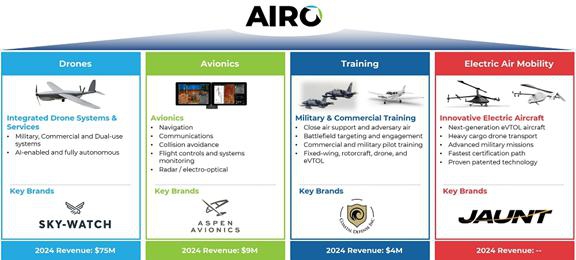
|
|
Drones. The Drones segment develops, manufactures, and sells drones and will provide drone services, such as DaaS, for military and commercial end users. Our military drones are sold through our Sky-Watch brand, which is a key supplier to European NATO countries. A critical point of differentiation lies in our drones’ ability to perform in a GPS-denied environment, which is a technology application relevant for both military and commercial end markets.
Avionics. The Avionics segment develops, manufactures, and sells avionics for military and general aviation aircraft, drones, and eVTOLs. Our advanced avionics products include flight displays, Connected Panels, and GPS/GNSS sensors, all of which have been installed on legacy military aircraft and general aviation platforms. We sell our advanced avionics through our Aspen Avionics brand, which is well-recognized in the general aviation aftermarket sector with over 20 years of operating history and long-term customer loyalty for our value proposition. We also serve as an avionics supplier for OEMs, including Robinson Helicopters, Pilatus, and Honeywell. We believe our avionics solutions have a considerable market opportunity as general aviation fleets continue to age, with owners and operators seeking to upgrade the avionics technology on their aircraft.
Training. The Training segment currently provides military pilot training and will provide commercial pilot training in the future. We offer professional training and consulting services to the U.S. military, select NATO countries, and other U.S. allies under our CDI brand. These offerings include adversary air, close air support, ISR, aircraft leasing, pilot training, ground liaison services, and JTAC, as well as full joint theatre ISR and simulated ground strike training. We work closely with special military forces such as SEAL teams, the U.S. Naval Air Warfare Center, and USAF Air Combat Command, and are a mandated recipient on a $5.7 billion IDIQ contract. Our personnel’s top security clearances and established relationships at the Pentagon provide us with a differentiated ability to bid on mandates. We also plan to offer commercial pilot training and plan to expand our non-military capabilities in response to the global pilot shortage.
Electric Air Mobility. The Electric Air Mobility segment is developing a rotorcraft eVTOL for cargo and passenger use through our Jaunt brand for fixed route flights, on-demand trips, and cargo operations. Our R&D efforts are focused on developing a cargo eVTOL platform, which will be a scaled-down version of our passenger eVTOL platform, and will target the attractive middle mile delivery cargo market. Meanwhile, our long-term R&D efforts are focused on developing a full-scale multi-role eVTOL platform, which will be able to serve both the cargo and passenger markets. We plan to certify our eVTOLs through existing CAR 529 Rotorcraft standards, with our platform including the best attributes of both rotary and fixed wing aircraft. Our patented compound rotorcraft technology, a core point of technological differentiation that will underpin our cargo eVTOL’s commercial capability, has over 300 piloted flight hours on multiple Jaunt demonstrator aircraft. We believe the range and payload capabilities driven by this technology uniquely position us to provide a compelling commercial solution for the eVTOL cargo market. Once developed and certified, we expect our cargo eVTOL program will serve as the foundation of our commercialization efforts, with passenger applications serving as a longer-term secondary initiative.
Initial Public Offering
On June 16, 2025, we completed the initial public offering of 6.9 million shares of our common stock (the “IPO”), which included an additional 0.9 million shares of common stock pursuant to the full exercise of the underwriters’ option to purchase additional shares, at an initial public offering price of $10.00 per share. Our common stock began trading on the Nasdaq Global Market under the ticker symbol “AIRO” on June 13, 2025. The net proceeds to AIRO from the IPO, after deducting $7.5 million of underwriting discounts and commissions, and issuance costs paid were $61.5 million.
Business Combination Agreement
On March 3, 2023, we entered into the Business Combination Agreement. On August 5, 2024, the Business Combination Agreement was terminated.
Business Combinations
We were formed in August 2021 for the purpose of acquiring and integrating various companies engaged in the aerospace and defense industry. During the year ended December 31, 2022, we completed our Put-Together Transaction to acquire six companies which are now organized into our four reportable segments, each with a diverse set of partners and customers: (i) Drones, through our subsidiaries, AIRO Drone and Sky-Watch; (ii) Avionics, through our subsidiary, Aspen Avionics; (iii) Training, through our subsidiaries, Agile Defense and CDI; and (iv) Electric Air Mobility, through our subsidiary, Jaunt.
|
|
We acquired Agile Defense on February 25, 2022, pursuant to the terms and conditions of an Agreement and Plan of Merger by and among Agile Defense, AIRO Group, Inc., n/k/a Old AGI, Inc., a Delaware corporation (“Legacy AIRO”), us, Agile Defense Merger Sub, LLC, and Joseph Burns as target representative, dated as of October 6, 2021, as amended, in exchange for consideration in the form of a promissory note in the amount of $2.3 million (the “Agile Defense Promissory Note”). The Agile Defense Promissory Note bears no interest and was originally payable within five business days following the commencement of public trading of our common stock. On October 2, 2023, the parties signed a promissory note termination agreement (the “Agile Defense Promissory Note Termination Agreement”) whereby six of the seven note holders agreed to convert $1.4 million of the principal owed to them under the Agile Defense Promissory Note into 34,360 shares of our common stock immediately prior to the closing of the BCA Transactions, with the remaining principal of $0.2 million owed to such holders to be paid at the closing of the BCA Transactions. Given that the BCA Transactions were not consummated, in connection with the closing of the IPO, we issued 34,360 shares of our common stock to partially satisfy our obligations pursuant to the Agile Defense Promissory Note Termination Agreement and used proceeds of $0.8 million from the IPO to satisfy our obligations to the remaining holder under the Agile Defense Promissory Note during the quarter ended June 30, 2025. In July 2025, we used proceeds of $0.2 million to satisfy the remaining obligations to the holders pursuant to the Agile Defense Promissory Note Termination Agreement.
We acquired AIRO Drone on February 25, 2022, pursuant to the terms and conditions of an Agreement and Plan of Merger by and among AIRO Drone, Legacy AIRO, us, AIRO Drone Merger Sub, LLC and Joseph Burns as target representative, dated as of October 6, 2021, as amended, in exchange for consideration in the form of a promissory note in the amount of $2.1 million (the “AIRO Drone Promissory Note”). The AIRO Drone Promissory Note bears no interest and was originally payable within five business days following the commencement of public trading of our common stock. On October 2, 2023, the parties signed a promissory note termination agreement (the “AIRO Drone Promissory Note Termination Agreement”) whereby nine of the ten note holders agreed to convert approximately $1.5 million of the principal owed to them under the AIRO Drone Promissory Note into 37,080 shares of our common stock immediately prior to the closing of the BCA Transactions, with the remaining principal of $0.2 million owed to such holders to be paid at the closing of the BCA Transactions. Given that the BCA Transactions were not consummated, in connection with the closing of the IPO, we issued 37,080 shares of our common stock to partially satisfy our obligations pursuant to the AIRO Drone Promissory Note Termination Agreement and used proceeds of $0.4 million from the IPO to satisfy our obligations to the remaining holder under the AIRO Drone Promissory Note and the other holders pursuant to the AIRO Drone Promissory Note Termination Agreement during the quarter ended June 30, 2025. In July 2025, we used proceeds of $0.2 million to satisfy the remaining obligations to the holders pursuant to the AIRO Drone Promissory Note Termination Agreement.
We acquired Jaunt on March 10, 2022, pursuant to the terms and conditions of an Agreement and Plan of Merger by and among Jaunt, Legacy AIRO, us, Jaunt Merger Sub, LLC and Martin Peryea as member representative, dated as of October 6, 2021, as amended, in exchange for consideration in the form of 3,143,001 shares of our common stock. As part of this acquisition, we acquired a contingent obligation originating from Jaunt’s acquisition of certain patents, licenses, and other intellectual property from Carter Aviation, a former member of Jaunt, in April 2019 (the “Jaunt Contingent Arrangement”). Under the Jaunt Contingent Arrangement, 10% of any cash receipt, including all income, receipts, proceeds, debt or equity investment, earnings, sales, or winnings, up to $50 million is payable to Carter Aviation. As of the acquisition date, $49.6 million in future payments remained on this obligation. The original terms of the Jaunt Contingent Arrangement provided that upon the completion of a business combination, the contingent consideration assumed from Jaunt would be replaced by promissory notes, the first of which would be for $23.0 million due one day after the closing of such business combination, and the second would be for the remaining portion of the contingent consideration and would be paid over three years subsequent to such closing. On October 27, 2023, we signed a satisfaction of indebtedness and satisfaction of covenant agreement (the “Jaunt Satisfaction of Indebtedness and Satisfaction of Covenant Agreement”), whereby the holder agreed to convert $44.6 million of the obligations owed to it as part of the Jaunt acquisition into 1,122,437 shares of our common stock immediately prior to the closing of the BCA Transactions, with the remaining portion of the contingent consideration of $5.0 million owed to such holders to be paid at the closing of the BCA Transactions. Given that the BCA Transactions were not consummated, in connection with the closing of the IPO, we issued 1,122,437 shares of our common stock to partially satisfy our obligations pursuant to the Jaunt Satisfaction of Indebtedness and Satisfaction of Covenant Agreement during the quarter ended June 30, 2025. In July 2025, we used proceeds of $3.9 million from the IPO to partially satisfy our obligations to the holders under the Jaunt Satisfaction of Indebtedness and Satisfaction of Covenant Agreement and signed an agreement to fund the remaining $1.1 million, subject to 10% per year in interest, on September 10, 2025.
|
|
We acquired Sky-Watch on March 28, 2022, pursuant to the terms and conditions of an Equity Purchase Agreement by and among Sky-Watch, Legacy AIRO, us, Dangroup ApS and Mekan I/S v/Per Pedersen & Claus Bo Jensen, dated as of October 6, 2021, as amended, in exchange for consideration in the form of a promissory note in the amount of $12.9 million (the “Sky-Watch Promissory Note”), 524,064 shares of our common stock and an earnout of up to $6.5 million based on performance commencing on the closing date of the acquisition through June 2024. The $6.5 million earnout was made up of $3 million that was payable on a dollar-for-dollar basis on revenue earned within the first two-year anniversary of the acquisition and $3.5 million would become due and payable if Sky-Watch earns a minimum of $13.8 million in revenue during the period from the acquisition date through June 2024. In December 2022, the Equity Purchase Agreement was amended to increase the second earnout amount from $3.5 million to $7.5 million and to extend the earnout period to include the full fiscal year periods of 2022 through 2024. In March 2023, the Equity Purchase Agreement was further amended to add a third earnout of $4.0 million if revenue during the full fiscal year periods of 2022 through 2024 reaches $17.0 million. In March 2024, the parties further amended the Equity Purchase Agreement, pursuant to which the former shareholders of Sky-Watch became eligible for an additional earnout of $1.0 million if Sky-Watch achieves earnings before interest, taxes, depreciation and amortization (“EBITDA”) of DKK 127,107,500 or above for fiscal year 2024. On June 28, 2024, the parties signed an amendment to the promissory notes (the “Sky-Watch Promissory Note Amendment”) whereby (i) the remaining principal of $5.7 million payable within five business days of the date that we or our successor closes one or more financing transactions with an aggregate value of at least $35.0 million and (ii) the remaining earnout liability is payable within five business days following the date that the we, or our successor, closes one or more financing transactions with an aggregate value of at least $45.0 million with interest continuing to accrue on the earned but unpaid earnout amounts at the federal discount rate plus 5.0%, compounded quarterly. In December 2024, we made a $13.9 million payment which resulted in a remaining balance of $3.1 million as of December 31, 2024. During the quarter ended June 30, 2025, we funded $2.3 million and funded the remaining $1.0 million related to the final earnout in July 2025.
We acquired Aspen Avionics on April 1, 2022, pursuant to the terms and conditions of an Agreement and Plan of Merger (the “Aspen Merger Agreement”) by and among Aspen, Legacy AIRO, us, Aspen Merger Sub, Inc. and John Uczekaj as target representative, dated as of October 6, 2021, as amended, in exchange for consideration in the form of 1,515,151 shares of our common stock. As part of this transaction, we agreed to assume $25.3 million of obligations, which primarily included $19.4 million related to the Aspen Notes, $2.9 million related to the Aspen Carveout Contingency and $1.9 million attributable to future allowable services or to be payable to the former Aspen Avionics shareholders at the closing of the IPO (“Aspen Contingent Debt”).
On October 6, 2023, we signed a satisfaction of indebtedness and satisfaction of covenant agreement (the “Aspen Satisfaction of Indebtedness and Satisfaction of Covenant Agreement”), whereby all of the holders agreed to convert various amounts due, which included $17.5 million under the Aspen Notes, $0.8 million related to the cash portion of Aspen Carveout Contingency, and $1.7 million attributable to the Aspen Contingent Debt into 440,584 shares, 43,512 shares and 20,010 shares, respectively, of our common stock immediately prior to the closing of the BCA Transactions, with the remaining amount of $2.2 million owed to such holders to be paid at the closing of the BCA Transactions. The 2021 Management Carveout Plan also provides for a $2.0 million Aspen Carveout Stock Obligation which equates to 51,309 shares that is also due at the closing of a business combination. Given that the BCA Transactions were not consummated, in connection with the closing of the IPO, we issued an aggregate of 484,096 shares of our common stock to partially satisfy our obligations to the holders under the Aspen Satisfaction of Indebtedness and Satisfaction of Covenant Agreement. During July 2025, we issued the 71,319 shares of our common stock based on the amended Satisfaction of Indebtedness and Satisfaction of Covenant Agreement dated June 30, 2025 and used proceeds of $0.1 million to satisfy our obligations to the participants in the Aspen Carveout Plan. During August 2025, we funded $1.5 million of the $1.9 million remaining balance of the Aspen Bridge Notes and signed an agreement to fund the remaining $0.2 million related to the Aspen Contingent Debt by October 1, 2025.
We acquired CDI on April 26, 2022, pursuant to the terms and conditions of an Agreement and Plan of Merger by and among CDI, Legacy AIRO, us, Coastal Merger Sub, Inc. and Jeffrey Parker as target representative, dated as of October 6, 2021, as amended, in exchange for consideration in the form of a promissory note in the amount of $10.1 million (the “CDI Promissory Note”) and 1,069,514 shares of our common stock. The CDI Promissory Note bears no interest and was originally payable within five business days following the commencement of public trading of our common stock. On October 17, 2023, the parties signed a promissory note termination agreement (the “CDI Promissory Note Termination Agreement”), as amended on March 7, 2025, whereby all of the holders agreed to convert $8.1 million of the principal owed to them under the CDI Promissory Note into 203,707 shares of our common stock immediately prior to the closing of an initial public offering, with the remaining principal of $2.0 million owed to such holders to be paid at the closing of an initial public offering. During the quarter ended June 30, 2025, we issued 203,707 shares and funded $2.0 million to fully satisfy our obligations to the holders of the CDI Promissory Note Termination Agreement.
Key Factors Affecting Our Performance
Our financial condition and results of operations have been, and will continue to be, affected by a number of factors, including the following.
|
|
Global Supply Chain
We are dependent on a global supply chain and in recent years have experienced supply chain disruptions that resulted in delays and increased costs which adversely affected our performance. These disruptions impacted our ability to procure raw materials, microelectronics, and certain commodities on a timely basis and/or at expected prices, and have been driven by supply chain market constraints and macroeconomic conditions, including inflation and labor market shortages. Current geopolitical conditions, including conflicts and other causes of strained intercountry relations, as well as sanctions and other trade restrictive activities, continue to contribute to these issues. Furthermore, our suppliers and subcontractors have been impacted by these same issues. We also experience periodic shortages of electronic and mechanical parts. Management continues to proactively manage the supply and transportation of parts during regular sales inventory and operations meetings. This proactive planning is an integral part of our normal operations and has allowed us to anticipate potential shortages and introduce redundancy along our supply chain. These mitigation efforts have not introduced new material risks related to product quality, reliability or regulatory approval of products. We continue to monitor the condition of our supply chain and evaluate our procurement strategy to reduce any negative impact on our business, financial condition, and results of operations. We have implemented actions and programs designed to mitigate the impacts of supply chain disruptions, but anticipate that we and others in our industry will continue to face such challenges for the foreseeable future. The supply chain disruptions discussed above did not materially impact our outlook, business goals, results of operations or capital resources during 2024 or the first six months of 2025.
Geopolitical Matters
We operate in a complex and evolving global security environment, and our business is affected by geopolitical and security issues. Conflicts, including the conflict between Russia and Ukraine, conflicts in the Middle East and heightened tension in the Pacific region, have elevated global security concerns resulting in increased interest for our products and services as countries seek to improve their security posture. In addition, security assistance provided by NATO and its allies to Ukraine has increased demand to replenish NATO stockpiles, resulting in additional and potential future orders, including for the ramp-up in production capacity for certain products. We continue to expect additional orders over the next several years attributable to the global threat environment.
Economic Environment
Our business and financial performance is also affected by elevated levels of inflation and interest rates. Certain costs, including rising labor rates and supplier costs, have increased as a result of inflation, and have adversely affected our margins on certain programs. Due to the nature of our government and commercial aerospace businesses, and their respective customer and supplier contracts, we are not always able to offset cost increases by increasing our contract value or pricing, in particular on our fixed-price contracts. Increasing material, component, and labor prices could subject us to losses in our fixed price contracts in the event of cost overruns. In addition, higher interest rates have increased the cost of borrowing and tightened the availability of capital. Among other things, these effects can affect our ability to acquire equipment and constrain our customers’ purchasing power and decrease orders for our products and services and impact the ability of our customers to make payments and of our suppliers to perform. Moreover, volatility in interest rates and financial markets can lead to economic uncertainty, an economic downturn or recession and impact the demand for our products and services as well as our supply chain.
|
|
U.S. Government’s Continuing Resolution
In March 2025, President Trump signed a continuing resolution that funds federal agencies through September 30, 2025. A continuing resolution authorizes federal agencies to operate generally at the same funding levels from the prior year, but typically does not authorize new spending initiatives during this period. If Congress is unable to enact formal fiscal year 2026 appropriation bills by September 30, 2025, it may pass another continuing resolution. However, if Congress fails to pass the formal appropriations bills or a continuing resolution, then the U.S. government would shut down during which federal agencies would cease all non-essential functions.
In the event of a U.S. government shutdown, our business, program performance and results of operations could be impacted by the resulting disruptions to federal government offices, workers, and operations, including risks relating to the funding of certain programs, stop work orders, as well as delays in contract awards, new program starts, payments for work performed, and other actions. We also may experience similar impacts in the event of an extended period of continuing resolutions. Generally, the significance of these impacts will primarily be based on the length of the continuing resolution or shutdown.
Development of the Electric Air Mobility Market
Our revenue will be tied to the continued development of short distance aerial transportation. While we believe the global market for electric air mobility will be large, it remains undeveloped and there is no guarantee of future demand. We anticipate receiving certification of our 33% downscaled cargo eVTOL under drone rules as early as 2027 and expect our first passenger production aircraft to be certified by the TCCA under existing CAR 529 Transport Category Rotorcraft airworthiness rules as early as 2031. Our business will require significant investment leading up to launching these services, including, but not limited to, final engineering designs, prototyping and testing, manufacturing, software development, certification, pilot training, infrastructure and commercialization. We benefit from supplier cost sharing, whereby our suppliers have agreed to defer their non-recurring engineering costs until commercialization, which has reduced our initial funding requirements prior to commercialization.
Key Components of Results of Operations
Revenue
Revenue consists primarily of product sales, fees for consulting services, licensing revenue, warranty sales and after sale services. A majority of our revenue is derived from the Drones segment. To date, our Electric Air Mobility segment has not generated material revenue.
Cost of Revenue
Cost of revenue includes direct labor (including salary, benefits and taxes), material costs and indirect production costs. Indirect production costs include indirect labor, purchasing, quality and manufacturing leadership, consumables, freight, charges for inventory reserves and amortization of intangible assets. We expect our cost of revenue to fluctuate based on a number of factors including, among others, availability and ability to obtain suitable aircraft, availability and cost of raw materials, such as lithium, and fluctuations in the labor market, in particular with respect to individuals who are highly skilled and specialized, such as pilots, and foreign currency exchange rates.
Operating Expenses
Research and Development
Research and development (“R&D”) expenses consist primarily of personnel expenses, including salaries, benefits, costs of consulting, equipment and materials, direct allocable overhead costs, including staff development cost, travel costs and technology costs, and amortization of intangible assets. We expect our R&D expenses to increase as we continue to invest in our infrastructure and technology and seek to develop new products and services.
|
|
Sales and Marketing
Sales and marketing expenses include salary, benefits and taxes, commissions, travel, costs of leased airplanes, advertising, trade shows and amortization of intangible assets. We expect our sales and marketing expenses to increase as we seek to build out our capabilities in these areas to acquire new customers.
General and Administrative
General and administrative expenses include costs of executive leadership, corporate governance, consulting fees, accounting and finance operations, travel, and support functions, including human resources and information technology. We expect our general and administrative expenses to increase as we incur additional costs associated with being a public company and certain terms of our consulting and incentive agreements become effective.
Goodwill Impairment
Goodwill represents the excess of the aggregate purchase price over the fair value of net identifiable assets acquired in a business combination. We manage our business primarily based upon four operating segments: (i) Drones, (ii) Avionics, (iii) Training and (iv) Electric Air Mobility, each of which represents a reportable segment. See “—Critical Accounting Policies and Estimates—Goodwill” for additional information.
Other Income (Expense)
Interest Expense, Net
Interest expense, net consists primarily of the interest expense from borrowings relating to revolving lines of credit with external banks and third-party notes, net of interest income earned on invested cash balances.
Gain on Debt Extinguishment, Net
Gain on debt extinguishment, net includes gains and losses on debt extinguishments.
Other Income (Expense), Net
Other income (expense), net includes changes in fair value on contingent consideration obligations and foreign currency exchange adjustments based on the terms of payments related an earnout obligation.
Income Tax (Expense) Benefit
Income tax (expense) benefit primarily consists of income taxes in certain foreign jurisdictions in which we conduct business.
Non-GAAP Financial Measures
To supplement our condensed consolidated financial statements prepared and presented in accordance with GAAP, we use EBITDA, Adjusted EBITDA and Adjusted EBITDA margin, as described below, to facilitate analysis of our financial and business trends and for internal planning and forecasting purposes.
We define (1) EBITDA as net income (loss) before interest expense, income tax expense or provision, depreciation and amortization, (2) Adjusted EBITDA as net income (loss) before interest expense, income tax expense or provision, depreciation and amortization, stock-based compensation, contingent consideration fair value adjustments and impairments, and (3) Adjusted EBITDA margin as Adjusted EBITDA divided by revenue. The above items are excluded from our Adjusted EBITDA measure because these items are either non-cash in nature, or because the amount and timing of these items is unpredictable, or because they are not driven by core results of operations, thereby rendering comparisons with prior periods and competitors less meaningful. We believe Adjusted EBITDA provides useful information to investors and others in understanding and evaluating our results of operations, as well as provides a useful measure for period-to-period comparisons of our business performance. Moreover, we have included Adjusted EBITDA in this Quarterly Report on Form 10-Q because it is a key measurement used by our management internally to make operating decisions, including those related to analyzing operating expenses, evaluating performance, and performing strategic planning and annual budgeting.
These non-GAAP financial measures should not be considered as alternatives to performance measures derived in accordance with GAAP. Our presentation of these non-GAAP financial measures should not be construed to imply that our future results will be unaffected by items that are excluded from these metrics. In addition, our definitions of these non-GAAP financial measures may be different from similarly titled non-GAAP measures used by other companies. These non-GAAP financial measures have limitations as an analytical tool, and you should not consider any of these non-GAAP financial measures in isolation or as a substitute for analysis of our results as reported under GAAP. Some of these limitations are that our non-GAAP financial measures:
| ● | do not reflect our interest expense, or the cash requirements necessary to service interest or principal payments, on our debt; |
|
|
| ● | exclude depreciation and amortization expense, and although these are non-cash expenses, the assets being depreciated may have to be replaced in the future, increasing our cash requirements; and | |
| ● | do not reflect provision for or benefit from income taxes that reduces cash available to us. |
Because of these limitations, we consider, and you should consider, the non-GAAP financial measures alongside other financial performance measures, including net income (loss) and our other GAAP results. A reconciliation of EBITDA and Adjusted EBITDA to net income (loss), and Adjusted EBITDA Margin to net income (loss) margin, the most directly comparable financial measures stated in accordance with GAAP, is provided below. Investors are encouraged to review the related GAAP financial measures and the reconciliation of the non-GAAP financial measure to their most directly comparable GAAP financial measure.
| Three Months Ended | Six Months Ended | |||||||||||||||
| (in thousands, except percentages) | June 30, 2025 | June 30, 2024 | June 30, 2025 | June 30, 2024 | ||||||||||||
| Net income (loss) | $ | 5,871 | $ | (5,600 | ) | $ | 3,898 | $ | (7,610 | ) | ||||||
| Depreciation and amortization | 2,988 | 3,108 | 6,126 | 6,344 | ||||||||||||
| Income tax expense | 2,057 | 439 | 2,344 | 1,429 | ||||||||||||
| Interest expense, net | 8,010 | 954 | 9,277 | 1,242 | ||||||||||||
| EBITDA | 18,926 | (1,099 | ) | 21,645 | 1,405 | |||||||||||
| Gain on extinguishment of debt | (15,559 | ) | - | (15,559 | ) | - | ||||||||||
| Stock-based compensation | 18,638 | 179 | 18,763 | 471 | ||||||||||||
| Contingent consideration fair value adjustments | (17,534 | ) | 1,500 | (20,272 | ) | 1,700 | ||||||||||
| Warrant fair value adjustment | (1,843 | ) | - | (1,843 | ) | - | ||||||||||
| IPO contingencies1 | 2,070 | - | 2,070 | - | ||||||||||||
| Adjusted EBITDA | $ | 4,698 | $ | 580 | $ | 4,804 | $ | 3,576 | ||||||||
| Net income (loss) margin | 23.9 | % | (57.3 | )% | 10.7 | % | (32.4 | )% | ||||||||
| Adjusted EBITDA Margin | 19.1 | % | 5.9 | % | 13.2 | % | 15.2 | % | ||||||||
1 IPO contingencies are made up of $1.0 million related to Kipps, $0.8 million related to the legal settlement, $0.5 million legal accrual, $0.2 million for NGA, $0.3 million bonus, $0.6 million Aspen contingent debt, $0.1 million cash portion of the Aspen carve-out, net of a $1.4 million gain on deferred compensation.
Results of Operations
Three and Six Months Ended June 30, 2025 and 2024
The following table shows our consolidated financial results for the three and six months ended June 30, 2025 and 2024:
|
Three Months Ended June 30, |
Period over period change | |||||||||||||||
| (in thousands) | 2025 | 2024 | ($) | (%) | ||||||||||||
| Revenue | $ | 24,550 | $ | 9,780 | $ | 14,770 | 151.0 | % | ||||||||
| Cost of revenue | 9,515 | 4,005 | 5,510 | 137.6 | % | |||||||||||
| Gross profit | 15,035 | 5,775 | 9,260 | 160.3 | % | |||||||||||
| Operating expenses: | ||||||||||||||||
| Research and development | 4,102 | 3,161 | 941 | 29.8 | % | |||||||||||
| Sales and marketing | 1,758 | 1,409 | 349 | 24.8 | % | |||||||||||
| General and administrative | 28,864 | 3,898 | 24,966 | 640.5 | % | |||||||||||
| Total operating expenses | 34,724 | 8,468 | 26,256 | 310.1 | % | |||||||||||
| Loss from operations | (19,689 | ) | (2,693 | ) | (16,996 | ) | (631.1 | )% | ||||||||
| Other income (expense): | ||||||||||||||||
| Interest expense, net | (8,010 | ) | (954 | ) | (7,056 | ) | (739.6 | )% | ||||||||
| Gain (loss) on extinguishment of debt | 15,559 |
- | 15,559 |
100 |
% | |||||||||||
| Other income (expense), net | 20,068 | (1,514 | ) | 21,582 | N.m. | |||||||||||
| Total other income (expense) | 27,617 | (2,468 | ) | 30,085 | N.m. |
|||||||||||
| Loss before income tax expense | 7,928 | (5,161 | ) | 13,089 | 253.6 | % | ||||||||||
| Income tax expense | (2,057 | ) | (439 | ) | (1,618 | ) | (368.6 | )% | ||||||||
| Net income (loss) | $ | 5,871 | $ | (5,600 | ) | $ | 11,471 | 204.8 | % | |||||||
| Six Months Ended June 30, | Period over period change | |||||||||||||||
| (in thousands) | 2025 | 2024 | ($) | (%) | ||||||||||||
| Revenue | $ | 36,345 | $ | 23,520 | $ | 12,825 | 54.5 | % | ||||||||
| Cost of revenue | 14,378 | 9,258 | 5,120 | 55.3 | % | |||||||||||
| Gross profit | 21,967 | 14,262 | 7,705 | 54.0 | % | |||||||||||
| Operating expenses: | ||||||||||||||||
| Research and development | 7,768 | 6,318 | 1,450 | 23.0 | % | |||||||||||
| Sales and marketing | 3,191 | 2,660 | 531 | 20.0 | % | |||||||||||
| General and administrative | 33,778 | 8,441 | 25,337 | 300.2 | % | |||||||||||
| Total operating expenses | 44,737 | 17,419 | 27,318 | 156.8 | % | |||||||||||
| Loss from operations | (22,770 | ) | (3,157 | ) | (19,613 | ) | (621.3 | )% | ||||||||
| Other income (expense): | ||||||||||||||||
| Interest expense, net | (9,277 | ) | (1,242 | ) | (8,035 | ) | (646.9 | )% | ||||||||
| Gain (loss) on extinguishment of debt | 15,559 |
- | 15,559 |
100 | % | |||||||||||
| Other income (expense), net | 22,730 | (1,782 | ) | 24,512 | N.m. | |||||||||||
| Total other income (expense) | 29,012 | (3,024 | ) | 32,036 | N.m. |
|||||||||||
| Income (loss) before income tax expense | 6,242 | (6,181 | ) | 12,423 | 201 | % | ||||||||||
| Income tax expense | (2,344 | ) | (1,429 | ) | (915 | ) | (64 | )% | ||||||||
| Net income (loss) | $ | 3,898 | $ | (7,610 | ) | $ | 11,508 | 151.2 | % | |||||||
N.m. – Not meaningful
|
|
Revenue
For the three months ended June 30, 2025 compared to 2024, the $14.8 million increase in revenue was due to a $15.0 million increase in the Drones segment and a $0.5 million increase in the Training segment offset by a $0.8 million decrease in the Avionics segment. For the six months ended June 30, 2025 compared to 2024, the $12.8 million increase in revenue was due to a $14.1 million increase in the Drones segment and a $0.3 million increase in the Training segment offset by a $1.5 million decrease in the Avionics segment. The increase in revenue in the Drones segment was due to the continued success of market entry strategies that target NATO member countries that have resulted in increased shipments. The increase in the Training segment was largely due to a specific government contract which occurs every two years that has higher profit margins as we provide training using ground target vehicles. The decrease in revenue in the Avionics segment reflects our strategic decision to delay investments in R&D and the commercialization of higher-margin products, particularly those targeting the general aviation and multi-engine aircraft markets, while prioritizing resources toward drone production. Training segment revenue continues to be impacted by our decision to defer aircraft acquisitions necessary to conduct certain programs as we focus capital on scaling our drone operations in response to growing market demand. We expect to resume investment in the Avionics and Training segments now that we have completed our initial public offering.
Cost of Revenue
For the three months ended June 30, 2025 compared to 2024, cost of revenue increased by $5.5 million primarily due to a $6.0 million and a $0.1 million increase in cost of revenue within the Drones and Training segment, respectively, offset by a decrease of $0.6 million within the Avionics segment. Gross margin was 61.2% during the three months ended June 30, 2025 compared to 59.0% during the same period in 2024. This 2.2% point increase in gross margin was primarily attributable to a 30.5% increase in the Training segment margin due to the higher profitability of the ground target vehicles contract and a 7.2% increase in the Avionics segment margin due to favorable operating variances. These increases were offset by an 8.7% decrease in the margin within the Drones segment primarily due to product discounting and the mix of products sold during the period.
For the six months ended June 30, 2025 compared to 2024, cost of revenue increased by $5.1 million primarily due to a $6.1 million and a $0.1 million increase in cost of revenue within the Drones and Training segment, respectively, offset by a decrease of $1.1 million within the Avionics segment. Gross margin remained relatively flat at approximately 60.4% and 60.6% during the six months ended June 30, 2025 and 2024, respectively, with the increases in margins within the Training and Avionics segment being partially offset by the decrease in the Drones segment margin as discussed above.
Operating Expenses
Research and Development
For the three months ended June 30, 2025 compared to 2024, R&D expense increased $0.9 million primarily due to a $1.1 million increase in personnel costs within the Drones segment with offsetting decreases in personnel costs within the Electric Air Mobility and Avionics segments. For the six months ended June 30, 2025 compared to 2024, R&D expense increased $1.5 million primarily due to a $1.7 million increase in personnel costs within the Drones segment with offsetting decreases in personnel costs within the Electric Air Mobility and Avionics segments.
Sales and Marketing
For the three months ended June 30, 2025 compared to 2024, sales and marketing expense increased $0.3 million primarily due to a $0.3 million increase in personnel costs within the Drones segment. For the six months ended June 30, 2025 compared to 2024, sales and marketing expense increased $0.5 million primarily due to a $0.5 million increase in personnel costs within the Drones segment.
General and Administrative
For the three months ended June 30, 2025 compared to 2024, general and administrative expense increased $25.0 million primarily due to a $13.3 million increase due to corporate costs which included $6.8 million of equity compensation, $0.5 million of bonus compensation, $1.0 million of advisory services and $1.3 million of legal settlement accruals, all of which were contingent upon the IPO, $2.0 million increase in incentive and consulting fees at the corporate level related to the expansion of the Drones segment and $1.7 million of other corporate costs. There was also a $10.1 million increase within the Training segment that was primarily attributable to equity compensation, a $1.6 million increase within the Avionics segment that was primarily attributable to equity compensation, and a $0.4 million increase within the Drones segment, partially offset by a $0.4 million decrease within the Electric Air Mobility segment.
For the six months ended June 30, 2025 compared to 2024, general and administrative expense increased $25.3 million primarily due to a $13.1 million increase due to corporate costs which included $6.8 million of equity compensation, $0.5 million of bonus compensation, $1.0 million of advisory services and $1.3 million of legal settlement accruals, all of which were contingent upon the IPO, $2.6 million increase in incentive and consulting fees at the corporate level related to the expansion of the Drones segment and $0.9 million of other corporate costs. There was also a $1.5 million increase within the Drones segment, a $10.0 million increase within the Training segment, and a $1.5 million increase within the Avionics segment partially offset by a $0.8 million decrease within the Electric Air Mobility segment. Increases within the Drones segment were primarily due to a $1.5 million increase in personnel and other costs. Increases within the Avionics segment and Training segment were primarily attributable to equity compensation. The $0.8 million decrease within the Electric Air Mobility segment was due to cost reduction initiatives in the business.
Interest Expense, Net
For the three months ended June 30, 2025 and 2024, we had interest expense, net, of $8.0 million and $1.0 million, respectively. For the six months ended June 30, 2025 and 2024, we had interest expense, net, of $9.3 million and $1.2 million, respectively. The 2025 interest was primarily attributable to the interest paid in shares on the investor notes which totaled $6.7 million and additional interest paid on borrowings with WebBank and Libertas. The 2024 interest was primarily attributable to interest accrued on investor notes.
|
|
Gain on extinguishment of debt, net
For the three months and six months ended June 30, 2025, we had a gain on debt extinguishment, net of $15.6 million which was the result of the partial settlement in equity of the Aspen bridge notes which resulted in a $13.1 million gain and a $5.7 million gain on settlement of certain investor notes at fair value, partially offset by losses on debt extinguishment of a combined $3.2 million for WebBank and Libertas.
Other Income (Expense), Net
For the three months ended June 30, 2025 compared to 2024, we had $20.1 million of other income, primarily due to $17.5 million of income from fair value adjustments on contingent consideration that was resolved in conjunction with the IPO and $1.8 million of income from a fair value adjustment on the Libertas warrants, net of a $0.6 million contingency recorded related to the Aspen contingent debt as compared to $1.5 million of other expense during the three months ended June 30, 2024, which was primarily due to the increase in the fair value of the Jaunt Contingent Arrangement.
For the six months ended June 30, 2025 compared to 2024, we had $22.7 million of other income, primarily due to $20.3 million of income from fair value adjustments on contingent consideration, $1.8 million of income from a fair value adjustment on the Libertas warrants, net of a $0.6 million contingency recorded related to the Aspen contingent debt as compared to $1.8 million of other expense during the six months ended June 30, 2024, which was primarily due to the increase in the fair value of the Jaunt Contingent Arrangement.
Income Tax Expense
For the three months ended June 30, 2025 and 2024, our income tax expense was $2.1 million and $0.4 million, respectively. For the six months ended June 30, 2025 and 2024, our income tax expense was $2.3 million and $1.4 million, respectively. Tax expense for both periods was primarily attributable to Sky-Watch generating positive pre-tax income.
Liquidity and Capital Resources
As of June 30, 2025, we had cash and restricted cash of $40.5 million, of which $0.2 million was either restricted or was designated exclusively for Sky-Watch operations, and working capital of $12.6 million.
Based on its current operating plan and available liquidity, management believes that the Company has sufficient cash and resources to meet its obligations and continue its operations for at least the next 12 months from the date of issuance of the financial statements.
The Company is opportunistically pursuing additional capital through equity or debt financing to support growth initiatives. Management believes the Company’s current liquidity is sufficient to fund ongoing operations for at least the next twelve months. Any additional capital, if raised, would be directed toward expanding the Company’s market position, pursuing strategic opportunities, and supporting revenue growth and long-term profitability.
|
|
Investor Notes
As of June 30, 2025, we had third party obligations of $3.0 million of Investor Notes as described within Note 2 to our unaudited condensed consolidated financial statements, of which $0.2 million was repaid in July of 2025 and the remaining $2.8 million is due 190 days from the IPO; $3.8 million of Investor Notes as described in Note 12 to our unaudited condensed consolidated financial statements which are due 190 days from the IPO; and $3.8 million of Investor Notes which we have elected to record using the fair value election as further described in Note 2 to our unaudited condensed consolidated financial statements. During July 2025, we repaid $2.1 million of the Investor notes at fair value and amended the remaining Investor Notes such that the remaining $1.8 million, inclusive of a $0.1 million extension fee, is due December 16, 2025. During the quarter ended June 30, 2025, we issued 1.1 million shares related to the Investor Notes and paid $0.6 million out of IPO proceeds.
Dangroup Incentive Agreement
In June 2024, we entered the Dangroup Incentive Agreement with Dangroup, whereby we agreed to pay Dangroup 20% of Sky-Watch’s EBITDA as an incentive bonus for their continued involvement in Sky-Watch’s governance, management and/or other operations, commencing on January 1, 2025 for an initial term of five years, which shall renew upon mutual agreement of the parties. In December 2024, we amended the Dangroup Incentive Agreement, whereby we agreed to transfer to Dangroup shares of our common stock immediately prior to the completion of the IPO such that Dangroup’s ownership would be increased to 5% of our capital stock on a fully diluted basis. During the three months ended June 30, 2025, we issued 0.5 million shares to Dangroup in satisfaction of this agreement.
Cash Flows
The following summarizes our cash flows for the periods indicated:
|
Six Months Ended June 30, |
||||||||
| (in thousands) | 2025 | 2024 | ||||||
| Net cash used in operating activities | $ | (30,755 | ) | (7,829 | ) | |||
| Net cash used in investing activities | (1,067 | ) | (454 | ) | ||||
| Net cash provided by financing activities | 49,614 | 746 | ||||||
Net Cash Used in Operating Activities
Net cash used in operations for the six months ended June 30, 2025 totaled $30.8 million, and was primarily due to net income of $3.9 million and positive non-cash adjustments including stock-based compensation, non-cash interest, legal settlement, and depreciation and amortization, offset by negative non-cash adjustments of gains of IPO transactions, debt extinguishment and fair value adjustments of contingent consideration and warrant liability and working capital adjustments, primarily consisting of the changes in accounts receivable, accounts payable, accrued expenses and other long-term liabilities and deferred revenue. Net cash used in operations for the six months ended June 30, 2024 totaled $7.8 million which was due to a net loss of $7.6 million and a change in working capital adjustments, primarily the change in deferred revenue, which was partially offset primarily by a positive non-cash adjustment of depreciation and amortization.
Net Cash Used in Investing Activities
Cash of $1.0 million and $0.5 million was used in investing activities during the six months ended June 30, 2025 and 2024, respectively, to purchase property and equipment and intangible assets.
Net Cash Provided by Financing Activities
Net cash provided by financing activities during the six months ended June 30, 2025 was $49.6 million primarily due to $61.5 million of proceeds from the IPO net of issuance costs, $8.5 million of proceeds from the Libertas warrants and WebBank loans that were partially offset by $14.8 million of debt repayments on borrowings and related borrowings, $3.3 million of contingent consideration payments and $2.2 million in payments due to seller. Net cash provided by financing activities during the six months ended June 30, 2024 of $0.7 million was primarily due to $2.5 million proceeds from Investor Notes offset by repayments on borrowings and amounts paid to seller.
Critical Accounting Policies and Estimates
Our condensed consolidated financial statements are prepared in accordance with accounting principles generally accepted in the United States. The preparation of these condensed consolidated financial statements requires us to make estimates and assumptions that affect the reported amounts of assets, liabilities, revenue, costs and expenses, and related disclosures. On an ongoing basis, we evaluate our estimates and assumptions. Our actual results may differ from these estimates under different assumptions or conditions. We believe that of our significant accounting policies, which are described in Note 1 “The Company and Summary of Significant Accounting Policies” to our condensed consolidated financial statements included elsewhere in this Quarterly Report on Form 10-Q, the following accounting policies and specific estimates involve a greater degree of judgment and complexity. Accordingly, these are the policies and estimates we believe are the most critical to aid in fully understanding and evaluating our consolidated financial condition and results of operations:
| ● | the standalone selling price (“SSP”) of performance obligations for revenue contracts with multiple performance obligations; | |
| ● | the fair value of assets acquired and liabilities assumed for business combinations; | |
| ● | goodwill impairment; | |
| ● | impairment of indefinite lived and long-lived assets; | |
| ● | valuation of debt; |
|
|
| ● | stock-based compensation; | |
| ● | inventory valuation; and | |
| ● | the recognition, measurement and valuation of current and deferred income taxes and uncertain tax positions. |
As described more fully below, these estimates bear the risk of change due to the inherent uncertainty of the estimate. We base our estimates and judgments on historical experience, industry benchmarking information, and on various other factors that we believe to be reasonable under the circumstances, the results of which form the basis for making judgments about the carrying values of assets and liabilities that are not readily apparent from other sources.
These estimates may change, as new events occur and additional information is obtained, and such changes will be recognized in the condensed consolidated financial statements as soon as they become known. Actual results could differ from these estimates and any such differences may be material to our condensed consolidated financial statements.
Revenue Recognition
We recognize revenue when, or as, we satisfy performance obligations by transferring promised products or services to our customers in an amount that reflects the consideration we expect to receive. We apply the following five steps: (i) identify the contract with a customer, (ii) identify the performance obligations in the contract, (iii) determine the transaction price, (iv) allocate the transaction price to the performance obligations in the contract, and (v) recognize revenue when a performance obligation is satisfied. We account for a contract with a customer when there is a legally enforceable contract, the rights of the parties are identified, the contract has commercial terms, and collectability of the contract consideration is probable.
For certain sales, we have contracts with customers that include multiple performance obligations. For these contracts, we account for individual performance obligations separately, by allocating the contract’s total transaction price to each performance obligation in an amount based on the relative SSP of each distinct good or service in the contract. We determine the SSP based on our overall pricing objectives, taking into consideration market conditions. Determining whether products or services are considered distinct performance obligations that should be accounted for separately versus together may require significant judgment. A contract’s transaction price is allocated to each distinct performance obligation and recognized as revenue when, or as, the performance obligation is satisfied. Revenue is recognized when control of the promised services is transferred to the customer in an amount that reflects the consideration we expect to be entitled to receive in exchange for those services. Our contracts do not include highly variable components. The timing of revenue recognition, billings, and cash collections can result in billed accounts receivable, unbilled receivables (contract assets), and deferred revenue (contract liabilities). The costs to obtain contracts, primarily commission expenses, are expensed when incurred.
Amounts that are invoiced are recorded in accounts receivable and revenue or deferred revenue, depending on whether the revenue recognition criteria have been met. A large portion of our sales result in partial prepayments prior to shipment from customers. Otherwise, customer invoices generally have payment terms of net 30 days and do not have a significant financing component.
Our revenue is derived from various sources: (i) avionics products consisting primarily of hardware with embedded firmware sold to an authorized dealer network and avionics and GNSS products sold to OEMs, (ii) R&D projects, (iii) sales-based royalties related to GNSS technology licensed to OEMs, (iv) consultation and training services related to aerial integration and close air support providing the latest tactics, technique, and procedures to incorporate contract close air support/intelligence surveillance reconnaissance with video downlink systems into tactical operations, (v) technology and equipment sales (vi) mUAS, commonly referred to as “commercial drones,” sales, including hardware, software, training, support and product service, and (vii) drone services, including surveys, imaging, security, and other drone applications.
Business Combinations
We account for acquired businesses using the purchase method of accounting. Under the purchase method, our condensed consolidated financial statements include the financial results of an acquired business starting from the date the acquisition is completed. In addition, the assets acquired, liabilities assumed, and any contingent consideration must be recorded at the date of acquisition at their respective estimated fair values, with any excess of the purchase price over the estimated fair values of the net assets acquired recorded as goodwill. Significant judgment is required in estimating the fair value of contingent consideration and intangible assets and in assigning their respective useful lives. Accordingly, we typically obtain the assistance of third-party valuation specialists for significant acquisitions. The fair value estimates are based on available historical information and on future expectations and assumptions deemed reasonable by management but are inherently uncertain.
|
|
We use a discounted cash flow analysis given probability and estimated timing of payout to determine the fair value of contingent consideration on the date of acquisition. Significant changes in the discount rate used could affect the accuracy of the fair value calculation. Contingent consideration is adjusted based on experience in subsequent periods and the impact of changes related to assumptions are recorded in operating expenses as incurred.
We typically use an income method to estimate the fair value of intangible assets, which is based on forecasts of the expected future cash flows attributable to the respective assets. Significant estimates and assumptions inherent in the valuations reflect a consideration of other marketplace participants and include the amount and timing of future cash flows (including expected growth rates and profitability), the underlying product or technology life cycles, the economic barriers to entry, and the discount rate applied to the cash flows. Unanticipated market or macroeconomic events and circumstances may result in a triggering event for which we would test for impairment.
Goodwill
Goodwill represents the excess of the aggregate purchase price over the fair value of net identifiable assets acquired in a business combination. We manage our business primarily based upon four operating segments: (i) Drones, (ii) Avionics, (iii) Training and (iv) Electric Air Mobility, each of which represents a reportable segment. We have determined that each reportable segment represents a reporting unit and, in accordance with ASC 350, each reporting unit requires an allocation of goodwill. We will continue to reevaluate reportable and operating segments.
Goodwill is not amortized and is tested at the reporting unit level for impairment on an annual basis or whenever events or changes in circumstances indicate that the carrying value may not be recoverable. We have selected October 1st as the date to perform our annual impairment test. In the valuation of goodwill, management must make assumptions regarding estimated future cash flows to be derived from our business. If these estimates or their related assumptions change in the future, we may be required to record an impairment for these assets. Management may first evaluate qualitative factors to assess if it is more likely than not that the fair value of a reporting unit is less than its carrying amount and to determine if an impairment test is necessary. Management may choose to proceed directly to the evaluation, bypassing the initial qualitative assessment. The impairment test involves comparing the fair value of the reporting unit to which goodwill is allocated to its net book value, including goodwill. A goodwill impairment loss would be the amount by which a reporting unit’s carrying value exceeds its fair value, however, the loss recognized should not exceed the total amount of goodwill allocated to that reporting unit. No goodwill impairment charges were recorded for the three or six months ended June 30, 2025 and 2024.
2024 Impairment Test
As a result of the termination of our Business Combination Agreement and related transactions (the “BCA Transactions”) in August 2024 and the continued delays in securing financing, we determined it appropriate to test the fair value of each reporting unit for goodwill impairment as of September 30, 2024 for all of our reporting units except Avionics as no goodwill had been allocated to this reporting unit. We determined that the fair value of the Drones reporting unit substantially exceeded its respective carrying value. The Electric Air Mobility and Training reporting unit fair values indicated goodwill impairment as detailed below.
| Drones | Electric AirMobility | Training | |||||||
| Goodwill carrying value as of September 30, 2024 | $ | 115.8 million | $ | 451.4 million | $ | 36.5 million | |||
| Fair value of reporting unit as of September 30, 2024 | $ | 185.1 million | $ | 510.2 million | $ | 25.1 million | |||
| Carrying value of reporting unit as of September 30, 2024 | $ | 133.5 million | $ | 527.2 million | $ | 46.1 million | |||
| Impairment as of September 30, 2024 | $ | — | $ | 17.0 million | $ | 21.0 million |
Estimates and assumptions varied between each reporting unit depending on the facts and circumstances specific to that reporting unit. The discount rate for each reporting unit is influenced by general market conditions as well as factors specific to the reporting unit. The fair value of the reporting units for which we performed quantitative impairment tests was estimated using an income approach, which incorporates the use of the discounted cash flow method. Projections used require the use of significant estimates and assumptions specific to the reporting unit as well as those based on general economic conditions. Factors specific to each reporting unit include revenue growth, profit margins, terminal value growth rates, capital expenditures projections, assumed tax rates, discount rates and other assumptions deemed reasonable by management. For the 2024 impairment test, the WACC discount rates we used for our reporting units was 30%-35% and the terminal value growth rate was 4%. The terminal value growth rate represents the expected long-term growth rate for our industry, which incorporates the type of services each reporting unit provides as well as the global economy. Other factors influencing the revenue growth rates include the nature of the services the reporting unit provides for its clients, the geographic locations in which the reporting unit conducts business and the maturity of the reporting unit.
Specific to the Electric Air Mobility segment’s projections as of September 30, 2024, projected revenue was revised to include projected aircraft production timing for the Jaunt Journey in 2031 as compared to a previous estimate of 2028 and further incorporated production of a cargo UAV (a smaller cargo derivative of the Jaunt Journey) in 2027. Projected revenue in years 1 and 2 of commercialization of the cargo UAV as of September 30, 2024 were added to our September 30, 2024 projections based on an estimated assumed selling price and expected production levels of approximately 240 units over the two-year period. Projected revenue in years 1 and 2 of commercialization (i.e., 2028 and 2029) of the Jaunt Journey as of October 1, 2023 was based on a sales price that was in line with the negotiated pricing contained in our non-binding letters of intent and projected volume of 630 units over the same two-year period. Following the revision of the estimated commercialization date to 2031, the escalation rate utilized in our original projections continued to be consistently applied. Accordingly, such escalation rate was applied to the original estimated selling price in 2028 for a period of three additional years (i.e., 2028 to 2031). As a result, the sales price in the revised estimated first year of commercialization (2031) increased compared to prior projections. Revenue projections for both programs were based on increasing production quantities year-over-year that max out at approximately 400 units per year for the cargo UAV and 3,000 units per year for the Jaunt Journey at a single production facility, and a per-unit sales price that increases over time assuming a 1.5% escalation rate. The foregoing escalation rate and production volume of the Jaunt Journey remained consistent with prior year projections.
|
|
EBITDA projections as of September 30, 2024 and October 1, 2023 were developed using estimates of manufacturing costs, production hours per unit, learning curves and subsequent efficiencies, and operating costs. While mid-term and long-term EBITDA projections at maximum capacity have not significantly changed compared to our prior year testing date of October 1, 2023, the impact of delaying the projected cash flows from the Jaunt Journey as a result of a later expected commercialization date resulted in a decrease in the fair value of the Electric Air Mobility segment, which indicated impairment. Projected EBITDA as of October 1, 2023 gave effect to net research and development costs expected to be incurred between 2024 and 2027 leading up to the commercialization of the Jaunt Journey aircraft and assumed positive EBITDA during the two years following commercialization. Projected EBITDA as of September 30, 2024 gave effect to net research and development costs expected to be incurred (i) between 2025 and 2028 leading up to the commercialization of the cargo UAV and (ii) between 2029 and 2031 leading up to the commercialization of the Jaunt Journey and assumed positive EBITDA during the two years following commercialization. Mid-term and long-term EBITDA margin projections at full rate production were reduced slightly (1-2%) compared to our prior year testing date of October 1, 2023.
EBITDA projections as of September 30, 2024 were also revised to incorporate estimates of manufacturing costs of the cargo UAV, which reduced mid-term and long-term gross margins by approximately 2% at full rate production, as well as estimated efficiencies, which resulted in reduced operating expenses slightly (0.5%-1%) as a percentage of revenue as compared to the October 1, 2023 projections.
While the timing of projected cash flows from the Jaunt Journey has been delayed and as operations now include a plan to produce a cargo UAV, profitability of the Electric Air Mobility segment post-commercialization of the Jaunt Journey has always been part of our projections. We anticipate profitability in the Electric Air Mobility segment commencing in year two following commercialization of the cargo UAV. As to the degree of uncertainty associated with our assumptions, we believe our long-term projected revenue is reasonable given a sales price supported by non-binding letters of intent and a relatively small number of units in comparison to, according to the Morgan Stanley Report, an anticipated global market ranging between an expected $1 trillion and with an upside $4.4 trillion by 2040. There is a higher degree of uncertainty in projected EBITDA, as compared to projected revenue as projected EBITDA includes estimates as to future labor and material costs, efficiency rates as to the number of production hours required over time, and synergies.
The most sensitive factor in our analysis was the WACC discount rate. As of September 30, 2024, a 33% WACC discount rate was applied to the Electric Air Mobility segment, which is fairly consistent with the 35% WACC discount rate used as of our prior year testing date of October 1, 2023. The 200 basis-point decrease from prior year was deemed appropriate due to more conservative projected long term EBITDA margins as compared to sales in the prior year, regulatory harmonization that has occurred for the industry between the FAA, TCCA, and EASA, advances in electric propulsion, battery density, and autonomous systems which lower remaining technical development risk. While these factors reduce risk to the Electric Air Mobility segment, a larger decrease in the WACC was not deemed appropriate due to delays in funding for development efforts and overall implementation risk that remains similar to October 1, 2023. As to the sensitivity of the WACC rate, another hypothetical 100 basis-point increase in the WACC discount rate would have yielded an additional $46.0 million in goodwill impairment.
We believe the factors considered in the impairment analysis are reasonable; however, significant changes in any one of our assumptions could produce a different result and result in additional impairment charges that could be material to our condensed consolidated financial statements. For example, the fair value of the Electric Air Mobility segment could be adversely affected and may result in an additional impairment of goodwill if this reporting unit is not able to advance the development of our aircraft and other products, obtain regulatory approvals, and launch and commercialize our products at scale, if the estimated production costs are significantly higher than estimated or if the WACC discount rate is increased.
Specific to the Training segment’s projections as of September 30, 2024, we noted a significant decrease in sales and gross margins as a result of not being able to meet contractual demands due to delays in the funding of aircraft. In prior years, government ISR aircraft contracts did not require that the aircraft be able to employ weapons. As those contracts have aged-out, the new requirements for the re-competitions require assets that have the ability to employ training munitions and have been approved by the government to do so. CDI does not possess aircraft that can achieve this requirement; thus, we have either not been awarded or chose not to bid on certain contracts. The projected revenue and margins were revised to include the timing of projected aircraft and investments to be made in flight schools in the short-term (between 2025 and 2028) and then the acquisition of additional aircraft beginning in years after 2029.
EBITDA projections as of September 30, 2024 have not significantly changed compared to our prior year testing date of October 1, 2023, and we do not anticipate any changes until we are able to make more significant investments in aircraft, and at which time we can better leverage our operating expenses. At that point, we anticipate that mid-term and long-term EBITDA margins would increase. The shifting and corresponding discounting of these projections resulted in a significant decrease in the fair value of the Training segment, which indicated impairment.
As to the degree of uncertainty associated with our assumptions, we believe our short-term projected revenue is reasonable given our history with military contract practices and the historical results of flight schools, while our long-term projected revenue is subject to a higher degree of uncertainty. To mitigate this risk, a 30% WACC discount rate was applied to these projections which was consistent with our prior year testing date of October 1, 2023. As to the sensitivity of the WACC rate, another hypothetical 100-basis-point increase in the WACC discount rate would have yielded an additional $3.4 million in goodwill impairment.
We believe the factors considered in the impairment analysis are reasonable; however, significant changes in any one of our assumptions could produce a different result and result in additional impairment charges that could be material to our condensed consolidated financial statements. For example, the fair value of the Training segment could be adversely affected and may result in an additional impairment of goodwill if this reporting unit is not able to purchase the needed aircraft, if the estimated costs for managing the flight schools are significantly higher than estimated or if the WACC discount rate is increased.
|
|
Intangible Assets
We perform valuations of assets acquired and liabilities assumed on each acquisition accounted for as a business combination and allocates the purchase price of the acquired business to the respective net tangible and intangible assets. We determine the appropriate useful life by performing an analysis of expected cash flows based on historical experience of the acquired businesses. Intangible assets are amortized over their estimated useful lives using the straight-line method which approximates the pattern in which the economic benefits are consumed. We capitalize third-party legal costs and filing fees, if any, associated with obtaining patents. Once the patent asset has been placed in service, we amortize these costs over the shorter of the asset’s legal life, generally 20 years from the initial filing date, or its estimated economic life using the straight-line method.
The estimated useful lives for our intangible assets are as follows:
| Estimated useful life | ||
| Developed technology | 8 to 13 years | |
| Tradenames – definite-lived | 4 to 8 years | |
| Customer relationships | 3 to 7 years | |
| Patents | up to 20 years |
In addition to the long-lived intangible assets, we also had $8.8 million of indefinite lived intangible assets which is primarily the $8.7 million tradename obtained in conjunction with the Jaunt acquisition.
Impairment of Indefinite Lived Assets
Under ASC 350-30-35-18, an intangible asset that is not subject to amortization shall be tested for impairment annually and more frequently if events or changes in circumstances indicate that it is more likely than not that the asset is impaired. In testing for impairment, we define our Asset Groups at the reporting unit level. Under ASC 360-10-35-26 when an asset group is a reporting unit, the asset group includes goodwill. When goodwill and indefinite lived intangibles are included in the long-lived asset group being tested for impairment, the indefinite-lived intangible assets are tested for impairment in accordance with ASC 350-30 first, then the long-lived assets (groups) are tested for impairment in accordance with ASC 360-10, and goodwill is tested for impairment at the reporting unit level in accordance with ASC 350-20 last.
ASC 350-30-35-18A specifies that an entity may first perform a qualitative assessment, as described in this paragraph and paragraphs 350-30-35-18B through 35-18F, to determine whether it is necessary to perform the quantitative impairment test.
As a result of the termination of our Business Combination Agreement in August 2024 and the continued delays in financing, we determined it appropriate to perform a qualitative assessment considering factors listed in ASC 350, which includes cost factors, financial performance, legal, regulatory, contractual, political, business, or other factors. Based on our review of these factors, there was no indication of impairment for the Avionics or Drones segments. However, we determined it appropriate to perform a quantitative analysis on intangible and long-lived assets within the Electric Air Mobility and Training segments. The fair value of the undiscounted cashflows of both the Electric Air Mobility and Training segments was significantly higher than the respective asset group’s carrying value and therefore no impairment charges were required to be recorded for the year ended December 31, 2024.
No impairment charges were recorded during the three or six months ended June 30, 2025 or 2024.
Impairment of Long-Lived Assets
We evaluate long-lived assets, including property and equipment and intangible assets, for impairment in accordance with ASC 360 whenever events or changes in circumstances indicate that the carrying amount of an asset may not be recoverable. Recoverability of assets held and used is measured by a comparison of the carrying amount of an asset or an asset group to estimated undiscounted future net cash flows expected to be generated by the asset or asset group. If such evaluation indicates that the carrying amount of the asset or the asset group is not recoverable, any impairment loss would be equal to the amount the carrying value exceeds the fair value.
|
|
As a result of the termination of our Business Combination Agreement in August 2024 and the continued delays in financing, we determined it was appropriate to perform a qualitative assessment considering factors listed in ASC 350 Intangibles—Goodwill and Other (“ASC 350”) which includes cost factors, financial performance, legal, regulatory, contractual, political, business, or other factors. Based on our review of these factors, there was no indication of impairment for the Avionics or Drones segments. However, we determined it was appropriate to perform a quantitative analysis on intangible and long-lived assets within the Electric Air Mobility and Training segments. The fair value of the undiscounted cashflows of both the Electric Air Mobility and Training segments was significantly higher than the respective asset group’s carrying value and therefore no impairment charges were required to be recorded in 2024.
No impairment charges were recorded during the three or six months ended June 30, 2025 or 2024.
Valuation of Debt
During 2024, certain Investor Notes were amended which resulted in significant modifications of debt. In accordance with ASC 470-50, as this significant modification was considered an extinguishment and created an election date for the fair value option and as the fair value election is applied on an instrument-by-instrument basis, we chose to record these Investor Notes at fair value beginning on the modification date in October 2024. Investor Notes have historically included various interest features in the form of both stock and cash upon the closing of an initial public offering or qualified financing. In conjunction with the IPO, common stock was issued to partially settle the Investor Notes at fair value. As of June 30, 2025, the valuation of the Investor Notes was limited to unpaid cash amounts.
Inventory Valuation
We write down our inventory for estimated obsolescence or unmarketable inventory equal to the difference between the cost of inventory and the estimated net realizable value based upon assumptions about future demand and market conditions. Reductions to the carrying value of inventory are charged to cost of revenue and a new, lower cost basis for that inventory is established. Subsequent changes to facts or circumstances do not result in the restoration or increase in the related inventory value. If actual market conditions are less favorable than those projected by management, additional inventory write-downs may be required.
Stock-based Compensation
We recognize compensation expense for stock-based awards based on the grant-date estimated fair value of the awards. Options and restricted stock awards may be granted as time-based awards, performance-based awards or combinations of the time-based and performance-based awards. We expense the fair value of our options to employees and non-employees on a straight-line basis over the associated service period for time-based awards, which is generally the vesting period. The performance-based awards begin their period of ratable vesting at the time that we determine that the achievement of the performance thresholds is probable. We account for forfeitures as they occur and does not estimate forfeitures at the time of grant. Ultimately, the actual expense recognized over the vesting period will be for only those options that vest.
Income Taxes
We account for income taxes in accordance with the asset and liability approach method. Deferred tax assets and liabilities are recognized for future tax consequences attributable to temporary differences between the condensed consolidated financial statements carrying amounts of existing assets and liabilities and their respective tax bases, as well as for net operating losses and tax credit carryforwards. Deferred tax amounts are determined by using the enacted tax rates expected to be in effect when the temporary differences are expected to be recovered or settled. The effect on deferred tax assets and liabilities of a change in tax rates is recognized in income in the period that includes the enactment date. A valuation allowance reduces the deferred tax assets to the amount that is more-likely-than-not to be realized.
We evaluate our tax positions taken or expected to be taken in the course of preparing our tax returns to determine whether the tax positions will more-likely-than-not be sustained by the applicable tax authority. Tax positions not deemed to meet the more-likely-than-not threshold are not recorded as a tax benefit or expense in the current year. Interest and penalties, if applicable, are recorded in the period assessed as income tax expense.
Off-Balance Sheet Arrangements
As of June 30, 2025 and December 31, 2024, we have not entered into any off-balance sheet financing arrangements, established any special purpose entities, guaranteed any debt or commitments of other entities, or purchased any non-financial assets. We do not participate in transactions that create relationships with unconsolidated entities or financial partnerships, often referred to as variable interest entities, which would have been established for the purpose of facilitating off-balance sheet arrangements.
|
|
Item 3. Quantitative and Qualitative Disclosures About Market Risk
In the ordinary course of business, we are exposed to various market risk factors, including fluctuations in interest rates, changes in general economic conditions, domestic and foreign competition, and foreign currency exchange rates.
Foreign Currency Exchange Rate Risk
In addition to our U.S. operations, we also have international operations in Canada and Denmark, sell our products and services to international dealers and customers, including foreign governments and engage in sales and marketing efforts in many foreign jurisdictions. In international sales, we face substantial competition from both U.S. manufacturers and international manufacturers whose governments sometimes provide R&D assistance, marketing subsidies and other assistance for their products and services. International sales present risks that are different and potentially greater than those encountered in our U.S. business. A majority of our total net sales are from international customers. International sales are subject to numerous political and economic factors, including changes in foreign national priorities, foreign government budgets, global economic conditions, and fluctuations in foreign currency exchange rates, the possibility of trade sanctions and other government actions, regulatory requirements, significant competition, taxation, and other risks associated with doing business outside the United States. Sales of military products and services and any associated industrial development (offset) agreements are subject to U.S. export regulations and foreign policy, and there could be significant delays or other issues in reaching definitive agreements for announced programs. See “—We cannot predict the consequences of future macroeconomic conditions or geopolitical events, but they may adversely affect market and economic conditions, the markets in which we operate, our ability to insure against risks, our operations or our profitability.”
Item 4. Controls and Procedures
Evaluation of Disclosure Controls and Procedures
Our disclosure controls and procedures (as defined in Rules 13a-15(e) or 15d-15(e) under the Securities Exchange Act of 1934, as amended (the “Exchange Act”)) are designed to ensure that information required to be disclosed in the reports that we file or submit under the Exchange Act is recorded, processed, summarized, and reported within the time periods specified in the rules and forms of the Securities and Exchange Commission (“SEC”) and to ensure that information required to be disclosed is accumulated and communicated to management, including our principal executive and financial officers, to allow timely decisions regarding required disclosure.
Our Chief Executive Officer (“CEO”) and Chief Financial Officer (“CFO”), with assistance from other members of management, have evaluated the effectiveness of our disclosure controls and procedures as of June 30, 2025, and based on their evaluation, have concluded that our disclosure controls and procedures were not effective as of such date due to material weaknesses in internal control over financial reporting, described below.
Changes in Internal Control over Financial Reporting
There were no changes in our internal control over financial reporting or in other factors identified in connection with the evaluation required by paragraph (d) of Rules 13a-15 or 15d-15 under the Exchange Act that occurred during the quarter ended June 30, 2025 that have materially affected, or are reasonably likely to materially affect, our internal control over financial reporting.
Inherent Limitations on the Effectiveness of Disclosure Controls and Procedures
Our management, including our principal executive officer and principal financial officer, does not expect that our disclosure controls and procedures or our internal control over financial reporting will prevent all errors and all fraud. A control system, no matter how well designed and operated, can provide only reasonable, not absolute, assurance that the objectives of the control system are met. Further, the design of a control system must reflect the fact that there are resource constraints, and the benefits of controls must be considered relative to their costs. Because of the inherent limitations in all control systems, no evaluation of controls can provide absolute assurance that all control issues and instances of fraud, if any, have been detected. These inherent limitations include the realities that judgments in decision-making can be faulty, and that breakdowns can occur because of a simple error or mistake. Additionally, controls can be circumvented by the individual acts of some persons, by collusion of two or more people or by management override of the controls. The design of any system of controls is also based in part upon certain assumptions about the likelihood of future events, and there can be no assurance that any design will succeed in achieving its stated goals under all potential future conditions; over time, controls may become inadequate because of changes in conditions, or the degree of compliance with policies or procedures may deteriorate. Due to inherent limitations in a cost-effective control system, misstatements due to error or fraud may occur and not be detected.
|
|
PART II. OTHER INFORMATION
Item 1. Legal Proceedings
A civil action was filed against Old AGI, Inc. in the Circuit Court of Cook County, State of Illinois in February 2022. The claimant alleged that an agreement for certain services entered into in March 2020 was breached and resulted in damages to claimant. This case was dismissed on July 5, 2022. However, the court allowed the claimant to amend its complaint. On August 5, 2022, the claimant filed its amended complaint, and we filed our response on October 12, 2022. The parties have engaged in discovery and mandatory arbitration. The arbitration resulted in an award in our favor, which was contested by the claimant. On December 19, 2024, the Circuit Court denied our motion for summary judgment. This matter was set for trial in June of 2025, but was voluntarily dismissed without prejudice on June 4, 2025.
Civil actions were filed against CDI and individual guarantors in the Tioga County Court, State of Pennsylvania, in July 2023. The claimant, First Citizens Community Bank (“FCCB”), alleged that payment under certain promissory notes is due, and the claimant is seeking recovery of the outstanding amounts. The claimant obtained judgments against all named defendants. On March 27, 2025, we entered into a settlement agreement with FCCB providing for a full and unconditional release of all claims related to the underlying debt upon completion of payments totaling approximately $0.2 million. As of April 30, 2025, we have fulfilled our payment obligations under the agreement, and the parties have fully and unconditionally released each other from and all claims/liabilities, or obligations related to the underlying debt.
A civil action was filed against us, Old AGI, Inc., AIRO Group (Illinois), AIRO Drone, Agile Defense, Joseph Burns, Chirinjeev Kathuria and John Uczekaj in Chancery Court in Delaware in September 2023. The claimant, Robert Perrin, one of our stockholders, alleged that these entities failed to pay him for services allegedly rendered under an Employment Agreement with AIRO Group (Illinois), that the individual defendants have breached their fiduciary duties as members of our board of directors, and that defendants violated the Computer Fraud and Abuse Act. On November 17, 2023, we filed a motion to dismiss. In response, the claimant filed an Amended Complaint on February 22, 2024 in which he dropped AIRO Group (Illinois) as a defendant, dropped the breach of contract claim and added a wage claim under Delaware statute. On April 5, 2024, we filed a Partial Answer and Affirmative Defenses as well as a Partial Motion to Dismiss. In response, the claimant filed a Second Amended Complaint on May 16, 2024 in which he dropped the wage claim under Delaware statute and added a civil conspiracy claim against all defendants. We filed an Amended Answer on November 15, 2024. In March 2025, we agreed to settle Mr. Perrin’s individual claims in the lawsuit for $0.8 million, which will be paid over six quarters beginning the quarter ending September 30, 2025.
Aside from the above matters, we are not a party to any material legal proceedings and are not aware of any pending or threatened claims. From time to time, we may be subject to various legal proceedings and claims that arise in the ordinary course of our business activities. Legal contingencies are subject to significant uncertainties and, therefore, determining the likelihood of a loss or the measurement of a loss can be complex. To the extent applicable, we will accrue losses that are both probable and reasonably estimable. As of June 30, 2025, we had accruals of $0.8 million related to litigation.
Item 1A. Risk Factors
Investing in our common stock involves a high degree of risk. You should carefully consider the following risks and uncertainties, together with all of the other information contained in this Quarterly Report on Form 10-Q, including our condensed consolidated financial statements and related notes included elsewhere in this Quarterly Report on Form 10-Q, and the section titled “Management’s Discussion and Analysis of Financial Condition and Results of Operations,” before making an investment decision. The risks described below are not the only ones facing us. The occurrence of any of the following risks, or of additional risks and uncertainties not presently known to us or that we currently believe to be immaterial, could materially and adversely affect our business, prospects, financial condition or results of operations. In such case, the trading price of our common stock could decline, and you may lose part or all of your investment.
Risk Factors Summary
Our business is subject to numerous risks and uncertainties, including those highlighted in the section titled “Risk Factors” immediately following this summary. The following is a summary of the principal risks we face:
| ● | We have a limited operating history in new and evolving markets, which may make it difficult to evaluate our current business and future prospects and increase the risk of your investment. | |
| ● | We are an early-stage company with a history of losses, and we expect to incur significant expenses and continuing losses for the foreseeable future. | |
| ● | Our failure to comply with covenants under debt instruments could adversely affect our business and financial condition. | |
| ● | We have made and may in the future make acquisitions and investments, which involve numerous risks. | |
| ● | We may not be able to successfully integrate the businesses and personnel of acquired companies and businesses, including those acquired in the Put-Together Transaction, and may not realize the anticipated synergies and benefits of such acquisitions. | |
| ● | We face significant competition from other companies, many of which have substantially greater resources than we do. | |
| ● | We may not be able to keep pace with technological advances and we depend on advances in technology by other companies. | |
| ● | We may not be able to produce aircraft in the volumes or on the timelines that we anticipate. | |
| ● | In order to reach production for our aircraft, we need to develop complex software and technology systems in coordination with our partners and suppliers, and there can be no assurance such systems will be successfully developed. | |
| ● | We may be unable to acquire additional aircraft to support our Training segment on acceptable terms or at all. | |
| ● | Due to the nature of our products and services, a product safety failure, quality issue or other failure affecting our or our customers’ or suppliers’ products or systems could seriously harm our business. | |
| ● | Our future success depends on the continuing efforts of our key personnel and on our ability to attract and retain highly skilled personnel and senior management. |
|
|
| ● | We rely on a limited number of suppliers in Canada and Europe for critical components and raw materials used to manufacture and develop our products. | |
| ● | We rely on independent dealers and distributors to sell our Avionics products, and disruption to these channels would harm our business. | |
| ● | We currently, and may in the future, use and develop generative AI technologies throughout our business, which may expose us to certain regulatory and other risks that could adversely affect our results of operations and financial condition. | |
| ● | If our information technology systems or data, or the third parties with whom we work, are or were compromised, we could experience adverse consequences resulting from such compromise, including but not limited to regulatory investigations or actions; litigation; fines and penalties; disruptions of our business operations; reputational harm; loss of revenue or profits; loss of customers or sales; and other adverse consequences, risks which are amplified by our work for world governments. | |
| ● | Our commercial aviation products, systems and services businesses are affected by global demand and economic factors that could negatively impact our financial results. |
| ● | The market for eVTOL aircraft and electric air mobility has not been clearly defined, is still emerging and may not achieve the growth potential we expect or may grow more slowly than expected, which may harm our business, financial condition, and results of operations. | |
| ● | We are still developing our eVTOL aircraft, have not yet obtained FAA certification of our eVTOL aircraft under development and we have yet to manufacture or deliver any aircraft to customers, which makes evaluating our business and future prospects difficult and increases the risk of investment. | |
| ● | There may be reluctance by consumers to adopt a new form of mobility, or an unwillingness to pay aircraft operators’ projected prices. | |
| ● | We are subject to extensive government regulation, and our failure to comply with applicable regulations may subject us to significant financial liability, penalties, and other government actions that restrict our ability to conduct our business. | |
| ● | U.S. government contracts are subject to a competitive bidding process, are generally not fully funded at inception, and contain certain terms that may be unfavorable to us, which could result in contracts and opportunities consuming significant resources without generating revenue or profit. | |
| ● | We rely to a significant degree on sales to the U.S. government, particularly to agencies of the Department of Defense, and a decline in government budgets, funding, changes in spending or budgetary priorities, or delays in contract awards may materially adversely affect our future revenue, business, financial condition, results of operations, cash flow and equity. | |
| ● | The U.S. government may modify, curtail or terminate one or more of our contracts. | |
| ● | Our business may benefit in part from government funding, and our inability to receive such financial support could harm our business. | |
| ● | Many of our products and services are subject to local, state, federal and international regulatory frameworks that are costly to comply with, are subject to interpretation, may be dependent on political pressures and factors and/or are subject to change. | |
| ● | Our business is highly regulated and our ability to generate revenues and profit may be limited by regulatory restrictions and/or changes and the speed with which such restrictions and/or changes occur. | |
| ● | We are subject to the risks associated with conducting international business operations. | |
| ● | If we fail to protect, or incur significant costs in defending or enforcing, our intellectual property and other proprietary rights, our business, financial condition, and results of operations could be materially harmed. | |
| ● | We have identified material weaknesses in our internal control over financial reporting. If we are unable to effectively remediate these material weaknesses, identify additional material weaknesses in the future, or otherwise fail to maintain effective internal control over financial reporting, then we may not be able to accurately or timely report our financial condition or results of operations, which may adversely affect our business. |
Risks Related to Our Limited Operating History, Financial Position and Need for Additional Capital
We have a limited operating history in new and evolving markets, which may make it difficult to evaluate our current business and future prospects and increase the risk of your investment.
We were organized in August 2021 for the purpose of acquiring and integrating various companies in the aerospace and defense industry and the history of operating each of our businesses together is relatively short. Our limited operating history and rapidly evolving business make it difficult to evaluate our current business, future prospects and plan for growth. In addition, our drones, eVTOL aircraft and other products are sold or will be sold in new and rapidly evolving markets. Accordingly, our business and future prospects may be difficult to evaluate, the extent to which demand for our products and services will increase, if at all, could be impacted by our ability to do the following:
|
|
| ● | attract new customers to our products or services; |
| ● | develop, renew and expand contracts; |
| ● | acquire and maintain market share; |
| ● | attract, integrate, train and retain leadership and other highly qualified personnel; |
| ● | achieve or manage growth in our operations; |
| ● | acquire new technologies; |
| ● | adapt to required redirection or changes in services or direction caused by geopolitical crises; |
| ● | successfully develop and commercially market new products and services; |
| ● | keep pace with technological developments; |
| ● | timely address the increasingly sophisticated needs of our customers, including as a result of changes in government regulation related to our products and services; |
| ● | secure sufficient quantities or cost-effective production of our products due to supply chain challenges; |
| ● | adapt to new or changing policies and spending priorities of governments and government agencies; |
| ● | generate sufficient revenue to achieve or maintain profitability; and |
| ● | access initial and additional capital when required and on reasonable terms. |
If we fail to address these and other challenges, risks and uncertainties successfully, our business, results of operations, prospects and financial condition would be materially harmed.
We are an early-stage company with a history of losses, and we expect to incur significant expenses for the foreseeable future.
We have incurred significant net losses since inception, with the exception of the six months of June 30, 2025, during which we reported net income of $3.9 million. In contrast, we incurred net losses of $7.6 million for the six months ended June 30, 2024, and $38.7 million and $32.5 million for the years ended December 31, 2024 and 2023, respectively. As of June 30, 2025, we had an accumulated deficit of $202.6 million.
|
|
Although we raised approximately $69 million in gross proceeds from our initial public offering, including the full exercise of the over-allotment option, we expect to continue incurring net losses as we invest in scaling and expanding our operations. Developing and commercializing products and services in the defense and broader aerospace industry is capital intensive and subject to long development timelines. We have allocated significant resources to our R&D programs, and we may not ultimately generate products that achieve market acceptance or meaningful revenue.
Looking ahead, we expect our operating expenses to increase substantially in connection with:
| ● | Expansion of our headcount; | |
| ● | Acceleration of product development, including aircraft and related technologies; | |
| ● | Regulatory and compliance activities; and | |
| ● | Scaling our manufacturing and commercialization infrastructure. |
In addition, as a newly public company, we expect to incur increased legal, accounting and compliance costs.
To achieve and sustain profitability, we must generate substantial additional revenue. Our ability to do so depends on a number of factors, including the successful development, approval, and market adoption of our products. If our revenue does not grow sufficiently to offset our operating expenses, we may not achieve or maintain profitability. Furthermore, while we believe our current capital position provides us with a strong foundation, we may need to raise additional capital to support our R&D and commercialization efforts. If we are unable to obtain financing on acceptable terms when needed, we may be forced to delay or reduce our operations, which could materially and adversely affect our business, financial condition, and results of operations.
Our failure to comply with covenants under our debt instruments could adversely affect our business and financial condition.
We have incurred significant indebtedness, including in connection with the Put-Together Transaction, and may incur additional debt for acquisitions, operations, R&D and capital expenditures, or for other reasons related to our overall capital deployment strategy. As of June 30, 2025 and December 31, 2024, we had outstanding indebtedness of $29.0 million and $105.7 million, respectively. The agreements governing our indebtedness contain restrictive covenants, including but not limited to, our ability to incur additional indebtedness, grant liens and pay any dividends or make distributions, as well as financial maintenance covenants, including debt service coverage ratios, that will limit our and our subsidiaries’ ability to engage in activities that may be in our and their long-term best interests. Any additional debt, to the extent we are able to incur it, may further restrict the manner in which we conduct business. Such restrictions, prohibitions and limitations could impact our ability to implement elements of our strategy, including in the following ways:
| ● | our flexibility to plan for, or react to, competitive challenges in our business and the pharmaceutical and in the aerospace and defense industry may be compromised; |
| ● | we may be put at a competitive disadvantage relative to competitors that do not have as much debt as we have, and competitors that may be in a more favorable position to access additional capital resources; |
| ● | our ability to make acquisitions and execute business development activities through acquisitions will be limited and may, in future years, continue to be limited; and |
| ● | our ability to resolve regulatory and litigation matters may be limited. |
Furthermore, the creditors who hold our debt have in the past, and may in the future, accelerate amounts due in the event that we default on these covenants, which has in the past, and may in the future, trigger a default or acceleration of the maturity of our other debt. For example, civil actions were filed against CDI and individual guarantors in the Tioga County Court, State of Pennsylvania, in July 2023. The claimant, FCCB, alleged that payment under certain promissory notes was due, and FCCB sought recovery of the outstanding amounts. FCCB obtained judgments against all named defendants. On March 27, 2025, we and FCCB agreed to payment terms and a release whereby $0.2 million in amounts due would be paid by April 30, 2025. As of June 30, 2025, all amounts due to FCCB were paid. The acceleration of significant indebtedness may cause us to renegotiate, repay, or refinance the affected obligations, and there is no assurance that such efforts would be successful or on terms we deem attractive. In addition, any acceleration could result in a downgrade of any credit ratings then applicable to us, which could result in additional events of default or limit our ability to obtain additional financing.
In addition, we entered into the Put-Together Transaction Notes with the equity holders of certain of the businesses we acquired as part of the Put-Together Transaction. The Put-Together Transaction Notes with AIRO Drone, Agile Defense and CDI were amended to be convertible, in part, into shares of our common stock upon the closing of the BCA Transactions, with the remaining principal owed to such holders to be paid upon the closing of the BCA Transactions. We also agreed to assume other Fixed Conversion Obligations, which were also amended to be convertible, in part, into shares of our common stock upon the closing of the BCA Transactions, with the remaining principal owed to such holders to be paid upon the closing of the BCA Transactions.
Given that the BCA Transactions were not consummated, in conjunction with the IPO, we issued approximately 2.0 million shares and used IPO proceeds of $3.3 million to partially satisfy the Fixed Conversion Obligations during the six months ended June 30, 2025. We will continue to fund the remaining $8.5 million to satisfy the Fixed Conversion Obligations during 2025. As of June 30, 2025, we have third party obligations of $3.0 million of Investor Notes as described within Note 2—Revolving Lines of Credit and Long-Term Debt, $3.8 million of Investor Notes as described in Note 12—Related Party Transactions, and $3.8 million of Investor Notes at fair value as described in Note 2—Revolving Lines of Credit and Long-Term Debt, collectively which total $10.6 million. The Investor Notes are in the form of unsecured promissory notes with no collateral and no guarantees. See the section titled “Management’s Discussion and Analysis of Financial Condition and Results of Operations—Business Combinations” and “Management’s Discussion and Analysis of Financial Condition and Results of Operations—Investor Notes” for additional information regarding the promissory notes. If we are unable to satisfy our existing obligations, our business and financial condition could be adversely affected.
|
|
Risks Related to Our Business
We have made and may in the future make acquisitions and investments, which involve numerous risks.
We have made certain acquisitions, including our acquisitions of the Acquired Companies in connection with the Put-Together Transaction, and continue to routinely evaluate potential acquisitions, investments and strategic alliances involving complementary technologies, teams, products and companies. We expect to continue to pursue such transactions if appropriate opportunities arise. For example, in November 2023, we signed non-binding letters of intent to acquire two businesses for the Training segment, including a flight training school. The parties have undertaken due diligence to determine whether a binding purchase agreement will be negotiated. The total anticipated purchase price for the acquisitions is expected to range from $5.1 million to $7.7 million, which would be paid in a combination of cash and shares of our common stock, and if consummated on the terms anticipated, would result in dilution to current investors. As of June 30, 2025, we did not have any binding agreements or commitments to enter into any material acquisitions.
Moreover, we may not be able to identify other potentially suitable transactions in the future or if we do identify such transactions, we may not be able to complete them on commercially acceptable terms or at all and may face intense competition for such opportunities. In pursuing transactions, we have and will continue to face numerous risks, including diverting management’s attention from normal daily operations of our business; difficulties in integrating the financial reporting capabilities and operating systems of any acquired operations to maintain effective internal control over financial reporting and disclosure controls and procedures; potential loss of key personnel of the acquired company as well as their know-how, relationships and expertise; challenges successfully integrating acquired personnel, operations and businesses; failing to realize the anticipated synergies and benefits of an acquisition; maintaining favorable business relationships of acquired operations; generating insufficient revenue from completed transactions to offset expenses associated with our efforts; acquiring material or unknown liabilities associated with any acquired operations; litigation associated with merger and acquisition transactions; and increasing expense associated with amortization or depreciation of intangible and tangible assets we acquire.
Our acquisitions, including the Put-Together Transaction, have required and continue to require significant management time and attention relating to the transactions. Past transactions, whether completed or abandoned by us, have resulted, and in the future may result, in significant time and attention, costs, expenses, liabilities and charges to earnings. The accounting treatment for any future transaction may result in significant amortizable intangible assets which, when amortized, will negatively affect our consolidated results of operations. The accounting treatment may also result in significant goodwill, which, if impaired, will negatively affect our consolidated results of operations. Furthermore, we may incur additional debt or issue equity securities to pay for transactions. The incurrence of additional debt could limit our operating flexibility and be detrimental to our profitability, and the issuance of equity securities would be dilutive to our existing stockholders. Any or all of the above factors may differ from the investment community’s expectations in a given quarter, which could negatively affect our stock price. In the event we make future investments, the investments may decline in value, we may lose all or part of our investment.
We may not be able to successfully integrate the businesses and personnel of acquired companies and businesses, including those acquired in the Put-Together Transaction, and may not realize the anticipated synergies and benefits of such acquisitions.
We may not be able to realize the expected benefits from acquisitions, including the Put-Together Transaction, because of integration difficulties or other challenges. The success of our acquisitions will depend, in part, on our ability to realize all or some of the anticipated synergies and other benefits from integrating the acquired businesses with our existing businesses. Integration activities can be costly, complex and time consuming. The potential difficulties we may face in integrating the operations of our acquisitions include, among others: the failure to implement our business plans for the combined businesses and consolidation or expansion of production capacity as planned and where applicable; unexpected losses of key employees, customers or suppliers of our acquired companies and businesses; unanticipated issues in conforming our acquired companies’ and businesses’ standards, processes, procedures and controls with our operations; coordinating new product and process development; increasing the scope, geographic diversity and complexity of our operations; diversion of management’s attention from other business concerns; adverse effects on our or our acquired companies’ and businesses’ existing business relationships; unanticipated changes in applicable laws and regulations; operating risks inherent in our acquired companies’ and businesses’ business and operations; unanticipated expenses and liabilities; potential unfamiliarity with our acquired companies and businesses technology, products and markets, which may place us at a competitive disadvantage; and other difficulties in the assimilation of our acquired companies and businesses operations, technologies, products and systems.
Any acquired companies and businesses may have unanticipated or larger than anticipated liabilities for patent and trademark infringement claims, violations of applicable laws, rules and regulations, commercial disputes, taxes and other known and unknown types of liabilities. There may be liabilities that we underestimated or did not discover in the course of performing our due diligence investigation of our acquired companies and businesses. We may have no recourse or limited recourse under the applicable acquisition-related agreement to recover damages relating to the liabilities of our acquired companies and businesses.
|
|
We may not be able to maintain or increase the levels of revenue, earnings or operating efficiency that we, and each of our acquired companies and businesses, had historically achieved or might achieve separately. In addition, we may not accomplish the integration smoothly, successfully or within the anticipated costs or timeframe. If we experience difficulties with the integration process or if the business of our acquired companies or businesses deteriorates, the anticipated cost savings, growth opportunities and other synergies of our acquired companies and businesses may not be realized fully or at all, or may take longer to realize than expected. If any of the above risks occur, our business, financial condition, results of operations and cash flows may be materially and adversely impacted, we may fail to meet the expectations of investors or analysts, and our stock price may decline as a result.
We face significant competition from other companies, many of which have substantially greater resources than we do.
The defense and broader aerospace industry is highly competitive and generally characterized by intense competition to win contracts. While we expect to be one of the pioneering companies to market eVTOL aircraft, we expect this industry to be increasingly competitive, and it is possible that our competitors could get to market before us, either generally or in specific markets. Our current principal competitors include the following: (i) for our Drones segment: Da Jiang Innovations, Elbit Systems Ltd., Lockheed Martin Corporation, L3Harris Technologies, Inc.’s FVR-90, L3 Technologies, Inc., Martin UAV, LLC, Northrop Grumman Corporation’s V-Bat, Teledyne Technologies, Inc., and Textron Inc.’s Aerosonde; (ii) for our Training segment: Airborne Tactical Advantage Company, LLC, Draken International, Inc., Tactical Air Defense Services Inc. and Top Aces Inc.; (iii) for our Avionics segment: Avidyne Corporation, Collins Aerospace, Dynon Avionics, Inc., Garmin Ltd., Honeywell International Inc., L3Harris Technologies, Inc., and uAvionix Corporation; and (iv) for our Electric Air Mobility segment: Archer Aviation Inc., BETA Technologies, Inc., Eve Holding Inc., Joby Aviation, Inc., Lilium N.V., Vertical Aerospace Ltd., Volocopter GmbH, and Wisk Aero LLC, in addition to ground transportation services, such as Lyft, Inc. and Uber Technologies, Inc., and incumbent aircraft carrier services, such as Blade Air Mobility, Inc. and NetJets Inc.
Many of these companies have substantially greater financial, management, research and marketing resources than we do. Our competitors may be able to provide customers with different or greater capabilities or benefits than we can provide in areas such as technical qualifications, past contract performance, geographic presence, price and the availability of key professional personnel, including those with security clearances. Furthermore, many of our competitors may be able to utilize their substantially greater resources and economies of scale to develop competing products and technologies, manufacture in high volumes more efficiently, divert sales away from us by winning broader contracts or hire away our employees by offering more lucrative compensation packages. In particular, our competitors may be able to obtain the relevant certification and approvals for their aircraft before us. Small business competitors may be able to offer more cost competitive products and services, due to their lower overhead costs, and take advantage of small business incentives and set-aside programs for which we are ineligible. In order to secure contracts successfully when competing with larger, well-financed companies, we may be forced to agree to contractual terms that provide for lower aggregate payments to us over the life of the contract, which could adversely affect our margins.
We may not be able to keep pace with technological advances and we depend on advances in technology by other companies.
The defense and broader aerospace industry continues to undergo significant changes, primarily due to technological developments. Because of the rapid growth and advancement of technology, shifting consumer tastes and the popularity and availability of other forms of activities, it is impossible to predict the overall effect these factors could have on potential revenue from, and profitability of, the defense and broader aerospace industry. The development of specialized software and hardware is a costly, complex and time-consuming process, and investments in product development often involve a long wait until a return, if any, can be achieved on such investment. We might face difficulties or delays in the development process that will result in our inability to timely offer products that satisfy the market, which might allow competing products to emerge during the development and certification process. We anticipate making significant investments in R&D relating to our products and technology, but such investments are inherently speculative and require substantial capital expenditures. Any unforeseen technical obstacles and challenges that we encounter in the R&D process could result in delays in or the abandonment of product commercialization, may substantially increase development costs, and may negatively affect our results of operations. In the time it takes to develop or improve upon a product, that product may become obsolete.
It is impossible to predict the overall effect these factors could have on our ability to compete effectively in a changing market, and if we are not able to keep pace with these technological advances, then our revenues, profitability and results of operations may be materially adversely affected. However, if we struggle to adapt to an industry-shifting technological advancement or competitor offerings that render our products relatively less attractive or obsolete, including due to competitive pressures we face relative to other drone companies, it could have a material adverse effect on our business.
Further, we rely on and will continue to rely on components of our products that are developed and produced by other companies over which we have limited control. The commercial success of certain of our planned future products will depend in part on advances in these and other technologies by other companies, and our ability to procure them from such third parties in a timely manner and on economically feasible terms. We may, from time-to-time, contract with and support companies developing key technologies in order to accelerate the development of such products for our specific uses. Such activities might not result in useful technologies or components for us.
|
|
We may be unable to acquire additional aircraft to support our Training segment on acceptable terms or at all.
The success of our Training segment, including our ability to bid and complete future task orders under certain multiple awards and IDIQ contracts issued by the U.S. military, is dependent on our financing or leasing additional aircraft that meet our customers’ needs. To date, a lack of funding has inhibited our ability to independently finance or lease potential aircraft. Even if we receive sufficient funding, there are a limited number of aircraft available that meet our customers’ needs and potential seller countries have been retaining aircraft in light of the Ukrainian conflict and instability in other areas of the world as well as delayed deliveries from manufacturers of new aircraft, creating more limited supply. In addition, as a result of policy changes regarding aircraft transfers to the United States, purchased aircraft often need to be disassembled, imported into the United States, and appropriately modified to meet customer needs. This requires significant capital and lead time to put an aircraft into operation. Delays or failure in obtaining suitable aircraft could adversely impact financial results and growth plans due to missed task order bidding opportunities.
Due to the nature of our products and services, a product safety failure, quality issue or other failure affecting our or our customers’ or suppliers’ products or systems could seriously harm our business.
Our products and services are highly sophisticated and specialized, involve complex advanced technologies, are often integrated with third-party products and services, and are utilized for specific purposes that require precision, reliability, and durability. Many of our products and services include both hardware and software that involve industrial machinery and intricate aviation and defense systems, including commercial and military jet engines, power and control systems, and other aircraft parts, and military sensors and command and control systems. Technical, mechanical, quality, electronic, and other failures may occur from time to time, whether as a result of manufacturing or design defect, operational process, or production issue attributable to us, our customers, suppliers, partners, third party integrators, or others. Product design changes and updates could also have associated cost and schedule impacts. In addition, our products could fail as a result of cyber-attacks, such as those that seize control and result in misuse or unintended use of our products, or other intentional acts. The impact of a catastrophic product or system failure or similar event affecting our or our customers’ or suppliers’ products or services could be significant, and could result in injuries or death, property damage, loss of strategic capabilities, loss of intellectual property, loss of reputation, and other significant negative effects. A product or system failure, or perceived failure, could lead to negative publicity, a diversion of management attention, and damage to our reputation that could reduce demand for our products and services. It could also result in product recalls and product liability and warranty claims (including claims related to the safety or reliability of our products) and related expenses, other service, repair and maintenance costs, labor and material costs, customer support costs, significant damages, and other costs, including fines and other remedies, and regulatory and environmental liabilities. We may also incur increased costs, delayed payments, reputational harm, or lost equipment or services revenue in connection with a significant issue with a third party’s product with which our products are integrated. Further, our insurance coverage may not be adequate to cover all related costs and we may not otherwise be fully indemnified for them. Any of the foregoing could have a material adverse effect on our competitive position, results of operations, financial condition, or liquidity.
Our customers may experience service failures or interruptions due to defects in the software, infrastructure, components or engineering system that compromise our products and services, or due to errors in product installation, any of which could harm our business.
Our products and services may contain undetected defects in the software, infrastructure, components or engineering system. Sophisticated software and applications, such as those adopted and offered by us in connection with or as a part of our eVTOL, drone, and avionics offerings, may contain “bugs” that can unexpectedly interfere with the software and applications’ intended operations. Our communication services may from time to time experience outages, service slowdowns or errors. Defects may also occur in components or processes used in our products or for our services.
There can be no assurance that we will be able to detect and fix all defects in the hardware, software and services we offer. Failure to do so could result in decreases in sales of our products and services, lost revenues, significant warranty and other expenses, decreases in customer confidence and loyalty, losing market share to our competitors, and harm to our reputation.
Our future success depends on the continuing efforts of our key personnel and on our ability to attract and retain highly skilled personnel and senior management.
Due to the specialized nature of our business, our future performance is highly dependent upon the continued services of our key technical personnel and executive officers, including the contributions of Captain Joseph D. Burns, our Chief Executive Officer, Dr. Chirinjeev Kathuria, our Executive Chairman, and John Uczekaj, our President and Chief Operating Officer, as well as other members of our management team, and the hiring, development, and retention of qualified technical, engineering, manufacturing, marketing, sales, and management personnel for our operations. The loss of services of any of these individuals could make it more difficult to achieve our business plans. Although we have executed employment agreements or offer letters with each member of our senior management team, these agreements are terminable at will with or without notice and, therefore, we may not be able to retain their services. We do not currently maintain “key person” life insurance on the lives of our executives. This lack of insurance means that we may not have adequate compensation for the loss of the services of these individuals.
|
|
We aim to significantly increase our headcount in the near-term, but have experienced, and continue to experience, challenges hiring highly qualified personnel including engineers, pilots, skilled laborers, and security clearance holders. Currently, there is a shortage of pilots that could exacerbate over time as more pilots in the industry approach mandatory retirement age which will affect our Training segment. We expect these difficulties to continue in the future. In addition, the cost of labor remains high. Some candidates and new personnel may have job-related expectations that differ from our current workforce and are inconsistent with our corporate culture. With respect to existing personnel, some may become required to receive various security clearances and substantial training in order to work on certain programs or perform certain tasks. Necessary security clearances may be delayed, which may impact our ability to perform on our U.S. government contracts. We also may not be successful in training or developing qualified personnel with the requisite relevant skills or security clearances. Moreover, some of our employees are covered by collective bargaining agreements. If we have additional challenges renegotiating agreements or if our employees pursue new collective representation, then we could experience additional costs and/or be subject to work stoppages. Any of the above factors could seriously harm our business.
We rely on a limited number of suppliers in Canada and Europe for critical components and raw materials used to manufacture and develop our products. If we are forced to use suppliers outside these jurisdictions and, as a result, such materials become scarce or unavailable, or such suppliers fail, then we may incur delays in development, manufacture and delivery of our products, which could damage our business.
We obtain hardware components, raw materials, and various systems and subsystems from a limited group of suppliers located in Canada and Europe, some of which are sole source suppliers. We do not have long-term agreements with any of these suppliers that obligate them to continue to sell such components, materials, systems or subsystems to us. Our reliance on these suppliers involves significant risk and uncertainty, including whether such suppliers will provide an adequate supply of products of sufficient quality, will increase prices for the products and will perform their obligations on a timely basis. Changes in business conditions, wars, governmental changes, political intervention, and other factors beyond our control or which we do not presently anticipate, could also affect our suppliers’ ability to deliver components to us on a timely basis. For instance, global supply chain disruptions in 2021 and 2022 impacted our ability to procure raw materials, microelectronics, and certain commodities. These disruptions were driven by supply chain market constraints and macroeconomic conditions, including inflation and geopolitical conditions. In addition, current high inflation levels have increased material and component prices, labor rates, and supplier costs, and put pressure on our margins. Credit market conditions, including higher interest rates and the availability of credit, have impacted some of our suppliers and subcontractors as well. As a result of these procurement issues, the production flow in our factories has been negatively impacted, which has, in turn, hindered our ability to perform on our commitments to customers and negatively affected our results of operations.
The timing of the impacts of these supply chain risks and issues and our ability to mitigate them are uncertain and difficult to predict. However, we expect the current supply chain, inflation, price issues and potential tariffs and their negative impacts on our business to continue into 2025. We expect to experience intermittent delays throughout 2025. Furthermore, the existing supply chain issues could be compounded by other events, such as an economic downturn; supplier capacity constraints for other reasons; supplier quality issues (for example, defects or fraudulent parts); supplier closing, bankruptcy, or financial difficulties; price increases for various reasons; and worsening shortages of raw materials or commodities, including as a result of war or other geopolitical actions, natural disaster (including the effects of climate change), health pandemic or other business continuity events, or transport and distribution issues, any of which could further negatively impact our ability to meet our commitments to customers or increase our operating costs and therefore incrementally affect our results of operations, financial condition, and liquidity.
|
|
Furthermore, if we experience significant increased demand, or need to replace our existing suppliers, there can be no assurance that additional supplies of component parts will be available when required on terms that are acceptable to us, or at all, or that any supplier would allocate sufficient supplies to us in order to meet our requirements or fill our orders in a timely manner. In addition, certain components and raw materials used in the development and manufacture of our products are periodically at risk of supply shortages, and our business is subject to the risk of price increases and periodic delays in delivery. If shortages occur and we are unable to obtain components from third party suppliers in the quantities and of the quality we require, on a timely basis and at acceptable prices, then we may not be able to timely complete development of or deliver our products on a timely or cost effective basis to our customers, which could cause customers to terminate their contracts with us, increase our costs and seriously harm our business, results of operations, prospects and financial condition. Moreover, if any of our suppliers become financially unstable, or otherwise unable or unwilling to provide us with raw materials or components, then we may have to find new suppliers. It may take several months to locate alternative suppliers, if required, or to redesign our products to accommodate components from different suppliers. Even if we are successful at locating alternative suppliers the costs of the components may be higher than the original supplier’s components or we may be required to purchase in larger quantities than we normally would, which may result in higher inventory levels than desired. We may experience significant delays in manufacturing and shipping our products to customers and incur additional development, manufacturing and other costs to establish alternative sources of supply if we lose any of these sources or are required to redesign our products. We cannot predict if we will be able to obtain replacement components within the time frames that we require at an affordable cost, if at all.
We do not control our suppliers’ labor or other compliance practices, including environmental, health and safety practices. If our current suppliers, or any other suppliers we may use in the future, violate U.S. or foreign laws or regulations, we may be subjected to extra duties, significant monetary penalties, adverse publicity, the seizure and forfeiture of products that we are attempting to import or the loss of our import privileges. The effects of these factors could render the conduct of our business in a particular country undesirable or impractical and have a negative impact on our operating results.
We rely on independent dealers and distributors to sell our Avionics products, and disruption to these channels would harm our business.
A significant portion of aftermarket sales in our Avionics segment are made through a worldwide network of independent dealers and distributors, which subjects us to many risks, including risks related to their inventory levels and support for our products. If dealers and distributors attempt to reduce their levels of inventory or if they do not maintain sufficient levels to meet customer demand, our sales could be negatively impacted.
Many of our dealers and distributors also sell products offered by our competitors. If our competitors offer our dealers and distributors more favorable terms, those dealers and distributors may de-emphasize or decline to carry our products. In the future, we may not be able to retain or attract a sufficient number of qualified dealers and distributors. If we are unable to maintain successful relationships with dealers and distributors or to expand our distribution channels, our business will suffer.
We currently, and may in the future, use and develop generative AI technologies throughout our business, which may expose us to certain regulatory and other risks that could adversely affect our results of operations and financial condition.
We use AI, machine learning and automated decision-making technologies, including proprietary AI and machine learning algorithms and models (“AI Technologies”) in our business. For example, AIRO Drone expects to operate drones in an AI-based commercial inspection service known as DaaS and build and operate a worldwide drone datacom network known as “AIRO-NET.” As with many technological innovations, there are significant risks involved in developing, maintaining and deploying these technologies and there can be no assurance that the usage of, or our investments in, such technologies will always enhance our products or services or be beneficial to our business, including our efficiency or profitability. In particular, if the models underlying our AI Technologies are incorrectly designed or implemented; trained or reliant on incomplete, inadequate, inaccurate, biased or otherwise poor quality data or on data to which we do not have sufficient rights or in relation to which we and/or the providers of such data have not implemented sufficient legal compliance measures; used without sufficient oversight and governance to ensure their responsible use; and/or adversely impacted by unforeseen defects, technical challenges, cybersecurity threats or material performance issues, the performance of our products, services and business, as well as our reputation, and the reputations of our customers, could suffer or we could incur liability resulting from the violation of laws or contracts to which we are party or civil claims. Finally, the overall regulatory framework for AI Technologies is rapidly evolving as many federal, state and foreign government bodies and agencies have introduced, or are currently considering, additional laws and regulations. Additionally, existing laws and regulations may be interpreted in ways that would affect the operation of our AI Technologies. As a result, implementation standards and enforcement practices are likely to remain uncertain for the foreseeable future.
|
|
If our information technology systems or data, or the third parties with whom we work, are or were compromised, we could experience adverse consequences resulting from such compromise, including but not limited to regulatory investigations or actions; litigation; fines and penalties; disruptions of our business operations; reputational harm; loss of revenue or profits; loss of customers or sales; and other adverse consequences, risks which are amplified by our work for world governments.
In the ordinary course of our business, we and the third parties with whom we work may process proprietary, confidential, and sensitive data, including personal data, and third-party intellectual property.
In conjunction with defense procurements, some international customers require contractors to comply with industrial cooperation regulations, including entering into industrial participation, industrial development or localization agreements, sometimes referred to as offset agreements or offset contracts, as a condition to obtaining orders for our products and services. These offset agreements generally extend over several years and obligate the contractor to perform certain commitments, which may include in-country purchases, technology transfers, local manufacturing support, consulting support to in-country projects, investments in joint ventures and financial support projects, and preference for local suppliers or subcontractors. The customer’s expectations in respect of the scope of offset commitments can be substantial, including high-value content, and may exceed existing local technical capability. Failure to meet these commitments, which can be subjective and outside of our control, may result in significant penalties, and could lead to a reduction in sales to a country. Furthermore, some of our existing offset agreements are dependent upon the successful operation of joint ventures that we do not control and involve products and services that are outside of our core business, which may increase the risk of breaching our obligations, exposing us to compliance risks of the joint venture, and impairing our ability to recover our investment. For more information on our industrial development obligations, including the notional value of our remaining industrial development obligations and potential penalties for non-compliance, see the section titled “Management’s Discussion and Analysis of Financial Condition and Results of Operations—Contractual Commitments”.
Cyberattacks, malicious internet-based activity, and online and offline fraud are prevalent and continue to increase. These threats are becoming increasingly difficult to detect and as a government contractor, these security threats are amplified. These threats come from a variety of sources, including traditional computer “hackers,” threat actors, personnel (such as through theft or misuse), “hacktivists,” organized criminal threat actors, sophisticated nation-states, and nation-state-supported actors. Some actors now engage and are expected to continue to engage in cyberattacks, including without limitation nation-state actors for geopolitical reasons and in conjunction with military conflicts and defense activities. During times of war and other major conflicts, we and the third parties with whom we work may be vulnerable to a heightened risk of these attacks, including retaliatory cyberattacks that could materially disrupt our systems and operations, supply chain, and ability to produce, sell and distribute our products. We and the third parties with whom we work may be subject to a variety of other evolving threats, including, but not limited to, social-engineering attacks (including through deep fakes, which may be increasingly more difficult to identify as fake, and phishing attacks), malicious code (such as viruses and worms), malware (including as a result of advanced persistent threat intrusions), denial-of-service attacks, credential stuffing, credential harvesting, personnel misconduct or error, ransomware attacks, supply chain attacks, software bugs, server malfunctions, software or hardware failures, loss of data or other information technology assets, adware, telecommunications failures, attacks enhanced or facilitated by artificial intelligence, and other similar threats. In particular, ransomware attacks, including those from organized criminal threat actors, nation-states and nation-state supported actors, are becoming increasingly prevalent and severe and can lead to significant interruptions, delays, or outages in our operations, ability to provide our products and services, loss of data, loss of income, significant extra expenses to restore data or systems, reputational loss and the diversion of funds. To alleviate the financial, operational and reputational impact of a ransomware attack, it may be preferable to make extortion payments, but we may be unwilling or unable to do so (including, for example, if applicable laws prohibit such payments).
|
|
Additionally, hybrid and remote work has become more common and has increased risks to our information technology systems and data, as more of our employees utilize network connections, computers, and devices outside our premises or network, including working at home, while in transit, and in public locations. Future or past business transactions (such as acquisitions or integrations) could also expose us to additional cybersecurity risks and vulnerabilities, as our systems could be negatively affected by vulnerabilities present in acquired or integrated entities’ systems and technologies. Furthermore, we may discover security issues that were not found during due diligence of such acquired or integrated entities, and it may be difficult to integrate companies into our information technology environment and security program.
We rely upon third parties and technologies to operate critical business systems to process sensitive information in a variety of contexts, including, without limitation, cloud-based infrastructure, encryption and authentication technology, employee email, and other functions. Our ability to monitor these third parties’ information security practices is limited, and these third parties may not have adequate information security measures in place. While we may be entitled to damages if the third parties with whom we work fail to satisfy their privacy or security-related obligations to us, any award may be insufficient to cover our damages, or we may be unable to recover such award. In addition, supply chain attacks have increased in frequency and severity, and we cannot guarantee that third parties’ infrastructure in our supply chain or that of the third parties with whom we work have not been compromised. We may share or receive sensitive information with or from third parties.
While we have implemented security measures designed to protect against security incidents, there can be no assurance that these measures will be effective. We take steps designed to detect, mitigate and remediate vulnerabilities in our information security systems (such as our hardware and/or software, including that of third parties with whom we work), but we may not be able to detect, mitigate, and remediate all such vulnerabilities including on a timely basis. It may also be difficult and/or costly to detect, investigate, mitigate, contain, and remediate a security incident. Further, we may experience delays in developing and deploying remedial measures and patches designed to address identified vulnerabilities. Vulnerabilities could be exploited and result in a security incident. Actions taken by us or the third parties with whom we work to detect, investigate, mitigate, contain, and remediate a security incident could result in outages, data losses, and disruptions of our business. Threat actors may also gain access to other networks and systems after a compromise of our networks and systems.
Any of the previously identified or similar threats could cause a security incident or other interruption that could result in unauthorized, unlawful, or accidental acquisition, modification, destruction, loss, alteration, encryption, disclosure of, or access to our sensitive information or our information technology systems, or those of the third parties with whom we work. A security incident or other interruption could disrupt our ability (and that of third parties with whom we work) to provide our products and services. We may expend significant resources or modify our business activities to try to protect against security incidents. Certain data privacy and security obligations require us to implement and maintain specific industry-standard or otherwise reasonable security measures to protect our information technology systems and sensitive information.
Applicable data security and public company disclosure obligations may require us, or we may voluntarily choose, to notify relevant stakeholders of certain security incidents, including affected individuals, customers, regulators and investors, or to take other actions, such as providing credit monitoring and identity theft protection services. Such disclosures and related actions can be costly, and the disclosures or the failure to comply with such applicable requirements, could lead to adverse consequences. If we (or a third party with whom we work) experience a security incident or are perceived to have experienced a security incident, we may experience adverse consequences. These consequences may include: government enforcement actions (for example, investigations, fines, penalties, audits, and inspections); additional reporting requirements and/or oversight; restrictions on processing sensitive information (including personal data); litigation (including class claims); indemnification obligations; negative publicity; reputational harm; monetary fund diversions; diversion of management attention; interruptions in our operations (including availability of data); financial loss and other similar harms.
Our contracts may not contain limitations of liability, and even where they do, there can be no assurance that limitations of liability in our contracts are sufficient to protect us from liabilities, damages, or claims related to our data privacy and security obligations. In addition, our insurance coverage may not be adequate or sufficient to protect us from or to mitigate liabilities arising out of our privacy and security practices or that such coverage will continue to be available on commercially reasonable terms or at all, or that such coverage will pay future claims.
In addition to experiencing a security incident, third parties may gather, collect, or infer sensitive information about us from public sources, data brokers, or other means that reveals competitively sensitive details about our organization and could be used to undermine our competitive advantage or market position. Sensitive information of us or our customers could also be leaked, disclosed, or revealed as a result of or in connection with our employee’s, personnel’s, or vendor’s with whom we work use of generative AI Technologies.
|
|
Our commercial aviation products, systems and services businesses are affected by global demand and economic factors that could negatively impact our financial results.
The operating results of our commercial aviation products, systems and services businesses – particularly our Electric Air Mobility and Avionics segments – have been and may in the future be adversely affected by downturns in the global demand for air travel, which impacts new aircraft production and orders, and global flying hours, which impacts air transport, regional and business aircraft utilization rates and pilot training needs. The aviation industry is highly cyclical, and the level of demand for air travel is correlated to the strength of the U.S. and international economies and is impacted by long-term trends in airline passenger and cargo traffic. The results of our commercial aviation businesses also depend on other factors, including general economic growth, political stability in both developed and emerging markets, pricing pressures, trends in capital goods markets and changes in OEM production rates.
Extreme weather, natural disasters and other adverse events could have a material adverse effect on our business, results of operations and financial condition.
Adverse weather conditions and natural disasters, such as hurricanes, winter snowstorms or earthquakes, can cause flight cancellations or significant delays. Cancellations or delays due to adverse weather conditions or natural disasters, air traffic control problems or inefficiencies, breaches in security or other factors may affect us to a greater degree than our competitors who may be able to recover more quickly from these events, and therefore could have a material adverse effect on our business, results of operations and financial condition to a greater degree than other air carriers.
The sizes of the markets for our current and future solutions may be smaller than we estimate.
Our estimates of the total addressable market for our current products and services are based on a number of internal and third-party estimates. While we believe our assumptions and the data underlying our estimates are reasonable, these assumptions and estimates may not be correct and the conditions supporting our assumptions or estimates may change at any time, thereby reducing the predictive accuracy of these underlying factors. As a result, our estimates of the total addressable market for our current or future products and services may prove to be incorrect. If the actual number of customers who will use our products and services, the price at which we can sell our products and services or the total addressable market for our products and services is smaller than we have estimated, it may impair our sales growth and have an adverse impact on our business, financial condition and results of operations.
The market for eVTOL aircraft and electric air mobility has not been clearly defined, is still emerging and may not achieve the growth potential we expect or may grow more slowly than expected, which may harm our business, financial condition, and results of operations.
The electric air mobility market is still emerging and has not been clearly defined. We are uncertain as to what extent market acceptance will grow, if at all. Our customers will likely initially launch operations in a limited number of metropolitan areas. The success of these markets, if any, and the opportunity for future growth in these and other markets may not be representative of the potential market for electric air mobility in other metropolitan areas. Our success will depend to a substantial extent on regulatory approval and availability of eVTOL technology, as well as the willingness of commuters and travelers to widely adopt air mobility as an alternative for ground transportation. If the public does not perceive electric air mobility as beneficial, or chooses not to adopt electric air mobility as a result of concerns regarding safety, affordability, value proposition or for other reasons, then the market for our aircraft may not develop, may develop more slowly than we expect or may not achieve the growth potential we expect. Any of the foregoing could materially adversely affect our business, financial condition, prospects, and results of operations.
We are still developing our eVTOL aircraft, have not yet obtained FAA certification of our eVTOL aircraft under development and we have yet to manufacture or deliver any aircraft to customers, which makes evaluating our business and future prospects difficult and increases the risk of investment.
We have a limited operating history in designing, developing, and working to certify an eVTOL aircraft. Our eVTOL aircraft is in the development stage, and we do not expect our first passenger production aircraft to be certified by the TCCA under existing CAR 529 Transport Category Rotorcraft airworthiness rules until 2031 or later and certification of our 33% scaled cargo version to be certified under drone rules until 2027 or later. As a result, we have no experience as an organization in volume manufacturing of aircraft. Many of our current and potential competitors are larger and have substantially greater resources than we currently have or expect to have in the future. As a result, those competitors may be able to allocate greater resources to the development of their current and future technologies, the promotion and sale of their offerings, and/or offer their technologies at lower prices. Notably, our competitors may be able to receive Type, Airworthiness or Production certification from the FAA covering their eVTOL aircraft prior to us receiving such certifications. Our current and potential competitors may also establish cooperative or strategic relationships amongst themselves or with third parties that may further enhance their resources and offerings. Further, it is possible that domestic or foreign companies or governments, some with greater experience in the aerospace industry or greater financial resources than we possess, will seek to provide products or services that compete directly or indirectly with ours in the future. Any such foreign competitor, for example, could benefit from subsidies from, or other protective measures by, its home country.
We cannot assure you that we or our partners will successfully develop manufacturing and supply chain capabilities that will enable us to meet the quality, price, engineering, design and production standards, as well as the production volumes, required to successfully commercialize our aircraft.
|
|
There may be reluctance by consumers to adopt a new form of mobility, or an unwillingness to pay aircraft operators’ projected prices.
Our growth is highly dependent upon the adoption by consumers of an entirely new form of mobility offered by eVTOL aircraft and the electric air mobility market. If consumers do not adopt this new form of mobility or are not willing to pay the projected prices for the aerial ridesharing services provided by our customers, our prospects, financial condition and operating results will be harmed. This market is new, rapidly evolving, characterized by rapidly changing technologies, price competition, additional competitors, evolving government regulation and industry standards, new aircraft announcements and changing consumer demands and behaviors. There may be heightened public skepticism of this nascent technology and its adopters. In particular, there could be negative public perception surrounding eVTOL aircraft, including the overall safety and the potential for injuries or death occurring as a result of accidents involving eVTOL aircraft, regardless of whether any such safety incidents involve our aircraft. Any of the foregoing risks and challenges could adversely affect our prospects, business, financial condition, and results of operations.
Our success in a given market will depend on our customers’ ability to develop a network of passengers and accurately assess and predict passenger demand and price sensitivity. Demand and price sensitivity may fluctuate based on a variety of factors, including macroeconomic factors, quality of service, negative publicity, safety incidents, corporate reporting related to safety, quality of customer support, perceived political or geopolitical affiliations, or dissatisfaction with our products and offerings in general. If the operators of our aircraft fail to attract passengers or fail to accurately predict demand and price sensitivity, it could reduce demand for our aircraft and harm our financial performance.
In addition, while our aircraft will be operating within the existing aviation airspace and infrastructure, long-term continued adoption of electric air mobility will depend on operators’ ability to develop and operate vertiports in desirable locations in metropolitan locations. Developing and operating vertiport locations will require permits and approvals from federal, state, and local regulatory authorities and government bodies, and operation of our aircraft will depend on such permits and approvals. If our operators are prohibited, restricted, or delayed from developing and operating desirable vertiport locations, then demand for our aircraft could decline and our business could be adversely affected.
We expect that a large driver of passenger demand for electric air mobility will be time savings when compared with alternative modes of transportation. Should operators of our aircraft be unable to deliver a sufficient level of time savings for passengers, or if expected time savings are impacted by delays or cancellations, it could reduce consumer demand and, in turn, demand for our aircraft. If demand does not materialize or falls, our business, financial conditions, prospects, and results of operations could be adversely affected.
Operators of our aircraft may be unable to reduce end-user pricing over time at rates sufficient to stimulate demand for our aircraft, drive expected growth and accomplish planned production.
Operators of our aircraft may not be able to successfully reduce end-user pricing over time to increase demand, address new market segments and develop a significantly broader customer base. We expect that initial end-user pricing may be most applicable to relatively affluent consumers, and operators will need to address additional markets and expand their customer demographic in order to further grow their electric air mobility business. If operators are unable to meet their end-user pricing projections, then demand for our aircraft will decline and we will be unable to meet our production plans, resulting in an increase in our per-unit costs, adversely affecting our results of operations.
Our aircraft may not perform at the level we expect, and may have design or manufacturing deficiencies, such as higher than expected noise profiles, lower payloads than initially estimated, shorter ranges and/or shorter useful lives than we anticipate.
Our aircraft may contain defects in design or manufacture that may cause them not to perform as expected or that may require repair. For example, our aircraft may have a higher noise profile than we expect or carry a lower payload or have a shorter maximum battery range than we estimate. Our aircraft also use a substantial amount of software code to operate. Software products are inherently complex and often contain defects and errors when first introduced. There can be no assurance that we will be able to detect and fix any such defects in these products prior to their use. While we have performed extensive testing, in some instances we are still relying on projections and models to validate the projected performance of our aircraft. To date, we have been unable to validate the performance of our aircraft over the expected lifetime of the aircraft.
Accidents or safety incidents involving eVTOL aircraft, us or our competitors could have a material adverse effect on our business, financial condition, and results of operations.
Test flying prototype aircraft is inherently risky, and accidents or incidents involving our aircraft are possible. Urban environments may present particular challenges to the operators of UAS, such as an increased risk of collisions resulting in property damage, injury or death. As the usage of UAS has increased, the danger of such collisions has increased. Any such occurrence would negatively impact our development, testing and certification efforts, and could result in re-design, certification delay and/or postponements or delays to the sales of our aircraft. In addition, such occurrences could significantly damage the reputation of and support for UAS in general.
The operation of aircraft is subject to various risks, and we expect demand for our aircraft to be impacted by accidents or other safety issues regardless of whether such accidents or issues involve our aircraft. Such accidents or incidents could also have a material impact on our ability to obtain certification from the Civil Aviation Authorities for our aircraft, or to obtain such certification in a timely manner. Such events could impact confidence in a particular aircraft type or the air transportation services industry as a whole, particularly if such accidents or disasters were due to a safety fault. We believe that regulators and the general public are still forming their opinions about the safety and utility of aircraft that are highly reliant on lithium-ion batteries and/or advanced flight control software capabilities. An accident or other safety incident involving either our aircraft or a competitor’s aircraft during these early stages of opinion formation could have a disproportionate impact on the longer-term view of the emerging electric air mobility market.
|
|
Further, if our personnel, our aircraft or other types of aircraft are involved in a public incident, accident, catastrophe or regulatory enforcement action, we could be exposed to significant reputational harm and potential legal liability. The insurance we carry may be inapplicable or inadequate to cover any such incident, accident, catastrophe or action. In the event that our insurance is inapplicable or inadequate, we may be forced to bear substantial losses from an incident or accident, which would adversely impact our business, results of operations and financial condition.
If we experience harm to our reputation and brand by customers, employees or operators, our business, financial condition, and results of operations could be adversely affected.
Continuing to increase the strength of our reputation and brand for high-performing, sustainable, safe and cost-effective electric air mobility is critical to our ability to attract and retain customers and partners. In addition, our growth strategy includes international expansion through joint ventures or other partnerships with local companies that would benefit from our reputation and brand recognition. The successful development of our reputation and brand will depend on several factors, many of which are outside of our control. Negative perception of our aircraft or company may harm our reputation and brand, including as a result of:
| ● | complaints or negative publicity or reviews about us, independent third-party aircraft operators, passengers, or other brands or events that we associate with, even if factually incorrect or based on isolated incidents; |
| ● | our involvement during times of war and other major conflicts, including the current conflicts between Russia and Ukraine and in the Middle East; |
| ● | changes to our operations, safety and security or other policies that customers, end-users or others perceive as overly restrictive, unclear or inconsistent with our values; |
| ● | illegal, negligent, reckless or otherwise inappropriate behavior by operators or independent third parties involved in the operation of our business or by our management team or other employees; |
| ● | actual or perceived disruptions or defects in our aircraft; |
| ● | litigation over, or investigations by regulators into, our operations or those of our independent third-party aircraft operators; |
| ● | a failure to operate our business in a way that is consistent with our values; |
| ● | negative responses by independent third-party aircraft operators to new mobility offerings; or |
| ● | any of the foregoing with respect to our competitors, to the extent such resulting negative perception affects the public’s perception of us or our industry as a whole. |
Any of the foregoing could adversely affect our business, financial condition, and results of operations.
|
|
In order to reach production for our aircraft, we need to develop complex software and technology systems in coordination with our partners and suppliers, and there can be no assurance such systems will be successfully developed.
We anticipate that our aircraft will use a substantial amount of sophisticated software and hardware to operate. The development of such advanced technologies is inherently complex, and we will need to coordinate with our partners and suppliers in order to reach production for our aircraft. Defects and errors may be revealed over time and our control over the performance of third-party services and systems may be limited. If any of our partners and suppliers fail to adequately fulfill their obligations towards us or experience interruptions or disruptions in production or provision of services due to, for example, bankruptcy, natural disasters, labor strikes or disruption of its supply chain, we may experience a significant delay in the delivery of or fail to receive previously ordered systems and parts, which would adversely affect our revenue and profitability and could jeopardize our ability to meet the demands of our program participants or develop the necessary software and technology systems may harm our competitive position.
We are relying on third-party partners to develop a number of emerging technologies for use in our products. These technologies are not currently, and may not ever be, commercially viable. There can be no assurances that our partners will be able to meet the technological requirements, production timing, and volume requirements to support our business plan. In addition, the technology may not comply with the cost, performance, useful life, and warranty characteristics that we anticipate in our business plan or may have performance problems related to mechanical or software defects. As a result, our business plan could be significantly adversely impacted, and we may incur significant liabilities under warranty claims, which could adversely affect our business, prospects, and results of operations.
We may not be able to produce aircraft in the volumes or on the timelines that we anticipate.
There are significant challenges associated with mass producing aircraft in the volumes that we are anticipating. The aerospace industry has traditionally been characterized by significant barriers to entry, including large capital requirements, investment costs of designing and manufacturing aircraft, long lead times to bring aircraft to market from the concept and design stage, the need for specialized design and development expertise, extensive regulatory requirements, difficulty establishing a brand name and image, and the need to establish maintenance and service locations. As a manufacturer of electric aircraft, we face a variety of added challenges to entry that a traditional aircraft manufacturer would not encounter, including additional costs of developing and producing an electric powertrain, regulations associated with the transport of lithium-ion batteries and unproven high-volume consumer demand for a fully electric aerial mobility service. Additionally, we are developing production lines for components and at volumes for which there is little precedent within the traditional aerospace industry. If we are not able to overcome these barriers, our business, prospects, operating results and financial condition will be negatively impacted, and our ability to grow our business will be harmed.
|
|
There can also be no assurance that our operator customers will not experience operational or process failures and other problems, including pilot error, cyberattacks or other intentional acts, that could result in potential safety risks. Any actual or perceived safety issues may result in significant reputational harm to the electric air mobility industry and, accordingly, our business, in addition to tort liability, increased safety infrastructure and other costs that may arise. Such issues could result in increased regulation or other systemic consequences. Adverse publicity affecting the industry and our reputation as a result of accidents, operational failures, or other safety incidents could have a material adverse effect on our business, financial condition, prospects, and results of operation. In addition, our aircraft may be grounded by regulatory authorities due to safety concerns that could have a material adverse impact on our business, financial condition, operating results and prospects.
We will also need to do extensive testing to ensure that the aircraft is in compliance with applicable TCCA safety regulations and other relevant regulations prior to beginning mass production. In addition to certification of the aircraft, we will be required to obtain TCCA approval to manufacture completed aircraft pursuant to a TCCA-approved type design (e.g., type certificate). Production approval involves initial TCCA manufacturing approval and extensive ongoing oversight of mass-produced aircraft. If we are unable to obtain production approval for the aircraft, or if TCCA imposes unanticipated restrictions as a condition of approval, our projected costs of production could increase substantially.
The timing of our production ramp is dependent upon finalizing certain aspects of the design, engineering, component procurement, testing, build out, and manufacturing plans in a timely manner and upon our ability to execute these plans within the current timeline. It is also dependent on being able to timely obtain TCCA certification. If we experience any delays in the execution of these plans or in obtaining TCCA certification, our business, prospects, operating results and financial condition will be negatively impacted.
Risks Related to Our U.S. Government Contracts
We are subject to extensive government regulation, and our failure to comply with applicable regulations may subject us to significant financial liability, penalties, and other government actions that restrict our ability to conduct our business.
As a contractor to the U.S. government and provider of various technologies, we are subject to and must comply with various government regulations that impact our revenue, operating costs, profit margins and the internal organization and operation of our business. We also need special security clearances and regulatory approvals to continue working on certain projects with the U.S. government. Our failure to comply with applicable regulations, rules and approvals, changes in the government’s interpretation of such regulations, rules and approvals as have been and are applied to our contracts, proposals or business or misconduct by any of our employees could result in financial liability, the imposition of fines and penalties, the loss of security clearances, a decrease in profitability, the loss of our government contracts or our suspension or debarment from contracting with the U.S. government generally, any of which could harm our business, financial condition, and results of operations. We are also subject to certain regulations of comparable government agencies in other countries, and our failure to comply with these non-U.S. regulations could also harm our business, financial condition or results of operations.
|
|
U.S. government agencies, including the FAA, the Defense Contract Audit Agency, the Defense Contract Management Agency and various agency Inspectors General, routinely audit and investigate government contractors. These agencies review a contractor’s compliance with applicable laws, regulations and contract terms, regarding, among other things, contract pricing, contract performance, cost structure and business systems. U.S. government audits and investigations often take years to complete, and many result in no adverse action against us. Like many U.S. government contractors, we have received audit and investigative reports recommending the reduction of certain contract prices or that certain payments be repaid, delayed, or withheld, and may involve substantial amounts. Similarly, like other U.S. government contractors, audits and investigations also occur related to cost reimbursements that are based upon our final allowable incurred costs for each year. We have unaudited or unsettled incurred cost claims related to past years, which limits our ability to issue final billings on contracts for which authorized and appropriated funds may be expiring or can result in delays in final billings and our ability to close out a contract.
If an audit or investigation uncovers improper or illegal activities, we may be subject to civil or criminal penalties and administrative sanctions, including reductions of the value of contracts, contract modifications or terminations, forfeiture of profits, suspension of payments, penalties, fines or suspension or debarment from doing business with the U.S. government. Suspension or debarment could have a material adverse effect on us because of our dependence on contracts with the U.S. government. In addition, we could suffer serious reputational harm if allegations of impropriety were made against us. Similar government oversight and risks to our business and reputation exist in most other countries where we conduct business.
U.S. government contracts are frequently awarded only after formal, protracted competitive proposal processes and, in many cases, unsuccessful offerors for U.S. government contracts are provided the opportunity to protest contract awards through various agency, administrative and judicial channels. Competing for U.S. government contracts presents a number of risks, including the following:
| ● | the need to bid on programs in advance of the completion of their design, which may result in unforeseen technological difficulties and cost overruns; |
| ● | the substantial cost and managerial time and effort that must be spent to prepare bids and proposals for contracts that may not be awarded to us; |
| ● | the need to estimate accurately the resources and cost structure that will be required to service any contract we are awarded; and |
| ● | the expense and delay that may arise if our competitors protest or challenge contract awards made to us pursuant to competitive bidding. |
|
|
The U.S. military chooses winning proposals based on such factors as cost, certainty of fulfilling the needs of a specific task order, safety records, and other criteria stated in solicitations. For example, while our Training segment is an approved provider under U.S. military contracts with a limited number of competitors, the U.S. military periodically releases task order solicitations requesting specific services pursuant to a competitive process.
U.S. government contracts are subject to a competitive bidding process, are generally not fully funded at inception, and contain certain terms that may be unfavorable to us, which could result in contracts and opportunities consuming significant resources without generating revenue or profit.
U.S. government contracts typically involve long lead times for design and development, and are subject to significant changes in scheduling. Congress generally appropriates funds on a fiscal year basis even though a program may continue for several years. Consequently, programs are often only partially funded initially, and additional funds are committed only as Congress makes further appropriations. The termination or reduction of funding for a government program would result in a loss of anticipated future revenue attributable to that program. In addition, U.S. government contracts generally contain provisions permitting termination, in whole or in part, at the government’s convenience. Because a substantial majority of our revenue is dependent on the procurement, performance and payment under our U.S. government contracts, the termination of one or more critical government contracts could have a negative impact on our results of operations and financial condition.
We rely to a significant degree on sales to the U.S. government, particularly to agencies of the DoD and a decline in government budgets, funding, changes in spending or budgetary priorities, or delays in contract awards may materially adversely affect our future revenue, business, financial condition, results of operations, cash flow and equity.
We derive a significant portion of our total sales from the U.S. government and its agencies, either as a prime contractor or subcontractor, particularly in connection with our Drones and Training segments. The DoD is our principal U.S. government customer. We believe that the success and growth of our business for the foreseeable future will continue to depend to a significant degree on our ability to win government contracts, in particular from the DoD. Additionally, the military and defense market is significantly dependent upon government budget trends, particularly the DoD budget. In addition to normal business risks, our supply of products to the U.S. government is subject to unique risks largely beyond our control. DoD budgets could be negatively impacted by several factors, including, but not limited to, a change in defense spending policy as a result of the presidential election or otherwise, the U.S. government’s budget deficits, spending priorities (for example, shifting funds to efforts to combat the impact of the pandemic or efforts to assist Ukraine in the Russia and Ukraine conflict), the cost of sustaining the U.S. military presence internationally, possible political pressure to reduce U.S. government military spending and the ability of the U.S. government to enact appropriations bills and other relevant legislation, each of which could cause the DoD budget to remain unchanged or to decline. In recent years, the U.S. government has been unable to complete its budget process before the end of its fiscal year, resulting in both governmental shutdowns and continuing resolutions providing only enough funds for U.S. government agencies to continue operating at prior- year levels. Further, if the U.S. government debt ceiling is not raised and the national debt reaches the statutory debt ceiling, the U.S. government could default on its debts. A significant decline in U.S. military expenditures could result in a reduction in the amount of our products sold to the various agencies and buying organizations of the U.S. government.
|
|
The U.S. government may modify, curtail or terminate one or more of our contracts.
The U.S. government contracting party may modify, curtail or terminate its contracts with us, without prior notice and either at its convenience or for default based on performance. In addition, funding pursuant to our U.S. government contracts may be reduced or withheld as part of the U.S. Congressional appropriations process due to fiscal constraints, changes in U.S. national security strategy and/or priorities or other reasons. Historically, our Training segment has received some U.S. government contract funding under programs designed to benefit “small businesses” as defined under certain provisions of the U.S. Small Business Administration (“SBA”) regulations. The SBA regulations address multiple different programs that have varying eligibility requirements. Moreover, the SBA regulations are subject to different interpretations, and the U.S. government may determine, under a changed interpretation, that we should no longer be classified as small. If the U.S. government made such a determination, it could terminate, cancel, or decide not to award options on existing agreements.
Any loss or anticipated loss or reduction of expected funding and/or modification, curtailment, or termination of one or more of our U.S. government contracts could have a material adverse effect on our earnings, cash flow and/or financial position, as well as our access to government testing facilities and/or our ability to secure pre-certification operating experience and/or revenues.
Our business may benefit in part from government funding, and our inability to receive such financial support could harm our business.
We may receive subsidies and grants from governments in some countries. These programs are subject to periodic review by the relevant governments, and if any of these programs are curtailed or discontinued, this could have a material adverse effect on our business, financial condition and results of operations. As the availability of government funding is outside our control, we cannot guarantee that we will continue to benefit from government support or that sufficient alternative funding will be available if we lose such support. For example, we previously entered into discussions with the federal and the provincial government of Quebec to provide funding for our aircraft development program and Quebec’s Minister of Economy and Innovation has conditionally agreed to financially support the program. The funding mechanisms have not yet been determined but it is anticipated that they would include grants and/or tax rebates. If we do not receive this funding, our aircraft development program could be adversely affected.
Additionally, a U.S. government contracting party may modify, curtail or terminate its contracts and subcontracts with us, without prior notice and either at its convenience or for default based on performance. In addition, funding pursuant to our U.S. government contracts may be reduced or withheld as part of the U.S. Congressional appropriations process due to changes in U.S. national security strategy and/or priorities, fiscal constraints, including enforceable spending caps, a sequester or a lack of funding available to pay incurred obligations, or for other reasons. Further uncertainty with respect to ongoing programs could result in the U.S. government financing its operations through temporary funding measures such as continuing resolutions rather than full-year appropriations. Any loss or anticipated loss or reduction of expected funding and/or modification, curtailment or termination of one or more large programs could have a material adverse effect on our financial position, results of operations and/or cash flows.
Shutdowns of the U.S. federal government could materially impair our business and financial condition.
The U.S. Congress may fund U.S. government departments and agencies with one or more continuing resolutions, which could delay new programs or competitions and/or negatively impact the execution of certain program activities. A lapse in appropriations for government departments or agencies would result in a full or partial government shutdown, which could impact our operations. In the event of a prolonged shutdown, requirements to furlough employees in the U.S. DoD, the Department of Transportation, including the FAA, or other government agencies could result in an impact to our operations, negatively impact future contracts, and/or cause other disruptions or delays. There is uncertainty regarding which government functions would shut down or continue operations during a lapse in appropriations, and corresponding uncertainty regarding the extent or magnitude of potential impacts to our operations. In March 2025, President Trump signed a continuing resolution that funds federal agencies through September 30, 2025. A continuing resolution authorizes federal agencies to operate generally at the same funding levels from the prior year, but typically does not authorize new spending initiatives during this period. If Congress is unable to enact formal fiscal year 2026 appropriation bills by September 30, 2025, it may pass another continuing resolution. However, if Congress fails to pass the formal appropriations bills or a continuing resolution, then the U.S. government would shut down during which federal agencies would cease all non-essential functions.
|
|
Risks Related to Legal and Regulatory Requirements
Many of our products and services are subject to local, state, federal and international regulatory frameworks that are costly to comply with, are subject to interpretation, may be dependent on political pressures and factors and/or are subject to change.
Many of the products we develop and manufacture are highly dependent on our ability to meet local, state, federal and international regulations. In particular, our ability to meet the certification requirements for our products in the United States and abroad could determine the ability to sell, deliver, and manufacture our products, and therefore, could impact our operating results. These regulations include design and manufacture of products and components. While a common framework exists among many regulatory authorities allowing for recognition of different regulatory approvals by other regulatory entities, often times there are differences that require additional validation to meet the requirements of a specific entity. The risk not only lies in the viability of a particular product but also the time to market. Delays in the process are not unusual and can lead to delays in bringing product to market. These delays could result in financial and competitive impacts on our operations.
Our business is highly regulated and our ability to generate revenues and profit may be limited by regulatory restrictions and/or changes and the speed with which such restrictions and/or changes occur.
Aerospace manufacturers and aircraft operators are subject to extensive regulatory and legal requirements that involve significant compliance costs. The Civil Aviation Authorities may issue regulations relating to the operation of aircraft that could require significant expenditures. Implementation of the requirements created by such regulations may result in increased costs for our electric air mobility passengers and us. Additional laws, regulations, taxes and airport rates and charges have been proposed from time to time that could significantly increase the cost of our operations or reduce the demand for air travel. If adopted, these measures could have the effect of raising fares, reducing revenue and increasing costs. Moreover, the nature of and the speed with which these regulations are completed and implemented pose a risk for our financial performance and condition, timing of growth and overall potential. As a result, we cannot ensure that these and other laws or regulations enacted in the future will not have a negative impact on our business, financial condition, and results of operations.
Governments and regulatory agencies in the markets where we manufacture and sell drone products may enact additional regulations relating to product safety and consumer protection in the future, and may also increase the penalties for failure to comply with product safety and consumer protection regulations. In addition, one or more of our customers might require changes in our products, such as the non-use of certain materials, in the future. Complying with any such additional regulations or requirements could impose increased costs on our business. Similarly, increased penalties for non-compliance could subject us to greater expenses in the event any of our products were found to not comply with such regulations. Such increased costs or penalties could have a negative impact on our business, financial condition, and results of operations.
|
|
We are subject to the risks associated with conducting international business operations.
In addition to our U.S. operations, we also have international operations in Canada and Denmark, sell our products and services to international dealers and customers, including foreign governments and engage in sales and marketing efforts in many foreign jurisdictions. In international sales, we face substantial competition from both U.S. manufacturers and international manufacturers whose governments sometimes provide R&D assistance, marketing subsidies and other assistance for their products and services. International sales present risks that are different and potentially greater than those encountered in our U.S. business. In 2024, a majority of our total net sales were from international customers. International sales are subject to numerous political and economic factors, including changes in foreign national priorities, foreign government budgets, global economic conditions, and fluctuations in foreign currency exchange rates, the possibility of trade sanctions and other government actions, regulatory requirements, significant competition, taxation, and other risks associated with doing business outside the United States. Sales of military products and services and any associated industrial development (offset) agreements are subject to U.S. export regulations and foreign policy, and there could be significant delays or other issues in reaching definitive agreements for announced programs. See “—We cannot predict the consequences of future macroeconomic conditions or geopolitical events, but they may adversely affect market and economic conditions, the markets in which we operate, our ability to insure against risks, our operations or our profitability.”
Our international business is conducted through foreign military sales (“FMS”) contracted through the U.S. government and by direct commercial sales (“DCS”) to international customers. FMS contracts with the U.S. government are subject to the FAR and the DFARS. Because the U.S. government functions as an intermediary in FMS sales, we are reliant on the capacity and speed of the DoD’s administration of requests from non-U.S. countries to convert requests to sales. In contrast, DCS transactions represent sales directly to international customers and are subject to U.S. and foreign laws and regulations, including product testing, import-export control, economic sanctions, technology transfer restrictions, investments, taxation, repatriation of earnings, exchange controls, the Foreign Corrupt Practices Act and other anti-corruption laws and regulations, and the anti-boycott provisions of the U.S. Export Control Reform Act of 2018. While we have extensive policies in place to comply with such laws and regulations, failure by us, our employees or others working on our behalf to comply with these laws and regulations could result in administrative, civil, or criminal liabilities, including suspension, debarment from bidding for or performing government contracts, or suspension of our export privileges, which could have a material adverse effect on us. We frequently team with international subcontractors and suppliers who also are exposed to similar risks.
We believe DCS transactions present a higher level of potential risks because they involve direct commercial relationships with parties with which we typically have less familiarity. Additionally, international procurement and local country rules and regulations, contract laws and judicial systems differ from those in the United States and, in some cases, may be less predictable than those in the United States, which could impair our ability to enforce contracts and increase the risk of adverse or unpredictable outcomes, including the possibility that certain matters that would be considered civil matters in the United States are treated as criminal matters in other countries.
Additionally, changes in regulatory, geopolitical, social, economic, or monetary policies and other factors, may have a material adverse effect on our business in the future, or may require us to exit a particular market or significantly modify our current business practices. Abrupt political change, terrorist activity and armed conflict pose a risk of general economic disruption in affected countries, including economic sanctions and export license requirements, which could also result in an adverse effect on our business and results of operations.
|
|
We and the third parties with whom we work are subject to stringent and evolving U.S. and foreign laws, regulations, and rules, contractual obligations, industry standards, policies and other obligations related to data privacy and security. Our (or the third parties with whom we work) actual or perceived failure to comply with such obligations could lead to regulatory investigations or actions; litigation (including class claims) and mass arbitration demands; fines and penalties; disruptions of our business operations; reputational harm; loss of revenue or profits; loss of customers or sales; and other adverse business consequences.
In the ordinary course of business, we collect, receive, store, process, generate, use, transfer, disclose, make accessible, protect, secure, dispose of, transmit, and share (collectively, process) personal data and other sensitive information, including proprietary and confidential business data, intellectual property, and sensitive third-party data. Our data processing activities subject us to numerous data privacy and security obligations, such as various laws, regulations, guidance, industry standards, external and internal privacy and security policies, contractual requirements, and other obligations relating to data privacy and security.
In conjunction with defense procurements, some international customers require contractors to comply with industrial cooperation regulations, including entering into industrial participation, industrial development or localization agreements, sometimes referred to as offset agreements or offset contracts, as a condition to obtaining orders for our products and services. These offset agreements generally extend over several years and obligate the contractor to perform certain commitments, which may include in-country purchases, technology transfers, local manufacturing support, consulting support to in-country projects, investments in joint ventures and financial support projects, and preference for local suppliers or subcontractors. The customer’s expectations in respect of the scope of offset commitments can be substantial, including high-value content, and may exceed existing local technical capability. Failure to meet these commitments, which can be subjective and outside of our control, may result in significant penalties, and could lead to a reduction in sales to a country. Furthermore, some of our existing offset agreements are dependent upon the successful operation of joint ventures that we do not control and involve products and services that are outside of our core business, which may increase the risk of breaching our obligations, exposing us to compliance risks of the joint venture, and impairing our ability to recover our investment. For more information on our industrial development obligations, including the notional value of our remaining industrial development obligations and potential penalties for non-compliance, see the section titled “Management’s Discussion and Analysis of Financial Condition and Results of Operations—Contractual Obligations.”
In the United States, federal, state, and local governments have enacted numerous data privacy and security laws, including data breach notification laws, personal data privacy laws, consumer protection laws (e.g., Section 5 of the Federal Trade Commission Act), and other similar laws (e.g., wiretapping laws). In the past few years, numerous U.S. states—including California, Virginia, Colorado, Connecticut, and Utah—have enacted comprehensive privacy laws that impose certain obligations on covered businesses, including providing specific disclosures in privacy notices and affording residents with certain rights concerning their personal data. As applicable, such rights may include the right to access, correct, or delete certain personal data, and to opt-out of certain data processing activities, such as targeted advertising, profiling, and automated decision-making. The exercise of these rights may impact our business and ability to provide our products and services. Certain states also impose stricter requirements for processing certain personal data, including sensitive information, such as conducting data privacy impact assessments. These state laws allow for statutory fines for noncompliance. For example, the California Consumer Privacy Act of 2018 (“CCPA”) applies to personal data of consumers, business representatives, and employees who are California residents, and requires businesses to provide specific disclosures in privacy notices and honor requests of such individuals to exercise certain privacy rights. The CCPA provides for fines of up to $7,500 per intentional violation and allows private litigants affected by certain data breaches to recover significant statutory damages. Similar laws are being considered in several other states, as well as at the federal and local levels, and we expect more states to pass similar laws in the future.
Outside the United States, an increasing number of laws, regulations, and industry standards govern data privacy and security. For example, the European Union’s General Data Protection Regulation, the United Kingdom’s General Data Protection Regulation (collectively, the “GDPR”), and Brazil’s General Data Protection Law (Lei Geral de Proteção de Dados Pessoais) (Law No. 13,709/2018) impose strict requirements for processing personal data. In Canada, the Personal Information Protection and Electronic Documents Act and various related provincial laws, as well as Canada’s Anti-Spam Legislation, may apply to our operations.
Our employees and personnel use generative AI technologies to perform their work, and the disclosure and use of personal data in generative AI technologies is subject to various privacy laws and other privacy obligations. Governments have passed and are likely to pass additional laws regulating generative AI. Our use of this technology could result in additional compliance costs, regulatory investigations and actions, and lawsuits. If we are unable to use generative AI, it could make our business less efficient and result in competitive disadvantages. We use AI/machine learning to assist us in making certain decisions, which is regulated by certain privacy laws. Due to inaccuracies or flaws in the inputs, outputs, or logic of the AI/machine learning, the model could be biased and could lead us to make decisions that could bias certain individuals (or classes of individuals), and adversely impact their rights, employment, and ability to obtain certain pricing, products, services, or benefits.
|
|
In the ordinary course of business, we may transfer personal data from Europe and other jurisdictions to the United States or other countries. Europe and other jurisdictions have enacted laws requiring data to be localized or limiting the transfer of personal data to other countries. In particular, the European Economic Area (the “EEA”) and the United Kingdom (the “UK”) have significantly restricted the transfer of personal data to the United States and other countries whose privacy laws it generally believes are inadequate. Other jurisdictions may adopt similarly stringent interpretations of their data localization and cross-border data transfer laws. Although there are currently various mechanisms that may be used to transfer personal data from the EEA and the United Kingdom to the United States in compliance with law, such as the EEA standard contractual clauses, the UK’s International Data Transfer Agreement / Addendum, and the EU-U.S. Data Privacy Framework and the UK extension thereto (which allows for transfers to relevant U.S.-based organizations who self-certify compliance and participate in the Framework), these mechanisms are subject to legal challenges, and there is no assurance that we can satisfy or rely on these measures to lawfully transfer personal data to the United States. If there is no lawful manner for us to transfer personal data from the EEA, the United Kingdom or other jurisdictions to the United States, or if the requirements for a legally-compliant transfer are too onerous, we could face significant adverse consequences, including the interruption or degradation of our operations, the need to relocate part of or all of our business or data processing activities to other jurisdictions (such as Europe) at significant expense, increased exposure to regulatory actions, substantial fines and penalties, the inability to transfer data and work with partners, vendors and other third parties, and injunctions against our processing or transferring of personal data necessary to operate our business. Additionally, companies that transfer personal data out of the EEA and the United Kingdom to other jurisdictions, particularly to the United States, are subject to increased scrutiny from regulators, individual litigants, and activist groups. Some European regulators have ordered certain companies to suspend or permanently cease certain transfers out of Europe for allegedly violating the GDPR’s cross-border data transfer limitations.
In addition to data privacy and security laws, we are contractually subject to industry standards adopted by industry groups and, we are, or may become subject to such obligations in the future. We are also bound by contractual obligations related to data privacy and security, and our efforts to comply with such obligations may not be successful. We publish privacy policies, marketing materials and other statements regarding data privacy and security. If these policies, materials or statements are found to be deficient, lacking in transparency, deceptive, unfair, or misrepresentative of our practices, we may be subject to investigation, enforcement actions by regulators or other adverse consequences.
Obligations related to data privacy and security (and consumers’ data privacy expectations) are quickly changing, becoming increasingly stringent, and creating uncertainty. Additionally, these obligations may be subject to differing applications and interpretations, which may be inconsistent or conflict among jurisdictions. Preparing for and complying with these obligations requires us to devote significant resources, which may necessitate changes to our services, information technologies, systems, and practices and to those of any third parties that process personal data on our behalf. We may at times fail (or be perceived to have failed) in our efforts to comply with our data privacy and security obligations. Moreover, despite our efforts, our personnel or third parties with whom we work may fail to comply with such obligations, which could negatively impact our business operations.
|
|
If we or the third parties with whom we work fail, or are perceived to have failed, to address or comply with applicable data privacy and security obligations, we could face significant consequences, including but not limited to: government enforcement actions (e.g., investigations, fines, penalties, audits, inspections, and similar); litigation (including class-action claims) and mass arbitration demands; additional reporting requirements and/or oversight; bans or restrictions on processing personal data; and orders to destroy or not use personal data. In particular, plaintiffs have become increasingly active in bringing privacy-related claims against companies, including class claims and mass arbitration demands. Some of these claims allow for the recovery of statutory damages on a per violation basis, and, if viable, carry the potential for monumental statutory damages, depending on the volume of data and the number of violations. Any of these events could have a material adverse effect on our reputation, business, or financial condition, including but not limited to, loss of customers; inability to process personal data or to operate in certain jurisdictions; limited ability to develop or commercialize our products; expenditure of time and resources to defend any claim or inquiry; adverse publicity; or substantial changes to our business model or operations.
Our international operations require us to comply with U.S. and certain foreign anti-corruption laws and regulations, export and import controls, economic sanctions and embargoes. We could face liability and other serious consequences for violations, which could materially adversely affect our business and reputation.
We are subject to anti-corruption laws and regulations, including the Foreign Corrupt Practices Act (“FCPA”), the U.S. domestic bribery statute contained in 18 U.S.C. § 201, the U.S. Travel Act and other state and national anti-bribery laws in the countries in which we currently conduct activities, as well as those of any countries in which we may conduct activities in the future. Anti-corruption laws are interpreted broadly and generally prohibit companies and their employees, agents, contractors and other third-party collaborators from offering, promising, giving, soliciting, receiving, or authorizing others to give, solicit, or receive anything of value, either directly or indirectly through third parties, to any person in the public or private sector to obtain or retain business. The FCPA also requires public companies to make and keep books and records that accurately and fairly reflect the transactions of the corporation and to devise and maintain an adequate system of internal accounting controls. We may engage third parties to sell our products or to obtain necessary permits, licenses, patent registrations, and other regulatory approvals outside the United States. We can be held liable for the corrupt or other illegal activities of our employees, agents, contractors, and other partners, even if we do not explicitly authorize or have actual knowledge of such activities. Any violation of the laws and regulations described above may result in substantial civil and criminal fines and penalties, imprisonment, the loss of export or import privileges, debarment, tax reassessments, breach of contract and fraud litigation, reputational harm, and other consequences.
We are also subject to export control and import laws and regulations and economic and financial sanctions and trade embargoes, including the U.S. Export Administration Regulations (“EAR”) administered and enforced by the U.S. Department of Commerce, the International Traffic in Arms Regulations (“ITAR”) administered and enforced by the U.S. Department of State, U.S. Customs regulations, and various economic and financial trade sanctions regulations administered and enforced by the U.S. Treasury Department’s Office of Foreign Assets Controls, the U.S. Department of State, the United Nations Security Council, the EU and other relevant export controls and sanctions authorities.
|
|
Pursuant to these laws and regulations, we are required, among other things, to (i) maintain a registration under the ITAR (which controls the export of defense-related items and services), (ii) determine the proper licensing jurisdiction and export classification of products, software, and technology under U.S., EU and other applicable laws, and (iii) obtain licenses or other forms of government authorization to engage in the conduct of our business. Furthermore, U.S. export control laws and economic sanctions prohibit the provision of certain products and services to countries, governments and persons targeted by U.S. sanctions. EU sanctions and export controls operate in a similar manner. Changes in U.S., EU or foreign trade control laws and regulations, or reclassifications of our products or technologies, may restrict our operations. Compliance with applicable regulatory requirements regarding the export of our products may create delays in the introduction of our products in international markets or, in some cases, prevent the export of our products to some countries altogether. The inability to secure and maintain necessary licenses and other authorizations could negatively impact our ability to compete successfully or to operate our business as planned. Any changes in export control laws and regulations or U.S., EU and other government licensing policy may restrict our operations. For example, given the great discretion the government has in issuing or denying such authorizations to advance U.S. national security and foreign policy interests, there can be no assurance we will be successful in our future efforts to secure and maintain necessary licenses, registrations, or other U.S. government regulatory approvals.
Although we maintain written policies, and have implemented procedures and safeguards, that are reasonably designed to maintain compliance with export controls, import laws, and economic and financial sanctions, there is no certainty that all of our employees or agents for which we may be held responsible, suppliers, manufacturers, contractors or collaborators, or those of our affiliates, will comply with all applicable anti-corruption, export and import control, and sanctions laws and regulations. Our global operations expose us to the risk of violating, or being accused of violating, economic and trade sanctions laws and regulations. Violations of these laws and regulations could result in significant penalties, including: civil fines; criminal sanctions against us, our officers, or our employees; imprisonment; the closing down of facilities, including those of our suppliers and manufacturers; disgorgement of profits; injunctions and debarment from government contracts; requirements to obtain export licenses; cessation of business activities in sanctioned countries; implementation of compliance programs; and prohibitions on the conduct of our business. Any such violations could include prohibitions on our ability to offer our products in one or more countries, as well as difficulties in manufacturing or continuing to develop our products, and could materially adversely affect our reputation, our brand, our international expansion efforts, our ability to attract and retain employees, and our business, prospects, operating results and financial condition.
We may be unable to source and sell our products profitably or at all if new trade protections are imposed or existing protections become more burdensome.
The United States and the countries in which our products are produced or sold have imposed and may impose additional quotas, duties, tariffs, or other measures, or may adversely adjust prevailing quota, duty, or tariff levels. Such actions could have an adverse effect on our financial statements for the period or periods for which the applicable final determinations are made. Countries impose, modify, and remove tariffs and other trade measures in response to a diverse array of factors, including global and national economic and political conditions, which make it impossible for us to predict future developments regarding tariffs, customs, and other trade measures. Trade protections, including tariffs, quotas, safeguards, duties, and customs restrictions, could increase the cost or reduce the supply of products available to us, could increase shipping times, or may require us to modify our supply chain organization or other current business practices, any of which could harm our business, financial condition, and results of operations.
Risks Related to Our Intellectual Property
If we fail to protect, or incur significant costs in defending or enforcing, our intellectual property and other proprietary rights, our business, financial condition, and results of operations could be materially harmed.
Our success depends, in large part, on our ability to protect our intellectual property and other proprietary rights. We rely primarily on patents, trademarks, copyrights, trade secrets and unfair competition laws, as well as license agreements and other contractual provisions, to protect our intellectual property and other proprietary rights. In addition, a portion of our technology is not patented, and we may be unable or may not seek to obtain patent protection for this technology. In addition, the U.S. government has licenses for certain of our patents and certain other intellectual property that are developed or used in performance of government contracts, and it may use or authorize others to use such patents and intellectual property for government and other purposes. We co-own, with Centro Italiano Ricerche Aerospaziali Spca, US patents 9,983,023; 10,782,146; and 11,639,858, which describe technology related to determining angle of attack of an aircraft without a dedicated angle of attack sensor. As co-owner, Centro Italiano Ricerche Aerospaziali Spca may make, use, sell, offer for sale, or import the technology protected by these patents or authorize others to do so. If Centro Italiano Ricerche Aerospaziali Spca chooses to compete with us or sells any or all of these patents and/or grants licenses to any or all of such patents to our competitors, we would not be able to enforce our rights to the technology protected by these patents against such lawful owners or licensees. A subset of our patents are co-owned, and our co-owner may use or authorize others to use technology protected by such patents. Moreover, existing U.S. legal standards relating to the validity, enforceability and scope of protection of intellectual property rights offer only limited protection, may not provide us with any competitive advantages, and our rights may be challenged by third parties. The laws of countries other than the United States may be even less protective of our intellectual property rights. Accordingly, despite our efforts, we may be unable to prevent third parties from infringing upon or misappropriating our intellectual property or otherwise gaining access to our technology. Unauthorized third parties may try to copy or reverse engineer our products or portions of our products or otherwise obtain and use our intellectual property. Moreover, many of our employees have access to our trade secrets and other intellectual property. If one or more of these employees leave our employment to work for one of our competitors, then they may disseminate this proprietary information despite our established procedures and policies to prevent such dissemination, which may as a result damage our competitive position. If we fail to protect our intellectual property and other proprietary rights, then our business, results of operations or financial condition could be materially harmed.
|
|
In addition, affirmatively defending our intellectual property rights and investigating whether any of our products or services violate the rights of others may entail significant expense. Our intellectual property rights may be challenged by others or invalidated through administrative processes or litigation. If we resort to legal proceedings to enforce our intellectual property rights or to determine the validity and scope of the intellectual property or other proprietary rights of others, then the proceedings could result in significant expense to us and divert the attention and efforts of our management and technical employees, even if we prevail.
We may be sued by third parties for alleged infringement of their proprietary rights, which could be costly, time-consuming and limit our ability to use certain technologies in the future.
We may become subject to claims that our technologies infringe upon the intellectual property or other proprietary rights of third parties. Defending against, or otherwise addressing, any such claims, whether they are with or without merit, could be time-consuming and expensive, and could divert our management’s attention away from the execution of our business plan. Moreover, any settlement or adverse judgment resulting from these claims could require us to pay substantial amounts or obtain a license to continue to use the disputed technology, or otherwise restrict or prohibit our use of the technology. We cannot ensure that we would be able to: obtain from the third party asserting the claim a license on commercially reasonable terms, if at all; develop alternative technology on a timely basis, if at all; or obtain a license to use a suitable alternative technology to permit us to continue offering, and our customers to continue using, our affected product. An adverse determination also could prevent us from offering our products to others. Infringement claims asserted against us may have a material adverse effect on our business, results of operations or financial condition.
Risks Related to Tax and Accounting Matters
Our ability to use our net operating loss carryforwards and certain tax credit carryforwards may be subject to limitation.
As of December 31, 2024 and 2023, we had aggregate U.S. federal and state net operating loss carryforwards of $79.0 million and $67.3 million, respectively, which may be available to offset future taxable income for U.S. income tax purposes. If not utilized, a portion of the net operating loss carryforwards may expire. Under Section 382 and 383 of the Internal Revenue Code of 1986, as amended, (the “Code”) an “ownership change” may limit the amount of our pre-change net operating loss carryforwards and certain other pre-change tax attributes that could be utilized annually to offset our future taxable income, if any. This limitation would generally apply in the event of a cumulative change in the equity ownership of certain stockholders of our company of more than 50 percentage points within a rolling three-year period. We have experienced, and may in the future experience, ownership changes as a result of shifts in our stock ownership. As a result, if we earn net taxable income, our ability to use our pre-change U.S. net operating loss carryforwards and other tax attributes to offset U.S. taxable income may be subject to limitations, which could potentially result in increased future tax liability to us. Sales of our common stock by our existing stockholders or additional sales of our common stock by us could further limit our ability to use our U.S. net operating loss carryforwards and other tax attributes and have a material adverse effect on our results of operations in future years. Similar provisions of state tax law may also apply to limit our use of accumulated state tax net operating losses. Net operating losses arising in taxable years beginning after December 31, 2017 are not subject to expiration, but may not be carried back to prior taxable years, except that net operating losses generated in 2018, 2019 and 2020 may be carried back five taxable years. Additionally, the deductibility of such U.S. federal net operating losses is limited to no more than 80% of our taxable income (with certain adjustments) in any taxable year beginning after December 31, 2020.
We have identified material weaknesses in our internal control over financial reporting. If we are unable to effectively remediate these material weaknesses, identify additional material weaknesses in the future, or otherwise fail to maintain effective internal control over financial reporting, then we may not be able to accurately or timely report our financial condition or results of operations, which may adversely affect our business.
Internal control over financial reporting is a process designed to provide reasonable assurance regarding the reliability of financial reporting and the preparation of financial statements for external purposes in accordance with GAAP. Any failure to maintain effective internal control over financial reporting could cause us to fail to accurately or timely report our financial condition or results of operations to meet our reporting obligations. A material weakness is a deficiency, or combination of deficiencies, in internal control over financial reporting, such that there is a reasonable possibility that a material misstatement of our annual or interim consolidated financial statements will not be prevented or detected on a timely basis.
|
|
As of June 30, 2025, December 31, 2024 and 2023, we had limited accounting personnel and other resources to address our internal control over financial reporting. In connection with the preparation of our consolidated financial statements for the years ended December 31, 2024 and 2023, material weaknesses were identified in the design and operating effectiveness of our internal control over financial reporting. In 2024, we identified material weaknesses due to ineffective information and communication controls, resulting in lack of timely identification and accounting for certain key debt and other agreements. During the course of the audit for the fiscal year ended December 31, 2024, a significant audit adjustment was identified due to improper application of the guidance under ASC 606, Revenue From Contracts With Customers. Further, we did not timely review our debt agreements and amendments for potential accounting implications, including debt extinguishments and modifications, as well as the potential accounting for other terms such as the stock interest charge. In 2023, we identified a material weakness in our internal control over financial reporting. As further discussed in the section titled “Management’s Discussion and Analysis of Financial Condition and Results of Operations,” we acquired six subsidiaries during the first two fiscal quarters of 2022. Several of these subsidiaries did not have adequate personnel to manage their accounting functions and did not maintain a segregation of duties between different roles at their organizations. In addition, in the course of preparing our consolidated financial statements for the periods in which the acquisitions occurred, we did not have an effective risk assessment process that successfully identified and assessed risks of material misstatement to ensure controls were designed and implemented to respond to those risks, and we did not have an effective monitoring process to assess the consistent operation of internal control over financial reporting and remediate known control deficiencies. As a result of these deficiencies, we did not effectively implement and operate process-level control activities related to the accounting and reporting for the six acquisitions, including the fair value of our common stock issued in certain of the transactions, resulting in the restatement of our consolidated financial statements as of and for the year ended December 31, 2022, as well as our unaudited condensed consolidated financial statements for the six-month period ended June 30, 2022, the nine-month period ended September 30, 2022, the three-month period ended March 31, 2023, the six-month period ended June 30, 2023 and the nine-month period ended September 30, 2023. Due to the delays we have experienced in securing funding, we have not been able to hire and train sufficient staff at certain subsidiaries to remediate the previously identified material weaknesses in our internal control over financial reporting.
While we have made changes to our accounting processes and other internal controls and engaged additional accounting personnel in an effort to remediate the foregoing material weaknesses and in preparation for operating as a public company, we cannot assure that the measures we have taken to date, actions we continue to take, and actions we may take in the future, will be sufficient to remediate the control deficiencies that led to these material weaknesses and restatement of our condensed consolidated financial statements or to avoid potential future material weaknesses. If the steps we take do not correct the material weaknesses in a timely manner, we will be unable to conclude that we maintain effective internal control over financial reporting. Accordingly, there could continue to be a reasonable possibility that a material misstatement of our condensed consolidated financial statements would not be prevented or detected on a timely basis.
If we fail to remediate our existing material weaknesses or identify new material weaknesses in our internal controls over financial reporting, if we are unable to comply with the requirements of Section 404 of the Sarbanes-Oxley Act in a timely manner, if we are unable to conclude that our internal controls over financial reporting are effective, or if our independent registered public accounting firm is unable to express an opinion as to the effectiveness of our internal controls over financial reporting when we are no longer an emerging growth company, investors may lose confidence in the accuracy and completeness of our financial reports and the market price of our common stock could be negatively affected. As a result of such failures, we could also become subject to investigations by Nasdaq, the Securities and Exchange Commission (“SEC”) or other regulatory authorities, and become subject to litigation from investors and stockholders, which could harm our reputation and financial condition or divert financial and management resources from our regular business activities.
|
|
A failure to establish and maintain an effective system of disclosure controls and internal control over financial reporting, could adversely affect our ability to produce timely and accurate financial statements or comply with applicable regulations.
As a public company, we will be subject to the reporting requirements of the Exchange Act, the Sarbanes-Oxley Act, and the rules and regulations of the applicable listing standards of Nasdaq. We expect that the requirements of these rules and regulations will continue to increase our legal, accounting, and financial compliance costs, make some activities more difficult, time consuming, and costly, and place significant strain on our personnel, systems, and resources.
The Sarbanes-Oxley Act requires, among other things, that we maintain effective disclosure controls and procedures and internal control over financial reporting. We are continuing to develop and refine our disclosure controls and other procedures that are designed to ensure that information required to be disclosed by us in the reports that we will file with the SEC is recorded, processed, summarized, and reported within the time periods specified in SEC rules and forms and that information required to be disclosed in reports under the Exchange Act, is accumulated and communicated to our principal executive and financial officers. We are also continuing to improve our internal controls over financial reporting. For example, as we have prepared to become a public company, we have worked to improve controls around our key accounting processes and quarterly close process. To maintain and enhance the effectiveness of our disclosure controls and internal control over financial reporting, we anticipate allocating significant resources, including accounting-related costs and investments, to strengthen our accounting systems.
Our current controls and any new controls that we develop may become inadequate because of changes in conditions in our business. In addition, changes in accounting principles or interpretations could also challenge our internal controls and require that we establish new business processes, systems, and controls to accommodate such changes. We have limited experience with implementing the systems and controls that will be necessary to operate as a public company, as well as adopting changes in accounting principles or interpretations mandated by the relevant regulatory bodies. Additionally, if these new systems, controls or standards and the associated process changes do not give rise to the benefits that we expect or do not operate as intended, it could adversely affect our financial reporting systems and processes, our ability to produce timely and accurate financial reports or the effectiveness of internal control over financial reporting. Moreover, our business may be harmed if we experience problems with any new systems and controls that result in delays in their implementation or increased costs to correct any post-implementation issues that may arise.
Further, weaknesses in our disclosure controls and internal control over financial reporting have occurred in the past and may be discovered in the future. Any failure to develop or maintain effective controls or any difficulties encountered in their implementation or improvement could harm our results of operations or cause us to fail to meet our reporting obligations and may result in a restatement of our condensed consolidated financial statements for prior periods. Any failure to implement and maintain effective internal control over financial reporting also could adversely affect the results of periodic management evaluations and annual independent registered public accounting firm attestation reports regarding the effectiveness of our internal control over financial reporting that we will eventually be required to include in our periodic reports that will be filed with the SEC. Ineffective disclosure controls and procedures and internal control over financial reporting could also cause investors to lose confidence in our reported financial and other information, which would likely have a negative effect on the trading price of our common stock. In addition, if we are unable to continue to meet these requirements, we may not be able to remain listed on Nasdaq. We are not currently required to comply with the SEC rules that implement Section 404 of the Sarbanes-Oxley Act and are therefore not required to make a formal assessment of the effectiveness of our internal control over financial reporting for that purpose. As a public company, we will be required to provide an annual management report on the effectiveness of our internal control over financial reporting commencing with our second annual report on Form 10-K.
Our independent registered public accounting firm is not required to formally attest to the effectiveness of our internal control over financial reporting until after we are no longer an “emerging growth company” as defined in the JOBS Act. At such time, our independent registered public accounting firm may issue a report that is adverse in the event it is not satisfied with the level at which our internal control over financial reporting is documented, designed or operating. Any failure to maintain effective disclosure controls and internal control over financial reporting could harm our business, results of operations, and financial condition and could cause a decline in the trading price of our common stock.
Our corporate structure and intercompany arrangements are subject to the tax laws of various jurisdictions, which are subject to change, and we could be obligated to pay additional taxes, which would harm our results of operations.
We are or may be subject to income and non-income taxation in the United States under federal, state, and local jurisdictions and in certain foreign jurisdictions in which we operate. The amount of taxes we pay in these jurisdictions could increase substantially as a result of changes in the applicable tax principles, including increased tax rates, new or revised tax laws or revised interpretations of existing tax laws (which may have retroactive effect), policies and precedents by taxing authorities and courts in various jurisdictions. The authorities in these jurisdictions could review our tax returns or require us to file tax returns in jurisdictions in which we are not currently filing and could impose additional tax, interest and penalties. In addition, the authorities could claim that various withholding requirements apply to us or our subsidiaries, assert that benefits of tax treaties are not available to us or our subsidiaries, or challenge our methodologies for valuing developed technology or intercompany arrangements, including our transfer pricing. The relevant taxing authorities may determine that the manner in which we operate our business does not achieve the intended tax consequences. If such a determination were to be made, we could be required to pay additional taxes and interest and penalties. Any increase in the amount of taxes we pay or that are imposed on us could increase our worldwide effective tax rate and harm our business and results of operations.
|
|
Future changes in financial accounting standards or practices may cause adverse and unexpected revenue fluctuations and adversely affect our reported results of operations.
Future changes in financial accounting standards may cause adverse, unexpected revenue fluctuations and affect our reported financial position or results of operations. Financial accounting standards in the United States are constantly under review and new pronouncements and varying interpretations of pronouncements have occurred with frequency in the past and are expected to occur again in the future. As a result, we may be required to make changes in our accounting policies. Those changes could affect our financial condition and results of operations or the way in which such financial condition and results of operations are reported. Compliance with new accounting standards may also result in additional expenses. As a result, we intend to invest all reasonably necessary resources to comply with evolving standards, and this investment may result in increased general and administrative expenses and a diversion of management time and attention from business activities to compliance activities. See the section titled “Management’s Discussion and Analysis of Financial Condition and Results of Operations—Recent Accounting Pronouncements.” As an emerging growth company, the JOBS Act allows us to delay adoption of new or revised accounting standards applicable to public companies until such pronouncements are made applicable to private companies. We have elected to use the extended transition period for complying with new or revised accounting standards and as a result of this election, our financial statements may not be comparable to companies that comply with public company effective dates. However, we may elect to early adopt any new or revised accounting standards whenever such early adoption is permitted for non-public companies. We may take advantage of these exemptions up until the time that we are no longer an emerging growth company.
Risks Related Ownership of Our Common Stock
An active trading market for our common stock may not continue to develop or be sustained.
Prior to the IPO, there was no public market for our common stock. An active trading market for our shares may not continue to develop or be sustained. The lack of an active market may impair the value of your shares, your ability to sell your shares at the time you wish to sell them and the prices that you may obtain for your shares. Further, an inactive trading market for our shares may also impair our ability to raise capital by selling shares of our common stock or enter into strategic partnerships and transactions by issuing our shares of common stock as consideration.
The trading price of our common stock may be volatile, and you could lose all or part of your investment.
The trading price of our common stock may be highly volatile and may be subject to wide fluctuations in response to various factors, some of which are beyond our control, including:
| ● | announcements of significant acquisitions, strategic partnerships, joint ventures or capital commitments by us or our competitors; |
| ● | our ability to effectively manage our growth; |
| ● | actual or anticipated variations in quarterly operating results; |
| ● | our cash position; |
| ● | our failure to meet the estimates and projections of the investment community or that we may otherwise provide to the public; |
|
|
| ● | changes in the market valuations of similar companies; |
| ● | overall performance of the equity markets; |
| ● | sales of our common stock by us or our stockholders in the future; |
| ● | low trading volume of our common stock, which may impair our ability to raise capital or enter into strategic collaborations and acquisitions by using our common stock as consideration; |
| ● | changes in accounting practices; |
| ● | ineffectiveness of our internal controls; |
| ● | disputes or other developments relating to proprietary rights, including patents, litigation matters and our ability to obtain patent protection for our technologies; |
| ● | significant lawsuits, including patent or stockholder litigation; |
| ● | general political and economic conditions; and |
| ● | other events or factors, many of which are beyond our control. |
In addition, the stock market in general, and the market for aerospace and defense companies in particular, have experienced extreme price and volume fluctuations that have often been unrelated or disproportionate to the operating performance of these companies. Broad market and industry factors, as well as local or global socio-economic and political factors, including the conflicts between Russia and Ukraine and in the Middle East, may negatively affect the market price of our common stock, regardless of our actual operating performance. If the market price of our common stock does not exceed the price you paid for them, you may not realize any return on your investment in us and may lose some or all of your investment. In the past, securities class action litigation has often been instituted against companies following periods of volatility in the market price of a company’s securities. This type of litigation, if instituted, could result in substantial costs and a diversion of management’s attention and resources.
We do not intend to pay dividends on our common stock so any returns will be limited to the value of our stock.
We currently anticipate that we will retain future earnings for the development, operation and expansion of our business and do not anticipate declaring or paying any cash dividends for the foreseeable future. Furthermore, future debt or other financing arrangements may contain terms prohibiting or limiting the amount of dividends that may be declared or paid on our common stock. Any return to stockholders will therefore be limited to the appreciation of their stock.
|
|
Our principal stockholders and management own a significant percentage of our stock and are able to exert significant control over matters subject to stockholder approval.
Our executive officers, directors, director nominees and their affiliates, as well as our principal stockholders will beneficially hold a significant percentage of our outstanding voting stock. These stockholders, acting together, would be able to significantly influence all matters requiring stockholder approval. For example, these stockholders would be able to significantly influence elections of directors, amendments of our governing documents, or approval of any merger, sale of assets, or other major corporate transaction. This may prevent or discourage unsolicited acquisition proposals or offers for our common stock that you may feel are in your best interest as one of our stockholders.
Our management team has limited experience managing a public company.
Most of the members of our management team have limited to no experience managing a publicly traded company, interacting with public company investors and complying with the increasingly complex laws pertaining to public companies. Our management team has not worked together at prior companies that were publicly traded. Our management team may not successfully or efficiently manage their new roles and responsibilities. Our transition to being a public company subjects it to significant regulatory oversight and reporting obligations under the federal securities laws and the continuous scrutiny of securities analysts and investors. These new obligations and constituents will require significant attention from our senior management and could divert their attention away from the day-to-day management of our business, which could have a material adverse effect on our business, financial condition and results of operations.
Future issuances of debt or equity securities may adversely affect us, including the market price of our common stock, and may be dilutive to existing stockholders.
In the future, we may incur debt or issue equity-ranking senior to our common stock. Those securities will generally have priority upon liquidation. Such securities also may be governed by an indenture or other instrument containing covenants restricting our operating flexibility. Additionally, any convertible or exchangeable securities that we issue in the future may have rights, preferences and privileges more favorable than those of our common stock. Because our decision to issue debt or equity in the future will depend on market conditions and other factors beyond our control, we cannot predict or estimate the amount, timing, nature or success of our future capital raising efforts. As a result, future capital raising efforts may reduce the market price of our common stock and be dilutive to existing stockholders.
Any issuance of additional capital stock in connection with financings, acquisitions, investments, our stock incentive plan or otherwise will dilute all other stockholders.
We expect to issue additional capital stock in the future that will result in dilution to all other stockholders. We expect to grant equity awards to employees, directors, and consultants under our stock incentive plan. We may also raise capital through equity financings in the future. As part of our business strategy, we may acquire or make investments in complementary companies, products, or technologies and issue equity securities to pay for any such acquisition or investment. Any such issuances of additional capital stock, including as a result of the exercise of any warrants to purchase shares of common stock, may cause stockholders to experience significant dilution of their ownership interests and the per share value of our common stock to decline.
A significant portion of our total outstanding shares are eligible to be sold into the market in the near future, which could cause the market price of our common stock to drop significantly, even if our business is doing well.
Sales of a substantial number of shares of our common stock in the public market, or the perception in the market that the holders of a large number of stockholders intend to sell shares of our common stock, could reduce the market price of our common stock.
We have registered all shares of common stock subject to equity awards issued or reserved for future issuance under our equity compensation plans on a registration statement on Form S-8. These shares can be freely sold in the public market upon issuance, subject to volume limitations applicable to affiliates under Rule 144 under the Securities Act, market standoff provisions and lock-up agreements. Any sales of securities by these stockholders could have a negative impact on the trading price of our common stock.
|
|
Future sales, or the perception of future sales, by us or our stockholders in the public market could cause the market price for our common stock to decline.
The sale of shares of our common stock in the public market, or the perception that such sales could occur, could harm the prevailing market price of our common stock. These sales, or the possibility that these sales may occur, also might make it more difficult for us to sell equity securities in the future at a time and at a price that we deem appropriate.
Pursuant to our 2025 Plan, our management is authorized to grant stock options and other equity-based awards to our employees, directors and consultants. Additionally, the number of shares of our common stock reserved for issuance under our 2025 Plan will automatically increase on January 1 of each calendar year, beginning on January 1, 2026 and continuing through and including January 1, 2035, by 3% of the total number of shares of our common stock outstanding on December 31 of the preceding calendar year, or a lesser number of shares determined by our board of directors. Unless our board of directors elects not to increase the number of shares available for future grant each year, our stockholders may experience additional dilution, which could cause our stock price to fall.
In the future, we may also issue our securities in connection with investments or acquisitions. The amount of our securities issued in connection with an investment or acquisition could constitute a material portion of the then-outstanding shares of our common stock. Any issuance of additional securities in connection with investments or acquisitions may result in additional dilution to our stockholders.
We are an emerging growth company and a smaller reporting company and the reduced disclosure requirements applicable to emerging growth companies and smaller reporting companies may make our common stock less attractive to investors.
We are an “emerging growth company,” as defined in the JOBS Act, and may remain an emerging growth company until the last day of the fiscal year following the fifth anniversary of the closing of the IPO. However, if certain events occur prior to the end of such five-year period, including if we become a “large accelerated filer,” our annual gross revenues exceed $1.235 billion or we issue more than $1.0 billion of non-convertible debt in any three-year period, we will cease to be an emerging growth company prior to the end of such five-year period. For so long as we remain an emerging growth company, we are permitted and intend to rely on exemptions from certain disclosure requirements that are applicable to other public companies that are not emerging growth companies. These exemptions include, but are not limited to:
| ● | not being required to comply with the auditor attestation requirements of Section 404 of the Sarbanes-Oxley Act; |
| ● | not being required to comply with the requirement of the Public Company Accounting Oversight Board regarding the communication of critical audit matters in the auditor’s report on the financial statements; |
| ● | the ability to elect to defer compliance with new or revised accounting standards until such standards would apply to private companies; |
| ● | reduced disclosure obligations regarding executive compensation in our periodic reports, proxy statements and registration statements; and |
| ● | exemptions from the requirements of holding a nonbinding advisory vote on executive compensation and any golden parachute payments not previously approved. |
We have taken advantage of the reduced reporting burdens in this Quarterly Report on Form 10-Q and the information we provide to stockholders will be different than the information that is available with respect to other public companies that are not emerging growth companies. It is possible that this may cause investors to find our common stock less attractive. If some investors find our common stock less attractive as a result, there may be a less active trading market for our common stock and our share price may be reduced or more volatile.
|
|
Even following the termination of our status as an emerging growth company, we may be able to take advantage of the reduced disclosure requirements applicable to “smaller reporting companies,” as that term is defined in Rule 12b-2 of the Exchange Act, and, in particular, reduced disclosure obligations regarding executive compensation in our periodic reports and proxy statements. To the extent that we are no longer eligible to use exemptions from various reporting requirements, we may be unable to realize our anticipated cost savings from these exemptions, which could have a material adverse impact on our operating results.
Delaware law and provisions in our amended and restated certificate of incorporation and amended and restated bylaws could make a merger, tender offer or proxy contest difficult, thereby depressing the trading price of our common stock.
Provisions of our amended and restated certificate of incorporation and amended and restated bylaws, respectively, may delay or discourage transactions involving an actual or potential change in our control or change in our management, including transactions in which stockholders might otherwise receive a premium for their shares or transactions that our stockholders might otherwise deem to be in their best interests. Therefore, these provisions could adversely affect the price of our common stock. Among other things, our amended and restated certificate of incorporation and amended and restated bylaws:
| ● | permit our board of directors to issue up to 10,000,000 shares of preferred stock, with any rights, preferences and privileges as they may designate (including the right to approve an acquisition or other change in our control); |
| ● | provide that the authorized number of directors may be changed only by resolution of the board of directors; |
| ● | provide that the board of directors or any individual director may only be removed with cause and the affirmative vote of the holders of at least 66-2/3% of the voting power of all of our then outstanding common stock; |
| ● | provide that all vacancies, including newly created directorships, may, except as otherwise required by law, be filled by the affirmative vote of a majority of directors then in office, even if less than a quorum; |
| ● | divide our board of directors into three classes; |
| ● | require that any action to be taken by our stockholders must be effected at a duly called annual or special meeting of stockholders and not be taken by written consent; |
| ● | provide that stockholders seeking to present proposals before a meeting of stockholders or to nominate candidates for election as directors at a meeting of stockholders must provide notice in writing in a timely manner and also specify requirements as to the form and content of a stockholder’s notice; |
| ● | do not provide for cumulative voting rights, therefore allowing the holders of a majority of the shares of common stock entitled to vote in any election of directors to elect all of the directors standing for election, if they should so choose; and |
| ● | provide that special meetings of our stockholders may be called only by the Chairman of the board, our Chief Executive Officer or by the board of directors pursuant to a resolution adopted by a majority of the total number of authorized directors. |
The amendment of any of these provisions, with the exception of the ability of our board of directors to issue shares of preferred stock and designate any rights, preferences and privileges thereto, requires approval by the holders of at least 66-2/3% of our then-outstanding common stock.
In addition, as a Delaware corporation, we are subject to Section 203 of the Delaware General Corporation Law. These provisions may prohibit large stockholders, in particular those owning 15% or more of our outstanding voting stock, from merging or combining with us for a certain period of time. A Delaware corporation may opt out of this provision by express provision in its original certificate of incorporation or by amendment to its certificate of incorporation or bylaws approved by its stockholders. However, we have not opted out of this provision.
These and other provisions in our amended and restated certificate of incorporation, amended and restated bylaws and Delaware law could make it more difficult or costly for stockholders or potential acquirors to obtain control of our board of directors or initiate actions that are opposed by our then-current board of directors, including delay or impede a merger, tender offer or proxy contest involving our company. The existence of these provisions could negatively affect the price of our common stock and limit opportunities for you to realize value in a corporate transaction.
|
|
Our amended and restated certificate of incorporation provides that the Court of Chancery of the State of Delaware and any appellate court therefrom are the exclusive forums for substantially all disputes between us and our stockholders, which could limit our stockholders’ ability to obtain a favorable judicial forum for disputes with us or our directors, officers or employees.
Our amended and restated certificate of incorporation provides that, unless we consent in writing to the selection of an alternative forum, the Court of Chancery of the State of Delaware will be the sole and exclusive forum for the following types of actions or proceedings under Delaware statutory or common law: (i) any derivative claim or cause of action brought on our behalf; (ii) any claim or cause of action that is based upon a violation of a duty owed by any current or former director, officer, other employee or stockholder, to us or our stockholders; (iii) any claim or cause of action against us or any current or former director, officer or other employee, arising out of or pursuant to any provision of the Delaware General Corporation Law, our Certificate of Incorporation or our Bylaws; (iv) any claim or cause of action seeking to interpret, apply, enforce or determine the validity of our Certificate of Incorporation or our Bylaws (including any right, obligation, or remedy thereunder); (v) any claim or cause of action as to which the Delaware General Corporation Law confers jurisdiction on the Court of Chancery of the State of Delaware; and (vi) any claim or cause of action against us or any current or former director, officer or other employee, governed by the internal-affairs doctrine or otherwise related to our internal affairs, in all cases to the fullest extent permitted by applicable law and subject to the court having personal jurisdiction over the indispensable parties named as defendant; provided, however, that if the designation of such court as the sole and exclusive forum for a claim or action referred to in foregoing clauses (i) through (vi) would violate applicable law, then the United States District Court for the District of Delaware shall be the sole and exclusive forum for such claim or cause of action. These provisions do not apply to suits brought to enforce a duty or liability created by the Exchange Act, or any other claim for which the federal courts have exclusive jurisdiction. Furthermore, Section 22 of the Securities Act creates concurrent jurisdiction for federal and state courts over all such Securities Act actions. Accordingly, both state and federal courts have jurisdiction to entertain such claims. Additionally, investors cannot waive compliance with the federal securities laws and the rules and regulations thereunder. To prevent having to litigate claims in multiple jurisdictions and the threat of inconsistent or contrary rulings by different courts, among other considerations, our amended and restated certificate of incorporation further provides that unless we consent in writing to the selection of an alternative forum, to the fullest extent permitted by law, the federal district courts of the United States of America shall be the exclusive forum for the resolution of any complaint asserting a cause of action arising under the Securities Act, including all causes of action asserted against any defendant named in such complaint. While the Delaware courts have determined that such choice of forum provisions are facially valid, a stockholder may nevertheless seek to bring a claim in a venue other than those designated in the exclusive forum provisions. In such instance, we would expect to vigorously assert the validity and enforceability of the exclusive forum provisions of our amended and restated certificate of incorporation. This may require significant additional costs associated with resolving such action in other jurisdictions and there is uncertainty as to whether the provisions will be enforced by a court in those other jurisdictions.
These choice of forum provisions may limit a stockholder’s ability to bring a claim in a judicial forum that it finds favorable for disputes with us or our directors, officers or other employees and may discourage these types of lawsuits and result in increased costs for investors to bring a claim. If a court were to find the choice of forum provisions contained in our amended and restated certificate of incorporation to be inapplicable or unenforceable in an action, we may incur additional costs associated with resolving such action in other jurisdictions.
If securities analysts do not publish research or reports about our business or if they downgrade our common stock or our sector, our common stock price and trading volume could decline.
The trading market for our common stock relies in part on the research and reports that industry or financial analysts publish about us or our business. We do not control these analysts. In addition, some financial analysts may have limited expertise with our model and operations. Furthermore, if one or more of the analysts who do cover us downgrade our common stock or industry, or the stock of any of our competitors, or publish inaccurate or unfavorable research about our business, the price of our common stock could decline. If one or more of these analysts ceases to cover us or fails to initiate coverage or publish reports on us regularly, we could lose visibility in the market, which in turn could cause our common stock price or trading volume to decline.
General Risk Factors
We will incur increased costs as a result of operating as a public company, and our management will be required to devote substantial time to new compliance initiatives and corporate governance practices.
As a public company, and particularly after we no longer qualify as an emerging growth company, we will incur significant legal, accounting and other expenses that we did not incur as a private company. The Sarbanes-Oxley Act, the Dodd-Frank Act, Nasdaq listing requirements and other applicable securities rules and regulations impose various requirements on public companies, including establishment and maintenance of effective disclosure and financial controls and corporate governance practices. Our management and other personnel needs to devote a substantial amount of time to these compliance initiatives. Moreover, these rules and regulations will increase our legal and financial compliance costs and will make some activities more time-consuming and costly. For example, we expect that these rules and regulations may make it more difficult and more expensive for us to obtain director and officer liability insurance, which in turn could make it more difficult for us to attract and retain qualified members of our board of directors.
We are evaluating these rules and regulations, and cannot predict or estimate the amount of additional costs we may incur or the timing of such costs. These rules and regulations are often subject to varying interpretations, in many cases due to their lack of specificity, and, as a result, their application in practice may evolve over time as new guidance is provided by regulatory and governing bodies. This could result in continuing uncertainty regarding compliance matters and higher costs necessitated by ongoing revisions to disclosure and governance practices.
|
|
Pursuant to Section 404 of the Sarbanes-Oxley Act we will be required to furnish a report by our management on our internal control over financial reporting beginning with our second filing of an Annual Report on Form 10-K with the SEC after we become a public company. However, while we remain an emerging growth company or smaller reporting company, we will not be required to include an attestation report on internal control over financial reporting issued by our independent registered public accounting firm. To achieve compliance with Section 404 of the Sarbanes-Oxley Act within the prescribed period, we will be engaged in a process to document and evaluate our internal control over financial reporting, which is both costly and challenging. In this regard, we will need to continue to dedicate internal resources, potentially engage outside consultants, adopt a detailed work plan to assess and document the adequacy of internal control over financial reporting, continue steps to improve control processes as appropriate, validate through testing whether such controls are functioning as documented and implement a continuous reporting and improvement process for internal control over financial reporting. In addition, if we identify one or more material weaknesses as a result of this implementation and evaluation process, it could result in an adverse reaction in the financial markets due to a loss of confidence in the reliability of our financial statements.
Our business and financial performance could be adversely affected by inflation.
Until recently, the inflation rate has generally been low in the geographies where we operate. However, recently, the inflation rate in the United States reached a 40-year high, primarily as a result of higher energy costs and global supply chain disruptions. In the event of a significant increase in consumer prices, particularly over an extended period of time, customer demand for our products and services could be adversely affected and we could experience lower than expected sales. In addition, if any of our suppliers implemented price increases in response to higher raw material, labor, and energy costs or otherwise, we may not be able to pass along such price increased to our customers and our profitability may be reduced. The occurrence of any of these events could have a material adverse effect on our business, financial condition, and results of operations.
We cannot predict the consequences of future macroeconomic conditions or geopolitical events, but they may adversely affect market and economic conditions, the markets in which we operate, our ability to insure against risks, our operations or our profitability.
The global credit and financial markets have experienced extreme volatility and disruptions in the past several years, including severely diminished liquidity and credit availability, rising inflation and monetary supply shifts, rising interest rates, supply chain constraints, labor shortages, declines in consumer confidence, declines in economic growth, increases in unemployment rates, recession risks and uncertainty about economic stability. For instance, ongoing instability and current conflicts in global markets, including in Eastern Europe, the Middle East and Asia, and the potential for other conflicts and future terrorist activities, as well as other recent geopolitical events throughout the world, including new or increased tariffs and potential trade wars, have created and may continue to create economic and political uncertainties and impacts that could have a material adverse effect on our business, operations, and profitability. We have not experienced, and do not anticipate, any disruption in our supply chain or other business operations due to the ongoing conflict in Ukraine. As the conflict expands or contracts, diminished sales would have little or no impact on our financial position, while increased sales would be reflected in increased revenue. Sanctions imposed by the United States and other countries in response to military conflicts, including the one in Ukraine, may also adversely impact the financial markets and the global economy, and any economic countermeasures by the affected countries or others could exacerbate market and economic instability. If credit in financial markets outside of the United States tightened, it could adversely affect the ability of our international customers and suppliers to obtain financing and could result in a decrease in or cancellation of orders for our products, systems and services or impact the ability of our customers to make payments. In addition, the COVID-19 pandemic resulted in widespread unemployment, economic slowdown and extreme volatility in the capital markets. However, notwithstanding our current and anticipated position, these types of matters can cause uncertainty in financial markets and may significantly increase the political, economic and social instability in geographic areas in which we operate now or may operate in the future. The extent of the impact of these conditions on our operational and financial performance, including our ability to execute our business strategies and initiatives in the expected timeframe, as well as that of third parties upon whom we rely, will depend on future developments which are uncertain and cannot be predicted. There can be no assurance that further deterioration in credit and financial markets and confidence in economic conditions will not occur. Events involving limited liquidity, defaults, non-performance or other adverse developments that affect financial institutions, or concerns or rumors about any events of these kinds or other similar risks, have in the past and may in the future lead to market-wide liquidity problems. Our general business strategy may be adversely affected by any such economic downturn, volatile business environment or continued unpredictable and unstable market conditions. If the current equity and credit markets deteriorate, it may make any necessary debt or equity financing more difficult, more costly and more dilutive. Failure to secure any necessary financing in a timely manner and on favorable terms could have a material adverse effect on our growth strategy, financial performance and stock price and could require us to delay or abandon clinical development plans. In addition, there is a risk that one or more of our current suppliers or other partners may not survive an economic downturn, which could directly affect our ability to attain our operating goals on schedule and on budget.
|
|
Our quarterly results of operations, revenues and cash flows may fluctuate from period to period due to a number of factors, which makes predicting financial results difficult.
We expect our quarterly results of operations to continue to fluctuate due to a number of factors, including as a result of supply chain issues, product introduction schedules, competitive products entering the market and the seasonality and uneven sales patterns of our OEM customers.
For example, a portion of sales in our Avionics segment is expected to be made to OEMs beginning in 2025, and we expect that a large portion of the Avionics segment’s OEM sales in the future will consist of sales of products to a customer operating in the eVTOL market. We are subject to changes in buying patterns among our OEM customers, including unpredictable circumstances such as failed certifications and delayed production schedules. Significant delays to the certification and production of the OEM aircraft could delay revenues to future years and may result in cancelled orders by the OEM’s customers, which could have a material adverse effect on our business, results of operations and financial condition. As a result of these and other factors, quarter-to-quarter comparisons of our results of operations may not be reliable indicators of our future performance.
Conflicts of interest may arise because some members of our board of directors are representatives of our principal stockholders.
Certain of our principal stockholders or their affiliates are venture capital funds or other investment vehicles that could invest in entities that directly or indirectly compete with us. As a result of these relationships, when conflicts arise between the interests of the principal stockholders or their affiliates and the interests of other stockholders, members of our board of directors that are representatives of the principal stockholders may not be disinterested.
ITEM 2. UNREGISTERED SALES OF EQUITY SECURITIES AND USE OF PROCEEDS
None.
ITEM 3. DEFAULTS UPON SENIOR SECURITIES
None.
ITEM 4. MINE SAFETY DISCLOSURES
Not applicable.
ITEM 5. OTHER INFORMATION
Employment Agreements
On June 16, 2025, we entered into an employment agreement with Mariya Pylypiv (the “Pylypiv Employment Agreement”). Under the Pylypiv Employment Agreement, Dr. Pylypiv is entitled to base compensation of $300,000 per year. Dr. Pylypiv was also awarded shares of common stock with a total value of $300,000 with immediate vesting and granted Restricted Stock Units (“RSUs”) with a total value of $500,000 with immediate vesting for her services prior to entering into the Pylypiv Employment Agreement. Dr. Pylypiv is also entitled to other benefits on the same basis as those benefits are made available to our other similarly situated employees. The foregoing summary of the Pylypiv Employment Agreement does not purport to be complete and is qualified in its entirety to the Pylypiv Employment Agreement filed as Exhibit 10.4 to this Quarterly Report on Form 10-Q and incorporated herein by reference.
On August 11, 2025, we entered into employment agreements with Joseph Burns (the “Burns Employment Agreement”), John Uczekaj (the “Uczekaj Employment Agreement”), and Chirinjeev Kathuria (the “Kathuria Employment Agreement”, and together with the Burns Employment Agreement and the Uczekaj Employment Agreement, the “Employment Agreements”).
Under the Burns Employment Agreement, Captain Burns is entitled to base compensation of $700,000 per year and an IPO bonus of $350,000. Under the Uczekaj Employment Agreement, Mr. Uczekaj is entitled to base compensation of $500,000 per year, as well as a grant of restricted stock units with a total value of $50,000. The RSUs vest in four equal quarterly installments on the first day of each calendar quarter following the grant date, subject to Mr. Uczekaj’s continued employment through each such vesting date. Under the Kathuria Employment Agreement, Dr. Kathuria is entitled to base compensation of $400,000 per year and an IPO bonus of $100,000. Captain Burns, Mr. Uczekaj and Dr. Kathuria will also be entitled to other benefits on the same basis as those benefits are made available to our other similarly situated employees. The foregoing summary description of the Employment Agreements does not purport to be complete and is qualified in its entirety by reference to the full text of the Employment Agreements, copies of which are filed as Exhibits 10.5, 10.6 and 10.7 to this Quarterly Report on Form 10-Q and are incorporated herein by reference.
Phoenix Lease
On August 12, 2025, we entered into a five-year lease agreement in Phoenix, Arizona (the “Phoenix Lease”) in support of its efforts to expand its U.S. footprint for advanced drone innovation. The Company expects total rent payments to equal approximately $2.3 million over the lease term. The foregoing summary of the Phoenix Lease does not purport to be complete and is qualified in its entirety to the Phoenix Lease filed as Exhibit 10.8 to this Quarterly Report on Form 10-Q and incorporated herein by reference.
|
|
ITEM 6. EXHIBITS
* The information in Exhibit 32 shall not be deemed “filed” for purposes of Section 18 of the Securities Exchange Act of 1934, as amended, or the Exchange Act, or otherwise subject to the liabilities of that section, nor shall it be deemed incorporated by reference in any filing under the Securities Act of 1933, as amended, or the Exchange Act (including this report), unless the Company specifically incorporates the foregoing information into those documents by reference.
|
|
SIGNATURES
Pursuant to the requirements of the Securities Exchange Act of 1934, the registrant has duly caused this report to be signed on its behalf by the undersigned, thereunto duly authorized.
| AIRO GROUP HOLDINGS, INC. | ||
| By: | /s/ Captain Joseph D. Burns | |
| Captain Joseph D. Burns | ||
| Chief Executive Officer | ||
| By: | /s/ Mariya Pylpiv | |
| Mariya Pylpiv | ||
| Chief Financial Officer | ||
Dated: August 13, 2025
|
|
Exhibit 10.4

June 4, 2025
Mariya Pylypiv, PhD
via email at mariya.pylypiv@theairogroup.com
| Re: | Employment Terms |
Dear Mariya:
On behalf of AIRO Group Holdings, Inc. (the “Company”), I am pleased to offer you employment with the Company on the terms set forth in this offer letter agreement (the “Agreement”). This Agreement shall become effective on the earlier of (i) the successful consummation of the Company’s initial public offering (“IPO”) or (ii) September 1, 2025 the (“Effective Date”).
1. Employment by the Company.
(a) Position. You will serve as the Company’s Chief Financial Officer. During the term of your employment with the Company, you will devote your best efforts and substantially all of your business time and attention to the business of the Company, except for approved vacation periods and reasonable periods of illness or other incapacities permitted by the Company’s general employment policies.
(b) Duties and Location. You will be responsible for performing such duties as are assigned to you from time to time, reporting to the Chief Executive Officer. You will work remotely from your home office in Boston, Massachusetts. Notwithstanding the foregoing, the Company reserves the right to reasonably require you to perform your duties at places other than your primary office location from time to time, and to require reasonable business travel.
2. Base Salary, Bonuses and Employee Benefits.
(a) Salary. Your base salary will be paid at the rate of $300,000.00 per year, less applicable payroll deductions and withholdings. As an exempt salaried employee, you will be required to work the Company’s normal business hours, and such additional time as appropriate for your work assignments and position, and you will not be entitled to overtime compensation.
(b) Annual Discretionary Bonus. Commencing with calendar year in which the Effective Date occurs, you will be eligible to earn an annual discretionary bonus of up to sixty percent (60%) of your base salary rate (the “Annual Bonus”). The Annual Bonus will be based upon the assessment of your individual performance and the Company’s performance for a given calendar year by the Board (or an authorized committee thereof), as well as any other criteria the Board (or an authorized committee thereof) deems relevant. The Board (or an authorized committee thereof) will determine, in its sole discretion, whether you have earned an Annual Bonus and the amount of any such bonus. Bonus payments, if any, will be paid subject to applicable payroll deductions and withholdings. No amount of Annual Bonus is guaranteed, and you must be an employee on the Annual Bonus payment date to be eligible to receive an Annual Bonus; no partial or prorated bonuses will be provided. The Annual Bonus, if earned, will be paid no later than March 15 of the calendar year after the applicable bonus year. Your bonus eligibility is subject to change in the discretion of the Board (or any authorized committee thereof).
(c) IPO Bonus. You will be eligible to earn and receive a bonus with a value of $300,000.00 in connection with the consummation of the IPO (the “IPO Bonus”). Within ninety (90) days following the Effective Date, the Company will award your IPO Bonus. The IPO Bonus shall be payable in Company common stock, with the number of shares determined based on the IPO price per share. The Company shall have the right to withhold from any amount payable hereunder any Federal, state, and local taxes in order for the Company to satisfy any withholding tax obligation it may have under any applicable law or regulation.
3. Long-Term Equity Incentive Award.
(a) Initial RSU Grant. Subject to approval by the Company’s Board of Directors (the “Board”) (or an authorized committee thereof), on the Effective Date, the Company will grant you restricted stock units (“RSUs”) with a value of $500,000 (the “Initial RSU Grant”). The number of RSUs will be determined by dividing $500,000 by the IPO price per share. The Initial RSU Grant will be fully vested upon the grant date, with no further vesting conditions or restrictions on the RSUs themselves, subject to any applicable securities law restrictions and the Company’s insider trading policies. In the unlikely event the Board does not approve the grant as described, the Company will negotiate in good faith to provide you with an alternative equity award or compensation of equivalent value.
(b) Anniversary RSU Grant. Subject to approval by the Company’s Board of Directors (or an authorized committee thereof) and your continued employment with the Company, on the first anniversary of the Effective Date, the Company will grant you additional RSUs with a value of $500,000 (the “Anniversary RSU Grant”). The number of RSUs will be determined by dividing $500,000 by the fair market value of the Company’s common stock as determined by the Board (or an authorized committee thereof) as of the date of grant. The Anniversary RSU Grant will be fully vested upon the grant date, with no further vesting conditions or restrictions on the RSUs themselves, subject to any applicable securities law restrictions and the Company’s insider trading policies. . In the unlikely event the Board does not approve the grant as described, the Company will negotiate in good faith to provide you with an alternative equity award or compensation of equivalent value.
(c) Settlement of RSUs. Each vested RSU represents the right to receive one share of the Company’s common stock. The shares underlying the vested RSUs will be issued to you as soon as administratively practicable following the applicable grant date, but in no event later than 30 days after such date.
(d) Tax Withholding. The Company shall have the right to deduct from any payment or settlement of RSUs any sums that federal, state, or local tax law requires to be withheld. The Company may satisfy any withholding obligation by withholding shares of common stock from the shares issued upon settlement of the RSUs.
| Mariya Pylypiv |
| June 4, 2025 |
| Page |
(e) RSU Agreement. The RSUs will be governed by the terms and conditions of the Company’s 2025 Equity Incentive Plan (the “Plan”) and your RSU grant agreement(s). In the event of any conflict between this Agreement and the Plan or RSU grant agreement(s), the terms of the Plan and RSU grant agreement(s) shall control, except that once RSUs have vested under this Agreement, they shall not be subject to forfeiture or cancellation except as required by law.
(f) Employee Benefits. As a regular full-time employee, you will be eligible to participate in the Company’s standard employee benefits offered to executive level employees, as in effect from time to time and subject to the terms and conditions of the benefit plans and applicable Company policies. A full description of these benefits is available upon request.
4. Expenses. The Company will reimburse you for reasonable travel, entertainment or other expenses incurred by you in furtherance of or in connection with the performance of your duties hereunder, in accordance with the Company’s expense reimbursement policies and practices as in effect from time to time.
5. Compliance with Confidentiality Information Agreement and Company Policies. As a condition of continued employment, and in exchange for the salary increase, bonus eligibility and the Option, you agree to sign and comply with the Company’s Proprietary Information and Inventions Agreement (the “Confidentiality Agreement”), attached hereto as Exhibit A. In addition, you are required to abide by the Company’s policies and procedures (including but not limited to the Company’s employee handbook), as adopted or modified from time to time within the Company’s discretion, and acknowledge in writing that you have read and will comply with such policies and procedures (and provide additional such acknowledgements as such policies and procedures may be modified from time to time); provided, however, that in the event the terms of this Agreement differ from or are in conflict with the Company’s general employment policies or practices, this Agreement shall control.
6. Protection of Third-Party Information. By signing this Agreement, you are representing that you have full authority to accept this position and perform the duties of the position without conflict with any other obligations and that you are not involved in any situation that might create, or appear to create, a conflict of interest with respect to your loyalty to or duties for the Company. You specifically warrant that you are not subject to an employment agreement or restrictive covenant preventing full performance of your duties to the Company. In addition, you agree not to bring to the Company or use in the performance of your responsibilities at the Company any materials or documents of a former employer that are not generally available to the public, unless you have obtained express written authorization from the former employer for their possession and use. You also agree to honor all obligations to former employers during your employment with the Company.
7. At-Will Employment Relationship. Your employment relationship with the Company will continue to be at will. Accordingly, you may terminate your employment with the Company at any time and for any reason whatsoever simply by notifying the Company; and the Company may terminate your employment at any time, with or without Cause or advance notice. While the Company also may change your position, job duties, work location, reporting structure, compensation, and benefits from time to time in its discretion, the at-will nature of your employment can only be changed in an express written agreement signed by you and a duly authorized officer of the Company.
| Mariya Pylypiv |
| June 4, 2025 |
| Page |
8. Severance. If, at any time, the Company terminates your employment without Cause (other than as a result of your death or disability) or you resign for Good Reason (either such termination referred to as a “Qualifying Termination”), provided such termination or resignation constitutes a Separation from Service (as defined under Treasury Regulation Section 1.409A-1(h), without regard to any alternative definition thereunder, a “Separation from Service”), then subject to Sections 10 (“Clawback and Recovery”) and 12 (“Conditions to Receipt of Severance and Accelerated Vesting”) below and your continued compliance with the terms of this Agreement (including without limitation the Confidentiality Agreement), the Company will provide you with the following severance benefits (the “Severance Benefits”):
(a) Base Salary Severance. The Company will pay you, as cash severance, twelve (12) months of your base salary in effect as of your Separation from Service date, less standard payroll deductions and tax withholdings (the “Severance”). The Severance will be paid in lump sum, and will be delivered no later than thirty (30) business days following your Separation from Service date.
(b) Prorated Bonus Severance. The Company will pay you, as additional cash severance, an amount equal to a pro-rated portion of your target Annual Bonus for the year of termination, as applicable, if any such Annual Bonus has been determined by the Board or the Compensation Committee to have been achieved, based on the actually achieved level of performance, in the ordinary course when determinations are made for all officers and employees of the Company based upon the metrics associated with such Annual Bonus (the “Bonus Determination Date”) (pro-rated based upon the portion of the calendar year that you were employed by the Company), less standard deductions and withholdings, to be paid as a lump sum no later than March 15 of the calendar year after your Separation from Service date.
(c) COBRA Severance. As an additional Severance Benefit, the Company will continue to pay the cost of your health care coverage in effect at the time of your Separation from Service for a maximum of twelve (12) months, either by reimbursing you for or paying directly (at the Company’s discretion) your COBRA premiums (the “COBRA Severance”). The Company’s obligation to pay the COBRA Severance on your behalf will cease if you obtain health care coverage from another source (e.g., a new employer or spouse’s benefit plan), unless otherwise prohibited by applicable law. You must notify the Company within two (2) weeks if you obtain coverage from a new source. This payment of COBRA Severance by the Company would not expand or extend the maximum period of COBRA coverage to which you would otherwise be entitled under applicable law. Notwithstanding the above, if the Company determines in its sole discretion that it cannot provide the foregoing COBRA Severance without potentially violating applicable law (including, without limitation, Section 2716 of the Public Health Service Act), the Company shall in lieu thereof provide to you a taxable monthly payment in an amount equal to the monthly COBRA premium that you would be required to pay to continue your group health coverage in effect on the date of your termination (which amount shall be based on the premium for the first month of COBRA coverage), which payments shall be made on the last day of each month regardless of whether you elect COBRA continuation coverage and shall end on the earlier of (x) the date upon which you obtain other coverage or (y) the last day of the twelfth (12th) calendar month following your Separation from Service date.
| Mariya Pylypiv |
| June 4, 2025 |
| Page |
9. Accelerated Vesting. In the event of a Qualifying Termination (as defined in Section 8 above), then subject to Sections 10 (“Clawback and Recovery”) and 12 (“Conditions to Receipt of Severance and Accelerated Vesting”) below and your continued compliance with the terms of this Agreement (including without limitation the Confidentiality Agreement), the Company shall accelerate the vesting of any then-unvested shares subject to the Option or RSUs such that one hundred percent (100%) of such shares shall be deemed immediately vested and exercisable as of your Separation from Service date (the “Accelerated Vesting”).
10. Clawback and Recovery. Any and all Severance and Accelerated Vesting benefits provided under this Agreement will be subject to recoupment in accordance with any clawback policy that the Company is required to adopt pursuant to the listing standards of any national securities exchange or association on which the Company’s securities are listed or as is otherwise required by the Dodd-Frank Wall Street Reform and Consumer Protection Act or other applicable law. In addition, the Board may impose such other clawback, recovery or recoupment provisions as the Board determines necessary or appropriate, including but not limited to a reacquisition right in respect of previously acquired shares of common stock of the Company or other cash or property upon the occurrence of a termination of employment for Cause. Vested RSUs and paid salary shall not be subject to claw back except as required by law.
11. Resignation Without Good Reason; Termination for Cause; Death or Disability. If, at any time, you resign your employment without Good Reason, or the Company terminates your employment for Cause, or if either party terminates your employment as a result of your death or disability, you will receive your base salary accrued through your last day of employment, as well as any unused vacation (if applicable) accrued through your last day of employment. Under these circumstances, you will not be entitled to any other form of compensation from the Company, including any Severance or Accelerated Vesting, other than your rights to the vested portion of your Option and any other rights to which you are entitled under the Company’s benefit programs.
12. Conditions to Receipt of Severance and Accelerated Vesting. Prior to and as a condition to your receipt of the Severance Benefits or Accelerated Vesting described above, you shall execute and deliver to the Company an effective release of claims in favor of and in a form acceptable to the Company (the “Release”) within the timeframe set forth therein, but not later than forty-five (45) days following your Separation from Service date, and allow the Release to become effective according to its terms (by not invoking any legal right to revoke it) within any applicable time period set forth therein (such latest permitted effective date, the “Release Deadline”); provided, however, that such Release shall not include any waiver of rights to unpaid wages, salary, or vested equity awards (including RSUs).
| Mariya Pylypiv |
| June 4, 2025 |
| Page |
13. Outside Activities. Throughout your employment with the Company, you may engage in civic and not-for-profit activities so long as such activities do not interfere with the performance of your duties hereunder or present a conflict of interest with the Company. During your employment by the Company, except on behalf of the Company, you will not directly or indirectly serve as an officer, director, stockholder, employee, partner, proprietor, investor, joint venturer, associate, representative or consultant of any other person, corporation, firm, partnership or other entity whatsoever known by you to compete with the Company (or is planning or preparing to compete with the Company), anywhere in the world, in any line of business engaged in (or planned to be engaged in) by the Company; provided, however, that you may purchase or otherwise acquire up to (but not more than) one percent (1%) of any class of securities of any enterprise (but without participating in the activities of such enterprise) if such securities are listed on any national or regional securities exchange.
14. Definitions. For purposes of this Agreement, the following terms shall have the following meanings:
(a) For purposes of this Agreement, “Cause” for termination will mean the occurrence of any of the following events, as determined reasonably and in good faith by the Board or a committee designated by the Board: (i) your gross negligence or willful failure to substantially perform your duties and responsibilities to the Company or willful and deliberate violation of a Company policy; (ii) your conviction of a felony or commission of any act of fraud, embezzlement or dishonesty against the Company or involving moral turpitude that is likely to inflict or has inflicted injury on the business of the Company, to be determined in the sole discretion of the Company; (iii) your unauthorized use or disclosure of any proprietary information or trade secrets of the Company or any other party that you owe an obligation of nondisclosure as a result of your relationship with the Company; or (iv) your willful and deliberate breach of this Agreement that causes or could reasonably be expected to cause material injury to the business of the Company.
(b) For purposes of this Agreement, you shall have “Good Reason” for resigning from employment with the Company if any of the following actions are taken by the Company without your prior written consent: (i) a material reduction in your duties, authority, or responsibilities relative to the duties, authority, or responsibilities in effect immediately prior to such reduction, excluding having the same title, duties, authority and responsibilities at a subsidiary level following a Change in Control; (ii) the relocation of your primary work location to a point more than fifty (50) miles from your primary work location as set forth herein that requires a material increase in your one-way driving distance, provided, however, that neither your transition from remote work to a Company office nor to remote work from a Company office will be considered a relocation of your primary work location for purposes of this definition; (iii) a material reduction by the Company of your base salary or annual target bonus opportunity, as initially set forth herein or as the same may be increased from time to time pursuant to this offer letter agreement, except for across-the-board salary reductions implemented prior to a Change in Control which are implemented based on the Company’s financial performance and similarly affecting all or substantially all senior management employees of the Company; and (iv) a material breach by the Company of the terms of this Agreement. Provided, however that, such termination by you shall only be deemed for Good Reason pursuant to the foregoing definition if (1) the Company is given written notice from you within sixty (60) days following the first occurrence of the condition that you consider to constitute Good Reason describing the condition, (2) the Company fails to satisfactorily remedy such condition within thirty (30) days following such written notice, and (3) you terminate employment within thirty (30) days following the end of the period within which the Company was entitled to remedy the condition constituting Good Reason but failed to do so.
| Mariya Pylypiv |
| June 4, 2025 |
| Page |
(c) For purposes of this Agreement, “Change in Control” means the following occurring following the Effective Date: (i) a sale of all or substantially all of the assets of the Company; (ii) a merger or consolidation in which the Company is not the surviving entity and in which the holders of the Company’s outstanding voting stock immediately prior to such transaction own, immediately after such transaction, securities representing less than fifty percent (50%) of the voting power of the entity surviving such transaction or, where the surviving entity is a wholly-owned subsidiary of another entity, the surviving entity’s parent; (iii) a reverse merger in which the Company is the surviving entity but the shares of Common Stock outstanding immediately preceding the merger are converted by virtue of the merger into other property, whether in the form of securities of the surviving entity’s parent, cash or otherwise, and in which the holders of the Company’s outstanding voting stock immediately prior to such transaction own, immediately after such transaction, securities representing less than fifty percent (50%) of the voting power of the Company or, where the Company is a wholly-owned subsidiary of another entity, the Company’s parent; or (iv) an acquisition by any person, entity or group (excluding any employee benefit plan, or related trust, sponsored or maintained by the Company or subsidiary of the Company or other entity controlled by the Company) of the beneficial ownership of securities of the Company representing at least seventy-five percent (75%) of the combined voting power entitled to vote in the election of the Company’s directors; provided, however, that nothing in this paragraph shall apply to a sale of assets, merger or other transaction effected exclusively for the purpose of changing the domicile of the Company.
15. Compliance with Section 409A. It is intended that all of the benefits and other payments set forth in this Agreement satisfy, to the greatest extent possible, the exemptions from the application of Section 409A of the Internal Revenue Code of 1986, as amended, (the “Code”) (Section 409A, together with any state law of similar effect, “Section 409A”) provided under Treasury Regulations 1.409A-1(b)(4), 1.409A-1(b)(5) and 1.409A-1(b)(9), or to comply with its requirements to the extent necessary to avoid personal tax consequences under Section 409A, and any ambiguities herein shall be interpreted accordingly. For purposes of Section 409A (including, without limitation, for purposes of Treasury Regulations 1.409A-2(b)(2)(iii)), your right to receive any installment payments under this Agreement (whether severance payments, reimbursements or otherwise) shall be treated as a right to receive a series of separate payments and, accordingly, each installment payment hereunder shall at all times be considered a separate and distinct payment. Notwithstanding any provision to the contrary in this Agreement, if the Company (or, if applicable, the successor entity thereto) determines that any benefit or payment hereunder constitutes “deferred compensation” under Section 409A and you are, on the date of your Separation from Service, a “specified employee” of the Company or any successor entity thereto, as such term is defined in Section 409A(a)(2)(B)(i) of the Code (a “Specified Employee”), then, solely to the extent necessary to avoid the incurrence of adverse personal tax consequences under Section 409A, the timing of such benefit or payment shall be delayed until the earliest of: (i) the date that is six (6) months and one (1) day after your Separation from Service date, (ii) the date of your death, or (iii) such earlier date as permitted under Section 409A without the imposition of adverse taxation. Upon the first business day following the expiration of such applicable Code Section 409A(a)(2)(B)(i) period, all payments or benefits deferred pursuant to this Section shall be paid in a lump sum or provided in full by the Company (or the successor entity thereto, as applicable), and any remaining payments due shall be paid as otherwise provided herein. No interest shall be due on any amounts so deferred. If the Severance and Accelerated Vesting benefits are not covered by one or more exemptions from the application of Section 409A and the Release could become effective in the calendar year following the calendar year in which you have a Separation from Service, the Release will not be deemed effective any earlier than the Release Deadline. Notwithstanding anything to the contrary herein, to the extent required to comply with Section 409A, a termination of employment shall not be deemed to have occurred for purposes of any provision of this Agreement providing for the payment of amounts or benefits upon or following a termination of employment unless such termination is also a “separation from service” within the meaning of Section 409A. With respect to reimbursements or in-kind benefits provided to you hereunder (or otherwise) that are not exempt from Section 409A, the following rules shall apply: (i) the amount of expenses eligible for reimbursement, or in-kind benefits provided, during any one of your taxable years shall not affect the expenses eligible for reimbursement, or in-kind benefit to be provided in any other taxable year, (ii) in the case of any reimbursements of eligible expenses, reimbursement shall be made on or before the last day of your taxable year following the taxable year in which the expense was incurred, (iii) the right to reimbursement or in-kind benefits shall not be subject to liquidation or exchange for another benefit.
| Mariya Pylypiv |
| June 4, 2025 |
| Page |
16. Section 280G; Parachute Payments.
(a) If any payment or benefit you will or may receive from the Company or otherwise (a “280G Payment”) would (i) constitute a “parachute payment” within the meaning of Section 280G of the Code, and (ii) but for this sentence, be subject to the excise tax imposed by Section 4999 of the Code (the “Excise Tax”), then any such 280G Payment provided pursuant to this Agreement (a “Payment”) shall be equal to the Reduced Amount. The “Reduced Amount” shall be either (x) the largest portion of the Payment that would result in no portion of the Payment (after reduction) being subject to the Excise Tax or (y) the largest portion, up to and including the total, of the Payment, whichever amount (i.e., the amount determined by clause (x) or by clause (y)), after taking into account all applicable federal, state and local employment taxes, income taxes, and the Excise Tax (all computed at the highest applicable marginal rate), results in your receipt, on an after-tax basis, of the greater economic benefit notwithstanding that all or some portion of the Payment may be subject to the Excise Tax. If a reduction in a Payment is required pursuant to the preceding sentence and the Reduced Amount is determined pursuant to clause (x) of the preceding sentence, the reduction shall occur in the manner (the “Reduction Method”) that results in the greatest economic benefit for you. If more than one method of reduction will result in the same economic benefit, the items so reduced will be reduced pro rata (the “Pro Rata Reduction Method”).
(b) Notwithstanding any provision of subsection (a) above to the contrary, if the Reduction Method or the Pro Rata Reduction Method would result in any portion of the Payment being subject to taxes pursuant to Section 409A that would not otherwise be subject to taxes pursuant to Section 409A, then the Reduction Method and/or the Pro Rata Reduction Method, as the case may be, shall be modified so as to avoid the imposition of taxes pursuant to Section 409A as follows: (i) as a first priority, the modification shall preserve to the greatest extent possible, the greatest economic benefit for you as determined on an after-tax basis; (ii) as a second priority, Payments that are contingent on future events (e.g., being terminated without Cause), shall be reduced (or eliminated) before Payments that are not contingent on future events; and (iii) as a third priority, Payments that are “deferred compensation” within the meaning of Section 409A shall be reduced (or eliminated) before Payments that are not deferred compensation within the meaning of Section 409A.
(c) Unless you and the Company agree on an alternative accounting firm or law firm, the accounting firm engaged by the Company for general tax compliance purposes as of the day prior to the effective date of the Change in Control transaction shall perform the foregoing calculations. If the accounting firm so engaged by the Company is serving as accountant or auditor for the individual, entity or group effecting the change in control transaction, the Company shall appoint a nationally recognized accounting or law firm to make the determinations required by this Section 16 (“Section 280G; Parachute Payments”). The Company shall bear all expenses with respect to the determinations by such accounting or law firm required to be made hereunder. The Company shall use commercially reasonable efforts to cause the accounting or law firm engaged to make the determinations hereunder to provide its calculations, together with detailed supporting documentation, to you and the Company within fifteen (15) calendar days after the date on which your right to a 280G Payment becomes reasonably likely to occur (if requested at that time by you or the Company) or such other time as requested by you or the Company.
(d) If you receive a Payment for which the Reduced Amount was determined pursuant to clause (x) of Section 16(a) and the Internal Revenue Service determines thereafter that some portion of the Payment is subject to the Excise Tax, you agree to promptly return to the Company a sufficient amount of the Payment (after reduction pursuant to clause (x) of Section 16(a)) so that no portion of the remaining Payment is subject to the Excise Tax. For the avoidance of doubt, if the Reduced Amount was determined pursuant to clause (y) of Section 16(a), you shall have no obligation to return any portion of the Payment pursuant to the preceding sentence.
17. Dispute Resolution.
(a) In the event of any dispute, claim, question, or disagreement arising from or relating to this Agreement, the parties hereto shall use their best efforts to settle the dispute, claim, question, or disagreement. If the parties do not reach a resolution within a period of 60 days, then, upon notice by either party to the other, all disputes, claims, questions, or differences shall be first submitted to mediation administered by the American Arbitration Association under its Employment Mediation Procedures before resorting to arbitration.
| Mariya Pylypiv |
| June 4, 2025 |
| Page |
(b) If mediation is unsuccessful, to ensure the rapid and economical resolution of disputes that may arise in connection with your employment with the Company, you and the Company agree that any and all disputes, claims, or causes of action, in law or equity, including but not limited to the Massachusetts Antidiscrimination Act, Mass. Gen. Laws ch.151B and the Massachusetts Wage Act, Mass. Gen. Laws ch. 149, and any other statutory claims, arising from or relating to the enforcement, breach, performance, or interpretation of this agreement, your employment with the Company, or the termination of your employment, shall be resolved pursuant to the Federal Arbitration Act, 9 U.S.C. § 1-16, to the fullest extent permitted by law, by final, binding and confidential arbitration conducted by the American Arbitration Association in accordance with its Employment Arbitration Rules. The arbitration shall be held at the AAA’s office nearest to Company’s headquarters at the time. You acknowledge that by agreeing to this arbitration procedure, both you and the Company waive the right to resolve any such dispute through a trial by jury or judge. In addition, all claims, disputes, or causes of action under this section, whether by you or the Company, must be brought in an individual capacity, and shall not be brought as a plaintiff (or claimant) or class member in any purported class or representative proceeding, nor joined or consolidated with the claims of any other person or entity. The arbitrator may not consolidate the claims of more than one person or entity, and may not preside over any form of representative or class proceeding.
(c) To the extent that the preceding sentences regarding class claims or proceedings are found to violate applicable law or are otherwise found unenforceable, any claim(s) alleged or brought on behalf of a class shall proceed in a court of law rather than by arbitration. This section shall not apply to any action or claim that cannot be subject to mandatory arbitration as a matter of law, to the extent such claims are not permitted by applicable law(s) to be submitted to mandatory arbitration and the applicable law(s) are not preempted by the Federal Arbitration Act or otherwise invalid (collectively, the “Excluded Claims”). In the event you intend to bring multiple claims, including one of the Excluded Claims listed above, the Excluded Claims may be filed with a court, while any other claims will remain subject to mandatory arbitration.
(d) You will have the right to be represented by legal counsel at any arbitration proceeding. Questions of whether a claim is subject to arbitration under this agreement shall be decided by the arbitrator. Likewise, procedural questions which grow out of the dispute and bear on the final disposition are also matters for the arbitrator. The arbitrator shall: (i) have the authority to compel adequate discovery for the resolution of the dispute and to award such relief as would otherwise be permitted by law; and (ii) issue a written statement signed by the arbitrator regarding the disposition of each claim and the relief, if any, awarded as to each claim, the reasons for the award, and the arbitrator’s essential findings and conclusions on which the award is based. The arbitrator shall be authorized to award all relief that you or the Company would be entitled to seek in a court of law.
(e) You and the Company shall equally share all arbitration fees, or such fees shall be paid in such other manner to the extent required by, and in accordance with, applicable law to effectuate your and the Company’s agreement to arbitrate. Each party is responsible for its own attorneys’ fees, except as expressly set forth in your Employee Confidential Information and Inventions Assignment Agreement. Nothing in this letter agreement is intended to prevent either you or the Company from obtaining injunctive relief in court to prevent irreparable harm pending the conclusion of any such arbitration. Any awards or orders in such arbitrations may be entered and enforced as judgments in the federal and state courts of any competent jurisdiction.
| Mariya Pylypiv |
| June 4, 2025 |
| Page |
18. Miscellaneous. This offer is contingent upon a satisfactory reference check and satisfactory proof of your right to work in the United States. If the Company informs you that you are required to complete a background check or drug test, this offer is contingent upon satisfactory clearance of such background check and/or drug test. You agree to assist as needed and to complete any documentation at the Company’s request to meet these conditions. This Agreement, together with your Confidentiality Agreement, forms the complete and exclusive statement of your employment agreement with the Company. It supersedes any other agreements or promises made to you by anyone, whether oral or written. You acknowledge and agree that you are not relying on any representations other than the terms set forth in this letter and your Confidentiality Agreement. Changes in your employment terms, other than those changes expressly reserved to the Company’s or the Board’s discretion in this Agreement, require a written modification approved by the Company and signed by a duly authorized officer of the Company (other than you). This Agreement will bind the heirs, personal representatives, successors and assigns of both you and the Company, and inure to the benefit of both you and the Company, their heirs, successors and assigns. If any provision of this Agreement is determined to be invalid or unenforceable, in whole or in part, this determination shall not affect any other provision of this Agreement and the provision in question shall be modified so as to be rendered enforceable in a manner consistent with the intent of the parties insofar as possible under applicable law. This Agreement shall be construed and enforced in accordance with the laws of the Commonwealth of Massachusetts without regard to conflicts of law principles. Any ambiguity in this Agreement shall not be construed against either party as the drafter. Any waiver of a breach of this Agreement, or rights hereunder, shall be in writing and shall not be deemed to be a waiver of any successive breach or rights hereunder. This letter may be executed in counterparts and may be delivered and executed via electronic mail (including pdf or any electronic signature complying with the U.S. federal ESIGN Act of 2000, Uniform Electronic Transactions Act or other applicable law) or other transmission method and shall be deemed to have been duly and validly delivered and executed and be valid and effective for all purposes.
Please sign and date this Agreement and the enclosed Confidentiality Agreement and return them to me on or before June 15, 2025 if you wish to accept employment at the Company under the terms described above. The offer of employment herein will expire if I do not receive this signed letter by that date. I would be happy to discuss any questions that you may have about these terms.
We are delighted to be making this offer and the Company looks forward to your favorable reply and to a productive and enjoyable work relationship.
Sincerely,
| Joseph D. Burns, CEO |
Reviewed, Understood, and Accepted:
| Mariya Pylypiv, PhD | Date |
Exhibit A: Confidentiality Agreement
| Mariya Pylypiv |
| June 4, 2025 |
| Page |
Exhibit A
PROPRIETARY INFORMATION AND INVESTIONS AGREEMENT
| A- |
Proprietary Information and Inventions Agreement
This Proprietary Information and Inventions Agreement (“Agreement”) is entered into by and between AIRO Group Holdings, Inc., a Delaware Corporation, or any its current or future subsidiaries, affiliates, successor or assigns (collectively, the “Company”) and Dr. Mariya Pylypiv (the “Employee”) (the Company and the Employee are collectively referred to herein as the “Parties,” each a “Party”). This Agreement shall become effective on the earlier of (i) the successful consummation of the Company’s initial public offering (“IPO”) or (ii) September 1, 2025 (the “Effective Date”).
In consideration of the Employee’s employment by the Company and receipt of compensation now and hereafter paid to the Employee by the Company, the receipt of Confidential Information (as defined below) while associated with the Company, which the Employee acknowledges to be good and valuable consideration for their obligations hereunder, the Company and the Employee hereby agree as follows:
1. Confidentiality.
(a) Confidential Information. The Employee understands and acknowledges that, during the course of employment by the Company, they will have access to and learn about confidential, secret, and proprietary documents, materials, knowledge, data, and other information, in tangible and intangible form, of and relating to the Company and its technology, products, services, research and development activities, business operations, plans, strategies, and customers (“Confidential Information”). The obligations in this section are intended to be for the benefit of the Company and any third party that has entrusted information or physical material to the Company in confidence. This Agreement is intended to supplement, and not to supersede, any rights the Company may have in law or equity regarding the protection of trade secrets or confidential or proprietary information.
(b) Disclosure and Use Restrictions. The Employee agrees and covenants that, at all times during the term of the employment and thereafter, the Employee shall hold in strictest confidence, and not use, lecture on, or publish, except for the benefit of the Company to the extent necessary to perform their obligations to the Company, and not disclose to any person, firm, corporation or other entity, without written authorization from the Company in each instance, any Confidential Information that the Employee obtains, accesses, or creates during employment with the Company, whether or not during working hours, until such Confidential Information becomes publicly and widely known and made generally available through no wrongful act of the Employee or of others who were under confidentiality obligations as to the item or items involved. The Employee shall not make copies of such Confidential Information except as authorized by the Company or in the ordinary course of their obligations to the Company. The Employee shall promptly notify their supervisor or any officer of the Company if the Employee learns of any possible unauthorized use or disclosure of Confidential Information.
| B- |
(c) Permitted Disclosures. Nothing in this Agreement prohibits or restricts the Employee (or Employee’s attorney) from (i) discussing their employment or information about unlawful acts in the workplace, such as harassment or discrimination, including communications or charges filed with the Equal Employment Opportunity Commission or other governmental agencies; (ii) initiating communications directly with, responding to an inquiry from, or providing testimony before the Securities and Exchange Commission, the Financial Industry Regulatory Authority, any other self-regulatory organization, or any other federal or state regulatory authority regarding a possible securities law violation; or (iii) otherwise disclosing information as permitted by law.
(d) Notice of Immunity. Defend Trade Secrets Act. Notwithstanding anything to the contrary, the Company hereby provides the Employee notice of their immunity rights pursuant to the federal Defend Trade Secrets Act of 2016 (“DTSA”), which provides that an individual will not be held criminally or civilly liable under any federal or state trade secret law for any disclosure of a trade secret that is (i) made (a) in confidence to a federal, state, or local government official, either directly or indirectly, or to an attorney; and (b) solely for the purpose of reporting or investigating a suspected violation of law; or (ii) in a complaint or other document filed in a lawsuit or other proceeding, if such filing is made under seal. In addition, DTSA provides that an individual who files a lawsuit for retaliation by an employer for reporting a suspected violation of law may disclose the trade secret to the individual’s attorney and use the trade secret information in the court proceeding, if the individual (A) files any document containing the trade secret under seal; and (B) does not disclose the trade secret, except pursuant to court order.
(e) Duration of Confidentiality Obligations. The Employee understands and acknowledges that their obligations under this Agreement with regard to any particular Confidential Information shall commence immediately upon the Employee first having access to such Confidential Information (whether before or after they begin employment by the Company) and shall continue during and after their employment by the Company until such time as such Confidential Information has become public knowledge other than as a result of the Employee’s breach of this Agreement or breach by those acting in concert with the Employee or on the Employee’s behalf.
(f) Applicability to Past Activities. The Company and the Employee acknowledge that the Employee may have performed work, activities, or services or made efforts on behalf of or for the benefit of the Company, or related to the current or prospective business of the Company, in anticipation of their involvement with the Company, that would have been within the scope of their duties under this Agreement if performed during the term of this Agreement, for a period before the Effective Date of this Agreement (the “Prior Period”). Accordingly, if, and to the extent that, during the Prior Period: (i) the Employee received access to any information from or on behalf of the Company that would have been Confidential Information if the Employee received access to this information during the term of this Agreement; or (ii) the Employee (A) conceived, created, authored, invented, developed, or reduced to practice any item (including any intellectual property rights regarding Confidential Information) on behalf of or for the benefit of the Company, or related to the current or prospective business of the Company in anticipation of their involvement with the Company, that would have been a Work Product (as defined below) if conceived, created, authored, invented, developed, or reduced to practice during the term of this Agreement; or (B) incorporated into any such item any pre-existing invention, improvement, development, concept, discovery, or other proprietary information that would have been a Prior Invention (as defined below) if incorporated into such item during the term of this Agreement; then any such information shall be deemed “Confidential Information” hereunder and any such item shall be deemed an “Work Product” or “Prior Invention,” as applicable, hereunder, and this Agreement shall apply to those activities, information, or items as if disclosed, conceived, created, authored, invented, developed, or reduced to practice during the term of this Agreement. The confidentiality and inventions assignment agreement shall not apply to (i) prior inventions developed without use of Company resources, (ii) general skills and know-how, or (iii) passive solicitation or public-facing recruiting activities
| B- |
(g) On termination of their employment or at any time at the Company’s request, the Employee will promptly cease using and return to the Company all items containing or embodying Confidential Information (including all copies) whether in the Employee’s possession or under their direct or indirect control, except that they may keep their personal copies of: (i) their compensation records; (ii) materials distributed to shareholders generally; and (iii) this Agreement. The Employee agrees to provide to the Company all information needed to access any Company property or information returned, including without limitation, any login, password, and account information.
2. Proprietary Rights.
(a) Pre-Existing Intellectual Property Rights.
(i) The Employee has attached hereto, as Exhibit A, a complete list describing with particularity (and only to the level of specificity as to not violate any agreement to which the Employee is bound) all Intellectual Property Rights (as defined below) owned by the Employee, whether solely or jointly with any third party, that were created or invented by the Employee prior to the period of their employment by the Company and relate in any way to the business or contemplated business, products, activities, research or development of the Company, including any invention and works of authorship, and any registrations and applications arising from or related to the foregoing (collectively, “Pre-Existing Intellectual Property Rights”). The Pre-Existing Intellectual Property Rights will be retained by the Employee and will not be owned by or assigned to the Company under this Agreement. If no such list is attached, the Employee hereby represents and warrants that there are no Pre-Existing Intellectual Property Rights.
(ii) To the extent that the Employee incorporates any Pre-Existing Intellectual Property Rights into any Work Product during the period of their employment by the Company, the Employee hereby irrevocably grants to the Company a royalty-free, fully paid-up, perpetual, transferable, worldwide non-exclusive license, with the right to sublicense, to make, have made, copy, modify, make derivative works of, distribute, use, offer to sell, sell, import, and otherwise practice and exploit such Pre-Existing Intellectual Property Rights as part of or in connection with such Work Product.
| B- |
(iii) The Employee shall not incorporate any Pre-Existing Intellectual Property Rights into any Work Product without obtaining the prior written consent of the Company.
The Employee understands that “Intellectual Property Rights” means rights in and to US and foreign patents, patent disclosures, and inventions (whether patentable or not), trademarks, service marks, trade dress, trade names, logos, corporate names, and domain names, and other similar designations of source or origin, together with the goodwill symbolized by any of the foregoing, copyrights and works of authorship (whether copyrightable or not), including computer programs and rights in data and databases, trade secrets, know-how, and other confidential information, and all other intellectual property rights, in each case whether registered or unregistered, and including all registrations and applications for, and renewals or extensions of, such rights, and all similar or equivalent rights or forms of protection in any part of the world.
(b) Work Product. The Employee acknowledges and agrees that all writings, works of authorship, technology, inventions, discoveries, processes, techniques, methods, ideas, concepts, research, proposals, materials, and other work product of any nature whatsoever, that are created, prepared, produced, authored, edited, amended, conceived, or reduced to practice by the Employee individually or jointly with others during the period of their employment by the Company and relating in any way to the business or contemplated business, products, activities, research, or development of the Company or resulting from any work performed by the Employee for the Company (regardless of when or where the Work Product is prepared or whose equipment or other resources is used in preparing the same) and all printed, physical, and electronic copies, and other tangible embodiments thereof (collectively, “Work Product”), as well as any and all Intellectual Property Rights therein, shall be the sole and exclusive property of the Company.
(c) Work Made for Hire; Assignment. The Employee acknowledges that, by reason of being employed by the Company at the relevant times, to the extent permitted by law, all of the Work Product consisting of copyrightable subject matter is “work made for hire” as defined in the Copyright Act of 1976 (17 U.S.C. § 101), and such copyrights are therefore owned by the Company. To the extent that the foregoing does not apply, to the extent permitted by law, the Employee hereby irrevocably assigns to the Company, for no additional consideration, the Employee’s entire right, title, and interest in and to all Work Product and Intellectual Property Rights therein, including the right to sue, counterclaim, and recover for all past, present, and future infringement, misappropriation, or dilution thereof, and all rights corresponding thereto throughout the world. Nothing contained in this Agreement shall be construed to reduce or limit the Company’s rights, title, or interest in any Work Product or Intellectual Property Rights so as to be less in any respect than that the Company would have had in the absence of this Agreement.
| B- |
(d) Disclosure of Work Product; Maintenance of Records. During their employment, the Employee shall promptly make written disclosures to the Company of all Work Product, and shall at all times keep and maintain adequate, current, accurate, and authentic records of all Work Product. Such records may be in the form of notes, sketches, drawings, flow charts, electronic files, reports, or any other format that may be specified by the Company. The records shall at all times be the sole and exclusive property of the Company and the Employee agrees not to remove such records from the Company’s premises, except as may be expressly permitted by the Company in its written policies or by its prior written consent.
(e) Further Assurances; Power of Attorney. During and after their employment, the Employee agrees to reasonably cooperate with and assist the Company, and the Company will compensate the Employee at a reasonable rate after termination of employment for the time the Employee spends on such assistance, to (i) apply for, obtain, perfect, and transfer to the Company the Work Product and Intellectual Property Rights in the Work Product in any jurisdiction in the world; and (ii) maintain, protect, and enforce the same, including, without limitation, executing and delivering to the Company any and all applications, oaths, declarations, affidavits, waivers, assignments, and other documents and instruments as shall be requested by the Company. The Employee hereby irrevocably grants the Company power of attorney to execute and deliver any such documents on the Employee’s behalf in the Employee’s name and to do all other lawfully permitted acts to transfer the Work Product to the Company and further the transfer, issuance, prosecution, and maintenance of all Intellectual Property Rights therein, to the extent permitted by law, if the Employee does not promptly cooperate with the Company’s request (without limiting the rights the Company shall have in such circumstances by operation of law). The power of attorney is coupled with an interest and shall not be impacted by the Employee’s subsequent incapacity.
(f) Moral Rights. To the extent any copyrights are assigned under this Agreement, the Employee hereby irrevocably waives, to the extent permitted by applicable law, any and all claims the Employee may now or hereafter have in any jurisdiction to all rights of paternity or attribution, integrity, disclosure, and withdrawal and any other rights that may be known as “moral rights” with respect to all Work Product to which the assigned copyrights apply.
(g) No License to Employee. The Employee understands that this Agreement does not, and shall not be construed to, grant the Employee any license or right of any nature with respect to any Work Product or Intellectual Property Rights or any Confidential Information, materials, software, or other tools made available to them by the Company.
| B- |
3. Non-Solicitation. The Employee understands and acknowledges that the Company has expended and continues to expend significant time and expense in recruiting and training its employees and in developing customer relationships, customer information, and goodwill, and that the loss of employees or customers would cause significant and irreparable harm to the Company. During the term of the employment, and for a period of twelve (12) months immediately following the termination of the employment for any reason, whether with or without cause, (the “Non-Solicit Restrictive Period”) the Employee will not (i) directly or indirectly, for the Employee’s own benefit or for the benefit of any other individual or entity: (a) employ or engage any Company Personnel (as defined below) in any capacity (whether as an employee, independent contractor, consultant or otherwise); (b) solicit or attempt to solicit for employment or engage any Company Personnel in any capacity; (c) entice or induce any Company Personnel to leave their employment with the Company; or (d) otherwise negatively interfere with the Company’s relationship with any Company Personnel; or (ii) influence any of the Company’s clients, licensors, licensees or customers from purchasing Company products or services or solicit or influence or attempt to influence any client, licensor, licensee, customer or other person either directly or indirectly, to direct any purchase of products or services of any person, firm, corporation, institution or other entity similar to or in competition with the business of the Company. Without limiting the Company’s ability to seek other remedies available in law or equity, in the event the Employee violates any of the provisions of this Section 3 shall be extended for the amount of time the Employee is in violation of such provision. For purposes of this Agreement, Company Personnel means any individual or entity who is or was at any time during the six-month period before any activity prohibited by this Section 3, employed or engaged (whether as an employee, independent contractor, consultant, or in any other capacity) by the Company.
4. Acknowledgment. The Employee acknowledges and agrees that the services to be rendered by them to the Company are of a special and unique character; that the Employee will obtain knowledge and skills relevant to the Company’s industry, methods of doing business, and marketing strategies by virtue of the Employee’s employment; and that the terms and conditions of this Agreement are reasonable under these circumstances. The Employee further acknowledges that the amount of their compensation reflects, in part, their obligations and the Company’s rights under this Agreement; that they have no expectation of any additional compensation, royalties, or other payment of any kind not otherwise referenced herein in connection herewith; that they will not be subject to undue hardship or prevent them from earning a living or pursuing a career by reason of their full compliance with the terms and conditions of this Agreement or the Company’s enforcement thereof; and that this Agreement is not a contract of employment and shall not be construed as a commitment by either of the Parties to continue an employment relationship for any certain period of time. Nothing in this Agreement shall be construed to in any way terminate, supersede, undermine, or otherwise modify the at-will status of the employment relationship between the Company and the Employee, pursuant to which either the Company or the Employee may terminate the employment relationship at any time, with or without cause, with or without notice. If the employment relationship ends and the Company, within one (1) year thereafter, either reemploys Employee or engages them as a consultant, Employee agrees that this Agreement will also apply to such later employment or consulting relationship, unless the Company and Employee otherwise agree in writing. Any subsequent change or changes in the Employee’s duties, obligations, rights, or compensation will not affect the validity or scope of this Agreement.
| B- |
5. Remedies. The Employee acknowledges that the Confidential Information and the Company’s ability to reserve it for the exclusive knowledge and use of the Company is of great competitive importance and commercial value to the Company, and that improper use or disclosure of the Confidential Information by the Employee will cause irreparable harm to the Company, for which remedies at law will not be adequate. In the event of a breach or threatened breach by the Employee of any of the provisions of this Agreement, the Employee hereby consents and agrees that the Company shall be entitled to seek, in addition to other available remedies, a temporary or permanent injunction or other equitable relief against such breach or threatened breach from any court of competent jurisdiction, without the necessity of showing any actual damages or that monetary damages would not afford an adequate remedy, and without the necessity of posting any bond or other security. The aforementioned equitable relief shall be in addition to, not in lieu of, legal remedies, monetary damages, or other available forms of relief. If the Company enforces this Agreement through a court order, the Employee agrees that the restrictions of Section 3 will remain in effect for a period of twelve (12) months from the effective date of the order enforcing the Agreement.
6. Successors and Assigns. The Company may assign this Agreement to any subsidiary or corporate affiliate, or to any successor or assign (whether direct or indirect, by purchase, merger, consolidation, or otherwise) to all or substantially all of the business or assets of the Company. This Agreement shall inure to the benefit of the Company and permitted successors and assigns. The Employee expressly consents to be bound by the terms of this Agreement for the benefit of the Company and permitted successors and assigns without the necessity that this Agreement be reexecuted at the time of such transfer. The Employee may not assign this Agreement or any part hereof. Any purported assignment by the Employee shall be null and void from the initial date of purported assignment. This Agreement shall be binding upon the Employee’s heirs, executors, administrators, and other legal representatives.
7. Continuing Obligations. The Employee represents and warrants that they have listed on Exhibit B all agreements (for example, non-competition agreements, non-solicitation of customers agreements, non-solicitation of employees agreements, confidentiality agreements, assignment of inventions agreements), if any, with a current or former client, employer, or any other person or entity, that may restrict their ability to accept employment with the Company or their ability to recruit or engage customers or service providers on behalf of the Company, or otherwise relate to or restrict their ability to perform their duties for the Company or any obligation they may have to the Company. The Employee will not enter into any agreement, either written or oral, in conflict with this Agreement. The Employee has not violated and will not violate any agreement with or rights of any third party or, except as expressly authorized by Company in writing hereafter, use or disclose their own or any third party’s confidential information or intellectual property when acting within the scope of their employment or otherwise on behalf of Company, and the Employee will not bring any such information onto the Company’s property or place of business. The Employee represents and warrants that there is no action, investigation, or proceeding pending or threatened, or any basis therefor known to the Employee involving their prior employment or any consultancy or the use of any information or techniques alleged to be proprietary to any former employer.
| B- |
8. Monitoring; Company Property. The Employee acknowledges that they have no expectation of privacy with respect to the Company’s telecommunications, networking, or information processing systems (including, without limitation, files, e-mail messages, and voice messages) and that their activity and any files or messages on or using any of those systems may be monitored or reviewed at any time without notice. The Employee further acknowledges that any property situated on the Company’s premises or data systems and owned by the Company, including disks and other storage media, filing cabinets or other work areas, is subject to inspection by Company personnel at any time with or without notice.
9. Governing Law; Jurisdiction and Venue. This Agreement, for all purposes, shall be construed in accordance with the laws of Delaware without regard to conflicts-of-law principles. Any action or proceeding by either Party to enforce this Agreement shall be brought in any state or federal court located in the state of Delaware. The Parties hereby irrevocably submit to the exclusive jurisdiction of such courts and waive the defense of inconvenient forum to the maintenance of any such action or proceeding in such venue.
10. Entire Agreement. Unless specifically provided in this Agreement, this Agreement contains all the understandings and representations between the Employee and the Company pertaining to the subject matter hereof and supersedes all prior and contemporaneous understandings, agreements, representations, and warranties, both written and oral, with respect to such subject matter, provided, however, if, before the execution of this Agreement, the Company and the Employee were parties to any agreement regarding the subject matter of this Agreement, that agreement will be superseded by this Agreement prospectively only.
11. Export. The Employee agrees not to export, reexport, or transfer, directly or indirectly, any United States technical data acquired from the Company or any products utilizing such data, in violation of the US export laws or regulations.
12. Modification and Waiver. No provision of this Agreement may be amended or modified unless the amendment or modification is agreed to in writing and signed by the Employee and by a duly authorized officer of the Company (other than the Employee). No waiver by either of the Parties of any breach by the other Party of any condition or provision of this Agreement to be performed by the other Party shall be deemed a waiver of any similar or dissimilar provision or condition at the same or any prior or subsequent time, nor shall the failure of or delay by either of the Parties in exercising any right, power, or privilege under this Agreement operate as a waiver thereof to preclude any other or further exercise thereof or the exercise of any other right, power, or privilege.
| B- |
13. Severability. The invalidity or unenforceability of any provision of this Agreement shall not affect the validity or enforceability of any other provision of this Agreement, and each provision of this Agreement shall be severable and enforceable to the extent permitted by law.
14. Notices. Any notices required or permitted under this Agreement will be given to the Company at its headquarters location at the time notice is given, labeled “Attention Chief Executive Officer,” and to the Employee at their address as listed on Company payroll, or at such other address as the Company or the Employee may designate by written notice to the other. Notice will be effective on receipt or refusal of delivery. If delivered by certified or registered mail, notice will be considered to have been given five business days after it was mailed, as evidenced by the postmark. If delivered by courier or express mail service, notice will be considered to have been given on the delivery date reflected by the courier or express mail service receipt.
15. Counterparts. This Agreement may be executed in counterparts, each of which shall be deemed an original, but all of which taken together shall constitute one and the same instrument. Delivery of an executed counterpart’s signature page of this Agreement by email in portable document format (.pdf), or by any other electronic means intended to preserve the original graphic and pictorial appearance of a document has the same effect as delivery of an executed original of this Agreement.
16. Advice of Counsel. EMPLOYEE ACKNOWLEDGES THAT, IN EXECUTING THIS AGREEMENT, EMPLOYEE HAS HAD THE OPPORTUNITY TO SEEK THE ADVICE OF INDEPENDENT LEGAL COUNSEL AND HAS READ AND UNDERSTOOD ALL OF THE TERMS AND PROVISIONS OF THIS AGREEMENT. THE EMPLOYEE ACKNOWLEDGES THAT NO PROMISES OR REPRESENTATIONS HAVE BEEN MADE TO INDUCE THE EMPLOYEE TO SIGN THIS AGREEMENT. THE EMPLOYEE ACCEPTS THE OBLIGATIONS WHICH THIS AGREEMENT IMPOSES ON THEM WITHOUT RESERVATION. THIS AGREEMENT SHALL NOT BE CONSTRUED AGAINST ANY PARTY BY REASON OF THE DRAFTING OR PREPARATION HEREOF.
[SIGNATURE PAGE FOLLOWS]
| B- |
IN WITNESS WHEREOF, the Parties have executed this Agreement as of the Effective Date above.
| AIRO GROUP HOLDINGS, INC. | ||
| By | ||
| Name: | Joseph D. Burns | |
| Title: | CEO | |
EMPLOYEE |
||
|
Signature:____________________________ |
||
| Print Name: ___________________________ | ||
| B- |
EXHIBIT A
LIST OF PRE-EXISTING INTELLECTUAL PROPERTY RIGHTS
Unregistered Intellectual Property
| Title | Brief Description | Date of Creation or Invention | ||
Registered Intellectual Property
| Jurisdiction | Name or Title | Status (Pending or Registered) | Registration or Application Serial Number | Registration or Application Date | ||||
___ No Pre-existing Intellectual Property Rights
___ Additional sheets attached
Signature of Employee: _____________________
Print Name of Employee: ___________________
Date: ____________
| B- |
EXHIBIT B
LIST OF CONTINUING OBLIGATIONS AGREEMENTS
The following is a list of all agreements, if any, with a current or former client, employer, or any other person or entity, that may restrict the Employee’s ability to accept employment with the Company or their ability to recruit or engage customers or service providers on behalf of the Company, or otherwise relate to or restrict their ability to perform their duties for the Company or any obligation they may have to the Company:
________________________________________________
________________________________________________
________________________________________________
Except as indicated above on this Exhibit B, the Employee has no continuing obligation agreements to disclose pursuant to this Agreement.
Signature of Employee: _____________________
Print Name of Employee: ___________________
Date: ____________
| B- |
Exhibit 10.5

Joseph Burns
7228 Timber Ln
Falls Church, VA 22046
| Re: | Employment Terms |
Dear Joe:
On behalf of AIRO Group Holdings, Inc. (the “Company”), I am pleased to offer you employment with the Company on the terms set forth in this offer letter agreement (the “Agreement”), contingent on the successful consummation of the Company’s initial public offering (“IPO”), as determined by the Company in its discretion. As discussed, the terms of this Agreement govern with respect to your employment and will be effective as of June 16, 2025, the date of the successful consummation of the IPO (the “Effective Date”). All terms of this Agreement are subject to approval by the Company’s Board of Directors or an authorized committee thereof.
1. Employment by the Company.
(a) Position. You will serve as the Company’s Chief Executive Officer. During the term of your employment with the Company, you will devote your best efforts and substantially all of your business time and attention to the business of the Company, except for approved vacation periods and reasonable periods of illness or other incapacities permitted by the Company’s general employment policies.
(b) Duties and Location. You will be responsible for performing such duties as are assigned to you from time to time, reporting to the AIRO Board of Directors. You will work remotely from your home office in Virginia. Notwithstanding the foregoing, the Company reserves the right to reasonably require you to perform your duties at places other than your primary office location from time to time, and to require reasonable business travel.
2. Base Salary, Bonus and Employee Benefits.
(a) Salary. Your base salary will be paid at the rate of $700,000 per year, less applicable payroll deductions and withholdings. As an exempt salaried employee, you will be required to work the Company’s normal business hours, and such additional time as appropriate for your work assignments and position, and you will not be entitled to overtime compensation.
(b) Annual Discretionary Bonus. Commencing with calendar year in which the Effective Date occurs, you will be eligible to earn an annual discretionary bonus of up to one-hundred percent (100%) of your base salary rate (the “Annual Bonus”). The Annual Bonus will be based upon the assessment of your individual performance and the Company’s performance for a given calendar year by the Board (or an authorized committee thereof), as well as any other criteria the Board (or an authorized committee thereof) deems relevant. The Board (or an authorized committee thereof) will determine, in its sole discretion, whether you have earned an Annual Bonus and the amount of any such bonus. Bonus payments, if any, will be paid subject to applicable payroll deductions and withholdings. No amount of Annual Bonus is guaranteed, and you must be an employee on the Annual Bonus payment date to be eligible to receive an Annual Bonus; no partial or prorated bonuses will be provided. The Annual Bonus, if earned, will be paid no later than March 15 of the calendar year after the applicable bonus year. Your bonus eligibility is subject to change in the discretion of the Board (or any authorized committee thereof).
Joseph D. Burns
Employment Offer Letter
Page 2
(c) IPO Bonus. You will be eligible to earn and receive a bonus with a value of $350,000 in connection with the consummation of the IPO (the “IPO Bonus”). Within ninety (90) days following the Effective Date, the Company will award your IPO Bonus, subject to your continuous service with the Company, whether as an employee, director, or consultant, through such date. The IPO Bonus shall be payable 50% in cash and 50% in Company common stock, with the number of shares determined based on the IPO price per share. The Company shall have the right to withhold from any amount payable hereunder any Federal, state, and local taxes in order for the Company to satisfy any withholding tax obligation it may have under any applicable law or regulation. Upon receipt of your IPO Bonus, you hereby acknowledge and agree that the Company has fully paid you for any and all past services performed by you prior to the Effective Date, and you agree that there is no outstanding unpaid salary, wages, bonuses or incentive compensation, back pay, deferred compensation, or any other forms of remuneration owed to you from the Company.
(d) Employee Benefits. As a regular full-time employee, you will be eligible to participate in the Company’s standard employee benefits offered to executive level employees, as in effect from time to time and subject to the terms and conditions of the benefit plans and applicable Company policies. A full description of these benefits is available upon request.
3. Expenses. The Company will reimburse you for reasonable travel, entertainment or other expenses incurred by you in furtherance of or in connection with the performance of your duties hereunder, in accordance with the Company’s expense reimbursement policies and practices as in effect from time to time.
4. Equity Compensation. Subject to approval by the Company’s Board of Directors (the “Board”) (or an authorized committee thereof), the Company anticipates granting you equity compensation. Any such equity award will be governed by the terms and conditions of the Company’s Equity Incentive Plan (the “Plan”) and your grant agreement and will include a vesting schedule as determined by the Board (or an authorized committee thereof).
5. Compliance with Confidentiality Information Agreement and Company Policies. As a condition of continued employment, and in exchange for the salary increase, bonus eligibility and any equity award, you agree to sign and comply with the Company’s Proprietary Information and Inventions Agreement (the “Confidentiality Agreement”), attached hereto as Exhibit A. In addition, you are required to abide by the Company’s policies and procedures (including but not limited to the Company’s employee handbook), as adopted or modified from time to time within the Company’s discretion, and acknowledge in writing that you have read and will comply with such policies and procedures (and provide additional such acknowledgements as such policies and procedures may be modified from time to time); provided, however, that in the event the terms of this Agreement differ from or are in conflict with the Company’s general employment policies or practices, this Agreement shall control.
Joseph D. Burns
Employment Offer Letter
Page 3
6. Protection of Third-Party Information. By signing this Agreement, you are representing that you have full authority to accept this position and perform the duties of the position without conflict with any other obligations and that you are not involved in any situation that might create, or appear to create, a conflict of interest with respect to your loyalty to or duties for the Company. You specifically warrant that you are not subject to an employment agreement or restrictive covenant preventing full performance of your duties to the Company. In addition, you agree not to bring to the Company or use in the performance of your responsibilities at the Company any materials or documents of a former employer that are not generally available to the public, unless you have obtained express written authorization from the former employer for their possession and use. You also agree to honor all obligations to former employers during your employment with the Company.
7. At-Will Employment Relationship. Your employment relationship with the Company will continue to be at will. Accordingly, you may terminate your employment with the Company at any time and for any reason whatsoever simply by notifying the Company; and the Company may terminate your employment at any time, with or without Cause or advance notice. While the Company also may change your position, job duties, work location, reporting structure, compensation, and benefits from time to time in its discretion, the at-will nature of your employment can only be changed in an express written agreement signed by you and a duly authorized officer of the Company.
8. Severance. If, at any time, the Company terminates your employment without Cause (other than as a result of your death or disability) or you resign for Good Reason, or you voluntarily terminate your employment due to Retirement (as defined in Section 9 below) (each such termination referred to as a “Qualifying Termination”), provided such termination or resignation constitutes a Separation from Service (as defined under Treasury Regulation Section 1.409A-1(h), without regard to any alternative definition thereunder, a “Separation from Service”), then subject to Sections 11 (“Clawback and Recovery”) and 13 (“Conditions to Receipt of Severance and Accelerated Vesting”) below and your continued compliance with the terms of this Agreement (including without limitation the Confidentiality Agreement), the Company will provide you with the following severance benefits (the “Severance Benefits”):
(a) Base Salary Severance. The Company will pay you, as cash severance, twelve (12) months of your base salary in effect as of your Separation from Service date, less standard payroll deductions and tax withholdings (the “Severance”). The Severance will be paid in installments in the form of continuation of your base salary payments, paid on the Company’s ordinary payroll dates, commencing on the Company’s first regular payroll date that is more than sixty (60) days following your Separation from Service date, and shall be for any accrued base salary for the sixty (60)-day period plus the period from the sixtieth (60th) day until the regular payroll date, if applicable, and all salary continuation payments thereafter, if any, shall be made on the Company’s regular payroll dates.
(b) Prorated Bonus Severance. The Company will pay you, as additional cash severance, an amount equal to a pro-rated portion of your target Annual Bonus for the year of termination, as applicable, if any such Annual Bonus has been determined by the Board or the Compensation Committee to have been achieved, based on the actually achieved level of performance, in the ordinary course when determinations are made for all officers and employees of the Company based upon the metrics associated with such Annual Bonus (the “Bonus Determination Date”) (pro-rated based upon the portion of the calendar year that you were employed by the Company), less standard deductions and withholdings, to be paid as a lump sum no later than March 15 of the calendar year after your Separation from Service date.
Joseph D. Burns
Employment Offer Letter
Page 4
(c) COBRA Severance. As an additional Severance Benefit, the Company will continue to pay the cost of your health care coverage in effect at the time of your Separation from Service for a maximum of twelve (12) months, either by reimbursing you for or paying directly (at the Company’s discretion) your COBRA premiums (the “COBRA Severance”). The Company’s obligation to pay the COBRA Severance on your behalf will cease if you obtain health care coverage from another source (e.g., a new employer or spouse’s benefit plan), unless otherwise prohibited by applicable law. You must notify the Company within two (2) weeks if you obtain coverage from a new source. This payment of COBRA Severance by the Company would not expand or extend the maximum period of COBRA coverage to which you would otherwise be entitled under applicable law. Notwithstanding the above, if the Company determines in its sole discretion that it cannot provide the foregoing COBRA Severance without potentially violating applicable law (including, without limitation, Section 2716 of the Public Health Service Act), the Company shall in lieu thereof provide to you a taxable monthly payment in an amount equal to the monthly COBRA premium that you would be required to pay to continue your group health coverage in effect on the date of your termination (which amount shall be based on the premium for the first month of COBRA coverage), which payments shall be made on the last day of each month regardless of whether you elect COBRA continuation coverage and shall end on the earlier of (x) the date upon which you obtain other coverage or (y) the last day of the twelfth (12th) calendar month following your Separation from Service date.
9. Retirement Severance. If you voluntarily terminate your employment due to “Retirement” (as defined below), you will be entitled to receive the Severance Benefits described in Section 8, subject to the conditions in Section 13 (“Conditions to Receipt of Severance and Accelerated Vesting”).For purposes of this Agreement, “Retirement” means your voluntary termination of employment after: (a) reaching age fifty-five (55); (b) the sum of your age and years of service with the Company equals or exceeds seventy (70); and (c) you have provided the Company with at least six (6) months’ prior written notice of your intention to retire. For purposes of this section, “service with the Company” shall include continuous service with the Company and any of its predecessors, subsidiaries, or affiliates.
10. Accelerated Vesting. In the event of a Qualifying Termination that occurs within three (3) months prior to or twelve (12) months following the closing of a Change in Control (as defined below), provided such Qualifying Termination constitutes a Separation from Service, then subject to Sections 11 (“Clawback and Recovery”) and 13 (“Conditions to Receipt of Severance and Accelerated Vesting”) below and your continued compliance with the terms of this Agreement (including without limitation the Confidentiality Agreement), the Company shall accelerate the vesting of any then-unvested equity awards such that one hundred percent (100%) of such equity awards shall be deemed immediately vested and exercisable as of your Separation from Service date (the “Accelerated Vesting”).
Joseph D. Burns
Employment Offer Letter
Page 5
11. Clawback and Recovery. Any and all Severance and Accelerated Vesting benefits provided under this Agreement will be subject to recoupment in accordance with any clawback policy that the Company is required to adopt pursuant to the listing standards of any national securities exchange or association on which the Company’s securities are listed or as is otherwise required by the Dodd-Frank Wall Street Reform and Consumer Protection Act or other applicable law. In addition, the Board may impose such other clawback, recovery or recoupment provisions as the Board determines necessary or appropriate, including but not limited to a reacquisition right in respect of previously acquired shares of common stock of the Company or other cash or property upon the occurrence of a termination of employment for Cause.
12. Resignation Without Good Reason; Termination for Cause; Death or Disability. If, at any time, you resign your employment without Good Reason, or the Company terminates your employment for Cause, or if either party terminates your employment as a result of your death or disability, you will receive your base salary accrued through your last day of employment, as well as any unused vacation (if applicable) accrued through your last day of employment. Under these circumstances, you will not be entitled to any other form of compensation from the Company, including any Severance or Accelerated Vesting, other than your rights to the vested portion of any equity awards and any other rights to which you are entitled under the Company’s benefit programs.
13. Conditions to Receipt of Severance and Accelerated Vesting. Prior to and as a condition to your receipt of the Severance Benefits or Accelerated Vesting described above, you shall execute and deliver to the Company an effective release of claims in favor of and in a form acceptable to the Company (the “Release”) within the timeframe set forth therein, but not later than forty-five (45) days following your Separation from Service date, and allow the Release to become effective according to its terms (by not invoking any legal right to revoke it) within any applicable time period set forth therein (such latest permitted effective date, the “Release Deadline”).
14. Outside Activities. Throughout your employment with the Company, you may engage in civic and not-for-profit activities so long as such activities do not interfere with the performance of your duties hereunder or present a conflict of interest with the Company. During your employment by the Company, except on behalf of the Company, you will not directly or indirectly serve as an officer, director, stockholder, employee, partner, proprietor, investor, joint venturer, associate, representative or consultant of any other person, corporation, firm, partnership or other entity whatsoever known by you to compete with the Company (or is planning or preparing to compete with the Company), anywhere in the world, in any line of business engaged in (or planned to be engaged in) by the Company; provided, however, that you may purchase or otherwise acquire up to (but not more than) one percent (1%) of any class of securities of any enterprise (but without participating in the activities of such enterprise) if such securities are listed on any national or regional securities exchange.
15. Definitions. For purposes of this Agreement, the following terms shall have the following meanings:
(a) For purposes of this Agreement, “Cause” for termination will mean the occurrence of any of the following events, as determined reasonably and in good faith by the Board or a committee designated by the Board: (i) your gross negligence or willful failure to substantially perform your duties and responsibilities to the Company or willful and deliberate violation of a Company policy; (ii) your conviction of a felony or commission of any act of fraud, embezzlement or dishonesty against the Company or involving moral turpitude that is likely to inflict or has inflicted injury on the business of the Company, to be determined in the sole discretion of the Company; (iii) your unauthorized use or disclosure of any proprietary information or trade secrets of the Company or any other party that you owe an obligation of nondisclosure as a result of your relationship with the Company; or (iv) your willful and deliberate breach of this Agreement that causes or could reasonably be expected to cause material injury to the business of the Company.
Joseph D. Burns
Employment Offer Letter
Page 6
(b) For purposes of this Agreement, you shall have “Good Reason” for resigning from employment with the Company if any of the following actions are taken by the Company without your prior written consent: (i) a material reduction in your duties, authority, or responsibilities relative to the duties, authority, or responsibilities in effect immediately prior to such reduction, excluding having the same title, duties, authority and responsibilities at a subsidiary level following a Change in Control; (ii) the relocation of your primary work location to a point more than fifty (50) miles from your primary work location as set forth herein that requires a material increase in your one-way driving distance, provided, however, that neither your transition from remote work to a Company office nor to remote work from a Company office will be considered a relocation of your primary work location for purposes of this definition; (iii) a material reduction by the Company of your base salary or annual target bonus opportunity, as initially set forth herein or as the same may be increased from time to time pursuant to this offer letter agreement, except for across-the-board salary reductions implemented prior to a Change in Control which are implemented based on the Company’s financial performance and similarly affecting all or substantially all senior management employees of the Company; and (iv) a material breach by the Company of the terms of this Agreement. Provided, however that, such termination by you shall only be deemed for Good Reason pursuant to the foregoing definition if (1) the Company is given written notice from you within sixty (60) days following the first occurrence of the condition that you consider to constitute Good Reason describing the condition, (2) the Company fails to satisfactorily remedy such condition within thirty (30) days following such written notice, and (3) you terminate employment within thirty (30) days following the end of the period within which the Company was entitled to remedy the condition constituting Good Reason but failed to do so.
(c) For purposes of this Agreement, “Change in Control” means the following occurring following the Effective Date: (i) a sale of all or substantially all of the assets of the Company; (ii) a merger or consolidation in which the Company is not the surviving entity and in which the holders of the Company’s outstanding voting stock immediately prior to such transaction own, immediately after such transaction, securities representing less than fifty percent (50%) of the voting power of the entity surviving such transaction or, where the surviving entity is a wholly-owned subsidiary of another entity, the surviving entity’s parent; (iii) a reverse merger in which the Company is the surviving entity but the shares of Common Stock outstanding immediately preceding the merger are converted by virtue of the merger into other property, whether in the form of securities of the surviving entity’s parent, cash or otherwise, and in which the holders of the Company’s outstanding voting stock immediately prior to such transaction own, immediately after such transaction, securities representing less than fifty percent (50%) of the voting power of the Company or, where the Company is a wholly-owned subsidiary of another entity, the Company’s parent; or (iv) an acquisition by any person, entity or group (excluding any employee benefit plan, or related trust, sponsored or maintained by the Company or subsidiary of the Company or other entity controlled by the Company) of the beneficial ownership of securities of the Company representing at least seventy-five percent (75%) of the combined voting power entitled to vote in the election of the Company’s directors; provided, however, that nothing in this paragraph shall apply to a sale of assets, merger or other transaction effected exclusively for the purpose of changing the domicile of the Company.
Joseph D. Burns
Employment Offer Letter
Page 7
16. Compliance with Section 409A. It is intended that all of the benefits and other payments set forth in this Agreement satisfy, to the greatest extent possible, the exemptions from the application of Section 409A of the Internal Revenue Code of 1986, as amended, (the “Code”) (Section 409A, together with any state law of similar effect, “Section 409A”) provided under Treasury Regulations 1.409A-1(b)(4), 1.409A-1(b)(5) and 1.409A-1(b)(9), or to comply with its requirements to the extent necessary to avoid personal tax consequences under Section 409A, and any ambiguities herein shall be interpreted accordingly. For purposes of Section 409A (including, without limitation, for purposes of Treasury Regulations 1.409A-2(b)(2)(iii)), your right to receive any installment payments under this Agreement (whether severance payments, reimbursements or otherwise) shall be treated as a right to receive a series of separate payments and, accordingly, each installment payment hereunder shall at all times be considered a separate and distinct payment. Notwithstanding any provision to the contrary in this Agreement, if the Company (or, if applicable, the successor entity thereto) determines that any benefit or payment hereunder constitutes “deferred compensation” under Section 409A and you are, on the date of your Separation from Service, a “specified employee” of the Company or any successor entity thereto, as such term is defined in Section 409A(a)(2)(B)(i) of the Code (a “Specified Employee”), then, solely to the extent necessary to avoid the incurrence of adverse personal tax consequences under Section 409A, the timing of such benefit or payment shall be delayed until the earliest of: (i) the date that is six (6) months and one (1) day after your Separation from Service date, (ii) the date of your death, or (iii) such earlier date as permitted under Section 409A without the imposition of adverse taxation. Upon the first business day following the expiration of such applicable Code Section 409A(a)(2)(B)(i) period, all payments or benefits deferred pursuant to this Section shall be paid in a lump sum or provided in full by the Company (or the successor entity thereto, as applicable), and any remaining payments due shall be paid as otherwise provided herein. No interest shall be due on any amounts so deferred. If the Severance and Accelerated Vesting benefits are not covered by one or more exemptions from the application of Section 409A and the Release could become effective in the calendar year following the calendar year in which you have a Separation from Service, the Release will not be deemed effective any earlier than the Release Deadline. Notwithstanding anything to the contrary herein, to the extent required to comply with Section 409A, a termination of employment shall not be deemed to have occurred for purposes of any provision of this Agreement providing for the payment of amounts or benefits upon or following a termination of employment unless such termination is also a “separation from service” within the meaning of Section 409A. With respect to reimbursements or in-kind benefits provided to you hereunder (or otherwise) that are not exempt from Section 409A, the following rules shall apply: (i) the amount of expenses eligible for reimbursement, or in-kind benefits provided, during any one of your taxable years shall not affect the expenses eligible for reimbursement, or in-kind benefit to be provided in any other taxable year, (ii) in the case of any reimbursements of eligible expenses, reimbursement shall be made on or before the last day of your taxable year following the taxable year in which the expense was incurred, (iii) the right to reimbursement or in-kind benefits shall not be subject to liquidation or exchange for another benefit.
Joseph D. Burns
Employment Offer Letter
Page 8
17. Section 280G; Parachute Payments.
(a) If any payment or benefit you will or may receive from the Company or otherwise (a “280G Payment”) would (i) constitute a “parachute payment” within the meaning of Section 280G of the Code, and (ii) but for this sentence, be subject to the excise tax imposed by Section 4999 of the Code (the “Excise Tax”), then any such 280G Payment provided pursuant to this Agreement (a “Payment”) shall be equal to the Reduced Amount. The “Reduced Amount” shall be either (x) the largest portion of the Payment that would result in no portion of the Payment (after reduction) being subject to the Excise Tax or (y) the largest portion, up to and including the total, of the Payment, whichever amount (i.e., the amount determined by clause (x) or by clause (y)), after taking into account all applicable federal, state and local employment taxes, income taxes, and the Excise Tax (all computed at the highest applicable marginal rate), results in your receipt, on an after-tax basis, of the greater economic benefit notwithstanding that all or some portion of the Payment may be subject to the Excise Tax. If a reduction in a Payment is required pursuant to the preceding sentence and the Reduced Amount is determined pursuant to clause (x) of the preceding sentence, the reduction shall occur in the manner (the “Reduction Method”) that results in the greatest economic benefit for you. If more than one method of reduction will result in the same economic benefit, the items so reduced will be reduced pro rata (the “Pro Rata Reduction Method”).
(b) Notwithstanding any provision of subsection (a) above to the contrary, if the Reduction Method or the Pro Rata Reduction Method would result in any portion of the Payment being subject to taxes pursuant to Section 409A that would not otherwise be subject to taxes pursuant to Section 409A, then the Reduction Method and/or the Pro Rata Reduction Method, as the case may be, shall be modified so as to avoid the imposition of taxes pursuant to Section 409A as follows: (i) as a first priority, the modification shall preserve to the greatest extent possible, the greatest economic benefit for you as determined on an after-tax basis; (ii) as a second priority, Payments that are contingent on future events (e.g., being terminated without Cause), shall be reduced (or eliminated) before Payments that are not contingent on future events; and (iii) as a third priority, Payments that are “deferred compensation” within the meaning of Section 409A shall be reduced (or eliminated) before Payments that are not deferred compensation within the meaning of Section 409A.
(c) Unless you and the Company agree on an alternative accounting firm or law firm, the accounting firm engaged by the Company for general tax compliance purposes as of the day prior to the effective date of the Change in Control transaction shall perform the foregoing calculations. If the accounting firm so engaged by the Company is serving as accountant or auditor for the individual, entity or group effecting the change in control transaction, the Company shall appoint a nationally recognized accounting or law firm to make the determinations required by this Section 17 (“Section 280G; Parachute Payments”). The Company shall bear all expenses with respect to the determinations by such accounting or law firm required to be made hereunder. The Company shall use commercially reasonable efforts to cause the accounting or law firm engaged to make the determinations hereunder to provide its calculations, together with detailed supporting documentation, to you and the Company within fifteen (15) calendar days after the date on which your right to a 280G Payment becomes reasonably likely to occur (if requested at that time by you or the Company) or such other time as requested by you or the Company.
Joseph D. Burns
Employment Offer Letter
Page 9
(d) If you receive a Payment for which the Reduced Amount was determined pursuant to clause (x) of Section 17(a) and the Internal Revenue Service determines thereafter that some portion of the Payment is subject to the Excise Tax, you agree to promptly return to the Company a sufficient amount of the Payment (after reduction pursuant to clause (x) of Section 17(a)) so that no portion of the remaining Payment is subject to the Excise Tax. For the avoidance of doubt, if the Reduced Amount was determined pursuant to clause (y) of Section 17(a), you shall have no obligation to return any portion of the Payment pursuant to the preceding sentence.
18. Dispute Resolution.
(a) In the event of any dispute, claim, question, or disagreement arising from or relating to this Agreement, the parties hereto shall use their best efforts to settle the dispute, claim, question, or disagreement. If the parties do not reach a resolution within a period of 60 days, then, upon notice by either party to the other, all disputes, claims, questions, or differences shall be first submitted to mediation administered by the American Arbitration Association under its Employment Mediation Procedures before resorting to arbitration.
(b) If mediation is unsuccessful, to ensure the rapid and economical resolution of disputes that may arise in connection with your employment with the Company, you and the Company agree that any and all disputes, claims, or causes of action, in law or equity, including but not limited to the Virginia Human Rights Act or Virginia Wage Payment Act and any other statutory claims, arising from or relating to the enforcement, breach, performance, or interpretation of this agreement, your employment with the Company, or the termination of your employment, shall be resolved pursuant to the Federal Arbitration Act, 9 U.S.C. § 1-16, to the fullest extent permitted by law, by final, binding and confidential arbitration conducted by the American Arbitration Association in accordance with its Employment Arbitration Rules. The arbitration shall be held at the AAA’s office nearest to Company’s headquarters at the time. You acknowledge that by agreeing to this arbitration procedure, both you and the Company waive the right to resolve any such dispute through a trial by jury or judge. In addition, all claims, disputes, or causes of action under this section, whether by you or the Company, must be brought in an individual capacity, and shall not be brought as a plaintiff (or claimant) or class member in any purported class or representative proceeding, nor joined or consolidated with the claims of any other person or entity. The arbitrator may not consolidate the claims of more than one person or entity, and may not preside over any form of representative or class proceeding.
(c) To the extent that the preceding sentences regarding class claims or proceedings are found to violate applicable law or are otherwise found unenforceable, any claim(s) alleged or brought on behalf of a class shall proceed in a court of law rather than by arbitration. This section shall not apply to any action or claim that cannot be subject to mandatory arbitration as a matter of law, to the extent such claims are not permitted by applicable law(s) to be submitted to mandatory arbitration and the applicable law(s) are not preempted by the Federal Arbitration Act or otherwise invalid (collectively, the “Excluded Claims”). In the event you intend to bring multiple claims, including one of the Excluded Claims listed above, the Excluded Claims may be filed with a court, while any other claims will remain subject to mandatory arbitration.
Joseph D. Burns
Employment Offer Letter
Page 10
(d) You will have the right to be represented by legal counsel at any arbitration proceeding. Questions of whether a claim is subject to arbitration under this agreement shall be decided by the arbitrator. Likewise, procedural questions which grow out of the dispute and bear on the final disposition are also matters for the arbitrator. The arbitrator shall: (i) have the authority to compel adequate discovery for the resolution of the dispute and to award such relief as would otherwise be permitted by law; and (ii) issue a written statement signed by the arbitrator regarding the disposition of each claim and the relief, if any, awarded as to each claim, the reasons for the award, and the arbitrator’s essential findings and conclusions on which the award is based. The arbitrator shall be authorized to award all relief that you or the Company would be entitled to seek in a court of law.
(e) You and the Company shall equally share all arbitration fees, or such fees shall be paid in such other manner to the extent required by, and in accordance with, applicable law to effectuate your and the Company’s agreement to arbitrate. Each party is responsible for its own attorneys’ fees, except as expressly set forth in your Employee Confidential Information and Inventions Assignment Agreement. Nothing in this letter agreement is intended to prevent either you or the Company from obtaining injunctive relief in court to prevent irreparable harm pending the conclusion of any such arbitration. Any awards or orders in such arbitrations may be entered and enforced as judgments in the federal and state courts of any competent jurisdiction.
19. Miscellaneous. This offer is contingent upon a satisfactory reference check and satisfactory proof of your right to work in the United States. If the Company informs you that you are required to complete a background check or drug test, this offer is contingent upon satisfactory clearance of such background check and/or drug test. You agree to assist as needed and to complete any documentation at the Company’s request to meet these conditions. This Agreement, together with your Confidentiality Agreement, forms the complete and exclusive statement of your employment agreement with the Company. It supersedes any other agreements or promises made to you by anyone, whether oral or written. You acknowledge and agree that you are not relying on any representations other than the terms set forth in this letter and your Confidentiality Agreement. Changes in your employment terms, other than those changes expressly reserved to the Company’s or the Board’s discretion in this Agreement, require a written modification approved by the Company and signed by a duly authorized officer of the Company (other than you). This Agreement will bind the heirs, personal representatives, successors and assigns of both you and the Company, and inure to the benefit of both you and the Company, their heirs, successors and assigns. If any provision of this Agreement is determined to be invalid or unenforceable, in whole or in part, this determination shall not affect any other provision of this Agreement and the provision in question shall be modified so as to be rendered enforceable in a manner consistent with the intent of the parties insofar as possible under applicable law. This Agreement shall be construed and enforced in accordance with the laws of Delaware without regard to conflicts of law principles. Any ambiguity in this Agreement shall not be construed against either party as the drafter. Any waiver of a breach of this Agreement, or rights hereunder, shall be in writing and shall not be deemed to be a waiver of any successive breach or rights hereunder. This letter may be executed in counterparts and may be delivered and executed via electronic mail (including pdf or any electronic signature complying with the U.S. federal ESIGN Act of 2000, Uniform Electronic Transactions Act or other applicable law) or other transmission method and shall be deemed to have been duly and validly delivered and executed and be valid and effective for all purposes.
Joseph D. Burns
Employment Offer Letter
Page 11
Please sign and date this Agreement and the enclosed Confidentiality Agreement and return them to me on or before August 15, 2025 if you wish to accept employment at the Company under the terms described above. The offer of employment herein will expire if I do not receive this signed letter by that date. I would be happy to discuss any questions that you may have about these terms.
We are delighted to be making this offer and the Company looks forward to your favorable reply and to a productive and enjoyable work relationship.
Sincerely,
| John Uczekaj, COO and President |
Reviewed, Understood, and Accepted:
| Joseph D. Burns | Date |
Joseph D. Burns
Employment Offer Letter
Page 12
Exhibit A
PROPRIETARY INFORMATION AND INVENTIONS AGREEMENT
Joseph D. Burns
Employment Offer Letter
Page 13
Proprietary Information and Inventions Agreement
This Proprietary Information and Inventions Agreement (“Agreement”) is entered into by and between AIRO Group Holdings, Inc., a Delaware Corporation, or any of its current or future subsidiaries, affiliates, successor or assigns (collectively, the “Company”) and Joseph Burns (the “Employee”) (the Company and the Employee are collectively referred to herein as the “Parties,” each a “Party”) as of _____________ (the “Effective Date”).
In consideration of the Employee’s employment by the Company and receipt of compensation now and hereafter paid to the Employee by the Company, the receipt of Confidential Information (as defined below) while associated with the Company, which the Employee acknowledges to be good and valuable consideration for their obligations hereunder, the Company and the Employee hereby agree as follows:
1. Confidentiality.
(a) Confidential Information. The Employee understands and acknowledges that, during the course of employment by the Company, they will have access to and learn about confidential, secret, and proprietary documents, materials, knowledge, data, and other information, in tangible and intangible form, of and relating to the Company and its technology, products, services, research and development activities, business operations, plans, strategies, and customers (“Confidential Information”). The obligations in this section are intended to be for the benefit of the Company and any third party that has entrusted information or physical material to the Company in confidence. This Agreement is intended to supplement, and not to supersede, any rights the Company may have in law or equity regarding the protection of trade secrets or confidential or proprietary information.
(b) Disclosure and Use Restrictions. The Employee agrees and covenants that, at all times during the term of the employment and thereafter, the Employee shall hold in strictest confidence, and not use, lecture on, or publish, except for the benefit of the Company to the extent necessary to perform their obligations to the Company, and not disclose to any person, firm, corporation or other entity, without written authorization from the Company in each instance, any Confidential Information that the Employee obtains, accesses, or creates during employment with the Company, whether or not during working hours, until such Confidential Information becomes publicly and widely known and made generally available through no wrongful act of the Employee or of others who were under confidentiality obligations as to the item or items involved. The Employee shall not make copies of such Confidential Information except as authorized by the Company or in the ordinary course of their obligations to the Company. The Employee shall promptly notify their supervisor or any officer of the Company if the Employee learns of any possible unauthorized use or disclosure of Confidential Information.
Joseph D. Burns
Employment Offer Letter
Page 14
(c) Permitted Disclosures. Nothing in this Agreement prohibits or restricts the Employee (or Employee’s attorney) from (i) discussing their employment or information about unlawful acts in the workplace, such as harassment or discrimination, including communications or charges filed with the Equal Employment Opportunity Commission or other governmental agencies; (ii) initiating communications directly with, responding to an inquiry from, or providing testimony before the Securities and Exchange Commission, the Financial Industry Regulatory Authority, any other self-regulatory organization, or any other federal or state regulatory authority regarding a possible securities law violation; or (iii) otherwise disclosing information as permitted by law.
(d) Notice of Immunity. Defend Trade Secrets Act. Notwithstanding anything to the contrary, the Company hereby provides the Employee notice of their immunity rights pursuant to the federal Defend Trade Secrets Act of 2016 (“DTSA”), which provides that an individual will not be held criminally or civilly liable under any federal or state trade secret law for any disclosure of a trade secret that is (i) made (a) in confidence to a federal, state, or local government official, either directly or indirectly, or to an attorney; and (b) solely for the purpose of reporting or investigating a suspected violation of law; or (ii) in a complaint or other document filed in a lawsuit or other proceeding, if such filing is made under seal. In addition, DTSA provides that an individual who files a lawsuit for retaliation by an employer for reporting a suspected violation of law may disclose the trade secret to the individual’s attorney and use the trade secret information in the court proceeding, if the individual (A) files any document containing the trade secret under seal; and (B) does not disclose the trade secret, except pursuant to court order.
(e) Duration of Confidentiality Obligations. The Employee understands and acknowledges that their obligations under this Agreement with regard to any particular Confidential Information shall commence immediately upon the Employee first having access to such Confidential Information (whether before or after they begin employment by the Company) and shall continue during and after their employment by the Company until such time as such Confidential Information has become public knowledge other than as a result of the Employee’s breach of this Agreement or breach by those acting in concert with the Employee or on the Employee’s behalf.
(f) Applicability to Past Activities. The Company and the Employee acknowledge that the Employee may have performed work, activities, or services or made efforts on behalf of or for the benefit of the Company, or related to the current or prospective business of the Company, in anticipation of their involvement with the Company, that would have been within the scope of their duties under this Agreement if performed during the term of this Agreement, for a period before the Effective Date of this Agreement (the “Prior Period”). Accordingly, if, and to the extent that, during the Prior Period: (i) the Employee received access to any information from or on behalf of the Company that would have been Confidential Information if the Employee received access to this information during the term of this Agreement; or (ii) the Employee (A) conceived, created, authored, invented, developed, or reduced to practice any item (including any intellectual property rights regarding Confidential Information) on behalf of or for the benefit of the Company, or related to the current or prospective business of the Company in anticipation of their involvement with the Company, that would have been a Work Product (as defined below) if conceived, created, authored, invented, developed, or reduced to practice during the term of this Agreement; or (B) incorporated into any such item any pre-existing invention, improvement, development, concept, discovery, or other proprietary information that would have been a Prior Invention (as defined below) if incorporated into such item during the term of this Agreement; then any such information shall be deemed “Confidential Information” hereunder and any such item shall be deemed an “Work Product” or “Prior Invention,” as applicable, hereunder, and this Agreement shall apply to those activities, information, or items as if disclosed, conceived, created, authored, invented, developed, or reduced to practice during the term of this Agreement.
Joseph D. Burns
Employment Offer Letter
Page 15
(g) On termination of their employment or at any time at the Company’s request, the Employee will promptly cease using and return to the Company all items containing or embodying Confidential Information (including all copies) whether in the Employee’s possession or under their direct or indirect control, except that they may keep their personal copies of: (i) their compensation records; (ii) materials distributed to shareholders generally; and (iii) this Agreement. The Employee agrees to provide to the Company all information needed to access any Company property or information returned, including without limitation, any login, password, and account information.
2. Proprietary Rights.
(a) Pre-Existing Intellectual Property Rights.
(i) The Employee has attached hereto, as Exhibit A, a complete list describing with particularity (and only to the level of specificity as to not violate any agreement to which the Employee is bound) all Intellectual Property Rights (as defined below) owned by the Employee, whether solely or jointly with any third party, that were created or invented by the Employee prior to the period of their employment by the Company and relate in any way to the business or contemplated business, products, activities, research or development of the Company, including any invention and works of authorship, and any registrations and applications arising from or related to the foregoing (collectively, “Pre-Existing Intellectual Property Rights”). The Pre-Existing Intellectual Property Rights will be retained by the Employee and will not be owned by or assigned to the Company under this Agreement. If no such list is attached, the Employee hereby represents and warrants that there are no Pre-Existing Intellectual Property Rights.
(ii) To the extent that the Employee incorporates any Pre-Existing Intellectual Property Rights into any Work Product during the period of their employment by the Company, the Employee hereby irrevocably grants to the Company a royalty-free, fully paid-up, perpetual, transferable, worldwide non-exclusive license, with the right to sublicense, to make, have made, copy, modify, make derivative works of, distribute, use, offer to sell, sell, import, and otherwise practice and exploit such Pre-Existing Intellectual Property Rights as part of or in connection with such Work Product.
Joseph D. Burns
Employment Offer Letter
Page 16
(iii) The Employee shall not incorporate any Pre-Existing Intellectual Property Rights into any Work Product without obtaining the prior written consent of the Company.
The Employee understands that “Intellectual Property Rights” means rights in and to US and foreign patents, patent disclosures, and inventions (whether patentable or not), trademarks, service marks, trade dress, trade names, logos, corporate names, and domain names, and other similar designations of source or origin, together with the goodwill symbolized by any of the foregoing, copyrights and works of authorship (whether copyrightable or not), including computer programs and rights in data and databases, trade secrets, know-how, and other confidential information, and all other intellectual property rights, in each case whether registered or unregistered, and including all registrations and applications for, and renewals or extensions of, such rights, and all similar or equivalent rights or forms of protection in any part of the world.
(b) Work Product. The Employee acknowledges and agrees that all writings, works of authorship, technology, inventions, discoveries, processes, techniques, methods, ideas, concepts, research, proposals, materials, and other work product of any nature whatsoever, that are created, prepared, produced, authored, edited, amended, conceived, or reduced to practice by the Employee individually or jointly with others during the period of their employment by the Company and relating in any way to the business or contemplated business, products, activities, research, or development of the Company or resulting from any work performed by the Employee for the Company (regardless of when or where the Work Product is prepared or whose equipment or other resources is used in preparing the same) and all printed, physical, and electronic copies, and other tangible embodiments thereof (collectively, “Work Product”), as well as any and all Intellectual Property Rights therein, shall be the sole and exclusive property of the Company.
(c) Work Made for Hire; Assignment. The Employee acknowledges that, by reason of being employed by the Company at the relevant times, to the extent permitted by law, all of the Work Product consisting of copyrightable subject matter is “work made for hire” as defined in the Copyright Act of 1976 (17 U.S.C. § 101), and such copyrights are therefore owned by the Company. To the extent that the foregoing does not apply, to the extent permitted by law, the Employee hereby irrevocably assigns to the Company, for no additional consideration, the Employee’s entire right, title, and interest in and to all Work Product and Intellectual Property Rights therein, including the right to sue, counterclaim, and recover for all past, present, and future infringement, misappropriation, or dilution thereof, and all rights corresponding thereto throughout the world. Nothing contained in this Agreement shall be construed to reduce or limit the Company’s rights, title, or interest in any Work Product or Intellectual Property Rights so as to be less in any respect than that the Company would have had in the absence of this Agreement.
Joseph D. Burns
Employment Offer Letter
Page 17
(d) Disclosure of Work Product; Maintenance of Records. During their employment, the Employee shall promptly make written disclosures to the Company of all Work Product, and shall at all times keep and maintain adequate, current, accurate, and authentic records of all Work Product. Such records may be in the form of notes, sketches, drawings, flow charts, electronic files, reports, or any other format that may be specified by the Company. The records shall at all times be the sole and exclusive property of the Company and the Employee agrees not to remove such records from the Company’s premises, except as may be expressly permitted by the Company in its written policies or by its prior written consent.
(e) Further Assurances; Power of Attorney. During and after their employment, the Employee agrees to reasonably cooperate with and assist the Company, and the Company will compensate the Employee at a reasonable rate after termination of employment for the time the Employee spends on such assistance, to (i) apply for, obtain, perfect, and transfer to the Company the Work Product and Intellectual Property Rights in the Work Product in any jurisdiction in the world; and (ii) maintain, protect, and enforce the same, including, without limitation, executing and delivering to the Company any and all applications, oaths, declarations, affidavits, waivers, assignments, and other documents and instruments as shall be requested by the Company. The Employee hereby irrevocably grants the Company power of attorney to execute and deliver any such documents on the Employee’s behalf in the Employee’s name and to do all other lawfully permitted acts to transfer the Work Product to the Company and further the transfer, issuance, prosecution, and maintenance of all Intellectual Property Rights therein, to the extent permitted by law, if the Employee does not promptly cooperate with the Company’s request (without limiting the rights the Company shall have in such circumstances by operation of law). The power of attorney is coupled with an interest and shall not be impacted by the Employee’s subsequent incapacity.
(f) Moral Rights. To the extent any copyrights are assigned under this Agreement, the Employee hereby irrevocably waives, to the extent permitted by applicable law, any and all claims the Employee may now or hereafter have in any jurisdiction to all rights of paternity or attribution, integrity, disclosure, and withdrawal and any other rights that may be known as “moral rights” with respect to all Work Product to which the assigned copyrights apply.
(g) No License to Employee. The Employee understands that this Agreement does not, and shall not be construed to, grant the Employee any license or right of any nature with respect to any Work Product or Intellectual Property Rights or any Confidential Information, materials, software, or other tools made available to them by the Company.
Joseph D. Burns
Employment Offer Letter
Page 18
3. Non-Solicitation and Non-Competition.
(a) The Employee understands and acknowledges that the Company has expended and continues to expend significant time and expense in recruiting and training its employees and in developing customer relationships, customer information, and goodwill, and that the loss of employees or customers would cause significant and irreparable harm to the Company. During the term of the employment, and for a period of twelve (12) months immediately following the termination of the employment for any reason, whether with or without cause, (the “Non-Solicit Restrictive Period”) the Employee will not (i) directly or indirectly, for the Employee’s own benefit or for the benefit of any other individual or entity: (a) employ or engage any Company Personnel (as defined below) in any capacity (whether as an employee, independent contractor, consultant or otherwise); (b) solicit or attempt to solicit for employment or engage any Company Personnel in any capacity; (c) entice or induce any Company Personnel to leave their employment with the Company; or (d) otherwise negatively interfere with the Company’s relationship with any Company Personnel; or (ii) influence any of the Company’s clients, licensors, licensees or customers from purchasing Company products or services or solicit or influence or attempt to influence any client, licensor, licensee, customer or other person either directly or indirectly, to direct any purchase of products or services of any person, firm, corporation, institution or other entity similar to or in competition with the business of the Company.
(b) Because of the Company’s legitimate business interest as described in this Agreement and the good and valuable consideration offered to the Employee, the Employee agrees and covenants that during the term of the employment with Company and for a period of twelve (12) months immediately following the termination of the employment for any reason, whether with or without cause (the “Non-Compete Restrictive Period”), the Employee will not, within the geographic areas in which he provided services for Company or had a material presence or influence, during any time within the last two years prior to the termination of his relationship with Company, engage in any activity that is in any way competitive with the business or demonstrably anticipated business of Company and will not assist any other person or organization in competing or in preparing to compete with any business or demonstrably anticipated business of Company. During the Non-Compete Restrictive Period, the Employee shall inform any entity or person with whom they may seek to enter into a business relationship of their contractual obligations under this Agreement. On written request by the Company, the Employee will respond to the Company in writing regarding the status of their employment or proposed employment with any party during the Non-Compete Restrictive Period. The Employee acknowledges that the Company may, with or without prior notice to the Employee and whether during or after the term of employment, notify third parties of the agreements and obligations under this Agreement.
Without limiting the Company’s ability to seek other remedies available in law or equity, in the event the Employee violates any of the provisions of this Section 3, the Non-Solicit Restricted Period and the Non-Compete Restrictive Period, as applicable, shall be extended for the amount of time the Employee is in violation of such provision. For purposes of this Agreement, Company Personnel means any individual or entity who is or was at any time during the six-month period before any activity prohibited by this Section 3, employed or engaged (whether as an employee, independent contractor, consultant, or in any other capacity) by the Company.
Joseph D. Burns
Employment Offer Letter
Page 19
4. Acknowledgment. The Employee acknowledges and agrees that the services to be rendered by them to the Company are of a special and unique character; that the Employee will obtain knowledge and skills relevant to the Company’s industry, methods of doing business, and marketing strategies by virtue of the Employee’s employment; and that the terms and conditions of this Agreement are reasonable under these circumstances. The Employee further acknowledges that the amount of their compensation reflects, in part, their obligations and the Company’s rights under this Agreement; that they have no expectation of any additional compensation, royalties, or other payment of any kind not otherwise referenced herein in connection herewith; that they will not be subject to undue hardship or prevent them from earning a living or pursuing a career by reason of their full compliance with the terms and conditions of this Agreement or the Company’s enforcement thereof; and that this Agreement is not a contract of employment and shall not be construed as a commitment by either of the Parties to continue an employment relationship for any certain period of time. Nothing in this Agreement shall be construed to in any way terminate, supersede, undermine, or otherwise modify the at-will status of the employment relationship between the Company and the Employee, pursuant to which either the Company or the Employee may terminate the employment relationship at any time, with or without cause, with or without notice. If the employment relationship ends and the Company, within one (1) year thereafter, either reemploys Employee or engages them as a consultant, Employee agrees that this Agreement will also apply to such later employment or consulting relationship, unless the Company and Employee otherwise agree in writing. Any subsequent change or changes in the Employee’s duties, obligations, rights, or compensation will not affect the validity or scope of this Agreement.
5. Remedies. The Employee acknowledges that the Confidential Information and the Company’s ability to reserve it for the exclusive knowledge and use of the Company is of great competitive importance and commercial value to the Company, and that improper use or disclosure of the Confidential Information by the Employee will cause irreparable harm to the Company, for which remedies at law will not be adequate. In the event of a breach or threatened breach by the Employee of any of the provisions of this Agreement, the Employee hereby consents and agrees that the Company shall be entitled to seek, in addition to other available remedies, a temporary or permanent injunction or other equitable relief against such breach or threatened breach from any court of competent jurisdiction, without the necessity of showing any actual damages or that monetary damages would not afford an adequate remedy, and without the necessity of posting any bond or other security. The aforementioned equitable relief shall be in addition to, not in lieu of, legal remedies, monetary damages, or other available forms of relief. If the Company enforces this Agreement through a court order, the Employee agrees that the restrictions of Section 3 will remain in effect for a period of twelve (12) months from the effective date of the order enforcing the Agreement.
6. Successors and Assigns. The Company may assign this Agreement to any subsidiary or corporate affiliate, or to any successor or assign (whether direct or indirect, by purchase, merger, consolidation, or otherwise) to all or substantially all of the business or assets of the Company. This Agreement shall inure to the benefit of the Company and permitted successors and assigns. The Employee expressly consents to be bound by the terms of this Agreement for the benefit of the Company and permitted successors and assigns without the necessity that this Agreement be reexecuted at the time of such transfer. The Employee may not assign this Agreement or any part hereof. Any purported assignment by the Employee shall be null and void from the initial date of purported assignment. This Agreement shall be binding upon the Employee’s heirs, executors, administrators, and other legal representatives.
Joseph D. Burns
Employment Offer Letter
Page 20
7. Continuing Obligations. The Employee represents and warrants that they have listed on Exhibit B all agreements (for example, non-competition agreements, non-solicitation of customers agreements, non-solicitation of employees agreements, confidentiality agreements, assignment of inventions agreements), if any, with a current or former client, employer, or any other person or entity, that may restrict their ability to accept employment with the Company or their ability to recruit or engage customers or service providers on behalf of the Company, or otherwise relate to or restrict their ability to perform their duties for the Company or any obligation they may have to the Company. The Employee will not enter into any agreement, either written or oral, in conflict with this Agreement. The Employee has not violated and will not violate any agreement with or rights of any third party or, except as expressly authorized by Company in writing hereafter, use or disclose their own or any third party’s confidential information or intellectual property when acting within the scope of their employment or otherwise on behalf of Company, and the Employee will not bring any such information onto the Company’s property or place of business. The Employee represents and warrants that there is no action, investigation, or proceeding pending or threatened, or any basis therefor known to the Employee involving their prior employment or any consultancy or the use of any information or techniques alleged to be proprietary to any former employer.
8. Monitoring; Company Property. The Employee acknowledges that they have no expectation of privacy with respect to the Company’s telecommunications, networking, or information processing systems (including, without limitation, files, e-mail messages, and voice messages) and that their activity and any files or messages on or using any of those systems may be monitored or reviewed at any time without notice. The Employee further acknowledges that any property situated on the Company’s premises or data systems and owned by the Company, including disks and other storage media, filing cabinets or other work areas, is subject to inspection by Company personnel at any time with or without notice.
9. Governing Law; Jurisdiction and Venue. This Agreement, for all purposes, shall be construed in accordance with the laws of Delaware without regard to conflicts-of-law principles. Any action or proceeding by either Party to enforce this Agreement shall be brought in any state or federal court located in the state of Delaware. The Parties hereby irrevocably submit to the exclusive jurisdiction of such courts and waive the defense of inconvenient forum to the maintenance of any such action or proceeding in such venue.
10. Entire Agreement. Unless specifically provided in this Agreement, this Agreement contains all the understandings and representations between the Employee and the Company pertaining to the subject matter hereof and supersedes all prior and contemporaneous understandings, agreements, representations, and warranties, both written and oral, with respect to such subject matter, provided, however, if, before the execution of this Agreement, the Company and the Employee were parties to any agreement regarding the subject matter of this Agreement, that agreement will be superseded by this Agreement prospectively only.
11. Export. The Employee agrees not to export, reexport, or transfer, directly or indirectly, any United States technical data acquired from the Company or any products utilizing such data, in violation of the US export laws or regulations.
12. Modification and Waiver. No provision of this Agreement may be amended or modified unless the amendment or modification is agreed to in writing and signed by the Employee and by a duly authorized officer of the Company (other than the Employee). No waiver by either of the Parties of any breach by the other Party of any condition or provision of this Agreement to be performed by the other Party shall be deemed a waiver of any similar or dissimilar provision or condition at the same or any prior or subsequent time, nor shall the failure of or delay by either of the Parties in exercising any right, power, or privilege under this Agreement operate as a waiver thereof to preclude any other or further exercise thereof or the exercise of any other right, power, or privilege.
Joseph D. Burns
Employment Offer Letter
Page 21
13. Severability. The invalidity or unenforceability of any provision of this Agreement shall not affect the validity or enforceability of any other provision of this Agreement, and each provision of this Agreement shall be severable and enforceable to the extent permitted by law.
14. Notices. Any notices required or permitted under this Agreement will be given to the Company at its headquarters location at the time notice is given, labeled “Attention Chief Executive Officer,” and to the Employee at their address as listed on Company payroll, or at such other address as the Company or the Employee may designate by written notice to the other. Notice will be effective on receipt or refusal of delivery. If delivered by certified or registered mail, notice will be considered to have been given five business days after it was mailed, as evidenced by the postmark. If delivered by courier or express mail service, notice will be considered to have been given on the delivery date reflected by the courier or express mail service receipt.
15. Counterparts. This Agreement may be executed in counterparts, each of which shall be deemed an original, but all of which taken together shall constitute one and the same instrument. Delivery of an executed counterpart’s signature page of this Agreement by email in portable document format (.pdf), or by any other electronic means intended to preserve the original graphic and pictorial appearance of a document has the same effect as delivery of an executed original of this Agreement.
16. Advice of Counsel. EMPLOYEE ACKNOWLEDGES THAT, IN EXECUTING THIS AGREEMENT, EMPLOYEE HAS HAD THE OPPORTUNITY TO SEEK THE ADVICE OF INDEPENDENT LEGAL COUNSEL AND HAS READ AND UNDERSTOOD ALL OF THE TERMS AND PROVISIONS OF THIS AGREEMENT. THE EMPLOYEE ACKNOWLEDGES THAT NO PROMISES OR REPRESENTATIONS HAVE BEEN MADE TO INDUCE THE EMPLOYEE TO SIGN THIS AGREEMENT. THE EMPLOYEE ACCEPTS THE OBLIGATIONS WHICH THIS AGREEMENT IMPOSES ON THEM WITHOUT RESERVATION. THIS AGREEMENT SHALL NOT BE CONSTRUED AGAINST ANY PARTY BY REASON OF THE DRAFTING OR PREPARATION HEREOF.
[SIGNATURE PAGE FOLLOWS]
Joseph D. Burns
Employment Offer Letter
Page 22
IN WITNESS WHEREOF, the Parties have executed this Agreement as of the Effective Date above.
|
AIRO GROUP HOLDINGS, INC. |
||
| By |
|
|
| Name: | John Uczekaj | |
| Title: | COO and President | |
EMPLOYEE |
||
|
Signature:____________________________ |
||
| Print Name: Joseph D. Burns | ||
| Date: | ||
Exhibit 10.6

John Uczekaj
12746 W Hitt Wash Rd
Prescott, AZ 86305
| Re: | Employment Terms |
Dear John:
On behalf of AIRO Group Holdings, Inc. (the “Company”), I am pleased to offer you employment with the Company on the terms set forth in this offer letter agreement (the “Agreement”), contingent on the successful closing of the Company’s initial public offering (“IPO”), as determined by the Company in its discretion. As discussed, the terms of this Agreement govern with respect to your employment and will be effective as of June 16, 2025 (the “Effective Date”). All terms of this Agreement are subject to approval by the Company’s Board of Directors or an authorized committee thereof.
1. Employment by the Company.
(a) Position. You will serve as the Company’s President and Chief Operating Officer. During the term of your employment with the Company, you will devote your best efforts and substantially all of your business time and attention to the business of the Company, except for approved vacation periods and reasonable periods of illness or other incapacities permitted by the Company’s general employment policies.
(b) Duties and Location. You will be responsible for performing such duties as are assigned to you from time to time, reporting to the Chief Executive Officer. You will work remotely from your home office in Arizona. Notwithstanding the foregoing, the Company reserves the right to reasonably require you to perform your duties at places other than your primary office location from time to time, and to require reasonable business travel.
(c) Termination of Prior Employment and Release. You hereby agree that immediately upon the effectiveness of this Offer and Agreement, your employment with Aspen Avionics, Inc. shall be considered voluntarily terminated by you. Furthermore, upon the effectiveness of this Offer and Agreement, you hereby release, acquit and forever discharge Aspen Avionics, Inc., its respective parents and subsidiaries, and their respective officers, directors, agents, servants, employees, attorneys, shareholders, successors, assigns and affiliates, of and from any and all claims, liabilities, demands, causes of action, costs, expenses, attorneys fees, damages, indemnities and obligations of every kind and nature, in law, equity, or otherwise, known and unknown, suspected and unsuspected, disclosed and undisclosed, arising out of or in any way related to agreements, events, acts or conduct at any time prior to and including the effective date of this Agreement, including but not limited to: all such claims and demands directly or indirectly arising out of or in any way connected with your employment with the Company or the termination of that employment; claims or demands related to salary, bonuses, commissions, stock, stock options, or any other ownership interests in the Company, vacation pay, fringe benefits, severance pay, or any other form of compensation; claims pursuant to any federal, state or local law, statute, or cause of action including, but not limited to, the federal Civil Rights Act of 1964, as amended; the federal Americans with Disabilities Act of 1990; the federal Age Discrimination in Employment Act of 1967, as amended (“ADEA”); tort law; contract law; wrongful discharge; discrimination; harassment; fraud; defamation; emotional distress; and breach of the implied covenant of good faith and fair dealing.
| John Uczekaj |
| Employment Offer Letter |
| Page |
2. Base Salary, Bonus and Employee Benefits.
(a) Salary. Your base salary will be paid at the rate of $500,000 per year, less applicable payroll deductions and withholdings. As an exempt salaried employee, you will be required to work the Company’s normal business hours, and such additional time as appropriate for your work assignments and position, and you will not be entitled to overtime compensation.
(b) Annual Discretionary Bonus. Commencing with calendar year in which the Effective Date occurs, you will be eligible to earn an annual discretionary bonus of up to eighty percent (80%) of your base salary rate (the “Annual Bonus”). The Annual Bonus will be based upon the assessment of your individual performance and the Company’s performance for a given calendar year by the Board (or an authorized committee thereof), as well as any other criteria the Board (or an authorized committee thereof) deems relevant. The Board (or an authorized committee thereof) will determine, in its sole discretion, whether you have earned an Annual Bonus and the amount of any such bonus. Bonus payments, if any, will be paid subject to applicable payroll deductions and withholdings. No amount of Annual Bonus is guaranteed, and you must be an employee on the Annual Bonus payment date to be eligible to receive an Annual Bonus; no partial or prorated bonuses will be provided. The Annual Bonus, if earned, will be paid no later than March 15 of the calendar year after the applicable bonus year. Your bonus eligibility is subject to change in the discretion of the Board (or any authorized committee thereof).
(c) Employee Benefits. As a regular full-time employee, you will be eligible to participate in the Company’s standard employee benefits offered to executive level employees, as in effect from time to time and subject to the terms and conditions of the benefit plans and applicable Company policies. In addition, during the term of your employment, the Company will continue to pay the premiums for your existing Principal term life insurance policy (Policy Number 9726112), which you own. A full description of these benefits is available upon request.
3. Expenses. The Company will reimburse you for reasonable travel, entertainment or other expenses incurred by you in furtherance of or in connection with the performance of your duties hereunder, in accordance with the Company’s expense reimbursement policies and practices as in effect from time to time.
4. Long-Term Equity Incentive Award.
(a) RSU Grant. Subject to approval by the Company’s Board of Directors (the “Board”) (or an authorized committee thereof), the Company shall grant you Restricted Stock Units (“RSUs”) with a total value of $50,000.00 (the “RSU Grant”). The RSU Grant shall vest in four (4) equal quarterly installments on the first day of each calendar quarter following the grant date, subject to your continued employment with the Company through each such vesting date. For example, if the grant date is August 5, 2025, the first vesting date would be October 1, 2025, the second January 1, 2026, the third April 1, 2026, and the fourth July 1, 2026.
| John Uczekaj |
| Employment Offer Letter |
| Page |
(b) Number of RSUs. The number of RSUs subject to the RSU Grant will be determined by dividing $50,000 by the volume-weighted average closing price of the Company’s common stock on the Nasdaq Stock Market for the thirty (30) trading days immediately preceding the date of grant.
(c) Settlement of RSUs. Each vested RSU represents the right to receive one share of the Company’s common stock. The shares underlying the vested RSUs will be issued to you as soon as administratively practicable following each vesting date, but in no event later than 30 days after such date.
(d) Tax Withholding. The Company shall have the right to deduct from any payment or settlement of RSUs any sums that federal, state, or local tax law requires to be withheld. The Company may satisfy any withholding obligation by withholding shares of common stock from the shares issued upon settlement of the RSUs.
(e) RSU Agreement. The RSUs will be governed by the terms and conditions of the Company’s 2025 Equity Incentive Plan (the “Plan”) and your RSU grant agreement(s). In the event of any conflict between this Agreement and the Plan or RSU grant agreement(s), the terms of the Plan and RSU grant agreement(s) shall control, except that once RSUs have vested under this Agreement, they shall not be subject to forfeiture or cancellation except as required by law.
5. Compliance with Confidentiality Information Agreement and Company Policies. As a condition of continued employment, and in exchange for the salary increase, bonus eligibility and equity award, you agree to sign and comply with the Company’s Proprietary Information and Inventions Agreement (the “Confidentiality Agreement”), attached hereto as Exhibit A. In addition, you are required to abide by the Company’s policies and procedures (including but not limited to the Company’s employee handbook), as adopted or modified from time to time within the Company’s discretion, and acknowledge in writing that you have read and will comply with such policies and procedures (and provide additional such acknowledgements as such policies and procedures may be modified from time to time); provided, however, that in the event the terms of this Agreement differ from or are in conflict with the Company’s general employment policies or practices, this Agreement shall control.
6. Protection of Third-Party Information. By signing this Agreement, you are representing that you have full authority to accept this position and perform the duties of the position without conflict with any other obligations and that you are not involved in any situation that might create, or appear to create, a conflict of interest with respect to your loyalty to or duties for the Company. You specifically warrant that you are not subject to an employment agreement or restrictive covenant preventing full performance of your duties to the Company. In addition, you agree not to bring to the Company or use in the performance of your responsibilities at the Company any materials or documents of a former employer that are not generally available to the public, unless you have obtained express written authorization from the former employer for their possession and use. You also agree to honor all obligations to former employers during your employment with the Company.
| John Uczekaj |
| Employment Offer Letter |
| Page |
7. At-Will Employment Relationship. Your employment relationship with the Company will continue to be at will. Accordingly, you may terminate your employment with the Company at any time and for any reason whatsoever simply by notifying the Company; and the Company may terminate your employment at any time, with or without Cause or advance notice. While the Company also may change your position, job duties, work location, reporting structure, compensation, and benefits from time to time in its discretion, the at-will nature of your employment can only be changed in an express written agreement signed by you and a duly authorized officer of the Company.
8. Severance. If, at any time, the Company terminates your employment without Cause (other than as a result of your death or disability) or you resign for Good Reason, or you voluntarily terminate your employment due to Retirement (as defined in Section 9 below) (each such termination referred to as a “Qualifying Termination”), provided such termination or resignation constitutes a Separation from Service (as defined under Treasury Regulation Section 1.409A-1(h), without regard to any alternative definition thereunder, a “Separation from Service”), then subject to Sections 11 (“Clawback and Recovery”) and 13 (“Conditions to Receipt of Severance and Accelerated Vesting”) below and your continued compliance with the terms of this Agreement (including without limitation the Confidentiality Agreement), the Company will provide you with the following severance benefits (the “Severance Benefits”):
(a) Base Salary Severance. The Company will pay you, as cash severance, twelve (12) months of your base salary in effect as of your Separation from Service date, less standard payroll deductions and tax withholdings (the “Severance”). The Severance will be paid in installments in the form of continuation of your base salary payments, paid on the Company’s ordinary payroll dates, commencing on the Company’s first regular payroll date that is more than sixty (60) days following your Separation from Service date, and shall be for any accrued base salary for the sixty (60)-day period plus the period from the sixtieth (60th) day until the regular payroll date, if applicable, and all salary continuation payments thereafter, if any, shall be made on the Company’s regular payroll dates.
(b) Prorated Bonus Severance. The Company will pay you, as additional cash severance, an amount equal to a pro-rated portion of your target Annual Bonus for the year of termination, as applicable, if any such Annual Bonus has been determined by the Board or the Compensation Committee to have been achieved, based on the actually achieved level of performance, in the ordinary course when determinations are made for all officers and employees of the Company based upon the metrics associated with such Annual Bonus (the “Bonus Determination Date”) (pro-rated based upon the portion of the calendar year that you were employed by the Company), less standard deductions and withholdings, to be paid as a lump sum no later than March 15 of the calendar year after your Separation from Service date.
(c) COBRA Severance. As an additional Severance Benefit, the Company will continue to pay the cost of your health care coverage in effect at the time of your Separation from Service for a maximum of twelve (12) months, either by reimbursing you for or paying directly (at the Company’s discretion) your COBRA premiums (the “COBRA Severance”). The Company’s obligation to pay the COBRA Severance on your behalf will cease if you obtain health care coverage from another source (e.g., a new employer or spouse’s benefit plan), unless otherwise prohibited by applicable law. You must notify the Company within two (2) weeks if you obtain coverage from a new source. This payment of COBRA Severance by the Company would not expand or extend the maximum period of COBRA coverage to which you would otherwise be entitled under applicable law. Notwithstanding the above, if the Company determines in its sole discretion that it cannot provide the foregoing COBRA Severance without potentially violating applicable law (including, without limitation, Section 2716 of the Public Health Service Act), the Company shall in lieu thereof provide to you a taxable monthly payment in an amount equal to the monthly COBRA premium that you would be required to pay to continue your group health coverage in effect on the date of your termination (which amount shall be based on the premium for the first month of COBRA coverage), which payments shall be made on the last day of each month regardless of whether you elect COBRA continuation coverage and shall end on the earlier of (x) the date upon which you obtain other coverage or (y) the last day of the twelfth (12th) calendar month following your Separation from Service date.
| John Uczekaj |
| Employment Offer Letter |
| Page |
9. Retirement Severance. If you voluntarily terminate your employment due to “Retirement” (as defined below), you will be entitled to receive the Severance Benefits described in Section 8, subject to the conditions in Section 13 (“Conditions to Receipt of Severance and Accelerated Vesting”). For purposes of this Agreement, “Retirement” means your voluntary termination of employment after: (a) reaching age fifty-five (55); (b) the sum of your age and years of service with the Company equals or exceeds seventy (70); and (c) you have provided the Company with at least six (6) months’ prior written notice of your intention to retire. For purposes of this section, “service with the Company” shall include continuous service with the Company and any of its predecessors, subsidiaries, or affiliates.
10. Accelerated Vesting. In the event of a Qualifying Termination that occurs within three (3) months prior to or twelve (12) months following the closing of a Change in Control (as defined below), provided such Qualifying Termination constitutes a Separation from Service, then subject to Sections 11 (“Clawback and Recovery”) and 13 (“Conditions to Receipt of Severance and Accelerated Vesting”) below and your continued compliance with the terms of this Agreement (including without limitation the Confidentiality Agreement), the Company shall accelerate the vesting of any then-unvested equity awards such that one hundred percent (100%) of such equity awards shall be deemed immediately vested as of your Separation from Service date (the “Accelerated Vesting”).
11. Clawback and Recovery. Any and all Severance and Accelerated Vesting benefits provided under this Agreement will be subject to recoupment in accordance with any clawback policy that the Company is required to adopt pursuant to the listing standards of any national securities exchange or association on which the Company’s securities are listed or as is otherwise required by the Dodd-Frank Wall Street Reform and Consumer Protection Act or other applicable law. In addition, the Board may impose such other clawback, recovery or recoupment provisions as the Board determines necessary or appropriate, including but not limited to a reacquisition right in respect of previously acquired shares of common stock of the Company or other cash or property upon the occurrence of a termination of employment for Cause.
12. Resignation Without Good Reason; Termination for Cause; Death or Disability. If, at any time, you resign your employment without Good Reason, or the Company terminates your employment for Cause, or if either party terminates your employment as a result of your death or disability, you will receive your base salary accrued through your last day of employment, as well as any unused vacation (if applicable) accrued through your last day of employment. Under these circumstances, you will not be entitled to any other form of compensation from the Company, including any Severance or Accelerated Vesting, other than your rights to the vested portion of any equity awards and any other rights to which you are entitled under the Company’s benefit programs.
| John Uczekaj |
| Employment Offer Letter |
| Page |
13. Conditions to Receipt of Severance and Accelerated Vesting. Prior to and as a condition to your receipt of the Severance Benefits or Accelerated Vesting described above, you shall execute and deliver to the Company an effective release of claims in favor of and in a form acceptable to the Company (the “Release”) within the timeframe set forth therein, but not later than forty-five (45) days following your Separation from Service date, and allow the Release to become effective according to its terms (by not invoking any legal right to revoke it) within any applicable time period set forth therein (such latest permitted effective date, the “Release Deadline”).
14. Outside Activities. Throughout your employment with the Company, you may engage in civic and not-for-profit activities so long as such activities do not interfere with the performance of your duties hereunder or present a conflict of interest with the Company. During your employment by the Company, except on behalf of the Company, you will not directly or indirectly serve as an officer, director, stockholder, employee, partner, proprietor, investor, joint venturer, associate, representative or consultant of any other person, corporation, firm, partnership or other entity whatsoever known by you to compete with the Company (or is planning or preparing to compete with the Company), anywhere in the world, in any line of business engaged in (or planned to be engaged in) by the Company; provided, however, that you may purchase or otherwise acquire up to (but not more than) one percent (1%) of any class of securities of any enterprise (but without participating in the activities of such enterprise) if such securities are listed on any national or regional securities exchange.
15. Definitions. For purposes of this Agreement, the following terms shall have the following meanings:
(a) For purposes of this Agreement, “Cause” for termination will mean the occurrence of any of the following events, as determined reasonably and in good faith by the Board or a committee designated by the Board: (i) your gross negligence or willful failure to substantially perform your duties and responsibilities to the Company or willful and deliberate violation of a Company policy; (ii) your conviction of a felony or commission of any act of fraud, embezzlement or dishonesty against the Company or involving moral turpitude that is likely to inflict or has inflicted injury on the business of the Company, to be determined in the sole discretion of the Company; (iii) your unauthorized use or disclosure of any proprietary information or trade secrets of the Company or any other party that you owe an obligation of nondisclosure as a result of your relationship with the Company; or (iv) your willful and deliberate breach of this Agreement that causes or could reasonably be expected to cause material injury to the business of the Company.
(b) For purposes of this Agreement, you shall have “Good Reason” for resigning from employment with the Company if any of the following actions are taken by the Company without your prior written consent: (i) a material reduction in your duties, authority, or responsibilities relative to the duties, authority, or responsibilities in effect immediately prior to such reduction, excluding having the same title, duties, authority and responsibilities at a subsidiary level following a Change in Control; (ii) the relocation of your primary work location to a point more than fifty (50) miles from your primary work location as set forth herein that requires a material increase in your one-way driving distance, provided, however, that neither your transition from remote work to a Company office nor to remote work from a Company office will be considered a relocation of your primary work location for purposes of this definition; (iii) a material reduction by the Company of your base salary or annual target bonus opportunity, as initially set forth herein or as the same may be increased from time to time pursuant to this offer letter agreement, except for across-the-board salary reductions implemented prior to a Change in Control which are implemented based on the Company’s financial performance and similarly affecting all or substantially all senior management employees of the Company; and (iv) a material breach by the Company of the terms of this Agreement. Provided, however that, such termination by you shall only be deemed for Good Reason pursuant to the foregoing definition if (1) the Company is given written notice from you within sixty (60) days following the first occurrence of the condition that you consider to constitute Good Reason describing the condition, (2) the Company fails to satisfactorily remedy such condition within thirty (30) days following such written notice, and (3) you terminate employment within thirty (30) days following the end of the period within which the Company was entitled to remedy the condition constituting Good Reason but failed to do so.
| John Uczekaj |
| Employment Offer Letter |
| Page |
(c) For purposes of this Agreement, “Change in Control” means the following occurring following the Effective Date: (i) a sale of all or substantially all of the assets of the Company; (ii) a merger or consolidation in which the Company is not the surviving entity and in which the holders of the Company’s outstanding voting stock immediately prior to such transaction own, immediately after such transaction, securities representing less than fifty percent (50%) of the voting power of the entity surviving such transaction or, where the surviving entity is a wholly-owned subsidiary of another entity, the surviving entity’s parent; (iii) a reverse merger in which the Company is the surviving entity but the shares of Common Stock outstanding immediately preceding the merger are converted by virtue of the merger into other property, whether in the form of securities of the surviving entity’s parent, cash or otherwise, and in which the holders of the Company’s outstanding voting stock immediately prior to such transaction own, immediately after such transaction, securities representing less than fifty percent (50%) of the voting power of the Company or, where the Company is a wholly-owned subsidiary of another entity, the Company’s parent; or (iv) an acquisition by any person, entity or group (excluding any employee benefit plan, or related trust, sponsored or maintained by the Company or subsidiary of the Company or other entity controlled by the Company) of the beneficial ownership of securities of the Company representing at least seventy-five percent (75%) of the combined voting power entitled to vote in the election of the Company’s directors; provided, however, that nothing in this paragraph shall apply to a sale of assets, merger or other transaction effected exclusively for the purpose of changing the domicile of the Company.
16. Compliance with Section 409A. It is intended that all of the benefits and other payments set forth in this Agreement satisfy, to the greatest extent possible, the exemptions from the application of Section 409A of the Internal Revenue Code of 1986, as amended, (the “Code”) (Section 409A, together with any state law of similar effect, “Section 409A”) provided under Treasury Regulations 1.409A-1(b)(4), 1.409A-1(b)(5) and 1.409A-1(b)(9), or to comply with its requirements to the extent necessary to avoid personal tax consequences under Section 409A, and any ambiguities herein shall be interpreted accordingly. For purposes of Section 409A (including, without limitation, for purposes of Treasury Regulations 1.409A-2(b)(2)(iii)), your right to receive any installment payments under this Agreement (whether severance payments, reimbursements or otherwise) shall be treated as a right to receive a series of separate payments and, accordingly, each installment payment hereunder shall at all times be considered a separate and distinct payment. Notwithstanding any provision to the contrary in this Agreement, if the Company (or, if applicable, the successor entity thereto) determines that any benefit or payment hereunder constitutes “deferred compensation” under Section 409A and you are, on the date of your Separation from Service, a “specified employee” of the Company or any successor entity thereto, as such term is defined in Section 409A(a)(2)(B)(i) of the Code (a “Specified Employee”), then, solely to the extent necessary to avoid the incurrence of adverse personal tax consequences under Section 409A, the timing of such benefit or payment shall be delayed until the earliest of: (i) the date that is six (6) months and one (1) day after your Separation from Service date, (ii) the date of your death, or (iii) such earlier date as permitted under Section 409A without the imposition of adverse taxation. Upon the first business day following the expiration of such applicable Code Section 409A(a)(2)(B)(i) period, all payments or benefits deferred pursuant to this Section shall be paid in a lump sum or provided in full by the Company (or the successor entity thereto, as applicable), and any remaining payments due shall be paid as otherwise provided herein. No interest shall be due on any amounts so deferred. If the Severance and Accelerated Vesting benefits are not covered by one or more exemptions from the application of Section 409A and the Release could become effective in the calendar year following the calendar year in which you have a Separation from Service, the Release will not be deemed effective any earlier than the Release Deadline. Notwithstanding anything to the contrary herein, to the extent required to comply with Section 409A, a termination of employment shall not be deemed to have occurred for purposes of any provision of this Agreement providing for the payment of amounts or benefits upon or following a termination of employment unless such termination is also a “separation from service” within the meaning of Section 409A. With respect to reimbursements or in-kind benefits provided to you hereunder (or otherwise) that are not exempt from Section 409A, the following rules shall apply: (i) the amount of expenses eligible for reimbursement, or in-kind benefits provided, during any one of your taxable years shall not affect the expenses eligible for reimbursement, or in-kind benefit to be provided in any other taxable year, (ii) in the case of any reimbursements of eligible expenses, reimbursement shall be made on or before the last day of your taxable year following the taxable year in which the expense was incurred, (iii) the right to reimbursement or in-kind benefits shall not be subject to liquidation or exchange for another benefit.
| John Uczekaj |
| Employment Offer Letter |
| Page |
17. Section 280G; Parachute Payments.
(a) If any payment or benefit you will or may receive from the Company or otherwise (a “280G Payment”) would (i) constitute a “parachute payment” within the meaning of Section 280G of the Code, and (ii) but for this sentence, be subject to the excise tax imposed by Section 4999 of the Code (the “Excise Tax”), then any such 280G Payment provided pursuant to this Agreement (a “Payment”) shall be equal to the Reduced Amount. The “Reduced Amount” shall be either (x) the largest portion of the Payment that would result in no portion of the Payment (after reduction) being subject to the Excise Tax or (y) the largest portion, up to and including the total, of the Payment, whichever amount (i.e., the amount determined by clause (x) or by clause (y)), after taking into account all applicable federal, state and local employment taxes, income taxes, and the Excise Tax (all computed at the highest applicable marginal rate), results in your receipt, on an after-tax basis, of the greater economic benefit notwithstanding that all or some portion of the Payment may be subject to the Excise Tax. If a reduction in a Payment is required pursuant to the preceding sentence and the Reduced Amount is determined pursuant to clause (x) of the preceding sentence, the reduction shall occur in the manner (the “Reduction Method”) that results in the greatest economic benefit for you. If more than one method of reduction will result in the same economic benefit, the items so reduced will be reduced pro rata (the “Pro Rata Reduction Method”).
(b) Notwithstanding any provision of subsection (a) above to the contrary, if the Reduction Method or the Pro Rata Reduction Method would result in any portion of the Payment being subject to taxes pursuant to Section 409A that would not otherwise be subject to taxes pursuant to Section 409A, then the Reduction Method and/or the Pro Rata Reduction Method, as the case may be, shall be modified so as to avoid the imposition of taxes pursuant to Section 409A as follows: (i) as a first priority, the modification shall preserve to the greatest extent possible, the greatest economic benefit for you as determined on an after-tax basis; (ii) as a second priority, Payments that are contingent on future events (e.g., being terminated without Cause), shall be reduced (or eliminated) before Payments that are not contingent on future events; and (iii) as a third priority, Payments that are “deferred compensation” within the meaning of Section 409A shall be reduced (or eliminated) before Payments that are not deferred compensation within the meaning of Section 409A.
(c) Unless you and the Company agree on an alternative accounting firm or law firm, the accounting firm engaged by the Company for general tax compliance purposes as of the day prior to the effective date of the Change in Control transaction shall perform the foregoing calculations. If the accounting firm so engaged by the Company is serving as accountant or auditor for the individual, entity or group effecting the change in control transaction, the Company shall appoint a nationally recognized accounting or law firm to make the determinations required by this Section 17 (“Section 280G; Parachute Payments”). The Company shall bear all expenses with respect to the determinations by such accounting or law firm required to be made hereunder. The Company shall use commercially reasonable efforts to cause the accounting or law firm engaged to make the determinations hereunder to provide its calculations, together with detailed supporting documentation, to you and the Company within fifteen (15) calendar days after the date on which your right to a 280G Payment becomes reasonably likely to occur (if requested at that time by you or the Company) or such other time as requested by you or the Company.
(d) If you receive a Payment for which the Reduced Amount was determined pursuant to clause (x) of Section 17(a) and the Internal Revenue Service determines thereafter that some portion of the Payment is subject to the Excise Tax, you agree to promptly return to the Company a sufficient amount of the Payment (after reduction pursuant to clause (x) of Section 17(a)) so that no portion of the remaining Payment is subject to the Excise Tax. For the avoidance of doubt, if the Reduced Amount was determined pursuant to clause (y) of Section 17(a), you shall have no obligation to return any portion of the Payment pursuant to the preceding sentence.
| John Uczekaj |
| Employment Offer Letter |
| Page |
18. Dispute Resolution.
(a) In the event of any dispute, claim, question, or disagreement arising from or relating to this Agreement, the parties hereto shall use their best efforts to settle the dispute, claim, question, or disagreement. If the parties do not reach a resolution within a period of 60 days, then, upon notice by either party to the other, all disputes, claims, questions, or differences shall be first submitted to mediation administered by the American Arbitration Association under its Employment Mediation Procedures before resorting to arbitration.
(b) If mediation is unsuccessful, to ensure the rapid and economical resolution of disputes that may arise in connection with your employment with the Company, you and the Company agree that any and all disputes, claims, or causes of action, in law or equity, including but not limited to the Arizona Civil Rights Act (A.R.S. § 41-1463), and the Arizona Wage Act (A.R.S. § 23-350 et seq.), and any other statutory claims, arising from or relating to the enforcement, breach, performance, or interpretation of this agreement, your employment with the Company, or the termination of your employment, shall be resolved pursuant to the Federal Arbitration Act, 9 U.S.C. § 1-16, to the fullest extent permitted by law, by final, binding and confidential arbitration conducted by the American Arbitration Association in accordance with its Employment Arbitration Rules. The arbitration shall be held at the AAA’s office nearest to Company’s headquarters at the time. You acknowledge that by agreeing to this arbitration procedure, both you and the Company waive the right to resolve any such dispute through a trial by jury or judge. In addition, all claims, disputes, or causes of action under this section, whether by you or the Company, must be brought in an individual capacity, and shall not be brought as a plaintiff (or claimant) or class member in any purported class or representative proceeding, nor joined or consolidated with the claims of any other person or entity. The arbitrator may not consolidate the claims of more than one person or entity, and may not preside over any form of representative or class proceeding.
(c) To the extent that the preceding sentences regarding class claims or proceedings are found to violate applicable law or are otherwise found unenforceable, any claim(s) alleged or brought on behalf of a class shall proceed in a court of law rather than by arbitration. This section shall not apply to any action or claim that cannot be subject to mandatory arbitration as a matter of law, to the extent such claims are not permitted by applicable law(s) to be submitted to mandatory arbitration and the applicable law(s) are not preempted by the Federal Arbitration Act or otherwise invalid (collectively, the “Excluded Claims”). In the event you intend to bring multiple claims, including one of the Excluded Claims listed above, the Excluded Claims may be filed with a court, while any other claims will remain subject to mandatory arbitration.
(d) You will have the right to be represented by legal counsel at any arbitration proceeding. Questions of whether a claim is subject to arbitration under this agreement shall be decided by the arbitrator. Likewise, procedural questions which grow out of the dispute and bear on the final disposition are also matters for the arbitrator. The arbitrator shall: (i) have the authority to compel adequate discovery for the resolution of the dispute and to award such relief as would otherwise be permitted by law; and (ii) issue a written statement signed by the arbitrator regarding the disposition of each claim and the relief, if any, awarded as to each claim, the reasons for the award, and the arbitrator’s essential findings and conclusions on which the award is based. The arbitrator shall be authorized to award all relief that you or the Company would be entitled to seek in a court of law.
(e) You and the Company shall equally share all arbitration fees, or such fees shall be paid in such other manner to the extent required by, and in accordance with, applicable law to effectuate your and the Company’s agreement to arbitrate. Each party is responsible for its own attorneys’ fees, except as expressly set forth in your Employee Confidential Information and Inventions Assignment Agreement. Nothing in this letter agreement is intended to prevent either you or the Company from obtaining injunctive relief in court to prevent irreparable harm pending the conclusion of any such arbitration. Any awards or orders in such arbitrations may be entered and enforced as judgments in the federal and state courts of any competent jurisdiction.
| John Uczekaj |
| Employment Offer Letter |
| Page |
19. Miscellaneous. This offer is contingent upon a satisfactory reference check and satisfactory proof of your right to work in the United States. If the Company informs you that you are required to complete a background check or drug test, this offer is contingent upon satisfactory clearance of such background check and/or drug test. You agree to assist as needed and to complete any documentation at the Company’s request to meet these conditions. This Agreement, together with your Confidentiality Agreement, forms the complete and exclusive statement of your employment agreement with the Company. It supersedes any other agreements or promises made to you by anyone, whether oral or written. You acknowledge and agree that you are not relying on any representations other than the terms set forth in this letter and your Confidentiality Agreement. Changes in your employment terms, other than those changes expressly reserved to the Company’s or the Board’s discretion in this Agreement, require a written modification approved by the Company and signed by a duly authorized officer of the Company (other than you). This Agreement will bind the heirs, personal representatives, successors and assigns of both you and the Company, and inure to the benefit of both you and the Company, their heirs, successors and assigns. If any provision of this Agreement is determined to be invalid or unenforceable, in whole or in part, this determination shall not affect any other provision of this Agreement and the provision in question shall be modified so as to be rendered enforceable in a manner consistent with the intent of the parties insofar as possible under applicable law. This Agreement shall be construed and enforced in accordance with the laws of Delaware without regard to conflicts of law principles. Any ambiguity in this Agreement shall not be construed against either party as the drafter. Any waiver of a breach of this Agreement, or rights hereunder, shall be in writing and shall not be deemed to be a waiver of any successive breach or rights hereunder. This letter may be executed in counterparts and may be delivered and executed via electronic mail (including pdf or any electronic signature complying with the U.S. federal ESIGN Act of 2000, Uniform Electronic Transactions Act or other applicable law) or other transmission method and shall be deemed to have been duly and validly delivered and executed and be valid and effective for all purposes.
Please sign and date this Agreement and the enclosed Confidentiality Agreement and return them to me on or before August 15, 2025 if you wish to accept employment at the Company under the terms described above. The offer of employment herein will expire if I do not receive this signed letter by that date. I would be happy to discuss any questions that you may have about these terms.
We are delighted to be making this offer and the Company looks forward to your favorable reply and to a productive and enjoyable work relationship.
Sincerely,
| Joseph D. Burns, CEO |
Reviewed, Understood, and Accepted:
| John Uczekaj | Date |
| John Uczekaj |
| Employment Offer Letter |
| Page |
Exhibit A
PROPRIETARY INFORMATION AND INVENTIONS AGREEMENT
| John Uczekaj |
| Employment Offer Letter |
| Page |
Proprietary Information and Inventions Agreement
This Proprietary Information and Inventions Agreement (“Agreement”) is entered into by and between AIRO Group Holdings, Inc., a Delaware Corporation, or any of its current or future subsidiaries, affiliates, successor or assigns (collectively, the “Company”) and John Uczekaj (the “Employee”) (the Company and the Employee are collectively referred to herein as the “Parties,” each a “Party”) as of ____________ (the “Effective Date”).
In consideration of the Employee’s employment by the Company and receipt of compensation now and hereafter paid to the Employee by the Company, the receipt of Confidential Information (as defined below) while associated with the Company, which the Employee acknowledges to be good and valuable consideration for their obligations hereunder, the Company and the Employee hereby agree as follows:
1. Confidentiality.
(a) Confidential Information. The Employee understands and acknowledges that, during the course of employment by the Company, they will have access to and learn about confidential, secret, and proprietary documents, materials, knowledge, data, and other information, in tangible and intangible form, of and relating to the Company and its technology, products, services, research and development activities, business operations, plans, strategies, and customers (“Confidential Information”). The obligations in this section are intended to be for the benefit of the Company and any third party that has entrusted information or physical material to the Company in confidence. This Agreement is intended to supplement, and not to supersede, any rights the Company may have in law or equity regarding the protection of trade secrets or confidential or proprietary information.
(b) Disclosure and Use Restrictions. The Employee agrees and covenants that, at all times during the term of the employment and thereafter, the Employee shall hold in strictest confidence, and not use, lecture on, or publish, except for the benefit of the Company to the extent necessary to perform their obligations to the Company, and not disclose to any person, firm, corporation or other entity, without written authorization from the Company in each instance, any Confidential Information that the Employee obtains, accesses, or creates during employment with the Company, whether or not during working hours, until such Confidential Information becomes publicly and widely known and made generally available through no wrongful act of the Employee or of others who were under confidentiality obligations as to the item or items involved. The Employee shall not make copies of such Confidential Information except as authorized by the Company or in the ordinary course of their obligations to the Company. The Employee shall promptly notify their supervisor or any officer of the Company if the Employee learns of any possible unauthorized use or disclosure of Confidential Information.
| John Uczekaj |
| Employment Offer Letter |
| Page |
(c) Permitted Disclosures. Nothing in this Agreement prohibits or restricts the Employee (or Employee’s attorney) from (i) discussing their employment or information about unlawful acts in the workplace, such as harassment or discrimination, including communications or charges filed with the Equal Employment Opportunity Commission or other governmental agencies; (ii) initiating communications directly with, responding to an inquiry from, or providing testimony before the Securities and Exchange Commission, the Financial Industry Regulatory Authority, any other self-regulatory organization, or any other federal or state regulatory authority regarding a possible securities law violation; or (iii) otherwise disclosing information as permitted by law.
(d) Notice of Immunity. Defend Trade Secrets Act. Notwithstanding anything to the contrary, the Company hereby provides the Employee notice of their immunity rights pursuant to the federal Defend Trade Secrets Act of 2016 (“DTSA”), which provides that an individual will not be held criminally or civilly liable under any federal or state trade secret law for any disclosure of a trade secret that is (i) made (a) in confidence to a federal, state, or local government official, either directly or indirectly, or to an attorney; and (b) solely for the purpose of reporting or investigating a suspected violation of law; or (ii) in a complaint or other document filed in a lawsuit or other proceeding, if such filing is made under seal. In addition, DTSA provides that an individual who files a lawsuit for retaliation by an employer for reporting a suspected violation of law may disclose the trade secret to the individual’s attorney and use the trade secret information in the court proceeding, if the individual (A) files any document containing the trade secret under seal; and (B) does not disclose the trade secret, except pursuant to court order.
(e) Duration of Confidentiality Obligations. The Employee understands and acknowledges that their obligations under this Agreement with regard to any particular Confidential Information shall commence immediately upon the Employee first having access to such Confidential Information (whether before or after they begin employment by the Company) and shall continue during and after their employment by the Company until such time as such Confidential Information has become public knowledge other than as a result of the Employee’s breach of this Agreement or breach by those acting in concert with the Employee or on the Employee’s behalf.
(f) Applicability to Past Activities. The Company and the Employee acknowledge that the Employee may have performed work, activities, or services or made efforts on behalf of or for the benefit of the Company, or related to the current or prospective business of the Company, in anticipation of their involvement with the Company, that would have been within the scope of their duties under this Agreement if performed during the term of this Agreement, for a period before the Effective Date of this Agreement (the “Prior Period”). Accordingly, if, and to the extent that, during the Prior Period: (i) the Employee received access to any information from or on behalf of the Company that would have been Confidential Information if the Employee received access to this information during the term of this Agreement; or (ii) the Employee (A) conceived, created, authored, invented, developed, or reduced to practice any item (including any intellectual property rights regarding Confidential Information) on behalf of or for the benefit of the Company, or related to the current or prospective business of the Company in anticipation of their involvement with the Company, that would have been a Work Product (as defined below) if conceived, created, authored, invented, developed, or reduced to practice during the term of this Agreement; or (B) incorporated into any such item any pre-existing invention, improvement, development, concept, discovery, or other proprietary information that would have been a Prior Invention (as defined below) if incorporated into such item during the term of this Agreement; then any such information shall be deemed “Confidential Information” hereunder and any such item shall be deemed an “Work Product” or “Prior Invention,” as applicable, hereunder, and this Agreement shall apply to those activities, information, or items as if disclosed, conceived, created, authored, invented, developed, or reduced to practice during the term of this Agreement.
| John Uczekaj |
| Employment Offer Letter |
| Page |
(g) On termination of their employment or at any time at the Company’s request, the Employee will promptly cease using and return to the Company all items containing or embodying Confidential Information (including all copies) whether in the Employee’s possession or under their direct or indirect control, except that they may keep their personal copies of: (i) their compensation records; (ii) materials distributed to shareholders generally; and (iii) this Agreement. The Employee agrees to provide to the Company all information needed to access any Company property or information returned, including without limitation, any login, password, and account information.
2. Proprietary Rights.
(a) Pre-Existing Intellectual Property Rights.
(i) The Employee has attached hereto, as Exhibit A, a complete list describing with particularity (and only to the level of specificity as to not violate any agreement to which the Employee is bound) all Intellectual Property Rights (as defined below) owned by the Employee, whether solely or jointly with any third party, that were created or invented by the Employee prior to the period of their employment by the Company and relate in any way to the business or contemplated business, products, activities, research or development of the Company, including any invention and works of authorship, and any registrations and applications arising from or related to the foregoing (collectively, “Pre-Existing Intellectual Property Rights”). The Pre-Existing Intellectual Property Rights will be retained by the Employee and will not be owned by or assigned to the Company under this Agreement. If no such list is attached, the Employee hereby represents and warrants that there are no Pre-Existing Intellectual Property Rights.
(ii) To the extent that the Employee incorporates any Pre-Existing Intellectual Property Rights into any Work Product during the period of their employment by the Company, the Employee hereby irrevocably grants to the Company a royalty-free, fully paid-up, perpetual, transferable, worldwide non-exclusive license, with the right to sublicense, to make, have made, copy, modify, make derivative works of, distribute, use, offer to sell, sell, import, and otherwise practice and exploit such Pre-Existing Intellectual Property Rights as part of or in connection with such Work Product.
| John Uczekaj |
| Employment Offer Letter |
| Page |
(iii) The Employee shall not incorporate any Pre-Existing Intellectual Property Rights into any Work Product without obtaining the prior written consent of the Company.
The Employee understands that “Intellectual Property Rights” means rights in and to US and foreign patents, patent disclosures, and inventions (whether patentable or not), trademarks, service marks, trade dress, trade names, logos, corporate names, and domain names, and other similar designations of source or origin, together with the goodwill symbolized by any of the foregoing, copyrights and works of authorship (whether copyrightable or not), including computer programs and rights in data and databases, trade secrets, know-how, and other confidential information, and all other intellectual property rights, in each case whether registered or unregistered, and including all registrations and applications for, and renewals or extensions of, such rights, and all similar or equivalent rights or forms of protection in any part of the world.
(b) Work Product. The Employee acknowledges and agrees that all writings, works of authorship, technology, inventions, discoveries, processes, techniques, methods, ideas, concepts, research, proposals, materials, and other work product of any nature whatsoever, that are created, prepared, produced, authored, edited, amended, conceived, or reduced to practice by the Employee individually or jointly with others during the period of their employment by the Company and relating in any way to the business or contemplated business, products, activities, research, or development of the Company or resulting from any work performed by the Employee for the Company (regardless of when or where the Work Product is prepared or whose equipment or other resources is used in preparing the same) and all printed, physical, and electronic copies, and other tangible embodiments thereof (collectively, “Work Product”), as well as any and all Intellectual Property Rights therein, shall be the sole and exclusive property of the Company.
(c) Work Made for Hire; Assignment. The Employee acknowledges that, by reason of being employed by the Company at the relevant times, to the extent permitted by law, all of the Work Product consisting of copyrightable subject matter is “work made for hire” as defined in the Copyright Act of 1976 (17 U.S.C. § 101), and such copyrights are therefore owned by the Company. To the extent that the foregoing does not apply, to the extent permitted by law, the Employee hereby irrevocably assigns to the Company, for no additional consideration, the Employee’s entire right, title, and interest in and to all Work Product and Intellectual Property Rights therein, including the right to sue, counterclaim, and recover for all past, present, and future infringement, misappropriation, or dilution thereof, and all rights corresponding thereto throughout the world. Nothing contained in this Agreement shall be construed to reduce or limit the Company’s rights, title, or interest in any Work Product or Intellectual Property Rights so as to be less in any respect than that the Company would have had in the absence of this Agreement.
| John Uczekaj |
| Employment Offer Letter |
| Page |
(d) Disclosure of Work Product; Maintenance of Records. During their employment, the Employee shall promptly make written disclosures to the Company of all Work Product, and shall at all times keep and maintain adequate, current, accurate, and authentic records of all Work Product. Such records may be in the form of notes, sketches, drawings, flow charts, electronic files, reports, or any other format that may be specified by the Company. The records shall at all times be the sole and exclusive property of the Company and the Employee agrees not to remove such records from the Company’s premises, except as may be expressly permitted by the Company in its written policies or by its prior written consent.
(e) Further Assurances; Power of Attorney. During and after their employment, the Employee agrees to reasonably cooperate with and assist the Company, and the Company will compensate the Employee at a reasonable rate after termination of employment for the time the Employee spends on such assistance, to (i) apply for, obtain, perfect, and transfer to the Company the Work Product and Intellectual Property Rights in the Work Product in any jurisdiction in the world; and (ii) maintain, protect, and enforce the same, including, without limitation, executing and delivering to the Company any and all applications, oaths, declarations, affidavits, waivers, assignments, and other documents and instruments as shall be requested by the Company. The Employee hereby irrevocably grants the Company power of attorney to execute and deliver any such documents on the Employee’s behalf in the Employee’s name and to do all other lawfully permitted acts to transfer the Work Product to the Company and further the transfer, issuance, prosecution, and maintenance of all Intellectual Property Rights therein, to the extent permitted by law, if the Employee does not promptly cooperate with the Company’s request (without limiting the rights the Company shall have in such circumstances by operation of law). The power of attorney is coupled with an interest and shall not be impacted by the Employee’s subsequent incapacity.
(f) Moral Rights. To the extent any copyrights are assigned under this Agreement, the Employee hereby irrevocably waives, to the extent permitted by applicable law, any and all claims the Employee may now or hereafter have in any jurisdiction to all rights of paternity or attribution, integrity, disclosure, and withdrawal and any other rights that may be known as “moral rights” with respect to all Work Product to which the assigned copyrights apply.
(g) No License to Employee. The Employee understands that this Agreement does not, and shall not be construed to, grant the Employee any license or right of any nature with respect to any Work Product or Intellectual Property Rights or any Confidential Information, materials, software, or other tools made available to them by the Company.
3. Non-Solicitation and Non-Competition.
(a) The Employee understands and acknowledges that the Company has expended and continues to expend significant time and expense in recruiting and training its employees and in developing customer relationships, customer information, and goodwill, and that the loss of employees or customers would cause significant and irreparable harm to the Company. During the term of the employment, and for a period of twelve (12) months immediately following the termination of the employment for any reason, whether with or without cause, (the “Non-Solicit Restrictive Period”) the Employee will not (i) directly or indirectly, for the Employee’s own benefit or for the benefit of any other individual or entity: (a) employ or engage any Company Personnel (as defined below) in any capacity (whether as an employee, independent contractor, consultant or otherwise); (b) solicit or attempt to solicit for employment or engage any Company Personnel in any capacity; (c) entice or induce any Company Personnel to leave their employment with the Company; or (d) otherwise negatively interfere with the Company’s relationship with any Company Personnel; or (ii) influence any of the Company’s clients, licensors, licensees or customers from purchasing Company products or services or solicit or influence or attempt to influence any client, licensor, licensee, customer or other person either directly or indirectly, to direct any purchase of products or services of any person, firm, corporation, institution or other entity similar to or in competition with the business of the Company.
| John Uczekaj |
| Employment Offer Letter |
| Page |
(b) Because of the Company’s legitimate business interest as described in this Agreement and the good and valuable consideration offered to the Employee, the Employee agrees and covenants that during the term of the employment with Company and for a period of twelve (12) months immediately following the termination of the employment for any reason, whether with or without cause (the “Non-Compete Restrictive Period”), the Employee will not, within the geographic areas in which he provided services for Company or had a material presence or influence, during any time within the last two years prior to the termination of his relationship with Company, engage in any activity that is in any way competitive with the business or demonstrably anticipated business of Company and will not assist any other person or organization in competing or in preparing to compete with any business or demonstrably anticipated business of Company. During the Non-Compete Restrictive Period, the Employee shall inform any entity or person with whom they may seek to enter into a business relationship of their contractual obligations under this Agreement. On written request by the Company, the Employee will respond to the Company in writing regarding the status of their employment or proposed employment with any party during the Non-Compete Restrictive Period. The Employee acknowledges that the Company may, with or without prior notice to the Employee and whether during or after the term of employment, notify third parties of the agreements and obligations under this Agreement.
Without limiting the Company’s ability to seek other remedies available in law or equity, in the event the Employee violates any of the provisions of this Section 3, the Non-Solicit Restricted Period and the Non-Compete Restrictive Period, as applicable, shall be extended for the amount of time the Employee is in violation of such provision. For purposes of this Agreement, Company Personnel means any individual or entity who is or was at any time during the six-month period before any activity prohibited by this Section 3, employed or engaged (whether as an employee, independent contractor, consultant, or in any other capacity) by the Company.
4. Acknowledgment. The Employee acknowledges and agrees that the services to be rendered by them to the Company are of a special and unique character; that the Employee will obtain knowledge and skills relevant to the Company’s industry, methods of doing business, and marketing strategies by virtue of the Employee’s employment; and that the terms and conditions of this Agreement are reasonable under these circumstances. The Employee further acknowledges that the amount of their compensation reflects, in part, their obligations and the Company’s rights under this Agreement; that they have no expectation of any additional compensation, royalties, or other payment of any kind not otherwise referenced herein in connection herewith; that they will not be subject to undue hardship or prevent them from earning a living or pursuing a career by reason of their full compliance with the terms and conditions of this Agreement or the Company’s enforcement thereof; and that this Agreement is not a contract of employment and shall not be construed as a commitment by either of the Parties to continue an employment relationship for any certain period of time. Nothing in this Agreement shall be construed to in any way terminate, supersede, undermine, or otherwise modify the at-will status of the employment relationship between the Company and the Employee, pursuant to which either the Company or the Employee may terminate the employment relationship at any time, with or without cause, with or without notice. If the employment relationship ends and the Company, within one (1) year thereafter, either reemploys Employee or engages them as a consultant, Employee agrees that this Agreement will also apply to such later employment or consulting relationship, unless the Company and Employee otherwise agree in writing. Any subsequent change or changes in the Employee’s duties, obligations, rights, or compensation will not affect the validity or scope of this Agreement.
| John Uczekaj |
| Employment Offer Letter |
| Page |
5. Remedies. The Employee acknowledges that the Confidential Information and the Company’s ability to reserve it for the exclusive knowledge and use of the Company is of great competitive importance and commercial value to the Company, and that improper use or disclosure of the Confidential Information by the Employee will cause irreparable harm to the Company, for which remedies at law will not be adequate. In the event of a breach or threatened breach by the Employee of any of the provisions of this Agreement, the Employee hereby consents and agrees that the Company shall be entitled to seek, in addition to other available remedies, a temporary or permanent injunction or other equitable relief against such breach or threatened breach from any court of competent jurisdiction, without the necessity of showing any actual damages or that monetary damages would not afford an adequate remedy, and without the necessity of posting any bond or other security. The aforementioned equitable relief shall be in addition to, not in lieu of, legal remedies, monetary damages, or other available forms of relief. If the Company enforces this Agreement through a court order, the Employee agrees that the restrictions of Section 3 will remain in effect for a period of twelve (12) months from the effective date of the order enforcing the Agreement.
6. Successors and Assigns. The Company may assign this Agreement to any subsidiary or corporate affiliate, or to any successor or assign (whether direct or indirect, by purchase, merger, consolidation, or otherwise) to all or substantially all of the business or assets of the Company. This Agreement shall inure to the benefit of the Company and permitted successors and assigns. The Employee expressly consents to be bound by the terms of this Agreement for the benefit of the Company and permitted successors and assigns without the necessity that this Agreement be reexecuted at the time of such transfer. The Employee may not assign this Agreement or any part hereof. Any purported assignment by the Employee shall be null and void from the initial date of purported assignment. This Agreement shall be binding upon the Employee’s heirs, executors, administrators, and other legal representatives.
7. Continuing Obligations. The Employee represents and warrants that they have listed on Exhibit B all agreements (for example, non-competition agreements, non-solicitation of customers agreements, non-solicitation of employees agreements, confidentiality agreements, assignment of inventions agreements), if any, with a current or former client, employer, or any other person or entity, that may restrict their ability to accept employment with the Company or their ability to recruit or engage customers or service providers on behalf of the Company, or otherwise relate to or restrict their ability to perform their duties for the Company or any obligation they may have to the Company. The Employee will not enter into any agreement, either written or oral, in conflict with this Agreement. The Employee has not violated and will not violate any agreement with or rights of any third party or, except as expressly authorized by Company in writing hereafter, use or disclose their own or any third party’s confidential information or intellectual property when acting within the scope of their employment or otherwise on behalf of Company, and the Employee will not bring any such information onto the Company’s property or place of business. The Employee represents and warrants that there is no action, investigation, or proceeding pending or threatened, or any basis therefor known to the Employee involving their prior employment or any consultancy or the use of any information or techniques alleged to be proprietary to any former employer.
| John Uczekaj |
| Employment Offer Letter |
| Page |
8. Monitoring; Company Property. The Employee acknowledges that they have no expectation of privacy with respect to the Company’s telecommunications, networking, or information processing systems (including, without limitation, files, e-mail messages, and voice messages) and that their activity and any files or messages on or using any of those systems may be monitored or reviewed at any time without notice. The Employee further acknowledges that any property situated on the Company’s premises or data systems and owned by the Company, including disks and other storage media, filing cabinets or other work areas, is subject to inspection by Company personnel at any time with or without notice.
9. Governing Law; Jurisdiction and Venue. This Agreement, for all purposes, shall be construed in accordance with the laws of Delaware without regard to conflicts-of-law principles. Any action or proceeding by either Party to enforce this Agreement shall be brought in any state or federal court located in the state of Delaware. The Parties hereby irrevocably submit to the exclusive jurisdiction of such courts and waive the defense of inconvenient forum to the maintenance of any such action or proceeding in such venue.
10. Entire Agreement. Unless specifically provided in this Agreement, this Agreement contains all the understandings and representations between the Employee and the Company pertaining to the subject matter hereof and supersedes all prior and contemporaneous understandings, agreements, representations, and warranties, both written and oral, with respect to such subject matter, provided, however, if, before the execution of this Agreement, the Company and the Employee were parties to any agreement regarding the subject matter of this Agreement, that agreement will be superseded by this Agreement prospectively only.
11. Export. The Employee agrees not to export, reexport, or transfer, directly or indirectly, any United States technical data acquired from the Company or any products utilizing such data, in violation of the US export laws or regulations.
12. Modification and Waiver. No provision of this Agreement may be amended or modified unless the amendment or modification is agreed to in writing and signed by the Employee and by a duly authorized officer of the Company (other than the Employee). No waiver by either of the Parties of any breach by the other Party of any condition or provision of this Agreement to be performed by the other Party shall be deemed a waiver of any similar or dissimilar provision or condition at the same or any prior or subsequent time, nor shall the failure of or delay by either of the Parties in exercising any right, power, or privilege under this Agreement operate as a waiver thereof to preclude any other or further exercise thereof or the exercise of any other right, power, or privilege.
| John Uczekaj |
| Employment Offer Letter |
| Page |
13. Severability. The invalidity or unenforceability of any provision of this Agreement shall not affect the validity or enforceability of any other provision of this Agreement, and each provision of this Agreement shall be severable and enforceable to the extent permitted by law.
14. Notices. Any notices required or permitted under this Agreement will be given to the Company at its headquarters location at the time notice is given, labeled “Attention Chief Executive Officer,” and to the Employee at their address as listed on Company payroll, or at such other address as the Company or the Employee may designate by written notice to the other. Notice will be effective on receipt or refusal of delivery. If delivered by certified or registered mail, notice will be considered to have been given five business days after it was mailed, as evidenced by the postmark. If delivered by courier or express mail service, notice will be considered to have been given on the delivery date reflected by the courier or express mail service receipt.
15. Counterparts. This Agreement may be executed in counterparts, each of which shall be deemed an original, but all of which taken together shall constitute one and the same instrument. Delivery of an executed counterpart’s signature page of this Agreement by email in portable document format (.pdf), or by any other electronic means intended to preserve the original graphic and pictorial appearance of a document has the same effect as delivery of an executed original of this Agreement.
16. Advice of Counsel. EMPLOYEE ACKNOWLEDGES THAT, IN EXECUTING THIS AGREEMENT, EMPLOYEE HAS HAD THE OPPORTUNITY TO SEEK THE ADVICE OF INDEPENDENT LEGAL COUNSEL AND HAS READ AND UNDERSTOOD ALL OF THE TERMS AND PROVISIONS OF THIS AGREEMENT. THE EMPLOYEE ACKNOWLEDGES THAT NO PROMISES OR REPRESENTATIONS HAVE BEEN MADE TO INDUCE THE EMPLOYEE TO SIGN THIS AGREEMENT. THE EMPLOYEE ACCEPTS THE OBLIGATIONS WHICH THIS AGREEMENT IMPOSES ON THEM WITHOUT RESERVATION. THIS AGREEMENT SHALL NOT BE CONSTRUED AGAINST ANY PARTY BY REASON OF THE DRAFTING OR PREPARATION HEREOF.
[SIGNATURE PAGE FOLLOWS]
| John Uczekaj |
| Employment Offer Letter |
| Page |
IN WITNESS WHEREOF, the Parties have executed this Agreement as of the Effective Date above.
| AIRO GROUP HOLDINGS, INC. | ||
| By | ||
| Name: | Joseph D. Burns | |
| Title: | CEO | |
| EMPLOYEE | ||
| Signature:____________________________ | ||
| Print Name: ___________________________ | ||
| John Uczekaj |
| Employment Offer Letter |
| Page |
EXHIBIT A
LIST OF PRE-EXISTING INTELLECTUAL PROPERTY RIGHTS
Unregistered Intellectual Property
| Title | Brief Description | Date of Creation or Invention | ||
Registered Intellectual Property
| Jurisdiction | Name or Title | Status (Pending or Registered) | Registration or Application Serial Number | Registration or Application Date | ||||
___ No Pre-existing Intellectual Property Rights
___ Additional sheets attached
Signature of Employee: _____________________
Print Name of Employee: ___________________
Date: ____________
| John Uczekaj |
| Employment Offer Letter |
| Page |
EXHIBIT B
LIST OF CONTINUING OBLIGATIONS AGREEMENTS
The following is a list of all agreements, if any, with a current or former client, employer, or any other person or entity, that may restrict the Employee’s ability to accept employment with the Company or their ability to recruit or engage customers or service providers on behalf of the Company, or otherwise relate to or restrict their ability to perform their duties for the Company or any obligation they may have to the Company:
________________________________________________
________________________________________________
________________________________________________
Except as indicated above on this Exhibit B, the Employee has no continuing obligation agreements to disclose pursuant to this Agreement.
Signature of Employee: _____________________
Print Name of Employee: ___________________
Date: ____________
Exhibit 10.7

Chirinjeev Kathuria
19W060 Avenue LaTours
Oak Brook, Illinois 60603
| Re: | Employment Terms |
Dear Chirinjeev:
On behalf of AIRO Group Holdings, Inc. (the “Company”), I am pleased to offer you employment with the Company on the terms set forth in this offer letter agreement (the “Agreement”), contingent on the successful consummation of the Company’s initial public offering (“IPO”), as determined by the Company in its discretion. As discussed, the terms of this Agreement govern with respect to your employment and will be effective as of June 16, 2025, the date of the successful consummation of the IPO (the “Effective Date”). All terms of this Agreement are subject to approval by the Company’s Board of Directors or an authorized committee thereof.
1. Employment by the Company.
(a) Position You will serve as the Company’s Executive Chairman. During the term of your employment with the Company, you will devote your best efforts and substantially all of your business time and attention to the business of the Company, except for approved vacation periods and reasonable periods of illness or other incapacities permitted by the Company’s general employment policies.
(b) Duties and Location. You will be responsible for performing such duties as are assigned to you from time to time. You will work collaboratively with the Board and executive management to advance the Company’s strategic objectives. You will work remotely from your home office in Illinois. Notwithstanding the foregoing, the Company reserves the right to reasonably require you to perform your duties at places other than your primary office location from time to time, and to require reasonable business travel.
2. Base Salary, Bonus and Employee Benefits.
(a) Salary. Your base salary will be paid at the rate of $400,000 per year, less applicable payroll deductions and withholdings. As an exempt salaried employee, you will be required to work the Company’s normal business hours, and such additional time as appropriate for your work assignments and position, and you will not be entitled to overtime compensation.
(b) Annual Discretionary Bonus. Commencing with calendar year in which the Effective Date occurs, you will be eligible to earn an annual discretionary bonus of up to fifty percent (50%) of your base salary rate (the “Annual Bonus”). The Annual Bonus will be based upon the assessment of your individual performance and the Company’s performance for a given calendar year by the Board (or an authorized committee thereof), as well as any other criteria the Board (or an authorized committee thereof) deems relevant. The Board (or an authorized committee thereof) will determine, in its sole discretion, whether you have earned an Annual Bonus and the amount of any such bonus. Bonus payments, if any, will be paid subject to applicable payroll deductions and withholdings. No amount of Annual Bonus is guaranteed, and you must be an employee on the Annual Bonus payment date to be eligible to receive an Annual Bonus; no partial or prorated bonuses will be provided. The Annual Bonus, if earned, will be paid no later than March 15 of the calendar year after the applicable bonus year. Your bonus eligibility is subject to change in the discretion of the Board (or any authorized committee thereof).
Chirinjeev Kathuria
Employment Offer Letter
Page 2
(c) IPO Bonus. You will be eligible to earn and receive a bonus with a value of $100,000 in connection with the consummation of the IPO (the “IPO Bonus”). Within ninety (90) days following the Effective Date, the Company will award your IPO Bonus, subject to your continuous service with the Company, whether as an employee, director, or consultant, through such date. The IPO Bonus shall be paid 100% in Company common stock, with the number of shares determined based on the IPO price per share. The Company shall have the right to withhold from any amount payable hereunder any Federal, state, and local taxes in order for the Company to satisfy any withholding tax obligation it may have under any applicable law or regulation. Upon receipt of your IPO Bonus, you hereby acknowledge and agree that the Company has fully paid you for any and all past services performed by you prior to the Effective Date, and you agree that there is no outstanding unpaid salary, wages, bonuses or incentive compensation, back pay, deferred compensation, or any other forms of remuneration owed to you from the Company.
(d) Employee Benefits. As a regular full-time employee, you will be eligible to participate in the Company’s standard employee benefits offered to executive level employees, as in effect from time to time and subject to the terms and conditions of the benefit plans and applicable Company policies. A full description of these benefits is available upon request.
3. Expenses. The Company will reimburse you for reasonable travel, entertainment or other expenses incurred by you in furtherance of or in connection with the performance of your duties hereunder, in accordance with the Company’s expense reimbursement policies and practices as in effect from time to time.
4. Equity Compensation. Subject to approval by the Company’s Board of Directors (the “Board”) (or an authorized committee thereof), the Company anticipates granting you equity compensation. Any such equity award will be governed by the terms and conditions of the Company’s Equity Incentive Plan (the “Plan”) and your grant agreement and will include a vesting schedule as determined by the Board (or an authorized committee thereof).
5. Compliance with Confidentiality Information Agreement and Company Policies. As a condition of continued employment, and in exchange for the salary increase, bonus eligibility and any equity award, you agree to sign and comply with the Company’s Proprietary Information and Inventions Agreement (the “Confidentiality Agreement”), attached hereto as Exhibit A. In addition, you are required to abide by the Company’s policies and procedures (including but not limited to the Company’s employee handbook), as adopted or modified from time to time within the Company’s discretion, and acknowledge in writing that you have read and will comply with such policies and procedures (and provide additional such acknowledgements as such policies and procedures may be modified from time to time); provided, however, that in the event the terms of this Agreement differ from or are in conflict with the Company’s general employment policies or practices, this Agreement shall control.
Chirinjeev Kathuria
Employment Offer Letter
Page 3
6. Protection of Third-Party Information. By signing this Agreement, you are representing that you have full authority to accept this position and perform the duties of the position without conflict with any other obligations and that you are not involved in any situation that might create, or appear to create, a conflict of interest with respect to your loyalty to or duties for the Company. You specifically warrant that you are not subject to an employment agreement or restrictive covenant preventing full performance of your duties to the Company. In addition, you agree not to bring to the Company or use in the performance of your responsibilities at the Company any materials or documents of a former employer that are not generally available to the public, unless you have obtained express written authorization from the former employer for their possession and use. You also agree to honor all obligations to former employers during your employment with the Company.
7. At-Will Employment Relationship. Your employment relationship with the Company will continue to be at will. Accordingly, you may terminate your employment with the Company at any time and for any reason whatsoever simply by notifying the Company; and the Company may terminate your employment at any time, with or without Cause or advance notice. While the Company also may change your position, job duties, work location, reporting structure, compensation, and benefits from time to time in its discretion, the at-will nature of your employment can only be changed in an express written agreement signed by you and a duly authorized officer of the Company.
8. Severance. If, at any time, the Company terminates your employment without Cause (other than as a result of your death or disability) or you resign for Good Reason, or you voluntarily terminate your employment due to Retirement (as defined in Section 9 below) (each such termination referred to as a “Qualifying Termination”), provided such termination or resignation constitutes a Separation from Service (as defined under Treasury Regulation Section 1.409A-1(h), without regard to any alternative definition thereunder, a “Separation from Service”), then subject to Sections 11 (“Clawback and Recovery”) and 13 (“Conditions to Receipt of Severance and Accelerated Vesting”) below and your continued compliance with the terms of this Agreement (including without limitation the Confidentiality Agreement), the Company will provide you with the following severance benefits (the “Severance Benefits”):
(a) Base Salary Severance. The Company will pay you, as cash severance, twelve (12) months of your base salary in effect as of your Separation from Service date, less standard payroll deductions and tax withholdings (the “Severance”). The Severance will be paid in installments in the form of continuation of your base salary payments, paid on the Company’s ordinary payroll dates, commencing on the Company’s first regular payroll date that is more than sixty (60) days following your Separation from Service date, and shall be for any accrued base salary for the sixty (60)-day period plus the period from the sixtieth (60th) day until the regular payroll date, if applicable, and all salary continuation payments thereafter, if any, shall be made on the Company’s regular payroll dates.
(b) Prorated Bonus Severance. The Company will pay you, as additional cash severance, an amount equal to a pro-rated portion of your target Annual Bonus for the year of termination, as applicable, if any such Annual Bonus has been determined by the Board or the Compensation Committee to have been achieved, based on the actually achieved level of performance, in the ordinary course when determinations are made for all officers and employees of the Company based upon the metrics associated with such Annual Bonus (the “Bonus Determination Date”) (pro-rated based upon the portion of the calendar year that you were employed by the Company), less standard deductions and withholdings, to be paid as a lump sum no later than March 15 of the calendar year after your Separation from Service date.
Chirinjeev Kathuria
Employment Offer Letter
Page 4
(c) COBRA Severance. As an additional Severance Benefit, the Company will continue to pay the cost of your health care coverage in effect at the time of your Separation from Service for a maximum of twelve (12) months, either by reimbursing you for or paying directly (at the Company’s discretion) your COBRA premiums (the “COBRA Severance”). The Company’s obligation to pay the COBRA Severance on your behalf will cease if you obtain health care coverage from another source (e.g., a new employer or spouse’s benefit plan), unless otherwise prohibited by applicable law. You must notify the Company within two (2) weeks if you obtain coverage from a new source. This payment of COBRA Severance by the Company would not expand or extend the maximum period of COBRA coverage to which you would otherwise be entitled under applicable law. Notwithstanding the above, if the Company determines in its sole discretion that it cannot provide the foregoing COBRA Severance without potentially violating applicable law (including, without limitation, Section 2716 of the Public Health Service Act), the Company shall in lieu thereof provide to you a taxable monthly payment in an amount equal to the monthly COBRA premium that you would be required to pay to continue your group health coverage in effect on the date of your termination (which amount shall be based on the premium for the first month of COBRA coverage), which payments shall be made on the last day of each month regardless of whether you elect COBRA continuation coverage and shall end on the earlier of (x) the date upon which you obtain other coverage or (y) the last day of the twelfth (12th) calendar month following your Separation from Service date.
9. Retirement Severance. If you voluntarily terminate your employment due to “Retirement” (as defined below), you will be entitled to receive the Severance Benefits described in Section 8, subject to the conditions in Section 13 (“Conditions to Receipt of Severance and Accelerated Vesting”).For purposes of this Agreement, “Retirement” means your voluntary termination of employment after: (a) reaching age fifty-five (55); (b) the sum of your age and years of service with the Company equals or exceeds seventy (70); and (c) you have provided the Company with at least six (6) months’ prior written notice of your intention to retire. For purposes of this section, “service with the Company” shall include continuous service with the Company and any of its predecessors, subsidiaries, or affiliates.
10. Accelerated Vesting. In the event of a Qualifying Termination that occurs within three (3) months prior to or twelve (12) months following the closing of a Change in Control (as defined below), provided such Qualifying Termination constitutes a Separation from Service, then subject to Sections 11 (“Clawback and Recovery”) and 13 (“Conditions to Receipt of Severance and Accelerated Vesting”) below and your continued compliance with the terms of this Agreement (including without limitation the Confidentiality Agreement), the Company shall accelerate the vesting of any then-unvested equity awards such that one hundred percent (100%) of such equity awards shall be deemed immediately vested and exercisable as of your Separation from Service date (the “Accelerated Vesting”).
Chirinjeev Kathuria
Employment Offer Letter
Page 5
11. Clawback and Recovery. Any and all Severance and Accelerated Vesting benefits provided under this Agreement will be subject to recoupment in accordance with any clawback policy that the Company is required to adopt pursuant to the listing standards of any national securities exchange or association on which the Company’s securities are listed or as is otherwise required by the Dodd-Frank Wall Street Reform and Consumer Protection Act or other applicable law. In addition, the Board may impose such other clawback, recovery or recoupment provisions as the Board determines necessary or appropriate, including but not limited to a reacquisition right in respect of previously acquired shares of common stock of the Company or other cash or property upon the occurrence of a termination of employment for Cause.
12. Resignation Without Good Reason; Termination for Cause; Death or Disability. If, at any time, you resign your employment without Good Reason, or the Company terminates your employment for Cause, or if either party terminates your employment as a result of your death or disability, you will receive your base salary accrued through your last day of employment, as well as any unused vacation (if applicable) accrued through your last day of employment. Under these circumstances, you will not be entitled to any other form of compensation from the Company, including any Severance or Accelerated Vesting, other than your rights to the vested portion of any equity awards and any other rights to which you are entitled under the Company’s benefit programs.
13. Conditions to Receipt of Severance and Accelerated Vesting. Prior to and as a condition to your receipt of the Severance Benefits or Accelerated Vesting described above, you shall execute and deliver to the Company an effective release of claims in favor of and in a form acceptable to the Company (the “Release”) within the timeframe set forth therein, but not later than forty-five (45) days following your Separation from Service date, and allow the Release to become effective according to its terms (by not invoking any legal right to revoke it) within any applicable time period set forth therein (such latest permitted effective date, the “Release Deadline”).
14. Outside Activities. Throughout your employment with the Company, you may engage in civic and not-for-profit activities so long as such activities do not interfere with the performance of your duties hereunder or present a conflict of interest with the Company. During your employment by the Company, except on behalf of the Company, you will not directly or indirectly serve as an officer, director, stockholder, employee, partner, proprietor, investor, joint venturer, associate, representative or consultant of any other person, corporation, firm, partnership or other entity whatsoever known by you to compete with the Company (or is planning or preparing to compete with the Company), anywhere in the world, in any line of business engaged in (or planned to be engaged in) by the Company; provided, however, that you may purchase or otherwise acquire up to (but not more than) one percent (1%) of any class of securities of any enterprise (but without participating in the activities of such enterprise) if such securities are listed on any national or regional securities exchange.
15. Definitions. For purposes of this Agreement, the following terms shall have the following meanings:
(a) For purposes of this Agreement, “Cause” for termination will mean the occurrence of any of the following events, as determined reasonably and in good faith by the Board or a committee designated by the Board: (i) your gross negligence or willful failure to substantially perform your duties and responsibilities to the Company or willful and deliberate violation of a Company policy; (ii) your conviction of a felony or commission of any act of fraud, embezzlement or dishonesty against the Company or involving moral turpitude that is likely to inflict or has inflicted injury on the business of the Company, to be determined in the sole discretion of the Company; (iii) your unauthorized use or disclosure of any proprietary information or trade secrets of the Company or any other party that you owe an obligation of nondisclosure as a result of your relationship with the Company; or (iv) your willful and deliberate breach of this Agreement that causes or could reasonably be expected to cause material injury to the business of the Company.
Chirinjeev Kathuria
Employment Offer Letter
Page 6
(b) For purposes of this Agreement, you shall have “Good Reason” for resigning from employment with the Company if any of the following actions are taken by the Company without your prior written consent: (i) a material reduction in your duties, authority, or responsibilities relative to the duties, authority, or responsibilities in effect immediately prior to such reduction, excluding having the same title, duties, authority and responsibilities at a subsidiary level following a Change in Control; (ii) the relocation of your primary work location to a point more than fifty (50) miles from your primary work location as set forth herein that requires a material increase in your one-way driving distance, provided, however, that neither your transition from remote work to a Company office nor to remote work from a Company office will be considered a relocation of your primary work location for purposes of this definition; (iii) a material reduction by the Company of your base salary or annual target bonus opportunity, as initially set forth herein or as the same may be increased from time to time pursuant to this offer letter agreement, except for across-the-board salary reductions implemented prior to a Change in Control which are implemented based on the Company’s financial performance and similarly affecting all or substantially all senior management employees of the Company; and (iv) a material breach by the Company of the terms of this Agreement. Provided, however that, such termination by you shall only be deemed for Good Reason pursuant to the foregoing definition if (1) the Company is given written notice from you within sixty (60) days following the first occurrence of the condition that you consider to constitute Good Reason describing the condition, (2) the Company fails to satisfactorily remedy such condition within thirty (30) days following such written notice, and (3) you terminate employment within thirty (30) days following the end of the period within which the Company was entitled to remedy the condition constituting Good Reason but failed to do so.
(c) For purposes of this Agreement, “Change in Control” means the following occurring following the Effective Date: (i) a sale of all or substantially all of the assets of the Company; (ii) a merger or consolidation in which the Company is not the surviving entity and in which the holders of the Company’s outstanding voting stock immediately prior to such transaction own, immediately after such transaction, securities representing less than fifty percent (50%) of the voting power of the entity surviving such transaction or, where the surviving entity is a wholly-owned subsidiary of another entity, the surviving entity’s parent; (iii) a reverse merger in which the Company is the surviving entity but the shares of Common Stock outstanding immediately preceding the merger are converted by virtue of the merger into other property, whether in the form of securities of the surviving entity’s parent, cash or otherwise, and in which the holders of the Company’s outstanding voting stock immediately prior to such transaction own, immediately after such transaction, securities representing less than fifty percent (50%) of the voting power of the Company or, where the Company is a wholly-owned subsidiary of another entity, the Company’s parent; or (iv) an acquisition by any person, entity or group (excluding any employee benefit plan, or related trust, sponsored or maintained by the Company or subsidiary of the Company or other entity controlled by the Company) of the beneficial ownership of securities of the Company representing at least seventy-five percent (75%) of the combined voting power entitled to vote in the election of the Company’s directors; provided, however, that nothing in this paragraph shall apply to a sale of assets, merger or other transaction effected exclusively for the purpose of changing the domicile of the Company.
Chirinjeev Kathuria
Employment Offer Letter
Page 7
16. Compliance with Section 409A. It is intended that all of the benefits and other payments set forth in this Agreement satisfy, to the greatest extent possible, the exemptions from the application of Section 409A of the Internal Revenue Code of 1986, as amended, (the “Code”) (Section 409A, together with any state law of similar effect, “Section 409A”) provided under Treasury Regulations 1.409A-1(b)(4), 1.409A-1(b)(5) and 1.409A-1(b)(9), or to comply with its requirements to the extent necessary to avoid personal tax consequences under Section 409A, and any ambiguities herein shall be interpreted accordingly. For purposes of Section 409A (including, without limitation, for purposes of Treasury Regulations 1.409A-2(b)(2)(iii)), your right to receive any installment payments under this Agreement (whether severance payments, reimbursements or otherwise) shall be treated as a right to receive a series of separate payments and, accordingly, each installment payment hereunder shall at all times be considered a separate and distinct payment. Notwithstanding any provision to the contrary in this Agreement, if the Company (or, if applicable, the successor entity thereto) determines that any benefit or payment hereunder constitutes “deferred compensation” under Section 409A and you are, on the date of your Separation from Service, a “specified employee” of the Company or any successor entity thereto, as such term is defined in Section 409A(a)(2)(B)(i) of the Code (a “Specified Employee”), then, solely to the extent necessary to avoid the incurrence of adverse personal tax consequences under Section 409A, the timing of such benefit or payment shall be delayed until the earliest of: (i) the date that is six (6) months and one (1) day after your Separation from Service date, (ii) the date of your death, or (iii) such earlier date as permitted under Section 409A without the imposition of adverse taxation. Upon the first business day following the expiration of such applicable Code Section 409A(a)(2)(B)(i) period, all payments or benefits deferred pursuant to this Section shall be paid in a lump sum or provided in full by the Company (or the successor entity thereto, as applicable), and any remaining payments due shall be paid as otherwise provided herein. No interest shall be due on any amounts so deferred. If the Severance and Accelerated Vesting benefits are not covered by one or more exemptions from the application of Section 409A and the Release could become effective in the calendar year following the calendar year in which you have a Separation from Service, the Release will not be deemed effective any earlier than the Release Deadline. Notwithstanding anything to the contrary herein, to the extent required to comply with Section 409A, a termination of employment shall not be deemed to have occurred for purposes of any provision of this Agreement providing for the payment of amounts or benefits upon or following a termination of employment unless such termination is also a “separation from service” within the meaning of Section 409A. With respect to reimbursements or in-kind benefits provided to you hereunder (or otherwise) that are not exempt from Section 409A, the following rules shall apply: (i) the amount of expenses eligible for reimbursement, or in-kind benefits provided, during any one of your taxable years shall not affect the expenses eligible for reimbursement, or in-kind benefit to be provided in any other taxable year, (ii) in the case of any reimbursements of eligible expenses, reimbursement shall be made on or before the last day of your taxable year following the taxable year in which the expense was incurred, (iii) the right to reimbursement or in-kind benefits shall not be subject to liquidation or exchange for another benefit.
Chirinjeev Kathuria
Employment Offer Letter
Page 8
17. Section 280G; Parachute Payments.
(a) If any payment or benefit you will or may receive from the Company or otherwise (a “280G Payment”) would (i) constitute a “parachute payment” within the meaning of Section 280G of the Code, and (ii) but for this sentence, be subject to the excise tax imposed by Section 4999 of the Code (the “Excise Tax”), then any such 280G Payment provided pursuant to this Agreement (a “Payment”) shall be equal to the Reduced Amount. The “Reduced Amount” shall be either (x) the largest portion of the Payment that would result in no portion of the Payment (after reduction) being subject to the Excise Tax or (y) the largest portion, up to and including the total, of the Payment, whichever amount (i.e., the amount determined by clause (x) or by clause (y)), after taking into account all applicable federal, state and local employment taxes, income taxes, and the Excise Tax (all computed at the highest applicable marginal rate), results in your receipt, on an after-tax basis, of the greater economic benefit notwithstanding that all or some portion of the Payment may be subject to the Excise Tax. If a reduction in a Payment is required pursuant to the preceding sentence and the Reduced Amount is determined pursuant to clause (x) of the preceding sentence, the reduction shall occur in the manner (the “Reduction Method”) that results in the greatest economic benefit for you. If more than one method of reduction will result in the same economic benefit, the items so reduced will be reduced pro rata (the “Pro Rata Reduction Method”).
(b) Notwithstanding any provision of subsection (a) above to the contrary, if the Reduction Method or the Pro Rata Reduction Method would result in any portion of the Payment being subject to taxes pursuant to Section 409A that would not otherwise be subject to taxes pursuant to Section 409A, then the Reduction Method and/or the Pro Rata Reduction Method, as the case may be, shall be modified so as to avoid the imposition of taxes pursuant to Section 409A as follows: (i) as a first priority, the modification shall preserve to the greatest extent possible, the greatest economic benefit for you as determined on an after-tax basis; (ii) as a second priority, Payments that are contingent on future events (e.g., being terminated without Cause), shall be reduced (or eliminated) before Payments that are not contingent on future events; and (iii) as a third priority, Payments that are “deferred compensation” within the meaning of Section 409A shall be reduced (or eliminated) before Payments that are not deferred compensation within the meaning of Section 409A.
(c) Unless you and the Company agree on an alternative accounting firm or law firm, the accounting firm engaged by the Company for general tax compliance purposes as of the day prior to the effective date of the Change in Control transaction shall perform the foregoing calculations. If the accounting firm so engaged by the Company is serving as accountant or auditor for the individual, entity or group effecting the change in control transaction, the Company shall appoint a nationally recognized accounting or law firm to make the determinations required by this Section 17 (“Section 280G; Parachute Payments”). The Company shall bear all expenses with respect to the determinations by such accounting or law firm required to be made hereunder. The Company shall use commercially reasonable efforts to cause the accounting or law firm engaged to make the determinations hereunder to provide its calculations, together with detailed supporting documentation, to you and the Company within fifteen (15) calendar days after the date on which your right to a 280G Payment becomes reasonably likely to occur (if requested at that time by you or the Company) or such other time as requested by you or the Company.
Chirinjeev Kathuria
Employment Offer Letter
Page 9
(d) If you receive a Payment for which the Reduced Amount was determined pursuant to clause (x) of Section 17(a) and the Internal Revenue Service determines thereafter that some portion of the Payment is subject to the Excise Tax, you agree to promptly return to the Company a sufficient amount of the Payment (after reduction pursuant to clause (x) of Section 17(a)) so that no portion of the remaining Payment is subject to the Excise Tax. For the avoidance of doubt, if the Reduced Amount was determined pursuant to clause (y) of Section 17(a), you shall have no obligation to return any portion of the Payment pursuant to the preceding sentence.
18. Dispute Resolution.
(a) In the event of any dispute, claim, question, or disagreement arising from or relating to this Agreement, the parties hereto shall use their best efforts to settle the dispute, claim, question, or disagreement. If the parties do not reach a resolution within a period of 60 days, then, upon notice by either party to the other, all disputes, claims, questions, or differences shall be first submitted to mediation administered by the American Arbitration Association under its Employment Mediation Procedures before resorting to arbitration.
(b) If mediation is unsuccessful, to ensure the rapid and economical resolution of disputes that may arise in connection with your employment with the Company, you and the Company agree that any and all disputes, claims, or causes of action, in law or equity, including but not limited to the Illinois Human Rights Act or Illinois Wage Payment and Collection Act and any other statutory claims, arising from or relating to the enforcement, breach, performance, or interpretation of this agreement, your employment with the Company, or the termination of your employment, shall be resolved pursuant to the Federal Arbitration Act, 9 U.S.C. § 1-16, to the fullest extent permitted by law, by final, binding and confidential arbitration conducted by the American Arbitration Association in accordance with its Employment Arbitration Rules. The arbitration shall be held at the AAA’s office nearest to Company’s headquarters at the time. You acknowledge that by agreeing to this arbitration procedure, both you and the Company waive the right to resolve any such dispute through a trial by jury or judge. In addition, all claims, disputes, or causes of action under this section, whether by you or the Company, must be brought in an individual capacity, and shall not be brought as a plaintiff (or claimant) or class member in any purported class or representative proceeding, nor joined or consolidated with the claims of any other person or entity. The arbitrator may not consolidate the claims of more than one person or entity, and may not preside over any form of representative or class proceeding.
(c) To the extent that the preceding sentences regarding class claims or proceedings are found to violate applicable law or are otherwise found unenforceable, any claim(s) alleged or brought on behalf of a class shall proceed in a court of law rather than by arbitration. This section shall not apply to any action or claim that cannot be subject to mandatory arbitration as a matter of law, to the extent such claims are not permitted by applicable law(s) to be submitted to mandatory arbitration and the applicable law(s) are not preempted by the Federal Arbitration Act or otherwise invalid (collectively, the “Excluded Claims”). In the event you intend to bring multiple claims, including one of the Excluded Claims listed above, the Excluded Claims may be filed with a court, while any other claims will remain subject to mandatory arbitration.
Chirinjeev Kathuria
Employment Offer Letter
Page 10
(d) You will have the right to be represented by legal counsel at any arbitration proceeding. Questions of whether a claim is subject to arbitration under this agreement shall be decided by the arbitrator. Likewise, procedural questions which grow out of the dispute and bear on the final disposition are also matters for the arbitrator. The arbitrator shall: (i) have the authority to compel adequate discovery for the resolution of the dispute and to award such relief as would otherwise be permitted by law; and (ii) issue a written statement signed by the arbitrator regarding the disposition of each claim and the relief, if any, awarded as to each claim, the reasons for the award, and the arbitrator’s essential findings and conclusions on which the award is based. The arbitrator shall be authorized to award all relief that you or the Company would be entitled to seek in a court of law.
(e) You and the Company shall equally share all arbitration fees, or such fees shall be paid in such other manner to the extent required by, and in accordance with, applicable law to effectuate your and the Company’s agreement to arbitrate. Each party is responsible for its own attorneys’ fees, except as expressly set forth in your Employee Confidential Information and Inventions Assignment Agreement. Nothing in this letter agreement is intended to prevent either you or the Company from obtaining injunctive relief in court to prevent irreparable harm pending the conclusion of any such arbitration. Any awards or orders in such arbitrations may be entered and enforced as judgments in the federal and state courts of any competent jurisdiction.
19. Miscellaneous. This offer is contingent upon a satisfactory reference check and satisfactory proof of your right to work in the United States. If the Company informs you that you are required to complete a background check or drug test, this offer is contingent upon satisfactory clearance of such background check and/or drug test. You agree to assist as needed and to complete any documentation at the Company’s request to meet these conditions. This Agreement, together with your Confidentiality Agreement, forms the complete and exclusive statement of your employment agreement with the Company. It supersedes any other agreements or promises made to you by anyone, whether oral or written. You acknowledge and agree that you are not relying on any representations other than the terms set forth in this letter and your Confidentiality Agreement. Changes in your employment terms, other than those changes expressly reserved to the Company’s or the Board’s discretion in this Agreement, require a written modification approved by the Company and signed by a duly authorized officer of the Company (other than you). This Agreement will bind the heirs, personal representatives, successors and assigns of both you and the Company, and inure to the benefit of both you and the Company, their heirs, successors and assigns. If any provision of this Agreement is determined to be invalid or unenforceable, in whole or in part, this determination shall not affect any other provision of this Agreement and the provision in question shall be modified so as to be rendered enforceable in a manner consistent with the intent of the parties insofar as possible under applicable law. This Agreement shall be construed and enforced in accordance with the laws of Delaware without regard to conflicts of law principles. Any ambiguity in this Agreement shall not be construed against either party as the drafter. Any waiver of a breach of this Agreement, or rights hereunder, shall be in writing and shall not be deemed to be a waiver of any successive breach or rights hereunder. This letter may be executed in counterparts and may be delivered and executed via electronic mail (including pdf or any electronic signature complying with the U.S. federal ESIGN Act of 2000, Uniform Electronic Transactions Act or other applicable law) or other transmission method and shall be deemed to have been duly and validly delivered and executed and be valid and effective for all purposes.
Chirinjeev Kathuria
Employment Offer Letter
Page 11
Please sign and date this Agreement and the enclosed Confidentiality Agreement and return them to me on or before August 15, 2025 if you wish to accept employment at the Company under the terms described above. The offer of employment herein will expire if I do not receive this signed letter by that date. I would be happy to discuss any questions that you may have about these terms.
We are delighted to be making this offer and the Company looks forward to your favorable reply and to a productive and enjoyable work relationship.
Sincerely,
| Joseph D. Burns, CEO |
Reviewed, Understood, and Accepted:
| Dr. Chirinjeev Kathuria | Date |
Chirinjeev Kathuria
Employment Offer Letter
Page 12
Exhibit A
PROPRIETARY INFORMATION AND INVENTIONS AGREEMENT
Chirinjeev Kathuria
Employment Offer Letter
Page 13
Proprietary Information and Inventions Agreement
This Proprietary Information and Inventions Agreement (“Agreement”) is entered into by and between AIRO Group Holdings, Inc., a Delaware Corporation, or any of its current or future subsidiaries, affiliates, successor or assigns (collectively, the “Company”) and Dr. Chirinjeev Kathuria (the “Employee”) (the Company and the Employee are collectively referred to herein as the “Parties,” each a “Party”) as of _____________ (the “Effective Date”).
In consideration of the Employee’s employment by the Company and receipt of compensation now and hereafter paid to the Employee by the Company, the receipt of Confidential Information (as defined below) while associated with the Company, which the Employee acknowledges to be good and valuable consideration for their obligations hereunder, the Company and the Employee hereby agree as follows:
1. Confidentiality.
(a) Confidential Information. The Employee understands and acknowledges that, during the course of employment by the Company, they will have access to and learn about confidential, secret, and proprietary documents, materials, knowledge, data, and other information, in tangible and intangible form, of and relating to the Company and its technology, products, services, research and development activities, business operations, plans, strategies, and customers (“Confidential Information”). The obligations in this section are intended to be for the benefit of the Company and any third party that has entrusted information or physical material to the Company in confidence. This Agreement is intended to supplement, and not to supersede, any rights the Company may have in law or equity regarding the protection of trade secrets or confidential or proprietary information.
(b) Disclosure and Use Restrictions. The Employee agrees and covenants that, at all times during the term of the employment and thereafter, the Employee shall hold in strictest confidence, and not use, lecture on, or publish, except for the benefit of the Company to the extent necessary to perform their obligations to the Company, and not disclose to any person, firm, corporation or other entity, without written authorization from the Company in each instance, any Confidential Information that the Employee obtains, accesses, or creates during employment with the Company, whether or not during working hours, until such Confidential Information becomes publicly and widely known and made generally available through no wrongful act of the Employee or of others who were under confidentiality obligations as to the item or items involved. The Employee shall not make copies of such Confidential Information except as authorized by the Company or in the ordinary course of their obligations to the Company. The Employee shall promptly notify their supervisor or any officer of the Company if the Employee learns of any possible unauthorized use or disclosure of Confidential Information.
Chirinjeev Kathuria
Employment Offer Letter
Page 14
(c) Permitted Disclosures. Nothing in this Agreement prohibits or restricts the Employee (or Employee’s attorney) from (i) discussing their employment or information about unlawful acts in the workplace, such as harassment or discrimination, including communications or charges filed with the Equal Employment Opportunity Commission or other governmental agencies; (ii) initiating communications directly with, responding to an inquiry from, or providing testimony before the Securities and Exchange Commission, the Financial Industry Regulatory Authority, any other self-regulatory organization, or any other federal or state regulatory authority regarding a possible securities law violation; or (iii) otherwise disclosing information as permitted by law.
(d) Notice of Immunity. Defend Trade Secrets Act. Notwithstanding anything to the contrary, the Company hereby provides the Employee notice of their immunity rights pursuant to the federal Defend Trade Secrets Act of 2016 (“DTSA”), which provides that an individual will not be held criminally or civilly liable under any federal or state trade secret law for any disclosure of a trade secret that is (i) made (a) in confidence to a federal, state, or local government official, either directly or indirectly, or to an attorney; and (b) solely for the purpose of reporting or investigating a suspected violation of law; or (ii) in a complaint or other document filed in a lawsuit or other proceeding, if such filing is made under seal. In addition, DTSA provides that an individual who files a lawsuit for retaliation by an employer for reporting a suspected violation of law may disclose the trade secret to the individual’s attorney and use the trade secret information in the court proceeding, if the individual (A) files any document containing the trade secret under seal; and (B) does not disclose the trade secret, except pursuant to court order.
(e) Duration of Confidentiality Obligations. The Employee understands and acknowledges that their obligations under this Agreement with regard to any particular Confidential Information shall commence immediately upon the Employee first having access to such Confidential Information (whether before or after they begin employment by the Company) and shall continue during and after their employment by the Company until such time as such Confidential Information has become public knowledge other than as a result of the Employee’s breach of this Agreement or breach by those acting in concert with the Employee or on the Employee’s behalf.
(f) Applicability to Past Activities. The Company and the Employee acknowledge that the Employee may have performed work, activities, or services or made efforts on behalf of or for the benefit of the Company, or related to the current or prospective business of the Company, in anticipation of their involvement with the Company, that would have been within the scope of their duties under this Agreement if performed during the term of this Agreement, for a period before the Effective Date of this Agreement (the “Prior Period”). Accordingly, if, and to the extent that, during the Prior Period: (i) the Employee received access to any information from or on behalf of the Company that would have been Confidential Information if the Employee received access to this information during the term of this Agreement; or (ii) the Employee (A) conceived, created, authored, invented, developed, or reduced to practice any item (including any intellectual property rights regarding Confidential Information) on behalf of or for the benefit of the Company, or related to the current or prospective business of the Company in anticipation of their involvement with the Company, that would have been a Work Product (as defined below) if conceived, created, authored, invented, developed, or reduced to practice during the term of this Agreement; or (B) incorporated into any such item any pre-existing invention, improvement, development, concept, discovery, or other proprietary information that would have been a Prior Invention (as defined below) if incorporated into such item during the term of this Agreement; then any such information shall be deemed “Confidential Information” hereunder and any such item shall be deemed an “Work Product” or “Prior Invention,” as applicable, hereunder, and this Agreement shall apply to those activities, information, or items as if disclosed, conceived, created, authored, invented, developed, or reduced to practice during the term of this Agreement.
Chirinjeev Kathuria
Employment Offer Letter
Page 15
(g) On termination of their employment or at any time at the Company’s request, the Employee will promptly cease using and return to the Company all items containing or embodying Confidential Information (including all copies) whether in the Employee’s possession or under their direct or indirect control, except that they may keep their personal copies of: (i) their compensation records; (ii) materials distributed to shareholders generally; and (iii) this Agreement. The Employee agrees to provide to the Company all information needed to access any Company property or information returned, including without limitation, any login, password, and account information.
2. Proprietary Rights.
(a) Pre-Existing Intellectual Property Rights.
(i) The Employee has attached hereto, as Exhibit A, a complete list describing with particularity (and only to the level of specificity as to not violate any agreement to which the Employee is bound) all Intellectual Property Rights (as defined below) owned by the Employee, whether solely or jointly with any third party, that were created or invented by the Employee prior to the period of their employment by the Company and relate in any way to the business or contemplated business, products, activities, research or development of the Company, including any invention and works of authorship, and any registrations and applications arising from or related to the foregoing (collectively, “Pre-Existing Intellectual Property Rights”). The Pre-Existing Intellectual Property Rights will be retained by the Employee and will not be owned by or assigned to the Company under this Agreement. If no such list is attached, the Employee hereby represents and warrants that there are no Pre-Existing Intellectual Property Rights.
(ii) To the extent that the Employee incorporates any Pre-Existing Intellectual Property Rights into any Work Product during the period of their employment by the Company, the Employee hereby irrevocably grants to the Company a royalty-free, fully paid-up, perpetual, transferable, worldwide non-exclusive license, with the right to sublicense, to make, have made, copy, modify, make derivative works of, distribute, use, offer to sell, sell, import, and otherwise practice and exploit such Pre-Existing Intellectual Property Rights as part of or in connection with such Work Product.
Chirinjeev Kathuria
Employment Offer Letter
Page 16
(iii) The Employee shall not incorporate any Pre-Existing Intellectual Property Rights into any Work Product without obtaining the prior written consent of the Company.
The Employee understands that “Intellectual Property Rights” means rights in and to US and foreign patents, patent disclosures, and inventions (whether patentable or not), trademarks, service marks, trade dress, trade names, logos, corporate names, and domain names, and other similar designations of source or origin, together with the goodwill symbolized by any of the foregoing, copyrights and works of authorship (whether copyrightable or not), including computer programs and rights in data and databases, trade secrets, know-how, and other confidential information, and all other intellectual property rights, in each case whether registered or unregistered, and including all registrations and applications for, and renewals or extensions of, such rights, and all similar or equivalent rights or forms of protection in any part of the world.
(b) Work Product. The Employee acknowledges and agrees that all writings, works of authorship, technology, inventions, discoveries, processes, techniques, methods, ideas, concepts, research, proposals, materials, and other work product of any nature whatsoever, that are created, prepared, produced, authored, edited, amended, conceived, or reduced to practice by the Employee individually or jointly with others during the period of their employment by the Company and relating in any way to the business or contemplated business, products, activities, research, or development of the Company or resulting from any work performed by the Employee for the Company (regardless of when or where the Work Product is prepared or whose equipment or other resources is used in preparing the same) and all printed, physical, and electronic copies, and other tangible embodiments thereof (collectively, “Work Product”), as well as any and all Intellectual Property Rights therein, shall be the sole and exclusive property of the Company.
(c) Work Made for Hire; Assignment. The Employee acknowledges that, by reason of being employed by the Company at the relevant times, to the extent permitted by law, all of the Work Product consisting of copyrightable subject matter is “work made for hire” as defined in the Copyright Act of 1976 (17 U.S.C. § 101), and such copyrights are therefore owned by the Company. To the extent that the foregoing does not apply, to the extent permitted by law, the Employee hereby irrevocably assigns to the Company, for no additional consideration, the Employee’s entire right, title, and interest in and to all Work Product and Intellectual Property Rights therein, including the right to sue, counterclaim, and recover for all past, present, and future infringement, misappropriation, or dilution thereof, and all rights corresponding thereto throughout the world. Nothing contained in this Agreement shall be construed to reduce or limit the Company’s rights, title, or interest in any Work Product or Intellectual Property Rights so as to be less in any respect than that the Company would have had in the absence of this Agreement.
Chirinjeev Kathuria
Employment Offer Letter
Page 17
(d) Disclosure of Work Product; Maintenance of Records. During their employment, the Employee shall promptly make written disclosures to the Company of all Work Product, and shall at all times keep and maintain adequate, current, accurate, and authentic records of all Work Product. Such records may be in the form of notes, sketches, drawings, flow charts, electronic files, reports, or any other format that may be specified by the Company. The records shall at all times be the sole and exclusive property of the Company and the Employee agrees not to remove such records from the Company’s premises, except as may be expressly permitted by the Company in its written policies or by its prior written consent.
(e) Further Assurances; Power of Attorney. During and after their employment, the Employee agrees to reasonably cooperate with and assist the Company, and the Company will compensate the Employee at a reasonable rate after termination of employment for the time the Employee spends on such assistance, to (i) apply for, obtain, perfect, and transfer to the Company the Work Product and Intellectual Property Rights in the Work Product in any jurisdiction in the world; and (ii) maintain, protect, and enforce the same, including, without limitation, executing and delivering to the Company any and all applications, oaths, declarations, affidavits, waivers, assignments, and other documents and instruments as shall be requested by the Company. The Employee hereby irrevocably grants the Company power of attorney to execute and deliver any such documents on the Employee’s behalf in the Employee’s name and to do all other lawfully permitted acts to transfer the Work Product to the Company and further the transfer, issuance, prosecution, and maintenance of all Intellectual Property Rights therein, to the extent permitted by law, if the Employee does not promptly cooperate with the Company’s request (without limiting the rights the Company shall have in such circumstances by operation of law). The power of attorney is coupled with an interest and shall not be impacted by the Employee’s subsequent incapacity.
(f) Moral Rights. To the extent any copyrights are assigned under this Agreement, the Employee hereby irrevocably waives, to the extent permitted by applicable law, any and all claims the Employee may now or hereafter have in any jurisdiction to all rights of paternity or attribution, integrity, disclosure, and withdrawal and any other rights that may be known as “moral rights” with respect to all Work Product to which the assigned copyrights apply.
(g) No License to Employee. The Employee understands that this Agreement does not, and shall not be construed to, grant the Employee any license or right of any nature with respect to any Work Product or Intellectual Property Rights or any Confidential Information, materials, software, or other tools made available to them by the Company.
Chirinjeev Kathuria
Employment Offer Letter
Page 18
3. Non-Solicitation and Non-Competition.
(a) The Employee understands and acknowledges that the Company has expended and continues to expend significant time and expense in recruiting and training its employees and in developing customer relationships, customer information, and goodwill, and that the loss of employees or customers would cause significant and irreparable harm to the Company. During the term of the employment, and for a period of twelve (12) months immediately following the termination of the employment for any reason, whether with or without cause, (the “Non-Solicit Restrictive Period”) the Employee will not (i) directly or indirectly, for the Employee’s own benefit or for the benefit of any other individual or entity: (a) employ or engage any Company Personnel (as defined below) in any capacity (whether as an employee, independent contractor, consultant or otherwise); (b) solicit or attempt to solicit for employment or engage any Company Personnel in any capacity; (c) entice or induce any Company Personnel to leave their employment with the Company; or (d) otherwise negatively interfere with the Company’s relationship with any Company Personnel; or (ii) influence any of the Company’s clients, licensors, licensees or customers from purchasing Company products or services or solicit or influence or attempt to influence any client, licensor, licensee, customer or other person either directly or indirectly, to direct any purchase of products or services of any person, firm, corporation, institution or other entity similar to or in competition with the business of the Company.
(b) Because of the Company’s legitimate business interest as described in this Agreement and the good and valuable consideration offered to the Employee, the Employee agrees and covenants that during the term of the employment with Company and for a period of twelve (12) months immediately following the termination of the employment for any reason, whether with or without cause (the “Non-Compete Restrictive Period”), the Employee will not, within the geographic areas in which he provided services for Company or had a material presence or influence, during any time within the last two years prior to the termination of his relationship with Company, engage in any activity that is in any way competitive with the business or demonstrably anticipated business of Company and will not assist any other person or organization in competing or in preparing to compete with any business or demonstrably anticipated business of Company. During the Non-Compete Restrictive Period, the Employee shall inform any entity or person with whom they may seek to enter into a business relationship of their contractual obligations under this Agreement. On written request by the Company, the Employee will respond to the Company in writing regarding the status of their employment or proposed employment with any party during the Non-Compete Restrictive Period. The Employee acknowledges that the Company may, with or without prior notice to the Employee and whether during or after the term of employment, notify third parties of the agreements and obligations under this Agreement.
Without limiting the Company’s ability to seek other remedies available in law or equity, in the event the Employee violates any of the provisions of this Section 3, the Non-Solicit Restricted Period and the Non-Compete Restrictive Period, as applicable, shall be extended for the amount of time the Employee is in violation of such provision. For purposes of this Agreement, Company Personnel means any individual or entity who is or was at any time during the six-month period before any activity prohibited by this Section 3, employed or engaged (whether as an employee, independent contractor, consultant, or in any other capacity) by the Company.
Chirinjeev Kathuria
Employment Offer Letter
Page 19
4. Acknowledgment. The Employee acknowledges and agrees that the services to be rendered by them to the Company are of a special and unique character; that the Employee will obtain knowledge and skills relevant to the Company’s industry, methods of doing business, and marketing strategies by virtue of the Employee’s employment; and that the terms and conditions of this Agreement are reasonable under these circumstances. The Employee further acknowledges that the amount of their compensation reflects, in part, their obligations and the Company’s rights under this Agreement; that they have no expectation of any additional compensation, royalties, or other payment of any kind not otherwise referenced herein in connection herewith; that they will not be subject to undue hardship or prevent them from earning a living or pursuing a career by reason of their full compliance with the terms and conditions of this Agreement or the Company’s enforcement thereof; and that this Agreement is not a contract of employment and shall not be construed as a commitment by either of the Parties to continue an employment relationship for any certain period of time. Nothing in this Agreement shall be construed to in any way terminate, supersede, undermine, or otherwise modify the at-will status of the employment relationship between the Company and the Employee, pursuant to which either the Company or the Employee may terminate the employment relationship at any time, with or without cause, with or without notice. If the employment relationship ends and the Company, within one (1) year thereafter, either reemploys Employee or engages them as a consultant, Employee agrees that this Agreement will also apply to such later employment or consulting relationship, unless the Company and Employee otherwise agree in writing. Any subsequent change or changes in the Employee’s duties, obligations, rights, or compensation will not affect the validity or scope of this Agreement.
5. Remedies. The Employee acknowledges that the Confidential Information and the Company’s ability to reserve it for the exclusive knowledge and use of the Company is of great competitive importance and commercial value to the Company, and that improper use or disclosure of the Confidential Information by the Employee will cause irreparable harm to the Company, for which remedies at law will not be adequate. In the event of a breach or threatened breach by the Employee of any of the provisions of this Agreement, the Employee hereby consents and agrees that the Company shall be entitled to seek, in addition to other available remedies, a temporary or permanent injunction or other equitable relief against such breach or threatened breach from any court of competent jurisdiction, without the necessity of showing any actual damages or that monetary damages would not afford an adequate remedy, and without the necessity of posting any bond or other security. The aforementioned equitable relief shall be in addition to, not in lieu of, legal remedies, monetary damages, or other available forms of relief. If the Company enforces this Agreement through a court order, the Employee agrees that the restrictions of Section 3 will remain in effect for a period of twelve (12) months from the effective date of the order enforcing the Agreement.
6. Successors and Assigns. The Company may assign this Agreement to any subsidiary or corporate affiliate, or to any successor or assign (whether direct or indirect, by purchase, merger, consolidation, or otherwise) to all or substantially all of the business or assets of the Company. This Agreement shall inure to the benefit of the Company and permitted successors and assigns. The Employee expressly consents to be bound by the terms of this Agreement for the benefit of the Company and permitted successors and assigns without the necessity that this Agreement be reexecuted at the time of such transfer. The Employee may not assign this Agreement or any part hereof. Any purported assignment by the Employee shall be null and void from the initial date of purported assignment. This Agreement shall be binding upon the Employee’s heirs, executors, administrators, and other legal representatives.
Chirinjeev Kathuria
Employment Offer Letter
Page 20
7. Continuing Obligations. The Employee represents and warrants that they have listed on Exhibit B all agreements (for example, non-competition agreements, non-solicitation of customers agreements, non-solicitation of employees agreements, confidentiality agreements, assignment of inventions agreements), if any, with a current or former client, employer, or any other person or entity, that may restrict their ability to accept employment with the Company or their ability to recruit or engage customers or service providers on behalf of the Company, or otherwise relate to or restrict their ability to perform their duties for the Company or any obligation they may have to the Company. The Employee will not enter into any agreement, either written or oral, in conflict with this Agreement. The Employee has not violated and will not violate any agreement with or rights of any third party or, except as expressly authorized by Company in writing hereafter, use or disclose their own or any third party’s confidential information or intellectual property when acting within the scope of their employment or otherwise on behalf of Company, and the Employee will not bring any such information onto the Company’s property or place of business. The Employee represents and warrants that there is no action, investigation, or proceeding pending or threatened, or any basis therefor known to the Employee involving their prior employment or any consultancy or the use of any information or techniques alleged to be proprietary to any former employer.
8. Monitoring; Company Property. The Employee acknowledges that they have no expectation of privacy with respect to the Company’s telecommunications, networking, or information processing systems (including, without limitation, files, e-mail messages, and voice messages) and that their activity and any files or messages on or using any of those systems may be monitored or reviewed at any time without notice. The Employee further acknowledges that any property situated on the Company’s premises or data systems and owned by the Company, including disks and other storage media, filing cabinets or other work areas, is subject to inspection by Company personnel at any time with or without notice.
9. Governing Law; Jurisdiction and Venue. This Agreement, for all purposes, shall be construed in accordance with the laws of Delaware without regard to conflicts-of-law principles. Any action or proceeding by either Party to enforce this Agreement shall be brought in any state or federal court located in the state of Delaware. The Parties hereby irrevocably submit to the exclusive jurisdiction of such courts and waive the defense of inconvenient forum to the maintenance of any such action or proceeding in such venue.
10. Entire Agreement. Unless specifically provided in this Agreement, this Agreement contains all the understandings and representations between the Employee and the Company pertaining to the subject matter hereof and supersedes all prior and contemporaneous understandings, agreements, representations, and warranties, both written and oral, with respect to such subject matter, provided, however, if, before the execution of this Agreement, the Company and the Employee were parties to any agreement regarding the subject matter of this Agreement, that agreement will be superseded by this Agreement prospectively only.
11. Export. The Employee agrees not to export, reexport, or transfer, directly or indirectly, any United States technical data acquired from the Company or any products utilizing such data, in violation of the US export laws or regulations.
12. Modification and Waiver. No provision of this Agreement may be amended or modified unless the amendment or modification is agreed to in writing and signed by the Employee and by a duly authorized officer of the Company (other than the Employee). No waiver by either of the Parties of any breach by the other Party of any condition or provision of this Agreement to be performed by the other Party shall be deemed a waiver of any similar or dissimilar provision or condition at the same or any prior or subsequent time, nor shall the failure of or delay by either of the Parties in exercising any right, power, or privilege under this Agreement operate as a waiver thereof to preclude any other or further exercise thereof or the exercise of any other right, power, or privilege.
Chirinjeev Kathuria
Employment Offer Letter
Page 21
13. Severability. The invalidity or unenforceability of any provision of this Agreement shall not affect the validity or enforceability of any other provision of this Agreement, and each provision of this Agreement shall be severable and enforceable to the extent permitted by law.
14. Notices. Any notices required or permitted under this Agreement will be given to the Company at its headquarters location at the time notice is given, labeled “Attention Chief Executive Officer,” and to the Employee at their address as listed on Company payroll, or at such other address as the Company or the Employee may designate by written notice to the other. Notice will be effective on receipt or refusal of delivery. If delivered by certified or registered mail, notice will be considered to have been given five business days after it was mailed, as evidenced by the postmark. If delivered by courier or express mail service, notice will be considered to have been given on the delivery date reflected by the courier or express mail service receipt.
15. Counterparts. This Agreement may be executed in counterparts, each of which shall be deemed an original, but all of which taken together shall constitute one and the same instrument. Delivery of an executed counterpart’s signature page of this Agreement by email in portable document format (.pdf), or by any other electronic means intended to preserve the original graphic and pictorial appearance of a document has the same effect as delivery of an executed original of this Agreement.
16. Advice of Counsel. EMPLOYEE ACKNOWLEDGES THAT, IN EXECUTING THIS AGREEMENT, EMPLOYEE HAS HAD THE OPPORTUNITY TO SEEK THE ADVICE OF INDEPENDENT LEGAL COUNSEL AND HAS READ AND UNDERSTOOD ALL OF THE TERMS AND PROVISIONS OF THIS AGREEMENT. THE EMPLOYEE ACKNOWLEDGES THAT NO PROMISES OR REPRESENTATIONS HAVE BEEN MADE TO INDUCE THE EMPLOYEE TO SIGN THIS AGREEMENT. THE EMPLOYEE ACCEPTS THE OBLIGATIONS WHICH THIS AGREEMENT IMPOSES ON THEM WITHOUT RESERVATION. THIS AGREEMENT SHALL NOT BE CONSTRUED AGAINST ANY PARTY BY REASON OF THE DRAFTING OR PREPARATION HEREOF.
[SIGNATURE PAGE FOLLOWS]
Chirinjeev Kathuria
Employment Offer Letter
Page 22
IN WITNESS WHEREOF, the Parties have executed this Agreement as of the Effective Date above.
|
AIRO GROUP HOLDINGS, INC. |
||
| By |
|
|
| Name: | Joseph D. Burns | |
| Title: | CEO | |
EMPLOYEE |
||
|
Signature:____________________________ |
||
| Print Name: __________________________ | ||
| Date: _____________ | ||
Chirinjeev Kathuria
Employment Offer Letter
Page 23
EXHIBIT A
LIST OF PRE-EXISTING INTELLECTUAL PROPERTY RIGHTS
Unregistered Intellectual Property
| Title | Brief Description | Date of Creation or Invention | ||
Registered Intellectual Property
| Jurisdiction | Name or Title | Status (Pending or Registered) | Registration or Application Serial Number | Registration or Application Date | ||||
___ No Pre-existing Intellectual Property Rights
___ Additional sheets attached
Signature of Employee: _____________________
Print Name of Employee: ___________________
Date: ____________
Chirinjeev Kathuria
Employment Offer Letter
Page 24
EXHIBIT B
LIST OF CONTINUING OBLIGATIONS AGREEMENTS
The following is a list of all agreements, if any, with a current or former client, employer, or any other person or entity, that may restrict the Employee’s ability to accept employment with the Company or their ability to recruit or engage customers or service providers on behalf of the Company, or otherwise relate to or restrict their ability to perform their duties for the Company or any obligation they may have to the Company:
________________________________________________
________________________________________________
________________________________________________
Except as indicated above on this Exhibit B, the Employee has no continuing obligation agreements to disclose pursuant to this Agreement.
Signature of Employee: _____________________
Print Name of Employee: ___________________
Date: ____________
Exhibit 10.8
LEASE AGREEMENT BETWEEN
15 NORTH LLC,
AS LANDLORD, AND
AIRO GROUP HOLDINGS, INC.,
AS TENANT
DATED AUGUST ______, 2025
23048 N. 15TH AVENUE
PHOENIX, ARIZONA
| 23048 N. 15th Avenue |
| PHOENIX, ARIZONA |
BASIC LEASE INFORMATION
| Lease Date: | August _____, 2025 | |
| Landlord: | 15 North LLC,an Arizona limited liability company | |
| Tenant: | AIRO Group Holdings, Inc., a Delaware corporation | |
| Premises: | The entire building commonly known as whose street address is 23048 N. 15th Avenue, Phoenix, Arizona 85027 (the “Building”), containing 29,353 rentable square feet, together with the land on which the Building is located (the “Land”) (as described on Exhibit B). The Building is outlined on the plan attached to the Lease as Exhibit A. The term “Project” shall collectively refer to the Building, the Land and the driveways, parking facilities, loading dock areas, roadways, and similar improvements and easements associated with the foregoing or the operations thereof. | |
| Term: | 62 full calendar months, plus any partial month from the Commencement Date to the end of the month in which the Commencement Date falls, starting on the Commencement Date and ending at 5:00 p.m. local time on the last day of the 62nd full calendar month following the Commencement Date, subject to adjustment and earlier termination as provided in the Lease. | |
| Commencement Date: | The earlier of (a) the date on which Tenant occupies any portion of the Premises and begins conducting business therein, or (b) August 15, 2025. | |
| Basic Rent: | Subject to the abatement of Basic Rent provided below, Basic Rent shall be the following amounts for the following periods of time: |
| Lease Months | Monthly Basic Rent Rate Per Rentable Square Foot in the Premises | Monthly Basic Rent | |||
| 1 – 12 | $1.20 | $35,223.60 | |||
| 13 – 24 | $1.24 | $36,397.72 | |||
| 25 – 36 | $1.28 | $37,571.84 | |||
| 37 – 48 | $1.32 | $38,745.96 | |||
| 49 – 60 | $1.37 | $40,213.61 | |||
| 61 – 62 | $1.42 | $41,681.26 |
| Together with each monthly installment of Rent, Tenant shall also pay to Landlord all sales or use taxes, transaction privilege taxes or excise taxes imposed or levied against the Rent or any other payment required to be made by Tenant by any governmental authority having jurisdiction thereof. | ||
| Basic Rent shall be abated during the first two months of the Term, e.g., if the Commencement Date is July 15, 2025, Basic Rent shall be abated through September 14, 2025. Commencing with the first day after the end of the abatement period referred to above, Tenant shall make Basic Rent payments for any remaining partial calendar month and on the first day of the first full calendar month thereafter shall make Basic Rent payments as otherwise provided in this Lease. Notwithstanding such abatement of Basic Rent, (a) all other sums due under this Lease, including Additional Rent, shall be payable as provided in this Lease, and (b) any increases in Basic Rent set forth in this Lease shall occur on the dates scheduled therefor. | ||
| As used herein, the term “Lease Month” means each calendar month during the Term (and if the Commencement Date does not occur on the first day of a calendar month, the period from the Commencement Date to the first day of the next calendar month shall be included in the first Lease Month for purposes of determining the duration of the Term and the monthly Basic Rent rate applicable for such partial month). |
|
|
| 23048 N. 15th Avenue |
| PHOENIX, ARIZONA |
| Security Deposit: | $41,681.26 | |
| Additional Rent: | Tenant’s Proportionate Share of Operating Costs and Taxes. | |
| Rent: | Basic Rent, Additional Rent, and all other sums that Tenant may owe to Landlord or otherwise be required to pay under the Lease. | |
| Permitted Use: | General industrial/warehouse use for the purpose of receiving, storing, shipping and selling (but limited to wholesale sales) products, materials and merchandise made and/or distributed by Tenant and light manufacturing in compliance with Section 9 of the Lease. | |
| Tenant’s Proportionate Share: | 100%, which is the percentage obtained by dividing (a) the number of square feet in the Premises by (b) the 29,353 square feet in the Building. Landlord and Tenant stipulate that the number of rentable square feet in the Premises and in the Building set forth above is conclusive and shall be binding upon them, except as provided in this Lease. |
| Tenant’s Address: | Prior to Commencement Date: | Following Commencement Date: | ||
| AIRO Group Holdings, Inc. | AIRO Group Holdings, Inc. | |||
| 23048 N. 15th Avenue | ||||
| Phoenix, Arizona | ||||
| Attention: ________________________________ | Attention: | |||
| With a copy to: Legal@theairogroup.com | With a copy to: Legal@theairogroup.com |
|
Landlord’s Address: |
For all Notices: |
With a copy to: |
||
| 15 North LLC | ||||
| c/o RJM Pacific Properties | ||||
| PO Box 3312 | ||||
| Honolulu, HI 96801 | Attention: ____________ | |||
| Attention: Mark Hughes | ||||
| For Payments of Rent: | ||||
| RJM Pacific Properties | ||||
| PO Box 3312 | ||||
| Honolulu, HI 96801 | ||||
| Attention: Mark Hughes |
The
foregoing Basic Lease Information is incorporated into and made a part of the Lease identified above. If any conflict exists between
any Basic Lease Information and the Lease, then the Lease shall control.
|
|
| 23048 N. 15th Avenue |
| PHOENIX, ARIZONA |
TABLE OF CONTENTS
| Page No. | |||
| 1. | DEFINITIONS AND BASIC PROVISIONS | 1 | |
| 2. | LEASE GRANT | 1 | |
| 3. | TENDER OF POSSESSION | 1 | |
| 4. | RENT | 1 | |
| 4.1 | Payment | 1 | |
| 4.2 | Additional Rent | 2 | |
| 5. | DELINQUENT PAYMENT; HANDLING CHARGES | 4 | |
| 6. | SECURITY DEPOSIT | 5 | |
| 7. | LANDLORD’S MAINTENANCE OBLIGATIONS | 5 | |
| 7.1 | Net Lease | 5 | |
| 7.2 | Costs Paid by Landlord | 5 | |
| 7.3 | Costs Paid as Operating Costs | 5 | |
| 7.4 | Performance of Work | 5 | |
| 7.5 | Access | 6 | |
| 8. | IMPROVEMENTS, ALTERATIONS, TENANT’S MAINTENANCE AND REPAIR OBLIGATIONS; UTILITIES | 6 | |
| 8.1 | Improvements; Alterations | 6 | |
| 8.2 | Repair and Maintenance by Tenant | 7 | |
| 8.3 | Performance of Work | 7 | |
| 8.4 | Mechanic’s Liens | 8 | |
| 8.5 | Janitorial Services | 8 | |
| 8.6 | Utilities; Licenses and Permits | 9 | |
| 8.7 | Reimbursable Expenses | 9 | |
| 9. | USE | 9 | |
| 10. | ASSIGNMENT AND SUBLETTING | 10 | |
| 10.1 | Transfers | 10 | |
| 10.2 | Consent Standards | 10 | |
| 10.3 | Request for Consent | 10 | |
| 10.4 | Conditions to Consent | 11 | |
| 10.5 | Attornment by Subtenants | 11 | |
| 10.6 | Cancellation | 11 | |
| 10.7 | Additional Compensation | 12 | |
| 10.8 | Permitted Transfers | 12 | |
| 11. | INSURANCE; WAIVERS; SUBROGATION; INDEMNITY | 13 | |
| 11.1 | Tenant’s Insurance | 13 | |
| 11.2 | Landlord’s Insurance | 14 | |
| 11.3 | No Subrogation; Waiver of Property Claims | 15 | |
| 11.4 | Indemnity | 15 | |
| 12. | SUBORDINATION; ATTORNMENT; NOTICE TO LANDLORD’S MORTGAGEE | 15 | |
| 12.1 | Subordination | 15 | |
| 12.2 | Attornment | 16 | |
| 12.3 | Notice to Landlord’s Mortgagee | 16 | |
| 12.4 | Landlord’s Mortgagee’s Protection Provisions | 16 | |
| 12.5 | Modification of Lease | 16 | |
|
|
| 23048 N. 15th Avenue |
| PHOENIX, ARIZONA |
| 13. | RULES AND REGULATIONS | 16 | |
| 14. | CONDEMNATION | 17 | |
| 14.1 | Total Taking | 17 | |
| 14.2 | Partial Taking - Tenant’s Rights | 17 | |
| 14.3 | Partial Taking - Landlord’s Rights | 17 | |
| 14.4 | Award | 17 | |
| 14.5 | Restoration | 17 | |
| 15. | FIRE OR OTHER CASUALTY | 17 | |
| 15.1 | Repair Estimate | 17 | |
| 15.2 | Tenant’s Rights | 17 | |
| 15.3 | Landlord’s Rights | 18 | |
| 15.4 | Repair Obligation | 18 | |
| 15.5 | Abatement of Rent | 18 | |
| 15.6 | Waiver of Statutory Provisions | 18 | |
| 16. | PERSONAL PROPERTY TAXES | 18 | |
| 17. | EVENTS OF DEFAULT | 19 | |
| 17.1 | Payment Default | 19 | |
| 17.2 | Prohibited Payments | 19 | |
| 17.3 | Failure to Take Possession; Abandonment | 19 | |
| 17.4 | Estoppel; Subordination; Financial Reports | 19 | |
| 17.5 | Construction Related Documentation | 19 | |
| 17.6 | Insurance | 19 | |
| 17.7 | Mechanic’s Liens | 19 | |
| 17.8 | Unpermitted Transfer | 19 | |
| 17.9 | Other Defaults | 20 | |
| 17.10 | Insolvency | 20 | |
| 18. | REMEDIES | 20 | |
| 18.1 | Termination of Lease | 20 | |
| 18.2 | Termination of Possession | 20 | |
| 18.3 | Perform Acts on Behalf of Tenant | 21 | |
| 18.4 | Suspension of Above-Building-Standard Services | 21 | |
| 18.5 | Alteration of Locks | 21 | |
| 19. | PAYMENT BY TENANT; NON-WAIVER; CUMULATIVE REMEDIES; MITIGATION OF DAMAGE | 21 | |
| 19.1 | Payment by Tenant | 21 | |
| 19.2 | No Waiver | 21 | |
| 19.3 | Cumulative Remedies | 21 | |
| 19.4 | Mitigation of Damage | 22 | |
| 20. | LANDLORD’S LIEN | 22 | |
| 21. | SURRENDER OF PREMISES | 23 | |
| 22. | HOLDING OVER | 23 | |
| 23. | CERTAIN RIGHTS RESERVED BY LANDLORD | 23 | |
| 23.1 | Project Operations | 23 | |
| 23.2 | Security | 24 | |
| 23.3 | Prospective Purchasers and Lenders | 24 | |
| 23.4 | Prospective Tenants | 24 | |
| 24. | INTENTIONALLY DELETED | 24 | |
|
|
| 23048 N. 15th Avenue |
| PHOENIX, ARIZONA |
| 25. | MISCELLANEOUS | 24 | |
| 25.1 | Landlord Transfer | 24 | |
| 25.2 | Landlord’s Liability | 24 | |
| 25.3 | Force Majeure | 25 | |
| 25.4 | Brokerage | 25 | |
| 25.5 | Estoppel Certificates | 25 | |
| 25.6 | Notices | 25 | |
| 25.7 | Separability | 25 | |
| 25.8 | Amendments; Binding Effect; No Electronic Records | 25 | |
| 25.9 | Counterparts | 26 | |
| 25.10 | Quiet Enjoyment | 26 | |
| 25.11 | No Merger | 26 | |
| 25.12 | Submission | 26 | |
| 25.13 | Entire Agreement; Arms’-Length Negotiation; No Reliance | 26 | |
| 25.14 | Waiver of Jury Trial | 27 | |
| 25.15 | Governing Law; Jurisdiction | 27 | |
| 25.16 | Recording | 27 | |
| 25.17 | Water or Mold Notification | 27 | |
| 25.18 | Joint and Several Liability | 27 | |
| 25.19 | Financial Reports | 27 | |
| 25.20 | Landlord’s Fees | 28 | |
| 25.21 | Telecommunications | 28 | |
| 25.22 | Confidentiality | 28 | |
| 25.23 | Authority | 29 | |
| 25.24 | Hazardous Materials; Environmental Requirements | 29 | |
| 25.25 | List of Exhibits | 30 | |
| 25.26 | Prohibited Persons and Transactions | 31 | |
| 25.27 | UBTI and REIT Qualification | 31 | |
| 25.28 | Intentionally Deleted | 31 | |
| 25.29 | Intentionally Deleted | 31 | |
| 25.30 | Reserved Rights | 31 | |
| 25.31 | Marketing | 31 | |
| 25.32 | Security Service | 31 | |
| 25.33 | Time | 32 | |
| 25.34 | No Construction Contract | 32 | |
| 25.35 | Abated Rent Buy-Out | 32 | |
| 26. | OTHER PROVISIONS | 32 | |
| 26.1 | Parking | 32 | |
| 26.2 | Signage | 33 | |
| 26.3 | Early Entry by Tenant | 33 | |
| 26.4 | Contractor/Supplier Warranties | 33 | |
|
|
| 23048 N. 15th Avenue |
| PHOENIX, ARIZONA |
LIST OF DEFINED TERMS
| Page No. | |
| Additional Rent | ii |
| Affiliate | 1 |
| Basic Lease Information | 1 |
| Basic Rent | i |
| Building | i |
| Building’s Structure | 1 |
| Building’s Systems | 1 |
| Cannabis | 9 |
| Casualty | 17 |
| Code | 31 |
| Collateral | 22 |
| Commencement Date | i |
| Completed Application for Payment | D-1 |
| Damage Notice | 17 |
| Default Rate | 4 |
| Disabilities Acts | 9 |
| Environmental Requirements | 29 |
| Estimated Delivery Date | 1 |
| Event of Default | 19 |
| GAAP | 12 |
| Hazardous Materials | 29 |
| Improvements | 23 |
| including | 1 |
| Land | i |
| Landlord | i |
| Landlord Insured Parties | 14 |
| Landlord’s Mortgagee | 15 |
| Law | 1 |
| Laws | 1 |
| Lease | 1 |
| Lease Date | i |
| Lease Month | i |
| Loss | 15 |
| Mortgage | 15 |
| OFAC | 31 |
| Operating Costs | 2 |
| Permitted Transfer | 12 |
| Permitted Transferee | 12 |
| Permitted Use | ii |
| Premises | i |
| Prevailing Rental Rate | G-1 |
| Primary Lease | 15 |
| Prime Rate | 20 |
| Project | i |
| Reconciliation Statement | 3 |
| Refurbishment Allowance | D-1 |
| Regulations | 31 |
| related complex | 3 |
| Release | 29 |
| Rent | ii |
| Repair Period | 17 |
| Security Deposit | i |
| Sign Requirements | 33 |
| Substitute Tenant | 22 |
| Taking | 17 |
| Tangible Net Worth | 12 |
| Tangible Net Worth Threshold | 12 |
| Taxes | 3 |
| Telecommunications Services | 28 |
| Tenant | i |
| Tenant Party | 1 |
| Tenant’s Off-Premises Equipment | 1 |
| Tenant’s Proportionate Share | ii |
| Tenant’s Signage | 33 |
| Term | i |
| Transfer | 10 |
| UCC | 22 |
|
|
| 23048 N. 15th Avenue |
| PHOENIX, ARIZONA |
LEASE
This Lease Agreement (this “Lease”) is entered into as of the Lease Date between Landlord and Tenant (as each such term is defined in the Basic Lease Information).
1. Definitions and Basic Provisions.
The definitions and basic provisions set forth in the Basic Lease Information (the “Basic Lease Information”) are incorporated herein by reference for all purposes. Additionally, the following terms shall have the following meanings when used in this Lease: “Affiliate” means any person or entity which, directly or indirectly, through one or more intermediaries, controls, is controlled by, or is under common control with the party in question; “Building’s Structure” means the Building’s roof and roof membrane, elevator shafts, footings, foundations, structural portions of load-bearing walls, structural floors and subfloors, structural columns and beams, and curtain walls; “Building’s Systems” means the base Building’s equipment, utilities and systems, including the base Building’s life safety and fire protection (including fire sprinkler), plumbing, electrical and mechanical systems, utility lines and drains and sump pumps; “including” means including, without limitation; “Laws” means all federal, state and local laws, ordinances, building codes and standards, rules and regulations, all court orders, governmental directives, and governmental orders and all interpretations of the foregoing, and all restrictive covenants affecting the Project, and “Law” means any of the foregoing; “Tenant’s Off-Premises Equipment” means any of Tenant’s equipment or other property that may be located on or about the Project (other than inside the Premises); and “Tenant Party” means any of the following persons: Tenant; any assignees claiming by, through or under Tenant; any subtenants claiming by, through or under Tenant; and any of their respective agents, contractors, officers, employees, licensees, guests and invitees.
2. Lease Grant.
Subject to the terms of this Lease, Landlord leases to Tenant, and Tenant leases from Landlord, the Premises. Additionally, subject to the terms of this Lease and Landlord’s rules and regulations therefor, Tenant and its employees and invitees shall have the non-exclusive use of all common areas to the extent designated by Landlord from time to time for the common use of all tenants of the Project.
3. Tender of Possession.
Landlord and Tenant presently anticipate that possession of the Premises will be tendered to Tenant in the condition required by this Lease on or about August 1, 2025 (or, if later, 15 days following Tenant’s full execution and delivery of this Lease to Landlord, the “Estimated Delivery Date”). If Landlord is unable to tender possession of the Premises in such condition to Tenant by the Estimated Delivery Date, then (a) the validity of this Lease shall not be affected or impaired thereby, (b) Landlord shall not be in default hereunder or be liable for damages therefor, and (c) Tenant shall accept possession of the Premises when Landlord tenders possession thereof to Tenant. By occupying the Premises, Tenant shall be deemed to have accepted the Premises in their condition as of the date of such occupancy. Entry into the Premises by any Tenant Party prior to the Commencement Date shall be subject to all of the provisions of this Lease excepting only those requiring the payment of Basic Rent and Additional Rent and before Tenant may occupy the Premises to conduct business therein, Tenant shall, at its expense, obtain and deliver to Landlord a certificate of occupancy from the appropriate governmental authority for the Premises.
|
|
| 23048 N. 15th Avenue |
| PHOENIX, ARIZONA |
4. Rent.
4.1 Payment.
Tenant shall timely pay to Landlord Rent, without notice, demand, deduction or set off (except as otherwise expressly provided herein), by good and sufficient check drawn on a national banking association, or, at either party’s election, by electronic or wire transfer, at Landlord’s address provided for in this Lease or such other address as may be specified in writing by Landlord, and shall be accompanied by all applicable state and local sales or use taxes, including transaction privilege taxes; provided, that following any default by Tenant, Landlord shall be permitted to require alternative methods of payment (including requiring payment by certified or cashier’s check or wire transfer), in Landlord’s sole discretion. The obligations of Tenant to pay Rent to Landlord and the obligations of Landlord under this Lease are independent obligations. Basic Rent, adjusted as herein provided, shall be payable monthly in advance. The first monthly installment of Basic Rent, in the amount payable under this Lease after the end of any Basic Rent abatement period provided in the Basic Lease Information, and Additional Rent is due upon execution of this Lease by Tenant; thereafter, Basic Rent shall be payable on the first day of each calendar month, subject to any Basic Rent abatement provision in the Basic Lease Information. The monthly Basic Rent for any partial month at the beginning of the Term shall equal the product of 1/365 of the annual Basic Rent in effect during the partial month and the number of days in the partial month, and such Basic Rent payment is due upon execution of this Lease by Tenant; however, if the Commencement Date is not a fixed date that is ascertainable as of the Lease Date, then such Basic Rent payment for any fractional calendar month at the beginning of the Term shall be due by Tenant on the Commencement Date. Payments of Basic Rent for any fractional calendar month at the end of the Term shall be similarly prorated. Tenant shall pay to Landlord monthly installments of Additional Rent in advance on the first day of each calendar month and otherwise on the same terms and conditions described above with respect to Basic Rent. Unless a shorter time period is specified in this Lease, all payments of miscellaneous Rent charges hereunder (that is, all Rent other than Basic Rent and Additional Rent) shall be due and payable within 30 days following Landlord’s delivery to Tenant of an invoice therefor.
4.2 Additional Rent.
4.2.1 Operating Costs. Tenant shall pay to Landlord Tenant’s Proportionate Share of Operating Costs. Landlord may make a good faith estimate of Operating Costs to be due by Tenant for any calendar year or part thereof during the Term. During each calendar year or partial calendar year of the Term, Tenant shall pay to Landlord, in advance on the first day of each calendar month, an amount equal to Tenant’s estimated Operating Costs for such calendar year or part thereof divided by the number of months therein. From time to time, Landlord may estimate and re-estimate the Operating Costs to be due by Tenant and deliver a copy of the estimate or re-estimate to Tenant. Thereafter, the monthly installments of Operating Costs payable by Tenant shall be appropriately adjusted in accordance with the estimations so that, by the end of the calendar year in question, Tenant shall have paid all of the Operating Costs as estimated by Landlord. Any amounts paid based on such an estimate shall be subject to adjustment as herein provided when actual Operating Costs are available for each calendar year.
4.2.2 Operating Costs Defined. The term “Operating Costs” means all costs, expenses, disbursements, and amounts of every kind and nature (subject to the limitations set forth below) that Landlord pays or accrues in connection with the ownership, management, operation, maintenance, security, repair, replacement, renovation, restoration or operation of the Building, the Project, or any portion thereof, or performing Landlord’s obligations under this Lease, in each case, determined in accordance with sound accounting principles consistently applied, including the following costs: (a) wages and salaries of all on-site employees at or below the grade of senior building manager engaged in the operation, maintenance or security of the Project (together with Landlord’s reasonable allocation of expenses of off-site employees at or below the grade of senior building manager who perform a portion of their services in connection with the operation, maintenance or security of the Project including accounting personnel), including taxes, insurance and benefits relating thereto; (b) all supplies, materials and computer software licenses used in the operation, maintenance, repair, replacement, and security of the Project; (c) insurance expenses, including the cost of any deductibles; (d) costs includable as Operating Costs pursuant to Sections 7.2 and 7.3; (e) service, maintenance and management contracts and fees and other costs for the operation, maintenance, repair, replacement or security of the Project (including alarm service, window washing, janitorial, security, landscape maintenance, trash collection, sweeping and removal of trash in common areas of the Project, mowing and snow removal and landscaping, and, if applicable, elevator maintenance); (f) to the extent such Landlord has elected to provide or is providing such services, cost of all utilities (including fuel, gas, electricity, water, sewer and other services) for the Project (including electrical power for the Building’s canopy lighting and costs related to the Project’s irrigation system) and any other non-tenant areas of the Project (e.g., mechanical, electrical, fire pump and telecommunications rooms) as reasonably determined by Landlord; (g) costs of professional services rendered for the general benefit of the Project; and (h) management fees. The property management fee will be calculated assuming that all leasable space in the Project is leased to tenants paying full fair market value rent, as reasonably determined by Landlord (as contrasted with paying free rent, half rent and the like) without abatement. Landlord shall have the right to allocate costs among different uses of space in the Project if Landlord reasonably determines the costs for operating, maintaining and repairing such different spaces differ from other spaces within the Project.
|
|
| 23048 N. 15th Avenue |
| PHOENIX, ARIZONA |
Operating Costs shall not include costs for (1) repair, replacements and general maintenance paid by proceeds of insurance or by Tenant or other third parties; (2) interest, amortization or other payments on loans to Landlord; (3) depreciation; (4) leasing commissions; (5) legal expenses for services, other than those that benefit Tenant (e.g., negotiation of vendor contracts); (6) Taxes; and (7) federal income taxes imposed on or measured by the income of Landlord from the operation of the Project.
4.2.3 Taxes; Taxes Defined. Tenant shall also pay Tenant’s Proportionate Share of Taxes in the same manner as provided above for Tenant’s Proportionate Share of Operating Costs. “Taxes” means taxes, assessments, and governmental charges or fees whether federal, state, county or municipal, and whether they be by taxing districts or authorities presently taxing or by others, subsequently created or otherwise, and any other taxes and assessments (including non-governmental assessments and charges [including assessments and charges from any applicable property owner’s association] under any restrictive covenant, declaration of covenants, any applicable ground or primary lease, restrictions and easements or other private agreement that are not treated as part of Operating Costs) now or hereafter attributable to the Project (or its operation), excluding, however, penalties and interest thereon and federal and state taxes on income. However, if the present method of taxation changes so that in lieu of or in addition to the whole or any part of any Taxes, there is levied on Landlord a tax directly on the rents or revenues received therefrom or a franchise tax, margin tax, assessment, or charge based, in whole or in part, upon such rents or revenues for the Project, then all such taxes, assessments, or charges, or the part thereof so based, shall be deemed to be included within the term “Taxes” for purposes hereof. Taxes shall also include the amount of any taxes that would otherwise be imposed but for the provisions of any tax abatement agreement of which Landlord is a party or to which the Project is subject; for purposes of this Lease, such abated taxes shall be deemed to be payable by Landlord unless such tax abatements (1) are the result of Tenant’s occupancy in the Project and (2) the benefits thereof are actually received by Landlord (rather than Tenant or any other party). Taxes shall include the costs of consultants retained in an effort to lower taxes and all costs incurred in disputing any taxes or in seeking to lower the tax valuation of the Project. For property tax purposes, Tenant waives all rights to protest or appeal the appraised value of the Premises, as well as the Project, and all rights to receive notices of reappraisement. Further, and without implying any right of Tenant to do so, if Tenant protests, challenges or appeals any valuation for property tax purposes or all or any portion of the Premises and/or the Project, and such valuation increases from the value protested, challenged or appealed, Tenant agrees to indemnify, defend and hold Landlord harmless on an after-tax basis for any property taxes due as a result of such increase. From time to time during any calendar year, Landlord may estimate or re-estimate the Taxes to be due by Tenant for that calendar year and deliver a copy of the estimate or re-estimate to Tenant. Thereafter, the monthly installments of Taxes payable by Tenant shall be appropriately adjusted in accordance with the estimations. If the Building is part of a multi-building complex (a “related complex”), Taxes and Operating Costs for the related complex may be prorated among the Project and the other buildings, as reasonably determined by Landlord. Additionally, Landlord may elect to amortize items not required to be amortized under this Lease as well defer one or more amortized costs to future expense years.
4.2.4 Reconciliation Statement. By April 30 of each calendar year, or as soon thereafter as practicable, Landlord shall furnish to Tenant a statement of Operating Costs for the previous year, adjusted as provided in Section 4.2.5, and of the Taxes for the previous year (the “Reconciliation Statement”). If Tenant’s estimated payments of Operating Costs or Taxes under this Section 4.2 for the year covered by the Reconciliation Statement exceed Tenant’s Proportionate Share of such items as indicated in the Reconciliation Statement, then Landlord shall credit or reimburse Tenant for such excess within 30 days; likewise, if Tenant’s estimated payments of Operating Costs or Taxes under this Section 4.2 for such year are less than Tenant’s Proportionate Share of such items as indicated in the Reconciliation Statement, then Tenant shall pay Landlord such deficiency within 30 days of invoice from Landlord.
|
|
| 23048 N. 15th Avenue |
| PHOENIX, ARIZONA |
4.2.5 Intentionally deleted.
4.2.6 Tenant’s Inspection Right. Provided no Event of Default then exists, after receiving an annual Reconciliation Statement and giving Landlord 30 days’ prior written notice thereof, Tenant may inspect or audit Landlord’s records relating to Additional Rent for the period of time covered by such Reconciliation Statement in accordance with the following provisions. If Tenant fails to object to the calculation of Additional Rent on an annual Reconciliation Statement within 90 days after the statement has been delivered to Tenant, or if Tenant fails to conclude its audit or inspection within 120 days after the statement has been delivered to Tenant, then Tenant shall have waived its right to object to the calculation of Additional Rent for the year in question and the calculation of Additional Rent set forth on such statement shall be final. Tenant’s audit or inspection shall be conducted where Landlord maintains its books and records, shall not unreasonably interfere with the conduct of Landlord’s business, and shall be conducted only during business hours reasonably designated by Landlord. Tenant shall pay the cost of such audit or inspection, unless the total Additional Rent for the period in question is determined to be overstated by more than 5% in the aggregate, and, as a result thereof, Tenant paid to Landlord more than the actual Additional Rent due for such period, in which case Landlord shall pay the audit cost (not to exceed the amount Tenant was overcharged for the period in question). Tenant may not conduct an inspection or have an audit performed more than once during any calendar year. If such inspection or audit reveals that an error was made in the Additional Rent previously charged to Tenant, then Landlord shall refund to Tenant any overpayment of any such costs, or Tenant shall pay to Landlord any underpayment of any such costs, as the case may be, within 30 days after notification thereof. If the audit determines an expense or cost should not be included in Additional Rent, an adjustment shall be made to both the year subject to the inspection or audit and the Base Year so costs and expenses for each year are consistently applied. Tenant shall maintain the results of each such audit or inspection confidential and shall not be permitted to use any third party to perform such audit or inspection, other than an independent firm of certified public accountants (a) reasonably acceptable to Landlord, (b) which is not compensated on a contingency fee basis or in any other manner which is dependent upon the results of such audit or inspection, and (c) which agrees with Landlord in writing to maintain the results of such audit or inspection confidential. Nothing in this Section 4.2.6 shall be construed to limit, suspend or abate Tenant’s obligation to pay Rent when due, including Additional Rent. Tenant hereby acknowledges that Tenant’s sole right to audit Landlord’s books and records and to contest the amount of Additional Rent payable by Tenant shall be as set forth in this Section 4.2.6, and Tenant hereby waives any and all other rights pursuant to applicable law to audit such books and records and/or to contest the amount of Additional Rent payable by Tenant. This provision shall survive the expiration or earlier termination of the Lease.
5. Delinquent Payment; Handling Charges.
All past due payments required of Tenant hereunder shall bear interest from the date due until paid at the lesser of eighteen percent per annum or the maximum lawful rate of interest (such lesser amount is referred to herein as the “Default Rate”); additionally, Landlord, in addition to all other rights and remedies available to it, may charge Tenant a late fee equal to the greater of (a) five percent of the delinquent payment, and (b) $250, to reimburse Landlord for its cost and inconvenience incurred as a consequence of Tenant’s delinquency. In no event, however, shall the charges permitted under this Section 5 or elsewhere in this Lease, to the extent they are considered to be interest under applicable Law, exceed the maximum lawful commercial rate of interest. Notwithstanding the foregoing, the late fee referenced above shall not be charged with respect to the first occurrence (but not any subsequent occurrence) during any 12-calendar month period that Tenant fails to make any payment of Additional Rent when due, until five days after Landlord delivers written notice of such delinquency to Tenant. Landlord and Tenant agree that the late fee referenced above represents a fair and reasonable estimate of the costs Landlord will incur by reason of Tenant’s delinquent payment.
|
|
| 23048 N. 15th Avenue |
| PHOENIX, ARIZONA |
6. Security Deposit.
Contemporaneously with the execution of this Lease, Tenant shall pay to Landlord the Security Deposit, which shall be held by Landlord to secure Tenant’s performance of its obligations under this Lease. The Security Deposit is not an advance payment of Rent or a measure or limit of Landlord’s damages upon an Event of Default (as defined herein). Landlord may, from time to time following an Event of Default and without prejudice to any other remedy, use all or a part of the Security Deposit to perform any obligation Tenant fails to perform hereunder. Following any such application of the Security Deposit, Tenant shall pay to Landlord on demand the amount so applied in order to restore the Security Deposit to its original amount. Provided that Tenant has performed all of its obligations hereunder, Landlord shall, within 60 days after the expiration of the Term and Tenant’s surrender of the Premises in compliance with the provisions of this Lease, return to Tenant the portion of the Security Deposit which was not applied to satisfy Tenant’s obligations. Notwithstanding the preceding sentence and to the extent permitted by applicable Law, Landlord may retain the Security Deposit until such time after the expiration of the Term that Landlord is able to reconcile and confirm all amounts payable by Tenant under this Lease have been paid in full by Tenant (e.g., Landlord cannot reconcile and confirm Tenant has paid Tenant’s Proportionate Share of Taxes for the calendar year in which the Term expires if Landlord has not received a Tax bill from all applicable taxing authorities at the time of such expiration). The Security Deposit may be commingled with other funds, and no interest shall be paid thereon. If Landlord transfers its interest in the Premises and the transferee assumes Landlord’s obligations under this Lease, then Landlord may assign the Security Deposit to the transferee and Landlord thereafter shall have no further liability for the return of the Security Deposit. The rights and obligations of Landlord and Tenant under this Section 6 are subject to any other requirements and conditions imposed by Laws applicable to the Security Deposit.
7. Landlord’s Maintenance Obligations.
7.1 Net Lease.
This Lease is intended to be a net lease and Landlord’s maintenance, repair and replacement obligations are limited to those expressly set forth in this Section 7. Landlord’s obligations under this Section 7 shall not apply to any items installed by or on behalf of a Tenant Party.
7.2 Costs Paid by Landlord.
Landlord, at its cost and expense (but subject to reimbursement by Tenant pursuant to the following sentence), shall be responsible only for replacement of the structural elements of the Building’s roof, foundation and exterior walls. The cost of any such replacements shall be amortized using a commercially reasonable rate of interest over the useful economic life of such replacements as determined by Landlord in its reasonable discretion, and Tenant shall reimburse Landlord for such amortized costs as part of Operating Costs. Landlord’s liability for any defects, repairs, replacement or maintenance for which Landlord is specifically responsible for under this Lease shall be limited to the cost of performing the work. Landlord shall ensure that all heating, ventilation, and air conditioning systems and equipment inside, outside, or exclusively serving the Premises as of the Effective Date (collectively, the “Warranty Items”) are in good working order and shall warrant the same for a period of 365 days from the Commencement Date (the “Warranty Period”). During the Warranty Period, if Tenant notifies Landlord of any necessary repairs or replacements to the Warranty Items that are otherwise not covered by the HVAC service contract maintained by Tenant pursuant to this Lease, then Landlord shall perform the same at Landlord’s cost; provided, however, that if any repairs or replacements are necessitated because of the acts or omissions of Tenant or Tenant’s agents, invitees, contractors, or employees, then Landlord shall have no obligation to repair or replace such Warranty Items and Tenant shall repair and/or replace such Warranty Items at Tenant’s sole cost and expense. Such warranty shall expire and be of no further force or effect (and Landlord shall not have any obligation of repair relative thereto) for any repairs or replacements to the Warranty Items for which Tenant fails to make a written claim to Landlord on or before the expiration of the Warranty Period.
7.3 Costs Paid as Operating Costs.
Landlord shall maintain, repair and replace the Building’s Structure, the driveways, alleys, parking areas, roads, landscape and grounds of the Project, the exterior of the Building (including painting, caulking and sealing) and any items normally associated with the foregoing, in each case, in good condition and consistent with the operation of a bulk warehouse/industrial facility. All costs in performing the work described in this Section 7.3 shall be included in Operating Costs except to the extent expressly (a) excluded by Section 4.2.2, or (b) reimbursable by Tenant to Landlord pursuant to this Lease, including Section 8.7.
|
|
| 23048 N. 15th Avenue |
| PHOENIX, ARIZONA |
7.4 Performance of Work.
Tenant shall promptly notify Landlord in writing of any work required to be performed under this Section 7, and Landlord shall not be responsible for performing such work until Tenant delivers to Landlord such notice. Landlord shall have no obligations hereunder with respect to uninsured losses and damages caused by a Tenant Party. Tenant expressly waives the benefit of any statute now or in the future in effect which would otherwise afford Tenant the right to terminate this Lease because of Landlord’s failure to keep the Project in good order, condition and repair. Notwithstanding anything to the contrary contained herein, Landlord shall, in its sole and absolute discretion, determine the appropriate remedial action required of it to satisfy its maintenance obligations hereunder (e.g., Landlord shall, in its sole discretion, determine whether, and to the extent, repairs or replacements are the appropriate remedial action). If Landlord fails to commence and diligently pursue any maintenance obligation in this Lease thirty (30) days following receipt of written notice from Tenant, and Landlord does not dispute in good faith that Landlord is obligated pursuant to the terms of this Lease to perform the obligation in question, Tenant shall have the right to perform such maintenance as more particularly described below after giving an additional written notice (the “Second Notice”) to Landlord. If such maintenance obligation remains unsatisfied for an additional ten business days after Landlord’s receipt of the Second Notice, and such failure by Landlord materially and adversely affects Tenant’s use or occupancy of the Premises, then, provided no Event of Default by Tenant then exists, Tenant may perform such obligation in good and workmanlike manner and compliance with all Laws and this Lease. Thereafter Landlord shall pay to Tenant the reasonable out-of-pocket costs actually incurred by Tenant to cure such default (up to the aggregate maximum of $10,000.00 per calendar year) within 30 days following receipt by Landlord of the paid invoices therefor, together with any other documentation reasonably requested by Landlord. Tenant shall defend, indemnify, and hold harmless Landlord and its representatives and agents from and against all claims, demands, liabilities, causes of action, suits, judgments, damages, and expenses (including reasonable attorneys’ fees) arising from Tenant’s exercise of such self-help rights in accordance with Tenant’s indemnity contained in Section Error! Reference source not found. hereof.
7.5 Access
Subject to the Project rules and regulations attached as Exhibit C hereto and the other provisions of this Lease (including Section 9 hereof), Tenant will be provided access to the Premises 24 hours per day, seven days per week.
8. Improvements, Alterations, Tenant’s Maintenance and Repair Obligations; Utilities.
8.1 Improvements; Alterations.
Improvements to the Premises shall be installed at Tenant’s expense only in accordance with plans and specifications which have been previously submitted to and approved in writing by Landlord, which approval shall be governed by the provisions set forth in this Section 8.1. No alterations or physical additions in or to the Premises (including the installation of systems furniture or other equipment or personal property that affects or otherwise connects to the Building’s Systems) may be made without Landlord’s prior written consent, which shall not be unreasonably withheld or delayed; however, Landlord may withhold its consent in its sole discretion to any alteration or addition that would (a) adversely affect (which determination shall be made by Landlord in its commercially reasonable discretion) the Building’s Structure or the Building’s Systems (including the Project’s restrooms or mechanical rooms), (b) is used for or associated with the use, storage or dispensing of Hazardous Materials (defined below), or (c) affect (which determination shall be made by Landlord in its sole and absolute discretion) the exterior of the Project. Further, Landlord may condition its consent to any alteration or addition on Tenant obtaining a letter of credit, bond or other form of security satisfactory to Landlord, in its sole discretion, to ensure Tenant’s compliance with its obligations hereunder. Tenant shall not paint or install lighting or decorations, signs, window or door lettering, or advertising media of any type visible from the exterior of the Premises without the prior written consent of Landlord, which consent may be withheld in Landlord’s sole and absolute discretion. All water heaters in the Premises must be tankless and must include automatic shut off valves and water sensors. All alterations, additions, and improvements shall be constructed, maintained, and used by Tenant, at its risk and expense, in accordance with all Laws; Landlord’s consent to or approval of any alterations, additions or improvements (or the plans therefor) shall not constitute a representation or warranty by Landlord, nor Landlord’s acceptance, that the same comply with sound architectural and/or engineering practices or with all applicable Laws, and Tenant shall be solely responsible for ensuring all such compliance. Landlord and Tenant hereby acknowledge and agree that all alterations, improvements, fixtures, equipment and/or appurtenances which may be installed or placed in or about the Premises, from time to time, shall be at the sole cost of Tenant and shall be and become part of the Premises and the property of Landlord (subject to the provisions of Section 21).
|
|
| 23048 N. 15th Avenue |
| PHOENIX, ARIZONA |
8.2 Repair and Maintenance by Tenant.
To the extent not a specific Landlord responsibility set forth in Section 7.2 or 7.3 above, Tenant shall maintain the Premises in a clean, safe, and operable condition, and to a Class A standard and shall not permit or allow to remain any waste or damage to any portion of the Premises. Additionally, Tenant, at its sole expense, shall repair, replace and maintain in good repair and condition and in accordance with all Laws and the equipment manufacturer’s suggested service programs, all portions of the Project and all areas, improvements and systems exclusively serving the Premises, including the Building’s Systems, loading areas, loading docks, dock wells, dock equipment, dock doors, dock bumpers, dock seals, overhead doors, levelers, plates and similar equipment, plumbing, sump pumps, electrical, water, fire sprinkler system, and sewer lines, entries, doors, door frames, special fronts or office entries, ceilings, skylights, glass or plate glass windows, window frames, interior walls, and the interior side of demising walls, floor slab and HVAC systems (including all duct work and any evaporative units), and other building and mechanical systems, and Tenant shall utilize all of the foregoing items in accordance with all applicable design specifications and capacities. Such repair and replacements include capital expenditures and repairs whose benefit may extend beyond the Term. No later than 14 days prior to the end of the Term, Tenant shall deliver to Landlord a certificate from an engineer reasonably acceptable to Landlord certifying that all such items which Tenant is required to maintain hereunder are then in good repair and condition and have been maintained in accordance with this Section 8.2. Landlord may perform Tenant’s maintenance, repair or replacement obligations at Tenant’s cost. In furtherance of the foregoing, Tenant, during the entire Term and at its sole cost and expense, shall enter into a regularly scheduled preventative maintenance/service contract with a maintenance contractor approved by Landlord for servicing all hot water, HVAC and elevator systems and equipment within or serving the Premises. Such service contract must include all services suggested by the equipment manufacturer in its operations/maintenance manual. An executed copy of such contract shall be provided to Landlord prior to the date upon which Tenant takes possession of the Premises, and copies of all renewals or extensions of such contract shall be provided to Landlord within ten days following the effective date thereof. If Tenant fails to provide a copy of such contract (or renewal) within ten business days following Landlord’s written request therefor, Landlord may elect to enter into such contract at Tenant’s cost, plus an administrative fee of 15% of such cost. Tenant shall repair or replace, subject to Landlord’s direction and supervision, any damage to the Project caused by a Tenant Party. If (a) Tenant fails to commence to make such repairs or replacements within 15 days after the occurrence of such damage and thereafter diligently pursue the completion thereof (or, in the case of an emergency, such shorter period of time as is reasonable given the circumstances), or (b) notwithstanding such diligence, Tenant fails to complete such repairs or replacements within 30 days after the occurrence of such damage (or, in the case of an emergency, such shorter period of time as is reasonable given the circumstances), then Landlord may make the same at Tenant’s cost. If any such damage affects the Building’s Systems and/or Building’s Structure or any area outside the interior surface of the curtain walls of the Building, then Landlord may elect to repair such damage at Tenant’s expense, rather than having Tenant repair such damage.
8.3 Performance of Work.
All work described in this Section 8 shall be performed only by Landlord or by contractors and subcontractors approved in writing by Landlord and only in accordance with plans and specifications approved by Landlord in writing. If Tenant requests that Landlord perform any work described in this Section 8, Tenant shall pay to Landlord a construction management fee equal to 5% of the cost of such work. Tenant shall cause all contractors and subcontractors to procure and maintain insurance coverage naming the Landlord Insured Parties (defined below) as additional insureds against such risks, in such amounts, and with such companies as Landlord may reasonably require. Tenant shall provide Landlord with the identities, mailing addresses and telephone numbers of all persons performing work or supplying materials prior to beginning such construction and Landlord may post on and about the Premises notices of non-responsibility pursuant to applicable Laws. All such work shall be performed in accordance with all Laws and in a good and workmanlike manner so as not to damage the Project (including the Premises, the Building’s Structure and the Building’s Systems) and shall use materials of a quality that is at least equal to the quality designated by Landlord as the minimum standard for the Building, and in such manner as to cause a minimum of interference with other construction in progress and with the transaction of business in the Project. Landlord may designate reasonable rules, regulations and procedures for the performance of all such work (including insurance requirements for contractors) and, to the extent reasonably necessary to avoid disruption to the occupants of the related complex, shall have the right to designate the time when such work may be performed. All such work which may affect the Building’s Structure or the Building’s Systems must be approved by the Project’s engineer of record, at Tenant’s expense and, at Landlord’s election, must be performed by Landlord’s usual contractor for such work. All work affecting the roof of the Building must be performed by Landlord’s roofing contractor and no such work will be permitted if it would void or reduce or otherwise adversely affect the warranty on the roof. Upon completion of any work described in this Section 8, Tenant shall furnish Landlord with accurate reproducible “as-built” CADD files of the improvements as constructed.
|
|
| 23048 N. 15th Avenue |
| PHOENIX, ARIZONA |
8.4 Mechanic’s Liens.
All work performed, materials furnished, or obligations incurred by or at the request of a Tenant Party shall be deemed authorized and ordered by Tenant only, and Tenant shall not permit any mechanic’s or construction liens to be filed against the Premises or the Project in connection therewith. Upon completion of any such work, Tenant shall deliver to Landlord final unconditional lien waivers from all contractors, subcontractors and materialmen who performed such work in a form approved by Landlord. If such a lien is filed, then Tenant shall, within ten days after Landlord has delivered notice of the filing thereof to Tenant (or such earlier time period as may be necessary to prevent the forfeiture of the Premises, the Project or any interest of Landlord therein or the imposition of a civil or criminal fine with respect thereto), either (a) pay the amount of the lien and cause the lien to be released of record, or (b) diligently contest such lien and deliver to Landlord a bond or other security reasonably satisfactory to Landlord. If Tenant fails to timely take either such action, then Landlord may pay the lien claim, and any amounts so paid, including expenses and interest, shall be paid by Tenant to Landlord within ten days after Landlord has invoiced Tenant therefor. Landlord and Tenant acknowledge and agree that their relationship is and shall be solely that of “landlord-tenant” (thereby excluding a relationship of “owner-contractor,” “owner-agent” or other similar relationships) and that Tenant is not authorized to act as Landlord’s common law agent or construction agent in connection with any work performed in the Premises. Accordingly, all materialmen, contractors, artisans, mechanics, laborers and any other persons now or hereafter contracting with Tenant, any contractor or subcontractor of Tenant or any other Tenant Party for the furnishing of any labor, services, materials, supplies or equipment with respect to any portion of the Premises, at any time from the Lease Date until the end of the Term, are hereby charged with notice that they look exclusively to Tenant to obtain payment for same. Nothing herein shall be deemed a consent by Landlord to any liens being placed upon the Premises, the Project or Landlord’s interest therein due to any work performed by or for Tenant or deemed to give any contractor or subcontractor or materialman any right or interest in any funds held by Landlord to reimburse Tenant for any portion of the cost of such work. Tenant shall defend, indemnify and hold harmless Landlord and its agents and representatives from and against all claims, demands, causes of action, suits, judgments, damages and expenses (including attorneys’ fees) in any way arising from or relating to the failure by any Tenant Party to pay for any work performed, materials furnished, or obligations incurred by or at the request of a Tenant Party. This indemnity provision shall survive termination or expiration of this Lease.
8.5 Janitorial Services.
Tenant, at its sole expense, shall provide its own janitorial services to the Premises and shall maintain the Premises in a clean and safe condition and to a Class A standard. All janitorial services and employees utilized by Tenant shall be subject to Landlord’s prior written consent. Tenant shall store all trash and garbage within the area and in receptacles designated from time to time by Landlord and shall, at its sole expense, arrange for the regular pickup of such trash and garbage at times, and pursuant to reasonable regulations, established by Landlord from time to time. If Tenant fails to provide janitorial services to the Premises or trash removal services in compliance with the foregoing or maintain the Premises in a clean and safe condition, Landlord, in addition to any other rights and remedies available to it, may provide such services, and Tenant shall pay to Landlord the cost thereof, plus an administrative fee equal to 15% of such cost, within ten days after Landlord delivers to Tenant an invoice therefor.
|
|
| 23048 N. 15th Avenue |
| PHOENIX, ARIZONA |
8.6 Utilities; Licenses and Permits.
8.6.1 Utilities. Tenant shall directly pay for all water, gas, electricity, heat, telephone, sewer, sprinkler charges and other utilities and services used at the Premises, together with any taxes, penalties, surcharges, connection charges, maintenance charges, and the like pertaining to Tenant’s use of the Project. Landlord shall have no responsibility whatsoever in connection with the foregoing. Landlord may, at Tenant’s expense, separately meter and bill Tenant directly for its use of any such utility service. Tenant, at its expense, shall obtain all utility services for the Premises in its name, including making all applications therefor, obtaining meters and other related equipment, and paying all deposits and connection charges. Landlord shall not be liable for any interruption or failure of utility service to the Premises, and such interruption or failure of utility service shall not be a constructive eviction of Tenant, constitute a breach of any implied warranty, or entitle Tenant to any abatement of Tenant’s obligations hereunder.
8.6.2 Licenses and Permits. Tenant shall, at its sole cost and expense, obtain and keep in force during the Term, and all extensions thereof, all licenses, certificates and permits necessary for it to use the Premises in accordance with applicable Laws.
8.7 Reimbursable Expenses
. Within 30 days following Landlord’s written invoice to Tenant, Tenant shall reimburse Landlord (not as an Operating Cost but as a direct reimbursement) for (a) the cost of all maintenance, repair or replacement work performed by Landlord under Section 8, or as a result of any Tenant Party (including Tenant’s failure to maintain in accordance with the Lease) invalidating or otherwise affecting the warranties applicable to the Project and (b) the cost of all alterations to the Building’s Structure or the Building’s Systems required by applicable Law because of Tenant’s use of the Premises or alterations or improvements to the Premises made by or for a Tenant Party, in each case plus an administrative fee of 15% of such cost.
9. Use.
Tenant shall continuously occupy and use the Premises only for the Permitted Use and no other use or purpose and shall comply with all Laws relating to the use, condition, access to, and occupancy of the Premises (including the requirements of any development guidelines applicable to the Project as they may exist from time to time, and all amendments thereto) and will not commit waste, overload the Building’s Structure or the Building’s Systems or subject the Premises to use that would damage the Project. Notwithstanding anything in this Lease to the contrary, as between Landlord and Tenant, Tenant shall bear the risk of complying with all Laws with respect to the Premises, including Title III of the Americans With Disabilities Act of 1990, any state laws governing handicapped access or architectural barriers, and all rules, regulations, and guidelines promulgated under such laws, as amended from time to time (the “Disabilities Acts”) in the Premises. The Premises shall not be used for any use which is disreputable, creates extraordinary fire hazards, or results in an increased rate of insurance on the Project or its contents. Except as provided below, the following uses are expressly prohibited in the Premises: schools, governmental offices or agencies; personnel agencies; collection agencies; credit unions; data processing, telemarketing, reservation centers or other “call centers”; medical treatment and health care; radio, television or other communications broadcasting; restaurants and other retail; and customer service offices of a public utility company. Notwithstanding the preceding sentence, the following ancillary uses are permitted in the Premises only so long as they do not, in the aggregate, occupy more than 10% of the square feet in the Premises: (1) the following services provided by Tenant exclusively to its employees; schools, training and other educational services; credit unions; and similar employee services; and (2) the following services directly and exclusively supporting Tenant’s business: telemarketing; reservations; data processing; debt collection; and similar support services. Tenant acknowledges and agrees that Tenant’s use of the Premises shall not include, and neither the Premises nor any portion of the Project shall be used for, the use, growing, producing, processing, storing (short- or long term), distributing, transporting, or selling of cannabis, cannabis derivatives, or any cannabis containing substances (collectively, “Cannabis”), or any uses related to the same, nor shall Tenant permit, allow or suffer, any Tenant Party to bring any Cannabis onto the Premises or any portion of the Project. Furthermore, the Premises may not be used in any manner that would violate any restrictive covenants or other covenants and restrictions then affecting the Project. If, because of a Tenant Party’s acts or omissions or because Tenant vacates the Premises, the rate of insurance on the Project or its contents increases, then such acts or omissions shall be an Event of Default, Tenant shall pay to Landlord the amount of such increase on demand, and acceptance of such payment shall not waive any of Landlord’s other rights. Tenant shall conduct its business and control each other Tenant Party so as not to create any nuisance or unreasonably interfere with other tenants of the related complex or Landlord in its management of the Project.
|
|
| 23048 N. 15th Avenue |
| PHOENIX, ARIZONA |
10. Assignment and Subletting.
10.1 Transfers.
Except as provided in Section 10.8, Tenant shall not, without the prior written consent of Landlord, (a) assign, transfer, or encumber this Lease or any estate or interest herein, whether directly or by operation of law, (b) permit any other entity to become Tenant hereunder by merger, consolidation, or other reorganization, (c) if Tenant is an entity other than a corporation whose stock is publicly traded, permit the transfer of an ownership interest in Tenant so as to result in a change in the current direct or indirect control of Tenant, (d) sublet any portion of the Premises, (e) grant any license, concession, or other right of occupancy of any portion of the Premises, (f) permit the use of the Premises by any parties other than Tenant, or (g) sell or otherwise transfer, in one or more transactions, a majority of Tenant’s assets (any of the events listed in Section 10.1(a) through 10.1(g) being a “Transfer”).
10.2 Consent Standards.
Landlord shall not unreasonably withhold its consent to any assignment of Tenant’s entire interest in this Lease or subletting of the Premises, provided that the proposed transferee (a) is creditworthy, (b) will use the Premises for the Permitted Use (thus, excluding, without limitation, uses for credit processing, telemarketing, and co-working) and will not use the Premises in any manner that would conflict with any exclusive use agreement or other similar agreement entered into by Landlord with any other tenant of the related complex, (c) will not use the Premises, Building or Project in a manner that would materially increase Operating Costs or the pedestrian or vehicular traffic to the Premises, Building or Project, (d) is not a governmental or quasi-governmental entity, or subdivision or agency thereof, or any other entity entitled to the defense of sovereign immunity, (e) is not another occupant of the related complex or an Affiliate of such occupant, (f) is not currently and has not in the past been involved in litigation with Landlord or any of its Affiliates, (g) meets Landlord’s reasonable standards for tenants of the Project and any related complex and is otherwise compatible with the character of the occupancy of the Project and any related complex, (h) will not result in, either by the transfer or any consideration payable to Landlord in connection therewith, an adverse effect on any real estate investment trust (or pension fund or other ownership vehicle) qualification tests applicable to Landlord or any of its Affiliates, (i) will not materially increase the likelihood of Release of Hazardous Materials (as defined herein) on the Project, and (j) is not a person or entity with whom Landlord is then, or has been within the six-month period prior to the time Tenant seeks to enter into such assignment or subletting, negotiating to lease space in the Project or any related complex or any Affiliate of any such person or entity; otherwise, Landlord may withhold its consent in its sole discretion. Additionally, Landlord may withhold its consent in its sole discretion to any proposed Transfer if any Event of Default by Tenant then exists. Any Transfer made while an Event of Default exists hereunder, irrespective whether Landlord’s consent is required hereunder with respect to the Transfer, shall be voidable by Landlord in Landlord’s sole discretion. In agreeing to act reasonably, Landlord is agreeing to act in a manner consistent with the standards followed by large institutional owners of commercial real estate and Landlord is permitted to consider the financial terms of the Transfer and the impact of the Transfer on Landlord’s own leasing efforts and the value of the Project. Landlord may condition its consent to a Transfer on an increase in the Security Deposit or receipt of a guaranty from a suitable party. Landlord shall not be required to act reasonably in considering any request to pledge or encumber this Lease or any interest therein.
10.3 Request for Consent.
If Tenant requests Landlord’s consent to a Transfer, then, at least 15 business days prior to the effective date of the proposed Transfer, Tenant shall provide Landlord with a written description of all terms and conditions of the proposed Transfer, copies of the proposed documentation, and the following information about the proposed transferee: name and address of the proposed transferee and any entities and persons who own, control or direct the proposed transferee; reasonably satisfactory information about its business and business history; its proposed use of the Premises; banking, financial, and other credit information; and general references sufficient to enable Landlord to determine the proposed transferee’s creditworthiness and character. Concurrently with Tenant’s notice of any request for consent to a Transfer, Tenant shall pay to Landlord a fee of $1,000 to defray Landlord’s expenses in reviewing such request, and Tenant shall also reimburse Landlord immediately upon request for its reasonable attorneys’ fees and other expenses incurred in connection with considering any request for consent to a Transfer (whether or not consent is granted) and in documenting (and negotiating the terms of) Landlord’s consent. If Landlord does not consent to a Transfer, Tenant’s sole remedy against Landlord will be an action for specific performance or declaratory relief, and Tenant may not terminate this Lease or seek monetary damages.
|
|
| 23048 N. 15th Avenue |
| PHOENIX, ARIZONA |
10.4 Conditions to Consent.
If Landlord consents to a proposed Transfer, then the proposed transferee shall deliver to Landlord a written agreement on Landlord’s consent form whereby it expressly assumes Tenant’s obligations hereunder (among other terms and conditions reasonably required by Landlord in connection with providing its consent); however, any transferee of less than all of the space in the Premises shall be liable only for obligations under this Lease that are properly allocable to the space subject to the Transfer for the period of the Transfer. No Transfer shall release Tenant from its obligations under this Lease, but rather Tenant and its transferee shall be jointly and severally liable therefor. Landlord’s consent to any Transfer shall not waive Landlord’s rights as to any subsequent Transfers and no subtenant of any portion of the Premises shall be permitted to further sublease any portion of its subleased space. If an Event of Default occurs while the Premises or any part thereof are subject to a Transfer, then Landlord, in addition to its other remedies, may collect directly from such transferee all rents becoming due to Tenant and apply such rents against Rent. Tenant authorizes its transferees to make payments of rent directly to Landlord upon receipt of notice from Landlord to do so following the occurrence of an Event of Default hereunder. Tenant shall pay for the cost of any demising walls or other improvements necessitated by a proposed subletting or assignment.
10.5 Attornment by Subtenants.
Each sublease by Tenant hereunder shall be subject and subordinate to this Lease and to the matters to which this Lease is or shall be subordinate, and each subtenant by entering into a sublease is deemed to have agreed that in the event of termination, re-entry or dispossession by Landlord under this Lease, Landlord may, at its option, take over all of the right, title and interest of Tenant, as sublandlord, under such sublease, and such subtenant shall, at Landlord’s option, attorn to Landlord pursuant to the then executory provisions of such sublease, except that Landlord shall not be (a) liable for any previous act or omission of Tenant under such sublease, (b) subject to any counterclaim, offset or defense that such subtenant might have against Tenant, (c) bound by any previous modification of such sublease not approved by Landlord in writing or by any rent or additional rent or advance rent which such subtenant might have paid for more than the current month to Tenant, and all such rent shall remain due and owing, notwithstanding such advance payment, (d) bound by any security or advance rental deposit made by such subtenant which is not delivered or paid over to Landlord and with respect to which such subtenant shall look solely to Tenant for refund or reimbursement, or (e) obligated to perform any work in the subleased space or to prepare it for occupancy, and in connection with such attornment, the subtenant shall execute and deliver to Landlord any instruments Landlord may reasonably request to evidence and confirm such attornment. Each subtenant or licensee of Tenant shall be deemed, automatically upon and as a condition of its occupying or using the Premises or any part thereof, to have agreed to be bound by the terms and conditions set forth in this Section 10.5. The provisions of this Section 10.5 shall be self-operative, and no further instrument shall be required to give effect to this provision.
10.6 Cancellation.
Landlord may, within 30 days after submission of Tenant’s written request for Landlord’s consent to an assignment or subletting, cancel this Lease as to the portion of the Premises proposed to be sublet or assigned as of the date the proposed Transfer is to be effective. If Landlord cancels this Lease as to any portion of the Premises, then this Lease shall cease for such portion of the Premises and Tenant shall pay to Landlord all Rent accrued through the cancellation date relating to the portion of the Premises covered by the proposed Transfer. Thereafter, Landlord may lease such portion of the Premises to the prospective transferee (or to any other person) without liability to Tenant, and in such event, Tenant will execute appropriate documentation as required by Landlord in order to evidence the conversion of this Lease into a multi-tenant lease.
|
|
| 23048 N. 15th Avenue |
| PHOENIX, ARIZONA |
10.7 Additional Compensation.
Tenant shall pay to Landlord, immediately upon receipt thereof, the excess of (a) all compensation received by Tenant for a Transfer less the actual out-of-pocket costs reasonably incurred by Tenant with unaffiliated third parties (i.e., brokerage commissions and tenant finish work) in connection with such Transfer (such costs shall be amortized on a straight-line basis over the term of the Transfer in question) over (b) the Rent allocable to the portion of the Premises covered thereby.
10.8 Permitted Transfers.
Notwithstanding Section 10.1, Tenant may Transfer all or part of its interest in this Lease or all or part of the Premises (a “Permitted Transfer”) to the following types of entities (a “Permitted Transferee”) without the written consent of Landlord:
10.8.1 an Affiliate of Tenant, but only so long as such transferee remains an Affiliate of Tenant;
10.8.2 any corporation, limited partnership, limited liability partnership, limited liability company or other business entity in which or with which Tenant, or its corporate successors or assigns, is merged or consolidated, in accordance with applicable statutory provisions governing merger and consolidation of business entities, so long as (a) Tenant’s obligations hereunder are assumed by the entity surviving such merger or created by such consolidation; and (b) the proposed transferee satisfies the Tangible Net Worth Threshold as of the effective date of the Permitted Transfer; or
10.8.3 any corporation, limited partnership, limited liability partnership, limited liability company or other business entity acquiring all or substantially all of Tenant’s assets, so long as (a) Tenant’s obligations hereunder are assumed by the entity acquiring such assets; and (b) the proposed transferee satisfies the Tangible Net Worth Threshold as of the effective date of the Permitted Transfer.
Tenant shall promptly notify Landlord of any such Permitted Transfer. Tenant shall remain liable for the performance of all of the obligations of Tenant hereunder, or if Tenant no longer exists because of a merger, consolidation, or acquisition, the surviving or acquiring entity shall expressly assume in writing the obligations of Tenant hereunder. Additionally, the Permitted Transferee shall comply with all of the terms and conditions of this Lease, including the Permitted Use, and the use of the Premises by the Permitted Transferee may not violate any other agreements affecting the Premises or the Project or any related complex, Landlord or other tenants of the related complex. No later than ten days after the effective date of any Permitted Transfer, Tenant agrees to furnish Landlord with (1) copies of the instrument effecting any of the foregoing Transfers, (2) documentation establishing Tenant’s satisfaction of the requirements set forth above applicable to any such Transfer, and (3) evidence of insurance as required under this Lease with respect to the Permitted Transferee. The occurrence of a Permitted Transfer shall not waive Landlord’s rights as to any subsequent Transfers, and any subsequent Transfer by a Permitted Transferee shall be subject to the terms of this Section 10. As used herein, the term “Tangible Net Worth Threshold” shall mean the proposed Permitted Transferee has a Tangible Net Worth equal to or greater than $10,000,000, as evidenced by financial statements audited by a certified public accounting firm reasonably acceptable to Landlord. As used herein, “Tangible Net Worth” means the excess of total assets over total liabilities, in each case as determined in accordance with generally accepted accounting principles consistently applied (“GAAP”), excluding, however, from the determination of total assets all assets which would be classified as intangible assets under GAAP including goodwill, licenses, patents, trademarks, trade names, copyrights, and franchises. The right to Transfer to an Affiliate pursuant to Section 10.8.1 shall be subject to the condition that such Permitted Transferee remains an Affiliate of Tenant and that on or before such Transfer being effected both Tenant and such Permitted Transferee must enter into an agreement with Landlord, in a form satisfactory to Landlord, Tenant and such Permitted Transferee, each acting reasonably, that if such Permitted Transferee ceases to be an Affiliate of Tenant, it shall so notify Landlord in writing within ten days after such event and, upon the written request of Landlord, transfer, assign, set over and/or re-assign this Lease and its interest in the Premises, as applicable, to Tenant or, subject to complying with this condition, another Affiliate of Tenant.
|
|
| 23048 N. 15th Avenue |
| PHOENIX, ARIZONA |
11. Insurance; Waivers; Subrogation; Indemnity.
11.1 Tenant’s Insurance.
Effective as of the earlier of (a) the date Tenant enters or occupies the Premises, or (b) the Commencement Date, and continuing throughout the Term, at its own expense, Tenant shall maintain the following insurance policies:
11.1.1 commercial general liability insurance (including property damage, bodily injury and personal injury coverage) with limits of not less than $1,000,000 per occurrence and $2,000,000 in the annual aggregate on a per location basis in primary coverage, with an additional $5,000,000 limit in umbrella coverage on a per location basis, such other amounts as reasonably necessary for the Landlord to properly manage the Project or as may be required by Landlord’s Mortgagee, insuring Tenant (and naming the Landlord Insured Parties as additional insureds), against liability for injury to or death of a person or persons or damage to property arising from the use and/or occupancy of the Premises, operations, independent contractors, products-completed operations, personal injury, advertising injury, liability under assumed contracts, and without implying any consent by Landlord to the installation thereof, the installation, operation, maintenance, repair or removal of Tenant’s Off-Premises Equipment (and if the use and occupancy of the Premises include any activity or matter that is or may be excluded from coverage under a commercial general liability policy [e.g., the sale, service, distribution or consumption of alcoholic beverages], Tenant shall obtain such endorsements to the commercial general liability policy or otherwise obtain insurance to insure all liability arising from such activity or matter [including liquor liability, if applicable] in such amounts as Landlord may require). The policy shall be endorsed naming the Landlord Insured Parties as additional insureds on a primary and non-contributory basis and be affirmed via endorsements acceptable to Landlord,
11.1.2 cause of loss-special risk form (formerly “all-risk”) or its equivalent insurance (including sprinkler leakage, theft, boiler and machinery, ordinance and law, sewer back-up, pipe burst, wind driven rain, water leakage, flood, earthquake, windstorm, and collapse coverage) covering the full value of all alterations and improvements and betterments in the Premises, naming Landlord and Landlord’s Mortgagee as additional loss payees as their interests may appear,
11.1.3 cause of loss-special risk form (formerly “all-risk”) or its equivalent insurance covering the full value of all furniture, trade fixtures, equipment, and personal property (including property of Tenant or others) in the Premises or otherwise placed in the Project by or on behalf of a Tenant Party (including Tenant’s Off-Premises Equipment),
11.1.4 builder’s risk or property insurance during the course of construction with an installation floater where applicable,
11.1.5 worker’s compensation insurance of $1,000,000 (or such larger amount as required by applicable state law), including provisions for voluntary benefits as required in labor agreements, and employer’s liability insurance with limits of not less than $1,000,000 each accident, $1,000,000 disease policy limit, and $1,000,000 disease each employee,
11.1.6 business interruption and extra expense insurance in an amount typically carried by prudent tenants engaged in similar operations, but in no event in an amount less than double the annual Basic Rent then in effect,
11.1.7 comprehensive crime coverage of $1,000,000, and
11.1.8 environmental impairment liability insurance insuring Tenant (and naming the Landlord Insured Parties as additional insureds) against all liability for environmental damage, including third party property damage and bodily injury liability, as well as the cost of investigation and remediation (and insuring pollution hazards from cargo), arising from the use and occupancy of the Premises and (without implying any consent by Landlord to the installation thereof) the installation, operation, maintenance, repair or removal of Tenant’s Off-Premises Equipment), with limits of not less than $2,000,000 per claim and $2,000,000 in the aggregate.
|
|
| 23048 N. 15th Avenue |
| PHOENIX, ARIZONA |
In addition, Tenant shall cause all vendors, architects and design professionals, contractors and subcontractors to procure and maintain insurance coverage (and naming the Landlord Insured Parties as additional insureds and be affirmed via endorsements acceptable to Landlord) against such risks, in such amounts, and with such companies as Landlord may reasonably require, including insurance similar to insurance Tenant is obligated to maintain pursuant to this Section 11.1. All Tenant’s insurance policies required hereunder shall include a waiver of subrogation endorsement in favor of the Landlord Insured Parties.
As used in this Lease, “Landlord Insured Parties” means Landlord, Landlord’s property management company, as each of the foregoing may be changed by Landlord from time-to-time, and their associated, affiliated, and subsidiary companies, owners, directors, officers, managing agents, and fiduciaries, as they exist, and Landlord’s Mortgagee, (and Landlord shall have the right, from time to time, to require any of the foregoing to be specifically named as an additional insured upon notice to Tenant), and any other party that Landlord may designate in writing from time to time. The additional insureds will be entitled to the limits stated in this Lease, or the full limits of the insurance policies maintained by Tenant, whichever are greater. Tenant’s insurance shall be primary and non-contributory when any policy issued to Landlord provides duplicate or similar coverage, and in such circumstance Landlord’s policy will be excess over Tenant’s policy. Tenant shall furnish to Landlord certificates of such insurance and such other evidence satisfactory to Landlord of the maintenance of all insurance coverages required hereunder at least ten days prior to the earlier of the Commencement Date or the date Tenant enters or occupies the Premises (in any event, within ten days of the effective date of coverage), and at least five days prior to each renewal of said insurance, and Tenant shall ensure that each of its policies requires the insurance company to notify Landlord at least 30 days before cancellation or material change of such policy, or if that is not possible, Tenant shall so notify Landlord in writing at least 30 days before such cancellation or material change. All such insurance policies shall be in form satisfactory to Landlord and issued by companies with an A.M. Best rating of A+:VIII or better. However, no review or approval of any insurance certificate or policy by Landlord shall derogate from or diminish Landlord’s rights or Tenant’s obligations hereunder. If Tenant fails to comply with the foregoing insurance requirements or to deliver to Landlord the certificates or evidence of coverage required herein, Landlord, in addition to any other remedy available pursuant to this Lease or otherwise, may, but shall not be obligated to, obtain such insurance and Tenant shall pay to Landlord on demand the premium costs thereof, plus an administrative fee of 15% of such cost.
11.2 Landlord’s Insurance.
Throughout the Term of this Lease, Landlord shall maintain, as a minimum, the following insurance policies: (a) property insurance for the Building’s replacement value (excluding property required to be insured by Tenant), less a commercially-reasonable deductible if Landlord so chooses, and (b) commercial general liability insurance in an amount of not less than $3,000,000. Landlord may, but is not obligated to, maintain such other insurance and additional coverages as it may deem necessary. The cost of all insurance carried by Landlord with respect to the Project shall be included in Operating Costs. The foregoing insurance policies and any other insurance carried by Landlord shall be for the sole benefit of Landlord and under Landlord’s sole control, and Tenant shall have no right or claim to any proceeds thereof or any other rights thereunder. Any insurance required to be maintained by Landlord may be taken out under a blanket insurance policy or policies covering other buildings, property or insureds in addition to the Building and Landlord. In such event, the costs of any such blanket insurance policy or policies shall be allocated to the Project and the other properties covered by such policy or policies as determined by Landlord and included as part of Operating Costs. Notwithstanding anything in this Lease to the contrary, Landlord’s indemnity obligations under this Lease shall be limited to the extent any such claim is insured against under the terms of any insurance policy maintained by Landlord (or is required to be maintained by Landlord under the terms of this Lease).
|
|
| 23048 N. 15th Avenue |
| PHOENIX, ARIZONA |
11.3 No Subrogation; Waiver of Property Claims.
Landlord and Tenant each waives any claim it might have against the other for any damage to or theft, destruction, loss, or loss of use of any property, to the extent the same is insured against under any insurance policy of the types described in this Section 11 that covers the Project, the Premises, Landlord’s or Tenant’s fixtures, personal property, leasehold improvements, or business, or is required to be insured against under the terms hereof, regardless of whether the negligence of the other party caused such Loss (defined below). Additionally, Tenant waives any claim it may have against Landlord for any Loss to the extent such Loss is caused by a terrorist act. Each party shall cause its insurance carrier to endorse all applicable policies waiving the carrier’s rights of recovery under subrogation or otherwise against the other party. Notwithstanding any provision in this Lease to the contrary, Landlord, its agents, employees and contractors shall not be liable to Tenant or to any party claiming by, through or under Tenant for (and Tenant hereby releases Landlord and its servants, agents, contractors, employees and invitees from any claim or responsibility for) any damage to or destruction, loss, or loss of use, or theft of any property of any Tenant Party located in or about the Project or any related complex, caused by casualty, theft, fire, third parties or any other matter or cause, regardless of whether the negligence of any party caused such loss in whole or in part. Tenant acknowledges that Landlord shall not carry insurance on, and shall not be responsible for damage to, any property of any Tenant Party located in or about the Project or any related complex. Notwithstanding anything to the contrary in this Lease, Landlord shall not be liable to Tenant, and Tenant hereby waives and releases all claims against Landlord and its representatives and agents, for any damages arising from any act, omission or neglect of any other tenant in the Project or any related complex and in no event shall Landlord or its representatives and agents be liable for any injury or interruption to Tenant’s business or any loss of income under any circumstances.
11.4 Indemnity.
Subject to Section 11.3, Tenant shall defend, indemnify, and hold harmless Landlord and its representatives and agents from and against all claims, demands, liabilities, causes of action, suits, judgments, damages, and expenses (including reasonable attorneys’ fees) arising from any injury to or death of any person or the damage to or theft, destruction, loss, or loss of use of, any property or inconvenience (a “Loss”) occurring in or on the Project. This indemnity shall not apply to any claims, damages, or losses arising from the gross negligence or willful misconduct of Landlord and its agents. The indemnities set forth in this Lease shall survive termination or expiration of this Lease and shall not terminate or be waived, diminished or affected in any manner by any abatement or apportionment of Rent under any provision of this Lease. If any proceeding is filed for which indemnity is required hereunder, the indemnifying party agrees, upon request therefor, to defend the indemnified party in such proceeding at its sole cost utilizing counsel satisfactory to the indemnified party.
12. Subordination; Attornment; Notice to Landlord’s Mortgagee.
12.1 Subordination.
This Lease shall be subordinate to any deed of trust, mortgage, or other security instrument (each, a “Mortgage”), or any ground lease, master lease, or primary lease (each, a “Primary Lease”), that now or hereafter covers all or any part of the Premises (the mortgagee under any such Mortgage, beneficiary under any such deed of trust, or the lessor under any such Primary Lease is referred to herein as a “Landlord’s Mortgagee”). Any Landlord’s Mortgagee may elect, at any time, unilaterally, to make this Lease superior to its Mortgage, Primary Lease, or other interest in the Premises by so notifying Tenant in writing. The provisions of this Section shall be self-operative and no further instrument of subordination shall be required; however, in confirmation of such subordination, Tenant shall execute and return to Landlord (or such other party designated by Landlord) within ten days after written request therefor such documentation, in recordable form if required, as a Landlord’s Mortgagee may reasonably request to evidence the subordination of this Lease to such Landlord’s Mortgagee’s Mortgage or Primary Lease (including a subordination, non-disturbance and attornment agreement) or, if the Landlord’s Mortgagee so elects, the subordination of such Landlord’s Mortgagee’s Mortgage or Primary Lease to this Lease.
|
|
| 23048 N. 15th Avenue |
| PHOENIX, ARIZONA |
12.2 Attornment.
Tenant shall attorn to any party succeeding to Landlord’s interest in the Premises, whether by purchase, foreclosure, deed in lieu of foreclosure, power of sale, termination of lease, or otherwise, upon such party’s request, and shall execute such agreements confirming such attornment as such party may reasonably request.
12.3 Notice to Landlord’s Mortgagee.
Tenant shall not seek to enforce any remedy it may have for any default on the part of Landlord without first giving written notice by certified mail, return receipt requested, specifying the default in reasonable detail, to any Landlord’s Mortgagee whose address has been given to Tenant, and affording such Landlord’s Mortgagee a reasonable opportunity to perform Landlord’s obligations hereunder.
12.4 Landlord’s Mortgagee’s Protection Provisions.
If Landlord’s Mortgagee shall succeed to the interest of Landlord under this Lease, Landlord’s Mortgagee shall not be: (a) liable for any act or omission of any prior lessor (including Landlord); (b) bound by any rent or additional rent or advance rent which Tenant might have paid for more than the current month to any prior lessor (including Landlord), and all such rent shall remain due and owing, notwithstanding such advance payment; (c) bound by any security or advance rental deposit made by Tenant which is not delivered or paid over to Landlord’s Mortgagee and with respect to which Tenant shall look solely to Landlord for refund or reimbursement; (d) bound by any termination, amendment or modification of this Lease made without Landlord’s Mortgagee’s consent and written approval, except for those terminations, amendments and modifications permitted to be made by Landlord without Landlord’s Mortgagee’s consent pursuant to the terms of the loan documents between Landlord and Landlord’s Mortgagee; (e) subject to the defenses which Tenant might have against any prior lessor (including Landlord); and (f) subject to the offsets which Tenant might have against any prior lessor (including Landlord) except for those offset rights which (1) are expressly provided in this Lease, (2) relate to periods of time following the acquisition of the Building by Landlord’s Mortgagee, and (3) Tenant has provided written notice to Landlord’s Mortgagee and provided Landlord’s Mortgagee a reasonable opportunity to cure the event giving rise to such offset event. Landlord’s Mortgagee shall have no liability or responsibility under or pursuant to the terms of this Lease or otherwise after it ceases to own fee simple title to the Project. Nothing in this Lease shall be construed to require Landlord’s Mortgagee to see to the application of the proceeds of any loan, and Tenant’s agreements set forth herein shall not be impaired on account of any modification of the documents evidencing and securing any loan. As used in this Section 12.4, Landlord’s Mortgagee shall include any party succeeding to Landlord’s interest in the Premises, whether by purchase, foreclosure, deed in lieu of foreclosure, power of sale, termination of lease, or otherwise.
12.5 Modification of Lease.
If any Landlord’s Mortgagee requires a modification of this Lease, which modification will not cause an increased cost or expense to Tenant or in any other way materially and adversely change the rights and obligations of Tenant hereunder, Tenant agrees that this Lease may be so modified and agrees to execute whatever documents are reasonably required therefor and to deliver the same to Landlord within ten business days following a request therefor. At the request of Landlord or any Landlord’s Mortgagee, Tenant agrees to execute a short form of this Lease and deliver the same to Landlord within ten business days following the request therefor.
13. Rules and Regulations.
Tenant shall comply with the rules and regulations of the Project which are attached hereto as Exhibit C. Landlord may, from time to time, change such rules and regulations for the safety, care, or cleanliness of the Project and related facilities, provided that such changes, will not unreasonably interfere with Tenant’s use of the Premises. Tenant shall be responsible for the compliance or noncompliance with such rules and regulations by each Tenant Party.
|
|
| 23048 N. 15th Avenue |
| PHOENIX, ARIZONA |
14. Condemnation.
14.1 Total Taking.
If the entire Project or Premises are taken by right of eminent domain or conveyed in lieu thereof (a “Taking”), this Lease shall terminate as of the date of the Taking.
14.2 Partial Taking - Tenant’s Rights.
If any part of the Project becomes subject to a Taking and such Taking will prevent Tenant from conducting on a permanent basis its business in the Premises in a manner reasonably comparable to that conducted immediately before such Taking, then Tenant may terminate this Lease as of the date of such Taking by giving written notice to Landlord within 30 days after the Taking, and Basic Rent and Additional Rent shall be apportioned as of the date of such Taking. If Tenant does not terminate this Lease, then Basic Rent and Additional Rent shall be abated on a reasonable basis as to that portion of the Premises rendered untenantable by the Taking.
14.3 Partial Taking - Landlord’s Rights.
If any material portion, but less than all, of the Building or Project becomes subject to a Taking, or if Landlord is required to pay any of the proceeds arising from a Taking to a Landlord’s Mortgagee, then Landlord may terminate this Lease by delivering written notice thereof to Tenant within 30 days after such Taking, and Basic Rent and Additional Rent shall be apportioned as of the date of such Taking. If Landlord does not so terminate this Lease, then this Lease will continue, but if any portion of the Premises has been taken, Basic Rent and Additional Rent shall abate as provided in the last sentence of Section 14.2.
14.4 Award.
If any Taking occurs, then Landlord shall receive the entire award or other compensation for the Project and other improvements taken; however, Tenant may separately pursue a claim (to the extent it will not reduce Landlord’s award) against the condemnor for the value of Tenant’s personal property taken which Tenant is entitled to remove under this Lease, moving costs and loss of business.
14.5 Restoration.
In the event of any Taking of less than the whole of the Premises which does not result in a termination of this Lease, (a) Landlord, at its expense but only to the extent of the award actually received by Landlord pursuant to such Taking (after deducting any reasonable expenses incurred in connection with such Taking), shall proceed with reasonable diligence to repair, alter and restore the remaining parts of the affected Building and the Premises therein to the extent practicable, and (b) if requested by either party, Landlord and Tenant shall promptly execute an amendment to this Lease confirming the deletion from the Premises of the space subject to the Taking.
15. Fire or Other Casualty.
15.1 Repair Estimate.
If the Premises are damaged by fire or other casualty (a “Casualty”), Tenant shall immediately give written notice to Landlord of the same, and Landlord shall, within 90 days after such Casualty (or, if later, after Landlord’s receipt of Tenant’s notice of such Casualty), deliver to Tenant a good faith estimate (the “Damage Notice”) of the time needed to repair the damage caused by such Casualty.
15.2 Tenant’s Rights.
If the Premises are damaged by Casualty such that Tenant is prevented from conducting its business in the Premises in a manner reasonably comparable to that conducted immediately before such Casualty and Landlord estimates that the damage caused thereby for which Landlord is responsible to repair under this Lease pursuant to Section 15.4 below cannot be repaired within one year after the commencement of repairs (the “Repair Period”), then Tenant may terminate this Lease by delivering written notice to Landlord of its election to terminate within 30 days after the Damage Notice has been delivered to Tenant.
|
|
| 23048 N. 15th Avenue |
| PHOENIX, ARIZONA |
15.3 Landlord’s Rights.
If a Casualty occurs and (a) Landlord estimates that the damage cannot be repaired within the Repair Period, (b) the damage exceeds 50% of the replacement cost thereof (excluding foundations and footings), as estimated by Landlord, and such damage occurs during the last two years of the Term, (c) regardless of the extent of damage, the damage is not fully covered by Landlord’s insurance policies or Landlord makes a good faith determination that restoring the damage would be uneconomical, or (d) Landlord is required to pay any insurance proceeds arising out of the Casualty to a Landlord’s Mortgagee, then Landlord may terminate this Lease by giving written notice of its election to terminate within 30 days after the Damage Notice has been delivered to Tenant.
15.4 Repair Obligation.
If neither party elects to terminate this Lease following a Casualty, then Landlord shall, within a reasonable time after such Casualty, begin to repair the Premises and shall proceed with reasonable diligence to restore the Premises to substantially the same condition as they existed immediately before such Casualty; however, Landlord shall not be required to repair or replace any improvements, alterations or betterments within the Premises (which shall be promptly and with due diligence repaired and restored by Tenant at Tenant’s sole cost and expense) or any furniture, equipment, trade fixtures or personal property of Tenant or others in the Premises or the Project, and Landlord’s obligation to repair or restore the Premises shall be limited to the extent of the insurance proceeds actually received by Landlord for the Casualty in question. If this Lease is terminated under the provisions of this Section 15, Landlord shall be entitled to the full proceeds of the insurance policies providing coverage for all alterations, improvements and betterments in the Premises (and, if Tenant has failed to maintain insurance on such items as required by this Lease, Tenant shall pay Landlord an amount equal to the proceeds Landlord would have received had Tenant maintained insurance on such items as required by this Lease).
15.5 Abatement of Rent.
If the Premises are damaged by Casualty, Basic Rent and Additional Rent for the portion of the Premises rendered untenantable by the damage shall be abated on a reasonable basis from the date of damage until the earlier of (a) completion of Landlord’s repairs, (b) the date upon which completion of Landlord’s repairs would have occurred but for delays caused by Tenant Parties, or (c) the date of termination of this Lease by Landlord or Tenant as provided above, as the case may be, unless a Tenant Party caused such damage, in which case, Tenant shall continue to pay Basic Rent and Additional Rent without abatement.
15.6 Waiver of Statutory Provisions.
The provisions of this Section 15 shall constitute Tenant’s sole and exclusive remedy in the event of damage or destruction to the Premises or Project, and Tenant waives and releases all statutory rights and remedies in favor of Tenant in the event of damage or destruction, including those available under Arizona Revised Statutes Section 33-343.
16. Personal Property Taxes.
Tenant shall be liable for, and shall pay prior to delinquency, all taxes levied or assessed against personal property, furniture, fixtures, betterments, improvements, and alterations placed by any Tenant Party in the Premises or in or on the Building or Project. If any taxes for which Tenant is liable are levied or assessed against Landlord or Landlord’s property and Landlord elects to pay the same, or if the assessed value of Landlord’s property is increased by inclusion of such personal property, furniture, fixtures, betterments, improvements, and alterations and Landlord elects to pay the taxes based on such increase, then Tenant shall pay to Landlord, within 30 days following written request therefor, the part of such taxes for which Tenant is primarily liable hereunder; however, Landlord shall not pay such amount if Tenant notifies Landlord that it will contest the validity or amount of such taxes before Landlord makes such payment, and thereafter diligently proceeds with such contest in accordance with Law and if the non-payment thereof does not pose a threat of loss or seizure of the Project or interest of Landlord therein or impose any fee or penalty against Landlord.
|
|
| 23048 N. 15th Avenue |
| PHOENIX, ARIZONA |
17. Events of Default.
Each of the following occurrences shall be an “Event of Default”:
17.1 Payment Default.
Tenant’s failure to pay Rent within five days after Landlord has delivered written notice to Tenant that the same is due; however, an Event of Default shall occur hereunder without any obligation of Landlord to give any notice if Tenant fails to pay Rent when due and, during the 12 month interval preceding such failure, Landlord has given Tenant written notice of failure to pay Rent on one or more occasions;
17.2 Prohibited Payments.
Tenant or any guarantor of Tenant’s obligations under this Lease becomes an entity from which Landlord is legally prohibited from accepting Rent payments or otherwise transacting business;
17.3 Failure to Take Possession; Abandonment.
Tenant (a) fails to take possession of the Premises when tendered by Landlord, (b) abandons or vacates the Premises or any substantial portion thereof, or (c) fails to continuously operate its business in the Premises;
17.4 Estoppel; Subordination; Financial Reports.
Tenant fails to provide any estoppel certificate, documentation regarding the subordination of this Lease or financial reports after Landlord’s written request therefor pursuant to Section 25.5, Section 12.1, and Section 25.19 respectively, and such failure shall continue for five days after Landlord’s second written notice thereof to Tenant;
17.5 Construction Related Documentation.
Tenant fails to provide any documentation or agreements concerning construction or alterations pursuant to Section 8, and such failure continues for a period of more than five business days after Landlord has delivered to Tenant written notice thereof.
17.6 Insurance.
Tenant fails to procure, maintain and deliver to Landlord evidence of the insurance policies and coverages as required under Section 11.1;
17.7 Mechanic’s Liens.
Tenant fails to pay and release of record, or diligently contest and bond around, any mechanic’s or construction lien filed against the Premises or the Project for any work performed, materials furnished, or obligation incurred by or at the request of a Tenant Party, within the time and in the manner required by Section 8.4;
17.8 Unpermitted Transfer.
Tenant shall Transfer this Lease or Tenant’s interest therein except as expressly permitted in this Lease;
|
|
| 23048 N. 15th Avenue |
| PHOENIX, ARIZONA |
17.9 Other Defaults.
Tenant’s failure to perform, comply with, or observe any agreement or obligation of Tenant under this Lease other than provided in this Section 17 and the continuance of such failure for a period of more than 30 days after Landlord has delivered to Tenant written notice thereof; and
17.10 Insolvency.
The filing of a petition by or against Tenant (the term “Tenant” shall include, for the purpose of this Section 17.10, any guarantor of Tenant’s obligations hereunder) (a) in any bankruptcy or other insolvency proceeding; (b) seeking any relief under any state or federal debtor relief law; (c) for the appointment of a liquidator or receiver for all or substantially all of Tenant’s property or for Tenant’s interest in this Lease; (d) for the reorganization or modification of Tenant’s capital structure; or (e) in any assignment for the benefit of creditors proceeding; however, if such a petition is filed against Tenant, then such filing shall not be an Event of Default unless Tenant fails to have the proceedings initiated by such petition dismissed within 90 days after the filing thereof.
Any notices to be provided by Landlord under this Section 17 shall be in lieu of, and not in addition to, any notices required under applicable Law.
18. Remedies.
Upon any Event of Default, Landlord may, in addition to all other rights and remedies afforded Landlord hereunder or by law or equity, take any one or more of the following actions:
18.1 Termination of Lease.
Terminate this Lease by giving Tenant written notice thereof, in which event Tenant shall pay to Landlord the sum of (a) all Rent accrued hereunder through the date of termination, (b) all amounts due under Section 19.1, and (c) an amount equal to (but in no event less than zero) (1) the total Rent that Tenant would have been required to pay for the remainder of the Term discounted to present value at a per annum rate equal to the “Prime Rate” on the date this Lease is terminated minus one percent, minus (2) the then present fair rental value of the Premises for such period, similarly discounted; as used herein, “Prime Rate” means the “Prime Rate” as published on the date in question by The Wall Street Journal in its listing of “Money Rates”;
18.2 Termination of Possession.
Terminate Tenant’s right to possess the Premises without terminating this Lease by giving written notice thereof to Tenant, in which event Tenant shall pay to Landlord (a) all Rent and other amounts accrued hereunder to the date of termination of possession, (b) all amounts due from time to time under Section 19.1, and (c) all Rent and other net sums required hereunder to be paid by Tenant during the remainder of the Term, diminished by any net sums thereafter received by Landlord through reletting the Premises during such period, after deducting all costs incurred by Landlord in reletting the Premises. If Landlord elects to terminate Tenant’s right to possession without terminating this Lease, and to retake possession of the Premises (and Landlord shall have no duty to make such election), Landlord shall use reasonable efforts to relet the Premises as further described in Section 19.4 below. Landlord shall not be liable for, nor shall Tenant’s obligations hereunder be diminished because of, Landlord’s failure to relet the Premises or to collect rent due for such reletting. Tenant shall not be entitled to the excess of any consideration obtained by reletting over the Rent due hereunder. Reentry by Landlord in the Premises shall not affect Tenant’s obligations hereunder for the unexpired Term; rather, Landlord may, from time to time, bring an action against Tenant to collect amounts due by Tenant, without the necessity of Landlord’s waiting until the expiration of the Term. Unless Landlord delivers written notice to Tenant expressly stating that it has elected to terminate this Lease, all actions taken by Landlord to dispossess or exclude Tenant from the Premises shall be deemed to be taken under this Section 18.2. If Landlord elects to proceed under this Section 18.2, it may at any time elect to terminate this Lease under Section 18.1;
|
|
| 23048 N. 15th Avenue |
| PHOENIX, ARIZONA |
18.3 Perform Acts on Behalf of Tenant.
Perform any act Tenant is obligated to perform under the terms of this Lease (and enter upon the Premises in connection therewith if necessary) in Tenant’s name and on Tenant’s behalf, without being liable for any claim for damages therefor, and Tenant shall reimburse Landlord on demand for any expenses which Landlord may incur in thus effecting compliance with Tenant’s obligations under this Lease (including collection costs and legal expenses), plus interest thereon at the Default Rate;
18.4 Suspension of Above-Building-Standard Services.
Suspend any above-Building-Standard services required to be provided by Landlord hereunder without being liable for any claim for damages therefor; or
18.5 Alteration of Locks.
Additionally, with or without notice, Landlord may alter locks or other security devices at the Premises to deprive Tenant of access thereto, and Landlord shall not be required to provide a new key or right of access to Tenant.
19. Payment by Tenant; Non-Waiver; Cumulative Remedies; Mitigation of Damage.
19.1 Payment by Tenant.
Upon any Event of Default, Tenant shall pay to Landlord all amounts, costs, losses and/or expenses incurred, abated or foregone by Landlord (including court costs and reasonable attorneys’ fees and expenses) in (a) obtaining possession of the Premises, (b) removing, storing and/or disposing of Tenant’s or any other occupant’s property, (c) repairing, restoring, altering, remodeling, or otherwise putting the Premises into the condition acceptable to a new tenant, (d) if Tenant is dispossessed of the Premises and this Lease is not terminated, reletting all or any part of the Premises (including brokerage commissions, cost of tenant finish work, and other costs incidental to such reletting), (e) performing Tenant’s obligations under this Lease which Tenant failed to perform, (f) enforcing, or advising Landlord of, its rights, remedies, and recourses arising out of the default, and (g) securing this Lease, including all commissions, allowances, reasonable attorneys’ fees, and if this Lease or any amendment hereto contains any abated Rent granted by Landlord as an inducement or concession to secure this Lease or amendment hereto, the full amount of all Rent so abated (and such abated amounts shall be payable immediately by Tenant to Landlord, without any obligation by Landlord to provide written notice thereof to Tenant, and Tenant’s right to any abated rent accruing following such Event of Default shall immediately terminate).
19.2 No Waiver.
Landlord’s acceptance of Rent following an Event of Default shall not waive Landlord’s rights regarding such Event of Default. No waiver by Landlord of any violation or breach of any of the terms contained herein shall waive Landlord’s rights regarding any future violation of such term. Landlord’s acceptance of any partial payment of Rent shall not waive Landlord’s rights with regard to the remaining portion of the Rent that is due, regardless of any endorsement or other statement on any instrument delivered in payment of Rent or any writing delivered in connection therewith; accordingly, Landlord’s acceptance of a partial payment of Rent shall not constitute an accord and satisfaction of the full amount of the Rent that is due.
19.3 Cumulative Remedies.
Any and all remedies set forth in this Lease: (a) shall be in addition to any and all other remedies Landlord may have at law or in equity, (b) shall be cumulative, and (c) may be pursued successively or concurrently as Landlord may elect. The exercise of any remedy by Landlord shall not be deemed an election of remedies or preclude Landlord from exercising any other remedies in the future. Additionally, Tenant shall defend, indemnify and hold harmless Landlord, Landlord’s Mortgagee and their respective representatives and agents from and against all claims, demands, liabilities, causes of action, suits, judgments, damages and expenses (including reasonable attorneys’ fees) arising from Tenant’s failure to perform its obligations under this Lease.
|
|
| 23048 N. 15th Avenue |
| PHOENIX, ARIZONA |
19.4 Mitigation of Damage.
The parties agree any duty imposed by Law on Landlord to mitigate damages after a default by Tenant under this Lease shall be satisfied in full if Landlord uses reasonable efforts to lease the Premises to another tenant (a “Substitute Tenant”) in accordance with the following criteria: (a) Landlord shall have no obligation to solicit or entertain negotiations with any Substitute Tenant for the Premises until 60 days following the date upon which Landlord obtains full and complete possession of the Premises, including the relinquishment by Tenant of any claim to possession of the Premises by written notice from Tenant to Landlord; (b) Landlord shall not be obligated to lease or show the Premises on a priority basis or offer the Premises to any prospective tenant when other space in the Project or any related complex is or soon will be available; (c) Landlord shall not be obligated to lease the Premises to a Substitute Tenant for less than the current fair market value of the Premises, as determined by Landlord in its sole discretion, nor will Landlord be obligated to enter into a new lease for the Premises under other terms and conditions that are unacceptable to Landlord under Landlord’s then-current leasing policies; (d) Landlord shall not be obligated to enter into a lease with a Substitute Tenant: (1) whose use would violate any restriction, covenant or requirement contained in the lease of another tenant in the Project or any related complex; (2) whose use would adversely affect the reputation of the Project or any related complex; (3) whose use would require any addition to or modification of the Premises or Project or any related complex in order to comply with applicable Law, including building codes; (4) who does not satisfy the Tangible Net Worth Threshold or who does not have, in Landlord’s sole opinion, the creditworthiness to be an acceptable tenant; (5) that is a governmental entity, or quasi-governmental entity, or subdivision or agency thereof, or any other entity entitled to the defense of sovereign immunity, or is otherwise prohibited by Section 9 of this Lease; (6) that does not meet Landlord’s reasonable standards for tenants of the Project or any related complex or is otherwise incompatible with the character of the occupancy of the Project, as reasonably determined by Landlord; (7) whose use does not comply with the Permitted Use; (8) whose use or occupancy would result in an increase in the insurance premiums for the Project; or (9) whose use would result in utilization of more parking spaces or driveways on the Project in excess of the number or areas, as applicable, previously utilized by or allocated to Tenant; and (e) Landlord shall not be required to expend any amount of money to alter, remodel or otherwise make the Premises suitable for use by a Substitute Tenant unless: (1) Tenant pays any such amount to Landlord prior to Landlord’s execution of a lease with such Substitute Tenant (which payment shall not relieve Tenant of any amount it owes Landlord as a result of Tenant’s default under this Lease); or (2) Landlord, in Landlord’s sole discretion, determines any such expenditure is financially prudent in connection with entering into a lease with the Substitute Tenant.
20. Landlord’s Lien.
In addition to any statutory landlord’s lien, now or hereafter enacted, Tenant grants to Landlord, to secure performance of Tenant’s obligations hereunder, a security interest in all of the property situated in or upon, or used in connection with, the Premises or the Project, and all proceeds thereof (except merchandise sold in the ordinary course of business) (collectively, the “Collateral”), and the Collateral shall not be removed from the Premises or the Project without the prior written consent of Landlord until all obligations of Tenant have been fully performed. The Collateral includes specifically all furniture and all trade and other fixtures, and inventory, equipment, contract rights, accounts receivable and the proceeds thereof. For the purposes of this Section 20, there shall be a rebuttable presumption that all property located in the Premises is owned by Tenant. Upon the occurrence of an Event of Default, Landlord may, in addition to all other remedies, without notice or demand except as provided below, exercise the rights afforded to a secured party under the Uniform Commercial Code of the state in which the Premises are located (the “UCC”). To the extent the UCC requires Landlord to give to Tenant notice of any act or event and such notice cannot be validly waived before a default occurs, then five-days’ prior written notice thereof shall be reasonable notice of the act or event. In order to perfect such security interest, Landlord may file any financing statement or other instrument necessary at Tenant’s expense at the state and county Uniform Commercial Code filing offices.
|
|
| 23048 N. 15th Avenue |
| PHOENIX, ARIZONA |
21. Surrender of Premises.
No act by Landlord shall be deemed an acceptance of a surrender of the Premises, and no agreement to accept a surrender of the Premises shall be valid unless it is in writing and signed by Landlord. At the expiration or termination of this Lease or Tenant’s right to possess the Premises, Tenant shall (a) deliver to Landlord the Premises broom-clean with all alterations, additions, betterments and improvements (collectively, “Improvements”) located therein in good repair and condition (except for condemnation and Casualty damage not caused by Tenant, as to which Sections 14 and 15 shall control), free of any liens or encumbrances and free of Hazardous Materials placed on the Premises during the Term; (b) deliver to Landlord all keys to the Premises and all access cards to the Project (and shall reimburse Landlord for the then-current replacement cost charged by Landlord for all such keys and access cards that are not returned); (c) remove all unattached trade fixtures, furniture (including demountable walls), and personal property placed in the Premises or elsewhere in the Project by a Tenant Party and unattached equipment located in the Premises (but Tenant may not remove any such item which was paid for, in whole or in part, by Landlord unless Landlord requires such removal); (d) remove any and all cabling (including conduit) installed in the Premises or elsewhere in the Project by or on behalf of a Tenant Party, including all connections for such cabling, at Tenant’s sole cost or, if Landlord so elects, Landlord may perform such removal at Tenant’s sole cost, with the cost thereof to be paid to Landlord as Rent (Landlord will have the right, however, upon notice to Tenant, given prior to the expiration or earlier termination of the Term, to require Tenant to abandon and leave in place, without additional payment to Tenant or credit against Rent, any and all such cabling [including conduit], whether located in the Premises or elsewhere in the Project, and if Landlord so elects, Tenant covenants that such cabling shall be left in a neat and safe condition in accordance with the requirements of all applicable Laws, including the National Electric Code or any successor statute, and shall be terminated at both ends of a connector, properly labeled at each end and in each electrical closet and junction box); and (e) remove such Improvements as Landlord may require and restore the areas surrounding such Improvements to their conditions existing immediately prior to the installation of such Improvements; however, Tenant shall not be required to remove any Improvements to the Premises or the Project if Landlord has specifically agreed in writing that the Improvements in question need not be removed. Tenant shall repair all damage caused by the removal of the items described above. If Tenant fails to remove any property, including any of the property described above, Landlord may, at Landlord’s option, (1) deem such items to have been abandoned by Tenant, the title thereof shall immediately pass to Landlord at no cost to Landlord, and such items may be appropriated, sold, stored, destroyed, or otherwise disposed of by Landlord without notice to Tenant and without any obligation to account for such items; any such disposition shall not be considered a strict foreclosure or other exercise of Landlord’s rights in respect of the security interest granted hereunder or otherwise, (2) remove such items, perform any work required to be performed by Tenant hereunder, and repair all damage caused by such work, and Tenant shall reimburse Landlord on demand for any expenses which Landlord may incur in effecting compliance with Tenant’s obligations hereunder (including collection costs and attorneys’ fees), plus interest thereon at the Default Rate, or (3) elect any of the actions described in clauses (1) and (2) above as Landlord may elect in its sole discretion. The provisions of this Section 21 shall survive the end of the Term.
22. Holding Over.
If Tenant fails to vacate the Premises at the end of the Term, then Tenant shall be a tenant at sufferance and, in addition to all other damages and remedies to which Landlord may be entitled for such holding over, (a) Tenant shall pay, in addition to the other Rent, Basic Rent equal to 200% of the Rent payable during the last month of the Term, and (b) Tenant shall otherwise continue to be subject to all of Tenant’s obligations under this Lease. The provisions of this Section 22 shall not be deemed to limit or constitute a waiver of any other rights or remedies of Landlord provided herein or at law. If Tenant fails to surrender the Premises upon the termination or expiration of this Lease, in addition to any other liabilities to Landlord accruing therefrom, Tenant shall protect, defend, indemnify and hold Landlord harmless from all loss, costs (including reasonable attorneys’ fees) and liability resulting from such failure, including any claims made by any succeeding tenant founded upon such failure to surrender, and any lost profits or other consequential damages to Landlord resulting therefrom.
23. Certain Rights Reserved by Landlord.
Landlord shall have the following rights:
23.1 Project Operations.
To make inspections and repairs, alterations, additions, changes, or improvements, whether structural or otherwise, in and about the Project, or any part thereof; to enter upon the Premises (after giving Tenant reasonable notice thereof, which may be verbal notice, except in cases of real or apparent emergency, in which case no notice shall be required) to perform Landlord’s obligations or exercise its rights under this Lease and, during the continuance of any such work, to temporarily close doors, entryways, public space, and corridors in the Building; and to interrupt or temporarily suspend Building services and facilities;
|
|
| 23048 N. 15th Avenue |
| PHOENIX, ARIZONA |
23.2 Security.
To take such reasonable measures as Landlord deems advisable for the security of the Building and its occupants; evacuating the Building for cause, suspected cause, or for drill purposes;
23.3 Prospective Purchasers and Lenders.
Upon reasonable prior notice (which notice may be verbal) to Tenant, to enter the Premises at all reasonable hours to show the Premises to prospective purchasers or lenders; and
23.4 Prospective Tenants.
At any time during the last 12 months of the Term (or earlier if Tenant has notified Landlord in writing that it does not desire to extend the Term) upon reasonable prior notice (which notice may be verbal) to Tenant, or at any time following the occurrence of an Event of Default, to enter the Premises at all reasonable hours to show the Premises to prospective tenants.
In exercising the foregoing rights in this Section 23, Landlord shall use commercially reasonable efforts to minimize any interference with Tenant’s occupancy of the Premises.
24. Intentionally Deleted.
25. Miscellaneous.
25.1 Landlord Transfer.
Landlord may transfer any portion of the Project and any of its rights under this Lease. If Landlord assigns its rights under this Lease, then Landlord shall thereby be released from any further obligations hereunder arising after the date of transfer, provided that the assignee assumes in writing Landlord’s obligations hereunder arising from and after the transfer date.
25.2 Landlord’s Liability.
The liability of Landlord (and its successors, partners, shareholders or members) to Tenant (or any person or entity claiming by, through or under Tenant) for any default by Landlord under the terms of this Lease or any matter relating to or arising out of the occupancy or use of the Premises and/or other areas of the Building, the Project or any related complex, Project or any related complex shall be limited to Tenant’s actual direct, but not consequential, damages therefor and shall be recoverable only from the amount which is equal to the lesser of (1) the equity interest of Landlord in the Building, or (2) the equity interest Landlord would have in the Building if the Building were encumbered by third-party debt in an amount equal to 80% of the value of the Building (as such value is determined by Landlord). Further, Landlord (and its successors, partners, shareholders or members) shall not be personally liable for any deficiency, and in no event shall any liability hereunder extend to any sales or insurance proceeds received by Landlord (or its successors, partners, shareholders or members) in connection with the Project, the Building or the Premises. The provisions of this Section shall survive the expiration or earlier termination of this Lease.
|
|
| 23048 N. 15th Avenue |
| PHOENIX, ARIZONA |
25.3 Force Majeure.
Other than for Tenant’s obligations under this Lease that can be performed by the payment of money (e.g., payment of Rent and maintenance of insurance) and Tenant’s obligation to vacate and surrender the Premises upon the expiration or earlier termination of the Term, whenever a period of time is herein prescribed for action to be taken by either party hereto, such party shall not be liable or responsible for, and there shall be excluded from the computation of any such period of time, any delays whatsoever which are beyond the control of such party, whether any such delays are foreseeable as of the Lease Date or not, including those due to strikes, riots, acts of God, shortages of labor or materials, war, terrorist acts or activities, governmental laws, regulations, or restrictions, pandemic, epidemic, disease, public health emergency, supply chain disruptions or any other causes of any kind.
25.4 Brokerage.
Neither Landlord nor Tenant has dealt with any broker or agent in connection with the negotiation or execution of this Lease, other than CBRE (Tanner Ferrandi) and Stream Realty Partners (James Cohn) whose commissions shall be paid by Landlord pursuant to separate written agreements. Tenant and Landlord shall each indemnify the other against all costs, expenses, attorneys’ fees, liens and other liability for commissions or other compensation claimed by any other broker or agent claiming the same by, through or under the indemnifying party.
25.5 Estoppel Certificates.
From time to time, Tenant shall furnish to any party designated by Landlord, within ten days after Landlord has made a request therefor, a certificate signed by Tenant confirming and containing such factual certifications and representations as to this Lease as Landlord may reasonably request. Unless otherwise required by Landlord’s Mortgagee or a prospective purchaser or mortgagee of the Project, the initial form of estoppel certificate to be signed by Tenant is attached hereto as Exhibit F. If Tenant does not deliver to Landlord the certificate signed by Tenant within such required time period, Landlord, Landlord’s Mortgagee and any prospective purchaser or mortgagee, may conclusively presume and rely upon the following facts: (a) this Lease is in full force and effect; (b) the terms and provisions of this Lease have not been changed except as otherwise represented by Landlord; (c) not more than one monthly installment of Basic Rent and other charges have been paid in advance; (d) there are no claims against Landlord nor any defenses or rights of offset against collection of Rent or other charges; and (e) Landlord is not in default under this Lease. In such event, Tenant shall be estopped from denying the truth of the presumed facts.
25.6 Notices.
All notices and other communications given pursuant to this Lease shall be in writing and shall be (a) mailed by first class, United States Mail, postage prepaid, certified, with return receipt requested, and addressed to the parties hereto at the address specified in the Basic Lease Information, (b) hand-delivered to the intended addressee, or (c) sent by a nationally recognized overnight courier service. All notices shall be effective upon delivery to the address of the addressee (even if such addressee refuses delivery thereof). The parties hereto may change their addresses by giving notice thereof to the other in conformity with this provision.
25.7 Separability.
If any clause or provision of this Lease is illegal, invalid, or unenforceable under present or future laws, then the remainder of this Lease shall not be affected thereby and in lieu of such clause or provision, there shall be added as a part of this Lease a clause or provision as similar in terms to such illegal, invalid, or unenforceable clause or provision as may be possible and be legal, valid, and enforceable.
25.8 Amendments; Binding Effect; No Electronic Records.
This Lease may not be amended except by instrument in writing signed by Landlord and Tenant. No provision of this Lease shall be deemed to have been waived by Landlord unless such waiver is in writing signed by Landlord, and no custom or practice which may evolve between the parties in the administration of the terms hereof shall waive or diminish the right of Landlord to insist upon the performance by Tenant in strict accordance with the terms hereof. Landlord and Tenant hereby agree not to conduct the transactions or communications contemplated by this Lease by electronic means, except by electronic signatures as specifically set forth in Section 25.9; nor shall the use of the phrase “in writing” or the word “written” be construed to include electronic communications except by electronic signatures as specifically set forth in Section 25.9. The terms and conditions contained in this Lease shall inure to the benefit of and be binding upon the parties hereto, and upon their respective successors in interest and legal representatives, except as otherwise herein expressly provided. This Lease is for the sole benefit of Landlord and Tenant, and, other than Landlord’s Mortgagee, no third party shall be deemed a third party beneficiary hereof.
|
|
| 23048 N. 15th Avenue |
| PHOENIX, ARIZONA |
25.9 Counterparts.
This Lease (and amendments to this Lease) may be executed in any number of counterparts, each of which shall be deemed to be an original, and all of such counterparts shall constitute one document. To facilitate execution of this Lease, the parties may execute and exchange, by electronic mail PDF or an electronic signature platform such as DocuSign, counterparts of the signature pages. Signature pages may be detached from the counterparts and attached to a single copy of this Lease to physically form one document.
25.10 Quiet Enjoyment.
Provided Tenant has performed all of its obligations hereunder, Tenant shall peaceably and quietly hold and enjoy the Premises for the Term, without hindrance from Landlord or any party claiming by, through or under Landlord, but not otherwise, subject to the terms and conditions of this Lease and all matters of record as of the Lease Date which are applicable to the Premises.
25.11 No Merger.
There shall be no merger of the leasehold estate hereby created with the fee estate in the Premises or any part thereof if the same person acquires or holds, directly or indirectly, this Lease or any interest in this Lease and the fee estate in the leasehold Premises or any interest in such fee estate.
25.12 Submission.
The submission of this Lease by Landlord to Tenant for examination and/or execution shall not be construed as an offer and shall not in any manner bind Landlord, and Tenant shall not have any rights under this Lease, and no obligations on Landlord shall arise under this Lease, unless and until Landlord executes a copy of this Lease and delivers it to Tenant; provided, however, the execution and delivery by Tenant of this Lease to Landlord shall constitute an irrevocable offer by Tenant of the terms and conditions herein contained, which offer may not be revoked for 30 days after such delivery.
25.13 Entire Agreement; Arms’-Length Negotiation; No Reliance.
This Lease constitutes the entire agreement between Landlord and Tenant regarding the subject matter hereof and supersedes all verbal statements and prior writings relating thereto. Except for those set forth in this Lease, no representations, warranties, or agreements have been made by Landlord or Tenant to the other with respect to this Lease or the obligations of Landlord or Tenant in connection therewith. Except as otherwise provided herein, no subsequent alteration, amendment, change or addition to this Lease shall be binding unless in writing and signed by Landlord and Tenant. Landlord and Tenant agree that they have both had the opportunity to retain legal counsel to review, revise, and negotiate this Lease on their individual behalf. Landlord and Tenant stipulate that this Lease has been reviewed and revised by both Landlord and Tenant and their respective legal counsel and that this Lease is the result of an arms’-length negotiation and compromise. Landlord and Tenant further stipulate that they are both sophisticated individuals or business entities capable of understanding and negotiating the terms of this Lease. The normal rule of construction that any ambiguities be resolved against the drafting party shall not apply to the interpretation of this Lease or any exhibits or amendments hereto. Further, Tenant disclaims any reliance upon any and all representations, warranties or agreements not expressly set forth in this Lease.
|
|
| 23048 N. 15th Avenue |
| PHOENIX, ARIZONA |
25.14 Waiver of Jury Trial.
TO THE MAXIMUM EXTENT PERMITTED BY LAW, TENANT (ON BEHALF OF ITSELF AND ITS RESPECTIVE SUCCESSORS, ASSIGNS AND SUBTENANTS) AND LANDLORD EACH, AFTER CONSULTATION WITH COUNSEL, KNOWINGLY WAIVES ANY RIGHT TO TRIAL BY JURY IN ANY LITIGATION OR TO HAVE A JURY PARTICIPATE IN RESOLVING ANY DISPUTE ARISING OUT OF OR WITH RESPECT TO THIS LEASE OR ANY OTHER INSTRUMENT, DOCUMENT OR AGREEMENT EXECUTED OR DELIVERED IN CONNECTION HEREWITH OR THE TRANSACTIONS RELATED HERETO. Each party further acknowledges and agrees that this Section has been negotiated at arms’ length with the assistance of legal counsel and the legal effect fully explained, and that its provisions constitute a knowing and voluntary agreement.
25.15 Governing Law; Jurisdiction.
This Lease shall be governed by and construed in accordance with the laws of the state in which the Premises are located. The proper place of venue to enforce this Lease will be the county or district in which the Premises are located. In any legal proceeding regarding this Lease, including enforcement of any judgments, Tenant irrevocably and unconditionally (a) submits to the jurisdiction of the courts of law in the county or district in which the Premises are located; (b) accepts the venue of such courts and waives and agrees not to plead any objection thereto; and (c) agrees that (1) service of process may be effected at the address specified for Tenant in this Lease, or at such other address of which Landlord has been properly notified in writing, and (2) nothing herein will affect Landlord’s right to effect service of process in any other manner permitted by applicable law.
25.16 Recording.
Tenant shall not record this Lease or any memorandum of this Lease without the prior written consent of Landlord, which consent may be withheld or denied in the sole and absolute discretion of Landlord, and any recordation by Tenant shall be a material breach of this Lease. Tenant grants to Landlord a power of attorney to execute and record a release releasing any such recorded instrument of record that was recorded without the prior written consent of Landlord, which power is coupled with an interest and is irrevocable.
25.17 Water or Mold Notification.
To the extent Tenant or its agents or employees discover any water leakage, water damage or mold in or about the Premises or Project, Tenant shall promptly notify Landlord thereof in writing.
25.18 Joint and Several Liability.
If Tenant consists of more than one party (or if Tenant permits any other party to occupy the Premises), each such party shall be jointly and severally liable for Tenant’s obligations under this Lease. All unperformed obligations of Tenant hereunder not fully performed at the end of the Term shall survive the end of the Term, including payment obligations with respect to Rent and all obligations concerning the condition and repair of the Premises.
25.19 Financial Reports.
If Tenant is an entity that is domiciled in the United States of America, and whose securities are funded through a public securities exchange subject to regulation by the United States of America publicly traded over exchanges based in the United States and whose financial statements are readily available at no cost to Landlord, the terms of this Section 25.19 shall not apply. Otherwise, within 15 days after Landlord’s request, Tenant will furnish Tenant’s most recent audited financial statements (including any notes to them) to Landlord, or, if no such audited statements have been prepared, such other financial statements (and notes to them) as may have been prepared by an independent certified public accountant or, failing those, Tenant’s internally prepared financial statements. Tenant will discuss its financial statements with Landlord and, following the occurrence of an Event of Default hereunder, will give Landlord access to Tenant’s books and records in order to enable Landlord to verify the financial statements. Landlord will not disclose any aspect of Tenant’s financial statements that Tenant designates to Landlord as confidential except (a) to Landlord’s Mortgagee or prospective mortgagees or actual or prospective purchasers or investors of interests in the Building, (b) in litigation between Landlord and Tenant, (c) to attorneys, accountants, consultants, appraisers, or other advisors, (d) otherwise as reasonably necessary for the operation of the Project or administration of Landlord’s business, and/or (e) if required by Law or court order. Tenant shall not be required to deliver the financial statements required under this Section 25.19 more than once in any 12-month period unless some event has occurred that necessitates Landlord’s review of such financial reports, including a possible sale or financing of the Project, Tenant’s renewal of the Term, an expansion or relocation of the Premises, or if requested by Landlord’s Mortgagee or a prospective buyer or lender of the Building or an Event of Default occurs.
|
|
| 23048 N. 15th Avenue |
| PHOENIX, ARIZONA |
25.20 Landlord’s Fees.
Whenever Tenant requests Landlord to take any action not required of Landlord hereunder or give any consent required or permitted under this Lease, Tenant will reimburse Landlord for Landlord’s reasonable, out-of-pocket costs payable to third parties and incurred by Landlord in reviewing and taking the proposed action or consent, including reasonable engineers’ or architects’ fees and reasonable attorneys’ fees (including amounts allocated by Landlord to Landlord’s in-house counsel as well as fees and expenses charged by outside counsel engaged by Landlord), within 30 days after Landlord’s delivery to Tenant of a statement of such costs. Tenant will be obligated to make such reimbursement without regard to whether Landlord consents to any such proposed action.
25.21 Telecommunications.
Tenant and its telecommunications companies, including local exchange telecommunications companies and alternative access vendor services companies, shall have no right of access to and within the Building, for the installation and operation of telecommunications systems, including voice, video, data, Internet, and any other services provided over wire, fiber optic, microwave, wireless, and any other transmission systems (“Telecommunications Services”), for part or all of Tenant’s telecommunications within the Building and from the Building to any other location unless Landlord has previously reviewed and approved all plans, specifications and contracts pertaining to telecommunication service entry points, and any documents to which Landlord is a party or which may encumber the Project, which consent will not be unreasonably withheld. All providers of Telecommunications Services shall be required to comply with the rules and regulations of the Project, applicable Laws and Landlord’s policies and practices for the Project, and shall be required, at Landlord’s election, to enter into a license agreement with Landlord to confirm and approve items such as, without limitation, the proposed location (and labeling requirements) of wiring, cabling, fiber lines, points of demarcation, entry into the Project, insurance requirements and the like, all at no cost to Landlord. Tenant acknowledges that Landlord shall not be required to provide or arrange for any Telecommunications Services and that Landlord shall have no liability to any Tenant Party in connection with the installation, operation or maintenance of Telecommunications Services or any equipment or facilities relating thereto. Tenant, at its cost and for its own account, shall be solely responsible for obtaining all Telecommunications Services.
25.22 Confidentiality.
Tenant acknowledges that the terms and conditions of this Lease are to remain confidential for Landlord’s benefit, and may not be disclosed by Tenant to anyone, by any manner or means, directly or indirectly, without Landlord’s prior written consent; however, Tenant may disclose the terms and conditions of this Lease to its attorneys, accountants, employees and existing or prospective financial partners, or if required by Law or court order, provided all parties to whom Tenant is permitted hereunder to disclose such terms and conditions are advised by Tenant of the confidential nature of such terms and conditions and agree to maintain the confidentiality thereof (in each case, prior to disclosure). Tenant shall be liable for any disclosures made in violation of this Section by Tenant or by any entity or individual to whom the terms of and conditions of this Lease were disclosed or made available by Tenant. For the avoidance of doubt, Tenant may disclose the terms and conditions of this Lease as required by the U.S. Securities and Exchange Commission or any securities exchange, including in connection with any required public filing, without Landlord’s consent or any further action. The consent by Landlord to any disclosures shall not be deemed to be a waiver on the part of Landlord of any prohibition against any future disclosure.
|
|
| 23048 N. 15th Avenue |
| PHOENIX, ARIZONA |
25.23 Authority.
Tenant (if a corporation, partnership or other business entity) hereby represents and warrants to Landlord that Tenant is and will remain during the Term a duly formed and existing entity qualified to do business in the state in which the Premises are located, that Tenant has full right and authority to execute and deliver this Lease, and that each person signing on behalf of Tenant is authorized to do so, and that Tenant’s organizational identification number assigned by the Arizona Corporation Commission is 23481781. Landlord hereby represents and warrants to Tenant that Landlord is a duly formed and existing entity qualified to do business in the state in which the Premises are located, that Landlord has full right and authority to execute and deliver this Lease, and that each person signing on behalf of Landlord is authorized to do so.
25.24 Hazardous Materials; Environmental Requirements.
25.24.1 Prohibition against Hazardous Materials. Except for Hazardous Materials contained in products used by Tenant in de minimis quantities for ordinary cleaning and office purposes, Tenant shall not permit or cause any party to bring any Hazardous Materials upon the Project or transport, store, use, generate, manufacture or Release (defined below) any Hazardous Materials on or from the Project without Landlord’s prior written consent. As used herein, “Release” means depositing, spilling, leaking, pumping, pouring, emitting, emptying, discharging, injecting, escaping, leaching, dumping or disposing. Tenant, at its sole cost and expense, shall operate its business in the Premises in strict compliance with all Environmental Requirements and all requirements of this Lease. Tenant shall complete and certify to disclosure statements as requested by Landlord from time to time relating to Tenant’s transportation, storage, use, generation, manufacture or Release of Hazardous Materials on the Project, and Tenant shall promptly deliver to Landlord a copy of any notice of violation relating to the Project of any Environmental Requirement.
25.24.2 Environmental Requirements. The term “Environmental Requirements” means all Laws regulating or relating to health, safety, or environmental conditions on, under, or about the Project or the environment including the following: the Comprehensive Environmental Response, Compensation and Liability Act; the Resource Conservation and Recovery Act; the Clean Air Act; the Clean Water Act; the Toxic Substances Control Act and all state and local counterparts thereto, and any common or civil law obligations including nuisance or trespass, and any other requirements of Section 13 and Exhibit C of this Lease. The term “Hazardous Materials” means and includes any substance, material, waste, pollutant, or contaminant that is or could be regulated under any Environmental Requirement or that may adversely affect human health or the environment, including any solid or hazardous waste, hazardous substance, asbestos, petroleum (including crude oil or any fraction thereof, natural gas, synthetic gas, polychlorinated biphenyls [PCBs], and radioactive material). For purposes of Environmental Requirements, to the extent authorized by Law, Tenant is and shall be deemed to be the responsible party, including the “owner” and “operator” of Tenant’s “facility” and the “owner” of all Hazardous Materials brought on the Project by a Tenant Party and the wastes, by-products, or residues generated, resulting, or produced therefrom.
25.24.3 Removal of Hazardous Materials. Tenant, at its sole cost and expense, shall remove all Hazardous Materials stored or Released by a Tenant Party onto or from the Project, in a manner and to a level satisfactory to Landlord in its sole discretion, but in no event to a level and in a manner less than that which complies with all Environmental Requirements and does not limit any future uses of the Project or require the recording of any deed restriction or notice regarding the Project. Tenant shall perform such work at any time during the period of this Lease upon written request by Landlord or, in the absence of a specific request by Landlord, before Tenant’s right to possession of the Premises terminates or expires. If Tenant fails to perform such work within the time period specified by Landlord or before Tenant’s right to possession terminates or expires (whichever is earlier), Landlord may at its discretion, and without waiving any other remedy available under this Lease or at law or equity (including an action to compel Tenant to perform such work), perform such work at Tenant’s cost. Tenant shall pay all costs incurred by Landlord in performing such work within ten days after Landlord’s request therefor. Such work performed by Landlord is on behalf of Tenant and Tenant remains the owner, generator, operator, transporter, and/or arranger of the Hazardous Materials for purposes of Environmental Requirements. Tenant agrees not to enter into any agreement with any person, including any governmental authority, regarding the removal of Hazardous Materials that have been Released onto or from the Project without the written approval of the Landlord.
|
|
| 23048 N. 15th Avenue |
| PHOENIX, ARIZONA |
25.24.4 Tenant’s Indemnity. Tenant shall indemnify, defend, and hold Landlord harmless from and against any and all losses (including diminution in value of the Project and loss of rental income from the Project), claims, demands, actions, suits, damages (including punitive damages), expenses (including remediation, removal, repair, corrective action, or cleanup expenses), and costs (including actual attorneys’ fees, consultant fees or expert fees and including removal or management of any asbestos brought onto the Project or disturbed in breach of the requirements of this Section 25.24, regardless of whether such removal or management is required by Law) which are brought or recoverable against, or suffered or incurred by Landlord as a result of any Release of Hazardous Materials or any breach of the requirements under this Section 25.24 by a Tenant Party regardless of whether Tenant had knowledge of such noncompliance. Notwithstanding, this indemnity provision applies only to the extent caused during the Term of this Lease or the period during which Tenant may access the Property pursuant to Section 26.3, and not for pre-existing conditions or acts of third parties not under Tenant’s control. This indemnity provision is intended to allocate responsibility between Landlord and Tenant under environmental Laws and shall survive termination or expiration of this Lease.
25.24.5 Inspections and Tests. Landlord shall have access to, and a right to perform inspections and tests of, the Premises to determine Tenant’s compliance with Environmental Requirements, its obligations under this Section 25.24, or the environmental condition of the Project. Access to the Premises shall be granted to Landlord upon Landlord’s prior notice to Tenant and at such times so as to minimize, so far as may be reasonable under the circumstances, any disturbance to Tenant’s operations. Such inspections and tests shall be conducted at Landlord’s expense, unless such inspections or tests reveal that Tenant has not complied with any Environmental Requirement, in which case Tenant shall reimburse Landlord for the reasonable cost of such inspection and tests. Landlord’s receipt of or satisfaction with any environmental assessment in no way waives any rights that Landlord holds against Tenant. Tenant shall promptly notify Landlord of any communication or report that Tenant makes to any governmental authority regarding any possible violation of Environmental Requirements or Release or threat of Release of any Hazardous Materials onto or from the Project. Tenant shall, within five days of receipt thereof, provide Landlord with a copy of any documents or correspondence received from any governmental agency or other party relating to a possible violation of Environmental Requirements or claim or liability associated with the Release or threat of Release of any Hazardous Materials onto or from the Project.
25.24.6 Tenant’s Financial Assurance in the Event of a Breach. In addition to all other rights and remedies available to Landlord under this Lease or otherwise, Landlord may, in the event of a breach of the requirements of this Section 25.24 that is not cured within 30 days following notice of such breach by Landlord, require Tenant to provide financial assurance (such as insurance, escrow of funds or third party guarantee) in an amount and form satisfactory to Landlord. The requirements of this Section 25.24 are in addition to and not in lieu of any other provision in this Lease.
25.25 List of Exhibits.
All exhibits and attachments attached hereto are incorporated herein by this reference.
| Exhibit A | - | Outline of Building | |
| Exhibit B | - | Description of the Land | |
| Exhibit C | - | Building Rules and Regulations | |
| Exhibit D | - | Refurbishment Allowance | |
| Exhibit E | - | Reserved. | |
| Exhibit F | - | Form of Tenant Estoppel Certificate | |
| Exhibit G | - | Extension Option |
|
|
| 23048 N. 15th Avenue |
| PHOENIX, ARIZONA |
25.26 Prohibited Persons and Transactions.
Tenant represents and warrants that Tenant is not, and covenants and agrees that Tenant will not become, a person or entity with whom U.S. persons or entities are restricted from doing business under regulations of the Office of Foreign Assets Control (“OFAC”) of the Department of the Treasury (including those named on OFAC’s Specially Designated Nationals and Blocked Persons List) or under any statute, executive order (including the September 24, 2001, Executive Order Blocking Property and Prohibiting Transactions with Persons Who Commit, Threaten to Commit, or Support Terrorism), or other governmental action, and Tenant covenants and agrees that it will not Transfer this Lease to any such persons or entities (and any such Transfer shall be void).
25.27 UBTI and REIT Qualification.
Landlord and Tenant agree that all Rent payable by Tenant to Landlord shall qualify as “rents from real property” within the meaning of both Sections 512(b)(3) and 856(d) of the Internal Revenue Code of 1986, as amended (the “Code”) and the U.S. Department of Treasury Regulations promulgated thereunder (the “Regulations”). In the event that Landlord, in its sole and absolute discretion, determines that there is any risk that all or part of any Rent shall not qualify as “rents from real property” for the purposes of Sections 512(b)(3) or 856(d) of the Code and the Regulations promulgated thereunder, Tenant agrees (1) to cooperate with Landlord by entering into such amendment or amendments as Landlord deems necessary to qualify all Rents as “rents from real property,” and (2) to permit an assignment of this Lease; provided, however, that any adjustments required pursuant to this Section 25.27 shall be made so as to produce the equivalent Rent (in economic terms) payable prior to such adjustment.
25.28 Intentionally Deleted.
25.29 Intentionally Deleted.
25.30 Reserved Rights.
This Lease does not grant any rights to light or air over or about the Project. Landlord excepts and reserves exclusively for itself the use of: (1) roofs, (2) virtual reality rights relating to the Project, (3) telephone, electrical and janitorial closets, equipment rooms, Building risers or similar areas that are used by Landlord for the provision of Building services, (4) rights to the land and improvements below the floor of the Premises, (5) the improvements and air rights above the ceiling of the Premises, (6) the improvements and air rights outside the demising walls of the Premises, (7) the areas within the Premises used for the installation of utility lines and other installations serving occupants of the related complex, and (8) any other areas designated from time to time by Landlord as service areas of the Project. Tenant shall not have the right to install or operate any equipment producing radio frequencies, electrical or electromagnetic output or other signals, noise or emissions in or from the Project without the prior written consent of Landlord. To the extent permitted by applicable Law, Landlord reserves the right to restrict and control the use of such equipment.
25.31 Marketing.
Tenant acknowledges and agrees that Landlord and Landlord’s Affiliate may include Tenant’s name and logo in marketing materials for developments owned and or operated by Landlord or Landlord’s Affiliate, for the limited purpose of informing third parties that Tenant is occupying the Project or the larger development of which the Project is a part.
25.32 Security Service.
Tenant acknowledges and agrees that, while Landlord may (but shall not be obligated to) patrol the Building, Landlord is not providing any security services with respect to the Project and that Tenant shall be solely responsible for providing security for the Premises and Tenant Parties. Subject to Landlord’s approval, which approval may be withheld in Landlord’s sole discretion, and compliance with Section 8 hereof, Tenant may, at Tenant’s cost and expense, install security monitors at all of the Building’s ingress/egress points. For all purposes under this Lease, such security devices shall be deemed to be Tenant’s equipment. TENANT AND EACH TENANT PARTY HEREBY RELEASES FROM LIABILITY LANDLORD AND ITS AGENTS AND REPRESENTATIVES AND WAIVES ALL LOSSES AND CLAIMS (WHETHER UNDER THEORIES OF STRICT LIABILITY, TORT OR OTHERWISE) THAT TENANT OR SUCH OTHER TENANT PARTY NOW OR HEREAFTER HAVE AGAINST LANDLORD AND ITS AGENTS AND REPRESENTATIVES FOR ANY LOSS ARISING OUT OF OR RELATED TO (A) LANDLORD’S FAILURE TO PROVIDE ANY SECURITY SERVICE IN, AT OR FOR THE PROJECT, OR (B) TENANT’S SECURITY DEVICES. Sections 8.1 and 21 of this Lease shall govern Tenant’s installation, maintenance and Landlord’s removal rights with respect to any such security devices or connections.
|
|
| 23048 N. 15th Avenue |
| PHOENIX, ARIZONA |
25.33 Time.
Time is of the essence with respect to (a) Tenant’s obligations under this Lease, and (b) Tenant’s exercise of any expansion, renewal or extension rights granted to Tenant. The expiration of the Term, whether by lapse of time, termination, or otherwise, shall not relieve either party of any obligations that accrued prior to or which may continue to accrue after the expirations or termination of this Lease.
25.34 No Construction Contract.
Landlord and Tenant acknowledge and agree that this Lease, including all exhibits a part hereof, is not a construction contract or an agreement collateral to or affecting a construction contract.
25.35 Abated Rent Buy-Out.
If this Lease or any amendment hereto contains any provision for the abatement of Rent granted by Landlord as an inducement or concession to secure this Lease or amendment hereto (other than as a result of Casualty, condemnation, or interruption of services), then in connection with any sale, financing or refinancing of the Building or Project, Landlord shall have the right to buy out all or any portion of the abated Rent at any time prior to the expiration of the abatement period by (a) providing written notice thereof to Tenant and (b) paying to Tenant the amount of abated Rent then remaining due discounted to present value at a per annum rate equal to the Prime Rate. If Landlord elects to buy out all or a portion of the abated Rent, Landlord and Tenant shall, at Landlord’s option, enter into an amendment to this Lease. In no event shall Landlord be obligated to pay a commission with respect to the abated Rent and Tenant and Landlord shall each indemnify the other against all costs, expenses, attorneys’ fees, and other liability for commissions or other compensation claimed with respect to the abated Rent by any broker or agent claiming the same by, through or under the indemnifying party.
26. Other Provisions.
26.1 Parking.
So as Tenant leases the entirety of the Building, Tenant shall have the right to use all parking spaces associated with the Project. Tenant agrees not to use the parking facilities of the related complex. There shall be no parking permitted on any of the streets or roadways located within the related complex. Landlord reserves the right to initiate steps to control the parking utilization through gates, access cards, hang-tags, designating specified parking locations or other means as appropriate. All motor vehicles (including all contents thereof) shall be parked in the parking area at the sole risk of Tenant and each other Tenant Party, it being expressly agreed and understood Landlord has no duty to insure any of said motor vehicles (including the contents thereof), and Landlord is not responsible for the protection and security of such vehicles. Landlord shall not be responsible for enforcing Tenant’s parking rights against third parties. NOTWITHSTANDING ANYTHING TO THE CONTRARY CONTAINED IN THIS LEASE, LANDLORD SHALL HAVE NO LIABILITY WHATSOEVER FOR ANY PROPERTY DAMAGE OR LOSS WHICH MIGHT OCCUR ON THE PARKING AREA OR AS A RESULT OF OR IN CONNECTION WITH THE PARKING SPACES.
|
|
| 23048 N. 15th Avenue |
| PHOENIX, ARIZONA |
26.2 Signage.
Subject to Landlord’s and all applicable authorities’ prior approval of the location, design, size, color, material composition and plans and specifications therefor, Tenant may install, at Tenant’s expense, Building-standard fascia, monument signage, and directional signage at the Building (collectively, “Tenant’s Signage”). If Landlord grants its approval, Tenant shall erect Tenant’s Signage in accordance with the approved plans and specifications, in a good and workmanlike manner, in accordance with all Laws, regulations, restrictions (governmental or otherwise), and architectural guidelines in effect for the area in which the Building is located, so long as Tenant has received all requisite approvals thereunder (the “Sign Requirements”), and in a manner so as not to unreasonably interfere with the use of the Project grounds while such construction is taking place; thereafter, Tenant shall maintain Tenant’s Signage in a good, clean and safe condition in accordance with the Sign Requirements, all at Tenant’s sole cost and expense. If Tenant’s Signage uses any electricity, Tenant shall pay for the cost to purchase and install electrical submeter equipment and wiring, and thereafter Tenant shall pay to Landlord the monthly electrical submeter charges throughout the Term. If at any time any portion of the illumination feature of Tenant’s Signage fails such that Tenant’s Signage is not properly illuminated for a period of 30 consecutive days or more, such illumination feature may be disabled by Landlord at Tenant’s expense, and such feature shall not be used until the same has been repaired. After the end of the Term or after Tenant’s right to possess the Premises has been terminated, Tenant shall remove Tenant’s Signage, repair all damage caused thereby and restore the Building to its condition before the installation of Tenant’s Signage. Additionally, if Tenant fails to do so prior to such date, Landlord may, without compensation to Tenant, at Tenant’s expense, remove Tenant’s Signage, perform the related restoration and repair work and dispose of Tenant’s Signage in any manner Landlord deems appropriate. The rights granted to Tenant under this Section 26.2 are personal to Airo Group Holdings, Inc., may not be assigned to any party and may be revoked by Landlord if Tenant fails to occupy at least 29,353 square feet in the Building. Any changes or additions to Tenant’s Signage shall be subject to Landlord’s prior written approval, which approval may be withheld in Landlord’s sole discretion, and shall be made at Tenant’s sole cost and expense.
26.3 Early Entry by Tenant.
Tenant may enter the Premises between the Effective Date and the Commencement Date with Landlord’s prior consent (which shall not be unreasonably withheld) to install furniture and data cabling therein, provided that (a) Landlord is given prior written notice of any such entry, (b) such entry shall be coordinated with Landlord, and (c) Tenant shall deliver to Landlord evidence that the insurance required under Section 11.1 of this Lease has been obtained. Any such entry shall be on the terms of this Lease, but no Basic Rent or Additional Rent shall accrue during the period that Tenant so enters the Premises prior to the Commencement Date.
26.4 Contractor/Supplier Warranties.
Landlord shall reasonably cooperate in enforcing for Tenant’s benefit all contractor’s and manufacturer’s warranties and guaranties relating to the Project for which Tenant is responsible pursuant to the terms and provisions of this Lease.
[THE REMAINDER OF THIS PAGE IS INTENTIONALLY LEFT BLANK]
|
|
| 23048 N. 15th Avenue |
| PHOENIX, ARIZONA |
LANDLORD AND TENANT EXPRESSLY DISCLAIM ANY IMPLIED WARRANTY THAT THE PREMISES ARE SUITABLE FOR TENANT’S INTENDED COMMERCIAL PURPOSE, AND TENANT’S OBLIGATION TO PAY RENT HEREUNDER IS NOT DEPENDENT UPON THE CONDITION OF THE PREMISES OR THE PERFORMANCE BY LANDLORD OF ITS OBLIGATIONS HEREUNDER, AND, EXCEPT AS OTHERWISE EXPRESSLY PROVIDED HEREIN, TENANT SHALL CONTINUE TO PAY THE RENT, WITHOUT ABATEMENT, DEMAND, SETOFF OR DEDUCTION, NOTWITHSTANDING ANY BREACH BY LANDLORD OF ITS DUTIES OR OBLIGATIONS HEREUNDER, WHETHER EXPRESS OR IMPLIED.
This Lease is executed as of the Lease Date (as defined in the Basic Lease Information).
| TENANT: | AIRO GROUP HOLDINGS, INC., a Delaware corporation | |
| By: | ||
| Name: | ||
| Title: | ||
| LANDLORD: | 15 NORTH LLC, an Arizona limited liability company | |
| By: | ||
| Name: | ||
| Title: | ||
|
|
| 23048 N. 15th Avenue |
| PHOENIX, ARIZONA |
EXHIBIT A
OUTLINE OF BUILDING
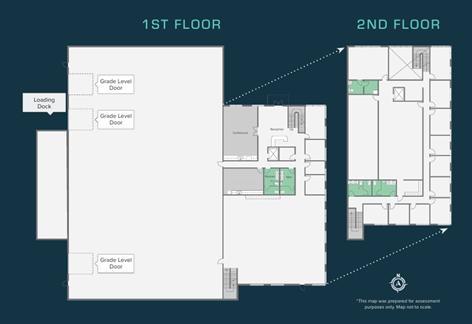
|
|
| 23048 N. 15th Avenue |
| PHOENIX, ARIZONA |
EXHIBIT B
DESCRIPTION OF THE LAND
Lot 31, of PINNACLE BUSINESS PARK UNIT 1, according to the plat of record in the office of the County Recorder of Maricopa County, Arizona, recorded in Book 492 of Maps, Page 28.
|
|
| 23048 N. 15th Avenue |
| PHOENIX, ARIZONA |
EXHIBIT C
PROJECT RULES AND REGULATIONS
The following rules and regulations shall apply to the Project, and the appurtenances thereto:
1. Sidewalks, doorways, vestibules, halls, stairways, loading dock areas and associated overhead doors, and other similar areas shall not be obstructed by tenants or used by any tenant for purposes other than ingress and egress to and from their respective leased premises and for going from one to another part of the Building. The halls, passages, exits, entrances, stairways, balconies and roof are not for the use of the general public and Landlord shall, in all cases, retain the right to control and prevent access thereto by all persons whose presence in the judgment of Landlord, reasonably exercised, shall be prejudicial to the safety, character, reputation and interests of the Project. No Tenant Party shall go upon the roof of the Project.
2. Plumbing (including outside drains and sump pumps), fixtures and appliances shall be used only for the purposes for which designed, and no sweepings, rubbish, rags or other unsuitable material shall be thrown or deposited therein. Damage resulting to any such fixtures or appliances from misuse by a tenant or its agents, employees or invitees, shall be paid by such tenant.
3. No signs, advertisements or notices (other than those that are not visible outside the Premises) shall be painted or affixed on or to any windows or doors or other part of the Building without the prior written consent of Landlord. Except as consented to in writing by Landlord or in accordance with Tenant’s building standard improvements, no draperies, curtains, blinds, shades, screens or other devices shall be hung at or used in connection with any window or exterior door or doors of the Premises. No awning shall be permitted on any part of the Building. Tenant shall not place anything against or near glass partitions, doors or windows which might appear unsightly from outside the Premises.
4. Tenant, at its expense, shall be responsible for providing all door locks at the entry of the Premises and shall provide to Landlord, at Tenant’s expense, contemporaneously with the installation of such devices, a master key, card keys, access codes or other means to allow Landlord immediate access to all areas within the Premises.
5. Landlord may prescribe weight limitations and determine the locations for safes and other heavy equipment or items, which shall in all cases be placed in the Building so as to distribute weight in a manner acceptable to Landlord which may include the use of such supporting devices as Landlord may require. All damages to the Building caused by the installation or removal of any property of a tenant, or done by a tenant’s property while in the Building, shall be repaired at the expense of such tenant.
6. Nothing shall be swept or thrown into the corridors, halls, elevator shafts or stairways. No bicycles, birds or animals (other than those that are medically necessary) shall be brought into or kept in, on or about any tenant’s leased premises. No portion of any tenant’s leased premises shall at any time be used or occupied as sleeping or lodging quarters or for any immoral, disreputable or illegal purposes.
7. Tenant shall not make or permit any vibration or improper, objectionable or unpleasant noises or odors in the Building or otherwise interfere in any way with other tenants or persons having business with them. Tenant shall not introduce, disturb or release asbestos or PCBs into or from the Premises.
8. Tenant shall not use or keep in the Building any flammable or explosive fluid or substance. Tenant shall not install or operate any steam or gas engine or boiler, or other mechanical apparatus in the Premises without the prior written consent of Landlord. The use of oil, gas or inflammable liquids for heating, lighting or other purpose is expressly prohibited. Explosives and other articles deemed extra hazardous shall not be brought onto the Project.
9. Landlord will not be responsible for lost or stolen personal property, money or jewelry from tenant’s leased premises or the Project regardless of whether such loss occurs when the area is locked against entry or not.
10. Tenant shall not conduct any activity on or about the Premises or Building which will draw pickets, demonstrators, or the like.
11. All vehicles are to be currently licensed, in good operating condition, parked for business purposes having to do with Tenant’s business operated in the Premises, parked within designated parking spaces, one vehicle to each space. No vehicle shall be parked as a “billboard” vehicle in the parking lot. Any vehicle parked improperly may be towed away. Tenant, Tenant’s agents, employees, vendors and customers who do not operate or park their vehicles as required shall subject the vehicle to being towed at the expense of the owner or driver. Landlord may place a “boot” on the vehicle to immobilize it and may levy a charge of $50.00 to remove the “boot.” Tenant shall indemnify, hold and save harmless Landlord of any liability arising from the towing or booting of any vehicles belonging to a Tenant Party.
|
|
| 23048 N. 15th Avenue |
| PHOENIX, ARIZONA |
12. No tenant may enter into phone rooms, electrical rooms, mechanical rooms, or other service areas of the Building unless accompanied by Landlord or the Building manager.
13. Except as expressly permitted by the Lease, Tenant shall not permit storage outside the Premises, including outside storage of trucks or other vehicles, or dumping of waste or refuse or permit any harmful materials to be placed in any drainage system or sanitary system in or about the Premises.
14. Tenant shall not install or operate on the Premises any machinery or mechanical devices of a nature not directly related to Tenant’s ordinary use of the Premises.
15. Tenant will not permit any Tenant Party to bring onto the Project any handgun, firearm or other weapons of any kind, marijuana, cannabis-based products, illegal drugs or, unless expressly permitted by Landlord in writing, alcoholic beverages.
16. Tenant shall not permit any Tenant Party to smoke (including the use of any form of tobacco, marijuana, cannabis-based products, e-cigarette, electronic cigarette, personal vaporizer or electronic nicotine delivery system) in the Premises or anywhere else on the Project, except for tobacco products in any Landlord-designated smoking area outside the Building. Tenant shall cooperate with Landlord in enforcing this prohibition and use its best efforts in supervising each Tenant Party in this regard.
17. Without the prior written consent of Landlord, Tenant shall not use the name of the Project or any picture of the Project in connection with, or in promoting or advertising the business of, Tenant, except Tenant may use the address of the Project as the address of its business.
18. Tenant shall not exhibit, sell or offer for sale, rent or exchange in the Premises or at the Project any article, thing or service to the general public or anyone other than Tenant’s employees without the prior written consent of Landlord.
|
|
| 23048 N. 15th Avenue |
| PHOENIX, ARIZONA |
EXHIBIT D
REFURBISHMENT ALLOWANCE
Upon Tenant’s written request therefor following the Commencement Date, and provided that no Event of Default has occurred prior to the disbursement thereof, Landlord shall provide to Tenant a refurbishment allowance not to exceed $1.00 per rentable square foot in the Premises and hereinafter referred to as the “Refurbishment Allowance”) to be applied toward the cost of refurbishing the Premises. Prior to commencing any such work, Tenant shall comply with the provisions of this Lease, including Sections 8 and 21 thereof pertaining to alterations and additions. Landlord or its agent may inspect the refurbishment work. Any third party fees incurred by Landlord in conjunction with its construction coordination shall be paid from the Refurbishment Allowance; however, Landlord shall not charge a construction management fee for inspecting the refurbishment work. Landlord shall pay to Tenant (or, at Landlord’s election, to Tenant’s contractor) the Refurbishment Allowance in a single disbursement following the receipt by Landlord of the following items: a request for payment signed by Tenant on the appropriate AIA form or another form approved by Landlord (indicating what work has been performed and that the work has been completed, and the name, address and taxpayer identification number of the requested payee), final lien waivers from all persons performing work or supplying or fabricating materials for the work, fully executed, acknowledged and in recordable form, copies of all invoices and proof of payment of same, an estoppel certificate confirming such factual matters as Landlord or Landlord’s Mortgagee may reasonably request, and the as-built plans for the work (collectively, a “Completed Application for Payment”). Landlord shall pay the amount requested in the Completed Application for Payment within 30 business days following Tenant’s submission of the Completed Application for Payment. If, however, the Completed Application for Payment is incomplete or incorrect, Landlord’s payment of such request shall be deferred until 30 business days following Landlord’s receipt of the corrected Completed Application for Payment. Notwithstanding anything to the contrary contained in this Exhibit, Landlord shall not be obligated to make any disbursement of the Refurbishment Allowance during the pendency of any of the following: Landlord has received written notice of any unpaid claims relating to any portion of the refurbishment work or materials in connection therewith, other than claims which will be paid in full from such disbursement, there is an unbonded lien outstanding against the Building or the Premises or Tenant’s interest therein by reason of work done, or claimed to have been done, or materials supplied or specifically fabricated, claimed to have been supplied or specifically fabricated, to or for Tenant or the Premises, the conditions to the advance of the Refurbishment Allowance are not satisfied, or an Event of Default by Tenant exists. After Landlord pays the amount requested in the Completed Application for Payment and provided no default under the Lease then exists, Tenant may use any excess Refurbishment Allowance towards the cost of Basic Rent obligations under the Lease by so notifying Landlord in writing of Tenant’s election. Following Landlord’s receipt of Tenant’s election to apply the unused portion of the Refurbishment Allowance towards Tenant’s Basic Rent obligations, Landlord shall apply such excess toward Tenant’s Basic Rent obligation first accruing after such date until such excess is fully exhausted. The entire Refurbishment Allowance must be used (that is, the refurbishment work must be fully complete, any Basic Rent credits exhausted and the final, complete Application for Payment received by Landlord) within six months following the Commencement Date, or shall be deemed forfeited with no further obligation by Landlord with respect thereto; time being of the essence with respect thereto.
|
|
| 23048 N. 15th Avenue |
| PHOENIX, ARIZONA |
EXHIBIT E
RESERVED,
|
|
| 23048 N. 15th Avenue |
| PHOENIX, ARIZONA |
EXHIBIT F
FORM OF TENANT ESTOPPEL CERTIFICATE
The undersigned is the Tenant under the Lease (defined below) between _______________________, a ___________________, as Landlord, and the undersigned as Tenant, for the Premises on the __________ floor(s) of the building located at _____________________, __________ and commonly known as _______________________, and hereby certifies as follows:
1. The Lease consists of the original Lease Agreement dated as of __________________, 20___, between Tenant and Landlord[‘s predecessor-in-interest] and the following amendments or modifications thereto (if none, please state “none”):
The documents listed above are herein collectively referred to as the “Lease” and represent the entire agreement between the parties with respect to the Premises. All capitalized terms used herein but not defined shall be given the meaning assigned to them in the Lease.
2. The Lease is in full force and effect and has not been modified, supplemented or amended in any way except as provided in Section 1 above.
3. The Term commenced on _______________________, 20___, and the Term expires, excluding any extension options, on _______________________, 20___, and Tenant has no option to purchase all or any part of the Premises or the Building or, except as expressly set forth in the Lease, any option to terminate or cancel the Lease.
4. Tenant currently occupies the Premises described in the Lease and Tenant has not transferred, assigned, or sublet any portion of the Premises nor entered into any license or concession agreements with respect thereto except as follows (if none, please state “none”):
5. All monthly installments of Basic Rent, all Additional Rent and all monthly installments of estimated Additional Rent have been paid when due through ______________. The current monthly installment of Basic Rent is $___________.
6. All conditions of the Lease to be performed by Landlord necessary to the enforceability of the Lease have been satisfied and Landlord is not in default thereunder. In addition, Tenant has not delivered any notice to Landlord regarding a default by Landlord thereunder.
7. As of the date hereof, there are no existing defenses or offsets, or, to Tenant’s knowledge, claims or any basis for a claim, that Tenant has against Landlord and no event has occurred and no condition exists, which, with the giving of notice or the passage of time, or both, will constitute a default under the Lease.
8. No rental has been paid more than 30 days in advance and no security deposit has been delivered to Landlord except as provided in the Lease.
9. If Tenant is a corporation, partnership or other business entity, each individual executing this Estoppel Certificate on behalf of Tenant hereby represents and warrants that Tenant is and will remain during the Term a duly formed and existing entity qualified to do business in the state in which the Premises are located and that Tenant has full right and authority to execute and deliver this Estoppel Certificate and that each person signing on behalf of Tenant is authorized to do so.
|
|
| 23048 N. 15th Avenue |
| PHOENIX, ARIZONA |
10. There are no actions pending against Tenant under any bankruptcy or similar laws of the United States or any state.
11. Other than in compliance with all applicable laws and incidental to the ordinary course of the use of the Premises, Tenant has not used or stored any hazardous substances in the Premises.
12. All tenant improvement work to be performed by Landlord under the Lease has been completed in accordance with the Lease and has been accepted by Tenant and all reimbursements and allowances due to Tenant under the Lease in connection with any tenant improvement work have been paid in full.
Tenant acknowledges that this Estoppel Certificate may be delivered to Landlord, Landlord’s Mortgagee or to a prospective mortgagee or prospective purchaser, and their respective successors and assigns, and acknowledges that Landlord, Landlord’s Mortgagee and/or such prospective mortgagee or prospective purchaser will be relying upon the statements contained herein in disbursing loan advances or making a new loan or acquiring the property of which the Premises are a part and that receipt by it of this certificate is a condition of disbursing loan advances or making such loan or acquiring such property.
| TENANT: | ______________________________, a________________ | |
| By: | ||
| Name: | ||
| Title: | ||
| Executed as of ______________________________, 20__ | ||
|
|
| 23048 N. 15th Avenue |
| PHOENIX, ARIZONA |
EXHIBIT G
EXTENSION OPTION
Tenant may extend the Term for one additional period of five years, by delivering written notice of the exercise thereof to Landlord not earlier than 12 months or later than 6 months before the expiration of the Term. The Basic Rent payable for each month during such extended Term (including periodic increases in same) shall be the prevailing rental rate (the “Prevailing Rental Rate”), at the commencement of such extended Term, for renewals of space in the submarket in which the Building is located (including the Building) of equivalent quality, size, utility and location, with the length of the extended Term, the credit standing of Tenant and the amount and frequency of increases in Basic Rent to be taken into account. In no event, however, shall the Basic Rent in the extended Term be less than the Basic Rent rate per rentable square foot in effect during the last calendar month immediately preceding the extended Term. Within 30 days after receipt of Tenant’s notice to extend, Landlord shall deliver to Tenant written notice of the Prevailing Rental Rate and shall advise Tenant of the required adjustment to Basic Rent, if any, and the other terms and conditions offered. Tenant shall, within five days after receipt of Landlord’s notice, notify Landlord in writing whether Tenant accepts or rejects Landlord’s determination of the Prevailing Rental Rate. If Tenant timely notifies Landlord that Tenant accepts Landlord’s determination of the Prevailing Rental Rate, then, within 30 days following the determination of the Prevailing Rental Rate, Landlord and Tenant shall execute an amendment to this Lease extending the Term on the same terms and conditions provided in this Lease, except as follows:
(a) Basic Rent shall be adjusted to the Prevailing Rental Rate, with periodic increases therein as described above;
(b) Tenant shall have no further option to extend the Term unless expressly granted by Landlord in writing; and
(c) Landlord shall lease to Tenant the Premises in their then-current condition, and Landlord shall not provide to Tenant any allowances (e.g., moving allowance, construction allowance, and the like) or other tenant inducements.
If Tenant timely delivers written notice to Landlord that Tenant rejects Landlord’s determination of the Prevailing Rental Rate, time being of the essence with respect thereto, Tenant’s rights under this Exhibit shall terminate and Tenant shall have no right to extend the Term. If Tenant fails to timely notify Landlord in writing that Tenant accepts or rejects Landlord’s determination of the Prevailing Rental Rate, time being of the essence with respect thereto, then, at Landlord’s option, (a) Tenant’s rights under this Exhibit shall terminate and Tenant shall have no right to extend the Term; or (b) Tenant shall be deemed to have irrevocably renewed the Term and to have accepted Landlord’s determination of the Prevailing Rental Rate.
Tenant’s rights under this Exhibit shall terminate, at Landlord’s option, if (a) an Event of Default exists as of the date of Tenant’s exercise of its rights under this Exhibit or as of the commencement date of the extended Term, (b) this Lease or Tenant’s right to possession of any of the Premises is terminated, (c) Tenant assigns its interest in this Lease or sublets any portion of the Premises, (d) Tenant fails to lease from Landlord at least the same number of square feet leased to Tenant as of the Lease Date and to occupy at least 29,353 square feet of space, (e) Landlord determines, in its sole but reasonable discretion, that Tenant’s financial condition or creditworthiness has materially deteriorated since the Lease Date, or (f) Tenant fails to timely exercise its option under this Exhibit, time being of the essence with respect to Tenant’s exercise thereof.
|
|
Exhibit 31.1
CERTIFICATIONS
I, Captain Joseph D. Burns, certify that:
| 1. | I have reviewed this Form 10-Q of AIRO Group Holdings, Inc.; |
| 2. | Based on my knowledge, this report does not contain any untrue statement of a material fact or omit to state a material fact necessary to make the statements made, in light of the circumstances under which such statements were made, not misleading with respect to the period covered by this report; |
| 3. | Based on my knowledge, the financial statements, and other financial information included in this report, fairly present in all material respects the financial condition, results of operations and cash flows of the registrant as of, and for, the periods presented in this report; |
| 4. | The registrant’s other certifying officer(s) and I are responsible for establishing and maintaining disclosure controls and procedures (as defined in Exchange Act Rules 13a-15(e) and 15d-15(e)) for the registrant and have: |
| (a) | Designed such disclosure controls and procedures, or caused such disclosure controls and procedures to be designed under our supervision, to ensure that material information relating to the registrant, including its consolidated subsidiaries, is made known to us by others within those entities, particularly during the period in which this report is being prepared; | |
| (b) |
[Paragraph intentionally omitted pursuant to Exchange Act Rule 13a-14(a)]; |
|
| (c) | Evaluated the effectiveness of the registrant’s disclosure controls and procedures and presented in this report our conclusions about the effectiveness of the disclosure controls and procedures, as of the end of the period covered by this report based on such evaluation; and | |
| (d) | Disclosed in this report any change in the registrant’s internal control over financial reporting that occurred during the registrant’s most recent fiscal quarter (the registrant’s fourth fiscal quarter in the case of an annual report) that has materially affected, or is reasonably likely to materially affect, the registrant’s internal control over financial reporting; and |
| 5. | The registrant’s other certifying officer(s) and I have disclosed, based on our most recent evaluation of internal control over financial reporting, to the registrant’s auditors and the audit committee of the registrant’s board of directors (or persons performing the equivalent functions): |
| (a) | All significant deficiencies and material weaknesses in the design or operation of internal control over financial reporting which are reasonably likely to adversely affect the registrant’s ability to record, process, summarize and report financial information; and | |
| (b) | Any fraud, whether or not material, that involves management or other employees who have a significant role in the registrant’s internal control over financial reporting. |
| Date: | August 13, 2025 | ||
| /s/ Captain Joseph D. Burns | |||
| Captain Joseph D. Burns | |||
| Chief Executive Officer |
Exhibit 31.2
CERTIFICATIONS
I, Dr. Mariya Pylypiv, certify that:
| 1. | I have reviewed this Form 10-Q of AIRO Group Holdings, Inc.; |
| 2. | Based on my knowledge, this report does not contain any untrue statement of a material fact or omit to state a material fact necessary to make the statements made, in light of the circumstances under which such statements were made, not misleading with respect to the period covered by this report; |
| 3. | Based on my knowledge, the financial statements, and other financial information included in this report, fairly present in all material respects the financial condition, results of operations and cash flows of the registrant as of, and for, the periods presented in this report; |
| 4. | The registrant’s other certifying officer(s) and I are responsible for establishing and maintaining disclosure controls and procedures (as defined in Exchange Act Rules 13a-15(e) and 15d-15(e)) for the registrant and have: |
| (a) | Designed such disclosure controls and procedures, or caused such disclosure controls and procedures to be designed under our supervision, to ensure that material information relating to the registrant, including its consolidated subsidiaries, is made known to us by others within those entities, particularly during the period in which this report is being prepared; | |
| (b) |
[Paragraph intentionally omitted pursuant to Exchange Act Rule 13a-14(a)]; |
|
| (c) | Evaluated the effectiveness of the registrant’s disclosure controls and procedures and presented in this report our conclusions about the effectiveness of the disclosure controls and procedures, as of the end of the period covered by this report based on such evaluation; and | |
| (d) | Disclosed in this report any change in the registrant’s internal control over financial reporting that occurred during the registrant’s most recent fiscal quarter (the registrant’s fourth fiscal quarter in the case of an annual report) that has materially affected, or is reasonably likely to materially affect, the registrant’s internal control over financial reporting; and |
| 5. | The registrant’s other certifying officer(s) and I have disclosed, based on our most recent evaluation of internal control over financial reporting, to the registrant’s auditors and the audit committee of the registrant’s board of directors (or persons performing the equivalent functions): |
| (a) | All significant deficiencies and material weaknesses in the design or operation of internal control over financial reporting which are reasonably likely to adversely affect the registrant’s ability to record, process, summarize and report financial information; and | |
| (b) | Any fraud, whether or not material, that involves management or other employees who have a significant role in the registrant’s internal control over financial reporting. |
| Date: | August 13, 2025 | ||
| /s/ Dr. Mariya Pylypiv | |||
| Dr. Mariya Pylypiv | |||
| Chief Financial Officer |
Exhibit 32.1
CERTIFICATION
Pursuant to the requirement set forth in Rule 13a-14(b) of the Securities Exchange Act of 1934, as amended, (the “Exchange Act”) and Section 1350 of Chapter 63 of Title 18 of the United States Code (18 U.S.C. §1350), Captain Joseph D. Burns, Chief Executive Officer of AIRO Group Holdings, Inc. (the “Company”), and Dr. Mariya Pylypiv, Chief Financial Officer of the Company, each hereby certifies that, to the best of his or her knowledge:
| 1. | The Company’s Quarterly Report on Form 10-Q for the period ended June 30, 2025, to which this Certification is attached as Exhibit 32.1 (the “Periodic Report”), fully complies with the requirements of Section 13(a) or Section 15(d) of the Exchange Act; and |
| 2. | The information contained in the Periodic Report fairly presents, in all material respects, the financial condition and results of operations of the Company. |
In Witness Whereof, the undersigned have set their hands hereto as of the 13th day of August, 2025.
| /s/ Captain Joseph D. Burns | /s/ Dr. Mariya Pylypiv | |
| Captain Joseph D. Burns | Dr. Mariya Pylypiv | |
| Chief Executive Officer | Chief Financial Officer |
This certification accompanies the Form 10-Q to which it relates, is not deemed filed with the Securities and Exchange Commission and is not to be incorporated by reference into any filing of AIRO Group Holdings, Inc. under the Securities Act of 1933, as amended, or the Securities Exchange Act of 1934, as amended (whether made before or after the date of the Form 10-Q), irrespective of any general incorporation language contained in such filing.