 エドガーで原本を確認する
UNITED STATES
SECURITIES AND EXCHANGE COMMISSION
Washington, D.C. 20549
FORM 20-F
☐ REGISTRATION STATEMENT PURSUANT TO SECTION 12(b) OR (g) OF THE SECURITIES EXCHANGE ACT OF 1934
OR
☒ ANNUAL REPORT PURSUANT TO SECTION 13 OR 15(d) OF THE SECURITIES EXCHANGE ACT OF 1934
For the Fiscal Year Ended December 31, 2024
OR
☐ TRANSITION REPORT PURSUANT TO SECTION 13 OR 15(d) OF THE SECURITIES EXCHANGE ACT OF 1934
OR
☐ SHELL COMPANY REPORT PURSUANT TO SECTION 13 OR 15(d) OF THE SECURITIES EXCHANGE ACT OF 1934
Commission File Number: 333-280739
BELIVE HOLDINGS
(Exact name of Registrant as specified in its charter)
Cayman Islands
(Jurisdiction of incorporation or organization)
26A Ann Siang Road
#03-00
Singapore 069706
(Address of principal executive offices)
Kenneth Teck Chuan Tan Chief Executive Officer
Telephone: +65 9090 5788
Email:kenneth.tan@belive.sg
At the address of the Company set forth above
(Name, Telephone, email and/or fax number and address of Company Contact Person)
Securities registered or to be registered pursuant to Section 12(b) of the Act:
| Title of each class | Trading symbol(s) | Name of each exchange on which registered | ||
| Ordinary Shares, par value US$0.0005 | BLIV | The Nasdaq Stock Market LLC |
Securities registered pursuant to Section 12(g) of the Act: None
Securities for which there is a reporting obligation pursuant to Section 15(d) of the Act: None
Indicate the number of outstanding shares of each of the issuer’s classes of capital or common stock as of the close of the period covered by the annual report.
10,864,802 Ordinary Shares, $0.0005 par value at April 15, 2025
Indicate by check mark if the Registrant is a well-known seasoned issuer, as defined in Rule 405 of the Securities Act of 1933.
Yes ☐ No ☒
If the report is an annual or transition report, indicate by check mark if the Registrant is not required to file reports pursuant to Section 13 or 15D of the Securities Exchange Act of 1934.
Yes ☐ No ☒
Indicate by check mark whether the Registrant: (1) has filed all reports required to be filed by Section 13 or 15(d) of the Securities Exchange Act of 1934 during the preceding 12 months (or for such shorter period that the Registrant was required to file such reports), and (2) has been subject to such filing requirements for the past 90 days.
Yes ☒ No ☐
Indicate by check mark whether the registrant has submitted electronically every Interactive Data File required to be submitted pursuant to Rule 405 of Regulation S-T (§232.405 of this chapter) during the preceding 12 months (or for such shorter period that the registrant was required to submit such files).
Yes ☒ No ☐
Indicate by check mark whether the Registrant is a large accelerated filer, an accelerated filer, a non-accelerated filer, or an emerging growth company.
| Large Accelerated Filer ☐ | Accelerated Filer ☐ | Non-accelerated filer ☒ |
| Emerging Growth Company ☒ |
If an emerging growth company that prepares its financial statements in accordance with U.S. GAAP, indicate by check mark if the registrant has elected not to use the extended transition period for complying with any new or revised financial accounting standards provided pursuant to Section 13(a) of the Exchange Act. ☐
Indicate by check mark whether the registrant has filed a report on and attestation to its management’s assessment of the effectiveness of its internal control over financial reporting under Section 404(b) of the Sarbanes-Oxley Act (15 U.S.C. 7262(b)) by the registered public accounting firm that prepared or issued its audit report. ☐
If securities are registered pursuant to Section 12(b) of the Act, indicate by check mark whether the financial statements of the registrant included in the filing reflect the correction of an error to previously issued financial statements. ☐
Indicate by check mark whether any of those error corrections are restatements that required a recovery analysis of incentive-based compensation received by any of the registrant’s executive officers during the relevant recovery period pursuant to §240.10D-1(b).☐
Indicate by check mark which basis of accounting the Registrant has used to prepare the financial statements included in this filing:
| U.S. GAAP ☐ | International Financial Reporting Standards as issued by the International Accounting Standards Board ☒ | Other ☐ |
If “Other” has been checked in response to the previous question, indicate by check mark which financial statement item the Registrant has elected to follow:
Item 17 ☐ Item 18 ☐
If this is an annual report, indicate by check mark whether the Registrant is a shell company (as defined in Rule 12b-2 of the Exchange Act.)
Yes ☐ No ☒
TABLE OF CONTENTS
|
|
FORWARD-LOOKING STATEMENTS
This Annual Report on Form 20-F contains forward-looking statements. A forward-looking statement is a projection about a future event or result, and whether the statement comes true is subject to many risks and uncertainties. These statements often can be identified by the use of terms such as “may,” “will,” “expect,” “believe,” “anticipate,” “estimate,” “approximate” or “continue,” or the negative thereof. The actual results or activities of the Company will likely differ from projected results or activities of the Company as described in this Annual Report, and such differences could be material.
Forward-looking statements involve known and unknown risks, uncertainties and other factors that may cause the actual results and performance of the Company to be different from any future results, performance and achievements expressed or implied by these statements. In other words, our performance might be quite different from what the forward-looking statements imply. You should review carefully all information included in this Annual Report.
You should rely only on the forward-looking statements that reflect management’s view as of the date of this Annual Report. We undertake no obligation to publicly revise or update these forward-looking statements to reflect subsequent events or circumstances. You should also carefully review the risk factors described in other documents we file from time to time with the Securities and Exchange Commission (the “SEC”). The Private Securities Reform Act of 1995 contains a safe harbor for forward-looking statements on which the Company relies in making such disclosures. In connection with the “safe harbor,” we are hereby identifying important factors that could cause actual results to differ materially from those contained in any forward-looking statements made by us or on our behalf. Factors that might cause such a difference include, but are not limited to, those discussed in the section entitled “Risk Factors” under Item 3. - “Key Information.”
FINANCIAL STATEMENTS AND CURRENCY PRESENTATION
Basis of Presentation
The financial information in this Annual Report has been prepared in accordance with International Financial Reporting Standards, or IFRS, as issued by the International Accounting Standards Board, or IASB, which differ in certain significant respects from accounting principles generally accepted in the United States, or “U.S. GAAP.” This Annual Report does not include a reconciliation from IFRS to U.S. GAAP. You should consult your own professional advisors for an understanding of the differences between IFRS and U.S. GAAP, and how those differences might affect the financial information included in this Annual Report.
Certain amounts, percentages and other figures included in this Annual Report have been subject to rounding adjustments. Accordingly, amounts, percentages and other figures shown as totals in certain tables or charts may not be the arithmetic aggregation of those that precede them and amounts, and figures expressed as percentages in the text may not total 100% or, when aggregated, may not be the arithmetic aggregation of the percentages
REFERENCES
In this Annual Report, the terms “we,” “our,” “us,” “Group” and the “Company” refer to BeLive Holdings and, where the context so requires or suggests, its direct and indirect subsidiaries. Its direct and indirect subsidiaries are: (i) BeLive Technology Group Ltd (“BeLive BVI”), a British Virgin Islands business company incorporated under the laws of the British Virgin Islands on March 7, 2023, and our direct wholly owned subsidiary; (ii) BeLive Technology (Vietnam) Company Limited (“BeLive Vietnam”), a company incorporated under the laws of the Socialist Republic of Vietnam on June 16, 2021, and one of our indirect wholly owned subsidiaries; and (iii) BeLive Technology Pte. Ltd (:”BeLive Singapore”), a company incorporated under the laws of the Republic of Singapore on June 18, 2014, and one of our indirect wholly owned subsidiaries.
“Initial Public Offering” or “IPO” refers to the closing on April 7, 2025 of our initial public offering of 2,450,000 Ordinary Shares at a public offering price of $4.00 for total gross proceeds of $9,800,000 or $11,270,000 in the event a further 2,817,500 Ordinary Shares are sold if the underwriters exercise the over-allotment option in full..
|
|
We also simultaneously registered 2,139,227 Ordinary Shares on behalf of reselling shareholders pursuant to a resale prospectus (the “Resale Prospectus”). The resale offering was not part of, and was not conducted with the firm commitment public offering. It did not take place until our Ordinary Shares were listed on Nasdaq, which was April 7, 2024. We will not receive any proceeds from the sale of Ordinary Shares by the selling shareholders.
References to “dollars,” “U.S. Dollars” or “US$” are to United States Dollars. Our reporting currency is the Singapore dollar. This Annual Report also contains translations of certain foreign currency amounts into U.S. dollars for the convenience of the reader. Unless otherwise stated, all translations of Singapore dollars into U.S. dollars were made at S$0.732 to US$1.00, the noon buying rate as certified by the Federal Reserve Bank of New York for customs purposes as of December 31, 2024, the last business day in 2024. We make no representation that the Singapore dollar or U.S. dollar amounts referred to in this Annual Report could have been or could be converted into U.S. dollars or Singapore dollars, as the case may be, at any particular rate, or at all.
Effective February 18, 2024, we effected a 5:1 reverse stock split resulting in 7,985,241 Ordinary Shares outstanding, which have been retroactively restated to the beginning of the first period presented herein. The economic rights of our Ordinary Shares held by each shareholder prior to and after the Reverse Stock Split shall remain unchanged, which rights include, but are not limited to, dividend, liquidation and conversion rights.
PART I
ITEM 1. IDENTITY OF DIRECTORS, SENIOR MANAGEMENT AND ADVISORS
Not Applicable
ITEM 2. OFFER STATISTICS AND EXPECTED TIMETABLE
Not Applicable
ITEM 3. KEY INFORMATION
RISK FACTORS
Investing in our shares is highly speculative and involves a significant degree of risk. You should carefully consider the following risks, as well as other information contained in this Annual Report. The risks discussed below could materially and adversely affect our business, prospects, financial condition, results of operations, cash flows, ability to pay dividends and the trading price of our shares. Additional risks and uncertainties not currently known to us or that we currently deem to be immaterial may also materially and adversely affect our business, prospects, financial condition, results of operations, cash flows and ability to pay dividends, and you may lose all or part of your investment.
Risks Related to Our Business and Industry
We have a history of operating losses, and we may not be able to generate sufficient revenue to achieve and sustain profitability which may cast doubt on our ability to continue as a going concern.
We had net loss of approximately S$5,508,000 and S$2,094,000, respectively, for the financial years ended December 31, 2024 and 2023. Despite generating net income during the financial year ended December 31, 2024, we anticipate that our operating expenses will increase in the foreseeable future as we seek to maintain and continue to grow our business, attract new clients, and further enhance our services. These efforts may prove more expensive than we currently anticipate, and we may not succeed in increasing our revenue sufficiently to offset these higher operating expenses. As a result of the foregoing and other factors, we may incur net losses in the future and may be unable to achieve or maintain profitability on a quarterly or annual basis for the foreseeable future. These conditions indicate the existence of a material uncertainty that may cast significant doubt about the Company’s ability to continue as a going concern, and the Company may not be able to realize its assets and discharge its liabilities in the normal course of business. Therefore, a shareholder of the Company has agreed to provide continuing financial support to the Company for twenty-four months from June 30, 2024.
|
|
Our results of operations could be adversely affected by volatile, negative, or uncertain economic and political conditions and the effects of these conditions on our clients’ businesses and levels of business activity.
Global macroeconomic and geopolitical conditions affect our businesses. Volatile, negative, or uncertain economic and political conditions in our significant markets could in the future undermine business confidence in our significant markets, or in other markets, which are increasingly interdependent, and cause our clients to reduce or defer their spending on new projects, or may result in clients reducing, delaying, or eliminating spending under existing projects with us, which would negatively affect our business. Growth in the markets we serve could occur slowly, or could stagnate or contract, in each case, for an extended period of time.
Our future revenue and operating results will be harmed if we are unable to acquire new customers, retain existing customers, expand sales to our existing customers, develop new functionality for our BeLive Solutions that achieves market acceptance, or the increase in e-commerce during the COVID-19 pandemic fails to continue after the pandemic ends.
In order to continue to grow our business, we must continue to acquire new customers to purchase and use our BeLive Solutions. Our success in adding new customers depends on numerous factors, including our ability to: (1) offer a compelling e-commerce platform, (2) execute our sales and marketing strategy, (3) attract, effectively train and retain new sales, marketing, professional services, and support personnel in the markets we pursue, (4) develop or expand relationships with partners and alliances, payment providers and systems integrators, (5) expand into new geographies and market segments, and (6) efficiently onboard new customers to our BeLive Solutions.
Our ability to increase revenue also depends, in part, on our ability to retain existing customers and to sell additional functionality and adjacent services to our existing and new customers. Our customers have no obligation to renew their contracts with our solutions after the expiration of their initial subscription period. In order for us to maintain or improve our results of operations, it is important that our customers renew their contracts with us on the same or more favorable terms to us. Our ability to increase sales to existing customers depends on several factors, including their experience with implementing and using our BeLive Solutions, their ability to integrate our BeLive Solutions with other technologies, and our pricing model.
Our ability to generate revenue may be inconsistent across small and midsize businesses, mid-market, and large enterprise customers. If we experience limited or inconsistent growth in any of these customer sets, particularly our large enterprise customers, our business, financial condition, and operating results could be adversely affected.
We have significant customer concentration, and if we fail to attract new customers, retain existing customers, or maintain or increase sales to customers, our business, financial condition, results of operations, and growth prospects will be harmed.
During the financial years ended December 31, 2024 and 2023, customers who contributed over 10% of the total revenue of the Group accounted for approximately 79% and 63% of our total revenue, respectively. This concentration of customers could leave us exposed to the risks associated with the loss or default of one or more of these significant customers, which would materially and adversely affect our revenue and results of operations. If these customers were to default in their payment obligations to us, significantly reduce their relationship with us, or if we are unable to replace any lost revenue through the sale of our BeLive Solutions and services to additional customers, our financial condition, results from operations and growth prospects could be negatively impacted, and such impact would likely be significant.
We currently report our financial results under IFRS, which differs in certain significant respect from U.S. generally accepted accounting principles.
Our consolidated financial statements are prepared in accordance with IFRS. There have been and there may in the future be certain significant differences between IFRS and U.S. GAAP, including differences related to revenue recognition, intangible assets, share-based compensation expense, income tax and earnings per share. As a result, our financial information and reported earnings for historical or future periods could be significantly different if they were prepared in accordance with U.S. GAAP. In addition, we do not intend to provide a reconciliation between IFRS and U.S. GAAP unless it is required under applicable law. As a result, you may not be able to meaningfully compare our consolidated financial statements under IFRS with those companies that prepare consolidated financial statements under U.S. GAAP.
|
|
Our success depends on our ability to maintain our reputation. If events occur that damage our reputation, our business and financial results may be harmed.
Our business, results of operations and prospects depend, in part, on our ability to maintain our reputation for providing high quality products and services. We could lose existing or potential clients and/or opportunities for securing new projects if our reputation were to be associated with any negative publicity, including negative complaints raised by unsatisfied clients, that comes to the public’s attention. If we fail to successfully maintain, promote, and position our brand and protect our reputation, our business, financial condition, and operating results may be adversely affected.
If we fail to maintain or grow our brand recognition, our ability to expand our customer base will be impaired and our financial condition may suffer.
We believe maintaining and growing the BeLive brand is important to supporting continued acceptance of our existing and future solutions, attracting new customers to our BeLive Solutions, and retaining existing customers. We also believe that the importance of brand recognition will increase as competition in our market increases. Successfully maintaining our brand will depend largely on the effectiveness of our marketing efforts, our ability to provide a reliable and useful BeLive Solutions to meet the needs of our customers at competitive prices, our ability to maintain our customers’ trust, our ability to continue to develop new functionality and solutions, and our ability to successfully differentiate our BeLive Solutions. Brand promotion activities may not generate customer awareness or yield increased revenue. Even if they do, any increased revenue may not offset the expenses we incurred in building our brand. If we fail to successfully promote and maintain our brand, we may fail to attract enough new customers or retain our existing customers to realize a sufficient return on our brand-building efforts, and our business could suffer.
If we fail to offer high quality support, our business and reputation could suffer.
Our customers rely on our personnel for support related to our subscription and customer solutions. High-quality support is important for the renewal and expansion of our agreements with existing customers. The importance of high-quality support will increase as we expand our business and pursue new customers, particularly large enterprise customers. If we do not help our customers quickly resolve issues and provide effective ongoing support, our ability to sell new solutions to existing and new customers could suffer and our reputation with existing or potential customers could be harmed.
Our business generates and processes a large amount of data, and the improper use or disclosure of such data could harm our reputation as well as have a material adverse effect on our business and prospects.
Our e-commerce platform generates and processes a large quantity of personal, transaction, demographic, and behavioral data. We face risks inherent in handling large volumes of data and in protecting the security of such data. In particular, we face a number of challenges relating to data from transactions and other activities on our platform, including:
| ● | protecting the data in and hosted on our system, including against attacks on our system by outside parties or fraudulent behavior by our employees; |
| ● | addressing concerns related to privacy and sharing, safety, security, and other factors; and |
| ● | complying with applicable laws, rules and regulations relating to the collection, use, disclosure, or security of personal information, including any requests from regulatory and government authorities relating to such data. |
|
|
Any systems failure or security breach or lapse that results in the release of user data could harm our reputation and brand and, consequently, our business, in addition to exposing us to potential legal liability.
Failure to maintain or improve our technology infrastructure could harm our business and prospects.
Adopting new software and upgrading our online infrastructure requires significant investments of time and resources, including adding new hardware, updating software, and recruiting and training new engineering personnel. Maintaining and improving our technology infrastructure require significant levels of investment. Adverse consequences could include unanticipated system disruptions, slower response times, impaired quality of customers’ experiences and delays in reporting accurate operating and financial information. In addition, much of the software and interfaces we use are internally developed and proprietary technology. If we experience problems with the functionality and effectiveness of our software or are unable to maintain and constantly improve our technology infrastructure to handle our business needs, our business, financial condition, results of operation and prospects, as well as our reputation, could be materially and adversely affected.
Undetected programming errors could adversely affect our clients’ experience and market acceptance of our live commerce and shoppable short videos, which may materially and adversely affect our business, financial condition, and results of operations.
Live commerce and shoppable short videos content produced by our clients or displayed on our client’s e-commerce platform may contain programming errors that may only become apparent after our release. We generally have been able to resolve such programming errors in a timely manner. However, we cannot assure you that we will be able to detect and resolve all of these programming errors effectively. Undetected audio or video programming errors or defects may adversely affect user experience which in turn may have a material and adverse effect on our business, financial condition, and results of operation.
We rely on computer software and hardware systems in our operations, the failure of which could adversely affect our business, financial condition, and results of operations.
We are dependent upon our computer software and hardware systems in developing our BeLive Solutions and maintaining important operational and market information. In addition, we rely on our computer hardware for the storage, delivery, and transmission of data. Any system failure that causes interruptions to the input, retrieval and transmission of data or increase in service time could disrupt our normal operations. Although we have a disaster recovery plan that is designed to address the failures of our computer software and hardware systems, we may not be able to effectively carry out this disaster recovery plan or restore our operations within a sufficiently short time frame to avoid business disruptions. Any failure in our computer software or hardware systems could decrease our revenues and harm our relationships with our clients, which in turn could have a material adverse effect on our business, results of operations and financial condition.
We are dependent upon customers’ continued and unimpeded access to the Internet, and upon their willingness to use the Internet for commerce.
Our success depends upon the general public’s ability to access the Internet, including through mobile devices, and its continued willingness to use the Internet to pay for purchases, communicate, access social media, research and conduct commercial transactions. The adoption of any laws or regulations that adversely affect the growth, popularity, or use of the Internet, including changes to laws or regulations impacting Internet neutrality, could decrease the demand for our BeLive Solutions, increase our operating costs, or otherwise adversely affect our business. Given uncertainty around these rules, we could experience discriminatory or anti-competitive practices that could impede both our and our customers’ growth, increase our costs or adversely affect our business. In the future, providers of Internet browsers could introduce new features that would make it difficult for customers to use our BeLive Solutions. In addition, Internet browsers for desktop, tablets or mobile devices could introduce new features, or change existing browser specifications, such that they would be incompatible with our BeLive Solutions. If customers become unable, unwilling, or less willing to use the Internet for commerce for any reason, including lack of access to high-speed communications equipment, congestion of traffic on the Internet, Internet outages or delays, disruptions, or other damage to customers’ computers, increases in the cost of accessing the Internet and security and privacy risks or the perception of such risks, our business could be adversely affected.
|
|
We maintain limited business liability and property insurance and do not maintain any business disruption or litigation insurance; therefore, incidents or claims we experience may result in substantial costs to us and the diversion of our resources.
While we maintain liability insurance against injuries, death or losses due to fire and water leakage, as well as property insurance covering damage to our occupied premises and facilities, we have determined that the risks of disruption or other liability from our business, and the cost of obtaining insurance coverage for these risks and the difficulties associated with obtaining such insurance on commercially reasonable terms, make it impractical for us to have obtained such insurance on terms and conditions that are commercially reasonable. As a result, we did not purchase any business liability, disruption or litigation, coverage for our operations. Any occurrence of an uninsured loss or damage or litigation or business disruption may result in substantial costs to us and the diversion of our resources, which could have an adverse effect on our operating results.
If we cannot continue to innovate technologically or develop, market, and sell new products and services, or enhance existing technology and products and services to meet customer requirements, our ability to grow our revenue could be impaired.
Our growth largely depends on our ability to innovate and add value to our existing creative platform and to provide our customers and contributors with a scalable, high-performing technology infrastructure that can efficiently and reliably handle increased customer and contributor usage globally, as well as the deployment of new features. Without improvements to our technology and infrastructure, our operations might suffer from unanticipated system disruptions, slow performance, or unreliable service levels, any of which could negatively affect our reputation and ability to attract and retain customers and contributors. We are currently making, and plan to continue making, significant investments to maintain and enhance the technology and infrastructure and to evolve our information processes and computer systems in order to run our business more efficiently and remain competitive. We may not achieve the anticipated benefits, significant growth, or increased market share from these investments for several years, if at all. If we are unable to manage our investments successfully or in a cost-efficient manner, our business and results of operations may be adversely affected.
Natural catastrophic events and man-made problems such as power disruptions, computer viruses, global pandemics, a cyberattack or data security breaches and terrorism may disrupt our business.
We rely heavily on our network infrastructure and IT systems for our business operations. An online attack, damage as a result of civil unrest, earthquake, fire, terrorist attack, power loss, global pandemics (such as the COVID-19 pandemic), telecommunications failure, or other similar catastrophic event could cause system interruptions, delays in accessing our service, reputational harm, and loss of critical data. Such events could prevent us from providing our BeLive Solutions to our customers. A catastrophic event that results in the destruction or disruption of our data centers, or our network infrastructure or IT systems, including any errors, defects, or failures in third-party hardware, could affect our ability to conduct normal business operations, and adversely affect our operating results.
In addition, as computer malware, viruses, cyberattack, computer hacking, fraudulent use attempts, and phishing attacks have become more prevalent, we face increased risk from these activities. These activities threaten the performance, reliability, security, and availability of our BeLive Solutions. Any computer malware, viruses, computer hacking, fraudulent use attempts, phishing attacks, or other data security breaches to our systems could, among other things, harm our reputation and our ability to retain existing customers and attract new customers. Many companies that provide cloud-based services have reported a significant increase in cyberattack activity since the beginning of the COVID-19 pandemic.
On June 3, 2024, our Board of Directors approved the authorization of an amendment to the Company’s Audit Committee Charter (the “Audit Committee Charter”) pursuant to which it adopted a cybersecurity policy (the “Cybersecurity Policy”) and further approving that the Audit Committee will have full authority and powers to implement the Cybersecurity Policy. The Audit Committee Charter provides the members of the Audit Committee with authorization and authority to conduct continuous analysis of and review for any potential cybersecurity risks as part of the Company’s overall risk management program and to create a cyber-resilient organization, which will contribute to the value preservation of the Company. The Audit Committee Charter further provides authority and responsibility to the members of the Audit Committee to: (i) understand the economic drivers and impact of cyber risk, including the financial impact to our Company; (ii) align cyber-risk management policies with the Company’s business needs by integrating cyber-risk analysis into significant business decisions; (iii) ensure our Company’s organizational structure supports cybersecurity goals; and (iv) incorporate cybersecurity expertise into board governance. See “Audit Committee Charter”.
|
|
In addition, because we may utilize a third-party contractor to provide these services to us, including cloud, software, data center and other critical technology, to collect and maintain personal data on our shareholders, we rely heavily on the data security practices and policies adopted by these third-party service providers. Our ability to monitor our third-party service providers’ data security is limited. A vulnerability in our or our third-party service providers’ software or systems, a failure of our third-party service providers’ safeguards, policies or procedures, or a breach of a software or systems could result in the compromise of the confidentiality, integrity or availability of the data housed. We have not experienced any cybersecurity attacks or any similar incidents; however, we cannot guarantee that such attacks will not occur in the future and adversely affect our shareholders. We and our third-party service providers and partners may be unable to anticipate or prevent techniques used in the future to obtain unauthorized access or to sabotage systems and we cannot guarantee that applicable recovery systems, security protocols, network protection mechanisms and other procedures are or will be adequate to prevent network and service interruption, system failure or data loss. In addition, we may also become liable in the event our or our third-party service providers are subject to security breaches, privacy breaches or other cybersecurity threats. This could expose us to a risk of litigation, indemnity obligations and damages, cause us to incur significant liability and financial loss and be subject to regulatory scrutiny, investigations, proceedings and fines and penalties, and require us to expend significant capital and other resources to alleviate problems caused by any such cybersecurity attack or other security breach or incident and implement additional security measures.
We currently do not maintain cybersecurity insurance, and in the event that we were to seek to obtain such insurance coverage, it may not be available on acceptable terms or may not be available in sufficient amounts to cover one or more large claims in connection with cybersecurity liabilities. Insurers could also deny coverage as to any future claim.
If we are unable to increase market awareness of our Company and our applications, our revenue may not continue to grow, or may decline.
Market awareness of our Company and our applications is essential to our ability to generate new leads for expanding our business and our continued growth. If we fail to sufficiently invest in our marketing programs or they are unsuccessful in creating market awareness of our Company and our applications, our revenue may grow more slowly than expected or may decline and our financial performance may be adversely affected.
We face intense competition, especially from well-established companies offering solutions and related applications. We may lack sufficient financial or other resources to maintain or improve our competitive position, which may harm our ability to add new customers, retain existing customers, and grow our business.
The market for e-commerce solutions is evolving and highly competitive. We expect competition to increase in the future from established competitors and new market entrants. With the introduction of new technologies and the entry of new companies into the market, we expect competition to persist and intensify in the future. This could harm our ability to increase sales, maintain or increase renewals, and maintain our prices. We face intense competition from other software companies that may offer related e-commerce platform software solutions and services. Our competitors include larger companies that have acquired e-commerce platform solution providers in recent years. We also compete with custom software internally developed within e-commerce businesses. In addition, we face competition from niche companies that offer point products that attempt to address certain of the problems that our BeLive Solutions solves.
Merger and acquisition activity in the technology industry could increase the likelihood that we compete with other large technology companies. Many of our existing competitors have, and our potential competitors could have, substantial competitive advantages such as greater name recognition, longer operating histories, larger sales and marketing budgets and resources, greater customer support resources, lower labor and development costs, larger and more mature intellectual property portfolios, and substantially greater financial, technical, and other resources.
|
|
Some of our larger competitors also have substantially broader product lines and market focus and will therefore not be as susceptible to downturns in a particular market. Conditions in our market could change rapidly and significantly as a result of technological advancements, partnering by our competitors, or continuing market consolidation. New start-up companies that innovate, and large companies that are making significant investments in research and development, may invent similar or superior products and technologies that compete with our BeLive Solutions. In addition, some of our competitors may enter into new alliances with each other or may establish or strengthen cooperative relationships with agency partners, technology and application providers in complementary categories, or other parties. Any such consolidation, acquisition, alliance, or cooperative relationship could lead to pricing pressure, a loss of market share, or a smaller addressable share of the market. It could also result in a competitor with greater financial, technical, marketing, service, and other resources, all of which could harm our ability to compete.
Any disruption of service at the data centers that house our equipment and deliver our software applications could harm our business.
While we procure and operate all infrastructure equipment delivering our applications, third parties operate the data centers that we use. While we control and have access to our servers and all the other components of our network that are located in our external data centers, we do not control the operation of these data centers and we are therefore vulnerable to disruptions, power outages or other issues the data centers experience. We may experience interruptions, delays and outages in service and availability from time to time.
The owners of our data centers have no obligation to renew their agreements with us on commercially reasonable terms, or at all. If we are unable to renew these agreements on commercially reasonable terms, or if one of our data center operators is acquired, we may be required to transfer our servers and other infrastructure to new data centers, and we may incur significant costs and possible service interruption in connection with doing so.
Our data centers are vulnerable to damage or interruption from human error, malicious acts, earthquakes, hurricanes, tornados, floods, fires, war, terrorist attacks, power losses, hardware failures, systems failures, telecommunications failures, and similar events. The occurrence of a natural disaster or an act of terrorism, vandalism or other misconduct, a decision to close the data centers without adequate notice or other unanticipated problems could result in lengthy interruptions in availability of our applications.
Any changes in third-party service levels at our data centers or any errors, defects, disruptions, or other performance problems with our applications could harm our reputation and may damage our customers’ businesses. Interruptions in availability of our applications might reduce our revenue, cause us to issue credits to customers, subject us to potential liability, and cause customers to terminate their subscriptions or decide not to renew their subscriptions with us.
If we fail to adequately manage our data center infrastructure capacity, our existing customers may experience service outages and our new customers may experience delays in the deployment of our applications.
We have experienced significant customer growth, which increases the amount of data, data processing, and bandwidth needed to run our service. We aim to maintain sufficient capacity in our operations infrastructure to meet the needs of all of our customers. However, preparing data center infrastructure expansion requires time and resources. If we do not accurately predict our infrastructure capacity requirements with sufficient lead time, our customers could experience service impairment that may subject us to financial penalties and could cause us to lose customers. If our data center infrastructure capacity fails to keep pace with increased subscriptions, customers may experience delays or reductions in the quality of our service as we seek to obtain additional capacity, which could harm our reputation and harm our business.
If we fail to adapt and respond effectively to rapidly changing technology, evolving industry standards, and changing customer needs or preferences, our BeLive Solutions may become less competitive.
The software industry is subject to rapid technological change, evolving industry standards and practices, and changing customer needs and preferences. The success of our business will depend, in part, on our ability to adapt and respond effectively to these changes on a timely basis. We may introduce significant changes to our BeLive Solutions or develop and introduce new and unproven services, including using technologies with which we have little or no prior development or operating experience. If we are unable to develop and sell new technology, features, and functionality for our BeLive Solutions that satisfy our customers and that keep pace with rapid technological and industry change, our revenue and operating results could be adversely affected. If new technologies emerge that deliver competitive solutions at lower prices, more efficiently, more conveniently, or more securely, it could adversely impact our ability to compete.
|
|
Our BeLive Solutions must also integrate with a variety of network, hardware, mobile, and software platforms and technologies. We need to continuously modify and enhance our BeLive Solutions to adapt to changes and innovation in these technologies. If businesses widely adopt new e-commerce technologies, we will have to develop new functionality for our BeLive Solutions to work with those new technologies. This development effort may require significant engineering, marketing, and sales resources, all of which would affect our business and operating results. Any failure of our BeLive Solutions to operate effectively with future technologies could reduce the demand for our BeLive Solutions. If we are unable to respond to these changes in a cost-effective manner, our BeLive Solutions may become less marketable and less competitive or obsolete, and our operating results may be negatively affected.
If our applications contain serious errors or defects, we may lose revenue and market acceptance and we may incur costs to defend or settle product liability claims.
Complex software applications such as ours often contain errors or defects, particularly when first introduced or when new versions or enhancements are released. Our current and future applications may contain serious defects.
Since our customers use our applications for critical business purposes, defects or other performance problems could negatively impact our customers and could result in:
| ● | loss or delayed market acceptance and sales; |
| ● | sales credits or refunds for prepaid amounts related to unused subscription services; |
| ● | cancelled contracts and loss of customers; |
| ● | diversion of development and customers service resources; and |
| ● | injury to our reputation. |
The costs incurred in correcting any material errors or defects might be substantial and could adversely affect our operating results. Although our customer agreements typically contain provisions designed to limit our exposure to certain of the claims above, existing, or future laws or unfavorable judicial decisions could negate these limitations. Even if not successful, a product liability claim brought against us would likely be a distraction to management, time-consuming and costly to resolve, and could seriously damage our reputation in the marketplace, making it harder for us to sell our applications. Additionally, our errors and omissions insurance may be inadequate or may not be available in the future on acceptable terms, or at all, and our policy may not cover all claims made against us and defending a suit, regardless of its merit, could be costly and divert management’s attention.
We could incur substantial costs as a result of any claim of infringement of another party’s intellectual property rights.
In recent years, there has been significant litigation involving patents and other intellectual property rights in our industry. Companies providing software are increasingly bringing and becoming subject to suits alleging infringement of proprietary rights, particularly patent rights, and to the extent we gain greater market visibility, we face a higher risk of being the subject of intellectual property infringement claims. We do not have a significant patent portfolio, which could prevent us from deterring patent infringement claims through our own patent portfolio, and our competitors and others may now and in the future have significantly larger and more mature patent portfolios than we have. The risk of patent litigation has been amplified by the increase in the number of a type of patent holder, which we refer to as a non-practicing entity, whose sole business is to assert such claims and against whom our own intellectual property portfolio may provide little deterrent value. We could incur substantial costs in prosecuting or defending any intellectual property litigation. If we sue to enforce our rights or are sued by a third-party that claims that our applications infringe its rights, the litigation could be expensive and could divert our management resources.
|
|
In addition, in a minority of instances, we have agreed to indemnify our customers against claims that our applications infringe the intellectual property rights of third parties. Our business could be adversely affected by any significant disputes between us and our customers as to the applicability or scope of our indemnification obligations to them. Any intellectual property litigation to which we might become a party, or for which we are required to provide indemnification, may require us to do one or more of the following:
| ● | cease selling or using applications that incorporate the intellectual property that we allegedly infringe; |
| ● | make substantial payments for legal fees, settlement payments or other costs or damages; |
| ● | obtain a license, which may not be available on reasonable terms or at all, to sell or use the relevant technology; or |
| ● | redesign the allegedly infringing applications to avoid infringement, which could be costly, time-consuming, or impossible. |
If we are required to make substantial payments or undertake any of the other actions noted above as a result of any intellectual property infringement claims against us or any obligation to indemnify our customers for such claims, such payments or actions could harm our business.
Privacy concerns and laws or other domestic or foreign regulations may reduce the effectiveness of our applications and adversely affect our business.
Our customers may use our applications in the future to collect, use and store personal or identifying information regarding their customers and employees. Federal, state, and foreign government bodies and agencies have adopted, are considering adopting or may adopt laws and regulations regarding the collection, use, storage, and disclosure of personal information obtained from individuals. The costs of compliance with, and other burdens imposed by, such laws and regulations that are applicable to the businesses of our customers may limit the use and adoption of our applications and reduce overall demand, or lead to significant fines, penalties, or liabilities for any noncompliance with such privacy laws. Furthermore, privacy concerns may cause our customers to resist providing the personal data necessary to allow them to use our applications effectively. Even the perception of privacy concerns, whether or not valid, may inhibit market adoption of our applications in certain industries. All of these legislative and regulatory initiatives may adversely affect our customers’ ability to process, handle, store, use and transmit demographic and personal information from their customers and employees, which could reduce demand for our applications.
In addition to government activity, privacy advocacy groups and the technology and other industries are considering various new, additional, or different self-regulatory standards that may place additional burdens on us. If the processing of personal information were to be curtailed in this manner, our applications would be less effective, which may reduce demand for our applications and adversely affect our business.
We may become subject to additional compliance costs as data protection laws evolve worldwide.
In certain instances, the Company is or may become subject to applicable privacy and data protection laws and regulations. The laws and regulations relating to privacy and data protection are evolving, may impose inconsistent or conflicting standards among jurisdictions, can be subject to significant change and may result in ever-increasing regulatory and public scrutiny and escalating levels of enforcement and sanctions. For example, the European Union (EU) data protection regime, the General Data Protection Regulation (“GDPR”) became effective on May 25, 2018, and, in addition to imposing stringent obligations relating to privacy, data protection, and information security, authorizes fines up to 4% of global annual revenue or €20 million, whichever is greater, for some types of violations. Although we do not currently focus our marketing efforts in Europe, nor do we currently have a meaningful European customer base, in the future, as we grow, we may need to incur additional costs to comply with GDPR.
In addition to government regulation, privacy advocates and industry groups may propose self-regulatory standards from time to time. These and other industry standards may legally or contractually apply to us, or we may elect to comply with such standards or to facilitate compliance with such standards. We also expect that there will continue to be new proposed laws, regulations and standards relating to privacy and data protection in various jurisdictions, and we cannot determine the impact such future laws, regulations and standards may have on our business. Future restrictions on the collection, use, sharing or disclosure of data, or associated requirements, could require us to incur additional costs or modify our platform, possibly in a material manner, which we may be unable to achieve in a commercially reasonable manner or at all, and which could limit our ability to develop new features. Because the interpretation and application of laws, standards, contractual obligations, and other obligations relating to privacy and data protection are uncertain, it is possible that these laws, standards, contractual obligations, and other obligations may be interpreted and applied in a manner that is inconsistent with our current data management practices, our privacy, data protection, or data security policies or procedures, or the features of our BeLive Solutions.
|
|
Any violations of laws and regulations relating to privacy, data protection, or the safeguarding of private information could subject our Company or any users to fines, penalties or other regulatory actions, as well as to civil actions by affected parties. Any such violations could also result in negative publicity and harm to our or our users’ reputations. Any such violations also could adversely affect our ability to develop and successfully commercialize our products.
If we cannot continue to innovate or fail to adapt to changes in our industry, our business, financial condition, and results of operations would be materially and adversely affected.
The subscription service and application development service industries have trends of developing high-end and high-tech products to fulfill the changing customers’ demands. Furthermore, our competitors are constantly developing innovations in different products to enhance customers’ experience. We continue to invest significant resources in our infrastructure, research and development, and other areas to enhance our existing solutions and introduce new solutions that will attract more participants to our marketplaces. The changes and developments in our industry may also require us to re-evaluate our business model and adopt significant changes to our long-term strategies and business plan. Our failure to innovate and adapt to these changes would have a material adverse effect on our business, financial condition, and results of operations.
If we fail to improve and enhance the functionality, performance, reliability, design, security, and scalability of our BeLive Solutions and innovate and introduce new solutions in a manner that responds to our customers’ evolving needs, our business may be adversely affected.
The markets in which we compete are characterized by constant change and innovation and we expect them to continue to evolve rapidly. Our success has been based on our ability to identify and anticipate the needs of our customers and design platforms that provide them with the breadth of tools they need to operate and grow their businesses. Our ability to attract new customers, retain revenue from existing customers and increase sales to both new and existing customers will depend in large part on our ability to continue to improve and enhance the functionality, performance, reliability, design, security, and scalability of our BeLive Solutions and to innovate and introduce new solutions.
We expect that new services and technologies applicable to the industries in which we operate will continue to emerge and evolve. These new services and technologies may be superior to, impair, or render obsolete the solutions we currently offer or the technologies we currently use to provide them. We have in the past, and may experience in the future, difficulties with software development that could delay or prevent the development, introduction or implementation of new solutions and enhancements. Software development involves a significant amount of time for our research and development team, as it can take our developers months to update, code and test new and upgraded solutions and integrate them into our BeLive Solutions. We must also continually update, test, and enhance our software platforms. For example, our design team spends a significant amount of time and resources incorporating various design enhancements, such as customized colors, fonts, content, and other features, into our BeLive Solutions. The continual improvement and enhancement of our BeLive Solutions requires significant investment, and we may not have the resources to make such investment. Our improvements and enhancements may not result in our ability to recoup our investments in a timely manner, or at all. We may make significant investments in new solutions or enhancements that may not achieve expected returns. The success of any enhancement or new solution depends on several factors, including the timely completion and market acceptance of the enhancement or new solution. Our ability to develop new enhancements or solutions may also be inhibited by industry-wide standards, laws and regulations, resistance to change by customers, difficulties relating to integration or compatibility with third-party software or hardware, or third parties’ intellectual property rights.
|
|
Any new solution we develop or acquire might not be introduced in a timely or cost-effective manner and might not achieve the broad market acceptance necessary to generate significant revenue. Improving and enhancing the functionality, performance, reliability, design, security, and scalability of our BeLive Solutions is expensive, time-consuming, and complex, and to the extent we are not able to do so in a manner that responds to our customers’ evolving needs, our business, operating results, and financial condition will be adversely affected.
If we fail to manage our growth effectively, we may be unable to execute our business plan, maintain high levels of service and customer satisfaction or adequately address competitive challenges.
We may continue to experience rapid growth and organizational change, which may continue to place significant demands on our management and our operational and financial resources. We have also experienced growth in the number of customers, the amount of transactions we process, and the amount of data that our hosting infrastructure supports. Our success will depend in part on our ability to manage this growth effectively. We will require significant capital expenditures and valuable management resources to grow without undermining our culture of innovation, teamwork, and attention to customer success, which has been central to our growth so far. If we fail to manage our anticipated growth and change in a manner that preserves our corporate culture, it could negatively affect our reputation and ability to retain and attract customers and employees.
We intend to expand our international operations in the future. Our expansion will continue to place a significant strain on our managerial, administrative, financial, and other resources. If we are unable to manage our growth successfully, our business and results of operations could suffer.
It is important that we maintain a high level of customer service and satisfaction as we expand our business. As our customer base continues to grow, we will need to expand our account management, customer service, and other personnel. Failure to manage growth could result in difficulty or delays in launching our BeLive Solutions, declines in quality or customer satisfaction, increases in costs, difficulties in introducing new features, or other operational difficulties. Any of these could adversely impact our business performance and results of operations.
We anticipate that our operations will continue to increase in complexity as we grow, which will create management challenges.
We expect our business growth to continue and for our operations to become increasingly complex. To manage this growth, we continue to make substantial investments to improve our operational, financial, and management controls as well as our reporting systems and procedures. We may not be able to implement and scale improvements to our systems and processes in a timely or efficient manner or in a manner that does not negatively affect our operating results. For example, we may not be able to effectively monitor certain extraordinary contract requirements or individually negotiated provisions as the number of transactions continues to grow. Our systems and processes may not prevent or detect all errors, omissions, or fraud. We may have difficulty managing improvements to our systems, processes, and controls or in connection with third-party software. This could impair our ability to provide our BeLive Solutions to our customers, causing us to lose customers, limiting our BeLive Solutions to less significant updates, or increasing our technical support costs. If we are unable to manage this complexity, our business, operations, operating results, and financial condition may suffer.
As our customer base continues to grow, we will need to expand our services and other personnel, and maintain and enhance our partnerships and alliances, to provide a high level of customer service. Extended stay-at-home, business closure, and other restrictive orders may impact our ability to identify, hire, and train new personnel. We also will need to manage our sales processes as our sales personnel and partner and alliance networks continue to grow and become more complex, and as we continue to expand into new geographies and market segments. If we do not effectively manage this increasing complexity, the quality of our BeLive Solutions and customer service could suffer, and we may not be able to adequately address competitive challenges. These factors could impair our ability to attract and retain customers and expand our customers’ use of our BeLive Solutions.
|
|
If we are unable to maintain our corporate culture as we grow, we could lose the innovation, teamwork, passion and focus on execution that we believe contribute to our success, and our business may be harmed.
We believe a portion of our success has been our corporate culture. We have invested substantial time and resources in building our team. As we grow and develop our infrastructure as a public company, our operations may become increasingly complex. We may find it difficult to maintain these important aspects of our corporate culture. If we are required to maintain work-from-home arrangements for a significant period of time, it may impact our ability to preserve our corporate culture. Any failure to preserve our culture could negatively affect our future success, including our ability to retain and recruit personnel, and to effectively focus on and pursue our corporate objectives.
Activities of customers and their shoppers could damage our brand, subject us to liability and harm our business and financial results.
Our terms of service prohibit our customers from using our BeLive Solutions to engage in illegal activities and our terms of service permit us to take down customers’ contents if we become aware of illegal use. Customers may nonetheless engage in prohibited or illegal activities or upload content in violation of applicable laws, which could subject us to liability. Furthermore, our brand may be negatively impacted by the actions of customers that are deemed to be hostile, offensive, inappropriate, or illegal. We do not proactively monitor or review the appropriateness of our customers’ contents. Our safeguards may not be sufficient for us to avoid liability or avoid harm to our brand. Hostile, offensive, inappropriate, or illegal use could adversely affect our business and financial results.
In many jurisdictions, laws relating to the liability of providers of online services for activities of their shoppers and other third parties are being tested by actions based on defamation, invasion of privacy, unfair competition, copyright and trademark infringement, and other theories. Any court ruling or other governmental regulation or action that imposes liability on customers of online services in connection with the activities of their shoppers could harm our business. We could also be subject to liability under applicable law, which may not be fully mitigated by our terms of service. Any liability attributed to us could adversely affect our brand, reputation, ability to expand our subscriber base, and financial results.
If our software or hardware contains serious errors or defects, we may lose revenue and market acceptance and may incur costs to defend or settle claims with our customers.
Software such as ours often contains errors, defects, security vulnerabilities or software bugs that are difficult to detect and correct, particularly when first introduced or when new versions or enhancements are released. Despite internal testing, our BeLive Solutions may contain serious errors or defects, security vulnerabilities or software bugs that we may be unable to successfully correct in a timely manner or at all, which could result in lost revenue, significant expenditures of capital, a delay or loss in market acceptance and damage to our reputation and brand, any of which could have an adverse effect on our business, financial condition, and results of operations. Furthermore, our BeLive Solutions is a multi-tenant cloud-based system that allow us to deploy new versions and enhancements to all of our customers simultaneously. To the extent we deploy new versions or enhancements that contain errors, defects, security vulnerabilities or software bugs to all of our customers of a single platform simultaneously, the consequences would be more severe than if such versions or enhancements were only deployed to a smaller number of our customers. Additionally, our hardware products may have defects in design, manufacture, or associated software. Such defects could expose us to product liability claims, litigation, or regulatory action.
Since our customers use our services for processes that are critical to their businesses, errors, defects, security vulnerabilities, service interruptions or software bugs in our BeLive Solutions could result in losses to our customers. Our customers may seek significant compensation from us for any losses they suffer or cease conducting business with us altogether. Further, a customer could share information about bad experiences on social media, which could result in damage to our reputation and loss of future sales. There can be no assurance that provisions typically included in our agreements with our customers that attempt to limit our exposure to claims would be enforceable or adequate or would otherwise protect us from liabilities or damages with respect to any particular claim. Even if not successful, a claim brought against us by any of our customers would likely be time-consuming and costly to defend and could seriously damage our reputation and brand, making it harder for us to sell our solutions.
|
|
A cyberattack, security breach or other unauthorized access or interruption to our information technology systems or those of our third-party service providers could delay or interrupt service to our customers and their customers, harm our reputation or subject us to significant liability.
Cybersecurity threats, privacy breaches, insider threats or other incidents and malicious Internet-based activity continue to increase, evolve in nature, and become more sophisticated. Information security risks for companies such as ours have significantly increased in recent years in part because of the proliferation of new technologies, the use of Internet and telecommunications technologies to conduct financial transactions, and the increased sophistication and activities of organized crime, hackers, terrorists, and other external parties, as well as nation-state and nation-state-supported actors.
Many companies that provide services similar to ours have also reported a significant increase in cyberattack activity since the beginning of the COVID-19 pandemic. In addition, in the past, some of our customers have been subject to distributed denial of service attacks (“DDoS”), a technique used by hackers to take an Internet service offline by overloading its servers. Our BeLive Solutions may be subject to similar DDoS attacks in the future. In addition, because we leverage service providers, including cloud, software, data center and other critical technology vendors to deliver our solutions, we rely heavily on the data security practices and policies adopted by these third-party service providers. Our ability to monitor our third-party service providers’ data security is limited. A vulnerability in our third-party service providers’ software or systems, a failure of our third-party service providers’ safeguards, policies or procedures, or a breach of a third-party service provider’s software or systems could result in the compromise of the confidentiality, integrity or availability of our systems or the data housed in our third-party solutions. In addition, in the event our third-party service providers and subprocesses are subject to security breaches, privacy breaches or other cybersecurity threats, our business may be impacted. We cannot guarantee that such incidents may not occur and could adversely affect our operations. We and our third-party service providers may be unable to anticipate or prevent techniques used in the future to obtain unauthorized access or to sabotage systems and cannot guarantee that applicable recovery systems, security protocols, network protection mechanisms and other procedures are or will be adequate to prevent network and service interruption, system failure or data loss. Since techniques used to obtain unauthorized access change frequently and the sophistication and size of DDoS and other cybersecurity attacks is increasing, we may be unable to implement adequate preventative measures or stop the attacks while they are occurring. Any actual or perceived DDoS attack or other security breach or incident could delay or interrupt service to our customers and their customers, could result in loss, compromise, corruption or disclosure of confidential information, intellectual property and sensitive and personal information or data we rely on to provide our solutions, may deter consumers from visiting our customers’ shops, damage our reputation and brand, expose us to a risk of litigation, indemnity obligations and damages for breach of contract, cause us to incur significant liability and financial loss and be subject to regulatory scrutiny, investigations, proceedings and penalties, and require us to expend significant capital and other resources to alleviate problems caused by any such DDoS attack or other security breach or incident and implement additional security measures.
Data security breaches could also expose us to liability under various laws and regulations across jurisdictions and increase the risk of litigation and governmental or regulatory investigation. Due to concerns about data security and integrity, a growing number of legislative and regulatory bodies have adopted breach notification and other requirements in the event that information subject to such laws is accessed by unauthorized persons. We may need to notify governmental authorities and affected individuals with respect to such incidents. For example, some jurisdictions, including the EU, the United Kingdom, Brazil and all 50 states in the United States, have enacted laws requiring companies to notify individuals of data security breaches involving certain types of personal information, and our agreements with certain customers require us to notify them in the event of a security incident. Complying with such numerous and complex regulations in the event of a data security breach would be expensive and difficult, and failure to comply with these regulations could subject us to regulatory scrutiny and additional liability. Such mandatory disclosures could lead to negative publicity and may cause our customers to lose confidence in the effectiveness of our data security measures and data handling. Moreover, if a high-profile security breach occurs with respect to another SaaS provider, customers may lose trust in the security of the SaaS business model generally, which could adversely impact our ability to retain existing customers or attract new ones. In addition, if our security measures fail to protect information adequately, we could be liable to our customers, their end-consumers, and consumers with whom we have a direct relationship. We could be subject to fines and higher transaction fees, we could face regulatory or other legal action, and our customers could end their relationships with us. The limitations of liability in our contracts may not be enforceable or adequate or would otherwise protect us from any such liabilities or damages with respect to any particular claim.
|
|
We currently do not maintain cybersecurity insurance, and in the event we were to seek to obtain such insurance coverage, it may not be available on acceptable terms or may not be available in sufficient amounts to cover one or more large claims in connection with cybersecurity liabilities. Insurers could also deny coverage as to any future claim.
We are also subject to federal, state, and foreign laws regarding cybersecurity and the protection of data. that may limit the use and adoption of our services, expose us to liability, or otherwise adversely affect our business.”
We could incur substantial costs in protecting or defending our proprietary rights. Failure to adequately protect our rights could impair our competitive position and we could lose valuable assets, experience reduced revenue, and incur costly litigation.
Our success is dependent, in part, upon protecting our proprietary technology. We rely on our confidentiality, non-compete, non-solicitation and nondisclosure agreements and a combination of trade secret laws, contractual provisions, trademarks, service marks, and copyrights in an effort to establish and protect our proprietary rights. We make business decisions about when to seek intellectual property protection for a particular technology and when to rely upon trade secret protection; however, the approach we select may ultimately prove to be inadequate.
Intellectual property protections issued to us in the future may not provide us with competitive advantages or may be successfully challenged by third parties. Any of our trademarks or other intellectual property rights may be challenged or circumvented by others or invalidated through administrative process or litigation. Others may independently develop similar products, duplicate any of our solutions or design around our patents, or adopt similar or identical brands for competing platforms. Legal standards relating to the validity, enforceability, and scope of protection of intellectual property rights are uncertain. Despite our precautions, it may be possible for unauthorized third parties to copy our BeLive Solutions and use information that we regard as proprietary to create products and services that compete with ours. Some license provisions restricting unauthorized use, copying, transfer, and disclosure of our intellectual property may be unenforceable under the laws of jurisdictions outside the United States.
To the extent we expand our international activities, our exposure to unauthorized copying and use of our BeLive Solutions and proprietary information may increase. Moreover, effective trademark, copyright, patent, and trade secret protection may not be available or commercially feasible in every country in which we conduct our business. Further, intellectual property law, including statutory and case law, particularly in the United States, is constantly developing. Changes in the law could make it harder for us to enforce our rights.
We enter into confidentiality and invention assignment agreements with our employees, consultants, and third parties to protect our proprietary technologies and competitive advantage, all of which offer only limited protection. We enter into confidentiality agreements with strategic and business partners and alliances. No assurance can be given that these agreements will be effective in securing ownership of our intellectual property or controlling access to our proprietary information and trade secrets. The confidentiality agreements on which we rely to protect certain technologies may be breached and may not provide an adequate remedy in the event of unauthorized use or disclosure of our confidential information, trade secrets or proprietary technology. As such, these agreements may not be effective in controlling access to and distribution of our proprietary information since they do not prevent our competitors or partners from independently developing technologies that are equivalent or superior to our BeLive Solutions.
We may be required to spend significant resources to monitor, protect, and enforce our intellectual property rights. Litigation may be necessary in the future to enforce our intellectual property rights and protect our trade secrets. Litigation brought to protect and enforce our intellectual property rights could be costly, time-consuming, and distracting to management. Such litigation could result in the impairment or loss of portions of our intellectual property. Enforcement of our intellectual property rights may be met with defenses, counterclaims, and countersuits attacking the validity and enforceability of our intellectual property. An adverse determination of any litigation proceedings could put our intellectual property at risk of being invalidated or interpreted narrowly. An adverse determination could risk the issuance or cancellation of pending patent and trademark filings. Because of the substantial discovery required in connection with intellectual property litigation, our confidential or sensitive information could be compromised by disclosure in litigation. Litigation could result in public disclosure of results of hearings, motions, or other interim developments. If securities analysts or investors perceive these results to be negative, it could have a substantial adverse effect on the price of our common stock.
|
|
In addition, our inability to protect our proprietary technology against unauthorized copying or use, as well as any costly litigation or diversion of our management’s attention and resources, could delay further sales or the implementation of our BeLive Solutions, impair the functionality of our BeLive Solutions, delay introductions of new functionality to our BeLive Solutions, result in the substitution of inferior or more costly technologies into our BeLive Solutions, or injure our reputation. We will not be able to protect our intellectual property if we are unable to enforce our rights or if we do not detect unauthorized use or misappropriation of our intellectual property. Policing unauthorized use of our technologies, trade secrets, and intellectual property may be difficult, expensive, and time-consuming, particularly in foreign countries where the laws may not be as protective of intellectual property rights as those in the United States and where mechanisms for enforcement of intellectual property rights may be weak. Despite our efforts to protect our intellectual property rights, unauthorized third parties may attempt to use, copy, or otherwise obtain and market or distribute our intellectual property rights or technology or otherwise develop services with the same or similar functionality as our platform. If we fail to meaningfully protect our intellectual property and proprietary rights, our business, operating results, and financial condition could be adversely affected.
Security breaches, denial of service attacks, or other hacking and phishing attacks on our systems or other security breaches, including internal security failures, could harm our reputation or subject us to significant liability, and adversely affect our business and financial results.
We operate in an industry that is prone to cyber-attacks. Failure to prevent or mitigate security breaches and improper access to or disclosure of our data, customer data, or the data of their consumers, could result in the loss or misuse of such data, which could harm our business and reputation. The security measures we have integrated into our internal networks and platforms, which are designed to prevent or minimize security breaches, may not function as expected or may not be sufficient to protect our internal networks and platforms against certain attacks. In addition, techniques used to sabotage or to obtain unauthorized access to networks in which data is stored or through which data is transmitted change frequently. As a result, we may be unable to anticipate these techniques or implement adequate preventative measures to prevent an electronic intrusion into our networks. While we have established a cyber-attack remediation plan to enable us to assess and respond to such attacks, there can be no assurance that the measures set forth under such plan will be adequate in all circumstances nor that they will be effective in mitigating, or allowing us to recover from, the effects of such attacks. In addition, we have insurance coverage, but this coverage may be insufficient to compensate us for all liabilities that we may incur.
Our customers’ storage and use of data concerning their stores and restaurants and their consumers is essential to their use of our BeLive Solutions, which stores, transmits, and processes our customers’ proprietary information and personal information relating to them and their clients. If a security breach were to occur, as a result of third-party action, employee error, breakdown of our internal security processes and procedures, malfeasance or otherwise, and the confidentiality, integrity or availability of our customers’ data was disrupted, we could incur significant liability to our customers and to individuals whose information was being stored by our customers, and our BeLive Solutions may be perceived as less desirable, which could negatively affect our business and damage our reputation.
Our BeLive Solutions and third-party applications available on, or that interface with, our BeLive Solutions may be subject to DDoS, a technique used by hackers to take an Internet service offline by overloading its servers, and we cannot guarantee that applicable recovery systems, security protocols, network protection mechanisms and other procedures are or will be adequate to prevent network and service interruption, system failure or data loss. In addition, computer malware, viruses, and hacking and phishing attacks by third parties are prevalent in our industry. We have experienced such attacks in the past and may experience such attacks in the future. As a result of our increased visibility, we believe that we are increasingly a target for such breaches and attacks.
Moreover, our BeLive Solutions and third-party applications available on, or that interface with, our BeLive Solutions could be breached if vulnerabilities in our BeLive Solutions or third-party applications are exploited by unauthorized third parties or due to employee error, breakdown of our internal security processes and procedures, malfeasance, or otherwise. Further, third parties may attempt to fraudulently induce employees or customers into disclosing sensitive information such as usernames, passwords or other information or otherwise compromise the security of our internal networks, electronic systems and/or physical facilities in order to gain access to our data or our customers’ data. Since techniques used to obtain unauthorized access change frequently and the size and severity of DDoS attacks and security breaches are increasing, we may be unable to implement adequate preventative measures or stop DDoS attacks or security breaches while they are occurring. In addition to our own platforms and applications, some of the third parties we work with may receive information provided by us, by our customers, or by our customers’ clients through web or mobile applications integrated with US. If these third parties fail to adhere to adequate data security practices, or in the event of a breach of their networks, our own and our customers’ data may be improperly accessed, used, or disclosed.
|
|
Any actual or perceived DDoS attack or security breach could damage our reputation and brand, expose us to a risk of litigation and possible liability and require us to expend significant capital and other resources to respond to and/or alleviate problems caused by the DDoS attack or security breach. Some jurisdictions have enacted laws requiring companies to notify individuals and authorities of data security breaches involving certain types of personal or other data and our agreements with certain customers and partners require us to notify them in the event of a security incident. Similarly, if our suppliers experience data breaches and do not notify us or honor their notification obligations to authorities or users, we could be held liable for the breach. We may not be in a position to assess whether a data breach at one of our suppliers would trigger an obligation or liability on our part. Such mandatory disclosures are costly, could lead to negative publicity, and may cause our customers to lose confidence in the effectiveness of our data security measures. Moreover, if a high-profile security breach occurs with respect to another SaaS provider, customers may lose trust in the security of the SaaS business model generally, which could adversely impact our ability to retain revenue from existing customers or attract new customers. Similarly, if a high-profile security breach occurs with respect to a retailer, commerce as a service or e-commerce platform, customers may lose trust in e-commerce more generally, which could adversely impact our customers’ businesses. Any of these events could harm our reputation or subject us to significant liability, and materially and adversely affect our business and financial results.
We may need to raise additional capital required to grow our business, and we may be unable to raise capital on terms acceptable to us, or at all.
Growing and operating our business will require significant cash outlays and capital expenditures and commitments. We have utilized cash on hand and cash generated from operations as sources of liquidity. If cash on hand and cash generated from operations are not sufficient to meet our cash requirements, we will need to seek additional capital, potentially through equity or debt financing, to fund our growth. Our ability to access the credit and capital markets in the future as a source of liquidity, and the borrowing costs associated with such financing, are dependent upon market conditions. We cannot provide any assurance that our assumptions used to estimate our liquidity requirements will remain accurate due to the unprecedented nature of the disruption to our operations and the unpredictability of the COVID-19 global pandemic, as well as other factors. In the event of a sustained market deterioration and continued declines in revenues, we may need additional liquidity, which would require us to evaluate available alternatives and take appropriate actions. We cannot provide any assurance that we will be able to obtain additional sources of financing or liquidity on acceptable terms, or at all. In addition, we have agreed for a period of 180 days after completion of our IPO (which was April 7, 2025), not to offer, pledge, sell, contract to sell, sell any option or contract to purchase, purchase any option or contract to sell, grant any option, right or warrant to purchase, lend, or otherwise transfer or dispose of, directly or indirectly any shares or any securities convertible into or exercisable or exchangeable for our shares either owned as of the date of the underwriting agreement or thereafter acquired without the prior written consent of the underwriter. The existence of this provision may delay or prevent us from raising additional capital for the 180-day period following our IPO. In addition, any equity securities we issue, including any preferred stock, may be on terms that are dilutive or potentially dilutive to our shareholders, and the prices at which new investors would be willing to purchase our securities may be lower than the offering price per share of our shares in our IPO. The holders of any equity securities we issue, including any preferred stock, may also have rights, preferences or privileges which are senior to those of existing holders of our shares. If new sources of financing are required, but are insufficient or unavailable, we will be required to modify our growth and operating plans based on available funding, if any, which would harm our ability to grow our business.
Our executive officers have no prior experience in operating a U.S. public company, and their inability to operate the public company aspects of our business could harm us.
Our executive officers have no experience in operating a U.S. public company, which makes our ability to comply with applicable laws, rules, and regulations uncertain. Our failure to comply with all laws, rules, and regulations applicable to U.S. public companies could subject us or our management to regulatory scrutiny or sanction, which could harm our reputation and share price.
|
|
If we fail to implement and maintain an effective system of internal controls, we may be unable to accurately or timely report our results of operations or prevent fraud, and investor confidence and the market price of our Ordinary Shares may be materially and adversely affected.
Prior to our IPO, we were a private company with limited accounting personnel resources. Furthermore, prior to our IPO, our management had not performed an assessment of the effectiveness of our internal control over financial reporting, and our independent registered public accounting firm has not conducted an audit of our internal control over financial reporting. Effective internal control over financial reporting is necessary for us to provide reliable financial reports and, together with adequate disclosure controls and procedures, is designed to prevent fraud.
Our internal controls relating to financial reporting have not kept pace with the expansion of our business. Our financial reporting function and system of internal controls may be less developed in certain respects than those of similar companies that operate in fewer or more developed markets and may not provide our management with as much or as accurate or timely information. The Public Company Accounting Oversight Board, or PCAOB, has defined a material weakness as “a deficiency, or a combination of deficiencies in internal control over financial reporting, such that there is a reasonable possibility that a material misstatement of the annual or interim statements will not be prevented or detected on a timely basis.”
Our failure to implement and maintain effective internal controls over financial reporting could result in errors in our consolidated financial statements that could result in a restatement of our financial statements, cause us to fail to meet our reporting obligations and cause investors to lose confidence in our reported financial information, which may result in volatility in and a decline in the market price of the Ordinary Shares.
After closing of our IPO, we became a public company in the United States subject to the Sarbanes-Oxley Act of 2002. Section 404 of the Sarbanes-Oxley Act of 2002, or Section 404, will require that we include a report of management on our internal control over financial reporting in our annual report on Form 20-F. In addition, if we cease to be an “emerging growth company” as defined under the U.S. federal securities laws, our independent registered public accounting firm must attest to and report on the effectiveness of our internal control over financial reporting on an annual basis. Our management may conclude that our internal control over financial reporting is not effective. Moreover, even if our management concludes that our internal control over financial reporting is effective, our independent registered public accounting firm, after conducting its own independent testing, may issue a report that could be qualified or adverse if it is not satisfied with our internal controls or the level at which our controls are documented, designed, operated, or reviewed, or if it interprets the relevant requirements differently from us. In addition, after we become a public company, our reporting obligations may place a significant strain on our management, operational and financial resources, and systems for the foreseeable future. We may be unable to timely complete our evaluation testing and any required remediation.
During the course of documenting and testing our internal control procedures, in order to satisfy the requirements of Section 404, we may identify other weaknesses and deficiencies in our internal control over financial reporting. In addition, if we fail to maintain the adequacy of our internal control over financial reporting, as these standards are modified, supplemented, or amended from time to time, we may not be able to conclude on an ongoing basis that we have effective internal control over financial reporting in accordance with Section 404. Generally speaking, if we fail to achieve and maintain an effective internal control environment, we could suffer material misstatements in our consolidated financial statements and fail to meet our reporting obligations, which would likely cause investors to lose confidence in our reported financial information. This could in turn limit our access to capital markets, harm our results of operations, and lead to a decline in the trading price of our Ordinary Shares. Additionally, ineffective internal control over financial reporting could expose us to increased risk of fraud, misuse of corporate assets and legal actions under securities laws and subject us to potential delisting from the stock exchange on which we list, regulatory investigations and civil or criminal sanctions.
|
|
We may need additional capital, and financing may not be available on terms acceptable to us, or at all.
Although our current cash and cash equivalents, anticipated cash flows from operating activities and the proceeds from our IPO will be sufficient to meet our anticipated working capital requirements and capital expenditures in the ordinary course of business for at least 12 months following our IPO, there is a risk that we may need additional cash resources in the future to fund our growth plans or if we experience adverse changes in business conditions or other developments. We may also need additional cash resources in the future if we find and wish to pursue opportunities for new investments, acquisitions, capital expenditures or similar actions. If we determine that our cash requirements exceed the amount of cash and cash equivalents we have on hand at the time, we may seek to issue equity or debt securities or obtain credit facilities. We cannot assure you that financing will be available in amounts or on terms acceptable to us, if at all. The issuance and sale of additional equity would result in further dilution to our shareholders. The occurrence of any of these risks could adversely affect our operations or financial condition.
We will be subject to changing laws, rules, and regulations in the U.S. regarding regulatory matters, corporate governance and public disclosure that will increase both our costs, and the risks associated with non-compliance.
Following the closing of our IPO, we will be subject to rules and regulations by various governing bodies and self-regulatory organizations, including, for example, the SEC and the Nasdaq Capital Market, which are charged with the protection of investors and the oversight of companies whose securities are publicly traded, and to new and evolving regulatory measures under applicable law. Our efforts to comply with new and changing laws and regulations have resulted in and are likely to continue to result in increased general and administrative expenses and a diversion of management time and attention from revenue-generating activities to compliance activities.
Moreover, because these laws, regulations and standards are subject to varying interpretations, their application in practice may evolve over time as new guidance becomes available. This evolution may result in continuing uncertainty regarding compliance matters and additional costs necessitated by ongoing revisions to our disclosure and governance practices. If we fail to address and comply with these regulations and any subsequent changes, we may be subject to penalty and our business may be harmed.
If we are unable to maintain and protect our intellectual property, or if third parties assert that we infringe on their intellectual property rights, our business could suffer.
Our business depends, in part, on our ability to identify and protect proprietary information and other intellectual property such as our client lists and information and business methods. We rely on a combination of trade secrets, confidentiality policies, non-disclosure and other contractual arrangements and copyright and trademark laws to protect our intellectual property rights. However, we may not adequately protect these rights, and their disclosure to, or use by, third parties may harm our competitive position. Our inability to detect unauthorized use of, or to take appropriate or timely steps to enforce, our intellectual property rights may harm our business. Also, third parties may claim that our business operations infringe on their intellectual property rights. These claims may harm our reputation, cost us money to defend, distract the attention of our management and prevent us from offering some services. Confidential intellectual property is increasingly stored or carried on mobile devices, such as laptop computers, which increases the risk of inadvertent disclosure where the mobile devices are lost or stolen, and the information has not been adequately safeguarded or encrypted. This also makes it easier for someone with access to our systems, or someone who gains unauthorized access, to steal information and use it to our disadvantage. Advances in technology, which permit increasingly large amounts of information to be stored on mobile devices or on third-party “cloud” servers, may exacerbate these risks.
Our business could be adversely affected by IT systems breakdown or disruption.
We depend on our IT systems to (i) oversee our project progress; (ii) manage our working schedule; (iii) allocate our resources; (iv) review our performance; and (v) review our capacity, trace our project information, and assess our project progress in a timely and systematic manner. We also depend on our IT systems to assist us in (i) our design and drawings; and (ii) our communication with our clients and their consultants. An extended breakdown or failure of our IT systems could disrupt our operations and adversely affect our business, financial condition, and results of operations.
|
|
Risks Related to Our Securities
There has been no public market for our IPO. If an active trading market for our Ordinary Shares does not develop or continue to develop and the trading price for our Ordinary Shares fluctuates significantly, shareholders may not be able to resell our Ordinary Shares at any reasonable price.
On April 7, 2025, we completed our IPO of 2,450,000 Ordinary Shares at a public offering price of US$4.00 per share. The total net proceeds to the Company from the IPO, after deducting discounts, expense allowance and expenses, were approximately US$7,614,000. The Ordinary Shares began trading on April 7, 2025 on the Nasdaq under the trading symbol “BLIV”. We cannot assure you that a liquid public market for our Ordinary Shares will be maintained. If an active public market for our Ordinary Shares is not maintained, the market price and liquidity of our Ordinary Shares may be materially and adversely affected.
If we fail to meet applicable listing requirements, Nasdaq may delist our Ordinary Shares from trading, in which case the liquidity and market price of our Ordinary Shares could decline.
Our Ordinary Shares are listed on Nasdaq. We cannot assure you, however, that we will be able to meet the continued listing standards of Nasdaq in the future. If we fail to comply with the applicable listing standards and Nasdaq delists our Ordinary Shares, we and our shareholders could face significant material adverse consequences, including:
| ● | a limited availability of market quotations for our Ordinary Shares; | |
| ● | reduced liquidity for our Ordinary Shares; | |
| ● |
a determination that our Ordinary Shares are “penny stock,” which would require brokers trading in our Ordinary Shares to adhere to more stringent rules and possibly result in a reduced level of trading activity in the secondary trading market for our Ordinary Shares; |
|
| ● | a limited amount of news about us and analyst coverage of us; and | |
| ● | a decreased ability for us to issue additional equity securities or obtain additional equity or debt financing in the future. |
The U.S. National Securities Markets Improvement Act of 1996 prevents or pre-empts the states from regulating the sale of certain securities, which are referred to as “covered securities.” Although the states are pre-empted from regulating the sale of our securities, this statute does allow the states to investigate companies if there is a suspicion of fraud, and, if there is a finding of fraudulent activity, then the states can regulate or bar the sale of covered securities in a particular case. Further, if we were no longer listed on Nasdaq, our securities would not be covered securities and we would be subject to regulations in each state in which we offer our securities.
The trading price of our Ordinary Shares may be volatile, which could result in substantial losses to investors.
The trading price of our Ordinary Shares may be volatile and could fluctuate widely due to factors beyond our control. This may happen because of the broad market and industry factors, such as the performance and fluctuation of the market prices of other companies with business operations located mainly in Singapore that have listed their securities in the United States. In addition to market and industry factors, the price and trading volume for our shares may be highly volatile for factors specific to our own operations, including the following:
| ● | fluctuations in our revenues, earnings, and cash flow; |
| ● | changes in financial estimates by securities analysts; |
| ● | additions or departures of key personnel; |
| ● | release of lock-up or other transfer restrictions on our outstanding equity securities or sales of additional equity securities; and |
| ● | potential litigation or regulatory investigations. |
|
|
Any of these factors may result in significant and sudden changes in the volume and price at which our shares will trade.
In the past, shareholders of public companies have often brought securities class action suits against companies following periods of instability in the market price of their securities. If we were involved in a class action suit, it could divert a significant amount of our management’s attention and other resources from our business and operations and require us to incur significant expenses to defend the suit, which could harm our results of operations. Any such class action suit, whether or not successful, could harm our reputation and restrict our ability to raise capital in the future. In addition, if a claim is successfully made against us, we may be required to pay significant damages, which could have a material adverse effect on our financial condition and results of operations.
If securities or industry analysts do not publish research or reports about our business, or if they adversely change their recommendations regarding our Ordinary Shares, the market price for our Ordinary Shares and trading volume could decline.
The trading market for our Ordinary Shares will be influenced by research or reports that industry or securities analysts publish about our business. If one or more analysts downgrade our shares, the market price for our shares would likely decline. If one or more of these analysts cease to cover us or fail to regularly publish reports on us, we could lose visibility in the financial markets, which, in turn, could cause the market price or trading volume of our shares to decline.
The sale or availability for sale of substantial amounts of our Ordinary Shares could adversely affect their market price.
Sales of substantial amounts of our Ordinary Shares in the public market could adversely affect the market price of our Ordinary Shares and could materially impair our ability to raise capital through equity offerings in the future. As of the date of this Annual Report, we have 10,864,802 Ordinary Shares issued and outstanding. The Ordinary Shares sold in our Offering are freely tradable without restriction or further registration under the Securities Act, and Ordinary Shares held by our existing shareholders may also be sold in the public market in the future subject to the restrictions in Rule 144 and Rule 701 under the Securities Act and applicable lock-up agreements. In connection with our IPO, our directors and officers and certain shareholders agreed not to sell any shares until 180 days after the date of closing of the IPO without the prior written consent of the underwriters, subject to certain exceptions. However, the underwriters may release these securities from these restrictions at any time, subject to applicable regulations of FINRA. We cannot predict what effect, if any, market sales of securities held by our controlling shareholder or any other shareholder or the availability of these securities for future sale will have on the market price of our shares. See ‘Item 7. Major Shareholders and Related Party Transactions”
Short selling may drive down the market price of our Ordinary Shares.
Short selling is the practice of selling shares that the seller does not own but rather has borrowed from a third party with the intention of buying identical shares back at a later date to return to the lender. The short seller hopes to profit from a decline in the value of the shares between the sale of the borrowed shares and the purchase of the replacement shares, as the short seller expects to pay less in that purchase than they received in the sale. As it is in the short seller’s interest for the price of the shares to decline, many short sellers publish, or arrange for the publication of, negative opinions and allegations regarding the relevant issuer and its business prospects in order to create negative market momentum and generate profits for themselves after selling the shares short. These short attacks have, in the past, led to selling of shares in the market. If we were to become the subject of any unfavorable publicity, whether such allegations are proven to be true or untrue, we could have to expend a significant amount of resources to investigate such allegations and/or defend ourselves. While we would strongly defend against any such short seller attacks, we may be constrained in the manner in which we can proceed against the relevant short seller by principles of freedom of speech, applicable state law or issues of commercial confidentiality.
|
|
Because we do not expect to pay dividends in the foreseeable future, you must rely on price appreciation of our Ordinary Shares for a return on your investment.
We currently intend to retain all of our available funds and any future earnings after our IPO to fund the development and growth of our business. As a result, we do not expect to pay any cash dividends in the foreseeable future. Therefore, shareholders should not rely on an investment in our shares as a source for any future dividend income. Our board of directors has complete discretion as to whether to distribute dividends, subject to certain requirements of Singapore law. Even if our board of directors decides to declare and pay dividends, the timing, amount, and form of future dividends, if any, will depend on, among other things, our future results of operations and cash flow, our capital requirements and surplus, the amount of distributions, if any, received by us from our subsidiaries, our financial condition, contractual restrictions, and other factors as determined by our board of directors. Accordingly, the return on your investment in our Ordinary Shares will likely depend entirely upon any future price appreciation of our Ordinary Shares. There is no guarantee that our Ordinary Shares will appreciate in value after our IPO or even maintain the price at which a shareholder purchased our shares. You may not realize a return on your investment in our shares, and you may even lose your entire investment.
In the event that our Board decides to declare and pay dividends, they may be prohibited from doing so due to certain regulations and contractual restrictions.
With the exception of Vietnam, there are no foreign exchange controls or foreign exchange regulations under current applicable laws of the BVI or Singapore, the places of incorporation of our significant subsidiaries, or contractual restrictions, that would affect the payment or remittance of dividends. However, in the event that the group strategy is to have the subsidiaries raise capital and retain such financing for their operations, such loan or financing agreements may contain covenants which could restrict the payment of dividends. Furthermore, current Singapore regulations permit a Singapore subsidiary to pay dividends to its respective shareholders only out of its profits, if any, determined in accordance with Singapore accounting standards and regulations. As of December 31, 2024, our Singapore subsidiary’s accumulated losses and net liabilities were approximately S$12,616,474 and S$824,622 , respectively, as such our Singapore subsidiary is prohibited from making distributions to us in the form of loans, advances, or cash dividends during the year ended December 31, 2024 and accordingly, as of December 31, 2024, the Company has restricted net liabilities of approximately S$824,622 .
If we are classified as a passive foreign investment company, United States taxpayers who own our securities may have adverse United States federal income tax consequences.
We are a non-U.S. corporation and, as such, we will be classified as a passive foreign investment company, which is known as a PFIC, for any taxable year if, for such year, either:
| ● | At least 75% of our gross income for the year is passive income; or |
| ● | The average percentage of our assets (determined at the end of each quarter) during the taxable year that produce passive income or that are held for the production of passive income is at least 50%. |
Passive income generally includes dividends, interest, rents, royalties (other than rents or royalties derived from the active conduct of a trade or business) and gains from the disposition of passive assets.
If we are determined to be a PFIC for any taxable year (or any portion thereof) that is included in the holding period of a U.S. taxpayer who holds our securities, the U.S. taxpayer may be subject to increased U.S. federal income tax liability and may be subject to additional reporting requirements.
It is possible that, for our current taxable year or for any subsequent year, more than 50% of our assets may be assets which produce passive income. We will make this determination following the end of any tax year. We treat our affiliated entities as being owned by us for United States federal income tax purposes, not only because we exercise effective control over the operation of such entities but also because we are entitled to substantially all of their economic benefits, and, as a result, we consolidate their operating results in our consolidated financial statements. For purposes of the PFIC analysis, in general, a non-U.S. corporation is deemed to own its pro rata share of the gross income and assets of any entity in which it is considered to own at least 25% of the equity by value.
|
|
You may face difficulties in protecting your interests, and your ability to protect your rights through U.S. courts may be limited, because we are incorporated under Cayman Islands law.
We are an exempted company incorporated under the laws of the Cayman Islands with limited liability. Our corporate affairs are governed by the provisions of our Memorandum and Articles of Association, and by the provisions of the Companies Act and the common law of the Cayman Islands. The rights of shareholders to take action against our directors, actions by minority shareholders and the fiduciary duties of our directors to us under Cayman Islands law are to a large extent governed by the common law of the Cayman Islands. The common law of the Cayman Islands is derived in part from comparatively limited judicial precedent in the Cayman Islands as well as from the common law of England, the decisions of whose courts are of persuasive authority, but are not binding on a court in the Cayman Islands.
The rights of our shareholders and the fiduciary duties of our directors and officers under Cayman Islands law are not as clearly established as they would be under statutes or judicial precedent in some jurisdictions in the United States, and some states (such as Delaware) have more fully developed and judicially interpreted bodies of corporate law than the Cayman Islands. In addition, Cayman Islands companies may not have the standing to initiate a shareholder derivative action in a federal court of the United States.
Shareholders of Cayman Islands exempted companies like us have no general rights under Cayman Islands law to obtain copies of the register of members or corporate records of the company. They will, however, have such rights as may be set out in the company’s articles of association. A Cayman Islands exempted company may maintain its principal register of members and any branch registers in any country or territory, whether within or outside the Cayman Islands, as the company may determine from time to time. There is no requirement for an exempted company to make any returns of members to the Registrar of Companies in the Cayman Islands. The names and addresses of the members are, accordingly, not a matter of public record and are not available for public inspection. However, an exempted company shall make available at its registered office, in electronic form or any other medium, such register of members, including any branch register of member, as may be required of it upon service of an order or notice by the Tax Information Authority pursuant to the Tax Information Authority Act (2013 Revision) of the Cayman Islands. This may make it more difficult for you to obtain the information needed to establish any facts necessary for a shareholder motion or to solicit proxies from other shareholders in connection with a proxy contest.
As a result of all of the above, public shareholders may have more difficulty in protecting their interests in the face of actions taken by our management, or members of the board of directors than they would as public shareholders of a company incorporated in the United States
Certain judgments obtained against us by our shareholders may not be enforceable.
We are a Cayman Islands exempted company and substantially all of our assets are located outside of the United States. In addition, all of our current directors and officers are nationals and residents of countries other than the United States. Substantially all of the assets of these persons are located outside the United States. As a result, it may be difficult for a shareholder to effect service of process within the United States upon these persons or to enforce against us or them judgments obtained in United States courts, including judgments predicated upon the civil liability provisions of the securities laws of the United States or any state in the United States. Even if you are successful in bringing an action of this kind, the laws of the Cayman Islands may render you unable to enforce a judgment against our assets or the assets of our directors and officers. As a result of all of the above, our shareholders may have more difficulties in protecting their interests through actions against us or our officers, directors or major shareholders than would shareholders of a corporation incorporated in a jurisdiction in the United States.
We are an “emerging growth company” within the meaning of the Securities Act and may take advantage of certain reduced reporting requirements.
We are an “emerging growth company” in the U.S. federal securities laws, and we may take advantage of certain exemptions from various requirements applicable to other public companies that are not emerging growth companies, including, most significantly, not being required to comply with the auditor attestation requirements of Section 404 of the Sarbanes-Oxley Act for so long as we are an emerging growth company. As a result, if we elect not to comply with such auditor attestation requirements, our investors may not have access to certain information they may deem important.
|
|
We will incur increased costs as a result of being a public company, particularly after we cease to qualify as an “emerging growth company”.
Upon consummation of our IPO, we will incur significant legal, accounting, and other expenses as a public company that we did not incur as a private company. The Sarbanes-Oxley Act of 2002 (“Sarbanes-Oxley”), as well as rules subsequently implemented by the SEC, impose various requirements on the corporate governance practices of public companies. We are an “emerging growth company,” as defined in the U.S. federal securities laws will remain an emerging growth company until the earlier of (1) the last day of the financial year (a)following the fifth anniversary of the completion of our IPO (which was April 7, 2025), (b) in which we have total annual gross revenue of at least $1.235 billion, or (c) in which we are deemed to be a large accelerated filer, which means the market value of our Ordinary Shares that is held by non-affiliates exceeds $700 million as of the prior June 30th, and (2) the date on which we have issued more than $1.0 billion in non-convertible debt during the prior three-year period. An emerging growth company may take advantage of specified reduced reporting and other requirements that are otherwise applicable generally to public companies. These provisions include exemption from the auditor attestation requirement under Section 404 in the assessment of the emerging growth company’s internal control over financial reporting and permission to delay the adoption of new or revised accounting standards until such time as those standards apply to private companies.
Compliance with these rules and regulations increases our legal and financial compliance costs and makes some corporate activities more time-consuming and costly. After we are no longer an “emerging growth company,” or until five years following the completion of our initial public offering, whichever is earlier, we expect to incur significant expenses and devote substantial management effort toward ensuring compliance with the requirements of Section 404 of Sarbanes-Oxley and the other rules and regulations of the SEC. For example, as a public company, we will be required to increase the number of independent directors and adopt policies regarding internal controls and disclosure controls and procedures. We will incur additional costs in obtaining director and officer liability insurance. In addition, we will incur additional costs associated with our public company reporting requirements. It may also be more difficult for us to find qualified persons to serve on our board of directors or as executive officers. We are currently evaluating and monitoring developments with respect to these rules and regulations, and we cannot predict or estimate with any degree of certainty the amount of additional costs we may incur or the timing of such costs.
We qualify as a foreign private issuer and, as a result, we will not be subject to U.S. proxy rules and will be subject to Exchange Act reporting obligations that permit less detailed and less frequent reporting than that of a U.S. corporation.
Upon the closing of our IPO, we will commence reporting under the Exchange Act as a non-U.S. company with foreign private issuer status. Because we qualify as a foreign private issuer under the Exchange Act, we are exempt from certain provisions of the Exchange Act that are applicable to U.S. domestic public companies, including (i) the sections of the Exchange Act regulating the solicitation of proxies, consents or authorizations in respect of a security registered under the Exchange Act; (ii) the sections of the Exchange Act requiring insiders to file public reports of their stock ownership and trading activities and liability for insiders who profit from trades made in a short period of time; and (iii) the rules under the Exchange Act requiring the filing with the SEC of quarterly reports on Form 10-Q containing unaudited financial and other specified information, or current reports on Form 8-K upon the occurrence of specified significant events. Therefore, our shareholders may not know on a timely basis when our officers, directors and principal shareholders purchase or sell our Shares. In addition, foreign private issuers are not required to file their annual report on Form 20-F until one hundred twenty (120) days after the end of each financial year, while U.S. domestic issuers that are accelerated filers are required to file their annual report on Form 10-K within seventy-five (75) days after the end of each financial year. Foreign private issuers also are exempt from Regulation Fair Disclosure (FD), aimed at preventing issuers from making selective disclosures of material information. As a result of the above, you may not have the same protections afforded to shareholders of companies that are not foreign private issuers.
The determination of foreign private issuer status is made annually on the last business day of an issuer’s most recently completed second quarter, and, accordingly, the next determination will be made with respect to us on December 31, 2023. In the future, we would lose our foreign private issuer status if (i) more than 50% of our outstanding voting securities are owned by U.S. residents and (ii) a majority of our directors or executive officers are U.S. citizens or residents, or if we fail to meet additional requirements necessary to avoid loss of foreign private issuer status.
|
|
If we lose our foreign private issuer status on such date, we will be required to file with the SEC periodic reports and registration statements on U.S. domestic issuer forms beginning at the end of the first fiscal year ending after such date, which are more detailed and extensive than the forms available to a foreign private issuer. We will also have to comply with U.S. federal proxy requirements and our officers, directors and principal shareholders will become subject to the short-swing profit disclosure and recovery provisions of Section 16 of the Exchange Act. In addition, we will lose our ability to rely upon exemptions from certain corporate governance requirements under the Nasdaq listing rules and will be required to comply with the applicable requirements of the Dodd-Frank Wall Street Reform and Consumer Protection Act.
The regulatory and compliance costs to us under U.S. securities laws if we are required to comply with the reporting requirements applicable to a U.S. domestic issuer may be significantly higher than the cost we would incur as a foreign private issuer. As a result, we expect that a loss of foreign private issuer status would increase our legal and financial compliance costs and would make some activities highly time consuming and costly. These expenses will relate to, among other things, the obligation to reconcile our financial information that is reported according to IFRS to U.S. GAAP and to report future results according to U.S. GAAP. We also expect that if we were required to comply with the rules and regulations applicable to U.S. domestic issuers, obtaining and maintaining directors’ and officers’ liability insurance would become more difficult and expensive for us, and we may be required to accept reduced coverage or incur substantially higher costs to obtain coverage. These rules and regulations could also make it more difficult for us to attract and retain qualified members of our board of directors.
As a foreign private issuer, we are permitted to adopt certain home country practices in relation to corporate governance matters that differ significantly from Nasdaq corporate governance listing standards. These practices may afford less protection to shareholders than they would enjoy if we complied fully with Nasdaq corporate governance listing standards.
As a foreign private issuer, we are permitted to take advantage of certain provisions in the Nasdaq rules that allow us to follow our home country law for certain governance matters. Certain corporate governance practices in our home country, the Cayman Islands, may differ significantly from corporate governance listing standards. Currently, we do not plan to rely on any home country practices with respect to our corporate governance. However, if we do choose to follow home country practices in the future, our shareholders may be afforded less protection than they would otherwise enjoy under the Nasdaq corporate governance listing standards applicable to U.S. domestic issuers. could also make it more difficult for us to attract and retain qualified members of our board of directors.
We will incur significantly increased costs and devote substantial management time as a result of the listing of our shares.
We will incur additional legal, accounting, and other expenses as a public reporting company, particularly after we cease to qualify as an emerging growth company. For example, we will be required to comply with the additional requirements of the rules and regulations of the SEC and the Nasdaq, including applicable corporate governance practices. We expect that compliance with these requirements will increase our legal and financial compliance costs and will make some activities more time-consuming and costly. In addition, we expect that our management and other personnel will need to divert attention from operational and other business matters to devote substantial time to these public company requirements. We cannot predict or estimate the number of additional costs we may incur as a result of becoming a public company nor the timing of such costs.
In addition, changing laws, regulations and standards relating to corporate governance and public disclosure are creating uncertainty for public companies, increasing legal and financial compliance costs, and making some activities more time-consuming. These laws, regulations and standards are subject to varying interpretations, in many cases due to their lack of specificity, and, as a result, their application in practice may evolve over time as new guidelines are provided by regulatory and governing bodies. This could result in continuing uncertainty regarding compliance matters and higher costs necessitated by ongoing revisions to disclosure and governance practices. We intend to invest resources to comply with evolving laws, regulations and standards, and this investment may result in increased general and administrative expenses and a diversion of management’s time and attention from revenue-generating activities to compliance activities. If our efforts to comply with new laws, regulations and standards differ from the activities intended by regulatory or governing bodies due to ambiguities related to their application and practice, regulatory authorities may also initiate legal proceedings against us, and our business may be adversely affected.
|
|
ITEM 4. INFORMATION ON THE COMPANY
History and Corporate Structure
Our Group’s history began in journey in 2014 when we launched a social streaming mobile application with a focus on empowering users to share their lives while interacting with their audience in real time. Recognizing a significant potential in e-commerce, we redirected our focus in 2018 towards business-to-business and providing live commerce and shoppable short videos solutions (“BeLive Solutions”) to international retail companies and the e-commerce marketplaces. Our BeLive Solutions enable our customers to leverage the power of interactive and immersive live and video commerce to their online business and enable our customers to curate unique videos that may also be aired real-time as they are simultaneously being recorded, for anytime instant replay. We categorize our BeLive Solutions into (i) an enterprise-grade BeLive White Label Solution which is customized to meet a customer’s unique requirements and which can be integrated into their existing internal system and (ii) a cloud-based software-as-a-service solution (“BeLive SaaS Solution”) for customers who are looking for quick and cost-effective live commerce and shoppable short videos solution without the necessity of building their own infrastructure and technology stack.
Our mission is to be an industry leader in designing, developing, and providing technology solutions for live commerce and shoppable short videos.
| Corporate Structure |
BeLive Cayman was incorporated on February 24, 2023, under the laws of the Cayman Islands, while BeLive BVI was incorporated on March 7, 2023, under the laws of the BVI, and has been a direct wholly owned subsidiary of BeLive Cayman since incorporation.
Our Operating Subsidiaries are BeLive Singapore, which was incorporated on June 18, 2014, under the laws of Singapore, and BeLive Vietnam, which was incorporated on June 16, 2021, under the laws of Vietnam, and which has been a wholly owned subsidiary of BeLive Singapore since incorporation. Through our Operating Subsidiaries, BeLive Cayman primarily engages in the development and provision of live commerce and shoppable short videos solutions.
On June 9, 2023, as part of a reorganization prior to the listing, BeLive BVI acquired all of the shares of BeLive Singapore from FTAG Ventures Pte. Ltd., Kenneth Teck Chuan Tan, and several other minority shareholders in exchange for shares of BeLive Cayman in the same proportion as their respective shareholdings in BeLive Singapore. Upon completion of such reorganization, BeLive Singapore became a wholly owned subsidiary of BeLive BVI.
In anticipation of our IPO, we:
| (i) | amended our Memorandum of Association to change the authorized share capital to $50,000 divided into 100,000,000 ordinary shares of a par value of $0.0005 each effective February 18, 2024; |
| (ii) | effected a 5:1 Reverse Split as of February 18, 2024 resulting in 7,985,241 Ordinary Shares outstanding, which have been retroactively restated to the beginning of the first period presented herein; and |
| (iii) | changed the authorized share capital to $500,000 divided into 1,000,000,000 ordinary shares of par value of $0.0005 each effective June 20, 2024. . |
The economic rights of our ordinary shares held by each shareholder prior to and after the Reverse Split remains unchanged, which rights include, but are not limited to, dividend, liquidation, and conversion rights.
|
|
Entities
A description of our operating subsidiaries is set out below.
BeLive Singapore
BeLive Singapore was incorporated in Singapore on June 18, 2014 as a private company and serves as our corporate headquarters with primarily responsibility for overseeing the Group’s operations, marketing and sales and customer servicing.
BeLive Vietnam
BeLive Vietnam was incorporated in Vietnam on June 16, 2021 and is responsible for technical development, research of emerging technologies and integration techniques for live and video technology,
Organization Chart
The chart below sets out our corporate structure as of the date of this Annual Report:
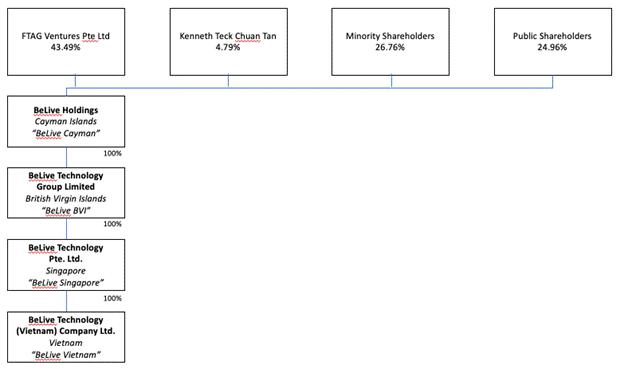
Industry Review
Live commerce and shoppable short videos refer to the combination of streaming video and e-commerce and the use of such video content on streaming online digital platforms to promote or sell products and services in real time. This format, unlike home shopping TV, allows for a two-way, real-time interactive, and immersive experience permitting users to watch, interact with the product offered and, with one click, see full product details and seamlessly add these items to their cart without leaving the live stream. Often featuring influencers or experts in the product area, it provides an interactive and immersive experience for customers, improves brand appeal and product differentiation, and accelerates the consumer’s decision process from awareness to purchase. Video analytics tools provide retailers with essential insight into customer behavior and demographics thus allowing them to make personalized recommendations, creating an authentic and engaging experience for shoppers. The fusion of interactive video with online buying and selling is revolutionizing the retail industry and consumer shopping habits and turning viewers into buyers.
|
|
Covid-19 led to unprecedented growth in e-commerce, including the surge of new trends in the sector, as more retailers were forced to shutter their brick-and-mortar stores and seek alternative methods to reach and engage with their customers. Live commerce and shoppable short videos allowed vendors to showcase their products and interact with customers facing severe movement restrictions imposed due to the pandemic as well as the increase of those working remotely. In this context, not only did livestream shopping help weather the crisis, but it also forged a new way of doing business, unlocking a world of opportunities for retailers while also providing consumers who were suffering from social isolation and longing for human connections with a near in-person experience.
Our Company
Overview
We are a leading technology solution provider for live commerce and shoppable short videos headquartered in Singapore. With our purpose-built solutions, we strive to create value to our customers which enable them to reach and engage their target customers and meet their evolving business and technology needs. Our solutions enable our customers to leverage the power of interactive and immersive live and video commerce to their online business, and enable our customers to curate unique videos, leading to more traffic and better shopping experiences on their platforms.
Our Products and Solutions
We categorize our solutions into an enterprise-grade BeLive White Label Solution and a cloud-based BeLive SaaS Solution.
BeLive White Label Solution
For customers with high demand for customized live commerce and shoppable short videos solutions, we provide them with bespoke solutions that can be integrated with their internal systems and offered through a White Label approach, made-to-measure for each unique customer’s needs. We follow a typical workflow to develop our BeLive White Label Solution which involves: (i) the formulation of business case, (ii) customization and development, (iii) technical implementation, (iv) user acceptance, and (iv) the provision of maintenance and support services.
| (i) | Formulation of business case |
When a potential opportunity is identified, our sales team will discuss with the client to understand their IT environment and gather their requests. After our sales team communicate the client’s request with our product management team, our product management team will then consult with our development team and assess the feasibility of the BeLive White Label solution and whether we will be able to deliver the BeLive White Label Solution on time.
We quote prices based on a range of factors, including our costs, quotations of our market competitors and our customer strategies. We also consider the complexity of the designs and the expected margins for the price setting. We will then enter into customer contracts with our customers once the final pricing is agreed.
| (ii) | Customization and development |
A key account management (“KAM”) personnel is then designated to handle each of our BeLive White Label Solution. Our KAM is responsible for establishing the project specification which sets out the specifications required by the customer, i.e., the functionalities, features, and display layout requirements. The specifications will be reviewed and approved by our product management team, development team and chief executive officer, Mr. Kenneth Teck Chuan Tan. Throughout our internal approval process, our KAM regularly communicates with our customers to ensure consistency with customer’s requirements.
|
|
Based on the specifications required by our customers, our development team works on software design and engineering of the BeLive White Label Solution, which includes the backend operation system, production servers, monitoring and analytics platform systems, and front-end mobile application for iOS and Android platforms and web components. Our KAM and project manager communicates with and receives feedback from our customers throughout the whole design and development process of the BeLive White Label Solution.
| (iii) | Technical implementation |
As a next step, we install, configure, and integrate the BeLive White Label Solution into the customers’ IT environments. We will then document the technical design in writing and provide the customers with administration instructions and training materials to enable them to administer the BeLive White Label Solution in their IT environment. Generally, the duration of the technical implementation stage varies from four to eight weeks, depending on factors including scope of work and technical complexity.
| (iv) | User acceptance |
Once the BeLive White Label Solution is installed and configured into the customer’s IT environment, we will prepare a user acceptance test (“UAT”) plan with the customer. The UAT plan in general sets out the functions of the BeLive White Label Solution and the performance of the BeLive White Label Solution under different scenarios, for example, whether the BeLive White Label Solution can perform a certain function.
Once the UAT plan is agreed by the customer, they will perform UAT while we provide support and training where necessary. If problems are discovered during the test, we will fix the problem and perform UAT again to the satisfaction of the customer. After UAT is fully completed and successful, the customer will confirm user acceptance and our technical implementation services are considered completed. The BeLive White Label Solution will then be deployed to the live server.
| (v) | Maintenance and support |
Following the completion of the technical implementation and deployment of the BeLive White Label Solution, we provide ongoing maintenance and post-deployment support services to our customers. Our KAM monitors and measures customer satisfaction through monthly meetings with our customers to go through performance metrics and satisfaction levels of the BeLive White Label Solutions.
When the end-users encounter problem with the BeLive White Label Solution, they may contact our KAM directly, through telephone or email. Our KAM will redirect the problems to the relevant technical staff from our development team. Our technical staff will then carry out problem diagnostics by gathering system log, trace or screen capture and try to resolve the problem remotely. If such problem cannot be tackled over telephone, email or remote access, our technical staff may have to provide on-site support.
We generate revenue from our BeLive White Label Solutions primarily from the following three streams:
| (i) | Customization and integration – We charge our customers a fixed fee, payable according to milestones, for the customization and integration of our BeLive White Label Solution onto our customers’ platform (the “Integration Services”). |
|
|
| (ii) | Licensing and maintenance – We charge our customers a monthly fee (the “Licensing and Maintenance Fee”), payable every six months, for the granting of a worldwide, limited, non-exclusive, non-transferable, non-sub-licensable right to use of our proprietary live commerce and shoppable short video technologies (“BeLive Technology”) and the provision of maintenance and support services. The Licensing and Maintenance Fee shall commence upon the completion of the Integration Services. |
| (iii) | Usage – We charge our customers a usage fee, payable each month, based on the hourly usage of our live commerce and/or shoppable short video recording services per user. |
BeLive SaaS Solution
Building upon our strong technological capabilities, analytical insights into user’s behaviors and preferences, we enhanced several of the commonly used features that we have built for our enterprise customers and launched in 2022 a cloud-based SaaS BeLive SaaS Solution targeted at the retail industry. This cloud-based BeLive SaaS Solution is light code and is readily available for use on any website or mobile application as an iframe. Generally, we can deploy the BeLive SaaS Solution to a customers’ platforms in less than 24 hours upon engagement.
Our BeLive SaaS Solution can be easily integrated using a few lines of code, which enables our customers to seamlessly connect to and use our technology solutions without the need for reconfiguration or adjustment permitting them to integrate live and interactive videos directly onto their platforms, such as mobile applications and websites, while also maximizing their reach by simultaneously broadcasting their live video content to social media platforms. Leveraging the advantages of being a SaaS solution, the BeLive SaaS Solution offers our customers the low costs of ownership for our customers by avoiding the significant upfront costs and considerable investment associated with building their own infrastructure and technology stacks from scratch.
Upon signing of the engagement agreement, new customers will be onboarded by our KAM team. The KAM team will walk the customer through the functions and the various features that are available, including training sessions on how to operate the content management system dashboard (the “Dashboard”), which typically takes one to two days following deployment of the BeLive SaaS Solution to our customers’ platforms. After onboarding, our customer will receive an email and password to access the Dashboard as an administrator. The administrator can then, through the dashboard, create host accounts for the content creators, such that they can host the live streams that have been scheduled without having to access to any sensitive information the customer might have on the Dashboard.
The content creators can then “go live” via BeLive’s LORA mobile application with streaming rights being assigned to them.
We generate revenue from our BeLive SaaS Solutions primarily from the following three streams:
| (i) | Onboarding – We charge our customers a fixed onboarding fee, payable upon engagement, for the delivery of our BeLive SaaS Solution. |
| (ii) | Licensing and maintenance – We charge our customers a monthly subscription fee, payable every six months, for the granting of a worldwide, limited, non-exclusive, non-transferable, non-sub-licensable right to use the BeLive Solution and the provision of maintenance services. |
| (iii) | Usage – We charge our customers a usage fee, payable each month, based on hourly usage of our live commerce and/or shoppable short video delivery services per user. |
Features and functionalities
Basic features and functionalities
Basic features and functionalities such as (i) social commerce, (ii) interactive features, and (iii) content and data analytics are available in both our BeLive White Label and SaaS Solutions. In addition, our BeLive White Label Solutions also allow for new features and functionalities to be developed and the ones mentioned below may not be exhaustive.
|
|
| (i) | Social commerce |
We provide our customers with rich and dynamic ways to engage with its viewers beyond the traditional storefront through interactive live streams and shoppable short videos and provide the viewers with a seamless online shopping experience. Viewers can browse products without leaving the live stream/short videos by using an in-stream/video shopping catalogue. Viewing additional details and description of the products are also made seamless as the live stream/short video continues to play when viewers are directed to the product information page. Once the viewers have added all their goods to the shopping cart and have proceeded to check out, they would be asked to provide delivery information and can pay via secure payment gateways that we integrate into our solutions.
Our customers use (a) shoppable short videos primarily to achieve considerable exposure to viewers of their brands, businesses, or products, and (b) live streams to market and promote products and interact with potential buyers in real time, explaining the value of the product and addressing their questions, thereby helping viewers to make purchase decisions. Social activity among streamers/short video creators and viewers during live streams/short videos also facilitate transactions by creating a lively atmosphere and providing product validation.
| (ii) | Interactive features |
We provide streamers/short video creators and viewers with various channels to interact with each other to form a vibrant and engaged social community. Interactions primarily revolve around the content on our customer’s platform, through which viewers can share similar interests and bond with each other. Some of the most common interactive features provided by our solutions include likes, shares, follows, comments, polling, rating, and quiz.
| (a) | Likes, shares, and follows – Viewers can like content to support streamers/short video creators by sending a “heart”. Viewers can also share interesting or useful content with other people. The follow function allows viewers to follow a content creator and see all of their content and updates to their posts and activities on the customer’s platform as well as receive notifications when the content creator uploads new content. Likes, shares, and follows all contribute to social connections and user engagement. |
| (b) | Comments – Viewers may leave comments to a short video to share their reactions and communicate with other viewers who have similar interests and needs. A viewer can also like a comment, and comments with most likes get placed further up the comment thread. A viewer may also reply to another viewer’s comment to continue a particular conversation in the comments section. In live streaming rooms, viewers comment and communicate with each other and interact with the streamer in real time. |
| (c) | Polling, rating, and quiz – We are capable of providing polling, rating and quiz functions which enable streamers/short video creators to engage with viewers during live streams/short videos more directly, create a fun and lively experience and a more personal environment. |
| (iii) | Content and data analytics |
We are capable of providing analytical tools that enable our customers and marketers to track and study first-party behavioral data such as the number of viewers, likes and comments, amount of time viewers spent viewing their content and other information providing viewer portraits and insights as to the popularity of their content. Through our data analytics support, our customers and content creator can better understand the preferences of their viewers and create content that is more appealing and targeted.
|
|
Enhanced features and functionalities
Enhanced features and functionalities such as (i) loyalty rewards, (ii) virtual gifting, (iii) ticketing and (iv) virtual host are some of the developments that we are capable of providing to our White Label customers:
| (i) | Loyalty reward |
We are capable of integrating the customer’s existing loyalty reward program to our BeLive White Label Solutions, which can be repurpose with different use cases such as enabling viewers to earn loyalty points by watching a live stream/short video for a certain period of time, making loyalty point redemption purchases, or sending virtual gifts using reward points via the live stream. This will allow our customers to fully integrate their existing reward program into their live commerce ecosystem seamlessly.
| (ii) | Virtual gifting |
We are capable of providing a virtual gifting function for live streams. Viewers purchase virtual items and gift these virtual items to streamers as a gesture of friendship, appreciation, admiration, or support. We offer a wide variety of virtual items on our customers’ platforms at difference price points. Our diverse selection of lower-priced virtual items makes it easy for viewers to show appreciation for each other through small gifts and allow viewers to familiarize themselves with the gifting function, while higher-priced virtual items give a chance for streamers to obtain peer recognition during a live stream. We are also capable of releasing new virtual items related to current events and cultural trends.
| (iii) | Ticketing |
We are capable of building ticketing systems which enable our customers to offer premium or gated contents through the sale of tickets. This will allow them to better monetize from the different contents that they have produced.
| (iv) | Virtual host |
Leveraging our strategic alliance with Neosapience, a Korean company that provides AI-powered content creation solution, we are capable of integrating AI voices and virtual human features into our solutions, which supports multiple languages, including English, Korean, and Mandarin. We can also design a custom avatar that aligns with the customer’s brand.
Our virtual host can be used to narrate contents, through a script and embed in product videos which will keep the viewers captivated with a mix of educational and entertaining content, including interesting facts and information about the topic or product.
Technology
We use video and live streaming technologies, big data analytics and AI extensively in various aspects of our operations.
High-definition video and proprietary video compression technology – Our solutions are designed to run smoothly on all types of mobile phones and support high quality short video playback and low latency live streaming. We have also developed a set of proprietary algorithms to adjust lighting and color hue to improve the quality of videos shot in extreme conditions or by low-end mobile phones. We provide end-to-end support of filming, editing, uploading and playback of high-definition 1080p videos, which caters to increasing demand from users for a highly immersive video watching experience. We developed a video codec which can significantly reduce the size of the media files given the same subjective quality and improve the smoothness of video playback.
Advanced live streaming capability – In response to the diverse needs of live streaming scenarios and network conditions, we developed a proprietary transmission protocol and an adaptive bitrate streaming standard for our live streams, using advanced technologies such as multiple stream control algorithms, congestion control algorithms, adaptive fault-tolerant algorithms and multi-bitrate adaptive algorithms, while also accounting for multiple variables such as encoding standards, network speeds and business requirements. We also utilize joint source channel coding technology to adapt the quality of streaming sources with the fluctuation of network conditions encountered in the real world, significantly improving the upload speed and transmission stability of live streaming signals on weak networks. As a result, we can provide a live streaming experience that is smoother with higher resolution and lower latency. Our technological innovations in live streaming have resulted in outstanding performance on our customers’ live streaming platforms and increased average time spent per day by our users.
|
|
Big data and audience sentiment engine – Due to the nature of the solutions we offer, we require large amounts of storage and computing resources to process a high throughput of data being generated every day on our customers’ platforms, including to process (i) multimedia data such as videos to enhance our video streaming quality and improve our analysis and understanding of video content and (ii) mass user behavioral data on our customers’ platforms for analysis, to run computationally complex processes and algorithms for recommendations, searches and other functions, and to build a highly efficient data warehouse in support of smart and insightful data and sentiment analysis to drive fast iterations of our solutions. Our audience sentiment engine that focuses on AI technology was jointly developed with AI Singapore.
AI-powered content creation tools – Our machine learning, computer vision and computer graphics capabilities have enabled us to offer a wide array of content creation tools such as beautification functions, smart filters, stickers, human computer interactions and augmented reality and mixed reality effects. These carefully designed innovative features have fostered a highly interactive and enjoyable experience and motivated users to create more vibrant and inspirational content that attracts more users, which in turn fueled further growth in creative content on our customers’ platforms.
Research and Development
As part of the development of our solutions, we review our projects with clients who utilize our BeLive Solutions regularly and modify our equipment and technologies based on experience and feedback from completed projects. We are also committed to researching and developing technologies in order to understand the needs of viewers and enhance the effectiveness of our solutions for customers.
Our development team comprises of highly skilled engineers and IT professionals with extensive experience in mobile application and live videos and video-streaming software development and data analytics. To complement the existing technology in our solutions and to supplement our internal expertise, we are also looking to collaborate with third-party institutions and have collaborated with AI Singapore in 2021 on the research project titled “BeLive Audience Sentiment Engine (B.A.S.E.)” (the “Project”) by entering into a research collaboration agreement with AI Singapore, with an aim to allow businesses hosting livestreams to obtain useful insight and analytics on viewers’ sentiment on different aspects of the stream, such as understanding how well-perceived the stream is, the effectiveness of their stream or host, and further identifying consumer needs and product marketing opportunities. This Project has since been completed and deployed onto our technology stack. Such collaboration enabled deep knowledge transfer between the engineering team from AI Singapore, and our engineers and we will continue to develop and enhance the model over time.
We believe scientific and technological innovations will help us achieve our long-term strategic objective to reach prospective clients from countries beyond our current footprint. We intend to continue to invest in research and development to support and enhance our business solutions and promote further innovation in the live commerce and shoppable short videos industry to elevate our position in the market.
Our Customers
Our customers primarily comprise local and renowned international brands and that are based in Asia and Oceania and Europe. They primarily consist of direct-to-consumers brands, e-commerce platforms and broadcasters. A large majority of our customers are retail and e-commerce businesses which utilize our solutions to engage with their target customers. The remainder of our customer base includes use cases in other sectors such as real estate, finance, and social platforms.
|
|
The breakdown of our revenue by geographic region for the years ended December 31, 2023 and 2024 is as follows:
| Geographical region |
For the year ended December 31, 2023 |
For the year ended December 31, 2024 |
||||||
| Asia & Oceania | 97 | % | 99 | % | ||||
| Europe | 3 | % | 1 | % | ||||
For the years ended December 31, 2023 and 2024, customers who contributed over 10% of the total revenue of the Group accounted for approximately 63% and 79% of the Group’s total revenue, respectively. Revenue from customers contributing over 10% of the total revenue of the Group is as follows:
| Customer who contributed over 10% of the Group’s total revenue |
For the year ended December 31, 2023 |
For the year ended December 31, 2024 |
||||||
| Customer A | 31 | % | 0 | % | ||||
| Customer B | 16 | % | 13 | % | ||||
| Customer D | 16 | % | 0 | % | ||||
| Customer E | N/A | 44 | % | |||||
| Customer F | N/A | 22 | % | |||||
Our Suppliers
Our suppliers are providers of the infrastructure on which we operate our solutions. As a business that relies on cloud infrastructure to run our solutions, we have selected a number of cloud conglomerates since 2023 to build a multi-cloud infrastructure in order to ensure stability of cloud services received and to support multi-party audio-and video-enabled real-time online interactions. Our suppliers are reputable market leaders among cloud infrastructure providers.
Sales and Marketing
The focus of our marketing efforts is to further strengthen our brand recognition as a leading provider of live commerce and shoppable short videos. To expand our ecosystem to connect with enterprises and other marketing partners, we are dedicated to promoting our solution to target customers through a variety of channels:
| (i) | Strategic Alliance Marketing – We benefit from a large network of strategic alliances in the ecosystem who generally have strong willingness to refer their own customers and partnering institutions to us as this also benefits their own businesses. We have built solid business relationships from three pillars, including brand alliances, media buy alliances and audience generating alliances, comprising of multi-channel networks, cloud service providers, marketing agencies, content creation and production companies and mainstream media. Through their referrals, we are able to expand our customer base and address their needs for live commerce or shoppable short videos solutions, for instance, our marketing agencies alliances introduce us to their clients as a technology solution to inject into marketing campaigns. This allows our business to grow exponentially while controlling customer acquisition costs. |
| (ii) | Inbound Marketing – We also generate interest and acquire new customers from promotions in events and conventions, as well as content marketing by placing paid advertisements on social media and other selected platforms such as google ads and display ads network. |
| (iii) | Outbound Marketing – Our business development team is constantly outreaching and nurturing our list of prospective clients with content and information that align with their interest, with an aim to bring us the opportunity to converse with such prospects regarding our offerings. |
We aim to continue to implement cutting edge technologies, introduce interactive interfaces and tools, as well as improve user experience in order to generate traffic and sales for the customers, with a goal to increase our active user base and attract prospective customers.
|
|
Our Competitive Strengths
As a comprehensive provider of a technology platform, we deliver a market-leading combination of effective and unique, user-friendly functionality, scalability, and ease-of-use to facilitate the growth of clients’ digital commerce businesses.
We are committed to offering our customers technological diversity, quality, and reliability. We offer a diversified portfolio of technological products that can be customized to satisfy our customers’ specialized and unique needs. We believe we have several competitive strengths that will enable us to maintain and increase our market position in the industry. Our competitive strengths include:
Established reputation and proven track record in the industry.
We have been providing live commerce and shoppable short videos to our customers since 2018 and have accumulated extensive industry experience. Our strong research and development and engineering capabilities enable us to design, develop, customize, and integrate our BeLive White Label and BeLive SaaS Solutions to meet each of our customers’ needs. We also benefit from massive domain-specific data accumulated since our inception, which are critical in training our models and algorithms to continuously optimize our solutions.
In 2022, we were accredited by Infocomm Media Development Authority, a statutory board under the Singapore Ministry of Communications and Information as a qualified contender to government and large enterprise buyers with assurance of the functionalities of our solutions.
We believe our strong track record in providing live commerce and shoppable short videos will facilitate the promotion and demand for our products with both existing and new customers, as well as the expansion of our business. We will continue to develop enhanced and addition solutions for different industry end-use applications and to meet the needs of our customers across various industries by expanding our solution product portfolio.
Innovative business model
We have developed both our BeLive White Label Solution, for clients who require a bespoke and customized live video commerce and shoppable short video solution, as well as our BeLive SaaS Solutions for small and medium size enterprises. This product diversification, unlike other market participants whose sole focus is on SaaS solutions, enables us to accommodate the different needs of our customers providing us with additional business opportunities.
Technology innovation, application and research and development capabilities
We have invested significant resources in our research and development capabilities in video and live streaming technologies, big data analytics, AI, and other technologies. Our audience sentiment engine, which focuses on AI technology, was jointly developed with AI Singapore. The technologies have directly contributed to the acceptance of our BeLive Solutions and our user’s experience.
We have developed proprietary video and live streaming technologies that facilitate high-quality content transmission including a video codec which can significantly reduce the size of the media files given the same subjective quality and improve the smoothness of video playback. We also developed a private transmission protocol and an adaptive bitrate streaming standard for our live streams that utilizes joint source channel coding technology to adapt the quality of streaming sources with the fluctuation of network conditions encountered in the real world. This significantly improves the upload speed and transmission stability of live streaming signals on weak networks and allows us to provide a live streaming experience that is smoother with higher resolution and lower latency, thereby increasing user engagement.
As collection of first party data becomes a priority in marketing analytics for businesses, our technologies enable us to process a high throughput of data being generated every day on our customers’ platforms. This permits us to process (i) multimedia data such as videos to enhance our video streaming quality and improve our analysis and understanding of video content, (ii) mass user behavioral data on our customers’ platforms for analysis, to run computationally complex processes and algorithms for recommendations, searches and other functions, and (iii) to build a highly efficient data warehouse in support of smart and insightful data and sentiment analysis to drive fast iterations of our solutions.
|
|
In 2021, we entered into a research collaboration agreement with AI Singapore for a period of nine months, pursuant to which both parties provided funding, manpower and resources on the research project titled “BeLive Audience Sentiment Engine (B.A.S.E)”, to allow businesses hosting livestreams to obtain useful insight and analytics on viewers’ sentiment on different aspects of the stream, such as understanding how well-perceived the stream is, the effectiveness of their stream or host, and further identifying consumer needs and product marketing opportunities. These technologies allow our customer’s platform to continue to scale and are an important aspect of our technological and data advantages. Pursuant to the research collaboration agreement, we owned the intellectual property rights of the Project (the “Project IPR”), and we should make reasonable effort to internally deploy or commercialize the Project IPR for a period of three years from the date of completion of the Project and deliver to AI Singapore a report detailing such internal deployment or commercialization activities on an annual basis. This Project has since been completed and deployed onto our technology stack and we plan to fully commercialize the capability within our BeLive White Label and SaaS Solutions.
Leveraging computer vision and machine learning, we offer a wide array of beautification functions, smart filters, stickers, human computer interactions and augmented reality and mixed reality effects that make video content even more lively for our users. These features foster an interactive and enjoyable experience for content creators and viewers, which in turn contribute to the richness of content and interactivity in our ecosystem.
Broad strategic alliances and relationship network.
We have developed a broad network of strategic alliances with technology entities allowing us to integrate leading edge technical developments into our BeLive Solutions as well as customer acquisition alliances who provide referrals to expand our customer base. Our strategic alliance with Neosapience, a Korean company that develops AI-powered content creation solution, provides us with the capability to integrating AI voices and virtual human features into our BeLive Solutions. Marketing agencies, content creation and production companies and mainstream media, have indicated a strong willingness to refer their own customers to us as these collaborations provides direct benefits to their own businesses.
Experienced and committed management team.
We have an experienced management team, led by Mr. Kenneth Teck Chuan Tan, our Chairman and Chief Executive Officer, who has been instrumental in spearheading the growth of our Group. He has over eight years of experience in the live streaming, short videos, and e-commerce industries, and held significant position in leading corporations such as DeNA. Mr. Kenneth Teck Chuan Tan is primarily responsible for planning and execution of our Group’s business strategies, including product development, as well as managing our Group’s relationships.
Our other core executive team also possesses rich management experience from companies such as Samsung, Nexstreaming and the Singapore Ministry of Education.
As a company with roots in live streaming, short videos and e-commerce, our corporate culture represents a confluence of entrepreneurship, creativity, and strong execution capabilities. We are driven by a firm commitment to integrity and efficiency which allows us to continuously evolve and adapt to the fast-changing Internet and e-commerce arena.
Stable relationships with our major customers
Since 2018, we have developed stable relationships with our major customers. We believe that our industry knowledge and ability to design, develop and produce live commerce and shoppable short videos, to meet our customers’ requirements and specifications, and our ability to integrate these solutions has been the key drivers for customers to utilize our BeLive Solutions.
Our Growth Strategies
We plan to expand our business and strengthen our market position in the live commerce and shoppable short video industry by implementing the following business strategies and future plans.
|
|
Expand and enhance our current solution offerings
We will continue to enhance and expand our BeLive Solution offerings and industry coverage by developing and integrating new functionalities and features in our solutions to address and fulfil our customers’ needs that arise naturally on their platforms. The combination of these efforts will help us retain existing customers, attract new customers, increase user engagement, and provide a better overall user experience.
Adapt to changing market conditions and customer requirements
Retail companies and e-commerce marketplaces are undergoing a digital transformation to effectively promote their businesses and to boost online sales. As the live streaming and video market continues to develop and demand increases, we believe that if we continue to adapt to changing market conditions and customer requirements, there will be significant opportunities for us to expand our customer penetration not only with retail companies and e-commerce marketplaces, but also to companies that are in the broadcasting, media and advertising, real estate, education, and finance sectors.
Advance our video and live streaming technologies
We believe that advancing our video and live streaming technologies using our research and development capabilities and engineering expertise are vital in maintaining our long-term competitiveness and driving our business growth. Continued development of our technological capabilities in areas such as personalized recommendation, content and data analytics, sentiment analytics, will improve our user experience and engagement. Ongoing updates to our video compression and live streaming technologies will provide an enhanced user experience by ensuring high video quality, lower latency, faster upload speed and transmission stability under various network conditions. Improvements to our machine learning, computer vision and computer graphics capabilities will provide new and attractive content creation tools to our users and will further encourage content creation and interaction among users on our customer’s platform. We will scale up and enhance our network infrastructure as the amount of data generated and stored on our customer’s platform continues to grow.
Selectively pursue strategic alliances
To complement our organic growth, we will continue to selectively pursue strategic alliances, that can strengthen our technological and content production capabilities, and broaden our customer base and solution offerings, as well as our ecosystem generally. We will continue to seek out potential strategic alliances that are complementary to and have synergies with our current business and that will help us attract and retain customers. By expanding our ecosystem, we will continue to grow our business and further provide value to our customers by providing them with more diverse and improved solutions.
Impact of COVID-19
On March 11, 2020, the World Health Organization declared COVID-19 a pandemic. The outbreak has reached almost every country (including Singapore and Vietnam) resulting in the implementation of significant governmental measures, including lockdowns, closures, quarantines, and travel bans, intended to control the spread of the virus. Companies are also taking precautions, such as requiring employees to work remotely, imposing travel restrictions, and temporarily closing businesses.
|
|
The negative impacts of the COVID-19 pandemic on our business, financial condition, and results of operations include, but are not limited to, the following:
| ● | Temporary lockdown or suspension of business. In response to the COVID-19 pandemic, local governments in Singapore and Vietnam have imposed restrictions on large-scale gathering activities in various places or imposed extra requirements on participants of such activities from time to time, which have caused suspension of the Company’s business operation in Singapore and in Vietnam. |
| ● | Limitations on our employees’ ability to work and travel. Resulting from the implementation of significant governmental measures in Singapore and Vietnam, including lockdowns, closures, quarantines, and travel bans from time to time, intended to control the spread of COVID-19, our employees’ ability to work and travel was adversely affected and therefore the Company’s ability to manage day-to-day operations and service delivery was impaired in in Singapore and Vietnam. |
| ● | Limitations on in-person business activities. Affected by the self-quarantine requirement and travel restrictions in Singapore and Vietnam, the Company’s marketing staffs were unable to carry out in-person promotion activities and face-to-face communication with customers, which greatly affected the development and introduction of potential customers. |
| ● | Reduction of customer’s spending. The epidemic caused negative impact on the global economy, including Singapore and Vietnam, and severely interrupted our customers’ normal work and businesses, which negatively affected our customers’ spending and investment in their businesses and caused them to be more inclined to reduce expenditures, and in turn affect our revenues and operational results. Although none of our customers has terminated contracts with us to date, we cannot assure you if any customer will in the future terminate its contract with us due to the epidemic. |
The COVID-19 outbreak has adversely affected (and a significant outbreak of other infectious diseases could result in an additional widespread health crisis that could adversely affect) the economies and financial markets worldwide, and the business of the Company could be materially and adversely affected by the COVID-19 outbreak and any such other outbreak.
Furthermore, our business may be adversely affected if continued concerns relating to COVID-19 continue to restrict travel, or result in the Company’s personnel, vendors and customers being unavailable to pursue their business objectives free of COVID-19 related restrictions. Although travel restrictions and quarantine requirements have been lifted in Singapore and Vietnam, the extent to which COVID-19 impacts our business in the future will depend on future developments, which are highly uncertain and cannot be predicted, including for example new information which may emerge concerning the severity of COVID-19 and the actions taken by relevant government authorities to contain COVID-19 or treat its impact.
If the disruptions posed by COVID-19 or other matters of global concern continue for an extended period of time, our ability to pursue our business objectives may be materially adversely affected. In addition, our ability to raise equity and debt financing which may be adversely impacted by COVID-19 and other events, including as a result of increased market volatility, decreased market liquidity and third-party financing being unavailable on terms acceptable to us or at all.
However, Covid-19 also led to unprecedented growth in e-commerce, including the surge of new trends in the sector, as more retailers were forced to shutter their brick-and-mortar stores and seek alternative methods to reach and engage with their customers. Live commerce and shoppable videos allowed vendors to showcase their products and interact with customers facing severe movement restrictions imposed due to the pandemic as well as the increase of those working remotely. In this context, not only did livestream shopping help weather the crisis, but it also forged a new way of doing business, unlocking a world of opportunities for retailers while also providing consumers who were suffering from social isolation and longing for human connections with a near in-person experience. Therefore, while Covid-19 negatively impacted the Company’s business and may do so again in the future, it, conversely changed the market in which the Company operates providing significant new opportunities to expand it products and services.
|
|
Content Monitoring
We are committed to complying with the applicable laws and regulations regarding the provision of content through the Internet. We leverage our technology to implement procedures to automatically remove inappropriate content with our system’s profanity filter. If requested by our customers to provide such services, we are capable of monitoring and screening text, images, and videos, and may intervene and delete relevant content and images on client request and conduct follow-up reviews.
Intellectual Property
We rely on a combination of copyright and trademarks, as well as confidentiality procedures and contractual provisions, to protect our intellectual property rights. As of December 31, 2024, we have successfully registered the trademark “BeLive” in eight jurisdictions, being Australia, Indonesia, Israel, Japan, Philippines, Singapore, Taiwan, and the United States. We have also registered the same trademark with the Madrid System of the World Intellectual Property Organization, and have designated its application to Australia, Israel, Japan, Malaysia, Philippines, Thailand, the United States and Vietnam. In relation to the copyright which may subsist in our solutions, we would grant our customers the license to use such copyright in our customer contracts where necessary.
Despite our efforts to protect ourselves from infringement or misappropriation of our intellectual property rights, unauthorized parties may attempt to copy or otherwise obtain and use our intellectual property in violation of our rights. In the event of a successful claim of infringement against us, or our failure or inability to develop non-infringing intellectual property or license the infringed or similar intellectual property on a timely basis, our business could be harmed.
Data Security and Protection
Keeping private data and sensitive information safe is integral to maintaining the trust from our customers and end users. The user privacy policy on our platform describes our data use practices and how privacy works on our platform. Specifically, users are required to acknowledge the terms and conditions of the user agreement before using our products or services, and we provide users with prior notice as to what data are being collected and undertake to manage and use the data collected in accordance with applicable laws.
In addition, we use a variety of technologies to protect the data with which we are entrusted and are constantly reviewing and monitoring our internal data security practices. We also provide regular training and awareness programs to educate employees on the importance of information security and their responsibilities in relation to information management. Only authorized individuals who require the information to fulfil their job responsibilities have access to the relevant information and systems. For our external interfaces, we utilize firewalls, encryption, and other security controls to secure our networks from unauthorized access, use, disclosure, disruption, modification, or destruction.
Employees
The following table sets forth a breakdown of our full-time employees by functions and geographical locations as of December 31, 2024:
| Number of Employees | ||||||
| Function | Singapore | Vietnam | Total | |||
| Management | 4 | 1 | 5 | |||
| Sales and Marketing | 3 | 1 | 4 | |||
| Project Management | 2 | 1 | 3 | |||
| Technical and Development | 0 | 16 | 16 | |||
| Finance, human resources, and administration | 2 | 2 | 4 | |||
| Total | 11 | 21 | 32 | |||
We enter into employment contracts with our full-time employees which contain standard confidentiality and non-compete provisions.
|
|
In addition to salaries and benefits, BeLive Cayman has adopted a share option scheme 2023 (“Share Option Scheme 2023”) in place under which shares of BeLive Cayman would be granted to certain employees subject to the terms and conditions of the Share Option Scheme 2023. Additionally, we are required under Singapore law to make monthly contributions to the central provident fund based on legislated rates for our employees who are Singapore permanent residents. For BeLive Vietnam, we provide performance-based bonuses for our full-time employees on a yearly basis.
We believe that we maintain a good working relationship with our employees, and we have not experienced any material labor disputes in the past. None of our employees is represented by labor unions.
Competition
As a leading player in the fast-growing live commerce and shoppable short videos industry, we face competition from providers of similar services including but not limited to Bambuser and Firework. Our competitors may compete with us in a number of ways, including conducting promotions for their brand and solutions and other marketing activities. They may also attract enterprises through favorable fee arrangements and enter into exclusive contracts with them.
Some of our overseas competitors may have greater financial, marketing or technology resources than we do, which could enable them to respond more quickly to technological innovations or changes in user demands and preferences and devote more resources towards the development and promotion of new solutions than we can.
The industry is still at a development stage with our competitors operating in different domains and countries, serving varying enterprises and customer groups. We will remain competitive and attract, engage, and retain customers with the diversity of our product features, quality of user experience, our brand reputation and active customer relationship management. Our suite of services goes beyond providing an interface and focuses on providing answers best suited to the marketing needs of our clients.
Facilities
Our principal executive offices are located in Singapore, and Vietnam. These facilities have an aggregate of approximately 3,545 square feet and currently accommodate our management headquarters, as well as most of our product development, sales and marketing, and general administrative activities. Our main IT infrastructure includes cloud platforms on which our solutions operate and other microservices. We subscribe for such services from major cloud infrastructure providers and other microservices provider globally.
We lease all of the facilities that we currently occupy. We have entered into a license agreement for our Singapore office situated at 26A Ann Siang Road, #03-00, Singapore 069706 from April 1, 2024 to 31 March 2025 at a monthly rent of S$8,000. We have also entered into a lease agreement for our Vietnam office situated at Unit 1101, Nguyen Lam Tower, 133 Duong Ba Trac Street, Ward 1, District 8, Ho Chi Minh City, from September 1, 2021 to March 10, 2023, which was subsequently extended to March 10, 2025. The monthly base rent under such lease is 52,560,000 VND until March 10, 2022, 56,940,000 VND until March 10, 2024 and 61,320,000 VND until March 10, 2025 equivalent to approximately S$3,000, S$3,200 and S$3,500 respectively, exclusive of management charges. We believe that our existing facilities are generally adequate to meet our needs for the foreseeable future.
Insurance
We maintain liability insurance against injuries, death, or losses due to fire and water leakage, as well as property insurance covering damage to our occupied premises and facilities. Save for the above, we do not maintain any other liability insurance or property insurance policies. Consistent with customary industry practice in Singapore and Vietnam, we do not maintain business interruption insurance, nor do we maintain key-man life insurance.
|
|
Litigation
There are no material proceedings to which any director or officer, or any associate of any such director or officer, is a party that is adverse to our Company or any of our subsidiaries or has a material interest adverse to our Company or any of our subsidiaries. No director or executive officer has been a director or executive officer of any business which has filed a bankruptcy petition or had a bankruptcy petition filed against it during the past ten years. No current director or executive officer has been convicted of a criminal offense or is the subject of a pending criminal proceeding during the past ten years. No current director or executive officer has been the subject of any order, judgment or decree of any court permanently or temporarily enjoining, barring, suspending or otherwise limiting his involvement in any type of business, securities or banking activities during the past ten years. No current director or officer has been found by a court to have violated a federal or state securities or commodities law during the past ten years.
However, we may from time to time after the date of this Annual Report become subject to claims and litigation arising in the ordinary course of business. One or more unfavorable outcomes in any claim or litigation against us could have a material adverse effect for the period in which such claim or litigation is resolved. In addition, regardless of their merits or their ultimate outcomes, such matters are costly, divert management’s attention, and may materially adversely affect our reputation, even if resolved in our favor.
This section sets forth a summary of the material laws and regulations that affect our Group’s business and operations in Singapore, and Vietnam. Information contained in this section should not be construed as a comprehensive summary nor detailed analysis of laws and regulations applicable to the business and operations of our Group. This overview is provided as general information only and not intended to be a substitute for professional advice. You should consult your own advisers regarding the implication of the laws and regulations of Singapore, and Vietnam on our business and operations.
Laws and Regulations Relating to Our Business in Singapore
Our business operations are not subject to any special legislation or regulatory controls other than those generally applicable to companies and businesses incorporated and/or operating in Singapore.
Laws and regulations relating to our operations.
Workplace Safety and Health Act
The Workplace Safety and Health Act 2006 of Singapore (the “WSHA”) provides that every employer has the duty to take, so far as is reasonably practicable, such measures as are necessary to ensure the safety and health of its employees at work. These measures include providing and maintaining for the employees a work environment that is safe, without risk to health, and adequate with regards to facilities and arrangements for employees’ welfare at work, ensuring that adequate safety measures are taken in respect of any machinery, equipment, plant, article or process used by the employees, ensuring that the employees are not exposed to hazards arising out of the arrangement, disposal, manipulation, organization, processing, storage, transport, working or use of things in or near their workplace and under the control of the employer, developing and implementing procedures for dealing with emergencies that may arise while those persons are at work and ensuring that the employees at work have adequate instruction, information, training and supervision as is necessary for them to perform their work. The relevant regulatory body is the MOM.
Any person who breaches his duty under the WSHA is guilty of an offense and will be liable on conviction, in the case of a body corporate, to a fine not exceeding S$500,000 and if the contravention continues after the conviction, the body corporate shall be guilty of a further offense and will be liable to a fine not exceeding S$5,000 for every day or part thereof during which the offense continues after conviction. For repeat offenders, where a person has on at least one previous occasion been convicted of an offense under the WSHA that causes the death of any person and that person is subsequently convicted of the same offense that causes the death of another person, the court may, in addition to any imprisonment, if prescribed, punish the person, in the case of a body corporate, with a fine not exceeding S$1 million and, in the case of a continuing offense, with a further fine not exceeding S$5,000 for every day or part thereof during which the offense continues after conviction.
|
|
Under the WSHA, it is the duty of any person who manufactures any machinery, equipment or hazardous substance (“MEHS”), which includes, among other things, welding equipment, for use at work to ensure, so far as is reasonably practicable, that (a) information regarding the safe use of the MEHS is supplied for use at work (which should include precautions to be taken for the proper use and maintenance of such MEHS, the health hazards associated with the MEHS and the information relating to and the results of any examinations or tests of the MEHS that are relevant to its safe use); (b) the MEHS are safe, and without risk to health, when properly used; and (c) the MEHS are examined and tested in compliance with the obligation imposed by paragraph (b). The duties imposed on any person in respect of the aforementioned shall (i) apply only if the MEHS are manufactured or supplied in the course of a trade or business carried on by the person (whether for profit or not); (ii) apply whether the MEHS are exclusively manufactured or supplied for use by persons at work; (iii) extend to the supply of the MEHS by way of sale, transfer, lease or hire and whether as principal or agent, and to the supply of the MEHS to a person for the purpose of supply to others; and (iv) not apply to a person by reason only that the person supplies the machinery or equipment under a lease-purchase agreement, conditional sale agreement or credit-sale agreement to another (“customer”) in the course of a business of financing the acquisition of the machinery or equipment by the customer from others. In the event any person contravenes the relevant provision in the WSHA that imposes the aforementioned duty on such person, that person is guilty of an offense, and liable on conviction (in the case of a natural person) for a fine not exceeding S$200,000 or imprisonment for a term not exceeding two years or both, or (in the case of a body corporate) for a fine not exceeding S$500,000.
Further, the Commissioner for Workplace Safety and Health (the “CWSH”) may serve a remedial order or a stop-work order in respect of a workplace if he is satisfied that (a) the workplace is in such condition, or is so located, or any part of the machinery, equipment, plant or article in the workplace is so used, that any work or process carried on in the workplace cannot be carried on with due regard to the safety, health and welfare of persons at work; (b) any person has contravened any duty imposed by the WSHA; or (c) any person has done any act, or has refrained from doing any act which, in the opinion of the CWSH, poses or is likely to pose a risk to the safety, health and welfare of persons at work. The remedial order shall direct the person served with the order to take such measures, to the satisfaction of the CWSH, to, among other things, remedy any danger so as to enable the work or process in the workplace to be carried on with due regard to the safety, health and welfare of the persons at work, whereas a stop-work order will direct the person served with the order to immediately cease to carry on any work or process indefinitely or until such measures as are required by the CWSH have been taken, to the satisfaction of the CWSH, to remedy any danger so as to enable the work or process in the workplace to be carried on with due regard to the safety, health and welfare of the persons at work, and shall specify the date on which such order is to take effect.
Pursuant to the Workplace Safety and Health (Noise) Regulations 2011 of Singapore (the “WSHNR”), the occupier of a workplace must take reasonably practicable measures to reduce or control the noise from any machinery or equipment used or from any process, operation or work carried out by him in the workplace, so that no person at work in the workplace is exposed or likely to be exposed to excessive noise. This may include replacing noisy machinery, equipment, processes, operations or work with less noisy machinery, equipment, processes, operations or work, and such other measures as prescribed under the WSHNR. Where it is not practicable to reduce the noise, the occupier of a workplace shall limit the duration of time persons at work are exposed to the noise in accordance with the time limits prescribed in the Schedule under the WSHNR. Any person who contravenes the aforementioned is guilty of an offense and is liable on conviction for a fine not exceeding S$10,000, and in the case of a second or subsequent conviction, for a fine not exceeding S$20,000 or imprisonment for a term not exceeding six months or both.
Pursuant to the Workplace Safety and Health (Risk Management) Regulations, the employer in a workplace is supposed to, among other things, conduct a risk assessment in relation to the safety and health risks posed to any person who may be affected by his undertaking in the workplace, take all reasonably practicable steps to eliminate or minimize foreseeable risks, implement measures or safety procedures to address the risks, and to inform workers of the same, maintain records of such risk assessments and measures/safety procedures for a period of not less than three years and submit such records to the CWSH when required by the CWSH from time to time. Any employer who fails to comply with the aforementioned requirements is guilty of an offense and is liable on conviction for a fine not exceeding S$10,000 for the first offense, and for a fine not exceeding S$20,000 for a subsequent offense or imprisonment for a term not exceeding six months or both.
|
|
Work Injury Compensation Act
The Work Injury Compensation Act 2019 of Singapore (The “WICA”), which is regulated by the MOM, applies to all employees who are engaged under a contract of service or apprenticeship with an employer regardless of their level of earnings. The WICA does not cover self-employed persons or independent contractors. However, as the WICA provides that, where any person (referred to as the principal) in the course of or for the purpose of his trade or business contracts with any other person (referred to as the subcontractor employer), the principal shall be liable to compensate those employees of the subcontractor employer who were injured while employed in the execution of work for the principal.
The WICA provides that if an employee dies or sustains injuries in a work-related accident or contracts occupational diseases in the course of the employment, the employer shall be liable to pay compensation in accordance with the provisions of the WICA. An injured employee is entitled to claim medical leave wages, medical expenses and lump sum compensation for permanent incapacity or death, subject to certain limits stipulated in the WICA.
An employee who has suffered an injury arising out of and in the course of his employment can choose to either:
(a) report the accident to his employer in order to submit a claim for compensation through the MOM without needing to prove fault or negligence on anyone’s part. There is a fixed formula in the WICA for the amount of compensation to be awarded; or
(b) commence legal proceedings to claim damages under common law against the employer for breach of duty or negligence.
Damages under a common law claim are usually more than an award under the WICA and may include compensation for pain and suffering, loss of wages, medical expenses, and any future loss of earnings. However, the employee must show that the employer has failed to provide a safe system of work, or breached a duty required by law or that the employer’s negligence caused the injury.
Under the WICA, every employer is required to insure and maintain insurance under approved policies with an insurer against all liabilities which he may incur under the provisions of the WICA in respect of all employees employed by him, unless specifically exempted. Further, every employer is required to maintain work injury compensation insurance for all employees engaged in manual work labor regardless of their salary level, as well as all employees doing non-manual work who earn S$2,100 or less a month. Failure to provide adequate insurance is an offense carrying a fine of up to S$10,000 or imprisonment for a term of up to 12 months, or both. For further information on our Group’s insurance policies, please refer to the section headed “Business — Insurance”.
Employment Act
The Employment Act 1968 of Singapore (the “Employment Act”) is the main legislation governing employment in Singapore and is administered by the MOM. The Employment Act covers every employee who is under a contract of service with an employer and includes a workman (as defined under the Employment Act) but does not include, among others, any person employed in a managerial or executive position (subject to the exceptions set out below). The definition of “employee” under the Employment Act does not extend to freelance contractors who have entered into a contract for service. Accordingly, freelance contractors are not considered to be employees of our Group.
A workman is defined under the Employment Act as including, among others, (a) any person, skilled or unskilled, who has entered into a contract of service with an employer in pursuance of which he is engaged in manual labor, including any apprentice; and (b) any person employed partly for manual labor and partly for the purpose of supervising in person any workman in and throughout the performance of his work.
Core employment provisions of the Employment Act, such as public holiday and sick leave entitlements, minimum days of annual leave, payment of salary and allowable deductions and release for wrongful dismissal, cover all employees, including persons employed in a managerial or executive position, except public servants, domestic workers, seafarers, and those who are covered separately.
In addition to the core employment provisions of the Employment Act, Part IV of the Employment Act contains provisions relating to, among other things, working hours, overtime, rest days, holidays, annual leave, payment of retrenchment benefit, priority of retirement benefit, annual wage supplements and other conditions of work or service (“Part IV”). However, such Part IV provisions only apply to: (a) workmen earning basic monthly salaries of not more than S$4,500; and (b) employees (excluding workmen) earning basic monthly salaries of not more than S$2,600.
|
|
An employer who breaches any provision of Part IV of the Employment Act is guilty of an offense and is liable on conviction for a fine not exceeding S$5,000, and for a second or subsequent offense a fine not exceeding S$10,000 or imprisonment for a term not exceeding 12 months or both.
From April 1, 2016, employers are required to issue to their employees who are covered by the Employment Act and who are employed for 14 days or more a written record of the key employment terms of the employee. The key employment terms required to be provided (unless inapplicable to such employee) include, among other things, working arrangements (such as daily working hours, number of working days per week and rest day(s)), salary period, basic salary, fixed allowances and deductions, overtime rate of pay, types of leave and other medical benefits.
Data Protection
The PDPA generally requires organizations to give notice and obtain consents prior to collection, use or disclosure of personal data (being data, whether true or not, about an individual who can be identified from that data or from that data and other information to which organizations have or are likely to have access), and to provide individuals with the right to access and correct (any error or omission in) their own personal data. Organizations have mandatory obligations to assess if the data breaches they suffer are notifiable data breaches and are required to notify the PDPC and the affected individuals where the data breach is of a certain severity (where the data breach results in or is likely to result in significant harm to the affected individual, and/or is, or is likely to be of significant scale). The PDPA also imposes various baseline obligations on organizations in connection with permitted uses of, accountability for, the protection of, the retention of, and overseas transfers of, personal data. In addition, the PDPA requires organizations to check “Do-Not-Call” registries prior to sending marketing messages (whether in sound, text, visual or other forms) addressed to Singapore telephone numbers (or other telephone numbers as may be prescribed), through voice calls, fax, text messages or other means.
The PDPA creates various offenses in connection with the improper use and/or disclosure of personal data, certain methods of collecting personal data and certain failures to comply with the requirements under the PDPA. These offences may be applicable to organizations, their officers and/or their employees. Offenders are liable on conviction to fines and/or imprisonment. The PDPA empowers the PDPC with significant regulatory powers to ensure compliance with the PDPA, including powers to investigate, give directions and impose a financial penalty of up to SGD1 million on convicted organizations and SGD200,000 in the case of an individual. In addition, the PDPA creates a right of private action, pursuant to which the Singapore courts may, upon such persons’ application, grant damages, injunctions, declarations, and such other relief the courts deem fit to persons who suffer loss or damages directly as a result of contraventions of certain requirements under the PDPA.
The PDPA was last amended by the Personal Data Protection (Amendment) Act 2020 (the “Amendment Act”), which is only partially in force. As of the date of this Annual Report, key portions of the Amendment Act not yet in force include a requirement for organizations to transfer personal data of an individual (that is held in electronic form) to a different organization where requested by the individual (generally referred to as “data portability”), and enhanced financial penalties (for organizations with more than SGD10 million annual turnover in Singapore, the maximum financial penalty the PDPC may impose will be 10% of their annual turnover in Singapore, or in any other case, SGD1 million).
Central Provident Fund Act
The Central Provident Fund (“CPF”) system is a mandatory social security savings scheme funded by contributions from employers and employees. Pursuant to the Central Provident Fund Act 1953 of Singapore (“CPFA”), an employer is obliged to make CPF contributions for all employees who are Singapore citizens or permanent residents who are employed in Singapore by an employer (save for employees who are employed as a master, a seaman or an apprentice in any vessel, subject to an exception for non-exempted owners). CPF contributions are not applicable for foreigners who hold employment passes, S passes or work permits. CPF contributions are required for both ordinary wages and additional wages (subject to an ordinary wage ceiling and a yearly additional wage ceiling) of employees at the applicable prescribed rates which is dependent on, among other things, the amount of monthly wages and the age of the employee. An employer must pay both the employer’s and employee’s share of the monthly CPF contribution. However, an employer can recover the employee’s share of CPF contributions by deducting it from their wages when the contributions are paid for that month.
|
|
Where the amount of the contributions which an employer is liable to pay under the CPFA in respect of any month is not paid within such period as may be prescribed, the employer shall be liable for the payment of interest on the amount for every day the amount remains unpaid commencing from the first day of the month succeeding the month in respect of which the amount is payable and the interest shall be calculated at the rate of 1.5% per month or the sum of S$5, whichever is greater. Where any employer who has recovered any amount from the monthly wages of an employee in accordance with the CPFA fails to pay the contributions to the CPF within such time as may be prescribed, he will be guilty of an offense and will be liable on conviction for a fine not exceeding S$10,000 or imprisonment for a term not exceeding seven years or both. Where an offense has been committed under the CPFA but there are no penalties provided, the offender may be liable for a fine not exceeding S$5,000 or imprisonment for a term not exceeding six months or both, and where the offense is repeated by the same offender, the offender may be liable for a fine not exceeding S$10,000 or imprisonment for a term not exceeding 12 months or both.
Intellectual property rights
Inventions are protected in Singapore under the Patents Act 1994 of Singapore and may be registered either through a domestic application filed with the Registry of Patents within the Intellectual Property Office of Singapore (the “IPOS”) or an international application filed in accordance with the Patent Cooperation Treaty, with the Registry of Patents acting as the receiving office for the application. A patent may be granted for an invention which is a product or a process, and such invention must (a) be new; (b) involve an inventive step (being a step that is not obvious to a person who is skilled in the relevant art); (c) be capable of industrial application; and (d) not encourage offensive, immoral, or anti-social behavior through its publication or exploitation.
Trademarks may be protected both under the Trade Marks Act 1998 of Singapore (the “TMA”) and under common law. These two systems are independent of each other. Protection under the TMA is conditional upon registration of the trademark with the Registry of Trade Marks within the IPOS. There are three key criteria for registration: the subject matter must be (a) a ‘trademark’, which is any sign capable of being graphically represented that is used, or proposed to be used, by a trader to distinguish his goods or services from those of other traders; (b) ‘distinctive,’ if it is not descriptive of those goods or services. It is a question of degree in every case whether the sign is so descriptive of the goods or services in question that it will be refused registration; and (c) does not conflict with an earlier trademark, that is an earlier registered trademark or a trademark (whether registered or not) which is well known in Singapore.
Laws and regulations relating to taxation.
The summary below of certain taxes in Singapore is of a general nature and based on current tax laws in Singapore and regulations and decisions now in effect, all of which are subject to change (possibly with retroactive effect). These laws and regulations are also subject to various interpretations and the relevant tax authorities, or the courts of Singapore could later disagree with the explanations or conclusions set out below. This summary is not intended to constitute a complete analysis of the taxes mentioned. It is not intended to be and does not constitute legal or tax advice. Prospective investors should consult their own tax advisers concerning the application of Singapore tax laws to their situation.
|
|
Corporate tax
With effect from year of assessment 2010, a company is taxed at a flat rate of 17% on its chargeable income regardless of whether it is a local or foreign company. Eligible companies enjoy partial tax exemption prevailing from time to time at reduced tax rates for part of the chargeable income. In addition, the Singapore government from time to time also grants companies corporate income tax rebates. As for 2021 to 2023, the Singapore government did not provide any rebate. The following table sets forth the corporate income tax rebates for the years of assessment indicated.
| Year of assessment | Corporate Income Tax Rebate | Capped at | ||||||
| 2023 | 0% | N/A | ||||||
| 2022 | 0% | N/A | ||||||
| 2021 | 0% | N/A | ||||||
| 2020 | 25% | S$15,000 | ||||||
| 2019 | 20% | S$10,000 | ||||||
| 2018 | 40% | S$15,000 | ||||||
Dividend distributions
Singapore adopts a one-tier corporate taxation system. Under this system, tax collected from a company resident in Singapore is a final tax and the after-tax profits of the company resident in Singapore may be distributed to the shareholders as dividends that are non-taxable. These dividends are exempt from Singapore tax in the hands of the shareholders.
Save for any distribution of real estate investment trusts, Singapore does not impose withholding tax on dividends paid to resident or non-resident shareholders.
Goods and services tax
GST in Singapore is a consumption tax levied on the import of goods into Singapore, and nearly all supplies of goods and services in Singapore at the prevailing rate of 7%. The Singapore government has announced in Budget 2018 that the GST rate will increase from 7% to 9% sometime between 2021 and 2025, and further announced in Budget 2020 that the GST rate will remain at 7% in 2021. In Budget 2022, the Singapore government announced that the GST rate will be increased from 7% to 8% with effect from 1 January 2023, and from 8% to 9% with effect from 1 January 2024.
Laws and Regulations Relating to our Business in Vietnam
Our business operations are not subject to any special legislation or regulatory controls other than those generally applicable to companies and businesses incorporated and/or operating in Vietnam.
Laws and regulations relating to our operations.
Regulations on Data Protection and Information Security
Vietnam does not currently have any specialized laws regulating data privacy. Regulations on personal data protection are provided in a number of legal regulations, including but not limited to Vietnam’s Constitution, Vietnam’s Civil Code 2015, the Law on Electronic Transactions No. 51/2005/QH11, the Law on Information Technology No. 67/2006/QH11, the Law on Protection of Consumers’ Rights No. 59/2010/QH12, the Law on Cybersecurity No. 24/2018/QH14, the Law on Cyber Information Security No. 86/2015/QH13, the Law on Access to Information No. 104/2016/QH13 and the respective implementing regulations. Among these laws, the Law on Cybersecurity is considered the most dominant and influential.
On November 19, 2015, the Vietnam National Assembly issued the Law on Cyber Information Security, which sets forth regulations on cyber information security. Accordingly, individuals and companies must implement measures to assure the security of cyber information. For example, entities providing information technology services must comply with regulations on the storage and use of personal information, apply blocking and handling measures upon receipt of a notice that sending such information is illegal, and implement measures to allow recipients to refuse the receipt of information. The regulation that is most concerned by businesses and public opinion is the requirements on data storage in Vietnam, applying to any on-shore and off-shore entities which have the activities of collecting, exploiting, analyzing, and processing: (i) personal information data, (ii) service users’ relations, (iii) data created by service users, must store those data within Vietnam.
|
|
On February 9, 2021, the Ministry of Public Security issued a draft decree on personal data protection. This Decree, after being promulgated, will be Vietnam’s first comprehensive law on personal data and shall regulate personal data processing, personal data protection measures, the Personal Data Protection Commission, the handling of personal data breaches and the responsibility of relevant agencies, organizations, and individuals in respect of personal data protection.
On March 7, 2022, the Government issued a resolution to approve, amongst others, the contents of the draft decree on personal data protection by the Ministry of Public Security, following which the decree on personal data protection is expected to be put into effect in the near future.
On April 17, 2023, the Government passed the Decree No. 13/2023 on protection of personal data, which comes into effect on July 1, 2023 (“Decree No. 13/2023”). This decree imposes significant changes and numerous obligations on entities in the collection, analysis, processing, and storage of personal data.
Since the effect of Decree No.13/2023, the Ministry of Public Security will be the main authority assisting the Government in uniform state management of personal data protection.
According to Decree No. 13/2023, the processing of personal data refers to one or multiple activities that impact on personal data, including collection, recording, analysis, confirmation, storage, rectification, disclosure, combination, access, traceability, retrieval, encryption, decryption, copying, sharing, transmission, provision, transfer, deletion, destruction, or other relevant activities.
The fundamental principles for the processing of personal data are as follows: (i) the personal data shall be processed for the purposes that have been registered and declared by controllers, processors, the controller-cum-processors and the third parties; (ii) collection, storage, use, disclosure and transfer of any information which are the personal data of any individual must be notified to and consented by such individual, unless otherwise required by the competent authority or by law; (iii) the scope and purpose of the collection and use of the personal data of an individual must be clearly and openly notified to and consented by such individual; (iv) the purchase and sale of personal data are prohibited in any form; and (v) the collected information must be protected and secured throughout the processing.
The collection, processing and use of personal data in the network environment are also subject to the following additional principles: (i) the relevant individual must be informed of the following details: the form and place of data collection and processing, and the scope and purpose of the collection and use of the personal data; (ii) the collected personal data must only be stored for a given period as required by law or as agreed by the relevant parties; (iii) necessary managerial and technical measures must be taken to ensure that personal data shall not be lost, stolen, disclosed, modified or destroyed; and (iv) necessary measures must be immediately taken upon the receipt of a request to re-inspect, correct or destroy information; such personal data should not be provided or used until such matter is corrected.
The processing of personal data does not require data subject’s consent in certain cases: (i) to protect the life and health of the data subject or others in an emergency situation, (ii) disclosure of personal data in accordance with the law, (iii) processing of personal data by competent regulatory authorities in the event of a state of emergency regarding national defense, security, social order and safety, major disasters, or dangerous epidemics; when there is a threat to security and national defense but not to the extent of declaring a state of emergency; to prevent and fight riots and terrorism, crimes and law violations according to the provisions of law, (iv) to fulfill obligations under contracts the data subjects with relevant agencies, organizations and individuals as prescribed by law, and (v) to serve authorities’ operations as prescribed by relevant laws.
If personal data is transferred outside of Vietnam, the sender, who may be controller, the controller-cum-processor, the processor and the third party, is required to conduct an assessment of impact of this activity and submit it to the Ministry of Public Security.
Regulations on Intellectual Property Rights
Intellectual property rights in Vietnam are governed by the Law on Intellectual Property, together with certain international agreements to which Vietnam is a signatory (such as Vietnam’s WTO commitments on Trade-Related Aspects of Intellectual Property, and the Madrid Agreement Concerning the International Registration of Marks). Since the Law on Intellectual Property passed and came into effect on 2005, it has been amended three times, in 2009, 2019 and 2022.
|
|
In Vietnam, not all types of intellectual property rights are required to be registered for recognition and protection.
Copyrights and related rights, trade names, trade secrets and protection against unfair competition do not require registration.
On the other hand, other intellectual property rights such as industrial properties (including patents, industrial designs, layout designs, trademarks, or geographical indications) and plant variety rights must undergo a registration process to obtain titles.
While copyright registration with the Department of Copyright of Vietnam is optional, it helps establish a strong legal basis in case of infringement. The administration and registration of these intellectual property rights are handled by the National Office of Intellectual Property of Vietnam (for industrial properties) or the Department of Crop Production of Vietnam (for plant variety rights).
Regulations on Labor
Vietnam’s latest Labor Code, which passed by the National Assembly on November 20, 2019, along with a number of guiding instruments, regulates the relationship between employers and employees in Vietnam, including both Vietnamese nationals and expatriates. It specifies that an employment contract must be made in writing. Whether in physical form or electronic data form, an employment contract shall have the same legal value. There are broadly two types of labor contracts: indefinite term contracts, and fixed term contracts. An employer is only permitted to offer two consecutive fixed term contracts, subsequent to which the employment contract must be an indefinite term contract. Except for expatriates, their employment contract shall align with the duration of their obtained work permits.
Vietnam has a particularly employee friendly labor law regime. Employees are entitled to statutory benefits payable by the employer, including health, social and unemployment insurance. Employees have the freedom to unilateral terminate the employment contracts, provided that they comply with prior notice period. On the other hand, employers are not only bound by the prior notice period but also by statutory reasons for termination.
Complying with a lay-off process can be challenging and time-wasting as it involves multiple steps and requires engagement with the authorities. However, offering compensation is a popular option when employers aim to reach a mutual agreement on termination, save for instances of dismissal for cause. Moreover, non-compete, non-solicitation and any other labor contract clauses which may be deemed to interfere in a person’s right to seek employment are difficult, if not impossible, to enforce. The level of compromise and suitability of interests is an important factor to consider when accessing the enforceability of such clauses. As an additional piece of information, there were cases where the courts and arbitrations recognized the validity of non-competition agreements.
Impact of COVID-19
On January 29, 2020, the Minister of Vietnam Ministry of Health issued Decision No. 219/QÐ-BYT adding acute respiratory infections caused by corona virus (Covid-19) to the list of Group A infectious diseases, the highest danger level.
Since then, Vietnam has experienced five major waves of COVID-19 infections over 2020 and 2021 across the country: the first in March and April 2020, the second in July and August 2020, the third from January to March 2021, the fourth from May to June 2021, and the fifth in July and August 2021. Each wave resulted in containment, social distancing, lockdown measures, border closures, cancelations of gatherings and events and closures of schools, universities, restaurants, stores, and other businesses, nationally or regionally. In turn, these measures caused short-term operational disruptions to our business. In response, we have adapted various internal designs and processes to mitigate the impact of such disruptions including implementing COVID-19 prevention measures and ensuring that all of our employees are fully vaccinated.
|
|
As Vietnam emerged from the pandemic in 2022, re-opened its economy and removed most of its COVID-related restrictions, the pandemic did not have a significant impact on our business or results of operations for the year ended December 31, 2022.
At the beginning of June 2021, following the meeting of the National Steering Committee for Covid-19 Prevention and Control, COVID-19 was re-classified from a Group A infectious disease to Group B. The final and official decision from the Ministry of Health is still awaited.
There are still uncertainties of COVID-19’s future impact, and the extent of the impact will depend on a number of factors, including the duration and severity of COVID-19, the development and progress of distribution of COVID-19 vaccine and other medical treatment, the potential change in user’s behaviors, the actions taken by government authorities, particularly to contain the outbreak, stimulate the economy to improve business condition especially for small and medium enterprises, almost all of which are beyond the Company’s control.
Laws and regulations relating to our investment.
Regulations on Foreign Exchange
Vietnam does not possess a fully liberalized foreign exchange control regime, and the use, exchange and remittance of foreign currencies are regulated by the Ordinance on Foreign Exchange Control and its guiding instruments, along with miscellaneous regulations on inward investment.
The use of, and exchange of foreign currencies for, Vietnamese Dong, is broadly dependent on whether such foreign currencies are used for capital investment purposes or general transactional purposes. Capital investment comprises both indirect investment and direct investment, with direct investment defined as any foreign investment where the investor inject capital, purchase shares or capital from existing shareholders or members of the invested company. Foreign currencies and Vietnamese Dong are permitted to be used for direct investments and only Vietnamese Dong may be used for indirect investments. All capital investments into Vietnam, whether direct or indirect, must be made through specialized investment capital bank accounts, and any dividend distributions and returns of capital from such investments must be made through the same accounts. There are no foreign exchange control or remittance restrictions imposed on amounts held in such investment capital bank accounts.
Vietnamese Dong held in current accounts can generally be freely exchanged for foreign currency and subsequently remitted offshore, provided that the origin of such amounts and the reason for the exchange and remittance are legitimate and legal. Contracts for the supply of goods or services entered into between a Vietnamese individual or company and a foreign company are one of the valid bases for such foreign currency exchange transactions. However, if the Vietnamese company and the foreign company has a parent relationship, such contracts may be considered as related-party transactions and must comply with the requirements for submitting reports as prescribed by Decree No. 132/2020/ND-CP which governs tax administration for enterprises engaged in related-party transactions.
Foreign investment policy
Foreign investment into Vietnam will be subject to international treaties to which Vietnam is a member and other domestic laws. According to the Commercial Law 2005, there are four types of commercial presences that foreign investors are allowed to establish in Vietnam: (i) representative office, (ii) branches, or (iii) establishing new enterprise in Vietnam. Under the Law on Investment 2020, foreign investors may invest in Vietnam in several forms, including (i) establishing new enterprises in Vietnam; (ii) acquiring shares of existing local enterprises in Vietnam; and (iii) entering into public private partnership (PPP) and business cooperation contract (BCC) arrangements.
|
|
The Law on Investment 2020 introduces a list of market access conditions that are applicable to foreign investors engaging in certain conditional business sectors in Vietnam. Vietnam shall apply full national principles where foreign investors are entitled to the same market access conditions as applicable to domestic investors except for those business sectors explicitly set out in the list. Conditional rules apply to foreign investors when making investments in Vietnam, including:
| (i) | requirement of additional licenses or operational contents; |
| (ii) | foreign ownership restrictions in specific business sectors; |
| (iii) | form of investment and involvement of local partner; |
| (iv) | financial capacity of the investors; and |
| (v) | other conditions specified in international treaties to which Vietnam is a member. |
Foreign exchange management for foreign investment activities in Vietnam
Circular 06/2019/TT-NHNN came into effect on 26 June 2019 providing guidance on foreign exchange management for foreign direct investment in Vietnam (“Circular 06”).
Under the provisions of Circular 06, wholly foreign invested enterprises (“FIE”) shall be obliged to open and use direct investment capital accounts (DICAs) at permitted financial institutions with the aim of controlling their investment activities and transactions in Vietnam. DICAs can be opened in Vietnamese Dong or foreign currency. Regarding DICAs in foreign currency, the following revenue and expenditure transactions must be made through DICAs:
i. Foreign loan receipt and repayment - Any amount of borrowing and repayment of foreign loans of FIEs must be conducted in accordance with the prevailing regulations on foreign loans in Vietnam, which provides that it is mandatory for medium- and long-term loans to go through DICAs but optional for short term loans.
ii. Payment for capital transfers in merger and acquisition transactions, except for transactions between non-resident investors. Non-resident investors selling their equity interest in a Vietnamese company to other non-resident investors are permitted to receive the payment of the purchase price directly into their overseas bank accounts (i.e., without transiting through DICAs in Vietnam).
iii. Investment capital contribution made by foreign investors.
iv. Overseas transfer of profits and legal revenues from foreign direct investment in Vietnam of the foreign investors; and
v. Other lawful revenues and expenditures in Vietnam relating to foreign direct investment in Vietnam.
Regulations on profit remittance abroad
Under Circular No. 186/2010/TT-BTC, remittance of profit abroad can be categorized as either (i) annual profit remittance abroad, which is applicable upon the expiry of the relevant financial year; or (ii) profit remittance abroad upon ceasing of direct investment in Vietnam, which is a one-time profit remittance to abroad and is applicable when the foreign investors cease their investment activities in Vietnam. In either case, foreign investors shall only be allowed to remit their profits in which they have legally earned through their enterprises after successfully receiving evidence of tax clearance issued by the tax authorities certifying that all taxes due from their respective enterprises up to the end of the financial year have been paid. Foreign investors are required to submit the Notice of Transfer of Profits Aboard to local tax authorities at least seven days before the remittance.
However, not all profits generated during the financial year may be remitted abroad. For instance, foreign investors will not be entitled to make remittance of profit abroad if the financial statements indicate that there is a remaining deficit from prior financial years.
Under Decree No. 70/2014/ND-CP, if the profits are in Vietnamese Dong, foreign investors are entitled to purchase foreign currencies at permitted financial institutions and remit the profits abroad in foreign currencies provided the remittance is done within 30 business days from the date the foreign currencies were purchased.
|
|
Financial Support Provided by Offshore Entities
Financial support in the form of loans, direct cash injections and guarantees provided by an offshore entity to a Vietnam entity is permitted under Vietnamese laws, including Vietnam’s foreign exchange control regime. Convertible loan to shares is a popular loan settlement option. On September 30, 2022, the State Bank of Vietnam passed the Circular No. 12/2022/TT-NHNN, which replace the previous regulations. Loans provided by offshore lenders to Vietnam entities with a term of more than 12 months must be registered with the State Bank of Vietnam and must satisfy certain conditions with respect to the term, type, and purpose of the loan. There is no dollar amount limitation imposed on any of the foregoing financial support mechanisms. It is significant to note that loans provided by offshore lenders can be used by the Vietnamese entities to restructure their other foreign debts, but not their domestics debts.
ITEM 4A. UNRESOLVED STAFF COMMENTS
Not Applicable
ITEM 5. OPERATING AND FINANCIAL REVIEW AND PROSPECTS
The following discussion and analysis of our consolidated financial condition and results of operations for the years ended December 31, 2022, 2023 and 2024 should be read in conjunction with the information included under “Item 4. Information on the Company” and our consolidated financial statements and the accompanying notes included elsewhere in this Annual Report, which were prepared in accordance with IFRS, as issued by the IASB, and presented in Singapore dollars (S$), the Group’s functional currency. The discussion and analysis below are based on comparisons between our historical financial data for different periods and include certain forward-looking statements about our business, operations, and financial performance. These forward-looking statements are subject to risks, uncertainties, assumptions, and other factors described in “Risk Factors.” Our actual results may differ materially from those expressed in, or implied by, those forward-looking statements.
Overview
We are a holding company incorporated as an exempted company under the laws of the Cayman Islands. As a holding company with no material operations of our own, we conduct all of our operations through our operating entities incorporated in Singapore and Vietnam, BeLive Singapore and BeLive Vietnam. This is an offering of our Ordinary Shares, and you are not investing directly in BeLive Singapore and BeLive Vietnam, our operating entities.
We are a leading technology solution provider for live commerce and shoppable short videos headquartered in Singapore. With our purpose-built solutions, we strive to create value to our customers which enable them to reach and engage their target customers and meet their evolving business and technology needs. Our solutions enable our customers to leverage the power of interactive and immersive live and video commerce to their online business, and enable our customers to curate unique videos, leading to more traffic and better shopping experiences on their platforms. We generate revenue from the provision of our BeLive White Label Solution and BeLive SaaS Solution.
Factors Affecting Our Performance and Related Trends
We believe that the key factors affecting our performance and financial performance include:
Our ability to attract new customers and retain existing customers.
In order to maintain and increase our revenue, we need to continue to retain and attract new customers by means of strategic alliance marketing, inbound marketing, and outbound marketing, for further information on our sales and marketing strategies, please refer to the section headed “Business — Sales and Marketing”. A number of factors could adversely impact our ability to successfully implement our marketing efforts, such as inability of our sales and marketing team to effectively interact with potential customers, or potential customers do not find our products and services sufficient to meet their needs. If we are unable to successfully market our solutions, whether due to failure to maintain and expand relationships with our partners and alliances and/or failure to adjust our strategy in order to meet the needs of current and potential customers, our ability to retain and attract new customers may be undermined, which would adversely affect our business and results of operations.
|
|
The number of new and repeat customers accounted for 54% and 46% of our total number of customers, respectively, for the year ended December 31, 2024; for the year ended December 31, 2023, 28% and 72% and; for the year ended December 31, 2022, 64% and 36%, respectively.
For the years ended December 31, 2022, 2023 and 2024, customers who contributed over 10% of the total revenue of the Group accounted for approximately 66%, 63%, and 79% of the Group’s total revenue, respectively.
As a result of these close and stable relationships with our existing customers, we are able to receive recurring businesses from the existing customers. If we are unable to maintain close and stable relationships with our existing customers, our business and results of operations may be adversely affected.
Our ability to help our customers to enhance viewer engagement.
The engagement of viewers (potential customers of our customers is significant to our business and results of operation. As a technology solution provider for live commerce and shoppable short videos, the level of viewer engagement on our customers’ content affects our revenue and profitability. In order for our customers to enhance viewer engagement, we provide analytical tools that enable our customers and marketers to track and study first-party behavioral data and to create content that resonates better with the viewers. Such behavioral data include but not limited to:
| ● | the number of likes, comments, and view counts – provide our customers and content creators insights as to the popularity of each of their content; |
| ● | lists of viewers – allow our customers and content creators to understand which type of content attracts new and/or returning viewers the most; |
| ● | the average view duration – allow our customers and content creators to adjust the duration of the live stream/short video in order to achieve optimal views; and |
| ● | the number of product clicks and whether such products have been added to cart and/or purchased by the viewers – allow our customers and content creators to understand the popularity of each product and the effectiveness of the content on viewer’s purchase intention, and to gain insights on pushing relevant marketing information according to their product interest. |
In 2021, we collaborated with AI Singapore on a research project titled “BeLive Audience Sentiment Engine (B.A.S.E.)”, with an aim to allow businesses hosting livestreams to obtain useful insight and analytics on viewers’ sentiment. Such audience sentiment engine is a machine learning algorithm that is integrated, at the request of our clients, into our BeLive White Label Solution. It detects and processes all texts extracted from comments during a live stream, evaluates the sentiment of all comments and classify them as positive, negative, or neutral, which allow our customers to understand how well-perceived the stream is, the effectiveness of their stream or host, and further identify consumer needs and product marketing opportunities.
Our data analytics and AI support allow our customers and content creators to better understand the preferences of their viewers in order to create content that is more appealing and targeted, which may increase the level of viewer engagement on our customers’ content.
Demand of our bespoke solutions.
We categorize our solutions into enterprise-grade BeLive White Label Solution and cloud-based BeLive SaaS Solution. For customers with high demand for customized live commerce and shoppable short videos solutions, we provide them with bespoke solutions that can be integrated with their internal systems and offered through a white-label approach, made-to-measure for each unique customer’s needs. For customers who are looking for quick and cost-effective live commerce and shoppable short videos solutions without building their own infrastructure and technology stacks from scratch, we provide them with our SaaS solution, which comprises basic functionalities that are typically featured in our BeLive White Label Solutions. Our BeLive White Label Solution accounted for approximately 28%, 19%, and 30% of the Group’s total revenue for the years ended December 31, 2022, 2023 and 2024, respectively. Fluctuation in the demand of bespoke and complex solutions may affect our results of operations.
|
|
Our ability to manage our cost of sales.
Our results of operations depend on our ability to manage our costs and expenses. Our cost of sales consists primarily of server and technology infrastructure expenses, developer cost and other technological microservices that are required to ensure our solutions are functioning optimally. The cost of sales may also include streaming discounts to promote adoption of the solution with the customers. Our contracts with clients may not be able to adjust according to the increase in cost of sales, if we are unable to control such costs, our financial performance may be adversely affected.
Our ability to further advance our technological capabilities and infrastructure.
Our strong technological capabilities and infrastructure, in particular our video and live streaming technologies, big data analytics AI, support our business development. Our ability to effectively invest in these technologies allows us to create a superior user experience and to timely identify new trends. We must continue to innovate to keep pace with the growth of our business and bring forward new technologies. If our technologies or solutions are unable to satisfy our customers due to complexity of their requirements, our ability to retain existing customers and attract new customers may be undermined, which would adversely affect our business and results of operations.
Results of Operations
|
For the years ended December 31, |
||||||||||||
| 2024 | 2023 | 2022 | ||||||||||
| (S$) | (S$) | (S$) | ||||||||||
| Revenue | 1,849,509 | 3,090,361 | 4,189,838 | |||||||||
| Cost of sales | (886,730 | ) | (1,391,923 | ) | (1,608,781 | ) | ||||||
| Gross profit | 962,779 | 1,698,438 | 2,581,057 | |||||||||
| Other income | 65,351 | 255,292 | 381,235 | |||||||||
| Fair value gain on redeemable, convertible, and cumulative preference shares (“RCCPS”) | - | - | 3,200,000 | |||||||||
| Expenses | ||||||||||||
| Marketing expenses | (243,899 | ) | (327,782 | ) | (413,254 | ) | ||||||
| Administrative expenses | (6,279,777 | ) | (3,457,587 | ) | (3,409,099 | ) | ||||||
| Provision for expected credit loss | - | (26,049 | ) | - | ||||||||
| Bad debt written off | (9,068 | ) | (227,067 | ) | (696,526 | ) | ||||||
| Finance costs | (3,150 | ) | (9,414 | ) | (2,310 | ) | ||||||
| Profit/(Loss) before tax | (5,507,764 | ) | (2,094,169 | ) | 1,641,103 | |||||||
| Income tax expenses | - | - | (5,202 | ) | ||||||||
| Profit/(Loss) for the period/year | (5,507,764 | ) | (2,094,169 | ) | 1,635,901 | |||||||
| Other comprehensive income/(loss): | ||||||||||||
| Items that may be reclassified subsequently to profit or loss: | ||||||||||||
| Exchange differences on translation of foreign operations | 7,484 | (1,663 | ) | (1,050 | ) | |||||||
| Total comprehensive income/(loss) for the period/year | (5,500,280 | ) | (2,095,832 | ) | 1,634,851 | |||||||
| Profit/(loss) per share for the loss attributable to owners of the Company | ||||||||||||
| Basic | (0.69 | ) | (0.31 | ) | 1.89 | |||||||
| Diluted | (0.69 | ) | (0.31 | ) | 0.25 | |||||||
Revenue
We derive our revenue from (i) the provision of enterprise-grade BeLive White Label Solution and cloud-based BeLive SaaS Solution, and (ii) the sale of software development kit (SDK) to system integrators. The SDKs are typically basic kits that are provided to system integrators for them to continue building their solutions that are unique to their line of business. These are basic kits that are foundational that will enable them to develop their capabilities. A live streaming software development kit is a tool kit for developing mobile software which let broadcasters build their own streaming apps. The following table sets out the breakdown of our revenue for the periods indicated:
|
For the years ended December 31, |
|||||||||||
| 2024 | 2023 | 2022 | ||||||||||
| (S$) | (S$) | (S$) | ||||||||||
| Gross revenue | 1,854,776 | 3,100,812 | 4,282,726 | |||||||||
| Less: Discounts and rebate | (5,267 | ) | (10,451 | ) | (92,888 | ) | ||||||
| Net revenue | 1,849,509 | 3,090,361 | 4,189,838 | |||||||||
|
For the years ended December 31, |
||||||||||||
| 2024 | 2023 | 2022 | ||||||||||
| (S$) | (S$) | (S$) | ||||||||||
| Disaggregation of revenue | ||||||||||||
| Revenue from contracts with customers within the scope of IFRS 15, types of goods or services – recognized overtime | ||||||||||||
| Installation fees | 559,265 | 596,415 | 1,165,138 | |||||||||
| Onboarding fees | - | 6,407 | 6,897 | |||||||||
| Subscription fees | 263,536 | 1,168,388 | 368,001 | |||||||||
| Server costs | 73,463 | 147,120 | 542,351 | |||||||||
| Campaign fees | 300,000 | - | - | |||||||||
| Source code revenue | 645,171 | 1,150,093 | 2,200,000 | |||||||||
| Revenue from contracts with customers within the scope of IFRS 15, types of goods or services – recognized at a point in time | ||||||||||||
| Miscellaneous income | 13,341 | 32,389 | 339 | |||||||||
| Gross revenue | 1,854,776 | 3,100,812 | 4,282,726 | |||||||||
| Discounts | (5,267 | ) | (10,451 | ) | (70,888 | ) | ||||||
| Streaming hours rebate | - | - | (22,000 | ) | ||||||||
| (5,267 | ) | (10,451 | ) | (92,888 | ) | |||||||
| Net revenue | 1,849,509 | 3,090,361 | 4,189,838 | |||||||||
Comparison of the Years Ended December 31, 2023 and December 31, 2024
Our revenue generated from the provision of enterprise-grade BeLive White Label Solution and cloud-based BeLive SaaS Solution consists primarily of installation fees, subscription fees, server costs, campaign fees, sale of source code and miscellaneous income. Our net revenue decreased by approximately S$1,241,000 or 40% from approximately S$3,090,000 for the year ended December 31, 2023 to approximately S$1,850,000 for the year ended December 31, 2024, primarily due to the decrease in installation fees, subscription fees, server costs, sale of source code and miscellaneous income during the year ended December 31, 2024. Increased competition in our primary markets has intensified pricing pressure, contributing to lower revenue per customer in certain segments. We have responded by focusing on differentiation through module-based pricing, and this strategic shift is expected to produce positive results in the long term. Additionally, we are taking proactive steps to accelerate the development and introduction of several innovative solutions that better align with the customer demand and drive stronger customer engagement in the coming periods. Therefore, we do not see this decrease as a long term trend.
Our source code revenue represents the sale of software development kit to system integrators. Our source code revenue decreased by approximately S$505,000_ or 44% from S$1,150,000 for the year ended December 31, 2023 to approximately S$645,000 for the year ended December 31, 2024, primarily due to less demand for such products during the year ended December 31, 2024.
|
|
Our subscription fees decreased by approximately S$905,000 or 77% from approximately S1,168,000 for the year ended December 31, 2023 to approximately S$_264,000 for the year ended December 31, 2024, primarily due to the decrease in total number of customers on a subscription model during the year ended December 31, 2024.
Our installation fees decreased by approximately S$37,000 or 6% from approximately S$596,000 for the year ended December 31, 2023 to approximately S$559,000 for the year ended December 31, 2024, primarily due to a shift in customer demand away from BeLive White Label Solutions towards more cost-effective technologies such as the SaaS solutions, which do not require installation fees.
Our server costs decreased by approximately S$74,000 or 50% from approximately S$147,000 for the year ended December 31, 2023 to approximately S$73,000 for the year ended December 31, 2024, primarily due to the decrease in streaming time as compared to the year ended December 31, 2023 as a result of less streaming sessions organized by our customers. The reduction of server costs was also attributable to technological efficiency. We have managed to optimize our servers and infrastructure to reduce cost operationally to support the SaaS customers.
Cost of Sales
Our cost of sales represents costs and expenses attributable to the provision of our enterprise-grade BeLive White Label Solution and cloud-based BeLive SaaS Solution including server and technology infrastructure cost, developer cost for our software and other technological microservices required for the operations of our solutions. Our cost of sales decreased by approximately S$505,000 or 36%, from approximately S$1,392,000 for the year ended December 31, 2023 to approximately S$887,000 for the year ended December 31, 2024, primarily attributable to the reduction in use of server and technology infrastructure services.
Gross Profit
As a result of the foregoing, our gross profit decreased by approximately S$736,000 or 43%, from approximately S$1,698,000 for the year ended December 31, 2023 to approximately S$963,000 for the year ended December 31, 2024.
Other Income
Our other income is primarily comprised of (i) interest income and (ii) government grant. The following table sets out the breakdown of other income for the periods indicated:
|
For the year ended December 31, 2023 |
For the year ended December 31, 2024 |
|||||||
| S$ | S$ | |||||||
| Interest income | 6,467 | 1 | ||||||
| Government grants | 148,893 | 63,116 | ||||||
| Exchange gain | 96,964 | - | ||||||
| Reversal of expected credit loss (“ECL”) | - | 2,110 | ||||||
| Sundry income | 2,968 | 124 | ||||||
| 255,292 | 65,351 | |||||||
Our other income decreased by approximately S$190,000 or 74% from approximately S$255,000 for the year ended December 31, 2023 to approximately S$65,000 for the year ended December 31, 2024. Such decrease in other income was primarily attributable to the decrease of government grants of approximately S$86,000 or 58% from approximately S$149,000 for the year ended December 31, 2023 to approximately S$63,000 for the year ended December 31, 2024 due to the decrease in government grant for market development in overseas markets. The decreased was further enhanced by (i) the decrease in exchange gain of approximately S$97,000 due to currency fluctuations and (ii) the decrease in interest income of approximately S$6,500 during the year ended December 31, 2024 from interest earned on clients’ overdue invoices.
|
|
Expenses
The following table sets out the breakdown of our expenses for the periods indicated:
|
For the year ended December 31, 2023 |
For the year ended December 31, 2024 |
|||||||
| S$ | S$ | |||||||
| Expenses | ||||||||
| Marketing expenses | (327,782 | ) | (243,899 | ) | ||||
| Administrative expenses | (3,457,587 | ) | (6,279,777 | ) | ||||
| Provision for expected credit loss (“ECL”) | (26,049 | ) | - | |||||
| Bad debt written off | (227,067 | ) | (9,068 | ) | ||||
| Finance costs | (9,414 | ) | (3,150 | ) | ||||
Marketing Expenses
Our marketing expenses represent expenses relating to promotional efforts for the Group’s brand and business, which include advertising fees, expenses incurred in administering events, and other marketing initiatives such as webinars. Our marketing expenses decreased by approximately S$84,000 or 26% from approximately S$328,000 for the year ended December 31, 2023 to approximately S$244,000 for the year ended December 31, 2024 primarily due to less purchases for advertisements and reduced number of marketing events. In response to the decrease in customers, we have focused on the implementation of targeted marketing to expand our reach in new and existing markets. These initiatives are aimed at strengthening our customer base and restoring revenue growth.
Administrative Expenses
Our administrative expenses represent expenses relating to the operations of the Group. This includes employee benefits expense, rent, travel expenses and other general expenses. Our administrative expenses increased by approximately S$2,822,000 or 82% from approximately S$3,458,000 for the year ended December 31, 2023 to approximately S$6,280,000 for the year ended December 31, 2024 primarily due to the grant of share options to certain employees of the Group under the Share Option Scheme 2023 and the increase in professional fees in preparation for the Company’s listing of its Ordinary Shares on Nasdaq.
Provision for expected credit loss
Our provision for ECL represents the allowance for anticipated losses from bad debts or other credit exposures that are likely to become unrecoverable. Our provision for ECL decreased by approximately S$26,000 from S$26,000 for the year ended December 31, 2023 to approximately S$0 for the year ended December 31, 2024 based on our assessment of recoverability of trade receivables and our internal policy on ECL.
Bad debt written off
Our bad debt written off represents amounts owed to the Group that were deemed unrecoverable and subsequently written off. Our bad debt written off decreased by approximately S$218,000 or 96% from approximately S$227,000 for the year ended December 31, 2023 to approximately S$9,100 for the year ended December 31, 2024 primarily due to a decrease in defaulting customers.
|
|
Finance Costs
Our finance costs represent interest expenses from leases. Our finance costs decreased by approximately S$6,300 or 67% from approximately S$9,400 for the year ended December 31, 2023 to approximately S$3,150 for the year ended December 31, 2024 primarily due to a reduction in rent of the new premises.
Income Tax Expenses
Our income tax expenses remained unchanged from approximately S$ nil for the year ended December 31, 2023 to S$nil for the year ended December 31, 2024. No profits tax has been provided for BeLive Singapore as there were no assessable profits during the years ended December 31, 2023 and 2024. The income tax expenses were attributable to BeLive Vietnam, and no profit was recorded in BeLive Vietnam in the year ended December 31, 2024 or 2023.
Profit/Loss for the Period
As a result of the foregoing, we recorded a net loss of approximately S$2,094,000 for the year ended December 31, 2023, and a net loss of approximately S$5,508,000 for the year ended December 31, 2024.
Comparison of the Years Ended December 31, 2023 and 2022
Our revenue generated from the provision of enterprise-grade BeLive White Label Solution and cloud-based BeLive SaaS Solution consists primarily of installation fees, server costs and subscription fees.
Our net revenue decreased by approximately S$1,099,000 or 26% from approximately S$4,190,000 for the year ended December 31, 2022 to approximately S$3,090,000 for the year ended December 31, 2023, primarily due to the decrease in source code revenue, installation fees and server costs, partially offset by the increase in subscription fees during the year ended December 31, 2023. Our source code products are primarily relevant to a niche market of technology companies. While this revenue stream generates substantial income, it has historically been volatile and less predictable, leading to a decrease in our net revenue for the year ended December 31, 2023. We have therefore increased, and will continue to increase, our focus on our SaaS offerings which generate recurring income and higher profit margin. The increase in SaaS customers due to our shift in strategic focus was reflected in the increase in subscription fees during the year ended December 31, 2023.
Our source code revenue represents the sale of software development kit to system integrators. Our source code revenue decreased by approximately S$1,050,000 or 48% from S$2,200,000 for the year ended December 31, 2022 to approximately S$1,150,000 for the year ended December 31, 2023, primarily due to less demand for such products during the year ended December 31, 2023.
Our subscription fees increased by approximately S$800,000 or 218% from approximately S$368,000 for the year ended December 31, 2022 to approximately S$1,168,000 for the year ended December 31, 2023, primarily due to the increase in total number of customers during the year ended December 31, 2023.
Our installation fees decreased by approximately S$569,000 or 49% from approximately S$1,165,000 for the year ended December 31, 2022 to approximately S$596,000 for the year ended December 31, 2023, primarily due to reduced bespoke features required by our BeLive White Label Solution customers, resulting in a decrease in overall contract size. While the number of brand logos increased, the release of our new SaaS solution and its adoption resulted in a decrease in installation fees.
Our server costs decreased by approximately S$395,000 or 73% from approximately S$542,000 for the year ended December 31, 2022 to approximately S$147,000 for the year ended December 31, 2023, primarily due to the decrease in streaming time of our BeLive White Label customers as compared to the year ended December 31, 2022 as a result of less dedicated bespoke server infrastructure required by BeLive White Label customers. The reduction of server costs was also attributable to technological efficiency. We have managed to optimize our servers and infrastructure to reduce cost operationally to support the SaaS customers.
|
|
Cost of Sales
Our cost of sales represents costs and expenses attributable to the provision of our enterprise-grade BeLive White Label Solution and cloud-based BeLive SaaS Solution including server and technology infrastructure cost, developer cost for our software and other technological microservices required for the operations of our solutions. Our cost of sales decreased by approximately S$217,000 or 14%, from approximately S$1,609,000 for the year ended December 31, 2022 to approximately S$1,392,000 for the year ended December 31, 2023, primarily attributable to a reduction in server infrastructure cost.
Gross Profit
As a result of the foregoing, our gross profit decreased by approximately S$883,000 or 34%, from approximately S$2,581,000 for the year ended December 31, 2022 to approximately S$1,698,000 for the year ended December 31, 2023.
Other Income
Our other income primarily comprised of (i) interest income, (ii) government grant, (iii) rental credit and (iv) sundry income. The following table sets out the breakdown of other income for the periods indicated:
|
For the year ended December 31, 2023 |
For the year ended December 31, 2022 |
|||||||
| S$ | S$ | |||||||
| Interest income | 6,467 | - | ||||||
| Government grants | 148,893 | 378,682 | ||||||
| Rental credit | - | 2,553 | ||||||
| Exchange gain | 96,964 | - | ||||||
| Sundry income | 2,968 | - | ||||||
| 255,292 | 381,235 | |||||||
Our other income decreased by approximately S$126,000 or 33% from approximately S$381,000 for the year ended December 31, 2022 to approximately S$255,000 for the year ended December 31, 2023. Such decrease in other income was primarily attributable to the decrease of government grants of approximately S$230,000 or 61% from approximately S$379,000 for the year ended December 31, 2022 to approximately S$149,000 for the year ended December 31, 2023 due to the decrease in government grant for market development in overseas markets, and was partially offset by (i) the increase in exchange gain of approximately S$97,000 due to currency fluctuations and (ii) the increase in interest income of approximately S$6,500 during the year ended December 31, 2023 from interest earned on clients’ overdue invoices.
Fair Value Gain on Redeemable, Convertible and Cumulative Preference Shares
On November 30, 2021, BeLive Singapore issued 6,000,000 RCCPS of S$1 each to one of its shareholders at a total consideration of S$6,000,000. These RCCPS carried cumulative dividend at the rate of 2.5% per quarter of each calendar year. As at December 31, 2021, the fair value of the RCCPS was S$21,200,000. On September 23, 2022, all RCCPS were converted into 30,000,000 founder/venture builder shares of BeLive Singapore and the fair value of the RCCPS was S$18,000,000 on the date of conversion. As a result of the foregoing, we recorded a fair value gain on these RCCPS of S$3,200,000 for the year ended December 31, 2022. As all of the shares have been converted during the year ended December 31, 2022, there was no fair value gain or loss on the RCCPS for the year ended December 31, 2023.
|
|
Expenses
The following table sets out the breakdown of our expenses for the periods indicated:
|
For the year ended December 31, 2023 |
For the year ended December 31, 2022 |
|||||||
| S$ | S$ | |||||||
| Expenses | ||||||||
| Marketing expenses | (327,782 | ) | (413,254 | ) | ||||
| Administrative expenses | (3,457,587 | ) | (3,409,099 | ) | ||||
| Provision for expected credit loss (“ECL”) | (26,049 | ) | - | |||||
| Bad debt written off | (227,067 | ) | (696,526 | ) | ||||
| Finance costs | (9,414 | ) | (2,310 | ) | ||||
Marketing Expenses
Our marketing expenses represent expenses relating to promotional efforts for the Group’s brand and business, which include advertising fees, expenses incurred in administering events, and other marketing initiatives such as webinars. Our marketing expenses decreased by approximately S$85,000 or 21% from approximately S$413,000 for the year ended December 31, 2022 to approximately S$328,000 for the year ended December 31, 2023 primarily due to less purchases for advertisements and reduced number of marketing events.
Administrative Expenses
Our administrative expenses represent expenses relating to the operations of the Group. This includes employee benefits expense, rent, travel expenses and other general expenses. Our administrative expenses increased by approximately S$48,000 or 1% from approximately S$3,409,000 for the year ended December 31, 2022 to approximately S$3,458,000 for the year ended December 31, 2023 primarily due to an increase in professional fees in preparation for the Company’s listing of its Ordinary Shares on Nasdaq.
Provision for expected credit loss
Our provision for ECL represents the allowance for anticipated losses from bad debts or other credit exposures that are likely to become unrecoverable. Our provision for ECL increased by approximately S$26,000 from nil for the year ended December 31, 2022 to approximately S$26,000 for the year ended December 31, 2023 based on our assessment of recoverability of trade receivables and our internal policy on ECL.
Bad debt written off
Our bad debt written off represents amounts owed to the Group that were deemed unrecoverable and subsequently written off. Our bad debt written off decreased by approximately S$469,000 or 67% from approximately S$697,000 for the year ended December 31, 2022 to approximately S$227,000 for the year ended December 31, 2023 primarily due to a decrease in defaulting customers.
Finance Costs
Our finance costs represent interest expenses from leases. Our finance costs increased by approximately S$7,100 or 308% from approximately S$2,300 for the year ended December 31, 2022 to approximately S$9,400 for the year ended December 31, 2023 primarily due to the increase in interest expenses from leases as a new lease agreement has been effected.
Income Tax Expenses
Our income tax expenses decreased by approximately S$5,200 from approximately S$5,200 for the year ended December 31, 2022 to nil for the year ended December 31, 2023. No profits tax has been provided for BeLive Singapore as there were no assessable profits during the years ended December 31, 2022 and 2023. The income tax expenses were attributable to BeLive Vietnam, and no profit was recorded in BeLive Vietnam in the year ended December 31, 2023.
|
|
Profit/Loss for the Year
As a result of the foregoing, we recorded a net profit of approximately S$1,636,000 for the year ended December 31, 2022, and a net loss of approximately S$2,094,000 for the year ended December 31, 2023.
Liquidity and Capital Resources
We were incorporated in the Cayman Islands as a holding company and our Cayman Islands holding company did not have active business operations as of December 31, 2024 and as of the date of this Annual Report. Our consolidated assets and liabilities, consolidated revenue and net income are the operation results of our subsidiaries in Singapore and Vietnam. Current Singapore regulations permit such Singapore subsidiary to pay dividends to its respective shareholders only out of its profits, if any, determined in accordance with Singapore accounting standards and regulations. As such, in the event that our Singapore subsidiary has accumulated profits, our Singapore may, take into consideration the Group’s future plans and opportunities and its shareholders’ interests, pay dividends to its respective shareholders. There are no exchange or capital controls under Singapore laws and both residents and non-residents are free to convert Singapore dollars to foreign currencies and/ or remit such currencies out of the country. Under current Singapore tax rules, there is no withholding tax imposed on dividends, regardless of whether they are paid to Singapore or foreign shareholders. However, foreign shareholders may be taxed on the receipt of such dividends back in their own home country, which will depend on the tax laws in the respective countries where they are resident. As of December 31, 2024, our Singapore subsidiary’s accumulated losses and net liabilities were approximately S$12,616,474 and S$824,622 , respectively, as such our Singapore subsidiary is prohibited from making distributions to us in the form of loans, advances, or cash dividends during the year ended December 31, 2024 and accordingly, as of December 31 2024, the Company has restricted net liabilities of approximately S$824,622 . As of December 31, 2024 and as of the date of this Annual Report, there were no cash transfers between our Cayman Islands holding company and our subsidiary in Singapore, in terms of loans or advances or cash dividends.
In general, there are no strict limitations on cash transfers applicable to foreign investors and foreign-owned companies in Vietnam. Vietnam’s tax legal framework does not have any withholding tax applied to a foreign owned company when its foreign investors transfer outside of Vietnam their profits earned from its operations, provided that the company fulfills its own tax obligations and other financial obligations. Any foreign investor who invests in a foreign-owned company in Vietnam, shall only transfer the profits through the direct investment capital account (DICA) which is also the account used for capital injection purposes.
In assessing our liquidity, we monitor and analyze our cash on-hand and our operating expenditure commitments. Our liquidity needs are to meet our working capital requirements and operating expense obligations. Historically, we have financed our operations primarily through the (i) issuance of common stock, (ii) cash generated by operations, (iii) issuance of convertible loans and (iv) issuance of RCCPS. Other than issuance of convertible loans, issuance of RCCPS and leases, the Group has no other debt instruments.
As at December 31, 2024, we have a working capital deficit of approximately S$766,201, cash and cash equivalents of approximately S$66,184, current assets of approximately S$203,873 and current liabilities of approximately S$970,074 .
Based on our current operating plan, we believe that the net proceeds from this offering, together with our existing cash and cash equivalents and anticipated cash generated from operating activities will be sufficient to meet our anticipated working capital and capital expenditures for at least the next 12 months. Our future working capital requirements will depend on many factors, including the rate of our revenue growth, our introduction of new products and processes, and our expansion of sales and marketing and product development activities. To the extent that our cash and cash equivalents, cash flow from operating activities, and net proceeds of this offering are insufficient to fund our future activities, we may need to raise additional funds through bank credit arrangements, public or private equity or debt financings. We also may need to raise additional funds in the event we decide in the future to acquire businesses, technologies and products that will complement our existing operations. In the event additional funding is required, we may not be able to obtain bank credit arrangements or equity or debt financing on terms acceptable to us or at all.
|
|
Cash Flows for the Years Ended December 31, 2024, 2023 and 2022
The following summarizes the key components of our cash flows for the years ended December 31, 2022, 2023 and 2024:
| 2022 | 2023 | 2024 | ||||||||||
| S$ | S$ | S$ | ||||||||||
| Cash and cash equivalents at beginning of the year | 225,348 | 216,752 | 197,709 | |||||||||
| Net cash generated from/(used in) operating activities | (2,886,279 | ) | 59,938 | (1,067,138 | ) | |||||||
| Net cash generated from/ (used in) investing activities | (792,713 | ) | (249,232 | ) | 4,819 | |||||||
| Net cash generated from financing activities | 3,671,446 | 171,914 | 924,101 | |||||||||
| Cash and cash equivalents at end of the year | 216,752 | 197,709 | 66,184 | |||||||||
Cash flows from operating activities
Operating Activities
For the year ended December 31, 2024, the Group recorded a loss before tax of approximately S$5,508,000 and net cash used in operating activities of approximately S$1,067,000 primarily attributable to changes in trade and other receivables of approximately S$304,000 representing amounts to be settled by our customers, partially offset by (i) changes in trade and other payables of approximately S$177,000 representing settlement to be made by the Group, (ii) adjustments for amortization of intangible assets of approximately S$232,000, and (iii) adjustments for depreciation of property, plant and equipment of approximately S$56,000.
For the year ended December 31, 2023, the Group had net cash generated from operating activities of approximately S$60,000 despite a loss before tax of approximately S$2,094,000. This was primarily attributable to (i) changes in trade and other receivables of approximately S$1,255,000 representing settlement from our customers, (ii) changes in contract assets of approximately S$350,000 representing accrued revenue recognized in the financial year, (iii) adjustments for bad debt written off of approximately S$227,000, (iv) adjustments for amortization of intangible assets of approximately S$217,000 and (v) adjustments for depreciation of plant and equipment of approximately S$208,000, partially offset by changes in trade and other payables of approximately S$134,000 representing settlement from our Group.
For the year ended December 31, 2022, the Group recorded a profit before tax of approximately S$1,641,000 and net cash used in operating activities of approximately S$2,886,000 primarily attributable to (i) changes in trade and other receivables of approximately S$1,890,000 representing amounts to be settled by our customers, (ii) changes in contract assets of approximately S$222,000 representing accrued revenue that has yet to be recognized in the financial year, (iii) adjustment for fair value gain on RCCPS of S$3,200,000, partially offset by (i) bad debt written off of approximately S$697,000 and (ii) adjustments for depreciation of plant and equipment of approximately S$123,000.
Investing Activities
For the year ended December 31, 2024, the Group had a net cash generated of approximately S$4,800 in investing activities.
For the year ended December 31, 2023, the Group had net cash used in investing activities of approximately S$249,000 primarily attributable to (i) capitalization of intangible assets of approximately S$247,000 representing continuous development of our BeLive SaaS Solution technology and (ii) acquisition of plant and equipment of approximately S$2,100 representing addition of computers.
|
|
For the year ended December 31, 2022, the Group had net cash used in investing activities of approximately S$793,000 primarily attributable to (i) capitalization of intangible assets of approximately S$680,000 representing continuous development of our BeLive SaaS Solution technology and (ii) acquisition of plant and equipment of approximately S$113,000 representing addition of renovation due to relocation of our office in Singapore and addition of furniture and fittings.
Financing Activities
For the year ended December 31, 2024, the Group had net cash generated from financing activities of approximately S$924,000 primarily attributable to proceeds from issuance of shares of approximately S$642,000, partially offset by (i) reduction of interest elements of lease rentals paid of approximately S$1,700 and (ii) reduction in repayment of principal portion of lease liability of approximately S$54,100.
For the year ended December 31, 2023, the Group had net cash generated from financing activities of approximately S$172,000 primarily attributable to proceeds from issuance of shares of approximately S$335,000, partially offset by repayment of principal portion of lease liabilities of approximately S$154,000.
For the year ended December 31, 2022, the Group had net cash generated from financing activities of approximately S$3,671,000 primarily attributable to proceeds from RCCPS of approximately S$3,750,000, partially offset by repayment of principal portion of lease liabilities of approximately S$76,000.
Off-Statement of Financial Position Arrangements
We did not have any off-statement of financial position arrangements as at December 31, 2022, 2023 and 2024.
Capital Expenditures
For the years ended December 31, 2022, 2023 and 2024, we had capital expenditure of approximately S$113,000, S$2,100, and S$0, respectively. Our capital expenditures were mainly used for the costs of renovation and addition of furniture and fittings and addition of computers.
Lease Liabilities
The following table sets forth our lease liabilities as at December 31, 2023 and December 31, 2024:
| December 31, 2024 | December 31, 2023 | |||||||
| (S$) | (S$) | |||||||
| Lease liabilities payable: | ||||||||
| Within one year | 6,500 | 41,409 | ||||||
| Within a period of more than one year but not more than two years | - | 19,151 | ||||||
| 6,500 | 60,560 | |||||||
Contract Liabilities
Contract liabilities are deposit charged before the services commence, until the revenue is recognized on the relevant contract offset against these. As at December 31, 2023, we had contract liabilities of approximately S$38,000, and as at December 31, 2024, we had contract liabilities of approximately S$9,000.
Related Party Transaction
For further information on our related party transactions during the years ended December 31, 2022, 2023 and 2024, please refer to the section headed “Related Party Transactions”.
|
|
Critical Accounting Policies and Estimates
The preparation of consolidated financial statements in conformity with IFRS requires management to make estimates and assumptions that affect the reported amounts of assets and liabilities, contingent assets, and liabilities, each as of the date of the consolidated financial statements, and revenues and expenses during the periods presented.
On an ongoing basis, management evaluates their estimates and assumptions, and the effects of any such revisions are reflected in the consolidated financial statements in the period in which they are determined to be necessary. Management bases their estimates on historical experience and on various other factors that they believe are reasonable under the circumstances, the results of which form the basis for making judgments about the carrying value of assets and liabilities that are not readily apparent from other sources. Actual outcomes could differ materially from those estimates in a manner that could have a material effect on our consolidated financial statements. While our significant accounting policies are more fully described in the notes to our consolidated financial statements appearing elsewhere in this Annual Report, we believe that the following accounting policies and estimates are critical to the process of making significant judgments and estimates in the preparation of our consolidated financial statements and understanding and evaluating our reported financial results.
Revenue Recognition
Revenue from contracts with customers
Under IFRS 15, the Group recognizes revenue when (or as) a performance obligation is satisfied, i.e., when “control” of the goods or services underlying the particular performance obligation is transferred to the customer. In addition, the services provided by the Group within each contract are distinct performance obligations because each service is unique and is independent from each other.
A performance obligation represents a good or service (or a bundle of goods or services) that is distinct or a series of distinct goods or services that are substantially the same.
Control is transferred over time and revenue is recognized over time by reference to the progress towards complete satisfaction of the relevant performance obligation if one of the following criteria is met:
| ● | the customer simultaneously receives and consumes the benefits provided by the Group’s performance as the Group perform; |
| ● | the Group’s performance creates and enhances an asset that the customer controls as the Group perform; or |
| ● | the Group’s performance does not create an asset with an alternative use to the Group and the Group has an enforceable right to payment for performance completed to date. |
Otherwise, revenue is recognized at a point in time when the customer obtains control of the distinct good or service.
A contract asset represents the Group’s right to consideration in exchange for goods or services that the Group has transferred to a customer that is not yet unconditional. It is assessed for impairment in accordance with IFRS 9. In contrast, a receivable represents the Group’s unconditional right to consideration, i.e., only the passage of time is required before payment of that consideration is due.
A contract liability represents the Group’s obligation to transfer goods or services to a customer for which the Group has received consideration (or an amount of consideration is due) from the customer.
A contract asset and a contract liability relating to a contract are accounted for and presented on a net basis.
|
|
Over time revenue recognition: measurement of progress towards complete satisfaction of a performance obligation
Output method:
The progress towards complete satisfaction of a performance obligation is measured based on output method, which is to recognize revenue on the basis of direct measurements of the value of the goods or services transferred to our customer to date relative to the remaining goods or services promised under the contract, that best depicts our performance in transferring control of goods or services. There are different key milestones that highlight the progress of the technical and/or product development. Such key milestones would depict the Company’s performance towards complete satisfaction of its obligation.
Variable consideration
For contracts that contain rights of return and volume rebates, the Group estimates the amount of consideration to which it will be entitled using either (a) the expected value method or (b) the most likely amount, depending on which method better predicts the amount of consideration to which the Group will be entitled.
The estimated amount of variable consideration is included in the transaction price only to the extent that it is highly probable that such an inclusion will not result in a significant revenue reversal in the future when the uncertainty associated with the variable consideration is subsequently resolved.
At the end of each reporting period, the Group updates the estimated transaction price (including updating its assessment of whether an estimate of variable consideration is constrained) to represent faithfully the circumstances present at the end of the reporting period and the changes in circumstances during the reporting period.
Refund liabilities
The Group recognizes a refund liability if the Group expects to refund some, or all of the consideration received from customers.
Principal versus agent
When another party is involved in providing goods or services to a customer, the Group determines whether the nature of its promise is a performance obligation to provide the specified goods or services itself (i.e., the Group is a principal) or to arrange for those goods or services to be provided by the other party (i.e., the Group is an agent).
The Group is a principal if it controls the specified good or service before that good or service is transferred to a customer.
The Group is an agent if its performance obligation is to arrange for the provision of the specified good or service by another party. In this case, the Group does not control the specified good or service provided by another party before that good or service is transferred to the customer. When the Group acts as an agent, it recognizes revenue in the amount of any fee or commission to which it expects to be entitled in exchange for arranging for the specified goods or services to be provided by the other party.
Further details of the Group’s revenue and other income recognition policies are as follows:
Installation fee and Source code
Revenue from installation fee and source code are recognized over time based on the services that have been performed and rendered to the customers. They are recognized over time because the services, milestone obligations and each of their specific price are set out in the contract and would need to be fulfilled and completed before revenue can be recognized. Therefore, such revenue is recognized over time based on the services that have been performed and completed. The transaction price is allocated based on the price stated in the contracts with customers.
Revenue from installation fee refers to income earned by the Group by providing bespoke development services to the customers. Such development is by nature white-label and is dependent on the features requested by the customers.
|
|
Revenue from source code refers to income earned by the Group through the sale of source code to the customers. This includes the customized software codes that were developed for the clients to power their livestreaming infrastructure. They come in the form of server infrastructure, chat microservices, database infrastructure and other interactive features such as virtual gifts, polls, quizzes, or ecommerce cart that the customer requested. There are no development services rendered by the Group to such customers. There are different phases that follow after the signing of a source code contract and it will take a period of time to complete, including the deployment of customer’s code repository, user acceptance test and an assurance-type warranty period.
In the category of installation fee and source code, no software licenses are included as they are categorized under subscription fees.
Subscription fees
Revenue from subscription fee is recognized over time on a monthly basis as the services have been performed and rendered. The transaction price is allocated based on the price stated in the contracts with customers.
Server fees
Revenue from server fees is recognized over time on a monthly basis based on the server usage of the customers. The transaction price is allocated based on the price stated in the contracts with the customers.
Transaction Price of Performance Obligations
Selling price for each performance obligation as stated in the contract represents the standalone selling price of the goods and services for which they can be sold separately.
Miscellaneous income
Revenue from miscellaneous income is recognized at a point in time based on the services that have been performed and rendered to the customers.
Revenue from miscellaneous income refers to income earned through incentives and commissions from different partners.
Interest income
Interest income is recognized using the effective interest method. The effective interest rate is the rate that exactly discounts estimated future cash receipts through the expected life of the financial asset, or where appropriate, a shorter period.
Income tax and deferred tax
As a Cayman Islands exempted company, we have no tax liability in the Cayman Islands and any income tax expense and any deferred tax assets, or labilities, on a consolidated basis, are those imposed upon the operations in Singapore and Vietnam.
Income tax represents the sum of current and deferred tax. Income tax relating to items recognized outside profit or loss is recognized outside profit or loss, either in consolidated other comprehensive income or directly in equity.
Current tax assets and liabilities are measured at the amount expected to be recovered from or paid to the taxation authorities, based on tax rates (and tax laws) that have been enacted or substantively enacted by the end of the reporting period, taking into consideration interpretations and practices prevailing in the countries in which the Group operates.
|
|
Deferred tax is provided, using the liability method, on all temporary differences at the end of the reporting period between the tax bases of assets and liabilities and their carrying amounts for financial reporting purposes.
Deferred tax liabilities are recognized for all taxable temporary differences, except:
| ● | when the deferred tax liability arises from the initial recognition of goodwill or an asset or liability in a transaction that is not a business combination and, at the time of the transaction, affects neither the accounting profit nor taxable profit or loss; and |
| ● | in respect of taxable temporary differences associated with investments in subsidiaries, associates, and joint ventures, when the timing of the reversal of the temporary differences can be controlled and it is probable that the temporary differences will not reverse in the foreseeable future. |
Deferred tax assets are recognized for all deductible temporary differences, the carryforward of unused tax credits and any unused tax losses. Deferred tax assets are recognized to the extent that it is probable that taxable profits will be available against which deductible temporary differences, the carryforward of unused tax credits and unused tax losses can be utilized, except:-
| ● |
when the deferred tax asset relating to the deductible temporary differences arises from the initial recognition of an asset or liability in a transaction that is not a business combination and, at the time of the transaction, affects neither the accounting profit nor taxable profit or loss; and |
| ● | in respect of deductible temporary differences associated with investments in subsidiaries, associates and joint ventures, deferred tax assets are only recognized to the extent that it is probable that the temporary differences will reverse in the foreseeable future and taxable profit will be available against which the temporary differences can be utilized. |
in respect of deductible temporary differences associated with investments in subsidiaries, associates and joint ventures, deferred tax assets are only recognized to the extent that it is probable that the temporary differences will reverse in the foreseeable future and taxable profit will be available against which the temporary differences can be utilized.
The carrying amount of deferred tax assets is reviewed at the end of each reporting period and reduced to the extent that it is no longer probable that sufficient taxable profit will be available to allow all or part of the deferred tax asset to be utilized. Unrecognized deferred tax assets are reassessed at the end of each reporting period and are recognized to the extent that it has become probable that sufficient taxable profit will be available to allow all or part of the deferred tax asset to be recovered.
Deferred tax is calculated, without discounting, at the tax rates that are expected to apply in the period when the asset is realized or the liability is settled, based on the tax rates (and tax laws) that have been enacted or substantively enacted by the end of the reporting period.
Deferred tax assets and liabilities are offset when they relate to income taxes levied by the same taxation authority and the Group intends to settle its current tax assets and liabilities on a net basis.
Intangible assets
Intangible assets acquired separately
Intangible assets acquired separately and with finite useful lives are carried at cost less accumulated amortization and accumulated impairment losses, if any. Amortization for intangible assets with finite useful lives is provided on a straight-line basis over their estimated useful lives. The amortization period and the amortization method for an intangible asset with a finite useful life are reviewed at least at each financial year end.
Gains or losses arising from derecognition of an intangible asset are measured at the difference between the net disposal proceeds and the carrying amount of the asset and are recognized in the consolidated statement of profit or loss when the asset is derecognized.
|
|
Research and development expenditure
Expenditure on research activities is recognized as an expense in the period in which it is incurred.
An internally-generated intangible asset arising from development (or from the development phase of an internal project) is recognized if, and only if, all of the following have been demonstrated:
| ● | the technical feasibility of completing the intangible asset so that it will be available for use or sale; |
| ● | the intention to complete the intangible asset and use or sell it; |
| ● | the ability to use or sell the intangible asset; |
| ● | how the intangible asset will generate probable future economic benefits; |
| ● | the availability of adequate technical, financial, and other resources to complete the development and to use or sell the intangible asset; and |
| ● | the ability to measure reliably the expenditure attributable to the intangible asset during its development. |
The amount initially recognized for an internally generated intangible asset is the sum of the expenditure incurred from the date when the intangible asset first meets the recognition criteria. Where no internally generated intangible asset can be recognized, development expenditure is charged to the consolidated statement of profit or loss in the period in which it is incurred.
Subsequent to initial recognition, internally generated intangible assets are measured at cost less accumulated amortization and accumulated impairment losses (if any), on the same basis as intangible assets that are acquired separately.
The Group’s intangible assets have finite useful lives. All intangible assets are amortized on a straight-line basis over the following period:
Software 5 years
Financial liabilities
Our financial liabilities include trade and other payables, amounts due to shareholders, lease liabilities, convertible loans and RCCPS.
Financial liabilities are classified, at initial recognition, as financial liabilities at fair value through profit or loss and loans and borrowings, as appropriate. All financial liabilities are recognized initially at fair value and, in the case of loans and borrowings, net of directly attributable transaction costs.
The subsequent measurement of financial liabilities depends on their classification. Financial liabilities are classified at FVTPL when the financial liability is (i) contingent consideration of an acquirer in a business combination to which IFRS 3 applies, (ii) held for trading or (iii) they are designated as at FVTPL.
For financial liabilities that are designated as at FVTPL, the amount of change in the fair value of the financial liability that is attributable to changes in the credit risk of that liability is recognized in consolidated statement of profit or loss, unless the recognition of the effects of changes in the liability’s credit risk in consolidated other comprehensive income would create or enlarge an accounting mismatch in profit or loss. For financial liabilities that contain embedded derivatives, such as RCCPS, the changes in fair value of the embedded derivatives are excluded in determining the amount to be presented in consolidated other comprehensive income.
|
|
Derecognition of financial liabilities
We derecognize financial liabilities when, and only when, our obligations are discharged, cancelled, or have expired. The difference between the carrying amount of the financial liability derecognized and the consideration paid and payable is recognized in consolidated statement of profit or loss.
Share-based payments
We operate a share option scheme which is an equity-settled share-based compensation enabling eligible employees of our Group to receive share options for subscribing the shares of a subsidiary of our Company (“equity-settled transactions”).
The cost of equity-settled transactions is recognized, together with a corresponding increase in equity, over the period in which the performance and/or service conditions are fulfilled in share option expense. The cumulative expense recognized for equity-settled transactions at the end of each reporting period until the vesting date reflects the extent to which the vesting period has expired and our best estimate of the number of equity instruments that will ultimately vest. The charge or credit to the consolidated statement of profit or loss for a period represents the movement in the cumulative expense recognized as at the beginning and end of that period.
No expense is recognized for awards that do not ultimately vest, except for equity-settled transactions where vesting is conditional upon a market or non-vesting condition, which are treated as vesting irrespective of whether or not the market or non-vesting condition is satisfied, provided that all other performance and/or service conditions are satisfied.
Where the terms of an equity-settled award are modified, as a minimum an expense is recognized as if the terms had not been modified if the original terms of the award are met. In addition, an expense is recognized for any modification that increases the total fair value of the share-based payments or is otherwise beneficial to the employee as measured at the date of modification.
Where an equity-settled award is cancelled, it is treated as if it had vested on the date of cancellation, and any expense not yet recognized for the award is recognized immediately. This includes any award where non-vesting conditions within the control of either our Group or the employee are not met. However, if a new award is substituted for the cancelled award and is designated as a replacement award on the date that it is granted, the cancelled and new awards are treated as if they were a modification of the original award, as described in the previous paragraph.
Provision for expected credit losses for trade receivables
We use a provision matrix to calculate ECLs for trade receivables. The provision rates are based on days past due for groupings of various customer segments that have similar loss patterns.
The provision matrix is initially based on our historical observed default rates. We will calibrate the matrix to adjust historical credit loss experience with forward-looking information. At every reporting date, historical default rates are updated and changes in the forward-looking estimates are analyzed.
The assessment of the correlation between historical observed default rates, forecast economic conditions and ECLs is a significant estimate. The amount of ECLs is sensitive to changes in circumstances and of forecast economic conditions. Our historical credit loss experience and forecast of economic conditions may also not be representative of customer’s actual default in the future.
As at December 31, 2023 and December 31, 2024, we had total trade receivables of approximately S$227,000 and S$39,100 respectively.
Impairment of plant and equipment and intangible assets
Intangible assets are reviewed for impairment whenever there is an indication that these assets may be impaired. We consider the guidance of IFRS 36 in assessing whether there is any indication that an item of the above assets may be impaired. This assessment requires significant judgement.
|
|
If any such indication exists, the recoverable amount of the assets is estimated to ascertain the amount of impairment loss. The recoverable amount is defined as the higher of the fair value less cost to sell and value-in-use.
In determining the value-in-use of assets, we apply a discounted cash flow model where the future cash flows derived from such assets are discounted at an appropriate rate. Forecasts of future cash flow are estimated based on financial budgets and forecasts approved by the management.
Estimated useful lives of plant and equipment and intangible assets
The cost of plant and equipment and intangible assets is depreciated on a straight-line basis over the intangible assets’ estimated economic useful lives. The estimated useful life reflects our estimate of the periods that we intend to derive future economic benefits from the use of our intangible assets.
Fair value of financial instruments
Where the fair value of financial assets recorded in the consolidated statements of financial position cannot be derived from active markets, it is determined using valuation techniques including the discounted cash flow model. The inputs to these models are taken from observable markets where possible, but where this is not feasible, a degree of judgment is required in establishing fair values. The judgments include considerations of inputs such as liquidity risk, credit risk and volatility. Changes in assumptions about these factors could affect the reported fair value of financial instruments.
Recently Issued Accounting Pronouncements
For information about recent accounting pronouncements that will apply to us in the near future, see Note 2 to our consolidated financial statements, included elsewhere in this Annual Report.
Quantitative and Qualitative Disclosures about Financial Risk
Risk Management Overview
Our activities expose us to a variety of financial risks from our operations. The key financial risks include credit risk, liquidity risk and market risk (including interest rate risk and foreign currency risk). We review and agree policies and procedures for the management of these risks, which are executed by the management team. It is and has been throughout the current and previous financial year, our policy that no trading in derivatives for speculative purposes shall be undertaken.
Credit Risk
Credit risk refers to the risk that the counterparty will default on its contractual obligations resulting in a loss to the Group. Our exposure to credit risk arises primarily from trade and other receivables. In order to minimize the credit risk, we have adopted a policy of only dealing with creditworthy counterparties. We perform ongoing credit evaluation of our counterparties’ financial condition and generally do not require collateral.
For other financial assets including cash and cash equivalents, we minimize credit risk by dealing exclusively with high credit rating counterparties. The credit risks on bank balances are limited because the counterparties are banks or financial institutions with high credit ratings assigned by international credit-rating agencies. While the Company’s policy is to maintain cash balances at banks where such balances are covered by deposit insurance, maintaining bank balances under the insured deposit amounts at all times is operationally unfeasible.
For trade receivables and contract assets, we have applied the simplified approach in IFRS 9 to measure the loss allowance at lifetime ECL. We determine the ECL by using a provision matrix, estimated based on historical credit loss experience based on the past due status of the debtors, adjusted as appropriate to reflect current conditions and estimates of future economic conditions. Accordingly, the credit risk profile of trade receivables is presented based on their past due status in terms of the provision matrix.
|
|
For other receivables and amount due from shareholder, we assessed the latest performance and financial position of the counterparties, adjusted for the future outlook of the industry in which the counterparties operate in, and concluded that there has been no significant increase in the credit risk since the initial recognition of the financial assets. Accordingly, we measured the impairment loss allowance using 12-month ECL and determined that the ECL is insignificant.
Our exposure to credit risk is influenced mainly by the individual characteristics of each customer rather than the industry or country in which the customers operate and therefore significant concentrations of credit risk primarily arise when we have significant exposure to individual customers.
Liquidity Risk
Liquidity risk is the risk that an enterprise will encounter difficulty in raising funds to meet commitments associated with financial instruments. Liquidity risk may result from an inability to sell a financial asset quickly at close to its fair value.
Prudent liquidity risk management implies maintaining sufficient cash. We monitor and maintain a level of bank balances deemed adequate to finance our operations.
Market Risk
Market risk is the risk that changes in market prices, such as interest rates and foreign exchange rates will affect our income. The objective of market risk management is to manage and control market risk exposures within acceptable parameters, while optimizing the return on risk.
(i) Interest Rate Risk
Interest rate risk is the risk that the fair value or future cash flows of our financial instruments will fluctuate because of changes in market interest rates. We are not exposed to interest rate risk as we have no significant interest-bearing assets and liabilities, and our income and operating cash flows are substantially independent of changes in market interest rates.
(ii) Foreign Currency Risk
Our foreign exchange risk results mainly from cash flows from transactions denominated in foreign currencies. At present, we do not have any formal policy for hedging against currency risk. We ensure that the net exposure is kept to an acceptable level by buying or selling foreign currencies at spot rates, where necessary, to address short term imbalances.
We have transactional currency exposures arising from transactions that are denominated in a currency other than the functional currency of the Group, primarily United States Dollar (USD). The average exchange rates used for USD during the year ended December 31, 2023 and 2024, as derived from XE.com, through Xero, our accounting software, were 0.757817 and 0.733541 per Singapore Dollar, respectively.
|
|
Our currency exposure to the USD as of December 31, 2023 and 2024 was as follows:
|
For the Year Ended December 31, |
||||||||
| 2023 | 2024 | |||||||
| (S$) | (S$) | |||||||
| Trade and other receivables | 202,839 | 32,002 | ||||||
| Cash and cash equivalents(1) | 92,808 | 24,312 | ||||||
| Trade and other payables | (126,926 | ) | (53,266 | ) | ||||
| Overall net exposure | 168,721 | 3,048 | ||||||
Prior year retrospective restatement
In preparing the consolidated financial statements of the Group, the directors of the Company revisited the facts and circumstances of certain areas and considered that it is appropriate to correct the understatement of bad debt written off in the prior period. Accordingly, the consolidated statements of financial position as at December 31, 2022 and the consolidated statements of profit or loss and other comprehensive income, the consolidated statements of change in equity, the consolidated statements of cash flows and the relevant notes to the financial statements for the year ended December 31, 2022 have been restated.
The following tables disclose the adjustments that have been made in accordance with the amendment to each of the line items in the consolidated statement of financial position as previously reported as at December 31, 2022, and in the consolidated statements of profit or loss and other comprehensive income for the year ended December 31, 2022 as previously reported.
Effect on consolidated statement of financial position as at December 31, 2022:
|
As previously reported |
Prior year adjustments |
As restated |
||||||||||
| S$ | S$ | S$ | ||||||||||
| Current assets | ||||||||||||
| Trade and other receivables, net | 2,633,004 | (686,508 | ) | 1,946,496 | ||||||||
| Deficiency | ||||||||||||
| Accumulated losses | (19,264,424 | ) | (686,508 | ) | (19,950,932 | ) | ||||||
Effect on consolidated profit of loss and other comprehensive income for the year ended December 31, 2022:
|
As previously reported |
Prior year adjustments |
As restated |
||||||||||
| S$ | S$ | S$ | ||||||||||
| Bad debt written off | (10,018 | ) | (686,508 | ) | (696,526 | ) | ||||||
| Profit for the year | 2,322,409 | (686,508 | ) | 1,635,901 | ||||||||
|
|
ITEM 6. DIRECTORS, SENIOR MANAGEMENT AND KEY EMPLOYEES
The following table sets forth the names, ages and titles of our directors, director nominees, executive officers, and key personnel as of the date of this Annual Report.
| Name | Age | Position(s) | ||
| Executive Officers | ||||
| Kenneth Teck Chuan Tan | 39 | Chief Executive Officer and Chairman | ||
| Abdul Latif Bin Zainal | 45 | Chief Financial Officer, Chief Strategy Officer, Secretary, and Director | ||
| Ken Jing Wei Ang | 40 | Chief Operating Officer | ||
| Hassan Abid | 40 | Chief Technology Officer | ||
| Non-Employee Director Nominee | ||||
| Ling Yi Quek(1)(2)(3) | 35 | Independent Director | ||
| Ronald Longfa Wong (1)(2)(3) | 41 | Independent Director | ||
| Natalie Tara Si Ying Heng (2)(3) | 52 | Independent Director | ||
| Kammy Swee Keng Choo(1) | 69 | Independent Director |
(1) Member of the Audit Committee
(2) Member of the Compensation Committee
(3) Member of the Nomination and Corporate Governance Committee
The business address of all such senior management and directors is 26A Ann Siang Road, #03-00, Singapore 069706.
Executive Officers and Directors
Kenneth Teck Chuan Tan has served as our Chief Executive Officer since August 2023 and our Director since February 2023 and as our Chairman since August 2023. Mr. Tan founded BeLive Singapore, our operating subsidiary, in June 2014 and has served as its director and managing director since May 2016. In May 2016, he also took on the role of chief executive officer of BeLive Singapore. From February 2016 to May 2016, Mr. Tan served as the chief product officer of BeLive Singapore. From August 2013 to February 2016, Mr. Tan served as the operational director of DeNA Asia Pacific Holdings Pte. Ltd., a company principally engaged in mobile gaming business in Southeast and South Asia. Mr. Tan received a Diploma in Digital Media Design in Nanyang Polytechnic in 2014. We believe Mr. Tan’s wealth of industry experience qualify him to serve on our Board.
Abdul Latif Bin Zainal has served as our Chief Strategy Officer and Chief Financial Officer since August 2023, our Secretary since February 2024, and our Director since April 2023. Mr. Bin Zainal has also served as a director and chief strategy officer of BeLive Singapore since October 2021 and February 2021, respectively. From January 2017 to December 2020, Mr. Bin Zainal served as the chief information officer of Smartblock Pte. Ltd., a provider of fintech and blockchain solutions, and later served as financial director of Smartblock Ltd (Hong Kong) from December 2019 to January 2021. From June 2004 and December 2017, Mr. Bin Zainal served in the Ministry of Education as an Education Officer, completed his career as Head of Senior High in National Junior College and is part of the team that orchestrated the pilot boarding curriculum. Mr. Bin Zainal received a Bachelor of Science in Architectural and Building Studies from the National University of Singapore in 2004, a Postgraduate Diploma in Education from the Nanyang Technological University in 2008, a Master of Public Administration from the National University of Singapore in 2014. Mr. Bin Zainal also participated in the Oxford Blockchain Strategy Programme from the University of Oxford in 2017.
Ken Jing Wei Ang has served as our Chief Operating Officer since August 2023. Mr. Ang has also served as the chief operating officer of BeLive Singapore since May 2016. From September 2013 to April 2016, Mr. Ang served as an assistant quality assurance manager of Samsung Asia Pte Ltd, a company principally engaged in the design and manufacturing of electronic equipment and gadgets. From April 2012 to May 2013, Mr. Ang served as quality assurance lead of Nubee Pte Ltd, a mobile entertainment provider. From July 2010 to February 2012, Mr. Ang served as quality assurance lead of Rainbow Media Pte Ltd, a company principally engaged in the production of animated content. From August 2008 to June 2009, Mr. Ang worked at the quality assurance department of Electronic Arts Asia Pacific Pte Ltd, a company providing software publishing services. Mr. Ang received a Bachelor of Information Technology (Computing) from the University of Wollongong in 2011.
|
|
Hassan Abid has served as our Chief Technology Officer since August 2023. Mr. Abid has also served as a chief technology officer of BeLive Singapore since March 2018, leading the successful launch of LORA, our live and video commerce SaaS solution in February 2022. From June 2012 to March 2018, Mr. Abid served as a senior software engineer at KineMaster Corp, a software development company (KOSDAQ: 139670), where he was integral in the development of an end-to-end platform for video streaming solution. He was selected as Google Developers Expert in the category of Technology/Android in 2016 and has spoken in several events on the topics of Android architecture, JetPack, ExoPlayer, Android native development kit (NDK) and Google virtual reality software development kit (SDK). Mr. Abid received a Bachelor of Electrical Engineering from National University of Sciences and Technology in 2007 and a Master of Science majoring in Computer Engineering from the Kyung Hee University in 2012.
Ling Yi Quek was appointed as our Independent Director effective April 7, 2025. Ms. Quek is a qualified advocate and solicitor and has worked at Dentons Rodyk & Davidson LLP (formerly Rodyk & Davidson LLP) since September 2015, and as a partner at Dentons Myanmar Limited since September 2018. Her areas of focus include corporate, real estate, litigation and dispute resolution, trusts, estates and wealth preservation, employment and labor, and banking and finance. She also has extensive experience in the areas of corporate regulations, investment structures, commercial dispute resolution, infrastructure projects, mergers, and acquisitions as well as direct investment transactions. Ms. Quek received a Bachelor of Laws from the University of Nottingham in 2012 and was admitted as an advocate and solicitor in Singapore in 2014.
Ronald Longfa Wong was appointed as our Independent Director effective April 7, 2025. Mr. Wong has served as a managing partner of FTAG Management Pte Ltd. (“FTAG”) since December 2021. Prior to joining FTAG, he served as the head of transport of the Thailand region at Grab, a Southeast Asia’s leading super-app that offers everyday services such as deliveries, mobility, financial services, etc., from July 2017 to December 2018. He was then promoted to country head of Cambodia region of Grab and deputy group head of Grab Express from January 2019 to September 2019 and from September 2019 to November 2021, respectively. From December 2015 to June 2017, Mr. Wong served as the country head of Vietnam and Thailand regions at Ninja Van, a Southeast Asia’s growing technology-driven last-mile logistics company, powering businesses with innovative transport solutions. Mr. Wong co-founded several companies, including (i) Bumbox Logistics Pte. Ltd. in July 2013, one of the local pioneers in automated locker solutions and provides a carrier agnostics smart-locker platform, and served as its chief executive officer from July 2013 to August 2015; (ii) Tech Plus Art in March 2013, a creative agency and software development house focusing on e-commerce, marketing and branding services and customized ERP software, and served as its business development director from March 2013 to February 2017; and (iii) PPC Security Services Pte. Ltd. in January 2012, a company specialized in manpower provision, security technology platforms and products, and served as its managing director from January 2012 to July 2014. Mr. Wong received a Bachelor of Business Administration and MSc (Management & Strategy) from the National University of Singapore in May 2010 and a CEMS Master in International Management from Richard Ivey School of Business, University of Western Ontario, in May 2012. Mr. Wong also participated in the Grab-Harvard Business School Executive Leadership Program in 2018.
Natalie Tara Si Ying Heng was appointed as our Independent Director effective April 7, 2025. Ms. Heng has worked at Trident Law Corporation (“Trident”) as a counsel and is head of its corporate department since September 2021. Prior to joining Trident, she has gained substantial experience in both private practice and in-house from serving as a director at the legal department of Crystal Jade group of companies, namely Crystal Jade Culinary Concepts Holding Pte Ltd comprising all of its worldwide subsidiaries from April 2018 to October 2019, Corporate of Gabriel Law Corporation from May 2017 to March 2018, associate director of Drew & Napier LLC from November 2015 to October 2016, vice president of the legal department of Hi-P International Limited from March 2014 to September 2015, head of legal of Dairy Farm (Singapore & North Asia, reporting into the Dairy Farm group listed holding company, and member of the Jardines group of companies) from November 2005 to July 2013, senior associate of Yeo Wee Kiong Law Corporation from March 2003 to October 2005, associate of Messrs. J Koh & Co from December 2001 to August 2002, trust advisor of Commerzbank International Trust from September 1999 to December 2000, and litigation associate of Messrs. David Lim & Partners from May 1997 to May 1999. Ms. Heng received a double degree in Bachelor of Laws and Accounting from the University of Manchester in 1995, a Diploma in Singapore Law from the National University of Singapore in 1996 and was admitted as an advocate and solicitor in Singapore in 1997.
|
|
Kammy Swee Keng Choo was appointed as our Independent Director effective April 7, 2025. Ms. Choo has served as the General Manager and licensed as the Qualified Individual by ACRA (Accounting and Corporate Registrar Authority of Singapore) to serve as a Secretarial Service Provider for LGD Advisory, a corporate service provider since October 2019. From October 2018 to October 2019 and again since September 2022, she has served as the Head of the Finance Department for RMA Contracts Pte. Ltd. a business process outsource provider. Mr. Choo received a Bachelor of Accountancy from the National University of Singapore in 1978.
Committees of the Board of Directors
Our board of directors has established an audit committee, a compensation committee, and a nomination and corporate governance committee, each of which operate pursuant to their respective charter as adopted by our board of directors. The board of directors may also establish other committees from time to time to assist the Company and the board of directors. The composition and functioning of all of our committees comply with all applicable requirements of the Sarbanes-Oxley Act, the Nasdaq Listing Rules and the SEC rules and regulations, if applicable. As of April 7, 2025, the date of our listing on Nasdaq, each committee’s charter is available on our website at www.belive.sg. The reference to our website address does not constitute incorporation by reference of the information contained at or available through our website, and you should not consider it to be part of this Annual Report.
Audit Committee
Ling Yi Quek, Ronald Longfa Wong, and Kammy Swee Keng Choo serve on the audit committee, which is chaired by Ms. Kammy Swee Keng Choo. Our board of directors has determined that each is “independent” for audit committee purposes as that term is defined by the rules of the SEC and Nasdaq, and that each has sufficient knowledge in financial and auditing matters to serve on the audit committee. Our board of directors has designated Ms. Kammy Swee Keng Choo as an “audit committee financial expert,” as defined under the applicable rules of the SEC. The audit committee is responsible for, among other things:
| ● | appointing, approving the compensation of, and assessing the independence of our independent registered public accounting firm; |
| ● | pre-approving auditing and permissible non-audit services, and the terms of such services, to be provided by our independent registered public accounting firm; |
| ● | reviewing the overall audit plan with our independent registered public accounting firm and members of management responsible for preparing our consolidated financial statements; |
| ● | reviewing and discussing with management and our independent registered public accounting firm our annual and quarterly consolidated financial statements and related disclosures as well as critical accounting policies and practices used by us; |
| ● | coordinating the oversight and reviewing the adequacy of our internal control over financial reporting; |
| ● | establishing policies and procedures for the receipt and retention of accounting-related complaints and concerns; recommending, based upon the audit committee’s review and discussions with management and our independent registered public accounting firm, whether our audited consolidated financial statements shall be included in our Annual Report on Form 20-F; |
| ● | monitoring the integrity of our consolidated financial statements and our compliance with legal and regulatory requirements as they relate to our financial statements and accounting matters; |
| ● | reviewing all related person transactions for potential conflict of interest situations and approving all such transactions; |
| ● | continuously engage in the analysis of and review for a potential cybersecurity risks as part of the Company’s overall risk management program; and |
| ● | reviewing earnings releases. |
|
|
Audit committee charter. On June 3, 2024, our Board of Directors authorized and approved an amendment to the Audit Committee Charter (the “Audit Committee Charter”). pursuant to which it adopted a cybersecurity policy (the “Cybersecurity Policy”) and further approved that the Audit Committee will have full authority and powers to implement the Cybersecurity Policy. The Audit Committee Charter provides the members of the Audit Committee with authorization and authority to conduct continuous analysis of and review for any potential cybersecurity risks as part of the Company’s overall risk management program and to create a cyber-resilient organization, which will contribute to the value preservation of the Company. The Audit Committee Charter further provides authority and responsibility to the members of the Audit Committee to: (i) understand the economic drivers and impact of cyber risk, including the financial impact to our Company; (ii) align cyber-risk management policies with our business needs by integrating cyber-risk analysis into significant business decisions; (iii) ensure our organizational structure supports cybersecurity goals; and (iv) incorporate cybersecurity expertise into board governance.
For additional information regarding our Cybersecurity Policy, please Item 16K of this Annual Report.
Compensation Committee
Ling Yi Quek, Ronald Longfa Wong, and Natalie Tara Si Ying Heng serve on the compensation committee, which is chaired Mr. Ronald Longfa Wong. We have determined that each of these directors satisfies the “independence” requirements of the Nasdaq Listing Rules. The compensation committee assists the board in reviewing and approving the compensation structure, including all forms of compensation, relating to our directors and executive officers. Our chief executive officer may not be present at any committee meeting during which their compensation is deliberated upon. The compensation committee is responsible for, among other things:
| ● | evaluating the performance of our Chief Executive Officer in light of such corporate goals and objectives and based on such evaluation: (i) recommending to the board of directors the cash compensation of our Chief Executive Officer; and (ii) reviewing and approving grants and awards to our Chief Executive Officer under equity-based plans; |
| ● | reviewing and recommending to the board of directors the cash compensation of our other executive officers; |
| ● | reviewing and establishing our overall management compensation, philosophy, and policy; |
| ● | overseeing and administering our compensation, share option scheme, and similar plans; |
| ● | reviewing and approving the retention or termination of any consulting firm or outside advisor to assist in the evaluation of compensation matters and evaluating and assessing potential and current compensation advisors in accordance with the independence standards identified in the applicable Nasdaq Listing Rules; |
| ● | retaining and approving the compensation of any compensation advisors; |
| ● | reviewing and approving our policies and procedures for the grant of equity-based awards; |
| ● | reviewing and recommending to the board of directors the compensation of our directors; |
| ● | reviewing and determining the necessity for recovery of certain incentive compensation previously paid to the Company’s officers and directors in the event of a restatement of the Company’s financial statements for any fiscal year; and |
| ● | preparing the compensation committee report required by SEC rules, if and when required. |
Compensation committee charter. On June 3, 2024, our Board of Directors authorized and approved an amendment to the Compensation Committee Charter (the “Compensation Committee Charter”). pursuant to which it adopted a compensation recovery policy (the “Compensation Recovery Policy”) and further approved that the Compensation Committee will have full authority and powers to implement the Compensation Recovery Policy. The Compensation Committee Charter provides the members of the Compensation Committee with authorization and authority to carry out such duties and responsibilities associated with the Compensation Recovery Policy. The Compensation Committee shall, in the event of a restatement of the Company’s financial statements, have the authority and power to: (i) determine such executive officers who served at any time during the performance period for the incentive-based compensation; (ii) determine the relevant recovery period; (iii) determine the amount of incentive-based compensation that must be subject to the Company’s Compensation Recovery Policy and establish procedures for recovery; (iv) maintain documentation of the above-referenced determinations; and (v) prepare and have filed all disclosures with respect to the Compensation Recovery Policy in accordance with Federal securities laws, including the disclosure required by the applicable Securities and Commission filings.
|
|
Nomination and Corporate Governance Committee
Ling Yi Quek, Ronald Longfa Wong, and Natalie Tara Si Ying Heng serve on the nomination and corporate governance committee, which is chaired by Ms. Natalie Tara Si Ying Heng. We have determined that each of these directors satisfies the “independence” requirements of the Nasdaq Listing Rules. The nominating and corporate governance committee assists the board in selecting individuals qualified to become our directors and in determining the composition of the board and its committees. The nominating and corporate governance committee is responsible for, among other things:
| ● | recommending nominees to the board for election or re-election to the board, or for appointment to fill any vacancy on the board; |
| ● | reviewing annually with the board the current composition of the board with regards to characteristics such as independence, knowledge, skills, experience, expertise, diversity, and availability of service to us; |
| ● | selecting and recommending to the board the names of directors to serve as members of the audit committee and the compensation committee, as well as of the nominating and corporate governance committee itself; |
| ● | developing, reviewing the corporate governance principles adopted by the board and advising the board with respect to significant developments in the law and practice of corporate governance and our compliance with such laws and practices; |
| ● | monitoring compliance with our code of business conduct and ethics, including reviewing the adequacy and effectiveness of our procedures to ensure proper compliance; and |
| ● | evaluating the performance and effectiveness of the board as a whole. |
While we do not have a formal policy regarding board diversity, our nomination committee and board of directors will consider a broad range of factors relating to the qualifications and background of nominees, which may include diversity (not limited to race, gender, or national origin). Our nomination committee’s and board of directors’ priority in selecting board members is identification of persons who will further the interests of our shareholders through their established record of professional accomplishment, the ability to contribute positively to the collaborative culture among board members, knowledge of our business, understanding of the competitive landscape and professional and personal experience and expertise relevant to our growth strategy.
Board Diversity Matrix as of December 31, 2024
| Country of Principal Executive Offices | Singapore | |
| Foreign Private Issuer | Yes | |
| Disclosure Prohibited under Home Country Law | No | |
| Total Number of Directors | 5 |
| Female | Male | Non-Binary | Did Not Disclose Gender | ||||
| Part I: Gender Identity | |||||||
| Directors | 2 | 3 | N/A | N/A | |||
| Part II: Demographic Background | |||||||
| Underrepresented Individual in Home Country Jurisdiction | 0 | ||||||
| LGBTQ+ | 0 | ||||||
| Did Not Disclose Demographic Background | 0 | ||||||
|
|
Code of Conduct and Code of Ethics
We have adopted a written code of business conduct and ethics that applies to our directors, officers, and employees, including our Chief Executive Officer, Chief Financial Officer, principal accounting officer or controller or persons performing similar functions. A current copy of this code is posted on the Corporate Governance section of our website, which is located at http://www.belive.sg. The information on our website is deemed not to be incorporated in this Annual Report or to be a part of this Annual Report. We intend to disclose any amendments to the code of ethics, and any waivers of the code of ethics or the code of conduct for our directors, executive officers, and senior finance executives, on our website to the extent required by applicable U.S. federal securities laws and the corporate governance rules of the Nasdaq Capital Market.
Family Relationships
There are no family relationships or other arrangements or understandings between or among any of the directors, director nominees, executive officers, or other person pursuant to which such person was selected to serve as a director or officer.
Board Diversity
While we do not have a formal policy on diversity, our board of directors considers diversity to include the skill set, background, reputation, type, and length of business experience of our board members as well as a particular nominee’s contributions to that mix. Our board of directors believes that diversity promotes a variety of ideas, judgments, and considerations to the benefit of our Company and shareholders.
On August 6, 2021, the Securities and Exchange Commission approved a proposed rule from Nasdaq on diversity of boards of directors of companies listed on Nasdaq. Under the rule as approved, “foreign private issuers” can meet the diversity requirement with either two female directors or one female director and one director who is an underrepresented individual based on national, racial, ethnic, indigenous, cultural, religious, or linguistic identity in its home country or LGBTQ+. Companies with five or fewer directors can meet the requirement by having at least one director who meets the definition of “diverse” under the new rule. The requirements will become effective from August 7, 2023.
Employment Agreements
Effective April 7, 2025, we have entered into employment agreements with each of our Executive Officers, pursuant to which such individuals have agreed to serve as our Executive Officer. We may terminate the employment for cause at any time for certain acts, such as conviction or plea of guilty to a felony or any crime involving moral turpitude, negligent or dishonest acts to our detriment, or misconduct or a failure to perform agreed duties. We may also terminate the employment without cause at any time upon three months’ advance written notice. Each Executive Officer may resign at any time upon three months’ advance written notice
|
|
Each Executive Officer agrees to hold, both during and after the termination or expiry of his employment agreement, in strict confidence and not to use, except as required in the performance of his duties in connection with the employment or pursuant to applicable law, any of our confidential or proprietary information or the confidential or proprietary information of any third party received by us and for which we have confidential obligations. Each Executive Officer agrees to disclose in confidence to us all inventions, designs, and trade secrets which he conceives, develops, or reduces to practice during his employment with us and to assign all right, title, and interest in them to us, and assist us in obtaining and enforcing patents, copyrights and other legal rights for these inventions, designs, and trade secrets.
In addition, each Executive Officer agrees to be bound by non-competition and non-solicitation restrictions during the term of the employment and for six months following the last date of employment. Specifically, each Executive Officer agrees not to: (i) engage or assist others in engaging in any business or enterprise that is competitive with our business, (ii) solicit, divert, or take away the business of our clients, customers, or business partners, or (iii) solicit, induce, or attempt to induce any employee or independent contractor to terminate his or her employment or engagement with us. The employment agreements also contain other customary terms and provisions.
Directors’ Agreements
Each of our directors has entered into a Director’s Agreement with the Company effective April 7, 2025. The terms and conditions of such Directors’ Agreements are similar in all material aspects. Each Director’s Agreement is for an initial term of one year and continues until the director’s successor is duly elected and qualified. Each director will be up for re-election each year at the annual shareholders’ meeting and, upon re-election, the terms, and provisions of his or her Director’s Agreement will remain in full force and effect. Any Director’s Agreement may be terminated for any or no reason by the director or at a meeting called expressly for that purpose by a vote of the shareholders holding more than 50% of the Company’s issued and outstanding Ordinary Shares entitled to vote.
Under the Directors’ Agreements, the initial annual salary that is payable to each of our Non-Employee Directors is USD$24,000.
In addition, our directors will be entitled to participate in such share option scheme as may be adopted by the Company, as amended from time to time. The number of options granted, and the terms of those options will be determined from time to time by a vote of the Board of Directors, provided that each director shall abstain from voting on any such resolution or resolutions relating to the grant of options to that director.
Other than as disclosed above, none of our directors has entered into a service agreement with our Company or any of our subsidiaries that provides for benefits upon termination of employment.
Indemnification Agreements
We have entered into indemnification agreements with each of our directors and executive officers. Under these agreements, we agree to indemnify our directors and executive officers against certain liabilities and expenses incurred by such persons in connection with claims made by reason of their being a director or officer of our Company.
Insofar as indemnification for liabilities arising under the Securities Act may be permitted to our directors, officers or persons controlling us under the foregoing provisions, we have been informed that in the opinion of the SEC, such indemnification is against public policy as expressed in the Securities Act and is therefore unenforceable.
|
|
Duties of Directors
As a matter of Cayman Islands law, a director of a Cayman Islands company is in the position of a fiduciary with respect to the company and therefore it is considered that he owes the following duties to the company - a duty to act bona fide in the best interests of the company, a duty not to make a profit based on his or her position as director (unless the company permits him to do so) and a duty not to put himself in a position where the interests of the company conflict with his or her personal interest or his or her duty to a third party. A director of a Cayman Islands company owes to the company a duty to act with skill and care. It was previously considered that a director need not exhibit in the performance of his or her duties a greater degree of skill than may reasonably be expected from a person of his or her knowledge and experience. However, English and Commonwealth courts have moved towards an objective standard with regard to the required skill and care and these authorities are likely to be followed in the Cayman Islands.
Compensation
For the years ended December 31, 2022, 2023 and 2024, we paid an aggregate of S$356,040, S$288,888, S$291,744, respectively in cash and benefits in-kind granted to or accrued on behalf of all of our Directors and members of senior management for their services, in all capacities, and we did not pay any additional compensation to our Directors and members of senior management. We have not set aside or accrued any amount to provide pension, retirement or other similar benefits to our Executive Officers and Directors.
Compensation Recovery Policy
As required pursuant to the listing standards of the Nasdaq Listing Rules, Rule 10D under the Exchange Act and Rule 10D-1 under the Exchange Act, the Compensation Committee of the Board of Directors has adopted a compensation recovery policy, also known as a clawback policy (the “Compensation Recovery Policy”), effective July 26, 2024. The Compensation Recover Policy comes into play in the event that the Company is required to restate its financial statements for any fiscal year, and requires the Company to recover the incremental portion of incentive-based compensation received by any officer that was in excess of the amount they would have received had their incentive compensation been determined based on the restated financial statements. Events requiring a restatement of financial statements would include the material noncompliance of the Company with any financial reporting requirements under the securities laws, including any required accounting restatement to correct an error in previously issued financial statements that is material to the previously issued financial statements, or that would result in a material misstatement if the error were corrected in the current period or left uncorrected in the current period.
Share Option Scheme 2023
The Company adopted a share option scheme 2023 on July 17, 2023 (the “Share Option Scheme 2023”) to provide incentive to the grantees by enabling them to participate in the future sale or listing of the Company, attract, motivate, and retain eligible participants, and align the interests of the grantees more closely with the Shareholders of the Company and provide greater incentive for the grantees to focus on long-term goals of the Group.
The maximum aggregate number of Ordinary Shares that may be issued under the Share Option Scheme 2023 shall be no more than 1,180,000 Shares (retrospectively restated for effect of the Reverse Split). under the Share Option Scheme 2023.
The following paragraphs summarize the principal terms of the Share Option Scheme 2023.
Administration. The Share Option Scheme 2023 will be administered by the Compensation Committee.
Eligibility. The Compensation Committee may grant awards to employees, directors and/or consultants determined to be eligible for participation in the Share Option Scheme 2023 in accordance with its terms.
Vesting Schedule. The Compensation Committee determines the vesting schedule, which is specified in the relevant award agreements.
|
|
Exercise of Awards. The Compensation Committee determines the exercise or purchase price, as applicable, for each award, which is stated in the relevant award agreement. Options that are vested and exercisable will terminate if they are not exercised prior to the time as the Compensation Committee determines at the time of grant.
Types of Awards. The Share Option Scheme 2023 permits the award of Employee Options at the sole discretion of the Compensation Committee as follows:
| 1. | C-Suite Executives (Senior level management) | ||
| a. | Each option to subscribe for one ordinary share of the Company | ||
| i. | Following vesting and exercise, the grantee has the right to vote and sell the ordinary shares of the Company at their discretion. | ||
| 2. | Employees of the Group | ||
| a. | Each option to subscribe for one Ordinary share of the Company (“Trust Shares underlying the Options”) and such shares (“Trust Shares”, together with the Trust Share underlying the Options, the “Trust Property”) shall be issued in the name of BSIP (BVI) Company Limited (the “Nominee”), which is a wholly owned subsidiary of Singapore Global Trust Pte. Ltd. (the “Trustee”) | ||
| b. | The Trustee, through a Trust Deed, holds the Trust Property through the Nominee for the benefit of the grantee. | ||
| i. | The Trustee administers the Trust subject to recommendations to, advice of instructions (as the case may be) from the Compensation Committee | ||
| ii. | Pursuant to the Trust Deed, all rights of voting conferred by the Trust Shares shall be exercised by the Trustee in such manner as directed by the Compensation Committee | ||
| iii. | The Trustee must not accept any offer made for any of the grantee’s Trust Shares and not give effect to any purported sale of acceptance by a grantee in respect of their Trust Shares unless in accordance with instructions from the Compensation Committee. | ||
Transfer Restrictions. Awards may not be transferred in any manner other than in accordance with the exceptions provided in the Share Option Scheme 2023 or the relevant award agreement or otherwise determined by the Compensation Committee, such as transfers by will or the laws of descent and distribution.
Termination of the Share Option Scheme 2023. The Share Option Scheme 2023 will continue and be in full force and may be terminated at any time by the Compensation Committee in its absolute discretion.
On February 1, 2024, an aggregate of 1,180,000 options (after giving effect to the Reverse Split) to purchase Ordinary Shares at an exercise price of $0.0005 per share which were under the Share Option Scheme 2023, vested and were exercised as follows.
| (i) | 820,000 Ordinary Shares were issued to C-Suite Executives upon the exercise of the options as follows: |
| Name | Position | Number of Shares Issued (after giving effect to the Reverse Split) | ||
| Kenneth Teck Chuan Tan | Chief Executive Officer | 460,000 | ||
| Abdul Latif Bin Zainal | Chief Financial Officer | 294,000 | ||
| Ken Jing Wei Ang | Chief Operating Officer | 120,000 | ||
| Hassan Abid | Chief Technology Officer | 120,000 |
| (ii) | 360,000 Ordinary Shares were issued to BSIP (BVI) Company Limited upon the exercise of the options, and which are held as Trust Shares for the benefit of fourteen employees, including 174,000 Ordinary Shares held in trust for Abdul Latif Bin Zainal. |
|
|
Incentive Compensation
We do not maintain any cash incentive or performance-based compensation programs and did not maintain any such programs during the years ended December 31, 2023 and December 31, 2024.
Financial Advisor
The Company engaged Arc Group Limited (“ARC”) as its Financial Advisor in connection with its registration statement and press releases related to its IPO. ARC agreed to provide 15 hours of financial advisory in consideration of the Company granting ARC permission to use its name and transaction information on its website, brochure and any other marketing materials as deemed fit by ARC, explicitly including a “deal tombstone” on ARC’s website.
Foreign Private Issuer Exemption
We are a “foreign private issuer,” as defined under Rule 3b-4(c) of the Exchange Act. As a result, we are exempt from some of the requirements under the Exchange Act applicable to domestic issuers, and in accordance with the rules and regulations of Nasdaq, we may choose to comply with home country governance requirements and certain exemptions thereunder rather than complying with Nasdaq corporate governance standards. We may choose to take advantage of the following exemptions afforded to foreign private issuers:
| ● | Exemption from filing quarterly reports on Form 10-Q, from filing proxy solicitation materials on Schedule 14A or 14C in connection with annual or special meetings of shareholders, from providing current reports on Form 8-K disclosing significant events within four days of their occurrence, and from the disclosure requirements of Regulation FD. |
| ● | Exemption from Section 16 rules regarding sales of Ordinary Shares by insiders, which will provide less data in this regard than shareholders of U.S. companies that are subject to the Exchange Act. |
| ● | Exemption from the Nasdaq rules applicable to domestic issuers requiring disclosure within four business days of any determination to grant a waiver of the code of business conduct and ethics to directors and officers. Although we will require Board approval of any such waiver, we may choose not to disclose the waiver in the manner set forth in the Nasdaq rules, as permitted by the foreign private issuer exemption. |
Furthermore, Nasdaq Rule 5615(a)(3) provides that a foreign private issuer, such as us, may rely on our home country corporate governance practices in lieu of certain of the rules in the Nasdaq Rule 5600 Series and Rule 5250(d), but we are required to comply with Nasdaq’s Notification of Noncompliance requirement (Rule 5625) and Voting Rights requirement (Rule 5640), and to have an audit committee that satisfies Rule 5605(c)(3), consisting of committee members that meet the independence requirements of Rule 5605(c)(2)(A)(ii). If we rely on our home country corporate governance practices in lieu of certain of the rules of Nasdaq, our shareholders may not have the same protections afforded to shareholders of companies that are subject to all of the corporate governance requirements of Nasdaq. If we choose to do so, we may utilize these exemptions for as long as we continue to qualify as a foreign private issuer.
Labor unions, labor and safety incidents
We have not set up a labor union for employees. We strive to maintain good relationships with our employees and provide them with a safe working environment. During the fiscal years ended March 31, 2024 and 2023 and through the date of this Annual Report, our Operating Subsidiary did not experience any form of industrial action of its employees or any work safety related incidents that led to material disruption of operations or claims against our Operating Subsidiary.
|
|
Mandatory Provident Fund
The Mandatory Provident Fund (the “MPF”) is a compulsory saving scheme (pension fund) for the retirement of residents in Hong Kong. Most employees and their employers are required to contribute monthly to mandatory provident fund schemes provided by approved private organizations, according to their salaries and the period of employment. The Mandatory Provident Fund was implemented in December 2000 following the enactment of the Mandatory Provident Fund Schemes Ordinance on July 27, 1995. The MPF Schemes Authority (MPFA) is charged with supervising the provision of MPF schemes - it registers schemes and ensures that approved trustees administer schemes prudently, ensuring compliance including inspections, audits, and investigations.
The MPF system is mandatory for all employees in Hong Kong who have an employment contract of 60 days or more and also applies also to self-employed persons. Under the MPF, the choice of the scheme is the responsibility of the employer (for which the legislation defines three types): (i) master trust scheme; (ii) employer sponsored scheme; or (iii) industry scheme. The scheme operates on the principle of fully funded defined contributions into a privately managed plan fund contributed by employers and employees managed as a trust, which compartmentalizes fund assets from those of the manager. Investment decisions are delegated to a trustee in the private sector.
Our Operating Subsidiary in Hong Kong has implemented an MPF to provide retirement benefits for its employees. All permanent full-time employees are eligible to join the MPF. Eligible employees of the MPF and the employer’s contributions to the MPF are both at 5% of the eligible employee’s monthly salary and are subject to a maximum mandatory contribution of HKD1,500 (US$192) monthly.
Pursuant to the relevant PRC regulations, we are required to make contributions for each employee, at rates based upon the employee’s standard salary base as determined by the local social security bureau, to a defined contribution retirement scheme organized by the local social security bureau in respect of the retirement benefits for any employees in the PRC.
The contributions to the MPF are recognized as employee benefit expense when they are due and are charged to the consolidated statement of income (loss). The total contributions to the MPF of our Operating Subsidiary in Hong Kong for the fiscal years ended March 31, 2024 and 2023 amounted to approximately HK$771,429 and HK$658,791, respectively. JLHK has no other obligation to make payments in respect of retirement benefits of the employees.
ITEM 7. MAJOR SHAREHOLDERS AND RELATED PARTY TRANSACTIONS
The following table sets forth information regarding beneficial ownership of our capital stock by:
| ● | each person, or group of affiliated persons, known by us to beneficially own more than 5% of our shares; |
| ● | each of our named executive officers; |
| ● | each of our directors and independent non-executive directors; and |
| ● | all of our current executive officers, directors, and independent non-executive directors as a group. |
The information presented below regarding beneficial ownership of our voting securities has been presented in accordance with the rules of the SEC and is not necessarily indicative of ownership for any other purpose. Under these rules, a person is deemed to be a “beneficial owner” of a security if that person has or shares the power to vote or direct the voting of the security or the power to dispose or direct the disposition of the security. A person is deemed to own beneficially any security as to which such person has the right to acquire sole or shared voting or investment power within sixty (60) days through the conversion or exercise of any convertible security, warrant, option, or other right. More than one (1) person may be deemed to be a beneficial owner of the same securities. The percentage of beneficial ownership by any person as of a particular date is calculated by dividing the number of shares beneficially owned by such person, which includes the number of shares as to which such person has the right to acquire voting or investment power within sixty (60) days, by the sum of the number of shares outstanding as of such date, plus the number of shares as to which such person has the right to acquire voting or investment power within sixty (60) days. Consequently, the denominator used for calculating such percentage may be different for each beneficial owner. Except as otherwise indicated below and under applicable community property laws, we believe that the beneficial owners of our shares listed below have sole voting and investment power with respect to the shares shown.
|
|
Unless otherwise noted below, the address of each person listed on the table is 26A Ann Siang Road, #03-00, Singapore 069706.
| Name of Beneficial Owner |
Ordinary Shares Beneficially Owned |
Percent of Class(1) |
||||||
| Executive Officers: | ||||||||
| Kenneth Teck Chuan Tan | 520,010 | 4.79 | % | |||||
| Abdul Latif Bin Zainal(2) | 294,000 | 2.71 | % | |||||
| Ken Jing Wei Ang | 120,000 | 1.10 | % | |||||
| Hassan Abid | 120,000 | 1.10 | % | |||||
| Independent Directors: | ||||||||
| Ling Yi Quek | 0.00 | % | ||||||
| Ronald Longfa Wong | 0.00 | % | ||||||
| Natalie Tara Si Ying Heng | 0.00 | % | ||||||
| Kammy Swee Keng Choo | 0.00 | % | ||||||
| All executive officers, directors, and independent non-executive directors as a group 7 persons) | 1,054,010 | 9.70 | % | |||||
| 5% Shareholders: | ||||||||
| FTAG Ventures Pte. Ltd(3) | 4,714,586 | 43.39 | % | |||||
| (1) | Based on 10,864,802 Ordinary Shares issued and outstanding as of the date of this Annual Report. |
| (2) | Includes 174,000 Ordinary Shares issued upon exercise of options under the Share Option Scheme 2023 and held in trust by BSIP. |
| (3) | FTAG Ventures Pte. Ltd., a company incorporated in the Republic of Singapore, is the record and beneficial owner of these shares and whose controlling shareholder is Mr. Kelvin Chng Boon Kian by virtue of his 69.42% ownership of FTAG Ventures. The address of FTAG Ventures Pte. Ltd is 26A Ann Siang Road #03-00, Singapore 069706. |
Related Party Transactions
We have adopted an audit committee charter, which requires the committee to review all related-party transactions on an ongoing basis and all such transactions be approved by the committee.
Set forth below are related party transactions for the years ended December 31, 2022, 2023 and 2024, which are identified in accordance with the rules prescribed under Form F-1 and Form 20-F and may not be considered as related party transactions under Singapore law.
Employment Agreements
See “Management – Employment Agreements”
Share Option Scheme
See “Management – Share Option Scheme 2023”
|
|
Other Related Party Transactions
Redeemable, convertible, and cumulative preference shares
On November 30, 2021, BeLive Singapore issued 6,000,000 RCCPS of S$1 each to FTAG Ventures Pte. Ltd., at a total consideration of S$6,000,000. These RCCPS carried cumulative dividends at the rate of 2.5% per quarter of each calendar year. Out of the total consideration of the RCCPS, S$1,200,000 was payable in 2021 and S$4,800,000 was payable in 2022. The RCCPS can be either redeemed or converted into either ordinary shares or founder/venture builder shares of BeLive Singapore, at the sole discretion of FTAG Ventures Pte. Ltd.
On September 23, 2022, FTAG Ventures Pte. Ltd. converted all its 6,000,000 RCCPS into 30,000,000 founder/venture builder shares of BeLive Singapore. On the date of conversion, the fair value of the RCCPS was S$18,000,000. FTAG Ventures Pte. Ltd. forewent all the accrued and cumulative dividends due and payable to it.
A fair value loss on the RCCPS of S$15,200,000 was recorded for the year ended December 31, 2021, and a fair value gain of S$3,200,000 was recorded for the year ended December 31, 2022.
Convertible loans
On December 1, 2017, BeLive Singapore issued a convertible loan amounting to S$600,000 (“CL 1”) to FTAG Ventures Pte. Ltd. Such CL 1 was interest-free, repayable on demand and there was no maturity date. It could be convertible into the ordinary shares of BeLive Singapore at a conversion price of S$1.31 per share. FTAG Ventures Pte. Ltd. can either convert, in part, or in full, for any outstanding sum due at any time prior to the full repayment of such loan.
On March 2, 2021, BeLive Singapore issued a convertible loan amounting to S$500,000 (“CL 2”) to FTAG Ventures Pte. Ltd. Such CL 2 was interest-free and with maturity date being 48 months, from the date of issue. It could be convertible into the ordinary shares of BeLive Singapore at a conversion price based on the net book value of BeLive Singapore’s shares as at December 31, 2020 with an added premium of S$2 per share. FTAG Ventures Pte. Ltd. can either convert, in part, or in full, for any outstanding sum due at any time prior to the maturity date.
FTAG Ventures Pte. Ltd. converted all the CL 1 and CL 2 into ordinary shares of BeLive Singapore on September 18, 2021.
Other transactions with our shareholders
The table below sets out the significant related party transactions of the Group for the periods indicated:
|
For the Years Ended December 31, |
||||||||||||
| 2024 | 2023 | 2022 | ||||||||||
| S$ | S$ | S$ | ||||||||||
| Sales to a shareholder(1) | 18,886 | 77,229 | 134,751 | |||||||||
| Management fee paid to a shareholder(2) | - | (3,500 | ) | (45,500 | ) | |||||||
| Interest expenses charged by a shareholder | (1,445 | ) | - | - | ||||||||
| Purchases from a shareholder(3) | - | - | (135,000 | ) | ||||||||
Notes:
(1) For the years ended December 31, 2022, 2023 and 2024, we had transactions with Mediacorp Pte. Ltd., one of our shareholders, amounting to S$134,751, S$77,229 and S$18,886 , respectively, being services fees received in relation to our BeLive White Label development service provided to Mediacorp Pte. Ltd. for their live commerce platform.
|
|
(2) For the year ended December 31, 2022, we have paid S$45,500 to FTAG Management Pte. Ltd., a company incorporated in Singapore and having the same ultimate beneficial owner as FTAG Ventures Pte. Ltd., for the engagement of a management personnel to assist in the Group’s corporate and finance strategy. The personnel played both an operational and advisory role to formulate go-to-market strategies and financial modeling for the Company. For the year ended December 31, 2023, we have paid $3,500 to FTAG Management Pte. Ltd. for the provision of financial and business strategy advisory services.
(3) For the year ended December 31, 2022, we have secured a contract from a client to develop additional live and video streaming features which include a non-fungible token (NFT) platform. Since we do not have expertise in this particular area, we have engaged FTAG Technology Pte. Ltd., a company incorporated in Singapore and having the same ultimate beneficial owner as FTAG Ventures Pte. Ltd., to develop the NFT platform as part of the scope of services to be rendered to the client.
Compensation of key management personnel
The table below sets out the compensation of key management personnel for the periods indicated:
| For the Years Ended December 31, | ||||||||||||||||
| 2024 | 2023 | 2022 | 2021 | |||||||||||||
| S$ | S$ | S$ | S$ | |||||||||||||
| Salaries, bonuses, and allowances | 264,000 | 264,000 | 319,320 | 297,400 | ||||||||||||
| Employer’s contribution to Central Provident Fund | 27,744 | 24,888 | 36,720 | 29,100 | ||||||||||||
| Total | 291,744 | 288,888 | 356,040 | 326,500 | ||||||||||||
Save as disclosed above, in the ordinary course of business, from time to time, we may carry out transactions and enter into arrangements with related parties, none of which is considered to be material for the years ended December 31, 2022, 2023 and 2024.
Interests of Experts and Counsel
Not Applicable
Legal Proceedings
Not Applicable
ITEM 8. FINANCIAL INFORMATION
Financial Statements
Our Consolidated Financial Statements are set forth under Item 18. - “Financial Statements.”
ITEM 9. THE OFFER AND LISTING
Offer and Listing Details
Our Ordinary Shares commenced trading on the Nasdaq Capital Market on April 7, 2025 under the symbol “BLIV.” The CUSIP number for our Ordinary Shares is G09675102 .
|
|
Transfer Agent
The transfer agent and registrar for the Ordinary Shares of the Company is VStock Transfer, LLC, 18 Lafayette Place, Woodmere, New York 11598; telephone: 212-828-8436, toll-free: 855-9VSTOCK; Facsimile: 646-536-3179.
ITEM 10. ADDITIONAL INFORMATION
A copy of our Amended and Restated Memorandum and Articles of Association is filed as an exhibit to the registration statement on Form F-1 filed with the Securities and Exchange Commission on ____, 2024. .
We are an exempted company incorporated with limited liability in the Cayman Islands and, upon completion of this offering, our affairs will be governed by our Memorandum and Articles of Association, the Companies Act and the common law of the Cayman Islands.
As of the date of this Annual Report, our authorized share capital is US$500,000 divided into 1,000,000,000 Ordinary Shares, par value US$0.0005 each.
The following are summaries of certain material provisions of our Memorandum and Articles of Association and the Companies Act insofar as they relate to the material terms of our Ordinary Shares.
Ordinary Shares
General
All of our outstanding Ordinary Shares are fully paid and non-assessable. Certificates representing the Ordinary Shares are issued in registered form. Our shareholders who are non-residents of the Cayman Islands may freely hold and vote their Ordinary Shares. We may not issue shares to bearer.
Dividends
Subject to the Companies Act and our Articles of Association, our Company in general meeting may declare dividends in any currency to be paid to the members but no dividend shall be declared in excess of the amount recommended by our board of directors.
Except in so far as the rights attaching to, or the terms of issue of, any share may otherwise provide:
| (i) | all dividends shall be declared and paid according to the amounts paid up on the shares in respect of which the dividend is paid, although no amount paid up on a share in advance of calls shall for this purpose be treated as paid up on the share; |
| (ii) | all dividends shall be apportioned and paid pro rata in accordance with the amount paid up on the shares during any portion(s) of the period in respect of which the dividend is paid; and |
| (iii) | our board of directors may deduct from any dividend or other monies payable to any member all sums of money (if any) presently payable by him to our Company on account of calls, instalments or otherwise. |
Where our board of directors or our Company in general meeting has resolved that a dividend should be paid or declared, our board of directors may resolve:
| (aa) | that such dividend be satisfied wholly or in part in the form of an allotment of shares credited as fully paid up, provided that the members entitled to such dividend will be entitled to elect to receive such dividend (or part thereof) in cash in lieu of such allotment; or |
| (bb) | that the members entitled to such dividend will be entitled to elect to receive an allotment of shares credited as fully paid up in lieu of the whole or such part of the dividend as our board of directors may think fit. |
Upon the recommendation of our board of directors, our Company may by ordinary resolution in respect of any one particular dividend of our Company determine that it may be satisfied wholly in the form of an allotment of shares credited as fully paid up without offering any right to members to elect to receive such dividend in cash in lieu of such allotment.
|
|
Any dividend, bonus, or other sum payable in cash to the holder of shares may be paid by cheque or warrant sent through the post. Every such cheque or warrant shall be made payable to the order of the person to whom it is sent and shall be sent at the holder’s or joint holders’ risk and payment of the cheque or warrant by the bank on which it is drawn shall constitute a good discharge to our Company. Any one of two or more joint holders may give effectual receipts for any dividends or other monies payable or property distributable in respect of the shares held by such joint holders.
Whenever our board of directors or our Company in general meeting has resolved that a dividend be paid or declared, our board of directors may further resolve that such dividend be satisfied wholly or in part by the distribution of specific assets of any kind.
Our board of directors may, if it thinks fit, receive from any member willing to advance the same, and either in money or money’s worth, all or any part of the money uncalled and unpaid or instalments payable upon any shares held by him, and in respect of all or any of the monies so advanced may pay interest at such rate (if any) not exceeding 20% per annum, as our board of directors may decide, but a payment in advance of a call shall not entitle the member to receive any dividend or to exercise any other rights or privileges as a member in respect of the share or the due portion of the shares upon which payment has been advanced by such member before it is called up.
All dividends, bonuses, or other distributions unclaimed for one year after having been declared may be invested or otherwise used by our board of directors for the benefit of our Company until claimed and our Company shall not be constituted a trustee in respect thereof. All dividends, bonuses, or other distributions unclaimed for six years after having been declared may be forfeited by our board of directors and, upon such forfeiture, shall revert to our Company.
No dividend or other monies payable by our Company on or in respect of any share shall bear interest against our Company.
Our Company may exercise the power to cease sending cheques for dividend entitlements or dividend warrants by post if such cheques or warrants remain uncashed on two consecutive occasions or after the first occasion on which such a cheque or warrant is returned undelivered.
Voting Rights
Subject to any special rights, restrictions or privileges as to voting for the time being attached to any class or classes of shares at any general meeting: (a) on a poll every member present in person or by proxy or, in the case of a member being a corporation, by our duly authorized representative shall have one vote for every share which is fully paid or credited as fully paid registered in his name in the register of members of our Company but so that no amount paid up or credited as paid up on a share in advance of calls or instalments is treated for this purpose as paid up on the share; and (b) on a show of hands every member who is present in person (or, in the case of a member being a corporation, by our duly authorized representative) or by proxy shall have one vote. Where more than one proxy is appointed by a member which is a Clearing House (as defined in the Articles) (or its nominee(s)) or a central depository house (or its nominee(s)), each such proxy shall have one vote on a show of hands. On a poll, a member entitled to more than one vote need not use all his votes or cast all the votes he does use in the same way.
Transfer of Ordinary Shares
Subject to the Companies Act and our Articles of Association, all transfers of shares shall be effected by an instrument of transfer in the usual or common form or in such other form as our board of directors may approve and may be under hand or, if the transferor or transferee is a Clearing House (as defined in the Articles) (or its nominee(s)) or a central depository house (or its nominee(s)), under hand or by machine imprinted signature, or by such other manner of execution as our board of directors may approve from time to time.
Execution of the instrument of transfer shall be by or on behalf of the transferor and the transferee, provided that our board of directors may dispense with the execution of the instrument of transfer by the transferor or transferee or accept mechanically executed transfers. The transferor shall be deemed to remain the holder of a share until the name of the transferee is entered in the register of members of our Company in respect of that share.
|
|
Our board of directors may, in our absolute discretion, at any time and from time to time remove any share on the principal register to any branch register or any share on any branch register to the principal register or any other branch register. Unless our board of directors otherwise agrees, no shares on the principal register shall be removed to any branch register nor shall shares on any branch register be removed to the principal register or any other branch register. All removals and other documents of title shall be lodged for registration and registered, in the case of shares on any branch register, at the registered office and, in the case of shares on the principal register, at the place at which the principal register is located.
Our board of directors may, in our absolute discretion, decline to register a transfer of any share (not being a fully paid up share) to a person of whom it does not approve or on which our Company has a lien. It may also decline to register a transfer of any share issued under any share option scheme upon which a restriction on transfer subsists or a transfer of any share to more than four joint holders.
Our board of directors may decline to recognize any instrument of transfer unless a certain fee, up to such maximum sum as Nasdaq may determine to be payable, is paid to our Company, the instrument of transfer is properly stamped (if applicable), is in respect of only one class of share and is lodged at our registered office or the place at which the principal register is located accompanied by the relevant share certificate(s) and such other evidence as our board of directors may reasonably require is provided to show the right of the transferor to make the transfer (and if the instrument of transfer is executed by some other person on his behalf, the authority of that person so to do).
The registration of transfers of shares or of any class of shares may, after compliance with any notice requirement of Nasdaq, be suspended at such times and for such periods (not exceeding in the whole thirty days in any year) as our board of directors may determine.
Fully paid shares shall be free from any restriction on transfer (except when permitted by Nasdaq) and shall also be free from all liens.
Procedures on liquidation
A resolution that our Company be wound up by the court or be wound up voluntarily shall be a special resolution of our shareholders.
Subject to any special rights, privileges, or restrictions as to the distribution of available surplus assets on liquidation for the time being attached to any class or classes of shares:
| (i) | if our Company is wound up, the surplus assets remaining after payment to all creditors shall be divided among the members in proportion to the capital paid up on the shares held by them respectively; and |
| (ii) | if our Company is wound up and the surplus assets available for distribution among the members are insufficient to repay the whole of the paid-up capital, such assets shall be distributed, subject to the rights of any shares which may be issued on special terms and conditions, so that, as nearly as may be, the losses shall be borne by the members in proportion to the capital paid up on the shares held by them, respectively. |
If our Company is wound up (whether the liquidation is voluntary or compelled by the court), the liquidator may, with the sanction of a special resolution and any other sanction required by the Companies Act, divide among the members in specie or kind the whole or any part of the assets of our Company, whether the assets consist of property of one kind or different kinds, and the liquidator may, for such purpose, set such value as he deems fair upon any one or more class or classes of property to be so divided and may determine how such division shall be carried out as between the members or different classes of members and the members within each class. The liquidator may, with the like sanction, vest any part of the assets in trustees upon such trusts for the benefit of members as the liquidator thinks fit, but so that no member shall be compelled to accept any shares or other property upon which there is a liability.
|
|
Calls on Ordinary Shares and Forfeiture of Ordinary Shares
Subject to these Articles and to the terms of allotment, our board of directors may, from time to time, make such calls as it thinks fit upon the members in respect of any monies unpaid on the shares held by them respectively (whether on account of the nominal value of the shares or by way of premium) and not by the conditions of allotment of such shares made payable at fixed times. A call may be made payable either in one sum or by instalments. If the sum payable in respect of any call or instalment is not paid on or before the day appointed for payment thereof, the person or persons from whom the sum is due shall pay interest on the same at such rate not exceeding 20% per annum as our board of directors shall fix from the day appointed for payment to the time of actual payment, but our board of directors may waive payment of such interest wholly or in part. Our board of directors may, if it thinks fit, receive from any member willing to advance the same, either in money or money’s worth, all, or any part of the money uncalled and unpaid or instalments payable upon any shares held by him, and in respect of all or any of the monies so advanced our Company may pay interest at such rate (if any) not exceeding 20% per annum as our board of directors may decide.
If a member fails to pay any call or instalment of a call on the day appointed for payment, our board of directors may, for so long as any part of the call or instalment remains unpaid, serve not less than 14 days’ notice on the member requiring payment of so much of the call or instalment as is unpaid, together with any interest which may have accrued and which may still accrue up to the date of actual payment. The notice shall name a further day (not earlier than the expiration of 14 days from the date of the notice) on or before which the payment required by the notice is to be made and shall also name the place where payment is to be made. The notice shall also state that, in the event of non-payment at or before the appointed time, the shares in respect of which the call was made will be liable to be forfeited.
If the requirements of any such notice are not complied with, any share in respect of which the notice has been given may at any time thereafter, before the payment required by the notice has been made, be forfeited by a resolution of our board of directors to that effect. Such forfeiture will include all dividends and bonuses declared in respect of the forfeited share and not actually paid before the forfeiture.
A person whose shares have been forfeited shall cease to be a member in respect of the forfeited shares but shall, nevertheless, remain liable to pay to our Company all monies which, at the date of forfeiture, were payable by him to our Company in respect of the shares together with (if our board of directors shall in our discretion so require) interest thereon from the date of forfeiture until payment at such rate not exceeding 20% per annum as our board of directors may prescribe.
Redemption of Ordinary Shares
Subject to the Companies Act, our Articles of Association, and, where applicable, the Nasdaq listing rules or any other law or so far as not prohibited by any law and subject to any rights conferred on the holders of any class of Shares, any power of our Company to purchase or otherwise acquire all or any of its own Shares (which expression as used in this Article includes redeemable Shares) be exercisable by our board of directors in such manner, upon such terms and subject to such conditions as it thinks fit.
Subject to the Companies Act, our Articles of Association, and to any special rights conferred on the holders of any Shares or attaching to any class of Shares, Shares may be issued on the terms that they may, at the option of our Company or the holders thereof, be liable to be redeemed on such terms and in such manner, including out of capital, as our board of directors may deem fit.
Variations of Rights of Shares
Subject to the Companies Act and without prejudice to our Articles of Association, if at any time the share capital of our Company is divided into different classes of shares, all or any of the special rights attached to any class of shares may (unless otherwise provided for by the terms of issue of the shares of that class) be varied, modified, or abrogated with the sanction of a special resolution passed at a separate general meeting of the holders of the shares of that class. The provisions of the Articles relating to general meetings shall mutatis mutandis apply to every such separate general meeting, but so that the necessary quorum (whether at a separate general meeting or at its adjourned meeting) shall be not less than a person or persons together holding (or, in the case of a member being a corporation, by our duly authorized representative) or representing by proxy not less than one-third in nominal value of the issued shares of that class. Every holder of shares of the class shall be entitled on a poll to one vote for every such share held by him, and any holder of shares of the class present in person or by proxy may demand a poll.
|
|
Any special rights conferred upon the holders of any shares or class of shares shall not, unless otherwise expressly provided in the rights attaching to the terms of issue of such shares, be deemed to be varied by the creation or issue of further shares ranking pari passu therewith.
General Meetings of Shareholders
Our Company must hold an annual general meeting each financial year other than the financial year of our Company’s adoption of our Articles of Association.
Extraordinary general meetings may be convened on the requisition of one or more members holding, at the date of deposit of the requisition, not less than one tenth of the paid up capital of our Company having the right of voting at general meetings. Such requisition shall be made in writing to our board of directors or the secretary of our Company for the purpose of requiring an extraordinary general meeting to be called by our board of directors for the transaction of any business specified in such requisition. Such meeting shall be held within two months after the deposit of such requisition. If within 21 days of such deposit, our board of directors fails to proceed to convene such meeting, the requisitionist(s) himself (themselves) may do so in the same manner, and all reasonable expenses incurred by the requisitionist(s) as a result of the failure of our board of directors shall be reimbursed to the requisitionist(s) by our Company.
Every general meeting of our Company shall be called by at least 10 clear days’ notice in writing. The notice shall be exclusive of the day on which it is served or deemed to be served and of the day for which it is given, and must specify the time, place and agenda of the meeting and particulars of the resolution(s) to be considered at that meeting and the general nature of that business.
Although a meeting of our Company may be called by shorter notice than as specified above, such meeting may be deemed to have been duly called if it is so agreed:
| (i) | in the case of an annual general meeting, by all members of our Company entitled to attend and vote thereat; and |
| (ii) | in the case of any other meeting, by a majority in number of the members having a right to attend and vote at the meeting holding not less than 95% of the total voting rights at the meetings of all our shareholders. |
All business transacted at an extraordinary general meeting shall be deemed special business. All business shall also be deemed special business where it is transacted at an annual general meeting, with the exception of the election of Directors which shall be deemed ordinary business.
No business other than the appointment of a chairman of a meeting shall be transacted at any general meeting unless a quorum is present when the meeting proceeds to business and continues to be present until the conclusion of the meeting.
The quorum for a general meeting shall be two members entitled to vote and present in person (or in the case of a member being a corporation, by our duly authorized representative) or by proxy representing not less than one-third (1/3) in nominal value of the total issued voting shares in our Company throughout the meeting.
Inspection of Books and Records
Our shareholders have no general right to inspect or obtain copies of the register of members or corporate records of our company. They will, however, have such rights as may be set out in our Articles of Association.
|
|
Changes in Capital
Subject to the Companies Act, our shareholders may, by ordinary resolution:
| (a) | increase our share capital by new shares of the amount fixed by that ordinary resolution and with the attached rights, priorities and privileges set out in that ordinary resolution; |
| (b) | consolidate and divide all or any of our share capital into shares of larger amount than our existing shares; |
| (c) | sub-divide our shares or any of them into our shares of smaller amount than is fixed by our Company’s Memorandum of Association, so, however, that in the subdivision the proportion between the amount paid and the amount, if any, unpaid on each reduced our shares shall be the same as it was in case of the share from which the reduced our shares is derived; |
| (d) | cancel any shares which, at the date of the passing of that ordinary resolution, have not been taken or agreed to be taken by any person and diminish the amount of our share capital by the amount of the shares so cancelled; and |
| (e) | convert all or any of our paid up shares into stock and reconvert that stock into paid up shares of any denomination. |
Subject to the Companies Act and to any rights for the time being conferred on the shareholders holding a particular class of shares, our shareholders may, by special resolution, reduce our share capital or any capital redemption reserve in any way.
Differences in Corporate Law
The Companies Act is modeled after that of England and Wales but does not follow recent statutory enactments in England. In addition, the Companies Act differs from laws applicable to United States corporations and their shareholders. Set forth below is a summary of the significant differences between the provisions of the Companies Act applicable to us and the laws applicable to companies incorporated in the State of Delaware.
This discussion does not purport to be a complete statement of the rights of holders of our Ordinary Shares under applicable law in the Cayman Islands or the rights of holders of the common stock of a typical corporation under applicable Delaware law.
Mergers and Similar Arrangements
The Companies Act permits mergers and consolidations between Cayman Islands companies and between Cayman Islands companies and non-Cayman Islands companies. For these purposes, (a) “merger” means the merging of two or more constituent companies and the vesting of their undertaking, property and liabilities in one of such companies as the surviving company, and (b) a “consolidation” means the combination of two or more constituent companies into a consolidated company and the vesting of the undertaking, property and liabilities of such companies to the consolidated company. In order to effect such a merger or consolidation, the directors of each constituent company must approve a written plan of merger or consolidation, which must then be authorized by (a) a special resolution of the shareholders of each constituent company, and (b) such other authorization, if any, as may be specified in such constituent company’s articles of association. The plan must be filed with the Registrar of Companies of the Cayman Islands together with a declaration as to the solvency of the consolidated or surviving company, a statement setting out the assets and liabilities of each constituent company and an undertaking that a copy of the certificate of merger or consolidation will be given to the members and creditors of each constituent company and that notification of the merger or consolidation will be published in the Cayman Islands Gazette. Court approval is not required for a merger or consolidation which is effected in compliance with these statutory procedures.
A merger between a Cayman Islands parent company and its Cayman Islands subsidiary or subsidiaries does not require authorization by a resolution of shareholders. For this purpose a subsidiary is a company of which at least ninety percent (90%) of the issued shares entitled to vote are owned by the parent company.
The consent of each holder of a fixed or floating security interest over a constituent company is required unless this requirement is waived by a court in the Cayman Islands.
Save in certain circumstances, a dissentient shareholder of a Cayman Islands constituent company is entitled to payment of the fair value of his shares upon dissenting to a merger or consolidation. The exercise of appraisal rights will preclude the exercise of any other rights save for the right to seek relief on the grounds that the merger or consolidation is void or unlawful.
|
|
Separate from the statutory provisions relating to mergers and consolidations, the Companies Act also contains statutory provisions that facilitate the reconstruction and amalgamation of companies by way of schemes of arrangement, provided that the arrangement is approved by a majority in number of each class of shareholders and creditors with whom the arrangement is to be made, and who must in addition represent three-fourths in value of each such class of shareholders or creditors, as the case may be, that are present and voting either in person or by proxy at a meeting, or meetings, convened for that purpose. The convening of the meetings and subsequently the arrangement must be sanctioned by the Grand Court of the Cayman Islands. While a dissenting shareholder has the right to express to the court the view that the transaction ought not to be approved, the court can be expected to approve the arrangement if it determines that:
| ● | the statutory provisions as to the required majority vote have been met; |
| ● | the shareholders have been fairly represented at the meeting in question and the statutory majority are acting bona fide without coercion of the minority to promote interests adverse to those of the class; |
| ● | the arrangement is such that may be reasonably approved by an intelligent and honest man of that class acting in respect of his interest; and |
| ● | the arrangement is not one that would more properly be sanctioned under some other provision of the Companies Act. |
The Companies Act also contains a statutory power of compulsory acquisition which may facilitate the “squeeze out” of dissentient minority shareholder upon a tender offer. When a tender offer is made and accepted by holders of ninety percent (90%) of the shares affected within four months, the offeror may, within a two-month period commencing on the expiration of such four-month period, require the holders of the remaining shares to transfer such shares to the offeror on the terms of the offer. An objection can be made to the Grand Court of the Cayman Islands.
If an arrangement and reconstruction is thus approved, the dissenting shareholder would have no rights comparable to appraisal rights, which would otherwise ordinarily be available to dissenting shareholders of Delaware corporations, providing rights to receive payment in cash for the judicially determined value of the shares.
Shareholders’ Suits
In principle, we will normally be the proper plaintiff and as a general rule a derivative action may not be brought by a minority shareholder. However, based on English authorities, which would in all likelihood be of persuasive authority in the Cayman Islands, the Cayman Islands court can be expected to follow and apply the common law principles (namely the rule in Foss v. Harbottle and the exceptions thereto) so that a non-controlling shareholder may be permitted to commence a class action against or derivative actions in the name of the company to challenge actions where:
| ● | a company acts or proposes to act illegally or ultra vires; |
| ● | the act complained of, although not ultra vires, could only be effected duly if authorized by more than a simple majority vote that has not been obtained; and |
| ● | those who control the company are perpetrating a “fraud on the minority”. |
Indemnification of Directors and Executive Officers and Limitation of Liability
Cayman Islands law does not limit the extent to which a company’s memorandum and articles of association may provide for indemnification of officers and directors, except to the extent any such provision may be held by the Cayman Islands courts to be contrary to public policy, such as to provide indemnification against civil fraud or the consequences of committing a crime. Our Memorandum and Articles of Association provide that that we shall indemnify our officers and directors against all actions, proceedings, costs, charges, expenses, losses, damages or liabilities incurred or sustained by such directors or officer, other than by reason of such person’s dishonesty, willful default or fraud, in or about the conduct of our company’s business or affairs (including as a result of any mistake of judgment) or in the execution or discharge of his duties, powers, authorities or discretions, including without prejudice to the generality of the foregoing, any costs, expenses, losses or liabilities incurred by such director or officer in defending (whether successfully or otherwise) any civil proceedings concerning our company or its affairs in any court whether in the Cayman Islands or elsewhere.
|
|
This standard of conduct is generally the same as permitted under the Delaware General Corporation Act for a Delaware corporation. In addition, we intend to enter into indemnification agreements with our directors and senior executive officers that will provide such persons with additional indemnification beyond that provided in our Memorandum and Articles of Association. Insofar as indemnification for liabilities arising under the Securities Act may be permitted to our directors, officers or persons controlling us under the foregoing provisions, we have been informed that, in the opinion of the SEC, such indemnification is against public policy as expressed in the Securities Act and is therefore unenforceable.
Directors’ Fiduciary Duties
Under Delaware corporate law, a director of a Delaware corporation has a fiduciary duty to the corporation and its shareholders. This duty has two components: the duty of care and the duty of loyalty. The duty of care requires that a director act in good faith, with the care that an ordinarily prudent person would exercise under similar circumstances. Under this duty, a director must inform himself of, and disclose to shareholders, all material information reasonably available regarding a significant transaction. The duty of loyalty requires that a director act in a manner he or she reasonably believes to be in the best interests of the corporation. He or she must not use his or her corporate position for personal gain or advantage. This duty prohibits self-dealing by a director and mandates that the best interest of the corporation and its shareholders take precedence over any interest possessed by a director, officer or controlling shareholder and not shared by the shareholders generally. In general, actions of a director are presumed to have been made on an informed basis, in good faith and in the honest belief that the action taken was in the best interests of the corporation. However, this presumption may be rebutted by evidence of a breach of one of the fiduciary duties. Should such evidence be presented concerning a transaction by a director, a director must prove the procedural fairness of the transaction, and that the transaction was of fair value to the corporation.
As a matter of Cayman Islands law, a director of a Cayman Islands company is in the position of a fiduciary with respect to the company and therefore it is considered that he owes the following duties to the company - a duty to act bona fide in the best interests of the company, a duty not to make a profit based on his or her position as director (unless the company permits him to do so) and a duty not to put himself in a position where the interests of the company conflict with his or her personal interest or his or her duty to a third party. A director of a Cayman Islands company owes to the company a duty to act with skill and care. It was previously considered that a director need not exhibit in the performance of his or her duties a greater degree of skill than may reasonably be expected from a person of his or her knowledge and experience. However, English and Commonwealth courts have moved towards an objective standard with regard to the required skill and care and these authorities are likely to be followed in the Cayman Islands.
Shareholder Action by Written Consent
Under the Delaware General Corporation Act, a corporation may eliminate the right of shareholders to act by written consent by amendment to its certificate of incorporation. Neither the Companies Act nor our Amended and Restated Articles of Association provide for shareholder action by written consent.
Shareholder Proposals
Neither Cayman Islands law nor our Articles of Association allow our shareholders to requisition a shareholders’ meeting. As an exempted Cayman Islands company, we are not obliged by law to call shareholders’ annual general meetings. However, our Articles of Association require us to call such meetings every year.
Cumulative Voting
Cumulative voting potentially facilitates the representation of minority shareholders on a board of directors since it permits the minority shareholder to cast all the votes to which the shareholder is entitled on a single director, which increases the shareholder’s voting power with respect to electing such director. As permitted under Cayman Islands law, our Articles of Association do not provide for cumulative voting.
|
|
Removal of Directors
Under our Articles of Association, directors may be removed by ordinary resolution.
Transactions with Interested Shareholders
The Delaware General Corporation Act contains a business combination statute applicable to Delaware corporations whereby, unless the corporation has specifically elected not to be governed by such statute by amendment to its certificate of incorporation, it is prohibited from engaging in certain business combinations with an “interested shareholder” for three years following the date that such person becomes an interested shareholder. An interested shareholder generally is a person or a group who or which owns or owned 15% or more of the target’s outstanding voting stock within the past three years. This has the effect of limiting the ability of a potential acquirer to make a two-tiered bid for the target in which all shareholders would not be treated equally. The statute does not apply if, among other things, prior to the date on which such shareholder becomes an interested shareholder, the Board of Directors approves either the business combination or the transaction which resulted in the person becoming an interested shareholder. This encourages any potential acquirer of a Delaware corporation to negotiate the terms of any acquisition transaction with the target’s board of directors.
Cayman Islands law has no comparable statute. As a result, we cannot avail ourselves of the types of protections afforded by the Delaware business combination statute. However, although Cayman Islands law does not regulate transactions between a company and its significant shareholders, it does provide that such transactions must be entered into bona fide in the best interests of the company and for a proper corporate purpose and not with the effect of constituting a fraud on the minority shareholders.
Dissolution; Winding Up
Under the Delaware General Corporation Act, unless the board of directors approves the proposal to dissolve, dissolution must be approved by shareholders holding 100% of the total voting power of the corporation. Only if the dissolution is initiated by the board of directors may it be approved by a simple majority of the corporation’s outstanding shares. Delaware law allows a Delaware corporation to include in its certificate of incorporation a supermajority voting requirement in connection with dissolutions initiated by the board. Under Cayman Islands law, a company may be wound up by either an order of the courts of the Cayman Islands or by a special resolution of its members or, if the company is unable to pay its debts as they fall due, by an ordinary resolution of its members. The court has authority to order winding up in a number of specified circumstances including where it is, in the opinion of the court, just and equitable to do so.
Under the Companies Act of the Cayman Islands and our Articles of Association, our company may be dissolved, liquidated or wound up by the vote of holders of two-thirds of our shares voting at a meeting.
Variation of Rights of Shares
Under the Delaware General Corporation Act, a corporation may vary the rights of a class of shares with the approval of a majority of the outstanding shares of such class, unless the certificate of incorporation provides otherwise. Under Cayman Islands law and our Articles of Association, if our share capital is divided into more than one class of shares, we may vary the rights attached to any class only with the sanction of a special resolution passed at a general meeting of the holders of the shares of that class.
Amendment of Governing Documents
Under the Delaware General Corporation Act, a corporation’s governing documents may be amended with the approval of a majority of the outstanding shares entitled to vote, unless the certificate of incorporation provides otherwise. As permitted by Cayman Islands law, our Amended and Restated Memorandum and Articles of Association may only be amended by special resolution.
|
|
Material Contracts
Our material contracts, other than those entered into in the ordinary course of business, are described in Item 4, Item 6 and Item 7 or elsewhere in this Annual Report.
Exchange Controls
There are no foreign exchange controls or foreign exchange regulations under current applicable laws of the various places of incorporation of our significant subsidiaries that would affect the payment or remittance of dividends.
Material Income Tax Considerations
The following is a discussion of certain Cayman Islands, Hong Kong and United States income tax consequences of an investment in the Ordinary Shares. The discussion is a general summary of present law, which is subject to prospective and retroactive change. It is not intended as tax advice, does not consider any investor’s particular circumstances, and does not consider tax consequences other than those arising under Cayman Islands, Hong Kong and United States laws.
Cayman Islands Taxation
The Cayman Islands currently levy no taxes on individuals or corporations based upon profits, income, gains or appreciation and there is no taxation in the nature of inheritance tax or estate duty. There are no other taxes likely to be material to our Company levied by the Government of the Cayman Islands save for certain stamp duties which may be applicable, from time to time, on certain instruments. No stamp duty is payable in the Cayman Islands on transfers of shares of Cayman Islands companies save for those which hold interests in land in the Cayman Islands. There are no exchange control regulations or currency restrictions in effect in the Cayman Islands.
Material U.S. Federal Income Tax Considerations for U.S. Holders
The following discussion describes the material U.S. federal income tax consequences relating to the ownership and disposition of our Ordinary Shares by U.S. Holders (as defined below). This discussion applies to U.S. Holders that purchased our Ordinary Shares pursuant to our IPO and hold such Ordinary Shares as capital assets. This discussion is based on the U.S. Internal Revenue Code of 1986, as amended, U.S. Treasury regulations promulgated thereunder, and administrative and judicial interpretations thereof, all as in effect on the date hereof and all of which are subject to change, possibly with retroactive effect. This discussion does not address all of the U.S. federal income tax consequences that may be relevant to specific U.S. Holders in light of their particular circumstances or to U.S. Holders subject to special treatment under U.S. federal income tax law (such as certain financial institutions; insurance companies; dealers or traders in securities or other persons that generally mark their securities to market for U.S. federal income tax purposes; tax-exempt entities or governmental organizations; retirement plans; regulated investment companies; real estate investment trusts; grantor trusts; brokers, dealers, or traders in securities, commodities, currencies, or notional principal contracts; certain former citizens or long-term residents of the United States; persons who hold our Ordinary Shares as part of a “straddle,” “hedge,” “conversion transaction,” “synthetic security,” or integrated investment; persons that have a “functional currency” other than the U.S. dollar; persons that own directly, indirectly, or through attribution 10% or more of the voting power of our Ordinary Shares; corporations that accumulate earnings to avoid U.S. federal income tax; partnerships and other pass-through entities; and investors in such pass-through entities). This discussion does not address any U.S. state or local or non-U.S. tax consequences or any U.S. federal estate, gift, or alternative minimum tax consequences.
As used in this discussion, the term “U.S. Holder” means a beneficial owner of our Ordinary Shares who is, for U.S. federal income tax purposes, (i) an individual who is a citizen or resident of the United States; (ii) a corporation (or entity treated as a corporation for U.S. federal income tax purposes) created or organized in or under the laws of the United States, any state thereof, or the District of Columbia; (iii) an estate, the income of which is subject to U.S. federal income tax regardless of its source; or (iv) a trust (x) with respect to which a court within the United States is able to exercise primary supervision over its administration and one or more U.S. persons has the authority to control all of its substantial decisions, or (y) that has elected under applicable U.S. Treasury regulations to be treated as a domestic trust for U.S. federal income tax purposes.
|
|
If an entity treated as a partnership for U.S. federal income tax purposes holds our Ordinary Shares, the U.S. federal income tax consequences relating to an investment in such Ordinary Shares will depend in part upon the status and activities of such entity and the particular partner. Any such entity should consult its own tax advisor regarding the U.S. federal income tax consequences applicable to it and its partners of the purchase, ownership, and disposition of our Ordinary Shares.
Persons considering an investment in our Ordinary Shares should consult their own tax advisors as to the particular tax consequences applicable to them relating to the purchase, ownership, and disposition of our Ordinary Shares, including the applicability of U.S. federal, state, and local tax laws and non-U.S. tax laws.
Passive Foreign Investment Company (“PFIC”) Consequences
In general, a corporation organized outside the United States will be treated as a PFIC for any taxable year in which either (i) at least 75% of its gross income is “passive income” (“PFIC income test”), or (ii) on average at least 50% of its assets, determined on a quarterly basis, are assets that produce passive income or are held for the production of passive income (“PFIC asset test”). Passive income for this purpose generally includes, among other things, dividends, interest, royalties, rents, and gains from the sale or exchange of property that gives rise to passive income. Assets that produce or are held for the production of passive income generally include cash (even if held as working capital or raised in a public offering), marketable securities, and other assets that may produce passive income. Generally, in determining whether a non-U.S. corporation is a PFIC, a proportionate share of the income and assets of each corporation in which it owns, directly or indirectly, at least a 25% interest (by value) is taken into account.
Although PFIC status is determined on an annual basis and generally cannot be determined until the end of a taxable year, based on the nature of our current and expected income and the current and expected value and composition of our assets, we do not presently expect to be a PFIC for our current taxable year or the foreseeable future. However, there can be no assurance given in this regard because the determination of whether we are or will become a PFIC is a fact-intensive inquiry made on an annual basis that depends, in part, upon the composition of our income and assets. In addition, there can be no assurance that the IRS will agree with our conclusion or that the IRS would not successfully challenge our position.
If we are a PFIC in any taxable year during which a U.S. Holder owns our Ordinary Shares, the U.S. Holder could be liable for additional taxes and interest charges under the “PFIC excess distribution regime” upon (i) a distribution paid during a taxable year that is greater than 125% of the average annual distributions paid in the three preceding taxable years, or, if shorter, the U.S. Holder’s holding period for our Ordinary Shares; and (ii) any gain recognized on a sale, exchange, or other disposition, including a pledge, of our Ordinary Shares, whether or not we continue to be a PFIC. Under the PFIC excess distribution regime, the tax on such distribution or gain would be determined by allocating the distribution or gain ratably over the U.S. Holder’s holding period for our Ordinary Shares. The amount allocated to the current taxable year (i.e., the year in which the distribution occurs or the gain is recognized) and any year prior to the first taxable year in which we are a PFIC will be taxed as ordinary income earned in the current taxable year. The amount allocated to other taxable years will be taxed at the highest marginal rates in effect for individuals or corporations, as applicable, to ordinary income for each such taxable year, and an interest charge, generally applicable to underpayments of tax, will be added to the tax.
If we are a PFIC for any year during which a U.S. Holder holds our Ordinary Shares, we must generally continue to be treated as a PFIC by that holder for all succeeding years during which the U.S. Holder holds such Ordinary Shares, unless we cease to meet the requirements for PFIC status and the U.S. Holder makes a “deemed sale” election with respect to our Ordinary Shares. If the election is made, the U.S. Holder will be deemed to sell our Ordinary Shares it holds at their fair market value on the last day of the last taxable year in which we qualified as a PFIC, and any gain recognized from such deemed sale would be taxed under the PFIC excess distribution regime. After the deemed sale election, the U.S. Holder’s Ordinary Shares would not be treated as shares of a PFIC unless we subsequently become a PFIC.
|
|
If we are a PFIC for any taxable year during which a U.S. Holder holds our Ordinary Shares and one of our non-U.S. subsidiaries is also a PFIC (i.e., a lower-tier PFIC), such U.S. Holder would be treated as owning a proportionate amount (by value) of the shares of the lower-tier PFIC and would be taxed under the PFIC excess distribution regime on distributions by the lower-tier PFIC and on gain from the disposition of shares of the lower-tier PFIC even though such U.S. Holder would not receive the proceeds of those distributions or dispositions. Any of our non-U.S. subsidiaries that have elected to be disregarded as entities separate from us or as partnerships for U.S. federal income tax purposes would not be corporations under U.S. federal income tax law and, accordingly, cannot be classified as lower-tier PFICs. However, non-U.S. subsidiaries that have not made the election may be classified as a lower-tier PFIC if we are a PFIC during your holding period and the subsidiary meets the PFIC income test or PFIC asset test. Each U.S. Holder is advised to consult its tax advisors regarding the application of the PFIC rules to any of our non-U.S. subsidiaries.
If we are a PFIC, a U.S. Holder will not be subject to tax under the PFIC excess distribution regime on distributions or gain recognized on our Ordinary Shares if a valid “mark-to-market” election is made by the U.S. Holder for our Ordinary Shares. An electing U.S. Holder generally would take into account, as ordinary income each year, the excess of the fair market value of our Ordinary Shares held at the end of such taxable year over the adjusted tax basis of such Ordinary Shares. The U.S. Holder would also take into account, as an ordinary loss each year, the excess of the adjusted tax basis of such Ordinary Shares over their fair market value at the end of the taxable year, but only to the extent of the excess of amounts previously included in income over ordinary losses deducted as a result of the mark-to-market election. The U.S. Holder’s tax basis in our Ordinary Shares would be adjusted to reflect any income or loss recognized as a result of the mark-to-market election. Any gain from a sale, exchange, or other disposition of our Ordinary Shares in any taxable year in which we are a PFIC would be treated as ordinary income, and any loss from such sale, exchange, or other disposition would be treated first as ordinary loss (to the extent of any net mark-to-market gains previously included in income) and thereafter as capital loss. If, after having been a PFIC for a taxable year, we cease to be classified as a PFIC because we no longer meet the PFIC income test or PFIC asset test, the U.S. Holder would not be required to take into account any latent gain or loss in the manner described above, and any gain or loss recognized on the sale or exchange of the Ordinary Shares would be classified as a capital gain or loss.
A mark-to-market election is available to a U.S. Holder only for “marketable stock.” Generally, stock will be considered marketable stock if it is “regularly traded” on a “qualified exchange” within the meaning of applicable U.S. Treasury regulations. A class of stock is regularly traded during any calendar year during which such class of stock is traded, other than in de minimis quantities, on at least 15 days during each calendar quarter.
Our Ordinary Shares will be marketable stock as long as they remain listed on the Nasdaq Global Market and are regularly traded. A mark-to-market election will not apply to the Ordinary Shares for any taxable year during which we are not a PFIC, but it will remain in effect with respect to any subsequent taxable year in which we become a PFIC. Such election will not apply to any of our non-U.S. subsidiaries. Accordingly, a U.S. Holder may continue to be subject to tax under the PFIC excess distribution regime with respect to any lower-tier PFICs notwithstanding the U.S. Holder’s mark-to-market election for the Ordinary Shares.
Our Company and all distributions, interest, and other amounts paid by us in respect to our shares to persons who are not resident in the Cayman Islands are exempt from all provisions of the Income Tax Ordinance in the Cayman Islands. No estate, inheritance, succession, or gift tax, rate, duty, levy, or other charge is payable by persons who are not resident in the Cayman Islands with respect to any of our shares, debt obligations, or other securities. All instruments relating to transactions in respect to our shares, debt obligations, or other securities and all instruments relating to other transactions relating to our business are exempt from payment of stamp duty in the Cayman Islands, except for those which hold interests in land in the Cayman Islands. There are currently no withholding taxes or exchange control regulations in the Cayman Islands applicable to us or our shareholders.
The tax consequences that would apply if we are a PFIC would also be different from those described above if a U.S. Holder were able to make a valid qualified electing fund (“QEF”) election. As we do not expect to provide U.S. Holders with the information necessary for a U.S. Holder to make a QEF election, prospective investors should assume that a QEF election will not be available.
|
|
The U.S. federal income tax rules relating to PFICs are very complex. Prospective U.S. investors are strongly urged to consult their own tax advisors with respect to the impact of PFIC status on the purchase, ownership, and disposition of our Ordinary Shares, the consequences to them of an investment in a PFIC, any elections available with respect to the Ordinary Shares, and the IRS information reporting obligations with respect to the purchase, ownership, and disposition of Ordinary Shares of a PFIC.
Distributions
Subject to the discussion above under “PFIC Consequences,” a U.S. Holder that receives a distribution with respect to our Ordinary Shares generally will be required to include the gross amount of such distribution in gross income as a dividend when actually or constructively received to the extent of the U.S. Holder’s pro rata share of our current and/or accumulated earnings and profits (as determined under U.S. federal income tax principles). To the extent a distribution received by a U.S. Holder is not a dividend because it exceeds the U.S. Holder’s pro rata share of our current and accumulated earnings and profits, it will be treated first as a tax-free return of capital and reduce (but not below zero) the adjusted tax basis of the U.S. Holder’s Ordinary Shares. To the extent the distribution exceeds the adjusted tax basis of the U.S. Holder’s Ordinary Shares, the remainder will be taxed as capital gain. Because we may not account for our earnings and profits in accordance with U.S. federal income tax principles, U.S. Holders should expect all distributions to be reported to them as dividends.
Distributions on our Ordinary Shares that are treated as dividends generally will constitute income from sources outside the United States for foreign tax credit purposes and generally will constitute passive category income. Such dividends will not be eligible for the “dividends received” deduction generally allowed to corporate shareholders with respect to dividends received from U.S. corporations. Dividends paid by a “qualified foreign corporation” to certain non-corporate U.S. Holders may be eligible for taxation at a reduced capital gains rate rather than the marginal tax rates generally applicable to ordinary income, provided that a holding period requirement (more than 60 days of ownership, without protection from the risk of loss, during the 121-day period beginning 60 days before the ex-dividend date) and certain other requirements are met. Each U.S. Holder is advised to consult its tax advisors regarding the availability of the reduced tax rate on dividends to its particular circumstances. However, if we are a PFIC for the taxable year in which the dividend is paid or the preceding taxable year (see discussion above under “PFIC Consequences”), we will not be treated as a qualified foreign corporation, and therefore, the reduced capital gains tax rate described above will not apply.
Dividends will be included in a U.S. Holder’s income on the date of the depositary’s receipt of the dividend. The amount of any dividend income paid in Cayman Islands dollars will be the U.S. dollar amount calculated by reference to the exchange rate in effect on the date of receipt, regardless of whether the payment is in fact converted into U.S. dollars. If the dividend is converted into U.S. dollars on the date of receipt, a U.S. Holder should not be required to recognize foreign currency gain or loss in respect to the dividend income. A U.S. Holder may have foreign currency gain or loss if the dividend is converted into U.S. dollars after the date of receipt.
A non-U.S. corporation (other than a corporation that is classified as a PFIC for the taxable year in which the dividend is paid or the preceding taxable year) generally will be considered to be a qualified foreign corporation with respect to any dividend it pays on Ordinary Shares that are readily tradable on an established securities market in the United States.
Sale, Exchange or Other Disposition of Our Ordinary Shares
Subject to the discussion above under “PFIC Consequences,” a U.S. Holder generally will recognize capital gain or loss for U.S. federal income tax purposes upon the sale, exchange, or other disposition of our Ordinary Shares in an amount equal to the difference, if any, between the amount realized (i.e., the amount of cash plus the fair market value of any property received) on the sale, exchange, or other disposition and such U.S. Holder’s adjusted tax basis in the Ordinary Shares. Such capital gain or loss generally will be long-term capital gain taxable at a reduced rate for non-corporate U.S. Holders or long-term capital loss if, on the date of sale, exchange, or other disposition, the Ordinary Shares were held by the U.S. Holder for more than one year. Any capital gain of a non-corporate U.S. Holder that is not long-term capital gain is taxed at ordinary income rates. The deductibility of capital losses is subject to limitations. Any gain or loss recognized from the sale or other disposition of our Ordinary Shares will generally be gain or loss from sources within the United States for U.S. foreign tax credit purposes.
|
|
Medicare Tax
Certain U.S. Holders that are individuals, estates or trusts and whose income exceeds certain thresholds generally are subject to a 3.8% tax on all or a portion of their net investment income, which may include their gross dividend income and net gains from the disposition of our Ordinary Shares. If you are a U.S. person that is an individual, estate or trust, you are encouraged to consult your tax advisor regarding the applicability of this Medicare tax to your income and gains in respect to your investment in our Ordinary Shares.
Information Reporting and Backup Withholding
U.S. Holders may be required to file certain U.S. information reporting returns with the IRS with respect to an investment in our Ordinary Shares, including, among others, IRS Form 8938 (Statement of Specified Foreign Financial Assets). As described above under “PFIC Consequences,” each U.S. Holder who is a shareholder of a PFIC must file an annual report containing certain information. U.S. Holders paying more than US$100,000 for our Ordinary Shares may be required to file IRS Form 926 (Return by a U.S. Transferor of Property to a Foreign Corporation) reporting this payment. Substantial penalties may be imposed upon a U.S. Holder that fails to comply with the required information reporting.
Dividends on and proceeds from the sale or other disposition of our Ordinary Shares may be reported to the IRS unless the U.S. Holder establishes a basis for exemption. Backup withholding may apply to amounts subject to reporting if the holder (i) fails to provide an accurate U.S. taxpayer identification number or otherwise establish a basis for exemption, or (ii) is described in certain other categories of persons. However, U.S. Holders that are corporations generally are excluded from these information reporting and backup withholding tax rules.
Backup withholding is not an additional tax. Any amounts withheld under the backup withholding rules generally will be allowed as a refund or a credit against a U.S. Holder’s U.S. federal income tax liability if the required information is furnished by the U.S. Holder on a timely basis to the IRS.
U.S. Holders should consult their own tax advisors regarding the backup withholding tax and information reporting rules.
EACH PROSPECTIVE INVESTOR IS URGED TO CONSULT ITS OWN TAX ADVISOR ABOUT THE TAX CONSEQUENCES TO IT OF AN INVESTMENT IN OUR ORDINARY SHARES IN LIGHT OF THE INVESTOR’S OWN CIRCUMSTANCES.
Prospective investors should consult their professional advisers on the possible tax consequences of buying, holding or selling any Ordinary Shares under the laws of their country of citizenship, residence or domicile.
Documents on Display
You may read and copy documents referred to in this Annual Report on Form 20-F that have been filed with the SEC at the SEC’s Public Reference Room, 450 Fifth Street, N.W., Washington, D.C. You may obtain information on the operation of the Public Reference Room by calling the SEC at 1-800-SEC-0330. You can also obtain copies of our SEC filings by going to the SEC’s website at http://www.sec.gov.
The SEC allows us to “incorporate by reference” the information we file with the SEC. This means that we can disclose important information to you by referring you to another document filed separately with the SEC. The information incorporated by reference is considered to be part of this Annual Report on Form 20-F.
ITEM 11. QUANTITATIVE AND QUALITATIVE DISCLOSURES ABOUT MARKET RISK
Credit Risk
Credit risk relates to the risk that the counterparty to a financial instrument would fail to discharge its obligations under the terms of the financial instrument and cause a financial loss to us.
|
|
Bank deposits are only placed with creditworthy financial institutions. Management does not expect any financial institutions will fail to meet their obligations resulting in material credit losses to us.
In respect of accounts receivable, individual credit evaluations are performed. These evaluations focus on the past history of making payments when due and current ability to pay, and take into account information specific to the customer as well as pertaining to the economic environment in which the customer operates. We do not require collateral from customers.
In respect of our investment in marketable debt securities, which are exposed to the securities issuers’ risk of default in paying coupons on time or at all, we regularly monitor the financial conditions of the debt securities issuers and any change in their credit ratings to make further investment decisions.
Our exposure to credit risk is influenced mainly by the individual characteristics of each customer rather than the industry or country in which the customer operates and therefore significant concentrations of credit risk primarily arise when we have significant exposure to individual customers. As of March 31, 2023 and 2024, 23% and 32%, respectively, of our total accounts receivable were due from our five largest customers.
Currency Risk
Currency risk refers to the risk that the fair value or future cash flows of a financial instrument will fluctuate because of changes in foreign exchange rate. Our exposure to currency risk arises primarily from cash and cash equivalents, restricted cash, investment in marketable debt securities, accounts receivable and accounts payable, which are primarily denominated in Singapore dollars and US dollars. Our reporting currency is Singapore dollars.
A 4% (2023: 4%) strengthening of Singapore Dollar against the foreign currency denominated balances as at the reporting date would increase/(decrease) profit or loss by the amounts shown below. This analysis assumes that all other variables remain constant.
| Profit or loss (before tax) | ||||||||
| 2024 | 2023 | |||||||
| S$ | S$ | |||||||
| United States Dollar | (121 | ) | (6,749 | ) | ||||
We currently do not have a foreign currency hedging policy. However, management monitors foreign exchange exposure and will consider hedging significant foreign exchange exposure should the need arise.
|
|
ITEM 12. DESCRIPTION OF SECURITIES OTHER THAN EQUITY SECURITIES
Not applicable
PART II
ITEM 13. DEFAULTS, DIVIDEND ARREARAGES AND DELINQUENCIES
None.
ITEM 14. MATERIAL MODIFICATIONS TO THE RIGHTS OF SECURITY HOLDERS AND USE OF PROCEEDS
None.
ITEM 15. CONTROLS AND PROCEDURES
Evaluation of Disclosure Controls and Procedures
Our management is responsible for establishing and maintaining a system of disclosure controls and procedures (as defined in Rule 13a-15(e) and 15d-15(e) under the Exchange Act) that is designed to ensure that information required to be disclosed by the Company in the reports that the Company files or submits under the Exchange Act is recorded, processed, summarized and reported within the time periods specified in the SEC’s rules and forms. Disclosure controls and procedures include, without limitation, controls and procedures designed to ensure that information required to be disclosed by an issuer in the reports that it files or submits under the Exchange Act is accumulated and communicated to the issuer’s management, including its principal executive officer or officers and principal financial officer or officers, or persons performing similar functions, as appropriate to allow timely decisions regarding required disclosure.
As of the end of the period covered by this Annual Report, our Chief Executive Officer and Chief Financial Officer (the “Certifying Officers”), conducted an evaluation of our disclosure controls and procedures. Based on this evaluation, the Certifying Officers concluded that our disclosure controls and procedures were effective to ensure that material information is recorded, processed, summarized and reported by our management on a timely basis in order to comply with our disclosure obligations under the Exchange Act and the rules and regulations promulgated thereunder.
|
|
Management’s Report on Internal Control over Financial Reporting
Management is responsible for establishing and maintaining adequate internal control over financial reporting (as defined in Exchange Act Rule 13a-15(f)). Internal control over financial reporting is a process designed to provide reasonable assurance regarding the reliability of financial reporting and the preparation of financial statements for external purposes in accordance with accounting principles generally accepted in the United States of America. Because of its inherent limitations, internal control over financial reporting may not prevent or detect misstatements. Also, projections of any evaluation of effectiveness to future periods are subject to the risk that controls may become inadequate because of changes in conditions, or that the degree of compliance with the policies or procedures may deteriorate. Under the supervision and with the participation of management, including the Chief Executive Officer and Chief Financial Officer, the Company conducted an evaluation of the effectiveness of the Company’s internal control over financial reporting as of December 31, 2024 using the criteria established in “Internal Control - Integrated Framework” issued by the Committee of Sponsoring Organizations of the Treadway Commission (“COSO ”).
A material weakness is a deficiency, or combination of deficiencies, in internal control over financial reporting, such that there is a reasonable possibility that a material misstatement of the Company’s annual or interim financial statements will not be prevented or detected on a timely basis. In its assessment of the effectiveness of internal control over financial reporting as of December 31, 2024, the Company determined that our internal control over financial reporting was effective.
This Annual Report does not include an attestation report of our registered public accounting firm regarding internal control over financial reporting. Management’s report was not subject to attestation by the Company’s registered public accounting firm pursuant to the exemption provided to issuers that are not “large accelerated filers” nor “accelerated filers” under the Dodd-Frank Wall Street Reform and Consumer Protection Act.
Changes in Internal Control over Financial Reporting
During the fiscal year ended December 31, 2024, there was no change in the Company’s internal control over financial reporting that has materially affected, or is reasonably likely to materially affect, the Company’s internal control over financial reporting.
ITEM 16. RESERVED
ITEM 16A. AUDIT COMMITTEE FINANCIAL EXPERT
Our Board of Directors has determined that the Company has at least one audit committee financial expert serving on its audit committee. Our Board of Directors has determined that each member of our audit committee is “independent” for audit committee purposes as that term is defined by the rules of the SEC and Nasdaq, and that each has sufficient knowledge in financial and auditing matters to serve on the audit committee. Our Board of Directors has designated Ms Kammy Choo as an “audit committee financial expert,” as defined under the applicable rules of the SEC.
ITEM 16B. CODE OF ETHICS
Our Board of Directors has adopted a written code of business conduct and ethics that applies to our directors, officers and employees, including our chief executive officer, chief financial officer, principal accounting officer or controller or persons performing similar functions. A current copy of this code is filed as Exhibit 11.1 to this Annual Report for the fiscal year ended December 31, 2024.
|
|
ITEM 16C. PRINCIPAL ACCOUNTANT FEES AND SERVICES
Audit Fees
The following are the fees billed to us by our auditors during the fiscal years ended December 31, 2023 and 2024:
|
Financial Year Ended December 31, 2022 & 2023 |
Financial Year Ended December 31, 2024 |
|||||||
| Audit Fees | US$205,000 | US$120,000 | ||||||
| Audit Related Fees | US$10,378 | US$6,724 | ||||||
| All Other Fees | - | - | ||||||
| Total | US$215,378 | US$126,724 |
Audit Fees consist of the aggregate fees billed in each of the fiscal years listed for professional services rendered by our principal auditors for the audit of our annual financial statements.
Audit Related Fees consist of the aggregate fees billed in each of the fiscal years listed for professional services rendered by our principal auditors for the audit related services, including assistance with consent of documents filed with the SEC.
All Other Fees consist of the aggregate fees billed for services provided by our independent auditor and not otherwise included in Audit Fees or Audit Related Fees. Included in such Other Fees would be fees for services rendered by our independent auditor in connection with public offerings conducted during such periods.
ITEM 16D. EXEMPTIONS FROM THE LISTING STANDARDS FOR AUDIT COMMITTEES
As a company incorporated in the Cayman Islands, we are permitted to adopt certain home country practices in relation to corporate governance matters that differ significantly from Nasdaq corporate governance listing standards. However, our audit committee is required to comply with the provisions of Rule 10A-3 of the Exchange Act, which is applicable to U.S. companies listed on Nasdaq. Therefore, we have a fully independent audit committee in accordance with Rule 10A-3 of the Exchange Act. However, because we are a foreign private issuer, our audit committee is not subject to additional Nasdaq corporate governance requirements applicable to listed U.S. companies, including the requirements to have a minimum of three members and to affirmatively determine that all members are “independent,” using more stringent criteria than those applicable to us as a foreign private issuer.
ITEM 16E. PURCHASES OF EQUITY SECURITIES BY THE ISSUER AND AFFILIATED PURCHASERS
Not applicable
ITEM 16F. CHANGES IN REGISTRANT’S CERTIFYING ACCOUNTANTS
Not applicable
ITEM 16G. CORPORATE GOVERNANCE
As a Cayman Islands company listed on the Nasdaq Global Market, we are subject to Nasdaq Stock Market corporate governance listing standards. However, the Nasdaq rules provide that foreign private issuers may follow home country practice in lieu of the corporate governance requirements of the Nasdaq Stock Market, subject to certain exceptions and requirements and except to the extent that such exemptions would be contrary to US federal securities laws and regulations. The significant differences between Cayman Islands companies’ corporate governance practices and those followed by United States companies under the Nasdaq Rules are summarized as follows:
| ● | Rule 5605(b)(1), which requires that the board of directors consist of a majority of independent directors compared to Cayman Islands corporate law, which permits a board of directors to consist of less than a majority of independent directors. We comply with Rule 5605(b)(1) as our Board of Directors includes three independent directors. |
|
|
| ● | Rule 5605(e), which requires that director nominees be selected, or recommended for the Board’s selection, by a majority of the independent directors or by a nominations committee comprised solely of independent directors compared to Cayman Islands corporate law, which contains no requirements for the selection of director nominees. We comply with Rule 5605(e) in that we have a nominations committee comprised solely of independent directors that is responsible for making recommendations to the Board regarding the selection and approval of director nominees. |
| ● | Rule 5605(c)(2)(A), which requires each company to have an audit committee of at least three members, each of whom is an independent director, compared to Cayman Islands corporate law which does not require an audit committee. We comply with Rule 5605(c)(2)(A) in that our audit committee is comprised of three members, each of whom is an independent director. |
| ● | Rule 5605(b)(2), which requires that regular sessions be held where only independent directors are present compared to Cayman Islands corporate law that does not require us to hold regular executive sessions. We follow our home country law. |
| ● | Rule 5635(c), which requires us to obtain shareholder approval prior to the issuance of securities when a stock option or purchase plan is established or materially amended compared to Cayman Islands corporate law that does not require shareholder approval for the issuance of securities upon establishment or material amendment of such plans. If we adopt any such plan, we intend to follow our home country law. |
Other than as indicated above, we have followed and intend to continue to follow the applicable corporate governance standards under the Nasdaq Marketplace Rules.
ITEM 16H. MINE SAFETY DISCLOSURE
Not applicable
ITEM 16I. DISCLOSURE REGARDING FOREIGN JURISDICTIONS THAT PREVENT INSPECTIONS
Not applicable
ITEM 16J. INSIDER TRADING POLICIES
The Company has adopted an Insider Trading Policy governing the purchase, sale and other disposition of its securities by directors, senior management and employees that is reasonably designed to promote compliance with applicable insider trading laws, rules and regulations and the listing standards of the Nasdaq Capital Market.
ITEM 16K. CYBERSECURITY
The Company has adopted a Cybersecurity Policy governing the establishment and application of certain procedures and safeguards to identify potential cybersecurity risks and, in the event of a cybersecurity breach, the protocol for disclosing to the Securities and Exchange Commission, including possible remedies. We review cybersecurity risk as part of our overall risk-management program. This ensures that cybersecurity risk management remains a meaningful priority in our business strategy and operations. Our risk management strategy for cybersecurity generally includes:
| 1. | Identification: We aim to proactively identify the manners in which our business could be materially impacted by cybersecurity risks including: |
|
|
| a) | Cybersecurity Incidents - an unauthorized occurrence on or conducted through its information system that jeopardizes the confidentiality, integrity, or availability of its information systems or any information residing therein |
| b) | Cybersecurity Threats - any potential occurrence that may result in an unauthorized effort to adversely affect the confidentiality, integrity, or availability of its information systems or any information residing therein. |
| 2. | Assessment: We periodically assess our risks relating to cybersecurity threats, including risks relating to our reliance on third parties. In so doing, we consider the likelihood and impact that could result from the manifesting of such risks, together with the sufficiency of existing policies, procedures, systems, and safeguards in place to manage such risks, together with the sufficiency of existing policies, procedures, systems, and safeguards in place to manage such risks, including evaluating and if available obtaining cyber liability insurance, and aligning such cyber-risk management policies with the Company’s business needs by integrating cyber-risk analysis into significant business decisions. |
| 3. | Management: If deemed appropriate, we design and implement reasonable safeguards to address any identified gaps in our existing processes and procedures, including annual cybersecurity awareness training emphasizing the use of strong passwords on all systems and aligning cyber-risk management policies with the Company’s needs by integrating cyber-risk analysis into significant business decisions and ensuring that the Company’s organization structure supports such cybersecurity goals. |
| 4. | Evaluation: If a cybersecurity breach occurs, the Audit Committee will determine whether the Incident or Threat is “material” (.i.e. is there a substantial likelihood that a reasonable shareholder would consider it important in making an investment decision or if it would have significantly altered the “total mix” of information made available?), assessing among other factors potential or actual financial impacts, reputational damage, and operational disruptions. |
| 5. | Report: Establish and monitor an incident response approach requiring our Chief Financial officer to report to us, the full Board of Directors and legal counsel any cybersecurity concerns or events. |
| 6. | Disclosure: To ensure compliance with SEC requirements and maintain overall stakeholder confidence in the Company, all material and known facts regarding the cybersecurity breach will be recorded, including their nature, scope, and financial implications; and a Form 6-K will be prepared and filed within four (4) business days after the determination that a “material” cybersecurity incident has occurred. |
We presently do not engage third parties to assist with evaluating the effectiveness of our risk-management and cybersecurity practices. The Company did not have any material cybersecurity breaches during the year ended March 31, 2024.
The Audit Committee of our Board of Directors is the governance body involved in, and ultimately responsible for, cybersecurity oversight. They will generally coordinate with our Chief Financial Officer in this regard. If needed, the full Board would be updated on cybersecurity risks and incidents. None of our directors on the Audit Committee nor our Chief Financial Officer have particular experience in cybersecurity matters.
|
|
PART III
ITEM 17. FINANCIAL STATEMENTS
Not applicable
ITEM 18. FINANCIAL STATEMENTS
The following Financial Statements are filed as part of this Annual Report:
BELIVE HOLDINGS
INDEX TO CONSOLIDATED FINANCIAL STATEMENTS
Consolidated Financial Statements as of and for the year ended December 31, 2024
| F- |
BELIVE HOLDINGS AND ITS SUBSIDIARIES
CONSOLIDATED FINANCIAL
STATEMENTS FOR THE FINANCIAL
YEAR ENDED DECEMBER 31, 2024
| F- |
BELIVE HOLDINGS AND ITS SUBSIDIARIES
REPORT OF INDEPENDENT REGISTERED PUBLIC ACCOUNTING FIRM
To
the Board of Directors and
Stockholders of BeLive Holdings
Opinion on the Financial Statements
We have audited the accompanying statements of financial position of BeLive Holdings and its Subsidiaries (the Group) as of December 31, 2024 and 2023 and the related consolidated statements of profit or loss and other comprehensive income, change in equity, and cash flows for each of the years in the three-year period ended December 31, 2024, and the related notes (collectively referred to as the financial statements). In our opinion, the financial statements present fairly, in all material respects, the financial position of the Group as of December 31, 2024, and 2023, and the results of its operations and its cash flows for each of the years in the three-year period ended December 31, 2024, in conformity with International Financial Reporting Standards as issued by the International Accounting Standards Board.
Going Concern Uncertainty
The accompanying financial statements have been prepared assuming that the Company will continue as a going concern. As discussed in Note 2 to the financial statements, the Group incurred net loss of S$5,507,764 for the year ended December 31, 2024 and as of that date, the Group’s current liabilities exceeded its current assets by S$766,201 as of December 31, 2024. These conditions indicate the existence of material uncertainty that may cast significant doubt about the Group’s ability to continue as a going concern. Management’s plans regarding these matters are also described in Note 2. The financial statements do not include any adjustments that might result from the outcome of this uncertainty.
Basis for Opinion
These financial statements are the responsibility of the Group’s management. Our responsibility is to express an opinion on the Group’s financial statements based on our audits. We are a public accounting firm registered with the Public Company Accounting Oversight Board (United States) (PCAOB) and are required to be independent with respect to the Group in accordance with the U.S. federal securities laws and the applicable rules and regulations of the Securities and Exchange Commission and the PCAOB.
We conducted our audits in accordance with the standards of the PCAOB. Those standards require that we plan and perform the audit to obtain reasonable assurance about whether the financial statements are free of material misstatement, whether due to error or fraud. The Group is not required to have, nor were we engaged to perform, an audit of its internal control over financial reporting. As part of our audits, we are required to obtain an understanding of internal control over financial reporting, but not for the purpose of expressing an opinion on the effectiveness of the Group’s internal control over financial reporting. Accordingly, we express no such opinion.
Our audits included performing procedures to assess the risks of material misstatement of the financial statements, whether due to error or fraud, and performing procedures that respond to those risks. Such procedures included examining, on a test basis, evidence regarding the amounts and disclosures in the financial statements. Our audits also included evaluating the accounting principles used and significant estimates made by management, as well as evaluating the overall presentation of the financial statements. We believe that our audits provide a reasonable basis for our opinion.
| /s/ Onestop Assurance PAC | |
| We have served as the group’s auditor since 2024. | |
| Singapore | |
| May 15, 2025 | |
| F- |
BELIVE HOLDINGS AND ITS SUBSIDIARIES
CONSOLIDATED STATEMENTS OF PROFIT OR LOSS AND OTHER COMPREHENSIVE INCOME
For the financial year ended December 31, 2024, 2023 and 2022
(in Singapore Dollars)
| Note | 2024 | 2023 | 2022 | |||||||||||||
| S$ | S$ | S$ | ||||||||||||||
| Revenue | 4 | 1,849,509 | 3,090,361 | 4,189,838 | ||||||||||||
| Cost of sales | (886,730 | ) | (1,391,923 | ) | (1,608,781 | ) | ||||||||||
| Gross profit | 962,779 | 1,698,438 | 2,581,057 | |||||||||||||
| Other income | 5 | 65,351 | 255,292 | 381,235 | ||||||||||||
| Fair value gain on redeemable, convertible, and cumulative preference shares (“RCCPS”) | 23 | - | - | 3,200,000 | ||||||||||||
| Less: Expenses | ||||||||||||||||
| - Marketing | (243,899 | ) | (327,782 | ) | (413,254 | ) | ||||||||||
| - Administrative expenses | (6,279,777 | ) | (3,457,587 | ) | (3,409,099 | ) | ||||||||||
| - Provision for expected credit loss (“ECL”) | 21(a)(i) | - | (26,049 | ) | - | |||||||||||
| - Bad debt written off | (9,068 | ) | (227,067 | ) | (696,526 | ) | ||||||||||
| - Finance cost | 6 | (3,150 | ) | (9,414 | ) | (2,310 | ) | |||||||||
| (Loss)/profit before tax | 7 | (5,507,764 | ) | (2,094,169 | ) | 1,641,103 | ||||||||||
| Income tax expenses | 8 | - | - | (5,202 | ) | |||||||||||
| (Loss)/profit for the year | (5,507,764 | ) | (2,094,169 | ) | 1,635,901 | |||||||||||
| Other comprehensive income/(loss): | ||||||||||||||||
| Items that may be reclassified subsequently to profit or loss: | ||||||||||||||||
| - Exchange differences on translation of foreign operations | 6,693 | (1,663 | ) | (1,050 | ) | |||||||||||
| Total comprehensive (loss)/income for the year | (5,501,071 | ) | (2,095,832 | ) | 1,634,851 | |||||||||||
| (Loss)/profit per share for the loss attributable to owners of the Company (in dollar) | ||||||||||||||||
| Basic | 9 | (0.69 | ) | (0.31 | ) | 1.89 | ||||||||||
| Diluted | 9 | (0.69 | ) | (0.31 | ) | 0.25 | ||||||||||
| F- |
BELIVE HOLDINGS AND ITS SUBSIDIARIES
CONSOLIDATED STATEMENTS OF FINANCIAL POSITION
As at December 31, 2024 and 2023
(in Singapore Dollars)
| Note | December 31, 2024 | December 31, 2023 | ||||||||||
| S$ | S$ | |||||||||||
| ASSETS | ||||||||||||
| Non-current assets | ||||||||||||
| Plant and equipment, net | 10 | 6,044 | 120,445 | |||||||||
| Intangible asset , net | 11 | 624,240 | 855,950 | |||||||||
| Total non-current assets | 630,284 | 976,395 | ||||||||||
| Current assets | ||||||||||||
| Trade and other receivables, net | 12 | 127,047 | 438,447 | |||||||||
| Contract assets | 13 | 10,642 | 11,931 | |||||||||
| Cash and cash equivalents | 15 | 66,184 | 197,709 | |||||||||
| Total current assets | 203,873 | 648,087 | ||||||||||
| Total assets | 834,157 | 1,624,482 | ||||||||||
| EQUITY AND LIABILITIES | ||||||||||||
| LIABILITIES | ||||||||||||
| Non-current liability | ||||||||||||
| Lease liabilities | 18 | - | 19,151 | |||||||||
| Current liabilities | ||||||||||||
| Trade and other payables | 19 | 626,008 | 447,069 | |||||||||
| Loan from a shareholder | 14 | 337,566 | - | |||||||||
| Lease liabilities | 18 | 6,500 | 41,409 | |||||||||
| Total current liabilities | 970,074 | 488,478 | ||||||||||
| Total liabilities | 970,074 | 507,629 | ||||||||||
| EQUITY | ||||||||||||
| Share capital | 16 | 5,462 | 4,559 | |||||||||
| Accumulated losses | (27,552,865 | ) | (22,045,101 | ) | ||||||||
| Reserves | 17 | 27,411,486 | 23,157,395 | |||||||||
| Total equity | (135,917 | ) | 1,116,853 | |||||||||
| Total equity and liabilities | 834,157 | 1,624,482 | ||||||||||
| F- |
BELIVE HOLDINGS AND ITS SUBSIDIARIES
CONSOLIDATED STATEMENTS OF CHANGE IN EQUITY
For the financial year ended December 31, 2024, 2023 and 2022
(in Singapore Dollars)
| Share Capital | Share Premium | Accumulated losses | Other reserve (Note 17) | Foreign currency translation reserve (Note 17) | Total | |||||||||||||||||||
| S$ | S$ | S$ | S$ | S$ | S$ | |||||||||||||||||||
|
2022 Balance at January 1, 2022 |
4,324 | - | (21,586,833 | ) | 4,824,575 | 683 | (16,757,251 | ) | ||||||||||||||||
| Conversion of RCCPS (Note 23) | - | - | - | 18,000,000 | - | 18,000,000 | ||||||||||||||||||
| Profit for the year | - | - | 1,635,901 | - | - | 1,635,901 | ||||||||||||||||||
| Other comprehensive loss | - | - | - | - | (1,050 | ) | (1,050 | ) | ||||||||||||||||
| At December 31, 2022 | 4,324 | - | (19,950,932 | ) | 22,824,575 | (367 | ) | 2,877,600 | ||||||||||||||||
|
2023 Balance at January 1, 2023 |
4,324 | - | (19,950,932 | ) | 22,824,575 | (367 | ) | 2,877,600 | ||||||||||||||||
| Issuance of shares | 235 | 334,850 | - | - | - | 335,085 | ||||||||||||||||||
| Loss for the year | - | - | (2,094,169 | ) | - | - | (2,094,169 | ) | ||||||||||||||||
| Other comprehensive loss | - | - | - | - | (1,663 | ) | (1,663 | ) | ||||||||||||||||
| At December 31, 2023 | 4,559 | 334,850 | (22,045,101 | ) | 22,824,575 | (2,030 | ) | 1,116,853 | ||||||||||||||||
|
2024 Balance at January 1, 2024 |
4,559 | 334,850 | (22,045,101 | ) | 22,824,575 | (2,030 | ) | 1,116,853 | ||||||||||||||||
| Exercise of share options | 791 | 3,606,000 | - | - | 3,606,791 | |||||||||||||||||||
| Issuance of shares | 112 | 641,398 | - | - | - | 641,510 | ||||||||||||||||||
| Loss for the year | - | - | (5,507,764 | ) | - | - | (5,507,764 | ) | ||||||||||||||||
| Other comprehensive loss | - | - | - | - | 6,693 | 6,693 | ||||||||||||||||||
| At December 31, 2024 | 5,462 | 4,582,248 | (27,552,865 | ) | 22,824,575 | 4,663 | (135,917 | ) | ||||||||||||||||
| F- |
BELIVE HOLDINGS AND ITS SUBSIDIARIES
CONSOLIDATED STATEMENTS OF CASH FLOWS
For the financial year ended December 31, 2024, 2023 and 2022
(in Singapore Dollars)
| Note | 2024 | 2023 | 2022 | |||||||||||||
| S$ | S$ | S$ | ||||||||||||||
| Cash flows from operating activities | ||||||||||||||||
| (Loss)/profit before tax | (5,507,764 | ) | (2,094,169 | ) | 1,641,103 | |||||||||||
| Adjustments for: | ||||||||||||||||
| Depreciation of plant and equipment | 10 | 55,754 | 207,649 | 123,006 | ||||||||||||
| Amortization of intangible asset | 11 | 231,710 | 217,124 | 85,474 | ||||||||||||
| (Reversal of)/provision for expected credit loss | (2,110 | ) | 26,049 | - | ||||||||||||
| Bad debt written off | 9,068 | 227,067 | 696,526 | |||||||||||||
| Interest income | (1 | ) | (6,467 | ) | - | |||||||||||
| Interest expense | 3,150 | 9,414 | 2,310 | |||||||||||||
| Fair value gain on RCCPS | 23 | - | - | (3,200,000 | ) | |||||||||||
| Loss on disposal of plant and equipment | 7 | 533 | - | 245 | ||||||||||||
| Share-based payment expenses | 22 | 3,606,000 | - | - | ||||||||||||
| Written-off of plant and equipment | 7 | 53,295 | 1,731 | 7,925 | ||||||||||||
| Operating cash flows before working capital changes | (1,550,365 | ) | (1,411,602 | ) | (643,411 | ) | ||||||||||
| Changes in working capital: | ||||||||||||||||
| Trade and other receivables | 304,442 | 1,254,933 | (1,889,521 | ) | ||||||||||||
| Contract assets | 1,289 | 349,562 | (221,892 | ) | ||||||||||||
| Amount due from shareholder | - | - | (50,000 | ) | ||||||||||||
| Trade and other payables | 177,495 | (134,208 | ) | (81,187 | ) | |||||||||||
| Cash (used in)/generated from operations | (1,067,139 | ) | 58,685 | (2,886,011 | ) | |||||||||||
| Interest received | 1 | 6,467 | - | |||||||||||||
| Income tax paid | - | (5,214 | ) | (268 | ) | |||||||||||
| Net cash (used in)/generated from operating activities | (1,067,138 | ) | 59,938 | (2,886,279 | ) | |||||||||||
| Cash flows from investing activities | ||||||||||||||||
| Proceeds from disposal of plant and equipment | 4,819 | - | 802 | |||||||||||||
| Purchase of plant and equipment | - | (2,145 | ) | (113,154 | ) | |||||||||||
| Capitalization of intangible assets | - | (247,087 | ) | (680,361 | ) | |||||||||||
| Net cash generated from/(used in) investing activities | 4,819 | (249,232 | ) | (792,713 | ) | |||||||||||
| Cash flows from financing activities | ||||||||||||||||
| Proceeds from issuance of RCCPS | - | - | 3,750,000 | |||||||||||||
| Proceeds from exercise of share options | 791 | - | - | |||||||||||||
| Proceeds from issuance of shares | 641,510 | 335,085 | - | |||||||||||||
| Loan from a shareholder | 337,566 | - | - | |||||||||||||
| Interest paid | (1,706 | ) | (9,414 | ) | (2,310 | ) | ||||||||||
| Repayment of principal portion of lease liabilities | (54,060 | ) | (153,757 | ) | (76,244 | ) | ||||||||||
| Net cash generated from financing activities | 924,101 | 171,914 | 3,671,446 | |||||||||||||
| Net decrease in cash and cash equivalents | (138,218 | ) | (17,380 | ) | (7,546 | ) | ||||||||||
|
Effect of exchange rate changes on cash and cash equivalents |
6,693 | (1,663 | ) | (1,050 | ) | |||||||||||
| Cash and cash equivalents at January 1 | 197,709 | 216,752 | 225,348 | |||||||||||||
| Cash and cash equivalents at December 31 | 15 | 66,184 | 197,709 | 216,752 | ||||||||||||
| F- |
BELIVE HOLDINGS AND ITS SUBSIDIARIES
NOTES TO THE CONSOLIDATED FINANCIAL STATEMENTS
For the financial year ended December 31, 2024, 2023 and 2022
(in Singapore Dollars)
| 1. | General |
BeLive Holdings (“the Company”, and together with its subsidiaries, “the Group”) was incorporated on February 24, 2023 and domiciled in the Cayman Islands. The address of its registered office is Appleby Global Services (Cayman) Limited, 71 Fort Street, PO Box 500, George Town, Grand Cayman, KY1-1106, Cayman Islands.
BeLive Technology Group Ltd. (“BeLive BVI”), a wholly-owned subsidiary of the Company, was incorporated on March 7, 2023 and domiciled in British Virgin Islands. The address of its registered office is at Mandar House, 3rd Floor, Johnson’s Ghut, Tortola, British Virgin Islands.
BeLive Technology Pte. Ltd. (“BeLive SG”), a wholly-owned subsidiary of BeLive BVI, was incorporated on June 18, 2014 and domiciled in Singapore. The address of its registered office is at 26A Ann Siang Road, #03-00, Singapore 069706.
BeLive Technology (Vietnam) Company Ltd. (“BeLive Vietnam”), a wholly-owned subsidiary of BeLive SG, was incorporated on June 16, 2021 and domiciled in Vietnam. The address of its registered office is at 133 Duong Ba Trac, Ward 1, District 8, Ho Chi Minh City, Vietnam.
The principal activities of the Group are those related to development of software and programming activities.
On June 9, 2023, the Shareholders of BeLive SG (the “Shareholders”) have agreed to sell and BeLive BVI has agreed to buy the entire issued share capital of BeLive SG in consideration for the Company to allot and issue an aggregate of 32,268,663 fully paid ordinary shares of par value US$0.0001 each at the aggregate issue price of US$3,227.
As BeLive SG, BeLive BVI and the Company are under common control, the series of contractual arrangements between BeLive SG, BeLive BVI and the Company in 2023 constituted a reorganization under common control. The consolidated financial statements have been prepared as if the existing corporate structure had been in existence throughout all periods. This includes a retrospective presentation for all equity related disclosures, including issued share capital, which have been revised to reflect the effects of the reorganization in accordance with IFRS Accounting Standards as of January 1, 2023, December 31, 2023 and 2024.
| F- |
BELIVE HOLDINGS AND ITS SUBSIDIARIES
NOTES TO THE CONSOLIDATED FINANCIAL STATEMENTS
For the financial year ended December 31, 2024, 2023 and 2022
(in Singapore Dollars)
| 1. | General (Continued) |
Information about subsidiaries
Details of the Company’s principal subsidiaries are as follows:-
Schedule of principal subsidiaries
| Name | Principal activities | Country of business/incorporation |
||
| BeLive BVI | Investment holding | British Virgin Islands | ||
| BeLive SG | Development of other software and programming activities | Singapore | ||
| BeLive Vietnam | Computer programming and system administration | Vietnam |
| 2. | Basis of preparation of consolidated financial statements and material accounting policy information |
| 2.1 | Basis of preparation |
The consolidated financial statements of the Group have been prepared in accordance with IFRS Accounting Standards as issued by the International Accounting Standards Board (“IASB”). The IASB has issued a number of new and revised IFRS Accounting Standards. In preparing the consolidated financial statements, the Group has consistently applied all new and amendments to IFRS Accounting Standards throughout the reporting period.
These consolidated financial statements have been prepared on a historical cost convention except for share options and cumulative preference shares (“RCCPS”) which are measured at fair value. The preparation of consolidated financial statements in conformity with IFRS Accounting Standards requires management to exercise its judgement in the process of applying the Group’s accounting policies. It also requires the use of certain critical accounting estimates and assumptions.
The Group incurred a loss of S$5,507,764 for the year ended December 31, 2024 and as of that date, the Group’s current liabilities exceeded its current assets by S$766,201 as of December 31, 2024. These conditions indicate the existence of material uncertainty that may cast significant doubt about the Group’s ability to continue as a going concern and therefore, the Group may not be able to realize its assets and discharge its liabilities in the normal course of business. Notwithstanding the above, these consolidated financial statements have been prepared on the going concern basis because a shareholder has agreed to provide continuing financial support to the Group for a period of twelve months from the date of these consolidated financial statements. Subsequent to the end of the reporting period on April 7, 2025, the Company is listed on Nasdaq Capital Market (“NASDAQ”) and receive proceeds from initial public offering of US$10,848,912 (equivalents to approximately S$14,646,000). Accordingly, in the opinion of the directors, the Group has sufficient resources to continue as a going concern basis for a period of twelve months from the date of theses consolidated financial statements.
Should the going concern assumption be inappropriate, adjustments might be made to reclassify non-current assets to current assets, to write down the carrying values of assets to their estimated recoverable amounts and to provide for any further liabilities which might arise. The effects of these adjustments have not been reflected in the financial statements.
The areas involving a higher degree of judgement or complexity, or areas where assumptions and estimates are significant to the consolidated financial statements are disclosed in Note 3.
| F- |
BELIVE HOLDINGS AND ITS SUBSIDIARIES
NOTES TO THE CONSOLIDATED FINANCIAL STATEMENTS
For the financial year ended December 31, 2024, 2023 and 2022
(in Singapore Dollars)
| 2. | Basis of preparation of consolidated financial statements and material accounting policy information (continued) |
| 2.2 | Application of amendments to IFRS Accounting Standards |
In the preparation of the consolidated financial statements for the year ended December 31, 2024, the Group has applied the following amendments to IFRS Accounting Standards issued by the IASB, for the first time, which are mandatorily effective for the Group’s annual period beginning on
| Amendments to IFRS 16 | Lease Liability in a Sale and Leaseback | |
| Amendments to IAS 1 | Classification of Liabilities as Current or Non-current and related amendments to Hong Kong Interpretation 5 (2020) | |
| Amendments to IAS 1 | Non-current Liabilities with Covenants |
The application of the amendments to IFRSs in the current year has had no material impact on the Group’s financial positions and performance for the current and prior years and/or on the disclosures set out in these consolidated financial statements.
| 2.3 | Standards issued but not yet effective |
The Group has not early applied the following new and amendments to IFRSs that have been issued but are not yet effective:
| Amendments to IFRS 9 and | Amendments to the Classification and Measurement of | |
| IFRS 7 | Financial Instruments3 | |
| Amendments to IFRS 10 | Sale or Contribution of Assets between an Investor and | |
| and IAS 28 | its Associate or Joint Venture1 | |
| Amendments to IFRS Accounting Standards | Annual Improvements to IFRS Accounting Standards - | |
| Accounting Standards | Volume 113 | |
| Amendments to IAS 21 | Lack of Exchangeability2 | |
| IFRS 18 | Presentation and Disclosure in Financial Statements4 |
1 Effective for annual periods beginning on or after a date to be determined.
2 Effective for annual periods beginning on or after 1 January 2025.
3 Effective for annual periods beginning on or after 1 January 2026.
4 Effective for annual periods beginning on or after 1 January 2027.
The directors of the Company anticipate that the application of new and amendments to IFRS Accounting Standards will have no material impact on the consolidated financial statements in the foreseeable future.
| 2.4 | Material accounting policy information |
| (a) | Basis of consolidation |
The consolidated financial statements comprise the consolidated financial statements of the Company and its subsidiaries as at December 31, 2024 and 2023. A subsidiary is an entity (including a structured entity), directly or indirectly, controlled by the Company. Control is achieved when the Company is exposed, or has rights, to variable returns from its involvement with the investee and has the ability to affect those returns through its power over the investee (i.e., existing rights that give the Company the current ability to direct the relevant activities of the investee).
When the Company has, directly or indirectly, less than a majority of the voting or similar rights of an investee, the Company considers all relevant facts and circumstances in assessing whether it has power over an investee, including:-
| ● | the contractual arrangement with the other vote holders of the investee; | |
| ● | rights arising from other contractual arrangements; and | |
| ● | the Group’s voting rights and potential voting rights. |
The consolidated financial statements of subsidiaries are prepared for the same reporting period as the Company, using consistent accounting policies. The results of subsidiaries are consolidated from the date on which the Group obtains control and continue to be consolidated until the date that such control ceases.
Profit or loss and each component of other comprehensive income (“OCI”) are attributed to the owners of the parent of the Group and to the non-controlling interests, even if this results in the non-controlling interest having a deficit balance. All intra-group transactions, balances, income, and expenses are eliminated in full on consolidation.
| F- |
BELIVE HOLDINGS AND ITS SUBSIDIARIES
NOTES TO THE CONSOLIDATED FINANCIAL STATEMENTS
For the financial year ended December 31, 2024, 2023 and 2022
(in Singapore Dollars)
| 2. | Basis of preparation of consolidated financial statements and material accounting policy information (continued) |
| 2.4 | Material accounting policy information (continued) | |
| (a) | Basis of consolidation (continued) |
The Group reassesses whether or not it controls an investee if facts and circumstances indicate that there are changes to one or more of the three elements of control described in the accounting policy for subsidiaries below.
Changes in the Group’s ownership interests in subsidiaries that do not result in the Group losing control over the subsidiaries are accounted for as equity transactions.
When the Group loses control of a subsidiary, the profit or loss on disposal is calculated as the difference between (i) the aggregate of the fair value of the consideration received and the fair value of any investment retained and (ii) the previous carrying amount of the assets (including goodwill), and liabilities of the subsidiary and any non-controlling interests. The Group’s share of components previously recognized in consolidated other comprehensive income is reclassified to the consolidated statements of profit or loss or retained profits, as appropriate, on the same basis as would be required if the Group had directly disposed of the related assets or liabilities.
The Group can elect to apply an optional concentration test, on a transaction-by-transaction basis, that permits a simplified assessment of whether an acquired set of activities and assets is not a business. The concentration test is met if substantially all of the fair value of the gross assets acquired is concentrated in a single identifiable asset or group of similar identifiable assets. The gross assets under assessment exclude cash and cash equivalents, deferred tax assets, and goodwill resulting from the effects of deferred tax liabilities. If the concentration test is met, the set of activities and assets is determined not to be a business, and no further assessment is needed.
| F- |
BELIVE HOLDINGS AND ITS SUBSIDIARIES
NOTES TO THE CONSOLIDATED FINANCIAL STATEMENTS
For the financial year ended December 31, 2024, 2023 and 2022
(in Singapore Dollars)
| 2. | Basis of preparation of consolidated financial statements and material accounting policy information (continued) |
| 2.4 | Material accounting policy information (continued) |
| (b) | Taxes |
Income tax and deferred tax
Income tax represents the sum of current and deferred tax. Income tax relating to items recognized outside profit or loss is recognized outside profit or loss, either in consolidated other comprehensive income or directly in equity.
Current tax assets and liabilities are measured at the amount expected to be recovered from or paid to the taxation authorities, based on tax rates (and tax laws) that have been enacted or substantively enacted by the end of the reporting period, taking into consideration interpretations and practices prevailing in the countries in which the Group operates.
Deferred tax is provided, using the liability method, on all temporary differences at the end of the reporting period between the tax bases of assets and liabilities and their carrying amounts for financial reporting purposes.
Deferred tax liabilities are recognized for all taxable temporary differences, except:-
| ● | when the deferred tax liability arises from the initial recognition of goodwill or an asset or liability in a transaction that is not a business combination and, at the time of the transaction, affects neither the accounting profit nor taxable profit or loss; and |
| ● | in respect of taxable temporary differences associated with investments in subsidiaries, associates, and joint ventures, when the timing of the reversal of the temporary differences can be controlled and it is probable that the temporary differences will not reverse in the foreseeable future. |
| F- |
BELIVE HOLDINGS AND ITS SUBSIDIARIES
NOTES TO THE CONSOLIDATED FINANCIAL STATEMENTS
For the financial year ended December 31, 2024, 2023 and 2022
(in Singapore Dollars)
| 2. | Basis of preparation of consolidated financial statements and material accounting policy information (continued) |
| 2.4 | Material accounting policy information (continued) | |
| (b) | Taxes (continued) |
Income tax and deferred tax (continued)
Deferred tax assets are recognized for all deductible temporary differences, the carryforward of unused tax credits and any unused tax losses. Deferred tax assets are recognized to the extent that it is probable that taxable profits will be available against which deductible temporary differences, the carryforward of unused tax credits and unused tax losses can be utilized, except:
| ● | When the deferred tax asset relating to the deductible temporary differences arises from the initial recognition of an asset or liability in a transaction that is not a business combination and, at the time of the transaction, affects neither the accounting profit nor taxable profit or loss; and |
| ● | in respect of deductible temporary differences associated with investments in subsidiaries, associates and joint ventures, deferred tax assets are only recognized to the extent that it is probable that the temporary differences will reverse in the foreseeable future and taxable profit will be available against which the temporary differences can be utilized. |
in respect of deductible temporary differences associated with investments in subsidiaries, associates and joint ventures, deferred tax assets are only recognized to the extent that it is probable that the temporary differences will reverse in the foreseeable future and taxable profit will be available against which the temporary differences can be utilized.
The carrying amount of deferred tax assets is reviewed at the end of each reporting period and reduced to the extent that it is no longer probable that sufficient taxable profit will be available to allow all or part of the deferred tax asset to be utilized. Unrecognized deferred tax assets are reassessed at the end of each reporting period and are recognized to the extent that it has become probable that sufficient taxable profit will be available to allow all or part of the deferred tax asset to be recovered.
| F- |
BELIVE HOLDINGS AND ITS SUBSIDIARIES
NOTES TO THE CONSOLIDATED FINANCIAL STATEMENTS
For the financial year ended December 31, 2024, 2023 and 2022
(in Singapore Dollars)
| 2. | Basis of preparation of consolidated financial statements and material accounting policy information (continued) |
| 2.4 | Material accounting policy information (continued) | |
| (b) | Taxes (continued) |
Income tax and deferred tax (continued)
Deferred tax is calculated, without discounting, at the tax rates that are expected to apply in the period when the asset is realized or the liability is settled, based on the tax rates (and tax laws) that have been enacted or substantively enacted by the end of the reporting period.
Deferred tax assets and liabilities are offset when they relate to income taxes levied by the same taxation authority and the Group intends to settle its current tax assets and liabilities on a net basis.
Sales tax
Revenues, expenses, and assets are recognized net of the amount of sales tax except:
| ● | where the sales tax incurred on a purchase of assets or services is not recoverable from the taxation authority, in which case the sales tax is recognized as part of the cost of acquisition of the asset or as part of the expense item as applicable; and |
| ● | receivables and payables that are stated with the amount of sales tax included. |
The net amount of sales tax recoverable from, or payable to, the taxation authority is included as part of receivables or payables in the consolidated statements of financial position.
| (c) | Foreign currency transactions and translation |
The consolidated financial statements are presented in Singapore Dollars (“S$”), which is also the Company’s functional currency. Each entity in the Group determines its own functional currency and items included in the consolidated financial statements of each entity are measured using that functional currency. All financial information presented in Singapore Dollars has been rounded to the nearest dollar, unless otherwise indicated.
| F- |
BELIVE HOLDINGS AND ITS SUBSIDIARIES
NOTES TO THE CONSOLIDATED FINANCIAL STATEMENTS
For the financial year ended December 31, 2024, 2023 and 2022
(in Singapore Dollars)
| 2. | Basis of preparation of consolidated financial statements and material accounting policy information (continued) |
| 2.4 | Material accounting policy information (continued) | |
| (c) | Foreign currency transactions and translation |
| (i) | Transactions and balances |
Transactions in foreign currencies are measured in the respective functional currencies of the Company and its subsidiaries and are recorded on initial recognition in the functional currencies at exchange rates approximating those ruling at the transaction dates. Monetary assets and liabilities denominated in foreign currencies are translated at the rate of exchange ruling at the end of the reporting period. Non-monetary items that are measured in terms of historical cost in a foreign currency are translated using the exchange rates as at the dates of the initial transactions. Non-monetary items measured at fair value in a foreign currency are translated using the exchange rates at the date when the fair value was measured.
Exchange differences arising on the settlement of monetary items or on translating monetary items at the end of the reporting period are recognized in consolidated statement of profit or loss.
| (ii) | Consolidated financial statements |
For consolidation purpose, the assets and liabilities of foreign operations are translated into Singapore Dollars at the rate of exchange ruling at the end of the reporting period and their profit or loss are translated at the exchange rates prevailing at the date of the transactions. The exchange differences arising on the translation are recognized in consolidated other comprehensive income. On disposal of a foreign operation, the component of other comprehensive income relating to that particular foreign operation is recognized in consolidated statement of profit or loss.
| F- |
BELIVE HOLDINGS AND ITS SUBSIDIARIES
NOTES TO THE CONSOLIDATED FINANCIAL STATEMENTS
For the financial year ended December 31, 2024, 2023 and 2022
(in Singapore Dollars)
| 2. | Basis of preparation of consolidated financial statements and material accounting policy information (continued) |
| 2.4 | Material accounting policy information (continued) |
| (d) | Plant and equipment |
All items of plant and equipment are initially recorded at cost. Subsequent to recognition, plant and equipment are measured at cost less accumulated depreciation and any accumulated impairment losses.
The cost of an item of property, plant and equipment comprises its purchase price and any directly attributable cost of bringing the asset to its working condition and location for its intended use. Expenditure incurred after the item has been put into operation, such as repairs and maintenance and overhaul costs, is normally charged to the consolidated statement of profit or loss the year in which it is incurred. In situations where it can be clearly demonstrated that the expenditure has resulted in an increase in future economic benefits expected to be obtained from the use of the item, the expenditure is capitalized as an additional cost of the item. When an item of property, plant and equipment is sold, its cost and accumulated depreciation are removed from the consolidated financial statements and any gain or loss resulting from the disposal, being the difference between the net disposal proceeds and the carrying amount of the asset, is included in the consolidated statement of profit and loss.
Depreciation is calculated using the straight-line method to allocate depreciable amounts over their estimated useful lives. The estimated useful lives are as follows:
Schedule of plant and equipment useful lives
| Useful lives | ||
| Computers | 1 – 3 years | |
| Furniture and fittings | 1 – 5 years | |
| Office equipments | 3 years | |
| Renovation | 3 years |
Where parts of an item of property, plant and equipment have different useful lives, the cost of that item is allocated on a reasonable basis among the parts and each part is depreciated separately. Residual values, useful lives and the depreciation method are reviewed, and adjusted if appropriate, at least at each financial year end.
An item of property, plant and equipment including any significant part initially recognized is derecognized upon disposal or when no future economic benefits are expected from its use or disposal. Any gain or loss on disposal or retirement recognized in the consolidated statement of profit or loss in the year the asset is derecognized is the difference between the net sales proceeds and the carrying amount of the relevant asset.
| F- |
BELIVE HOLDINGS AND ITS SUBSIDIARIES
NOTES TO THE CONSOLIDATED FINANCIAL STATEMENTS
For the financial year ended December 31, 2024, 2023 and 2022
(in Singapore Dollars)
| 2. | Basis of preparation of consolidated financial statements and material accounting policy information (continued) |
| 2.4 | Material accounting policy information (continued) |
| (e) | Intangible assets |
Intangible assets acquired separately
Intangible assets acquired separately and with finite useful lives are carried at cost less accumulated amortization and accumulated impairment losses, if any. Amortization for intangible assets with finite useful lives is provided on a straight-line basis over their estimated useful lives. The amortization period and the amortization method for an intangible asset with a finite useful life are reviewed at least at each financial year end.
Gains or losses arising from derecognition of an intangible asset are measured at the difference between the net disposal proceeds and the carrying amount of the asset and are recognized in the consolidated statement of profit or loss when the asset is derecognized.
Research and development expenditure
Expenditure on research activities is recognized as an expense in the period in which it is incurred.
An internally-generated intangible asset arising from development (or from the development phase of an internal project) is recognized if, and only if, all of the following have been demonstrated:-
| ● | the technical feasibility of completing the intangible asset so that it will be available for use or sale; |
| ● | the intention to complete the intangible asset and use or sell it; |
| ● | the ability to use or sell the intangible asset; |
| ● | how the intangible asset will generate probable future economic benefits; |
| ● | the availability of adequate technical, financial, and other resources to complete the development and to use or sell the intangible asset; and |
| ● | the ability to measure reliably the expenditure attributable to the intangible asset during its development. |
| F- |
BELIVE HOLDINGS AND ITS SUBSIDIARIES
NOTES TO THE CONSOLIDATED FINANCIAL STATEMENTS
For the financial year ended December 31, 2024, 2023 and 2022
(in Singapore Dollars)
| 2. | Basis of preparation of consolidated financial statements and material accounting policy information (continued) |
| 2.4 | Material accounting policy information (continued) | |
| (e) | Intangible assets (continued) |
The amount initially recognized for an internally-generated intangible asset is the sum of the expenditure incurred from the date when the intangible asset first meets the recognition criteria. Where no internally-generated intangible asset can be recognized, development expenditure is charged to the consolidated statement of profit or loss in the period in which it is incurred.
Subsequent to initial recognition, internally-generated intangible assets are measured at cost less accumulated amortization and accumulated impairment losses (if any), on the same basis as intangible assets that are acquired separately.
The Group’s intangible assets have finite useful lives. All intangible assets are amortized on a straight-line basis over the following period:-
Schedule of intangible assets useful lives
| Software | 5 years |
| (f) | Impairment of non-financial assets |
Where an indication of impairment exists, or when annual impairment testing for an asset is required (other than contract assets), the recoverable amount of the asset is estimated. An asset’s recoverable amount is the higher of the value in use of the asset or cash-generating unit to which it belongs and its fair value less costs to sell, and is determined for an individual asset, unless the asset does not generate cash inflows that are largely independent of those from other assets or groups of assets, in which case the recoverable amount is determined for the cash-generating unit to which the asset belongs.
An impairment loss is recognized only if the carrying amount of an asset exceeds its recoverable amount. In assessing value in use, the estimated future cash flows are discounted to their present value using a pre-tax discount rate that reflects current market assessments of the time value of money and the risks specific to the asset. An impairment loss is charged to the consolidated statement of profit or loss in the period in which it arises in those expense categories consistent with the function of the impaired asset.
| F- |
BELIVE HOLDINGS AND ITS SUBSIDIARIES
NOTES TO THE CONSOLIDATED FINANCIAL STATEMENTS
For the financial year ended December 31, 2024, 2023 and 2022
(in Singapore Dollars)
| 2. | Basis of preparation of consolidated financial statements and material accounting policy information (continued) |
| 2.4 | Material accounting policy information (continued) | |
| (f) | Impairment of non-financial assets (continued) |
An assessment is made at the end of each reporting period as to whether there is any indication that previously recognized impairment losses may no longer exist or may have decreased. If such indication exists, the recoverable amount is estimated. A previously recognized impairment loss of an asset is reversed only if there has been a change in the estimates used to determine the recoverable amount of that asset, but not to an amount higher than the carrying amount that would have been determined (net of any depreciation/amortization), had no impairment loss been recognized for the asset in prior years. A reversal of such impairment loss is credited to the consolidated statement of profit or loss in the period in which it arises.
| (g) | Investments and other financial assets |
Financial assets
Financial assets are recognized when a Group entity becomes a party to the contractual provisions of the instrument. All regular way purchases or sales of financial assets are recognized and derecognized on a trade date basis. Regular way purchases or sales are purchases or sales of financial assets that require delivery of assets within the time frame established by regulation or convention in the marketplace.
Financial assets are initially measured at fair value except for trade receivables arising from contracts with customers which are initially measured in accordance with IFRS 15 Revenue from Contracts with Customers (“IFRS 15”). Transaction costs that are directly attributable to the acquisition of financial assets (other than financial assets at fair value through profit or loss (“FVTPL”)) are added to the fair value of the financial assets, as appropriate, on initial recognition. Transaction costs directly attributable to the acquisition of financial assets at fair value through profit or loss are recognized immediately in consolidated statement of profit or loss.
The effective interest method is a method of calculating the amortized cost of a financial asset and of allocating interest income over the relevant period. The effective interest rate is the rate that exactly discounts estimated future cash receipts (including all fees and points paid that form an integral part of the effective interest rate, transaction costs and other premiums or discounts) through the expected life of the financial asset, or, where appropriate, a shorter period, to the net carrying amount on initial recognition.
| F- |
BELIVE HOLDINGS AND ITS SUBSIDIARIES
NOTES TO THE CONSOLIDATED FINANCIAL STATEMENTS
For the financial year ended December 31, 2024, 2023 and 2022
(in Singapore Dollars)
| 2. | Basis of preparation of consolidated financial statements and material accounting policy information (continued) |
| 2.4 | Material accounting policy information (continued) | |
| (g) | Investments and other financial assets (continued) |
Financial assets (continued)
Interest which is derived from the Group’s ordinary course of business is presented as revenue.
Classification and subsequent measurement of financial assets
Financial assets that meet the following conditions are subsequently measured at amortized cost:
| ● | the financial asset is held within a business model whose objective is to collect contractual cash flows; and |
| ● | the contractual terms give rise on specified dates to cash flows that are solely payments of principal and interest on the principal amount outstanding. |
Financial assets that meet the following conditions are subsequently measured at fair value through other comprehensive income (“FVTOCI”):
| ● | the financial asset is held within a business model whose objective is achieved by both collecting contractual cash flows and selling; and |
| ● | the contractual terms give rise on specified dates to cash flows that are solely payments of principal and interest on the principal amount outstanding. |
| F- |
BELIVE HOLDINGS AND ITS SUBSIDIARIES
NOTES TO THE CONSOLIDATED FINANCIAL STATEMENTS
For the financial year ended December 31, 2024, 2023 and 2022
(in Singapore Dollars)
| 2. | Basis of preparation of consolidated financial statements and material accounting policy information (continued) |
| 2.4 | Material accounting policy information (continued) | |
| (g) | Investments and other financial assets (continued) |
Financial assets (continued)
All other financial assets are subsequently measured as FVTPL, except that at the date of initial application/initial recognition of a financial asset the Group may irrevocably elect to present subsequent changes in fair value of an equity investment in OCI if that equity investment is neither held for trading nor contingent consideration recognized by an acquirer in a business combination to which IFRS 3 Business Combinations applies.
A financial asset is classified as held for trading if:
| ● | it has been acquired principally for the purpose of selling in the near term; or |
| ● | on initial recognition it is a part of a portfolio of identified financial instruments that the Group manages together and has a recent actual pattern of short-term profit-taking; or |
| ● | it is a derivative that is not designated and effective as a hedging instrument. |
In addition, the Group may irrevocably designate a financial asset that is required to be measured at the amortized cost or FVTOCI as measured at FVTPL if doing so eliminates or significantly reduces an accounting mismatch.
| (i) | Amortized cost and interest income |
Interest income is recognized using the effective interest method for financial assets measured subsequently at amortized cost and debt instruments / receivables subsequently measured at FVTOCI. Interest income is calculated by applying the effective interest rate to the gross carrying amount of a financial asset, except for financial assets that have subsequently become credit-impaired (see below). For financial assets that have subsequently become credit-impaired, interest income is recognized by applying the effective interest rate to the amortized cost of the financial asset from the next reporting period. If the credit risk on the credit-impaired financial instrument improves so that the financial asset is no longer credit-impaired, interest income is recognized by applying the effective interest rate to the gross carrying amount of the financial asset from the beginning of the reporting period following the determination that the asset is no longer credit impaired.
| F- |
BELIVE HOLDINGS AND ITS SUBSIDIARIES
NOTES TO THE CONSOLIDATED FINANCIAL STATEMENTS
For the financial year ended December 31, 2024, 2023 and 2022
(in Singapore Dollars)
| 2. | Basis of preparation of consolidated financial statements and material accounting policy information (continued) |
| 2.4 | Material accounting policy information (continued) | |
| (g) | Investments and other financial assets (continued) |
Financial assets (continued)
Impairment of financial assets
The Group recognizes a loss allowance for expected credit losses (“ECL”) on financial assets which are subject to impairment under IFRS 9 (including trade and other receivables, contract assets and amount due from shareholder). The amount of ECL is updated at each reporting date to reflect changes in credit risk since initial recognition.
Lifetime ECL represents the ECL that will result from all possible default events over the expected life of the relevant instrument. In contrast, 12-month ECL (“12m ECL”) represents the portion of lifetime ECL that is expected to result from default events that are possible within 12 months after the reporting date. Assessments are done based on the Group’s historical credit loss experience, adjusted for factors that are specific to the debtors, general economic conditions, and an assessment of both the current conditions at the reporting date as well as the forecast of future conditions.
The Group always recognizes lifetime ECL for trade and other receivables, contract assets and amount due from shareholder. The ECL on these assets are assessed individually for debtors with significant balances and/or collectively using a provision matrix with appropriate groupings.
For all other instruments, the Group measures the loss allowance equal to 12m ECL, unless when there has been a significant increase in credit risk since initial recognition, the Group recognizes lifetime ECL. The assessment of whether lifetime ECL should be recognized is based on significant increases in the likelihood or risk of a default occurring since initial recognition.
| (i) | Significant increase in credit risk |
In assessing whether the credit risk has increased significantly since initial recognition, the Group compares the risk of a default occurring on the financial instrument as at the reporting date with the risk of a default occurring on the financial instrument as at the date of initial recognition. In making this assessment, the Group considers both quantitative and qualitative information that is reasonable and supportable, including historical experience and forward-looking information that is available without undue cost or effort.
| F- |
BELIVE HOLDINGS AND ITS SUBSIDIARIES
NOTES TO THE CONSOLIDATED FINANCIAL STATEMENTS
For the financial year ended December 31, 2024, 2023 and 2022
(in Singapore Dollars)
| 2. | Basis of preparation of consolidated financial statements and material accounting policy information (continued) |
| 2.4 | Material accounting policy information (continued) | |
| (g) | Investments and other financial assets (continued) |
Financial assets (continued)
Impairment of financial assets (continued)
| (i) | Significant increase in credit risk (continued) |
In particular, the following information is taken into account when assessing whether credit risk has increased significantly:
| ● | an actual or expected significant deterioration in the financial instrument’s external (if available) or internal credit rating; | |
| ● | significant deterioration in external market indicators of credit risk, e.g. a significant increase in the credit spread, the credit default swap prices for the debtor; | |
| ● | existing or forecast adverse changes in business, financial or economic conditions that are expected to cause a significant decrease in the debtor’s ability to meet its debt obligations; | |
| ● | an actual or expected significant deterioration in the operating results of the debtor; | |
| ● | an actual or expected significant adverse change in the regulatory, economic, or technological environment of the debtor that results in a significant decrease in the debtor’s ability to meet its debt obligations. |
Irrespective of the outcome of the above assessment, the Group presumes that the credit risk has increased significantly since initial recognition when contractual payments are more than 60 days past due, unless the Group has reasonable and supportable information that demonstrates otherwise.
The Group regularly monitors the effectiveness of the criteria used to identify whether there has been a significant increase in credit risk and revises them as appropriate to ensure that the criteria are capable of identifying significant increase in credit risk before the amount becomes past due.
| F- |
BELIVE HOLDINGS AND ITS SUBSIDIARIES
NOTES TO THE CONSOLIDATED FINANCIAL STATEMENTS
For the financial year ended December 31, 2024, 2023 and 2022
(in Singapore Dollars)
| 2. | Basis of preparation of consolidated financial statements and material accounting policy information (continued) |
| 2.4 | Material accounting policy information (continued) | |
| (g) | Investments and other financial assets (continued) |
Financial assets (continued)
| (ii) | Definition of default |
For internal credit risk management, the Group considers an event of default occurs when information developed internally or obtained from external sources indicates that the debtor is unlikely to pay its creditors, including the Group, in full (without taking into account any collaterals held by the Group).
Irrespective of the above, the Group considers that default has occurred when a financial asset is more than 365 days past due unless the Group has reasonable and supportable information to demonstrate that a more lagging default criterion is more appropriate.
| (iii) | Credit-impaired financial assets |
A financial asset is credit-impaired when one or more events of default that have a detrimental impact on the estimated future cash flows of that financial asset have occurred. Evidence that a financial asset is credit-impaired includes observable data about the following events:
| (a) | significant financial difficulty of the issuer or the borrower; | |
| (b) | a breach of contract, such as a default or past due event; | |
| (c) | the lender(s) of the borrower, for economic or contractual reasons relating to the borrower’s financial difficulty, having granted to the borrower a concession(s) that the lender(s) would not otherwise consider; | |
| (d) | it is becoming probable that the borrower will enter bankruptcy or other financial reorganization; or | |
| (e) | the disappearance of an active market for that financial asset because of financial difficulties. |
| (iv) | Write-off policy |
The Group writes off a financial asset when there is information indicating that the counterparty is in severe financial difficulty and there is no realistic prospect of recovery, for example, when the counterparty has been placed under liquidation or has entered into bankruptcy proceedings, or in the case of trade receivables, when the amounts are over one year past due, whichever occurs sooner. Financial assets written off may still be subject to enforcement activities under the Group’s recovery procedures, taking into account legal advice where appropriate. A write-off constitutes a derecognition event. Any subsequent recoveries are recognized in consolidated statement of profit or loss.
| F- |
BELIVE HOLDINGS AND ITS SUBSIDIARIES
NOTES TO THE CONSOLIDATED FINANCIAL STATEMENTS
For the financial year ended December 31, 2024, 2023 and 2022
(in Singapore Dollars)
| 2. | Basis of preparation of consolidated financial statements and material accounting policy information (continued) |
| 2.4 | Material accounting policy information (continued) | |
| (g) | Investments and other financial assets (continued) |
Financial assets (continued)
Impairment of financial assets (continued)
| (v) | Measurement and recognition of ECL |
The measurement of ECL is a function of the probability of default, loss given default (i.e. the magnitude of the loss if there is a default) and the exposure at default. The assessment of the probability of default and loss given default is based on historical data adjusted by forward-looking information. Estimation of ECL reflects an unbiased and probability-weighted amount that is determined with the respective risks of default occurring as the weights.
Generally, the ECL is the difference between all contractual cash flows that are due to the Group in accordance with the contract and the cash flows that the Group expects to receive, discounted at the effective interest rate determined at initial recognition.
Where ECL is measured on a collective basis or specifically for cases where evidence at the individual instrument level may not yet be available, the financial instruments are grouped on the following basis:
| ● | Nature of financial instruments (i.e. the Group’s trade and other receivables and contract assets are each assessed as a separate group. Amount due from shareholder is assessed for expected credit loss on an individual basis); | |
| ● | Past-due status; | |
| ● | Nature, size, and industry of debtors; and | |
| ● | External credit ratings where available. |
The grouping is regularly reviewed by management to ensure the constituents of each group continue to share similar credit risk characteristics.
Interest income is calculated based on the gross carrying amount of the financial asset unless the financial asset is credit impaired, in which case interest income is calculated based on amortized cost of the financial asset.
| F- |
BELIVE HOLDINGS AND ITS SUBSIDIARIES
NOTES TO THE CONSOLIDATED FINANCIAL STATEMENTS
For the financial year ended December 31, 2024, 2023 and 2022
(in Singapore Dollars)
| 2. | Basis of preparation of consolidated financial statements and material accounting policy information (continued) |
| 2.4 | Material accounting policy information (continued) |
| (h) | Derecognition of financial assets |
A financial asset (or, where applicable, a part of a financial asset or part of a group of similar financial assets) is primarily derecognized (i.e., removed from the Group’s consolidated statements of financial position) when:
| ● | the rights to receive cash flows from the asset have expired; or |
| ● | The Group has transferred its rights to receive cash flows from the asset or has assumed an obligation to pay the received cash flows in full without material delay to a third party under a “pass-through” arrangement; and either (a) the Group has transferred substantially all the risks and rewards of the asset, or (b) the Group has neither transferred nor retained substantially all the risks and rewards of the asset but has transferred control of the asset. |
When the Group has transferred its rights to receive cash flows from an asset or has entered into a pass-through arrangement, it evaluates if and to what extent it has retained the risk and rewards of ownership of the asset.
Continuing involvement that takes the form of a guarantee over the transferred asset is measured at the lower of the original carrying
amount of the asset and the maximum amount of consideration that the Group could be required to repay.
On derecognition of a financial asset measured at amortized cost, the difference between the asset’s carrying amount and the sum of the consideration received, and receivable is recognized in consolidated statement of profit or loss.
| (i) | Share capital |
Ordinary shares are classified as equity. Incremental costs directly attributable to the issue of new shares or options are shown in equity as a deduction, net of tax from the proceeds.
Preference shares, if mandatorily redeemable at a specific date or redeemable at the option of the holder, are classified as liabilities. The dividend on these preference shares is recognized in the consolidated statement of profit or loss, if any.
| F- |
BELIVE HOLDINGS AND ITS SUBSIDIARIES
NOTES TO THE CONSOLIDATED FINANCIAL STATEMENTS
For the financial year ended December 31, 2024, 2023 and 2022
(in Singapore Dollars)
| 2. | Basis of preparation of consolidated financial statements and material accounting policy information (continued) |
| 2.4 | Material accounting policy information (continued) |
| (j) | Financial liabilities |
Initial recognition and measurement
Financial liabilities are classified, at initial recognition, as financial liabilities at fair value through profit or loss and loans and borrowings, as appropriate.
All financial liabilities are recognized initially at fair value and, in the case of loans and borrowings, net of directly attributable transaction costs.
The Group’s financial liabilities include trade and other payables, loan from a shareholder and lease liabilities.
Subsequent measurement
The subsequent measurement of financial liabilities depends on their classification as follows:-
Financial liabilities at fair value through profit or loss
Financial liabilities are classified as at FVTPL when the financial liability is (i) contingent consideration of an acquirer in a business combination to which IFRS 3 applies, (ii) held for trading or (iii) they are designated as at FVTPL.
A financial liability is held for trading if:
| ● | it has been acquired principally for the purpose of repurchasing it in the near term; or |
| ● | on initial recognition it is part of a portfolio of identified financial instruments that the Group manages together and has a recent actual pattern of short-term profit-taking; or |
| ● | it is a derivative, except for a derivative that is a financial guarantee contract or a designated and effective hedging instrument. |
| F- |
BELIVE HOLDINGS AND ITS SUBSIDIARIES
NOTES TO THE CONSOLIDATED FINANCIAL STATEMENTS
For the financial year ended December 31, 2024, 2023 and 2022
(in Singapore Dollars)
| 2. | Basis of preparation of consolidated financial statements and material accounting policy information (continued) |
| 2.4 | Material accounting policy information (continued) | |
| (j) | Financial liabilities (continued) |
A financial liability other than a financial liability held for trading or contingent consideration of an acquirer in a business combination may be designated as at FVTPL upon initial recognition if:
| ● | such designation eliminates or significantly reduces a measurement or recognition inconsistency that would otherwise arise; or |
| ● | the financial liability forms part of a group of financial assets or financial liabilities or both, which is managed, and its performance is evaluated on a fair value basis, in accordance with the Group’s documented risk management or investment strategy, and information about the Grouping is provided internally on that basis; or |
| ● | it forms part of a contract containing one or more embedded derivatives, and IFRS 9 permits the entire combined contract to be designated as at FVTPL. |
For financial liabilities that are designated as at FVTPL, the amount of change in the fair value of the financial liability that is attributable to changes in the credit risk of that liability is recognized in consolidated statement of profit or loss, unless the recognition of the effects of changes in the liability’s credit risk in consolidated other comprehensive income would create or enlarge an accounting mismatch in profit or loss.
Loans and borrowings
After initial recognition, interest-bearing loans and borrowings are subsequently measured at amortized cost, using the effective interest rate method unless the effect of discounting would be immaterial, in which case they are stated at cost. Gains and losses are recognized in the consolidated statement of profit or loss when the liabilities are derecognized as well as through the effective interest rate amortization process.
Amortized cost is calculated by taking into account any discount or premium on acquisition and fees or costs that are an integral part of the effective interest rate. The effective interest rate amortization is included in finance costs in the consolidated statement of profit or loss.
Derecognition of financial liabilities
The Group derecognizes financial liabilities when, and only when, the Group’s obligations are discharged, cancelled or have expired. The difference between the carrying amount of the financial liability derecognized and the consideration paid and payable is recognized in consolidated statement of profit or loss.
| (k) | Dividends |
Interim dividends are simultaneously proposed and declared, because the Company’s memorandum and articles of association grant the directors the authority to declare interim dividends. Consequently, interim dividends are recognized immediately as a liability when they are proposed and declared.
| F- |
BELIVE HOLDINGS AND ITS SUBSIDIARIES
NOTES TO THE CONSOLIDATED FINANCIAL STATEMENTS
For the financial year ended December 31, 2024, 2023 and 2022
(in Singapore Dollars)
| 2. | Basis of preparation of consolidated financial statements and material accounting policy information (continued) |
| 2.4 | Material accounting policy information (continued) |
| (l) | Leases |
Definition of a lease
A contract is, or contains, a lease if the contract conveys the right to control the use of an identified asset for a period of time in exchange for consideration.
For contracts entered into or modified or arising from business combinations on or after the date of initial application, the Group assesses whether a contract is or contains a lease based on the definition under IFRS 16 at inception, modification date or acquisition date, as appropriate. Such contract will not be reassessed unless the terms and conditions of the contract are subsequently changed.
The Group as a lessee
Allocation of consideration to components of a contract
For a contract that contains a lease component and one or more additional lease or non-lease components, the Group allocates the consideration in the contract to each lease component on the basis of the relative stand- alone price of the lease component and the aggregate stand-alone price of the non-lease components.
Short-term leases and leases of low-value assets
The Group applies the short-term lease recognition exemption to leases of office that have a lease term of 12 months or less from the commencement date and do not contain a purchase option. Lease payments on short-term leases are recognized as expense on a straight-line basis or another systematic basis over the lease term.
Right-of-use assets
The cost of right-of-use asset includes:
| ● | the amount of the initial measurement of the lease liability; |
| ● | any lease payments made at or before the commencement date, less any lease incentives received; |
| ● | any initial direct costs incurred by the Group; and |
| ● | an estimate of costs to be incurred by the Group in dismantling and removing the underlying assets, restoring the site on which it is located or restoring the underlying asset to the condition required by the terms and conditions of the lease. |
Right-of-use assets are measured at cost, less any accumulated depreciation and impairment losses, and adjusted for any remeasurement of lease liabilities other than adjustments to lease liabilities resulting from Covid-19-related rent concessions in which the Group applied the practical expedient.
Right-of-use assets in which the Group is reasonably certain to obtain ownership of the underlying leased assets at the end of the lease term are depreciated from commencement date to the end of the useful life. Otherwise, right-of-use assets are depreciated on a straight-line basis over the shorter of its estimated useful life and the lease term.
| F- |
BELIVE HOLDINGS AND ITS SUBSIDIARIES
NOTES TO THE CONSOLIDATED FINANCIAL STATEMENTS
For the financial year ended December 31, 2024, 2023 and 2022
(in Singapore Dollars)
| 2. | Basis of preparation of consolidated financial statements and material accounting policy information (continued) |
| 2.4 | Material accounting policy information (continued) | |
| (l) | Leases (continued) |
The Group as a lessee (continued)
Right-of-use assets (continued)
The Group presents right-of-use assets that do not meet the definition of investment property or inventory in “property, plant and equipment”, the same line item within which the corresponding underlying assets would be presented if they were owned.
Refundable rental deposits
Refundable rental deposits paid are accounted under IFRS 9 and initially measured at fair value. Adjustments to fair value at initial recognition are considered as additional lease payments and included in the cost of right-of-use assets.
Lease liabilities
At the commencement date of a lease, the Group recognizes and measures the lease liability at the present value of lease payments that are unpaid at that date. In calculating the present value of lease payments, the Group uses the incremental borrowing rate at the lease commencement date if the interest rate implicit in the lease is not readily determinable.
The lease payments include:
| ● | fixed payments (including in-substance fixed payments) less any lease incentives receivable; |
| ● | variable lease payments that depend on an index or a rate, initially measured using the index or rate as at the commencement date; |
| ● | amounts expected to be payable by the Group under residual value guarantees; |
| ● | the exercise price of a purchase option if the Group is reasonably certain to exercise the option; and |
| ● | payments of penalties for terminating a lease, if the lease term reflects the Group exercising an option to terminate the lease. |
After the commencement date, lease liabilities are adjusted by interest accretion and lease payments.
The Group remeasures lease liabilities (and makes a corresponding adjustment to the related right-of-use assets) whenever:
| ● | the lease term has changed or there is a change in the assessment of exercise of a purchase option, in which case the related lease liability is remeasured by discounting the revised lease payments using a revised discount rate at the date of reassessment. |
| ● | the lease payments change due to changes in market rental rates following a market rent review/expected payment under a guaranteed residual value, in which cases the related lease liability is remeasured by discounting the revised lease payments using the initial discount rate. | |
| ● | a lease contract is modified and the lease modification is not accounted for as a separate lease. |
| F- |
BELIVE HOLDINGS AND ITS SUBSIDIARIES
NOTES TO THE CONSOLIDATED FINANCIAL STATEMENTS
For the financial year ended December 31, 2024, 2023 and 2022
(in Singapore Dollars)
| 2. | Basis of preparation of consolidated financial statements and material accounting policy information (continued) |
| 2.4 | Material accounting policy information (continued) | |
| (l) | Leases (continued) |
The Group as a lessee (continued)
Lease liabilities (continued)
The Group presents lease liabilities as a separate line item on the consolidated statements of financial position.
Lease modifications
The Group accounts for a lease modification as a separate lease if:
| ● | the modification increases the scope of the lease by adding the right to use one or more underlying assets; and |
| ● | the consideration for the leases increases by an amount commensurate with the stand-alone price for the increase in scope and any appropriate adjustments to that stand-alone price to reflect the circumstances of the particular contract. |
For a lease modification that is not accounted for as a separate lease, the Group remeasures the lease liability based on the lease term of the modified lease by discounting the revised lease payments using a revised discount rate at the effective date of the modification.
The Group accounts for the remeasurement of lease liabilities by making corresponding adjustments to the relevant right-of-use asset. When the modified contract contains a lease component and one or more additional lease or non-lease components, the Group allocates the consideration in the modified contract to each lease component on the basis of the relative stand-alone price of the lease component and the aggregate stand-alone price of the non-lease components.
| F- |
BELIVE HOLDINGS AND ITS SUBSIDIARIES
NOTES TO THE CONSOLIDATED FINANCIAL STATEMENTS
For the financial year ended December 31, 2024, 2023 and 2022
(in Singapore Dollars)
| 2. | Basis of preparation of consolidated financial statements and material accounting policy information (continued) |
| 2.4 | Material accounting policy information (continued) |
| (m) | Provisions |
Provisions are recognized when the Group has a present obligation (legal or constructive) as a result of a past event, it is probable that an outflow of resources embodying economic benefits will be required to settle the obligation and the amount of the obligation can be estimated reliably.
Provisions are reviewed at the end of each reporting period and adjusted to reflect the current best estimate. If it is no longer probable that an outflow of economic resources will be required to settle the obligation, the provision is reversed. If the effect of the time value of money is material, provisions are discounted using a current pre-tax rate that reflects, where appropriate, the risks specific to the liability. When discounting is used, the increase in the provision due to the passage of time is recognized as a finance cost.
| (n) | Revenue recognition |
Revenue from contracts with customers
Under IFRS 15, the Group recognizes revenue when (or as) a performance obligation is satisfied, i.e. when “control” of the goods or services underlying the particular performance obligation is transferred to the customer. In addition, the services provided by the Group within each contract are distinct performance obligations because each service is unique and is independent from each other.
A performance obligation represents a good or service (or a bundle of goods or services) that is distinct or a series of distinct goods or services that are substantially the same.
Control is transferred over time and revenue is recognized over time by reference to the progress towards complete satisfaction of the relevant performance obligation if one of the following criteria is met:
| ● | the customer simultaneously receives and consumes the benefits provided by the Group’s performance as the Group performs; | |
| ● | The Group’s performance creates and enhances an asset that the customer controls as the Group performs; or | |
| ● | The Group’s performance does not create an asset with an alternative use to the Group and the Group has an enforceable right to payment for performance completed to date. |
| F- |
BELIVE HOLDINGS AND ITS SUBSIDIARIES
NOTES TO THE CONSOLIDATED FINANCIAL STATEMENTS
For the financial year ended December 31, 2024, 2023 and 2022
(in Singapore Dollars)
| 2. | Basis of preparation of consolidated financial statements and material accounting policy information (continued) |
| 2.4 | Material accounting policy information (continued) | |
| (n) | Revenue recognition (continued) |
Otherwise, revenue is recognized at a point in time when the customer obtains control of the distinct good or service.
A contract asset represents the Group’s right to consideration in exchange for goods or services that the Group has transferred to a customer that is not yet unconditional. It is assessed for impairment in accordance with IFRS 9. In contrast, a receivable represents the Group’s unconditional right to consideration, i.e. only the passage of time is required before payment of that consideration is due.
A contract liability represents the Group’s obligation to transfer goods or services to a customer for which the Group has received consideration (or an amount of consideration is due) from the customer.
A contract asset and a contract liability relating to a contract are accounted for and presented on a net basis.
Over time revenue recognition: measurement of progress towards complete satisfaction of a performance obligation
Output method
The progress towards complete satisfaction of a performance obligation is measured based on the output method, which is to recognize revenue on the basis of direct measurements of the value of the goods or services transferred to the customer to date relative to the remaining goods or services promised under the contract, that best depict the Group’s performance in transferring control of goods or services. There are different key milestones that highlight the progress of the technical and/or product development. Such key milestones would depict the Group’s performance towards complete satisfaction of its obligation.
| F- |
BELIVE HOLDINGS AND ITS SUBSIDIARIES
NOTES TO THE CONSOLIDATED FINANCIAL STATEMENTS
For the financial year ended December 31, 2024, 2023 and 2022
(in Singapore Dollars)
| 2. | Basis of preparation of consolidated financial statements and material accounting policy information (continued) |
| 2.4 | Material accounting policy information (continued) | |
| (n) | Revenue recognition (continued) |
Variable consideration
For contracts that contain rights of return and volume rebates, the Group estimates the amount of consideration to which it will be entitled using either (a) the expected value method or (b) the most likely amount, depending on which method better predicts the amount of consideration to which the Group will be entitled.
The estimated amount of variable consideration is included in the transaction price only to the extent that it is highly probable that such an inclusion will not result in a significant revenue reversal in the future when the uncertainty associated with the variable consideration is subsequently resolved.
At the end of each reporting period, the Group updates the estimated transaction price (including updating its assessment of whether an estimate of variable consideration is constrained) to represent faithfully the circumstances present at the end of the reporting period and the changes in circumstances during the reporting period.
Refund liabilities
The Group recognizes a refund liability if the Group expects to refund some, or all of the consideration received from customers.
Principal versus agent
When another party is involved in providing goods or services to a customer, the Group determines whether the nature of its promise is a performance obligation to provide the specified goods or services itself (i.e. the Group is a principal) or to arrange for those goods or services to be provided by the other party (i.e. the Group is an agent).
The Group is a principal if it controls the specified good or service before that good or service is transferred to a customer.
The Group is an agent if its performance obligation is to arrange for the provision of the specified good or service by another party. In this case, the Group does not control the specified good or service provided by another party before that good or service is transferred to the customer. When the Group acts as an agent, it recognizes revenue in the amount of any fee or commission to which it expects to be entitled in exchange for arranging for the specified goods or services to be provided by the other party
| F- |
BELIVE HOLDINGS AND ITS SUBSIDIARIES
NOTES TO THE CONSOLIDATED FINANCIAL STATEMENTS
For the financial year ended December 31, 2024, 2023 and 2022
(in Singapore Dollars)
| 2. | Basis of preparation of consolidated financial statements and material accounting policy information (continued) |
| 2.4 | Material accounting policy information (continued) | |
| (n) | Revenue recognition (continued) |
Further details of the Group’s revenue and other income recognition policies are as follows:-
Installation fee, Source code revenue and campaign fee
Revenue from installation fee and source code are recognized over time based on the services that have been performed and rendered to the customers. They are recognized over time because the services, milestone obligations and each specific price is set out in the contract and would need to be fulfilled and completed before revenue can be recognized. Therefore, such revenue is recognized over time based on the services that have been performed and completed. The transaction price is allocated based on the price stated in the contracts with customers.
Revenue from installation fee refers to income earned by the Group by providing bespoke development services to the customers. Such development is by nature white-label and is dependent on the features requested by the customers.
Revenue from source code refers to income earned by the Group through the sale of source code to the customers. This includes the customized software codes that were developed for the clients to power their livestreaming infrastructure. They come in the form of server infrastructure, chat microservices, database infrastructure and other interactive features such as virtual gifts, polls, quizzes, or ecommerce cart that the customer requested. There are no development services rendered by the Group to such customers. There are different phases that follow after the signing of a source code contract and it will take a period of time to complete, including the deployment of customer’s code repository, user acceptance test and an assurance-type warranty period.
Revenue from campaign fee refers to income earned by the Group by providing marketing activities services to the customers.
In the category of installation fee and source code, no software licenses are included as they are categorized under subscription fees.
| F- |
BELIVE HOLDINGS AND ITS SUBSIDIARIES
NOTES TO THE CONSOLIDATED FINANCIAL STATEMENTS
For the financial year ended December 31, 2024, 2023 and 2022
(in Singapore Dollars)
| 2. | Basis of preparation of consolidated financial statements and material accounting policy information (continued) |
| 2.4 | Material accounting policy information (continued) | |
| (n) | Revenue recognition (continued) |
Subscription fees
Revenue from subscription fee is recognized over time on a monthly basis as the services have been performed and rendered. The transaction price is allocated based on the price stated in the contracts with customers.
Server fees
Revenue from server fees is recognized over time on a monthly basis based on the server usage of the customers. The transaction price is allocated based on the price stated in the contracts with the customers.
Transaction Price of Performance Obligations
Selling price for each performance obligation as stated in the contract represents the standalone selling price of the goods and services for which they can be sold separately.
Miscellaneous income
Revenue from miscellaneous income is recognized at a point in time based on the services that have been performed and rendered to the customers.
Revenue from miscellaneous income refers to income earned through incentives and commissions from different partners.
Interest income
Interest income is recognized using the effective interest method. The effective interest rate is the rate that exactly discounts estimated future cash receipts through the expected life of the financial asset, or where appropriate, a shorter period.
| F- |
BELIVE HOLDINGS AND ITS SUBSIDIARIES
NOTES TO THE CONSOLIDATED FINANCIAL STATEMENTS
For the financial year ended December 31, 2024, 2023 and 2022
(in Singapore Dollars)
| 2. | Basis of preparation of consolidated financial statements and material accounting policy information (continued) |
| 2.4 | Material accounting policy information (continued) |
| (o) | Other employee benefits |
| (i) | Defined contribution plans |
The Group participates in the national pension schemes as defined by the laws of the countries in which it has operations. Contributions to defined contribution pension schemes are recognized as an expense in the period in which the related service is performed.
| (ii) | Short-term employee benefits |
Short-term employee benefit obligations are measured on an undiscounted basis and are expensed as the related service is provided. A liability is recognized for the amount expected to be paid if the Group has a present legal or constructive obligation to pay this amount as a result of past service provided by the employee, and the obligation can be estimated reliably.
| (iii) | Share-based payments |
The Group operates a share option scheme which is an equity-settled share-based compensation enabling eligible employees of the Group to receive share options for subscribing the shares of the Company (“equity-settled transactions”).
The cost of equity-settled transactions is recognized, together with a corresponding increase in equity, over the period in which the performance and/or service conditions are fulfilled in share option expense. The cumulative expense recognized for equity-settled transactions at the end of each reporting period until the vesting date reflects the extent to which the vesting period has expired and the Group’s best estimate of the number of equity instruments that will ultimately vest. The charge or credit to the consolidated statement of profit or loss for a period represents the movement in the cumulative expense recognized as at the beginning and end of that period.
No expense is recognized for awards that do not ultimately vest, except for equity-settled transactions where vesting is conditional upon a market or non-vesting condition, which are treated as vesting irrespective of whether or not the market or non-vesting condition is satisfied, provided that all other performance and/or service conditions are satisfied.
Where the terms of an equity-settled award are modified, as a minimum an expense is recognized as if the terms had not been modified if the original terms of the award are met. In addition, an expense is recognized for any modification that increases the total fair value of the share-based payments or is otherwise beneficial to the employee as measured at the date of modification.
Where an equity-settled award is cancelled, it is treated as if it had vested on the date of cancellation, and any expense not yet recognized for the award is recognized immediately. This includes any award where non-vesting conditions within the control of either the Group or the employee are not met. However, if a new award is substituted for the cancelled award and is designated as a replacement award on the date that it is granted, the cancelled and new awards are treated as if they were a modification of the original award, as described in the previous paragraph.
| F- |
BELIVE HOLDINGS AND ITS SUBSIDIARIES
NOTES TO THE CONSOLIDATED FINANCIAL STATEMENTS
For the financial year ended December 31, 2024, 2023 and 2022
(in Singapore Dollars)
| 2. | Basis of preparation of consolidated financial statements and material accounting policy information (continued) |
| 2.4 | Material accounting policy information (continued) |
| (p) | Cash and cash equivalents |
Cash and cash equivalents comprise cash on hand and demand deposits, and short-term highly liquid investments which are readily convertible into known amounts of cash, are subject to an insignificant risk of changes in value and have a short maturity of generally within three months when acquired.
| (q) | Related parties |
| (a) | A person, or a close member of that person’s family, is related to the Group if that person:- |
| (i) | has control or joint control over the Group; |
| (ii) | has significant influence over the Group; or |
| (iii) | is a member of key management personnel of the Group or the Group’s parent; |
or
| (b) | An entity is related to the Group if any of the following conditions applies:- |
| (i) | the entity and the Group are members of the same group; |
| (ii) | one entity is an associate or joint venture of the other entity (or an associate or joint venture of a member of a group of which the other entity is a member); |
| (iii) | the entity and the Group are joint ventures of the same third party; |
| (iv) | one entity is a joint venture of a third entity, and the other entity is an associate of the third entity; |
| (v) | the entity is a post-employment benefit plan for the benefit of employees of either the Group or an entity related to the Group; |
| (vi) | the entity is controlled or jointly controlled by a person identified in (a); |
| (vii) | a person identified in (a)(i) has significant influence over the entity or is a member of the key management personnel of the entity (or of a parent of the entity); and |
| (viii) | the entity, or any member of a group of which it is a part, provides key management personnel services to the Group or to the Group’s parent. |
Close members of the family of a person are those family members who may be expected to influence, or be influenced by, that person in their dealings with the entity and include:
| (a) | that person’s children and spouse or domestic partner; |
| (b) | children of that person’s spouse or domestic partner; and |
| (c) | dependents of that person or that person’s spouse or domestic partner. |
| F- |
BELIVE HOLDINGS AND ITS SUBSIDIARIES
NOTES TO THE CONSOLIDATED FINANCIAL STATEMENTS
For the financial year ended December 31, 2024, 2023 and 2022
(in Singapore Dollars)
| 2. | Basis of preparation of consolidated financial statements and material accounting policy information (continued) |
| (r) | Government grants |
Government grants are recognized at their fair value where there is reasonable assurance that the grant will be received, and all attaching conditions will be complied with. When the grant relates to an expense item, it is recognized as income on a systematic basis over the periods that the costs, which it is intended to compensate, are expensed.
| (s) | Share options granted to suppliers/consultants |
Equity-settled share-based payment transactions with parties other than employees are measured at the fair value of the goods or services received, except where that fair value cannot be estimated reliably, in which case they are measured at the fair value of the equity instruments granted, measured at the date the entity obtains the goods or the counterparty renders the service. The fair values of the goods or services received are recognized as expenses (unless the goods or services qualify for recognition as assets).
| (t) | Fair value measurement |
The Group measures its derivative financial instruments at fair value at the end of each reporting period. Fair value is the price that would be received to sell an asset or paid to transfer a liability in an orderly transaction between market participants at the measurement date. The fair value measurement is based on the presumption that the transaction to sell the asset or transfer the liability takes place either in the principal market for the asset or liability, or in the absence of a principal market, in the most advantageous market for the asset or liability. The principal or the most advantageous market must be accessible by the Group. The fair value of an asset or a liability is measured using the assumptions that market participants would use when pricing the asset or liability, assuming that market participants act in their economic best interest.
A fair value measurement of a non-financial asset takes into account a market participant’s ability to generate economic benefits by using the asset in its highest and best use or by selling it to another market participant that would use the asset in its highest and best use.
The Group uses valuation techniques that are appropriate in the circumstances and for which sufficient data are available to measure fair value, maximizing the use of relevant observable inputs and minimizing the use of unobservable inputs.
All assets and liabilities for which fair value is measured or disclosed in the consolidated financial statements are categorized within the fair value hierarchy, described as follows, based on the lowest level input that is significant to the fair value measurement as a whole:-
| Level 1 – | based on quoted prices (unadjusted) in active markets for identical assets or liabilities | |
| Level 2 – | based on valuation techniques for which the lowest level input that is significant to the fair value measurement is observable, either directly or indirectly | |
| Level 3 – | based on valuation techniques for which the lowest level input that is significant to the fair value measurement is unobservable |
For assets and liabilities that are recognized in the consolidated financial statements on a recurring basis, the Group determines whether transfers have occurred between levels in the hierarchy by reassessing categorization (based on the lowest level input that is significant to the fair value measurement as a whole) at the end of each reporting period.
For details, please refer to the Note 21(b) to the consolidated financial statements.
| F- |
BELIVE HOLDINGS AND ITS SUBSIDIARIES
NOTES TO THE CONSOLIDATED FINANCIAL STATEMENTS
For the financial year ended December 31, 2024, 2023 and 2022
(in Singapore Dollars)
| 3. | Significant accounting judgements and estimates |
The preparation of the consolidated financial statements requires the directors of the Company to make judgements, estimates and assumptions that affect the application of policies and reported amounts of assets, liabilities, income, and expenses. The estimates and associated assumptions are based on historical experience and various other factors that are believed to be reasonable under the circumstances, the results of which form the basis of making the judgements about carrying values of assets and liabilities that are not readily apparent from other sources. Actual results may differ from these estimates.
The estimates and underlying assumptions are reviewed on an ongoing basis. Revisions to accounting estimates are recognized in the period in which the estimate is revised if the revision affects only that period, or in the period of the revision and future periods if the revision affects both current and future periods.
The directors of the Company have considered the development, selection and disclosure of the Group’s critical accounting judgements and estimates.
Judgements made in applying accounting policies
In the process of applying the Group’s accounting policies, management has made the following judgements which have the most significant effect on the amounts recognized in the consolidated financial statements:
| (a) | Determination of lease term of contracts with extension options |
The Group determines the lease term as the non-cancellable term of the lease, together with any period covered by an option to extend the lease if it is reasonably certain to be exercised, or any periods covered by an option to terminate the lease, if it is reasonably certain not be exercised.
The Group has a lease contract that includes an extension option. The Group applies judgement in evaluating whether it is reasonably certain whether or not to exercise the option to extend the lease. That is, it considers all relevant factors that create an economic incentive for it to exercise the extension. After the commencement date, the Group reassesses the lease term to determine whether there is a significant event or change in circumstances that is within its control and affects its ability to exercise or not to exercise the option to extend (e.g. construction of significant leasehold improvements or significant customization to the leased asset).
The Group has not included the extension option for lease of leasehold property as part of the lease term because the Group is not reasonably certain to exercise the option to extend the lease.
| F- |
BELIVE HOLDINGS AND ITS SUBSIDIARIES
NOTES TO THE CONSOLIDATED FINANCIAL STATEMENTS
For the financial year ended December 31, 2024, 2023 and 2022
(in Singapore Dollars)
| 3. | Significant accounting judgements and estimates (continued) |
| (b) | Revenue recognition |
Under IFRS 15, control is transferred over time and revenue is recognized over time by reference to the progress towards complete satisfaction of the relevant performance obligation. The Group enters into services contracts with its customers. The services represent a series of distinct services rendered over time and such services are recognized as a performance obligation is satisfied over time as the Group simultaneously transfers the benefit of the services to the customer as it performs. In the opinion of the directors, revenue should be recognized based on the output method.
Key sources of estimation uncertainty
The key assumptions concerning the future and other key sources of estimation uncertainty at the end of the reporting period are discussed below. The Group based its assumptions and estimates on parameters available when the consolidated financial statements were prepared. Existing circumstances and assumptions about future developments, however, may change due to market changes or circumstances arising beyond the control of the Group. Such changes are reflected in the assumptions when they occur.
| (a) | Provision for ECLs of trade and other receivables |
Trade receivables
The Group uses a provision matrix to calculate ECLs for trade receivables. The provision rates are based on days past due for groupings of various customer segments that have similar loss patterns.
The provision matrix is initially based on the Group’s historical observed default rates. The Group will calibrate the matrix to adjust historical credit loss experience with forward-looking information. At every reporting date, historical default rates are updated and changes in the forward-looking estimates are analyzed.
The assessment. Of the correlation between historical observed default rates, forecast economic conditions and ECLs is a significant estimate. The amount of ECLs is sensitive to changes in circumstances and of forecast economic conditions. The Group’s historical credit loss experience and forecast of economic conditions may also not be representative of customer’s actual default in the future. The information about the ECLs on the Group’s trade receivables is disclosed in Note 21(a).
The carrying amount of the Group’s trade receivables as at December 31, 2024 and 2023 are disclosed in Note 12.
| F- |
BELIVE HOLDINGS AND ITS SUBSIDIARIES
NOTES TO THE CONSOLIDATED FINANCIAL STATEMENTS
For the financial year ended December 31, 2024, 2023 and 2022
(in Singapore Dollars)
| 3. | Significant accounting judgements and estimates (continued) |
Key sources of estimation uncertainty (continued)
| (a) | Provision for ECLs of trade and other receivables (continued) |
Other receivables
The Group uses a probability of default method to calculate ECLs for other receivables. The probability of default is based on probability of default events that are possible within the next 12-months (a 12-month ECL) for other receivables which there have not been a significant increase in credit risk since initial recognition or probability of default events that are possible over the remaining life of the exposure (a lifetime ECL) for other receivables which there have been a significant increase in credit risk since initial recognition.
The probability of default Is initially based on the Group historical observed default rates. The Group will calibrate the probability to adjust historical credit loss experience with forward-looking information. At every reporting date, historical default rates are updated and changes in the forward-looking estimates are analyzed.
The assessment of the correlation between historical observed default rates, forecast economic conditions and ECLs is a significant estimate. The amount of ECLs is sensitive to changes in circumstances and of forecast economic conditions. The Group’s historical credit loss experience and forecast of economic conditions may also not be representative of debtor’s actual default in the future. The information about the ECLs on the Group’s other receivables are disclosed in Note 21(a).
The carrying amount of the Group’s other receivables as at December 31, 2024 and 2023 are disclosed in Note 12.
| F- |
BELIVE HOLDINGS AND ITS SUBSIDIARIES
NOTES TO THE CONSOLIDATED FINANCIAL STATEMENTS
For the financial year ended December 31, 2024, 2023 and 2022
(in Singapore Dollars)
| 3. | Significant accounting judgements and estimates (continued) |
Key sources of estimation uncertainty (continued)
| (b) | Impairment of plant and equipment and intangible assets |
Intangible assets are reviewed for impairment whenever there is an indication that these assets may be impaired. The Group considers the guidance of IFRS 36 in assessing whether there is any indication that an item of the above assets may be impaired. This assessment requires significant judgement.
If any such indication exists, the recoverable amount of the assets is estimated to ascertain the amount of impairment loss. The recoverable amount is defined as the higher of the fair value less cost to sell and value-in-use.
In determining the value-in-use of assets, the Group applies a discounted cash flow model where the future cash flows derived from such assets are discounted at an appropriate rate. Forecasts of future cash flow are estimated based on financial budgets and forecasts approved by the management.
The carrying amount of the plant and equipment and intangible assets as at December 31, 2024 and 2023 are disclosed in Note 10 and Note 11, respectively.
| (c) | Estimated useful lives of plant and equipment and intangible assets |
The cost of plant and equipment and intangible assets is depreciated on a straight-line basis over the intangible assets’ estimated economic useful lives. The estimated useful life reflects the Group’s estimate of the periods that the Group intends to derive future economic benefits from the use of the Group’s intangible assets.
The carrying amount of the plant and equipment and intangible assets as at December 31, 2024 and 2023 are disclosed in Note 10 and Note 11, respectively.
| (d) | Fair value of financial instruments |
Where the fair value of financial assets recorded in the consolidated statements of financial position cannot be derived from active markets, they are determined using valuation techniques including the discounted cash flow model. The inputs to these models are taken from observable markets where possible, but where this is not feasible, a degree of judgement is required in establishing fair values. The judgements include considerations of inputs such as liquidity risk, credit risk and volatility. Changes in assumptions about these factors could affect the reported fair value of financial instruments.
| (e) | Deferred tax assets |
Deferred tax assets are recognized include all unused tax losses to the extent that it is probable that taxable profit will be available against which the losses can be utilized and future deductible temporary difference. Significant judgement is required to determine the amount of deferred tax assets that can be recognized, based upon the likely timing and the level of future taxable profits together with future tax planning strategies.
At the end of the reporting period, the Group has tax losses arising in Singapore of approximately S$8,767,492 (2023: S$7,118,392) that are available indefinitely for offsetting against future taxable profits of BeLive SG. Deferred tax assets have not been recognized in respect of these losses as it is not considered probable that taxable profits will be available against which these tax losses can be utilized.
If the Group was able to recognize all unrecognized deferred tax assets, loss would decrease by approximately S$1,490,000 (2023: loss would increase by approximately S$1,210,000).
| F- |
BELIVE HOLDINGS AND ITS SUBSIDIARIES
NOTES TO THE CONSOLIDATED FINANCIAL STATEMENTS
For the financial year ended December 31, 2024, 2023 and 2022
(in Singapore Dollars)
| 4. | Revenue |
Schedule of revenue
| 2024 | 2023 | 2022 | ||||||||||
| S$ | S$ | S$ | ||||||||||
| Gross revenue | 1,854,776 | 3,100,812 | 4,282,726 | |||||||||
| Less: Discounts and rebate | (5,267 | ) | (10,451 | ) | (92,888 | ) | ||||||
| Net revenue | 1,849,509 | 3,090,361 | 4,189,838 | |||||||||
| 2024 | 2023 | 2022 | ||||||||||
| S$ | S$ | S$ | ||||||||||
| Disaggregation of revenue | ||||||||||||
| Revenue from contracts with customers within the scope of IFRS 15, types of goods or services – recognized overtime | ||||||||||||
| Installation fees | 559,265 | 596,415 | 1,165,138 | |||||||||
| Onboarding fees | - | 6,407 | 6,897 | |||||||||
| Subscription fees | 263,536 | 1,168,388 | 368,001 | |||||||||
| Campaign fees | 300,000 | - | - | |||||||||
| Server costs | 73,463 | 147,120 | 542,351 | |||||||||
| Source code revenue | 645,171 | 1,150,093 | 2,200,000 | |||||||||
| Revenue | 1,841,435 | 3,068,423 | 4,282,387 | |||||||||
| Revenue from contracts with customers within the scope of IFRS 15, types of goods or services – recognized at a point in time | ||||||||||||
| Miscellaneous income | 13,341 | 32,389 | 339 | |||||||||
| Gross revenue | 1,854,776 | 3,100,812 | 4,282,726 | |||||||||
| Discounts | (5,267 | ) | (10,451 | ) | (70,888 | ) | ||||||
| Streaming hours rebate | - | - | ) | (22,000 | ) | |||||||
| Discounts and rebate | (5,267 | ) | (10,451 | ) | (92,888 | ) | ||||||
| Net revenue | 1,849,509 | 3,090,361 | 4,189,838 | |||||||||
| 5. | Other income |
Schedule of other income
| 2024 | 2023 | 2022 | ||||||||||
| S$ | S$ | S$ | ||||||||||
| Interest income | 1 | 6,467 | - | |||||||||
| Government grants | 63,116 | 148,893 | 378,682 | |||||||||
| Exchange gain | - | 96,964 | 2,553 | |||||||||
| Reversal of expected credit loss (“ECL”) | 2,110 | - | - | |||||||||
| Sundry income | 124 | 2,968 | - | |||||||||
| Other income | 65,351 | 255,292 | 381,235 | |||||||||
The government grants were subsidies granted from the Government in Singapore for several schemes. These conditions had been satisfied in current year.
| F- |
BELIVE HOLDINGS AND ITS SUBSIDIARIES
NOTES TO THE CONSOLIDATED FINANCIAL STATEMENTS
For the financial year ended December 31, 2024, 2023 and 2022
(in Singapore Dollars)
| 6. | Finance costs |
Schedule of finance costs
| 2024 | 2023 | 2022 | ||||||||||
| S$ | S$ | S$ | ||||||||||
| Interest expenses from leases | 1,706 | 9,414 | 2,310 | |||||||||
| Interest expenses from shareholder loan | 1,444 | - | - | |||||||||
| Finance costs | 3,150 | 9,414 | 2,310 | |||||||||
| 7. | (Loss)/profit before tax |
(Loss)/profit before tax has been arrived at after charging/(crediting):
| 2024 | 2023 | 2022 | ||||||||||
| S$ | S$ | S$ | ||||||||||
| Amortization of intangible asset | 231,710 | 217,124 | 85,474 | |||||||||
| (Reversal of)/provision for expected credit loss (“ECL”) | (2,110 | ) | 26,049 | - | ||||||||
| Bad debt written off | 9,068 | 227,067 | 696,526 | |||||||||
| Depreciation of plant and equipment | 55,754 | 207,649 | 123,006 | |||||||||
| Employee benefits expense (see below) | 1,303,025 | 1,665,720 | 1,994,543 | |||||||||
| Exchange loss/(gain) | 3,754 | (96,964 | ) | 115,943 | ||||||||
| Loss on disposal of plant and equipment | 533 | - | 245 | |||||||||
| Share-based payment expenses | 3,606,000 | - | - | |||||||||
| Written-off of plant and equipment | 53,295 | 1,731 | 7,925 | |||||||||
| Included in the employee benefits expense are as follows: | ||||||||||||
| Salaries, bonuses, and allowances | 1,148,061 | 1,471,162 | 1,800,863 | |||||||||
| Employer’s contribution to defined contributions plans | 118,555 | 106,688 | 190,079 | |||||||||
| Skills development levy | 1,580 | 2,035 | 3,601 | |||||||||
Included in the above is key management personnel compensation as follows:
| 2024 | 2023 | 2022 | ||||||||||
| S$ | S$ | S$ | ||||||||||
| Salaries, bonuses, and allowances | 264,000 | 264,000 | 319,320 | |||||||||
| Employer’s contribution to defined contributions plans | 27,744 | 24,888 | 36,720 | |||||||||
| Key management personnel compensation | 291,744 | 288,888 | 356,040 | |||||||||
| F- |
BELIVE HOLDINGS AND ITS SUBSIDIARIES
NOTES TO THE CONSOLIDATED FINANCIAL STATEMENTS
For the financial year ended December 31, 2024, 2023 and 2022
(in Singapore Dollars)
| 8. | Income tax expense |
| (a) | Major components of income tax expense |
No profits tax has been provided for Singapore and Vietnam as there are no assessable profits arising in Singapore and Vietnam during the years ended December 31, 2024 and 2023.
Taxation arising in other jurisdictions is calculated at the rates prevailing in the relevant jurisdictions.
| (b) | A reconciliation of the tax expense applicable to loss before tax at the statutory rates for the jurisdictions or countries in which the Company and the majority of its subsidiaries are domiciled to the tax expense at the effective tax rates is as follows:- |
| 2024 | 2023 | 2022 | ||||||||||
| S$ | S$ | S$ | ||||||||||
| (Loss)/profit before tax | (5,507,764 | ) | (2,094,169 | ) | 1,641,103 | |||||||
| Income tax using the statutory tax rate of 17% (2023: 17%; 2022: 17%) | (936,320 | ) | (356,009 | ) | 278,988 | |||||||
| Income not subject to tax | (15,361 | ) | (327,990 | ) | (427,294 | ) | ||||||
| Non-deductible expenses | 670,616 | 86,982 | 51,642 | |||||||||
| Difference in tax rate in different countries | 57 | 96 | 780 | |||||||||
| Deferred tax assets not recognized | 281,008 | 596,921 | 101,086 | |||||||||
| Income tax expense | - | - | 5,202 | |||||||||
Unutilised tax losses
Deferred income tax assets are recognized for tax losses carried forward to the extent that recognized of the related tax benefits through future taxable profits is probable. The Group have unutilised tax losses of S$8,767,492 (2023: S$7,118,392) at the reporting date which can be carried forward and used to offset against future taxable income subject to meeting certain statutory requirements. The tax losses have no expiry date. In the opinion of the directors, no deferred tax assets have been recognized due to unpredictability of future profit streams.
| F- |
BELIVE HOLDINGS AND ITS SUBSIDIARIES
NOTES TO THE CONSOLIDATED FINANCIAL STATEMENTS
For the financial year ended December 31, 2024, 2023 and 2022
(in Singapore Dollars)
| 9. | (Losses)/earnings per shares |
| 2024 | 2023 | 2022 | ||||||||||
| S$ | S$ | S$ | ||||||||||
| (Loss)/profit for the year | (5,507,764 | ) | (2,094,169 | ) | 1,635,901 | |||||||
| Weighted average number of ordinary shares for the purpose of calculating the basic (losses)/earnings per share (Note) | 8,005,257 | 6,648,266 | 864,691 | |||||||||
| Effect of dilutive potential ordinary shares: | ||||||||||||
| - Adjustments on RCCPS (Note) | - | - | 5,589,060 | |||||||||
| Weighted average number of ordinary shares for the purpose of calculating the dilutive (losses)/earnings per share | 8,005,257 | 6,648,266 | 6,453,751 | |||||||||
| Note: | The weighted average number of ordinary shares has been adjusted to reflect the share consolidation on February 18, 2024, which occurred during the year ended December 31, 2024. For details, please refer to Note 16 to the consolidated financial statements. |
| F- |
BELIVE HOLDINGS AND ITS SUBSIDIARY
NOTES TO THE CONSOLIDATED FINANCIAL STATEMENTS
For the financial year ended December 31, 2024, 2023 and 2022
(in Singapore Dollars)
| 10. | Plant and equipment |
| Computers | Furniture and fittings | Office equipments | Renovation | Right of use asset | Total | |||||||||||||||||||
| S$ | S$ | S$ | S$ | S$ | S$ | |||||||||||||||||||
| Cost | ||||||||||||||||||||||||
| At January 1, 2023 | 98,561 | 13,917 | 6,247 | 102,750 | 208,529 | 430,004 | ||||||||||||||||||
| Additions | 2,145 | - | - | - | 66,455 | 68,600 | ||||||||||||||||||
| Written-off | (4,474 | ) | - | - | - | - | (4,474 | ) | ||||||||||||||||
| At December 31, 2023 | 96,232 | 13,917 | 6,247 | 102,750 | 274,984 | 494,130 | ||||||||||||||||||
| Disposals | (1,012 | ) | (13,917 | ) | - | - | - | (14,929 | ) | |||||||||||||||
| Written-off | - | - | (6,247 | ) | (102,750 | ) | - | (108,997 | ) | |||||||||||||||
| At December 31, 2024 | 95,220 | - | - | - | 274,984 | 370,204 | ||||||||||||||||||
| Accumulated depreciation | ||||||||||||||||||||||||
| At January 1, 2023 | 80,002 | 5,318 | 4,903 | 17,489 | 61,067 | 168,779 | ||||||||||||||||||
| Depreciation | 14,556 | 2,756 | 414 | 26,234 | 163,689 | 207,649 | ||||||||||||||||||
| Written-off | (2,743 | ) | - | - | - | - | (2,743 | ) | ||||||||||||||||
| At December 31, 2023 | 91,815 | 8,074 | 5,317 | 43,723 | 224,756 | 373,685 | ||||||||||||||||||
| Depreciation | 4,146 | 689 | 103 | 6,559 | 44,257 | 55,754 | ||||||||||||||||||
| Disposals | (814 | ) | (8,763 | ) | - | - | - | (9,577 | ) | |||||||||||||||
| Written-off | - | - | (5,420 | ) | (50,282 | ) | - | (55,702 | ) | |||||||||||||||
| At December 31, 2024 | 95,147 | - | - | - | 269,013 | 364,160 | ||||||||||||||||||
| Carrying amount | ||||||||||||||||||||||||
| At December 31, 2024 | 73 | - | - | - | 5,971 | 6,044 | ||||||||||||||||||
| At December 31, 2023 | 4,417 | 5,843 | 930 | 59,027 | 50,228 | 120,445 | ||||||||||||||||||
| F- |
BELIVE HOLDINGS AND ITS SUBSIDIARY
NOTES TO THE CONSOLIDATED FINANCIAL STATEMENTS
For the financial year ended December 31, 2024, 2023 and 2022
(in Singapore Dollars)
| 10. | Plant and equipment (continued) |
| 2024 | 2023 | |||||||
| S$ | S$ | |||||||
| Expense relating to short-term leases | 94,871 | 62,021 | ||||||
| Total cash outflow for leases | 150,637 | 225,192 | ||||||
For both years, the Group leases various offices for its operations. Lease contracts are entered into for fixed terms of 6 months to 2 years.
Extension option
The Group had extension option for leases of office in Singapore for the year ended December 31, 2023. No extension option for leases of office in Singapore for the year ended December 31, 2024. This was used to maximise operational flexibility in terms of managing the asset used in the Group’s operations. The extension option held was exercisable only by the Group and not by the respective lessor.
The Group assessed at lease commencement date whether it is reasonably certain to exercise the extension option.
In addition, the Group reassessed whether it is reasonably certain to exercise an extension option, upon the occurrence of either a significant event or a significant change in circumstances that is within the control of the lessee.
The potential exposures to these future lease payments for extension options in which the Group is not reasonably certain to exercise is summarized below:
| Potential future | Potential future | |||||||||||||||
| lease payments not | lease payments not | |||||||||||||||
| included in | included in | |||||||||||||||
| Lease liabilities | lease liabilities | Lease liabilities | lease liabilities | |||||||||||||
| recognised as at | (undiscounted) | recognised as at | (undiscounted) | |||||||||||||
| 2024 | 2024 | 2023 | 2023 | |||||||||||||
| S$ | S$ | S$ | S$ | |||||||||||||
| Office – Singapore | - | - | 32,403 | 261,494 | ||||||||||||
In addition, the Group reassesses whether it is reasonably certain to exercise an extension option, or not to exercise a termination option, upon the occurrence of either a significant event or a significant change in circumstances that is within the control of the lessee. During the year ended December 31, 2023, there was no such triggering event.
| F- |
BELIVE HOLDINGS AND ITS SUBSIDIARY
NOTES TO THE CONSOLIDATED FINANCIAL STATEMENTS
For the financial year ended December 31, 2024, 2023 and 2022
(in Singapore Dollars)
| 11. | Intangible asset |
| Software | ||||
| development | ||||
| S$ | ||||
| Cost | ||||
| At January 1, 2023 | 911,461 | |||
| Additions - internal development | 247,087 | |||
| At December 31, 2023 and 2024 | 1,158,548 | |||
| Accumulated amortization | ||||
| At January 1, 2023 | 85,474 | |||
| Amortization | 217,124 | |||
| At December 31, 2023 | 302,598 | |||
| Amortization | 231,710 | |||
| At December 31, 2024 | 534,308 | |||
| Carrying amount | ||||
| At December 31, 2024 | 624,240 | |||
| At December 31, 2023 | 855,950 | |||
The Group has capitalized all directly attributable staff costs necessary to create, produce, and prepare the intangible assets to be capable of operating in the manner intended by the directors. The Group performed an impairment assessment by using discounted cashflow at a discount rate of 5.5% per annum of the Group. In the opinion of the directors, the carrying amount of the intangible asset can be recovered and no impairment loss has been made as of December 31, 2024.
| F- |
BELIVE HOLDINGS AND ITS SUBSIDIARY
NOTES TO THE CONSOLIDATED FINANCIAL STATEMENTS
For the financial year ended December 31, 2024, 2023 and 2022
(in Singapore Dollars)
| 12. | Trade and other receivables |
| 2024 | 2023 | |||||||
| S$ | ||||||||
| Trade receivables | 43,449 | 253,461 | ||||||
| Less: allowance for expected credit losses | (4,357 | ) | (26,049 | ) | ||||
| Total trade receivables | 39,092 | 227,412 | ||||||
| Other receivables | ||||||||
| Prepayments | 24,992 | 32,944 | ||||||
| Deposits | 18,654 | 63,066 | ||||||
| Goods and services tax (“GST”) receivables | 23,716 | 69,795 | ||||||
| Other receivables | 20,593 | 45,230 | ||||||
| Total other receivables | 87,955 | 211,035 | ||||||
| Total trade and other receivables | 127,047 | 438,447 | ||||||
Details of impairment assessment of trade and other receivables are set out in Note 21(a).
| 13. | Contract assets |
| 2024 | 2023 | |||||||
| S$ | S$ | |||||||
| Contract assets | 10,642 | 11,931 | ||||||
The contract assets mainly relate to the Group’s rights to consideration for work completed but not yet billed at reporting date for its monthly subscription. The contract assets are transferred to trade receivables when the rights become unconditional. The Group classifies these contract assets as current because the Group expects to realize them in its normal operating cycle.
Amount of revenue recognized during the year from performance obligations satisfied (or partially satisfied) in previous periods is S$10,642 (2023: S$11,931).
Details of impairment assessment of contract assets are set out in Note 21(a).
| F- |
BELIVE HOLDINGS AND ITS SUBSIDIARY
NOTES TO THE CONSOLIDATED FINANCIAL STATEMENTS
For the financial year ended December 31, 2024, 2023 and 2022
(in Singapore Dollars)
| 14. | Loan from a shareholder |
Loan from a shareholder is non-trade in nature, unsecured, bear interest at 5.5% per annum, and repayable within 28 days from the date of closing the initial public offering process in the Nasdaq Stock Market LLC.
| 15. | Cash and cash equivalents |
| 2024 | 2023 | |||||||
| S$ | S$ | |||||||
| Cash at banks | 65,195 | 195,828 | ||||||
| Cash on hand | 989 | 1,881 | ||||||
| Cash and cash equivalents | 66,184 | 197,709 | ||||||
Cash at banks earns interest at floating rates based on daily bank deposit rates.
| 16. | Share capital |
| 2024 | 2023 | |||||||
| S$ | S$ | |||||||
| Ordinary shares | ||||||||
| Issued and fully paid:- | ||||||||
| 8,152,574 (2023: 34,026,203) ordinary shares | 5,462 | 4,559 | ||||||
| F- |
BELIVE HOLDINGS AND ITS SUBSIDIARY
NOTES TO THE CONSOLIDATED FINANCIAL STATEMENTS
For the financial year ended December 31, 2024, 2023 and 2022
(in Singapore Dollars)
| 16. | Share capital (continued) |
Note:
On June 12, 2023, an aggregate of additional 359,940 ordinary shares totaled US$250,000 (equivalent to S$329,825) were issued to a private investor to provide additional capital to the Company. On the same date, 1,397,600 ordinary shares of the Company were issued to an independent company for providing services to the Company (Note 21).
On February 1, 2024, the Group granted 5,900,000 share options to certain employees of the Group under the Share Option Scheme 2023. The share options contain an exercise price of US$0.0001 per share option with an expiry date on February 29, 2024 and are vested on the same date of acceptance of the share options by employees. All share options have been exercised in February 2024. The fair value of 5,900,000 share options is approximately US$2,690,000 (equivalents to S$3,606,000).
On February 18, 2024, the Company consolidated every five issued and unissued existing shares of par value of US$0.0001 each into one share of par value of US$0.0005 each.
On April 10, 2024, the Company issued an aggregate of 100,000 ordinary shares of the Company to an investor for the consideration of US$300,000 (equivalents to S$384,138).
On April 17, 2024, the Company issued an aggregate of 34,000 ordinary shares of the Company to an investor for the consideration of US$102,000 (equivalents to S$130,607).
On April 20, 2024, the Company issued an aggregate of 33,333 ordinary shares of the Company to an investor for the consideration of US$99,000 (equivalents to S$126,765).
Share options
Details of the Company’s share option scheme and the share options issued under the scheme are included in Note 22 to the consolidated financial statements.
| F- |
BELIVE HOLDINGS AND ITS SUBSIDIARY
NOTES TO THE CONSOLIDATED FINANCIAL STATEMENTS
For the financial year ended December 31, 2024, 2023 and 2022
(in Singapore Dollars)
| 17. | Reserves |
| (i) | Foreign currency translation reserve |
Foreign currency translation reserve represents exchange differences arising from the translation of the consolidated financial statements of foreign operations whose functional currencies are different from that of the Group’s presentation currency.
| (ii) | Other reserve |
Other reserve represents member’s deemed contribution arising from reorganization.
| (iii) | Share-based payment reserve |
| The share option reserve comprises the fair value of share options granted which are yet to be exercised. The amount will either be transferred to the other reserves when the related options are exercised or be transferred to accumulated losses should the related options expire after the vesting period. |
| 18. | Lease liabilities |
| 2024 | 2023 | |||||||
| S$ | S$ | |||||||
| Lease liabilities payable: | ||||||||
| Within one year | 6,500 | 41,409 | ||||||
| Within a period of more than one year but not more than two years | - | 19,151 | ||||||
| Lease liabilities payable, net | 6,500 | 60,560 | ||||||
| Less: portion classified as current liabilities | (6,500 | ) | (41,409 | ) | ||||
| Non-current liabilities | - | 19,151 | ||||||
On December 13, 2024, the Group has engaged into a three year lease agreement for a new office in Vietnam with a total lease payment of approximately SGD72,000. Consider the lease agreement will be commenced on January 20, 2025, the right-of-use assets and lease liabilities related to the respective lease agreement are not recognized as at December 31, 2024.
| F- |
BELIVE HOLDINGS AND ITS SUBSIDIARY
NOTES TO THE CONSOLIDATED FINANCIAL STATEMENTS
For the financial year ended December 31, 2024, 2023 and 2022
(in Singapore Dollars)
| 19. | Trade and other payables |
Schedule of Trade and Other Payables
| 2024 | 2023 | |||||||
| S$ | S$ | |||||||
| Trade payables | ||||||||
| - Third parties | 170,405 | 277,211 | ||||||
| Other payables | ||||||||
| - Accruals | 294,315 | 96,053 | ||||||
| - Contract liabilities (Note i) | 9,021 | 37,891 | ||||||
| - Other payables (Note ii) | 152,267 | 35,914 | ||||||
| Other payables | 455,603 | 169,858 | ||||||
| Total trade and other payables | 626,008 | 447,069 | ||||||
Trade and other payables are non-interest bearing and are normally settled on 30 days’ terms.
Note
| i) | Contract liabilities are deposit charged before the services commence, until the revenue is recognized on the relevant contract offset against these. |
The following table shows movements in contact liabilities:-
Schedule of Contract Liabilities
| S$ | ||||
| January 1, 2023 | 70,840 | |||
| Revenue recognized that was included in the contract liabilities balance at the beginning of the year | (70,840 | ) | ||
| Increase in contract liabilities as a result of receiving deposits | 37,891 | |||
| December 31, 2023 | 37,891 | |||
| Revenue recognized that was included in the contract liabilities balance at the beginning of the year | (37,891 | ) | ||
| Increase in contract liabilities as a result of receiving deposits | 9,021 | |||
| December 31, 2024 | 9,021 | |||
| ii) | The amounts due to the directors of S$12,587 (2023: S$2,941) are included in the other payables. The amounts due to directors are unsecured, interest-free, and repayable on demand. |
| iii) | Accrued interest from loan from a shareholder of S$1,445 (2023: Nil) are included in the accruals. |
| F- |
BELIVE HOLDINGS AND ITS SUBSIDIARY
NOTES TO THE CONSOLIDATED FINANCIAL STATEMENTS
For the financial year ended December 31, 2024, 2023 and 2022
(in Singapore Dollars)
| 20. | Significant related party transactions |
In addition to the related party information disclosed elsewhere in the consolidated financial statements, the following transactions with related parties took place at terms agreed between the parties during the financial year, which are at arm’s length:
Schedule of Related Party
| 2024 | 2023 | 2022 | ||||||||||
| S$ | S$ | S$ | ||||||||||
| Sales to a shareholder | 18,886 | 77,229 | 134,751 | |||||||||
| Management fee paid to a shareholder | - | (3,500 | ) | (45,500 | ) | |||||||
| Interest expenses charged by a shareholder | (1,445 | ) | - | - | ||||||||
| Purchases from a shareholder | - | - | (135,000 | ) | ||||||||
The related parties refer to entities with common shareholders.
| 21. | Financial risk management and fair values of financial instruments |
As at December 31, 2024 and 2023, the Group’s financial assets and financial liabilities are classified as loans and receivables and financial liabilities at amortized cost, respectively.
| (a) | Financial risk management |
The Group’s activities expose it to a variety of financial risks from its operations. The key financial risks include credit risk, liquidity risk and market risk (including interest rate risk and foreign currency risk).
The Directors review and agree policies and procedures for the management of these risks, which are executed by the management team. It is and has been throughout the current and previous financial year, the Group’s policy that no trading in derivatives for speculative purposes shall be undertaken.
The following sections provide details regarding the Group’s exposure to the above- mentioned financial risks and the objectives, policies, and processes for the management of these risks.
There has been no change to the Group’s exposure to these financial risks or the manner in which it manages and measures the risks.
| (i) | Credit risk and impairment assessment |
Credit risk refers to the risk that the counterparty will default on its contractual obligations resulting in a loss to the Group. The Group’s exposure to credit risk arises primarily from trade and other receivables. In order to minimize the credit risk, the Group has adopted a policy of only dealing with creditworthy counterparties. The Group performs ongoing credit evaluation of its counterparties’ financial condition and generally does not require a collateral.
For other financial assets (including cash and cash equivalents), the Group minimizes credit risk by dealing exclusively with high credit rating counterparties. The credit risks on bank balances are limited because the counterparties are banks / financial institutions with high credit ratings assigned by international credit-rating agencies.
| F- |
BELIVE HOLDINGS AND ITS SUBSIDIARY
NOTES TO THE CONSOLIDATED FINANCIAL STATEMENTS
For the financial year ended December 31, 2024, 2023 and 2022
(in Singapore Dollars)
| 21. | Financial risk management and fair values of financial instruments (continued) |
| (a) | Financial risk management (continued) |
The Group’s internal credit risk grading assessment comprises the following categories:
| Category | Definition of category | Basis for recognizing expected credit loss (ECL) | ||
| I | Counterparty has a low risk of default and does not have any past-due amounts. | 12-month ECL | ||
| II | Amount is greater than 60 days but less than 366 days past due or there has been a significant increase in credit risk since initial recognition. | Lifetime ECL – not credit- impaired | ||
| III | Amount is greater than 365 days past due or there is evidence indicating the asset is credit-impaired (in default). | Lifetime ECL – credit- impaired | ||
| IV | There is evidence indicating that the debtor is in severe financial difficulty and the debtor has no realistic prospect of recovery. | Amount is written off |
| F- |
BELIVE HOLDINGS AND ITS SUBSIDIARY
NOTES TO THE CONSOLIDATED FINANCIAL STATEMENTS
For the financial year ended December 31, 2024, 2023 and 2022
(in Singapore Dollars)
| 21. | Financial risk management and fair values of financial instruments (continued) |
| (a) | Financial risk management (continued) |
| (i) | Credit risk and impairment assessment (continued) |
The table below details the credit quality of the Group’s financial assets, as well as maximum exposure to credit risk by credit risk rating categories:
Schedule of Financial risk management
| Note Category |
12-month or lifetime ECL |
Gross carrying amount |
Loss allowance |
Net carrying amount |
||||||||||||||||
| S$ | S$ | S$ | ||||||||||||||||||
| December 31, 2024 | ||||||||||||||||||||
| Trade receivables | Note 1 | Lifetime ECL | 43,449 | (4,357 | ) | 39,092 | ||||||||||||||
| Other receivables (exclude prepayments and GST receivables) | 12-month ECL | 39,247 | - | 39,247 | ||||||||||||||||
| Contract assets | Note 1 | 12-month ECL | 10,642 | - | 10,642 | |||||||||||||||
| (4,357 | ) | |||||||||||||||||||
| December 31, 2023 | ||||||||||||||||||||
| Trade receivables | Note 1 | Lifetime ECL | 253,461 | (26,049 | ) | 227,412 | ||||||||||||||
| Other receivables (exclude prepayments and GST receivables) | 12-month ECL | 108,296 | - | 108,296 | ||||||||||||||||
| Contract assets | Note 1 | 12-month ECL | 11,931 | - | 11,931 | |||||||||||||||
| (26,049 | ) | |||||||||||||||||||
| F- |
BELIVE HOLDINGS AND ITS SUBSIDIARY
NOTES TO THE CONSOLIDATED FINANCIAL STATEMENTS
For the financial year ended December 31, 2024, 2023 and 2022
(in Singapore Dollars)
| 21. | Financial risk management and fair values of financial instruments (continued) |
| (a) | Financial risk management (continued) |
| (i) | Credit risk and impairment assessment (continued) |
Note 1:
For trade receivables and contract assets, the Group has applied the simplified approach in IFRS 9 to measure the loss allowance at lifetime ECL. The Group determines the ECL by using a provision matrix, estimated based on historical credit loss experience based on the past due status of the debtors, adjusted as appropriate to reflect current conditions and estimates of future economic conditions. Accordingly, the credit risk profile of trade receivables is presented based on their past due status in terms of the provision matrix.
Schedule of Credit Risk
| Expected | Gross | |||||||||||
| loss | carrying | Loss | ||||||||||
| rate | amount | allowance | ||||||||||
| % | S$ | S$ | ||||||||||
| December 31, 2024 | ||||||||||||
| Current (not past due) | 0 | % | 8,277 | - | ||||||||
| 1-30 days past due | 0 | % | 15,834 | - | ||||||||
| 31-60 days past due | 0 | % | 824 | - | ||||||||
| More than 90 days past due | 63 | % | 18,514 | 4,357 | ||||||||
| Credit Risk | 43,449 | 4,357 | ||||||||||
| Expected | Gross | |||||||||||
| loss | carrying | Loss | ||||||||||
| rate | amount | allowance | ||||||||||
| % | S$ | S$ | ||||||||||
| December 31, 2023 | ||||||||||||
| Current (not past due) | 0 | % | 183,404 | - | ||||||||
| 1-30 days past due | 0 | % | 33,045 | - | ||||||||
| 31-60 days past due | 0 | % | 6,818 | - | ||||||||
| 61-90 days past due | 0 | % | 585 | - | ||||||||
| More than 90 days past due | 63 | % | 41,540 | 26,049 | ||||||||
| Credit Risk | 265,392 | 26,049 | ||||||||||
| F- |
BELIVE HOLDINGS AND ITS SUBSIDIARY
NOTES TO THE CONSOLIDATED FINANCIAL STATEMENTS
For the financial year ended December 31, 2024, 2023 and 2022
(in Singapore Dollars)
| 21. | Financial risk management and fair values of financial instruments (continued) |
| (a) | Financial risk management (continued) |
| (i) | Credit risk and impairment assessment (continued) |
Movement in the loss allowance account in respect of trade receivables and contract assets during the year is as follows:
Schedule of Loss Allowance
| 2024 | 2023 | |||||||
| S$ | S$ | |||||||
| Balance at January 1 | 26,049 | - | ||||||
| Impairment losses recognized during the year | - | 253,116 | ||||||
| Reversal of impairment losses during the year | (2,110 | ) | - | |||||
| Amounts written off during the year | (19,582 | ) | (227,067 | ) | ||||
| Balance at December 31 | 4,357 | 26,049 | ||||||
Excessive risk concentration
Concentrations arise when a number of counterparties are engaged in similar business activities, or activities in the same geographical region, or have economic features that would cause their ability to meet contractual obligations to be similarly affected by changes in economic, political, or other conditions. Concentrations indicate the relative sensitivity of the Group’s performance to developments affecting a particular industry.
The Group’s exposure to credit risk is influenced mainly by the individual characteristics of each customer rather than the industry or country in which the customers operate and therefore significant concentrations of credit risk primarily arise when the Group has significant exposure to individual customers. As of December 31, 2024, 33% (2023: 71%) of the total trade receivables was due from the Group’s five largest customers respectively.
Revenue from customers contributing over 10% of the total revenue of the Group is as follows:
Schedule of Revenue from Customers
| 2024 | 2023 | 2022 | ||||||||||
| S$ | S$ | S$ | ||||||||||
| Customer A | - | 943,683 | 1,450,000 | |||||||||
| Customer B | 238,000 | 500,000 | 750,000 | |||||||||
| Customer C | - | - | 554,315 | |||||||||
| Customer D | - | 500,000 | - | |||||||||
| Customer E | 813,551 | - | - | |||||||||
| Customer F | 407,171 | - | - | |||||||||
| Revenue from customers | 1,458,722 | 1,943,683 | 2,754,315 | |||||||||
| F- |
BELIVE HOLDINGS AND ITS SUBSIDIARY
NOTES TO THE CONSOLIDATED FINANCIAL STATEMENTS
For the financial year ended December 31, 2024, 2023 and 2022
(in Singapore Dollars)
| 21. | Financial risk management and fair values of financial instruments (continued) |
| (a) | Financial risk management (continued) |
Other receivables and amount due from shareholder
The Group and Company assessed the latest performance and financial position of the counterparties, adjusted for the future outlook of the industry in which the counterparties operate in, and concluded that there has been no significant increase in the credit risk since the initial recognition of the financial assets. Accordingly, the Group measured the impairment loss allowance using 12-month ECL and determined that the ECL is insignificant.
| (ii) | Liquidity risk |
Liquidity risk is the risk that an enterprise will encounter difficulty in raising funds to meet commitments associated with financial instruments. Liquidity risk may result from an inability to sell a financial asset quickly at close to its fair value.
Prudent liquidity risk management implies maintaining sufficient cash. The Group monitors and maintains a level of bank balances deemed adequate to finance the Group’s operations.
The maturity profile of the Group’s non-derivative financial liabilities as at December 31, 2024 and 2023, based on the contracted undiscounted payments, is as follows:-
Schedule of Liquidity risk
| On demand | ||||||||||||||||
| or less than | 1 to 5 | Carrying | ||||||||||||||
| one year | years | Total | amount | |||||||||||||
| S$ | S$ | S$ | S$ | |||||||||||||
| December 31, 2024 | ||||||||||||||||
| Trade and other payables | 626,008 | - | 626,008 | 626,008 | ||||||||||||
| Loan from a shareholder | 346,746 | - | 346,746 | 337,566 | ||||||||||||
| Lease liabilities | 6,543 | - | 6,543 | 6,500 | ||||||||||||
| Non-derivative financial liabilities | 979,297 | - | 979,297 | 970,074 | ||||||||||||
| On demand | ||||||||||||||||
| or less than | 1 to 5 | Carrying | ||||||||||||||
| one year | years | Total | amount | |||||||||||||
| S$ | S$ | S$ | S$ | |||||||||||||
| December 31, 2023 | ||||||||||||||||
| Trade and other payables | 447,069 | - | 447,069 | 447,069 | ||||||||||||
| Lease liabilities | 42,393 | 19,534 | 61,927 | 60,560 | ||||||||||||
| Non-derivative financial liabilities | 489,462 | 19,534 | 508,996 | 507,629 | ||||||||||||
| F- |
BELIVE HOLDINGS AND ITS SUBSIDIARY
NOTES TO THE CONSOLIDATED FINANCIAL STATEMENTS
For the financial year ended December 31, 2024, 2023 and 2022
(in Singapore Dollars)
| 21. | Financial risk management and fair values of financial instruments (continued) |
| (a) | Financial risk management (continued) |
| (iii) | Market risk |
Market risk is the risk that changes in market prices, such as interest rates and foreign exchange rates will affect the Group’s income. The objective of market risk management is to manage and control market risk exposures within acceptable parameters, while optimizing the return on risk.
| (i) | Interest rate risk |
Interest rate risk is the risk that the fair value or future cash flows of the Group’s financial instruments will fluctuate because of changes in market interest rates. The Group is not exposed to interest rate risk as the Group has no significant interest-bearing assets and liabilities, the Group’s income and operating cash flows are substantially independent of changes in market interest rates.
| (ii) | Foreign currency risk |
The Group’s foreign exchange risk results mainly from cash flows from transactions denominated in foreign currencies. At present, the Group does not have any formal policy for hedging against currency risk. The Group ensures that the net exposure is kept to an acceptable level by buying or selling foreign currencies at spot rates, where necessary, to address short term imbalances.
The Group has transactional currency exposures arising from transactions that are denominated in a currency other than the functional currency of the Group, primarily United States Dollar (USD).
The Group’s currency exposures to the USD at the reporting date were as follows:
Schedule of Foreign Currency Risk
| USD | ||||
| S$ | ||||
| December 31, 2024 | ||||
| Trade and other receivables | 32,002 | |||
| Cash and cash equivalents | 24,312 | |||
| Trade and other payables | (53,266 | ) | ||
| Overall net exposure | 3,048 | |||
| F- |
BELIVE HOLDINGS AND ITS SUBSIDIARY
NOTES TO THE CONSOLIDATED FINANCIAL STATEMENTS
For the financial year ended December 31, 2024, 2023 and 2022
(in Singapore Dollars)
| 21. | Financial risk management and fair values of financial instruments (continued) |
| (a) | Financial risk management (continued) |
| (iii) | Market risk (continued) |
| (ii) | Foreign currency risk (continued) |
| USD | ||||
| S$ | ||||
| December 31, 2023 | ||||
| Trade and other receivables | 202,839 | |||
| Cash and cash equivalents | 92,808 | |||
| Trade and other payables | (126,926 | ) | ||
| Overall net exposure | 168,721 | |||
A 4% (2023: 4%) strengthening of Singapore Dollar against the foreign currency denominated balances as at the reporting date would increase/(decrease) profit or loss by the amounts shown below. This analysis assumes that all other variables remain constant.
Schedule of Foreign Currency
| Profit or loss (before tax) | ||||||||
| 2024 | 2023 | |||||||
| S$ | S$ | |||||||
| United States Dollar | (121 | ) | (6,749 | ) | ||||
| F- |
BELIVE HOLDINGS AND ITS SUBSIDIARY
NOTES TO THE CONSOLIDATED FINANCIAL STATEMENTS
For the financial year ended December 31, 2024, 2023 and 2022
(in Singapore Dollars)
| 21. | Financial risk management and fair values of financial instruments (continued) |
| (b) | Fair values of financial instruments |
The fair values of financial assets and financial liabilities have been determined in accordance with generally accepted pricing models based on discounted cash flow analysis.
Management of the Group considers that the carrying amounts of financial assets and financial liabilities recorded at amortized cost in the consolidated financial statements approximate their fair values.
The following table presents the carrying value of the Group’s financial instruments measured at fair value across the three levels of the fair value hierarchy defined in IFRS 13 “Fair Value Measurement” with fair value of each financial instrument categorized in its entirety based on the lowest level of input that is significant to that fair value measurement. The levels are defined as follows:-
| ● | Level 1: fair values measured using quoted prices (unadjusted) in active markets for identical financial instruments. | |
| ● | Level 2: fair values measured using Level 2 inputs i.e. observable inputs which fail to meet Level 1, and not using significant unobservable inputs. Unobservable inputs are inputs for which market data are not available. | |
| ● | Level 3: fair values measured using significant unobservable input. |
| F- |
BELIVE HOLDINGS AND ITS SUBSIDIARY
NOTES TO THE CONSOLIDATED FINANCIAL STATEMENTS
For the financial year ended December 31, 2024, 2023 and 2022
(in Singapore Dollars)
| 22. | Share option |
The Group adopted a share option scheme on July 17, 2023 (the “Share Option Scheme 2023”) to provide an incentive to the grantees by enabling them to participate in a future sale or listing of the Group, attract, motivate, and retain eligible participants, and align the interests of the grantees more closely with the shareholders of the Company and provide greater incentive for the grantees to focus on long-term goals of the Group.
Stock options granted to employees of the Group are subject to approval in advance by the independent non-executive directors. The offer of a grant of stock options may be accepted within 28 days from the date of offer. The exercise period of the stock options granted is determinable by the directors, and commences on the same date after vesting to three years and ends on a date which is not later than five years from the date of offer of the stock options or the expiry date of the plan, if earlier.
On July 17, 2023, the Group granted a consultant share option equivalent to 3.5% of total number of shares of the Company as of December 7, 2022 with no vesting period. According to the addition terms and conditions on the share option granted to the consultant, the share option is contingent upon the occurrence of a performance condition (i.e. the successful initial public offering), the share option shall not be recognised until the performance condition becomes probable in accordance with IFRS 2 Share-based Payment.
On February 1, 2024, the Group granted 5,900,000 share options to certain employees of the Group under the Share Option Scheme 2023. The share options contain an exercise price of US$0.0001 per share option with an expiry date on February 29, 2024 and are vested on the same date of acceptance of the share options by employees. All share options have been exercised in February 2024.
The exercise price of stock options is determinable by the directors. Stock options do not confer rights on the holders to dividends or to vote at shareholders’ meetings.
Schedule of Share Based Compensation for Options Granted
| Share options granted on February 1, 2024 |
||||
| Expected volatilities (%) | 27 | |||
| Risk-free interest rates (%) | 5.49 | |||
| Range of expected lives (year) | 0.08 | |||
| Weighted average share price (US$ per share) | 0.4560 | |||
| Exercise price (US$ per share) | 0.0001 | |||
The expected volatility reflects the assumption that the historical volatility of future trends, which may also not necessarily be the actual outcome. No other feature of the options granted was incorporated into the measurement of fair value.
All share option granted have been fully exercised during the year and there are no outstanding share options as of December 31, 2023 and 2024.
The fair value of 5,900,000 share options is approximately US$2,690,000 (equivalents to S$3,606,000) of which the Group recognized share-based payment expenses of S$3,606,000 (2023: Nil) during the year ended December 31, 2024.
| F- |
BELIVE HOLDINGS AND ITS SUBSIDIARY
NOTES TO THE CONSOLIDATED FINANCIAL STATEMENTS
For the financial year ended December 31, 2024, 2023 and 2022
(in Singapore Dollars)
| 23. | Redeemable, convertible, and cumulative preference shares |
On November 30, 2021, BeLive SG issued 6,000,000 RCCPS of S$1 each to one of its shareholders at a total consideration of S$6,000,000. These RCCPS carried cumulative dividends at the rate of 2.5% per quarter of each calendar year. Out of the total consideration of the RCCPS, S$1,200,000 was receivable in 2021 and S$4,800,000 was receivable in 2022.
The RCCPS can be either redeemed or converted into either ordinary shares or founder/venture builder shares of BeLive SG, at the sole discretion of the holder.
If the redemption notice was issued by the holder before January 1, 2027, the redemption amount shall be S$3 per RCCPS. If the redemption notice was issued by the holder on or after January 1, 2027, the redemption amount shall be S$5 per RCCPS.
If the conversion notice was issued by the holder before January 1, 2027, the conversion ratio would be 1 RCCPS to 5 ordinary shares or founder/venture builder shares of BeLive SG. If the conversion notice was issued by the holder on or after January 1, 2027, the conversion ratio would be 1 RCCPS to 10 ordinary shares or founder/venture builder shares of BeLive SG.
| 24. | Capital management |
The primary objective of the Group’s capital management is to ensure that it maintains a strong credit rating and net current asset position in order to support its business and maximize shareholder value. The capital structure of the Group comprises issued share capital and retained earnings.
The Group manages its capital structure and makes adjustments to it, in light of changes in economic conditions. To maintain or adjust the capital structure, the Group may adjust the dividend payment to shareholders, return capital to shareholders or issue new shares. The Group is not subject to any externally imposed capital requirements. No changes were made to the objectives, policies or processes during the financial years ended December 31, 2024 and December 31, 2023.
| F- |
BELIVE HOLDINGS AND ITS SUBSIDIARY
NOTES TO THE CONSOLIDATED FINANCIAL STATEMENTS
For the financial year ended December 31, 2024, 2023 and 2022
(in Singapore Dollars)
| 25. | Cash flow information |
Reconciliation of liabilities from financing activities
A reconciliation of liabilities arising from financing activities is as follows:
Schedule of Reconciliation of liabilities from financing activities
| Cash flows | ||||||||||||||||||||||||||||
| January 1, 2024 | Interest paid | Repayment of principal portion of lease liabilities | Additions | Accretion of interest | Other | December 31, 2024 | ||||||||||||||||||||||
| S$ | S$ | S$ | S$ | S$ | S$ | S$ | ||||||||||||||||||||||
| Loan from a shareholder | - | - | - | 337,566 | 1,444 | (1,444 | ) | 337,566 | ||||||||||||||||||||
| Lease liabilities | ||||||||||||||||||||||||||||
| - current | 19,151 | (1,706 | ) | (54,060 | ) | - | 1,706 | 41,409 | 6,500 | |||||||||||||||||||
| - non-current | 41,409 | - | - | - | - | (41,409 | ) | - | ||||||||||||||||||||
| Total lease liabilities | 60,560 | (1,706 | ) | (54,060 | ) | 337,566 | 3,150 | (1,444 | ) | 344,066 | ||||||||||||||||||
| January 1, 2023 | Cash flows | |||||||||||||||||||||||||||
| January 1, 2023 | Interest paid | Repayment of principal portion of lease liabilities | Additions | Accretion of interest | Other | December 31, 2023 | ||||||||||||||||||||||
| S$ | S$ | S$ | S$ | S$ | S$ | S$ | ||||||||||||||||||||||
| Lease liabilities | ||||||||||||||||||||||||||||
| - current | 115,459 | (9,414 | ) | (153,757 | ) | 47,304 | 9,414 | 10,145 | 19,151 | |||||||||||||||||||
| - non-current | 32,403 | - | - | 19,151 | - | (10,145 | ) | 41,409 | ||||||||||||||||||||
| Total lease liabilities | 147,862 | (9,414 | ) | (153,757 | ) | 66,455 | 9,414 | - | 60,560 | |||||||||||||||||||
| 26. | Subsequent events |
Subsequent to the end of the reporting period, the Company successfully raised a gross proceed of US$10,848,912 from the sale of public shares including over allotment by the underwriters during an initial public offering on NASDAQ which closed on 7 April 2025. The over-allotment offering closed on 11 April 2025.
| 27. | Authorisation of consolidated financial statements for issue |
The consolidated financial statements for the financial year ended December 31, 2024 were authorised for issue in accordance with a resolution of the Board of Directors of the Company on May 15, 2025.
| F- |
ITEM 19. EXHIBITS
EXHIBIT INDEX
| * | Filed herewith |
|
|
SIGNATURE
The registrant hereby certifies that it meets all of the requirements for filing Form 20-F and that it has duly caused and authorized the undersigned to sign this Annual Report on its behalf
| Dated: May 15, 2025. | /s/ Kenneth Teck Chuan Tan |
| Kenneth Teck Chuan Tan, Executive Director and Chief Executive Officer (Principal Executive Officer) |
| Dated: May 15, 2025. | /s/ Abdul Latif Bin Zainal |
| Abdul Latif Bin Zainal, Chief Financial Officer (Principal Financial and Accounting Officer) |
|
|
Exhibit 2.1
DESCRIPTION OF SECURITIES REGISTERED PURSUANT TO
SECTION 12 OF THE SECURITIES EXCHANGE ACT OF 1934
The following description of the ordinary shares and the articles of association of BeLive Holdings (the “Company”) is a summary and does not purport to be complete. This summary is subject to, and qualified in its entirety by reference to, the complete text of the Company’s Memorandum and Articles of Association, which are incorporated by reference as Exhibit 3.1 of the Company’s Registration Statement on Form F-1 filed on July 10, 2024.
As of March 31, 2025, the Company has the following series of securities registered pursuant to Section 12(b) of the Securities Exchange Act of 1934, as amended, or the Exchange Act:
| Title of each class | Trading symbol(s) | Name of each exchange on which registered | ||
| Ordinary Shares, par value US$0. $0.0005 | BLIV | The Nasdaq Capital Market LLC |
ORDINARY SHARES
We are an exempted company incorporated with limited liability in the Cayman Islands and our affairs are governed by our Memorandum and Articles of Association, the Companies Act and the common law of the Cayman Islands.
As of the date of this Annual Report, our authorized share capital is US$500,000.00 divided into 1,000,000,000 Ordinary Shares, par value US$0.0005 each.
The following are summaries of certain material provisions of our Memorandum and Articles of Association and the Companies Act insofar as they relate to the material terms of our Ordinary Shares.
Ordinary Shares
General
All of our outstanding Ordinary Shares are fully paid and non-assessable. Certificates representing the Ordinary Shares are issued in registered form. Our shareholders who are non-residents of the Cayman Islands may freely hold and vote their Ordinary Shares. We may not issue shares to bearer.
Dividends
Subject to the Companies Act and our Articles of Association, our Company in general meeting may declare dividends in any currency to be paid to the members but no dividend shall be declared in excess of the amount recommended by our board of directors.
Except in so far as the rights attaching to, or the terms of issue of, any share may otherwise provide:
| (i) | all dividends shall be declared and paid according to the amounts paid up on the shares in respect of which the dividend is paid, although no amount paid up on a share in advance of calls shall for this purpose be treated as paid up on the share; |
| (ii) | all dividends shall be apportioned and paid pro rata in accordance with the amount paid up on the shares during any portion(s) of the period in respect of which the dividend is paid; and |
| (iii) | our board of directors may deduct from any dividend or other monies payable to any member all sums of money (if any) presently payable by him to our Company on account of calls, instalments or otherwise. |
Where our board of directors or our Company in general meeting has resolved that a dividend should be paid or declared, our board of directors may resolve:
| (aa) | that such dividend be satisfied wholly or in part in the form of an allotment of shares credited as fully paid up, provided that the members entitled to such dividend will be entitled to elect to receive such dividend (or part thereof) in cash in lieu of such allotment; or |
| (bb) | that the members entitled to such dividend will be entitled to elect to receive an allotment of shares credited as fully paid up in lieu of the whole or such part of the dividend as our board of directors may think fit. |
Upon the recommendation of our board of directors, our Company may by ordinary resolution in respect of any one particular dividend of our Company determine that it may be satisfied wholly in the form of an allotment of shares credited as fully paid up without offering any right to members to elect to receive such dividend in cash in lieu of such allotment.
Any dividend, bonus, or other sum payable in cash to the holder of shares may be paid by cheque or warrant sent through the post. Every such cheque or warrant shall be made payable to the order of the person to whom it is sent and shall be sent at the holder’s or joint holders’ risk and payment of the cheque or warrant by the bank on which it is drawn shall constitute a good discharge to our Company. Any one of two or more joint holders may give effectual receipts for any dividends or other monies payable or property distributable in respect of the shares held by such joint holders.
Whenever our board of directors or our Company in general meeting has resolved that a dividend be paid or declared, our board of directors may further resolve that such dividend be satisfied wholly or in part by the distribution of specific assets of any kind.
Our board of directors may, if it thinks fit, receive from any member willing to advance the same, and either in money or money’s worth, all or any part of the money uncalled and unpaid or instalments payable upon any shares held by him, and in respect of all or any of the monies so advanced may pay interest at such rate (if any) not exceeding 20% per annum, as our board of directors may decide, but a payment in advance of a call shall not entitle the member to receive any dividend or to exercise any other rights or privileges as a member in respect of the share or the due portion of the shares upon which payment has been advanced by such member before it is called up.
All dividends, bonuses, or other distributions unclaimed for one year after having been declared may be invested or otherwise used by our board of directors for the benefit of our Company until claimed and our Company shall not be constituted a trustee in respect thereof. All dividends, bonuses, or other distributions unclaimed for six years after having been declared may be forfeited by our board of directors and, upon such forfeiture, shall revert to our Company.
No dividend or other monies payable by our Company on or in respect of any share shall bear interest against our Company.
Our Company may exercise the power to cease sending cheques for dividend entitlements or dividend warrants by post if such cheques or warrants remain uncashed on two consecutive occasions or after the first occasion on which such a cheque or warrant is returned undelivered.
Voting Rights
Subject to any special rights, restrictions or privileges as to voting for the time being attached to any class or classes of shares at any general meeting: (a) on a poll every member present in person or by proxy or, in the case of a member being a corporation, by our duly authorized representative shall have one vote for every share which is fully paid or credited as fully paid registered in his name in the register of members of our Company but so that no amount paid up or credited as paid up on a share in advance of calls or instalments is treated for this purpose as paid up on the share; and (b) on a show of hands every member who is present in person (or, in the case of a member being a corporation, by our duly authorized representative) or by proxy shall have one vote. Where more than one proxy is appointed by a member which is a Clearing House (as defined in the Articles) (or its nominee(s)) or a central depository house (or its nominee(s)), each such proxy shall have one vote on a show of hands. On a poll, a member entitled to more than one vote need not use all his votes or cast all the votes he does use in the same way.
Transfer of Ordinary Shares
Subject to the Companies Act and our Articles of Association, all transfers of shares shall be effected by an instrument of transfer in the usual or common form or in such other form as our board of directors may approve and may be under hand or, if the transferor or transferee is a Clearing House (as defined in the Articles) (or its nominee(s)) or a central depository house (or its nominee(s)), under hand or by machine imprinted signature, or by such other manner of execution as our board of directors may approve from time to time.
Execution of the instrument of transfer shall be by or on behalf of the transferor and the transferee, provided that our board of directors may dispense with the execution of the instrument of transfer by the transferor or transferee or accept mechanically executed transfers. The transferor shall be deemed to remain the holder of a share until the name of the transferee is entered in the register of members of our Company in respect of that share.
Our board of directors may, in our absolute discretion, at any time and from time to time remove any share on the principal register to any branch register or any share on any branch register to the principal register or any other branch register. Unless our board of directors otherwise agrees, no shares on the principal register shall be removed to any branch register nor shall shares on any branch register be removed to the principal register or any other branch register. All removals and other documents of title shall be lodged for registration and registered, in the case of shares on any branch register, at the registered office and, in the case of shares on the principal register, at the place at which the principal register is located.
Our board of directors may, in our absolute discretion, decline to register a transfer of any share (not being a fully paid up share) to a person of whom it does not approve or on which our Company has a lien. It may also decline to register a transfer of any share issued under any share option scheme upon which a restriction on transfer subsists or a transfer of any share to more than four joint holders.
Our board of directors may decline to recognize any instrument of transfer unless a certain fee, up to such maximum sum as Nasdaq may determine to be payable, is paid to our Company, the instrument of transfer is properly stamped (if applicable), is in respect of only one class of share and is lodged at our registered office or the place at which the principal register is located accompanied by the relevant share certificate(s) and such other evidence as our board of directors may reasonably require is provided to show the right of the transferor to make the transfer (and if the instrument of transfer is executed by some other person on his behalf, the authority of that person so to do).
The registration of transfers of shares or of any class of shares may, after compliance with any notice requirement of Nasdaq, be suspended at such times and for such periods (not exceeding in the whole thirty days in any year) as our board of directors may determine.
Fully paid shares shall be free from any restriction on transfer (except when permitted by Nasdaq) and shall also be free from all liens.
Procedures on liquidation
A resolution that our Company be wound up by the court or be wound up voluntarily shall be a special resolution of our shareholders.
Subject to any special rights, privileges, or restrictions as to the distribution of available surplus assets on liquidation for the time being attached to any class or classes of shares:
| (i) | if our Company is wound up, the surplus assets remaining after payment to all creditors shall be divided among the members in proportion to the capital paid up on the shares held by them respectively; and |
| (ii) | if our Company is wound up and the surplus assets available for distribution among the members are insufficient to repay the whole of the paid-up capital, such assets shall be distributed, subject to the rights of any shares which may be issued on special terms and conditions, so that, as nearly as may be, the losses shall be borne by the members in proportion to the capital paid up on the shares held by them, respectively. |
If our Company is wound up (whether the liquidation is voluntary or compelled by the court), the liquidator may, with the sanction of a special resolution and any other sanction required by the Companies Act, divide among the members in specie or kind the whole or any part of the assets of our Company, whether the assets consist of property of one kind or different kinds, and the liquidator may, for such purpose, set such value as he deems fair upon any one or more class or classes of property to be so divided and may determine how such division shall be carried out as between the members or different classes of members and the members within each class. The liquidator may, with the like sanction, vest any part of the assets in trustees upon such trusts for the benefit of members as the liquidator thinks fit, but so that no member shall be compelled to accept any shares or other property upon which there is a liability.
Calls on Ordinary Shares and Forfeiture of Ordinary Shares
Subject to these Articles and to the terms of allotment, our board of directors may, from time to time, make such calls as it thinks fit upon the members in respect of any monies unpaid on the shares held by them respectively (whether on account of the nominal value of the shares or by way of premium) and not by the conditions of allotment of such shares made payable at fixed times. A call may be made payable either in one sum or by instalments. If the sum payable in respect of any call or instalment is not paid on or before the day appointed for payment thereof, the person or persons from whom the sum is due shall pay interest on the same at such rate not exceeding 20% per annum as our board of directors shall fix from the day appointed for payment to the time of actual payment, but our board of directors may waive payment of such interest wholly or in part. Our board of directors may, if it thinks fit, receive from any member willing to advance the same, either in money or money’s worth, all, or any part of the money uncalled and unpaid or instalments payable upon any shares held by him, and in respect of all or any of the monies so advanced our Company may pay interest at such rate (if any) not exceeding 20% per annum as our board of directors may decide.
If a member fails to pay any call or instalment of a call on the day appointed for payment, our board of directors may, for so long as any part of the call or instalment remains unpaid, serve not less than 14 days’ notice on the member requiring payment of so much of the call or instalment as is unpaid, together with any interest which may have accrued and which may still accrue up to the date of actual payment. The notice shall name a further day (not earlier than the expiration of 14 days from the date of the notice) on or before which the payment required by the notice is to be made and shall also name the place where payment is to be made. The notice shall also state that, in the event of non-payment at or before the appointed time, the shares in respect of which the call was made will be liable to be forfeited.
If the requirements of any such notice are not complied with, any share in respect of which the notice has been given may at any time thereafter, before the payment required by the notice has been made, be forfeited by a resolution of our board of directors to that effect. Such forfeiture will include all dividends and bonuses declared in respect of the forfeited share and not actually paid before the forfeiture.
A person whose shares have been forfeited shall cease to be a member in respect of the forfeited shares but shall, nevertheless, remain liable to pay to our Company all monies which, at the date of forfeiture, were payable by him to our Company in respect of the shares together with (if our board of directors shall in our discretion so require) interest thereon from the date of forfeiture until payment at such rate not exceeding 20% per annum as our board of directors may prescribe.
Redemption of Ordinary Shares
Subject to the Companies Act, our Articles of Association, and, where applicable, the Nasdaq listing rules or any other law or so far as not prohibited by any law and subject to any rights conferred on the holders of any class of Shares, any power of our Company to purchase or otherwise acquire all or any of its own Shares (which expression as used in this Article includes redeemable Shares) be exercisable by our board of directors in such manner, upon such terms and subject to such conditions as it thinks fit.
Subject to the Companies Act, our Articles of Association, and to any special rights conferred on the holders of any Shares or attaching to any class of Shares, Shares may be issued on the terms that they may, at the option of our Company or the holders thereof, be liable to be redeemed on such terms and in such manner, including out of capital, as our board of directors may deem fit.
Variations of Rights of Shares
Subject to the Companies Act and without prejudice to our Articles of Association, if at any time the share capital of our Company is divided into different classes of shares, all or any of the special rights attached to any class of shares may (unless otherwise provided for by the terms of issue of the shares of that class) be varied, modified, or abrogated with the sanction of a special resolution passed at a separate general meeting of the holders of the shares of that class. The provisions of the Articles relating to general meetings shall mutatis mutandis apply to every such separate general meeting, but so that the necessary quorum (whether at a separate general meeting or at its adjourned meeting) shall be not less than a person or persons together holding (or, in the case of a member being a corporation, by our duly authorized representative) or representing by proxy not less than one-third in nominal value of the issued shares of that class. Every holder of shares of the class shall be entitled on a poll to one vote for every such share held by him, and any holder of shares of the class present in person or by proxy may demand a poll.
Any special rights conferred upon the holders of any shares or class of shares shall not, unless otherwise expressly provided in the rights attaching to the terms of issue of such shares, be deemed to be varied by the creation or issue of further shares ranking pari passu therewith.
General Meetings of Shareholders
Our Company must hold an annual general meeting each financial year other than the financial year of our Company’s adoption of our Articles of Association.
Extraordinary general meetings may be convened on the requisition of one or more members holding, at the date of deposit of the requisition, not less than one tenth of the paid up capital of our Company having the right of voting at general meetings. Such requisition shall be made in writing to our board of directors or the secretary of our Company for the purpose of requiring an extraordinary general meeting to be called by our board of directors for the transaction of any business specified in such requisition. Such meeting shall be held within two months after the deposit of such requisition. If within 21 days of such deposit, our board of directors fails to proceed to convene such meeting, the requisitionist(s) himself (themselves) may do so in the same manner, and all reasonable expenses incurred by the requisitionist(s) as a result of the failure of our board of directors shall be reimbursed to the requisitionist(s) by our Company.
We are an exempted company incorporated with limited liability in the Cayman Islands and, upon completion of this offering, our affairs will be governed by our Memorandum and Articles of Association, the Companies Act and the common law of the Cayman Islands.
Our authorized share capital is US$1,500,000 divided into 3,000,000,000 ordinary shares of par value of US$0.0005 each.
The following are summaries of certain material provisions of our Memorandum and Articles of Association and the Companies Act insofar as they relate to the material terms of our Ordinary Shares.
Ordinary Shares
General
All of our outstanding Ordinary Shares are fully paid and non-assessable. Certificates representing the Ordinary Shares are issued in registered form. Our shareholders who are non-residents of the Cayman Islands may freely hold and vote their Ordinary Shares. We may not issue shares to bearer.
Dividends
Subject to the Companies Act and our Amended and Restated Articles of Association, our Company in general meeting may declare dividends in any currency to be paid to the members but no dividend shall be declared in excess of the amount recommended by our Board.
Except in so far as the rights attaching to, or the terms of issue of, any share may otherwise provide:
| (i) | all dividends shall be declared and paid according to the amounts paid up on the shares in respect of which the dividend is paid, although no amount paid up on a share in advance of calls shall for this purpose be treated as paid up on the share; |
| (ii) | all dividends shall be apportioned and paid pro rata in accordance with the amount paid up on the shares during any portion(s) of the period in respect of which the dividend is paid; and |
| (iii) | our Board may deduct from any dividend or other monies payable to any member all sums of money (if any) presently payable by him or her to our Company on account of calls, instalments or otherwise. |
Where our Board or our Company in general meeting has resolved that a dividend should be paid or declared, our Board may resolve:
| (aa) | that such dividend be satisfied wholly or in part in the form of an allotment of shares credited as fully paid up, provided that the members entitled to such dividend will be entitled to elect to receive such dividend (or part thereof) in cash in lieu of such allotment; or |
| (bb) | that the members entitled to such dividend will be entitled to elect to receive an allotment of shares credited as fully paid up in lieu of the whole or such part of the dividend as our Board may think fit. |
Upon the recommendation of our Board, our Company may by ordinary resolution in respect of any one particular dividend of our Company determine that it may be satisfied wholly in the form of an allotment of shares credited as fully paid up without offering any right to members to elect to receive such dividend in cash in lieu of such allotment.
Any dividend, bonus or other sum payable in cash to the holder of shares may be paid by cheque or warrant sent through the post. Every such cheque or warrant shall be made payable to the order of the person to whom it is sent and shall be sent at the holder’s or joint holders’ risk and payment of the cheque or warrant by the bank on which it is drawn shall constitute a good discharge to our Company. Any one of two or more joint holders may give effectual receipts for any dividends or other monies payable or property distributable in respect of the shares held by such joint holders.
Whenever our Board or our Company in general meeting has resolved that a dividend be paid or declared, our Board may further resolve that such dividend be satisfied wholly or in part by the distribution of specific assets of any kind.
Our Board may, if it thinks fit, receive from any member willing to advance the same, and either in money or money’s worth, all or any part of the money uncalled and unpaid or instalments payable upon any shares held by him, and in respect of all or any of the monies so advanced may pay interest at such rate (if any) not exceeding 20% per annum, as our Board may decide, but a payment in advance of a call shall not entitle the member to receive any dividend or to exercise any other rights or privileges as a member in respect of the share or the due portion of the shares upon which payment has been advanced by such member before it is called up.
All dividends, bonuses or other distributions unclaimed for one year after having been declared may be invested or otherwise used by our Board for the benefit of our Company until claimed and our Company shall not be constituted a trustee in respect thereof. All dividends, bonuses or other distributions unclaimed for six years after having been declared may be forfeited by our Board and, upon such forfeiture, shall revert to our Company.
No dividend or other monies payable by our Company on or in respect of any share shall bear interest against our Company.
Our Company may exercise the power to cease sending cheques for dividend entitlements or dividend warrants by post if such cheques or warrants remain uncashed on two consecutive occasions or after the first occasion on which such a cheque or warrant is returned undelivered.
Voting Rights
Subject to any special rights, restrictions or privileges as to voting for the time being attached to any class or classes of shares at any general meeting: (a) on a poll every member present in person or by proxy or, in the case of a member being a corporation, by its duly authorised representative shall have one vote for every share which is fully paid or credited as fully paid registered in his/her/its name in the register of members of our Company but no amount paid up or credited as paid up on a share in advance of calls or instalments is treated for this purpose as paid up on the share; and (b) on a show of hands every member who is present in person or by proxy (or, in the case of a member being a corporation, by its duly authorised representative) shall have one vote. Where more than one proxy is appointed by a member which is a Clearing House (as defined in the Amended and Restated Articles of Association) (or its nominee(s)) or a central depository house (or its nominee(s)), each such proxy shall have one vote on a show of hands. On a poll, a member entitled to more than one vote need not use all his/her/its votes or cast all the votes he/she/it does use in the same way.
Transfer of Ordinary Shares
Subject to the Companies Act and our Amended and Restated Articles of Association, all transfers of shares shall be effected by an instrument of transfer in the usual or common form or in such other form as our Board may approve and may be under hand or, if the transferor or transferee is a Clearing House (as defined in the Amended and Restated Articles of Association) (or its nominee(s)) or a central depository house (or its nominee(s)), under hand or by machine imprinted signature, or by such other manner of execution as our Board may approve from time to time.
Execution of the instrument of transfer shall be by or on behalf of the transferor and the transferee, provided that our Board may dispense with the execution of the instrument of transfer by the transferor or transferee or accept mechanically executed transfers. The transferor shall be deemed to remain the holder of a share until the name of the transferee is entered in the register of members of our Company in respect of that share.
Our Board may, in our absolute discretion, at any time and from time to time remove any share on the principal register to any branch register or any share on any branch register to the principal register or any other branch register. Unless our Board otherwise agrees, no shares on the principal register shall be removed to any branch register nor shall shares on any branch register be removed to the principal register or any other branch register. All removals and other documents of title shall be lodged for registration and registered, in the case of shares on any branch register, at the registered office and, in the case of shares on the principal register, at the place at which the principal register is located.
Our Board may, in our absolute discretion, decline to register a transfer of any share (not being a fully paid up share) to a person of whom it does not approve or on which our Company has a lien. It may also decline to register a transfer of any share issued under any share option scheme upon which a restriction on transfer subsists or a transfer of any share to more than four joint holders.
Our Board may decline to recognise any instrument of transfer unless a certain fee, up to such maximum sum as Nasdaq may determine to be payable, is paid to our Company, the instrument of transfer is properly stamped (if applicable), is in respect of only one class of share and is lodged at our registered office or the place at which the principal register is located accompanied by the relevant share certificate(s) and such other evidence as our Board may reasonably require is provided to show the right of the transferor to make the transfer (and if the instrument of transfer is executed by some other person on his behalf, the authority of that person so to do).
The registration of transfers of shares or of any class of shares may, after compliance with any notice requirement of Nasdaq, be suspended at such times and for such periods (not exceeding in the whole thirty days in any year) as our Board may determine.
Fully paid shares shall be free from any restriction on transfer (except when permitted by Nasdaq) and shall also be free from all liens.
Procedures on liquidation
A resolution that our Company be wound up by the court or be wound up voluntarily shall be a special resolution of our shareholders.
Subject to any special rights, privileges or restrictions as to the distribution of available surplus assets on liquidation for the time being attached to any class or classes of shares:
| (i) | if our Company is wound up, the surplus assets remaining after payment to all creditors shall be divided among the members in proportion to the capital paid up on the shares held by them respectively; and |
| (ii) | if our Company is wound up and the surplus assets available for distribution among the members are insufficient to repay the whole of the paid-up capital, such assets shall be distributed, subject to the rights of any shares which may be issued on special terms and conditions, so that, as nearly as may be, the losses shall be borne by the members in proportion to the capital paid up on the shares held by them, respectively. |
If our Company is wound up (whether the liquidation is voluntary or compelled by the court), the liquidator may, with the sanction of a special resolution and any other sanction required by the Companies Act, divide among the members in specie or kind the whole or any part of the assets of our Company, whether the assets consist of property of one kind or different kinds, and the liquidator may, for such purpose, set such value as he/she/it deems fair upon any one or more class or classes of property to be so divided and may determine how such division shall be carried out as between the members or different classes of members and the members within each class. The liquidator may, with the like sanction, vest any part of the assets in trustees upon such trusts for the benefit of members as the liquidator thinks fit, but so that no member shall be compelled to accept any shares or other property upon which there is a liability.
Calls on Ordinary Shares and Forfeiture of Ordinary Shares
Subject to our Amended and Restated Articles of Association and to the terms of allotment, our Board may, from time to time, make such calls as it thinks fit upon the members in respect of any monies unpaid on the shares held by them respectively (whether on account of the nominal value of the shares or by way of premium) and not by the conditions of allotment of such shares made payable at fixed times. A call may be made payable either in one sum or by instalments. If the sum payable in respect of any call or instalment is not paid on or before the day appointed for payment thereof, the person or persons from whom the sum is due shall pay interest on the same at such rate not exceeding 20% per annum as our Board shall fix from the day appointed for payment to the time of actual payment, but our Board may waive payment of such interest wholly or in part. Our Board may, if it thinks fit, receive from any member willing to advance the same, either in money or money’s worth, all or any part of the money uncalled and unpaid or instalments payable upon any shares held by him/her/it, and in respect of all or any of the monies so advanced our Company may pay interest at such rate (if any) not exceeding 20% per annum as our Board may decide.
If a member fails to pay any call or instalment of a call on the day appointed for payment, our Board may, for so long as any part of the call or instalment remains unpaid, serve not less than 14 days’ notice on the member requiring payment of so much of the call or instalment as is unpaid, together with any interest which may have accrued and which may still accrue up to the date of actual payment. The notice shall name a further day (not earlier than the expiration of 14 days from the date of the notice) on or before which the payment required by the notice is to be made, and shall also name the place where payment is to be made. The notice shall also state that, in the event of non-payment at or before the appointed time, the shares in respect of which the call was made will be liable to be forfeited.
If the requirements of any such notice are not complied with, any share in respect of which the notice has been given may at any time thereafter, before the payment required by the notice has been made, be forfeited by a resolution of our Board to that effect. Such forfeiture will include all dividends and bonuses declared in respect of the forfeited share and not actually paid before the forfeiture.
A person whose shares have been forfeited shall cease to be a member in respect of the forfeited shares but shall, nevertheless, remain liable to pay to our Company all monies which, at the date of forfeiture, were payable by him to our Company in respect of the shares together with (if our Board shall in our discretion so require) interest thereon from the date of forfeiture until payment at such rate not exceeding 20% per annum as our Board may prescribe.
Redemption of Ordinary Shares
Subject to the Companies Act, our Amended and Restated Articles of Association, and, where applicable, the Nasdaq listing rules or any other law or so far as not prohibited by any law and subject to any rights conferred on the holders of any class of Shares, any power of our Company to purchase or otherwise acquire all or any of its own Shares (which expression as used in the Amended and Restated Articles of Association includes redeemable Shares) be exercisable by our Board in such manner, upon such terms and subject to such conditions as it thinks fit.
Subject to the Companies Act, our Amended and Restated Articles of Association, and to any special rights conferred on the holders of any Shares or attaching to any class of Shares, Shares may be issued on the terms that they may, at the option of our Company or the holders thereof, be liable to be redeemed on such terms and in such manner, including out of capital, as our Board may deem fit.
Variations of Rights of Shares
Subject to the Companies Act and without prejudice to our Amended and Restated Articles of Association, if at any time the share capital of our Company is divided into different classes of shares, all or any of the special rights attached to any class of shares may (unless otherwise provided for by the terms of issue of the shares of that class) be varied, modified or abrogated with the sanction of a special resolution passed at a separate general meeting of the holders of the shares of that class. The provisions of the Amended and Restated Articles of Association relating to general meetings shall mutatis mutandis apply to every such separate general meeting, but so that the necessary quorum (whether at a separate general meeting or at its adjourned meeting) shall be not less than a person or persons together holding (or, in the case of a member being a corporation, by our duly authorized representative) or representing by proxy not less than one-third in nominal value of the issued shares of that class. Every holder of shares of the class shall be entitled on a poll to one vote for every such share held by him, and any holder of shares of the class present in person or by proxy may demand a poll.
Any special rights conferred upon the holders of any shares or class of shares shall not, unless otherwise expressly provided in the rights attaching to the terms of issue of such shares, be deemed to be varied by the creation or issue of further shares ranking pari passu therewith.
General Meetings of Shareholders
Our Company must hold an annual general meeting each fiscal year other than the fiscal year of our Company’s adoption of our Amended and Restated Articles of Association.
Extraordinary general meetings may be convened on the requisition of one or more members holding, at the date of deposit of the requisition, not less than one tenth of the paid-up capital of our Company having the right of voting at general meetings. Such requisition shall be made in writing to our Board or the secretary of our Company for the purpose of requiring an extraordinary general meeting to be called by our Board for the transaction of any business specified in such requisition. Such meeting shall be held within two months after the deposit of such requisition. If within 21 days of such deposit, our Board fails to proceed to convene such meeting, the requisitionist(s) himself (themselves) may do so in the same manner, and all reasonable expenses incurred by the requisitionist(s) as a result of the failure of our Board shall be reimbursed to the requisitionist(s) by our Company.
Every general meeting of our Company shall be called by at least 10 clear days’ notice in writing. The notice shall be exclusive of the day on which it is served or deemed to be served and of the day for which it is given, and must specify the time, place and agenda of the meeting and particulars of the resolution(s) to be considered at that meeting and the general nature of that business.
Although a meeting of our Company may be called by shorter notice than as specified above, such meeting may be deemed to have been duly called if it is so agreed:
| (i) | in the case of an annual general meeting, by all members of our Company entitled to attend and vote thereat; and |
| (ii) | in the case of any other meeting, by a majority in number of the members having a right to attend and vote at the meeting holding not less than 95% of the total voting rights at the meetings of all our shareholders. |
All business transacted at an extraordinary general meeting shall be deemed special business. All business shall also be deemed special business where it is transacted at an annual general meeting, with the exception of the election of Directors which shall be deemed ordinary business.
No business other than the appointment of a chairman of a meeting shall be transacted at any general meeting unless a quorum is present when the meeting proceeds to business, and continues to be present until the conclusion of the meeting.
The quorum for a general meeting shall be two members entitled to vote and present in person (or in the case of a member being a corporation, by our duly authorised representative) or by proxy representing not less than one-third (1/3) in nominal value of the total issued voting shares in our Company throughout the meeting.
Inspection of Books and Records
Our shareholders have no general right to inspect or obtain copies of the register of members or corporate records of our company. They will, however, have such rights as may be set out in our Amended and Restated Articles of Association.
Changes in Capital
Subject to the Companies Act, our shareholders may, by ordinary resolution:
| (a) | increase our share capital by new shares of the amount fixed by that ordinary resolution and with the attached rights, priorities and privileges set out in that ordinary resolution; |
| (b) | consolidate and divide all or any of our share capital into shares of larger amount than our existing Shares; |
| (c) | sub-divide our Shares or any of them into our Shares of smaller amount than is fixed by our Amended and Restated Memorandum of Association, so, however, that in the subdivision the proportion between the amount paid and the amount, if any, unpaid on each reduced share shall be the same as it was in case of the share from which the reduced share is derived; |
| (d) | cancel any shares which, at the date of the passing of that ordinary resolution, have not been taken or agreed to be taken by any person and diminish the amount of our share capital by the amount of the shares so cancelled; and |
| (e) |
convert all or any of our paid-up shares into stock, and reconvert that stock into paid-up shares of any denomination. |
Subject to the Companies Act and to any rights for the time being conferred on the shareholders holding a particular class of shares, our shareholders may, by special resolution, reduce our share capital or any capital redemption reserve in any way.
Exhibit 12.1
CERTIFICATION PURSUANT TO
SECTION 302 OF THE SARBANES-OXLEY ACT OF 2002
I, Kenneth Teck Chuan Tan, certify that:
| 1. | I have reviewed this annual report on Form 20-F (the “Annual Report”) of BeLive Holdings (the “Company”); |
| 2. | Based on my knowledge, the Annual Report does not contain any untrue statement of a material fact or omit to state a material fact necessary to make the statements made, in light of the circumstances under which such statements were made, not misleading with respect to the period covered by the Annual Report; |
| 3. | Based on my knowledge, the financial statements, and other financial information included in the Annual Report, fairly present in all material respects the financial condition, results of operations and cash flows of the Company as of, and for, the periods presented in the Annual Report; |
| 4. | I am responsible for establishing and maintaining disclosure controls and procedures (as defined in Exchange Act Rules 13a-15(e) and 15d-15(e)) and internal control over financial reporting (as defined in Exchange Act Rules 13a-15(f) and 15d-15(f)) for the Company and have: |
| a. | designed such disclosure controls and procedures, or caused such disclosure controls and procedures to be designed under our supervision, to ensure that material information relating to the Company, including its consolidated subsidiaries, is made known to us by others within those entities, particularly during the period in which this report is being prepared; |
| b. | designed such internal control over financial reporting, or caused such internal control over financial reporting to be designed under our supervision, to provide reasonable assurance regarding the reliability of financial reporting and the preparation of financial statements for external purposes in accordance with generally accepted accounting principles; |
| c. | evaluated the effectiveness of the Company’s disclosure controls and procedures and presented in this report our conclusions about the effectiveness of the disclosure controls and procedures as of the end of the period covered by this report based on such evaluations; and |
| d. | disclosed in this report any change in the Company’s internal control over financial reporting that occurred during the period covered by the Annual Report that has materially affected, or is reasonably likely to materially affect, the Company’s internal control over financial reporting. |
| 5. | I have disclosed, based on our most recent evaluation of internal controls over financial reporting, to the Company’s auditors and the audit committee of the Company’s Board of Directors (or persons performing the equivalent function): |
| a. | all significant deficiencies and material weaknesses in the design or operation of internal controls over financial reporting which are reasonably likely to adversely affect the Company’s ability to record, process, summarize and report financial information; and |
| b. | any fraud, whether or not material, that involves management or other employees who have a significant role in the Company’s internal controls over financial reporting. |
| Date: May 15, 2025 | /s/ Kenneth Teck Chuan Tan |
| Kenneth Teck Chuan Tan, Executive Director and Chief Executive Officer (Principal Executive Officer) |
Exhibit 12.2
CERTIFICATION PURSUANT TO
SECTION 302 OF THE SARBANES-OXLEY ACT OF 2002
I, Abdul Latif Bin Zainal, certify that:
| 1. | I have reviewed this annual report (the “Annual Report”) on Form 20-F of BeLive Holdings (the “Company”); |
| 2. | Based on my knowledge, the Annual Report does not contain any untrue statement of a material fact or omit to state a material fact necessary to make the statements made, in light of the circumstances under which such statements were made, not misleading with respect to the period covered by this annual report; |
| 3. | Based on my knowledge, the financial statements, and other financial information included in the Annual Report, fairly present in all material respects the financial condition, results of operations and cash flows of the Company as of, and for, the periods presented in the Annual Report; |
| 4. | I am responsible for establishing and maintaining disclosure controls and procedures (as defined in Exchange Act Rules 13a-15(e) and 15d-15(e)) and internal control over financial reporting (as defined in Exchange Act Rules 13a-15(f) and 15d-15(f)) for the Company and have: |
| a. | Designed such disclosure controls and procedures, or caused such disclosure controls and procedures to be designed under my supervision, to ensure that material information relating to the Company, including its consolidated subsidiaries, is made known to me by others within those entities, particularly during the period in which this report is being prepared; |
| b. | Designed such internal control over financial reporting, or caused such internal control over financial reporting to be designed under my supervision, to provide reasonable assurance regarding the reliability of financial reporting and the preparation of financial statements for external purposes in accordance with generally accepted accounting principles; |
| c. | Evaluated the effectiveness of the Company’s disclosure controls and procedures and presented in this report my conclusions about the effectiveness of the disclosure controls and procedures as of the end of the period covered by this report based on such evaluations; and |
| d. | Disclosed in this report any change in the Company’s internal control over financial reporting that occurred during the period covered by the Annual Report that has materially affected, or is reasonably likely to materially affect, the Company’s internal control over financial reporting. |
| 5. | I have disclosed, based on my most recent evaluation of internal controls over financial reporting, to the Company’s auditors and the audit committee of the Company’s Board of Directors (or persons performing the equivalent function): |
| a. | All significant deficiencies and material weaknesses in the design or operation of internal controls over financial reporting which are reasonably likely to adversely affect the Company’s ability to record, process, summarize and report financial information; and |
| b. | Any fraud, whether or not material, that involves management or other employees who have a significant role in the Company’s internal controls over financial reporting. |
| Date: May 15, 2025 | /s/ Abdul Latif Bin Zainal |
| Abdul Latif Bin Zainal Chief Financial Officer |
Exhibit 12.3
CERTIFICATION PURSUANT TO
18 U.S.C. SECTION 1350,
AS ADOPTED PURSUANT TO
SECTION 906 OF THE SARBANES-OXLEY ACT OF 2002
Pursuant to section 906 of the Sarbanes-Oxley Act of 2002 (subsections (a) and (b) of section 1350, chapter 63 of title 18, United States Code), the undersigned officer of BeLive Holdings, a Cayman Islands company (the “Company”), does hereby certify, to such officer’s knowledge, that:
The Annual Report on Form 20-F for the year ended December 31, 2024 (the “Form 20-F”) of the Company fully complies with the requirements of section 13(a) or 15(d) of the Securities Exchange Act of 1934, as amended, and information contained in the Form 20-F fairly presents, in all material respects, the financial condition and results of operations of the Company.
Date: May 15, 2025
| /s/ Kenneth Teck Chuan Tan |
|
Kenneth Teck Chuan Tan, Executive Director and Chief Executive Officer (Principal Executive Officer) |
Exhibit 12.4
CERTIFICATION PURSUANT TO
18 U.S.C. SECTION 1350,
AS ADOPTED PURSUANT TO
SECTION 906 OF THE SARBANES-OXLEY ACT OF 2002
Pursuant to section 906 of the Sarbanes-Oxley Act of 2002 (subsections (a) and (b) of section 1350, chapter 63 of title 18, United States Code), the undersigned officer of BeLive Holdings, a Cayman Islands exempted company limited by shares (the “Company”), does hereby certify, to such officer’s knowledge, that:
| (1) | The Annual Report on Form 20-F for the fiscal year ended December 31, 2024 (the “Form 20-F”) of the Company fully complies with the requirements of section 13(a) or 15(d) of the Securities Exchange Act of 1934, as amended, and |
| (2) | The information contained in the Form 20-F fairly presents, in all material respects, the financial condition and results of operations of the Company. |
| May 15, 2025 | By: | /s/ Abdul Latif Bin Zainal |
|
Abdul Latif Bin Zainal, Chief Financial Officer (Principal Financial and Accounting Officer) |