 エドガーで原本を確認する
UNITED STATES
SECURITIES AND EXCHANGE COMMISSION
WASHINGTON, D.C. 20549
FORM 20-F
☐ REGISTRATION STATEMENT PURSUANT TO SECTION 12(b) OR (g) OF THE SECURITIES EXCHANGE ACT OF 1934
OR
☒ ANNUAL REPORT PURSUANT TO SECTION 13 OR 15(d) OF THE SECURITIES EXCHANGE ACT OF 1934
For the fiscal year ended December 31, 2024
OR
☐ TRANSITION REPORT PURSUANT TO SECTION 13 OR 15(d) OF THE SECURITIES EXCHANGE ACT OF 1934
For the transition period from _________ to _____________.
OR
☐ SHELL COMPANY REPORT PURSUANT TO SECTION 13 OR 15(d) OF THE SECURITIES EXCHANGE ACT OF 1934
Date of event requiring this shell company report:
Commission file number: 333-283619
FBS Global Limited
(Exact name of Registrant as Specified in its Charter)
Cayman Islands
(Jurisdiction of Incorporation or Organization)
74 Tagore Lane, #02-00 Sindo Industrial Estate
Singapore 787498
Tel: +65 62857781
(Address of Principal Executive Offices)
Kelvin Ang, Chief Executive Officer
+65-62857781
74 Tagore Lane, #02-00 Sindo Industrial Estate
Singapore 787498
(Name, Telephone, E-mail and/or Facsimile Number and Address of Company Contact Person)
Securities registered or to be registered pursuant to Section 12(b) of the Act:
| Title of Each Class | Trading Symbol | Name of Each Exchange On Which Registered | ||
| Ordinary shares, par value US$0.001 per share | FBGL | The NASDAQ Stock Market LLC |
Securities registered or to be registered pursuant to Section 12(g) of the Act:
None
(Title of Class)
Securities for which there is a reporting obligation pursuant to Section 15(d) of the Act:
None
(Title of Class)
The number of outstanding shares of each of the issuer’s classes of capital or common stock as of December 31, 2024 was: 11,250,000 ordinary shares, par value $0.001 per share.
Indicate by check mark if the registrant is a well-known seasoned issuer, as defined in Rule 405 of the Securities Act.
Yes ☐ No ☒
If this report is an annual or transition report, indicate by check mark if the registrant is not required to file reports pursuant to Section 13 or 15(d) of the Securities Exchange Act of 1934.
Yes ☐ No ☒
Indicate by check mark whether the registrant (1) has filed all reports required to be filed by Section 13 or 15(d) of the Securities Exchange Act of 1934 during the preceding 12 months (or for such shorter period that the registrant was required to file such reports), and (2) has been subject to such filing requirements for the past 90 days.
Yes ☐ No ☒
Indicate by check mark whether the registrant has submitted electronically every Interactive Data File required to be submitted and posted pursuant to Rule 405 of Regulation S-T (§232.405 of this chapter) during the preceding 12 months (or for such shorter period that the registrant was required to submit and post such files).
Yes ☒ No ☐
Indicate by check mark whether the registrant is a large accelerated filer, an accelerated filer, or a non-accelerated filer. See definition of “accelerated filer and large accelerated filer” in Rule 12b-2 of the Exchange Act. (Check one):
| Large accelerated filer ☐ | Accelerated filer ☐ | Non-accelerated filer ☒ | Emerging growth company ☒ |
If an emerging growth company that prepares its financial statements in accordance with U.S. GAAP, indicate by check mark if the registrant has elected not to use the extended transition period for complying with any new or revised financial accounting standards† provided pursuant to Section 13(a) of the Exchange Act. ☐
Indicate by check mark which basis of accounting the registrant has used to prepare the financial statements included in this filing:
| ☒ | U.S. GAAP | ☐ | International Financial Reporting Standards as issued by the International Accounting Standards Board |
☐ | Other |
Indicate by check mark whether the registrant has filed a report on and attestation to its management’s of assessment of the effectiveness of its internal control over financial reporting under Section 404(b) of the Sarbanes-Oxley Act (15 U.S.C. 7262 (b)) by the registered public accounting firm that prepared or issued its audit report.
Yes ☐ No ☒
If securities are registered pursuant to Section 12(b) of the Act, indicate by check mark whether the financial statements of the registrant included in the filing reflect the correction of an error to previously issued financial statements. ☐
Indicate by check mark whether any of those error corrections are restatements that required a recovery analysis of incentive-based compensation received by any of the registrant’s executive officers during the relevant recovery period pursuant to §240.10D-1(b). ☐
If “Other” has been checked in response to the previous question, indicate by check mark which financial statement item the registrant has elected to follow. Item 17 ☐ Item 18 ☐
If this is an annual report, indicate by check mark whether the registrant is a shell company (as defined in Rule 12b-2 of the Exchange Act). Yes ☐ No ☒
(APPLICABLE ONLY TO ISSUERS INVOLVED IN BANKRUPTCY PROCEEDINGS DURING THE PAST FIVE YEARS)
Indicate by check mark whether the registrant has filed all documents and reports required to be filed by Sections 12, 13 or 15 (d) of the Securities Exchange Act of 1934 subsequent to the distribution of securities under a plan confirmed by a court:
Yes ☐ No ☐
Table of Contents
|
|
INTRODUCTION
FBS Global Limited is a holding company with operations conducted primarily in Singapore through its operating subsidiary in Singapore, using Singapore Dollars. Our reporting currency is the United States Dollar. This annual report also contains translations of certain foreign currency amounts into U.S. Dollars for the convenience of the reader. Unless otherwise stated, all translations of Singapore Dollars into U.S. Dollars were made at S$1.3520 to US$1.00 for the financial year ended December 31, 2023 amounts and S$1.3363 to US$1.00 for the financial year ended December 31, 2024 amounts, in accordance with our internal exchange rate. We make no representation that the Singapore Dollar or U.S. Dollar amounts referred to in this annual report could have been or could be converted into U.S. Dollars or Singapore Dollars, as the case may be, at any particular rate or at all.
We obtained the industry and market data used in this annual report or any document incorporated by reference from industry publications, research, surveys and studies conducted by third parties and our own internal estimates based on our management’s knowledge and experience in the markets in which we operate. We did not, directly or indirectly, sponsor or participate in the publication of such materials, and these materials are not incorporated in this annual report other than to the extent specifically cited in this annual report. We have sought to provide current information in this annual report and believe that the statistics provided in this annual report remain up-to-date and reliable, and these materials are not incorporated in this annual report other than to the extent specifically cited in this annual report.
DISCLOSURE REGARDING FORWARD-LOOKING STATEMENTS
This annual report contains forward-looking statements that reflect our current expectations and views of future events, all of which are subject to risks and uncertainties. Forward-looking statements give our current expectations or forecasts of future events. You can identify these statements by the fact that they do not relate strictly to historical or current facts. You can find many (but not all) of these statements by the use of words such as “approximates,” “believes,” “hopes,” “expects,” “anticipates,” “estimates,” “projects,” “intends,” “plans,” “will,” “would,” “should,” “could,” “may” or other similar expressions in this annual report. These statements are likely to address our growth strategy, financial results and product and development programs. You must carefully consider any such statements and should understand that many factors could cause actual results to differ from our forward-looking statements. These factors may include inaccurate assumptions and a broad variety of other risks and uncertainties, including some that are known and some that are not. No forward-looking statement can be guaranteed and actual future results may vary materially. Factors that could cause actual results to differ from those discussed in the forward-looking statements include, but are not limited to:
We base our forward-looking statements on our management’s beliefs and assumptions based on information available to our management at the time the statements are made. We caution you that actual outcomes and results may, and are likely to, differ materially from what is expressed, implied or forecast by our forward-looking statements. Accordingly, you should be careful about relying on any forward-looking statements. Except as required under the federal securities laws, we do not have any intention or obligation to update publicly any forward-looking statements after the distribution of this annual report, whether as a result of new information, future events, changes in assumptions, or otherwise.
PART I
Item 1. Identity of Directors, Senior Management and Advisers
Not applicable for annual reports on Form 20-F.
Item 2. Offer Statistics and Expected Timetable
Not applicable for annual reports on Form 20-F.
Item 3. Key Information
3.A. [Reserved]
3.B. Capitalization and Indebtedness
Not applicable for annual reports on Form 20-F.
3.C. Reasons for the Offer and Use of Proceeds
Not applicable for annual reports on Form 20-F.
3.D. Risk Factors
Risk Factor Summary
An investment in our Ordinary Shares is highly speculative and involves a significant degree of risk. Below is a summary of the principal risks and uncertainties we face, organized under relevant headings. Our business is subject to a number of risks, including risks that may prevent us from achieving our business objectives or may adversely affect our business, financial condition, results of operations, cash flows, and prospects. These risks are discussed more fully below and include, but are not limited to, risks related to:
|
|
Risks related to Our Business and Industry
We are dependent on the construction industry in Singapore and other countries which we operate in
We are dependent on the pipeline of new building development and major additional and alteration works (“A&A projects”), as our sources of revenue come from interior-fitting out works, construction and building works. We operate mainly in Singapore and new building development projects are in part affected by the general economic, regulatory, political and social conditions, property market, construction industry, government initiatives and spending (including spending on healthcare that includes the building and/or refurbishment of hospitals), property and resale prices and rental yields (as the case may be), factors which are beyond our control. Other factors such as natural disasters, recession, epidemics and any other incidents in Singapore and/or countries which we operate in may adversely affect our business, financial position, financial performance and prospects. The construction industry in Singapore is also subject to cyclical fluctuations, and any downturn in the construction industry will have direct impact on our business, financial performance and financial position, due to possibility of postponement, delay or cancellation of new building and A&A projects and delay in the recovery of receivables.
Our contracts are typically on a non-recurring and project basis, and therefore we cannot guarantee that we will continue to secure new projects from our customers after the completion of our existing projects. In the event that the construction industry in Singapore or other countries that we operate in undergoes a downturn or other factors lead to a reduced pipeline of construction projects, we may not be able to secure new projects, or secure new projects of similar value as we had in the past. In the case of such an event, our business, financial performance, financial position and prospects will be materially and adversely affected.
We are dependent on our major customers and any significant decrease in projects secured from them may affect our operations and financial performance
Our top two customers listed under the section entitled “Business – Our Major Customers” contributed 32% and 15% for the year ended December 31, 2023, respectively, and 24% and 22% of our revenue for the year ended December 31, 2024. Given that our contracts are typically secured via invited tenders from our customers, we are dependent on our major customers or past customers inviting us for future tenders. However, there is no assurance that these customers will continue to invite us for tenders or award tenders to us at contract values and/or terms comparable to those which we have received in the past. As such, if we are not invited to tender or are unable to secure new projects with our major and past customers, or secure replacement customers, or are unable to secure new projects on terms that are favorable to us, our business, financial performance, financial position and liquidity will be materially and adversely affected.
We are subject to the risks of default or delays in the collection of our trade receivables
Our major customers are all private customers, and therefore, we are subject to higher risks of default or delays in collection of our trade receivables as compared to contracting with Singapore government agencies. We typically make monthly progress claims to our customers for the value of the work we have performed as of that time, and our billings are subject to our customer’s approval of our progress claims. Accounts receivable are recognized and carried at original invoiced amount net of allowance for credit losses. Accounts are considered overdue after 120 days. Please refer to the section entitled “Business – Credit Management” for further details.
In accordance with the Building and Construction Industry Security of Payment Act 2004 of Singapore, referred to as BCISPA, we must make payment to our suppliers and subcontractors carrying out work in Singapore within a specific period, whether or not we have received payment from our customers. Please refer to the section entitled “Government Regulations” of this prospectus for further details on BCISPA.
Further, a portion of the contract value (typically 5% or 10%) is withheld by our customers as retention money, a portion of which will be released upon substantial completion and the remaining amounts will be released upon final completion (which is after the defects liability period, being typically 12 months from date of substantial completion).
If a customer fails to make payment of our progress claims in a timely manner or at all, or fails to release our retention monies as scheduled, there is a time lag which could potentially be significant, between any costs incurred for the work we have performed and the receipt of any payment from our customers. Any progress claim that we submit may also be the subject of a dispute between us and our customer which could not only delay any payment made to us but also could be such that the amount that is paid to us being less than the amount we claim for. In this event, our cash flow and working capital may be materially and adversely affected.
Even when we are able to recover any part of the contracted value pursuant to the terms of the contract, the process of such recovery is usually time-consuming and requires financial and other resources to settle the disputes. Furthermore, there can be no assurance that any outcome will be in our favor or that any dispute will be resolved in a timely manner. Failure to collect adequate payments in time or to manage past due debts effectively will have a material and adverse effect on our business, liquidity, financial performance and financial position.
|
|
We are reliant on the renewal of our existing registrations and licenses
We are regulated in Singapore by the Commissioner of Building Control (“CBC”), which is the body that oversees compliance with the BCA and various other regulatory bodies. These regulatory bodies stipulate the criteria that must be satisfied before registrations and licenses are granted to, and/or renewed and/or maintained for, our business. The maintenance and renewal of our registrations and licenses are subject to compliance with the relevant regulations. BCA designates what are known as “workhead” gradings and we are designated to have met certain qualifications to perform various construction works under the Singapore’s Construction Registration System (“CRS”). In particular, we are graded L5 under the workhead category CR06 for interior decoration and finishing works and B2 under the workhead category CW01 for general building. Our private customers would typically have a preferred workhead grading of their subcontractors for their projects and should we tender directly for Singapore government projects, the required workhead grading will also be stipulated in the tender for bid.
Our current workhead gradings will expire on July 1, 2025 and as the requirements laid down by BCA may change from time to time, there is no assurance that we will be able to meet the changing requirements and maintain and/or renew our registrations and licenses. In the event that we fail to maintain or renew our existing workhead registrations, our business, financial performance and prospects will be adversely affected. For details, please refer to the section entitled “Government Regulations”.
We have not encountered any non-renewal or suspension of BCA registrations and licenses which had a material adverse impact on our business.
We are dependent on foreign workers and may face debarment from hiring (including due to non-compliance with the relevant employment laws and regulations), imposition of penalties, labor shortages or increased labor costs for our operations
Our business is highly dependent on foreign workers as the pool of local construction workers is scarce. As of the date of this prospectus, approximately 3/4ths of our workforce is made up of foreign employees (including site workers and other employees). Any shortage in the supply of foreign workers, increase in foreign worker levy or restriction on the number of foreign workers that we can employ will adversely affect our operations and financial performance. The supply of foreign labor in Singapore is highly controlled and subject to a number of policies and regulations.
We are required to comply with all relevant laws and regulations and we may be liable to penalties if there are any breaches relating thereto. While we aim to comply with the relevant laws and regulations at all times and have put in place the necessary systems to monitor our compliance, we are susceptible to breaches that may arise from inadvertent oversight.
In the past, we have received notices in relation to non-compliance with the numerous regulations that apply to us and been subject to fines for failure to comply with rules relating to foreign workers’ accommodation.
While we have taken steps to ensure compliance with laws relating to the hiring of foreign workers, we cannot be assured that we will not inadvertently be subject to additional fines or punishments.
There is no assurance that we and/or our Executive Directors will not be penalized for past contraventions or that we will not inadvertently contravene any employment laws and regulations in the future. Any further debarment from applying for new work passes for foreign workers may cause disruptions to our operations and adversely affect our operations and financial performance.
|
|
Moreover, the MOM imposes a MYE quota in respect of the number of foreign workers (excluding those from Malaysia and NAS countries/regions) that the main contractor and its subcontractors can employ in respect of each construction project that was awarded or had the tender called on or before 18 February 2022. The number of foreign workers a company can employ in respect of construction projects awarded or which had the tender called after 18 February 2022 does not depend on MYE quota, but instead, on the dependency ratio ceiling applicable to that company (as described below). Depending on the requirements of our projects, the tightening of such quota on the number of foreign workers that the main contractors and their subcontractors can employ may affect our operations and accordingly our business and financial performance. We are also subject to dependency ratio ceilings, being the percentage of foreign employees permitted in a company calculated as a ratio to local employees. Any changes in the policies of the foreign workers’ countries of origin may affect the supply of foreign labor and cause disruptions to our operations which may in turn result in a delay in the completion of our projects. We are also subject to foreign worker levy for foreign workers (subject to changes as and when announced by the Singapore government) and any increase in foreign worker levy may materially and adversely affect our business and financial performance.
We are subject to a number of project execution risks, many of which are beyond our control
In the preparation of our bid tenders, we will carry out internal cost estimates that are based on, among other factors, the anticipated schedule for the project execution. Our revenue is recognized on the stage of completion method, and billing is based on approved monthly progress claims. Any delay in a project will therefore affect our billings, revenue, increase our operating costs (for instance, labor costs and equipment leasing costs), operational cash flows and financial performance. We are also required to pay our suppliers and subcontractors regardless of such delay if the purchase orders have been fulfilled, therefore affecting our operational cash flows. A delay in the project can be due to various factors, including but not limited to, shortage of manpower, materials and/or equipment, delays by subcontractors, accidents at the work site, adverse weather or other unforeseen circumstances. In the event of a delay, we are liable to pay our contracting parties for the liquidated damages stipulated in our contracts, and our reputation (including our prospects for being invited for future bid tenders) will also be materially and adversely affected.
Moreover, other than liquidated damages, we may also have to bear additional costs as our customers can require us to complete the uncompleted works within a reasonable period at our expense, to avoid or minimize further delay. In addition, to minimize further delay, we may also be required to incur overtime man hours and the related labor costs at our own expense. In such circumstances, our operations and financial performance will be materially and adversely affected.
Additionally, our contracts with our customers are typically on a fixed and pre-determined fee basis for the duration of the contract period and the terms of the contracts allow limited price adjustments. Nonetheless, we still have to bear the risk of any cost fluctuations due to, including but not limited to, inaccurate costs estimation at the tender stage, ineffective cost management during project implementation, higher than estimated costs of materials, labor, subcontracting fees or equipment leasing. Other situations such as changes in the regulatory requirements, disputes with suppliers and subcontractors, labor disputes as well as accidents, delays and other unforeseen problems may also adversely affect our project costs. Should we be unable to control our costs within our original estimates, or we are not able to fully cover the increases in costs during the project, our business, financial performance and liquidity will be materially and adversely affected.
We are dependent on our suppliers and subcontractors to fulfil their contractual obligations to us, and the inability of these suppliers and contractors, due to increased demand or other factors, to deliver key materials at prices and volumes, performance and specifications acceptable to us, could have a material adverse effect on our business, prospects, financial condition and operating results.
We rely on our suppliers and subcontractors to provide us with quality and timely delivery of materials, equipment rental and services. As we do not sign any long-term contracts with our suppliers and subcontractors, there is no assurance that we will continue to be provided with materials and services at prices acceptable to us for future projects. Additionally, our key materials such as calcium silicate boards, gypsum boards or plasterboards, fasteners, joint materials, metal bracing, metal studs, screws, adhesives or sealants are common building materials and while we will typically notify our suppliers of our project needs in advance, we place a purchase order after confirmation of the project as and when required for delivery to the work site. As such, there is assurance that during the course of the project, our suppliers will not increase the price of their materials.
|
|
We are also subject to risks and challenges in engaging subcontractors, including difficulties in overseeing the performance of such subcontractors in a direct and effective manner, failure to complete the contracted scope of works or inability to hire suitable subcontractors. As the subcontractors have no direct contractual relationships with our customers, we are subject to risks associated with their non-performance, late performance or poor performance.
In the case where the suppliers and subcontractors are selected by us, our selection criteria is based on, among others, their track record, price competitiveness, quality of products or services and timeliness in delivery and completion. We cannot be assured that the products and services rendered by our suppliers and subcontractors will continue to meet our requirements for quality, or that they will be able or willing to continue to provide supplies and services to us. In the event that any of our major suppliers and subcontractors is unable to provide the required supplies and services to our Group and we are unable to obtain alternative providers on similar or more favorable terms to us in a timely manner, our business, financial performance and financial position will be materially and adversely affected.
In addition, we are also subject to claims arising from defective work performed by subcontractors. While we may attempt to claim from the relevant subcontractors or require our subcontractors to make good the default or defect, we may be required to make good the default or defect at our own cost before receiving any compensation from the subcontractors. If no corresponding claim can be asserted against a subcontractor, or the amounts of the claim cannot be recovered in full or at all from the subcontractors, we may be required to bear some or all the costs of the claims, in which case our business, financial performance and liquidity will be materially and adversely affected.
We are subject to risks associated with the quality of our works
Our quality of work is assessed by our customers, and poor quality of works could be due to poor execution and quality control of our employees or that of our subcontractors. We may incur reworks and additional costs to improve the quality of our works, or we may be subject to claims from our customers for such inferior works. Costs incurred for reworks in a certain financial year/period will also affect the financial performance and cashflows in that certain financial year/ period, notwithstanding the overall profitability of the project. If we fail to achieve a satisfactory quality of work, our reputation and our likelihood of being invited for future bid tenders could be materially and adversely affected, and increase the likelihood of increased costs, liquidated damages, deduction against performance bonds and/or retention monies, and accordingly, materially and adversely affect our business, reputation, prospects and financial performance.
Our short-term revenue and profitability may not be indicative of the long-term results of operations
Revenue from some ongoing contracts may be recognized across financial years, depending on the stage of completion of each contract. The revenue and profitability of different contracts vary and should more works be performed in a certain financial year, we will record better short-term results for that particular financial year. Similarly, our revenue and profitability during a certain period of the financial year may also not be indicative of the financial results for other periods of the financial year. There is, therefore, no assurance that our short-term results of operations will be indicative of our long-term results of operations.
Further, as the projects undertaken by us are on a non-recurring and project basis, our revenue and profitability may fluctuate from period to period and from year to year. In order to grow or even maintain the revenue and profitability of our business, we have to continually and consistently secure new projects which have higher or comparable contract values and margins, and in greater or comparable numbers. In the event that we are not able to continually and consistently do so on terms that are favorable to us, our business, financial performance and prospects will be materially and adversely affected.
In addition, there may be a lapse of time between the completion of our existing projects and the commencement of new projects. Accordingly, any unutilized capacity in between projects would have an adverse effect on our overall margins and results of operations.
We operate in a highly competitive industry and may not be able to compete effectively
The construction industry, including the interior fitting-out works segment, in which we operate, is competitive, and some of our competitors may have more manpower, resources, higher gradings in various construction workhead designations needed to operate in this field in Singapore, stronger track record in terms of the diversity, size and/or complexity of the projects undertaken or greater exposure to potential business opportunities. As of November 21, 2024, there were over 44 and 84 contractors with the highest L6 and L5 grading in the workhead category CR06 (Interior Decoration and Finishing Works) respectively, the workhead category gradings in which we primarily seek projects, and over 2,413 contractors registered under all CR06 workhead, and this figure may increase.
|
|
We may face increased competition from existing or new competitors, and we may not adapt effectively to market conditions, industry developments, customer preferences and/or competitive environment. Moreover, our competitors may also adopt aggressive pricing policies or develop relationships with our customers in a manner that could significantly harm our ability to secure contracts. We may also compete in other areas including for services of subcontractors and qualified employees. If we cannot attract their services or are unable to compete in such other areas including providing competitive pricing and/or quality works on a timely basis, our business, financial performance, financial position and prospects will be materially and adversely affected.
Our lack of effective internal controls over financial reporting may affect our ability to accurately report our financial results or prevent fraud which may affect the market for and price of our Ordinary Shares.
To implement Section 404 of the Sarbanes-Oxley Act of 2002, the SEC adopted rules requiring public companies to include a report of management on the company’s internal control over financial reporting. Prior to our initial public offering, we were a private company with limited accounting personnel and other resources for addressing our internal control over financial reporting. Our management has not completed an assessment of the effectiveness of our internal control over financial reporting and our independent registered public accounting firm has not conducted an audit of our internal control over financial reporting. Our independent registered public accounting firm did not conduct an audit of our internal control over financial reporting. However, in connection with the audits of our consolidated financial statements as of December 31, 2022 and 2023, we and our independent registered public accounting firms identified the following material weakness in our internal control over financial reporting PCAOB of the United States, a “material weakness” is a deficiency, or a combination of deficiencies, in internal control over financial reporting, such that there is a reasonable possibility that a material misstatement of our annual or interim financial statements will not be prevented or detected on a timely basis. There are three material weaknesses identified: (1) our lack of sufficient full-time personnel with appropriate levels of accounting knowledge and experience to monitor the daily recording of transactions, address complex U.S. GAAP accounting issues and to prepare and review financial statements and related disclosures under U.S. GAAP; (2) our lack of formal internal control policy and procedures to establish formal risk assessment process and internal control framework; and (3) our lack of formal IT process and procedures related to risk and vulnerability assessment, data backup and recovery management, and password management.
We are implementing measures designed to improve our internal control over financial reporting to address the underlying causes of the material weaknesses, including (i) hiring more qualified staff to fill up the key roles in the operations, providing internal training to our accounting staff on U.S. GAAP, requiring our staff to participate in trainings and seminars provided by professional service firms on a regular basis to gain knowledge on regular accounting and SEC reporting updates, (ii) setting up an adequate financial and internal control framework with formal documentation of polices and controls in place, and (iii) establishing a formal IT process in order to strengthen the internal control policies.
We will be subject to the requirement that we maintain internal controls and that management perform periodic evaluation of the effectiveness of the internal controls. Effective internal control over financial reporting is important to prevent fraud. As a result, our business, financial condition, results of operations and prospects, as well as the market for and trading price of our Ordinary Shares, may be materially and adversely affected if we do not have effective internal controls. Before the Company’s initial public offering, we were a private company with limited resources. As a result, we may not discover any problems in a timely manner and current and potential shareholders could lose confidence in our financial reporting, which would harm our business and the trading price of our Ordinary Shares. The absence of internal controls over financial reporting may inhibit investors from purchasing our Ordinary Shares and may make it more difficult for us to raise funds in a debt or equity financing.
Additional material weaknesses or significant deficiencies may be identified in the future. If we identify such issues or if we are unable to produce accurate and timely financial statements, our Ordinary Share price may decline and we may be unable to maintain compliance with the Nasdaq Listing Rules.
|
|
Our Chief Executive Officer will continue to own a substantial number of our ordinary shares and, as a result, may be able to exercise control over us, including the outcome of shareholder votes.
Our controlling shareholder, Kelvin Ang, holds over 69.4% of our total outstanding ordinary shares. As a result, he may be able to determine matters requiring shareholder approval and affect the market price of our ordinary shares. For example, he may be able to exert control over our business, including significant corporate actions such as mergers, schemes of arrangement, sales of substantially all of our assets, and election, re-election and removal of directors. This concentration of power may prevent or discourage unsolicited acquisition proposals or offers for our ordinary shares, or other such changes in control, that you may feel are in your best interest. The interests of Mr. Ang may not always coincide with your interests or the interests of other shareholders and he may act in a manner that does not necessarily advance the best interests of those who purchase ordinary shares in the future, including seeking a premium value for their ordinary shares.
For more information, see “Principal Shareholders.”
We are subject to compliance with and changes in regulatory requirements and codes
Our operations are subject to laws and regulations that relate to matters such as licensing, employment of foreign workers, workplace health and safety, and environmental protection in Singapore. Please refer to the section entitled “Government Regulations” of this prospectus for further details. In the event that our operations fail to comply with such laws and regulations, we may be subject to fines or be required to take remedial measures or they may affect our ability to obtain new projects or carry on our operations without disruptions. If any of these events occurs, it will adversely affect our reputation, business, financial condition and financial performance.
We are also subject to changing requirements applicable for the construction industry in Singapore. For instance, there are numerous codes, laws, regulations and certification schemes that we are subject to such as the Code of Practice on Buildability, CONQUAS and BCA Green Mark, which is the benchmarking scheme that incorporates internationally recognized best practices in environmental design and performance. Requirements for obtaining a certain grading under certain workhead requirements may also change from time to time.
We are also affected by regulatory changes and requirements on the employment of foreign workers, which may change from time to time. Any failure to comply could result in penalties such as fines and/or not being able to continue or expand our business. Our ability to remain compliant with the many regulations and standards applied to our business is time consuming, and our failure to do so will negatively impact our performance. Changes in or introduction of new laws, and policies applicable to our business may also increase our operating costs, in particular if the competitive environment or other factors do not allow us to fully recover all the additional costs. Should this occur, our financial performance will be materially and adversely affected.
Our cash flows may fluctuate due to the payment practice applied to our projects or foreign currency exchange rates.
Our projects normally incur net cash outflows at the early stage of carrying out our works when we are required to incur setting-up expenditures, purchase materials, and commence works prior to payment received from our customers. Our customers will make payments pursuant to our progress claims which have to be approved by our customers. Accordingly, we experience accumulative net inflows gradually as the project progress. We typically do not receive a deposit from customer for offsetting the initial cash outflows. As we undertake a number of projects at any given period, the cash outflow of a particular project could be offset by the cash inflows of other projects. Accordingly, as a result of the general mismatch in the timing of our cash flow movements between our outlay and receipt of payments, we could potentially experience negative operating cash flows. If at any time, we undertake more projects which are at the initial stage of works than projects which are at the later stages, our corresponding cash flow position will be adversely affected. Further, our revenues and financial statements are denominated in the Singapore dollars but presented in US dollars and, our daily transactions are mainly denominated in the Singapore dollar. As such, we are exposed to the risk of adverse exchange rate fluctuations against the Singapore dollar, which may negatively impact our results of operations when our financials are presented in US dollars.
|
|
We are required by our customers to arrange performance bonds or banker’s guarantee to secure our due performance of contracts.
It is common practice in the construction industry that contractors are required by their customers to take out performance bonds or banker’s guarantee at a fixed sum or a certain percentage of the contract sum to secure due performance and compliance with the contracts. In lieu of performance bonds or banker’s guarantee, we may be required to place cash deposit or accept a higher percentage for retention monies. In the event that we default on our contractual obligations, our customer will be entitled to call on the bond with the financial institution. If the performance bond is called upon, we will be required to indemnify the relevant financial institution for such payment, and our liquidity, business, reputation, financial performance, financial position and prospects may be adversely affected.
The amount paid up for the performance bonds may be locked up for a prolonged period of time, depending on contract period. Further we cannot guarantee we will not undertake projects which have performance bonds requirements in the future, and should we fail to satisfactorily complete our contracted works, the amount paid up for the performance bonds may not be released to us, which may adversely affect our cash flows and financial position. In the event that our contracts are negotiated without performance bonds but with a higher percentage of retention monies, the performance of our works and our monthly progress claims and billings will be subject to a higher amount of retention. Similarly, should we not satisfactorily complete our contracted works, we may not receive the full amount of the retention monies upon the completion of the project and expiration of the defect liability period. In such event, our financial performance and cashflows will be materially and adversely affected.
We may be subject to litigation, claims or other disputes.
We may from time-to-time encounter disputes arising from contracts with customers, suppliers, subcontractors or other third parties. Claims brought by customers against us may involve defective works, damaged works as we are obliged to protect our completed or partially completed works on-site, property damages or other contractual breaches which may result in us incurring liquidated damages under the terms of our contracts with our customers. Claims may also arise from disputes with suppliers and subcontractors on matters relating to payment and/or contractual performance. Claims involving us could result in time-consuming and costly litigations, arbitration, administrative proceedings or other legal procedures. Expenses we incur in legal proceedings or arising from claims brought by or against us will materially and adversely affect our business, financial position, financial performance and prospects.
Moreover, legal proceedings resulting in unfavorable judgment or findings may harm our reputation, cause financial losses and damage our prospects of being awarded future contracts, thereby materially and adversely affecting our operations, financial position, financial performance and prospects.
The nature of our work also involves certain risks as employees work at the work sites with equipment and tools, or work from height. Our employees who have suffered an injury arising out of and in the course of his employment can choose to either submit a claim under the Work Injury Compensation Act 2019 of Singapore (“WICA”) for compensation through MOM without needing to prove negligence or breach of statutory duty by employer or commence legal proceedings to claim damages under common law against employer for breach of duty or negligence. Pursuant to the WICA, an injured employee is entitled to claim medical leave wages, medical expenses and lump sum compensation for permanent incapacity or death, subject to certain stipulated limits. Damages under a common law claim are usually higher than an award under the WICA and may include compensation for pain and suffering, loss of wages, medical expenses and any future loss of earnings. In the event that the litigation costs, time involved and/or claim amounts are substantial, our financial performance will be materially and adversely affected.
We may not be able to implement our future plans and strategies successfully.
Our future plans and strategies include, inter alia, strengthening our market position in the interior fitting-out industry in Singapore and participating in joint ventures or strategic alliances with suitable partners. The successful implementation of our business plan may be affected by a number of factors including the availability of sufficient funds, government policies relevant to our industry, the economic conditions, our ability to maintain our existing competitive advantages, our relationships with our customers, the threat of substitutes and new market entrants. Participation in joint ventures and/or strategic alliances locally or overseas also involves numerous risks, including but not limited to regulatory risks, political risks, execution risks in relation to identification of suitable partners, integration of operations and/or cooperation in projects or business management. There can be no assurance that we will be able to execute such future plans and strategies successfully and as such, the actual outcome may fall short of expectations.
|
|
Our insurance coverage may not be sufficient to cover all losses or potential claims and insurance premiums may increase.
We obtain public liability insurance for injuries to third parties and the required policies for our staff, such as work injury compensation and medical insurance. For projects where we are the main contractor, we also procure contractors’ all risks insurance. Please refer to the section entitled “Business – Insurance” of this prospectus for further details on our insurance coverage. For our interior fitting-out projects, we do not need to procure specific insurance as it is usually covered by the insurance procured by the main contractor. However, we may become subject to liabilities against which we are not insured adequately or at all or exposure which cannot be insured.
Although we believe our insurance coverage is sufficient for the needs of our operations and appropriate for our current risk profile, we cannot guarantee that our current levels of insurance are sufficient to cover all potential risks and losses. Moreover, we may not be able to recover the losses in full or on a timely basis from our insurers. There are also certain risks that are not covered by our insurance policies because they are either uninsurable or not economically insurable including acts of war and terrorism. In addition, our insurers will review our policies each year and we cannot guarantee that we can renew our policies or renew our policies on similar or other acceptable terms. If we suffer from losses that exceed our insurance coverage or are not covered by our insurance policies, we may be liable to bear such losses and our business, financial performance and financial position will be adversely affected.
We are affected by the macroeconomic, political, social and other factors beyond our control in Singapore and other countries which we operate in.
We are affected by macroeconomic factors, such as general economic conditions, population growth, household formation, market sentiment which are in part, influenced by unemployment rates, real disposable income, inflation, recession, stock market performance, interest rate environment, regulatory policies, foreign investment, gross domestic product growth, business sentiment, all of which are beyond our control. For example, there has been increased inflationary pressure on the cost of materials and labor and increased bank loan rates. As of yet, we have not yet seen a material impact to our business, but if inflation increases, the increased cost of completing projects and financing our business may have a negative impact on our financial performance. Moreover, political and social stability, taxation, price and exchange control regulations, industry laws and regulations in Singapore and other countries may also affect our business. There is no assurance that such conditions will not develop in a manner that will have an adverse effect on our business operations.
We may also expand into other countries in which we presently do not have a business presence. Factors beyond our control include the abovementioned, and other conditions such as internal strife, epidemics, severe weather conditions, natural or other catastrophes, terrorist attacks or acts of violence that may materially and adversely affect financial markets, business and consumer confidence that will materially and adversely affect our operations, financial performance and financial position.
Our business, financial performance and results of operations depend significantly on worldwide macroeconomic economic conditions and their impact on material supplies. Recessionary economic cycles, higher interest rates, volatile fuel and energy costs, inflation, levels of unemployment and other economic factors that may affect material costs and adversely affect costs of revenue of our services and products. In addition, negative national or global economic conditions may materially and adversely affect our suppliers’ financial performance, liquidity and access to capital. This may affect their ability to maintain their inventories, production levels and/or product quality and could cause them to raise prices, lower production levels or cease their operations.
Economic factors such as increased commodity prices, shipping costs, higher costs of labor, insurance and healthcare, and changes in or interpretations of other laws, regulations and taxes may also increase our cost of revenue and our selling, general and administrative expenses, and otherwise adversely affect our financial condition and results of operations. Global inflation rose in 2023 and may continue through 2024. To date, we have not been subject to inflationary pressures. We cannot assure you that we will not be adversely affected in the future.
|
|
We are exposed to risks of infringement of our intellectual property rights and the unauthorized use of our trademarks by third parties
We have registered our trademark to protect our intellectual property rights in Singapore. Please refer to the section entitled “Business – Intellectual Property” of this prospectus for more details. Should our trademark be violated or infringed, there may be confusion by potential customers who have not previously worked with us or we may be exposed to the risk of claims against us for intellectual property rights infringement.
Given our limited resources, we may not be able to effectively prevent third parties from violating our Group’s intellectual property rights. There is also no assurance that we will be able to obtain adequate remedies in the event of a violation of our trademark by our competitors or other third parties. If we fail to protect our intellectual property rights adequately, there may be an adverse impact on our Group’s reputation, goodwill and financial performance.
While we have not experienced any claims for intellectual property rights infringement, there is no assurance that we will not infringe any intellectual property rights of third parties in the future. In the event of any claims or litigation by third parties involving infringement of their intellectual property rights, whether with or without merit, our operations and financial performance may be adversely affected.
Geopolitical conditions, including direct or indirect acts of war or terrorism, could have an adverse effect on our operations and financial results.
Our operations could be disrupted by geopolitical conditions, political and social instability, acts of war, terrorist activity or other similar events. In February 2022, Russia initiated significant military action against Ukraine. In response, the U.S. and certain other countries imposed significant sanctions and export controls against Russia, Belarus and certain individuals and entities connected to Russian or Belarusian political, business, and financial organizations, and the U.S. and certain other countries could impose further sanctions, trade restrictions, and other retaliatory actions should the conflict continue or worsen. It is not possible to predict the broader consequences of the conflict, including related geopolitical tensions, and the measures and retaliatory actions taken by the U.S. and other countries in respect thereof as well as any counter measures or retaliatory actions by Russia or Belarus in response, including, for example, potential cyberattacks or the disruption of energy exports, is likely to cause regional instability, geopolitical shifts, and could materially adversely affect global trade, currency exchange rates, regional economies and the global economy. The situation remains uncertain, and while it is difficult to predict the impact of any of the foregoing, the conflict and actions taken in response to the conflict could increase our costs, disrupt our supply chain, reduce our sales and earnings, impair our ability to raise additional capital when needed on acceptable terms, if at all, or otherwise adversely affect our business, financial condition, and results of operations. At this time, we have not been impacted by the conflict between Russia and Ukraine, nor the most recent conflicts taking place in the Middle East, as all of our major suppliers of material are based in Asia and we have not been impacted by supply chain disruptions or sanctions resulting from the conflict. But if the conflict prolongs, there could be long term ramifications on the global economy through trade restrictions or cyberactivity that could negatively impact our operations.
Our financial condition and results of operations may be adversely affected by the recurrence of a global pandemic.
A significant outbreak, epidemic or pandemic of a contagious disease such as COVID-19 in any geographic area in which we operate or plan to operate could result in a health crisis adversely affecting the economies, financial markets and overall demand for our services in such areas. In addition, any preventative or protective actions that governments implement or that we take in response to a health crisis, such as travel restrictions, quarantines, or site closures, may interfere with the ability of our employees, suppliers and customers to perform their responsibilities. At this time, we are not experiencing negative impacts due to COVID-19 cases, but if cases increase and/or new shutdowns are implemented or a similar global health threat arises, this is expected to have a material adverse effect on our business.
|
|
Certain market opportunity data, forecasts, third-party website data and imagery contained in this prospectus were obtained from third-party sources and were not independently verified by us. We believe the data represented in those images, estimates of market opportunity data, forecasts of market growth included in this prospectus are reliable, but may prove to be inaccurate, and even if the markets in which we compete achieve the forecasted growth, our business could fail to grow at similar rates, if at all.
This filing contains certain data, imagery, and information that we obtained from various government, private entity publications, third party websites, and reports. There is no guarantee that any particular images or data represented therein are reliable. There is no guarantee that any number or percentage of market participants covered by our market opportunity estimates will purchase our services at all or generate any particular level of revenue for us. While we have not independently verified the data and information contained in the represented images and reports because such data and information may have been collected using third-party methodologies, we believe that the data and information, including projections based on a number of assumptions, from these third-party publications and reports used in this prospectus is reliable. Any expansion in the construction industry in Singapore is dependent a number of factors, including the cost and perceived value associated with our services and those of our competitors. Even if the markets in which we compete meet the size estimates and growth forecast in this prospectus, our business could fail to grow at the rate we anticipate, if at all, which could adversely affect our business, financial condition, results of operations and prospects. Our growth is subject to many factors, including our success in implementing our business strategy, which is subject to many risks and uncertainties. Accordingly, the data represented in the images representing projects we have worked on and certain forecasts of market growth included in this prospectus should not be taken as indicative of our future growth.
Risks Related to Our Securities
An active trading market for our Ordinary Shares may not be established and the trading price for our Ordinary Shares may fluctuate significantly.
We cannot assure you that a liquid public market for our Ordinary Shares will be established, in which case the market price and liquidity of our shares may be materially and adversely affected. As a result, investors in our shares may experience a significant decrease in the value of their shares.
We may not maintain the listing of our Ordinary Shares on the Nasdaq which could limit investors’ ability to make transactions in our Ordinary Shares and subject us to additional trading restrictions.
In order to continue listing our shares on the Nasdaq, we must maintain certain financial and share price levels and we may be unable to meet these requirements. We cannot assure you that our shares will continue to be listed on the Nasdaq in the future. The continued listing requirement of Nasdaq under Nasdaq Listing Rules 5550(a)(2) requires that a Nasdaq listed company maintain a minimum bid price of $1 per share Our share price has been below $1.00 since March 28. There is no assurance that we will be able to raise our share price at the level required to maintain our listing on the Nasdaq.
If the Nasdaq delists our Ordinary Shares and we are unable to list our shares on another national securities exchange, we expect our shares could be quoted on an over-the-counter market in the United States. If this were to occur, we could face significant material adverse consequences, including:
| ● | a limited availability of market quotations for our Ordinary Shares; | |
| ● | reduced liquidity for our Ordinary Shares; | |
| ● | a determination that our Ordinary Shares are “penny stock,” which will require brokers trading in our shares to adhere to more stringent rules and possibly result in a reduced level of trading activity in the secondary trading market for our Ordinary Shares; | |
| ● | a limited amount of news and analyst coverage; and | |
| ● | a decreased ability to issue additional securities or obtain additional financing in the future. |
As long as our Ordinary Shares are listed on the Nasdaq, U.S. federal law prevents or preempts the states from regulating their sale. However, the law does allow the states to investigate companies if there is a suspicion of fraud, and, if there is a finding of fraudulent activity, then the states can regulate or bar their sale. Further, if we were no longer listed on the Nasdaq, we would be subject to regulations in each state in which we offer our shares.
|
|
The trading price of our Ordinary Shares may be subject to rapid and substantial volatility, which could make it difficult for prospective investors to assess the rapidly changing value of our Ordinary Shares and result in substantial losses to investors.
There have been instances of extreme stock price run-ups followed by rapid price declines and strong stock price volatility with recent initial public offerings, especially among those with relatively smaller public floats. As a relatively small-capitalization company with relatively small public float, we may experience greater share price volatility, extreme price run-ups, lower trading volume and less liquidity than large-capitalization companies. In particular, our Ordinary Shares may be subject to rapid and substantial price volatility, low volumes of trades and large spreads in bid and ask prices. Such volatility, including any stock-run up, may be unrelated to our actual or expected operating performance and financial condition or prospects, making it difficult for prospective investors to assess the rapidly changing value of our Ordinary Shares.
The trading price of our Ordinary Shares may be volatile and could fluctuate widely due to factors beyond our control and for reasons that are unrelated to our actual or expected performance. In addition, if the trading volumes of our Ordinary Shares are low, persons buying or selling in relatively small quantities may easily influence prices of our Ordinary Shares. This low volume of trades could also cause the price of our Ordinary Shares to fluctuate greatly. Holders of our Ordinary Shares may also not be able to readily liquidate their investment or may be forced to sell at depressed prices due to low volume trading. Broad market fluctuations and general economic and political conditions may also adversely affect the market price of our Ordinary Shares.
In addition to market and industry factors, the price and trading volume for our shares may be highly volatile for factors specific to our own operations, including the following:
| ● | fluctuations in our revenues, earnings and cash flow; | |
| ● | changes in financial estimates by securities analysts; | |
| ● | additions or departures of key personnel; | |
| ● | release of lock-up or other transfer restrictions on our issued and outstanding equity securities or sales of additional equity securities; and | |
| ● | potential litigation or regulatory investigations. |
Any of these factors may result in significant and sudden changes in the volume and price at which our shares will trade.
In the event of market volatility, shareholders of public companies have often brought securities class action suits against those companies following periods of instability in the market price of their securities. If we were involved in a class action suit, it could divert a significant amount of our management’s attention and other resources from our business and operations and require us to incur significant expenses to defend the suit, which could harm our results of operations. Any such class action suit, whether or not successful, could harm our reputation and restrict our ability to raise capital in the future. In addition, if a claim is successfully made against us, we may be required to pay significant damages, which could have a material adverse effect on our financial condition and results of operations.
If securities or industry analysts do not publish research or reports about our business, or if they adversely change their recommendations regarding our Ordinary Shares, the market price for our Ordinary Shares and trading volume could decline.
The trading market for our shares may be influenced by research or reports that industry or securities analysts publish about our business. If one or more analysts downgrade our shares, the market price for our shares would likely decline. If one or more of these analysts cease to cover us or fail to regularly publish reports on us, we could lose visibility in the financial markets, which in turn could cause the market price or trading volume for our shares to decline.
|
|
Short selling may drive down the market price of our Ordinary Shares.
Short selling is the practice of selling shares that the seller does not own but rather has borrowed from a third party with the intention of buying identical shares back at a later date to return to the lender. The short seller hopes to profit from a decline in the value of the shares between the sale of the borrowed shares and the purchase of the replacement shares, as the short seller expects to pay less in that purchase than it received in the sale. As it is in the short seller’s interest for the price of the shares to decline, many short sellers publish, or arrange for the publication of, negative opinions and allegations regarding the relevant issuer and its business prospects in order to create negative market momentum and generate profits for themselves after selling the shares short. These short attacks have, in the past, led to selling of shares in the market. If we were to become the subject of any unfavorable publicity, whether such allegations are proven to be true or untrue, we could have to expend significant resources to investigate such allegations and/or defend ourselves. While we would strongly defend against any such short seller attacks, we may be constrained in the manner in which we can proceed against the relevant short seller by principles of freedom of speech, applicable state law or issues of commercial confidentiality.
Because we do not expect to declare dividends in the foreseeable future, you must rely on price appreciation of our Ordinary Shares for a return on your investment.
We currently intend to retain all of our available funds and any future earnings after this offering to fund the development and growth of our business. As a result, we do not expect to declare any cash dividends in the foreseeable future. Therefore, you should not rely on an investment in our shares as a source for any future dividend income. Our board of directors has discretion as to whether to distribute dividends, subject to applicable laws. Under Cayman Islands law, a Cayman Islands company may pay a dividend on its shares out of profits or its share premium account, provided that in no circumstances may a dividend be paid out of the share premium account unless, immediately following the date on which the dividend is proposed to be paid, the company shall be able to pay its debts as they fall due in the ordinary course of business. Even if our board of directors decides to declare and pay dividends, the timing, amount and form of future dividends, if any, will depend on, among other things, our future results of operations and cash flow, our capital requirements and surplus, the amount of distributions, if any, received by us from our subsidiaries, our financial condition, contractual restrictions and other factors as determined by our board of directors. Accordingly, the return on your investment in our Ordinary Shares will likely depend entirely upon any future price appreciation of our Ordinary Shares. There is no guarantee that our Ordinary Shares will appreciate in value or even maintain the price at which an investor may have purchased our shares. You may not realize a return on your investment in our shares and you may even lose your entire investment.
Our Amended Articles of Association contains anti-takeover provisions that could discourage a third party from acquiring us and adversely affect the rights of holders of our Ordinary Shares.
Our Amended Articles of Association contains provisions that may limit the ability of others to acquire control of our Company. These provisions could have the effect of depriving our shareholders of an opportunity to sell their shares at a premium over prevailing market prices by discouraging third parties from seeking to obtain control of our Company in a tender offer or similar transaction. Our board of directors has the authority to issue preferred shares in one or more series and to fix their designations, powers, preferences, privileges, and relative participating, optional or special rights and the qualifications, limitations or restrictions, including dividend rights, conversion rights, voting rights, terms of redemption and liquidation preferences, any or all of which may be greater than the rights associated with our Ordinary Shares. Preferred shares could be issued with terms calculated to delay or prevent a change in control of our Company or make removal of management more difficult. If our board of directors decides to issue preferred shares, the price of our Ordinary Shares may fall and the voting and other rights of the holders of our Ordinary Shares may be materially and adversely affected.
If we are classified as a passive foreign investment company, United States taxpayers who own our securities may have adverse United States federal income tax consequences.
We are a non-U.S. corporation and, as such, we will be classified as a passive foreign investment company, which is known as a PFIC, for any taxable year if, for such year, either
| ● | At least 75% of our gross income for the year is passive income; or | |
| ● | The average percentage of our assets (determined at the end of each quarter) during the taxable year that produce passive income or that are held for the production of passive income is at least 50%. |
|
|
Passive income generally includes dividends, interest, rents, royalties (other than rents or royalties derived from the active conduct of a trade or business) and gains from the disposition of passive assets.
If we are determined to be a PFIC for any taxable year (or portion thereof) that is included in the holding period of a U.S. taxpayer who holds our securities, the U.S. taxpayer may be subject to increased U.S. federal income tax liability and may be subject to additional reporting requirements.
It is possible that, for our current taxable year or for any subsequent year, more than 50% of our assets may be assets which produce passive income. We will make this determination following the end of any particular tax year. We treat our affiliated entities as being owned by us for United States federal income tax purposes, not only because we exercise effective control over the operation of such entities but also because we are entitled to substantially all of their economic benefits, and, as a result, we consolidate their operating results in our consolidated financial statements. For purposes of the PFIC analysis, in general, a non-U.S. corporation is deemed to own its pro rata share of the gross income and assets of any entity in which it is considered to own at least 25% of the equity by value.
For a more detailed discussion of the application of the PFIC rules to us and the consequences to U.S. taxpayers if we were determined to be a PFIC, see “Material Tax Considerations — Passive Foreign Investment Company Considerations.”
Our controlling shareholder has substantial influence over the Company. His interests may not be aligned with the interests of our other shareholders, and it could prevent or cause a change of control or other transactions.
Our Chief Executive Officer, Kelvin Ang, owns approximately 69.4% of our issued and outstanding Ordinary Shares. Accordingly, as our controlling shareholder he could control the outcome of any corporate transaction or other matter submitted to the shareholders for approval, including mergers, consolidations, the election of directors and other significant corporate actions, including the power to prevent or cause a change in control. The interests of our largest shareholder may differ from the interests of our other shareholders. Without the consent of our controlling shareholder, we may be prevented from entering into transactions that could be beneficial to us or our other shareholders. The concentration in the ownership of our shares may cause a material decline in the value of our shares. For more information regarding our principal shareholders and their affiliated entities, see “Principal Shareholders.”
As a company incorporated in the Cayman Islands, we are permitted to adopt certain home country practices in relation to corporate governance matters that differ significantly from Nasdaq corporate governance listing standards. In the event we rely on these exemptions, these practices may afford less protection to shareholders than they would enjoy if we complied fully with Nasdaq corporate governance listing standards.
As a foreign private issuer that has listed our Ordinary Shares on the Nasdaq, we have the ability to rely on a provision in the Nasdaq corporate governance listing standards that allows us to follow Cayman Islands law with regard to certain aspects of corporate governance. This would allow us to follow certain corporate governance practices that differ in significant respects from the corporate governance requirements applicable to U.S. companies listed on the Nasdaq.
For example, we are exempt from Nasdaq regulations that require a listed U.S. company to:
- have a majority of the board of directors consist of independent directors;
- require non-management directors to meet on a regular basis without management present;
- have an independent compensation committee;
- have an independent nominating committee; and-
- seek shareholder approval for the implementation of certain equity compensation plans and dilutive issuances of Ordinary Shares, such as transactions, other than a public offering, involving the sale of 20% or more of our Ordinary Shares for less than the greater of book or market value of the shares.
|
|
As a foreign private issuer, we are permitted to follow home country practice in lieu of the above requirements and our audit committee is not subject to additional Nasdaq corporate governance requirements applicable to listed U.S. companies, including the requirements to have a minimum of three members and to affirmatively determine that all members are “independent,” using more stringent criteria than those applicable to us as a foreign private issuer. Our audit committee is required to comply with the provisions of Rule 10A-3 of the Exchange Act, which is applicable to U.S. companies listed on the Nasdaq. Therefore, we have a fully independent audit committee in accordance with Rule 10A-3 of the Exchange Act, and we will also meet the more stringent requirements of having three “independent” audit committee members.
You may face difficulties in protecting your interests, and your ability to protect your rights through U.S. courts may be limited, because we are incorporated under Cayman Islands law.
We are an exempted company incorporated under the laws of the Cayman Islands with limited liability. Our corporate affairs are governed by our memorandum and articles of association, as amended from time to time, the Companies Act and the common law of the Cayman Islands. The rights of our shareholders to take action against our directors and us, actions by minority shareholders and the fiduciary duties of our directors to our Company under Cayman Islands law are to a large extent governed by the common law of the Cayman Islands. The common law of the Cayman Islands is derived in part from comparatively limited judicial precedent in the Cayman Islands as well as from the common law of England, the decisions of whose courts are of persuasive authority, but are not binding, on a court in the Cayman Islands. The rights of our shareholders and the fiduciary duties of our directors under the laws of the Cayman Islands are not as clearly established as they would be under statutes or judicial precedent in some jurisdictions in the United States. In particular, the Cayman Islands has a different body of securities laws than the United States, which may provide significantly less protection to investors. In addition, Cayman Islands companies may not have the standing to initiate a shareholder derivative action in a federal court of the United States.
Shareholders of Cayman Islands exempted companies like us have no general rights under Cayman Islands law to inspect corporate records (other than the Memorandum and Articles of Association) or to obtain copies of lists of shareholders of these companies. Our directors are not required under our Memorandum and Articles of Association to make our corporate records available for inspection by our shareholders. This may make it more difficult for you to obtain the information needed to establish any facts necessary for a shareholder resolution or to solicit proxies from other shareholders in connection with a proxy contest.
Certain corporate governance practices in the Cayman Islands, which is our home country, differ significantly from requirements for companies incorporated in other jurisdictions such as U.S. states. Currently, we do not plan to rely on home country practice with respect to any corporate governance matter. In the event we opt to do so in the future, our shareholders may be afforded less protection than they otherwise would under rules and regulations applicable to U.S. domestic issuers.
As a result of all of the above, shareholders may have more difficulty in protecting their interests in the face of actions taken by our management, members of the board of directors or controlling shareholders than they would as shareholders of a company incorporated in a U.S. state. For a discussion of significant differences between the provisions of the Companies Act and the laws applicable to companies incorporated in a U.S. state and their shareholders, see “Certain Cayman Islands Company Considerations — Differences in Corporate Law.”
Certain judgments obtained against us by our shareholders may not be enforceable.
We are a Cayman Islands exempted company and substantially all of our assets are located outside of the United States. In addition, all of our current directors and officers are nationals and residents of countries other than the United States and substantially all of the assets of these persons are located outside the United States. As a result, it may be difficult for a shareholder to effect service of process within the United States upon these persons or to enforce against us or them judgments obtained in United States courts, including judgments predicated upon the civil liability provisions of the securities laws of the United States or any state in the United States. Even if you are successful in bringing an action of this kind, the laws of the Cayman Islands may render you unable to enforce a judgment against our assets or the assets of our directors and officers. For more information regarding the relevant laws of the Cayman Islands, see “Enforcement of Civil Liabilities”. As a result of all of the above, our shareholders may have more difficulties in protecting their interests through actions against us or our officers, directors or major shareholders than would shareholders of a corporation incorporated in a jurisdiction in the United States.
|
|
We are an emerging growth company within the meaning of the Securities Act and may take advantage of certain reduced reporting requirements.
We are an “emerging growth company,” as defined in the JOBS Act, and we may take advantage of certain exemptions from various requirements applicable to other public companies that are not emerging growth companies including, most significantly, not being required to comply with the auditor attestation requirements of Section 404 of the Sarbanes-Oxley Act for so long as we are an emerging growth company. As a result, if we elect not to comply with such auditor attestation requirements, our investors may not have access to certain information they may deem important.
The JOBS Act also provides that an emerging growth company does not need to comply with any new or revised financial accounting standards until such date that a private company is otherwise required to comply with such new or revised accounting standards. In other words, an “emerging growth company” can delay the adoption of certain accounting standards until those standards would otherwise apply to private companies. We have elected to take advantage of the extended transition period, although we have early adopted certain new and revised accounting standards based on transition guidance permitted under such standards. As a result of this election, our future financial statements may not be comparable to other public companies that comply with the public company effective dates for these new or revised accounting standards.
We are a foreign private issuer within the meaning of the Exchange Act, and as such we are exempt from certain provisions applicable to United States domestic public companies.
Because we are a foreign private issuer under the Exchange Act, we are exempt from certain provisions of the securities rules and regulations in the United States that are applicable to U.S. domestic issuers, including:
| ● | the rules under the Exchange Act requiring the filing of quarterly reports on Form 10-Q or current reports on Form 8-K with the SEC; | |
| ● | the sections of the Exchange Act regulating the solicitation of proxies, consents, or authorizations in respect of a security registered under the Exchange Act; | |
| ● | the sections of the Exchange Act requiring insiders to file public reports of their share ownership and trading activities and liability for insiders who profit from trades made in a short period of time; and | |
| ● | the selective disclosure rules by issuers of material non-public information under Regulation FD. |
We will be required to file an annual report on Form 20-F within four months of the end of each fiscal year. In addition, we intend to publish our financial results on a semi-annual basis through press releases distributed pursuant to the rules and regulations of the Nasdaq. Press releases relating to financial results and material events will also be furnished to the SEC on Form 6-K. However, the information we are required to file with or furnish to the SEC will be less extensive and less timely compared to that required to be filed with the SEC by U.S. domestic issuers. As a result, you may not be afforded the same protections or information that would be made available to you if you were investing in a U.S. domestic issuer.
Our Articles of Association restrict shareholders from bringing legal action against our directors.
Our Amended and Restated Articles of Association contain a broad waiver by our shareholders of any claim or right of action, both individually and on our behalf, against any of our directors; however, this waiver does not apply to claims arising under the Securities Act and the Exchange Act. Other than claims arising under the Securities Act or the Exchange Act, the waiver applies to any action taken by a director, or the failure of a director to take any action, in the performance of his or her duties with or for our Company, except with respect to any matter involving any fraud, willful default or dishonesty on the part of the director. This waiver may discourage claims and limits the right of shareholders to assert claims against our directors unless the act or failure to act involves fraud, willful default or dishonesty of such director.
|
|
We are a “controlled company” within the meaning of the Nasdaq Stock Market Rules and, as a result, in the future we may rely on exemptions from certain corporate governance requirements that provide protection to shareholders of other companies.
We are a “controlled company,” as defined under the Nasdaq Stock Market rules, because Kelvin Ang holds, and will continue to own, more than 50% of our voting power. For as long as we remain a controlled company under that definition, we are permitted to elect to rely, and may rely, on certain exemptions from the obligation to comply with certain corporate governance requirements, including:
| ● | the requirement that our director nominees must be selected or recommended solely by independent directors; and | |
| ● | the requirement that we have a corporate governance and nominating committee, composed entirely of independent directors, with a written charter addressing the committee’s purpose and responsibilities. |
As a result, you will not have the same protections afforded to shareholders of companies that are subject to all of the corporate governance requirements of the Nasdaq Stock Market rules, if we use these exemptions. We do not currently intend to rely on the controlled company exemptions.
We may lose our foreign private issuer status in the future, which could result in significant additional costs and expenses to us.
As discussed above, we are a foreign private issuer, and therefore, we are not required to comply with all of the periodic disclosure and current reporting requirements of the Exchange Act. The determination of foreign private issuer status is made annually on the last Business Day of an issuer’s most recently completed second fiscal quarter, and, accordingly, the next determination will be made with respect to us on June 30, 2024. In the future, we would lose our foreign private issuer status if (1) more than 50% of our outstanding voting securities are owned by U.S. residents and (2) a majority of our directors or executive officers are U.S. citizens or residents, or we fail to meet additional requirements necessary to avoid the loss of foreign private issuer status. If we lose our foreign private issuer status, we will be required to file with the SEC periodic reports and registration statements on U.S. domestic issuer forms, which are more detailed and extensive than the forms available to a foreign private issuer. We will also have to comply with U.S. federal proxy requirements, and our officers, directors and 10% shareholders will become subject to the short-swing profit disclosure and recovery provisions of Section 16 of the Exchange Act. In addition, we will lose our ability to rely upon exemptions from certain corporate governance requirements under the listing rules of the Nasdaq. As a U.S. listed public company that is not a foreign private issuer, we will incur significant additional legal, accounting and other expenses that we will not incur as a foreign private issuer.
Economic substance legislation of the Cayman Islands may adversely impact us or our operations.
As of January 1, 2019, the International Tax Co-operation (Economic Substance) Act of the Cayman Islands (the “ES Act”) came into force in the Cayman Islands introducing certain economic substance requirements for in-scope Cayman Islands entities which are carrying on a “relevant activity” (as defined in the ES Act). As we are a Cayman Islands company, compliance obligations include filing an annual notification for the Company disclosing whether the Company is carrying out any relevant activities within the meaning of the ES Act and if so, whether we have satisfied economic substance tests to the extent required under the ES Act. As it is a new regime, it is anticipated that the ES Act may evolve and be subject to further clarification and amendments. We may need to allocate additional resources to keep updated with these developments, and may have to make changes to our operations in order to comply with all applicable requirements under the ES Act. Failure to satisfy these requirements may subject us to penalties under the ES Act.
|
|
We will incur significantly increased costs and devote substantial management time as a result of the listing of our Ordinary Shares on the Nasdaq.
We will incur additional legal, accounting and other expenses as a public reporting company, particularly after we cease to qualify as an emerging growth company. For example, we will be required to comply with the additional requirements of the rules and regulations of the SEC and the Nasdaq rules, including applicable corporate governance practices. We expect that compliance with these requirements will increase our legal and financial compliance costs and will make some activities more time-consuming and costly. In addition, we expect that our management and other personnel will need to divert attention from operational and other business matters to devote substantial time to these public company requirements. We cannot predict or estimate the number of additional costs we may incur as a result of becoming a public company or the timing of such costs.
In addition, changing laws, regulations and standards relating to corporate governance and public disclosure are creating uncertainty for public companies, increasing legal and financial compliance costs and making some activities more time-consuming. These laws, regulations and standards are subject to varying interpretations, in many cases due to their lack of specificity, and, as a result, their application in practice may evolve over time as new guidelines are provided by regulatory and governing bodies. This could result in continuing uncertainty regarding compliance matters and higher costs necessitated by ongoing revisions to disclosure and governance practices. We intend to invest resources to comply with evolving laws, regulations and standards, and this investment may result in increased general and administrative expenses and a diversion of management’s time and attention from revenue-generating activities to compliance activities. If our efforts to comply with new laws, regulations and standards differ from the activities intended by regulatory or governing bodies due to ambiguities related to their application and practice, regulatory authorities may also initiate legal proceedings against us and our business may be adversely affected.
Recent joint statement by the SEC and the PCAOB, rule changes by Nasdaq, and the Holding Foreign Company Accounting Act (“HFCAA”) all call for additional and more stringent criteria to be applied to emerging market companies upon assessing the qualification of their auditors, especially the non-U.S. auditors who are not inspected by the PCAOB. These developments could add uncertainties to our continued listing or future offerings of our securities in the U.S.
On December 18, 2020, the former U.S. president signed into law the HFCAA. In essence, the HFCAA requires the SEC to prohibit foreign companies from listing securities on U.S. securities exchanges if a company retains a foreign accounting firm that cannot be inspected by the PCAOB for three consecutive years, beginning in 2021. On March 24, 2021, the SEC adopted interim final rules relating to the implementation of certain disclosure and documentation requirements of the HFCAA. On December 2, 2021, the SEC adopted amendments to finalize rules implementing the submission and disclosure requirements in the HFCAA which will go into effect 30 days after publication in the Federal Registrar. The SEC may propose additional rules or guidance that could impact us if our auditor is not subject to PCAOB inspection.
On September 22, 2021, the PCAOB adopted a new rule related to its responsibilities under the HFCAA, which provides a framework for the PCAOB to use when determining, as contemplated under the HFCAA, whether it is unable to inspect or investigate completely registered public accounting firms located in a foreign jurisdiction because of a position taken by one or more authorities in that jurisdiction. The new rule became effective on November 4, 2021. On December 16, 2021, the PCAOB issued a report notifying the SEC of its determinations (the “PCAOB Determination Report”) that they are unable to inspect or investigate completely PCAOB-registered public accounting firms headquartered in mainland China and Hong Kong. The report sets forth lists identifying the registered public accounting firms headquartered in mainland China and Hong Kong, respectively, that the PCAOB is unable to inspect or investigate completely.
This lack of PCAOB inspections of audit work performed in the PRC prevents the PCAOB from regularly and fully evaluating audit work of any auditors that was performed in the PRC. As a result, investors may be deprived of the full benefits of PCAOB inspections, and thus may lose confidence in our and the PRC operating entities reported financial information and procedures and the quality of our and the PRC operating entities’ financial statements.
Our auditor, Marcum Asia CPAs LLP (“Marcum Asia”), the independent registered public accounting firm that issues the audit report included elsewhere in this prospectus, as an auditor of companies that are traded publicly in the United States and a firm registered with the PCAOB, is subject to laws in the United States pursuant to which the PCAOB conducts regular inspections to assess their compliance with the applicable professional standards. Marcum Asia is headquartered in New York, and has been inspected by the PCAOB on a regular basis with the last inspection in 2023 and, as of the date of this prospectus, was not included in the list of PCAOB Identified Firms in the PCAOB Determination Report issued on December 16, 2021.
|
|
On August 26, 2022, the China Securities Regulatory Commission, the Ministry of Finance of the Republic of China, and the Public Company Accounting Oversight Board (“PCAOB”) signed a Protocol, governing inspections and investigations of audit firms based in mainland China and Hong Kong. The Protocol remains unpublished and is subject to further explanation and implementation. Pursuant to the fact sheet with respect to the Protocol disclosed by the SEC, the PCAOB shall have independent discretion to select any issuer audits for inspection or investigation and has the unfettered ability to transfer information to the SEC. On December 15, 2022, the PCAOB Board determined that the PCAOB was able to secure complete access to inspect and investigate registered public accounting firms headquartered in mainland China and Hong Kong and voted to vacate its previous determinations to the contrary. However, should PRC authorities obstruct or otherwise fail to facilitate the PCAOB’s access in the future, the PCAOB Board will consider the need to issue a new determination. On December 29, 2022, President Biden signed into law the Accelerating Holding Foreign Companies Accountable Act as a part of the Consolidated Appropriations Act, amending the HFCAA and requiring the SEC to prohibit an issuer’s securities from trading on any U.S. stock exchange if its auditor is not subject to PCAOB inspections for two consecutive years instead of three consecutive years. The PCAOB continues to demand complete access in mainland China and Hong Kong moving forward and is making plans to resume regular inspections in early 2023 and beyond, as well as to continue pursuing ongoing investigations and initiating new investigations, as needed. The PCAOB has also indicated that it will act immediately to consider the need to issue new determinations with the HFCAA, if necessary. There can be no assurance that we will be able to comply with requirements imposed by U.S. regulators if there is a significant change to current political arrangements between mainland China and Hong Kong, or if any component of our auditor’s work papers become located in mainland China in the future. Delisting of our Ordinary Shares would force holders of our Ordinary Shares to sell their Ordinary Shares. The market price of our Ordinary Shares could be adversely affected as a result of anticipated negative impacts of these executive or legislative actions upon, regardless of whether these executive or legislative actions are implemented and regardless of our actual operating performance.
Item 4. Information on the Company
History and Organizational Structure of the Company
Our Group is comprised of the Company, FBS Global Limited, its operating subsidiary FBS SG, which is held through Success Elite Developments Limited, a wholly-owned subsidiary of the Company, and an operating subsidiary EFMK Supplies Limited, which was acquired on March 10, 2025, which is held through Bright Bless Developments Limited, a wholly owned subsidiary of the Company, which was acquired on March 7, 2025 as an operating subsidiary in Hong Kong to establish a presence for interior works in Hong Kong, Macau and the People’s Republic of China (“PRC”).
Our Company was incorporated in the Cayman Islands on March 10, 2022 under the Companies Act as an exempted company with limited liability. Our authorized share capital is US$500,000 divided into 500,000,000 shares of par value US$0.001 each. On August 2, 2022, under a group reorganization, our Company became the holding company of our group of companies comprised of Success Elite Developments Limited, a wholly-owned subsidiary, which in turn holds FBS SG, which is our operating company based out of Singapore, and Bright Bless Developments Limited, a wholly-owned subsidiary, which in turn holds EFMK Supplies Limited, a newly formed company as we explore expanding operations into Hong Kong, Macau and PRC. As of the date hereof, Kelvin Ang holds approximately 69.4% of the issued share capital of our Company and another 800,000 resell shares capital which remain unsold as of to date. Our current corporate structure is as follows:
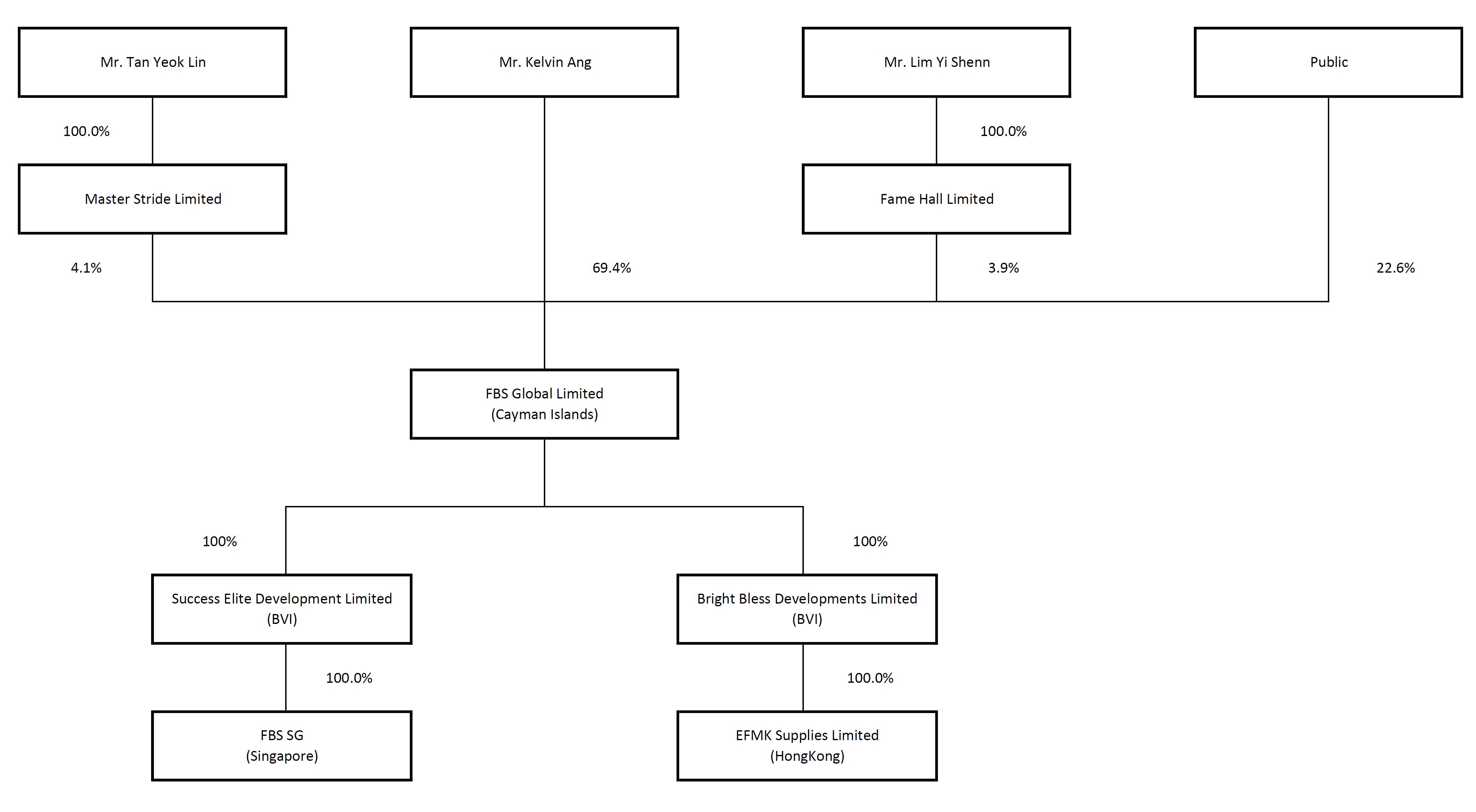
On February 7, 2025, we completed our initial public offering of 2,250,000 Ordinary Shares at a public offering price of US$4.50 per share. Total net proceeds to the Company, after deducting discounts, expenses allowance and expenses, were approximately $8.8 million. The Ordinary Shares began trading on February 6, 2025 on the Nasdaq Capital Market under the ticker symbol “FBGL.”
Business Overview
We are a Singapore based green building contractor and an established interior fit-out specialist with a track record of over 20 years in institutional, residential, commercial and industrial building projects. As a green contractor, we seek to tender bids for green building projects, use green construction methods, and sustainably-source and environmentally responsible materials for our construction projects. Green construction methods and materials will lead to the reduction in energy, water and material resource usage in construction projects thus reducing the potential environmental impact.
We also try to recommend and introduce green features to the buildings we construct. Green buildings are generally more energy efficient than conventional buildings. Some of the key features that might be commonly found in green buildings in Singapore are:
| ● | Improved glass insulation to reduce solar heating through windows; | |
| ● | Increased natural light, energy efficient lighting devices, and equipment- controlled lighting; | |
| ● | Energy efficient cooling plants and ventilation systems for air conditioning; | |
| ● | Building management systems to monitor and control equipment and optimize energy use; and | |
| ● | The use of photovoltaic cells in solar projects. |
Projects with BCA Green Mark Award
We have completed multiple projects in Singapore that received the BCA Green Mark Award, listed in the table below. The award recognizes developers, building owners and individuals who have made outstanding achievements in environmental sustainability in the built environment. There is also a Green Mark Certification Scheme that was launched by BCA in January 2005. It is a green building rating system designed to evaluate a building’s environmental impact and performance. It provides a comprehensive framework for assessing the overall environmental performance of new and existing buildings to promote sustainable design, and best practices in construction and operations in buildings.
The key criteria to the Green Mark Certification Scheme are as follows:
| ● | Climatic responsive design; | |
| ● | Building energy performance; | |
| ● | Resources stewardship; | |
| ● | Smart and healthy building; and | |
| ● | Advance green efforts. |
| ● | Advance green efforts. |
|
|
The table below lists Green Mark Awards given to projects in which we participated and our work scope for the projects specified. We have worked on 109 projects and 29 of such projects have received an award, the most recent of which are described in more detail in the table below..
| S/N | Project Name | Work Scope | BCA Green Mark Award | Year | |||||
| 1 | Outram Community Hospital | Drywall Partition | BCA Green Mark Platinum Award | 2021 | |||||
| 2 | Vivo City | Drywall Partition and Ceiling | BCA Green Mark Platinum Award | 2020 | |||||
| 3 | Woodlands Health Campus | Drywall Partition and Ceiling | BCA Green Mark Platinum Award | 2020 | |||||
| 4 | National Cancer Centre | Drywall Partition and Ceiling | BCA Green Mark Platinum Award | 2019 | |||||
| 5 | Yishun Community Hospital | Drywall Partition and Ceiling | BCA Green Mark Platinum Award | 2019 | |||||
| 6 | Singapore Sportshub | Drywall Partition and Ceiling | BCA Green Mark Gold Plus Award | 2019 | |||||
| 7 | Outram Community Hospital | Drywall Partition | BCA Green Mark Platinum Award | 2018 | |||||
| 8 | Campus for Research Excellence and Technological Enterprise (CREATE) |
Drywall Partition and Ceiling | BCA Green Mark Platinum Award | 2017 | |||||
| 9 | LASALLE College of Arts | Drywall Partition and Ceiling | BCA Green Mark Gold Award | 2016 | |||||
| 10 | BCA Skylab | Architectural Works | BCA Green Mark Platinum Award | 2016 | |||||
| 11 | Marina One Mixed Development | Drywall Partition and Ceiling | BCA Green Mark Platinum Award | 2015 | |||||
| 12 | Punggol Waterway Point & Punggol Town Plaza | Drywall Partition and Ceiling | BCA Green Mark Gold Plus Award | 2015 | |||||
| 13 | The Tembusu | Drywall Partition and Ceiling | BCA Green Mark Gold Plus Award | 2015 | |||||
| 14 | Punggol Watertown (Residential) | Drywall Partition and Ceiling | BCA Green Mark Gold Plus Award | 2014 |
Beginning in 2022, the BCA Green Mark Award was replaced by the SGBC-BCA Leadership in Sustainability Award (“LSA”).
Recent Projects
The Company entered into a contract for retrofitting work in October 2024, with a total contract value of approximately SGD 26,000,000. The project commenced in March 2025 and is scheduled for completion in December 2027. The Company also entered into another Addition and Alteration (A&A) project in April 2025, with an approximate contract value of SGD 14,700,000. The project commenced in April 2025 and is expected to be completed by June 2026.
Our Customers
The table below sets out the customers who accounted for 5.0% or more of our Group’s total revenue for the fiscal years ended 2023 and 2024:
| Percentage of revenue (%) | ||||||||||||
| Name of customer | Services provided | Our Role | 2023 | 2024 | ||||||||
| SDK Consortium | Drywall Partition & Ceiling System | Subcontractor for fit-out works | 32 | 7 | ||||||||
| China Construction (South Pacific) Development Co. Pte Ltd. | Partition & Ceiling Works | Subcontractor for fit-out works | 12 | - | ||||||||
| Hyundai Engineering & Construction Co Ltd | Partition & Ceiling Works | Subcontractor for fit-out works | - | 19 | ||||||||
| Uniglory Construction Pte Ltd | A&A Works | Main contractor for fit-out works | - | 10 | ||||||||
| GS Engineering | Acoustic Woodwool Cement Board Works | Subcontractor for fit-out works | 11 | 24 | ||||||||
| OUE Ltd. | A&A Works | Main contractor for fit-out works | 7 | - | ||||||||
| Hexacon Construction Pte Ltd | Partition & Ceiling Works | Subcontractor for fit-out works | - | 7 | ||||||||
| Seales Air (Singapore) Pte Ltd. | A&A Works | Main contractor for fit-out works | 15 | 7 | ||||||||
| Penta-Ocean Construction Co Ltd. | Partition & Ceiling Works | Subcontractor for fit-out works | 9 | 22 | ||||||||
|
|
We receive progress payments for our work performed and revenue is recognized based on the stage of completion of our projects. The fluctuation in revenue contribution from our customers varies from year to year as revenue contribution is on project basis and revenue is recognized based on the stage of completion. Therefore, a higher value project, more projects from a customer and/or more works completed during a financial year or period will result in a higher percentage of revenue attributed to a customer. Please refer to the risk factor “We are dependent on our major customers and any significant decrease in projects secured from them may affect our operations and financial performance” set out in the section entitled “Risk Factor” in this prospectus.
We are not aware of any information or arrangement which would lead to a cessation or termination of our current relationship with any of our major customers.
Insurance
We maintain, inter alia, the following insurance policies to cover among others, our operational, human resource and fixed assets risks:
| - | public liability insurance; | |
| - | work injury compensation for our employees; | |
| - | foreign worker medical insurance, as stipulated by the Ministry of Manpower, to cover hospitalization costs in Singapore; | |
| - | commercial vehicle insurance for vehicles used in connection with our business; and | |
| - | fire insurance, for our office equipment (including furniture, fixtures, fittings, telephone and electrical installations), additions, renovations and raw materials. |
We are of the view that our insurance coverage is adequate for our business operations and is in line with industry standards. The above insurance policies will be reviewed annually for the adequacy of our insurance coverage.
Risk Management
Workplace Safety and Health Policy
We have an occupational, health and safety management system and policy in place, and as of December 31, 2021, we obtained ISO 45001:2018 certification (replacing OHSAS 18001-2007), which is an international standard that specifies requirements for an occupational health and safety management system, with guidance for its use, to enable an organization to proactively improve its occupational health and safety performance in preventing injury and ill-health. ISO 45001-2018 certification is a requirement for bizSAFE Level Star certification and some of our customers consider certifications including ISO 45001:2018 and/or bizSAFE Level Star when inviting subcontractors to tender, and accordingly such certifications also may increase our project opportunities. A summary of our workplace safety and health policies is set out below:
|
|
Workplace Safety
Workplace safety includes aspects related to safety at the work site and ensuring that occupational hazards are identified and assessed and actions are taken to reduce workplace accidents. These cover areas such as:
| ● | Conditions of the workplace, such as adequate working area, lighting, ventilation, and temperature control, water leakage, mold, airborne hazards and obstructions should be cleared. Exits should be clearly marked and potential trip hazards such as wire cords should be secured. |
| ● | Electrical safety, such as being aware of electrical hazards, and checking that electrical equipment and devices are in good condition and use in a proper manner. |
| ● | Fire safety, such as ensuring the proper functioning of emergency fire sprinkler heads, clearly marked and unobstructed emergency exits and lighting and that firefighting equipment are in good condition and available for emergency use. |
| ● | Protective equipment, such as the availability of the proper type of protective equipment and that they are in good condition. First aid kits should be maintained and in good condition. |
| ● | Safety toolbox meetings are conducted daily or as requested by the main contractor at the work site to ensure that workers present for work that day are fit for work and that they have been issued with the proper protective equipment. |
Environmental Management and Occupational Health Safety
As of December 31, 2021, we upgraded our ISO certification to ISO 14001:2015, which certification is the first international environmental management standard that provides an integrated approach to environmental management that emphases sustainability. This cover areas such as:
| ● | Noise pollution control, including taking measures to ensure that our employees are not exposed to excessive noise and that we are working within the permissible noise levels at the work site. We also provide hearing protectors to our employees and annual audiometric examination for employees exposed to excessive noise; |
| ● | Air pollution control, including taking measures to control and minimize air pollution from our machinery and vehicles; |
| ● | Chemical spillage control, including ensuring that toxic, corrosive and flammable chemicals are accompanied with safety data sheet and that their use is in accordance with instruction; |
| ● | Waste management, including ensuring that each type of waste (general waste, hazardous waste, reusable packaging or materials) are segregated and disposed accordingly; and |
| ● | Conservation of resources and environment, including being energy-efficient, reducing or eliminating the use of ozone-depleting substances. |
Our environmental objectives are to have a zero-environmental accident record and to not receive any fines or penalties from the NEA. Our environmental management system covers hazard identification, emergency response, regulatory compliance, implementation, incident reporting and evaluation.
Our annual cost of compliance with applicable workplace safety and environmental regulations during the Period Under Review was not material.
Staff Training Plans
Training plans are reviewed periodically to ensure that employees are able to carry out their scope of work competently and safely. All new employees go through an orientation program and are assigned to a supervisor for on-the-job training. We also organize training courses conducted by external parties. Our annual staff training costs during the last two years were not material.
Competition
The construction industry in Singapore, including interior build out / fitting-out works and main contractor works, is highly competitive and fragmented. Our Group has an established track record in interior fitting-out works, in particular for hospital construction projects in Singapore, and main construction project experience. To the best of our knowledge and belief, while there is no comparable industry peer with an identical project profile, we consider Dong Jian (Singapore) Pte Ltd, Top Plasterceil Pte Ltd and Lincotrade & Associates Pte Ltd to be our main competitors in interior fitting-out works.
|
|
None of our directors or substantial shareholders or their respective associates has any interest, direct or indirect, in any of the above competitors. To the best of our knowledge and belief, there are no published statistics that present the market share of interior fitting-out works in Singapore. With regards to main construction works, the industry is similarly competitive and fragmented and as we take on main construction projects as and when the project opportunity arises, we believe that is no meaningful comparison of market share and competitors.
Licenses and Certifications
Contractors Registration System
The construction industry in Singapore is regulated by the Commissioner of Building Control (“CBC”), whose primary role is to develop and regulate Singapore’s building and construction industry. Registration in the Contractors Registration System maintained by the BCA is a pre-requisite to tendering to Singapore Government agencies for public sector projects. FBS SG is registered under (i) Construction Workhead (CW) and (ii) Construction-Related Workhead (CR) with the specific requirements below:
| Workheads | Title | Scope of Work | Grade | Expiry Date | |||||
| CR06 | Interior Decoration and Finishing Works | Interior design, planning and the decoration of buildings. This includes ceiling panels, partitions, built-in fitments, raised floor works, plastering and tiling. | L5 | July 1, 2025 | |||||
| CW01 | General Building | (a) | All types of building works in connection with any structure, being built or to be built, for the support, shelter and enclosure of persons, animals, chattels or movable property of any kind, requiring in its construction the use of more than two unrelated building trades and crafts. Such structure includes the construction of multi-story car-parks, buildings for parks and playgrounds and other recreational works, industrial plants, and utility plants. | B2 | July 1, 2025 | ||||
| (b) | Addition and alteration works on buildings involving structural changes. | ||||||||
| (c) | Installation of roofs. | ||||||||
Tendering limits for different grades under the Contractors Registration System
The tendering limit for projects in the public sector is determined by one’s qualified grade under the Contractors Registration System. Such tendering limit for each respective grade is valid for one year from July 1 to June 30 of the following year. Currently, the tendering limit for our L5 grading in CR06 (Interior decoration and finishing works) workhead is S$16 million and B2 grading in CW01 (General building) workhead is S$16 million.
Registration and retention requirements
Registration under the Contractors Registration System in respect of a particular workhead and registration grade will remain valid for the period stipulated by BCA. The validity for a registration will lapse automatically after the expiry of such stipulated period, unless a renewal is filed and approved by BCA. In order to apply for, maintain and renew the registrations under the Contractors Registration System, there are different requirements to be complied with for different grades, including but not limited to requirements relating to minimum paid up capital and net worth, employment of certain personnel with prescribed qualifications, and track record of past and current projects. Please refer to the section entitled “Risk Factors.” We are reliant on the renewal of our existing registrations and licenses of this prospectus for further details of our risks.
|
|
Some of the specific requirements to be complied with as at the Latest Practicable Date are as follows:
| Requirements | ||||||||||||||
| Workhead | Title | Grade |
Minimum Paid-Up Capital & Minimum Net Worth (S$) |
Track Record (completed projects in the past three years in all cases)(1) (S$) |
Personnel – Management & Development(2) (3) |
License Requirements | ||||||||
| CR06 | Interior decoration and finishing works | L5 | S$ | 500,000 | S$10.0m of which S$1.0m SP | 1P or 2T, one with at least 8 years of relevant experience of which minimum 1P/T with BCCPE | ISO45001/ BizSAFE Level 3 | |||||||
| CW01 | General building | C1 | S$ | 300,000 | S$3.0m | 1RP/P and 1T of which 1RP/P/T with BCCPE | ISO45001/ BizSAFE Level 3 / General Builder License Class 1 or Class 2 (GB1 or GB2) | |||||||
Notes:
| (1) | On-going projects are acceptable for renewal and “PS” refers to minimum projects executed in Singapore, MC refers to minimum main contracts (nominated sub-contracts may be included) and “SP” refers to minimum size single main contract or sub-contract. |
| (2) | “RP” shall mean a minimum professional qualification with a degree in Civil / Structural Engineering recognized by the Professional Engineers Board of Singapore or equivalent qualifications approved by the BCA. “P” shall mean a minimum professional qualification with a recognized degree in Architecture, Building, Civil / Structural, Mechanical or Electrical Engineering or equivalent qualifications approved by the BCA. “T” shall mean a minimum technical qualification with a polytechnic diploma in Architecture, Building, Civil / Structural Mechanical, Electrical Engineering or equivalent awarded by the BCA Academy, Nanyang Polytechnic, Ngee Ann Polytechnic, Republic Polytechnic, Singapore Polytechnic, Temasek Polytechnic or such other diplomas or qualifications as approved by the BCA from time to time. |
| (3) | “CCPP” shall mean a Certified Construction Productivity Professional. “BCCPE” shall mean Basic Concept in Construction Productivity Enhancement (Certificate of Attendance) conducted by the BCA Academy. “SDCP” shall mean Specialist Diploma in Construction Productivity conducted by the BCA Academy. |
Builders’ Licensing Scheme
The Building Control Act 1989 of Singapore (“Building Control Act”) and the Building Control (Licensing of Builders) Regulations 2008 set out the requirements for the licensing of builders. All builders carrying out building works where plans are required to be approved by the CBC and builders who work in specialist areas which have a high impact on public safety will require a builder’s license. The requirement applies to both public and private construction projects.
|
|
There are two types of builder’s licenses, namely, the GB License and the specialist builder’s license. FBS SG possesses the GB1 License that authorizes the builder to carry on the business of a general builder without restriction in contract value.
To qualify for the GB1 License, the following conditions must be met:
| Financial | Approved person(1) | Technical controller(2) | ||||||
| (minimum paid-up capital) |
Course | Practical experience | Course | Practical experience |
||||
| S$300,000 | A course leading to a Bachelor’s degree or postgraduate degree in any field |
At least 3 years (in aggregate) of practical experience in the execution of construction projects (whether in Singapore or elsewhere) after attaining the corresponding qualification
|
A course leading to a Bachelor’s degree or postgraduate degree in a construction and construction-related fields(3) | At least 5 years (in aggregate) of practical experience in the execution of construction projects (whether in Singapore or elsewhere) after attaining the corresponding qualification | ||||
| or |
|
|||||||
| A course leading to a diploma in a construction and construction-related fields(3). |
At least 5 years (in aggregate) of practical experience in the execution of construction projects (whether in Singapore or elsewhere) after attaining the corresponding qualification
|
|||||||
|
or
|
||||||||
| A course conducted by BCA known as “Essential Knowledge in Construction Regulations & Management for Licensed Builders” | At least 10 years (in aggregate) of practical experience in the execution of construction projects in Singapore | |||||||
Notes:
| (1) | The approved person shall not have acted as an approved person or the technical controller of a licensee whose license has been revoked in the 12 months preceding the date of application for the license by the licensee. The approved person must not be acting, for so long as he is the approved person for the licensee that he does not intend to act, as a technical controller for any other company with or holding a license. The approved person must give his consent for carrying out the duties of an approved person for the applicant of the license. |
| (2) | The technical controller is the appointed key personnel under whose personal supervision the execution and performance of any general building works or specialist building works in Singapore that the licensee undertakes is carried out. The technical controller(s) could be the sole proprietor, partner, director or member of board of management of the licensee or an employee (being a person employed in such a manner and with such similar duties and responsibilities as a partner, director or member of its board of management). The technical controller shall not have acted as an approved person or the technical controller of a builder whose license has been revoked in the 12 months preceding the date of application for the license by the licensee. The technical controller must not be acting, for so long as he is the technical controller for the licensee, as a technical controller for any company with or applying for a license. The technical controller must give his consent to carrying out the duties of a technical controller for the applicant of the license | |
| (3) | “Construction and construction-related field” means the field of architecture, civil or structural engineering, mechanical or electrical engineering, construction or project management, quantity surveying or building science, facilities or estate management. |
|
|
Green and Gracious Builder Scheme
BCA launched the Green and Gracious Builder Scheme in February 2009 to promote environmental protection and gracious and professional practices during the construction phase of projects. It is also a requirement to hold the Green and Gracious Builder Award for contractors with grade B2 and above for construction workheads CW01 and CW02 under the CRS. FBS SG currently holds the BCA Green and Gracious Builder Award in the “Certified” category, which was first issued on May 9, 2018 with an expiry date of May 8, 2024 with a renewal in process with the BCA. The Green and Gracious Builder Award will be valid for 3 years. During this period, surveillance audits will be conducted on a yearly basis. Renewal audits will be carried out by The Singapore Contractors Association Limited (which has taken over the administration of the Green and Gracious Builder Scheme) every 3 years to maintain the validity of the Green and Gracious Builder Award.
Building Control Act
Every proposed property development in Singapore requires written permission from the Urban Redevelopment Authority (“URA”) setting out specific requirements and limits for the development, such as land use, gross plot ratio, building height and building form on the development site. Once the URA has given the written permission, an application will be made to the CBC for the building plan approval in respect of the development and/or a permit for carrying out the structural works. Construction may then commence upon receipt of the notice of approval and permit to carry out structural works from the CBC, in accordance with such approvals, to be elaborated below.
In the event that the development site is owned by the JTC Corporation, approval is also required to be obtained from JTC Corporation. In a case where changes are required to the designation use of a development site, approval from URA is required.
Under the Building Control Act, a builder undertaking any building works shall, among other duties: (i) ensure that the building works are carried out in accordance with the plans of the building works supplied to it by the appointed registered architect or professional engineer for the project and with any terms or conditions imposed by the CBC in accordance with the Building Control Act and the building regulations, (ii) notify the CBC of any contravention of the Building Control Act or the building regulations relating to those building works of which the builder knows or ought reasonably to know; (iii) keep at the premises on which the building works are carried all plans of those building works approved by the CBC and supplied to him by the appointed registered architect or professional engineer for the project; and (iv) within seven days from the completion of the building works, certify that the new building has been erected or the building works have been carried out in accordance with the Building Control Act and the building regulations and deliver such certificate to the CBC.
Employment Act
Employment Act
The Employment Act 1968 of Singapore (the “Employment Act”) governs most employment matters such as public holidays and sick leave entitlements, minimum days of annual leave, payment of salary and allowable deductions, termination and dismissal, and also governs, among other things and where applicable, working hours, overtime, rest days, holidays and other conditions of work or service.
|
|
Employment of foreign workers in Singapore
Work passes and permits
Pursuant to the Immigration Act 1959 of Singapore (“Immigration Act”), no person, other than a citizen of Singapore, shall enter or attempt to enter Singapore unless, inter alia, he is in possession of a valid pass lawfully issued to him to enter Singapore. Such valid pass would include, inter alia, a valid work pass issued by the Controller of Work Passes under the EFMA (as defined below) and the regulations issued pursuant to the EFMA, including passes such as Work Permits (including a training work permit), S Passes and Employment Passes. The work passes are categorized by the professional skill level and monthly salary of the migrant worker. There are applicable quotas and levies payable for S Pass and Work Permit Holders. A work pass may be in the form of a card or in an endorsement made in the passport or other travel document of the work pass holder or in such other form as the Controller of Work Passes may determine.
Employment of Foreign Manpower Act
The employment of foreign workers in Singapore is governed by the Employment of Foreign Manpower Act 1990 (“EFMA”) and the regulations issued pursuant to the EFMA and regulated by the Ministry of Manpower (“MOM”). The EFMA prescribes the responsibilities and obligations of employers of foreign employees in Singapore.
Under Section 5(1) of the EFMA, no person shall employ a foreign employee unless he has obtained in respect of the foreign employee a valid work pass from the MOM, which allows the foreign employee to work for him.
The availability of foreign workers to the construction industry is also regulated by the MOM through, among others, the following policy instruments:
| (i) | approved source countries; |
| (ii) | the imposition of security bonds and levies; |
| (iii) | dependency ratio ceilings based on the ratio of local to foreign workers; and |
| (iv) | quotas based on the man year entitlements (“MYE”) in respect of workers from the People’s Republic of China (“PRC”) and non-traditional sources such as India, Sri Lanka, Thailand, Bangladesh, the Republic of the Union of Myanmar and the Philippines (“NTS”). With effect from 1 January 2024, the MYE framework will be phased out. |
Approved source countries
The approved source countries for construction workers are Malaysia, the PRC, NTS countries and North Asian sources such as Hong Kong (holders of Hong Kong Special Administrative Region passports), Macau, South Korea and Taiwan (“NAS”).
Security bonds and foreign worker levy
For each non-Malaysian Work Permit holder whom a company wants to employ, a security bond of S$5,000 in the form of a banker’s guarantee or insurance guarantee is required to be furnished to the Controller of Work Passes. The security bond must be furnished prior to the foreign worker’s arrival in Singapore, failing which entry into Singapore will not be allowed. Malaysian workers are exempt from the above requirement of furnishing a security bond.
The employment of Work Permit workers is also subject to the payment of monthly levies. The levy is a mechanism to regulate the number of foreign workers in Singapore. For the construction sector, employers pay the requisite foreign worker levy according to the qualification of the foreign workers employed. A daily levy rate will apply where the Work Permit holder did not work for a full calendar month.
|
|
Effective January 1, 2024, the levy rates for Work Permit holders will be revised as follows:
| Tier | Monthly | Daily | ||||||
| Malaysians, NAS and PRC – Higher-Skilled | $ | 300 | $ | 9.87 | ||||
| Malaysians, NAS and PRC – Basic-Skilled | $ | 700 | $ | 23.02 | ||||
| NTS – Higher-Skilled | $ | 500 | $ | 16.44 | ||||
| NTS – Basic-Skilled | $ | 900 | $ | 29.59 | ||||
Employers of foreign workers will have to pay a levy bond for each Work Permit holder (of S$600 per month for each basic-skilled or higher-skilled worker and of S$2,000 per month for each unskilled worker). Levy bonds are payable under certain scenarios, such as where the workers’ Work Permits have been revoked because of unpaid levies, or if there have been late levy payments in at least three (3) times in a 12-month period. The levy bond monitoring period is usually twelve (12) months, and the levy bond will be released when this monitoring period expires, subject to the possibility of extension if there are more delays in levy payment.
Dependency ratio ceilings
The dependency ratio ceiling for the construction industry is currently set at a ratio of one (1) full-time local employee earning at least S$1,600 per month (“Local Qualifying Salary”) to five (5) foreign workers. This means that for every one (1) full-time Singapore citizen or Singapore permanent resident earning at least the Local Qualifying Salary employed by a company in the construction sector with regular full month Central Provident Fund contributions made by the employer, the company can employ five (5) foreign workers. If the full-time Singapore citizen or Singapore permanent resident earns at least half the Local Qualifying Salary (at least S$800 per month to below S$1,600 per month) with regular full month Central Provident Fund contributions made by the employer, the Singapore citizen or Singapore permanent resident employee will be counted as a 0.5 local employee.
Minimum percentage of higher skilled workers
At least 10.0% of a company’s construction Work Permit holders must be higher-skilled before an employer can hire any new basic-skilled construction Work Permit holders or renew the Work Permits of existing basic-skilled foreign workers.
Firms that do not meet the 10.0% threshold will not be able to hire or renew the Work Permits of any basic skilled construction Work Permit holders and will also have the Work Permits of any excess basic skilled construction Work Permit holders revoked.
Man Year Entitlements
For project contracts that were awarded or had the tender called on or before 18 February 2022, companies may use awarded Man Year Entitlements, or MYE, which is a Work Permit allocation system for employment of foreign workers from NTS countries and the PRC until 31 December 2024 or the project completion date (whichever is earlier). MYE represents the total number of Work Permit holders a main contractor is entitled to employ based on the value of the projects or contracts awarded by the developers or owners. The allocation of MYE is in the form of the number of “man-years” required to complete a project and only main contractors may apply for MYE. One man-year is equivalent to one year’s employment under a Work Permit. All levels of subcontractors are required to obtain their MYE allocation from their main contractors. A main contractor’s MYE will expire on the completion date of the relevant project, which can be extended if the completion date of the project is extended (prior to December 31, 2024). MYE are allocated to a contractor when it applies for prior approval (“PA”). For main contractors applying for PA, MYE deductions are made according to the number of foreign workers and type of Work Permits applied for and approved by the Work Pass Division of the MOM. For a subcontractor’s PA application, the main contractor supplying the MYE must indicate the MYE allocation in the subcontractor’s PA application form when applying on the subcontractors’ behalf. When approved, the main contractor’s MYE will be deducted accordingly.
Contractors can apply for MYE waivers to allow them to apply or renew the Work Permits of experienced foreign workers from NTS and the PRC without the need for MYE. However, they will be subject to higher MYE-waiver levy rates. The MYE framework was phased out effective January 1, 2024. Companies with project contracts that were awarded or had tender called after 18 February 2022 do not require MYE to employ NTS or PTC workers, provided that such employment does not exceed the applicable dependency ratio ceiling.
|
|
Required safety courses
Foreign workers in the construction industry must take one of the following safety courses before their Work Permits can be issued: (i) Construction Safety Orientation Course (“CSOC”) or (ii) Apply Workplace Safety and Health in Construction Sites. Foreign workers must complete the course within two (2) weeks of arriving in Singapore and pass the course within three (3) months of arrival, or their Work Permits may be revoked.
Age restrictions
With respect to foreign workers from the PRC and the NTS countries, basic-skilled foreign workers are allowed to work up to a maximum of 14 years, while higher-skilled foreign workers are allowed to work up to 26 years. There is no maximum employment period for foreign workers from Malaysia or NAS. The maximum age limit for non-Malaysian and Malaysian foreign workers at the time of application of Work Permit is below 50 years old and below 58 years old, respectively. All foreign workers regardless of country of origin can only work up to 60 years of age.
Prior approval
Construction companies with project contracts that were awarded or tendered on or before 18 February 2022 must have prior approval (“MOM PA”) from the MOM to employ foreign workers from NTS countries (up to 31 December 2024 or project completion date, whichever is earlier). The MOM PA indicates the number of foreign workers a company is allowed to bring in from NTS countries. It also determines the number of workers who can have their Work Permits renewed, or who can be transferred from another company in Singapore. The MOM PAs are given based on the (i) duration of the work permits applied for, (ii) number of full-time local workers employed by the company over the past three (3) months as reflected in the Company’s CPF contribution statements (iii) the quota remaining and (iv) number of man-years allocated to the company (for main contractors) or the man-years directly allocated from the Company’s main contractor (for subcontractors). Effective January 1, 2024, the MYE framework will be phased out and the grant of MOM PA will no longer depend on a company’s MYE. The new foreign workers from NTS countries must also possess a Skills Evaluation Certification or the Skills Evaluation Certificate (Knowledge) before they are allowed to work in Singapore. Companies with project contracts that were awarded or tendered after 18 February 2022 do not require MOM PA to employ foreign workers from NTS countries, provided that such employment does not exceed the applicable dependency ratio ceiling.
Work Permit conditions
Employers are required to comply with the conditions of the Work Permits, such as the requirement for the foreign worker to pass a medical examination and to provide acceptable accommodation for their foreign workers. Other conditions of the Work Permits which employers of foreign construction workers are also required to comply with include the following:
| (i) | that the foreign worker performs only those construction activities specified in the conditions; |
| (ii) | ensuring that the foreign worker is not sent to work for any other person, except as provided for in the conditions; |
| (iii) | providing safe working conditions for their foreign workers; and |
| (iv) | purchasing and maintaining medical insurance with coverage of at least S$15,000 per 12-month period of the foreign worker’s employment (or for such shorter period where the worker’s period of employment is less than 12 months) for polices with start dates effective before July 1, 2023, for the foreign worker’s in-patient care and day surgery except as the Controller of Work Passes may otherwise provide by notification in writing. Where the employer purchases group medical insurance policy for its foreign workers, the employer shall not be considered to have satisfied the obligation under this condition unless the terms of the employer’s group medical insurance policy are such that each and every individual foreign worker is concurrently covered to the extent as required aforesaid. The minimum required coverage has increased to $60,000 per year for policies with start dates effective on or after July 1, 2023. Employers are also required to purchase and maintain a Primary Care Plan for each worker which will cover most of the workers’ primary healthcare needs under a fixed scope of services. |
|
|
Apart from the EFMA, an employer of foreign workers is also subject to, amongst others, the provisions set out in the Employment Act and the Immigration Act and the regulations issued pursuant to the Immigration Act.
Housing of foreign workers
In accordance with the EFMA, employers must ensure that their foreign workers live in proper housing which complies with the various statutory requirements, and provide the workers’ residential addresses to MOM. The operation of foreign workers’ dormitories has to comply with applicable laws and regulations, including but not limited to the Building Control Act 1989 of Singapore, the Control of Vectors and Pesticides Act 1998 of Singapore, the Environmental Public Health Act 1987 of Singapore, the Fire Safety Act 1993 of Singapore, the Planning Act 1998 of Singapore and the Foreign Employee Dormitories Act 2015.
Composition Fines
In year 2016 and 2017, we received two composition fines from the MOM with respect to unacceptable accommodation for our employees. The composition fines were from incidents occurring in March 2016 and January 2017, of S$4,000 and S$8,000 respectively, for the contravention of Section 22(1)(a) of the EFMA, in relation to breach of work pass conditions. The first composition fine was in relation to one worker who stayed at an overcrowded accommodation, and the second composition fine was in relation to four workers who stayed at unauthorized accommodation.
Subsequent to the above incidents, our executives have confirmed that our foreign workers are required to strictly comply with their work pass conditions by either staying at FBS SG’s in-house dormitory, at approved dormitories/ quarters or at authorized private housing. All foreign workers’ addresses had to be accordingly updated on the online foreign worker address service. To date, no further action has been taken by the MOM subsequent to the settlement of the aforementioned composition fines.
Building and Construction Industry Security of Payment Act
Under the Building and Construction Industry Security of Payment Act 2004 of Singapore (“BCISPA”), the operation of which is overseen by the BCA, any person who has carried out any construction work or supplied any goods or services under a contract is entitled to a progress payment. The provisions of the BCISPA shall have effect notwithstanding any provision to the contrary in any contract, and any contractual provision which attempts to exclude, restrict, modify or in any way prejudice the operation of the BCISPA shall be void. With the introduction of the BCISPA, a “pay when paid” provision of a contract is now rendered unenforceable and has no effect in relation to any payment for construction work carried out or undertaken to be carried out, or for goods or services supplied or undertaken to be supplied, under the contract.
The BCISPA also contains provisions relating to, amongst others, the amount of the progress payment to which a person is entitled under a contract, the valuation of the construction work carried out under a contract and the date on which a progress payment becomes due and payable. A claimant who, in relation to a construction contract, (i) fails to receive payment by the due date (being the date on which the progress payment becomes due and payable) of the response amount which he has accepted, (ii) disputes the payment response provided by the respondent, or (iii) does not receive a payment response by the relevant deadline for response, is entitled to make an adjudication application in relation to the relevant payment claim. The BCISPA has established an adjudication process by which a person may claim payments due under a contract and enforce payment of the adjudicated amount.
|
|
An adjudicator shall, in relation to an adjudication application, determine the adjudicated amount (if any) to be paid by the respondent to the claimant, the date on which the adjudicated amount is payable, the interest payable on the adjudicated amount and the proportion of the costs of the adjudication payable by each party to the adjudication.
The claimant has the right to suspend the carrying out of construction work or the supply of goods or services, and to exercise a lien over goods supplied by the claimant to the respondent that are unfixed and which have not been paid for, or to enforce the adjudication determination as if it were a judgment debt, if, amongst others, such claimant is not paid after the adjudicator has determined that the respondent shall pay an adjudicated amount to the claimant.
Where the respondent fails to pay the whole or any part of the adjudicated amount to a claimant, a principal of the respondent (being the person who is liable to make payment to the respondent for or in relation to the whole or part of the construction work that is the subject of the contract between the respondent and the claimant) has the right to make direct payment of the outstanding amount of the adjudicated amount to the claimant, and thereafter recover such payment from the respondent.
Workplace Safety and Health
Under the Workplace Safety and Health Act 2006 of Singapore (“WSHA”), every employer has the duty to take, so far as is reasonably practicable, such measures as are necessary to ensure the safety and health of his employees at work. These measures include providing and maintaining for the employees a work environment which is safe, without risk to health, and adequate as regards facilities and arrangements for their welfare at work, ensuring that adequate safety measures are taken in respect of any machinery, equipment, plant, article or process used by the employees, ensuring that the employees are not exposed to hazards arising out of the arrangement, disposal, manipulation, organization, processing, storage, transport, working or use of things in their workplace or near their workplace and under the control of the employer, developing and implementing procedures for dealing with emergencies that may arise while those persons are at work and ensuring that the person at work has adequate instruction, information, training and supervision as is necessary for that person to perform his work.
The MOM has also implemented a single-stage Demerit Points System (“DPS”) for the construction industry. All main contractors and subcontractors in the construction sector will be issued with demerit points for breaches or infringements under the WSHA and relevant subsidiary legislation. Under the DPS, the number of demerit points awarded depends on the severity of the breach or infringement.
Each demerit point issued is valid for a period of 18 months and, subject to there being no further safety lapses, the demerit point subsequently becomes expunged and removed from the records maintained by the MOM in relation to the number of demerit points currently issued to a specific company. Contractors, including all main and subcontractors, who accumulate a pre-determined number of demerit points within an 18-month period, will be debarred from employing foreign workers. An accumulation of a minimum of 25 demerit points within a period of 18 months would immediately trigger debarment for the contractor. In addition, pursuant to Section 56 of the WSHA, the Commissioner may, at his discretion, compound certain offences under the WSHA.
Workplace Safety and Health Act 2006
The WSHA provides that every employer has the duty to take, so far as is reasonably practicable, such measures as are necessary to ensure the safety and health of its employees at work. These measures include providing and maintaining for the employees a work environment that is safe, without risk to health, and adequate with regards to facilities and arrangements for employees’ welfare at work, ensuring that adequate safety measures are taken in respect of any machinery, equipment, plant, article or process used by the employees, ensuring that the employees are not exposed to hazards arising out of the arrangement, disposal, manipulation, organization, processing, storage, transport, working or use of things in or near their workplace and under the control of the employer, developing and implementing procedures for dealing with emergencies that may arise while the employees are at work and ensuring that the employees at work have adequate instruction, information, training and supervision as is necessary for them to perform their work. The relevant regulatory body is the MOM.
|
|
Work Injury Compensation Act
The WICA, which is administered by the MOM, applies to all employees who are engaged under a contract of service or apprenticeship with an employer regardless of their salary, age or nationality. The WICA does not cover self-employed persons or independent contractors.
The WICA provides that if an employee dies or sustains personal injuries in a work-related accident in the course of the employment, or dies or becomes incapacitated as a result of a disease contracted in specified circumstances, the employer shall be liable to pay compensation in accordance with the provisions of the WICA. An injured employee is entitled to claim medical leave wages, medical expenses and lump sum compensation for permanent incapacity or death, subject to certain limits stipulated in the WICA.
However, the WICA provides that where any person (referred to as the principal) in the course of or for the purpose of his trade or business contracts with any other person (referred to as the contractor-employer), the principal may, at the direction of the Commissioner for Labour, be liable to compensate those employees of the contractor-employer who were injured while employed in the execution of work for the principal
Under the WICA, every employer is required to insure and maintain insurance under approved policies with a designated insurer against all liabilities which he may incur under the WICA in respect of all employees employed by him unless specifically exempted. Further, every employer is required to maintain work injury compensation insurance for all employees engaged in manual work labor regardless of their salary level, as well as all employees doing non-manual work who earn S$2,600 or less a month.
Environmental Laws and Regulations
The Environmental Public Health Act 1987 of Singapore (“EPHA”) requires, among others, a person, during the erection, alteration, construction or demolition of any building or at any time, to take reasonable precautions to prevent danger to the life, health or well-being of persons using any public places from flying dust or falling fragments or from any other material, thing or substance.
The EPHA also regulates, among others, the disposal and treatment of industrial waste and public nuisances. Under the EPHA, the Director-General of Public Health may, on receipt of any information respecting the existence of a nuisance liable to be dealt with summarily under the EPHA and if satisfied of the existence of a nuisance, serve a nuisance order on the person by whose act, default or sufferance the nuisance arises or continues, or if the person cannot be found, on the owner or occupier of the premises on which the nuisance arises. Some of the nuisances which are liable to be dealt with summarily under the EPHA include any factory or workplace which is not kept in a clean state, any place where there exists or is likely to exist any condition giving rise, or capable of giving rise to the breeding of flies or mosquitoes, any place where there occurs, or from which there emanates noise or vibration as to amount to a nuisance and any machinery, plant or any method or process used in any premises which causes a nuisance or is dangerous to public health and safety.
The Environmental Protection and Management Act 1999 of Singapore (“EPMA”) seeks to provide for the protection and management of the environment and resource conservation and regulates, amongst others, air pollution, water pollution, land pollution and noise control. Under the Environmental Protection and Management (Control of Noise at Construction Sites) Regulations, the owner or occupier of any construction site shall ensure that the level of noise emitted from his construction site shall not exceed the prescribed maximum permissible noise levels. The National Environment Agency is empowered under the EPMA to, among others, make regulations to control noise pollution by restricting or prohibiting construction works during certain hours.
Composition Fine
During the Period Under Review and up to the Latest Practicable Date, we received one composition fine from the NEA in relation to an incident of mosquito breeding detected at one of our worksites. We paid a composition fine of S$2,000 imposed on April 2016 for the contravention of Section 15 of the Control of Vectors and Pesticides Act.
|
|
SINGAPORE TAXATION
Corporate Tax
The prevailing corporate tax rate in Singapore is 17%, which may be offset by deductions or credits.
Dividend Distributions
One Tier Corporate Taxation System
Singapore adopts the one-tier corporate taxation system (“One-Tier System”). Under the One-Tier System, the tax collected from corporate profits is a final tax and the after-tax profits of the company tax-resident in Singapore (excluding cooperatives) can be distributed to the shareholders as tax-exempt dividends. Such dividends are tax-exempt in the hands of the shareholders, regardless of whether the shareholder is a company or an individual and whether or not the shareholder is a Singapore tax resident.
Withholding Taxes
Singapore does not currently impose withholding tax on dividends paid to resident or non-resident shareholders.
Goods and Services Tax (GST)
GST in Singapore is a consumption tax that is levied on import of goods into Singapore, as well as nearly all supplies of goods and services in Singapore at a prevailing rate of 8%, which rate increased to 9% on January 1, 2024.
Other than as disclosed above, our business operations are not subject to any special legislation or regulatory controls other than those generally applicable to companies and businesses incorporated and/or operating in Singapore.
This section sets forth a summary of the material laws and regulations that affect our Group’s business and operations in Singapore. Information contained in this section should not be construed as a comprehensive summary nor detailed analysis of laws and regulations applicable to the business and operations of our Group. This overview is provided as general information only and not intended to be a substitute for professional advice. You should consult your own advisers regarding the implication of the laws and regulations of Singapore on our business and operations.
Infectious Diseases Act
The Infectious Diseases Act 1976 of Singapore (the “IDA”) relates to the quarantine and the prevention of infectious diseases. Under the IDA, if the Director-General of Health (the “DGH”) has reason to believe that there exist on any premises conditions that are likely to lead to the outbreak or spread of any infectious disease, he may, among other things, by written notice, order the closure of the premises for a period not exceeding 14 days, and require the owner or occupier of the premises to cleanse or disinfect the premises in the manner and within the time specified in the notice or carry out such additional measures as the DMS may require in the manner and within the time specified in the notice. Such notice directing the owner or the occupier of the premises to close the premises may be renewed by the DGH from time to time for such period, not exceeding 14 days, as the DGH may, by written notice, specify.
In addition, the DGH may order any person, any class of person or any person who is suspected to be, a case or an at-risk individual of an infectious disease to be detained and isolated in a hospital or other place for such period of time and subject to such conditions as the DGH may determine. The DGH may also direct any person, any class of person, or any person who is suspected to be, a case or an at-risk individual of an infectious disease, or any person carrying on any occupation, trade or business in a manner as is likely to cause the spread of infectious disease to take preventative action that the DGH reasonably believes is necessary to prevent the possible outbreak or prevent or reduce the spread of the infectious disease. Under the IDA, “preventative action” in the case of such direction, includes, among other things, requiring the person to stop carrying on, or not carry on, the occupation, trade or business during a period of time specified in the direction.
Infectious Diseases (COVID-19 — Stay Orders) Regulations 2020
|
|
On March 25, 2020, the Ministry of Health of Singapore promulgated the Infectious Diseases (COVID-19 — Stay Orders) Regulations 2020 under the IDA.
COVID-19 (Temporary Measures) Act 2020
On April 7, 2020, the Singapore Parliament passed the COVID-19 Act. Under Section 34(1) of the COVID-19 Act, the Minister of Health is authorized to make regulations by way of a control order for the purpose of preventing, protecting against, delaying or otherwise controlling the incidence or transmission of COVID-19 in Singapore if the Minister of Health is satisfied that the incidence and transmission of COVID-19 in the community in Singapore constitutes a serious threat to public health, and a control order is necessary or expedient to supplement the IDA, and any other written law.
COVID-19 (Temporary Measures) (Control Order) Regulations 2020
The Control Order Regulations came into effect on April 7, 2020 under the COVID-19 Act to implement the Circuit Breaker Measures. During 2020 and 2021, the Singapore government implemented extensive regulations and restrictions, including significant travel restrictions and rules relating to social gathering group sizes, mask wearing, workplace requirements and capacity limits.
Since then, the Singapore government has gradually announced the easing of safe management measures, alongside the enactment of the COVID-19 (Temporary Measures) (Reopening – Control Order) Regulations 2022.
Central Provident Fund Act
The Central Provident Fund (“CPF”) system is a mandatory social security savings scheme funded by contributions from both employers and employees. Pursuant to the Central Provident Fund Act 1953 of Singapore, an employer is obliged to make CPF contributions for all employees who are Singapore citizens or permanent residents who are employed in Singapore by an employer including Singapore citizens who are employed under an agreement entered into in Singapore as a master, a seaman or an apprentice in any vessel. CPF contributions are not payable to permanent residents of Singapore who are employed as seamen. Specified exemptions relating to certain Scandinavian ships/ employers apply: CPF contributions are exempted for a seaman who is a Singapore citizen and is employed (1) In a Swedish or Norwegian ship on terms and conditions of service applicable to Swedish or Norwegian seamen; or (2) By the East Asiatic Co. Ltd. of Denmark on terms and conditions of the agreement between the Danish Shipowners’ Association and the Seamen’s Union in Denmark.
Intellectual property rights
The protection of industrial designs is provided for under the Registered Designs Act 2000 of Singapore. Inventions are protected in Singapore under the Patents Act 1994 of Singapore and may be registered either through a domestic application filed with the Registry of Patents within the Intellectual Property Office of Singapore (the “IPOS”) or an international application filed in accordance with the Patent Cooperation Treaty, with the Registry of Patents in Singapore or with the International Bureau of the World Intellectual Property Organization. Trademarks may be protected both under the Trade Marks Act 1998 of Singapore (the “TMA”) and under common law. These two systems are independent of each other. Protection under the TMA is conditional upon registration of the trademark with the Registry of Trade Marks within the IPOS.
Item 4A. Unresolved Staff Comments
None.
Item 5. Operating and Financial Review and Prospects
You should read the following discussion and analysis of our financial condition and results of operations in conjunction with our audited consolidated financial statements and the related notes included elsewhere in this annual report. This discussion contains forward-looking statements that involve risks and uncertainties. Our actual results and the timing of selected events could differ materially from those anticipated in these forward-looking statements as a result of various factors, including those set forth under “Item 3. Key Information — 3.D. Risk Factors” and elsewhere in this annual report.
|
|
Overview
We are a Singapore based green building contractor and an established interior fit-out specialist with a track record of over 20 years in institutional, residential, commercial and industrial building projects. As a green contractor focused on environmentally sound practices, we aim to bid tenders for green building projects, use green construction methods and green materials for our construction projects, including design, supply and installation of ceilings, partitions, timber deck, carpet, lead lining, acoustic wall paneling, built-in furniture as well as mechanical and electrical services of a building. Green construction methods and materials will lead to the reduction in energy, water and material resource usage in construction projects. and hence reduce the potential environmental impact. We also seek to use green materials that are made of recycled or recyclable materials and/or sustainably sourced materials.
We also try to recommend and introduce green features to the buildings we construct. Green buildings are generally more energy efficient than conventional buildings. Some of the key features that might be commonly found in green buildings are:
| ● | Increased natural light, energy efficient lighting devices, and equipment-controlled lighting; | |
| ● | Improved glass insulation to reduce solar heating through windows; | |
| ● | Energy efficient cooling plants and ventilation systems for air conditioning; | |
| ● | Building management systems to monitor and control equipment and optimize energy use; and | |
| ● | The use of photovoltaic cells for solar projects. |
We are engaged in interior fitting-out works for mixed developments, private residential developments, hospitals and commercial developments. Notable projects in the last five years include Marina One, a mixed development at Marina Bay, Sengkang General Hospital, Outram Community Hospital and South Beach Development, a mixed development at downtown Singapore. Our main construction projects during the last five years include two industrial buildings, two private residential properties and an additional and alterations, or A&A, project to a hotel.
5.A. Operating Results.
For all major revenue types, revenue is derived from individual contracts/projects on a non-recurring basis. Revenue is recognized by reference to the stage of completion of the contract activity, using the input method, whereby the actual construction costs to date was compared to the total budgeted costs for a project to estimate the revenue recognized.
Comparison of Years Ended December 31, 2023 and 2024
Our audited consolidated results of operations for the years ended December 31, 2023 and 2024, respectively, are summarized below:
| For the Years Ended December 31, | ||||||||||||||||
| 2023 | 2024 | 2024 | Variances | |||||||||||||
| SGD | SGD | USD | % | |||||||||||||
| Revenues | 21,810,317 | 13,847,548 | 10,385,661 | (36.5 | ) | |||||||||||
| Cost of revenue | 19,165,477 | 12,597,472 | 9,448,104 | (34.3 | ) | |||||||||||
| Gross Profit | 2,644,840 | 1,250,076 | 937,557 | (52.7 | ) | |||||||||||
| Operating expenses | ||||||||||||||||
| Provision for credit loss | 399,278 | 154,077 | 115,558 | (61.4 | ) | |||||||||||
| General and Administrative Expenses | 2,290,312 | 2,063,324 | 1,547,493 | (9.9 | ) | |||||||||||
| Total operating expenses | 2,689,590 | 2,217,401 | 1,663,051 | (17.6 | ) | |||||||||||
| Loss from operations | (44,750 | ) | (967,325 | ) | (725,494 | ) | 2,061.6 | |||||||||
| Other income (expenses) | ||||||||||||||||
| Interest expenses, net | (77,104 | ) | (65,921 | ) | (49,440 | ) | (14.5 | ) | ||||||||
| Finance expense, net | (8,096 | ) | (4,273 | ) | (3,205 | ) | (47.2 | ) | ||||||||
| Other income | 99,543 | 140,656 | 105,492 | 41.3 | ||||||||||||
| Foreign exchange transaction Gain | (2,906 | ) | 46,859 | 35,144 | (1,712.5 | ) | ||||||||||
| Total other income, net | 11,437 | 117,321 | 87,991 | 925.8 | ||||||||||||
| Income before provisions for income taxes | (33,313 | ) | (850,004 | ) | (637,503 | ) | 2,451.5 | |||||||||
| Income tax benefit | 37,998 | 35,638 | 26,728 | (6.2 | ) | |||||||||||
| Net Income (loss) | 4,685 | (814,366 | ) | (610,775 | ) | (17,483.8 | ) | |||||||||
|
|
Revenue
Our revenue is derived mainly from the following revenue streams: (i) construction contracts, (ii) sales of construction materials
The following table presents revenue by major revenue type for the years ended December 31, 2023 and 2024, respectively:
| For the Years Ended December 31 | ||||||||||||||||
|
2023 SGD |
2024 SGD |
2024 USD |
Variances % | |||||||||||||
| Revenue from construction contracts | 21,805,616 | 13,846,198 | 10,384,649 | (36.5 | ) | |||||||||||
| Sales of construction materials | 4,701 | 1,350 | 1,012 | (71.3 | ) | |||||||||||
| Total | 21,810,317 | 13,847,548 | 10,385,661 | (36.5 | ) | |||||||||||
For all major revenue types, revenue is derived from individual contracts/projects on a non-recurring basis. Revenue is recognized by reference to the stage of completion of the contract activity, using the input method, whereby the actual construction costs to date was compared to the total budgeted costs for a project to estimate the revenue recognized.
The total revenue decreased by approximately S$8.0 million, or 36.5% from approximately S$21.8 million for the year ended December 31, 2023 to approximately S$13.8 million (US$10.4 million) for the year ended December 31, 2024. The decrease was primarily the result of less incoming new projects for the period. The main projects we worked on in 2024 were close to completion and therefore a majority of the revenue on these projects was realized in 2023. Further, we were awarded a new project valued at approximately SGD 26 million (the “ICA project”) that was originally scheduled to commence in October 2024; however, due to delays in project handover by our client, commencement was postponed until April 2025. As a result, we had lower than expected revenues in 2024 and anticipate an increase in revenue in 2025, assuming the timely continuance of the ICA project as well as two other recently awarded contracts that have a combined value of approximately SGD 30 million.
The revenue from construction contracts decreased by approximately S$8.0 million, or 36.5% from approximately S$21.8 million for the year ended December 31, 2023 to approximately S$13.8 million (US$10.4 million) for the year ended December 31, 2024. The decrease of revenue from construction contracts was primarily the result of the delay in commencement of the ICA project. Total number of projects contributed to the revenue from construction contracts was 15 for the year ended December 31, 2024 as compared to 18 for the year ended December 31, 2023, and as noted, several large projects were concluded in 2024 but a majority of the revenues were recognized in 2023, hence the reduced revenue in 2024 as compared to 2023.
The revenue generated by sales of construction materials decreased by approximately S$3,400, or 71.3% from approximately S$4,700 for the year ended December 31, 2023 to approximately S$1,400 (US$1,000) for the year ended December 31, 2024. The decrease in sales of construction material was mainly related to lack of customer order the material from the Company it negatively impacted sales.
|
|
The major factors affecting our revenue include the following:
| - | Our ability to secure new contracts and the value of these contracts as our revenue is derived on a project by project, non-recurring basis. This is in turn dependent on several other factors such as our pricing, our project track record/ execution capability, our reputation and the competitive environment; | |
| - | our ability to maintain our business relationship with our customers, in particular with main contractors for future invitations to quote for interior fitting-out works; | |
| - | our ability to complete the projects on a timely basis and deliver quality works. This is in turn dependent on the timeliness of material delivery, quality of our subcontractors and our workers, and our project management expertise. The overall construction schedule on-site is also affected by many factors, such of which are not within our control. As our revenue is recognized by reference to the stage of completion, our revenue is dependent not only on the number of projects, their contract value, but also on the amount of works completed; | |
| - | our ability to remain competitive, whether in pricing or in our ability to respond to customers’ needs or in the adoption of construction technologies (where required); | |
| - | changes in laws and regulations that affect (i) the construction industry in the countries we operate in, which amongst others, may in turn affect our ability to conduct certain scope of works or employ workers; and (ii) the property segments, such as government spending on hospitals, or legislations that affect the property market; | |
| - | the overall construction industry in the countries we operate in and the overall macroeconomic conditions; and | |
| - | our ability to continue to retain the services of our key management personnel, in particular our Executive Directors who are leading the Group in business development and project management. |
Please refer to the section entitled “Risk Factors” of this Offer Document for a more comprehensive discussion of other factors which may affect our business operations and financial performance.
Cost of revenue
Our cost of revenue refers to direct costs incurred in the process of carrying out project activities. It includes subcontracting costs, direct material costs, labor cost, equipment rental costs and overhead costs. When it is probable that total contract costs will exceed total contract value, the expected loss is recognized as an expense immediately.
Our projects typically do not allow for any adjustments to the contract value in the event there is an escalation in our costs during the course of the project. Any increase in those costs will be borne by us and will have an impact on our eventual profit margins. Additional costs due to additional works from variation orders have to be borne by us until customers make payment in respect of such variation orders.
The breakdown of our cost of revenue for the years ended December 31, 2023 and 2024 is set out below:
| For the Years Ended December 31, | ||||||||||||||||
| 2023 | 2024 | 2024 | Variances | |||||||||||||
| SGD | SGD | USD | % | |||||||||||||
| Subcontracting costs | 8,612,283 | 4,817,236 | 3,612,927 | (44.1 | ) | |||||||||||
| Material costs | 6,282,505 | 3,686,385 | 2,764,789 | (41.3 | ) | |||||||||||
| Labor costs | 3,048,639 | 2,521,648 | 1,891,236 | (17.3 | ) | |||||||||||
| Equipment rental costs | 477,253 | 171,915 | 128,936 | (64.0 | ) | |||||||||||
| Overhead costs | 744,797 | 1,400,288 | 1,050,216 | 88.0 | ||||||||||||
| Total | 19,165,477 | 12,597,472 | 9,448,104 | (34.3 | ) | |||||||||||
|
|
The total cost of revenue decreased by approximately S$6.6 million, or 34.3% from approximately S$19.2 million for the year ended December 31, 2023 to approximately S$12.6 million (US$9.4 million) for the year ended December 31, 2024.
The cost of revenue for subcontracting decreased by approximately S$3.8 million, or 44.1% from approximately S$8.6 million for the year ended December 31, 2023 to approximately S$4.8 million (US$3.6 million) for the year ended December 31, 2024. The decrease in the cost of revenue associated with subcontracting costs is a result of the Company undertaking fewer new projects during the year ended December 31, 2024.
The cost of material decreased by approximately S$2.6 million, or 41.3% from approximately S$6.3 million for the year ended December 31, 2023 to approximately S$3.7 million (US$2.8 million) for the year ended December 31, 2024. The decrease in the cost of revenue associated with material costs is a result of the Company undertaking fewer new projects during the year ended December 31, 2024.
The cost of direct labor decreased by approximately S$527,000, or 17.3% from approximately S$3.0 million for the year ended December 31, 2023 to approximately S$2.5 million (US$1.9 million) for the year ended December 31, 2024. The cost of direct labor decreased slightly as the Company commenced three new projects near the end of 2024 and also increased manpower allocation for two ongoing projects to address quality issues.
The cost of equipment rental decreased by approximately S$305,000, or 64.0% from approximately S$477,000 for the year ended December 31, 2023 to approximately S$172,000 (US$129,000) for the year ended December 31, 2024. The decrease in equipment rental costs was primarily due to one of the ongoing projects at Tuas Avenue 6 reaching its final stage in year 2024, which required significantly less equipment on site compared to year 2023, when the project was in its initial phase.
The cost of overhead increased by approximately S$655,000, or 88.0% from approximately S$745,000 for the year ended December 31, 2023 to approximately S$1.4 million (US$1.1 million) for the year ended December 31, 2024. The increase of cost of overhead was the result of increase storage fee for materials which mainly come from a subcontract project at 251A Upper Changi Road East, Singapore.
The breakdown of our cost of revenues by revenue types is set out below:
| For the Years Ended December 31, | ||||||||||||||||
| 2023 | 2024 | 2024 | Variances | |||||||||||||
| SGD | SGD | USD | % | |||||||||||||
| Construction contracts | 19,164,930 | 12,596,497 | 9,447,373 | (34.3 | ) | |||||||||||
| Sales of construction materials | 547 | 975 | 731 | 78.2 | ||||||||||||
| Total | 19,165,477 | 12,597,472 | 9,448,104 | (34.3 | ) | |||||||||||
Total cost of revenue from construction contracts decreased by approximately S$6.6 million, or approximately 34.3% from approximately S$19.2 million for the year ended December 31, 2023 to approximately S$12.6 million (US$9.4 million) for the year ended December 31, 2024. The decrease was mainly due to the Company undertaking fewer new projects during the year ended December 31, 2024.
The cost revenue from sales of construction materials increased by approximately S$428, or 78.2% from S$547 for the year ended December 31, 2023 to S$975 (US$731) for the year ended December 31, 2024. The increase was mainly due to the increased the quantity of material supply to a customer for the year ended December 31, 2024.
Our cost of revenue is mainly dependent on the following factors:
| - | We rely on the services of our subcontractors to carry out certain portions of work undertaken by us, such as installation of interior fitting-out works, builder works, mechanical and electrical engineering works. Subcontracting costs are affected by the market demand and supply of qualified subcontractors as well as the government policies regulating the supply and availability of foreign workers; |
|
|
| - | Material costs mainly related to supplies purchased for installation of interior fitting-out works, whose underlying raw materials included gypsum (that are used in plasterboards) and steel (that are used for fastening). However, the cost of the supplies to us are also affected by factors such as market demand and supply conditions and consideration of the size of the project, our payment terms and our relationship with our suppliers; | |
| - | Labor costs relate to the salaries, Central Provident Fund (“CPF”) contributions, foreign worker levy and bonus for employees whose work is directly associated with on-site works. Labor costs are affected by government policies, the demand and supply of workers, the competition for workers and general wage trend of the construction industry; | |
| - | Equipment rental fees relate to the fees paid for equipment that we do not own, typically for cranes, excavator, boom lifts, forklifts, scissor lifts. The equipment rental fees are affected by the availability, demand and supply of such rental equipment and the duration for which we have to rent them; and | |
| - | Overhead costs relate to fees such as depreciation, freight charges, professional fees (for instance, professional engineering fees), repair and maintenance, site expenses and testing fees. |
Our cost of revenue is affected by, inter alia, the following factors:
| - | the changes in prices of construction materials; | |
| - | changes in government regulations and requirements, which may in turn affect labor costs and subcontracting costs; | |
| - | the level of competition, demand and supply for resources deployed at the project site; | |
| - | variation orders and works carried out during the defect liability period, which may incur costs without corresponding revenue or revenue recognized in the same financial period; | |
| - | site progress, including delays which may lead to cost overrun; | |
| - | government regulations and requirements as changes in regulations and requirements in relation to employment of foreign workers, for example, may result in higher compliance costs; and | |
| - | our ability to manage projects effectively and avoid cost over runs. |
Please refer to the section entitled “Risk Factors” in this Offer Document for other factors which may affect our cost of sales.
Gross Profit
Our gross profit from our major revenue type is summarized as follows:
| For the Years Ended December 31, | ||||||||||||||||
| 2023 | 2024 | 2024 | Variances | |||||||||||||
| SGD | SGD | USD | % | |||||||||||||
| Construction contracts | ||||||||||||||||
| Gross profit | 2,640,686 | 1,249,701 | 937,276 | (52.7 | ) | |||||||||||
| Gross profit margin | 12.1 | % | 9.0 | % | 9.0 | % | ||||||||||
| Sales of construction materials | ||||||||||||||||
| Gross profit | 4,154 | 375 | 281 | (91.0 | ) | |||||||||||
| Gross profit margin | 88.4 | % | 27.8 | % | 27.8 | % | ||||||||||
| Total | ||||||||||||||||
| Gross profit | 2,644,840 | 1,250,076 | 937,557 | (52.7 | ) | |||||||||||
| Gross profit margin | 12.1 | % | 9.0 | % | ||||||||||||
Our gross profit decreased by approximately S$1.4 million, or 52.7% from approximately S$2.6 million for the year ended December 31, 2023 to approximately S$1.3 million (US$0.9 million) for the year ended December 31, 2024. The decrease was mainly due to the Company undertaking fewer new projects during the year ended December 31, 2024.
|
|
Gross profit from construction contracts decreased by approximately $1.4 million, or 52.7% from approximately S$2.6 million for the year ended December 31, 2023 to approximately S$1.3 million (US$0.9 million) for the year ended December 31, 2024. The decrease was mainly due to the Company undertaking fewer new projects during the year ended December 31, 2024.
Gross profit from sales of construction materials decreased by approximately S$3,800 or 91.0% from approximately S$4,200 for the year ended December 31, 2023 to approximately S$375 (US$281) for the year ended December 31, 2024. The decrease was mainly due to the decrease in corresponding revenue resulting from the lack of material demand.
The gross profit margin decreased by 3.1% from 12.1% for the year ended December 31, 2023 to 9.0% for the year ended December 31, 2024. This decrease was primarily due to that the customer is not satisfied with the quality of construction on two projects and the cost was higher than budgeted.
Operating Expenses
Our operating expenses consist of provision for doubtful accounts and general administrative expenses. General administrative expenses mainly comprised directors’ remuneration, staff costs, professional fees, depreciation, rental expenses, property-related expenses such as property tax and maintenance fees and upkeep of motor vehicles.
The provision for credit losses from contract assets and accounts receivables decreased by approximately S$245,000, or 61.4% from approximately S$399,000 for the year ended December 31, 2023 to approximately S$154,000 (US$116,000) for the year ended December 31, 2024.
The breakdown of the general and administration expenses is shown as follows:
| For the Years Ended December 31, | ||||||||||||||||
| 2023 | 2024 | 2024 | Variances | |||||||||||||
| SGD | SGD | USD | % | |||||||||||||
| Employees’ salaries and benefit | 892,520 | 1,066,971 | 800,228 | 19.5 | ||||||||||||
| Depreciation | 161,712 | 170,343 | 127,757 | 5.3 | ||||||||||||
| Legal and Professional fees | 905,287 | 465,242 | 348,932 | (48.6 | ) | |||||||||||
| Administrative expenses | 330,793 | 360,768 | 270,576 | 9.1 | ||||||||||||
| Total | 2,290,312 | 2,063,324 | 1,547,493 | (9.9 | ) | |||||||||||
Our general and administration expenses decreased by approximately S$227,000, or 9.9% from approximately S$2.3 million for the year ended December 31, 2023 to approximately S$2.1 million (US$1.5 million) for the year ended December 31, 2024. The decrease was mainly due to the decrease in professional fees of approximately S$440,000 for the year ended December 31, 2024. These professional fees incurred resulted from the preparation of the initial public offering which mainly constitutes audit and legal fees.
Other Incomes (expenses)
Our other incomes (expenses) consist of interest expenses, finance cost, other income, and foreign exchange gain (loss). Other incomes (expenses) increased by approximately S$106,000, or 925.8% from approximately S$11,000 for the year ended December 31, 2023 to approximately S$117,000 (US$88,000) for the year ended December 31, 2024.
Interest expenses decreased by approximately S11,000, or 14.5% from approximately S$77,000 for the year ended December 31, 2023 to approximately S$66,000 (US$49,000) for the year ended December 31, 2024. The decrease was primarily due to the decrease in interest charges for bank borrowings and finance lease.
|
|
Finance expense decreased by approximately S$4,000, or 47.2% from approximately S$8,000 for the year ended December 31, 2023 to approximately S$4,000 (US$3,000) for the year ended December 31, 2024. The decrease was primarily due to the decrease in bank charges for transaction activities.
Other income, consisting mainly of compensation from a legal case, increased by approximately S$41,000, or 41.3% from approximately S$100,000 for the year ended December 31, 2023 to approximately S$141,000 (US$105,000) for the year ended December 31, 2024. The increase was primarily due to the compensation from a legal case for the year ended December 31, 2024.
Foreign exchange gain increased approximately S$50,000, or 1,712.5% from a loss of approximately S$3,000 for the year ended December 31, 2023 to approximately S$47,000 (US$35,000) for the year ended December 31, 2024. The exchange rate differences were the result of current account of the company that were denominated in USD as compared to the Company’s books and records using SGD.
Income tax expense (benefit)
Our income tax benefit decreased by approximately S$2,000, or 6% from approximately S$38,000 for the year ended December 31, 2023 to approximately S$36,000 (US$ 27,000) for the year ended December 31, 2024. This decrease was primarily due to the decrease in the tax rebate received during year ended December 31, 2024, but partially offset by above-mentioned factors resulting from decrease in income before provisions for income taxes.
Net Income (loss)
As a result of the foregoing, we reported a net loss of S$814,366 (US$610,775) for the year ended December 31, 2024, as compared to net income of S$4,685 for the year ended December 31, 2023, a decrease of S$819,051 or 17,482.4%.
Earnings (loss) per Share
Our earnings (loss) per share decreased by approximately S$0.07, from approximately (S$0.00) for the year ended December 31, 2023 to approximately (S$0.07) (US$0.05) for the year ended December 31, 2024. The computation of earnings per share is based on 11,250,000 shares of the total issued and outstanding shares of our Ordinary Shares.
Liquidity and Capital Resources
To date, we have financed our operations primarily through cash flows from operations and loans from banks and related parties, if necessary. Our principal uses of cash were for working capital, repayment of banking facilities and interest expenses, and capital expenditure. We plan to support our future operations primarily from cash generated from our operations and our initial public offering proceeds.
As reflected in our consolidated financial statements, we had a net loss of S$814,366 (US$610,775) for the year ended December 31, 2024, as compared to $4,685 for the year ended December 31, 2023, a decrease of S$819,051 of 17,482.4%. As of December 31, 2024, we had cash and restricted cash in aggregate of S$2,983,600 (US$2,237,700), as compared to S$4,482,359 as of December 31, 2023. We had negative working deficit that amounted to S$1,457,108 (US$1,092,831) and positive working capital S$1,206,943, as of December 31, 2024 and 2023, respectively. Our working capital requirements are influenced by the size of our operations, the volume and dollar value of our sales contracts, the progress of execution on our customer contracts, and the timing for collecting accounts receivable, and repayment of accounts payable.
Based on the audited consolidated statement of financial position as of December 31, 2024 and 2023, our total equity amounted to approximately S$4.3 million (US$3.2 million) and S$5.1 million, and our total indebtedness (calculated based on bank borrowings, financing lease liabilities, operating lease liabilities and amounts due to related parties) amounted to approximately S$2.1 million (US$1.5 million) and S$2.4 million, respectively for the years ended December 31, 2024 and 2023. As of December 31, 2024 and 2023, our debt equity ratio, defined as total indebtedness divided by total equity, were 2.1 times and 2.6 times, respectively. As of December 31, 2024 and 2023, our working capital ratio, defined as current assets divided by current liabilities, were 0.9 times and 1.1 times, respectively.
|
|
As of December 31, 2024, we had cash at bank of approximately S$3.0 million and had total bank borrowings of S$830,000.
On February 7, 2025, the Company closed its Initial Public Offering (“IPO”) of 2,250,000 ordinary shares. The shares were priced at $4.50 per share and the net proceeds of this offering was approximately $8.8 million. The shares were approved for listing on the Nasdaq Capital Market and commenced trading under the ticker symbol “FBGL” on February 6, 2025.
On February 18, 2025, the Company entered into a research and development agreement with a third party and contributed US$500,000. The parties are collaborating on a research project on developing processes and materials for paint coating steel structures for fire protection and other building applications.
In addition, the Company will need to maintain its operating costs at a level through strict cost control and budget to ensure operating costs are minimized and will not exceed such aforementioned sources of funds to continue as a going concern for a period within 12 months after the issuance of its consolidated financial statements.
Based on the above considerations, management is of the opinion that the Company has sufficient funds to meet its working capital requirements and debt obligations as they become due. However, there is no assurance that management will be successful in their plans. There are a number of factors that could potentially arise that could undermine the Company’s plans, such as changes in the demand for its services, economic conditions, competitive pricing in the construction industry, its operating results continuing to make profit and its bank and shareholders being able to provide continued financial support.
The following table sets out a summary of our consolidated cash flows for the years ended December 31, 2023 and 2024.
| 2023 | 2024 | 2024 | ||||||||||
| SGD | SGD | USD | ||||||||||
| Net cash provided by (used in) operating activities | 3,633,850 | (122,071 | ) | (91,555 | ) | |||||||
| Net cash (used in) provided by investing activities | (246,051 | ) | 137,655 | 103,243 | ||||||||
| Net cash used in financing activities | (895,257 | ) | (1,514,343 | ) | (1,135,757 | ) | ||||||
| Net increase (decrease) in cash and restricted cash | 2,492,542 | (1,498,759 | ) | (1,124,069 | ) | |||||||
| Cash and restricted cash at the beginning of the period | 1,989,817 | 4,482,359 | 3,361,769 | |||||||||
| Cash and restricted cash at the end of the period | 4,482,359 | 2,983,600 | 2,237,700 | |||||||||
Operating Activities
Net cash used in operating activities amounted to S$122,071 (US$91,555) for the year ended December 31, 2024, mainly derived from cash used in operating activities of (i) net loss of S$814,366 for the year ended December 31, 2024 (ii) a decrease in accounts payable of S$1,215,409, due to settle the billings from subcontractors and suppliers on services requested closer to the year ended December 31, 2024, as compared to the year ended December 31, 2023; (iii) an increase in operating lease liabilities of S$720,000, due to the lease of warehouse from related party for the year ended December 31, 2024; and (iv) a decrease in contract liabilities of S$677,794, due to the fulfilled more performance obligations for the year ended December 31, 2024.
The cash provided by operating activities was offset by the cash used in operating activities, including (i) a decrease in contract assets of S$1,303,505, due to that more billings were issued to the customers for the year ended December 31, 2024; (ii) an increase in amortization of right-of-use assets and interest of lease liabilities of S$720,000, due to the lease of warehouse from related party for the year ended December 31, 2024 ; (iii) a decrease in account receivable of S$690,716, due to the fact that more account receivable were collected for the year ended December 31, 2024; and (iv) an increase in accrued expenses and other current liabilities of S$614,116, due to legal fees which were accrued for the initial public offering for the year ended December 31, 2024.
Net cash provided by operating activities amounted to S$3,633,850 for the year ended December 31, 2023, mainly derived from cash provided from operating activities of (i) various net cash items of S$565,554, such as depreciation of property and equipment and provision for credit loss and bad debt expense; (ii) an increase in accounts payable of S$399,838, due to more billings from subcontractors and suppliers on services requested closer to the end of the year ended December 31, 2023, as compared to that of the year ended December 31, 2022; (iii) a decrease in contract assets of S$1,517,048, due to the service performed billed for the year ended December 31, 2023; and (iv) an increase in contract liabilities of S$1,057,625, due to the payments are collected in advance from customers for the year ended December 31, 2023.
|
|
The cash provided from operating activities was offset by the cash used in operating activities, including (i) an increase in account receivable of S$115,685, due to the fact that more account receivables balance were under credit term for the year ended December 31, 2023
Investing Activities
Net cash used in investing activities was S$137,655 (US$103,243) for the year ended December 31, 2024, for the purchase of equipment of S$75,139 and S$212,794 was returned loan from related parties. Net cash used in investing activities was S$246,051 for the year ended December 31, 2023, for the purchase of equipment of S$3,257 and S$242,794 was advance to related parties.
Financing Activities
Net cash used in financing activities amounted to S$1,514,343 (US$1,135,757) for the year ended December 31, 2024, which included the repayment of bank borrowings of S$1,993,759, repayment to related parties of S$28,934, deferred offering cost of S$424,985, and repayment of finance lease borrowings of S$16,680, which was offset by the proceeds from bank borrowings of S$481,622 and borrowing from related parties S$468,393 during the year ended December 31, 2024.
Net cash used in financing activities amounted to S$895,257 for the year ended December 31, 2023, which included the repayment of bank borrowings of S$2,014,245, repayment to related parties of S$378,049, deferred offering cost of S$305,471, and repayment of finance lease borrowings of S$16,680, which was offset by the proceeds from bank borrowings of S$1,508,177 and borrowing from related parties S$311,011 during the year ended December 31, 2023.
Comparison of Years Ended December 31, 2022 and 2023
Our audited consolidated results of operations for the years ended December 31, 2022 and 2023, respectively, are summarized below:
| For the Years Ended December 31, | ||||||||||||||||
| 2022 | 2023 | 2023 | Variances | |||||||||||||
| SGD | SGD | USD | % | |||||||||||||
| Revenues | 16,824,168 | 21,810,317 | 16,139,634 | 29.6 | ||||||||||||
| Cost of revenue | 14,642,786 | 19,165,477 | 14,182,453 | 30.9 | ||||||||||||
| Gross Profit | 2,181,382 | 2,644,840 | 1,957,181 | 21.2 | ||||||||||||
| Operating expenses | ||||||||||||||||
| Provision for credit loss | 17,272 | 399,278 | 295,466 | 2,211.7 | ||||||||||||
| General and Administrative Expenses | 2,089,611 | 2,290,312 | 1,694,829 | 9.6 | ||||||||||||
| Total operating expenses | 2,106,883 | 2,689,590 | 1,990,295 | 27.7 | ||||||||||||
| Income (loss) from operations | 74,499 | (44,750 | ) | (33,114 | ) | (160.1 | ) | |||||||||
| Other income (expenses) | ||||||||||||||||
| Interest expenses, net | (83,276 | ) | (77,104 | ) | (57,057 | ) | (7.4 | ) | ||||||||
| Finance expense, net | (7,125 | ) | (8,096 | ) | (5,991 | ) | 13.6 | |||||||||
| Other income | 222,309 | 99,543 | 73,662 | (55.2 | ) | |||||||||||
| Foreign exchange transaction gain (loss), net | 4,510 | (2,906 | ) | (2,151 | ) | (164.4 | ) | |||||||||
| Total other income, net | 136,418 | 11,437 | 8,463 | (91.6 | ) | |||||||||||
| Income (loss) before provisions for income taxes | 210,917 | (33,313 | ) | (24,651 | ) | (115.8 | ) | |||||||||
| Income tax (expense) benefit | (142,290 | ) | 37,998 | 28,118 | (126.7 | ) | ||||||||||
| Net Income | 68,627 | 4,685 | 3,467 | (93.2 | ) | |||||||||||
|
|
Revenue
Our revenue is derived mainly from the following revenue streams: (i) construction contracts, and (ii) sales of construction materials.
The following table presents revenue by major revenue type for the years ended December 31, 2022 and 2023, respectively:
| For the Years Ended December 31 | ||||||||||||||||
|
2022 SGD |
2023 SGD |
2023 USD |
Variances % | |||||||||||||
| Revenue from construction contracts | 16,766,550 | 21,805,616 | 16,136,155 | 30.1 | ||||||||||||
| Sales of construction materials | 57,618 | 4,701 | 3,479 | (91.8 | ) | |||||||||||
| Total | 16,824,168 | 21,810,317 | 16,139,634 | 29.6 | ||||||||||||
For all major revenue types, revenue is derived from individual contracts/projects on a non-recurring basis. Revenue is recognized by reference to the stage of completion of the contract activity, using the input method, whereby the actual construction costs to date was compared to the total budgeted costs for a project to estimate the revenue recognized.
The total revenue increased by approximately S$5 million, or 29.6% from approximately S$16.8 million for the year ended December 31, 2022 to approximately S$21.8 million (US$16.1 million) for the year ended December 31, 2023. The increase was primarily the result of increased revenue generated by 5 new projects.
The revenue from construction contracts increased by approximately S$5 million, or 30.1% from approximately S$16.8 million for the year ended December 31, 2022 to approximately S$21.8 million (US$16.1 million) for the year ended December 31, 2023. The increase of revenue from construction contracts was primarily the result of an increase in sizeable projects undertaken for the year ended December 31, 2023 as compared to the year 2022. Although the total number of projects that contributed to revenue from construction contracts was 17 for the year ended December 31, 2023 as compared to 18 for the year ended December 31, 2022, the projects in 2023 were generally larger, accounting for the commensurate increase in revenue.
The revenue generated by sales of construction materials decreased by approximately S$52,900, or 91.8% from approximately S$57,600 for the year ended December 31, 2022 to approximately S$4,700 (US$3,400) for the year ended December 31, 2023. The decrease in sales of construction material was mainly related to a construction project in Sri Lanka that is in the final stages and there is lack of material demand that negatively impacted sales.
The major factors affecting our revenue include the following:
| - | Our ability to secure new contracts and the value of these contracts as our revenue is derived on a project by project, non-recurring basis. This is in turn dependent on several other factors such as our pricing, our project track record/ execution capability, our reputation and the competitive environment; | |
| - | our ability to maintain our business relationship with our customers, in particular with main contractors for future invitations to quote for interior fitting-out works; | |
| - | our ability to complete the projects on a timely basis and deliver quality works. This is in turn dependent on the timeliness of material delivery, quality of our subcontractors and our workers, and our project management expertise. The overall construction schedule on-site is also affected by many factors, such of which are not within our control. As our revenue is recognized by reference to the stage of completion, our revenue is dependent not only on the number of projects, their contract value, but also on the amount of works completed; | |
| - | our ability to remain competitive, whether in pricing or in our ability to respond to customers’ needs or in the adoption of construction technologies (where required); | |
| - | changes in laws and regulations that affect (i) the construction industry in the countries we operate in, which amongst others, may in turn affect our ability to conduct certain scope of works or employ workers; and (ii) the property segments, such as government spending on hospitals, or legislations that affect the property m |
| - | the overall construction industry in the countries we operate in and the overall macroeconomic conditions; and | ||
| - | our ability to continue to retain the services of our key management personnel, in particular our Executive Directors who are leading the Group in business development and project management. |
|
|
Please refer to the section entitled “Risk Factors” of this Annual Report for a more comprehensive discussion of other factors which may affect our business operations and financial performance.
Cost of revenue
Our cost of revenue refers to direct costs incurred in the process of carrying out project activities. It includes subcontracting costs, direct material costs, labor cost, equipment rental costs and overhead costs. When it is probable that total contract costs will exceed total contract value, the expected loss is recognized as an expense immediately.
Our projects typically do not allow for any adjustments to the contract value in the event there is an escalation in our costs during the course of the project. Any increase in those costs will be borne by us and will have an impact on our eventual profit margins. Additional costs due to additional works from variation orders have to be borne by us until customers make payment in respect of such variation orders.
The breakdown of our cost of revenue for the years ended December 31, 2022 and 2023 is set out below:
| For the Years Ended December 31, | ||||||||||||||||
| 2022 | 2023 | 2023 | Variances | |||||||||||||
| SGD | SGD | USD | % | |||||||||||||
| Subcontracting costs | 6,554,587 | 8,612,283 | 6,373,089 | 31.4 | ||||||||||||
| Material costs | 5,375,194 | 6,282,505 | 4,649,054 | 16.9 | ||||||||||||
| Labor costs | 2,344,686 | 3,048,639 | 2,255,993 | 30.0 | ||||||||||||
| Equipment rental costs | 146,034 | 477,253 | 353,167 | 226.8 | ||||||||||||
| Overhead costs | 222,285 | 744,797 | 551,150 | 235.1 | ||||||||||||
| Total | 14,642,786 | 19,165,477 | 14,182,453 | 30.9 | ||||||||||||
The total cost of revenue increased by approximately S$4.5 million, or 30.9% from approximately S$14.6 million for the year ended December 31, 2022 to approximately S$19.2 million (US$14.2 million) for the year ended December 31, 2023.
The cost of revenue for subcontracting increased by approximately S$2.1 million, or 31.4% from approximately S$6.6 million for the year ended December 31, 2022 to approximately S$8.6 million (US$6.4 million) for the year ended December 31, 2023. The increase of cost of revenue in connection with subcontracting cost was the results of increase in revenue that needed to hire more subcontractors in year 2023.
|
|
The cost of material increased by approximately S$907,000, or 16.9% from approximately S$5.4 million for the year ended December 31, 2022 to approximately S$6.3 million (US$4.6 million) for the year ended December 31, 2023. The rise in material costs contributing to the cost of revenue was driven by higher revenue, requiring the acquisition of additional materials in 2023.
The cost of direct labor increased by approximately S$704,000, or 30.0% from approximately S$2.3 million for the year ended December 31, 2022 to approximately S$3.0 million (US$2.3 million) for the year ended December 31, 2023. The increase of cost of direct labor was the result of the increase in wages and in line with our increase in revenue for relatively projects undertaken in 2023.
The cost of equipment rental increased by approximately S$331,000, or 226.8% from approximately S$146,000 for the year ended December 31, 2022 to approximately S$477,000 (US$353,000) for the year ended December 31, 2023. The increase of cost of equipment rental was due to the projects undertaken in 2023 require more equipment to support.
The cost of overhead increased by approximately S$523,000, or 235.1% from approximately S$222,000 for the year ended December 31, 2022 to approximately S$745,000 (US$551,000) for the year ended December 31, 2023. The increase in overhead costs was due to inflation and the initial startup stages of 5 projects during the financial year 2023.
The breakdown of our cost of revenues by revenue types is set out below:
| For the Years Ended December 31, | ||||||||||||||||
| 2022 | 2023 | 2023 | Variances | |||||||||||||
| SGD | SGD | USD | % | |||||||||||||
| Construction contracts | 14,602,723 | 19,164,930 | 14,182,048 | 31.2 | ||||||||||||
| Sales of construction materials | 40,063 | 547 | 405 | (98.6 | ) | |||||||||||
| Total | 14,642,786 | 19,165,477 | 14,182,453 | 30.9 | ||||||||||||
Total cost of revenue from construction contracts increased by approximately S$4.6 million, or approximately 31.2% from approximately S$14.6 million for the year ended December 31, 2022 to approximately S$19.2 million (US$14.2 million) for the year ended December 31, 2023. The increase was mainly due to the new projects undertaken in 2023.
The cost revenue from sales of construction materials decreased by approximately S$40,000, or 98.6% from approximately S$40,000 for the year ended December 31, 2022 to approximately S$500 (US$400) for the year ended December 31, 2023. The decrease was mainly due to the decreased in corresponding revenue for the year ended December 31, 2023.
Our cost of revenue is mainly dependent on the following factors:
| - | We rely on the services of our subcontractors to carry out certain portions of work undertaken by us, such as installation of interior fitting-out works, builder works, mechanical and electrical engineering works. Subcontracting costs are affected by the market demand and supply of qualified subcontractors as well as the government policies regulating the supply and availability of foreign workers; | |
| - | Material costs mainly related to supplies purchased for installation of interior fitting-out works, whose underlying raw materials included gypsum (that are used in plasterboards) and steel (that are used for fastening). However, the cost of the supplies to us are also affected by factors such as market demand and supply conditions and consideration of the size of the project, our payment terms and our relationship with our suppliers; | |
| - | Labor costs relate to the salaries, contributions, foreign worker levy and bonus for employees whose work is directly associated with on-site works. Labor costs are affected by government policies, the demand and supply of workers, the competition for workers and general wage trend of the construction industry; |
|
|
| - | Equipment rental fees relate to the fees paid for equipment that we do not own, typically for cranes, excavator, boom lifts, forklifts, scissor lifts. The equipment rental fees are affected by the availability, demand and supply of such rental equipment and the duration for which we have to rent them; and | |
| - | Overhead costs relate to fees such as depreciation, freight charges, professional fees (for instance, professional engineering fees), repair and maintenance, site expenses and testing fees. |
Our cost of revenue is affected by, inter alia, the following factors:
| - | the changes in prices of construction materials; | |
| - | changes in government regulations and requirements, which may in turn affect labor costs and subcontracting costs; | |
| - | the level of competition, demand and supply for resources deployed at the project site; | |
| - | variation orders and works carried out during the defect liability period, which may incur costs without corresponding revenue or revenue recognized in the same financial period; | |
| - | site progress, including delays which may lead to cost overrun; | |
| - | government regulations and requirements as changes in regulations and requirements in relation to employment of foreign workers, for example, may result in higher compliance costs; and | |
| - | our ability to manage projects effectively and avoid cost over runs. |
Please refer to the section entitled “Risk Factors” in this Annual Report for other factors which may affect our cost of sales.
Gross Profit
Our gross profit from our major revenue type is summarized as follows:
| For the Years Ended December 31, | ||||||||||||||||
| 2022 | 2023 | 2023 | Variances | |||||||||||||
| SGD | SGD | USD | % | |||||||||||||
| Construction contracts | ||||||||||||||||
| Gross profit | 2,163,827 | 2,640,686 | 1,954,107 | 22.0 | ||||||||||||
| Gross profit margin | 12.9 | % | 12.1 | % | ||||||||||||
| Sales of construction materials | ||||||||||||||||
| Gross profit | 17,555 | 4,154 | 3,074 | (76.3 | ) | |||||||||||
| Gross profit margin | 30.5 | % | 88.4 | % | ||||||||||||
| Total | ||||||||||||||||
| Gross profit | 2,181,382 | 2,644,840 | 1,957,181 | 21.2 | ||||||||||||
| Gross profit margin | 13.0 | % | 12.1 | % | ||||||||||||
Our gross profit increased by approximately S$463,000, or 21.2% from approximately S$2.2 million for the year ended December 31, 2022 to approximately S$2.6 million (US$1.9 million) for the year ended December 31, 2023. The increase was mainly due to the increase in revenue resulting from undertaking larger projects as compared to the projects undertaken during the year ended December 31, 2022
Gross profit from construction contracts increased by approximately $477,000, or 22.0% from approximately S$2.2 million for the year ended December 31, 2022 to approximately S$2.6 million (US$2.0 million) for the year ended December 31, 2023. The increase was due to increase in revenue generated from relatively larger sized projects undertaken in 2023, as compared to 2022. Larger sized projects in general generate higher gross profit.
Gross profit from sales of construction materials decreased by approximately S$13,000 or 76.3% from approximately S$18,000 for the year ended December 31, 2022 to approximately S$4,000 (US$3,000) for the year ended December 31, 2023. The decrease was mainly due to a construction project in Sri Lanka which is in the final stages and there is lack of material that negatively impacted sales.
|
|
The gross profit margin decreased by 0.9% from 13.0% for the year ended December 31, 2022 to 12.1% for the year ended December 31, 2023. This decrease was due to the low gross profit of some ongoing projects of the year ended December 31, 2023.
Operating Expenses
Our operating expenses consist of provision for credit loss and general administrative expenses. General administrative expenses mainly comprised directors’ remuneration, staff costs, professional fees, depreciation, rental expenses, property-related expenses such as property tax and maintenance fees and upkeep of motor vehicles.
The provision for credit loss increased by approximately S$382,000, or 2,211.7% from approximately S$17,000 for the year ended December 31, 2022 to approximately S$399,000 (US$295,000) for the year ended December 31, 2023. All the uncollectable receivables from the related party and customer have been fully reserved as allowance for credit losses.
The breakdown of the general and administration expenses are shown as follows:
| For the Years Ended December 31, | ||||||||||||||||
| 2022 | 2023 | 2023 | Variances | |||||||||||||
| SGD | SGD | USD | % | |||||||||||||
| Employees’ salaries and benefit | 749,953 | 892,520 | 660,465 | 19.0 | ||||||||||||
| Depreciation | 146,709 | 161,712 | 119,667 | 10.2 | ||||||||||||
| Legal and Professional fees | 835,131 | 905,287 | 669,912 | 8.4 | ||||||||||||
| Administrative expenses | 357,818 | 330,793 | 244,785 | (7.6 | ) | |||||||||||
| Total | 2,089,611 | 2,290,312 | 1,694,829 | 9.6 | ||||||||||||
Our general and administration expenses increased by approximately S$201,000, or 9.6% from approximately S$2.1 million for the year ended December 31, 2022 to approximately S$2.3 million (US$1.7 million) for the year ended December 31, 2023. The increase was mainly due to the increase in employees’ salaries and benefit of approximately S$143,000 for the year ended December 31, 2023. The increase was primarily the result of increased revenue generated by five new projects.
Other Incomes (expenses)
Our other incomes (expenses) consist of interest expenses, finance cost, other income, and foreign exchange gain (loss). Other incomes (expenses) decreased by approximately S$125,000, or 91.6% from approximately S$136,000 for the year ended December 31, 2022 to approximately S$11,000 (US$8,000) for the year ended December 31, 2023.
Interest expenses decreased by approximately S$6,000, or 7.4% from approximately S$83,000 for the year ended December 31, 2022 to approximately S$77,000 (US$57,000) for the year ended December 31, 2023. The decrease was primarily due to the decrease in interest charges for bank borrowings and finance lease.
Finance expense increased by approximately S$1,000, or 13.6% from approximately S$7,000 for the year ended December 31, 2022 to approximately S$8,000 (US$6,000) for the year ended December 31, 2023. The increase was primarily due to the increase in bank charges for transaction activities.
Other income, consisting mainly of government grants and subsidies, decreased by approximately S$123,000, or 55.2% from approximately S$222,000 for the year ended December 31, 2022 to approximately S$100,000 (US$74,000) for the year ended December 31, 2023. The decrease was primarily due to the reduction of government grants and subsidies for the year ended December 31, 2023.
Foreign exchange gain (loss) decreased approximately S$7,000, or 164.4% from a gain of approximately S$5,000 for the year ended December 31, 2022 to approximately loss S$3,000 (US$2,000) for the year ended December 31, 2023. The exchange rate differences were the result of current account of the Company that was denominated in USD as compared to the Company’s books and records using SGD.
|
|
Income tax expense
Our income tax expense decreased by approximately S$180,000, or 126.7% from income tax expense approximately S$142,000 for the year ended December 31, 2022 to income tax benefit approximately S$38,000 (US$ 28,000) for the year ended December 31, 2023. This decrease was primarily due to the tax rebate for the financial year 2018.
Net Income
As a result of the foregoing, we reported a net income of S$4,685 (US$3,467) for the year ended December 31, 2023, as compared to net income of S$68,627 for the year ended December 31, 2022, a decrease of S$63,942 or 93.2%.
Earnings per Share
Our earning per share decreased by approximately S$0.01, or 100.0% from approximately S$0.01 for the year ended December 31, 2022 to approximately S$0.00 (US$0.00) for the year ended December 31, 2023. The computation of earnings per share is based on 11,250,000 shares of the total issued and outstanding shares of our Ordinary Shares, retrospectively after a reorganization of the Company.
Liquidity and Capital Resources
To date, we have financed our operations primarily through cash flows from operations and loans from banks and related parties, if necessary. Our principal uses of cash were for working capital, repayment of banking facilities and interest expenses, and capital expenditure. We plan to support our future operations primarily from cash generated from our operations and our initial public offering proceeds.
As reflected in our consolidated financial statements, we had a net income of S$4,685 (US$3,467) for the year ended December 31, 2023, as compared to $68,627 for the year ended December 31, 2022, a decrease of S$63,942 of 93.2%. As of December 31, 2023, we had cash and restricted cash in aggregate of S$4,482,359 (US$3,316,946), as compared to S$1,989,817 as of December 31, 2022. We had positive working capital that amounted to S$1,206,943 (US$893,139) and S$2,165,248, as of December 31, 2023 and 2022, respectively. Our working capital requirements are influenced by the size of our operations, the volume and dollar value of our sales contracts, the progress of execution on our customer contracts, and the timing for collecting accounts receivable, and repayment of accounts payable.
Based on the audited consolidated statement of financial position as of December 31, 2023 and 2022, our total equity amounted to approximately S$5.1 million (US$3.8 million) and S$5.1 million, respectively, and our total indebtedness (calculated based on bank borrowings, financing lease liabilities, amounts due to related parties) amounted to approximately S$2.4 million (US$1.8 million) and S$3.0 million, respectively. As of December 31, 2023 and 2022, our debt equity ratio, defined as total indebtedness divided by total equity, were 2.1 times and 1.7 times, respectively. As of December 31, 2023 and 2022, our working capital ratio, defined as current assets divided by current liabilities, were 1.1 times and 1.2 times, respectively.
As of December 31, 2023, we had cash at bank of approximately S$4.5 million and had total bank borrowings of S$2.3 million.
We believe that our current cash and cash flows provided by operating activities and loans from banks will be sufficient to meet our working capital needs in the next 12 months from the date the audited financial statements are issued. If we experience an adverse operating environment or incur unanticipated capital expenditure requirements, or if we determine to accelerate our growth, then additional financing may be required. No assurance can be given, however, that additional financing, if required, would be available at all or on favorable terms. Such financing may include the use of additional debt or the sale of additional equity securities. Any financing which involves the sale of equity securities or instruments that are convertible into equity securities could result in immediate and possibly significant dilution to our existing shareholders.
|
|
The following table sets out a summary of our consolidated cash flows for the years ended December 31, 2022 and 2023.
| 2022 | 2023 | 2023 | ||||||||||
| SGD | SGD | USD | ||||||||||
| Net cash provided by (used in) operating activities | (435,236 | ) | 3,633,850 | 2,689,049 | ||||||||
| Net cash used in investing activities | (102,241 | ) | (246,051 | ) | (182,078 | ) | ||||||
| Net cash used in financing activities | (1,142,711 | ) | (895,257 | ) | (662,490 | ) | ||||||
| Net (decrease) increase in cash and restricted cash | (1,680,188 | ) | 2,492,542 | 1,844,481 | ||||||||
| Cash and restricted cash at the beginning of the period | 3,670,005 | 1,989,817 | 1,472,465 | |||||||||
| Cash and restricted cash at the end of the period | 1,989,817 | 4,482,359 | 3,316,946 | |||||||||
Operating Activities
Net cash provided by operating activities amounted to S$3,633,850 (US$2,689,049) for the year ended December 31, 2023, mainly derived from cash provided from operating activities of (i) various net cash items of S$565,554, such as depreciation of property and equipment and provision for credit loss and bad debt expense; (ii) an increase in accounts payable of S$399,838, due to more billings from subcontractors and suppliers on services requested closer to the end of the year ended December 31, 2023, as compared to that of the year ended December 31, 2022; (iii) a decrease in contract assets of S$1,517,048, due to the service performed billed for the year ended December 31, 2023; and (iv) an increase in contract liabilities of S$1,057,625, due to the payments are collected in advance from customers for the year ended December 31, 2023.
The cash provided from operating activities was offset by the cash used in operating activities, including (i) an increase in account receivable of S$115,685, due to the fact that more account receivables balance were under credit term for the year ended December 31, 2023
Net cash used in operating activities amounted to S$435,236 for the year ended December 31, 2022, which was mainly derived from cash provided from operating activities of (i) net income of S$68,627; (ii) various net cash items of S$165,058, such as depreciation of property and equipment, provision for credit loss and deferred income taxes; (iii) an increase in accounts payable of S$802,001, more billings from subcontractors and suppliers on services requested closer to the end of the year ended December 31, 2022, as compared to that of the year ended December 31, 2021; and (iv) a decrease in account receivable of S$1,276,371, due to the fact that more account receivables balance were received for the year ended December 31, 2022.
The cash provided from operating activities was offset by the cash used in operating activities, including (i) an increase in contract assets of S$435,598, due to the service performed but not yet billed for the year ended December 31, 2022; and (ii) a decrease in accrued expenses and other current liabilities of S$1,524,719, due to more payments made for the year ended December 31, 2022.
Investing Activities
Net cash used in investing activities was S$246,051 (US$182,078) for the year ended December 31, 2023, for the purchase of equipment, loan to related parties and collection from loan to related parties. Net cash used in investing activities was S$102,241 for the year ended December 31, 2022.
Financing Activities
Net cash used in financing activities amounted to S$895,257 (US$662,490) for the year ended December 31, 2023, which included the repayment of bank borrowings of S$2,014,245, repayment to related parties of S$378,049, deferred offering cost of S$305,471, and repayment of finance lease borrowings of S$16,680, which was offset by the proceeds from bank borrowings of S$1,508,177 and borrowing from related parties S$311,011 during the year ended December 31, 2023.
|
|
Net cash used in financing activities amounted to S$1,142,711 for the year ended December 31, 2022, which included the repayment of bank borrowings of S$2,558,768, repayment to related parties of S$383,588, deferred offering cost of S$522,987, and repayment of finance lease borrowings of S$17,081, which was offset by the proceeds from bank borrowings of S$1,139,435 and capital contribution by investors of S$1,200,000 during the year ended December 31, 2022.
Seasonality
Due to the nature of our business which is mainly project-based, we have not observed any significant seasonal trends. Our directors believe that there is no apparent seasonality factor affecting the industry that our Group is operating in.
Inflation
Our financial performance for the years ended December 31, 2022, 2023 and 2024 was not materially affected by inflation and we have not experienced inflation materially impacting our business. In the event inflation continues, we may see an increase in the cost of materials and labor, and increased cost of financing costs in the event we need to utilize credit facilities, which increased costs of doing business would negatively impact our financial performance.
Capital Expenditures
The capital expenditures made by us for the years ended December 31, 2022, 2023 and 2024 were approximately S$102,000, S$3,000 and S$75,000 respectively on the purchase of equipment.
Commitments and Contingencies
Commitments
On November 25, 2020, the Company guaranteed a 5-year commercial loan SGD 200,000 from UOB Bank to Fastfixs Systems Pte Ltd, a related party. The interest rate is fixed at 2.25% per annum and Fastfixs Systems Pte Ltd shall repay the loan over 60 monthly installments with the interest.
The Company also guaranteed a SGD 7,400,000 10 year commercial loan on October 31, 2022, in the form of letter of credit from UOB Bank to 54 Pandan Road Pte Ltd, a related party. As of the date of this filing, this letter of credit has been fully drawn down.
The Company also has bankers’ guarantees totaling SGD 2.4 million (USD 1.8 million) from UOB Bank for the ongoing projects as of December 31, 2024. These guarantees are requested by main contractors or owners as a security deposit for the performance of the Company obligations under the contracts. All the bankers’ guarantees will expire before September 28, 2028.
As of December 31, 2024, the future minimum payments under certain of FBS SG’s contractual obligations were as follows:
| Payment Due In | ||||||||||||||||||||
| Total SGD |
Less than 1 year |
1 – 2 years | 3 – 5 years | Thereafter | ||||||||||||||||
| Bank borrowings | 843,529 | 710,983 | 132,546 | - | - | |||||||||||||||
| Financing lease | 12,308 | 12,308 | - | - | - | |||||||||||||||
| Operating lease | 720,000 | 720,000 | - | - | - | |||||||||||||||
As of December 31,2023, the future minimum payments under certain of FBS SG’s contractual obligations were as follows:
| Payment Due In | ||||||||||||||||||||
| Total SGD |
Less than 1 year |
1 – 2 years | 3 – 5 years | Thereafter | ||||||||||||||||
| Bank borrowings | 2,397,919 | 1,486,600 | 899,576 | 136,029 | - | |||||||||||||||
| Financing lease | 30,908 | 18,600 | 12,308 | - | - | |||||||||||||||
|
|
Contingencies
The Company is subject to legal proceedings and regulatory actions in the ordinary course of business. The results of such proceedings cannot be predicted with certainty, but the Company does not anticipate that the final outcome arising out of any such matters will have a material adverse effect on its consolidated financial position, cash flows or results of operations on an individual basis or in the aggregate. As of December 31, 2022 and 2023, the Company is not involved in any material legal or administrative proceedings except for the case below with regards to its subsidiary FBS SG, which matter is now resolved.
In August 2021, Newspaper Seng Pte Ltd filed a claim against FBS SG for an amount of approximately SGD2.2 million. Newspaper Seng claim that they have enter an oral agreement with FBS SG in September 2015 to purchase a land and building at 54 Pandan Road, Singapore 609292 to redevelopment, and sale or commercial utilization of the land. Newspaper Seng would invest monies and FBS SG would be in charge the purchase, redevelopment and commercial utilization of the property. In November 2019, FBS SG transferred the property to a third party without the acknowledgment of Newspaper Seng. Hence Newspaper Seng claimed back the amount stated above to compensate the loss of the investment. Newspaper Seng Pte Ltd decided to withdraw the suit claims on November 30, 2023 and filed the Notice of Discontinuances on April 25, 2024. As of May 21, 2024 both parties have discontinued their claims and counterclaims and the case was settled.
Capital Commitments
As of December 31, 2023 and 2024, our Group did not have any material capital commitments.
Financing Lease Commitments
As of December 31, 2024, we have financing leases with the financial institutions on its consolidated balance sheets for installment purchases of motor vehicles.
The following table shows financing lease liabilities from the financial institutions, and the associated financial statement line items as of December 31:
|
2023 SGD |
2024 SGD |
2024 USD |
||||||||||
| Liabilities | ||||||||||||
| Financing lease liabilities current | 16,680 | 11,121 | 8,340 | |||||||||
| Financing lease liabilities non-current | 11,120 | - | - | |||||||||
| Total | 27,800 | 11,121 | 8,340 | |||||||||
Information relating to financing lease activities for the years ended December 31 are as follows:
|
2023 SGD |
2024 SGD |
2024 USD |
||||||||||
| Financing lease expenses | ||||||||||||
| Depreciation | 25,600 | 25,600 | 19,200 | |||||||||
| Interest of lease liabilities | 1,920 | 1,920 | 1,440 | |||||||||
| Total financing lease expenses | 27,520 | 27,520 | 20,640 | |||||||||
Maturities of lease liabilities were as follows:
| SGD | USD | |||||||
| For the year ended December 31, | ||||||||
| 2025 | 12,308 | 9,230 | ||||||
| Total lease payments | 12,308 | 9,230 | ||||||
| Less: imputed interest | (1,187 | ) | (890 | ) | ||||
| Total | 11,121 | 8,340 | ||||||
Operating Lease Commitments
The Company enter a 24 months lease agreement with the related party on January 1, 2024 to rent the warehouse for storage purpose with a monthly rental fee at SGD 60,000.00 (USD 44,400). As of December 31, 2024, the Company has operating leases on its consolidated balance sheets rentals of leasehold buildings.
The following table shows operating lease liabilities and the associated financial statement line items:
| December 31, 2023 |
December 31, 2024 |
December 31, 2024 |
||||||||||
| SGD | SGD | USD | ||||||||||
| Liabilities | ||||||||||||
| Operating lease liabilities – current – related party | - | 711,389 | 533,542 | |||||||||
| Operating lease liabilities – non current – related party | - | - | - | |||||||||
| Total | - | 711,389 | 533,542 | |||||||||
Information related to operating lease activities during the periods are as follows:
| December 31, 2023 |
December 31, 2024 |
December 31, 2024 |
||||||||||
| SGD | SGD | USD | ||||||||||
| Operating lease expenses | ||||||||||||
| Amortization | - | 695,735 | 521,801 | |||||||||
| Interest of lease liabilities | - | 24,265 | 18,199 | |||||||||
| Total operating lease expenses | - | 720,000 | 540,000 | |||||||||
|
|
Future operating lease payments as of December 31, 2024 are detailed as follows:
| SGD | USD | |||||||
| For the year ending December 31, | ||||||||
| 2025 | 720,000 | 540,000 | ||||||
| Total lease payments | 720,000 | 540,000 | ||||||
| Less: imputed interest | (8,611 | ) | (6,458 | ) | ||||
| Present value of operating lease liabilities | 711,389 | 533,542 | ||||||
| Less: Current portion | 711,389 | 533,542 | ||||||
| Long-term potion of operating lease liabilities | - | - | ||||||
Contingent Liabilities
As of December 31, 2024 and 2023, we did not have any other material contingent liabilities except as disclosed above. See Contingencies.
Foreign Exchange Risk
The functional currency of our Group is the Singapore dollar. The only previous foreign exchange loss was due to a former customer’s invoices denominated in USD whom we no longer have business with.
Off-Balance Sheet Arrangements
We have no off-balance sheet arrangements including arrangements that would affect our liquidity, capital resources, market risk support and credit risk support or other benefits.
5.C. Research and Development, Patent and Licenses, etc.
Over the past three fiscal years, the Company has maintained a focused and cost-effective research and development (R&D) policy, aimed at supporting product improvement and technological efficiency across its core business segments. The R&D efforts primarily involve enhancing operational workflows, developing proprietary software tools, and integrating emerging technologies into service delivery.
The Company has not incurred significant R&D expenditures and does not currently operate a dedicated R&D department. Instead, innovation is driven through cross-functional collaboration among technical, engineering, and IT teams. As of the date of this filing, the Company does not hold any registered patents or material licenses but continues to assess opportunities to develop or acquire intellectual property that aligns with its strategic goals.
5.D. Trend Information.
Other than as disclosed in “Risk Factors – Risks Related to Business – We are not aware of any trends, uncertainties, demands, commitments or events that are reasonably likely to have a material effect on our net revenues, income from continuing operations, profitability, liquidity or capital resources, or that would cause reported financial information not necessarily to be indicative of future operation results or financial condition.
5.E. Critical Accounting Estimates.
The Company recognizes revenue over time based on the ratio of actual contract costs incurred to the total estimated costs required to satisfy a performance obligation. This input method provides a reliable measure of progress, as it accurately reflects the transfer of value to the customer in contracts that involve multiple interrelated activities coordinated across subcontractors and internal personnel.
A critical component of this revenue recognition model is the estimation of total contract costs, which includes labor, materials, overhead, and subcontractor expenses. Accurate cost estimation is essential for determining the percentage of completion, avoiding cost overruns, and maintaining project profitability. To develop these estimates, the Company leverages historical data, industry benchmarks, and the professional expertise of its project teams. These estimates are reviewed and updated regularly as new information becomes available throughout the project lifecycle.
Key assumptions in the estimation process include:
| ● | Project Scope – Modifications to the project scope may alter cost projections and impact the percentage of completion. | |
| ● | Schedule Variability – Delays or accelerations in project timelines can influence the recognized progress. | |
| ● | Cost Overruns/Underruns – Unanticipated changes in costs may distort completion estimates; therefore, ongoing reassessment is necessary. | |
| ● | Forecasting Remaining Costs – Accurate projection of future costs relies on historical trends, industry norms, and professional judgment tailored to the specifics of each project. |
Contract costs generally comprise direct labor, subcontractor and professional fees, materials, and indirect costs. Revisions in the estimated total costs result in cumulative catch-up adjustments to revenue in the current period, reflecting the updated performance obligation status.
When current estimates of the consideration expected to be received, combined with projected contract costs, indicate a loss, the Company recognizes a provision for the entire anticipated loss immediately. Such losses are recorded as additional contract costs (i.e., operating expenses) rather than as reductions in revenue or as non-operating items. For the years ended December 31, 2023 and 2024, total contract losses were negligible.
The Company recognizes revenue for all projects over time throughout the duration of the contract in accordance with its performance obligations.
|
|
Item 6. Directors, Senior Management and Employees
6.A. Directors and Senior Management
MANAGEMENT
Management Reporting Structure
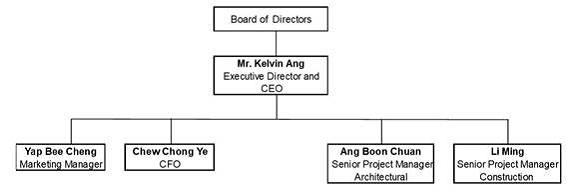
Our management reporting structure is as follows:
Directors and Executive Officers
The following table sets forth information regarding our directors and executive officers as of the date of this prospectus. Unless otherwise stated, the business address for our directors and executive officers is that of our principal executive offices located at 74 Tagore Lane, #02-00 Sindo Industrial Estate, Singapore 787498:
| Name | Age | Position | ||
| Kelvin Ang | 62 | Executive Director and CEO | ||
| Kong Chen Yung (Arthur) | 42 | Independent Director | ||
| Lee Puay Khng | 69 | Independent Director | ||
| Charlie Yi | 58 | Independent Director | ||
| Chew Chong Ye | 31 | Chief Financial Officer | ||
| Ang Boon Chuan | 48 | Senior Project Manager (Architectural) | ||
| Li Ming | 47 | Senior Project Manager (Construction) | ||
| Yap Bee Cheng (Chrysan) | 50 | Marketing Manager |
The business and working experience and areas of responsibility of our directors and executive officers are set out below. None of the Executive Officers hold any directorships presently and have not held any directorships over the last five (5) years.
Mr. Kelvin Ang is the CEO and Executive Director of our Group. He was appointed to our Board on March 10, 2022. He has also been an executive director of FBS SG since October 1996. He is responsible for the general management of the Group, with a focus on management and operations matters, such as administrative, finance, human resource and payroll, tender submission and quality surveyance and treasury. He is also responsible for business development and spearheading the business strategies of the Group.
Mr. Ang has more than 25 years of experience in the construction industry. Prior to joining the Group, Mr. Ang worked for Amcol Building Supplies Pte Ltd, a company engaged in the business of construction and supplying building materials, as a sales manager from April 1992 to June 1996. From July 1981 to December 1991, Mr. Ang was a process engineer at Avimo Singapore Limited, a company engaged in the business of air defense optics.
Mr. Ang obtained a Specialist Diploma in Construction Quality, Environmental, Occupational Health & Safety Management from the BCA in November 2003. He holds a Diploma in Business Efficiency & Productivity (Industrial Engineering), awarded by the NPB Institute for Productivity Training, in April 1994. He also has a Diploma in Production Technology, from the German – Singapore Institute, conferred in December 1986.
Mr. Kong Chen Yung (Arthur) is an Independent Director. Mr. Kong is currently the Financial Controller of Grandshores Technology Group Limited (formerly known as SHIS Limited) and its subsidiaries, namely SH Integrated Services Pte. Ltd. (“SH Integrated”) and CSH Development Pte. Ltd. (“CSH Development”). Their principal activities are that of integrated building services and building and construction works in Singapore.
|
|
Mr. Kong joined SH Integrated Services and CSH Development in October 2015 and played an important role during the listing of SHIS Limited (stock code: 1647) on the Main Board of the Hong Kong Stock Exchange in March 2017. He is currently Executive Director of AK Global Consultants Pte. Ltd., which is engaged in the business of financial advisory and providing accounting services.
Mr. Kong has over 1 year of experience in the field of auditing, accounting and financial management. Prior to joining SH Integrated Services and CSH Development, Mr. Kong worked at KPMG Services Pte. Ltd. from February 2011 to October 2015, where he last held the position of audit manager. From April 2007 to January 2011, he worked at Ernst & Young (Malaysia), where he last held the position of senior associate.
Mr. Kong recognizes the importance of due diligence, internal controls and corporate governance through his tenure at, and involvement with the listing of, SHIS Limited, as well as his expertise in accounting, finance and taxation matters for construction companies. He is also involved in the compliance of post-listing requirements, and is thus familiar with regulatory compliance requirements of a listed company.
Mr. Kong is a Certified Practicing Accountant, Australia. He obtained a Diploma of Business from Monash College in October 2002 and a Bachelor of Commerce (Accounting and Finance) from Monash University Australia in December 2006.
Mr. Lee Puay Khng is an Independent Director. Mr. Lee has over 25 years of experience in investment, financing and mergers and acquisitions in the Chinese market. He has extensive networks and resources in the corporate sectors and investment communities in Singapore and China. Mr. Lee has provided consulting services to many companies and has successfully completed numerous collaborations, mergers and acquisitions, corporate internationalization and overseas listing projects.
Mr. Lee is currently the managing director of Sinolion Capital Group, an investment and consultancy company that focuses on enterprises’ mergers and acquisitions including direct investments and property investments in China. He is also the senior partner of China Bridge Capital, a large private equity fund manager that provides comprehensive services to unlisted companies. Mr. Lee has been the independent director of GOME Finance Technology Co. Ltd., a company listed on the Hong Kong Stock Exchange (stock code: 628), since August 2021.
Mr. Lee joined Singapore Telecom in 1980 and left in 1993 as the country director (China) for Singapore Telecom International (STI), an investment arm of Singtel Group for overseas markets, and represented Singtel to take part in the consortium for the selection of Suzhou Industrial Park in China. Mr. Lee also served as Strategic Planning Director, Motorola China and General Manager for Joint Venture Development in China from 1994 to 1999, and JV Strategic Planning Director for 3Com Asia Pacific (Hong Kong) from 1999 to 2000. From 2000 to 2002, he worked for Vertex Ventures, a subsidiary of the Singapore-based Temasek. From 2002 to 2005, he was the Chief Representative of Singapore Economic Development Board based in China, providing effective technical assistance to many Chinese companies in their business expansion in Singapore. He was later invited to serve as the China investment consultant to the Government of Singapore Investment Corporation Pte Ltd from 2005 to 2007. In 2007, Mr. Lee joined the Sinolion Capital Group. Mr. Lee graduated from the University of Singapore (now known as National University of Singapore) with a Bachelor of Engineering (Electrical Engineering) degree in 1980.
Mr. Charlie Yi is an Independent Director. Mr. Yi has over 25 years of venture and private equity investment, management consulting, and start-up experience across multiple countries including the US, Asia, and Middle East. Over many years, he has developed a deep experience in funding and working with early and growth-stage companies in e-commerce, digital media, health tech and consumer, and B2B internet.
Mr. Yi was most recently Chief Development Director at MaxDelivery which sold to Boxed Inc (BOXD) in 2021. My. Yi was a former Managing Director at Cedrus Investments based in Cayman Island and former Chief Strategy Officer and head of investment for Dubai Holding’s Media Group. He has also held senior executive positions in Fox Sports (Formerly ESPN Start Sports), and Itochu Technology (Corporate venture) and was on the founding team of Kozmo.com in 2000.
|
|
Mr. Yi began his career at JP Morgan as an analyst in 1990 and also a management consultant at Booz & Co. He holds an MBA from The University of Chicago Booth School of Business with concentrations in finance and economics, and also BS in Mechanical Engineering from Columbia University.
Mr. Chew Chong Ye joined our Group in August 2020 as our Chief Financial Officer. Mr. Chew is responsible for the supervision of the finance team, consolidation of accounts, review of monthly closing, liaison with internal auditor and independent auditor, and monitoring of internal control implementation. He has also been involved in the listing process, providing support for the due diligence process, internal control review and audit.
Mr. Chew has over four years of experience in accounting and auditing. Prior to joining our Group, he worked at Stonenest Consultancy Services Pte Ltd, Singapore from February 2019 to July 2020.
Mr. Chew obtained a Bachelor of Commerce (Honours) from Universiti Tunku Abdul Rahman Malaysia
Our Audit Committee believes that Mr. Chew is qualified for the position of CFO of our Group, after having considered:
| - | the qualifications and past working experiences of Mr. Chew are compatible with his position as CFO of our Group; | |
| - | his past audit, financial and accounting related experiences; | |
| - | his demonstration of the requisite competency in finance-related matters of our Group in connection with the preparation for the listing of our Company; and | |
| - | the improvements that he has made in our internal controls and financial closing process. |
Further, after making all reasonable inquiries, and to the best of their knowledge and belief, we believe that Mr. Chew has the competence, character and integrity expected of a CFO of a publicly listed issuer. In addition, our CFO shall be subject to performance appraisal by our Audit Committee on an annual basis to ensure satisfactory performance.
Mr. Ang Boon Chuan is our Group’s senior project manager. He was appointed as project manager of our Group in October 2006 and is responsible for the project management of our Group’s at work sites, including the monitoring of site progress, supervision of the project team on-site, and liaison with main contractors and subcontractors to ensure project completion on a timely and satisfactory manner.
Mr. BC Ang has more than 20 years of experience in the construction industry. Prior to joining the Group, Mr. BC Ang worked at Dyntek Pte Ltd, a company engaged in the supply of building materials, as a sales coordinator from October 2001 to October 2006. From October 1996 to October 2001, he was site supervisor at Crown Alliance Marketing (Pte) Ltd, a company engaged in the manufacturing and installation of composite panels.
Mr. BC Ang obtained a Diploma in Supervision from ICS Learning Centres in July 1998. He also obtained a Certificate of Completion of AutoCAD Level 1 from Ngee Ann Polytechnic in May 2004 and a Certification in Building Construction Supervisors Safety from the BCA in May 2008. Mr. BC Ang also obtained a Certificate of completion of Construction Safety Course for Project Managers and a Certificate of completion of Risk Management Course from Hong Tech Consultant Pte Ltd, an Accredited Training Provider of MOM, in June 2011 and January 2012 respectively. He also obtained a Certificate of completion of Work-At-Height Course for Supervisors from ASRECTEC (“Access Safety Rescue Training & Education Centre”) in February 2012 and a Certificate in Successful Completion of CET for CoreTrade Supervisor (Architectural) from the BCA in July 2017.
Ms. Yap Bee Chen (Chyrsan) is our Marketing Manager. Ms. Yap joined our Group in March 1999 and is responsible for managing client accounts, project tendering costing, preparation of bid tender proposals and coordination of progress claims.
|
|
Ms. Yap has more than 20 years of experience in the construction industry. Prior to joining our Group, she worked at M & J Plaster Pte Ltd, a company engaged in the construction business, as marketing executive from March 1997 to January 1999. She had also been employed with Fastfixs from October 2013 to January 2019, assisting with project tenders and progress claims.
Ms. Yap has completed the Awareness and Internal Auditor Training on ISO 9001:2015, ISO 14001:2015, SS 506 & OHSAS 18001:2007 from Greensafe International Pte Ltd in October 2017. She has obtained a Certificate in Building Construction Safety Supervisors from the BCA in April 2002 and a Certificate of Merit in Interior Design from the Inspiration Design Training Centre Singapore in March 1997.
Mr. Li Ming joined our Group in May 2021 as a Senior Project Manager in Construction and is responsible for the project management of our group construction work at the sites, including designing, monitoring of site progress, supervision of project team and subcontractors on site, and liaison with authorities and customer to ensure project completion on a timely and satisfactory manner.
Mr. Li has over 20 years of experience in the construction industry. Prior to joining our Group, Mr. Li worked at Uni- Associated Consultants as a Design Engineer from July 2021 to April 2004, From May 2004 to May 2007 as a Project Engineer at China Construction (South Pacific) Development Co Pte Ltd, From June 2007 to Feb 2021 as a Director at GNG Consultants Pte Ltd.
Other than as disclosed in the section entitled “Shareholders – Ownership Structure,” there is no family relationship between any of our Directors and/or Executive Officers, or between any of our Directors, Executive Officers and Substantial Shareholders.
There is no arrangement or understanding with any of our Substantial Shareholders, customers or suppliers pursuant to which any of our directors or Executives was appointed as our Director or Executive Officer.
6.B. Compensation
Compensation of Directors and Executive Officers
The following table summarizes all compensation received by our directors, our executive officers and our key employees during the years ended December 31, 2023 and 2024 .
Summary Compensation Table
| Compensation Paid | ||||||||||||||||
| Name and Principal Position | Year |
Salary (S$) |
Bonus (S$) |
Other Compensation(1)(S$) |
||||||||||||
| Kelvin Ang (CEO and Director) | 2023 | 172,760 | 25,800 | 11,023 | ||||||||||||
| 2024 | 180,000 | 26,250 | 12,535 | |||||||||||||
| Chew Chong Ye (CFO) | 2023 | 48,100 | 6,300 | 9,248 | ||||||||||||
| 2024 | 50,400 | 6,300 | 9,639 | |||||||||||||
| Ang Boon Chuan (Senior Project Manager Architectural) | 2023 | 67,700 | 9,000 | 13,039 | ||||||||||||
| 2024 | 72,000 | 9,000 | 13,770 | |||||||||||||
| Li Ming (Senior Project Manager Construction) | 2023 | 28,800 | - | 4,896 | ||||||||||||
| 2024 | 167,400 | 15,000 | 15,674 | |||||||||||||
| Yap Bee Cheng (Chrysan) (Marketing Manager) | 2023 | 77,300 | 13,600 | 14,756 | ||||||||||||
| 2024 | 81,600 | 13,600 | 16,184 | |||||||||||||
| (1) | Other compensation includes allowance and employer’s contribution to the Central Provident Fund. |
|
|
6.C. Board Practices
Each of our directors has entered into a Director’s Agreement with the Company for an initial term of one year, which term commenced in February of 2025 and will continue until the director’s successor is duly elected and qualified. Any Director’s Agreement may be terminated for any or no reason by the director or at a meeting called expressly for that purpose by a vote of the shareholders holding more than 50% of the Company’s issued and outstanding Ordinary Shares entitled to vote.
None of our independent directors received any compensation from our Company in 2023 or 2024. Under the Directors’ Agreements, the initial annual compensation that is payable to each of our independent directors is as follows:
| Name of Director | Compensation (US$) | |||
| Arthur Kong | US$ | 20,000 | ||
| Lee Puay Khng | US$ | 20,000 | ||
| Charlie Yi | US$ | 20,000 | ||
In addition, our directors are entitled to participate in the Company’s share option scheme as adopted and amended from time to time. The number of options granted, and the terms of those options will be determined from time to time by a vote of the Board of Directors, provided that each director shall abstain from voting on any such resolution or resolutions relating to the grant of options to that director.
Other than as disclosed above, none of our directors has entered into a service agreement with our Company or any of our subsidiaries that provides for benefits upon termination of employment. We have entered into indemnification agreements with each of our directors and executive officers. Under these agreements, we agree to indemnify our directors and executive officers against certain liabilities and expenses incurred by such persons in connection with claims made by reason of their being a director or officer of our Company.
6.D. Employees
As of December 31, 2024, we had 74 full-time employees, all of whom were located within our Singapore offices.
The functional distribution of our Group’s employees as of December 31, 2023 and December 31, 2024 are as follows:
| As of | ||||||||
| Functions | December 31, 2023 | December 31, 2024 | ||||||
| Management | 10 | 10 | ||||||
| Project | 72 | 55 | ||||||
| Quantity surveyor/ Drafting | 7 | 6 | ||||||
| Finance & Administrative | 3 | 3 | ||||||
| Total | 92 | 74 | ||||||
None of our full-time employees are related to our directors and significant shareholders. Any new employment of related employees and the proposed terms of their employment will be subject to the review and approval of our Compensation Committee. In the event that a member of our Compensation Committee is related to the employee under review, he will abstain from the review.
|
|
We do not employ a significant number of temporary employees.
Our employees are not covered by any collective bargaining agreements and are not unionized. The relationship and co-operation between the management and staff have been good and are expected to continue and remain as such in the future. There has not been any incidence of work stoppages or labor disputes which affected our operations.
Family Relationships
Other that as disclosed below and in the section titled “Directors and Executive Officers” of this prospectus, there are no family relationship between any of our Directors, Executive Officers and/or Controlling Shareholder, or between any of our Directors, Executive Officers and Controlling Shareholder (“Related Employees”).
| Name | Position Held | Relationship | ||
| Ms. Soh Hoon Ang | Administrative executive | Sister of Mr. Kelvin Ang | ||
| Ms. Chia Siew Ngor | Office administrator | Spouse of Mr. Kelvin Ang |
The remuneration of the Related Employees is determined on the same basis as those of unrelated employees. The Related Employees do not hold managerial positions in our Group. The compensation of each of the above Related Employees is within the compensation band of S$0 to S$50,000 per annum.
The remuneration of employees who are related to our directors, CEO or substantial shareholders will be reviewed annually by our compensation committee to ensure that their remuneration packages are in line with our staff remuneration guidelines and commensurate with their respective job scopes and level of responsibilities. Any bonuses, pay increases and/or promotions for these related employees will also be subject to the review and approval of our compensation committee. In addition, any new employment of related employees and the proposed terms of their employment will be subject to the review and approval of our compensation committee. In the event that a member of our compensation committee is related to the employee under review, he will abstain from the review.
6.E. Share Ownership
Not applicable.
6.F. Disclosure of Action to Recover Erroneously Awarded Compensation
Not applicable.
Item 7. Major Shareholders and Related Party Transactions
7.A. Major Shareholders
The following table sets forth information regarding beneficial ownership of our share capital by:
| - | each person, or group of affiliated persons, known by us to beneficially own more than 5% of our shares; | |
| - | each of our named executive officers; | |
| - | each of our directors and director nominees; and | |
| - | all of our current executive officers, directors and director nominees as a group. |
Applicable percentage ownership is based on 13,500,000 Ordinary Shares issued and outstanding as of the date of this annual report with respect to percent ownership.
|
|
The information presented below regarding beneficial ownership of our voting securities has been presented in accordance with the rules of the SEC and is not necessarily indicative of ownership for any other purpose. Under these rules, a person is deemed to be a “beneficial owner” of a security if that person has or shares the power to vote or direct the voting of the security or the power to dispose or direct the disposition of the security. A person is deemed to own beneficially any security as to which such person has the right to acquire sole or shared voting or investment power within 60 days through the conversion or exercise of any convertible security, warrant, option or other right. More than one person may be deemed to be a beneficial owner of the same securities. The percentage of beneficial ownership by any person as of a particular date is calculated by dividing the number of shares beneficially owned by such person, which includes the number of shares as to which such person has the right to acquire voting or investment power within 60 days, by the sum of the number of shares issued and outstanding as of such date, plus the number of shares as to which such person has the right to acquire voting or investment power within 60 days. Consequently, the denominator used for calculating such percentage may be different for each beneficial owner. Except as otherwise indicated below and under applicable community property laws, we believe that the beneficial owners of our shares listed below have sole voting and investment power with respect to the shares shown.
Unless otherwise noted below, the address of each person listed on the table is 74 Tagore Lane, Singapore 787498.
| Ordinary Shares Beneficially Owned |
||||||||
| Name of Beneficial Owner | Number | Percentage | ||||||
| Named Executive Officers and Directors: | ||||||||
| Directors and Executive Officers | ||||||||
| Kelvin Ang | 9,365,663 | 69.4 | % | |||||
| Chew Chong Ye | ||||||||
| Ang Boon Chuan | - | - | ||||||
| Li Ming | - | - | ||||||
| Yap Bee Cheng (Chyrsan) | - | - | ||||||
| - | - | |||||||
| Kong Chen Yung (Arthur) | - | - | ||||||
| Lee Puay Khng | - | - | ||||||
| Charlie Yi | - | - | ||||||
| Named Executive Officers and Directors as a Group (8 persons) | 9,365,663 | 69.4 | % | |||||
| 5% or Greater Shareholders | ||||||||
| Kelvin Ang* | 9,365,663 | 69.4 | % | |||||
| Total | 9,365,663 | 69.4 | % | |||||
7.B. Related Party Transactions
We have adopted an audit committee charter, which requires the committee to review all related-party transactions on an ongoing basis and all such transactions be approved by the committee.
The following is a list of related parties which the Company has transactions with:
| (a) | Fine Build-Ninefold Group Construction Company (Private) Limited | |
| A Joint-Venture (JV) incorporated in Sri Lanka in year 2017 to bid a local project, FineBuild Systems holding 30% shares of the JV. The company started transferring the share to 3rd party in late 2019, however due to Covid-19 pandemic, the share transfer is still pending for the local secretary to execute. Currently, FineBuild System only supplies material to the JV. | ||
| (b) | 54 Pandan Road Pte Ltd | |
| A related company under common control with FBS SG as Mr. Kelvin Ang (also known as Poh Guan Ang) acts as the sole director in this company. |
|
|
| (c) | Fastfix Systems Pte Ltd | |
| A related company under the common control with FBS SG as Mr. Kelvin Ang act as the sole director in this company. | ||
| (d) | Kelvin Ang | |
| Present sole director and shareholder of FBS Global Limited. | ||
| (e) | Ang Poh Hwee | |
| Project director of FBS Global Limited. |
| a. | Accounts receivable – related party |
As of December 31, 2023 and 2024, the balance of Accounts receivable – related party were as follows:
|
2023 SGD |
2024 SGD |
2024 USD |
||||||||||||
| Accounts receivable – related party | ||||||||||||||
| Fine Build-Ninefold Group Construction Company (Private) Limited | (1) | 971,780 | 961,143 | 720,857 | ||||||||||
| Provision for credit losses | (1) | (971,780 | ) | (961,143 | ) | (720,857 | ) | |||||||
| Total | - | - | - | |||||||||||
Movement of the provision of credit losses were as follows:
|
2022 SGD |
2023 SGD |
2024 SGD |
2024 USD |
|||||||||||||
| Beginning balance | 970,573 | 990,941 | 971,780 | 728,835 | ||||||||||||
| Exchange rate effect | 20,368 | (19,161 | ) | (10,637 | ) | (7,978 | ) | |||||||||
| Ending balance | 990,941 | 971,780 | 961,143 | 720,857 | ||||||||||||
| b. | Other receivables – related parties |
As of December 31, 2023 and 2024, the balances of other receivables-related parties were as follows:
|
2023 SGD |
2024 SGD |
2024 USD |
||||||||||||
| Other receivables – related parties | ||||||||||||||
| Fine Build-Ninefold Group Construction Company (Private) Limited | (3) | 575,200 | 593,390 | 445,043 | ||||||||||
| Allowance for credit loss | (3) | (575,200 | ) | (593,390 | ) | (445,043 | ) | |||||||
| 54 Pandan Road Pte Ltd | (2) | 212,794 | - | - | ||||||||||
| Ang Poh Hwee | (4) | 30,000 | 30,000 | 22,500 | ||||||||||
| Total | 242,794 | 30,000 | 22,500 | |||||||||||
Movement of the provision of credit losses were as follows:
|
2022 SGD |
2023 SGD |
2024 SGD |
2024 USD |
|||||||||||||
| Beginning balance | 589,638 | 586,542 | 575,200 | 431,400 | ||||||||||||
| Exchange rate effect | (3,096 | ) | (11,342 | ) | 18,190 | 13,643 | ||||||||||
| Ending balance | 586,542 | 575,200 | 593,390 | 445,043 | ||||||||||||
|
|
| (1) | Supply construction material to the joint venture company. The Company may not be able to collect amounts due under COVID-19’s negative impact to the joint venture’s operation and financial condition, and the Company reserved 100% allowance for credit loss. | |
| (2) | The Company approved a loan to 54 Pandan Road Pte Ltd on April 10, 2023, provided the loan of SGD2 million, with no interest. As of the date of this prospectus, the Company has collected the loan from 54 Pandan Road Pte Ltd. | |
| (3) | Management service provided to the joint venture company. | |
| (4) | The Company paid on behalf the director for a legal case between Newspaper Seng Pte Ltd and Ang Poh Hwee. |
| c. | Due to related parties |
As of December 31, 2023 and 2024, the balances of amount due to related parties were as follows:
|
2023 SGD |
2024 SGD |
2024 USD |
||||||||||
| Due to related parties | ||||||||||||
| Kelvin Ang | 83,388 | 522,847 | 392,136 | |||||||||
| Total | 83,388 | 522,847 | 392,136 | |||||||||
| d. | Related party transactions |
|
2022 SGD |
2023 SGD |
2024 SGD |
2024 USD |
|||||||||||||
| Fine Build-Ninefold Group Company (Private) Limited | ||||||||||||||||
| Supply construction material | 25,633 | - | - | - | ||||||||||||
| 54 Pandan Road Pte Ltd | ||||||||||||||||
| Rental of warehouse | 30,000 | - | 720,000 | 540,000 | ||||||||||||
| Fastfixs Systems Pte Ltd | ||||||||||||||||
| Consultation fee | - | 138,000 | 217,500 | 163,125 | ||||||||||||
| Supply of labor | - | 43,004 | 263,034 | 197,276 | ||||||||||||
| e. | Commitments |
On November 25, 2020, the Company guaranteed a five year commercial loan SGD 200,000 from UOB Bank to Fastfixs Systems Pte Ltd, a related party. The interest rate is fixed at 2.25% per annum and Fastfixs Systems Pte Ltd payable over 60 monthly installments with the interest. Such payments by Fastfixs Systems Pte Ltd have been timely made as of the date of this prospectus.
The Company also guaranteed a SGD 7,400,000 10 year commercial loan on October 31, 2022, in the form of letter of credit from UOB Bank to 54 Pandan Road Pte Ltd, a related party. The letter of credit has been fully drawn down as of the date of this prospectus.
Item 8. Financial Information
8.A. Consolidated Statements and Other Financial Information
Please refer to “Item 18. Financial Statements.”
8.B. Significant Changes
Not applicable.
|
|
Item 9. The Offer and Listing
9.A. Offer and listing details
Not applicable.
9.B. Plan of distribution
Not applicable.
9.C. Markets
Our Ordinary Shares are listed on the Nasdaq Capital Market.
9.D. Selling shareholders
Not applicable.
9.E. Dilution
Not applicable.
9.F. Expenses of the issue
Not applicable.
Item 10. Additional Information
10.A. Share capital
Our authorized share capital is US$500,000 divided into 500,000,000 shares of par value US$0.001 each. The number of our Ordinary Shares issued and outstanding was 11,250,000 on December 31, 2024 and is 13,500,000 after our initial public offering that occurred on February 6, 2025.
10.B. Memorandum and articles of association
Our Memorandum and Articles of Association
The following are summaries of certain material provisions of our Amended Memorandum and Amended and Restated Articles of Association (which we refer to as our Memorandum and Articles of Association below) and of the Companies Act, insofar as they relate to the material terms of our Ordinary Shares. This summary is qualified in its entirety by reference to the complete text of the Memorandum and Articles of Association. A copy of the Memorandum and Articles of Association have been filed as exhibits to this annual report.
Objects of Our Company. Under our Memorandum and Articles of Association, the objects of our Company are unrestricted, and we are capable of exercising all the functions of a natural person of full capacity irrespective of any question of corporate benefit, as provided by section 27(2) of the Companies Act.
Ordinary Shares. Our Ordinary Shares are issued in registered form and are issued when registered in our register of members. We may not issue shares to bearer. Our shareholders who are non-residents of the Cayman Islands may freely hold and vote their Ordinary Shares on a one vote for one share basis.
|
|
Dividends. The holders of our Ordinary Shares are entitled to such dividends as may be declared by our board of directors. Our Memorandum and Articles of Association provide that dividends may be declared and paid out of the funds of our Company lawfully available therefor. Under the laws of the Cayman Islands, our Company may pay a dividend out of either profit or share premium account; provided that in no circumstances may a dividend be paid out of our share premium if this would result in our company being unable to pay its debts as they fall due in the ordinary course of business.
Voting Rights. Voting at any meeting of shareholders is by way of a poll save that in the case of a physical meeting, the chairman of the meeting may decide that a vote be on a show of hands unless a poll is demanded by:
| ● | at least three shareholders present in person or by proxy or (in the case of a shareholder being a corporation) by its duly authorized representative for the time being entitled to vote at the meeting; | |
| ● | shareholder(s) present in person or by proxy or (in the case of a shareholder being a corporation) by its duly authorized representative representing not less than one-tenth of the total voting rights of all shareholders having the right to vote at the meeting; and | |
| ● | shareholder(s) present in person or by proxy or (in the case of a shareholder being a corporation) by its duly authorized representative and holding shares in us conferring a right to vote at the meeting being shares on which an aggregate sum has been paid up equal to not less than one-tenth of the total sum paid up on all shares conferring that right. |
An ordinary resolution to be passed at a meeting by the shareholders will require the affirmative vote of a simple majority of the votes attaching to the Ordinary Shares cast at a meeting, while a special resolution requires the affirmative vote of no less than two-thirds of the votes cast attaching to the issued and outstanding Ordinary Shares at a meeting. A special resolution will be required for important matters such as a change of name, making changes to our Memorandum and Articles of Association, a reduction of our share capital and the winding up of our Company. Our shareholders may, among other things, divide or combine their shares by ordinary resolution.
General Meetings of Shareholders. As a Cayman Islands exempted company, we are not obliged by the Companies Act to call shareholders’ annual general meetings. Our Memorandum and Articles of Association provide that we shall, if required by the Companies Act, in each year hold a general meeting as our annual general meeting, and shall specify the meeting as such in the notices calling it, and the annual general meeting shall be held at such time and place as may be determined by our directors. All general meetings (including an annual general meeting, any adjourned general meeting or postponed meeting) may be held as a physical meeting at such times and in any part of the world and at one or more locations, as a hybrid meeting or as an electronic meeting, as may be determined by our board of directors in its absolute discretion.
Shareholders’ general meetings may be convened by the chairperson of our board of directors or by a majority of our board of directors. Advance notice of not less than ten clear days is required for the convening of our annual general shareholders’ meeting (if any) and any other general meeting of our shareholders. A quorum required for any general meeting of shareholders consists of, at the time when the meeting proceeds to business, two shareholders holding shares which carry in aggregate (or representing by proxy) not less than one-third of all votes attaching to issued and outstanding shares in our Company entitled to vote at such general meeting.
The Companies Act does not provide shareholders with any right to requisition a general meeting or to put any proposal before a general meeting. However, these rights may be provided in a company’s articles of association. Our Memorandum and Articles of Association provide that upon the requisition of any one or more of our shareholders holding shares which carry in aggregate not less than one-third of all votes attaching to the issued and outstanding shares of our Company entitled to vote at general meetings, our board will convene an extraordinary general meeting and put the resolutions so requisitioned to a vote at such meeting. However, our Memorandum and Articles of Association do not provide our shareholders with any right to put any proposals before annual general meetings or extraordinary general meetings not called by such shareholders.
Transfer of Ordinary Shares. Subject to the restrictions set out below, any of our shareholders may transfer all or any of his or her Ordinary Shares by an instrument of transfer in the usual or common form or in a form designated by the relevant stock exchange or any other form approved by our board of directors. Notwithstanding the foregoing, Ordinary Shares may also be transferred in accordance with the applicable rules and regulations of the relevant stock exchange.
|
|
Our board of directors may, in its absolute discretion, decline to register any transfer of any Ordinary Share which is not fully paid up or on which we have a lien. Our board of directors may also decline to register any transfer of any Ordinary Share unless:
| ● | the instrument of transfer is lodged with us, accompanied by the certificate for the Ordinary Shares to which it relates and such other evidence as our board of directors may reasonably require to show the right of the transferor to make the transfer; | |
| ● | the instrument of transfer is in respect of only one class of Ordinary Shares; | |
| ● | the instrument of transfer is properly stamped, if required; | |
| ● | in the case of a transfer to joint holders, the number of joint holders to whom the Ordinary Share is to be transferred does not exceed four; and | |
| ● | a fee of such maximum sum as the relevant stock exchange may determine to be payable or such lesser sum as our directors may from time to time require is paid to us in respect thereof. |
If our directors refuse to register a transfer they shall, within two months after the date on which the instrument of transfer was lodged, send to each of the transferor and the transferee notice of such refusal.
The registration of transfers may, after compliance with any notice required in accordance with the rules of the relevant stock exchange, be suspended and the register closed at such times and for such periods as our board of directors may from time to time determine; provided, however, that the registration of transfers shall not be suspended nor the register closed for more than 30 days in any year as our board may determine.
Liquidation. On the winding up of our Company, if the assets available for distribution amongst our shareholders shall be more than sufficient to repay the whole of the share capital at the commencement of the winding up, the surplus shall be distributed amongst our shareholders in proportion to the par value of the shares held by them at the commencement of the winding up, subject to a deduction from those shares in respect of which there are monies due, of all monies payable to our Company for unpaid calls or otherwise. If our assets available for distribution are insufficient to repay all of the paid-up capital, such the assets will be distributed so that, as nearly as may be, the losses are borne by our shareholders in proportion to the par value of the shares held by them.
Calls on Shares and Forfeiture of Shares. Our board of directors may from time to time make calls upon shareholders for any amounts unpaid on their shares in a notice served to such shareholders at least 14 days prior to the specified time and place of payment. The shares that have been called upon and remain unpaid are subject to forfeiture.
Redemption, Repurchase and Surrender of Shares. We may issue shares on terms that such shares are subject to redemption, at our option or at the option of the holders of these shares, on such terms and in such manner as may be determined by our board of directors. Our Company may also repurchase any of our shares on such terms and in such manner as have been approved by our board of directors. Under the Companies Act, the redemption or repurchase of any share may be paid out of our Company’s profits, share premium account or out of the proceeds of a new issue of shares made for the purpose of such redemption or repurchase, or out of capital if our Company can, immediately following such payment, pay its debts as they fall due in the ordinary course of business. In addition, under the Companies Act no such share may be redeemed or repurchased (a) unless it is fully paid up, (b) if such redemption or repurchase would result in there being no shares outstanding or (c) if the Company has commenced liquidation. In addition, our company may accept the surrender of any fully paid share for no consideration.
Variations of Rights of Shares. Whenever the capital of our Company is divided into different classes the rights attached to any such class may, subject to any rights or restrictions for the time being attached to any class, only be varied with the sanction of a resolution passed by a majority of two-thirds of the votes cast at a separate meeting of the holders of the shares of that class. The rights conferred upon the holders of the shares of any class issued with preferred or other rights shall not, unless otherwise expressly provided by the terms of issue of the shares of that class, be deemed to be varied by the creation, allotment or issue of further shares ranking pari passu with such existing class of shares.
|
|
Issuance of Additional Shares. Our Memorandum and Articles of Association authorizes our board of directors to issue additional Ordinary Shares from time to time as our board of directors shall determine, to the extent of available authorized but unissued shares.
Our Memorandum and Articles of Association also authorizes our board of directors to establish from time to time one or more series of preference shares and to determine, with respect to any series of preference shares, the terms and rights of that series, including, among other things:
| ● | the designation of the series; | |
| ● | the number of shares of the series; | |
| ● | the dividend rights, dividend rates, conversion rights and voting rights; and | |
| ● | the rights and terms of redemption and liquidation preferences. | |
Our board of directors may issue preference shares to the extent of available authorized but unissued shares. Issuance of these shares may dilute the voting power of holders of Ordinary Shares.
Inspection of Books and Records. Holders of our Ordinary Shares will have no general right under Cayman Islands law to inspect or obtain copies of our list of shareholders or our corporate records. However, our Memorandum and Articles of Association have provisions that provide our shareholders the right to inspect our register of shareholders without charge, and to receive our annual audited financial statements. See “Where You Can Find More Information.”
Anti-Takeover Provisions. Some provisions of our Memorandum and Articles of Association may discourage, delay or prevent a change of control of our company or management that shareholders may consider favorable, including provisions that:
| ● | authorize our board of directors to issue preference shares in one or more series and to designate the price, rights, preferences, privileges and restrictions of such preference shares without any further vote or action by our shareholders; and | |
| ● | limit the ability of shareholders to requisition and convene general meetings of shareholders. |
However, under Cayman Islands law, our directors may only exercise the rights and powers granted to them under our Memorandum and Articles of Association for a proper purpose and for what they believe in good faith to be in the best interests of our Company.
10.C. Material contracts
Our material contracts, other than those entered into in the ordinary course of business, are described in Item 4, Item 6 and Item 7 or elsewhere in this Annual Report.
10.D. Exchange controls
There are no foreign exchange controls or foreign exchange regulations under current applicable laws of the various places of incorporation of our significant subsidiaries that would affect the payment or remittance of dividends.
|
|
10.E. Taxation
Material Income Tax Considerations
The following summary of certain Cayman Islands and U.S. federal income tax consequences of an investment in our Ordinary Shares is based upon laws and relevant interpretations thereof in effect as of the date of this Annual Report, all of which are subject to change. This summary does not deal with all possible tax consequences relating to an investment in the Ordinary Shares, such as the tax consequences under U.S. state and local tax laws or under the tax laws of jurisdictions other than the Cayman Islands and the United States. The Company does not conduct operations in the PRC and has no PRC operating entities. Accordingly, a discussion of PRC tax regulation is not applicable. You are encouraged to consult your own tax advisors concerning the overall tax consequences arising in your own particular situation under U.S. federal, state, local or foreign law of the ownership of our Ordinary Shares. To the extent that this discussion relates to matters of Cayman Islands tax law, it is the opinion of Conyers Dill & Pearman, our counsel as to Cayman Islands law.
Cayman Islands Tax Considerations
The Cayman Islands currently levies no taxes on individuals or corporations based upon profits, income, gains or appreciation and there is no taxation in the nature of inheritance tax or estate duty. There are no other taxes likely to be material to us levied by the government of the Cayman Islands except for stamp duties which may be applicable on instruments executed in, or, after execution, brought within the jurisdiction of the Cayman Islands. The Cayman Islands is a party to a double tax treaty entered into with the United Kingdom in 2010 but otherwise is not party to any double tax treaties. There are no exchange control regulations or currency restrictions in the Cayman Islands.
We have received an undertaking from the Governor in Cabinet of the Cayman Islands to the effect that, for a period of 20 years from the date of the undertaking, no law that thereafter is enacted in the Cayman Islands imposing any tax or duty to be levied on profits, income or on gains or appreciation shall apply to our Company or its operations; and that no tax to be levied on profits, income, gains or appreciations or which is in the nature of estate duty or inheritance tax shall be payable (a) on or in respect of the shares, debentures or other obligations of our Company; or (b) by way of the withholding in whole or in part of any relevant payment as defined in the Tax Concessions Act of the Cayman Islands.
Payments of dividends and capital in respect of our Ordinary Shares will not be subject to taxation in the Cayman Islands and no withholding will be required on the payment of a dividend or capital to any holder of our Ordinary Shares, nor will gains derived from the disposal of our Ordinary Shares be subject to Cayman Islands income or corporation tax.
No stamp duty is payable in respect of the issue of our Ordinary Shares or on an instrument of transfer in respect of our Ordinary Shares.
United States Federal Income Tax Considerations
The following discussion is a summary of U.S. federal income tax considerations generally applicable to the ownership and disposition of our Ordinary Shares by U.S. Holders (as defined below) that acquire our Ordinary Shares and hold our Ordinary Shares as “capital assets” (generally, property held for investment) under the United States Internal Revenue Code of 1986, as amended (the “Code”). This discussion is based upon existing United States federal income tax law which is subject to differing interpretations or change, possibly with retroactive effect. There can be no assurance that the Internal Revenue Service, or the IRS, or a court will not take a contrary position. This discussion does not address all aspects of United States federal income taxation that may be relevant to particular investors in light of their specific circumstances, including investors subject to special tax rules (for example, certain financial institutions (including banks), cooperatives, pension plans, insurance companies, broker-dealers, traders in securities that have elected the mark-to-market method of accounting for their securities, partnerships and their partners, regulated investment companies, real estate investment trusts, and tax-exempt organizations (including private foundations)), investors who are not U.S. Holders, investors who own (directly, indirectly, or constructively) 10% or more of our stock (by vote or value), investors that will hold their Ordinary Shares as part of a straddle, hedge, conversion, constructive sale, or other integrated transaction for United States federal income tax purposes, or U.S. Holders that have a functional currency other than the U.S. dollar, all of whom may be subject to tax rules that differ significantly from those summarized below. In addition, this discussion does not discuss any non-United States tax, state or local tax, or non-income tax (such as the U.S. federal gift or estate tax) considerations, or any consequences under the alternative minimum tax or Medicare tax on net investment income. Each U.S. Holder is urged to consult its tax advisor regarding the United States federal, state, local, and non-United States income and other tax considerations of an investment in our Ordinary Shares.
|
|
General
For purposes of this discussion, a “U.S. Holder” is a beneficial owner of our Ordinary Shares that is, for United States federal income tax purposes, (i) an individual who is a citizen or resident of the United States, (ii) a corporation (or other entity treated as a corporation for United States federal income tax purposes) created in, or organized under the laws of, the United States or any state thereof or the District of Columbia, (iii) an estate the income of which is includible in gross income for United States federal income tax purposes regardless of its source, or (iv) a trust (A) the administration of which is subject to the primary supervision of a United States court and which has one or more United States persons who have the authority to control all substantial decisions of the trust or (B) that has otherwise validly elected to be treated as a United States person under the Code.
If a partnership (or other entity or arrangement treated as a partnership for United States federal income tax purposes) is a beneficial owner of our Ordinary Shares, the tax treatment of a partner in the partnership will generally depend upon the status of the partner as a U.S. Holder, as described above, and the activities of the partnership. Partnerships holding our Ordinary Shares and partners in such partnerships are urged to consult their tax advisors as to the particular United States federal income tax consequences of an investment in our Ordinary Shares.
Dividends
The entire amount of any cash distribution paid with respect to our Ordinary Shares (including the amount of any non-U.S. taxes withheld therefrom, if any) generally will constitute dividends to the extent such distributions are paid out of our current or accumulated earnings and profits, as determined under United States federal income tax principles, and generally will be taxed as ordinary income in the year received by such U.S. Holder. To the extent amounts paid as distributions on the Ordinary Shares exceed our current or accumulated earnings and profits, such distributions will not be dividends, but instead will be treated first as a tax-free return of capital to the extent of the U.S. Holder’s adjusted tax basis, determined for federal income tax purposes, in the Ordinary Shares with respect to which the distribution is made, and thereafter as capital gain. However, we do not intend to compute (or to provide U.S. Holders with the information necessary to compute) our earnings and profits under United States federal income tax principles. Accordingly, a U.S. Holder will be unable to establish that a distribution is not out of earnings and profits and should expect to treat the full amount of each distribution as a “dividend” for United States federal income tax purposes.
Any dividends that we pay will generally be treated as income from foreign sources for United States foreign tax credit purposes and will generally constitute passive category income. Depending on the U.S. Holder’s particular facts and circumstances, a U.S. Holder may be eligible, subject to a number of complex limitations, to claim a foreign tax credit in respect of any foreign withholding taxes imposed (at a rate not exceeding any applicable treaty rate) on dividends received on our Ordinary Shares. A U.S. Holder who does not elect to claim a foreign tax credit for foreign tax withheld may instead claim a deduction, for United States federal income tax purposes, in respect of such withholdings, but only for a year in which such U.S. Holder elects to do so for all creditable foreign income taxes. The rules governing the foreign tax credit are complex. U.S. Holders are advised to consult their tax advisors regarding the availability of the foreign tax credit under their particular circumstances.
Dividends paid in non-U.S. currency will be included in the gross income of a U.S. Holder in a U.S. dollar amount calculated by reference to a spot market exchange rate in effect on the date that the dividends are received by the U.S. Holder, regardless of whether such foreign currency is in fact converted into U.S. dollars on such date. Such U.S. Holder will have a tax basis for United States federal income tax purposes in the foreign currency received equal to that U.S. dollar value. If such dividends are converted into U.S. dollars on the date of receipt, a U.S. Holder generally should not be required to recognize foreign currency gain or loss in respect thereof. If the foreign currency so received is not converted into U.S. dollars on the date of receipt, such U.S. Holder will have a basis in the foreign currency equal to its U.S. dollar value on the date of receipt. Any gain or loss on a subsequent conversion or other disposition of the foreign currency generally will be treated as ordinary income or loss to such U.S. Holder and generally will be income or loss from sources within the United States for foreign tax credit limitation purposes. U.S. Holders should consult their own tax advisors regarding the treatment of foreign currency gain or loss, if any, on any foreign currency received by a U.S. Holder that are converted into U.S. dollars on a date subsequent to receipt.
|
|
Sale or Other Disposition of Ordinary Shares
A U.S. Holder will generally recognize capital gain or loss upon a sale or other disposition of Ordinary Shares, in an amount equal to the difference between the amount realized and the U.S. Holder’s adjusted tax basis, determined for federal income tax purposes, in such Ordinary Shares, each amount determined in U.S. dollars. Any capital gain or loss will be long-term capital gain or loss if the Ordinary Shares have been held for more than one year and will generally be United States source gain or loss for United States foreign tax credit purposes. The deductibility of a capital loss may be subject to limitations, particularly with regard to shareholders who are individuals. Each U.S. Holder is advised to consult its tax advisor regarding the tax consequences if a foreign tax is imposed on a disposition of our Ordinary Shares, including the availability of the foreign tax credit under its particular circumstances.
A U.S. Holder that receives a currency other than U.S. dollars on the disposition of our Ordinary Shares will realize an amount equal to the U.S. dollar value of the non-U.S. currency received at the spot rate on the date of sale (or, if the Ordinary Shares are traded on a recognized exchange and in the case of cash basis and electing accrual basis U.S. Holders, the settlement date). An accrual basis U.S. Holder that does not elect to determine the amount realized using the spot rate on the settlement date will recognize foreign currency gain or loss equal to the difference between the U.S. dollar value of the amount received based on the spot market exchange rates in effect on the date of sale or other disposition and the settlement date. A U.S. Holder will have a tax basis in the currency received equal to the U.S. dollar value of the currency received on the settlement date. Any gain or loss on a subsequent disposition or conversion of the currency will be United States source ordinary income or loss.
Passive Foreign Investment Company Considerations
For United States federal income tax purposes, a non-United States corporation, such as our Company, will be treated as a “passive foreign investment company,” or “PFIC” if, in the case of any particular taxable year, either (a) 75.0% or more of our gross income for such year consists of certain types of “passive” income or (b) 50.0% or more of the value of our assets (generally determined on the basis of a quarterly average) during such year produce or are held for the production of passive income. Based upon our current and expected income and assets (including goodwill and taking into account the proceeds from our recent IPO) and the expected market price of our Ordinary Shares following our IPO, we do not expect to be a PFIC for the current taxable year or the foreseeable future.
However, while we do not expect to be or become a PFIC, no assurance can be given in this regard because the determination of whether we are or will become a PFIC for any taxable year is a fact-intensive inquiry made annually that depends, in part, upon the composition and classification of our income and assets. Fluctuations in the market price of our Ordinary Shares may cause us to be or become a PFIC for the current or subsequent taxable years because the value of our assets for the purpose of the asset test, including the value of our goodwill and other unbooked intangibles, may be determined by reference to the market price of our Ordinary Shares (which may be volatile). The composition of our income and assets may also be affected by how, and how quickly, we use our liquid assets and the cash raised in our IPO. It is also possible that the Internal Revenue Service may challenge our classification of certain income or assets for purposes of the analysis set forth in subparagraphs (a) and (b), above or the valuation of our goodwill and other unbooked intangibles, which may result in our company being or becoming a PFIC for the current or future taxable years.
If we are classified as a PFIC for any taxable year during which a U.S. Holder holds our Ordinary Shares, and unless the U.S. Holder makes a mark-to-market election (as described below), the U.S. Holder will generally be subject to special tax rules on (i) any excess distribution that we make to the U.S. Holder (which generally means any distribution paid during a taxable year to a U.S. Holder that is greater than 125% of the average annual distributions paid in the three preceding taxable years or, if shorter, the U.S. Holder’s holding period for the Ordinary Shares), and (ii) any gain realized on the sale or other disposition, including, under certain circumstances, a pledge, of Ordinary Shares. Under the PFIC rules:
| ● | such excess distribution and/or gain will be allocated ratably over the U.S. Holder’s holding period for the Ordinary Shares; |
|
|
| ● | such amount allocated to the current taxable year and any taxable years in the U.S. Holder’s holding period prior to the first taxable year in which we are a PFIC, each a pre-PFIC year, will be taxable as ordinary income; |
| ● | such amount allocated to each prior taxable year, other than a pre-PFIC year, will be subject to tax at the highest tax rate in effect applicable to the U.S. Holder for that year; and |
| ● | an interest charge generally applicable to underpayments of tax will be imposed on the tax attributable to each prior taxable year, other than a pre-PFIC year. |
If we are a PFIC for any taxable year during which a U.S. Holder holds our Ordinary Shares and we own any equity in a non-United States entity that is also a PFIC, or a lower-tier PFIC, such U.S. Holder would be treated as owning a proportionate amount (by value) of the shares of the lower-tier PFIC for purposes of the application of these rules. U.S. Holders are advised to consult their tax advisors regarding the application of the PFIC rules to any of the entities in which we may own equity.
As an alternative to the foregoing rules, a U.S. Holder of “marketable stock” in a PFIC may make a mark-to-market election with respect to such stock, provided that certain requirements are met. The mark-to-market election is available only for stock that is regularly traded on a national securities exchange that is registered with the SEC, or on a foreign exchange or market that the IRS determines is a qualified exchange that has rules sufficient to ensure that the market price represents a legitimate and sound fair market value. Although we intend to apply for the listing of our Ordinary Shares on the Nasdaq, we cannot guarantee that our listing will be approved. Furthermore, we cannot guarantee that, once listed, our Ordinary Shares will continue to be listed and regularly traded on such exchange. U.S. Holders are advised to consult their tax advisors as to whether the Ordinary Shares are considered marketable for these purposes.
If an effective mark-to-market election is made with respect to our Ordinary Shares, the U.S. Holder will generally (i) include as ordinary income for each taxable year that we are a PFIC the excess, if any, of the fair market value of Ordinary Shares held at the end of the taxable year over its adjusted tax basis of such Ordinary Shares and (ii) deduct as an ordinary loss the excess, if any, of its adjusted tax basis of the Ordinary Shares held at the end of the taxable year over the fair market value of such Ordinary Shares held at the end of the taxable year, but only to the extent of the net amount previously included in income as a result of the mark-to-market election. The U.S. Holder’s adjusted tax basis in the Ordinary Shares would be adjusted to reflect any income or loss resulting from the mark-to-market election. If a U.S. Holder makes an effective mark-to-market election, in each year that we are a PFIC any gain recognized upon the sale or other disposition of the Ordinary Shares will be treated as ordinary income and loss will be treated as ordinary loss, but only to the extent of the net amount previously included in income as a result of the mark-to-market election.
If a U.S. Holder makes a mark-to-market election in respect of a PFIC and such corporation ceases to be a PFIC, the U.S. Holder will not be required to take into account the mark-to-market gain or loss described above during any period that such corporation is not a PFIC.
Because a mark-to-market election generally cannot be made for any lower-tier PFICs that a PFIC may own, a U.S. Holder who makes a mark-to-market election with respect to our Ordinary Shares may continue to be subject to the general PFIC rules with respect to such U.S. Holder’s indirect interest in any of our non-United States subsidiaries if any of them is a PFIC.
If a U.S. Holder owns our Ordinary Shares during any taxable year that we are a PFIC, such holder would generally be required to file an annual IRS Form 8621. Each U.S. Holder is advised to consult its tax advisor regarding the potential tax consequences to such holder if we are or become a PFIC, including the possibility of making a mark-to-market election.
THE DISCUSSION ABOVE IS A GENERAL SUMMARY. IT DOES NOT COVER ALL TAX MATTERS THAT MAY BE OF IMPORTANCE TO A PARTICULAR INVESTOR. EACH PROSPECTIVE INVESTOR IN THE OUR ORDINARY SHARES IS URGED TO CONSULT ITS OWN TAX ADVISER ABOUT THE TAX CONSEQUENCES TO IT OF OWNING AND DISPOSING OF OUR ORDINARY SHARES IN LIGHT OF SUCH PROSPECTIVE INVESTOR’S OWN CIRCUMSTANCES.
|
|
Documents on Display
You may read and copy documents referred to in this Annual Report on Form 20-F that have been filed with the SEC at the SEC’s Public Reference Room, 450 Fifth Street, N.W., Washington, D.C. You may obtain information on the operation of the Public Reference Room by calling the SEC at 1-800-SEC-0330. You can also obtain copies of our SEC filings by going to the SEC’s website at http://www.sec.gov.
The SEC allows us to “incorporate by reference” the information we file with the SEC. This means that we can disclose important information to you by referring you to another document filed separately with the SEC. The information incorporated by reference is considered to be part of this Annual Report on Form 20-F.
Item 11. Quantitative and Qualitative Disclosures About Market Risk
Interest Rate Risk
The Company is currently not subject to significant interest rate risk due to its lack of outstanding loans or large deposit accounts.
Foreign Currency Exchange Rates
| December 31, 2024 | December 31, 2023 | |||||||
| Year-end US$:S$ exchange rate | 1.3509 | 1.3520 | ||||||
Item 12. Description of Securities Other than Equity Securities
12.A. Debt Securities
None.
12.B. Warrants and Rights
None.
12.C. Other Securities
None.
12.D. American Depositary Shares
None.
|
|
PART II
Item 13. Defaults, Dividend Arrearages and Delinquencies
None.
Item 14. Material Modifications to the Rights of Securities Holders and Use of Proceeds
14.A. – 14.D. Material Modifications to the Rights of Security Holders
None.
14.E. Use of Proceeds
Not applicable.
Item 15. Controls and Procedures
Our management is responsible for establishing and maintaining a system of disclosure controls and procedures (as defined in Rule 13a-15(e) and 15d-15(e) under the Exchange Act) that is designed to ensure that information required to be disclosed by the Company in the reports that the Company files or submits under the Exchange Act is recorded, processed, summarized and reported, within the time periods specified in the SEC’s rules and forms. Disclosure controls and procedures include, without limitation, controls and procedures designed to ensure that information required to be disclosed by an issuer in the reports that it files or submits under the Exchange Act is accumulated and communicated to the issuer’s management, including its principal executive officer or officers and principal financial officer or officers, or persons performing similar functions, as appropriate to allow timely decisions regarding required disclosure.
As of the end of the period covered by this Annual Report, our Chief Executive Officer and Principal Accounting Officer (the “Certifying Officer”), conducted an evaluation of our disclosure controls and procedures. Based on this evaluation, the Certifying Officer has concluded that our disclosure controls and procedures were ineffective to ensure that material information is recorded, processed, summarized and reported by our management on a timely basis in order to comply with our disclosure obligations under the Exchange Act and the rules and regulations promulgated thereunder.
Pursuant to the JOBS Act, we qualify as an “emerging growth company as we recorded revenues less than US$1.235 billion in our most recent fiscal year, which allows us to take advantage of specified reduced reporting and other requirements that are otherwise applicable generally to public companies. These provisions include exemption from the auditor attestation requirement under Section 404 of the Sarbanes-Oxley Act, in the assessment of the emerging growth company’s internal control over financial reporting.
Management’s Report on Internal Control over Financial Reporting
Management is responsible for establishing and maintaining adequate internal control over financial reporting (as defined in Exchange Act Rule 13a-15(f)). The Company’s internal control over financial reporting is a process designed to provide reasonable assurance regarding the reliability of financial reporting and the preparation of financial statements for external purposes in accordance with accounting principles generally accepted in the United States of America. Because of its inherent limitations, internal control over financial reporting may not prevent or detect misstatements. Also, projections of any evaluation of effectiveness to future periods are subject to the risk that controls may become inadequate because of changes in conditions, or that the degree of compliance with the policies or procedures may deteriorate. Under the supervision and with the participation of management, including the Chief Executive Officer and Chief Financial Officer, the Company conducted an evaluation of the effectiveness of the Company’s internal control over financial reporting as of December 31, 2024 using the criteria established in “Internal Control - Integrated Framework” issued by the Committee of Sponsoring Organizations of the Treadway Commission (“COSO”), and we concluded these were ineffective due to material weaknesses, as described below.
A material weakness is a deficiency, or combination of deficiencies, in internal control over financial reporting, such that there is a reasonable possibility that a material misstatement of the Company’s annual or interim financial statements will not be prevented or detected on a timely basis. In its assessment of the effectiveness of internal control over financial reporting as of December 31, 2024, there were three material weaknesses identified: (1) our lack of sufficient full-time personnel with appropriate levels of accounting knowledge and experience to monitor the daily recording of transactions, address complex U.S. GAAP accounting issues and to prepare and review financial statements and related disclosures under U.S. GAAP; (2) our lack of formal internal control policy and procedures to establish formal risk assessment process and internal control framework; and (3) our lack of formal IT process and procedures related to risk and vulnerability assessment, data backup and recovery management, and password management. Additional material weaknesses or significant deficiencies may be identified in the future. If we identify such issues or if we are unable to produce accurate and timely financial statements, our Ordinary Share price may decline and we may be unable to maintain compliance with the Nasdaq Listing Rules.
|
|
Changes in Internal Control over Financial Reporting
During the financial year ended December 31, 2024, there was no change in the Company’s internal control over financial reporting period covered by this Annual Report that has materially affected, or is reasonably likely to materially affect, the Company’s internal control over financial reporting.
Item 16A. Audit Committee Financial Expert
Our Board of Directors has determined that the Company has at least one audit committee financial expert serving on its audit committee. Our board of directors has determined that each member of our audit committee is “independent” for audit committee purposes as that term is defined by the rules of the SEC and Nasdaq, and that each has sufficient knowledge in financial and auditing matters to serve on the audit committee. Our board of directors has designated Mr. Arthur Kong as an “audit committee financial expert,” as defined under the applicable rules of the SEC.
Item 16B. Code of Ethics
We have adopted a written code of business conduct and ethics that applies to our directors, officers and employees, including our chief executive officer, chief financial officer, principal accounting officer or controller or persons performing similar functions. We intend to disclose any amendments to the code of ethics, and any waivers of the code of ethics or the code of conduct for our directors, executive officers and senior finance executives, on our website to the extent required by applicable U.S. federal securities laws and the corporate governance rules of the Nasdaq.
Item 16C. Principal Accountant Fees and Services
The following are the fees billed to us by our auditors during the financial years ended December 31, 2024 and 2023:
| Financial Years Ended December 31 | ||||||||
| 2024 | 2023 | |||||||
| $’000 | $’000 | |||||||
| Audit Fees | 225,000 | 220,000 | ||||||
| Audit Related Fees | 6,750 | 6,600 | ||||||
| Tax Fees | - | - | ||||||
| All Other Fees | 15,980 | 25,005 | ||||||
| Total | 247,730 | 251,605 | ||||||
Audit Fees consist of the aggregate fees billed for professional services rendered for the audit of our annual financial statements and the reviews of the financial statements included in our Forms 6-K and for any other services that were normally provided by our independent auditor in connection with our statutory and regulatory filings or engagements.
Audit Related Fees consist of the aggregate fees billed for professional services rendered for assurance and related services that were reasonably related to the performance of the audit or review of our financial statements and were not otherwise included in Audit Fees.
Tax Fees consist of the aggregate fees billed for professional services rendered for tax compliance, tax advice and tax planning. Included in such Tax Fees are fees for preparation of our tax returns and consultancy and advice on other tax planning matters.
All Other Fees consist of the aggregate fees billed for products and services provided by our independent auditor and not otherwise included in Audit Fees, Audit Related Fees or Tax Fees. Included in such Other Fees would be fees for services rendered by our independent auditor in connection with any private and public offerings conducted during such periods.
|
|
Item 16D. Exemptions from the Listing Standards for Audit Committees
As a company incorporated in the Cayman Islands, we are permitted to adopt certain home country practices in relation to corporate governance matters that differ significantly from Nasdaq corporate governance listing standards. However, our Audit Committee is required to comply with the provisions of Rule 10A-3 of the Exchange Act, which is applicable to U.S. companies listed on Nasdaq. Therefore, we have a fully independent Audit Committee in accordance with Rule 10A-3 of the Exchange Act. However, because we are a foreign private issuer, our audit committee is not subject to additional Nasdaq corporate governance requirements applicable to listed U.S. companies, including the requirements to have a minimum of three members and to affirmatively determine that all members are “independent,” using more stringent criteria than those applicable to us as a foreign private issuer.
Item 16E. Purchases of Equity Securities by the Issuer and Affiliated Purchasers
Not applicable.
Item 16F. Change in Registrant’s Certifying Accountant
Not applicable.
Item 16G. Corporate Governance
Not applicable.
Item 16H. Mine Safety Disclosure
Not applicable.
Item 16I. Disclosure Regarding Foreign Jurisdictions that Prevent Inspections.
Not applicable.
Item 16J. Insider trading policies
The Company has adopted an Insider Trading Policy governing the purchase, sale and other dispositions of its securities by directors, senior management, and employees that is reasonably designed to promote compliance with applicable insider trading laws, rules and regulations and the listing standards of the Nasdaq.
Item 16K. Cybersecurity
The Company has adopted a Cybersecurity Policy governing the establishment and application of certain procedures and safeguards to identify potential cybersecurity risks and, in the event of a cybersecurity breach, the protocol for disclosing to the Securities and Exchange Commission, including possible remedies. We review cybersecurity risk as part of our overall risk-management program. This ensures that cybersecurity risk management remains a meaningful priority in our business strategy and operations. Our risk management strategy for cybersecurity generally includes:
| 1. | Identification: We aim to proactively identify the manners in which our business could be materially impacted by cybersecurity risks including: | |
| a. | Cybersecurity Incidents - an unauthorized occurrence on or conducted through its information system that jeopardizes the confidentiality, integrity, or availability of its information systems or any information residing therein | |
| b. | Cybersecurity Threats - any potential occurrence that may result in an unauthorized effort to adversely affect the confidentiality, integrity, or availability of its information systems or any information residing therein. | |
| 2. | Assessment: We periodically assess our risks relating to cybersecurity threats, including risks relating to our reliance on third parties. In so doing, we consider the likelihood and impact that could result from the manifesting of such risks, together with the sufficiency of existing policies, procedures, systems, and safeguards in place to manage such risks, together with the sufficiency of existing policies, procedures, systems, and safeguards in place to manage such risks, including evaluating and if available obtaining cyber liability insurance, and aligning such cyber-risk management policies with the Company’s business needs by integrating cyber-risk analysis into significant business decisions. | |
| 3. | Management: If deemed appropriate, we design and implement reasonable safeguards to address any identified gaps in our existing processes and procedures, including annual cybersecurity awareness training emphasizing the use of strong passwords on all systems and aligning cyber-risk management policies with the Company’s needs by integrating cyber-risk analysis into significant business decisions and ensuring that the Company’s organization structure supports such cybersecurity goals. | |
| 4. | Evaluation: If a cybersecurity breach occurs, the Audit Committee will determine whether the Incident or Threat is “material” (i.e. is there a substantial likelihood that a reasonable shareholder would consider it important in making an investment decision or if it would have significantly altered the “total mix” of information made available?), assessing among other factors potential or actual financial impacts, reputational damage, and operational disruptions. | |
| 5. | Report: Establish and monitor an incident response approach requiring our Chief Financial officer to report to us, the full Board of Directors and legal counsel any cybersecurity concerns or events. | |
| 6. | Disclosure: To ensure compliance with SEC requirements and maintain overall stakeholder confidence in the Company, all material and known facts regarding the cybersecurity breach will be recorded, including their nature, scope, and financial implications; and a Form 6-K will be prepared and filed within four (4) business days after the determination that a “material” cybersecurity incident has occurred. | |
We presently do not engage third parties to assist with evaluating the effectiveness of our risk-management and cybersecurity practices. The Company did not have any material cybersecurity breaches during the year ended December 31, 2024.
The Audit Committee is the governance body involved in, and ultimately responsible for, cybersecurity oversight. They will generally coordinate with our Chief Financial Officer in this regard. If needed, the full Board would be updated on cybersecurity risks and incidents. None of our directors on the Audit Committee nor our Chief Financial Officer have particular experience in cybersecurity matters.
|
|
PART III
Item 17. Financial Statements
Not applicable.
Item 18. Financial Statements
TABLE OF CONTENTS
| F- |

Report of Independent Registered Public Accounting Firm
To the Shareholders and Board of Directors of FBS Global Limited:
Opinion on the Financial Statements
We have audited the accompanying consolidated balance sheets of FBS Global Limited (the “Company”) as of December 31, 2023 and 2024, the related consolidated statements of operations and comprehensive income (loss), changes in stockholders’ equity and cash flows for each of the years in the three-year period ended December 31, 2024, and the related notes (collectively referred to as the “financial statements”). In our opinion, the financial statements present fairly, in all material respects, the financial position of the Company as of December 31, 2023 and 2024, and the results of its operations and its cash flows for each of the years in the three-year period ended December 31, 2024, in conformity with accounting principles generally accepted in the United States of America
Basis for Opinion
These financial statements are the responsibility of the Company’s management. Our responsibility is to express an opinion on the Company’s financial statements based on our audits. We are a public accounting firm registered with the Public Company Accounting Oversight Board (United States) (“PCAOB”) and are required to be independent with respect to the Company in accordance with the U.S. federal securities laws and the applicable rules and regulations of the Securities and Exchange Commission and the PCAOB.
We conducted our audits in accordance with the standards of the PCAOB. Those standards require that we plan and perform the audits to obtain reasonable assurance about whether the financial statements are free of material misstatement, whether due to error or fraud. The Company is not required to have, nor were we engaged to perform, an audit of its internal control over financial reporting. As part of our audits we are required to obtain an understanding of internal control over financial reporting but not for the purpose of expressing an opinion on the effectiveness of the Company’s internal control over financial reporting. Accordingly, we express no such opinion.
Our audits included performing procedures to assess the risks of material misstatement of the financial statements, whether due to error or fraud, and performing procedures that respond to those risks. Such procedures included examining, on a test basis, evidence regarding the amounts and disclosures in the financial statements. Our audits also included evaluating the accounting principles used and significant estimates made by management, as well as evaluating the overall presentation of the financial statements. We believe that our audits provide a reasonable basis for our opinion.
/s/ Marcum Asia CPAs LLP
Marcum Asia CPAs LLP
We have served as the Company’s auditor since 2022 (such date takes into account the acquisition of certain assets of Friedman LLP by Marcum Asia CPAs LLP effective September 1, 2022).
New York, New York
May 15, 2025
NEW YORK OFFICE • 7 Penn Plaza • Suite 830 • New York, New York • 10001
Phone 646.442.4845 • Fax 646.349.5200 • www.marcumasia.com
| F- |
FBS Global Limited
Consolidated Balance Sheets
| As of December 31, | ||||||||||||
|
2023 SGD |
2024 SGD |
2024 USD |
||||||||||
| Assets | ||||||||||||
| Current assets | ||||||||||||
| Cash | 4,482,359 | 2,983,600 | 2,237,700 | |||||||||
| Accounts receivable, net | 3,528,901 | 2,838,186 | 2,128,640 | |||||||||
| Contract assets | 5,110,365 | 3,652,783 | 2,739,588 | |||||||||
| Other receivables – related parties | 242,794 | 30,000 | 22,500 | |||||||||
| Income tax recoverable | - | 230,835 | 173,126 | |||||||||
| Prepayments and other current assets | 115,080 | 91,485 | 68,613 | |||||||||
| Total current assets | 13,479,499 | 9,826,889 | 7,370,167 | |||||||||
| Non-current assets | ||||||||||||
| Property, plant and equipment, net | 3,692,349 | 3,597,144 | 2,697,858 | |||||||||
| Deferred offering cost | 828,458 | 1,253,443 | 940,083 | |||||||||
| Deferred tax assets, net | 268,213 | 304,482 | 228,362 | |||||||||
| Right of use assets, net – related party | - | 711,389 | 533,542 | |||||||||
| Total non-current assets | 4,789,020 | 5,866,458 | 4,399,845 | |||||||||
| Total assets | 18,268,519 | 15,693,347 | 11,770,012 | |||||||||
| Liabilities and Shareholders’ Equity | ||||||||||||
| Current liabilities | ||||||||||||
| Accounts payable | 2,481,227 | 1,265,818 | 949,363 | |||||||||
| Contract liabilities | 1,482,957 | 805,163 | 603,872 | |||||||||
| Current portion of bank borrowings | 1,447,966 | 696,956 | 522,717 | |||||||||
| Due to related parties | 83,388 | 522,847 | 392,136 | |||||||||
| Dividend payable | 5,817,274 | 5,817,274 | 4,362,956 | |||||||||
| Financing lease liabilities- current | 16,680 | 11,121 | 8,340 | |||||||||
| Operating lease liabilities- current – related party | - | 711,389 | 533,542 | |||||||||
| Accrued expenses and other current liabilities | 635,795 | 1,249,912 | 937,434 | |||||||||
| Tax payable | 307,269 | 203,517 | 152,638 | |||||||||
| Total current liabilities | 12,272,556 | 11,283,997 | 8,462,998 | |||||||||
| Non-current liabilities | ||||||||||||
| Financing lease liabilities, non-current | 11,120 | - | - | |||||||||
| Bank borrowings, non-current | 890,330 | 129,203 | 96,903 | |||||||||
| Total non-current liabilities | 901,450 | 129,203 | 96,903 | |||||||||
| Total liabilities | 13,174,006 | 11,413,200 | 8,559,901 | |||||||||
| Commitments and contingencies | - | - | - | |||||||||
| Shareholders’ equity | ||||||||||||
| Ordinary shares, 500,000,000 shares authorized; US$0.001 par value, 11,250,000 shares issued and outstanding as of December 31, 2023 and 2024, respectively | 15,203 | 15,203 | 11,402 | |||||||||
| Additional paid in capital | 2,684,797 | 2,684,797 | 2,013,599 | |||||||||
| Retained earnings | 2,394,513 | 1,580,147 | 1,185,110 | |||||||||
| Total shareholders’ equity | 5,094,513 | 4,280,147 | 3,210,111 | |||||||||
| Total liabilities and shareholders’ equity | 18,268,519 | 15,693,347 | 11,770,012 | |||||||||
See accompanying notes to consolidated financial statements
| F- |
FBS Global Limited
Consolidated Statements of Operations and Comprehensive Income (Loss)
| For the Years Ended December 31, | ||||||||||||||||
|
2022 SGD |
2023 SGD |
2024 SGD |
2024 USD |
|||||||||||||
| Revenue | 16,824,168 | 21,810,317 | 13,847,548 | 10,385,661 | ||||||||||||
| Cost of revenue | 14,642,786 | 19,165,477 | 12,597,472 | 9,448,104 | ||||||||||||
| Gross profit | 2,181,382 | 2,644,840 | 1,250,076 | 937,557 | ||||||||||||
| Operating expenses | ||||||||||||||||
| Provision for credit losses | 17,272 | 399,278 | 154,077 | 115,558 | ||||||||||||
| General and administrative expenses | 2,089,611 | 2,290,312 | 2,063,324 | 1,547,493 | ||||||||||||
| Total operating expenses | 2,106,883 | 2,689,590 | 2,217,401 | 1,663,051 | ||||||||||||
| Income (loss) from operations | 74,499 | (44,750 | ) | (967,325 | ) | (725,494 | ) | |||||||||
| Other income (expense) | ||||||||||||||||
| Interest expenses, net | (83,276 | ) | (77,104 | ) | (65,921 | ) | (49,440 | ) | ||||||||
| Finance expense, net | (7,125 | ) | (8,096 | ) | (4,273 | ) | (3,205 | ) | ||||||||
| Other income | 222,309 | 99,543 | 140,656 | 105,492 | ||||||||||||
| Foreign exchange gain (loss), net | 4,510 | (2,906 | ) | 46,859 | 35,144 | |||||||||||
| Total other income, net | 136,418 | 11,437 | 117,321 | 87,991 | ||||||||||||
| Income (loss) before provision for income taxes | 210,917 | (33,313 | ) | (850,004 | ) | (637,503 | ) | |||||||||
| Income tax (expense) benefit | (142,290 | ) | 37,998 | 35,638 | 26,728 | |||||||||||
| Net income (loss) | 68,627 | 4,685 | (814,366 | ) | (610,775 | ) | ||||||||||
| Comprehensive income (loss) | 68,627 | 4,685 | (814,366 | ) | (610,775 | ) | ||||||||||
| Earnings per share – basic and diluted | 0.01 | 0.00 | (0.07 | ) | (0.05 | ) | ||||||||||
| Weighted average shares outstanding, basic and diluted | 11,250,000 | 11,250,000 | 11,250,000 | 11,250,000 | ||||||||||||
See accompanying notes to consolidated financial statements
| F- |
FBS Global Limited
Consolidated Statements of Changes in Shareholders’ Equity
For the Years Ended December 31, 2022, 2023 and 2024
| Ordinary Shares | Additional Paid-in |
Retained | Total | Total | ||||||||||||||||||||
| Shares* | Amount | Capital | Earnings | SGD | USD | |||||||||||||||||||
| Balance as of January 1, 2022 | 11,250,000 | 15,203 | 1,484,797 | 2,321,201 | 3,821,201 | 2,865,900 | ||||||||||||||||||
| Capital contribution | - | - | 1,200,000 | - | 1,200,000 | 900,000 | ||||||||||||||||||
| Net income for the year | - | - | - | 68,627 | 68,627 | 51,470 | ||||||||||||||||||
| Balance as of December 31, 2022 | 11,250,000 | 15,203 | 2,684,797 | 2,389,828 | 5,089,828 | 3,817,370 | ||||||||||||||||||
| Net income for the year | - | - | - | 4,685 | 4,685 | 3,516 | ||||||||||||||||||
| Balance as of December 31, 2023 | 11,250,000 | 15,203 | 2,684,797 | 2,394,513 | 5,094,513 | 3,820,886 | ||||||||||||||||||
| Net loss for the year | - | - | - | (814,366 | ) | (814,366 | ) | (610,775 | ) | |||||||||||||||
| Balance as of December 31, 2024 | 11,250,000 | 15,203 | 2,684,797 | 1,580,147 | 4,280,147 | 3,210,111 | ||||||||||||||||||
| * | Shares and per share data are presented on a retroactive basis to reflect the nominal share issuance on August 2, 2022. |
See accompanying notes to consolidated financial statements
| F- |
FBS Global Limited
Consolidated Statements of Cash Flows
For the Years Ended December 31, 2022, 2023 and 2024
| For the Years Ended December 31, | ||||||||||||||||
|
2022 SGD |
2023 SGD |
2024 SGD |
2024 USD |
|||||||||||||
| Cash flows from operating activities: | ||||||||||||||||
| Net income (loss) | 68,627 | 4,685 | (814,366 | ) | (610,775 | ) | ||||||||||
| Adjustments to reconcile net income (loss) to net cash (used in) provided by operating activities: | ||||||||||||||||
| Provision for credit losses | 17,272 | 399,278 | 154,077 | 115,558 | ||||||||||||
| Depreciation of property and equipment | 146,709 | 161,711 | 170,344 | 127,758 | ||||||||||||
| Deferred tax expense (benefit) | 1,077 | 4,565 | (36,269 | ) | (27,202 | ) | ||||||||||
| Amortization of right-of-use assets and interest of lease liabilities | - | - | 720,000 | 540,000 | ||||||||||||
| Changes in operating assets and liabilities: | ||||||||||||||||
| Accounts receivable | 1,276,371 | (115,685 | ) | 690,716 | 518,037 | |||||||||||
| Contract assets | (435,598 | ) | 1,517,048 | 1,303,505 | 977,629 | |||||||||||
| Account receivables-related parties | (20,368 | ) | - | - | - | |||||||||||
| Income tax recoverable | - | - | (230,835 | ) | (173,127 | ) | ||||||||||
| Prepayments and other current assets | (60,274 | ) | (3,052 | ) | 23,595 | 17,696 | ||||||||||
| Accounts payable | 802,001 | 399,838 | (1,215,409 | ) | (911,557 | ) | ||||||||||
| Contract liabilities | (378,771 | ) | 1,057,625 | (677,794 | ) | (508,346 | ) | |||||||||
| Taxes payable | (327,563 | ) | 110,688 | (103,751 | ) | (77,813 | ) | |||||||||
| Operating lease liabilities – related party | - | - | (720,000 | ) | (540,000 | ) | ||||||||||
| Accrued expenses and other current liabilities | (1,524,719 | ) | 97,149 | 614,116 | 460,587 | |||||||||||
| Net cash (used in) provided by operating activities | (435,236 | ) | 3,633,850 | (122,071 | ) | (91,555 | ) | |||||||||
| Cash flows from investing activities: | ||||||||||||||||
| Purchase of property, plant and equipment | (102,241 | ) | (3,257 | ) | (75,139 | ) | (56,353 | ) | ||||||||
| Loan to related parties | - | (1,130,000 | ) | - | - | |||||||||||
| Collection from loans to related parties | - | 887,206 | 212,794 | 159,596 | ||||||||||||
| Net cash (used in) provided by investing activities | (102,241 | ) | (246,051 | ) | 137,655 | 103,243 | ||||||||||
| Cash flows from financing activities: | ||||||||||||||||
| Proceeds from bank borrowings | 1,139,435 | 1,508,177 | 481,622 | 361,217 | ||||||||||||
| Repayment of bank borrowings | (2,558,768 | ) | (2,014,245 | ) | (1,993,759 | ) | (1,495,319 | ) | ||||||||
| Financing lease liabilities | (17,081 | ) | (16,680 | ) | (16,680 | ) | (12,510 | ) | ||||||||
| Proceeds from borrowings from related party | 278 | 311,011 | 468,393 | 351,295 | ||||||||||||
| Repayment of borrowings from related party | (383,588 | ) | (378,049 | ) | (28,934 | ) | (21,701 | ) | ||||||||
| Capital contribution | 1,200,000 | - | - | - | ||||||||||||
| Payment for deferred offering cost | (522,987 | ) | (305,471 | ) | (424,985 | ) | (318,739 | ) | ||||||||
| Net cash used in financing activities | (1,142,711 | ) | (895,257 | ) | (1,514,343 | ) | (1,135,757 | ) | ||||||||
| Net changes in cash and restricted cash | (1,680,188 | ) | 2,492,542 | (1,498,759 | ) | (1,124,069 | ) | |||||||||
| Cash and restricted cash, beginning of year | 3,670,005 | 1,989,817 | 4,482,359 | 3,361,769 | ||||||||||||
| Cash and restricted cash, end of year | 1,989,817 | 4,482,359 | 2,983,600 | 2,237,700 | ||||||||||||
| Supplemental disclosure information: | ||||||||||||||||
| Cash paid for income tax | 361,788 | 26,511 | 187,658 | 140,743 | ||||||||||||
| Cash paid for interest | 81,333 | 75,254 | 65,921 | 49,440 | ||||||||||||
| Supplemental disclosure of non-cash investing and financing activities: | ||||||||||||||||
| Operating lease right-of-use assets obtained in exchange for operating lease liabilities | - | - | 1,407,124 | 1,055,343 | ||||||||||||
The following table provides a reconciliation of cash and restricted cash reported within the statement of financial position that sum to the total of the same amounts shown in the statement of cash flows:
| Cash | 1,889,817 | 4,482,359 | 2,983,600 | 2,237,700 | ||||||||||||
| Restricted Cash | 100,000 | - | - | - | ||||||||||||
| Total cash and restricted cash shown in the consolidated statements of cash flows | 1,989,817 | 4,482,359 | 2,983,600 | 2,237,700 |
See accompanying notes to consolidated financial statements
| F- |
FBS GLOBAL LIMITED
Notes to Consolidated Financial Statements
1. Organization and Business Description
Organization and Nature of Operations
FBS Global Limited is a holding company which was incorporated on March 10, 2022 under the laws of Cayman Islands as an exempted company with limited liability (“FBS Cayman” or “the Company”). It is a holding company with no business operation.
FBS Cayman owns 100% equity interest of Success Elite Development Limited, a limited liability company incorporated in the British Virgin Islands on February 22, 2022, acting as a holding company. Success Elite Development Limited (“SEDL”), in turn, holds 100% equity interest of Finebuild System Pte Ltd. (“FBS SG”), the only operation arm of the group of companies which is a limited liability company incorporated on March 9, 1996 under the laws of the Republic of Singapore.
From the beginning as a construction company since 1996, FBS SG has developed into a premier integrated engineering company that provides a full suite of construction and engineering services. These services include the supply of building materials and precast concrete components, recycling of construction and industrial wastes, research, and development, as well as pavement consultancy services. The Company is an established interior design and build (also referred to as “fit-out”) specialist in Singapore with a track record of over 20 years in institutional, residential, commercial and industrial building projects. The Company’s scope of services comprises design, supply and installation of ceilings, partitions, timber deck, carpet, lead lining, acoustic wall panel, built-in furnishing, carpentry and mechanical & electrical services of a building. The Company also undertakes main construction and building works projects.
A reorganization of the Company’s legal structure was completed on August 2, 2022. The reorganization involved the incorporation of FBS Cayman, and its wholly-owned subsidiaries, SEDL; and the transfer of all equity ownership of FBS SG to SEDL from the former shareholders of FBS SG. In consideration of the transfer, the Company issued 11,250,000 ordinary shares with par value $0.001 per share to the former shareholders of FBS SG.
On August 2, 2022, the former shareholders transferred their 100% ownership interest in FBS SG to SEDL, which is 100% owned by FBS Cayman. After the reorganization, FBS Cayman owns 100% equity interests of SEDL and FBS SG. The controlling shareholder of FBS Cayman is same as that of FBS SG prior to the reorganization.
On February 7, 2025, the Company closed its Initial Public Offering (“IPO”) of 2,250,000 ordinary shares. The shares were priced at $4.50 per share and the gross proceeds of this offering was $10,125,000. The shares were previously approved for listing on the Nasdaq Capital Market and commenced trading under the ticker symbol “FBGL” on February 7, 2025.
The transactions were between entities under common control, and therefore accounted for in a manner similar to the pooling-of-interest method. Under the pooling-of-interests method, combination between two businesses under common control is accounted for at carrying amounts with retrospective adjustment of prior period financial statements, and the equity accounts of the combining entities are combined and the difference between the consideration paid and the net assets acquired is reflected as an equity transaction (i.e., distribution to parent company). As opposed to the purchase method of accounting, no intangible assets are recognized in the transaction, and no goodwill is recognized as a result of the reorganization.
The accompanying consolidated financial statements reflect the activities of FBS Cayman and the following entity:
Schedule of Consolidated Financial Statements Reflect the Activities of FBS Cayman
| Subsidiary |
Date of Incorporation |
Jurisdiction of Formation |
Percentage of direct/indirect Economic Ownership |
Principal Activities | ||||
| Success
Elite Development Limited (SEDL) |
February 22, 2022 |
BVI | 100%
owned by FBS Cayman |
Investment Holding Company | ||||
| Finebuild Systems Pte Ltd (“FBS SG”) | March 09, 1996 |
Singapore | 100% owned by SEDL | General Contractors Building construction including major upgrading works |
| F- |
FBS GLOBAL LIMITED
Notes to Consolidated Financial Statements
2. Summary of Significant Accounting Policies
Liquidity
In assessing the Company’s liquidity, the Company monitors and analyzes its cash on-hand and its operating and capital expenditure commitments. The Company’s liquidity needs are to meet its working capital requirements, operating expenses and capital expenditure obligations.
The Company engages in providing a full suite of construction and engineering services. The Company’s business is capital intensive. Working deficit was approximately SGD 1,400,000 (USD 1,100,000) as of December 31, 2024, as compared to working capital as of December 31, 2023 approximately SGD 1,200,000 as of December 31, 2023. As of December 31, 2024, cash in bank balance was approximately SGD 3,000,000 (USD 2,200,000). In addition to cash in bank, the Company also has other current assets mainly composed of accounts receivable, and contract assets. The Company had accounts receivable of approximately SGD 2,800,000 (USD 2,200,000), and contract assets of approximately SGD 3,700,000 (USD 2,700,000) as of December 31, 2024, all of them are short-term in nature and can be collected back within the Company’s operating cycles to be used to support the Company’s working capital need. On February 7, 2025, the Company closed its IPO of 2,250,000 ordinary shares. The shares were priced at $4.50 per share and the gross proceeds of this offering was $10,130,000 and raised a total of USD8,800,000 in net proceeds. The Shares were previously approved for listing on the Nasdaq Capital Market and commenced trading under the ticker symbol “FBGL” on February 7, 2025.
In addition, the Company will need to maintain its operating costs at a level through strict cost control and budget to ensure operating costs are minimized and will not exceed such aforementioned sources of funds to continue as a going concern for a period within 12 months after the issuance of its consolidated financial statements.
Based on the above considerations, management is of the opinion that the Company has sufficient funds to meet its working capital requirements and debt obligations as they become due. However, there is no assurance that management will be successful in their plans. There are a number of factors that could potentially arise that could undermine the Company’s plans, such as changes in the demand for its services, economic conditions, competitive pricing in the construction industry, its operating results continuing to make profit and its bank and shareholders being able to provide continued financial support.
Basis of Presentation and Consolidation
The consolidated financial statements have been prepared in accordance with accounting principles generally accepted in the United States of America (“U.S. GAAP”) and pursuant to the rules and regulations of the Securities Exchange Commission (“SEC”)
The consolidated financial statements include the financial statements of the Company and its wholly owned subsidiary. All intercompany transactions and balances among the Company and its subsidiary have been eliminated upon consolidation.
| F- |
FBS GLOBAL LIMITED
Notes to Consolidated Financial Statements
Use of Estimates and Assumptions
The preparation of consolidated financial statements in conformity with U.S. GAAP requires the management to make estimates and assumptions that affect the reported amounts of assets and liabilities and disclosure of contingent assets and liabilities at the date of the financial statements and the reported amounts of revenues and expenses during the reporting period. These estimates and judgments are based on historical information, information that is currently available to the Company and on various other assumptions that the Company believes to be reasonable under the circumstances. Significant estimates required to be made by management, include, but are not limited to revenue recognition. Actual results could differ from those estimates.
Foreign Currency Translation and transaction
The Company uses Singapore Dollars (“SGD”) as its reporting currency. The functional currency of the Company in Cayman and British Virgin Island is U.S. dollar and the subsidiary which incorporate in Singapore is Singapore Dollars which are their respective local currencies based on the criteria of ASC 830, “Foreign Currency Matters”.
Monetary assets and liabilities denominated in currencies other than the functional currency are translated into the functional currency at the rates of exchange in place at the balance sheet date. Transactions in currencies other than the functional currency during the year are converted into the functional currency at the applicable rates of exchange prevailing when the transactions occurred. Transaction gains and losses are recognized in the consolidated statement of operations and comprehensive income (loss).
Assets and liabilities of the Company translated from their respective functional currencies to the reporting currency at the exchange rates at the balance sheet dates, equity accounts are translated at historical exchange rates and revenues and expenses are translated at the average exchange rates in effect during the reporting period. The resulting foreign currency translation adjustment are recorded in other comprehensive income.
Convenience translation
Translations of balances in the consolidated balance sheets, consolidated statements of income and consolidated statements of cash flows from SGD into USD as of and for the year ended December 31, 2024 are solely for the convenience of the reader and were calculated at the rate of SGD 1.00 to USD 0.75, representing the noon buying rate in The City of New York for cable transfers of SGD as certified for customs purposes by the Federal Reserve Bank of New York on the last trading day of December 31, 2024. No representation is made that the SGD amounts represent or could have been, or could be, converted, realized or settled into USD at that rate, or at any other rate.
Fair Value of Financial Instruments
The fair value of a financial instrument is defined as the exchange price that would be received from an asset or paid to transfer a liability (as exit price) in the principal or most advantageous market for the asset or liability in an orderly transaction between market participants at the measurement date. The carrying amounts of financial assets and liabilities, such as cash, accounts receivable, prepayments and other current assets, accounts payable, and other current liabilities, approximate their fair values because of the short maturity of these instruments and market rates of interest.
ASC 825-10 requires certain disclosures regarding the fair value of financial instruments. Fair value is defined as the price that would be received to sell an asset or paid to transfer a liability in an orderly transaction between market participants at the measurement date. A three-level fair value hierarchy prioritizes the inputs used to measure fair value. The hierarchy requires entities to maximize the use of observable inputs and minimize the use of unobservable inputs. The three levels of inputs used to measure fair value are as follows:
| Level 1 - | Quoted prices in active markets for identical assets and liabilities. |
| F- |
FBS GLOBAL LIMITED
Notes to Consolidated Financial Statements
| Level 2 - | Quoted prices in active markets for similar assets and liabilities, or other inputs that are observable for the asset or liability, either directly or indirectly, for substantially the full term of the financial instrument. |
| Level 3 - | Unobservable inputs that are supported by little or no market activity and that are significant to the fair value of the assets and liabilities. This includes certain pricing models, discounted cash flow methodologies and similar techniques that use significant unobservable inputs. |
The Company considers the carrying amount of its financial assets and liabilities, which consist primarily of cash, accounts receivable, income tax recoverable and other current assets, accounts payable, taxes payable, bank borrowing, lease liabilities, due to related parties, accrued expenses and other current liabilities approximate the fair value of the respective assets and liabilities as of December 31, 2023 and 2024 due to their short-term nature.
Cash and Restricted Cash
Cash includes cash on hand and demand deposits in accounts maintained with commercial banks that can be added or withdrawn without limitation and have original maturities of less than three months. The Company maintains the bank accounts in Singapore. Cash balances in bank accounts in Singapore with maximum amount of SGD 75,000 are insured under the Deposit Protection Scheme introduced by the Singapore Government. Cash balances in bank accounts in Singapore are not otherwise insured by the Federal Deposit Insurance Corporation or other programs.
Restricted cash consisted of deposit which is required to be withheld in the bank by the Company to compensate the customer in case of breach of contract.
Accounts Receivable, net
Accounts receivables are recognized and carried at original invoiced amount. From January 1, 2023, the Company adopted ASU 2016-13 Financial Instruments - Credit Losses (ASC Topic 326): Measurement of Credit Losses on Financial Instruments, which replaced the incurred loss methodology with an expected loss methodology that is referred to as the current expected credit loss (“CECL”) methodology. The measurement of expected credit losses under CECL is applicable to financial assets measured at amortized cost, including accounts receivable.
The Company adopted ASC Topic 326 using the modified retrospective method in scope of the standard. Results for reporting periods beginning after January 1, 2023 are presented under ASC Topic 326, while prior period amounts continue to be reported in accordance with previously applicable GAAP.
Upon adoption, the Company recorded nil allowance for credit losses.
The Company uses simplified flow rate matrix approach to estimate expected credit losses for the accounts receivable. The allowance for credit losses is estimated for accounts receivable that share similar risk characteristics based on a collective assessment using a combination of measurement models and management judgment. The approach considers factors including historical ageing schedule and forward-looking macroeconomic conditions.
Prepayments
Prepayments represent advance payments made to the service providers for future services. Prepayments are short-term in nature and are reviewed periodically to determine whether their carrying value has become impaired. The Company considers the assets to be impaired if the realizability of the prepayments becomes doubtful. As of December 31, 2023 and 2024, there was no allowance recorded as the Company considers all of the prepayments fully realizable.
| F- |
FBS GLOBAL LIMITED
Notes to Consolidated Financial Statements
Other receivables – related parties
Other receivables - related parties represent amounts owed to a company by its related parties. Related parties can include affiliated companies, parent companies, subsidiaries, directors, officers, or shareholders. The Company considers the assets to be impaired if the realizability of the receivables becomes doubtful.
From January 1, 2023, the Company adopted ASU 2016-13 Financial Instruments - Credit Losses (ASC Topic 326): Measurement of Credit Losses on Financial Instruments, which replaced the incurred loss methodology with an expected loss methodology that is referred to as the current expected credit loss (“CECL”) methodology. The measurement of expected credit losses under CECL is applicable to financial assets measured at amortized cost, including Other receivables – related parties.
Upon adoption, the Company recorded nil allowance for credit losses.
Lease
On January 1, 2020, the Company adopted ASU 2016-02 Leases (Topic 842) (“Topic 842”) issued by the FASB, using the modified retrospective transition method. The Company has elected the package of practical expedients permitted which allows the Company not to reassess the following at adoption date:
(i) whether any expired or existing contracts are or contains a lease, (ii) the lease classification for any expired or existing leases, and (iii) initial direct costs for any expired or existing leases (i.e. whether those costs qualify for capitalization under ASU 2016-02). The Company also elected the short-term lease exemption for certain classes of underlying assets including office space, warehouses and equipment, with a lease term of 12 months or less.
The Company determines whether an arrangement is or contain a lease at inception. The Company classifies a lease as a finance lease when the lease meets any of the following criteria at lease commencement:
| a. | The lease transfers ownership of the underlying asset to the lessee by the end of the lease term; |
| b. | The lease grants the lessee an option to purchase the underlying asset that the lessee is reasonably certain to exercise; |
| c. | The lease term is for the major part of the remaining economic life of the underlying asset; |
| d. | The present value of the sum of the lease payments and any residual value guaranteed by the lessee that is not already reflected in the lease payments in accordance with ASC 842 paragraph 842-10-30-5(f) equals or exceeds substantially all of the fair value of the underlying asset; |
| e. | The underlying asset is of such a specialized nature that it is expected to have no alternative use to the lessor at the end of the lease term. |
All leases of the Company are currently classified as financing leases. The Company recognizes a lease in the financial statement when the arrangement either explicitly or implicitly involves property, plant or equipment (“PP&E”), the contract terms are dependent on the useful life of the PP&E, and the Company have the ability or right to control the PP&E or to direct others to control the PP&E and receive the majority of the economic benefits of the assets. Financing lease liability, current, and financing lease liability, non-current in the Company’s consolidated balance sheets.
ROU assets represent the Company’s right to use an underlying asset for the lease term and lease liabilities represent its obligation to make lease payments arising from the lease. The financing lease ROU assets and lease liabilities are recognized at lease commencement date based on the present value of lease payments over the lease term.
The Company applied its interest rate based on the actual incremental borrowing rate from the leasing contract that is available at lease commencement date in determining the lease interest expense. The Company’s lease terms may include options to extend or terminate the lease. Lease expenses for lease payments are recognized on a straight-line basis over the lease term, under depreciation expenses.
The Company reviews the impairment of its financing lease assets consistent with the approach applied for its other long-lived assets. The Company reviews the recoverability of its asset group when events or changes in circumstances occur that indicate that the carrying value of the asset group may not be recoverable. The assessment of possible impairment is based on its ability to recover the carrying value of the asset group from the expected undiscounted future pre-tax cash flows of the related operations. The Company has elected to include the carrying amount of financing lease liabilities in the tested asset group and include the associated financing lease payments in the undiscounted future pre-tax cash flows.
| F- |
FBS GLOBAL LIMITED
Notes to Consolidated Financial Statements
Property and Equipment, net
Property and equipment are stated at cost, net of accumulated depreciation. Depreciation and amortization are provided for on a straight-line basis over the estimated useful lives of the related assets as follows:
Schedule of Property Plant and Equipment Net of Accumulated Depreciation
| Building | 50 years | |
| Land | Indefinite | |
| Renovation | 8 years | |
| Furniture and fixtures | 10 years | |
| Motor vehicles | 5 years | |
| Electronic equipment | 1 – 3 years | |
| Machinery | 5 years | |
| Forklift | 6 years |
Expenditures for maintenance and repairs, which do not materially extend the useful lives of the assets, are charged to expense as incurred. Expenditures for major renewals and betterments which substantially extend the useful life of assets are capitalized. The cost and related accumulated depreciation of assets retired or sold are removed from the respective accounts, and any gain or loss is recognized in the consolidated statements of operations and comprehensive income (loss) in other income or expenses.
The Company also re-evaluates the periods of depreciation to determine whether subsequent events and circumstances warrant revised estimates of useful lives.
Deferred Offering Cost
Deferred offering costs consist of legal, accounting, underwriting fees and other costs incurred through the balance sheet date that are directly related to the initial public offering. These costs, together with the underwriting discounts and commissions, will be charged to permanent equity upon completion of the initial public offering. Should the initial public offering prove to be unsuccessful, these deferred costs, as well as additional expenses to be incurred, will be charged to expenses. As of December 31, 2023 and 2024, the Company has incurred and deferred SGD828,458 and SGD1,253,443 (USD 940,083) of deferred offering costs.
Impairment of Long-Lived Assets
The Company reviews the recoverability of its long-lived assets, such as property and equipment, whenever events or changes in circumstances (such as a significant adverse change to market conditions that will impact the future use of the assets) indicate that the carrying amount of an asset group may no longer be recoverable. When these events occur, the Company measures impairment by comparing the carrying value of the asset group to the estimated undiscounted future cash flows expected to result from the use of the assets and their eventual disposition. If the sum of the expected undiscounted cash flow is less than the carrying amount of the asset group, the Company would recognize an impairment loss, which is the excess of carrying amount over the fair value of the assets, using the expected future discounted cash flows. There were no impairment losses on long-lived assets for the years ended December 31, 2022, 2023 and 2024.
Revenue Recognition
The Company adopted the revenue standard Accounting Standards Codification (“ASC”) 606, Revenue from Contracts with Customers, starting January 1, 2020.
The core principle of the revenue standard is that a company should recognize revenue to depict the transfer of promised goods or services to customers in an amount that reflects the consideration to which the Company expects to be entitled in exchange for those goods or services. The following five steps are applied to achieve that core principle:
Step 1: Identify the contract with the customer
Step 2: Identify the performance obligations in the contract
Step 3: Determine the transaction price
Step 4: Allocate the transaction price to the performance obligations in the contract
Step 5: Recognize revenue when the Company satisfies a performance obligation.
| F- |
FBS GLOBAL LIMITED
Notes to Consolidated Financial Statements
The Company enters into agreements with customers that create enforceable rights and obligations and for which it is probable that the Company will collect the consideration to which it will be entitled as services transfer to the customer. It is customary practice for the Company to have the agreements with its customers in writing. The Company recognizes revenue based on the consideration specified in the applicable agreement.
Projects with performance obligations recognized over time that have revenue recognized to date in excess of cumulative billings are reported on the Company’s consolidated balance sheets as “Contract assets”. Contract retentions, included in contract assets, represent amounts withheld by clients, in accordance with underlying contract terms, until certain conditions are met or the project is completed.
The Company will recognize the revenue of sales of construction material when the performance obligation is satisfied by transferring a promised good or service to the customer. Control of the goods is transferred to the customer, generally on delivery of the goods.
Revenue from service orders is recognized when the entity satisfied the performance obligation at a point in time generally as the services are provided.
The contracts which the Company enters into with the clients are fixed price and provide for milestone billings based upon the attainment of specific project objectives to ensure the Company meets its contractual requirements. Additionally, contracts may include retentions or holdbacks paid at the end of a project to ensure that Company meets the contract requirements. The Company does not assess whether a contract contains a significant financing component if the Company expects, at contract inception, that the period between payment by the customers and the transfer of promised services to the customers will be less than one year.
Since the Company has concluded that the promises to be delivered on the contract would be one single performance obligation, no allocation of the transaction price is required and expected. As a professional interior design and fit-out service provider, the Company recognizes revenue based on the Company’s effort or inputs to the satisfaction of a performance obligation over time as work progresses because of the continuous transfer of control to the customer and the Company’s right to bill the customer as costs are incurred.
The Company’s contract with the customer has payment terms specified based upon certain conditions completed. The Company will submit monthly progress claim to the customer, and after the Company received the certified interim progress certificate, the Company will issue a tax invoice to the customer. The final tax invoice is generally issued after the project completion and agreed by customer and the Company. As the Company’s customers are required to pay the Company at different billing stages over the contract period, as such, the Company believes the progress payments limit the Company’s exposure to credit risk and that the Company would be able to collect substantially all of the consideration gradually at different stages. The timing of the satisfaction of the Company’s performance obligations is based upon the cost-to-cost measure of progress method, which is generally different than the timing of unconditional right of payment, and is based upon certain conditions completed as specified in the contract. The timing between the satisfaction of the Company’s performance obligations and the unconditional right of payment would contribute to contract assets and contract liabilities.
The Company uses the ratio of actual costs incurred to total estimated costs since costs incurred (an input method) represent a reasonable measure of progress towards the satisfaction of a performance in order to estimate the portion of revenue earned. This method faithfully depicts the transfer of value to the customer when the Company is satisfying a performance obligation that entails a number of interrelated tasks or activities for a combined output that requires the Company to coordinate the work of employees and subcontractors. Contract costs typically include direct labor, subcontract and consultant costs, materials and indirect costs related to contract performance. Changes in estimated costs to complete these obligations result in adjustments to revenue on a cumulative catch-up basis, which causes the effect of revised estimates to be recognized in the current period. Changes in estimates can routinely occur over the contract term for a variety of reasons including changes in scope, unanticipated costs, delays or favorable or unfavorable progress than original expectations. When the outcome of the contract cannot be reasonably measured, revenue is recognized only to the extent of contract costs incurred that are expected to be recovered.
| F- |
FBS GLOBAL LIMITED
Notes to Consolidated Financial Statements
When the current estimates of the total amount of consideration expected to be received in exchange for transferring promised goods or services to the customer, and contract cost indicate a loss, a provision for the entire loss on the contract is made as soon as the loss become evident. An adjustment is also made to reflect the effects of the customer’s credit risk. The loss on a contract is reported as an additional contract cost (an operating expense), and not as a reduction of revenue or a non-operating expense.
The Company’s contracts may contain variable consideration in the form of unpriced or pending change orders or claims that either increase or decrease the contract price. Variable consideration is generally estimated using the expected value method but may from time to time be estimated using the most likely amount method depending on the circumstance. Estimated amounts are included in the transaction price to the extent it is probable that a significant reversal of cumulative revenue recognized will not occur or when the uncertainty associated with the variable consideration is resolved. Estimates of variable consideration are based upon historical experience and known trends.
The following table presents revenue classified by timing of revenue recognition for the years ended December 31, 2022, 2023 and 2024, respectively:
Schedule of Timing of Revenue Recognition
|
2022 SGD |
2023 SGD |
2024 SGD |
2024 USD |
|||||||||||||
| Point in time | 57,618 | 4,701 | 1,350 | 1,012 | ||||||||||||
| Over time | 16,766,550 | 21,805,616 | 13,846,198 | 10,384,649 | ||||||||||||
| Total revenue | 16,824,168 | 21,810,317 | 13,847,548 | 10,385,661 | ||||||||||||
The following table presents revenue by major revenue type for the years ended December 31, 2022, 2023 and 2024, respectively:
Schedule of Major Revenue
|
2022 SGD |
2023 SGD |
2024 SGD |
2024 USD |
|||||||||||||
| Revenue from construction contracts | 16,766,550 | 21,805,616 | 13,846,198 | 10,384,649 | ||||||||||||
| Sales of construction materials | 57,618 | 4,701 | 1,350 | 1,012 | ||||||||||||
| Total | 16,824,168 | 21,810,317 | 13,847,548 | 10,385,661 | ||||||||||||
Warranty
The Company generally provides limited warranties for work performed under its contracts. At the time a sale is recognized, the Company records estimated future warranty costs under ASC 460. Such estimated costs for warranties are estimated at completion and these warranties are not service warranties separately sold by the Company. Generally, the estimated claim rates of warranty are based on actual warranty experience or Company’s best estimate. There were no such reserves for the years ended December 31, 2022, 2023 and 2024 because the Company’s historical warranty expenses were immaterial to the Company’s consolidated financial statements.
| F- |
FBS GLOBAL LIMITED
Notes to Consolidated Financial Statements
Contract Assets and Contract Liabilities
Projects with performance obligations recognized over time that have revenue recognized to date in excess of cumulative billings are reported on consolidated balance sheets as “Contract assets”. Contract retentions, included in contract assets, represent amounts withheld by clients, in accordance with underlying contract terms, until certain conditions are met or the project is completed. Provisions for estimated losses of contract assets on uncompleted contracts are made in the period in which such losses are determined.
Contract assets have billing term with unconditional right to be billed beyond one year are classified as non-current assets.
Contract liabilities on uncompleted contracts represent the amounts of cash collected from clients, billings to clients on contracts in advance of work performed and revenue recognized and provisions for losses. The majority of these amounts are expected to be earned within twelve months and are classified as current liabilities.
Cost of Revenue
The Company’s cost of revenue is primarily comprised of the material costs, subcontracting costs and staff costs. These costs are expenses as incurred.
Borrowing Costs
All borrowing costs are recognized in interest expenses in the consolidated statement of operations and comprehensive income (loss) in the period in which they are incurred.
Advertising Costs
The Company expenses advertising costs as incurred and were included as part of selling and marketing expenses. There were no advertising costs for the years ended December 31, 2022, 2023 and 2024.
Employee Benefit Plan
Employees of the Company located in Singapore participate in a compulsory saving scheme (pension fund) for the retirement of residents in Singapore. Employees are required to contribute monthly to mandatory provident fund schemes provided by approved private organizations, according to their salaries and the period of employment. The Company is required to contribute to the plan based on certain percentages of the employees’ salaries, up to a maximum amount specified by the local government. Total expenses for the plan were SGD 132,471, SGD 133,455 and SGD 164,390 (USD 123,293) for the years ended December 31, 2022, 2023 and 2024, respectively.
| F- |
FBS GLOBAL LIMITED
Notes to Consolidated Financial Statements
Income Taxes
The Company accounts for income taxes under ASC 740. Deferred tax assets and liabilities are recognized for the future tax consequences attributable to differences between the consolidated financial statement carrying amounts of existing assets and liabilities and their respective tax bases.
Deferred taxes are accounted for using the asset and liability method in respect of temporary differences arising from differences between the carrying amount of assets and liabilities in the consolidated financial statements and the corresponding tax basis used in the computation of assessable tax profit. In principle, deferred tax liabilities are recognized for all taxable temporary differences. The Company has recognized deferred tax assets for temporary differences, operating losses and tax credit carryforwards. Deferred tax assets are recognized to the extent that it is probable that taxable profit will be available against which deductible temporary differences can be utilized. The accruals for deferred tax assets and liabilities, including deferred income tax assets and liabilities, are subject to significant judgment and are reviewed and adjusted routinely based on changes in facts and circumstances. Deferred tax is calculated using tax rates that are expected to apply to the period when the asset is realized or the liability is settled. Deferred tax is charged or credited in the income statement, except when it is related to items credited or charged directly to equity, in which case the deferred tax is also dealt with in equity. Deferred tax assets are reduced by a valuation allowance when, in the opinion of management, it is more likely than not that some portion or all of the deferred tax assets will not be realized. Current income taxes are provided for in accordance with the laws of the relevant taxing authorities.
The provisions of ASC 740-10-25, “Accounting for Uncertainty in Income Taxes”, prescribe a more-likely-than-not threshold for consolidated financial statement recognition and measurement of a tax position taken (or expected to be taken) in a tax return. This interpretation also provides guidance on the recognition of income tax assets and liabilities, classification of current and deferred income tax assets and liabilities, accounting for interest and penalties associated with tax positions, and related disclosures.
An uncertain tax position is recognized as a benefit only if it is “more likely than not” that the tax position would be sustained in a tax examination. The amount recognized is the largest amount of tax benefit that is greater than 50% likely of being realized on examination. For tax positions not meeting the “more likely than not” test, no tax benefit is recorded. Penalties and interest incurred related to underpayment of income tax are classified as income tax expense in the period incurred. No significant penalties or interest relating to income taxes have been incurred during the years ended December 31, 2022, 2023 and 2024.
The Company believes there were no uncertain tax positions as of December 31, 2023 and 2024, respectively. The Company does not expect that its assessment regarding unrecognized tax positions will materially change over the next 12 months. The Company is not currently under examination by an income tax authority, nor has been notified that an examination is contemplated.
Segment Reporting
The ASU 2023-07: Segment Reporting (Topic 280): Improvements to Reportable Segment Disclosures provides improvements to reportable segment disclosure requirements, primarily through enhanced disclosures about significant segment expenses. In addition, the amendments enhance interim disclosure requirements, clarify circumstances in which an entity can disclose multiple measures of segment profit or loss, provide new segment disclosure requirements for entities with a single reportable segment and contain other disclosure requirements. The ASU is effective for fiscal years beginning after December 15, 2023, and interim periods in fiscal years beginning after December 15, 2024. The ASU should be adopted retrospectively to all periods presented in the financial statements unless it is impracticable to do so. The Company adopted ASU 2023-09 for the year beginning on January 1, 2024. The adoption of ASU 2023-07 does not have a material impact on the Company’s consolidated balance sheets, statements of operations and comprehensive income (loss), cash flows or disclosures. Refer to Note 15, Segment Reporting for the inclusion of the new required disclosures.
The Company computes earnings per share (“EPS”) in accordance with ASC 260, “Earnings per Share” (“ASC 260”). ASC 260 requires companies with complex capital structures to present basic and diluted EPS. Basic EPS are computed by dividing income available to ordinary shareholders of the Company by the weighted average ordinary shares outstanding during the period. Diluted EPS takes into account the potential dilution that could occur if securities or other contracts to issue ordinary shares were exercised and converted into ordinary shares. As of December 31, 2023 and 2024, there were no dilutive shares.
Comprehensive Income or loss
Comprehensive income (loss) consists of two components, net income (loss) and other comprehensive income (loss). Other comprehensive income (loss) refers to revenue, expenses, gains and losses that under U.S. GAAP are recorded as an element of shareholders’ equity but are excluded from net income.
| F- |
FBS GLOBAL LIMITED
Notes to Consolidated Financial Statements
Commitments and Contingencies
In the normal course of business, the Company is subject to contingencies, such as legal proceedings and claims arising out of its business, which cover a wide range of matters. Liabilities for contingencies are recorded when it is probable that a liability has been incurred and the amount of the assessment can be reasonably estimated.
If the assessment of a contingency indicates that it is probable that a material loss is incurred and the amount of the liability can be estimated, then the estimated liability is accrued in the Company’s financial statements. If the assessment indicates that a potentially material loss contingency is not probable, but is reasonably possible, or is probable but cannot be estimated, then the nature of the contingent liability, together with an estimate of the range of possible loss, if determinable and material, would be disclosed.
Loss contingencies considered remote are generally not disclosed unless they involve guarantees, in which case the nature of the guarantee would be disclosed.
Related parties
Parties, which can be a corporation or individual, are considered to be related if the Company has the ability, directly or indirectly, to control the other party or exercise significant influence over the other party in making financial and operating decisions. Companies are also considered to be related if they are subject to common control or common significant influence, such as a family member or relative, shareholder, or a related corporation.
Concertation, risks and uncertainties
Currency Risk
The Company’s operating activities are transacted in SGD. Foreign exchange risk arises from future commercial transactions, recognized assets and liabilities and net investments in foreign operations. The Company considers the foreign exchange risk in relation to transactions denominated in SGD with respect to USD is significant.
Concentration and Credit Risk
Financial instruments that potentially subject the Company to the concentration of credit risks consist of cash and accounts receivable. The maximum exposures of such assets to credit risk are their carrying amounts as of the balance sheet dates. The Company deposits its cash with financial institutions located in Singapore. As of December 31, 2023 and 2024, SGD 4,482,359 and SGD 2,983,600 (USD 2,237,700) were deposited with financial institutions located in Singapore. The Deposit Protection Scheme introduced by the Singapore Government insured each depositor at one bank for a maximum amount of SGD75,000. Otherwise, these balances are not covered by insurance. The unsecured deposited amount as of December 31, 2023 and 2024 will be SGD 4,332,359 and SGD 2,833,600 (USD 2,125,200). The Company believes that no significant credit risk exists as these financial institutions have high credit quality and the Company has not incurred any losses related to such deposits.
For the credit risk related to accounts receivable, the Company performs periodic credit evaluations of its customers’ financial condition and generally does not require collateral. The Company establishes an allowance for credit losses based upon estimates, factors surrounding the credit risk of specific customers and other information. The allowance amounts were immaterial for all periods presented. The management believes that its contract acceptance, billing, and collection policies are adequate to minimize material credit risk. Application for progress payment of contract works is made on a regular basis. The Company seeks to maintain strict control over its outstanding receivables. Overdue balances are reviewed regularly by the Directors.
For the years ended December 31, 2022, 2023 and 2024, all of the Company’s assets were located in Singapore and all of the Company’s revenue were derived from its subsidiary located in Singapore. The Company has a concentration of its revenue and accounts receivable with specific customers and purchases and accounts payable with specific suppliers.
| F- |
FBS GLOBAL LIMITED
Notes to Consolidated Financial Statements
For the year ended December 31, 2022, two customers accounted for approximately 41% and 12% of the Company’s total revenue, respectively. For the year ended December 31, 2023, four customers accounted for approximately 32%, 15%, 12% and 11% of the Company’s total revenue, respectively. For the year ended December 31, 2024, three customers accounted for approximately 24%, 22% and 19%of the Company’s total revenue, respectively.
As of December 31, 2023, four customers’ accounts receivable accounted for approximately 34%, 20%, 15% and 12% of the total accounts receivable, respectively. As of December 31, 2024, three customers’ account receivables accounted for approximately 70%, 11%, and 10% of total accounts receivable, respectively.
For the year ended December 31, 2022, one supplier accounted for approximately 15% of the Company’s total purchases. For the year ended December 31, 2023, none of the suppliers accounted for 10% of the Company’s total purchases. For the year ended December 31, 2024, one of the suppliers accounted for 12% of the Company’s total purchases.
As of December 31, 2023, two supplier’s accounts payable accounted for approximately 38% and 13%, respectively of the total accounts payable and three suppliers’ accounts payable accounted for approximately 31%, 20% and 13% of the total accounts payable as of December 31, 2024, respectively.
Interest rate risk
Fluctuations in market interest rates may negatively affect the Company’s financial condition and results of operations. The Company is exposed to floating interest rate risk on cash deposit and floating rate borrowings, and the risks due to changes in interest rates are not material. The Company has not used any derivative financial instruments to manage the interest risk exposure.
Recently Accounting Pronouncements
The Company considers the applicability and impact of all accounting standards updates (“ASUs”). Management periodically reviews new accounting standards that are issued. Under the Jumpstart Our Business Startups Act of 2012, as amended (the “JOBS Act”), the Company meets the definition of an emerging growth company, or EGC, and has elected the extended transition period for complying with new or revised accounting standards, which delays the adoption of these accounting standards until they would apply to private companies.
| F- |
FBS GLOBAL LIMITED
Notes to Consolidated Financial Statements
In December 2023, the FASB issued ASU No. 2023-09, Income Taxes (Topic 740): Improvements to Income Tax Disclosures (“ASU 2023-09”). The intent of ASU 2023-09 is to improve the disclosures around a company’s rate reconciliation information and certain types of income taxes companies are required to pay. Specifically, these new disclosure requirements will provide more transparency regarding income taxes companies pay in the United States and other countries, along with more disclosure around a company’s rate reconciliation, among other new disclosure requirements, such that users of financial statements can get better information about how the operations, related tax risks, tax planning and operational opportunities of companies affect their effective tax rates and future cash flow prospects. ASU 2023-09 is effective for annual fiscal years beginning after December 15, 2024, with early adoption permitted for annual financial statements that have not yet been issued or made available for issuance. The amendments under ASU 2023-09 should be applied on a prospective basis, although retrospective application is permitted. The Company is currently evaluating the potential impact of ASU 2023-09 on its consolidated financial statements and disclosures.
In November 2024, the FASB issued ASU No. 2024-03, Income Statement - Reporting Comprehensive Income - Expense Disaggregation Disclosures (Subtopic 220-40): Disaggregation of Income Statement Expenses (“ASU 2024-03”), and in January 2025, the FASB issued ASU No. 2025-01, Income Statement - Reporting Comprehensive Income - Expense Disaggregation Disclosures (Subtopic 220-40): Clarifying the Effective Date (“ASU 2025-01”). ASU 2024-03 requires additional disclosure of the nature of expenses included in the income statement as well as disclosures about specific types of expenses included in the expense captions presented in the income statement. ASU 2024-03, as clarified by ASU 2025-01, is effective for annual reporting periods beginning after December 15, 2026, and interim periods within annual reporting periods beginning after December 15, 2027. Both early adoption and retrospective application are permitted. The Company is currently evaluating the impact that the adoption of these standards will have on its consolidated financial statements.
Except for the above-mentioned pronouncements, there are no new recent issued accounting standards that will have a material impact on the consolidated balance sheets, statements of operations and comprehensive loss and statements of cash flows.
3. Accounts Receivable, net
Accounts receivable, net consisted of the following as of December 31:
Schedule of Accounts Receivable
|
2023 SGD |
2024 SGD |
2024 USD |
||||||||||
| Accounts receivable | 3,535,071 | 2,844,356 | 2,133,268 | |||||||||
| Less: allowance for credit loss | (6,170 | ) | (6,170 | ) | (4,628 | ) | ||||||
| Accounts receivable, net | 3,528,901 | 2,838,186 | 2,128,640 | |||||||||
Movement of the allowance for accounts receivable were as follows for the years ended December 31, 2022, 2023 and 2024, respectively:
Schedule of Allowance for Accounts Receivable
| 2022 | 2023 | 2024 | 2024 | |||||||||||||
| SGD | SGD | SGD | USD | |||||||||||||
| Balance at beginning of the year | 6,170 | 6,170 | 6,170 | 4,628 | ||||||||||||
| Addition | - | 2,750 | - | - | ||||||||||||
| Write-off | - | (2,750 | ) | - | - | |||||||||||
| Balance at end of the year | 6,170 | 6,170 | 6,170 | 4,628 | ||||||||||||
| F- |
FBS GLOBAL LIMITED
Notes to Consolidated Financial Statements
4. Contract Assets/(Liabilities)
Contract assets that have billing terms with unconditional rights to be billed beyond one year are classified as non-current assets.
Contract assets consisted of the following as of December 31:
Schedule of Contract Assets
|
2023 SGD |
2024 SGD |
2024 USD |
||||||||||
| Revenue recognized to date | 26,612,224 | 18,772,315 | 14,079,237 | |||||||||
| Less: Progress billings to date | (21,105,331 | ) | (14,965,455 | ) | (11,224,091 | ) | ||||||
| Less: Credit losses | (396,528 | ) | (154,077 | ) | (115,558 | ) | ||||||
| Contract assets, current | 5,110,365 | 3,652,783 | 2,739,588 | |||||||||
Movement of the allowance for contract assets were as follows for the years ended December 31, 2022, 2023 and 2024 respectively:
Schedule of Allowance for Contract Assets
| 2022 | 2023 | 2024 | 2024 | |||||||||||||
| SGD | SGD | SGD | USD | |||||||||||||
| Balance at beginning of the year | - | - | - | - | ||||||||||||
| Addition | - | 396,528 | 154,077 | 115,558 | ||||||||||||
| Write-off | - | (396,528 | ) | (154,077 | ) | (115,558 | ) | |||||||||
| Balance at end of the year | - | - | - | - | ||||||||||||
Contract liabilities consisted of the following as of December 31:
Schedule of Contract Liabilities
| 2023 | 2024 | 2024 | ||||||||||
| SGD | SGD | USD | ||||||||||
| Billings in advance of performance obligation under contracts | 1,482,957 | 805,163 | 603,872 | |||||||||
Contract liabilities related to contracts are balances due to customers under contracts. These arise if a particular milestone payment exceeds the revenue recognized to date under the cost-to-cost method.
The movement in contract liabilities is as follows for the years ended December 31, 2022, 2023 and 2024, respectively:
Schedule of Movement in Contract Liabilities
| 2022 | 2023 | 2024 | 2024 | |||||||||||||
| SGD | SGD | SGD | USD | |||||||||||||
| Balance at beginning of the year | 804,103 | 425,332 | 1,482,957 | 1,112,218 | ||||||||||||
| Decrease in contract liabilities as a result of recognizing revenue during the year was included in the contract liabilities at the beginning of the year | (570,951 | ) | (418,432 | ) | (1,435,346 | ) | (1,076,509 | ) | ||||||||
| Increase in contract liabilities as a result of billings in advance of performance obligation under contracts | 192,180 | 1,476,057 | 757,552 | 568,163 | ||||||||||||
| Balance at end of the year | 425,332 | 1,482,957 | 805,163 | 603,872 | ||||||||||||
| F- |
FBS GLOBAL LIMITED
Notes to Consolidated Financial Statements
5. Prepayments and Other Current Assets
Prepayments and other current assets consisted of the following as of December 31:
Schedule of Prepayments and Other Current Assets
| 2023 | 2024 | 2024 | ||||||||||
| SGD | SGD | USD | ||||||||||
| Other deposits | 78,164 | 61,814 | 46,360 | |||||||||
| Prepayments | 36,916 | 29,671 | 22,253 | |||||||||
| Prepayment and other current assets | 115,080 | 91,485 | 68,613 | |||||||||
6. Property, plant and equipment, net
Property and equipment, stated at cost less accumulated depreciation and amortization, consisted of the following as of December 31:
Schedule of Property, Plant and Equipment
| 2023 | 2024 | 2024 | ||||||||||
| SGD | SGD | USD | ||||||||||
| Building and land | 5,119,699 | 5,119,699 | 3,839,774 | |||||||||
| Furniture and fixtures | 4,053 | 4,053 | 3,040 | |||||||||
| Motor vehicles | 602,111 | 572,434 | 429,326 | |||||||||
| Electronic equipment | 182,800 | 187,767 | 140,824 | |||||||||
| Machinery | 33,993 | 33,993 | 25,495 | |||||||||
| Renovation | 47,360 | 47,360 | 35,520 | |||||||||
| Forklift | 69,000 | 69,000 | 51,750 | |||||||||
| Subtotal | 6,059,016 | 6,034,306 | 4,525,729 | |||||||||
| Less: accumulated depreciation and amortization | (2,366,667 | ) | (2,437,162 | ) | (1,827,871 | ) | ||||||
| Property and Equipment, net | 3,692,349 | 3,597,144 | 2,697,858 | |||||||||
Depreciation expenses of property and equipment totaled SGD146,709, SGD161,711 and SGD170,344(USD 127,758) for the years ended December 31, 2022, 2023 and 2024, respectively.
7. Investment under equity method
Components of investment under equity method are as follows as of December 31:
Schedule of Investment Under Equity Method
| 2023 | 2024 | 2024 | ||||||||||
| SGD | SGD | USD | ||||||||||
| Cost of investment in joint venture | 101,000 | 101,000 | 74,750 | |||||||||
| Accumulated share of losses in joint venture | (101,000 | ) | (101,000 | ) | (74,750 | ) | ||||||
| Total | - | - | - | |||||||||
| F- |
FBS GLOBAL LIMITED
Notes to Consolidated Financial Statements
8. Leases
Financing leases as lessee
As of December 31, 2023 and 2024, the Company has financing leases with the financial institutions on its consolidated balance sheets for hire purchase of motor vehicle.
The following table shows financing lease liabilities from the financial institutions, and the associated financial statement line items as follows as of December 31:
Schedule of Finance Lease
| 2023 | 2024 | 2024 | ||||||||||
| SGD | SGD | USD | ||||||||||
| Liabilities | ||||||||||||
| Financing lease liabilities current | 16,680 | 11,121 | 8,340 | |||||||||
| Financing lease liabilities non-current | 11,120 | - | - | |||||||||
As of December 31, 2023 and 2024, leased assets which are included in the “Property, plant and equipment” of the consolidated balance sheet of following as of December 31:
Schedule of Finance Lease Asset
| 2023 | 2024 | 2024 | ||||||||||
| SGD | SGD | USD | ||||||||||
| Motor vehicles at cost | 128,000 | 128,000 | 96,000 | |||||||||
| Less: Accumulated depreciation | (87,467 | ) | (113,067 | ) | (84,799 | ) | ||||||
| Motor vehicles, net | 40,533 | 14,933 | 11,201 | |||||||||
Information relating to financing lease activities during the years ended December 31, 2022, 2023 and 2024 are as follows:
Schedule of Financing Lease Expenses
| 2022 | 2023 | 2024 | 2024 | |||||||||||||
| SGD | SGD | SGD | USD | |||||||||||||
| Financing lease expenses | ||||||||||||||||
| Depreciation | 26,502 | 25,600 | 25,600 | 19,200 | ||||||||||||
| Interest on lease liabilities | 1,942 | 1,920 | 1,920 | 1,440 | ||||||||||||
| Total financing lease expenses | 28,444 | 27,520 | 27,520 | 20,640 | ||||||||||||
Maturities of lease liabilities as of December 31, 2024 were as follows:
Schedule of Maturities of Lease Liabilities
| SGD | USD | |||||||
| For the year ending December 31, | ||||||||
| 2025 | 12,308 | 9,230 | ||||||
| Total lease payments | 12,308 | 9,230 | ||||||
| Less: imputed interest | (1,187 | ) | (890 | ) | ||||
| Total | 11,121 | 8,340 | ||||||
| F- |
FBS GLOBAL LIMITED
Notes to Consolidated Financial Statements
The following table shows the weighted-average lease terms and discount rates as of December 31, 2023 and 2024 for finance leases:
Schedule of Weighted-Average Lease Terms and Discount Rates
| 2023 | 2024 | |||||||
| Weighted average remaining lease term (Years) | ||||||||
| Finance leases | 1.58 | 0.58 | ||||||
| Weighted average discount rate (%) | ||||||||
| Finance leases | 2.28 | 2.28 | ||||||
Operating leases
The Company enter a 24 months lease agreement with the related party on January 1, 2024 to rent the warehouse for storage purpose with a monthly rental fee at SGD 60,000 (USD 44,400). As of December 31, 2024, the Company reports operating leases for leasehold buildings on its consolidated balance sheets.
The following table shows operating lease liabilities and the associated financial statement line items:
Schedule of Operating Lease Liabilities
| 2023 | 2024 | 2024 | ||||||||||
| SGD | SGD | USD | ||||||||||
| Liabilities | ||||||||||||
| Operating lease liabilities – current – related party | - | 711,389 | 533,542 | |||||||||
| Operating lease liabilities – non current – related party | - | - | - | |||||||||
| Total | - | 711,389 | 533,542 | |||||||||
As of December 31, 2023 and 2024, “Right-of-use assets, net” consisted of the following:
Schedule of Operating Lease Liabilities - Right of use Assets, Net
| 2023 | 2024 | 2024 | ||||||||||
| SGD | SGD | USD | ||||||||||
| Right of use assets – related party | - | 1,407,124 | 1,055,343 | |||||||||
| Less: Accumulated amortization | - | 695,735 | 521,801 | |||||||||
| Right of use assets, net – related party | - | 711,389 | 533,542 | |||||||||
| F- |
FBS GLOBAL LIMITED
Notes to Condensed Consolidated Financial Statements (Unaudited)
Information related to operating lease activities during the periods are as follows:
Schedule of Operating Lease Activities
| 2022 | 2023 | 2024 | 2024 | |||||||||||||
| SGD | SGD | SGD | USD | |||||||||||||
| Operating lease expenses | ||||||||||||||||
| Amortization | - | - | 695,735 | 521,801 | ||||||||||||
| Interest of lease liabilities | - | - | 24,265 | 18,199 | ||||||||||||
| Total operating lease expenses | - | - | 720,000 | 540,000 | ||||||||||||
Future operating lease payments as of December 31, 2024 are detailed as follows:
Schedule of Operating Lease Payments
| SGD | USD | |||||||
| For the year ending December 31, | ||||||||
| 2025 | 720,000 | 540,000 | ||||||
| Total lease payments | 720,000 | 540,000 | ||||||
| Less: imputed interest | (8,611 | ) | (6,458 | ) | ||||
| Present value of operating lease liabilities | 711,389 | 533,542 | ||||||
| Less: Current portion | 711,389 | 533,542 | ||||||
| Long-term potion of operating lease liabilities | - | - | ||||||
The following table shows the weighted-average lease terms and discount rates as of December 31, 2023 and 2024 for operating leases:
Schedule of Weighted-Average Lease Terms and Discount Rates
| 2023 | 2024 | |||||||
| Weighted average remaining lease term (Years) | ||||||||
| Operating leases | - | 1.00 | ||||||
| Weighted average discount rate (%) | ||||||||
| Operating leases | - | 2.25 | ||||||
| F- |
FBS GLOBAL LIMITED
Notes to Consolidated Financial Statements
9. Accrued Expenses and Other Current Liabilities
Components of accrued expenses and other current liabilities are as follows as of December 31:
Schedule of Accrued Expenses and Other Current Liabilities
| 2023 | 2024 | 2024 | ||||||||||
| SGD | SGD | USD | ||||||||||
| Accruals for operating expenses | 547,661 | 948,421 | 711,316 | |||||||||
| Retention payable | 45,423 | 268,030 | 201,022 | |||||||||
| Other payables | 42,711 | 33,461 | 25,096 | |||||||||
| Total | 635,795 | 1,249,912 | 937,434 | |||||||||
10. Bank Borrowings
Components of bank borrowings are as follows as of December 31:
Schedule of Bank Borrowings
| Interest rate |
2023 SGD |
2024 SGD |
2024 USD |
||||||||||||||||
| UOB – Loan 1 (Property) | (1) | 1.98-4.95% | 351,004 | 242,922 | 182,192 | ||||||||||||||
| UOB – Loan 2 (Bridging Loan) | (2) | 2.25% | 1,408,486 | 583,237 | 437,428 | ||||||||||||||
| Trust Receipt | (3) | 5.98-7.00% | 578,806 | - | - | ||||||||||||||
| 2,338,296 | 826,159 | 619,620 | |||||||||||||||||
| Less: current portion of long-term bank borrowings | (1,447,966 | ) | (696,956 | ) | (522,717 | ) | |||||||||||||
| Non-current portion of long-term bank borrowings | 890,330 | 129,203 | 96,903 | ||||||||||||||||
| (1) | The property loan with twenty-five years of term from February 2, 2002 to January 31, 2027 will maturity in January 2027 with interest rate at 1.68% for the per period from August 4, 2020 to August 3, 2022, 1.98% for the period from August 4, 2022 to August 3, 2023, and at 6.25% from August 4, 2023 and thereafter. The Company revised the loan on May 3, 2023 and the revised interest rate will be 1.20% plus compounded the Singapore Overnight Rate Average (SORA) reference rate for the period from June 1, 2023 to May 31, 2025, and at 2.00% plus compounded SORA reference rate for the period from June 1, 2025 and thereafter. As of December 31, 2024 the SORA rate is 3.07%. | |
| (2) | The bridging loan with five years of term from September 30, 2020 to September 29, 2025 will maturity in October 2025 with the interest rate at 2.25%. | |
| (3) |
Trust receipt is the bank facilities that the Company uses to settle suppliers’ due invoices, it will be mature 120 days after the Company executes it. The interest rate will be 5.15%-7.00% depend on the date of execution. All trust receipts matured no later than July 26,2024. As of December 31, 2024, the Company does not incur any new trust receipts. |
Interest expenses pertaining to the above bank borrowings for the years ended December 31, 2022, 2023 and 2024 amounted to SGD 81,333, SGD 75,184 and SGD 64,000 (USD 48,000), respectively.
Components of bank borrowings interest are as follows as of December 31:
Schedule of Bank Borrowings Interest
| 2022 | 2023 | 2024 | 2024 | |||||||||||||
| SGD | SGD | SGD | USD | |||||||||||||
| UOB – Loan 1 (Property) | 9,389 | 13,602 | 14,766 | 11,074 | ||||||||||||
| UOB – Loan 2 (Bridging Loan) | 55,982 | 36,793 | 25,146 | 18,860 | ||||||||||||
| Trust Receipt | 15,962 | 24,789 | 24,088 | 18,066 | ||||||||||||
| Total | 81,333 | 75,184 | 64,000 | 48,000 | ||||||||||||
| F- |
Maturities of the bank borrowings were as follows:
Schedule of Maturities Bank Borrowings
| SGD | USD | |||||||
| For the year ending December 31, | ||||||||
| 2025 | 710,983 | 533,237 | ||||||
| 2026 | 122,264 | 91,698 | ||||||
| 2027 | 10,282 | 7,711 | ||||||
| Total bank borrowings repayments | 843,529 | 632,646 | ||||||
| Current portion of long-term bank borrowings | 710,983 | 533,237 | ||||||
| Non-current portion of long-term bank borrowings | 132,546 | 99,409 | ||||||
| Less: imputed interest | (17,370 | ) | (13,026 | ) | ||||
| Total | 826,159 | 619,620 | ||||||
11. Income Taxes
Cayman Islands and British Virgin Islands
Under the current laws of the Cayman Islands and the British Virgin Islands, the Company is not subject to tax on income or capital gain. Additionally, upon payments of dividends by the Company to its shareholders, no Cayman Islands and BVI withholding tax will be imposed.
Singapore
In accordance with the relevant tax laws and regulations of Singapore, a company registered in Singapore is subject to income taxes at a flat rate of 17%.
Schedule of Relevant Tax Laws and Regulations
| For the years ended December 31, | ||||||||||||||||
| 2022 SGD |
2023 SGD |
2024 SGD |
2024 USD |
|||||||||||||
| Income before provision for income taxes is attributable to the following geographic locations: | ||||||||||||||||
| Singapore | 210,917 | (33,313 | ) | (850,004 | ) | (637,503 | ) | |||||||||
| Foreign | - | - | - | - | ||||||||||||
| Total income (loss) before income taxes | 210,917 | (33,313 | ) | (850,004 | ) | (637,503 | ) | |||||||||
The following table reconciles Singapore statutory rates to the Company’s effective tax:
Schedule of Reconciles Singapore Statutory Rates
| For the years ended December 31, | ||||||||||||||||
| 2022 SGD |
2023 SGD |
2024 SGD |
2024 USD |
|||||||||||||
| Profit (loss) before income taxes | 210,917 | (33,313 | ) | (850,004 | ) | (637,503 | ) | |||||||||
| Singapore statutory income tax rate | 17 | % | 17 | % | 17 | % | 17 | % | ||||||||
| Non-deductible depreciation | 9 | % | -70 | % | -3 | % | -3 | % | ||||||||
| Non-deductible professional fees | 62 | % | -467 | % | -9 | % | -9 | % | ||||||||
| Other non-deductible expenses | 5 | % | -39 | % | -1 | % | -1 | % | ||||||||
| Tax rebate and exemption | -26 | % | 673 | % | 0 | % | 0 | % | ||||||||
| Effective tax rate | 67 | % | 114 | % | 4 | % | 4 | % | ||||||||
The Company measures deferred tax assets and liabilities based on the difference between the financial statement and tax bases of assets and liabilities at the applicable tax rates. Components of the Company’s deferred tax asset and liability are as follows:
Schedule of Deferred tax Assets and Liability
| 2023 SGD |
2024 SGD |
2024 USD |
||||||||||
| Allowance for credit loss | 270,556 | 271,841 | 203,881 | |||||||||
| Lease liabilities | 4,726 | 120,936 | 90,702 | |||||||||
| Net operating loss carried forward | - | 32,641 | 24,481 | |||||||||
| Total deferred tax assets | 275,282 | 425,418 | 319,064 | |||||||||
| Deferred tax liabilities: | ||||||||||||
| Right-of-use assets | (7,069 | ) | (120,936 | ) | (90,702 | ) | ||||||
| Total deferred tax liabilities | (7,069 | ) | (120,936 | ) | (90,702 | ) | ||||||
| Net deferred tax asset: | 268,213 | 304,482 | 228,362 | |||||||||
| F- |
FBS GLOBAL LIMITED
Notes to Consolidated Financial Statements
Uncertain tax positions
The Company evaluates each uncertain tax position (including the potential application of interest and penalties) based on the technical merits, and measures the unrecognized benefits associated with the tax positions. As of December 31, 2023 and 2024, the Company did not have any significant unrecognized uncertain tax positions. The Company did not incur any interest and penalties related to potential underpaid income taxes for the years ended December 31, 2022, 2023 and 2024. The Company also does not anticipate any significant increases or decreases in unrecognized tax benefits in the next 12 months from December 31, 2024.
The tax years ended December 31, 2021 through 2024 for the Company’s subsidiary in the Singapore is generally subject to examination by the Singapore tax authorities.
12. Related Party Balance and Transactions
The following is a list of related parties which the Company has transactions with:
| (a) | Fine Build-Ninefold Group Construction Company (Private) Limited |
A Joint-Venture (JV) incorporated in Sri Lanka in year 2017 to bid a local project, FBS SG holding 30% shares of the JV. The Company started transferring the share to 3rd party in late 2019, however due to Covid-19 pandemic, the share transfer is still pending for the local secretary to execute. Currently, FineBuild only supply material to the JV.
| (b) | 54 Pandan Road Pte Ltd |
A related company under common control with FBS SG as Mr. Kelvin Ang (also known as Poh Guan Ang) acts as the sole director in this company.
| (c) | Fastfix Systems Pte Ltd |
A related company under common control with FBS SG as Mr. Kelvin Ang acts as the sole director in this company.
| (d) | Kelvin Ang |
Present sole director and shareholder of FBS Global Limited.
| (e) | Ang Poh Hwee |
Project director of FBS Global Limited.
| a. | Accounts receivable – related party |
As of December 31, 2023 and 2024, the balances of Accounts receivable – related party were as follows:
Schedule of Accounts Receivable Related Party and Allowance for Credit Loss
| 2023 | 2024 | 2024 | ||||||||||||||
| SGD | SGD | USD | ||||||||||||||
| Accounts receivable – related party | ||||||||||||||||
| Fine Build-Ninefold Group Construction Company (Private) Limited | (1) | 971,780 | 961,143 | 720,857 | ||||||||||||
| Allowance for credit loss | (1) | (971,780 | ) | (961,143 | ) | (720,857 | ) | |||||||||
| Total | - | - | - | |||||||||||||
| F- |
FBS GLOBAL LIMITED
Notes to Consolidated Financial Statements
Movement of the allowance for credit loss were as follows for the years ended December 31, 2022, 2023 and 2024, respectively:
| 2022 | 2023 | 2024 | 2024 | |||||||||||||
| SGD | SGD | SGD | USD | |||||||||||||
| Balance at beginning of the year | 970,573 | 990,941 | 971,780 | 728,835 | ||||||||||||
| Exchange rate effect | 20,368 | (19,161 | ) | (10,637 | ) | (7,978 | ) | |||||||||
| Balance at end of the year | 990,941 | 971,780 | 961,143 | 720,857 | ||||||||||||
| b. | Other receivables – related parties |
As of December 31, 2023 and 2024, the balances of other receivables-related parties were as follows:
Schedule of Other Receivable Related Party Allowance for Credit Loss
| 2023 | 2024 | 2024 | ||||||||||||||
| SGD | SGD | USD | ||||||||||||||
| Other receivables – related parties | ||||||||||||||||
| Fine Build-Ninefold Group Construction Company (Private) Limited | (3) | 575,200 | 593,390 | 445,043 | ||||||||||||
| Allowance for credit loss | (3) | (575,200 | ) | (593,390 | ) | (445,043 | ) | |||||||||
| 54 Pandan Road Pte Ltd | (2) | 212,794 | - | - | ||||||||||||
| Ang Poh Hwee | (4) | 30,000 | 30,000 | 22,500 | ||||||||||||
| Total | 242,794 | 30,000 | 22,500 | |||||||||||||
Movement of the allowance for credit loss were as follows for the years ended December 31, 2022, 2023 and 2024, respectively:
| 2022 | 2023 | 2024 | 2024 | |||||||||||||
| SGD | SGD | SGD | USD | |||||||||||||
| Balance at beginning of the year | 589,638 | 586,542 | 575,200 | 431,400 | ||||||||||||
| Exchange rate effect | (3,096 | ) | (11,342 | ) | 18,190 | 13,643 | ||||||||||
| Balance at end of the year | 586,542 | 575,200 | 593,390 | 445,043 | ||||||||||||
| (1) | Supply construction material to the Joint Venture company. The Company may not be able to collect amounts due under COVID-19’s negative impact to the joint venture’s operation and financial condition, and the Company reserved 100% allowance for credit loss. | |
| (2) | The Company approved a loan to 54 Pandan Road Pte Ltd on April 10, 2023, provided the loan of SGD2 million, with no interest. As of the date of this report, the Company has fully collected the loan from 54 Pandan Road Pte Ltd. | |
| (3) | Management service provided to the Joint Venture company. | |
| (4) | The Company paid on behalf of the director for a legal case between Newspaper Seng Pte Ltd and Ang Poh Hwee. |
| c. | Due to related parties |
As of December 31, 2023 and 2024, the balances of amount due to related parties were as follows:
Schedule of Due to Related Parties and Related Party Transactions
| 2023 | 2024 | 2024 | ||||||||||
| SGD | SGD | USD | ||||||||||
| Due to related parties | ||||||||||||
| Kelvin Ang | 83,388 | 522,847 | 392,136 | |||||||||
| Total | 83,388 | 522,847 | 392,136 | |||||||||
| F- |
FBS GLOBAL LIMITED
Notes to Consolidated Financial Statements
| d. | Related party transactions |
| 2022 | 2023 | 2024 | 2024 | |||||||||||||
| SGD | SGD | SGD | USD | |||||||||||||
| Fine Build-Ninefold Group Construction Company (Private) Limited | ||||||||||||||||
| Supply construction material | 25,633 | - | - | - | ||||||||||||
| 54 Pandan Road Pte Ltd | ||||||||||||||||
| Rental of warehouse | 30,000 | - | 720,000 | 540,000 | ||||||||||||
| Fastfixs Systems Pte Ltd | ||||||||||||||||
| Consultation fee | - | 138,000 | 217,500 | 163,125 | ||||||||||||
| Supply of labors | - | 43,004 | 263,034 | 197,276 | ||||||||||||
| e. | Commitments |
On November 25, 2020, the Company guaranteed a 5-year commercial loan SGD 200,000 from UOB Bank to Fastfixs Systems Pte Ltd, a related party. The interest rate is fixed at 2.25% per annum and Fastfixs Systems Pte Ltd shall repay the loan over 60 monthly installments with the interest.
The Company also guaranteed a SGD 7,400,000 10 year commercial loan on October 31, 2022, in the form of Letter of Credit from UOB Bank to 54 Pandan Road Pte Ltd, a related party. The Letter of Credit has been fully drawn down as of the date of this report.
Ordinary shares
The Company was established under the laws of the Cayman Islands on March 10, 2022. The authorized number of Ordinary Shares was 500,000,000 with par value of $0.001 per share. On August 2, 2022, the Company issued 11,250,000 shares to the controlling shareholder at par value of $0.001 per share. As a result, there are total 11,250,000 shares issued.
In financial year 2019 the subsidiary declared SGD 11,703,290 dividend to the shareholders and pay out the dividend SGD 4,086,016 at the same year. In financial year 2021, the subsidiaries paid out further dividend of SGD 1,300,000 on August 25, 2021 and issued 500,000 ordinary shares to pay the outstanding dividend payable on September 7, 2021. The balance of SGD 5,817,274 (USD 4,362,956) still remains in the account as of December 31, 2024.
On January 26, 2022, the subsidiary FBS SG issued 160,000 shares to two new shareholders, Master Stride Limited (“Master Stride”) and Fame Hall Investment Limited (“Fame Hall”), with consideration of SGD7.5 per share. Master Stride subscribed 82,000 ordinary shares for SGD 615,000 and Fame Hall subscribed 78,000 ordinary shares for SGD 585,000. A total of SGD 712,880 paid in capital received as of June 30, 2022. By August 2022, the two shareholders Master Stride and Fame Hall made full payment of SGD 1,200,000 to subscribe the share of the subsidiary FBS SG.
On February 7, 2025, the Company closed its IPO of 2,250,000 ordinary shares. The Shares were priced at $4.50 per share and the gross proceeds of this offering was $10.13 million and raised a total of US$8.8 million in net proceeds. The Shares were previously approved for listing on the Nasdaq Capital Market and commenced trading under the ticker symbol “FBGL” on February 7, 2025.
14. Commitments and Contingencies
Commitments
On November 25, 2020, the Company guaranteed a 5-year commercial loan SGD 200,000 from UOB Bank to Fastfixs Systems Pte Ltd, a related party. The interest rate is fixed at 2.25% per annum and Fastfixs Systems Pte Ltd shall repay the loan over 60 monthly installments with the interest.
The Company also guaranteed a SGD 7,400,000 10 year commercial loan on October 31, 2022, in the form of Letter of Credit from UOB Bank to 54 Pandan Road Pte Ltd, a related party. The Letter of Credit has been fully drawn down as of the date of this report.
| F- |
FBS GLOBAL LIMITED
Notes to Consolidated Financial Statements
The Company also has a banker’s guarantee totaling SGD 2.4 million (USD 1.8 million) from UOB Bank for the ongoing projects as of December 31, 2024. These guarantees are at the request of the main contractor or owner as a security deposit for the performance of the Company obligations under the contracts. All the banker’s guarantee will expired before September 28, 2028.
As of December 31, 2024, the future minimum payments under certain of the Company’s contractual obligations were as follows:
Schedule of Future Minimum Payments of Contractual Obligations
| Payment Due In | ||||||||||||||||||||
| Total SGD |
Less than 1 year |
1 – 2 years | 3 – 5 years | Thereafter | ||||||||||||||||
| Bank borrowings | 843,529 | 710,983 | 132,546 | - | - | |||||||||||||||
| Financing lease | 12,308 | 12,308 | - | - | - | |||||||||||||||
| Operating lease | 720,000 | 720,000 | - | - | - | |||||||||||||||
Contingencies
The Company is subject to legal proceedings and regulatory actions in the ordinary course of business. The results of such proceedings cannot be predicted with certainty, but the Company does not anticipate that the final outcome arising out of any such matters will have a material adverse effect on its consolidated financial position, cash flows or results of operations on an individual basis or in the aggregate. As of December 31, 2023 and 2024, the Company is not involved in any material legal or administrative proceedings except for the case below with regards to its subsidiary FBS SG, which matter is now resolved.
In August 2021, Newspaper Seng Pte Ltd filed a claim against the Company for an amount of approximately SGD2.2 million. Newspaper Seng claim that they have enter an oral agreement with the Company in September 2015 to purchase a land and building at 54 Pandan Road, Singapore 609292 to redevelopment, and sale or commercial utilization of the land. Newspaper Seng would invest monies and the Company would be in charge the purchase, redevelopment and commercial utilization of the property. In November 2019, the Company transferred the property to a third party without the acknowledgment of Newspaper Seng. Hence Newspaper Seng wish to claim back the amount stated above to compensate the loss of the investment. Newspaper Seng Pte Ltd decided to withdraw the suit claims on November 30, 2023 and files the Notice of Discontinuances on April 25, 2024. As of May 21, 2024 both parties have discontinued their claims and counterclaims and the case were settled.
15. Segment Reporting
Operating segments are defined as components of an enterprise about which separate financial information is available that is evaluated regularly by the chief operating decision maker (CODM), or decision-making group, in deciding how to allocate resources and in assessing performance.
In November 2023, FASB issued ASU 2023-07, Segment Reporting (Topic 280): Improvements to Reportable Segment Disclosures, which expands public entities’ segment disclosures, among others, requiring disclosure of significant segment expenses that are regularly provided to the CODM and included within each reported measure of segment profit or loss; an amount and description of its composition for other segment items; and interim disclosures of a reportable segment’s profit or loss and assets. This new guidance was effective for us beginning on this annual report for the year ended December 31, 2024, and applied retrospectively to all prior periods presented. The impact of the adoption of this guidance was not material to the Company’s financial position or results of operations, as the requirements impact only segment reporting disclosures in our notes to financial statements.
The Company operates as one operating and reportable segment. All of the Company’s long-lived assets, comprised of property and equipment, are based in Singapore. All of the Company’s revenue was in Singapore for the years ended December 31, 2022, 2023 and 2024, based on the location of the customers.
The Company’s CODM is the Company’s Chief Executive Officer. The Company’s CODM assesses performance for the segment and decides how to allocate resources by regularly reviewing the segment net income (loss) that also is reported as consolidated net income (loss) on the statement of operations and comprehensive income (loss), after taking into account the Company’s strategic priorities, its cash balance, and its expected use of cash. Further, the CODM reviews and utilizes revenue (i.e., supply materials or construction contract), cost of revenue (i.e., subcontracting costs, material costs, labor costs, equipment rental cost and overhead costs), and operating expenses (i.e., provision for credit losses, employees’ salaries and benefit, depreciation, legal and professional fees, and administrative expenses) at the consolidated level to manage the Company’s operations. Other segment items mainly included in interest expenses, net and other income, which are reflected in the segment and consolidated net income (loss). The measure of segment assets is reported on the consolidated balance sheet as total consolidated assets.
Schedule of Segment
| For the Years Ended December 31, | ||||||||||||||||
|
2022 SGD |
2023 SGD |
2024 SGD |
2024 USD |
|||||||||||||
| Revenue | ||||||||||||||||
| Supply materials | 57,618 | 4,701 | 1,350 | 1,012 | ||||||||||||
| Revenue from contracts | 16,766,550 | 21,805,616 | 13,846,198 | 10,384,649 | ||||||||||||
| Total revenue | 16,824,168 | 21,810,317 | 13,847,548 | 10,385,661 | ||||||||||||
| Cost of revenue | ||||||||||||||||
| Subcontracting costs | 6,554,587 | 8,612,283 | 4,817,236 | 3,612,927 | ||||||||||||
| Material costs | 5,375,194 | 6,282,505 | 3,686,385 | 2,764,789 | ||||||||||||
| Labor costs | 2,344,686 | 3,048,639 | 2,521,648 | 1,819,236 | ||||||||||||
| Equipment rental costs | 146,034 | 477,253 | 171,915 | 128,936 | ||||||||||||
| Overhead costs | 222,285 | 744,797 | 1,400,288 | 1,050,216 | ||||||||||||
| Total cost of revenue | 14,642,786 | 19,165,477 | 12,597,472 | 9,448,104 | ||||||||||||
| Gross profit | 2,181,382 | 2,644,840 | 1,250,076 | 937,557 | ||||||||||||
| Operating expenses | ||||||||||||||||
| Provision for credit losses | 17,272 | 399,278 | 154,077 | 115,558 | ||||||||||||
| Employees’ salaries and benefit | 749,953 | 895,520 | 1,066,971 | 800,228 | ||||||||||||
| Depreciation | 146,709 | 161,712 | 170,343 | 127,757 | ||||||||||||
| Legal and Professional fees | 835,131 | 905,287 | 465,242 | 348,932 | ||||||||||||
| Administrative expenses | 357,818 | 330,793 | 360,768 | 270,576 | ||||||||||||
| Total operating expenses | 2,106,883 | 2,689,590 | 2,063,324 | 1,663,051 | ||||||||||||
| Income (loss) from operations | 74,499 | (44,750 | ) | (967,325 | ) | (725,494 | ) | |||||||||
| Other income (expense) | ||||||||||||||||
| Interest expenses, net | (83,276 | ) | (77,104 | ) | (65,921 | ) | (49,440 | ) | ||||||||
| Finance expense, net | (7,125 | ) | (8,096 | ) | (4,273 | ) | (3,205 | ) | ||||||||
| Other income | 222,309 | 99,543 | 140,656 | 105,492 | ||||||||||||
| Foreign exchange gain (loss), net | 4,510 | (2,906 | ) | 46,859 | 35,144 | |||||||||||
| Total other income, net | 136,418 | 11,437 | 117,321 | 87,991 | ||||||||||||
| Income (loss) before provision for income taxes | 210,917 | (33,313 | ) | (850,004 | ) | (637,503 | ) | |||||||||
| Income tax (expense) benefit | (142,290 | ) | 37,998 | 35,638 | 26,728 | |||||||||||
| Net income (loss) | 68,627 | 4,685 | (814,366 | ) | (610,775 | ) | ||||||||||
16. Subsequent Events
The Company evaluated all events and transactions that occurred after December 31, 2024 up through the date the Company issued these financial statements and noted that there are no other subsequent events that would require recognition or disclosure in the Company’s consolidated financial statements except for the events mentioned below.
On February 7, 2025, the Company closed its IPO of 2,250,000 ordinary shares. The Shares were priced at $4.50 per share and the gross proceeds of this offering was $10.13 million and raised a total of US$8.8 million in net proceeds. The Shares were previously approved for listing on the Nasdaq Capital Market and commenced trading under the ticker symbol “FBGL” on February 7, 2025.
On February 18, 2025, the Company entered into a research and development agreement with a third party and prepaid US$500,000. The parties are collaborating on developing processes and materials for paint coating steel structures for fire protection and other building applications.
On March 7, 2025, the Company acquired Bright Bless Developments Limited as a wholly-owned subsidiary for USD 100 to support regional expansion. Bright Bless serves as the holding entity for EFMK Supplies Limited, which was acquired on March 10, 2025 for HKD 2 and is positioned as an operating subsidiary focused on interior works in Hong Kong, Macau, and the PRC.
| F- |
Item 19. Exhibits
|
|
SIGNATURES
The registrant hereby certifies that it meets all of the requirements for filing on Form 20-F and that it has duly caused and authorized the undersigned to sign this annual report on its behalf.
Dated: May 15, 2025
| FBS Global Limited | ||
| By: | /s/ Kelvin Ang | |
| Name: | Kelvin Ang | |
| Title: | Chief Executive Officer | |
| By: | /s/ Chong Ye | |
| Name: | Chong Ye | |
| Title: | Chief Financial Officer | |
|
|
Exhibit 1.1
THE COMPANIES ACT (AS REVISED)
EXEMPTED COMPANY LIMITED BY SHARES
AMENDED AND RESTATED
MEMORANDUM OF ASSOCIATION
OF
FBS Global Limited
(Adopted by a special resolution of the Company passed on 30 January 2023)
| 1. | The name of the Company is FBS Global Limited. | |
| 2. | The registered office of the Company shall be at the offices of Conyers Trust Company (Cayman) Limited, Cricket Square, Hutchins Drive, PO Box 2681, Grand Cayman, KY1-1111, Cayman Islands. | |
| 3. | Subject to the following provisions of this Memorandum, the objects for which the Company is established are unrestricted and shall include, but without limitation,: |
| (a) | to act and perform all the functions of a holding company in all its branches and to coordinate the policy and administration of any subsidiary company or companies wherever incorporated or carrying on business or of any group of companies of which the Company or any subsidiary company is a member or which are in any manner controlled directly or indirectly by the Company; | |
| (b) | to act as an investment company and for that purpose to subscribe, acquire, hold, dispose, sell, deal in or trade upon any terms, whether conditionally or absolutely, shares, stock, debentures, debenture stock, annuities, notes, mortgages, bonds, obligations and securities, foreign exchange, foreign currency deposits and commodities, issued or guaranteed by any company wherever incorporated, or by any government, sovereign, ruler, commissioners, public body or authority, supreme, municipal, local or otherwise, by original subscription, tender, purchase, exchange, underwriting, participation in syndicates or in any other manner and whether or not fully paid up, and to meet calls thereon. |
| 4. | Subject to the following provisions of this Memorandum, the Company shall have and be capable of exercising all the functions of a natural person of full capacity irrespective of any question of corporate benefit, as provided by Section 27(2) of the Companies Act. | |
| 5. | Nothing in this Memorandum shall permit the Company to carry on a business for which a licence is required under the laws of the Cayman Islands unless duly licensed. | |
| 6. | The Company shall not trade in the Cayman Islands with any person, firm or corporation except in furtherance of the business of the Company carried on outside the Cayman Islands; provided that nothing in this clause shall be construed as to prevent the Company effecting and concluding contracts in the Cayman Islands, and exercising in the Cayman Islands all of its powers necessary for the carrying on of its business outside the Cayman Islands. | |
| 7. | The liability of each member is limited to the amount from time to time unpaid on such member’s shares. | |
| 8. | The share capital of the Company is US$500,000 divided into 500,000,000 shares of a nominal or par value of US$0.001 each with the power for the Company, insofar as is permitted by law, to redeem or purchase any of its shares and to increase or reduce the said share capital subject to the provisions of the Companies Act (As Revised) and the Articles of Association of the Company and to issue any part of its capital, whether original, redeemed or increased, with or without any preference, priority or special privilege or subject to any postponement of rights or to any conditions or restrictions; and so that, unless the conditions of issue shall otherwise expressly declare, every issue of shares, whether declared to be preference or otherwise, shall be subject to the power hereinbefore contained. | |
| 9. | The Company may exercise the power contained in the Companies Act to deregister in the Cayman Islands and be registered by way of continuation in another jurisdiction. |
Exhibit 1.2
The Companies Act (As Revised)
Exempted Company Limited by Shares
SECOND AMENDED AND RESTATED
ARTICLES OF ASSOCIATION
OF
FBS Global Limited
(Adopted by a special resolution of the Company passed on 28 March 2023)
|
|
I N D E X
| SUBJECT | Article No. | |
| Table A | 3 | |
| Interpretation | 3 | |
| Share Capital | 9 | |
| Alteration Of Capital | 10-11 | |
| Share Rights | 11-12 | |
| Variation Of Rights | 12-13 | |
| Shares | 13-14 | |
| Share Certificates | 14-15 | |
| Lien | 16 | |
| Calls On Shares | 16-18 | |
| Forfeiture Of Shares | 18-19 | |
| Register Of Members | 20 | |
| Record Dates | 20-21 | |
| Transfer Of Shares | 21-23 | |
| Transmission Of Shares | 23 | |
| Untraceable Members | 23-24 | |
| General Meetings | 25 | |
| Notice Of General Meetings | 25-26 | |
| Proceedings At General Meetings | 26-31 | |
| Voting | 31-34 | |
| Proxies | 34-36 | |
| Corporations Acting By Representatives | 36 | |
| No Action By Written Resolutions Of Members | 36 | |
| Board Of Directors | 37 | |
| Disqualification Of Directors | 38 | |
| Executive Directors | 38 | |
| Alternate Directors | 39 | |
| Directors’ Fees And Expenses | 40 | |
| Directors’ Interests | 40-42 | |
| General Powers Of The Directors | 42-44 | |
| Borrowing Powers | 45 | |
| Proceedings Of The Directors | 45-47 | |
| Audit Committee | 47-48 | |
| Officers | 48 | |
| Register of Directors and Officers | 49 | |
| Minutes | 49 | |
| Seal | 49-50 | |
| Authentication Of Documents | 50 | |
| Destruction Of Documents | 50-51 | |
| Dividends And Other Payments | 51-55 | |
| Reserves | 55 | |
| Capitalisation | 56 | |
| Subscription Rights Reserve | 57-58 | |
| Accounting Records | 59-60 | |
| Audit | 60 | |
| Notices | 61-62 | |
| Signatures | 63 | |
| Winding Up | 63 | |
| Indemnity | 64 | |
| Financial Year End | 64 | |
| Amendment To Memorandum and Articles of Association And Name of Company | 64 | |
| Information | 65 |
|
|
THE COMPANIES ACT (AS REVISED)
EXEMPTED COMPANY LIMITED BY SHARES
SECOND AMENDED AND RESTATED
ARTICLES OF ASSOCIATION
OF
FBS Global Limited
(Adopted by a special resolution of the Company passed on 28 March 2023)
TABLE A
1. The regulations in Table A in the Schedule to the Companies Act (As Revised) do not apply to the Company.
INTERPRETATION
2. (1) In these Articles, unless the context otherwise requires, the words standing in the first column of the following table shall bear the meaning set opposite them respectively in the second column.
| WORD | MEANING | ||
| “Act” |
The Companies Act, Cap. 22 (As Revised) of the Cayman Islands.
|
||
| “Articles” |
these Articles in their present form or as supplemented or amended or substituted from time to time.
|
||
| “Audit Committee” | the audit committee of the Company formed by the Board pursuant to Article 123 hereof, or any successor audit committee. | ||
| “Auditor” | the independent auditor of the Company which shall be an internationally recognized firm of independent accountants. | ||
| “Board” or “Directors” | the board of directors of the Company or the directors present at a meeting of directors of the Company at which a quorum is present. |
|
|
| “capital” | the share capital from time to time of the Company. | ||
| “clear days” | in relation to the period of a notice, that period excluding the day when the notice is given or deemed to be given and the day for which it is given or on which it is to take effect. | ||
| “clearing house” | a clearing house recognised by the laws of the jurisdiction in which the shares of the Company (or depositary receipts therefor) are listed or quoted on a stock exchange or interdealer quotation system in such jurisdiction. | ||
| “Company” | FBS Global Limited. | ||
| “competent regulatory authority” | a competent regulatory authority in the territory where the shares of the Company (or depositary receipts therefor) are listed or quoted on a stock exchange or interdealer quotation system in such territory. | ||
| “debenture” and “debenture holder” | include debenture stock and debenture stockholder respectively. | ||
| “Designated Stock Exchange” |
the stock exchange in the United States of America on which any shares are listed for trading. |
||
| “dollars” and “US$” |
dollars, the legal currency of the United States of America.
|
||
| “electronic communication” | a communication sent, transmitted, conveyed and received by wire, by radio, by optical means or by other similar means in any form through any medium. | ||
| “electronic meeting” |
a general meeting held and conducted wholly and exclusively by virtual attendance and participation by Members and/or proxies by means of electronic facilities.
|
||
| “Exchange Act” | the Securities Exchange Act of 1934, as amended. | ||
| “head office” |
such office of the Company as the Directors may from time to time determine to be the principal office of the Company.
|
|
|
| “hybrid meeting” | a general meeting convened for the (i) physical attendance by Members and/or proxies at the Principal Meeting Place and where applicable, one or more Meeting Locations and (ii) virtual attendance and participation by Members and/or proxies by means of electronic facilities. | ||
| “Meeting Location” |
has the meaning given to it in Article 65A. |
||
| “Independent Director” |
a director who is an independent director as defined in the applicable rules and regulations of the Designated Stock Exchange. |
||
| “Member” | a duly registered holder from time to time of the shares in the capital of the Company. | ||
| “Memorandum of Association” | the memorandum of association of the Company, as amended from time to time. | ||
| “month” | a calendar month. | ||
| “Notice” | written notice unless otherwise specifically stated and as further defined in these Articles. | ||
| “Office” | the registered office of the Company for the time being. | ||
| “ordinary resolution” | a resolution shall be an ordinary resolution when it has been passed by a simple majority of votes cast by such Members as, being entitled so to do, vote in person or, in the case of any Member being a corporation, by its duly authorised representative or, where proxies are allowed, by proxy at a general meeting of which Notice has been duly given in accordance with Article 60; | ||
| “paid up” |
paid up or credited as paid up.
|
||
| “physical meeting” | a general meeting held and conducted by physical attendance and participation by Members and/or proxies at the Principal Meeting Place and/or where applicable, one or more Meeting Locations. | ||
| “Principal Meeting Place” |
shall have the meaning given to it in Article 60(2).
|
|
|
| “Register” | the principal register and where applicable, any branch register of Members of the Company to be maintained at such place within or outside the Cayman Islands as the Board shall determine from time to time. | ||
| “Registration Office” | in respect of any class of share capital such place as the Board may from time to time determine to keep a branch register of Members in respect of that class of share capital and where (except in cases where the Board otherwise directs) the transfers or other documents of title for such class of share capital are to be lodged for registration and are to be registered. | ||
| “SEC” | the United States Securities and Exchange Commission. | ||
| “Securities Act” |
mean the U.S. Securities Act 1933 as amended, or any similar federal statute and the rules and regulations of the SEC thereunder as the same shall be in effect from time to time. |
||
| “Seal” | common seal or any one or more duplicate seals of the Company (including a securities seal) for use in the Cayman Islands or in any place outside the Cayman Islands. | ||
| “Secretary” | any person, firm or corporation appointed by the Board to perform any of the duties of secretary of the Company and includes any assistant, deputy, temporary or acting secretary. | ||
| “shares” |
shares of par value US$0.001 each.
|
||
| “special resolution” |
a resolution shall be a special resolution when it has been passed by a majority of not less than two-thirds of votes cast by such Members as, being entitled so to do, vote in person or, in the case of such Members as are corporations, by their respective duly authorised representative or, where proxies are allowed, by proxy at a general meeting of which Notice has been duly given in accordance with Article 60;
|
||
| a special resolution shall be effective for any purpose for which an ordinary resolution is expressed to be required under any provision of these Articles or the Statutes. |
| “Statutes” | the Act and every other law of the Legislature of the Cayman Islands for the time being in force applying to or affecting the Company, its Memorandum of Association and/or these Articles. | ||
| “year” | a calendar year. |
|
|
| (2) | In these Articles, unless there be something within the subject or context inconsistent with such construction: | |
| (a) | words importing the singular include the plural and vice versa; | |
| (b) | words importing a gender include both gender and the neuter; | |
| (c) | words importing persons include companies, associations and bodies of persons whether corporate or not; | |
| (d) | the words: |
| (i) | “may” shall be construed as permissive; | |
| (ii) | “shall” or “will” shall be construed as imperative; |
| (e) | expressions referring to writing shall, unless the contrary intention appears, be construed as including printing, lithography, email, facsimile, photography and other modes of representing or reproducing words or figures in a legible and non-transitory form or, to the extent permitted by and in accordance with the Statutes and other applicable laws, rules and regulations, any visible substitute for writing (including an electronic communication), or modes of representing or reproducing words partly in one visible form and partly in another visible form, and including where the representation takes the form of electronic display, or represented by any other substitute or format for storage or transmission for writing or partly one and partly another provided that both the mode of service of the relevant document or Notice and the Member’s election comply with all applicable Statutes, rules and regulations; | |
| (f) | any requirement as to delivery under the Articles include delivery in the form of an electronic record (as defined in the Electronic Transactions Act of the Cayman Islands) or an electronic communication; |
|
|
| (g) | references to any law, ordinance, statute or statutory provision shall be interpreted as relating to any statutory modification or re-enactment thereof for the time being in force; | |
| (h) | save as aforesaid words and expressions defined in the Statutes shall bear the same meanings in these Articles if not inconsistent with the subject in the context; | |
| (i) | references to a document (including, but without limitation, a resolution in writing) being signed or executed include references to it being signed or executed under hand or under seal or by electronic signature or by electronic communication or by any other method and references to a Notice or document include a Notice or document recorded or stored in any digital, electronic, electrical, magnetic or other retrievable form or medium and information in visible form whether having physical substance or not; | |
| (j) | Sections 8 and 19 of the Electronic Transactions Act of the Cayman Islands, as amended from time to time, shall not apply to these Articles to the extent it imposes obligations or requirements in addition to those set out in these Articles; | |
| (k) | the right of a Member to speak at an electronic meeting or a hybrid meeting shall include the right to raise questions or make statements to the chairman of the meeting, verbally or in written form, by means of electronic facilities. Such a right shall be deemed to have been duly exercised if the questions or statements may be heard or seen by all or only some of the persons present at the meeting (or only by the chairman of the meeting) in which event the chairman of the meeting shall relay the questions raised or the statements made verbatim to all persons present at the meeting, either orally or in writing using electronic facilities; | |
| (l) | a reference to a meeting shall mean a meeting convened and held in any manner permitted by these Articles and any Member or Director attending and participating at a meeting by means of electronic facilities shall be deemed to be present at that meeting for all purposes of the Statutes and these Articles, and attend, participate, attending, participating, attendance and participation shall be construed accordingly; | |
| (m) | references to a person’s participation in the business of a general meeting include without limitation and as relevant the right (including, in the case of a corporation, through a duly authorised representative) to speak or communicate, vote, be represented by a proxy and have access in hard copy or electronic form to all documents which are required by the Statutes or these Articles to be made available at the meeting, and participate and participating in the business of a general meeting shall be construed accordingly; |
|
|
| (n) | references to electronic facilities include, without limitation, website addresses, webinars, webcast, video or any form of conference call systems (telephone, video, web or otherwise; | |
| (o) | where a Member is a corporation, any reference in these Articles to a Member shall, where the context requires, refer to a duly authorised representative of such Member; and | |
| (p) | references to “in the ordinary course of business” and comparable expressions mean the ordinary and usual course of business of the relevant party, consistent in all material respects (including nature and scope) with the prior practice of such party. |
SHARE CAPITAL
3. (1) The share capital of the Company at the date on which these Articles come into effect shall be divided into shares of a par value of US$0.001 each.
(2) Subject to the Act, the Company’s Memorandum and Articles of Association and, where applicable, the rules and regulations of the Designated Stock Exchange and/or any competent regulatory authority, the Company shall have the power to purchase or otherwise acquire its own shares and such power shall be exercisable by the Board in such manner, upon such terms and subject to such conditions as it in its absolute discretion thinks fit and any determination by the Board of the manner of purchase shall be deemed authorized by these Articles for purposes of the Act. Subject to the Act, the Company is hereby authorized to make payments in respect of a redemption or purchase of its own shares in any manner authorized by the Act, including out of its capital. The purchase of any share shall not oblige the Company to purchase any other share other than as may be required pursuant to applicable law and any other contractual obligations of the Company.
(3) The Company is authorised to hold treasury shares in accordance with the Act and may designate as treasury shares any of its shares that it purchases or redeems, or any share surrendered to it subject to the rules and regulations of the Designated Stock Exchange and/or any competent regulatory authority. Shares held by the Company as treasury shares shall continue to be classified as treasury shares until such shares are either cancelled or transferred as the Board may determine on such terms and subject to such conditions as it in its absolute discretion thinks fits in accordance with the Act subject to the rules and regulations of the Designated Stock Exchange and/or any competent regulatory authority.
|
|
(4) The Company may accept the surrender for no consideration of any fully paid share unless, as a result of such surrender, there would no longer be any issued shares of the Company other than shares held as treasury shares.
(5) No share shall be issued to bearer.
ALTERATION OF CAPITAL
4. The Company may from time to time by ordinary resolution in accordance with the Act alter the conditions of its Memorandum of Association to:
| (a) | increase its capital by such sum, to be divided into shares of such amounts, as the resolution shall prescribe; | |
| (b) | consolidate and divide all or any of its capital into shares of larger amount than its existing shares; | |
| (c) | without prejudice to the powers of the Board under Article 13, divide its shares into several classes and without prejudice to any special rights previously conferred on the holders of existing shares attach thereto respectively any preferential, deferred, qualified or special rights, privileges, conditions or such restrictions which in the absence of any such determination by the Company in general meeting, as the Directors may determine provided always that, for the avoidance of doubt, where a class of shares has been authorized by the Company no resolution of the Company in general meeting is required for the issuance of shares of that class and the Directors may issue shares of that class and determine such rights, privileges, conditions or restrictions attaching thereto as aforesaid, and further provided that where the Company issues shares which do not carry voting rights, the words “non-voting” shall appear in the designation of such shares and where the equity capital includes shares with different voting rights, the designation of each class of shares, other than those with the most favourable voting rights, must include the words “restricted voting” or “limited voting”; | |
| (d) | sub-divide its shares, or any of them, into shares of smaller amount than is fixed by the Memorandum of Association (subject, nevertheless, to the Act), and may by such resolution determine that, as between the holders of the shares resulting from such sub-division, one or more of the shares may have any such preferred, deferred or other rights or be subject to any such restrictions as compared with the other or others as the Company has power to attach to unissued or new shares; |
|
|
| (e) | cancel any shares which, at the date of the passing of the resolution, have not been taken, or agreed to be taken, by any person, and diminish the amount of its capital by the amount of the shares so cancelled or, in the case of shares without par value, diminish the number of shares into which its capital is divided. |
5. The Board may settle as it considers expedient any difficulty which arises in relation to any consolidation and division under the Article 4 and in particular but without prejudice to the generality of the foregoing may issue certificates in respect of fractions of shares or arrange for the sale of the shares representing fractions and the distribution of the net proceeds of sale (after deduction of the expenses of such sale) in due proportion amongst the Members who would have been entitled to the fractions, and for this purpose the Board may authorise any person to transfer the shares representing fractions to their purchaser or resolve that such net proceeds be paid to the Company for the Company’s benefit. Such purchaser will not be bound to see to the application of the purchase money nor will his title to the shares be affected by any irregularity or invalidity in the proceedings relating to the sale.
6. The Company may from time to time by special resolution, subject to any confirmation or consent required by the Act, reduce its share capital or any capital redemption reserve or other undistributable reserve in any manner permitted by law.
7. Except so far as otherwise provided by the conditions of issue, or by these Articles, any capital raised by the creation of new shares shall be treated as if it formed part of the original capital of the Company, and such shares shall be subject to the provisions contained in these Articles with reference to the payment of calls and instalments, transfer and transmission, forfeiture, lien, cancellation, surrender, voting and otherwise.
SHARE RIGHTS
8. Subject to the provisions of the Act, the rules and regulations of the Designated Stock Exchange and the Memorandum and Articles of Association and to any special rights conferred on the holders of any shares or class of shares, and without prejudice to Article 13 hereof, any share in the Company (whether forming part of the present capital or not) may be issued with or have attached thereto such rights or restrictions whether in regard to dividend, voting, return of capital or otherwise as the Board may determine, including without limitation on terms that they may be, or at the option of the Company or the holder are, liable to be redeemed on such terms and in such manner, including out of capital, as the Board may deem fit.
9. Subject to the Act, the rules and regulations of the Designated Stock Exchange and the Memorandum and Articles of Association, and to any special rights conferred on the holders of any shares or attaching to any class of shares, shares may be issued on the terms that may be or at the option of the Company or the holder are,liable to be redeemed on such terms and in such manner, including out of capital, as the Board may deem fit.
|
|
10. Subject to Article 13(1), the Memorandum of Association and any resolution of the Members to the contrary and without prejudice to any special rights conferred thereby on the holders of any other shares or class of shares, the share capital of the Company shall be divided into shares of a single class the holders of which shall, subject to these Articles:
| (a) | be entitled to one vote per share; | |
| (b) | be entitled to such dividends as the Board may from time to time declare; | |
| (c) | in the event of a winding up or dissolution of the Company, whether voluntary or involuntary or for the purpose of a reorganisation or otherwise or upon any distribution of capital, be entitled to the surplus assets of the Company; and | |
| (d) | generally, be entitled to enjoy all of the rights attaching to shares. |
VARIATION OF RIGHTS
11. Subject to the Act and without prejudice to Article 8, all or any of the special rights for the time being attached to the shares or any class of shares may, unless otherwise provided by the terms of issue of the shares of that class, from time to time (whether or not the Company is being wound up) be varied, modified or abrogated with the sanction of a special resolution passed at a separate general meeting of the holders of the shares of that class. To every such separate general meeting all the provisions of these Articles relating to general meetings of the Company shall, mutatis mutandis, apply, but so that:
| (a) | notwithstanding Article 59 which shall not apply to this Article 11, separate general meetings of the holders of a class or series of shares may be called only by (i) the Chairman of the Board, or (ii) a majority of the entire Board (unless otherwise specifically provided by the terms of issue of the shares of such class or series). Nothing in this Article 11 shall be deemed to give any Member or Members the right to call a class or series meeting; | |
| (b) | the necessary quorum (whether at a separate general meeting or at its adjourned meeting) shall be a person or persons or (in the case of a Member being a corporation) its duly authorized representative together holding or representing by proxy not less than one-third in nominal value or par value of the issued shares of that class (but so that if at any adjourned meeting of such holders a quorum as above defined is not present, those Members who are present shall form a quorum (whatever the number of shares held by them)); |
|
|
| (c) | every holder of shares of the class shall be entitled on a poll to one vote for every such share held by him; and | |
| (d) | any holder of shares of the class present in person or by proxy or authorised representative may demand a poll. |
12. The special rights conferred upon the holders of any shares or class of shares shall not, unless otherwise expressly provided in the rights attaching to or the terms of issue of such shares, be deemed to be varied, modified or abrogated by the creation or issue of further shares ranking pari passu therewith.
SHARES
13. (1) Subject to the Act, these Articles and, where applicable, the rules and regulations of the Designated Stock Exchange and without prejudice to any special rights or restrictions for the time being attached to any shares or any class of shares, the unissued shares of the Company (whether forming part of the original or any increased capital) shall be at the disposal of the Board, which may offer, allot, grant options over or otherwise dispose of them to such persons, at such times and for such consideration and upon such terms and conditions as the Board may in its absolute discretion determine but so that no shares shall be issued at a discount to their nominal value. In particular and without prejudice to the generality of the foregoing, the Board is hereby empowered to authorize by resolution or resolutions from time to time the issuance of one or more classes or series of preferred shares and to fix the designations, powers, preferences and relative, participating, optional and other rights, if any, and the qualifications, limitations and restrictions thereof, if any, including, without limitation, the number of shares constituting each such class or series, dividend rights, conversion rights, redemption privileges, voting powers, full or limited or no voting powers, and liquidation preferences, and to increase or decrease the size of any such class or series (but not below the number of shares of any class or series of preferred shares then outstanding) to the extent permitted by the Act. Without limiting the generality of the foregoing, the resolution or resolutions providing for the establishment of any class or series of preferred shares may, to the extent permitted by law, provide that such class or series shall be superior to, rank equally with or be junior to the preferred shares of any other class or series.
(2) Neither the Company nor the Board shall be obliged, when making or granting any allotment of, offer of, option over or disposal of shares, to make, or make available, any such allotment, offer, option or shares to Members or others with registered addresses in any particular territory or territories being a territory or territories where, in the absence of a registration statement or other special formalities, this would or might, in the opinion of the Board, be unlawful or impracticable. Members affected as a result of the foregoing sentence shall not be, or be deemed to be, a separate class of members for any purpose whatsoever. Except as otherwise expressly provided in the resolution or resolutions providing for the establishment of any class or series of preferred shares, no vote of the holders of preferred shares or ordinary shares shall be a prerequisite to the issuance of any shares of any class or series of the preferred shares authorized by and complying with the conditions of the Memorandum and Articles of Association.
|
|
(3) The Board may issue options, warrants or convertible securities or securities of similar nature conferring the right upon the holders thereof to subscribe for, purchase or receive any class of shares or securities in the capital of the Company on such terms as it may from time to time determine.
14. The Company may in connection with the issue of any shares exercise all powers of paying commission and brokerage conferred or permitted by the Act. Subject to the Act, the commission may be satisfied by the payment of cash or by the allotment of fully or partly paid shares or partly in one and partly in the other.
15. Except as required by law, no person shall be recognised by the Company as holding any share upon any trust and the Company shall not be bound by or required in any way to recognise (even when having notice thereof) any equitable, contingent, future or partial interest in any share or any fractional part of a share or (except only as otherwise provided by these Articles or by law) any other rights in respect of any share except an absolute right to the entirety thereof in the registered holder.
16. Subject to the Act and these Articles, the Board may at any time after the allotment of shares but before any person has been entered in the Register as the holder, recognise a renunciation thereof by the allottee in favour of some other person and may accord to any allottee of a share a right to effect such renunciation upon and subject to such terms and conditions as the Board considers fit to impose.
SHARE CERTIFICATES
17. Every share certificate shall be issued under the Seal or a facsimile thereof or with the Seal printed thereon and shall specify the number and class and distinguishing numbers (if any) of the shares to which it relates, and the amount paid up thereon and may otherwise be in such form as the Directors may from time to time determine. No certificate shall be issued representing shares of more than one class. The Board may by resolution determine, either generally or in any particular case or cases, that any signatures on any such certificates (or certificates in respect of other securities) need not be autographic but may be affixed to such certificates by some mechanical means or may be printed thereon.
18. (1) In the case of a share held jointly by several persons, the Company shall not be bound to issue more than one certificate therefor and delivery of a certificate to one of several joint holders shall be sufficient delivery to all such holders.
|
|
(2) Where a share stands in the names of two or more persons, the person first named in the Register shall as regards service of notices and, subject to the provisions of these Articles, all or any other matters connected with the Company, except the transfer of the shares, be deemed the sole holder thereof.
19. The Company is not obliged to issue a share certificate to a Member unless the Member requests it in writing from the Company. Every person whose name is entered, upon an allotment of shares, as a Member in the Register shall be entitled without payment, to receive one certificate for all such shares of any one class or several certificates each for one or more of such shares of such class upon payment for every certificate after the first of such reasonable out-of-pocket expenses as the Board from time to time determines.
20. Share certificates shall be issued within the relevant time limit as prescribed by the Act or as the Designated Stock Exchange may from time to time determine, whichever is the shorter, after allotment or, except in the case of a transfer which the Company is for the time being entitled to refuse to register and does not register, after lodgment of a transfer with the Company. Every share certificate of the Company shall bear legends required under the applicable laws, including the Securities Act.
21. (1) Upon every transfer of shares the certificate held by the transferor shall be given up to be cancelled, and shall forthwith be cancelled accordingly, and a new certificate shall be issued to the transferee in respect of the shares transferred to him at such fee as is provided in paragraph (2) of this Article 21. If any of the shares included in the certificate so given up shall be retained by the transferor a new certificate for the balance shall be issued to him at the aforesaid fee payable by the transferor to the Company in respect thereof.
(2) The fee referred to in paragraph (1) above shall be an amount not exceeding the relevant maximum amount as the Designated Stock Exchange may from time to time determine provided that the Board may at any time determine a lower amount for such fee.
22. If a share certificate shall be damaged or defaced or alleged to have been lost, stolen or destroyed a new certificate representing the same shares may be issued to the relevant Member upon request and on payment of such fee as the Board may determine and, subject to compliance with such terms (if any) as to evidence and indemnity and to payment of the costs and reasonable out-of-pocket expenses of the Company in investigating such evidence and preparing such indemnity as the Board may think fit and, in case of damage or defacement, on delivery of the old certificate to the Company provided always that where share warrants have been issued, no new share warrant shall be issued to replace one that has been lost unless the Board has determined that the original has been destroyed.
|
|
LIEN
23. The Company shall have a first and paramount lien on every share (not being a fully paid share) for all moneys (whether presently payable or not) called or payable at a fixed time in respect of that share. The Company shall also have a first and paramount lien on every share (not being a fully paid share) registered in the name of a Member (whether or not jointly with other Members) for all amounts of money presently payable by such Member or his estate to the Company whether the same shall have been incurred before or after notice to the Company of any equitable or other interest of any person other than such member, and whether the period for the payment or discharge of the same shall have actually become due or not, and notwithstanding that the same are joint debts or liabilities of such Member or his estate and any other person, whether a Member or not. The Company’s lien on a share shall extend to all dividends or other moneys payable thereon or in respect thereof. The Board may at any time, generally or in any particular case, waive any lien that has arisen or declare any share exempt in whole or in part, from the provisions of this Article 23.
24. Subject to these Articles, the Company may sell in such manner as the Board determines any share on which the Company has a lien, but no sale shall be made unless some sum in respect of which the lien exists is presently payable, or the liability or engagement in respect of which such lien exists is liable to be presently fulfilled or discharged nor until the expiration of fourteen (14) clear days after a notice in writing, stating and demanding payment of the sum presently payable, or specifying the liability or engagement and demanding fulfilment or discharge thereof and giving notice of the intention to sell in default, has been served on the registered holder for the time being of the share or the person entitled thereto by reason of his death or bankruptcy.
25. The net proceeds of the sale shall be received by the Company and applied in or towards payment or discharge of the debt or liability in respect of which the lien exists, so far as the same is presently payable, and any residue shall (subject to a like lien for debts or liabilities not presently payable as existed upon the share prior to the sale) be paid to the person entitled to the share at the time of the sale. To give effect to any such sale the Board may authorise some person to transfer the shares sold to the purchaser thereof. The purchaser shall be registered as the holder of the shares so transferred and he shall not be bound to see to the application of the purchase money, nor shall his title to the shares be affected by any irregularity or invalidity in the proceedings relating to the sale.
CALLS ON SHARES
26. Subject to these Articles and to the terms of allotment, the Board may from time to time make calls upon the Members in respect of any moneys unpaid on their shares (whether on account of the nominal value of the shares or by way of premium), and each Member shall (subject to being given at least fourteen (14) clear days’ Notice specifying the time and place of payment) pay to the Company as required by such notice the amount called on his shares. A call may be extended, postponed or revoked in whole or in part as the Board determines but no Member shall be entitled to any such extension, postponement or revocation except as a matter of grace and favour.
|
|
27. A call shall be deemed to have been made at the time when the resolution of the Board authorising the call was passed and may be made payable either in one lump sum or by instalments.
28. A person upon whom a call is made shall remain liable for calls made upon him notwithstanding the subsequent transfer of the shares in respect of which the call was made. The joint holders of a share shall be jointly and severally liable to pay all calls and instalments due in respect thereof or other moneys due in respect thereof.
29. If a sum called in respect of a share is not paid before or on the day appointed for payment thereof, the person from whom the sum is due shall pay interest on the amount unpaid from the day appointed for payment thereof to the time of actual payment at such rate (not exceeding twenty per cent. (20%) per annum) as the Board may determine, but the Board may in its absolute discretion waive payment of such interest in whole or in part.
30. No Member shall be entitled to receive any dividend or bonus or to be present and vote (save as proxy for another Member) at any general meeting either personally or by proxy, or be reckoned in a quorum, or exercise any other privilege as a Member until all calls or instalments due by him to the Company, whether alone or jointly with any other person, together with interest and expenses (if any) shall have been paid.
31. On the trial or hearing of any action or other proceedings for the recovery of any money due for any call, it shall be sufficient to prove that the name of the Member sued is entered in the Register as the holder, or one of the holders, of the shares in respect of which such debt accrued, that the resolution making the call is duly recorded in the minute book, and that notice of such call was duly given to the Member sued, in pursuance of these Articles; and it shall not be necessary to prove the appointment of the Directors who made such call, nor any other matters whatsoever, but the proof of the matters aforesaid shall be conclusive evidence of the debt.
32. Any amount payable in respect of a share upon allotment or at any fixed date, whether in respect of nominal value or premium or as an instalment of a call, shall be deemed to be a call duly made and payable on the date fixed for payment and if it is not paid the provisions of these Articles shall apply as if that amount had become due and payable by virtue of a call duly made and notified.
33. On the issue of shares the Board may differentiate between the allottees or holders as to the amount of calls to be paid and the times of payment.
|
|
34. The Board may, if it thinks fit, receive from any Member willing to advance the same, and either in money or money’s worth, all or any part of the moneys uncalled and unpaid or instalments payable upon any shares held by him and upon all or any of the moneys so advanced (until the same would, but for such advance, become presently payable) pay interest at such rate (if any) as the Board may decide. The Board may at any time repay the amount so advanced upon giving to such Member not less than one (1) month’s Notice of its intention in that behalf, unless before the expiration of such notice the amount so advanced shall have been called up on the shares in respect of which it was advanced. Such payment in advance shall not entitle the holder of such share or shares to participate in respect thereof in a dividend subsequently declared.
FORFEITURE OF SHARES
35. (1) If a call remains unpaid after it has become due and payable the Board may give to the person from whom it is due not less than fourteen (14) clear days’ Notice:
| (a) | requiring payment of the amount unpaid together with any interest which may have accrued and which may still accrue up to the date of actual payment; and | |
| (b) | stating that if the Notice is not complied with the shares on which the call was made will be liable to be forfeited. |
(2) If the requirements of any such Notice are not complied with, any share in respect of which such Notice has been given may at any time thereafter, before payment of all calls and interest due in respect thereof has been made, be forfeited by a resolution of the Board to that effect, and such forfeiture shall include all dividends and bonuses declared in respect of the forfeited share but not actually paid before the forfeiture.
36. When any share has been forfeited, notice of the forfeiture shall be served upon the person who was before forfeiture the holder of the share. No forfeiture shall be invalidated by any omission or neglect to give such Notice.
37. The Board may accept the surrender of any share liable to be forfeited hereunder and, in such case, references in these Articles to forfeiture will include surrender.
38. Any share so forfeited shall be deemed the property of the Company and may be sold, re-allotted or otherwise disposed of to such person, upon such terms and in such manner as the Board determines, and at any time before a sale, re-allotment or disposition the forfeiture may be annulled by the Board on such terms as the Board determines.
|
|
39. A person whose shares have been forfeited shall cease to be a Member in respect of the forfeited shares but nevertheless shall remain liable to pay the Company all moneys which at the date of forfeiture were presently payable by him to the Company in respect of the shares, with (if the Board shall in its discretion so requires) interest thereon from the date of forfeiture until payment at such rate (not exceeding twenty per cent. (20%) per annum) as the Board shall determine. The Board may enforce payment thereof if it thinks fit, and without any deduction or allowance for the value of the forfeited shares, at the date of forfeiture, but his liability shall cease if and when the Company shall have received payment in full of all such moneys in respect of the shares. For the purposes of this Article 39 any sum which, by the terms of issue of a share, is payable thereon at a fixed time which is subsequent to the date of forfeiture, whether on account of the nominal value of the share or by way of premium, shall notwithstanding that time has not yet arrived be deemed to be payable at the date of forfeiture, and the same shall become due and payable immediately upon the forfeiture, but interest thereon shall only be payable in respect of any period between the said fixed time and the date of actual payment.
40. A declaration by a Director or the Secretary that a share has been forfeited on a specified date shall be conclusive evidence of the facts therein stated as against all persons claiming to be entitled to the share, and such declaration shall (subject to the execution of an instrument of transfer by the Company if necessary) constitute a good title to the share, and the person to whom the share is disposed of shall be registered as the holder of the share and shall not be bound to see to the application of the consideration (if any), nor shall his title to the share be affected by any irregularity in or invalidity of the proceedings in reference to the forfeiture, sale or disposal of the share. When any share shall have been forfeited, notice of the declaration shall be given to the Member in whose name it stood immediately prior to the forfeiture, and an entry of the forfeiture, with the date thereof, shall forthwith be made in the Register, but no forfeiture shall be in any manner invalidated by any omission or neglect to give such notice or make any such entry.
41. Notwithstanding any such forfeiture as aforesaid the Board may at any time, before any shares so forfeited shall have been sold, re-allotted or otherwise disposed of, permit the shares forfeited to be bought back upon the terms of payment of all calls and interest due upon and expenses incurred in respect of the share, and upon such further terms (if any) as it thinks fit.
42. The forfeiture of a share shall not prejudice the right of the Company to any call already made or instalment payable thereon.
43. The provisions of these Articles as to forfeiture shall apply in the case of non-payment of any sum which, by the terms of issue of a share, becomes payable at a fixed time, whether on account of the nominal value of the share or by way of premium, as if the same had been payable by virtue of a call duly made and notified.
|
|
REGISTER OF MEMBERS
44. (1) The Company shall keep in one or more books a Register of its Members and shall enter therein the following particulars, that is to say:
| (a) | the name and address of each Member, the number and class of shares held by him and the amount paid or agreed to be considered as paid on such shares; | |
| (b) | the date on which each person was entered in the Register; and | |
| (c) | the date on which any person ceased to be a Member. |
(2) The Company may keep an overseas or local or other branch register of Members resident in any place, and the Board may make and vary such regulations as it determines in respect of the keeping of any such register and maintaining a Registration Office in connection therewith.
45. The Register and branch register of Members, as the case may be, shall be open to inspection for such times and on such days as the Board shall determine by Members without charge or by any other person, upon a maximum payment of US$2.50 or such other sum specified by the Board, at the Office or Registration Office or such other place at which the Register is kept in accordance with the Act. The Register including any overseas or local or other branch register of Members may, after compliance with any notice requirements of the Designated Stock Exchange or by any electronic means in such manner as may be accepted by the Designated Stock Exchange to that effect, be closed for inspection at such times or for such periods not exceeding in the whole thirty (30) days in each year as the Board may determine and either generally or in respect of any class of shares.
RECORD DATES
46. For the purpose of determining the Members entitled to notice of or to vote at any general meeting, or any adjournment thereof, or entitled to express consent to corporate action in writing without a meeting, or entitled to receive payment of any dividend or other distribution or allotment of any rights, or entitled to exercise any rights in respect of any change, conversion or exchange of shares or for the purpose of any other lawful action, the Board may fix, in advance, a date as the record date for any such determination of Members, which date shall not be more than sixty (60) days nor less than ten (10) days before the date of such meeting, nor more than sixty (60) days prior to any other such action.
|
|
If the Board does not fix a record date for any general meeting, the record date for determining the Members entitled to a notice of or to vote at such meeting shall be at the close of business on the day next preceding the day on which notice is given, or, if in accordance with these Articles notice is waived, at the close of business on the day next preceding the day on which the meeting is held. The record date for determining the Members for any other purpose shall be at the close of business on the day on which the Board adopts the resolution relating thereto.
A determination of the Members of record entitled to notice of or to vote at a meeting of the Members shall apply to any adjournment of the meeting; provided, however, that the Board may fix a new record date for the adjourned meeting.
TRANSFER OF SHARES
47. (1) Subject to these Articles, any Member may transfer all or any of his shares by an instrument of transfer in the usual or common form or in a form prescribed by the Designated Stock Exchange or in any other form approved by the Board and may be under hand or, if the transferor or transferee is a clearing house or a central depository house or its nominee(s), by hand or by machine imprinted signature or by such other manner of execution as the Board may approve from time to time.
(2) Notwithstanding the provisions of subparagraph (1) above, for so long as any shares are listed on the Designated Stock Exchange, titles to such listed shares may be evidenced and transferred in accordance with the laws applicable to and the rules and regulations of the Designated Stock Exchange that are or shall be applicable to such listed shares. The register of members of the Company in respect of its listed shares (whether the Register or a branch register) may be kept by recording the particulars required by Section 40 of the Act in a form otherwise than legible if such recording otherwise complies with the laws applicable to and the rules and regulations of the Designated Stock Exchange that are or shall be applicable to such listed shares.
48. The instrument of transfer shall be executed by or on behalf of the transferor and the transferee provided that the Board may dispense with the execution of the instrument of transfer by the transferee in any case which it thinks fit in its discretion to do so. Without prejudice to Article 47, the Board may also resolve, either generally or in any particular case, upon request by either the transferor or transferee, to accept mechanically executed transfers. The transferor shall be deemed to remain the holder of the share until the name of the transferee is entered in the Register in respect thereof. Nothing in these Articles shall preclude the Board from recognising a renunciation of the allotment or provisional allotment of any share by the allottee in favour of some other person.
49. (1) The Board may, in its absolute discretion, and without giving any reason therefor, refuse to register a transfer of any share (not being a fully paid up share) to a person of whom it does not approve, or any share issued under any share incentive scheme for employees upon which a restriction on transfer imposed thereby still subsists, and it may also, without prejudice to the foregoing generality, refuse to register a transfer of any share to more than four joint holders or a transfer of any share (not being a fully paid up share) on which the Company has a lien.
|
|
(2) The Board in so far as permitted by any applicable law may, in its absolute discretion, at any time and from time to time transfer any share upon the Register to any branch register or any share on any branch register to the Register or any other branch register. In the event of any such transfer, the shareholder requesting such transfer shall bear the cost of effecting the transfer unless the Board otherwise determines.
(3) Unless the Board otherwise agrees (which agreement may be on such terms and subject to such conditions as the Board in its absolute discretion may from time to time determine, and which agreement the Board shall, without giving any reason therefor, be entitled in its absolute discretion to give or withhold), no shares upon the Register shall be transferred to any branch register nor shall shares on any branch register be transferred to the Register or any other branch register and all transfers and other documents of title shall be lodged for registration, and registered, in the case of any shares on a branch register, at the relevant Registration Office, and, in the case of any shares on the Register, at the Office or such other place at which the Register is kept in accordance with the Act.
50. Without limiting the generality of the Article 49, the Board may decline to recognise any instrument of transfer unless:-
| (a) | a fee of such maximum sum as the Designated Stock Exchange may determine to be payable or such lesser sum as the Board may from time to time require is paid to the Company in respect thereof; | |
| (b) | the instrument of transfer is in respect of only one class of share; | |
| (c) | the instrument of transfer is lodged at the Office or such other place at which the Register is kept in accordance with the Act or the Registration Office (as the case may be) accompanied by the relevant share certificate(s) and such other evidence as the Board may reasonably require to show the right of the transferor to make the transfer (and, if the instrument of transfer is executed by some other person on his behalf, the authority of that person so to do); and | |
| (d) | if applicable, the instrument of transfer is duly and properly stamped. |
51. If the Board refuses to register a transfer of any share, it shall, within two months after the date on which the transfer was lodged with the Company, send to each of the transferor and transferee notice of the refusal.
|
|
52. The registration of transfers of shares or of any class of shares may, after compliance with any notice requirement of the Designated Stock Exchange, be suspended at such times and for such periods (not exceeding in the whole thirty (30) days in any year) as the Board may determine. The period of thirty (30) days may be extended for a further period or periods not exceeding thirty (30) days in respect of any year if approved by the Members by ordinary resolution.
TRANSMISSION OF SHARES
53. If a Member dies, the survivor or survivors where the deceased was a joint holder, and his legal personal representatives where he was a sole or only surviving holder, will be the only persons recognised by the Company as having any title to his interest in the shares; but nothing in this Article will release the estate of a deceased Member (whether sole or joint) from any liability in respect of any share which had been solely or jointly held by him.
54. Any person becoming entitled to a share in consequence of the death or bankruptcy or winding-up of a Member may, upon such evidence as to his title being produced as may be required by the Board, elect either to become the holder of the share or to have some person nominated by him registered as the transferee thereof. If he elects to become the holder he shall notify the Company in writing either at the Registration Office or the Office, as the case may be, to that effect. If he elects to have another person registered he shall execute a transfer of the share in favour of that person. The provisions of these Articles relating to the transfer and registration of transfers of shares shall apply to such notice or transfer as aforesaid as if the death or bankruptcy of the Member had not occurred and the notice or transfer were a transfer signed by such Member.
55. A person becoming entitled to a share by reason of the death or bankruptcy or winding-up of a Member shall be entitled to the same dividends and other advantages to which he would be entitled if he were the registered holder of the share. However, the Board may, if it thinks fit, withhold the payment of any dividend payable or other advantages in respect of such share until such person shall become the registered holder of the share or shall have effectually transferred such share, but, subject to the requirements of Article 76(2) being met, such a person may vote at meetings.
UNTRACEABLE MEMBERS
56. (1) Without prejudice to the rights of the Company under paragraph (2) of this Article 56, the Company may cease sending cheques for dividend entitlements or dividend warrants by post if such cheques or warrants have been left uncashed on two consecutive occasions. However, the Company may exercise the power to cease sending cheques for dividend entitlements or dividend warrants after the first occasion on which such a cheque or warrant is returned undelivered.
|
|
(2) The Company shall have the power to sell, in such manner as the Board thinks fit, any shares of a Member who is untraceable, but no such sale shall be made unless:
| (a) | all cheques or warrants in respect of dividends of the shares in question, being not less than three in total number, for any sum payable in cash to the holder of such shares in respect of them sent during the relevant period in the manner authorised by the Articles have remained uncashed; | |
| (b) | so far as it is aware at the end of the relevant period, the Company has not at any time during the relevant period received any indication of the existence of the Member who is the holder of such shares or of a person entitled to such shares by death, bankruptcy or operation of law; and | |
| (c) | the Company, if so required by the rules governing the listing of shares on the Designated Stock Exchange, has given notice to, and caused advertisement in newspapers to be made in accordance with the requirements of, the Designated Stock Exchange of its intention to sell such shares in the manner required by the Designated Stock Exchange, and a period of three (3) months or such shorter period as may be allowed by the Designated Stock Exchange has elapsed since the date of such advertisement. |
For the purpose of the foregoing, the “relevant period” means the period commencing twelve (12) years before the date of publication of the advertisement referred to in paragraph (c) of this Article and ending at the expiry of the period referred to in that paragraph.
(3) To give effect to any such sale the Board may authorise some person to transfer the said shares and an instrument of transfer signed or otherwise executed by or on behalf of such person shall be as effective as if it had been executed by the registered holder or the person entitled by transmission to such shares, and the purchaser shall not be bound to see to the application of the purchase money nor shall his title to the shares be affected by any irregularity or invalidity in the proceedings relating to the sale. The net proceeds of the sale will belong to the Company and upon receipt by the Company of such net proceeds it shall become indebted to the former Member for an amount equal to such net proceeds. No trust shall be created in respect of such debt and no interest shall be payable in respect of it and the Company shall not be required to account for any money earned from the net proceeds which may be employed in the business of the Company or as it thinks fit. Any sale under this Article shall be valid and effective notwithstanding that the Member holding the shares sold is dead, bankrupt or otherwise under any legal disability or incapacity.
|
|
GENERAL MEETINGS
57. The Company shall, if required by the Statutes, in each year hold a general meeting as its annual general meeting, and shall specify the meeting as such in the notices calling it. An annual general meeting of the Company shall be held at such time and place as may be determined by the Board.
58. Each general meeting, other than an annual general meeting, shall be called an extraordinary general meeting. All general meetings (including an annual general meeting, any adjourned general meeting or postponed meeting) may be held as a physical meeting at such times and in any part of the world and at one or more locations as provided in Article 65A, as a hybrid meeting or as an electronic meeting, as may be determined by the Board in its absolute discretion.
59. A majority of the Board or the Chairman of the Board may call extraordinary general meetings, which extraordinary general meetings shall be held at such times and locations (as permitted hereby) as such person or persons shall determine. Any one or more Members holding not less than one-third of all votes attaching to the total issued and paid up share capital of the Company at the date of deposit of the requisition shall at all times have the right, by written requisition to the Board or the Secretary of the Company, to require an extraordinary general meeting to be called by the Board for the transaction of any business specified in such requisition; and such meeting shall be held within two (2) months after the deposit of such requisition. If within twenty-one (21) days of such deposit the Board fails to proceed to convene such meeting the requisitionist(s) himself (themselves) may do so in the same manner, and all reasonable expenses incurred by the requisitionist(s) as a result of the failure of the Board shall be reimbursed to the requisitionist(s) by the Company.
NOTICE OF GENERAL MEETINGS
60. (1) An annual general meeting and any extraordinary general meeting may be called by not less than ten (10) clear days’ Notice but a general meeting may be called by shorter notice, subject to the Act, if it is so agreed:
| (a) | in the case of a meeting called as an annual general meeting, by all the Members entitled to attend and vote thereat; and | |
| (b) | in the case of any other meeting, by a majority in number of the Members having the right to attend and vote at the meeting, being a majority together holding not less than ninety-five per cent. (95%) in nominal value of the issued shares giving that right. |
(2) The notice shall specify (a) the time and place of the meeting, (b) save for an electronic meeting, the place of the meeting and if there is more than one meeting location as determined by the Board pursuant to Article 65A, the principal place of the meeting (the “Principal Meeting Place”), (c) if the general meeting is to be a hybrid meeting or an electronic meeting, the Notice shall include a statement to that effect and with details of the electronic facilities for attendance and participation by electronic means at the meeting or where such details will be made available by the Company prior to the meeting, and (d) in case of special business, the general nature of the business. The notice convening an annual general meeting shall specify the meeting as such. Notice of every general meeting shall be given to all Members other than to such Members as, under the provisions of these Articles or the terms of issue of the shares they hold, are not entitled to receive such notices from the Company, to all persons entitled to a share in consequence of the death or bankruptcy or winding-up of a Member and to each of the Directors.
|
|
61. The accidental omission to give Notice of a meeting or (in cases where instruments of proxy are sent out with the Notice) to send such instrument of proxy to, or the non-receipt of such Notice or such instrument of proxy by, any person entitled to receive such Notice shall not invalidate any resolution passed or the proceedings at that meeting.
PROCEEDINGS AT GENERAL MEETINGS
62. (1) All business shall be deemed special that is transacted at an extraordinary general meeting, and also all business that is transacted at an annual general meeting, with the exception of:
| (a) | the declaration and sanctioning of dividends; | |
| (b) | consideration and adoption of the accounts and balance sheet and the reports of the Directors and Auditors and other documents required to be annexed to the balance sheet; and | |
| (c) | the election of Directors. |
(2) No business other than the appointment of a chairman of a meeting shall be transacted at any general meeting unless a quorum is present at the commencement of the business. At any general meeting of the Company, two (2) Members entitled to vote and present in person or by proxy or (in the case of a Member being a corporation) by its duly authorised representative representing not less than one-third in nominal value of the total issued voting shares in the Company throughout the meeting shall form a quorum for all purposes.
63. If within thirty (30) minutes (or such longer time not exceeding one hour as the chairman of the meeting may determine to wait) after the time appointed for the meeting a quorum is not present, the meeting shall stand adjourned to the same day in the next week at the same time and (where applicable) same place(s) or to such time and (where applicable) such place(s) and in such form and manner referred to in Article 58 as the Board may absolutely determine. If at such adjourned meeting a quorum is not present within half an hour from the time appointed for holding the meeting, the meeting shall be dissolved.
|
|
64. (1) The Chairman of the Board shall preside as chairman at every general meeting. If at any meeting the chairman is not present within fifteen (15) minutes after the time appointed for holding the meeting, or is not willing to act as chairman, the Directors present shall choose one of their number to act, or if one Director only is present he shall preside as chairman if willing to act. If no Director is present, or if each of the Directors present declines to take the chair, or if the chairman chosen shall retire from the chair, the Members present in person or by its duly authorised representative or by proxy and entitled to vote shall elect one of their number to be chairman.
(2) If the chairman of a general meeting is participating in the general meeting using an electronic facility or facilities and becomes unable to participate in the general meeting using such electronic facility or facilities, another person (determined in accordance with Article 64(1) above) shall preside as chairman of the meeting unless and until the original chairman of the meeting is able to participate in the general meeting using the electronic facility or facilities
65. The chairman may adjourn the meeting from time to time (or indefinitely) and/or from place to place(s) and/or from one form to another (a physical meeting, a hybrid meeting or an electronic meeting), but no business shall be transacted at any adjournedmeeting other than the business which might lawfully have been transacted at the meeting had the adjournment not taken place. When a meeting is adjourned for fourteen (14) days or more, at least seven (7) clear days’ notice of the adjourned meeting shall be given specifying the time and place of the adjourned meeting but it shall not be necessary to specify in such notice the nature of the business to be transacted at the adjourned meeting and the general nature of the business to be transacted. Save as aforesaid, it shall be unnecessary to give notice of an adjournment.
65A. (1) The Board may, at its absolute discretion, arrange for persons entitled to attend a general meeting to do so by simultaneous attendance and participation by means of electronic facilities at such location or locations (“Meeting Location(s)”) determined by the Board at its absolute discretion. Any Member or any proxy attending and participating in such way or any Member or proxy attending and participating in an electronic meeting or a hybrid meeting by means of electronic facilities is deemed to be present at and shall be counted in the quorum of the meeting.
(2) All general meetings are subject to the following and, where appropriate, all references to a “Member” or “Members” in this sub-paragraph (2) shall include a proxy or proxies respectively:
| (a) | where a Member is attending a Meeting Location and/or in the case of a hybrid meeting, the meeting shall be treated as having commenced if it has commenced at the Principal Meeting Place; |
|
|
| (b) | Members present in person or by proxy at a Meeting Location and/or Members attending and participating in an electronic meeting or a hybrid meeting by means of electronic facilities shall be counted in the quorum for and entitled to vote at the meeting in question, and that meeting shall be duly constituted and its proceedings valid provided that the chairman of the meeting is satisfied that adequate electronic facilities are available throughout the meeting to ensure that Members at all Meeting Locations and Members participating in an electronic meeting or a hybrid meeting by means of electronic facilities are able to participate in the business for which the meeting has been convened; | |
| (c) | where Members attend a meeting by being present at one of the Meeting Locations and/or where Members are participating in an electronic meeting or a hybrid meeting by means of electronic facilities, a failure (for any reason) of the electronic facilities or communication equipment, or any other failure in the arrangements for enabling those in a Meeting Location other than the Principal Meeting Place to participate in the business for which the meeting has been convened or in the case of an electronic meeting or a hybrid meeting, the inability of one or more Members or proxies to access, or continue to access, the electronic facilities despite adequate electronic facilities having been made available by the Company, shall not affect the validity of the meeting or the resolutions passed, or any business conducted there or any action taken pursuant to such business provided that there is a quorum present throughout the meeting. | |
| (d) | if any of the Meeting Locations is not in the same jurisdiction as the Principal Meeting Place and/or in the case of a hybrid meeting, the provisions of these Articles concerning the service and giving of Notice for the meeting, and the time for lodging proxies, shall apply by reference to the Principal Meeting Place; and in the case of an electronic meeting, the time for lodging proxies shall be as stated in the Notice for the meeting. |
65B. The Board and, at any general meeting, the chairman of the meeting may from time to time make arrangements for managing attendance and/or participation and/or voting at the Principal Meeting Place, any Meeting Location(s) and/or participation in an electronic meeting or a hybrid meeting by means of electronic facilities (whether involving the issue of tickets or some other means of identification, passcode, seat reservation, electronic voting or otherwise) as it shall in its absolute discretion consider appropriate, and may from time to time change any such arrangements, provided that a Member who, pursuant to such arrangements, is not entitled to attend, in person or by proxy, at any Meeting Location shall be entitled so to attend at one of the other Meeting Locations; and the entitlement of any Member so to attend the meeting or adjourned meeting or postponed meeting at such Meeting Location or Meeting Locations shall be subject to any such arrangement as may be for the time being in force and by the Notice of meeting or adjourned meeting or postponed meeting stated to apply to the meeting.
|
|
65C. If it appears to the chairman of the general meeting that:
| (a) | the electronic facilities at the Principal Meeting Place or at such other Meeting Location(s) at which the meeting may be attended have become inadequate for the purposes referred to in Article 65A(1) or are otherwise not sufficient to allow the meeting to be conducted substantially in accordance with the provisions set out in the Notice of the meeting; or | |
| (b) | in the case of an electronic meeting or a hybrid meeting, electronic facilities being made available by the Company have become inadequate; or | |
| (c) | it is not possible to ascertain the view of those present or to give all persons entitled to do so a reasonable opportunity to communicate and/or vote at the meeting; or | |
| (d) | there is violence or the threat of violence, unruly behaviour or other disruption occurring at the meeting or it is not possible to secure the proper and orderly conduct of the meeting; |
then, without prejudice to any other power which the chairman of the meeting may have under these Articles or at common law, the chairman may, at his/her absolute discretion, without the consent of the meeting, and before or after the meeting has started and irrespective of whether a quorum is present, interrupt or adjourn the meeting (including adjournment for indefinite period). All business conducted at the meeting up to the time of such adjournment shall be valid.
65D. The Board and, at any general meeting, the chairman of the meeting may make any arrangement and impose any requirement or restriction the Board or the chairman of the meeting, as the case may be, considers appropriate to ensure the security and orderly conduct of a meeting (including, without limitation, requirements for evidence of identity to be produced by those attending the meeting, the searching of their personal property and the restriction of items that may be taken into the meeting place, determining the number and frequency of and the time allowed for questions that may be raised at a meeting). Members shall also comply with all requirements or restrictions imposed by the owner of the premises at which the meeting is held. Any decision made under this Article shall be final and conclusive and a person who refuses to comply with any such arrangements, requirements or restrictions may be refused entry to the meeting or ejected (physically or electronically) from the meeting.
|
|
65E. If, after the sending of Notice of a general meeting but before the meeting is held, or after the adjournment of a meeting but before the adjourned meeting is held (whether or not Notice of the adjourned meeting is required), the Directors, in their absolute discretion, consider that it is inappropriate, impracticable, unreasonable or undesirable for any reason to hold the general meeting on the date or at the time or place or by means of electronic facilities specified in the Notice calling the meeting, they may change or postpone the meeting to another date, time and/or place and/or change the electronic facilities and/or change the form of the meeting (a physical meeting, an electronic meeting or a hybrid meeting) without approval from the Members. Without prejudice to the generality of the foregoing, the Directors shall have the power to provide in every Notice calling a general meeting the circumstances in which a postponement of the relevant general meeting may occur automatically without further notice, including without limitation where a number 8 or higher typhoon signal, black rainstorm warning or other similar event is in force at any time on the day of the meeting. This Article shall be subject to the following:
| (a) | when a meeting is so postponed, the Company shall endeavour to post a Notice of such postponement on the Company’s website as soon as practicable (provided that failure to post such a Notice shall not affect the automatic postponement of a meeting); | |
| (b) | when only the form of the meeting or electronic facilities specified in the Notice are changed, the Board shall notify the Members of details of such change in such manner as the Board may determine; | |
| (c) | when a meeting is postponed or changed in accordance with this Article, subject to and without prejudice to Article 65, unless already specified in the original Notice of the meeting, the Board shall fix the date, time, place (if applicable) and electronic facilities (if applicable) for the postponed or changed meeting and shall notify the Members of such details in such manner as the Board may determine; further all proxy forms shall be valid (unless revoked or replaced by a new proxy) if they are received as required by these Articles not less than 48 hours before the time of the postponed meeting; and | |
| (d) | Notice of the business to be transacted at the postponed or changed meeting shall not be required, nor shall any accompanying documents be required to be recirculated, provided that the business to be transacted at the postponed or changed meeting is the same as that set out in the original Notice of general meeting circulated to the Members. |
65F. All persons seeking to attend and participate in an electronic meeting or a hybrid meeting shall be responsible for maintaining adequate facilities to enable them to do so. Subject to Article 65C, any inability of a person or persons to attend or participate in a general meeting by way of electronic facilities shall not invalidate the proceedings of and/or resolutions passed at that meeting.
|
|
65G. Without prejudice to other provisions in Article 65, a physical meeting may also be held by means of such telephone, electronic or other communication facilities as permit all persons participating in the meeting to communicate with each other simultaneously and instantaneously, and participation in such a meeting shall constitute presence in person at such meeting.
66. If an amendment is proposed to any resolution under consideration but is in good faith ruled out of order by the chairman of the meeting, the proceedings on the substantive resolution shall not be invalidated by any error in such ruling. In the case of a resolution duly proposed as a special resolution, no amendment thereto (other than a mere clerical amendment to correct a patent error) may in any event be considered or voted upon.
VOTING
67. Holders of ordinary shares have the right to receive notice of, attend, speak and vote at general meetings of the Company. Subject to any special rights or restrictions as to voting for the time being attached to any shares by or in accordance with these Articles, at any general meeting on a show of hands every Member present in person (or being a corporation, is present by a duly authorised representative), or by proxy shall have one vote and on a poll every Member present in person or by proxy or, in the case of a Member being a corporation, by its duly authorised representative shall have one vote for every fully paid share of which he is the holder but so that no amount paid up or credited as paid up on a share in advance of calls or instalments is treated for the foregoing purposes as paid up on the share. Notwithstanding anything contained in these Articles, where more than one proxy is appointed by a Member which is a clearing house or a central depository house (or its nominee(s)), each such proxy shall have one vote on a show of hands. A resolution put to the vote of a meeting shall be decided by way of a poll save that in the case of a physical meeting, the chairman of the meeting may decide that a vote be on a show of hands unless voting by way of a poll is required by the rules and regulations of the Designated Stock Exchange or (before or on the declaration of the result of the show of hands or on the withdrawal of any other demand for a poll) a poll is demanded:
| (a) | by at least three Members present in person or (in the case of a Member being a corporation) by its duly authorised representative or by proxy for the time being entitled to vote at the meeting; or | |
| (b) | by a Member or Members present in person or (in the case of a Member being a corporation) by its duly authorised representative or by proxy and representing not less than one-tenth of the total voting rights of all Members having the right to vote at the meeting; or | |
| (c) | by a Member or Members present in person or (in the case of a Member being a corporation) by its duly authorised representative or by proxy and holding shares in the Company conferring a right to vote at the meeting being shares on which an aggregate sum has been paid up equal to not less than one-tenth of the total sum paid up on all shares conferring that right. |
|
|
A demand by a person as proxy for a Member or in the case of a Member being a corporation by its duly authorised representative shall be deemed to be the same as a demand by a Member. Votes (whether on a show of hands or by way of poll) may be cast by such means, electronic or otherwise, as the Directors or the chairman of the meeting may determine.
68. Unless a poll is duly demanded and the demand is not withdrawn, a declaration by the chairman that a resolution has been carried, or carried unanimously, or by a particular majority, or not carried by a particular majority, or lost, and an entry to that effect made in the minute book of the Company, shall be conclusive evidence of the facts without proof of the number or proportion of the votes recorded for or against the resolution.
69. If a poll is duly demanded the result of the poll shall be deemed to be the resolution of the meeting at which the poll was demanded. The Company shall only be required to disclose the voting figures on a poll if such disclosure is required by the rules and regulations of the Designated Stock Exchange.
70. A poll demanded on the election of a chairman, or on a question of adjournment, shall be taken forthwith. A poll demanded on any other question shall be taken in such manner (including the use of ballot or voting papers or tickets) and either forthwith or at such time (being not later than thirty (30) days after the date of the demand) and place as the chairman directs. It shall not be necessary (unless the chairman otherwise directs) for notice to be given of a poll not taken immediately.
71. The demand for a poll shall not prevent the continuance of a meeting or the transaction of any business other than the question on which the poll has been demanded, and, with the consent of the chairman, it may be withdrawn at any time before the close of the meeting or the taking of the poll, whichever is the earlier.
72. On a poll votes may be given either personally or by proxy.
73. A person entitled to more than one vote on a poll need not use all his votes or cast all the votes he uses in the same way.
74. All questions submitted to a meeting shall be decided by a simple majority of votes except where a greater majority is required by these Articles, by the Act or the rules and regulations of the Designated Stock Exchange. In the case of an equality of votes, whether on a show of hands or on a poll, the chairman of such meeting shall be entitled to a second or casting vote in addition to any other vote he may have.
|
|
75. Where there are joint holders of any share any one of such joint holders may vote, either in person or by proxy, in respect of such share as if he were solely entitled thereto, but if more than one of such joint holders be present at any meeting the vote of the senior holder who tenders a vote, whether in person or by proxy, shall be accepted to the exclusion of the votes of the other joint holders, and for this purpose seniority shall be determined by the order in which the names stand in the Register in respect of the joint holding. Several executors or administrators of a deceased Member in whose name any share stands shall for the purposes of this Article be deemed joint holders thereof.
76. (1) A Member who is a patient for any purpose relating to mental health or in respect of whom an order has been made by any court having jurisdiction for the protection or management of the affairs of persons incapable of managing their own affairs may vote, whether on a show of hands or on a poll, by his receiver, committee, curator bonis or other person in the nature of a receiver, committee or curator bonis appointed by such court, and such receiver, committee, curator bonis or other person may vote on a poll by proxy, and may otherwise act and be treated as if he were the registered holder of such shares for the purposes of general meetings, provided that such evidence as the Board may require of the authority of the person claiming to vote shall have been deposited at the Office, head office or Registration Office, as appropriate, not less than forty-eight (48) hours before the time appointed for holding the meeting, or adjourned meeting or postponed meeting, or poll, as the case may be.
(2) Any person entitled under Article 54 to be registered as the holder of any shares may vote at any general meeting in respect thereof in the same manner as if he were the registered holder of such shares, provided that forty-eight (48) hours at least before the time of the holding of the meeting or adjourned meeting or postponed meeting, as the case may be, at which he proposes to vote, he shall satisfy the Board of his entitlement to such shares, or the Board shall have previously admitted his right to vote at such meeting in respect thereof.
77. No Member shall, unless the Board otherwise determines, be entitled to attend and vote and to be reckoned in a quorum at any general meeting unless he is duly registered and all calls or other sums presently payable by him in respect of shares in the Company have been paid.
78. If:
| (a) | any objection shall be raised to the qualification of any voter; or | |
| (b) | any votes have been counted which ought not to have been counted or which might have been rejected; or |
| (c) | any votes are not counted which ought to have been counted; |
|
|
the objection or error shall not vitiate the decision of the meeting or adjourned meeting on any resolution unless the same is raised or pointed out at the meeting or, as the case may be, the adjourned meeting at which the vote objected to is given or tendered or at which the error occurs. Any objection or error shall be referred to the chairman of the meeting and shall only vitiate the decision of the meeting on any resolution if the chairman decides that the same may have affected the decision of the meeting. The decision of the chairman on such matters shall be final and conclusive.
PROXIES
79. Any Member entitled to attend and vote at a meeting of the Company shall be entitled to appoint another person as his proxy to attend and vote instead of him. A Member who is the holder of two or more shares may appoint more than one proxy to represent him and vote on his behalf at a general meeting of the Company or at a class meeting. A proxy need not be a Member. In addition, a proxy or proxies representing either a Member who is an individual or a Member which is a corporation shall be entitled to exercise the same powers on behalf of the Member which he or they represent as such Member could exercise.
80. The instrument appointing a proxy shall be in writing under the hand of the appointor or of his attorney duly authorised in writing or, if the appointor is a corporation, either under its seal or under the hand of an officer, attorney or other person authorised to sign the same. In the case of an instrument of proxy purporting to be signed on behalf of a corporation by an officer thereof it shall be assumed, unless the contrary appears, that such officer was duly authorised to sign such instrument of proxy on behalf of the corporation without further evidence of the facts.
81. (1) The Company may, at its absolute discretion, provide an electronic address for the receipt of any document or information relating to proxies for a general meeting (including any instrument of proxy or invitation to appoint a proxy, any document necessary to show the validity of, or otherwise relating to, an appointment of proxy (whether or not required under these Articles) and notice of termination of the authority of a proxy). If such an electronic address is provided, the Company shall be deemed to have agreed that any such document or information (relating to proxies as aforesaid) may be sent by electronic means to that address, subject as hereafter provided and subject to any other limitations or conditions specified by the Company when providing the address. Without limitation, the Company may from time to time determine that any such electronic address may be used generally for such matters or specifically for particular meetings or purposes and, if so, the Company may provide different electronic addresses for different purposes. The Company may also impose any conditions on the transmission of and its receipt of such electronic communications including, for the avoidance of doubt, imposing any security or encryption arrangements as may be specified by the Company. If any document or information required to be sent to the Company under this Article is sent to the Company by electronic means, such document or information is not treated as validly delivered to or deposited with the Company if the same is not received by the Company at its designated electronic address provided in accordance with this Article or if no electronic address is so designated by the Company for the receipt of such document or information.
|
|
(2) The instrument appointing a proxy and (if required by the Board) the power of attorney or other authority (if any) under which it is signed, or a certified copy of such power or authority, shall be delivered to such place or one of such places (if any) as may be specified for that purpose in or by way of note to or in any document accompanying the notice convening the meeting (or, if no place is so specified at the Registration Office or the Office, as may be appropriate) , or if the Company has provided an electronic address in accordance with the preceding paragraph, shall be received at the electronic address specified, not less than forty-eight (48) hours before the time appointed for holding the meeting, the postponed meeting or adjourned meeting at which the person named in the instrument proposes to vote or, in the case of a poll taken subsequently to the date of a meeting or adjourned meeting, not less than twenty-four (24) hours before the time appointed for the taking of the poll and in default the instrument of proxy shall not be treated as valid. No instrument appointing a proxy shall be valid after the expiration of twelve (12) months from the date named in it as the date of its execution, except at an adjourned meeting or on a poll demanded at a meeting or an adjourned meeting in cases where the meeting was originally held within twelve (12) months from such date. Delivery of an instrument appointing a proxy shall not preclude a Member from attending and voting at the meeting convened and in such event, the instrument appointing a proxy shall be deemed to be revoked.
82. Instruments of proxy shall be in any common form or in such other form as the Board may approve (provided that this shall not preclude the use of the two-way form) and the Board may, if it thinks fit, send out with the notice of any meeting forms of instrument of proxy for use at the meeting. The instrument of proxy shall be deemed to confer authority to demand or join in demanding a poll and to vote on any amendment of a resolution put to the meeting for which it is given as the proxy thinks fit. The instrument of proxy shall, unless the contrary is stated therein, be valid as well for any adjournment or postponement of the meeting as for the meeting to which it relates. The Board may decide, either generally or in any particular case, to treat a proxy appointment as valid notwithstanding that the appointment or any of the information required under these Articles has not been received in accordance with the requirements of these Articles. Subject to aforesaid, if the proxy appointment and any of the information required under these Articles is not received in the manner set out in these Articles, the appointee shall not be entitled to vote in respect of the shares in question.
83. A vote given in accordance with the terms of an instrument of proxy shall be valid notwithstanding the previous death or insanity of the principal, or revocation of the instrument of proxy or of the authority under which it was executed, provided that no intimation in writing of such death, insanity or revocation shall have been received by the Company at the Office or the Registration Office (or such other place as may be specified for the delivery of instruments of proxy in the notice convening the meeting or other document sent therewith) two (2) hours at least before the commencement of the meeting, the postponed meeting or adjourned meeting, or the taking of the poll, at which the instrument of proxy is used.
|
|
84. Anything which under these Articles a Member may do by proxy he may likewise do by his duly appointed attorney and the provisions of these Articles relating to proxies and instruments appointing proxies shall apply mutatis mutandis in relation to any such attorney and the instrument under which such attorney is appointed.
CORPORATIONS ACTING BY REPRESENTATIVES
85. (1) Any corporation which is a Member may by resolution of its directors or other governing body authorise such person as it thinks fit to act as its representative at any meeting of the Company or at any meeting of any class of Members. The person so authorised shall be entitled to exercise the same powers on behalf of such corporation as the corporation could exercise if it were an individual Member and such corporation shall for the purposes of these Articles be deemed to be present in person at any such meeting if a person so authorised is present thereat.
(2) If a clearing house (or its nominee(s)) or a central depository entity (or its nominee(s)), being a corporation, is a Member, it may authorise such persons as it thinks fit to act as its representatives at any meeting of the Company or at any meeting of any class of Members provided that the authorisation shall specify the number and class of shares in respect of which each such representative is so authorised. Each person so authorised under the provisions of this Article shall be deemed to have been duly authorised without further evidence of the facts and be entitled to exercise the same rights and powers on behalf of the clearing house or a central depository entity (or its nominee(s)) as if such person was the registered holder of the shares of the Company held by the clearing house or a central depository entity (or its nominee(s)) including the right to vote individually on a show of hands.
(3) Any reference in these Articles to a duly authorised representative of a Member being a corporation shall mean a representative authorised under the provisions of this Article.
NO ACTION BY WRITTEN RESOLUTIONS OF MEMBERS
86. Any action required or permitted to be taken at any annual or extraordinary general meetings of the Company may be taken only upon the vote of the Members at an annual or extraordinary general meeting duly noticed and convened in accordance with these Articles and the Act and may not be taken by written resolution of Members without a meeting.
|
|
BOARD OF DIRECTORS
87. (1) Unless otherwise determined by the Company in general meeting, the number of Directors shall not be less than two (2). There shall be no maximum number of Directors unless otherwise determined from time to time by the Board. For so long as the shares are listed on the Designated Stock Exchange, the Directors shall include such number of Independent Directors as applicable law, rules or regulations or the Designated Stock Exchange require, unless the Board resolves to follow any available exceptions or exemptions. The Directors shall be elected or appointed in accordance with Articles 87 and 88 and shall hold office until the expiration of his term or until their successors are elected or appointed.
(2) Subject to the Articles and the Act, the Company may by ordinary resolution elect any person to be a Director either to fill a casual vacancy or as an addition to the existing Board.
(3) The Directors shall have the power from time to time and at any time to appoint any person as a Director to fill a casual vacancy on the Board or as an addition to the existing Board subject to the Company’s compliance with director nomination procedures required under the rules and regulations of the Designated Stock Exchange as long as shares are listed on the Designated Stock Exchange, unless the Board resolves to follow any available exceptions or exemptions.
(4) No Director shall be required to hold any shares of the Company by way of qualification and a Director who is not a Member shall be entitled to receive notice of and to attend and speak at any general meeting of the Company and of all classes of shares of the Company.
(5) Subject to any provision to the contrary in these Articles, a Director may be removed by way of an ordinary resolution of the Members at any time before the expiration of his period of office notwithstanding anything in these Articles or in any agreement between the Company and such Director (but without prejudice to any claim for damages under any such agreement).
(6) A vacancy on the Board created by the removal of a Director under the provisions of subparagraph (5) above may be filled by the election or appointment by ordinary resolution of the Members at the meeting at which such Director is removed or by the affirmative vote of a simple majority of the remaining Directors present and voting at a Board meeting.
(7) The Company may from time to time in general meeting by ordinary resolution increase or reduce the number of Directors but so that the number of Directors shall never be less than two (2).
|
|
DISQUALIFICATION OF DIRECTORS
88. The office of a Director shall be vacated if the Director:
(1) resigns his office by notice in writing delivered to the Company at the Office or tendered at a meeting of the Board;
(2) becomes of unsound mind or dies;
(3) without special leave of absence from the Board, is absent from meetings of the Board for three consecutive meetings and the Board resolves that his office be vacated;
(4) becomes bankrupt or has a receiving order made against him or suspends payment or compounds with his creditors;
(5) is prohibited by law from being a Director; or
(6) ceases to be a Director by virtue of any provision of the Statutes or is removed from office pursuant to these Articles.
EXECUTIVE DIRECTORS
89. The Board may from time to time appoint any one or more of its body to be a managing director, joint managing director or deputy managing director or to hold any other employment or executive office with the Company for such period (subject to their continuance as Directors) and upon such terms as the Board may determine and the Board may revoke or terminate any of such appointments. Any such revocation or termination as aforesaid shall be without prejudice to any claim for damages that such Director may have against the Company or the Company may have against such Director. A Director appointed to an office under this Article 91 shall be subject to the same provisions as to removal as the other Directors of the Company, and he shall (subject to the provisions of any contract between him and the Company) ipso facto and immediately cease to hold such office if he shall cease to hold the office of Director for any cause.
90. Notwithstanding Articles 95, 96, 97 and 98, an executive director appointed to an office under Article 89 hereof shall receive such remuneration (whether by way of salary, commission, participation in profits or otherwise or by all or any of those modes) and such other benefits (including pension and/or gratuity and/or other benefits on retirement) and allowances as the Board may from time to time determine, and either in addition to or in lieu of his remuneration as a Director.
|
|
ALTERNATE DIRECTORS
91. Any Director may at any time by Notice delivered to the Office or head office or at a meeting of the Directors appoint any person (including another Director) to be his alternate Director. Any person so appointed shall have all the rights and powers of the Director or Directors for whom such person is appointed in the alternative provided that such person shall not be counted more than once in determining whether or not a quorum is present. An alternate Director may be removed at any time by the body which appointed him and, subject thereto, the office of alternate Director shall continue until the happening of any event which, if he were a Director, would cause him to vacate such office or if his appointer ceases for any reason to be a Director. Any appointment or removal of an alternate Director shall be effected by Notice signed by the appointor and delivered to the Office or head office or tendered at a meeting of the Board. An alternate Director may also be a Director in his own right and may act as alternate to more than one Director. An alternate Director shall, if his appointor so requests, be entitled to receive notices of meetings of the Board or of committees of the Board to the same extent as, but in lieu of, the Director appointing him and shall be entitled to such extent to attend and vote as a Director at any such meeting at which the Director appointing him is not personally present and generally at such meeting to exercise and discharge all the functions, powers and duties of his appointor as a Director and for the purposes of the proceedings at such meeting the provisions of these Articles shall apply as if he were a Director save that as an alternate for more than one Director his voting rights shall be cumulative.
92. An alternate Director shall only be a Director for the purposes of the Act and shall only be subject to the provisions of the Act insofar as they relate to the duties and obligations of a Director when performing the functions of the Director for whom he is appointed in the alternative and shall alone be responsible to the Company for his acts and defaults and shall not be deemed to be the agent of or for the Director appointing him. An alternate Director shall be entitled to contract and be interested in and benefit from contracts or arrangements or transactions and to be repaid expenses and to be indemnified by the Company to the same extent mutatis mutandis as if he were a Director but he shall not be entitled to receive from the Company any fee in his capacity as an alternate Director except only such part, if any, of the remuneration otherwise payable to his appointor as such appointor may by Notice to the Company from time to time direct.
93. Every person acting as an alternate Director shall have one vote for each Director for whom he acts as alternate (in addition to his own vote if he is also a Director). If his appointor is for the time being absent from the People’s Republic of China or otherwise not available or unable to act, the signature of an alternate Director to any resolution in writing of the Board or a committee of the Board of which his appointor is a member shall, unless the notice of his appointment provides to the contrary, be as effective as the signature of his appointor.
94. An alternate Director shall ipso facto cease to be an alternate Director if his appointor ceases for any reason to be a Director, however, such alternate Director or any other person may be re-appointed by the Directors to serve as an alternate Director.
|
|
DIRECTORS’ FEES AND EXPENSES
95. The Directors shall receive such remuneration as the Board may from time to time determine. Each Director shall be entitled to be repaid or prepaid all traveling, hotel and incidental expenses reasonably incurred or expected to be incurred by him in attending meetings of the Board or committees of the board or general meetings or separate meetings of any class of shares or of debenture of the Company or otherwise in connection with the discharge of his duties as a Director.
96. Each Director shall be entitled to be repaid or prepaid all travelling, hotel and incidental expenses reasonably incurred or expected to be incurred by him in attending meetings of the Board or committees of the Board or general meetings or separate meetings of any class of shares or of debentures of the Company or otherwise in connection with the discharge of his duties as a Director.
97. Any Director who, by request, goes or resides abroad for any purpose of the Company or who performs services which in the opinion of the Board go beyond the ordinary duties of a Director may be paid such extra remuneration (whether by way of salary, commission, participation in profits or otherwise) as the Board may determine and such extra remuneration shall be in addition to or in substitution for any ordinary remuneration provided for by or pursuant to any other Article.
98. The Board shall determine any payment to any Director or past Director of the Company by way of compensation for loss of office, or as consideration for or in connection with his retirement from office (not being payment to which the Director is contractually entitled).
DIRECTORS’ INTERESTS
99. A Director may:
| (a) | hold any other office or place of profit with the Company (except that of Auditor) in conjunction with his office of Director for such period and upon such terms as the Board may determine. Any remuneration (whether by way of salary, commission, participation in profits or otherwise) paid to any Director in respect of any such other office or place of profit shall be in addition to any remuneration provided for by or pursuant to any other Article; |
|
|
| (b) | act by himself or his firm in a professional capacity for the Company (otherwise than as Auditor) and he or his firm may be remunerated for professional services as if he were not a Director; | |
| (c) | continue to be or become a director, managing director, joint managing director, deputy managing director, executive director, manager or other officer or member of any other company promoted by the Company or in which the Company may be interested as a vendor, shareholder or otherwise and (unless otherwise agreed) no such Director shall be accountable for any remuneration, profits or other benefits received by him as a director, managing director, joint managing director, deputy managing director, executive director, manager or other officer or member of or from his interests in any such other company. Subject as otherwise provided by these Articles the Directors may exercise or cause to be exercised the voting powers conferred by the shares in any other company held or owned by the Company, or exercisable by them as Directors of such other company in such manner in all respects as they think fit (including the exercise thereof in favour of any resolution appointing themselves or any of them directors, managing directors, joint managing directors, deputy managing directors, executive directors, managers or other officers of such company) or voting or providing for the payment of remuneration to the director, managing director, joint managing director, deputy managing director, executive director, manager or other officers of such other company and any Director may vote in favour of the exercise of such voting rights in manner aforesaid notwithstanding that he may be, or about to be, appointed a director, managing director, joint managing director, deputy managing director, executive director, manager or other officer of such a company, and that as such he is or may become interested in the exercise of such voting rights in manner aforesaid. |
Notwithstanding the foregoing, no Independent Director shall without the consent of the Audit Committee take any of the foregoing actions or any other action that would reasonably be likely to affect such Director’s status as an Independent Director.
100. Subject to the Act and to these Articles, no Director or proposed or intending Director shall be disqualified by his office from contracting with the Company, either with regard to his tenure of any office or place of profit or as vendor, purchaser or in any other manner whatsoever, nor shall any such contract or any other contract or arrangement in which any Director is in any way interested be liable to be avoided, nor shall any Director so contracting or being so interested be liable to account to the Company or the Members for any remuneration, profit or other benefits realised by any such contract or arrangement by reason of such Director holding that office or of the fiduciary relationship thereby established provided that such Director shall disclose the nature of his interest in any contract or arrangement in which he is interested in accordance with Article 101 herein. Any such transaction that would reasonably be likely to affect a Director’s status as an Independent Director, or that would constitute a “related party transaction” as defined by the rules and regulations of the Designated Stock Exchange or under applicable laws, shall require the approval of the Audit Committee.
|
|
101. A Director who to his knowledge is in any way, whether directly or indirectly, interested in a contract or arrangement or proposed contract or arrangement with the Company shall declare the nature of his interest at the meeting of the Board at which the question of entering into the contract or arrangement is first considered, if he knows his interest then exists, or in any other case at the first meeting of the Board after he knows that he is or has become so interested. For the purposes of this Article, a general Notice to the Board by a Director to the effect that:
| (a) | he is a member or officer of a specified company or firm and is to be regarded as interested in any contract or arrangement which may after the date of the Notice be made with that company or firm; or | |
| (b) | he is to be regarded as interested in any contract or arrangement which may after the date of the Notice be made with a specified person who is connected with him; |
shall be deemed to be a sufficient declaration of interest under this Article in relation to any such contract or arrangement, provided that no such Notice shall be effective unless either it is given at a meeting of the Board or the Director takes reasonable steps to secure that it is brought up and read at the next Board meeting after it is given.
102. Following a declaration being made pursuant to the last preceding two Articles, subject to any separate requirement for Audit Committee approval under applicable law or the rules and regulations of the Designated Stock Exchange, and unless disqualified by the chairman of the relevant Board meeting, a Director may vote in respect of any contract or proposed contract or arrangement in which such Director is interested and may be counted in the quorum at such meeting.
GENERAL POWERS OF THE DIRECTORS
103. (1) The business of the Company shall be managed and conducted by the Board, which may pay all expenses incurred in forming and registering the Company and may exercise all powers of the Company (whether relating to the management of the business of the Company or otherwise) which are not by the Statutes or by these Articles required to be exercised by the Company in general meeting, subject nevertheless to the provisions of the Statutes and of these Articles and to such regulations being not inconsistent with such provisions, as may be prescribed by the Company in general meeting, but no regulations made by the Company in general meeting shall invalidate any prior act of the Board which would have been valid if such regulations had not been made. The general powers given by this Article shall not be limited or restricted by any special authority or power given to the Board by any other Article.
|
|
(2) Any person contracting or dealing with the Company in the ordinary course of business shall be entitled to rely on any written or oral contract or agreement or deed, document or instrument entered into or executed as the case may be by any one Director on behalf of the Company and the same shall be deemed to be validly entered into or executed by the Company as the case may be and shall, subject to any rule of law, be binding on the Company.
(3) Without prejudice to the general powers conferred by these Articles it is hereby expressly declared that the Board shall have the following powers:
| (a) | to give to any person the right or option of requiring at a future date that an allotment shall be made to him of any share at par or at such premium as may be agreed; | |
| (b) | to give to any Directors, officers or employees of the Company an interest in any particular business or transaction or participation in the profits thereof or in the general profits of the Company either in addition to or in substitution for a salary or other remuneration; and | |
| (c) | to resolve that the Company be deregistered in the Cayman Islands and continued in a named jurisdiction outside the Cayman Islands subject to the provisions of the Act. |
104. The Board may establish any regional or local boards or agencies for managing any of the affairs of the Company in any place, and may appoint any persons to be members of such local boards, or any managers or agents, and may fix their remuneration (either by way of salary or by commission or by conferring the right to participation in the profits of the Company or by a combination of two or more of these modes) and pay the working expenses of any staff employed by them upon the business of the Company. The Board may delegate to any regional or local board, manager or agent any of the powers, authorities and discretions vested in or exercisable by the Board (other than its powers to make calls and forfeit shares), with power to sub-delegate, and may authorise the members of any of them to fill any vacancies therein and to act notwithstanding vacancies. Any such appointment or delegation may be made upon such terms and subject to such conditions as the Board may think fit, and the Board may remove any person appointed as aforesaid, and may revoke or vary such delegation, but no person dealing in good faith and without notice of any such revocation or variation shall be affected thereby.
|
|
105. The Board may by power of attorney appoint any company, firm or person or any fluctuating body of persons, whether nominated directly or indirectly by the Board, to be the attorney or attorneys of the Company for such purposes and with such powers, authorities and discretions (not exceeding those vested in or exercisable by the Board under these Articles) and for such period and subject to such conditions as it may think fit, and any such power of attorney may contain such provisions for the protection and convenience of persons dealing with any such attorney as the Board may think fit, and may also authorise any such attorney to sub-delegate all or any of the powers, authorities and discretions vested in him. Such attorney or attorneys may, if so authorised under the Seal of the Company, execute any deed or instrument under their personal seal with the same effect as the affixation of the Company’s Seal.
106. The Board may entrust to and confer upon a managing director, joint managing director, deputy managing director, an executive director or any Director any of the powers exercisable by it upon such terms and conditions and with such restrictions as it thinks fit, and either collaterally with, or to the exclusion of, its own powers, and may from time to time revoke or vary all or any of such powers but no person dealing in good faith and without notice of such revocation or variation shall be affected thereby.
107. All cheques, promissory notes, drafts, bills of exchange and other instruments, whether negotiable or transferable or not, and all receipts for moneys paid to the Company shall be signed, drawn, accepted, endorsed or otherwise executed, as the case may be, in such manner as the Board shall from time to time by resolution determine. The Company’s banking accounts shall be kept with such banker or bankers as the Board shall from time to time determine.
108. (1) The Board may establish or concur or join with other companies (being subsidiary companies of the Company or companies with which it is associated in business) in establishing and making contributions out of the Company’s moneys to any schemes or funds for providing pensions, sickness or compassionate allowances, life assurance or other benefits for employees (which expression as used in this and the following paragraph shall include any Director or ex-Director who may hold or have held any executive office or any office of profit under the Company or any of its subsidiary companies) and ex-employees of the Company and their dependants or any class or classes of such person.
(2) The Board may pay, enter into agreements to pay or make grants of revocable or irrevocable pensions or other benefits to employees and ex-employees and their dependants, or to any of such persons, including pensions or benefits additional to those, if any, to which such employees or ex-employees or their dependants are or may become entitled under any such scheme or fund as mentioned in the last preceding paragraph. Any such pension or benefit may, as the Board considers desirable, be granted to an employee either before and in anticipation of or upon or at any time after his actual retirement, and may be subject or not subject to any terms or conditions as the Board may determine.
|
|
BORROWING POWERS
109. The Board may exercise all the powers of the Company to raise or borrow money and to mortgage or charge all or any part of the undertaking, property and assets (present and future) and uncalled capital of the Company and, subject to the Act, to issue debentures, bonds and other securities, whether outright or as collateral security for any debt, liability or obligation of the Company or of any third party.
110. Debentures, bonds and other securities may be made assignable free from any equities between the Company and the person to whom the same may be issued.
111. Any debentures, bonds or other securities may be issued at a discount (other than shares), premium or otherwise and with any special privileges as to redemption, surrender, drawings, allotment of shares, attending and voting at general meetings of the Company, appointment of Directors and otherwise.
112. (1) Where any uncalled capital of the Company is charged, all persons taking any subsequent charge thereon shall take the same subject to such prior charge, and shall not be entitled, by notice to the Members or otherwise, to obtain priority over such prior charge.
(2) The Board shall cause a proper register to be kept, in accordance with the provisions of the Act, of all charges specifically affecting the property of the Company and of any series of debentures issued by the Company and shall duly comply with the requirements of the Act in regard to the registration of charges and debentures therein specified and otherwise.
PROCEEDINGS OF THE DIRECTORS
113. The Board may meet for the despatch of business, adjourn and otherwise regulate its meetings as it considers appropriate. Questions arising at any meeting shall be determined by a majority of votes. In the case of any equality of votes the chairman of the meeting shall have an additional or casting vote.
114. A meeting of the Board may be convened by the Secretary on request of a Director or by any Director. The Secretary shall convene a meeting of the Board of which notice may be given in writing or by telephone or by electronic means to an electronic address from time to time notified to the Company by such Director or (if the recipient consents to it being made available on a website) by making it available on a website or in such other manner as the Board may from time to time determine whenever he shall be required so to do by the president or chairman, as the case may be, or any Director.
|
|
115. (1) The quorum necessary for the transaction of the business of the Board may be fixed by the Board and, unless so fixed at any other number, shall be two (2) of the Board. An alternate Director shall be counted in a quorum in the case of the absence of a Director for whom he is the alternate provided that he shall not be counted more than once for the purpose of determining whether or not a quorum is present.
(2) Directors may participate in any meeting of the Board by means of a conference, telephone, electronic or other communications equipment through which all persons participating in the meeting can communicate with each other simultaneously and instantaneously and, for the purpose of counting a quorum, such participation shall constitute presence at a meeting as if those participating were present in person.
(3) Any Director who ceases to be a Director at a Board meeting may continue to be present and to act as a Director and be counted in the quorum until the termination of such Board meeting if no other Director objects and if otherwise a quorum of Directors would not be present.
116. The continuing Directors or a sole continuing Director may act notwithstanding any vacancy in the Board but, if and so long as the number of Directors is reduced below the minimum number fixed by or in accordance with these Articles as the quorum, the continuing Directors or Director, notwithstanding that the number of Directors is below the number fixed by or in accordance with these Articles as the quorum or that there is only one continuing Director, may act for the purpose of filling vacancies in the Board or of summoning general meetings of the Company but not for any other purpose.
117. The Chairman of the Board shall be the chairman of all meetings of the Board. If the Chairman of the Board is not present at any meeting within five (5) minutes after the time appointed for holding the same, the Directors present may choose one of their number to be chairman of the meeting.
118. A meeting of the Board at which a quorum is present shall be competent to exercise all the powers, authorities and discretions for the time being vested in or exercisable by the Board.
119. (1) The Board may delegate any of its powers, authorities and discretions to committees (including, without limitation, the Audit Committee), consisting of such Director or Directors and other persons as it thinks fit, and they may, from time to time, revoke such delegation or revoke the appointment of and discharge any such committees either wholly or in part, and either as to persons or purposes. Any committee so formed shall, in the exercise of the powers, authorities and discretions so delegated, conform to any regulations which may be imposed on it by the Board.
(2) All acts done by any such committee in conformity with such regulations, and in fulfilment of the purposes for which it was appointed, but not otherwise, shall have like force and effect as if done by the Board, and the Board (or if the Board delegates such power, the committee) shall have power to remunerate the members of any such committee, and charge such remuneration to the current expenses of the Company.
|
|
120. The meetings and proceedings of any committee consisting of two or more members shall be governed by the provisions contained in these Articles for regulating the meetings and proceedings of the Board so far as the same are applicable and are not superseded by any regulations imposed by the Board under the last preceding Article, indicating, without limitation, any committee charter adopted by the Board for purposes or in respect of any such committee.
121. A resolution in writing signed by all the Directors except such as are temporarily unable to act through ill-health or disability shall (provided that such number is sufficient to constitute a quorum and further provided that a copy of such resolution has been given or the contents thereof communicated to all the Directors for the time being entitled to receive notices of Board meetings in the same manner as notices of meetings are required to be given by these Articles) be as valid and effectual as if a resolution had been passed at a meeting of the Board duly convened and held. A notification of consent to such resolution given by a Director in writing to the Board by any means (including by means of electronic communication) shall be deemed to be his/her signature to such resolution in writing for the purpose of this Article. Such resolution may be contained in one document or in several documents in like form each signed by one or more of the Directors and for this purpose a facsimile signature of a Director shall be treated as valid.
122. All acts bona fide done by the Board or by any committee or by any person acting as a Director or members of a committee, shall, notwithstanding that it is afterwards discovered that there was some defect in the appointment of any member of the Board or such committee or person acting as aforesaid or that they or any of them were disqualified or had vacated office, be as valid as if every such person had been duly appointed and was qualified and had continued to be a Director or member of such committee.
AUDIT COMMITTEE
123. Without prejudice to the freedom of the Directors to establish any other committees, for so long as the shares of the Company (or depositary receipts therefor) are listed or quoted on the Designated Stock Exchange, the Board shall establish and maintain an Audit Committee as a committee of the Board, the composition and responsibilities of which shall comply with the rules and regulations of the Designated Stock Exchange and the rules and regulations of the SEC.
124. The Board shall adopt a formal written audit committee charter and review and assess the adequacy of the formal written charter on an annual basis.
|
|
125. For so long as the shares of the Company (or depositary receipts therefor) are listed or quoted on the Designated Stock Exchange, the Company shall conduct an appropriate review of all related party transactions on an ongoing basis and shall utilize the Audit Committee for the review and approval of potential conflicts of interest in accordance with the audit committee charter.
OFFICERS
126. (1) The officers of the Company shall consist of the Chairman of the Board, the Directors and Secretary and such additional officers (who may or may not be Directors) as the Board may from time to time determine, all of whom shall be deemed to be officers for the purposes of the Act and these Articles. In addition to the officers of the Company, the Board may also from time to time determine and appoint managers and delegate to the same such powers and duties as are prescribed by the Board.
(2) The Directors shall, as soon as may be after each appointment or election of Directors, elect amongst the Directors a chairman and if more than one Director is proposed for this office, the election to such office shall take place in such manner as the Directors may determine.
(3) The officers shall receive such remuneration as the Directors may from time to time determine.
127. (1) The Secretary and additional officers, if any, shall be appointed by the Board and shall hold office on such terms and for such period as the Board may determine. If thought fit, two or more persons may be appointed as joint Secretaries. The Board may also appoint from time to time on such terms as it thinks fit one or more assistant or deputy Secretaries.
(2) The Secretary shall attend all meetings of the Members and shall keep correct minutes of such meetings and enter the same in the proper books provided for the purpose. He shall perform such other duties as are prescribed by the Act or these Articles or as may be prescribed by the Board.
128. The officers of the Company shall have such powers and perform such duties in the management, business and affairs of the Company as may be delegated to them by the Directors from time to time.
129. A provision of the Act or of these Articles requiring or authorising a thing to be done by or to a Director and the Secretary shall not be satisfied by its being done by or to the same person acting both as Director and as or in place of the Secretary.
|
|
REGISTER OF DIRECTORS AND OFFICERS
130. The Company shall cause to be kept in one or more books at its Office a Register of Directors and Officers in which there shall be entered the full names and addresses of the Directors and Officers and such other particulars as required by the Act or as the Directors may determine. The Company shall send to the Registrar of Companies in the Cayman Islands a copy of such register, and shall from time to time notify to the said Registrar of any change that takes place in relation to such Directors and Officers as required by the Act.
MINUTES
131. (1) The Board shall cause minutes to be duly entered in books provided for the purpose:
| (a) | of all elections and appointments of officers; | |
| (b) | of the names of the Directors present at each meeting of the Directors and of any committee of the Directors; | |
| (c) | of all resolutions and proceedings of each general meeting of the Members, meetings of the Board and meetings of committees of the Board and where there are managers, of all proceedings of meetings of the managers. | |
| (2) | Minutes shall be kept by the Secretary at the Office. |
SEAL
132. (1) The Company shall have one or more Seals, as the Board may determine. For the purpose of sealing documents creating or evidencing securities issued by the Company, the Company may have a securities seal which is a facsimile of the Seal of the Company with the addition of the word “Securities” on its face or in such other form as the Board may approve. The Board shall provide for the custody of each Seal and no Seal shall be used without the authority of the Board or of a committee of the Board authorised by the Board in that behalf. Subject as otherwise provided in these Articles, any instrument to which a Seal is affixed shall be signed autographically by one Director or by such other person (including a Director) or persons as the Board may appoint, either generally or in any particular case, save that as regards any certificates for shares or debentures or other securities of the Company the Board may by resolution determine that such signatures or either of them shall be dispensed with or affixed by some method or system of mechanical signature. Every instrument executed in manner provided by this Article 132 shall be deemed to be sealed and executed with the authority of the Board previously given.
|
|
(2) Where the Company has a Seal for use abroad, the Board may by writing under the Seal appoint any agent or committee abroad to be the duly authorised agent of the Company for the purpose of affixing and using such Seal and the Board may impose restrictions on the use thereof as may be thought fit. Wherever in these Articles reference is made to the Seal, the reference shall, when and so far as may be applicable, be deemed to include any such other Seal as aforesaid.
AUTHENTICATION OF DOCUMENTS
133. Any Director or the Secretary or any person appointed by the Board for the purpose may authenticate any documents affecting the constitution of the Company and any resolution passed by the Company or the Board or any committee, and any books, records, documents and accounts relating to the business of the Company, and to certify copies thereof or extracts therefrom as true copies or extracts, and if any books, records, documents or accounts are elsewhere than at the Office or the head office the local manager or other officer of the Company having the custody thereof shall be deemed to be a person so appointed by the Board. A document purporting to be a copy of a resolution, or an extract from the minutes of a meeting, of the Company or of the Board or any committee which is so certified shall be conclusive evidence in favour of all persons dealing with the Company upon the faith thereof that such resolution has been duly passed or, as the case may be, that such minutes or extract is a true and accurate record of proceedings at a duly constituted meeting.
DESTRUCTION OF DOCUMENTS
134. (1) The Company shall be entitled to destroy the following documents at the following times:
| (a) | any share certificate which has been cancelled at any time after the expiry of one (1) year from the date of such cancellation; | |
| (b) | any dividend mandate or any variation or cancellation thereof or any notification of change of name or address at any time after the expiry of two (2) years from the date such mandate variation cancellation or notification was recorded by the Company; | |
| (c) | any instrument of transfer of shares which has been registered at any time after the expiry of seven (7) years from the date of registration; | |
| (d) | any allotment letters after the expiry of seven (7) years from the date of issue thereof; and | |
| (e) | copies of powers of attorney, grants of probate and letters of administration at any time after the expiry of seven (7) years after the account to which the relevant power of attorney, grant of probate or letters of administration related has been closed; |
|
|
and it shall conclusively be presumed in favour of the Company that every entry in the Register purporting to be made on the basis of any such documents so destroyed was duly and properly made and every share certificate so destroyed was a valid certificate duly and properly cancelled and that every instrument of transfer so destroyed was a valid and effective instrument duly and properly registered and that every other document destroyed hereunder was a valid and effective document in accordance with the recorded particulars thereof in the books or records of the Company. Provided always that: (1) the foregoing provisions of this Article 134 shall apply only to the destruction of a document in good faith and without express notice to the Company that the preservation of such document was relevant to a claim; (2) nothing contained in this Article 134 shall be construed as imposing upon the Company any liability in respect of the destruction of any such document earlier than as aforesaid or in any case where the conditions of proviso (1) above are not fulfilled; and (3) references in this Article 134 to the destruction of any document include references to its disposal in any manner.
(2) Notwithstanding any provision contained in these Articles, the Directors may, if permitted by applicable law, authorise the destruction of documents set out in sub-paragraphs (a) to (e) of paragraph (1) of this Article 134 and any other documents in relation to share registration which have been microfilmed or electronically stored by the Company or by the share registrar on its behalf provided always that this Article shall apply only to the destruction of a document in good faith and without express notice to the Company and its share registrar that the preservation of such document was relevant to a claim.
DIVIDENDS AND OTHER PAYMENTS
135. Subject to the Act, the Board may from time to time declare dividends in any currency to be paid to the Members.
136. Dividends may be declared and paid out of the profits of the Company, realised or unrealised, or from any reserve set aside from profits which the Directors determine is no longer needed. The Board may also declare and pay dividends out of share premium account or any other fund or account which can be authorised for this purpose in accordance with the Act.
|
|
137. Except in so far as the rights attaching to, or the terms of issue of, any share otherwise provide:
| (a) | all dividends shall be declared and paid according to the amounts paid up on the shares in respect of which the dividend is paid, but no amount paid up on a share in advance of calls shall be treated for the purposes of this Article as paid up on the share; and | |
| (b) | all dividends shall be apportioned and paid pro rata according to the amounts paid up on the shares during any portion or portions of the period in respect of which the dividend is paid. |
138. The Board may from time to time pay to the Members such interim dividends as appear to the Board to be justified by the profits of the Company and in particular (but without prejudice to the generality of the foregoing) if at any time the share capital of the Company is divided into different classes, the Board may pay such interim dividends in respect of those shares in the capital of the Company which confer on the holders thereof deferred or non-preferential rights as well as in respect of those shares which confer on the holders thereof preferential rights with regard to dividend and provided that the Board acts bona fide the Board shall not incur any responsibility to the holders of shares conferring any preference for any damage that they may suffer by reason of the payment of an interim dividend on any shares having deferred or non-preferential rights and may also pay any fixed dividend which is payable on any shares of the Company half-yearly or on any other dates, whenever such profits, in the opinion of the Board, justifies such payment.
139. The Board may deduct from any dividend or other moneys payable to a Member by the Company on or in respect of any shares all sums of money (if any) presently payable by him to the Company on account of calls or otherwise.
140. No dividend or other moneys payable by the Company on or in respect of any share shall bear interest against the Company.
141. Any dividend, interest or other sum payable in cash to the holder of shares may be paid by cheque or warrant sent through the post addressed to the holder at his registered address or, in the case of joint holders, addressed to the holder whose name stands first in the Register in respect of the shares at his address as appearing in the Register or addressed to such person and at such address as the holder or joint holders may in writing direct. Every such cheque or warrant shall, unless the holder or joint holders otherwise direct, be made payable to the order of the holder or, in the case of joint holders, to the order of the holder whose name stands first on the Register in respect of such shares, and shall be sent at his or their risk and payment of the cheque or warrant by the bank on which it is drawn shall constitute a good discharge to the Company notwithstanding that it may subsequently appear that the same has been stolen or that any endorsement thereon has been forged. Any one of two or more joint holders may give effectual receipts for any dividends or other moneys payable or property distributable in respect of the shares held by such joint holders.
|
|
142. All dividends or bonuses unclaimed for one (1) year after having been declared may be invested or otherwise made use of by the Board for the benefit of the Company until claimed. Any dividend or bonuses unclaimed after a period of six (6) years from the date of declaration shall be forfeited and shall revert to the Company. The payment by the Board of any unclaimed dividend or other sums payable on or in respect of a share into a separate account shall not constitute the Company a trustee in respect thereof.
143. Whenever the Board has resolved that a dividend be paid or declared, the Board may further resolve that such dividend be satisfied wholly or in part by the distribution of specific assets of any kind and in particular of paid up shares, debentures or warrants to subscribe securities of the Company or any other company, or in any one or more of such ways, and where any difficulty arises in regard to the distribution the Board may settle the same as it thinks expedient, and in particular may issue certificates in respect of fractions of shares, disregard fractional entitlements or round the same up or down, and may fix the value for distribution of such specific assets, or any part thereof, and may determine that cash payments shall be made to any Members upon the basis of the value so fixed in order to adjust the rights of all parties, and may vest any such specific assets in trustees as may seem expedient to the Board and may appoint any person to sign any requisite instruments of transfer and other documents on behalf of the persons entitled to the dividend, and such appointment shall be effective and binding on the Members. The Board may resolve that no such assets shall be made available to Members with registered addresses in any particular territory or territories where, in the absence of a registration statement or other special formalities, such distribution of assets would or might, in the opinion of the Board, be unlawful or impracticable and in such event the only entitlement of the Members aforesaid shall be to receive cash payments as aforesaid. Members affected as a result of the foregoing sentence shall not be or be deemed to be a separate class of Members for any purpose whatsoever.
144. (1) Whenever the Board has resolved that a dividend be paid or declared on any class of the share capital of the Company, the Board may further resolve either:
| (a) | that such dividend be satisfied wholly or in part in the form of an allotment of shares credited as fully paid up, provided that the Members entitled thereto will be entitled to elect to receive such dividend (or part thereof if the Board so determines) in cash in lieu of such allotment. In such case, the following provisions shall apply: |
| (i) | the basis of any such allotment shall be determined by the Board; | |
| (ii) | the Board, after determining the basis of allotment, shall give not less than ten (10) days’ Notice to the holders of the relevant shares of the right of election accorded to them and shall send with such notice forms of election and specify the procedure to be followed and the place at which and the latest date and time by which duly completed forms of election must be lodged in order to be effective; |
|
|
| (iii) | the right of election may be exercised in respect of the whole or part of that portion of the dividend in respect of which the right of election has been accorded; and | |
| (iv) | the dividend (or that part of the dividend to be satisfied by the allotment of shares as aforesaid) shall not be payable in cash on shares in respect whereof the cash election has not been duly exercised (“the non-elected shares”) and in satisfaction thereof shares of the relevant class shall be allotted credited as fully paid up to the holders of the non-elected shares on the basis of allotment determined as aforesaid and for such purpose the Board shall capitalise and apply out of any part of the undivided profits of the Company (including profits carried and standing to the credit of any reserves or other special account, share premium account, capital redemption reserve other than the Subscription Rights Reserve) as the Board may determine, such sum as may be required to pay up in full the appropriate number of shares of the relevant class for allotment and distribution to and amongst the holders of the non-elected shares on such basis; or |
| (b) | that the Members entitled to such dividend shall be entitled to elect to receive an allotment of shares credited as fully paid up in lieu of the whole or such part of the dividend as the Board may think fit. In such case, the following provisions shall apply: |
| (i) | the basis of any such allotment shall be determined by the Board; | |
| (ii) | the Board, after determining the basis of allotment, shall give not less than ten (10) days’ Notice to the holders of the relevant shares of the right of election accorded to them and shall send with such notice forms of election and specify the procedure to be followed and the place at which and the latest date and time by which duly completed forms of election must be lodged in order to be effective; | |
| (iii) | the right of election may be exercised in respect of the whole or part of that portion of the dividend in respect of which the right of election has been accorded; and | |
| (iv) | the dividend (or that part of the dividend in respect of which a right of election has been accorded) shall not be payable in cash on shares in respect whereof the share election has been duly exercised (“the elected shares”) and in lieu thereof shares of the relevant class shall be allotted credited as fully paid up to the holders of the elected shares on the basis of allotment determined as aforesaid and for such purpose the Board shall capitalise and apply out of any part of the undivided profits of the Company (including profits carried and standing to the credit of any reserves or other special account, share premium account, capital redemption reserve other than the Subscription Rights Reserve) as the Board may determine, such sum as may be required to pay up in full the appropriate number of shares of the relevant class for allotment and distribution to and amongst the holders of the elected shares on such basis. |
|
|
| (2) | (a) | The shares allotted pursuant to the provisions of paragraph (1) of this Article 144 shall rank pari passu in all respects with shares of the same class (if any) then in issue save only as regards participation in the relevant dividend or in any other distributions, bonuses or rights paid, made, declared or announced prior to or contemporaneously with the payment or declaration of the relevant dividend unless, contemporaneously with the announcement by the Board of their proposal to apply the provisions of sub-paragraph (a) or (b) of paragraph (2) of this Article 144 in relation to the relevant dividend or contemporaneously with their announcement of the distribution, bonus or rights in question, the Board shall specify that the shares to be allotted pursuant to the provisions of paragraph (1) of this Article shall rank for participation in such distribution, bonus or rights. | |
| (b) | The Board may do all acts and things considered necessary or expedient to give effect to any capitalisation pursuant to the provisions of paragraph (1) of this Article 144, with full power to the Board to make such provisions as it thinks fit in the case of shares becoming distributable in fractions (including provisions whereby, in whole or in part, fractional entitlements are aggregated and sold and the net proceeds distributed to those entitled, or are disregarded or rounded up or down or whereby the benefit of fractional entitlements accrues to the Company rather than to the Members concerned). The Board may authorise any person to enter into on behalf of all Members interested, an agreement with the Company providing for such capitalisation and matters incidental thereto and any agreement made pursuant to such authority shall be effective and binding on all concerned. |
(3) The Board may determine and resolve in respect of any one particular dividend of the Company that notwithstanding the provisions of paragraph (1) of this Article 144 a dividend may be satisfied wholly in the form of an allotment of shares credited as fully paid up without offering any right to shareholders to elect to receive such dividend in cash in lieu of such allotment.
(4) The Board may on any occasion determine that rights of election and the allotment of shares under paragraph (1) of this Article 144 shall not be made available or made to any shareholders with registered addresses in any territory where, in the absence of a registration statement or other special formalities, the circulation of an offer of such rights of election or the allotment of shares would or might, in the opinion of the Board, be unlawful or impracticable, and in such event the provisions aforesaid shall be read and construed subject to such determination. Members affected as a result of the foregoing sentence shall not be or be deemed to be a separate class of Members for any purpose whatsoever.
(5) Any resolution declaring a dividend on shares of any class by the Board, may specify that the same shall be payable or distributable to the persons registered as the holders of such shares at the close of business on a particular date, notwithstanding that it may be a date prior to that on which the resolution is passed, and thereupon the dividend shall be payable or distributable to them in accordance with their respective holdings so registered, but without prejudice to the rights inter se in respect of such dividend of transferors and transferees of any such shares. The provisions of this Article shall mutatis mutandis apply to bonuses, capitalisation issues, distributions of realised capital profits or offers or grants made by the Company to the Members.
RESERVES
145. (1) The Board shall establish an account to be called the share premium account and shall carry to the credit of such account from time to time a sum equal to the amount or value of the premium paid on the issue of any share in the Company. Unless otherwise provided by the provisions of these Articles, the Board may apply the share premium account in any manner permitted by the Act. The Company shall at all times comply with the provisions of the Act in relation to the share premium account.
(2) Before recommending any dividend, the Board may set aside out of the profits of the Company such sums as it determines as reserves which shall, at the discretion of the Board, be applicable for any purpose to which the profits of the Company may be properly applied and pending such application may, also at such discretion, either be employed in the business of the Company or be invested in such investments as the Board may from time to time think fit and so that it shall not be necessary to keep any investments constituting the reserve or reserves separate or distinct from any other investments of the Company. The Board may also without placing the same to reserve carry forward any profits which it may think prudent not to distribute.
|
|
CAPITALISATION
146. (1) The Company may, upon the recommendation of the Board, at any time and from time to time pass an ordinary resolution to the effect that it is desirable to capitalise all or any part of any amount for the time being standing to the credit of any reserve or fund (including a share premium account and capital redemption reserve and the profit and loss account) whether or not the same is available for distribution and accordingly that such amount be set free for distribution among the Members or any class of Members who would be entitled thereto if it were distributed by way of dividend and in the same proportions, on the basis that the same is not paid in cash but is applied either in or towards paying up the amounts for the time being unpaid on any shares in the Company held by such Members respectively or in paying up in full unissued shares, debentures or other obligations of the Company, to be allotted and distributed credited as fully paid up among such Members, or partly in one way and partly in the other, and the Board shall give effect to such resolution provided that, for the purposes of this Article 146(1), a share premium account and any capital redemption reserve or fund representing unrealised profits, may be applied only in paying up in full unissued shares of the Company to be allotted to such Members credited as fully paid.
(2) Notwithstanding any provisions in these Articles, the Board may resolve to capitalise all or any part of any amount for the time being standing to the credit of any reserve or fund (including a share premium account and the profit and loss account) whether or not the same is available for distribution by applying such sum in paying up unissued shares to be allotted to (i) employees (including directors) of the Company and/or its affiliates (meaning any individual, corporation, partnership, association, joint-stock company, trust, unincorporated association or other entity (other than the Company) that directly, or indirectly through one or more intermediaries, controls, is controlled by or is under common control with, the Company) upon exercise or vesting of any options or awards granted under any share incentive scheme or employee benefit scheme or other arrangement which relates to such persons that has been adopted or approved by the Members at a general meeting, and/or (ii) any other persons or any trustee of any trust to whom shares are to be allotted and issued by the Company in connection with the operation of any share incentive scheme or employee benefit scheme or other arrangement which relates to such persons that has been adopted or approved by the Members at a general meeting.
147. The Board may settle, as it considers appropriate, any difficulty arising in regard to any distribution and in particular may issue certificates in respect of fractions of shares or authorise any person to sell and transfer any fractions or may resolve that the distribution should be as nearly as may be practicable in the correct proportion but not exactly so or may ignore fractions altogether, and may determine that cash payments shall be made to any Members in order to adjust the rights of all parties, as may seem expedient to the Board. The Board may appoint any person to sign on behalf of the persons entitled to participate in the distribution any contract necessary or desirable for giving effect thereto and such appointment shall be effective and binding upon the Members.
|
|
SUBSCRIPTION RIGHTS RESERVE
148. The following provisions shall have effect to the extent that they are not prohibited by and are in compliance with the Act:
(1) If, so long as any of the rights attached to any warrants issued by the Company to subscribe for shares of the Company shall remain exercisable, the Company does any act or engages in any transaction which, as a result of any adjustments to the subscription price in accordance with the provisions of the conditions of the warrants, would reduce the subscription price to below the par value of a share, then the following provisions shall apply:
| (a) | as from the date of such act or transaction the Company shall establish and thereafter (subject as provided in this Article 148) maintain in accordance with the provisions of this Article 148 a reserve (the “Subscription Rights Reserve”) the amount of which shall at no time be less than the sum which for the time being would be required to be capitalised and applied in paying up in full the nominal amount of the additional shares required to be issued and allotted credited as fully paid pursuant to sub-paragraph (c) below on the exercise in full of all the subscription rights outstanding and shall apply the Subscription Rights Reserve in paying up such additional shares in full as and when the same are allotted; | |
| (b) | the Subscription Rights Reserve shall not be used for any purpose other than that specified above unless all other reserves of the Company (other than share premium account) have been extinguished and will then only be used to make good losses of the Company if and so far as is required by law; | |
| (c) | upon the exercise of all or any of the subscription rights represented by any warrant, the relevant subscription rights shall be exercisable in respect of a nominal amount of shares equal to the amount in cash which the holder of such warrant is required to pay on exercise of the subscription rights represented thereby (or, as the case may be the relevant portion thereof in the event of a partial exercise of the subscription rights) and, in addition, there shall be allotted in respect of such subscription rights to the exercising warrantholder, credited as fully paid, such additional nominal amount of shares as is equal to the difference between: |
| (i) | the said amount in cash which the holder of such warrant is required to pay on exercise of the subscription rights represented thereby (or, as the case may be, the relevant portion thereof in the event of a partial exercise of the subscription rights); and | |
| (ii) | the nominal amount of shares in respect of which such subscription rights would have been exercisable having regard to the provisions of the conditions of the warrants, had it been possible for such subscription rights to represent the right to subscribe for shares at less than par and immediately upon such exercise so much of the sum standing to the credit of the Subscription Rights Reserve as is required to pay up in full such additional nominal amount of shares shall be capitalised and applied in paying up in full such additional nominal amount of shares which shall forthwith be allotted credited as fully paid to the exercising warrantholders; and |
|
|
| (d) | if, upon the exercise of the subscription rights represented by any warrant, the amount standing to the credit of the Subscription Rights Reserve is not sufficient to pay up in full such additional nominal amount of shares equal to such difference as aforesaid to which the exercising warrantholder is entitled, the Board shall apply any profits or reserves then or thereafter becoming available (including, to the extent permitted by law, share premium account) for such purpose until such additional nominal amount of shares is paid up and allotted as aforesaid and until then no dividend or other distribution shall be paid or made on the fully paid shares of the Company then in issue. Pending such payment and allotment, the exercising warrantholder shall be issued by the Company with a certificate evidencing his right to the allotment of such additional nominal amount of shares. The rights represented by any such certificate shall be in registered form and shall be transferable in whole or in part in units of one share in the like manner as the shares for the time being are transferable, and the Company shall make such arrangements in relation to the maintenance of a register therefor and other matters in relation thereto as the Board may think fit and adequate particulars thereof shall be made known to each relevant exercising warrantholder upon the issue of such certificate. |
(2) Shares allotted pursuant to the provisions of this Article shall rank pari passu in all respects with the other shares allotted on the relevant exercise of the subscription rights represented by the warrant concerned. Notwithstanding anything contained in paragraph (1) of this Article, no fraction of any share shall be allotted on exercise of the subscription rights.
(3) The provision of this Article as to the establishment and maintenance of the Subscription Rights Reserve shall not be altered or added to in any way which would vary or abrogate, or which would have the effect of varying or abrogating the provisions for the benefit of any warrantholder or class of warrantholders under this Article without the sanction of a special resolution of such warrantholders or class of warrantholders.
(4) A certificate or report by the auditors for the time being of the Company as to whether or not the Subscription Rights Reserve is required to be established and maintained and if so the amount thereof so required to be established and maintained, as to the purposes for which the Subscription Rights Reserve has been used, as to the extent to which it has been used to make good losses of the Company, as to the additional nominal amount of shares required to be allotted to exercising warrantholders credited as fully paid, and as to any other matter concerning the Subscription Rights Reserve shall (in the absence of manifest error) be conclusive and binding upon the Company and all warrantholders and shareholders.
|
|
ACCOUNTING RECORDS
149. The Board shall cause true accounts to be kept of the sums of money received and expended by the Company, and the matters in respect of which such receipt and expenditure take place, and of the property, assets, credits and liabilities of the Company and of all other matters required by the Act or necessary to give a true and fair view of the Company’s affairs and to explain its transactions.
150. The accounting records shall be kept at the Office or, at such other place or places as the Board decides and shall always be open to inspection by the Directors. No Member (other than a Director) shall have any right of inspecting any accounting record or book or document of the Company except as conferred by law or authorised by the Board or the Company in general meeting.
151. Subject to Article 152, a printed copy of the Directors’ report, accompanied by the balance sheet and profit and loss account, including every document required by law to be annexed thereto, made up to the end of the applicable financial year and containing a summary of the assets and liabilities of the Company under convenient heads and a statement of income and expenditure, together with a copy of the Auditors’ report, shall be sent to each person entitled thereto at least ten (10) days before the date of the general meeting and laid before the Company at the annual general meeting held in accordance with Article 57 provided that this Article shall not require a copy of those documents to be sent to any person whose address the Company is not aware or to more than one of the joint holders of any shares or debentures.
152. Subject to due compliance with all applicable Statutes, rules and regulations, including, without limitation, the rules and regulations of the Designated Stock Exchange, and to obtaining all necessary consents, if any, required thereunder, the requirements of Article 151 shall be deemed satisfied in relation to any person by sending to the person in any manner not prohibited by the Statutes, a summarised financial statements derived from the Company’s annual accounts and the directors’ report which shall be in the form and containing the information required by applicable laws and regulations, provided that any person who is otherwise entitled to the annual financial statements of the Company and the directors’ report thereon may, if he so requires by notice in writing served on the Company, demand that the Company sends to him, in addition to a summarised financial statements, a complete printed copy of the Company’s annual financial statement and the directors’ report thereon.
|
|
153. The requirement to send to a person referred to in Article 151 the documents referred to in that article or a summary financial report in accordance with Article 152 shall be deemed satisfied where, in accordance with all applicable Statutes, rules and regulations, including, without limitation, the rules and regulations of the Designated Stock Exchange, the Company publishes copies of the documents referred to in Article 151 and, if applicable, a summary financial report complying with Article 152, on the Company’s computer network or in any other permitted manner (including by sending any form of electronic communication), and that person has agreed or is deemed to have agreed to treat the publication or receipt of such documents in such manner as discharging the Company’s obligation to send to him a copy of such documents.
AUDIT
154. Subject to applicable law and rules and regulations of the Designated Stock Exchange, the Board shall appoint an Auditor to audit the accounts of the Company and such auditor shall hold office until removed from office by a resolution of the Directors. Such auditor may be a Member but no Director or officer or employee of the Company shall, during his continuance in office, be eligible to act as an Auditor.
155. Subject to the Act the accounts of the Company shall be audited at least once in every year.
156. The remuneration of the Auditor shall be determine by the Audit Committee or, in the absence of such Audit Committee, by the Board.
157. The Board may remove the Auditor at any time before the expiration of his term of office and may by resolution appoint another Auditor in his stead.
158. The Auditor shall at all reasonable times have access to all books kept by the Company and to all accounts and vouchers relating thereto; and he may call on the Directors or officers of the Company for any information in their possession relating to the books or affairs of the Company.
159. The statement of income and expenditure and the balance sheet provided for by these Articles shall be examined by the Auditor and compared by him with the books, accounts and vouchers relating thereto; and he shall make a written report thereon stating whether such statement and balance sheet are drawn up so as to present fairly the financial position of the Company and the results of its operations for the period under review and, in case information shall have been called for from Directors or officers of the Company, whether the same has been furnished and has been satisfactory. The financial statements of the Company shall be audited by the Auditor in accordance with generally accepted auditing standards. The Auditor shall make a written report thereon in accordance with generally accepted auditing standards and the report of the Auditor shall be submitted to the Audit Committee. The generally accepted auditing standards referred to herein may be those of a country or jurisdiction other than the Cayman Islands. If so, the financial statements and the report of the Auditor should disclose this fact and name such country or jurisdiction.
|
|
NOTICES
160. Any Notice or document, whether or not, to be given or issued under these Articles from the Company to a Member shall be in writing or by cable, telex or facsimile transmission message or other form of electronic transmission or electronic communication and any such Notice and document may be served or delivered by the Company on or to any Member either personally or by sending it through the post in a prepaid envelope addressed to such Member at his registered address as appearing in the Register or at any other address supplied by him to the Company for the purpose or, as the case may be, by transmitting it to any such address or transmitting it to any telex or facsimile transmission number or electronic number or electronic address or website supplied by him to the Company for the giving of Notice to him or which the person transmitting the notice reasonably and bona fide believes at the relevant time will result in the Notice being duly received by the Member or may also be served by advertisement in appropriate newspapers in accordance with the requirements of the Designated Stock Exchange or, to the extent permitted by the applicable laws, by placing it on the Company’s website and giving to the member a notice stating that the notice or other document is available there (a “notice of availability”). The notice of availability may be given to the Member by any of the means set out above other than by posting it on a website. In the case of joint holders of a share all notices shall be given to that one of the joint holders whose name stands first in the Register and notice so given shall be deemed a sufficient service on or delivery to all the joint holders.
161. Any Notice or other document:
| (a) | if served or delivered by post, shall where appropriate be sent by airmail and shall be deemed to have been served or delivered on the day following that on which the envelope containing the same, properly prepaid and addressed, is put into the post; in proving such service or delivery it shall be sufficient to prove that the envelope or wrapper containing the notice or document was properly addressed and put into the post and a certificate in writing signed by the Secretary or other officer of the Company or other person appointed by the Board that the envelope or wrapper containing the Notice or other document was so addressed and put into the post shall be conclusive evidence thereof; | |
| (b) | if sent by electronic communication, shall be deemed to be given on the day on which it is transmitted from the server of the Company or its agent. A Notice placed on the Company’s website is deemed given by the Company to a Member on the day following that on which a notice of availability is deemed served on the Member; |
|
|
| (c) | if served or delivered in any other manner contemplated by these Articles, shall be deemed to have been served or delivered at the time of personal service or delivery or, as the case may be, at the time of the relevant despatch or transmission or publication; and in proving such service or delivery a certificate in writing signed by the Secretary or other officer of the Company or other person appointed by the Board as to the act and time of such service, delivery, despatch or transmission or publication shall be conclusive evidence thereof; and | |
| (d) | may be given to a Member in the English language or such other language as may be approved by the Directors, subject to due compliance with all applicable Statutes, rules and regulations. |
162. (1) Any Notice or other document delivered or sent by post to or left at the registered address of any Member in pursuance of these Articles shall, notwithstanding that such Member is then dead or bankrupt or that any other event has occurred, and whether or not the Company has notice of the death or bankruptcy or other event, be deemed to have been duly served or delivered in respect of any share registered in the name of such Member as sole or joint holder unless his name shall, at the time of the service or delivery of the Notice or document, have been removed from the Register as the holder of the share, and such service or delivery shall for all purposes be deemed a sufficient service or delivery of such Notice or document on all persons interested (whether jointly with or as claiming through or under him) in the share.
(2) A Notice may be given by the Company to the person entitled to a share in consequence of the death, mental disorder or bankruptcy of a Member by sending it through the post in a prepaid letter, envelope or wrapper addressed to him by name, or by the title of representative of the deceased, or trustee of the bankrupt, or by any like description, at the address, if any, supplied for the purpose by the person claiming to be so entitled, or (until such an address has been so supplied) by giving the notice in any manner in which the same might have been given if the death, mental disorder or bankruptcy had not occurred.
(3) Any person who by operation of law, transfer or other means whatsoever shall become entitled to any share shall be bound by every Notice in respect of such share which prior to his name and address being entered on the Register shall have been duly given to the person from whom he derives his title to such share.
(4) Every Member or a person who is entitled to receive notice from the Company under the provisions of the Statutes or these Articles may register with the Company an electronic address to which notices can be served upon him.
|
|
SIGNATURES
163. For the purposes of these Articles, a cable or telex or facsimile or electronic transmission message purporting to come from a holder of shares or, as the case may be, a Director, or, in the case of a corporation which is a holder of shares from a director or the secretary thereof or a duly appointed attorney or duly authorised representative thereof for it and on its behalf, shall in the absence of express evidence to the contrary available to the person relying thereon at the relevant time be deemed to be a document or instrument in writing signed by such holder or Director in the terms in which it is received. The signature to any notice or document to be given by the Company may be written, printed or made electronically.
WINDING UP
164. (1) Subject to Article 164(2), the Board shall have power in the name and on behalf of the Company to present a petition to the court for the Company to be wound up.
(2) Unless otherwise provided by the Act, a resolution that the Company be wound up by the court or be wound up voluntarily shall be a special resolution.
165. (1) Subject to any special rights, privileges or restrictions as to the distribution of available surplus assets on liquidation for the time being attached to any class or classes of shares (i) if the Company shall be wound up and the assets available for distribution amongst the Members shall be more than sufficient to repay the whole of the capital paid up at the commencement of the winding up, the excess shall be distributed pari passu amongst such members in proportion to the amount paid up on the shares held by them respectively and (ii) if the Company shall be wound up and the assets available for distribution amongst the Members as such shall be insufficient to repay the whole of the paid-up capital such assets shall be distributed so that, a nearly as may be, the losses shall be borne by the Members in proportion to the capital paid up, or which ought to have been paid up, at the commencement of the winding up on the shares held by them respectively.
(2) If the Company shall be wound up (whether the liquidation is voluntary or by the court) the liquidator may, with the authority of a special resolution and any other sanction required by the Act, divide among the Members in specie or kind the whole or any part of the assets of the Company and whether or not the assets shall consist of properties of one kind or shall consist of properties to be divided as aforesaid of different kinds, and may for such purpose set such value as he deems fair upon any one or more class or classes of property and may determine how such division shall be carried out as between the Members or different classes of Members. The liquidator may, with the like authority, vest any part of the assets in trustees upon such trusts for the benefit of the Members as the liquidator with the like authority shall think fit, and the liquidation of the Company may be closed and the Company dissolved, but so that no contributory shall be compelled to accept any shares or other property in respect of which there is a liability.
|
|
INDEMNITY
166. (1) Every Director (including for the purposes of this Article any alternate Director appointed pursuant to the provisions of these Articles), Secretary, or other officer for the time being and from time to time of the Company (but not including the Auditor) and the personal representatives of the same (each an “Indemnified Person”) shall be indemnified and secured harmless out of the assets and profits of the Company from and against all actions, proceedings, costs, charges, expenses, losses, damages or liabilities incurred or sustained by such Indemnified Person, other than by reason of such Indemnified Person’s own dishonesty, wilful default or fraud, in or about the conduct of the Company’s business or affairs (including as a result of any mistake of judgment) or in the execution or discharge of his duties, powers, authorities or discretions, including without prejudice to the generality of the foregoing, any costs, expenses, losses or liabilities incurred by such Indemnified Person in defending (whether successfully or otherwise) any civil proceedings concerning the Company or its affairs in any court whether in the Cayman Islands or elsewhere.
(2) Each Member agrees to waive any claim or right of action he might have, whether individually or by or in the right of the Company, against any Director on account of any action taken by such Director, or the failure of such Director to take any action in the performance of his duties with or for the Company; PROVIDED THAT such waiver shall not extend to any matter in respect of any fraud, willful default or dishonesty which may attach to such Director and such waiver shall not apply to claims arising under the Securities Act and the Exchange Act.
FINANCIAL YEAR
167. Unless otherwise determined by the Directors, the financial year of the Company shall end on 31st December in each year.
AMENDMENT TO MEMORANDUM AND ARTICLES OF ASSOCIATION
AND NAME OF COMPANY
168. No Article shall be rescinded, altered or amended and no new Article shall be made until the same has been approved by a special resolution of the Members. A special resolution shall be required to alter the provisions of the Memorandum of Association or to change the name of the Company.
|
|
INFORMATION
169. No Member shall be entitled to require discovery of or any information respecting any detail of the Company’s trading or any matter which is or may be in the nature of a trade secret or secret process which may relate to the conduct of the business of the Company and which in the opinion of the Directors it will be inexpedient in the interests of the members of the Company to communicate to the public.
|
|
Exhibit 2.1
DESCRIPTION OF SECURITIES REGISTERED PURSUANT TO
SECTION 12 OF THE SECURITIES EXCHANGE ACT OF 1934
The following description of the ordinary shares and the amended articles of association of FBS Global Limited (the “Company”) is a summary and does not purport to be complete. This summary is subject to, and qualified in its entirety by reference to, the complete text of the Company’s Amended and Restated Memorandum of Association and Articles of Association, which are incorporated by reference as Exhibit 1.1 of the Company’s Annual Report.
As of December 31, 2024, the Company has the following series of securities registered pursuant to Section 12(b) of the Securities Exchange Act of 1934, as amended, or the Exchange Act:
| Title of each class | Trading symbol(s) | Name of each exchange on which registered | ||
| Ordinary Shares, par value US$0.001 | FBGL | The Nasdaq Capital Market LLC |
DESCRIPTION OF SHARE CAPITAL
We are an exempted company incorporated with limited liability in the Cayman Islands and our affairs are governed by our Amended and Restated Memorandum and Articles of Association, the Companies Act (as revised) and the common law of the Cayman Islands.
Our authorized share capital is $500,000 divided into 500,000,000 Ordinary Shares, par value of $0.001 each.
Exhibit8.1
LIST OF SUBSIDIARIES
OF
FBS GLOBAL LIMITED
| Name | Jurisdiction | |
| Success Elite Developments Limited | British Virgin Islands | |
| Finebuild Systems Pte. Ltd. | Singapore | |
| Bright Bless Development Limited | British Virgin Islands | |
| EFMK Supplies Limited | Hong Kong |
Exhibit 11.1
FBS GLOBAL LIMITED
INSIDER TRADING POLICY
Effective January 30, 2023
This Insider Trading Policy provides the standards of FBS Global Limited (the “Company”) on trading and causing the trading of the Company’s securities or securities of other publicly-traded companies while in possession of confidential information. This Policy is divided into two parts: Part I prohibits trading in certain circumstances and applies to all directors, officers and employees of the Company; and Part II imposes special additional trading restrictions and applies to all directors and executive officers of the Company, as well as to any additional persons that the Company’s Compliance Officer (as defined in Part I, Section 3(c) below) may designate from time to time as being subject to this Policy for Covered Persons by delivering to such persons a written notice of designation (collectively, “Covered Persons”).
One of the principal purposes of the federal securities laws is to prohibit so-called “insider trading.” Simply stated, insider trading occurs when a person uses material non-public information obtained through involvement with the Company to make decisions to purchase, sell or otherwise trade the Company’s securities or to provide that information to others outside the Company. The prohibitions against insider trading apply to trades, tips and recommendations by virtually any person, including all persons associated with the Company, if the information involved is “material” and “non-public.” These terms are defined in this Policy under Part I, Section 3 below. The prohibitions would apply to any director, officer or employee who buys or sells Company stock on the basis of material non-public information that he or she obtained about the Company, its customers, suppliers, licensors, licensees or other companies with which the Company has contractual relationships or may be negotiating transactions.
PART I
1. Applicability
This Policy applies to all transactions in the Company’s securities, including common stock, options and any other securities that the Company may issue, such as preferred stock, notes, bonds and convertible securities, as well as to derivative securities relating to any of the Company’s securities, whether or not issued by the Company.
This Policy applies to all employees of the Company and its subsidiaries, all officers of the Company and its subsidiaries and all members of the Company’s Board of Directors. The Compliance Officer has discretion to require a Company consultant or other service provider to comply with this Policy and to treat such consultant or service provider as a Covered Person.
2. General Policy: No Trading or Causing Trading While in Possession of Material Non-Public Information
(a) No director, officer or employee may purchase or sell any Company security, whether or not issued by the Company, while in possession of material non-public information about the Company. (The terms “material” and “non-public” are defined in Part I, Sections 3(a) and 3(b) below.)
(b) No director, officer or employee who knows of any material non-public information about the Company may communicate that information to any other person, including family and friends.
(c) In addition, no director, officer or employee may purchase or sell any security of any other company, whether or not issued by the Company, while in possession of material non-public information about that company that was obtained in the course of his or her involvement with the Company. No director, officer or employee who knows of any such material non-public information may communicate that information to any other person, including family and friends.
(d) For compliance purposes, you should never trade, tip or recommend securities (or otherwise cause the purchase or sale of securities) while in possession of information that you have reason to believe is material and non-public unless you first consult with, and obtain the advance approval of, the Compliance Officer or his or her designee.
(e) Part I, Sections 2(a) and 2(d) above of this Policy do not apply to (1) the exercise of an employee stock option, (2) the exercise of a tax withholding right pursuant to which you elect to have the Company withhold shares subject to an option, a restricted stock award, a restricted stock unit award or other equity award to satisfy tax withholding requirements or (3) transactions pursuant to an “Approved 10b5-1 Plan” described in Part II, Section 1(c) below. Sections 2(a) and 2(d) do apply, however, to any sale of the Company’s securities described in clauses (1) and (2) of the preceding sentence, including a sale of Company securities as part of a broker-assisted cashless exercise of an option and a sale of Company securities for the purpose of generating the cash needed to pay the exercise price of an option.
|
|
(f) Part II of this Policy discusses the requirement to pre-clear transactions in the Company’s securities with the Compliance Officer and to conduct transactions in the Company’s securities only during window periods, subject to several specified exceptions.
3. Definitions
(a) Materiality. Insider trading restrictions come into play only if the information you possess is “material.” Materiality, however, involves a relatively low threshold. Information is generally regarded as “material” if it has market significance, that is, if its public dissemination is likely to affect the market price of securities, or if it otherwise is information that a reasonable investor would want to know before making an investment decision.
Information dealing with the following subjects is reasonably likely to be found material in particular situations:
| ● | undisclosed financial results of the Company; | |
| ● | changes in earnings estimates or unusual gains or losses in major operations; | |
| ● | negotiating, obtaining or losing important contracts; | |
| ● | sales, marketing and manufacturing of any of the Company’s products; | |
| ● | significant write-downs in assets or increases in reserves; | |
| ● | developments regarding significant litigation or government agency investigations; | |
| ● | liquidity problems; | |
| ● | major changes in management; | |
| ● | proposals, plans or agreements involving mergers, acquisitions, divestitures, recapitalizations, strategic alliances, licensing arrangements, or purchases or sales of substantial assets; and | |
| ● | public or private offerings of securities. |
|
|
Material information is not limited to historical facts but may also include projections and forecasts. With respect to a future event, such as a merger, acquisition or introduction or approval of a new product, the point at which negotiations or product development is determined to be material is determined by balancing the probability that the event will occur against the magnitude of the effect the event would have on a company’s operations or stock price should it occur. Thus, information concerning an event that would have a large effect on stock price, such as a merger, may be material even if the possibility that the event will occur is relatively small. When in doubt about whether particular non-public information is material, presume it is material. If you are unsure whether information is material, you should consult the Compliance Officer before making any decision to disclose such information (other than to persons who need to know it) or to trade in or recommend securities to which that information relates.
(b) Non-Public Information. Insider trading prohibitions come into play only when you possess information that is material and “non-public.” The fact that information has been disclosed to a few members of the public does not make it public for insider trading purposes. To be “public” the information must have been disseminated in a manner designed to reach investors generally, and the investors must be given the opportunity to absorb the information. Even after public disclosure of information about the Company, you must wait until the close of business on the second trading day after the information was publicly disclosed before you can treat the information as public.
Non-public information may include:
| ● | information available to a select group of analysts or brokers or institutional investors; | |
| ● | undisclosed facts that are the subject of rumors, even if the rumors are widely circulated; and | |
| ● | information that has been entrusted to the Company on a confidential basis until a public announcement of the information has been made and enough time has elapsed for the market to respond to a public announcement of the information (normally two days). |
As with questions of materiality, if you are not sure whether information is considered public, you should either consult with the Compliance Officer or assume that the information is “non-public” and treat it as confidential.
(c) Compliance Officer. The Company has appointed the Chief Financial Officer of the Company as the Compliance Officer for this Policy. The Chief Executive Officer will act as the Compliance Officer (1) if the position of the Chief Financial Officer is vacant or (2) during any period in which the Chief Financial Officer is unable to perform his or her duties under this Policy as a result of absence from the office or any other reason. The Chief Executive Officer will also act as the Compliance Officer with respect to any transaction or proposed transaction in the Company’s securities by the Chief Financial Officer. The Company’s Board of Directors or Nomination Committee may at any time designate a different officer to serve as the Compliance Officer.
|
|
The primary duties of the Compliance Officer include the following:
| ● | assisting with implementation of this Policy; | |
| ● | circulating this Policy to all employees and ensuring that this Policy is amended as necessary to remain up-to-date with insider trading laws; and | |
| ● | pre-clearing transactions in securities of the Company by Covered Persons in accordance with the procedures set forth in Part II, Section 3 below. |
4. Violations of Insider Trading Laws
Penalties for trading on or communicating material non-public information can be severe, both for individuals involved in such unlawful conduct and their employers and supervisors, and may include jail terms, criminal fines, civil penalties and civil enforcement injunctions. Given the severity of the potential penalties, compliance with this Policy is absolutely mandatory.
(a) Legal Penalties. A person who violates insider trading laws by engaging in transactions in a company’s securities when he or she has material non-public information can be sentenced to a substantial jail term and required to pay a penalty of several times the amount of profits gained or losses avoided.
In addition, a person who tips others may also be liable for transactions by the tippees to whom he or she has disclosed material non-public information. Tippers can be subject to the same penalties and sanctions as the tippees, and the Securities and Exchange Commission (the “SEC”) has imposed large penalties even when the tipper did not profit from the transaction.
The SEC can also seek substantial penalties from any person who, at the time of an insider trading violation, “directly or indirectly controlled the person who committed such violation,” which would apply to the Company and/or management and supervisory personnel. These control persons may be held liable for up to the greater of $1 million or three times the amount of the profits gained or losses avoided. Even for violations that result in a small or no profit, the SEC can seek a minimum of $1 million from a company and/or management and supervisory personnel as control persons.
(b) Company-Imposed Penalties. Employees who violate this Policy may be subject to disciplinary action by the Company, including dismissal for cause. Any exceptions to this Policy, if permitted, may be granted only by the Compliance Officer and must be provided before any activity contrary to the above requirements takes place.
|
|
PART II
1. Blackout Periods
All Covered Persons are prohibited from engaging in any transaction in the Company’s securities during blackout periods, subject to the exceptions described below.
(a) Quarterly Blackout Periods. Transactions in the Company’s securities are prohibited during the period beginning two weeks before the last day of each fiscal quarter or fiscal year and ending two business days after public release of quarterly or annual financial results for that fiscal period. During these periods, Covered Persons generally possess or are presumed to possess material non-public information about the Company’s financial results.
(b) Other Blackout Periods. From time to time, other types of material non-public information regarding the Company (such as negotiation of mergers, acquisitions or dispositions or new product developments) may be pending and not be publicly disclosed. While such material non-public information is pending, the Company may impose special blackout periods during which Covered Persons are prohibited from trading in the Company’s securities. If the Company imposes a special blackout period, it will notify the Covered Persons affected.
(c) Exceptions. Notwithstanding the foregoing, blackout period trading restrictions do not apply to (1) bona fide gifts or charitable contributions as long as the Covered Person does not control the donee and does not give the donee material non-public information about the Company, (2) the exercise of an employee stock option or the vesting of a restricted stock award, restricted stock unit award or other equity award, or (3) the exercise of a tax withholding right pursuant to which you elect to have the Company withhold shares subject to an option, a restricted stock award, a restricted stock unit award or other equity award to satisfy tax withholding requirements. However, the sale of the securities described in clauses (2) and (3) of the preceding sentence is subject to the blackout period trading restrictions. Furthermore, blackout period trading restrictions do not apply to transactions under a pre-existing written plan, contract, instruction or arrangement under SEC Rule 10b5-1 (an “Approved 10b5-1 Plan”) that:
| ● | has been reviewed and approved at least one month in advance of any trades thereunder by the Compliance Officer (or, if revised or amended, such revisions or amendments have been reviewed and approved by the Compliance Officer at least one month in advance of any subsequent trades); | |
| ● | was entered into in good faith by the Covered Person at a time when the Covered Person was not in possession of material non-public information about the Company; and | |
| ● | gives a third party the discretionary authority to execute such purchases and sales, outside the control of the Covered Person, so long as such third party does not possess any material non-public information about the Company; or explicitly specifies the security or securities to be purchased or sold, the number of shares, the prices and/or dates of transactions or other formula(s) describing such transactions. |
|
|
2. Trading Windows
Covered Persons are permitted to trade in the Company’s securities when no blackout period is in effect. However, even during this trading window, a Covered Person who is in possession of any material non-public information about the Company should not trade in the Company’s securities, subject to the exceptions described in Part II, Section 1(c) above, until the information has been made publicly available or is no longer material. In addition, the Company may close this trading window if a special blackout period under Part II, Section 1(b) above is imposed and will re-open the trading window once the special blackout period has ended.
3. Pre-Clearance of Securities Transactions
(a) Because Covered Persons are likely to obtain material non-public information on a regular basis, the Company requires all such persons to refrain from engaging in transactions in the Company’s securities, even during a trading window under Part II, Section 2 above, without first pre-clearing with the Compliance Officer all transactions in the Company’s securities, except as described below.
(b) Subject to the exceptions described in subsection (d) below, no Covered Person may, directly or indirectly, purchase or sell (or gift, pledge, loan, place in a margin account or otherwise transfer) any Company security at any time without obtaining prior approval from the Compliance Officer. These procedures also apply to transactions by such person’s spouse, other persons living in such person’s household and minor children and to transactions by entities over which such person exercises control.
(c) The Compliance Officer shall record the date each request is received and the date and time each request is approved or disapproved. Unless revoked or otherwise specified by the Compliance Officer, a grant of permission will normally remain valid until the close of trading ten business days following the day on which it was granted. If the transaction does not occur during the approved period, pre-clearance of the transaction must be re-requested.
(d) Pre-clearance is not required for (1) the exercise of an employee stock option or the vesting of a restricted stock award, restricted stock unit award or other equity award, or (2) the exercise of a tax withholding right pursuant to which you elect to have the Company withhold shares subject to an option, a restricted stock award, a restricted stock unit award or other equity award to satisfy tax withholding requirements. However, the sale of the securities described in the preceding sentence does require pre-clearance from the Compliance Officer. Furthermore, pre-clearance is not required for purchases and sales of securities under an Approved 10b5-1 Plan. With respect to any purchase or sale under an Approved 10b5-1 Plan, the third party effecting transactions on behalf of the Covered Person should be instructed to send duplicate confirmations of all such transactions to the Compliance Officer.
|
|
4. Prohibited Transactions
(a) A Covered Person, including such person’s spouse, other persons living in such person’s household and minor children and entities over which such person exercises control, is prohibited from engaging in the following transactions in the Company’s securities unless advance approval is obtained from the Compliance Officer:
| ● | Short-term trading - A Covered Person who purchases Company securities in the open market may not sell in the open market any Company securities of the same class for at least six months after the purchase, and vice versa. This prohibition does not apply to purchases of securities from the Company upon the exercise of stock options. | |
| ● | Short sales - A Covered Person may not sell the Company’s securities short. | |
| ● | Options trading - A Covered Person may not buy or sell puts or calls or other derivative securities on the Company’s securities. | |
| ● | Hedging - A Covered Person may not enter into hedging or monetization transactions or similar arrangements with respect to the Company’s securities. |
5. Acknowledgment and Certification
All Covered Persons are required to sign the attached acknowledgment and certification.
|
|
ACKNOWLEDGMENT AND CERTIFICATION
The undersigned does hereby acknowledge receipt of the Company’s Insider Trading Policy. The undersigned has read and understands the Insider Trading Policy and agrees to be governed by, and to comply with, the Insider Trading Policy at all times.
|
(Signature) |
|||
|
(Please print name) |
|||
| Date: |
|
|
Exhibit 12.1
CERTIFICATIONS PURSUANT TO SECTION 302 OF THE SARBANES-OXLEY ACT OF 2002
I, Kelvin Ang, certify that:
| 1. | I have reviewed this annual report on Form 20-F of FBS Global Limited (the “Company”); |
| 2. | Based on my knowledge, this report does not contain any untrue statement of a material fact or omit to state a material fact necessary to make the statements made, in light of the circumstances under which such statements were made, not misleading with respect to the period covered by this report; |
| 3. | Based on my knowledge, the financial statements, and other financial information included in this report, fairly present in all material respects the financial condition, results of operations and cash flows of the Company as of, and for, the periods presented in this report; |
| 4. | The Company’s other certifying officer and I are responsible for establishing and maintaining disclosure controls and procedures (as defined in Exchange Act Rules 13a-15(e) and 15d-15(e)) and internal control over financial reporting (as defined in Exchange Act Rules 13a-15(f) and 15d-15(f)) for the Company and have: |
| (a) | Designed such disclosure controls and procedures, or caused such disclosure controls and procedures to be designed under our supervision, to ensure that material information relating to the Company, including its consolidated subsidiaries, is made known to us by others within those entities, particularly during the period in which this report is being prepared; |
| (b) | Designed such internal control over financial reporting, or caused such internal control over financial reporting to be designed under our supervision, to provide reasonable assurance regarding the reliability of financial reporting and the preparation of financial statements for external purposes in accordance with generally accepted accounting principles; |
| (c) | Evaluated the effectiveness of the Company’s disclosure controls and procedures and presented in this report our conclusions about the effectiveness of the disclosure controls and procedures, as of the end of the period covered by this report based on such evaluation; and |
| (d) | Disclosed in this report any change in the Company’s internal control over financial reporting that occurred during the period covered by the annual report that has materially affected, or is reasonably likely to materially affect, the Company’s internal control over financial reporting; and |
| 5. | The Company’s other certifying officer and I have disclosed, based on our most recent evaluation of internal control over financial reporting, to the Company’s auditors and the audit committee of the Company’s board of directors (or persons performing the equivalent functions): |
| (a) | All significant deficiencies and material weaknesses in the design or operation of internal control over financial reporting which are reasonably likely to adversely affect the Company’s ability to record, process, summarize and report financial information; and |
| (b) | Any fraud, whether or not material, that involves management or other employees who have a significant role in the Company’s internal control over financial reporting. |
Date: May 15, 2025
| By: | /s/ Kelvin Ang |
|
| Name: | Kelvin Ang |
|
| Title: | Chief Executive Officer |
Exhibit 12.2
CERTIFICATIONS PURSUANT TO SECTION 302 OF THE SARBANES-OXLEY ACT OF 2002
I, Chong Ye, certify that:
| 1. | I have reviewed this annual report on Form 20-F of FBS Global Limited (the “Company”); |
| 2. | Based on my knowledge, this report does not contain any untrue statement of a material fact or omit to state a material fact necessary to make the statements made, in light of the circumstances under which such statements were made, not misleading with respect to the period covered by this report; |
| 3. | Based on my knowledge, the financial statements, and other financial information included in this report, fairly present in all material respects the financial condition, results of operations and cash flows of the Company as of, and for, the periods presented in this report; |
| 4. | The Company’s other certifying officer and I are responsible for establishing and maintaining disclosure controls and procedures (as defined in Exchange Act Rules 13a-15(e) and 15d-15(e)) and internal control over financial reporting (as defined in Exchange Act Rules 13a-15(f) and 15d-15(f)) for the Company and have: |
| (a) | Designed such disclosure controls and procedures, or caused such disclosure controls and procedures to be designed under our supervision, to ensure that material information relating to the Company, including its consolidated subsidiaries, is made known to us by others within those entities, particularly during the period in which this report is being prepared; |
| (b) | Designed such internal control over financial reporting, or caused such internal control over financial reporting to be designed under our supervision, to provide reasonable assurance regarding the reliability of financial reporting and the preparation of financial statements for external purposes in accordance with generally accepted accounting principles; |
| (c) | Evaluated the effectiveness of the Company’s disclosure controls and procedures and presented in this report our conclusions about the effectiveness of the disclosure controls and procedures, as of the end of the period covered by this report based on such evaluation; and |
| (d) | Disclosed in this report any change in the Company’s internal control over financial reporting that occurred during the period covered by the annual report that has materially affected, or is reasonably likely to materially affect, the Company’s internal control over financial reporting; and |
| 5. | The Company’s other certifying officer and I have disclosed, based on our most recent evaluation of internal control over financial reporting, to the Company’s auditors and the audit committee of the Company’s board of directors (or persons performing the equivalent functions): |
| (a) | All significant deficiencies and material weaknesses in the design or operation of internal control over financial reporting which are reasonably likely to adversely affect the Company’s ability to record, process, summarize and report financial information; and |
| (b) | Any fraud, whether or not material, that involves management or other employees who have a significant role in the Company’s internal control over financial reporting. |
Date: May 15, 2025
| By: | /s/ Chong Ye | |
| Name: | Chong Ye | |
| Title: | Chief Financial Officer |
Exhibit 13.1
CERTIFICATION PURSUANT TO SECTION 906 OF THE SARBANES-OXLEY ACT OF 2002
The certification set forth below is being submitted in connection with the special report of FBS Global Limited on Form 20-F as filed with the U.S. Securities and Exchange Commission on the date hereof (the “Report”) for the purpose of complying with Rule 13a-14(b) or Rule 15d-14(b) of the United States Securities Exchange Act of 1934 (the “Exchange Act”) and Section 1350 of Chapter 63 of Title 18 of the United States Code.
Kelvin Ang, Chief Executive Officer, and Chong Ye, Chief Financial Officer of FBS Global Limited, each certifies that, to the best of his knowledge:
| 1. | The Report fully complies with the requirements of Section 13(a) or 15(d) of the Exchange Act; and |
| 2. | The information contained in the Report fairly presents, in all material respects, the financial condition and results of operations of FBS Global Limited |
Date: May 15, 2025
| By: | /s/ Kelvin Ang | |
| Name: | Kelvin Ang | |
| Title: | Chief Executive Officer |
| By: | /s/ Chong Ye | |
| Name: | Chong Ye | |
| Title: | Chief Financial Officer |
Exhibit 97.1
FBS HOLDINGS LIMITED
COMPENSATION RECOUPMENT POLICY
I. Purpose and Scope
The Board of Directors (the “Board”) believes that it is in the best interests of FBS Holdings Limited (the “Company”) and its stockholders to create and maintain a culture that emphasizes integrity and accountability and that reinforces the Company’s pay-for-performance compensation philosophy. The Board has therefore adopted this compensation recoupment policy (the “Policy”), which provides for the recovery of erroneously awarded incentive compensation from the Company’s executive officers in the event of a Triggering Event (as defined below).
II. Administration
This Policy is designed to comply with Section 10D of the Exchange Act, Rule 10D-1, Nasdaq Listing Rule 5608 and other regulations, rules and guidance of the Securities and Exchange Commission (the “SEC”) thereunder, and related securities regulations and regulations of the stock exchange or association on which Company’s common shares are listed. This Policy shall be administered by the Compensation Committee of the Board (the “Committee”).
Any determinations made by the Committee shall be final and binding. In addition, the Company shall file all disclosures with respect to this Policy in accordance with Rule 10D of the Exchange Act a4888-3223-6951.1nd Rule 10D-1 promulgated by the SEC thereunder, including the disclosures required by the applicable SEC regulations, and with the disclosure required by any rules or standards adopted by the national securities exchange on which the Company’s securities are listed. The Committee hereby has the power and authority to enforce the terms and conditions of this Policy and to use any and all of the Company’s resources it deems appropriate to recoup any excess Incentive Compensation subject to this Policy.
III. Covered Executives
This Policy applies to the Company’s current and former Covered Executives, as determined by the Committee in accordance with Section 10D of the Exchange Act, Rule 10D-1 promulgated by the SEC thereunder and the listing standards of the national securities exchange on which the Company’s securities are listed.
IV. Event That Triggers Recoupment Under This Policy
The Board or Committee will be required to recoup any excess Incentive Compensation “received” by any Covered Executive during the three (3) completed fiscal years (together with any intermittent stub fiscal year period(s) of less than nine (9) months resulting from Company’s transition to different fiscal year measurement dates) immediately preceding the date the Company is deemed (as determined pursuant to the immediately following sentence) to be required to prepare an accounting restatement of its financial statements (the “Three-Year Recovery Period”) irrespective of any fault, misconduct or responsibility of such Covered Executive for the accounting restatement of the Company’s financial statements. For purposes of the immediately preceding sentence, the Company is deemed to be required to prepare an accounting restatement of its financial statements on the earlier of: (A) the date upon which the Board or Committee, or the officer or officers of the Company authorized to take such action if Board action is not required, concludes, or reasonably should have concluded, that the Company is required to prepare a Covered Accounting Restatement; or (B) the date a court, regulator, or other legally authorized body directs the Company to prepare a Covered Accounting Restatement (a “Triggering Event”).
|
|
V. Excess Incentive Compensation: Amount Subject to Recovery
The amount of Incentive Compensation to be recovered shall be the excess of the Incentive Compensation “received” by the Covered Executive over the amount of Incentive Compensation which would have been received by the Covered Executive had the amount of such Incentive Compensation been calculated based on the restated amounts, as determined by the Committee. For purposes of this Policy, Incentive Compensation shall be deemed “received”, either wholly or in part, in the fiscal year during which any applicable Financial Reporting Measure is attained (or with respect to, or based on, the achievement of any Financial Reporting Measure which such Incentive Compensation was granted, earned or vested, as applicable), even if the payment, vesting or grant of such Incentive Compensation occurs after the end of such fiscal year. Amounts required to be recouped under this Policy will be calculated on a pre-tax basis.
It is specifically understood that, to the extent that the impact of the accounting restatement on the amount of Incentive Compensation received cannot be calculated directly from the information in the accounting restatement (for example, if such restatement’s impact on the Company’s share price is not clear), then such excess amount of Incentive Compensation shall be determined based on the Committee’s reasonable estimate of the effect of the accounting restatement on the share price or total shareholder return upon which the Incentive Compensation was received. The Company shall maintain documentation for the determination of such excess amount and provide such documentation to the Nasdaq Stock Market (“Nasdaq”) as may be required.
VI. Method of Recovery
The Committee will determine, in its sole discretion, the methods for recovering excess Incentive Compensation hereunder, which methods may include, without limitation:
| a. | requiring reimbursement of cash Incentive Compensation previously paid; |
| b. | seeking recovery of any gain realized on the vesting, exercise, settlement, sale, transfer, or other disposition of any equity-based awards; |
| c. | offsetting the recouped amount from any compensation otherwise owed or to be owed by the Company to the Covered Executive to the extent applicable; |
| d. | cancelling outstanding vested or unvested equity awards; and/or |
| e. | taking any other remedial and recovery action permitted by law, as determined by the Committee. |
|
|
VII. Impracticability
The Committee shall recover any excess Incentive Compensation in accordance with this Policy unless such recovery would be impracticable, as determined by the Committee in accordance with Rule 10D-1 of the Exchange Act and the listing standards of the stock exchange or association on which the Company’s securities are listed. It is specifically understood that recovery will only be deemed impractical if: (A) the direct expense paid to a third party to assist in enforcing the policy would exceed the amount to be recovered (before concluding that it would be impracticable to recover any amount of erroneously awarded Incentive Compensation based on the expense of enforcement, the Committee shall make a reasonable attempt to recover such erroneously awarded Incentive Compensation, document such reasonable attempt(s) to recover, and provide that documentation to the stock exchange or association on which the Company’s common shares are trading); (B) recovery would violate home country law where that law was adopted prior to November 28, 2022 (before concluding that it would be impracticable to recover any amount of erroneously awarded Incentive Compensation based on violation of home country law, the Committee shall obtain an opinion of home country legal counsel, acceptable to the applicable stock exchange or association on which Company’s common shares are listed, that recovery would result in such a violation, and must provide such opinion to Nasdaq as may be required); or (C) recovery would likely cause an otherwise tax-qualified retirement plan, under which benefits are broadly available to employees of the registrant, to fail to meet the requirements of 26 U.S.C. 401(a)(13) or 26 U.S.C. 411(a), and the regulations promulgated thereunder.
VIII. Other Recoupment Rights; Acknowledgement
The Committee may require that any employment agreement, equity award agreement, or similar agreement entered into on or after the Effective Date shall, as a condition to the grant of any benefit thereunder, require a Covered Executive to agree to abide by the terms of this Policy. Any right of recoupment under this Policy is in addition to, and not in lieu of, any other remedies or rights of recoupment that may be available to the Company pursuant to the terms of any similar policy in any employment agreement, equity award agreement, or similar agreement, and any other legal remedies available to the Company. The Company shall provide notice and seek written acknowledgement of this Policy from each Covered Executive; provided, that the failure to provide such notice or obtain such acknowledgement shall have no impact on the applicability or enforceability of this Policy.
IX. No Indemnification or Company-Paid Insurance
The Company shall not indemnify any Covered Executives against the loss of any excess Incentive Compensation. In addition, the Company will be prohibited from paying or reimbursing a Covered Executive for premiums of any third-party insurance purchased to fund any potential recovery obligations.
X. Amendment and Termination; Interpretation
The Board may amend this Policy from time to time in its discretion and shall amend this Policy as it deems necessary to reflect and comply with further regulations, rules and guidance of the SEC, and rules of the stock exchange or association on which Company’s common shares are listed. The Board may terminate this Policy at any time. The Committee is authorized to interpret and construe this Policy and to make all determinations necessary, appropriate, or advisable for the administration of this Policy. This Policy is designed and intended be interpreted in a manner that is consistent with the requirements of Section 10D of the Exchange Act, Rule 10D-1 and other regulations, rules and guidance of the SEC thereunder, and related securities regulations and regulations of the stock exchange or association on which Company’s common shares are listed. To the extent of any inconsistency between this Policy and such regulations, rules and guidance, such regulations, rules and guidance shall control and this Policy shall be deemed amended to incorporate such regulations, rules and guidance unless the Board or the Committee shall expressly determine otherwise. This Policy shall be applicable, binding and enforceable against all Covered Executives and their beneficiaries, heirs, executors, administrators or other legal representatives, to the fullest extent of the law.
|
|
XI. Definitions
For purposes of this Policy, the following terms shall have the following meanings:
| 1. | “Board” means the Board of Directors of the Company. |
| 2. | “Company” means FBS Holdings Limited |
| 3. | A “Covered Accounting Restatement” is any accounting restatement of the Company’s financial statements due to the Company’s material noncompliance with any financial reporting requirement under U.S. securities laws. A Covered Accounting Restatement includes any required accounting restatement to correct an error in previously issued financial statements that is material to the previously issued financial statements (commonly referred to as “Big R” restatements), or that would result in a material misstatement if the error were corrected in the current period or left uncorrected in the current period (commonly referred to as “little r” restatements). A Covered Accounting Restatement does not include an out-of-period adjustment when the error is immaterial to the previously issued financial statements, and the correction of the error is also immaterial to the current period; a permitted retrospective application of a change in accounting principle or a required adoption of a new accounting policy; retrospective revision to reportable segment information due to a change in the structure of an issuer’s internal organization; retrospective reclassification due to a discontinued operation; retrospective application of a change in reporting entity, such as from a reverse recapitalization or reorganization of entities under common control; and retrospective revision for stock splits, reverse stock splits, stock dividends or distributions, or other changes in capital structure. |
| 4. | “Covered Executive” means any person who: |
| a. | Has received applicable Incentive Compensation: |
| i. | During the Three-Year Recovery Period; and | |
| ii. | After beginning service as an Executive Officer; and |
| b. | Has served as an Executive Officer at any time during the performance period for such Incentive Compensation. |
| 5. | “Effective Date” means the date the Policy is adopted by the Board. |
| 6. | “Exchange Act” means the Securities Exchange Act of 1934, as amended. |
| 7. | “Executive Officer(s)” means an “executive officer” as defined in Exchange Act Rule 10D-1(d), and includes any person who is the Company’s Chief Executive Officer, President, Principal Financial Officer, Principal Accounting Officer (or if there is no such financial or accounting officer, the controller), any Vice President of the issuer in charge of a principal business unit, division, or function (such as sales, administration, or finance), any other officer who performs a policy-making function, or any other person who performs similar policy-making functions for the Company (with any executive officers of the Company’s parent or subsidiaries being deemed Covered Executives of the Company if they perform such policy making functions for the Company). All executive officers of the Company identified by the Board pursuant to 17 CFR 229.401(b) shall be deemed “Executive Officers”. |
|
|
| 8. | “Financial Reporting Measure(s)” means any measures that are determined and presented in accordance with the accounting principles used in preparing the Company’s financial statements, and any measure that is derived wholly or in part from such measures, including share price and total shareholder return, and also including, but not limited to, financial reporting measures such as “non-GAAP financial measures” for purposes of Exchange Act Regulation G and 17 CFR 229.10, as well other measures, metrics and ratios that are not non-GAAP measures, such as same store sales. Financial Reporting Measures may or may not be included in a filing with the SEC, and may be presented outside the Company’s financial statements, such as in Management’s Discussion and Analysis of Financial Conditions and Results of Operations or the performance graph. Financial Reporting Measures include, without limitation: |
| a. | Company share price | |
| b. | Total market capitalization | |
| c. | Total shareholder return | |
| d. | Revenue | |
| e. | Operating profitability | |
| f. | Net income | |
| g. | Earnings before interest, taxes, depreciation, and amortization (EBITDA) | |
| h. | Liquidity measures such as working capital or operating cash flow | |
| i. | Return measures such as return on invested capital or return on assets | |
| j. | Earnings measures such as earnings per share | |
| k. | Other operating measures applicable to the Company’s research and development and clinical trial activities |
| 9. | “Incentive Compensation” means any compensation which (A) was approved, awarded or granted to, or earned by a Covered Executive while the Company has a class of securities listed on a national securities exchange or a national securities association, and (B) approved, awarded or granted to, or earned by the Covered Executive following on or after the Effective Date (including any award under any long-term or short-term incentive compensation plan of the Company, including any other short-term or long-term cash or equity incentive award or any other payment) that, in each case, is granted, earned, or vested based wholly or in part upon the attainment of any Financial Reporting Measure (i.e., any measures that are determined and presented in accordance with the accounting principles used in preparing the Company’s financial statements, and any measure that is derived wholly or in part from such measures, including share price and total shareholder return). Incentive Compensation may include (but is not limited to) any of the following: |
| a. | Annual bonuses and other short-term and long-term cash incentives | |
| b. | Stock options | |
| c. | Stock appreciation rights | |
| d. | Restricted shares | |
| e. | Restricted share units | |
| f. | Performance shares | |
| g. | Performance units |
|
|