false2025FY0001634117http://fasb.org/us-gaap/2025#ProductMemberhttp://fasb.org/us-gaap/2025#ProductMemberhttp://fasb.org/us-gaap/2025#ProductMemberhttp://fasb.org/us-gaap/2025#ProductMemberhttp://fasb.org/us-gaap/2025#ProductMemberhttp://fasb.org/us-gaap/2025#ProductMemberhttp://fasb.org/us-gaap/2025#ProductMemberhttp://fasb.org/us-gaap/2025#ProductMemberhttp://fasb.org/us-gaap/2025#ProductMemberhttp://fasb.org/us-gaap/2025#ProductMemberhttp://fasb.org/us-gaap/2025#ProductMemberhttp://fasb.org/us-gaap/2025#ProductMember0.01http://fasb.org/us-gaap/2025#ProductMemberhttp://fasb.org/us-gaap/2025#ProductMemberhttp://fasb.org/us-gaap/2025#ProductMemberhttp://fasb.org/us-gaap/2025#ProductMemberhttp://fasb.org/us-gaap/2025#ProductMemberhttp://fasb.org/us-gaap/2025#ProductMemberhttp://fasb.org/us-gaap/2025#ProductMemberhttp://fasb.org/us-gaap/2025#ProductMemberhttp://fasb.org/us-gaap/2025#ProductMemberhttp://fasb.org/us-gaap/2025#ProductMemberhttp://fasb.org/us-gaap/2025#ProductMemberhttp://fasb.org/us-gaap/2025#ProductMember0.01http://fasb.org/us-gaap/2025#OtherLiabilitiesNoncurrentP12M0.01http://fasb.org/us-gaap/2025#OtherNonrecurringIncomeExpensehttp://fasb.org/us-gaap/2025#OtherNonrecurringIncomeExpensehttp://fasb.org/us-gaap/2025#OtherNonrecurringIncomeExpensehttp://fasb.org/us-gaap/2025#OtherNonrecurringIncomeExpense0.01http://fasb.org/us-gaap/2025#ProductMemberhttp://fasb.org/us-gaap/2025#ProductMemberhttp://fasb.org/us-gaap/2025#ProductMemberhttp://fasb.org/us-gaap/2025#ProductMemberhttp://fasb.org/us-gaap/2025#ProductMemberhttp://fasb.org/us-gaap/2025#ProductMemberhttp://fasb.org/us-gaap/2025#ProductMemberhttp://fasb.org/us-gaap/2025#ProductMemberhttp://fasb.org/us-gaap/2025#ProductMemberhttp://fasb.org/us-gaap/2025#ProductMemberhttp://fasb.org/us-gaap/2025#ProductMemberhttp://fasb.org/us-gaap/2025#ProductMemberhttp://fasb.org/us-gaap/2025#ProductMemberhttp://fasb.org/us-gaap/2025#ProductMemberhttp://fasb.org/us-gaap/2025#ProductMemberhttp://fasb.org/us-gaap/2025#ProductMemberhttp://fasb.org/us-gaap/2025#ProductMemberhttp://fasb.org/us-gaap/2025#ProductMemberhttp://fasb.org/us-gaap/2025#ProductMemberhttp://fasb.org/us-gaap/2025#ProductMemberhttp://fasb.org/us-gaap/2025#ProductMemberhttp://fasb.org/us-gaap/2025#ProductMemberhttp://fasb.org/us-gaap/2025#ProductMemberhttp://fasb.org/us-gaap/2025#ProductMemberhttp://fasb.org/us-gaap/2025#ProductMemberhttp://fasb.org/us-gaap/2025#ProductMemberhttp://fasb.org/us-gaap/2025#ProductMemberhttp://fasb.org/us-gaap/2025#ProductMemberhttp://fasb.org/us-gaap/2025#ProductMemberhttp://fasb.org/us-gaap/2025#ProductMemberhttp://fasb.org/us-gaap/2025#ProductMemberhttp://fasb.org/us-gaap/2025#ProductMemberhttp://fasb.org/us-gaap/2025#ProductMemberhttp://fasb.org/us-gaap/2025#ProductMemberhttp://fasb.org/us-gaap/2025#ProductMemberhttp://fasb.org/us-gaap/2025#ProductMemberhttp://fasb.org/us-gaap/2025#ProductMemberhttp://fasb.org/us-gaap/2025#ProductMemberhttp://fasb.org/us-gaap/2025#ProductMemberhttp://fasb.org/us-gaap/2025#ProductMemberhttp://fasb.org/us-gaap/2025#ProductMemberhttp://fasb.org/us-gaap/2025#ProductMemberhttp://fasb.org/us-gaap/2025#ProductMemberhttp://fasb.org/us-gaap/2025#ProductMemberhttp://fasb.org/us-gaap/2025#ProductMemberhttp://fasb.org/us-gaap/2025#ProductMemberhttp://fasb.org/us-gaap/2025#ProductMemberhttp://fasb.org/us-gaap/2025#ProductMemberhttp://fasb.org/us-gaap/2025#ProductMemberhttp://fasb.org/us-gaap/2025#ProductMemberhttp://fasb.org/us-gaap/2025#ProductMemberhttp://fasb.org/us-gaap/2025#ProductMemberhttp://fasb.org/us-gaap/2025#ProductMemberhttp://fasb.org/us-gaap/2025#ProductMemberhttp://fasb.org/us-gaap/2025#ProductMemberhttp://fasb.org/us-gaap/2025#ProductMemberhttp://fasb.org/us-gaap/2025#ProductMemberhttp://fasb.org/us-gaap/2025#ProductMemberhttp://fasb.org/us-gaap/2025#ProductMemberhttp://fasb.org/us-gaap/2025#ProductMember8/26/2025iso4217:USDxbrli:sharesiso4217:USDxbrli:sharesbned:storexbrli:purebned:segmentutr:Dbned:directorbned:leasebned:installment00016341172024-04-282025-05-0300016341172024-10-2600016341172025-11-1900016341172023-04-302024-01-2700016341172023-07-302023-10-2800016341172024-04-282024-07-2700016341172023-04-302023-07-2900016341172023-04-302024-04-2700016341172024-04-282024-10-2600016341172024-04-282025-01-2500016341172023-04-302023-10-2800016341172024-10-272025-01-2500016341172024-07-282024-10-2600016341172023-10-292024-01-2700016341172025-05-0300016341172024-04-2700016341172023-04-290001634117us-gaap:CommonStockMember2023-04-290001634117us-gaap:AdditionalPaidInCapitalMember2023-04-290001634117us-gaap:RetainedEarningsMember2023-04-290001634117us-gaap:TreasuryStockCommonMember2023-04-290001634117us-gaap:AdditionalPaidInCapitalMember2023-04-302024-04-270001634117us-gaap:CommonStockMember2023-04-302024-04-270001634117us-gaap:TreasuryStockCommonMember2023-04-302024-04-270001634117us-gaap:RetainedEarningsMember2023-04-302024-04-270001634117us-gaap:CommonStockMember2024-04-270001634117us-gaap:AdditionalPaidInCapitalMember2024-04-270001634117us-gaap:RetainedEarningsMember2024-04-270001634117us-gaap:TreasuryStockCommonMember2024-04-270001634117us-gaap:AdditionalPaidInCapitalMember2024-04-282025-05-030001634117us-gaap:CommonStockMember2024-04-282025-05-030001634117us-gaap:TreasuryStockCommonMember2024-04-282025-05-030001634117bned:PrivateInvestmentEquityMemberus-gaap:CommonStockMember2024-04-282025-05-030001634117bned:PrivateInvestmentEquityMemberus-gaap:AdditionalPaidInCapitalMember2024-04-282025-05-030001634117bned:PrivateInvestmentEquityMember2024-04-282025-05-030001634117bned:RightsOfferingMemberus-gaap:CommonStockMember2024-04-282025-05-030001634117bned:RightsOfferingMemberus-gaap:AdditionalPaidInCapitalMember2024-04-282025-05-030001634117bned:RightsOfferingMember2024-04-282025-05-030001634117bned:ATMMemberus-gaap:CommonStockMember2024-04-282025-05-030001634117bned:ATMMemberus-gaap:AdditionalPaidInCapitalMember2024-04-282025-05-030001634117bned:ATMMember2024-04-282025-05-030001634117us-gaap:RetainedEarningsMember2024-04-282025-05-030001634117us-gaap:CommonStockMember2025-05-030001634117us-gaap:AdditionalPaidInCapitalMember2025-05-030001634117us-gaap:RetainedEarningsMember2025-05-030001634117us-gaap:TreasuryStockCommonMember2025-05-0300016341172024-06-100001634117bned:RestatementForLegalSettlementAndRentalInventoryReservesMembersrt:RevisionOfPriorPeriodErrorCorrectionAdjustmentMember2018-04-292024-04-270001634117bned:RestatementForLegalSettlementAndRentalInventoryReservesMembersrt:RevisionOfPriorPeriodErrorCorrectionAdjustmentMember2018-04-292023-04-290001634117bned:RestatementForLegalSettlementAndRentalInventoryReservesMembersrt:RevisionOfPriorPeriodErrorCorrectionAdjustmentMember2023-04-302024-04-270001634117bned:RestatementForLegalSettlementAndRentalInventoryReservesMember2024-12-012024-12-3100016341172023-05-312023-05-310001634117us-gaap:PropertyPlantAndEquipmentMember2023-04-302024-04-270001634117bned:OperatingLeaseRightOfUseAssetMember2023-04-302024-04-270001634117us-gaap:TradeAccountsReceivableMember2025-05-030001634117us-gaap:TradeAccountsReceivableMember2024-04-270001634117us-gaap:CreditCardReceivablesMember2025-05-030001634117us-gaap:CreditCardReceivablesMember2024-04-270001634117us-gaap:AccountsReceivableMember2025-05-030001634117us-gaap:AccountsReceivableMember2024-04-270001634117us-gaap:LeaseholdImprovementsMember2025-05-030001634117us-gaap:LeaseholdImprovementsMember2024-04-270001634117bned:DisplayfixturesandequipmentMember2025-05-030001634117bned:DisplayfixturesandequipmentMember2024-04-270001634117us-gaap:SoftwareAndSoftwareDevelopmentCostsMember2025-05-030001634117us-gaap:SoftwareAndSoftwareDevelopmentCostsMember2024-04-270001634117srt:MinimumMemberus-gaap:FurnitureAndFixturesMember2025-05-030001634117srt:MaximumMemberus-gaap:FurnitureAndFixturesMember2025-05-030001634117us-gaap:FurnitureAndFixturesMember2025-05-030001634117us-gaap:FurnitureAndFixturesMember2024-04-270001634117us-gaap:ConstructionInProgressMember2025-05-030001634117us-gaap:ConstructionInProgressMember2024-04-270001634117srt:MinimumMemberus-gaap:LeaseholdImprovementsMember2025-05-030001634117srt:MaximumMemberus-gaap:LeaseholdImprovementsMember2025-05-030001634117srt:MinimumMemberus-gaap:SoftwareAndSoftwareDevelopmentCostsMember2025-05-030001634117srt:MaximumMemberus-gaap:SoftwareAndSoftwareDevelopmentCostsMember2025-05-030001634117srt:MinimumMemberus-gaap:CustomerRelationshipsMember2025-05-030001634117srt:MaximumMemberus-gaap:CustomerRelationshipsMember2025-05-030001634117us-gaap:CustomerRelationshipsMember2025-05-030001634117us-gaap:OtherIntangibleAssetsMember2025-05-030001634117srt:MinimumMemberus-gaap:CustomerRelationshipsMember2024-04-270001634117srt:MaximumMemberus-gaap:CustomerRelationshipsMember2024-04-270001634117us-gaap:CustomerRelationshipsMember2024-04-270001634117srt:MinimumMemberus-gaap:OtherIntangibleAssetsMember2024-04-270001634117srt:MaximumMemberus-gaap:OtherIntangibleAssetsMember2024-04-270001634117us-gaap:OtherIntangibleAssetsMember2024-04-270001634117us-gaap:PropertyPlantAndEquipmentMember2024-04-282025-05-030001634117bned:OperatingLeaseRightOfUseAssetMember2024-04-282025-05-030001634117us-gaap:OtherIntangibleAssetsMember2024-04-282025-05-030001634117us-gaap:PropertyPlantAndEquipmentMember2023-04-302024-04-270001634117bned:OperatingLeaseRightOfUseAssetMember2023-04-302024-04-270001634117us-gaap:OtherIntangibleAssetsMember2023-04-302024-04-2700016341172024-06-112024-06-110001634117bned:RestatementForRecordingCostOfDigitalSalesMembersrt:RevisionOfPriorPeriodErrorCorrectionAdjustmentMember2023-04-302024-04-270001634117bned:RestatementForStoreOperatingAgreementsUnder842Membersrt:RevisionOfPriorPeriodErrorCorrectionAdjustmentMember2023-04-302024-04-270001634117srt:RevisionOfPriorPeriodErrorCorrectionAdjustmentMember2023-04-302024-04-270001634117bned:RestatementForRecordingCostOfDigitalSalesMembersrt:RevisionOfPriorPeriodErrorCorrectionAdjustmentMember2024-04-270001634117bned:RestatementForStoreOperatingAgreementsUnder842Membersrt:RevisionOfPriorPeriodErrorCorrectionAdjustmentMember2024-04-270001634117bned:RestatementForLegalSettlementAndRentalInventoryReservesMembersrt:RevisionOfPriorPeriodErrorCorrectionAdjustmentMember2024-04-270001634117srt:RestatementAdjustmentMember2024-04-270001634117bned:RestatementForStoreOperatingAgreementsUnder842Membersrt:RevisionOfPriorPeriodErrorCorrectionAdjustmentMember2023-04-290001634117bned:RestatementForLegalSettlementAndRentalInventoryReservesMembersrt:RevisionOfPriorPeriodErrorCorrectionAdjustmentMember2023-04-290001634117srt:ScenarioPreviouslyReportedMember2023-04-302024-04-270001634117srt:ScenarioPreviouslyReportedMember2024-04-270001634117srt:RevisionOfPriorPeriodAccountingStandardsUpdateAdjustmentMember2024-04-270001634117srt:RevisionOfPriorPeriodErrorCorrectionAdjustmentMember2024-04-270001634117srt:ScenarioPreviouslyReportedMember2023-04-290001634117srt:RevisionOfPriorPeriodErrorCorrectionAdjustmentMember2023-04-290001634117bned:CourseMaterialsProductMember2024-04-282025-05-030001634117bned:CourseMaterialsProductMember2023-04-302024-04-270001634117bned:GeneralMerchandiseProductMember2024-04-282025-05-030001634117bned:GeneralMerchandiseProductMember2023-04-302024-04-270001634117bned:ServiceandOtherMember2024-04-282025-05-030001634117bned:ServiceandOtherMember2023-04-302024-04-270001634117bned:ProductAndOtherSalesMember2024-04-282025-05-030001634117bned:ProductAndOtherSalesMember2023-04-302024-04-270001634117bned:ReportableSegmentMember2024-04-282025-05-030001634117bned:ReportableSegmentMember2023-04-302024-04-2700016341172024-06-0500016341172024-06-1100016341172024-09-1800016341172024-09-182024-09-180001634117bned:ATMTransactionSept24Member2024-09-192024-09-190001634117bned:ATMTransactionSept24Member2024-09-190001634117bned:DecemberATMSalesAgreementMember2024-12-202024-12-200001634117bned:DecemberATMSalesAgreementMember2024-12-2000016341172015-12-140001634117bned:FLRelationshipMember2020-05-032021-05-010001634117bned:TopLidsLendCoLLCMember2020-05-032021-05-010001634117bned:TopLidsLendCoLLCMember2021-05-010001634117bned:TopLidsLendCoLLCMember2025-05-030001634117bned:TopLidsLendCoLLCMember2024-04-270001634117srt:ProFormaMembersrt:ScenarioPreviouslyReportedMember2024-04-282025-05-030001634117srt:ProFormaMembersrt:ScenarioPreviouslyReportedMember2023-04-302024-04-270001634117us-gaap:PropertyPlantAndEquipmentMember2025-05-030001634117us-gaap:PropertyPlantAndEquipmentMember2024-04-270001634117bned:OperatingLeaseRightOfUseAssetMember2025-05-030001634117bned:OperatingLeaseRightOfUseAssetMember2024-04-270001634117us-gaap:OtherIntangibleAssetsMember2025-05-030001634117us-gaap:OtherIntangibleAssetsMember2024-04-270001634117us-gaap:OtherNoncurrentAssetsMember2025-05-030001634117us-gaap:OtherNoncurrentAssetsMember2024-04-282025-05-030001634117us-gaap:OtherNoncurrentAssetsMember2024-04-270001634117us-gaap:OtherNoncurrentAssetsMember2023-04-302024-04-270001634117us-gaap:FairValueInputsLevel2Member2025-05-030001634117us-gaap:FairValueInputsLevel2Member2024-04-2700016341172025-04-012025-04-3000016341172025-04-300001634117bned:NewCreditFacilityMember2025-05-030001634117bned:NewCreditFacilityMember2024-04-270001634117bned:TermLoanMember2025-05-030001634117bned:TermLoanMember2024-04-2700016341172024-06-102024-06-100001634117bned:TermLoanMember2024-06-100001634117bned:NewCreditFacilityMember2024-06-100001634117bned:NewCreditFacilityMemberus-gaap:SubsequentEventMember2025-08-082025-08-080001634117bned:NewCreditFacilityMemberus-gaap:SubsequentEventMember2025-10-212025-10-210001634117bned:NewCreditFacilityMemberus-gaap:SubsequentEventMember2025-12-052025-12-050001634117bned:NewCreditFacilityMemberus-gaap:SubsequentEventMember2025-12-050001634117bned:RestatedABLFacilityMemberus-gaap:LineOfCreditMember2024-06-102024-06-100001634117bned:RestatedABLFacilityMemberus-gaap:LineOfCreditMember2024-06-100001634117bned:RestatedABLFacilityMemberus-gaap:LineOfCreditMember2025-05-030001634117bned:NewCreditFacilityMemberbned:SOFRFloorMember2024-06-102024-06-100001634117bned:NewCreditFacilityMemberus-gaap:SecuredOvernightFinancingRateSofrMember2024-06-102024-06-100001634117bned:NewCreditFacilityMemberbned:AlternateBaseRateFloorMember2024-06-102024-06-100001634117bned:NewCreditFacilityMemberbned:AlternateBaseRateMember2024-06-102024-06-100001634117bned:NewCreditFacilityMember2024-06-102024-06-100001634117bned:NewCreditFacilityMemberbned:First30MonthsAfterClosingMember2024-06-100001634117bned:NewCreditFacilityMemberbned:First30MonthsAfterClosingMember2024-06-102024-06-100001634117bned:NewCreditFacilityMemberbned:AfterThe30MonthsPostClosingMember2024-06-100001634117bned:NewCreditFacilityMemberbned:AfterThe30MonthsPostClosingMember2024-06-102024-06-100001634117bned:NewCreditFacilityMembersrt:ScenarioForecastMember2025-05-310001634117bned:NewCreditFacilityMemberbned:SixMonthTestingPeriodMember2024-10-310001634117bned:NewCreditFacilityMemberbned:NineMonthTestingPeriodMember2024-10-310001634117bned:NewCreditFacilityMemberbned:TwelveMonthTestingPeriodMember2024-10-310001634117bned:NewCreditFacilityMember2024-09-020001634117bned:NewCreditFacilityMembersrt:ScenarioForecastMember2025-06-100001634117bned:July2023CreditAgreementMemberus-gaap:LineOfCreditMember2024-04-270001634117bned:April2024CreditAgreementMemberus-gaap:LineOfCreditMember2024-04-162024-04-160001634117bned:NewCreditFacilityMember2024-03-120001634117bned:April2024CreditAgreementMemberus-gaap:LineOfCreditMember2024-04-270001634117bned:March2024CreditAgreementMemberus-gaap:LineOfCreditMember2024-04-270001634117bned:December2023CreditAgreementMemberus-gaap:LineOfCreditMember2023-12-122023-12-120001634117bned:December2023CreditAgreementMemberus-gaap:LineOfCreditMember2023-12-082024-01-120001634117bned:December2023CreditAgreementMemberus-gaap:LineOfCreditMember2024-01-262024-02-090001634117bned:December2023CreditAgreementMemberus-gaap:LineOfCreditMember2024-04-012024-04-300001634117bned:December2023CreditAgreementMemberus-gaap:LineOfCreditMember2024-05-012024-05-310001634117bned:December2023CreditAgreementMemberus-gaap:LineOfCreditMember2023-12-120001634117bned:December2023CreditAgreementMemberus-gaap:LineOfCreditMember2024-04-270001634117bned:October2023CreditAgreementMemberus-gaap:LineOfCreditMember2023-10-100001634117bned:October2023CreditAgreementMemberus-gaap:LineOfCreditMember2024-04-270001634117bned:July2023CreditAgreementMemberus-gaap:LineOfCreditMember2023-07-282023-07-280001634117bned:July2023CreditAgreementMemberus-gaap:LineOfCreditMember2024-04-012024-04-300001634117bned:July2023CreditAgreementMemberus-gaap:LineOfCreditMember2024-05-012024-05-310001634117bned:July2023CreditAgreementMemberus-gaap:LineOfCreditMember2024-06-012025-05-030001634117bned:July2023CreditAgreementMemberus-gaap:LineOfCreditMember2023-03-082023-03-080001634117us-gaap:SecuredOvernightFinancingRateSofrMemberbned:May2023CreditAgreementMemberus-gaap:LineOfCreditMember2023-05-242023-05-240001634117bned:AlternativeBaseRateMemberbned:May2023CreditAgreementMemberus-gaap:LineOfCreditMember2023-05-242023-05-240001634117bned:May2023CreditAgreementMemberus-gaap:LineOfCreditMember2023-05-242023-05-240001634117bned:TermLoanMemberus-gaap:SecuredDebtMember2024-06-102024-06-100001634117bned:TermLoanMemberus-gaap:SecuredDebtMember2022-06-070001634117bned:TermLoanMemberus-gaap:SecuredDebtMember2024-04-282025-05-030001634117bned:TermLoanMemberus-gaap:SecuredDebtMember2025-05-030001634117bned:TermLoanMemberus-gaap:SecuredDebtMember2023-04-302024-04-270001634117bned:TermLoanMemberus-gaap:SecuredDebtMember2024-04-270001634117bned:SecondLienTermLoanMemberus-gaap:SecuredDebtMember2022-06-070001634117bned:TermLoanMemberus-gaap:SecuredDebtMember2023-03-082023-03-080001634117bned:TermLoanMemberus-gaap:SecuredDebtMember2023-04-290001634117bned:TermLoanMemberus-gaap:SecuredDebtMember2023-03-080001634117bned:TermLoanMemberus-gaap:SecuredDebtMember2023-07-282023-07-280001634117bned:TermLoanMemberus-gaap:SecuredDebtMember2023-07-280001634117bned:NewCreditFacilityMemberus-gaap:PrepaidExpensesAndOtherCurrentAssetsMember2025-05-030001634117bned:NewCreditFacilityMemberus-gaap:PrepaidExpensesAndOtherCurrentAssetsMember2024-04-270001634117bned:NewCreditFacilityMemberus-gaap:OtherNoncurrentAssetsMember2025-05-030001634117bned:NewCreditFacilityMemberus-gaap:OtherNoncurrentAssetsMember2024-04-270001634117bned:NewCreditFacilityMember2025-05-030001634117bned:NewCreditFacilityMember2024-04-270001634117bned:TermLoanMember2025-05-030001634117bned:TermLoanMember2024-04-270001634117bned:NewCreditFacilityMember2024-04-282025-05-030001634117bned:NewCreditFacilityMember2023-04-302024-04-270001634117bned:TermLoanMember2024-04-282025-05-030001634117bned:TermLoanMember2023-04-302024-04-270001634117srt:MinimumMember2025-05-030001634117srt:MaximumMember2025-05-030001634117us-gaap:EmployeeSeveranceMember2025-05-0300016341172023-07-280001634117bned:MBSMember2024-04-282025-05-030001634117bned:MBSMember2023-04-302024-04-270001634117bned:TopLidsLendCoLLCMember2024-06-100001634117bned:FLRelationshipMember2024-04-282025-05-030001634117bned:FLRelationshipMember2023-04-302024-04-270001634117bned:FLRelationshipMember2025-05-030001634117bned:FLRelationshipMember2024-04-270001634117bned:VitalSourceMember2024-06-100001634117bned:VitalSourceMember2024-04-282025-05-030001634117bned:VitalSourceMember2023-04-302024-04-270001634117bned:VitalSourceMember2025-05-030001634117bned:VitalSourceMember2024-04-270001634117us-gaap:MajorityShareholderMember2024-04-282025-05-030001634117bned:RestrictedStockAndPerformanceSharesMember2024-04-282025-05-030001634117us-gaap:RestrictedStockMember2024-04-282025-05-030001634117srt:MaximumMemberus-gaap:RestrictedStockUnitsRSUMember2024-04-282025-05-030001634117srt:MinimumMemberus-gaap:RestrictedStockUnitsRSUMember2024-04-282025-05-030001634117us-gaap:PhantomShareUnitsPSUsMember2024-04-282025-05-030001634117us-gaap:EmployeeStockOptionMember2024-04-282025-05-030001634117us-gaap:RestrictedStockMember2024-04-270001634117us-gaap:RestrictedStockUnitsRSUMember2024-04-270001634117us-gaap:PhantomShareUnitsPSUsMember2024-04-270001634117us-gaap:PerformanceSharesMember2024-04-270001634117us-gaap:RestrictedStockUnitsRSUMember2024-04-282025-05-030001634117us-gaap:PerformanceSharesMember2024-04-282025-05-030001634117us-gaap:RestrictedStockMember2025-05-030001634117us-gaap:RestrictedStockUnitsRSUMember2025-05-030001634117us-gaap:PhantomShareUnitsPSUsMember2025-05-030001634117us-gaap:PerformanceSharesMember2025-05-030001634117us-gaap:RestrictedStockUnitsRSUMember2024-06-182024-06-180001634117us-gaap:RestrictedStockMember2024-06-182024-06-180001634117us-gaap:RestrictedStockUnitsRSUMember2024-09-202024-09-200001634117us-gaap:RestrictedStockMember2024-09-202024-09-200001634117us-gaap:PerformanceSharesMember2024-09-202024-09-200001634117us-gaap:PerformanceSharesMember2025-02-212025-02-210001634117us-gaap:PerformanceSharesMember2025-03-122025-03-120001634117us-gaap:PerformanceSharesMember2025-03-312025-03-310001634117us-gaap:PerformanceSharesMemberus-gaap:ShareBasedCompensationAwardTrancheOneMember2024-09-202024-09-200001634117us-gaap:PerformanceSharesMemberus-gaap:ShareBasedCompensationAwardTrancheTwoMember2024-09-202024-09-200001634117us-gaap:PerformanceSharesMemberus-gaap:ShareBasedCompensationAwardTrancheThreeMember2024-09-202024-09-200001634117us-gaap:PerformanceSharesMemberus-gaap:ShareBasedCompensationAwardTrancheOneMember2025-02-212025-02-210001634117us-gaap:PerformanceSharesMemberus-gaap:ShareBasedCompensationAwardTrancheTwoMember2025-02-212025-02-210001634117us-gaap:PerformanceSharesMemberus-gaap:ShareBasedCompensationAwardTrancheThreeMember2025-02-212025-02-210001634117us-gaap:PerformanceSharesMemberus-gaap:ShareBasedCompensationAwardTrancheOneMember2025-03-122025-03-120001634117us-gaap:PerformanceSharesMemberus-gaap:ShareBasedCompensationAwardTrancheTwoMember2025-03-122025-03-120001634117us-gaap:PerformanceSharesMemberus-gaap:ShareBasedCompensationAwardTrancheThreeMember2025-03-122025-03-120001634117us-gaap:PerformanceSharesMemberus-gaap:ShareBasedCompensationAwardTrancheOneMember2025-03-312025-03-310001634117us-gaap:PerformanceSharesMemberus-gaap:ShareBasedCompensationAwardTrancheTwoMember2025-03-312025-03-310001634117us-gaap:PerformanceSharesMemberus-gaap:ShareBasedCompensationAwardTrancheThreeMember2025-03-312025-03-310001634117us-gaap:RestrictedStockMember2023-04-302024-04-270001634117us-gaap:RestrictedStockUnitsRSUMember2023-04-302024-04-270001634117us-gaap:PerformanceSharesMember2023-04-302024-04-270001634117us-gaap:EmployeeStockOptionMember2023-04-302024-04-270001634117us-gaap:PhantomShareUnitsPSUsMember2023-04-302024-04-2700016341172020-05-032021-05-0100016341172022-05-012023-04-290001634117us-gaap:StateAndLocalJurisdictionMember2025-05-030001634117us-gaap:DomesticCountryMember2025-05-030001634117bned:SupplierMemberus-gaap:CustomerConcentrationRiskMemberus-gaap:FinanceReceivablesMember2024-04-282025-05-0300016341172025-01-262025-05-0300016341172024-01-282024-04-270001634117bned:RestatementForRecordingCostOfDigitalSalesMembersrt:RevisionOfPriorPeriodErrorCorrectionAdjustmentMember2024-04-282024-07-270001634117bned:RestatementForRecordingCostOfDigitalSalesMembersrt:RevisionOfPriorPeriodErrorCorrectionAdjustmentMember2024-07-282024-10-260001634117bned:RestatementForRecordingCostOfDigitalSalesMembersrt:RevisionOfPriorPeriodErrorCorrectionAdjustmentMember2024-10-272025-01-250001634117bned:RestatementForRecordingCostOfDigitalSalesMembersrt:RevisionOfPriorPeriodErrorCorrectionAdjustmentMember2023-04-302023-07-290001634117bned:RestatementForRecordingCostOfDigitalSalesMembersrt:RevisionOfPriorPeriodErrorCorrectionAdjustmentMember2023-07-302023-10-280001634117bned:RestatementForRecordingCostOfDigitalSalesMembersrt:RevisionOfPriorPeriodErrorCorrectionAdjustmentMember2023-10-292024-01-270001634117bned:RestatementForRecordingCostOfDigitalSalesMembersrt:RevisionOfPriorPeriodErrorCorrectionAdjustmentMember2024-01-282024-04-270001634117bned:RestatementForStoreOperatingAgreementsUnder842Membersrt:RevisionOfPriorPeriodErrorCorrectionAdjustmentMember2024-04-282024-07-270001634117bned:RestatementForStoreOperatingAgreementsUnder842Membersrt:RevisionOfPriorPeriodErrorCorrectionAdjustmentMember2024-07-282024-10-260001634117bned:RestatementForStoreOperatingAgreementsUnder842Membersrt:RevisionOfPriorPeriodErrorCorrectionAdjustmentMember2024-10-272025-01-250001634117bned:RestatementForStoreOperatingAgreementsUnder842Membersrt:RevisionOfPriorPeriodErrorCorrectionAdjustmentMember2023-04-302023-07-290001634117bned:RestatementForStoreOperatingAgreementsUnder842Membersrt:RevisionOfPriorPeriodErrorCorrectionAdjustmentMember2023-07-302023-10-280001634117bned:RestatementForStoreOperatingAgreementsUnder842Membersrt:RevisionOfPriorPeriodErrorCorrectionAdjustmentMember2023-10-292024-01-270001634117bned:RestatementForStoreOperatingAgreementsUnder842Membersrt:RevisionOfPriorPeriodErrorCorrectionAdjustmentMember2024-01-282024-04-270001634117bned:RestatementForLegalSettlementAndRentalInventoryReservesMembersrt:RevisionOfPriorPeriodErrorCorrectionAdjustmentMember2024-04-282024-07-270001634117bned:RestatementForLegalSettlementAndRentalInventoryReservesMembersrt:RevisionOfPriorPeriodErrorCorrectionAdjustmentMember2024-07-282024-10-260001634117bned:RestatementForLegalSettlementAndRentalInventoryReservesMembersrt:RevisionOfPriorPeriodErrorCorrectionAdjustmentMember2024-10-272025-01-250001634117bned:RestatementForLegalSettlementAndRentalInventoryReservesMembersrt:RevisionOfPriorPeriodErrorCorrectionAdjustmentMember2023-04-302023-07-290001634117bned:RestatementForLegalSettlementAndRentalInventoryReservesMembersrt:RevisionOfPriorPeriodErrorCorrectionAdjustmentMember2023-07-302023-10-280001634117bned:RestatementForLegalSettlementAndRentalInventoryReservesMembersrt:RevisionOfPriorPeriodErrorCorrectionAdjustmentMember2023-10-292024-01-270001634117bned:RestatementForLegalSettlementAndRentalInventoryReservesMembersrt:RevisionOfPriorPeriodErrorCorrectionAdjustmentMember2024-01-282024-04-270001634117srt:RevisionOfPriorPeriodErrorCorrectionAdjustmentMember2024-04-282024-07-270001634117srt:RevisionOfPriorPeriodErrorCorrectionAdjustmentMember2024-07-282024-10-260001634117srt:RevisionOfPriorPeriodErrorCorrectionAdjustmentMember2024-10-272025-01-250001634117srt:RevisionOfPriorPeriodErrorCorrectionAdjustmentMember2023-04-302023-07-290001634117srt:RevisionOfPriorPeriodErrorCorrectionAdjustmentMember2023-07-302023-10-280001634117srt:RevisionOfPriorPeriodErrorCorrectionAdjustmentMember2023-10-292024-01-270001634117srt:RevisionOfPriorPeriodErrorCorrectionAdjustmentMember2024-01-282024-04-270001634117bned:RestatementForRecordingCostOfDigitalSalesMembersrt:RevisionOfPriorPeriodErrorCorrectionAdjustmentMember2024-07-270001634117bned:RestatementForRecordingCostOfDigitalSalesMembersrt:RevisionOfPriorPeriodErrorCorrectionAdjustmentMember2024-10-260001634117bned:RestatementForRecordingCostOfDigitalSalesMembersrt:RevisionOfPriorPeriodErrorCorrectionAdjustmentMember2025-01-250001634117bned:RestatementForRecordingCostOfDigitalSalesMembersrt:RevisionOfPriorPeriodErrorCorrectionAdjustmentMember2023-07-290001634117bned:RestatementForRecordingCostOfDigitalSalesMembersrt:RevisionOfPriorPeriodErrorCorrectionAdjustmentMember2023-10-280001634117bned:RestatementForRecordingCostOfDigitalSalesMembersrt:RevisionOfPriorPeriodErrorCorrectionAdjustmentMember2024-01-270001634117bned:RestatementForStoreOperatingAgreementsUnder842Membersrt:RevisionOfPriorPeriodErrorCorrectionAdjustmentMember2024-07-270001634117bned:RestatementForStoreOperatingAgreementsUnder842Membersrt:RevisionOfPriorPeriodErrorCorrectionAdjustmentMember2024-10-260001634117bned:RestatementForStoreOperatingAgreementsUnder842Membersrt:RevisionOfPriorPeriodErrorCorrectionAdjustmentMember2025-01-250001634117bned:RestatementForStoreOperatingAgreementsUnder842Membersrt:RevisionOfPriorPeriodErrorCorrectionAdjustmentMember2023-07-290001634117bned:RestatementForStoreOperatingAgreementsUnder842Membersrt:RevisionOfPriorPeriodErrorCorrectionAdjustmentMember2023-10-280001634117bned:RestatementForStoreOperatingAgreementsUnder842Membersrt:RevisionOfPriorPeriodErrorCorrectionAdjustmentMember2024-01-270001634117bned:RestatementForLegalSettlementAndRentalInventoryReservesMembersrt:RevisionOfPriorPeriodErrorCorrectionAdjustmentMember2024-07-270001634117bned:RestatementForLegalSettlementAndRentalInventoryReservesMembersrt:RevisionOfPriorPeriodErrorCorrectionAdjustmentMember2024-10-260001634117bned:RestatementForLegalSettlementAndRentalInventoryReservesMembersrt:RevisionOfPriorPeriodErrorCorrectionAdjustmentMember2025-01-250001634117bned:RestatementForLegalSettlementAndRentalInventoryReservesMembersrt:RevisionOfPriorPeriodErrorCorrectionAdjustmentMember2023-07-290001634117bned:RestatementForLegalSettlementAndRentalInventoryReservesMembersrt:RevisionOfPriorPeriodErrorCorrectionAdjustmentMember2023-10-280001634117bned:RestatementForLegalSettlementAndRentalInventoryReservesMembersrt:RevisionOfPriorPeriodErrorCorrectionAdjustmentMember2024-01-270001634117srt:RevisionOfPriorPeriodErrorCorrectionAdjustmentMember2024-07-270001634117srt:RevisionOfPriorPeriodErrorCorrectionAdjustmentMember2024-10-260001634117srt:RevisionOfPriorPeriodErrorCorrectionAdjustmentMember2025-01-250001634117srt:RevisionOfPriorPeriodErrorCorrectionAdjustmentMember2023-07-290001634117srt:RevisionOfPriorPeriodErrorCorrectionAdjustmentMember2023-10-280001634117srt:RevisionOfPriorPeriodErrorCorrectionAdjustmentMember2024-01-270001634117bned:RestatementForLegalSettlementAndRentalInventoryReservesMembersrt:RevisionOfPriorPeriodErrorCorrectionAdjustmentMember2025-05-030001634117srt:ScenarioPreviouslyReportedMember2024-04-282024-07-270001634117srt:ScenarioPreviouslyReportedMember2023-04-302023-07-290001634117srt:ScenarioPreviouslyReportedMember2024-07-282024-10-260001634117srt:ScenarioPreviouslyReportedMember2023-07-302023-10-280001634117srt:ScenarioPreviouslyReportedMember2024-10-272025-01-250001634117srt:ScenarioPreviouslyReportedMember2023-10-292024-01-270001634117srt:ScenarioPreviouslyReportedMember2024-04-282024-10-260001634117srt:RevisionOfPriorPeriodErrorCorrectionAdjustmentMember2024-04-282024-10-260001634117srt:ScenarioPreviouslyReportedMember2023-04-302023-10-280001634117srt:RevisionOfPriorPeriodErrorCorrectionAdjustmentMember2023-04-302023-10-280001634117srt:ScenarioPreviouslyReportedMember2024-04-282025-01-250001634117srt:RevisionOfPriorPeriodErrorCorrectionAdjustmentMember2024-04-282025-01-250001634117srt:ScenarioPreviouslyReportedMember2023-04-302024-01-270001634117srt:RevisionOfPriorPeriodErrorCorrectionAdjustmentMember2023-04-302024-01-270001634117srt:ScenarioPreviouslyReportedMember2024-07-2700016341172024-07-270001634117srt:ScenarioPreviouslyReportedMember2023-07-2900016341172023-07-290001634117srt:ScenarioPreviouslyReportedMember2024-10-260001634117srt:ScenarioPreviouslyReportedMember2023-10-2800016341172023-10-280001634117srt:ScenarioPreviouslyReportedMember2025-01-2500016341172025-01-250001634117srt:ScenarioPreviouslyReportedMember2024-01-2700016341172024-01-270001634117srt:ScenarioPreviouslyReportedMemberus-gaap:CommonStockMember2023-04-290001634117srt:ScenarioPreviouslyReportedMemberus-gaap:AdditionalPaidInCapitalMember2023-04-290001634117srt:ScenarioPreviouslyReportedMemberus-gaap:RetainedEarningsMember2023-04-290001634117srt:ScenarioPreviouslyReportedMemberus-gaap:TreasuryStockCommonMember2023-04-290001634117srt:ScenarioPreviouslyReportedMemberus-gaap:AdditionalPaidInCapitalMember2023-04-302023-07-290001634117srt:ScenarioPreviouslyReportedMemberus-gaap:CommonStockMember2023-04-302023-07-290001634117srt:ScenarioPreviouslyReportedMemberus-gaap:TreasuryStockCommonMember2023-04-302023-07-290001634117srt:ScenarioPreviouslyReportedMemberus-gaap:RetainedEarningsMember2023-04-302023-07-290001634117srt:ScenarioPreviouslyReportedMemberus-gaap:CommonStockMember2023-07-290001634117srt:ScenarioPreviouslyReportedMemberus-gaap:AdditionalPaidInCapitalMember2023-07-290001634117srt:ScenarioPreviouslyReportedMemberus-gaap:RetainedEarningsMember2023-07-290001634117srt:ScenarioPreviouslyReportedMemberus-gaap:TreasuryStockCommonMember2023-07-290001634117us-gaap:AdditionalPaidInCapitalMember2023-04-302023-07-290001634117us-gaap:CommonStockMember2023-04-302023-07-290001634117us-gaap:TreasuryStockCommonMember2023-04-302023-07-290001634117us-gaap:RetainedEarningsMember2023-04-302023-07-290001634117us-gaap:CommonStockMember2023-07-290001634117us-gaap:AdditionalPaidInCapitalMember2023-07-290001634117us-gaap:RetainedEarningsMember2023-07-290001634117us-gaap:TreasuryStockCommonMember2023-07-290001634117srt:ScenarioPreviouslyReportedMemberus-gaap:CommonStockMember2024-04-270001634117srt:ScenarioPreviouslyReportedMemberus-gaap:AdditionalPaidInCapitalMember2024-04-270001634117srt:ScenarioPreviouslyReportedMemberus-gaap:RetainedEarningsMember2024-04-270001634117srt:ScenarioPreviouslyReportedMemberus-gaap:TreasuryStockCommonMember2024-04-270001634117srt:ScenarioPreviouslyReportedMemberus-gaap:AdditionalPaidInCapitalMember2024-04-282024-07-270001634117srt:ScenarioPreviouslyReportedMemberus-gaap:CommonStockMember2024-04-282024-07-270001634117srt:ScenarioPreviouslyReportedMemberus-gaap:TreasuryStockCommonMember2024-04-282024-07-270001634117srt:ScenarioPreviouslyReportedMemberbned:PrivateInvestmentEquityMemberus-gaap:CommonStockMember2024-04-282024-07-270001634117srt:ScenarioPreviouslyReportedMemberbned:PrivateInvestmentEquityMemberus-gaap:AdditionalPaidInCapitalMember2024-04-282024-07-270001634117srt:ScenarioPreviouslyReportedMemberbned:PrivateInvestmentEquityMember2024-04-282024-07-270001634117srt:ScenarioPreviouslyReportedMemberbned:RightsOfferingMemberus-gaap:CommonStockMember2024-04-282024-07-270001634117srt:ScenarioPreviouslyReportedMemberbned:RightsOfferingMemberus-gaap:AdditionalPaidInCapitalMember2024-04-282024-07-270001634117srt:ScenarioPreviouslyReportedMemberbned:RightsOfferingMember2024-04-282024-07-270001634117srt:ScenarioPreviouslyReportedMemberus-gaap:RetainedEarningsMember2024-04-282024-07-270001634117srt:ScenarioPreviouslyReportedMemberus-gaap:CommonStockMember2024-07-270001634117srt:ScenarioPreviouslyReportedMemberus-gaap:AdditionalPaidInCapitalMember2024-07-270001634117srt:ScenarioPreviouslyReportedMemberus-gaap:RetainedEarningsMember2024-07-270001634117srt:ScenarioPreviouslyReportedMemberus-gaap:TreasuryStockCommonMember2024-07-270001634117us-gaap:AdditionalPaidInCapitalMember2024-04-282024-07-270001634117us-gaap:CommonStockMember2024-04-282024-07-270001634117us-gaap:TreasuryStockCommonMember2024-04-282024-07-270001634117bned:PrivateInvestmentEquityMemberus-gaap:CommonStockMember2024-04-282024-07-270001634117bned:PrivateInvestmentEquityMemberus-gaap:AdditionalPaidInCapitalMember2024-04-282024-07-270001634117bned:PrivateInvestmentEquityMember2024-04-282024-07-270001634117bned:RightsOfferingMemberus-gaap:CommonStockMember2024-04-282024-07-270001634117bned:RightsOfferingMemberus-gaap:AdditionalPaidInCapitalMember2024-04-282024-07-270001634117bned:RightsOfferingMember2024-04-282024-07-270001634117us-gaap:RetainedEarningsMember2024-04-282024-07-270001634117us-gaap:CommonStockMember2024-07-270001634117us-gaap:AdditionalPaidInCapitalMember2024-07-270001634117us-gaap:RetainedEarningsMember2024-07-270001634117us-gaap:TreasuryStockCommonMember2024-07-270001634117srt:ScenarioPreviouslyReportedMemberus-gaap:AdditionalPaidInCapitalMember2023-07-302023-10-280001634117srt:ScenarioPreviouslyReportedMemberus-gaap:CommonStockMember2023-07-302023-10-280001634117srt:ScenarioPreviouslyReportedMemberus-gaap:TreasuryStockCommonMember2023-07-302023-10-280001634117srt:ScenarioPreviouslyReportedMemberus-gaap:RetainedEarningsMember2023-07-302023-10-280001634117srt:ScenarioPreviouslyReportedMemberus-gaap:CommonStockMember2023-10-280001634117srt:ScenarioPreviouslyReportedMemberus-gaap:AdditionalPaidInCapitalMember2023-10-280001634117srt:ScenarioPreviouslyReportedMemberus-gaap:RetainedEarningsMember2023-10-280001634117srt:ScenarioPreviouslyReportedMemberus-gaap:TreasuryStockCommonMember2023-10-280001634117us-gaap:AdditionalPaidInCapitalMember2023-07-302023-10-280001634117us-gaap:CommonStockMember2023-07-302023-10-280001634117us-gaap:TreasuryStockCommonMember2023-07-302023-10-280001634117us-gaap:RetainedEarningsMember2023-07-302023-10-280001634117us-gaap:CommonStockMember2023-10-280001634117us-gaap:AdditionalPaidInCapitalMember2023-10-280001634117us-gaap:RetainedEarningsMember2023-10-280001634117us-gaap:TreasuryStockCommonMember2023-10-280001634117srt:ScenarioPreviouslyReportedMemberus-gaap:AccumulatedOtherComprehensiveIncomeMember2024-07-270001634117srt:ScenarioPreviouslyReportedMemberus-gaap:AdditionalPaidInCapitalMember2024-07-282024-10-260001634117srt:ScenarioPreviouslyReportedMemberus-gaap:CommonStockMember2024-07-282024-10-260001634117srt:ScenarioPreviouslyReportedMemberbned:ATMMemberus-gaap:CommonStockMember2024-07-282024-10-260001634117srt:ScenarioPreviouslyReportedMemberbned:ATMMemberus-gaap:AdditionalPaidInCapitalMember2024-07-282024-10-260001634117srt:ScenarioPreviouslyReportedMemberbned:ATMMember2024-07-282024-10-260001634117srt:ScenarioPreviouslyReportedMemberus-gaap:RetainedEarningsMember2024-07-282024-10-260001634117srt:ScenarioPreviouslyReportedMemberus-gaap:CommonStockMember2024-10-260001634117srt:ScenarioPreviouslyReportedMemberus-gaap:AdditionalPaidInCapitalMember2024-10-260001634117srt:ScenarioPreviouslyReportedMemberus-gaap:RetainedEarningsMember2024-10-260001634117srt:ScenarioPreviouslyReportedMemberus-gaap:TreasuryStockCommonMember2024-10-260001634117srt:ScenarioPreviouslyReportedMemberus-gaap:AccumulatedOtherComprehensiveIncomeMember2024-10-260001634117us-gaap:AccumulatedOtherComprehensiveIncomeMember2024-07-270001634117us-gaap:AdditionalPaidInCapitalMember2024-07-282024-10-260001634117us-gaap:CommonStockMember2024-07-282024-10-260001634117us-gaap:AccumulatedOtherComprehensiveIncomeMember2024-04-282024-07-270001634117bned:ATMMemberus-gaap:CommonStockMember2024-07-282024-10-260001634117bned:ATMMemberus-gaap:AdditionalPaidInCapitalMember2024-07-282024-10-260001634117bned:ATMMember2024-07-282024-10-260001634117us-gaap:RetainedEarningsMember2024-07-282024-10-260001634117us-gaap:CommonStockMember2024-10-260001634117us-gaap:AdditionalPaidInCapitalMember2024-10-260001634117us-gaap:RetainedEarningsMember2024-10-260001634117us-gaap:TreasuryStockCommonMember2024-10-260001634117us-gaap:AccumulatedOtherComprehensiveIncomeMember2024-10-260001634117srt:ScenarioPreviouslyReportedMemberus-gaap:AdditionalPaidInCapitalMember2023-10-292024-01-270001634117srt:ScenarioPreviouslyReportedMemberus-gaap:TreasuryStockCommonMember2023-10-292024-01-270001634117srt:ScenarioPreviouslyReportedMemberus-gaap:RetainedEarningsMember2023-10-292024-01-270001634117srt:ScenarioPreviouslyReportedMemberus-gaap:CommonStockMember2024-01-270001634117srt:ScenarioPreviouslyReportedMemberus-gaap:AdditionalPaidInCapitalMember2024-01-270001634117srt:ScenarioPreviouslyReportedMemberus-gaap:RetainedEarningsMember2024-01-270001634117srt:ScenarioPreviouslyReportedMemberus-gaap:TreasuryStockCommonMember2024-01-270001634117us-gaap:AdditionalPaidInCapitalMember2023-10-292024-01-270001634117us-gaap:TreasuryStockCommonMember2023-10-292024-01-270001634117us-gaap:RetainedEarningsMember2023-10-292024-01-270001634117us-gaap:CommonStockMember2024-01-270001634117us-gaap:AdditionalPaidInCapitalMember2024-01-270001634117us-gaap:RetainedEarningsMember2024-01-270001634117us-gaap:TreasuryStockCommonMember2024-01-270001634117srt:ScenarioPreviouslyReportedMemberus-gaap:AdditionalPaidInCapitalMember2024-10-272025-01-250001634117srt:ScenarioPreviouslyReportedMemberbned:ATMMemberus-gaap:CommonStockMember2024-10-272025-01-250001634117srt:ScenarioPreviouslyReportedMemberbned:ATMMemberus-gaap:AdditionalPaidInCapitalMember2024-10-272025-01-250001634117srt:ScenarioPreviouslyReportedMemberbned:ATMMember2024-10-272025-01-250001634117srt:ScenarioPreviouslyReportedMemberus-gaap:RetainedEarningsMember2024-10-272025-01-250001634117srt:ScenarioPreviouslyReportedMemberus-gaap:CommonStockMember2025-01-250001634117srt:ScenarioPreviouslyReportedMemberus-gaap:AdditionalPaidInCapitalMember2025-01-250001634117srt:ScenarioPreviouslyReportedMemberus-gaap:RetainedEarningsMember2025-01-250001634117srt:ScenarioPreviouslyReportedMemberus-gaap:TreasuryStockCommonMember2025-01-250001634117srt:ScenarioPreviouslyReportedMemberus-gaap:AccumulatedOtherComprehensiveIncomeMember2025-01-250001634117us-gaap:AdditionalPaidInCapitalMember2024-10-272025-01-250001634117us-gaap:AccumulatedOtherComprehensiveIncomeMember2024-10-272025-01-250001634117bned:ATMMemberus-gaap:CommonStockMember2024-10-272025-01-250001634117bned:ATMMemberus-gaap:AdditionalPaidInCapitalMember2024-10-272025-01-250001634117bned:ATMMember2024-10-272025-01-250001634117us-gaap:RetainedEarningsMember2024-10-272025-01-250001634117us-gaap:CommonStockMember2025-01-250001634117us-gaap:AdditionalPaidInCapitalMember2025-01-250001634117us-gaap:RetainedEarningsMember2025-01-250001634117us-gaap:TreasuryStockCommonMember2025-01-250001634117us-gaap:AccumulatedOtherComprehensiveIncomeMember2025-01-250001634117srt:ScenarioPreviouslyReportedMemberus-gaap:AdditionalPaidInCapitalMember2023-04-302023-10-280001634117srt:ScenarioPreviouslyReportedMemberus-gaap:CommonStockMember2023-04-302023-10-280001634117srt:ScenarioPreviouslyReportedMemberus-gaap:TreasuryStockCommonMember2023-04-302023-10-280001634117srt:ScenarioPreviouslyReportedMemberus-gaap:RetainedEarningsMember2023-04-302023-10-280001634117us-gaap:AdditionalPaidInCapitalMember2023-04-302023-10-280001634117us-gaap:CommonStockMember2023-04-302023-10-280001634117us-gaap:TreasuryStockCommonMember2023-04-302023-10-280001634117us-gaap:RetainedEarningsMember2023-04-302023-10-280001634117srt:ScenarioPreviouslyReportedMemberus-gaap:AccumulatedOtherComprehensiveIncomeMember2024-04-270001634117srt:ScenarioPreviouslyReportedMemberus-gaap:AdditionalPaidInCapitalMember2024-04-282024-10-260001634117srt:ScenarioPreviouslyReportedMemberus-gaap:CommonStockMember2024-04-282024-10-260001634117srt:ScenarioPreviouslyReportedMemberus-gaap:TreasuryStockCommonMember2024-04-282024-10-260001634117srt:ScenarioPreviouslyReportedMemberbned:PrivateInvestmentEquityMemberus-gaap:CommonStockMember2024-04-282024-10-260001634117srt:ScenarioPreviouslyReportedMemberbned:PrivateInvestmentEquityMemberus-gaap:AdditionalPaidInCapitalMember2024-04-282024-10-260001634117srt:ScenarioPreviouslyReportedMemberbned:PrivateInvestmentEquityMember2024-04-282024-10-260001634117srt:ScenarioPreviouslyReportedMemberbned:RightsOfferingMemberus-gaap:CommonStockMember2024-04-282024-10-260001634117srt:ScenarioPreviouslyReportedMemberbned:RightsOfferingMemberus-gaap:AdditionalPaidInCapitalMember2024-04-282024-10-260001634117srt:ScenarioPreviouslyReportedMemberbned:RightsOfferingMember2024-04-282024-10-260001634117srt:ScenarioPreviouslyReportedMemberbned:ATMMemberus-gaap:CommonStockMember2024-04-282024-10-260001634117srt:ScenarioPreviouslyReportedMemberbned:ATMMemberus-gaap:AdditionalPaidInCapitalMember2024-04-282024-10-260001634117srt:ScenarioPreviouslyReportedMemberbned:ATMMember2024-04-282024-10-260001634117srt:ScenarioPreviouslyReportedMemberus-gaap:RetainedEarningsMember2024-04-282024-10-260001634117us-gaap:AccumulatedOtherComprehensiveIncomeMember2024-04-270001634117us-gaap:AdditionalPaidInCapitalMember2024-04-282024-10-260001634117us-gaap:CommonStockMember2024-04-282024-10-260001634117us-gaap:TreasuryStockCommonMember2024-04-282024-10-260001634117bned:PrivateInvestmentEquityMemberus-gaap:CommonStockMember2024-04-282024-10-260001634117bned:PrivateInvestmentEquityMemberus-gaap:AdditionalPaidInCapitalMember2024-04-282024-10-260001634117bned:PrivateInvestmentEquityMember2024-04-282024-10-260001634117bned:RightsOfferingMemberus-gaap:CommonStockMember2024-04-282024-10-260001634117bned:RightsOfferingMemberus-gaap:AdditionalPaidInCapitalMember2024-04-282024-10-260001634117bned:RightsOfferingMember2024-04-282024-10-260001634117us-gaap:AccumulatedOtherComprehensiveIncomeMember2024-04-282024-10-260001634117bned:ATMMemberus-gaap:CommonStockMember2024-04-282024-10-260001634117bned:ATMMemberus-gaap:AdditionalPaidInCapitalMember2024-04-282024-10-260001634117bned:ATMMember2024-04-282024-10-260001634117us-gaap:RetainedEarningsMember2024-04-282024-10-260001634117srt:ScenarioPreviouslyReportedMemberus-gaap:AdditionalPaidInCapitalMember2023-04-302024-01-270001634117srt:ScenarioPreviouslyReportedMemberus-gaap:CommonStockMember2023-04-302024-01-270001634117srt:ScenarioPreviouslyReportedMemberus-gaap:TreasuryStockCommonMember2023-04-302024-01-270001634117srt:ScenarioPreviouslyReportedMemberus-gaap:RetainedEarningsMember2023-04-302024-01-270001634117us-gaap:AdditionalPaidInCapitalMember2023-04-302024-01-270001634117us-gaap:CommonStockMember2023-04-302024-01-270001634117us-gaap:TreasuryStockCommonMember2023-04-302024-01-270001634117us-gaap:RetainedEarningsMember2023-04-302024-01-270001634117srt:ScenarioPreviouslyReportedMemberus-gaap:AdditionalPaidInCapitalMember2024-04-282025-01-250001634117srt:ScenarioPreviouslyReportedMemberus-gaap:CommonStockMember2024-04-282025-01-250001634117srt:ScenarioPreviouslyReportedMemberus-gaap:TreasuryStockCommonMember2024-04-282025-01-250001634117srt:ScenarioPreviouslyReportedMemberbned:PrivateInvestmentEquityMemberus-gaap:CommonStockMember2024-04-282025-01-250001634117srt:ScenarioPreviouslyReportedMemberbned:PrivateInvestmentEquityMemberus-gaap:AdditionalPaidInCapitalMember2024-04-282025-01-250001634117srt:ScenarioPreviouslyReportedMemberbned:PrivateInvestmentEquityMember2024-04-282025-01-250001634117srt:ScenarioPreviouslyReportedMemberbned:RightsOfferingMemberus-gaap:CommonStockMember2024-04-282025-01-250001634117srt:ScenarioPreviouslyReportedMemberbned:RightsOfferingMemberus-gaap:AdditionalPaidInCapitalMember2024-04-282025-01-250001634117srt:ScenarioPreviouslyReportedMemberbned:RightsOfferingMember2024-04-282025-01-250001634117srt:ScenarioPreviouslyReportedMemberus-gaap:RetainedEarningsMember2024-04-282025-01-250001634117us-gaap:AdditionalPaidInCapitalMember2024-04-282025-01-250001634117us-gaap:CommonStockMember2024-04-282025-01-250001634117us-gaap:TreasuryStockCommonMember2024-04-282025-01-250001634117bned:PrivateInvestmentEquityMemberus-gaap:CommonStockMember2024-04-282025-01-250001634117bned:PrivateInvestmentEquityMemberus-gaap:AdditionalPaidInCapitalMember2024-04-282025-01-250001634117bned:PrivateInvestmentEquityMember2024-04-282025-01-250001634117bned:RightsOfferingMemberus-gaap:CommonStockMember2024-04-282025-01-250001634117bned:RightsOfferingMemberus-gaap:AdditionalPaidInCapitalMember2024-04-282025-01-250001634117bned:RightsOfferingMember2024-04-282025-01-250001634117us-gaap:RetainedEarningsMember2024-04-282025-01-250001634117us-gaap:AllowanceForCreditLossMember2024-04-270001634117us-gaap:AllowanceForCreditLossMember2024-04-282025-05-030001634117us-gaap:AllowanceForCreditLossMember2025-05-030001634117us-gaap:AllowanceForCreditLossMember2023-04-290001634117us-gaap:AllowanceForCreditLossMember2023-04-302024-04-270001634117us-gaap:SalesReturnsAndAllowancesMember2024-04-270001634117us-gaap:SalesReturnsAndAllowancesMember2024-04-282025-05-030001634117us-gaap:SalesReturnsAndAllowancesMember2025-05-030001634117us-gaap:SalesReturnsAndAllowancesMember2023-04-290001634117us-gaap:SalesReturnsAndAllowancesMember2023-04-302024-04-2700016341172025-08-262024-04-282025-05-03
UNITED STATES
SECURITIES AND EXCHANGE DecemCOMMISSION
Washington, D.C. 20549
FORM 10-K
(Mark One)
|
|
|
|
|
|
| x |
ANNUAL REPORT PURSUANT TO SECTION 13 OR 15(d) OF THE SECURITIES EXCHANGE ACT OF 1934 |
For the fiscal year ended May 3, 2025 OR
|
|
|
|
|
|
| ¨ |
TRANSITION REPORT PURSUANT TO SECTION 13 OR 15(d) OF THE SECURITIES EXCHANGE ACT OF 1934 |
Commission File Number: 1-37499
BARNES & NOBLE EDUCATION, INC.
(Exact Name of Registrant as Specified in Its Charter)
|
|
|
|
|
|
|
|
|
|
|
|
|
|
|
| Delaware |
|
46-0599018 |
| (State or Other Jurisdiction of Incorporation or Organization) |
|
(I.R.S. Employer Identification No.) |
|
|
|
|
|
180 Park Avenue, Suite 301 |
Florham Park |
NJ |
|
07932 |
| (Address of Principal Executive Offices) |
|
(Zip Code) |
Registrant’s Telephone Number, Including Area Code: (908) 991-2665
Securities registered pursuant to Section 12(b) of the Act:
|
|
|
|
|
|
|
|
|
| Title of Class |
Trading Symbol |
Name of Exchange on which registered |
| Common Stock, $0.01 par value per share |
BNED |
New York Stock Exchange |
Securities registered pursuant to Section 12(g) of the Act: None
Indicate by check mark if the registrant is a well-known seasoned issuer, as defined in Rule 405 of the Securities Act. Yes¨ No x
Indicate by check mark if the registrant is not required to file reports pursuant to Section 13 or 15(d) of the Act. Yes ¨ No x
Indicate by check mark whether the registrant (1) has filed all reports required to be filed by Section 13 or 15(d) of the Securities Exchange Act of 1934 during the preceding 12 months (or for such shorter period that the registrant was required to file such reports), and (2) has been subject to such filing requirements for the past 90 days. Yes ¨ No x
Indicate by check mark whether the registrant has submitted electronically every Interactive Data File required to be submitted pursuant to Rule 405 of Regulation S-T (§232.405 of this chapter) during the preceding 12 months (or for such shorter period that the registrant was required to submit such files). Yes ¨ No x
Indicate by check mark whether the registrant is a large accelerated filer, an accelerated filer, a non-accelerated filer, a smaller reporting company, or an emerging growth company. See definition of “large accelerated filer,” “accelerated filer,” “smaller reporting company,” and “emerging growth company” in Rule 12b-2 of the Exchange Act.
|
|
|
|
|
|
|
|
|
|
|
|
|
|
|
|
|
|
|
|
|
|
|
|
|
|
|
| Large accelerated filer |
|
☐ |
Accelerated filer |
|
☒ |
Emerging Growth Company |
|
☐ |
|
|
|
|
|
|
|
|
|
Non-Accelerated Filer |
|
☐ |
Smaller reporting company |
|
☒ |
|
|
|
If an emerging growth company, indicate by check mark if the registrant has elected not to use the extended transition period for complying with any new or revised financial accounting standards provided pursuant to Section 13(a) of the Exchange Act. ☐
Indicate by check mark whether the registrant has filed a report on and attestation to its management's assessment of the effectiveness of its internal control over financial reporting under Section 404(b) of the Sarbanes-Oxley Act (15 U.S.C. 7262(b)) by the registered public accounting firm that prepared or issued its audit report x
If securities are registered pursuant to Section 12(b) of the Act, indicate by check mark whether the financial statements of the registrant included in the filing reflect the correction of an error to previously issued financial statements. x
Indicate by check mark whether any of those error corrections are restatements that required a recovery analysis of incentive-based compensation received by any of the registrant’s executive officers during the relevant recovery period pursuant to §240.10D-1(b).x
Indicate by check mark whether the registrant is a shell company (as defined in Rule 12b-2 of the Exchange Act). Yes ¨ No x
The aggregate market value of the voting and non-voting stock held by non-affiliates of the registrant was approximately $85 million based upon the closing market price of $10.18 per share of Common Stock on the New York Stock Exchange as of October 26, 2024. As of November 19, 2025, 34,053,847 shares of Common Stock, par value $0.01 per share, were outstanding.
BARNES & NOBLE EDUCATION, INC. AND SUBSIDIARIES
|
|
|
|
|
|
|
|
|
| INDEX TO FORM 10-K |
|
|
Page No. |
|
|
|
|
|
|
|
|
|
|
|
|
|
|
|
|
|
|
|
|
|
|
|
|
|
|
|
|
|
|
|
|
|
|
|
|
|
|
|
|
|
|
|
|
|
|
|
|
|
|
|
|
|
|
|
|
|
|
|
|
|
|
|
|
|
|
|
|
|
|
|
|
|
|
|
|
|
|
|
|
|
|
|
|
|
|
|
|
|
|
|
|
|
|
|
EXPLANATORY NOTE
Conclusion of Investigation
As previously reported in our Current Report on Form 8-K filed with the SEC on July 18, 2025, certain information regarding the recording of cost of digital sales was brought to the attention of the Audit Committee of the Board of Directors (the “Audit Committee”). With the assistance of outside counsel and advisors, the Audit Committee initiated an investigation into these matters and assessed the extent to which they may affect the effectiveness of our internal control over financial reporting (the “Investigation”).
The Investigation is now complete and, based on the Investigation, the Audit Committee concluded that a former Payment Processing employee (whom we have terminated) made unsupported manual journal entries that improperly reduced cost of sales in the fiscal years ended April 27, 2024 and May 3, 2025. The Investigation revealed that this employee acted alone, and without assistance, support, or direction from any other individual associated with the Company. The Investigation further revealed that this employee knowingly circumvented our internal accounting controls in an effort to make these journal entries, which he knew were unsupported and improper. This employee did not derive any pecuniary gains, directly or indirectly, because of his actions. The Investigation also identified unsupported manual journal entries that this employee made prior to fiscal 2024; however, the impact of these journal entries prior to fiscal 2024 were immaterial to our financial results. In addition, in connection with the investigation, the Audit Committee determined that the Company recognized revenue in third fiscal quarter ended January 25, 2025 based on First Day Complete opt-out assumptions, without the supporting documentation or verification required to confirm compliance with generally accepted accounting principles. The Audit Committee and the investigation team did not identify willful or intentional misconduct in connection with the recognition of this revenue, and the revenue auto-reversed in the fourth quarter ended May 3, 2025, based on actual opt-out rates.
Restatement of Prior Period Financial Results
As a result of the Investigation and additional accounting matters discussed below, the Audit Committee, for the fiscal year ended April 27, 2024, concluded that our previously issued audited consolidated financial statements and related disclosures for the fiscal year ended April 27, 2024, and for the unaudited quarterly fiscal quarter and year to date periods ended July 29, 2023, October 28, 2023, January 27, 2024, July 27, 2024, October 26, 2024 and January 25, 2025, contained in our Quarterly Reports on Form 10-Q (the “Restated Periods”) should no longer be relied upon. Accordingly, this Annual Report on Form 10-K for the fiscal year ended May 3, 2025 (“Form 10-K”) includes the restatement of our previously issued consolidated financial statements and related disclosures for the Restated Periods (the “Restatement”).
We are restating the Restated Periods to correct misstatements associated with the recording of cost of digital sales discovered in connection with the Investigation and for the additional accounting matters discussed below.
In addition, as a part of completing our year-end financial statement close and preparation of our consolidated financial statements and related disclosures for the fiscal year ended May 3, 2025, we determined that:
(i)aspects of how we had been accounting for our leases related to minimum annual commission guarantees contained in our store operating agreements were in error and not in accordance with Accounting Standard Codification 842, Leases (ASC 842), Leases; as a result, adjustments related to our lease accounting are reflected in each of the Restated Periods;
(ii)a review of aged returned rental textbook inventory that should have been written off in fiscal years 2019 - 2024. It was concluded that this was an error in accordance with Accounting Changes and Error Corrections 250 (ASC 250) and therefore adjusted in the Restated Periods.
(iii)certain other immaterial errors identified in the course of the audit as noted in Note 2. Basis of Presentation and Summary of Significant Accounting Policies of the Notes of the Consolidated Financial Statements included in Part II, Item 8 of Form 10-K
The impact of the Restatement on the Restated Periods is described in Note 3. Restatement of Previously Issued Audited Consolidated Financial Statements and Note 21. Restatement of Quarterly Financial Information (Unaudited) included in Part II, Item 8 of this Form 10-K.
We have not filed and do not intend to file amendments to (1) our Annual Report on Form 10-K or (2) our Quarterly Reports on Form 10-Q for the Restated Periods. Accordingly, investors should rely only on the financial information and other disclosures regarding the Restated Periods in this Form 10-K or in future filings with the SEC (as applicable), and not on any previously issued or filed reports, earnings releases or similar communications relating to the Restated Periods.
Compensation Recovery Policy
We established a policy regarding the recoupment of certain performance-based compensation payments (“Compensation Recovery Policy”), which became effective as of October 5, 2023. As indicated above, we concluded that the Restatement was required for the Restated Periods.
Our Compensation Committee determined that no performance-based compensation (or the vesting of such compensation) within the prior two fiscal years was paid upon the achievement of financial results that were negatively impacted by the Restatement, as reported in a Form 10-Q, Form 10-K or other report filed with the Securities and Exchange Commission, and therefore it had no obligation, pursuant to our Compensation Recovery Policy, to recover erroneously paid or awarded compensation as a result of the Restatement. However, before any underlying shares were issued, the Compensation Committee used its discretionary authority under our equity incentive plan to suspend the vesting of performance stock units (PSUs) that had been previously awarded to our executive officers. Such PSUs vest upon the achievement of both time-based vesting requirements and stock-price performance conditions. The performance condition of the first portion of such PSUs, which was tied to the achievement of a $10 stock price target (as measured using a 100-day average volume weighted average price), was previously certified as having been met in fiscal year 2025. Accordingly, this portion of the PSUs was scheduled to vest in September 2025 upon satisfaction of the time-based service vesting requirement. In order to address the potential impact of the Restatement on the vesting of these PSUs, the Compensation Committee determined that it would re-evaluate whether such $10 stock price performance condition would have been met had the restated financial information been available previously, and based on such evaluation will determine if the performance condition has been met. In light of the short period of time between the restatement determination date and the date of the filing of this Form 10-K, the Compensation Committee has not yet determined the amount of any erroneously awarded executive compensation that may be recovered, if any, and whether to reverse the certification of the $10 stock price performance achievement.
Internal Control Considerations
In connection with the restatement of the Restated Periods, management concluded our disclosure controls and procedures and internal control over financial reporting were not effective as of May 3, 2025 and as of April 27, 2024, the respective end dates of each of our fiscal years 2025 and 2024, and the respective end dates of each of the interim periods within such fiscal years due to the material weaknesses described in Part II, Item 9A, Controls and Procedures. Management is taking steps to remediate the material weaknesses in our internal control over financial reporting, as described in Part II, Item 9A, Controls and Procedures.
DISCLOSURE REGARDING FORWARD-LOOKING STATEMENTS
This annual report on Form 10-K contains certain “forward-looking statements” within the meaning of the Private Securities Litigation Reform Act of 1995 and information relating to us and our business that are based on the beliefs of our management as well as assumptions made by and information currently available to our management. When used in this communication, the words “anticipate,” “believe,” “estimate,” “expect,” “intend,” “plan,” “will,” “forecasts,” “projections,” and similar expressions, as they relate to us or our management, identify forward-looking statements. Moreover, we operate in a very competitive and rapidly changing environment. New risks emerge from time to time. It is not possible for our management to predict all risks, nor can we assess the impact of all factors on our business or the extent to which any factor, or combination of factors, may cause actual results to differ materially from those contained in any forward-looking statements we may make. In light of these risks, uncertainties and assumptions, the future events and trends discussed in this Form 10-K may not occur and actual results could differ materially and adversely from those anticipated or implied in the forward-looking statements.
Such statements reflect our current views with respect to future events, the outcome of which is subject to certain risks, including, among others:
•our ability to satisfy future capital and liquidity requirements;
•our ability to access the credit and capital markets at the times and in the amounts needed and on acceptable terms;
•our ability to regain compliance, and maintain compliance, with SEC reporting requirements and NYSE continued listing rule;
•our ability to maintain adequate liquidity levels to support ongoing inventory purchases and related vendor payments in a timely manner;
•the pace of affordable access course material adoption in the marketplace being slower than anticipated, whether due to federal or state regulatory activity or our ability to successfully convert more of our institutions to our BNC First Day® affordable access course material models or successfully compete with third parties that provide similar affordable textbook solutions;
•the strategic objectives, successful integration, anticipated synergies, and/or other expected potential benefits of various strategic and restructuring initiatives may not be fully realized or may take longer than expected;
•dependency on strategic service provider relationships, such as with VitalSource Technologies, Inc. the Fanatics Retail Group Fulfillment, LLC (“Fanatics”) and Fanatics Lids College, Inc. D/B/A “Lids” (“Lids”, and together with Fanatics, referred to herein as the “F/L Relationship”), and the potential for adverse operational and financial changes to these strategic service provider relationships, may adversely impact our business;
•non-renewal of managed bookstore, physical and/or online store contracts and higher-than-anticipated store closings;
•decisions by K-12 schools, colleges and universities to outsource their physical and/or online bookstore operations or change the operation of their bookstores;
•the timing of the start of the various schools’ semesters, as well as shifts in our fiscal calendar dates;
•the timing of cash collection from our school clients;
•general competitive conditions, including actions our competitors and content providers may take to grow their businesses;
•the risk of changes in price or in formats of course materials by publishers, which could negatively impact revenues and margin;
•changes to purchase or rental terms, payment terms, return policies, the discount or margin on products or other terms with our suppliers;
•product shortages, including decreases in the used textbook inventory supply associated with the implementation of publishers’ digital offerings and direct to student textbook consignment rental programs;
•severe weather events and natural disasters across the United States may create disruptions to our store operations or college campus operations;
•work stoppages or increases in labor costs;
•possible increases in shipping rates or interruptions in shipping services;
•a decline in college enrollment or decreased funding available for students, including as a result of recent actual and proposed U.S. policy changes and enforcement practices could materially impact the U.S. higher education landscape;
•decreased consumer demand for our products, low growth or declining sales, including as may be impacted by additional U.S. tariffs or other restrictions placed on imports, retaliatory trade measures taken by other countries and resulting trade wars;
•adverse changes in the general economic environment and consumer spending patterns,
•trends and challenges to our business and in the locations in which we have stores;
•technological changes, including the adoption of artificial intelligence technologies for educational content;
•disruptions to our information technology systems, infrastructure, data, supplier systems, and customer ordering and payment systems due to computer malware, viruses, hacking and phishing attacks, resulting in harm to our business and results of operations;
•disruption of or interference with third party service providers and our own proprietary technology;
•changes in applicable domestic and international laws, rules or regulations, including, without limitation, U.S. tax reform, changes in tax rates, laws and regulations, as well as related guidance;
•a determination that an additional change of ownership has occurred, which may further limit the future utilization of our tax attributes;
•changes in and enactment of applicable laws, rules or regulations or changes in enforcement practices including, without limitation, with regard to artificial intelligence or consumer data privacy rights, which may restrict or prohibit our use of consumer personal information for texts, emails, interest based online advertising, or similar marketing and sales activities;
•adverse results from litigation, governmental investigations, tax-related proceedings, or audits;
•changes in accounting standards;
•risks related to our controls and procedures and the Investigation, including costs related thereto, and our ability to remedy the ineffectiveness of our internal control over financial reporting and related remediation plan; and
•the other risks and uncertainties detailed in the section titled “Risk Factors” in Part I - Item 1A of this Form 10-K.
Should one or more of these risks or uncertainties materialize, or should underlying assumptions prove incorrect, actual results or outcomes may vary materially from those described as anticipated, believed, estimated, expected, intended or planned. Subsequent written and oral forward-looking statements attributable to us or persons acting on our behalf are expressly qualified in their entirety by the cautionary statements in this paragraph. We undertake no obligation to publicly update or revise any forward-looking statements, whether as a result of new information, future events or otherwise after the date of this Form 10-K.
AVAILABILITY OF INFORMATION
Our website address is www.bned.com and our Investor Relations website address is investor.bned.com. Our Annual Report on Form 10-K, Quarterly Reports on Form 10-Q, Current Reports on Form 8-K, and amendments to reports filed pursuant to Sections 13(a) and 15(d) of the Securities Exchange Act of 1934, as amended (the “Exchange Act”), are filed with the SEC, which maintains an Internet site at www.sec.gov to access such reports. We are subject to the informational requirements of the Exchange Act and file or furnish reports, proxy statements, and other information with the SEC. Such reports and other information filed by the Company with the SEC are available free of charge on our website at investor.bned.com when such reports are available on the SEC’s website. We use our investor.bned.com website as a means of disclosing material non-public information and for complying with our disclosure obligations under Regulation FD. Accordingly, investors should monitor investor.bned.com, in addition to following our press releases, SEC filings and public conference calls and webcasts.
The contents of the websites referred to above are not incorporated into this filing. Further, our references to the URLs for these websites are intended to be inactive textual references only.
PART I
Item 1. BUSINESS
Unless the context otherwise indicates, references to “we,” “us,” “our” and “the Company” refer to Barnes & Noble Education, Inc. or “BNED”, a Delaware corporation. References to “Barnes & Noble College” or “BNC” refer to our subsidiary Barnes & Noble College Booksellers, LLC. References to “MBS” refer to our subsidiary MBS Textbook Exchange, LLC.
Our fiscal year is comprised of 52 or 53 weeks, ending on the Saturday closest to the last day of April. “Fiscal 2025” means the 53 weeks ended May 3, 2025, and “Fiscal 2024” means the 52 weeks ended April 27, 2024.
OVERVIEW
General
Barnes & Noble Education, Inc. (“BNED”) is one of the largest contract operators of physical and virtual bookstores for college and university campuses and K-12 institutions across the United States. We are also one of the largest textbook wholesalers and inventory management hardware and software providers. As of May 3, 2025, we operated 1,146 physical and virtual bookstores, delivering essential educational content and general merchandise within a dynamic omnichannel retail environment.
The strengths of our business include our ability to compete by developing new products and solutions to meet market needs, our large operating footprint with direct access to students and faculty, our well-established, deep relationships with academic partners and stable, long-term contracts and our well-recognized brands. We provide product and service offerings designed to address the most pressing issues in higher education, including enhanced convenience and improved affordability through innovative course material delivery models designed to drive improved student experiences and outcomes. We offer our BNC First Day® affordable access course material programs, consisting of First Day Complete and First Day, which provide faculty required course materials on or before the first day of class at below market rates, as compared to the total retail price for the same course materials if purchased separately (a la carte), and students are billed the below market rate directly by the institution as a course charge or included in tuition. These programs have allowed us to reverse historical long-term trends in course materials revenue declines, which has been observed at those schools where such programs have been adopted, and improve predictability of our future results. We continue to accelerate our First Day Complete strategy. Many institutions adopted First Day Complete in Fiscal 2025, and we will continue to scale the number of schools adopting First Day Complete in Fiscal 2026 and beyond.
We expect to continue to introduce scalable and advanced solutions focused largely on the student and customer experience, expand our e-commerce capabilities and accelerate such capabilities through our service providers, Fanatics Retail Group Fulfillment, LLC (“Fanatics”) and Fanatics Lids College, Inc. D/B/A “Lids” (“Lids”, and together with Fanatics, referred to herein as the “F/L Relationship”), win new accounts, and expand our revenue opportunities through strategic relationships. We expect gross comparable store general merchandise sales to increase over the long term, as our product assortments continue to emphasize and reflect changing consumer trends, and we evolve our presentation concepts and merchandising of products in stores and online, which we expect to be further enhanced and accelerated through the F/L Relationship. Fanatics and Lids, acting on our behalf as our service providers, provide unparalleled product assortment, e-commerce capabilities and powerful digital marketing tools to drive increased value for customers and accelerate growth of our logo general merchandise business.
The Barnes & Noble brand (licensed from our former parent) along with our subsidiary brands, BNC and MBS, are synonymous with innovation in bookselling and campus retailing, and are widely recognized and respected brands in the United States. Our large college footprint, reputation, and credibility in the marketplace not only support our marketing efforts to universities, students, and faculty, but are also important to our relationship with leading publishers who rely on us as one of their primary distribution channels.
BNC First Day® Affordable Access Course Material Programs
We provide product and service offerings designed to address the most pressing issues in higher education, including enhanced convenience and improved affordability through innovative course material delivery models designed to drive improved student experiences and outcomes. We offer our BNC First Day® affordable access course material programs, consisting of First Day Complete and First Day, which provide faculty-required course materials to students on or before the first day of class at below market rates, as compared to the total retail price for the same course materials if purchased separately (a la carte), and students are billed the below market rate directly by the institution as a course charge or included in tuition.
•First Day Complete is adopted by an institution and includes all or the majority of undergraduate classes (and on occasion graduate classes), providing students both physical and digital materials. The First Day Complete model drives substantially greater unit sales and sell-through for the bookstore.
•First Day is adopted by a faculty member for a single course, and students receive primarily digital course materials through their school's learning management system (“LMS”).
Offering course materials through our BNC First Day® affordable access course material programs, First Day Complete and First Day, is an important strategic initiative of ours to meet the market demands of reduced pricing for students, as well as the opportunity to improve student outcomes, while, at the same time, increasing our market share, revenue and relative gross profits of course material sales given the higher volumes of units sold in such models as compared to historical sales models that rely on individual student marketing and sales. These affordable access course material programs have allowed us to reverse historical long-term trends in course materials revenue declines, which has been observed at those schools where such programs have been adopted. We continue to move quickly to accelerate our First Day Complete strategy. Many institutions adopted First Day Complete in Fiscal 2025, and we continue to scale the number of schools adopting First Day Complete.
During the 53 weeks ended May 3, 2025, BNC First Day® total revenue increased by $119.9 million, or 25.3%, to $593.8 million compared to $473.9 million during the prior year period.
The following table summarizes our BNC First Day® sales for the 53 weeks ended May 3, 2025 and 52 weeks ended April 27, 2024:
|
|
|
|
|
|
|
|
|
|
|
|
|
|
|
|
|
|
|
|
|
|
|
|
|
|
|
| Dollars in millions |
|
53 weeks ended |
|
52 weeks ended |
|
|
|
|
|
|
May 3, 2025 |
|
April 27, 2024 |
|
$ Increase |
|
% Change |
First Day Complete Sales |
|
$ |
376.3 |
|
|
$ |
292.7 |
|
|
$ |
83.6 |
|
|
29% |
First Day Sales |
|
$ |
217.5 |
|
|
$ |
181.2 |
|
|
$ |
36.3 |
|
|
20% |
Total BNC First Day® Sales |
|
$ |
593.8 |
|
|
$ |
473.9 |
|
|
$ |
119.9 |
|
|
25% |
|
|
|
|
|
|
|
|
|
| First Day Complete |
|
Spring Semester 2025 |
|
Spring Semester 2024 |
|
# Increase |
|
% Change |
| Number of campus stores |
|
191 |
|
160 |
|
31 |
|
19% |
Estimated enrollment (a) |
|
957,000 |
|
803,000 |
|
154,000 |
|
19% |
|
|
|
|
|
|
|
|
|
(a) Total undergraduate and graduate student enrollment as reported by National Center for Education Statistics (NCES) as of January 7, 2025. |
Financing Arrangements
On June 10, 2024, we completed various transactions (the "Transactions"), including an equity rights offering, private equity investment, Term Loan debt conversion, and Credit Facility refinancing, to substantially deleverage our Consolidated Balance Sheet. These Transactions raised additional capital for repayment of indebtedness and provide additional flexibility for working capital needs, which will also allow us to strategically invest in innovation and continue to execute our strategic initiatives, including but not limited to the growth of our First Day Complete program. Upon closing of the Transactions on June 10, 2024:
•We received gross proceeds of $95.0 million of new equity capital through a $50.0 million new private equity investment (the “Private Investment”) led by Immersion and a $45.0 million equity rights offering (the "Rights Offering"). The Private Investment and the Rights Offering infused approximately $85.5 million of net cash proceeds after transaction costs, and resulted in Immersion obtaining a controlling interest in the Company.
•Our existing Term Loan lenders, TopLids and VitalSource, converted approximately $34.0 million of outstanding principal and accrued and unpaid interest into our Common Stock (the “Term Loan Debt Conversion”). We recognized a loss on extinguishment of debt of $55.2 million in the Consolidated Statement of Operations in connection with the Term Loan Debt Conversion which represents the difference between the debt fair value and net carrying value, plus unamortized deferred financing costs related to the Term Loan. As a result of the Term Loan Debt Conversion, the Term Loan and its related agreements were terminated.
•We refinanced our existing Credit Facility (the "Credit Facility Refinancing") providing access to a $325.0 million facility maturing in 2028. The Credit Facility Refinancing has meaningfully enhanced our financial flexibility and reduced our annual interest expense.
On September 19, 2024, we entered into an at-the market ("ATM") sales agreement (the "September ATM Sales Agreement") with BTIG, LLC ("BTIG") under which we sold the maximum of $40.0 million of our Common Stock. from time to time at a weighted-average price of $10.06 per share and received $39.2 million in proceeds, net of commissions. BTIG, as the sales agent, sold the shares based upon our instructions (including as to price, time or size limits or other customary parameters or conditions). We paid BTIG a commission of 2% of the gross sales proceeds of the Common Stock sold under the September ATM Sales Agreement.
We were not obligated to make any sales of Common Stock under the September ATM Sales Agreement.
On December 20, 2024, we entered into an additional ATM sales agreement with BTIG (the "December ATM Sales Agreement"), under which we sold the maximum of $40.0 million of our Common Stock from time to time at a weighted-average price of $10.42 per share and received $39.2 million in proceeds, net of commissions. BTIG, as the sales agent, sold the shares based upon our instructions (including as to price, time or size limits or other customary parameters or conditions). We paid BTIG a commission of 2% of the gross sales proceeds of the Common Stock sold under the December ATM Sales Agreement. We were not obligated to make any sales of Common Stock under the December ATM Sales Agreement. During the third quarter of Fiscal 2025, we issued and sold the maximum aggregate offering of $40.0 million of our Common Stock under the December ATM Sales Agreement, at a weighted-average price of $10.42 per share and received $39.2 million in proceeds, net of commissions.
Segments
We identify our segments in accordance with the way our business is managed. During the 26 weeks ended October 26, 2024, management determined that a realignment of the Company's operating and reporting segments was necessary to better reflect the operations of the organization. Following the appointment of a new Chief Executive Officer ("CEO") and the completion of milestone financing transactions in June 2024, we streamlined operations to focus on a centralized management structure to support company-wide procurement, marketing and selling, delivery and customer service. Given the change in how the overall business is managed and how the current CEO (the current Chief Operating Decision Maker ("CODM")) assesses performance and allocates resources, we combined the operating results of the prior two segments, Retail and Wholesale, into one operating and reporting segment. Prior period disclosures have been restated to reflect the change to one segment.
Relationship with Fanatics and Lids
In December 2020, we entered into the F/L Relationship. Fanatics and Lids, acting on our behalf as our service providers, provide unparalleled product assortment, e-commerce capabilities and powerful digital marketing tools to drive increased value for customers and accelerate growth of our logo general merchandise business. Fanatics operates as our service provider, including processing consumer personal information on our behalf, using their cutting-edge e-commerce and technology expertise to offer our campus store websites expanded product selection, a world-class online and mobile experience, and a progressive direct-to-consumer platform. Coupled with Lids, the leading standalone brick and mortar retailer focused exclusively on licensed fan and alumni products, our campus stores have improved access to trend and sales performance data on licensees, product styles, and design treatments.
We maintain our relationships with campus partners and remain responsible for staffing and managing the day-to-day operations of our campus bookstores. We also work closely with our campus partners to ensure that each campus store maintains unique aspects of in-store merchandising, including localized product assortments and specific styles and designs that reflect each campus’s brand. We leverage Fanatics’ e-commerce technology and expertise for the operational management of the emblematic merchandise and gift sections of our campus store websites. Lids manages in-store assortment planning and merchandising of emblematic apparel, headwear, and gift products for our partner campus stores, and Lids owns the inventory it manages, relieving us of the obligation to finance inventory purchases from working capital. As the logo and emblematic general merchandise sales are fulfilled by Lids and Fanatics, we recognize commission revenue earned for these sales on a net basis in our consolidated financial statements.
Contracts
Physical and Custom Campus Bookstore Solutions
As of May 3, 2025, we operated 653 physical campus bookstores. Our physical bookstores are typically operated under management agreements with the college or university to be the official college or university bookstore and the exclusive seller of course materials and supplies, including physical and digital products sold in-store, online or through learning management systems. We pay the school a percentage of sales for the right to be the official college or university bookstore and the use of the premises; less than 40% of our agreements have a minimum guaranteed amount to be paid to our partners. In addition, we have the non-exclusive right to sell all items typically sold in a college bookstore both in-store and online. We also have the ability to integrate the store's systems with the colleges and university’s systems in order to accept student financial aid, university debit cards and other forms of payment. Our decentralized management structure empowers local teams to make decisions based on the local campus needs and fosters collaborative working relationships with our partners.
For those on-campus stores with a limited store footprint, we also offer solutions for institutions to provide general merchandise products at the physical on-campus store, with course materials offered virtually and fulfilled direct-to-student (either to an individual address or a central campus pick-up point).
The physical bookstore management contracts with colleges and universities typically include five-year terms with renewal options and are typically cancellable by either party without penalty upon advance notice ranging from 90 to 180 days depending on the contract. Our campus bookstores have an average relationship tenure of 17 years. From Fiscal 2022 through Fiscal 2025, approximately 80% of these contracts were renewed or extended, often before their termination dates.
Virtual Campus Bookstore Solutions
As of May 3, 2025, we operated 493 virtual campus bookstores. Our virtual bookstores generally operate under a contract as the institution’s official source of course materials with exclusive rights to book lists and access to online programs that link course materials to the courses offered by the school. Our virtual-only solutions typically ship course materials directly to students, but also have the ability to offer ship-to-campus options.
Virtual bookstore agreements typically have terms between three and five years, with automatic renewal periods. For the past three years, we have retained approximately 88% of our contracts annually, with the majority of the contracts automatically renewed as per the contract terms or renewed before their expiration dates. We pay the school a percentage of sales for the right to be the official college or university bookstore.
We also operate Textbooks.comSM which is one of the largest e-commerce sites for new, used, and digital textbooks. This service is primarily for direct-to-student sales.
Customers and Distribution Network
As of May 3, 2025, we operated 653 physical college and university bookstore locations and 493 virtual bookstores (304 K-12 virtual stores or 62% and 189 Higher Education virtual stores or 38%) located in the United States, in 50 states and the District of Columbia. Our sales team is organized by specific territory and can offer all solutions (physical, virtual or custom store solutions) to public, state, private, community college, trade and technical, for-profit, online education institutions, within their respective territories.
Product and Service Offerings
We offer a broad suite of affordable course materials, including new and used print textbooks (which are available for sale or rent), digital textbooks and publisher-hosted digital courseware, at our physical and virtual bookstores, as well as offered directly to students through Textbooks.com. We offer a robust used textbook selection, unique guaranteed buyback program, dynamic pricing, and marketplace offerings.
Our physical and virtual bookstores provide a comprehensive e-commerce experience and a broad suite of affordable course materials. Additionally, our physical campus stores are social and academic hubs through which students can access affordable course materials, along with emblematic apparel and gifts, trade books, technology, school supplies, café offerings, convenience food and beverages, and graduation products, and other general merchandise. The majority of physical campus stores also have school-branded e-commerce sites which we operate independently or along with our merchant service providers, and which offer the same products as the on campus stores plus additional items.
Product and service offerings include:
•Course Material Sales and Rentals. Sales and rentals of course materials are a core revenue driver, and our faculty and student platforms operate as a seamless extension of our partner schools’ registration, student information and learning management systems. Students can purchase course materials, including new and used print (available for sale or rent), eTextbooks, and publisher digital courseware platforms. We work directly with faculty to ensure the course materials they have chosen for their courses are available in all required formats before the start of classes. Our wholesale distribution channel enables us to optimize textbook sourcing, so they are able to more efficiently source and distribute a comprehensive inventory of affordable course materials to customers.
•Affordable Access Course Material. As discussed above, we offer our BNC First Day® affordable access course material programs, consisting of First Day Complete and First Day, which provide faculty required course materials on or before the first day of class at below market rates, as compared to the total retail price for the same course materials if purchased separately (a la carte), and students are billed the below market rate directly by the institution as a course charge or included in tuition. We have contracted with VitalSource Technologies, Inc. (“VitalSource”) , a global leader in building, enhancing and delivering digital content, to use their technology to support and enable our BNC First Day® affordable access platform, for digitally formatted courseware, from all major publishers, including Cengage Learning, McGraw-Hill Education and Pearson Education, allowing us to accelerate and optimize BNC First Day® implementations. The seamless delivery is made possible by our BNC First Day® technology and publishers' technology integrations with campus systems. These initiatives provide students, faculty and institutions with greater access to more affordable course materials. First Day is offered on a class-by-class basis, as adopted by the individual instructors on a campus, as compared to First Day Complete, an institution adopts the program for all or the vast majority of undergraduate (and on occasion graduate) courses. In Fiscal 2025, BNC First Day® programs' total sales increased by 25.3% from the prior year. First Day Complete offers the delivery of both digital and physical course materials priced at below market rates, as compared to the total retail price for the same course materials if purchased separately (a la carte). Offering course materials through our affordable access course material programs is an important strategic initiative of ours to meet the market demands of substantially reduced pricing to students while, at the same time, increasing our market share, revenue and relative gross profits of course materials sales given the higher volumes of units sold in such models as compared to historical sales models that rely on individual student marketing and sales.
•eTextbooks. In addition to supporting and enabling our BNC First Day® platform, our strategic relationship with VitalSource allows us to use its technology to enable our a la carte digital course material platform and catalog, for digitally formatted course materials.
•General Merchandise. For our physical campus bookstores and custom store solutions, we drive general merchandise sales through both in-store and online channels and feature collegiate and athletic apparel, other custom-branded school spirit products, lifestyle and wellness products, technology products, supplies, graduation products and convenience items. We continue to see growth in general merchandise sales, which has been further bolstered through our F/L Relationship, as discussed above. We continue to enhance the user experience and product mix offered through our next generation e-commerce platform.
We operate 47 True Spirit® apparel and spirit shop e-commerce websites, through our F/L Relationship, which are virtual stores that appeal specifically to the alumni and sports fan base. We also operate pop-up retail locations at major sporting events, such as football and basketball games, for our partner colleges and universities. The True Spirit® e-commerce websites for athletic branded merchandise and the physical pop-up retail locations build our partner schools’ brands through alumni and athletics, fostering school spirit and capturing the excitement of collegiate sports. We utilize event driven marketing strategies around tournaments, playoffs, homecoming, and similar events, to target students, alumni and sports fans online, through email, social media, and search engine marketing.
•Cafés and Convenience Stores. At our physical campus locations, we operate 54 customized cafés, featuring Starbucks Coffee®, as well as regional coffee roasters, and 5 stand-alone convenience stores. Our Café locations and convenience marketplaces offer diverse grab-and-go options including organic, vegan, gluten-free and regional fresh food products. These offerings increase traffic and time spent in our physical stores. As market needs change, we are adapting our model to include more grab-and-go pre-packed fresh food items, simplified menus to reduce food waste and new technology to reduce operating complexity and make the customer experience more efficient.
•Brand Marketing Programs. Through our unique relationship with students, colleges and universities, and our premier locations on campus and online, we operate as a media channel for brands looking to target the college demographic, and derive revenue from these marketing programs. We create strategic, integrated campaigns which include research, email, social media, display advertising, on-campus events, signage, and sampling. Our client list includes brands such as Clinique, College Ave, Dell, DoorDash, HelloFresh, Hewlett-Packard, and the Wall Street Journal. Revenue from these services have high margin rates due to the relatively low incremental cost structure to provide these services.
•Wholesale Textbook Distribution. Our large inventory of used textbooks consists of approximately 235,000 unique textbook titles in stock, and utilizes a highly automated distribution facility that is capable of processing over 21 million textbooks annually.
Additionally, we are a national distributor for rental textbooks offered through McGraw-Hill Education's consignment rental program (which includes approximately 1,292 titles) and Pearson Education’s consignment rental program (which includes approximately 998 titles). Through our centrally located, advanced distribution center, we offer seamless integration of these consignment rental programs and centralized administration and distribution to 1,333 stores, including the retail stores. These consignment rental programs are available to our wholesale customers, including institutionally run and contract managed campus bookstores, as well as our physical and virtual bookstores.
•Wholesale Inventory Management, Hardware and POS Software. We sell hardware and a software suite of applications that provide inventory management and point-of-sale solutions to approximately 318 college bookstores. We provide on-site installation for point-of-sale terminals and servers, and offer technical assistance through user training and our support center facility. The cost savings and ease of deployment ensure clients get the most out of their management systems and create strong customer loyalty.
Merchandising and Supply Chain Management
Our purchasing procedures vary based on the type of bookstore (physical or virtual) and by product type (i.e., course materials, general merchandise or trade books).
Course Materials and Trade Books
The products that we sell originate from a wide variety of domestic and international vendors. Our financial results are highly dependent upon our ability to build our textbook inventory from suppliers in advance of the selling season because the demand for used textbooks has historically been greater than the available supply. Some textbook publishers supply textbooks pursuant to consignment or rental programs which could impact used textbook supplies in the future. We are a national distributor for rental textbooks offered through McGraw-Hill Education's and Pearson Education’s consignment rental program. We do not have long-term arrangements with most of our suppliers to guarantee availability of content or services, particular payment terms or the extension of credit limits. If our current suppliers were to stop selling content or services to us on acceptable terms, including as a result of one or more supplier bankruptcies due to poor economic conditions or refusal by such suppliers to ship products to us due to delayed or extended payment windows as a result of our own liquidity constraints, we may be unable to procure the same content or services from other suppliers in a timely and efficient manner and on acceptable terms, or at all. Additionally, delayed or incomplete publisher shipments of physical textbook orders, or delays in receiving digital courseware access codes, could have an adverse impact on sales, including our BNC First Day® Complete affordable access program, which relies upon timely receipt of inventory in advance of class start dates each academic term. The broader macro-economic global supply chain issues may also impact our ability to source school supplies sold in our campus bookstores, including technology-related products and emblematic clothing and gifts.
Purchases are made at the bookstore level with strategic corporate oversight to determine purchase quantities and maintain appropriate inventory levels. After titles are adopted for an upcoming term, we determine how much inventory to purchase based on several factors, including student enrollment and the previous term’s course material sales history. For physical campus bookstores, we use an automated sourcing system to determine if another store has the necessary new or used textbooks on hand and may transfer the inventory to the appropriate store.
The physical bookstores' fulfillment order is directed first to our wholesale operations before other sources of inventory are utilized. The products that we sell originate from a wide variety of domestic and international vendors. After internal sourcing, the bookstore purchases textbooks from outside suppliers and publishers. Through this close inventory management, we consolidate textbook units from multiple retail stores and other non-traditional wholesale sources into fewer, but larger, store shipments, reducing our shipping expenses and providing for efficiency of store handling, which puts our books on the stores' shelves faster. Our broad wholesale distribution channel and warehousing systems also drive inventory efficiencies by using real-time information regarding title availability, edition status and market prices, allowing us to optimize course material sourcing and purchasing processes.
After internal sourcing, the physical bookstores purchase remaining inventory needs from outside suppliers and publishers. Out of stock inventory is minimized by managing inventory through our wholesale operations. For course material sales and rentals, we utilize sophisticated inventory management platforms to manage pricing and inventory across all stores. Our primary suppliers of new textbooks are publishers, including Pearson Education, Cengage Learning, McGraw-Hill Education, Macmillan Learning, and John Wiley & Sons. Both unsold textbooks and trade books are generally returnable to publishers for full credit. We also receive a supply of used textbooks from students, through returns of previously rented and purchased books. We offer a “Cash for Books” program in which students can sell their books back to the physical or virtual bookstore at the end of the semester, typically in December and May. Students typically receive up to 50% of the price they originally paid for the book if it has been adopted for a future class or the current wholesale price if it has not.
The larger physical bookstores feature an expanded selection of trade books (general reading). Merchants meet with publishers on a regular basis to identify new titles and trends to support this changing business.
Through our proprietary Database Buying Guide, we have access to the best maintained, most accurate, and most complete source of college textbook information available, which is a key asset that allows us to develop superior supply and demand insights and risk management capabilities. Our broad wholesale distribution channel and warehousing systems also drive inventory efficiencies, allowing us to optimize our textbook sourcing, distribution and liquidation processes for BNC’s retail stores. We leverage our wholesale distribution channel and warehousing systems to optimize our low-cost physical textbook availability for use in our retail programs, including First Day Complete.
General Merchandise
General merchandise vendors and product selection are driven by our central merchant organization that is responsible for curating the overall product assortment, as well as in conjunction with Lids and Fanatics through our F/L Relationship for logo and emblematic general merchandise assortment in-store and online, respectively. Benchmarks are established across school type, region and the demographics of each of our schools to allow for store level insights and customization for a product assortment that is unique to address the needs of each school that we serve. Our ability to support and promote our partner schools’ brands strengthens our relationships with the administration, faculty, alumni, fans, parents and students.
Our ability to source school supplies and general merchandise sold in our campus bookstores, including technology-related products and emblematic clothing, is impacted by the broader macro-economic global supply chain.
Customer Engagement and Marketing
Campus Community
Our campus relationships and contractual agreements allow us to seamlessly integrate into the college and university community. With direct access to our customer base through both physical and digital channels, we drive awareness, revenue and loyalty for the schools that we serve. We actively market and promote to all segments of our customer base for our physical and virtual bookstores, as well as Textbooks.com. We develop fully-integrated marketing programs to drive engagement with the students, parents, alumni and fans to promote all of our product and services, with a focus on academic course material needs, as well as school spirit, supply, graduation and technology categories. Textbooks.com marketing strategies target an online population of students, lifelong learners, parents and general textbook shoppers through a variety of channels including email, search engine marketing and affiliate marketing.
We have robust research capabilities that keep us ahead of the rapidly changing needs and behaviors of our customers, which allow us to proactively respond with relevant and dynamic solutions. Our Barnes & Noble College Insights® platform, which gives us the ability to reach millions of active students, parents, and alumni via email, and our on-campus activities and opportunities with students and faculty, help to guide and inform our strategies and direction. In addition, we expect to benefit from the F/L Relationship for insights on logo and emblematic merchandise, brand selection and style preferences, as Lids may be able to identify certain retail trends for similar age demographics at their more than 1,100 Lids retail locations. We believe Lids has its finger on the pulse of the buyer behavior of the 12 to 20 year-old student consumer to identify and act on trends prior to other retailers.
Our customizable technology delivers a seamless experience providing students and faculty with the ability to research, locate and purchase the most affordable course materials. Our platforms include single sign-on (“SSO”), student information system integration, registration integration, learning management system integration, real-time financial aid platform, point of sale platform and course fee solutions. Through our fully-integrated purchasing process, students can purchase their course materials in-store, online, or when registering for classes.
Faculty and School Administrators
We support faculty and academic leadership with our proprietary online platform which allows for seamless content research, discovery and course material adoption, enabling them to offer course materials that are both relevant and affordable for their students.
Seasonality
Our business is highly seasonal, particularly with respect to textbook sales and rentals, with the major portion of sales and operating profit realized during the second and third fiscal quarters when college students generally purchase and rent textbooks for the upcoming semesters and lowest in the first and fourth fiscal quarters. Our quarterly results also may fluctuate depending on the timing of the start of the various schools’ semesters, as well as shifts in our fiscal calendar dates. These shifts in timing may affect the comparability of our results across periods.
Product sales are recognized when the customer takes physical possession of our products, which occurs either at the point of sale for products purchased at physical locations or upon receipt of our products by our customers for products ordered through our websites and virtual bookstores. Revenue from the sale of digital textbooks, which contains a single performance obligation, is recognized upon delivery of the digital content as product revenue in our consolidated financial statements. Revenue from the rental of physical textbooks is deferred and recognized over the rental period based on the passage of time commencing at the point of sale, when control of the product transfers to the customer and is recognized as rental income in our consolidated financial statements. Depending on the product mix offered under the BNC First Day® offerings, revenue recognized is consistent with our policies for product, digital and rental sales, net of an anticipated opt-out or return provision.
Given the growth of BNC First Day® affordable access course material programs, the timing of cash collection from our school partners may shift to periods subsequent to when the revenue is recognized. When a school adopts our BNC First Day® affordable access course material offerings, cash collection from the school generally occurs after the institution's drop/add dates, which is later in the working capital cycle, particularly in our third quarter given the timing of the Spring Term and our quarterly reporting period, as compared to direct-to-student point-of-sale transactions where cash is generally collected during the point-of-sale transaction or within a few days from the credit card processor. As a higher percentage of our sales shift to BNC First Day® affordable access course material offerings, we are focused on efforts to better align the timing of our cash outflows to course material vendors and cash inflows from collections from schools. As the concentration of digital product sales increases, revenue will be recognized earlier during the academic term as digital textbook revenue is recognized when the digital content is made available to the customer compared to: (i) the rental of physical textbooks where revenue is recognized over the rental period, and (ii) a la carte courseware sales where revenue is recognized when the customer takes physical possession of our products, which occurs either at the point of sale for products purchased at physical locations or upon receipt of our products by our customers for products ordered through our websites and virtual bookstores.
COMPETITION
We operate within a competitive and rapidly changing business environment, and each of our lines of business face competition for the products and services they offer. As it relates to our full-service campus bookstore operations, Follett Corporation is our largest competitor for outsourced institutional contracts; however, we also face increasing competition from other full service vendors, including eCampus, University Gear Shop, BibliU, Valore Campus, Textbook Brokers, and Slingshot. We also compete with vendors such as Akademos, and on occasion, Ambassador Educational Solutions for virtual store operations. We also face competition from direct-to-student course material channels, including Amazon, Chegg.com, publishers (e.g., Cengage Learning, Pearson Education and McGraw-Hill Education) that bypass the retail distribution channel by selling directly to students and institutions and other third-party websites and/or local bookstores. We face competition from eTextbook/digital content providers VitalSource Technologies, Inc., and Red-Shelf, which offer independent bookstores a catalog of digital content and distribution services and also have direct-to-student selling channels for digital materials. VitalSource is the owner of Akademos, providing a distribution solution for print materials.
Competitors for institutional contracts for our cafe and convenience general merchandise offerings include Sodexo and Aramark. Our general merchandise business also faces competition from direct-to-student sales from Walmart, Amazon, Dick’s Sporting Goods, Rally HouseFanatics, Lids, and other third-party online retailers, physical and online office supply stores and local and national retailers that offer college-themed and other general merchandise.
Competitors for our wholesale new and used textbook inventory and distribution include Amazon, GoTextbooks, Valore Books, and Texas Book Company.
TRENDS AND OTHER BUSINESS CONDITIONS AFFECTING OUR BUSINESS
The market for educational materials continues to undergo significant change. As tuition and other costs rise, colleges and universities face increasing pressure to attract and retain students and provide them with innovative, affordable educational content and tools that support their educational development. Current trends, competition and other factors affecting our business include:
•Overall Capital Markets, Economic Environment, College Enrollment and Consumer Spending Patterns. Our business is affected by capital markets, the overall economic environment, funding levels at colleges and universities, by changes in enrollments at colleges and universities, and spending on course materials and general merchandise.
•Capital Market Trends: We may require additional capital in the future to sustain or grow our business, including implementation of our strategic initiatives. The future availability of financing will depend on a variety of factors, such as economic and market conditions, and the availability of credit. These factors have and could continue to materially adversely affect our costs of borrowing, and our financial position and results of operations would be adversely impacted. Volatility in global financial markets may also limit our ability to access the capital markets at a time when we would like, or need, to raise capital, which could have an impact on our ability to react to changing economic and business conditions.
•Economic Environment: General merchandise sales are subject to short-term fluctuations driven by the broader retail environment and other economic factors, such as interest rate fluctuations and inflationary considerations. Broader macro-economic global supply chain issues could impact our ability to source textbooks, school supplies and general merchandise sold in our campus bookstores, including technology-related products and emblematic clothing. Union and labor market issues may also impact our ability to provide services and products to our customers. A significant reduction in U.S. economic activity could lead to decreased consumer spending.
•Enrollment Trends: The growth of our business depends on our ability to attract new customers and to increase the level of engagement by our current customers. In the Fall of 2024 and Spring of 2025, we observed increased year-over-year enrollment trends. Enrollment trends, specifically at community colleges, generally correlate with changes in the economy and unemployment factors, e.g., low unemployment tends to lead to low enrollment and higher unemployment rates tend to lead to higher enrollment trends, as students generally enroll to obtain skills that are in demand in the workforce. Additionally, enrollment trends are impacted by the dip in the United States birth rate resulting in fewer students at the traditional 18 to 24 year-old college age. Online degree program enrollments continue to grow, which impacts the level of in-store traffic for general merchandise sales, just as for cafe and convenience products.
•Regulatory Trends: In 2025, numerous actions and proposals by the federal government have created uncertainty for public and private college institutions, as well as their students. These actions and proposals include: restrictions on issuances of student visas, deportation of foreign students; reduced federal funding for colleges and universities; and reductions to, or the elimination of, student loan programs and potentially the elimination of the U.S. Department of Education itself. Should any of these actions and policies move forward, they, or even the threat of these actions continue, could negatively impact student enrollment at U.S. colleges and universities, decrease operating budgets, and adversely affect our business and operating results and financial condition.
•Increased Use of Open Educational Resources ("OER"), Online and Digital Platforms as Companions or Alternatives to Traditional Course Materials, Including Artificial Intelligence ("AI") Technologies. Students and faculty can now choose from a wider variety of educational content and tools than ever before, delivered across both print and digital platforms.
•Increasing Costs Associated with Defending Against Security Breaches and Other Data Loss, Including Cyber-Attacks. We are increasingly dependent upon information technology systems, infrastructure and data. Cyber-attacks are increasing in their frequency, sophistication and intensity, and have become increasingly difficult to detect. We continue to invest in data protection, including insurance, and information technology to prevent or minimize these risks and, to date, we have not experienced any material service interruptions and are not aware of any material breaches.
•Distribution Network Evolving. The way course materials are distributed and consumed is changing significantly, a trend that is expected to continue. The market for course materials, including textbooks and supplemental materials, is intensely competitive and subject to rapid change.
•Disintermediation. We are experiencing growing competition from alternative media and alternative sources of textbooks and other course materials. In addition to the official physical or virtual campus bookstore, course materials are also sold through off-campus bookstores, e-commerce outlets, digital platform companies, and publishers, including Cengage Learning, McGraw-Hill Education and Pearson Education, bypassing the bookstore distribution channel by selling or renting directly to students and educational institutions, including student-to-student transactions over the Internet, and multi-title subscription access.
•Suppliers, Supply Chain and Inventory. The products that we sell originate from a wide variety of domestic and international vendors. During Fiscal 2025, our four largest suppliers accounted for approximately 54% of our merchandise purchased, with the largest supplier accounting for approximately 45% of our merchandise purchased. Since the demand for used textbooks has historically been greater than the available supply, our financial results are highly dependent upon our wholesale business’ ability to build its textbook inventory from suppliers in advance of the selling season. Some textbook publishers have begun to supply textbooks pursuant to consignment or rental programs which could impact used textbook supplies in the future. Additionally, our wholesale business is a national distributor for rental textbooks offered through McGraw-Hill Education's and Pearson Education’s consignment rental program. We do not have long-term arrangements with most of our suppliers to guarantee availability of merchandise, content or services, particular payment terms or the extension of credit limits. If our current suppliers were to stop selling merchandise, content or services to us on acceptable terms, including as a result of one or more supplier bankruptcies due to poor economic conditions or refusal by such suppliers to ship products to us due to delayed or extended payment windows as a result of our own liquidity constraints, we may be unable to procure the same merchandise, content or services from other suppliers in a timely and efficient manner and on acceptable terms, or at all. Additionally, delayed or incomplete publisher shipments of physical textbook orders, or delays in receiving digital courseware access codes, could have an adverse impact on sales, including our BNC First Day® Complete affordable access course material program, which relies upon timely receipt of inventory in advance of class start dates each academic term. The broader macro-economic global supply chain issues may also impact our ability to source school supplies and general merchandise sold in our campus bookstores, including technology-related products and emblematic clothing.
•Price Competition. In addition to the competition in the services we provide to our customers, our textbook and other course materials business faces significant price competition. Students purchase textbooks and other course materials from multiple providers, are highly price sensitive, and can easily shift spending from one provider or format to another.
•First Day Complete and First Day Models. Offering course materials sales through our affordable access First Day Complete and First Day models is a key, and increasingly important, strategic initiative of ours to meet the market demands of substantially reduced pricing to students. Our First Day Complete and First Day programs contribute to improved student outcomes, while increasing our market share, revenue and relative gross profits of course materials sales given the higher volumes of units sold in such models as compared to historical sales models that rely on individual student marketing and sales. These programs have allowed us to reverse historical long-term trends in course materials revenue declines as the growth of our BNC First Day® programs offsets declines in a la carte courseware sales and closed store sales. We are moving quickly to accelerate our First Day Complete and First Day strategy. Many institutions adopted First Day Complete in Fiscal 2025, and we continue to scale the number of schools adopting First Day Complete. We cannot guarantee that we will be able to achieve these plans within these timeframes or at all.
•A Large Number of Traditional Campus Bookstores Have Yet to be Outsourced.
•Outsourcing Trends. We continue to see the trend towards outsourcing in the campus bookstore market and also continue to see a variety of business models being pursued for the provision of course materials (such as affordable access course material programs) and general merchandise.
•New and Existing Bookstore Contracts. We expect awards of new accounts resulting in new physical and virtual store openings will continue to be an important driver of future growth in our business. We also expect that certain less profitable or non-essential bookstores we operate may close, as we focus on the profitability of our stores. In Fiscal 2025, the growth of our BNC First Day® programs offset the declines in a la carte courseware sales and closed store sales. We are moving quickly and decisively to accelerate our First Day Complete strategy.
GOVERNMENT LAWS AND REGULATIONS
We are subject to a number of laws and regulations that affect companies conducting business on the Internet and in the education industry, many of which are still evolving and could be interpreted in ways that could harm our business. For example, we often cannot be certain how existing laws and regulations, or new laws and regulations, will apply in the e-commerce and online context, including, but not limited to such topics as privacy, antitrust, credit card fraud, advertising, taxation, sweepstakes, promotions, content regulation, financial aid, scholarships, student matriculation and recruitment, quality of products and services and intellectual property ownership and infringement.
Numerous laws and regulatory schemes have been adopted at the national and state level in the United States, and in some cases internationally, that have a direct impact on our business and operations. For example:
The Controlling the Assault of Non-Solicited Pornography and Marketing Act of 2003 (“CAN-SPAM Act”) and similar laws adopted by most U.S. states, which pertain directly or indirectly to commercial email, regulate unsolicited commercial emails, create criminal penalties for emails containing fraudulent headers and control other abusive online marketing practices. Similarly, the U.S. Federal Trade Commission (“FTC”) has guidelines that impose responsibilities on us with respect to communications with consumers and impose fines and liability for failure to comply with rules with respect to advertising or marketing practices they may deem misleading or deceptive.
The Telephone Consumer Protection Act of 1991 (“TCPA”) restricts telemarketing and the use of automated telephone equipment. The TCPA limits the use of automatic dialing systems, artificial or prerecorded voice messages, SMS text messages and fax machines. It also applies to unsolicited text messages advertising the commercial availability of goods or services. Additionally, a number of states have enacted statutes that address telemarketing. For example, some states, such as California, Illinois and New York, have created do-not-call lists. Other states, such as Oregon and Washington, have enacted “no rebuttal statutes” that require the telemarketer to end the call when the consumer indicates that he or she is not interested in the product being sold. Restrictions on telephone marketing, including calls and text messages, are enforced by the FTC, the Federal Communications Commission, states and through the availability of statutory damages and class action lawsuits for violations of the TCPA.
The Restore Online Shopper Confidence Act (“ROSCA”), and similar state laws, impose requirements and restrictions on online services that automatically charge payment cards on a periodic basis to renew a subscription service, if the consumer does not cancel the service.
Laws and regulations related to the Program Participation Agreement of the U.S. Department of Education, which define the terms and conditions that an institution must meet to begin and continue participation in the Title IV federal student aid programs, and other similar laws regulate the recruitment of students to colleges and other institutions of higher learning.
The Digital Millennium Copyright Act (“DMCA”) provides relief for claims of circumvention of copyright protected technologies and includes a safe harbor intended to reduce the liability of online service providers for hosting, listing or linking to third-party content that infringes copyrights of others.
The Communications Decency Act provides that online service providers will not be considered the publisher or speaker of content provided by others, such as individuals who post content on an online service provider’s website.
For our K-12 virtual campus bookstores, the Children's Online Privacy Protection Act of 1998 (“COPPA”) regulates the online collection of personal information about children under 13 years of age.
The Company is subject to certain laws related to the collection, use, retention, security and transfer of personal information. In many cases, these laws and regulations apply to not only third-party transfers of personal information, but also may impact transfers of personal information among the Company and its affiliates. In the absence of a federal comprehensive consumer data privacy law, 20 U.S. states have enacted comprehensive consumer privacy laws as of May 3, 2025, including California, Colorado, Connecticut, Delaware, Florida, Indiana, Iowa, Kentucky, Maryland, Minnesota, Montana, Nebraska, New Hampshire, New Jersey, Oregon, Rhode Island, Tennessee, Texas, Utah and Virginia.
HUMAN CAPITAL
Overview
As of May 3, 2025, we had approximately 3,559 domestic employees, of which approximately 2,200 were full-time and the remaining were regularly scheduled part-time employees, and approximately 152 full-time international employees. In addition, we employed approximately 2,300 temporary and seasonal domestic employees in peak periods during Fiscal 2025. Of our approximate 2,200 full-time employees, 1,392 work in our retail stores, 458 work in our wholesale business, and 350 work in corporate support functions. Our employees are not represented by unions, except for 25 employees, in one location with an existing collective bargaining agreement. We believe that our relationship with our employees is good.
Personnel Recruitment and Training
We believe our continued success is dependent in part on our ability to attract, retain and motivate quality employees, including qualified corporate personnel, regional and store managers and full-time and part-time store employees. Regional managers are primarily responsible for recruiting new store managers, while store managers are responsible for the hiring and training of store employees. Many of our part-time retail store employees are students attending the colleges and universities we serve. To attract and retain motivated and talented people, we look for opportunities to promote from within the Company.
We are always actively recruiting talented people with a passion for education for our retail stores and corporate offices, including our part-time and seasonal roles. To find our pool of talent, we network internally and externally via our talent acquisition team, through agency relationships and current employees whom we mobilize as “talent scouts” and brand ambassadors.
Barnes & Noble Education is proud to be an equal opportunity employer. Our Equal Employment Opportunity Policy ensures that all employment decisions are made without discrimination and with full access to opportunity. We provide equal employment opportunities to all current and prospective employees and ensure that employment, training, compensation, transfer, promotion, and all conditions and privileges of employment are offered without regard to race, color, religion, national origin, gender, age, disability, sexual orientation, veteran status, or any other protected status. This commitment is maintained in full compliance with all applicable national, state, and local laws.
We invest in our employees through structured training programs that offer all employees opportunities for development. We create, manage, or offer a large collection of courses for employees that cover a range of subjects such as goal setting, how to be an effective leader, situational leadership, and effective communication.
Student employees have the opportunity to participate in our Aspiring Leaders Management Development Program, which is geared toward our Campus Store Team Members and Supervisors that show interest in developing their managerial skills as well as learning more about the ins and outs of running one of our unique campus bookstores. Learning and Development has created a comprehensive and interactive program for those interested in joining.
As a major employer of Millennials and Generation Z employees, Barnes & Noble College has become an “employer of choice” among students nationwide and our wholesale operations also offer employment opportunities to students.
Compensation and Benefits
We are committed to providing competitive pay and benefits to our employees. Corporate and store management, including store directors, regional managers and store managers, are compensated with base pay, and are also eligible to receive annual bonuses based on financial metrics. We also offer equity awards to employees in several levels of management. Non-management employees are compensated on an hourly basis in addition to periodic contests and rewards. Many of our employees participate in one of our various incentive programs, which provide the opportunity to receive additional compensation based upon department or Company performance.
We also provide our eligible employees the opportunity to participate in a 401(k)-retirement savings plan which includes an annual end of fiscal year discretionary Company match. We offer a competitive benefits package for eligible employees and an employee discount on merchandise purchased from our stores.
In addition, we offer an employee assistance program that provides employees and their family members immediate support and guidance, including access to free short-term licensed counseling services, as well as assessments and referrals for further services.
Employees have 24-hour access by phone and through an interactive website to find information and resources for hundreds of everyday work and life issues, search for clinicians, submit online service requests and participate in interactive, customizable self-improvement programs.
Safety
Employee safety is a top priority. We have developed policies to ensure the safety of each employee and compliance with Occupational Safety and Health Administration standards.
INFORMATION ABOUT OUR EXECUTIVE OFFICERS
The following sets forth information regarding our executive officers, including their positions (ages as of November 19, 2025:
|
|
|
|
|
|
|
|
|
|
|
|
|
|
|
| Name |
|
Age |
|
Position |
| Jonathan Shar |
|
56 |
|
Chief Executive Officer |
| Jason Snagusky |
|
45 |
|
Executive Vice President, Chief Financial Officer |
Christopher Neumann |
|
55 |
|
General Counsel & Corporate Secretary |
Gary Luster |
|
58 |
|
Senior Vice President, Chief Accounting Officer |
Jonathan Shar, age 56, has served as Chief Executive Officer since June 2024. and leads the Company’s mission to support student success through innovative and accessible education solutions. Under his leadership, BNED has navigated a rapidly evolving higher education landscape by driving strategic growth, operational excellence, and enhanced value for students, partner institutions and shareholders. Since becoming CEO, Mr. Shar has accelerated the expansion of BNED’s First Day® program, setting new standards for affordability and access to course materials nationwide. He has also strengthened the Company’s retail and digital operations, elevating the customer experience and deepening institutional partnerships through a client-focused approach that supports their highest-priority goals. With an extensive background in education, digital content and media, Mr. Shar brings a track record of transformative leadership. Before becoming CEO, he served as Executive Vice President of BNED Retail and President of Barnes & Noble College, overseeing the Company’s campus bookstore and e-commerce strategy. Prior to joining BNED, he held executive roles at Akademos, Barnes & Noble, Inc., CNNMoney and Time Inc., shaping growth and innovation across multiple industries. Mr. Shar holds a Bachelor of Arts from Tufts University and an MBA from the University of Michigan.
Jason Snagusky, age 45, has served as Executive Vice President and Chief Financial Officer for Barnes & Noble Education since January 2024, and is a member of the Company’s executive team. In this role, he is responsible for leading the Company’s financial management, including financial planning and operations, reporting, accounting, treasury, tax, internal audit and investor relations. Mr. Snagusky joined the Company in 2007, working in various finance and treasury roles with increased levels of responsibility across the business. In his most recent role prior to serving as Executive Vice President and Chief Financial Officer, he served as Senior Vice President, Treasurer, where he was responsible for financial planning, budgeting, forecasting, reporting and regulatory compliance, ensuring Barnes & Noble Education’s financial health and alignment with the Company’s strategic goals. Mr. Snagusky also led the Loss Prevention & Procurement departments. Prior to Barnes & Noble Education, he held positions at NYSE Euronext, Inc. and Toys R Us, Inc. Mr. Snagusky holds a B.S. in Finance and Marketing from Lehigh University’s College of Business.
Christopher Neumann, age 55, has served as General Counsel and Corporate Secretary since March 2025, overseeing all aspects of the Company’s legal function. Prior to joining the Company, from January 2018 to December 2024, he served in various roles for Six Flags Entertainment Corporation, most recently as General Counsel and Corporate Secretary. From 2010 through 2017, Mr. Neumann served as Vice President, Deputy General Counsel for Kaplan, Inc., an international educational services company, where he handled transactional matters and managed Kaplan’s U.S. legal function. Before joining Kaplan, Mr. Neumann was an Associate General Counsel in BlackRock’s real estate private equity group. Previously, Mr. Neumann was an attorney in Kirkland & Ellis’ New York office, representing clients in various corporate transactions. Mr. Neumann holds a Juris Doctor from St. John’s University School of Law and earned a B.S. in Business Administration from the University of Vermont.
Gary Luster, age 58, has served as Senior Vice President, Chief Accounting Officer since March 2025, overseeing the Company’s accounting functions, ensuring compliance with financial regulations, and providing strategic financial leadership. From August 2020 to June 2024, Mr. Luster served as Vice President and Corporate Controller at TerrAscend, a publicly-traded vertically integrated a North American-cannabis operator. Prior to that, from July 2019 to August 2020, Mr. Luster served as Vice President of Accounting & Reporting at Capri Holdings Limited, the former parent company of luxury fashion brands Versace, Jimmy Choo, and Michael Kors. From September 2016 to June 2019, he served as Senior Director and Assistant Corporate Controller at Tiffany & Co., a luxury jewelry and specialty retailer. Mr. Luster holds both a BA and MBA from Rutgers University and is a Certified Public Accountant (CPA).
Item 1A. RISK FACTORS
The risks and uncertainties set forth below, as well as other risks and uncertainties described elsewhere in this Annual Report on Form 10-K (this "Form 10-K") including in our consolidated financial statements and related notes and “Management’s Discussion and Analysis of Financial Condition and Results of Operations” or in other filings by BNED with the SEC, could adversely affect our business, financial condition, results of operations and the trading price of our common stock. Additional risks and uncertainties that are not currently known to us or that are not currently believed by us to be material may also harm our business operations and financial results. Because of the following risks and uncertainties, as well as other factors affecting our financial condition and operating results, past financial performance should not be considered to be a reliable indicator of future performance, and investors should not use historical trends to anticipate results or trends in future periods.
Risks Relating to our Business and Industry
We are dependent upon access to the capital markets, bank credit facilities, and short-term vendor financing for liquidity needs.
We must have sufficient sources of liquidity to fund working capital requirements. The combination of cash-on-hand, cash flow received from operations, funds available under our credit agreements and short-term vendor financing must be sufficient to meet our normal working capital and debt service requirements. In addition, we may require additional capital in the future to sustain or grow our business, including implementation of our strategic initiatives. The future availability of financing will depend on a variety of factors, such as economic and market conditions, and the availability of credit. Additional financing may not be available to us on favorable terms when required or at all. Failure to secure adequate financing when required could lead to going concern issues, the consequences of which would have a severe negative impact upon our business. These factors could also materially adversely affect our costs of borrowing, and our financial position and results of operations would be adversely impacted. Volatility in global financial markets may also limit our ability to access the capital markets at a time when we would like, or need, to raise capital, which could have an impact on our ability to react to changing economic and business conditions. Accordingly, if the economy worsens, our business, results of operations and financial condition could be materially and adversely affected. If we raise additional funds through the issuance of equity, equity-linked, or debt securities, those securities may have rights, preferences or privileges senior to the rights of our common stock, and our stockholders may experience substantial dilution. There can be no assurances that such financing can or will be obtained at any time in the future if needed.
In addition, as noted above, our liquidity is dependent in part on the availability of funds under our credit agreements. If we are not able to comply with the covenants under our credit agreements, we may need to seek consents, waivers and/or amendments to our credit agreements from our lenders to avoid an event of default thereunder. Although we have been successful in negotiating consents, waivers and/or amendments to our credit agreements, we may be unsuccessful in negotiating any further consents, waivers and/or amendments to any such agreements as we may deem necessary. Further, the terms of any such consents, waivers and/or amendments may be less favorable than the current terms of our credit agreements or may impose additional restrictions on the operations of our business. Under such circumstances, our business and liquidity could be materially and adversely affected. See Part II - Item 8. Financial Statements and Supplementary Data - Note 2. Basis of Presentation and Summary of Significant Accounting Policies.
We face significant competition for our products and services, and we expect such competition to increase.
We operate within a competitive and rapidly changing business environment, in general, and each of our lines of business faces competition for the products and services they offer. We face competition from other college bookstore operators and educational content providers, including Follett Corporation, eCampus, University Gear Shop, Valor Campus, Textbook Brokers, Slingshot, and BibliU. Our online/virtual course material store operations also face competition from providers including eCampus, Akademos, and Ambassador Educational Solutions. We also face competition from other third-party sellers and local bookstores, as well as direct-to-student platforms including, Amazon, bn.com, the e-commerce platform of Barnes & Noble, Inc.; Chegg.com, an online textbook rental company; and publishers, including Cengage Learning, Pearson Education and McGraw-Hill Education, which bypass the traditional retail distribution channel by selling directly to students and institutions. We face competition from e-Textbook/digital content providers, VitalSource Technologies, Inc., and Red-Shelf. Our wholesale business competes with Amazon, GoTextbooks, and Texas Book Company. Competitors that compete with our general merchandise offerings include Amazon, Sodexo and Aramark, online retailers, physical and online office supply stores and local and national retailers that offer college-themed and other general merchandise. Students often purchase from multiple textbook providers, are highly price sensitive, and can easily shift spending from one provider or format to another. As a consequence, in addition to being competitive in the services we provide to our customers, our textbook business faces significant price competition. Some of our competitors have adopted, and may continue to adopt, aggressive pricing policies and devote substantial resources to marketing, website and systems development. In addition, a variety of business models are being pursued for the provision of print and digital textbooks, some of which may be more profitable or successful than our business model, including our BNC First Day® affordable access course material models.
Furthermore, the market for course materials is diluted from counterfeiting and piracy of digital and print copies or illegal copies of selected chapters made by students or others; user-generated and faculty-created content; and sharing or non-purchase of required course materials by students.
We have encountered and will continue to encounter these risks and, if we do not manage them successfully, our business, financial condition, results of operations and prospects may be materially and adversely affected.
Our business depends on our ability to attract and retain talented employees, including senior management.
Management believes that our continued success will depend to a significant extent upon the efforts and abilities of certain of our executive officers and senior management, many of whom have significant experience and strong commercial relationships in our industry and capital market relationships. The loss of any of these individuals could harm our business, financial condition and results of operations. We do not maintain “key man” life insurance on any of our officers or other employees. Experienced management and technical, marketing and support personnel in our industry are in high demand, and competition for their talents is intense.
In addition, changes we make to our current and future work environments may not meet the needs or expectations of our employees or may be perceived as less favorable compared to other companies’ policies, which could negatively impact our ability to hire and retain qualified personnel. The loss of any of our executive officers or other key employees, the failure to successfully transition key roles, or the inability to hire, train, retain, and manage qualified personnel, could harm our business.
We also rely on a significant number of personnel to operate our stores, fulfillment network, and carry out our other operations. Failure to successfully hire, train, manage, and retain sufficient personnel to meet our needs can strain our operations, increase payroll and other costs, and harm our business and reputation. In addition, changes in laws and regulations applicable to employees, independent contractors, and temporary personnel could increase our payroll costs, decrease our operational flexibility, and negatively impact how we are able to staff our operations and supplement our workforce.
We are also subject to labor union efforts to organize groups of our employees from time to time. These organizational efforts, if successful, decrease our operational flexibility, which could adversely affect our operating efficiency. In addition, our response to any organizational efforts could be perceived negatively and harm our business and reputation.
We may not be able to enter into new managed bookstore contracts or successfully retain or renew our managed bookstore contracts on profitable terms.
An important part of our business strategy for our retail operation is to expand sales for our bookstore operations by being awarded additional contracts to manage physical and/or virtual bookstores for colleges, universities, and K-12 schools, across the United States. Our ability to obtain those additional contracts is subject to a number of factors that we are not able to control. In addition, the anticipated strategic benefits of new and additional college and university bookstores may not be realized at all or may not be realized within the time frames contemplated by management. In particular for the operation of physical bookstores, contracts for additional managed stores may involve a number of special risks, including adverse short-term effects on operating results, diversion of management’s attention and other resources, standardization of accounting systems, dependence on retaining, hiring and training key personnel, unanticipated problems or legal liabilities, and actions of our competitors and customers. Because certain terms of any contract are generally fixed for the initial term of the contract and involve judgments and estimates that may not be accurate, including for reasons outside of our control, we have contracts that are not profitable and may have such contracts in the future. The retail price charged to the consumer for textbooks is set by our contracts with colleges and universities to be a maximum markup based on the publishers’ costs and as colleges continue to focus on affordability those prices have been reduced, which has negatively impacted our revenue and margin and further reductions could continue to have a negative impact.
In addition, we may face significant competition in retaining existing physical and virtual store contracts when renewing those contracts as they expire. Our physical bookstore contracts are typically for five years with renewal options, and most contracts are cancellable by either party without penalty upon advance notice ranging from 90 to 180 days depending on contract. Our virtual bookstore contracts are typically for three to five years, and most are cancellable without penalty with notice. Despite the lower startup and ongoing operating expense associated with virtual stores, the loss of such contracts could impact revenue and profitability. We may not be successful in retaining our current contracts, renewing our current contracts or renewing our current contracts on terms that provide us the opportunity to improve or maintain the profitability of managing stores that are the subject matter of such contracts.
We face the risk of disruption of supplier relationships.
The products that we sell originate from a wide variety of domestic and international vendors. During Fiscal 2025, our four largest suppliers accounted for approximately 54% of our merchandise purchased, with the largest supplier accounting for approximately 45% of our merchandise purchased. While we believe that our relationships with our suppliers are good, suppliers may modify the terms of these relationships due to general economic conditions or otherwise or, especially with respect to wholesale inventory, publishers could terminate distribution to wholesalers, including our wholesale business.
We do not have long-term arrangements with most of our suppliers to guarantee availability of merchandise, content or services, particular payment terms or the extension of credit limits. If our current suppliers were to stop selling merchandise, content or services to us on acceptable terms, including as a result of one or more supplier bankruptcies due to poor economic conditions or refusal by such suppliers to ship products to us due to delayed or extended payment windows as a result of our own liquidity constraints, we may be unable to procure the same merchandise, content or services from other suppliers in a timely and efficient manner and on acceptable terms, or at all. Additionally, delayed or incomplete publisher shipments of physical textbook orders, or delays in receiving digital courseware access codes, could have an adverse impact on sales, including our BNC First Day® Complete affordable access course material programs, which relies upon timely receipt of inventory in advance of class start dates each academic term.
Furthermore, certain of our merchandise is sourced indirectly from outside the United States. Political or financial instability, merchandise quality issues, product safety concerns, trade restrictions, work stoppages, tariffs, foreign currency exchange rates, transportation capacity and costs, inflation, civil unrest, natural disasters, public health crises, epidemics, and pandemics, and other factors relating to foreign trade are beyond our control and could disrupt our supply of foreign-sourced merchandise.
We face the risk of fluctuating inventory supplies as a consequence of changes in the way publishers distribute course materials.
Our traditional retail and wholesale businesses are dependent on the continued supply of textbooks. The publishing industry generally has suffered recently due to, among other things, changing consumer preferences away from the print medium and the economic climate. A significant disruption in this industry generally or a significant unfavorable change in our relationships with key suppliers could adversely impact our business. In addition, any significant change in the terms that we have with our key suppliers, including purchase or rental terms, payment terms, return policies, the discount or margin on products or changes to the distribution model of textbooks, could adversely affect our financial condition and liquidity. For example, some textbook publishers have proposed to supply textbooks on consignment terms, instead of selling to us, which would eliminate those titles from the used textbook inventory supply. With respect to our wholesale business, the demand for used and new textbooks is typically greater than the available supply, and our wholesale business is highly dependent upon its ability to build its textbook inventory from publishers and suppliers in advance of the selling season. These publisher and supplier relationships are not generally governed by long-term contracts and publishers and suppliers could choose not to sell to us. Any negative impact on our ability to build our textbook inventory could have an adverse impact on financial results.
In response to changes in the market over the last few years, we have also significantly increased our textbook rental business, offering students a lower cost alternative to purchasing textbooks, which is also subject to certain inventory risks, such as textbooks not being resold or re-rented due to textbooks being returned late or in poor condition, faculty members not continuing to adopt or use certain textbooks, or, as discussed below, changes in the way publishers supply textbooks to us.
Some textbook publishers rent textbooks on consignment terms directly to students. Accordingly, we have entered into agreements with certain textbook publishers to administer their consignment rental programs with distributors and their direct to student textbook consignment rental programs. These programs, if successful, will result in a substantial decrease in the supply of those titles from the used textbook inventory supply, which impacts our wholesale business.
Our wholesale business is a national distributor for rental textbooks offered through McGraw-Hill Educations consignment rental program (which includes approximately 1,292 titles) and Pearson Education’s consignment rental program (which includes approximately 998 titles). Through its centrally located, advanced distribution center, our wholesale business offers the seamless integration of these consignment rental programs and centralized administration and distribution to approximately 1,333 stores, including our retail stores. These consignment rental programs are available to our wholesale customers, including institutionally run and contract-managed campus bookstores, as well as our physical and virtual bookstores.
In addition, the profit margins associated with the traditional distribution model are fairly predictable and constant, but the move to a model of increased consignment rental programs combined with pressure to provide more affordable course materials to students could result in lower profit margins for a substantial part of our wholesale and retail business.
Our wholesale business may not be able to manage its inventory levels effectively, which may lead to excess inventory or inventory obsolescence.
Our wholesale business sources new textbooks from publishers and new and used textbooks from other suppliers to resell to its customers. If it is unable to appropriately manage its inventory and anticipate the release of new editions of titles, faculty’s change in choice of titles, return rate, or use of alternative educational material, our wholesale business could be exposed to risks of excess inventory and less marketable or obsolete inventory. This may lead to excess or obsolete inventory that might have to be sold at a deep discount, which may impact its revenues and profit margin and may have a negative impact on our financial condition and results of operations.
Shipping is a critical part of our business and changes in, or disruptions to, our shipping arrangements have in the past and may in the future adversely affect our business, financial condition and results of operations.
We rely on a limited number of shipping companies to deliver inventory to us and deliver completed orders to our customers. An inability to negotiate acceptable terms with these companies or performance problems, staffing limitations, union strikes, or other difficulties experienced by these companies or by our own transportation systems, including as a result of labor market constraints and related costs, could negatively impact our operating results and customer experience. In addition, our ability to receive inbound inventory efficiently and ship completed orders to customers also may be negatively affected by natural or human-caused disasters (including public health crises) or extreme weather (including as a result of climate change), geopolitical events and security issues, labor or trade disputes, and similar events. Furthermore, changes to the terms of our shipping arrangements or the imposition of surcharges or surge pricing have in the past and may in the future adversely impact our margins and profitability. We have from time to time experienced increased shipping costs as a result, and these costs may continue to increase in the future. We may not be able to or choose to pass such increases on to our customers in the future.
Any future pandemic, epidemic or outbreak of an infectious disease may also continue to adversely affect workforces and supply chains globally, potentially impacting the operations of our third-party shipping providers, which could negatively impact our business and results of operations.
Our ability to receive inbound inventory efficiently and ship merchandise to customers, including at costs to which we are accustomed, may also be negatively affected by other factors beyond our and/or these providers’ control, including pandemic, weather, fire, flood, power loss, earthquakes, acts of war, or terrorism or other events specifically impacting other shipping providers, such as labor disputes or shortages, financial difficulties, system failures and other disruptions to the operations of the shipping companies on which we rely. For example, a strike by employees of any of our third-party global providers or a port worker strike, work slow-down or other transportation disruption could significantly disrupt our business. We have in the past experienced, and may in the future experience, shipping delays for reasons outside of our control.
Our business is dependent on the overall economic environment, college enrollment and consumer spending patterns.
A deterioration of the current economic environment could have a material adverse effect on our financial condition and operating results, as well as our ability to fund our growth and strategic business initiatives. Our business is affected by funding levels at colleges and universities and by changes in enrollments at colleges and universities, changes in student enrollments and lower spending on course materials and general merchandise. The growth of our business depends on our ability to attract new students and to increase the level of engagement by current student customers. To the extent we are unable to attract new students or students spend less generally, our business could be adversely affected.
Tariffs or other restrictions placed on imports, and any ensuing trade wars may have a material adverse impact on our financial condition and results of operations.
Many of our products are sourced and manufactured abroad. The Trump administration announced a series of tariffs throughout 2025 on most products originating from countries worldwide, including potential higher tariffs on most products of Chinese origin. The Trump administration has since reduced or temporarily paused some of the tariffs and has reached agreement on tariffs with certain countries. We cannot predict whether such reductions will remain in place or pauses will be extended, whether the Trump administration will continue to increase tariffs, or whether the Trump administration will enter into agreements with other countries to reduce tariffs. If these or other incremental tariffs go into effect, it could have a material adverse effect on our business, financial condition and results of operations.
Our business is seasonal.
Our business is seasonal, particularly with respect to textbook sales and rentals, with sales and rentals attributable to our retail businesses generally highest in the second and third fiscal quarters, when college students purchase textbooks for the upcoming semesters, and lowest in the first and fourth fiscal quarters. Sales attributable to our wholesale business are generally highest in our first, second and third quarters as it sells textbooks for retail distribution.
Given the growth of BNC First Day® programs, the timing of cash collection from our school partners may shift to periods subsequent to when the revenue is recognized.
When a school adopts our BNC First Day® affordable access course material programs, cash collection from the school generally occurs after the institution’s drop/add dates, which is later in the working capital cycle, particularly in our third quarter given the timing of the Spring Term and our quarterly reporting period, as compared to direct-to-student point-of-sale transactions where cash is generally collected during the point-of-sale transaction or within a few days from the credit card processor. As a higher percentage of our sales shift to BNC First Day® affordable access course material programs, we are focused on efforts to better align the timing of our cash outflows to course material vendors and cash inflows from collections from schools. As the concentration of digital product sales increases, revenue will be recognized earlier during the academic term as digital textbook revenue is recognized when the digital content is made available to the customer compared to: (i) the rental of physical textbook where revenue is recognized over the rental period, and (ii) a la carte courseware sales where revenue is recognized when the customer takes physical possession of our products, which occurs either at the point of sale for products purchased at physical locations or upon receipt of our products by our customers for products ordered through our websites and virtual bookstores.
Our quarterly cash flows also may fluctuate depending on the timing of the start of the various schools' semesters, as well as shifts in our fiscal calendar dates. These shifts in timing may affect the comparability of our results across periods. Less than satisfactory net sales during our peak fiscal quarters could have a material adverse effect on our financial condition or operating results for the year, and our results of operations from those quarters may not be sufficient to cover any losses that may be incurred in the other fiscal quarters of the year.
Our international operations could result in additional risks.
Our operations are substantially limited to the United States; however, we have operations in India, and contract with service providers outside the United States and may continue to expand internationally in accordance with applicable laws and regulations. Such international expansion may result in additional risks that are not present domestically and could adversely affect our business or our results of operations, including compliance with additional United States laws and regulations and those of other nations applicable to international operations; cultural and language differences; currency fluctuations between the U.S. dollar and foreign currencies, which are harder to predict in the current adverse global economic climate; restrictions on the repatriation of earnings; potentially adverse tax consequences and limitations on our ability to utilize losses generated in our foreign operations; different legal and regulatory requirements and other barriers to conducting business; and different or less stable political and economic environments. Further, conducting business abroad subjects us to increased legal and regulatory compliance and oversight. For example, in connection with our international operations, we are subject to laws prohibiting certain payments to governmental officials, such as the Foreign Corrupt Practices Act. A failure to comply with applicable laws and regulations could result in regulatory enforcement actions, as well as substantial civil and criminal penalties assessed against us and our employees.
Risks Relating to our Strategic Plan
Our results also depend on the successful implementation of our strategic initiatives, including implementation of our BNC First Day® affordable access course material models. We may not be able to implement this strategy successfully, on a timely basis, or at all.
In response to our changing business environment and to adapt to industry trends, we are focused on offering course materials sales through our affordable access First Day Complete and First Day models to meet the market demands of reducing costs to students and contributing to improved student outcomes, while increasing our market share, revenue and relative gross profits of course materials sales given the higher volumes of units sold in such models as compared to historical sales models that rely on individual student marketing and sales. These programs have allowed us to reverse historical long-term trends in course materials revenue declines, which has been observed at those schools where such programs have been adopted. We are moving quickly to accelerate our First Day Complete strategy. Many institutions adopted First Day Complete in Fiscal 2025, and we continue to scale the number of schools adopting First Day Complete. We cannot guarantee that we will be able to achieve these plans within these timeframes or at all. While we believe we have the capital resources, experience, management resources and internal systems to successfully implement our BNC First Day® affordable access models across our client portfolio, we may not be successful in implementing this strategy. The implementation of this strategy is a complex process and relies on leveraging our services and relationships to help accelerate the adoption of our First Day Complete strategy. The success of our future operating results will be dependent upon customer adoption of BNC First Day® affordable access models and our ability to scale our business to meet customer demand appropriately. If colleges and universities, faculty and students are not receptive to our BNC First Day® affordable access models or these models do not meet the expectations of these constituencies, there could be a negative impact on the implementation of our strategy. To successfully execute this strategy, we need to continue to further evolve the focus of our organization towards the delivery of cost effective and unique solutions for our customers. Any failure to successfully execute this strategy could adversely affect our operating results.
Part of our strategy includes the successful execution of strategic acquisitions and relationships, including our service provider relationships with VitalSource Technologies, Inc. (“VST”) and with the F/L Relationship which may not be successful.
As part of our strategy, we will continue to seek, and may, in the future acquire, businesses or business operations, or enter into other business transactions to grow our business and expand our product and service offerings. We may not be able to identify suitable candidates for additional business combinations and strategic investments, obtain financing on acceptable terms for such transactions, obtain necessary regulatory approvals, if any, or otherwise consummate such transactions on acceptable terms, or at all. In addition, we compete for acquisitions with other potential acquirers, some of which may have greater financial or operational resources than we do. Any strategic acquisitions or investments that we are able to identify and complete may also involve a number of risks, including our inability to successfully or profitably integrate, operate, maintain and manage our newly acquired operations or employees; the diversion of our management’s attention from our existing business to integrate operations and personnel; possible material adverse effects on our results of operations during the integration process; becoming subject to contingent or other liabilities, including liabilities arising from events or conduct predating the acquisition that were not known to us at the time of the acquisition; and our possible inability to achieve the intended objectives of the transaction, including the inability to achieve cost savings and synergies. Acquisitions may also have unanticipated tax, legal, regulatory and accounting ramifications, including recording goodwill and non-amortizable intangible assets that are subject to impairment testing on a regular basis and potential periodic impairment charges and incurring amortization expenses related to certain intangible assets.
A strategic service provider relationship between two independent businesses is a complex, costly, and time-consuming process that will require significant management attention and resources. Realizing the benefits of our strategic business relationship with VST and with the F/L Relationship, will depend in part on our ability to work with our strategic service providers to integrate our systems, simplify the customer experience, offer compelling solutions to our customers, and maintain financially beneficial terms. Setting up and maintaining the operations and processes of these strategic relationships may cause us to incur significant costs, disrupt our business and, if implemented ineffectively, would limit the expected benefits to us. The failure to successfully and timely implement and operate our strategic relationships could harm our ability to realize the anticipated benefits of these relationships and could adversely affect our results of operations.
We intend to offer new products and solutions to students to grow our business. If our efforts are not successful, our business and financial results would be adversely affected.
In the future, we may invest in new products and services and other initiatives to generate revenues, but there is no guarantee these approaches will be successful. Development of new products and services create integration risk, while development of new products and services and enhancements to existing products and services involve significant time, labor and expense, and are also subject to risks and challenges, including managing the length of the development cycle, entry into new markets, integration into our existing business, legal and regulatory compliance, evolution in sales and marketing methods, and maintenance and protection of intellectual property and proprietary rights. If we are not successful with our new products and services, we may not be able to maintain or increase our revenues as anticipated or recover any associated development costs, and our financial results could be adversely affected.
Risks Relating to Data Privacy, Information Technology and Cybersecurity
We face potential data privacy and information security risks with respect to unencrypted, non-deidentified personal information.
Our business involves the receipt, storage, processing and transmission of personal information about customers and employees. In accordance with our published privacy policies, we may share non-deidentified personal information about such persons between our affiliates and with certain vendors and third parties that assist with certain aspects of our business pursuant to written agreements. Also, in connection with our student financial aid platform and the processing of college and university debit cards, we have access to certain student personal information that has been provided to us by the colleges and universities we serve. Our handling and use of personal information is subject to applicable federal and state privacy and information security laws and regulations, and industry standards, such as the Payment Card Industry Data Security Standard. As an entity that provides services to institutions of higher education, we are contractually bound to handle certain personal information from student education records in accordance with the requirements of Family Educational Rights and Privacy Act (“FERPA”). Privacy and information security laws, regulations, and applicable industry standards are evolving rapidly, and our on-going compliance with them may result in cost increases due to necessary systems changes and the development of new processes, which may be difficult to timely implement. If we fail to materially comply with these applicable laws, regulations and industry standards, we could be subject to increased legal risk. In addition, even if we materially comply with all applicable laws, regulations and industry standards, and even though we have taken significant steps to protect non-deidentified personal information, e.g., encrypting such personal information in transit and at rest, we could experience a data security breach, and our reputation could be damaged, possibly resulting in a material breach of contract with one or more of our clients, litigation, and/or lost future sales or decreased usage of credit and debit card products. Further, in the event that we disclose unencrypted, non-deidentified student information in violation of our contractual FERPA obligations, the U.S. Department of Education could require a client to suspend our access to their student information. Because the techniques used to obtain unauthorized access, disable or degrade service, or sabotage systems change frequently and often are not recognized until launched against a target, we may be unable to anticipate these techniques or to implement adequate preventative measures.
A party that is able to circumvent our security measures could misappropriate our proprietary information or our customers' and employees' personal information, and cause interruption in our operations. Any compromise of our data security could result in a violation of applicable laws, regulations or industry standards, significant legal and financial exposure beyond the scope or limits of insurance coverage, increased operating costs associated with remediation, equipment acquisitions or disposal, and added personnel, and a loss of confidence in our security measures, which could harm our business or affect investor confidence. Data security breaches may also result from non-malicious and non-technical means (for example, inadvertent actions by an employee).
Our business is subject to a variety of domestic and international laws, rules, policies and other obligations regarding data protection.
Although most of our personnel and consumers are in the United States, we do have some personnel and consumers located outside the United States. These international operations may subject us to a complex array of international laws and regulations relating to the collection, use, retention, disclosure, security and transfer of personally identifiable information. Many jurisdictions have passed laws in this area, and other jurisdictions are considering imposing additional restrictions. The interpretation and application of data protection laws in the United States and elsewhere are rapidly evolving. It is possible that these laws may be interpreted and applied in a manner that is inconsistent with our current data practices. Complying with applicable international laws and regulations could cause us to incur substantial costs or require us to change our business practices in a manner adverse to our business.
Further, although we continue to implement internal controls and procedures designed to protect our proprietary and confidential information, and non-deidentified customer and employee personal data, including sensitive personal data, in order to comply with privacy and information security laws and regulations, our facilities and systems may be vulnerable to security breaches and other data loss, including cyber-attacks. Such a security breach or data loss could lead to negative publicity, damage to our reputation, exposure to litigation and liability, theft, modification or destruction of proprietary information and personal data, damage to or inaccessibility of critical systems, manufacture of defective products, production downtimes, operational disruptions and remediation and other significant costs, which could adversely affect our reputation, financial condition and results of operations.
Computer malware, viruses, hacking and phishing attacks could harm our business and results of operations.
We are increasingly dependent upon information technology systems, infrastructure and data. Our computer systems may be vulnerable to service interruption or destruction, malicious intrusion, ransomware and cyber-attacks. Cyber-attacks are increasing in their frequency, sophistication and intensity, and have become increasingly difficult to detect. Cyber-attacks could include the deployment of harmful malware, denial-of service, social engineering, ransomware and other means to affect service reliability and threaten data confidentiality, integrity and availability. Our key business service providers and vendors face similar risks, and a security breach of their systems could adversely affect our security posture. While we continue to invest in data protection and information security technology to prevent or minimize these risks and, to date, we have not experienced any material service interruptions and are not aware of any material breaches, there can be no assurance that our efforts will prevent service interruptions, or identify breaches in our systems, that could adversely affect our business and operations and/or result in the loss of critical or sensitive information, which could result in financial, legal, business or reputational harm.
Defects, errors, installation difficulties or performance issues with our point-of-sales and other systems could expose us to potential liability, harm our reputation and negatively impact our business.
Our wholesale business sells and services point-of-sales systems to its college bookstore customers. These systems are complex and incorporate third-party hardware and software. Despite testing and quality control, we cannot be certain that defects or errors will not be found in these systems. In addition, because these systems are installed in different environments, we may experience difficulty or delay in installation. Our products may be integrated with other components or software, and, in the event that there are defects or errors, it may be difficult to determine the origin of defects or errors. Additionally, any difficulty or failure in the operation of these systems could cause business disruption for our customers. If any of these risks materialize, they could result in additional costs and expenses, exposure to liability claims, diversion of technical and other resources to engage in remediation efforts, loss of customers or negative publicity, each of which could impact our business and operating results.
We rely upon third party web service providers to operate certain aspects of our service, and any disruption of or interference with such services would impact our operations and our business would be materially and adversely impacted.
Amazon Web Services (“AWS”) and other third-party web service providers provide a distributed computing infrastructure platform for business operations, or what is commonly referred to as a “cloud” computing service. We have architected our software and computer systems so as to utilize data processing, storage capabilities, and other services provided by AWS and other providers.
We rely on third-party software and service providers, including AWS, to provide systems, storage and services, including user log in authentication, for our website. Any technical problem with, cyber-attack on, or loss of access to such third parties’ systems, servers or technologies could result in the inability of our students to rent or purchase print textbooks, interfere with access to our digital content and other online products and services or result in the theft of end-user personal information.
Our reliance on AWS or other third-party providers makes us vulnerable to any errors, interruptions, or delays in their operations. Any disruption in the services provided by AWS could harm our reputation or brand, adversely impact consumers, and/or cause us to lose revenues or incur substantial recovery costs and distract management from operating our business.
Any disruption of or interference with our use of AWS or other third-party service providers would impact our operations and our business would be materially and adversely impacted.
AWS may terminate its agreement with us upon 30 days' notice. Upon expiration or termination of our agreement with AWS, we may not be able to replace the services provided to us in a timely manner or on terms and conditions, including service levels and cost, that are favorable to us, and a transition from one vendor to another vendor could subject us to operational delays and inefficiencies until the transition is complete.
Risks Relating to Applicable Laws and Regulations
Laws and regulations have been and may be enacted in the future that restrict or prohibit the use of emails or similar marketing activities that we currently rely on.
Our marketing and sales efforts are centered around an active digital community, which includes engaged email subscribers, text messaging, interest-based online advertising, recurring billing and our continuous dialogue with customers on our school-customized social media channels. For example, the following laws and regulations may apply:
•the CAN-SPAM Act of 2003 and similar laws adopted by most U.S. states pertaining directly or indirectly to commercial email regulate unsolicited commercial emails, create civil and criminal penalties for emails containing fraudulent headers and control other abusive online marketing practices;
•the U.S. Federal Trade Commission (the “FTC”) has guidelines that impose responsibilities on companies with respect to communications with consumers and impose fines and liability for failure to comply with rules with respect to advertising or marketing or sales practices they may deem misleading or deceptive;
•the Telephone Consumer Protection Act of 1991 (“TCPA”) restricts telemarketing and the use of automated telephone equipment. The TCPA limits the use of automatic dialing systems, artificial or prerecorded voice messages and SMS text messages. It also applies to unsolicited text messages advertising the commercial availability of goods or services. Additionally, a number of states have enacted statutes that address telemarketing. For example, some states, such as California, Illinois and New York, have created do-not-call lists. Other states, such as Oregon and Washington, have enacted “no rebuttal statutes” that require the telemarketer to end the call when the consumer indicates that he or she is not interested in the product being sold. Restrictions on telephone marketing, including calls and text messages, are enforced by the FTC, the Federal Communications Commission, states and through the availability of statutory damages and class action lawsuits for violations of the TCPA;
•The Restore Online Shopper Confidence Act (“ROSCA”), and similar state laws, impose requirements and restrictions on online services that automatically charge payment cards on a periodic basis to renew a subscription service, if the consumer does not cancel the service;
•In the absence of a federal comprehensive data privacy law, 20 U.S. states have enacted comprehensive consumer privacy laws as of May 3, 2025, including California with the California Consumer Privacy Act (“CCPA”), which became effective on January 1, 2020, with enforcement commencing on July 1, 2020. CCPA, as amended, provides California consumers the right to know what personal data companies collect, how it is used, and the right to access, delete and opt out of sale of their personal information to third parties. It also expands the definition of personal information and gives consumers increased privacy rights and protections for that information. The California Privacy Rights Act (“CPRA”) took effect on December 16, 2020, and became fully operative on January 1, 2023. CPRA amends and adds to CCPA by strengthening rights of California consumers, further restricting business use of consumer personal information, and establishing a new government agency for enforcement. Other states enacting comprehensive consumer privacy laws include Colorado, Connecticut, Delaware, Florida, Indiana, Iowa, Kentucky, Maryland, Minnesota, Montana, Nebraska, New Hampshire, New Jersey, Oregon, Rhode Island, Tennessee, Texas, Utah and Virginia.
Even if no applicable laws or regulations are further enacted, we may discontinue use or support of these activities if we become concerned that consumers deem them intrusive, or they otherwise adversely affect our goodwill and brand. If our marketing activities are curtailed, our ability to attract new customers may be adversely affected.
Our business could be impacted by changes in federal, state, local or international laws, rules or regulations.
We are subject to laws and regulations applicable to our business. These laws and regulations may cover taxation, data privacy, information security, our access to student financial aid, pricing and availability of educational materials, competition and/or antitrust, content, copyrights, distribution, college distribution, mobile communications, electronic contracts and other communications, consumer protection, artificial intelligence, the provision of online payment services, unencumbered Internet access to our services, the design and operation of websites and mobile application (including complying with the Americans with Disabilities Act), digital content (including governmental investigations and litigation relating to the agency pricing model for digital content distribution), the characteristics and quality of products and services and labor and employee benefits (including the costs associated with complying with the Patient Protection and Affordable Care Act or any legislation enacted in connection with repeal of the Affordable Care Act). Changes in applicable federal, state, local or international laws, rules or regulations relating to these matters could increase regulatory compliance requirements in addition to increasing our costs of doing business or otherwise impact our business. For example, changes in federal and state minimum wage laws could raise the wage requirements for certain of our employees at our retail locations, which would increase our selling costs and may cause us to reexamine our wage structure for such employees.
Recent actual and proposed federal policy changes and enforcement practices could negatively impact college students, and our client educational institutions.
In 2025, there have been numerous actions and proposals by the federal government that have created uncertainty for public and private college institutions, as well as their students. Should any of these actions and policies move forward they, or even the threat of these actions, could negatively impact student enrollment at U.S. colleges and universities, decrease operating budgets, and adversely affect our business and operating results and financial condition. Among these proposed or actual policies are:
•Restrictions on issuances of student visas, and deportation of foreign students. In 2025, there have been high profile instances of students with traditionally protective immigration status being arrested, deported, or having their student visas revoked. There have also been proposals to expand the scope of bans on visa issuances. In addition, an executive order was recently issued that bans travelers from 19 countries from entering the U.S. Changes in U.S. immigration regulations or other laws, practices and frequency or methods of enforcement which discourage immigration or international study could adversely affect our future growth. Reduced or disrupted international study patterns are likely to reduce enrollment and harm our operating results.
•Reduced government funding. Actual or threatened withholdings of federal funding to colleges and universities could negatively impact our results of operations. While some schools reached agreement with the U.S. government to allow for funding to continue in whole or in part - subject to specified conditions - others have not, and unreconciled instances continue to create uncertainty. Changes at the federal level regarding education policy could impact state funding for higher education. This could result in financial uncertainty for public universities that rely on state support, potentially constraining budgetary. Any reduction in federal funding could adversely affect our college client’s financial stability, leading to diminished operational budgets, fewer student services, and declines in enrollment, which could reduce the demand for our services and negatively impact our operating results.
•Reductions to, or elimination of, student loan programs and the U.S. Department of Education. Changes in student loan regulations or a reduction in U.S. government support for loan programs - particularly for international study - could make the cost of attending college prohibitively expensive for families, leading to decreased enrollment. This could also deter prospective students from enrolling. We have historically, and expect to continue to, process U.S. student loan payments and a loss of these payment flows or a reduction in the number of students enrolling in higher education institutions that accept U.S. student loan payments could have a material adverse effect on our results of operations and business.
Changes in tax laws and regulations might adversely impact our businesses or financial performance.
We collected sales tax on the majority of the products and services that we sold in our respective prior fiscal years that were subject to sales tax, and we generally have continued the same policies for sales tax within the current fiscal year. While management believes that the financial statements included elsewhere in this Form 10-K reflect management’s best current estimate of any potential additional sales tax liability based on current discussions with taxing authorities, we cannot assure you that the outcome of any discussions with any taxing authority will not result in the payment of sales taxes for prior periods or otherwise, or that the amount of any such payments will not be materially in excess of any liability currently recorded. In the future, our businesses may be subject to claims for not collecting sales tax on the products and services we currently sell for which sales tax is not collected.
In addition, our provision for income taxes and our obligation to pay income tax is based on existing federal, state and local tax laws. Changes to these laws, in particular as they relate to depreciation, amortization and cost of goods sold, could have a significant impact on our income tax provision, our projected cash tax liability, or both.
Risks Relating to Intellectual Property
We rely on third-party digital content and applications, which may not be available to us on commercially reasonable terms or at all.
We contract with certain third parties to offer their digital content. Our licensing arrangements with these third parties do not guarantee the continuation or renewal of these arrangements on reasonable terms, if at all. Some third-party content providers currently, or in the future, may offer competing products and services, and could take action to make it more difficult or impossible for us to license our content in the future. Other content owners, providers or distributors may seek to limit our access to, or increase the total cost of, such content. If we are unable to offer a wide variety of content at reasonable prices with acceptable usage rules, our business may be materially adversely affected.
We rely heavily on proprietary technology and sophisticated equipment to manage certain aspects of our business, including to manage textbook inventory, process deliveries and returns of the textbooks and manage warehousing and distribution.
We use a proprietary system to source, distribute and manage inventory of textbooks and to manage other aspects of our operations, including systems to consider the market pricing for textbooks, general availability of textbook titles and other factors to determine how to buy textbooks and set prices for textbooks and other content in real time. We have invested significant amounts of resources in the hardware and software to develop this system. We rely on the expertise of our engineering and software development teams to maintain and enhance the equipment and software used for our distribution operations. We cannot be sure that the maintenance and enhancements we make to our distribution operations will achieve the intended results or otherwise be of value to students. If we are unable to maintain and enhance our technology to manage textbook sourcing, distribution and inventory, it could disrupt our business operations and have a material adverse impact on our results.
Our wholesale business is also dependent on sophisticated equipment and related software technology for the warehousing and distribution of the vast majority of used textbooks supplied to our retail business and others, which is located at MBS’ warehouse facility in Columbia, Missouri. Our ability to efficiently manage our wholesale business depends significantly on the reliability and capacity of these systems. The failure of these systems to operate effectively, problems with maintenance, upgrading or transitioning to replacement systems, especially if such events were to occur during peak periods, could adversely affect our operations, the ability to serve our customers and our results of operations. In addition, substantially all of our wholesale inventory is located in the Columbia warehouse facility. We could experience significant interruption in the operation of this facility or damage or destruction of our inventory due to physical damage to the facility caused by natural disasters, accidents or otherwise. If a material portion of our inventory were to be damaged or destroyed, we would likely incur significant financial loss, including loss of revenue and harm to our customer relationships.
We may not be able to adequately protect our intellectual property rights or may be accused of infringing upon intellectual property rights of third parties.
We regard our trademarks, service marks, copyrights, patents, trade dress, trade secrets, proprietary technology and similar intellectual property as important to our success, and we rely on trademark, copyright and patent law, domain name regulations, trade secret protection and confidentiality or license agreements to protect our proprietary rights, including our use of the Barnes & Noble trademark. Laws and regulations may not adequately protect our trademarks and similar proprietary rights. We may be unable to prevent third parties from acquiring domain names that are similar to, infringe upon or diminish the value of our trademarks and other proprietary or licensed rights.
We may not be able to discover or determine the extent of any unauthorized use of our proprietary rights. The protection of our intellectual property may require the expenditure of significant financial and managerial resources. Moreover, the steps we take to protect our intellectual property may not adequately protect our rights or prevent third parties from infringing or misappropriating our proprietary rights. We also cannot be certain that others will not independently develop or otherwise acquire equivalent or superior technology or other intellectual property rights.
Other parties also may claim that we infringe their proprietary rights. Because of the changes in Internet commerce and digital content businesses, current extensive patent coverage, and the rapid rate of issuance of new patents, it is possible that certain of our products, content and business methods may unknowingly infringe existing patents or intellectual property rights of others. Successful intellectual property infringement claims against us could result in monetary liability or a material disruption in the conduct of our business. We cannot be certain that our products, content and business methods do not or will not infringe valid patents, trademarks, copyrights or other intellectual property rights held by third parties. We expect that infringement claims in our markets will increase in number. We may be subject to legal proceedings and claims from time to time relating to the intellectual property of others in the ordinary course of our business.
If we were found to have infringed the intellectual property rights of a third party, we could be liable to that party for license fees, royalty payments, lost profits or other damages, and the owner of the intellectual property might be able to obtain injunctive relief to prevent us from using the technology or software in the future. If the amounts of these payments were significant or we were prevented from incorporating certain technology or software into our products, our business could be significantly harmed.
We may incur substantial expenses in defending against these third-party infringement claims, regardless of their merit. As a result, due to the diversion of management time, the expense required to defend against any claim and the potential liability associated with any lawsuit, any significant litigation could significantly harm our business, financial condition and results of operations.
Our digital content offerings depend in part on effective digital rights management technology to control access to digital content. If the digital rights management technology that we use is compromised or otherwise malfunctions, we could be subject to claims, and content providers may be unwilling to include their content in our service.
In addition, the publishing industry has been, and we expect in the future will continue to be, the target of counterfeiting and piracy. We have entered into agreements with major textbook publishers to implement the textbook industry’s Anti-Counterfeit Best Practices. These best practices were developed as a mechanism to assist publishers and distributors in the eradication of counterfeit copies of textbooks in the marketplace. While we have agreed to implement the Anti-Counterfeit Best Practices and have in place our anti-counterfeit policies and procedures (which include removing from distribution suspected counterfeit titles) for preventing the proliferation of counterfeit textbooks, we may inadvertently purchase counterfeit textbooks, which may unknowingly be included in the textbooks we offer for sale or rent to students or we may purchase such textbooks through our buyback program. As such, we may be subject to allegations of selling counterfeit books. We have in the past and may continue to receive communications from publishers alleging that certain textbooks sold or rented by us are counterfeit. When receiving such communications, we cooperate, and will continue to cooperate in the future, with such publishers in identifying fraudulent textbooks and removing them from our inventory. We may implement measures in an effort to protect against these potential liabilities that could require us to spend substantial resources. Any costs incurred as a result of liability or asserted liability relating to sales of counterfeit textbooks could harm our business, reputation and financial condition.
We do not own the Barnes & Noble trademark and instead rely on a license of that trademark and certain other trademarks, which license imposes limits on what those trademarks can be used to do.
In connection with the Spin-Off, Barnes & Noble, Inc. granted us an exclusive, perpetual, fully paid up, non-transferable and non-assignable license to use the trademarks “Barnes & Noble College,” “B&N College,” “Barnes & Noble Education” and “B&N Education” and the non-exclusive, perpetual, fully paid up, non-transferable and non-assignable license to use the marks “Barnes & Noble,” “B&N” and “BN,” solely in connection with the contract management of college and university bookstores and other bookstores associated with academic institutions and related websites, as well as education products and services (including digital education products and services) and related websites. These restrictions may materially limit our ability to use the licensed marks in the expansion of our operations in the future. In addition, we are reliant on Barnes & Noble, Inc. to maintain the licensed trademarks.
Risks Related to Controls and Procedures and the Investigation
We have concluded that our internal control over financial reporting and our disclosure controls and procedures were not effective as of May 3, 2025 due to material weaknesses, which has adversely affected our ability to report our financial results in a timely and accurate manner and could have a material adverse impact on our business and financial condition.
We are required to evaluate the effectiveness of our disclosure controls and procedures and our internal control over financial reporting on a periodic basis and publicly disclose the results of these evaluations and related matters in accordance with the requirements of Section 404 of the Sarbanes-Oxley Act of 2002. As described in Part II - Item 9A. Controls and Procedures of this Annual Report on Form 10-K, we have identified material weaknesses in internal controls over financial reporting. As a result of these material weaknesses, our management concluded that our internal control over financial reporting and disclosure controls and procedures were not effective as of May 3, 2025.
We are engaged in developing and implementing a remediation plan, as described in Part II - Item 9A. Controls and Procedures of this Form 10-K, designed to address the material weaknesses, but our remediation efforts are not complete and are ongoing. Although we are working to remedy the ineffectiveness of the Company’s internal control over financial reporting, there can be no assurance as to when the remediation plan will be fully developed, when it will be fully implemented, or the aggregate cost of implementation. Until our remediation plan is fully implemented, our management will continue to devote time and attention to these efforts. If we do not complete our remediation in a timely fashion, or at all, or if our remediation plan is inadequate, there will continue to be an increased risk that we will be unable to timely file future periodic reports with the SEC and that our future consolidated financial statements could contain errors that will be undetected. If we are unable to report our results in a timely and accurate manner, our stock may be delisted from the New York Stock Exchange (the “NYSE”) and we will not be able to comply with the applicable covenants in our financing arrangements, including our credit agreement, as described in Risks Related to our Business and Industry, “We are dependent upon access to the capital markets, bank credit facilities and short-term vendor financing for liquidity needs.” In addition, we could be subject to regulatory investigations and penalties or stockholder litigation.
Any of these risks could have a material adverse impact on our business and financial condition.
If we fail to maintain proper and effective internal controls, our business and financial condition could be materially adversely impacted.
We cannot assure you that we will not discover additional deficiencies in our internal control over financial reporting. Moreover, as discussed in the following risk factor, because of the inherent limitations of any control system, material misstatements due to error or fraud may not be prevented or detected on a timely basis, or at all. Prior to May 3, 2025, we had been a non-accelerated filer under the Exchange Act and were not required to comply with the auditor attestation requirements of Section 404(b) of the Sarbanes-Oxley Act of 2002 (the Sarbanes-Oxley Act). Therefore, our internal controls over financial reporting for the prior periods did not receive the level of review provided by the process relating to the auditor attestation included in annual reports of issuers that are subject to the auditor attestation requirements.
Further and continued determinations that there are deficiencies in the effectiveness of the Company’s internal control over financial reporting could result in another restatement of our consolidated financial statements, cause us to fail to meet our reporting obligations, reduce our ability to obtain financing, negatively affect investor confidence in our management and the accuracy of our financial statements and disclosures, or result in adverse publicity and concerns from investors, any of which could have a negative effect on the price of our common stock, subject us to regulatory investigations and penalties or stockholder litigation, and materially adversely impact our business, financial condition, results of operations and cash flows.
Due to inherent limitations, there can be no assurance that our system of disclosure and internal controls and procedures will be successful in preventing all errors, theft and fraud, or in informing management of all material information in a timely manner.
Management does not expect that our disclosure controls and procedures and internal controls over financial reporting will prevent all errors or fraud. A control system is designed to give reasonable, but not absolute, assurance that the objectives of the control system are met. In addition, any control system reflects resource constraints and the benefits of controls must be considered relative to their costs. Inherent limitations of a control system may include: judgments in decision making may be faulty, breakdowns can occur simply because of error or mistake and controls can be circumvented by collusion or management override. Due to the inherent limitations in a cost-effective control system, misstatements due to error or fraud may occur and may not be detected.
Matters relating to or arising from the subject of the Investigation, including expenses and diversion of personnel and resources, regulatory investigations, and proceedings and litigation matters, could have an adverse effect on our business, results of operations and financial condition.
We have incurred, and may continue to incur, significant expenses related to legal, accounting and other professional services in connection with matters relating to or arising from the subject of the Investigation in fiscal years 2025 and 2026. To the extent steps we take to remediate deficiencies in our internal controls over financial reporting are not successfully identified and implemented, we may incur significant additional time and expense.
In addition, we elected to self-report the Investigation to the Securities and Exchange Commission (the “SEC”). If the SEC or any other regulator were to commence legal action against us, we could be required to pay significant penalties and become subject to injunctions, cease and desist orders or other remedies. We can provide no assurances as to the outcome of any governmental inquiry or investigation. Further, we, our officers and members of our Board of Directors could be named as defendants in lawsuits asserting claims arising out of the subject matter of the Investigation. As a result of any legal proceedings and any related indemnification requirements to our officers and directors, we could be required to pay monetary damages that may be in excess of our insurance coverage or may have additional penalties or other remedies imposed against us or our officers and directors.
All of these expenses, and the diversion of the attention of management and other personnel that has occurred and is expected to continue, could adversely affect our business, financial condition, results of operations and cash flows.
We may incur additional substantial costs in connection with remediation efforts following the restatement, which could adversely affect our results of operations.
We are undertaking significant efforts to remediate material weaknesses in our internal control over financial reporting and to enhance our disclosure controls and procedures. These efforts have required and will continue to require significant management time and financial resources. We may incur substantial costs in connection with these remediation activities, including consulting fees, audit and professional service fees, and upgrades to our financial reporting systems and controls.
These additional expenses could materially adversely affect our results of operations and financial condition.
We may be required to indemnify our current and former directors, officers and employees in connection with litigation and other actions which could result in significant legal expenses and other costs to us.
Our corporate governance documents and applicable indemnification agreements require us to defend and indemnify our current and former directors and officers, and certain employees and contractors against enumerated liabilities and expenses incurred as a result of legal proceedings and investigations, including any potential regulatory actions or litigation arising out of the matters related to the investigation and restatement. As a result, we may be obligated to advance and ultimately pay substantial legal costs, settlement amounts, or judgments on behalf of these individuals. These indemnification obligations could significantly increase our legal expenses and could materially adversely affect our financial condition and cash flows.
It may be difficult or costly to obtain director and officer insurance coverage in the future as a result of the Restatement.
As a result of the Restatement, the investigation and related risks, our current directors’ and officers’ liability insurance (“D&O Insurance”) providers may seek to increase premiums significantly, impose additional exclusions, or refuse to renew coverage altogether. In addition, we may face challenges in obtaining comparable coverage from alternative insurance carriers on commercially reasonable terms, or at all. A reduction in the scope or amount of D&O Insurance coverage could adversely affect our ability to attract and retain qualified directors and officers, and expose us to greater potential liability, which could have a material adverse effect on our financial condition, governance, and ability to operate our business.
We have not been in compliance with SEC reporting requirements and NYSE continued listing rules. If we are unable to return to or remain in compliance with SEC reporting requirements and NYSE continued listing rules, there may be a material adverse effect on the Company and our stockholders.
Due to the delays in filing our periodic reports with the SEC, as a result of the investigation and the Restatement, we failed to timely file our Annual report on Form 10-K for the fiscal year ended May 3, 2025, and our Quarterly Report on Form 10-Q for the fiscal quarter ended August 2, 2025. As a result, we have not been in compliance with the reporting requirements of the Exchange Act, and have received notice of noncompliance from the NYSE regarding our failure to comply with the NYSE continued listing requirements. Although we are actively working to regain compliance through the filing of our restated financial statements and other delayed reports, there is no assurance that we will timely regain and maintain compliance. If we are unable to maintain our listing on the NYSE, it could materially adversely affect the liquidity and trading price of our Common Stock, reduce our access to the capital markets, and impair our ability to attract and retain employees, customers, and suppliers.
Our failure to prepare and timely file our periodic reports with the SEC limits our access to the public markets to raise debt or equity capital, may impact our ability to obtain alternative financing, and could have negative consequences under the terms of our existing credit agreements.
Our failure to timely file our periodic reports with the SEC restricts our ability to use a registration statement on Form S-3, which limits our ability to access the public markets quickly and efficiently. It may also restrict our ability to raise capital through traditional private placements, as potential investors may be reluctant to invest in a company that is not current or has a history of not being current in its SEC filings. In addition, our failure to file periodic reports could constitute a default under certain covenants in existing or future credit facilities, which could lead to the acceleration of outstanding indebtedness or other adverse consequences. The combined effect of these factors could materially and adversely affect our liquidity, financial condition, and results of operations.
Risks Relating to our Common Stock and the Securities Market
Three of our stockholders collectively own close to a majority of the Company’s outstanding shares, and their interests could differ from the interests of our other stockholders.
As of May 3, 2025, Immersion Corporation (“Immersion”), VitalSource, and Fanatics, respectively, own 32.9%, 9.5% and 4.9%, of the Company’s outstanding shares of Common Stock.
Based on the foregoing, Immersion, VitalSource and Fanatics have considerable influence or effective control regarding the outcome of any transaction or action that requires stockholder approval, including the election of our Board of Directors, mergers, acquisitions, amendments to our charter and various corporate governance actions.
Our Board of Directors is composed of seven members, four of whom are members of the Board of Directors of Immersion Corporation, two of whom are also executives of Immersion Corporation. Immersion has agreed to maintain at least three directors on our Board of Directors that satisfy the independence standard under NYSE rules applicable to audit committee members. However, Immersion through its stock ownership may have significant influence over the election of all Board members, inclusive of the independent directors.
Each of Immersion, VitalSource and Fanatics may have interests different than those of other stockholders. For example, they may delay or prevent a change of control of us, even if such a change of control would benefit other stockholders, or pursue strategies that are different from the wishes of other investors. The significant concentration of stock ownership may adversely affect the trading price of our Common Stock due to investors’ perception that conflicts of interest may exist or arise.
The future sales, or the perception of future sales, of shares by existing stockholders may adversely affect the market price of our Common Stock.
Sales of a substantial number of shares of Common Stock in the public market could occur at any time. If our existing stockholders sell substantial amounts of Common Stock in the public market, or the market perceives that they intend to do so, the market price of our Common Stock could decline. The registration of shares of Common Stock for resale creates the possibility of a significant increase in the supply of our Common Stock in the market. The increased supply, coupled with the potential disparity in purchase prices, may lead to heightened selling pressure, which could negatively affect the public trading price of our Common Stock.
Our stock price may fluctuate significantly.
We cannot predict the prices at which our Common Stock may trade. The market price of our Common Stock may fluctuate widely, depending on many factors, some of which may be beyond our control, including:
•actual or anticipated fluctuations in our operating results due to factors related to our businesses;
•success or failure of our business strategies;
•our quarterly or annual earnings or those of other companies in our industries;
•our ability to obtain financing as needed, when needed, and on favorable terms;
•the terms of any financing through the issuance of additional equity or equity-linked securities;
•announcements by us or our competitors of significant acquisitions or dispositions;
•changes in accounting standards, policies, guidance, interpretations or principles;
•the failure of securities analysts to cover our Common Stock;
•changes in earnings estimates by securities analysts or our ability to meet those estimates;
•the operating and stock price performance of other comparable companies;
•investor perception of our Company and the higher education industry;
•overall market fluctuations;
•results from any material litigation or government investigation;
•changes in laws and regulations (including tax laws and regulations) affecting our business;
•changes in capital gains taxes and taxes on dividends affecting stockholders; and
•general economic conditions and other external factors.
Stock markets in general have experienced volatility that has often been unrelated to the operating performance of a particular company. These broad market fluctuations could adversely affect the trading price of our Common Stock.
Provisions in our Amended and Restated Certificate of Incorporation and Amended and Restated By-laws and of Delaware law may prevent or delay an acquisition of the Company, which could affect the trading price of our Common Stock.
Our Amended and Restated Certificate of Incorporation and our Amended and Restated By-laws contain provisions which, together with applicable Delaware law, may discourage, delay or prevent a merger or acquisition that our stockholders consider favorable, including provisions that:
•authorize the issuance of “blank check” preferred stock that could be issued by our Board of Directors to increase the number of outstanding shares of capital stock, making a takeover more difficult and expensive;
•provide special meetings of the stockholders may be called only by or at the direction of a majority of our Board or the chairman of our Board of Directors; and
•require advance notice to be given by stockholders for any stockholder proposals or director nominations.
In addition, Section 203 of the General Corporation Law of the State of Delaware, or the DGCL, may affect the ability of an “interested stockholder” to engage in certain business combinations, for a period of three years following the time that the stockholder becomes an “interested stockholder”.
These provisions may discourage, delay or prevent certain types of transactions involving an actual or a threatened acquisition or change in control of the Company, including unsolicited takeover attempts, even though the transaction may offer our stockholders the opportunity to sell their Common Stock at a price above the prevailing market price.
Our Amended and Restated By-laws designate courts in the State of Delaware as the sole and exclusive forum for certain types of actions and proceedings that may be initiated by our stockholders, which could limit our stockholders’ ability to obtain a favorable judicial forum for disputes with us or our directors, officers or employees.
Our Amended and Restated By-laws provide that, subject to limited exceptions, the state and federal courts of the State of Delaware are the sole and exclusive forum for (a) any derivative action or proceeding brought on our behalf, (b) any action asserting a claim of breach of a fiduciary duty owed by any of our directors, officers or other employees to us or our stockholders, (c) any action asserting a claim arising pursuant to any provision of the DGCL, our Amended and Restated Certificate of Incorporation or our Amended and Restated By-laws or (d) any other action asserting a claim that is governed by the internal affairs doctrine. Any person or entity purchasing or otherwise acquiring or holding any interest in shares of our capital stock will be deemed to have notice of and to have consented to these provisions. This provision may limit a stockholder’s ability to bring a claim in a judicial forum that it finds favorable for disputes with us or our directors, officers or other employees, which may discourage such lawsuits against us and our directors, officers and employees.
Alternatively, if a court were to find this provision of our Amended and Restated By-laws inapplicable to, or unenforceable in respect of, one or more of the specified types of actions or proceedings, we may incur additional costs associated with resolving such matters in other jurisdictions.
Item 1B. UNRESOLVED STAFF COMMENTS
None.
Item 1C. CYBERSECURITY
Cybersecurity Risk Management and Strategic Approach
The company’s information security program is meticulously crafted, integrating administrative, technical, and physical safeguards. Embracing a risk-based approach, we proactively mitigate cybersecurity risks to ensure the confidentiality, integrity, and availability of our information systems and data assets. This comprehensive framework extends to overseeing service-provider relationships, aligning with the specific risks associated with each engagement.
Deploying a multi-tiered defense strategy, we fortify our defenses with layers of controls designed to identify, protect against, detect, respond to, and recover from cybersecurity incidents. Central to this effort is our Cyber Security Team, entrusted with the critical task of swiftly detecting, mitigating, and remediating cybersecurity threats. Guided by our documented incident response plans, we orchestrate a swift and decisive response, engaging functional areas, internal escalations, and stakeholders as dictated by the nature and severity of the incident.
Key to our cybersecurity resilience, we strategically leverage third-party expertise and tools to augment our defenses, ensuring a proactive stance against evolving threats. Rigorous assessments by third-party auditors validate the alignment of specific components of our technology environment with industry standards such as the Payment Card Industry Data Security Standards, ensuring robust compliance and resilience.
Industry standards such as the National Institute of Standards and Technology's Framework for Improving Critical Infrastructure Cybersecurity inform our program and are the basis of our compliance commitment. Regular maturity assessments, conducted by external experts, ensure that our cybersecurity program remains at the forefront of industry best practices, tailored to our unique operational landscape.
Although cybersecurity threats are an inherent part of the digital landscape, we stand resilient. While past incidents have been swiftly addressed without material impact on our operations or financial standing, we remain vigilant. Our Enterprise Risk Management program recognizes the ongoing nature of cybersecurity risks and our commitment to mitigating potential impacts on our operations, business strategy, and financial health.
Cybersecurity Governance
Our Board of Directors, Audit Committee and Legal team oversee the cybersecurity processes of identifying and mitigating cybersecurity risks. Reporting directly to our Chief Information Officer, our Chief Information Security Officer (“CISO”) leads the charge, ensuring that our cybersecurity posture remains robust and adaptive. Through quarterly updates to the Audit Committee and periodic briefings to the Board of Directors, senior management keeps governance structures informed and aligned with our evolving cybersecurity landscape.
With over a decade of dedicated service to BNED, our current CISO brings a wealth of experience and expertise to the organization, including over three decades of Information Technology (“IT”) experience. The last two decades have focused on IT security and innovative ways to manage and lead a security team. Previously, the CISO was the Director of IT Security and Infrastructure at The Children’s Place Inc. The CISO is experienced in deploying a Zero Trust framework, Identity and Access Management programs, Email and Web Gateways, managing IT compliance for SOX, PCI, and ADA, and has developed and introduced new information security and computer risk management programs based on the National Institute of Standards and Technology (NIST) Cybersecurity Framework across numerous platforms for multiple retail chains.
Supported by a dynamic leadership team comprised of seasoned professionals, our cybersecurity initiatives are not just policies; they are a testament to our commitment to securing customer information and upholding our privacy promises. Embedded in our Code of Conduct & Ethics and reinforced through our security awareness training program, cybersecurity awareness is not just a task; it is a shared responsibility, woven into the fabric of our corporate culture.
Item 2. PROPERTIES
Facilities
We lease various office space in New Jersey, Missouri, and India and we lease warehouse space in Missouri.
For our physical campus retail operations, we typically have the exclusive right to operate the official physical school bookstore on college campuses through multi-year management operating agreements with our schools. In turn, we pay the school a percentage of store sales and, in some cases, a minimum fixed guarantee. These contracts with colleges and universities are typically five years with renewal options, but can range from one to 17 years, and are typically cancellable by either party without penalty upon advance notice ranging from 90 to 180 days depending on the contract.
As of May 3, 2025, these contracts for the 653 physical stores that we operate expire as follows:
|
|
|
|
|
|
|
|
|
Contract Terms to Expire During
(12 months ending on or about April 30) |
|
Number of Physical Campus Stores |
2026 |
|
94 |
| 2027 |
|
86 |
| 2028 |
|
54 |
| 2029 |
|
39 |
| 2030 |
|
245 |
| 2031 and later |
|
135 |
Item 3. LEGAL PROCEEDINGS
We are involved in a variety of claims, suits, investigations and proceedings that arise from time to time in the ordinary course of our business, including actions with respect to contracts, intellectual property, taxation, employment, benefits, personal injuries and other matters. We record a liability when we believe that it is both probable that a loss has been incurred and the amount of loss can be reasonably estimated. Based on our current knowledge, we do not believe that there is a reasonable possibility that the final outcome of any pending or threatened legal proceedings to which we or any of our subsidiaries are a party, either individually or in the aggregate, will have a material adverse effect on our future financial results. However, legal matters are inherently unpredictable and subject to significant uncertainties, some of which are beyond our control. As such, there can be no assurance that the final outcome of these matters will not materially and adversely affect our business, financial condition, results of operations or cash flows.
Item 4. MINE SAFETY DISCLOSURES Item 5.
Not applicable.
PART II
MARKET FOR THE REGISTRANT'S COMMON EQUITY, RELATED STOCKHOLDER MATTERS AND ISSUER PURCHASES OF EQUITY SECURITIES
Market Information
Our common stock trades on the New York Stock Exchange (“NYSE”) under the symbol “BNED.”
Holders
As of May 3, 2025, there were approximately 626 registered holders of record of our common stock. A substantially greater number of holders of our common stock are “street name” or beneficial holders, whose shares of record are held by banks, brokers, and other financial institutions.
Repurchase of Shares
On December 14, 2015, our Board of Directors authorized a stock repurchase program of up to $50 million, in the aggregate, of our outstanding common stock. The stock repurchase program is carried out at the direction of management (which may include a plan under Rule 10b5-1 of the Securities Exchange Act of 1934). The stock repurchase program may be suspended, terminated, or modified at any time. Any repurchased shares will be held as treasury stock and will be available for general corporate purposes. During the fourth quarter of Fiscal 2025, we did not repurchase shares under the stock repurchase program. As of May 3, 2025, approximately $26.7 million remains available under the stock repurchase program.
Dividends
We did not pay any dividends to common stockholders during the fiscal years ended May 3, 2025 and April 27, 2024. We do not intend to pay dividends on our common stock in the foreseeable future and dividend payments are not permitted under current or future financing arrangements.
Unregistered Sales of Equity Securities
None.
Item 6. [RESERVED]
Item 7. MANAGEMENT'S DISCUSSION AND ANALYSIS OF FINANCIAL CONDITION AND RESULTS OF OPERATIONS
Unless the context otherwise indicates, references to “we,” “us,” “our” and “the Company” refer to Barnes & Noble Education, Inc. or “BNED”, a Delaware corporation. References to “Barnes & Noble College” or “BNC” refer to our subsidiary Barnes & Noble College Booksellers, LLC. References to “MBS” refer to our subsidiary MBS Textbook Exchange, LLC.
Our fiscal year is comprised of 52 or 53 weeks, ending on the Saturday closest to the last day of April. “Fiscal 2025” means the 53 weeks ended May 3, 2025, “Fiscal 2024” means the 52 weeks ended April 27, 2024.
The following should be read in conjunction with "Explanatory Note", "Disclosures Regarding Forward-Looking Statements" and our consolidated financial statements and notes thereto included in Item 15 of this Annual Report on Form 10-K (this “Form 10-K”).
Overview
Restatement of Previously Issued Consolidated Financial Statements
This Management’s Discussion and Analysis of Financial Condition and Results of Operations gives effect to the restatement of the Company’s previously issued consolidated financial statements and related disclosures as of and for the fiscal year ended April 27, 2024, contained in its previously filed Annual Report on Form 10-K. The restatement is made to correct errors associated with the recording of cost of digital sales and leases associated with our store operating agreements. Detailed restatements of the Company's consolidated financial statements for Fiscal 2024 are provided in Note 3. Restatement of Previously Issued Audited Consolidated Financial Statements in the Notes to Consolidated Financial Statements of this Form 10-K. The Company’s previously issued unaudited interim Consolidated Statements of Operations for the first fiscal quarter ended July 29, 2023, second fiscal quarter and six months ended October 28, 2023, third fiscal quarter and nine months ended January 27, 2024, fiscal first quarter ended July 27, 2024, fiscal second quarter and six months ended October 26, 2024, and the fiscal third quarter and nine months ended January 25, 2025, contained in its previously filed Quarterly Reports on Form 10-Q have also been restated due to these errors. Detailed restatements of the Company's unaudited interim condensed consolidated financial statements are provided in Note 21. Restatement of Quarterly Financial Information (Unaudited) in the Notes to Consolidated Financial Statements of this Form 10-K.
See Explanatory Note at the beginning of this Form 10-K for additional background on the restatement, the fiscal periods impacted, control considerations, and other information.
Description of Business
Barnes & Noble Education, Inc. (“BNED”) is one of the largest contract operators of physical and virtual bookstores for college and university campuses and K-12 institutions across the United States. We are also one of the largest textbook wholesalers and inventory management hardware and software providers. We operate 1,146 physical and virtual bookstores, delivering essential educational content and general merchandise within a dynamic omnichannel retail environment.
The strengths of our business include our ability to compete by developing new products and solutions to meet market needs, our large operating footprint with direct access to students and faculty, our well-established, deep relationships with academic partners and stable, long-term contracts and our well-recognized brands. We provide product and service offerings designed to address the most pressing issues in higher education, including affordable access, enhanced convenience and improved affordability through innovative course material delivery models designed to drive improved student experiences and outcomes. We offer our BNC First Day® affordable access course material programs, consisting of First Day Complete and First Day, which provide faculty required course materials on or before the first day of class at below market rates, as compared to the total retail price for the same course materials if purchased separately (a la carte), and students are billed the below market rate directly by the institution as a course charge or included in tuition. During the 53 weeks ended May 3, 2025, BNC First Day® total revenue increased by $119.9 million, or 25.3%, to $593.8 million compared to $473.9 million during the prior year period. These programs have allowed us to reverse historical long-term trends in course materials revenue declines, which has been observed at those schools where such programs have been adopted, and improve predictability of our future results. In Fiscal 2025, the growth of our BNC First Day® programs offset the declines in a la carte courseware sales and closed store sales. We are moving quickly to accelerate our First Day Complete strategy. Many institutions adopted First Day Complete in Fiscal 2025, and we continue to scale the number of schools adopting First Day Complete.
We expect to continue to introduce scalable and advanced solutions focused largely on the student and customer experience, expand our e-commerce capabilities and accelerate such capabilities through our service providers, Fanatics Retail Group Fulfillment, LLC (“Fanatics”) and Fanatics Lids College, Inc. D/B/A “Lids” (“Lids”, and together with Fanatics, referred to herein as the “F/L Relationship”), win new accounts, and expand our revenue opportunities through strategic relationships. We expect gross comparable store general merchandise sales to increase over the long term, as our product assortments continue to emphasize and reflect changing consumer trends, and we evolve our presentation concepts and merchandising of products in stores and online, which we expect to be further enhanced and accelerated through the F/L Relationship.
Fanatics and Lids, acting on our behalf as our service providers, provide unparalleled product assortment, e-commerce capabilities and powerful digital marketing tools to drive increased value for customers and accelerate growth of our logo general merchandise business.
The Barnes & Noble brand (licensed from our former parent) along with our subsidiary brands, BNC and MBS, are synonymous with innovation in bookselling and campus retailing, and are widely recognized and respected brands in the United States. Our large college footprint, reputation, and credibility in the marketplace not only support our marketing efforts to universities, students, and faculty, but are also important to our relationship with leading publishers who rely on us as one of their primary distribution channels.
BNC First Day® Affordable Access Course Material Programs
We provide product and service offerings designed to address the most pressing issues in higher education, including affordable access, enhanced convenience and improved affordability through innovative course material delivery models designed to drive improved student experiences and outcomes. We offer our BNC First Day® affordable access course material programs, consisting of First Day Complete and First Day, which provide faculty required course materials on or before the first day of class at below market rates, as compared to the total retail price for the same course materials if purchased separately (a la carte), and students are billed the below market rate directly by the institution as a course charge or included in tuition.
•First Day Complete is adopted by an institution and includes all or the majority of undergraduate classes (and on occasion graduate classes), providing students both physical and digital materials. The First Day Complete model drives substantially greater unit sales and sell-through for the bookstore.
•First Day is adopted by a faculty member for a single course, and students receive primarily digital course materials through their school's learning management system ("LMS").
Offering course materials through our affordable access First Day Complete and First Day models is an important strategic initiative of ours to meet the market demands of substantially reduced pricing to students, as well as the opportunity to improve student outcomes, while, at the same time, increasing our market share, revenue and relative gross profits of course material sales given the higher volumes of units sold in such models as compared to historical sales models that rely on individual student marketing and sales. These programs have allowed us to reverse historical long-term trends in course materials revenue declines, which has been observed at those schools where such programs have been adopted, and improve predictability of our future results. In Fiscal 2025, the growth of our BNC First Day® programs offset the declines in a la carte courseware sales and closed store sales. We are moving quickly to accelerate our First Day Complete strategy. Many institutions adopted First Day Complete in Fiscal 2025, and we continue to scale the number of schools adopting First Day Complete.
The following table summarizes our BNC First Day® sales for the 53 weeks ended May 3, 2025 and the 52 weeks ended April 27, 2024:
|
|
|
|
|
|
|
|
|
|
|
|
|
|
|
|
|
|
|
|
|
|
|
|
|
|
|
| Dollars in millions |
|
53 weeks ended |
|
52 weeks ended |
|
|
|
|
|
|
May 3, 2025 |
|
April 27, 2024 |
|
$ Increase |
|
% Change |
First Day Complete Sales |
|
$ |
376.3 |
|
|
$ |
292.7 |
|
|
$ |
83.6 |
|
|
29% |
First Day Sales |
|
$ |
217.5 |
|
|
$ |
181.2 |
|
|
$ |
36.3 |
|
|
20% |
Total BNC First Day® Sales |
|
$ |
593.8 |
|
|
$ |
473.9 |
|
|
$ |
119.9 |
|
|
25% |
|
|
|
|
|
|
|
|
|
| First Day Complete |
|
Spring 2025 |
|
Spring 2024 |
|
# Increase |
|
% Change |
| Number of campus stores |
|
191 |
|
160 |
|
31 |
|
19% |
Estimated enrollment (a) |
|
957,000 |
|
803,000 |
|
154,000 |
|
19% |
|
|
|
|
|
|
|
|
|
(a) Total undergraduate and graduate student enrollment as reported by National Center for Education Statistics (NCES) as of January 7, 2025. |
Relationship with Fanatics and Lids
In December 2020, we entered into the F/L Relationship. Fanatics and Lids, acting on our behalf as our service providers, provide unparalleled product assortment, e-commerce capabilities and powerful digital marketing tools to drive increased value for customers and accelerate growth of our logo general merchandise business. Fanatics operates as our service provider, including processing consumer personal information on our behalf, using their cutting-edge e-commerce and technology expertise to offer our campus store websites expanded product selection, a world-class online and mobile experience, and a progressive direct-to-consumer platform. Coupled with Lids, the leading standalone brick and mortar retailer focused exclusively on licensed fan and alumni products, our campus stores have improved access to trend and sales performance data on licensees, product styles, and design treatments.
We maintain our relationships with campus partners and remain responsible for staffing and managing the day-to-day operations of our campus bookstores. We also work closely with our campus partners to ensure that each campus store maintains unique aspects of in-store merchandising, including localized product assortments and specific styles and designs that reflect each campus’s brand. We leverage Fanatics’ e-commerce technology and expertise for the operational management of the emblematic merchandise and gift sections of our campus store websites. Lids manages in-store assortment planning and merchandising of emblematic apparel, headwear, and gift products for our partner campus stores, and Lids owns the inventory it manages, relieving us of the obligation to finance inventory purchases from working capital. As the logo and emblematic general merchandise sales are fulfilled by Lids and Fanatics, we recognize commission revenue earned for these sales on a net basis in our consolidated financial statements.
Financing Arrangements
On June 10, 2024, we completed various transactions (the "Transactions"), including an equity rights offering, private equity investment, Term Loan debt conversion, and Credit Facility refinancing, to substantially deleverage our Consolidated Balance Sheet. These Transactions raised additional capital for repayment of indebtedness and provide additional flexibility for working capital needs, which will also allow us to strategically invest in innovation and continue to execute our strategic initiatives, including but not limited to the growth of our First Day Complete program. Upon closing of the Transactions on June 10, 2024:
•We received gross proceeds of $95.0 million of new equity capital through a $50.0 million new private equity investment (the “Private Investment”) led by Immersion a $45.0 million equity rights offering (the "Rights Offering"). The Private Investment and the Rights Offering infused approximately $85.5 million of net cash proceeds after transaction costs, and resulted in Immersion obtaining a controlling interest in the Company.
•Our existing Term Loan lenders, TopLids and VitalSource, converted approximately $34.0 million of outstanding principal and accrued and unpaid interest into our Common Stock (the “Term Loan Debt Conversion”). We recognized a loss on extinguishment of debt of $55.2 million in the Consolidated Statement of Operations in connection with the Term Loan Debt Conversion which represents the difference between the debt fair value and net carrying value, plus unamortized deferred financing costs related to the Term Loan. As a result of the Term Loan Debt Conversion, the Term Loan and its related agreements were terminated.
•We refinanced our existing Credit Facility (the "Credit Facility Refinancing") providing access to a $325.0 million facility maturing in 2028. The Credit Facility Refinancing has meaningfully enhanced our financial flexibility and reduced our annual interest expense.
On September 19, 2024, we entered into an at-the market ("ATM") sales agreement (the "September ATM Sales Agreement") with BTIG, LLC ("BTIG") under which we sold the maximum of $40.0 million of our Common Stock. from time to time at a weighted-average price of $10.06 per share and received $39.2 million in proceeds, net of commissions. BTIG, as the sales agent sold the shares based upon our instructions (including as to price, time or size limits or other customary parameters or conditions). We paid BTIG a commission of 2% of the gross sales proceeds of the Common Stock sold under the September ATM Sales Agreement. We were not obligated to make any sales of Common Stock under the September ATM Sales Agreement.
On December 20, 2024, we entered into an additional ATM sales agreement with BTIG (the "December ATM Sales Agreement"), under which we sold the maximum of $40.0 million of our Common Stock from time to time at a weighted-average price of $10.42 per share and received $39.2 million in proceeds, net of commissions. BTIG, as the sales agent, sold the shares based upon our instructions (including as to price, time or size limits or other customary parameters or conditions). We paid BTIG a commission of 2% of the gross sales proceeds of the Common Stock sold under the December ATM Sales Agreement. We were not obligated to make any sales of Common Stock under the December ATM Sales Agreement.
Cost Savings Initiative
We continually seek to streamline our operations, maximize productivity and drive profitability to achieve significant cost reductions. Over the past few fiscal years, we have reduced our workforce, eliminated duplicate administrative headcounts at all levels, implemented improved system development processes to reduce maintenance costs, reduced capital expenditures, and evaluated operating contractual obligations for cost savings. In addition, we continue to close under-performing stores, and evaluate opportunities to refinance our debt. During Fiscal 2025 and Fiscal 2024, we achieved savings of approximately $22 million and $29 million, respectively from cost savings initiatives.
Segments
We identify our segments in accordance with the way our business is managed. During the 26 weeks ended October 26, 2024, management determined that a realignment of the Company's operating and reporting segments was necessary to better reflect the operations of the organization. With the appointment of a new Chief Executive Officer ("CEO") and the completion of milestone financing transactions in June 2024, we streamlined operations to focus on a centralized management structure to support company-wide procurement, marketing and selling, delivery and customer service. Given the change in how the overall business is managed and how the current CEO (the current Chief Operating Decision Maker ("CODM")) assesses performance and allocates resources, we combined the operating results of the prior two segments, Retail and Wholesale, into one operating and reporting segment. Prior period disclosures have been restated to reflect the change to one segment.
Seasonality
Our business is highly seasonal, particularly with respect to textbook sales and rentals, with the major portion of sales and operating profit realized during the second and third fiscal quarters when college students generally purchase and rent textbooks for the upcoming semesters and lowest in the first and fourth fiscal quarters. Our quarterly results also may fluctuate depending on the timing of the start of the various schools’ semesters, as well as shifts in our fiscal calendar dates. These shifts in timing may affect the comparability of our results across periods.
Product sales are recognized when the customer takes physical possession of our products, which occurs either at the point of sale for products purchased at physical locations or upon receipt of our products by our customers for products ordered through our websites and virtual bookstores. Revenue from the sale of digital textbooks, which contains a single performance obligation, is recognized upon delivery of the digital content as product revenue in our consolidated financial statements. Revenue from the rental of physical textbooks is deferred and recognized over the rental period based on the passage of time commencing at the point of sale, when control of the product transfers to the customer and is recognized as rental income in our consolidated financial statements. Depending on the product mix offered under the BNC First Day® offerings, revenue recognized is consistent with our policies for product, digital and rental sales, net of an anticipated opt-out or return provision.
Given the growth of BNC First Day® affordable access course material programs, the timing of cash collection from our school partners may shift to periods subsequent to when the revenue is recognized. When a school adopts our BNC First Day® affordable access course material offerings, cash collection from the school generally occurs after the institution's drop/add dates, which is later in the working capital cycle, particularly in our third quarter given the timing of the Spring Term and our quarterly reporting period, as compared to direct-to-student point-of-sale transactions where cash is generally collected during the point-of-sale transaction or within a few days from the credit card processor. As a higher percentage of our sales shift to BNC First Day® affordable access course material program offerings, we are focused on efforts to better align the timing of our cash outflows to course material vendors and cash inflows from collections from schools. As the concentration of digital product sales increases, revenue will be recognized earlier during the academic term as digital textbook revenue is recognized when the digital content is made available to the customer compared to: (i) the rental of physical textbooks where revenue is recognized over the rental period, and (ii) a la carte courseware sales where revenue is recognized when the customer takes physical possession of our products, which occurs either at the point of sale for products purchased at physical locations or upon receipt of our products by our customers for products ordered through our websites and virtual bookstores.
Trends and Other Factors Affecting Our Business
For a discussion of our trends and other factors affecting our business, see Part I - Item 1. Business.
Results of Operations
Elements of Results of Operations
Our consolidated financial statements reflect our consolidated financial position, results of operations and cash flows in conformity with accounting principles generally accepted in the United States (“GAAP”). The results of operations reflected in our consolidated financial statements are presented on a consolidated basis. All material intercompany accounts and transactions have been eliminated in consolidation.
Our sales are primarily derived from the sale of course materials, which include new, used, rental and digital textbooks, and general merchandise, including emblematic apparel and gifts, trade books, computer products, school and dorm supplies, convenience and café items and graduation products. Our rental income is primarily derived from the rental of physical textbooks. We also derive revenue from other sources, such as sales of inventory management, hardware and point-of-sale software, and other services.
Our cost of sales primarily includes costs such as merchandise costs, textbook rental amortization, warehouse costs related to inventory management and order fulfillment, insurance, certain payroll costs, and management service agreement costs, including rent expense, related to our college and university contracts and other facility related expenses.
Our selling and administrative expenses consist primarily of store payroll and store operating expenses. Selling and administrative expenses also include long-term incentive plan compensation expense and general office expenses, such as merchandising, procurement, field support, and finance and accounting.
Results of Operations Summary - Continuing Operations (a)
For a detailed discussion of Fiscal 2025 and year-over-year comparison to Fiscal 2024, see Results of Operations - Continuing Operations - 53 weeks ended May 3, 2025, compared with the 52 weeks ended April 27, 2024, below.
|
|
|
|
|
|
|
|
|
|
|
|
|
|
|
|
|
|
|
|
|
|
|
|
|
53 weeks ended |
|
52 weeks ended |
|
|
| Dollars in thousands |
|
|
|
|
May 3, 2025 |
|
April 27, 2024 |
|
|
|
|
|
|
|
|
|
As Restated |
|
|
| Sales: |
|
|
|
|
|
|
|
|
|
| Product sales and other |
|
|
|
|
$ |
1,463,245 |
|
|
$ |
1,430,456 |
|
|
|
| Rental income |
|
|
|
|
146,925 |
|
|
136,679 |
|
|
|
| Total sales |
|
|
|
|
$ |
1,610,170 |
|
|
$ |
1,567,135 |
|
|
|
|
|
|
|
|
|
|
|
|
|
Gross profit |
|
|
|
|
$ |
337,804 |
|
|
$ |
344,913 |
|
|
|
|
|
|
|
|
|
|
|
|
|
| Loss from continuing operations before income taxes |
|
|
|
|
$ |
(61,569) |
|
|
$ |
(74,161) |
|
|
|
|
|
|
|
|
|
|
|
|
|
| Net loss from continuing operations |
|
|
|
|
$ |
(65,825) |
|
|
$ |
(75,019) |
|
|
|
|
|
|
|
|
|
|
|
|
|
Adjusted Net Loss (non-GAAP) - Continuing Operations (a) |
|
|
|
|
$ |
(61,717) |
|
|
$ |
(45,064) |
|
|
|
|
|
|
|
|
|
|
|
|
|
Adjusted EBITDA (non-GAAP) - Continuing Operations (a) |
|
|
|
|
|
|
|
|
|
Total Adjusted EBITDA (non-GAAP) |
|
|
|
|
$ |
59,390 |
|
|
$ |
36,233 |
|
|
|
|
|
|
|
|
|
|
|
|
|
(a)Adjusted Net Loss -Continuing Operations and Adjusted EBITDA - Continuing Operations are non-GAAP financial measures. See Use of Non-GAAP Measures.
Results of Operations - Discontinued Operations
During the fourth quarter of Fiscal 2023, assets related to our Digital Student Solutions ("DSS") Segment met the criteria for classification as Assets Held for Sale and Discontinued Operations and is no longer a reportable segment. Certain assets and liabilities associated with the DSS Segment are presented in our Consolidated Balance Sheets as "Assets Held for Sale" and "Liabilities Held for Sale". The results of operations related to the DSS Segment are included in the Consolidated Statements of Operations as "Loss from discontinued operations, net of tax." The cash flows of the DSS Segment are also presented separately in our Consolidated Statements of Cash Flows.
On May 31, 2023, we completed the sale of these assets related to our DSS Segment for cash proceeds of $20 million, net of certain transaction fees, severance costs, escrow, and other considerations. During the 52 weeks ended April 27, 2024, we recorded a Gain on Sale of Business of $3.5 million in Loss from Discontinued Operations, Net, related to the sale. Net cash proceeds from the sale were used for debt repayment and to provide additional funds for working capital needs under our Credit Facility.
|
|
|
|
|
|
|
|
|
|
|
|
|
|
|
|
|
|
|
|
|
|
|
52 weeks ended |
|
|
| Dollars in thousands |
|
|
|
|
|
|
April 27, 2024 |
|
|
| Total sales |
|
|
|
|
|
|
$ |
2,784 |
|
|
|
Cost of sales |
|
|
|
|
|
|
76 |
|
|
|
Gross profit |
|
|
|
|
|
|
2,708 |
|
|
|
| Selling and administrative expenses |
|
|
|
|
|
|
3,029 |
|
|
|
| Depreciation and amortization |
|
|
|
|
|
|
3 |
|
|
|
| Gain on sale of business |
|
|
|
|
|
|
(3,545) |
|
|
|
Impairment loss (non-cash) (a) |
|
|
|
|
|
|
610 |
|
|
|
Other (income) expense (b) |
|
|
|
|
|
|
3,308 |
|
|
|
| Transaction costs |
|
|
|
|
|
|
13 |
|
|
|
| Operating loss |
|
|
|
|
|
|
(710) |
|
|
|
| Income tax expense |
|
|
|
|
|
|
20 |
|
|
|
| Loss from discontinued operations, net of tax |
|
|
|
|
|
|
$ |
(730) |
|
|
|
|
|
|
|
|
|
|
|
|
|
(a) During the 52 weeks ended April 27, 2024, we recognized an impairment loss (non-cash) of $0.6 million (both pre-tax and after-tax), comprised of $0.1 million and $0.5 million of property and equipment and operating lease right-of-use assets, respectively, on the Consolidated Statement of Operations as part of discontinued operations.
(b) During the 52 weeks ended April 27, 2024, we recognized restructuring and other charges of $3.3 million, comprised of severance and other employee termination costs, on the Consolidated Statement of Operations as part of discontinued operations.
Results of Operations - Continuing Operations
- 53 weeks ended May 3, 2025, compared with the 52 weeks ended April 27, 2024
|
|
|
|
|
|
|
|
|
|
|
|
|
53 weeks ended |
|
52 weeks ended |
| Dollars in thousands |
May 3, 2025 |
|
April 27, 2024 |
|
|
|
As Restated |
| Sales: |
|
|
|
| Product sales and other |
$ |
1,463,245 |
|
|
$ |
1,430,456 |
|
| Rental income |
146,925 |
|
|
136,679 |
|
| Total sales |
1,610,170 |
|
|
1,567,135 |
|
| Cost of sales (exclusive of depreciation and amortization expense): |
|
|
|
| Product and other cost of sales |
1,193,015 |
|
|
1,144,973 |
|
| Rental cost of sales |
79,351 |
|
|
77,249 |
|
| Total cost of sales |
1,272,366 |
|
|
1,222,222 |
|
Gross profit |
337,804 |
|
|
344,913 |
|
| Selling and administrative expenses |
283,800 |
|
|
311,574 |
|
| Depreciation and amortization expense |
37,939 |
|
|
40,560 |
|
Impairment loss |
1,713 |
|
|
7,166 |
|
|
|
|
|
| Other (income) expense |
(1,572) |
|
|
19,409 |
|
Operating income (loss) from continuing operations |
$ |
15,924 |
|
|
$ |
(33,796) |
|
|
|
|
|
Percentage of Total Sales:
|
|
|
|
|
|
|
|
|
|
|
|
|
53 weeks ended |
|
52 weeks ended |
| Dollars in thousands |
May 3, 2025 |
|
April 27, 2024 |
|
|
|
As Restated |
| Sales: |
|
|
|
| Product sales and other |
90.9 |
% |
|
91.3 |
% |
| Rental income |
9.1 |
% |
|
8.7 |
% |
| Total sales |
100 |
% |
|
100 |
% |
| Cost of sales (exclusive of depreciation and amortization expense): |
|
|
|
| Product and other cost of sales |
81.5 |
% |
|
80.0 |
% |
| Rental cost of sales |
54.0 |
% |
|
56.5 |
% |
| Total cost of sales |
79.0 |
% |
|
78.0 |
% |
Gross margin |
21.0 |
% |
|
22.0 |
% |
| Selling and administrative expenses |
17.6 |
% |
|
19.9 |
% |
| Depreciation and amortization expense |
2.4 |
% |
|
2.6 |
% |
Impairment loss |
0.1 |
% |
|
0.5 |
% |
|
|
|
|
Other (income) expense |
(0.1) |
% |
|
1.2 |
% |
Operating income (loss) from continuing operations |
1.0 |
% |
|
(2.2) |
% |
|
|
|
|
Sales
The following table summarizes our sales:
|
|
|
|
|
|
|
|
|
|
|
|
|
|
|
|
|
|
|
|
|
|
|
|
|
|
|
|
|
|
|
|
53 weeks ended |
|
52 weeks ended |
|
|
|
| Dollars in thousands |
|
|
|
|
May 3, 2025 |
|
April 27, 2024 |
|
$ Increase |
% Change |
| Product sales and other |
|
|
|
|
$ |
1,463,245 |
|
|
$ |
1,430,456 |
|
|
$ |
32,789 |
|
2.3% |
| Rental income |
|
|
|
|
146,925 |
|
|
136,679 |
|
|
$ |
10,246 |
|
7.5% |
| Total sales |
|
|
|
|
$ |
1,610,170 |
|
|
$ |
1,567,135 |
|
|
$ |
43,035 |
|
2.7% |
Our total sales increased by $43.0 million, or 2.7%, to $1,610.2 million during the 53 weeks ended May 3, 2025 from $1,567.1 million during the 52 weeks ended April 27, 2024 which is primarily related to improved comp store sales driven by growth in our BNC First Day® programs and general merchandise sales, offset by declines in a la carte course material sales and lower sales as a result of closed stores. The components of the sales variances for the 53 weeks ended versus 52-week period are reflected in the table below.
|
|
|
|
|
|
|
|
|
|
|
| Sales variances |
|
53 weeks ended
May 3, 2025
|
|
|
| Dollars in millions |
|
|
|
|
| New stores |
|
$ |
39.7 |
|
|
|
| Closed stores |
|
(104.5) |
|
|
|
Comparable stores (a) |
|
114.5 |
|
|
|
| Textbook rental deferral |
|
1.6 |
|
|
|
Other (b) |
|
(8.3) |
|
|
|
| Total sales variance: |
|
$ |
43.0 |
|
|
|
(a)Logo general merchandise sales recognized on a net basis as commission revenue in the consolidated financial statements. For Gross Comparable Store Sales details, see below.
(b)Other includes inventory liquidation sales to third parties, marketplace sales and certain accounting adjusting items related to return reserves, and other deferred items.
The following is a store count summary for physical stores.
|
|
|
|
|
|
|
|
|
|
|
|
|
|
|
|
|
|
|
|
|
|
|
|
|
|
|
|
|
|
|
|
|
|
|
|
|
May 3, 2025 |
|
April 27, 2024 |
| Number of Stores: |
Physical |
|
Virtual |
|
Total |
|
Physical |
|
Virtual |
|
Total |
| Beginning of period |
707 |
|
|
538 |
|
|
1,245 |
|
|
774 |
|
|
592 |
|
|
1,366 |
|
| Opened |
32 |
|
|
24 |
|
|
56 |
|
|
23 |
|
|
23 |
|
|
46 |
|
| Closed |
86 |
|
|
69 |
|
|
155 |
|
|
90 |
|
|
77 |
|
|
167 |
|
| End of period |
653 |
|
|
493 |
|
|
1,146 |
|
|
707 |
|
|
538 |
|
|
1,245 |
|
During the 53 weeks ended May 3, 2025, we opened 56 stores and closed 155 physical and virtual stores, with estimated net annual sales of $(53.5) million. The Company’s strategic initiative is to close under-performing and less profitable stores.
Generally, sales are impacted by revenue from net new/closed stores, conversion to BNC First Day® programs, increased campus and eCommerce website traffic, and an increase in the number of on campus activities and events, such as graduations, athletic events, alumni events and prospective student campus tours.
Our total sales increased by $43.0 million, or 2.7%, to $1,610.2 million during the 53 weeks ended May 3, 2025 from $1,567.1 million during the 52 weeks ended April 27, 2024.
•Product sales and other increased by $32.8 million, or 2.3%, to $1,463.2 million during the 53 weeks ended May 3, 2025 from $1,430.5 million during the 52 weeks ended April 27, 2024.
◦Course material product sales increased by $49.5 million, or 5.1%, to $1,021.5 million during the 53 weeks ended May 3, 2025, compared to $972.0 million in the prior year period. The increase was primarily due to the growth of our BNC First Day® programs, which increased by $119.9 million, or 25.3%, to $593.8 million, offset by a decline in a la carte courseware sales, including lower sales resulting from closed stores.
|
|
|
|
|
|
|
|
|
|
|
|
|
|
|
|
|
|
|
|
|
|
|
|
|
|
|
| Dollars in millions |
|
53 weeks ended |
|
52 weeks ended |
|
|
|
|
|
|
May 3, 2025 |
|
April 27, 2024 |
|
$ Increase |
|
% Change |
First Day Complete Sales |
|
$ |
376.3 |
|
|
$ |
292.7 |
|
|
$ |
83.6 |
|
|
29% |
First Day Sales |
|
217.5 |
|
|
181.2 |
|
|
$ |
36.3 |
|
|
20% |
Total BNC First Day® Sales |
|
$ |
593.8 |
|
|
$ |
473.9 |
|
|
$ |
119.9 |
|
|
25% |
|
|
|
|
|
|
|
|
|
| First Day Complete |
|
Spring 2025 |
|
Spring 2024 |
|
# Increase |
|
% Change |
| Number of campus stores |
|
191 |
|
160 |
|
31 |
|
19% |
Estimated enrollment (a) |
|
957,000 |
|
803,000 |
|
154,000 |
|
19% |
|
|
|
|
|
|
|
|
|
(a) Total undergraduate and graduate student enrollment as reported by National Center for Education Statistics (NCES) as of January 7, 2025. |
◦General merchandise product net sales decreased by $8.8 million, or 2.4%, to $355.3 million, compared to $364.1 million in the prior year period, primarily due to closed stores, and lower cafe and convenience, trade, and supply product sales, offset by higher graduation product sales and higher emblematic product sales. Gross Comparable Store Sales for general merchandise increased by $10.5 million, or 1.9%, compared to the prior year period as discussed below.
◦Service and other revenue decreased by $7.9 million, or 8.4%, to $86.5 million, compared to $94.4 million in the prior year period, primarily due to higher other income for non-return rental penalty fees, offset by lower partnership marketing and marketplace sales.
•Rental income for course materials increased by $10.2 million, or 7.5%, to $146.9 million during the 53 weeks ended May 3, 2025 from $136.7 million during the 52 weeks ended April 27, 2024, primarily due to the growth of our BNC First Day® programs, offset by closed stores and the shift to digital products.
Gross Comparable Store Sales
To supplement the Total Sales table presented above, the Company uses Gross Comparable Store Sales as a key performance indicator. Gross Comparable Store Sales includes sales from physical and virtual stores that have been open for an entire fiscal year period and does not include sales from permanently closed stores for all periods presented. For Gross Comparable Store Sales, sales for logo general merchandise fulfilled by Lids, Fanatics and digital agency sales are included on a gross basis in Gross Comparable Store Sales compared to a net basis as commission revenue in our consolidated financial statements.
We believe the current Gross Comparable Store Sales calculation method reflects management’s view that such comparable store sales are an important measure of the growth in sales when evaluating how established stores have performed over time. We present this metric as additional useful information about the Company’s operational and financial performance and to allow greater transparency with respect to important metrics used by management for operating and financial decision-making. Gross Comparable Store Sales are also referred to as "same-store" sales by others within the retail industry and the method of calculating comparable store sales varies across the retail industry. As a result, our calculation of comparable store sales is not necessarily comparable to similarly titled measures reported by other companies and is intended only as supplemental information and is not a substitute for net sales presented in accordance with GAAP.
Gross Comparable Store Sales increased by $117.2 million or 7.5% during the 53 weeks ended May 3, 2025. Course Materials sales increased by $106.7 million or 10.6% primarily due to the growth of BNC First Day® affordable access course material programs (as discussed above), offset by declines in a la carte courseware sales. The increase in general merchandise sales are primarily related to higher graduation and supplies product sales and cafe and convenience product sales, with logo product sales remaining flat, offset by lower trade books.
Gross Comparable Store Sales variances by category for the 53 and 52 weeks ended May 3, 2025 and April 27, 2024 are as follows:
|
|
|
|
|
|
|
|
|
|
|
|
|
|
|
|
|
|
|
|
|
|
|
|
|
|
|
| Dollars in millions |
|
53 weeks ended |
|
52 weeks ended |
|
|
May 3, 2025 |
|
April 27, 2024 |
| Textbooks (Course Materials) |
|
$ |
106.7 |
|
|
10.6% |
|
$ |
70.4 |
|
|
7.2% |
| General Merchandise |
|
10.5 |
|
|
1.9% |
|
6.6 |
|
|
1.2% |
Total Gross Comparable Store Sales |
|
$ |
117.2 |
|
|
7.5% |
|
$ |
77.0 |
|
|
5.0% |
Cost of Sales and Gross Margin
Our cost of sales increased as a percentage of sales to 79.0% during the 53 weeks ended May 3, 2025 compared to 78.0% during the 52 weeks ended April 27, 2024. Our gross margin decreased by $7.1 million, or (2.1)%, to $337.8 million, or 21.0% of sales, during the 53 weeks ended May 3, 2025 from $344.9 million, or 22.0% of sales, during the 52 weeks ended April 27, 2024.
The following table summarizes the cost of sales for the 53 and 52 weeks ended May 3, 2025 and April 27, 2024:
|
|
|
|
|
|
|
|
|
|
|
|
|
|
|
|
|
|
|
|
|
|
|
|
|
|
|
|
|
|
|
|
|
|
| |
|
|
53 weeks ended |
|
52 weeks ended |
|
|
|
|
|
|
|
|
|
|
As Restated |
| Dollars in thousands |
|
|
|
|
|
|
|
|
May 3, 2025 |
|
% of
Related Sales |
|
April 27, 2024 |
|
% of
Related Sales |
| Product and other cost of sales |
|
|
|
|
|
|
|
|
$ |
1,193,015 |
|
|
81.5% |
|
$ |
1,144,973 |
|
|
80.0% |
| Rental cost of sales |
|
|
|
|
|
|
|
|
$ |
79,351 |
|
|
54.0% |
|
$ |
77,249 |
|
|
56.5% |
| Total cost of sales |
|
|
|
|
|
|
|
|
$ |
1,272,366 |
|
|
79.0% |
|
$ |
1,222,222 |
|
|
78.0% |
The following table summarizes the gross margin for the 53 and 52 weeks ended May 3, 2025 and April 27, 2024:
|
|
|
|
|
|
|
|
|
|
|
|
|
|
|
|
|
|
|
|
|
|
|
|
|
|
|
|
|
|
|
|
|
|
| |
|
|
53 weeks ended |
|
52 weeks ended |
|
|
|
|
|
|
|
|
|
|
As Restated |
| Dollars in thousands |
|
|
|
|
|
|
|
|
May 3, 2025 |
|
% of
Related Sales |
|
April 27, 2024 |
|
% of
Related Sales |
| Product and other gross margin |
|
|
|
|
|
|
|
|
$ |
270,230 |
|
|
18.5% |
|
$ |
285,483 |
|
|
20.0% |
| Rental gross margin |
|
|
|
|
|
|
|
|
67,574 |
|
|
46.0% |
|
59,430 |
|
|
43.5% |
| Gross Margin |
|
|
|
|
|
|
|
|
$ |
337,804 |
|
|
21.0% |
|
$ |
344,913 |
|
|
22.0% |
For the 53 weeks ended May 3, 2025, the gross margin as a percentage of sales decreased as discussed below:
•Product and other gross margin decreased (150 basis points), primarily due to lower margin rates (230 basis points) due to unfavorable non-logo general merchandise, unfavorable shrink reserve, and margin erosion from growth in publisher stock programs, offset by lower contract costs as a percentage of sales (80 basis points) related to our college and university contracts as a result of the shift to digital and First Day models.
•Rental gross margin as a percentage of sales increased (250 basis points), driven primarily by higher rental margin rates, higher markdowns, along with lower contract costs as a percentage of sales related to our college and university contracts as a result of the shift to digital, the adoption of our BNC First Day® models.
Selling and Administrative Expenses
|
|
|
|
|
|
|
|
|
|
|
|
|
|
|
|
|
|
|
|
|
|
|
|
|
|
|
|
|
|
|
|
|
|
| |
|
|
53 weeks ended |
|
52 weeks ended |
| Dollars in thousands |
|
|
|
|
|
|
|
|
May 3, 2025 |
|
% of
Sales |
|
April 27, 2024 |
|
% of
Sales |
| Selling and administrative expenses |
|
|
|
|
|
|
|
|
$ |
283,800 |
|
|
17.6% |
|
$ |
311,574 |
|
|
19.9% |
During the 53 weeks ended May 3, 2025, selling and administrative expenses decreased by $27.8 million, or 8.9%, to $283.8 million from $311.6 million during the 52 weeks ended April 27, 2024, as a result of our continued cost savings initiatives.
Depreciation and Amortization Expense
|
|
|
|
|
|
|
|
|
|
|
|
|
|
|
|
|
|
|
|
|
|
|
|
|
|
|
|
|
|
|
|
|
|
| |
|
|
53 weeks ended |
|
52 weeks ended |
| Dollars in thousands |
|
|
|
|
|
|
|
|
May 3, 2025 |
|
% of
Sales |
|
April 27, 2024 |
|
% of
Sales |
| Depreciation and amortization expense |
|
|
|
|
|
|
|
|
$ |
37,939 |
|
|
2.4% |
|
$ |
40,560 |
|
|
2.6% |
Depreciation and amortization expense decreased by $2.6 million to $37.9 million during the 53 weeks ended May 3, 2025 from $40.6 million during the 52 weeks ended April 27, 2024. Capital expenditures decreased by $1.7 million during the 53 weeks ended May 3, 2025 compared to the prior year period and depreciable assets and intangibles were lower due to the store impairment loss recognized during Fiscal 2025 and Fiscal 2024.
Impairment loss (non-cash)
We review our long-lived assets for impairment whenever events or changes in circumstances indicate that the carrying amount of an asset may not be recoverable.
During the 53 weeks ended May 3, 2025, we evaluated certain of our store-level long-lived assets for impairment. Based on the results of the impairment tests, we recognized an impairment loss (non-cash) of $1.7 million (both pre-tax and after-tax), comprised of $0.3 million, $0.3 million, and $1.1 million of property and equipment, operating lease right-of-use assets, and amortizable intangibles, respectively, on the Consolidated Statement of Operations.
During the 52 weeks ended April 27, 2024, we evaluated certain of our store-level long-lived assets for impairment. Based on the results of the impairment tests, we recognized an impairment loss (non-cash) of $7.2 million (both pre-tax and after-tax), comprised of $0.4 million, $3.6 million, and $3.2 million of property and equipment, operating lease right-of-use assets, and amortizable intangibles, respectively, on the Consolidated Statement of Operations.
For additional information, see Item 1. Financial Statements - Note 2. Summary of Significant Accounting Policies and Note 7. Fair Value Measurements.
Other (income) and expenses
During the 53 weeks ended May 3, 2025, we recognized other income totaling $1.6 million, comprised primarily of an $8.8 million gain related to the termination of liabilities related to a frozen retirement benefit plan (non-cash), primarily offset by $2.1 million related to severance and other employee termination and benefit costs associated with elimination of various positions as part of cost reduction initiatives, $2.1 million for legal and advisory professional service costs primarily related to restructuring activities and other charges, of $2.0 million of severance primarily related to the resignation of our former Chief Executive Officer on June 11, 2024, $1.4 million of which is included in accrued liabilities in the Consolidated Balance Sheet as of May 3, 2025, and $1.1 million related to the settlement of a class action lawsuit and related legal fees. We recognized an increase to additional paid in capital on the Consolidated Balance Sheet for the reimbursement of the former Chief Executive Officer severance from VitalSource (a principal stockholder) as part of the June 10, 2024 financing transactions.
During the 52 weeks ended April 27, 2024, we recognized other expense totaling $19.4 million, comprised primarily of $19.6 million, primarily for costs primarily associated with professional service costs for restructuring and process improvements (see next paragraph below) and $1.1 million for severance and other employee termination and benefit costs associated with elimination of various positions as part of cost reduction objectives, partially offset by a $1.3 million in an actuarial gain related to a frozen retirement benefit plan (non-cash).
Pursuant to the July 28, 2023 Credit Agreement amendment, the Board established a committee consisting of three independent directors to explore, consider, solicit expressions of interest or proposals for, respond to any communications, inquiries or proposals regarding, and advise as to all strategic alternatives to effect a “Specified Liquidity Transaction” (as defined in the Credit Agreement). Restructuring and other expenses include costs associated with the costs of this committee, as well as other related professional service costs. On June 10, 2024, we completed the Transactions, including the Rights Offering, the Private Investment, the Term Loan Debt Conversion, and the Credit Facility Refinancing, to substantially deleverage our Consolidated Balance Sheet. These transactions raised additional capital for repayment of indebtedness and provide additional flexibility for working capital needs.
Operating Income (Loss)
|
|
|
|
|
|
|
|
|
|
|
|
|
|
|
|
|
|
|
|
|
|
|
|
|
|
|
|
|
|
|
|
|
|
| |
|
|
53 weeks ended |
|
52 weeks ended |
|
|
|
|
|
|
|
|
|
|
As Restated |
| Dollars in thousands |
|
|
|
|
|
|
|
|
May 3, 2025 |
|
% of
Sales |
|
April 27, 2024 |
|
% of
Sales |
| Operating income (loss) |
|
|
|
|
|
|
|
|
$ |
15,924 |
|
|
1.0% |
|
$ |
(33,796) |
|
|
(2.2)% |
Our operating income was $15.9 million during the 53 weeks ended May 3, 2025 compared to operating loss of $33.8 million during the 52 weeks ended April 27, 2024. The improvements in operating results were due to the matters discussed above.
Loss on extinguishment of debt
On June 10, 2024, our existing Term Loan lenders converted approximately $34.0 million of outstanding principal and accrued and unpaid interest into our Common Stock. We recognized a loss on extinguishment of debt of $55.2 million during the 53 weeks ended May 3, 2025 in the Consolidated Statement of Operations in connection with the Term Loan Debt Conversion which represents the difference between the Common Stock fair value issued upon conversion and the net carrying value of the Term Loan, plus unamortized deferred financing costs related to the Term Loan. As a result of the Term Loan Debt Conversion, the Term Loan and its related agreements were terminated. There were no debt conversions in the comparable prior period. See Item 1. Financial Statements - Note 6. Equity and Earnings (Loss) Per Share and Note 9. Debt.
Interest Expense, Net
|
|
|
|
|
|
|
|
|
|
|
|
|
|
|
|
|
53 weeks ended |
|
52 weeks ended |
| Dollars in thousands |
|
May 3, 2025 |
|
April 27, 2024 |
| Interest expense, net |
|
$ |
22,260 |
|
|
$ |
40,365 |
|
Net interest expense decreased by $18.1 million to $22.3 million during the 53 weeks ended May 3, 2025 from $40.4 million during the 52 weeks ended April 27, 2024. Interest expense decreased primarily due to lower borrowings, lower interest rates and an $8.0 million decrease in amortization of deferred financing costs. The following table disaggregates interest expense for the 52-week period:
|
|
|
|
|
|
|
|
|
|
|
|
|
|
|
|
|
53 weeks ended |
|
52 weeks ended |
| Dollars in thousands |
|
May 3, 2025 |
|
April 27, 2024 |
| Interest Incurred |
|
|
|
|
| Credit Facility |
|
$ |
16,279 |
|
|
$ |
24,409 |
|
| Term Loan |
|
1,167 |
|
|
3,984 |
|
| Total Interest Incurred |
|
$ |
17,446 |
|
|
$ |
28,393 |
|
| Amortization of Deferred Financing Costs |
|
|
|
|
| Credit Facility |
|
$ |
5,014 |
|
|
$ |
11,910 |
|
| Term Loan |
|
150 |
|
|
1,240 |
|
| Total Amortization of Deferred Financing Costs |
|
$ |
5,164 |
|
|
$ |
13,150 |
|
| Interest Income, net of expense |
|
$ |
(350) |
|
|
$ |
(1,178) |
|
| Total Interest Expense |
|
$ |
22,260 |
|
|
$ |
40,365 |
|
Cash interest paid during the 53 weeks ended May 3, 2025 and the 52 weeks ended April 27, 2024 was $17.9 million and $24.9 million, respectively.
Income Tax Expense
|
|
|
|
|
|
|
|
|
|
|
|
|
|
|
|
|
|
|
|
|
|
|
|
|
|
|
|
|
|
|
|
|
|
|
|
|
53 weeks ended |
|
52 weeks ended |
|
|
|
|
|
|
|
|
|
|
As Restated |
| Dollars in thousands |
|
|
|
|
|
|
|
|
May 3, 2025 |
|
Effective Rate |
|
April 27, 2024 |
|
Effective Rate |
| Income tax expense |
|
|
|
|
|
|
|
|
$ |
4,256 |
|
|
(6.9)% |
|
$ |
858 |
|
|
(1.2)% |
We recorded an income tax expense of $4.3 million on a pre-tax loss of $61.6 million during the 53 weeks ended May 3, 2025, which represented an effective income tax rate of 6.9% and an income tax expense of $0.9 million on a pre-tax loss of $74.2 million during the 52 weeks ended April 27, 2024, which represented an effective income tax rate of 1.2%.
The effective tax rate for the 53 weeks ended May 3, 2025, is higher than the prior year comparable period due to permanent differences related to the debt-to-equity conversion, attribute limitations due to IRC 382, and valuation allowance movement.
Net Loss from Continuing Operations
|
|
|
|
|
|
|
|
|
|
|
|
|
|
|
|
|
|
|
|
|
|
|
53 weeks ended |
|
52 weeks ended |
|
|
|
|
|
|
|
As Restated |
| Dollars in thousands |
|
|
|
|
May 3, 2025 |
|
April 27, 2024 |
Net loss from continuing operations |
|
|
|
|
$ |
(65,825) |
|
|
$ |
(75,019) |
|
As a result of the factors discussed above, we reported a net loss from continuing operations of $65.8 million during the 53 weeks ended May 3, 2025, compared with a net loss of $75.0 million during the 52 weeks ended April 27, 2024. Adjusted Net Loss (non-GAAP) - Continuing Operations is $61.7 million during the 53 weeks ended May 3, 2025, compared with a Adjusted Net Loss (non-GAAP) - Continuing Operations of $45.1 million during the 52 weeks ended April 27, 2024. See Adjusted Net Loss (non-GAAP).
Use of Non-GAAP Measures - Adjusted Net Earnings (Loss), Adjusted EBITDA, and Adjusted Free Cash Flow
To supplement our results prepared in accordance with generally accepted accounting principles (“GAAP”), we present certain non-GAAP financial measures, including Adjusted Net Earnings (Loss), Adjusted EBITDA, and Adjusted Free Cash Flow. These measures are "non-GAAP financial measures" as defined in Regulation G of the Securities Exchange Act of 1934 and Item 10(e) of Regulation S-K.
We define Adjusted Net Earnings (Loss) as net income (loss) from continuing operations, the most directly comparable GAAP measure, adjusted for certain reconciling items that are subtracted from or added to net income (loss) from continuing operations. We define Adjusted EBITDA as net income (loss) from continuing operations, the most directly comparable GAAP measure, plus (1) depreciation and amortization; (2) interest expense (3) income taxes, and (4) as adjusted for non-cash or non-recurring items, and other adjustments permitted under our credit agreement. We define Adjusted Free Cash Flow as cash flows from operating activities, the most directly comparable GAAP measure, less capital expenditures, cash interest and cash taxes.
We consistently calculate these non-GAAP measures using the same methodology each period. Management uses these measures as internal performance metrics to evaluate results at the consolidated level, to plan and forecast performance, to allocate capital, and in connection with performance incentive plans. The Board of Directors and management also use Adjusted EBITDA as one of the primary tools for assessing operating performance and determining capital allocation. We believe that Adjusted Free Cash Flow provides useful additional information about liquidity, including cash available for debt service, working capital requirements, and strategic investments.
We encourage investors to review our consolidated financial statements included elsewhere in this Form 10-K. Reconciliations of Adjusted Net Earnings (Loss) to net income (loss) from continuing operations, Adjusted EBITDA to net income (loss) from continuing operations, and Adjusted EBITDA - Discontinued to net income (loss) from discontinuing operations, and Adjusted Free Cash flow to cash flow from operating activities, the most directly comparable financial measure presented in accordance with GAAP, set forth in the tables below. All of the items included in the reconciliations below are either (i) non-cash items or (ii) items that management does not consider in assessing our on-going operating performance.
These non-GAAP financial measures are not intended as substitutes for and should not be considered superior to measures of financial performance prepared in accordance with GAAP. In addition, our definitions of these non-GAAP financial measures may differ from those used by other companies, limiting comparability.
For a discussion regarding the seasonality of our business, see Management's Discussion and Analysis - Seasonality discussion above.
Consolidated Adjusted Net Loss (non-GAAP) - Continuing Operations
|
|
|
|
|
|
|
|
|
|
|
|
|
|
|
|
|
|
|
|
|
|
|
|
|
53 weeks ended |
|
52 weeks ended |
|
|
|
|
|
|
|
|
As Restated |
|
|
| Dollars in thousands |
|
|
|
|
May 3, 2025 |
|
April 27, 2024 |
|
|
Net loss from continuing operations (a) |
|
|
|
|
$ |
(65,825) |
|
|
$ |
(75,019) |
|
|
|
Reconciling items |
|
|
|
|
4,108 |
|
|
29,955 |
|
|
|
Adjusted Net Loss (non-GAAP) |
|
|
|
|
$ |
(61,717) |
|
|
$ |
(45,064) |
|
|
|
|
|
|
|
|
|
|
|
|
|
Reconciling items |
|
|
|
|
|
|
|
|
|
Impairment loss |
|
|
|
|
$ |
1,713 |
|
|
$ |
7,166 |
|
|
|
Stock-based compensation expense |
|
|
|
|
5,386 |
|
|
3,380 |
|
|
|
Other (income) expense (b) |
|
|
|
|
|
|
|
|
|
Professional services costs related to restructuring |
|
|
|
|
— |
|
|
19,651 |
|
|
|
Legal settlement and related legal fees |
|
|
|
|
1,059 |
|
|
— |
|
|
|
|
|
|
|
|
|
|
|
|
|
Severance and cost reduction initiatives |
|
|
|
|
4,058 |
|
|
1,097 |
|
|
|
|
|
|
|
|
|
|
|
|
|
Settlement of obligations and actuarial gain related to frozen retirement plan |
|
|
|
|
(8,780) |
|
|
(1,339) |
|
|
|
Other professional services fees |
|
|
|
|
2,091 |
|
|
— |
|
|
|
Estimated tax effect on reconciling items above (c) |
|
|
|
|
(1,419) |
|
|
— |
|
|
|
Reconciling items |
|
|
|
|
$ |
4,108 |
|
|
$ |
29,955 |
|
|
|
Consolidated Adjusted EBITDA (non-GAAP) - Continuing Operations
|
|
|
|
|
|
|
|
|
|
|
|
|
|
|
|
|
|
|
53 weeks ended |
|
52 weeks ended |
|
|
|
|
|
As Restated |
|
|
| Dollars in thousands |
|
May 3, 2025 |
|
April 27, 2024 |
|
|
Net loss from continuing operations (a) |
|
$ |
(65,825) |
|
|
$ |
(75,019) |
|
|
|
| Add: |
|
|
|
|
|
|
| Depreciation and amortization expense |
|
37,939 |
|
|
40,560 |
|
|
|
| Interest expense, net |
|
22,260 |
|
|
40,365 |
|
|
|
| Income tax expense |
|
4,256 |
|
|
858 |
|
|
|
Impairment loss (b) |
|
1,713 |
|
|
7,166 |
|
|
|
|
|
|
|
|
|
|
| Loss on extinguishment of debt |
|
55,233 |
|
|
— |
|
|
|
Other (income) expense (b) |
|
(1,572) |
|
|
19,409 |
|
|
|
Stock-based compensation expense (non-cash) |
|
5,386 |
|
|
3,380 |
|
|
|
| Adjusted EBITDA (Non-GAAP) - Continuing Operations |
|
$ |
59,390 |
|
|
$ |
36,719 |
|
|
|
| Adjusted EBITDA (Non-GAAP) - Discontinued Operations |
|
$ |
— |
|
|
$ |
(486) |
|
|
|
| Adjusted EBITDA (Non-GAAP) - Total |
|
$ |
59,390 |
|
|
$ |
36,233 |
|
|
|
(a)During the fourth quarter of Fiscal 2023, assets related to our Digital Student Solutions ("DSS") Segment met the criteria for classification as Assets Held for Sale and Discontinued Operations. Net Loss from Continuing Operations excludes the results of operations related to the DSS Segment for all years reported.
(b)See Management Discussion and Analysis - Results of Operations.
(c)The tax effect on reconciling items was calculated for Fiscal 2025 using the statutory rate of 25.67%. For Fiscal 24, due to losses generated and use of the valuation allowance, the rate applied was 0%.
|
|
|
|
|
|
|
|
|
|
|
|
|
| Adjusted EBITDA (non-GAAP) - Discontinued Operations |
|
|
|
52 weeks ended |
|
|
|
|
|
|
April 27, 2024 |
|
|
Loss from discontinued operations |
|
|
|
$ |
(730) |
|
|
|
| Add: |
|
|
|
|
|
|
| Depreciation and amortization expense |
|
|
|
3 |
|
|
|
| Income tax expense |
|
|
|
20 |
|
|
|
Stock-based compensation expense (non-cash) |
|
|
|
(165) |
|
|
|
| Gain on sale of business |
|
|
|
(3,545) |
|
|
|
| Impairment loss (non-cash) |
|
|
|
610 |
|
|
|
Other expense |
|
|
|
3,308 |
|
|
|
| Transaction costs |
|
|
|
13 |
|
|
|
| Adjusted EBITDA (Non-GAAP) - Discontinued Operations |
|
|
|
$ |
(486) |
|
|
|
Adjusted Free Cash Flow (non-GAAP) - Continuing Operations
|
|
|
|
|
|
|
|
|
|
|
|
|
|
|
|
|
|
|
53 weeks ended |
|
52 weeks ended |
|
|
|
|
|
As Restated |
|
|
| Dollars in thousands |
|
May 3, 2025 |
|
April 27, 2024 |
|
|
Net cash flows used in operating activities from continuing operations (a) |
|
$ |
(85,413) |
|
|
$ |
(1,545) |
|
|
|
| Less: |
|
|
|
|
|
|
Capital expenditures (b) |
|
12,894 |
|
|
14,070 |
|
|
|
| Cash interest |
|
17,912 |
|
|
24,943 |
|
|
|
| Cash taxes (refund) paid |
|
2,130 |
|
|
(7,293) |
|
|
|
Adjusted Free Cash Flow (non-GAAP) |
|
$ |
(118,349) |
|
|
$ |
(33,265) |
|
|
|
(a) See Liquidity and Capital Resources - Sources and Uses of Cash Flow discussion below.
Given the growth of our BNC First Day® programs, the timing of cash collection from our school partners may shift to periods subsequent to when the revenue is recognized. When a school adopts our BNC First Day® affordable access course material program offerings, cash collection from the school generally occurs after the institution's drop/add dates, which is later in the working capital cycle, particularly in our third quarter given the timing of the Spring Term and our quarterly reporting period, as compared to direct-to-student point-of-sale transactions where cash is generally collected during the point-of-sale transaction or within a few days from the credit card processor. As a higher percentage of our sales shift to BNC First Day® affordable access course material program offerings, we are focused on efforts to better align the timing of our cash outflows to course material vendors and cash inflows from collections from schools.
(b) Purchases of property and equipment are also referred to as capital expenditures. Our investing activities consist principally of capital expenditures for contractual capital investments associated with renewing existing contracts, new store construction, and enhancements to internal systems and our website. The following table provides the components of total purchases of property and equipment:
Capital Expenditures
|
|
|
|
|
|
|
|
|
|
|
|
|
|
|
|
|
|
|
53 weeks ended |
|
52 weeks ended |
|
|
| Dollars in thousands |
|
May 3, 2025 |
|
April 27, 2024 |
|
|
| Physical store capital expenditures |
|
$ |
8,866 |
|
|
$ |
5,813 |
|
|
|
| Product and system development |
|
3,063 |
|
|
6,670 |
|
|
|
|
|
|
|
|
|
|
| Other |
|
965 |
|
|
1,587 |
|
|
|
| Total Capital Expenditures |
|
$ |
12,894 |
|
|
$ |
14,070 |
|
|
|
Liquidity and Capital Resources
During Fiscal 2025, our primary sources of cash are net cash flows from operating activities, funds available under our Credit Agreement, and short-term vendor financing. Our liquidity is highly dependent on the seasonal nature of our business, particularly with respect to course material sales, as sales are generally highest in the second and third fiscal quarters, when college students purchase textbooks for the upcoming Fall and Spring semesters, respectively. As of May 3, 2025, we had $9.1 million of cash on hand and $19.7 million of restricted cash including $17.3 million related to segregated funds for commission due to Lids for logo merchandise sales as per the F/L Relationship-related agreements.
On June 10, 2024, we completed the Transactions, including the Rights Offering, the Private Investment, the Term Loan Debt Conversion, and the Credit Facility Refinancing, to substantially deleverage our Consolidated Balance Sheet. These transactions also raised additional capital for repayment of indebtedness and provide additional flexibility for future working capital needs. For additional information, see Financing Arrangements. Additionally, on September 19, 2024 and December 20, 2024, respectively, we entered into an at-the market ("ATM") sales agreement with BTIG, LLC ("BTIG") under which we sold our Common Stock from time to time through BTIG as the sales agent (See Note 6. Equity and Earnings (Loss) Per Share).
We believe that our future cash from operations, access to borrowings under the credit facility, and short-term vendor financing will provide adequate resources to fund our operating and financing needs for the next twelve months and beyond. To the extent that available funds are insufficient to fund our future activities, we may need to raise additional funds through public or private financing of debt or equity. Our access to, and the availability of, financing in the future will be impacted by many factors, including the liquidity of the overall capital markets and the current state of the economy. There can be no assurances that we will have access to capital markets on acceptable terms.
Sources and Uses of Cash Flow - Continuing Operations
|
|
|
|
|
|
|
|
|
|
|
|
|
|
|
|
|
| |
|
53 weeks ended |
|
52 weeks ended |
|
|
|
|
|
As Restated |
|
|
| Dollars in thousands |
|
May 3, 2025 |
|
April 27, 2024 |
|
|
Net cash flows used in operating activities from continuing operations |
|
$ |
(85,413) |
|
|
$ |
(1,545) |
|
|
|
| Net cash flows used in investing activities from continuing operations |
|
(12,101) |
|
|
(13,992) |
|
|
|
Net cash flows provided by (used in) financing activities from continuing operations |
|
97,667 |
|
|
(5,699) |
|
|
|
| Net change in cash, cash equivalents, and restricted cash from continuing operations |
|
$ |
153 |
|
|
$ |
(21,236) |
|
|
|
As of May 3, 2025, and April 27, 2024, we had cash of $9.1 million and $10.5 million, respectively. As of May 3, 2025 and April 27, 2024, we had restricted cash of $19.7 million and $18.1 million, respectively, comprised of $17.3 million and $17.1 million, respectively, in prepaid and other current assets in the Consolidated Balance Sheets primarily related to segregated funds for commission due to Lids for logo merchandise sales as per the Lids service provider merchandising agreement and $2.3 million and $1.0 million, respectively, in other noncurrent assets in the Consolidated Balance Sheets related to amounts held in trust for future distributions related to employee benefit plans.
Cash Flow from Operating Activities from Continuing Operations
Our business is highly seasonal. Cash flows from operating activities are typically a source of cash in the second and third fiscal quarters, when students generally purchase and rent textbooks and other course materials for the upcoming semesters based on the typical academic semester. Given the growth of our BNC First Day® programs, the timing of cash collection from our school partners may shift to periods subsequent to when the revenue is recognized. When a school adopts our BNC First Day® affordable access course material program offerings, cash collection from the school generally occurs after the institution's drop/add dates, which is later in the working capital cycle, particularly in our third quarter given the timing of the Spring Term and our quarterly reporting period, as compared to direct-to-student point-of-sale transactions where cash is generally collected during the point-of-sale transaction or within a few days from the credit card processor. As a higher percentage of our sales shift to BNC First Day® affordable access course material program offerings, we are focused on efforts to better align the timing of our cash outflows to course material vendors and cash inflows from collections from schools. Our quarterly cash flows also may fluctuate depending on the timing of the start of the various schools' semesters, as well as shifts in our fiscal calendar dates. These shifts in timing may affect the comparability of our results across periods.
Cash flows used in operating activities from continuing operations during the 53 weeks ended May 3, 2025, were $85.4 million compared to cash flows used in operating activities from continuing operations of $1.5 million during the 52 weeks ended April 27, 2024. The increase in cash flows used in operating activities from continuing operations of $83.9 million was primarily due to the timing of payables $(206.6) million to vendors for inventory purchases and expenses, lower accounts receivables collections $7.1 million compared to the prior year, and reduction of inventory balances of $44.5 million, offset by lower payments for interest expense $(7.0) million and higher earnings $9.9 million.
Cash Flow from Investing Activities from Continuing Operations
Cash flows used in investing activities from continuing operations during the 53 weeks ended May 3, 2025, were $12.1 million compared to $14.0 million during the 52 weeks ended April 27, 2024. The decrease in cash used in investing activities is primarily due to lower capital expenditures and contractual capital investments, less enhancements to internal systems and websites, and new store construction. Capital expenditures totaled $12.9 million and $14.1 million during the 53 weeks ended May 3, 2025, and the 52 weeks ended April 27, 2024, respectively.
Cash Flow from Financing Activities from Continuing Operations
Cash flows provided by (used in) financing activities from continuing operations during the 53 weeks ended May 3, 2025, were $97.7 million compared to $(5.7) million used in during the 52 weeks ended April 27, 2024. The net change of $103.4 million is primarily due the gross proceeds of $95.0 million of new equity capital through a $50.0 million new equity investment led by Immersion Corporation, and a $45.0 million fully backstopped Rights Offering, and proceeds of $78.5 million from the sale of Common Stock, offset by payments for equity issuance costs of $9.9 million and lower net borrowings of $72.7 million.
Financing Arrangements
|
|
|
|
|
|
|
|
|
|
|
|
|
|
|
|
|
|
| Dollars in thousands |
|
|
As of |
|
Maturity Date (a) |
|
May 3, 2025 |
|
April 27, 2024 |
| Credit Facility |
June 9, 2028 |
|
$ |
103,100 |
|
|
$ |
164,947 |
|
| Term Loan |
April 7, 2025 |
|
— |
|
|
32,653 |
|
Sub-total |
|
|
103,100 |
|
|
197,600 |
|
Less: Deferred financing costs, Term Loan (b) |
|
|
— |
|
|
(1,263) |
|
| Total debt |
|
|
$ |
103,100 |
|
|
$ |
196,337 |
|
| Balance Sheet classification: |
|
|
|
|
|
|
|
|
|
|
|
| Long-term borrowings |
|
|
$ |
103,100 |
|
|
$ |
196,337 |
|
|
|
|
|
|
|
|
|
|
|
|
|
(a) On June 10, 2024, we completed the Transactions, including amending and extending the maturity date of the Credit Facility to June 9, 2028 and converting all outstanding principal and interest amounts owed under our Term Loan Credit Agreement into shares of our Common Stock. For additional information, see Note 9. Debt.
(b) For additional information on deferred financing costs, see Deferred Financing Costs below.
June 2024 Equity and Debt Transactions
On June 10, 2024, we completed the Transactions, including the Rights Offering, the Private Investment, the Term Loan Debt Conversion, and the Credit Facility Refinancing, to substantially deleverage our Consolidated Balance Sheet. These transactions raised additional capital for repayment of indebtedness and provide additional flexibility for working capital needs, which will also allow us to strategically invest in innovation and continue to execute our strategic initiatives, including but not limited to the growth of our First Day Complete program. For additional information, see Part II - Item 8. Financial Statements and Supplementary Data.
Credit Facility
We are a party to that certain Credit Agreement, dated as of August 3, 2015, by and among the Company, as borrower, the lenders party thereto, Bank of America, N.A., as administrative agent, and the other agents party thereto (the “Original Credit Agreement”), which was amended from time to time (as amended, the “Credit Agreement”). On June 10, 2024 (the “Closing Date”), we amended and restated the Credit Agreement, and through such amendment and restatement, further extended the maturity of our asset-based credit facility under the Credit Agreement (such amended and restated Credit Agreement, the “A&R Credit Agreement”).
Pursuant to the A&R Credit Agreement, the lenders thereunder have committed to provide a four-year asset-backed revolving credit facility (the "Credit Facility") in an aggregate committed principal amount of up to $325.0 million and extended the maturity date of the Credit Facility to June 9, 2028. During the 53 weeks ended May 3, 2025, we incurred debt issuance costs totaling $3.7 million related to the A&R Credit Agreement amendment. For information regarding the Credit Agreement amendments, deferred financing costs and terms, see Part II - Item 8. Financial Statements and Supplementary Data - Note 9. Debt.
As of May 3, 2025, we were in compliance with all debt covenants under the A&R Credit Agreement. We have been working with our lenders to allow sufficient time for us to complete our internal investigation and the Restatement, and to prepare our quarterly report for the first quarter of fiscal 2026; and as a result, we received an extension of the deadline to deliver our financial statements to our lenders. As of the issuance date of this Annual Report on Form 10-K, and for all periods presented in these financial statements reported on this Form 10-K, we were in compliance with all debt covenants under the A&R Credit Agreement.
During the 53 weeks ended May 3, 2025, we borrowed $887.1 million and repaid $948.9 million under the Credit Facility, with $164.9 million of outstanding borrowings as of April 27, 2024, under the Credit Facility. As of both May 3, 2025, and April 27, 2024, we have issued $0.6 million and $3.6 million, respectively, in letters of credit under the Credit Facility.
Term Loan
On June 10, 2024, pursuant to the Term Loan Credit Agreement by and among the Company, TopLids LendCo, LLC and Vital Fundco, LLC dated June 7, 2022 (the "Term Loan"), lenders converted approximately $34.0 million of outstanding principal and accrued and unpaid interest into our Common Stock, resulting in financing noncash flow activity totaling $86.8 million. We recognized a loss on extinguishment of debt of $55.2 million in the Consolidated Statement of Operations in connection with the Term Loan Debt Conversion which represents the difference between the Common Stock fair value issued upon conversion and the net carrying value of the Term Loan, plus unamortized deferred financing costs related to the Term Loan. As a result of the Term Loan Debt Conversion, the Term Loan and its related agreements were terminated. For information regarding the Term Loan amendments, deferred financing costs and terms, see Part II - Item 8. Financial Statements and Supplementary Data - Note 9. Debt.
During the 53 weeks ended May 3, 2025, we incurred $0.0 million for interest in kind and repaid $0 under the Term Loan, with $0.0 million of outstanding borrowings as of May 3, 2025. During the 52 weeks ended April 27, 2024, we incurred $2.7 million for interest in kind and repaid $0 under the Term Loan, with $32.7 million of outstanding borrowings as of April 27, 2024.
Deferred Financing Costs
The debt issuance costs have been deferred and are presented as noted below in the Consolidated Balance Sheets and are subsequently amortized ratably over the term of respective debt.
|
|
|
|
|
|
|
|
|
|
|
|
|
|
|
|
|
|
| Dollars in thousands |
|
|
As of |
Balance Sheet Location |
Maturity Date/
Amortization Term (a)
|
|
May 3, 2025 |
|
April 27, 2024 |
Credit Facility - Prepaid and Other Current Assets |
June 9, 2028 |
|
$ |
— |
|
|
$ |
— |
|
Credit Facility - Other noncurrent assets |
|
|
11,597 |
|
|
12,897 |
|
Credit Facility - sub-total |
|
|
11,597 |
|
|
12,897 |
|
Term Loan - Contra Debt |
|
|
— |
|
|
1,263 |
|
Total deferred financing costs |
|
|
$ |
11,597 |
|
|
$ |
14,160 |
|
(a) On June 10, 2024, we completed the Transactions, including amending and extending the maturity date of the Credit Facility, and converting all outstanding principal and interest amounts owed under our Term Loan into shares of our Common Stock. For additional information, see Part II - Item 8. Financial Statements and Supplementary Data.
Interest
The following table presents interest expense on the Consolidated Statements of Operations and cash interest paid:
|
|
|
|
|
|
|
|
|
|
|
|
|
|
|
|
|
|
|
53 weeks ended |
|
52 weeks ended |
|
|
|
|
May 3, 2025 |
|
April 27, 2024 |
|
|
| Interest Incurred |
|
|
|
|
|
|
| Credit Facility |
|
$ |
16,279 |
|
|
$ |
24,409 |
|
|
|
| Term Loan |
|
1,167 |
|
|
3,984 |
|
|
|
| Total Interest Incurred |
|
$ |
17,446 |
|
|
$ |
28,393 |
|
|
|
| Amortization of Deferred Financing Costs |
|
|
|
|
|
|
| Credit Facility |
|
$ |
5,014 |
|
|
$ |
11,910 |
|
|
|
| Term Loan |
|
150 |
|
|
1,240 |
|
|
|
| Total Amortization of Deferred Financing Costs |
|
$ |
5,164 |
|
|
$ |
13,150 |
|
|
|
| Interest Income, net of expense |
|
$ |
(350) |
|
|
$ |
(1,178) |
|
|
|
| Total Interest Expense |
|
$ |
22,260 |
|
|
$ |
40,365 |
|
|
|
|
|
|
|
|
|
|
Cash Interest Paid |
|
$ |
17,912 |
|
|
$ |
24,943 |
|
|
|
|
|
|
|
|
|
|
Income Tax Implications on Liquidity
The Company recognizes current income tax receivable for net operating loss carrybacks in prepaid and other current assets on the Consolidated Balance Sheet. On August 24, 2024, a final refund of $2.7 million, including $0.3 million of interest, was received, and all refunds related to these carrybacks have been fully collected. Refunds of $8.5 million and $15.8 million were received in Fiscal 2024 and Fiscal 2023, respectively.
Share Repurchases
On December 14, 2015, our Board of Directors authorized a stock repurchase program of up to $50 million, in the aggregate, of our outstanding common stock. The stock repurchase program is carried out at the direction of management (which may include a plan under Rule 10b5-1 of the Securities Exchange Act of 1934). The stock repurchase program may be suspended, terminated, or modified at any time. Any repurchased shares will be held as treasury stock and will be available for general corporate purposes. During Fiscal 2025 and Fiscal 2024, we did not purchase shares under the stock repurchase program. As of May 3, 2025, approximately $26.7 million remains available under the stock repurchase program.
During Fiscal 2025 and Fiscal 2024, we purchased 429 shares and 1,482 shares, respectively, outside of the stock repurchase program in connection with employee tax withholding obligations for vested stock awards.
Contractual Obligations
The following table sets forth our contractual obligations as of May 3, 2025 (in millions):
|
|
|
|
|
|
|
|
|
|
|
|
|
|
|
|
|
|
|
|
|
|
|
|
|
|
|
|
|
|
|
|
|
|
|
Payments Due by Period |
| |
|
Total |
|
Less Than
1 Year |
|
1-3
Years |
|
3-5
Years |
|
More Than
5 Years |
New Credit Facility (a) |
|
$ |
103.1 |
|
|
$ |
— |
|
|
$ |
— |
|
|
$ |
103.1 |
|
|
$ |
— |
|
Lease obligations (excluding imputed interest) (b) |
|
200.9 |
|
|
71.9 |
|
|
64.9 |
|
|
45.6 |
|
|
18.5 |
|
Purchase obligations (c) |
|
16.3 |
|
|
10.0 |
|
|
4.2 |
|
|
2.1 |
|
|
— |
|
|
|
|
|
|
|
|
|
|
|
|
| Total |
|
$ |
320.3 |
|
|
$ |
81.9 |
|
|
$ |
69.1 |
|
|
$ |
150.8 |
|
|
$ |
18.5 |
|
(a)On June 10, 2024, we completed the Transactions, including the Rights Offering, the Private Investment, the Term Loan Debt Conversion, and the Credit Facility Refinancing, to substantially deleverage our Consolidated Balance Sheet. These transactions raised additional capital for repayment of indebtedness and provide additional flexibility for working capital needs, which will also allow us to strategically invest in innovation and continue to execute our strategic initiatives, including but not limited to the growth of our First Day Complete program. For additional information, see Part II - Item 8. Financial Statements and Supplementary Data.
(b)Our contracts for physical bookstores with colleges and universities are typically five years with renewal options, but can range from one to 15 years, and are typically cancelable by either party without penalty upon advance notice ranging from 90 to 180 days depending on the contract. Annual projections are based on current minimum guarantee amounts. In the less than approximately 40% of our contracts with colleges and universities that include minimum guarantees, the minimum guaranteed amounts typically adjust annually to equal less than the prior year's commission earned. See Part II - Item 8. Financial Statements and Supplementary Data — Note 10. Leases.
(c)Includes information technology contracts.
Certain Relationships and Related Party Transactions
See Part II - Item 8. Financial Statements and Supplementary Data — Note 12. Related Party Transactions.
Critical Accounting Policies and Estimates
In preparing our consolidated financial statements in accordance with GAAP, we are required to use judgment in making estimates and assumptions that affect the amounts reported in our consolidated financial statements and related notes. In preparing these financial statements, management has made its best estimates and judgments with respect to certain amounts included in the financial statements, giving due consideration to materiality. We do not believe there is a great likelihood that materially different amounts would be reported related to the accounting policies described below. However, application of these accounting policies involves the exercise of judgment and use of assumptions as to future uncertainties and, as a result, actual results could differ from these estimates.
Revenue Recognition and Deferred Revenue
Product sales and rentals
The majority of our revenue is derived from the sale of products through our bookstore locations, including virtual bookstores, and our bookstore affiliated e-commerce websites, and contains a single performance obligation. Revenue from sales of our products is recognized at the point in time when control of the products is transferred to our customers in an amount that reflects the consideration we expect to be entitled to in exchange for the products. For additional information, see Part II - Item 8. Financial Statements and Supplementary Data - Note 4. Revenue.
Retail product revenue is recognized when the customer takes physical possession of our products, which occurs either at the point of sale for products purchased at physical locations or upon receipt of our products by our customers for products ordered through our websites and virtual bookstores. Wholesale product revenue is recognized upon shipment of physical textbooks at which point title passes and risk of loss is transferred to the customer. Additional revenue is recognized for shipping charges billed to customers and shipping costs are accounted for as fulfillment costs within cost of goods sold.
Revenue from the sale of digital textbooks, which contains a single performance obligation, is recognized upon the delivery of the digital content as product revenue in our consolidated financial statements. A software feature is embedded within the content of our digital textbooks, such that upon expiration of the term the customer is no longer able to access the content. While the sale of the digital textbook allows the customer to access digital content for a fixed period of time, once the digital content is delivered to the customer, our performance obligation is complete.
Revenue from the rental of physical textbooks is deferred and recognized over the rental period based on the passage of time commencing at the point of sale, when control of the product transfers to the customer and is recognized as rental income in our consolidated financial statements. Rental periods are typically for a single semester and are always less than one year in duration. We offer a buyout option to allow the purchase of a rented physical textbook at the end of the rental period if the
customer desires to do so. We record the buyout purchase when the customer exercises and pays the buyout option price which is determined at the time of the buyout. In these instances, we accelerate any remaining deferred rental revenue at the point of sale.
Revenue recognized for our BNC First Day® offerings is consistent with our policies outlined above for product, digital and rental sales, net of an anticipated opt-out or return provision. Given the growth of BNC First Day programs, the timing of cash collection from our school partners may shift to periods subsequent to when the revenue is recognized. When a school adopts our BNC First Day® affordable access course material program offerings, cash collection from the school generally occurs after the institution's drop/add dates, which is later in the working capital cycle, particularly in our third quarter given the timing of the Spring Term and our quarterly reporting period, as compared to direct-to-student point-of-sale transactions where cash is generally collected during the point-of-sale transaction or within a few days from the credit card processor.
We estimate returns based on an analysis of historical experience. A provision for anticipated merchandise returns is provided through a reduction of sales and cost of goods sold in the period that the related sales are recorded.
For sales and rentals involving third-party products, we evaluate whether we are acting as a principal or an agent. Our determination is based on our evaluation of whether we control the specified goods or services prior to transferring them to the customer. There are significant judgments involved in determining whether we control the specified goods or services prior to transferring them to the customer including whether we have the ability to direct the use of the good or service and obtain substantially all of the remaining benefits from the good or service. For those transactions where we are the principal, we record revenue on a gross basis, and for those transactions where we are an agent to a third-party, we record revenue on a net basis.
The Company recognizes revenue commissions from logo general merchandise sales, which are fulfilled by Lids and Fanatics, on a net basis in our consolidated financial statements.
We do not have gift card or customer loyalty programs. We do not treat any promotional offers as expenses. Sales tax collected from our customers is excluded from reported revenues. Our payment terms are generally 30 days and do not extend beyond one year.
Service and other revenue
Service and other revenue is primarily derived from brand marketing services which includes promotional activities and advertisements within our physical bookstores and web properties performed on behalf of third-party customers, shipping and handling, non-return rental penalty fees, and revenue from other programs.
Merchandise Inventories
Merchandise inventories, which consist of finished goods, are stated at the lower of cost or market. Market value of our inventory, which is all purchased finished goods, is determined based on its estimated net realizable value, which is generally the selling price less normally predictable costs of disposal and transportation.
Cost is determined primarily by the retail inventory method for our retail business. Our textbook and trade book inventories, for our retail and wholesale businesses, are valued using the LIFO method. In Fiscal 2025 we recorded a LIFO adjustment in the amount of $6.4 million. In Fiscal 2024, the LIFO reserve was not material to the recorded amount of our inventories and no such adjustment was made.
Reserves for non-returnable inventory represent write-downs that reduce the cost basis of the asset. These write-downs are based on our history of liquidating non-returnable inventory. Reserve calculations are sensitive to certain assumptions, including markdowns and inventory aging. We do not believe there is a reasonable likelihood that there will be a material change in the future estimates or assumptions used to calculate the non-returnable inventory reserve. However, if assumptions based on our history of liquidating non-returnable inventory are incorrect, we may be exposed to losses or gains that could be material. A 10% change in actual non-returnable inventory would have affected pre-tax earnings by approximately $5.6 million in Fiscal 2025.
For our physical bookstores, we also estimate and accrue shortage for the period between the last physical count of inventory and the balance sheet date. Shortage rates are estimated and accrued based on historical rates and can be affected by changes in merchandise mix and changes in actual shortage trends. We do not believe there is a reasonable likelihood that there will be a material change in the future estimates or assumptions used to calculate shortage rates. However, if our estimates regarding shortage rates are incorrect, we may be exposed to losses or gains that could be material. A change of 10 basis points of actual shortage rates would not have a material impact on pre-tax earnings in Fiscal 2025.
Evaluation of Other Long-Lived Assets Impairment
As of May 3, 2025, our other long-lived assets include property and equipment, operating lease right-of-use assets, and amortizable intangibles of $40.2 million, $183.7 million, and $78.2 million, respectively, on our Consolidated Balance Sheet.
We review our long-lived assets for impairment whenever events or changes in circumstances indicate that the carrying
amount of an asset may not be recoverable and consider market participants in accordance with Accounting Standards Codification (“ASC”) 360-10, Accounting for the Impairment or Disposal of Long-Lived Assets. We evaluate the long-lived assets of the reporting units for impairment at the lowest asset group level for which individual cash flows can be identified. When evaluating long-lived assets for potential impairment, we first compare the carrying amount of the asset group to the estimated future undiscounted cash flows. The impairment loss calculation compares the carrying amount of the assets to the fair value based on estimated discounted future cash flows. If required, an impairment loss is recorded for that portion of the asset’s carrying value in excess of fair value.
During Fiscal 2025, we evaluated certain of our store-level long-lived assets for impairment. Based on the results of the impairment tests, we recognized an impairment loss (non-cash) of $1.7 million (both pre-tax and after-tax), comprised of $0.3 million, $0.3 million, and $1.1 million of property and equipment, operating lease right-of-use assets, and amortizable intangibles, respectively, on the Consolidated Statement of Operations.
During Fiscal 2024, we evaluated certain of our store-level long-lived assets for impairment. Based on the results of the impairment tests, we recognized an impairment loss (non-cash) of $7.2 million (both pre-tax and after-tax), comprised of $0.4 million, $3.6 million, and $3.2 million of property and equipment, operating lease right-of-use assets, and amortizable intangibles, respectively, on the Consolidated Statement of Operations.
The fair value of the impaired long-lived assets was determined using an income approach (Level 3 input), using the Company’s best estimates of the amount and timing of future discounted cash flows, based on historical experience, market conditions, current trends and performance expectations. For additional information, see Part II - Item 8. Financial Statements and Supplementary Data - Note 7. Fair Value Measurements.
The impairment analysis process requires significant estimation to determine recoverability of each asset group and to determine the fair value of asset groups that were not recoverable, as well as the fair values of certain operating right-of-use assets included within the asset groups that were not recoverable. The significant assumptions used included annual revenue growth rates, gross margin rates and the estimated relationship of selling and administrative costs to revenue used to estimate the projected cash-flow directly related to the future operation of the stores as well as the weighted average cost of capital used to calculate the fair value. Significant assumptions used to determine the fair values of certain operating right-of-use assets included the current market rent and discount rate. These assumptions are subjective in nature and are affected by expectations about future market or economic conditions.
We do not believe there is a reasonable likelihood that there will be a material change in the estimates or assumptions used to calculate long-lived asset impairment losses. However, if actual results are not consistent with estimates and assumptions used in estimating future cash flows and asset fair values, we may be exposed to losses that could be material. A 10% decrease in our estimated discounted cash flows would not have materially affected the results of our operations in Fiscal 2025.
Income Taxes
Deferred income tax balances reflect the effects of temporary differences between the carrying amounts of assets and liabilities and their tax basis and are stated at enacted tax rates expected to be in effect when taxes are actually paid or recovered. Financial Accounting Standards Board (FASB) guidance on accounting for income taxes requires that deferred tax assets be evaluated for future realization and reduced by a valuation allowance to the extent we believe a portion will not be realized. We consider many factors when assessing the likelihood of future realization of our deferred tax assets, including our recent earnings experience and expectations of future taxable income by taxing jurisdiction, the carryforward periods available to us for tax reporting purposes and other relevant factors. The actual realization of deferred tax assets may differ significantly from the amounts we have recorded.
Recent Accounting Pronouncements
See Part II - Item 8. Financial Statements and Supplementary Data - Note 2. Summary of Significant Accounting Policies - Recent Accounting Pronouncements for information related to new accounting pronouncements.
Restatement of Quarterly (Unaudited) and Annual Financial Information
As explained further in the Explanatory Note at the beginning of this Form 10-K, the Company has restated its previously issued unaudited interim financial statements for the 13 weeks ended July 29, 2023, October 28, 2023, January 27, 2024, July 27, 2024, October 26, 2024 and January 25, 2025 and the audited annual financial statements for the year ended April 27, 2024. Detailed restatements of the Company's consolidated quarterly financial statements are provided in Note 3. Restatement of Previously Issued Audited Consolidated Financial Statements and Note 21. Restatement of Quarterly Financial Information (Unaudited) in the accompanying notes to the consolidated financial statements.
The following unaudited quarterly and annual statements of operations data for the fiscal year ended April 27, 2024 have been prepared on a basis consistent with our audited annual financial statements included in this Form 10-K and include, in our opinion, all normal recurring adjustments necessary for the fair presentation of the financial information contained in those
statements. Our historical results are not necessarily indicative of the results that may be expected in the future. The following should be read in conjunction with our audited financial statements and the related notes included in this Form 10-K.
|
|
|
|
|
|
|
|
|
|
|
|
|
|
|
|
|
|
|
|
|
|
|
|
|
|
|
|
|
13 weeks ended |
|
|
July 29, 2023 |
|
October 28, 2023 |
|
January 27, 2024 |
|
April 27, 2024 |
|
|
As Restated |
|
As Restated |
|
As Restated |
|
As Restated |
| Sales: |
|
|
|
|
|
|
|
|
| Product sales and other |
|
$ |
252,650 |
|
|
$ |
569,698 |
|
|
$ |
415,375 |
|
|
$ |
192,733 |
|
| Rental income |
|
11,511 |
|
|
$ |
40,681 |
|
|
$ |
41,298 |
|
|
43,189 |
|
| Total sales |
|
264,161 |
|
|
610,379 |
|
|
456,673 |
|
|
235,922 |
|
| Cost of sales (exclusive of depreciation and amortization expense): |
|
|
|
|
|
|
|
|
| Product and other cost of sales |
|
209,280 |
|
|
$ |
448,073 |
|
|
$ |
332,113 |
|
|
155,507 |
|
| Rental cost of sales |
|
6,676 |
|
|
$ |
21,609 |
|
|
$ |
23,959 |
|
|
25,005 |
|
| Total cost of sales |
|
215,956 |
|
|
469,682 |
|
|
356,072 |
|
|
180,512 |
|
Gross profit |
|
48,205 |
|
|
140,697 |
|
|
100,601 |
|
|
55,410 |
|
| Selling and administrative expenses |
|
77,476 |
|
|
$ |
85,961 |
|
|
$ |
79,756 |
|
|
68,381 |
|
| Depreciation and amortization expense |
|
10,253 |
|
|
$ |
10,175 |
|
|
$ |
10,148 |
|
|
9,984 |
|
Impairment loss |
|
— |
|
|
$ |
— |
|
|
$ |
5,798 |
|
|
1,368 |
|
Other (income) expense |
|
4,633 |
|
|
$ |
4,274 |
|
|
$ |
3,413 |
|
|
7,089 |
|
Operating (loss) income |
|
$ |
(44,157) |
|
|
$ |
40,287 |
|
|
$ |
1,486 |
|
|
$ |
(31,412) |
|
| Interest expense, net |
|
8,254 |
|
|
10,664 |
|
|
10,620 |
|
|
10,827 |
|
| Loss from continuing operations before income taxes |
|
$ |
(52,411) |
|
|
$ |
29,623 |
|
|
$ |
(9,134) |
|
|
$ |
(42,239) |
|
Income tax expense (benefit) |
|
89 |
|
|
532 |
|
|
487 |
|
|
(250) |
|
| Loss from continuing operations |
|
$ |
(52,500) |
|
|
$ |
29,091 |
|
|
$ |
(9,621) |
|
|
$ |
(41,989) |
|
Loss from discontinued operations |
|
(417) |
|
|
(674) |
|
|
289 |
|
|
72 |
|
Net (loss) income |
|
$ |
(52,917) |
|
|
$ |
28,417 |
|
|
$ |
(9,332) |
|
|
$ |
(41,917) |
|
|
|
|
|
|
|
|
|
|
|
|
|
|
|
|
|
|
|
|
52 Weeks Ended April 27 2024 |
|
|
|
|
|
|
As Restated |
|
|
|
|
|
| Sales: |
|
|
|
|
|
|
| Product sales and other |
|
|
|
|
|
$ |
1,430,456 |
|
| Rental income |
|
|
|
|
|
136,679 |
|
| Total sales |
|
|
|
|
|
1,567,135 |
|
| Cost of sales (exclusive of depreciation and amortization expense): |
|
|
|
|
|
|
| Product and other cost of sales |
|
|
|
|
|
1,144,973 |
|
| Rental cost of sales |
|
|
|
|
|
77,249 |
|
| Total cost of sales |
|
|
|
|
|
1,222,222 |
|
Gross profit |
|
|
|
|
|
344,913 |
|
| Selling and administrative expenses |
|
|
|
|
|
311,574 |
|
| Depreciation and amortization expense |
|
|
|
|
|
40,560 |
|
Impairment loss |
|
|
|
|
|
7,166 |
|
Other expense |
|
|
|
|
|
19,409 |
|
Operating loss |
|
|
|
|
|
(33,796) |
|
|
|
|
|
|
|
|
| Interest expense, net |
|
|
|
|
|
40,365 |
|
| Loss from continuing operations before income taxes |
|
|
|
|
|
(74,161) |
|
| Income tax expense |
|
|
|
|
|
858 |
|
| Loss from continuing operations, net of tax |
|
|
|
|
|
(75,019) |
|
Loss from discontinued operations |
|
|
|
|
|
(730) |
|
| Net loss |
|
|
|
|
|
$ |
(75,749) |
|
|
|
|
|
|
|
|
| Loss per share of Common Share |
|
|
|
|
|
|
| Basic and Diluted |
|
|
|
|
|
|
| Continuing operations |
|
|
|
|
|
$ |
(28.18) |
|
| Discontinued operations |
|
|
|
|
|
$ |
(0.28) |
|
| Total Basic and Diluted Net Loss per share |
|
|
|
|
|
$ |
(28.46) |
|
| Weighted average shares of common stock outstanding - Basic and Diluted |
|
|
|
|
|
2,662,296 |
|
|
|
|
|
|
|
|
|
|
|
|
|
|
|
|
|
|
|
|
|
|
|
|
13 weeks ended |
|
|
July 27, 2024 |
|
October 26, 2024 |
|
January 25, 2025 |
|
|
As Restated |
|
As Restated |
|
As Restated |
| Sales: |
|
|
|
|
|
|
| Product sales and other |
|
$ |
250,926 |
|
|
$ |
559,674 |
|
|
$ |
419,663 |
|
| Rental income |
|
12,505 |
|
|
42,448 |
|
|
43,162 |
|
| Total sales |
|
263,431 |
|
|
602,122 |
|
|
462,825 |
|
| Cost of sales (exclusive of depreciation and amortization expense): |
|
|
|
|
|
|
| Product and other cost of sales |
|
211,385 |
|
|
451,026 |
|
|
343,559 |
|
| Rental cost of sales |
|
7,050 |
|
|
22,619 |
|
|
25,516 |
|
| Total cost of sales |
|
218,435 |
|
|
473,645 |
|
|
369,075 |
|
Gross profit |
|
44,996 |
|
|
128,477 |
|
|
93,750 |
|
| Selling and administrative expenses |
|
67,023 |
|
|
72,940 |
|
|
71,561 |
|
| Depreciation and amortization expense |
|
13,071 |
|
|
8,542 |
|
|
7,827 |
|
Impairment loss |
|
— |
|
|
— |
|
|
1,713 |
|
Other expense (income) |
|
3,618 |
|
|
(150) |
|
|
(6,268) |
|
Operating (loss) income |
|
(38,716) |
|
|
47,145 |
|
|
18,917 |
|
| Loss on extinguishment of debt |
|
55,233 |
|
|
— |
|
|
— |
|
| Interest expense, net |
|
7,618 |
|
|
5,463 |
|
|
5,083 |
|
(Loss) income from continuing operations before income taxes |
|
(101,567) |
|
|
41,682 |
|
|
13,834 |
|
| Income tax expense (benefit) |
|
2,358 |
|
|
(1,480) |
|
|
(4,108) |
|
Net (loss) income |
|
$ |
(103,925) |
|
|
$ |
43,162 |
|
|
$ |
17,942 |
|
Item 7A. QUANTITATIVE AND QUALITATIVE DISCLOSURES ABOUT MARKET RISK Item 8.
Not applicable.
FINANCIAL STATEMENTS AND SUPPLEMENTARY DATA
|
|
|
|
|
|
|
|
|
|
|
|
FINANCIAL STATEMENT INDEX |
|
|
|
Page No. |
|
|
|
|
|
|
|
|
|
|
|
|
|
|
|
|
|
|
|
|
|
|
|
|
|
|
|
|
|
|
|
|
|
|
|
|
|
|
|
|
|
|
|
|
|
|
|
|
|
|
|
|
|
|
|
|
|
|
|
|
|
|
|
|
|
|
|
|
|
|
|
|
|
|
|
|
|
|
|
|
|
|
|
|
|
|
|
|
|
|
|
|
|
|
|
|
|
|
|
|
|
|
|
|
|
|
Report of Independent Registered Public Accounting Firm
Shareholders and Board of Directors
Barnes & Noble Education, Inc.
Florham Park, New Jersey
Opinion on the Consolidated Financial Statements
We have audited the accompanying consolidated balance sheet of Barnes & Noble Education, Inc. and subsidiaries (the “Company”) as of May 3, 2025, the related consolidated statements of operations, equity, and cash flows for the year then ended, and the related notes and financial statement schedule listed in the Index at Item 15(a)(2) (collectively referred to as the “consolidated financial statements”). In our opinion, the consolidated financial statements present fairly, in all material respects, the financial position of the Company at May 3, 2025, and the results of its operations and its cash flows for the year then ended, in conformity with accounting principles generally accepted in the United States of America.
We also have audited, in accordance with the standards of the Public Company Accounting Oversight Board (United States) (“PCAOB”), the Company's internal control over financial reporting as of May 3, 2025, based on criteria established in Internal Control – Integrated Framework (2013) issued by the Committee of Sponsoring Organizations of the Treadway Commission (“COSO”) and our report dated December 22, 2025 expressed an adverse opinion thereon.
Basis for Opinion
These consolidated financial statements are the responsibility of the Company’s management. Our responsibility is to express an opinion on the Company’s consolidated financial statements based on our audit. We are a public accounting firm registered with the PCAOB and are required to be independent with respect to the Company in accordance with the U.S. federal securities laws and the applicable rules and regulations of the Securities and Exchange Commission and the PCAOB.
We conducted our audit in accordance with the standards of the PCAOB. Those standards require that we plan and perform the audit to obtain reasonable assurance about whether the consolidated financial statements are free of material misstatement, whether due to error or fraud.
Our audit included performing procedures to assess the risks of material misstatement of the consolidated financial statements, whether due to error or fraud, and performing procedures that respond to those risks. Such procedures included examining, on a test basis, evidence regarding the amounts and disclosures in the consolidated financial statements. Our audit also included evaluating the accounting principles used and significant estimates made by management, as well as evaluating the overall presentation of the consolidated financial statements. We believe that our audit provides a reasonable basis for our opinion.
Critical Audit Matters
The critical audit matters communicated below are matters arising from the current period audit of the consolidated financial statements that were communicated or required to be communicated to the Audit Committee and that: (1) relate to accounts or disclosures that are material to the consolidated financial statements and (2) involved our especially challenging, subjective, or complex judgments. The communication of the critical audit matters does not alter in any way our opinion on the consolidated financial statements, taken as a whole, and we are not, by communicating the critical audit matters below, providing separate opinions on the critical audit matters or on the accounts or disclosures to which they relate.
Revenue Transactions - Product Sales
As described in Notes 2 and 4 to the consolidated financial statements, the majority of the Company’s revenue was derived from the sale of products through its bookstore locations, including virtual bookstores, and its bookstore affiliated e-commerce websites. The Company’s total revenue from product sales was approximately $1.4 billion for the fiscal year ended May 3, 2025.
We identified the auditing of the accuracy and existence of revenue transactions from product sales as a critical audit matter. Auditing the accuracy and existence of revenue from product sales was especially challenging due to the high degree of auditor effort in performing procedures, given the significance of revenue from product sales and the large volume of transactions.
The primary procedures we performed to address this critical audit matter included:
•Evaluating the accuracy and existence of revenue transactions, on a sample basis, by inspecting invoices, evidence of delivery of physical and digital content, evidence of collectability, and other supporting information, where applicable.
•Confirming certain revenue transactions with the customer or delivery of digital content with the provider.
•Evaluating the accuracy of product pricing by verifying the cost markup percentage against underlying contract terms for a selected sample of stores.
•Testing price changes, on a sample basis, to verify whether those changes were properly authorized.
Merchandise Inventories – Reserves for Non-Returnable Inventory
As described in Note 2 to the consolidated financial statements, the Company recognizes reserves for non-returnable inventory based on the history of liquidating non-returnable inventory, which includes certain assumptions, including markdowns and inventory aging.
We identified the auditing of the non-returnable inventory reserves as a critical audit matter. The Company’s calculation of non-returnable inventory reserves used a number of assumptions, including markdowns and inventory aging. As a result of the number of inputs to the manual calculations and volume of transactions, auditing non-returnable inventory reserves was especially challenging due to the extensive audit effort required.
The primary procedures we performed to address this critical audit matter included:
•Evaluating the methodology used to calculate the non-returnable inventory reserves for reasonableness.
•Assessing the sensitivity of certain inputs and assumptions used in the reserve calculation.
•Testing the completeness and accuracy of the markdowns and the underlying data used in calculating the inventory aging.
•Recalculating the reserves using management’s established methodology and assumptions.
•Performing a historical trend analysis by comparing the inventory reserve for each inventory aging category to the related historical reserve.
•Performing a trend analysis of the estimated reserves as a percentage of gross inventory.
Accounting for Leases
As described in Note 10 to the consolidated financial statements, the Company recognizes lease assets and lease liabilities on its consolidated balance sheets for leases comprised of operations agreements which grant the Company the right to operate on-campus bookstores at colleges and universities; real estate leases for office and warehouse operations; and vehicle leases. As described in Note 2 to the consolidated financial statements, the Company identified errors in its application of ASC 842, Leases, related to the accounting for the minimum annual commission guarantees, variable commission arrangements and related amortization associated with the Company's store operating agreements.
We identified the accounting evaluation of the minimum annual commission guarantees, variable commission arrangements and related amortization associated with the Company’s store operating agreements as a critical audit matter. Our principal considerations included the existence of accounting complexities related to such evaluation and significant judgments involved in the interpretation of the terms of the agreements and in the application of the appropriate accounting guidance. Auditing these elements required especially challenging and complex auditor judgment due to the nature and extent of audit effort required, including the extent of expertise needed.
The primary procedures we performed to address this critical audit matter included:
•Reviewing and analyzing: (i) the terms of the operating agreements for a sample of on-campus bookstores at colleges and universities, and (ii) the Company’s application of the relevant accounting guidance under ASC Topic 842 for those selected samples.
•Utilizing firm personnel with expertise in the relevant technical accounting to assist in: (i) evaluating the relevant terms of a representative example of the Company’s operating agreements for on-campus bookstores at colleges and universities and (ii) assessing the appropriateness of the conclusions reached by the Company.
Impact of the Investigation
As described in Note 2 to the consolidated financial statements, the Audit Committee initiated an investigation over the Company’s costs of sales associated with digital content and concluded that unsupported manual journal entries were recorded that improperly reduced cost of sales associated with digital content, with a reciprocal impact to accrued liabilities and accounts receivable (“the Investigation”).
As a result of the Investigation, the Company restated its previously reported financial statements.
Evaluating the sufficiency of audit procedures over the impact of the Investigation was determined to be a critical audit matter. The principal considerations for our determination were: (i) a high degree of auditor judgment and subjectivity that was required to design and execute incremental audit procedures and to assess the sufficiency of the audit procedures performed and evidence obtained, and (ii) the audit effort involved, including the extent of specialized skills or knowledge needed.
The primary procedures we performed to address this critical audit matter included:
•Evaluating the sufficiency of the Investigation initiated by the Audit Committee, including using professionals with specialized skills and knowledge in forensic investigation.
•Expanding the nature and extent of fraud inquiries performed with Company personnel.
•Performing a system access review to evaluate whether any instances of inappropriate use of the in-scope applications existed.
•Considering the Investigation’s findings and performing incremental audit procedures over certain financial accounts, including:
•Testing the completeness and accuracy of the reconciliation for cost of sales associated with digital content.
•Confirming invoices for a selected vendor related to cost of sales associated with digital content.
•Performing additional journal entry testing.
•Testing the completeness and accuracy of the adjustments as a result of the Investigation.
/s/ BDO USA, P.C.
We have served as the Company's auditor since 2024.
San Francisco, California
December 22, 2025
Report of Independent Registered Public Accounting Firm
Shareholders and Board of Directors
Barnes & Noble Education, Inc.
Florham, New Jersey
Opinion on Internal Control over Financial Reporting
We have audited Barnes & Noble Education, Inc.’s (the “Company’s”) internal control over financial reporting as of May 3, 2025, based on criteria established in Internal Control – Integrated Framework (2013) issued by the Committee of Sponsoring Organizations of the Treadway Commission (the “COSO criteria”). In our opinion, the Company did not maintain, in all material respects, effective internal control over financial reporting as of May 3, 2025, based on the COSO criteria.
We do not express an opinion or any other form of assurance on management’s statements referring to any corrective actions taken by the Company after the date of management’s assessment.
We also have audited, in accordance with the standards of the Public Company Accounting Oversight Board (United States) (PCAOB), the consolidated balance sheet of the Company as of May 3, 2025, the related consolidated statements of operations, equity, and cash flows for the year then ended, and the related notes and financial statement schedule listed in the Index at Item 15(a)(2) (collectively referred to as the “consolidated financial statements”) and our report dated December 22, 2025 expressed an unqualified opinion thereon.
Basis for Opinion
The Company’s management is responsible for maintaining effective internal control over financial reporting and for its assessment of the effectiveness of internal control over financial reporting, included in the accompanying Item 9A(b), Management’s Annual Report on Internal Control over Financial Reporting. Our responsibility is to express an opinion on the Company’s internal control over financial reporting based on our audit. We are a public accounting firm registered with the PCAOB and are required to be independent with respect to the Company in accordance with U.S. federal securities laws and the applicable rules and regulations of the Securities and Exchange Commission and the PCAOB.
We conducted our audit of internal control over financial reporting in accordance with the standards of the PCAOB. Those standards require that we plan and perform the audit to obtain reasonable assurance about whether effective internal control over financial reporting was maintained in all material respects. Our audit included obtaining an understanding of internal control over financial reporting, assessing the risk that a material weakness exists, and testing and evaluating the design and operating effectiveness of internal control based on the assessed risk. Our audit also included performing such other procedures as we considered necessary in the circumstances. We believe that our audit provides a reasonable basis for our opinion.
A material weakness is a deficiency, or a combination of deficiencies, in internal control over financial reporting, such that there is a reasonable possibility that a material misstatement of the company’s annual or interim financial statements will not be prevented or detected on a timely basis. Material weaknesses were identified and described in management's assessment regarding the following:
•Lack of an effective control environment due to insufficient reporting lines authorities and responsibilities in certain areas and a lack of resources to operate certain internal controls over financial reporting;
•Failure to maintain an effective risk assessment related to financial reporting, including the consideration of potential fraud and the impact of business changes on internal controls over financial reporting;
•Lack of effective control activities and, in some cases, the design of such control activities related to (a) the review and approval of manual journal entries, including maintaining appropriate segregation of duties, (b) information technology user access controls at a subsidiary, (c) the completeness and accuracy of information produced by the Company, (d) accounting for nonroutine transactions, (e) the monthly account reconciliation process, and (f) controls over lease accounting;
•Lack of effective information and communication activities to (a) timely communicate role expectations and backup responsibilities and (b) the evidence of reviews over the completeness and accuracy of information produced by the Company; and
•Lack of effective monitoring activities to evaluate the operation of certain key controls, including over account reconciliations.
These material weaknesses were considered in determining the nature, timing, and extent of audit tests applied in our audit of the consolidated financial statements, and this report does not affect our report dated December 22, 2025, on those consolidated financial statements.
Definition and Limitations of Internal Control over Financial Reporting
A company’s internal control over financial reporting is a process designed to provide reasonable assurance regarding the reliability of financial reporting and the preparation of financial statements for external purposes in accordance with generally accepted accounting principles. A company’s internal control over financial reporting includes those policies and procedures that (1) pertain to the maintenance of records that, in reasonable detail, accurately and fairly reflect the transactions and dispositions of the assets of the company; (2) provide reasonable assurance that transactions are recorded as necessary to permit preparation of financial statements in accordance with generally accepted accounting principles, and that receipts and expenditures of the company are being made only in accordance with authorizations of management and directors of the company; and (3) provide reasonable assurance regarding prevention or timely detection of unauthorized acquisition, use, or disposition of the company’s assets that could have a material effect on the financial statements.
Because of its inherent limitations, internal control over financial reporting may not prevent or detect misstatements. Also, projections of any evaluation of effectiveness to future periods are subject to the risk that controls may become inadequate because of changes in conditions, or that the degree of compliance with the policies or procedures may deteriorate. To the Stockholders and the Board of Directors of Barnes & Noble Education, Inc.
/s/ BDO USA, P.C.
San Francisco, California
December 22, 2025
Report of Independent Registered Public Accounting Firm
Opinion on the Financial Statements
We have audited the accompanying consolidated balance sheet of Barnes & Noble Education, Inc. and subsidiaries (the Company) as of April 27, 2024, the related consolidated statement of operations, equity and cash flows for the year ended April 27, 2024 and the related notes and financial statement schedule listed in the Index at Item 15(a)(2) (collectively referred to as the “consolidated financial statements”). In our opinion, the consolidated financial statements present fairly, in all material respects, the financial position of the Company at April 27, 2024, and the results of its operations and its cash flows for the year ended April 27, 2024, in conformity with U.S. generally accepted accounting principles.
Restatement of 2024 Financial Statements
As discussed in Note 3 to the consolidated financial statements, the 2024 consolidated financial statements have been restated to correct misstatements.
Basis for Opinion
These financial statements are the responsibility of the Company's management. Our responsibility is to express an opinion on the Company’s financial statements based on our audit. We are a public accounting firm registered with the Public Company Accounting Oversight Board (United States) (PCAOB) and are required to be independent with respect to the Company in accordance with the U.S. federal securities laws and the applicable rules and regulations of the Securities and Exchange Commission and the PCAOB.
We conducted our audit in accordance with the standards of the PCAOB. Those standards require that we plan and perform the audit to obtain reasonable assurance about whether the financial statements are free of material misstatement, whether due to error or fraud. The Company is not required to have, nor were we engaged to perform, an audit of its internal control over financial reporting. As part of our audit we are required to obtain an understanding of internal control over financial reporting but not for the purpose of expressing an opinion on the effectiveness of the Company's internal control over financial reporting. Accordingly, we express no such opinion.
Our audit included performing procedures to assess the risks of material misstatement of the financial statements, whether due to error or fraud, and performing procedures that respond to those risks. Such procedures included examining, on a test basis, evidence regarding the amounts and disclosures in the financial statements. Our audit also included evaluating the accounting principles used and significant estimates made by management, as well as evaluating the overall presentation of the financial statements. We believe that our audit provides a reasonable basis for our opinion.
/s/ Ernst & Young LLP
We served as the Company’s auditor from 2015 to 2024.
Iselin, New Jersey
July 1, 2024, except for Note 5, as to which the date is December 11, 2024, and the effects of the restatement disclosed in Note 3, as to which the date is December 22, 2025.
BARNES & NOBLE EDUCATION, INC. AND SUBSIDIARIES
Consolidated Statements of Operations
(In thousands, except share and per share data)
|
|
|
|
|
|
|
|
|
|
|
|
|
|
|
|
|
|
|
|
|
|
|
|
|
53 weeks ended |
|
52 weeks ended |
|
|
|
|
|
May 3, 2025 |
|
April 27, 2024 |
|
|
|
|
|
|
|
|
|
As Restated |
|
|
| Sales: |
|
|
|
|
|
|
|
|
|
| Product sales and other |
|
|
|
|
$ |
1,463,245 |
|
|
$ |
1,430,456 |
|
|
|
| Rental income |
|
|
|
|
146,925 |
|
|
136,679 |
|
|
|
| Total sales |
|
|
|
|
1,610,170 |
|
|
1,567,135 |
|
|
|
| Cost of sales (exclusive of depreciation and amortization expense): |
|
|
|
|
|
|
|
|
|
| Product and other cost of sales |
|
|
|
|
1,193,015 |
|
|
1,144,973 |
|
|
|
| Rental cost of sales |
|
|
|
|
79,351 |
|
|
77,249 |
|
|
|
| Total cost of sales |
|
|
|
|
1,272,366 |
|
|
1,222,222 |
|
|
|
Gross profit |
|
|
|
|
337,804 |
|
|
344,913 |
|
|
|
| Selling and administrative expenses |
|
|
|
|
283,800 |
|
|
311,574 |
|
|
|
| Depreciation and amortization expense |
|
|
|
|
37,939 |
|
|
40,560 |
|
|
|
Impairment loss |
|
|
|
|
1,713 |
|
|
7,166 |
|
|
|
Other (income) expense |
|
|
|
|
(1,572) |
|
|
19,409 |
|
|
|
Operating income (loss) |
|
|
|
|
15,924 |
|
|
(33,796) |
|
|
|
| Loss on extinguishment of debt |
|
|
|
|
55,233 |
|
|
— |
|
|
|
| Interest expense, net |
|
|
|
|
22,260 |
|
|
40,365 |
|
|
|
| Loss from continuing operations before income taxes |
|
|
|
|
(61,569) |
|
|
(74,161) |
|
|
|
Income tax expense |
|
|
|
|
4,256 |
|
|
858 |
|
|
|
| Loss from continuing operations, net of tax |
|
|
|
|
(65,825) |
|
|
(75,019) |
|
|
|
Loss from discontinued operations, net of tax of $0 and $20, respectively |
|
|
|
|
— |
|
|
(730) |
|
|
|
| Net loss |
|
|
|
|
$ |
(65,825) |
|
|
$ |
(75,749) |
|
|
|
|
|
|
|
|
|
|
|
|
|
|
|
|
|
|
|
|
|
|
|
|
|
|
|
|
|
|
|
|
|
Loss per share of Common Stock |
|
|
|
|
|
|
|
|
|
| Basic and Diluted |
|
|
|
|
|
|
|
|
|
| Continuing operations |
|
|
|
|
$ |
(2.50) |
|
|
$ |
(28.18) |
|
|
|
| Discontinued operations |
|
|
|
|
$ |
— |
|
|
$ |
(0.28) |
|
|
|
Total Basic and Diluted Net Loss per share |
|
|
|
|
$ |
(2.50) |
|
|
$ |
(28.46) |
|
|
|
| Weighted average shares of common stock outstanding - Basic and Diluted |
|
|
|
|
26,298,984 |
|
|
2,662,296 |
|
|
|
|
|
|
|
|
|
|
|
|
|
See accompanying notes to consolidated financial statements.
BARNES & NOBLE EDUCATION, INC. AN\ SUBSIDIARIES
Consolidated Balance Sheets
(In thousands, except share data)
|
|
|
|
|
|
|
|
|
|
|
|
|
|
|
|
|
|
|
As of |
|
|
|
|
May 3, 2025 |
|
April 27, 2024 |
|
|
|
|
|
|
As Restated |
|
|
| ASSETS |
|
|
|
|
|
|
| Current assets: |
|
|
|
|
|
|
| Cash and cash equivalents |
|
$ |
9,058 |
|
|
$ |
10,459 |
|
|
|
Accounts receivable (less allowance $2,148 and $867, respectively) |
|
98,077 |
|
|
98,838 |
|
|
|
| Merchandise inventories, net |
|
299,562 |
|
|
344,037 |
|
|
|
| Textbook rental inventories |
|
26,439 |
|
|
28,315 |
|
|
|
| Prepaid expenses and other current assets |
|
32,249 |
|
|
39,158 |
|
|
|
|
|
|
|
|
|
|
| Total current assets |
|
465,385 |
|
|
520,807 |
|
|
|
| Property and equipment, net |
|
40,229 |
|
|
52,912 |
|
|
|
| Operating lease right-of-use assets |
|
183,695 |
|
|
217,336 |
|
|
|
| Intangible assets, net |
|
78,241 |
|
|
94,191 |
|
|
|
|
|
|
|
|
|
|
|
|
|
|
|
|
|
Other noncurrent assets |
|
22,735 |
|
|
24,703 |
|
|
|
Total assets |
|
$ |
790,285 |
|
|
$ |
909,949 |
|
|
|
LIABILITIES AND STOCKHOLDERS' EQUITY |
|
|
|
|
|
|
| Current liabilities: |
|
|
|
|
|
|
| Accounts payable |
|
$ |
148,848 |
|
|
$ |
299,157 |
|
|
|
| Accrued liabilities |
|
65,853 |
|
|
98,622 |
|
|
|
| Current operating lease liabilities |
|
64,524 |
|
|
76,960 |
|
|
|
|
|
|
|
|
|
|
|
|
|
|
|
|
|
| Total current liabilities |
|
279,225 |
|
|
474,739 |
|
|
|
| Long-term deferred taxes, net |
|
1,135 |
|
|
1,964 |
|
|
|
| Long-term operating lease liabilities |
|
115,495 |
|
|
140,627 |
|
|
|
| Other long-term liabilities |
|
19,142 |
|
|
15,882 |
|
|
|
| Long-term borrowings |
|
103,100 |
|
|
196,337 |
|
|
|
| Total liabilities |
|
518,097 |
|
|
829,549 |
|
|
|
Commitments and contingencies (Note 17) |
|
|
|
|
|
|
| Stockholders' equity: |
|
|
|
|
|
|
|
|
|
|
|
|
|
Preferred stock, $0.01 par value; authorized, 5,000,000 shares; 0 shares issued and 0 shares outstanding |
|
— |
|
|
— |
|
|
|
Common stock, $0.01 par value; authorized, 200,000,000 shares; issued, 34,081,114 and 558,402 shares, respectively; outstanding, 34,053,847 and 531,564 shares, respectively |
|
341 |
|
|
6 |
|
|
|
| Additional paid-in capital |
|
1,006,974 |
|
|
749,692 |
|
|
|
Accumulated deficit |
|
(712,571) |
|
|
(646,746) |
|
|
|
| Treasury stock, at cost |
|
(22,556) |
|
|
(22,552) |
|
|
|
| Total stockholders' equity |
|
272,188 |
|
|
80,400 |
|
|
|
| Total liabilities and stockholders' equity |
|
$ |
790,285 |
|
|
$ |
909,949 |
|
|
|
See accompanying notes to consolidated financial statements.
BARNES & NOBLE EDUCATION, INC. AND SUBSIDIARIES
Consolidated Statements of Cash Flows (In thousands)
|
|
|
|
|
|
|
|
|
|
|
|
|
|
|
|
|
|
|
53 weeks ended |
|
52 weeks ended |
|
|
|
|
May 3, 2025 |
|
April 27, 2024 |
|
|
|
|
|
|
As Restated |
|
|
| Cash flows from operating activities: |
|
|
|
|
|
|
| Net loss |
|
$ |
(65,825) |
|
|
$ |
(75,749) |
|
|
|
| Less: Loss from discontinued operations, net of tax |
|
— |
|
|
(730) |
|
|
|
| Loss from continuing operations, net of tax |
|
(65,825) |
|
|
(75,019) |
|
|
|
| Adjustments to reconcile net loss from continuing operations to net cash flows from operating activities from continuing operations: |
|
|
|
|
|
|
| Depreciation and amortization expense |
|
37,939 |
|
|
40,560 |
|
|
|
Impairment loss (non cash) |
|
1,713 |
|
|
7,166 |
|
|
|
Loss on debt extinguishment |
|
55,233 |
|
|
— |
|
|
|
|
|
|
|
|
|
|
| Amortization of deferred financing costs |
|
5,164 |
|
|
13,150 |
|
|
|
|
|
|
|
|
|
|
Interest expense (paid-in-kind) |
|
— |
|
|
2,652 |
|
|
|
| Deferred taxes |
|
(829) |
|
|
125 |
|
|
|
| Stock-based compensation expense |
|
5,386 |
|
|
3,380 |
|
|
|
| Changes in operating lease right-of-use assets and liabilities |
|
(4,218) |
|
|
(1,322) |
|
|
|
| Changes in other long-term assets and liabilities and other, net |
|
7,072 |
|
|
(20,997) |
|
|
|
| Changes in other operating assets and liabilities, net: |
|
|
|
|
|
|
| Receivables, net |
|
761 |
|
|
(6,326) |
|
|
|
| Merchandise inventories |
|
44,475 |
|
|
(21,058) |
|
|
|
| Textbook rental inventories |
|
1,876 |
|
|
(704) |
|
|
|
| Prepaid expenses and other current assets |
|
7,096 |
|
|
31,593 |
|
|
|
| Accounts payable and accrued liabilities |
|
(181,256) |
|
|
25,255 |
|
|
|
| Changes in other operating assets and liabilities, net |
|
(127,048) |
|
|
28,760 |
|
|
|
Net cash flows used in operating activities from continuing operations |
|
(85,413) |
|
|
(1,545) |
|
|
|
Net cash flows used in operating activities from discontinued operations |
|
— |
|
|
(3,577) |
|
|
|
Net cash flows used in operating activities |
|
$ |
(85,413) |
|
|
$ |
(5,122) |
|
|
|
| Cash flows from investing activities: |
|
|
|
|
|
|
| Purchases of property and equipment |
|
$ |
(12,894) |
|
|
$ |
(14,070) |
|
|
|
Proceeds from the sale of fixed assets |
|
793 |
|
|
78 |
|
|
|
| Net cash flows used in investing activities from continuing operations |
|
(12,101) |
|
|
(13,992) |
|
|
|
Net cash flows provided by investing activities from discontinued operations |
|
— |
|
|
21,395 |
|
|
|
Net cash flows (used in) provided by investing activities |
|
$ |
(12,101) |
|
|
$ |
7,403 |
|
|
|
| Cash flows from financing activities: |
|
|
|
|
|
|
| Proceeds from borrowings |
|
$ |
887,055 |
|
|
$ |
563,023 |
|
|
|
| Repayments of borrowings |
|
(948,920) |
|
|
(552,230) |
|
|
|
| Payment of deferred financing costs |
|
(5,569) |
|
|
(16,316) |
|
|
|
| Proceeds from Private Equity Investment |
|
50,000 |
|
|
— |
|
|
|
| Proceeds from Rights Offering |
|
45,000 |
|
|
— |
|
|
|
| Payment of equity issuance costs |
|
(9,914) |
|
|
— |
|
|
|
| Principal stockholder expense reimbursement |
|
1,940 |
|
|
— |
|
|
|
| Payment on principal portion of finance lease |
|
(370) |
|
|
— |
|
|
|
| Shares sold under at-the-market offering, net of commissions |
|
78,450 |
|
|
— |
|
|
|
| Purchase of treasury shares |
|
(5) |
|
|
(176) |
|
|
|
|
|
|
|
|
|
|
|
|
|
|
|
|
|
Net cash flows provided by (used in) financing activities |
|
$ |
97,667 |
|
|
$ |
(5,699) |
|
|
|
Net increase (decrease) in cash, cash equivalents, and restricted cash |
|
$ |
153 |
|
|
$ |
(3,418) |
|
|
|
Cash, cash equivalents, and restricted cash at beginning of year |
|
28,570 |
|
|
31,988 |
|
|
|
Cash, cash equivalents, and restricted cash of continuing operations at end of year |
|
28,723 |
|
|
28,570 |
|
|
|
|
|
|
|
|
|
|
|
|
|
|
|
|
|
|
|
|
|
|
|
|
|
|
|
| Supplemental cash flow information: |
|
|
|
|
|
|
| Cash paid during the period for: |
|
|
|
|
|
|
| Interest paid |
|
$ |
17,912 |
|
|
$ |
24,943 |
|
|
|
| Income taxes paid (net of refunds) |
|
$ |
2,130 |
|
|
$ |
(7,293) |
|
|
|
See accompanying notes to consolidated financial statements.
BARNES & NOBLE EDUCATION, INC. AND SUBSIDIARIES
Consolidated Statements of Equity
(In thousands, except share data)
|
|
|
|
|
|
|
|
|
|
|
|
|
|
|
|
|
|
|
|
|
|
|
|
|
|
|
|
|
|
|
|
|
|
|
|
|
|
|
|
|
|
|
|
|
|
|
|
|
|
|
|
|
|
|
|
Additional |
|
Accumulated |
|
|
|
|
|
|
|
Common Stock |
|
Paid-In |
|
Deficit |
|
Treasury Stock |
|
Total |
|
|
Shares (a) |
Amount (b) |
|
Capital (b) |
|
As Restated |
|
Shares (a) |
Amount |
|
Equity |
| Balance April 29, 2023 |
|
551,402 |
|
$ |
6 |
|
|
$ |
746,477 |
|
|
$ |
(570,997) |
|
|
25,359 |
|
$ |
(22,376) |
|
|
$ |
153,110 |
|
Stock-based compensation expense |
|
— |
|
— |
|
|
3,215 |
|
|
— |
|
|
— |
|
— |
|
|
3,215 |
|
| Vested equity awards |
|
7,000 |
|
— |
|
|
— |
|
|
— |
|
|
— |
|
— |
|
|
— |
|
Shares repurchased for tax withholdings for vested stock awards |
|
— |
|
— |
|
|
— |
|
|
— |
|
|
1,479 |
|
(176) |
|
|
(176) |
|
Net loss - As Restated |
|
— |
|
— |
|
|
— |
|
|
(75,749) |
|
|
— |
|
— |
|
|
(75,749) |
|
|
|
|
|
|
|
|
|
|
|
|
|
|
| Balance April 27, 2024 |
|
558,402 |
|
$ |
6 |
|
|
$ |
749,692 |
|
|
$ |
(646,746) |
|
|
26,838 |
|
$ |
(22,552) |
|
|
$ |
80,400 |
|
Stock-based compensation expense |
|
— |
|
— |
|
|
5,386 |
|
|
— |
|
|
— |
|
— |
|
|
5,386 |
|
| Vested equity awards |
|
34,198 |
|
— |
|
|
— |
|
|
— |
|
|
— |
|
— |
|
|
— |
|
Shares repurchased for tax withholdings for vested stock awards |
|
(429) |
|
— |
|
|
— |
|
|
— |
|
|
429 |
|
(4) |
|
|
(4) |
|
| Private Equity Investment |
|
10,000,000 |
|
100 |
|
|
49,900 |
|
|
— |
|
|
— |
|
— |
|
|
50,000 |
|
| Rights Offering |
|
9,000,000 |
|
90 |
|
|
44,910 |
|
|
— |
|
|
— |
|
— |
|
|
45,000 |
|
| Equity issuance costs |
|
— |
|
— |
|
|
(9,914) |
|
|
— |
|
|
— |
|
— |
|
|
(9,914) |
|
| Term Loan debt conversion |
|
6,673,978 |
|
67 |
|
|
86,688 |
|
|
— |
|
|
— |
|
— |
|
|
86,755 |
|
| Principal stockholder expense reimbursement |
|
— |
|
— |
|
|
1,940 |
|
|
— |
|
|
— |
|
— |
|
|
1,940 |
|
|
|
|
|
|
|
|
|
|
|
|
|
|
Sale of Common Stock under ATM Agreements, net of commissions |
|
7,814,965 |
|
78 |
|
|
78,372 |
|
|
— |
|
|
— |
|
— |
|
|
78,450 |
|
Net loss |
|
— |
|
— |
|
|
— |
|
|
(65,825) |
|
|
— |
|
— |
|
|
(65,825) |
|
| Balance May 3, 2025 |
|
34,081,114 |
|
$ |
341 |
|
|
$ |
1,006,974 |
|
|
$ |
(712,571) |
|
|
27,267 |
|
$ |
(22,556) |
|
|
$ |
272,188 |
|
|
|
|
|
|
|
|
|
|
|
|
|
|
(a) Shares for all years are post-split amounts (restated to reflect the reverse stock split in fiscal 2025).
(b) Reflects the reclassification of dollar amounts between Common Stock and Additional Paid-In-Capital in the year the stock split occurred.
See accompanying notes to consolidated financial statements.
BARNES & NOBLE EDUCATION, INC. AND SUBSIDIARIES
Notes to Consolidated Financial Statements
(In thousands, except share data)
Unless the context otherwise indicates, references in these Notes to the accompanying consolidated financial statements to "the Company” refer to Barnes & Noble Education, Inc., or “BNED”, a Delaware corporation. References to “Barnes & Noble College” refer to our college bookstore business operated through our subsidiary Barnes & Noble College Booksellers, LLC. References to “MBS” refer to our virtual bookstore and wholesale textbook distribution business operated through our subsidiary MBS Textbook Exchange, LLC.
Note 1. Organization
Description of Business
Barnes & Noble Education, Inc. (“BNED” or the "Company") is one of the largest contract operators of physical and virtual bookstores for college and university campuses and K-12 institutions across the United States. We are also a textbook wholesaler, and bookstore management hardware and software provider. We operate 1,146 physical and virtual bookstores, delivering essential educational content and general merchandise within a dynamic omnichannel retail environment.
We provide product and service offerings designed to address the most pressing issues in higher education, including affordable access, enhanced convenience and improved affordability through innovative course material delivery models designed to drive improved student experiences and outcomes. We offer our BNC First Day® affordable access course material programs, consisting of First Day Complete and First Day, which provide faculty-required course materials to students on or before the first day of class.
•First Day Complete is adopted by an institution and includes all or the majority of undergraduate classes (and on occasion graduate classes), providing students with both physical and digital materials. In addition to providing numerous benefits to students, faculty and administrators, the First Day Complete model drives substantially greater unit sales and sell-through for the bookstore.
•First Day is adopted by a faculty member for a single course, and students receive primarily digital course materials through their school's learning management system (“LMS”).
The Barnes & Noble brand (licensed from our former parent) along with our subsidiary brands, BNC and MBS, are synonymous with innovation in bookselling and campus retailing in the United States. Our large college footprint, reputation, and credibility in the marketplace not only support our marketing efforts to universities, students, and faculty, but are also important to our relationship with leading educational publishers who rely on us as one of their primary distribution channels.
Note 2. Basis of Presentation and Summary of Significant Accounting Policies
Basis of Presentation and Consolidation
The results of operations reflected in our consolidated financial statements are presented on a consolidated basis. All material intercompany accounts and transactions have been eliminated in consolidation. Our consolidated financial statements reflect our consolidated financial position, results of operations and cash flows in conformity with accounting principles generally accepted in the United States (“GAAP”). Net income (loss) is equal to comprehensive income (loss) on our Consolidated Statements of Operations.
Our fiscal year is comprised of 52 or 53 weeks, ending on the Saturday closest to the last day of April. The fiscal year periods for each of the last two fiscal years consisted of the 53 weeks ended May 3, 2025 (“Fiscal 2025”) and 52 weeks ended April 27, 2024 (“Fiscal 2024”).
On June 10, 2024, we completed various transactions (the "Transactions"), including an equity rights offering. Because the rights issuance was offered to all existing stockholders at an exercise price that was less than the fair value of our Common Stock, as of such time, the weighted average shares outstanding and basic and diluted loss per share were adjusted retroactively to reflect the bonus element of the rights offering for all periods presented by a factor of 5.03. On June 11, 2024, we completed a reverse stock split of our outstanding shares of common stock at a ratio of 1-for-100 in which every 100 shares of the common stock issued and outstanding were converted into one share of our common stock. All share and per-share data for all periods presented in the consolidated financial statements and accompanying notes have been retroactively adjusted to reflect the reverse stock split and the bonus element resulting from the equity rights offering.
Seasonality
Our business is highly seasonal, particularly with respect to textbook sales and rentals, with the major portion of sales and operating profit realized during the second and third fiscal quarters when college students generally purchase and rent textbooks for the upcoming semesters and lowest in the first and fourth fiscal quarters.
BARNES & NOBLE EDUCATION, INC. AND SUBSIDIARIES
Notes to Consolidated Financial Statements - Continued
(In thousands, except share and per share data)
Our quarterly results also may fluctuate depending on the timing of the start of the various schools’ semesters, as well as shifts in our fiscal calendar dates.
As the concentration of digital product sales increases, revenue will be recognized earlier during the academic term as digital textbook revenue is recognized when the digital content is made available to the customer compared to: (i) the rental of physical textbook where revenue is recognized over the rental period, and (ii) a la carte courseware sales where revenue is recognized when the customer takes physical possession of our products, which occurs either at the point of sale for products purchased at physical locations or upon receipt of our products by our customers for products ordered through our websites and virtual bookstores. See Revenue Recognition and Deferred Revenue discussion below.
These shifts in timing may affect the comparability of our results across periods. Sales attributable to our wholesale business are generally highest in our first, second and third quarters, as it sells textbooks and other course materials for retail distribution. See the Revenue Recognition and Deferred Revenue discussion below.
Restatement of Previously Issued Consolidated Financial Statements
Certain information regarding the recording of cost of digital sales was brought to the attention of the Audit Committee of the Board of Directors (the “Audit Committee”). With the assistance of outside counsel and advisors, we completed an investigation into certain accounting matters related primarily to the recording of cost of digital sales (the “Investigation”). The Investigation identified unsupported manual journal entries that improperly reduced cost of sales, with a reciprocal impact to accrued liabilities and accounts receivable, in fiscal 2024 and fiscal 2025 and additional immaterial unsupported entries in periods prior to fiscal 2024. The Investigation also concluded that certain revenue recognized in the third quarter of fiscal 2025 related to First Day Complete was incorrectly accelerated based upon incorrect opt-out assumptions; this revenue automatically reversed in the fourth quarter based on actual opt-out rates.
The Restatement includes corrections related to the digital cost of sales matters identified in the Investigation as well as the following items:
Lease Accounting (ASC 842):
The Company identified errors in its application of Accounting Standards Codification ("ASC") 842 - Leases related to (i) minimum annual commission guarantees (“MAGs”) under store operating agreements, which were incorrectly treated as giving rise to new right of use ("ROU") assets and liabilities annually rather than as variable lease expense; (ii) amortization of ROU assets for fixed guarantee leases, which was incorrectly recognized using an effective yield method rather than straight-line over the contract term; (iii) recognition of commission expense for variable commission arrangements, which should have been recorded as incurred based on contractual rates rather than using blended effective yield calculations; and (iv) other contract-specific ROU asset and lease liability miscalculations. Lease-related corrections are reflected in all Restated Periods.
Textbook Rental Inventory:
A review of aged Textbook rental inventory identified $4.6 million of rental textbooks that should have been written off in fiscal years prior to fiscal 2025. As a result, $2.7 million relating to fiscal 2023 and prior periods was recorded through retained earnings, and $1.9 million relating to fiscal 2024 was recorded in cost of sales.
Legal Settlement:
A $1.3 million class action settlement finalized in December 2024 was accrued in the fourth quarter of fiscal 2025. Because the obligation was incurred in the third quarter, the liability and expense have been restated into the period ended January 25, 2025.
The quantitative impact of these restatement adjustments is presented in Note 3. Restatement of Previously Issued Audited Consolidated Financial Statements and Note 21. Restatement of Quarterly Financial Information (Unaudited).
Use of Estimates
In preparing consolidated financial statements in conformity with GAAP, we are required to make estimates and assumptions that affect the reported amounts in the consolidated financial statements and accompanying notes. Actual results could differ from those estimates.
BARNES & NOBLE EDUCATION, INC. AND SUBSIDIARIES
Notes to Consolidated Financial Statements - Continued
(In thousands, except share and per share data)
Discontinued Operations
On May 31, 2023, we completed the sale of these assets related to our Digital Student Solutions ("DSS") Segment for cash proceeds of $20,000, net of certain transaction fees, severance costs, escrow, and other considerations. During the 52 weeks ended April 27, 2024, we recorded a Gain on Sale of Business of $3,545 in Loss from Discontinued Operations, Net, related to the sale. Net cash proceeds from the sale were used for debt repayment and provided additional funds for working capital needs under the Credit Facility. The following table summarizes the operating results of the discontinued operations for the periods indicated:
|
|
|
|
|
|
|
|
|
|
|
|
|
|
|
|
|
|
|
|
|
|
|
52 weeks ended |
|
|
| Dollars in thousands |
|
|
|
|
|
|
April 27, 2024 |
|
|
| Total sales |
|
|
|
|
|
|
$ |
2,784 |
|
|
|
Cost of sales (a) |
|
|
|
|
|
|
76 |
|
|
|
Gross profit (a) |
|
|
|
|
|
|
2,708 |
|
|
|
| Selling and administrative expenses |
|
|
|
|
|
|
3,029 |
|
|
|
| Depreciation and amortization |
|
|
|
|
|
|
3 |
|
|
|
| Gain on sale of business |
|
|
|
|
|
|
(3,545) |
|
|
|
Impairment loss (non-cash) (b) |
|
|
|
|
|
|
610 |
|
|
|
Other expense (c) |
|
|
|
|
|
|
3,308 |
|
|
|
| Transaction costs |
|
|
|
|
|
|
13 |
|
|
|
| Operating loss |
|
|
|
|
|
|
(710) |
|
|
|
| Income tax expense |
|
|
|
|
|
|
20 |
|
|
|
| Loss from discontinued operations, net of tax |
|
|
|
|
|
|
$ |
(730) |
|
|
|
|
|
|
|
|
|
|
|
|
|
(a) Cost of sales and Gross profit for the DSS Segment includes amortization expense (non-cash) related to content development costs of
$0 for the 52 weeks ended April 27, 2024.
(b) During the 52 weeks ended April 27, 2024, we recognized an impairment loss (non-cash) of $610 (both pre-tax and after-tax), comprised of $119 and $491 of property and equipment and operating lease right-of-use assets, respectively, on the Consolidated Statement of Operations as part of discontinued operations.
(c) During the 52 weeks ended April 27, 2024, we recognized restructuring and other charges of $3,308, comprised of severance and other employee termination costs.
Cash and Cash Equivalents and Restricted Cash
We consider all short-term, highly liquid instruments purchased with an original maturity of three months or less to be cash equivalents.
As of May 3, 2025, we had cash on hand of $9,058 and restricted cash of $19,665, comprised of $17,332 in the prepaid expenses and other current assets line item in the Consolidated Balance Sheet related to segregated funds for commission due to Lids for logo merchandise sales as per the Lids service provider merchandising agreement and $2,333 in other noncurrent assets in the Consolidated Balance Sheet related to amounts held in trust for future distributions related to employee benefit plans.
As of April 27, 2024, we had cash on hand of $10,459 and restricted cash of $18,111, comprised of $17,146 in other current assets in the Consolidated Balance Sheet related to segregated funds for commission due to Lids for logo merchandise sales as per the Lids service provider merchandising agreement and $965 in other noncurrent assets in the Consolidated Balance Sheet related to amounts held in trust for future distributions related to employee benefit plans.
Accounts Receivable
Receivables represent customer, private and public institutional and government billings (colleges, universities and other financial aid providers), credit/debit card receivables, advances for book buybacks, advertising and other receivables due within one year. Components of accounts receivable are as follows:
BARNES & NOBLE EDUCATION, INC. AND SUBSIDIARIES
Notes to Consolidated Financial Statements - Continued
(In thousands, except share and per share data)
|
|
|
|
|
|
|
|
|
|
|
|
|
|
|
|
|
As of |
|
|
May 3, 2025 |
|
April 27, 2024 |
|
|
|
As Restated |
| Trade accounts |
|
$ |
54,952 |
|
|
$ |
69,754 |
|
| Advances for book buybacks |
|
993 |
|
|
1,292 |
|
| Credit/debit card receivables |
|
14,991 |
|
|
9,075 |
|
| Other receivables |
|
27,141 |
|
|
18,717 |
|
| Total receivables, net |
|
$ |
98,077 |
|
|
$ |
98,838 |
|
Changes to the allowance for expected credit losses related to Accounts receivable are as follows:
|
|
|
|
|
|
|
|
|
|
|
|
|
|
|
|
|
As of |
|
|
May 3, 2025 |
|
April 27, 2024 |
|
|
|
As Restated |
Allowance, beginning of period |
|
$ |
867 |
|
|
$ |
1,156 |
|
Current period provision |
|
4,066 |
|
|
2,855 |
|
Recoveries |
|
(2,291) |
|
|
(1,260) |
|
Write-offs charged against allowance |
|
(494) |
|
|
(1,884) |
|
Allowance, total end of period |
|
$ |
2,148 |
|
|
$ |
867 |
|
Accounts receivable are presented on our Consolidated Balance Sheets net of allowances. An allowance for doubtful accounts is determined through an analysis of the aging of accounts receivable and assessments of collectability based on historical trends, the financial condition of our customers and an evaluation of current economic conditions. We write-off uncollectible trade receivables once collection efforts have been exhausted and record bad debt expense related to textbook rentals not returned and the Company is unable to successfully charge the customer.
Merchandise Inventories
Merchandise inventories, which consist of finished goods, are stated at the lower of cost or market. Market value of our inventory, which is all purchased finished goods, is determined based on its estimated net realizable value, which is generally the selling price less normally predictable costs of disposal and transportation. Reserves for non-returnable inventory represent write-downs that reduce the cost basis of the asset. These write-downs are based on our history of liquidating non-returnable inventory, which includes certain assumptions, including markdowns and inventory aging.
Cost is determined primarily by the retail inventory method for our retail business. Textbook and trade book inventories for retail and wholesale are valued using the LIFO method. The related LIFO reserve was not material to our inventory balance in Fiscal 2024. In Fiscal, 2025 we recorded a LIFO adjustment of $6,446.
For our physical bookstores, we estimate and accrue inventory shortage for the period between the last physical count and the balance sheet date. Shortage rates are estimated and accrued based on historical rates and can be affected by changes in merchandise mix and changes in actual shortage trends.
The physical bookstores fulfillment order is directed first to our wholesale operations before other sources of inventory are utilized. The products that we sell originate from a wide variety of domestic and international vendors. After internal sourcing, the bookstore purchases textbooks from outside suppliers and publishers.
Textbook Rental Inventories
Physical textbooks out on rent are categorized as textbook rental inventories. At the time a rental transaction is consummated, the book is removed from merchandise inventories and moved to textbook rental inventories at cost. The cost of the book is amortized down to its estimated residual value over the rental period with the amortization expense recognized in cost of goods sold. At the end of the rental period, upon return, the book is removed from textbook rental inventories and recorded in merchandise inventories at its amortized cost.
Cloud Computing Arrangements
Implementation costs incurred in a cloud computing arrangement (or hosting arrangement) that is a service contract are amortized to hosting expense over the term of the arrangement, beginning when the module or component of the hosting arrangement is ready for its intended use.
BARNES & NOBLE EDUCATION, INC. AND SUBSIDIARIES
Notes to Consolidated Financial Statements - Continued
(In thousands, except share and per share data)
Implementation costs are included in prepaid expenses and other assets in the Consolidated Balance Sheets and amortized to selling and administrative expense in the Consolidated Statements of Operations. Implementation costs incurred in cloud computing arrangements reflected in prepaid and other assets in the Consolidated Balance Sheets were $5,504 and $6,367 as of May 3, 2025 and April 27, 2024, respectively. We had $2,730 and $4,286 of amortization of implementation costs in selling and administrative expense in the Consolidated Statements of Operations, for the 53 and the 52 weeks ended May 3, 2025 and April 27, 2024, respectively.
Property and Equipment
Property and equipment are carried at cost, less accumulated depreciation and amortization. Depreciation and amortization is computed using the straight-line method over estimated useful lives. Maintenance and repairs are expensed as incurred, however major maintenance and remodeling costs are capitalized if they extend the useful life of the asset. We had $22,876 and $27,281 of depreciation expense in the Consolidated Statements of Operations for the 53 and 52 weeks ended May 3, 2025 and April 27, 2024, respectively.
Components of property and equipment are as follows:
|
|
|
|
|
|
|
|
|
|
|
|
|
|
|
|
|
|
|
|
|
|
|
|
|
|
|
As of |
|
|
|
|
Useful Life |
|
May 3, 2025 |
|
April 27, 2024 |
|
|
| Property and equipment: |
|
|
|
|
|
|
|
|
| Leasehold improvements |
|
(a) |
|
$ |
100,867 |
|
|
$ |
106,764 |
|
|
|
| Machinery, equipment and display fixtures |
|
5 |
|
232,883 |
|
|
246,206 |
|
|
|
| Computer hardware and capitalized software costs |
|
(b) |
|
169,190 |
|
|
167,347 |
|
|
|
| Office furniture and other |
|
5 - 7 |
|
59,122 |
|
|
62,133 |
|
|
|
|
|
|
|
|
|
|
|
|
| Construction in progress |
|
|
|
1,698 |
|
|
2,361 |
|
|
|
| Total property and equipment |
|
|
|
563,760 |
|
|
584,811 |
|
|
|
| Less accumulated depreciation and amortization |
|
|
|
523,531 |
|
|
531,899 |
|
|
|
| Total property and equipment, net |
|
|
|
$ |
40,229 |
|
|
$ |
52,912 |
|
|
|
(a) Leasehold improvements are capitalized and depreciated over the shorter of the lease term or the useful life of the improvements, ranging from 5 - 15 years.
(b) System costs are capitalized and amortized over their estimated useful lives, from the date the systems become operational. Purchased software is generally amortized over a period of between 3 - 5 years.
Intangible Assets
Amortizable intangible assets as of May 3, 2025 and April 27, 2024 are as follows:
|
|
|
|
|
|
|
|
|
|
|
|
|
|
|
|
|
|
|
|
|
|
|
|
|
|
|
| |
|
|
|
As of May 3, 2025 |
| Amortizable intangible assets |
|
Estimated Useful Life |
|
Gross
Carrying
Amount |
|
Accumulated
Amortization |
|
Total |
| Customer relationships |
|
5 - 9 |
|
$ |
209,680 |
|
|
$ |
(132,081) |
|
|
$ |
77,599 |
|
|
|
|
|
|
|
|
|
|
|
|
|
|
|
|
|
|
|
Other (a) |
|
2 |
|
3,500 |
|
|
(2,858) |
|
|
642 |
|
|
|
|
|
$ |
213,180 |
|
|
$ |
(134,939) |
|
|
$ |
78,241 |
|
|
|
|
|
|
|
|
|
|
|
|
|
|
|
|
|
|
|
|
|
|
|
|
|
|
|
|
| |
|
|
|
As of April 27, 2024 |
| Amortizable intangible assets |
|
Estimated Useful Life |
|
Gross
Carrying
Amount |
|
Accumulated
Amortization |
|
Total |
| Customer relationships |
|
6 - 10 |
|
$ |
225,337 |
|
|
$ |
(132,138) |
|
|
$ |
93,199 |
|
|
|
|
|
|
|
|
|
|
|
|
|
|
|
|
|
|
|
Other (a) |
|
1 - 3 |
|
3,500 |
|
|
(2,508) |
|
|
992 |
|
|
|
|
|
$ |
228,837 |
|
|
$ |
(134,646) |
|
|
$ |
94,191 |
|
(a) Other consists of recognized intangibles for non-compete agreements and trade names
BARNES & NOBLE EDUCATION, INC. AND SUBSIDIARIES
Notes to Consolidated Financial Statements - Continued
(In thousands, except share and per share data)
All amortizable intangible assets are being amortized over their useful life on a straight-line basis.
|
|
|
|
|
|
| Aggregate Amortization Expense: |
|
For the 53 weeks ended May 3, 2025 |
$ |
14,842 |
|
For the 52 weeks ended April 27, 2024 |
$ |
13,279 |
|
|
|
|
|
|
|
|
|
|
|
| Estimated Amortization Expense: (Fiscal Year) |
|
| 2026 |
$ |
9,114 |
|
| 2027 |
$ |
9,056 |
|
| 2028 |
$ |
8,764 |
|
| 2029 |
$ |
8,764 |
|
| 2030 |
$ |
8,597 |
|
| After 2030 |
$ |
33,946 |
|
See Impairment of Long-Lived Assets below for discussion of impairment loss related to intangible assets.
Leases
We recognize lease assets and lease liabilities on the Consolidated Balance Sheets for all operating lease arrangements based on the present value of future lease payments as required by ASC 842, Leases. We do not recognize lease assets or lease liabilities for short-term leases (i.e., those with a term of twelve months or less). We recognize lease expense for contracts with fixed lease payments on a straight-line basis over the contractual term. We recognize variable lease payments as incurred. We recognize lease expense related to our college and university contracts as cost of sales in our Consolidated Statements of Operations and we recognize lease expense related to our various office spaces as selling and administrative expenses in our Consolidated Statements of Operations. For additional information, see Note 10. Leases.
Impairment of Long-Lived Assets
As of May 3, 2025, our long-lived assets include property and equipment, operating lease right-of-use assets, amortizable intangibles, and other noncurrent assets of $40,229, $183,695, $78,241, and $22,735, respectively, on our Consolidated Balance Sheet. As of April 27, 2024, our long-lived assets include property and equipment, operating lease right-of-use assets, amortizable intangibles, and other noncurrent assets of $52,912, $217,336, $94,191, and $24,703, respectively, on our Consolidated Balance Sheet.
We review our long-lived assets for impairment whenever events or changes in circumstances, including but not limited to contractual changes, renewals or amendments are made to agreements with our college, university, or K-12 schools, indicate that the carrying amount of an asset may not be recoverable in accordance with ASC 360-10, Accounting for the Impairment or Disposal of Long-Lived Assets. We evaluate the long-lived assets for impairment at the lowest asset group level for which individual cash flows can be identified. When evaluating long-lived assets for potential impairment, we first compare the carrying amount of the asset group to the estimated future undiscounted cash flows. The impairment loss calculation compares the carrying amount of the assets to the fair value based on estimated discounted future cash flows. If required, an impairment loss is recorded for that portion of the asset’s carrying value in excess of fair value.
Many colleges and universities are providing alternatives to traditional in-person instruction, including online and hybrid learning options. Additionally, enrollment trends have been negatively impacted at physical campuses. Many other events, such as parent and alumni weekends and prospective student campus tour activities, offer a virtual option. These combined events have reduced on-campus activity, as well as increased competition and disintermediation, continue to impact the Company’s course materials and general merchandise business.
During Fiscal 2025, we evaluated certain of our store-level long-lived assets in the retail business for impairment. Based on the results of the impairment tests, we recognized an impairment loss (non-cash) of $1,713 (both pre-tax and after-tax), comprised of $314, $290, and $1,109 of property and equipment, operating lease right-of-use assets, and amortizable intangibles, respectively, on the Consolidated Statements of Operations.
BARNES & NOBLE EDUCATION, INC. AND SUBSIDIARIES
Notes to Consolidated Financial Statements - Continued
(In thousands, except share and per share data)
During Fiscal 2024, we evaluated certain of our store-level long-lived assets in the retail business for impairment. Based on the results of the impairment tests, we recognized an impairment loss (non-cash) of $7,166 (both pre-tax and after-tax), comprised of $405, $3,600, and $3,161 of property and equipment, operating lease right-of-use assets, and amortizable intangibles, respectively, on the Consolidated Statements of Operations.
The fair value of the impaired long-lived assets was determined using an income approach (Level 3 input), using the Company’s best estimates of the amount and timing of future discounted cash flows, based on historical experience, market conditions, current trends and performance expectations. The significant assumptions used in the income approach included annual revenue growth rates, gross margin rates and the estimated relationship of selling and administrative costs to revenue used to estimate the projected cash-flow directly related to the future operation of the stores as well as the weighted average cost of capital used to calculate the fair value. Significant assumptions used to determine the fair values of certain operating right-of-use assets included the current market rent and discount rate. For additional information, see Note 7. Fair Value Measurements.
Revenue Recognition and Deferred Revenue
Product sales and rentals
The majority of our revenue is derived from the sale of products through our bookstore locations, including virtual bookstores, and our bookstore affiliated e-commerce websites, and contains a single performance obligation. Revenue from sales of our products is recognized at the point in time when control of the products is transferred to our customers in an amount that reflects the consideration we expect to be entitled to in exchange for the products. For additional information, see Note 4.Revenue.
Product revenue is recognized when the customer takes physical possession of our products, which occurs either at the point of sale for products purchased at physical locations or upon receipt of our products by our customers for products ordered through our websites and virtual bookstores. Wholesale product revenue is recognized upon shipment of physical textbooks at which point title passes and risk of loss is transferred to the customer. Additional revenue is recognized for shipping charges billed to customers and shipping costs are accounted for as fulfillment costs within cost of goods sold.
Revenue from the sale of digital textbooks, which contains a single performance obligation, is recognized upon delivery of the digital content as product revenue in our consolidated financial statements. A software feature is embedded within the content of our digital textbooks, such that upon expiration of the term, the customer is no longer able to access the content. While the sale of the digital textbook allows the customer to access digital content for a fixed period of time, once the digital content is delivered to the customer, our performance obligation is complete.
Revenue from the rental of physical textbooks is deferred and recognized over the rental period based on the passage of time commencing at the point of sale, when control of the product transfers to the customer and is recognized as rental income in our consolidated financial statements. Rental periods are typically for a single semester and are always less than one year in duration. We offer a buyout option to allow the purchase of a rented physical textbook at the end of the rental period if the customer desires to do so. We record the buyout purchase when the customer exercises and pays the buyout option price which is determined at the time of the buyout. In these instances, we accelerate any remaining deferred rental revenue at the point of sale. Such buyouts have historically been, and continue to be, immaterial to the financial statements.
Revenue recognized for our BNC First Day® offerings is consistent with our policies outlined above for product, digital and rental sales, net of an anticipated opt-out or return provision. Given the growth of BNC First Day® programs, the timing of cash collection from our school partners may shift to periods subsequent to when the revenue is recognized. When a school adopts our BNC First Day® affordable access course material program offerings, cash collection from the school generally occurs after the institution's drop/add dates, which is later in the working capital cycle, particularly in our third quarter given the timing of the Spring Term and our quarterly reporting period, as compared to direct-to-student point-of-sale transactions where cash is generally collected during the point-of-sale transaction or within a few days from the credit card processor.
We estimate returns based on an analysis of historical experience. A provision for anticipated merchandise returns is provided through a reduction of sales and cost of goods sold in the period that the related sales are recorded.
For sales and rentals involving third-party products, we evaluate whether we are acting as a principal or an agent. Our determination is based on our evaluation of whether we control the specified goods or services prior to transferring them to the customer. There are significant judgments involved in determining whether we control the specified goods or services prior to transferring them to the customer including whether we have the ability to direct the use of the good or service and obtain substantially all of the remaining benefits from the good or service.
BARNES & NOBLE EDUCATION, INC. AND SUBSIDIARIES
Notes to Consolidated Financial Statements - Continued
(In thousands, except share and per share data)
For those transactions where we are the principal, we record revenue on a gross basis, and for those transactions where we are an agent to a third-party, we record revenue on a net basis.
Our logo and emblematic general merchandise sales are fulfilled by Lids and Fanatics and we recognize commission revenue earned for these sales on a net basis in our consolidated financial statements.
We do not have gift card or customer loyalty programs. We do not treat any promotional offers as expenses. Sales tax collected from our customers is excluded from reported revenues. Our payment terms are generally 30 days and do not extend beyond one year.
Service and other revenue
Service and other revenue is primarily derived from brand marketing services which includes promotional activities and advertisements within our physical bookstores and web properties performed on behalf of third-party customers, shipping and handling, and revenue from other programs.
Brand marketing agreements often include multiple performance obligations which are individually negotiated with our customers. For these arrangements that contain distinct performance obligations, we allocate the transaction price based on the relative standalone selling price method by comparing the standalone selling price (“SSP”) of each distinct performance obligation to the total value of the contract. The revenue is recognized as each performance obligation is satisfied, typically at a point in time for brand marketing service and over time for advertising efforts as measured based upon the passage of time for contracts that are based on a stated period of time or the number of impressions delivered for contracts with a fixed number of impressions.
Cost of Sales
Our cost of sales primarily includes costs such as merchandise costs, textbook rental amortization, warehouse costs related to inventory management and order fulfillment, insurance, certain payroll costs, and management service agreement costs, including rent expense, related to our college and university contracts and other facility related expenses.
Selling and Administrative Expenses
Our selling and administrative expenses consist primarily of store payroll and store operating expenses. Selling and administrative expenses also include long-term incentive plan compensation expense and general office expenses, such as merchandising, procurement, field support, finance and accounting.
Long-Term Incentive Compensation
We have granted awards in accordance with the Barnes & Noble Education Inc. Equity Incentive Plan (the “Equity Incentive Plan”). Types of equity awards that can be granted under the Equity Incentive Plan include options, restricted stock, restricted stock units, performance shares, performance share units, and phantom share units. See Note 14. Long-Term Incentive Compensation Expense for additional information regarding expense recognition for each type of award.
Advertising Costs
The costs of advertising are expensed as incurred during the year pursuant to ASC 720-35, Advertising Costs. Advertising costs charged to selling and administrative expenses were $5,235 and $5,784 in the Consolidated Statements of Operations for the 53 and 52 weeks ended May 3, 2025 and April 27, 2024, respectively.
Income Taxes
The provision for income taxes includes federal, state and local income taxes currently payable and those deferred because of temporary differences between the financial statement and tax basis of assets and liabilities. The deferred tax assets and liabilities are measured using the enacted tax rates and laws that are expected to be in effect when the differences reverse. We regularly review deferred tax assets for recoverability and establish a valuation allowance, if determined to be necessary. For additional information, see Note 15. Income Taxes.
Recent Accounting Pronouncements
In September 2025, the FASB issued ASU 2025-06, Intangibles—Goodwill and Other—Internal-Use Software (Subtopic 350-40): Targeted Improvements to the Accounting for Internal-Use Software (“ASU 2025-06”). ASU 2025-06 modernizes and simplifies the accounting for software development costs by establishing a single capitalization framework for all internally developed or acquired software, regardless of whether the software is intended for internal use, to be sold, or to be used in delivering products and services. The new guidance retains the concept of project stages but eliminates the historical distinction between internal-use software and software to be sold or marketed.
BARNES & NOBLE EDUCATION, INC. AND SUBSIDIARIES
Notes to Consolidated Financial Statements - Continued
(In thousands, except share and per share data)
ASU 2025-06 is effective for fiscal years beginning after December 15, 2027, including interim periods within those fiscal years, with early adoption permitted. The guidance is required to be applied prospectively, with optional retrospective or modified retrospective transition methods. The Company is currently evaluating the impact of ASU 2025-06 on its consolidated financial statements.
In September 2025, the Financial Accounting Standards Board (the "FASB") issued ASU No. 2025-07 (“ASU 2025-07”), Derivatives and Hedging (Topic 815) ("Topic 815") and "Revenue from Contracts with Customers (Topic 606)." The guidance refines the scope of Topic 815 to clarify which contracts are subject to derivative accounting. This ASU also provides clarification under Topic 606 for share-based payments from a customer in a revenue contract. The amendments in ASU 2025-07 are effective for fiscal years beginning after December 15, 2026, and interim reporting periods, with early adoption permitted. The Company plans to adopt the ASU during the fiscal quarter ending November 2, 2025. See Note 8. Derivative for discussion on the impact of the adoption.
In November 2024, the FASB issued ASU No. 2024-03, "Income Statement — Reporting Comprehensive Income — Expense Disaggregation Disclosures (Subtopic 220-40): Disaggregation of Income Statement Expenses", which is intended to enhance expense disclosures by requiring additional disaggregation of certain costs and expenses, on an interim and annual basis, within the footnotes to the financial statements. The guidance will be effective for annual disclosures beginning in Fiscal 2028 and subsequent interim periods. Early adoption is permitted and the amendments may be applied either prospectively or retrospectively. The Company is evaluating the impact that adopting this guidance will have on the Company's disclosures.
In December 2023, the FASB issued ASU 2023-09, Income Taxes (Topic 740): Improvements to Income Tax Disclosures to improve annual income tax disclosure requirements, primarily to (1) disclose specific categories in the rate reconciliation (2) provide additional information for reconciling items that meet a quantitative threshold, and (3) enhance cash tax payment disclosures. This ASU, which can be applied either prospectively or retrospectively, is effective for annual periods beginning after December 15, 2024, with early adoption permitted. We are currently assessing this guidance and determining the impact on our consolidated financial statements.
In November 2023, the FASB issued ASU 2023-07, Segment Reporting (Topic 280): Improvements to Reportable Segment Disclosures to improve reportable segment disclosure requirements, primarily through enhanced disclosures about significant segment expenses. This guidance is effective for the Company for the annual report for the fiscal year ended May 3, 2025 and subsequent interim periods. The Company adopted ASU 2023-07 for its annual period ended May 3, 2025. The impact of the adoption did not have a material impact on our consolidated financial statements.
Note 3. Restatement of Previously Issued Audited Consolidated Financial Statements
Subsequent to filing the Company's April 27, 2024 Annual Report on Form 10-K for the fiscal year ended April 27, 2024 with the SEC on July 1, 2024, the Company determined that the accounting for certain transactions related to the cost of sales for digital content, its accounting for leases in accordance with ASC 842, and certain other immaterial accounting transactions resulted in a material misstatement to its previously reported financial statements. See Restatement of Previously Issued Consolidated Financial Statements in Note 2 - Basis of Presentation and Summary of Significant Accounting Policies for additional information.
As a result, the Company has restated its audited financial statements for the fiscal year ended April 27, 2024, to reflect the impact of these errors. The Company has also restated the impacted amounts within the accompanying Notes to the Consolidated Financial Statements. Below are tables that reconcile the previously filed audited financial statements with the "As Restated" financial statements on this Form 10-K.
The following table reflects the impact of the restatements to the specific line items presented in the Company’s previously reported Consolidated Statement of Operations for the fiscal year ended April 27, 2024:
BARNES & NOBLE EDUCATION, INC. AND SUBSIDIARIES
Notes to Consolidated Financial Statements - Continued
(In thousands, except share and per share data)
Summary of Restatements
Consolidated Statements of Operations
|
|
|
|
|
|
|
April 27, 2024 |
|
Digital Cost Of Sales (a) |
|
|
| Product and other cost of sales |
$ |
5,739 |
|
|
|
|
|
|
Leases (b) |
|
|
| Product and other cost of sales |
$ |
3,858 |
|
| Rental cost of sales |
$ |
327 |
|
| Income tax expense |
$ |
675 |
|
|
|
|
Other Adjustments (c) |
|
|
|
|
| Rental cost of sales |
$ |
1,939 |
|
|
|
|
|
|
Total Statement Of Operations |
|
|
|
|
| Product and other cost of sales |
$ |
9,597 |
|
| Rental cost of sales |
$ |
2,266 |
|
|
|
Income tax expense (e) |
$ |
675 |
|
BARNES & NOBLE EDUCATION, INC. AND SUBSIDIARIES
Notes to Consolidated Financial Statements - Continued
(In thousands, except share and per share data)
Consolidated Balance Sheets
|
|
|
|
|
|
|
As of |
|
April 27, 2024 |
|
Digital Cost Of Sales (a) |
| Accounts receivable |
$ |
(5,272) |
|
|
|
|
|
|
|
| Accrued liabilities |
467 |
|
|
|
Accumulated deficit |
(5,739) |
|
|
|
|
Leases (b) |
| Operating lease right-of-use assets |
14,814 |
|
| Accrued liabilities |
20,714 |
|
| Current operating lease liabilities |
(25,246) |
|
| Long-term deferred taxes, net |
675 |
|
| Long-term operating lease liabilities |
(1,566) |
|
Accumulated deficit (d) |
20,237 |
|
|
|
|
Other Adjustments (c) |
|
|
| Textbook rental inventories |
(4,677) |
|
|
|
|
|
Accumulated deficit (d) |
(4,677) |
|
|
|
|
Total Balance Sheet |
| Accounts receivable |
(5,272) |
|
| Textbook rental inventories |
(4,677) |
|
|
|
|
|
| Operating lease right-of-use assets |
14,814 |
|
| Accrued liabilities |
21,181 |
|
| Current operating lease liabilities |
(25,246) |
|
Long-term deferred taxes, net |
675 |
|
| Long-term operating lease liabilities |
(1,566) |
|
Accumulated deficit |
$ |
9,821 |
|
(a) Reflects adjustments to correct errors related to the recording of Cost of Digital Sales
(b) Reflects adjustments related to the Company's accounting for its store operating agreements in accordance with ASC 842, Leases.
(c) Reflects adjustments related to Textbook rental inventory write-offs.
(d) Reflects adjustments of $25,097 related to lease accounting and $(2,738) related to rental-inventory write-off, each pertaining to periods prior to fiscal 2024.
(e) Reflects the corresponding tax impact recorded for the restatement adjustments.
BARNES & NOBLE EDUCATION, INC. AND SUBSIDIARIES
Notes to Consolidated Financial Statements - Continued
(In thousands, except share and per share data)
The following table reflects the impact of the restatements to the specific line items presented in the Company’s previously reported Consolidated Statement of Operations for the year ended April 27, 2024 (in thousands, except share and share data):
|
|
|
|
|
|
|
|
|
|
|
|
|
|
|
|
|
|
|
|
|
|
|
52 Weeks Ended April 27, 2024 |
|
|
As Previously |
|
Adjustments(1) |
|
As Restated |
|
|
Reported |
|
|
| Sales: |
|
|
|
|
|
|
| Product sales and other |
|
$ |
1,430,456 |
|
|
$ |
— |
|
|
$ |
1,430,456 |
|
| Rental income |
|
136,679 |
|
|
— |
|
|
136,679 |
|
| Total sales |
|
1,567,135 |
|
|
— |
|
|
1,567,135 |
|
| Cost of sales (exclusive of depreciation and amortization expense): |
|
|
|
|
|
|
| Product and other cost of sales |
|
1,135,376 |
|
|
9,597 |
|
|
1,144,973 |
|
| Rental cost of sales |
|
74,983 |
|
|
2,266 |
|
|
77,249 |
|
| Total cost of sales |
|
1,210,359 |
|
|
11,863 |
|
|
1,222,222 |
|
Gross profit |
|
356,776 |
|
|
(11,863) |
|
|
344,913 |
|
| Selling and administrative expenses |
|
311,574 |
|
|
— |
|
|
311,574 |
|
| Depreciation and amortization expense |
|
40,560 |
|
|
— |
|
|
40,560 |
|
Impairment loss |
|
7,166 |
|
|
— |
|
|
7,166 |
|
Other expense |
|
19,409 |
|
|
— |
|
|
19,409 |
|
Operating loss |
|
(21,933) |
|
|
(11,863) |
|
|
(33,796) |
|
|
|
|
|
|
|
|
| Interest expense, net |
|
40,365 |
|
|
— |
|
|
40,365 |
|
| Loss from continuing operations before income taxes |
|
(62,298) |
|
|
(11,863) |
|
|
(74,161) |
|
| Income tax expense |
|
183 |
|
|
675 |
|
|
858 |
|
| Loss from continuing operations, net of tax |
|
(62,481) |
|
|
(12,538) |
|
|
(75,019) |
|
Loss from discontinued operations |
|
(730) |
|
|
— |
|
|
(730) |
|
Net loss |
|
$ |
(63,211) |
|
|
$ |
(12,538) |
|
|
$ |
(75,749) |
|
|
|
|
|
|
|
|
| Loss per share of Common Stock |
|
|
|
|
|
|
| Basic and Diluted |
|
|
|
|
|
|
| Continuing operations |
|
$ |
(23.47) |
|
|
$ |
(4.71) |
|
|
$ |
(28.18) |
|
| Discontinued operations |
|
$ |
(0.28) |
|
|
$ |
— |
|
|
$ |
(0.28) |
|
Total Basic and Diluted Net Loss per share |
|
$ |
(23.75) |
|
|
$ |
(4.71) |
|
|
$ |
(28.46) |
|
| Weighted average shares of common stock outstanding - Basic and Diluted |
|
2,662,296 |
|
|
|
|
2,662,296 |
|
(1) See Summary of Restatements above.
BARNES & NOBLE EDUCATION, INC. AND SUBSIDIARIES
Notes to Consolidated Financial Statements - Continued
(In thousands, except share and per share data)
The following table reflects the impact of the restatements to the specific line items presented in the Company’s previously reported Consolidated Balance Sheet as of April 27, 2024 (in thousands, except share and share data):
|
|
|
|
|
|
|
|
|
|
|
|
|
|
|
|
|
|
|
|
|
|
|
|
|
|
|
|
|
52 Weeks Ended April 27, 2024 |
|
|
As Previously |
|
Opening |
|
Adjustment(1) |
|
As Restated |
|
|
Reported |
|
Adjustments |
|
|
| ASSETS |
|
|
|
|
|
|
|
|
| Current assets: |
|
|
|
|
|
|
|
|
| Cash and cash equivalents |
|
$ |
10,459 |
|
|
$ |
— |
|
|
$ |
— |
|
|
$ |
10,459 |
|
Accounts receivable |
|
104,110 |
|
|
— |
|
|
(5,272) |
|
|
98,838 |
|
| Merchandise inventories, net |
|
344,037 |
|
|
— |
|
|
— |
|
|
344,037 |
|
| Textbook rental inventories |
|
32,992 |
|
|
(2,738) |
|
|
(1,939) |
|
|
28,315 |
|
| Prepaid expenses and other current assets |
|
39,158 |
|
|
— |
|
|
— |
|
|
39,158 |
|
|
|
|
|
|
|
|
|
|
| Total current assets |
|
530,756 |
|
|
(2,738) |
|
|
(7,211) |
|
|
520,807 |
|
| Property and equipment, net |
|
52,912 |
|
|
— |
|
|
— |
|
|
52,912 |
|
| Operating lease right-of-use assets |
|
202,522 |
|
|
11,795 |
|
|
3,019 |
|
|
217,336 |
|
| Intangible assets, net |
|
94,191 |
|
|
— |
|
|
— |
|
|
94,191 |
|
|
|
|
|
|
|
|
|
|
|
|
|
|
|
|
|
|
|
| Other noncurrent assets |
|
24,703 |
|
|
— |
|
|
— |
|
|
24,703 |
|
| Total assets |
|
905,084 |
|
|
9,057 |
|
|
(4,192) |
|
|
909,949 |
|
| LIABILITIES AND STOCKHOLDERS' EQUITY |
|
|
|
|
|
|
|
|
| Current liabilities: |
|
|
|
|
|
|
|
|
| Accounts payable |
|
299,157 |
|
|
— |
|
|
— |
|
|
299,157 |
|
| Accrued liabilities |
|
77,441 |
|
|
15,182 |
|
|
5,999 |
|
|
98,622 |
|
| Current operating lease liabilities |
|
102,206 |
|
|
(22,170) |
|
|
(3,076) |
|
|
76,960 |
|
|
|
|
|
|
|
|
|
|
|
|
|
|
|
|
|
|
|
| Total current liabilities |
|
478,804 |
|
|
(6,988) |
|
|
2,923 |
|
|
474,739 |
|
| Long-term deferred taxes, net |
|
1,289 |
|
|
— |
|
|
675 |
|
|
1,964 |
|
| Long-term operating lease liabilities |
|
142,193 |
|
|
(6,314) |
|
|
4,748 |
|
|
140,627 |
|
| Other long-term liabilities |
|
15,882 |
|
|
— |
|
|
— |
|
|
15,882 |
|
| Long-term borrowings |
|
196,337 |
|
|
— |
|
|
— |
|
|
196,337 |
|
| Total liabilities |
|
$ |
834,505 |
|
|
$ |
(13,302) |
|
|
$ |
8,346 |
|
|
$ |
829,549 |
|
Commitments and contingencies (Note 17) |
|
|
|
|
|
|
|
|
| Stockholders' equity: |
|
|
|
|
|
|
|
|
|
|
|
|
|
|
|
|
|
Preferred stock, $0.01 par value; authorized, 5,000,000 shares; 0 shares issued and 0 shares outstanding |
|
— |
|
|
— |
|
|
— |
|
|
— |
|
Common stock, $0.01 par value; authorized, 200,000,000 shares; issued and outstanding, 558,402 and 531,564 shares, respectively |
|
6 |
|
|
— |
|
|
— |
|
|
6 |
|
| Additional paid-in capital |
|
749,692 |
|
|
— |
|
|
— |
|
|
749,692 |
|
Accumulated deficit |
|
(656,567) |
|
|
22,359 |
|
|
(12,538) |
|
|
(646,746) |
|
| Treasury stock, at cost |
|
(22,552) |
|
|
— |
|
|
— |
|
|
(22,552) |
|
| Total stockholders' equity |
|
$ |
70,579 |
|
|
$ |
22,359 |
|
|
$ |
(12,538) |
|
|
$ |
80,400 |
|
| Total liabilities and stockholders' equity |
|
$ |
905,084 |
|
|
$ |
9,057 |
|
|
$ |
(4,192) |
|
|
$ |
909,949 |
|
(1) See Summary of Restatements above.
BARNES & NOBLE EDUCATION, INC. AND SUBSIDIARIES
Notes to Consolidated Financial Statements - Continued
(In thousands, except share and per share data)
The following table reflects the impact of the restatement to the specific line items presented in the Company's previously reported Consolidated Statement of Cash Flows for the year ended April 27, 2024 (in thousands):
|
|
|
|
|
|
|
|
|
|
|
|
|
|
|
|
|
|
|
|
|
|
|
52 Weeks Ended April 27, 2024 |
|
|
As Previously |
|
Adjustment(1) |
|
As Restated |
|
|
Reported |
|
|
| Cash flows from operating activities: |
|
|
|
|
|
|
| Net loss |
|
$ |
(63,211) |
|
|
$ |
(12,538) |
|
|
$ |
(75,749) |
|
| Less: Loss from discontinued operations, net of tax |
|
(730) |
|
|
— |
|
|
(730) |
|
| Loss from continuing operations, net of tax |
|
(62,481) |
|
|
(12,538) |
|
|
(75,019) |
|
| Adjustments to reconcile net loss from continuing operations to net cash flows from operating activities from continuing operations: |
|
|
|
|
|
|
| Depreciation and amortization expense |
|
40,560 |
|
|
— |
|
|
40,560 |
|
Impairment loss (non cash) |
|
7,166 |
|
|
— |
|
|
7,166 |
|
|
|
|
|
|
|
|
| Amortization of deferred financing costs |
|
13,150 |
|
|
— |
|
|
13,150 |
|
Interest expense (paid-in-kind) |
|
2,652 |
|
|
— |
|
|
2,652 |
|
| Deferred taxes |
|
(550) |
|
|
675 |
|
|
125 |
|
| Stock-based compensation expense |
|
3,380 |
|
|
— |
|
|
3,380 |
|
| Changes in operating lease right-of-use assets and liabilities |
|
24 |
|
|
(1,346) |
|
|
(1,322) |
|
| Changes in other long-term assets and liabilities and other, net |
|
(20,997) |
|
|
— |
|
|
(20,997) |
|
| Changes in other operating assets and liabilities, net: |
|
|
|
|
|
|
| Receivables, net |
|
(11,598) |
|
|
5,272 |
|
|
(6,326) |
|
| Merchandise inventories |
|
(21,058) |
|
|
— |
|
|
(21,058) |
|
| Textbook rental inventories |
|
(2,643) |
|
|
1,939 |
|
|
(704) |
|
| Prepaid expenses and other current assets |
|
31,593 |
|
|
— |
|
|
31,593 |
|
| Accounts payable and accrued liabilities |
|
19,257 |
|
|
5,998 |
|
|
25,255 |
|
| Changes in other operating assets and liabilities, net |
|
15,551 |
|
|
13,209 |
|
|
28,760 |
|
| Net cash flows used in operating activities from continuing operations |
|
(1,545) |
|
|
— |
|
|
(1,545) |
|
| Net cash flows used in operating activities from discontinued operations |
|
(3,577) |
|
|
— |
|
|
(3,577) |
|
| Net cash flows used in operating activities |
|
(5,122) |
|
|
— |
|
|
(5,122) |
|
| Cash flows from investing activities: |
|
|
|
|
|
|
| Purchases of property and equipment |
|
(14,070) |
|
|
— |
|
|
(14,070) |
|
Proceeds from the sale of fixed assets |
|
78 |
|
|
— |
|
|
78 |
|
| Net cash flows used in investing activities from continuing operations |
|
(13,992) |
|
|
— |
|
|
(13,992) |
|
| Net cash flows provided by investing activities from discontinued operations |
|
21,395 |
|
|
— |
|
|
21,395 |
|
Net cash flows provided by investing activities |
|
7,403 |
|
|
— |
|
|
7,403 |
|
| Cash flows from financing activities: |
|
|
|
— |
|
|
|
| Proceeds from borrowings |
|
563,023 |
|
|
— |
|
|
563,023 |
|
| Repayments of borrowings |
|
(552,230) |
|
|
— |
|
|
(552,230) |
|
| Payment of deferred financing costs |
|
(16,316) |
|
|
— |
|
|
(16,316) |
|
|
|
|
|
|
|
|
|
|
|
|
|
|
|
|
|
|
|
|
|
|
|
|
|
|
|
|
|
|
|
|
|
|
|
|
|
|
|
|
|
|
|
| Purchase of treasury shares |
|
(176) |
|
|
— |
|
|
(176) |
|
|
|
|
|
|
|
|
Net cash flows used in financing activities |
|
(5,699) |
|
|
— |
|
|
(5,699) |
|
Net decrease in cash, cash equivalents, and restricted cash |
|
(3,418) |
|
|
— |
|
|
(3,418) |
|
| Cash, cash equivalents, and restricted cash at beginning of year |
|
31,988 |
|
|
— |
|
|
31,988 |
|
| Cash, cash equivalents, and restricted cash of continuing operations at end of year |
|
$ |
28,570 |
|
|
$ |
— |
|
|
$ |
28,570 |
|
(1) See Summary of Restatements above.
BARNES & NOBLE EDUCATION, INC. AND SUBSIDIARIES
Notes to Consolidated Financial Statements - Continued
(In thousands, except share and per share data)
Note 4. Revenue
Revenue from sales of our products and services is recognized either at the point in time when control of the products is transferred to our customers or over time as services are provided in an amount that reflects the consideration we expect to be entitled to in exchange for the products or services.
See Note 2. Basis of Presentation and Summary of Significant Accounting Policies for additional information related to our revenue recognition policies.
Disaggregation of Revenue
The following table disaggregates the revenue associated with our major product and service offerings.
|
|
|
|
|
|
|
|
|
|
|
|
|
|
|
|
|
|
|
53 weeks ended |
|
52 weeks ended |
|
|
|
|
May 3, 2025 |
|
April 27, 2024 |
|
|
Product and Other Sales |
|
|
|
|
|
|
| Course Materials Product Sales |
|
$ |
1,021,456 |
|
|
$ |
971,950 |
|
|
|
General Merchandise Product Sales (a) |
|
355,274 |
|
|
364,097 |
|
|
|
Service and Other Revenue (b) |
|
86,515 |
|
|
94,409 |
|
|
|
Product and Other Sales sub-total |
|
1,463,245 |
|
|
1,430,456 |
|
|
|
| Course Materials Rental Income |
|
146,925 |
|
|
136,679 |
|
|
|
| Total Sales |
|
$ |
1,610,170 |
|
|
$ |
1,567,135 |
|
|
|
(a)Logo general merchandise sales are recognized on a net basis as commission revenue in the consolidated financial statements.
(b)Service and other revenue primarily relates to brand marketing programs and other service revenues.
Contract Assets and Contract Liabilities
Contract assets represent the sale of goods or services to a customer before we have the right to obtain consideration from the customer. Contract assets consist of unbilled amounts at the reporting date and are transferred to accounts receivable when the rights become unconditional. Contract assets (unbilled receivables) were $0.6 million and immaterial for May 3, 2025 and April 27, 2024, respectively, on our Consolidated Balance Sheets.
Contract liabilities represent an obligation to transfer goods or services to a customer for which we have received consideration and consists of our deferred revenue liability (deferred revenue). Deferred revenue consists of the following:
•advanced payments from customers related to textbook rental performance obligations, which are recognized ratably over the terms of the related rental period;
•unsatisfied performance obligations associated with partnership marketing services, which are recognized when the contracted services are provided to our partnership marketing customers; and
•unsatisfied performance obligations associated with the premium paid for the sale of treasury shares, which are expected to be recognized over the term of the merchandising contracts for Fanatics and Lids. respectively, as discussed in Note 6. Equity and Earnings (Loss) Per Share - Sale of Treasury Shares.
BARNES & NOBLE EDUCATION, INC. AND SUBSIDIARIES
Notes to Consolidated Financial Statements - Continued
(In thousands, except share and per share data)
The following table presents changes in deferred revenue associated with our contract liabilities:
|
|
|
|
|
|
|
|
|
|
|
|
|
|
|
|
|
53 weeks ended |
|
52 weeks ended |
|
|
May 3, 2025 |
|
April 27, 2024 |
| Deferred revenue at the beginning of period |
|
$ |
14,892 |
|
|
$ |
15,356 |
|
| Additions to deferred revenue during the period |
|
180,174 |
|
|
176,319 |
|
| Reductions to deferred revenue for revenue recognized during the period |
|
(181,501) |
|
|
(176,783) |
|
| Deferred revenue balance at the end of period: |
|
$ |
13,565 |
|
|
$ |
14,892 |
|
| Balance Sheet classification: |
|
|
|
|
| Accrued liabilities |
|
$ |
10,410 |
|
|
$ |
11,310 |
|
| Other long-term liabilities |
|
3,155 |
|
|
3,582 |
|
| Deferred revenue balance at the end of period: |
|
$ |
13,565 |
|
|
$ |
14,892 |
|
Note 5. Segment Reporting
We identify our segments in accordance with the way our business is managed. During the 26 weeks ended October 26, 2024, management determined that a realignment of the Company's operating and reporting segments was necessary to better reflect the operations of the organization. With the recent change in Chief Executive Officer and June milestone financing transactions, we have streamlined operations to focus on a centralized management structure to support company-wide procurement, marketing and selling, delivery and customer service. Given the change in how the overall business is managed and how the current Chief Executive Officer (the current Chief Operating Decision Maker ("CODM")) assesses performance and allocates resources, we combined the operating results of the prior two segments, Retail and Wholesale, into one operating and reporting segment. Prior period disclosures have been restated to reflect the change to one segment.
The CODM reviews financial information on a consolidated basis to evaluate operational performance, allocate resources, and assess trends over time. The CODM uses Net income (loss) as the primary measure of segment profit or loss. In evaluating performance, the CODM also reviews significant expense categories, including adjusted cost of sales, payroll expense, contract payments, direct expenses, and indirect expenses, which are considered material to understanding the segment’s financial results.
This measure provides a consistent basis for strategic decision-making, budgeting, and performance evaluation, reflecting the segment’s contribution to the Company’s overall financial results. Segment assets are not used by the CODM for evaluating performance as presented on our Consolidated Balance Sheet.
The following table presents sales, profitability, and significant expense information about our segment. As detailed in Note 2. Summary of Significant Accounting Policies, and Note 3. Restatement of Previously Issued Audited Consolidated Financial Statements, the presentation of certain amounts in Fiscal Year 2024 below has been restated.
|
|
|
|
|
|
|
|
|
|
|
|
|
|
|
|
|
53 weeks ended
May 3, 2025
|
|
52 weeks ended April 27, 2024 (a) |
|
|
|
|
|
Sales |
|
$ |
1,610,170 |
|
|
$ |
1,567,135 |
|
Adjusted Cost of sales |
|
1,046,615 |
|
(b) |
993,349 |
|
|
|
|
|
|
| Payroll expense |
|
206,362 |
|
|
225,646 |
|
Contract payments |
|
200,545 |
|
|
201,781 |
|
| Direct expenses |
|
96,599 |
|
|
108,663 |
|
| Indirect expenses |
|
659 |
|
|
977 |
|
Other segment expenses, net |
|
125,215 |
|
(c) |
112,468 |
|
| Net loss |
|
$ |
(65,825) |
|
|
$ |
(75,749) |
|
|
|
|
|
|
BARNES & NOBLE EDUCATION, INC. AND SUBSIDIARIES
Notes to Consolidated Financial Statements - Continued
(In thousands, except share and per share data)
(a) Reflects the impact of restatements as noted in Note 3. Restatement of Previously Issued Audited Consolidated Financial Statements.
(b) Adjusted Cost of sales includes all cost of sales presented in the Statement of Operations, adjusted for contract payments and other various expenses.
(c) Other segment expenses, net, represents GAAP income statement line items that are not considered to be significant segment expenses. These items primarily include stock-based compensation, depreciation and amortization, impairment, restructuring and other charges, loss on extinguishment of debt, interest income and expense, discontinued operations and income tax expense (benefit).
Note 6. Equity and Earnings (Loss) Per Share
Stock Authorization`
As of May 3, 2025, our authorized capital stock consists of 200,000,000 shares of common stock, par value $0.01 per share, and 5,000,000 shares of preferred stock, par value $0.01 per share. As of May 3, 2025, 34,081,114 shares of our common stock were issued, of which 34,053,847 shares were outstanding, and 0 shares of our preferred stock were both issued and outstanding. Our common stock trades on the New York Stock Exchange (“NYSE”) under the symbol “BNED”.
On October 5, 2023, our shareholders approved an amendment and restatement of the Equity Incentive Plan to increase the number of shares available for issuance by an additional 4,500,000 of our Common Stock. We have reserved an aggregate of 2,179,093 shares of common stock for future grants in accordance with the Barnes & Noble Education Inc. Equity Incentive Plan. See Item 8. Financial Statements and Supplementary Data - Note 14. Long-Term Incentive Compensation Expense.
On June 5, 2024, our shareholders approved an amendment to our Amended and Restated Certificate of Incorporation, as amended, to increase the aggregate number of authorized shares of Common Stock from 200,000,000 shares to 10,000,000,000 shares.
On June 10, 2024, we completed the Transactions, including the Rights Offering, the Private Investment, the Term Loan Debt Conversion, and the Credit Facility Refinancing, to substantially deleverage our Consolidated Balance Sheet. These transactions raised additional capital for repayment of indebtedness and provide additional flexibility for working capital needs.
On June 11, 2024, our shareholders approved an amendment to our Amended and Restated Certificate of Incorporation, as amended, to effect a 100 to 1 reverse stock split, thus reducing the number of authorized shares of Common Stock to 100,000,000.
On September 18, 2024, our stockholders (1) approved the Company’s Amended and Restated Certificate of Incorporation to decrease the aggregate number of authorized shares of our Common Stock from 10,000,000,000 shares to 200,000,000 shares; and (2) approved an amendment to the Equity Incentive Plan to increase the number of shares available for issuance by an additional 2,000,000 shares of our Common Stock, for an aggregate total of 2,179,093 shares (post-reverse stock split).
At-the-Market Equity Offerings
On September 19, 2024, we entered into an at-the market ("ATM") sales agreement (the "September ATM Sales Agreement") with BTIG, LLC ("BTIG"), under which we sold the maximum of $40.0 million of our Common Stock. from time to time at a weighted-average price of $10.06 per share and received $39.2 million in proceeds, net of commissions. BTIG, as the sales agent, sold the shares based upon our instructions (including as to price, time or size limits or other customary parameters or conditions). We paid BTIG a commission of 2% of the gross sales proceeds of the Common Stock sold under the September ATM Sales Agreement. We were not obligated to make any sales of Common Stock under the September ATM Sales Agreement.
On December 20, 2024, we entered into an additional ATM sales agreement with BTIG (the "December ATM Sales Agreement"), under which we sold the maximum of $40.0 million of our Common Stock from time to time at a weighted-average price of $10.42 per share and received $39.2 million in proceeds, net of commissions. BTIG, as the sales agent, sold the shares based upon our instructions (including as to price, time or size limits or other customary parameters or conditions). We paid BTIG a commission of 2% of the gross sales proceeds of the Common Stock sold under the December ATM Sales Agreement. We were not obligated to make any sales of Common Stock under the December ATM Sales Agreement.
BARNES & NOBLE EDUCATION, INC. AND SUBSIDIARIES
Notes to Consolidated Financial Statements - Continued
(In thousands, except share and per share data)
Reverse Stock Split
On June 11, 2024, we completed a reverse stock split of the Company’s outstanding shares of Common Stock at a ratio of 1-for-100 (the “Reverse Stock Split”), which was previously approved by stockholders at a special meeting held on June 5, 2024. In connection with the Reverse Stock Split, every 100 shares of the Common Stock issued and outstanding were converted into one share of the Company’s Common Stock. No change was made to the trading symbol for the Company’s shares of Common Stock, “BNED,” in connection with the Reverse Stock Split. The Reverse Stock Split was part of the Company’s plan to regain compliance with the minimum bid price requirement of $1.00 per share required to maintain continued listing on the NYSE.
The Reverse Stock Split reduced the number of shares of the Company’s outstanding Common Stock from approximately 2,620,495,552 shares (as of the date June 11, 2024, when including issuances pursuant to the transactions) to approximately 26,204,956 shares, subject to adjustment for rounding.
The Reverse Stock Split affected all issued and outstanding shares of Common Stock. All outstanding options and restricted stock units, and other securities entitling their holders to purchase or otherwise receive shares of Common Stock were adjusted as a result of the Reverse Stock Split, as required by the terms of each security. The number of shares available to be awarded under the Company’s equity compensation plans was also appropriately adjusted. Following the Reverse Stock Split, the par value of the Common Stock will remain unchanged at $0.01 per share. The Reverse Stock Split did not change the authorized number of shares of Common Stock or preferred stock. No fractional shares were issued in connection with the reverse split; instead any fractional shares as a result of the Reverse Stock Split were rounded up to the next whole number of post-split shares of Common Stock.
Repurchase of Shares
On December 14, 2015, our Board of Directors authorized a stock repurchase program of up to $50,000 in the aggregate, of our outstanding common stock. The stock repurchase program is carried out at the direction of management (which may include a plan under Rule 10b5-1 of the Securities Exchange Act of 1934). The stock repurchase program may be suspended, terminated, or modified at any time. Any repurchased shares will be held as treasury stock and will be available for general corporate purposes. During Fiscal 2025 and Fiscal 2024, we did not purchase shares under the stock repurchase program. As of May 3, 2025, approximately $26,669 remains available under the stock repurchase program.
During Fiscal 2025 and Fiscal 2024, we repurchased 429 shares and 1,482 shares of our Common Stock, respectively, outside of the stock repurchase program in connection with employee tax withholding obligations for vested stock awards.
Sale of Treasury Shares
In December 2020 (Fiscal 2021), we entered into a merchandising agreement with Fanatics and Lids which included a strategic equity investment in the Company. Fanatics, Inc. and Lids Holdings, Inc. jointly as TopLids LendCo, LLC (“TopLids”), purchased an aggregate 2,307,692 of our common shares (issued from treasury shares) for $15,000, representing a share price of $6.50 per share. The premium price paid above the fair market value of our common stock at closing was approximately $4,131 and was recorded as a contract liability which is recognized over the term of the merchandising contracts for Fanatics and Lids ($300 and $211, respectively, in accrued liabilities, and $2,905 and $3,287, respectively, as of May 3, 2025 and April 27, 2024, in other long-term liabilities our Consolidated Balance Sheets) which is expected to be recognized over the term of the merchandising contracts for Fanatics and Lids. For information related to additional equity investments by TopLids, see Note 12. Related Party Transactions.
Dividends
We paid no other dividends to common stockholders during Fiscal 2025 and Fiscal 2024. We do not intend to pay dividends on our common stock in the foreseeable future and dividend payments are not permitted under current or future financing arrangements. See Note 9. Debt for details.
Earnings (Loss) Per Share
Basic EPS is computed based upon the weighted average number of common shares outstanding for the period. Diluted EPS is computed based upon the weighted average number of common shares outstanding for the year plus the dilutive effect of common stock equivalents using the treasury stock method and the average market price of our common stock for the period. We include participating securities (unvested share-based payment awards that contain non-forfeitable rights to dividends or dividend equivalents) in the computation of EPS pursuant to the two-class method.
BARNES & NOBLE EDUCATION, INC. AND SUBSIDIARIES
Notes to Consolidated Financial Statements - Continued
(In thousands, except share and per share data)
Our participating securities consist solely of unvested restricted stock awards, which have contractual participation rights equivalent to those of stockholders of unrestricted common stock. The two-class method of computing earnings per share is an allocation method that calculates earnings per share for common stock and participating securities. During periods of net loss, no effect is given to the participating securities because they do not share in the losses of the Company.
On June 10, 2024, we completed the Transactions, including an Rights Offering, Private Investment, Term Loan Debt Conversion, and the Credit Facility Refinancing, to substantially deleverage our Consolidated Balance Sheet. Because the rights issuance was offered to all existing stockholders at an exercise price that was less than the fair value of our Common Stock, as of such time, the weighted average shares outstanding and basic and diluted earnings (loss) per share were adjusted retroactively to reflect the bonus element of the rights offering for all periods presented by a factor of 5.03.
On June 11, 2024, we completed the Reverse Stock Split, which was approved by stockholders at a special meeting held on June 5, 2024. In connection with the Reverse Stock Split, every 100 shares of the common stock issued and outstanding were converted into one share of the Company’s common stock.
Weighted average shares for both basic and diluted, prior to giving effect to the bonus element of the Rights Offering and the Reverse Stock Split was 26,298,984, and 52,935,533, respectively, for the 53 weeks ended May 3, 2025 and 52 weeks ended April 27, 2024. The weighted average common shares and loss per common share reflect the bonus element resulting from the Rights Offering and the Reverse Stock Split for all periods presented on the Consolidated Statements of Operations.
The following is a reconciliation of the basic and diluted earnings per share calculation:
|
|
|
|
|
|
|
|
|
|
|
|
|
|
|
|
|
|
|
|
|
|
|
53 weeks ended |
|
52 weeks ended |
|
|
|
|
|
|
|
|
As Restated |
|
|
(in thousands except share and per share data) |
|
|
|
|
May 3, 2025 |
|
April 27, 2024 |
|
|
Numerator for basic and diluted earnings (loss) per share: |
|
|
|
|
|
|
|
|
|
|
|
|
|
|
|
|
|
|
|
|
|
|
|
|
|
|
|
|
|
| Loss from continuing operations, net of tax |
|
|
|
|
$ |
(65,825) |
|
|
$ |
(75,019) |
|
|
|
| Loss from discontinued operations, net of tax |
|
|
|
|
— |
|
|
(730) |
|
|
|
| Net loss available to common shareholders |
|
|
|
|
$ |
(65,825) |
|
|
$ |
(75,749) |
|
|
|
|
|
|
|
|
|
|
|
|
|
|
|
|
|
|
|
|
|
|
|
|
|
|
|
|
|
|
|
|
|
|
|
|
|
|
|
|
|
|
|
|
|
|
|
|
|
|
|
|
|
|
|
|
|
|
|
|
|
|
|
|
|
|
|
|
|
|
|
|
|
Denominator for basic and diluted earnings (loss) per share: |
|
|
|
|
|
|
|
|
|
Basic and diluted weighted average shares of Common Stock(a) |
|
|
|
|
26,298,984 |
|
|
2,662,296 |
|
|
|
Loss per share of Common Share: |
|
|
|
|
|
|
|
|
|
| Basic and Diluted |
|
|
|
|
|
|
|
|
|
| Continuing operations |
|
|
|
|
$ |
(2.50) |
|
|
$ |
(28.18) |
|
|
|
| Discontinued operations |
|
|
|
|
— |
|
|
(0.28) |
|
|
|
| Basic and diluted loss per share of Common Stock |
|
|
|
|
$ |
(2.50) |
|
|
$ |
(28.46) |
|
|
|
(a)During Fiscal 2025 and Fiscal 2024, 407,763 and 32,304, respectively, were excluded from the diluted earnings per share calculation using the two- class method as their inclusion would have been antidilutive.
Note 7. Fair Value Measurements
In accordance with ASC 820, Fair Value Measurements and Disclosures, the fair value of an asset is considered to be the price at which the asset could be sold in an orderly transaction between unrelated knowledgeable and willing parties. A liability’s fair value is defined as the amount that would be paid to transfer the liability to a new obligor, not the amount that would be paid to settle the liability with the creditor.
Assets and liabilities recorded at fair value are measured using a three-tier fair value hierarchy, which prioritizes the inputs used in measuring fair value. These tiers include:
Level 1—Observable inputs that reflect quoted prices in active markets
Level 2—Inputs other than quoted prices in active markets that are either directly or indirectly observable
Level 3—Unobservable inputs in which little or no market data exists, therefore requiring us to develop our own assumptions Our financial instruments include cash and cash equivalents, receivables, accrued liabilities, accounts payable, and long-term debt.
BARNES & NOBLE EDUCATION, INC. AND SUBSIDIARIES
Notes to Consolidated Financial Statements - Continued
(In thousands, except share and per share data)
The fair values of cash and cash equivalents, receivables, accrued liabilities, and accounts payable approximate their carrying values because of the short-term nature of these instruments, which are all considered Level 1 within the fair value hierarchy. The fair value of our short-term and long-term debt approximates its carrying value and is classified as Level 2, as it is estimated using observable market inputs such as current interest rates and credit spreads for similar instruments. See Note 8. Derivative, for fair value information about our derivative instrument that is fair valued using Level 3 inputs.
Non-Financial Assets
Our non-financial assets include property and equipment, operating lease right-of-use assets, and intangible assets. Such assets are reported at their carrying values and are not subject to recurring fair value measurements. We review our long-lived assets for impairment whenever events or changes in circumstances indicate that the carrying amount of an asset may not be recoverable in accordance with ASC 360-10, Accounting for the Impairment or Disposal of Long-Lived Assets.
During the 53 weeks ended and the 52 weeks ended May 3, 2025 and April 27, 2024, respectively, we evaluated certain of our store-level long-lived assets for impairment, and recognized an impairment losses (non-cash) of $1,713 and $7,166, respectively, on the Consolidated Statements of Operations. The fair value of the impaired long-lived assets was determined using an income approach (Level 3 input), using our best estimates of the amount and timing of future discounted cash flows, based on historical experience, market conditions, current trends and performance expectations. For additional information, see Note 2. Basis of Presentation and Summary of Significant Accounting Policies.
The following table shows the fair values of our non-financial assets that were required to be remeasured at fair value on a non-recurring basis for each respective period and the total impairments recorded as a result of the remeasurement process:
|
|
|
|
|
|
|
|
|
|
|
|
|
|
|
|
|
|
|
|
|
|
|
|
|
|
|
|
|
|
|
|
|
|
|
|
|
|
|
|
|
|
|
53 weeks ended May 3, 2025 |
|
52 weeks ended April 27, 2024 |
|
|
|
Carrying Value
Prior to Impairment |
|
Fair Value |
|
Impairment Loss
(non-cash) |
|
Carrying Value
Prior to Impairment |
|
Fair Value |
|
Impairment Loss
(non-cash) |
|
|
|
|
|
|
| Property and equipment, net |
$ |
314 |
|
|
$ |
— |
|
|
$ |
314 |
|
|
$ |
460 |
|
|
$ |
55 |
|
|
$ |
405 |
|
|
|
|
|
|
|
| Operating lease right-of-use assets |
1,006 |
|
|
716 |
|
|
290 |
|
|
8,044 |
|
|
4,444 |
|
|
3,600 |
|
|
|
|
|
|
|
| Intangible assets, net |
1,109 |
|
|
— |
|
|
1,109 |
|
|
3,860 |
|
|
699 |
|
|
3,161 |
|
|
|
|
|
|
|
| Other noncurrent assets |
— |
|
|
— |
|
|
— |
|
|
— |
|
|
— |
|
|
— |
|
|
|
|
|
|
|
| Total |
$ |
2,429 |
|
|
$ |
716 |
|
|
$ |
1,713 |
|
|
$ |
12,364 |
|
|
$ |
5,198 |
|
|
$ |
7,166 |
|
|
|
|
|
|
|
|
|
|
|
|
|
|
|
|
|
|
|
|
|
|
|
|
|
Non-Financial Liabilities
We granted phantom share units as long-term incentive awards which are settled in cash based on the fair market value of a share of common stock of the Company at each vesting date. The fair value of the liability for the cash-settled phantom share unit awards is remeasured at the end of each reporting period through settlement using a Black-Scholes option-pricing model, which incorporates significant inputs including the risk-free interest rate, expected volatility, expected dividend yield, and expected term or vesting period. As of May 3, 2025, we recorded a liability, which is immaterial to the balance sheet (Level 2 input) and is reflected in accrued liabilities on the Consolidated Balance Sheet. As of May 3, 2025 and April 27, 2024, respectively, we recorded an immaterial liability (Level 2 input) which is reflected in accrued liabilities on the Consolidated Balance Sheet. As of May 3, 2025, all phantom share units have been settled or forfeited. For additional information, see Note 14. Long-Term Incentive Compensation Expense.
Note 8. Derivative
Participation Interest Purchase Agreement
During April 2025, the Company entered into a Participation Interest Purchase Agreement (the “Agreement”) with Jefferies Leveraged Credit Products LLC (“Jefferies”), under which Jefferies paid the Company $12,625 in exchange for a participation interest in the proceeds of a specified litigation claim.
BARNES & NOBLE EDUCATION, INC. AND SUBSIDIARIES
Notes to Consolidated Financial Statements - Continued
(In thousands, except share and per share data)
The Agreement is presented in Other long-term liabilities on the Consolidated Balance Sheet as of May 3, 2025.
The Agreement is non-recourse to the Company with respect to financial risk; Jefferies’ entitlement to payment is limited to proceeds, if any, received from the litigation. However, the Company has continuing contractual obligations under the Agreement, including remaining the plaintiff of record, cooperating with Jefferies and its counsel, providing access to litigation-related documents, and following directions regarding the settlement of monetary damages. These obligations are necessary to preserve Jefferies’ entitlement and avoid any clawback.
Management evaluated the Agreement under ASC 815, Derivatives and Hedging, ASC 470, Debt-Overall, and ASU 2025-07, Scope Application of Derivative Guidance to Litigation Funding and Similar Arrangements. Prior to adoption of ASU 2025-07, the Agreement was concluded to meet the definition of a derivative under ASC 815 because its value is derived from the outcome of the litigation, it required no significant initial investment other than the participation amount, and it could be settled based on net proceeds. Accordingly, the Agreement was accounted for as a derivative liability, measured at fair value with subsequent changes recognized in earnings. ASU 2025-07 has not yet been adopted.
The derivative liability is classified within Level 3 of the fair value hierarchy under ASC 820, as valuation is based on significant unobservable inputs, including management’s assessment of the underlying litigation's outcome and timing of potential settlement proceeds. At inception, the fair value of the derivative liability approximated the transaction price of $12,625, which represented an orderly, arm’s-length exchange between market participants. The fair value will continue to be measured on a recurring basis using unobservable inputs consistent with Level 3 classification. The fair value will continue to be measured on a recurring basis using unobservable inputs consistent with Level 3 classification. As of May 3, 2025, the fair value of the derivative liability remained substantially unchanged from the initial recognition amount of $12,625, and any mark-to-market adjustments recognized through year-end were inconsequential.
Upon adoption of ASU 2025-07, which provides a scope exception from derivative accounting for litigation funding and similar arrangements that do not create or modify debt, the Agreement will no longer meet the definition of a derivative under ASC 815. Under the new guidance, the Agreement will be accounted for under ASC 470 - Debt as deferred income, as the arrangement does not create a debt obligation of the Company. The deferred income will be recognized in earnings when the related litigation is resolved and any proceeds are distributed.
The guidance in ASU 2025-07 will be applied using a modified retrospective approach, under which the previously recognized derivative liability will be reclassified to deferred income and a cumulative effect adjustment will be recorded to retained earnings as of the Company’s planned early adoption date, during the fiscal quarter ending November 1, 2025.
Note 9. Debt
|
|
|
|
|
|
|
|
|
|
|
|
|
|
|
|
|
|
|
|
|
As of |
|
Maturity Date (a) |
|
May 3, 2025 |
|
April 27, 2024 |
| Credit Facility |
June 9, 2028 |
|
$ |
103,100 |
|
|
$ |
164,947 |
|
|
|
|
|
|
|
| Term Loan |
April 7, 2025 |
|
— |
|
|
32,653 |
|
Sub-total |
|
|
103,100 |
|
|
197,600 |
|
Less: Deferred financing costs, Term Loan (b) |
|
|
— |
|
|
(1,263) |
|
Total long-term debt |
|
|
$ |
103,100 |
|
|
$ |
196,337 |
|
| Balance Sheet classification: |
|
|
|
|
|
|
|
|
|
|
|
| Long-term borrowings |
|
|
103,100 |
|
|
196,337 |
|
Total long-term debt |
|
|
$ |
103,100 |
|
|
$ |
196,337 |
|
(a) On June 10, 2024, we completed the Transactions, including amending and extending the maturity date of the Credit Facility and converting all outstanding principal and interest amounts owed under our Term Loan Credit Agreement into shares of our Common Stock.
(b) For additional information, see Deferred Financing Costs below.
BARNES & NOBLE EDUCATION, INC. AND SUBSIDIARIES
Notes to Consolidated Financial Statements - Continued
(In thousands, except share and per share data)
Transaction
On June 10, 2024, we completed the Transactions, including the Rights Offering, the Private Investment, the Term Loan Debt Conversion, and the Credit Facility Refinancing, to substantially deleverage our Consolidated Balance Sheet. These Transactions raised additional capital for repayment of indebtedness and provide additional flexibility for working capital needs, which will also allow us to strategically invest in innovation and continue to execute our strategic initiatives, including but not limited to the growth of our First Day Complete program.
Upon closing of the Transactions on June 10, 2024:
•We received gross proceeds of $95,000 of new equity capital through a $50,000 new equity investment (the “Private Investment”) led by Immersion Corporation (“Immersion”) and a $45,000 fully backstopped equity rights offering (the “Rights Offering”). The Transactions infused approximately $85,500 of net cash proceeds after transaction costs. The transaction resulted in Immersion obtaining controlling financial interest.
•Our existing Term Loan credit agreement lenders, TopLids LendCo, LLC and Vital Fundco, LLC, converted approximately $34,000 of outstanding principal and any accrued and unpaid interest into our common stock.
•We refinanced our Credit Facility providing access to a $325,000 facility maturing in 2028. The refinanced Credit Facility will meaningfully enhance our financial flexibility and reduce our annual interest expense.
Credit Facility
The Company has informed its lenders of the ongoing investigation and related restatement process, and its inability to deliver its fiscal 2025 annual financial statements, as well as its first and second quarter fiscal 2026 financial statements, by the dates originally required under its asset-based revolving credit facility (the “Credit Facility”). The Company requested that the lenders extend these reporting deadlines and waive certain related representations and warranties that may be impacted by the investigation and the resulting restatement of the Company’s previously issued financial statements.
On August 8, 2025, the lenders and the administrative agent entered into a limited consent and waiver, providing a 75-day extension of the reporting deadlines to October 22, 2025, and waiving any potential breach of certain representations related to financial reporting impacted by the review. In connection with the waiver, the Company paid a fee of $325, equal to 0.10% of the aggregate revolving commitments, which was fully earned and payable on the effective date.
On October 21, 2025, the Company exercised its option to request the additional 45-day extension permitted under the waiver, and the lenders granted the request, extending the reporting deadline to December 6, 2025. In accordance with the agreement, the Company paid a second waiver fee of $325, also equal to 0.10% of the revolver commitments, fully earned and payable on the effective date of the extension.
On December 5,2025, the Company and its lenders entered into a Second Limited Consent and Waiver, further extending the delivery deadlines for the fiscal 2025 annual financial statements, and the first and second quarter fiscal 2026 financial statements to January 20, 2026. Under the Second Limited Consent and Waiver, the lenders agreed to (i) extend the reporting deadlines to the Permitted January Deadline of January 20, 2026, and (ii) waive potential breaches of representations under Section 5.15 of the Credit Agreement related solely to the ongoing financial reporting review during the extension period. In consideration of the extension, the Company paid an additional fee equal to 0.10% of each consenting lender’s revolving credit commitment, which was fully earned and payable on the effective date.
During the limited extension period, the Company is required to (i) deliver weekly Approved Budget Updates and Variance Reports, (ii) make members of management available for bi-weekly update calls with the lenders, and (iii) maintain minimum excess availability of at least $30,000 under the Credit Facility. Failure to comply with these conditions constitutes an immediate event of default. The Company has informed its lenders that it is conducting a detailed review of certain financial reporting and accounting practices related to the calculation of EBITDA for fiscal years 2025 and 2024. As a result of this ongoing review, the Company was not able to deliver its fiscal 2025 annual financial statements or its fiscal first quarter 2026 financial statements by the deadlines originally required under the Credit Facility.
Pursuant to the A&R Credit Agreement, the lenders have committed to provide a four-year asset-backed revolving credit facility (the "Credit Facility") in an aggregate committed principal amount of up to $325,000. and extended the maturity date of the Credit Facility to June 9, 2028. During the 53 weeks ended May 3, 2025, we incurred debt issuance costs totaling $3,669 related to the Credit Facility under the A&R Credit Agreement.
BARNES & NOBLE EDUCATION, INC. AND SUBSIDIARIES
Notes to Consolidated Financial Statements - Continued
(In thousands, except share and per share data)
Proceeds from the Credit Facility are and will be used for general corporate purposes, including seasonal working capital needs. The Company has interest-only obligations under the Credit Facility until the maturity date, at which time the total principal outstanding is due and payable.
Interest under the Credit Facility accrues, at the election of the Company, either (x) based on the Secured Overnight Financing Rate (“SOFR”), which is subject to a floor of 2.50% per annum, plus a spread of 3.50% per annum or (y) at an alternate base rate, which is subject to a floor of 3.50% per annum, plus a spread of 2.50% per annum; provided, that in the event the Company meets certain financial metrics for a consecutive six-month period beginning and ending after the one-year anniversary of the Closing Date, the foregoing spreads shall be reduced by 0.25% per annum.
The A&R Credit Agreement contains customary negative covenants that limit the Company’s ability to incur or assume additional indebtedness, grant or permit liens, make investments, make Restricted Payments (as defined in the A&R Credit Agreement) and other specified payments, merge with other entities, dispose of or acquire assets, or engage in transactions with affiliates, among other things. Additionally, the A&R Credit Agreement includes the following financial maintenance covenants:
•following the date that is six months following the Closing Date, the Company is required to maintain a minimum Availability (as defined in the A&R Credit Agreement) of (x) $25,000 for the first thirty (30) months after the Closing Date and (y) $30,000 after the date that is thirty (30) months after the Closing Date;
•commencing with the month ending on or about May 31, 2025, the Company is required to maintain a Consolidated Fixed Charge Coverage Ratio (as defined in the A&R Credit Agreement) of not less than 1.10 to 1.00, which will be tested monthly on the last day of each fiscal month for the trailing 12- month period; and
•commencing with the quarter ending on or about October 31, 2024, the Company is required to maintain a minimum Consolidated EBITDA (as defined in the A&R Credit Agreement), which will be tested quarterly on the last day of each fiscal quarter for (a) the trailing six-month period for the first test date, (b) the trailing nine-month period of the second test date and (c) for the trailing 12-month period thereafter.
The A&R Credit Agreement contains customary events of default, including for non-payment of obligations owing under the Credit Facility, material breaches of representations and warranties, failure to perform or observe covenants, default on other material indebtedness, customary ERISA events of default, bankruptcy and insolvency, material judgments, invalidity of liens on collateral, change of control or cessation of business. The A&R Credit Agreement also contains customary affirmative covenants and representations and warranties.
The Credit Facility is secured by substantially all of the inventory, accounts receivable and related assets of the borrowers under the Credit Facility. This is considered an all-assets lien (inclusive of proceeds from tax refunds payable to the Company and a pledge of equity from subsidiaries, exclusive of real estate).
In connection with the Credit Facility, a 1.00% fee was payable in connection with the eighth amendment to the Original Credit Agreement (prior to its amendment and restatement), of which 50% was paid on September 2, 2024 and 50% is due and payable on June 10, 2025.
During the 53 weeks ended May 3, 2025, we borrowed $887,055 and repaid $948,920 under the Credit Facility, with $103,100 of outstanding borrowings under the Credit Facility as of May 3, 2025. During the 52 weeks ended April 27, 2024, we borrowed $563,023 and repaid $552,230 under the Credit Facility, with $164,947 of outstanding borrowings as of April 27, 2024. As of May 3, 2025 and April 27, 2024, we issued $575 and $3,575, respectively, in letters of credit under the Credit Facility.
During the 52 weeks ended April 27, 2024, we incurred debt issuance costs totaling $11,516 related to the July 2023 amendment the Original Credit Agreement. The debt issuance costs have been deferred and are presented as prepaid and other current assets and other noncurrent assets in the Consolidated Balance Sheets, and subsequently amortized ratably over the term of the A&R Credit Agreement.
As of May 3, 2025, and as of the issuance date of this Annual Report on Form 10-K , the Company remained in compliance with all covenants under the A&R Credit Agreement.
The following is a summary of the various Credit Agreement amendments.
April 2024 Credit Agreement Amendment
BARNES & NOBLE EDUCATION, INC. AND SUBSIDIARIES
Notes to Consolidated Financial Statements - Continued
(In thousands, except share and per share data)
On April 16, 2024, we amended our existing Credit Agreement to, among other things, revise certain milestones related to the previously-disclosed liquidity and refinancing contingency plans to align such milestones with the Transactions contemplated by the Purchase Agreement, which milestones include (i) filing the Form S-1 no later than two (2) business days after the date of such amendment, (ii) obtaining receipt of support letters in support of the Transactions from persons owning not less than 20% of the outstanding voting stock of the Company by no later than May 3, 2024 (or such later date as agreed to in writing by the administrative agent in its sole discretion), (iii) obtaining receipt of the SEC approval with respect to such Form S-1 on or before May 24, 2024 (or such later date as agreed to in writing by the administrative agent in its sole discretion) and (iv) closing the Transactions contemplated by the Purchase Agreement on or before the date that is 25 days after the receipt of SEC approval with respect to the Form S-1. Under the Credit Agreement, the lenders originally committed to providing us with an asset-backed revolving credit facility in an aggregate principal amount of $400,000, which was reduced to $380,000 by the April 2024 amendment. During the 52 weeks ended April 27, 2024, we incurred debt issuance costs totaling $851 related to the April 2024 Credit Agreement amendment.
March 2024 Credit Agreement Amendment
On March 12, 2024, we amended our existing Credit Agreement to, among other things, (i) revise certain reporting requirements under the Credit Agreement and (ii) set certain milestones for liquidity and refinancing contingency plans, with respect to which we must execute a binding commitment no later than April 3, 2024 (as may be extended by the administrative agent to April 10, 2024). During the 52 weeks ended April 27, 2024, we incurred debt issuance costs totaling $1,929 related to the March 2024 Credit Agreement amendment.
December 2023 Credit Agreement Amendment
On December 12, 2023, we amended our existing Credit Agreement to, among other things: (i) amend the financial maintenance covenant to require Availability (as defined in the Credit Agreement) at all times to be greater than the greater of (x) 10% of the Aggregate Loan Cap (as defined in the Credit Agreement) and (y) (A) $32,500 or, subject to the satisfaction of certain conditions relating to the repayment of the Credit Agreement in full, (B) (a) $20,000 for the period of December 8, 2023 through January 12, 2024, (b) $25,000 for the period from January 26, 2024 through February 9, 2024, (c) $25,000 for the period of April 1, 2024 through April 30, 2024 and (d) $30,000 for the period of May 1, 2024 through May 31, 2024, and (ii) revise certain reporting requirements under the Credit Agreement. The amendment also revised the Specified Liquidity Transaction Fee introduced in the October 2023 Credit Agreement Amendment such that the $3,800 became due and was paid on January 31, 2024. During the 52 weeks ended April 27, 2024, we incurred debt issuance costs totaling $4,047 related to the December 2023 Credit Agreement amendment. The debt issuance costs have been deferred and are presented as prepaid and other current assets and other noncurrent assets in the Consolidated Balance Sheets, and subsequently amortized ratably over the term of the Credit Agreement.
October 2023 Credit Agreement Amendment
On October 10, 2023, we amended our existing Credit Agreement to revise certain reporting requirements to the administrative agent and lenders under the Credit Agreement. The amendment introduced a Specified Liquidity Transaction Fee of $3,800 that would become due and payable at the earlier to occur of (i) January 31, 2024, to the extent a Specified Liquidity Transaction (as defined in the Credit Agreement) has not been consummated prior to such date (or such later date that is up to thirty days thereafter to the extent agreed to in writing by the Administrative Agent in its sole discretion) or (ii) an Event of Default under the Credit Agreement. During the 52 weeks ended April 27, 2024, we incurred debt issuance costs totaling $1,428 related to the October 2023 Credit Agreement amendment. The debt issuance costs have been deferred and are presented as prepaid and other current assets and other noncurrent assets in the Consolidated Balance Sheets, and subsequently amortized ratably over the term of the Credit Agreement.
July 2023 Credit Agreement Amendment
On July 28, 2023, we amended our existing Credit Agreement to (i) extend the maturity date of the Credit Agreement to December 28, 2024, (ii) reduce advance rates with respect to the borrowing base by 1000 basis points on September 2, 2024 (in lieu of the reductions previously contemplated for September 2023), (iii) subject to the conditions set forth in such amendment, add a CARES Act tax refund claim to the borrowing base, from April 1, 2024 through July 31, 2024, (iv) amend the financial maintenance covenant to require Availability (as defined in the Credit Agreement) at all times greater than the greater of (x) 10% of the Aggregate Loan Cap (as defined in the Credit Agreement) and (y) (A) $32,500 minus, subject to the conditions set forth in such amendment, (B) (a) $7,500 for the period of April 1, 2024 through and including April 30, 2024, (b) $2,500 for the period of May 1, 2024 through and including May 31, 2024 and (c) $0 at all other times, (v) add a minimum Consolidated EBITDA (as defined in the Credit Agreement) financial maintenance covenant, and (vi) amend certain negative and affirmative covenants and add certain additional covenants, all as more particularly set forth in such amendment.
BARNES & NOBLE EDUCATION, INC. AND SUBSIDIARIES
Notes to Consolidated Financial Statements - Continued
(In thousands, except share and per share data)
The amendment also requires that we appoint a Chief Restructuring Officer and that, by August 11, 2023, we (i) appoint two independent members to the board of directors of the Company from prospective candidates that have been previously disclosed to the Administrative Agent and the Lenders and (ii) appoint a committee of the board of directors of the Company to consist of three board members (two of whom will be the new independent directors). The committee’s responsibilities will include, among other things, to explore, consider, solicit expressions of interest or proposals for, respond to any communications, inquiries or proposals regarding, and advise as to all strategic alternatives to effect a “Specified Liquidity Transaction” (as defined in the Credit Agreement). There can be no guarantee or assurances that any such transaction or transactions be consummated. We must pay (i) a fee of 0.50% of the outstanding principal amount of the commitments under the Credit Agreement March 2023 amendment (as defined in the Credit Agreement) on the closing date (in lieu of the deferred fee previously contemplated in connection with the March 2023 amendment (as defined in the Credit Agreement)) and (ii) a fee of 1.00% of the outstanding principal amount of the commitments under the Credit Agreement as of the closing date on the earlier to occur of September 2, 2024 and an Event of Default (as defined in the Credit Agreement).
May 2023 Credit Agreement Amendment
On May 24, 2023, we amended our existing Credit Agreement to (i) increase the applicable margin with respect to the interest rate under the Credit Agreement to 3.75% per annum, in the case of interest accruing based on SOFR, and 2.75%, in the case of interest accruing based on an alternative base rate, in each case, without regard to a pricing grid, (ii) defer the reduction of advance rates used to calculate our borrowing capacity by an amount equal to 500 basis points previously required on May 31, 2023 to September 1, 2023, (iii) require cash flow reporting and variance testing commencing June 3, 2023 and (iv) defer partial prepayment of the term loan from the DSS segment sale proceeds to September 1, 2023. We did not incur debt issuance costs related to the May 2023 Credit Agreement amendment.
Term Loan
On June 10, 2024, our existing Term Loan Credit Agreement (the "Term Loan") dated June 7, 2022, lenders converted approximately $34,000 of outstanding principal and accrued and unpaid interest into our Common Stock, resulting in financing noncash flow activity totaling $86,755. We recognized a loss on extinguishment of debt of $55,233 in the Consolidated Statement of Operations in connection with the Term Loan debt conversion which represents the difference between the Common Stock fair value issued upon conversion and the net carrying value of the Term Loan, plus unamortized deferred financing costs related to the Term Loan. As a result of the Term Loan Debt Conversion, the Term Loan and its related agreements were terminated. See Note 6. Equity and Earnings (Loss) Per Share.
On June 7, 2022, we entered into a Term Loan Credit Agreement with TopLids LendCo, LLC and Vital Fundco, LLC (the “Term Loan” or “Term Loan Credit Agreement”). The Term Loan provided for term loans in an amount equal to $30,000 and matured on April 7, 2025. The proceeds of the Term Loans were being used to finance working capital, and to pay fees and expenses related to the Term Loan.
The Term Loan provided for term loans in an amount equal to $30,000 and, the loans thereunder, matured on April 7, 2025. The proceeds of the Term Loan were being used to finance working capital, and to pay fees and expenses. During the 53 weeks ended May 3, 2025, we incurred $0 for interest in kind and repaid $0 under the Term Loan, with $0 of outstanding borrowings as of May 3, 2025. During the 52 weeks ended April 27, 2024, we incurred $2,652 for interest in kind and repaid $0, with $32,652 of outstanding borrowings as of April 27, 2024.
The Term Loan accrued interest at a rate equal to 11.25%, payable quarterly. All interest on the Term Loan prior to July 29, 2023 was paid in cash. Subsequent to July 29, 2023, all interest incurred on the Term Loan was incurred in kind as permitted under the July 2023 Term Loan Amendment and is part of the outstanding debt balance. The Term Loans did not amortize prior to maturity.
The Term Loan did not contain a financial covenant, but otherwise contains representations and warranties, covenants and events of default that are substantially the same as those in the A&R Credit Agreement, including restrictions on the ability of the Company and its subsidiaries to incur additional debt, incur or permit liens on assets, make investments and acquisitions, consolidate or merge with any other company, engage in asset sales and make dividends and distributions. The Term Loan was secured by second-priority liens on all assets securing the obligations under the A&R Credit Agreement, which are all of the assets of the Company and the Guarantors, subject to customary exclusions and limitations set forth in the Term Loan and the other loan documents executed in connection therewith.
BARNES & NOBLE EDUCATION, INC. AND SUBSIDIARIES
Notes to Consolidated Financial Statements - Continued
(In thousands, except share and per share data)
The A&R Credit Agreement permits us to incur the Term Loan and also provides that, upon repayment of the Term Loan (and, if applicable, any replacement credit facility thereof), we may incur second lien secured debt in an aggregate principal amount not to exceed $75,000.
The following is a summary of the various Term Loan Credit Agreement amendments.
March 2023 Term Loan Credit Agreement Amendment
On March 8, 2023, we amended the Term Loan Credit Agreement to (i) extend the maturity date of the Term Loan Credit Agreement by six months to December 7, 2024, (ii) permit the application of certain proceeds to the repayment of the loans under Credit Agreement and (iii) amend certain negative covenants and add certain additional covenants to conform to the Credit Agreement. In addition, the amendment required the achievement of a Specified Event (as described above) by no later than May 31, 2023 (as such date may be extended under the Credit Agreement, but no later than August 31, 2023 without consent from lenders under the Term Loan Credit Agreement).
During the 52 weeks ended April 29, 2023, we incurred debt issuance costs totaling $431 related to the March 2023 Term Loan Credit Agreement amendment. We paid a fee of $50 on the amendment closing date to the lenders under the Term Loan Credit Agreement. The debt issuance costs have been deferred and are presented as a reduction to long-term borrowings in the Consolidated Balance Sheets, and subsequently amortized ratably over the term of the Term Loan Facility.
July 2023 Term Loan Credit Agreement Amendment
On July 28, 2023, we amended our Term Loan to (i) extend the maturity date of the Term Loan Credit Agreement to April 7, 2025, (ii) allow for interest to be paid in kind until September 2, 2024, (iii) amend the 1.50% anniversary fee to recur on June 7 of each year that the Term Loan Credit Agreement remains outstanding, with 2024 fee deferred to the earlier of September 2, 2024 and the Termination Date (as defined in the Term Credit Loan Agreement) and (iv) amend certain negative covenants and affirmative and add certain additional covenants. We must pay a fee of $50 to the lenders under the Term Loan Credit Agreement on the earlier of September 2, 2024 and the Termination Date (as defined in the Term Loan Credit Agreement).
The debt issuance costs have been deferred and are presented as a reduction to long-term borrowings in the Consolidated Balance Sheets, and subsequently amortized ratably over the term of the Term Loan.
Deferred Financing Costs
The debt issuance costs have been deferred and are presented as noted below in the Consolidated Balance Sheets and are subsequently amortized ratably over the term of respective debt.
|
|
|
|
|
|
|
|
|
|
|
|
|
|
|
|
|
|
| Dollars in thousands |
|
|
As of |
Balance Sheet Location |
Maturity Date/
Amortization Term (a)
|
|
May 3, 2025 |
|
April 27, 2024 |
Credit Facility - Prepaid and Other Current Assets |
June 9, 2028 |
|
$ |
— |
|
|
$ |
— |
|
Credit Facility - Other noncurrent assets |
|
|
11,597 |
|
|
12,897 |
|
Credit Facility - sub-total |
|
|
11,597 |
|
|
12,897 |
|
Term Loan - Contra Debt |
|
|
— |
|
|
1,263 |
|
Total deferred financing costs |
|
|
$ |
11,597 |
|
|
$ |
14,160 |
|
(a) On June 10, 2024, we completed the Transactions, including amending and extending the maturity date of the Credit Facility and converting all outstanding principal and interest amounts owed under our Term Loan Credit Agreement into shares of our Common Stock. For additional information, see Note 9. Debt.
BARNES & NOBLE EDUCATION, INC. AND SUBSIDIARIES
Notes to Consolidated Financial Statements - Continued
(In thousands, except share and per share data)
Interest
The following table presents interest expense and cash interest paid:
|
|
|
|
|
|
|
|
|
|
|
|
|
|
|
|
|
|
|
53 weeks ended |
|
52 weeks ended |
|
|
|
|
May 3, 2025 |
|
April 27, 2024 |
|
|
| Interest Incurred |
|
|
|
|
|
|
| Credit Facility |
|
$ |
16,279 |
|
|
$ |
24,409 |
|
|
|
| Term Loan |
|
1,167 |
|
|
3,984 |
|
|
|
| Total Interest Incurred |
|
$ |
17,446 |
|
|
$ |
28,393 |
|
|
|
| Amortization of Deferred Financing Costs |
|
|
|
|
|
|
| Credit Facility |
|
$ |
5,014 |
|
|
$ |
11,910 |
|
|
|
| Term Loan |
|
150 |
|
|
1,240 |
|
|
|
| Total Amortization of Deferred Financing Costs |
|
$ |
5,164 |
|
|
$ |
13,150 |
|
|
|
| Interest Income, net of expense |
|
$ |
(350) |
|
|
$ |
(1,178) |
|
|
|
| Total Interest Expense |
|
$ |
22,260 |
|
|
$ |
40,365 |
|
|
|
|
|
|
|
|
|
|
Cash Interest Paid |
|
$ |
17,912 |
|
|
$ |
24,943 |
|
|
|
|
|
|
|
|
|
|
Note 10. Leases
We recognize lease assets and lease liabilities on the Consolidated Balance Sheets for substantially all lease arrangements based on the present value of future lease payments as required by ASC Topic 842, Leases. Our portfolio of leases consists of operating leases comprised of operating agreements which grant us the right to operate on-campus bookstores at colleges and universities; real estate leases for office and warehouse operations; and vehicle leases. We have one immaterial finance lease and no short-term leases (i.e., those with a term of twelve months or less).
We recognize a right of use (“ROU”) asset and lease liability in our Consolidated Balance Sheets for leases with a term greater than twelve months. Options to extend or terminate a lease are included in the determination of the ROU asset and lease liability when it is reasonably certain that such options will be exercised.
Our lease terms generally range from one year to fifteen years, and a number of agreements contain minimum annual guarantees, many of which are adjusted at the start of each contract year based on the actual sales activity of the leased premises for the most recently completed contract year.
Payment terms are based on the fixed rates explicit in the lease, including minimum annual guarantees, and/or variable rates based on: (i) a percentage of revenues or sales arising at the relevant premises (“variable commissions”), and/or (ii) operating expenses, such as common area charges, real estate taxes and insurance. For contracts with fixed lease payments, including those with minimum annual guarantees, we recognize lease expense on a straight-line basis over the lease term. For variable commissions, we recognize lease expense as incurred. Our lease agreements do not contain any material residual value guarantees, material restrictions or covenants.
We use our incremental borrowing rate to determine the present value of fixed lease payments based on the information available at the lease commencement date, if the rate implicit in the lease is not readily determinable. We utilize an estimated collateralized incremental borrowing rate as of the effective date or the commencement date of the lease, whichever is later.
BARNES & NOBLE EDUCATION, INC. AND SUBSIDIARIES
Notes to Consolidated Financial Statements - Continued
(In thousands, except share and per share data)
The following table summarizes lease expenses:
|
|
|
|
|
|
|
|
|
|
|
|
|
|
|
|
|
|
|
53 weeks ended |
|
52 weeks ended |
|
|
|
|
|
As Restated |
|
|
|
|
May 3, 2025 |
|
April 27, 2024 |
|
|
| Variable lease expense |
|
$ |
134,934 |
|
|
$ |
132,833 |
|
|
|
Fixed lease expense |
|
60,515 |
|
|
63,865 |
|
|
|
Total lease expense |
|
$ |
195,449 |
|
|
$ |
196,698 |
|
|
|
The following table summarizes our minimum fixed lease obligations, excluding variable commissions, as of May 3, 2025:
|
|
|
|
|
|
|
|
|
|
|
As of |
|
|
May 3, 2025 |
Fiscal 2026 |
|
$ |
71,853 |
|
Fiscal 2027 |
|
35,457 |
|
Fiscal 2028 |
|
29,448 |
|
Fiscal 2029 |
|
26,063 |
|
Fiscal 2030 |
|
19,586 |
|
| Thereafter |
|
18,469 |
|
| Total lease payments |
|
200,876 |
|
| Less: imputed interest |
|
(20,857) |
|
| Operating lease liabilities at period end |
|
$ |
180,019 |
|
Future lease payment obligations related to leases that were entered into, but did not commence as of May 3, 2025, were not material.
The following summarizes additional information related to our operating leases:
|
|
|
|
|
|
|
|
|
|
|
|
|
|
|
|
|
|
|
As of |
|
|
|
|
May 3, 2025 |
|
April 27, 2024 |
|
|
|
|
|
|
As Restated |
|
|
| Weighted average remaining lease term (in years) |
|
4.6 years |
|
4.6 years |
|
|
| Weighted average discount rate |
|
5.5 |
% |
|
4.8 |
% |
|
|
|
|
|
|
|
|
|
Supplemental cash flow information related to leases is as follows: |
|
|
|
|
|
|
Cash paid for amounts included in the measurement of lease liabilities: |
|
|
|
|
|
|
Operating cash flows from operating leases |
|
$ |
72,434 |
|
|
$ |
66,397 |
|
|
|
Operating cash flows from financing leases |
|
32 |
|
|
— |
|
|
|
Financing cash flows from financing leases |
|
370 |
|
|
— |
|
|
|
ROU assets obtained in exchange for lease obligations: |
|
|
|
|
|
|
Operating leases |
|
24,716 |
|
|
30,090 |
|
|
|
Financing leases |
|
1,128 |
|
|
— |
|
|
|
BARNES & NOBLE EDUCATION, INC. AND SUBSIDIARIES
Notes to Consolidated Financial Statements - Continued
(In thousands, except share and per share data)
Note 11. Supplementary Information
Other (income) expenses
During the 53 weeks ended May 3, 2025, we recognized other income totaling $1,572, comprised primarily of an $8,780 gain related to the termination of liabilities related to a frozen retirement benefit plan (non-cash), primarily offset by $2,095 related to severance and other employee termination and benefit costs associated with elimination of various positions as part of cost reduction initiatives, $2,091 for legal and advisory professional service costs primarily related to restructuring activities and other charges, $1,963 of severance primarily related to the resignation of our former Chief Executive Officer on June 11, 2024, $1,388 of which is included in accrued liabilities in the Consolidated Balance Sheet as of May 3, 2025, and $1,059 related to the settlement of a class action lawsuit and related legal fees. We recognized an increase to additional paid in capital on the Consolidated Balance Sheet for the reimbursement of the former Chief Executive Officer severance from VitalSource (a principal stockholder) as part of the June 10, 2024 financing transactions.
During the 52 weeks ended April 27, 2024, we recognized other expense totaling $19,409, comprised primarily of $19,651 for costs associated with professional service costs for restructuring (as discussed below) and process improvements, and $1,097 for severance and other employee termination and benefit costs associated with elimination of various positions as part of cost reduction objectives, partially offset by $1,339 in an actuarial gain related to a frozen retirement benefit plan (non-cash).
Pursuant to the July 28, 2023 Credit Agreement amendment, the Board established a committee consisting of three independent directors to explore, consider, solicit expressions of interest or proposals for, respond to any communications, inquiries or proposals regarding, and advise as to all strategic alternatives to effect a “Specified Liquidity Transaction” (as defined in the Credit Agreement). Restructuring and other charges include costs associated with the costs of this committee, as well as other related legal and advisory professional service costs. On June 10, 2024, we completed the Transactions, including the Rights Offering, the Private Investment, the Term Loan Debt Conversion, and the Credit Facility Refinancing, to substantially deleverage our Consolidated Balance Sheet, and provide additional flexibility for working capital needs. For additional information, see Note 9. Debt.
0Note 12. Related Party Transactions
MBS Textbook Exchange, LLC
Prior to the acquisition of MBS on February 27, 2017, MBS was considered a related-party as it was majority-owned by Leonard Riggio, who is a principal owner holding substantial shares of our common stock, and other members of the Riggio family. Subsequent to the acquisition, the consolidated financial statements include the accounts of MBS and all material intercompany accounts and transactions have been eliminated in consolidation.
MBS leases its main warehouse and distribution facility located in Columbia, Missouri from MBS Realty Partners L.P. which is majority-owned by Leonard Riggio, with the remaining ownership by other sellers of MBS. The lease was originally entered into in 1991 and included a renewal option which extended the lease through September 1, 2023. Effective January 1, 2025, MBS amended the lease agreement to lower the rent and extend the term to December 31, 2028. Rent payments to MBS Realty Partners L.P. were approximately $660 and $690 during the 53 weeks ended May 3, 2025 and 52 weeks ended April 27, 2024, respectively.
TopLids LendCo, LLC
In December 2020 (Fiscal 2021), we entered into the F/L Relationship to execute a merchandising agreement with Fanatics and Lids which included a strategic equity investment in the Company. Fanatics, Inc. and Lids Holdings, Inc., jointly as TopLids LendCo, LLC (“TopLids”), purchased an aggregate 2,307,692 of our common shares. On June 7, 2022, we entered into a Term Loan Credit Agreement with TopLids LendCo, LLC and Vital Fundco, LLC (see discussion below). On June 10, 2024, we completed the Transactions, including the Rights Offering, the Private Investment, the Term Loan Debt Conversion, and the Credit Facility Refinancing, to substantially deleverage our Consolidated Balance Sheet. TopLids owns approximately 5% of our Common Stock outstanding following the closing of the Transactions. Total commission revenue from the F/L Relationship was $116,546 and $126,886, during the 53 weeks ended May 3, 2025 and 52 weeks ended April 27, 2024, respectively. Total receivables from Fanatics was $1,208 and $1,061, as of May 3, 2025 and April 27, 2024, respectively. For additional information, see Note 1. Organization, Note 6. Equity and Earnings (Loss) Per Share, and Note 9. Debt.
VitalSource Technologies, Inc.
BARNES & NOBLE EDUCATION, INC. AND SUBSIDIARIES
Notes to Consolidated Financial Statements - Continued
(In thousands, except share and per share data)
On June 7, 2022, we entered into a Term Loan Credit Agreement with TopLids LendCo, LLC (see discussion above) and Vital Fundco, LLC (a subsidiary of Vital Technologies, Inc. (“VitalSource”)). We have contracted with VitalSource to provide digitally formatted courseware, from all major publishers. On June 10, 2024, we completed the Transactions, including the Rights Offering, the Private Investment, the Term Loan Debt Conversion, and the Credit Facility Refinancing, to substantially deleverage our Consolidated Balance Sheet. VitalSource owns more than 5% of our Common Stock outstanding following the closing of the Transactions. Total purchases from VitalSource were $454,502 and $331,232, during the 53 weeks ended May 3, 2025 and 52 weeks ended April 27, 2024, respectively. Total accounts payable to VitalSource was $38,484 and $132,611, as of May 3, 2025 and April 27, 2024, respectively. For additional information, see Note 1. Organization, Note 6. Equity and Earnings (Loss) Per Share, and Note 9. Debt.
Immersion
On June 10, 2024, Immersion purchased a controlling interest in the Company. During Fiscal 2025, the Company reimbursed Immersion approximately $750 in transaction costs related to the purchase and integration due to such transaction.
Note 13. Employees Benefit Plans
We sponsor defined contribution plans for the benefit of substantially all of the employees of BNC. MBS maintains a profit sharing plan covering substantially all full-time employees of MBS. For all plans, we are responsible to fund the employer contributions directly, if any. Total employee benefit expense for these plans was $0 and $1,687, during the 53 weeks ended May 3, 2025 and the 52 weeks ended April 27, 2024, respectively. Commencing in September 2023, we revised the 401(k) retirement savings plan to an annual end of plan year discretionary match, in lieu of the current pay period match.
Note 14. Long-Term Incentive Compensation Expense
We have reserved 2,179,093 shares of our common stock for future grants in accordance with the Barnes & Noble Education Inc. Equity Incentive Plan. Types of equity awards that can be granted under the Equity Incentive Plan include options, restricted stock (“RS”), restricted stock units (“RSU”), performance shares (“PS”), performance share units (“PSU”), and phantom share units (or "Phantom Shares").
We recognize compensation expense for restricted stock awards and performance share awards ratably over the requisite service period of the award, which is generally three years. We recognize compensation expense for these awards based on the number of awards expected to vest, which includes an estimated average forfeiture rate. We calculate the fair value of these awards based on the closing stock price on the date the award was granted. For those awards with market conditions, we have determined the grant date fair value using the Monte Carlo simulation model and compensation expense is recognized ratably over the requisite service period regardless of whether the market condition is satisfied.
Restricted Stock Awards
An RS award is an award of common stock that is subject to certain restrictions during a specified period. RS awards are generally subject to forfeiture if employment terminates prior to the release of the restrictions. The grantee cannot transfer the shares before the restricted shares vest. Shares of unvested restricted stock have the same voting rights as common stock, are entitled to receive dividends and other distributions thereon (although payment may be deferred until the shares have vested) and are considered to be currently issued and outstanding. RS awards will have a minimum vesting period of one year.
An RSU is a grant valued in terms of our common stock, but no stock is issued at the time of grant. Each RSU may be redeemed for one share of our common stock once vested. RSUs are generally subject to forfeiture if employment terminates prior to the release of the restrictions. The grantee cannot transfer the units except in very limited circumstances and with the consent of the compensation committee. Shares associated with unvested RSUs have no voting rights but are entitled to receive dividends and other distributions thereon (although payment may be deferred until the units have vested). RSUs generally vest over a period of three years, but will have a minimum vesting period of one year.
Phantom Shares
Phantom Shares were granted to employees. Each Phantom Share represents the economic equivalent to one share of the Company's common stock and will be settled in cash based on the fair market value of a share of common stock at each vesting date in an amount not to exceed a specific value per share. The Phantom Shares vest and settle in three equal installments commencing one year after the date of grant. The fair value of the Phantom Shares was determined using the closing stock price on the date of the award less the fair value of the call option which was estimated using the Black-Scholes model. The fair value of the liability for the cash-settled Phantom Share awards will be remeasured at the end of each reporting period through settlement to reflect current risk-free rate and volatility assumptions.
BARNES & NOBLE EDUCATION, INC. AND SUBSIDIARIES
Notes to Consolidated Financial Statements - Continued
(In thousands, except share and per share data)
As of May 3, 2025 and April 27, 2024, respectively, we recorded an immaterial liability (Level 2 input) related to phantom share unit grants which is reflected in accrued liabilities on the Consolidated Balance Sheets.
Stock Options
For stock options granted with an "at market" exercise price, we determined the grant fair value using the Black-Scholes model and for stock options granted with "a premium" exercise price, we determined the grant date fair value using the Monte Carlo simulation model. The fair value models for stock options use assumptions that include the risk-free interest rate, expected volatility, expected dividend yield and expected term of the options. The risk-free interest rate is based on United States Treasury yields in effect at the date of grant for periods corresponding to the expected stock option term. The expected stock option term represents the weighted average period of time that stock options granted are expected to be outstanding, based on vesting schedules and the contractual term of the stock options. Volatility is based on the historical volatility of the Company’s common stock over a period of time corresponding to the expected stock option term. The stock options are exercisable in four equal annual installments commencing one year after the date of grant and have a ten-year term. Holders are not entitled to receive dividends (if any) prior to vesting and exercise of the options.
Long-Term Incentive Compensation Activity
On June 11, 2024, we completed the Reverse Stock Split, which was approved by stockholders at a special meeting held on June 5, 2024. In connection with the Reverse Stock Split, every 100 shares of the common stock issued and outstanding were converted into one share of the Company’s common stock. The following table presents a summary of awards activity related to our current Equity Incentive Plan and reflects the Reverse Stock Split for all periods presented:
|
|
|
|
|
|
|
|
|
|
|
|
|
|
|
|
|
|
|
|
|
|
|
|
|
|
|
|
|
|
|
|
|
|
|
|
|
|
|
|
|
|
|
|
|
|
|
|
|
|
|
|
|
Restricted Stock Awards |
|
Restricted Stock Units |
|
Phantom Shares |
|
Performance Share Units |
|
|
Number of
Shares |
|
Weighted
Average
Grant Date
Fair Value |
|
Number of
Shares |
|
Weighted
Average
Grant Date Fair Value |
|
Number of
Shares |
|
Weighted
Average
Grant Date
Fair Value |
|
Number of
Shares
|
|
Weighted
Average
Grant Date
Fair Value |
| Balance, April 27, 2024 |
|
— |
|
|
$ |
— |
|
4,853 |
|
|
$ |
503.72 |
|
468 |
|
|
$ |
850.00 |
|
— |
|
|
$ |
— |
| Granted |
|
111,484 |
|
|
$ |
9.79 |
|
68,731 |
|
|
$ |
9.46 |
|
— |
|
|
$ |
— |
|
1,729,750 |
|
|
$ |
9.55 |
| Vested |
|
(29,764) |
|
|
$ |
9.79 |
|
(9,515) |
|
|
$ |
147.17 |
|
(428) |
|
|
$ |
— |
|
— |
|
|
$ |
— |
| Forfeited |
|
— |
|
|
$ |
— |
|
(2,076) |
|
|
$ |
448.33 |
|
(40) |
|
|
$ |
— |
|
(92,800) |
|
|
$ |
9.61 |
| Balance, May 3, 2025 |
|
81,720 |
|
|
$ |
9.79 |
|
61,993 |
|
|
$ |
12.39 |
|
— |
|
|
$ |
— |
|
1,636,950 |
|
|
$ |
9.55 |
As of the 53 weeks ended May 3, 2025, we granted the following awards under the Equity Incentive Plan:
•On June 18, 2024, we granted 7,441 RSUs and 29,764 RSAs to members of the Board of Directors. The RSAs vested on September 18, 2024.
•On September 20, 2024, we granted 61,290 RSUs and 81,720 RSAs to members of the Board of Directors. The RSUs vest on the earlier of one year from the date of grant or the next annual meeting of stockholders.
•On September 20, 2024, we granted 1,533,250 PSUs to employees that include both a service condition and a market condition in order for PSUs to vest. The PSUs vest upon our Common Stock achieving a specified price per share (measured using a 100-day average volume weighted average price ("VWAP") for each of three tranches), and continued employment through a specified date. There is a period of seven years from the grant date in order to achieve the specific target share price. We have determined the grant date fair value using the Monte Carlo simulation model and compensation expense is recognized ratably over the derived service period regardless of whether the market condition is satisfied. The fair value models for the PSUs use assumptions that include the risk-free interest rate and expected volatility. The risk-free interest rate is based on United States Treasury yields in effect at the date of grant for periods corresponding to the expected PSU term. Volatility is based on the historical volatility of the Company’s Common Stock over a period of time corresponding to the expected PSU term.
•On February 21, 2025, March 12, 2025, and March 31, 2025, we granted 77,000, 112,000 and 7,500 PSUs, respectively, to employees that include both a service condition and market condition in order for PSUs to vest. The PSUs vest upon our Common Stock achieving a specified price per share (measured using a 100-trading-day average VWAP for each of three tranches), and continued employment through a specified date. There is a period of seven years from the grant date in order to achieve the specific target share price. We have determined the grant date fair value using the Monte Carlo simulation model and compensation expense is recognized ratably over the derived
BARNES & NOBLE EDUCATION, INC. AND SUBSIDIARIES
Notes to Consolidated Financial Statements - Continued
(In thousands, except share and per share data)
service period regardless of whether the market condition is satisfied. The fair value models for the PSUs use assumptions that include the risk-free interest rate and expected volatility. The risk-free interest rate is based on United States Treasury yields in effect at the date of grant for periods corresponding to the expected PSU term. Volatility is based on the historical volatility of the Company’s Common Stock over a period of time corresponding to the expected PSU term.
|
|
|
|
|
|
|
|
|
|
|
|
|
|
|
|
|
|
|
|
|
| September 20, 2024 |
|
PSU Tranche #1 |
|
PSU Tranche #2 |
|
PSU Tranche #3 |
| Performance Milestone (VWAP) |
|
$ |
10.00 |
|
|
$ |
15.00 |
|
|
$ |
20.00 |
|
| Valuation method utilized |
|
Monte Carlo |
|
Monte Carlo |
|
Monte Carlo |
| Risk-free interest rate |
|
3.53 |
% |
|
3.53 |
% |
|
3.53 |
% |
| Company volatility |
|
119.84 |
% |
|
119.84 |
% |
|
119.84 |
% |
| Derived service period |
|
1.0 year |
|
2.0 years |
|
3.0 years |
| Grant date fair value per award |
|
$ |
9.74 |
|
|
$ |
9.62 |
|
|
$ |
9.46 |
|
|
|
|
|
|
|
|
|
|
|
|
|
|
|
|
|
|
|
|
|
|
| February 21, 2025 |
|
PSU Tranche #1 |
|
PSU Tranche #2 |
|
PSU Tranche #3 |
| Performance Milestone (VWAP) |
|
$ |
10.00 |
|
|
$ |
15.00 |
|
|
$ |
20.00 |
|
| Valuation method utilized |
|
Monte Carlo |
|
Monte Carlo |
|
Monte Carlo |
| Risk-free interest rate |
|
4.27 |
% |
|
4.27 |
% |
|
4.27 |
% |
| Company volatility |
|
120.50 |
% |
|
120.50 |
% |
|
120.50 |
% |
| Derived service period |
|
0.40 years |
|
0.67 years |
|
1.00 year |
| Grant date fair value per award |
|
$ |
10.10 |
|
|
$ |
10.02 |
|
|
$ |
9.94 |
|
|
|
|
|
|
|
|
|
|
|
|
|
|
|
|
|
|
|
|
|
|
| March 12, 2025 |
|
PSU Tranche #1 |
|
PSU Tranche #2 |
|
PSU Tranche #3 |
| Performance Milestone (VWAP) |
|
$ |
10.00 |
|
|
$ |
15.00 |
|
|
$ |
20.00 |
|
| Valuation method utilized |
|
Monte Carlo |
|
Monte Carlo |
|
Monte Carlo |
| Risk-free interest rate |
|
4.13 |
% |
|
4.13 |
% |
|
4.13 |
% |
| Company volatility |
|
120.51 |
% |
|
120.51 |
% |
|
120.51 |
% |
| Derived service period |
|
0.41 years |
|
0.87 years |
|
1.21 years |
| Grant date fair value per award |
|
$ |
8.46 |
|
|
$ |
8.38 |
|
|
$ |
8.29 |
|
|
|
|
|
|
|
|
|
|
|
|
|
|
|
|
|
|
|
|
|
|
| March 31, 2025 |
|
PSU Tranche #1 |
|
PSU Tranche #2 |
|
PSU Tranche #3 |
| Performance Milestone (VWAP) |
|
$ |
10.00 |
|
|
$ |
15.00 |
|
|
$ |
20.00 |
|
| Valuation method utilized |
|
Monte Carlo |
|
Monte Carlo |
|
Monte Carlo |
| Risk-free interest rate |
|
4.03 |
% |
|
4.03 |
% |
|
4.03 |
% |
| Company volatility |
|
120.68 |
% |
|
120.68 |
% |
|
120.68 |
% |
| Derived service period |
|
0.40 years |
|
0.63 years |
|
0.96 years |
| Grant date fair value per award |
|
$ |
10.41 |
|
|
$ |
10.32 |
|
|
$ |
10.24 |
|
BARNES & NOBLE EDUCATION, INC. AND SUBSIDIARIES
Notes to Consolidated Financial Statements - Continued
(In thousands, except share and per share data)
|
|
|
|
|
|
|
|
|
|
|
|
|
|
|
|
|
|
|
|
|
|
|
Stock Options |
|
|
Number of
Shares |
|
Weighted
Average
Grant Date
Fair Value |
|
Weighted
Average
Exercise Price |
| Balance, April 27, 2024 |
|
25,190 |
|
|
$ |
241.00 |
|
|
$ |
524.00 |
|
| Granted |
|
— |
|
|
$ |
— |
|
|
$ |
— |
|
Exercised |
|
— |
|
|
$ |
— |
|
|
$ |
— |
|
| Forfeited |
|
(6,978) |
|
|
$ |
269.24 |
|
|
$ |
562.92 |
|
| Expired |
|
(14,394) |
|
|
$ |
222.71 |
|
|
$ |
496.92 |
|
| Balance, May 3, 2025 |
|
3,818 |
|
|
$ |
261.35 |
|
|
$ |
552.07 |
|
| Exercisable, May 3, 2025 |
|
3,200 |
|
|
$ |
248.85 |
|
|
$ |
533.70 |
|
The aggregate grant date fair value of stock options that vested during the 53 weeks ended May 3, 2025 and the 52 weeks ended April 27, 2024 was $566 and $1,540, respectively.
Total fair value of vested share awards during the periods ended May 3, 2025 and April 27, 2024 was $2,258 and $4,405, respectively.
Long-Term Incentive Compensation Expense
We recognized compensation expense for long-term incentive plan awards in selling and administrative expenses as follows:
|
|
|
|
|
|
|
|
|
|
|
|
|
|
|
|
|
|
|
|
|
|
|
|
|
|
|
|
|
53 weeks ended |
|
52 weeks ended |
|
|
|
|
|
|
|
May 3, 2025 |
|
April 27, 2024 |
|
|
| Stock-based awards |
|
|
|
|
|
|
|
|
|
| Restricted stock expense |
|
|
|
|
$ |
667 |
|
|
$ |
11 |
|
|
|
| Restricted stock units expense |
|
|
|
|
604 |
|
|
2,041 |
|
|
|
Performance share units expense (a) |
|
|
|
|
4,913 |
|
|
— |
|
|
|
Stock option expense(b) |
|
|
|
|
(798) |
|
|
1,328 |
|
|
|
| Sub-total stock-based awards: |
|
|
|
|
$ |
5,386 |
|
|
$ |
3,380 |
|
|
|
| Cash settled awards |
|
|
|
|
|
|
|
|
|
| Phantom share units expense |
|
|
|
|
$ |
(4) |
|
|
$ |
(154) |
|
|
|
| Total compensation expense for long-term incentive awards |
|
|
|
|
$ |
5,382 |
|
|
$ |
3,226 |
|
|
|
(a) Long-term incentive compensation expense reflects cumulative adjustments to reflect changes to the expected level of achievement of the respective grants.
(b) The stock option expense for the 53 weeks ended May 3, 2025 was primarily impacted due to forfeitures resulting from the resignation of our former Chief Executive Officer on June 11, 2024.
Total unrecognized compensation cost related to unvested awards as of May 3, 2025 was $11,384 and is expected to be recognized over a weighted-average period of 1.86 years.
Note 15. Income Taxes
For Fiscal 2025 and Fiscal 2024, we had no material revenue or expense in jurisdictions outside the United States other than India.
Impact of U.S. Tax Reform
On March 27, 2020, the Coronavirus Aid, Relief, and Economic Security Act (The “CARES Act”) was enacted. We have analyzed the provisions, which provide for a technical correction to allow for full expensing of qualified leasehold improvements, modifications to charitable contributions and net operating loss limitations (“NOLs”), modifications to the deductibility of business interest expense, as well as Alternative Minimum Tax (“AMT”) credit acceleration. The most significant impact of the legislation for the Company was an income tax benefit of $7,164 for the carryback of NOLs to higher tax rate years, recorded in Fiscal 2021.
BARNES & NOBLE EDUCATION, INC. AND SUBSIDIARIES
Notes to Consolidated Financial Statements - Continued
(In thousands, except share and per share data)
As of May 3, 2025, we recognized a current income tax receivable for NOL carrybacks in prepaid and other current assets on the Consolidated Balance Sheet. We received a $15,774 refund in Fiscal 2023 and a $7,621 refund in Fiscal 2024 and a final refund of $2,403 in Fiscal 2025.
The components of Income tax expense are as follows:
|
|
|
|
|
|
|
|
|
|
|
|
|
|
|
|
|
|
|
53 weeks ended |
|
52 weeks ended |
|
|
|
|
May 3, 2025 |
|
April 27, 2024 |
|
|
| Current: |
|
|
|
As Restated |
|
|
| Federal |
|
$ |
3,484 |
|
|
$ |
— |
|
|
|
| State |
|
1,329 |
|
|
318 |
|
|
|
| International |
|
272 |
|
|
417 |
|
|
|
| Total Current |
|
5,085 |
|
|
735 |
|
|
|
| Deferred: |
|
|
|
|
|
|
| Federal |
|
(829) |
|
|
123 |
|
|
|
| State |
|
— |
|
|
— |
|
|
|
| International |
|
— |
|
|
— |
|
|
|
| Total Deferred |
|
(829) |
|
|
123 |
|
|
|
Total |
|
$ |
4,256 |
|
|
$ |
858 |
|
|
|
Reconciliation between the effective income tax rate and the federal statutory income tax rate is as follows:
|
|
|
|
|
|
|
|
|
|
|
|
|
|
|
|
|
|
|
53 weeks ended |
|
52 weeks ended |
|
|
|
|
May 3, 2025 |
|
April 27, 2024 |
|
|
|
|
|
|
As Restated |
|
|
Federal statutory income tax rate |
|
21.0 |
% |
|
21.0 |
% |
|
|
State income taxes, net of federal income tax benefit |
|
(0.4) |
|
|
2.5 |
|
|
|
| Permanent book / tax differences |
|
(18.1) |
|
|
(1.4) |
|
|
|
|
|
|
|
|
|
|
Changes in valuation allowance |
|
(8.9) |
|
|
(23.2) |
|
|
|
| Other, net |
|
(0.5) |
|
|
(0.1) |
|
|
|
| Effective income tax rate |
|
(6.9) |
% |
|
(1.2) |
% |
|
|
The effective tax rate for the 53 weeks ended May 3, 2025 is lower than the prior year comparable period due to permanent differences related to the debt-to-equity conversion, attribute limitations due to IRC 382, and valuation allowance movement.
One percentage point on our Fiscal 2025 effective tax rate is approximately $616. The other permanent book to tax differences are principally comprised of a loss on the conversion of debt to equity, non-deductible officer's compensation, and non-deductible stock compensation.
We account for income taxes using the asset and liability method. Deferred taxes are recorded based on differences between the financial statement basis and tax basis of assets and liabilities and available tax loss and credit carryforwards.
BARNES & NOBLE EDUCATION, INC. AND SUBSIDIARIES
Notes to Consolidated Financial Statements - Continued
(In thousands, except share and per share data)
The significant components of our deferred taxes consisted of the following:
|
|
|
|
|
|
|
|
|
|
|
|
|
|
|
|
|
As of |
|
|
May 3, 2025 |
|
April 27, 2024 |
|
|
|
|
As Restated |
| Deferred tax assets: |
|
|
|
|
| Estimated accrued liabilities |
|
$ |
7,061 |
|
|
$ |
3,279 |
|
| Inventory |
|
18,964 |
|
|
19,402 |
|
| Stock-based compensation |
|
1,809 |
|
|
979 |
|
|
|
|
|
|
| Operating lease liabilities |
|
43,582 |
|
|
52,070 |
|
| Tax credits |
|
1,072 |
|
|
1,131 |
|
| Goodwill |
|
6,395 |
|
|
7,329 |
|
| Divestitures & Capital Losses |
|
2,796 |
|
|
— |
|
| Net operating losses |
|
65,404 |
|
|
81,714 |
|
| Interest carryforwards |
|
14,889 |
|
|
14,897 |
|
| Property and equipment |
|
2,514 |
|
|
795 |
|
| Other |
|
1,398 |
|
|
4,071 |
|
| Gross deferred tax assets |
|
165,884 |
|
|
185,667 |
|
| Valuation allowance |
|
(84,566) |
|
|
(79,065) |
|
| Net deferred tax assets |
|
81,318 |
|
|
106,602 |
|
| Deferred tax liabilities: |
|
|
|
|
| Intangible asset amortization |
|
(16,304) |
|
|
(19,757) |
|
| Operating lease right-of-use assets |
|
(46,955) |
|
|
(55,417) |
|
| Deferred Financing Costs |
|
(2,250) |
|
|
— |
|
| LIFO inventory valuation |
|
(16,944) |
|
|
(33,392) |
|
|
|
|
|
|
| Gross deferred tax liabilities |
|
(82,453) |
|
|
(108,566) |
|
| Net deferred tax liability |
|
$ |
(1,135) |
|
|
$ |
(1,964) |
|
As of May 3, 2025 and April 27, 2024, we had $0 of unrecognized tax benefits.
Our policy is to recognize interest and penalties related to income tax matters in income tax expense. As of both May 3, 2025 and April 27, 2024, we had accrued $0 for net interest and penalties.
In assessing the realizability of the deferred tax assets, management considered whether it is more likely than not that some or all of the deferred tax assets would be realized. In evaluating our ability to utilize our deferred tax assets, we considered all available evidence, both positive and negative, in determining future taxable income on a jurisdiction-by-jurisdiction basis. As of May 3, 2025, we recorded a valuation allowance of $84,566 compared to $79,065 as of April 27, 2024, a net increase of $5,501 due to fluctuations in U.S. deferred tax assets and liabilities.
As of May 3, 2025, we had state NOL carryforwards of approximately $406,041, which will begin to expire in 2026, state tax credit carryforwards totaling $295 which will begin to expire in 2025, federal tax credit carryforward of $1,071 which will begin to expire in 2040 and federal NOLs of approximately $211,913, which have an indefinite carryforward period.
As of May 3, 2025, we recorded $229 of foreign withholding tax related to future repatriations of earnings from certain foreign subsidiaries.
We are subject to U.S. federal income tax, as well as income tax in jurisdictions of each state having an income tax. The tax years that remain subject to examination are primarily Fiscal 2018 and forward. Some earlier years remain open for a small minority of states.
BARNES & NOBLE EDUCATION, INC. AND SUBSIDIARIES
Notes to Consolidated Financial Statements - Continued
(In thousands, except share and per share data)
Under Sections 382 and 383 of the Internal Revenue Code of 1986, as amended (the “Code”), if a corporation undergoes an “ownership change” (generally defined as a cumulative change in our ownership by “5-percent shareholders” that exceeds 50 percentage points over a rolling three-year period), the corporation’s ability to use its pre-change net operating losses and certain other pre-change tax attributes to offset its post-change income and taxes may be limited. Similar rules may apply under state tax laws. As a result of the Rights Offering, Backstop Commitment, Private Investment, and Term Loan Debt Conversion completed on June 10, 2024, we may have experienced an ownership change as defined by Sections 382 and 383. The Company conducted a study to determine if an ownership change occurred. It was determined that an ownership change occurred under Section 382 and 383, and the corresponding annual limitations materially impact the utilization of our tax attributes including our $211,913 NOL carryforwards, $60,195 disallowed interest expense carryforwards, and $1,071 tax credit carryforwards as of May 3, 2025. The Company anticipates that $63,092 of these tax attributes will be made available during Fiscal 2026 and Fiscal 2027. The Company does not have any material uncertain tax positions requiring recognition in the financial statements as of May 3, 2025.
Note 16. Legal Proceedings
We are involved in a variety of claims, suits, investigations and proceedings that arise from time to time in the ordinary course of our business, including actions with respect to contracts, intellectual property, taxation, employment, benefits, personal injuries and other matters. We record a liability when we believe that it is both probable that a loss has been incurred and the amount of loss can be reasonably estimated. Based on our current knowledge, we do not believe that there is a reasonable possibility that the final outcome of any pending or threatened legal proceedings to which we or any of our subsidiaries are a party, either individually or in the aggregate, will have a material adverse effect on our future financial results. However, legal matters are inherently unpredictable and subject to significant uncertainties, some of which are beyond our control. As such, there can be no assurance that the final outcome of these matters will not materially and adversely affect our business, financial condition, results of operations or cash flows.
Note 17. Commitments and Contingencies
We generally operate our physical bookstores pursuant to multi-year school management contracts under which a school designates us to operate the official school physical bookstore on campus and we provide the school with regular payments that represent a percentage of store sales and, in some cases, include a minimum fixed guaranteed payment. We account for these operating agreements for our physical bookstores under lease accounting. We recognize lease assets and lease liabilities on the Consolidated Balance Sheets for substantially all fixed lease arrangements (excluding variable obligations) with a term greater than twelve months. For additional information on lease expense and minimum fixed lease obligations, excluding variable commissions, see Note 10. Leases.
Purchase obligations, which includes information technology contracts, as of May 3, 2025, are as follows:
|
|
|
|
|
|
| Less Than 1 Year |
$ |
9,970 |
|
| 1-3 Years |
4,209 |
|
| 3-5 Years |
2,074 |
|
| Total |
$ |
16,253 |
|
Note 18. Concentration Risk
The Company purchases a significant portion of its merchandise from a related-party supplier, which accounted for approximately 45% of total purchases for the fiscal year ended May 3, 2025. In accordance with ASC 850 – Related Parties, the Company discloses this related-party relationship and evaluates all transactions with this supplier to ensure they are conducted on terms comparable to those with unrelated parties. While the Company actively monitors supplier performance, seeks to diversify its supplier base, and pursues alternative sources of supply where feasible, a disruption in the supply chain from this supplier could have a material adverse effect on the Company’s operations and financial results.
Note 19. Selected Quarterly Financial Information (Unaudited)
Prior to filing the Company’s May 3, 2025, Form 10-K, management determined that both the cost of digital sales and the expense recognition for store operating agreements under ASC 842, Leases, had been recorded inappropriately. In addition, as a part of completing our year-end financial statement close and preparation of our consolidated financial statements and related disclosures for the fiscal year ended May 3, 2025, we determined we had additional errors related to Textbook rental inventory and a legal settlement, see Note 2, Summary of Significant Accounting Policies for further detail.
BARNES & NOBLE EDUCATION, INC. AND SUBSIDIARIES
Notes to Consolidated Financial Statements - Continued
(In thousands, except share and per share data)
The Company's Audit Committee of the Company's Board of Directors concluded it is appropriate to restate the unaudited quarterly condensed consolidated financial statements for the 13 weeks ended July 29 , 2023, October 28, 2023, January 27, 2024, July 27, 2024, October 26, 2024 and January 25, 2025.
A summary of quarterly financial information for the 53 weeks and 52 weeks ended May 3, 2025 and April 27, 2024, respectively, is as follows:
|
|
|
|
|
|
|
|
|
|
|
|
|
|
|
|
|
|
|
|
|
|
|
|
|
|
|
|
|
|
|
13 Weeks Ended(a) |
|
14 Weeks Ended(a) |
|
|
|
|
As Restated |
|
As Restated |
|
As Restated |
|
|
|
|
|
|
July 27, 2024 |
|
October 26, 2024 |
|
January 25, 2025 |
|
May 3, 2025 |
|
|
| Sales |
|
$ |
263,431 |
|
|
$ |
602,122 |
|
|
$ |
462,825 |
|
|
$ |
281,792 |
|
|
|
Gross profit |
|
$ |
44,996 |
|
|
$ |
128,477 |
|
|
$ |
93,750 |
|
|
$ |
70,581 |
|
|
|
|
|
|
|
|
|
|
|
|
|
|
|
|
|
|
|
|
|
|
|
|
|
Net (loss) income (b)(c)(d) |
|
$ |
(103,925) |
|
|
$ |
43,162 |
|
|
$ |
17,942 |
|
|
$ |
(23,004) |
|
|
|
|
|
|
|
|
|
|
|
|
|
|
(Loss) earnings per common share: (e) |
|
|
|
|
|
|
|
|
|
|
|
|
|
|
|
|
|
|
|
|
|
| Basic and Diluted |
|
|
|
|
|
|
|
|
|
|
Total Basic (Loss) Earnings per share |
|
$ |
(7.69) |
|
|
$ |
1.63 |
|
|
$ |
0.59 |
|
|
$ |
(0.68) |
|
|
|
| Weighted average common shares outstanding - Basic: |
|
13,510,667 |
|
|
26,527,174 |
|
|
30,507,723 |
|
|
34,053,847 |
|
|
|
|
|
|
|
|
|
|
|
|
|
|
Total Diluted (Loss) Earnings per share |
|
$ |
(7.69) |
|
|
$ |
1.63 |
|
|
$ |
0.59 |
|
|
$ |
(0.68) |
|
|
|
| Weighted average common shares outstanding - Diluted: |
|
13,510,667 |
|
|
26,541,804 |
|
|
30,642,958 |
|
|
34,053,847 |
|
|
|
(a) For information related to quarterly seasonality and other variance components, see Note 2. Basis of Presentation and Summary of Significant Accounting Policies - Seasonality.
(b) Includes $3,618, $(150), $(6,268), and $1,228 of other (income) expense for the 13 weeks ended July 27, 2024, October 26, 2024, January 25, 2025 and 14 weeks ended May 3, 2025, respectively.
(c) Includes $0, $0, $1,713, and $0 of impairment loss (non-cash) for the 13 weeks ended July 27, 2024, October 26, 2024, January 25, 2025 and 14 weeks ended May 3, 2025, respectively.
(d) Includes $7,618, $5,463, $5,083, and $4,096 of interest expense for the 13 weeks ended July 27, 2024, October 26, 2024, January 25, 2025 and 14 weeks ended May 3, 2025, respectively.
(e) On June 10, 2024, we completed various Transactions, including an equity rights offering. Because the rights issuance was offered to all existing stockholders at an exercise price that was less than the fair value of our common stock, as of such time, the weighted average shares outstanding and basic and diluted earnings (loss) per share were adjusted retroactively to reflect the bonus element of the rights offering for all periods presented by a factor of 5.03.
On June 11, 2024, we completed a reverse stock split of our outstanding shares of common stock at a ratio of 1-for-100 in which every 100 shares of the common stock issued and outstanding were converted into one share of our common stock.
The weighted average common shares and loss per common share reflect the bonus element resulting from the equity rights offering and the reverse stock split for all periods presented on the Consolidated Statements of Operations.
BARNES & NOBLE EDUCATION, INC. AND SUBSIDIARIES
Notes to Consolidated Financial Statements - Continued
(In thousands, except share and per share data)
|
|
|
|
|
|
|
|
|
|
|
|
|
|
|
|
|
|
|
|
|
|
|
|
|
|
|
|
|
|
|
13 Weeks Ended (a) |
|
|
|
|
As Restated |
|
|
July 29, 2023 |
|
October 28, 2023 |
|
January 27, 2024 |
|
April 27, 2024 |
|
|
| Sales |
|
$ |
264,161 |
|
|
$ |
610,379 |
|
|
$ |
456,673 |
|
|
$ |
235,922 |
|
|
|
| Gross profit |
|
$ |
48,205 |
|
|
$ |
140,697 |
|
|
$ |
100,601 |
|
|
$ |
55,410 |
|
|
|
(Loss) income from continuing operations, net of tax (b)(c)(d) |
|
$ |
(52,500) |
|
|
$ |
29,091 |
|
|
$ |
(9,621) |
|
|
$ |
(41,989) |
|
|
|
(Loss) income from discontinued operations, net of tax |
|
$ |
(417) |
|
|
$ |
(674) |
|
|
$ |
289 |
|
|
$ |
72 |
|
|
|
Net (loss) income (b)(c)(d) |
|
$ |
(52,917) |
|
|
$ |
28,417 |
|
|
$ |
(9,332) |
|
|
$ |
(41,917) |
|
|
|
|
|
|
|
|
|
|
|
|
|
|
(Loss) earnings per common share: (e) |
|
|
|
|
|
|
|
|
|
|
| Basic and Diluted |
|
|
|
|
|
|
|
|
|
|
| Continuing operations |
|
$ |
(19.83) |
|
|
$ |
10.96 |
|
|
$ |
(3.60) |
|
|
$ |
(15.71) |
|
|
|
| Discontinued operations |
|
(0.16) |
|
|
(0.25) |
|
|
0.11 |
|
|
0.02 |
|
|
|
Total Basic (Loss) Earnings per share |
|
$ |
(19.99) |
|
|
$ |
10.71 |
|
|
$ |
(3.49) |
|
|
$ |
(15.69) |
|
|
|
| Weighted average common shares outstanding - Basic: |
|
2,647,536 |
|
|
2,655,006 |
|
|
2,673,240 |
|
|
2,673,403 |
|
|
|
|
|
|
|
|
|
|
|
|
|
|
| Continuing operations |
|
$ |
(19.83) |
|
|
$ |
10.95 |
|
|
$ |
(3.60) |
|
|
$ |
(15.71) |
|
|
|
| Discontinued operations |
|
(0.16) |
|
|
(0.25) |
|
|
0.11 |
|
|
0.02 |
|
|
|
Total Diluted (Loss) Earnings per share |
|
$ |
(19.99) |
|
|
$ |
10.70 |
|
|
$ |
(3.49) |
|
|
$ |
(15.69) |
|
|
|
| Weighted average common shares outstanding - Diluted: |
|
2,647,536 |
|
|
2,655,799 |
|
|
2,673,240 |
|
|
2,673,403 |
|
|
|
(a) For information related to quarterly seasonality and other variance components, see Part II - Item 7. Management's Discussion and Analysis - Results of Operations and Note 2. Basis of Presentation and Summary of Significant Accounting Policies - Seasonality.
(b) Includes $4,633, $4,274, $3,413, and $7,089 of restructuring and other charges for the 13 weeks ended July 29, 2023, October 28, 2023, January 27, 2024 and April 27, 2024, respectively.
(c) Includes $0, $0, $5,798, and $1,368 of impairment loss (non-cash) for the 13 weeks ended July 29, 2023, October 28, 2023, January 27, 2024 and April 27, 2024, respectively.
(d) Includes $8,254, $10,664, $10,620, and $10,827 of interest expense for the 13 weeks ended July 29, 2023, October 28, 2023, January 27, 2024 and April 27, 2024, respectively.
(e) On June 10, 2024, we completed various transactions, including an equity rights offering. Because the rights issuance was offered to all existing stockholders at an exercise price that was less than the fair value of our Common Stock, as of such time, the weighted average shares outstanding and basic and diluted earnings (loss) per share were adjusted retroactively to reflect the bonus element of the rights offering for all periods presented by a factor of 5.03.
On June 11, 2024, we completed a reverse stock split of our outstanding shares of common stock at a ratio of 1-for-100 in which every 100 shares of the common stock issued and outstanding were converted into one share of our common stock.
The weighted average common shares and loss per common share reflect the bonus element resulting from the equity rights offering and the reverse stock split for all periods presented on the Consolidated Statements of Operations.
Note 20. Subsequent Events
As previously disclosed, the Company was unable to timely file certain periodic reports due to the completion of a review of certain accounting matters and, as a result, has restated its previously issued consolidated financial statements for certain prior periods, as described in Note 2, Basis of Presentations and Summary of Significant Accounting Policies. Subsequent to May 3, 2025, the Company entered into limited consent and waiver arrangements with its lenders related to the timing of required financial statement deliveries and was in compliance with the applicable terms of these arrangements as of the issuance date of these financial statements.
BARNES & NOBLE EDUCATION, INC. AND SUBSIDIARIES
Notes to Consolidated Financial Statements - Continued
(In thousands, except share and per share data)
Note 21. Restatement of Quarterly Financial Information (Unaudited)
Prior to filing the Company's Annual Report on Form 10-K for the fiscal year ended May 3, 2025, management determined that there were errors made related to the recording of digital cost of sales, as well as its expense recognition for its store operating agreements, which was not recorded in accordance with ASC Topic 842, Leases. In addition, as a part of completing our year-end financial statement close and preparation of our consolidated financial statements and related disclosures for the fiscal year ended May 3, 2025, we determined we had additional errors related to Textbook rental inventory and a legal settlement, see Note 2, Summary of Significant Accounting Policies for further detail. The Company's Audit Committee of the Board of Directors concluded that it is appropriate to restate the unaudited quarterly condensed consolidated financial statements for the quarterly periods ended July 29, 2023, October 28, 2023, January 27, 2024, July 27, 2024, October 26, 2024, and January 25, 2025 (collectively, the "Restated Periods").
The following tables summarize the impact of the restatements on the Company’s unaudited quarterly condensed consolidated financial statements for the Restated Periods:
Summary of Restatements
Consolidated Statements of Operations
|
|
|
|
|
|
|
|
|
|
|
|
|
|
|
|
|
|
|
|
|
|
|
|
|
|
|
|
July 27, 2024 |
October 26, 2024 |
January 25, 2025 |
|
|
July 29, 2023 |
October 28, 2023 |
January 27, 2024 |
April 27, 2024 |
|
|
Digital Cost Of Sales (a) |
| Total sales |
$ |
— |
|
$ |
— |
|
$ |
(3,500) |
|
|
|
$ |
— |
|
$ |
— |
|
$ |
— |
|
$ |
— |
|
|
| Product and other cost of sales |
$ |
(659) |
|
$ |
12,409 |
|
$ |
(2,050) |
|
|
|
$ |
— |
|
$ |
— |
|
$ |
(2,513) |
|
$ |
8,252 |
|
|
| Rental cost of sales |
$ |
— |
|
$ |
641 |
|
$ |
143 |
|
|
|
$ |
— |
|
$ |
— |
|
$ |
— |
|
$ |
— |
|
|
Income tax expense (benefit) |
$ |
2,458 |
|
$ |
(2,542) |
|
$ |
(12,655) |
|
|
|
$ |
— |
|
$ |
— |
|
$ |
— |
|
$ |
— |
|
|
|
|
|
|
|
|
|
|
|
|
|
|
Leases (b) |
|
July 27, 2024 |
October 26, 2024 |
January 25, 2025 |
|
|
July 29, 2023 |
October 28, 2023 |
January 27, 2024 |
April 27, 2024 |
|
| Product and other cost of sales |
$ |
2,619 |
|
$ |
(3,475) |
|
$ |
993 |
|
|
|
$ |
2,266 |
|
$ |
(3,880) |
|
$ |
1,898 |
|
$ |
3,574 |
|
|
| Rental cost of sales |
$ |
250 |
|
$ |
(409) |
|
$ |
43 |
|
|
|
$ |
163 |
|
$ |
(575) |
|
$ |
50 |
|
$ |
689 |
|
|
| Depreciation and amortization expense |
$ |
14 |
|
$ |
12 |
|
$ |
13 |
|
|
|
$ |
— |
|
$ |
— |
|
$ |
— |
|
$ |
— |
|
|
Income tax expense (benefit) |
$ |
(236) |
|
$ |
(63) |
|
$ |
(2,117) |
|
|
|
$ |
100 |
|
$ |
218 |
|
$ |
258 |
|
$ |
99 |
|
|
|
|
|
|
|
|
|
|
|
|
|
|
Other Adjustments (c) |
|
July 27, 2024 |
October 26, 2024 |
January 25, 2025 |
|
|
July 29, 2023 |
October 28, 2023 |
January 27, 2024 |
April 27, 2024 |
|
|
|
|
|
|
|
|
|
|
|
|
|
|
|
|
|
|
|
|
|
|
|
| Rental cost of sales |
$ |
— |
|
$ |
— |
|
$ |
— |
|
|
|
$ |
— |
|
$ |
— |
|
$ |
— |
|
$ |
1,939 |
|
|
Other (income) expense |
$ |
— |
|
$ |
— |
|
$ |
1,300 |
|
|
|
$ |
— |
|
$ |
— |
|
$ |
— |
|
$ |
— |
|
|
|
|
|
|
|
|
|
|
|
|
|
|
|
|
|
|
|
|
|
|
|
|
|
Total Statement of Operations |
|
July 27, 2024 |
October 26, 2024 |
January 25, 2025 |
|
|
July 29, 2023 |
October 28, 2023 |
January 27, 2024 |
April 27, 2024 |
|
| Total sales |
$ |
— |
|
$ |
— |
|
$ |
(3,500) |
|
|
|
$ |
— |
|
$ |
— |
|
$ |
— |
|
$ |
— |
|
|
| Product and other cost of sales |
$ |
1,960 |
|
$ |
8,934 |
|
$ |
(1,057) |
|
|
|
$ |
2,266 |
|
$ |
(3,880) |
|
$ |
(615) |
|
$ |
11,826 |
|
|
| Rental cost of sales |
$ |
250 |
|
$ |
232 |
|
$ |
186 |
|
|
|
$ |
163 |
|
$ |
(575) |
|
$ |
50 |
|
$ |
2,628 |
|
|
|
|
|
|
|
|
|
|
|
|
|
| Depreciation and amortization expense |
$ |
14 |
|
$ |
12 |
|
$ |
13 |
|
|
|
$ |
— |
|
$ |
— |
|
$ |
— |
|
$ |
— |
|
|
Other (income) expense |
$ |
— |
|
$ |
— |
|
$ |
1,300 |
|
|
|
$ |
— |
|
$ |
— |
|
$ |
— |
|
$ |
— |
|
|
Income tax expense (benefit) (d) |
$ |
2,222 |
|
$ |
(2,605) |
|
$ |
(14,772) |
|
|
|
$ |
100 |
|
$ |
218 |
|
$ |
258 |
|
$ |
99 |
|
|
BARNES & NOBLE EDUCATION, INC. AND SUBSIDIARIES
Notes to Consolidated Financial Statements - Continued
(In thousands, except share and per share data)
Consolidated Balance Sheets
|
|
|
|
|
|
|
|
|
|
|
|
|
|
|
|
|
|
|
|
|
|
|
|
|
|
As of |
As of |
As of |
|
As of |
As of |
As of |
As of |
|
July 27, 2024 |
October 26, 2024 |
January 25, 2025 |
|
July 29, 2023 |
October 28, 2023 |
January 27, 2024 |
April 27, 2024 (e) |
|
Digital Cost of Sales (a) |
Accounts receivable |
$ |
(2,424) |
|
$ |
(16,079) |
|
$ |
(10,722) |
|
|
$ |
— |
|
$ |
— |
|
$ |
211 |
|
$ |
(5,272) |
|
|
|
|
|
|
|
|
|
|
| Prepaid expenses and other current assets |
$ |
(1,811) |
|
$ |
(59) |
|
$ |
3,700 |
|
|
$ |
— |
|
$ |
— |
|
$ |
— |
|
$ |
— |
|
| Deferred tax assets, net |
$ |
— |
|
$ |
— |
|
$ |
(1,055) |
|
|
$ |
— |
|
$ |
— |
|
$ |
— |
|
$ |
— |
|
| Accrued liabilities |
$ |
2,656 |
|
$ |
2,245 |
|
$ |
(4,691) |
|
|
$ |
— |
|
$ |
— |
|
$ |
(2,298) |
|
$ |
467 |
|
| Long-term deferred taxes, net |
$ |
647 |
|
$ |
(337) |
|
$ |
3,598 |
|
|
$ |
— |
|
$ |
— |
|
$ |
— |
|
$ |
— |
|
Accumulated deficit |
$ |
(7,538) |
|
$ |
(18,046) |
|
$ |
(6,984) |
|
|
$ |
— |
|
$ |
— |
|
$ |
2,509 |
|
$ |
(5,739) |
|
|
|
|
|
|
|
|
|
|
|
Leases (b) |
| Prepaid expenses and other current assets |
$ |
(411) |
|
$ |
— |
|
$ |
3,067 |
|
|
$ |
— |
|
$ |
— |
|
$ |
— |
|
$ |
— |
|
| Property and equipment, net |
$ |
224 |
|
$ |
211 |
|
$ |
197 |
|
|
$ |
— |
|
$ |
— |
|
$ |
— |
|
$ |
— |
|
| Operating lease right-of-use assets |
$ |
(22,949) |
|
$ |
(3,537) |
|
$ |
15,096 |
|
|
$ |
(30,428) |
|
$ |
(3,298) |
|
$ |
12,824 |
|
$ |
14,814 |
|
| Accrued liabilities |
$ |
15,785 |
|
$ |
21,120 |
|
$ |
21,312 |
|
|
$ |
16,649 |
|
$ |
19,940 |
|
$ |
34,607 |
|
$ |
20,714 |
|
| Current operating lease liabilities |
$ |
(62,510) |
|
$ |
(47,471) |
|
$ |
(28,461) |
|
|
$ |
(65,341) |
|
$ |
(46,581) |
|
$ |
(43,342) |
|
$ |
(25,246) |
|
| Long-term deferred taxes, net |
$ |
28 |
|
$ |
385 |
|
$ |
1,326 |
|
|
$ |
100 |
|
$ |
318 |
|
$ |
576 |
|
$ |
675 |
|
| Long-term operating lease liabilities |
$ |
5,971 |
|
$ |
1,115 |
|
$ |
1,590 |
|
|
$ |
(4,404) |
|
$ |
(3,780) |
|
$ |
(3,620) |
|
$ |
(1,566) |
|
Accumulated deficit |
$ |
17,590 |
|
$ |
21,525 |
|
$ |
22,593 |
|
|
$ |
22,568 |
|
$ |
26,805 |
|
$ |
24,603 |
|
$ |
20,237 |
|
|
|
|
|
|
|
|
|
|
|
Other Adjustments(c) |
|
|
|
|
|
|
|
|
|
|
|
|
|
|
|
|
|
|
|
|
|
|
|
|
|
|
|
| Textbook rental inventories |
$ |
(4,677) |
|
$ |
(4,677) |
|
$ |
(4,677) |
|
|
$ |
(2,738) |
|
$ |
(2,738) |
|
$ |
(2,738) |
|
$ |
(4,677) |
|
|
|
|
|
|
|
|
|
|
| Accrued liabilities |
$ |
— |
|
$ |
— |
|
$ |
1,300 |
|
|
|
$ |
— |
|
$ |
— |
|
$ |
— |
|
|
|
|
|
|
|
|
|
|
| Other long-term liabilities |
$ |
— |
|
$ |
(7,828) |
|
$ |
— |
|
|
$ |
— |
|
$ |
— |
|
$ |
— |
|
$ |
— |
|
| Comprehensive Income |
$ |
— |
|
$ |
7,828 |
|
$ |
— |
|
|
$ |
— |
|
$ |
— |
|
$ |
— |
|
$ |
— |
|
Accumulated deficit |
$ |
(4,677) |
|
$ |
(4,677) |
|
$ |
(5,977) |
|
|
$ |
(2,738) |
|
$ |
(2,738) |
|
$ |
(2,738) |
|
$ |
(4,677) |
|
|
|
|
|
|
|
|
|
|
|
Total Balance Sheet |
|
|
|
|
|
|
|
|
|
|
|
|
|
|
|
|
|
|
Accounts receivable |
$ |
(2,424) |
|
$ |
(16,079) |
|
$ |
(10,722) |
|
|
$ |
— |
|
$ |
— |
|
$ |
211 |
|
$ |
(5,272) |
|
| Textbook rental inventories |
$ |
(4,677) |
|
$ |
(4,677) |
|
$ |
(4,677) |
|
|
$ |
(2,738) |
|
$ |
(2,738) |
|
$ |
(2,738) |
|
$ |
(4,677) |
|
| Prepaid expenses and other current assets |
$ |
(2,222) |
|
$ |
(59) |
|
$ |
6,767 |
|
|
$ |
— |
|
$ |
— |
|
$ |
— |
|
$ |
— |
|
| Property and equipment, net |
$ |
224 |
|
$ |
211 |
|
$ |
197 |
|
|
$ |
— |
|
$ |
— |
|
$ |
— |
|
$ |
— |
|
| Operating lease right-of-use assets |
$ |
(22,949) |
|
$ |
(3,537) |
|
$ |
15,096 |
|
|
$ |
(30,428) |
|
$ |
(3,298) |
|
$ |
12,824 |
|
$ |
14,814 |
|
| Deferred tax assets, net |
$ |
— |
|
$ |
— |
|
$ |
(1,055) |
|
|
$ |
— |
|
$ |
— |
|
$ |
— |
|
$ |
— |
|
| Accrued liabilities |
$ |
18,441 |
|
$ |
23,365 |
|
$ |
17,921 |
|
|
$ |
16,649 |
|
$ |
19,940 |
|
$ |
32,309 |
|
$ |
21,181 |
|
| Current operating lease liabilities |
$ |
(62,510) |
|
$ |
(47,471) |
|
$ |
(28,461) |
|
|
$ |
(65,341) |
|
$ |
(46,581) |
|
$ |
(43,342) |
|
$ |
(25,246) |
|
| Long-term deferred taxes, net |
$ |
675 |
|
$ |
48 |
|
$ |
4,924 |
|
|
$ |
100 |
|
$ |
318 |
|
$ |
576 |
|
$ |
675 |
|
| Long-term operating lease liabilities |
$ |
5,971 |
|
$ |
1,115 |
|
$ |
1,590 |
|
|
$ |
(4,404) |
|
$ |
(3,780) |
|
$ |
(3,620) |
|
$ |
(1,566) |
|
| Other long-term liabilities |
$ |
— |
|
$ |
(7,828) |
|
$ |
— |
|
|
$ |
— |
|
$ |
— |
|
$ |
— |
|
$ |
— |
|
| Comprehensive Income |
$ |
— |
|
$ |
7,828 |
|
$ |
— |
|
|
$ |
— |
|
$ |
— |
|
$ |
— |
|
$ |
— |
|
Accumulated deficit |
$ |
5,375 |
|
$ |
(1,198) |
|
$ |
9,632 |
|
|
$ |
19,830 |
|
$ |
24,067 |
|
$ |
24,374 |
|
$ |
9,821 |
|
(a) Reflects restatement adjustments to correct errors related to the recording of Cost of Digital Sales.
(b) Reflects restatement adjustments related to the Company's accounting for its store operating agreements in accordance with ASC 842, Leases.
(c) Reflects restatement adjustments primarily related to an accrued legal settlement of $1,300 reclassified from Q4 to Q3 2025, Textbook rental write offs of $1,939 in Q4 2024, and other immaterial error corrections primarily related to pension accounting in fiscal year 2025.
(d) Reflects restatement adjustments related to the Company’s income tax accounting in accordance with ASC 740, Income Taxes for the three fiscal quarters ended January 25, 2025. The restatement adjustments are primarily a result of the changes to forecasted and actual pre-tax book income/(loss) utilized in arriving at the estimated annual effective tax rate. The income tax effects of the error corrections are also included in the consolidated balance sheet accounts.
(e) Accumulated deficit reflects impact of the pre-2024 restatement adjustments $25,097 related to lease accounting and $(2,738) related to Textbook rental inventory corrections.
BARNES & NOBLE EDUCATION, INC. AND SUBSIDIARIES
Notes to Consolidated Financial Statements - Continued
(In thousands, except share and per share data)
The following presents the restated unaudited quarterly condensed financial statements for the quarter and year to date Restated Periods.
BARNES & NOBLE EDUCATION, INC. AND SUBSIDIARIES
Condensed Consolidated Statements of Operations
(In thousands, except share data)
|
|
|
|
|
|
|
|
|
|
|
|
|
|
|
|
|
|
|
|
|
|
|
|
|
|
|
|
|
|
|
|
|
|
|
|
|
13 Weeks Ended July 27, 2024 |
|
13 Weeks Ended July 29, 2023 |
|
As Previously |
|
|
|
|
|
As Previously |
|
|
|
|
|
Reported |
|
Adjustment |
|
As Restated |
|
Reported |
|
Adjustment |
|
As Restated |
|
|
|
|
|
|
|
|
|
|
|
|
| Sales: |
|
|
|
|
|
|
|
|
|
|
|
| Product sales and other |
$ |
250,926 |
|
|
$ |
— |
|
|
$ |
250,926 |
|
|
$ |
252,650 |
|
|
$ |
— |
|
|
$ |
252,650 |
|
| Rental income |
12,505 |
|
|
— |
|
|
12,505 |
|
|
11,511 |
|
|
— |
|
|
11,511 |
|
| Total sales |
263,431 |
|
|
— |
|
|
263,431 |
|
|
264,161 |
|
|
— |
|
|
264,161 |
|
| Cost of sales (exclusive of depreciation and amortization expense): |
|
|
|
|
|
|
|
|
|
|
|
| Product and other cost of sales |
209,425 |
|
|
1,960 |
|
|
211,385 |
|
|
207,014 |
|
|
2,266 |
|
|
209,280 |
|
| Rental cost of sales |
6,800 |
|
|
250 |
|
|
7,050 |
|
|
6,513 |
|
|
163 |
|
|
6,676 |
|
| Total cost of sales |
216,225 |
|
|
2,210 |
|
|
218,435 |
|
|
213,527 |
|
|
2,429 |
|
|
215,956 |
|
Gross profit |
47,206 |
|
|
(2,210) |
|
|
44,996 |
|
|
50,634 |
|
|
(2,429) |
|
|
48,205 |
|
| Selling and administrative expenses |
67,023 |
|
|
— |
|
|
67,023 |
|
|
77,476 |
|
|
— |
|
|
77,476 |
|
| Depreciation and amortization expense |
13,057 |
|
|
14 |
|
|
13,071 |
|
|
10,253 |
|
|
— |
|
|
10,253 |
|
|
|
|
|
|
|
|
|
|
|
|
|
Loss on extinguishment of debt(a) |
55,233 |
|
|
(55,233) |
|
|
— |
|
|
— |
|
|
— |
|
|
— |
|
Other expense |
3,618 |
|
|
— |
|
|
3,618 |
|
|
4,633 |
|
|
— |
|
|
4,633 |
|
| Operating loss |
(91,725) |
|
|
53,009 |
|
|
(38,716) |
|
|
(41,728) |
|
|
(2,429) |
|
|
(44,157) |
|
Loss on extinguishment of debt |
— |
|
|
55,233 |
|
|
55,233 |
|
|
— |
|
|
— |
|
|
— |
|
| Interest expense, net |
7,618 |
|
|
— |
|
|
7,618 |
|
|
8,254 |
|
|
— |
|
|
8,254 |
|
| Loss from continuing operations before income taxes |
(99,343) |
|
|
(2,224) |
|
|
(101,567) |
|
|
(49,982) |
|
|
(2,429) |
|
|
(52,411) |
|
Income tax expense (benefit) |
136 |
|
|
2,222 |
|
|
2,358 |
|
|
(11) |
|
|
100 |
|
|
89 |
|
| Loss from continuing operations |
(99,479) |
|
|
(4,446) |
|
|
(103,925) |
|
|
(49,971) |
|
|
(2,529) |
|
|
(52,500) |
|
Loss from discontinued operations |
— |
|
|
— |
|
|
— |
|
|
(417) |
|
|
— |
|
|
(417) |
|
| Net loss |
$ |
(99,479) |
|
|
$ |
(4,446) |
|
|
$ |
(103,925) |
|
|
$ |
(50,388) |
|
|
$ |
(2,529) |
|
|
$ |
(52,917) |
|
|
|
|
|
|
|
|
|
|
|
|
|
| Loss per share of Common Stock |
|
|
|
|
|
|
|
|
|
|
|
| Basic and Diluted |
|
|
|
|
|
|
|
|
|
|
|
| Continuing operations |
$ |
(7.36) |
|
|
$ |
(0.33) |
|
|
$ |
(7.69) |
|
|
$ |
(18.87) |
|
|
$ |
(0.96) |
|
|
$ |
(19.83) |
|
| Discontinued operations |
— |
|
|
— |
|
|
— |
|
|
(0.16) |
|
|
— |
|
|
(0.16) |
|
Total Basic and Diluted Net Loss per share |
$ |
(7.36) |
|
|
$ |
(0.33) |
|
|
$ |
(7.69) |
|
|
$ |
(19.03) |
|
|
$ |
(0.96) |
|
|
$ |
(19.99) |
|
| Weighted average shares of common stock outstanding - Basic and Diluted |
13,510,667 |
|
— |
|
|
13,510,667 |
|
2,647,536 |
|
— |
|
|
2,647,536 |
(a) Reclassified the loss on debt extinguishment to non-operating income (loss).
BARNES & NOBLE EDUCATION, INC. AND SUBSIDIARIES
Notes to Consolidated Financial Statements - Continued
(In thousands, except share and per share data)
BARNES & NOBLE EDUCATION, INC. AND SUBSIDIARIES
Condensed Consolidated Statements of Operations
(In thousands, except share data)
|
|
|
|
|
|
|
|
|
|
|
|
|
|
|
|
|
|
|
|
|
|
|
|
|
|
|
|
|
|
|
|
|
|
|
|
|
13 Weeks Ended October 26, 2024 |
|
13 Weeks Ended October 28, 2023 |
|
As Previously |
|
|
|
|
|
As Previously |
|
|
|
|
|
Reported |
|
Adjustment |
|
As Restated |
|
Reported |
|
Adjustment |
|
As Restated |
|
|
|
|
|
|
|
|
|
|
|
|
| Sales: |
|
|
|
|
|
|
|
|
|
|
|
| Product sales and other |
$ |
559,674 |
|
|
$ |
— |
|
|
$ |
559,674 |
|
|
$ |
569,698 |
|
|
$ |
— |
|
|
$ |
569,698 |
|
| Rental income |
42,448 |
|
|
— |
|
|
42,448 |
|
|
40,681 |
|
|
— |
|
|
40,681 |
|
| Total sales |
602,122 |
|
|
— |
|
|
602,122 |
|
|
610,379 |
|
|
— |
|
|
610,379 |
|
| Cost of sales (exclusive of depreciation and amortization expense): |
|
|
— |
|
|
|
|
|
|
|
|
|
| Product and other cost of sales |
442,092 |
|
|
8,934 |
|
|
451,026 |
|
|
451,953 |
|
|
(3,880) |
|
|
448,073 |
|
| Rental cost of sales |
22,387 |
|
|
232 |
|
|
22,619 |
|
|
22,184 |
|
|
(575) |
|
|
21,609 |
|
| Total cost of sales |
464,479 |
|
|
9,166 |
|
|
473,645 |
|
|
474,137 |
|
|
(4,455) |
|
|
469,682 |
|
Gross profit |
137,643 |
|
|
(9,166) |
|
|
128,477 |
|
|
136,242 |
|
|
4,455 |
|
|
140,697 |
|
| Selling and administrative expenses |
72,940 |
|
|
— |
|
|
72,940 |
|
|
85,961 |
|
|
— |
|
|
85,961 |
|
| Depreciation and amortization expense |
8,530 |
|
|
12 |
|
|
8,542 |
|
|
10,175 |
|
|
— |
|
|
10,175 |
|
|
|
|
|
|
|
|
|
|
|
|
|
|
|
|
|
|
|
|
|
|
|
|
|
Other (income) expense |
(150) |
|
|
— |
|
|
(150) |
|
|
4,274 |
|
|
— |
|
|
4,274 |
|
Operating income |
56,323 |
|
|
(9,178) |
|
|
47,145 |
|
|
35,832 |
|
|
4,455 |
|
|
40,287 |
|
| Interest expense, net |
5,463 |
|
|
— |
|
|
5,463 |
|
|
10,664 |
|
|
— |
|
|
10,664 |
|
Income from continuing operations before income taxes |
50,860 |
|
|
(9,178) |
|
|
41,682 |
|
|
25,168 |
|
|
4,455 |
|
|
29,623 |
|
Income tax expense (benefit) |
1,125 |
|
|
(2,605) |
|
|
(1,480) |
|
|
314 |
|
|
218 |
|
|
532 |
|
Income from continuing operations |
49,735 |
|
|
(6,573) |
|
|
43,162 |
|
|
24,854 |
|
|
4,237 |
|
|
29,091 |
|
Loss from discontinued operations |
— |
|
|
— |
|
|
— |
|
|
(674) |
|
|
— |
|
|
(674) |
|
Net income |
$ |
49,735 |
|
|
$ |
(6,573) |
|
|
$ |
43,162 |
|
|
$ |
24,180 |
|
|
$ |
4,237 |
|
|
$ |
28,417 |
|
|
|
|
|
|
|
|
|
|
|
|
|
Income per share of Common Stock |
|
|
|
|
|
|
|
|
|
|
|
| Basic and Diluted |
|
|
|
|
|
|
|
|
|
|
|
| Continuing operations |
$ |
1.87 |
|
|
$ |
(0.24) |
|
|
$ |
1.63 |
|
|
$ |
9.36 |
|
|
$ |
1.60 |
|
|
$ |
10.96 |
|
| Discontinued operations |
— |
|
|
— |
|
|
— |
|
|
(0.25) |
|
|
— |
|
|
(0.25) |
|
Total Basic Earnings per share |
$ |
1.87 |
|
|
$ |
(0.24) |
|
|
$ |
1.63 |
|
|
$ |
9.11 |
|
|
$ |
1.60 |
|
|
$ |
10.71 |
|
Weighted average common shares outstanding - Basic |
26,527,174 |
|
— |
|
26,527,174 |
|
2,655,006 |
|
— |
|
2,655,006 |
|
|
|
|
|
|
|
|
|
|
|
|
| Continuing operations |
$ |
1.87 |
|
|
$ |
(0.24) |
|
|
$ |
1.63 |
|
|
$ |
9.36 |
|
|
$ |
1.59 |
|
|
$ |
10.95 |
|
| Discontinued operations |
— |
|
|
— |
|
|
— |
|
|
(0.25) |
|
|
— |
|
|
(0.25) |
|
Total Diluted Earnings per share |
$ |
1.87 |
|
|
$ |
(0.24) |
|
|
$ |
1.63 |
|
|
$ |
9.11 |
|
|
$ |
1.59 |
|
|
$ |
10.70 |
|
Weighted average common shares outstanding - Diluted |
26,541,804 |
|
— |
|
26,541,804 |
|
2,655,799 |
|
— |
|
2,655,799 |
BARNES & NOBLE EDUCATION, INC. AND SUBSIDIARIES
Notes to Consolidated Financial Statements - Continued
(In thousands, except share and per share data)
BARNES & NOBLE EDUCATION, INC. AND SUBSIDIARIES
Condensed Consolidated Statements of Operations
(In thousands, except share data)
|
|
|
|
|
|
|
|
|
|
|
|
|
|
|
|
|
|
|
|
|
|
|
|
|
|
|
|
|
|
|
|
|
|
|
|
|
13 Weeks Ended January 25, 2025 |
|
13 Weeks Ended January 27, 2024 |
|
As Previously |
|
|
|
|
|
As Previously |
|
|
|
|
|
Reported |
|
Adjustment |
|
As Restated |
|
Reported |
|
Adjustment |
|
As Restated |
|
|
|
|
|
|
|
|
|
|
|
|
| Sales: |
|
|
|
|
|
|
|
|
|
|
|
| Product sales and other |
$ |
423,163 |
|
|
$ |
(3,500) |
|
|
$ |
419,663 |
|
|
$ |
415,375 |
|
|
$ |
— |
|
|
$ |
415,375 |
|
| Rental income |
43,162 |
|
|
— |
|
|
43,162 |
|
|
41,298 |
|
|
— |
|
|
41,298 |
|
| Total sales |
466,325 |
|
|
(3,500) |
|
|
462,825 |
|
|
456,673 |
|
|
— |
|
|
456,673 |
|
| Cost of sales (exclusive of depreciation and amortization expense): |
|
|
|
|
|
|
|
|
|
|
|
| Product and other cost of sales |
344,616 |
|
|
(1,057) |
|
|
343,559 |
|
|
332,728 |
|
|
(615) |
|
|
332,113 |
|
| Rental cost of sales |
25,330 |
|
|
186 |
|
|
25,516 |
|
|
23,909 |
|
|
50 |
|
|
23,959 |
|
| Total cost of sales |
369,946 |
|
|
(871) |
|
|
369,075 |
|
|
356,637 |
|
|
(565) |
|
|
356,072 |
|
Gross profit |
96,379 |
|
|
(2,629) |
|
|
93,750 |
|
|
100,036 |
|
|
565 |
|
|
100,601 |
|
| Selling and administrative expenses |
71,561 |
|
|
— |
|
|
71,561 |
|
|
79,756 |
|
|
— |
|
|
79,756 |
|
| Depreciation and amortization expense |
7,814 |
|
|
13 |
|
|
7,827 |
|
|
10,148 |
|
|
— |
|
|
10,148 |
|
Impairment loss |
1,713 |
|
|
— |
|
|
1,713 |
|
|
5,798 |
|
|
— |
|
|
5,798 |
|
|
|
|
|
|
|
|
|
|
|
|
|
Other (income) expense |
(7,568) |
|
|
1,300 |
|
|
(6,268) |
|
|
3,413 |
|
|
— |
|
|
3,413 |
|
Operating income |
22,859 |
|
|
(3,942) |
|
|
18,917 |
|
|
921 |
|
|
565 |
|
|
1,486 |
|
| Interest expense, net |
5,083 |
|
|
— |
|
|
5,083 |
|
|
10,620 |
|
|
— |
|
|
10,620 |
|
Income (loss) from continuing operations before income taxes |
17,776 |
|
|
(3,942) |
|
|
13,834 |
|
|
(9,699) |
|
|
565 |
|
|
(9,134) |
|
Income tax expense (benefit) |
10,664 |
|
|
(14,772) |
|
|
(4,108) |
|
|
229 |
|
|
258 |
|
|
487 |
|
Income (loss) from continuing operations |
7,112 |
|
|
10,830 |
|
|
17,942 |
|
|
(9,928) |
|
|
307 |
|
|
(9,621) |
|
Income from discontinued operations |
— |
|
|
— |
|
|
— |
|
|
289 |
|
|
— |
|
|
289 |
|
Net income (loss) |
$ |
7,112 |
|
|
$ |
10,830 |
|
|
$ |
17,942 |
|
|
$ |
(9,639) |
|
|
$ |
307 |
|
|
$ |
(9,332) |
|
|
|
|
|
|
|
|
|
|
|
|
|
Income (loss) per share of Common Stock |
|
|
|
|
|
|
|
|
|
|
|
| Basic and Diluted |
|
|
|
|
|
|
|
|
|
|
|
| Continuing operations |
$ |
0.23 |
|
|
$ |
0.36 |
|
|
$ |
0.59 |
|
|
$ |
(3.71) |
|
|
$ |
0.11 |
|
|
$ |
(3.60) |
|
| Discontinued operations |
— |
|
|
— |
|
|
— |
|
|
0.11 |
|
|
— |
|
|
0.11 |
|
Total Basic Earnings per share |
$ |
0.23 |
|
|
$ |
0.36 |
|
|
$ |
0.59 |
|
|
$ |
(3.60) |
|
|
$ |
0.11 |
|
|
$ |
(3.49) |
|
Weighted average common shares outstanding - Basic |
30,507,723 |
|
— |
|
30,507,723 |
|
2,673,240 |
|
— |
|
2,673,240 |
|
|
|
|
|
|
|
|
|
|
|
|
| Continuing operations |
$ |
0.23 |
|
|
$ |
0.36 |
|
|
$ |
0.59 |
|
|
$ |
(3.71) |
|
|
$ |
0.11 |
|
|
$ |
(3.60) |
|
| Discontinued operations |
— |
|
|
— |
|
|
— |
|
|
0.11 |
|
|
— |
|
|
0.11 |
|
Total Diluted Earnings per share |
$ |
0.23 |
|
|
$ |
0.36 |
|
|
$ |
0.59 |
|
|
$ |
(3.60) |
|
|
$ |
0.11 |
|
|
$ |
(3.49) |
|
Weighted average common shares outstanding - Diluted |
30,642,958 |
|
— |
|
30,642,958 |
|
2,673,240 |
|
— |
|
2,673,240 |
BARNES & NOBLE EDUCATION, INC. AND SUBSIDIARIES
Notes to Consolidated Financial Statements - Continued
(In thousands, except share and per share data)
BARNES & NOBLE EDUCATION, INC. AND SUBSIDIARIES
Condensed Consolidated Statements of Operations
(In thousands, except share data)
|
|
|
|
|
|
|
|
|
|
|
|
|
|
|
|
|
|
|
|
|
|
|
|
|
|
|
|
|
|
|
|
|
|
|
|
|
26 Weeks Ended October 26, 2024 |
|
26 Weeks Ended October 28, 2023 |
|
As Previously |
|
|
|
|
|
As Previously |
|
|
|
|
|
Reported |
|
Adjustment |
|
As Restated |
|
Reported |
|
Adjustment |
|
As Restated |
|
|
|
|
|
|
|
|
|
|
|
|
| Sales: |
|
|
|
|
|
|
|
|
|
|
|
| Product sales and other |
$ |
810,600 |
|
|
$ |
— |
|
|
$ |
810,600 |
|
|
$ |
822,348 |
|
|
$ |
— |
|
|
$ |
822,348 |
|
| Rental income |
54,953 |
|
|
— |
|
|
54,953 |
|
|
52,192 |
|
|
— |
|
|
52,192 |
|
| Total sales |
865,553 |
|
|
— |
|
|
865,553 |
|
|
874,540 |
|
|
— |
|
|
874,540 |
|
| Cost of sales (exclusive of depreciation and amortization expense): |
|
|
|
|
|
|
|
|
|
|
|
| Product and other cost of sales |
651,517 |
|
|
10,894 |
|
|
662,411 |
|
|
658,967 |
|
|
(1,614) |
|
|
657,353 |
|
| Rental cost of sales |
29,187 |
|
|
482 |
|
|
29,669 |
|
|
28,697 |
|
|
(412) |
|
|
28,285 |
|
| Total cost of sales |
680,704 |
|
|
11,376 |
|
|
692,080 |
|
|
687,664 |
|
|
(2,026) |
|
|
685,638 |
|
Gross profit |
184,849 |
|
|
(11,376) |
|
|
173,473 |
|
|
186,876 |
|
|
2,026 |
|
|
188,902 |
|
| Selling and administrative expenses |
139,963 |
|
|
— |
|
|
139,963 |
|
|
163,437 |
|
|
— |
|
|
163,437 |
|
| Depreciation and amortization expense |
21,587 |
|
|
26 |
|
|
21,613 |
|
|
20,428 |
|
|
— |
|
|
20,428 |
|
| Loss on extinguishment of debt |
55,233 |
|
|
(55,233) |
|
|
— |
|
|
— |
|
|
— |
|
|
— |
|
Other expense |
3,468 |
|
|
— |
|
|
3,468 |
|
|
8,907 |
|
|
— |
|
|
8,907 |
|
Operating income (loss) |
(35,402) |
|
|
43,831 |
|
|
8,429 |
|
|
(5,896) |
|
|
2,026 |
|
|
(3,870) |
|
Loss on extinguishment of debt(a) |
— |
|
|
55,233 |
|
|
55,233 |
|
|
— |
|
|
— |
|
|
— |
|
| Interest expense, net |
13,081 |
|
|
— |
|
|
13,081 |
|
|
18,918 |
|
|
— |
|
|
18,918 |
|
| Loss from continuing operations before income taxes |
(48,483) |
|
|
(11,402) |
|
|
(59,885) |
|
|
(24,814) |
|
|
2,026 |
|
|
(22,788) |
|
| Income tax expense |
1,261 |
|
|
(383) |
|
|
878 |
|
|
303 |
|
|
318 |
|
|
621 |
|
| Loss from continuing operations |
(49,744) |
|
|
(11,019) |
|
|
(60,763) |
|
|
(25,117) |
|
|
1,708 |
|
|
(23,409) |
|
Loss from discontinued operations |
— |
|
|
— |
|
|
— |
|
|
(1,091) |
|
|
— |
|
|
(1,091) |
|
| Net loss |
$ |
(49,744) |
|
|
$ |
(11,019) |
|
|
$ |
(60,763) |
|
|
$ |
(26,208) |
|
|
$ |
1,708 |
|
|
$ |
(24,500) |
|
|
|
|
|
|
|
|
|
|
|
|
|
| Loss per share of Common Stock |
|
|
|
|
|
|
|
|
|
|
|
| Basic and Diluted |
|
|
|
|
|
|
|
|
|
|
|
| Continuing operations |
$ |
(2.48) |
|
|
$ |
(0.56) |
|
|
$ |
(3.04) |
|
|
$ |
(9.47) |
|
|
$ |
0.64 |
|
|
$ |
(8.83) |
|
| Discontinued operations |
— |
|
|
— |
|
|
— |
|
|
(0.41) |
|
|
— |
|
|
(0.41) |
|
Total Basic and Diluted Net Loss per share |
$ |
(2.48) |
|
|
$ |
(0.56) |
|
|
$ |
(3.04) |
|
|
$ |
(9.88) |
|
|
$ |
0.64 |
|
|
$ |
(9.24) |
|
| Weighted average shares of common stock outstanding - Basic and Diluted |
20,018,920 |
|
— |
|
20,018,920 |
|
2,651,271 |
|
— |
|
2,651,271 |
(a) Reclassified the loss on debt extinguishment to non-operating income (loss).
BARNES & NOBLE EDUCATION, INC. AND SUBSIDIARIES
Notes to Consolidated Financial Statements - Continued
(In thousands, except share and per share data)
BARNES & NOBLE EDUCATION, INC. AND SUBSIDIARIES
Condensed Consolidated Statements of Operations
(In thousands, except share data)
|
|
|
|
|
|
|
|
|
|
|
|
|
|
|
|
|
|
|
|
|
|
|
|
|
|
|
|
|
|
|
|
|
|
|
|
|
39 Weeks Ended January 25, 2025 |
|
39 Weeks Ended January 27, 2024 |
|
As Previously |
|
|
|
|
|
As Previously |
|
|
|
|
|
Reported |
|
Adjustment |
|
As Restated |
|
Reported |
|
Adjustment |
|
As Restated |
|
|
|
|
|
|
|
|
|
|
|
|
| Sales: |
|
|
|
|
|
|
|
|
|
|
|
| Product sales and other |
$ |
1,233,763 |
|
|
$ |
(3,500) |
|
|
$ |
1,230,263 |
|
|
$ |
1,237,723 |
|
|
$ |
— |
|
|
$ |
1,237,723 |
|
| Rental income |
98,115 |
|
|
— |
|
|
98,115 |
|
|
93,490 |
|
|
— |
|
|
93,490 |
|
| Total sales |
1,331,878 |
|
|
(3,500) |
|
|
1,328,378 |
|
|
1,331,213 |
|
|
— |
|
|
1,331,213 |
|
| Cost of sales (exclusive of depreciation and amortization expense): |
|
|
|
|
|
|
|
|
|
|
|
| Product and other cost of sales |
996,133 |
|
|
9,837 |
|
|
1,005,970 |
|
|
991,695 |
|
|
(2,229) |
|
|
989,466 |
|
| Rental cost of sales |
54,517 |
|
|
668 |
|
|
55,185 |
|
|
52,606 |
|
|
(362) |
|
|
52,244 |
|
| Total cost of sales |
1,050,650 |
|
|
10,505 |
|
|
1,061,155 |
|
|
1,044,301 |
|
|
(2,591) |
|
|
1,041,710 |
|
Gross profit |
281,228 |
|
|
(14,005) |
|
|
267,223 |
|
|
286,912 |
|
|
2,591 |
|
|
289,503 |
|
| Selling and administrative expenses |
211,524 |
|
|
— |
|
|
211,524 |
|
|
243,193 |
|
|
— |
|
|
243,193 |
|
| Depreciation and amortization expense |
29,401 |
|
|
39 |
|
|
29,440 |
|
|
30,576 |
|
|
— |
|
|
30,576 |
|
Impairment loss |
1,713 |
|
|
— |
|
|
1,713 |
|
|
5,798 |
|
|
— |
|
|
5,798 |
|
| Loss on extinguishment of debt |
55,233 |
|
|
(55,233) |
|
|
— |
|
|
— |
|
|
— |
|
|
— |
|
Other (income) expense |
(4,100) |
|
|
1,300 |
|
|
(2,800) |
|
|
12,320 |
|
|
— |
|
|
12,320 |
|
Operating (loss) income |
(12,543) |
|
|
39,889 |
|
|
27,346 |
|
|
(4,975) |
|
|
2,591 |
|
|
(2,384) |
|
Loss on extinguishment of debt(a) |
— |
|
|
55,233 |
|
|
55,233 |
|
|
— |
|
|
— |
|
|
— |
|
| Interest expense, net |
18,164 |
|
|
— |
|
|
18,164 |
|
|
29,538 |
|
|
— |
|
|
29,538 |
|
| Loss from continuing operations before income taxes |
(30,707) |
|
|
(15,344) |
|
|
(46,051) |
|
|
(34,513) |
|
|
2,591 |
|
|
(31,922) |
|
Income tax expense (benefit) |
11,925 |
|
|
(15,155) |
|
|
(3,230) |
|
|
532 |
|
|
576 |
|
|
1,108 |
|
| Loss from continuing operations |
(42,632) |
|
|
(189) |
|
|
(42,821) |
|
|
(35,045) |
|
|
2,015 |
|
|
(33,030) |
|
Loss from discontinued operations |
— |
|
|
— |
|
|
— |
|
|
(802) |
|
|
— |
|
|
(802) |
|
| Net loss |
$ |
(42,632) |
|
|
$ |
(189) |
|
|
$ |
(42,821) |
|
|
$ |
(35,847) |
|
|
$ |
2,015 |
|
|
$ |
(33,832) |
|
|
|
|
|
|
|
|
|
|
|
|
|
| Loss per share of Common Stock |
|
|
|
|
|
|
|
|
|
|
|
| Basic and Diluted |
|
|
|
|
|
|
|
|
|
|
|
| Continuing operations |
$ |
(1.81) |
|
|
$ |
(0.01) |
|
|
$ |
(1.82) |
|
|
$ |
(13.18) |
|
|
$ |
0.76 |
|
|
$ |
(12.42) |
|
| Discontinued operations |
— |
|
|
— |
|
|
— |
|
|
(0.30) |
|
|
— |
|
|
(0.30) |
|
Total Basic and Diluted Net Loss per share |
$ |
(1.81) |
|
|
$ |
(0.01) |
|
|
$ |
(1.82) |
|
|
$ |
(13.48) |
|
|
$ |
0.76 |
|
|
$ |
(12.72) |
|
| Weighted average shares of common stock outstanding - Basic and Diluted |
23,515,188 |
|
— |
|
23,515,188 |
|
2,658,594 |
|
— |
|
2,658,594 |
|
|
|
|
|
|
|
|
|
|
|
|
(a) Reclassified the loss on debt extinguishment to non-operating income (loss)
BARNES & NOBLE EDUCATION, INC. AND SUBSIDIARIES
Notes to Consolidated Financial Statements - Continued
(In thousands, except share and per share data)
BARNES & NOBLE EDUCATION, INC. AND SUBSIDIARIES
Condensed Consolidated Balance Sheets
(In thousands, except share data)
|
|
|
|
|
|
|
|
|
|
|
|
|
|
|
|
|
|
|
|
|
|
|
|
|
|
|
|
|
|
|
|
|
|
|
|
|
July 27, 2024 |
|
July 29, 2023 |
|
As Previously |
|
|
|
|
|
As Previously |
|
|
|
|
|
Reported |
|
Adjustment |
|
As Restated |
|
Reported |
|
Adjustment |
|
As Restated |
|
|
|
|
|
|
|
|
|
|
|
|
| ASSETS |
|
|
|
|
|
|
|
|
|
|
|
| Current assets: |
|
|
|
|
|
|
|
|
|
|
|
| Cash and cash equivalents |
$ |
8,212 |
|
|
$ |
— |
|
|
$ |
8,212 |
|
|
$ |
7,657 |
|
|
$ |
— |
|
|
$ |
7,657 |
|
Accounts receivable |
154,405 |
|
|
(2,424) |
|
|
151,981 |
|
|
140,858 |
|
|
— |
|
|
140,858 |
|
| Merchandise inventories, net |
395,272 |
|
|
— |
|
|
395,272 |
|
|
384,185 |
|
|
— |
|
|
384,185 |
|
| Textbook rental inventories |
10,320 |
|
|
(4,677) |
|
|
5,643 |
|
|
6,860 |
|
|
(2,738) |
|
|
4,122 |
|
| Prepaid expenses and other current assets |
33,152 |
|
|
(2,222) |
|
|
30,930 |
|
|
59,012 |
|
|
— |
|
|
59,012 |
|
|
|
|
|
|
|
|
|
|
|
|
|
| Total current assets |
601,361 |
|
|
(9,323) |
|
|
592,038 |
|
|
598,572 |
|
|
(2,738) |
|
|
595,834 |
|
| Property and equipment, net |
48,264 |
|
|
224 |
|
|
48,488 |
|
|
64,438 |
|
|
— |
|
|
64,438 |
|
| Operating lease right-of-use assets |
241,852 |
|
|
(22,949) |
|
|
218,903 |
|
|
283,096 |
|
|
(30,428) |
|
|
252,668 |
|
| Intangible assets, net |
87,828 |
|
|
— |
|
|
87,828 |
|
|
107,413 |
|
|
— |
|
|
107,413 |
|
|
|
|
|
|
|
|
|
|
|
|
|
Other noncurrent assets |
25,930 |
|
|
— |
|
|
25,930 |
|
|
17,298 |
|
|
— |
|
|
17,298 |
|
Total assets |
$ |
1,005,235 |
|
|
$ |
(32,048) |
|
|
$ |
973,187 |
|
|
$ |
1,070,817 |
|
|
$ |
(33,166) |
|
|
$ |
1,037,651 |
|
| LIABILITIES AND STOCKHOLDERS' EQUITY |
|
|
|
|
|
|
|
|
|
|
|
| Current liabilities: |
|
|
|
|
|
|
|
|
|
|
|
| Accounts payable |
$ |
266,304 |
|
|
$ |
— |
|
|
$ |
266,304 |
|
|
$ |
275,380 |
|
|
$ |
— |
|
|
$ |
275,380 |
|
| Accrued liabilities |
75,713 |
|
|
18,441 |
|
|
94,154 |
|
|
89,792 |
|
|
16,649 |
|
|
106,441 |
|
| Current operating lease liabilities |
147,839 |
|
|
(62,510) |
|
|
85,329 |
|
|
150,917 |
|
|
(65,341) |
|
|
85,576 |
|
|
|
|
|
|
|
|
|
|
|
|
|
|
|
|
|
|
|
|
|
|
|
|
|
| Total current liabilities |
489,856 |
|
|
(44,069) |
|
|
445,787 |
|
|
516,089 |
|
|
(48,692) |
|
|
467,397 |
|
| Long-term deferred taxes, net |
1,306 |
|
|
675 |
|
|
1,981 |
|
|
1,836 |
|
|
100 |
|
|
1,936 |
|
| Long-term operating lease liabilities |
132,200 |
|
|
5,971 |
|
|
138,171 |
|
|
171,154 |
|
|
(4,404) |
|
|
166,750 |
|
| Other long-term liabilities |
15,553 |
|
|
— |
|
|
15,553 |
|
|
23,016 |
|
|
— |
|
|
23,016 |
|
| Long-term borrowings |
221,916 |
|
|
— |
|
|
221,916 |
|
|
277,663 |
|
|
— |
|
|
277,663 |
|
| Total liabilities |
860,831 |
|
|
(37,423) |
|
|
823,408 |
|
|
989,758 |
|
|
(52,996) |
|
|
936,762 |
|
| Commitments and contingencies |
|
|
|
|
|
|
|
|
|
|
|
| Stockholders' equity: |
|
|
|
|
|
|
|
|
|
|
|
|
|
|
|
|
|
|
|
|
|
|
|
|
|
|
|
|
|
|
|
|
|
|
|
Preferred stock, $0.01 par value |
— |
|
|
— |
|
|
— |
|
|
— |
|
|
— |
|
|
— |
|
Common stock, $0.01 par value |
263 |
|
|
— |
|
|
263 |
|
|
6 |
|
|
— |
|
|
6 |
|
|
|
|
|
|
|
|
|
|
|
|
|
| Additional paid-in capital |
922,743 |
|
|
— |
|
|
922,743 |
|
|
747,271 |
|
|
— |
|
|
747,271 |
|
Accumulated deficit |
(756,046) |
|
|
5,375 |
|
|
(750,671) |
|
|
(643,744) |
|
|
19,830 |
|
|
(623,914) |
|
| Treasury stock, at cost |
(22,556) |
|
|
— |
|
|
(22,556) |
|
|
(22,474) |
|
|
— |
|
|
(22,474) |
|
| Total stockholders' equity |
144,404 |
|
|
5,375 |
|
|
149,779 |
|
|
81,059 |
|
|
19,830 |
|
|
100,889 |
|
| Total liabilities and stockholders' equity |
$ |
1,005,235 |
|
|
$ |
(32,048) |
|
|
$ |
973,187 |
|
|
$ |
1,070,817 |
|
|
$ |
(33,166) |
|
|
$ |
1,037,651 |
|
BARNES & NOBLE EDUCATION, INC. AND SUBSIDIARIES
Notes to Consolidated Financial Statements - Continued
(In thousands, except share and per share data)
BARNES & NOBLE EDUCATION, INC. AND SUBSIDIARIES
Condensed Consolidated Balance Sheets
(In thousands, except share data)
|
|
|
|
|
|
|
|
|
|
|
|
|
|
|
|
|
|
|
|
|
|
|
|
|
|
|
|
|
|
|
|
|
|
|
|
|
October 26, 2024 |
|
October 28, 2023 |
|
As Previously |
|
|
|
|
|
As Previously |
|
|
|
|
|
Reported |
|
Adjustment |
|
As Restated |
|
Reported |
|
Adjustment |
|
As Restated |
|
|
|
|
|
|
|
|
|
|
|
|
| ASSETS |
|
|
|
|
|
|
|
|
|
|
|
| Current assets: |
|
|
|
|
|
|
|
|
|
|
|
| Cash and cash equivalents |
$ |
11,619 |
|
|
$ |
— |
|
|
$ |
11,619 |
|
|
$ |
15,008 |
|
|
$ |
— |
|
|
$ |
15,008 |
|
Accounts receivable |
275,847 |
|
|
(16,079) |
|
|
259,768 |
|
|
221,805 |
|
|
— |
|
|
221,805 |
|
| Merchandise inventories, net |
315,469 |
|
|
— |
|
|
315,469 |
|
|
364,292 |
|
|
— |
|
|
364,292 |
|
| Textbook rental inventories |
49,672 |
|
|
(4,677) |
|
|
44,995 |
|
|
51,840 |
|
|
(2,738) |
|
|
49,102 |
|
| Prepaid expenses and other current assets |
33,425 |
|
|
(59) |
|
|
33,366 |
|
|
63,410 |
|
|
— |
|
|
63,410 |
|
|
|
|
|
|
|
|
|
|
|
|
|
| Total current assets |
686,032 |
|
|
(20,815) |
|
|
665,217 |
|
|
716,355 |
|
|
(2,738) |
|
|
713,617 |
|
| Property and equipment, net |
44,926 |
|
|
211 |
|
|
45,137 |
|
|
61,403 |
|
|
— |
|
|
61,403 |
|
| Operating lease right-of-use assets |
210,271 |
|
|
(3,537) |
|
|
206,734 |
|
|
246,531 |
|
|
(3,298) |
|
|
243,233 |
|
| Intangible assets, net |
85,137 |
|
|
— |
|
|
85,137 |
|
|
104,026 |
|
|
— |
|
|
104,026 |
|
|
|
|
|
|
|
|
|
|
|
|
|
Other noncurrent assets |
25,684 |
|
|
— |
|
|
25,684 |
|
|
16,664 |
|
|
— |
|
|
16,664 |
|
Total assets |
$ |
1,052,050 |
|
|
$ |
(24,141) |
|
|
$ |
1,027,909 |
|
|
$ |
1,144,979 |
|
|
$ |
(6,036) |
|
|
$ |
1,138,943 |
|
| LIABILITIES AND STOCKHOLDERS' EQUITY |
|
|
|
|
|
|
|
|
|
|
|
| Current liabilities: |
|
|
|
|
|
|
|
|
|
|
|
| Accounts payable |
$ |
298,952 |
|
|
$ |
— |
|
|
$ |
298,952 |
|
|
$ |
385,895 |
|
|
$ |
— |
|
|
$ |
385,895 |
|
| Accrued liabilities |
99,670 |
|
|
23,365 |
|
|
123,035 |
|
|
112,075 |
|
|
19,940 |
|
|
132,015 |
|
| Current operating lease liabilities |
124,939 |
|
|
(47,471) |
|
|
77,468 |
|
|
126,426 |
|
|
(46,581) |
|
|
79,845 |
|
|
|
|
|
|
|
|
|
|
|
|
|
|
|
|
|
|
|
|
|
|
|
|
|
| Total current liabilities |
523,561 |
|
|
(24,106) |
|
|
499,455 |
|
|
624,396 |
|
|
(26,641) |
|
|
597,755 |
|
| Long-term deferred taxes, net |
2,050 |
|
|
48 |
|
|
2,098 |
|
|
1,936 |
|
|
318 |
|
|
2,254 |
|
| Long-term operating lease liabilities |
129,748 |
|
|
1,115 |
|
|
130,863 |
|
|
160,185 |
|
|
(3,780) |
|
|
156,405 |
|
| Other long-term liabilities |
14,334 |
|
|
(7,828) |
|
|
6,506 |
|
|
18,625 |
|
|
— |
|
|
18,625 |
|
| Long-term borrowings |
177,551 |
|
|
— |
|
|
177,551 |
|
|
233,873 |
|
|
— |
|
|
233,873 |
|
| Total liabilities |
847,244 |
|
|
(30,771) |
|
|
816,473 |
|
|
1,039,015 |
|
|
(30,103) |
|
|
1,008,912 |
|
| Commitments and contingencies |
|
|
|
|
|
|
|
|
|
|
|
| Stockholders' equity: |
|
|
|
|
|
|
|
|
|
|
|
|
|
|
|
|
|
|
|
|
|
|
|
|
|
|
|
|
|
|
|
|
|
|
|
Preferred stock, $0.01 par value |
— |
|
|
— |
|
|
— |
|
|
— |
|
|
— |
|
|
— |
|
Common stock, $0.01 par value |
274 |
|
|
— |
|
|
274 |
|
|
6 |
|
|
— |
|
|
6 |
|
|
|
|
|
|
|
|
|
|
|
|
|
| Additional paid-in capital |
933,399 |
|
|
— |
|
|
933,399 |
|
|
748,070 |
|
|
— |
|
|
748,070 |
|
| Other Comprehensive Income |
— |
|
|
7,828 |
|
|
7,828 |
|
|
— |
|
|
— |
|
|
— |
|
Accumulated deficit |
(706,311) |
|
|
(1,198) |
|
|
(707,509) |
|
|
(619,564) |
|
|
24,067 |
|
|
(595,497) |
|
| Treasury stock, at cost |
(22,556) |
|
|
— |
|
|
(22,556) |
|
|
(22,548) |
|
|
— |
|
|
(22,548) |
|
| Total stockholders' equity |
204,806 |
|
|
6,630 |
|
|
211,436 |
|
|
105,964 |
|
|
24,067 |
|
|
130,031 |
|
| Total liabilities and stockholders' equity |
$ |
1,052,050 |
|
|
$ |
(24,141) |
|
|
$ |
1,027,909 |
|
|
$ |
1,144,979 |
|
|
$ |
(6,036) |
|
|
$ |
1,138,943 |
|
BARNES & NOBLE EDUCATION, INC. AND SUBSIDIARIES
Notes to Consolidated Financial Statements - Continued
(In thousands, except share and per share data)
BARNES & NOBLE EDUCATION, INC. AND SUBSIDIARIES
Condensed Consolidated Balance Sheets
(In thousands, except share data)
|
|
|
|
|
|
|
|
|
|
|
|
|
|
|
|
|
|
|
|
|
|
|
|
|
|
|
|
|
|
|
|
|
|
|
|
|
January 25, 2025 |
|
January 27, 2024 |
|
As Previously |
|
|
|
|
|
As Previously |
|
|
|
|
|
Reported |
|
Adjustment |
|
As Restated |
|
Reported |
|
Adjustment |
|
As Restated |
|
|
|
|
|
|
|
|
|
|
|
|
| ASSETS |
|
|
|
|
|
|
|
|
|
|
|
| Current assets: |
|
|
|
|
|
|
|
|
|
|
|
| Cash and cash equivalents |
$ |
9,185 |
|
|
$ |
— |
|
|
$ |
9,185 |
|
|
$ |
8,123 |
|
|
$ |
— |
|
|
$ |
8,123 |
|
Accounts receivable |
354,241 |
|
|
(10,722) |
|
|
343,519 |
|
|
315,126 |
|
|
211 |
|
|
315,337 |
|
| Merchandise inventories, net |
326,825 |
|
|
— |
|
|
326,825 |
|
|
341,544 |
|
|
— |
|
|
341,544 |
|
| Textbook rental inventories |
41,033 |
|
|
(4,677) |
|
|
36,356 |
|
|
44,521 |
|
|
(2,738) |
|
|
41,783 |
|
| Prepaid expenses and other current assets |
26,729 |
|
|
6,767 |
|
|
33,496 |
|
|
54,337 |
|
|
— |
|
|
54,337 |
|
|
|
|
|
|
|
|
|
|
|
|
|
| Total current assets |
758,013 |
|
|
(8,632) |
|
|
749,381 |
|
|
763,651 |
|
|
(2,527) |
|
|
761,124 |
|
| Property and equipment, net |
41,956 |
|
|
197 |
|
|
42,153 |
|
|
57,273 |
|
|
— |
|
|
57,273 |
|
| Operating lease right-of-use assets |
180,710 |
|
|
15,096 |
|
|
195,806 |
|
|
220,238 |
|
|
12,824 |
|
|
233,062 |
|
| Intangible assets, net |
81,630 |
|
|
— |
|
|
81,630 |
|
|
97,947 |
|
|
— |
|
|
97,947 |
|
| Deferred tax assets, net |
1,055 |
|
|
(1,055) |
|
|
— |
|
|
— |
|
|
— |
|
|
— |
|
Other noncurrent assets |
24,217 |
|
|
— |
|
|
24,217 |
|
|
12,488 |
|
|
— |
|
|
12,488 |
|
Total assets |
$ |
1,087,581 |
|
|
$ |
5,606 |
|
|
$ |
1,093,187 |
|
|
$ |
1,151,597 |
|
|
$ |
10,297 |
|
|
$ |
1,161,894 |
|
| LIABILITIES AND STOCKHOLDERS' EQUITY |
|
|
|
|
|
|
|
|
|
|
|
| Current liabilities: |
|
|
|
|
|
|
|
|
|
|
|
| Accounts payable |
$ |
303,577 |
|
|
$ |
— |
|
|
$ |
303,577 |
|
|
$ |
343,100 |
|
|
$ |
— |
|
|
$ |
343,100 |
|
| Accrued liabilities |
130,069 |
|
|
17,921 |
|
|
147,990 |
|
|
156,874 |
|
|
32,309 |
|
|
189,183 |
|
| Current operating lease liabilities |
101,062 |
|
|
(28,461) |
|
|
72,601 |
|
|
125,545 |
|
|
(43,342) |
|
|
82,203 |
|
| Short-term borrowings |
— |
|
|
— |
|
|
— |
|
|
224,067 |
|
|
— |
|
|
224,067 |
|
|
|
|
|
|
|
|
|
|
|
|
|
| Total current liabilities |
534,708 |
|
|
(10,540) |
|
|
524,168 |
|
|
849,586 |
|
|
(11,033) |
|
|
838,553 |
|
| Long-term deferred taxes, net |
— |
|
|
4,924 |
|
|
4,924 |
|
|
2,010 |
|
|
576 |
|
|
2,586 |
|
| Long-term operating lease liabilities |
121,835 |
|
|
1,590 |
|
|
123,425 |
|
|
155,226 |
|
|
(3,620) |
|
|
151,606 |
|
| Other long-term liabilities |
6,521 |
|
|
— |
|
|
6,521 |
|
|
17,451 |
|
|
— |
|
|
17,451 |
|
| Long-term borrowings |
141,200 |
|
|
— |
|
|
141,200 |
|
|
30,191 |
|
|
— |
|
|
30,191 |
|
| Total liabilities |
804,264 |
|
|
(4,026) |
|
|
800,238 |
|
|
1,054,464 |
|
|
(14,077) |
|
|
1,040,387 |
|
| Commitments and contingencies |
|
|
|
|
|
|
|
|
|
|
|
| Stockholders' equity: |
|
|
|
|
|
|
|
|
|
|
|
|
|
|
|
|
|
|
|
|
|
|
|
|
|
|
|
|
|
|
|
|
|
|
|
Preferred stock, $0.01 par value |
— |
|
|
— |
|
|
— |
|
|
— |
|
|
— |
|
|
— |
|
Common stock, $0.01 par value |
341 |
|
|
— |
|
|
341 |
|
|
6 |
|
|
— |
|
|
6 |
|
|
|
|
|
|
|
|
|
|
|
|
|
| Additional paid-in capital |
1,004,731 |
|
|
— |
|
|
1,004,731 |
|
|
748,882 |
|
|
— |
|
|
748,882 |
|
Accumulated deficit |
(699,199) |
|
|
9,632 |
|
|
(689,567) |
|
|
(629,203) |
|
|
24,374 |
|
|
(604,829) |
|
| Treasury stock, at cost |
(22,556) |
|
|
— |
|
|
(22,556) |
|
|
(22,552) |
|
|
— |
|
|
(22,552) |
|
| Total stockholders' equity |
283,317 |
|
|
9,632 |
|
|
292,949 |
|
|
97,133 |
|
|
24,374 |
|
|
121,507 |
|
| Total liabilities and stockholders' equity |
$ |
1,087,581 |
|
|
$ |
5,606 |
|
|
$ |
1,093,187 |
|
|
$ |
1,151,597 |
|
|
$ |
10,297 |
|
|
$ |
1,161,894 |
|
BARNES & NOBLE EDUCATION, INC. AND SUBSIDIARIES
Notes to Consolidated Financial Statements - Continued
(In thousands, except share and per share data)
BARNES & NOBLE EDUCATION, INC. AND SUBSIDIARIES
Condensed Consolidated Statements of Cash Flows (In thousands)
|
|
|
|
|
|
|
|
|
|
|
|
|
|
|
|
|
|
|
|
|
|
|
|
|
|
|
|
|
|
|
|
|
|
|
|
|
13 Weeks Ended July 27, 2024 |
|
13 Weeks Ended July 29, 2023 |
|
As Previously |
|
|
|
|
|
As Previously |
|
|
|
|
|
Reported |
|
Adjustment |
|
As Restated |
|
Reported |
|
Adjustment |
|
As Restated |
|
|
|
|
|
|
|
|
|
|
|
|
| Cash flows from operating activities: |
|
|
|
|
|
|
|
|
|
|
|
| Net loss |
$ |
(99,479) |
|
|
$ |
(4,446) |
|
|
$ |
(103,925) |
|
|
$ |
(50,388) |
|
|
$ |
(2,529) |
|
|
$ |
(52,917) |
|
| Less: Loss from discontinued operations, net of tax |
— |
|
|
— |
|
|
— |
|
|
(417) |
|
|
— |
|
|
(417) |
|
| Loss from continuing operations, net of tax |
(99,479) |
|
|
(4,446) |
|
|
(103,925) |
|
|
(49,971) |
|
|
(2,529) |
|
|
(52,500) |
|
| Adjustments to reconcile net loss from continuing operations to net cash flows from operating activities from continuing operations: |
|
|
|
|
|
|
|
|
|
|
|
| Depreciation and amortization expense |
13,057 |
|
|
14 |
|
|
13,071 |
|
|
10,253 |
|
|
— |
|
|
10,253 |
|
|
|
|
|
|
|
|
|
|
|
|
|
| Amortization of deferred financing costs |
2,417 |
|
|
— |
|
|
2,417 |
|
|
1,244 |
|
|
— |
|
|
1,244 |
|
|
|
|
|
|
|
|
|
|
|
|
|
Loss on debt extinguishment |
55,233 |
|
|
— |
|
|
55,233 |
|
|
— |
|
|
— |
|
|
— |
|
| Deferred taxes |
17 |
|
|
— |
|
|
17 |
|
|
(3) |
|
|
100 |
|
|
97 |
|
| Stock-based compensation expense |
(863) |
|
|
— |
|
|
(863) |
|
|
957 |
|
|
— |
|
|
957 |
|
| Changes in operating lease right-of-use assets and liabilities |
(3,691) |
|
|
8,036 |
|
|
4,345 |
|
|
721 |
|
|
963 |
|
|
1,684 |
|
| Changes in other long-term assets and liabilities and other, net |
2,446 |
|
|
(1,290) |
|
|
1,156 |
|
|
4,056 |
|
|
— |
|
|
4,056 |
|
| Changes in other operating assets and liabilities, net: |
|
|
|
|
|
|
|
|
|
|
|
| Receivables, net |
(50,295) |
|
|
(2,848) |
|
|
(53,143) |
|
|
(48,346) |
|
|
— |
|
|
(48,346) |
|
| Merchandise inventories |
(51,235) |
|
|
— |
|
|
(51,235) |
|
|
(61,206) |
|
|
— |
|
|
(61,206) |
|
| Textbook rental inventories |
22,672 |
|
|
— |
|
|
22,672 |
|
|
23,489 |
|
|
— |
|
|
23,489 |
|
| Prepaid expenses and other current assets |
315 |
|
|
2,222 |
|
|
2,537 |
|
|
(12,168) |
|
|
— |
|
|
(12,168) |
|
| Accounts payable and accrued liabilities |
(34,586) |
|
|
(1,198) |
|
|
(35,784) |
|
|
11,116 |
|
|
1,466 |
|
|
12,582 |
|
| Changes in other operating assets and liabilities, net |
(113,129) |
|
|
(1,824) |
|
|
(114,953) |
|
|
(87,115) |
|
|
1,466 |
|
|
(85,649) |
|
| Net cash flows used in operating activities from continuing operations |
(143,992) |
|
|
490 |
|
|
(143,502) |
|
|
(119,858) |
|
|
— |
|
|
(119,858) |
|
| Net cash flows used in operating activities from discontinued operations |
— |
|
|
— |
|
|
$ |
— |
|
|
(3,266) |
|
|
— |
|
|
$ |
(3,266) |
|
| Net cash flow used in operating activities |
(143,992) |
|
|
490 |
|
|
(143,502) |
|
|
(123,124) |
|
|
— |
|
|
(123,124) |
|
| Cash flows from investing activities: |
|
|
|
|
|
|
|
|
|
|
|
| Purchases of property and equipment |
(3,470) |
|
|
(490) |
|
|
(3,960) |
|
|
(4,219) |
|
|
— |
|
|
(4,219) |
|
| Net change in other noncurrent assets |
223 |
|
|
— |
|
|
223 |
|
|
78 |
|
|
— |
|
|
78 |
|
| Net cash flows used in investing activities from continuing operations |
(3,247) |
|
|
(490) |
|
|
(3,737) |
|
|
(4,141) |
|
|
— |
|
|
(4,141) |
|
| Net cash flows provided by (used in) investing activities from discontinued operations |
— |
|
|
— |
|
|
— |
|
|
21,395 |
|
|
— |
|
|
21,395 |
|
| Net cash flow used in investing activities |
(3,247) |
|
|
(490) |
|
|
(3,737) |
|
|
17,254 |
|
|
— |
|
|
17,254 |
|
| Cash flows from financing activities: |
|
|
|
|
|
|
|
|
|
|
|
| Proceeds from borrowings |
217,647 |
|
|
— |
|
|
217,647 |
|
|
145,187 |
|
|
— |
|
|
145,187 |
|
| Repayments of borrowings |
(160,696) |
|
|
— |
|
|
(160,696) |
|
|
(49,606) |
|
|
— |
|
|
(49,606) |
|
| Proceeds from Private Equity Investment |
50,000 |
|
|
— |
|
|
50,000 |
|
|
— |
|
|
— |
|
|
— |
|
| Proceeds from Rights Offering |
45,000 |
|
|
— |
|
|
45,000 |
|
|
— |
|
|
— |
|
|
— |
|
| Payment of equity issuance costs |
(9,524) |
|
|
— |
|
|
(9,524) |
|
|
— |
|
|
— |
|
|
— |
|
| Payment of deferred financing costs |
(3,669) |
|
|
— |
|
|
(3,669) |
|
|
(2,307) |
|
|
— |
|
|
(2,307) |
|
| Purchase of treasury shares |
(4) |
|
|
— |
|
|
(4) |
|
|
(98) |
|
|
— |
|
|
(98) |
|
| Proceeds from principal stockholder expense reimbursement |
1,190 |
|
|
— |
|
|
1,190 |
|
|
— |
|
|
— |
|
|
— |
|
| Net cash flows provided by financing activities from continuing operations |
139,944 |
|
|
— |
|
|
139,944 |
|
|
93,176 |
|
|
— |
|
|
93,176 |
|
|
|
|
|
|
|
|
|
|
|
|
|
|
|
|
|
|
|
|
|
|
|
|
|
|
|
|
|
|
|
|
|
|
|
|
|
BARNES & NOBLE EDUCATION, INC. AND SUBSIDIARIES
Notes to Consolidated Financial Statements - Continued
(In thousands, except share and per share data)
|
|
|
|
|
|
|
|
|
|
|
|
|
|
|
|
|
|
|
|
|
|
|
|
|
|
|
|
|
|
|
|
|
|
|
|
| Net decrease in cash, cash equivalents and restricted cash |
(7,295) |
|
|
— |
|
|
(7,295) |
|
|
(12,694) |
|
|
— |
|
|
(12,694) |
|
| Cash, cash equivalents and restricted cash at beginning of period |
28,570 |
|
|
— |
|
|
28,570 |
|
|
31,988 |
|
|
— |
|
|
31,988 |
|
| Cash, cash equivalents and restricted cash at end of period |
21,275 |
|
|
— |
|
|
21,275 |
|
|
19,294 |
|
|
— |
|
|
19,294 |
|
| Less: Cash, cash equivalents and restricted cash of discontinued operations at end of period |
— |
|
|
— |
|
|
— |
|
|
— |
|
|
— |
|
|
— |
|
| Cash, cash equivalents, and restricted cash of continuing operations at end of period |
$ |
21,275 |
|
|
$ |
— |
|
|
$ |
21,275 |
|
|
$ |
19,294 |
|
|
$ |
— |
|
|
$ |
19,294 |
|
BARNES & NOBLE EDUCATION, INC. AND SUBSIDIARIES
Notes to Consolidated Financial Statements - Continued
(In thousands, except share and per share data)
BARNES & NOBLE EDUCATION, INC. AND SUBSIDIARIES
Condensed Consolidated Statements of Cash Flows (In thousands)
|
|
|
|
|
|
|
|
|
|
|
|
|
|
|
|
|
|
|
|
|
|
|
|
|
|
|
|
|
|
|
|
|
|
|
|
|
26 Weeks Ended October 26, 2024 |
|
26 Weeks Ended October 28, 2023 |
|
As Previously |
|
|
|
|
|
As Previously |
|
|
|
|
|
Reported |
|
Adjustment |
|
As Restated |
|
Reported |
|
Adjustment |
|
As Restated |
|
|
|
|
|
|
|
|
|
|
|
|
| Cash flows from operating activities: |
|
|
|
|
|
|
|
|
|
|
|
| Net loss |
$ |
(49,744) |
|
|
$ |
(11,019) |
|
|
$ |
(60,763) |
|
|
$ |
(26,208) |
|
|
$ |
1,708 |
|
|
$ |
(24,500) |
|
| Less: Loss from discontinued operations, net of tax |
— |
|
|
— |
|
|
— |
|
|
(1,091) |
|
|
— |
|
|
(1,091) |
|
| Loss from continuing operations, net of tax |
(49,744) |
|
|
(11,019) |
|
|
(60,763) |
|
|
(25,117) |
|
|
1,708 |
|
|
(23,409) |
|
| Adjustments to reconcile net loss from continuing operations to net cash flows from operating activities from continuing operations: |
|
|
|
|
|
|
|
|
|
|
|
| Depreciation and amortization expense |
21,587 |
|
|
26 |
|
|
21,613 |
|
|
20,428 |
|
|
— |
|
|
20,428 |
|
|
|
|
|
|
|
|
|
|
|
|
|
| Amortization of deferred financing costs |
3,333 |
|
|
— |
|
|
3,333 |
|
|
4,406 |
|
|
— |
|
|
4,406 |
|
|
|
|
|
|
|
|
|
|
|
|
|
Loss on debt extinguishment |
55,233 |
|
|
— |
|
|
55,233 |
|
|
— |
|
|
— |
|
|
— |
|
| Deferred taxes |
762 |
|
|
(627) |
|
|
135 |
|
|
97 |
|
|
318 |
|
|
415 |
|
Pension adjustments |
— |
|
|
7,828 |
|
|
7,828 |
|
|
— |
|
|
— |
|
|
— |
|
| Stock-based compensation expense |
392 |
|
|
— |
|
|
392 |
|
|
1,756 |
|
|
— |
|
|
1,756 |
|
Interest expense (paid-in-kind) |
— |
|
|
— |
|
|
— |
|
|
863 |
|
|
— |
|
|
863 |
|
| Changes in operating lease right-of-use assets and liabilities |
2,538 |
|
|
(1,193) |
|
|
1,345 |
|
|
1,826 |
|
|
(6,783) |
|
|
(4,957) |
|
| Changes in other long-term assets and liabilities and other, net |
1,287 |
|
|
(7,828) |
|
|
(6,541) |
|
|
(2,311) |
|
|
— |
|
|
(2,311) |
|
| Changes in other operating assets and liabilities, net: |
|
|
|
|
|
|
|
|
— |
|
|
|
| Receivables, net |
(171,737) |
|
|
10,806 |
|
|
(160,931) |
|
|
(129,293) |
|
|
— |
|
|
(129,293) |
|
| Merchandise inventories |
28,568 |
|
|
— |
|
|
28,568 |
|
|
(41,313) |
|
|
— |
|
|
(41,313) |
|
| Textbook rental inventories |
(16,680) |
|
|
— |
|
|
(16,680) |
|
|
(21,491) |
|
|
— |
|
|
(21,491) |
|
| Prepaid expenses and other current assets |
4,282 |
|
|
59 |
|
|
4,341 |
|
|
2,756 |
|
|
— |
|
|
2,756 |
|
| Accounts payable and accrued liabilities |
23,597 |
|
|
2,438 |
|
|
26,035 |
|
|
140,233 |
|
|
4,757 |
|
|
144,990 |
|
| Changes in other operating assets and liabilities, net |
(131,970) |
|
|
13,303 |
|
|
(118,667) |
|
|
(49,108) |
|
|
4,757 |
|
|
(44,351) |
|
| Net cash flows used in operating activities from continuing operations |
(96,582) |
|
|
490 |
|
|
(96,092) |
|
|
(47,160) |
|
|
— |
|
|
(47,160) |
|
| Net cash flows used in operating activities from discontinued operations |
— |
|
|
— |
|
|
— |
|
|
(3,939) |
|
|
— |
|
|
$ |
(3,939) |
|
| Net cash flow used in operating activities |
(96,582) |
|
|
490 |
|
|
(96,092) |
|
|
(51,099) |
|
|
— |
|
|
(51,099) |
|
| Cash flows from investing activities: |
|
|
|
|
|
|
|
|
|
|
|
| Purchases of property and equipment |
(6,528) |
|
|
(490) |
|
|
(7,018) |
|
|
(8,196) |
|
|
— |
|
|
(8,196) |
|
| Net change in other noncurrent assets |
792 |
|
|
— |
|
|
792 |
|
|
78 |
|
|
— |
|
|
78 |
|
| Net cash flows used in investing activities from continuing operations |
(5,736) |
|
|
(490) |
|
|
(6,226) |
|
|
(8,118) |
|
|
— |
|
|
(8,118) |
|
Net cash flows provided by investing activities from discontinued operations |
— |
|
|
— |
|
|
— |
|
|
21,395 |
|
|
— |
|
|
21,395 |
|
Net cash flow (used in) provided by investing activities |
(5,736) |
|
|
(490) |
|
|
(6,226) |
|
|
13,277 |
|
|
— |
|
|
13,277 |
|
| Cash flows from financing activities: |
|
|
|
|
|
|
|
|
|
|
|
| Proceeds from borrowings |
455,044 |
|
|
— |
|
|
455,044 |
|
|
284,698 |
|
|
— |
|
|
284,698 |
|
| Repayments of borrowings |
(442,461) |
|
|
— |
|
|
(442,461) |
|
|
(233,970) |
|
|
— |
|
|
(233,970) |
|
| Proceeds from Private Equity Investment |
50,000 |
|
|
— |
|
|
50,000 |
|
|
— |
|
|
— |
|
|
— |
|
| Proceeds from Rights Offering |
45,000 |
|
|
— |
|
|
45,000 |
|
|
— |
|
|
— |
|
|
— |
|
| Shares sold under at-the-market offering, net of commissions |
9,590 |
|
|
— |
|
|
9,590 |
|
|
|
|
— |
|
|
|
| Payment of equity issuance costs |
(9,702) |
|
|
— |
|
|
(9,702) |
|
|
— |
|
|
— |
|
|
— |
|
| Payment of deferred financing costs |
(5,569) |
|
|
— |
|
|
(5,569) |
|
|
(9,381) |
|
|
— |
|
|
(9,381) |
|
| Purchase of treasury shares |
(4) |
|
|
— |
|
|
(4) |
|
|
(172) |
|
|
— |
|
|
(172) |
|
BARNES & NOBLE EDUCATION, INC. AND SUBSIDIARIES
Notes to Consolidated Financial Statements - Continued
(In thousands, except share and per share data)
|
|
|
|
|
|
|
|
|
|
|
|
|
|
|
|
|
|
|
|
|
|
|
|
|
|
|
|
|
|
|
|
|
|
|
|
| Proceeds from principal stockholder expense reimbursement |
1,190 |
|
|
— |
|
|
1,190 |
|
|
— |
|
|
— |
|
|
— |
|
| Payment of finance lease principal |
(398) |
|
|
— |
|
|
(398) |
|
|
|
|
— |
|
|
|
| Net cash flows provided by financing activities from continuing operations |
102,690 |
|
|
— |
|
|
102,690 |
|
|
41,175 |
|
|
— |
|
|
41,175 |
|
|
|
|
|
|
|
|
|
|
|
|
|
|
|
|
|
|
|
|
|
|
|
|
|
|
|
|
|
|
|
|
|
|
|
|
|
| Net decrease in cash, cash equivalents and restricted cash |
372 |
|
|
— |
|
|
372 |
|
|
3,353 |
|
|
— |
|
|
3,353 |
|
| Cash, cash equivalents and restricted cash at beginning of period |
28,570 |
|
|
— |
|
|
28,570 |
|
|
31,988 |
|
|
— |
|
|
31,988 |
|
| Cash, cash equivalents and restricted cash at end of period |
28,942 |
|
|
— |
|
|
28,942 |
|
|
35,341 |
|
|
— |
|
|
35,341 |
|
| Less: Cash, cash equivalents and restricted cash of discontinued operations at end of period |
— |
|
|
— |
|
|
— |
|
|
— |
|
|
— |
|
|
— |
|
| Cash, cash equivalents, and restricted cash of continuing operations at end of period |
$ |
28,942 |
|
|
$ |
— |
|
|
$ |
28,942 |
|
|
$ |
35,341 |
|
|
$ |
— |
|
|
$ |
35,341 |
|
BARNES & NOBLE EDUCATION, INC. AND SUBSIDIARIES
Notes to Consolidated Financial Statements - Continued
(In thousands, except share and per share data)
BARNES & NOBLE EDUCATION, INC. AND SUBSIDIARIES
Condensed Consolidated Statements of Cash Flows (In thousands)
|
|
|
|
|
|
|
|
|
|
|
|
|
|
|
|
|
|
|
|
|
|
|
|
|
|
|
|
|
|
|
|
|
|
|
|
|
39 Weeks Ended January 25, 2025 |
|
39 Weeks Ended January 27, 2024 |
|
As Previously |
|
|
|
|
|
As Previously |
|
|
|
|
|
Reported |
|
Adjustment |
|
As Restated |
|
Reported |
|
Adjustment |
|
As Restated |
|
|
|
|
|
|
|
|
|
|
|
|
| Cash flows from operating activities: |
|
|
|
|
|
|
|
|
|
|
|
| Net loss |
$ |
(42,632) |
|
|
$ |
(189) |
|
|
$ |
(42,821) |
|
|
$ |
(35,847) |
|
|
$ |
2,015 |
|
|
$ |
(33,832) |
|
| Less: Loss from discontinued operations, net of tax |
— |
|
|
— |
|
|
— |
|
|
(802) |
|
|
— |
|
|
(802) |
|
| Loss from continuing operations, net of tax |
(42,632) |
|
|
(189) |
|
|
(42,821) |
|
|
(35,045) |
|
|
2,015 |
|
|
(33,030) |
|
| Adjustments to reconcile net loss from continuing operations to net cash flows from operating activities from continuing operations: |
|
|
|
|
|
|
|
|
|
|
|
| Depreciation and amortization expense |
29,401 |
|
|
39 |
|
|
29,440 |
|
|
30,576 |
|
|
— |
|
|
30,576 |
|
|
|
|
|
|
|
|
|
|
|
|
|
| Amortization of deferred financing costs |
4,248 |
|
|
— |
|
|
4,248 |
|
|
8,380 |
|
|
— |
|
|
8,380 |
|
Impairment loss (non cash) |
1,713 |
|
|
— |
|
|
1,713 |
|
|
5,798 |
|
|
— |
|
|
5,798 |
|
Loss on debt extinguishment |
55,233 |
|
|
— |
|
|
55,233 |
|
|
— |
|
|
— |
|
|
— |
|
| Deferred taxes |
(2,344) |
|
|
5,304 |
|
|
2,960 |
|
|
171 |
|
|
576 |
|
|
747 |
|
| Stock-based compensation expense |
2,953 |
|
|
— |
|
|
2,953 |
|
|
2,568 |
|
|
— |
|
|
2,568 |
|
Interest expense (paid-in-kind) |
— |
|
|
— |
|
|
— |
|
|
1,750 |
|
|
— |
|
|
1,750 |
|
| Changes in operating lease right-of-use assets and liabilities |
19 |
|
|
(341) |
|
|
(322) |
|
|
19,553 |
|
|
(19,506) |
|
|
47 |
|
| Changes in other long-term assets and liabilities and other, net |
(6,006) |
|
|
— |
|
|
(6,006) |
|
|
(2,961) |
|
|
— |
|
|
(2,961) |
|
| Changes in other operating assets and liabilities, net: |
|
|
|
|
|
|
|
|
— |
|
|
|
| Receivables, net |
(250,131) |
|
|
5,450 |
|
|
(244,681) |
|
|
(222,614) |
|
|
(211) |
|
|
(222,825) |
|
| Merchandise inventories |
17,212 |
|
|
— |
|
|
17,212 |
|
|
(18,565) |
|
|
— |
|
|
(18,565) |
|
| Textbook rental inventories |
(8,041) |
|
|
— |
|
|
(8,041) |
|
|
(14,172) |
|
|
— |
|
|
(14,172) |
|
| Prepaid expenses and other current assets |
1,232 |
|
|
(6,767) |
|
|
(5,535) |
|
|
2,436 |
|
|
— |
|
|
2,436 |
|
| Accounts payable and accrued liabilities |
58,616 |
|
|
(3,006) |
|
|
55,610 |
|
|
138,904 |
|
|
17,126 |
|
|
156,030 |
|
| Changes in other operating assets and liabilities, net |
(181,112) |
|
|
(4,323) |
|
|
(185,435) |
|
|
(114,011) |
|
|
16,915 |
|
|
(97,096) |
|
| Net cash flows used in operating activities from continuing operations |
(138,527) |
|
|
490 |
|
|
(138,037) |
|
|
(83,221) |
|
|
— |
|
|
(83,221) |
|
| Net cash flows used in operating activities from discontinued operations |
— |
|
|
— |
|
|
— |
|
|
(3,650) |
|
|
— |
|
|
$ |
(3,650) |
|
| Net cash flow used in operating activities |
(138,527) |
|
|
490 |
|
|
(138,037) |
|
|
(86,871) |
|
|
— |
|
|
(86,871) |
|
| Cash flows from investing activities: |
|
|
|
|
|
|
|
|
|
|
|
| Purchases of property and equipment |
(9,300) |
|
|
(490) |
|
|
(9,790) |
|
|
(11,459) |
|
|
— |
|
|
(11,459) |
|
| Net change in other noncurrent assets |
792 |
|
|
— |
|
|
792 |
|
|
78 |
|
|
— |
|
|
78 |
|
| Net cash flows used in investing activities from continuing operations |
(8,508) |
|
|
(490) |
|
|
(8,998) |
|
|
(11,381) |
|
|
— |
|
|
(11,381) |
|
Net cash flows provided by investing activities from discontinued operations |
— |
|
|
— |
|
|
— |
|
|
21,395 |
|
|
— |
|
|
21,395 |
|
Net cash flow (used in) provided by investing activities |
(8,508) |
|
|
(490) |
|
|
(8,998) |
|
|
10,014 |
|
|
— |
|
|
10,014 |
|
| Cash flows from financing activities: |
|
|
|
|
|
|
|
|
|
|
|
| Proceeds from borrowings |
667,355 |
|
|
— |
|
|
667,355 |
|
|
454,459 |
|
|
— |
|
|
454,459 |
|
| Repayments of borrowings |
(691,121) |
|
|
— |
|
|
(691,121) |
|
|
(384,545) |
|
|
— |
|
|
(384,545) |
|
| Proceeds from Private Equity Investment |
50,000 |
|
|
— |
|
|
50,000 |
|
|
— |
|
|
— |
|
|
— |
|
| Proceeds from Rights Offering |
45,000 |
|
|
— |
|
|
45,000 |
|
|
— |
|
|
— |
|
|
— |
|
| Shares sold under at-the-market offering, net of commissions |
78,450 |
|
|
— |
|
|
78,450 |
|
|
— |
|
|
— |
|
|
— |
|
| Payment of equity issuance costs |
(9,724) |
|
|
— |
|
|
(9,724) |
|
|
— |
|
|
— |
|
|
— |
|
| Payment of deferred financing costs |
(5,569) |
|
|
— |
|
|
(5,569) |
|
|
(9,845) |
|
|
— |
|
|
(9,845) |
|
| Purchase of treasury shares |
(4) |
|
|
— |
|
|
(4) |
|
|
(176) |
|
|
— |
|
|
(176) |
|
BARNES & NOBLE EDUCATION, INC. AND SUBSIDIARIES
Notes to Consolidated Financial Statements - Continued
(In thousands, except share and per share data)
|
|
|
|
|
|
|
|
|
|
|
|
|
|
|
|
|
|
|
|
|
|
|
|
|
|
|
|
|
|
|
|
|
|
|
|
| Proceeds from principal stockholder expense reimbursement |
1,190 |
|
|
— |
|
|
1,190 |
|
|
— |
|
|
— |
|
|
— |
|
| Payment of finance lease principal |
(385) |
|
|
— |
|
|
(385) |
|
|
— |
|
|
— |
|
|
— |
|
| Net cash flows provided by financing activities from continuing operations |
135,192 |
|
|
— |
|
|
135,192 |
|
|
59,893 |
|
|
— |
|
|
59,893 |
|
|
|
|
|
|
|
|
|
|
|
|
|
|
|
|
|
|
|
|
|
|
|
|
|
|
|
|
|
|
|
|
|
|
|
|
|
| Net decrease in cash, cash equivalents and restricted cash |
(11,843) |
|
|
— |
|
|
(11,843) |
|
|
(16,964) |
|
|
— |
|
|
(16,964) |
|
| Cash, cash equivalents and restricted cash at beginning of period |
28,570 |
|
|
— |
|
|
28,570 |
|
|
31,988 |
|
|
— |
|
|
31,988 |
|
| Cash, cash equivalents and restricted cash at end of period |
16,727 |
|
|
— |
|
|
16,727 |
|
|
15,024 |
|
|
— |
|
|
15,024 |
|
| Less: Cash, cash equivalents and restricted cash of discontinued operations at end of period |
— |
|
|
— |
|
|
— |
|
|
— |
|
|
— |
|
|
— |
|
| Cash, cash equivalents, and restricted cash of continuing operations at end of period |
$ |
16,727 |
|
|
$ |
— |
|
|
$ |
16,727 |
|
|
$ |
15,024 |
|
|
$ |
— |
|
|
$ |
15,024 |
|
BARNES & NOBLE EDUCATION, INC. AND SUBSIDIARIES
Notes to Consolidated Financial Statements - Continued
(In thousands, except share and per share data)
BARNES & NOBLE EDUCATION, INC. AND SUBSIDIARIES
Condensed Consolidated Statements of Equity
(In thousands, except share data)
As Previously Reported for the 13 Weeks Ended July 29, 2023:
|
|
|
|
|
|
|
|
|
|
|
|
|
|
|
|
|
|
|
|
|
|
|
|
|
|
|
|
|
|
|
|
|
|
|
|
|
|
|
|
|
|
|
|
|
|
|
|
|
Additional |
|
|
|
|
|
|
|
|
|
|
Common Stock |
|
Paid-In |
|
Accumulated |
|
Treasury Stock |
|
Total |
|
|
Shares |
|
Amount |
|
Capital |
|
Deficit |
|
Shares |
|
Amount |
|
Equity |
| Balance at April 29, 2023 |
|
551,402 |
|
|
$ |
551 |
|
|
$ |
745,932 |
|
|
$ |
(593,356) |
|
|
25,359 |
|
|
$ |
(22,376) |
|
|
$ |
130,751 |
|
| Stock-based compensation expense |
|
|
|
|
|
794 |
|
|
|
|
|
|
|
|
794 |
|
| Vested equity awards |
|
2,000 |
|
|
2 |
|
|
(2) |
|
|
|
|
|
|
|
|
— |
|
| Shares repurchased for tax withholdings for vested stock awards |
|
|
|
|
|
|
|
|
|
779 |
|
|
(98) |
|
|
(98) |
|
| Net loss |
|
|
|
|
|
|
|
(50,388) |
|
|
|
|
|
|
(50,388) |
|
| Balance July 29, 2023 |
|
553,402 |
|
|
$ |
553 |
|
|
$ |
746,724 |
|
|
$ |
(643,744) |
|
|
26,138 |
|
|
$ |
(22,474) |
|
|
$ |
81,059 |
|
As Restated for the 13 Weeks Ended July 29, 2023:
|
|
|
|
|
|
|
|
|
|
|
|
|
|
|
|
|
|
|
|
|
|
|
|
|
|
|
|
|
|
|
|
|
|
|
|
|
|
|
|
|
|
|
|
|
|
|
|
|
Additional |
|
|
|
|
|
|
|
|
|
|
Common Stock |
|
Paid-In |
|
Accumulated |
|
Treasury Stock |
|
Total |
|
|
Shares |
|
Amount |
|
Capital |
|
Deficit |
|
Shares |
|
Amount |
|
Equity |
| Balance at April 29, 2023 |
|
551,402 |
|
|
$ |
6 |
|
|
$ |
746,477 |
|
|
$ |
(570,997) |
|
|
25,359 |
|
|
$ |
(22,376) |
|
|
$ |
153,110 |
|
| Stock-based compensation expense |
|
|
|
|
|
794 |
|
|
|
|
|
|
|
|
794 |
|
| Vested equity awards |
|
2,000 |
|
|
— |
|
|
— |
|
|
|
|
|
|
|
|
— |
|
| Shares repurchased for tax withholdings for vested stock awards |
|
|
|
|
|
|
|
|
|
779 |
|
|
(98) |
|
|
(98) |
|
| Net loss |
|
|
|
|
|
|
|
(52,917) |
|
|
|
|
|
|
(52,917) |
|
| Balance July 29, 2023 |
|
553,402 |
|
|
$ |
6 |
|
|
$ |
747,271 |
|
|
$ |
(623,914) |
|
|
26,138 |
|
|
$ |
(22,474) |
|
|
$ |
100,889 |
|
BARNES & NOBLE EDUCATION, INC. AND SUBSIDIARIES
Notes to Consolidated Financial Statements - Continued
(In thousands, except share and per share data)
BARNES & NOBLE EDUCATION, INC. AND SUBSIDIARIES
Condensed Consolidated Statements of Equity
(In thousands, except share data)
As Previously Reported for the 13 Weeks Ended July 27, 2024:
|
|
|
|
|
|
|
|
|
|
|
|
|
|
|
|
|
|
|
|
|
|
|
|
|
|
|
|
|
|
|
|
|
|
|
|
|
|
|
|
|
|
|
|
|
|
|
|
|
Additional |
|
|
|
|
|
|
|
|
|
|
Common Stock |
|
Paid-In |
|
Accumulated |
|
Treasury Stock |
|
Total |
|
|
Shares |
|
Amount |
|
Capital |
|
Deficit |
|
Shares |
|
Amount |
|
Equity |
| Balance at April 27, 2024 |
|
558,402 |
|
|
558 |
|
|
749,140 |
|
|
(656,567) |
|
|
26,838 |
|
|
(22,552) |
|
|
70,579 |
|
| Stock-based compensation expense |
|
|
|
|
|
(863) |
|
|
|
|
|
|
|
|
(863) |
|
| Vested equity awards |
|
2,923 |
|
|
|
|
|
|
|
|
|
|
|
|
— |
|
| Shares repurchased for tax withholdings for vested stock awards |
|
|
|
|
|
|
|
|
|
429 |
|
|
(4) |
|
|
(4) |
|
| Private Equity Investment |
|
10,000,000 |
|
|
100 |
|
|
49,900 |
|
|
|
|
|
|
|
|
50,000 |
|
| Rights Offering |
|
9,000,000 |
|
|
90 |
|
|
44,910 |
|
|
|
|
|
|
|
|
45,000 |
|
| Equity issuance costs |
|
|
|
|
|
(9,524) |
|
|
|
|
|
|
|
|
(9,524) |
|
| Term Loan debt conversion |
|
6,673,978 |
|
|
67 |
|
|
86,688 |
|
|
|
|
|
|
|
|
86,755 |
|
| Principal Stockholder expense reimbursement |
|
|
|
|
|
1,940 |
|
|
|
|
|
|
|
|
1,940 |
|
Adjustment to Additional Paid-In Capital, reverse stock split |
|
|
|
(553) |
|
|
553 |
|
|
|
|
|
|
|
|
— |
|
| Net loss |
|
|
|
|
|
|
|
(99,479) |
|
|
|
|
|
|
(99,479) |
|
| Balance July 27, 2024 |
|
26,235,303 |
|
|
262 |
|
|
922,744 |
|
|
(756,046) |
|
|
27,267 |
|
|
(22,556) |
|
|
144,404 |
|
|
|
|
|
|
|
|
|
|
|
|
|
|
As Restated for the 13 Weeks Ended July 27, 2024: |
|
|
|
|
|
|
|
|
|
|
|
|
|
|
Additional |
|
|
|
|
|
|
|
|
|
|
Common Stock |
|
Paid-In |
|
Accumulated |
|
Treasury Stock |
|
Total |
|
|
Shares |
|
Amount |
|
Capital |
|
Deficit |
|
Shares |
|
Amount |
|
Equity |
| Balance at April 27, 2024 |
|
558,402 |
|
|
$ |
6 |
|
|
$ |
749,692 |
|
|
$ |
(646,746) |
|
|
26,838 |
|
|
$ |
(22,552) |
|
|
$ |
80,400 |
|
| Stock-based compensation expense |
|
|
|
|
|
(863) |
|
|
|
|
|
|
|
|
(863) |
|
| Vested equity awards |
|
2,923 |
|
|
|
|
|
|
|
|
|
|
|
|
— |
|
| Shares repurchased for tax withholdings for vested stock awards |
|
— |
|
|
|
|
|
|
|
|
429 |
|
|
(4) |
|
|
(4) |
|
| Private Equity Investment |
|
10,000,000 |
|
|
100 |
|
|
49,900 |
|
|
|
|
|
|
|
|
50,000 |
|
| Rights Offering |
|
9,000,000 |
|
|
90 |
|
|
44,910 |
|
|
|
|
|
|
|
|
45,000 |
|
| Equity issuance costs |
|
|
|
|
|
(9,524) |
|
|
|
|
|
|
|
|
(9,524) |
|
| Term Loan debt conversion |
|
6,673,978 |
|
|
67 |
|
|
86,688 |
|
|
|
|
|
|
|
|
86,755 |
|
| Principal Stockholder expense reimbursement |
|
|
|
|
|
1,940 |
|
|
|
|
|
|
|
|
1,940 |
|
| Adjustment to Additional Paid-In Capital, reverse stock split |
|
|
|
|
|
|
|
|
|
|
|
|
|
— |
|
| Net loss |
|
|
|
|
|
|
|
(103,925) |
|
|
|
|
|
(103,925) |
| Balance July 27, 2024 |
|
26,235,303 |
|
|
$ |
263 |
|
|
$ |
922,743 |
|
|
$ |
(750,671) |
|
|
27,267 |
|
|
$ |
(22,556) |
|
|
$ |
149,779 |
|
BARNES & NOBLE EDUCATION, INC. AND SUBSIDIARIES
Notes to Consolidated Financial Statements - Continued
(In thousands, except share and per share data)
BARNES & NOBLE EDUCATION, INC. AND SUBSIDIARIES
Condensed Consolidated Statements of Equity
(In thousands, except share data)
|
|
|
|
|
|
|
|
|
|
|
|
|
|
|
|
|
|
|
|
|
|
|
|
|
|
|
|
|
|
|
|
|
|
|
|
|
|
|
|
|
|
|
|
|
As Previously Reported for the 13 Weeks Ended October 28, 2023: |
|
|
|
|
|
|
|
|
|
|
|
|
|
|
Additional |
|
|
|
|
|
|
|
|
|
|
Common Stock |
|
Paid-In |
|
Accumulated |
|
Treasury Stock |
|
Total |
|
|
Shares |
|
Amount |
|
Capital |
|
Deficit |
|
Shares |
|
Amount |
|
Equity |
| Balance July 29, 2023 |
|
553,402 |
|
|
$ |
553 |
|
|
$ |
746,724 |
|
|
$ |
(643,744) |
|
|
26,138 |
|
|
$ |
(22,474) |
|
|
$ |
81,059 |
|
| Stock-based compensation expense |
|
|
|
|
|
799 |
|
|
|
|
|
|
|
|
799 |
|
| Vested equity awards |
|
5,000 |
|
|
5 |
|
|
(5) |
|
|
|
|
|
|
|
|
— |
|
| Shares repurchased for tax withholdings for vested stock awards |
|
|
|
|
|
|
|
|
|
700 |
|
|
(74) |
|
|
(74) |
|
| Net income |
|
|
|
|
|
|
|
24,180 |
|
|
|
|
|
|
24,180 |
|
| Balance October 28, 2023 |
|
558,402 |
|
|
$ |
558 |
|
|
$ |
747,518 |
|
|
$ |
(619,564) |
|
|
26,838 |
|
|
$ |
(22,548) |
|
|
$ |
105,964 |
|
|
|
|
|
|
|
|
|
|
|
|
|
|
|
|
As Restated for the 13 Weeks Ended October 28, 2023: |
|
|
|
|
|
|
|
|
|
|
|
|
|
|
|
|
Additional |
|
|
|
|
|
|
|
|
|
|
Common Stock |
|
Paid-In |
|
Accumulated |
|
Treasury Stock |
|
Total |
|
|
Shares |
|
Amount |
|
Capital |
|
Deficit |
|
Shares |
|
Amount |
|
Equity |
| Balance July 29, 2023 |
|
553,402 |
|
|
$ |
6 |
|
|
$ |
747,271 |
|
|
$ |
(623,914) |
|
|
26,138 |
|
|
$ |
(22,474) |
|
|
$ |
100,889 |
|
| Stock-based compensation expense |
|
|
|
|
|
799 |
|
|
|
|
|
|
|
|
799 |
|
| Vested equity awards |
|
5,000 |
|
|
— |
|
|
— |
|
|
|
|
|
|
|
|
— |
|
| Shares repurchased for tax withholdings for vested stock awards |
|
|
|
|
|
|
|
|
|
700 |
|
|
(74) |
|
|
(74) |
|
| Net income |
|
|
|
|
|
|
|
28,417 |
|
|
|
|
|
|
28,417 |
|
| Balance October 28, 2023 |
|
558,402 |
|
|
$ |
6 |
|
|
$ |
748,070 |
|
|
$ |
(595,497) |
|
|
26,838 |
|
|
$ |
(22,548) |
|
|
$ |
130,031 |
|
BARNES & NOBLE EDUCATION, INC. AND SUBSIDIARIES
Notes to Consolidated Financial Statements - Continued
(In thousands, except share and per share data)
BARNES & NOBLE EDUCATION, INC. AND SUBSIDIARIES
Condensed Consolidated Statements of Equity
(In thousands, except share data)
|
|
|
|
|
|
|
|
|
|
|
|
|
|
|
|
|
|
|
|
|
|
|
|
|
|
|
|
|
|
|
|
|
|
|
|
|
|
|
|
|
|
|
|
|
|
|
|
|
|
|
As Previously Reported for the 13 Weeks Ended October 26, 2024: |
|
|
|
|
|
|
|
|
|
|
|
|
Additional |
|
|
|
|
|
|
|
Other |
|
|
|
|
Common Stock |
|
Paid-In |
|
Accumulated |
|
Treasury Stock |
|
Comprehensive |
|
Total |
|
|
Shares |
|
Amount |
|
Capital |
|
Deficit |
|
Shares |
|
Amount |
|
Income |
|
Equity |
| Balance July 27, 2024 |
|
26,235,303 |
|
|
$ |
262 |
|
|
$ |
922,744 |
|
|
$ |
(756,046) |
|
|
27,267 |
|
|
$ |
(22,556) |
|
|
$ |
— |
|
|
$ |
144,404 |
|
| Stock-based compensation expense |
|
|
|
|
|
1,255 |
|
|
|
|
|
|
|
|
|
|
1,255 |
|
| Vested equity awards |
|
31,275 |
|
|
|
|
|
|
|
|
|
|
|
|
|
|
— |
|
| Equity issuance costs |
|
|
|
|
|
(178) |
|
|
|
|
|
|
|
|
|
|
(178) |
|
| Proceeds from sales of Common Stock under ATM facility, net of commissions |
|
1,046,460 |
|
|
11 |
|
|
9,579 |
|
|
|
|
|
|
|
|
|
|
9,590 |
|
| Net income |
|
|
|
|
|
|
|
49,735 |
|
|
|
|
|
|
|
|
49,735 |
|
| Balance October 26, 2024 |
|
27,313,038 |
|
|
$ |
273 |
|
|
$ |
933,400 |
|
|
$ |
(706,311) |
|
|
27,267 |
|
|
$ |
(22,556) |
|
|
$ |
— |
|
|
$ |
204,806 |
|
|
|
|
|
|
|
|
|
|
|
|
|
|
|
|
|
|
As Restated for the 13 Weeks Ended October 26, 2024: |
|
|
|
|
|
|
|
|
|
|
| As Restated: |
|
|
|
Additional |
|
|
|
|
|
|
|
Other |
|
|
|
|
Common Stock |
|
Paid-In |
|
Accumulated |
|
Treasury Stock |
|
Comprehensive |
|
Total |
|
|
Shares |
|
Amount |
|
Capital |
|
Deficit |
|
Shares |
|
Amount |
|
Income |
|
Equity |
| Balance July 27, 2024 |
|
26,235,303 |
|
|
$ |
263 |
|
|
$ |
922,743 |
|
|
$ |
(750,671) |
|
|
27,267 |
|
|
$ |
(22,556) |
|
|
$ |
— |
|
|
$ |
149,779 |
|
| Stock-based compensation expense |
|
|
|
|
|
1,255 |
|
|
|
|
|
|
|
|
|
|
$ |
1,255 |
|
| Vested equity awards |
|
31,275 |
|
|
|
|
|
|
|
|
|
|
|
|
|
|
$ |
— |
|
| Equity issuance costs |
|
|
|
|
|
(178) |
|
|
|
|
|
|
|
|
|
|
$ |
(178) |
|
Pension adjustments |
|
|
|
|
|
|
|
|
|
|
|
|
|
7,828 |
|
|
$ |
7,828 |
|
| Proceeds from sales of Common Stock under ATM facility, net of commissions |
|
1,046,460 |
|
|
11 |
|
|
9,579 |
|
|
|
|
|
|
|
|
|
|
$ |
9,590 |
|
| Net income |
|
|
|
|
|
|
|
43,162 |
|
|
|
|
|
|
|
|
$ |
43,162 |
|
| Balance October 26, 2024 |
|
27,313,038 |
|
|
$ |
274 |
|
|
$ |
933,399 |
|
|
$ |
(707,509) |
|
|
27,267 |
|
|
$ |
(22,556) |
|
|
$ |
7,828 |
|
|
$ |
211,436 |
|
BARNES & NOBLE EDUCATION, INC. AND SUBSIDIARIES
Notes to Consolidated Financial Statements - Continued
(In thousands, except share and per share data)
BARNES & NOBLE EDUCATION, INC. AND SUBSIDIARIES
Condensed Consolidated Statements of Equity
(In thousands, except share data)
|
|
|
|
|
|
|
|
|
|
|
|
|
|
|
|
|
|
|
|
|
|
|
|
|
|
|
|
|
|
|
|
|
|
|
|
|
|
|
|
|
|
|
|
|
As Previously Reported for the 13 Weeks Ended January 27, 2024: |
|
|
|
|
|
|
|
|
|
|
|
|
Additional |
|
|
|
|
|
|
|
|
|
|
Common Stock |
|
Paid-In |
|
Accumulated |
|
Treasury Stock |
|
Total |
|
|
Shares |
|
Amount |
|
Capital |
|
Deficit |
|
Shares |
|
Amount |
|
Equity |
| Balance October 28, 2023 |
|
558,402 |
|
|
$ |
558 |
|
|
$ |
747,518 |
|
|
$ |
(619,564) |
|
|
26,838 |
|
|
$ |
(22,548) |
|
|
$ |
105,964 |
|
| Stock-based compensation expense |
|
|
|
|
|
812 |
|
|
|
|
|
|
|
|
812 |
|
| Vested equity awards |
|
|
|
|
|
|
|
|
|
|
|
|
|
— |
|
| Shares repurchased for tax withholdings for vested stock awards |
|
|
|
|
|
|
|
|
|
|
|
(4) |
|
|
(4) |
|
| Net loss |
|
|
|
|
|
|
|
(9,639) |
|
|
|
|
|
|
(9,639) |
|
| Balance January 27, 2024 |
|
558,402 |
|
|
$ |
558 |
|
|
$ |
748,330 |
|
|
$ |
(629,203) |
|
|
26,838 |
|
|
$ |
(22,552) |
|
|
$ |
97,133 |
|
|
|
|
|
|
|
|
|
|
|
|
|
|
|
|
As Restated for the 13 Weeks Ended January 27, 2024: |
|
|
|
|
|
|
|
|
|
|
|
|
Additional |
|
|
|
|
|
|
|
|
|
|
Common Stock |
|
Paid-In |
|
Accumulated |
|
Treasury Stock |
|
Total |
|
|
Shares |
|
Amount |
|
Capital |
|
Deficit |
|
Shares |
|
Amount |
|
Equity |
| Balance October 28, 2023 |
|
558,402 |
|
|
$ |
6 |
|
|
$ |
748,070 |
|
|
$ |
(595,497) |
|
|
26,838 |
|
|
$ |
(22,548) |
|
|
$ |
130,031 |
|
| Stock-based compensation expense |
|
|
|
|
|
812 |
|
|
|
|
|
|
|
|
812 |
|
| Vested equity awards |
|
|
|
|
|
|
|
|
|
|
|
|
|
— |
|
| Shares repurchased for tax withholdings for vested stock awards |
|
|
|
|
|
|
|
|
|
|
|
(4) |
|
|
(4) |
|
| Net loss |
|
|
|
|
|
|
|
(9,332) |
|
|
|
|
|
|
(9,332) |
|
| Balance January 27, 2024 |
|
558,402 |
|
|
$ |
6 |
|
|
$ |
748,882 |
|
|
$ |
(604,829) |
|
|
26,838 |
|
|
$ |
(22,552) |
|
|
$ |
121,507 |
|
BARNES & NOBLE EDUCATION, INC. AND SUBSIDIARIES
Notes to Consolidated Financial Statements - Continued
(In thousands, except share and per share data)
BARNES & NOBLE EDUCATION, INC. AND SUBSIDIARIES
Condensed Consolidated Statements of Equity
(In thousands, except share data)
|
|
|
|
|
|
|
|
|
|
|
|
|
|
|
|
|
|
|
|
|
|
|
|
|
|
|
|
|
|
|
|
|
|
|
|
|
|
|
|
|
|
|
|
|
|
|
|
|
|
|
As Previously Reported for the 13 Weeks Ended January 25, 2025: |
|
|
|
|
|
|
|
|
|
|
|
|
Additional |
|
|
|
|
|
|
|
Other |
|
|
|
|
Common Stock |
|
Paid-In |
|
Accumulated |
|
Treasury Stock |
|
Comprehensive |
|
Total |
|
|
Shares |
|
Amount |
|
Capital |
|
Deficit |
|
Shares |
|
Amount |
|
Income |
|
Equity |
| Balance October 26, 2024 |
|
27,313,038 |
|
|
$ |
273 |
|
|
$ |
933,400 |
|
|
$ |
(706,311) |
|
|
27,267 |
|
|
$ |
(22,556) |
|
|
$ |
— |
|
|
$ |
204,806 |
|
| Stock-based compensation expense |
|
|
|
|
|
2,561 |
|
|
|
|
|
|
|
|
|
|
2,561 |
|
| Vested equity awards |
|
|
|
|
|
|
|
|
|
|
|
|
|
|
|
— |
|
| Equity issuance costs |
|
|
|
|
|
(22) |
|
|
|
|
|
|
|
|
|
|
(22) |
|
| Proceeds from sales of Common Stock under ATM facility, net of commissions |
|
6,768,076 |
|
|
68 |
|
|
68,792 |
|
|
|
|
|
|
|
|
|
|
68,860 |
|
| Net income |
|
|
|
|
|
|
|
7,112 |
|
|
|
|
|
|
|
|
7,112 |
|
| Balance January 25, 2025 |
|
34,081,114 |
|
|
$ |
341 |
|
|
$ |
1,004,731 |
|
|
$ |
(699,199) |
|
|
27,267 |
|
|
$ |
(22,556) |
|
|
$ |
— |
|
|
$ |
283,317 |
|
|
|
|
|
|
|
|
|
|
|
|
|
|
|
|
|
|
As Restated for the 13 Weeks Ended January 25, 2025: |
|
|
|
|
|
|
|
|
|
|
|
|
|
|
Additional |
|
|
|
|
|
|
|
Other |
|
|
|
|
Common Stock |
|
Paid-In |
|
Accumulated |
|
Treasury Stock |
|
Comprehensive |
|
Total |
|
|
Shares |
|
Amount |
|
Capital |
|
Deficit |
|
Shares |
|
Amount |
|
Income |
|
Equity |
| Balance October 26, 2024 |
|
27,313,038 |
|
|
$ |
274 |
|
|
$ |
933,399 |
|
|
$ |
(707,509) |
|
|
27,267 |
|
|
$ |
(22,556) |
|
|
$ |
7,828 |
|
|
$ |
211,436 |
|
| Stock-based compensation expense |
|
|
|
|
|
2,561 |
|
|
|
|
|
|
|
|
|
|
2,561 |
|
| Vested equity awards |
|
|
|
|
|
|
|
|
|
|
|
|
|
|
|
— |
|
| Equity issuance costs |
|
|
|
|
|
(22) |
|
|
|
|
|
|
|
|
|
|
(22) |
|
Pension adjustments |
|
|
|
|
|
|
|
|
|
|
|
|
|
(7,828) |
|
|
(7,828) |
|
| Proceeds from sales of Common Stock under ATM facility, net of commissions |
|
6,768,076 |
|
|
67 |
|
|
68,793 |
|
|
|
|
|
|
|
|
|
|
68,860 |
|
| Net income |
|
|
|
|
|
|
|
17,942 |
|
|
|
|
|
|
|
|
17,942 |
|
| Balance January 25, 2025 |
|
34,081,114 |
|
|
$ |
341 |
|
|
$ |
1,004,731 |
|
|
$ |
(689,567) |
|
|
27,267 |
|
|
$ |
(22,556) |
|
|
$ |
— |
|
|
$ |
292,949 |
|
BARNES & NOBLE EDUCATION, INC. AND SUBSIDIARIES
Notes to Consolidated Financial Statements - Continued
(In thousands, except share and per share data)
BARNES & NOBLE EDUCATION, INC. AND SUBSIDIARIES
Condensed Consolidated Statements of Equity
(In thousands, except share data)
As Previously Reported for the 26 Weeks Ended October 28, 2023:
|
|
|
|
|
|
|
|
|
|
|
|
|
|
|
|
|
|
|
|
|
|
|
|
|
|
|
|
|
|
|
|
|
|
|
|
|
|
|
|
|
|
|
|
|
|
|
|
|
Additional |
|
|
|
|
|
|
|
|
|
|
Common Stock |
|
Paid-In |
|
Accumulated |
|
Treasury Stock |
|
Total |
|
|
Shares |
|
Amount |
|
Capital |
|
Deficit |
|
Shares |
|
Amount |
|
Equity |
| Balance at April 29, 2023 |
|
551,402 |
|
|
$ |
551 |
|
|
$ |
745,932 |
|
|
$ |
(593,356) |
|
|
25,359 |
|
|
$ |
(22,376) |
|
|
$ |
130,751 |
|
| Stock-based compensation expense |
|
|
|
|
|
1,593 |
|
|
|
|
|
|
|
|
1,593 |
|
| Vested equity awards |
|
7,000 |
|
|
7 |
|
|
(7) |
|
|
|
|
|
|
|
|
— |
|
| Shares repurchased for tax withholdings for vested stock awards |
|
|
|
|
|
|
|
|
|
1,479 |
|
|
(172) |
|
|
(172) |
|
| Net loss |
|
|
|
|
|
|
|
(26,208) |
|
|
|
|
|
|
(26,208) |
|
| Balance October 28, 2023 |
|
558,402 |
|
|
$ |
558 |
|
|
$ |
747,518 |
|
|
$ |
(619,564) |
|
|
26,838 |
|
|
$ |
(22,548) |
|
|
$ |
105,964 |
|
|
|
|
|
|
|
|
|
|
|
|
|
|
|
|
As Restated for the 26 Weeks Ended October 28, 2023: |
|
|
|
|
|
|
|
|
|
|
|
|
|
|
Additional |
|
|
|
|
|
|
|
|
|
|
Common Stock |
|
Paid-In |
|
Accumulated |
|
Treasury Stock |
|
Total |
|
|
Shares |
|
Amount |
|
Capital |
|
Deficit |
|
Shares |
|
Amount |
|
Equity |
| Balance at April 29, 2023 |
|
551,402 |
|
|
$ |
6 |
|
|
$ |
746,477 |
|
|
$ |
(570,997) |
|
|
25,359 |
|
|
$ |
(22,376) |
|
|
$ |
153,110 |
|
| Stock-based compensation expense |
|
|
|
|
|
1,593 |
|
|
|
|
|
|
|
|
1,593 |
|
| Vested equity awards |
|
7,000 |
|
|
— |
|
|
— |
|
|
|
|
|
|
|
|
— |
|
| Shares repurchased for tax withholdings for vested stock awards |
|
|
|
|
|
|
|
|
|
1,479 |
|
|
(172) |
|
|
(172) |
|
| Net loss |
|
|
|
|
|
|
|
(24,500) |
|
|
|
|
|
|
(24,500) |
|
| Balance October 28, 2023 |
|
558,402 |
|
|
$ |
6 |
|
|
$ |
748,070 |
|
|
$ |
(595,497) |
|
|
26,838 |
|
|
$ |
(22,548) |
|
|
$ |
130,031 |
|
|
|
|
|
|
|
|
|
|
|
|
|
|
|
|
BARNES & NOBLE EDUCATION, INC. AND SUBSIDIARIES
Notes to Consolidated Financial Statements - Continued
(In thousands, except share and per share data)
BARNES & NOBLE EDUCATION, INC. AND SUBSIDIARIES
Condensed Consolidated Statements of Equity
(In thousands, except share data)
As Previously Reported for the 26 Weeks Ended October 26, 2024:
|
|
|
|
|
|
|
|
|
|
|
|
|
|
|
|
|
|
|
|
|
|
|
|
|
|
|
|
|
|
|
|
|
|
|
|
|
|
|
|
|
|
|
|
|
|
|
|
|
|
|
| As Previously Reported: |
|
|
|
|
|
|
|
|
|
|
|
|
|
Other |
|
|
|
|
Common Stock |
|
Paid-In |
|
Accumulated |
|
Treasury Stock |
|
Comprehensive |
|
Total |
|
|
Shares |
|
Capital |
|
Deficit |
|
Shares |
|
Amount |
|
Income |
|
Equity |
| Balance at April 27, 2024 |
|
558,402 |
|
|
$ |
558 |
|
|
$ |
749,140 |
|
|
$ |
(656,567) |
|
|
26,838 |
|
|
$ |
(22,552) |
|
|
$ |
— |
|
|
$ |
70,579 |
|
| Stock-based compensation expense |
|
|
|
|
|
392 |
|
|
|
|
|
|
|
|
|
|
392 |
|
| Vested equity awards |
|
34,198 |
|
|
|
|
|
|
|
|
|
|
|
|
|
|
— |
|
| Shares repurchased for tax withholdings for vested stock awards |
|
|
|
|
|
|
|
|
|
429 |
|
|
(4) |
|
|
|
|
(4) |
|
| Private Equity Investment |
|
10,000,000 |
|
|
100 |
|
|
49,900 |
|
|
|
|
|
|
|
|
|
|
50,000 |
|
| Rights Offering |
|
9,000,000 |
|
|
90 |
|
|
44,910 |
|
|
|
|
|
|
|
|
|
|
45,000 |
|
| Equity issuance costs |
|
|
|
|
|
(9,702) |
|
|
|
|
|
|
|
|
|
|
(9,702) |
|
| Proceeds from sales of Common Stock under ATM facility, net of commissions |
|
1,046,460 |
|
|
11 |
|
|
9,579 |
|
|
|
|
|
|
|
|
|
|
9,590 |
|
| Term Loan debt conversion |
|
6,673,978 |
|
|
67 |
|
|
86,688 |
|
|
|
|
|
|
|
|
|
|
86,755 |
|
| Principal stockholder expense reimbursement |
|
|
|
|
|
1,940 |
|
|
|
|
|
|
|
|
|
|
1,940 |
|
Adjustment to Additional Paid-In Capital, reverse stock split |
|
|
|
(553) |
|
|
553 |
|
|
|
|
|
|
|
|
|
|
— |
|
| Net loss |
|
|
|
|
|
|
|
(49,744) |
|
|
|
|
|
|
|
|
(49,744) |
|
| Balance October 26, 2024 |
|
27,313,038 |
|
|
$ |
273 |
|
|
$ |
933,400 |
|
|
$ |
(706,311) |
|
|
27,267 |
|
|
$ |
(22,556) |
|
|
$ |
— |
|
|
$ |
204,806 |
|
|
|
|
|
|
|
|
|
|
|
|
|
|
|
|
|
|
As Restated for the 26 Weeks Ended October 26, 2024: |
|
|
|
|
|
|
|
|
|
|
|
|
|
|
|
|
Additional |
|
|
|
|
|
|
|
Other |
|
|
|
|
Common Stock |
|
Paid-In |
|
Accumulated |
|
Treasury Stock |
|
Comprehensive |
|
Total |
|
|
Shares |
|
Capital |
|
Deficit |
|
Shares |
|
Amount |
|
Income |
|
Equity |
| Balance at April 27, 2024 |
|
558,402 |
|
|
$ |
6 |
|
|
$ |
749,692 |
|
|
$ |
(646,746) |
|
|
26,838 |
|
|
$ |
(22,552) |
|
|
$ |
— |
|
|
$ |
80,400 |
|
| Stock-based compensation expense |
|
|
|
|
|
392 |
|
|
|
|
|
|
|
|
|
|
392 |
|
| Vested equity awards |
|
34,198 |
|
|
|
|
|
|
|
|
|
|
|
|
|
|
— |
|
| Shares repurchased for tax withholdings for vested stock awards |
|
|
|
|
|
|
|
|
|
429 |
|
|
(4) |
|
|
|
|
(4) |
|
| Private Equity Investment |
|
10,000,000 |
|
|
100 |
|
|
49,900 |
|
|
|
|
|
|
|
|
|
|
50,000 |
|
| Rights Offering |
|
9,000,000 |
|
|
90 |
|
|
44,910 |
|
|
|
|
|
|
|
|
|
|
45,000 |
|
| Equity issuance costs |
|
|
|
|
|
(9,702) |
|
|
|
|
|
|
|
|
|
|
(9,702) |
|
Pension adjustments |
|
|
|
|
|
|
|
|
|
|
|
|
|
7,828 |
|
|
7,828 |
|
| Proceeds from sales of Common Stock under ATM facility, net of commissions |
|
1,046,460 |
|
|
11 |
|
|
9,579 |
|
|
|
|
|
|
|
|
|
|
9,590 |
|
| Term Loan debt conversion |
|
6,673,978 |
|
|
67 |
|
|
86,688 |
|
|
|
|
|
|
|
|
|
|
86,755 |
|
| Principal stockholder expense reimbursement |
|
|
|
|
|
1,940 |
|
|
|
|
|
|
|
|
|
|
1,940 |
|
Adjustment to Additional Paid-In Capital, reverse stock split |
|
|
|
|
|
|
|
|
|
|
|
|
|
|
|
— |
|
| Net loss |
|
|
|
|
|
|
|
(60,763) |
|
|
|
|
|
|
|
|
(60,763) |
|
| Balance October 26, 2024 |
|
27,313,038 |
|
|
$ |
274 |
|
|
$ |
933,399 |
|
|
$ |
(707,509) |
|
|
27,267 |
|
|
$ |
(22,556) |
|
|
$ |
7,828 |
|
|
$ |
211,436 |
|
BARNES & NOBLE EDUCATION, INC. AND SUBSIDIARIES
Notes to Consolidated Financial Statements - Continued
(In thousands, except share and per share data)
BARNES & NOBLE EDUCATION, INC. AND SUBSIDIARIES
Condensed Consolidated Statements of Equity
(In thousands, except share data)
As Previously Reported for the 39 Weeks Ended January 27, 2024:
|
|
|
|
|
|
|
|
|
|
|
|
|
|
|
|
|
|
|
|
|
|
|
|
|
|
|
|
|
|
|
|
|
|
|
|
|
|
|
|
|
|
|
|
|
| As Previously Reported: |
|
|
|
Additional |
|
|
|
|
|
|
|
|
|
|
Common Stock |
|
Paid-In |
|
Accumulated |
|
Treasury Stock |
|
Total |
|
|
Shares |
|
Amount |
|
Capital |
|
Deficit |
|
Shares |
|
Amount |
|
Equity |
| Balance at April 29, 2023 |
|
551,402 |
|
|
$ |
551 |
|
|
$ |
745,932 |
|
|
$ |
(593,356) |
|
|
25,359 |
|
|
$ |
(22,376) |
|
|
$ |
130,751 |
|
| Stock-based compensation expense |
|
|
|
|
|
2,405 |
|
|
|
|
|
|
|
|
2,405 |
|
| Vested equity awards |
|
7,000 |
|
|
7 |
|
|
(7) |
|
|
|
|
|
|
|
|
— |
|
| Shares repurchased for tax withholdings for vested stock awards |
|
|
|
|
|
|
|
|
|
1479 |
|
(176) |
|
|
(176) |
|
| Net loss |
|
|
|
|
|
|
|
(35,847) |
|
|
|
|
|
|
(35,847) |
|
| Balance January 27, 2024 |
|
558,402 |
|
|
$ |
558 |
|
|
$ |
748,330 |
|
|
$ |
(629,203) |
|
|
26,838 |
|
|
$ |
(22,552) |
|
|
$ |
97,133 |
|
|
|
|
|
|
|
|
|
|
|
|
|
|
|
|
As Restated for the 39 Weeks Ended January 27, 2024: |
|
|
|
|
|
|
|
|
|
|
|
|
Additional |
|
|
|
|
|
|
|
|
|
|
Common Stock |
|
Paid-In |
|
Accumulated |
|
Treasury Stock |
|
Total |
|
|
Shares |
|
Amount |
|
Capital |
|
Deficit |
|
Shares |
|
Amount |
|
Equity |
| Balance at April 29, 2023 |
|
551,402 |
|
|
$ |
6 |
|
|
$ |
746,477 |
|
|
$ |
(570,997) |
|
|
25,359 |
|
|
$ |
(22,376) |
|
|
$ |
153,110 |
|
| Stock-based compensation expense |
|
|
|
|
|
2,405 |
|
|
|
|
|
|
|
|
2,405 |
|
| Vested equity awards |
|
7,000 |
|
|
— |
|
|
— |
|
|
|
|
|
|
|
|
— |
|
| Shares repurchased for tax withholdings for vested stock awards |
|
|
|
|
|
|
|
|
|
1479 |
|
(176) |
|
|
(176) |
|
| Net loss |
|
|
|
|
|
|
|
(33,832) |
|
|
|
|
|
|
(33,832) |
|
| Balance January 27, 2024 |
|
558,402 |
|
|
6 |
|
|
748,882 |
|
|
(604,829) |
|
|
26,838 |
|
|
(22,552) |
|
|
121,507 |
|
BARNES & NOBLE EDUCATION, INC. AND SUBSIDIARIES
Notes to Consolidated Financial Statements - Continued
(In thousands, except share and per share data)
BARNES & NOBLE EDUCATION, INC. AND SUBSIDIARIES
Condensed Consolidated Statements of Equity
(In thousands, except share data)
As Previously Reported for the 39 Weeks Ended January 25, 2025:
|
|
|
|
|
|
|
|
|
|
|
|
|
|
|
|
|
|
|
|
|
|
|
|
|
|
|
|
|
|
|
|
|
|
|
|
|
|
|
|
|
|
|
|
|
| As Previously Reported: |
|
|
|
Additional |
|
|
|
|
|
|
|
|
|
|
Common Stock |
|
Paid-In |
|
Accumulated |
|
Treasury Stock |
|
Total |
|
|
Shares |
|
Amount |
|
Capital |
|
Deficit |
|
Shares |
|
Amount |
|
Equity |
| Balance at April 27, 2024 |
|
558,402 |
|
|
$ |
558 |
|
|
$ |
749,140 |
|
|
$ |
(656,567) |
|
|
26,838 |
|
|
$ |
(22,552) |
|
|
$ |
70,579 |
|
| Stock-based compensation expense |
|
|
|
|
|
2,953 |
|
|
|
|
|
|
|
2,953 |
| Vested equity awards |
|
34,198 |
|
|
|
|
|
|
|
|
|
|
|
— |
| Shares repurchased for tax withholdings for vested stock awards |
|
|
|
|
|
|
|
|
|
429 |
|
(4) |
|
(4) |
| Private Equity Investment |
|
10,000,000 |
|
100 |
|
49,900 |
|
|
|
|
|
|
|
50,000 |
| Rights Offering |
|
9,000,000 |
|
90 |
|
44,910 |
|
|
|
|
|
|
|
45,000 |
| Equity issuance costs |
|
|
|
|
|
(9,724) |
|
|
|
|
|
|
|
(9,724) |
| Term Loan debt conversion |
|
6,673,978 |
|
67 |
|
86,688 |
|
|
|
|
|
|
|
86,755 |
| Principal stockholder expense reimbursement |
|
|
|
|
|
1,940 |
|
|
|
|
|
|
|
1,940 |
| Proceeds from sales of Common Stock under ATM facility, net of commissions |
|
7,814,536 |
|
79 |
|
78,371 |
|
|
|
|
|
|
|
78,450 |
| Other |
|
|
|
(553) |
|
553 |
|
|
|
|
|
|
|
— |
| Net loss |
|
|
|
|
|
|
|
(42,632) |
|
|
|
|
|
(42,632) |
| Balance January 25, 2025 |
|
34,081,114 |
|
|
$ |
341 |
|
|
$ |
1,004,731 |
|
|
$ |
(699,199) |
|
|
27,267 |
|
|
$ |
(22,556) |
|
|
$ |
283,317 |
|
|
|
|
|
|
|
|
|
|
|
|
|
|
|
|
As Restated for the 39 Weeks Ended January 25, 2025: |
|
|
|
|
|
|
|
|
|
|
|
|
|
|
Additional |
|
|
|
|
|
|
|
|
|
|
Common Stock |
|
Paid-In |
|
Accumulated |
|
Treasury Stock |
|
Total |
|
|
Shares |
|
Amount |
|
Capital |
|
Deficit |
|
Shares |
|
Amount |
|
Equity |
| Balance at April 27, 2024 |
|
558,402 |
|
|
$ |
6 |
|
|
$ |
749,692 |
|
|
$ |
(646,746) |
|
|
26,838 |
|
|
$ |
(22,552) |
|
|
$ |
80,400 |
|
| Stock-based compensation expense |
|
|
|
|
|
2,953 |
|
|
|
|
|
|
|
2,953 |
| Vested equity awards |
|
34,198 |
|
|
|
|
|
|
|
|
|
|
|
— |
| Shares repurchased for tax withholdings for vested stock awards |
|
0 |
|
|
|
|
|
|
|
429 |
|
(4) |
|
(4) |
| Private Equity Investment |
|
10,000,000 |
|
100 |
|
49,900 |
|
|
|
|
|
|
|
50,000 |
| Rights Offering |
|
9,000,000 |
|
90 |
|
44,910 |
|
|
|
|
|
|
|
45,000 |
| Equity issuance costs |
|
|
|
|
|
(9,724) |
|
|
|
|
|
|
|
(9,724) |
| Term Loan debt conversion |
|
6,673,978 |
|
67 |
|
86,688 |
|
|
|
|
|
|
|
86,755 |
| Principal stockholder expense reimbursement |
|
|
|
|
|
1,940 |
|
|
|
|
|
|
|
1,940 |
| Proceeds from sales of Common Stock under ATM facility, net of commissions |
|
7,814,536 |
|
78 |
|
78,372 |
|
|
|
|
|
|
|
78,450 |
| Other |
|
|
|
|
|
|
|
|
|
|
|
|
|
— |
| Net loss |
|
|
|
|
|
|
|
(42,821) |
|
|
|
|
|
(42,821) |
| Balance January 25, 2025 |
|
34,081,114 |
|
|
$ |
341 |
|
|
$ |
1,004,731 |
|
|
$ |
(689,567) |
|
|
27,267 |
|
|
$ |
(22,556) |
|
|
$ |
292,949 |
|
BARNES & NOBLE EDUCATION, INC. AND SUBSIDIARIES
Notes to Consolidated Financial Statements - Continued
(In thousands, except share and per share data)
Schedule II—Valuation and Qualifying Accounts
Receivables Valuation and Qualifying Accounts
(In thousands)
|
|
|
|
|
|
|
|
|
|
|
|
|
|
|
|
|
|
|
|
|
|
|
|
|
|
|
|
|
Balance at
beginning
of period |
|
Charge
(recovery) to
costs and
expenses |
|
Write-offs |
|
Balance at
end
of period |
| Allowance for Doubtful Accounts |
|
|
|
|
|
|
|
|
| May 3, 2025 |
|
$ |
867 |
|
|
$ |
1,775 |
|
|
$ |
(494) |
|
|
$ |
2,148 |
|
| April 27, 2024 |
|
$ |
1,156 |
|
|
$ |
1,595 |
|
|
$ |
(1,884) |
|
|
$ |
867 |
|
|
|
|
|
|
|
|
|
|
|
|
|
|
|
|
|
|
|
|
|
Balance at
beginning
of period |
|
Addition
Charged to
Costs |
|
Deductions |
|
Balance at
end
of period |
| Sales Returns Reserves |
|
|
|
|
|
|
|
|
| May 3, 2025 |
|
$ |
2,181 |
|
|
$ |
165,055 |
|
|
$ |
(165,406) |
|
|
$ |
1,830 |
|
| April 27, 2024 |
|
$ |
2,426 |
|
|
$ |
142,660 |
|
|
$ |
(142,905) |
|
|
$ |
2,181 |
|
|
|
|
|
|
|
|
|
|
All other schedules are omitted because the conditions requiring their filing do not exist, or because the required information is provided in the consolidated financial statements, including the notes thereto.
Item 9. CHANGES IN AND DISAGREEMENTS WITH ACCOUNTANTS ON ACCOUNTING AND FINANCIAL DISCLOSURE
There were no disagreements with accountants on accounting and financial disclosure.
Item 9A. CONTROLS AND PROCEDURES
(a) Evaluation of Disclosure Controls and Procedures
Management of the Company established and maintains disclosure controls and procedures that are designed to ensure that material information relating to the Company and its subsidiaries required to be disclosed in the reports that are filed or submitted under the Exchange Act are recorded, processed, summarized, and reported within the time periods specified in the SEC’s rules and forms. Such information is accumulated and communicated to management, including the Company’s Chief Executive Officer and Principal Financial Officer, as appropriate to allow timely decisions regarding required disclosure. As of the end of the period covered by this report, the Company’s management conducted an evaluation (as required under Rules 13a-15(b) and 15d-15(b) under the Exchange Act), under the supervision and with the participation of the principal executive officer and principal financial officer, of the Company’s “disclosure controls and procedures” (as such term is defined in Rules 13a-15(e) and 15d-15(e) under the Exchange Act). A control system, no matter how well designed and operated, can provide only reasonable, not absolute, assurance that it will detect or uncover failures within the Company to disclose material information otherwise required to be set forth in the Company’s periodic reports. Based on management’s evaluation, and considering the items noted below, the principal executive officer and principal financial officer concluded that, as of the end of the period covered by this report, the Company’s disclosure controls and procedures were not effective due to material weaknesses in internal control over financial reporting as of May 3, 2025, as described below.
(b) Management’s Annual Report on Internal Control over Financial Reporting
Management is responsible for establishing and maintaining adequate internal control over financial reporting. As defined in Exchange Act Rule 13a-15(f), internal control over financial reporting is a process designed by, or under the supervision of, the principal executive and principal financial officer and effected by the board of directors, management and other personnel, to provide reasonable assurance regarding the reliability of financial reporting and the preparation of financial statements for external purposes in accordance with generally accepted accounting principles, and includes those policies and procedures that: (i) pertain to the maintenance of records that in reasonable detail accurately and fairly reflect the transactions and dispositions of the assets of the Company; (ii) provide reasonable assurance that transactions are recorded as necessary to permit preparation of financial statements in accordance with generally accepted accounting principles, and (iii) that receipts and expenditures of the Company are being made only in accordance with authorizations of management and directors of the Company; and (iv) provide reasonable assurance regarding prevention or timely detection of unauthorized acquisition, use or disposition of the Company’s assets that could have a material effect on the financial statements.
Under the supervision and with the participation of management, including the Chief Executive Officer and Principal Financial Officer, the Company conducted an evaluation of the effectiveness of the Company’s internal control over financial reporting based on the framework in Internal Control - Integrated Framework issued by the Committee of Sponsoring Organizations of the Treadway Commission (COSO 2013 framework). Based upon the Company’s evaluation under this framework, management concluded that the Company’s internal control over financial reporting were not effective as of May 3, 2025. In connection with the preparation of our consolidated financial statements for the fiscal year ended May 3, 2025, we identified material weaknesses in internal control over financial reporting, as described below. A material weakness is a deficiency, or a combination of deficiencies, in internal control over financial reporting, such that there is a reasonable possibility that a material misstatement of our annual or interim financial statements will not be prevented or detected on a timely basis.
Our independent registered public accounting firm, BDO USA, P.C., has audited the effectiveness of our internal control over financial reporting as of May 3, 2025, as stated in the firm’s attestation report, which is included within “Report of Independent Registered Public Accounting Firm” under Part II - Item 8. Financial Statements and Supplementary Data.
Material Weakness in Internal Control Over Financial Reporting in Fiscal 2025
The Company identified the material weaknesses described below under the 2013 COSO framework with respect to fiscal 2025. While the Company did not maintain adequate controls in certain areas, the Audit Committee’s investigation also revealed that a former employee knowingly circumvented controls that were in place in connection with the investigation matter described above in the “Explanatory Note” of this Form 10-K.
Control Environment
As a result of significant turnover in key leadership roles in our accounting and finance organization during fiscal 2025, the Company did not establish reporting lines authorities and responsibilities effectively with respect to certain areas of the business, and lacked resources to develop and operate certain internal controls over financial reporting.
Risk Assessment
The Company did not maintain an effective risk assessment to identify and analyze risks related to the achievement of certain of its financial reporting objectives, including the consideration of potential fraud and the impact of business changes on the system of internal controls. Specifically, in part because of the turnover described above, the Company was unable to consistently perform or document risk assessments, inadequately assessed the need to supplement internal audit and finance functions and did not regularly assess the need to update our existing controls or provide continual training for control owners.
Information and Communication
As a result of the turnover described above, the Company did not maintain effective information and communication activities because it did not timely communicate (i) expectations regarding certain roles, or (ii) roles and responsibilities for designated backup of personnel during employee absences or departures, and also did not consistently evidence reviews over the completeness and accuracy of information produced by the Company used in its controls.
Monitoring Activities
As a result of the turnover described above, the Company did not maintain effective monitoring activities because it did not sufficiently perform an evaluation over the effectiveness of the operation of certain of our key controls, which included certain account reconciliation controls.
Control Activities
The Company did not effectively operate, and in some cases, design, control activities with respect to certain aspects of its business as follows:
•The Company did not design and effectively operate controls over the review and approval of manual journal entries including, at times, maintaining appropriate segregation of duties and processes to review underlying journal entry support.
•The Company did not effectively operate general information technology controls relating to user access for certain systems supporting financial reporting at one of its subsidiaries. The user access controls were not adequately designed or effectively operating to ensure proper segregation of duties and appropriate system access levels were granted.
•The Company did not effectively operate controls over the completeness and accuracy of information produced by the Company used in the execution of key controls.
•The Company did not effectively operate controls over the accounting for nonroutine transactions in order to apply the relevant accounting standard under U.S. GAAP to the transaction.
•The Company did not effectively design and operate controls over the monthly account reconciliation process in certain areas, which includes ensuring these account reconciliations have an independent preparer and qualified reviewer. In addition, the Company failed to ensure that certain account reconciliations include adequate support and documentation for reconciling items, evidence of reviews are maintained, and timely resolution of reconciling items.
•The Company did not effectively operate controls over the accounting for leases to ensure compliance with the relevant accounting standard under U.S. GAAP.
Material Weakness in Internal Control Over Financial Reporting in Fiscal 2024
Since the Company was a “Non-Accelerated Filer” under applicable SEC regulations during fiscal 2024, our prior independent registered public accounting firm, Ernst & Young LLP, was not required to audit the effectiveness of our internal control over financial reporting as of the fiscal year ended April 27, 2024, and we were only required to provide management's report pursuant to Section 404(c) of the Sarbanes-Oxley Act of 2002. As a result of the Restatement, management reassessed the Company’s internal controls over financial reporting for fiscal 2024, and concluded that the following material weaknesses existed as of April 27, 2024:
•the Control Activities material weaknesses described above with respect to the following deficiencies:
◦The Company did not design and effectively operate controls over the review and approval of manual journal entries including, maintaining appropriate segregation of duties and processes to review underlying journal entry support.
◦The Company did not design and effectively operate controls over the monthly account reconciliation process for digital cost of sales accounts and certain other account reconciliations, which includes ensuring these account reconciliations have an independent preparer and qualified reviewer, adequate support, documentation, and timely resolution of reconciling items.
◦The Company did not effectively operate controls over the accounting for leases to ensure compliance with the relevant accounting standard under U.S. GAAP.
As described above, as a result of significant turnover in key leadership roles in our accounting and finance organization during fiscal 2025, the identification of certain material weaknesses during fiscal 2025 did not exist during fiscal 2024.
The material weaknesses identified in fiscal 2025 and fiscal 2024 contributed to the errors that resulted in the Restatement. As a result, we performed additional procedures to ensure that our consolidated financial statements included in this annual report on Form 10-K were prepared in accordance with GAAP. Following such additional procedures, our management, including our CEO and CFO, has concluded that our consolidated financial statements present fairly, in all material respects, our financial position, results of operations, and cash flows for the periods presented in this annual report on form 10-K, in conformity with GAAP.
Remediation Efforts
We acknowledge our internal control deficiencies and are fully committed to remediating the material weaknesses identified above. We will seek to foster continuous improvement in internal controls, and enhancing our overall internal control environment. We also plan to continue to monitor and evaluate the effectiveness of these controls to ensure timely and accurate financial reporting.
The Company is actively engaged in remediating the identified material weaknesses and improving the overall effectiveness of its internal control environment. Actions taken to date include:
•Manual Journal Entry Process: The Company has implemented several procedural changes to enhance the manual journal entry process including ensuring that all manual journal entries submitted for posting have a clear preparer and an independent approver, ensuring that manual journal entries are routed to a qualified approver at the next level of organizational responsibility, ensuring that adequate support is maintained with the manual journal entry, and ensuring that material manual journal entries are routed to the Chief Accounting Officer for review and approval. The Company plans to explore the use of its general ledger software to ensure appropriate segregation of duties in the manual journal entry process.
•Information Technology General Control – User Access: The Company has enhanced and re-enforced the purpose of its periodic user access review controls that ensure role and responsibility-based access provisioning.
•Information Produced by the Entity (IPE) and Key Reports: The Company has identified and prepared a list of key reports and is completing its assessment of procedures required to ensure the accuracy and completeness of the reports. The Company intends to formalize and document the control language for IPE and key reports, add to its risk control matrix, and begin to operationalize.
•Technical Accounting – Review of Nonroutine Transactions: The Company has strengthened its review and documentation procedures for nonroutine transactions, including the use of a technical accounting tracker, establishing recurring technical accounting review meetings, enhancing formal documentation of accounting positions, and consulting with external advisors as appropriate.
•Account Reconciliations: The Company has re-enforced the importance of the account reconciliation process to reviewers and preparers and the need to ensure all account reconciliations have the following success criteria: adequate and proper support, evidence of review, documented actions and description for reconciling items, and formal written sign off by the preparer and reviewer. The Company plans to explore the use of an account reconciliation software tool to further enhance the process.
•Other Ongoing Remediation Efforts: The Company has established a working group to collect information and begin to (i) more clearly define and document roles and responsibilities related to financial oversight and ensure appropriate segregation of duties, (ii) establish a centralized platform for accounting policies and standard operating procedures, and (iii) conduct employee training on accounting controls and ethics.
Management is committed to fully remediating the identified material weaknesses as quickly as practicable, and management plans to continue to monitor and evaluate the effectiveness of these remediation efforts through ongoing testing and review.
(c) Changes in Internal Control over Financial Reporting
Other than the material weaknesses described above, there have been no changes in the Company’s internal control over financial reporting during the recent fiscal year ended May 3, 2025, that materially affected, or are reasonably likely to materially affect, the Company's internal controls over financial reporting.
MANAGEMENT’S RESPONSIBILITY FOR CONSOLIDATED FINANCIAL STATEMENTS
The management of Barnes & Noble Education, Inc. is responsible for the contents of the consolidated financial statements, which are prepared in conformity with accounting principles generally accepted in the United States of America. The consolidated financial statements necessarily include amounts based on judgments and estimates. Financial information elsewhere in the Annual Report is consistent with that in the consolidated financial statements.
The Company maintains a comprehensive accounting system, which includes controls designed to provide reasonable assurance as to the integrity and reliability of the financial records and the protection of assets. An internal audit staff is employed to regularly test and evaluate both internal accounting controls and operating procedures, including compliance with the Company’s Code of Business Conduct and Ethics. The Audit Committee of the Board of Directors, composed of directors who are not members of management, meets regularly with management, the independent registered public accountants and the internal auditors to ensure that their respective responsibilities are properly discharged.
BDO USA, P.C. and the internal auditors have full and free independent access to the Audit Committee. The role of BDO USA, P.C., an independent registered public accounting firm, is to provide an objective examination of the consolidated financial statements and the underlying transactions in accordance with the standards of the Public Company Accounting Oversight Board. The report of BDO USA, P.C. appears on page 63 of this report on Form 10-K for the year ended May 3, 2025.
OTHER INFORMATION
The Company has included the Section 302 certifications of the Chief Executive Officer and the Principal Financial Officer of the Company as Exhibits 31.1 and 31.2 to its Annual Report on Form 10-K for Fiscal 2025 filed with the Securities and Exchange Commission, and the Company will submit to the New York Stock Exchange a certificate of the Chief Executive Officer of the Company certifying that he is not aware of any violation by the Company of New York Stock Exchange corporate governance listing standards.
Item 9B. OTHER INFORMATION
Securities Trading Plans of Directors and Executive Officers
During the period covered by this Annual Report on Form 10-K, no director or officer of the Company adopted or terminated a “Rule 10b5-1 trading arrangement” or “non-Rule 10b5-1 trading arrangement,” as each term is defined in Item 408(a) of Regulation S-K.
Item 9C. DISCLOSURE REGARDING FOREIGN JURISDICTIONS THAT PREVENT INSPECTIONS
None.
PART III
Item 10. DIRECTORS, EXECUTIVE OFFICERS AND CORPORATE GOVERNANCE
Information Concerning the Board of Directors
Background information with respect to the Board of Directors’ as of October15, 2025 appears below. See “Security Ownership of Certain Beneficial Owners and Management” for information regarding such persons’ holdings of equity securities of the Company.
|
|
|
|
|
|
|
|
|
|
|
|
|
|
|
|
|
|
|
|
|
Name |
|
Age |
|
Director
Since
|
|
Position |
|
|
|
|
|
|
|
Emily S. Hoffman* |
|
47 |
|
2024 |
|
Current Director, Chair of the Corporate Governance and Nominating Committee, Member of the Compensation Committee, and Director Nominee |
Sean Vijay Madnani* |
|
47 |
|
2024 |
|
Current Director, Chair of the Audit Committee, Member of the Compensation Committee and the Corporate Governance and Nominating Committee, and Director Nominee |
William C. Martin |
|
48 |
|
2024 |
|
Chairman of the Board, Member of the Strategy and Operational Review Committee, and Director Nominee |
| Elias N. Nader* |
|
61 |
|
2024 |
|
Current Director, Chair of the Compensation Committee, Member of the Corporate Governance and Nominating Committee, and Director Nominee |
| Eric B. Singer |
|
51 |
|
2024 |
|
Current Director, Chair of the Strategy and Operational Review Committee, and Director Nominee |
| Kathryn (“Kate”) Eberle Walker* |
|
48 |
|
2022 |
|
Current Director, Member of the Audit Committee, and Director Nominee |
Denise Warren* |
|
61 |
|
2022 |
|
Current Director, Member of the Audit Committee, and Director Nominee |
* Independent for purposes of the NYSE listing standards.
Emily S. Hoffman was appointed as a director in June 2024. Ms. Hoffman has served as a member of the board of directors of Immersion Corporation since 2023. Ms. Hoffman currently serves as Chief Marketing Officer for eCornell, Cornell University’s professional education unit, a role she has held since September 2025. Previously, Ms. Hoffman served as Chief Marketing Officer of SmartPak Equine LLC, an e-commerce retailer and indirect, wholly-owned, subsidiary of Covetrus, Inc., from January 2024 to March 2025. Prior to this, she held U.S. and Global marketing roles at Nestle Health Science from 2017 through 2024. Prior to 2017, Ms. Hoffman held various positions at several multinational companies, including BlackRock, Johnson & Johnson and General Mills. Ms. Hoffman has a track record of driving financial, operational and strategic results across complex B2C and B2B portfolios in highly regulated industries in the U.S. and internationally. Ms. Hoffman has a B.S. in Engineering from Cornell University and an MBA from Harvard Business School.
Qualifications, Experience, Attributes and Skills: Ms. Hoffman brings to the Board years of experience delivering financial (P&L), operational, and strategic results across a diverse set of industries including Healthcare, Health & Wellness, Vitamins & Supplements, Food, Consumer, OTC, eCommerce and Financial Services. Ms. Hoffman brings significant management experience leading and expanding businesses both in the U.S. and internationally.
Sean Vijay Madnani was appointed as a director in June 2024. Mr. Madnani has served as Founder and Chief Executive Officer of Twist Capital LLC (“Twist Capital”), an investment company, since September 2019. Previously and in connection with his service at Twist Capital, Mr. Madnani served as Chief Executive Officer and Chairman of the board of directors of Twist Investment Corp. (intended to be listed as NYSE: TWIC.U), an unlisted blank check special purpose acquisition company, from February 2021 until its dissolution in December 2022.
Prior to founding Twist Capital, Mr. Madnani served as a Senior Advisor at Guggenheim Securities LLC, a registered broker-dealer and subsidiary of Guggenheim Partners LLC, from September 2019 to March 2020, and a Senior Managing Director, from June 2015 to August 2019. Prior to that, Mr. Madnani served in a number of senior roles at Blackstone Inc. (NYSE: BX), an alternative investment management company, from July 2005 to June 2015, including most recently as Senior Managing Director, Partner, and Head of Technology M&A for the Western United States and Asia-Pacific. Earlier in his career, Mr. Madnani served as an investment banker at Lazard Inc. (NYSE: LAZ), a global financial advisory and asset management firm, from July 2000 to May 2005. Mr. Madnani started his career as a software developer within the cooperative education program at International Business Machines Corporation (NYSE: IBM). Mr. Madnani holds a Bachelor of Arts in Economics, with a minor in Business Administration from the University of California at Berkeley.
Mr. Madnani has been a member of the board of trustees for the non-profit organization Hollywood Schoolhouse Inc. since October 2021.
Mr. Madnani previously served as an observer on the boards of directors of Blackboxstocks, Inc. (Nasdaq: BLBX), a SaaS financial analytics company, from May 2022 to June 2022 and On the Fly Inc. (d/b/a Wingtip), an e-commerce retailer for men’s clothing and apparel, from November 2014 to June 2022. In addition, Mr. Madnani previously served on the boards of directors for the Los Angeles Opera Company from April 2018 through March 2021, and The Wang Center for the Performing Arts Inc. from September 2012 through May 2016. Moreover, Mr. Madnani served as a member of the campaign steering committee for Rady Children’s Hospital-San Diego from October 2019 until December 2024.
Qualifications, Experience, Attributes and Skills: Mr. Madnani’s extensive experience serving as a senior executive in the financial industry, with a focus on the technology sector, coupled with his significant investment and financial accounting expertise, including extensive merger and acquisition experience, makes him well-qualified to serve on the Board.
William C. Martin was appointed as Chairman of the Board in June 2024. Mr. Martin joined Immersion Corporation’s board of directors in August 2019 and has served as its Chief Strategy Officer since December 2021. Mr. Martin has extensive experience as a board member, investor, and entrepreneur. He previously ran a private investment fund for Raging Capital Management from 2006 to 2020 that is currently being wound down. As an entrepreneur, he co-founded a number of financial information companies, including Raging Bull in 1997 and InsiderScore in 2004. Mr. Martin has served on numerous public company boards, including nine years on the board of Bankrate, Inc., a consumer finance company, which was acquired in 2009; the board of Salary.com, Inc., a compensation data and software company, which was acquired in 2010; and the board of Vitesse Semiconductor Corp., a semiconductor company, which was acquired in 2015. Mr. Martin also manages his personal family office, Raging Capital Ventures.
Qualifications, Experience, Attributes and Skills: Mr. Martin’s extensive experience and successful track record as an investor, entrepreneur and public company director enables him to provide the Board and management with valuable perspectives on our operations, capital allocation strategies and other corporate strategies to maximize stockholder value. Mr. Martin also has a long track record of investing in publicly traded companies and actively engaging in certain investments. As a result, Mr. Martin brings the perspective of a stockholder to the Board that is critical in creating and implementing strategies that increase stockholder value.
Elias N. Nader was appointed as a director in June 2024. Mr. Nader has served as a member of the board of directors of Immersion Corporation since 2022. Mr. Nader has served as the Chief Financial Officer and Senior Vice President of Finance of QuickLogic Corporation (Nasdaq: QUIK), a publicly traded fabless semiconductor company, since February 1, 2023. Prior to that, Mr. Nader served as Chief Financial Officer and Senior Vice President of Pixelworks, Inc. (Nasdaq: PXLW), a publicly traded video processing semiconductor company, from September 2019 to January 2023. Prior to that, Mr. Nader served as the Interim President and Chief Executive Officer of Sigma Designs, Inc., a publicly traded semiconductor company that designed solutions for home connectivity, IPTV, HDTV and media processors, from January 2018 to September 2019, and as Sigma’s Chief Financial Officer from April 2014 to January 2023. Mr. Nader has Bachelor of Science Degree in Accounting, Bachelor of Arts Degree in Economics and an MBA in International Business from San Jose State University.
Qualifications, Experience, Attributes and Skills: Mr. Nader brings to the Board extensive financial and management experience with publicly traded companies, which enables him to contribute significantly to the Board in the area of finance and accounting.
Eric B. Singer was appointed as a director in June 2024. Mr. Singer has served as a member of the board of directors of Immersion Corporation since March 2020, as Immersion Corporation’s Executive Chairman from August 2020 to January 2023, and as Immersion Corporation’s Chairman of the board of directors since January 2023. Since December 2023, Mr. Singer has served as a director of Universal Electronics, a global leader in wireless universal control solutions for home entertainment and smart home devices. Since July 2019, Mr. Singer has served as a director of A10 Networks, Inc. (NYSE: ATEN), an application controller and firewall cloud security company, and has served as its lead independent director since September 2021. Mr. Singer was a founder and Managing Member of VIEX Capital Advisors, a securities investment firm. In addition to a long track record as a successful investor in technology companies, Mr. Singer has substantial experience serving on public boards and assisting them in creating and expanding stockholder value. Mr. Singer previously served on the boards of directors of Quantum Corporation, a video data storage and management company, Numerex Corp., a provider of managed machine-to-machine enterprise solutions enabling the Internet of Things, RhythmOne plc and YuMe, Inc., each a provider of brand video advertising software and audience data, Support.com, Inc., a provider of tech support and support center services, Meru Networks, Inc., a Wi-Fi network solutions company, PLX Technology, Inc., a PCI Express and ethernet semiconductor company, and Sigma Designs, Inc., an integrated circuit provider for the home entertainment market, among other companies. Mr. Singer has a B.A. from Brandeis University.
Qualifications, Experience, Attributes and Skills: Mr. Singer has specific attributes that qualify him to serve as a member of the Board, including his extensive financial and operating experience and knowledge of the technology industry gained through his service on numerous public company boards. Mr. Singer also has a long track record of investing in publicly traded companies and actively engaging with certain investments. As a result, Mr. Singer brings the perspective of a stockholder to the Board that is critical in creating and implementing strategies that increase stockholder value.
Kathryn (“Kate”) Eberle Walker has served as director since July 2022. Since 2019, Ms. Walker has been the Chief Executive Officer and Board Chair of Presence Learning Inc., a provider of special education teletherapy solutions. From 2015 to 2017, she served as Chief Executive Officer of The Princeton Review and Tutor.com, and its Chief Financial Officer and Chief Strategy Officer from 2014 to 2015. Ms. Walker managed mergers and acquisitions, strategy and investments for Kaplan, Inc. from 2006 to 2014. Ms. Walker began her career in investment banking at Goldman Sachs. She currently serves as a Director of Prospect Schools, and as a Trustee of the International School of Brooklyn. Ms. Walker previously served on the Board of Directors of Rosetta Stone from 2019 until the company’s acquisition by Cambium Learning Group Inc. in 2020, and on the Board of Directors of Babbel, Inc. from 2021 to 2024. She holds an MBA from Harvard Business School.
Qualifications, Experience, Attributes and Skills. Ms. Walker has over 20 years of experience leading education organizations and brings extensive board service with companies in the education industry. Ms. Walker’s experience also allows her to bring to the Board of Directors skills in diversity, equity and inclusion, management strategy, transactions, finance, leadership, change management and education technology.
Denise Warren has served as a director since July 2022. Since 2016, she has also served as the Founder and Chief Executive Officer of Netlyst, LLC, a consulting and advisory firm that focuses on digital business growth and scaling consumer and enterprise recurring revenue streams. Prior to founding Netlyst, Ms. Warren served as the President of Digital and Chief Executive Officer of East Coast Publishing for Tribune Publishing from 2015 to 2016. For more than 25 years, she served in numerous capacities at The New York Times Company including as Executive Vice President of Digital Products and Services; General Manager, nytimes.com; Chief Advertising Officer; Senior Vice President of Strategic Planning; and Director of Marketing. Ms. Warren currently serves as an independent Director and member of the audit committee of Taylor Morrison Home Corporation (NYSE: TMHC), and as an independent director on the board of directors of Naviga, a Vista Equity partners backed software technology company, and McClatchy Media, a private news media, magazine, marketing and distribution company. She previously served as a Director and Chair of the Nominating and Governance Committee of Monotype Imaging Holdings Inc., a publicly traded provider of design assets, technology and expertise, and as a Director and member of the audit committee of Electronic Arts Inc. (Nasdaq: EA), a publicly traded digital interactive entertainment company. Ms. Warren holds a B.S. in management from Tulane University and an M.B.A. in communications and media management from Fordham University.
Qualifications, Experience, Attributes and Skills. Ms. Warren’s long experience in operating profitable recurring revenue businesses and driving transformative change in digital operations, consumer marketing, sales and product development at the strategic, operational and financial levels of digital marketing, business operations and corporate governance make her well qualified to serve on the Board of Directors.
CORPORATE GOVERNANCE
Meetings and Committees of the Board of Directors
The Board of Directors then in office met thirteen (13) times during Fiscal 2025. All directors then in office attended at least 75% of all meetings of the Board of Directors and committees of which he or she was a member.
Director Independence
Based on the information supplied to it by the directors, the Board has affirmatively determined that each of Kathryn Eberle Walker, Sean Vijay Madnani, Denise Warren, Elias N. Nader and Emily S. Hoffman is “independent” under the listing standards of the NYSE (the “NYSE Listing Standards”), and has made such determinations based on the fact that none of such persons have had, or currently have, any relationship with the Company or its affiliates or any executive officer of the Company or his or her affiliates, that would currently impair their independence, including, without limitation, any such commercial, industrial, banking, consulting, legal, accounting, charitable or familial relationship.
Board Committees
The Board currently has four standing committees: the Audit Committee, the Compensation Committee, the Corporate Governance and Nominating Committee, and the Strategy and Operational Review Committee (the “SORC”), which is a special committee to review, among other things, the Company’s operational performance, cost structure and margin improvement opportunities, organizational structure as well as exploring all other available shareholder value creation levers. Mr. Singer (Chair) and Mr. Martin currently serve as the sole members of the SORC.
Audit Committee.
The responsibilities of the Audit Committee include, among other duties:
•overseeing the quality and integrity of our financial statements, accounting practices and financial information we provide to the Securities and Exchange Commission (“SEC”) or the public;
•reviewing our annual and interim financial statements, the report of our independent registered public accounting firm on our annual financial statements, Management’s Report on Internal Control over Financial Reporting and the disclosures under Management’s Discussion and Analysis of Financial Condition and Results of Operations;
•selecting and appointing an independent registered public accounting firm;
•pre-approving all services to be provided to us by our independent registered public accounting firm;
•reviewing with our independent registered public accounting firm and our management the accounting firm’s significant findings and recommendations upon the completion of the annual financial audit and quarterly reviews;
•reviewing and evaluating the qualification, performance, fees and independence of our registered public accounting firm;
•meeting with our independent registered public accounting firm and our management regarding our internal controls, critical accounting policies and practices, and other matters;
•discussing with our independent registered public accounting firm and our management earnings releases prior to their issuance;
•overseeing our enterprise risk assessment and management;
•overseeing our internal audit function;
•reviewing and approving related party transactions (see “Certain Relationships and Related Transactions” below); and
•overseeing our compliance program, response to regulatory actions involving financial, accounting and internal control matters, internal controls and risk management policies.
The Board of Directors has adopted a written charter setting out the functions of the Audit Committee, a copy of which is available on the Company’s website at www.bned.com and is available in print to any stockholder who requests it in writing directed to the Company’s Corporate Secretary, Barnes & Noble Education, Inc., 180 Park Avenue, Suite 301, Florham Park, New Jersey 07932.
The members of the Audit Committee currently are Sean Vijay Madnani (Chair), Kathryn Eberle Walker, and Denise Warren. Each of the Audit Committee members meets the independence standards of the NYSE Listing Standards, the independence standards established by the SEC for audit committee members and our Corporate Governance Guidelines. The Board of Directors has also determined that each of Mr. Madnani, Ms. Walker and Ms. Warren is financially literate for purposes of the NYSE Listing Standards, and Mr. Madnani has the requisite attributes of an “audit committee financial expert” as defined by regulations promulgated by the SEC and that such attributes were acquired through relevant education and/or experience.
The members of the Audit Committee then in office met eleven (11) times during Fiscal 2025.
Compensation Committee.
The responsibilities of the Compensation Committee include, among other duties:
•setting and reviewing our general policy regarding executive compensation;
•determining the compensation of our Chief Executive Officer and other executive officers;
•approving employment agreements for our Chief Executive Officer and other executive officers;
•reviewing the benefits provided to our Chief Executive Officer and other executive officers;
•setting and reviewing director compensation;
•overseeing our overall compensation structure, practices and benefit plans;
•administering our executive bonus and equity-based incentive plans;
•assessing the independence of compensation consultants, legal counsel and other advisors to the Compensation Committee and hiring, approving the fees and overseeing the work of, and terminating the services of such advisors; and
•participating in succession planning for Chief Executive Officer and other executive officers.
The Board of Directors has adopted a written charter setting out the functions of the Compensation Committee, a copy of which is available on the Company’s website at www.bned.com and is available in print to any stockholder who requests it in writing directed to the Company’s Corporate Secretary, Barnes & Noble Education, Inc., 180 Park Avenue, Suite 301, Florham Park, New Jersey 07932.
The members of the Compensation Committee currently are Elias N. Nader (Chair), Emily S. Hoffman, and Sean Vijay Madnani. Each of the Compensation Committee members meets the independence standards of the NYSE Listing Standards and our Corporate Governance Guidelines. All members of the Compensation Committee are “non-employee directors” within the meaning of Rule 16b-3 under the Securities Exchange Act of 1934, as amended (the “Exchange Act”).
The members of the Compensation Committee then in office met five (5) times during Fiscal 2025.
Corporate Governance and Nominating Committee.
The responsibilities of the Corporate Governance and Nominating Committee include, among other duties:
•overseeing our corporate governance practices;
•reviewing and recommending to our Board of Directors amendments to our committee charters and other corporate governance guidelines;
• reviewing and making recommendations to our Board of Directors regarding the structure of our various Board of Directors committees;
• identifying, reviewing and recommending to our Board of Directors individuals for election to the Board of Directors;
• adopting and reviewing policies regarding the consideration of Board of Directors candidates proposed by stockholders and other criteria for Board of Directors membership; and
• overseeing our Board of Directors’ annual self-evaluation.
The Board of Directors has adopted a written charter setting out the functions of the Corporate Governance and Nominating Committee, a copy of which is available on the Company’s website at www.bned.com and is available in print to any stockholder who requests it in writing directed to the Company’s Corporate Secretary, Barnes & Noble Education, Inc., 180 Park Avenue, Suite 301, Florham Park, New Jersey 07932.
The members of the Corporate Governance and Nominating Committee currently are Emily S. Hoffman (Chair), Sean Vijay Madnani and Elias N. Nader. Each of the Corporate Governance and Nominating Committee members meets the independence requirements set forth in the NYSE Listing Standards and our Corporate Governance Guidelines. The members of the Corporate Governance and Nominating Committee then in office met five (5) times during Fiscal 2025. Mr. Nadler will not serve as a member of the Board following the Company’s next annual shareholders meeting, and the Board will nominate a Board member to serve on the Corporate Governance and Nominating Committee at that time.
From the beginning of Fiscal 2025 through June 10, 2024, our Compensation Committee had previously been comprised of David G. Golden (Chair), Kathryn Eberle Walker, Vice Admiral John R. Ryan and Rory D. Wallace.
Director Qualifications and Nominations
Minimum Qualifications
The Company does not set specific criteria for directors except to the extent required to meet applicable legal, regulatory and stock exchange requirements, including, but not limited to, the independence requirements of the NYSE Listing Standards and the SEC, as applicable. Nominees for director will be selected on the basis of outstanding achievement in their personal careers, board experience, wisdom, integrity, ability to make independent and analytical inquiries, understanding of the business environment, and willingness to devote adequate time to Board of Directors duties. While the selection of qualified directors is a complex and subjective process that requires consideration of many intangible factors, the Corporate Governance and Nominating Committee believes that each director should have a basic understanding of (a) the principal operational and financial objectives and plans and strategies of the Company, (b) the results of operations and financial condition of the Company and of any significant subsidiaries or businesses, and (c) the relative standing of the Company and its businesses in relation to its competitors.
The Company does not have a specific policy regarding the diversity of the Board of Directors. Instead, the Corporate Governance and Nominating Committee considers the Board of Directors’ overall composition when considering director candidates, including whether the Board of Directors has an appropriate combination of professional experience, skills, knowledge and variety of viewpoints and backgrounds in light of the Company’s current and expected future needs. In addition, the Corporate Governance and Nominating Committee also believes that it is desirable for new candidates to contribute to a variety of viewpoints on the Board of Directors, which may be enhanced by a mix of different professional and personal backgrounds and experiences.
Nominating Process
Although the process for identifying and evaluating candidates to fill vacancies and/or reduce or expand the Board of Directors will inevitably require a practical approach in light of the particular circumstances at such time, the Board of Directors has adopted the following process to guide the Corporate Governance and Nominating Committee in this respect. The Corporate Governance and Nominating Committee is willing to consider candidates submitted by a variety of sources (including incumbent directors, stockholders (as described below), Company management and independent third-party search firms) when reviewing candidates to fill vacancies and/or expand the Board of Directors. If a vacancy arises or the Board of Directors decides to expand its membership, the Corporate Governance and Nominating Committee may ask each director to submit a list of potential candidates for consideration. The Corporate Governance and Nominating Committee then evaluates each potential candidate’s educational background, employment history, outside commitments and other relevant factors to determine whether he or she is potentially qualified to serve on the Board of Directors. At that time, the Corporate Governance and Nominating Committee also will consider potential nominees submitted by stockholders, if any, in accordance with the procedures described below, or by the Company’s management and, if the Corporate Governance and Nominating Committee deems it necessary, retain an independent third-party search firm to provide potential candidates. The Corporate Governance and Nominating Committee seeks to identify and recruit the best available candidates, and it intends to evaluate qualified stockholder nominees on the same basis as those submitted by Board of Directors members, Company management, independent third-party search firms or other sources.
After completing this process, the Corporate Governance and Nominating Committee will determine whether one or more candidates are sufficiently qualified to warrant further investigation. If the process yields one or more desirable candidate(s), the Corporate Governance and Nominating Committee will rank them by order of preference, depending on their respective qualifications and the Company’s needs. The Corporate Governance and Nominating Committee Chair will then contact the preferred candidate(s) to evaluate their potential interest and to set up interviews with the full Corporate Governance and Nominating Committee. All such interviews include only the candidate and one or more Corporate Governance and Nominating Committee members. Based upon interview results and appropriate background checks, the Corporate Governance and Nominating Committee then decides whether it will recommend the candidate’s nomination to the full Board of Directors.
When nominating a sitting director for re-election, the Corporate Governance and Nominating Committee will consider the director’s performance on the Board of Directors and its committees and the director’s qualifications in respect of the criteria referred to above.
Consideration of Stockholder-Nominated Directors
In accordance with its charter, the Corporate Governance and Nominating Committee will consider candidates for election to the Board of Directors at a stockholder meeting if submitted by an eligible stockholder in a timely manner. Any eligible stockholder wishing to submit a candidate for consideration for election at a stockholder meeting should send the following information to the Company’s Corporate Secretary, Barnes & Noble Education, Inc., 180 Park Avenue, Suite 301, Florham Park, New Jersey 07932.
•stockholder’s name, number of shares owned, length of period held, and proof of ownership;
•name, age and address of candidate;
•a detailed resume describing, among other things, the candidate’s educational background, occupation, employment history for at least the previous five years, and material outside commitments (e.g., memberships on other Board of Directors and committees, charitable foundations, etc.);
•a supporting statement which describes the candidate’s reasons for seeking election to the Board of Directors;
•a description of any arrangements or understandings between the candidate and the Company and/or the stockholder; and
•a signed statement from the candidate, confirming his/her willingness to serve on the Board of Directors.
Eligible stockholders who do not wish to follow the foregoing procedure but who wish instead to nominate directly one or more persons for election to the Board of Directors must comply with the procedures established by our amended and restated bylaws (“Bylaws”). Our Bylaws provide that in order to nominate a person for election as a director at next year’s annual meeting, a notice of an intention to nominate one or more directors containing certain information required by the Bylaws must be delivered to the Corporate Secretary of the Company. Since the 2025 annual meeting of stockholders will be more than 60 days later than the anniversary of the prior annual meeting, in order to be timely, whether or not a stockholder wishes to have his or her nominees included in the Company’s proxy materials, the Corporate Secretary of the Company must receive nominations for election to the Board of Directors for the 2025 annual meeting at Barnes & Noble Education, Inc., 180 Park Avenue, Suite 301, Florham Park, New Jersey, 07932, no earlier than the 120th day prior to the annual meeting and not later than the close of business on the later of the 90th day prior to the annual meeting or the 10th day following the day on which public announcement of the date of the meeting is first made.
Additionally, the Corporate Governance and Nominating Committee will consider stockholder nominated candidates if a vacancy arises or if the Board of Directors decides to expand its membership, and at such other times as the Corporate Governance and Nominating Committee deems necessary or appropriate. In any such event, any stockholder wishing to submit a candidate for consideration should send the above-listed information to the Company’s Corporate Secretary, Barnes & Noble Education, Inc., 180 Park Avenue, Suite 301, Florham Park, New Jersey 07932.
All of the director nominees identified in this Proxy Statement have been recommended by our Corporate Governance and Nominating Committee to our Board of Directors for re-election. The Corporate Governance and Nominating Committee recommends candidates to the full Board of Directors after receiving input from all directors. The Corporate Governance and Nominating Committee members, other members of the Board of Directors and senior management discuss potential candidates during this search process.
Certain Board of Directors’ Policies and Practices
Corporate Governance Guidelines and Code of Business Conduct and Ethics
The Board of Directors has adopted Corporate Governance Guidelines applicable to the members of the Board of Directors, which, among other things, sets forth our definition for an “independent director.” The Board of Directors has also adopted a Code of Business Conduct and Ethics applicable to the Company’s employees, directors, agents and representatives, including consultants. The Corporate Governance Guidelines and the Code of Business Conduct and Ethics are available on the Company’s website at www.bned.com. Copies of the Corporate Governance Guidelines and the Code of Business Conduct and Ethics are available in print to any stockholder who requests them in writing to the Company’s Corporate Secretary, Barnes & Noble Education, Inc., 180 Park Avenue, Suite 301, Florham Park, New Jersey 07932.
Board of Directors Leadership Structure
The roles of CEO and Chairman of the Board are currently separately held by Mr. Jonathan Shar and Mr. William C. Martin, respectively. The CEO is responsible for setting the strategic direction for the Company and the day-to-day leadership and performance of the Company, while the Chairman of the Board provides guidance to the CEO, sets the agenda for Board meetings and presides over meetings of the full Board and executive sessions of non-management and independent directors. This separation of the roles of the Chairman of the Board and the CEO allows for greater oversight of the Company by the Board. The Board has determined that our Board leadership structure is the most appropriate at this time, given the specific characteristics and circumstances of the Company, and the skills and experience of Mr. Shar and Mr. Martin.
In accordance with the Corporate Governance Guidelines, non-management directors meet in executive sessions at every Board of Directors meeting. Independent directors also meet at least once a year in an executive session of only independent directors. Currently, all of the non-management directors are independent directors.
Risk Oversight
The Board of Directors’ primary function is one of oversight. In connection with its oversight function, the Board of Directors oversees the Company’s policies and procedures for managing risk. The Board of Directors administers its risk oversight function primarily through its Committees. Board of Directors Committees have assumed oversight of various risks that have been identified through the Company’s enterprise risk assessment. The Audit Committee reviews the Company’s risk assessment and risk management policies, and the Audit Committee reports to the Board of Directors on the Company’s enterprise risk assessment. The Compensation Committee oversees compensation risk through its review of compensation practices and assessment of the potential impact of those practices on risk-taking.
Our Board of Directors, Audit Committee and Legal team oversee the cybersecurity processes of identifying and mitigating cybersecurity risks. Reporting directly to our Chief Information Officer, our Chief Information Security Officer (“CISO”) leads the charge, ensuring that our cybersecurity posture remains robust and adaptive. Through quarterly updates to the Audit Committee and periodic briefings to the Board of Directors, senior management keeps governance structures informed and aligned with our evolving cybersecurity landscape.
Communications between Stockholders and the Board of Directors
Stockholders and other interested persons seeking to communicate with the Board of Directors should submit any communications in writing to the Company’s Corporate Secretary, Barnes & Noble Education, Inc., 180 Park Avenue, Suite 301, Florham Park, New Jersey 07932. Any such communication must state the number of shares beneficially owned by the stockholder making the communication. The Company’s Corporate Secretary will forward such communication to the full Board of Directors or to any individual director or directors (including the non-management directors as a group) to whom the communication is directed.
Attendance at Annual Meetings
All Board of Directors members are expected to attend the Company’s annual meetings of stockholders and be available to address questions or concerns raised by stockholders. All of the Board of Directors members then serving attended the 2024 Annual Meeting of Stockholders.
Delinquent Section 16(a) Reports
Section 16(a) of the Exchange Act requires our executive officers, directors and persons who beneficially own more than ten percent of our ordinary shares to file reports of their beneficial ownership and changes in ownership (Forms 3, 4 and 5, and any amendment thereto) with the SEC. Based solely on a review of forms filed in the SEC’s EDGAR database and written representations from executive officers and directors, we believe that during Fiscal 2025, all required reports were filed on a timely basis, except that, due to an administrative error, one Form 3 was filed for Jason Snagusky on January 16, 2025 with respect to a reportable event that occurred on January 4, 2025.
Item 11. EXECUTIVE COMPENSATION
COMPENSATION OVERVIEW
This Compensation Overview summarizes the material elements of our compensation program for our named executive officers (each, an “NEO”). For Fiscal 2025, our NEOs were:
|
|
|
|
|
|
|
|
|
| Named Executive Officer |
|
Position |
| Jonathan Shar |
|
Chief Executive Officer |
| Jason Snagusky |
|
Executive Vice President, Chief Financial Officer |
| Christopher Neumann |
|
General Counsel & Corporate Secretary |
Michael P. Huseby(1) |
|
Former Chief Executive Officer |
Michael C. Miller(2) |
|
Former Executive Vice President, Corporate Development & Affairs, Chief Legal Officer, and Secretary |
(1) Mr. Huseby resigned effective June 11, 2024.
(2) Mr. Miller resigned effective September 23, 2024.
Management and Compensation Committee Transitions
During Fiscal 2025, the Company experienced a number of changes in its senior leadership, with the resignation of Mr. Huseby, the Company’s former Chief Executive Officer effective June 11, 2024 and appointment of Mr. Shar as Chief Executive Officer and the resignation of Mr. Watson, the Company’s former Chief Financial Officer, effective January 4, 2025, and appointment of Mr. Snagusky as Chief Financial Officer. In addition, Mr. Miller, our former Executive Vice President, Corporate Development & Affairs, Chief Legal Officer, and Secretary, and Ms. Paul, our former Senior Vice President and Chief Accounting Officer resigned their positions on September 23, 2024, and December 27, 2024, respectively. These functions were later filled on March 3, 2025, with the appointments of Mr. Neumann as our General Counsel and Corporate Secretary and Mr. Luster, as our Senior Vice President and Chief Accounting Officer.
References to Chief Executive Officer as they appear in this Compensation Overview refer to Mr. Huseby through June 11, 2024 and Mr. Shar thereafter. The discussion in this Compensation Overview regarding the decisions made by the Compensation Committee in Fiscal 2025 refer to the Compensation Committee then in office.
Compensation and Governance Highlights
What we do
✔ Tie a majority of executive officer pay to performance-based cash and equity incentives;
✔ Align annual incentive payouts to individual and company-based performance goals; ✔ Vest equity awards to named executive officers over a three-year period and only if performance metrics are attained;
✔ Subject incentive compensation (including cash and equity) to a clawback policy;
✔ Require directors to meet stock ownership targets and retention guidelines;
✔ Engage with stockholders regarding governance and/or executive compensation issues;
✔ Conduct an annual risk assessment of our executive compensation program; and
✔ Conduct an annual say-on-pay vote.
What we don’t do
✘ Pay current dividends or dividend equivalents on unearned performance shares and unvested restricted stock units;
✘ Permit option repricing without stockholder approval;
✘ Provide significant perquisites;
✘ Pay tax gross-ups to executives;
✘ Provide supplemental executive retirement benefits; or
✘ Permit hedging for any employee or, without the approval of the Audit Committee, pledging by executive officers or directors.
Continuous Improvement in our Compensation Plans
The Compensation Committee continues to review and refine the Company’s executive compensation program to further align pay with Company performance and to ensure the integrity of the Company’s executive compensation program. The Compensation Committee considered the “say-on-pay” stockholder advisory vote held in September 2024 to be supportive of the Company’s pay practices. Over 90% of stockholder votes cast were in favor of the executive officer compensation as described in our 2024 proxy statement. The Board of Directors values stockholder feedback and will continue to proactively engage with our stockholders on these and other issues as well as periodically reviewing our compensation practices to ensure they are aligned with stockholder interest and are competitive with companies in the markets in which we compete.
Compensation Philosophy and Objectives
We are engaged in a very competitive and rapidly changing industry. Accordingly, the Compensation Committee aims to create total compensation packages that are competitive with programs offered by other companies with which we compete for talent. At the same time, our Compensation Committee believes that a significant portion of the compensation paid to our executive officers should be tied to our performance, execution of our strategic plan and the value we create for stockholders.
The Compensation Committee’s objectives are to:
•attract, retain, and motivate talented executives responsible for the success of our organization;
•provide compensation to executives that is externally competitive, internally equitable, performance-based, and aligned with stockholder interests; and
•ensure that total compensation levels are reflective of company and individual performance and provide executives with the opportunity to receive above-market total compensation for exceptional business performance.
Overview of Compensation Program Design
Elements of Pay
Our compensation structure is primarily composed of base salary, performance-based annual incentive compensation and performance-based and time-vested long-term equity incentives.
Base Salary
We pay our NEOs a base salary to provide them with a guaranteed minimum compensation level for their services. An NEO’s base salary is determined by evaluating the external competitive marketplace, internal equity and individual contributions.
|
|
|
|
|
|
|
|
|
|
|
|
|
|
|
|
|
|
|
|
|
Named Executive Officer |
|
Base Salary in
Fiscal 2024
|
|
Base Salary in
Fiscal 2025
|
|
Percentage
Change
|
Jonathan Shar(1) |
|
$550,000 |
|
$550,000 |
|
— |
% |
|
|
|
|
|
|
|
|
|
|
|
|
|
|
|
|
|
|
|
|
|
Jason Snagusky(2) |
|
$350,000 |
|
$400,000 |
|
14 |
% |
Christopher Neumann(3) |
|
$0 |
|
$450,000 |
|
— |
% |
Michael P. Huseby(1) |
|
$1,100,000 |
|
$1,100,000 |
|
— |
% |
Michael C. Miller(4) |
|
$600,000 |
|
$600,000 |
|
— |
% |
(1) Mr. Huseby served as Chief Executive Officer during Fiscal 2025 through June 11, 2024, when he resigned and Mr. Shar was appointed as Chief Executive Officer.
(2) Kevin Watson served as Chief Executive Financial Officer during Fiscal 2025 through January 4, 2025, when he resigned and Mr. Snagusky was appointed as Chief Financial Officer.
(3) Mr. Neumann was appointed General Counsel and Corporate Secretary effective March 3, 2025.
(4) Mr. Miller resigned effective September 23, 2024.
Performance-Based Annual Incentive Compensation
Historically, our NEOs have been eligible to receive an annual bonus tied to predetermined performance criteria. There was no formal annual incentive plan approved for Fiscal 2025 due to our financial condition. However, the Compensation Committee retained the discretion to award individual discretionary bonuses based upon Fiscal 2025 results and other relevant considerations. Following a review of performance and such considerations, the Compensation Committee approved discretionary bonuses to Mr. Shar in the amount of $200,000. Separately, Mr. Huseby was entitled to receive a performance bonus of $440,000 in connection with the approval of the equity financing and debt restructuring transactions by the ATC and achievement of second quarter Fiscal 2024 EBITDA goals.
Long-Term Equity Incentives
Long-term equity incentives are a critical component of the Company’s compensation program. They are designed to promote the Company’s long-term financial interests and growth, to attract, motivate, and retain key employees, and to align the interests of management with those of the Company’s stockholders. The Company grants long-term equity incentive awards under the Company’s Amended and Restated Equity Incentive Plan (the “Equity Incentive Plan”), which is administered by the Compensation Committee. The Compensation Committee reviews, discusses and approves the types and number of awards made to senior management, including the NEOs, and approves the terms, conditions and limitations applicable to each award.
Fiscal 2025 PSU Awards. The Company has granted PSUs to employees (including our NEOs) in Fiscal 2025 that include both a service condition and market condition in order for PSUs to vest (and such PSU awards granted prior to February 1, 2025 were amended effective February 1, 2025 to clarify certain vesting terms) (the “Fiscal 2025 PSU Awards”). As amended, 1/3 of the target number of PSUs become eligible to vest upon the Company’s Common Stock achieving a price per share (measured using a 100-day average volume weighted average price ("VWAP")) for each of three tranches of $10, $15, and $20, respectively. In the case of the first tranche, the VWAP was measured based on a 100 calendar day average and has been satisfied, and such first tranche PSUs will vest on September 20, 2025 subject to the employee’s continued employment through such date. In the case of the second and third tranches, the VWAP is measured based on a 100 trading day average, and upon achievement of such tranche 50% of the PSUs associated with such tranche would vest on the later of September 20, 2026 (the second anniversary of the grant date) and the date of achievement of the milestone, and the remaining the 50% of the PSUs associated with such tranche would vest on the later of September 20, 2027 (the third anniversary of the grant date) and the date of achievement of the milestone. There is a period of seven years from the grant date in order to achieve the specific target share price performance milestones.
Other Components of Compensation
401(k) Plan. Each of our NEOs is entitled to participate in our tax-qualified defined contribution 401(k) plan on the same basis as all other eligible employees. The 401(k) plan provides our employees, including our NEOs, with a way to accumulate tax-deferred savings for retirement. Prior to August 2023, the Company matched the contributions of participants, subject to certain criteria. In August 2023, upon management’s recommendation, the Compensation Committee approved the conversion of the Company’s 401(k) plan match to a discretionary year end contribution. We do not provide supplemental executive retirement benefits.
Limited Perquisites and Other Compensation. The Company’s NEOs are entitled to only the limited perquisites set forth in their employment agreements or letters and disclosed in the footnotes to the “Summary Compensation Table”.
Severance and Change of Control Payments and Benefits. Messrs. Shar, Snagusky, and Neumann have employment letter agreements that contain severance and change in control benefits. The agreements provide for certain severance payments and benefits upon termination of employment by the Company without cause or by the NEO for good reason (including upon termination within two years following a change of control). The triggering events that would result in the severance payments and benefits and the amount of those payments and benefits are intended to provide our NEOs with financial protection upon loss of employment and to support our executive retention goals and enable our NEOs to focus on the interests of the Company in the event of a potential change of control.
The Company does not pay any tax gross-ups in connection with the severance payments. The Compensation Committee believes that the terms of the employment agreements, including triggering events and amounts payable, are competitive with severance protection being offered by other companies with whom we compete for highly qualified executives. The material terms of these agreements, as in effect for Fiscal 2025, are described in the section entitled “Narrative to the Summary Compensation Table – Employment Arrangements with the Named Executive Officers.”
Governance Policies
Executive Incentive Compensation Clawback Policy
The Board of Directors has adopted the Executive Incentive Compensation Clawback Policy (the “Clawback Policy”). The Clawback Policy allows the Compensation Committee to take action to recover incentive compensation from certain key employees, including executive officers, in the event that the Company is required to prepare an accounting restatement due to material noncompliance with financial reporting requirements. The Clawback Policy only applies to incentive-based compensation paid in excess of what would have been paid or granted under the circumstances reflected by such restatement, and applies irrespective of the responsibility of the key employee for the accounting restatement. The Clawback Policy applies to all Section 16 officers and covers all incentive-based compensation (including cash and equity) paid or granted after adoption of the policy. As described in this Form 10-K (see “Explanatory Note”), we concluded that the Restatement was required for the Restated Periods. Our Compensation Committee determined that, except for a performance-based bonus paid to Mr. Huseby based on the achievement of second quarter Fiscal 2024 EBITDA goals, no performance-based compensation (or the vesting of such compensation) within the prior two fiscal years was paid upon the achievement of financial results, as reported in a Form 10-Q, Form 10-K or other report filed with the Securities and Exchange Commission. The Compensation Committee is evaluating whether the Restatement had an impact on the achievement of the performance metrics on which Mr. Huseby received a performance-based bonus, but otherwise the Committee has no obligation, pursuant to our Compensation Recovery Policy, to recover erroneously paid or awarded compensation as a result of the Restatement. However, before any underlying shares were issued, the Compensation Committee used its discretionary authority under our equity incentive plan to suspend the vesting of performance stock units (PSUs) that had been previously awarded to our executive officers. Such PSUs vest upon the achievement of both time-based vesting requirements and stock-price performance conditions. The performance condition of the first portion of such PSUs, which was tied to the achievement of a $10 stock price target (as measured using a 100-day average volume weighted average price), was previously certified as having been met in fiscal year 2025. Accordingly, this portion of the PSUs was scheduled to vest in September 2025 upon satisfaction of the time-based service vesting requirement. In order to address the potential impact of the Restatement on the vesting of these PSUs, the Compensation Committee determined that it would re-evaluate whether such $10 stock price performance condition would have been met had the restated financial information been available previously, and based on such evaluation will determine if the performance condition has been met. In light of the short period of time between the restatement determination date and the date of the filing of this Form 10-K, the Compensation Committee has not yet determined the amount of any erroneously awarded executive compensation that must be recovered, if any, and whether to reverse the certification of the $10 stock price performance achievement.
Insider Trading Policy
The Company’s Insider Trading Policy applicable to all directors, officers and employees prohibits insider trading when the person is aware of material nonpublic information and restricts directors, officers with the title of Vice President and above, and certain other employees determined to have potential access to insider information from trading in Company stock during predetermined blackout periods. In addition, all Board members, certain individuals who are subject to Section 16 of the Exchange Act, and all other employees who have been notified by the Company’s General Counsel that they are subject to pre-clearance procedures to pre-clear any trades.
Prohibition on Hedging and Pledging Transactions
The Company’s Insider Trading Policy prohibits employees, including directors and executive officers, from hedging their ownership of Company stock, including selling Company stock short, buying or selling puts or calls or other derivative instruments related to Company stock. Directors and executive officers are also prohibited from pledging Company stock, purchasing Company stock on margin or incurring any indebtedness secured by a margin or similar account in which Company stock is held, without prior approval of the Audit Committee.
Executive Stock Ownership Guidelines
In light of the significant PSU grants made in Fiscal 2025 to employees, the Board determined that the Company’s leadership team was appropriately aligned with Company performance and suspended the Company’s executive stock ownership guidelines. The Board will revisit the need for executive stock ownership guidelines from time to time based on the Company’s performance.
Compensation Policies and Practices as Related to Risk Management
With the assistance of its compensation consultant, the Compensation Committee conducted its risk assessment of the Company’s incentive compensation plans covering employees. The Compensation Committee evaluated the levels of risk-taking to determine whether they are appropriate in the context of the Company’s strategic objectives, the overall compensation arrangements, and the Company’s overall risk profile. The Compensation Committee believes the following elements of the Company’s executive compensation program mitigate potential risks:
•a balance among short- and long-term incentives; cash and equity-based compensation; and fixed and variable pay;
•multiple performance metrics;
•the Clawback Policy;
•the Company’s anti-hedging and pledging policies; and
•limited change-in-control benefits.
The Compensation Committee concluded the Company has a balanced pay-for-performance executive compensation program that does not encourage excessive risk-taking and the Company does not maintain compensation policies and practices that are reasonably likely to have a material adverse effect on the Company.
Equity Grant Practices
We have not granted stock options since 2022, and we do not make any grants of stock appreciation rights or similar option-like instruments. Although we do not have a formal policy with respect to the timing of our equity award grants, in the recent past, the majority of our equity awards have been granted on an annual basis in the first quarter of the fiscal year. New hire and ad hoc grants may be granted throughout the year. We do not grant equity awards in anticipation of the release of material nonpublic information and we do not time the release of material nonpublic information based on equity award grant dates or for the purpose of affecting the value of executive compensation.
Tax and Accounting Considerations
The overriding consideration when evaluating the pay level or design component of any portion of our executives’ compensation is the effectiveness of the pay component and the stockholder value that management and the Compensation Committee believe the pay component reinforces. In structuring the compensation for our NEOs, our Compensation Committee will review a variety of factors, including the possible tax and accounting consequences applicable to the Company or its executives. In particular, section 162(m) of the Code limits our ability to deduct remuneration paid to our executives exceeding $1 million. However, this is not the driving or most influential factor and the Compensation Committee has approved in the past and specifically reserves the right to pay or approve nondeductible compensation currently and in the future.
EXECUTIVE COMPENSATION
Unless otherwise stated, the compensation tables included in this section reflect amounts paid or payable or awards granted to our NEOs by the Company under the Company’s compensation plans and programs during Fiscal 2023, Fiscal 2024 and Fiscal 2025.
Summary Compensation Table
|
|
|
|
|
|
|
|
|
|
|
|
|
|
|
|
|
|
|
|
|
|
|
|
|
|
|
|
|
|
|
|
|
|
|
|
|
|
|
|
|
|
|
|
|
|
|
|
| Name and Principal Position |
|
Fiscal
Year |
|
Salary(1)
($)
|
|
Bonus(2)
($)
|
|
Stock
Awards(3)
($)
|
|
Option
Awards(4)
($)
|
|
Non-Equity Incentive Plan Compensation(5)
($)
|
All
Other
Compensation(6)
($)
|
|
Total
($) |
|
Jonathan Shar(7)
Chief Executive Officer
|
|
2025 |
|
$ |
571,154 |
|
|
$ |
200,000 |
|
|
$ |
3,458,400 |
|
|
$ |
— |
|
|
|
$ |
1,718 |
|
|
$ |
4,231,272 |
|
|
2024 |
|
$ |
550,000 |
|
|
$ |
600,000 |
|
|
$ |
— |
|
|
$ |
— |
|
|
|
$ |
8,097 |
|
|
$ |
1,158,097 |
|
|
2023 |
|
$ |
550,000 |
|
|
$ |
150,000 |
|
|
$ |
109,261 |
|
|
$ |
118,477 |
|
|
|
$ |
12,593 |
|
|
$ |
940,331 |
|
|
Jason Snagusky(8)
Executive Vice President, Chief Financial Officer
|
|
2025
|
|
$ |
379,808 |
|
|
$ |
— |
|
|
$ |
793,333 |
|
|
$ |
— |
|
|
|
$ |
1,718 |
|
|
$ |
1,174,859 |
|
|
Christopher Neumann(9)
General Counsel and
Corporate Secretary
|
|
2025
|
|
$ |
77,885 |
|
|
$ |
— |
|
|
$ |
670,133 |
|
|
$ |
— |
|
|
|
$ |
304 |
|
|
$ |
748,322 |
|
|
|
|
|
|
|
|
|
|
|
|
|
|
|
|
|
|
|
|
|
|
|
|
|
|
|
|
|
|
|
|
|
|
|
|
|
|
|
|
|
|
|
|
|
|
|
|
|
|
Michael P. Huseby(6)
Former Chief Executive Officer
|
|
2025 |
|
$ |
221,941 |
|
|
|
|
$ |
— |
|
|
$ |
— |
|
|
$ |
440,000 |
|
$ |
1,500,284 |
|
|
$ |
2,162,225 |
|
|
2024 |
|
$ |
1,100,000 |
|
|
$ |
660,000 |
|
|
$ |
— |
|
|
$ |
— |
|
|
|
$ |
27,099 |
|
|
$ |
1,787,099 |
|
|
2023 |
|
$ |
1,100,000 |
|
|
$ |
— |
|
|
$ |
360,556 |
|
|
$ |
390,970 |
|
|
|
$ |
39,257 |
|
|
$ |
1,890,783 |
|
|
|
|
|
|
|
|
|
|
|
|
|
|
|
|
|
Michael C. Miller(10)
Former Chief Legal Officer and Executive Vice President, Corporate Development & Affairs, and Secretary
|
|
2025 |
|
$ |
289,872 |
|
|
$ |
— |
|
|
$ |
— |
|
|
$ |
— |
|
|
|
$ |
510,732 |
|
|
$ |
800,604 |
|
|
2024 |
|
$ |
600,000 |
|
|
$ |
600,000 |
|
|
$ |
— |
|
|
$ |
— |
|
|
|
$ |
4,574 |
|
|
$ |
1,204,574 |
|
|
2023 |
|
$ |
600,000 |
|
|
$ |
150,000 |
|
|
$ |
131,112 |
|
|
$ |
142,172 |
|
|
|
$ |
11,485 |
|
|
$ |
1,034,769 |
|
|
|
|
|
|
|
|
|
|
|
|
|
|
|
|
|
|
|
|
|
|
|
|
|
|
|
|
|
|
|
(1) This column represents base salary earned during each fiscal year. Fiscal year 2025 includes 27 bi-weekly payrolls instead of the usual 26 bi-weekly payrolls.
(2) Amounts reported under this column represent discretionary cash bonuses for Fiscal 2025 for Mr. Shar, and retention and incentive bonus awards earned and paid during Fiscal 2024.
(3) Amounts reported under the Stock Awards column represent, with respect to Fiscal 2023, Restricted Stock Unit (“RSU”) grants and with respect to Fiscal 2025, Performance Share Unit (“PSU”) grants. The grant date fair value of RSU and PSU awards is computed in accordance with Financial Accounting Standards Board (“FASB”) Accounting Standards Codification 718, Compensation-Stock Compensation (“ASC 718”). The stock awards value is determined to be the fair market value of the underlying Company shares on the grant date, which is determined based on the closing price of the Company’s Common Stock on the grant date. These amounts do not reflect compensation actually received by the NEO.
(4) Amounts reported under the Option Awards column represent the grant date fair value of option awards determined pursuant to FASB ASC 718, excluding estimated forfeitures. The assumptions used to calculate the value of option awards are set forth under Note 13. Employees Benefit Plans, of the Notes to Consolidated Financial Statements included in our annual report on Form 10-K for the applicable fiscal year. These amounts do not reflect compensation actually received by the NEO.
(5) Mr. Huseby received a performance bonus in connection with the approval of certain equity financing and debt restructuring transactions and achievement of
second quarter Fiscal 2024 EBITDA goals.
(6) This column represents the value of all other compensation, as detailed in the table below.
(7) Mr. Shar was appointed Chief Executive Officer upon the resignation of Mr. Huseby effective June 11, 2024.
(8) Mr. Snagusky was appointed Chief Financial Officer upon the resignation of Mr. Watson effective January 4, 2025. Mr. Snagusky was not an NEO in Fiscal 2023 or Fiscal 2024
(9) Mr. Neumann was appointed General Counsel and Corporate Secretary on March 3, 2025.
(10) Mr. Miller resigned his position with the Company effective September 23, 2024.
All Other Compensation Table
|
|
|
|
|
|
|
|
|
|
|
|
|
|
|
|
|
|
|
|
|
|
|
|
|
|
|
|
|
|
|
|
|
|
|
|
|
|
|
|
|
|
|
|
|
Name and Principal Position |
|
Fiscal
Year
|
|
Long-Term
Disability
Insurance(1)
($)
|
|
Life and
AD&D
Insurance(2)
($)
|
|
401(k)
Company
Match
($)
|
|
Cell
Phone
($)
|
|
Severance
($)
|
|
Total Other
Compensation
($)
|
| Jonathan Shar |
|
2025 |
|
$ |
— |
|
|
$ |
418 |
|
|
$ |
— |
|
|
$ |
1,300 |
|
|
$ |
— |
|
|
$ |
1,718 |
|
|
|
2024 |
|
$ |
— |
|
|
$ |
466 |
|
|
$ |
6,431 |
|
|
$ |
1,200 |
|
|
$ |
— |
|
|
$ |
8,097 |
|
|
|
2023 |
|
$ |
— |
|
|
$ |
393 |
|
|
$ |
11,000 |
|
|
$ |
1,200 |
|
|
$ |
— |
|
|
$ |
12,593 |
|
| Jason Snagusky |
|
2025
|
|
$ |
— |
|
|
$ |
418 |
|
|
$ |
— |
|
|
$ |
1,300 |
|
|
$ |
— |
|
|
$ |
1,718 |
|
| Christopher Neumann |
|
2025
|
|
$ |
— |
|
|
$ |
4 |
|
|
$ |
— |
|
|
$ |
300 |
|
|
$ |
— |
|
|
$ |
304 |
|
Michael P. Huseby
|
|
2025
|
|
$ |
— |
|
|
$ |
84 |
|
|
$ |
— |
|
|
$ |
200 |
|
|
$ |
1,500,000 |
|
|
$ |
1,500,284 |
|
|
2024 |
|
$ |
13,718 |
|
|
$ |
12,181 |
|
|
$ |
— |
|
|
$ |
1,200 |
|
|
$ |
— |
|
|
$ |
27,099 |
|
|
2023 |
|
$ |
13,718 |
|
|
$ |
12,108 |
|
|
$ |
12,231 |
|
|
$ |
1,200 |
|
|
$ |
— |
|
|
$ |
39,257 |
|
| Michael C. Miller |
|
2025
|
|
$ |
— |
|
|
$ |
232 |
|
|
$ |
— |
|
|
$ |
500 |
|
|
$ |
510,000 |
|
|
$ |
510,732 |
|
|
2024 |
|
$ |
— |
|
|
$ |
466 |
|
|
$ |
2,908 |
|
|
$ |
1,200 |
|
|
$ |
— |
|
|
$ |
4,574 |
|
|
2023 |
|
$ |
— |
|
|
$ |
393 |
|
|
$ |
9,892 |
|
|
$ |
1,200 |
|
|
$ |
— |
|
|
$ |
11,485 |
|
|
|
|
|
|
|
|
|
|
|
|
|
|
|
(1) This represents the premiums paid by the Company for long-term disability insurance.
(2) This represents the premiums paid by the Company for life and accidental death and dismemberment insurance.
Narrative to the Summary Compensation Table
Employment Arrangements with the Named Executive Officers
The Company has entered into an employment agreement or employment letter with each of the NEOs and compensation of each of these NEOs is based on their respective employment agreement or employment letter, as the case may be, as well as their job responsibilities.
Employment Arrangements- General Provisions
Each of Messrs. Shar, Snagusky and Neumann are eligible for a minimum target annual incentive compensation award of not less than 85%, 75%, and 50%, respectively, of his base salary, based on measurables objectives as determined by the Compensation Committee.
Each of our NEOs is entitled to all other benefits afforded to executive officers and employees of the Company.
Under their respective employment letters with the Company, our NEOs are subject to certain restrictive covenants regarding competition, solicitation, confidentiality and disparagement. Each NEO is restricted by a non-competition and non-solicitation covenant during their term of employment and for a one-year period thereafter. The confidentiality and non-disparagement covenants apply during the term of each respective employment letters of each NEO and at all times thereafter.
Employment Arrangements - Severance and Change of Control Benefits
If the employment of Messrs. Shar, Snagusky or Neumann is terminated by the Company without “cause” or by the NEO for “good reason,” such NEO would be entitled, provided he signs a release of claims against the Company, to a lump-sum severance payment equal to one times annual base salary (50% of base salary and target bonus in the case of Mr. Neumann); and (b) in the case of Mr. Shar company-paid COBRA premiums for twelve months.
Further, if the employment of Messrs. Shar, Snagusky or Neumann is terminated by the Company without “cause” or by the NEO for “good reason” within the period beginning 90 days prior to and ending two years following a “change of control” of the Company, such NEO would be entitled to a lump-sum severance payment equal to one times (two times in the case of Mr. Shar) (a) annual base salary; (b) the target annual incentive compensation for the fiscal year in which termination takes place (or in effect as of the change of control, if higher, in the case of Mr. Shar); and (c) in the case of Mr. Shar company-paid COBRA premiums for up to twelve months. However, if such severance payments trigger the “golden parachute” excise tax under Sections 280G and 4999 of the Code, the severance benefits for an NEO would be reduced if such reduction would result in a greater after-tax benefit to such NEO.
Except as otherwise provided by the applicable award agreement, if the successor company assumes or substitutes for an
outstanding equity award, such award will continue in accordance with its applicable terms and will not be accelerated.
In the case of the Fiscal 2025 PSU Awards, in the event of a change of control during the performance period, and provided the participant remains employed through the closing of the transaction, any outstanding PSUs will be evaluated against the per share deal price to determine whether performance milestones are achieved. PSUs deemed to have met the applicable milestones will vest immediately prior to the change of control, and any unearned PSUs will be forfeited.
Outstanding Equity Awards at Fiscal Year End
The following table summarizes the equity awards the Company made to our NEOs that were outstanding as of the end of Fiscal 2025. In accordance with the applicable SEC disclosure guidance, this table and the accompanying footnotes do not account for any awards that may have been exercised or have vested or been forfeited pursuant to their terms in the ordinary course since the end of Fiscal 2025.
Stock Awards
|
|
|
|
|
|
|
|
|
|
|
|
|
|
|
|
|
|
|
|
|
|
|
|
|
|
|
|
|
|
Name |
|
Grant Date |
|
Type of Award |
|
Number of Shares
or Units of Stock
That Have Not
Vested(1)
(#)
|
|
|
Market Value of
Shares or Units of
Stock That Have
Not Vested(2)
($)
|
|
|
Jonathan Shar |
|
9/20/2024 |
|
PSU |
|
360,000 |
|
|
$ |
3,729,600 |
|
|
|
|
|
6/16/2022 |
|
RSU |
|
154 |
|
|
$ |
1,595 |
|
|
|
Jason Snagusky |
|
2/21/2025 |
|
PSU |
|
60,000 |
|
|
$ |
621,600 |
|
|
|
|
|
9/20/2024 |
|
PSU |
|
20,000 |
|
|
$ |
207,200 |
|
|
|
|
|
6/16/2022 |
|
RSU |
|
31 |
|
|
$ |
321 |
|
|
|
Christopher Neumann |
|
3/12/2025 |
|
PSU |
|
80,000 |
|
|
$ |
828,800 |
|
|
|
(1) The Fiscal 2025 PSU Awards vest upon achievement of both a service condition and market condition, as described above under the heading “Compensation
Overview—Overview of Compensation Program Design—Long-Term Equity Design—Fiscal 2025 PSU Awards”. .
(2) Market values have been calculated using the closing price of our Common Stock on May 2, 2025, the last trading day of Fiscal 2025, which was $10.36.
Option Awards
|
|
|
|
|
|
|
|
|
|
|
|
|
|
|
|
|
|
|
|
|
|
|
|
|
|
|
Name |
|
Number of
Securities
Underlying
Unexercised
Options (#)
Exercisable(1)
|
|
Number of
Securities
Underlying
Unexercised
Options (#)
Unexercisable(1)
|
|
Option
Exercise
Price ($)(1)
|
|
Option
Expiration
Date
|
Jonathan Shar |
|
1,085 |
|
— |
|
$ |
246 |
|
|
9/22/30 |
|
1,085 |
|
— |
|
$ |
500 |
|
|
9/22/30 |
|
297 |
|
99 |
|
$ |
1,080 |
|
|
9/23/31 |
|
321 |
|
107 |
|
$ |
1,330 |
|
|
9/23/31 |
|
99 |
|
297 |
|
$ |
236 |
|
|
6/16/32 |
|
107 |
|
321 |
|
$ |
486 |
|
|
6/16/32 |
(1) Share numbers and option exercise prices reflect adjustments following the Company’s 1-for-100 reverse stock split effective June 11, 2024.
Pay versus Performance
As required by Section 953(a) of the Dodd-Frank Wall Street Reform and Consumer Protection Act and Item 402(v) of Regulation S-K, we are providing the following information about the relationship between executive compensation actually paid and certain financial performance of the Company.
|
|
|
|
|
|
|
|
|
|
|
|
|
|
|
|
|
|
|
|
|
|
|
|
|
|
|
|
|
|
|
|
|
|
|
|
|
|
|
|
|
|
|
|
|
| Fiscal Year |
|
Summary
Compensation
Table Total for
CEO 1
($)(1)
|
|
Summary
Compensation
Table Total for
CEO 2
($)(2)
|
Compensation
Actually Paid to
CEO 1
($)(1)(3)
|
|
Compensation
Actually Paid
to
CEO 2
($)(2)(3)
|
Average Summary
Compensation
Table Total for
Non-CEO Named
Executive Officers
(“NEOs”)
($)(4)
|
|
Average
Compensation
Actually Paid to
Non-CEO NEOs
($)(3)(4)
|
|
Value of Initial
Fixed $100
Investment Based
on Total
Stockholder Return
($)(5)
|
|
Net Income
($ thousands)(6)
|
| 2025 |
|
$ |
2,162,225 |
|
|
$ |
4,231,272 |
|
$ |
2,111,019 |
|
|
$ |
4,441,154 |
|
$ |
907,928 |
|
|
$ |
960,830 |
|
|
$ |
3.41 |
|
|
$ |
(65,825) |
|
| 2024 |
|
$ |
1,787,099 |
|
|
$ |
— |
|
$ |
895,431 |
|
|
$ |
— |
|
$ |
985,254 |
|
|
$ |
838,305 |
|
|
$ |
6.54 |
|
|
$ |
(75,749) |
|
| 2023 |
|
$ |
1,890,783 |
|
|
$ |
— |
|
$ |
(134,970) |
|
|
$ |
— |
|
$ |
1,045,680 |
|
|
$ |
478,125 |
|
|
$ |
51.32 |
|
|
$ |
(101,862) |
|
(1) Mr. Huseby was the CEO each of Fiscal 2023, 2024, and Fiscal 2025 through June 10th.
(2) Mr. Shar was appointed CEO on June 10, 2024
(3) SEC rules require certain adjustments be made to the Summary Compensation Table totals to determine Compensation Actually Paid as reported in the Pay versus Performance Table. Compensation Actually Paid does not necessarily represent cash and/or equity value transferred to the applicable NEO without restriction, but rather is a value calculated under applicable SEC rules. In general, Compensation Actually Paid is calculated as Summary Compensation Table total compensation adjusted to include the fair market value of equity awards as of the end of the applicable fiscal year or, if earlier, the vesting date (rather than the grant date). NEOs do not participate in a defined benefit plan so no adjustment for pension benefits is included in the table below. Similarly, no adjustment is made for dividends as dividends are factored into the fair value of the award.
(4) The non-CEO named executive officers include the following individuals in each year:
2025: Messrs. Shar, Miller, Snagusky, and Neumann, in each case for the portion of the year in which each such person served as an NEO (and in the case of Mr. Shar for the period in which he was an NEO, but not CEO)
2024: Messrs. Watson, Miller, Shar and Henderson and Ms. Paul
2023: Messrs. Donohue, Miller, Nenke, Shar and Henderson
(5) Total Stockholder Return is determined based on the value of an initial fixed investment of $100 on May 1, 2022.
(6) The 2024 Net loss amount has been Restated.
The following table outlines the adjustments made to the compensation earned by our CEO and non-CEO NEOs, as presented in the Summary Compensation Table, to derive the Compensation Actually Paid to our CEO and non-CEO NEOs.
|
|
|
|
|
|
|
|
|
|
|
|
|
|
|
|
|
|
|
|
|
|
| Item and Value Added (Deducted) |
|
|
2025 |
|
2024 |
|
2023 |
| For CEO1 (Huseby): |
|
|
|
|
|
|
|
| Summary Compensation Table Total |
|
|
$ |
2,162,225 |
|
|
$ |
1,787,099 |
|
|
$ |
1,890,783 |
|
| - Summary Compensation Table “Option Awards” column value |
|
|
$ |
— |
|
|
$ |
— |
|
|
$ |
(390,970) |
|
| - Summary Compensation Table “Stock Awards” column value |
|
|
$ |
— |
|
|
$ |
— |
|
|
$ |
(360,556) |
|
| + Year End fair value of outstanding and unvested equity awards granted in the fiscal year |
|
|
$ |
— |
|
|
$ |
— |
|
|
$ |
468,285 |
|
| +/- change in fair value of outstanding and unvested equity awards granted in prior years |
|
|
$ |
— |
|
|
$ |
(660,563) |
|
|
$ |
(1,247,961) |
|
| + vest date fair value of equity awards granted in the covered year |
|
|
$ |
— |
|
|
$ |
— |
|
|
$ |
— |
|
| +/- change in fair value of prior-year equity awards vested in the fiscal year |
|
|
$ |
— |
|
|
$ |
(231,105) |
|
|
$ |
(494,551) |
|
|
|
|
| - fair value of awards granted during prior year forfeited during year determined as of prior year end |
|
|
$ |
(51,206) |
|
|
|
|
|
| Compensation Actually Paid |
|
|
$ |
2,111,019 |
|
|
$ |
895,431 |
|
|
$ |
(134,970) |
|
|
|
|
|
|
|
|
|
|
|
|
|
|
|
|
|
|
|
|
|
|
| Item and Value Added (Deducted) |
|
2025 |
|
2024 |
|
2023 |
| For CEO2 (Shar): |
|
|
|
|
|
|
| Summary Compensation Table Total |
|
$ |
4,231,272 |
|
|
$ |
— |
|
|
$ |
— |
|
| - Summary Compensation Table “Option Awards” column value |
|
$ |
(3,458,400) |
|
|
$ |
— |
|
|
$ |
— |
|
| - Summary Compensation Table “Stock Awards” column value |
|
$ |
— |
|
|
$ |
— |
|
|
$ |
— |
|
| + Year End fair value of outstanding and unvested equity awards granted in the fiscal year |
|
$ |
3,669,662 |
|
|
$ |
— |
|
|
$ |
— |
|
| +/- change in fair value of outstanding and unvested equity awards granted in prior years |
|
$ |
233 |
|
|
$ |
— |
|
|
$ |
— |
|
| + vest date fair value of equity awards granted in the covered year |
|
$ |
— |
|
|
$ |
— |
|
|
$ |
— |
|
| +/- change in fair value of prior-year equity awards vested in the fiscal year |
|
$ |
(1,613) |
|
|
$ |
— |
|
|
$ |
— |
|
| - Fair value of awards granted during prior year forfeited during year determined as of prior year end |
|
|
|
|
|
|
| Compensation Actually Paid |
|
$ |
4,441,154 |
|
|
$ |
— |
|
|
$ |
— |
|
| For Non-CEO NEOs (Average) |
|
|
|
|
|
|
| Summary Compensation Table Total |
|
$ |
907,928 |
|
|
$ |
985,254 |
|
|
$ |
1,045,680 |
|
| - Summary Compensation Table “Option Awards” column value |
|
$ |
— |
|
|
$ |
— |
|
|
$ |
(114,923) |
|
| - Summary Compensation Table “Stock Awards” column value |
|
$ |
(487,822) |
|
|
$ |
— |
|
|
$ |
(105,983) |
|
| + Year End fair value of outstanding and unvested equity awards granted in the fiscal year |
|
$ |
543,596 |
|
|
$ |
— |
|
|
$ |
96,692 |
|
| +/- change in fair value of outstanding and unvested equity awards granted in prior years |
|
$ |
(99) |
|
|
$ |
(86,179) |
|
|
$ |
(173,534) |
|
| + vest date fair value of equity awards granted in the covered year |
|
$ |
— |
|
|
$ |
— |
|
|
$ |
— |
|
| +/- change in fair value of prior-year equity awards vested in the fiscal year |
|
$ |
(806) |
|
|
$ |
(32,382) |
|
|
$ |
(76,849) |
|
| - fair value of awards granted during prior year forfeited during year determined as of prior year end |
|
$ |
(1,967) |
|
|
$ |
(28,388) |
|
|
$ |
(192,960) |
|
| Compensation Actually Paid |
|
$ |
960,830 |
|
|
$ |
838,305 |
|
|
$ |
478,123 |
|
Relationship Between Compensation Actually Paid and Company Performance
The following graphs graphically address the relationship over the past three years between Compensation Actually Paid (CAP) for our CEO and non-CEO NEOs as compared to our cumulative Total Stockholder Return (TSR) and GAAP net income.
DIRECTOR COMPENSATION
Annual Retainer
During Fiscal 2025 annual cash retainer fee for each non-employee director was $100,000 and the Chairman of the Board of Directors received an additional annual cash retainer of $100,000. In connection with the creation of the SORC, the Compensation Committee approved an annual cash retainer amount for each member of $100,000 and an additional annual retainer for the Chairperson of the SORC of $75,000. There are no additional retainers for service on any other committee.
Equity Compensation
Each non-employee director is eligible to receive an annual grant of restricted stock units with a grant date fair value of $200,000, Such awards are granted the day following the annual meeting at which each individual director is elected by a majority of stockholders voting and vest on the earlier of one year from the grant date and the date of the next annual meeting, and will also be subject to full acceleration upon a change of control of the Company. Directors have the option to defer receipt of such awards under the Company’s director’s deferral plan. In the case of directors elected to the Board effective as of the special meeting of stockholders held on June 10, 2024, each such new director also received a prorated grant for service from the closing of the equity financing and debt restructuring transactions to the 2024 annual meeting.
Director Stock Ownership and Retention Guidelines
In 2016, the Board of Directors adopted Director Stock Ownership and Retention Guidelines, which require each non-employee director to maintain a minimum stock ownership amount equal to four times the annual cash retainer, which currently equals $400,000. Directors have a three-year period following their appointment or election to the Board to achieve the minimum ownership level. Shares beneficially owned by a director and vested shares or units are deemed to be owned for purposes of the ownership guidelines. A director is deemed to have complied with these guidelines once they hold a number of shares sufficient to satisfy the minimum ownership level, regardless of subsequent fluctuations in the market price of the Company’s Common Stock. Directors are required to retain 100% of net-after-tax shares earned from the annual equity grants until the then-current minimum ownership level is met and may not sell or otherwise transfer Common Stock unless he or she has satisfied the then-current minimum ownership level.
Based on the Company’s stock price as of July 31, 2025, among the current directors, Mr. Martin and Mr. Singer are in compliance with the current Director Stock Ownership and Retention Guidelines. Ms. Hoffman, Mr. Madnani, Mr. Nader, Ms. Walker and Ms. Warren are still within the initial period to achieve the minimum ownership level.
Director Compensation Table
The compensation for our directors who served as directors for the Company in Fiscal 2025 is as follows:
|
|
|
|
|
|
|
|
|
|
|
|
|
|
|
|
|
|
|
|
|
|
|
|
|
|
|
| Name |
|
Paid in
Cash |
|
Number of
Restricted Stock
Units (Number
of Shares) |
|
Value |
|
Total
Compensation |
Mario R. Dell’Aera, Jr.(1) |
|
$ |
147,500 |
|
|
— |
|
|
$ |
— |
|
|
$ |
147,500 |
|
David G. Golden(1) |
|
$ |
80,000 |
|
|
— |
|
|
$ |
— |
|
|
$ |
80,000 |
|
Emily Hoffman(2) |
|
$ |
89,011 |
|
|
20,430 |
|
|
$ |
200,101 |
|
|
$ |
289,112 |
|
Seam V. Madnani(2) |
|
$ |
89,011 |
|
|
20,430 |
|
|
$ |
200,010 |
|
|
$ |
289,021 |
|
William C. Martin(2) |
|
$ |
267,033 |
|
|
20,430 |
|
|
$ |
200,010 |
|
|
$ |
467,043 |
|
Elias Nader(2) |
|
$ |
89,011 |
|
|
20,430 |
|
|
$ |
200,010 |
|
|
$ |
289,021 |
|
Steven Panagos(1) |
|
$ |
90,000 |
|
|
— |
|
|
$ |
— |
|
|
$ |
90,000 |
|
John R. Ryan(1) |
|
$ |
75,500 |
|
|
— |
|
|
$ |
— |
|
|
$ |
75,500 |
|
Eric Singer(2) |
|
$ |
244,780 |
|
|
20,430 |
|
|
$ |
200,010 |
|
|
$ |
444,790 |
|
Rory Wallace(1) |
|
$ |
54,534 |
|
|
— |
|
|
$ |
— |
|
|
$ |
54,534 |
|
Raphael Wallander(1) |
|
$ |
90,000 |
|
|
— |
|
|
$ |
— |
|
|
$ |
90,000 |
|
Kathryn Eberle Walker(3) |
|
$ |
201,250 |
|
|
20,430 |
|
|
$ |
200,010 |
|
|
$ |
401,260 |
|
Denise Warren(3) |
|
$ |
204,375 |
|
|
20,430 |
|
|
$ |
200,010 |
|
|
$ |
404,385 |
|
(1) Each of Messrs. Dell’Aera, Golden, Panagos, Ryan, Wallace, and Wallander served on the Board of Directors from the beginning of Fiscal 2025 through June 11, 2025.
(2) Appointed to the Board of Directors effective June 11, 2024.
(3) In November 2023, as a result of the then current depreciated stock price, the Compensation Committee of the Board granted each eligible director the right to receive up to $200,000 in either cash or equity, of which $100,000 was paid in cash in Fiscal 2024, and $100,000 was paid in cash in Fiscal 2025.
Item 12. SECURITY OWNERSHIP OF CERTAIN BENEFICIAL OWNERS AND MANAGEMENT AND RELATED STOCKHOLDER MATTERS
SECURITY OWNERSHIP OF CERTAIN BENEFICIAL OWNERS AND MANAGEMENT
The following table sets forth information regarding the beneficial ownership of shares of Common Stock, as of November 19, 2025, unless otherwise indicated, (i) by each person or group of affiliated persons known by the Company to own beneficially more than five percent of the Company’s outstanding Common Stock, (ii) by each director, director nominee, and named executive officer and (iii) by all directors, director nominees and executive officers of the Company as a group. Except as otherwise indicated below, the address of each director, director nominee, named executive officer and executive officer listed below is 180 Park Avenue, Suite 301, Florham Park, New Jersey 07932. Except as otherwise noted, to the Company’s knowledge, each person named in the table has sole voting and investment power with respect to all shares of Common Stock shown as beneficially owned by him, her or it.
|
|
|
|
|
|
|
|
|
|
|
|
|
|
|
| Name of Beneficial Owner |
|
Common Stock
Beneficially
Owned |
|
Percent of
Class(1)
|
| 5% Stockholders |
|
|
|
|
Immersion Corporation(2) |
|
11,208,746 |
|
|
32.9 |
% |
Vital Fundco, LLC(3) |
|
3,224,463 |
|
|
9.5 |
% |
Entities affiliated with Kanen Wealth Management LLC(4) |
|
3,090,043 |
|
|
9.1 |
% |
|
|
|
|
|
Directors, Director Nominees and Named Executive Officers(5) |
|
|
|
|
Jonathan Shar(6) |
|
6,539 |
|
|
* |
Jason Snagusky |
|
1,216 |
|
|
* |
| Christopher Neumann |
|
— |
|
|
* |
Michael P. Huseby(7) |
|
7,976 |
|
|
* |
Michael C. Miller(8) |
|
1,202 |
|
|
* |
Elias N. Nader |
|
27,871 |
|
|
* |
Emily S. Hoffman |
|
27,871 |
|
|
* |
Eric B. Singer |
|
132,871 |
|
|
* |
William C. Martin |
|
157,871 |
|
|
* |
Sean Vijay Madnani(9) |
|
27,871 |
|
|
* |
Kathryn Eberle Walker(10) |
|
20,548 |
|
|
* |
Denise Warren(11) |
|
20,548 |
|
|
* |
All directors, director nominees and current executive officers as a group (11 persons)(12) |
|
423,196 |
|
|
1.2 |
% |
*Less than 1%
(1) Based on 34,053,847 shares of Common Stock outstanding as of November 19, 2025. Pursuant to SEC rules, a person is deemed to be the “beneficial owner” of a voting security if such person has (or shares) either investment power or voting power over such security or has (or shares) the right to acquire such security within 60 days by any of a number of means, including upon the exercise of options or warrants, the conversion of convertible securities or the vesting of restricted stock units. A beneficial owner’s percentage ownership is determined by assuming that options, warrants, convertible securities and restricted stock units that are held by the beneficial owner, but not those held by any other person, and which are exercisable or convertible within 60 days, have been exercised or converted.
(2) Based on the Schedule 13D/A filed on March 17, 2025 by each of Toro 18 Holdings LLC (“Toro 18”), Immersion Corporation (“Immersion”), William C. Martin, Eric B. Singer, Emily S. Hoffman and Elias N. Nader. Toro 18, Immersion, Mr. Martin and Mr. Singer have shared voting power and shared dispositive power with respect to the shares listed in the table above. Toro 18 directly and beneficially owns the shares. Immersion, as the sole member of Toro 18, may be deemed to beneficially own the shares. As the Chief Strategy Officer of Toro 18, Mr. Martin may be deemed to beneficially own the shares. As President and Chief Executive Officer of Toro 18, Mr. Singer may be deemed to beneficially own the shares. The business address of each of Toro 18, Immersion and Mr. Singer is 2999 N.E. 191st Street, Suite 610, Aventura, Florida 33180. The business address of Mr. Martin is c/o Raging Capital Ventures, Ten Princeton Avenue, P.O. Box 228, Rocky Hill, New Jersey 08553. The business address of Ms. Hoffman is P.O. Box 660, Princeton, New Jersey 08542. The business address of Mr. Nader is c/o QuickLogic Corporation, 2220 Lundy Avenue, San Jose, California 95131.
(3) Based on the Schedule 13G filed on June 13, 2024 jointly by Vital Fundco, LLC (“Vital Fundco”) and Francisco Partners Agility GP II Management, LLC (“FP Agility GP II Management”), Vital Fundco and FP Agility GP II Management have shared voting power and shared dispositive power with respect to 3,224,463 shares of Common Stock. The shares listed in the table above are directly held by Vital FundCo. FP Agility GP II Management is the management entity of Vital Fundco and in such capacity may be deemed to beneficially own the shares.
(4) Based on the Schedule 13G/A file on May 15, 2025, by each of Philotimo Fund LP, a Delaware limited partnership ("Philotimo"), Philotimo Focused Growth & Income Fund, a series of World Funds Trust, a Delaware statutory trust ("PHLOX"), Kanen Wealth Management, LLC, a Florida limited liability company ("KWM"), and David L. Kanen. KWM is the general partner of Philotimo and the investment manager of PHLOX and certain separately managed accounts (the "Managed Accounts"). Mr. Kanen serves as the managing member of KWM. By virtue of these relationships, KWM and Mr. Kanen may be deemed to beneficially own the shares of the Company owned by each of Philotimo, PHLOX and the Managed Accounts. The principal business address of each of Philotimo, PHLOX, KWM and Mr. Kanen is 6810 Lyons Technology Circle, Suite 160, Coconut Creek, Florida 33073.
(5) The address of all of the officers and directors listed below is in the care of Barnes & Noble Education, Inc., 180 Park Avenue, Suite 301, Florham Park, New Jersey 07932.
(6) Includes 3,612 fully vested, unexercised options.
(7) Mr. Huseby served as Chief Executive Officer during Fiscal 2025 through June 11, 2024, when he resigned and Mr. Shar was appointed as Chief Executive Officer.
(8) Based on Form 4 filed by Mr. Miller on September 24, 2024.
(9) Includes 7,441 fully vested restricted stock units and 20,430 restricted stock units that vested but for which the recipient has elected to defer settlement and receipt.
(10) Includes 118 fully vested restricted stock units and 20,430 restricted stock units that vested for which the recipient has elected to defer settlement and receipt.
(11) Includes 118 fully vested restricted stock units and 20,430 restricted stock units that will vest within 60 days of July 24, 2025, for which the recipient has elected to defer settlement and receipt.
(12) Does not include shares held by Messrs. Huseby, Watson and Miller or Ms. Paul, who each departed the Company as of the date of this Annual Report.
Equity Compensation Plan Information
The following table sets forth equity compensation plan information as of May 3, 2025:
|
|
|
|
|
|
|
|
|
|
|
|
|
|
|
|
|
|
|
|
|
| Plan Category |
|
Number of
securities to be
issued upon exercise
of outstanding
options, warrants
and rights |
|
Weighted-average
exercise price of
outstanding options,
warrants and rights |
|
Number of securities
remaining available
for future issuance
under equity
compensation plans
(excluding securities
in column (a)) |
|
|
(a) |
|
(b) |
|
(c) |
Equity compensation plans approved by security holders |
|
1,784,488 |
|
|
$ |
10.82 |
|
|
274,662 |
|
Equity compensation plans not approved by security holders |
|
N/A |
|
N/A |
|
N/A |
| Total |
|
1,784,488 |
|
|
$ |
10.82 |
|
|
274,662 |
|
The information with respect to security ownership of certain beneficial owners and management is incorporated herein by reference to the Proxy Statement.
Item 13. CERTAIN RELATIONSHIPS AND RELATED TRANSACTIONS, AND DIRECTOR INDEPENDENCE
CERTAIN RELATIONSHIPS AND RELATED TRANSACTIONS
Policy and Procedures Governing Related Person Transactions
Our Audit Committee of the Board of Directors utilizes procedures in evaluating the terms and provisions of proposed related party transactions or agreements in accordance with the fiduciary duties of directors under Delaware law. Our related party transaction procedures contemplate Audit Committee review and approval of all new agreements, transactions or courses of dealing with related parties, including any modifications, waivers or amendments to existing related party transactions. We conduct tests to ensure that the terms of related party transactions are at least as favorable to us as could have been obtained from unrelated parties at the time of the transaction.
The Audit Committee considers, at a minimum, the nature of the relationship between us and the related party, the history of the transaction (in the case of modifications, waivers or amendments), the terms of the proposed transaction, our rationale for entering into the transaction and the terms of comparable transactions with unrelated third parties. In addition, management and internal audit annually analyze all existing related party agreements and transactions and review them with the Audit Committee.
Our Audit Committee of the Board of Directors utilizes procedures in evaluating the terms and provisions of proposed related party transactions or agreements in accordance with the fiduciary duties of directors under Delaware law. Our related party transaction procedures contemplate Audit Committee review and approval of all new agreements, transactions or courses of dealing with related parties, including any modifications, waivers or amendments to existing related party transactions. We conduct tests to ensure that the terms of related party transactions are at least as favorable to us as could have been obtained from unrelated parties at the time of the transaction. The Audit Committee considers, at a minimum, the nature of the relationship between us and the related party, the history of the transaction (in the case of modifications, waivers or amendments), the terms of the proposed transaction, our rationale for entering into the transaction and the terms of comparable transactions with unrelated third parties. In addition, management and internal audit annually analyze all existing related party agreements and transactions and review them with the Audit Committee.
Related Person Transactions
We believe that the transactions and agreements discussed below between us and related third parties are at least as favorable to us as could have been obtained from unrelated parties at the time they were entered into. MBS Textbook Exchange, LLC MBS Textbook Exchange, LLC (“MBS”), which was majority owned by Leonard Riggio (“Mr. Riggio”), was acquired in February 2017, and is now a wholly-owned subsidiary of the Company. Mr. Riggio had been a principal owner holding more than 5% of our Common Stock until June 25, 2024, when he filed a Schedule 13D/A (reporting for June 11, 2024), which reports Mr. Riggio’s current beneficial ownership of the Company’s Common Stock as 0.1%. MBS leases its main warehouse and distribution facility located in Columbia, Missouri from MBS Realty Partners, L.P., which is majority-owned by Mr. Riggio, with the remaining ownership by other sellers of MBS. The lease was originally entered into in 1991 (the “MBS Lease”) and included a renewal option that extended the lease term through September 1, 2023. Effective January 1, 2023, MBS amended the lease to lower the rent and extend the term to December 31, 2024. Effective January 1, 2025, the MBS Lease was amended to further decrease the rent and extend the term to December 31, 2028. In Fiscal 2025 and in Fiscal 2024, rent payments to MBS Realty Partners L.P. were approximately $0.7 million and $0.7 million, respectively. TopLids LendCo, LLC.
We believe that the transactions and agreements discussed below between us and related third parties are at least as favorable to us as could have been obtained from unrelated parties at the time they were entered into.
MBS Textbook Exchange, LLC
MBS Textbook Exchange, LLC (“MBS”), which was majority owned by Leonard Riggio (“Mr. Riggio”), was acquired in February 2017, and is now a wholly-owned subsidiary of the Company. Mr. Riggio had been a principal owner holding more than 5% of our Common Stock until June 25, 2024, when he filed a Schedule 13D/A (reporting for June 11, 2024), which reports Mr. Riggio’s current beneficial ownership of the Company’s Common Stock as 0.1%. MBS leases its main warehouse and distribution facility located in Columbia, Missouri from MBS Realty Partners, L.P., which is majority-owned by Mr. Riggio, with the remaining ownership by other sellers of MBS. The lease was originally entered into in 1991 (the “MBS Lease”) and included a renewal option that extended the lease term through September 1, 2023. Effective January 1, 2023, MBS amended the lease to lower the rent and extend the term to December 31, 2024. Effective January 1, 2025, the MBS Lease was amended to further decrease the rent and extend the term to December 31, 2028. In Fiscal 2025 and in Fiscal 2024, rent payments to MBS Realty Partners L.P. were approximately $0.7 million and $0.7 million, respectively.
TopLids LendCo, LLC
TopLids LendCo, LLC (“TopLids”) was an owner of more than 5% of our Common Stock throughout Fiscal 2024 and portions of Fiscal 2025, until May 15, 2025, when TopLids filed a Schedule 13G/A (reporting for March 31, 2025), which reported TopLids’ beneficial ownership of the Company’s Common Stock at the time as 4.9%. TopLids is an affiliate of Fanatics Retail Group Fulfillment, LLC and Fanatics Lids College, Inc. (collectively referred to herein as the “F/L Relationship”), which previously entered into merchandising and e-commerce service providers agreement with us. On June 7, 2022, we entered into a Term Loan Credit Agreement with TopLids LendCo, LLC and Vital Fundco, LLC. In Fiscal 2025 and in Fiscal 2024, total commission revenue from the F/L Relationship was $116.5 million and $126.9 million, respectively.
Vital Fundco, LLC
As disclosed above, Vital Fundco, LLC (“Vital Fundco”) currently owns more than 5% of our Common Stock. Vital Fundco is a subsidiary of Vital Technologies, Inc. On June 7, 2022, we entered into a Term Loan Credit Agreement with TopLids LendCo, LLC and Vital Fundco. We have contracted with VitalSource Technologies, LLC to provide digitally formatted courseware, from all major publishers. Total purchases from Vital Fundco were $454.5 million and $331.2 million, in Fiscal 2025 and in Fiscal 2024, respectively.
Item 14. PRINCIPAL ACCOUNTING FEES AND SERVICES
Principal Accountant Fees and Services
The following table sets forth the aggregate fees paid to BDO during Fiscal 2025 and Fiscal 2024:
|
|
|
|
|
|
|
|
|
|
|
|
|
|
|
|
|
Fiscal 2025
(BDO)
|
|
Fiscal 2024
(BDO)
|
Audit Fees(1) |
|
$ |
1,678,671 |
|
|
$ |
— |
|
Audit-Related Fees(2) |
|
— |
|
|
27,889 |
|
Tax Fees(1) |
|
16,712 |
|
|
— |
|
All Other Fees(1) |
|
— |
|
|
— |
|
Total |
|
$ |
1,695,383 |
|
|
$ |
27,889 |
|
(1) The Company did not incur any audit fees, tax fees or other fees from BDO during Fiscal 2024.
(2) Consists of fees billed for rendering profit sharing audit services for MBS Textbook Exchange, LLC, a wholly-owned subsidiary of the Company.
Policy on Audit Committee Pre-Approval of Audit and Permissible Non-Audit Services of Our Independent Registered Public Accounting Firm
In accordance with the Company’s Audit Committee charter, the Audit Committee pre-approves all audit, audit-related, tax and all permissible non-audit services provided by our independent registered public accounting firm, based on policies and procedures developed by the Audit Committee. The Audit Committee does not delegate to management its responsibilities to pre-approve services performed by our independent registered public accounting firm.
PART IV
Item 15. EXHIBITS, FINANCIAL STATEMENT SCHEDULES
(a) Documents filed as part of this report:
1.Consolidated Financial Statements of Barnes & Noble Education, Inc.:
Included in Part II of this Report:
Consolidated Statements of Operations for the years ended May 3, 2025 and April 27, 2024
Consolidated Balance Sheets as of May 3, 2025 and April 27, 2024
Consolidated Statements of Cash Flows for the years ended May 3, 2025 and April 27, 2024
Consolidated Statements of Equity for the years ended May 3, 2025 and April 27, 2024
Notes to Consolidated Financial Statements, for the years ended May 3, 2025 and April 27, 2024
Report of BDO USA, P.C. Independent Registered Public Accounting Firm, on the consolidated financial statements of Barnes & Noble Education, Inc. for the year ended May 3, 2025
Report of Ernst & Young LLP, Independent Registered Public Accounting Firm, on the consolidated financial statements of Barnes & Noble Education, Inc. for the year ended April 27, 2024
2.Financial Statement Schedules of Barnes & Noble Education, Inc.:
Included in Part II of this report: Schedule II - Valuation and Qualifying Accounts
All other schedules are omitted because they are not applicable, not significant or not required, or because the required information is included in the financial statement notes thereto.
3.Exhibits:
EXHIBIT INDEX
|
|
|
|
|
|
|
|
|
Exhibit
Number |
|
Exhibit Description |
|
|
|
| Articles of Incorporation and By-Laws. |
|
|
|
|
|
|
|
|
|
|
|
|
|
|
|
|
|
|
|
|
|
|
|
|
| Instruments Defining the Rights of Securities; Description of Registrant’s Securities. |
|
|
|
|
|
|
|
|
|
|
|
|
|
|
|
|
|
|
|
|
|
|
|
|
|
|
|
|
|
|
|
|
|
| Material contracts. |
|
|
|
|
|
Amended and Restated Credit Agreement, dated as of June 10, 2024, by and among Barnes & Noble Education, Inc., as borrower, the lenders party thereto, Bank of America, N.A., as administrative agent, and the other agents party thereto, filed as Exhibit 10.1 to the Current Report on Form 8-K filed with the SEC on June 11, 2024, and incorporated herein by reference. |
|
|
|
|
|
|
|
|
|
|
|
|
|
|
|
|
|
|
|
|
|
|
|
|
|
|
|
|
|
|
|
|
|
|
|
|
|
|
|
|
|
|
|
|
|
|
|
|
|
|
|
|
|
|
|
|
|
|
|
|
|
|
|
|
|
|
|
|
|
|
|
|
|
|
|
|
|
|
|
|
|
|
|
|
|
|
|
|
|
|
|
|
|
|
|
|
|
|
|
|
|
|
|
|
|
|
|
|
|
|
|
|
|
|
|
|
|
|
|
|
|
|
|
|
|
|
|
|
|
|
|
|
|
|
|
|
|
|
|
|
|
|
|
|
|
|
|
|
|
|
|
|
|
|
|
|
|
|
|
|
|
|
|
|
|
|
|
|
|
|
|
|
|
|
|
|
|
|
|
|
|
|
Standby, Securities Purchase and Debt Conversion Agreement, among the Company, Toro 18 Holdings LLC, Vital Fundco, LLC, TopLids LendCo, LLC, Outerbridge Capital Management, LLC and Selz Family 2011 Trust, dated April 16, 2024, filed as Exhibit 10.1 to the Company’s Current Report on Form 8-K filed with the SEC on April 16, 2024, and incorporated herein by reference. |
|
|
|
|
|
|
|
|
|
| Other. |
|
|
|
|
|
|
|
|
|
|
|
|
|
|
|
|
|
|
|
|
|
|
|
|
|
|
|
|
|
|
|
|
|
|
|
|
|
|
|
|
|
|
|
|
|
|
|
|
|
|
|
|
|
|
|
|
|
|
|
|
|
|
| 101.INS |
|
XBRL Instance Document |
|
|
|
| 101.SCH |
|
XBRL Taxonomy Extension Schema Document |
|
|
|
| 101.CAL |
|
XBRL Taxonomy Extension Calculation Linkbase Document |
|
|
|
| 101.DEF |
|
XBRL Taxonomy Extension Definition Linkbase Document |
|
|
|
| 101.LAB |
|
XBRL Taxonomy Extension Label Linkbase Document |
|
|
|
| 101.PRE |
|
XBRL Taxonomy Extension Presentation Linkbase Document |
|
|
|
| 104 |
|
Cover Page Interactive Data File - (formatted as Inline XBRL and contained in Exhibit 101) |
|
|
|
# Management contract or compensatory plan or arrangement.
* Filed herewith.
** Furnished herewith
† Certain exhibits and schedules have been omitted pursuant to Item 601(b)(10)(iv) of Regulation S-K under the Securities Act of 1933, as amended, because they are both (i) not material and (ii) the type of information that the Registrant treats as confidential. The Registrant agrees to furnish a copy of all omitted exhibits and schedules to the SEC upon its request.
Item 16.
None.
SIGNATURES
FORM 10-K SUMMARY Pursuant to the requirements of Section 13 or 15(d) of the Securities Exchange Act of 1934, Barnes & Noble Education, Inc. has duly caused this report to be signed on its behalf by the undersigned, thereunto duly authorized.
|
|
|
|
|
|
|
|
|
| BARNES & NOBLE EDUCATION, INC. |
| (Registrant) |
|
|
| By: |
|
/s/ Jonathan Shar |
|
|
Jonathan Shar |
|
|
Chief Executive Officer |
|
|
|
Date: December 22, 2025 |
|
|
Pursuant to the requirements of the Securities Exchange Act of 1934, this report has been signed below by the following persons on behalf of the registrant and in the capacities and on the dates indicated.
|
|
|
|
|
|
|
|
|
|
|
|
|
|
|
| Name |
|
Title |
|
Date |
|
|
|
|
|
/s/ Jonathan Shar |
|
Chief Executive Officer
(Principal Executive Officer)
|
|
December 22, 2025 |
Jonathan Shar |
|
|
|
|
|
| /s/ Jason Snagusky |
|
Chief Financial Officer
(Principal Financial Officer) |
|
December 22, 2025 |
| Jason Snagusky |
|
|
|
|
|
/s/ Gary Luster |
|
Chief Accounting Officer
(Principal Accounting Officer) |
|
December 22, 2025 |
Gary Luster |
|
|
|
|
|
| /s/ William C. Martin |
|
Chairman and Director |
|
December 22, 2025 |
| William C. Martin |
|
|
|
|
|
| /s/ Emily S. Hoffman |
|
Director |
|
December 22, 2025 |
| Emily S. Hoffman |
|
|
|
|
|
| /s/ Sean Madnani |
|
Director |
|
December 22, 2025 |
| Sean Madnani |
|
|
|
|
|
| /s/ Elias Nader |
|
Director |
|
December 22, 2025 |
| Elias Nader |
|
|
|
|
|
| /s/ Eric Singer |
|
Director |
|
December 22, 2025 |
| Eric Singer |
|
|
|
|
|
| /s/ Kathryn Eberle Walker |
|
Director |
|
December 22, 2025 |
| Kathryn Eberle Walker |
|
|
|
|
|
| /s/ Denise Warren |
|
Director |
|
December 22, 2025 |
| Denise Warren |
|
|
|
|
|
EX-4.2
2
bned-ex42descriptionofcapi.htm
EX-4.2
Document
DESCRIPTION OF THE REGISTRANT’S SECURITIES REGISTERED PURSUANT TO SECTION 12 OF THE SECURITIES EXCHANGE ACT OF 1934
General
As of the fiscal year ended April 27, 2024, Barnes & Noble Education, Inc. (“BNED,” “we,” “us,” “our” or the “Company”) has two classes of securities registered under Section 12 of the Securities Exchange Act of 1934, as amended (the “Exchange Act”), our common stock, par value $0.01 per share, and rights to purchase Series A Junior Participating Preferred Stock.
DESCRIPTION OF CAPITAL STOCK
The following summary description of our capital stock is as of April 27, 2024, and is qualified in its entirety by our Amended and Restated Certificate of Incorporation, as amended (the “Certificate of Incorporation”), our Amended and Restated By-laws (the “By-laws”), the Certificate of Designation, Preferences, and Rights of Series A Junior Participating Preferred Stock (the “Certificate of Designation”), and certain provisions of the Delaware General Corporation Law. Our Certificate of Incorporation, By-laws, and Certificate of Designation are incorporated by reference as exhibits to our Annual Report on Form 10-K for the year ended April 27, 2024, and on file with the Securities and Exchange Commission (the “SEC”).
Authorized Capital Stock
Under our Certificate of Incorporation, our authorized capital stock consisted of 200 million shares of common stock, par value $0.01 per share (the “Common Stock”), and five million shares of preferred stock, par value $0.01 per share.
Common Stock
Dividend Rights. Subject to applicable law and the rights, if any, of the holders of any outstanding series of preferred stock, holders of our Common Stock are entitled to receive dividends, if any, as and when may be declared at such times and in such amounts as our board of directors (the “Board”) in its discretion shall determine.
Voting Rights. Each holder of Common Stock, as such, shall be entitled to one vote for each share of Common Stock held of record by such holder on all matters on which stockholders generally are entitled to vote; provided, however, that, except as otherwise required by law, holders of Common Stock, as such, shall not be entitled to vote on any amendment to the Company’s Certificate of Incorporation (including any Certificate of Designation relating to any series of preferred stock) that relates solely to the terms of one or more outstanding series of preferred stock if the holders of such affected series are entitled, either separately or together with the holders of one or more other such series, to vote thereon pursuant to the Certificate of Incorporation (including any Certificate of Designation relating to any series of preferred stock) or pursuant to the General Corporation Law of the State of Delaware.. Holders of shares of our Common Stock do not have cumulative voting rights.
Rights upon Liquidation, Dissolution or Winding-up. Subject to the preferential liquidation rights of any preferred stock that may be outstanding, upon our liquidation, dissolution or winding-up, holders of our Common Stock, as such, are entitled to share ratably, in proportion to the number of shares held by them, in our assets legally available for distribution to our stockholders.
Preemptive and Conversion Rights. The holders of our Common Stock do not have preemptive rights, conversion rights, or preferential rights to subscribe for shares of our capital stock.
Fully Paid. The issued and outstanding shares of our Common Stock are fully paid and non-assessable. Any additional shares of Common Stock that we may issue in the future will also be fully paid and non-assessable.
Listing. Our Common Stock is listed on the New York Stock Exchange under the symbol “BNED.”
Transfer Agent and Registrar. The Transfer Agent and Registrar for our Common Stock is Computershare Trust Company, N.A.
Preferred Stock
Our Certificate of Incorporation authorizes our Board to designate and issue from time to time one or more series of preferred stock without stockholder approval. Our Board may fix and determine the preferences, limitations and relative rights of each series of preferred stock.
On March 25, 2020, our Board designated 100,000 shares of preferred stock as Series A Junior Participating Preferred Stock, par value $0.01 per share. The Series A Junior Participating Preferred Stock has certain rights and preferences, as set forth in the Certificate of Designation, that are greater than, and may materially limit or qualify, the rights of our Common Stock.
Certain Provisions of Delaware Law, Our Certificate of Incorporation and By- laws
Certificate of Incorporation and By-laws
Certain provisions in our Certificate of Incorporation and our By-laws summarized below may be deemed to have an anti-takeover effect and may delay, deter or prevent a tender offer or takeover attempt that a stockholder might consider to be in its best interests, including attempts that might result in a premium being paid over the market price for the shares held by stockholders. These provisions are intended to discourage certain types of transactions that may involve an actual or threatened change of control.
Blank Check Preferred Stock. Our Certificate of Incorporation permits us to issue, without any further vote or action by the stockholders, up to five million shares of preferred stock in one or more series and, with respect to each such series, to fix the number of shares constituting the series and the designation of the series, the voting powers (if any) of the shares of the series, and the preferences and relative, participating, optional and other special rights, if any, and any qualifications, limitations or restrictions, of the shares of such series. The ability to issue such preferred stock could discourage potential acquisition proposals and could delay or prevent a change in control.
Board Size. Except as otherwise fixed by or pursuant to the provisions of the Certificate of Incorporation relating to the rights of the holders of any series of preferred stock, the number of the directors shall be fixed from time to time exclusively pursuant to a resolution adopted by a majority of the Board, and any newly created directorships resulting from any increase in the number of directors and any vacancies shall only be filled by the Board, and not by the stockholders.
No Stockholder Action by Written Consent. Our Certificate of Incorporation expressly excludes the right of our stockholders to act by written consent. Stockholder action must take place at an annual meeting or at a special meeting of our stockholders.
Special Stockholder Meetings. Under our By-laws, only the chairman of our Board or a majority of the members of our Board are able to call a special meeting of stockholders.
Requirements for Advance Notification of Stockholder Nominations and Proposals. Under our By-laws, stockholders of record are able to nominate persons for election to our Board or bring other business constituting a proper matter for stockholder action only by providing proper notice to our secretary. Proper notice must be timely, generally between 90 and 120 days prior to the first anniversary of the prior year’s annual meeting, and must include, among other information, the name and address of the stockholder giving the notice, certain information regarding such stockholder’s beneficial ownership of our securities and any derivative instruments or other agreements the value of or return on which is based on or linked to the value of or return on our securities as of the date of the notice, certain information relating to each person whom such stockholder proposes to nominate for election as a director, including any arrangements or understandings between the nominating stockholder and the nominee, in the case of a director nomination, a representation that such stockholder is a holder of record of our Common Stock as of the date of the notice and a brief description of any other business such stockholder proposes to bring before the meeting and the reason for conducting such business, and, if such stockholder intends to solicit proxies, a representation to that effect.
Delaware Takeover Statute
Section 203 of the Delaware General Corporation Law (“Section 203”), subject to certain exceptions, prohibits a Delaware corporation from engaging in any “business combination” (as defined below) with any “interested stockholder” (as defined below) for a period of three years following the date that such stockholder became an interested stockholder, unless: (1) prior to such date, the board of directors of the corporation approved either the business combination or the transaction that resulted in the stockholder becoming an interested stockholder; (2) on consummation of the transaction that resulted in the stockholder becoming an interested stockholder, the interested stockholder owned at least 85% of the voting stock of the corporation outstanding at the time the transaction commenced, excluding for purposes of determining the number of shares outstanding those shares owned (x) by persons who are directors and also officers and (y) by employee stock plans in which employee participants do not have the right to determine confidentially whether shares held subject to the plan will be tendered in a tender or exchange offer; or (3) on or subsequent to such date, the business combination is approved by the board of directors and authorized at an annual or special meeting of stockholders, and not by written consent, by the affirmative vote of at least 66 2/3% of the outstanding voting stock that is not owned by the interested stockholder.
Section 203 defines “business combination” to include: (1) any merger or consolidation involving the corporation and the interested stockholder; (2) any sale, transfer, pledge or other disposition of 10% or more of the assets of the corporation involving the interested stockholder; (3) subject to certain exceptions, any transaction that results in the issuance or transfer by the corporation of any stock of the corporation to the interested stockholder; (4) any transaction involving the corporation that has the effect of increasing the proportionate share of the stock of any class or series of the corporation beneficially owned by the interested stockholder; or (5) the receipt by the interested stockholder of the benefit of any loans, advances, guarantees, pledges or other financial benefits provided by or through the corporation.
In general, Section 203 defines an “interested stockholder” as any entity or person beneficially owning 15% or more of the outstanding voting stock of the corporation and any entity or person affiliated with or controlling or controlled by such entity or person.
DESCRIPTION OF RIGHTS TO PURCHASE SERIES A JUNIOR PARTICIPATING PREFERRED STOCK
On April 16, 2024, the Board declared a dividend distribution of one right (each, a “Right”) for each outstanding share of Common Stock. The dividend is payable to holders of record as of the close of business on April 29, 2024 (the “Record Date”).
The following is a summary description of the Rights as of April 27, 2024 and is qualified in its entirety by the detailed terms and conditions of the Rights Agreement, dated as of April 16, 2024, by and between the Company and Computershare Trust Company, N.A., as rights agent (the “Rights Agent”), which is incorporated by reference as Exhibit 4.4 to our Annual Report on Form 10-K for the year ended April 27, 2024, and on file with the SEC (the “Rights Agreement”).
1.Issuance of Rights
Each holder of Common Stock as of the Record Date received a dividend of one Right per share of Common Stock. One Right will also be issued together with each share of Common Stock issued by the Company after the Record Date and prior to the Distribution Date (as defined below), and in certain circumstances, after the Distribution Date. New certificates for Common Stock issued after the Record Date will contain a notation incorporating the Rights Agreement by reference.
Until the Distribution Date:
•the Rights will not be exercisable;
•the Rights will be evidenced by the certificates for Common Stock (or, in the case of book entry shares, by notation in book entry) and not by separate rights certificates; and
•the Rights will be transferable by, and only in connection with, the transfer of Common Stock.
2.Distribution Date; Beneficial Ownership
The Rights are not exercisable until the Distribution Date. As of and after the Distribution Date, the Rights will separate from the Common Stock and each Right will become exercisable to purchase one one-thousandth of a share of Series A Junior Participating Preferred Stock, par value $0.01 per share, of the Company (each whole share, a share of “Preferred Stock”) at a purchase price of $5.00 (such purchase price, as may be adjusted, the “Purchase Price”). This portion of a share of Preferred Stock would give the holder thereof approximately the same dividend, voting, and liquidation rights as would one share of Common Stock. Prior to exercise, the Right does not give its holder any dividend, voting or liquidation rights.
The “Distribution Date” is the earlier of:
•ten days following a public announcement that a person has become an “Acquiring Person” by acquiring beneficial ownership of 10% or more of the Common Stock then outstanding (or, in the case of a person that had beneficial ownership of 10% or more of the outstanding Common Stock on the date the Rights Agreement was executed, by obtaining beneficial ownership of additional shares of Common Stock representing 0.5% of the shares of Common Stock then outstanding) other than as a result of repurchases of Common Stock by the Company or certain inadvertent acquisitions; and
•ten business days (or such later date as the Board shall determine prior to the time a person becomes an Acquiring Person) after the commencement of a tender offer or exchange offer by or on behalf of any person (other than the Company and certain related entities) that, if completed, would result in such person becoming an Acquiring Person.
A person will be deemed to “beneficially own” any Common Stock if such person or any affiliated or associated person of such person:
•is considered a “beneficial owner” of the Common Stock under Rule 13d-3 of the General Rules and Regulations under the Exchange Act and as in effect on the date of the Rights Agreement;
•has the right to acquire the Common Stock, either immediately or in the future, pursuant to any agreement, arrangement, or understanding (other than a customary underwriting agreement relating to a bona fide public offering of the Common Stock) or upon the exercise of conversion rights, exchange rights, rights, warrants or options, or otherwise, except that a person will not be deemed to be a beneficial owner of (a) securities tendered pursuant to a tender offer or exchange offer by or on behalf of such person or any affiliated or associated persons of such person until the tendered securities are accepted for purchase or exchange, (b) securities issuable upon exercise of a Right before the occurrence of a Triggering Event (as defined in Section 5 below), or (c) securities issuable upon exercise of a Right after the occurrence of a Triggering Event if the Rights are originally issued Rights or were issued in connection with an adjustment to originally issued Rights;
•has the right to vote or dispose of the Common Stock pursuant to any agreement, arrangement, or understanding (other than a right to vote arising from the granting of a revocable proxy or consent that is not also then reportable on a Schedule 13D); or
•has an agreement, arrangement, or understanding with another person who beneficially owns Common Stock and the agreement, arrangement, or understanding is for the purpose of acquiring, holding, voting, or disposing of any securities of the Company (other than customary underwriting agreements relating to a bona fide public offering of Common Stock or a right to vote arising from the granting of a revocable proxy or consent that is not also then reportable on a Schedule 13D).
Certain synthetic interests in securities created by derivative positions – whether or not such interests are considered to be ownership of the underlying common stock or are reportable on a Schedule 13D – are treated as beneficial ownership of the number of shares of Common Stock equivalent to the economic exposure created by the derivative position, to the extent actual shares of Common Stock are directly or indirectly held by counterparties to the derivatives contracts. Swaps dealers unassociated with any control intent or intent to evade the purposes of the rights plan are excepted from such imputed beneficial ownership.
3.Issuance of Rights Certificates
As soon as practicable after the Distribution Date, the Rights Agent will mail rights certificates to holders of record of Common Stock as of the close of business on the Distribution Date and, thereafter, the separate rights certificates alone will evidence the Rights.
4.Expiration of Rights
The Rights will expire on the earliest of (a) 5:00 p.m., New York time, on January 31, 2025, (b) the time at which the Rights are redeemed (as described in Section 6 below), and (c) the time at which the Rights are exchanged in full (as described in Section 7 below) (the earliest of (a), (b) and (c) being herein referred to as the “Expiration Date”).
5.Change of Exercise of Rights Following Certain Events
The following described events are referred to as “Triggering Events.”
(a)Flip-In Event. In the event that a person becomes an Acquiring Person, each holder of a Right will thereafter have the right to receive, upon exercise, Common Stock (or, in certain circumstances, other securities, cash, or other assets of the Company) having a value equal to two times the Purchase Price. Notwithstanding any of the foregoing, following the occurrence of a person becoming an Acquiring Person, all Rights that are, or (under certain circumstances specified in the Rights Agreement) were, beneficially owned by any Acquiring Person (or by certain related parties) will be null and void.
(b)Flip-Over Events. In the event that, at any time after a person has become an Acquiring Person, (i) the Company engages in a merger or other business combination transaction in which the Company is not the continuing or surviving corporation or other entity, (ii) the Company engages in a merger or other business combination transaction in which the Company is the continuing or surviving corporation and the Common Stock of the Company are changed or exchanged, or (iii) 50% or more of the Company’s assets or earning power is sold or transferred, each holder of a Right (except Rights that have previously been voided as set forth above) shall thereafter have the right to receive, upon exercise, common shares of the acquiring company having a value equal to two times the Purchase Price.
6.Redemption
At any time prior to the earlier of (a) a person becoming an Acquiring Person and (b) the Expiration Date (as defined in the Rights Agreement), the Board may direct the Company to redeem the Rights in whole, but not in part, at a price of $0.01 per Right (payable in cash, Common Stock, or other consideration deemed appropriate by the Board). Immediately upon the action of the Board directing the Company to redeem the Rights, the Rights will terminate and the only right of the holders of Rights will be to receive the $0.01 redemption price.
7.Exchange of Rights
At any time after a person becomes an Acquiring Person but before any person acquires beneficial ownership of 50% or more of the outstanding Common Stock, the Board may direct the Company to exchange the Rights (other than Rights owned by such person or certain related parties, which will have become null and void), in whole or in part, at an exchange ratio of one share of Common Stock per Right (subject to adjustment). The Company may substitute shares of Preferred Stock (or shares of a class or series of the Company’s preferred stock having equivalent rights, preferences, and privileges) for Common Stock at an initial rate of one one-thousandth of a share of Preferred Stock (or of a share of a class or series of the Company’s preferred stock having equivalent rights, preferences, and privileges) per share of Common Stock. Immediately upon the action of the Board directing the Company to exchange the Rights, the Rights will terminate and the only right of the holders of Rights will be to receive the number of shares of Common Stock (or one one-thousandth of a share of Preferred Stock or of a share of a class or series of the Company’s preferred stock having equivalent rights, preferences, and privileges) equal to the number of Rights held by such holder multiplied by the exchange ratio.
8.Adjustments to Prevent Dilution; Fractional Shares
The Board may adjust the Purchase Price, the number of shares of Preferred Stock or other securities or assets issuable upon exercise of a Right, and the number of Rights outstanding to prevent dilution that may occur (a) in the event of a stock dividend on, or a subdivision, combination, or reclassification of, the Preferred Stock, (b) in the event of a stock dividend on, or a subdivision or combination of, the Common Stock, (c) if holders of the Preferred Stock are granted certain rights, options, or warrants to subscribe for Preferred Stock or convertible securities at less than the current market price of the Preferred Stock, or (d) upon the distribution to holders of the Preferred Stock of evidences of indebtedness or assets (excluding regular periodic cash dividends) or of subscription rights or warrants (other than those referred to above).
With certain exceptions, no adjustment in the Purchase Price will be required until cumulative adjustments amount to at least 1% of the Purchase Price. No fractional shares of Preferred Stock will be issued (other than fractions that are integral multiples of one one-thousandth of a share of Preferred Stock), and in lieu thereof, an adjustment in cash may be made based on the market price of the Preferred Stock on the last trading date prior to the date of exercise.
9.No Stockholder Rights Prior to Exercise; Tax Considerations
Until a Right is exercised, the holder thereof, as such, will have no rights as a stockholder of the Company, including, without limitation, the right to vote or to receive dividends. While the distribution of the Rights will not be taxable to stockholders or to the Company, stockholders may, depending upon the circumstances, recognize taxable income in the event that the Rights become exercisable for Common Stock (or other consideration) of the Company or for common shares of the acquiring company or in the event of the redemption of the Rights as set forth in Section 6 above.
10.Amendment of Rights Agreement
The Company, by action of the Board, may supplement or amend any provision of the Rights Agreement in any respect without the approval of any registered holder of Rights, including, without limitation, in order to (a) cure any ambiguity, (b) correct or supplement any provision contained in the Rights Agreement that may be defective or inconsistent with other provisions of the Rights Agreement, (c) shorten or lengthen any time period under the Rights Agreement, or (d) otherwise change, amend, or supplement any provisions of the Rights Agreement in any manner that the Company deems necessary or desirable; provided, however, that no supplement or amendment made after a person becomes an Acquiring Person shall adversely affect the interests of the registered holders of rights certificates (other than an Acquiring Person or any affiliated or associated person of an Acquiring Person or certain of their transferees) or shall cause the Rights Agreement to become amendable other than in accordance with the amendment provision contained therein. Without limiting the foregoing, the Company may at any time before any person becomes an Acquiring Person amend the Rights Agreements to make provisions of the Rights Agreement inapplicable to a particular transaction by which a person might otherwise become an Acquiring Person or to otherwise alter the terms and conditions of the Rights Agreement as they may apply with respect to any such transaction.
EX-10.33
3
christopherneumannsigned.htm
EX-10.33
christopherneumannsigned
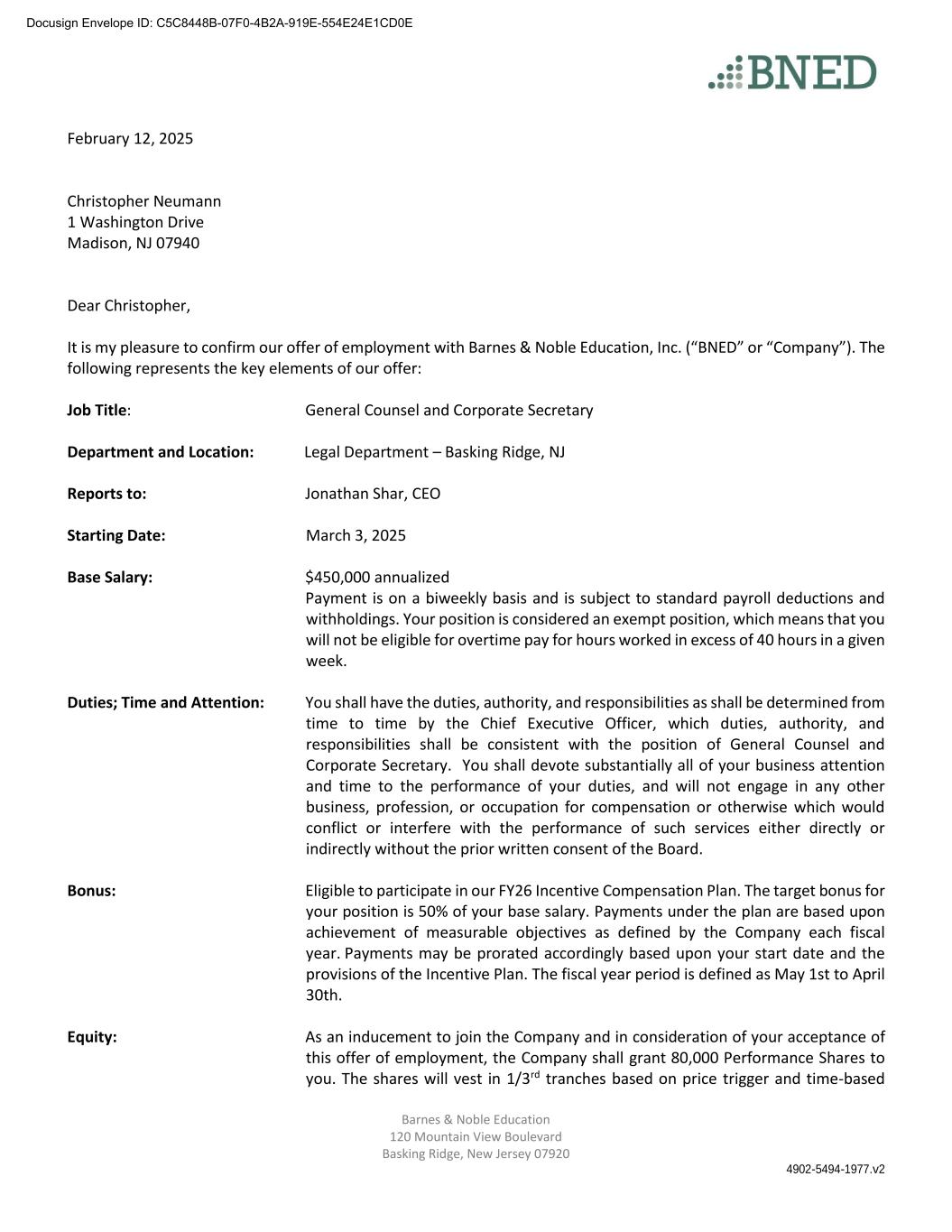
Barnes & Noble Education 120 Mountain View Boulevard Basking Ridge, New Jersey 07920 4902-5494-1977.v2 February 12, 2025 Christopher Neumann 1 Washington Drive Madison, NJ 07940 Dear Christopher, It is my pleasure to confirm our offer of employment with Barnes & Noble Education, Inc. (“BNED” or “Company”). The following represents the key elements of our offer: Job Title: General Counsel and Corporate Secretary Department and Location: Legal Department – Basking Ridge, NJ Reports to: Jonathan Shar, CEO Starting Date: March 3, 2025 Base Salary: $450,000 annualized Payment is on a biweekly basis and is subject to standard payroll deductions and withholdings. Your position is considered an exempt position, which means that you will not be eligible for overtime pay for hours worked in excess of 40 hours in a given week. Duties; Time and Attention: You shall have the duties, authority, and responsibilities as shall be determined from time to time by the Chief Executive Officer, which duties, authority, and responsibilities shall be consistent with the position of General Counsel and Corporate Secretary. You shall devote substantially all of your business attention and time to the performance of your duties, and will not engage in any other business, profession, or occupation for compensation or otherwise which would conflict or interfere with the performance of such services either directly or indirectly without the prior written consent of the Board. Bonus: Eligible to participate in our FY26 Incentive Compensation Plan. The target bonus for your position is 50% of your base salary. Payments under the plan are based upon achievement of measurable objectives as defined by the Company each fiscal year. Payments may be prorated accordingly based upon your start date and the provisions of the Incentive Plan. The fiscal year period is defined as May 1st to April 30th. Equity: As an inducement to join the Company and in consideration of your acceptance of this offer of employment, the Company shall grant 80,000 Performance Shares to you. The shares will vest in 1/3rd tranches based on price trigger and time-based Docusign Envelope ID: C5C8448B-07F0-4B2A-919E-554E24E1CD0E
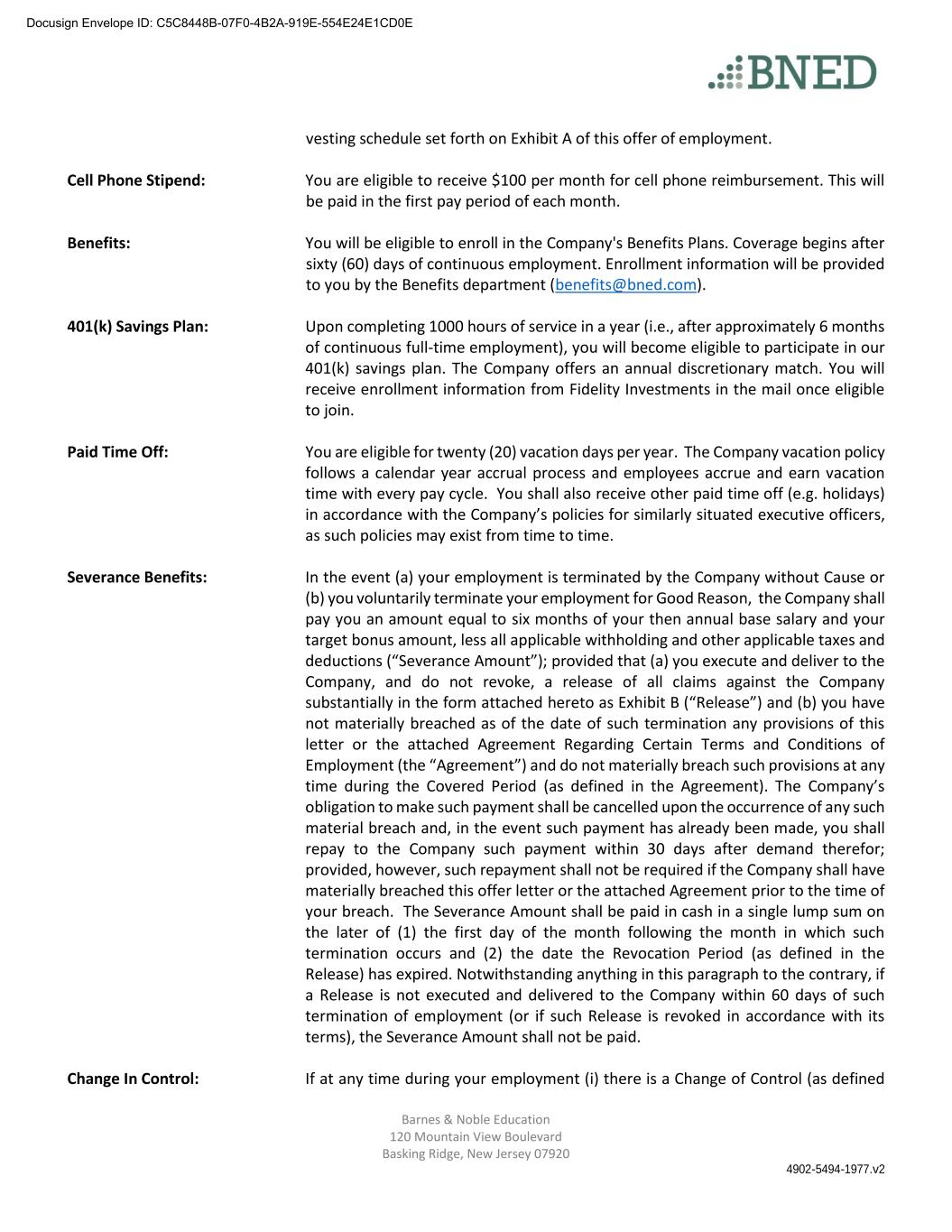
Barnes & Noble Education 120 Mountain View Boulevard Basking Ridge, New Jersey 07920 4902-5494-1977.v2 vesting schedule set forth on Exhibit A of this offer of employment. Cell Phone Stipend: You are eligible to receive $100 per month for cell phone reimbursement. This will be paid in the first pay period of each month. Benefits: You will be eligible to enroll in the Company's Benefits Plans. Coverage begins after sixty (60) days of continuous employment. Enrollment information will be provided to you by the Benefits department (benefits@bned.com). 401(k) Savings Plan: Upon completing 1000 hours of service in a year (i.e., after approximately 6 months of continuous full-time employment), you will become eligible to participate in our 401(k) savings plan. The Company offers an annual discretionary match. You will receive enrollment information from Fidelity Investments in the mail once eligible to join. Paid Time Off: You are eligible for twenty (20) vacation days per year. The Company vacation policy follows a calendar year accrual process and employees accrue and earn vacation time with every pay cycle. You shall also receive other paid time off (e.g. holidays) in accordance with the Company’s policies for similarly situated executive officers, as such policies may exist from time to time. Severance Benefits: In the event (a) your employment is terminated by the Company without Cause or (b) you voluntarily terminate your employment for Good Reason, the Company shall pay you an amount equal to six months of your then annual base salary and your target bonus amount, less all applicable withholding and other applicable taxes and deductions (“Severance Amount”); provided that (a) you execute and deliver to the Company, and do not revoke, a release of all claims against the Company substantially in the form attached hereto as Exhibit B (“Release”) and (b) you have not materially breached as of the date of such termination any provisions of this letter or the attached Agreement Regarding Certain Terms and Conditions of Employment (the “Agreement”) and do not materially breach such provisions at any time during the Covered Period (as defined in the Agreement). The Company’s obligation to make such payment shall be cancelled upon the occurrence of any such material breach and, in the event such payment has already been made, you shall repay to the Company such payment within 30 days after demand therefor; provided, however, such repayment shall not be required if the Company shall have materially breached this offer letter or the attached Agreement prior to the time of your breach. The Severance Amount shall be paid in cash in a single lump sum on the later of (1) the first day of the month following the month in which such termination occurs and (2) the date the Revocation Period (as defined in the Release) has expired. Notwithstanding anything in this paragraph to the contrary, if a Release is not executed and delivered to the Company within 60 days of such termination of employment (or if such Release is revoked in accordance with its terms), the Severance Amount shall not be paid. Change In Control: If at any time during your employment (i) there is a Change of Control (as defined Docusign Envelope ID: C5C8448B-07F0-4B2A-919E-554E24E1CD0E
Barnes & Noble Education 120 Mountain View Boulevard Basking Ridge, New Jersey 07920 4902-5494-1977.v2 below) and (ii) your employment is terminated by the Company without Cause or you voluntarily terminate your employment for Good Reason, in either case, within 90 days preceding or two years following the Change of Control, then the Company shall (iii) pay you an amount equal to one year of your then annual base salary and target bonus amount , less all applicable withholding and other applicable taxes and deductions. (A) The payment of the Change of Control Amount is subject to your executing and delivering to the Company (and not revoking) the Release within 60 days following your termination date, (B) the Change of Control Amount shall be paid to you in cash in a single lump sum within 30 days after the date your employment terminates (or, if later, when the Release becomes irrevocable). In the event that it is determined that the aggregate amount of the payments and benefits that could be considered “parachute payments” within the meaning of Section 280G of the Internal Revenue Code of 1986, as amended (collectively, with the regulations and other guidance promulgated thereunder, the “Code”; and such payments and benefits, the “Parachute Payments”) that, but for this paragraph would be payable to you under this Agreement or any other plan, policy, or arrangement of the Company or Barnes & Noble Education, Inc. or any affiliate, exceeds the greatest amount of Parachute Payments that could be paid to you without giving rise to any liability for any excise tax imposed by Section 4999 of the Code (the “Excise Tax”), then the aggregate amount of Parachute Payments payable to you shall not exceed the amount that produces the greatest after-tax benefit to you after taking into account any Excise Tax to be payable by you. Any reduction in Parachute Payments pursuant to the immediately preceding sentence shall be made in the following order: (1) cash payments that do not constitute deferred compensation within the meaning of Section 409A of the Code, (2) welfare or in- kind benefits, (3) equity compensation awards and (4) cash payments that do constitute deferred compensation; in each case, such reductions shall be made in the manner that maximizes the present value to you of all such payments. For the avoidance of doubt, the amounts payable to you under this paragraph shall be in lieu of any amounts payable to you under the previous paragraph. As used herein, “Change of Control” shall mean the occurrence of one or more of the following events: (i) during any period of 24 consecutive months, individuals who were Directors of the Company on the first day of such period (the “Incumbent Directors”) cease for any reason to constitute a majority of the Board; provided, however, that any individual becoming a Director of the Company subsequent to the first day of such period whose election, or nomination for election, by the Company’s stockholders was approved by a vote of at least a majority of the Incumbent Directors shall be considered as though such individual were an Incumbent Director; (ii) the consummation of (A) a merger, consolidation, statutory share exchange or similar form of corporate transaction involving (x) the Company or (y) any of its Subsidiaries, but in the case of this clause (y) only if Company Voting Securities (as defined below) are issued or issuable (each of the events referred to in this clause (A) being hereinafter referred to as a “Reorganization”) or (B) the sale or other disposition of all or substantially all the assets of the Company to an entity Docusign Envelope ID: C5C8448B-07F0-4B2A-919E-554E24E1CD0E
Barnes & Noble Education 120 Mountain View Boulevard Basking Ridge, New Jersey 07920 4902-5494-1977.v2 that is not an affiliate (a “Sale”), in each case, if such Reorganization or Sale requires the approval of the Company’s stockholders under the law of the Company’s jurisdiction of organization (whether such approval is required for such Reorganization or Sale or for the issuance of securities of the Company in such Reorganization or Sale), unless, immediately following such Reorganization or Sale, (1) all or substantially all the individuals and entities who were the “beneficial owners” (as such term is defined in Rule 13d-3 under the Securities Exchange Act of 1934 (or a successor rule thereto)) (the “Exchange Act”) of the securities eligible to vote for the election of the Board (“Company Voting Securities”) outstanding immediately prior to the consummation of such Reorganization or Sale beneficially own, directly or indirectly, more than 50% of the combined voting power of the then outstanding voting securities of the corporation resulting from such Reorganization or Sale (including a corporation that, as a result of such transaction, owns the Company or all or substantially all the Company’s assets either directly or through one or more subsidiaries) (the “Continuing Corporation”) in substantially the same proportions as their ownership, immediately prior to the consummation of such Reorganization or Sale, of the outstanding Company Voting Securities (excluding any outstanding voting securities of the Continuing Corporation that such beneficial owners hold immediately following the consummation of the Reorganization or Sale as a result of their ownership prior to such consummation of voting securities of any company or other entity involved in or forming part of such Reorganization or Sale other than the Company), (2) no “person” (as such term is used in Section 13(d) of the Exchange Act) (each, a “Person”) (excluding (x) any employee benefit plan (or related trust) sponsored or maintained by the Continuing Corporation or any corporation controlled by the Continuing Corporation or (y) Immersion Corporation, Eric B. Singer, William C. Martin and each of their respective spouse, lineal descendants, trusts for the exclusive benefit of any such individuals, the executor or administrator of the estate or legal representative or any of such individuals and any entity controlled by any of the foregoing persons (the “Immersion Stockholders”)) beneficially owns, directly or indirectly, 40% or more of the combined voting power of the then outstanding voting securities of the Continuing Corporation and (3) at least a majority of the members of the board of directors of the Continuing Corporation were Incumbent Directors at the time of the execution of the definitive agreement providing for such Reorganization or Sale or, in the absence of such an agreement, at the time at which approval of the Board was obtained for such Reorganization or Sale; or (iii) any person, corporation or other entity or “group” (as used in Section 14(d)(2) of the Exchange Act) (other than (A) the Company, (B) any trustee or other fiduciary holding securities under an employee benefit plan of the Company or an affiliate, (C) any entity owned, directly or indirectly, by the stockholders of the Company in substantially the same proportions as their ownership of the voting power of the Company Voting Securities or (D) the Immersion Stockholders) becomes the beneficial owner, directly or indirectly, of securities of the Company representing 40% or more of the combined voting power of the Company Voting Securities; provided, however, that for purposes of this subparagraph (iii), the following acquisitions shall not constitute a Change of Control: (w) any acquisition directly from the Company, (x) any acquisition by any Docusign Envelope ID: C5C8448B-07F0-4B2A-919E-554E24E1CD0E
Barnes & Noble Education 120 Mountain View Boulevard Basking Ridge, New Jersey 07920 4902-5494-1977.v2 employee benefit plan (or related trust) sponsored or maintained by the Company or an affiliate, (y) any acquisition by an underwriter temporarily holding such Company Voting Securities pursuant to an offering of such securities or any acquisition by a pledgee of Company Voting Securities holding such securities as collateral or temporarily holding such securities upon foreclosure of the underlying obligation or (z) any acquisition pursuant to a Reorganization or Sale that does not constitute a Change of Control for purposes of subparagraph (ii) above. For purposes of this letter, "Cause" means (A) your engaging in intentional misconduct or gross negligence that, in either case, is materially injurious to Company; (B) your indictment, entry of a plea of nolo contendere, or conviction by a court of competent jurisdiction with respect to any felony or other crime or violation of law involving fraud or dishonesty (with the exception of misconduct based in good faith on the advice of professional consultants, such as attorneys and accountants) or any felony (or equivalent crime in a non-U.S. jurisdiction); (C) any grossly negligent or intentional acts or omissions by you in the performance of your duties that, in either case, are injurious to the Company; (D) fraud, dishonesty, embezzlement, or misappropriation in connection with the performance of the your employment duties and responsibilities; (E) your engaging in any act of intentional misconduct or moral turpitude reasonably likely to adversely affect the Company or its business; (F) your abuse of or dependency on alcohol or drugs (illicit or otherwise) that adversely affects your job performance; (G) your willful failure or refusal to properly perform the duties, responsibilities, or obligations of your employment for reasons other than a Disability as defined below, or authorized leave, or to properly perform or follow any lawful direction by the Company (with the exception of a willful failure or refusal to properly perform based in good faith on the advice of professional consultants, such as attorneys and accountants); or (H) your material breach of this offer letter, the Agreement or of any other contractual duty to, written policy of, or written agreement with the Company (with the exception of a material breach based in good faith on the advice of professional consultants, such as attorneys and accountants); provided that, with respect to clauses (C), (G) and (H), you have failed to cure such circumstances within 10 days following written notice from the Company. For purposes of this letter, "Good Reason" shall mean the occurrence of one or more of the following events without your written consent: (A) a material diminution of your duties, authority or title; (B) a reduction in the annual base salary you receive from the Company or a reduction in your target annual bonus (other than a reduction that applies equally to other executive officers of the Company), (D) a required relocation of your principal place of employment by more than 50 miles; (E) any other material breach by the Company of the terms of this offer of employment or the Agreement; or (F) during the one-year period following a Change of Control, a material reduction in the value of the employee benefits provided to you. Notwithstanding the foregoing, you will have grounds to resign for Good Reason only if (I) you notify the Company in writing of the grounds therefor within 60 days following their occurrence, (B) the Company does not cure such grounds Docusign Envelope ID: C5C8448B-07F0-4B2A-919E-554E24E1CD0E
Barnes & Noble Education 120 Mountain View Boulevard Basking Ridge, New Jersey 07920 4902-5494-1977.v2 within 30 days following the receipt of such notice, and (C) you actually resign your employment within 30 days following the end of such cure period. For purposes of this letter, the term “Disability” shall mean a written determination by a majority of three physicians (one of which shall be your most recent primary care provider) mutually agreeable to the Company and you (or, in the event of your total physical or mental disability, your legal representative) that you are physically or mentally unable to perform your duties under this letter and that such disability can reasonably be expected to continue for a period of six (6) consecutive months or for shorter period aggregating 180 days in any 12 month period. For the avoidance of doubt, it is understood that your inability to remain employed by the Company due to a restrictive covenant relating to a former employer shall not constitute a termination by the Company without Cause or a termination by you for Good Reason. As stated above, this offer is contingent upon review and verification of the following: Your identity and your ability to be legally employed by the Company in the United States. In order for the Company to continue the hiring process and your employment, you must provide documents to the Company of your legal eligibility to work in the United States. You will have a maximum of three business days from the first date of employment to provide documents identified by the federal government that satisfy the requirements of the I-9 Form. Additionally, your continued employment with the Company is contingent upon you retaining and renewing (if needed) the legal ability to work in the United States. In the event at any time during your employment with the Company you do not have proper work authorization to legally be employed in the United States, you must immediately inform the Company and your employment will be terminated. If you are so terminated and then later obtain the required authorization and desire to be employed by the Company, you will be required to apply for any open positions with the Company should you wish to be rehired. Satisfactory references and verification of your employment record, academic credentials, and any certifications represented on your employment application and/or résumé or CV. A pre-employment background check pursuant to and in accordance with the Fair Credit Reporting Act. A “Consumer Report” and/or “Investigative Consumer Report” will be obtained for employment purposes. A separate email with instructions and other details will be sent to your personal email. You have represented, and hereby confirm, you are not subject to any currently effective employment contract or any other contractual or other binding obligations pursuant to which your employment or employment activities with or on behalf of the Company may be subject to any restrictions, including without limitation, any agreements or other obligations or documents relating to non-competition, confidentiality, trade secrets, proprietary information or works for hire. In the event you meet all conditions listed above and begin employment with the Company, and notwithstanding any statement in this letter, you will be an “at-will” employee, which means either you or we can terminate your employment at any time and for any reason, with or without cause, subject to the terms and conditions of this offer of employment and the Agreement, including without limitation, provisions relating to severance. Docusign Envelope ID: C5C8448B-07F0-4B2A-919E-554E24E1CD0E
Barnes & Noble Education 120 Mountain View Boulevard Basking Ridge, New Jersey 07920 4902-5494-1977.v2 If you wish to accept this offer of employment as set forth in this document, please complete the electronic signature process. If this offer is not signed, the Company’s offer of employment shall be deemed to be rescinded and without effect. Please contact your recruiter directly with any questions or concerns. We look forward to having you join our family of brands and know you will find working here a rewarding experience. Congratulations! Sincerely, Cynthia Origlio SVP, Chief Human Resources Officer Agreed and Accepted: _____________________ Christopher Neumann Docusign Envelope ID: C5C8448B-07F0-4B2A-919E-554E24E1CD0E
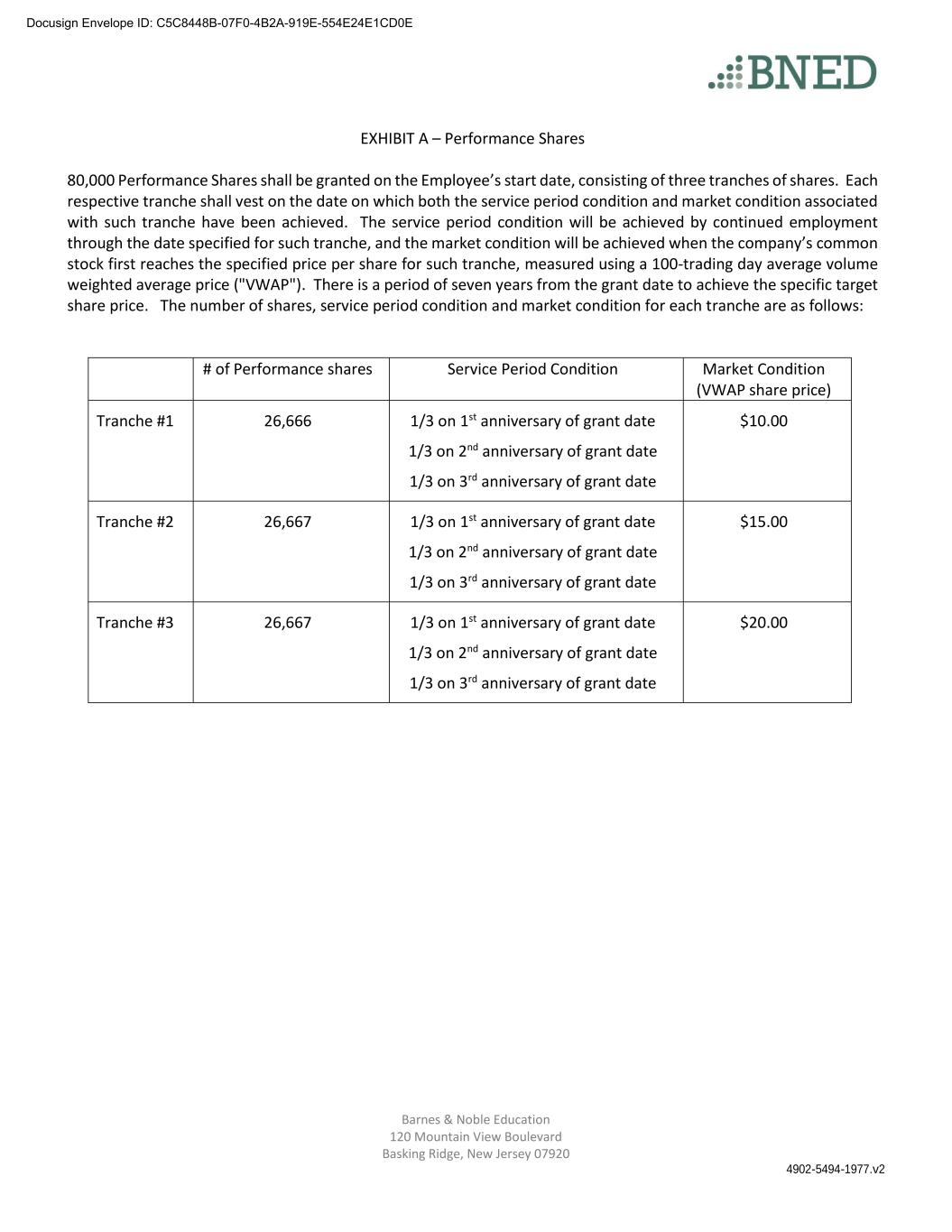
Barnes & Noble Education 120 Mountain View Boulevard Basking Ridge, New Jersey 07920 4902-5494-1977.v2 EXHIBIT A – Performance Shares 80,000 Performance Shares shall be granted on the Employee’s start date, consisting of three tranches of shares. Each respective tranche shall vest on the date on which both the service period condition and market condition associated with such tranche have been achieved. The service period condition will be achieved by continued employment through the date specified for such tranche, and the market condition will be achieved when the company’s common stock first reaches the specified price per share for such tranche, measured using a 100-trading day average volume weighted average price ("VWAP"). There is a period of seven years from the grant date to achieve the specific target share price. The number of shares, service period condition and market condition for each tranche are as follows: # of Performance shares Service Period Condition Market Condition (VWAP share price) Tranche #1 26,666 1/3 on 1st anniversary of grant date 1/3 on 2nd anniversary of grant date 1/3 on 3rd anniversary of grant date $10.00 Tranche #2 26,667 1/3 on 1st anniversary of grant date 1/3 on 2nd anniversary of grant date 1/3 on 3rd anniversary of grant date $15.00 Tranche #3 26,667 1/3 on 1st anniversary of grant date 1/3 on 2nd anniversary of grant date 1/3 on 3rd anniversary of grant date $20.00 Docusign Envelope ID: C5C8448B-07F0-4B2A-919E-554E24E1CD0E
Barnes & Noble Education 120 Mountain View Boulevard Basking Ridge, New Jersey 07920 4902-5494-1977.v2 EXHIBIT B – Form of Release GENERAL RELEASE AND WAIVER 1. [ ] (“Employee” or “Releasor”) hereby acknowledges and agrees Employee’s employment with B&N Education, LLC, a subsidiary of Barnes & Noble Education, Inc. (collectively, “BNED” or “Company”) on __________, 20__ (the “Termination Date”). 2. Employee acknowledges and agrees that Employee’s executing this General Release and Waiver (“Release” or “Agreement”) is a condition precedent to the Company’s obligation to pay (and the Employee’s right to retain) the Severance Amount as defined in the offer letter dated as of [ ] __, 20__ including the attached Agreement, between Employee and the Company (such offer letter and agreement referred to collectively herein as the “Employment Agreement” and such payments and benefits collectively referred to herein as the “Separation Benefit”, as further described in this Section 2), that the Separation Benefit is adequate consideration for this Release, and that any monetary or other benefits that, prior to the execution of this Release, Employee may have earned or accrued, or to which Employee may have been entitled, have been paid or will be paid, or such payments or benefits have been released, waived or settled by Releasor (as defined below) except as expressly provided in this Release. Employee also acknowledges that, prior to or contemporaneous with Employee’s execution of this Release, Employee received all wages and other payments, including accrued vacation pay and bonuses if any, that were earned by and owed to Employee from the Company or any Releasee. Employee understands that Employee will receive all payment for wages owed to Employee upon termination regardless of whether Employee signs this Release. In consideration for signing this Agreement, and complying with its terms, Employee agrees that, after Employee’s delivery to the Company of this fully executed Release as set forth below and the expiration of the Revocation Period (defined below), Employee shall accept from the Company, and on behalf of the Company and each Releasee (as defined below), the Separation Benefit in the gross amount of ___________ in accordance with the Company’s normal pay practices, less lawful deductions and withholdings. Employee and the Company understand and agree the Separation Benefit shall be regarded as “wages” from the Company for purposes of reporting and withholding the appropriate federal, state, and local income and employment taxes. In the event it is subsequently determined that any federal, state, or local taxes are owed with respect to the Separation Benefit or any portion thereof, Employee expressly acknowledges and agrees Employee and/or the Releasors, and not Company or the Releasees, will be responsible for the payment of any such taxes, liabilities, payments, costs, interest, and penalties. Except such taxes for which an employer is solely liable, Employee agrees to indemnify and hold harmless Company and the Releasees to the full extent of any such taxes, liabilities, payments, costs, interest, and penalties that may be assessed against the Company or the Releasees in connection with the Separation Benefit. Employee further acknowledges and agrees the Company has not provided any tax advice related to the Separation Benefit. Employee, on behalf of Employee and Employee’s spouse and dependents, as applicable, may elect to continue medical and dental benefits pursuant to the Consolidated Omnibus Budget Reconciliation Act of 1985, as amended (COBRA), if Employee was enrolled in the Company provided benefits as of the Separation Date. In the event it is determined the aggregate amount of the payments and benefits comprising the Separation Benefit that could be considered “parachute payments” within the meaning of Section 280G of the Internal Revenue Code of 1986, as amended (collectively, with the regulations and other guidance promulgated thereunder, the “Code”; and such payments and benefits, the “Parachute Payments”) that, but for this paragraph would be payable to you under Docusign Envelope ID: C5C8448B-07F0-4B2A-919E-554E24E1CD0E
Barnes & Noble Education 120 Mountain View Boulevard Basking Ridge, New Jersey 07920 4902-5494-1977.v2 this Release or any other plan, policy, or arrangement of the Company, exceeds the greatest amount of Parachute Payments that could be paid to you without giving rise to any liability for any excise tax imposed by Section 4999 of the Code (the “Excise Tax”), then the aggregate amount of Parachute Payments payable to you shall not exceed the amount that produces the greatest after-tax benefit to you after taking into account any Excise Tax to be payable by you. Any reduction in Parachute Payments pursuant to the immediately preceding sentence shall be made in the following order: (1) cash payments that do not constitute deferred compensation within the meaning of Section 409A of the Code, (2) welfare or in-kind benefits, (3) equity compensation awards, and (4) cash payments that do constitute deferred compensation; in each case, such reductions shall be made in the manner that maximizes the present value to you of all such payments. For the avoidance of doubt, the amounts payable to you under this paragraph shall be in lieu of any amounts payable to you under the prior paragraph. Employee affirms and warrants that Employee has informed the Company Benefits Department in writing if Employee (i) is a Medicare beneficiary; (ii) is currently receiving, has received in the past, or is eligible for benefits from Medicare; or (iii) has applied for or sought benefits from Medicare. Employee agrees to indemnify and hold the Company harmless for any penalties or liability, including interest, that may be asserted against the Company pursuant to Section 111 of the Medicare, Medicaid, and SCHIP Extension Act of 2007, 42 U.S.C. § 1395y(b)(8), as a result of the payments and benefits described in section 2 of this Release. 3. (a) THIS SECTION PROVIDES A COMPLETE RELEASE AND WAIVER OF ALL EXISTING AND POTENTIAL CLAIMS EMPLOYEE MAY HAVE AGAINST EVERY PERSON AND ENTITY INCLUDED WITHIN THE DESCRIPTION BELOW OF “RELEASEE.” BEFORE EMPLOYEE SIGNS THIS RELEASE, EMPLOYEE MUST READ THIS SECTION CAREFULLY, AND MAKE SURE THAT EMPLOYEE UNDERSTANDS IT FULLY. (b) In consideration of Employee’s receipt and acceptance of the Separation Benefit from the Company, and on behalf of the Company and each Releasee, Employee, on Employee’s behalf and on behalf of Employee’s heirs, executors, administrators, successors and assigns (collectively, “Releasor”), hereby irrevocably, unconditionally and generally releases the Company, its current and former officers, directors, shareholders, trustees, parents, members, managers, affiliates, subsidiaries, branches, divisions, benefit plans, agents, attorneys, advisors, counselors and employees, and the current and former officers, directors, shareholders, agents, attorneys, advisors, counselors and employees of any such parent, affiliate, subsidiary, branch or division of the Company and the heirs, executors, administrators, receivers, successors and assigns of all of the foregoing (each, a “Releasee”), from or in connection with, and hereby waives and/or settles, except as provided in Section 3(c) herein, any and all actions, causes of action, suits, debts, dues, sums of money, accounts, controversies, agreements, promises, damages, judgments, executions, or any liability, claims or demands, known or unknown and of any nature whatsoever, whether or not related to employment, and which Releasor ever had, now has or hereafter can, shall or may have as of the date of this Release, including, without limitation, (i) any rights and/or claims arising under any contract, express or implied, written or oral, including, without limitation, the Employment Agreement; (ii) any rights and/or claims arising under any applicable foreign, federal, state, local or other statutes, orders, laws, ordinances, regulations or the like, or case law, that relate to employment or employment practices, including, without limitation, family and medical, and/or, specifically, that prohibit discrimination based upon age, race, religion, sex, color, creed, national origin, sexual orientation, marital status, disability, medical condition, pregnancy, veteran status or any other unlawful bases, including, without limitation, the Civil Rights Act of 1964, as amended, the Civil Rights Act of 1991, as amended, the Civil Rights Acts of 1866 and 1871, as amended, the Age Discrimination in Employment Act of 1967, as amended (“ADEA”), the Older Workers Benefit Protection Act (“OWBPA”), the Immigration Reform and Control Act, the Fair Credit Reporting Act, the Consumer Credit Protection Act, the Fair Labor Standards Act, the National Labor Relations Act, the Uniform Services Employment and Reemployment Rights Act of 1994, the Genetic Information Docusign Envelope ID: C5C8448B-07F0-4B2A-919E-554E24E1CD0E
Barnes & Noble Education 120 Mountain View Boulevard Basking Ridge, New Jersey 07920 4902-5494-1977.v2 Nondiscrimination Act, the Occupational Safety and Health Act, the Patient Protection and Affordable Care Act, the Drug-Free Workplace Act, the Equal Pay Act, the Americans with Disabilities Act of 1990, as amended, the Family Medical Leave Act of 1993, as amended, the Employee Retirement Income Security Act of 1974, as amended (“ERISA”), the Vietnam Era Veterans’ Readjustment Assistance Act of 1974, as amended, the Worker Adjustment and Retraining Notification Act of 1988, as amended, and any similar applicable statutes, orders, laws, ordinances, regulations or the like, or case law, of the State of New Jersey and the State of New York and any state in which any Releasee is subject to jurisdiction, or any political subdivision thereof, including, without limitation, and all applicable rules and regulations promulgated pursuant to or concerning any of the foregoing statutes, orders, laws, ordinances, regulations or the like; (iii) any waivable rights and/or claims relating to wages and hours, including under state or local labor or wage payment laws; (iv) any rights and/or claims to benefits that Employee may have or become entitled to receive under any severance, termination, change of control, bonus or similar policy, plan, program, agreement or similar or related arrangements, including, without limitation, any offer letter, letter agreement or employment agreement between Employee and the Company (except as set forth in Section 3(c) below); (v) any rights and/or claims that Employee may have to receive any equity in the Company (whether restricted or unrestricted) in the future; and (vi) and any rights and/or claims for attorneys’ fees. Employee agrees not to challenge or contest the reasonableness, validity, or enforceability of this Release. If any claim is not subject to release, to the extent permitted by law, Employee waives any right or ability to be a class or collective action representative or to otherwise participate in any putative or certified class, collective or multi- party action or proceeding based on such a claim in which any Releasee is a party. (c) Notwithstanding the foregoing, Employee does not release any Releasee from any of the following rights and/or claims: (i) any rights and/or claims Employee may have that arise after the date Employee signs this Release; (ii) any rights and/or claims that by law cannot be waived by private agreement; (iii) Employee’s right to file a charge or report with, or participate in, any investigation or proceeding conducted by the U.S. Equal Employment Opportunity Commission (“EEOC”) or other government agency; provided that even though Employee can file a charge or report or participate in an investigation or proceeding conducted by the EEOC or other government agency, by executing this Release, Employee is waiving Employee’s ability to obtain relief of any kind from any Releasee to the extent permitted by law (but Employee does not waive the right to any recovery authorized under Section 21F of the Securities Exchange Act of 1934); (iv) Employee’s non-forfeitable rights to accrued benefits (within the meaning of Sections 203 and 204 of ERISA); (v) any rights and/or claims to insurance coverage under any directors’ and officers’ personal liability insurance or fiduciary insurance policy; (vi) benefits and/or the right to seek benefits under applicable workers' compensation (but claims for retaliation for exercising workers’ compensation rights are waived); (vii) benefits and/or the right to seek benefits under applicable unemployment insurance law; or (viii) vested benefits under the Company’s 401(k) plan. 4. Nothing in or about this Release is intended to, and shall not, prohibit Employee from engaging in the following activities, and the limitations herein shall not apply to the disclosure of Confidential Information (as defined in the Employment Agreement) under the following circumstances: (i) filing and, as provided for under Section 21F of the Securities Exchange Act of 1934, maintaining the confidentiality of a claim with a government agency that is responsible for enforcing a law; (ii) providing Confidential Information to the extent required by law or legal process or permitted by Section 21F of the Securities Exchange Act of 1934; or (iii) cooperating with or participating or assisting in any government or regulatory entity investigation or proceeding. With respect to each of these three scenarios, however, Employee agrees to take all reasonable steps to prevent the disclosure of Confidential Information beyond the allowable parameters described in this Section 4. Docusign Envelope ID: C5C8448B-07F0-4B2A-919E-554E24E1CD0E
Barnes & Noble Education 120 Mountain View Boulevard Basking Ridge, New Jersey 07920 4902-5494-1977.v2 5. Employee represents and warrants that Employee has not filed or commenced any complaints, claims, actions, or proceedings of any kind against any Releasee with any federal, state, or local court or any administrative, regulatory or arbitration agency or body except those that Employee has listed with specificity next to Employee’s name in the signature block below; provided, however, that Employee is not required to disclose any complaint or other disclosures that are required or protected under the Sarbanes-Oxley Act of 2002, the Securities Exchange Act of 1934, 18 U.S.C. §1513(e), or any other law, rule, or regulation that is subject to the jurisdiction of the Securities and Exchange Commission (collectively, “SEC Actions”). Notwithstanding the above, Employee agrees that Employee shall dismiss any of the foregoing that have been filed except for SEC Actions. Except for Employee’s right to bring a proceeding pursuant to the OWBPA to challenge the validity of the release of claims pursuant to the ADEA, and otherwise as provided herein or permitted by law, Employee agrees not to commence, maintain, prosecute or participate as a party in any action or proceeding in any court or arbitration forum against the Company or any other Releasee with respect to any act, omission, transaction or occurrence up to and including the date of the execution of this Release. Employee further agrees not to instigate, encourage, assist or participate in any court action or arbitration proceeding commenced by any other person (except a government agency) against the Company, or any other Releasee. In the event any government agency seeks to obtain any relief on behalf of Employee with regard to any claim released and waived by section 3(b) of this Release, Employee covenants not to accept, recover or receive any monetary relief or award that may arise out of or in connection with any such proceeding. Employee hereby waives any right to, and agrees not to, seek reinstatement or employment of any kind with any Releasee for a period of six (6) months following receipt of the entire Separation Benefit. Without waiver by any Releasee of the foregoing, the existence of this Release shall be a valid, nondiscriminatory basis for rejecting any such application or, in the event Employee obtains such employment, for terminating such employment. This Release and the Separation Benefit are not intended to be, shall not be construed as, and are not an admission or concession by any Releasee of any wrongdoing or illegal or actionable acts or omissions. 6. (a) Employee hereby represents and agrees that, except as shall be required by law or as permitted under Section 3(c)(iii) or Section 4 of this Release, Employee shall (i) keep confidential and not disclose orally or in writing, to any person (except as may be required by law and as to Employee’s immediate family, attorneys and accountant/financial advisor) any and all information concerning the existence or terms of this Release and the amount of any payments made hereunder and (ii) keep confidential and not disclose orally or in writing, directly or indirectly, to any person (except Employee’s immediate family, attorneys and accountant/financial advisor), any and all information concerning any potential claims or causes of action that are being released in this Release, or allegations or facts that would support such claims or causes of action. (b) If Employee is requested or required (by oral questions, interrogatories, requests for information, or documents, subpoena, civil investigative demand or similar process) to disclose any information covered by Section 6(a) herein, Employee shall promptly notify the Company by email to legaldepartment@bned.com of such request or requirement so that the Company may seek to avoid or minimize the required disclosure and/or to obtain an appropriate protective order or other appropriate relief to ensure that any information so disclosed is maintained in confidence to the maximum extent possible by the agency or other person receiving the disclosure, or, in the discretion of the Company, to waive compliance with the provisions of this Release. Employee shall use reasonable efforts, in cooperation with the Company or otherwise, to avoid or minimize the required disclosure and/or to obtain such protective order or other relief. If, in the absence of a protective order or the receipt of a waiver hereunder, Employee is compelled to disclose such information or else stand liable for contempt or suffer other sanction, censure, or penalty, Employee shall disclose only so much of such information to the party compelling disclosure as Employee believes in good faith Docusign Envelope ID: C5C8448B-07F0-4B2A-919E-554E24E1CD0E
Barnes & Noble Education 120 Mountain View Boulevard Basking Ridge, New Jersey 07920 4902-5494-1977.v2 on the basis of advice of counsel is required by law, and Employee shall give the Company prior notice of such information Employee believes Employee is required to disclose. (c) Employee affirms that Employee has been paid and/or has received all compensation, wages, bonuses, commissions, and/or benefits which are due and payable as of the date Employee signs this Agreement. Employee also affirms that Employee has been granted any leave to which Employee was entitled under the Family and Medical Leave Act or related state or local leave or disability accommodation laws. In addition, Employee affirms that Employee has no known workplace injuries or occupational diseases not previously reported. Employee further affirms that Employee has not been retaliated against for reporting any allegations of wrongdoing by the Company or its officers, including any allegations of corporate fraud. Employee is also not aware of any facts or information concerning any illegality or wrongdoing by the Company. 7. (a) Except as shall be required by law or as permitted under Section 3(c)(iii) or Section 4 of this Release, Employee shall not make, either directly or by or through another person, any oral or written negative, disparaging or adverse statements or representations of or concerning any Releasee in a manner that is disloyal, reckless, or maliciously untrue. Employee further represents and agrees Employee has not and will not engage in any conduct or take any actions whatsoever to cause or influence any person or entity, including, but not limited to, any past, present or prospective employee of the Company, to initiate oral, written or electronic negative, disparaging or adverse statements or representations of or concerning the Company or any Releasee that are disloyal, reckless, or maliciously untrue. To the fullest extent permitted under applicable law, Employee agrees that Employee will not, directly or indirectly, discuss or otherwise disclose any of the facts underlying this Release, the existence of this Release, or the terms of the settlement to any wire service, newspaper, radio, or television reporter, online news or other communication service, application, or website (whether a blog or through any form of social media now or hereinafter in existence, including but not limited to Facebook, Twitter, Instagram, TikTok or the like), or any other media representative, including any legal article, legal periodical, journal, case/settlement gathering source, or any other person or entity. For the avoidance of doubt, nothing herein shall be interpreted to prevent, discourage, or prohibit Employee from participating in, or assisting others in participating in, any activity under Section 7 of the Act or otherwise cooperating with the NLRB under the Act. (b) Without limitation to the survival of any other terms of the Employment Agreement subsequent to the end of Employee’s employment, the expiration or termination of the Employment Agreement, and/or the execution and effectiveness of this Release, Employee and the Company expressly acknowledge that the terms of Sections 3 through 6 of the Employment Agreement survive and shall be in full force and effect as provided in the Agreement. (c) Employee shall direct all requests and inquiries concerning Employee’s possible employment by prospective employers to the HR Service Center at 1-833-474-2633 or hrconnect@bned.com, which will comply with the Company’s neutral reference policy. (d) Employee represents and agrees that Employee has returned to the Company all property of the Company, including without limitation, any keys to the offices or properties of the Company, and Company identification cards, computers, cellular telephones, or other equipment. Employee affirms that Employee is in possession of all of Employee’s property that Employee had at the Company’s premises and that the Company is not in possession of any of Employee’s property. 8. The covenants, representations, and acknowledgments made by Employee in this Release shall continue to have full force and effect after the execution and effectiveness of this Release and the delivery of the Separation Benefit, and this Release shall inure to the benefit of each Releasee, and the successors and assigns of each of them, to the Docusign Envelope ID: C5C8448B-07F0-4B2A-919E-554E24E1CD0E
Barnes & Noble Education 120 Mountain View Boulevard Basking Ridge, New Jersey 07920 4902-5494-1977.v2 extent necessary to preserve the intended benefits of such provisions. If any section of this Release is determined to be void, voidable, or unenforceable, excluding the general release language, it shall have no effect on the remainder of this Release, which shall remain in full force and effect, and the provisions so held invalid or unenforceable shall be deemed modified as to give such provisions the maximum effect permitted by applicable law. The Company shall be excused and released from any obligation to make payment of the Separation Benefit, and Employee shall be obligated to return to the Company the Separation Benefit, in the event that Employee is found to have (a) made a material misstatement in any term, condition, covenant, representation, or acknowledgment in this Release, or (b) Employee is found to have committed or commits a material breach of any term, condition, or covenant in this Release. Employee understands and acknowledges that if Employee breaches this Release, Employee’s release and waiver of claims contained in this Release remain in full force and effect. 9. This Release and the Employment Agreement constitute the sole and complete agreement between the parties with respect to the matters set forth therein and, except for the Employment Agreement (which shall continue in full force and effect as stated therein), supersedes all prior agreements, understandings, and arrangements, oral or written, between Employee and the Company with respect to the subject matter thereof. This Release may not be amended or modified except by an instrument or instruments in writing signed by the party against whom enforcement of any such modification or amendment is sought. Either party may, by an instrument in writing, waive compliance by the other party with any term or provision of this Release to be performed or complied with by such other party. 10. With respect to any claims or disputes under or in connection with this Release or any claims released under Section 3 of this Release, Employee and the Company hereby acknowledge and agree that Section 9 of the Agreement shall govern. Employee acknowledges that a breach or threatened breach of the provisions of this Release may give rise to losses or damages for which the Company cannot be reasonably or adequately compensated in an action at law, and that such violation may result in irreparable and continuing harm to the Company. Accordingly, Employee agrees that, in addition to any other remedy that the Company may have at law or in equity, the Company shall be entitled to seek equitable relief, including, without limitation, injunction and specific performance and Employee hereby waives any requirements for security or posting of any bond in connection with such relief. No specification in this Release of any particular remedy shall be construed as a waiver or prohibition of any other remedies (including claims for damages) in the event of a breach or threatened breach of this Release. 11. Employee agrees and acknowledges that (a) Employee has had an adequate opportunity to review this Release and all of its terms, (b) Employee understands all of the terms of this Release, which are fair, reasonable, and are not the result of any fraud, duress, coercion, pressure, or undue influence exercised by or on behalf of any Releasee, and (c) Employee has agreed to and/or entered into this Release and all of the terms hereof, knowingly, freely, and voluntarily. 12. Older Worker Benefit Protection Act. By executing this Release, Releasor acknowledges that (a) Employee has been advised by the Company to consult with an attorney before executing this Release; (b) Employee was provided and has adequate time (that is, 21 days) to review this Release and to consider whether to sign this Release, (c) Employee has been advised that Employee has seven (7) days following execution to revoke this Release (“Revocation Period”), (d) the Release is written in a manner calculated to be understood by Employee, (e) the Release represents Employee’s knowing and voluntary release of any and all claims that Employee might have up through the date this Release is signed, including, but not limited to, any claims arising under the Age Discrimination in Employment Act, (f) Employee has not been asked to release, nor has Employee released, any claim that may arise after the date of this Release, and (g) the consideration that Employee will receive in exchange for signing this Release (that is, the Docusign Envelope ID: C5C8448B-07F0-4B2A-919E-554E24E1CD0E
Barnes & Noble Education 120 Mountain View Boulevard Basking Ridge, New Jersey 07920 4902-5494-1977.v2 Separation Benefit) is something of value to which Employee was not already entitled. Notwithstanding anything to the contrary contained herein or in the Employment Agreement, this Release shall not be effective or enforceable, and the Separation Benefit is not payable and shall not be delivered or paid by the Company, until the Revocation Period has expired (that is, the 8th day after the Employee signs the Release) and provided that Employee has not revoked this Release. Employee agrees that any revocation shall be made in writing and delivered to Rhea Kaston via email at rkaston@bncollege.com in a manner such that it is delivered before the expiration of the Revocation Period. Employee acknowledges that revocation of this Release shall result in the Company’s not having an obligation to pay the Separation Benefit. Employee agrees any modifications, material or otherwise, made to this Release, do not restart or affect in any manner the original twenty-one (21) calendar day consideration period. 13. In the event any signature is delivered by electronic transmission, such signature shall create a valid and binding obligation of the party executing the same with the same force and effect as if such electronic signature page were an original thereof. SO AGREED: Christopher Neumann Signature: _________________________________________ Date: ______________________________ Docusign Envelope ID: C5C8448B-07F0-4B2A-919E-554E24E1CD0E
Barnes & Noble Education 120 Mountain View Boulevard Basking Ridge, New Jersey 07920 Below are the Terms and Conditions of Employment for your review. Please sign it and return it with a signed copy of your offer of employment, to which these Terms and Conditions are attached (the “Offer Letter”). TERMS AND CONDITIONS OF EMPLOYMENT These Terms and Conditions are by and between Barnes & Noble Education, Inc., on behalf of itself and its subsidiaries ("Company") and Christopher Neumann ("Employee"). In consideration of the Employee being hired by the Company, the Company providing Employee access to Trade Secret, Confidential Information, and other Company Property (as each term is defined below) that are necessary to perform Employee’s work, the payment by the Company of Employee's compensation and for other good and valuable consideration, the Company and Employee agree as follows: 1. At-Will Employment. Employee agrees Employee’s employment is at-will, which means that both Employee and the Company shall have the right to terminate such employment at any time, for any reason, with or without cause subject to the terms and conditions of the Offer Letter and these terms and conditions, including without limitation, provisions relating to severance. Employee further acknowledges and agrees these Terms and Conditions are not intended to and does not constitute a contract or agreement between Employee and the Company providing a specified term of employment or limiting the right of either party to terminate Employee's employment with the Company at any time, for any reason, with or without cause. 2. Duty of Loyalty. Employee acknowledges Employee owes a duty of loyalty to the Company, which Employee acknowledges means, among other things, that while an employee of the Company, Employee must act in the best interests of the Company. Employee, therefore, agrees that, subject only to the limitations described in Section 7: (a) Employee shall devote Employee’s best efforts and undivided time, effort and loyalty to the business of the Company; (b) Employee shall discharge all of Employee’s duties and responsibilities assigned to Employee by the Company conscientiously, in good faith and to the best of Employee’s ability, giving to the Company the full benefit of Employee’s knowledge, expertise, skill and judgment; (c) Employee shall not engage in any illegal or unethical conduct in the performance of Employee’s duties and responsibilities; and (d) Employee shall not engage in any conduct that creates an actual, potential or apparent conflict between Employee's personal interests and the Company's interests, or that otherwise may adversely affect Employee's judgment or ability to act in the Company's best interests. If Employee is uncertain whether any particular activity may violate Employee’s duty of loyalty, Employee agrees to notify the Company and not engage in any such conduct without the express, written consent of an authorized representative of the Company. 3. Trade Secrets, Confidential Information and Company Property. Employee acknowledges Employee’s duties and responsibilities will put employee in a position of acquiring and creating Trade Secrets and Confidential Information concerning the Company. Employee further acknowledges the Company is engaged in a highly competitive business. The Company's involvement in this business has required and continues to require the expenditure of substantial amounts of money and the use of skills developed over a long period of time. As a result of these investments of money, skill, and time, the Company has developed and will continue to develop certain valuable Trade Secrets and Confidential Information that are particular to the Company's business. Employee acknowledges and agrees that the disclosure of such information to competitors of the Company or others would cause the Company to suffer substantial and irreparable harm. Employee acknowledges, therefore, that it is in the Company's legitimate business interest to restrict Employee's disclosure or use of such Trade Secret and Confidential Information (and other Company Property). Accordingly, Employee shall use best efforts and diligence both during and after any employment with the Company, regardless of how, when, or why such employment ends, to protect the confidential, trade secret, and/or proprietary character of all Confidential Information and Trade Secret Information. Employee shall not, directly or indirectly, use (for Employee’s benefit or for the benefit of any other person) or disclose any Confidential Information or Trade Secret Information, for so long as it shall remain proprietary or protectable, except as may be necessary for the performance of Employee’s duties for the Company. Employee understands that Confidential Information and/or Trade Secret Information may or may not be labeled as such, and Employee shall treat all information that appears to be Confidential Docusign Envelope ID: C5C8448B-07F0-4B2A-919E-554E24E1CD0E
Barnes & Noble Education 120 Mountain View Boulevard Basking Ridge, New Jersey 07920 Information and/or Trade Secret Information as confidential unless otherwise informed or authorized by the Company. Nothing in these Terms and Conditions shall be construed to mean that Company owns any intellectual property or ideas that were conceived by Employee before Employee commenced employment with Company and that Employee has previously disclosed to the Company. Subject to the last paragraph of this section, nothing in this paragraph shall prevent Employee from complying with a valid legal requirement (whether by oral questions, interrogatories, requests for information or documents, subpoena, civil investigative demand or similar process) to disclose any Confidential Information or Trade Secret Information. “Trade Secret” and “Trade Secret Information” shall mean all information, regardless of the form or medium in which it is or was created, stored, reflected, or preserved, that is not commonly known by or generally available to the public and that (1) derives or creates economic value, actual or potential, from not being generally known to, and not being readily ascertainable by proper means by, other persons who can obtain economic value from its disclosure or use; and (2) is the subject of efforts that are reasonable under the circumstances to maintain its secrecy. The Company’s Trade Secret Information may include, but is not limited to, all confidential information relating to or reflecting the Company’s research and development plans and activities; non-public financial information; current and future products; compilations of data; product plans; sales, marketing and business plans and strategies; pricing, price lists, pricing methodologies and profit margins; current and planned incentive, recognition, and rewards programs and services; personnel information; inventions, concepts, ideas, designs and formulae; current, past, and prospective customers and customer lists; current, past, and anticipated customer needs, preferences, and requirements; market studies; computer software and programs (including object code and source code); and computer and database technologies, systems, structures, and architectures. "Confidential Information" means any data or information and documentation, regardless of the form or medium in which it is or was created, stored, reflected, or preserved, that is either developed by Employee (alone or with others) or to which Employee shall have access during any employment with the Company, and which has value and is not generally known to the public. “Confidential Information” also includes, but is not limited to, Trade Secret Information, information that is learned or acquired by the Company from others with whom the Company has a business relationship in which, and as a result of which, such information is revealed to the Company, and any other proprietary, confidential, sensitive, or material and non-public, including but not limited to information related to possible or pending mergers and acquisitions, and information regarding the Company or its affiliates’ business affairs, including, without limitation, customer or supplier information, financial information or data, sales, costs, business concepts or plans, processes, methods, systems, know-how, patentable rights, devices, formulas, product specifications, marketing, prices, technology, distribution strategies, proprietary information regarding current or future products or strategy, services, methodologies, processes, research and development and other proprietary rights, and any other information that has value and is not generally known to the public, whether in oral, written, or electronic form and whether or not marked as “confidential.” "Company Property" shall mean all property, items, materials and resources of the Company, including, without limitation, all Trade Secret and Confidential Information, Company computer systems and all software, disks, drives, email, programs, and databases, all files, records, documents, drawings, specifications, memoranda, notes, reports, manuals, equipment, telephone services, cell phones and other personal devices owned by Company, and all other administrative or support services provided by or related to the Company. Except as specifically required in the performance of Employee’s duties for the Company, Employee agrees Employee will not, during the course of employment by the Company and for so long thereafter as the pertinent information or documentation remain Trade Secrets, Confidential Information or Company Property, directly or indirectly use, disclose or disseminate to any other person, organization or entity or otherwise use or disclose any Trade Secrets, Confidential Information or Company Property. Employee will hold the Confidential Information and Trade Secrets in strict confidence and shall exercise a reasonable degree of care to prevent disclosure to any third parties. Employee also shall not reproduce the Confidential Information or Trade Secrets or use them commercially or for any purpose other than the performance of Employee’s authorized duties for Company. Docusign Envelope ID: C5C8448B-07F0-4B2A-919E-554E24E1CD0E
Barnes & Noble Education 120 Mountain View Boulevard Basking Ridge, New Jersey 07920 The obligations set forth herein shall not apply to any Trade Secrets, Confidential Information or Company Property that have become generally known to a Competing Business (as defined below) of the Company through lawful means and without violation of any law or any agreement not to disclose Trade Secrets, Confidential Information, or Company Property. Upon the termination for any reason of Employee’s employment with the Company, or at any time the Company may so request, Employee shall promptly deliver to the Company all Trade Secret, Confidential Information, and Company Property, including all information, materials, documents (whether in electronic or paper form) and all copies thereof that, directly or indirectly, contain, relate or refer to Trade Secret, Confidential Information, or Company Property. Additionally, upon the termination of employment with Company for any reason, Employee shall not retain any Confidential Information, Trade Secrets, or Company Property in any way obtained by Employee during the course of Employee’s employment with Company. The obligations of Employee under these Terms and Conditions shall survive until such time as all of the Confidential Information or Trade Secrets disclosed hereunder becomes publicly known through no action or inaction of the Employee. Company may notify any future or prospective employer of Employee or any third party of the existence of the provisions of this section of these Terms and Conditions. Notwithstanding anything in these Terms and Conditions to the contrary, Employee and Company acknowledge Employee shall not be held criminally or civilly liable under any federal or state trade secret law for the disclosure of a Trade Secret that is made (i) in confidence to a federal, state, or local government official, either directly or indirectly, or to an attorney and (ii) solely for the purpose of reporting or investigating a suspected violation of law. In addition, Employee shall not be held criminally or civilly liable under any federal or state trade secret law for the disclosure of a Trade Secret that is made in a complaint or other document filed in a lawsuit or other proceeding so long as such filing is made under seal. Furthermore, in the event Employee files a lawsuit for retaliation by the Company for reporting a suspected violation of law, Employee may disclose the Trade Secret to Employee’s attorney and use the Trade Secret information in the court proceeding so long as Employee files any document containing the Trade Secret under seal and does not disclose the Trade Secret except pursuant to court order. Employee agrees that both during and after any employment with the Company, regardless of how, when or why such employment ends, Employee shall provide reasonable cooperation to the Company and its affiliates in connection with any pending or future lawsuit, arbitration, or proceeding between the Company and/or any affiliate and any third party, any pending or future regulatory or governmental inquiry or investigation concerning the Company, and/or any affiliate and any other legal, internal, or business matters of or concerning the Company and/or any affiliate. Such cooperation shall include meeting with and providing information the Company, any affiliate, and/or their respective attorneys, auditors, or other representatives as reasonably requested by the Company. The Company shall reimburse any reasonable legal fees and related expenses Employee incurs in order to comply with this paragraph. Employee agrees that both during and after any employment with the Company, regardless of how, when or why such employment ends, if Employee is legally required (whether by oral questions, interrogatories, requests for information or documents, subpoena, civil investigative demand or similar process) to disclose any Confidential Information or Trade Secret Information, Employee, to the extent legally permitted, shall promptly notify the Company of such request or requirement so that the Company may seek to avoid or minimize the required disclosure and/or to obtain an appropriate protective order or other appropriate relief to ensure that any information so disclosed is maintained in confidence to the maximum extent possible by the agency or other person receiving the disclosure, or, in the discretion of the Company, to waive compliance with the provisions of these Terms and Conditions. Employee shall use reasonable efforts, in cooperation with the Company or otherwise, to avoid or minimize the required disclosure and/or to obtain such protective order or other relief. If, in the absence of a protective order or the receipt of a waiver hereunder, Employee is compelled to disclose the Confidential Information or Trade Secret Information or else stand liable for contempt or suffer other sanction, censure or penalty, Employee shall disclose only so much of the Confidential Information or Trade Secret Information to the party compelling disclosure as Employee believes in good faith on the basis of advice of counsel is required by law, and Employee, to the extent legally permitted, shall give the Company prior Docusign Envelope ID: C5C8448B-07F0-4B2A-919E-554E24E1CD0E
Barnes & Noble Education 120 Mountain View Boulevard Basking Ridge, New Jersey 07920 notice of the Confidential Information or Trade Secret Information Employee believes Employee is required to disclose. The Company shall reimburse any reasonable legal fees and related expenses Employee incurs in order to comply with this paragraph. Nothing in or about these Terms and Conditions shall be construed to (a) interfere with Employee’s rights to file a claim with a government agency responsible for enforcing a law, such as the Securities and Exchange Commission or the U.S. Equal Employment Opportunity Commission; (b) prevent Employee from providing, in accordance with this paragraph, Confidential Information or Trade Secrets to the extent required by law or legal process; (c) prevent or impede Employee’s ability to participate in or cooperate or assist with any government or regulatory entity investigation or proceeding; or (d) prevent, discourage, or prohibit Employee from participating in, or assisting others in participating in, any activity under Section 7 of the National Labor Relations Act (“Act”) or otherwise cooperating with the National Labor Relations Board (“NLRB”) under the Act. 4. Intellectual Property/Assignment of Inventions. “Intellectual Property” means works, inventions, discoveries, improvements, documented ideas, computer programs, source codes, and related documentation, moral rights, designs, and other works of authorship or creation ("Intellectual Property"). Employee agrees to promptly disclose to the Company all Intellectual Property, including any Intellectual Property in the formative stages, made during Employee's employment with the Company. Furthermore, Employee agrees to disclose to the Company any Intellectual Property created during the period of one year after the termination of Employee’s employment with the Company that relates to or constitutes an improvement upon the Company's Intellectual Property. Employee also agrees to keep and maintain written records concerning such Intellectual Property and make these records available to the Company at all times. Employee shall promptly disclose and provide to the Company, and hereby assigns and agrees to assign to the Company and its successors and assigns, Employee’s entire right, title, and interest in and to any Intellectual Property and original works of authorship, designs, formulas, processes, improvements, compositions of matter, computer software programs, data, information or databases, methods, procedures or other inventions, developments or improvements of any kind that Employee conceives, originates, develops, improves, modifies and/or creates, solely or jointly with others, during the period of Employee’s employment, or as a result of such employment (collectively, “Inventions”), and whether or not any such Inventions also may be included within “Confidential Information” or “Trade Secret Information” (as defined under these Terms and Conditions), or are patentable, copyrightable, or protectable as trade secrets. Employee acknowledges and agrees the Company is and shall be the exclusive owner of all rights, title, and interest in and to the Inventions and, specifically, that any copyrightable works prepared by Employee within the scope of Employee’s employment are “works for hire” under the Copyright Act, that such “works for hire” are Intellectual Property, and that the Company shall be considered the author and sole owner of such copyrightable works. In the event that any Intellectual Property is deemed not to be a “work for hire”, or in the event Employee should, by operation of law, be deemed to be entitled to retain any rights, title, or interest in and to any Intellectual Property, Employee hereby irrevocably and forever waives all rights, title, and interest and assigns to the Company, without any further consideration or compensation of any kind or at any time, and regardless of any use by the Company of any such Intellectual Property, all rights, title, and interest, if any, in and to such Intellectual Property, whether or not patentable, copyrightable, or subject to other forms of protection, made, created, developed, written, or conceived by Employee, either solely or jointly with others, during Employee's employment with the Company. Employee agrees that the Company, as the owner of all Intellectual Property, has the full and complete right to prepare and create derivative works based upon the Intellectual Property and to use, reproduce, publish, print, copy, market, advertise, distribute, transfer, sell, publicly perform, and publicly display and otherwise exploit by all means now known or later developed, such Intellectual Property and derivative works anywhere throughout the world and at any time during or after Employee’s employment hereunder or otherwise. All Intellectual Property disclosed or made by Employee within one (1) year after termination of Employee's employment with the Company shall be deemed to be owned by the Company unless such Intellectual Property is proved to have been conceived after termination and without the benefit of any proprietary and/or Confidential Information or Trade Secrets of the Company, its subsidiaries or affiliates. Notwithstanding the above, Employee shall retain full right and title to Intellectual Property to which all of the following conditions apply: (a) no equipment, supplies, facilities, Docusign Envelope ID: C5C8448B-07F0-4B2A-919E-554E24E1CD0E
Barnes & Noble Education 120 Mountain View Boulevard Basking Ridge, New Jersey 07920 proprietary and/or Company Property, Confidential Information, Trade Secrets or Intellectual Property of the Company was used in its development; (b) it was developed entirely on Employee's own time; (c) it does not relate to the business of the Company or to the Company’s anticipated business or developmental programs; and (d) it does not result from or relate to any work performed by Employee for the Company. Employee represents Employee has not, alone or jointly with others, conceived, developed, or reduced to practice prior to the commencement of Employee's employment with the Company any Intellectual Property that Employee considers to be Employee’s property or the property of third parties. Employee further agrees to execute any instrument or papers requested by the company and to assist the Company, or its designees, at the Company's expense, but without additional compensation to Employee, in every proper way to secure the Company's rights in the Intellectual Property and any copyrights, patents, trademarks, design rights, moral rights, mask work rights, or other intellectual property rights relating thereto in any and all countries. Employee further agrees that Employee’s obligation to execute or cause to be executed any such instrument or papers will continue after the termination of Employee’s employment with the Company. If the Company is unable because of Employee's mental or physical incapacity, Employee's refusal to comply with Employee’s obligations under these Terms and Conditions, or for any other reason, to secure Employee's signature to apply for or to pursue any application for any United States or foreign patents or copyright or trademark registrations covering Intellectual Property or original works of authorship assigned to the Company under these Terms and Conditions or otherwise, Employee does hereby irrevocably designate and appoint the Company, through its duly authorized officers and agents, as Employee's agent and attorney in fact, to act for and on Employee's behalf and stead to execute and file any such applications and to do all other lawfully permitted acts to further the prosecution and issuance of letters patent or copyright or trademark registrations thereon with the same legal force and effect as if executed by Employee. Employee understands that the Company may have entered into agreements with other parties that impose obligations on the Company regarding Inventions made during the course of the work under such agreements or regarding the confidential nature of such works, or otherwise received from third parties' confidential or proprietary information ("Third Party Information"). Employee agrees to be bound by all such obligations of the Company arising in connection with such Third Party Information. 5. Non-Solicitation. During Employee's employment with the Company, Employee will have access to Trade Secrets, Confidential Information and/or other non-public Company Property, and Employee will develop certain relationships with and/or knowledge about current and/or prospective employees, customers, vendors, or contractors such that if Employee were allowed to pursue relationships with the Company's current or prospective employees, customers, vendors, or contractors, Employee would have an unfair advantage based upon confidential information and/or relationships developed. Therefore, Employee agrees that from the date of execution of these Terms and Conditions until the termination of Employee's employment with the Company for any reason (the "Covered Period"), Employee will not, directly or indirectly: (a) solicit or recruit for employment, offer employment to, hire, solicit, or recruit for placement, place and/or offer to place with another company or entity -- on a temporary, permanent or contract basis, or otherwise -- anyone who at any time during the Covered Period is or was employed by the Company or any of its parents, subsidiaries or affiliates (a "Covered Employee"); provided that, at the time of such solicitation, recruitment, offer of employment, hiring, offer to place or placement, or any time during the ninety (90) day period immediately preceding same, the Covered Employee is or was an employee of the Company or any of its parents, subsidiaries, or affiliates; (b) encourage, entice or persuade, or attempt to encourage, entice or persuade any Covered Employee to leave the Company or any of its parents, subsidiaries, or affiliates; (c) solicit or encourage (i) any customer, vendor, or contractor of Company, (ii) any entity that had been a customer, vendor, or contractor with Company within one year preceding Employee's termination of employment with the Company, (iii) any prospective customer, vendor, or contractor of the Company actively solicited within one year before the termination of Employee's employment with the Company, or (iv) any parent, subsidiary or affiliate of any of the foregoing, to void, terminate or diminish its relationship with the Company or any of its parents, subsidiaries, or affiliates; (d) or seek to persuade (i) any customer, vendor, or contractor of the Company, (ii) any entity that had been a customer, vendor, or contractor with Company within one year preceding Employee's termination of employment with the Company, (iii) any prospective customer, vendor, or contractor of the Company actively solicited within one year before the termination of Employee's employment with the Company, or (iv) any parent, subsidiary, affiliate of any of the foregoing, to conduct with any other person or entity any business or activity that such customer, vendor, or contractor conducts with the Company or any Docusign Envelope ID: C5C8448B-07F0-4B2A-919E-554E24E1CD0E
Barnes & Noble Education 120 Mountain View Boulevard Basking Ridge, New Jersey 07920 of its parents, subsidiaries, or affiliates. The restrictions of this section shall not apply to the placement of general advertisements or the use of general search firm services that are not targeted, directly or indirectly, towards employees of the Company or any of its subsidiaries or affiliates. 6. Non-Use of Trade Secrets or Confidential Information and Full Disclosure of Existing Agreements with Prior Employers. Employee acknowledges and represents that as an employee of the Company, Employee will not breach any invention, assignment or proprietary information or similar agreement Employee may have with any former employer or other party. Employee further acknowledges and represents that Employee will not bring to the Company or use in the performance of Employee’s duties for the Company any documents or materials of any kind from a former employer or other person or entity that Employee is not legally authorized or permitted to use and/or that are not generally available to the public. Employee also agrees (a) the Company has not asked Employee to use or disclose any Trade Secrets and/or Confidential Information that is confidential to any of Employee's prior employers, (b) Employee is not bound by any agreement (including, without limitation, any non-compete or non-solicitation agreement) that seeks to restrict the employers or entities for or with whom Employee may work, the customers, clients or prospects Employee may solicit or work with, or the former co-workers Employee may solicit or work with, and (c) Employee has provided written copies, and has otherwise fully disclosed the existence and terms, of any such agreement(s) to the Company's management. 7. Government Agencies. Notwithstanding any provision of these Terms and Conditions to the contrary, these Terms and Conditions are not intended to, and shall not, limit or restrict Employee from engaging in the following activities, and the limitations in Section 3 shall not apply to the disclosure of Confidential Information under the following circumstances: (a) filing and, as provided for under Section 21F of the Securities Exchange Act of 1934, maintaining the confidentiality of a claim with a government agency that is responsible for enforcing a law; (b) providing Confidential Information to the extent required by law or legal process or permitted by Section 21F of the Securities Exchange Act of 1934; or (c) cooperating with or participating or assisting in any government or regulatory entity investigation or proceeding. With respect to each of these three scenarios, however, and subject to applicable law, Employee agrees to take all reasonable steps to prevent the disclosure of Confidential Information beyond the allowable parameters described in this section. For the avoidance of doubt, nothing herein shall be interpreted to prevent, discourage, or prohibit Employee from participating in, or assisting others in participating in, any activity under Section 7 of the Act or otherwise cooperating with NLRB under the Act. 8. Non-disparagement. During and after any employment with the Company, regardless of how, when or why such employment ends, (i) Employee shall not make, either directly or by or through another person, any oral or written negative, disparaging, or adverse statements or representations of or concerning the Company or its subsidiaries or affiliates, any of their clients or businesses, or any of their current or former officers, directors, employees, or shareholders in a manner that is disloyal, reckless, or maliciously untrue, (ii) Employee shall not engage in any conduct or take any actions whatsoever to cause or influence any person or entity, including, but not limited to, any past, present or prospective employee of the Company, to initiate oral, written or electronic negative, disparaging or adverse statements or representations of or concerning the Company or its subsidiaries or affiliates, any of their clients or businesses, or any of their current or former officers, directors, employees, or shareholders that are disloyal, reckless, or maliciously untrue, and (iii) the Company will direct the Company Parties (as defined below) not to make any oral or written negative, disparaging or adverse statements or representations of or concerning Employee; provided, however, that nothing herein shall prohibit (x) critical communications between Employee and the Company or Company Parties during the Term and in connection with your employment, (y) Employee or any Company Party from disclosing truthful information if legally required (whether by oral questions, interrogatories, requests for information or documents, subpoena, civil investigative demand or similar process), or (z) or be interpreted to prevent, discourage, or prohibit Employee from participating in, or assisting others in participating in, any activity under Section 7 of the Act or otherwise cooperating with the NLRB under the Act. For purposes of these Terms and Conditions, the term “Company Parties” shall mean the executive officers and designated spokespersons of the Company. Docusign Envelope ID: C5C8448B-07F0-4B2A-919E-554E24E1CD0E
Barnes & Noble Education 120 Mountain View Boulevard Basking Ridge, New Jersey 07920 9. Applicable Law. The validity, performance and enforceability of these Terms and Conditions shall be determined and governed by the laws of the State of New Jersey, without regard to its conflict of law principles. The exclusive forum for any action concerning these Terms and Conditions or the transactions contemplated hereby shall be in the state and federal courts of competent jurisdiction in New Jersey. EMPLOYEE HEREBY CONSENTS TO THE EXERCISE OF JURISDICTION OF THE COURT IN THE EXCLUSIVE FORUM SET FORTH IN THESE TERMS AND CONDITIONS AND WAIVES ANY RIGHT EMPLOYEE MAY HAVE TO CHALLENGE OR CONTEST THE REMOVAL AT ANY TIME BY THE COMPANY TO FEDERAL COURT OF ANY ACTION EMPLOYEE MAY BRING AGAINST IT IN STATE COURT. EMPLOYEE AND THE COMPANY MUTUALLY WAIVE THEIR RIGHT TO TRIAL BY JURY IN ANY ACTION CONCERNING THESE TERMS AND CONDITIONS OR EMPLOYEE'S EMPLOYMENT IN GENERAL. 10. Successors. These Terms and Conditions shall inure to the benefit of the Company, its subsidiaries and affiliates, and the successors and assigns of each of them. There are no third party beneficiaries under or pursuant to the terms of these Terms and Conditions. 11. Rule of Construction. The rule of construction to the effect that ambiguities are to be resolved against the drafting party shall not be employed in interpreting these Terms and Conditions. The language of all parts of these Terms and Conditions shall in all cases be construed as a whole, according to its fair meaning, and not strictly for or against any of the parties. 12. Amendments; Waivers. No term, condition, covenant, representation or acknowledgement contained in these Terms and Conditions may be amended or modified unless in writing signed by both parties, and no course of conduct shall be deemed a waiver of its provisions. The waiver of any provision of these Terms and Conditions shall not operate or be construed as a modification of these Terms and Conditions or waiver of any other breach. The failure to insist upon strict performance or to seek remedy for breach of any term or condition of these Terms and Conditions, or to exercise any right, remedy or election set forth herein or permitted by law or equity, shall not constitute or be construed as a waiver in the future of such term, condition, right, remedy or election. Any waiver hereunder by Company shall not be effective unless in a writing signed by an authorized officer or Company Party. 13. Reasonable Scope. Employee acknowledges and agrees that the foregoing agreements and restrictions are reasonable and necessary for the protection of the Company and its business, and are not limited in time to the duration of Employee's employment but, to the extent permitted by law, extend after and shall survive any change in Employee’s position with the Company and the termination of Employee’s employment, irrespective of the reason for Employee’s termination. Employee further acknowledges and agrees that the Company shall be entitled to seek an injunction or other forms of equitable relief to prevent or terminate any violation of the foregoing restrictions. Any such relief shall be in addition to and not in lieu of any other remedy available to the Company, whether at law or in equity. 14. Severability. Employee agrees that if any part of Employee's foregoing covenants or the duration thereof is deemed too restrictive by a court of competent jurisdiction, the court may alter the covenants and/or duration to make the same reasonable under the circumstances, and Employee acknowledges that Employee shall be bound thereby. If any one or more provisions of these Terms and Conditions, or the application thereof in any circumstance, is held to be invalid, illegal or unenforceable in any respect, the validity, legality and enforceability of any such provision(s) in every other respect and the remaining provisions of these Terms and Conditions shall be unimpaired, and these Terms and Conditions shall continue in full force and effect. 15. Complete Terms and Conditions. These Terms and Conditions and the terms and conditions set out in the attached offer letter constitute the entire agreement with respect to the subject matter hereof and cancel and supersede any and all other previous agreements with respect to the subject matter hereof. Sections 8-15 hereof shall apply with equal force with respect to the Offer Letter. Docusign Envelope ID: C5C8448B-07F0-4B2A-919E-554E24E1CD0E
Barnes & Noble Education 120 Mountain View Boulevard Basking Ridge, New Jersey 07920 16. Employee Review. Employee understands Employee has the right to consult an attorney prior to the signing of these Terms and Conditions, and acknowledges that Employee’s signature below signifies Employee has fully reviewed and understands all of the terms of these Terms and Conditions and that Employee has agreed to those terms. 17. Equitable Relief. Employee acknowledges if there is a breach or threatened breach of the provisions of Section 3 or 5 of the Terms and Conditions, Company may have no adequate remedy in monetary or other damages and, accordingly, shall be entitled to equitable relief, including without limitation, injunction and specific performance. Employees further agree to waive any requirement for the securing or posting of any bond in connection with such remedy. Such remedy shall not be deemed to be the exclusive remedy for Employee’s breach or threatened breach of these sections of these Terms and Conditions, but shall be in addition to all other remedies available at law or in equity to Company. 18. Assignment. Neither these Terms and Conditions nor any rights or obligations that either party may have by reason of these Terms and Conditions shall be assignable by either party without the prior written consent of the other party, provided, however, Company may assign these Terms and Conditions at any time, with or without notice, to an affiliate or any successor in connection with a merger, acquisition, reorganization, consolidation, or sale of all or substantially all of its assets or the business to which these Terms and Conditions relate. 19. Representations and Warranties. Employee hereby represents and warrants to the Company (i) Employee’s execution, delivery, and performance of these Terms and Conditions do not and shall not conflict with, breach, violate, or cause a default under any contract, agreement, instrument, order, judgment or decree to which Employee is a party or by which Employee is bound and (ii) upon the execution and delivery of these Terms and Conditions, it shall be a valid and binding obligation, enforceable in accordance with its terms. Employee hereby acknowledges and represents Employee fully understands the terms and conditions contained herein. 20. Counterparts. These Terms and Conditions may be executed in one or more identical counterparts, each of which shall be deemed an original but all of which together shall constitute one and the same instrument. In the event any signature is delivered by electronic transmission, such signature shall create a valid and binding obligation of the party executing the same with the same force and effect as if such electronic signature page were an original thereof. SO AGREED: Christopher Neumann _______________________________ _______________________ Signature Date Barnes & Noble Education, Inc. _______________________________ __2/12/2025____________ Signature Date Docusign Envelope ID: C5C8448B-07F0-4B2A-919E-554E24E1CD0E 2/12/2025
EX-19.1
4
bned-ex191insidertradingpo.htm
EX-19.1
Document
Exhibit 19.1
Barnes & Noble Education, Inc.
Insider Trading Policy
(Adopted effective July 21, 2015 by the Barnes & Noble Education, Inc. Board of Directors)
This Insider Trading Policy applies to all directors, officers and employees of Barnes & Noble Education, Inc. (the “Company”). Additionally, all directors, officers with the title of Vice President and above in Barnes & Noble Education, Inc. and its affiliates, as well as all other employees in the corporate CFO organization of Barnes & Noble Education, Inc., administrative assistants for any of the foregoing, and anyone else designated by the Company’s General Counsel will be considered a “Covered Individual” under this Insider Trading Policy (the “Policy”). This policy will be distributed to all Covered Individuals by the Vice President of Human Resources of the Company and s/he shall ensure that any amendments are also distributed in a timely way. An acknowledgement of receipt shall be maintained in each Covered Individual’s employee personnel file.
Trading on Material Inside Information Prohibited. U.S. securities laws prohibit a person who has “material” inside information, whether positive or negative, about the Company from trading in shares of the Company’s common stock or any other securities of the Company (collectively, “Company Securities”) or disclosing such information to other persons who buy or sell Company Securities based on such information. Additionally, U.S. securities laws prohibit a person from trading on or disclosing material inside information, whether positive or negative, about other companies, which includes material inside information about customers and suppliers of the Company that may be learned in the course of employment with the Company. The consequences of the foregoing actions can be severe, including civil and criminal penalties. For further information about what constitutes material inside information, see the Company’s Code of Business Conduct and Ethics. This section applies to all directors and employees of the Company and its affiliates.
1.Transactions by Others Involving Investment Control. Covered Individuals are responsible for the compliance of entities over which such Covered Individual exercises or shares investment control.
2.Tipping Information. Whether the information is proprietary or confidential information about the Company or non-public information that could have an impact on the price of Company securities, no Covered Individual or other employee shall disclose or “tip” (either explicitly or by way of generally advising to buy or sell Company securities) such information to others (including but not limited to family members).
Blackout Periods. It is also a violation of Company policy for any Covered Individual to purchase or sell Company Securities during the blackout periods described below:
1.Quarterly and Annual Results. Covered Individuals may not trade in Company Securities for a period that begins 14 days prior to the end of each fiscal quarter and ends at the beginning of the first day that follows one full day of trading after the release of the Company’s quarterly or annual results to the public. Thus, if the Company’s results are released before markets open on a Monday, Tuesday generally would be the first day on which Covered Individuals may trade. If the Company’s results are released after markets close on a Monday, Wednesday generally would be the first day on which Covered Individuals may trade.
2.Anticipated Material Events. If the Company’s General Counsel or his or her designee issues a suspension on trading because a material event is anticipated (e.g., a financial development, merger, acquisition or any other significant corporate action), to the extent practicable adequate notice should be provided to Covered Individuals to whom such suspension applies.
Section 16 Insiders. Covered Individuals that are subject to Section 16 of the Securities Exchange Act of 1934, as amended (the “Exchange Act”) (those directors and executive officers who have filed a Form 3 and are required to file Form 4s and 5s) (each, a “Section 16 Insider”), are reminded of their reporting obligations and their possible liability to the Company for “short-swing profits” for transactions in shares of the Company’s common stock (including options). This includes Company Securities that the Section 16 Insider directly or indirectly acquires (including through a holding company) or over which the Section 16 Insider exercises control or direction (including shares acquired by a partnership or family trust that the Section 16 Insider controls).
Pre-Clearance of Trades. The Company has determined that all Board members and Section 16 Insiders, all other employees who have been notified by the General Counsel that they are subject to these pre-clearance procedures of any of the foregoing must refrain from trading in Company Securities, even during any period when such trading would otherwise be permitted as described under “Blackout Periods”, without first complying with the Company’s “pre-clearance” process. Each such person should contact the Company’s General Counsel prior to commencing any trade in Company Securities. Although any such person wishing to trade pursuant to an approved trading plan adopted in accordance with Rule 10b5-1(c) under the Securities Exchange Act of 1934, as amended (the “Exchange Act”), need not seek preclearance from the Company’s General Counsel before each trade takes place, such person must obtain approval from the Company’s General Counsel of the proposed Rule 10b5-1 trading plan before it is adopted. The Company’s General Counsel may designate one or more individuals who may perform the duties hereunder in the event that the Company’s General Counsel is unable or not available to perform such duties.
Additional Prohibited Transactions. It is the Company’s policy that Covered Individuals should not engage in any of the following activities with respect to Company Securities:
1.Short Sales. Selling Company Securities short is not permitted. Selling short is the practice of selling borrowed securities, a technique used to speculate on a decline in the price.
2.Buying or Selling Puts, Calls or Derivatives. The purchase or sale of options of any kind, whether puts, calls or other derivative securities, related to Company Securities is not permitted. The speculative nature of the market for these financial instruments imposes timing considerations that are inconsistent with careful avoidance, or may even create the appearance, of use of inside information.
3.Pledges and Margin Accounts. Pledging Company Securities, purchasing Company Securities on margin, or incurring any indebtedness secured by a margin or similar account in which Company Securities are held, without the prior approval of the Audit Committee of the Company’s Board of Directors, is not permitted; except that the foregoing restriction on purchasing Company Securities on margin does not apply to the “cashless exercise”
of stock options (i.e., the exercise of a stock option where the Covered Individual sells some of the shares underlying the option to pay the taxes required to be withheld and/or the exercise price of the option so exercised). Notwithstanding the foregoing, Covered Individuals holding Company Securities as of the date of this Policy may pledge any Company Securities they hold as of such date.
Certain Exceptions. The following transactions are exempted from this Policy:
1.Rule 10b5-1 Plans. A purchase or sale of Company Securities in accordance with a trading plan adopted in accordance with Rule 10b5-1(c) under the Exchange Act shall not be deemed to be a violation of this Policy even though such trade takes place during a blackout period or while the Covered Individual was aware of material inside information. However, the trading plan, as well as any changes or amendments to the trading plan, must be adopted outside of a blackout period and at a time when such Covered Individual is not aware of material inside information. A trading plan is a contract, instruction or a written plan regarding the purchase or sale of securities, as more fully described in Rule 10b5-1(c). Each trading plan must be reviewed by the Company’s General Counsel prior to establishment to confirm compliance with this Policy and applicable securities laws.
2.Employee Stock Purchase Plan. A purchase of Company Securities pursuant to any Company Employee Stock Purchase Plan (but not the sale of any such purchased Company Securities) is exempt from this Policy, since the other party to such transaction is the Company and the price does not vary with the market, but is fixed by the terms of such plan.
3.Stock Option Exercise; Withholding to Satisfy Tax Liabilities. The exercise for cash of stock options issued by the Company (but not the sale of any shares issued upon such exercise or purchase) is exempt from this Policy. Thus, an exercise of options in which the purchase price is paid by the option holder in cash and the holding by the option holder of the stock received upon exercise is exempt. Other “cashless” exercises and sales of stock received upon the exercise of an option are not exempt from this Policy. The Company withholding stock in an amount equal to the taxes payable by (a) the option holder as a result of the exercise of the option and (b) a holder of restricted stock upon the vesting of the restricted stock are also exempt.
4.Gifts. Bona fide gifts of Company Securities are exempt from this Policy.
EX-21.1
5
bned-ex211_20240427xq424.htm
EX-21.1
Document
Exhibit 21.1
Subsidiaries of Barnes & Noble Education, Inc.
1.B&N Education, LLC, a Delaware limited liability company
2.Barnes & Noble College Booksellers, LLC, a Delaware limited liability company
3.BNED Digital Holdings, LLC, a Delaware limited liability company
4.BNED LoudCloud, LLC, a Delaware limited liability company
5.BNED MBS Holdings, LLC, a Delaware limited liability company
6.BNED (Texas), LLC, a Texas limited liability company
7.LoudCloud Systems Private Limited, an Indian subsidiary
8.MBS Automation LLC, a Delaware limited liability company
9.MBS Direct, LLC, a Delaware limited liability company
10.MBS Internet, LLC, a Delaware limited liability company
11.MBS Service Company LLC, a Delaware limited liability company
12.MBS Textbook Exchange, LLC, a Delaware limited liability company
13.TextbookCenter LLC, a Delaware limited liability company
14.TXTB.com LLC, a Delaware limited liability company
EX-23.1
6
bned-ex231_20250503xq425.htm
EX-23.1
Document
Exhibit 23.1
CONSENT OF INDEPENDENT REGISTERED PUBLIC ACCOUNTING FIRM
We consent to the incorporation by reference in the following Registration Statements:
(i)Registration Statement (Form S-1 No. 333-278799) which relates to the Barnes & Noble Education Inc. Non-Transferable Subscription Rights to Purchase up to 900,000,000 Shares of Common Stock at $0.05 per Share;
(ii)Registration Statement (Form 8-A No. 001-37499) which relates to the Barnes & Noble Education, Inc. Rights Agreement;
(iii)Registration Statement (Form S-8 No. 333-275114) which relates to the Barnes & Noble Education, Inc. Second Amended and Restated Equity Incentive Plan;
(iv)Registration Statement (Form S-8 No. 333-227515) and Registration Statement (Form S-8 No. 333-260133) each of which relates to the Barnes & Noble Education, Inc. Amended and Restated Equity Incentive Plan;
(v)Registration Statement (Form S-8 No. 333-206893), Registration Statement (Form S-8 No. 333-213673), and Registration Statement (Form S-8 No.333-282251) each of which relates to the Barnes & Noble Education, Inc. Equity Incentive Plan.
of our report dated July 1, 2024, except for Note 5, as to which the date is December 11, 2024, and the effects of the restatement disclosed in Note 3, as to which the date is December 22, 2025, relating to the consolidated financial statements of Barnes & Noble Education, Inc. and subsidiaries included in this Annual Report (Form 10-K) for the year ended April 27, 2024.
/s/ Ernst & Young LLP
Iselin, New Jersey
December 22, 2025
EX-31.1
7
bned-ex311_20250503xq425.htm
EX-31.1
Document
Exhibit 31.1
CERTIFICATION BY THE
CHIEF EXECUTIVE OFFICER PURSUANT TO
17 CFR 240.13a-14(a)/15(d)-14(a),
AS ADOPTED PURSUANT TO
SECTION 302 OF THE SARBANES-OXLEY ACT OF 2002
I, Jonathan Shar, certify that:
1.I have reviewed this Annual Report on Form 10-K of Barnes & Noble Education, Inc.;
2.Based on my knowledge, this report does not contain any untrue statement of a material fact or omit to state a material fact necessary to make the statements made, in light of the circumstances under which such statements were made, not misleading with respect to the period covered by this report;
3.Based on my knowledge, the financial statements, and other financial information included in this report, fairly present in all material respects the financial condition, results of operations and cash flows of the registrant as of, and for, the periods presented in this report;
4.The registrant's other certifying officer and I are responsible for establishing and maintaining disclosure controls and procedures (as defined in Exchange Act Rules 13a-15(e) and 15d-15(e)) and internal control over financial reporting (as defined in Exchange Act Rules 13a-15(f) and 15d-15(f)) for the registrant and have:
a.designed such disclosure controls and procedures, or caused such disclosure controls and procedures to be designed under our supervision, to ensure that material information relating to the registrant, including its consolidated subsidiaries, is made known to us by others within those entities, particularly during the period in which this report is being prepared;
b.designed such internal control over financial reporting, or caused such internal control over financial reporting to be designed under our supervision, to provide reasonable assurance regarding the reliability of financial reporting and the preparation of financial statements for external purposes in accordance with generally accepted accounting principles;
c.evaluated the effectiveness of the registrant’s disclosure controls and procedures and presented in this report our conclusions about the effectiveness of the disclosure controls and procedures, as of the end of the period covered by this report based on such evaluation; and
d.disclosed in this report any change in the registrant’s internal control over financial reporting that occurred during the registrant’s most recent fiscal quarter (the registrant’s fourth fiscal quarter in the case of an annual report) that has materially affected, or is reasonably likely to materially affect, the registrant’s internal control over financial reporting; and
5.The registrant's other certifying officer and I have disclosed, based on our most recent evaluation of internal control over financial reporting, to the registrant’s auditors and the audit committee of the registrant’s board of directors (or persons performing the equivalent functions):
a.all significant deficiencies and material weaknesses in the design or operation of internal control over financial reporting which are reasonably likely to adversely affect the registrant’s ability to record, process, summarize and report financial information; and
b.any fraud, whether or not material, that involves management or other employees who have a significant role in the registrant’s internal control over financial reporting.
Date: December 22, 2025
|
|
|
|
|
|
|
|
|
|
|
|
|
|
|
|
By: |
|
/s/ Jonathan Shar |
|
|
|
Jonathan Shar |
|
|
|
|
Chief Executive Officer |
|
|
|
Barnes & Noble Education, Inc. |
|
EX-31.2
8
bned-ex312_20250503xq425.htm
EX-31.2
Document
Exhibit 31.2
CERTIFICATION BY THE
CHIEF FINANCIAL OFFICER PURSUANT TO
17 CFR 240.13a-14(a)/15(d)-14(a),
AS ADOPTED PURSUANT TO
SECTION 302 OF THE SARBANES-OXLEY ACT OF 2002
I, Jason Snagusky, certify that:
1.I have reviewed this Annual Report on Form 10-K of Barnes & Noble Education, Inc.;
2.Based on my knowledge, this report does not contain any untrue statement of a material fact or omit to state a material fact necessary to make the statements made, in light of the circumstances under which such statements were made, not misleading with respect to the period covered by this report;
3.Based on my knowledge, the financial statements, and other financial information included in this report, fairly present in all material respects the financial condition, results of operations and cash flows of the registrant as of, and for, the periods presented in this report;
4.The registrant's other certifying officer and I are responsible for establishing and maintaining disclosure controls and procedures (as defined in Exchange Act Rules 13a-15(e) and 15d-15(e)) and internal control over financial reporting (as defined in Exchange Act Rules 13a-15(f) and 15d-15(f)) for the registrant and have:
a.designed such disclosure controls and procedures, or caused such disclosure controls and procedures to be designed under our supervision, to ensure that material information relating to the registrant, including its consolidated subsidiaries, is made known to us by others within those entities, particularly during the period in which this report is being prepared;
b.designed such internal control over financial reporting, or caused such internal control over financial reporting to be designed under our supervision, to provide reasonable assurance regarding the reliability of financial reporting and the preparation of financial statements for external purposes in accordance with generally accepted accounting principles;
c.evaluated the effectiveness of the registrant’s disclosure controls and procedures and presented in this report our conclusions about the effectiveness of the disclosure controls and procedures, as of the end of the period covered by this report based on such evaluation; and
d.disclosed in this report any change in the registrant’s internal control over financial reporting that occurred during the registrant’s most recent fiscal quarter (the registrant’s fourth fiscal quarter in the case of an annual report) that has materially affected, or is reasonably likely to materially affect, the registrant’s internal control over financial reporting; and
5.The registrant's other certifying officer and I have disclosed, based on our most recent evaluation of internal control over financial reporting, to the registrant’s auditors and the audit committee of the registrant’s board of directors (or persons performing the equivalent functions):
a.all significant deficiencies and material weaknesses in the design or operation of internal control over financial reporting which are reasonably likely to adversely affect the registrant’s ability to record, process, summarize and report financial information; and
b.any fraud, whether or not material, that involves management or other employees who have a significant role in the registrant’s internal control over financial reporting.
Date: December 22, 2025
|
|
|
|
|
|
|
|
|
|
|
|
|
|
|
|
By: |
|
/s/ Jason Snagusky |
|
|
|
Jason Snagusky |
|
|
|
|
Chief Financial Officer |
|
|
|
Barnes & Noble Education, Inc. |
EX-32.1
9
bned-ex321_20250503xq425.htm
EX-32.1
Document
Exhibit 32.1
CERTIFICATION OF CHIEF EXECUTIVE OFFICER PURSUANT TO
RULE 13a-14(b) UNDER THE SECURITIES EXCHANGE ACT OF 1934
AND 18 U.S.C. SECTION 1350,
AS ADOPTED PURSUANT TO
SECTION 906 OF THE SARBANES-OXLEY ACT OF 2002
In connection with the annual report of Barnes & Noble Education, Inc. (the “Company”) on Form 10-K for the period ended May 3, 2025, as filed with the Securities and Exchange Commission on the date hereof (the “Report”), I, Jonathan Shar, Chief Executive Officer of the Company, certify, to the best of my knowledge, pursuant to Rule 13a-14(b) under the Securities Exchange Act of 1934 and 18 U.S.C. Section 1350, as adopted pursuant to Section 906 of the Sarbanes-Oxley Act of 2002, that:
(1)The Report fully complies with the requirements of Section 13(a) or 15(d) of the Securities Exchange Act of 1934; and
(2)The information contained in the Report fairly presents, in all material respects, the financial condition and results of operations of the Company.
|
|
|
|
|
|
|
|
|
|
/s/ Jonathan Shar |
|
|
Jonathan Shar |
|
|
Chief Executive Officer |
|
|
Barnes & Noble Education, Inc. |
|
|
|
|
|
December 22, 2025 |
|
A signed original of this written statement required by Section 906, or other document authenticating, acknowledging, or otherwise adopting the signature that appears in typed form within the electronic version of this written statement required by Section 906, has been provided to the Company and will be retained by the Company and furnished to the Securities and Exchange Commission or its staff upon request.
EX-32.2
10
bned-ex322_20250503xq425.htm
EX-32.2
Document
Exhibit 32.2
CERTIFICATION OF CHIEF FINANCIAL OFFICER PURSUANT TO
RULE 13a-14(b) UNDER THE SECURITIES EXCHANGE ACT OF 1934
AND 18 U.S.C. SECTION 1350,
AS ADOPTED PURSUANT TO
SECTION 906 OF THE SARBANES-OXLEY ACT OF 2002
In connection with the annual report of Barnes & Noble Education, Inc. (the “Company”) on Form 10-K for the period ended May 3, 2025, as filed with the Securities and Exchange Commission on the date hereof (the “Report”), I, Jason Snagusky, Chief Financial Officer of the Company, certify, to the best of my knowledge, pursuant to Rule 13a-14(b) under the Securities Exchange Act of 1934 and 18 U.S.C. Section 1350, as adopted pursuant to Section 906 of the Sarbanes-Oxley Act of 2002, that:
(1)The Report fully complies with the requirements of Section 13(a) or 15(d) of the Securities Exchange Act of 1934; and
(2)The information contained in the Report fairly presents, in all material respects, the financial condition and results of operations of the Company.
|
|
|
|
|
|
|
|
|
|
/s/ Jason Snagusky |
|
|
Jason Snagusky |
|
|
Chief Financial Officer |
|
|
Barnes & Noble Education, Inc. |
|
|
|
|
|
December 22, 2025 |
|
A signed original of this written statement required by Section 906, or other document authenticating, acknowledging, or otherwise adopting the signature that appears in typed form within the electronic version of this written statement required by Section 906, has been provided to the Company and will be retained by the Company and furnished to the Securities and Exchange Commission or its staff upon request.
EX-97.1
11
bned-ex971bnedcompensation.htm
EX-97.1
Document
Exhibit 97.1
BARNES & NOBLE EDUCATION, INC
COMPENSATION RECOVERY POLICY
Adopted as of October 5, 2023
Barnes & Noble Education, Inc., a Delaware corporation (the “Company”), has adopted a Compensation Recovery Policy (this “Policy”) as described below.
1. Overview
The Policy sets forth the circumstances and procedures under which the Company shall recover Erroneously Awarded Compensation from current and former Executive Officers of the Company in accordance with rules issued by the United States Securities and Exchange Commission (the “SEC”) under the Securities Exchange Act of 1934 (the “Exchange Act”) and the New York Stock Exchange. Please refer to Section 3 below for definitions of capitalized terms used and not otherwise defined herein.
2. Compensation Recovery Requirement
In the event the Company is required to prepare a Material Financial Restatement, the Company shall reasonably promptly recover all Erroneously Awarded Compensation with respect to such Material Financial Restatement, and each Covered Person shall be required to take all actions necessary to enable such recovery.
3. Definitions
a.“Applicable Recovery Period” means with respect to a Material Financial Restatement, the three completed fiscal years immediately preceding the Restatement Date for such Material Financial Restatement. In addition, in the event the Company has changed its fiscal year: (i) any transition period of less than nine months occurring within or immediately following such three completed fiscal years shall also be part of such Applicable Recovery Period and (ii) any transition period of nine to 12 months will be deemed to be a completed fiscal year.
b.“Applicable Rules” means any rules or regulations adopted by the Exchange pursuant to Rule 10D-1 under the Exchange Act and any applicable rules or regulations adopted by the SEC pursuant to Section 10D of the Exchange Act.
c.“Board” means the Board of Directors of the Company.
d.“Committee” means the Compensation Committee of the Board or, in the absence of such committee, a majority of independent directors serving on the Board.
e.A “Covered Person means any Executive Officer. A person’s status as a Covered Person with respect to Erroneously Awarded Compensation shall be determined as of the time of receipt of such Erroneously Awarded Compensation regardless of their current role or status with the Company (e.g., if a person began service as an Executive Officer after the beginning of an Applicable Recovery Period, that person would not be considered a Covered Person with respect to Erroneously Awarded Compensation received before the person began service as an Executive Officer, but would be considered a Covered Person with respect to Erroneously Awarded Compensation received after the person began service as an Executive Officer where such person served as an Executive Officer at any time during the performance period for such Erroneously Awarded Compensation).
f.“Effective Date” means October 2, 2023.
g.“Erroneously Awarded Compensation” means, with respect to a Material Financial Restatement, the amount of any Incentive-Based Compensation received by a Covered Person on or after the Effective Date during the Applicable Recovery Period that exceeds the amount that otherwise would have been received by the Covered Person had such compensation been determined based on the restated amounts in the Material Financial Restatement, computed without regard to any taxes paid. Calculation of Erroneously Awarded Compensation with respect to Incentive-Based Compensation based on stock price or total shareholder return, where the amount of Erroneously Awarded Compensation is not subject to mathematical recalculation directly from the information in a Material Financial Restatement, shall be based on a reasonable estimate of the effect of the Material Financial Restatement on the stock price or total shareholder return upon which the Incentive-Based Compensation was received, and the Company shall maintain documentation of the determination of such reasonable estimate and provide such documentation to the Exchange in accordance with the Applicable Rules.
h.“Exchange” means The New York Stock Exchange.
i.An “Executive Officer” means any person who served the Company in any of the following roles, received Incentive-Based Compensation after beginning service in any such role (regardless of whether such Incentive-Based Compensation was received during or after such person’s service in such role) and served in such role at any time during the performance period for such Incentive-Based Compensation: the president, the principal financial officer, the principal accounting officer (or if there is no such accounting officer the controller), any vice president in charge of a principal business unit, division or function (such as sales, administration or finance), any other officer who performs a policy making function, or any other person who performs similar policy making functions for the issuer. Executive officers of parents or subsidiaries of the Company may be deemed executive officers of the Company if they perform such policy making functions for the Company.
j.“Financial Reporting Measures” mean measures that are determined and presented in accordance with the accounting principles used in preparing the Company’s financial statements, any measures that are derived wholly or in part from such measures (including, for example, a non-GAAP financial measure), and stock price and total shareholder return.
k.“Incentive-Based Compensation” means any compensation provided, directly or indirectly, by the Company or any of its subsidiaries that is granted, earned, or vested based, in whole or in part, upon the attainment of a Financial Reporting Measure. Incentive-Based Compensation is deemed received, earned or vested when the Financial Reporting Measure is attained, not when the actual payment, grant or vesting occurs.
l.A “Material Financial Restatement” means an accounting restatement of previously issued financial statements of the Company due to the material noncompliance of the Company with any financial reporting requirement under the securities laws, including any required accounting restatement to correct an error in previously-issued financial statements that is material to the previously-issued financial statements or that would result in a material misstatement if the error were corrected in the current period or left uncorrected in the current period.
m.“Restatement Date” means, with respect to a Material Financial Restatement, the earlier to occur of: (i) the date the Board or the Audit Committee of the Board, concludes, or reasonably should have concluded, that the Company is required to prepare the Material Financial Restatement or (ii) the date a court, regulator or other legally authorized body directs the Company to prepare the Material Financial Restatement.
4. Exception to Compensation Recovery Requirement
The Company may elect not to recover Erroneously Awarded Compensation pursuant to this Policy if the Committee determines that recovery would be impracticable, and one or more of the following conditions, together with any further requirements set forth in the Applicable Rules, are met: (i) the direct expense paid to a third party to assist in enforcing this Policy would exceed the amount to be recovered, and the Company has made a reasonable attempt to recover such Erroneously Awarded Compensation; or (ii) recovery would likely cause an otherwise tax-qualified retirement plan to fail to be so qualified under applicable regulations.
5. Tax Considerations
To the extent that, pursuant to this Policy, the Company is entitled to recover any Erroneously Awarded Compensation that is received by a Covered Person, the gross amount received (i.e., the amount the Covered Person received, or was entitled to receive, before any deductions for tax withholding or other payments) shall be returned by the Covered Person.
6. Method of Compensation Recovery
The Committee shall determine, in its sole discretion, the method for recovering Erroneously Awarded Compensation hereunder, which may include, without limitation, any one or more of the following:
a.requiring reimbursement of cash Incentive-Based Compensation previously paid;
b.seeking recovery of any gain realized on the vesting, exercise, settlement, sale, transfer or other disposition of any equity-based awards;
c.cancelling or rescinding some or all outstanding vested or unvested equity-based awards;
d.adjusting or withholding from unpaid compensation or other set-off;
e.cancelling or setting-off against planned future grants of equity-based awards; and/or
f.any other method permitted by applicable law or contract.
Notwithstanding the foregoing, a Covered Person will be deemed to have satisfied such person’s obligation to return Erroneously Awarded Compensation to the Company if such Erroneously Awarded Compensation is returned in the exact same form in which it was received; provided that equity withheld to satisfy tax obligations will be deemed to have been received in cash in an amount equal to the tax withholding payment made.
7. Policy Interpretation
This Policy shall be interpreted in a manner that is consistent with the Applicable Rules and any other applicable law and shall otherwise be interpreted (including in the determination of amounts recoverable) in the business judgment of the Committee. The Committee shall take into consideration any applicable interpretations and guidance of the SEC in interpreting this Policy, including, for example, in determining whether a financial restatement qualifies as a Material Financial Restatement hereunder. To the extent the Applicable Rules require recovery of Incentive-Based Compensation in additional circumstances besides those specified above, nothing in this Policy shall be deemed to limit or restrict the right or obligation of the Company to recover Incentive-Based Compensation to the fullest extent required by the Applicable Rules. This Policy shall be deemed to be automatically amended, as of the date the Applicable Rules become effective with respect to the Company, to the extent required for this Policy to comply with the Applicable Rules.
8. Policy Administration
This Policy shall be administered by the Committee. The Committee shall have such powers and authorities related to the administration of this Policy as are consistent with the governing documents of the Company and applicable law.
The Committee shall have full power and authority to take, or direct the taking of, all actions and to make all determinations required or provided for under this Policy and shall have full power and authority to take, or direct the taking of, all such other actions and make all such other determinations not inconsistent with the specific terms and provisions of this Policy that the Committee deems to be necessary or appropriate to the administration of this Policy. The interpretation and construction by the Committee of any provision of this Policy and all determinations made by the Committee under this policy shall be final, binding and conclusive.
9. Compensation Recovery Repayments not Subject to Indemnification
Notwithstanding anything to the contrary set forth in any agreement with, or the organizational documents of, the Company or any of its subsidiaries, Covered Persons are not entitled to indemnification for Erroneously Awarded Compensation recovered under this Policy and, to the extent any such agreement or organizational document purports to provide otherwise, Covered Persons hereby irrevocably agree to forego such indemnification
 エドガーで原本を確認する