0001613103falseFY2026H91 4K49P3Yhttp://fasb.org/us-gaap/2026#OtherOperatingIncomeExpenseNethttp://fasb.org/us-gaap/2026#CostOfGoodsAndServicesSold http://fasb.org/us-gaap/2026#OtherOperatingIncomeExpenseNethttp://fasb.org/us-gaap/2026#CostOfGoodsAndServicesSold http://fasb.org/us-gaap/2026#OtherOperatingIncomeExpenseNetP8YP8YP6YP6YP5YP5YP3YP3Yhttp://fasb.org/us-gaap/2026#DebtCurrenthttp://fasb.org/us-gaap/2026#DebtCurrentP8YP8YP5YP5YP6YP6YP8YP8YP5YP5YP5YP5YP12YP12YP12YP12YP9YP9YP12YP12YP10YP10YP12YP12YP20YP20YP12YP12YP30YP30YP20YP20YP30YP30YP20YP20YP30YP30YP20YP20YP30YP30YP30YP30YP19YP19YP30YP30YP30YP30YP20YP20YP30YP30YP30YP30YP29YP29Yhttp://fasb.org/us-gaap/2026#LongTermDebtAndCapitalLeaseObligationshttp://fasb.org/us-gaap/2026#LongTermDebtAndCapitalLeaseObligationshttp://fasb.org/us-gaap/2026#AccountsPayableCurrenthttp://fasb.org/us-gaap/2026#InterestExpenseNonoperatinghttp://fasb.org/us-gaap/2026#OtherAssetsCurrenthttp://fasb.org/us-gaap/2026#OtherLiabilitiesCurrenthttp://fasb.org/us-gaap/2026#OtherAssetsCurrenthttp://fasb.org/us-gaap/2026#OtherLiabilitiesCurrenthttp://fasb.org/us-gaap/2026#OtherOperatingIncomeExpenseNethttp://fasb.org/us-gaap/2026#OtherOperatingIncomeExpenseNethttp://fasb.org/us-gaap/2026#OtherOperatingIncomeExpenseNethttp://xbrl.sec.gov/country/2026#IEhttp://xbrl.sec.gov/country/2026#UShttp://fasb.org/us-gaap/2026#OtherAssetsNoncurrenthttp://fasb.org/us-gaap/2026#OtherAssetsNoncurrenthttp://fasb.org/us-gaap/2026#OtherLiabilitiesCurrenthttp://fasb.org/us-gaap/2026#OtherLiabilitiesCurrenthttp://fasb.org/us-gaap/2026#OtherLiabilitiesNoncurrenthttp://fasb.org/us-gaap/2026#OtherLiabilitiesNoncurrent1832iso4217:USDxbrli:sharesiso4217:USDxbrli:sharesxbrli:puremdt:trancheiso4217:EURiso4217:JPYiso4217:CHFiso4217:EURxbrli:sharesmdt:plaintiffmdt:lawsuitmdt:segment00016131032025-04-262026-04-240001613103mdt:A1.125SeniorNotesDue2027Member2025-04-262026-04-240001613103mdt:A0.375SeniorNotesDue2028Member2025-04-262026-04-240001613103mdt:A3.000SeniorNotesDue2028Member2025-04-262026-04-240001613103mdt:A3.650SeniorNotesDue2029Member2025-04-262026-04-240001613103mdt:A2.950SeniorNotesDue2030Member2025-04-262026-04-240001613103mdt:A1.625SeniorNotesDue2031Member2025-04-262026-04-240001613103mdt:A1.000SeniorNotesDue2031Member2025-04-262026-04-240001613103mdt:A3.125SeniorNotesDue2031Member2025-04-262026-04-240001613103mdt:A0.750SeniorNotesDue2032Member2025-04-262026-04-240001613103mdt:A3.375SeniorNotesDue2034Member2025-04-262026-04-240001613103mdt:A3.875SeniorNotesDue2036Member2025-04-262026-04-240001613103mdt:A2.250SeniorNotesDue2039Member2025-04-262026-04-240001613103mdt:A1.500SeniorNotesDue2039Member2025-04-262026-04-240001613103mdt:A1.375SeniorNotesDue2040Member2025-04-262026-04-240001613103mdt:A4.150SeniorNotesDue2043Member2025-04-262026-04-240001613103mdt:A4.200SeniorNotesDue2045Member2025-04-262026-04-240001613103mdt:A1.750SeniorNotesDue2049Member2025-04-262026-04-240001613103mdt:A1.625SeniorNotesDue2050Member2025-04-262026-04-240001613103mdt:A4.150SeniorNotesDue2053Member2025-04-262026-04-2400016131032025-10-2400016131032026-06-1200016131032024-04-272025-04-2500016131032023-04-292024-04-2600016131032026-04-2400016131032025-04-250001613103us-gaap:CommonStockMember2023-04-280001613103us-gaap:AdditionalPaidInCapitalMember2023-04-280001613103us-gaap:RetainedEarningsMember2023-04-280001613103us-gaap:AccumulatedOtherComprehensiveIncomeMember2023-04-280001613103us-gaap:ParentMember2023-04-280001613103us-gaap:NoncontrollingInterestMember2023-04-2800016131032023-04-280001613103us-gaap:RetainedEarningsMember2023-04-292024-04-260001613103us-gaap:ParentMember2023-04-292024-04-260001613103us-gaap:NoncontrollingInterestMember2023-04-292024-04-260001613103us-gaap:AccumulatedOtherComprehensiveIncomeMember2023-04-292024-04-260001613103us-gaap:CommonStockMember2023-04-292024-04-260001613103us-gaap:AdditionalPaidInCapitalMember2023-04-292024-04-260001613103us-gaap:CommonStockMember2024-04-260001613103us-gaap:AdditionalPaidInCapitalMember2024-04-260001613103us-gaap:RetainedEarningsMember2024-04-260001613103us-gaap:AccumulatedOtherComprehensiveIncomeMember2024-04-260001613103us-gaap:ParentMember2024-04-260001613103us-gaap:NoncontrollingInterestMember2024-04-2600016131032024-04-260001613103us-gaap:RetainedEarningsMember2024-04-272025-04-250001613103us-gaap:ParentMember2024-04-272025-04-250001613103us-gaap:NoncontrollingInterestMember2024-04-272025-04-250001613103us-gaap:AccumulatedOtherComprehensiveIncomeMember2024-04-272025-04-250001613103us-gaap:CommonStockMember2024-04-272025-04-250001613103us-gaap:AdditionalPaidInCapitalMember2024-04-272025-04-250001613103us-gaap:CommonStockMember2025-04-250001613103us-gaap:AdditionalPaidInCapitalMember2025-04-250001613103us-gaap:RetainedEarningsMember2025-04-250001613103us-gaap:AccumulatedOtherComprehensiveIncomeMember2025-04-250001613103us-gaap:ParentMember2025-04-250001613103us-gaap:NoncontrollingInterestMember2025-04-250001613103us-gaap:RetainedEarningsMember2025-04-262026-04-240001613103us-gaap:ParentMember2025-04-262026-04-240001613103us-gaap:NoncontrollingInterestMember2025-04-262026-04-240001613103us-gaap:AccumulatedOtherComprehensiveIncomeMember2025-04-262026-04-240001613103us-gaap:CommonStockMember2025-04-262026-04-240001613103us-gaap:AdditionalPaidInCapitalMember2025-04-262026-04-240001613103us-gaap:CommonStockMember2026-04-240001613103us-gaap:AdditionalPaidInCapitalMember2026-04-240001613103us-gaap:RetainedEarningsMember2026-04-240001613103us-gaap:AccumulatedOtherComprehensiveIncomeMember2026-04-240001613103us-gaap:ParentMember2026-04-240001613103us-gaap:NoncontrollingInterestMember2026-04-240001613103srt:MinimumMember2026-04-240001613103srt:MaximumMember2026-04-240001613103us-gaap:ShippingAndHandlingMember2025-04-262026-04-240001613103us-gaap:ShippingAndHandlingMember2024-04-272025-04-250001613103us-gaap:ShippingAndHandlingMember2023-04-292024-04-260001613103mdt:CardiovascularMembermdt:CardiacRhythmAndHeartFailureDivisionMemberus-gaap:OperatingSegmentsMember2025-04-262026-04-240001613103mdt:CardiovascularMembermdt:CardiacRhythmAndHeartFailureDivisionMemberus-gaap:OperatingSegmentsMember2024-04-272025-04-250001613103mdt:CardiovascularMembermdt:CardiacRhythmAndHeartFailureDivisionMemberus-gaap:OperatingSegmentsMember2023-04-292024-04-260001613103mdt:CardiovascularMembermdt:StructuralHeartAndAorticDivisionMemberus-gaap:OperatingSegmentsMember2025-04-262026-04-240001613103mdt:CardiovascularMembermdt:StructuralHeartAndAorticDivisionMemberus-gaap:OperatingSegmentsMember2024-04-272025-04-250001613103mdt:CardiovascularMembermdt:StructuralHeartAndAorticDivisionMemberus-gaap:OperatingSegmentsMember2023-04-292024-04-260001613103mdt:CardiovascularMembermdt:CoronaryAndPeripheralVascularDivisionMemberus-gaap:OperatingSegmentsMember2025-04-262026-04-240001613103mdt:CardiovascularMembermdt:CoronaryAndPeripheralVascularDivisionMemberus-gaap:OperatingSegmentsMember2024-04-272025-04-250001613103mdt:CardiovascularMembermdt:CoronaryAndPeripheralVascularDivisionMemberus-gaap:OperatingSegmentsMember2023-04-292024-04-260001613103us-gaap:OperatingSegmentsMembermdt:CardiovascularMember2025-04-262026-04-240001613103us-gaap:OperatingSegmentsMembermdt:CardiovascularMember2024-04-272025-04-250001613103us-gaap:OperatingSegmentsMembermdt:CardiovascularMember2023-04-292024-04-260001613103mdt:NeuroscienceGroupMembermdt:CranialAndSpinalTechnologiesDivisionMemberus-gaap:OperatingSegmentsMember2025-04-262026-04-240001613103mdt:NeuroscienceGroupMembermdt:CranialAndSpinalTechnologiesDivisionMemberus-gaap:OperatingSegmentsMember2024-04-272025-04-250001613103mdt:NeuroscienceGroupMembermdt:CranialAndSpinalTechnologiesDivisionMemberus-gaap:OperatingSegmentsMember2023-04-292024-04-260001613103mdt:NeuroscienceGroupMembermdt:SpecialtyTherapiesDivisionMemberus-gaap:OperatingSegmentsMember2025-04-262026-04-240001613103mdt:NeuroscienceGroupMembermdt:SpecialtyTherapiesDivisionMemberus-gaap:OperatingSegmentsMember2024-04-272025-04-250001613103mdt:NeuroscienceGroupMembermdt:SpecialtyTherapiesDivisionMemberus-gaap:OperatingSegmentsMember2023-04-292024-04-260001613103mdt:NeuroscienceGroupMembermdt:NeuromodulationDivisionMemberus-gaap:OperatingSegmentsMember2025-04-262026-04-240001613103mdt:NeuroscienceGroupMembermdt:NeuromodulationDivisionMemberus-gaap:OperatingSegmentsMember2024-04-272025-04-250001613103mdt:NeuroscienceGroupMembermdt:NeuromodulationDivisionMemberus-gaap:OperatingSegmentsMember2023-04-292024-04-260001613103us-gaap:OperatingSegmentsMembermdt:NeuroscienceGroupMember2025-04-262026-04-240001613103us-gaap:OperatingSegmentsMembermdt:NeuroscienceGroupMember2024-04-272025-04-250001613103us-gaap:OperatingSegmentsMembermdt:NeuroscienceGroupMember2023-04-292024-04-260001613103mdt:MedicalSurgicalMembermdt:SurgicalEndoscopyMemberus-gaap:OperatingSegmentsMember2025-04-262026-04-240001613103mdt:MedicalSurgicalMembermdt:SurgicalEndoscopyMemberus-gaap:OperatingSegmentsMember2024-04-272025-04-250001613103mdt:MedicalSurgicalMembermdt:SurgicalEndoscopyMemberus-gaap:OperatingSegmentsMember2023-04-292024-04-260001613103mdt:MedicalSurgicalMembermdt:AcuteCareMonitoringMemberus-gaap:OperatingSegmentsMember2025-04-262026-04-240001613103mdt:MedicalSurgicalMembermdt:AcuteCareMonitoringMemberus-gaap:OperatingSegmentsMember2024-04-272025-04-250001613103mdt:MedicalSurgicalMembermdt:AcuteCareMonitoringMemberus-gaap:OperatingSegmentsMember2023-04-292024-04-260001613103us-gaap:OperatingSegmentsMembermdt:MedicalSurgicalMember2025-04-262026-04-240001613103us-gaap:OperatingSegmentsMembermdt:MedicalSurgicalMember2024-04-272025-04-250001613103us-gaap:OperatingSegmentsMembermdt:MedicalSurgicalMember2023-04-292024-04-260001613103us-gaap:OperatingSegmentsMembermdt:TotalReportableSegmentsMember2025-04-262026-04-240001613103us-gaap:OperatingSegmentsMembermdt:TotalReportableSegmentsMember2024-04-272025-04-250001613103us-gaap:OperatingSegmentsMembermdt:TotalReportableSegmentsMember2023-04-292024-04-260001613103us-gaap:OperatingSegmentsMembermdt:DiabetesGroupMember2025-04-262026-04-240001613103us-gaap:OperatingSegmentsMembermdt:DiabetesGroupMember2024-04-272025-04-250001613103us-gaap:OperatingSegmentsMembermdt:DiabetesGroupMember2023-04-292024-04-260001613103us-gaap:OperatingSegmentsMembermdt:OtherOperatingSegmentMiscMember2025-04-262026-04-240001613103us-gaap:OperatingSegmentsMembermdt:OtherOperatingSegmentMiscMember2024-04-272025-04-250001613103us-gaap:OperatingSegmentsMembermdt:OtherOperatingSegmentMiscMember2023-04-292024-04-260001613103srt:ConsolidationEliminationsMember2025-04-262026-04-240001613103srt:ConsolidationEliminationsMember2024-04-272025-04-250001613103srt:ConsolidationEliminationsMember2023-04-292024-04-260001613103country:USmdt:CardiovascularMemberus-gaap:OperatingSegmentsMember2025-04-262026-04-240001613103country:USmdt:CardiovascularMemberus-gaap:OperatingSegmentsMember2024-04-272025-04-250001613103country:USmdt:CardiovascularMemberus-gaap:OperatingSegmentsMember2023-04-292024-04-260001613103us-gaap:NonUsMembermdt:CardiovascularMemberus-gaap:OperatingSegmentsMember2025-04-262026-04-240001613103us-gaap:NonUsMembermdt:CardiovascularMemberus-gaap:OperatingSegmentsMember2024-04-272025-04-250001613103us-gaap:NonUsMembermdt:CardiovascularMemberus-gaap:OperatingSegmentsMember2023-04-292024-04-260001613103country:USmdt:NeuroscienceGroupMemberus-gaap:OperatingSegmentsMember2025-04-262026-04-240001613103country:USmdt:NeuroscienceGroupMemberus-gaap:OperatingSegmentsMember2024-04-272025-04-250001613103country:USmdt:NeuroscienceGroupMemberus-gaap:OperatingSegmentsMember2023-04-292024-04-260001613103us-gaap:NonUsMembermdt:NeuroscienceGroupMemberus-gaap:OperatingSegmentsMember2025-04-262026-04-240001613103us-gaap:NonUsMembermdt:NeuroscienceGroupMemberus-gaap:OperatingSegmentsMember2024-04-272025-04-250001613103us-gaap:NonUsMembermdt:NeuroscienceGroupMemberus-gaap:OperatingSegmentsMember2023-04-292024-04-260001613103country:USmdt:MedicalSurgicalMemberus-gaap:OperatingSegmentsMember2025-04-262026-04-240001613103country:USmdt:MedicalSurgicalMemberus-gaap:OperatingSegmentsMember2024-04-272025-04-250001613103country:USmdt:MedicalSurgicalMemberus-gaap:OperatingSegmentsMember2023-04-292024-04-260001613103us-gaap:NonUsMembermdt:MedicalSurgicalMemberus-gaap:OperatingSegmentsMember2025-04-262026-04-240001613103us-gaap:NonUsMembermdt:MedicalSurgicalMemberus-gaap:OperatingSegmentsMember2024-04-272025-04-250001613103us-gaap:NonUsMembermdt:MedicalSurgicalMemberus-gaap:OperatingSegmentsMember2023-04-292024-04-260001613103country:USmdt:TotalReportableSegmentsMemberus-gaap:OperatingSegmentsMember2025-04-262026-04-240001613103country:USmdt:TotalReportableSegmentsMemberus-gaap:OperatingSegmentsMember2024-04-272025-04-250001613103country:USmdt:TotalReportableSegmentsMemberus-gaap:OperatingSegmentsMember2023-04-292024-04-260001613103us-gaap:NonUsMembermdt:TotalReportableSegmentsMemberus-gaap:OperatingSegmentsMember2025-04-262026-04-240001613103us-gaap:NonUsMembermdt:TotalReportableSegmentsMemberus-gaap:OperatingSegmentsMember2024-04-272025-04-250001613103us-gaap:NonUsMembermdt:TotalReportableSegmentsMemberus-gaap:OperatingSegmentsMember2023-04-292024-04-260001613103country:USmdt:DiabetesGroupMemberus-gaap:OperatingSegmentsMember2025-04-262026-04-240001613103country:USmdt:DiabetesGroupMemberus-gaap:OperatingSegmentsMember2024-04-272025-04-250001613103country:USmdt:DiabetesGroupMemberus-gaap:OperatingSegmentsMember2023-04-292024-04-260001613103us-gaap:NonUsMembermdt:DiabetesGroupMemberus-gaap:OperatingSegmentsMember2025-04-262026-04-240001613103us-gaap:NonUsMembermdt:DiabetesGroupMemberus-gaap:OperatingSegmentsMember2024-04-272025-04-250001613103us-gaap:NonUsMembermdt:DiabetesGroupMemberus-gaap:OperatingSegmentsMember2023-04-292024-04-260001613103country:USus-gaap:AllOtherSegmentsMemberus-gaap:OperatingSegmentsMember2025-04-262026-04-240001613103country:USus-gaap:AllOtherSegmentsMemberus-gaap:OperatingSegmentsMember2024-04-272025-04-250001613103country:USus-gaap:AllOtherSegmentsMemberus-gaap:OperatingSegmentsMember2023-04-292024-04-260001613103us-gaap:NonUsMemberus-gaap:AllOtherSegmentsMemberus-gaap:OperatingSegmentsMember2025-04-262026-04-240001613103us-gaap:NonUsMemberus-gaap:AllOtherSegmentsMemberus-gaap:OperatingSegmentsMember2024-04-272025-04-250001613103us-gaap:NonUsMemberus-gaap:AllOtherSegmentsMemberus-gaap:OperatingSegmentsMember2023-04-292024-04-260001613103country:USsrt:ConsolidationEliminationsMember2025-04-262026-04-240001613103country:USsrt:ConsolidationEliminationsMember2024-04-272025-04-250001613103country:USsrt:ConsolidationEliminationsMember2023-04-292024-04-260001613103us-gaap:NonUsMembersrt:ConsolidationEliminationsMember2025-04-262026-04-240001613103us-gaap:NonUsMembersrt:ConsolidationEliminationsMember2024-04-272025-04-250001613103us-gaap:NonUsMembersrt:ConsolidationEliminationsMember2023-04-292024-04-260001613103country:US2025-04-262026-04-240001613103country:US2024-04-272025-04-250001613103country:US2023-04-292024-04-260001613103us-gaap:NonUsMember2025-04-262026-04-240001613103us-gaap:NonUsMember2024-04-272025-04-250001613103us-gaap:NonUsMember2023-04-292024-04-260001613103us-gaap:OtherLiabilitiesCurrent2026-04-240001613103us-gaap:OtherLiabilitiesNoncurrent2026-04-240001613103us-gaap:AccountsReceivableNetCurrent2026-04-240001613103us-gaap:OtherLiabilitiesCurrent2025-04-250001613103us-gaap:OtherLiabilitiesNoncurrent2025-04-250001613103us-gaap:AccountsReceivableNetCurrent2025-04-250001613103country:IT2024-04-272025-04-250001613103country:IT2025-04-262026-04-2400016131032026-04-252026-04-240001613103mdt:CathWorksLtdMember2026-04-190001613103mdt:CathWorksLtdMember2026-04-200001613103mdt:CathWorksLtdMember2025-04-262026-04-240001613103mdt:CathWorksLtdMember2025-04-262026-04-240001613103mdt:CathWorksLtdMember2026-04-202026-04-200001613103mdt:CathWorksLtdMemberus-gaap:TechnologyBasedIntangibleAssetsMember2026-04-202026-04-200001613103us-gaap:SubsequentEventMembermdt:ScientiaVascularScientiaMember2026-06-122026-06-120001613103us-gaap:SubsequentEventMembermdt:ScientiaVascularScientiaMember2026-06-120001613103us-gaap:SeriesOfIndividuallyImmaterialBusinessAcquisitionsMember2024-04-272025-04-250001613103us-gaap:SeriesOfIndividuallyImmaterialBusinessAcquisitionsMember2025-04-250001613103us-gaap:SeriesOfIndividuallyImmaterialBusinessAcquisitionsMemberus-gaap:InProcessResearchAndDevelopmentMember2025-04-250001613103us-gaap:SeriesOfIndividuallyImmaterialBusinessAcquisitionsMember2023-04-292024-04-260001613103us-gaap:SeriesOfIndividuallyImmaterialBusinessAcquisitionsMember2024-04-260001613103us-gaap:SeriesOfIndividuallyImmaterialBusinessAcquisitionsMemberus-gaap:InProcessResearchAndDevelopmentMember2024-04-260001613103us-gaap:SeriesOfIndividuallyImmaterialBusinessAcquisitionsMemberus-gaap:TechnologyBasedIntangibleAssetsMember2024-04-260001613103us-gaap:SeriesOfIndividuallyImmaterialBusinessAcquisitionsMemberus-gaap:TechnologyBasedIntangibleAssetsMember2023-04-292024-04-260001613103us-gaap:DisposalGroupNotDiscontinuedOperationsMembermdt:VentilatorProductLineExitMember2023-04-292024-04-260001613103us-gaap:DisposalGroupNotDiscontinuedOperationsMembermdt:VentilatorProductLineExitMember2024-04-260001613103mdt:RevenueMilestoneMemberus-gaap:FairValueInputsLevel3Member2026-04-240001613103mdt:RevenueMilestoneMemberus-gaap:MeasurementInputDiscountRateMembersrt:MinimumMemberus-gaap:FairValueInputsLevel3Member2026-04-240001613103mdt:RevenueMilestoneMemberus-gaap:MeasurementInputDiscountRateMembersrt:MaximumMemberus-gaap:FairValueInputsLevel3Member2026-04-240001613103mdt:RevenueMilestoneMemberus-gaap:MeasurementInputDiscountRateMembersrt:WeightedAverageMemberus-gaap:FairValueInputsLevel3Member2026-04-240001613103mdt:ProductDevelopmentMilestoneMemberus-gaap:FairValueInputsLevel3Member2026-04-240001613103mdt:ProductDevelopmentMilestoneMemberus-gaap:MeasurementInputDiscountRateMemberus-gaap:FairValueInputsLevel3Member2026-04-240001613103mdt:ProductDevelopmentMilestoneMemberus-gaap:MeasurementInputDiscountRateMembersrt:WeightedAverageMemberus-gaap:FairValueInputsLevel3Member2026-04-240001613103us-gaap:FairValueInputsLevel3Member2026-04-240001613103us-gaap:FairValueInputsLevel3Member2025-04-250001613103us-gaap:FairValueInputsLevel3Member2024-04-260001613103us-gaap:FairValueInputsLevel3Member2025-04-262026-04-240001613103us-gaap:FairValueInputsLevel3Member2024-04-272025-04-250001613103us-gaap:CollaborativeArrangementTransactionWithPartyToCollaborativeArrangementMember2026-04-240001613103us-gaap:CollaborativeArrangementTransactionWithPartyToCollaborativeArrangementMember2026-01-242026-04-240001613103mdt:OtherRestructuringActivitiesMember2024-04-272025-04-250001613103mdt:OtherRestructuringActivitiesMember2023-04-292024-04-260001613103mdt:MiniMedRestructuringActionsMembersrt:MinimumMember2025-12-310001613103mdt:MiniMedRestructuringActionsMembersrt:MaximumMember2025-12-310001613103mdt:MiniMedRestructuringActivitiesMember2025-04-262026-04-240001613103mdt:MiniMedRestructuringActivitiesMemberus-gaap:EmployeeSeveranceMember2025-04-250001613103mdt:MiniMedRestructuringActivitiesMemberus-gaap:EmployeeSeveranceMember2025-04-262026-04-240001613103mdt:MiniMedRestructuringActivitiesMemberus-gaap:EmployeeSeveranceMember2026-04-240001613103mdt:TerminationOfThirdPartyManufacturingAgreementMember2025-12-012025-12-310001613103mdt:TerminationOfThirdPartyManufacturingAgreementMembermdt:AssetWriteOffsMember2025-12-012025-12-310001613103mdt:TerminationOfThirdPartyManufacturingAgreementMemberus-gaap:ContractTerminationMember2025-12-012025-12-310001613103mdt:OtherRestructuringActivitiesMemberus-gaap:CostOfGoodsAndServicesSold2025-04-262026-04-240001613103mdt:OtherRestructuringActivitiesMemberus-gaap:CostOfGoodsAndServicesSold2024-04-272025-04-250001613103mdt:OtherRestructuringActivitiesMemberus-gaap:CostOfGoodsAndServicesSold2023-04-292024-04-260001613103mdt:OtherRestructuringActivitiesMemberus-gaap:SellingGeneralAndAdministrativeExpense2025-04-262026-04-240001613103mdt:OtherRestructuringActivitiesMemberus-gaap:SellingGeneralAndAdministrativeExpense2024-04-272025-04-250001613103mdt:OtherRestructuringActivitiesMemberus-gaap:SellingGeneralAndAdministrativeExpense2023-04-292024-04-260001613103mdt:OtherRestructuringActivitiesMembermdt:RestructuringChargesNetOfRestructuringReversalsIncludingCostOfProductSoldImpact2025-04-262026-04-240001613103mdt:OtherRestructuringActivitiesMembermdt:RestructuringChargesNetOfRestructuringReversalsIncludingCostOfProductSoldImpact2024-04-272025-04-250001613103mdt:OtherRestructuringActivitiesMembermdt:RestructuringChargesNetOfRestructuringReversalsIncludingCostOfProductSoldImpact2023-04-292024-04-260001613103mdt:OtherRestructuringActivitiesMember2025-04-262026-04-240001613103mdt:OtherRestructuringActivitiesMemberus-gaap:EmployeeSeveranceMember2024-04-260001613103mdt:OtherRestructuringActivitiesMembermdt:AssociatedAndOtherCostsMember2024-04-260001613103mdt:OtherRestructuringActivitiesMember2024-04-260001613103mdt:OtherRestructuringActivitiesMemberus-gaap:EmployeeSeveranceMember2024-04-272025-04-250001613103mdt:OtherRestructuringActivitiesMembermdt:AssociatedAndOtherCostsMember2024-04-272025-04-250001613103mdt:OtherRestructuringActivitiesMemberus-gaap:EmployeeSeveranceMember2025-04-250001613103mdt:OtherRestructuringActivitiesMembermdt:AssociatedAndOtherCostsMember2025-04-250001613103mdt:OtherRestructuringActivitiesMember2025-04-250001613103mdt:OtherRestructuringActivitiesMemberus-gaap:EmployeeSeveranceMember2025-04-262026-04-240001613103mdt:OtherRestructuringActivitiesMembermdt:AssociatedAndOtherCostsMember2025-04-262026-04-240001613103mdt:OtherRestructuringActivitiesMemberus-gaap:EmployeeSeveranceMember2026-04-240001613103mdt:OtherRestructuringActivitiesMembermdt:AssociatedAndOtherCostsMember2026-04-240001613103mdt:OtherRestructuringActivitiesMember2026-04-240001613103us-gaap:USGovernmentAgenciesDebtSecuritiesMemberus-gaap:FairValueInputsLevel1Member2026-04-240001613103us-gaap:USGovernmentAgenciesDebtSecuritiesMemberus-gaap:ShortTermInvestmentsus-gaap:FairValueInputsLevel1Member2026-04-240001613103us-gaap:USGovernmentAgenciesDebtSecuritiesMemberus-gaap:OtherAssetsNoncurrentus-gaap:FairValueInputsLevel1Member2026-04-240001613103us-gaap:CorporateDebtSecuritiesMemberus-gaap:FairValueInputsLevel2Member2026-04-240001613103us-gaap:CorporateDebtSecuritiesMemberus-gaap:ShortTermInvestmentsus-gaap:FairValueInputsLevel2Member2026-04-240001613103us-gaap:CorporateDebtSecuritiesMemberus-gaap:OtherAssetsNoncurrentus-gaap:FairValueInputsLevel2Member2026-04-240001613103us-gaap:USGovernmentAgenciesDebtSecuritiesMemberus-gaap:FairValueInputsLevel2Member2026-04-240001613103us-gaap:USGovernmentAgenciesDebtSecuritiesMemberus-gaap:ShortTermInvestmentsus-gaap:FairValueInputsLevel2Member2026-04-240001613103us-gaap:USGovernmentAgenciesDebtSecuritiesMemberus-gaap:OtherAssetsNoncurrentus-gaap:FairValueInputsLevel2Member2026-04-240001613103us-gaap:MortgageBackedSecuritiesMemberus-gaap:FairValueInputsLevel2Member2026-04-240001613103us-gaap:MortgageBackedSecuritiesMemberus-gaap:ShortTermInvestmentsus-gaap:FairValueInputsLevel2Member2026-04-240001613103us-gaap:MortgageBackedSecuritiesMemberus-gaap:OtherAssetsNoncurrentus-gaap:FairValueInputsLevel2Member2026-04-240001613103us-gaap:ForeignGovernmentDebtSecuritiesMemberus-gaap:FairValueInputsLevel2Member2026-04-240001613103us-gaap:ForeignGovernmentDebtSecuritiesMemberus-gaap:ShortTermInvestmentsus-gaap:FairValueInputsLevel2Member2026-04-240001613103us-gaap:ForeignGovernmentDebtSecuritiesMemberus-gaap:OtherAssetsNoncurrentus-gaap:FairValueInputsLevel2Member2026-04-240001613103us-gaap:AssetBackedSecuritiesMemberus-gaap:FairValueInputsLevel2Member2026-04-240001613103us-gaap:AssetBackedSecuritiesMemberus-gaap:ShortTermInvestmentsus-gaap:FairValueInputsLevel2Member2026-04-240001613103us-gaap:AssetBackedSecuritiesMemberus-gaap:OtherAssetsNoncurrentus-gaap:FairValueInputsLevel2Member2026-04-240001613103us-gaap:FairValueInputsLevel2Member2026-04-240001613103us-gaap:FairValueInputsLevel2Memberus-gaap:ShortTermInvestments2026-04-240001613103us-gaap:FairValueInputsLevel2Memberus-gaap:OtherAssetsNoncurrent2026-04-240001613103us-gaap:AuctionRateSecuritiesMemberus-gaap:FairValueInputsLevel3Member2026-04-240001613103us-gaap:AuctionRateSecuritiesMemberus-gaap:ShortTermInvestmentsus-gaap:FairValueInputsLevel3Member2026-04-240001613103us-gaap:AuctionRateSecuritiesMemberus-gaap:OtherAssetsNoncurrentus-gaap:FairValueInputsLevel3Member2026-04-240001613103us-gaap:ShortTermInvestments2026-04-240001613103us-gaap:OtherAssetsNoncurrent2026-04-240001613103us-gaap:USGovernmentAgenciesDebtSecuritiesMemberus-gaap:FairValueInputsLevel1Member2025-04-250001613103us-gaap:USGovernmentAgenciesDebtSecuritiesMemberus-gaap:ShortTermInvestmentsus-gaap:FairValueInputsLevel1Member2025-04-250001613103us-gaap:USGovernmentAgenciesDebtSecuritiesMemberus-gaap:OtherAssetsNoncurrentus-gaap:FairValueInputsLevel1Member2025-04-250001613103us-gaap:CorporateDebtSecuritiesMemberus-gaap:FairValueInputsLevel2Member2025-04-250001613103us-gaap:CorporateDebtSecuritiesMemberus-gaap:ShortTermInvestmentsus-gaap:FairValueInputsLevel2Member2025-04-250001613103us-gaap:CorporateDebtSecuritiesMemberus-gaap:OtherAssetsNoncurrentus-gaap:FairValueInputsLevel2Member2025-04-250001613103us-gaap:USGovernmentAgenciesDebtSecuritiesMemberus-gaap:FairValueInputsLevel2Member2025-04-250001613103us-gaap:USGovernmentAgenciesDebtSecuritiesMemberus-gaap:ShortTermInvestmentsus-gaap:FairValueInputsLevel2Member2025-04-250001613103us-gaap:USGovernmentAgenciesDebtSecuritiesMemberus-gaap:OtherAssetsNoncurrentus-gaap:FairValueInputsLevel2Member2025-04-250001613103us-gaap:MortgageBackedSecuritiesMemberus-gaap:FairValueInputsLevel2Member2025-04-250001613103us-gaap:MortgageBackedSecuritiesMemberus-gaap:ShortTermInvestmentsus-gaap:FairValueInputsLevel2Member2025-04-250001613103us-gaap:MortgageBackedSecuritiesMemberus-gaap:OtherAssetsNoncurrentus-gaap:FairValueInputsLevel2Member2025-04-250001613103us-gaap:ForeignGovernmentDebtSecuritiesMemberus-gaap:FairValueInputsLevel2Member2025-04-250001613103us-gaap:ForeignGovernmentDebtSecuritiesMemberus-gaap:ShortTermInvestmentsus-gaap:FairValueInputsLevel2Member2025-04-250001613103us-gaap:ForeignGovernmentDebtSecuritiesMemberus-gaap:OtherAssetsNoncurrentus-gaap:FairValueInputsLevel2Member2025-04-250001613103us-gaap:AssetBackedSecuritiesMemberus-gaap:FairValueInputsLevel2Member2025-04-250001613103us-gaap:AssetBackedSecuritiesMemberus-gaap:ShortTermInvestmentsus-gaap:FairValueInputsLevel2Member2025-04-250001613103us-gaap:AssetBackedSecuritiesMemberus-gaap:OtherAssetsNoncurrentus-gaap:FairValueInputsLevel2Member2025-04-250001613103us-gaap:FairValueInputsLevel2Member2025-04-250001613103us-gaap:FairValueInputsLevel2Memberus-gaap:ShortTermInvestments2025-04-250001613103us-gaap:FairValueInputsLevel2Memberus-gaap:OtherAssetsNoncurrent2025-04-250001613103us-gaap:AuctionRateSecuritiesMemberus-gaap:FairValueInputsLevel3Member2025-04-250001613103us-gaap:AuctionRateSecuritiesMemberus-gaap:ShortTermInvestmentsus-gaap:FairValueInputsLevel3Member2025-04-250001613103us-gaap:AuctionRateSecuritiesMemberus-gaap:OtherAssetsNoncurrentus-gaap:FairValueInputsLevel3Member2025-04-250001613103us-gaap:ShortTermInvestments2025-04-250001613103us-gaap:OtherAssetsNoncurrent2025-04-250001613103us-gaap:CorporateDebtSecuritiesMember2026-04-240001613103us-gaap:USGovernmentAgenciesDebtSecuritiesMember2026-04-240001613103us-gaap:MortgageBackedSecuritiesMember2026-04-240001613103us-gaap:AssetBackedSecuritiesMember2026-04-240001613103us-gaap:AuctionRateSecuritiesMember2026-04-240001613103us-gaap:CorporateDebtSecuritiesMember2025-04-250001613103us-gaap:USGovernmentAgenciesDebtSecuritiesMember2025-04-250001613103us-gaap:MortgageBackedSecuritiesMember2025-04-250001613103us-gaap:AssetBackedSecuritiesMember2025-04-250001613103us-gaap:AuctionRateSecuritiesMember2025-04-250001613103mdt:EquityInvestmentsMember2025-04-262026-04-240001613103mdt:EquityInvestmentsMember2024-04-272025-04-250001613103mdt:MozarcMember2023-04-300001613103us-gaap:NotesPayableToBanksMember2026-04-240001613103us-gaap:NotesPayableToBanksMember2025-04-250001613103us-gaap:SeniorNotesMembermdt:SeniorNotes2019Due20271125PercentMember2025-04-250001613103us-gaap:SeniorNotesMembermdt:SeniorNotes2019Due20271125PercentMember2026-04-240001613103us-gaap:SeniorNotesMembermdt:SeniorNotes2019Due20271125PercentMember2024-04-272025-04-250001613103us-gaap:SeniorNotesMembermdt:SeniorNotes2019Due20271125PercentMember2025-04-262026-04-240001613103us-gaap:SeniorNotesMembermdt:SeniorNotes20190.250PercentMember2026-04-240001613103us-gaap:SeniorNotesMembermdt:SeniorNotes20190.250PercentMember2025-04-250001613103us-gaap:SeniorNotesMembermdt:SeniorNotes20190.250PercentMember2025-04-262026-04-240001613103us-gaap:SeniorNotesMembermdt:SeniorNotes20190.250PercentMember2024-04-272025-04-250001613103us-gaap:SeniorNotesMembermdt:SeniorNotes20190.000PercentMember2026-04-240001613103us-gaap:SeniorNotesMembermdt:SeniorNotes20190.000PercentMember2025-04-250001613103us-gaap:SeniorNotesMembermdt:SeniorNotes20190.000PercentMember2024-04-272025-04-250001613103us-gaap:SeniorNotesMembermdt:SeniorNotes20190.000PercentMember2025-04-262026-04-240001613103us-gaap:SeniorNotesMembermdt:SeniorNotes20192.625PercentMember2025-04-250001613103us-gaap:SeniorNotesMembermdt:SeniorNotes20192.625PercentMember2026-04-240001613103us-gaap:SeniorNotesMembermdt:SeniorNotes20192.625PercentMember2025-04-262026-04-240001613103us-gaap:SeniorNotesMembermdt:SeniorNotes20192.625PercentMember2024-04-272025-04-250001613103us-gaap:CommercialPaperMembermdt:A2015And2020CommercialPaperProgramMember2015-01-260001613103us-gaap:CommercialPaperMember2026-04-240001613103us-gaap:CommercialPaperMember2025-04-250001613103us-gaap:CommercialPaperMember2025-04-262026-04-240001613103us-gaap:CommercialPaperMember2024-04-272025-04-250001613103us-gaap:LineOfCreditMembermdt:AmendedAndRestatedRevolvingCreditAgreementMember2025-12-310001613103us-gaap:LineOfCreditMembermdt:AmendedAndRestatedRevolvingCreditAgreementMember2025-12-012025-12-310001613103us-gaap:LineOfCreditMembermdt:AmendedAndRestatedRevolvingCreditAgreementMember2025-04-250001613103us-gaap:LineOfCreditMembermdt:AmendedAndRestatedRevolvingCreditAgreementMember2026-04-240001613103us-gaap:LineOfCreditMembermdt:MiniMedRevolvingCreditFacilityMemberus-gaap:RevolvingCreditFacilityMember2026-01-012026-01-310001613103us-gaap:LineOfCreditMembermdt:MiniMedRevolvingCreditFacilityMemberus-gaap:RevolvingCreditFacilityMember2026-01-310001613103us-gaap:LineOfCreditMembermdt:MiniMedRevolvingCreditFacilityMemberus-gaap:RevolvingCreditFacilityMember2026-04-240001613103us-gaap:SeniorNotesMembermdt:SeniorNotes2023Due20284.250PercentMember2026-04-240001613103us-gaap:SeniorNotesMembermdt:SeniorNotes2023Due20284.250PercentMember2025-04-250001613103us-gaap:SeniorNotesMembermdt:SeniorNotes2023Due20284.250PercentMember2025-04-262026-04-240001613103us-gaap:SeniorNotesMembermdt:SeniorNotes2023Due20284.250PercentMember2024-04-272025-04-250001613103us-gaap:SeniorNotesMembermdt:SeniorNotes2022Due20293.000PercentMember2025-04-250001613103us-gaap:SeniorNotesMembermdt:SeniorNotes2022Due20293.000PercentMember2026-04-240001613103us-gaap:SeniorNotesMembermdt:SeniorNotes2022Due20293.000PercentMember2025-04-262026-04-240001613103us-gaap:SeniorNotesMembermdt:SeniorNotes2022Due20293.000PercentMember2024-04-272025-04-250001613103us-gaap:SeniorNotesMembermdt:SeniorNotes2020Due20290375PercentMember2026-04-240001613103us-gaap:SeniorNotesMembermdt:SeniorNotes2020Due20290375PercentMember2025-04-250001613103us-gaap:SeniorNotesMembermdt:SeniorNotes2020Due20290375PercentMember2024-04-272025-04-250001613103us-gaap:SeniorNotesMembermdt:SeniorNotes2020Due20290375PercentMember2025-04-262026-04-240001613103us-gaap:SeniorNotesMembermdt:SeniorNotes2024Due20303.650PercentMember2026-04-240001613103us-gaap:SeniorNotesMembermdt:SeniorNotes2024Due20303.650PercentMember2025-04-250001613103us-gaap:SeniorNotesMembermdt:SeniorNotes2024Due20303.650PercentMember2024-04-272025-04-250001613103us-gaap:SeniorNotesMembermdt:SeniorNotes2024Due20303.650PercentMember2025-04-262026-04-240001613103us-gaap:SeniorNotesMembermdt:SeniorNotes2025Due20312.950PercentMember2026-04-240001613103us-gaap:SeniorNotesMembermdt:SeniorNotes2025Due20312.950PercentMember2025-04-250001613103us-gaap:SeniorNotesMembermdt:SeniorNotes2025Due20312.950PercentMember2024-04-272025-04-250001613103us-gaap:SeniorNotesMembermdt:SeniorNotes2025Due20312.950PercentMember2025-04-262026-04-240001613103us-gaap:SeniorNotesMembermdt:SeniorNotes2019Due20311625PercentMember2026-04-240001613103us-gaap:SeniorNotesMembermdt:SeniorNotes2019Due20311625PercentMember2025-04-250001613103us-gaap:SeniorNotesMembermdt:SeniorNotes2019Due20311625PercentMember2024-04-272025-04-250001613103us-gaap:SeniorNotesMembermdt:SeniorNotes2019Due20311625PercentMember2025-04-262026-04-240001613103us-gaap:SeniorNotesMembermdt:SeniorNotes2019Due20321000PercentMember2025-04-250001613103us-gaap:SeniorNotesMembermdt:SeniorNotes2019Due20321000PercentMember2026-04-240001613103us-gaap:SeniorNotesMembermdt:SeniorNotes2019Due20321000PercentMember2025-04-262026-04-240001613103us-gaap:SeniorNotesMembermdt:SeniorNotes2019Due20321000PercentMember2024-04-272025-04-250001613103us-gaap:SeniorNotesMembermdt:SeniorNotes2022Due20323.125PercentMember2025-04-250001613103us-gaap:SeniorNotesMembermdt:SeniorNotes2022Due20323.125PercentMember2026-04-240001613103us-gaap:SeniorNotesMembermdt:SeniorNotes2022Due20323.125PercentMember2025-04-262026-04-240001613103us-gaap:SeniorNotesMembermdt:SeniorNotes2022Due20323.125PercentMember2024-04-272025-04-250001613103us-gaap:SeniorNotesMembermdt:SeniorNotes2020Due20330750PercentMember2026-04-240001613103us-gaap:SeniorNotesMembermdt:SeniorNotes2020Due20330750PercentMember2025-04-250001613103us-gaap:SeniorNotesMembermdt:SeniorNotes2020Due20330750PercentMember2024-04-272025-04-250001613103us-gaap:SeniorNotesMembermdt:SeniorNotes2020Due20330750PercentMember2025-04-262026-04-240001613103us-gaap:SeniorNotesMembermdt:SeniorNotes2023Due20334.500PercentMember2026-04-240001613103us-gaap:SeniorNotesMembermdt:SeniorNotes2023Due20334.500PercentMember2025-04-250001613103us-gaap:SeniorNotesMembermdt:SeniorNotes2023Due20334.500PercentMember2024-04-272025-04-250001613103us-gaap:SeniorNotesMembermdt:SeniorNotes2023Due20334.500PercentMember2025-04-262026-04-240001613103us-gaap:SeniorNotesMembermdt:SeniorNotes2022Due20353.375PercentMember2025-04-250001613103us-gaap:SeniorNotesMembermdt:SeniorNotes2022Due20353.375PercentMember2026-04-240001613103us-gaap:SeniorNotesMembermdt:SeniorNotes2022Due20353.375PercentMember2025-04-262026-04-240001613103us-gaap:SeniorNotesMembermdt:SeniorNotes2022Due20353.375PercentMember2024-04-272025-04-250001613103us-gaap:SeniorNotesMembermdt:SeniorNotes2015Due20354.375PercentMember2026-04-240001613103us-gaap:SeniorNotesMembermdt:SeniorNotes2015Due20354.375PercentMember2025-04-250001613103us-gaap:SeniorNotesMembermdt:SeniorNotes2015Due20354.375PercentMember2024-04-272025-04-250001613103us-gaap:SeniorNotesMembermdt:SeniorNotes2015Due20354.375PercentMember2025-04-262026-04-240001613103us-gaap:SeniorNotesMembermdt:SeniorNotes2024Due20373.875PercentMember2025-04-250001613103us-gaap:SeniorNotesMembermdt:SeniorNotes2024Due20373.875PercentMember2026-04-240001613103us-gaap:SeniorNotesMembermdt:SeniorNotes2024Due20373.875PercentMember2024-04-272025-04-250001613103us-gaap:SeniorNotesMembermdt:SeniorNotes2024Due20373.875PercentMember2025-04-262026-04-240001613103us-gaap:SeniorNotesMembermdt:SeniorNotes2007Due20386.550PercentMember2025-04-250001613103us-gaap:SeniorNotesMembermdt:SeniorNotes2007Due20386.550PercentMember2026-04-240001613103us-gaap:SeniorNotesMembermdt:SeniorNotes2007Due20386.550PercentMember2024-04-272025-04-250001613103us-gaap:SeniorNotesMembermdt:SeniorNotes2007Due20386.550PercentMember2025-04-262026-04-240001613103us-gaap:SeniorNotesMembermdt:SeniorNotes2019Due20392250PercentMember2025-04-250001613103us-gaap:SeniorNotesMembermdt:SeniorNotes2019Due20392250PercentMember2026-04-240001613103us-gaap:SeniorNotesMembermdt:SeniorNotes2019Due20392250PercentMember2024-04-272025-04-250001613103us-gaap:SeniorNotesMembermdt:SeniorNotes2019Due20392250PercentMember2025-04-262026-04-240001613103us-gaap:SeniorNotesMembermdt:SeniorNotes2009Due20396500PercentMember2026-04-240001613103us-gaap:SeniorNotesMembermdt:SeniorNotes2009Due20396500PercentMember2025-04-250001613103us-gaap:SeniorNotesMembermdt:SeniorNotes2009Due20396500PercentMember2025-04-262026-04-240001613103us-gaap:SeniorNotesMembermdt:SeniorNotes2009Due20396500PercentMember2024-04-272025-04-250001613103us-gaap:SeniorNotesMembermdt:SeniorNotes2019Due20401500PercentMember2025-04-250001613103us-gaap:SeniorNotesMembermdt:SeniorNotes2019Due20401500PercentMember2026-04-240001613103us-gaap:SeniorNotesMembermdt:SeniorNotes2019Due20401500PercentMember2024-04-272025-04-250001613103us-gaap:SeniorNotesMembermdt:SeniorNotes2019Due20401500PercentMember2025-04-262026-04-240001613103us-gaap:SeniorNotesMembermdt:SeniorNotes2010Due20405550PercentMember2025-04-250001613103us-gaap:SeniorNotesMembermdt:SeniorNotes2010Due20405550PercentMember2026-04-240001613103us-gaap:SeniorNotesMembermdt:SeniorNotes2010Due20405550PercentMember2025-04-262026-04-240001613103us-gaap:SeniorNotesMembermdt:SeniorNotes2010Due20405550PercentMember2024-04-272025-04-250001613103us-gaap:SeniorNotesMembermdt:SeniorNotes2020Due20411375PercentMember2025-04-250001613103us-gaap:SeniorNotesMembermdt:SeniorNotes2020Due20411375PercentMember2026-04-240001613103us-gaap:SeniorNotesMembermdt:SeniorNotes2020Due20411375PercentMember2024-04-272025-04-250001613103us-gaap:SeniorNotesMembermdt:SeniorNotes2020Due20411375PercentMember2025-04-262026-04-240001613103us-gaap:SeniorNotesMembermdt:SeniorNotes2012Due20424500PercentMember2026-04-240001613103us-gaap:SeniorNotesMembermdt:SeniorNotes2012Due20424500PercentMember2025-04-250001613103us-gaap:SeniorNotesMembermdt:SeniorNotes2012Due20424500PercentMember2024-04-272025-04-250001613103us-gaap:SeniorNotesMembermdt:SeniorNotes2012Due20424500PercentMember2025-04-262026-04-240001613103us-gaap:SeniorNotesMembermdt:SeniorNotes2013Due20434000PercentMember2025-04-250001613103us-gaap:SeniorNotesMembermdt:SeniorNotes2013Due20434000PercentMember2026-04-240001613103us-gaap:SeniorNotesMembermdt:SeniorNotes2013Due20434000PercentMember2025-04-262026-04-240001613103us-gaap:SeniorNotesMembermdt:SeniorNotes2013Due20434000PercentMember2024-04-272025-04-250001613103us-gaap:SeniorNotesMembermdt:SeniorNotes2024Due20444.150PercentMember2025-04-250001613103us-gaap:SeniorNotesMembermdt:SeniorNotes2024Due20444.150PercentMember2026-04-240001613103us-gaap:SeniorNotesMembermdt:SeniorNotes2024Due20444.150PercentMember2024-04-272025-04-250001613103us-gaap:SeniorNotesMembermdt:SeniorNotes2024Due20444.150PercentMember2025-04-262026-04-240001613103us-gaap:SeniorNotesMembermdt:SeniorNotes2014Due20444625PercentMember2025-04-250001613103us-gaap:SeniorNotesMembermdt:SeniorNotes2014Due20444625PercentMember2026-04-240001613103us-gaap:SeniorNotesMembermdt:SeniorNotes2014Due20444625PercentMember2025-04-262026-04-240001613103us-gaap:SeniorNotesMembermdt:SeniorNotes2014Due20444625PercentMember2024-04-272025-04-250001613103us-gaap:SeniorNotesMembermdt:SeniorNotes2015Due20454625PercentMember2025-04-250001613103us-gaap:SeniorNotesMembermdt:SeniorNotes2015Due20454625PercentMember2026-04-240001613103us-gaap:SeniorNotesMembermdt:SeniorNotes2015Due20454625PercentMember2024-04-272025-04-250001613103us-gaap:SeniorNotesMembermdt:SeniorNotes2015Due20454625PercentMember2025-04-262026-04-240001613103us-gaap:SeniorNotesMembermdt:SeniorNotes2025Due20464.200PercentMember2026-04-240001613103us-gaap:SeniorNotesMembermdt:SeniorNotes2025Due20464.200PercentMember2025-04-250001613103us-gaap:SeniorNotesMembermdt:SeniorNotes2025Due20464.200PercentMember2024-04-272025-04-250001613103us-gaap:SeniorNotesMembermdt:SeniorNotes2025Due20464.200PercentMember2025-04-262026-04-240001613103us-gaap:SeniorNotesMembermdt:SeniorNotes2019Due20501750PercentMember2026-04-240001613103us-gaap:SeniorNotesMembermdt:SeniorNotes2019Due20501750PercentMember2025-04-250001613103us-gaap:SeniorNotesMembermdt:SeniorNotes2019Due20501750PercentMember2025-04-262026-04-240001613103us-gaap:SeniorNotesMembermdt:SeniorNotes2019Due20501750PercentMember2024-04-272025-04-250001613103us-gaap:SeniorNotesMembermdt:SeniorNotes2020Due20511625PercentMember2026-04-240001613103us-gaap:SeniorNotesMembermdt:SeniorNotes2020Due20511625PercentMember2025-04-250001613103us-gaap:SeniorNotesMembermdt:SeniorNotes2020Due20511625PercentMember2024-04-272025-04-250001613103us-gaap:SeniorNotesMembermdt:SeniorNotes2020Due20511625PercentMember2025-04-262026-04-240001613103us-gaap:SeniorNotesMembermdt:SeniorNotes2024Due20544.150PercentMember2026-04-240001613103us-gaap:SeniorNotesMembermdt:SeniorNotes2024Due20544.150PercentMember2025-04-250001613103us-gaap:SeniorNotesMembermdt:SeniorNotes2024Due20544.150PercentMember2025-04-262026-04-240001613103us-gaap:SeniorNotesMembermdt:SeniorNotes2024Due20544.150PercentMember2024-04-272025-04-250001613103mdt:FinanceLeaseObligationsMember2026-04-240001613103mdt:FinanceLeaseObligationsMember2025-04-250001613103us-gaap:SeniorNotesMembermdt:MedtronicLuxcoSeniorNotesMembermdt:MedtronicLuxcoMember2025-09-290001613103us-gaap:SeniorNotesMembermdt:MedtronicLuxcoSeniorNotesMember2025-09-290001613103us-gaap:SeniorNotesMembermdt:MedtronicLuxcoSeniorNotesMember2025-09-292025-09-290001613103us-gaap:SeniorNotesMembermdt:MedtronicLuxcoSeniorNotesMembermdt:MedtronicLuxcoMember2024-06-300001613103us-gaap:SeniorNotesMembermdt:MedtronicLuxcoSeniorNotesMember2024-06-300001613103us-gaap:SeniorNotesMembermdt:MedtronicLuxcoSeniorNotesMember2024-06-302024-06-300001613103us-gaap:SeniorNotesMember2026-04-240001613103us-gaap:SeniorNotesMember2025-04-250001613103us-gaap:DesignatedAsHedgingInstrumentMemberus-gaap:ForeignExchangeContractMemberus-gaap:CashFlowHedgingMember2025-04-262026-04-240001613103us-gaap:TotalReturnSwapMember2026-04-240001613103us-gaap:DesignatedAsHedgingInstrumentMemberus-gaap:ForeignExchangeContractMemberus-gaap:CashFlowHedgingMember2026-04-240001613103us-gaap:DesignatedAsHedgingInstrumentMemberus-gaap:ForeignExchangeContractMemberus-gaap:CashFlowHedgingMember2025-04-250001613103us-gaap:DesignatedAsHedgingInstrumentMemberus-gaap:ForeignExchangeContractMemberus-gaap:NetInvestmentHedgingMember2026-04-240001613103us-gaap:DesignatedAsHedgingInstrumentMemberus-gaap:ForeignExchangeContractMemberus-gaap:NetInvestmentHedgingMember2025-04-250001613103us-gaap:DesignatedAsHedgingInstrumentMembermdt:ForeignCurrencyDenominatedDebtMemberus-gaap:NetInvestmentHedgingMember2026-04-240001613103us-gaap:DesignatedAsHedgingInstrumentMembermdt:ForeignCurrencyDenominatedDebtMemberus-gaap:NetInvestmentHedgingMember2025-04-250001613103us-gaap:DesignatedAsHedgingInstrumentMemberus-gaap:ForeignExchangeContractMemberus-gaap:FairValueHedgingMember2026-04-240001613103us-gaap:DesignatedAsHedgingInstrumentMemberus-gaap:ForeignExchangeContractMemberus-gaap:FairValueHedgingMember2025-04-250001613103us-gaap:NondesignatedMemberus-gaap:ForeignExchangeContractMember2026-04-240001613103us-gaap:NondesignatedMemberus-gaap:ForeignExchangeContractMember2025-04-250001613103srt:EuropeMemberus-gaap:DesignatedAsHedgingInstrumentMemberus-gaap:ForeignExchangeContractMemberus-gaap:NetInvestmentHedgingMember2026-04-240001613103country:JPus-gaap:DesignatedAsHedgingInstrumentMemberus-gaap:ForeignExchangeContractMemberus-gaap:NetInvestmentHedgingMember2026-04-240001613103country:CHus-gaap:DesignatedAsHedgingInstrumentMemberus-gaap:ForeignExchangeContractMemberus-gaap:NetInvestmentHedgingMember2026-04-240001613103srt:EuropeMemberus-gaap:DesignatedAsHedgingInstrumentMembermdt:ForeignCurrencyEuroDenominatedDebtMemberus-gaap:NetInvestmentHedgingMember2026-04-240001613103us-gaap:OtherOperatingIncomeExpenseNetus-gaap:ForeignExchangeContractMemberus-gaap:CashFlowHedgingMember2025-04-262026-04-240001613103us-gaap:OtherOperatingIncomeExpenseNetus-gaap:ForeignExchangeContractMemberus-gaap:CashFlowHedgingMember2024-04-272025-04-250001613103us-gaap:OtherOperatingIncomeExpenseNetus-gaap:ForeignExchangeContractMemberus-gaap:CashFlowHedgingMember2023-04-292024-04-260001613103us-gaap:CostOfGoodsAndServicesSoldus-gaap:ForeignExchangeContractMemberus-gaap:CashFlowHedgingMember2025-04-262026-04-240001613103us-gaap:CostOfGoodsAndServicesSoldus-gaap:ForeignExchangeContractMemberus-gaap:CashFlowHedgingMember2024-04-272025-04-250001613103us-gaap:CostOfGoodsAndServicesSoldus-gaap:ForeignExchangeContractMemberus-gaap:CashFlowHedgingMember2023-04-292024-04-260001613103mdt:ForeignCurrencyDenominatedDebtMemberus-gaap:NetInvestmentHedgingMember2025-04-262026-04-240001613103mdt:ForeignCurrencyDenominatedDebtMemberus-gaap:NetInvestmentHedgingMember2024-04-272025-04-250001613103mdt:ForeignCurrencyDenominatedDebtMemberus-gaap:NetInvestmentHedgingMember2023-04-292024-04-260001613103us-gaap:ForeignExchangeContractMemberus-gaap:NetInvestmentHedgingMember2025-04-262026-04-240001613103us-gaap:ForeignExchangeContractMemberus-gaap:NetInvestmentHedgingMember2024-04-272025-04-250001613103us-gaap:ForeignExchangeContractMemberus-gaap:NetInvestmentHedgingMember2023-04-292024-04-260001613103us-gaap:OtherOperatingIncomeExpenseNetus-gaap:ForeignExchangeContractMemberus-gaap:FairValueHedgingMember2025-04-262026-04-240001613103us-gaap:OtherOperatingIncomeExpenseNetus-gaap:ForeignExchangeContractMemberus-gaap:FairValueHedgingMember2024-04-272025-04-250001613103us-gaap:OtherOperatingIncomeExpenseNetus-gaap:ForeignExchangeContractMemberus-gaap:FairValueHedgingMember2023-04-292024-04-260001613103us-gaap:ForeignExchangeContractMemberus-gaap:OtherOperatingIncomeExpenseNet2025-04-262026-04-240001613103us-gaap:ForeignExchangeContractMemberus-gaap:OtherOperatingIncomeExpenseNet2024-04-272025-04-250001613103us-gaap:ForeignExchangeContractMemberus-gaap:OtherOperatingIncomeExpenseNet2023-04-292024-04-260001613103us-gaap:DesignatedAsHedgingInstrumentMemberus-gaap:OtherLiabilitiesCurrentus-gaap:ForeignExchangeContractMember2026-04-240001613103us-gaap:DesignatedAsHedgingInstrumentMemberus-gaap:OtherLiabilitiesCurrentus-gaap:ForeignExchangeContractMember2025-04-250001613103us-gaap:DesignatedAsHedgingInstrumentMemberus-gaap:OtherLiabilitiesNoncurrentus-gaap:ForeignExchangeContractMember2026-04-240001613103us-gaap:DesignatedAsHedgingInstrumentMemberus-gaap:OtherLiabilitiesNoncurrentus-gaap:ForeignExchangeContractMember2025-04-250001613103us-gaap:DesignatedAsHedgingInstrumentMember2026-04-240001613103us-gaap:DesignatedAsHedgingInstrumentMember2025-04-250001613103us-gaap:NondesignatedMemberus-gaap:OtherLiabilitiesCurrentus-gaap:ForeignExchangeContractMember2026-04-240001613103us-gaap:NondesignatedMemberus-gaap:OtherLiabilitiesCurrentus-gaap:ForeignExchangeContractMember2025-04-250001613103us-gaap:FairValueInputsLevel1Member2026-04-240001613103us-gaap:FairValueInputsLevel1Member2025-04-250001613103us-gaap:ForeignExchangeContractMember2026-04-240001613103us-gaap:ForeignExchangeContractMember2025-04-250001613103mdt:CardiovascularMember2024-04-260001613103mdt:NeuroscienceGroupMember2024-04-260001613103mdt:MedicalSurgicalMember2024-04-260001613103us-gaap:ReportableSegmentAggregationBeforeOtherOperatingSegmentMember2024-04-260001613103us-gaap:AllOtherSegmentsMember2024-04-260001613103mdt:CardiovascularMember2024-04-272025-04-250001613103mdt:NeuroscienceGroupMember2024-04-272025-04-250001613103mdt:MedicalSurgicalMember2024-04-272025-04-250001613103us-gaap:ReportableSegmentAggregationBeforeOtherOperatingSegmentMember2024-04-272025-04-250001613103us-gaap:AllOtherSegmentsMember2024-04-272025-04-250001613103mdt:CardiovascularMember2025-04-250001613103mdt:NeuroscienceGroupMember2025-04-250001613103mdt:MedicalSurgicalMember2025-04-250001613103us-gaap:ReportableSegmentAggregationBeforeOtherOperatingSegmentMember2025-04-250001613103us-gaap:AllOtherSegmentsMember2025-04-250001613103mdt:CardiovascularMember2025-04-262026-04-240001613103mdt:NeuroscienceGroupMember2025-04-262026-04-240001613103mdt:MedicalSurgicalMember2025-04-262026-04-240001613103us-gaap:ReportableSegmentAggregationBeforeOtherOperatingSegmentMember2025-04-262026-04-240001613103us-gaap:AllOtherSegmentsMember2025-04-262026-04-240001613103mdt:CardiovascularMember2026-04-240001613103mdt:NeuroscienceGroupMember2026-04-240001613103mdt:MedicalSurgicalMember2026-04-240001613103us-gaap:ReportableSegmentAggregationBeforeOtherOperatingSegmentMember2026-04-240001613103us-gaap:AllOtherSegmentsMember2026-04-240001613103us-gaap:CustomerRelatedIntangibleAssetsMember2026-04-240001613103us-gaap:CustomerRelatedIntangibleAssetsMember2025-04-250001613103mdt:PurchasedTechnologyAndPatentsMember2026-04-240001613103mdt:PurchasedTechnologyAndPatentsMember2025-04-250001613103us-gaap:TrademarksAndTradeNamesMember2026-04-240001613103us-gaap:TrademarksAndTradeNamesMember2025-04-250001613103us-gaap:OtherIntangibleAssetsMember2026-04-240001613103us-gaap:OtherIntangibleAssetsMember2025-04-250001613103us-gaap:InProcessResearchAndDevelopmentMember2026-04-240001613103us-gaap:InProcessResearchAndDevelopmentMember2025-04-250001613103us-gaap:EquipmentMember2026-04-240001613103us-gaap:EquipmentMember2025-04-250001613103us-gaap:EquipmentMembersrt:MinimumMember2026-04-240001613103us-gaap:EquipmentMembersrt:MaximumMember2026-04-240001613103us-gaap:SoftwareAndSoftwareDevelopmentCostsMember2026-04-240001613103us-gaap:SoftwareAndSoftwareDevelopmentCostsMember2025-04-250001613103us-gaap:SoftwareAndSoftwareDevelopmentCostsMembersrt:MaximumMember2026-04-240001613103us-gaap:LandAndLandImprovementsMember2026-04-240001613103us-gaap:LandAndLandImprovementsMember2025-04-250001613103us-gaap:LandAndLandImprovementsMembersrt:MaximumMember2026-04-240001613103mdt:BuildingsAndLeaseholdImprovementsMember2026-04-240001613103mdt:BuildingsAndLeaseholdImprovementsMember2025-04-250001613103mdt:BuildingsAndLeaseholdImprovementsMembersrt:MaximumMember2026-04-240001613103us-gaap:ConstructionInProgressMember2026-04-240001613103us-gaap:ConstructionInProgressMember2025-04-250001613103us-gaap:SeriesAPreferredStockMember2026-04-2400016131032024-03-310001613103mdt:TwoThousandTwentyOneStockAwardAndIncentivePlanMember2026-04-240001613103us-gaap:EmployeeStockOptionMember2025-04-262026-04-240001613103us-gaap:EmployeeStockOptionMember2024-04-272025-04-250001613103us-gaap:EmployeeStockOptionMember2023-04-292024-04-260001613103us-gaap:RestrictedStockUnitsRSUMember2025-04-262026-04-240001613103us-gaap:RestrictedStockUnitsRSUMember2024-04-272025-04-250001613103us-gaap:RestrictedStockUnitsRSUMember2023-04-292024-04-260001613103us-gaap:PerformanceSharesMember2025-04-262026-04-240001613103us-gaap:PerformanceSharesMember2024-04-272025-04-250001613103us-gaap:PerformanceSharesMember2023-04-292024-04-260001613103us-gaap:EmployeeStockMember2025-04-262026-04-240001613103us-gaap:EmployeeStockMember2024-04-272025-04-250001613103us-gaap:EmployeeStockMember2023-04-292024-04-260001613103us-gaap:EmployeeStockOptionMember2025-04-250001613103us-gaap:EmployeeStockOptionMember2026-04-240001613103us-gaap:RestrictedStockUnitsRSUMembersrt:MaximumMember2025-04-262026-04-240001613103us-gaap:RestrictedStockUnitsRSUMembersrt:MinimumMember2025-04-262026-04-240001613103us-gaap:RestrictedStockMember2025-04-250001613103us-gaap:RestrictedStockMember2025-04-262026-04-240001613103us-gaap:RestrictedStockMember2026-04-240001613103us-gaap:RestrictedStockMember2024-04-272025-04-250001613103us-gaap:RestrictedStockMember2023-04-292024-04-260001613103us-gaap:PerformanceSharesMembersrt:MinimumMember2025-04-262026-04-240001613103us-gaap:PerformanceSharesMembersrt:MaximumMember2025-04-262026-04-240001613103us-gaap:PerformanceSharesMember2025-04-250001613103us-gaap:PerformanceSharesMember2026-04-240001613103mdt:A2024EmployeeStockPurchasePlanMemberus-gaap:EmployeeStockMember2025-04-262026-04-240001613103mdt:A2024EmployeeStockPurchasePlanMemberus-gaap:EmployeeStockMember2026-04-240001613103us-gaap:ForeignCountryMember2026-04-240001613103srt:SubsidiariesMemberus-gaap:ForeignCountryMember2026-04-240001613103mdt:IntercompanyReorganizationMember2026-04-240001613103country:IE2025-04-262026-04-240001613103country:US2025-04-262026-04-240001613103country:LU2025-04-262026-04-240001613103country:PR2025-04-262026-04-240001613103country:CH2025-04-262026-04-240001613103us-gaap:ForeignTaxJurisdictionOtherMember2025-04-262026-04-240001613103country:IL2025-04-262026-04-240001613103mdt:IntercompanySaleOfIntellectualPropertyMember2025-04-262026-04-240001613103mdt:DiabetesGroupMember2025-04-262026-04-240001613103mdt:IntercompanyIntellectualPropertyTransactionsMember2025-04-262026-04-240001613103us-gaap:ForeignCountryMember2025-04-262026-04-240001613103us-gaap:ForeignCountryMember2024-04-272025-04-250001613103us-gaap:ForeignCountryMember2023-04-292024-04-260001613103us-gaap:EmployeeStockOptionMember2025-04-262026-04-240001613103us-gaap:EmployeeStockOptionMember2024-04-272025-04-250001613103us-gaap:EmployeeStockOptionMember2023-04-292024-04-260001613103country:USus-gaap:PensionPlansDefinedBenefitMember2026-04-240001613103country:USus-gaap:PensionPlansDefinedBenefitMember2025-04-250001613103us-gaap:ForeignPlanMemberus-gaap:PensionPlansDefinedBenefitMember2026-04-240001613103us-gaap:ForeignPlanMemberus-gaap:PensionPlansDefinedBenefitMember2025-04-250001613103country:USus-gaap:PensionPlansDefinedBenefitMember2024-04-260001613103us-gaap:ForeignPlanMemberus-gaap:PensionPlansDefinedBenefitMember2024-04-260001613103country:USus-gaap:PensionPlansDefinedBenefitMember2025-04-262026-04-240001613103country:USus-gaap:PensionPlansDefinedBenefitMember2024-04-272025-04-250001613103us-gaap:ForeignPlanMemberus-gaap:PensionPlansDefinedBenefitMember2025-04-262026-04-240001613103us-gaap:ForeignPlanMemberus-gaap:PensionPlansDefinedBenefitMember2024-04-272025-04-250001613103us-gaap:PensionPlansDefinedBenefitMember2026-04-240001613103us-gaap:PensionPlansDefinedBenefitMember2025-04-250001613103country:USus-gaap:PensionPlansDefinedBenefitMember2023-04-292024-04-260001613103us-gaap:ForeignPlanMemberus-gaap:PensionPlansDefinedBenefitMember2023-04-292024-04-260001613103srt:MinimumMembercountry:USus-gaap:PensionPlansDefinedBenefitMember2026-04-240001613103srt:MaximumMembercountry:USus-gaap:PensionPlansDefinedBenefitMember2026-04-240001613103srt:MinimumMembercountry:USus-gaap:PensionPlansDefinedBenefitMember2025-04-250001613103srt:MaximumMembercountry:USus-gaap:PensionPlansDefinedBenefitMember2025-04-250001613103srt:MinimumMembercountry:USus-gaap:PensionPlansDefinedBenefitMember2024-04-260001613103srt:MaximumMembercountry:USus-gaap:PensionPlansDefinedBenefitMember2024-04-260001613103srt:MinimumMemberus-gaap:ForeignPlanMemberus-gaap:PensionPlansDefinedBenefitMember2026-04-240001613103srt:MaximumMemberus-gaap:ForeignPlanMemberus-gaap:PensionPlansDefinedBenefitMember2026-04-240001613103srt:MinimumMemberus-gaap:ForeignPlanMemberus-gaap:PensionPlansDefinedBenefitMember2025-04-250001613103srt:MaximumMemberus-gaap:ForeignPlanMemberus-gaap:PensionPlansDefinedBenefitMember2025-04-250001613103srt:MinimumMemberus-gaap:ForeignPlanMemberus-gaap:PensionPlansDefinedBenefitMember2024-04-260001613103srt:MaximumMemberus-gaap:ForeignPlanMemberus-gaap:PensionPlansDefinedBenefitMember2024-04-260001613103srt:MinimumMembercountry:USus-gaap:PensionPlansDefinedBenefitMember2025-04-262026-04-240001613103srt:MaximumMembercountry:USus-gaap:PensionPlansDefinedBenefitMember2025-04-262026-04-240001613103srt:MinimumMembercountry:USus-gaap:PensionPlansDefinedBenefitMember2024-04-272025-04-250001613103srt:MaximumMembercountry:USus-gaap:PensionPlansDefinedBenefitMember2024-04-272025-04-250001613103srt:MinimumMembercountry:USus-gaap:PensionPlansDefinedBenefitMember2023-04-292024-04-260001613103srt:MaximumMembercountry:USus-gaap:PensionPlansDefinedBenefitMember2023-04-292024-04-260001613103srt:MinimumMemberus-gaap:ForeignPlanMemberus-gaap:PensionPlansDefinedBenefitMember2025-04-262026-04-240001613103srt:MaximumMemberus-gaap:ForeignPlanMemberus-gaap:PensionPlansDefinedBenefitMember2025-04-262026-04-240001613103srt:MinimumMemberus-gaap:ForeignPlanMemberus-gaap:PensionPlansDefinedBenefitMember2024-04-272025-04-250001613103srt:MaximumMemberus-gaap:ForeignPlanMemberus-gaap:PensionPlansDefinedBenefitMember2024-04-272025-04-250001613103srt:MinimumMemberus-gaap:ForeignPlanMemberus-gaap:PensionPlansDefinedBenefitMember2023-04-292024-04-260001613103srt:MaximumMemberus-gaap:ForeignPlanMemberus-gaap:PensionPlansDefinedBenefitMember2023-04-292024-04-260001613103us-gaap:DefinedBenefitPlanEquitySecuritiesMemberus-gaap:ForeignPlanMemberus-gaap:PensionPlansDefinedBenefitMember2026-04-240001613103us-gaap:DefinedBenefitPlanDebtSecurityMemberus-gaap:ForeignPlanMemberus-gaap:PensionPlansDefinedBenefitMember2026-04-240001613103mdt:OtherPlanAssetsMemberus-gaap:ForeignPlanMemberus-gaap:PensionPlansDefinedBenefitMember2026-04-240001613103us-gaap:DefinedBenefitPlanEquitySecuritiesMembercountry:USus-gaap:PensionPlansDefinedBenefitMember2026-04-240001613103us-gaap:DefinedBenefitPlanEquitySecuritiesMembercountry:USus-gaap:PensionPlansDefinedBenefitMember2025-04-250001613103us-gaap:DefinedBenefitPlanDebtSecurityMembercountry:USus-gaap:PensionPlansDefinedBenefitMember2026-04-240001613103us-gaap:DefinedBenefitPlanDebtSecurityMembercountry:USus-gaap:PensionPlansDefinedBenefitMember2025-04-250001613103mdt:OtherPlanAssetsMembercountry:USus-gaap:PensionPlansDefinedBenefitMember2026-04-240001613103mdt:OtherPlanAssetsMembercountry:USus-gaap:PensionPlansDefinedBenefitMember2025-04-250001613103us-gaap:ShortTermInvestmentsMembercountry:USus-gaap:PensionPlansDefinedBenefitMember2026-04-240001613103us-gaap:ShortTermInvestmentsMembercountry:USus-gaap:PensionPlansDefinedBenefitMemberus-gaap:FairValueInputsLevel1Member2026-04-240001613103us-gaap:ShortTermInvestmentsMembercountry:USus-gaap:PensionPlansDefinedBenefitMemberus-gaap:FairValueInputsLevel2Member2026-04-240001613103us-gaap:ShortTermInvestmentsMembercountry:USus-gaap:PensionPlansDefinedBenefitMemberus-gaap:FairValueInputsLevel3Member2026-04-240001613103us-gaap:ShortTermInvestmentsMembercountry:USus-gaap:PensionPlansDefinedBenefitMemberus-gaap:FairValueMeasuredAtNetAssetValuePerShareMember2026-04-240001613103us-gaap:MutualFundMembercountry:USus-gaap:PensionPlansDefinedBenefitMember2026-04-240001613103us-gaap:MutualFundMembercountry:USus-gaap:PensionPlansDefinedBenefitMemberus-gaap:FairValueInputsLevel1Member2026-04-240001613103us-gaap:MutualFundMembercountry:USus-gaap:PensionPlansDefinedBenefitMemberus-gaap:FairValueInputsLevel2Member2026-04-240001613103us-gaap:MutualFundMembercountry:USus-gaap:PensionPlansDefinedBenefitMemberus-gaap:FairValueInputsLevel3Member2026-04-240001613103us-gaap:MutualFundMembercountry:USus-gaap:PensionPlansDefinedBenefitMemberus-gaap:FairValueMeasuredAtNetAssetValuePerShareMember2026-04-240001613103us-gaap:EquityFundsMembercountry:USus-gaap:PensionPlansDefinedBenefitMember2026-04-240001613103us-gaap:EquityFundsMembercountry:USus-gaap:PensionPlansDefinedBenefitMemberus-gaap:FairValueInputsLevel1Member2026-04-240001613103us-gaap:EquityFundsMembercountry:USus-gaap:PensionPlansDefinedBenefitMemberus-gaap:FairValueInputsLevel2Member2026-04-240001613103us-gaap:EquityFundsMembercountry:USus-gaap:PensionPlansDefinedBenefitMemberus-gaap:FairValueInputsLevel3Member2026-04-240001613103us-gaap:EquityFundsMembercountry:USus-gaap:PensionPlansDefinedBenefitMemberus-gaap:FairValueMeasuredAtNetAssetValuePerShareMember2026-04-240001613103us-gaap:FixedIncomeFundsMembercountry:USus-gaap:PensionPlansDefinedBenefitMember2026-04-240001613103us-gaap:FixedIncomeFundsMembercountry:USus-gaap:PensionPlansDefinedBenefitMemberus-gaap:FairValueInputsLevel1Member2026-04-240001613103us-gaap:FixedIncomeFundsMembercountry:USus-gaap:PensionPlansDefinedBenefitMemberus-gaap:FairValueInputsLevel2Member2026-04-240001613103us-gaap:FixedIncomeFundsMembercountry:USus-gaap:PensionPlansDefinedBenefitMemberus-gaap:FairValueInputsLevel3Member2026-04-240001613103us-gaap:FixedIncomeFundsMembercountry:USus-gaap:PensionPlansDefinedBenefitMemberus-gaap:FairValueMeasuredAtNetAssetValuePerShareMember2026-04-240001613103mdt:PartnershipUnitsMembercountry:USus-gaap:PensionPlansDefinedBenefitMember2026-04-240001613103mdt:PartnershipUnitsMembercountry:USus-gaap:PensionPlansDefinedBenefitMemberus-gaap:FairValueInputsLevel1Member2026-04-240001613103mdt:PartnershipUnitsMembercountry:USus-gaap:PensionPlansDefinedBenefitMemberus-gaap:FairValueInputsLevel2Member2026-04-240001613103mdt:PartnershipUnitsMembercountry:USus-gaap:PensionPlansDefinedBenefitMemberus-gaap:FairValueInputsLevel3Member2026-04-240001613103mdt:PartnershipUnitsMembercountry:USus-gaap:PensionPlansDefinedBenefitMemberus-gaap:FairValueMeasuredAtNetAssetValuePerShareMember2026-04-240001613103country:USus-gaap:PensionPlansDefinedBenefitMemberus-gaap:FairValueInputsLevel1Member2026-04-240001613103country:USus-gaap:PensionPlansDefinedBenefitMemberus-gaap:FairValueInputsLevel2Member2026-04-240001613103country:USus-gaap:PensionPlansDefinedBenefitMemberus-gaap:FairValueInputsLevel3Member2026-04-240001613103country:USus-gaap:PensionPlansDefinedBenefitMemberus-gaap:FairValueMeasuredAtNetAssetValuePerShareMember2026-04-240001613103us-gaap:ShortTermInvestmentsMembercountry:USus-gaap:PensionPlansDefinedBenefitMember2025-04-250001613103us-gaap:ShortTermInvestmentsMembercountry:USus-gaap:PensionPlansDefinedBenefitMemberus-gaap:FairValueInputsLevel1Member2025-04-250001613103us-gaap:ShortTermInvestmentsMembercountry:USus-gaap:PensionPlansDefinedBenefitMemberus-gaap:FairValueInputsLevel2Member2025-04-250001613103us-gaap:ShortTermInvestmentsMembercountry:USus-gaap:PensionPlansDefinedBenefitMemberus-gaap:FairValueInputsLevel3Member2025-04-250001613103us-gaap:ShortTermInvestmentsMembercountry:USus-gaap:PensionPlansDefinedBenefitMemberus-gaap:FairValueMeasuredAtNetAssetValuePerShareMember2025-04-250001613103us-gaap:MutualFundMembercountry:USus-gaap:PensionPlansDefinedBenefitMember2025-04-250001613103us-gaap:MutualFundMembercountry:USus-gaap:PensionPlansDefinedBenefitMemberus-gaap:FairValueInputsLevel1Member2025-04-250001613103us-gaap:MutualFundMembercountry:USus-gaap:PensionPlansDefinedBenefitMemberus-gaap:FairValueInputsLevel2Member2025-04-250001613103us-gaap:MutualFundMembercountry:USus-gaap:PensionPlansDefinedBenefitMemberus-gaap:FairValueInputsLevel3Member2025-04-250001613103us-gaap:MutualFundMembercountry:USus-gaap:PensionPlansDefinedBenefitMemberus-gaap:FairValueMeasuredAtNetAssetValuePerShareMember2025-04-250001613103us-gaap:EquityFundsMembercountry:USus-gaap:PensionPlansDefinedBenefitMember2025-04-250001613103us-gaap:EquityFundsMembercountry:USus-gaap:PensionPlansDefinedBenefitMemberus-gaap:FairValueInputsLevel1Member2025-04-250001613103us-gaap:EquityFundsMembercountry:USus-gaap:PensionPlansDefinedBenefitMemberus-gaap:FairValueInputsLevel2Member2025-04-250001613103us-gaap:EquityFundsMembercountry:USus-gaap:PensionPlansDefinedBenefitMemberus-gaap:FairValueInputsLevel3Member2025-04-250001613103us-gaap:EquityFundsMembercountry:USus-gaap:PensionPlansDefinedBenefitMemberus-gaap:FairValueMeasuredAtNetAssetValuePerShareMember2025-04-250001613103us-gaap:FixedIncomeFundsMembercountry:USus-gaap:PensionPlansDefinedBenefitMember2025-04-250001613103us-gaap:FixedIncomeFundsMembercountry:USus-gaap:PensionPlansDefinedBenefitMemberus-gaap:FairValueInputsLevel1Member2025-04-250001613103us-gaap:FixedIncomeFundsMembercountry:USus-gaap:PensionPlansDefinedBenefitMemberus-gaap:FairValueInputsLevel2Member2025-04-250001613103us-gaap:FixedIncomeFundsMembercountry:USus-gaap:PensionPlansDefinedBenefitMemberus-gaap:FairValueInputsLevel3Member2025-04-250001613103us-gaap:FixedIncomeFundsMembercountry:USus-gaap:PensionPlansDefinedBenefitMemberus-gaap:FairValueMeasuredAtNetAssetValuePerShareMember2025-04-250001613103mdt:PartnershipUnitsMembercountry:USus-gaap:PensionPlansDefinedBenefitMember2025-04-250001613103mdt:PartnershipUnitsMembercountry:USus-gaap:PensionPlansDefinedBenefitMemberus-gaap:FairValueInputsLevel1Member2025-04-250001613103mdt:PartnershipUnitsMembercountry:USus-gaap:PensionPlansDefinedBenefitMemberus-gaap:FairValueInputsLevel2Member2025-04-250001613103mdt:PartnershipUnitsMembercountry:USus-gaap:PensionPlansDefinedBenefitMemberus-gaap:FairValueInputsLevel3Member2025-04-250001613103mdt:PartnershipUnitsMembercountry:USus-gaap:PensionPlansDefinedBenefitMemberus-gaap:FairValueMeasuredAtNetAssetValuePerShareMember2025-04-250001613103country:USus-gaap:PensionPlansDefinedBenefitMemberus-gaap:FairValueInputsLevel1Member2025-04-250001613103country:USus-gaap:PensionPlansDefinedBenefitMemberus-gaap:FairValueInputsLevel2Member2025-04-250001613103country:USus-gaap:PensionPlansDefinedBenefitMemberus-gaap:FairValueInputsLevel3Member2025-04-250001613103country:USus-gaap:PensionPlansDefinedBenefitMemberus-gaap:FairValueMeasuredAtNetAssetValuePerShareMember2025-04-250001613103mdt:RegisteredInvestmentCompanyMemberus-gaap:ForeignPlanMemberus-gaap:PensionPlansDefinedBenefitMember2026-04-240001613103mdt:RegisteredInvestmentCompanyMemberus-gaap:ForeignPlanMemberus-gaap:PensionPlansDefinedBenefitMemberus-gaap:FairValueInputsLevel1Member2026-04-240001613103mdt:RegisteredInvestmentCompanyMemberus-gaap:ForeignPlanMemberus-gaap:PensionPlansDefinedBenefitMemberus-gaap:FairValueInputsLevel2Member2026-04-240001613103mdt:RegisteredInvestmentCompanyMemberus-gaap:ForeignPlanMemberus-gaap:PensionPlansDefinedBenefitMemberus-gaap:FairValueInputsLevel3Member2026-04-240001613103mdt:RegisteredInvestmentCompanyMemberus-gaap:ForeignPlanMemberus-gaap:PensionPlansDefinedBenefitMemberus-gaap:FairValueMeasuredAtNetAssetValuePerShareMember2026-04-240001613103mdt:InsuranceContractMemberus-gaap:ForeignPlanMemberus-gaap:PensionPlansDefinedBenefitMember2026-04-240001613103mdt:InsuranceContractMemberus-gaap:ForeignPlanMemberus-gaap:PensionPlansDefinedBenefitMemberus-gaap:FairValueInputsLevel1Member2026-04-240001613103mdt:InsuranceContractMemberus-gaap:ForeignPlanMemberus-gaap:PensionPlansDefinedBenefitMemberus-gaap:FairValueInputsLevel2Member2026-04-240001613103mdt:InsuranceContractMemberus-gaap:ForeignPlanMemberus-gaap:PensionPlansDefinedBenefitMemberus-gaap:FairValueInputsLevel3Member2026-04-240001613103mdt:InsuranceContractMemberus-gaap:ForeignPlanMemberus-gaap:PensionPlansDefinedBenefitMemberus-gaap:FairValueMeasuredAtNetAssetValuePerShareMember2026-04-240001613103us-gaap:ForeignPlanMemberus-gaap:PensionPlansDefinedBenefitMemberus-gaap:FairValueInputsLevel1Member2026-04-240001613103us-gaap:ForeignPlanMemberus-gaap:PensionPlansDefinedBenefitMemberus-gaap:FairValueInputsLevel2Member2026-04-240001613103us-gaap:ForeignPlanMemberus-gaap:PensionPlansDefinedBenefitMemberus-gaap:FairValueInputsLevel3Member2026-04-240001613103us-gaap:ForeignPlanMemberus-gaap:PensionPlansDefinedBenefitMemberus-gaap:FairValueMeasuredAtNetAssetValuePerShareMember2026-04-240001613103mdt:RegisteredInvestmentCompanyMemberus-gaap:ForeignPlanMemberus-gaap:PensionPlansDefinedBenefitMember2025-04-250001613103mdt:RegisteredInvestmentCompanyMemberus-gaap:ForeignPlanMemberus-gaap:PensionPlansDefinedBenefitMemberus-gaap:FairValueInputsLevel1Member2025-04-250001613103mdt:RegisteredInvestmentCompanyMemberus-gaap:ForeignPlanMemberus-gaap:PensionPlansDefinedBenefitMemberus-gaap:FairValueInputsLevel2Member2025-04-250001613103mdt:RegisteredInvestmentCompanyMemberus-gaap:ForeignPlanMemberus-gaap:PensionPlansDefinedBenefitMemberus-gaap:FairValueInputsLevel3Member2025-04-250001613103mdt:RegisteredInvestmentCompanyMemberus-gaap:ForeignPlanMemberus-gaap:PensionPlansDefinedBenefitMemberus-gaap:FairValueMeasuredAtNetAssetValuePerShareMember2025-04-250001613103mdt:InsuranceContractMemberus-gaap:ForeignPlanMemberus-gaap:PensionPlansDefinedBenefitMember2025-04-250001613103mdt:InsuranceContractMemberus-gaap:ForeignPlanMemberus-gaap:PensionPlansDefinedBenefitMemberus-gaap:FairValueInputsLevel1Member2025-04-250001613103mdt:InsuranceContractMemberus-gaap:ForeignPlanMemberus-gaap:PensionPlansDefinedBenefitMemberus-gaap:FairValueInputsLevel2Member2025-04-250001613103mdt:InsuranceContractMemberus-gaap:ForeignPlanMemberus-gaap:PensionPlansDefinedBenefitMemberus-gaap:FairValueInputsLevel3Member2025-04-250001613103mdt:InsuranceContractMemberus-gaap:ForeignPlanMemberus-gaap:PensionPlansDefinedBenefitMemberus-gaap:FairValueMeasuredAtNetAssetValuePerShareMember2025-04-250001613103us-gaap:ForeignPlanMemberus-gaap:PensionPlansDefinedBenefitMemberus-gaap:FairValueInputsLevel1Member2025-04-250001613103us-gaap:ForeignPlanMemberus-gaap:PensionPlansDefinedBenefitMemberus-gaap:FairValueInputsLevel2Member2025-04-250001613103us-gaap:ForeignPlanMemberus-gaap:PensionPlansDefinedBenefitMemberus-gaap:FairValueInputsLevel3Member2025-04-250001613103us-gaap:ForeignPlanMemberus-gaap:PensionPlansDefinedBenefitMemberus-gaap:FairValueMeasuredAtNetAssetValuePerShareMember2025-04-250001613103us-gaap:OtherPostretirementBenefitPlansDefinedBenefitMember2025-04-262026-04-240001613103us-gaap:OtherPostretirementBenefitPlansDefinedBenefitMember2024-04-272025-04-250001613103us-gaap:OtherPostretirementBenefitPlansDefinedBenefitMember2023-04-292024-04-260001613103us-gaap:OtherPostretirementBenefitPlansDefinedBenefitMember2026-04-240001613103us-gaap:OtherPostretirementBenefitPlansDefinedBenefitMember2025-04-250001613103us-gaap:AccumulatedNetUnrealizedInvestmentGainLossMember2023-04-280001613103us-gaap:AccumulatedTranslationAdjustmentMember2023-04-280001613103us-gaap:AociDerivativeQualifyingAsHedgeExcludedComponentParentMember2023-04-280001613103us-gaap:AccumulatedDefinedBenefitPlansAdjustmentMember2023-04-280001613103us-gaap:AccumulatedGainLossNetCashFlowHedgeParentMember2023-04-280001613103us-gaap:AccumulatedNetUnrealizedInvestmentGainLossMember2023-04-292024-04-260001613103us-gaap:AccumulatedTranslationAdjustmentMember2023-04-292024-04-260001613103us-gaap:AociDerivativeQualifyingAsHedgeExcludedComponentParentMember2023-04-292024-04-260001613103us-gaap:AccumulatedDefinedBenefitPlansAdjustmentMember2023-04-292024-04-260001613103us-gaap:AccumulatedGainLossNetCashFlowHedgeParentMember2023-04-292024-04-260001613103us-gaap:AccumulatedNetUnrealizedInvestmentGainLossMember2024-04-260001613103us-gaap:AccumulatedTranslationAdjustmentMember2024-04-260001613103us-gaap:AociDerivativeQualifyingAsHedgeExcludedComponentParentMember2024-04-260001613103us-gaap:AccumulatedDefinedBenefitPlansAdjustmentMember2024-04-260001613103us-gaap:AccumulatedGainLossNetCashFlowHedgeParentMember2024-04-260001613103us-gaap:AccumulatedNetUnrealizedInvestmentGainLossMember2024-04-272025-04-250001613103us-gaap:AccumulatedTranslationAdjustmentMember2024-04-272025-04-250001613103us-gaap:AociDerivativeQualifyingAsHedgeExcludedComponentParentMember2024-04-272025-04-250001613103us-gaap:AccumulatedDefinedBenefitPlansAdjustmentMember2024-04-272025-04-250001613103us-gaap:AccumulatedGainLossNetCashFlowHedgeParentMember2024-04-272025-04-250001613103us-gaap:AccumulatedNetUnrealizedInvestmentGainLossMember2025-04-250001613103us-gaap:AccumulatedTranslationAdjustmentMember2025-04-250001613103us-gaap:AociDerivativeQualifyingAsHedgeExcludedComponentParentMember2025-04-250001613103us-gaap:AccumulatedDefinedBenefitPlansAdjustmentMember2025-04-250001613103us-gaap:AccumulatedGainLossNetCashFlowHedgeParentMember2025-04-250001613103us-gaap:AccumulatedNetUnrealizedInvestmentGainLossMember2025-04-262026-04-240001613103us-gaap:AccumulatedTranslationAdjustmentMember2025-04-262026-04-240001613103us-gaap:AociDerivativeQualifyingAsHedgeExcludedComponentParentMember2025-04-262026-04-240001613103us-gaap:AccumulatedDefinedBenefitPlansAdjustmentMember2025-04-262026-04-240001613103us-gaap:AccumulatedGainLossNetCashFlowHedgeParentMember2025-04-262026-04-240001613103us-gaap:AccumulatedNetUnrealizedInvestmentGainLossMember2026-04-240001613103us-gaap:AccumulatedTranslationAdjustmentMember2026-04-240001613103us-gaap:AociDerivativeQualifyingAsHedgeExcludedComponentParentMember2026-04-240001613103us-gaap:AccumulatedDefinedBenefitPlansAdjustmentMember2026-04-240001613103us-gaap:AccumulatedGainLossNetCashFlowHedgeParentMember2026-04-240001613103mdt:ColibriHeartValveLLCColibriMember2023-02-082023-02-080001613103us-gaap:SubsequentEventMembermdt:HerniaMeshLitigationMemberus-gaap:PendingLitigationMember2026-06-102026-06-100001613103stpr:MAus-gaap:SubsequentEventMembermdt:HerniaMeshLitigationMemberus-gaap:PendingLitigationMember2026-06-102026-06-100001613103stpr:MNus-gaap:SubsequentEventMembermdt:HerniaMeshLitigationMemberus-gaap:PendingLitigationMember2026-06-102026-06-100001613103stpr:MAus-gaap:SubsequentEventMembermdt:HerniaMeshLitigationMemberus-gaap:PendingLitigationMember2026-06-100001613103us-gaap:SubsequentEventMembermdt:HerniaMeshLitigationMemberus-gaap:PendingLitigationMember2026-06-100001613103stpr:CAus-gaap:SubsequentEventMembermdt:DiabetesPumpRetainerRingLitigationMember2026-06-080001613103stpr:CAus-gaap:SubsequentEventMembermdt:DiabetesPumpRetainerRingLitigationMember2026-06-082026-06-080001613103mdt:AntitrustMattersMember2026-02-052026-02-050001613103mdt:ItalianPaybackMember2024-04-272025-04-250001613103mdt:ItalianPaybackMember2025-04-262026-04-240001613103us-gaap:OperatingSegmentsMember2024-04-272025-04-250001613103us-gaap:OperatingSegmentsMember2023-04-292024-04-260001613103us-gaap:OperatingSegmentsMember2025-04-262026-04-240001613103us-gaap:OperatingSegmentsMembermdt:OtherOperatingSegmentsIncludingDiabetesMember2025-04-262026-04-240001613103us-gaap:OperatingSegmentsMemberus-gaap:AllOtherSegmentsMember2025-04-262026-04-240001613103us-gaap:MaterialReconcilingItemsMember2025-04-262026-04-240001613103us-gaap:OperatingSegmentsMembermdt:OtherOperatingSegmentsIncludingDiabetesMember2024-04-272025-04-250001613103us-gaap:OperatingSegmentsMemberus-gaap:AllOtherSegmentsMember2024-04-272025-04-250001613103us-gaap:MaterialReconcilingItemsMember2024-04-272025-04-250001613103us-gaap:OperatingSegmentsMembermdt:OtherOperatingSegmentsIncludingDiabetesMember2023-04-292024-04-260001613103us-gaap:MaterialReconcilingItemsMember2023-04-292024-04-260001613103us-gaap:OperatingSegmentsMembermdt:CardiovascularMember2026-04-240001613103us-gaap:OperatingSegmentsMembermdt:CardiovascularMember2025-04-250001613103us-gaap:OperatingSegmentsMembermdt:NeuroscienceGroupMember2026-04-240001613103us-gaap:OperatingSegmentsMembermdt:NeuroscienceGroupMember2025-04-250001613103us-gaap:OperatingSegmentsMembermdt:MedicalSurgicalMember2026-04-240001613103us-gaap:OperatingSegmentsMembermdt:MedicalSurgicalMember2025-04-250001613103us-gaap:OperatingSegmentsMember2026-04-240001613103us-gaap:OperatingSegmentsMember2025-04-250001613103us-gaap:OperatingSegmentsMembermdt:OtherOperatingSegmentsIncludingDiabetesMember2026-04-240001613103us-gaap:OperatingSegmentsMembermdt:OtherOperatingSegmentsIncludingDiabetesMember2025-04-250001613103us-gaap:CorporateNonSegmentMember2026-04-240001613103us-gaap:CorporateNonSegmentMember2025-04-250001613103us-gaap:CorporateNonSegmentMember2025-04-262026-04-240001613103us-gaap:CorporateNonSegmentMember2024-04-272025-04-250001613103us-gaap:CorporateNonSegmentMember2023-04-292024-04-260001613103country:IE2025-04-262026-04-240001613103country:IE2024-04-272025-04-250001613103country:IE2023-04-292024-04-260001613103country:IE2026-04-240001613103country:IE2025-04-250001613103country:US2026-04-240001613103country:US2025-04-250001613103mdt:TotalOtherCountriesExcludingUnitedStatesandIrelandMember2025-04-262026-04-240001613103mdt:TotalOtherCountriesExcludingUnitedStatesandIrelandMember2024-04-272025-04-250001613103mdt:TotalOtherCountriesExcludingUnitedStatesandIrelandMember2023-04-292024-04-260001613103mdt:TotalOtherCountriesExcludingUnitedStatesandIrelandMember2026-04-240001613103mdt:TotalOtherCountriesExcludingUnitedStatesandIrelandMember2025-04-250001613103mdt:TotalOtherCountriesExcludingIrelandMember2025-04-262026-04-240001613103mdt:TotalOtherCountriesExcludingIrelandMember2024-04-272025-04-250001613103mdt:TotalOtherCountriesExcludingIrelandMember2023-04-292024-04-260001613103mdt:TotalOtherCountriesExcludingIrelandMember2026-04-240001613103mdt:TotalOtherCountriesExcludingIrelandMember2025-04-250001613103mdt:MiniMedGroupInc.Memberus-gaap:IPOMember2026-03-092026-03-090001613103mdt:MiniMedGroupInc.Memberus-gaap:IPOMember2026-03-090001613103mdt:MiniMedGroupInc.Member2026-03-090001613103us-gaap:NoncontrollingInterestMember2026-03-092026-03-0900016131032026-03-092026-03-090001613103us-gaap:SubsequentEventMembermdt:SPRTherapeuticsIncMember2026-05-202026-05-2000016131032026-01-242026-04-240001613103mdt:MichaelMarinaroMember2026-01-242026-04-240001613103mdt:MichaelMarinaroMember2026-04-240001613103mdt:MatthewWalterMember2026-01-242026-04-240001613103mdt:MatthewWalterMember2026-04-240001613103us-gaap:AllowanceForCreditLossMember2025-04-250001613103us-gaap:AllowanceForCreditLossMember2025-04-262026-04-240001613103us-gaap:AllowanceForCreditLossMember2026-04-240001613103us-gaap:AllowanceForCreditLossMember2024-04-260001613103us-gaap:AllowanceForCreditLossMember2024-04-272025-04-250001613103us-gaap:AllowanceForCreditLossMember2023-04-280001613103us-gaap:AllowanceForCreditLossMember2023-04-292024-04-260001613103us-gaap:ValuationAllowanceOfDeferredTaxAssetsMember2025-04-250001613103us-gaap:ValuationAllowanceOfDeferredTaxAssetsMember2025-04-262026-04-240001613103us-gaap:ValuationAllowanceOfDeferredTaxAssetsMember2026-04-240001613103us-gaap:ValuationAllowanceOfDeferredTaxAssetsMember2024-04-260001613103us-gaap:ValuationAllowanceOfDeferredTaxAssetsMember2024-04-272025-04-250001613103us-gaap:ValuationAllowanceOfDeferredTaxAssetsMember2023-04-280001613103us-gaap:ValuationAllowanceOfDeferredTaxAssetsMember2023-04-292024-04-26
UNITED STATES
SECURITIES AND EXCHANGE COMMISSION
Washington, D.C. 20549
FORM 10-K
|
|
|
|
|
|
| ☒ |
Annual report pursuant to section 13 or 15(d) of the Securities Exchange Act of 1934.
For the fiscal year ended April 24, 2026.
|
| |
|
| ☐ |
Transition report pursuant to Section 13 or 15(d) of the Securities Exchange Act of 1934.
For the transition period from __________ to __________ |
Commission File No. 1-36820

®
Medtronic plc
(Exact name of registrant as specified in its charter)
|
|
|
|
|
|
|
|
|
| Ireland |
|
98-1183488 |
| (State or other jurisdiction of incorporation or organization) |
|
(I.R.S. Employer Identification No.) |
Building Two, Parkmore Business Park West
Galway, Ireland
(Address of principal executive offices)
+353 1 438-1700
(Registrant's telephone number, including area code)
Securities registered pursuant to Section 12(b) of the Act:
|
|
|
|
|
|
|
|
|
| Title of each class |
Trading Symbol |
Name of each exchange on which registered |
| Ordinary shares, par value $0.0001 per share |
MDT |
New York Stock Exchange |
| 1.125% Senior Notes due 2027 |
MDT/27 |
New York Stock Exchange |
| 0.375% Senior Notes due 2028 |
MDT/28 |
New York Stock Exchange |
| 3.000% Senior Notes due 2028 |
MDT/28A |
New York Stock Exchange |
| 3.650% Senior Notes due 2029 |
MDT/29 |
New York Stock Exchange |
| 2.950% Senior Notes due 2030 |
MDT/30 |
New York Stock Exchange |
| 1.625% Senior Notes due 2031 |
MDT/31 |
New York Stock Exchange |
| 1.000% Senior Notes due 2031 |
MDT/31A |
New York Stock Exchange |
| 3.125% Senior Notes due 2031 |
MDT/31B |
New York Stock Exchange |
| 0.750% Senior Notes due 2032 |
MDT/32 |
New York Stock Exchange |
| 3.375% Senior Notes due 2034 |
MDT/34 |
New York Stock Exchange |
| 3.875% Senior Notes due 2036 |
MDT/36 |
New York Stock Exchange |
| 2.250% Senior Notes due 2039 |
MDT/39A |
New York Stock Exchange |
| 1.500% Senior Notes due 2039 |
MDT/39B |
New York Stock Exchange |
| 1.375% Senior Notes due 2040 |
MDT/40A |
New York Stock Exchange |
| 4.150% Senior Notes due 2043 |
MDT/43A |
New York Stock Exchange |
| 4.200% Senior Notes due 2045 |
MDT/45 |
New York Stock Exchange |
| 1.750% Senior Notes due 2049 |
MDT/49 |
New York Stock Exchange |
| 1.625% Senior Notes due 2050 |
MDT/50 |
New York Stock Exchange |
| 4.150% Senior Notes due 2053 |
MDT/53 |
New York Stock Exchange |
Securities registered pursuant to section 12(g) of the Act:
None
Indicate by check mark if the registrant is a well-known seasoned issuer, as defined in Rule 405 of the Securities Act. Yes ☒ No ☐
Indicate by check mark if the registrant is not required to file reports pursuant to Section 13 or Section 15(d) of the Act. Yes ☐ No ☒
Indicate by check mark whether the registrant (1) has filed all reports required to be filed by Section 13 or Section 15(d) of the Securities Exchange Act of 1934 during the preceding 12 months (or for such shorter period that the registrant was required to file such reports), and (2) has been subject to such filing requirements for the past 90 days. Yes ☒ No ☐
Indicate by check mark whether the registrant has submitted electronically every Interactive Data File required to be submitted pursuant to Rule 405 of Regulation S-T (§232.405 of this chapter) during the preceding 12 months (or for such shorter period that the registrant was required to submit such files). Yes ☒ No ☐
Indicate by check mark whether the registrant is a large accelerated filer, an accelerated filer, a non-accelerated filer, a smaller reporting company, or an emerging growth company. See the definitions of “large accelerated filer,” “accelerated filer,” “smaller reporting company,” and "emerging growth company" in Rule 12b-2 of the Exchange Act.
|
|
|
|
|
|
|
|
|
|
|
|
|
|
|
| Large accelerated filer |
☒ |
|
Accelerated filer |
☐ |
| Non-accelerated filer |
☐ |
|
Smaller reporting company |
☐ |
|
|
|
Emerging growth company |
☐ |
If an emerging growth company, indicate by check mark if the registrant has elected not to use the extended transition period for complying with any new or revised financial accounting standards provided pursuant to Section 13(a) of the Exchange Act. ☐
Indicate by check mark whether the registrant has filed a report on and attestation to its management’s assessment of the effectiveness of its internal control over financial reporting under Section 404(b) of the Sarbanes-Oxley Act (15 U.S.C. 7262(b)) by the registered public accounting firm that prepared or issued its audit report. ☒
If securities are registered pursuant to Section 12(b) of the Act, indicate by check mark whether the financial statements of the registrant included in the filing reflect the correction of an error to previously issued financial statements. ☐
Indicate by check mark whether any of those error corrections are restatements that required a recovery analysis of incentive-based compensation received by any of the registrant’s executive officers during the relevant recovery period pursuant to §240.10D-1(b). ☐
Indicate by check mark whether the registrant is a shell company (as defined in Rule 12b-2 of the Act). ☐
Aggregate market value of voting and non-voting common equity of Medtronic plc held by non-affiliates of the registrant as of October 24, 2025, based on the closing price of $93.67 as reported on the New York Stock Exchange: approximately $120.1 billion. Number of Ordinary Shares outstanding on June 12, 2026: 1,280,045,190.
DOCUMENTS INCORPORATED BY REFERENCE
Portions of the registrant’s Proxy Statement for its 2026 Annual General Meeting are incorporated by reference into Part III hereof.
CAUTIONARY NOTE REGARDING FORWARD-LOOKING STATEMENTS
This Annual Report on Form 10-K, and other written reports of Medtronic plc, organized under the laws of Ireland (together with its consolidated subsidiaries, Medtronic, the Company, or we, us, or our), and oral statements made by or on behalf of the Company from time to time, may include “forward-looking” statements. In some cases, such statements may be identified by the use of terminology such as “anticipate,” “believe,” “could,” “estimate,” “expect,” “forecast,” “intend,” “looking ahead,” “may,” “plan,” “possible,” “potential,” “project,” “should,” “will,” and similar words or expressions. All statements other than statements of historical fact contained in this Annual Report on Form 10-K, including statements regarding our future results of operations and financial position, business strategy and plans, objectives of management for future operations and current expectations or forecasts of future results, are forward-looking statements. These statements involve known and unknown risks, uncertainties, and other important factors that may cause our actual results, performance, or achievements to be materially different from any future results, performance, or achievements expressed or implied by the forward-looking statements. Our forward-looking statements, including those in this Annual Report, may include statements related to: our growth and growth strategies; our ability to drive long-term shareholder value; developments in the markets for our products, therapies and services and continued or future acceptance of such products, therapies and services; financial results and financial condition; product development, launches, and performance; integration of new technologies, such as artificial intelligence (AI) and data analytics; research and development strategy and the expected timing of research studies; United States (U.S.) Food and Drug Administration (U.S. FDA) and non-U.S. regulatory approvals; competitive strengths and market positioning, including changes in market share and demand; the potential or anticipated direct or indirect impact of public health crises, geopolitical conflicts, general economic conditions, or changing governmental executive actions and regulations (including relating to global trade policies, tariffs, enforcement priorities and compliance requirements) on our business, results of operations and/or financial condition; restructuring and cost-saving initiatives; intellectual property rights; litigation and tax matters; governmental proceedings and investigations; mergers, acquisitions, and divestitures, including integration and separation activities; accounting estimates; financing activities; ongoing contractual obligations; working capital adequacy; accounts receivable exposure; the value of our investments; our effective tax rate; our expected returns to shareholders; human capital management; reimbursement, pricing pressures, and changes in standards of care; and sales efforts.
We have based these forward-looking statements largely on our current expectations and projections about future events and financial trends that we believe may affect our business, results of operations, financial condition, and/or cash flows. These forward-looking statements speak only as of the date of this Annual Report on Form 10-K and are subject to a number of risks, uncertainties and assumptions described in the “Risk Factors” section and elsewhere in our Annual Report on Form 10-K. Because forward-looking statements are inherently subject to risks and uncertainties, known and unknown, some of which cannot be predicted or quantified, you should not rely on these forward-looking statements as predictions of future events. Risks and uncertainties include those discussed in the section entitled “Government Regulation” within “Item 1. Business” and those discussed in “Item 1A. Risk Factors” in this Annual Report, as well as those related to:
•competition in the medical device industry,
•rapid technological change,
•regulatory approval delays or denials,
•reduction or interruption in our supply chain or manufacturing operations,
•failure to complete or achieve the intended benefits of acquisitions or divestitures,
•adverse regulatory action,
•laws and governmental regulations,
•litigation, claims, and investigations,
•intellectual property protection and enforcement,
•quality problems,
•healthcare policy changes,
•public health crises,
•cybersecurity and data privacy incidents,
•international operations, including the impact of armed conflicts,
•insurance coverage and self-insurance adequacy,
•tax law changes and tax disputes,
•pricing pressure and reimbursement challenges,
•liquidity shortfalls,
•fluctuations in currency exchange rates and macroeconomic volatility,
•inflation, or
•disruption of our current plans and operations.
Consequently, no forward-looking statement may be guaranteed, and actual results may vary materially from those projected in the forward-looking statements. We intend to take advantage of the Safe Harbor provisions of the Private Securities Litigation Reform Act of 1995 regarding our forward-looking statements. Except as required by applicable law, we undertake no obligation to update or revise any forward-looking statements, whether as a result of new information, future events, or otherwise.
PART I
Item 1. Business
Medtronic plc, headquartered in Galway, Ireland, is the leading global healthcare technology company. Medtronic was founded in 1949 and today serves healthcare systems, physicians, clinicians, and patients in more than 150 countries worldwide. We remain committed to a mission written by our founder in 1960 that directs us “to contribute to human welfare by the application of biomedical engineering in the research, design, manufacture, and sale of products to alleviate pain, restore health, and extend life.”
Our Mission — to alleviate pain, restore health, and extend life — empowers us to engineer the extraordinary and deliver better outcomes for our world. We are a company of dedication, honesty, integrity, and service. Building on this strong foundation, we are embracing our role as a healthcare technology leader and evolving our business strategy in three key areas:
•Accelerate innovation-driven growth: The combination of our attractive end markets, recent product launches and robust pipeline is expected to enable continued strong revenue growth. We aim to bring inventive and disruptive technology to large healthcare opportunities which enables us to better meet patient needs. Patients around the world deserve access to our life-saving products, and we are driven to use our local presence and scale to increase the adoption of our products and services in markets around the globe.
•Deliver superior outcomes and better experiences for patients and providers: We listen to our patients and customers to better understand the challenges they face. From the patient journey, to creating agile partnerships that produce novel solutions, to making it easier for our customers to deploy our therapies — what we do is anchored in deep insight, and creates simpler, superior experiences.
•Turn data, AI, and automation into action: We are confident in our ability to maximize new technology, AI, and data and analytics to tailor therapies in real-time, facilitating remote monitoring and care delivery that conveniently manages conditions, and creates new standards of care.
We have three reportable segments that primarily develop, manufacture, distribute, and sell device-based medical therapies and services: the Cardiovascular Portfolio, the Neuroscience Portfolio, and the Medical Surgical Portfolio. In May 2025, the Company announced its intent to separate the Diabetes Business, with the intention to create a new independent, publicly traded company, MiniMed Group, Inc. (MiniMed). On March 9, 2026, MiniMed completed an initial public offering (the IPO). As a result, during the fourth quarter of fiscal year 2026, the Diabetes Operating Unit was no longer considered a reportable segment. For additional information regarding our segments, refer to the Business sections below and Note 19 to our consolidated financial statements in "Item 8. Financial Statements and Supplementary Data" of this Annual Report on Form 10-K.
Unless otherwise specified, the Company's business metrics presented in this report include our Diabetes Business. Such metrics may not be directly comparable to future periods following any separation of our Diabetes Business. Additionally, certain line items and metrics presented for the Diabetes Business in this report may not be directly comparable to those presented by our consolidated subsidiary, MiniMed, in its public filings. Investors are encouraged to review MiniMed's filings with the SEC for information regarding MiniMed's business and results. Any such filings are not incorporated by reference into this Annual Report on Form 10-K.
For additional information regarding the MiniMed separation, refer to Note 20 to our consolidated financial statements in "Item 8. Financial Statements and Supplementary Data" of this Annual Report on Form 10-K.
CARDIOVASCULAR PORTFOLIO
The Cardiovascular Portfolio is made up of the Cardiac Rhythm & Heart Failure, Structural Heart & Aortic, and Coronary & Peripheral Vascular divisions. The primary medical specialists who use our Cardiovascular products include electrophysiologists, implanting cardiologists, heart failure specialists, cardiovascular, cardiothoracic, and vascular surgeons, and interventional cardiologists and radiologists.
Cardiac Rhythm & Heart Failure
Our Cardiac Rhythm & Heart Failure division includes the following Operating Units: Cardiac Rhythm Management and Cardiac Ablation Solutions. The division develops, manufactures, and markets products for the diagnosis, treatment, and management of heart rhythm disorders and heart failure. Our products include implantable devices, leads and delivery systems, products for the treatment of atrial fibrillation (AF), products designed to reduce surgical site infections, and information systems for the management of patients with Cardiac Rhythm & Heart Failure devices. Principal products and services offered include:
•Implantable cardiac pacemakers including the Azure MRI SureScan, XT and S models, Adapta, Attesta MRI SureScan, and the Micra transcatheter pacing system. Azure pacemakers feature Medtronic-exclusive BlueSync technology, which enables automatic, secure wireless remote monitoring with increased device longevity. The SelectSecure 3830 lead, with His-bundle and left bundle branch capabilities, effectively covers all current forms of conduction system pacing and sensing. The Micra transcatheter pacing system, which is leadless and does not have a subcutaneous device pocket like a conventional pacemaker, includes the Micra VR and the Micra AV device families. Both pacemakers treat patients with atrioventricular block.
•Implantable cardioverter defibrillators (ICDs), including the Aurora Extravascular-ICD, Visia AF MRI SureScan, Evera MRI SureScan, Primo MRI SureScan, and the Cobalt and Crome family of BlueSync-enabled ICDs, as well as defibrillator leads, including the Sprint Quattro Secure lead and OmniaSecure lead.
•Implantable cardiac resynchronization therapy devices (CRT-Ds and CRT-Ps) including the Claria/Amplia/Compia family of MRI Quad CRT-D SureScan systems and the Cobalt and Crome portfolio of BlueSync-enabled CRT-Ds, as well as the Percepta/Serena/Solara family of MRI Quad CRT-P SureScan systems.
•Cardiac ablation products include a full suite of electrophysiology solutions to treat patients with arrhythmias, including paroxysmal and persistent AF. The portfolio includes the PulseSelect and Affera Sphere-360 single shot pulsed field ablation catheters, the Affera Sphere-9 focal catheter, providing high density mapping capabilities combined with dual radio frequency and pulsed field energies to deliver ablation lesions, the Affera Mapping and Navigation System with Prism software aimed at integrating clinical information to improve patient outcomes, and the Arctic Front Advanced Cardiac Cryoablation System.
•Insertable cardiac monitoring systems, including the Reveal LINQ and LINQ II. These devices are for patients who experience transient symptoms such as dizziness, palpitation, syncope (fainting) and chest pain, as well as Cryptogenic Stroke patients, which may indicate a cardiac arrhythmia that requires long-term monitoring or ongoing management. Both portfolio devices have unmatched accuracy and a streamlined workflow with AccuRhythm AI algorithms to reduce clinic workload and data burden. LINQ II, the premium portfolio device, offers extended device longevity and remote programming capabilities.
•TYRX, an absorbable antibacterial mesh envelope used during implantation of cardiac rhythm management and neuromodulation devices to stabilize devices and help prevent infection.
•Remote monitoring services and patient-centered software to enable efficient care coordination as well as services related to hospital operational efficiency.
•Medtronic stopped the distribution and sale of the HVAD System in June 2021. We continue a support program for patients with HVAD devices, and for caregivers and healthcare professionals who participate in their care.
Structural Heart & Aortic
Our Structural Heart & Aortic division includes the following Operating Units: Structural Heart & Aortic and Cardiac Surgery. The division includes therapies to treat heart valve disorders and aortic disease. Our devices include products for the repair and replacement of heart valves, perfusion systems, positioning and stabilization systems for beating heart revascularization surgery, surgical ablation products, and a comprehensive line of products and therapies to treat aortic disease, such as aneurysms, dissections, and transections. Principal products offered include:
•CoreValve family of aortic valves, including the Evolut PRO, Evolut PRO+, Evolut FX, and Evolut FX+ TAVR systems for transcatheter aortic valve replacement.
•Surgical valve replacement and repair products, including the Avalus Ultra surgical valve, for damaged or diseased heart valves, including both tissue and mechanical valves; blood-handling products that form a circulatory support system to maintain and monitor blood circulation and coagulation status, oxygen supply, and body temperature during arrested heart surgery; and surgical ablation systems and positioning and stabilization technologies.
•Endovascular stent grafts and accessories, including the Endurant II and Endurant IIs Stent Graft System for the treatment of abdominal aortic aneurysms, the Valiant Captivia Thoracic Stent Graft System for thoracic endovascular aortic repair procedures, and the Heli-FX EndoAnchor System.
•Transcatheter Pulmonary Valves, including Harmony Transcatheter Pulmonary Valve (TPV) and Delivery Catheter System and Melody TPV/Ensemble II Delivery System.
•Left atrial appendage exclusion systems to reduce the risk of stroke in patients with AF, including the Penditure LAA exclusion system.
•Extracorporeal Membrane Oxygenation (ECMO) systems to provide control of blood pumping through an extracorporeal circuit during ECMO procedures, including the VitalFlow ECMO system.
Coronary & Peripheral Vascular
Our Coronary & Peripheral Vascular division includes the following Operating Units: Coronary & Renal Denervation and Peripheral Vascular Health. The division is comprised of a comprehensive line of products and therapies to treat coronary artery disease as well as peripheral vascular disease and venous disease. Our products include coronary stents and related delivery systems, including a broad line of balloon angioplasty catheters, guide catheters, guide wires, diagnostic catheters, and accessories, peripheral drug coated balloons, stent and angioplasty systems, carotid embolic protection systems for the treatment of vascular disease outside the heart, and products for superficial and deep venous disease. Principal products offered include:
•Percutaneous Coronary Intervention products including our Neuroguard IEP carotid stenting system, Onyx Frontier and Resolute Onyx drug-eluting stents (DES), Euphora balloons, and Launcher guide catheters.
•Products to treat hypertension including our Symplicity Spyral renal denervation (RDN) system.
•Percutaneous angioplasty balloons including the IN.PACT family of drug-coated balloons, vascular stents including the Abre venous stent, directional atherectomy products including the HawkOne directional atherectomy system, the Liberant mechanical thrombectomy system, and other procedure support tools.
•Endovenous products to treat superficial venous diseases in the lower extremities including the ClosureFast radiofrequency ablation (RFA) system and the VenaSeal closure system.
NEUROSCIENCE PORTFOLIO
The Neuroscience Portfolio is made up of the Cranial & Spinal Technologies, Specialty Therapies, and Neuromodulation divisions. The primary medical specialists who use the products of this group include spinal surgeons, neurosurgeons, neurologists, pain management specialists, anesthesiologists, orthopedic surgeons, urologists, urogynecologists, interventional radiologists, and ear, nose, and throat specialists.
Cranial & Spinal Technologies
Our Cranial & Spinal Technologies division and Operating Unit develops, manufactures, and markets an integrated portfolio of devices and therapies for surgical technologies designed to improve the precision and workflow of neurological procedures, and a comprehensive line of medical devices and implants used in the treatment of the spine and musculoskeletal system. The division also provides biologic solutions for the orthopedic markets and offers unique and highly differentiated imaging, navigation, power instruments, and robotic guidance systems used in spine and cranial procedures. Principal products and services offered include:
•Neurosurgery products, including platform technologies, implant therapies, and advanced energy products through the AiBLE spine technology ecosystem. This includes our StealthStation S8 surgical navigation system, Stealth Autoguide robotic guidance system, O-arm surgical imaging system, Mazor robotic guidance systems used in robot-assisted spine procedures, UNiD adaptive spine intelligence AI-driven technology for surgical planning and personalized spinal implants, and our Midas Rex surgical drills, including our MR8 high-speed drill system.
•Products to treat a variety of conditions affecting the spine, including degenerative disc disease, spinal deformity, spinal tumors, fractures of the spine, and stenosis. These products include our Catalyft PL and PL40 expandable interbody spacers, CD Horizon ModuLeX spinal system, and T2 Stratosphere expandable corpectomy system. These products can also include titanium interbody implants and surface technologies, such as our Adaptix interbody system and incorporated Titan interbody fusion device with nanoLOCK technology.
•Products that facilitate less invasive thoracolumbar surgeries, including the CD Horizon Solera Voyager percutaneous fixation system and various retractor systems to access the spine through smaller incisions.
•Products to treat conditions in the cervical region of the spine, including the Zevo anterior cervical plate system, the Infinity Occipitocervical-Upper Thoracic (OCT) System, and the Prestige LP cervical disc.
•Biologic solutions products, including our Infuse bone graft (InductOs in the European Union (E.U.)), which contains a recombinant human bone morphogenetic protein-2, rhBMP-2, for certain spinal, trauma, and oral maxillofacial applications.
•Demineralized bone matrix (DBM) products, including Magnifuse, Grafton/Grafton Plus, and the Mastergraft family of synthetic bone graft products – Matrix, Putty, Strip, and Granules.
Specialty Therapies
Our Specialty Therapies division includes the following Operating Units: Neurovascular; Ear, Nose, and Throat (ENT); and Pelvic Health. The division develops, manufactures, and markets products and therapies to treat patients afflicted with acute ischemic and hemorrhagic stroke, ENT diseases, and patients suffering from overactive bladder, and (non-obstructive) urinary retention. Principal products and services offered include:
•Neurovascular products to treat diseases of the vasculature in and around the brain. This includes coils, neurovascular stent retrievers, and flow diversion products, as well as access and delivery products to support procedures. Products also include the Pipeline Flex and Pipeline Vantage embolization devices with Shield Technology, endovascular treatments for large or giant wide-necked brain aneurysms, the portfolio of Solitaire revascularization devices for treatment of acute ischemic stroke, the Riptide aspiration system, the Onyx liquid embolic system, and a portfolio of associated access catheters including our React aspiration catheters also for the treatment of acute ischemic stroke, including the Neuroguard IEP carotid stenting system.
•ENT products, including the Straightshot M5 microdebrider handpiece, the Integrated Power Console (IPC) system, NIM Vital nerve monitoring systems, Propel and Sinuva Sinus Implants, StealthStation ENT and StealthStation FlexENT navigation systems, as well as products for hearing restoration. The Stealth AXiS surgical system integrates established navigation workflows with a modular robotic architecture.
•Pelvic health products, including our InterStim X and InterStim II recharge-free neurostimulators, InterStim Micro rechargeable neurostimulators, and SureScan MRI leads. Our NURO System delivers Percutaneous Tibial Neuromodulation therapy to treat overactive bladder, (non-obtrusive) urinary retention, including the Altaviva system, and chronic fecal incontinence.
Neuromodulation
Our Neuromodulation division and Operating Unit develops, manufactures, and markets spinal cord stimulation and brain modulation systems, implantable drug infusion systems for chronic pain, as well as interventional products. Principal products and services offered include:
•Spinal cord stimulation products, including rechargeable and recharge-free devices and a large selection of leads used to treat chronic back and/or limb pain and chronic pain resulting from diabetic peripheral neuropathy. This includes the Inceptiv spinal cord neurostimulation system which offers a closed-loop feature that senses biological signals along the spinal cord and automatically adjusts stimulation in real time, Intellis (rechargeable) and Vanta (recharge-free) spinal cord stimulation systems, with AdaptiveStim and SureScan MRI Technology, DTM (differential target multiplexed) proprietary waveform, and the Evolve workflow algorithm, and Snapshot reporting.
•Brain modulation products, including those for the treatment of Parkinson's disease, essential tremor, refractory epilepsy, severe, treatment-resistant obsessive-compulsive disorder (approved under a Humanitarian Device Exemption (HDE) in the U.S.), and chronic, intractable primary dystonia (approved under a HDE in the U.S.). Specifically, the Percept family of neurostimulators with adaptive BrainSense technology.
•Implantable drug infusion systems, including our SynchroMed III implantable infusion system, which deliver small quantities of drug directly into the intrathecal space surrounding the spinal cord, to help manage chronic pain, cancer pain, and severe spasticity.
•Interventional products, including our full Kyphon portfolio of minimally invasive Kyphoplasty and Vertebroplasty solutions for the treatment of vertebral compression fractures, including bipedicular and unipedicular access options, bone access tools, inflatable balloon tamps, cement and delivery systems, as well as biopsy and specialty devices. The OsteoCool cooled radiofrequency ablation system with simultaneous, dual-probe capabilities and algorithms for the treatment of painful metastatic bone lesions. Emprint Microwave with Thermosphere technology for the treatment of non-resectable liver tumors, as well as the Accurian nerve ablation system, which conducts radio frequency ablation of nerve tissues.
MEDICAL SURGICAL PORTFOLIO
The Medical Surgical Portfolio includes the Surgical & Endoscopy and Acute Care & Monitoring divisions. Products and therapies of this group are used primarily by healthcare systems, physicians' offices, ambulatory surgical centers (ASCs), and other alternate site healthcare providers. While less frequent, some products and therapies are also used in home settings.
Surgical & Endoscopy
Our Surgical & Endoscopy division includes the following Operating Units: Surgical and Endoscopy. The division develops, manufactures, and markets advanced and general surgical products, including advanced stapling devices, vessel sealing instruments, wound closure products, electrosurgery products, an AI-powered surgical video and analytics platform, robotic-assisted surgery products, hernia mechanical devices, mesh implants, gynecology products, minimally invasive gastrointestinal and hepatologic diagnostics and therapies, and therapies to treat diseases and conditions that are typically, but not exclusively, addressed by surgeons. Principal products and services offered include:
•Advanced stapling and energy products, including the Tri-Staple technology platform for endoscopic stapling, including the Endo GIA reloads and reinforced reloads with Tri-Staple technology and the Endo GIA ultra universal stapler, the Signia powered stapling system, the LigaSure exact dissector and L-hook laparoscopic sealer-divider, and the Sonicision 7 curved jaw cordless ultrasonic dissection system.
•Electrosurgical hardware and instruments, including the Valleylab FT10 and FX8 energy platforms, LigaSure vessel-sealing instruments, Bipolar instruments, and the Force TriVerse electrosurgical pencils.
•Robotic and digital surgery technologies, including the Hugo robotic-assisted surgery (RAS) system designed for a broad range of soft-tissue procedures, and Touch Surgery Enterprise, an AI-powered surgical video management solution for the operating room.
•Products designed for the treatment of hernias, including the AbsorbaTack absorbable mesh fixation device for hernia repair, MaxTack motorized fixation device designed for minimally invasive hernia fixation, the Symbotex composite mesh for surgical laparoscopic and open ventral hernia repair, and ProGrip laparoscopic self-fixating mesh, a self-gripping, biocompatible solution for inguinal hernias.
•Suture and wound closure products, including the V-Loc barbed sutures, the Polysorb braided absorbable sutures, and the Monosof absorbable monofilament nylon sutures.
•Endoscopy products, including the GI Genius intelligent endoscopy module, the PillCam capsule endoscopy systems, the Bravo calibration-free reflux testing systems, the Endoflip 300 impedance planimetry system, the Emprint ablation system with Thermosphere technology, the ManoScan high-resolution manometry system, the Barrx platform through ablation with the Barrx 360 Express catheter, the Cool-tip radiofrequency ablation system, the Beacon delivery system, and the Nexpowder endoscopic hemostasis system.
Acute Care & Monitoring
Our Acute Care & Monitoring division and Operating Unit develops, manufactures, and markets products in the fields of patient monitoring and airway management. Principal products and services offered include:
•Products focused on blood oxygen management and remote monitoring, including Nellcor pulse oximetry monitors and sensors, Healthcast Connectivity Solutions, and the RespArray patient monitor.
•Products focused on reducing perioperative complications, including Bispectral Index (BIS) brain monitoring technology, INVOS cerebral/somatic oximetry systems, and WarmTouch convective warming.
•Products focused on airway management and respiratory monitoring, including Microstream capnography monitors, McGRATH MAC video laryngoscopes, Shiley endotracheal tubes, Shiley tracheostomy tubes, and DAR Breathing Systems.
ALL OTHER
The all other businesses include the operations and ongoing transition agreements from businesses the Company has exited, divested, or intends to separate, such as the Diabetes Business. The Diabetes Business develops, manufactures, and markets products and services for the management of Type 1 and Type 2 diabetes. The primary medical specialists who use and/or prescribe our Diabetes products are endocrinologists and primary care physicians. The principal products and services offered by the Diabetes Business include insulin pumps, continuous glucose monitoring (CGM) systems, and consumables.
For additional information regarding the Diabetes Business separation, refer to Note 20 to our consolidated financial statements in "Item 8. Financial Statements and Supplementary Data" of this Annual Report on Form 10-K.
HUMAN CAPITAL
Medtronic Workforce Overview
Medtronic’s employees deliver on our Mission every day. We empower insight-driven care, experiences that put people first, and better outcomes for our world. In everything we do, we are engineering the extraordinary. We strive to be the employer of choice for the best and brightest global talent, where employees can grow and develop fulfilling careers. We aspire to create an inclusive, diverse, and equitable workplace that fosters innovation and creativity, and where employees feel a sense of belonging and well-being. Medtronic has over 95,000 full-time employees, of which 43% are based in the U.S. or Puerto Rico.
Inclusion
We believe that improving health for people from all walks of life depends on our ability to unleash the creative power of our global employees. By breaking down barriers, we open doors for everyone, driving opportunity, progress, and prosperity around the world. Our commitment to inclusion is a core element of the Medtronic Mission, and we integrate these principles throughout our Company to ensure every operating unit, team, and leader recognizes and celebrates the value of diverse experiences and backgrounds. Additionally, Medtronic employee resource groups (ERGs) and Diversity Networks are employee-led affinity groups that provide career development and networking opportunities to all employees and strengthen ties between employees of many different backgrounds, cultures, and interests.
Pay Equity
In our most recent reported period available, in the United States, we have achieved 100% pay equity for gender and ethnically diverse employees. Globally we have achieved 99% pay equity for gender. We are actively working to resolve any remaining pay inequities by continuing to expand the annual pay equity analyses for each country we operate in.
Workforce Compensation
Our compensation framework is designed to provide market competitive pay for the value and contributions of our employees. We are committed to transparent communications on compensation. Our competitive approach to compensation reflects industry benchmarks and local market standards. Our programs include annual and long-term equity-based incentives that provide the means to share in the Company’s success, based on business and individual performance. To attract and retain the best leaders, we offer competitive benefits and cash and equity incentives. We reward high-performing employees with an ownership stake in the Company through restricted stock, and employees have the opportunity to purchase stock at a significant discount through our Employee Stock Purchase Plan.
Learning & Development
The skills and dedication of our employees drive our business performance. Our comprehensive professional development programs empower our people to build rewarding careers and help us attract world-class talent from global and diverse populations. Our suite of professional development programs ensures that our employees, regardless of level, location, language or learning preferences, have access to opportunities to develop and grow.
In recent years, we have shifted away from degree requirements to focus on skills-based certification for certain roles within Medtronic. Additionally, as members of the Multiple Pathways Initiative, we have used a skills-based approach to offering opportunities to expanded pools of external talent that have previously been held back due to lack of access to undergraduate education. Internally, eligible U.S. and Puerto Rico employees can now participate through MAPS (Medtronic Advancement Pathways and Skill-building) in undergraduate courses from top-tier universities to enhance or obtain new skills, at no cost to the employee. We have opened opportunities for employees who have been otherwise restricted from career advancement due to degree requirements.
Employee Engagement and Culture
Through our Organizational Health Survey, we gain valuable insight into the Medtronic employee experience and identify where we can improve in key priority areas: 1) Employee Engagement, 2) Inclusion, 3) Innovation, 4) Ethics and 5) Quality culture as part of our commitment to Put Patients First in our everyday decisions and actions. In our most recent survey ending in the fourth quarter of fiscal year 2026, 87% of our employees responded. This metric does not include our Diabetes Business. Medtronic carefully reviews and implements actions based on employee feedback in order to partner and create an inclusive, innovative, and supportive environment.
Our culture is critical to achieving our vision. The Medtronic Mindset builds on our core values of integrity, quality, inclusion, and collaboration. It urges us to act boldly, compete to win, move with speed and decisiveness, foster belonging, and deliver results… the right way. Our culture helps us meet the needs of our patients and customers, and ensures our Mission endures for many years to come.
Health & Safety
As a large, global employer, our ability to attract and retain talent is based in part on our commitment to maintain a safe workplace and support the well-being of our employees. Medtronic has a comprehensive approach to providing robust support for our employees and their families in natural disasters, public health crises, civil unrest and armed conflicts, bereavement, and other challenging events. Along with other programs, the Medtronic Employee Assistance Program and the Medtronic Employee Emergency Assistance Fund have historically supported employees and their families when faced with difficult times by providing a variety of services such as mental health, safety, and financial resources and support at no cost. These programs have proven invaluable in navigating our employees through unique challenges, including in fiscal year 2026. The Medtronic Employee Emergency Assistance Fund is supported by donations from employees and the Medtronic Foundation, and over the last five years has provided $3 million in grants to employees experiencing unexpected events creating a financial hardship.
For additional information on Human Capital Management at Medtronic, refer to our 2025 Impact Report available on our company website.
OTHER FACTORS IMPACTING OUR OPERATIONS
Research and Development
The markets in which we participate are subject to rapid technological advances and innovations. Constant improvement of existing products and introduction of new products is necessary to maintain market leadership. Our research and development (R&D) efforts are directed toward maintaining or achieving technological leadership in the markets we serve to help ensure that patients using our devices and therapies receive the most advanced and effective treatment possible. We remain committed to developing technological enhancements and new indications for existing products, and less invasive and new technologies for new and emerging markets to address unmet patient needs.
That commitment leads to our initiation and participation in hundreds of clinical trials each fiscal year as the demand for clinical and economic evidence remains high. We have not engaged in significant customer or government-sponsored research.
Our R&D activities include improving existing products and therapies, expanding their indications and applications for use, and developing new therapies and procedures. We also actively pursue innovation through selective external collaborations, investments, licensing arrangements, and acquisitions to access new technologies and capabilities. We continue to focus on optimizing innovation, improving our R&D productivity, driving growth in international markets, generating clinical evidence, and assessing our R&D programs based on their ability to address unmet clinical needs, produce better patient outcomes, and create new standards of care.
Intellectual Property and Litigation
We rely on a combination of patents, trademarks, tradenames, copyrights, trade secrets, and agreements, including non-disclosure agreements, to protect our business and proprietary technology. In addition, we have entered into exclusive and non-exclusive licenses, and covenants not to sue, relating to a wide array of third-party technologies. In the aggregate, these intellectual property assets, agreements, and licenses are of material importance to our business; however, we believe that no single intellectual property asset, agreement, or license is material in relation to our business as a whole.
We operate in an industry characterized by extensive intellectual property litigation. Intellectual property litigation may result in significant damage awards and injunctions that could prevent the manufacture and sale of affected products or result in significant royalty payments in order to continue selling the products. At any given time, we are generally involved as both a plaintiff and a defendant in a number of intellectual property actions, the outcomes of which may not be known for prolonged periods of time.
Sales and Distribution
We sell our medical devices and therapies through a combination of direct sales representatives and third parties (e.g., independent distributors and agents) globally. Additionally, a portion of the Company's revenue is generated from consignment inventory maintained at hospitals. Our medical supply products are used primarily in hospitals, ASCs, physician offices, and alternate care facilities, such as home care and long-term care facilities, and are marketed to materials managers, group purchasing organizations (GPOs) and integrated delivery networks (IDNs). We often negotiate with GPOs and IDNs, which enter into supply contracts for the benefit of their member facilities. International markets are an area of increasing focus and opportunity, as we believe they remain under-penetrated.
Our marketing and sales strategy is focused on rapid, cost-effective delivery of high-quality products to a diverse group of customers worldwide. To achieve this objective, our marketing and sales teams generally are organized around physician specialties. This focus enables us to develop highly knowledgeable and dedicated sales representatives who are able to foster strong relationships with physicians and other customers and enhance our ability to support our customers and cross-sell complementary products. In addition, we establish enterprise accounts encompassing the product portfolio, as appropriate to the purchasing dynamics in these strategic accounts.
We are not dependent on any single customer for more than 10 percent of our total net sales.
Competition, Industry, and Cost Containment
We compete in both the therapeutic and diagnostic medical markets in more than 150 countries throughout the world. These markets are characterized by rapid change resulting from technological advances, innovations and scientific discoveries. Our product lines face a mix of competitors ranging from large manufacturers with multiple business lines to small manufacturers offering a limited selection of products. In addition, we face competition from providers of other medical therapies, such as pharmaceutical companies, including those producing glucagon-like peptide-1s (GLP-1s).
Major shifts in industry market share have occurred in connection with product corrective actions, physician advisories, safety alerts, results of clinical trials to support superiority claims, and publications about our products, reflecting the importance of product quality, product efficacy and quality systems in the medical device industry. In the current environment of managed care, economically motivated customers, consolidation among healthcare providers, increased competition, site of service shifts, and national and provincial tender pricing, competitively priced product offerings are essential to our business. In order to continue to compete effectively, we must be able to access advanced technologies and capabilities through a combination of internal development and strategic acquisitions or other business development initiatives. Our ability to successfully incorporate these technologies into proprietary products, obtain regulatory approvals in a timely manner, maintain high-quality manufacturing processes, and effectively market these products is critical to sustaining our competitive position.
Government and private sector initiatives to limit the growth of healthcare costs, including price regulation, competitive pricing, bidding and tender mechanics, coverage and payment policies, comparative effectiveness of therapies, technology assessments and managed-care arrangements, are continuing in many countries where we do business, including the U.S. These initiatives put increased emphasis on the delivery of more cost-effective medical devices and therapies. Government programs, including Medicare and Medicaid, private healthcare insurance, managed-care plans, and volume-based procurement tenders in China, have attempted to control costs by limiting the amount of reimbursement they will pay for particular procedures or treatments, tying reimbursement to outcomes, shifting to population health management, encouraging lower-cost sites of service, increasing use of utilization management programs (e.g., prior authorization), and other mechanisms.
Hospitals, which purchase our technology, are also seeking to reduce costs through a variety of mechanisms, including, for example, centralized purchasing, and in some cases, limiting the number of vendors that may participate in the purchasing program. Hospitals are also aligning interests with physicians through employment and other arrangements, such as gainsharing, where a hospital agrees with physicians to share any realized cost savings resulting from changes in practice patterns such as device standardization. This has created an increased level of price sensitivity among customers for our products.
Production and Availability of Raw Materials
We manufacture products at facilities located in various countries throughout the world. We purchase many of the components and raw materials used in manufacturing our products from numerous suppliers in various countries. Certain components and raw materials are available only from a sole supplier. We work closely with our suppliers and have plans and measures in place to help ensure continuity of supply while maintaining high quality and reliability. Generally, we have been able to obtain adequate supplies of such raw materials and components. However, due to the U.S. FDA’s manufacturing requirements and those of other regulatory authorities, we may not be able to quickly establish additional or replacement sources for certain components or materials if we experience a sudden or unexpected reduction or interruption in supply and are unable to develop alternative sources.
For additional information related to our manufacturing facilities, refer to “Item 2. Properties” of this Annual Report on Form 10-K.
Government Regulation
Our operations and products are subject to extensive regulation by numerous government agencies, including the U.S. FDA, European regulatory authorities such as the Medicines and Healthcare products Regulatory Agency in the United Kingdom, the Health Products Regulatory Authority in the Republic of Ireland and the Federal Institute for Drugs and Medical Devices in Germany, the China National Medical Product Administration (NMPA), and other government agencies inside and outside the U.S. To varying degrees, each of these agencies requires us to comply with laws and regulations governing the development, testing, manufacturing, labeling, marketing, distribution, and post-marketing surveillance of our products. Our business is also affected by data privacy, security and digital health laws, such as the European Health Data Space (EHDS) regulation, as well as government payor cost containment initiatives, and environmental health and safety laws and regulations. In addition, as a result of the release and availability of AI technologies, including generative AI platforms, we have seen a global trend toward more comprehensive regulation of AI designed to ensure the ethical use, security, and privacy of AI and create standards for transparency, accountability, and fairness, including the EU AI Act, which may impact our business.
Product Approval and Monitoring
In many jurisdictions where we do business, including the U.S., the E.U., Japan, and China, our products are subjected to approval and other regulatory requirements regarding performance, safety, and quality. For instance, authorization to commercially distribute a new medical device in the U.S. is generally obtained in one of two primary ways. The first, known as pre-market notification or the 510(k) process, requires us to demonstrate that our medical device is substantially equivalent to a legally marketed medical device. The second, more rigorous process, known as pre-market approval, requires us to independently demonstrate that a medical device is safe and effective for its intended use. This process is generally much more time-consuming and expensive than the 510(k) process.
In the E.U., conformity with the marketing authorization requirements is represented by the CE Mark. To obtain a CE Mark, defined products must meet minimum standards of performance, safety, and quality (i.e., the essential requirements), and then, according to their classification, comply with one or more of a selection of conformity assessment routes. The competent authorities of the E.U. countries separately regulate the clinical research for medical devices and the market surveillance of products once they are placed on the market. The Medical Device Regulation was published by the E.U. in 2017, and it imposes significant additional pre-market and post-market requirements (EU MDR). The regulation provided an implementation period and became effective on May 26, 2021. The European Commission extended the implementation period to the end of 2027 for high-risk devices and to the end of 2028 for medium and low risk devices.
The global regulatory environment is increasingly stringent and unpredictable. While harmonization of global regulations has been pursued, requirements continue to differ among countries. We expect this global regulatory environment will continue to evolve, which could impact the cost, the time needed to approve, and ultimately, our ability to maintain existing approvals or obtain future approvals for our products. In addition, workforce reductions and agency reorganization at the U.S. FDA have, and could continue to have, an impact on product approval timelines and other types of agency oversight. Regulations of the U.S. FDA and other regulatory agencies in and outside the U.S. impose extensive compliance and monitoring obligations on our business. These agencies review our design and manufacturing processes, labeling, record keeping, and manufacturers’ required reports of adverse experiences and other information to identify potential problems with marketed products. We are also subject to periodic inspections for compliance with applicable quality system regulations, which govern the methods used in, and the facilities and controls used for, the design, manufacture, packaging, and servicing of finished medical devices intended for human use. In addition, the U.S. FDA and other regulatory bodies, both in and outside the U.S. (including the Federal Trade Commission, the Office of the Inspector General of the Department of Health and Human Services (HSS), the U.S. Department of Justice, and various state Attorneys General), monitor the promotion and advertising of our products.
Any adverse regulatory action, depending on its magnitude, may limit our ability to effectively market and sell our products, limit our ability to obtain future pre-market approvals or result in a substantial modification to our business practices and operations. For additional information, see "Item 1A. Risk Factors" under, "We are subject to extensive and complex laws and governmental regulations and any adverse regulatory action may materially adversely affect our financial condition and business operations."
Trade Regulations
The movement of products, services, technology, know-how, and investment across borders subjects us to extensive trade laws and regulations, including tariff regulations adopted by different countries or trading zones. These laws and regulations govern, among other things, our import, export and other international trade activities. We are subject to the risk that these laws and regulations could change in a way that would expose us to additional costs and burdens, as well as penalties for non-compliance. Some governments impose economic sanctions and other trade restrictions against certain countries, persons or entities. We also sell and provide goods, technology and services to agents, representatives and distributors who may in turn sell or provide such items to customers and other end-users in their own countries or by means of their own cross-border transactions. If we, or the third parties through which we do business, are not in compliance with applicable import, export control or economic sanctions laws and regulations, including regulations related to the proper identification of the country of origin of our products, we may be subject to civil or criminal enforcement action, and varying degrees of liability. Such actions may disrupt or delay sales of our products or services or result in restrictions on our distribution and sales of products or services that may materially impact our business.
Anti-Boycott Laws
Under U.S. laws and regulations, U.S. companies and their subsidiaries and affiliates outside the U.S. are prohibited from participating or agreeing to participate in unsanctioned foreign boycotts in connection with certain business activities, including the sale, purchase, transfer, shipping or financing of goods or services within the U.S. or between the U.S. and countries outside of the U.S. If we, or certain third parties through which we sell or provide goods or services, violate anti-boycott laws and regulations, we may be subject to civil or criminal enforcement action and varying degrees of liability.
Data Privacy and Security Laws and Regulations
As a business with a significant global footprint, compliance with evolving regulations and standards in data privacy and cybersecurity has resulted, and may continue to result, in increased costs, new compliance challenges, and the threat of increased regulatory enforcement activity. Our business relies on the secure electronic transmission, storage and hosting of sensitive information, including personal information, protected health information, financial information, intellectual property and other sensitive information related to our products and therapies, customers, patients, and workforce.
Our global operational footprint comes with the obligation for compliance and adherence to individual data security, confidentiality and breach notification laws at the U.S. state, federal, and international levels. Examples of those laws include, in the U.S., the Health Insurance Portability and Accountability Act of 1996 (HIPAA), as amended, the Health Information Technology for Economic and Clinical Health Act of 2009 (HITECH), and various state privacy laws. We also are subject to various other country-specific requirements around the world, such as the General Data Protection Regulation (GDPR) in the European Economic Area, the United Kingdom’s privacy laws, and China's Personal Information Protection Law (PIPL).
Because the laws and regulations continue to expand, differ from jurisdiction to jurisdiction, and are subject to evolving (and at times inconsistent) governmental interpretation and different cross border data transfer rules, compliance may require significant additional cost expenditures or changes in products or business, which also could hinder product approvals or reduce revenue. Noncompliance could result in the imposition of fines, penalties, or orders to stop noncompliant activities, withdrawal of noncompliant products from a market, and reputational harm.
Regulations Governing Reimbursement
The delivery of our devices is subject to regulation by the U.S. Department of HHS and comparable state and non-U.S. agencies responsible for reimbursement and regulation of healthcare items and services. U.S. laws and regulations are imposed primarily in connection with federally funded healthcare programs, such as the Medicare and Medicaid programs, as well as the government’s interest in regulating the quality and cost of healthcare. Other governments also impose regulations in connection with their healthcare reimbursement programs and the delivery of healthcare items and services. In addition, reported workforce reductions and agency reorganizations at HHS could have an impact on reimbursement programs.
U.S. federal healthcare laws apply when we or customers submit claims for items or services that are reimbursed under federally-funded healthcare programs, including laws related to kickbacks, false claims, self-referrals or other healthcare fraud. There are often similar state false claims, anti-kickback, and anti-self-referral and insurance laws that apply to state Medicaid and other healthcare programs and private third-party payors. In addition, as a manufacturer of U.S.
FDA-approved devices reimbursable by federal healthcare programs, we are subject to the U.S. Physician Payments Sunshine Act (Open Payments), which requires us to annually report certain payments and other transfers of value we make to U.S.-licensed physicians, certain allied health professionals, and U.S. teaching hospitals. Similarly, other jurisdictions impose transparency reporting obligations relating to health care professional payments. Any failure to comply with these laws and regulations could subject us or our officers and employees to criminal and civil financial penalties.
Implementation of legislative or regulatory reforms to reimbursement systems, or adverse decisions relating to our products by administrators of these systems in coverage or reimbursement, could significantly reduce reimbursement or result in the denial of coverage, which could have an impact on the acceptance of and demand for our products and the prices that our customers are willing to pay for them.
Environmental Health and Safety Laws
We are also subject to various environmental health and safety laws and regulations both within and outside the U.S. Like other companies in our industry, our manufacturing and other operations involve the use and transportation of substances regulated under environmental health and safety laws including those related to the use, storage, transportation, and disposal of hazardous materials.
Available Information
We maintain a website at www.medtronic.com. In addition to our primary website, we maintain a newsroom at https://news.medtronic.com and an investor relations website at https://investorrelations.medtronic.com. We also use certain social media channels, including Facebook (https://www.facebook.com/Medtronic), X (https://x.com/Medtronic), and LinkedIn (https://www.linkedin.com/company/medtronic/). These websites and social media channels contain a significant amount of information about the Company, including financial and other information for investors. We encourage investors to review the information we make available on these websites and social media channels, as information is frequently updated.
Our Annual Reports on Form 10-K, Quarterly Reports on Form 10-Q, Current Reports on Form 8-K, and amendments to those reports filed or furnished pursuant to Section 13(a) or 15(d) of the Securities Exchange Act of 1934, as amended (Exchange Act) are made available under the “Our Company – Investors” caption and “Financials – SEC Filings” sub caption of our website as soon as reasonably practicable after we electronically file them with, or furnish them to, the Securities and Exchange Commission (SEC).
Information relating to our corporate governance, including our Principles of Corporate Governance, Code of Conduct (including our Code of Ethics for Senior Financial Officers and any related amendments or waivers), Code of Business Conduct and Ethics for Members of the Board of Directors, AI Compass, and information concerning our executive officers, directors and Board committees (including committee charters) is available through our website at www.medtronic.com under the “Our Company – Governance” caption. Information relating to transactions in Medtronic securities by directors and officers is available through our website at www.medtronic.com under the “Our Company – Investors” caption and the “Financial Information – SEC Filings” sub caption.
The information contained on, or accessible through, our websites and social media channels is not incorporated by reference into this Annual Report on Form 10-K or in any other filings we make with the SEC.
The SEC maintains a website that contains reports, proxy, and information statements, and other information regarding issuers, including the Company, that file electronically with the SEC. The public may obtain any documents that we file with the SEC at http://www.sec.gov. We file annual reports, quarterly reports, proxy statements, and other documents with the SEC under the Exchange Act.
Item 1A. Risk Factors
Investing in our securities involves a variety of risks and uncertainties, known and unknown, including, among others, those discussed below. Each of the following risks should be carefully considered, together with all the other information included in this Annual Report on Form 10-K, including our consolidated financial statements and the related notes and in our other filings with the SEC. Furthermore, additional risks and uncertainties not presently known to us or that we currently believe to be immaterial may also adversely affect our business. Our business, results of operations, financial condition, and cash flow and prospects could be materially and adversely affected by any of these risks or uncertainties.
Business and Operational Risks
We operate in a highly competitive industry and we may be unable to compete effectively.
We compete in both the therapeutic and diagnostic medical markets in more than 150 countries throughout the world. These markets are characterized by rapid change resulting from technological advances, innovations and scientific discoveries. Our product lines face a mix of competitors ranging from large companies with multiple business lines to small, specialized manufacturers that offer a limited selection of niche products. Development by other companies of new or improved products, processes, technologies, or the introduction of reprocessed products or competitive devices when our proprietary products lose their patent protection may make our existing or planned products less competitive. We also face competition from providers of alternative medical therapies, such as pharmaceutical companies, including those producing GLP-1s.
In addition to competition from individual products or companies, rapid technological change may drive shifts in standards of care, physician preferences, purchasing decisions, or site of service dynamics more quickly than anticipated, including the growth of ASCs. New or alternative technologies, therapies, or treatment modalities may disrupt existing procedures or reduce demand for device‑based therapies, including in markets where we currently have leading positions. Our ability to compete effectively will depend on our ability to anticipate, respond to, and successfully navigate these market transitions while continuing to support and grow our existing product lines.
We believe our ability to compete depends upon many factors both within and beyond our control, including:
•product performance and reliability,
•product technology and innovation,
•product quality and safety,
•breadth of product lines,
•product support services,
•supplier and supply availability and performance,
•customer support,
•cost-effectiveness and price,
•reimbursement approval from healthcare insurance providers, and
•changes to the regulatory environment.
Competition may increase as additional companies enter our markets or modify their existing products to compete more directly with ours. In addition, academic institutions, governmental agencies and other public and private research organizations may conduct research, seek patent protection and establish collaborative arrangements for discovery, research, clinical development and marketing of products similar to ours. These companies and institutions compete with us in recruiting and retaining qualified scientific and management personnel, as well as in acquiring necessary product technologies. From time to time, we have lost, and may in the future lose, market share in connection with product problems, physician advisories, safety alerts, publications about our products, or the introduction of competing technologies perceived to offer improved clinical, workflow, or economic outcomes, which highlights the importance of product quality, product efficacy and quality systems to our business. In the current environment of managed care, consolidation among healthcare providers, increased competition, site of service shifts, government efforts to control healthcare costs, and competitively priced product offerings are essential to our success. Government‑driven pricing and procurement mechanisms, including national and provincial tender pricing programs such as volume‑based procurement initiatives in China, may require significant price concessions and constrain our ability to compete on factors other than price. In addition, in some markets, pricing control mechanisms may also include retrospective payment adjustments or clawback arrangements, which could require us to refund previously received amounts or reduce future payments. These factors could adversely affect revenue, margins, and competitive positioning in impacted markets.
Our success depends on our ability to differentiate our products and successfully execute and scale emerging technologies.
Our continued growth and success depend on our ability to develop, acquire and market new and differentiated products, technologies and intellectual property, and as a result we also face competition for marketing, distribution, and collaborative development agreements, establishing relationships with academic and research institutions and licenses to intellectual property. Our ability to compete effectively also depends on our ability to successfully execute the development, regulatory approval process, manufacturing scale‑up, and market adoption of multiple differentiated products and technology platforms concurrently across different therapeutic, diagnostic, and geographic markets. The scope, complexity, and timing of executing these initiatives increase the risk of delays, cost overruns, supply chain readiness challenges, resource constraints, or inconsistencies in execution. If we are unable to execute effectively across these initiatives, or if one or more major product launches underperforms expectations, our growth, competitive position, and financial results could be materially adversely affected. We must continue to create, invest in or acquire advanced technology, incorporate this technology into our proprietary products, obtain regulatory approvals in a timely manner, and successfully manufacture and market our products, including at a scale and pace required to support sustained growth across our business. For example, data science, machine learning and AI are all impacting our products and operations and the competitive landscape in which we operate, and the application of these technologies is rapidly evolving at the same time as new laws and regulations governing AI are being developed in jurisdictions around the world. Compliance with developing regulations may require significant expenditures or may limit our ability to effectively use these technologies. There can be no assurance that the application of AI in our products and operations will be successful, or that we will not experience data security and privacy incidents in connection with our use of these technologies. If we are unable to effectively integrate, scale, or apply AI and digital technologies across our products and operations at a pace comparable to competitors or new market entrants, we could experience reduced competitiveness, slower growth, or loss of market share. Given these factors, we cannot guarantee that we will be able to compete effectively or continue our level of success, and failures in execution, delays in adoption, or the inability to integrate new technologies effectively could have an outsized impact on our business, results of operations, financial condition, and cash flows.
Reduction or interruption in supply or other manufacturing difficulties may adversely affect our manufacturing operations and related product sales.
The manufacture of our products requires the timely delivery of a sufficient amount of quality components and materials and is highly exacting and complex, due in part to complex trade and strict regulatory requirements. We manufacture the majority of our products and procure critical third-party services, such as sterilization services, at numerous facilities worldwide. We purchase many of the components, raw materials and services needed to manufacture these products from numerous suppliers in various countries. We seek to maintain continuity of supply by use of multiple options for sourcing where possible. We have generally been able to obtain adequate supplies of such raw materials, components and services, although global shortages of certain components such as semiconductors and resins have previously caused, and may in the future cause, disruptions to our product manufacturing supply chain. In addition, for reasons of quality assurance, cost effectiveness, or availability, certain components, raw materials and services needed to manufacture our products are obtained from sole suppliers. Although we work closely with our suppliers to try to ensure continuity of supply while maintaining high quality and reliability, the supply of these components, raw materials and services may, at times, be interrupted or insufficient. In addition, due to the stringent regulations and requirements of trade and regulatory agencies, including the U.S. FDA, regarding the manufacture of our products, we may not be able to quickly establish additional or replacement sources. Additionally, many regulatory agencies are imposing new and evolving regulatory requirements related to the safe use of chemicals, including ethylene oxides (EtOs) and polyfluoroalkyl substances (PFAS), and their potential impact on health and the environment, which also may impact supply constraints. Furthermore, the prices of commodities and other materials used in our products, which are often volatile and outside of our control, and may be subject to tariffs, could adversely impact our supply. We use resins, other petroleum-based materials and pulp as raw materials in some of our products, and the prices of oil and gas also significantly affect our costs for freight and utilities. A reduction or interruption in supply, and an inability to develop alternative sources for such supply, could adversely affect our ability to manufacture our products in a timely or cost-effective manner and could result in lost sales.
Other disruptions in the manufacturing process or product sales, trade and fulfillment systems for any reason, including infrastructure, information and equipment malfunction, including due to cyber attacks, failure to follow specific protocols and procedures, supplier or Company facility shut-downs, defective raw materials, labor shortages, natural disasters such as hurricanes, tornadoes, earthquakes, or wildfires, property damage or facility closures from riots or public protests, and other environmental factors and the impact of epidemics, pandemics, or other public health crises, and actions by businesses, communities and governments in response, could lead to launch delays, product shortages, unanticipated costs, lost revenues and damage to our reputation. Furthermore, any failure to identify and address manufacturing problems prior to the release of products to our customers could result in quality or safety issues.
In addition, many of our products require sterilization before sale and several of our key products are manufactured or sterilized at a particular facility, with constrained capacity and limited options for alternate sterilization facilities. If an event occurs that causes damage to or closure of one or more of such facilities, we may be unable to manufacture or sterilize relevant products to the required quality specifications or at all. Due to the time required to approve and license a manufacturing or sterilization facility, a third-party may not be available on a timely basis to replace production capacity in the event manufacturing or sterilization capacity is reduced or lost.
Our research and development efforts rely upon investments and investment collaborations, and we cannot guarantee that any previous or future investments or investment collaborations will be successful.
Our Mission is to provide a broad range of therapies to restore patients to fuller, healthier lives, which requires a wide variety of technologies, products and capabilities. The rapid pace of technological development in the medical industry and the specialized expertise required in different areas of medicine make it difficult for one company alone to develop a broad portfolio of technological solutions. In addition to internally generated growth through our research and development efforts, historically we have relied, and expect to continue to rely, upon investments and investment collaborations to provide us access to new technologies both in areas served by our existing businesses as well as in new areas. We expect to make future investments where we believe that we can stimulate the development or acquisition of new technologies and products to further our strategic objectives and strengthen our existing businesses. Investments and investment collaborations in and with medical technology companies and third-party funding sources are inherently risky, and we cannot guarantee that any of our previous or future investments or investment collaborations will be successful or will not materially adversely affect our business, results of operations, financial condition, and cash flows.
Failure to identify, execute, and integrate acquired businesses into our operations successfully, or challenges related to the Company's strategic initiatives, including divestitures and third-party funding arrangements, as well as liabilities or claims relating to such acquired businesses, divestitures, or arrangements could adversely affect our business.
As part of our strategy to develop and identify new products and technologies and optimize our portfolio of products, we have made several significant acquisitions, divestitures and third-party research and development funding arrangements in recent years, and may make additional acquisitions, divestitures and funding arrangements in the future.
Our integration of the operations of acquired businesses, or a divestiture of part of our existing businesses, including the ongoing separation of our Diabetes Business from the Company, requires significant efforts, including the coordination of information technologies, research and development, sales and marketing, operations, manufacturing, and finance. These efforts result in additional expenses and involve significant amounts of management’s time that cannot then be dedicated to other projects. In addition, the cumulative effect of simultaneously executing multiple transactions may increase operational complexity, strain management and organizational resources, and heighten execution and timing risks. Our ability to realize the anticipated benefits of acquisitions depends not only on the successful integration of acquired businesses, but also on our ability to identify appropriate acquisition targets, evaluate their strategic fit and long‑term value, accurately assess risks and liabilities, and negotiate and complete transactions on acceptable terms. Acquired businesses may have liabilities, or be subject to claims, litigation or investigations, including matters related to historical operations or corporate separations, that we did not anticipate or which exceed our estimates at the time of the acquisition. In addition, we cannot be certain that the businesses we acquire will become profitable or remain so. Factors that will affect the success of our acquisitions include:
•the presence or absence of adequate internal controls and/or significant fraud in the financial systems of acquired companies,
•our ability or inability to integrate information technology systems of acquired companies in a secure and reliable manner,
•liabilities, claims, litigation, investigations, or other adverse developments relating to acquired businesses or the business practices of acquired companies, including investigations by governmental entities, potential Foreign Corrupt Practices Act (FCPA) or product liability claims, intellectual property disputes, earnout or other contingent payment disputes, or other unanticipated liabilities,
•any decrease in customer loyalty and product orders caused by dissatisfaction with the combined companies’ product lines and sales and marketing practices, including price increases,
•our ability to retain key employees,
•the ability to obtain approval or clearance for the products of any businesses we acquire, or to effectively integrate the products or technologies of those businesses into existing or planned product lines, including due to tariffs or other regulatory hurdles, and
•the ability to achieve synergies among acquired companies, such as increasing sales of the integrated company’s products, achieving cost savings, and effectively combining technologies to develop new products.
We also could experience negative effects on our business, results of operations, financial condition, and cash flows from acquisition-related charges, amortization of intangible assets and asset impairment charges. These effects, combined with transaction costs, separation‑related expenses, and potential delays in realizing anticipated synergies or strategic benefits, may place pressure on earnings or cash flows and limit our ability to allocate capital as planned.
In addition, the potential exists that expected strategic benefits from any planned or completed divestiture, including the ongoing separation of our Diabetes Business from the Company, or third-party funding arrangement, by the Company may not be realized or may take longer to realize than expected, and there can be no assurance that disputes will not arise under the Company's third-party funding arrangements, or transition service, or other agreements that have or may be executed as part of a divestiture. Challenges associated with executing these transactions may materially adversely affect our business, results of operations, financial condition, and cash flows.
We have debt obligations that create risk.
We are required to use a portion of our operating cash flow to pay interest or principal on our outstanding indebtedness instead of for other corporate purposes, including funding future expansion of our business. We may also incur additional indebtedness in the future to supplement our existing liquidity and cash generated from operations to satisfy our needs for working capital and capital expenditures, to pursue growth initiatives, and to make returns of capital to shareholders. Changes in business and economic conditions will impact interest rates and can cause periods of tightened credit availability and volatility in borrowing terms. In addition, there can be no assurance that we will be able to maintain our credit rating. At the time we may incur such additional indebtedness, or refinance or restructure existing indebtedness, we may be unable to obtain capital market financing with similar terms, interest rates, or currency denomination to our existing indebtedness, or at all, which could have a material adverse effect on our business and results of operations. At any time, the fair value of our debt outstanding will fluctuate based on several factors including foreign currency exchange rate and interest rate movements, credit conditions and our credit rating.
Public health crises have had, and may continue to have, an adverse effect on certain aspects of our business, results of operations, financial condition, and cash flows. The nature and extent of future impacts are highly uncertain and unpredictable.
Our global operations and interactions with healthcare systems, providers and patients around the world expose us to risks associated with public health crises, including epidemics and pandemics. Public health crises may continue to have an adverse impact on certain aspects of our Company and business, including the demand for and supply of certain of our products, operations, supply chains and distribution systems, and our ability to generate cash flow.
Legal and Regulatory Risks
We are subject to extensive and complex laws and governmental regulations and any adverse regulatory action may materially adversely affect our financial condition and business operations.
Our medical devices and technologies, as well as our business activities, are subject to a complex set of regulations and rigorous enforcement, including by the U.S. FDA, U.S. Department of Justice, Health and Human Services Office of the Inspector General, and numerous other federal, state, and non-U.S. governmental authorities in the countries where we operate. To varying degrees, each of these agencies requires us to comply with laws and regulations governing the development, testing, manufacturing, labeling, marketing and distribution of our products, including with respect to product safety and quality, marketing and promotional practices, reimbursement and healthcare fraud and abuse, data privacy, and competition and antitrust compliance. Alleged or actual violations of such laws in any jurisdiction could result in investigations, litigation, fines, damages, injunctions, or required changes to our business practices. As a part of the regulatory process of obtaining marketing clearance for new products and new indications for existing products, we conduct and participate in numerous clinical trials with a variety of study designs, patient populations, and trial endpoints. Unfavorable clinical data from existing or future clinical trials, or delays by regulators in approving or authorizing reimbursement for new products, may adversely impact (a) our ability to obtain product approvals, (b) our position in, and share of, the markets in which we participate, and (c) our business, results of operations, financial condition, and cash flows. We cannot guarantee that we will be able to obtain or maintain marketing clearance for our new products or enhancements or modifications to existing products, and the failure to maintain approvals or obtain approval or clearance could have a material adverse effect on our business, results of operations, financial condition, and cash flows. Even if we are able to obtain approval or clearance, it may:
•take a significant amount of time,
•require the expenditure of substantial resources,
•involve stringent clinical and pre-clinical testing, as well as increased post-market surveillance,
•involve modifications, repairs or replacements of our products, and
•limit the proposed uses of our products.
Both before and after a product is commercially released, we have ongoing responsibilities under the U.S. FDA and other applicable non-U.S. government agency regulations. For instance, many of our facilities and procedures, and those of our suppliers, contract manufacturers, and other third-party vendors, are subject to periodic inspections by the U.S. FDA to assess compliance with applicable regulations. The results of these inspections can include, and have in the past included, observations on the U.S. FDA’s Form 483, warning letters, or other forms of enforcement, such as a consent decree, issued to us or to third parties on which we rely for the development, manufacture, sterilization, or supply of our products or materials. Regulatory enforcement actions directed at such third parties may limit or disrupt our ability to manufacture, distribute, or sell affected products, even if Medtronic is not the direct subject of the enforcement action. Additionally, if the U.S. FDA were to conclude that we are not in compliance with applicable laws or regulations, or that any of our medical products are ineffective or pose an unreasonable health risk, the U.S. FDA could detain or seize what it believes to be adulterated or misbranded medical products, order a recall, repair, replacement, or refund of such products, refuse to grant pending pre-market approval applications or require certificates of non-U.S. governments for exports, and/or require us to notify health professionals and others that the devices present unreasonable risks of substantial harm to the public health, and in certain rare circumstances, ban medical devices. In addition, the U.S. FDA has taken the position that device manufacturers are prohibited from promoting their products other than for the uses and indications set forth in the approved product labeling, and any failure to comply could subject us to significant civil or criminal exposure, administrative obligations and costs, and/or other potential penalties from, and/or agreements with, the federal government.
The U.S. FDA and other non-U.S. government agencies may also assess civil or criminal penalties against us, our officers or employees and impose operating restrictions on a company-wide basis. The U.S. FDA may also recommend prosecution to the U.S. Department of Justice. Any adverse regulatory action, depending on its magnitude, may restrict us from effectively marketing and selling our products and limit our ability to obtain future pre-market clearances or approvals, and could result in a substantial modification to our business practices and operations. Furthermore, we occasionally receive subpoenas or other requests for information from various governmental agencies around the world, and while these investigations typically relate primarily to financial arrangements with healthcare providers, regulatory compliance and product promotional practices, we cannot predict the timing, outcome or impact of any such investigations. Any adverse outcome in one or more of these investigations could include the commencement of civil and/or criminal proceedings, substantial fines, penalties, and/or administrative remedies, including exclusion from government reimbursement programs and/or entry into Corporate Integrity Agreements (CIAs) with governmental agencies. In addition, resolution of any of these matters could involve the imposition of additional, costly compliance obligations. These potential consequences, as well as any adverse outcome from government investigations, could have a material adverse effect on our business, results of operations, financial condition, and cash flows.
Governmental regulations in the U.S. and outside the U.S. are constantly changing and may become increasingly stringent. In the E.U., for example, the Medical Device Regulation (EU MDR) includes significant additional pre-market and post-market requirements. Penalties for regulatory non-compliance could be severe, including fines and revocation or suspension of a company’s business license, mandatory price reductions and criminal sanctions. Implementation of the EU MDR was extended to the end of 2027 for high-risk devices and to the end of 2028 for medium- and low-risk devices. The development and implementation of future laws and regulations may have a material adverse effect on us.
Quality problems have in the past and could in the future lead to recalls or safety alerts, product liability claims, reputational harm, adverse verdicts or costly settlements, and could have a material adverse effect on our business, results of operations, financial condition, and cash flows.
Quality is extremely important to us and our customers due to the impact on patients, and the serious and potentially costly consequences of adverse product performance. Our business exposes us to potential product liability risks that are inherent in the design, manufacture, and marketing of medical devices. In addition, many of our products are often used in intensive care settings with seriously ill patients, and some of the medical devices we manufacture and sell are designed to be implanted in the human body for long periods of time or indefinitely. Component failures, manufacturing nonconformances, design issues, off-label use, or inadequate disclosure of product-related risks or product-related information with respect to our products, could result in an unsafe condition or injury to, or death of, a patient. These problems have in the past and could in the future lead to recall of, or issuance of a safety alert relating to, our products, as well as product liability claims and lawsuits, including class actions, which could ultimately result, in certain cases, in the removal from the body of such products and claims regarding costs associated therewith. Due to the strong name recognition of the Medtronic brand, a material adverse event involving one of our products could result in diminished market acceptance and demand for all products within that brand and could harm our reputation and ability to market products in the future.
Strong product quality is critical to the success of our goods and services. If we fall short of these standards and our products are the subject of recalls or safety alerts, our reputation could be damaged, we could lose customers, and our revenue and results of operations could decline. Our success also can depend on our ability to manufacture to exact specification precision-engineered components, subassemblies and finished devices from multiple materials. If our components fail to meet these standards or fail to adapt to evolving standards, our reputation, competitive advantage and market share could be harmed. In certain situations, we may undertake a voluntary recall of products or temporarily shut down production lines based on performance relative to our own internal safety and quality monitoring and testing data.
Any of the foregoing problems, including future product liability claims or lawsuits, brought either individually or in the aggregate, or recalls, regardless of their ultimate outcome, could harm our reputation and have a material adverse effect on our business, results of operations, financial condition, and cash flows.
Our failure to comply with laws and regulations relating to reimbursement of healthcare goods and services, or changes to such laws, coverage policies, and payment practices, may subject us to penalties and adversely impact demand, our reputation, business, results of operations, financial condition, and cash flows.
Our devices, products, and therapies are purchased principally by hospitals or physicians that typically bill various third-party payors, such as governmental healthcare programs (e.g., Medicare, Medicaid and comparable non-U.S. programs), private insurance plans and managed care plans, for the healthcare services provided to their patients. The ability of our customers to obtain appropriate reimbursement for products and services from third-party payors is critical because it affects which products customers purchase and the prices they are willing to pay. Coverage decisions, utilization management programs (e.g., prior authorization), and variability in payment policies may affect physician adoption, hospital purchasing decisions, procedure volumes, and patient access, even where reimbursement is available. Additionally, differences in coverage, payment rates, or site of service incentives across payors or geographies may result in uneven or delayed adoption of our devices, products, and therapies.
Our devices, products, and therapies are subject to regulation regarding quality and cost by HHS, including the Centers for Medicare & Medicaid Services (CMS), as well as comparable state and non-U.S. agencies responsible for reimbursement and regulation of health care goods and services, including laws and regulations related to fair competition, kickbacks, false claims, self-referrals and healthcare fraud. Many states have similar laws that apply to reimbursement by state Medicaid and other funded programs as well as in some cases to all payors. In certain circumstances, insurance companies attempt to bring a private cause of action against a manufacturer for causing false claims. In addition, as a manufacturer of U.S. FDA-approved devices reimbursable by federal healthcare programs, we are subject to the Physician Payments Sunshine Act (Open Payments), which requires us to annually report certain payments and other transfers of value we make to U.S. licensed physicians, certain allied health professionals, and U.S. teaching hospitals. Any failure to comply with these laws and regulations could subject us or our officers and employees to criminal and/or civil financial penalties.
We also are subject to risks relating to changes in government and private medical reimbursement programs and policies, and changes in legal and regulatory requirements in the U.S. and around the world. Implementation of further legislative or administrative reforms to these reimbursement systems, or adverse decisions relating to coverage of or reimbursement for our products by administrators of these systems, could delay or reduce adoption, limit utilization, or otherwise have an impact on the acceptance of and demand for our products and the prices that our customers are willing to pay for them.
We are substantially dependent on patent and other proprietary rights and failing to protect such rights or to be successful in litigation related to our rights or the rights of others may result in our payment of significant monetary damages and/or royalty payments, negatively impacting our ability to sell current or future products.
We are substantially dependent on patent and other proprietary rights and rely on a combination of patents, trademarks, tradenames, copyrights, trade secrets, and agreements (such as employee and non-disclosure) to protect our business and proprietary intellectual property. We also operate in an industry characterized by extensive intellectual property litigation. Intellectual property litigation can result in significant damage awards and injunctions that could prevent our manufacture and sale of affected products or require us to pay significant royalties in order to continue to manufacture or sell affected products. At any given time, we are generally involved as both a plaintiff and a defendant in a number of intellectual property actions, the outcomes of which may not be known for prolonged periods of time. While it is not possible to predict the outcome of intellectual property litigation, it is possible that the results of such litigation could require us to pay significant monetary damages and/or royalty payments, negatively impact our ability to sell current or future products, or that enforcement actions to protect our patent and proprietary rights against others could be unsuccessful, any of which could have a material adverse impact on our business, results of operations, financial condition, and cash flows. In addition, any public announcements related to litigation or administrative proceedings initiated or threatened against us could cause our stock price to decline.
While we intend to defend against threats to our intellectual property, our patents, trademarks, tradenames, copyrights, trade secrets or agreements (such as employee and non-disclosure agreements) may not adequately protect our intellectual property. Further, pending patent applications may not result in patents being issued to us, patents issued to or licensed by us may be challenged or circumvented by competitors and such patents may be found invalid, unenforceable or too limited in scope to protect our technology or provide us with any competitive advantage. In addition, our patents will expire over time, our ability to protect novel business models is uncertain, and infringement may go undetected. Third parties could obtain patents that may require us to negotiate licenses to conduct our business, and such licenses may not be available on reasonable terms or at all. In addition, license agreements could be terminated. We also rely on non-disclosure and non-competition agreements with certain employees, consultants and other parties to protect, in part, trade secrets and other proprietary rights. We cannot be certain that these agreements will not be breached, that such provisions will be enforceable, that we will have adequate remedies for any breach, that others will not independently develop substantially equivalent proprietary information, or that third parties will not otherwise gain access to our trade secrets or proprietary knowledge. Moreover, in the U.S., many states have enacted laws that prohibit or significantly limit non-competition agreements, and the Federal Trade Commission has asserted enforcement authority on a case-by-case basis, which may limit our ability to use and enforce non-competition agreements with employees.
In addition, the laws of certain countries in which we market or manufacture some of our products do not protect our intellectual property rights to the same extent as the laws of the U.S., which could make it easier for competitors to capture market position. For example, business in China comprises approximately six percent of our total revenues. This may increase our vulnerability to our technology being reverse engineered or our trade secrets being compromised. If we are unable to protect our intellectual property in China or other countries, it could have a material adverse effect on our business, results of operations, financial condition, and cash flows. Competitors also may harm our sales by designing products that substantially mirror the capabilities of our products or technology without infringing our intellectual property rights.
Healthcare policy changes may have a material adverse effect on us.
There have been and continue to be actions and proposals by several governments, regulators and third-party payors globally, including the U.S. federal and state governments and the government in China, to control healthcare costs and, more generally, to reform healthcare systems. Certain of these actions and proposals, among other things, limit the prices we are able to charge for our products or the amounts of reimbursement available for our products, increase the importance of our ability to compete on cost and outcomes, and could limit the acceptance and availability of our products. These actions and proposals could have a material adverse effect on our business, results of operations, financial condition, and cash flows.
We are subject to litigation, claims, investigations, and regulatory proceedings, which are inherently unpredictable and could materially adversely affect our business, results of operations, financial condition, and cash flows.
We are, and may in the future be, involved in litigation, claims, disputes, and regulatory or administrative proceedings arising out of the ordinary course of our business, including product liability claims, commercial and contractual disputes, intellectual property disputes, tax litigation, securities and shareholder litigation, employment‑related matters, environmental matters, competition matters, and other legal matters. We are also subject to potential governmental investigations and enforcement actions, including civil, criminal, or administrative proceedings, in the U.S. and other jurisdictions.
Such matters are inherently uncertain and may be protracted, costly, complex, and disruptive to our operations. Moreover, the environment in which litigation arises continues to evolve, including through the increased availability of third‑party litigation funding and other mechanisms that may facilitate or incentivize the initiation or continuation of claims. These developments may contribute to an increase in the frequency, scope, or duration of litigation, including claims that may lack merit, and could result in higher defense costs and greater uncertainty, regardless of the ultimate outcome.
The outcome of any particular matter is difficult to predict, and adverse outcomes remain possible even where we believe we have meritorious defenses. The defense and resolution of legal matters may also divert management time and resources, increase costs, harm our reputation, or impair relationships with customers, suppliers, healthcare professionals, or regulators.
In addition, claims may be asserted against us in the future based on new theories of liability or changes in applicable laws or regulations, including as a result of evolving interpretations by courts or regulators. The resolution of current or future litigation or regulatory matters, whether individually or in the aggregate, could have a material adverse effect on our business, financial condition, results of operations or cash flows. See “Item 3. Legal Proceedings” for additional information regarding certain pending legal matters.
Changes in tax laws or exposure to additional income tax liabilities could have a material impact on our business, results of operations, financial condition, and cash flows.
We are subject to income taxes, as well as non-income-based taxes, in the U.S., Ireland, and the other jurisdictions in which we operate. The tax laws in any of these jurisdictions could change on a prospective or retrospective basis, and any such changes could have a material impact on our business, results of operations, financial condition, and cash flows.
Although we expect to be able to rely on applicable tax treaties with the U.S., Ireland, and other jurisdictions in which we have operations, legislative or other action could be taken to override or amend one or more such treaties in a manner that would limit or eliminate our ability to rely on them. This could subject us to increased taxation, potentially significant expense, and/or other adverse tax consequences.
The Organization for Economic Co-operation and Development (OECD) published Pillar Two Model Rules defining the global minimum tax, which calls for the taxation of large multinational corporations at a minimum rate of 15% in each jurisdiction in which the group operates. The OECD has since issued administrative guidance providing transition and safe harbor rules around the implementation of the Pillar Two Model Rules. A number of countries, including Ireland, have enacted legislation to implement the core elements of the Pillar Two Model Rules, which were effective for Medtronic in fiscal year 2025.
We are subject to ongoing tax audits in the various jurisdictions in which we operate. Tax authorities may disagree with certain positions we have taken and assess additional taxes. We regularly assess the likely outcomes of these audits in order to determine the appropriateness of our tax provision. However, there can be no assurance that we will accurately predict the outcomes of these audits, and the actual outcomes of these audits could have a material impact on our business, results of operations, financial condition, and cash flows.
We have recorded reserves for potential payments of tax to various tax authorities related to uncertain tax positions. However, the calculation of such tax liabilities involves the application of complex tax laws, regulations and treaties (where applicable) in many jurisdictions. Therefore, any dispute with a tax authority may result in a payment that is significantly different from current estimates. If payment of these amounts ultimately proves to be less than the recorded amounts, the reversal of the liabilities generally would result in tax benefits being recognized in the period when we determine the liabilities are no longer necessary. If our estimate of tax liabilities proves to be less than the amount for which we are ultimately liable, we would incur additional charges, and such charges could have a material adverse effect on our business, results of operations, financial condition, and cash flows.
The outcome of Medtronic, Inc.'s U.S. tax litigation could have a material adverse impact on our financial condition.
In March 2009, the IRS issued its audit report for Medtronic, Inc. for fiscal years 2005 and 2006. Medtronic, Inc. reached agreements with the IRS on some, but not all matters related to these fiscal years. The remaining unresolved issue for fiscal years 2005 and 2006 relates to the allocation of income between Medtronic, Inc. and its wholly-owned subsidiary operating in Puerto Rico, which operates one of our key manufacturing sites. The Tax Court issued its opinion in August 2022, the IRS filed a Notice of Appeal to the U.S. Court of Appeals for the Eighth Circuit in September 2023, and Medtronic subsequently filed a cross-appeal in October 2023. In September 2025, the Appellate Court remanded the case back to the Tax Court for additional proceedings. An adverse outcome in this matter could materially and adversely affect our business, results of operations, financial condition, and cash flows. See Note 18 to the consolidated financial statements in "Item 8. Financial Statements and Supplementary Data" in this Annual Report on Form 10-K.
We rely on the proper function, security and availability of our information technology systems and data, as well as those of third parties throughout our global supply chain and our customer and payor base, to operate our business, and a breach, cyber-attack or other disruption to these systems or data could materially and adversely affect our business, results of operations, financial condition, cash flows, reputation or competitive position.
We are increasingly dependent on sophisticated information technology systems to operate our business. That technology includes systems that could be used to process, transmit and store sensitive data. Additionally, many of our products and services include integrated software and information technology that collects data regarding patients or connects to other internal systems. One of the most prevalent attacks on large organizations has been ransomware, which can have a devastating impact on an organization’s operations. Our ransomware readiness program has required and will continue to require investment and will not guarantee that we will be immune from an incident or be able to respond rapidly enough to prevent a negative impact on our business.
The techniques used to obtain unauthorized access to, or disrupt, information technology systems continue to evolve and may be further amplified by the use of AI and other emerging technologies by malicious actors. Like all organizations, we routinely experience attempted interference with the integrity of, and interruptions in, our technology systems via events such as cyber-attacks, malicious intrusions, or other breakdowns. The consequences of such an event could mean data breaches, interference with the integrity of our products and data, the compromising of our intellectual property or other proprietary information, operational disruptions, the need to implement manual processes or other temporary workarounds, or other significant disruptions.
Furthermore, we rely on third-party vendors to supply and/or support certain aspects of our information technology systems and resulting products, and customers and payors use information technology systems to process payments relating to our products and services. These third-party systems could also become vulnerable to cyber-attack, malicious intrusions, breakdowns, interference, or other significant disruptions, and may contain defects in design or manufacture or other problems that could result in system disruption or compromise the information security of our own systems. Cybersecurity incidents affecting third-party service providers, or systems on which we rely, may adversely impact our operations even if our own systems are not directly compromised. In addition, our global profile and international operations expose us to geopolitical events or issues that may increase cybersecurity risks on a global basis. Lastly, we continue to grow in part through new business acquisitions and, as a result, may face risks associated with defects and vulnerabilities in acquired businesses’ systems, or difficulties or other breakdowns or disruptions in connection with the integration of the acquisitions into our information technology systems.
Our worldwide operations subject us to laws and regulations in many jurisdictions, including data protection and cybersecurity laws and regulations. The variety of U.S. and international privacy and cybersecurity laws and regulations impacting our operations are described in "Item 1. Business" – Other Factors Impacting Our Operations – Data Privacy and Security Laws and Regulations. Any data security breaches, cyber-attacks, malicious intrusions or significant disruptions could result in actions by regulatory bodies and/or civil litigation, any of which could materially and adversely affect our business, results of operations, financial condition, cash flows, reputation, or competitive position.
In addition, our information technology systems require an ongoing commitment of significant resources to maintain, protect, and enhance existing systems and develop new systems. Advances in cybersecurity technologies, including AI-enabled tools, may increase the volume, scope, speed, and depth with which potential vulnerabilities are identified, and may also result in vulnerabilities or issues that are difficult to detect promptly. These advances may require significant additional investment to assess, remediate, and manage identified risks, even in the absence of a cybersecurity incident. We experience continuing changes in information processing technology, legal and regulatory standards, patient and customer information use cases, techniques used to obtain unauthorized access to data and information systems, and the information technology needs associated with our changing products and services. We also face business and regulatory risks relating to our use of AI systems in our business operations and products. These systems are susceptible to flaws, biases, malfunctions or manipulations, which may disrupt our operations, result in erroneous decision-making, elevate our cyber risk profile, or expose us to penalties from non-compliance with emerging regulations. There can be no assurance that our efforts to keep pace with continuing changes in information processing technologies, including AI systems, and to deploy these technologies to our business operations and products will be successful or that additional systems issues will not arise in the future.
If our information technology systems, products or services or sensitive data are compromised, there are many consequences that could result, including patients or employees being exposed to financial or medical identity theft or suffering a loss of product functionality, losing existing customers or having difficulty attracting new customers, experiencing difficulty preventing, detecting, and controlling fraud, being exposed to the loss or misuse of confidential information, having disputes with customers, physicians, and other healthcare professionals, suffering regulatory sanctions or penalties under federal laws, state laws, or the laws of other jurisdictions, experiencing increases in operating expenses or a weakening in our ability to conduct our operations, incurring expenses or losing revenues as a result of a data privacy breach, product failure, information technology outages or disruptions, or suffering other adverse consequences, including lawsuits or other legal action and damage to our reputation.
The failure to comply with anti-corruption laws could materially adversely affect our business and result in civil and/or criminal sanctions.
The U.S. FCPA, the U.K. Bribery Act, the Irish Criminal Justice (Corruption Offences) Act 2018, and similar anti-corruption laws in other jurisdictions generally prohibit companies and their intermediaries from making improper payments to government officials for the purpose of obtaining or retaining business and to ensure adequate internal controls, books, and records. Because of the predominance of government-administered healthcare systems in many jurisdictions around the world, many of our customer relationships outside of the U.S. are with governmental entities and are therefore potentially subject to such laws. We also participate in public-private partnerships and other commercial and policy arrangements with governments around the globe.
Global enforcement of anti-corruption laws includes investigations and enforcement proceedings, which could lead to the assessment of significant fines and penalties against companies and individuals. Our international operations create a risk of unauthorized payments or offers of payment by one of our employees, consultants, sales agents, or distributors. We maintain various controls aligned with legal requirements to prevent and prohibit improper practices, including policies, programs, and training for our employees and third-party intermediaries acting on our behalf.
However, existing safeguards and any future improvements may not always be effective, and our employees, consultants, sales agents or distributors may engage in conduct for which we could be held responsible. In addition, regulators could seek to hold us liable for conduct committed by companies in which we invest or that we acquire. Any alleged or actual violations of these regulations may subject us to government scrutiny, criminal or civil sanctions and other liabilities, including exclusion from government contracting, and could disrupt our business, adversely affect our reputation and result in a material adverse effect on our business, results of operations, financial condition, and cash flows.
Laws and regulations governing international business operations could adversely impact our business.
The U.S. Department of the Treasury’s Office of Foreign Assets Control (OFAC) and the U.S. Commerce Department’s Bureau of Industry and Security (BIS) administer certain laws and regulations that impose restrictions on U.S. persons and, in some instances, non-U.S. persons, when conducting activities, transacting business with, or making investments in, certain countries, governments, entities and individuals subject to U.S. economic sanctions or export restrictions. Our international operations subject us to these laws and regulations, which are complex, restrict our business dealings with certain countries, governments, entities, and individuals, and are constantly changing. Further restrictions may be enacted, amended, enforced or interpreted in a manner that materially impacts our operations.
From time to time, certain of our subsidiaries have limited business dealings in countries subject to comprehensive sanctions, including Iran, Syria, Cuba, and the region of Crimea, as well as in other jurisdictions subject to significant sanctions or export controls, such as Russia and Belarus. Certain of our subsidiaries sell medical devices, and may provide related services, to distributors and other purchasing bodies in such countries or regions. These business dealings represent an immaterial amount of our consolidated revenues and income but expose us to a heightened risk of violating applicable sanctions regulations. Violations of these regulations are punishable by civil penalties, including fines, denial of export privileges, injunctions, asset seizures, debarment from government contracts and revocations or restrictions of licenses, as well as criminal fines and imprisonment. We have established policies and procedures designed to assist with our compliance with such laws and regulations. However, such regulations may impact our ability to continue operations in certain countries and require additional licenses, which we may not be able to obtain or maintain. There can be no assurance that our policies and procedures will prevent us from violating these regulations in every transaction in which we may engage, and such a violation could adversely affect our reputation, business, results of operations, financial condition, and cash flows.
Our insurance program may not be adequate to cover future losses.
We have elected to self-insure most of our insurable risks across the Company, and we made this decision based on cost and availability factors in the insurance marketplace. We manage and maintain a portion of our self-insured program through a wholly-owned captive insurance company. We continue to maintain a directors and officers liability insurance policy with third-party insurers that provides coverage for the directors and officers of the Company. We continue to monitor the insurance marketplace to evaluate the value of obtaining insurance coverage for other categories of losses in the future. Although we believe, based on historical loss trends, that our self-insurance program accruals and our existing insurance coverage will be adequate to cover future losses, historical trends may not be indicative of future losses. The absence of third-party insurance coverage for other categories of losses increases our exposure to unanticipated claims and these losses could have a material adverse impact on our business, results of operations, financial condition, and cash flows.
Climate change or legal, regulatory or market measures to address climate change may materially adversely affect our financial condition and business operations.
Climate change resulting from increased concentrations of carbon dioxide and other greenhouse gases in the atmosphere presents risks to our current and future operations. We face current and long-term operational risks and have in the past experienced business interruptions from severe weather events and other natural conditions, such as hurricanes, tornadoes, droughts, extreme temperatures, wildfires or flooding. Such severe weather events caused by or related to climate change or other conditions caused by natural disasters have in the past and could in the future increase our operational costs, pose physical risks to our facilities and adversely impact our supply chain, including: manufacturing and distribution networks, the availability and cost of raw materials and components, energy supply, transportation, or other inputs necessary for the operation of our business. The impacts of climate change on global water resources may result in water scarcity, which could impact our ability to access sufficient quantities of water in certain locations and result in increased costs. Although it is difficult to predict and adequately prepare to meet the challenges to our business posed by climate change, concerns over climate change also could result in new laws or regulations that are more stringent than current legal or regulatory requirements, and we may experience increased compliance burdens and costs to meet the regulatory obligations as well as adverse impacts on raw material sourcing, manufacturing operations and the distribution of our products.
We are subject to environmental laws and regulations and the risk of environmental liabilities, violations and litigation.
We are subject to environmental, health, and safety laws, and regulations concerning, among other things, the generation, handling, transportation, and disposal of hazardous substances or wastes, the remediation of hazardous substances or materials at various sites, and emissions or discharges into the land, air or water. We are further subject to numerous laws and regulations concerning, among other things, chemical constituents in medical products and end-of-life disposal and take-back programs for medical devices. Our operations and those of certain third-party suppliers involve the use of substances subject to these laws and regulations, primarily those used in manufacturing and sterilization processes.
If we or our suppliers violate these environmental laws and regulations, facilities could be shut down and violators could be fined, subject to sanctions, or we or our suppliers could be subject to civil litigation and penalties or costs associated with remediation. Additionally, even in the absence of violation of environmental laws or regulations, we may be subject to civil litigation, claims, liabilities or costs associated with remediation efforts or alleged harm, including claims for personal injury or other losses, arising out of our use, handling, release, or disposal of chemicals or other regulated substances, whether by us, our suppliers, or businesses that we have acquired or may acquire. New laws and regulations, violations of these laws or regulations, stricter enforcement of existing requirements, or the discovery of previously unknown contamination could require us to incur costs or could become the basis for new or increased liabilities that could be material.
We are subject to risks related to our sustainability practices and initiatives.
There is continued focus from our stakeholders, as well as regulatory authorities in the U.S., E.U. and other global jurisdictions in which we operate, on sustainability practices and disclosure. If we do not succeed in meeting or are perceived as not meeting goals and objectives relating to environmental stewardship, inclusion initiatives, supply chain practices, good corporate governance, workplace conduct and support for local communities, or if we do not effectively respond to new or revised legal, regulatory or reporting requirements concerning climate change, inclusion, or other sustainability concerns, we may be subject to regulatory fines and penalties, including potential loss of eligibility as a U.S. government contractor, our reputation or the reputation of our brands may suffer, we may be unable to attract and retain top talent, and our stock price may be negatively affected. Failure to maintain or meet certain sustainability targets may also negatively impact our ability to compete in certain public or private tenders for the sale of our products. In addition, enhanced and sometimes conflicting sustainability laws, regulations and expectations in the jurisdictions in which we do business may increase compliance burdens and costs for third parties throughout our global supply chain, which could cause disruption in the sourcing, manufacturing and distribution of our products and adversely affect our business, financial condition or results of operations.
Further, we have made several public disclosures of objectives and targets relating to product stewardship, inclusion, patient safety and product quality, access and innovation, and climate stewardship, including our ambition to be net carbon neutral in our operations by 2030 and to achieve net zero emissions by 2045. Although we intend to achieve these targets, we may be required to expend significant resources to do so, which could increase our operational costs. In addition, there can be no assurance of the extent to which any of our targets will be achieved, or that any future investments we make to achieve such targets will meet investor, legal and/or any other regulatory expectations and requirements. If we are unable to meet our targets, we may face litigation and could incur regulatory fines and penalties or adverse publicity and reaction from investors, advocacy groups or other stakeholders that may adversely impact our business, demand for our products and services, and/or our financial condition and results of operations.
Economic and Industry Risks
Changes in the prices of our goods and services, customer purchasing patterns and stocking dynamics, and/or inflationary costs may have a material adverse effect on our business, results of operations, financial condition, and cash flows.
We have had, and may continue to have, periods when prices for certain of our goods and services decrease due to pricing pressure from managed care organizations and other third-party payors on our customers; increased market power of our customers as the healthcare industry consolidates; periodic variation in timing, volume, and pricing associated with customer purchasing patterns and stocking dynamics; and increased competition among medical engineering and manufacturing services providers. We have also recently experienced, and may continue to experience, rising costs due to inflation. If the prices for our goods and services change for any reason or inflation continues to rise, we may be unable to sufficiently reduce our expenses or offset rising costs through increased prices to customers. As a result, our business, results of operations, financial condition, and cash flows may be adversely affected.
We are subject to a variety of risks associated with global operations that could adversely affect our profitability and operating results.
We develop, manufacture, distribute and sell our products globally. We intend to continue to expand our operations and to pursue growth opportunities outside the U.S., especially in emerging markets. Operations in different countries, including emerging markets, could expose us to additional and greater risks and potential costs, including:
•fluctuations in currency exchange rates,
•trade protection measures, tariffs and other border taxes, economic sanctions, export controls, and import or export licensing requirements,
•healthcare reform legislation,
•the need to comply with different regulatory regimes worldwide that are subject to change and that could restrict our ability to manufacture and sell our products,
•local product preferences and product requirements,
•longer-term receivables than are typical in the U.S.,
•less intellectual property protection in some countries outside the U.S. than exists in the U.S.,
•different labor regulations and workforce instability,
•political and economic instability, including as a result of armed conflicts and insurrections,
•restrictions on local currency conversion or cash extraction,
•potentially negative consequences from changes in or interpretations of tax laws, and
•economic instability and inflation, recession or interest rate fluctuations.
Changes in the international trade policy of the U.S. and other countries, including increased trade restrictions or tariffs, have the potential to adversely impact Medtronic. The ongoing global economic competition and trade tensions between the U.S. and China, as well as increased tariffs between the U.S. and other trading partners, including Mexico, Canada, the E.U. and other countries and regions in which we do business, impose significant costs and present a risk to Medtronic. China, which comprises approximately six percent of our total revenue, and the U.S., could impose other types of restrictions such as limitations on government procurement or technology export restrictions, which could affect Medtronic’s access to significant markets. Trade, export control, and other regulatory measures are increasingly targeted toward specific technologies and capabilities, such as software, digital health solutions, and AI-enabled tools, which could restrict our ability to develop, manufacture, deploy, service, or support certain products or operations in particular markets, including China.
Geopolitical tensions and conflicts have the potential to adversely impact our business. The Russia-Ukraine conflict and resulting sanctions and export restrictions are creating barriers to doing business in Russia and Belarus and adversely impacting global supply chains. While we have no manufacturing, distribution or direct material suppliers in the region, we continue to closely monitor the potential raw material/sub-tier supplier impact in both Russia and Ukraine including materials like palladium and neon, which are both dependent on Russia supply. More broadly, certain critical materials and components used in our products or manufacturing processes may be sourced from, processed in, or subject to regulatory oversight in a limited number of jurisdictions, increasing our exposure to supply disruptions, price volatility, or regulatory leverage arising from geopolitical tensions. In addition, military operations in the Middle East have disrupted maritime traffic in and around the Strait of Hormuz and have driven higher energy costs, which may strain global supply chains and adversely affect our business, results of operations, financial condition, and cash flows. Conflict in Israel and in the Middle East region generally may also disrupt our operations and could adversely impact global supply chains and our business, results of operations, financial condition, and cash flows. To the extent that these conflicts result in increased spending by governments on defense and diversion of resources from healthcare spending, our business may also be adversely affected.
Other significant changes or disruptions to international trade arrangements, such as termination or modifications of other existing trade agreements, may adversely affect our business, results of operations, financial condition, and cash flows. In addition, a significant amount of our trade receivables are with national healthcare systems in many countries. Repayment of these receivables is dependent upon the political and financial stability of those countries. In light of these global economic fluctuations, we continue to monitor the creditworthiness of customers. Failure to receive payment of all or a significant portion of these receivables could adversely affect our business, results of operations, financial condition, and cash flows.
Finally, changes in currency exchange rates may impact the reported value of our revenues, expenses, and cash flows. In addition, the impact of currency devaluations in countries experiencing significant currency exchange fluctuations could negatively impact the Company's operating results. We cannot predict changes in currency exchange rates, the impact of exchange rate changes, nor the degree to which we will be able to manage the impact of currency exchange rate changes.
Consolidation in the healthcare industry and the growing prevalence of ASCs could have an adverse effect on our revenues and results of operations.
Many healthcare industry companies, including healthcare systems, distributors, manufacturers, providers, and insurers, are consolidating or have formed strategic alliances. As the healthcare industry consolidates, competition to provide goods and services to industry participants will become more intense. Further, this consolidation creates larger enterprises with greater negotiating power, which can be used to negotiate price concessions. In addition, the movement of procedures to ASCs, or other lower-cost sites of care, could also create downward pricing pressure. If we must reduce our prices because of industry consolidation or site of service shifts, or if we lose customers as a result of consolidation, growth in ASCs, or site of service shifts, our business, results of operations, financial condition, and cash flows could be adversely affected.
Healthcare industry cost-containment measures could result in reduced sales of our medical devices and medical device components.
Most of our customers, and the healthcare providers to whom our customers supply medical devices, rely on third-party payors, including government programs and private health insurance plans, to reimburse some or all of the cost of the procedures in which medical devices are used. The continuing efforts of governmental authorities, insurance companies and other payors of healthcare costs to contain or reduce these costs could lead to patients being unable to obtain approval for coverage and payment from these third-party payors. If third-party payor coverage and payment approval cannot be obtained by patients, sales of finished medical devices that include our components may decline significantly and our customers may reduce or eliminate purchases of our components. The cost-containment measures that healthcare providers are instituting, both in the U.S. and outside of the U.S., could harm our ability to operate profitably. For example, managed care organizations have successfully negotiated volume discounts for pharmaceuticals, and GPOs and IDNs have also concentrated purchasing decisions for some customers, which has led to downward pricing pressure for medical device companies, including us. Additionally, government and private payors in the U.S. are increasingly using utilization management programs, particularly prior authorization, which creates administrative burden, reimbursement uncertainty for providers, and patient access delays, leakage, or barriers.
The continuing development of many of our products depends upon us maintaining strong relationships with healthcare professionals.
If we fail to maintain our working relationships with healthcare professionals, many of our products may not be developed and marketed in line with the needs and expectations of the professionals who use and support our products, which could cause a decline in our earnings and profitability. The research, development, marketing and sales of many of our new and improved products depends on our maintaining working relationships with healthcare professionals. We rely on these professionals to provide us with considerable knowledge and insight regarding the development, marketing and sale of our products. Healthcare professionals assist us as researchers, marketing and product consultants, inventors, trainers, and public speakers. If we are unable to maintain strong working relationships with these professionals, the development and marketing of our products could suffer, which could have a material adverse effect on our business, results of operations, financial condition, and cash flows.
Market disruptions resulting in diminished liquidity, or strikes or other work stoppages by healthcare professionals or staff, could adversely affect our revenues, results of operation, or financial condition.
Disruptions in international markets and supporting financial services and uncertainty about economic conditions (for instance, resulting from credit scarcity, geopolitical risks and sovereign debt deterioration or default), have in the past caused periods of tightened credit availability and increased volatility in liquidity and borrowing terms. If these conditions were to recur or worsen, we may experience reduced demand for a number of our products. We also could experience reduced sales and profits due to delayed payments or the insolvency of healthcare professionals, hospitals and other customers, suppliers and vendors who experience liquidity issues, including as a result of cybersecurity incidents impacting private and government health insurance payors. In addition, strikes or other work stoppages by healthcare professionals and staff have in the past and may in the future cause reduced demand for our products. As a result, our business, results of operations, financial condition, and cash flows could be adversely affected.
Risks Relating to the Proposed Separation of Our Diabetes Business
The ongoing separation of our Diabetes Business could be delayed, may not be completed as currently contemplated, and could materially adversely affect our business, results of operations, financial condition, and cash flows.
We have commenced the separation of our Diabetes Business, which has been transferred to MiniMed Group, Inc. (MiniMed). In March 2026, MiniMed completed an initial public offering in which approximately 10% of its ownership was sold and its shares began trading on the Nasdaq Global Select Market. As of the date of this filing, Medtronic retains approximately 90% ownership in MiniMed. We expect to take additional steps to further separate this business and/or dispose of all or a portion of our remaining ownership interest in MiniMed, and the timing, structure, and terms of these steps are subject to market conditions, the effectiveness of related SEC filings, receipt of any applicable approvals, and completion of necessary operational and legal separation activities. There can be no assurance that any further separation steps will occur on the terms or within the timeline currently contemplated, or at all.
The separation is complex and may require significant management time and resources and result in significant costs, including transaction, advisory, legal, accounting, information technology, separation and stand‑up costs, and potential dis‑synergies or stranded costs as shared systems, services, and infrastructure are separated or replicated. We may also be required to operate under transition or other agreements with MiniMed, and disputes or performance issues under such arrangements could adversely affect us. In addition, depending on the structure and timing of future dispositions, we may continue to have significant exposure to MiniMed’s business for an extended period through our retained ownership interest and other arrangements, and the trading price of our ordinary shares may fluctuate significantly around separation‑related transactions. Future steps in the separation could also result in tax liabilities or other adverse tax consequences to us and/or our shareholders. The occurrence of any of the foregoing risks, whether individually or in the aggregate, could have a material adverse effect on our business, results of operations, financial condition, and cash flows.
Risks Relating to Our Jurisdiction of Incorporation
We are incorporated in Ireland, and our jurisdiction of incorporation may subject us to risks that could adversely affect our business and holders of our securities.
Our shareholders may have more difficulty protecting their interests than would shareholders of a corporation incorporated in a jurisdiction of the United States. It may not be possible to enforce court judgments obtained in the U.S. against us in Ireland based on the civil liability provisions of the U.S. federal or state securities laws. In addition, there is some uncertainty as to whether the courts of Ireland would recognize or enforce judgments of U.S. courts obtained against us or our directors or officers based on the civil liability provisions of the U.S. federal or state securities laws or hear actions against us or those persons based on those laws. We have been advised that the U.S. currently does not have a treaty with Ireland providing for the reciprocal recognition and enforcement of judgments in civil and commercial matters. Therefore, a final judgment for the payment of money rendered by any U.S. federal or state court based on civil liability, whether or not based solely on U.S. federal or state securities laws, would not automatically be enforceable in Ireland.
As an Irish company, we are governed by the Irish Companies Act 2014 (as amended), which differs in some material respects from laws generally applicable to U.S. corporations and shareholders, including differences relating to interested director and officer transactions and shareholder lawsuits. Likewise, the duties of directors and officers of an Irish company generally are owed to the company only. Shareholders of Irish companies generally do not have a personal right of action against directors or officers of the company and may exercise such rights of action on behalf of the company only in limited circumstances. In addition, our status as an Irish-incorporated company may subject us to differing legal, regulatory, tax, or governmental policies, actions, or requirements in the U.S. or other jurisdictions that could adversely affect our business, results of operations, financial condition, or cash flows. Accordingly, our incorporation in Ireland may result in risks, limitations, or considerations that could adversely affect our business and holders of our securities.
A transfer of our shares, other than ones effected by means of the transfer of book-entry interests in the Depository Trust Company, may be subject to Irish stamp duty.
Transfers of our shares effected by means of the transfer of book entry interests in the Depository Trust Company (DTC) will not be subject to Irish stamp duty. However, if a shareholder holds our shares directly rather than beneficially through DTC, any transfer of shares could be subject to Irish stamp duty (currently at a rate of 1% of the higher of the price paid or the market value of the shares acquired). Payment of Irish stamp duty is generally a legal obligation of the transferee. The potential for stamp duty could adversely affect the price of our shares.
As an Irish public limited company, we are required to obtain shareholder approval for certain capital structure decisions, which may limit our flexibility to manage our capital structure.
Under Irish law, our authorized share capital can be increased by an ordinary resolution of our shareholders and the directors may issue new ordinary or preferred shares, without shareholder approval, once authorized to do so by our articles of association or by an ordinary resolution of our shareholders. Additionally, subject to specified exceptions, Irish law grants statutory preemption rights to existing shareholders when shares are issued for cash consideration but allows shareholders to disapply such statutory preemption rights either in our articles of association or by way of special resolution. Such disapplication can either be generally applicable or apply to a particular allotment of shares. Accordingly, at our 2025 Annual General Meeting, our shareholders authorized our Board of Directors to issue up to 20% of our issued ordinary shares and further authorized our Board of Directors to issue such shares for cash without first offering them to our existing shareholders. Both of these authorizations will expire on April 16, 2027, unless renewed by shareholders for a further period. We anticipate seeking new authorizations at our 2026 Annual General Meeting and in subsequent years. We cannot provide any assurance that these authorizations will always be approved, which could limit our ability to issue equity and thereby adversely affect the holders of our securities.
In certain limited circumstances, dividends we pay may be subject to Irish dividend withholding tax and dividends received by Irish residents and certain other shareholders may be subject to Irish income tax.
In certain limited circumstances, dividend withholding tax (currently at a rate of 25%) may arise in respect of dividends paid on our shares. A number of exemptions from dividend withholding tax exist such that shareholders resident in the U.S. and other specified countries that have a tax treaty with Ireland may be entitled to exemptions from dividend withholding tax.
Shareholders resident in the U.S. that hold their shares through DTC will not be subject to dividend withholding tax, provided the addresses of the beneficial owners of such shares in the records of the brokers holding such shares are recorded as being in the U.S. (and such brokers have further transmitted the relevant information to a qualifying intermediary appointed by us). However, other shareholders may be subject to dividend withholding tax, which could adversely affect the price of their shares.
Shareholders entitled to an exemption from Irish dividend withholding tax on dividends received from us will not be subject to Irish income tax in respect of those dividends unless they have some connection with Ireland other than their shareholding in our Company (for example, they are resident in Ireland).
Shareholders who are not resident nor ordinarily resident in Ireland, but who receive dividends subject to Irish dividend withholding tax, will generally have no further liability to Irish income tax on those dividends.
Our shares received by means of a gift or inheritance could be subject to Irish capital acquisitions tax.
Irish capital acquisitions tax (CAT) could apply to a gift or inheritance of our shares irrespective of the place of residence, ordinary residence or domicile of the parties. This is because our shares are regarded as property situated in Ireland. The person who receives the gift or inheritance has primary liability for CAT. Gifts and inheritances passing between spouses are exempt from CAT. Children currently have a tax-free threshold of €400,000 in respect of taxable gifts or inheritances received from their parents.
Item 1B. Unresolved Staff Comments
None.
Item 1C. Cybersecurity
Risk Management and Strategy
We have designed and implemented a cybersecurity risk management program to help us identify, assess, and mitigate cybersecurity risks relevant to our business, based on the National Institute of Standards and Technology (NIST) Cyber Security Framework 2.0.
Our cybersecurity risk management program includes:
•dedicated cybersecurity professionals who analyze cybersecurity threats, define cybersecurity policy and requirements, implement protections, and monitor and respond to cybersecurity incidents,
•cybersecurity regulatory based risk assessments for the Company’s systems and applications (where required),
•a formal incident response plan, in which incidents are classified based upon the severity, impact, and the potential harm that can be caused by the incident,
•annual information security training program for all employees, including phishing awareness training,
•cybersecurity works closely with application development and infrastructure & operation teams to embed security considerations into the foundation of technology,
•engagement of third-party service providers to conduct assessment of the Company’s cybersecurity risk management program, penetration testing, and vulnerability testing,
•a third-party risk assessment process for service providers, suppliers, and vendors.
In addition, given the smart technology within our devices, our product security includes design protocols and is supported by quality systems testing and use scanning tools to assess and detect vulnerabilities that could affect our products.
Risks from cybersecurity threats are integrated into Medtronic’s Enterprise Risk Management (ERM) program. The ERM program establishes a risk management framework that seeks to identify, assess, and mitigate risks that could materially impact the Company’s business and operation.
We engage third-party service providers, such as consultants and independent auditors, to support elements of our cybersecurity and risk management program. These engagements are overseen by cybersecurity leadership and results are incorporated into our ongoing risk management and continuous improvement efforts. We maintain a third-party risk management process designed to identify and manage cybersecurity risks associated with key third-party relationships.
To date, the Company is not aware of any cybersecurity incident that has had or is reasonably likely to have a material impact on the Company’s business or operations. However, on April 24, 2026, we announced that an unauthorized third party accessed data in certain of our information technology systems. Upon identifying the unauthorized access, we promptly took steps to contain the incident, activated our incident response protocols, and engaged leading external cybersecurity experts to support our investigation and remediation efforts. Based on our investigation to date, we have not identified any impact to our products, patient safety, connections to customers, manufacturing and distribution operations, financial reporting systems, or our ability to meet patient needs. In addition, we do not currently expect the incident to have a material impact on our business or financial results. Our assessment of the incident is ongoing, and we expect to begin notifying individuals whose data may have been accessed as early as the first quarter of fiscal year 2027. Despite our security measures, there can be no assurance that the Company, or the third parties with which we interact, will not experience a cybersecurity incident in the future that may materially affect us. See Item 1A. Risk Factors under, “We rely on the proper function, security and availability of our information technology systems and data, as well as those of third parties throughout our global supply chain and our customer and payor base, to The cybersecurity risk management program is led by the Chief Information Security Officer (CISO).
operate our business, and a breach, cyber-attack or other disruption to these systems or data could materially and adversely affect our business, results of operations, financial condition, cash flows, reputation or competitive position.”
Governance
Our CISO has over 30 years of experience assisting public and privately held companies in a variety of industries, leading several enterprise-wide transformation initiatives to adapt to changing cybersecurity threats. The CISO has held various executive level positions within Fortune 500 companies. Our CISO reports to the Chief Information Officer (CIO), who leads the Global Information Technology (IT) organization and works closely with the Executive Committee to guide strategic direction and IT decisions to drive business outcomes.
Our Board of Directors is engaged in the Company’s ERM program and receives briefings on the outcomes of the ERM program and the steps the Company takes to mitigate risks that the program identifies. The Quality Committee of the Board oversees the Company’s cybersecurity strategies, systems, and controls to ensure product reliability and prevent unauthorized access. The Audit Committee discusses policies with respect to risk assessment and risk management, including risks associated with the reliability and security of the Company’s information technology and security systems, and the steps management has undertaken to monitor and control such exposures. The Audit Committee receives regular updates on the Company’s cybersecurity risk management program from the CISO and CIO, and our procedures specify escalation of certain cybersecurity events to the Audit Committee chair and full Audit Committee.
Item 2. Properties
Medtronic's principal executive office is located in Ireland and is owned by the Company, while its main operational offices are located in the Minneapolis, Minnesota metropolitan area and are owned by the Company.
The Company's total manufacturing and research space is approximately 10.2 million square feet. Approximately 41 percent of the manufacturing and research facilities are owned by Medtronic and the remaining balance is leased. The Company’s largest manufacturing facilities are located in the U.S., Mexico, Puerto Rico, China, Ireland, Dominican Republic, Switzerland, Italy, and France. Many of these facilities serve more than one of our divisions and also perform research activities.
Medtronic also maintains sales and administrative offices outside the U.S. at approximately 110 locations in over 60 countries. A majority of these locations are leased. The Company is using substantially all of its currently available productive space to develop, manufacture, and market its products. The Company's facilities are well-maintained, suitable for their respective uses, and adequate for current needs.
Item 3. Legal Proceedings
In accordance with Item 103 of Regulation S-K, we have adopted a $1 million disclosure threshold for proceedings under environmental laws to which a governmental authority is a party, as we believe matters under this threshold are not material to the Company. A discussion of the Company’s legal proceedings and other loss contingencies are described in Note 18 to the consolidated financial statements in “Item 8. Financial Statements and Supplementary Data” in this Annual Report on Form 10-K.
Item 4. Mine Safety Disclosures
Not applicable.
PART II
Item 5. Market for Medtronic’s Common Equity, Related Shareholder Matters, and Issuer Purchases of Equity Securities
The Company’s ordinary shares are listed on the New York Stock Exchange under the symbol “MDT.”
The following table provides information about the shares repurchased by the Company during the fourth quarter of fiscal year 2026:
|
|
|
|
|
|
|
|
|
|
|
|
|
|
|
|
|
|
|
|
|
|
|
|
|
|
|
| Fiscal Period |
|
Total Number of
Shares Purchased |
|
Average Price
Paid per Share |
|
Total Number of Shares
Purchased as a Part of
Publicly Announced
Program |
|
Maximum Approximate Dollar Value of Shares that may yet be Purchased Under the Program |
| 1/24/2026-2/20/2026 |
|
1,232,279 |
|
|
$ |
97.40 |
|
|
1,232,279 |
|
|
$ |
1,493,804,844 |
|
| 2/21/2026-3/27/2026 |
|
3,114,201 |
|
|
95.01 |
|
|
3,114,201 |
|
|
1,197,927,955 |
|
| 3/28/2026-4/24/2026 |
|
164,623 |
|
|
86.19 |
|
|
164,623 |
|
|
1,183,739,350 |
|
| Total |
|
4,511,103 |
|
|
$ |
95.34 |
|
|
4,511,103 |
|
|
$ |
1,183,739,350 |
|
In March 2024, the Company's Board of Directors authorized $5.0 billion for share repurchases. There is no specific time-period associated with these repurchase authorizations. For additional discussion, see Note 11 to the consolidated financial statements in “Item 8. Financial Statements and Supplementary Data” in this Annual Report on Form 10-K.
On June 12, 2026, there were approximately 17,816 shareholders of record of the Company’s ordinary shares. Ordinary cash dividends declared and paid totaled $0.71 per share for each quarter of fiscal year 2026 and $0.70 per share for each quarter of fiscal year 2025. On June 3, 2026, the Company announced an increase in Medtronic's cash dividends for the first quarter of fiscal year 2027, raising the amount to $0.72 per share.
Stock Performance Graph
The following graph compares the cumulative total shareholder return on Medtronic’s ordinary shares with the cumulative total shareholder return on the Standard & Poor’s (S&P) 500 Index and the S&P 500 Health Care Equipment Index for the last five fiscal years. The graph assumes that $100 was invested at market close on April 30, 2021 in Medtronic’s ordinary shares, the S&P 500 Index, and the S&P 500 Health Care Equipment Index and that all dividends were reinvested.
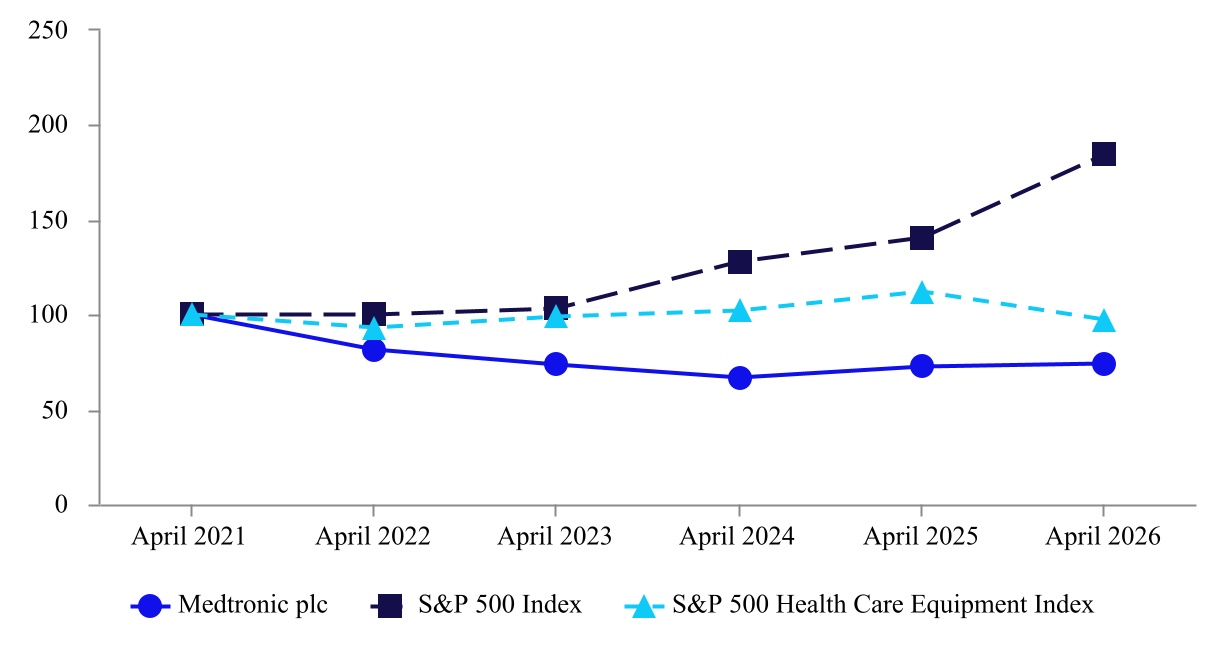
|
|
|
|
|
|
|
|
|
|
|
|
|
|
|
|
|
|
|
|
|
|
|
|
|
|
|
|
|
|
|
|
|
|
|
|
|
|
|
| Company/Index |
|
April 2021 |
|
April 2022 |
|
April 2023 |
|
April 2024 |
|
April 2025 |
|
April 2026 |
| Medtronic plc |
|
$ |
100.00 |
|
|
$ |
81.50 |
|
|
$ |
73.42 |
|
|
$ |
66.51 |
|
|
$ |
72.57 |
|
|
$ |
74.09 |
|
| S&P 500 Index |
|
100.00 |
|
|
100.21 |
|
|
102.88 |
|
|
127.80 |
|
|
140.33 |
|
|
184.25 |
|
| S&P 500 Health Care Equipment Index |
|
100.00 |
|
|
93.29 |
|
|
99.11 |
|
|
101.83 |
|
|
112.08 |
|
|
97.45 |
|
For information on the Company's equity compensation plans, see "Item 12. Security Ownership of Certain Beneficial Owners and Management and Related Shareholder Matters" in this Annual Report on Form 10-K.
Irish Restrictions on Import and Export of Capital
Except as indicated below, there are no restrictions on non-residents of Ireland dealing in Irish domestic securities, which includes ordinary shares of Irish companies. Except as indicated below, dividends and redemption proceeds also continue to be freely transferable to non-resident holders of such securities. The Financial Transfers Act, 1992 provides that the Irish Minister for Finance can make provision for the restriction of financial transfers between Ireland and other countries. For the purposes of this Act, “financial transfers” include all transfers which would be movements of capital or payments within the meaning of the treaties governing the E.U. if they had been made between Member States of the E.U. To date, the Irish Minister for Finance has restricted financial transfers between Ireland and a number of third countries and the list is subject to on-going change.
Any transfer of, or payment in respect of, a share or interest in a share involving the government of any country that is currently the subject of United Nations or E.U. sanctions, any person or body controlled by any of the foregoing, or by any person acting on behalf of the foregoing, may be subject to restrictions pursuant to such sanctions as implemented into Irish law.
Irish Taxes Applicable to U.S. Holders
Dividends paid by Medtronic will generally be subject to Irish dividend withholding tax (currently at a rate of 25 percent) unless an exemption applies.
Dividends paid to U.S. residents will not be subject to Irish dividend withholding tax provided that:
•in the case of a beneficial owner of Medtronic shares held in the DTC, the address of the beneficial owner in the records of his or her broker is in the United States and this information is provided by the broker to the Company’s qualifying intermediary; or
•in the case of a record owner, the record owner has provided to the Company’s transfer agent a valid U.S. Certification of Residence (Form 6166) or valid Irish Non-Resident Form V2.
Irish income tax may also arise with respect to dividends paid on Medtronic’s ordinary shares. A U.S. resident who meets one of the exemptions from dividend withholding tax described above and who does not hold Medtronic shares through a branch or agency in Ireland through which a trade is carried on generally will not have any Irish income tax liability on a dividend paid by Medtronic. In addition, if a U.S. shareholder is subject to the dividend withholding tax, the withholding payment discharges any Irish income tax liability, provided the shareholder furnishes to the Irish Revenue authorities a statement of the dividend withholding tax imposed.
While the U.S./Ireland Double Tax Treaty contains provisions regarding withholding, due to the wide scope of the exemptions from dividend withholding tax available under Irish domestic law, it would generally be unnecessary for a U.S. resident shareholder to rely on the treaty provisions.
Item 6. Reserved
Item 7. Management’s Discussion and Analysis of Financial Condition and Results of Operations
UNDERSTANDING OUR FINANCIAL INFORMATION
The following discussion and analysis provides information management believes to be relevant to understanding the financial condition and results of operations of the Company. The discussion focuses on our financial results for the fiscal year ended April 24, 2026 (fiscal year 2026) and the fiscal year ended April 25, 2025 (fiscal year 2025). A discussion on our results of operations for fiscal year 2025 as compared to the fiscal year ended April 26, 2024 (fiscal year 2024) is included in Part II, Item 7. "Management's Discussion and Analysis of Financial Condition and Results of Operations" of our Annual Report on Form 10-K for the year ended April 25, 2025, filed with the SEC on June 20, 2025, and is incorporated by reference into this Form 10-K. You should read this discussion and analysis along with our consolidated financial statements and related notes thereto at April 24, 2026 and April 25, 2025 and for fiscal years 2026, 2025, and 2024, which are presented within "Item 8. Financial Statements and Supplementary Data" in this Annual Report on Form 10-K. Amounts reported in millions within this annual report are computed based on the actual amounts, and therefore, the sum of the components may not equal the total amount reported in millions due to rounding. Additionally, certain columns and rows within tables may not sum due to rounding.
Financial Trends
Throughout this Management’s Discussion and Analysis, we present certain financial measures that facilitate management's review of the operational performance of the Company and as a basis for strategic planning; however, such financial measures are not presented in our financial statements prepared in accordance with accounting principles generally accepted in the United States (U.S.) (U.S. GAAP). These financial measures are considered non-GAAP financial measures and are intended to supplement, and should not be considered as superior to, financial measures presented in accordance with U.S. GAAP. We believe that non-GAAP financial measures provide information useful to investors in understanding the Company's underlying operational performance and trends and may facilitate comparisons with the performance of other companies in the medical technologies industry.
As presented in the "GAAP to Non-GAAP Reconciliations" section on the following pages, our non-GAAP financial measures exclude the impact of amortization of intangible assets and certain charges or benefits that contribute to or reduce earnings and that may affect financial trends and include certain charges or benefits that result from transactions or events that we believe may or may not recur with similar materiality or impact to our operations in future periods (non-GAAP adjustments).
In the event there is a non-GAAP adjustment recognized in our operating results, the tax cost or benefit attributable to that item is separately calculated and reported. Because the effective rate can be significantly impacted by the non-GAAP adjustments that take place during the period, we often refer to our tax rate using both the effective rate and the non-GAAP nominal tax rate. The non-GAAP nominal tax rate is calculated as the income tax provision, adjusted for the impact of non-GAAP adjustments, as a percentage of income before income taxes, excluding non-GAAP adjustments.
Free cash flow is a non-GAAP financial measure calculated by subtracting property, plant, and equipment additions from operating cash flows.
Refer to the "GAAP to Non-GAAP Reconciliations," "Income Taxes," and "Free Cash Flow" sections for reconciliations of the non-GAAP financial measures to their most directly comparable financial measures prepared in accordance with U.S. GAAP.
EXECUTIVE LEVEL OVERVIEW
The following is a summary of revenue, diluted earnings per share, and operating cash flow for fiscal years 2026 and 2025:
GAAP to Non-GAAP Reconciliations
The tables below present reconciliations of our non-GAAP financial measures to the most directly comparable financial measures prepared in accordance with U.S. GAAP for fiscal years 2026 and 2025.
|
|
|
|
|
|
|
|
|
|
|
|
|
|
|
|
|
|
|
|
|
|
|
|
|
|
|
|
|
|
| |
Fiscal Year 2026 |
| (in millions, except per share data) |
Income Before Income Taxes |
|
Income Tax Provision (Benefit) |
|
Net Income Attributable to Medtronic |
|
Diluted EPS |
|
Effective Tax Rate |
| GAAP |
$ |
6,136 |
|
|
$ |
1,299 |
|
|
$ |
4,801 |
|
|
$ |
3.73 |
|
|
21.2 |
% |
| Non-GAAP adjustments: |
|
|
|
|
|
|
|
|
|
Amortization of intangible assets(1) |
1,772 |
|
|
329 |
|
|
1,444 |
|
|
1.12 |
|
|
18.6 |
|
Restructuring and associated costs(2) |
370 |
|
|
80 |
|
|
290 |
|
|
0.23 |
|
|
21.6 |
|
Acquisition and divestiture-related items(3) |
173 |
|
|
37 |
|
|
137 |
|
|
0.11 |
|
|
21.4 |
|
| Certain litigation charges, net |
113 |
|
|
23 |
|
|
89 |
|
|
0.07 |
|
|
20.4 |
|
(Gain)/loss on minority investments(4) |
131 |
|
|
— |
|
|
130 |
|
|
0.10 |
|
|
— |
|
|
|
|
|
|
|
|
|
|
|
Other(5) |
(39) |
|
|
(8) |
|
|
(30) |
|
|
(0.02) |
|
|
20.5 |
|
Certain tax adjustments, net(6) |
— |
|
|
(260) |
|
|
260 |
|
|
0.20 |
|
|
— |
|
| Non-GAAP |
$ |
8,656 |
|
|
$ |
1,499 |
|
|
$ |
7,120 |
|
|
$ |
5.53 |
|
|
17.3 |
% |
|
|
|
|
|
|
|
|
|
|
|
|
|
|
|
|
|
|
|
|
|
|
|
|
|
|
|
|
|
|
| |
Fiscal Year 2025 |
| (in millions, except per share data) |
Income Before Income Taxes |
|
Income Tax Provision (Benefit) |
|
Net Income Attributable to Medtronic |
|
Diluted EPS |
|
Effective Tax Rate |
| GAAP |
$ |
5,628 |
|
|
$ |
936 |
|
|
$ |
4,662 |
|
|
$ |
3.61 |
|
|
16.6 |
% |
| Non-GAAP adjustments: |
|
|
|
|
|
|
|
|
|
Amortization of intangible assets(1) |
1,807 |
|
|
335 |
|
|
1,471 |
|
|
1.14 |
|
|
18.5 |
|
Restructuring and associated costs(2) |
303 |
|
|
65 |
|
|
238 |
|
|
0.18 |
|
|
21.5 |
|
Acquisition and divestiture-related items(3) |
124 |
|
|
23 |
|
|
101 |
|
|
0.08 |
|
|
18.5 |
|
| Certain litigation charges, net |
317 |
|
|
68 |
|
|
249 |
|
|
0.19 |
|
|
21.5 |
|
(Gain)/loss on minority investments(4) |
213 |
|
|
26 |
|
|
185 |
|
|
0.14 |
|
|
12.2 |
|
Medical device regulations(7) |
52 |
|
|
10 |
|
|
42 |
|
|
0.03 |
|
|
19.2 |
|
Other(5) |
90 |
|
|
20 |
|
|
70 |
|
|
0.05 |
|
|
22.2 |
|
Certain tax adjustments, net(6) |
— |
|
|
(62) |
|
|
62 |
|
|
0.05 |
|
|
— |
|
| Non-GAAP |
$ |
8,533 |
|
|
$ |
1,423 |
|
|
$ |
7,079 |
|
|
$ |
5.49 |
|
|
16.7 |
% |
(1)The Company recognized $121 million and $151 million of accelerated amortization on certain intangible assets within the Cardiovascular Portfolio for fiscal years 2026 and 2025, respectively.
(2)The charges primarily relate to employee termination benefits, facility related and contract termination costs, and asset write offs.
(3)The charges primarily include business combination costs, changes in fair value of contingent consideration, exit of business-related charges, and gains related to certain business or asset sales. Exit of business-related charges primarily relate to the impending separation of the Diabetes Business and costs associated with the Company's June 2021 decision to stop the distribution and sale of the Medtronic HVAD System.
(4)We exclude unrealized and realized gains and losses on our minority investments as we do not believe that these components of income or expense have a direct correlation to our ongoing or future business operations.
(5)Reflects adjustments to the Company's Italian payback accruals resulting from the two July 22, 2024 rulings by the Constitutional Court and the Legislative Decree published by the Italian government on June 30, 2025 for certain prior years since 2015.
(6)The net charges for fiscal year 2026 primarily relates to the impact of an intercompany sale of intellectual property, the net tax charge as a result of the separation of the Diabetes Business and amortization of previously established deferred tax assets arising from intercompany intellectual property transactions, which were partially offset by a tax benefit recognized due to a change in estimate of accrued interest on uncertain tax positions. The charges for fiscal year 2025 primarily includes amortization of previously established deferred tax assets from intercompany intellectual property transactions.
(7)The charges represent incremental costs of complying with the new European Union (E.U.) medical device regulations for previously registered products and primarily include charges for contractors supporting the project and other direct third-party expenses. We consider these costs to be duplicative of previously incurred costs and/or one-time costs.
Free Cash Flow
Free cash flow, a non-GAAP financial measure, is calculated by subtracting additions to property, plant, and equipment from net cash provided by operating activities. Management uses this non-GAAP financial measure, in addition to U.S. GAAP financial measures, to evaluate our operating results. Free cash flow should be considered supplemental to, and not a substitute for, our reported financial results prepared in accordance with U.S. GAAP. Reconciliations between net cash provided by operating activities (the most comparable U.S. GAAP measure) and free cash flow are as follows:
|
|
|
|
|
|
|
|
|
|
|
|
|
Fiscal Year |
| (in millions) |
2026 |
|
2025 |
| Net cash provided by operating activities |
$ |
7,330 |
|
|
$ |
7,044 |
|
| Additions to property, plant, and equipment |
(1,904) |
|
|
(1,859) |
|
| Free cash flow |
$ |
5,426 |
|
|
$ |
5,185 |
|
Refer to the "Summary of Cash Flows" section for drivers of the change in cash provided by operating activities.
Macroeconomic Trends
Looking ahead, a number of macroeconomic and geopolitical factors could negatively impact our business, including without limitation:
•Competitive product launches and pricing pressure, geographic macroeconomic developments including changes in global trade policies and fluctuations in currency exchange rates, general price inflation, changes in interest rates, reimbursement challenges, impacts from changes in the mix of our product offerings, delays in product registration approvals, national and provincial tender pricing for certain products, particularly in China, replacement cycle challenges, and supply chain challenges from time to time.
•Recent developments in global trade policy have introduced new uncertainties for our business. The U.S., China, and other jurisdictions have recently imposed or proposed additional tariffs on imported goods. Based on current rates as of June 3, 2026, we estimate the pre-tax net tariff impact to be $250 million in fiscal year 2027, excluding any considerations of government refunds. The actual amount could vary based on changes in tariff rates, duration of tariffs, scope of tariffs, and potential countermeasures or mitigation actions. While we are taking proactive steps to mitigate the effects of these tariffs, the evolving nature of international trade policy continues to present a risk to our cost structure and financial performance. Further escalation or expansion of trade barriers could have a material adverse effect on our results of operations. On February 20, 2026, the U.S. Supreme Court ruled that President Trump's tariff policies under the International Emergency Economic Powers Act ("IEEPA") are unconstitutional. As a result of this ruling, the U.S. Court of International Trade issued an order directing the U.S. Customs and Border Protection ("CBP") agency to begin formalizing a process for refunds. On April 20, 2026, the CBP launched an online portal that can be used to submit IEEPA tariff refund requests. All requests will be reviewed by the CBP to determine validity prior to the issuance of refunds. We continue to monitor the situation and the impact to our results of operations.
•The sanctions and other measures being imposed in response to the Russia-Ukraine conflict are having and could continue to have impacts on revenue and supply chain. The financial impact of the conflict in fiscal year 2026, including on accounts receivable and inventory reserves, was not material. For fiscal year 2026, the business of the Company in these countries represented less than 1% of the Company's consolidated revenues and assets.
•Although the long-term implications of Israel's conflict are difficult to predict at this time, the financial and operational impact of the conflict in fiscal year 2026, including on accounts receivable and inventory reserves, was not material. As of April 24, 2026, the Company had 6 facilities and approximately 1,200 employees in Israel. For fiscal year 2026, the business of the Company in Israel represented less than 1% of the Company's consolidated revenues and assets.
•Ongoing conflict in the Middle East may continue to disrupt global supply chains and contribute to higher energy, fuel, and transportation costs. Continued instability in the region may further increase costs and create operational challenges.
•The planned exit of certain businesses, including our Diabetes Business, may involve separation activities, costs, and risks associated with transitioning operations, arrangements, and infrastructure. The timing and execution of these activities, as well as any related disposition steps, could affect our future results and financial condition.
NET SALES
Starting in the fourth quarter of fiscal year 2026, the Diabetes Business is no longer considered a reportable segment. Prior period net sales have been recast to conform to the new presentation. The charts below illustrate the percent of net sales by business for fiscal years 2026 and 2025:
The table below includes net sales by segment and division and market geography for fiscal years 2026 and 2025:
|
|
|
|
|
|
|
|
|
|
|
|
|
|
|
|
|
|
| |
Net Sales by Fiscal Year |
|
Percent Change |
| (in millions) |
2026 |
|
2025 |
|
| Cardiac Rhythm & Heart Failure |
$ |
7,504 |
|
|
$ |
6,392 |
|
|
17 |
% |
| Structural Heart & Aortic |
3,817 |
|
|
3,554 |
|
|
7 |
|
| Coronary & Peripheral Vascular |
2,656 |
|
|
2,535 |
|
|
5 |
|
| Cardiovascular |
13,976 |
|
|
12,481 |
|
|
12 |
|
| Cranial & Spinal Technologies |
5,222 |
|
|
4,973 |
|
|
5 |
|
| Specialty Therapies |
2,997 |
|
|
2,940 |
|
|
2 |
|
| Neuromodulation |
2,068 |
|
|
1,932 |
|
|
7 |
|
| Neuroscience |
10,287 |
|
|
9,846 |
|
|
4 |
|
| Surgical & Endoscopy |
6,764 |
|
|
6,498 |
|
|
4 |
|
| Acute Care & Monitoring |
2,051 |
|
|
1,909 |
|
|
7 |
|
| Medical Surgical |
8,815 |
|
|
8,407 |
|
|
5 |
|
| Reportable segment net sales |
33,079 |
|
|
30,734 |
|
|
8 |
|
| Diabetes |
3,112 |
|
|
2,755 |
|
|
13 |
|
Other operating segment(1) |
135 |
|
|
137 |
|
|
(1) |
|
Other adjustments(2) |
39 |
|
|
(90) |
|
|
NM(3) |
| Total net sales |
$ |
36,364 |
|
|
$ |
33,537 |
|
|
8 |
% |
|
|
|
|
|
|
|
|
|
|
|
|
|
|
|
|
|
|
|
|
|
|
|
|
|
|
|
|
|
|
|
|
|
|
|
|
|
U.S. |
|
International |
| (in millions) |
Fiscal Year 2026 |
|
Fiscal Year 2025 |
|
% Change |
|
Fiscal Year 2026 |
|
Fiscal Year 2025 |
|
% Change |
| Cardiovascular |
$ |
6,435 |
|
|
$ |
5,804 |
|
|
11 |
% |
|
$ |
7,541 |
|
|
$ |
6,677 |
|
|
13 |
% |
| Neuroscience |
6,875 |
|
|
6,713 |
|
|
2 |
|
|
3,412 |
|
|
3,133 |
|
|
9 |
|
| Medical Surgical |
3,778 |
|
|
3,664 |
|
|
3 |
|
|
5,037 |
|
|
4,744 |
|
|
6 |
|
| Reportable segment net sales |
17,088 |
|
|
16,181 |
|
|
6 |
|
|
15,991 |
|
|
14,553 |
|
|
10 |
|
| Diabetes |
934 |
|
|
923 |
|
|
1 |
|
|
2,178 |
|
|
1,832 |
|
|
19 |
|
Other operating segment(1) |
81 |
|
|
68 |
|
|
19 |
|
|
54 |
|
|
70 |
|
|
(23) |
|
Other adjustments(2) |
— |
|
|
— |
|
|
— |
|
|
39 |
|
|
(90) |
|
|
NM(3) |
| Total net sales |
$ |
18,103 |
|
|
$ |
17,171 |
|
|
5 |
% |
|
$ |
18,261 |
|
|
$ |
16,365 |
|
|
12 |
% |
(1)Includes operations and ongoing transition agreements from businesses the Company has exited or divested.
(2)Reflects adjustments to the Company's Italian payback accruals as further described below.
(3)Not meaningful (NM)
The increase in net sales for fiscal year 2026 was driven primarily by growth in most businesses, as further described in the business sections below. In addition, the net sales increase was driven by impacts of foreign currency fluctuations and changes in estimates relating to our Italian payback accrual resulting from the two July 2024 rulings by the Constitutional Court and the Legislative Decree published by the Italian government in June 2025 and formalized into law in August 2025 for certain prior years since 2015. For fiscal year 2026, the impact of the Italian payback adjustment was an increase to net sales of $39 million as compared to a decrease in net sales of $90 million in fiscal year 2025.
Cardiovascular
Cardiovascular products include pacemakers, insertable cardiac monitors, cardiac resynchronization therapy devices, implantable cardioverter defibrillators, leads and delivery systems, products for the treatment of atrial fibrillation, information systems for the management of patients with Cardiac Rhythm & Heart Failure devices, products designed to reduce surgical site infections, coronary and peripheral stents and related delivery systems, balloons and related delivery systems, endovascular stent graft systems, heart valve replacement technologies, cardiac tissue ablation systems, open heart and coronary bypass grafting surgical products, and renal denervation systems for the treatment of hypertension. Cardiovascular also includes Care Management Services and Cath Lab Managed Services (CLMS) within the Cardiac Rhythm & Heart Failure division. Cardiovascular's net sales for fiscal year 2026 were $14.0 billion, an increase of 12 percent as compared to fiscal year 2025.
The net sales increase was primarily due to growth across most businesses and the impacts of foreign currency fluctuations.
The charts below illustrate the percent of Cardiovascular net sales by division for fiscal years 2026 and 2025:
Cardiac Rhythm & Heart Failure (CRHF) net sales increased 17 percent in fiscal year 2026 as compared to fiscal year 2025. Cardiac Ablation Solutions experienced strong growth in the pulsed ablation portfolio with partially offsetting declines in cryoablation. Net sales growth was also due to increases within Cardiac Rhythm Management, driven by growth in Micra leadless pacemakers, Aurora extravascular implantable cardioverter defibrillator (EV-ICD) system, and SelectSecure 3830 lead.
Structural Heart & Aortic (SHA) net sales increased 7 percent in fiscal year 2026 as compared to fiscal year 2025. The net sales increase was driven by Structural Heart and in Cardiac Surgery driven by growth in Penditure LAA exclusion system, Avalus Ultra surgical valve, and VitalFlow ECMO system.
Coronary & Peripheral Vascular (CPV) net sales increased 5 percent in fiscal year 2026 as compared to fiscal year 2025. The net sales increase was driven by growth in the Symplicity Spyral renal denervation system, guide catheters and balloons, as well as growth in Peripheral Vascular Health from Endovenous. The net sales increase was partially offset by declines in coronary stents.
In addition to the macroeconomic and geopolitical factors described in the Executive Level Overview, looking ahead, we expect Cardiovascular could be affected by the following:
•Continued global penetration of our Micra transcatheter pacing portfolio.
•Continued acceptance and growth of the 3830 lead.
•Global adoption and growth of Aurora EV-ICD.
•Growth of the Cobalt and Crome portfolio of ICDs and CRT-Ds.
•Continued growth and utilization of the TYRX Envelope for implantable devices.
•Continued use and acceptance of Reveal LINQ and expansion of the LINQ II cardiac monitor.
•Continued acceptance, adoption, and growth of our innovative portfolio of products in the electrophysiology (EP) segment, including the PulseSelect pulsed field ablation system and the Affera mapping and ablation system with Sphere-9 catheter. The Affera mapping and ablation system and Sphere-9 catheter received U.S. FDA approval in late October 2024.
•Continued growth and market acceptance of Affera Sphere-360 pulsed field ablation single-shot catheter. The catheter received CE Mark in January 2026.
•Continued acceptance and growth of the self-expanding CoreValve Evolut transcatheter aortic valve replacement (TAVR) platform. This includes Evolut PRO which provides enhanced hemodynamics, reliable delivery, enhanced durability, advanced sealing, and Evolut FX, a system designed to improve the overall procedural experience through enhancements in deliverability, implant visibility, and deployment stability. The Evolut FX+ TAVR system maintains the valve performance benefits of the legacy Evolut TAVR platform and is designed to facilitate coronary access. The system was approved by the U.S. FDA in March 2024 and received CE Mark in late October 2024.
•Market acceptance and reimbursement for the Symplicity Spyral renal denervation system, also known as the Symplicity blood pressure procedure, for the treatment of hypertension. The U.S. Centers for Medicare and Medicaid Services (CMS) finalized National Coverage Determination in October 2025.
•Market acceptance and growth of the Penditure LAA Exclusion System. The system received CE Mark in October 2025.
•Continued acceptance and growth of the Onyx Frontier drug-eluting stent (DES) platform. Onyx Frontier is a DES that introduces an enhanced delivery system and is used for complex percutaneous coronary intervention (PCI).
•Strengthening our position in the Coronary & Peripheral Vascular division as a result of the April 2026 acquisition of CathWorks Ltd. The acquisition expands the CPV division by aiming to transform how coronary artery disease is diagnosed and treated.
•Acceptance and growth of IN.PACT 018 drug-coated balloons (DCB). IN.PACT 018 adds to the existing IN.PACT Admiral DCB portfolio and is used to treat femoropopliteal disease.
•Market growth of Liberant mechanical thrombectomy system.
•Market acceptance and growth of OmniaSecure defibrillation lead. OmniaSecure received CE Mark in March 2026.
•Market acceptance and growth of the Neuroguard IEP carotid stenting system.
•Our ability to meet growing demand for our existing products and to successfully develop, obtain regulatory approval of, and commercialize the products within our pipeline, including VT indication expansion for Sphere 9 and commercialization of Affera Sphere-360 pulsed field ablation single-shot catheter.
Neuroscience
Neuroscience's products include various spinal implants, bone graft substitutes, biologic products, image-guided surgery and intra-operative imaging systems, robotic guidance systems used in the robot-assisted spine procedures, and systems that incorporate advanced energy surgical instruments. Neuroscience's products also focus on therapies to treat the diseases of the vasculature in and around the brain, including coils, neurovascular stents, and flow diversion products, as well as products to treat the ear, nose, and throat (ENT), and the treatment of overactive bladder and urinary retention. Neuroscience also manufactures products related to implantable neurostimulation therapies and drug delivery systems for the treatment of chronic pain, movement disorders, and epilepsy. Neuroscience’s net sales for fiscal year 2026 were $10.3 billion, an increase of 4 percent as compared to fiscal year 2025, resulting from growth in Cranial and Spinal Technologies, Neuromodulation, ENT, and the impacts of foreign currency fluctuations.
The charts below illustrate the percent of Neuroscience net sales by division for fiscal years 2026 and 2025:
Cranial & Spinal Technologies (CST) net sales for fiscal year 2026 increased 5 percent as compared to fiscal year 2025. The net sales increase was driven by the continued adoption of the AiBLE ecosystem of spine implants and enabling technology with growth in Core Spine and Neurosurgery.
Specialty Therapies (Specialty) net sales for fiscal year 2026 increased 2 percent as compared to fiscal year 2025. The net sales increase was driven by growth in ENT and Flow Diversion, offset by Pelvic Health and the Pipeline Vantage recall.
Neuromodulation (NM) net sales for fiscal year 2026 increased 7 percent as compared to fiscal year 2025. The net sales increase was driven by the Inceptiv closed-loop spinal cord stimulator, the Percept RC neurostimulator with BrainSense technology, and Interventional.
In addition to the macroeconomic and geopolitical factors described in the Executive Level Overview, looking ahead we expect Neuroscience could be affected by the following:
•Continued global adoption, growth, and market acceptance of integrated solutions through the AiBLE offering, which integrates spinal implants with enabling technologies (StealthStation, O-arm Imaging Systems, and Midas), Mazor robotics, and UNiD Adaptive Spine Intelligence AI-driven technology for surgical planning and personalized spinal implants. The Stealth AXiS Surgical System received U.S. FDA approval for spinal procedures in February 2026, followed by expanded approval for cranial and ENT applications in March 2026. The system received CE mark approval for spinal and cranial procedures in April 2026, and for ENT procedures in June 2026. The system incorporates navigation workflows with a modular robotic architecture.
•Market acceptance and continued global adoption of innovative spine products and procedural solutions within our CST operating unit, such as Catalyft PL & PL40, CD Horizon ModuLeX and Voyager Systems, and our Infinity OCT System, as well as continued growth from Titan spine titanium interbody implants with Nanolock technology.
•Continued global growth of commercially available Pipeline Embolization Devices, endovascular treatments for certain wide-necked brain aneurysms.
•Continued global acceptance of the Solitaire X revascularization device for treatment of acute ischemic stroke and our React Catheter and Riptide aspiration system.
•Continued global acceptance and growth of our Pelvic Health therapies, including our InterStim therapy with InterStim X and InterStim II recharge-free neurostimulators and InterStim Micro rechargeable neurostimulator for patients suffering from overactive bladder, (non-obtrusive) urinary retention, and chronic fecal incontinence. The Altaviva implantable tibial neuromodulation system received U.S. FDA approval in September 2025 for urinary urge incontinence.
•Continued global adoption, growth, and market acceptance of our ENT therapies, including the intraoperative NIM nerve monitoring system, the Propel sinus implants used in the treatment of chronic rhinosinusitis, and global capital equipment sales of the StealthStation ENT surgical navigation system and the U.S. FDA approved Stealth AXiS Surgical System for ENT applications, which received approval in March 2026, followed by CE mark approval in June 2026.
•Continued global acceptance and growth from spinal cord stimulation (SCS) therapy for treating chronic pain and Diabetic Peripheral Neuropathy (DPN) on the Inceptiv closed-loop rechargeable neurostimulator, Intellis rechargeable neurostimulator and Vanta recharge-free neurostimulator.
•Continued global acceptance and growth of our Percept family of deep brain stimulation (DBS) devices with proprietary BrainSense technology for objectifying and personalizing the treatment of Parkinson's Disease, epilepsy, and other movement disorders. BrainSense Adaptive DBS and BrainSense Electrode Identifier received CE Mark in January 2025 and U.S. FDA approval in February 2025.
•Continued market acceptance and growth of the Neuroguard IEP carotid stenting system.
•The acquisition of Scientia Vascular and pending acquisition of SPR Therapeutics, which will expand the Neuroscience Portfolio. Refer to Acquisitions and Dispositions for additional information.
•Our ability to meet growing demand for our existing products and to successfully develop, obtain regulatory approval of, and commercialize the products within our pipeline, which include the hemorrhagic stroke device, our next-generation spine enabling technologies, and the implantable tibial bladder control stimulator.
Medical Surgical
Medical Surgical’s products span the entire continuum of patient care from diagnosis to recovery, with a focus on diseases of the gastrointestinal tract, lungs, pelvic region, obesity, and preventable complications. The products include those for advanced and general surgical products, surgical stapling devices, vessel sealing instruments, wound closure, electrosurgery products, hernia mechanical devices, mesh implants, advanced ablation, interventional lung, airway products, and sensors and monitors for pulse oximetry, capnography, level of consciousness and cerebral oximetry. Medical Surgical’s net sales for fiscal year 2026 were $8.8 billion, an increase of 5 percent as compared to fiscal year 2025, resulting from growth across most businesses and the impacts of foreign currency fluctuations.
The charts below illustrate the percent of Medical Surgical net sales by division for fiscal years 2026 and 2025:
Surgical & Endoscopy (SE) net sales for fiscal year 2026 increased 4 percent as compared to fiscal year 2025. The net sales increase was primarily due to growth in Surgical, with strength in LigaSure vessel-sealing technology, ProGrip self-gripping polyester mesh, V-Loc barbed sutures, Electrosurgery, and Surgical Robotics.
The growth in Surgical was partially offset by Advanced Stapling due to shifts to robotic surgery and bariatric procedure declines. The net sales increase was also driven by growth in Endoscopy driven by Nexpowder endoscopic hemostasis system and Endoflip 300 system.
Acute Care & Monitoring (ACM) net sales for fiscal year 2026 increased 7 percent as compared to fiscal year 2025. The net sales increase was primarily due to growth in Nellcor pulse oximetry, McGRATH MAC video laryngoscope, and BIS and INVOS advanced monitoring sensors.
In addition to the macroeconomic and geopolitical factors described in the Executive Level Overview, looking ahead we expect Medical Surgical could be affected by the following:
•Acceptance and continued growth of Open-to-MIS (minimally invasive surgery) techniques and tools through our efforts to transition open surgery to MIS. Open-to-MIS initiative focuses on capturing the market opportunity that exists in transitioning open procedures to MIS, whether through traditional MIS, advanced instrumentation, or robotics. Through our approach, in parallel, we also expand our presence and optimize open surgery in current open surgery markets.
•Continued global acceptance and future growth of powered stapling and energy platform.
•Our ability to execute ongoing strategies addressing the pressures to bariatric surgery procedure volumes in the U.S. from pharmaceuticals, and growth of surgical soft tissue robotics procedures in the U.S.
•Our ability to create markets and drive products and procedures into emerging markets with our high quality and cost-effective surgical products designed for customers in emerging markets.
•Continued acceptance and growth in patient monitoring and airway management. Key products in this area include Microstream Capnography, Nellcor pulse oximetry system with OxiMax technology, Shiley tracheostomy and endotracheal tubes, and McGRATH MAC video laryngoscopes.
•Acceptance of less invasive standards of care in chronic and colorectal, as well as hepatology products, including products that span the care continuum from diagnostics to therapeutics.
•Expanding the use of less invasive treatments and furthering our commitment to improving options for women with abnormal uterine bleeding. Our expanded and strengthened surgical offerings complement our global gynecology business.
•Global adoption of robotic-assisted surgery and the safe and effective use of the Hugo robotic assisted surgery (RAS) system, including system reliability and acceptability, for urologic, bariatric, gynecologic, hernia, and general surgery procedures. This includes continued integration and adoption of Touch Surgery Enterprise with the first artificial intelligence (AI) powered surgical videos and analytics platform to make it easier to analyze performance, train, and discover new techniques within the robotics platform. The Hugo RAS system is designed to help reduce unwanted variability, improve patient outcomes, and, by extension, lower per procedure cost. LigaSure RAS vessel-sealing technology received CE Mark in July 2025, expanding Hugo RAS system capabilities for gynecologic, general, and urologic procedures. The Hugo RAS system received U.S. FDA clearance for use in urologic surgical procedures in December 2025.
•Our ability to meet growing demand for our existing products and to successfully develop, obtain regulatory approval of, and commercialize the products within our pipeline, which includes general surgery and gynecology indications for our Hugo RAS system in the U.S., the adoption of AI in Endoscopy and Digital Surgical Technologies, Signia powered stapling devices, and our next-gen LigaSure and Sonicision vessel sealing devices.
Diabetes
Diabetes' products primarily include insulin pumps, continuous glucose monitoring (CGM) systems, and consumables. Diabetes' net sales for fiscal year 2026 were $3.1 billion, an increase of 13 percent as compared to fiscal year 2025. The increase in net sales was primarily driven by strong international growth due to the continued adoption of the MiniMed 780G AID system, including the Simplera Sync and Guardian 4 CGM sensors, Extended Infusion Sets, and the impacts of foreign currency fluctuations.
Refer to the Executive Level Overview for other factors that could impact the Diabetes Business.
COSTS AND EXPENSES
The following is a summary of cost of products sold, research and development, and selling, general, and administrative expenses as a percent of net sales:
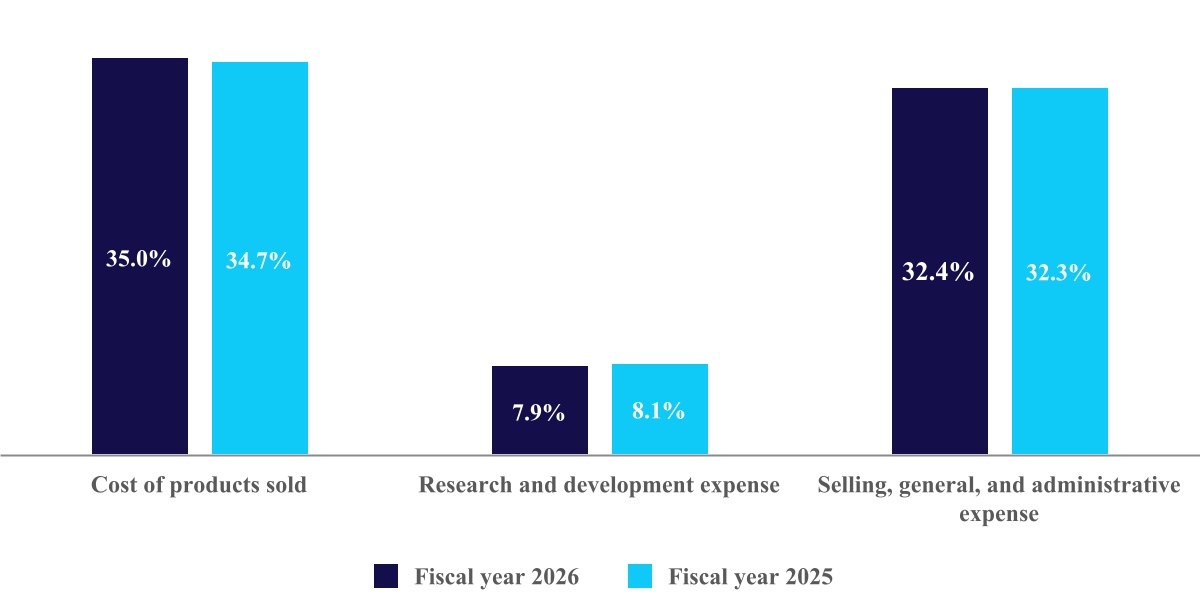
Cost of Products Sold Cost of products sold for fiscal year 2026 was $12.7 billion as compared to $11.6 billion for fiscal year 2025. Cost of products sold as a percentage of net sales increased as compared to the prior fiscal year. The increase in cost of products sold as a percentage of net sales was primarily due to $185 million of increased tariffs and duties on imported goods and $84 million of asset write offs. The increase in costs of products sold as a percentage of net sales was partially offset by net favorable impact of currency on net sales and cost of products sold in addition to changes in the Italian payback accruals impacting net sales. For additional information about the asset write offs, refer to Note 4 to our consolidated financial statements in "Item 8. Financial Statements and Supplementary Data" of this Annual Report on Form 10-K. Looking ahead, we anticipate incurring additional costs related to current imposed and proposed tariffs. For additional information on tariffs and duties, refer to the Executive Level Overview.
Research and Development Expense We remain committed to deliver the best possible experiences for patients, physicians, and caregivers we serve; to create technologies that expand what’s possible across the human body to transform lives; to turn data and insights into real action to serve patient needs, improving care; and to expand healthcare access and deliver positive outcomes. Research and development expense for fiscal year 2026 was $2.9 billion as compared to $2.7 billion for fiscal year 2025.
Selling, General, and Administrative Expense Our goal is to continue to leverage selling, general, and administrative expense management initiatives. Selling, general, and administrative expense primarily consists of salaries and wages, other administrative costs, such as professional fees and marketing expenses, and certain acquisition and divestiture-related costs. Selling, general, and administrative expense for fiscal year 2026 was $11.8 billion as compared to $10.8 billion for fiscal year 2025. The increase in selling, general, and administrative expense was primarily due to selling expenses in line with sales growth, new product launches and related commercialization activities, and increased expenses to support the impending separation of the Diabetes Business.
The following is a summary of other costs and expenses (income):
|
|
|
|
|
|
|
|
|
|
|
|
|
Fiscal Year |
| (in millions) |
2026 |
|
2025 |
| Amortization of intangible assets |
$ |
1,772 |
|
|
$ |
1,807 |
|
| Restructuring charges, net |
249 |
|
|
267 |
|
| Certain litigation charges, net |
113 |
|
|
317 |
|
| Other operating expense (income), net |
386 |
|
|
(23) |
|
| Other non-operating expense (income), net |
(384) |
|
|
(402) |
|
| Interest expense, net |
715 |
|
|
729 |
|
Amortization of Intangible Assets Amortization of intangible assets includes the amortization expense of our definite-lived intangible assets, consisting of customer relationships, purchased technology and patents, trademarks, tradenames, and other intangible assets.
During fiscal years 2026 and 2025, the Company recognized $121 million and $151 million, respectively, of accelerated amortization on certain intangible assets within the Cardiovascular Segment.
Restructuring Charges, Net In fiscal years 2026 and 2025, restructuring costs primarily consist of employee termination benefits, facility related and contract termination costs, and asset write-offs.
For additional information about our restructuring programs, refer to Note 4 to our consolidated financial statements in "Item 8. Financial Statements and Supplementary Data" of this Annual Report on Form 10-K.
Certain Litigation Charges, Net We classify specified certain litigation charges and gains related to significant legal matters as certain litigation charges, net in the consolidated statements of income. For additional information, refer to Note 18 to our consolidated financial statements in “Item 8. Financial Statements and Supplementary Data” of this Annual Report on Form 10-K.
Other Operating Expense (Income), Net Other operating expense (income), net primarily includes expenses associated with royalties paid for the in-license of intellectual property from third parties, currency remeasurement and derivative gains and losses, changes in the fair value of contingent consideration, certain acquisition and divestiture-related items, and expenses and income associated with funded research and development arrangements.
For fiscal year 2026, the change in other operating expense (income), net was largely driven by the net impact of currency remeasurement and our hedging programs resulting in a net loss of $238 million in fiscal year 2026 as compared to a net loss of $3 million in fiscal year 2025. Additionally, the change was driven by a $157 million charge related to a future minimum royalty payment obligation under one of the research and development funding arrangements during fiscal year 2026.
For additional information on the research and development funding arrangements, refer to Note 3 to our consolidated financial statements in “Item 8. Financial Statements and Supplementary Data” of this Annual Report on Form 10-K.
Other Non-Operating Expense (Income), Net Other non-operating expense (income), net includes the non-service component of net periodic pension and postretirement benefit cost, investment gains and losses, and interest income, which includes income on marketable debt securities and our global liquidity structures.
The decrease in other non-operating expense (income), net was primarily driven by a decrease of $93 million of interest income partially offset by decreased losses on minority investments. Net losses on minority investments were $131 million and $213 million for fiscal years 2026 and 2025, respectively.
Interest Expense, Net Interest expense, net includes interest incurred on our outstanding borrowings, global liquidity structures, amortization of debt issuance costs and debt premiums or discounts, and amortization of amounts excluded from the effectiveness assessment of certain net investment and fair value hedges.
The decrease in interest expense, net was primarily driven by changes in our global liquidity structure, partially offset by increased expense associated with higher coupon rates on the senior notes issued in the second quarter of fiscal year 2026.
INCOME TAXES
|
|
|
|
|
|
|
|
|
|
|
|
|
|
| |
Fiscal Year |
| (in millions) |
2026 |
|
2025 |
|
|
| Income tax provision |
$ |
1,299 |
|
|
$ |
936 |
|
|
|
| Income before income taxes |
6,136 |
|
|
5,628 |
|
|
|
| Effective tax rate |
21.2 |
% |
|
16.6 |
% |
|
|
|
|
|
|
|
|
| Non-GAAP income tax provision |
$ |
1,499 |
|
|
$ |
1,423 |
|
|
|
| Non-GAAP income before income taxes |
8,656 |
|
|
8,533 |
|
|
|
| Non-GAAP nominal tax rate |
17.3 |
% |
|
16.7 |
% |
|
|
|
|
|
|
|
|
| Difference between the effective tax rate and non-GAAP nominal tax rate |
(3.9) |
% |
|
0.1 |
% |
|
|
On July 4, 2025, the U.S. Government enacted The One Big Beautiful Bill Act of 2025, which includes, among other provisions, changes to the U.S. corporate income tax system including the allowance of immediate expensing of qualifying research and development expenses and permanent extensions of certain provisions within the Tax Cuts and Jobs Act. The provisions of the Act, including immediate expensing of qualifying research and development costs, that were effective for fiscal year 2026 did not materially impact the Company's fiscal year 2026 effective tax rate.
The Company does not expect the provisions of the Act to materially impact fiscal years 2027 and beyond.
The Organization for Economic Co-operation and Development (OECD) published Pillar Two Model Rules defining the global minimum tax, which calls for the taxation of large multinational corporations at a minimum rate of 15% in each jurisdiction in which the group operates. The OECD has since issued administrative guidance providing transition and safe harbor rules around the implementation of the Pillar Two Model Rules. A number of countries, including Ireland, have enacted legislation to implement the core elements of Pillar Two Model Rules, which were effective for Medtronic in fiscal year 2025.
Our effective tax rate for fiscal year 2026 was 21.2 percent, as compared to 16.6 percent in fiscal year 2025. The increase in our effective tax rate was primarily attributable to the increase in certain tax adjustments discussed below, an increase in the Pillar Two Global Minimum Tax, and year-over-year changes in operational results by jurisdiction, partially offset by the net operational tax benefits mentioned below; all of which occurred in fiscal year 2026.
Our non-GAAP nominal tax rate for fiscal year 2026 was 17.3 percent, as compared to 16.7 percent in fiscal year 2025. The increase in our non-GAAP nominal tax rate was primarily due to an increase in the Pillar Two Global Minimum Tax, and year-over-year changes in operational results by jurisdiction inclusive of the net operational tax benefits discussed below.
During fiscal year 2026, we recognized $148 million of net operational tax benefits. The net operational tax benefits primarily included a $122 million benefit associated with prior year tax resolutions and statute lapses, finalization of certain tax returns, and a change in estimate of accrued interest on uncertain tax positions and a $32 million benefit associated with a change in the realizability of certain deferred tax assets. During fiscal year 2025, operational tax costs were immaterial.
An increase in our non-GAAP nominal tax rate of one percent would result in an additional income tax provision for fiscal years 2026 and 2025 of approximately $87 million and $85 million, respectively.
Certain Tax Adjustments
During fiscal year 2026, the net cost from certain tax adjustments of $260 million, recognized in income tax provision in the consolidated statements of income included the following:
•A net cost of $150 million associated with the intercompany sale of intellectual property and the establishment of a deferred tax asset.
•A net cost of $70 million associated with the separation of the Diabetes Business.
•A cost of $66 million associated with the amortization of the previously established deferred tax assets from intercompany intellectual property transactions.
•A benefit of $51 million related to a change in estimate of accrued interest on uncertain tax positions.
•A cost of $25 million primarily related to the write off of certain deferred tax assets on previous transactions.
During fiscal year 2025, the net cost from certain tax adjustments of $62 million, recognized in income tax provision in the consolidated statements of income, included amortization of the previously established deferred tax assets from intercompany intellectual property transactions.
Certain tax adjustments will affect the comparability of our operating results between periods. Therefore, we consider these non-GAAP adjustments. Refer to the Executive Level Overview for further discussion of these adjustments.
LIQUIDITY AND CAPITAL RESOURCES
We are currently in a strong financial position, and we believe our balance sheet and liquidity as of April 24, 2026 provide us with flexibility, and our cash, cash equivalents, and current investments, along with our credit facility and related commercial paper programs will satisfy our foreseeable operating needs.
Our liquidity and capital structure are evaluated regularly within the context of our annual operating and strategic planning processes. We consider the liquidity necessary to fund our operations, which includes working capital needs, investments in research and development, property, plant, and equipment, and other operating costs. We also consider capital allocation alternatives that balance returning value to shareholders through dividends and share repurchases, satisfying maturing debt, and acquiring businesses and technology.
Summary of Cash Flows
The following is a summary of cash provided by (used in) operating, investing, and financing activities, the effect of exchange rate changes on cash and cash equivalents, and the net change in cash and cash equivalents:
|
|
|
|
|
|
|
|
|
|
|
|
| |
Fiscal Year |
| (in millions) |
2026 |
|
2025 |
| Cash provided by (used in): |
|
|
|
| Operating activities |
$ |
7,330 |
|
|
$ |
7,044 |
|
| Investing activities |
(2,934) |
|
|
(1,937) |
|
| Financing activities |
(4,751) |
|
|
(4,361) |
|
| Effect of exchange rate changes on cash and cash equivalents |
85 |
|
|
188 |
|
| Net change in cash and cash equivalents |
$ |
(269) |
|
|
$ |
934 |
|
Operating Activities There was a $286 million increase in net cash provided, as compared to the prior fiscal year, primarily driven by an increase in cash collected from customers due to an increase in sales, partially offset by an increase in cash paid to suppliers, including duties from tariffs, and other vendors, cash paid for taxes, and certain litigation payments.
Investing Activities There was a $997 million increase in net cash used, as compared to the prior fiscal year, primarily attributable to an increase in net purchases of investments of $889 million and an increase in cash paid for acquisitions of $308 million. The remaining change primarily relates to derivatives activity and intangible asset acquisitions.
Financing Activities There was a $390 million increase in net cash used compared to the prior fiscal year.
The increase was driven by a $3.3 billion change in debt year-over-year, with $1.2 billion outflow in fiscal year 2026 as compared to an inflow of $2.1 billion in fiscal year 2025. In fiscal year 2026, the Company issued two tranches of Euro-denominated Senior Notes with an aggregate principal of €1.5 billion, or $1.7 billion. The Company used the net proceeds to repay in full €1.5 billion, or $1.8 billion, of Senior Notes. Additionally, the Company repaid €1.0 billion, or $1.2 billion, of Senior Notes. In fiscal year 2025, the Company issued four tranches of Euro-denominated Senior Notes with an aggregate principal of €3.0 billion, or $3.2 billion, which was partially offset by repayments of commercial paper of $1.1 billion.
Partially offsetting the increase in net cash used was $538 million of proceeds from the MiniMed Group, Inc. (MiniMed) initial public offering (the IPO) in fiscal year 2026, and $2.2 billion of fewer net share repurchase in fiscal year 2026 as compared to fiscal year 2025. The remaining change primarily relates to derivative and dividend activity.
For additional information on short-term borrowings and Senior Notes issued and repaid, refer to Debt and Capital below.
Debt and Capital
Our capital structure consists of equity and interest-bearing debt. We primarily utilize unsecured senior debt obligations to meet our financing needs and, to a lesser extent, bank borrowings. From time to time, we may repurchase our outstanding debt obligations in the open market or through privately negotiated transactions.
Total debt at April 24, 2026 was $28.0 billion as compared to $28.5 billion at April 25, 2025. The decrease in total debt was primarily driven by repayments of Euro-denominated debt, net of issuances, as discussed below, partially offset by the impact of foreign exchange rates on our foreign currency denominated debt.
In July 2025, the Company repaid at maturity €1.0 billion, or $1.2 billion, of Senior Notes. In September 2025, Medtronic, Inc. issued two tranches of Euro-denominated Senior Notes with an aggregate principal of €1.5 billion, with maturities in fiscal years 2031 and 2046, resulting in cash proceeds of approximately $1.7 billion, net of discounts and issuance costs. The Company used the net proceeds to repay €500 million of Medtronic Luxco’s 2.625% Senior Notes for $587 million in September 2025 and €1.0 billion of Medtronic Luxco's 0.000% Senior Notes for $1.2 billion in October 2025.
We repurchase our ordinary shares on occasion as part of our focus on returning value to our shareholders. In March 2024, the Company's Board of Directors authorized the repurchase of $5.0 billion of the Company's ordinary shares. There is no specific time period associated with these repurchase authorizations. During fiscal years 2026 and 2025, the Company repurchased a total of 10 million and 38 million shares, respectively, under this program at an average price of $93.25 and $83.36, respectively. At April 24, 2026, we had approximately $1.2 billion remaining under the share repurchase program authorized by our Board of Directors.
For additional information on credit arrangements, refer to Note 6 to our consolidated financial statements in “Item 8. Financial Statements and Supplementary Data” of this Annual Report on Form 10-K.
Liquidity
Our liquidity sources at April 24, 2026 included $1.9 billion of cash and cash equivalents and $7.3 billion of current investments. Additionally, we maintain commercial paper programs and a Credit Facility.
Our investments primarily include available-for-sale debt securities, including U.S. and non-U.S. government and agency securities, corporate debt securities, mortgage-backed securities, and other asset-backed securities. Refer to Note 5 to our consolidated financial statements in "Item 8. Financial Statements and Supplementary Data" of this Annual Report on Form 10-K for additional information regarding fair value measurements.
We maintain multicurrency commercial paper programs for short-term financing, which allow us to issue unsecured commercial paper notes on a private placement basis up to a maximum aggregate amount outstanding at any time of $3.5 billion. At April 24, 2026 and April 25, 2025, we had no commercial paper outstanding. The issuance of commercial paper reduces the amount of credit available under our existing line of credit, as explained below.
We also have a $3.5 billion five-year syndicated credit facility (Credit Facility), which expires in December 2030. At each anniversary date of the Credit Facility, we can request a one-year extension of the maturity date. The Credit Facility provides backup funding for the commercial paper programs and may also be used for general corporate purposes. The Credit Facility provides us with the ability to increase our borrowing capacity by an additional $1.0 billion at any time during the term of the agreement. At April 24, 2026 and April 25, 2025, no amounts were outstanding under the Credit Facility.
Interest rates on advances of our Credit Facility are determined by a pricing matrix based on our long-term debt ratings assigned by Standard & Poor's Ratings Services (S&P) and Moody's Investors Service (Moody’s). Facility fees are payable on the Credit Facility and are determined in the same manner as the interest rates. We are in compliance with all covenants related to the Credit Facility.
The following table is a summary of our S&P and Moody's long-term debt ratings and short-term debt ratings:
|
|
|
|
|
|
|
|
|
|
|
|
|
|
|
|
|
Agency Rating (1) |
|
|
April 24, 2026 |
|
April 25, 2025 |
| Standard & Poor's Ratings Services |
|
|
|
|
| Long-term debt |
|
A |
|
A |
| Short-term debt |
|
A-1 |
|
A-1 |
| Moody's Investors Service |
|
|
|
|
| Long-term debt |
|
A3 |
|
A3 |
| Short-term debt |
|
P-2 |
|
P-2 |
(1) Agency ratings are subject to change, and there may be no assurance that an agency will continue to provide ratings and/or maintain its current ratings. A security rating is not a recommendation to buy, sell or hold securities, and may be subject to revision or withdrawal at any time by the rating agency, and each rating should be evaluated independently of any other rating.
S&P and Moody's long-term debt ratings and short-term debt ratings at April 24, 2026 were unchanged as compared to the ratings at April 25, 2025. We do not expect the S&P and Moody's ratings to have a significant impact on our liquidity or future flexibility to access additional liquidity given our balance sheet, Credit Facility, and related commercial paper programs.
Contractual Obligations and Cash Requirements
We have future contractual obligations and other minimum commercial commitments that are entered into in the normal course of business, some of which are recorded in our consolidated balance sheet. Information regarding our obligations under contingent consideration, debt, lease arrangements, and legal matters are provided in Notes 3, 6, 16, and 18, respectively, to the consolidated financial statements in “Item 8.
Financial Statements and Supplementary Data” in this Annual Report on Form 10-K.
In the normal course of business, we periodically enter into off-balance sheet arrangements. Certain commitments and contingencies arise and are not recorded in the consolidated balance sheets in accordance with U.S. GAAP.
We have inventory purchase commitments, research and development, and other arrangements that are legally binding and specify minimum purchase quantities or spending amounts. These purchase commitments do not exceed our projected requirements and are in the normal course of business. At April 24, 2026, excluding open purchase orders with a remaining term of less than one year, we estimate that these future purchase commitments will be $0.5 billion and $1.1 billion in the short-term and long-term, respectively.
We have commitments related to the funding of minority investments, estimated milestone payments, and royalty obligations. It is not certain if and/or when payments will be made. The timing and amount of payments under these agreements are uncertain, as obligations generally become due only upon the achievement of specified development, regulatory, commercialization, or sales-based milestones. Such events may occur over several years or may never occur at all. Because the occurrence and timing of these triggering events are inherently uncertain, the related payment amounts and timing cannot be reasonably estimated.
We have contractual interest payments on our outstanding debt. Contractual interest payments on our outstanding debt, excluding the impacts of debt premium and discount amortization, required on our short-term and long-term debt outstanding at April 24, 2026, are projected to be $0.7 billion and $7.9 billion, respectively.
We periodically enter into agreements that require us to indemnify customers or suppliers for specific risks, such as claims for injury or property damage arising as a result of our products or the negligence of our personnel or claims alleging that our products infringe third-party patents or other intellectual property. Our maximum exposure under these indemnification provisions is unable to be estimated, and we have not accrued any liabilities within our consolidated financial statements. Historically, we have not experienced material losses on these types of indemnification agreements.
Note 18 to the consolidated financial statements in "Item 8. Financial Statements and Supplementary Data" in this Annual Report on Form 10-K provides information regarding other arrangements we enter into, which include standby letters of credit agreements, bank guarantees, and surety or other bonds with financial institutions to support various performance and other obligations, as well as ongoing tax matters.
We record tax liabilities in our consolidated financial statements for amounts that we expect to repatriate from subsidiaries (to the extent the repatriation would be subject to tax); however, no tax liabilities are recorded for amounts we consider to be permanently reinvested. We expect to have access to the majority of our cash flows in the future. In addition, we continue to evaluate our legal entity structure supporting our business operations, and to the extent such evaluation results in a change to our overall business structure, we may be required to accrue for additional tax obligations. Refer to Note 13 to our consolidated financial statements in “Item 8. Financial Statements and Supplementary Data” of this Annual Report on Form 10-K for additional information.
Additionally, we have entered into various arrangements with affiliates of Blackstone Life Sciences Advisors L.L.C. (collectively, "Blackstone") to receive funding related to the development of certain products, which may give rise to potential regulatory or commercialization milestone payments and royalties based on a percentage of sales of such products. Payments under these agreements generally become due and payable only upon the achievement of certain development, regulatory and/or commercialization milestones or relevant product sales, which may span several years and which may never occur. Refer to Note 3 to our consolidated financial statements in "Item 8. Financial Statements and Supplementary Data" of this Annual Report on Form 10-K for additional information.
Beyond the contractual obligations and other minimum commercial commitments outlined above, we have recurring cash requirements arising from the normal operation of our business that include capital expenditures, research and developments costs, and other operational costs.
We believe our balance sheet and liquidity provide us with flexibility, and our cash, cash equivalents, current investments, Credit Facility and related commercial paper programs, as well as our ability to generate operating cash flows, will satisfy our current and future contractual obligations and cash requirements. We regularly review our capital needs and consider various investing and financing alternatives to support our requirements.
ACQUISITIONS AND DISPOSITIONS
Information regarding acquisitions and disposition activity is included in Note 3 of the consolidated financial statements in "Item 8. Financial Statements and Supplementary Data" within this Annual Report on Form 10-K.
MiniMed Separation
In May 2025, the Company announced its intent to separate the Diabetes Business, with the intention to create a new independent, publicly traded company, MiniMed Group, Inc. On March 9, 2026, MiniMed completed an initial public offering. As of closing of the IPO, the Company owns 252,813,348 shares of MiniMed Common Stock, or approximately 90.03% of the total outstanding shares of MiniMed Common Stock. Due to the Company retaining a controlling financial interest, the consolidated financial statements reflect the financial results of MiniMed. See Note 20 to the consolidated financial statements for additional details. The Company plans to complete the separation of its Diabetes Business within the next fiscal year.
CathWorks Ltd. Acquisition
On April 20, 2026, the Company acquired all the remaining outstanding shares of CathWorks Ltd. (CathWorks), a privately held medical device company, for $525 million of consideration transferred, including $115 million of contingent consideration. The acquisition expands the Coronary & Peripheral Vascular division within the Cardiovascular portfolio by aiming to transform how coronary artery disease is diagnosed and treated.
Scientia Vascular Acquisition
On June 12, 2026, the Company closed on the acquisition of all outstanding shares of Scientia Vascular (Scientia) (a privately held company). As the Company closed on this acquisition subsequent to April 24, 2026, this acquisition is considered a subsequent event. The acquisition will expand the Neuroscience portfolio through Scientia’s differentiated access products used to treat complex neurovascular conditions. The Company anticipates total consideration to be comprised of approximately $550 million up-front, subject to customary closing adjustments, and certain revenue and regulatory-based contingent consideration payments up to $375 million.
SPR Therapeutics, Inc. Pending Acquisition
On May 20, 2026, the Company announced its intent to acquire all outstanding equity of SPR Therapeutics, Inc., a privately held medical technology company. The acquisition enhances the Neuromodulation division within the Neuroscience portfolio with temporary peripheral nerve stimulation (PNS) technology, enabling earlier intervention for chronic pain sufferers. We expect consideration for the business to be approximately $650 million subject to customary closing adjustments. The acquisition is expected to close in the first half of fiscal year 2027, subject to regulatory approvals and satisfaction of other closing conditions.
CRITICAL ACCOUNTING ESTIMATES
We have used various accounting policies to prepare the consolidated financial statements in accordance with U.S. GAAP. Our significant accounting policies are disclosed in Note 1 to the consolidated financial statements in "Item 8. Financial Statements and Supplementary Data" in this Annual Report on Form 10-K.
The preparation of the consolidated financial statements, in conformity with U.S. GAAP, requires us to use judgment in making estimates and assumptions that affect the reported amounts of assets, liabilities, revenues, and expenses. These estimates reflect our best judgment about economic and market conditions and the potential effects on the valuation and/or carrying value of assets and liabilities based upon relevant information available. We base our estimates on historical experience and on various assumptions that are believed to be reasonable under the circumstances, the results of which form the basis for making judgments about the carrying values of assets and liabilities that are not readily apparent from other sources.
Our critical accounting estimates include the following:
Revenue Recognition Revenue recognition on our products varies depending on the amount of consideration we ultimately receive due to return terms, sales rebates, chargebacks, discounts, and other incentives, which are accounted for as variable consideration. The estimate of variable consideration for rebates and distributor chargebacks is considered critical due to the materiality of the balances and use of estimates. Estimates for rebates are based on sales terms, historical experience, and trend analysis. The Company considers the lag time between the point of sale and payment of the rebate claim, the stated rebate rates, and other relevant information to estimate rebates.
Revenue adjustments related to distributor chargebacks are the difference between distributor sales price and the end-customer negotiated price. A provision for outstanding chargebacks is recorded when we recognize revenue from our sale to the distributor and requires estimates for the distributor chargeback rate, expected sell-through levels by the distributors to contracted customers, as well as estimated distributor inventory levels.
At April 24, 2026 and April 25, 2025, there were $1.9 billion and $2.0 billion of rebates, chargebacks, and other adjustments recorded in the consolidated balance sheets, respectively. During fiscal years 2026 and 2025, adjustments to rebates, chargebacks, and other adjustments recorded in prior periods were not material.
Litigation Contingencies We are involved in a number of legal actions from time to time involving product liability, employment, intellectual property and commercial disputes, shareholder-related matters, environmental proceedings, tax disputes, and governmental proceedings and investigations. The outcomes of legal actions are not within the Company's complete control and may not be known for prolonged periods of time. In some actions, the enforcement agencies or private claimants seek damages, as well as other civil or criminal remedies (including injunctions barring the sale of products that are the subject of the proceeding), that could require significant expenditures, result in lost revenues, or limit the Company's ability to conduct business in the applicable jurisdictions. Estimating probable losses from our litigation and governmental proceedings is inherently difficult, particularly when the matters are in early procedural stages, with incomplete scientific facts or legal discovery, involve unsubstantiated or indeterminate claims for damages, potentially involve penalties, fines, or punitive damages, or could result in a change in business practice. We base our judgments on the best information available at the time. Our estimates related to our legal and product liability accruals may change as additional information becomes available to us, including information related to the nature or existence of claims against us, trial court or appellate proceedings, and mediation, arbitration or settlement proceedings. Any revision of our estimates of potential liability could have a material impact on our financial position and operating results. Our significant legal proceedings are discussed in Note 18 to the consolidated financial statements in "Item 8. Financial Statements and Supplementary Data" in this Annual Report on Form 10-K.
Income Tax Reserves We establish reserves when, despite our belief that our tax return positions are fully supportable, we believe that certain positions are likely to be challenged and that we may or may not prevail. Under U.S. GAAP, if we determine that a tax position is more likely than not of being sustained upon audit, based solely on the technical merits of the position, we recognize the benefit. We measure the benefit by determining the amount that is greater than 50 percent likely of being realized upon settlement. We presume that all tax positions will be examined by a taxing authority with full knowledge of all relevant information. The calculation of our tax liabilities involves dealing with uncertainties in the application of complex tax regulations in a multitude of jurisdictions across our global operations. We regularly monitor our tax positions and tax liabilities. We reevaluate the technical merits of our tax positions and recognize an uncertain tax benefit, or derecognize a previously recorded tax benefit, when there is (i) a completion of a tax audit, (ii) effective settlement of an issue, (iii) a change in applicable tax law including a tax case or legislative guidance, or (iv) the expiration of the applicable statute of limitations. These reserves are subject to a high degree of estimation and management judgment. Although we believe that we have adequately reserved for liabilities resulting from tax assessments by taxing authorities, positions taken by these tax authorities could have a material impact on our effective tax rate, consolidated earnings, financial position, and/or cash flows.
Valuation of Intangible Assets and Goodwill When we acquire a business, the assets acquired and liabilities assumed are recorded at their respective fair values at the acquisition date. Goodwill is the excess of the purchase price over the estimated fair value of identified net assets of acquired businesses. Intangible assets primarily include patents, trademarks, tradenames, customer relationships, purchased technology, and in-process research and development.
Determining the fair value of intangible assets acquired as part of a business combination requires us to make significant estimates. These estimates include the amount and timing of projected future cash flows of each project or technology, the discount rate used to discount those cash flows to present value, and the assessment of the asset’s life cycle. The estimates could be impacted by legal, technical, regulatory, economic, and competitive risks.
Goodwill and indefinite lived intangible assets are tested for impairment annually in the third quarter of the fiscal year and whenever an event occurs or circumstances change that would indicate the carrying amount may be impaired. Intangible assets with a definite life are tested for impairment whenever events or changes in circumstances indicate that the carrying amount of an asset group, which includes intangible assets, may not be recoverable. If goodwill or intangible assets are determined to be impaired, they are written down to their estimated fair value.
We have four goodwill reporting units with goodwill assigned to them. The test for impairment of goodwill requires us to make several estimates related to projected future cash flows to determine the fair value of the goodwill reporting units. We estimated the fair value of these reporting units using the income and the market approaches, weighted 50 percent each. Fair value under the income approach was determined by discounting to present value the estimated future cash flows of the reporting unit. Fair value under the market approach utilized revenue and earnings multiples using comparable public company information, which uses valuation indicators determined from other businesses that are similar to our reporting unit. We use estimates that are consistent with the highest and best use of the assets based on a market participant's view of the assets being evaluated.
The most critical assumptions used in the calculation of the fair value of each reporting unit are the projected revenue, projected earnings, projected future cash flows, and discount rate. Our forecast of future cash flows is based on estimates of projected revenue and projected earnings, based primarily on pricing, raw material costs, market share, industry outlook, general economic conditions and strategic actions to improve our earnings. The fair value of the reporting unit’s goodwill is sensitive to differences between estimated and actual cash flows, including changes in the projected revenue, projected earnings, and discount rate used to evaluate the fair value of the reporting unit.
As part of our annual impairment analysis in the third quarter, we completed a quantitative impairment analysis of all of our reporting units to determine if their fair value was less than their carrying amount. Based on the quantitative test, the Medical Surgical reporting unit had an estimated fair value that exceeded its carrying value, including goodwill, by approximately 12%. The remaining reporting units' fair values materially exceeded their carrying values.
As of April 24, 2026, $20.0 billion of goodwill was allocated to the Medical Surgical reporting unit.
The following table highlights the sensitivities of the most critical assumptions used in the goodwill impairment test as of the date of our annual testing:
|
|
|
|
|
|
|
|
|
| Assumption: |
|
|
| Approximate % by which the fair value exceeds the carrying value based on annual impairment test |
|
12% - 335% |
| Approximate % by which the fair value exceeds the carrying value if the discount rate was to increase 1% |
|
3% - 307% |
| Approximate % by which the fair value exceeds the carrying value if the future cash flows in the income approach and revenue and earnings in the market approach were to decrease by 5% |
|
7% - 313% |
Although we believe our estimate of fair value is reasonable, actual results may differ from our estimates due to a number of factors including, among others, changes in competitive conditions, timing of regulatory approval, results of clinical trials, changes in worldwide economic conditions, and fluctuations in currency exchange rates.
Subsequent to IPO, MiniMed's stock price experienced a decline. As of the date of this filing, after evaluating macroeconomic conditions, MiniMed's market capitalization and current and future results of operations, the estimated fair value of MiniMed exceeds the carrying value and, therefore, did not have any impairment. There is a risk of future impairment charges if there is a decline in the fair value of MiniMed, an adverse change in valuation assumptions, or other macroeconomic factors that may exist. If future goodwill impairment charges occur, they could have a material adverse effect on our financial condition and results of operations.
NEW ACCOUNTING PRONOUNCEMENTS
Information regarding new accounting pronouncements is included in Note 1 to the consolidated financial statements in “Item 8. Financial Statements and Supplementary Data” in this Annual Report on Form 10-K.
SUPPLEMENTAL GUARANTOR FINANCIAL INFORMATION
Medtronic plc and Medtronic Global Holdings S.C.A. (Medtronic Luxco), a wholly-owned subsidiary guarantor, each have provided full and unconditional guarantees of the obligations of Medtronic, Inc., a wholly-owned subsidiary issuer, under the Senior Notes (Medtronic Senior Notes) and full and unconditional guarantees of the obligations of Covidien International Finance S.A. (CIFSA), a wholly-owned subsidiary issuer, under the Senior Notes (CIFSA Senior Notes). The guarantees of the CIFSA Senior Notes are in addition to the guarantees of the CIFSA Senior Notes by Covidien Ltd. and Covidien Group Holdings Ltd., both of which are wholly-owned subsidiary guarantors of the CIFSA Senior Notes. Medtronic plc and Medtronic, Inc. each have provided a full and unconditional guarantee of the obligations of Medtronic Luxco under the Senior Notes (Medtronic Luxco Senior Notes). The following is a summary of these guarantees:
Guarantees of Medtronic Senior Notes
•Parent Company Guarantor - Medtronic plc
•Subsidiary Issuer - Medtronic, Inc.
•Subsidiary Guarantor - Medtronic Luxco
Guarantees of Medtronic Luxco Senior Notes
•Parent Company Guarantor - Medtronic plc
•Subsidiary Issuer - Medtronic Luxco
•Subsidiary Guarantor - Medtronic, Inc.
Guarantees of CIFSA Senior Notes
•Parent Company Guarantor - Medtronic plc
•Subsidiary Issuer - CIFSA
•Subsidiary Guarantors - Medtronic Luxco, Covidien Ltd., and Covidien Group Holdings Ltd. (CIFSA Subsidiary Guarantors)
The following tables present summarized financial information for fiscal year 2026 for the obligor groups of Medtronic and Medtronic Luxco Senior Notes, and CIFSA Senior Notes. The obligor group consists of the parent company guarantor, subsidiary issuer, and subsidiary guarantors for the applicable senior notes. The summarized financial information is presented after elimination of (i) intercompany transactions and balances among the guarantors and issuers and (ii) equity in earnings from and investments in any subsidiary that is a non-guarantor or issuer.
The summarized results of operations information for fiscal year 2026 were as follows:
|
|
|
|
|
|
|
|
|
|
|
|
| (in millions) |
Medtronic & Medtronic Luxco Senior Notes (1) |
|
CIFSA Senior Notes (2) |
| Net sales |
$ |
3,716 |
|
|
$ |
— |
|
| Operating profit (loss) |
107 |
|
|
(219) |
|
| Loss before income taxes |
(429) |
|
|
(415) |
|
| Net loss attributable to Medtronic |
(468) |
|
|
(432) |
|
The summarized balance sheet information for fiscal year 2026 was as follows:
|
|
|
|
|
|
|
|
|
|
|
|
| (in millions) |
Medtronic & Medtronic Luxco Senior Notes (1) |
|
CIFSA Senior Notes (2) |
Total current assets(3) |
$ |
21,798 |
|
|
$ |
4,640 |
|
Total noncurrent assets(4) |
14,224 |
|
|
6,953 |
|
Total current liabilities(5) |
26,263 |
|
|
16,216 |
|
Total noncurrent liabilities(6) |
36,302 |
|
|
24,110 |
|
| Noncontrolling interests |
609 |
|
|
609 |
|
(1)The Medtronic Senior Notes and Medtronic Luxco Senior Notes obligor group consists of the following entities: Medtronic plc, Medtronic Luxco, and Medtronic, Inc. Refer to the guarantee summary above for further details.
(2)The CIFSA Senior Notes obligor group consists of the following entities: Medtronic plc, Medtronic Luxco, CIFSA, and CIFSA Subsidiary Guarantors. Refer to the guarantee summary above for further details.
(3)Includes receivables due from non-guarantor subsidiaries of $17.9 billion and $1.5 billion for Medtronic & Medtronic Luxco Senior Notes, and CIFSA Senior Notes, respectively.
(4)Includes loans receivable due from non-guarantor subsidiaries of $6.8 billion and $6.7 billion for Medtronic & Medtronic Luxco Senior Notes, and CIFSA Senior Notes, respectively.
(5)Includes payables due to non-guarantor subsidiaries of $21.9 billion and $14.1 billion for Medtronic & Medtronic Luxco Senior Notes, and CIFSA Senior Notes, respectively.
(6)Includes loans payable due to non-guarantor subsidiaries of $8.5 billion and $7.7 billion for Medtronic & Medtronic Luxco Senior Notes, and CIFSA Senior Notes, respectively.
Item 7A. Quantitative and Qualitative Disclosures About Market Risk
CURRENCY EXCHANGE RATE RISK
Due to the global nature of our operations, we are exposed to currency exchange rate changes, which may cause fluctuations in earnings and cash flows. Fluctuations in the currency exchange rates of currency exposures that are unhedged, such as in certain emerging markets, may result in future earnings and cash flow volatility. The gross notional amount of all currency exchange rate derivative instruments outstanding at April 24, 2026 and April 25, 2025 was $20.3 billion and $23.6 billion, respectively. At April 24, 2026, these contracts were in a net unrealized gain position of $135 million. Additional information regarding our currency exchange rate derivative instruments is included in Note 7 to the consolidated financial statements in “Item 8. Financial Statements and Supplementary Data” in this Annual Report on Form 10-K.
A sensitivity analysis of changes in the fair value of all currency exchange rate derivative contracts at April 24, 2026 and April 25, 2025 indicates that, if the U.S. dollar uniformly strengthened/weakened by 10 percent against all currencies, the fair value of these contracts would increase/decrease by approximately $1.7 billion and $1.6 billion, respectively. Any gains and losses on the fair value of derivative contracts would generally be offset by gains and losses on the underlying transactions. These offsetting gains and losses are not reflected in the above analysis.
INTEREST RATE RISK
We are subject to interest rate risk on our short-term investments and our borrowings. We manage interest rate risk in the aggregate, while focusing on our immediate and intermediate liquidity needs. Our debt portfolio at April 24, 2026 was comprised of debt predominantly denominated in U.S. dollars and Euros, which is primarily fixed rate debt. We are also exposed to interest rate changes affecting our investments in interest rate sensitive instruments, which include our marketable debt securities.
A sensitivity analysis of the impact on our interest rate-sensitive financial instruments of a hypothetical 50 basis point change in interest rates, as compared to interest rates at April 24, 2026 and April 25, 2025, indicates that the fair value of these instruments would correspondingly change by $91 million and $74 million, respectively.
For a discussion of current market conditions and the impact on our financial condition and results of operations, see the “Liquidity” section of the Management's Discussion and Analysis in "Item 7. Management’s Discussion and Analysis of Financial Condition and Results of Operations" in this Annual Report on Form 10-K. For additional discussion of market risk, see Notes 5 and 7 to the consolidated financial statements in “Item 8. Financial Statements and Supplementary Data” in this Annual Report on Form 10-K.
Item 8. Financial Statements and Supplementary Data
Report of Independent Registered Public Accounting Firm
To the Board of Directors and Shareholders of Medtronic plc
Opinions on the Financial Statements and Internal Control over Financial Reporting
We have audited the accompanying consolidated balance sheets of Medtronic plc and its subsidiaries (the "Company") as of April 24, 2026 and April 25, 2025, and the related consolidated statements of income, of comprehensive income, of equity and of cash flows for each of the three years in the period ended April 24, 2026, including the related notes and schedule of valuation and qualifying accounts for each of the three years in the period ended April 24, 2026 appearing under Item 15(a)(1) (collectively referred to as the "consolidated financial statements"). We also have audited the Company's internal control over financial reporting as of April 24, 2026, based on criteria established in Internal Control - Integrated Framework (2013) issued by the Committee of Sponsoring Organizations of the Treadway Commission (COSO).
In our opinion, the consolidated financial statements referred to above present fairly, in all material respects, the financial position of the Company as of April 24, 2026 and April 25, 2025, and the results of its operations and its cash flows for each of the three years in the period ended April 24, 2026 in conformity with accounting principles generally accepted in the United States of America. Also in our opinion, the Company maintained, in all material respects, effective internal control over financial reporting as of April 24, 2026, based on criteria established in Internal Control - Integrated Framework (2013) issued by the COSO.
Basis for Opinions
The Company's management is responsible for these consolidated financial statements, for maintaining effective internal control over financial reporting, and for its assessment of the effectiveness of internal control over financial reporting, included in Management’s Annual Report on Internal Control Over Financial Reporting appearing under Item 9A. Our responsibility is to express opinions on the Company’s consolidated financial statements and on the Company's internal control over financial reporting based on our audits. We are a public accounting firm registered with the Public Company Accounting Oversight Board (United States) (PCAOB) and are required to be independent with respect to the Company in accordance with the U.S. federal securities laws and the applicable rules and regulations of the Securities and Exchange Commission and the PCAOB.
We conducted our audits in accordance with the standards of the PCAOB. Those standards require that we plan and perform the audits to obtain reasonable assurance about whether the consolidated financial statements are free of material misstatement, whether due to error or fraud, and whether effective internal control over financial reporting was maintained in all material respects.
Our audits of the consolidated financial statements included performing procedures to assess the risks of material misstatement of the consolidated financial statements, whether due to error or fraud, and performing procedures that respond to those risks. Such procedures included examining, on a test basis, evidence regarding the amounts and disclosures in the consolidated financial statements. Our audits also included evaluating the accounting principles used and significant estimates made by management, as well as evaluating the overall presentation of the consolidated financial statements. Our audit of internal control over financial reporting included obtaining an understanding of internal control over financial reporting, assessing the risk that a material weakness exists, and testing and evaluating the design and operating effectiveness of internal control based on the assessed risk. Our audits also included performing such other procedures as we considered necessary in the circumstances. We believe that our audits provide a reasonable basis for our opinions.
Definition and Limitations of Internal Control over Financial Reporting
A company’s internal control over financial reporting is a process designed to provide reasonable assurance regarding the reliability of financial reporting and the preparation of financial statements for external purposes in accordance with generally accepted accounting principles. A company’s internal control over financial reporting includes those policies and procedures that (i) pertain to the maintenance of records that, in reasonable detail, accurately and fairly reflect the transactions and dispositions of the assets of the company; (ii) provide reasonable assurance that transactions are recorded as necessary to permit preparation of financial statements in accordance with generally accepted accounting principles, and that receipts and expenditures of the company are being made only in accordance with authorizations of management and directors of the company; and (iii) provide reasonable assurance regarding prevention or timely detection of unauthorized acquisition, use, or disposition of the company’s assets that could have a material effect on the financial statements.
Because of its inherent limitations, internal control over financial reporting may not prevent or detect misstatements. Also, projections of any evaluation of effectiveness to future periods are subject to the risk that controls may become inadequate because of changes in conditions, or that the degree of compliance with the policies or procedures may deteriorate.
Critical Audit Matters
The critical audit matter communicated below is a matter arising from the current period audit of the consolidated financial statements that was communicated or required to be communicated to the audit committee and that (i) relates to accounts or disclosures that are material to the consolidated financial statements and (ii) involved our especially challenging, subjective, or complex judgments. The communication of critical audit matters does not alter in any way our opinion on the consolidated financial statements, taken as a whole, and we are not, by communicating the critical audit matter below, providing a separate opinion on the critical audit matter or on the accounts or disclosures to which it relates.
Income Tax Reserve for the Uncertain Tax Position Related to Puerto Rico Manufacturing
As described in Notes 13 and 18 to the consolidated financial statements, management records reserves for uncertain tax positions related to unresolved matters with the Internal Revenue Service (IRS) and other taxing authorities. A remaining unresolved issue with the IRS relates to the allocation of income between Medtronic, Inc. and its wholly-owned subsidiary operating in Puerto Rico, which is one of the Company’s manufacturing sites. These reserves are subject to a high degree of estimation and management judgment. Total reserves relating to uncertain tax positions as of April 24, 2026 were $2.951 billion, of which the Puerto Rico manufacturing reserve makes up a significant portion.
The principal considerations for our determination that performing procedures relating to the income tax reserve for the uncertain tax position related to Puerto Rico manufacturing is a critical audit matter are (i) the significant judgment by management when determining the reserve, including a high degree of estimation uncertainty relative to the unresolved issue with the IRS involving one of the Company’s manufacturing sites; and (ii) a high degree of auditor judgment, subjectivity, and effort in performing procedures and evaluating audit evidence related to management’s measurement of the income tax reserve for the uncertain tax position related to Puerto Rico manufacturing, as the nature of the evidence is often highly subjective.
Addressing the matter involved performing procedures and evaluating audit evidence in connection with forming our overall opinion on the consolidated financial statements. These procedures included testing the effectiveness of controls relating to the recognition of the income tax reserves for uncertain tax positions, as well as controls over measurement of the reserve for the uncertain tax position related to Puerto Rico manufacturing. These procedures also included, among others, (i) testing management’s process for determining the reserve, (ii) evaluating the status and results of the related U.S. Tax Court case, and (iii) evaluating the consistency of the reserve calculation with the relevant documents related to the U.S. Tax Court case. Evaluating the reasonableness of the measurement of the reserve included evaluating whether the methodology and assumptions used by the Company were consistent with the U.S. Tax Court’s ruling.
|
|
|
/s/ PricewaterhouseCoopers LLP |
Minneapolis, Minnesota |
| June 18, 2026 |
We have served as the Company’s auditor since 1963.
Medtronic plc
Consolidated Statements of Income
|
|
|
|
|
|
|
|
|
|
|
|
|
|
|
|
|
|
| |
Fiscal Year |
| (in millions, except per share data) |
2026 |
|
2025 |
|
2024 |
| Net sales |
$ |
36,364 |
|
|
$ |
33,537 |
|
|
$ |
32,364 |
|
| Costs and expenses: |
|
|
|
|
|
| Cost of products sold, excluding amortization of intangible assets |
12,721 |
|
|
11,632 |
|
|
11,216 |
|
| Research and development expense |
2,873 |
|
|
2,732 |
|
|
2,735 |
|
| Selling, general, and administrative expense |
11,784 |
|
|
10,849 |
|
|
10,736 |
|
| Amortization of intangible assets |
1,772 |
|
|
1,807 |
|
|
1,693 |
|
| Restructuring charges, net |
249 |
|
|
267 |
|
|
226 |
|
| Certain litigation charges, net |
113 |
|
|
317 |
|
|
149 |
|
| Other operating expense (income), net |
386 |
|
|
(23) |
|
|
464 |
|
| Operating profit |
6,467 |
|
|
5,955 |
|
|
5,144 |
|
| Other non-operating expense (income), net |
(384) |
|
|
(402) |
|
|
(412) |
|
| Interest expense, net |
715 |
|
|
729 |
|
|
719 |
|
| Income before income taxes |
6,136 |
|
|
5,628 |
|
|
4,837 |
|
| Income tax provision |
1,299 |
|
|
936 |
|
|
1,133 |
|
| Net income |
4,837 |
|
|
4,691 |
|
|
3,705 |
|
| Net income attributable to noncontrolling interests |
(37) |
|
|
(29) |
|
|
(28) |
|
| Net income attributable to Medtronic |
$ |
4,801 |
|
|
$ |
4,662 |
|
|
$ |
3,676 |
|
| Basic earnings per share |
$ |
3.75 |
|
|
$ |
3.63 |
|
|
$ |
2.77 |
|
| Diluted earnings per share |
$ |
3.73 |
|
|
$ |
3.61 |
|
|
$ |
2.76 |
|
| Basic weighted average shares outstanding |
1,281.8 |
|
|
1,285.6 |
|
|
1,327.7 |
|
| Diluted weighted average shares outstanding |
1,288.1 |
|
|
1,289.9 |
|
|
1,330.2 |
|
The accompanying notes are an integral part of these consolidated financial statements.
Medtronic plc
Consolidated Statements of Comprehensive Income
|
|
|
|
|
|
|
|
|
|
|
|
|
|
|
|
|
|
| |
Fiscal Year |
| (in millions) |
2026 |
|
2025 |
|
2024 |
| Net income |
$ |
4,837 |
|
|
$ |
4,691 |
|
|
$ |
3,705 |
|
|
|
|
|
|
|
| Other comprehensive income (loss), net of tax: |
|
|
|
|
|
| Unrealized gain (loss) on investment securities |
48 |
|
|
149 |
|
|
46 |
|
| Translation adjustment |
387 |
|
|
853 |
|
|
(848) |
|
| Net investment hedges |
(427) |
|
|
(1,474) |
|
|
633 |
|
| Net change in retirement obligations |
143 |
|
|
(110) |
|
|
212 |
|
| Unrealized gain (loss) on cash flow hedges |
31 |
|
|
(381) |
|
|
136 |
|
| Other comprehensive income (loss) |
181 |
|
|
(964) |
|
|
178 |
|
| Comprehensive income including noncontrolling interests |
5,018 |
|
|
3,727 |
|
|
3,883 |
|
| Comprehensive income attributable to noncontrolling interests |
(35) |
|
|
(31) |
|
|
(27) |
|
| Comprehensive income attributable to Medtronic |
$ |
4,984 |
|
|
$ |
3,696 |
|
|
$ |
3,856 |
|
The accompanying notes are an integral part of these consolidated financial statements.
Medtronic plc
Consolidated Balance Sheets
|
|
|
|
|
|
|
|
|
|
|
|
|
|
|
| (in millions, except share amounts) |
|
April 24, 2026 |
|
April 25, 2025 |
| ASSETS |
|
|
|
|
| Current assets: |
|
|
|
|
| Cash and cash equivalents |
|
$ |
1,949 |
|
|
$ |
2,218 |
|
| Investments |
|
7,271 |
|
|
6,747 |
|
Accounts receivable, less allowance for credit losses of $190 and $199, respectively |
|
6,643 |
|
|
6,515 |
|
| Inventories |
|
5,951 |
|
|
5,476 |
|
| Other current assets |
|
2,972 |
|
|
2,858 |
|
| Total current assets |
|
24,787 |
|
|
23,814 |
|
| Property, plant, and equipment, net |
|
7,417 |
|
|
6,837 |
|
| Goodwill |
|
42,587 |
|
|
41,737 |
|
| Other intangible assets, net |
|
10,146 |
|
|
11,667 |
|
| Tax assets |
|
3,943 |
|
|
4,040 |
|
| Other assets |
|
4,147 |
|
|
3,584 |
|
| Total assets |
|
$ |
93,028 |
|
|
$ |
91,680 |
|
| LIABILITIES AND EQUITY |
|
|
|
|
| Current liabilities: |
|
|
|
|
| Current debt obligations |
|
$ |
1,788 |
|
|
$ |
2,874 |
|
| Accounts payable |
|
2,644 |
|
|
2,449 |
|
| Accrued compensation |
|
2,678 |
|
|
2,514 |
|
| Accrued income taxes |
|
914 |
|
|
1,358 |
|
| Other accrued expenses |
|
3,634 |
|
|
3,683 |
|
| Total current liabilities |
|
11,658 |
|
|
12,879 |
|
| Long-term debt |
|
26,173 |
|
|
25,642 |
|
| Accrued compensation and retirement benefits |
|
1,193 |
|
|
1,158 |
|
| Accrued income taxes |
|
1,515 |
|
|
1,574 |
|
| Deferred tax liabilities |
|
362 |
|
|
403 |
|
| Other liabilities |
|
2,055 |
|
|
1,769 |
|
| Total liabilities |
|
42,956 |
|
|
43,424 |
|
| Commitments and contingencies (Notes 3, 16, and 18) |
|
|
|
|
| Shareholders’ equity: |
|
|
|
|
Ordinary shares— par value $0.0001, 2.6 billion shares authorized, 1,280,177,293 and 1,281,934,628 shares issued and outstanding, respectively |
|
— |
|
|
— |
|
| Additional paid-in capital |
|
20,926 |
|
|
20,833 |
|
| Retained earnings |
|
32,638 |
|
|
31,476 |
|
| Accumulated other comprehensive loss |
|
(4,101) |
|
|
(4,284) |
|
| Total shareholders’ equity |
|
49,463 |
|
|
48,024 |
|
| Noncontrolling interests |
|
609 |
|
|
232 |
|
| Total equity |
|
50,072 |
|
|
48,256 |
|
| Total liabilities and equity |
|
$ |
93,028 |
|
|
$ |
91,680 |
|
The accompanying notes are an integral part of these consolidated financial statements.
Medtronic plc
Consolidated Statements of Equity
|
|
|
|
|
|
|
|
|
|
|
|
|
|
|
|
|
|
|
|
|
|
|
|
|
|
|
|
|
|
|
|
|
|
|
|
|
|
|
|
|
|
|
|
|
|
|
|
|
|
|
|
|
Ordinary Shares |
|
Additional Paid-in Capital |
|
Retained
Earnings |
|
Accumulated
Other
Comprehensive
(Loss) Income |
|
Total
Shareholders’
Equity |
|
Noncontrolling Interests |
|
Total Equity |
| (in millions, except per share data) |
|
Number |
|
Par Value |
|
|
|
|
|
|
| April 28, 2023 |
|
1,331 |
|
|
$ |
— |
|
|
$ |
24,590 |
|
|
$ |
30,392 |
|
|
$ |
(3,499) |
|
|
$ |
51,483 |
|
|
$ |
182 |
|
|
$ |
51,665 |
|
| Net income |
|
— |
|
|
— |
|
|
— |
|
|
3,676 |
|
|
— |
|
|
3,676 |
|
|
28 |
|
|
3,705 |
|
| Other comprehensive income (loss) |
|
— |
|
|
— |
|
|
— |
|
|
— |
|
|
180 |
|
|
180 |
|
|
(2) |
|
|
178 |
|
Dividends to shareholders ($2.76 per ordinary share) |
|
— |
|
|
— |
|
|
— |
|
|
(3,666) |
|
|
— |
|
|
(3,666) |
|
|
— |
|
|
(3,666) |
|
| Issuance of shares under stock purchase and award plans |
|
6 |
|
|
— |
|
|
231 |
|
|
— |
|
|
— |
|
|
231 |
|
|
— |
|
|
231 |
|
| Repurchase of ordinary shares |
|
(25) |
|
|
— |
|
|
(2,084) |
|
|
— |
|
|
— |
|
|
(2,084) |
|
|
— |
|
|
(2,084) |
|
| Stock-based compensation |
|
— |
|
|
— |
|
|
393 |
|
|
— |
|
|
— |
|
|
393 |
|
|
— |
|
|
393 |
|
| Changes to noncontrolling ownership interests |
|
— |
|
|
— |
|
|
— |
|
|
— |
|
|
— |
|
|
— |
|
|
(2) |
|
|
(2) |
|
|
|
|
|
|
|
|
|
|
|
|
|
|
|
|
|
|
| April 26, 2024 |
|
1,311 |
|
|
$ |
— |
|
|
$ |
23,129 |
|
|
$ |
30,403 |
|
|
$ |
(3,318) |
|
|
$ |
50,214 |
|
|
$ |
206 |
|
|
$ |
50,420 |
|
| Net income |
|
— |
|
|
— |
|
|
— |
|
|
4,662 |
|
|
— |
|
|
4,662 |
|
|
29 |
|
|
4,691 |
|
| Other comprehensive income (loss) |
|
— |
|
|
— |
|
|
— |
|
|
— |
|
|
(966) |
|
|
(966) |
|
|
2 |
|
|
(964) |
|
Dividends to shareholders ($2.80 per ordinary share) |
|
— |
|
|
— |
|
|
— |
|
|
(3,589) |
|
|
— |
|
|
(3,589) |
|
|
— |
|
|
(3,589) |
|
| Issuance of shares under stock purchase and award plans |
|
9 |
|
|
— |
|
|
440 |
|
|
— |
|
|
— |
|
|
440 |
|
|
— |
|
|
440 |
|
| Repurchase of ordinary shares |
|
(38) |
|
|
— |
|
|
(3,166) |
|
|
— |
|
|
— |
|
|
(3,166) |
|
|
— |
|
|
(3,166) |
|
| Stock-based compensation |
|
— |
|
|
— |
|
|
429 |
|
|
— |
|
|
— |
|
|
429 |
|
|
— |
|
|
429 |
|
| Changes to noncontrolling ownership interests |
|
— |
|
|
— |
|
|
— |
|
|
— |
|
|
— |
|
|
— |
|
|
(6) |
|
|
(6) |
|
|
|
|
|
|
|
|
|
|
|
|
|
|
|
|
|
|
| April 25, 2025 |
|
1,282 |
|
|
$ |
— |
|
|
$ |
20,833 |
|
|
$ |
31,476 |
|
|
$ |
(4,284) |
|
|
$ |
48,024 |
|
|
$ |
232 |
|
|
$ |
48,256 |
|
| Net income |
|
— |
|
|
— |
|
|
— |
|
|
4,801 |
|
|
— |
|
|
4,801 |
|
|
37 |
|
|
4,837 |
|
| Other comprehensive income (loss) |
|
— |
|
|
— |
|
|
— |
|
|
— |
|
|
183 |
|
|
183 |
|
|
(2) |
|
|
181 |
|
Dividends to shareholders ($2.84 per ordinary share) |
|
— |
|
|
— |
|
|
— |
|
|
(3,639) |
|
|
— |
|
|
(3,639) |
|
|
— |
|
|
(3,639) |
|
| Issuance of shares under stock purchase and award plans |
|
8 |
|
|
— |
|
|
426 |
|
|
— |
|
|
— |
|
|
426 |
|
|
— |
|
|
426 |
|
| Repurchase of ordinary shares |
|
(10) |
|
|
— |
|
|
(944) |
|
|
— |
|
|
— |
|
|
(944) |
|
|
— |
|
|
(944) |
|
| Stock-based compensation |
|
— |
|
|
— |
|
|
457 |
|
|
— |
|
|
— |
|
|
457 |
|
|
— |
|
|
457 |
|
| MiniMed IPO |
|
— |
|
|
— |
|
|
157 |
|
|
— |
|
|
— |
|
|
157 |
|
|
381 |
|
|
538 |
|
| Changes to noncontrolling ownership interests |
|
— |
|
|
— |
|
|
— |
|
|
— |
|
|
— |
|
|
— |
|
|
(39) |
|
|
(39) |
|
| April 24, 2026 |
|
1,280 |
|
|
$ |
— |
|
|
$ |
20,926 |
|
|
$ |
32,638 |
|
|
$ |
(4,101) |
|
|
$ |
49,463 |
|
|
$ |
609 |
|
|
$ |
50,072 |
|
The accompanying notes are an integral part of these consolidated financial statements.
Medtronic plc
Consolidated Statements of Cash Flows
|
|
|
|
|
|
|
|
|
|
|
|
|
|
|
|
|
|
| |
Fiscal Year |
| (in millions) |
2026 |
|
2025 |
|
2024 |
| Operating Activities: |
|
|
|
|
|
| Net income |
$ |
4,837 |
|
|
$ |
4,691 |
|
|
$ |
3,705 |
|
| Adjustments to reconcile net income to net cash provided by operating activities: |
|
|
|
|
|
| Depreciation and amortization |
2,958 |
|
|
2,861 |
|
|
2,647 |
|
| Provision for credit losses |
136 |
|
|
123 |
|
|
90 |
|
| Deferred income taxes |
51 |
|
|
(316) |
|
|
(508) |
|
| Stock-based compensation |
457 |
|
|
429 |
|
|
393 |
|
|
|
|
|
|
|
|
|
|
|
|
|
| Asset impairments and related inventory write-downs |
— |
|
|
— |
|
|
371 |
|
|
|
|
|
|
|
| Other, net |
314 |
|
|
310 |
|
|
573 |
|
| Change in operating assets and liabilities, net of acquisitions and divestitures: |
|
|
|
|
|
| Accounts receivable, net |
(200) |
|
|
(433) |
|
|
(391) |
|
| Inventories |
(404) |
|
|
(292) |
|
|
(139) |
|
| Accounts payable and accrued liabilities |
46 |
|
|
209 |
|
|
391 |
|
| Other operating assets and liabilities |
(865) |
|
|
(538) |
|
|
(345) |
|
| Net cash provided by operating activities |
7,330 |
|
|
7,044 |
|
|
6,787 |
|
| Investing Activities: |
|
|
|
|
|
| Acquisitions, net of cash acquired |
(406) |
|
|
(98) |
|
|
(211) |
|
|
|
|
|
|
|
| Additions to property, plant, and equipment |
(1,904) |
|
|
(1,859) |
|
|
(1,587) |
|
| Purchases of investments |
(8,725) |
|
|
(8,226) |
|
|
(7,748) |
|
| Sales and maturities of investments |
8,105 |
|
|
8,495 |
|
|
7,441 |
|
| Other investing activities, net |
(4) |
|
|
(249) |
|
|
(261) |
|
| Net cash used in investing activities |
(2,934) |
|
|
(1,937) |
|
|
(2,366) |
|
| Financing Activities: |
|
|
|
|
|
| Change in current debt obligations, net |
9 |
|
|
(1,070) |
|
|
1,073 |
|
|
|
|
|
|
|
|
|
|
|
|
|
| Issuance of long-term debt |
1,747 |
|
|
3,209 |
|
|
— |
|
| Payments on long-term debt |
(2,930) |
|
|
— |
|
|
— |
|
| Dividends to shareholders |
(3,639) |
|
|
(3,589) |
|
|
(3,666) |
|
| Issuance of ordinary shares |
516 |
|
|
508 |
|
|
284 |
|
| Repurchase of ordinary shares |
(1,035) |
|
|
(3,235) |
|
|
(2,138) |
|
| Proceeds from MiniMed initial public offering |
538 |
|
|
— |
|
|
— |
|
| Other financing activities, net |
44 |
|
|
(184) |
|
|
(3) |
|
| Net cash used in financing activities |
(4,751) |
|
|
(4,361) |
|
|
(4,450) |
|
| Effect of exchange rate changes on cash and cash equivalents |
85 |
|
|
188 |
|
|
(230) |
|
| Net change in cash and cash equivalents |
(269) |
|
|
934 |
|
|
(259) |
|
| Cash and cash equivalents at beginning of period |
2,218 |
|
|
1,284 |
|
|
1,543 |
|
| Cash and cash equivalents at end of period |
$ |
1,949 |
|
|
$ |
2,218 |
|
|
$ |
1,284 |
|
| Supplemental Cash Flow Information |
|
|
|
|
|
| Cash paid for: |
|
|
|
|
|
| Income taxes |
$ |
1,942 |
|
|
$ |
1,819 |
|
|
$ |
1,622 |
|
| Interest |
774 |
|
|
762 |
|
|
826 |
|
The accompanying notes are an integral part of these consolidated financial statements.
Medtronic plc
Notes to Consolidated Financial Statements
1. Summary of Significant Accounting Policies
Nature of Operations Medtronic plc (Medtronic or the Company) is the leading global healthcare technology company – alleviating pain, restoring health, and extending life for millions of people around the world. The Company provides innovative products and therapies to serve healthcare systems, physicians, clinicians, and patients. Medtronic was founded in 1949 and is headquartered in Galway, Ireland. In May 2025, the Company announced its intent to separate the Diabetes Business, with the intention to create a new independent, publicly traded company, MiniMed Group, Inc. (MiniMed). On March 9, 2026, MiniMed completed an initial public offering (the IPO). Due to the Company retaining a controlling financial interest, the consolidated financial statements include the financial results of MiniMed. Refer to Note 20 for additional information on the MiniMed separation.
Principles of Consolidation The consolidated financial statements include the accounts of Medtronic plc, its wholly-owned subsidiaries, entities for which the Company has a controlling financial interest, and variable interest entities for which the Company is the primary beneficiary. Intercompany transactions and balances have been fully eliminated in consolidation. Certain reclassifications have been made to prior year financial statements to conform to classifications used in the current year. Amounts reported in millions within this annual report are computed based on the actual amounts, and therefore, the sum of the components may not equal the total amount reported in millions due to rounding. Additionally, certain columns and rows within tables may not sum due to rounding.
Use of Estimates The preparation of the consolidated financial statements in conformity with accounting principles generally accepted in the United States (U.S.) (U.S. GAAP) requires management to make estimates and assumptions that affect the amounts reported in the consolidated financial statements and accompanying notes. Estimates are used when accounting for items such as income taxes, contingencies, goodwill, intangible assets, equity investments, and liability valuations. Actual results may or may not differ from those estimates.
Fiscal Year-End The Company utilizes a 52/53-week fiscal year, ending the last Friday in April, for the presentation of its consolidated financial statements and related notes thereto at April 24, 2026 and April 25, 2025 and for each of the three fiscal years ended April 24, 2026 (fiscal year 2026), April 25, 2025 (fiscal year 2025), and April 26, 2024 (fiscal year 2024).
Cash Equivalents The Company considers highly liquid investments with maturities of three months or less from the date of purchase to be cash equivalents. These investments are carried at cost, which approximates fair value.
Investments The Company invests in marketable debt and equity securities, investments for which the Company has elected the fair value option, investments that do not have readily determinable fair values, and investments accounted for under the equity method.
Marketable debt securities are classified and accounted for as available-for-sale. These investments are recorded at fair value in the consolidated balance sheets. The change in fair value for available-for-sale securities is recorded, net of taxes, as a component of accumulated other comprehensive loss on the consolidated balance sheets. The Company determines the appropriate classification of its investments in marketable debt securities at the time of purchase and reevaluates such determinations at each balance sheet date. The classification of marketable debt securities as current or long-term is based on the nature of the securities and the availability for use in current operations consistent with the Company's management of its capital structure and liquidity.
Certain of the Company’s investments in marketable equity securities and other securities are long-term, strategic investments in companies that are in various stages of development and are primarily included in other assets on the consolidated balance sheets. Marketable equity securities are recorded at fair value in the consolidated balance sheets. The change in fair value of marketable equity securities is recognized within other non-operating expense (income), net in the consolidated statements of income. At each reporting period, the Company makes a qualitative assessment considering impairment indicators to evaluate whether the investment is impaired. Equity method investments for which the Company has elected the fair value option are valued using a discounted cash flow methodology, taking into consideration various assumptions including discount rate and all pertinent financial information available related to the investees, including the timing of anticipated product launches, historical financial results, and projections of future cash flows. Equity investments that do not have readily determinable fair values are measured using the measurement alternative at cost minus impairment, if any, plus or minus changes resulting from observable price changes in orderly transactions for an identical or similar investment of the same issuer. Equity securities accounted for under the equity method are initially recorded at the amount of the Company’s investment and are adjusted each period for the Company’s share of the investee’s income or loss and dividends paid. Securities accounted for under the equity method are reviewed quarterly for changes in circumstance or the occurrence of events that suggest other than temporary impairment has occurred.
Accounts Receivable and Allowance for Credit Losses The Company grants credit to customers in the normal course of business and maintains an allowance for credit losses. When evaluating allowances for credit losses, the Company considers various factors, including historical experience and customer-specific information. Uncollectible accounts are written-off against the allowance when it is deemed that a customer account is uncollectible.
Medtronic plc
Notes to Consolidated Financial Statements (Continued)
Inventories Inventories are stated at the lower of cost or net realizable value, with cost determined on a first-in, first-out basis. The Company reduces the carrying value of inventories for items that are potentially excess, obsolete, or slow-moving based on changes in customer demand, technology developments, or other economic factors.
Property, Plant, and Equipment Property, plant, and equipment is stated at cost and depreciated over the useful lives of the assets using the straight-line method. Additions and improvements that extend the lives of the assets are capitalized, while expenditures for repairs and maintenance are expensed as incurred. The Company assesses property, plant, and equipment for impairment whenever events or changes in circumstances indicate that the carrying amount of asset groupings may not be recoverable. The cost of interest that is incurred in connection with significant ongoing construction projects is capitalized using a weighted average interest rate. These costs are included in property, plant, and equipment and amortized over the useful life of the related asset. Upon retirement or disposal of property, plant, and equipment, the costs and related amounts of accumulated depreciation or amortization are eliminated from the asset and accumulated depreciation accounts. The difference, if any, between the net asset value and the proceeds, is recognized in earnings.
Goodwill and Intangible Assets Goodwill is the excess of the purchase price over the estimated fair value of identified net assets of acquired businesses. The Company assesses goodwill for impairment annually in the third quarter of the fiscal year and whenever an event occurs or circumstances change that would indicate the carrying amount may be impaired. Impairment testing for goodwill is performed at a reporting unit level. The Company calculates the excess of each reporting unit's fair value over its carrying amount, including goodwill, utilizing a discounted cash flow analysis and revenue and earnings multiples using comparable public company information. The test for impairment of goodwill requires the Company to make several estimates related to projected future cash flows and appropriate multiples to determine the fair value of the goodwill reporting units. Significant assumptions used in the reporting unit fair value measurements include forecasted cash flows, including revenue and expense growth rates, discount rates, and revenue and earnings multiples. An impairment loss is recognized when the carrying amount of the reporting unit’s net assets exceeds the estimated fair value of the reporting unit.
Intangible assets include patents, trademarks, tradenames, customer relationships, purchased technology, and in-process research and development (IPR&D). Intangible assets with a definite life are amortized on a straight-line basis with estimated useful lives typically ranging from three to 20 years. Amortization is recognized within amortization of intangible assets in the consolidated statements of income. Intangible assets with a definite life are tested for impairment whenever events or changes in circumstances indicate that the carrying amount of an asset group, which includes intangible assets, may not be recoverable.
When events or changes in circumstances indicate that the carrying amount of an asset group may not be recoverable, the Company compares the asset group's carrying value to its undiscounted future cash flows. If the carrying value is not recoverable, an impairment loss is recognized based on the amount by which the carrying value exceeds the fair value. The fair value of an asset group is estimated by utilizing a discounted cash flow analysis.
Acquired IPR&D represents the fair value assigned to those research and development projects that were primarily acquired in a business combination for which the related products have not received regulatory approval and have no alternative future use. IPR&D is capitalized at its fair value as an indefinite-lived intangible asset, and any development costs incurred after the acquisition are expensed as incurred. The fair value of IPR&D is determined by estimating the future cash flows of each project and discounting the net cash flows back to their present values. Upon achieving regulatory approval or commercial viability for the related product, the indefinite-lived intangible asset is accounted for as a definite-lived asset and is amortized on a straight-line basis over the estimated useful life. If the project is not completed or is terminated or abandoned, the Company may have an impairment related to the IPR&D, which is charged to expense. Indefinite-lived intangible assets are tested for impairment annually in the third quarter of the fiscal year, prior to moving to definite-lived, and whenever events or changes in circumstances indicate that the carrying amount may be impaired. Impairment is calculated as the excess of the asset’s carrying value over its fair value. Fair value is generally determined using a discounted future cash flow analysis. IPR&D with no alternative future use acquired outside of a business combination is expensed immediately.
Business Combinations The Company accounts for business combinations using the acquisition method. The identifiable assets acquired and liabilities assumed are recognized at their respective fair value as of the acquisition date. The excess of the purchase price over the estimated fair value of identified net assets of the acquired business is recorded as goodwill. Acquisition-related costs associated with business combinations are expensed as incurred and recognized within selling, general, and administrative expense and other operating expense (income), net in the consolidated statements of income.
In cases where the Company acquires a business in which it previously held a noncontrolling equity interest, the previously held equity interest is remeasured to fair value as of the acquisition date and included as part of the aggregate purchase price. Any resulting gain or loss from remeasurement of the previously held equity interest is recognized in other non-operating expense (income), net in the consolidated statements of income.
The Company records contingent consideration at fair value as of the date of acquisition or divestiture. The fair value of contingent consideration is measured using projected payment dates, discount rates, probabilities of payment, and projected revenues (for revenue-based considerations).
Medtronic plc
Notes to Consolidated Financial Statements (Continued)
Projected revenues are based on the Company’s most recent internal operational budgets and long-range strategic plans. The discount rate used is determined at the time of measurement in accordance with accepted valuation methodologies. Changes in projected revenues, probabilities of payment, discount rates, and projected payment dates may result in adjustments to the fair value measurements. Contingent consideration is remeasured each reporting period using Level 3 inputs, and the change in fair value, including accretion for the passage of time, is recognized as income or expense within other operating expense (income), net in the consolidated statements of income. Contingent consideration payments made or received soon after the acquisition date are classified as investing activities in the consolidated statements of cash flows. Contingent consideration payments not made or received soon after the acquisition date that are related to the acquisition date fair value are reported as financing activities in the consolidated statements of cash flows, and amounts paid or received in excess of the original acquisition date fair value are reported as operating activities in the consolidated statements of cash flows.
Retirement Benefit Plan Assumptions The Company sponsors various retirement benefit plans, including defined benefit pension plans, post-retirement medical plans, defined contribution savings plans, and termination indemnity plans, covering substantially all U.S. employees and many employees outside the U.S. Refer to Note 15 for assumptions used in determining pension and post-retirement benefit costs and liabilities.
Derivatives The Company recognizes all derivative financial instruments in its consolidated financial statements at fair value in accordance with authoritative guidance on derivatives and hedging, and presents assets and liabilities associated with derivative financial instruments on a gross basis in the consolidated financial statements. For derivative instruments that are designated and qualify as hedging instruments, the hedging instrument must be designated as a fair value hedge, cash flow hedge, or hedges of net investments, based upon the exposure being hedged. Refer to Note 7 for additional information on the Company's derivative instruments and hedging programs.
Fair Value Measurements The Company follows the authoritative guidance on fair value measurements and disclosures with respect to assets and liabilities that are measured at fair value on both a recurring and nonrecurring basis. Fair value is defined as the exit price, or the amount that would be received to sell an asset or paid to transfer a liability in an orderly transaction between market participants as of the measurement date. The authoritative guidance also establishes a hierarchy for inputs used in measuring fair value that maximizes the use of observable inputs and minimizes the use of unobservable inputs by requiring that the most observable inputs be used when available. Observable inputs are inputs market participants would use in valuing the asset or liability, based on market data obtained from sources independent of the Company. Unobservable inputs are inputs that reflect the Company’s assumptions about the factors market participants would use in valuing the asset or liability developed based upon the best information available in the circumstances. The categorization of financial assets and financial liabilities within the valuation hierarchy is based upon the lowest level of input that is significant to the fair value measurement. The hierarchy is broken down into three levels defined as follows:
•Level 1 - Inputs are quoted prices in active markets for identical assets or liabilities.
•Level 2 - Inputs include quoted prices for similar assets or liabilities in active markets, quoted prices for identical or similar assets or liabilities in markets that are not active, and inputs (other than quoted prices) that are observable for the asset or liability, either directly or indirectly.
•Level 3 - Inputs are unobservable for the asset or liability.
Financial assets that are classified as Level 1 securities include highly liquid government bonds within U.S. government and agency securities, mutual funds, short-term investments, and equity securities for which quoted market prices are available. In addition, the Company classifies currency exchange rate contracts as Level 1 since they are valued using quoted market prices in active markets which have identical assets or liabilities.
The valuation for most fixed maturity securities are classified as Level 2. Financial assets that are classified as Level 2 include corporate debt securities, government and agency securities, other asset-backed securities, and mortgage-backed securities whose value is determined using inputs that are observable in the market or may be derived principally from, or corroborated by, observable market data such as pricing for similar securities, recently executed transactions, cash flow models with yield curves, and benchmark securities. In addition, total return swaps are included in Level 2 as the Company uses inputs other than quoted prices that are observable for the asset. The Level 2 derivative instruments are primarily valued using standard calculations and models that use readily observable market data as their basis.
Financial assets are considered Level 3 when their fair values are determined using pricing models, discounted cash flow methodologies, or similar techniques, and at least one significant model assumption or input is unobservable. Financial assets that are classified as Level 3 include certain investment securities for which there is limited market activity such that the determination of fair value requires significant judgment or estimation, equity method investments for which the Company has elected the fair value option, and auction rate securities. The investment securities with limited market activity are valued using third-party pricing sources that incorporate transaction details such as contractual terms, maturity, timing, and amount of expected future cash flows, as well as assumptions about liquidity and credit valuation adjustments by market participants.
Medtronic plc
Notes to Consolidated Financial Statements (Continued)
The fair value of auction rate securities is estimated by the Company using a discounted cash flow model, which incorporates significant unobservable inputs. The significant unobservable inputs used in the fair value measurement of the Company’s auction rate securities are years to principal recovery and the illiquidity premium that is incorporated into the discount rate. Valuation techniques for investments valued using the fair value option are included in the "Investments" section above. For goodwill, other intangible assets, and IPR&D, inputs used in the fair value analysis fall within Level 3 of the fair value hierarchy due to the use of significant unobservable inputs to determine fair value.
Certain investments for which the fair value is measured using the net asset value per share (or its equivalent) practical expedient are excluded from the fair value hierarchy. Financial assets for which the fair value is measured using the net asset value per share practical expedient include equity and fixed income commingled trusts, partnership units, and registered investment companies.
Revenue Recognition The Company primarily sells its products through direct sales representatives and independent distributors. Additionally, a portion of the Company's revenue is generated from consignment inventory maintained at hospitals and royalty and intellectual property arrangements. The Company recognizes revenue when control is transferred to the customer. For products sold through direct sales representatives and independent distributors, control is typically transferred upon shipment or upon delivery, based on the contract terms and legal requirements. For certain of our capital equipment, control is transferred upon installation. For consignment inventory, control is transferred when the product is used or implanted. Payment terms vary depending on the country of sale, type of customer, and type of product.
If a contract contains more than one performance obligation, the transaction price is allocated to each performance obligation based on relative standalone selling price. Shipping and handling is treated as a fulfillment activity rather than a promised service, and therefore, is not considered a performance obligation. Taxes assessed by a governmental authority that are both imposed on, and concurrent with, a specific revenue producing transaction and collected by the Company from customers (for example, sales, use, value added, and some excise taxes) are not included in revenue. For contracts that have an original duration of one year or less, the Company uses the practical expedient applicable to such contracts and does not adjust the transaction price for the time value of money.
The amount of revenue recognized reflects sales rebates, returns, chargebacks, and other adjustments, which are accounted for as variable consideration. Estimates for rebates are based on sales terms, historical experience, and trend analysis. The Company considers the lag time between the point of sale and the payment of the rebate claim, the stated rebate rates, and other relevant information to estimate rebates. Revenue adjustments related to distributor chargebacks are the difference between distributor sales price and the end-customer negotiated price. The Company records adjustments to sales rebates, returns, and other adjustments reserves as increases or decreases of revenue. A provision for outstanding chargebacks is recorded when we recognize revenue from our sale to the distributor and requires estimates for the distributor chargeback rate, expected sell-through levels by the distributors to contracted customers, as well as estimated distributor inventory levels.
The Company records a deferred revenue liability if a customer pays consideration, or the Company has the right to invoice, before the Company transfers a good or service to the customer. Deferred revenue primarily represents remote monitoring services and equipment maintenance, for which consideration is received at the same time as consideration for the device or equipment. Revenue related to remote monitoring services and equipment maintenance is recognized over the service period as time elapses.
Shipping and Handling Shipping and handling costs incurred to physically move product from the Company's premises to the customer's premises are recognized in selling, general, and administrative expense in the consolidated statements of income and were $336 million, $322 million, and $341 million in fiscal years 2026, 2025, and 2024, respectively. Other shipping and handling costs incurred to store, move, and prepare products for shipment are recognized in cost of products sold in the consolidated statements of income.
Research and Development Research and development costs are expensed when incurred. Research and development costs include costs of research, engineering, and technical activities to develop a new product or service or make significant improvement to an existing product or manufacturing process. Research and development costs also include pre-approval regulatory and clinical trial expenses and license payments for technology not yet approved by regulators.
Contingencies The Company records a liability in the consolidated financial statements on an undiscounted basis for loss contingencies related to legal actions when a loss is known or considered probable and the amount may be reasonably estimated. If the reasonable estimate of a known or probable loss is a range, and no amount within the range is a better estimate than any other, the minimum amount of the range is accrued. If a loss is reasonably possible but not known or probable, and may be reasonably estimated, the estimated loss or range of loss is disclosed.
The Company self-insures the majority of its insurable risks, including medical and dental costs, disability coverage, physical loss to property, business interruptions, workers’ compensation, comprehensive general, and product liability. Insurance coverage is obtained for risks required to be insured by law or contract.
Medtronic plc
Notes to Consolidated Financial Statements (Continued)
The Company uses claims data and historical experience, as applicable, to estimate liabilities associated with the exposures that the Company has self-insured.
Income Taxes The Company has deferred taxes that arise as a result of the different treatment of transactions for U.S. GAAP and income tax accounting, known as temporary differences. The Company records the tax effect of these temporary differences as deferred tax assets and deferred tax liabilities. Deferred tax assets generally represent items that may be used as a tax deduction or credit in a tax return in future years for which the Company has already recognized the tax benefit in the consolidated statements of income. The Company establishes valuation allowances for deferred tax assets when the amount of expected future taxable income is not likely to support the use of the deduction or credit. Deferred tax liabilities generally represent tax expense for which payment has been deferred or expense has already been taken as a deduction on the Company’s tax return but has not yet been recognized as an expense in the consolidated statements of income. Refer to Note 13 for additional information on the Company's uncertain tax positions and tax policies.
Currency Translation and Transaction Assets and liabilities of non-U.S. dollar functional currency entities are translated to U.S. dollars at period-end exchange rates, and the currency impacts arising from the translation of the assets and liabilities are recorded as a cumulative translation adjustment, a component of accumulated other comprehensive loss, on the consolidated balance sheets. Elements of the consolidated statements of income are translated at the average monthly currency exchange rates in effect during the period. Currency transaction gains and losses are included in other operating expense (income), net in the consolidated statements of income. Currency transaction losses for fiscal years 2026, 2025, and 2024 were $57 million, $309 million, and $123 million, respectively.
Stock-Based Compensation The Company measures stock-based compensation expense at the grant date based on the fair value of the award and recognizes the compensation expense over the requisite service period, which is generally the vesting period. The amount of stock-based compensation expense recognized during a period is based on the portion of the awards that are expected to vest. The Company estimates pre-vesting forfeitures at the time of grant and revises the estimates in subsequent periods.
Restructuring The Company records liabilities for costs associated with exit or disposal activities in the period in which the liability is incurred. Employee termination costs are recognized and measured at fair value when actions are probable and estimable. Additionally, restructuring charges may include fixed asset write-offs and contract termination costs. Refer to Note 4 for additional information on the Company's restructuring activities.
Recently Adopted Accounting Standards
Income Taxes
In December 2023, the Financial Accounting Standards Board (FASB) issued Accounting Standards Update (ASU) 2023-09, Improvements to Income Tax Disclosures (Topic 740), which requires incremental annual disclosures on income taxes, including rate reconciliations, income taxes paid, and other disclosures. The Company adopted this guidance prospectively beginning in the fourth quarter of fiscal year 2026. The adoption of this standard did not have a material impact on the Company's consolidated financial statements but did require additional disclosures. Refer to Note 13 for additional information.
Not Yet Adopted Accounting Standards
Disaggregation of Income Statement Expenses
In November 2024, the FASB issued ASU 2024-03, Disaggregation of Income Statement Expenses (Subtopic 220-40), which requires tabular disclosures disaggregating certain costs and expenses within relevant income statement captions. The Company will adopt this guidance beginning in the fourth quarter of fiscal year 2028 for our annual report and for interim periods starting in fiscal year 2029. We are currently evaluating the potential effect that the updated standard will have on our financial statement disclosures.
Internal-Use Software
In September 2025, the FASB issued ASU 2025-06, Targeted Improvements to the Accounting for Internal-Use Software (Subtopic 350-40), to increase the operability of the recognition guidance by removing all references to "project stages" and clarifying when an entity is required to start capitalizing software costs. This accounting guidance is effective for the Company beginning in the first quarter of fiscal year 2029, with early adoption permitted. We are currently evaluating the potential effect that the updated standard will have on our financial statements.
Derivatives and Hedging and Revenue from Contracts with Customers
In September 2025, the FASB issued ASU 2025-07, Derivative Scope Refinements and Scope Clarification for Share-Based Noncash Consideration from a Customer in a Revenue Contract (Topics 815 and 606). The guidance refines the scope of Topic 815 to clarify which contracts are subject to derivative accounting. This ASU also provides clarification under Topic 606 for share-based payments from a customer in a revenue contract.
Medtronic plc
Notes to Consolidated Financial Statements (Continued)
This accounting guidance is effective for the Company beginning in the first quarter of fiscal year 2028, with early adoption permitted. We are currently evaluating the potential effect that the updated standard will have on our financial statements.
Government Grants
In December 2025, the FASB issued ASU 2025-10, Accounting for Government Grants Received by Business Entities (Topic 832), to establish guidance on the recognition, measurement, and presentation of government grants received by business entities. This accounting guidance is effective for the Company beginning in the first quarter of fiscal year 2030, with early adoption permitted. We are currently evaluating the potential effect that the updated standard will have on our financial statements.
2. Revenue
The Company's revenues are principally derived from device-based medical therapies and services related to cardiac rhythm disorders, cardiovascular disease, hypertension, neurological surgery technologies, neurological disorders and diseases, spinal conditions and musculoskeletal trauma, chronic pain, ear, nose, and throat conditions, urological and digestive disorders, advanced and general surgical care products, respiratory and monitoring solutions, and diabetes conditions. The Company's primary customers include healthcare systems, clinics, third-party healthcare providers, distributors, and other institutions, including governmental healthcare programs and group purchasing organizations. Starting in the fourth quarter of fiscal year 2026, the Diabetes Business is no longer considered a reportable segment. Prior period net sales have been recast to conform to the new presentation.
Medtronic plc
Notes to Consolidated Financial Statements (Continued)
The table below illustrates net sales by segment and division and by market geography for fiscal years 2026, 2025, and 2024. The U.S. revenue includes United States and U.S. territories, and the international revenue includes all other non-U.S. countries.
|
|
|
|
|
|
|
|
|
|
|
|
|
|
|
|
|
|
| |
Worldwide |
|
Fiscal Year |
| (in millions) |
2026 |
|
2025 |
|
2024 |
| Cardiac Rhythm & Heart Failure |
$ |
7,504 |
|
|
$ |
6,392 |
|
|
$ |
5,995 |
|
| Structural Heart & Aortic |
3,817 |
|
|
3,554 |
|
|
3,358 |
|
| Coronary & Peripheral Vascular |
2,656 |
|
|
2,535 |
|
|
2,478 |
|
| Cardiovascular |
13,976 |
|
|
12,481 |
|
|
11,831 |
|
| Cranial & Spinal Technologies |
5,222 |
|
|
4,973 |
|
|
4,756 |
|
| Specialty Therapies |
2,997 |
|
|
2,940 |
|
|
2,905 |
|
| Neuromodulation |
2,068 |
|
|
1,932 |
|
|
1,746 |
|
| Neuroscience |
10,287 |
|
|
9,846 |
|
|
9,406 |
|
| Surgical & Endoscopy |
6,764 |
|
|
6,498 |
|
|
6,508 |
|
| Acute Care & Monitoring |
2,051 |
|
|
1,909 |
|
|
1,908 |
|
| Medical Surgical |
8,815 |
|
|
8,407 |
|
|
8,417 |
|
| Reportable segment net sales |
33,079 |
|
|
30,734 |
|
|
29,654 |
|
| Diabetes |
3,112 |
|
|
2,755 |
|
|
2,488 |
|
Other operating segment(1) |
135 |
|
|
137 |
|
|
221 |
|
Other adjustments(2) |
39 |
|
|
(90) |
|
|
— |
|
| Total net sales |
$ |
36,364 |
|
|
$ |
33,537 |
|
|
$ |
32,364 |
|
|
|
|
|
|
|
|
|
|
|
|
|
|
|
|
|
|
|
|
|
|
|
|
|
|
|
|
|
|
|
|
|
|
|
|
|
|
U.S. |
|
International |
|
Fiscal Year |
| (in millions) |
2026 |
|
2025 |
|
2024 |
|
2026 |
|
2025 |
|
2024 |
| Cardiovascular |
$ |
6,435 |
|
|
$ |
5,804 |
|
|
$ |
5,597 |
|
|
$ |
7,541 |
|
|
$ |
6,677 |
|
|
$ |
6,234 |
|
| Neuroscience |
6,875 |
|
|
6,713 |
|
|
6,305 |
|
|
3,412 |
|
|
3,133 |
|
|
3,101 |
|
| Medical Surgical |
3,778 |
|
|
3,664 |
|
|
3,717 |
|
|
5,037 |
|
|
4,744 |
|
|
4,700 |
|
| Reportable segment net sales |
17,088 |
|
|
16,181 |
|
|
15,619 |
|
|
15,991 |
|
|
14,553 |
|
|
14,035 |
|
| Diabetes |
934 |
|
|
923 |
|
|
852 |
|
|
2,178 |
|
|
1,832 |
|
|
1,636 |
|
Other operating segment(1) |
81 |
|
|
68 |
|
|
91 |
|
|
54 |
|
|
70 |
|
|
131 |
|
Other adjustments(2) |
— |
|
|
— |
|
|
— |
|
|
39 |
|
|
(90) |
|
|
— |
|
| Total net sales |
$ |
18,103 |
|
|
$ |
17,171 |
|
|
$ |
16,562 |
|
|
$ |
18,261 |
|
|
$ |
16,365 |
|
|
$ |
15,802 |
|
(1)Includes operations and ongoing transition agreements from businesses the Company has exited or divested.
(2)Incremental Italian payback accruals resulting from the two July 22, 2024 rulings by the Constitutional Court of Italy relating to certain prior years since 2015.
The amount of revenue recognized is reduced by sales rebates, distributor chargebacks, returns, and other adjustments. Adjustments to rebates, distributor chargebacks, returns reserves, and other adjustments are recorded as increases or decreases to revenue. At April 24, 2026, $1.0 billion and $264 million rebates and other adjustments were classified as other accrued expenses and other liabilities, respectively, and $653 million of distributor chargebacks were classified as a reduction of accounts receivable in the consolidated balance sheets. At April 25, 2025, $1.1 billion and $207 million of rebates and other adjustments were classified as other accrued expenses and other liabilities, respectively, and $680 million of distributor chargebacks were classified as a reduction of accounts receivable in the consolidated balance sheets.
During fiscal year 2025, the Company recognized $90 million of incremental Italian payback accruals resulting from the July 22, 2024 rulings by the Constitutional Court of Italy relating to certain prior years since 2015. During fiscal year 2026, the Company decreased its accrual for the Italian payback by $39 million resulting from the June 30, 2025 legislative decree published by the Italian government and formalized into law in August 2025 confirming a reduction of the amounts due for years 2015 to 2018. The changes in estimates related to the Italian payback accruals were recognized as adjustments to net sales in the consolidated statements of income.
Medtronic plc
Notes to Consolidated Financial Statements (Continued)
Refer to Note 18 for additional information. During fiscal year 2026 and 2025, other adjustments to variable consideration were not material.
Deferred Revenue and Remaining Performance Obligations
Deferred revenue at April 24, 2026 and April 25, 2025 was $500 million and $446 million, respectively. At April 24, 2026 and April 25, 2025, $405 million and $354 million was included in other accrued expenses, respectively, and $94 million and $92 million was included in other liabilities, respectively. During fiscal year 2026, the Company recognized $399 million of revenue that was included in deferred revenue as of April 25, 2025. During fiscal year 2025, the Company recognized $320 million of revenue that was included in deferred revenue at April 26, 2024.
Remaining performance obligations include goods and services that have not yet been delivered or provided under existing, noncancellable contracts with minimum purchase commitments. At April 24, 2026, the estimated revenue expected to be recognized in future periods related to unsatisfied performance obligations for executed contracts with an original duration of one year or more was approximately $0.4 billion. The Company expects to recognize revenue on the majority of these remaining performance obligations over the next three years.
3. Acquisitions, Dispositions, and Funded Research and Development Arrangements
Acquisition Activity
The Company had acquisitions during fiscal years 2026, 2025, and 2024 that were accounted for as business combinations. The assets and liabilities of the businesses acquired were recorded and consolidated on the acquisition date at their respective fair values. Goodwill resulting from business combinations is largely attributable to future, yet to be defined technologies, new customer relationships, existing workforce of the acquired businesses, and synergies expected to arise after the Company's acquisition of these businesses. The results of operations of acquired businesses have been included in the Company’s consolidated statements of income since the date each business was acquired. The results of operations of acquired businesses and the pro forma impact of the acquisitions during fiscal years 2026, 2025, and 2024 were not material, either individually or in the aggregate. Purchase price allocation adjustments for fiscal years 2026, 2025, and 2024 business combinations were not material.
Fiscal Year 2026
CathWorks Ltd.
On April 20, 2026, the Company acquired all the remaining outstanding shares of CathWorks Ltd. (CathWorks), a privately held medical device company. The acquisition expands the Coronary & Peripheral Vascular division within the Cardiovascular portfolio by aiming to transform how coronary artery disease is diagnosed and treated.
Prior to the acquisition, the Company held an existing 15% equity interest in CathWorks, a debt investment in CathWorks, and an option to acquire the remaining 85% equity interest. On February 3, 2026, the Company exercised its option to acquire the remaining equity interest in CathWorks. This acquisition was accounted for as a step acquisition at the time of closing. Accordingly, the Company allocated the purchase price of the acquired company to the net tangible assets and intangible assets acquired based upon their preliminary estimated fair values. The Company remeasured the previously held equity interest in CathWorks to its fair value based upon a valuation of the acquired business which was developed using an income approach valuation model. This approach determines fair value based on cash flow projections which are discounted to present value using a risk-adjusted rate of return. The Company remeasured its previously held equity interest to fair value, resulting in a gain of $45 million, representing the difference between the carrying amount of the investment and its fair value at the acquisition date, within other non-operating expense (income), net in the consolidated statements of income during fiscal year 2026. Contingent consideration liabilities recognized in connection with the acquisition are based on future revenue achievements of the acquired business.
Revenue and net income (loss) attributable to CathWorks since the date of acquisition included in the consolidated statements of income were not material for fiscal year 2026.
Medtronic plc
Notes to Consolidated Financial Statements (Continued)
The following tables summarize the preliminary fair value of consideration transferred and the preliminary fair values of the assets acquired and liabilities assumed:
|
|
|
|
|
|
| (in millions) |
|
| Cash consideration paid at closing |
$ |
410 |
|
| Fair value of contingent consideration |
115 |
|
| Total consideration transferred |
525 |
| Fair value of previously held equity interest in CathWorks |
93 |
|
| Settlement of debt and accrued interest due from CathWorks |
88 |
|
| Settlement of pre-existing relationships |
12 |
|
| Total purchase price |
$ |
718 |
|
|
|
|
|
|
|
|
|
|
|
| (in millions) |
|
| Current assets |
$ |
17 |
|
| Property, plant, and equipment, net |
11 |
|
| Goodwill |
555 |
|
| Other intangible assets |
200 |
|
| Other assets |
1 |
|
| Total assets acquired |
$ |
784 |
|
|
|
| Current liabilities |
$ |
7 |
|
| Accrued income taxes |
38 |
|
| Total current liabilities |
45 |
|
| Deferred tax liabilities |
21 |
|
| Other noncurrent liabilities |
1 |
|
| Total liabilities assumed |
$ |
66 |
|
|
|
| Net assets acquired |
$ |
718 |
|
Goodwill was assigned to the Company’s Cardiovascular portfolio and is not deductible for tax purposes. The other intangible assets acquired consists of purchased technology and has an estimated useful life of 10 years.
Scientia Vascular Acquisition
On June 12, 2026, the Company closed on the acquisition of all outstanding shares of Scientia Vascular (Scientia) (a privately held company). As the Company closed on this acquisition subsequent to April 24, 2026, this acquisition is considered a subsequent event.
The acquisition will expand the Neuroscience portfolio through Scientia’s differentiated access products used to treat complex neurovascular conditions. The transaction will be accounted for as a business combination using the acquisition method of accounting. This requires, among other things, that assets acquired and liabilities assumed be recognized at their fair values as of the acquisition date.
Due to the limited time since the acquisition date and availability of information, the preliminary acquisition valuation for the business combination is incomplete. As a result, the Company is unable to provide the amounts recognized as of the acquisition date for the major classes of assets acquired and liabilities assumed, including the information required for valuation of intangible assets and goodwill, and the total contingent consideration. We will include such disclosures in our Form 10-Q for the quarter ending July 31, 2026.
The Company anticipates total consideration to be comprised of approximately $550 million up-front, subject to customary closing adjustments, and certain revenue and regulatory-based contingent consideration payments up to $375 million.
Medtronic plc
Notes to Consolidated Financial Statements (Continued)
Fiscal Year 2025
The acquisition date fair value of net assets acquired during fiscal year 2025 was $128 million, consisting of $159 million of assets acquired and $31 million of liabilities assumed. Assets acquired were primarily comprised of $108 million of goodwill and $50 million of IPR&D. The goodwill is not deductible for tax purposes. The Company recognized $20 million of non-cash contingent consideration liabilities in connection with these business combinations during fiscal year 2025, which comprised of other milestone-based payments.
Fiscal Year 2024
The acquisition date fair value of net assets acquired during fiscal year 2024 was $335 million, consisting of $338 million of assets acquired and $3 million of liabilities assumed. Assets acquired were primarily comprised of $131 million of goodwill, $150 million of IPR&D, and $29 million of technology-based intangible assets with estimated useful lives of 10 years. For tax purposes, $51 million of goodwill is deductible while $80 million is not deductible. The IPR&D was placed into service as a definite-lived intangible asset during the second quarter of fiscal year 2025. The Company recognized $30 million of non-cash contingent consideration liabilities in connection with these business combinations during fiscal year 2024, which are comprised of revenue and product development milestone-based payments.
Disposal Activity
Ventilator Product Line Exit
In February 2024, the Company announced the decision to exit its ventilator product line and retain and combine the remaining Patient Monitoring and Respiratory Interventions (PMRI) businesses into one business unit called Acute Care and Monitoring (ACM). In connection with this decision, the Company recorded pre-tax charges of $439 million, including $369 million recognized within other operating expense (income), net and $70 million recognized in cost of products sold in the consolidated statements of income in fiscal year 2024. The charges included $371 million of non-cash impairments and write-downs primarily related to $295 million of long-lived asset impairments to write-down the value of related intangible assets to zero and $70 million of inventory-write downs. The other charges primarily related to contract cancellation costs and severance. The Company will continue to honor existing ventilator contracts to serve the needs of its customers and their patients.
Contingent Consideration
Certain of the Company’s business combinations involve potential payment of future consideration that is contingent upon the achievement of certain product development milestones and/or contingent on the acquired business reaching certain performance milestones. A liability is recorded for the estimated fair value of the contingent consideration on the acquisition date. The fair value of the contingent consideration is remeasured at each reporting period, and the change in fair value is recognized within other operating expense (income), net in the consolidated statements of income.
The fair value of contingent consideration liabilities at April 24, 2026 and April 25, 2025 was $163 million and $81 million, respectively. At April 24, 2026, $32 million was recorded in other accrued expenses, and $131 million was recorded in other liabilities on the consolidated balance sheets. At April 25, 2025, $31 million was reflected in other accrued expenses, and $50 million was reflected in other liabilities on the consolidated balance sheets.
The following table provides a reconciliation of the beginning and ending balances of contingent consideration liabilities:
|
|
|
|
|
|
|
|
|
|
|
|
| |
Fiscal Year |
| (in millions) |
2026 |
|
2025 |
| Beginning balance |
$ |
81 |
|
|
$ |
149 |
|
| Purchase price contingent consideration |
115 |
|
|
20 |
|
|
|
|
|
| Payments |
(28) |
|
|
(86) |
|
| Change in fair value |
(5) |
|
|
(2) |
|
|
|
|
|
| Ending balance |
$ |
163 |
|
|
$ |
81 |
|
Medtronic plc
Notes to Consolidated Financial Statements (Continued)
The recurring Level 3 fair value measurements of contingent consideration for which a liability is recorded include the following significant unobservable inputs:
|
|
|
|
|
|
|
|
|
|
|
|
|
|
|
|
|
|
|
|
|
|
|
|
|
|
|
|
|
| (in millions) |
|
Fair Value at April 24, 2026 |
|
|
|
Unobservable Input |
|
Range |
|
Weighted Average (1) |
| Revenue and other performance-based payments |
|
$ |
141 |
|
|
|
|
Discount rate |
|
15.0% - 28.2% |
|
16.6% |
|
|
|
|
Projected fiscal year of payment |
|
2027 - 2029 |
|
2027 |
| Product development and other milestone-based payments |
|
$ |
22 |
|
|
|
|
Discount rate |
|
5.5% |
|
5.5% |
|
|
|
|
Projected fiscal year of payment |
|
2027 - 2028 |
|
2027 |
(1)Unobservable inputs were weighted by the relative fair value of the contingent consideration liability. For projected fiscal year of payment, the amount represents the median of the inputs and is not a weighted average.
In fiscal year 2023, the Company sold half of its Renal Care Solutions (RCS) business. This sale was part of an agreement between Medtronic and DaVita to form a new, independent kidney care-focused medical device company (“Mozarc Medical” or "Mozarc") with equal equity ownership. In connection with the sale, the Company was entitled to receive additional consideration based on the achievement of certain revenue, regulatory, and profitability milestones. The fair value of the contingent consideration receivable at April 24, 2026 and April 25, 2025 was zero and $13 million, respectively, and was recorded in other assets in the consolidated balance sheet.
The following table provides a reconciliation of the beginning and ending balances of the Level 3 measurement of contingent consideration receivable:
|
|
|
|
|
|
|
|
|
|
|
|
|
Fiscal Year |
| (in millions) |
2026 |
|
2025 |
| Beginning balance |
$ |
13 |
|
|
$ |
58 |
|
|
|
|
|
| Change in fair value |
(13) |
|
|
(45) |
|
| Ending balance |
$ |
— |
|
|
$ |
13 |
|
Funded Research and Development Arrangements
The Company has entered into various arrangements with affiliates of Blackstone Life Sciences Advisors L.L.C. (collectively, "Blackstone") to receive funding related to the development of certain products within the Cardiovascular Portfolio and Diabetes Business. As there is substantive and genuine transfer of risk to Blackstone, the development funding is recognized by Medtronic as an obligation to perform contractual services. The Company recognizes the funding as income within other operating expense (income), net as the research and development costs are incurred and funding payments become due. Under these arrangements, the Company recognized income of $142 million, $181 million, and $174 million in fiscal years 2026, 2025, and 2024, respectively. As of April 24, 2026, the Company is eligible to receive additional funding of $249 million under these arrangements.
Following potential U.S. regulatory approval and commercial launch of each product covered by the Blackstone agreements, Blackstone will be eligible to receive a combination of fixed regulatory and commercial milestone payments up to $1.2 billion and royalties based on percent of sales of such products. During the fourth quarter of fiscal year 2026, one of the products funded by these arrangements within the Diabetes Business was approved by the U.S. FDA. As U.S. regulatory approval was received and commercial launch is probable, the Company recognized a $157 million charge within other operating expense (income), net in the consolidated statements of income during fiscal year 2026 and primarily within other liabilities in the consolidated balance sheets as of April 24, 2026 related to a future minimum royalty payment obligation. This charge is included in the $1.2 billion amount noted above. The $157 million future minimum royalty payment obligation of MiniMed is guaranteed by Medtronic, Inc.
Under certain termination provisions, the Company's payment obligation will survive, and in certain termination circumstances, a payment to Blackstone of a multiple of the funded amounts may be required. At the time of executing these contracts, the occurrence of such circumstances was deemed to be remote.
Medtronic plc
Notes to Consolidated Financial Statements (Continued)
4. Restructuring Charges
In fiscal years 2026, 2025, and 2024, the Company incurred $370 million, $303 million and $389 million, respectively, of restructuring, associated, and other costs primarily related to employee termination benefits, facility related and contract termination costs, and asset write offs.
MiniMed Restructuring Actions
In December 2025, the Board of Directors approved a series of restructuring actions designed to support the separation and position of both Medtronic and MiniMed by enabling greater strategic focus, improving operational efficiency, aligning organizational structures of each, and driving long-term business growth and efficiencies in the individual organizations.
The restructuring actions are expected to result in pre-tax restructuring charges of approximately $300 million to $500 million, to be incurred at varying intervals between the third quarter of fiscal year 2026 and the finalization of the Transition Services Agreement (which governs services to be provided to MiniMed by Medtronic, and which will conclude no later than 24 months following the March 9, 2026 MiniMed IPO). The expected completion date of these restructuring actions is fiscal year 2029. The restructuring activities include organizational realignments, workforce-related actions, and separation of duplicated shared services, locations, systems, and operational functions. Of the total actions, the Company anticipates that materially all of the charges will relate to employee termination benefits, with the potential for other charges to include contract termination costs and asset write-offs. The Company expects these costs to be recognized primarily within restructuring charges, net, cost of products sold, and selling, general, and administrative expense in the consolidated statements of income. The costs of this program were not recorded in a specific reportable segment.
The following table presents the classification of these restructuring, associated, and other costs in the consolidated statements of income for the MiniMed restructuring activities:
|
|
|
|
|
|
|
|
|
|
|
Fiscal Year |
| (in millions) |
2026 |
|
|
|
|
|
|
|
|
|
|
|
|
|
|
|
|
| Restructuring charges, net |
$ |
136 |
|
|
|
|
|
|
|
|
|
|
|
The following table summarizes the activity related to the MiniMed restructuring program for fiscal year 2026:
|
|
|
|
|
|
|
|
|
|
|
|
|
|
| (in millions) |
Employee Termination Benefits |
|
|
|
|
|
|
|
|
|
|
|
|
|
|
|
|
|
|
|
|
|
|
|
|
|
|
|
|
|
|
|
|
|
|
|
|
|
|
|
|
|
|
|
|
|
|
|
|
|
|
|
|
|
|
|
|
|
|
| April 25, 2025 |
$ |
— |
|
|
|
|
|
|
|
|
|
| Charges |
136 |
|
|
|
|
|
|
|
|
|
| Cash payments |
(17) |
|
|
|
|
|
|
|
|
|
|
|
|
|
|
|
|
|
|
|
|
|
|
|
|
|
|
|
|
|
| April 24, 2026 |
$ |
119 |
|
|
|
|
|
|
|
|
|
Other Restructuring Activities
The Company also incurred restructuring charges during fiscal years 2026, 2025, and 2024 for individually immaterial restructuring activities. The restructuring, associated, and other costs for these activities primarily related to employee termination benefits provided to employees who have been involuntarily terminated, facility related and contract termination costs, and asset write-offs.
In addition, in December 2025, management approved and committed to a plan to terminate a third-party manufacturing agreement within the Diabetes Business. In conjunction with this plan, the Company recorded pre-tax charges of $118 million, including $84 million recognized within cost of products sold related to asset write-offs and $34 million recognized within other operating expense (income), net related to contract termination costs in the consolidated statements of income for fiscal year 2026. These charges are included within the table below.
Medtronic plc
Notes to Consolidated Financial Statements (Continued)
The following table presents the classification of these restructuring, associated, and other costs in the consolidated statements of income for the other restructuring activities:
|
|
|
|
|
|
|
|
|
|
|
|
|
|
|
|
|
|
|
Fiscal Year |
| (in millions) |
2026 |
|
2025 |
|
2024 |
| Cost of products sold |
$ |
106 |
|
|
$ |
26 |
|
|
$ |
55 |
|
| Selling, general, and administrative expenses |
15 |
|
|
10 |
|
|
108 |
|
| Restructuring charges, net |
113 |
|
|
267 |
|
|
226 |
|
| Total restructuring and associated costs |
$ |
234 |
|
|
$ |
303 |
|
|
$ |
389 |
|
The following table summarizes the activity related to other restructuring programs for fiscal years 2026 and 2025:
|
|
|
|
|
|
|
|
|
|
|
|
|
|
|
|
|
|
|
|
|
|
| (in millions) |
Employee Termination Benefits |
|
Associated and Other Costs |
|
|
|
|
|
Total |
| April 26, 2024 |
$ |
136 |
|
|
$ |
11 |
|
|
|
|
|
|
$ |
147 |
|
| Charges |
240 |
|
|
82 |
|
|
|
|
|
|
322 |
|
| Cash payments |
(225) |
|
|
(48) |
|
|
|
|
|
|
(273) |
|
| Settled non-cash |
— |
|
|
(27) |
|
|
|
|
|
|
(27) |
|
Accrual adjustments(1) |
(19) |
|
|
— |
|
|
|
|
|
|
(19) |
|
| April 25, 2025 |
132 |
|
|
18 |
|
|
|
|
|
|
150 |
|
| Charges |
88 |
|
|
66 |
|
|
|
|
|
|
154 |
|
| Cash payments |
(195) |
|
|
(37) |
|
|
|
|
|
|
(232) |
|
| Settled non-cash |
— |
|
|
(2) |
|
|
|
|
|
|
(2) |
|
Accrual adjustments(1) |
(14) |
|
|
(1) |
|
|
|
|
|
|
(14) |
|
| April 24, 2026 |
$ |
11 |
|
|
$ |
44 |
|
|
|
|
|
|
$ |
56 |
|
(1)Accrual adjustments primarily relate to certain employees identified for termination finding other positions within the Company and changes in estimates.
Medtronic plc
Notes to Consolidated Financial Statements (Continued)
5. Financial Instruments
Debt Securities
The Company holds investments in marketable debt securities that are classified and accounted for as available-for-sale and are remeasured on a recurring basis. The following tables summarize the Company's investments in available-for-sale debt securities by significant investment category and the related consolidated balance sheet classification at April 24, 2026 and April 25, 2025:
|
|
|
|
|
|
|
|
|
|
|
|
|
|
|
|
|
|
|
|
|
|
|
|
|
|
|
|
|
|
|
|
|
|
|
|
|
April 24, 2026 |
|
Valuation |
|
Balance Sheet Classification |
| (in millions) |
Cost |
|
Unrealized
Gains |
|
Unrealized
Losses |
|
Fair Value |
|
Investments |
|
Other Assets |
| Level 1: |
|
|
|
|
|
|
|
|
|
|
|
| U.S. government and agency securities |
$ |
420 |
|
|
$ |
— |
|
|
$ |
(4) |
|
|
$ |
416 |
|
|
$ |
416 |
|
|
$ |
— |
|
| Level 2: |
|
|
|
|
|
|
|
|
|
|
|
| Corporate debt securities |
4,041 |
|
|
25 |
|
|
(15) |
|
|
4,050 |
|
|
4,050 |
|
|
— |
|
| U.S. government and agency securities |
812 |
|
|
— |
|
|
(9) |
|
|
803 |
|
|
803 |
|
|
— |
|
| Mortgage-backed securities |
852 |
|
|
8 |
|
|
(18) |
|
|
842 |
|
|
842 |
|
|
— |
|
| Non-U.S. government and agency securities |
23 |
|
|
— |
|
|
— |
|
|
23 |
|
|
23 |
|
|
— |
|
|
|
|
|
|
|
|
|
|
|
|
|
| Other asset-backed securities |
1,121 |
|
|
4 |
|
|
(7) |
|
|
1,118 |
|
|
1,118 |
|
|
— |
|
| Total Level 2 |
6,849 |
|
|
37 |
|
|
(49) |
|
|
6,837 |
|
|
6,837 |
|
|
— |
|
| Level 3: |
|
|
|
|
|
|
|
|
|
|
|
| Auction rate securities |
36 |
|
|
— |
|
|
(2) |
|
|
34 |
|
|
— |
|
|
34 |
|
| Total available-for-sale debt securities |
$ |
7,305 |
|
|
$ |
37 |
|
|
$ |
(56) |
|
|
$ |
7,287 |
|
|
$ |
7,253 |
|
|
$ |
34 |
|
|
|
|
|
|
|
|
|
|
|
|
|
|
|
|
|
|
|
|
|
|
|
|
|
|
|
|
|
|
|
|
|
|
|
|
|
|
April 25, 2025 |
|
Valuation |
|
Balance Sheet Classification |
| (in millions) |
Cost |
|
Unrealized
Gains |
|
Unrealized
Losses |
|
Fair Value |
|
Investments |
|
Other Assets |
| Level 1: |
|
|
|
|
|
|
|
|
|
|
|
| U.S. government and agency securities |
$ |
417 |
|
|
$ |
— |
|
|
$ |
(7) |
|
|
$ |
410 |
|
|
$ |
410 |
|
|
$ |
— |
|
| Level 2: |
|
|
|
|
|
|
|
|
|
|
|
| Corporate debt securities |
3,540 |
|
|
17 |
|
|
(36) |
|
|
3,521 |
|
|
3,521 |
|
|
— |
|
| U.S. government and agency securities |
835 |
|
|
— |
|
|
(20) |
|
|
814 |
|
|
814 |
|
|
— |
|
| Mortgage-backed securities |
948 |
|
|
4 |
|
|
(29) |
|
|
923 |
|
|
923 |
|
|
— |
|
| Non-U.S. government and agency securities |
6 |
|
|
— |
|
|
— |
|
|
6 |
|
|
6 |
|
|
— |
|
|
|
|
|
|
|
|
|
|
|
|
|
| Other asset-backed securities |
1,044 |
|
|
5 |
|
|
(6) |
|
|
1,044 |
|
|
1,044 |
|
|
— |
|
| Total Level 2 |
6,373 |
|
|
26 |
|
|
(91) |
|
|
6,308 |
|
|
6,308 |
|
|
— |
|
| Level 3: |
|
|
|
|
|
|
|
|
|
|
|
| Auction rate securities |
36 |
|
|
— |
|
|
(3) |
|
|
33 |
|
|
— |
|
|
33 |
|
| Total available-for-sale debt securities |
$ |
6,826 |
|
|
$ |
26 |
|
|
$ |
(100) |
|
|
$ |
6,752 |
|
|
$ |
6,719 |
|
|
$ |
33 |
|
The amortized cost of debt securities excludes accrued interest, which is reported in other current assets in the consolidated balance sheets.
Medtronic plc
Notes to Consolidated Financial Statements (Continued)
The following tables present the gross unrealized losses and fair values of the Company’s available-for-sale debt securities that have been in a continuous unrealized loss position deemed to be temporary, aggregated by investment category at April 24, 2026 and April 25, 2025:
|
|
|
|
|
|
|
|
|
|
|
|
|
|
|
|
|
|
|
|
|
|
|
|
| |
April 24, 2026 |
| |
Less than 12 months |
|
More than 12 months |
| (in millions) |
Fair Value |
|
Unrealized
Losses |
|
Fair Value |
|
Unrealized
Losses |
| Corporate debt securities |
$ |
653 |
|
|
$ |
(3) |
|
|
$ |
1,110 |
|
|
$ |
(12) |
|
| U.S. government and agency securities |
313 |
|
|
(4) |
|
|
434 |
|
|
(9) |
|
| Mortgage-backed securities |
— |
|
|
— |
|
|
335 |
|
|
(18) |
|
| Other asset-backed securities |
— |
|
|
— |
|
|
440 |
|
|
(7) |
|
| Auction rate securities |
— |
|
|
— |
|
|
34 |
|
|
(2) |
|
| Total |
$ |
966 |
|
|
$ |
(7) |
|
|
$ |
2,353 |
|
|
$ |
(48) |
|
|
|
|
|
|
|
|
|
|
|
|
|
|
|
|
|
|
|
|
|
|
|
|
|
| |
April 25, 2025 |
| |
Less than 12 months |
|
More than 12 months |
| (in millions) |
Fair Value |
|
Unrealized
Losses |
|
Fair Value |
|
Unrealized
Losses |
| Corporate debt securities |
$ |
702 |
|
|
$ |
(7) |
|
|
$ |
1,235 |
|
|
$ |
(29) |
|
| U.S. government and agency securities |
110 |
|
|
(1) |
|
|
641 |
|
|
(25) |
|
| Mortgage-backed securities |
2 |
|
|
(1) |
|
|
614 |
|
|
(28) |
|
| Other asset-backed securities |
— |
|
|
— |
|
|
469 |
|
|
(6) |
|
| Auction rate securities |
— |
|
|
— |
|
|
33 |
|
|
(3) |
|
| Total |
$ |
814 |
|
|
$ |
(9) |
|
|
$ |
2,993 |
|
|
$ |
(91) |
|
The Company reviews the fair value hierarchy classification on a quarterly basis. Changes in the ability to observe valuation inputs may result in a reclassification of levels for certain securities within the fair value hierarchy. There were no transfers into or out of Level 3 during fiscal years 2026 and 2025. When a determination is made to classify an asset or liability within Level 3, the determination is based upon the significance of the unobservable inputs to the overall fair value measurement.
Gains and losses on available-for-sale debt securities are recognized in other non-operating expense (income), net in the consolidated statements of income. During fiscal years 2026, 2025, and 2024, gross realized gains and losses on available-for-sale debt securities were not material. During fiscal years 2026, 2025 and 2024, proceeds from sales of available-for-sale debt securities were $8.0 billion, $8.2 billion, and $7.4 billion, respectively.
The contractual maturities of available-for-sale debt securities at April 24, 2026 are shown in the following table. Within the table, maturities of mortgage-backed securities have been allocated based upon timing of estimated cash flows assuming no change in the current interest rate environment. Actual maturities may differ from contractual maturities because the issuers of the securities may have the right to prepay obligations without prepayment penalties.
|
|
|
|
|
|
|
|
|
|
|
|
| (in millions) |
Amortized Cost |
|
Fair Value |
| Due in one year or less |
$ |
1,803 |
|
|
$ |
1,796 |
|
| Due after one year through five years |
2,970 |
|
|
2,972 |
|
| Due after five years through ten years |
1,058 |
|
|
1,061 |
|
| Due after ten years |
1,474 |
|
|
1,458 |
|
| Total |
$ |
7,305 |
|
|
$ |
7,287 |
|
Interest income, which includes income on marketable debt securities and the global liquidity structures, is recognized in other non-operating expense (income), net, in the consolidated statements of income. For fiscal years 2026, 2025, and 2024 there was $383 million, $511 million, and $597 million of interest income, respectively.
Equity Securities, Equity Method Investments, and Other Investments
The following table summarizes the Company's equity and other investments and related accrued interest receivable at April 24, 2026 and April 25, 2025, which are classified as primarily other assets in the consolidated balance sheets:
Medtronic plc
Notes to Consolidated Financial Statements (Continued)
|
|
|
|
|
|
|
|
|
|
|
|
| (in millions) |
April 24, 2026 |
|
April 25, 2025 |
| Investments with readily determinable fair value (marketable equity securities) |
$ |
130 |
|
|
$ |
17 |
|
| Investments for which the fair value option has been elected |
— |
|
|
140 |
|
| Investments without readily determinable fair values |
616 |
|
|
705 |
|
| Equity method and other investments |
78 |
|
|
89 |
|
| Total equity and other investments |
$ |
824 |
|
|
$ |
951 |
|
The table below includes activity related to the Company's portfolio of equity and other investments. The activity for fiscal year 2024 was not material. Gains and losses on equity and other investments are recognized in other non-operating expense (income), net in the consolidated statements of income.
|
|
|
|
|
|
|
|
|
|
|
|
|
|
|
Fiscal Year |
| (in millions) |
2026 |
|
2025 |
|
|
| Proceeds from sales |
$ |
139 |
|
|
$ |
308 |
|
|
|
| Gross gains |
122 |
|
|
108 |
|
|
|
| Gross losses |
(182) |
|
|
(204) |
|
|
|
| Interest income |
35 |
|
|
— |
|
|
|
| Impairment losses recognized |
(71) |
|
|
(135) |
|
|
|
During fiscal year 2026, there were $150 million of net unrealized losses on equity securities and other investments still held at April 24, 2026. During fiscal year 2025, there were $181 million of net unrealized losses on equity securities and other investments still held at April 25, 2025.
Mozarc Medical Investment
As described in Note 3, in fiscal year 2023 the Company sold half its RCS business to Mozarc, and as a result of the transaction the Company retained a 50% non-controlling equity interest in Mozarc. This investment provides the Company with the ability to exercise significant influence over Mozarc and the Company has elected the fair value option to account for this equity method investment. The Company believes the fair value option best reflects the economics of the underlying transaction.
Under the fair value option, changes in the fair value of the investment are recognized through earnings each reporting period in other non-operating expense (income), net in the consolidated statements of income. During fiscal years 2026, 2025, and 2024, the Company recognized a loss of $140 million, $171 million, and $220 million, respectively, reducing the fair value of the investment to zero as of the end of fiscal year 2026. The losses were primarily driven by historical financial results, the restructuring and wind-down of certain product lines, the delay or discontinuation of certain research and development programs and associated product launches, and projections of future cash flows.
The following table provides a reconciliation of the beginning and ending balances of the Mozarc investment for which the fair value option has been elected:
|
|
|
|
|
|
|
|
|
|
|
|
|
Fiscal Year |
| (in millions) |
2026 |
|
2025 |
| Beginning balance |
$ |
140 |
|
|
$ |
311 |
|
|
|
|
|
|
|
|
|
| Additions |
7 |
|
|
— |
|
| Settlements |
(7) |
|
|
— |
|
| Change in fair value |
(140) |
|
|
(171) |
|
| Ending balance |
$ |
— |
|
|
$ |
140 |
|
Medtronic plc
Notes to Consolidated Financial Statements (Continued)
6. Financing Arrangements
Current debt obligations consisted of the following:
|
|
|
|
|
|
|
|
|
|
|
|
| (in millions) |
April 24, 2026 |
|
April 25, 2025 |
| Bank borrowings |
$ |
22 |
|
|
$ |
13 |
|
1.125 percent eight-year 2019 senior notes |
1,760 |
|
|
— |
|
0.250 percent six-year 2019 senior notes |
— |
|
|
1,142 |
|
0.000 percent five-year 2020 senior notes |
— |
|
|
1,142 |
|
2.625 percent three-year 2022 senior notes |
— |
|
|
571 |
|
| Finance lease obligations |
6 |
|
|
6 |
|
|
|
|
|
| Current debt obligations |
$ |
1,788 |
|
|
$ |
2,874 |
|
Commercial Paper In January 2015, Medtronic Global Holdings S.C.A. (Medtronic Luxco), an entity organized under the laws of Luxembourg, entered into various agreements pursuant to which Medtronic Luxco may issue United States Dollar-denominated unsecured commercial paper notes (the 2015 CP Program) on a private placement basis, and in January 2020, Medtronic Luxco entered into various agreements pursuant to which Medtronic Luxco may issue Euro-denominated unsecured commercial paper notes (the 2020 CP Program) on a private placement basis. The maximum aggregate amount outstanding at any time under the 2015 CP Program and the 2020 CP Program together may not exceed the equivalent of $3.5 billion. The Company and Medtronic, Inc. have guaranteed the obligations of Medtronic Luxco under the 2015 CP Program and the 2020 CP Program.
There was no commercial paper outstanding at April 24, 2026 and April 25, 2025. During fiscal years 2026 and 2025, the weighted average interest rate was 4.17 percent and 5.02 percent, respectively. The issuance of commercial paper reduces the amount of credit available under the Company's existing credit facility, defined below.
Line of Credit In December 2025, Medtronic Luxco, as borrower, entered into an amendment to its amended and restated credit agreement (Credit Facility), by and among Medtronic, Medtronic, Inc., Medtronic Luxco, the lenders from time to time party thereto, and Bank of America, N.A., as administrative agent and issuing bank, extending the maturity date of the Credit Facility to December 2030.
The Credit Facility provides for a $3.5 billion five-year unsecured revolving credit facility (Credit Facility). At each anniversary date of the Credit Facility, we can request a one-year extension of the maturity date. The Credit Facility provides the Company with the ability to increase its borrowing capacity by an additional $1.0 billion at any time during the term of the agreement. The Company and Medtronic, Inc. have guaranteed the obligations of the borrowers under the Credit Facility, and Medtronic Luxco will also guarantee the obligations of any designated borrower. The Credit Facility includes a multi-currency borrowing feature for certain specified foreign currencies. At April 24, 2026 and April 25, 2025, no amounts were outstanding under the Credit Facility.
Interest rates on advances on the Credit Facility are determined by a pricing matrix based on the Company’s long-term debt ratings, assigned by Standard & Poor’s Ratings Services and Moody’s Investors Service. Facility fees are payable on the Credit Facility and are determined in the same manner as the interest rates. The Company is in compliance with all covenants related to the Credit Facility.
MiniMed Line of Credit
In January 2026, as part of the impending separation of the Diabetes Operating Unit, Kangaroo US HoldCo 2, Inc. (the “Initial Borrower”), entered into a credit agreement which provides for a five-year senior secured revolving credit facility (the “MiniMed Revolving Credit Facility”) in an aggregate principal amount of $500 million to be made available in U.S. dollars and certain approved alternative currencies, initially including Euros, with Citibank, N.A. serving as administrative agent for a syndicate of lenders. Subject to the conditions to the borrowing therein, the commitments under the MiniMed Revolving Credit Facility became available upon the completion of the initial public offering of MiniMed Group, Inc., whereupon the Initial Borrower merged with and into MiniMed Group, Inc. (the “Merger”), with MiniMed Group, Inc. surviving the merger and continuing as the borrower. The MiniMed Revolving Credit Facility permits, subject to specified conditions, one or more of MiniMed Group, Inc.'s wholly owned subsidiaries to be added as additional borrowers.
Interest is payable on the loans under the MiniMed Revolving Credit Facility at (1) in the case of borrowings denominated in U.S. dollars, Term SOFR (or, at the borrower’s option, the base rate) and (2) in the case of borrowings denominated in Euros, EURIBOR, plus, in each case, a margin determined pursuant to a pricing grid based on MiniMed Group, Inc.'s secured net leverage ratio. The commitment fees and letter of credit fees under the MiniMed Revolving Credit Facility are determined based upon the same grid. Interest payments are due (1) in the case of Term SOFR or EURIBOR borrowings, on the last day of each interest period applicable to the borrowing (or, in the case of any borrowing with an interest period of more than three months’ duration, every three months) and (2) in the case of base rate borrowings, on the last business day of each March, June, September, and December.
Medtronic plc
Notes to Consolidated Financial Statements (Continued)
No amounts have been drawn under the MiniMed Revolving Credit Facility as of April 24, 2026.
The MiniMed Revolving Credit Facility also contains representations and warranties, covenants, and events of default that are customary for this type of financing, including financial maintenance covenants and covenants restricting, inter alia, the incurrence of liens and indebtedness, the sale of assets, the making of restricted payments, investments and certain debt prepayments, and the entry into certain merger transactions. The obligations under the MiniMed Revolving Credit Facility are guaranteed by certain wholly-owned subsidiaries of the Initial Borrower (and following the consummation of the Merger, certain wholly-owned subsidiaries of MiniMed Group, Inc.), and secured by certain assets of such subsidiaries.
Medtronic plc
Notes to Consolidated Financial Statements (Continued)
The Company's long-term debt obligations consisted of the following:
|
|
|
|
|
|
|
|
|
|
|
|
|
|
|
|
|
|
|
|
|
|
|
|
|
|
|
|
|
|
| |
|
|
April 24, 2026 |
|
April 25, 2025 |
| (in millions, except interest rates) |
Maturity by Fiscal Year |
|
Amount |
|
Effective Interest Rate |
|
Amount |
|
Effective Interest Rate |
1.125 percent eight-year 2019 senior notes |
2027 |
|
$ |
— |
|
—% |
|
$ |
1,714 |
|
1.25% |
4.250 percent five-year 2023 senior notes |
2028 |
|
1,000 |
|
4.50 |
|
1,000 |
|
4.42 |
3.000 percent six-year 2022 senior notes |
2029 |
|
1,174 |
|
3.12 |
|
1,142 |
|
3.09 |
0.375 percent eight-year 2020 senior notes |
2029 |
|
1,174 |
|
0.55 |
|
1,142 |
|
0.51 |
3.650 percent five-year 2024 senior notes |
2030 |
|
998 |
|
3.76 |
|
971 |
|
3.74 |
2.950 percent five-year 2025 senior notes |
2031 |
|
881 |
|
3.05 |
|
— |
|
— |
1.625 percent twelve-year 2019 senior notes |
2031 |
|
1,174 |
|
1.76 |
|
1,142 |
|
1.75 |
1.000 percent twelve-year 2019 senior notes |
2032 |
|
1,174 |
|
1.06 |
|
1,142 |
|
1.06 |
3.125 percent nine-year 2022 senior notes |
2032 |
|
1,174 |
|
3.26 |
|
1,142 |
|
3.25 |
0.750 percent twelve-year 2020 senior notes |
2033 |
|
1,174 |
|
0.82 |
|
1,142 |
|
0.81 |
4.500 percent ten-year 2023 senior notes |
2033 |
|
1,000 |
|
4.64 |
|
1,000 |
|
4.62 |
3.375 percent twelve-year 2022 senior notes |
2035 |
|
1,174 |
|
3.44 |
|
1,142 |
|
3.44 |
4.375 percent twenty-year 2015 senior notes |
2035 |
|
1,932 |
|
4.48 |
|
1,932 |
|
4.47 |
3.875 percent twelve-year 2024 senior notes |
2037 |
|
998 |
|
3.93 |
|
971 |
|
3.93 |
6.550 percent thirty-year 2007 CIFSA senior notes |
2038 |
|
253 |
|
4.51 |
|
253 |
|
4.67 |
2.250 percent twenty-year 2019 senior notes |
2039 |
|
1,174 |
|
2.34 |
|
1,142 |
|
2.34 |
6.500 percent thirty-year 2009 senior notes |
2039 |
|
158 |
|
6.56 |
|
158 |
|
6.56 |
1.500 percent twenty-year 2019 senior notes |
2040 |
|
1,174 |
|
1.58 |
|
1,142 |
|
1.58 |
5.550 percent thirty-year 2010 senior notes |
2040 |
|
224 |
|
5.59 |
|
224 |
|
5.58 |
1.375 percent twenty-year 2020 senior notes |
2041 |
|
1,174 |
|
1.46 |
|
1,142 |
|
1.46 |
4.500 percent thirty-year 2012 senior notes |
2042 |
|
105 |
|
4.54 |
|
105 |
|
4.54 |
4.000 percent thirty-year 2013 senior notes |
2043 |
|
305 |
|
4.10 |
|
305 |
|
4.10 |
4.150 percent nineteen-year 2024 senior notes |
2044 |
|
704 |
|
4.20 |
|
685 |
|
4.20 |
4.625 percent thirty-year 2014 senior notes |
2044 |
|
127 |
|
4.67 |
|
127 |
|
4.67 |
4.625 percent thirty-year 2015 senior notes |
2045 |
|
1,813 |
|
4.69 |
|
1,813 |
|
4.69 |
4.200 percent twenty-year 2025 senior notes |
2046 |
|
881 |
|
4.24 |
|
— |
|
— |
1.750 percent thirty-year 2019 senior notes |
2050 |
|
1,174 |
|
1.86 |
|
1,142 |
|
1.87 |
1.625 percent thirty-year 2020 senior notes |
2051 |
|
1,174 |
|
1.74 |
|
1,142 |
|
1.75 |
4.150 percent twenty-nine year 2024 senior notes |
2054 |
|
822 |
|
4.19 |
|
800 |
|
4.19 |
|
|
|
|
|
|
|
|
|
|
| Finance lease obligations |
2028 - 2041 |
|
54 |
|
11.00 |
|
52 |
|
10.00 |
| Debt discount, net |
2028 - 2054 |
|
(57) |
|
— |
|
(59) |
|
— |
|
|
|
|
|
|
|
|
|
|
| Deferred financing costs |
2028 - 2054 |
|
(114) |
|
— |
|
(117) |
|
— |
| Total long-term debt |
|
|
$ |
26,173 |
|
|
|
$ |
25,642 |
|
|
Interest expense on outstanding borrowings, including amortization of debt issuance costs and debt discounts and premiums, and the global liquidity structures is recognized in interest expense, net in the consolidated statements of income. For fiscal years 2026, 2025, and 2024, there was $885 million, $913 million, and $916 million, respectively, of interest expense on outstanding borrowings, including amortization of debt issuance costs and debt discounts and premiums, and the global liquidity structures.
Senior Notes The Company has outstanding unsecured senior obligations, described as senior notes in the tables above (collectively, the Senior Notes). The Senior Notes rank equally with all other unsecured and unsubordinated indebtedness of the Company. The Company is in compliance with all covenants related to the Senior Notes.
Medtronic plc
Notes to Consolidated Financial Statements (Continued)
On September 29, 2025, Medtronic, Inc. issued two tranches of Euro-denominated Senior Notes with an aggregate principal of €1.5 billion, with maturities in fiscal years 2031 and 2046, resulting in cash proceeds of approximately $1.7 billion, net of discounts and issuance costs.
In June 2024, Medtronic, Inc. issued four tranches of EUR-denominated Senior Notes with an aggregate principal of €3.0 billion, with maturities ranging from fiscal years 2030 to 2054, resulting in cash proceeds of approximately $3.2 billion, net of discounts and issuance costs. In anticipation of the Euro-denominated debt issuance, the Company entered into forward currency exchange rate contracts to manage the exposure to exchange rate movements. These contracts were settled in conjunction with the issuance of the June 2024 Notes.
The Euro-denominated debt issued in September 2025 and June 2024 is designated as a net investment hedge of certain of the Company's European operations. Refer to Note 7 for additional information regarding net investment hedges.
Contractual maturities of debt for the next five fiscal years and thereafter, excluding deferred financing costs and debt discount, net, are as follows:
|
|
|
|
|
|
| (in millions) |
|
| 2027 |
$ |
1,788 |
|
| 2028 |
1,006 |
|
| 2029 |
2,354 |
|
| 2030 |
1,004 |
|
| 2031 |
2,060 |
|
| Thereafter |
19,920 |
|
| Total |
$ |
28,131 |
|
Financial Instruments Not Measured at Fair Value
At April 24, 2026, the estimated fair value of the Company’s Senior Notes was $25.3 billion compared to a principal value of $28.1 billion. At April 25, 2025, the estimated fair value was $26.2 billion compared to a principal value of $28.6 billion. The fair value was estimated using quoted market prices for the publicly registered Senior Notes, which are classified as Level 2 within the fair value hierarchy. The fair values and principal values consider the terms of the related debt and exclude the impacts of debt discounts and hedging activity.
Supplier Financing Program
The Company participates in a supplier financing program that provides participating suppliers the ability to finance payment obligations from the Company with third-party financial institutions in order to receive earlier payment. The Company’s standard payment term is 90 days. The Company’s outstanding payables to its suppliers, including amounts due and payment terms, are not affected by a supplier’s participation in the program.
At April 24, 2026 and April 25, 2025, the Company had $84 million and $100 million of outstanding payables, respectively, associated with the supplier financing program recorded in accounts payable in the consolidated balance sheets.
The following table presents a roll-forward of outstanding payables confirmed as valid associated with the program during fiscal year 2026:
|
|
|
|
|
|
|
|
|
Fiscal Year |
| (in millions) |
2026 |
|
|
| Beginning balance |
$ |
100 |
|
|
|
| Invoices confirmed during the year |
479 |
|
|
|
| Confirmed invoices paid during the year |
(496) |
|
|
|
| Ending balance |
$ |
84 |
|
|
|
7. Derivatives and Currency Exchange Risk Management
The Company uses derivative instruments and foreign currency denominated debt to manage the impact that currency exchange rate and interest rate changes have on reported financial statements. The Company does not enter into derivative contracts for speculative purposes.
Medtronic plc
Notes to Consolidated Financial Statements (Continued)
Cash Flow Hedges
The Company uses foreign currency forward and option contracts designated as cash flow hedges to manage its exposure to the variability of future cash flows that are denominated in a foreign currency.
At inception, foreign currency forward and option contracts are designated as cash flow hedges. Changes in the fair value of these derivatives are reported as a component of accumulated other comprehensive loss until the hedged transaction affects earnings. When the hedged transaction affects earnings, the gain or loss on the derivative is reclassified to earnings. Amounts excluded from the measurement of hedge effectiveness are recognized in earnings on a straight-line basis over the term of the hedge. Cash flows are reported as operating activities in the consolidated statements of cash flows.
The Company's cash flow hedges will mature within the subsequent two-year period. At April 24, 2026 and April 25, 2025, the Company had $116 million and $149 million in after-tax unrealized losses, respectively, associated with cash flow hedging instruments recorded in accumulated other comprehensive loss. The Company expects that $87 million of after-tax net unrealized losses at April 24, 2026 will be recognized in the consolidated statements of income over the next 12 months.
Net Investment Hedges
The Company uses derivative instruments and foreign currency denominated debt to manage foreign currency risk associated with its net investment in foreign operations. The derivative instruments that the Company uses for this purpose may include foreign currency forward exchange contracts used on a standalone basis or in combination with option collars and standalone cross currency interest rate contracts.
For instruments that are designated as net investment hedges, the gains or losses are reported as a component of accumulated other comprehensive loss. The gains or losses are reclassified into earnings upon a liquidation event or deconsolidation of the foreign subsidiary. Amounts excluded from the assessment of effectiveness are recognized in interest expense, net on a straight-line basis over the term of the hedge. For fiscal years 2026, 2025, and 2024, the Company recognized $173 million, $198 million, and $197 million, respectively, of after-tax unrealized gains related to excluded components in interest expense, net. The cash flows related to the Company's derivative instruments designated as net investment hedges are reported as investing activities in the consolidated statements of cash flows. Cash flows attributable to amounts excluded from the assessment of effectiveness are reported as operating activities in the consolidated statements of cash flows.
Fair Value Hedges
In fiscal year 2025, the Company began using foreign currency forward contracts designated as fair value hedges to manage its exposure to changes in the fair value of a fixed-rate debt obligation. The contracts matured during the first quarter of fiscal year 2026.
At inception, foreign currency forward contracts are designated as fair value hedges. Changes in the fair value of these derivatives are reported as a component of other operating expense (income), net. Amounts excluded from the assessment of effectiveness are recognized in interest expense, net on a straight-line basis over the term of the hedge and were not material for fiscal year 2026. Cash flows related to the Company's derivative instruments designated as fair value hedges are reported as financing activities in the consolidated statements of cash flows. Cash flows attributed to amounts excluded from the assessment of effectiveness are reported as operating activities in the consolidated statements of cash flows.
Undesignated Derivatives
The Company uses foreign currency forward exchange contracts to offset the Company’s exposure to the change in the value of non-functional currency denominated assets, liabilities, and cash flows.
These foreign currency forward exchange rate contracts are not designated as hedges at inception, and therefore, changes in the fair value of these contracts are recognized in the consolidated statements of income. Cash flows related to the Company’s undesignated derivative contracts are reported in the consolidated statements of cash flows based on the nature of the derivative instrument. The Company had total return swaps with a notional balance of $0.4 billion as of April 24, 2026. The Company has not included the total return swaps in the below tabular disclosures as the gain and loss activity for fiscal years 2026, 2025 and 2024, and the fair value as of April 24, 2026 and April 25, 2025 was not material.
Medtronic plc
Notes to Consolidated Financial Statements (Continued)
Outstanding Instruments
The following table presents the contractual amounts of the Company's outstanding instruments:
|
|
|
|
|
|
|
|
|
|
|
|
|
|
|
|
|
As of |
| (in billions) |
Designation |
April 24, 2026 |
|
April 25, 2025 |
| Currency exchange rate contracts |
Cash flow hedges |
$ |
8.5 |
|
|
$ |
10.6 |
|
Currency exchange rate contracts(1) |
Net investment hedges |
7.5 |
|
|
8.0 |
|
Foreign currency-denominated debt(2) |
Net investment hedges |
21.1 |
|
|
20.6 |
|
| Currency exchange rate contracts |
Fair value hedges |
— |
|
|
1.1 |
|
| Currency exchange rate contracts |
Undesignated |
4.3 |
|
|
3.9 |
|
(1)At April 24, 2026, includes derivative contracts with notional values of €4.0 billion, or $4.7 billion, designated as hedges of a portion of our net investment in certain European operations, derivative contracts with a notional value of ¥351 billion, or $2.2 billion, designated as hedges of a portion of our net investment in certain Japanese operations, and derivative contracts with a notional value of CHF436 million, or $558 million, designated as hedges of a portion of our net investment in certain Swiss Franc operations. These derivative contracts mature in fiscal years 2027 through 2045.
(2)At April 24, 2026, includes €18.0 billion, or $21.1 billion, of outstanding Euro-denominated debt designated as hedges of a portion our net investment in foreign operations. This debt matures in fiscal years 2027 through 2054.
Gains and Losses on Hedging Instruments and Derivatives not Designated as Hedging Instruments
The amount of the gains and losses on hedging instruments and the classification of those gains and losses within our consolidated financial statements for fiscal years 2026, 2025, and 2024 were as follows:
|
|
|
|
|
|
|
|
|
|
|
|
|
|
|
|
|
|
|
|
|
|
|
|
|
|
|
|
|
|
|
|
|
|
|
|
|
|
|
|
|
|
|
(Gain) Loss Recognized in Accumulated Other Comprehensive Loss |
|
(Gain) Loss Reclassified into Income |
|
|
|
|
|
|
|
Fiscal Year |
|
Fiscal Year |
|
Location of (Gain) Loss in Income Statement |
| (in millions) |
2026 |
|
2025 |
|
2024 |
|
2026 |
|
2025 |
|
2024 |
|
| Cash flow hedges |
|
|
|
|
|
|
|
|
|
|
|
|
|
| Currency exchange rate contracts |
$ |
(50) |
|
|
$ |
308 |
|
|
$ |
(416) |
|
|
$ |
111 |
|
|
$ |
(156) |
|
|
$ |
(312) |
|
|
Other operating expense (income), net |
| Currency exchange rate contracts |
45 |
|
|
(71) |
|
|
(124) |
|
|
(59) |
|
|
(74) |
|
|
(57) |
|
|
Cost of products sold |
| Net investment hedges |
|
|
|
|
|
|
|
|
|
|
|
|
|
| Foreign currency-denominated debt |
569 |
|
|
1,276 |
|
|
(431) |
|
|
— |
|
|
— |
|
|
— |
|
|
N/A |
| Currency exchange rate contracts |
(117) |
|
|
247 |
|
|
(202) |
|
|
— |
|
|
— |
|
|
— |
|
|
N/A |
| Fair value hedges |
|
|
|
|
|
|
|
|
|
|
|
|
|
| Currency exchange rate contracts |
1 |
|
|
(1) |
|
|
— |
|
|
(20) |
|
|
(59) |
|
|
— |
|
|
Other operating expense (income), net |
| Total |
$ |
447 |
|
|
$ |
1,759 |
|
|
$ |
(1,173) |
|
|
$ |
32 |
|
|
$ |
(288) |
|
|
$ |
(369) |
|
|
|
Medtronic plc
Notes to Consolidated Financial Statements (Continued)
The amount of the gains and losses on our derivative instruments not designated as hedging instruments and the classification of those gains and losses within our consolidated financial statements for fiscal years 2026, 2025, and 2024 were as follows:
|
|
|
|
|
|
|
|
|
|
|
|
|
|
|
|
|
|
|
|
|
|
|
|
|
(Gain) Loss Recognized in Income |
|
|
|
Fiscal Year |
|
Location of (Gain) Loss in Income Statement |
| (in millions) |
2026 |
|
2025 |
|
2024 |
|
|
|
|
|
|
|
|
|
| Currency exchange rate contracts |
$ |
91 |
|
|
$ |
(91) |
|
|
$ |
136 |
|
|
Other operating expense (income), net |
|
|
|
|
|
|
|
|
|
|
|
|
|
|
|
|
Balance Sheet Presentation
The following tables summarize the balance sheet classification and fair value of derivative instruments included in the consolidated balance sheets at April 24, 2026 and April 25, 2025. The fair value amounts are presented on a gross basis and are segregated between derivatives that are designated and qualify as hedging instruments and those that are not designated and do not qualify as hedging instruments, and are further segregated by type of contract within those two categories.
|
|
|
|
|
|
|
|
|
|
|
|
|
|
|
|
|
|
|
|
|
|
|
|
|
|
|
|
|
|
|
|
|
|
|
|
| |
Fair Value - Assets |
|
Fair Value - Liabilities |
| (in millions) |
April 24, 2026 |
|
April 25, 2025 |
|
Balance Sheet Classification |
|
April 24, 2026 |
|
April 25, 2025 |
|
Balance Sheet Classification |
| Derivatives designated as hedging instruments |
|
|
|
|
|
|
|
|
|
|
|
| Currency exchange rate contracts |
$ |
214 |
|
|
$ |
269 |
|
|
Other current assets |
|
$ |
253 |
|
|
$ |
200 |
|
|
Other accrued expenses |
|
|
|
|
|
|
|
|
|
|
|
|
| Currency exchange rate contracts |
328 |
|
|
57 |
|
|
Other assets |
|
158 |
|
|
196 |
|
|
Other liabilities |
| Total derivatives designated as hedging instruments |
542 |
|
|
326 |
|
|
|
|
411 |
|
|
396 |
|
|
|
| Derivatives not designated as hedging instruments |
|
|
|
|
|
|
|
|
|
|
|
| Currency exchange rate contracts |
13 |
|
|
7 |
|
|
Other current assets |
|
10 |
|
|
5 |
|
|
Other accrued expenses |
|
|
|
|
|
|
|
|
|
|
|
|
|
|
|
|
|
|
|
|
|
|
|
|
|
|
|
|
|
|
|
|
|
|
|
|
|
|
|
|
|
|
|
|
|
|
|
|
| Total derivatives |
$ |
555 |
|
|
$ |
334 |
|
|
|
|
$ |
420 |
|
|
$ |
401 |
|
|
|
The following table provides information by level for the derivative assets and liabilities that are measured at fair value on a recurring basis:
|
|
|
|
|
|
|
|
|
|
|
|
|
|
|
|
|
|
|
|
|
|
|
|
|
|
|
|
April 24, 2026 |
|
April 25, 2025 |
|
|
|
| (in millions) |
Derivative Assets |
|
Derivative Liabilities |
|
Derivative Assets |
|
Derivative Liabilities |
|
|
|
| Level 1 |
$ |
555 |
|
|
$ |
420 |
|
|
$ |
334 |
|
|
$ |
401 |
|
|
|
|
|
|
|
|
|
|
|
|
|
|
|
|
|
|
|
|
|
|
|
|
|
|
The Company has elected to present the fair value of derivative assets and liabilities within the consolidated balance sheets on a gross basis, even when derivative transactions are subject to master netting arrangements and may otherwise qualify for net presentation. The cash flows related to collateral posted and received are reported gross as investing and financing activities, respectively, in the consolidated statements of cash flows.
Medtronic plc
Notes to Consolidated Financial Statements (Continued)
The following tables provide information as if the Company had elected to offset the asset and liability balances of derivative instruments, netted in accordance with various criteria as stipulated by the terms of the master netting arrangements with each of the counterparties. Derivatives not subject to master netting arrangements are not eligible for net presentation.
|
|
|
|
|
|
|
|
|
|
|
|
|
|
|
|
|
|
|
|
|
|
|
|
|
|
|
|
|
April 24, 2026 |
|
|
|
|
Gross Amount Not Offset on the Balance Sheet |
|
|
| (in millions) |
|
Gross Amount of Recognized Assets (Liabilities) |
|
Financial Instruments |
|
Cash Collateral (Received) Posted |
|
Net Amount |
| Derivative assets: |
|
|
|
|
|
|
|
|
| Currency exchange rate contracts |
|
$ |
555 |
|
|
$ |
(232) |
|
|
$ |
— |
|
|
$ |
323 |
|
|
|
|
|
|
|
|
|
|
|
|
|
|
|
|
|
|
|
|
|
|
|
|
|
|
|
|
|
|
|
|
|
|
|
|
|
| Derivative liabilities: |
|
|
|
|
|
|
|
|
| Currency exchange rate contracts |
|
(420) |
|
|
232 |
|
|
98 |
|
|
(91) |
|
|
|
|
|
|
|
|
|
|
|
|
|
|
|
|
|
|
|
|
|
|
|
|
|
|
|
|
|
|
|
|
|
|
|
|
|
| Total |
|
$ |
135 |
|
|
$ |
— |
|
|
$ |
98 |
|
|
$ |
233 |
|
|
|
|
|
|
|
|
|
|
|
|
|
|
|
|
|
|
|
|
|
|
|
|
|
|
|
|
|
|
April 25, 2025 |
|
|
|
|
Gross Amount Not Offset on the Balance Sheet |
|
|
| (in millions) |
|
Gross Amount of Recognized Assets (Liabilities) |
|
Financial Instruments |
|
Cash Collateral (Received) Posted |
|
Net Amount |
| Derivative assets: |
|
|
|
|
|
|
|
|
| Currency exchange rate contracts |
|
$ |
334 |
|
|
$ |
(195) |
|
|
$ |
— |
|
|
$ |
139 |
|
|
|
|
|
|
|
|
|
|
|
|
|
|
|
|
|
|
|
|
|
|
|
|
|
|
|
|
|
|
|
|
|
|
|
|
|
| Derivative liabilities: |
|
|
|
|
|
|
|
|
| Currency exchange rate contracts |
|
(401) |
|
|
195 |
|
|
125 |
|
|
(82) |
|
|
|
|
|
|
|
|
|
|
|
|
|
|
|
|
|
|
|
|
|
|
|
|
|
|
|
|
| Total |
|
$ |
(68) |
|
|
$ |
— |
|
|
$ |
125 |
|
|
$ |
58 |
|
Concentrations of Credit Risk
Financial instruments, which potentially subject the Company to significant concentrations of credit risk, consist principally of interest-bearing investments, derivative contracts, and trade accounts receivable. Global concentrations of credit risk with respect to trade accounts receivable are limited due to the large number of customers and their dispersion across many geographic areas. The Company monitors the creditworthiness of its customers to which it grants credit terms in the normal course of business.
The Company has cash and cash equivalents, investments, and certain other financial instruments positions (including currency exchange rate and interest rate derivative contracts) with various major financial institutions. The Company performs periodic evaluations of the relative credit standings of these financial institutions and limits the amount of credit exposure with any one institution. In addition, the Company has collateral credit agreements with its primary derivatives counterparties. Under these agreements, either party is required to post eligible collateral when the market value of transactions covered by the agreement exceeds specific thresholds, thus limiting credit exposure for both parties. As of April 24, 2026 and April 25, 2025, the Company posted net cash collateral of $98 million and $125 million to its counterparties. Cash collateral posted is recorded as a reduction in cash and cash equivalents, with the offset recorded as an increase in other current assets in the consolidated balance sheets.
8. Inventories
Inventory balances were as follows:
|
|
|
|
|
|
|
|
|
|
|
|
| (in millions) |
April 24, 2026 |
|
April 25, 2025 |
| Finished goods |
$ |
4,075 |
|
|
$ |
3,779 |
|
| Work-in-process |
800 |
|
|
744 |
|
| Raw materials |
1,076 |
|
|
953 |
|
| Total |
$ |
5,951 |
|
|
$ |
5,476 |
|
Medtronic plc
Notes to Consolidated Financial Statements (Continued)
9. Goodwill and Other Intangible Assets
Goodwill
The following table presents the changes in the carrying amount of goodwill by reportable segment and goodwill assigned to the other operating segments:
|
|
|
|
|
|
|
|
|
|
|
|
|
|
|
|
|
|
|
|
|
|
|
|
|
|
|
|
|
|
|
|
|
|
|
|
| (in millions) |
Cardiovascular |
|
Neuroscience |
|
Medical Surgical |
|
Reportable Segments |
|
Other Operating Segments |
|
Total |
| April 26, 2024 |
$ |
7,966 |
|
|
$ |
11,644 |
|
|
$ |
19,121 |
|
|
$ |
38,731 |
|
|
$ |
2,255 |
|
|
$ |
40,986 |
|
| Goodwill as a result of acquisitions |
— |
|
|
— |
|
|
108 |
|
|
108 |
|
|
— |
|
|
108 |
|
| Purchase accounting adjustments |
2 |
|
|
— |
|
|
(2) |
|
|
— |
|
|
— |
|
|
— |
|
| Currency translation and other |
50 |
|
|
72 |
|
|
521 |
|
|
643 |
|
|
1 |
|
|
643 |
|
| April 25, 2025 |
8,017 |
|
|
11,716 |
|
|
19,748 |
|
|
39,482 |
|
|
2,255 |
|
|
41,737 |
|
| Goodwill as a result of acquisitions |
555 |
|
|
— |
|
|
— |
|
|
555 |
|
|
— |
|
|
555 |
|
|
|
|
|
|
|
|
|
|
|
|
|
| Currency translation and other |
30 |
|
|
61 |
|
|
204 |
|
|
295 |
|
|
— |
|
|
295 |
|
| April 24, 2026 |
$ |
8,602 |
|
|
$ |
11,777 |
|
|
$ |
19,953 |
|
|
$ |
40,332 |
|
|
$ |
2,256 |
|
|
$ |
42,587 |
|
The Company did not recognize any goodwill impairment charges during fiscal years 2026, 2025, or 2024.
Intangible Assets
The following table presents the gross carrying amount and accumulated amortization of intangible assets:
|
|
|
|
|
|
|
|
|
|
|
|
|
|
|
|
|
|
|
|
|
|
|
|
|
April 24, 2026 |
|
April 25, 2025 |
| (in millions) |
Gross Carrying Amount |
|
Accumulated Amortization |
|
Gross Carrying Amount |
|
Accumulated Amortization |
| Definite-lived: |
|
|
|
|
|
|
|
| Customer-related |
$ |
16,559 |
|
|
$ |
(10,596) |
|
|
$ |
16,550 |
|
|
$ |
(9,650) |
|
| Purchased technology and patents |
11,875 |
|
|
(8,319) |
|
|
11,600 |
|
|
(7,514) |
|
| Trademarks and tradenames |
422 |
|
|
(295) |
|
|
421 |
|
|
(283) |
|
| Other |
373 |
|
|
(126) |
|
|
355 |
|
|
(101) |
|
| Total |
$ |
29,229 |
|
|
$ |
(19,336) |
|
|
$ |
28,925 |
|
|
$ |
(17,547) |
|
| Indefinite-lived: |
|
|
|
|
|
|
|
| IPR&D |
$ |
253 |
|
|
$ |
— |
|
|
$ |
289 |
|
|
$ |
— |
|
The Company did not recognize any definite-lived intangible asset impairment charges during fiscal years 2026 and 2025. During fiscal year 2024, the Company recognized $295 million of definite-lived intangible asset impairment charges in connection with the decision to exit its ventilator product line. The intangible asset impairment charges primarily related to purchased technology, customer-related intangibles, and trade names. The intangible asset impairment charges are recognized in other operating expense (income), net in the consolidated statements of income. Refer to Note 3 for additional information on what led to the impairments in fiscal year 2024.
There were no indefinite-lived intangible asset impairment charges during fiscal year 2026 and 2025. Indefinite-lived intangible asset impairment charges were not material for fiscal year 2024. Due to the nature of IPR&D projects, the Company may experience future delays or failures to obtain regulatory approvals to conduct clinical trials, failures of such clinical trials, delays or failures to obtain required market clearances, other failures to achieve a commercially viable product, or the discontinuation of certain projects, and as a result, may recognize impairment losses in the future.
Medtronic plc
Notes to Consolidated Financial Statements (Continued)
Amortization Expense
Intangible asset amortization expense was $1.8 billion for both fiscal years 2026 and 2025, including $121 million and $151 million, respectively, of accelerated amortization on certain intangible assets related to product line exits within the Cardiovascular Portfolio. Intangible asset amortization expense was $1.7 billion for fiscal year 2024. Estimated aggregate amortization expense by fiscal year based on the current carrying value and remaining estimated useful lives of definite-lived intangible assets at April 24, 2026, excluding any possible future amortization associated with acquired IPR&D which has not met technological feasibility, is as follows:
|
|
|
|
|
|
| (in millions) |
Amortization
Expense |
| 2027 |
$ |
1,635 |
|
| 2028 |
1,585 |
|
| 2029 |
1,506 |
|
| 2030 |
1,375 |
|
| 2031 |
1,295 |
|
10. Property, Plant, and Equipment
Property, plant, and equipment balances and corresponding estimated useful lives were as follows:
|
|
|
|
|
|
|
|
|
|
|
|
|
|
|
|
|
|
| (in millions) |
April 24, 2026 |
|
April 25, 2025 |
|
Estimated Useful Lives
(in years) |
| Equipment |
$ |
7,972 |
|
|
$ |
7,156 |
|
|
Generally 2-10, up to 15 |
| Computer software |
3,706 |
|
|
3,295 |
|
|
Up to 10 |
| Land and land improvements |
170 |
|
|
160 |
|
|
Up to 20 |
| Buildings and leasehold improvements |
2,883 |
|
|
2,685 |
|
|
Up to 40 |
| Construction in progress |
2,435 |
|
|
2,340 |
|
|
— |
|
| Property, plant, and equipment |
17,166 |
|
|
15,636 |
|
|
|
| Less: Accumulated depreciation |
(9,749) |
|
|
(8,799) |
|
|
|
| Property, plant, and equipment, net |
$ |
7,417 |
|
|
$ |
6,837 |
|
|
|
Depreciation expense of $1.2 billion, $1.1 billion, and $954 million was recognized in fiscal years 2026, 2025, and 2024, respectively.
11. Shareholders’ Equity
Share Capital Medtronic plc is authorized to issue 2.6 billion Ordinary Shares, $0.0001 par value; 40 thousand Euro Deferred Shares, €1.00 par value; 127.5 million Preferred Shares, $0.20 par value; and 500 thousand A Preferred Shares, $1.00 par value.
Euro Deferred Shares The authorized share capital of the Company includes 40 thousand Euro Deferred Shares, with a par value of €1.00 per share. At April 24, 2026, no Euro Deferred Shares were issued or outstanding.
Preferred Shares The authorized share capital of the Company includes 127.5 million of Preferred Shares, with a par value of $0.20 per share. At April 24, 2026, no Preferred Shares were issued or outstanding.
A Preferred Shares The authorized share capital of the Company includes 500 thousand A Preferred Shares, with a par value of $1.00 per share. At April 24, 2026, no A Preferred Shares were outstanding.
Dividends The timing, declaration, and payment of future dividends to holders of the Company's ordinary shares falls within the discretion of the Company's Board of Directors and depends upon many factors, including the statutory requirements of Irish law, the Company's earnings and financial condition, the capital requirements of the Company's businesses, industry practice and any other factors the Board of Directors deems relevant.
Medtronic plc
Notes to Consolidated Financial Statements (Continued)
Ordinary Share Repurchase Program Shares are repurchased on occasion to support the Company’s stock-based compensation programs and to return capital to shareholders. During fiscal years 2026 and 2025, the Company repurchased approximately 10 million and 38 million shares, respectively, at an average price of $93.25 and $83.36, respectively.
In March 2024, the Company's Board of Directors authorized $5.0 billion for repurchase of the Company's ordinary shares. There is no specific time-period associated with these repurchase authorizations. At April 24, 2026, $3.8 billion of the $5.0 billion authorized in March 2024, leaving approximately $1.2 billion available for future repurchases. The Company accounts for repurchases of ordinary shares using the par value method and shares repurchased are cancelled.
12. Stock Purchase and Award Plans
In fiscal year 2026, the Company granted stock awards under the 2021 Medtronic plc Long Term Incentive Plan (2021 Plan). The 2021 Plan provides for the grant of non-qualified and incentive stock options, stock appreciation rights, restricted stock, restricted stock units, performance awards, and other stock and cash-based awards. At April 24, 2026, there were approximately 54 million shares available for future grants under the 2021 Plan.
Stock-Based Compensation Expense The following table presents the components and classification of stock-based compensation expense recognized for stock options, restricted stock, performance share units, and employee stock purchase plan (ESPP) in fiscal years 2026, 2025, and 2024:
|
|
|
|
|
|
|
|
|
|
|
|
|
|
|
|
|
|
| |
Fiscal Year |
| (in millions) |
2026 |
|
2025 |
|
2024 |
| Stock options |
$ |
61 |
|
|
$ |
66 |
|
|
$ |
76 |
|
| Restricted stock |
237 |
|
|
216 |
|
|
184 |
|
| Performance share units |
124 |
|
|
111 |
|
|
97 |
|
| Employee stock purchase plan |
35 |
|
|
35 |
|
|
36 |
|
| Total stock-based compensation expense |
457 |
|
|
429 |
|
|
393 |
|
|
|
|
|
|
|
|
|
|
|
|
|
|
|
|
|
|
|
|
|
|
|
|
|
|
|
|
|
|
|
| Income tax benefits |
(76) |
|
|
(70) |
|
|
(64) |
|
| Total stock-based compensation expense, net of tax |
$ |
381 |
|
|
$ |
358 |
|
|
$ |
329 |
|
Stock Options Options are granted at the exercise price, which is equal to the closing price of the Company’s ordinary shares on the grant date. The majority of the Company’s options are non-qualified options with a ten-year life and a four-year ratable vesting term. The Company uses the Black-Scholes option pricing model (Black-Scholes model) to determine the fair value of stock options at the grant date. The fair value of stock options under the Black-Scholes model requires management to make assumptions regarding projected employee stock option exercise behaviors, risk-free interest rates, volatility of the Company’s stock price, and expected dividends. Expected volatility is based on a blend of historical volatility and an implied volatility of the Company’s ordinary shares. Implied volatility is based on market traded options of the Company’s ordinary shares.
The following table provides the weighted average fair value of options granted to employees and the related assumptions used in the Black-Scholes model:
|
|
|
|
|
|
|
|
|
|
|
|
|
|
|
|
|
|
| |
Fiscal Year |
| |
2026 |
|
2025 |
|
2024 |
| Weighted average fair value of options granted |
$ |
19.64 |
|
|
$ |
16.43 |
|
|
$ |
18.49 |
|
| Assumptions used: |
|
|
|
|
|
| Expected life (years) |
6.1 |
|
6.1 |
|
6.1 |
| Risk-free interest rate |
4.07 |
% |
|
4.07 |
% |
|
4.16 |
% |
| Volatility |
24.06 |
% |
|
24.47 |
% |
|
24.29 |
% |
| Dividend yield |
3.08 |
% |
|
3.48 |
% |
|
3.18 |
% |
Medtronic plc
Notes to Consolidated Financial Statements (Continued)
The following table summarizes stock option activity during fiscal year 2026:
|
|
|
|
|
|
|
|
|
|
|
|
|
|
|
|
|
|
|
|
|
|
|
|
| |
Options
(in thousands) |
|
Wtd. Avg.
Exercise
Price |
|
Wtd. Avg. Remaining Contractual Term (in years) |
|
Aggregate Intrinsic Value (in millions) |
Outstanding at April 25, 2025 |
27,766 |
|
|
$ |
95.04 |
|
|
|
|
|
| Granted |
2,646 |
|
|
92.17 |
|
|
|
|
|
| Exercised |
(4,182) |
|
|
88.61 |
|
|
|
|
|
| Expired/Forfeited/Cancelled |
(1,159) |
|
|
97.49 |
|
|
|
|
|
Outstanding at April 24, 2026 |
25,071 |
|
|
95.70 |
|
|
4.8 |
|
$ |
12 |
|
Expected to vest at April 24, 2026 |
5,703 |
|
|
87.52 |
|
|
8.1 |
|
6 |
|
Exercisable at April 24, 2026 |
19,010 |
|
|
98.31 |
|
|
3.8 |
|
5 |
|
The following table summarizes the total cash received from the issuance of new shares upon stock option award exercises and the total intrinsic value of options exercised during fiscal years 2026, 2025, and 2024:
|
|
|
|
|
|
|
|
|
|
|
|
|
|
|
|
|
|
|
Fiscal Year |
| (in millions) |
2026 |
|
2025 |
|
2024 |
| Cash proceeds from options exercised |
$ |
316 |
|
|
$ |
305 |
|
|
$ |
78 |
|
| Intrinsic value of options exercised |
38 |
|
|
66 |
|
|
28 |
|
|
|
|
|
|
|
The tax benefit related to stock options exercised was not material for fiscal years 2026, 2025, and 2024. Unrecognized compensation expense related to outstanding stock options at April 24, 2026 was $48 million and is expected to be recognized over a weighted average period of 2.3 years.
Restricted Stock Restricted stock units are expensed over the vesting period and are subject to forfeiture if employment terminates prior to the lapse of the restrictions. The expense recognized for restricted stock units is equal to the grant date fair value, which is equal to the closing stock price on the date of grant. The majority of the Company's restricted stock units either have a four-year ratable vesting term or cliff vest after three years. Restricted stock units are not considered issued or outstanding ordinary shares of the Company. Dividend equivalent units are accumulated on restricted stock units during the vesting period.
During fiscal year 2026, upon the closing of the MiniMed IPO, Medtronic outstanding restricted stock units held by MiniMed employees were converted to MiniMed restricted stock units. The roll-forward of restricted stock activity below reflects the amounts converted to MiniMed restricted stock units upon IPO. The incremental compensation cost recognized by the Company as a result of these modifications was not material. The outstanding stock-based compensation awards held by MiniMed employees are not material, and as a result, the Company has not disclosed the roll-forward activity or included the unrecognized compensation expense for MiniMed awards within the below disclosure.
Medtronic plc
Notes to Consolidated Financial Statements (Continued)
The following table summarizes restricted stock activity during fiscal year 2026 for awards settling in Medtronic stock:
|
|
|
|
|
|
|
|
|
|
|
|
| |
Units
(in thousands) |
|
Wtd. Avg.
Grant
Price |
Nonvested at April 25, 2025 |
7,644 |
|
|
$ |
85.64 |
|
| Granted |
3,757 |
|
|
93.40 |
|
| Vested |
(2,464) |
|
|
90.46 |
|
| Forfeited/Cancelled |
(657) |
|
|
85.97 |
|
| Converted to MiniMed restricted stock units |
(584) |
|
|
88.79 |
|
Nonvested at April 24, 2026 |
7,696 |
|
|
87.49 |
|
The following table summarizes the weighted-average grant date fair value of restricted stock granted and total fair value of restricted stock vested during fiscal years 2026, 2025, and 2024:
|
|
|
|
|
|
|
|
|
|
|
|
|
|
|
|
|
|
|
Fiscal Year |
| (in millions, except per share data) |
2026 |
|
2025 |
|
2024 |
| Weighted-average grant-date fair value per restricted stock |
$ |
93.40 |
|
|
$ |
82.37 |
|
|
$ |
82.80 |
|
| Fair value of restricted stock vested |
223 |
|
|
205 |
|
|
186 |
|
|
|
|
|
|
|
Unrecognized compensation expense related to restricted stock as of April 24, 2026 was $419 million and is expected to be recognized over a weighted average period of 2.6 years.
Performance Share Units Performance share units typically cliff vest at the end of the performance period, which aligns with the fiscal year-end the third year after grant. The awards include three metrics: relative total shareholder return (rTSR), revenue growth, and return on invested capital (ROIC). rTSR is considered a market condition metric, and the expense is determined at the grant date and will not be adjusted even if the market condition is not met. Revenue growth and ROIC are considered performance metrics, and the expense is recorded over the performance period, which will be reassessed each reporting period based on the probability of achieving the various performance conditions. The number of shares earned at the end of the three-year performance period will vary, based on only actual performance, from 0% to 200% of the target number of performance share units granted. Performance share units are subject to forfeiture if employment terminates prior to the lapse of the restrictions. Performance share units are not considered issued or outstanding ordinary shares of the Company. Dividend equivalent units are accumulated on performance share units for each component of the award during the vesting period.
The Company calculates the fair value of the performance share units for each component individually. The fair value of the rTSR metric will be determined using the Monte Carlo valuation model. The fair value of the revenue growth and ROIC metrics are equal to the closing stock price on the grant date.
Similar to the restricted stock units, certain of the Medtronic outstanding performance share units held by MiniMed employees were converted to MiniMed restricted stock units. The roll-forward of performance share unit activity below reflects the amounts converted to MiniMed restricted stock units upon IPO. The incremental compensation cost recognized by the Company as a result of these modifications was not material.
Medtronic plc
Notes to Consolidated Financial Statements (Continued)
The following table summarizes performance share unit activity during fiscal year 2026:
|
|
|
|
|
|
|
|
|
|
|
|
| |
Units
(in thousands) |
|
Wtd. Avg.
Grant
Price |
Nonvested at April 25, 2025 |
3,141 |
|
|
$ |
100.51 |
|
| Granted |
1,231 |
|
|
109.18 |
|
Performance adjustments (1) |
53 |
|
|
101.64 |
|
Vested (2) |
(1,785) |
|
|
101.98 |
|
| Forfeited/Cancelled |
(192) |
|
|
102.22 |
|
| Converted to MiniMed restricted stock units |
(196) |
|
|
104.81 |
|
Nonvested at April 24, 2026 |
2,251 |
|
|
103.32 |
|
(1)Performance adjustments are adjustments to grants where the performance period has ended and actual performance is known.
(2)Prior to fiscal year 2024 grants, awards cliff vested after three years. For fiscal year 2024 grants and subsequent, the awards vest at the end of the performance period, which aligns with the third fiscal year end after grant. As a result of this change, the Company has two cycles that vested during fiscal year 2026 (fiscal year 2023-2025 performance period and 2024-2026 performance period). The cycle that vested at the end of fiscal year 2026 will be distributed in the first quarter of fiscal year 2027.
The following table summarizes the weighted-average grant date fair value of performance share units granted and total fair value of performance share units vested during fiscal years 2026, 2025, and 2024:
|
|
|
|
|
|
|
|
|
|
|
|
|
|
|
|
|
|
|
Fiscal Year |
| (in millions, except per share data) |
2026 |
|
2025 |
|
2024 |
| Weighted-average grant-date fair value per performance share units |
$ |
109.18 |
|
|
$ |
98.49 |
|
|
$ |
104.78 |
|
| Fair value of performance share units vested |
182 |
|
|
38 |
|
|
78 |
|
|
|
|
|
|
|
Unrecognized compensation expense related to performance share units as of April 24, 2026 was $78 million and is expected to be recognized over a weighted average period of 1.6 years.
Employees Stock Purchase Plan (ESPP) The Medtronic plc 2024 Employee Stock Purchase Plan allows participating employees to purchase the Company's ordinary shares at a discount through payroll deductions. The expense recognized for shares purchased under the Company’s ESPP is equal to the 15 percent discount the employee receives. Employees purchased 3 million shares at an average price of $77.34 per share in fiscal year 2026. At April 24, 2026, approximately 24 million ordinary shares were available for future purchase under the ESPP.
Medtronic plc
Notes to Consolidated Financial Statements (Continued)
13. Income Taxes
As a result of the prospective adoption of ASU 2023-09, Income Taxes (Topic 740): Improvements to Income Tax Disclosures, certain tables are presented in a different format not comparable to prior year disclosures, and certain data contained within the tables may be presented differently than in prior years. In conjunction with the prospective adoption of ASU 2023-09, the fiscal year 2026 disclosures include using Ireland, and its statutory tax rate of 12.5%, as the starting point for several disclosures as it is the Company's country of domicile; which now represents the 2026 Domestic amounts below.
The income tax provision is based on income before income taxes reported for financial statement purposes. The components of income before income taxes, based on tax jurisdiction, are as follows:
|
|
|
|
|
|
|
Fiscal Year |
| (in millions) |
2026 |
| Domestic (Ireland) |
$ |
746 |
|
| Foreign |
5,390 |
|
| Income before income taxes |
$ |
6,136 |
|
The following table presents the required disclosures prior to the Company’s adoption of ASU 2023-09:
|
|
|
|
|
|
|
|
|
|
|
|
| |
Fiscal Year |
| (in millions) |
2025 |
|
2024 |
| Domestic (U.S.) |
$ |
1,037 |
|
|
$ |
750 |
|
| International |
4,591 |
|
|
4,087 |
|
| Income before income taxes |
$ |
5,628 |
|
|
$ |
4,837 |
|
The income tax provision consists of the following:
|
|
|
|
|
|
|
Fiscal Year |
| (in millions) |
2026 |
| Current tax expense: |
|
| Domestic (Ireland) |
$ |
155 |
|
| Foreign |
1,113 |
|
| Total current tax expense |
1,268 |
|
| Deferred tax (benefit) expense: |
|
| Domestic (Ireland) |
(123) |
|
| Foreign |
154 |
|
| Net deferred tax expense |
31 |
|
| Income tax provision |
$ |
1,299 |
|
|
|
|
|
|
|
|
|
|
|
|
|
| |
Fiscal Year |
| (in millions) |
2025 |
|
2024 |
| Current tax expense: |
|
|
|
| Domestic (U.S.) |
$ |
583 |
|
|
$ |
756 |
|
| International |
692 |
|
|
905 |
|
| Total current tax expense |
1,275 |
|
|
1,661 |
|
| Deferred tax (benefit) expense: |
|
|
|
| Domestic (U.S.) |
(322) |
|
|
(435) |
|
| International |
(17) |
|
|
(93) |
|
| Net deferred tax benefit |
(339) |
|
|
(528) |
|
Income tax provision |
$ |
936 |
|
|
$ |
1,133 |
|
Medtronic plc
Notes to Consolidated Financial Statements (Continued)
Tax assets (liabilities), shown before jurisdictional netting of deferred tax assets (liabilities), are comprised of the following:
|
|
|
|
|
|
|
|
|
|
|
|
| (in millions) |
April 24, 2026 |
|
April 25, 2025 |
| Deferred tax assets: |
|
|
|
| Net operating loss, capital loss, and credit carryforwards |
$ |
11,076 |
|
|
$ |
11,252 |
|
| Intangible assets |
2,975 |
|
|
2,800 |
|
| Capitalization of research and development |
1,340 |
|
|
1,420 |
|
| Other accrued liabilities |
408 |
|
|
450 |
|
| Accrued compensation |
407 |
|
|
363 |
|
|
|
|
|
| Stock-based compensation |
152 |
|
|
149 |
|
| Inventory |
148 |
|
|
144 |
|
| Deferred revenue |
121 |
|
|
213 |
|
| Lease obligations |
184 |
|
|
165 |
|
| Federal and state benefit on uncertain tax positions |
20 |
|
|
32 |
|
| Interest limitation |
250 |
|
|
479 |
|
| Unrealized gain on available-for-sale securities and derivative financial instruments |
80 |
|
|
56 |
|
| Other |
387 |
|
|
421 |
|
| Gross deferred tax assets |
17,548 |
|
|
17,946 |
|
| Valuation allowance |
(12,338) |
|
|
(12,668) |
|
| Total deferred tax assets |
5,210 |
|
5,277 |
| Deferred tax liabilities: |
|
|
|
| Intangible assets |
(1,125) |
|
|
(1,238) |
|
| Realized loss on derivative financial instruments |
(72) |
|
|
(67) |
|
| Right of use leases |
(178) |
|
|
(159) |
|
|
|
|
|
| Accumulated depreciation |
(165) |
|
|
(114) |
|
| Outside basis difference of subsidiaries |
(89) |
|
|
(71) |
|
| Pension and post-retirement benefits |
(105) |
|
|
(35) |
|
| Other |
(101) |
|
|
(90) |
|
| Total deferred tax liabilities |
(1,834) |
|
|
(1,773) |
|
| Prepaid income taxes |
701 |
|
|
719 |
|
| Income tax receivables |
665 |
|
|
464 |
|
| Tax assets, net |
$ |
4,742 |
|
|
$ |
4,687 |
|
| Reported as (after valuation allowance and jurisdictional netting): |
|
|
|
| Other current assets |
$ |
1,160 |
|
|
$ |
1,050 |
|
| Tax assets |
3,943 |
|
|
4,040 |
|
| Deferred tax liabilities |
(362) |
|
|
(403) |
|
| Tax assets, net |
$ |
4,742 |
|
|
$ |
4,687 |
|
No material deferred taxes have been provided on the undistributed earnings of the Company’s subsidiaries at April 24, 2026 and April 25, 2025 since these earnings have been, and under current plans will continue to be, permanently reinvested in these subsidiaries. Due to the number of legal entities and jurisdictions involved, the complexity of the legal entity structure of the Company, and the complexity of the tax laws in the relevant jurisdictions, the Company believes it is not practicable to estimate, within any reasonable range, the amount of additional taxes which may be payable upon distribution of the undistributed earnings.
At April 24, 2026, the Company had approximately $10.7 billion of tax effected net operating loss carryforwards in certain U.S. and non-U.S. jurisdictions, of which $4.7 billion have no expiration, and the remaining $6.0 billion will expire during fiscal years 2027 through 2046. Included in these net operating loss carryforwards are $3.9 billion of tax effected net operating losses generated in fiscal year 2008 as a result of the receipt of a favorable tax ruling from certain non-U.S. taxing authorities; and $5.0 billion of tax effected net operating losses generated during fiscal year 2023 as a result of an intercompany reorganization in certain non-U.S.
Medtronic plc
Notes to Consolidated Financial Statements (Continued)
jurisdictions. The Company has recorded a full valuation allowance against these net operating losses. Certain of the remaining net operating loss carryforwards of $1.8 billion also have a valuation allowance recorded against them, as management does not believe that it is more likely than not that these net operating losses will be utilized.
At April 24, 2026, the Company also had $319 million of tax credits available to reduce future income taxes payable, of which $136 million have no expiration. The remaining credits will expire during fiscal years 2027 through 2042.
The Company has established valuation allowances of $12.3 billion and $12.7 billion at April 24, 2026 and April 25, 2025, respectively, primarily related to the uncertainty of the utilization of certain deferred tax assets which are primarily comprised of tax loss and credit carryforwards in various jurisdictions. The decrease in the valuation allowance during fiscal year 2026 is primarily related to current year utilization of attributes with a full valuation allowance due to certain intercompany transactions. These valuation allowances would result in a reduction to the income tax provision in the consolidated statements of income if they are ultimately not required.
Below is the reconciliation of income taxes from the Ireland statutory rate of 12.5% to the consolidated effective income tax rate and associated dollar impact for fiscal year 2026. In determining the reconciling items, we considered the effect of tax rulings as part of the statutory tax rate.
Medtronic plc
Notes to Consolidated Financial Statements (Continued)
|
|
|
|
|
|
|
|
|
|
|
|
| (in millions) |
Fiscal Year 2026 |
| Ireland statutory tax rate |
$ |
767 |
|
|
12.5 |
% |
|
|
|
|
| Effect of cross-border tax laws |
111 |
|
|
1.8 |
% |
|
|
|
|
| Other |
|
|
|
| Intercompany transaction(s) |
(165) |
|
|
(2.7) |
% |
| Other rate impacting items |
29 |
|
|
0.5 |
% |
|
|
|
|
| Foreign tax effects |
|
|
|
| United States |
|
|
|
| Statutory tax rate differential |
105 |
|
|
1.7 |
% |
| State and local income taxes |
82 |
|
|
1.3 |
% |
| US tax on foreign earnings |
46 |
|
|
0.7 |
% |
| R&D credit |
(101) |
|
|
(1.6) |
% |
| Intercompany transaction(s) |
278 |
|
|
4.5 |
% |
| Prior year tax resolutions |
65 |
|
|
1.1 |
% |
| Changes in valuation allowances |
(48) |
|
|
(0.8) |
% |
| Other rate impacting items |
85 |
|
|
1.4 |
% |
|
|
|
|
| Luxembourg |
|
|
|
| Changes in valuation allowances |
(263) |
|
|
(4.3) |
% |
| Affiliate financing |
177 |
|
|
2.9 |
% |
| Intercompany transaction(s) |
101 |
|
|
1.6 |
% |
| Other rate impacting items |
1 |
|
|
— |
% |
|
|
|
|
| Puerto Rico |
|
|
|
| Statutory tax rate differential |
(80) |
|
|
(1.3) |
% |
|
|
|
|
| Switzerland |
|
|
|
| Statutory tax rate differential |
(70) |
|
|
(1.1) |
% |
| Cantonal income taxes |
125 |
|
|
2.0 |
% |
| Other rate impacting items |
23 |
|
|
0.4 |
% |
|
|
|
|
| Other foreign jurisdictions |
|
|
|
| Statutory tax rate differential |
92 |
|
|
1.5 |
% |
| Other rate impacting items |
41 |
|
|
0.7 |
% |
|
|
|
|
| Changes in unrecognized tax benefits |
(102) |
|
|
(1.7) |
% |
| Effective tax rate |
$ |
1,299 |
|
|
21.2 |
% |
Medtronic plc
Notes to Consolidated Financial Statements (Continued)
The following table presents the required disclosures prior to the Company’s adoption of ASU 2023-09 and reconciles the U.S. federal statutory income tax amount to the actual global effective amount for the fiscal years 2025 and 2024:
|
|
|
|
|
|
|
|
|
|
|
|
| |
Fiscal Year |
| (in millions) |
2025 |
|
2024 |
| U.S. federal statutory tax rate |
21.0 |
% |
|
21.0 |
% |
| Increase (decrease) in tax rate resulting from: |
|
|
|
| U.S. state taxes, net of federal tax benefit |
0.7 |
|
|
0.2 |
|
| Research and development credit |
(1.8) |
|
|
(2.2) |
|
|
|
|
|
| International |
(6.5) |
|
|
(6.7) |
|
| Stock based compensation |
0.3 |
|
|
0.3 |
|
|
|
|
|
| Uncertain tax positions and interest |
1.4 |
|
|
1.3 |
|
| Base erosion anti-abuse tax |
— |
|
|
0.3 |
|
| Foreign derived intangible income benefit |
(1.5) |
|
|
(1.7) |
|
| Certain tax adjustments |
1.1 |
|
|
6.2 |
|
|
|
|
|
| U.S. tax on foreign earnings |
1.5 |
|
|
3.5 |
|
| Other, net |
0.4 |
|
|
1.2 |
|
| Effective tax rate |
16.6 |
% |
|
23.4 |
% |
Worldwide income tax payments, net of tax refunds, are as follows:
|
|
|
|
|
|
|
Fiscal Year |
| (in millions) |
2026 |
| Ireland |
$ |
99 |
|
| Foreign |
|
| United States |
974 |
|
| Switzerland |
320 |
|
| Israel |
119 |
|
| Other foreign |
430 |
|
| Total income taxes paid |
$ |
1,942 |
|
|
|
|
|
|
|
|
|
|
|
|
|
|
Fiscal Year |
|
2025 |
|
2024 |
| Total income taxes paid |
$ |
1,819 |
|
|
$ |
1,622 |
|
On July 4, 2025, the U.S. Government enacted The One Big Beautiful Bill Act of 2025, which includes, among other provisions, changes to the U.S. corporate income tax system including the allowance of immediate expensing of qualifying research and development expenses and permanent extensions of certain provisions within the Tax Cuts and Jobs Act. The provisions of the Act, including immediate expensing of qualifying research and development costs, that were effective for fiscal year 2026 did not materially impact the Company's fiscal year 2026 effective tax rate. The Company does not expect the provisions of the Act to materially impact fiscal years 2027 and beyond.
The Organization for Economic Co-operation and Development (OECD) published Pillar Two Model Rules defining the global minimum tax, which calls for the taxation of large multinational corporations at a minimum rate of 15% in each jurisdiction in which the group operates. The OECD has since issued administrative guidance providing transition and safe harbor rules around the implementation of the Pillar Two Global Minimum Tax. A number of countries, including Ireland, have enacted legislation to implement the core elements of Pillar Two, which were effective for the Company in fiscal year 2025.
During fiscal year 2026, the cost from certain tax adjustments of $260 million, recognized in income tax provision in the consolidated statements of income included the following:
Medtronic plc
Notes to Consolidated Financial Statements (Continued)
•A net cost of $150 million associated with the intercompany sale of intellectual property and the establishment of a deferred tax asset.
•A net cost of $70 million associated with the separation of the Diabetes Business.
•A cost of $66 million associated with the amortization of the previously established deferred tax assets from intercompany intellectual property transactions.
•A benefit of $51 million related to a change in estimate of accrued interest on uncertain tax positions.
•A cost of $25 million primarily related to the write off of certain deferred tax assets on previous transactions.
During fiscal year 2025, the net cost from certain tax adjustments of $62 million, recognized in income tax provision in the consolidated statements of income, relates to amortization of the previously established deferred tax assets from intercompany intellectual property transactions.
During fiscal year 2024, the net benefit from certain tax adjustments of $299 million, recognized in income tax provision in the consolidated statements of income, included the following:
•A cost of $187 million associated with a reserve adjustment related to the Israeli Central-Lod District Court decision with respect to a deemed taxable transfer of intellectual property.
•A cost of $124 million related to a change in valuation allowance on previously recorded net operating losses.
•A benefit of $95 million related to a Swiss Cantonal tax rate change on previously recorded deferred tax assets.
•A cost of $50 million associated with the amortization of the previously established deferred tax assets from intercompany intellectual property transactions.
•A cost of $33 million associated with a change in the Company’s permanent reinvestment assertion on certain historical earnings.
Currently, the Company’s operations in Puerto Rico, Singapore, Dominican Republic, Costa Rica, and China have various tax holidays and tax incentive grants. The tax reductions, inclusive of Pillar Two global minimum tax impacts, as compared to the local statutory rate favorably impacted earnings by $214 million, $294 million, and $229 million in fiscal years 2026, 2025, and 2024, respectively, and diluted earnings per share by $0.17, $0.23, and $0.17, in fiscal years 2026, 2025, and 2024, respectively. The tax holidays are conditional upon the Company meeting certain thresholds required under statutory law. The tax incentive grants, unless extended, will expire between fiscal years 2027 and 2049. The tax incentive grants which expired during fiscal year 2026 did not have a material impact on the Company's consolidated financial statements.
Medtronic plc
Notes to Consolidated Financial Statements (Continued)
The Company had $3.0 billion, $2.9 billion, and $2.8 billion of gross unrecognized tax benefits at April 24, 2026, April 25, 2025, and April 26, 2024, respectively. A reconciliation of the beginning and ending amount of unrecognized tax benefits for fiscal years 2026, 2025, and 2024 is as follows:
|
|
|
|
|
|
|
|
|
|
|
|
|
|
|
|
|
|
| |
Fiscal Year |
| (in millions) |
2026 |
|
2025 |
|
2024 |
| Gross unrecognized tax benefits at beginning of fiscal year |
$ |
2,902 |
|
|
$ |
2,824 |
|
|
$ |
2,682 |
|
| Gross increases: |
|
|
|
|
|
| Prior year tax positions |
81 |
|
|
13 |
|
|
121 |
|
| Current year tax positions |
101 |
|
|
93 |
|
|
85 |
|
| Gross decreases: |
|
|
|
|
|
| Prior year tax positions |
(10) |
|
|
(8) |
|
|
(2) |
|
| Settlements |
(105) |
|
|
(5) |
|
|
(55) |
|
| Statute of limitation lapses |
(17) |
|
|
(15) |
|
|
(7) |
|
| Gross unrecognized tax benefits at end of fiscal year |
2,951 |
|
|
2,902 |
|
|
2,824 |
|
| Cash advance paid to taxing authorities |
(934) |
|
|
(934) |
|
|
(934) |
|
| Gross unrecognized tax benefits at end of fiscal year, net of cash advance |
$ |
2,017 |
|
|
$ |
1,968 |
|
|
$ |
1,890 |
|
If all of the Company’s unrecognized tax benefits at April 24, 2026, April 25, 2025, and April 26, 2024 were recognized, $2.7 billion would impact the Company’s effective tax rate, respectively for each of the three years. Although the Company believes that it has adequately reserved for liabilities resulting from tax assessments by taxing authorities, positions taken by these tax authorities could have a material impact on the Company’s effective tax rate in future periods. The Company has recorded gross unrecognized tax benefits, net of cash advance, of $2.0 billion as a noncurrent liability.
The Company recognizes interest and penalties related to income tax matters in income tax provision in the consolidated statements of income and records the liability in the current or noncurrent accrued income taxes in the consolidated balance sheets, as appropriate. During fiscal year 2026, the Company recognized a decrease in gross interest expense of $57 million in income tax provision in the consolidated statements of income. During fiscal years 2025 and 2024, the Company recognized gross interest expense of $55 million, and $134 million, respectively, in income tax provision in the consolidated statements of income. The Company had interest and penalties net receivable of $22 million at April 24, 2026. The Company had $74 million of accrued gross interest and penalties at April 25, 2025.
The Company reserves for uncertain tax positions related to unresolved matters with the IRS and other taxing authorities. These reserves are subject to a high degree of estimation and management judgment. Resolution of these material unresolved matters, or positions taken by the IRS or other tax authorities during future tax audits, could have a material impact on the Company’s financial results in future periods. The Company continues to believe that its reserves for uncertain tax positions are appropriate and that it has meritorious defenses for its tax filings and will vigorously defend them during the audit process, appellate process, and through litigation in courts, as necessary.
The major tax jurisdictions where the Company conducts business which remain subject to examination are Ireland for years 2022 forward, United States for 2005 forward and various other jurisdictions that are open for examination 2010 forward. See Note 18 for additional information regarding the status of current tax audits and proceedings.
Medtronic plc
Notes to Consolidated Financial Statements (Continued)
14. Earnings Per Share
Basic earnings per share is computed based on the weighted average number of ordinary shares outstanding. Diluted earnings per share is computed based on the weighted average number of ordinary shares outstanding, increased by the number of additional shares that would have been outstanding had the potentially dilutive ordinary shares been issued, and reduced by the number of shares the Company could have repurchased with the proceeds from issuance of the potentially dilutive shares. Potentially dilutive ordinary shares include stock-based awards granted under stock-based compensation plans and shares committed to be purchased under the employee stock purchase plan.
The table below sets forth the computation of basic and diluted earnings per share:
|
|
|
|
|
|
|
|
|
|
|
|
|
|
|
|
|
|
| |
Fiscal Year |
| (in millions, except per share data) |
2026 |
|
2025 |
|
2024 |
| Numerator: |
|
|
|
|
|
| Net income attributable to ordinary shareholders |
$ |
4,801 |
|
|
$ |
4,662 |
|
|
$ |
3,676 |
|
| Denominator: |
|
|
|
|
|
| Basic – weighted average shares outstanding |
1,281.8 |
|
|
1,285.6 |
|
|
1,327.7 |
|
| Effect of dilutive securities: |
|
|
|
|
|
| Employee stock options |
0.7 |
|
|
0.5 |
|
|
0.7 |
|
| Employee restricted stock units |
2.9 |
|
|
2.2 |
|
|
1.4 |
|
| Employee performance share units |
2.7 |
|
|
1.5 |
|
|
0.4 |
|
| Diluted – weighted average shares outstanding |
1,288.1 |
|
|
1,289.9 |
|
|
1,330.2 |
|
|
|
|
|
|
|
| Basic earnings per share |
$ |
3.75 |
|
|
$ |
3.63 |
|
|
$ |
2.77 |
|
| Diluted earnings per share |
$ |
3.73 |
|
|
$ |
3.61 |
|
|
$ |
2.76 |
|
The calculation of weighted average diluted shares outstanding excludes stock options, restricted stock units, and performance share units of approximately 17 million, 26 million, and 28 million ordinary shares in fiscal years 2026, 2025, and 2024, respectively because their effect would have been anti-dilutive on the Company’s earnings per share.
15. Retirement Benefit Plans
The Company sponsors various retirement benefit plans, including defined benefit pension plans, post-retirement medical plans, defined contribution savings plans, and termination indemnity plans, covering substantially all U.S. employees and many employees outside the U.S. The net expense related to these plans was $469 million, $466 million, and $451 million in fiscal years 2026, 2025, and 2024, respectively.
In the U.S., the Company maintains qualified pension plans designed to provide guaranteed minimum retirement benefits to all eligible U.S. participants. Pension coverage for non-U.S. employees is provided, to the extent deemed appropriate, through separate plans. In addition to the benefits provided under the qualified pension plan, retirement benefits associated with wages in excess of the IRS allowable limits are provided to certain employees under a non-qualified plan. U.S. and Puerto Rico employees are also eligible to receive a medical benefit component, in addition to normal retirement benefits, through the Company’s post-retirement benefits.
At April 24, 2026 and April 25, 2025, the funded status of the Company’s benefit plans was $724 million overfunded and $440 million overfunded, respectively.
Medtronic plc
Notes to Consolidated Financial Statements (Continued)
Defined Benefit Pension Plans The change in benefit obligation and funded status of the Company’s U.S. and Non-U.S. pension benefits are as follows:
|
|
|
|
|
|
|
|
|
|
|
|
|
|
|
|
|
|
|
|
|
|
|
|
| |
U.S. Pension Benefits(1) |
|
Non-U.S. Pension Benefits |
| |
Fiscal Year |
|
Fiscal Year |
| (in millions) |
2026 |
|
2025 |
|
2026 |
|
2025 |
| Accumulated benefit obligation at end of year: |
$ |
3,302 |
|
|
$ |
3,235 |
|
|
$ |
1,677 |
|
|
$ |
1,685 |
|
| Change in projected benefit obligation: |
|
|
|
|
|
|
|
| Projected benefit obligation at beginning of year |
$ |
3,269 |
|
|
$ |
3,194 |
|
|
$ |
1,797 |
|
|
$ |
1,604 |
|
| Service cost |
50 |
|
|
52 |
|
|
49 |
|
|
43 |
|
| Interest cost |
167 |
|
|
174 |
|
|
54 |
|
|
52 |
|
| Employee contributions |
— |
|
|
— |
|
|
11 |
|
|
10 |
|
| Plan curtailments, settlements, and amendments |
— |
|
|
— |
|
|
(52) |
|
|
(2) |
|
Actuarial loss (gain)(2) |
24 |
|
|
22 |
|
|
(22) |
|
|
21 |
|
| Benefits paid |
(186) |
|
|
(173) |
|
|
(41) |
|
|
(59) |
|
|
|
|
|
|
|
|
|
| Currency exchange rate changes and other |
— |
|
|
— |
|
|
5 |
|
|
129 |
|
| Projected benefit obligation at end of year |
$ |
3,324 |
|
|
$ |
3,269 |
|
|
$ |
1,801 |
|
|
$ |
1,797 |
|
| Change in plan assets: |
|
|
|
|
|
|
|
| Fair value of plan assets at beginning of year |
$ |
3,610 |
|
|
$ |
3,551 |
|
|
$ |
1,823 |
|
|
$ |
1,659 |
|
| Actual return on plan assets |
483 |
|
|
200 |
|
|
11 |
|
|
34 |
|
| Employer contributions |
30 |
|
|
31 |
|
|
48 |
|
|
45 |
|
| Employee contributions |
— |
|
|
— |
|
|
11 |
|
|
10 |
|
| Plan settlements |
— |
|
|
— |
|
|
(46) |
|
|
(2) |
|
| Benefits paid |
(186) |
|
|
(173) |
|
|
(41) |
|
|
(59) |
|
| Currency exchange rate changes and other |
— |
|
|
— |
|
|
15 |
|
|
138 |
|
| Fair value of plan assets at end of year |
$ |
3,937 |
|
|
$ |
3,610 |
|
|
$ |
1,821 |
|
|
$ |
1,823 |
|
| Funded status at end of year: |
|
|
|
|
|
|
|
| Fair value of plan assets |
$ |
3,937 |
|
|
$ |
3,610 |
|
|
$ |
1,821 |
|
|
$ |
1,823 |
|
| Benefit obligations |
3,324 |
|
|
3,269 |
|
|
1,801 |
|
|
1,797 |
|
| Over funded status of the plans |
613 |
|
|
341 |
|
|
20 |
|
|
27 |
|
| Recognized asset |
$ |
613 |
|
|
$ |
341 |
|
|
$ |
20 |
|
|
$ |
27 |
|
Amounts recognized on the consolidated
balance sheets consist of: |
| Non-current assets |
$ |
847 |
|
|
$ |
591 |
|
|
$ |
318 |
|
|
$ |
322 |
|
| Current liabilities |
(29) |
|
|
(29) |
|
|
(8) |
|
|
(7) |
|
| Non-current liabilities |
(205) |
|
|
(221) |
|
|
(290) |
|
|
(289) |
|
| Recognized asset |
$ |
613 |
|
|
$ |
341 |
|
|
$ |
20 |
|
|
$ |
27 |
|
Amounts recognized in accumulated other
comprehensive loss: |
| Prior service credit |
$ |
(12) |
|
|
$ |
(14) |
|
|
$ |
(2) |
|
|
$ |
(3) |
|
| Net actuarial loss |
381 |
|
|
602 |
|
|
240 |
|
|
230 |
|
| Ending balance |
$ |
369 |
|
|
$ |
588 |
|
|
$ |
238 |
|
|
$ |
226 |
|
(1)In April 2020, the Company announced the freezing of the U.S. pension benefits beginning Plan year 2028. Employees will continue to earn benefits as required by the Medtronic Retirement Plan until April 30, 2027, after which date benefits will no longer be earned and employees will earn benefits through the Defined Contribution Savings Plans.
(2)Actuarial gains and losses result from changes in actuarial assumptions (such as changes in the discount rate and revised mortality rates). The actuarial gains and losses were primarily driven by increases and decreases in discount rates, respectively.
Medtronic plc
Notes to Consolidated Financial Statements (Continued)
In certain countries outside the U.S., fully funding pension plans is not a common practice, as funding provides no income tax benefit. Consequently, certain pension plans were partially funded at April 24, 2026 and April 25, 2025. U.S. and non-U.S. pension plans with accumulated benefit obligations in excess of plan assets consist of the following:
|
|
|
|
|
|
|
|
|
|
|
|
| |
Fiscal Year |
| (in millions) |
2026 |
|
2025 |
| Accumulated benefit obligation |
$ |
793 |
|
|
$ |
813 |
|
| Projected benefit obligation |
829 |
|
|
849 |
|
| Plan assets at fair value |
340 |
|
|
347 |
|
U.S. and non-U.S. pension plans with projected benefit obligations in excess of plan assets consist of the following:
|
|
|
|
|
|
|
|
|
|
|
|
| |
Fiscal Year |
| (in millions) |
2026 |
|
2025 |
| Projected benefit obligation |
$ |
1,472 |
|
|
$ |
1,470 |
|
| Plan assets at fair value |
940 |
|
|
924 |
|
Components of net periodic benefit cost other than the service component are recognized in other non-operating expense (income), net in the consolidated statements of income. The below table includes the components of net periodic benefit cost of the plans and other changes in plan assets and projected benefit obligations recognized in other comprehensive income (loss) for fiscal years 2026, 2025 and 2024:
|
|
|
|
|
|
|
|
|
|
|
|
|
|
|
|
|
|
|
|
|
|
|
|
|
|
|
|
|
|
|
|
|
|
|
|
| |
U.S. Pension Benefits |
|
Non-U.S. Pension Benefits |
| |
Fiscal Year |
|
Fiscal Year |
| (in millions) |
2026 |
|
2025 |
|
2024 |
|
2026 |
|
2025 |
|
2024 |
| Service cost |
$ |
50 |
|
|
$ |
52 |
|
|
$ |
61 |
|
|
$ |
49 |
|
|
$ |
43 |
|
|
$ |
42 |
|
| Interest cost |
167 |
|
|
174 |
|
|
162 |
|
|
54 |
|
|
52 |
|
|
53 |
|
| Expected return on plan assets |
(256) |
|
|
(264) |
|
|
(261) |
|
|
(79) |
|
|
(68) |
|
|
(72) |
|
| Amortization of prior service cost |
(2) |
|
|
(2) |
|
|
(2) |
|
|
— |
|
|
— |
|
|
(1) |
|
| Amortization and settlement recognition of actuarial (gain) loss |
18 |
|
|
16 |
|
|
18 |
|
|
15 |
|
|
1 |
|
|
(4) |
|
|
|
|
|
|
|
|
|
|
|
|
|
| Net periodic benefit (credit) cost |
$ |
(23) |
|
|
$ |
(24) |
|
|
$ |
(22) |
|
|
$ |
38 |
|
|
$ |
28 |
|
|
$ |
18 |
|
| Net actuarial (gain) loss |
(204) |
|
|
85 |
|
|
(339) |
|
|
39 |
|
|
54 |
|
|
86 |
|
| Prior service cost |
— |
|
|
— |
|
|
— |
|
|
1 |
|
|
— |
|
|
(1) |
|
| Amortization of prior service cost |
2 |
|
|
2 |
|
|
2 |
|
|
— |
|
|
— |
|
|
1 |
|
| Amortization and settlement recognition of actuarial (gain) loss |
(18) |
|
|
(16) |
|
|
(18) |
|
|
(15) |
|
|
1 |
|
|
3 |
|
| Effect of exchange rates |
— |
|
|
— |
|
|
— |
|
|
10 |
|
|
16 |
|
|
(3) |
|
| Total recognized in other comprehensive (income) loss |
(219) |
|
|
71 |
|
|
(355) |
|
|
36 |
|
|
69 |
|
|
85 |
|
| Total recognized in net periodic benefit cost and other comprehensive (income) loss |
$ |
(242) |
|
|
$ |
47 |
|
|
$ |
(378) |
|
|
$ |
75 |
|
|
$ |
97 |
|
|
$ |
103 |
|
Medtronic plc
Notes to Consolidated Financial Statements (Continued)
The actuarial assumptions are as follows:
|
|
|
|
|
|
|
|
|
|
|
|
|
|
|
|
|
|
|
|
|
|
|
|
|
|
|
|
|
|
|
|
|
|
|
|
| |
U.S. Pension Benefits |
|
Non-U.S. Pension Benefits |
| |
Fiscal Year |
|
Fiscal Year |
| |
2026 |
|
2025 |
|
2024 |
|
2026 |
|
2025 |
|
2024 |
| Critical assumptions – projected benefit obligation: |
|
|
|
|
|
|
|
|
|
|
|
| Discount rate |
5.16% - 5.82% |
|
5.24% - 5.76% |
|
5.54% - 5.75% |
|
1.14% - 28.60% |
|
1.21% - 24.40% |
|
1.40% - 26.40% |
| Rate of compensation increase |
3.90 |
% |
|
3.90 |
% |
|
3.90 |
% |
|
2.93 |
% |
|
2.89 |
% |
|
2.85 |
% |
| Critical assumptions – net periodic benefit cost: |
|
|
|
|
|
|
|
|
|
|
|
Discount rate – benefit obligation |
5.24% - 5.76% |
|
5.54% - 5.75% |
|
4.73% - 4.99% |
|
1.21% - 24.40% |
|
1.40% - 26.40% |
|
1.30% - 10.70% |
Discount rate – service cost |
5.25% - 5.87% |
|
5.53% - 5.82% |
|
4.68% - 5.07% |
|
1.22% - 24.40% |
|
1.40% - 26.40% |
|
1.30% - 10.70% |
Discount rate – interest cost |
4.95% - 5.37% |
|
5.51% - 5.63% |
|
4.73% - 4.90% |
|
1.08% - 24.40% |
|
1.40% - 26.40% |
|
1.30% - 10.70% |
| Expected return on plan assets |
5.90% - 7.60% |
|
6.40% - 8.10% |
|
6.40% - 8.10% |
|
3.99 |
% |
|
3.80 |
% |
|
4.07 |
% |
| Rate of compensation increase |
3.90 |
% |
|
3.90 |
% |
|
3.90 |
% |
|
2.89 |
% |
|
2.85 |
% |
|
2.75 |
% |
The Company utilizes a full yield curve approach methodology to estimate the service and interest cost components of net periodic pension cost and net periodic post-retirement benefit cost for the Company’s pension and other post-retirement benefits. The full yield curve approach applies specific spot rates along the yield curve to their underlying projected cash flows in estimation of the cost components. The current yield curves represent high quality, long-term fixed income instruments.
The expected long-term rate of return on plan assets assumptions are determined using a building block approach, considering historical averages and real returns of each asset class. In certain countries, where historical returns are not meaningful, consideration is given to local market expectations of long-term returns.
Retirement Benefit Plan Investment Strategy The Company sponsors trusts that hold the assets for U.S. pension plans and other U.S. post-retirement benefit plans, primarily retiree medical benefits. For investment purposes, the Medtronic U.S. pension and other U.S. post-retirement benefit plans employ similar investment strategies with different asset allocation targets.
The Company has a Qualified Plan Committee (the Plan Committee) that sets investment guidelines for U.S. pension plans and other U.S. post-retirement benefit plans with the assistance of external consultants. These guidelines are established based on market conditions, risk tolerance, funding requirements, and expected benefit payments. The Plan Committee also oversees the investment allocation process, selects the investment managers, and monitors asset performance. As pension liabilities are long-term in nature, the Company employs a long-term total return approach to maximize the long-term rate of return on plan assets for a prudent level of risk. An annual analysis on the risk versus the return of the investment portfolio is conducted to justify the expected long-term rate of return assumption.
The investment portfolios contain a diversified allocation of investment categories, including equities, fixed income securities, hedge funds, and private equity. Securities are also diversified in terms of domestic and international, short- and long-term, growth and value styles, large cap and small cap stocks, and active and passive management.
Outside the U.S., pension plan assets are typically managed by decentralized fiduciary committees. There is significant variation in policy asset allocation from country to country. Local regulations, funding rules, and financial and tax considerations are part of the funding and investment allocation process in each country. The weighted average target asset allocations at April 24, 2026 for the plans are 42% equity securities, 35% debt securities, and 23% other.
The plans did not hold any investments in the Company’s ordinary shares at April 24, 2026 or April 25, 2025.
Medtronic plc
Notes to Consolidated Financial Statements (Continued)
The Company’s U.S. plans target asset allocations at April 24, 2026, compared to the U.S. plans actual asset allocations at April 24, 2026 and April 25, 2025 by asset category, are as follows:
|
|
|
|
|
|
|
|
|
|
|
|
|
|
|
|
|
|
| U.S. Plans |
Target Allocation |
|
Actual Allocation |
| |
April 24, 2026 |
|
April 24, 2026 |
|
April 25, 2025 |
| Asset Category: |
|
|
|
|
|
| Equity securities |
34 |
% |
|
43 |
% |
|
39 |
% |
| Debt securities |
51 |
|
|
34 |
|
|
40 |
|
| Other |
15 |
|
|
23 |
|
|
21 |
|
| Total |
100 |
% |
|
100 |
% |
|
100 |
% |
Strong performance on equity securities during the fiscal year resulted in asset allocations different than targets. Management expects to move the allocations closer to target over the intermediate term.
Retirement Benefit Plan Asset Fair Values The following is a description of the valuation methodologies used for retirement benefit plan assets measured at fair value:
Short-term investments: Short-term investments include money market funds. These investments are valued at the closing price reported in the active markets in which the individual security is traded.
Mutual funds: Comprised of investments in equity and fixed income securities held in pooled investment vehicles. The valuations of mutual funds are based on the respective net asset values which are determined by the fund daily at market close. The net asset values are calculated based on the valuation of the underlying assets which are determined using observable inputs. The net asset values are publicly reported.
Equity commingled trusts: Comprised of investments in equity securities held in pooled investment vehicles. The valuations of equity commingled trusts are based on the respective net asset values which are determined by the fund daily at market close. The net asset values are calculated based on the valuation of the underlying assets which are determined using observable inputs. The net asset values are not publicly reported, and funds are valued at the net asset value practical expedient.
Fixed income commingled trusts: Comprised of investments in fixed income securities held in pooled investment vehicles. The valuations of fixed income commingled trusts are based on the respective net asset values which are determined by the fund, either daily or monthly depending on the investment, at market close. The net asset values are reported by the investment manager based on the valuation of the underlying assets held by the fund, less its liabilities. The net asset values are not publicly reported, and funds are valued at the net asset value practical expedient.
Partnership units: Partnership units include investment partnerships that provide exposure to long/short equity, absolute return strategies, private equity investments, and real estate investments. The net asset values are reported by the investment manager based on the valuation of the underlying assets held by the partnerships, less its liabilities. The net asset values are not publicly reported, and funds are valued at the net asset value practical expedient.
Registered investment companies: Valued at net asset values which are not publicly reported. The net asset values are calculated based on the valuation of the underlying assets. The underlying assets are valued at the quoted market prices of shares held by the plan at year-end in the active market on which the individual securities are traded.
Insurance contracts: Comprised of investments in collective (group) insurance contracts, consisting of individual insurance policies. The policyholder is the employer, and each member is the owner/beneficiary of their individual insurance policy. These policies are a part of the insurance company’s general portfolio and participate in the insurer’s profit-sharing policy on an excess yield basis.
Measurement using net asset value as a practical expedient is not used when it is determined to be probable that the fund will sell the investment for an amount different than the reported net asset value.
The methods described above may produce fair values that may not be indicative of net realizable value or reflective of future fair values. Furthermore, while the Company believes its valuation methodologies are appropriate and consistent with other market participants, the use of different methodologies or assumptions to determine fair value of certain financial instruments could result in a different fair value measurement at the reporting date.
Medtronic plc
Notes to Consolidated Financial Statements (Continued)
The following tables provide information by level for the retirement benefit plan assets that are measured at fair value, as defined by U.S. GAAP. Certain investments for which the fair value is measured using the net asset value per share (or its equivalent) practical expedient are not presented within the fair value hierarchy. The fair value amounts presented for these investments are intended to permit reconciliation to the total fair value of plan assets at April 24, 2026 and April 25, 2025.
U.S. Pension Benefits
|
|
|
|
|
|
|
|
|
|
|
|
|
|
|
|
|
|
|
|
|
|
|
|
|
|
|
|
|
|
| |
Fair Value at |
|
|
|
|
| |
Fair Value Measurements
Using Inputs Considered as |
|
Investments Measured at Net Asset Value |
| (in millions) |
April 24, 2026 |
Level 1 |
|
Level 2 |
|
Level 3 |
|
| Short-term investments |
$ |
117 |
|
|
$ |
117 |
|
|
$ |
— |
|
|
$ |
— |
|
|
$ |
— |
|
| Mutual funds |
72 |
|
|
72 |
|
|
— |
|
|
— |
|
|
— |
|
| Equity commingled trusts |
1,237 |
|
|
— |
|
|
— |
|
|
— |
|
|
1,237 |
|
| Fixed income commingled trusts |
1,250 |
|
|
— |
|
|
— |
|
|
— |
|
|
1,250 |
|
| Partnership units |
1,261 |
|
|
— |
|
|
— |
|
|
— |
|
|
1,261 |
|
|
$ |
3,937 |
|
|
$ |
189 |
|
|
$ |
— |
|
|
$ |
— |
|
|
$ |
3,748 |
|
|
|
|
|
|
|
|
|
|
|
|
|
|
|
|
|
|
|
|
|
|
|
|
|
|
|
|
|
|
|
| |
Fair Value at |
|
Fair Value Measurements
Using Inputs Considered as |
|
Investments Measured at Net Asset Value |
| (in millions) |
April 25, 2025 |
Level 1 |
|
Level 2 |
|
Level 3 |
|
| Short-term investments |
$ |
70 |
|
|
$ |
70 |
|
|
$ |
— |
|
|
$ |
— |
|
|
$ |
— |
|
| Mutual funds |
92 |
|
|
92 |
|
|
— |
|
|
— |
|
|
— |
|
| Equity commingled trusts |
1,011 |
|
|
— |
|
|
— |
|
|
— |
|
|
1,011 |
|
| Fixed income commingled trusts |
1,296 |
|
|
— |
|
|
— |
|
|
— |
|
|
1,296 |
|
| Partnership units |
1,142 |
|
|
— |
|
|
— |
|
|
— |
|
|
1,142 |
|
|
$ |
3,610 |
|
|
$ |
162 |
|
|
$ |
— |
|
|
$ |
— |
|
|
$ |
3,448 |
|
Non-U.S. Pension Benefits
|
|
|
|
|
|
|
|
|
|
|
|
|
|
|
|
|
|
|
|
|
|
|
|
|
|
|
|
|
|
| |
Fair Value at |
|
Fair Value Measurements
Using Inputs Considered as |
|
Investments Measured at Net Asset Value |
| (in millions) |
April 24, 2026 |
Level 1 |
|
Level 2 |
|
Level 3 |
|
| Registered investment companies |
$ |
1,769 |
|
|
$ |
— |
|
|
$ |
— |
|
|
$ |
— |
|
|
$ |
1,769 |
|
| Insurance contracts |
52 |
|
|
— |
|
|
— |
|
|
52 |
|
|
— |
|
|
$ |
1,821 |
|
|
$ |
— |
|
|
$ |
— |
|
|
$ |
52 |
|
|
$ |
1,769 |
|
|
|
|
|
|
|
|
|
|
|
|
|
|
|
|
|
|
|
|
|
|
|
|
|
|
|
|
|
|
|
| |
Fair Value at |
|
Fair Value Measurements
Using Inputs Considered as |
|
Investments Measured at Net Asset Value |
| (in millions) |
April 25, 2025 |
Level 1 |
|
Level 2 |
|
Level 3 |
|
| Registered investment companies |
$ |
1,775 |
|
|
$ |
— |
|
|
$ |
— |
|
|
$ |
— |
|
|
$ |
1,775 |
|
| Insurance contracts |
48 |
|
|
— |
|
|
— |
|
|
48 |
|
|
— |
|
|
$ |
1,823 |
|
|
$ |
— |
|
|
$ |
— |
|
|
$ |
48 |
|
|
$ |
1,775 |
|
Non-U.S. pension benefit assets that are valued using significant unobservable inputs (Level 3) was $52 million and $48 million as of April 24, 2026 and April 25, 2025, respectively.
The Company reviews the fair value hierarchy classification on an annual basis. There were no transfers into or out of Level 3 for both the U.S. and non-U.S. pension plans during fiscal years 2026 and 2025.
Medtronic plc
Notes to Consolidated Financial Statements (Continued)
Retirement Benefit Plan Funding It is the Company’s policy to fund retirement costs within the limits of allowable tax deductions. During fiscal year 2026, the Company made discretionary contributions of approximately $30 million to the U.S. defined benefit plans. Internationally, the Company contributed approximately $48 million for pension benefits during fiscal year 2026. The Company anticipates that it will make contributions of $29 million and $55 million to its U.S. pension benefit plans and non-U.S. pension benefit plans, respectively, in fiscal year 2027. Based on the guidelines under the U.S. Employee Retirement Income Security Act of 1974 and the various guidelines which govern the plans outside the U.S., the majority of anticipated fiscal year 2027 contributions will be discretionary. The Company believes that pension assets, returns on invested pension assets, and Company contributions will be able to meet its pension and other post-retirement obligations in the future.
Retiree benefit payments, which reflect expected future service, are anticipated to be paid as follows:
|
|
|
|
|
|
|
|
|
|
|
|
| (in millions) |
Gross Payments |
| Fiscal Year |
U.S. Pension Benefits |
|
Non-U.S. Pension Benefits |
| 2027 |
$ |
202 |
|
|
$ |
81 |
|
| 2028 |
213 |
|
|
74 |
|
| 2029 |
221 |
|
|
80 |
|
| 2030 |
230 |
|
|
84 |
|
| 2031 |
237 |
|
|
88 |
|
| 2032 – 2036 |
1,222 |
|
|
517 |
|
|
|
|
|
Post-retirement Benefit Plans The net periodic benefit cost associated with the Company’s post-retirement benefit plans was income of $16 million in each of fiscal years 2026, 2025, and 2024. The Company’s projected benefit obligation for all post-retirement benefit plans was $230 million and $231 million at April 24, 2026 and April 25, 2025, respectively. The Company’s fair value of plan assets for all post-retirement benefit plans was $321 million and $303 million at April 24, 2026 and April 25, 2025, respectively. The post-retirement benefit plan assets at both April 24, 2026 and April 25, 2025 primarily comprised of equity and fixed commingled trusts, consistent with the U.S. retirement benefit plan assets outlined in the fair value leveling tables above.
Defined Contribution Savings Plans The Company has defined contribution savings plans that cover substantially all U.S. employees and certain non-U.S. employees. The general purpose of these plans is to provide additional financial security during retirement by providing employees with an incentive to make regular savings. Company contributions to the plans are based on employee contributions and Company performance. Expense recognized under these plans was $470 million, $478 million, and $471 million in fiscal years 2026, 2025, and 2024, respectively.
16. Leases
The Company leases office, manufacturing, and research facilities and warehouses, as well as transportation, data processing, and other equipment. The Company determines whether a contract is a lease or contains a lease at inception date. Upon commencement, the Company recognizes a right-of-use asset and lease liability. Right-of-use assets represent the Company's right to use the underlying asset for the lease term. Lease liabilities are the Company's obligation to make the lease payments arising from a lease. As the Company’s leases typically do not provide an implicit rate, the Company’s lease liabilities are measured on a discounted basis using the Company's incremental borrowing rate. Lease terms used in the recognition of right-of-use assets and lease liabilities include only options to extend the leases that are reasonably certain to be exercised. Additionally, lease terms underlying the right-of-use assets and lease liabilities consider terminations that are reasonably certain to be executed.
The Company's lease agreements include leases that have both lease and associated nonlease components. The Company has elected to account for lease components and the associated nonlease components as a single lease component. The consolidated balance sheets do not include recognized assets or liabilities for leases that, at the commencement date, have a term of twelve months or less and do not include an option to purchase the underlying asset that is reasonably certain to be exercised. The Company recognizes such leases in the consolidated statements of income on a straight-line basis over the lease term. Additionally, the Company recognizes variable lease payments not included in its lease liabilities in the period in which the obligation for those payments is incurred. Variable lease payments for fiscal years 2026, 2025, and 2024 were not material.
The Company's lease agreements include leases accounted for as operating leases and those accounted for as finance leases. The right-of-use assets, lease liabilities, lease costs, cash flows, and lease maturities associated with the Company's finance leases were not material to the consolidated financial statements at April 24, 2026 or April 25, 2025 or for fiscal years 2026, 2025 and 2024. Finance lease right-of-use assets are included in property, plant, and equipment, net, and finance lease liabilities are included in current debt obligations and long-term debt on the consolidated balance sheets.
Medtronic plc
Notes to Consolidated Financial Statements (Continued)
The following table summarizes the balance sheet classification of the Company's operating leases and amounts of the right-of-use assets and lease liabilities at April 24, 2026 and April 25, 2025:
|
|
|
|
|
|
|
|
|
|
|
|
|
|
|
|
|
|
| (in millions) |
Balance Sheet Classification |
|
April 24, 2026 |
|
April 25, 2025 |
| Right-of-use assets |
Other assets |
|
$ |
1,197 |
|
|
$ |
1,100 |
|
| Current liability |
Other accrued expenses |
|
198 |
|
|
192 |
|
| Non-current liability |
Other liabilities |
|
989 |
|
|
918 |
|
The following table summarizes the weighted-average remaining lease term and weighted-average discount rate for the Company's operating leases at April 24, 2026 and April 25, 2025:
|
|
|
|
|
|
|
|
|
|
|
|
|
|
|
|
|
|
April 24, 2026 |
|
April 25, 2025 |
|
| Weighted-average remaining lease term |
|
8.9 Years |
|
8.7 Years |
|
| Weighted-average discount rate |
|
4.0% |
|
4.0% |
|
The following table summarizes the components of total operating lease cost for fiscal years 2026, 2025, and 2024:
|
|
|
|
|
|
|
|
|
|
|
|
|
|
|
|
|
|
|
|
|
|
|
Fiscal Year |
| (in millions) |
|
2026 |
|
2025 |
|
2024 |
| Operating lease cost |
|
$ |
251 |
|
|
$ |
232 |
|
|
$ |
232 |
|
| Short-term lease cost |
|
52 |
|
|
66 |
|
|
41 |
|
| Total operating lease cost |
|
$ |
303 |
|
|
$ |
298 |
|
|
$ |
273 |
|
The following table summarizes the cash paid for amounts included in the measurement of operating lease liabilities and right-of-use assets obtained in exchange for operating lease liabilities for fiscal years 2026, 2025, and 2024:
|
|
|
|
|
|
|
|
|
|
|
|
|
|
|
|
|
|
|
|
|
|
|
Fiscal Year |
| (in millions) |
|
2026 |
|
2025 |
|
2024 |
| Cash paid for amounts included in the measurement of operating lease liabilities |
|
$ |
270 |
|
|
$ |
233 |
|
|
$ |
232 |
|
| Right-of-use assets obtained in exchange for operating lease liabilities |
|
290 |
|
|
281 |
|
|
220 |
|
The following table summarizes the maturities of the Company's operating leases at April 24, 2026:
|
|
|
|
|
|
|
|
|
(in millions)
Fiscal Year |
|
Operating Leases |
| 2027 |
|
$ |
223 |
|
| 2028 |
|
196 |
|
| 2029 |
|
160 |
|
| 2030 |
|
133 |
|
| 2031 |
|
111 |
|
| Thereafter |
|
552 |
|
| Total expected lease payments |
|
1,376 |
|
| Less: Imputed interest |
|
(188) |
|
| Total lease liability |
|
$ |
1,188 |
|
The Company makes certain products available to customers under lease arrangements, including arrangements whereby equipment is placed with customers who then purchase consumable products to accompany the use of the equipment. Income arising from arrangements where the Company is the lessor is recognized within net sales in the consolidated statements of income and the Company's net investments in sales-type leases are included in other current assets and other assets in the consolidated balance sheets. Lessor income for fiscal years 2026, 2025, and 2024 and the related assets and lease maturities at April 24, 2026 and April 25, 2025 were not material to the consolidated financial statements.
Medtronic plc
Notes to Consolidated Financial Statements (Continued)
17. Accumulated Other Comprehensive Loss
The following table provides changes in accumulated other comprehensive loss (AOCL), net of tax, and by component:
|
|
|
|
|
|
|
|
|
|
|
|
|
|
|
|
|
|
|
|
|
|
|
|
|
|
|
|
|
|
|
|
|
|
|
|
| (in millions) |
Unrealized (Loss) Gain on Investment Securities |
|
Cumulative Translation Adjustments |
|
Net Investment Hedges |
|
Net Change in Retirement Obligations |
|
Unrealized Gain (Loss) on Cash Flow Hedges |
|
Total Accumulated Other Comprehensive (Loss) Income |
| April 28, 2023 |
$ |
(258) |
|
|
$ |
(2,839) |
|
|
$ |
245 |
|
|
$ |
(741) |
|
|
$ |
93 |
|
|
$ |
(3,499) |
|
| Other comprehensive income (loss) before reclassifications |
29 |
|
|
(846) |
|
|
633 |
|
|
205 |
|
|
438 |
|
|
457 |
|
| Reclassifications |
17 |
|
|
— |
|
|
— |
|
|
7 |
|
|
(302) |
|
|
(278) |
|
| Other comprehensive income (loss) |
46 |
|
|
(846) |
|
|
633 |
|
|
212 |
|
|
136 |
|
|
180 |
|
| April 26, 2024 |
$ |
(212) |
|
|
$ |
(3,686) |
|
|
$ |
878 |
|
|
$ |
(529) |
|
|
$ |
229 |
|
|
$ |
(3,318) |
|
| Other comprehensive income (loss) before reclassifications |
135 |
|
|
851 |
|
|
(1,474) |
|
|
(116) |
|
|
(204) |
|
|
(808) |
|
| Reclassifications |
14 |
|
|
— |
|
|
— |
|
|
5 |
|
|
(177) |
|
|
(158) |
|
| Other comprehensive income (loss) |
149 |
|
|
851 |
|
|
(1,474) |
|
|
(110) |
|
|
(381) |
|
|
(966) |
|
| April 25, 2025 |
$ |
(63) |
|
|
$ |
(2,835) |
|
|
$ |
(597) |
|
|
$ |
(640) |
|
|
$ |
(149) |
|
|
$ |
(4,284) |
|
| Other comprehensive income (loss) before reclassifications |
48 |
|
|
389 |
|
|
(427) |
|
|
133 |
|
|
(37) |
|
|
105 |
|
| Reclassifications |
— |
|
|
— |
|
|
— |
|
|
10 |
|
|
68 |
|
|
78 |
|
| Other comprehensive income (loss) |
48 |
|
|
389 |
|
|
(427) |
|
|
143 |
|
|
31 |
|
|
183 |
|
| April 24, 2026 |
$ |
(15) |
|
|
$ |
(2,447) |
|
|
$ |
(1,024) |
|
|
$ |
(498) |
|
|
$ |
(116) |
|
|
$ |
(4,101) |
|
The income tax on gains and losses on investment securities in other comprehensive income before reclassifications during fiscal years 2026, 2025, and 2024 was an expense of $8 million, $25 million, and $4 million, respectively. During fiscal year 2026, the income taxes on realized gains and losses on investment securities reclassified from AOCL were not material. During fiscal years 2025 and 2024, realized gains and losses on investment securities reclassified from AOCL were reduced by income taxes of $3 million and $5 million, respectively. When realized, gains and losses on investment securities reclassified from AOCL are recognized within other non-operating expense (income), net. Refer to Note 5 for additional information.
During fiscal years 2026, 2025, and 2024, the income tax on cumulative translation adjustment was an expense of $1 million, $4 million, and $3 million, respectively.
During fiscal years 2026 and 2025, the income tax on net investment hedges was a benefit of $25 million and $47 million, respectively. During fiscal year 2024, there was no tax impact on net investment hedges. Refer to Note 7 for additional information.
The net change in retirement obligations in other comprehensive income includes amortization of net actuarial losses included in net periodic benefit cost. The income tax on the net change in retirement obligations in other comprehensive income before reclassifications during fiscal years 2026, 2025, and 2024 resulted in an expense of $52 million, a benefit of $32 million, and an expense of $79 million, respectively. During fiscal years 2026, 2025, and 2024, the gains and losses on defined benefit and pension items reclassified from AOCL were reduced by income taxes of $2 million, $3 million, and $2 million, respectively. When realized, net gains and losses on defined benefit and pension items reclassified from AOCL are recognized within other non-operating expense (income), net. Refer to Note 15 for additional information.
The income tax on unrealized gains and losses on cash flow hedges in other comprehensive income before reclassifications during fiscal years 2026, 2025, and 2024 was an expense of $43 million, a benefit of $33 million, and an expense of $103 million, respectively. Amounts reclassified from AOCL related to cash flow hedges included income taxes of $16 million, $52 million, and $66 million for fiscal years 2026, 2025, and 2024, respectively. When realized, gains and losses on currency exchange rate contracts reclassified from AOCL are recognized within other operating expense (income), net or cost of products sold. Refer to Note 7 for additional information.
Medtronic plc
Notes to Consolidated Financial Statements (Continued)
18. Commitments and Contingencies
Legal Matters
The Company and its affiliates are involved in a number of legal actions from time to time involving product liability, employment, intellectual property and commercial disputes, shareholder-related matters, environmental proceedings, tax disputes, and governmental proceedings and investigations, including those described below. With respect to governmental proceedings and investigations, like other companies in our industry, the Company is subject to extensive regulation by national, state, and local governmental agencies in the United States and in other jurisdictions in which the Company and its affiliates operate. As a result, interaction with governmental agencies is ongoing. The Company’s standard practice is to cooperate with regulators and investigators in responding to inquiries. With respect to intellectual property disputes, the Company is involved in litigation relating to patents, trademarks, copyrights, trade secrets, and other intellectual property (IP) rights, and licenses, acquisitions or other agreements relating to such rights. This litigation includes, but is not limited to, alleged infringement or misappropriation of IP rights, or breach of obligations related to IP rights, or other claims asserted by competitors, individuals, or, consistent with a growing trend across technology-intensive industries, other entities created specifically to fund IP litigation. With respect to commercial disputes, antitrust and competition issues have gained increased prominence, enforcement and private litigation have increased globally, and the Company is involved in or at risk for antitrust litigation, investigations or enforcement actions regarding a range of commercial activities, including challenges to mergers and acquisition transactions, joint ventures, co-development or co-marketing arrangements, contracting practices, distribution agreements and employment agreements. The outcomes of legal actions are not within the Company’s complete control and may not be known for prolonged periods of time. In some actions, the enforcement agencies or private claimants seek significant monetary damages and/or royalty payments, as well as other civil or criminal remedies (including injunctions barring or restricting the sale of products that are the subject of the proceeding, placing restrictions on competitive strategies or practices, or unwinding consummated transactions), any or all of which could have a material adverse impact on the Company’s consolidated earnings, financial position, and/or cash flows.
The Company records a liability in the consolidated financial statements on an undiscounted basis for loss contingencies related to legal actions when a loss is known or considered probable and the amount may be reasonably estimated. If the reasonable estimate of a known or probable loss is a range, and no amount within the range is a better estimate than any other, the minimum amount of the range is accrued. If a loss is reasonably possible but not known or probable, and may be reasonably estimated, the estimated loss or range of loss is disclosed. When determining the estimated loss or range of loss, significant judgment is required. Estimates of probable losses resulting from litigation and governmental proceedings involving the Company are inherently difficult to predict, particularly when the matters are in early procedural stages with incomplete scientific facts or legal discovery, involve unsubstantiated or indeterminate claims for damages, potentially involve penalties, fines or punitive damages, or could result in a change in business practice. The Company classifies certain specified litigation charges and gains related to significant legal matters as certain litigation charges, net in the consolidated statements of income. During fiscal years 2026, 2025, and 2024, the Company recognized $113 million, $317 million, and $149 million of certain litigation charges, net, respectively. At April 24, 2026 and April 25, 2025, accrued litigation was approximately $0.2 billion and $0.4 billion, respectively. The ultimate cost to the Company with respect to this litigation is difficult to predict, and the cost of any litigation, including litigation subject to accruals, could be materially different than the amount of the current estimates and accruals and could have a material adverse impact on the Company’s consolidated earnings, financial position, and/or cash flows. The Company includes accrued litigation in other accrued expenses and other liabilities on the consolidated balance sheets.
Intellectual Property Matters
Colibri
The Company was a defendant in patent litigation brought by Colibri Heart Valve LLC (Colibri) in the U.S. District Court for the Central District of California. Colibri alleged infringement of one patent by the Company’s Evolut family of transcatheter aortic valve replacement devices. The patent asserted by Colibri has expired. On February 8, 2023, a jury returned a verdict against the Company for approximately $106 million. In July 2023, the Company filed its appeal with the U.S. Court of Appeals for the Federal Circuit. On July 18, 2025, the U.S. Court of Appeals for the Federal Circuit ruled in favor of the Company and reversed the lower court, vacating the jury verdict and ruling that Medtronic did not infringe the Colibri patent. All additional appellate avenues have now closed, and the case will be closed in due course. This decision eliminates our potential liability in this matter.
Product Liability Matters
Hernia Mesh Litigation
Starting in fiscal year 2020, plaintiffs began filing lawsuits against certain subsidiaries of the Company in U.S. state and federal courts that allege personal injury from hernia mesh products sold by those subsidiaries. As of June 10, 2026, the Company and certain of its subsidiaries have been named as defendants in lawsuits filed on behalf of approximately 10,350 individual plaintiffs, and certain plaintiffs’ law firms have advised the Company that they may file additional cases in the future.
Medtronic plc
Notes to Consolidated Financial Statements (Continued)
Approximately 7,450 plaintiffs have pending lawsuits in a coordinated proceeding in Massachusetts state court, where they have been consolidated before a single judge. Approximately 500 plaintiffs have pending lawsuits in a coordinated action in Minnesota state court, and there are approximately 2,400 actions coordinated in a federal Multidistrict Litigation in the U.S. District Court for the District of Massachusetts plus fewer than ten one-off cases filed in other courts. The pending lawsuits relate almost entirely to hernia mesh products that have not been subject to recalls, withdrawals, or other adverse regulatory action. The Company recognized certain litigation charges in fiscal year 2026 in connection with certain of these matters, and the Company's accrued expenses for these matters are included within accrued litigation as of April 24, 2026 as discussed above.
Diabetes Pump Retainer Ring Litigation
Starting in fiscal year 2021, plaintiffs began filing lawsuits against the Diabetes operating unit in U.S. state and federal courts alleging personal injury, including deaths, from Series 600 insulin pumps with allegedly defective clear retainer rings that were subject to field corrective actions in 2019 and 2021. As of June 8, 2026, there are fifteen lawsuits filed on behalf of 55 individuals. Plaintiffs’ firms previously notified the Company that they may file additional lawsuits in the future on behalf of several thousand additional claimants. Most of the filed suits are coordinated in California state court. These lawsuits relate to products made by MiniMed. While the Company is a named defendant in these suits, as a result of the the IPO, MiniMed will be responsible for any financial liabilities resulting therefrom. The Company recognized certain litigation charges in fiscal year 2026 in connection with certain of these matters, and the Company's accrued expenses for these matters are included within accrued litigation as of April 24, 2026 as discussed above.
Antitrust Matters
Applied Medical
The Company is a defendant in civil antitrust litigation brought by Applied Medical Resources Corporation (Applied) in the U.S. District Court for the Central District of California, alleging that the Company has engaged in anticompetitive and monopolistic conduct relating to its sales of advanced bipolar devices, including under contracts with group purchasing organizations. On August 15, 2025, the court denied the Company's motion for summary judgment concluding that there were disputed factual issues to be resolved at trial.
A jury trial was held in the U.S. District Court for the Central District of California from January 20, 2026 to February 4, 2026. On February 5, 2026, the jury returned a verdict in favor of Applied, awarding Applied $382 million in damages, which will be automatically trebled by the court. In addition, we expect that Applied will seek attorneys’ fees and reasonable costs, an estimate of which is not available at this time. We expect that Applied will also seek injunctive relief from the court. The Company believes that the jury’s decision and amounts awarded are inconsistent with the law and evidence at trial. The Company has strong arguments to challenge the verdict, and if necessary, appeal with the appropriate appellate courts. The Company has filed its post-trial motion, and it is under consideration with the court. We expect that Applied will file its own post-trial motion. The Company plans to post surety bonds in the amount directed by the court once final judgment has been entered.
In assessing whether the Company should record an expense related to the jury verdict, we considered various factors, including the legal and factual circumstances of the case, the planned post-trial proceedings, applicable law, and the likelihood that the jury’s award will be upheld after post-trial briefing and potentially on appeal. In light of the remaining post-trial motions and appeal, the ultimate result of this litigation remains uncertain. It is reasonably possible that as a result of a final court judgment or an appeal that none, some, or all of the jury’s verdict and other relief sought might ultimately be awarded, and an estimate of the ultimate loss or range of losses is not possible at this time. Accordingly, as a result of this review, we have determined, in accordance with applicable accounting principles, a loss or range of losses that we may incur is not probable at this time and have therefore not recorded a liability for this matter.
Environmental Proceedings
The Company is a successor to several investigation and cleanup actions at various stages related to environmental remediation matters at a number of sites, including in Orrington, Maine. These projects relate to a variety of activities, including removal of solvents, metals and other hazardous substances from soil and groundwater. The ultimate cost of site cleanup and timing of future cash flows is difficult to predict given uncertainties regarding the extent of the required cleanup, the interpretation of applicable laws and regulations, and alternative cleanup methods.
The Company is also a successor to a party named in a lawsuit filed in the U.S. District Court for the District of Maine in the early 2000's by the Natural Resources Defense Council and the Maine People's Alliance relating to mercury contamination of the Penobscot River and Bay and options for remediating such contamination. In October 2022, the court issued a final order approving the settlement and the parties are working with consultants on implementation of remedial activities. The final court order did not result in a change to the Company's previous accrual for this matter.
The Company's accrued expenses for these various environmental proceedings are included within accrued litigation as discussed above.
Medtronic plc
Notes to Consolidated Financial Statements (Continued)
Anti-Corruption Matters
The Company has regular and ongoing interactions with governmental agencies, and its practice is to cooperate with such inquiries. In addition, from time to time, the Company self-discloses potential concerns to governmental regulators. Like many in the medical device industry or with international operations, the Company engages in periodic discussions with the U.S. Securities and Exchange Commission, U.S. Department of Justice, and various authorities in other countries regarding certain activities in different global markets. The Company is committed to regularly evaluating and, as appropriate, strengthening its anti-corruption compliance programs and practices. Any possible future determination that certain of our operations and activities, and/or those of our third-party distributors, are not in compliance with existing laws could result in the imposition of fines, penalties, and equitable remedies in the United States or in other jurisdictions. The Company has not recorded an expense in connection with these matters because any potential loss is not currently probable and reasonably estimable. Additionally, the Company is unable to reasonably estimate the range of loss, if any, that may result from these matters.
Other Matters
Italian Payback
In 2015, “payback” legislation was enacted in Italy requiring companies selling medical devices to make payments to the Italian state if Italy’s medical device expenditures exceed annual regional maximum ceilings. The payment amounts are calculated based upon the amount by which the regional ceilings were exceeded for any given year. There has been significant scrutiny on the legality and enforceability of the payback law since its inception, and litigation challenging the law has been proceeding through the Italian Courts. Since the law was enacted, the Company has recognized an estimate for the amount of variable consideration.
In July 2024, two rulings by the Constitutional Court of Italy found that the medical device payback law is constitutional. Therefore, the Company increased its liability pertaining to certain prior years since 2015 by $90 million during fiscal year 2025, as a reduction to net sales in the consolidated statements of income.
In June 2025, the Italian government published a legislative decree confirming a reduction of the amounts due for years 2015 to 2018. The decree was formalized into law in August 2025. As a result, the Company decreased its liability pertaining to these years by $39 million during fiscal year 2026, as an increase to net sales in the consolidated statements of income. Discussions are ongoing between the Italian government and industry groups related to the applicability of this legislation for years 2019 and beyond, as such, it is possible that the amount of the Company’s liability could materially differ from the amount currently accrued.
Contract Termination with Blackstone
As described in Note 3, the Company is party to various research and development funding arrangements with Blackstone, which are subject to certain termination provisions. During fiscal year 2025, the parties negotiated a contractual dispute resolution under one of the funding arrangements. As a result, the Company recognized certain litigation charges in connection with the resolution and included the accrued litigation charge in other accrued expenses on the consolidated balance sheets as of April 25, 2025. Termination charges related to one of the Blackstone Agreements were paid in the first quarter of fiscal year 2026.
Mallinckrodt Bankruptcy Litigation
Certain of the Company’s affiliates are defendants in a lawsuit brought by a trust created in the bankruptcy of Mallinckrodt PLC (the “Trust”) in Delaware bankruptcy court. The Trust claims that Covidien spun off its pharmaceuticals business, Mallinckrodt, in 2013 to avoid potential liability relating to opioids. In January 2024, the Delaware bankruptcy court granted in part and denied in part an early-stage motion to dismiss all claims, finding that the claims alleging actual fraudulent transfer and alter ego or related liability could go forward, while dismissing the claims alleging constructive fraudulent transfer and breaches of fiduciary duty. In August 2025, the court granted in part and denied in part a motion for summary judgment filed by the Company’s affiliates arguing the Trust’s claims should be dismissed as a matter of law based on application of a safe harbor provision of the bankruptcy code. The case will now proceed to discovery into the merits of the Trust’s intentional fraudulent transfer and related claims. The Company’s affiliates believe they have substantial legal and factual defenses and intend to defend themselves vigorously. The Company has not recorded a liability in connection with this matter because any potential loss is not currently probable and reasonably estimable. Additionally, the Company is unable to reasonably estimate the range of loss, if any, that may result from this matter.
Income Taxes
In March 2009, the IRS issued its audit report on Medtronic, Inc. for fiscal years 2005 and 2006. Medtronic, Inc. reached agreement with the IRS on some, but not all matters related to these fiscal years. The remaining unresolved issue for fiscal years 2005 and 2006 relates to the allocation of income between Medtronic, Inc. and its wholly-owned subsidiary operating in Puerto Rico, which is one of the Company's key manufacturing sites.
Medtronic plc
Notes to Consolidated Financial Statements (Continued)
The Tax Court reviewed this dispute, and in June 2016, issued an opinion with respect to the allocation of income between the parties for fiscal years 2005 and 2006 whereby it generally rejected the IRS’s position, but also made certain modifications to the Medtronic, Inc. tax returns as filed. In April 2017, the IRS filed a Notice of Appeal to the U.S. Court of Appeals for the Eighth Circuit regarding the Tax Court opinion. The U.S. Court of Appeals issued its opinion in August 2018 and remanded the case back to the Tax Court for additional factual findings. The Tax Court issued its second opinion in August 2022, the IRS filed a Notice of Appeal to the U.S. Court of Appeals for the Eighth Circuit in September 2023, and Medtronic subsequently filed a cross-appeal in October 2023. In September 2025, the Appellate Court remanded the case back to the Tax Court for additional proceedings. The matter is currently before the Tax Court, but the parties have requested that the court stay proceedings to permit the parties to discuss the potential for a resolution of the matter. In the absence of any such resolution, we expect the proceedings to resume in the Tax Court.
The IRS had previously issued its audit reports on Medtronic, Inc. for fiscal years 2007 through 2016. Medtronic, Inc. and the IRS have reached agreement on all significant issues for fiscal years 2007 through 2016 except for the allocation of income between Medtronic, Inc. and its wholly-owned subsidiary operating in Puerto Rico for the businesses that are the subject of the U.S. Tax Court matter.
In April 2026, the IRS issued a preliminary audit report on Medtronic Group Holding, Inc. for fiscal years 2017 to 2019 that effectively settled some, but not all matters related to these fiscal years. The significant issues that remain unresolved relate to the allocation of income between Medtronic’s U.S. entities and its affiliated entity operating in Puerto Rico, the interest rates on intercompany debt, and the calculation of foreign tax credits. The Company disagrees with the IRS and will attempt to resolve these matters at the IRS Appellate level.
Medtronic Group Holding, Inc.’s fiscal years 2020 through 2023 U.S. federal income tax returns are currently being audited by the IRS.
Covidien LP (a wholly owned subsidiary of Medtronic plc) has either reached agreement with the IRS or the statute of limitations has lapsed on its U.S. federal income tax returns through fiscal year 2022. Covidien LP’s fiscal year 2023 federal income tax return is currently being audited by the IRS.
Although it is not possible to predict the outcome for most of the income tax matters discussed above, the Company believes it has adequately reserved for liabilities resulting from tax assessments by taxing authorities. However, it is possible that charges associated with these matters could have a material adverse impact on the Company’s consolidated earnings, financial position, and/or cash flows.
Refer to Note 13 for additional discussion of income taxes.
Guarantees
In the normal course of business, the Company and/or its affiliates periodically enter into agreements that require one or more of the Company and/or its affiliates to indemnify customers or suppliers for specific risks, such as claims for injury or property damage arising as a result of the Company or its affiliates’ products, the negligence of the Company's personnel, or claims alleging that the Company's products infringe on third-party patents or other intellectual property. The Company also offers warranties on various products. The Company’s maximum exposure under these guarantees is unable to be estimated. Historically, the Company has not experienced significant losses on these types of guarantees.
We also enter into standby letters of credit agreements, bank guarantees, and surety bonds with financial institutions to support various performance and other obligations, as well as ongoing tax matters. As of April 24, 2026, the aggregated amount outstanding under these instruments was approximately $1.3 billion.
The Company believes the ultimate resolution of the above guarantees is not expected to have a material effect on the Company’s consolidated earnings, financial position, and/or cash flows.
Medtronic plc
Notes to Consolidated Financial Statements (Continued)
19. Segment and Geographic Information
The Company had changes to its reportable segments during the fourth quarter of fiscal year 2026. Although the Diabetes Business did not historically meet the quantitative thresholds to be considered a reportable segment, the Company has historically presented the Diabetes Business as a reportable segment because management deemed the information useful to investors. As a result of the MiniMed IPO, management no longer believes segment information about the Diabetes Business is useful to investors given the temporary nature of ownership as the Company has stated its intent to divest its remaining interest in MiniMed within the next fiscal year and the lack of strategic significance to ongoing operations. The Diabetes Business operating segment results are aggregated with the Other operating segment within the reconciliations below. Prior period information has been recast to conform to the current presentation.
As of April 24, 2026, the Company has three reportable segments: Cardiovascular Portfolio, Neuroscience Portfolio, and Medical Surgical Portfolio. The chief operating decision maker (CODM) is our Chief Executive Officer (CEO) and has chosen to organize the entity based upon therapy solutions provided by each segment. The three reportable segments are strategic businesses that are managed separately, as each one develops and manufactures products and provides services oriented toward targeted therapy solutions.
The primary products and services from which the Cardiovascular Portfolio segment derives its revenues include products for the diagnosis, treatment, and management of cardiac rhythm disorders and cardiovascular disease, as well as services to diagnose, treat, and manage heart and vascular-related disorders and diseases.
The primary products and services from which the Neuroscience Portfolio segment derives its revenues include those focused on neurostimulation therapies and drug delivery systems for the treatment of chronic pain, as well as various areas of the spine and brain, along with pelvic health and conditions of the ear, nose, and throat.
The primary products and services from which the Medical Surgical Portfolio segment derives its revenues include those focused on diseases of the respiratory system, gastrointestinal tract, lungs, pelvic region, obesity, and other preventable complications.
The CODM measures and evaluates segment performance and allocates resources based on net sales and segment operating profit. Net sales include end-customer revenues from products developed, manufactured, and distributed by the segments. Significant expense categories include cost of products sold excluding amortization of intangible assets, research and development expense, and selling, general, and administrative expenses. The CODM uses segment operating profit in the budget and forecasting process and to monitor budget and forecast variances versus actual when assessing segment performance and allocating capital resources to each segment.
Segment operating profit excludes interest income and expense, amortization of intangible assets, currency impact of remeasurement and hedging recorded in other operating expense (income), net, non-operating income or expense items, and other items not allocated to the segments. During the first quarter of fiscal year 2026, the segment operating profit utilized by the CODM to evaluate segment performance and allocate resources changed to include allocations of certain corporate expenses, stock-based compensation, and centralized distribution expenses. For the fiscal years 2025 and 2024, segment operating profit and the Diabetes Business within the other operating segments profit below includes allocations of $3.9 billion and $3.8 billion, respectively, of corporate, stock-based compensation and centralized distribution expenses that were previously excluded from segment operating profit. Prior period information has been recast to conform to the current presentation.
The accounting policies of the segments are the same as those described in Note 1. Certain depreciable assets may be recorded by one segment, while the depreciation expense is allocated to another segment. The allocation of depreciation expense is based on the proportion of the assets used by each segment. The CODM is not regularly provided with expenditures for additions to long-lived assets.
Medtronic plc
Notes to Consolidated Financial Statements (Continued)
Segment Operating Profit
|
|
|
|
|
|
|
|
|
|
|
|
|
|
|
|
|
|
|
|
|
|
|
|
|
Fiscal Year 2026 |
| (in millions) |
Cardiovascular |
|
Neuroscience |
|
Medical Surgical |
|
Total |
| Net sales |
$ |
13,976 |
|
|
$ |
10,287 |
|
|
$ |
8,815 |
|
|
$ |
33,079 |
|
| Reconciliation of revenues |
|
|
|
|
|
|
|
Other operating segments net sales(1) |
|
|
|
|
|
|
3,247 |
|
Other adjustments(2) |
|
|
|
|
|
|
39 |
|
| Total consolidated net sales |
|
|
|
|
|
|
$ |
36,364 |
|
|
|
|
|
|
|
|
|
| Less: |
|
|
|
|
|
|
|
| Cost of products sold, excluding amortization of intangible assets |
4,695 |
|
|
3,151 |
|
|
3,476 |
|
|
11,323 |
|
| Research and development expense |
1,136 |
|
|
616 |
|
|
686 |
|
|
2,438 |
|
| Selling, general, and administrative expense |
4,519 |
|
|
3,421 |
|
|
2,511 |
|
|
10,451 |
|
Other segment items(3) |
(46) |
|
|
36 |
|
|
14 |
|
|
4 |
|
| Reportable segment operating profit |
$ |
3,672 |
|
|
$ |
3,062 |
|
|
$ |
2,128 |
|
|
$ |
8,862 |
|
| Reconciliation of segment profit / (loss) |
|
|
|
|
|
|
|
Other operating segments profit(1) |
|
|
|
|
|
|
106 |
|
| Currency and other |
|
|
|
|
|
|
(112) |
|
| Interest expense, net |
|
|
|
|
|
|
(715) |
|
| Other non-operating expense (income), net |
|
|
|
|
|
|
384 |
|
| Amortization of intangible assets |
|
|
|
|
|
|
(1,772) |
|
|
|
|
|
|
|
|
|
|
|
|
|
|
|
|
|
|
|
|
|
|
|
|
|
| Restructuring and associated costs |
|
|
|
|
|
|
(370) |
|
| Acquisition and divestiture-related items |
|
|
|
|
|
|
(173) |
|
| Certain litigation charges, net |
|
|
|
|
|
|
(113) |
|
|
|
|
|
|
|
|
|
| Other adjustments |
|
|
|
|
|
|
39 |
|
| Income before income taxes |
|
|
|
|
|
|
$ |
6,136 |
|
Medtronic plc
Notes to Consolidated Financial Statements (Continued)
|
|
|
|
|
|
|
|
|
|
|
|
|
|
|
|
|
|
|
|
|
|
|
|
|
Fiscal Year 2025 |
| (in millions) |
Cardiovascular |
|
Neuroscience |
|
Medical Surgical |
|
Total |
| Net sales |
$ |
12,481 |
|
|
$ |
9,846 |
|
|
$ |
8,407 |
|
|
$ |
30,734 |
|
| Reconciliation of revenues |
|
|
|
|
|
|
|
Other operating segment net sales(1) |
|
|
|
|
|
|
2,892 |
|
Other adjustments(2) |
|
|
|
|
|
|
(90) |
|
| Total consolidated net sales |
|
|
|
|
|
|
$ |
33,537 |
|
|
|
|
|
|
|
|
|
| Less: |
|
|
|
|
|
|
|
| Cost of products sold, excluding amortization of intangible assets |
4,136 |
|
|
2,896 |
|
|
3,255 |
|
|
10,287 |
|
| Research and development expense |
1,020 |
|
|
612 |
|
|
665 |
|
|
2,298 |
|
| Selling, general, and administrative expense |
4,021 |
|
|
3,275 |
|
|
2,398 |
|
|
9,695 |
|
Other segment items(3) |
(41) |
|
|
31 |
|
|
18 |
|
|
8 |
|
| Reportable segment operating profit |
$ |
3,344 |
|
|
$ |
3,031 |
|
|
$ |
2,071 |
|
|
$ |
8,447 |
|
| Reconciliation of segment profit / (loss) |
|
|
|
|
|
|
|
Other operating segments profit(1) |
|
|
|
|
|
|
214 |
|
| Currency and other |
|
|
|
|
|
|
(14) |
|
| Interest expense, net |
|
|
|
|
|
|
(729) |
|
| Other non-operating expense (income), net |
|
|
|
|
|
|
402 |
|
| Amortization of intangible assets |
|
|
|
|
|
|
(1,807) |
|
|
|
|
|
|
|
|
|
|
|
|
|
|
|
|
|
|
|
|
|
|
|
|
|
| Restructuring and associated costs |
|
|
|
|
|
|
(303) |
|
| Acquisition and divestiture-related items |
|
|
|
|
|
|
(124) |
|
| Certain litigation charges, net |
|
|
|
|
|
|
(317) |
|
| Medical device regulations |
|
|
|
|
|
|
(52) |
|
Other adjustments(2) |
|
|
|
|
|
|
(90) |
|
| Income before income taxes |
|
|
|
|
|
|
$ |
5,628 |
|
Medtronic plc
Notes to Consolidated Financial Statements (Continued)
|
|
|
|
|
|
|
|
|
|
|
|
|
|
|
|
|
|
|
|
|
|
|
|
| |
Fiscal Year 2024 |
| (in millions) |
Cardiovascular |
|
Neuroscience |
|
Medical Surgical |
|
Total |
| Net sales |
$ |
11,831 |
|
|
$ |
9,406 |
|
|
$ |
8,417 |
|
|
$ |
29,654 |
|
| Reconciliation of revenues |
|
|
|
|
|
|
|
Other operating segment net sales(1) |
|
|
|
|
|
|
2,710 |
|
| Total consolidated net sales |
|
|
|
|
|
|
$ |
32,364 |
|
|
|
|
|
|
|
|
|
| Less: |
|
|
|
|
|
|
|
| Cost of products sold, excluding amortization of intangible assets |
3,890 |
|
|
2,761 |
|
|
3,168 |
|
|
9,819 |
|
| Research and development expense |
991 |
|
|
624 |
|
|
646 |
|
|
2,261 |
|
| Selling, general, and administrative expense |
3,901 |
|
|
3,169 |
|
|
2,400 |
|
|
9,470 |
|
Other segment items(3) |
(28) |
|
|
30 |
|
|
9 |
|
|
11 |
|
| Reportable segment operating profit |
$ |
3,078 |
|
|
$ |
2,822 |
|
|
$ |
2,193 |
|
|
$ |
8,093 |
|
| Reconciliation of segment profit / (loss) |
|
|
|
|
|
|
|
Other operating segments profit(1) |
|
|
|
|
|
|
96 |
|
| Currency and other |
|
|
|
|
|
|
81 |
|
| Interest expense, net |
|
|
|
|
|
|
(719) |
|
| Other non-operating expense (income), net |
|
|
|
|
|
|
412 |
|
| Amortization of intangible assets |
|
|
|
|
|
|
(1,693) |
|
|
|
|
|
|
|
|
|
|
|
|
|
|
|
|
|
|
|
|
|
|
|
|
|
| Restructuring and associated costs |
|
|
|
|
|
|
(389) |
|
| Acquisition and divestiture-related items |
|
|
|
|
|
|
(777) |
|
| Certain litigation charges, net |
|
|
|
|
|
|
(149) |
|
| Medical device regulations |
|
|
|
|
|
|
(119) |
|
|
|
|
|
|
|
|
|
| Income before income taxes |
|
|
|
|
|
|
$ |
4,837 |
|
(1)Includes the operations and ongoing transition agreements from businesses the Company has exited, divested, or intends to separate, including the Diabetes Business.
(2)Includes adjustments to the Company's Italian payback accruals resulting from the two July 2024 rulings by the Constitutional Court and the Legislative Decree published by the Italian government in June 2025 for certain prior years since 2015.
(3)Other segment items for each reportable segment primarily includes royalty expense. The Cardiovascular segment also includes income from funded research and development arrangements.
Total Assets and Depreciation Expense
|
|
|
|
|
|
|
|
|
|
|
|
|
|
|
|
|
|
|
|
|
|
|
|
|
|
|
|
|
|
|
Total Assets |
|
Depreciation Expense |
| (in millions) |
April 24, 2026 |
|
April 25, 2025 |
|
2026 |
|
2025 |
|
2024 |
| Cardiovascular |
$ |
17,553 |
|
|
$ |
16,548 |
|
|
$ |
253 |
|
|
$ |
225 |
|
|
$ |
199 |
|
| Neuroscience |
18,514 |
|
|
18,476 |
|
|
320 |
|
|
282 |
|
|
252 |
|
| Medical Surgical |
32,535 |
|
|
33,317 |
|
|
225 |
|
|
205 |
|
|
194 |
|
| Total reportable segments |
68,602 |
|
|
68,340 |
|
|
798 |
|
|
711 |
|
|
645 |
|
Other operating segments (1) |
4,827 |
|
|
4,433 |
|
|
127 |
|
|
113 |
|
|
94 |
|
| Corporate |
19,598 |
|
|
18,906 |
|
|
261 |
|
|
229 |
|
|
215 |
|
| Total |
$ |
93,028 |
|
|
$ |
91,680 |
|
|
$ |
1,186 |
|
|
$ |
1,054 |
|
|
$ |
954 |
|
(1)Includes the operations and ongoing transition agreements from businesses the Company has exited, divested, or intends to separate, including the Diabetes Business.
Medtronic plc
Notes to Consolidated Financial Statements (Continued)
Geographic Information
Net sales are attributed to the country based on the location of the customer taking possession of the products or in which the services are rendered. Geographic property, plant, and equipment are attributed to the country based on the physical location of the assets.
The following table presents net sales for fiscal years 2026, 2025, and 2024, and property, plant, and equipment, net at April 24, 2026 and April 25, 2025 for the Company's country of domicile, countries with significant concentrations, and all other countries:
|
|
|
|
|
|
|
|
|
|
|
|
|
|
|
|
|
|
|
|
|
|
|
|
|
|
|
|
|
|
|
Net sales |
|
Property, plant, and equipment, net |
| (in millions) |
2026 |
|
2025 |
|
2024 |
|
April 24, 2026 |
|
April 25, 2025 |
| Ireland |
$ |
143 |
|
|
$ |
116 |
|
|
$ |
113 |
|
|
$ |
338 |
|
|
$ |
291 |
|
|
|
|
|
|
|
|
|
|
|
| United States |
18,103 |
|
|
17,171 |
|
|
16,562 |
|
|
5,455 |
|
|
5,133 |
|
| Rest of world |
18,118 |
|
|
16,250 |
|
|
15,689 |
|
|
1,623 |
|
|
1,414 |
|
| Total other countries, excluding Ireland |
36,221 |
|
|
33,421 |
|
|
32,251 |
|
|
7,078 |
|
|
6,547 |
|
| Total |
$ |
36,364 |
|
|
$ |
33,537 |
|
|
$ |
32,364 |
|
|
$ |
7,417 |
|
|
$ |
6,837 |
|
No single customer represented over 10 percent of the Company’s consolidated net sales in fiscal years 2026, 2025, or 2024.
20. MiniMed Separation
On March 9, 2026, MiniMed completed an initial public offering of 28,000,000 shares of its common stock, par value $0.01 per share (MiniMed Common Stock), at an initial public offering price of $20.00 per share for net proceeds of $538 million. MiniMed shares began trading on the Nasdaq Global Select Market (Nasdaq) under the symbol "MMED."
As of the closing of the IPO, Medtronic owns 252,813,348 shares of MiniMed Common Stock, or approximately 90.03% of the total outstanding shares of MiniMed Common Stock. Due to the Company retaining a controlling financial interest, the consolidated financial statements reflect the financial results of MiniMed. As of March 9, 2026, the non-controlling interest associated with MiniMed was $381 million. The difference between the net proceeds from the IPO and the non-controlling interest balance is recognized in additional paid-in capital on the consolidated balance sheets.
Medtronic and MiniMed have entered into various definitive agreements that, among other things, set forth the terms and conditions of the separation, the most significant of which includes a Transition Services Agreement (“TSA”). The TSA specifies the services to be provided by Medtronic to MiniMed for a period generally not expected to exceed 24 months following the completion of the IPO. The services are intended to facilitate an orderly transition of the Diabetes Business to operate as an independent public company.
The Company plans to complete the separation of its Diabetes Business within the next fiscal year.
21. Subsequent Events
Subsequent to year-end, on May 20, 2026, the Company announced its intent to acquire all outstanding equity of SPR Therapeutics, Inc., a privately held medical technology company. The acquisition enhances the Neuromodulation division within the Neuroscience portfolio with temporary peripheral nerve stimulation (PNS) technology, enabling earlier intervention for chronic pain sufferers. We expect consideration for the business to be approximately $650 million subject to customary closing adjustments. The acquisition is expected to close in the first half of fiscal year 2027, subject to regulatory approvals and satisfaction of other closing conditions.
Item 9. Changes in and Disagreements with Accountants on Accounting and Financial Disclosure
Not applicable.
Item 9A. Controls and Procedures
Disclosure Controls and Procedures
Our management, with the participation of our Chief Executive Officer and Chief Financial Officer, has evaluated the effectiveness of the design and operation of our disclosure controls and procedures (as defined in Rule 13a-15(e) under the Securities Exchange Act of 1934, as amended (the Exchange Act)) and changes in the Company’s internal control over financial reporting (as defined in Rule 13a-15(f) under the Exchange Act) as of the end of the period covered by this report. Based upon that evaluation, the Chief Executive Officer and Chief Financial Officer have concluded that, as of the end of the period covered by this annual report, our disclosure controls and procedures (as defined in Rule 13a-15(e) of the Exchange Act) are effective.
Management’s Annual Report on Internal Control Over Financial Reporting
Management is responsible for establishing and maintaining adequate internal control over financial reporting for the Company (as defined in Exchange Act Rule 13a-15(f)). Management conducted an evaluation of the effectiveness of internal control over financial reporting based on the framework in Internal Control – Integrated Framework (2013) issued by the Committee of Sponsoring Organizations of the Treadway Commission (COSO). Based on this evaluation, management concluded that the Company’s internal control over financial reporting was effective as of April 24, 2026. The effectiveness of the Company's internal control over financial reporting as of April 24, 2026 has been audited by PricewaterhouseCoopers LLP, an independent registered public accounting firm, as stated in their report which is included in “Item 8. Financial Statements and Supplementary Data” in this Annual Report on Form 10-K.
Changes in Internal Control Over Financial Reporting
During the quarter ended April 24, 2026, there were no changes in our internal control over financial reporting (as defined in Rules 13a-15(f) under the Exchange Act) that have materially affected, or are reasonably likely to materially affect, the Company's internal control over financial reporting.
Item 9B. Other Information
Rule 10b5-1 Director and Officer Trading Arrangements
During the three months ended April 24, 2026, certain of our officers adopted “Rule 10b5-1 trading arrangements,” intended to satisfy the affirmative defense of Rule 10b5-1(c) under the Exchange Act as follows.
On February 19, 2026, Michael Marinaro, Executive Vice President and President Medical Surgical Portfolio, Americas, and Global Commercial Operations, adopted a Rule 10b5-1 trading plan. Subsequently, on March 17, 2026, Mr. Marinaro amended the trading plan's starting and termination date and to provide a limit price for sales subject to the plan. The trading plan provides for the sale of up to 10,420 shares of the Company’s common stock starting as early as June 15, 2026, prior to the plan's December 15, 2026, termination date.
On February 27, 2026, Matthew Walter, Senior Vice President, Human Resources, IT, and Global Communications & Corporate Marketing, adopted a Rule 10b5-1 trading plan. Subsequently, on April 7, 2026, Mr. Walter amended the trading plan's starting and termination date. The trading plan provides for the sale of up to 3,102 shares of the Company’s common stock starting as early as July 8, 2026, prior to the plan's July 10, 2026, termination date.
Exchange Act Section 3(r) Disclosure
As reported in our Quarterly Reports on Form 10-Q for the first and second quarters, and during the fourth quarter, of fiscal year 2026, Medtronic has engaged in certain activities that it is required to disclose pursuant to Section 13(r)(1)(D)(ii) of the Securities Exchange Act of 1934, as amended. In particular, during the first, second and fourth quarters of fiscal year 2026, Medtronic engaged in certain regulatory activities involving Russia’s Federal Security Service (“FSB”) related to its medical devices that were expressly authorized by the U.S. Government under applicable economic sanctions regulations.
During the first, second, and fourth quarters of fiscal year 2026, in the normal course of business and consistent with the OFAC authorizations as in effect at the time, Medtronic Russia filed a total of eleven notifications with the FSB, as required under local Russian law for the import of medical devices that make use of encryption functionality. This activity did not directly result in any revenues or profits for Medtronic. Medtronic did not engage in these activities during the third quarter of fiscal year 2026. To the extent that notifications with the FSB remain permissible under U.S. law, Medtronic may decide to continue engaging in such activities for the limited purposes of complying with local law requirements in Russia.
Item 9C. Disclosure Regarding Foreign Jurisdictions that Prevent Inspections
Not Applicable.
PART III
Part III of this Annual Report on Form 10-K incorporates information by reference from the Company's 2026 definitive proxy statement, which will be filed no later than 120 days after April 24, 2026.
Item 10. Directors, Executive Officers, and Corporate Governance
The sections entitled “Proposal 1 — Election of Directors — Directors and Nominees” and “Corporate Governance — Committees of the Board and Meetings” in the Company's Proxy Statement for our 2026 Annual General Meeting of Shareholders, which will be filed no later than 120 days after April 24, 2026, are incorporated herein by reference.
The Company has adopted an insider trading policy which governs the purchase, sale, and/or any other dispositions of our securities by directors, officers and employees and other covered persons and is designed to promote compliance with insider trading laws, rules and regulations, and listing standards applicable to the Company. A copy of our insider trading policy is filed with this Annual Report on Form 10-K as Exhibit 19.
Set forth below are the names and ages of our Executive Officers of Medtronic, as well as information regarding their positions with Medtronic, their periods of service in these capacities, and their business experiences. There are no family relationships among any of the officers named, nor is there any arrangement or understanding pursuant to which any person was selected as an officer.
Geoffrey S. Martha, 56 - Chairman of the Board of Directors and Chief Executive Officer
Mr. Martha became Chairman of the Board of Directors in December 2020 subsequent to his appointment as Chief Executive Officer in April 2020 and a Director in November 2019. He served as President from November 2019 through April 2020. Previously, Mr. Martha was Executive Vice President and President, Restorative Therapies Group from 2015 to 2019, and Senior Vice President of Strategy and Business Development upon joining Medtronic in 2011 until 2015. Prior thereto, he served in various leadership positions of increasing responsibility at GE Healthcare and GE Capital.
Skip Kiil, 52 - Executive Vice President and President, Cardiovascular Portfolio
Mr. Kiil has been Executive Vice President and President of Medtronic's Cardiovascular Portfolio since May 2025. Prior to that role, he was Senior Vice President and President of the Cranial & Spinal Technologies operating unit since joining Medtronic in 2022. Previously, Mr. Kiil served as President of Global Orthopaedics at Smith & Nephew from 2018 to 2021 and Executive Vice President and President of Global Commercial Operations at NuVasive from 2017 to 2018. Prior thereto, he served in various leadership positions of increasing responsibility at Stryker and Novartis.
Michael Marinaro, 55 - Executive Vice President and President, Medical Surgical Portfolio, Americas, and Global Commercial Operations
Mr. Marinaro, has been Executive Vice President and President of Medtronic’s Medical Surgical Portfolio, Americas and Global Commercial Operations since February 2024. He became Executive Vice President in January 2023, and he served as President of the Surgical Operating Unit from February 2023 to February 2024. Mr. Marinaro previously served as Senior Vice President and President of Surgical Robotics and, prior thereto, as President of the Cardiac Rhythm Management operating unit. Mr. Marinaro joined Medtronic in 2000 and has led numerous businesses across the Company during that time.
Thierry Piéton, 56 - Executive Vice President and Chief Financial Officer
Mr. Piéton has been Executive Vice President and Chief Financial Officer of Medtronic since March 2025. Previously, he served as Chief Financial Officer of Renault Group (Paris) from March 2022 to February 2025, and he was Senior Vice President, Deputy Chief Financial Officer and Group Controller, Renault Group and Chief Financial Officer, Renault Brand (Paris) from June 2016 to February 2022. Prior thereto, he was Senior Vice President Administration and Finance Europe, Nissan Motor Co, Ltd (Switzerland) from 2014 to 2016, and Chief Financial Officer of Energy Management/Power Conversion, General Electric (Paris) from 2011 to 2014. He served as Chief Financial Officer, GE Oil and Gas Global Services (Florence, Italy) from 2007 to 2011.
Michelle Quinn, 58 - Executive Vice President, General Counsel and Secretary
Ms. Quinn has been Executive Vice President, General Counsel and Secretary of Medtronic since joining Medtronic in July 2025. Previously, she served as Executive Vice President and General Counsel of Becton, Dickinson and Company from April 2023 to July 2025, where she was Senior Vice President, Deputy General Counsel and Chief Ethics and Compliance Officer from February 2022 to April 2023; Senior Vice President, Chief Ethics & Compliance Officer, Chief Regulatory Counsel from May 2019 to January 2023; and Senior Vice President, Chief Compliance Officer from February 2019 to May 2019. Prior thereto, Ms. Quinn held several leadership positions at Sandoz Inc., a division of Novartis, from 2015 to 2019 and served as Vice President, Associate General Counsel at Catalent Pharma Solutions from 2010 to 2015.
Kweli Thompson, M.D., 52 - Executive Vice President and President, Neuroscience Portfolio
Dr. Thompson has been Executive Vice President and President of Medtronic’s Neuroscience Portfolio since June 2026. He previously served as Senior Vice President and Operating Unit President, Cardiac Rhythm Management since 2022. Prior thereto, he was Vice President/General Manager Defibrillation Solutions from 2020 to 2022, Vice President/General Manager Cardiac Resynchronization Therapy from 2016 to 2020, and Vice President Clinical, Cardiac and Vascular Group from 2012 to 2017. Dr. Thompson joined Medtronic in 2002 and has served in various leadership positions of increasing responsibility since that time.
Matthew Walter, 47 - Senior Vice President, Human Resources, IT, and Global Communications & Corporate Marketing
Mr. Walter has been Senior Vice President, Human Resources of Medtronic since June 2023, of Global Communications & Corporate Marketing since August 2025, and of IT since April 2026. He served as Vice President Human Resources of Global Operations and Supply Chain from 2021 to 2023, and previously as Vice President Human Resources of the Diabetes operating unit from 2018 to 2021, and the Coronary and Structural Heart division from 2016 to 2018. Mr. Walter led Talent Management, Organizational Effectiveness, and Executive Development from 2015 to 2016, and he served as Senior Director, Talent Management and Leadership Development upon joining Medtronic in 2014. Prior thereto, he held various leadership roles at Best Buy and Bank of America.
Item 11. Executive Compensation
The information required by Item 11 will be included in our Proxy Statement for the 2026 Annual General Meeting of Shareholders under the headings “Corporate Governance — Director Compensation,” “Corporate Governance — Committees of the Board and Meetings,” “Compensation Discussion and Analysis,” “Executive Compensation,” and “Compensation and Talent Committee Report,” and is incorporated herein by reference. The Proxy Statement will be filed no later than 120 days after April 24, 2026.
Item 12. Security Ownership of Certain Beneficial Owners and Management and Related Shareholder Matters
The information required by Item 12 will be included in our Proxy Statement for the 2026 Annual General Meeting of Shareholders under the headings “Share Ownership Information — Significant Shareholders,” “Share Ownership Information — Beneficial Ownership of Management,” and “Executive Compensation — Equity Compensation Plan Information,” and is incorporated herein by reference. The Proxy Statement will be filed no later than 120 days after April 24, 2026.
Item 13. Certain Relationships and Related Transactions, and Director Independence
The information required by Item 13 will be included in our Proxy Statement for the 2026 Annual General Meeting of Shareholders under the headings “Corporate Governance — Director Independence” and “Corporate Governance — Related Party Transactions and Other Matters,” and is incorporated herein by reference. The Proxy Statement will be filed no later than 120 days after April 24, 2026.
Item 14. Principal Accounting Fees and Services
The information required by Item 14 will be included in our Proxy Statement for the 2026 Annual General Meeting of Shareholders under the headings “Corporate Governance — Committees of the Board and Meetings” and “Audit and Non-Audit Fees,” and is incorporated herein by reference. The Proxy Statement will be filed no later than 120 days after April 24, 2026.
PART IV
Item 15. Exhibits and Financial Statement Schedules
|
|
|
|
|
|
| (a) |
1. Financial Statement Schedule |
|
|
| |
Schedule II. Valuation and Qualifying Accounts — fiscal years 2026, 2025, and 2024. |
|
|
MEDTRONIC PLC AND SUBSIDIARIES
SCHEDULE II – VALUATION AND QUALIFYING ACCOUNTS
(in millions)
|
|
|
|
|
|
|
|
|
|
|
|
|
|
|
|
|
|
|
|
|
|
|
|
|
|
|
|
|
|
|
|
|
Additions |
|
Deductions |
|
|
|
Balance at
Beginning of
Fiscal Year |
|
Charges to Income |
|
Charges to Other Accounts |
|
Other Changes (Debit) Credit |
|
Balance
at End of
Fiscal Year |
| Allowance for credit losses: |
|
|
|
|
|
|
|
|
|
Fiscal year 2026 |
$ |
199 |
|
|
$ |
136 |
|
|
$ |
— |
|
|
$ |
(145) |
|
(a) |
$ |
190 |
|
Fiscal year 2025 |
173 |
|
|
123 |
|
|
— |
|
|
(97) |
|
(a) |
199 |
|
Fiscal year 2024 |
176 |
|
|
90 |
|
|
— |
|
|
(93) |
|
(a) |
173 |
|
|
|
|
|
|
|
|
|
|
|
| Deferred tax valuation allowance: |
|
|
|
|
|
|
|
|
|
Fiscal year 2026 |
$ |
12,668 |
|
|
$ |
177 |
|
|
$ |
4 |
|
(d) |
$ |
(511) |
|
(c) |
$ |
12,338 |
|
|
|
|
|
|
|
|
|
|
|
Fiscal year 2025 |
13,271 |
|
|
151 |
|
|
9 |
|
(d) |
(195) |
|
(c) |
12,668 |
|
| |
|
|
|
|
|
|
(567) |
|
(e) |
|
Fiscal year 2024 |
11,311 |
|
|
1,522 |
|
|
3 |
|
(b) |
(108) |
|
(c) |
13,271 |
|
|
|
|
545 |
|
(e) |
(2) |
|
(d) |
|
|
|
|
|
|
|
|
|
| (a) Primarily consists of uncollectible accounts written off, less recoveries. |
| (b) Reflects the impact from acquisitions. |
| (c) Primarily reflects carryover attribute utilization and expiration. |
| (d) Primarily reflects the effects of currency fluctuations. |
| (e) Primarily reflects the impacts from tax rate changes. |
|
|
|
|
|
|
|
|
|
|
|
|
|
|
|
| All other schedules are omitted because they are not applicable or the required information is shown in the financial statements or notes thereto. |
|
|
|
|
|
|
|
|
|
|
| 2. Exhibits |
|
|
|
|
|
|
|
|
|
|
| Exhibit No. |
|
Description |
|
| 3.1 |
|
|
|
|
|
|
|
| 3.2 |
|
|
|
|
|
|
|
| 4.1 |
|
|
|
|
|
|
|
| 4.2 |
|
|
|
|
|
|
|
| 4.3 |
|
|
|
|
|
|
|
|
|
|
|
|
|
|
|
|
|
| 4.4 |
|
|
|
|
|
|
|
| 4.5 |
|
|
|
|
|
|
|
| 4.6 |
|
|
|
|
|
|
|
| 4.7 |
|
Seventh Supplemental Indenture, dated as of January 26, 2015, by and among Medtronic plc, Medtronic, Inc., Medtronic Global Holdings S.C.A. and Wells Fargo Bank, National Association (incorporated by reference to Exhibit 4.2 to Medtronic plc’s Current Report on Form 8-K12B, filed on January 27, 2015, File No. 001-36820). |
|
|
|
|
|
| 4.8 |
|
|
|
|
|
|
|
| 4.9 |
|
First Supplemental Indenture, dated December 10, 2014, between Medtronic, Inc. and Wells Fargo Bank, National Association (including Form of Floating Rate Senior Notes due 2020, Form of 1.500% Senior Notes due 2018, Form of 2.500% Senior Notes due 2020, Form of 3.150% Senior Notes due 2022, Form of 3.500% Senior Notes due 2025, Form of 4.375% Senior Notes due 2035 and Form of 4.625% Senior Notes due 2045) (incorporated by reference to Exhibit 4.2 of Medtronic, Inc.’s Current Report on Form 8-K filed with the Commission on December 10, 2014, File No. 001-07707). |
|
|
|
|
|
| 4.10 |
|
|
|
|
|
|
|
| 4.11 |
|
|
|
|
|
|
|
| 4.12 |
|
Fourth Supplemental Indenture to Medtronic, Inc. Senior Indenture, dated as of February 22, 2023, among Medtronic Global Holdings, S.C.A., Medtronic, Inc. and Medtronic plc and Computershare Trust Company, N.A. (as successor to Wells Fargo Bank, N.A.), as trustee (incorporated by reference to Exhibit 4.9 to Medtronic plc’s Registration Statement on Form S-3, filed on March 3, 2023) |
|
|
|
|
|
| 4.13 |
|
Fifth Supplemental Indenture to Medtronic, Inc. Senior Indenture, dated as of June 3, 2024, among Medtronic, Inc., Medtronic plc, Medtronic Global Holdings S.C.A., Computershare Trust Company, N.A., as trustee, and Elavon Financial Services DAC, UK Branch (incorporated by reference to Exhibit 4.1 to Medtronic plc’s Form 8-K, filed on June 3, 2024) |
|
|
|
|
|
| 4.14 |
|
Sixth Supplemental Indenture, dated as of September 29, 2025, among Medtronic, Inc., Medtronic plc, and Medtronic Global Holdings S.C.A., Computershare Trust Company, N.A., as successor to Wells Fargo Bank, N.A., as trustee, and U.S. Bank Europe DAC, UK Branch (incorporated by reference to Exhibit 4.1 to Medtronic plc’s Form 8-K, filed on September 29, 2025)
|
|
|
|
|
|
| 4.15 |
|
|
|
|
|
|
|
| 4.16 |
|
|
|
|
|
|
|
| 4.17 |
|
Ninth Supplemental Indenture, dated as of January 26, 2015, by and among Medtronic plc, Medtronic Global Holdings S.C.A., Covidien public limited company, Covidien International Finance S.A., Covidien Ltd. and Deutsche Bank Trust Company Americas (incorporated by reference to Exhibit 4.5 to Medtronic plc’s Current Report on Form 8-K12B, filed on January 27, 2015, File No. 001-36820). |
|
|
|
|
|
| 4.18 |
|
Senior Indenture, dated as of March 28, 2017, by and among Medtronic plc, Medtronic Global Holdings S.C.A., Medtronic, Inc., and Wells Fargo Bank, N.A. (incorporated by reference to Exhibit 4.1 to Medtronic plc’s Current Report on Form 8-K, filed on March 28, 2017, File No. 001-36820). |
|
|
|
|
|
| 4.19 |
|
Second Supplemental Indenture, dated as of March 7, 2019, by and among Medtronic plc, Medtronic Global Holdings S.C.A., Medtronic, Inc., Wells Fargo Bank, N.A., and Elavon Financial Services DAC, UK Branch (incorporated by reference to Exhibit 4.1 to Medtronic plc’s Current Report on Form 8-K, filed on March 7, 2019, File No. 001-36820). |
|
|
|
|
|
|
|
|
|
|
|
|
|
|
|
| 4.20 |
|
Third Supplemental Indenture, dated as of July 2, 2019, among Medtronic Global Holdings S.C.A., Medtronic, Inc. and Medtronic plc, Wells Fargo Bank, N.A., as trustee, and Elavon Financial Services DAC (incorporated by reference to Exhibit 4.1 to Medtronic plc' Current Report on Form 8-K, filed July 2, 2019, File No. 001-36820). |
|
|
|
|
|
| 4.21 |
|
Fourth Supplemental Indenture, dated as of September 29, 2020, among Medtronic Global Holdings S.C.A., Medtronic, Inc. and Medtronic plc, Wells Fargo Bank, N.A., as trustee, and Elavon Financial Services DAC, as paying agent (including the forms of the 2023 Notes, the 2025 Notes, the 2028 Notes, the 2032 Notes, the 2040 Notes and the 2050 Notes) (incorporated by reference to Exhibit 4.1 to Medtronic plc' Current Report on Form 8-K, filed September 29, 2020, File No. 001-36820). |
|
|
|
|
|
| 4.22 |
|
Fifth Supplemental Indenture, dated as of September 21, 2022, among Medtronic Global Holdings S.C.A., Medtronic, Inc. and Medtronic plc, Computershare Trust Company, N.A., as successor to Wells Fargo Bank, N.A., as trustee, and Elavon Financial Services DAC, as paying agent (including the forms of the 2025 Notes, the 2028 Notes, the 2031 Notes and the 2034 Notes) (incorporated by reference to Exhibit 4.1 to Medtronic plc’s Current Report on Form 8-K filed on September 21, 2022, File No. 001-36820). |
|
|
|
|
|
| 4.23 |
|
Sixth Supplemental Indenture, dated as of February 22, 2023, among Medtronic Global Holdings S.C.A., Medtronic, Inc. and Medtronic plc, and Computershare Trust Company, N.A., as successor to Wells Fargo Bank, N.A., as trustee (incorporated by reference to Exhibit 4.2 to Medtronic plc’s Registration Statement on Form S-3, filed on March 3, 2023, File No. 333-270272). |
|
|
|
|
|
| 4.24 |
|
Seventh Supplemental Indenture, dated as of March 30, 2023, among Medtronic Global Holdings S.C.A., Medtronic, Inc. and Medtronic plc, and Computershare Trust Company, N.A., as successor to Wells Fargo Bank, N.A., as trustee (including the forms of the 2028 Notes and the 2033 Notes) (incorporated by reference to Exhibit 4.2 to Medtronic plc’s Current Report on Form 8-K filed on March 30, 2023, File No. 001-36820). |
|
|
|
|
|
| #4.25 |
|
|
|
|
|
|
|
| 10.1 |
|
Amended and Restated Credit Agreement, dated as of December 12, 2018, by and among Medtronic Global Holdings, SCA, certain subsidiaries named therein, Medtronic, Inc., Medtronic PLC, the lenders from time to time party thereto, and Bank of America, N.A. as Administration Agent (incorporated by reference to Exhibit 10.1 to Medtronic plc’s Current Report on Form 8-K, filed on December 13, 2018, File No. 001-36820). |
|
|
|
|
|
| 10.2 |
|
Amendment No. 1 and Extension Agreement to the Amended and Restated Credit Agreement, dated as of December 12, 2019, among Medtronic Global Holdings S.C.A., Medtronic, Inc., Medtronic PLC, the Lenders party thereto and Bank of America, N.A., as Administrative Agent (incorporated by reference to Exhibit 10.1 to Medtronic plc’s Current Report on Form 10-Q, filed on February 28, 2020, File No. 001-36820). |
|
|
|
|
|
| 10.3 |
|
|
|
|
|
|
|
| 10.4 |
|
Amendment No. 3 and Extension Agreement to the Amended and Restated Credit Agreement, dated as of December 13, 2021, by and among Medtronic Global Holdings S.C.A., certain subsidiaries of Medtronic plc from time to time party thereto, Medtronic, Inc., Medtronic plc, the lenders from time to time party thereto and Bank of America N.A., as administrative agent. (incorporated by reference to Exhibit 10.01 to Medtronic plc’s Current Report on Form 8-K, filed on December 14, 2021, File No. 001-36820). |
|
|
|
|
|
| 10.5 |
|
|
|
|
|
|
|
| 10.6 |
|
|
|
|
|
|
|
| #10.7 |
|
|
|
|
|
|
|
| 10.8 |
|
|
|
|
|
|
|
| 10.9 |
|
|
|
|
|
|
|
| *10.10 |
|
|
|
|
|
|
|
|
|
|
|
|
|
|
|
|
|
| *10.11 |
|
|
|
|
|
|
|
| *10.12 |
|
|
|
|
|
|
|
| #*10.13 |
|
|
|
|
|
|
|
| #*10.14 |
|
|
|
|
|
|
|
| *10.15 |
|
|
|
|
|
|
|
| *10.16 |
|
|
|
|
|
|
|
| *10.17 |
|
|
|
|
|
|
|
| *10.18 |
|
|
|
|
|
|
|
| *10.19 |
|
|
|
|
|
|
|
| *10.20 |
|
|
|
|
|
|
|
| *10.21 |
|
|
|
|
|
|
|
| *10.22 |
|
|
|
|
|
|
|
| *10.23 |
|
|
|
|
|
|
|
| *10.24 |
|
|
|
|
|
|
|
| *10.25 |
|
|
|
|
|
|
|
| *10.26 |
|
|
|
|
|
|
|
| *10.27 |
|
|
|
|
|
|
|
| *10.28 |
|
|
|
|
|
|
|
| *10.29 |
|
|
|
|
|
|
|
| *10.30 |
|
|
|
|
|
|
|
|
|
|
|
|
|
|
|
|
|
| *10.31 |
|
|
|
|
|
|
|
| *10.32 |
|
|
|
|
|
|
|
| *10.33 |
|
|
|
|
|
|
|
| *10.34 |
|
|
|
|
|
|
|
| *10.35 |
|
|
|
|
|
|
|
| *10.36 |
|
|
|
|
|
|
|
| *10.37 |
|
|
|
|
|
|
|
| *10.38 |
|
|
|
|
|
|
|
| *10.39 |
|
|
|
|
|
|
|
| *10.40 |
|
|
|
|
|
|
|
| 10.41 |
|
|
|
|
|
|
|
| *10.42 |
|
|
|
|
|
|
|
| *10.43 |
|
|
|
|
|
|
|
| *10.44 |
|
|
|
|
|
|
|
| *10.45 |
|
|
|
|
|
|
|
| *10.46 |
|
|
|
|
|
|
|
| 10.47 |
|
|
|
|
|
|
|
| #19 |
|
|
|
|
|
|
|
| #21 |
|
|
|
|
|
|
|
| #22 |
|
|
|
|
|
|
|
| #23 |
|
|
|
|
|
|
|
| #24 |
|
|
|
|
|
|
|
|
|
|
|
|
|
|
|
|
|
| #31.1 |
|
|
|
|
|
|
|
| #31.2 |
|
|
|
|
|
|
|
| #32.1 |
|
|
|
|
|
|
|
| #32.2 |
|
|
|
|
|
|
|
| #97 |
|
|
|
|
|
|
|
| #101.SCH |
|
XBRL Taxonomy Extension Schema Document |
|
|
|
|
|
| #101.CAL |
|
XBRL Taxonomy Extension Calculation Linkbase Document |
|
|
|
|
|
| #101.DEF |
|
XBRL Taxonomy Extension Definition Linkbase Document |
|
|
|
|
|
| #101.LAB |
|
XBRL Taxonomy Extension Label Linkbase Document |
|
|
|
|
|
| #101.PRE |
|
XBRL Taxonomy Extension Presentation Linkbase Document |
|
|
|
|
|
| #104 |
|
Cover Page Interactive Data File (formatted as Inline XBRL and contained in Exhibit 101) |
|
|
|
|
|
|
|
|
|
|
| *Exhibits that are management contracts or compensatory plans or arrangements. |
| #Filed herewith |
|
Item 16. Form 10-K Summary
Registrants may voluntarily include a summary of information required by Form 10-K under this Item 16. The Company has not elected to include such summary information.
SIGNATURES
Pursuant to the requirements of Section 13 or 15(d) of the Securities Exchange Act of 1934, the registrant has duly caused this report to be signed on its behalf by the undersigned, thereunto duly authorized.
|
|
|
|
|
|
|
|
|
| |
Medtronic plc |
| |
|
|
| Dated: June 18, 2026 |
By: |
/s/ Geoffrey S. Martha |
| |
|
Geoffrey S. Martha |
| |
|
Chairman and Chief Executive Officer |
Pursuant to the requirements of the Securities Exchange Act of 1934, the report has been signed below by the following persons on behalf of the registrant and in the capacities and on the dates indicated.
|
|
|
|
|
|
|
|
|
| |
Medtronic plc |
| |
|
|
| Dated: June 18, 2026 |
By: |
/s/ Geoffrey S. Martha |
| |
|
Geoffrey S. Martha |
| |
|
Chairman and Chief Executive Officer |
| |
|
(Principal Executive Officer) |
| |
|
|
| |
|
|
| Dated: June 18, 2026 |
By: |
/s/ Thierry Piéton |
| |
|
Thierry Piéton |
| |
|
Executive Vice President and Chief Financial Officer |
|
|
(Principal Financial Officer) |
|
|
|
| Dated: June 18, 2026 |
By: |
/s/ Denise L. Blomquist |
|
|
Denise L. Blomquist |
|
|
Vice President, Global Controller and Chief Accounting Officer |
|
|
(Principal Accounting Officer) |
|
|
|
| |
|
|
| |
Directors |
| |
|
|
|
|
Craig Arnold* |
|
|
Scott C. Donnelly* |
|
|
Lidia Fonseca* |
|
|
John Groetelaars* |
| |
|
Randall J. Hogan, III* |
|
|
William Jellison* |
|
|
Joon Lee, M.D.* |
|
|
Gregory P. Lewis* |
|
|
Kevin E. Lofton* |
|
|
Geoffrey S. Martha |
|
|
Elizabeth G. Nabel, M.D.* |
| |
|
Kendall J. Powell* |
*Michelle Quinn, by signing her name hereto, does hereby sign this document on behalf of each of the above named directors of the registrant pursuant to powers of attorney duly executed by such persons.
|
|
|
|
|
|
|
|
|
| Dated: June 18, 2026 |
By: |
/s/ Michelle Quinn |
|
|
Michelle Quinn |
EX-4.25
2
mdt-202610kxex425.htm
EX-4.25
Document
Exhibit 4.25
The following is a brief description of (i) the ordinary shares, par value $0.0001 per share (the “Ordinary Shares”), of Medtronic plc, a company incorporated under the laws of Ireland (“Medtronic” or “Medtronic plc”), (ii) the 1.125% Senior Notes due 2027, 0.375% Senior Notes due 2028, 3.000% Senior Notes due 2028, 1.625% Senior Notes due 2031, 1.00% Senior Notes due 2031, 3.125% Senior Notes due 2031, 0.750% Senior Notes due 2032, 3.375% Senior Notes due 2034, 2.250% Senior Notes due 2039, 1.500% Senior Notes due 2039, 1.375% Senior Notes due 2040, 1.750% Senior Notes due 2049, and 1.625% Senior Notes due 2050, issued by Medtronic Global Holdings S.C.A., an entity incorporated and existing under the laws of Luxembourg (“Medtronic Luxco”), and (iii) the 3.650% Senior Notes due 2029, 2.950% Senior Notes due 2030, 3.875% Senior Notes due 2036, 4.150% Senior Notes due 2043, 4.200% Senior Notes due 2045, and 4.150% Senior Notes due 2053, issued by Medtronic, Inc., a Minnesota corporation, which are all of the securities of Medtronic and its subsidiaries registered pursuant to Section 12 of the Securities Exchange Act of 1934 (the “Exchange Act”).
DESCRIPTION OF MEDTRONIC ORDINARY SHARES
The following description of Medtronic’s share capital is a summary. This summary does not purport to be complete and is qualified in its entirety by reference to the Irish Companies Act 2014 (as amended) (the "Irish Companies Act") and the complete text of Medtronic’s memorandum and articles of association, as they may be amended from time to time (the “Articles of Association”). Copies of the Articles of Association have been filed with the Securities and Exchange Commission (the “SEC”) as exhibit 3.1 to Medtronic’s Annual Report on Form 10-K.
Capital Structure
Authorized Share Capital
Medtronic plc is authorized to issue 2.6 billion ordinary shares, $0.0001 par value; 40 thousand euro deferred shares, €1.00 par value; 127.5 million preferred shares, $0.20 par value; and 500 thousand A preferred shares, $1.00 par value.
Medtronic may issue shares subject to the maximum authorized share capital contained in the Articles of Association. The authorized share capital may be increased or reduced by a resolution approved by a simple majority of the votes of Medtronic’s shareholders cast at a general meeting (referred to under Irish law as an “ordinary resolution”). The shares comprising the authorized share capital of Medtronic may be divided into shares of such nominal value as the resolution shall prescribe. As a matter of Irish company law, the directors of a company may issue new ordinary or preferred shares without shareholder approval once authorized to do so by the Articles of Association or by an ordinary resolution adopted by the shareholders at a general meeting. The authorization may be granted for a maximum period of five years, at which point it must be renewed by the shareholders by an ordinary resolution. Medtronic's shareholders adopted an ordinary resolution at the 2025 annual general meeting of Medtronic on October 16, 2025 authorizing the board of directors to issue up to an aggregate nominal amount of $25,657.57 (being equivalent to approximately 20% of the aggregate nominal value of the issued share capital of Medtronic as of August 14, 2025) for a period of 18 months from October 16, 2025.
The rights and restrictions to which the ordinary shares, euro deferred shares and A preferred shares are subject are prescribed in the Articles of Association. The Articles of Association entitle the Medtronic board of directors, without shareholder approval, to determine the terms of the preferred shares issued by Medtronic. Preferred shares may be preferred as to dividends, rights upon liquidation or voting in such manner as the directors of Medtronic may resolve. The preferred shares may also be redeemable at the option of the holder of the preferred shares or at the option of Medtronic, and may be convertible into or exchangeable for shares of any other class or classes of Medtronic, depending on the terms of such preferred shares.
The holders of the A preferred shares are entitled in priority to any payments of dividends on any other class of shares in Medtronic to be paid a dividend in the amount per A preferred share equal to twice the dividend to be paid per ordinary share and in addition on a return of assets, whether on liquidation or otherwise, the A preferred shares entitle the holders to repayment of the capital paid up on those shares (including any share premium) in priority to any repayment of capital to the holders of any other shares. The holders of the A preferred shares are not entitled to any further participation in the assets or profits of Medtronic, nor are the holders of the A preferred shares, which are non-voting shares, entitled to receive notice of, attend, speak or vote at any general meeting of Medtronic.
The holders of euro deferred shares are not entitled to receive any dividend or distribution and are not entitled to receive notice of, attend, speak or vote at any general meeting of Medtronic. On a return of assets, the euro deferred shares will entitle the holder only to the repayment of amounts paid up on such shares after repayment of the capital paid up on the ordinary shares plus the payment of $5,000,000 on each ordinary share. There are no euro deferred shares in issue.
Irish law does not recognize fractional shares held of record. Accordingly, the Articles of Association do not provide for the issuance of fractional shares of Medtronic, and the official Irish register of Medtronic does not reflect any fractional shares.
Whenever an alteration or reorganization of the share capital of Medtronic would result in any Medtronic shareholder becoming entitled to fractions of a share, the Medtronic board of directors may, on behalf of those shareholders that would become entitled to fractions of a share, arrange for the sale of the shares representing fractions and the distribution of the net proceeds of sale in due proportion among the shareholders who would have been entitled to the fractions.
Preemption Rights, Share Warrants and Share Options
Under Irish law certain statutory preemption rights apply automatically in favor of shareholders where shares are to be issued for cash. Medtronic initially opted out of these preemption rights in the Articles of Association as permitted under Irish company law. Because Irish law requires this opt-out to be renewed every five years by a resolution approved by not less than 75% of the votes of the shareholders of Medtronic cast at a general meeting (referred to under Irish law as a “special resolution”), the Articles of Association provide that this opt-out must be so renewed. If the opt-out is not renewed, shares issued for cash must be offered to existing shareholders of Medtronic on a pro rata basis to their existing shareholding before the shares can be issued to any new shareholders. The statutory preemption rights do not apply where shares are issued for non-cash consideration (such as in a stock-for-stock acquisition) and do not apply to the issue of non-equity shares (that is, shares that have the right to participate only up to a specified amount in any income or capital distribution) or where shares are issued pursuant to an employee stock option or similar equity plan. Medtronic's shareholders passed a special resolution at the 2025 annual general meeting of Medtronic on October 16, 2025 authorizing the Medtronic board of directors to opt out of preemption rights with respect to the issuance of equity securities up to an aggregate nominal value of $25,657.57 (being equivalent to approximately 20% of the aggregate nominal value of the issued ordinary share capital of Medtronic as of August 14, 2025) for a period of 18 months from October 16, 2025.
The Articles of Association of Medtronic provide that, subject to any shareholder approval requirement under any laws, regulations or the rules of any stock exchange to which Medtronic is subject, the board is authorized, from time to time, in its discretion, to grant such persons, for such periods and upon such terms as the board deems advisable, options to purchase such number of shares of any class or classes or of any series of any class as the board may deem advisable, and to cause warrants or other appropriate instruments evidencing such options to be issued. The Irish Companies Act provides that directors may issue share warrants or options without shareholder approval once authorized to do so by the Articles of Association or an ordinary resolution of shareholders. Medtronic is subject to the rules of the NYSE and the U.S. Internal Revenue Code of 1986, as amended, which require shareholder approval of certain equity plan and share issuances. Medtronic’s board of directors may issue shares upon exercise of warrants or options without shareholder approval or authorization (up to the relevant authorized share capital limit).
Dividends
Under Irish law, dividends and distributions may be made only from distributable reserves. Distributable reserves generally means accumulated realized profits less accumulated realized losses and includes reserves created by way of capital reduction. In addition, no distribution or dividend may be made unless the net assets of Medtronic are equal to, or in excess of, the aggregate of Medtronic’s called up share capital plus undistributable reserves and the distribution does not reduce Medtronic’s net assets below such aggregate.
Undistributable reserves include the share premium account, the par value of Medtronic shares acquired by Medtronic and the amount by which Medtronic’s accumulated unrealized profits, so far as not previously utilized by any capitalization, exceed Medtronic’s accumulated unrealized losses, so far as not previously written off in a reduction or reorganization of capital.
The determination as to whether or not Medtronic has sufficient distributable reserves to fund a dividend must be made by reference to “relevant financial statements” of Medtronic. The “relevant financial statements” will be either the last set of unconsolidated annual audited financial statements or other financial statements properly prepared in accordance with the Irish Companies Act, which give a “true and fair view” of Medtronic’s unconsolidated financial position and accord with accepted accounting practice. The “relevant financial statements” must be filed in the Companies Registration Office (the official public registry for companies in Ireland).
The Articles of Association authorize the directors to declare dividends out of funds lawfully available for the purpose without shareholder approval. The board of directors may also recommend a dividend to be approved and declared by the Medtronic shareholders at a general meeting. The board of directors may direct that the payment be made by distribution of assets, shares or cash and no dividend issued may exceed the amount recommended by the directors. Dividends may be declared and paid in the form of cash or non-cash assets and may be paid in U.S. dollars or any other currency.
The directors of Medtronic may deduct from any dividend payable to any shareholder any amounts payable by such shareholder to Medtronic in relation to the shares of Medtronic.
The directors may also authorize Medtronic to issue shares with preferred rights to participate in dividends declared by Medtronic. The holders of preferred shares may, depending on their terms, rank senior to the Medtronic ordinary shares in terms of dividend rights and/or be entitled to claim arrears of a declared dividend out of subsequently declared dividends in priority to ordinary shareholders.
Please see “Description of Medtronic Ordinary Shares—Capital Structure—Authorized Share Capital” for additional information on dividend rights.
Share Repurchases, Redemptions and Conversions
Overview
The Articles of Association provide that any ordinary share which Medtronic has agreed to acquire will be deemed to be a redeemable share, unless the board resolves otherwise. Accordingly, for Irish company law purposes, the repurchase of ordinary shares by Medtronic may technically be effected as a redemption of those shares as described below under “Description of Medtronic Ordinary Shares—Share Repurchases, Redemptions and Conversions—Repurchases and Redemptions by Medtronic.” If the Articles of Association did not contain such provision, all repurchases by Medtronic would be subject to many of the same rules that apply to purchases of Medtronic ordinary shares by subsidiaries described below under “—Purchases by Subsidiaries of Medtronic,” including the shareholder approval requirements described below and the requirement that any on-market purchases be effected on a “recognized stock exchange.” Except where otherwise noted, references to repurchasing or buying back ordinary shares of Medtronic refer to the redemption of ordinary shares by Medtronic or the purchase of ordinary shares of Medtronic by a subsidiary of Medtronic, in each case in accordance with the Articles of Association and Irish company law as described below.
Repurchases and Redemptions by Medtronic
Under Irish law, a company may issue redeemable shares and redeem them out of distributable reserves or the proceeds of a new issue of shares for that purpose. Medtronic may only issue redeemable shares if the nominal value of the issued share capital that is not redeemable is not less than 10% of the nominal value of the total issued share capital of Medtronic. All redeemable shares must also be fully-paid. Based on the provision of the Articles of Association described above, shareholder approval will not be required to redeem Medtronic shares.
Medtronic may also be given an additional general authority by its shareholders to purchase its own shares on-market, which would take effect on the same terms and be subject to the same conditions as applicable to purchases by Medtronic’s subsidiaries as described below.
The board of directors of Medtronic may also issue preferred shares which may be redeemed at the option of either Medtronic or the shareholder, depending on the terms of such preferred shares. Please see “Description of Medtronic Ordinary Shares—Capital Structure—Authorized Share Capital” for additional information on preferred shares.
Repurchased and redeemed shares may be cancelled or held as treasury shares. The nominal value of treasury shares held by Medtronic at any time must not exceed 10% of the aggregate of the par value and share premium received in respect of the allotment of Medtronic shares together with the par value of any shares acquired by Medtronic. Medtronic may not exercise any voting rights in respect of any shares held as treasury shares. Treasury shares may be cancelled by Medtronic or re-issued subject to certain conditions.
The Articles of Association provide that Medtronic may not, directly or indirectly, purchase or agree to purchase any shares entitled to vote from a person who beneficially owns more than five percent of the voting power of Medtronic for more than the market value thereof if the shares have been beneficially owned by the person for less than two years, unless the purchase or agreement to purchase is approved at a meeting of shareholders by the affirmative vote of the holders of not less than a majority of the issued and outstanding shares of Medtronic entitled to vote or Medtronic makes an offer, of at least equal value per share, to all holders of shares of the class or series and to all holders of any class or series into which the securities may be converted.
Purchases by Subsidiaries of Medtronic
Under Irish law, an Irish or non-Irish subsidiary may purchase shares of Medtronic either on-market or off-market. For a subsidiary of Medtronic to make on-market purchases of Medtronic ordinary shares, the shareholders of Medtronic must provide general authorization for such purchase by way of ordinary resolution. However, as long as this general authority has been granted, no specific shareholder authority for a particular on-market purchase by a subsidiary of Medtronic ordinary shares is required. For an off-market purchase by a subsidiary of Medtronic, the proposed purchase contract must be authorized by special resolution of the shareholders before the contract is entered into. The person whose shares are to be bought back cannot vote in favor of the special resolution and, from the date of the notice of the meeting at which the resolution approving the contract is to be proposed, the purchase contract must be on display or must be available for inspection by shareholders at the registered office of Medtronic.
In order for a subsidiary of Medtronic to make an on-market purchase of Medtronic’s shares, such shares must be purchased on a “recognized stock exchange.” The NYSE, on which the shares of Medtronic are listed, is specified as a recognized stock exchange for this purpose by Irish company law.
The number of shares held by the subsidiaries of Medtronic at any time will count as treasury shares and will be included in any calculation of the permitted treasury share threshold of 10% of the aggregate of the par value and share premium in respect of the allotment of Medtronic shares together with the par value of any shares acquired by Medtronic. While a subsidiary holds shares of Medtronic, it cannot exercise any voting rights in respect of those shares. The acquisition of the shares of Medtronic by a subsidiary must be funded out of distributable reserves of the subsidiary.
Lien on Shares, Calls on Shares and Forfeiture of Shares
The Articles of Association provide that Medtronic has a first and paramount lien on every share for all debts and liabilities of any shareholder to the company, whether presently due or not, payable in respect of such share. Subject to the terms of their allotment, directors may call for any unpaid amounts in respect of any shares to be paid, and if payment is not made, the shares may be forfeited. These provisions are standard inclusions in the articles of association of an Irish company limited by shares such as Medtronic and will only be applicable to shares of Medtronic that have not been fully paid up. See also “—Transfer and Registration of Shares” below.
Consolidation and Division; Subdivision
Under the Articles of Association, Medtronic may, by ordinary resolution, consolidate and divide all or any of its share capital into shares of larger nominal value than its existing shares or subdivide its shares into smaller amounts than is fixed by its memorandum of association.
Reduction of Share Capital
Medtronic may, by ordinary resolution, reduce its authorized but unissued share capital in any way. Medtronic also may, by special resolution and subject to confirmation by the Irish High Court, reduce or cancel its issued share capital in any manner permitted by the Irish Companies Act.
Annual Meetings of Shareholders
Medtronic is required to hold an annual general meeting at intervals of no more than 15 months, provided that an annual general meeting is held in each calendar year no more than nine months after Medtronic's fiscal year-end. Any annual general meeting may be held outside of Ireland, provided that technological means are provided to enable shareholders to participate in the meeting without leaving Ireland.
Notice of an annual general meeting must be given to all Medtronic shareholders and to the auditors of Medtronic. The Articles of Association provide for a minimum notice period of 21 days, which is the minimum permitted under Irish law.
The only matters which must, as a matter of Irish company law, be transacted at an annual general meeting are (i) the consideration of the statutory financial statements and reports of the directors and auditors, (ii) the review by the members of the company's affairs and (iii) the appointment or re-appointment of the auditors and the fixing of the auditor’s remuneration (or delegation of same). If no resolution is made in respect of the reappointment of an existing auditor at an annual general meeting, the existing auditor will be deemed to have continued in office.
Extraordinary General Meetings of Shareholders
Extraordinary general meetings of Medtronic may be convened by (i) the board of directors, (ii) any two directors, (iii) the chief executive officer, (iv) the chief financial officer, (v) on requisition of the shareholders holding not less than 10% of the paid up share capital of Medtronic carrying voting rights or (vi) on requisition of Medtronic’s auditors. Extraordinary general meetings are generally held for the purposes of approving shareholder resolutions as may be required from time to time. At any extraordinary general meeting, only such business will be conducted as is set forth in the notice thereof or is proposed pursuant to and in accordance with the procedures and requirements set out in the Articles of Association.
Notice of an extraordinary general meeting must be given to all Medtronic shareholders and to the auditors of Medtronic. Under Irish law and the Articles of Association, the minimum notice periods are 21 days’ notice in writing for an extraordinary general meeting to approve a special resolution and 14 days’ notice in writing for any other extraordinary general meeting.
In the case of an extraordinary general meeting convened by shareholders of Medtronic, the proposed purpose of the meeting must be set out in the requisition notice. Upon receipt of any such valid requisition notice, the Medtronic board of directors has 21 days to convene a meeting of Medtronic shareholders to vote on the matters set out in the requisition notice. This meeting must be held within two months of the receipt of the requisition notice. If the board of directors does not convene the meeting within such 21-day period, the requisitioning shareholders, or any of them representing more than one half of the total voting rights of all of them, may themselves convene a meeting, which meeting must be held within three months of Medtronic’s receipt of the requisition notice.
If the board of directors becomes aware that the net assets of Medtronic are not greater than half of the amount of Medtronic’s called-up share capital, the directors of Medtronic must convene an extraordinary general meeting of Medtronic shareholders not later than 28 days from the date that they learn of this fact to consider how to address the situation.
Quorum for General Meetings
The Articles of Association provide that no business may be transacted at any general meeting unless a quorum is present. One or more shareholders present in person or by proxy at any meeting of shareholders holding not less than a majority of the issued and outstanding shares entitled to vote at the meeting in question will constitute a quorum for such meeting.
Voting
The Articles of Association provide that all votes will be decided on a poll and that the board or the chairman may determine the manner in which the poll is to be taken and the manner in which the votes are to be counted.
Every shareholder is entitled to one vote for each ordinary share that he or she holds as of the record date for the meeting. Voting rights may be exercised by shareholders registered in Medtronic’s share register as of the record date for the meeting or by a duly appointed proxy, which proxy need not be a shareholder. Where interests in shares are held by a nominee trust company, this company may exercise the rights of the beneficial holders on their behalf as their proxy. All proxies must be appointed in the manner prescribed by the Articles of Association, which provide that the Medtronic board may permit shareholders to notify Medtronic of their proxy appointments electronically.
Irish company law requires special resolutions of the shareholders at a general meeting to approve certain matters. Examples of matters requiring special resolutions include:
|
|
|
|
|
|
|
|
|
|
(a) |
amending the objects or memorandum of association of Medtronic; |
|
|
|
|
(b) |
amending the Articles of Association; |
|
|
|
|
(c) |
approving a change of name of Medtronic; |
Variation of Rights Attaching to a Class or Series of Shares
Under the Articles of Association and the Irish Companies Act, any variation of class rights attaching to the issued shares of Medtronic must be approved by an ordinary resolution of the shareholders of the affected class or with the consent in writing of the holders of the majority of the issued shares of that class of shares.
The provisions of the Articles of Association relating to general meetings apply to general meetings of the holders of any class of shares except that the necessary quorum is determined in reference to the shares of the holders of the class. Accordingly, for general meetings of holders of a particular class of shares, a quorum consists of one or more shareholders present in person or by proxy holding not less than a majority of the issued and outstanding shares of the class entitled to vote at the meeting in question.
Acquisitions
An Irish public limited company may be acquired in a number of ways, including:
|
|
|
|
|
|
|
|
|
|
(a) |
a court-approved scheme of arrangement under the Irish Companies Act. A scheme of arrangement with shareholders requires a court order from the Irish High Court and the approval of a majority in number representing 75% in value of each class of shareholder present and voting in person or by proxy at a meeting called to approve the scheme; |
|
|
|
|
(b) |
through a tender or takeover offer by a third party for all of the shares of Medtronic. Where the holders of 80% or more of Medtronic’s shares have accepted an offer for their shares in Medtronic, the remaining shareholders may also be statutorily required to transfer their shares. If the bidder does not exercise its “squeeze out” right, then the non-accepting shareholders also have a statutory right to require the bidder to acquire their shares on the same terms. If shares of Medtronic were to be listed on the Irish Stock Exchange or another regulated stock exchange in the European Union, the “squeeze out” threshold would be increased to 90%; and |
|
|
|
|
(c) |
by way of a merger with a company incorporated in the European Economic Area (“EEA”) under the EU Cross-Border Mergers Directive (EU) 2017/1132 (as amended) or with another Irish company under the Irish Companies Act. Such a merger must be approved by a special resolution. Shareholders also may be entitled to have their shares acquired for cash. See the section entitled “Description of Share Capital—Appraisal Rights” |
Appraisal Rights
Generally, under Irish law, shareholders of an Irish company do not have statutory appraisal rights. If Medtronic is being merged as the transferor company with another EEA company under the EU Cross-
Border Mergers Directive (EU) 2017/1132 (as amended) as implemented in Ireland by the European Union (Cross- Border Conversions, Mergers and Divisions) Regulations 2023 or if Medtronic is being merged with another Irish company under the Irish Companies Act, (i) any of Medtronic's shareholders who voted against the special resolution approving the merger or (ii) if 90% of Medtronic's shares are held by the successor company, any other of Medtronic's shareholders, may be entitled to require that the successor company acquire its shares for cash.
Disclosure of Interests in Shares
Under the Irish Companies Act, Medtronic shareholders must notify Medtronic if, as a result of a transaction, the shareholder will become interested in 3% or more of the shares of Medtronic or if, as a result of a transaction a shareholder who was interested in more than 3% of the shares of Medtronic ceases to be so interested. Where a shareholder is interested in more than 3% of the shares of Medtronic, the shareholder must notify Medtronic of any alteration of his or her interest that brings his or her total holding through the nearest whole percentage number, whether an increase or a reduction. The relevant percentage figure is calculated by reference to the aggregate nominal value of the shares in which the shareholder is interested as a proportion of the entire nominal value of the issued share capital of Medtronic (or any such class of share capital in issue). Where the percentage level of the shareholder’s interest does not amount to a whole percentage, this figure may be rounded down to the next whole number. Medtronic must be notified within five business days of the transaction or alteration of the shareholder’s interests that gave rise to the notification requirement. If a shareholder fails to comply with these notification requirements, the shareholder’s rights in respect of any Medtronic shares it holds will not be enforceable, either directly or indirectly. However, such person may apply to the court to have the rights attaching to such shares reinstated.
In addition to these disclosure requirements, Medtronic, under the Irish Companies Act, may, by notice in writing, require a person whom Medtronic knows or has reasonable cause to believe to be, or at any time during the three years immediately preceding the date on which such notice is issued to have been, interested in shares comprised in Medtronic’s relevant share capital to: (i) indicate whether or not it is the case and (ii) where such person holds or has during that time held an interest in the shares of Medtronic, to provide additional information, including the person’s own past or present interests in shares of Medtronic.
If the recipient of the notice fails to respond within the reasonable time period specified in the notice, Medtronic may apply to court for an order directing that the affected shares be subject to certain restrictions, as prescribed by the Irish Companies Act.
In the event Medtronic is in an offer period pursuant to the Irish Takeover Rules, accelerated disclosure provisions apply for persons holding an interest in Medtronic securities of 1% or more.
In addition, the beneficial ownership disclosures of the U.S. federal securities laws will apply with respect to beneficial ownership of Medtronic shares.
Anti-Takeover Provisions
Business Combinations with Interested Shareholders
Medtronic's Articles of Association provide that, subject to certain exceptions, Medtronic may not engage in certain business combinations with any person that acquires beneficial ownership of 10% or more of Medtronic's outstanding voting shares for a period of four years following the date on which the person became a 10% shareholder unless prior to the person becoming a 10% shareholder, a committee of Medtronic's disinterested directors approve the business combination or the acquisition of shares.
Control Share Acquisition
Subject to certain exceptions, Medtronic's Articles of Association restrict the ability of persons who acquire between twenty percent and thirty percent of the voting rights of Medtronic to exercise the voting rights of the acquired shares in excess of twenty percent absent approval by an ordinary resolution of the disinterested shareholders.
Irish Takeover Rules and Substantial Acquisition Rules
A transaction in which a third party seeks to acquire 30% or more of the voting rights of Medtronic will be governed by the Irish Takeover Panel Act 1997 and the Irish Takeover Rules made thereunder and will be regulated by the Irish Takeover Panel. The “General Principles” of the Irish Takeover Rules and certain important aspects of the Irish Takeover Rules are described below.
General Principles
The Irish Takeover Rules are built on the following General Principles, which will apply to any transaction regulated by the Irish Takeover Panel:
|
|
|
|
|
|
|
|
|
|
(a) |
in the event of an offer, all holders of securities of the target company should be afforded equivalent treatment and, if a person acquires control of a company, the other holders of securities must be protected; |
|
|
|
|
(b) |
the holders of the securities of the target company must have sufficient time and information to enable them to reach a properly informed decision on the offer; where it advises the holders of securities, the board of the target company must give its views on the effects of implementation of the offer on employment, conditions of employment and the locations of the target company’s places of business; |
|
|
|
|
(c) |
the board of the target company must act in the interests of the company as a whole and must not deny the holders of securities the opportunity to decide on the merits of the offer; |
|
|
|
|
(d) |
false markets must not be created in the securities of the target company, the bidder or of any other company concerned by the offer in such a way that the rise or fall of the prices of the securities becomes artificial and the normal functioning of the markets is distorted; |
|
|
|
|
|
|
|
|
|
|
(e) |
a bidder must announce an offer only after ensuring that he or she can fulfill in full, any cash consideration, if such is offered, and after taking all reasonable measures to secure the implementation of any other type of consideration; |
|
|
|
|
(f) |
a target company must not be hindered in the conduct of its affairs for longer than is reasonable by an offer for its securities; and |
|
|
|
|
(g) |
a substantial acquisition of securities (whether such acquisition is to be effected by one transaction or a series of transactions) shall take place only at an acceptable speed and shall be subject to adequate and timely disclosure. |
Mandatory Bid
Under certain circumstances, a person who acquires shares or other voting rights in Medtronic may be required under the Irish Takeover Rules to make a mandatory cash offer for the remaining outstanding shares in Medtronic at a price not less than the highest price paid for the shares by the acquirer (or any parties acting in concert with the acquirer) during the previous 12 months. This mandatory bid requirement is triggered if an acquisition of shares would increase the aggregate holding of an acquirer (including the holdings of any parties acting in concert with the acquirer) to shares representing 30% or more of the voting rights in Medtronic, unless the Irish Takeover Panel otherwise consents. An acquisition of shares by a person holding (together with its concert parties) shares representing between 30% and 50% of the voting rights in Medtronic would also trigger the mandatory bid requirement if, after giving effect to the acquisition, the percentage of the voting rights held by that person (together with its concert parties) would increase by 0.05% within a 12-month period. Any person (excluding any parties acting in concert with the holder) holding shares representing more than 50% of the voting rights of a company is not subject to these mandatory offer requirements in purchasing additional securities.
Voluntary Bid; Requirements to Make a Cash Offer and Minimum Price Requirements
If a person makes a voluntary offer to acquire outstanding ordinary shares of Medtronic, the offer price must be no less than the highest price paid for Medtronic ordinary shares by the bidder or its concert parties during the three-month period prior to the commencement of the offer period. The Irish Takeover Panel has the power to extend the “look back” period to 12 months if the Irish Takeover Panel, taking into account the General Principles, believes it is appropriate to do so.
If the bidder or any person acting in concert with it has acquired ordinary shares of Medtronic (i) during the period of 12 months prior to the commencement of the offer period which represent more than 10% of the total ordinary shares of Medtronic or (ii) at any time after the commencement of the offer period, the offer must be in cash (or accompanied by a full cash alternative) and the price per Medtronic ordinary share must not be less than the highest price paid by the bidder or any person acting in concert with it during, in the case of (i), the 12-month period prior to the commencement of the offer period or, in the case of (ii), the offer period. The Irish Takeover Panel may apply this rule to a bidder who, together with any person acting in concert with it, has acquired less than 10% of the total ordinary shares of Medtronic in the 12-month period prior to the commencement of the offer period if the Irish Takeover Panel, taking into account the General Principles, considers it just and proper to do so.
An offer period will generally commence from the date of the first announcement of the offer or proposed offer.
In addition, the Articles of Association provide that an offeror who has completed a tender offer for Medtronic may not, within two years after the last purchase in the tender offer, acquire additional shares, whether by purchase, merger, exchange or otherwise, unless the shareholders in those additional acquisitions are given terms that are substantially equivalent to those provided in the earlier tender offer or unless the proposed additional acquisitions are approved by an independent committee of Medtronic’s board of directors prior to the tender offer.
Takeover Timeline
Under the Irish Takeover Rules, in certain circumstances a strict 42-day deadline will be imposed within which a person with whom we are in talks, or from whom we have received an approach, regarding a possible offer is required to make a firm offer for Medtronic, or announce they will not be making an offer.
The Irish Takeover Panel may agree to extend this deadline at our request.
Substantial Acquisition Rules
The Irish Takeover Rules also contain rules governing substantial acquisitions of shares and other voting securities which restrict the speed at which a person may increase his or her holding of shares and rights over shares to an aggregate of between 15% and 30% of the voting rights of Medtronic. Except in certain circumstances, an acquisition or series of acquisitions of shares or rights over shares representing 10% or more of the voting rights of Medtronic is prohibited, if such acquisition(s), when aggregated with shares or rights already held, would result in the acquirer holding 15% or more but less than 30% of the voting rights of Medtronic and such acquisitions are made within a period of seven days. These rules also require accelerated disclosure of acquisitions of shares or rights over shares relating to such holdings.
Shareholder Rights Plan
The Articles of Association expressly authorize Medtronic’s board of directors to adopt a shareholder rights plan, subject to applicable law.
Irish law does not expressly authorize or prohibit companies from issuing share purchase rights or adopting a shareholder rights plan as an anti-takeover measure and there is no directly relevant case law on this issue.
Frustrating Action
Under the Irish Takeover Rules, the Medtronic board of directors is not permitted to take any action which might frustrate an offer for the shares of Medtronic once the Medtronic board of directors has received an approach which may lead to an offer or has reason to believe an offer is or may be imminent, subject to certain exceptions. Potentially frustrating actions such as (i) the issue of shares, options or convertible securities, (ii) material acquisitions or disposals, (iii) entering into contracts other than in the ordinary course of business or (iv) any action, other than seeking alternative offers, which may result in frustration of an offer, are prohibited during the course of an offer or at any time during which the board has reason to believe an offer is or may be imminent. Exceptions to this prohibition are available where:
|
|
|
|
|
|
|
|
|
|
|
|
|
(a) |
the action is approved by Medtronic’s shareholders at a general meeting; or |
|
|
|
|
|
(b) |
the Irish Takeover Panel has given its consent, where: |
|
|
|
|
|
(i) |
it is satisfied the action would not constitute frustrating action; |
|
|
|
|
|
(ii) |
Medtronic shareholders that hold 50% of the voting rights state in writing that they approve the proposed action and would vote in favor of it at a general meeting; |
|
|
|
|
|
(iii) |
the action is taken in accordance with a contract entered into prior to the announcement of the offer; or |
|
|
|
|
|
(iv) |
the decision to take such action was made before the announcement of the offer and either has been at least partially implemented or is in the ordinary course of business. |
Corporate Governance
The Articles of Association of Medtronic allocate authority over the day-to-day management of Medtronic to the Medtronic board of directors. The Medtronic board of directors may then, by resolution approved by the affirmative vote of a majority of the board, delegate any of its powers, authorities and discretions (with power to sub-delegate) to any committee, consisting of one or more directors, or delegate to any director, officer or member of management of Medtronic or any of its subsidiaries such of its powers as it considers desirable to be exercised by him or her, but regardless, the directors will remain responsible, as a matter of Irish law, for the proper management of the affairs of Medtronic.
Committees may meet and adjourn as they determine proper. Unless otherwise determined by the board of directors, the quorum necessary for the transaction of business at any committee meeting shall be a majority of the members of the committee.
Medtronic has a standing Audit Committee, Compensation Committee, Nominating and Corporate Governance Committee, Quality Committee, Finance and Financial Risk Committee and Technology and Value Creation Committee.
Appointment of Directors
The Irish Companies Act provides for a minimum of two directors. Medtronic's Articles of Association provide for a minimum of three directors and a maximum of fifteen. The board of directors has sole authority to determine its size within these parameters. Directors of Medtronic will be elected by way of an ordinary resolution at a general meeting. This majority voting standard could result in the number of directors falling below the prescribed minimum number of directors due to the failure of nominees to be elected. If the number of the directors is reduced below the fixed minimum number, the remaining director or directors must appoint, as soon as practicable, an additional director or additional directors to make up such minimum or must convene a general meeting of Medtronic for the purpose of making such appointment. In the event of a “contested election” of directors, directors shall be elected by the vote of a plurality of the votes cast at any meeting for the election of directors at which a quorum is present. Each director of Medtronic must retire from office at each annual shareholder meeting and shall be re-eligible for re-election.
No person may be appointed director unless nominated in accordance with the Articles of Association. The Articles of Association provide that, with respect to an annual or extraordinary general meeting of shareholders, nominations of persons for election to the Medtronic board of directors may be made by (i) the affirmative vote of the Medtronic board of directors or a committee thereof, (ii) any shareholder who is entitled to vote at the meeting and who has complied with the advance notice procedures provided for in the Articles of Association, (iii) with respect to election at an extraordinary general meeting requisitioned in accordance with section 178(3) of the Irish Companies Act, by a shareholder who holds ordinary shares or other shares carrying the general right to vote at general meetings of the company and who makes such nomination in the written requisition of the extraordinary general meeting in accordance with the Articles of Association and the Irish Companies Act relating to nominations of directors and the proper bringing of business before an extraordinary general meeting, or (iv) any shareholder who is entitled to vote at the meeting and who has complied with the "proxy access" provisions contained in the Articles of Association. Medtronic’s Articles of Association contain “proxy access” provisions which give an eligible shareholder (or group of up to 20 such shareholders) that has owned 3% or more of the voting power continuously for at least three years, the right to nominate up to 20% of the directors and to have those nominees included in Medtronic’s proxy materials, subject to the other terms and conditions of Medtronic's articles of association.
Removal of Directors
Under the Irish Companies Act, the shareholders may, by an ordinary resolution, remove a director from office before the expiration of his or her term at a meeting held on no less than 28 days’ notice and at which the director is entitled to be heard. The power of removal is without prejudice to any claim for damages for breach of contract (e.g., employment contract) that the director may have against Medtronic in respect of his or her removal.
The board of directors may fill any vacancy occurring on the board of directors. If the Medtronic board of directors fills a vacancy, the director shall hold office until the next election of directors and until his or her successor shall be elected. A vacancy on the board of directors created by the removal of a director may be filled by the Medtronic board of directors.
Duration; Dissolution; Rights upon Liquidation
Medtronic’s duration is unlimited. Medtronic may be dissolved and wound up at any time by way of a shareholders’ voluntary winding up or a creditors’ winding up. In the case of a shareholders’ voluntary winding-up, a special resolution of shareholders is required. Medtronic may also be dissolved by way of court order on the application of a creditor, or by the Companies Registration Office as an enforcement measure where Medtronic has failed to file certain returns.
The rights of the shareholders to a return of Medtronic’s assets on dissolution or winding up, following the settlement of all claims of creditors, may be prescribed in the Articles of Association or the terms of any preferred shares issued by the directors of Medtronic from time to time. The holders of preferred shares in particular may have the right to priority in a dissolution or winding up of Medtronic. If the Articles of Association contain no specific provisions in respect of a dissolution or winding up then, subject to the priorities of any creditors, the assets will be distributed to shareholders in proportion to the paid-up nominal value of the shares held. The Articles of Association provide that the ordinary shareholders of Medtronic are entitled to participate pro rata in a winding up, but their right to do so may be subject to the rights of any preferred shareholders to participate under the terms of any series or class of preferred shares. Please see “Description of Medtronic Ordinary Shares—Capital Structure—Authorized Share Capital” for additional information on rights upon a liquidation.
Uncertificated Shares
Pursuant to the Irish Companies Act, a shareholder is entitled to be issued a share certificate on request and subject to payment of a nominal fee.
Stock Exchange Listing
The Medtronic ordinary shares are listed on the New York Stock Exchange under the ticker symbol “MDT.”
No Sinking Fund
The Medtronic ordinary shares have no sinking fund provisions.
Transfer and Registration of Shares
The transfer agent for Medtronic maintains the share register, registration in which is determinative of membership in Medtronic. A shareholder of Medtronic who holds shares beneficially is not holder of record of such shares. Instead, the depository or other nominee is the holder of record of those shares. Accordingly, a transfer of shares from a person who holds such shares beneficially to a person who also holds such shares beneficially through a depository or other nominee will not be registered in Medtronic’s official share register, as the depository or other nominee will remain the record holder of any such shares.
A written instrument of transfer is required under Irish law in order to register on Medtronic’s official share register any transfer of shares (i) from a person who holds such shares directly to any other person, (ii) from a person who holds such shares beneficially to a person who holds such shares directly or (iii) from a person who holds such shares beneficially to another person who holds such shares beneficially where the transfer involves a change in the depository or other nominee that is the record owner of the transferred shares. An instrument of transfer is also required for a shareholder who directly holds shares to transfer those shares into his or her own broker account (or vice versa). Such instruments of transfer may give rise to Irish stamp duty, which must be paid prior to registration of the transfer on Medtronic’s official Irish share register. However, a shareholder who directly holds shares may transfer those shares into his or her own broker account (or vice versa) without giving rise to Irish stamp duty provided there is no change in the ultimate beneficial ownership of the shares as a result of the transfer and the transfer is not made in contemplation of a sale of the shares.
Any transfer of Medtronic ordinary shares that is subject to Irish stamp duty will not be registered in the name of the buyer unless an instrument of transfer is duly stamped and provided to the transfer agent. The Articles of Association allow Medtronic, in its absolute discretion, to create an instrument of transfer and pay (or procure the payment of) any stamp duty, which is the legal obligation of a buyer. In the event of any such payment, Medtronic is (on behalf of itself or its affiliates) entitled to (i) seek reimbursement from the buyer or seller (at its discretion), (ii) set-off the amount of the stamp duty against future dividends payable to the buyer or seller (at its discretion) and (iii) claim a lien against the Medtronic ordinary shares on which it has paid stamp duty. Parties to a share transfer may assume that any stamp duty arising in respect of a transaction in Medtronic ordinary shares has been paid unless one or both of such parties is otherwise notified by Medtronic.
The Articles of Association delegate to Medtronic’s secretary (or such other person as may be nominated by the secretary for this purpose) the authority to execute an instrument of transfer on behalf of a transferring party.
In order to help ensure that the official share register is regularly updated to reflect trading of Medtronic ordinary shares occurring through normal electronic systems, Medtronic intends to regularly produce any required instruments of transfer in connection with any transactions for which it pays stamp duty (subject to the reimbursement and set-off rights described above). In the event that Medtronic notifies one or both of the parties to a share transfer that it believes stamp duty is required to be paid in connection with the transfer and that it will not pay the stamp duty, the parties may either themselves arrange for the execution of the required instrument of transfer (and may request a form of instrument of transfer from Medtronic for this purpose) or request that Medtronic execute an instrument of transfer on behalf of the transferring party in a form determined by Medtronic. In either event, if the parties to the share transfer have the instrument of transfer duly stamped (to the extent required) and then provide it to Medtronic’s transfer agent, the buyer will be registered as the legal owner of the relevant shares on Medtronic’s official Irish share register (subject to the matters described below).
The directors may suspend registration of transfers from time to time, not exceeding 30 days in aggregate each year.
DESCRIPTION OF DEBT SECURITIES
The following description of Medtronic’s registered debt securities is a summary. This summary does not purport to be complete and is qualified in its entirety by reference to the Medtronic Luxco, and Medtronic, Inc., Base Indenture and Supplemental Indentures (each as hereinafter defined). Copies of the Medtronic Luxco Base Indenture and Medtronic Luxco Supplemental Indentures and the Medtronic, Inc. Base Indenture and Medtronic, Inc. Supplemental Indentures have been filed with the Securities and Exchange Commission (the “SEC”) as exhibits respectively, to our Annual Report on Form 10-K for the fiscal year ended April 24, 2026. Copies of have been filed with the Securities and Exchange Commission (the “SEC”) as exhibits 4.8, 4.9, 4.10, 4.11, 4.12, 4.13, 4.14, 4.18, 4.19, 4.20, 4.21, 4.22, 4.23, and 4.24, respectively, to our Annual Report on Form 10-K for the fiscal year ended April 24, 2026.
General
The Medtronic Luxco series of notes was issued as a separate series of senior debt securities, under a Senior Indenture, dated March 28, 2017 (the “Medtronic Luxco Base Indenture”) among Medtronic Luxco, as issuer, Medtronic and Medtronic, Inc. as guarantors, and Computershare Trust Company National Association (as successor to Wells Fargo Bank, National Association) as trustee, as supplemented by the Second Supplemental Indenture, dated as of March 7, 2019 (the “Second Supplemental Indenture”), the Third Supplemental Indenture, dated as of July 2, 2019 (the “Third Supplemental Indenture”), the Fourth Supplemental Indenture, dated as of September 29, 2020 (the “Fourth Supplemental Indenture”), the Fifth Supplemental Indenture, dated as of September 21, 2022 (the “Fifth Supplemental Indenture”), the Sixth Supplemental Indenture, dated as of February 22, 2023 (the “Sixth Supplemental Indenture”), and the Seventh Supplemental Indenture, dated as of March 30, 2023 (the “Seventh Supplemental Indenture” and together with the Second, Third, Fourth, Fifth, Sixth, and Seventh Supplemental Indentures, (the “Medtronic Luxco Supplemental Indentures”). The Medtronic Luxco Base Indenture, together with the Medtronic Luxco Supplemental Indentures, shall be referred to throughout this description of debt securities as the “Medtronic Luxco Indenture.” Each series of notes is a general unsecured senior obligation of Medtronic Luxco and is fully and unconditionally guaranteed by Medtronic and Medtronic, Inc., on a joint and several basis.
The Medtronic, Inc. series of notes was issued as a separate series of senior debt securities, under a Senior Indenture, dated December 10, 2014 (the “Medtronic, Inc. Base Indenture”) among Medtronic, Inc., as issuer, Medtronic and Medtronic Luxco as guarantors, and Computershare Trust Company, N.A. (as successor to Wells Fargo Bank, National Association) as trustee, as supplemented by the First Supplemental Indenture, dated as of December 10, 2014 (the “Medtronic, Inc. First Supplemental Indenture”), the Second Supplemental Indenture, dated as of January 26, 2015 (the “Medtronic, Inc.
Second Supplemental Indenture”), the Third Supplemental Indenture, dated as of January 26, 2015 (the “Medtronic, Inc. Third Supplemental Indenture”), the Fourth Supplemental Indenture, dated as of February 22, 2023 (the “Medtronic, Inc. Fourth Supplemental Indenture”), the Fifth Supplemental Indenture, dated as of June 3, 2024 (the “Medtronic, Inc. Fifth Supplemental Indenture”), the Sixth Supplemental Indenture, dated as of September 29, 2025 (the “Medtronic, Inc. Sixth Supplemental Indenture" and together with the Second, Third, Fourth, and Fifth Supplemental Indentures, the “Medtronic, Inc. Supplemental Indentures”). The Medtronic, Inc. Base Indenture, together with the Medtronic, Inc. Supplemental Indentures, shall be referred to throughout this description of debt securities as the “Medtronic, Inc. Indenture.” Each series of notes is a general unsecured senior obligation of Medtronic, Inc. and is fully and unconditionally guaranteed by Medtronic and Medtronic Luxco, on a joint and several basis. The Medtronic Luxco Indenture, together with the Medtronic, Inc. Indenture, shall be referred to throughout this description of debt securities as the “Indentures.”
The notes of each series are Issued only in registered form, without coupons, in minimum denominations of €100,000 and integral multiples of €1,000 in excess thereof. The notes of each series are issued in the form of one or more global securities that are deposited initially with, or on behalf of, a common depositary, and registered in the name of the nominee of the common depositary, for, and in respect of interests held through, Euroclear Bank SA/NV (“Euroclear”) and Clearstream Banking S.A. (“Clearstream”). U.S. Bank National Association acts as registrar for the notes. The notes may be presented for registration of transfer and exchange at the offices of the registrar. Medtronic Luxco entered into agency agreements with Elavon Financial Services DAC, UK Branch (“Elavon”) as paying agent and/or calculation agent with respect to each series of notes. Medtronic Luxco may change any paying agent, calculation agent and registrar without notice to holders of the notes and may act as a paying agent, calculation agent or registrar.
Maturity
Each series of notes will mature and bear interest as provided in the following table:
|
|
|
|
|
|
|
|
|
|
|
|
|
|
|
|
|
|
| Issuer |
Series |
Maturity |
Interest Rate |
Interest Payment Dates |
Record Dates |
| Medtronic Luxco |
1.125% 2027 notes |
March 7, 2027 |
1.125% |
March 7 |
Close of business on the business day immediately preceding the interest payment date. |
| Medtronic Luxco |
0.375% 2028 notes |
October 15, 2028 |
0.375% |
October 15 |
Close of business on the business day immediately preceding the interest payment date. |
| Medtronic Luxco |
3.000% 2028 notes |
October 15, 2028 |
3.000% |
October 15 |
Close of business on the business day immediately preceding the interest payment date. |
| Medtronic, Inc. |
3.650% 2029 notes |
October 15, 2029 |
3.650% |
October 15 |
Close of business on the business day immediately preceding the interest payment date. |
| Medtronic, Inc. |
2.950% 2030 notes |
October 15, 2030 |
2.950% |
October 15 |
Close of business on the business day immediately preceding the interest payment date. |
| Medtronic Luxco |
1.625% 2031 notes |
March 7, 2031 |
1.625% |
March 7 |
Close of business on the business day immediately preceding the interest payment date. |
| Medtronic Luxco |
1.000% 2031 notes |
July 2, 2031 |
1.000% |
July 2 |
Close of business on the business day immediately preceding the interest payment date. |
|
|
|
|
|
|
|
|
|
|
|
|
|
|
|
|
|
|
| Medtronic Luxco |
3.125% 2031 notes |
October 15, 2031 |
3.125% |
October 15 |
Close of business on the business day immediately preceding the interest payment date. |
| Medtronic Luxco |
0.750% 2032 notes |
October 15, 2032 |
0.750% |
October 15 |
Close of business on the business day immediately preceding the interest payment date. |
| Medtronic Luxco |
3.375% 2034 notes |
October 15, 2034 |
3.375% |
October 15 |
Close of business on the business day immediately preceding the interest payment date. |
| Medtronic, Inc. |
3.875% 2036 notes |
October 15, 2036 |
3.875% |
October 15 |
Close of business on the business day immediately preceding the interest payment date. |
| Medtronic Luxco |
2.250% 2039 notes |
March 7, 2039 |
2.250% |
March 7 |
Close of business on the business day immediately preceding the interest payment date. |
| Medtronic Luxco |
1.500% 2039 notes |
July 2, 2039 |
1.500% |
July 2 |
Close of business on the business day immediately preceding the interest payment date. |
| Medtronic Luxco |
1.375% 2040 notes |
October 15, 2040 |
1.375% |
October 15 |
Close of business on the business day immediately preceding the interest payment date. |
| Medtronic, Inc. |
4.150% 2043 notes |
October 15, 2043 |
4.150% |
October 15 |
Close of business on the business day immediately preceding the interest payment date. |
| Medtronic, Inc. |
4.200% 2045 notes |
October 15, 2045 |
4.200% |
October 15 |
Close of business on the business day immediately preceding the interest payment date. |
| Medtronic Luxco |
1.750% 2049 notes |
July 2, 2049 |
1.750% |
July 2 |
Close of business on the business day immediately preceding the interest payment date. |
| Medtronic Luxco |
1.625% 2050 notes |
October 15, 2050 |
1.625% |
October 15 |
Close of business on the business day immediately preceding the interest payment date. |
| Medtronic, Inc. |
4.150% 2053 notes |
October 15, 2053 |
4.150% |
October 15 |
Close of business on the business day immediately preceding the interest payment date. |
The notes are not subject to any sinking fund.
Interest
Fixed Rate Notes
The 1.125% 2027 notes, the 1.625% 2031 notes, and the 2.250% 2039 notes bear interest from the date of issuance, payable annually in arrears on March 7 of each year. The 1.000% 2031 notes, the 1.500% 2039 notes, and the 1.750% 2049 notes bear interest from the date of issuance, payable annually in arrears on July 2 of each year. The 0.375% 2028 notes, the 3.000% 2028 notes, the 3.650% 2029 notes, the 2.950% 2030 notes, the 3.125% 2031 notes, the 0.750% 2032 notes, the 3.375% 2034 notes, the 3.875% 2036 notes, the 1.375% 2040 notes, the 4.150% 2043 notes, the 4.200% 2045 notes, the 1.625% 2050 notes, and the 4.150% 2053 notes bear interest from the date of issuance, payable annually in arrears on October 15 of each year. The Interest is payable to the persons in whose names such notes are registered at the close of business on the business day (for this purpose, a day on which Clearstream and Euroclear are open for business) immediately preceding the relevant interest payment. Interest on the fixed rate notes will be computed on the basis of the actual number of days in the period for which interest is being calculated and the actual number of days from and including the last date on which interest was paid on the notes, to, but excluding, the next scheduled interest payment date.
This payment convention is referred to as Actual/Actual (ICMA) as defined in the rulebook of the International Capital Market Association.
If any interest payment date would otherwise be a day that is not a business day, such interest payment date will be postponed to the next date that is a business day and no interest will accrue on the amounts payable from and after such interest payment date to the next business day. If the maturity date of any series of fixed rate notes falls on a day that is not a business day, the related payment of principal, premium, if any, and interest will be made on the next business day as if it were made on the date such payment was due, and no interest will accrue on the amounts so payable for the period from and after such date to the next business day.
Guarantees
Each of Medtronic and Medtronic, Inc. (each, a “Luxco Guarantor” and together, the “Luxco Guarantors”) fully and unconditionally guarantee, on a joint and several basis, the due and punctual payment of all obligations of Medtronic Luxco under the Medtronic Luxco notes, whether for the payment of principal of, premium, if any, or interest or certain additional amounts on the notes, when and as the same shall become due and payable, whether at maturity, declaration of acceleration, upon redemption, repurchase or otherwise. Each of Medtronic and Medtronic Luxco (each, a “Medtronic, Inc. Guarantor” and together, the “Medtronic, Inc. Guarantors”) fully and unconditionally guarantee, on a joint and several basis, the due and punctual payment of all obligations of Medtronic, Inc. under the Medtronic, Inc. notes, whether for the payment of principal of, premium, if any, or interest or certain additional amounts on the notes, when and as the same shall become due and payable, whether at maturity, declaration of acceleration, upon redemption, repurchase or otherwise.
Notwithstanding the foregoing, each Guarantor will be automatically and unconditionally released from all obligations under its guarantee, and such guarantees shall terminate and be discharged and be of no further force and effect upon the occurrence of certain circumstances.
The guarantees of the notes may be subject to review under United States federal or state fraudulent transfer law or similar laws in other applicable jurisdictions, which could limit their enforceability. The guarantees will provide that the obligations of each Guarantor will be limited as necessary to prevent that guarantee from constituting a fraudulent conveyance or fraudulent transfer under applicable law.
Ranking
The Medtronic Luxco notes are unsecured senior obligations of Medtronic Luxco and rank equally in right of payment with each other and with all of Medtronic Luxco’s other existing and future unsecured senior obligations, including its outstanding guarantees of senior notes of other indebtedness of Medtronic, Inc. and other subsidiaries of Medtronic, including Covidien International Finance S.A., a wholly-owned indirect subsidiary of Medtronic Luxco. Additionally, the notes are effectively subordinated to any existing and future secured indebtedness of Medtronic Luxco, to the extent of the assets securing such indebtedness. The notes rank senior in right of payment to any existing and future subordinated indebtedness of Medtronic Luxco. The notes are also structurally subordinated to all existing and any future obligations of Medtronic Luxco’s subsidiaries (other than Medtronic, Inc. because of its guarantee of the notes).
The guarantees are unsecured senior obligations of each of Medtronic and Medtronic, Inc., and rank equally with all other unsecured senior obligations of Medtronic and Medtronic, Inc. as applicable. The guarantees of the notes rank equally in right of payment with all other existing and future unsecured senior obligations of Medtronic and Medtronic, Inc.; be effectively subordinated to any existing and future secured indebtedness of Medtronic plc and Medtronic, Inc. to the extent of the assets securing such indebtedness; and be structurally subordinated to all existing and future debt and other obligations of Medtronic’s and Medtronic, Inc.’s subsidiaries, respectively, including, with respect to Medtronic, Covidien International Finance S.A., a wholly-owned indirect subsidiary of Medtronic Luxco.
The Medtronic, Inc. notes are unsecured senior obligations of Medtronic, Inc. and rank equally in right of payment with each other and with all of Medtronic, Inc.’s other existing and future unsecured senior obligations, including its outstanding guarantees of senior notes of other indebtedness of Medtronic Luxco. The notes rank senior in right of payment to any existing and future subordinated indebtedness of Medtronic, Inc. The notes are also structurally subordinated to all existing and any future obligations of Medtronic, Inc.’s subsidiaries.
The guarantees are unsecured senior obligations of each of Medtronic and Medtronic Luxco, and rank equally with all other unsecured senior obligations of Medtronic and Medtronic Luxco as applicable. The guarantees of the notes rank equally in right of payment with all other existing and future unsecured senior obligations of Medtronic and Medtronic Luxco; be effectively subordinated to any existing and future secured indebtedness of Medtronic and Medtronic Luxco to the extent of the assets securing such indebtedness; and be structurally subordinated to all existing and future debt and other obligations of Medtronic plc’s and Medtronic, Inc.’s subsidiaries, respectively, including, with respect to Medtronic, Covidien International Finance S.A., a wholly-owned indirect subsidiary of Medtronic Luxco.
Optional Redemption
Medtronic Luxco and Medtronic, Inc. may redeem any series of the fixed rate notes, in whole or in part, in the case of the 1.125% 2027 notes, the 0.375% 2028 notes, the 3.000% 2028 notes, the 3.650% 2029 notes, the 2.950% 2030 notes, the 1.625% 2031 notes, the 1.000% 2031 notes, the 3.125% 2031 notes, the 0.750% 2032 notes, the 3.375% 2034 notes, the 3.875% 2036 notes, the 2.250% 2039 notes, the 1.500% 2039 notes, the 1.375% 2040 notes, the 4.150% 2043 notes, the 4.200% 2045 notes, the 1.750% 2049 notes, the 1.625% 2050 notes, and the 4.150% 2053 notes at any time prior to the applicable Par Call Date at a redemption price equal to the greater of:
|
|
|
|
|
|
|
|
|
|
• |
100% of the principal amount of the fixed rate notes of the applicable series being redeemed; and |
|
|
|
|
• |
the sum, as determined by a Quotation Agent (defined below), of the present values of the Remaining Scheduled Payments (as defined below) of principal and interest on the notes of such series to be redeemed (excluding any portion of such payments of interest accrued as of the date of redemption and assuming, in the case of the 1.125% 2027 notes, the 0.375% 2028 notes, the 3.000% 2028 notes, the 3.650% 2029 notes, the 2.950% 2030 notes, the 1.625% 2031 notes, the 1.000% 2031 notes, the 3.125% 2031 notes, the 0.750% 2032 notes, the 3.375% 2034 notes, the 3.875% 2036 notes, the 2.250% 2039 notes, the 1.500% 2039 notes, the1.375% 2040 notes, the 4.150% 2043 notes, the 1.750% 2049 notes, the 1.625% 2050 notes, and the 4.150% 2053 notes, that such notes matured on the applicable Par Call Date), discounted to the redemption date on an annual basis (ACTUAL/ACTUAL(ICMA)) at the Comparable Bond Rate (defined below), plus 15 basis points, in the case of the 3.650% 2029 notes, and the 4.200% 2045 notes, 20 basis points, in the case of the 1.125% 2027 notes, the 0.375% 2028 notes, the 1.000% 2031 notes, the 0.750% 2032 notes, the 3.875% 2036 notes, and the 4.150% 2043 notes, 25 basis points, in the case of the 3.000% 2028 notes, the 1.625% 2031 notes, the 3.125% 2031 notes, the 3.375% 2034 notes, the 1.500% 2039 notes the 1.750 % 2049 notes, and the 4.150% 2053 notes, and 30 basis points, in the case of the 2.250% 2039 notes the 1.375% 2040 notes, and the 1.625% 2050 notes; |
plus, in each case, accrued and unpaid interest to, but not including, the date of redemption. These notes may be redeemed in part in the minimum authorized denomination or in any integral multiple of such amount. Unless Medtronic Luxco or Medtronic, Inc. defaults in payment of the redemption price, on and after the redemption date, interest will cease to accrue on the fixed rate notes or portions thereof called for redemption.
In addition, at any time on and after the applicable Par Call Date, the 1.125% 2027 notes, the 0.375% 2028 notes, the 3.000% 2028 notes, the 3.650% 2029 notes, the 2.950% 2030 notes, the 1.625% 2031 notes, the 1.000% 2031 notes, the 3.125% 2031 notes, the 0.750% 2032 notes, the 3.375% 2034 notes, the 3.875% 2036 notes, the 2.250% 2039 notes, the 1.500% 2039 notes, the 1.375% 2040 notes, the 4.150% 2043 notes, the 4.200% 2045 notes, the 1.750% 2049 notes, the 1.625% 2050 notes, and the 4.150% 2053 notes,
will be redeemable at Medtronic Luxco’s or Medtronic, Inc.’s option, in whole or in part, at a redemption price equal to 100% of the principal amount of the notes to be redeemed, plus accrued and unpaid interest, if any, to, but not including, the date of redemption.
Medtronic Luxco, or Medtronic, Inc., will provide notice of any optional redemption to each holder of notes of the series to be redeemed, in the case of the 1.125% 2027 notes, the 1.625% 2031 notes, the 1.000% 2031 notes, the 2.250% 2039 notes, the 1.500% 2039 notes, and the 1.750% 2049 notes, at least 15 days, but not more than 60 days, before the redemption date, in the case of the 0.375% 2028 notes, the 3.000% 2028 notes, the 4.250% 2028 notes, the 3.650% 2029 notes, the 2.950% 2030 notes, the 3.125% 2031 notes, the 0.750% 2032 notes, the 4.500% 2033 notes, the 3.375% 2034 notes, the 3.875% 2036 notes, the 1.375% 2040 notes, the 4.150% 2043 notes, the 4.200% 2045 notes, the 1.625% 2050 notes, and the 4.150% 2053 notes, at least 10 days, but not more than 60 days, before the redemption date. A notice of redemption may, at the discretion of Medtronic Luxco, or Medtronic, Inc., be subject to one or more conditions precedent, including, but not limited to, completion of an equity offering, a financing, or other corporate transaction. In addition, if such redemption or notice is subject to satisfaction of one or more conditions precedent, such notice shall state that, in Medtronic Luxco’s, or Medtronic, Inc.’s, discretion, the redemption date may be postponed until up to 60 days following the notice of redemption, and such notice may be rescinded in the event that any or all such conditions shall not have been satisfied by the redemption date (including as it may be postponed). Medtronic Luxco, or Medtronic, Inc., will give notice of such redemption to the trustee at least 10 days prior to the date Medtronic Luxco, or Medtronic, Inc., mails the notice of redemption to each holder (or such shorter time as may be acceptable to the trustee). Unless Medtronic Luxco, or Medtronic, Inc., defaults in payment of the redemption price on the redemption date, on and after the redemption date, interest will cease to accrue on the fixed rate notes or portions thereof called for redemption.
If Medtronic Luxco, or Medtronic, Inc., does not redeem all of the fixed rate notes of a particular series, the trustee shall select the fixed rate notes of that series to be redeemed in any manner that it deems fair and appropriate consistent with the applicable procedures of the depositary.
Any notice to holders of fixed rate notes of a redemption hereunder shall include the appropriate calculation of the redemption price, but does not need to include the redemption price itself. The actual redemption price, calculated as described above, will be set forth in an officers’ certificate delivered to the trustee no later than two business days prior to the redemption date.
“Comparable Bond Rate” means, for any redemption date, the rate per annum equal to the annual equivalent yield to maturity or interpolated yield to maturity (on a day count basis), computed as the third business day immediately preceding that redemption date, of the Comparable Government Issue (as defined below), assuming a price for the Comparable Government Issue (expressed as a percentage of its principal amount) equal to the Comparable Price (as defined below) for that redemption date.
“Comparable Government Issue” means the euro-denominated security issued by the German federal government selected by a Quotation Agent as having an actual or interpolated maturity comparable to the remaining term of the fixed rate notes to be redeemed (assuming that the notes to be redeemed matured on the applicable Par Call Date) that would be utilized, at the time of selection and in accordance with customary financial practice, in pricing new issues of corporate debt securities of comparable maturity to the remaining term of the notes to be redeemed.
“Comparable Price” means, with respect to any redemption date, (1) the average of the Reference Dealer Quotations (as defined below) for such redemption date, after excluding the highest and lowest of the Reference Dealer Quotations, (2) if Medtronic Luxco, or Medtronic, Inc., obtains fewer than four Reference Dealer Quotations, the arithmetic average of those quotations or (3) if Medtronic Luxco, or Medtronic, Inc., obtains only one Reference Dealer Quotation, such Reference Dealer Quotation.
“Par Call Date” means: in the case of the 1.125% 2027 notes, December 7, 2026; in the case of the 0.375% 2028 notes, July 15, 2028; in the case of the 3.000% 2028 notes, July 15, 2028; in the case of the 3.650% 2029 notes, September 15, 2029; in the case of the 2.950% 2030 notes, September 15, 2030; in the case of the 1.625% 2031 notes, December 7, 2030; in the case of the 1.000% 2031 notes, April 2, 2031; in the case of the 3.125% 2031 notes, July 15, 2031; in the case of the 2032 notes, July 15, 2032; in the case of the 3.375% 2034 notes, July 15, 2034; in the case of the 3.875% 2036 notes, July 15, 2036; in the case of the 2.250% 2039 notes, December 7, 2038; in the case of the 1.500% 2039 notes, April 2, 2039; in the case of the 1.375% 2040 notes, April 15, 2040; in the case of the 4.150% 2043 notes, April 15, 2043; in the case of the 4.200% 2045 notes, April 15, 2045; in the case of the 1.750% 2049 notes, January 2, 2049; in the case of the 1.625% 2050 notes, April 15, 2050; and in the case of the 4.150% 2053 notes, April 15, 2053;.
“Quotation Agent” means the Reference Dealer appointed by Medtronic Luxco, or Medtronic, Inc.
“Reference Dealer” means (1) each of Barclays Bank PLC and Merrill Lynch International and their respective successors in the case of the 1.125% 2027 notes, the 1.625% 2031 notes, and the 2.250% 2039 notes, and each of Barclays Bank PLC, Goldman Sachs & Co LLC and Merrill Lynch International, in the case of the 1.000% 2031 notes, the 1.500% 2039 notes, and the 1.750% 2049 notes, each of Barclays Bank PLC, BofA Securities Europe SA, Mizuho Securities Europe GmbH and Deutsche Bank Aktiengesellschaft in the case of the 0.375% 2028 notes, the 0.750% 2032 notes, the 1.375% 2040 notes and the 1.625% 2050 notes, each of Barclays Bank PLC, BofA Securities Europe SA, Citigroup Global Markets Limited and HSBC Continental Europe in the case of the 3.000% 2028 notes, the 3.125% 2031 notes, and the 3.375% 2034 notes, and each of Citigroup Global Markets Limited, J.P. Morgan Securities plc, Merrill Lynch International and Mizuho International plc in the case of the 3.650% 2029 notes, the 3.875% 2036 notes, the 4.150% 2043 notes, and the 4.150% 2053 notes, Deutsche Bank AG, London Branch and Goldman Sachs & Co. LLC and their respective successors in the case of the 2.950% 2030 notes, and the 4.200% 2045 notes;, provided, however, that if any of the foregoing shall cease to be a broker or dealer of, and/or a market maker in, German government bonds (a “Primary Bond Dealer”), Medtronic Luxco, or Medtronic, Inc., shall substitute another Primary Bond Dealer and (2) any other Primary Bond Dealers selected by Medtronic Luxco, or Medtronic, Inc.
“Reference Dealer Quotations” means, with respect to each Reference Dealer and any redemption date, the average, as determined by the Quotation Agent, of the bid and asked prices for the Comparable Government Issue (expressed in each case as a percentage of its principal amount) quoted in writing to the Quotation Agent by that Reference Dealer at 11:00 a.m., London time, on the third business day preceding that redemption date.
“Remaining Scheduled Payments” means, with respect to each fixed rate note to be redeemed, the remaining scheduled payments of the principal thereof and interest thereon that would be due after the related redemption date but for such redemption (assuming that the fixed rate notes to be redeemed matured on the applicable Par Call Date); provided, however, that, if such redemption date is not an interest payment date with respect to such note, the amount of the next succeeding scheduled interest payment thereon will be reduced by the amount of interest accrued thereon to such redemption date.
Redemption Upon Changes in Withholding Taxes
Medtronic Luxco, or Medtronic, Inc., may redeem all, but not less than all, of the notes of any series in the event of certain changes in the tax laws, regulations, rulings or treaties of Luxembourg, Ireland, the United States or any other jurisdiction in which Medtronic Luxco, Medtronic, Inc., or any Guarantor is then organized (or any taxing authority thereof or therein) (a “Taxing Jurisdiction”) if, in the written opinion of independent counsel chosen by Medtronic Luxco, Medtronic plc or Medtronic, Inc., there is a material probability that Medtronic Luxco, Medtronic plc or Medtronic, Inc. will become obligated to pay certain additional amounts with respect to the notes. This redemption would be at a redemption price equal to 100% of the principal amount of the notes of such series being redeemed, together with accrued and unpaid interest, if any, to, but not including, the redemption date.
Payment of Additional Amounts
Subject to certain exceptions and limitations, all payments made by Medtronic Luxco, Medtronic, Inc., or any Guarantor under or with respect to the notes and guarantees will be made free and clear of and without withholding or deduction for or on account of any present or future taxes, duties, levies, imposts, assessments or governmental charges of whatever nature imposed or levied by or on behalf of any Taxing Jurisdiction, unless Medtronic Luxco, Medtronic, Inc. or any Guarantor, as the case may be, is required to withhold or deduct taxes by law or by the interpretation or administration thereof. In the event that Medtronic Luxco, Medtronic, Inc., or any Guarantor is required to so withhold or deduct any amount for or on account of any taxes from any payment made under or with respect to the notes or the guarantees, as the case may be, subject to certain exceptions and limitations Medtronic Luxco, Medtronic, Inc., or the applicable Guarantor, as the case may be, will pay such additional amounts (“Additional Amounts”) as may be necessary so that the net amount received by each holder of notes (including Additional Amounts) after such withholding or deduction will equal the amount that such holder would have received if such taxes had not been required to be withheld or deducted.
Events of Default
Any of the following events will constitute an event of default for each series of notes under the Indentures:
|
|
|
|
|
|
|
|
|
|
• |
failure to pay any interest on the notes of that series when due and payable and such failure continues for 30 days; |
|
|
|
|
• |
failure to pay principal of or any premium on the notes of that series at its maturity, acceleration, redemption or otherwise; |
|
|
|
|
• |
failure to perform or the breach of any other covenant or warranty in the Indenture applicable to such series and such failure continues for 60 days after written notice as provided in such Indenture; |
|
|
|
|
• |
failure to pay principal when due at maturity or a default that results in the acceleration of maturity of Medtronic plc’s or any Restricted Subsidiary’s (defined below) indebtedness for borrowed money in an aggregate amount of $150 million or more; |
|
|
|
|
• |
Medtronic plc’s, Medtronic, Inc.’s, or Medtronic Luxco’s guarantee ceases to be in full force and effect or is declared to be null and void and unenforceable or such guarantee is found to be invalid or Medtronic plc, Medtronic, Inc., or Medtronic Luxo denies its liability under its guarantee (other than by reason of release of a Guarantor in accordance with the terms of the Indenture); |
|
|
|
|
• |
certain events in bankruptcy, insolvency, examinership or reorganization, voluntary or involuntary, relating to Medtronic Luxco, Medtronic or Medtronic, Inc.; and |
|
|
|
|
• |
any other event of default provided with respect to notes of such series. |
If an event of default, other than an event of default specified in the sixth bullet point above, occurs with respect to notes of any series and is continuing, either the applicable trustee or the holders of at least 25% in principal amount of the outstanding notes of that series may declare the principal amount of all notes of that series to be due and payable immediately; provided, however, that under certain circumstances the holders of a majority in aggregate principal amount of outstanding notes of that series may rescind and annul such declaration and its consequences. If an event of default specified in the sixth bullet point above occurs and is continuing, the entire principal amount of, and accrued interest, if any, on each series of notes then outstanding shall become immediately due and payable.
The applicable trustee, after the occurrence of a default with respect to any series of notes, shall give to the holders of notes of that series notice of all uncured defaults known to it (the term default to mean the events specified above without grace periods); provided, that, except in the case of default in the payment of principal of (or premium, if any) or interest, if any, on any note, the trustee shall be protected in withholding such notice if it in good faith determines that the withholding of such notice is in the interest of the holders of the notes of such series.
The holders of a majority in principal amount of the outstanding notes of any series affected will have the right, subject to certain limitations, to direct the time, method and place of conducting any proceeding for any remedy available to the trustee or exercising any trust or power conferred on the trustee with respect to the notes of such series, and to waive certain defaults.
In case an event of default shall occur and be continuing, each trustee shall exercise such of its rights and powers under the Indenture, and use the same degree of care and skill in their exercise, as a prudent man would exercise or use under the circumstances in the conduct of his own affairs. Subject to such provisions, the trustees will be under no obligation to exercise any of their rights or powers under the Indenture at the request or direction of any of the holders of notes unless such holders shall have offered to the applicable trustee reasonable security or indemnity against the costs, expenses and liabilities which might be incurred by it in compliance with such request or direction.
The Indenture requires us to deliver to the trustees annual statements as to the performance of our obligations under the Indenture and as to any events of default thereunder.
A default in the payment of any of our notes or under any related guarantee, or a default with respect to our notes or any related guarantee that causes such notes to be accelerated, may give rise to a cross-default under our other indebtedness.
“Restricted Subsidiary” means (i) each of Medtronic Luxco and Medtronic, Inc. and (ii) any other subsidiary of Medtronic which owns or leases a Principal Property, except any subsidiary substantially all of the assets of which are located, or substantially all of the business of which is carried on, outside the United States and its territories and possessions.
“Principal Property” means any plant, office facility, warehouse, distribution center or equipment located within the United States (other than its territories or possessions) and owned by Medtronic or any subsidiary, the gross book value (without deduction of any depreciation reserves) of which on the date as of which the determination is being made exceeds 2% of the Consolidated Net Tangible Assets of Medtronic, except any such property which Medtronic’s board of directors, in its good faith opinion, determines is not of material importance to the business conducted by Medtronic and its subsidiaries, taken as a whole, as evidenced by a certified copy of a board resolution.
Modification of the Indentures
Modifications and amendments of the Indentures may be made by us and the applicable trustee with the consent of the holders of not less than a majority in aggregate principal amount of the outstanding notes of each series affected by the modification or waiver; provided, however, that no such modification or amendment may without the consent of the holder of each noteholder affected thereby, extend the stated maturity of the principal of, or any installment of principal of or interest on, any note, reduce the principal amount of, or premium or interest on, any note, change the place of payment where coin or currency in which the principal of, or any premium or interest on, any note is payable, impair the right to institute suit for the enforcement of any payment on or with respect to any note, reduce the percentage in principal amount of outstanding notes, the consent of the holders of which is required for modification or amendment of the Indentures or for waiver of compliance with certain provisions of the Indentures or for waiver of certain defaults or modify any of the above provisions.
The holders of not less than a majority in aggregate principal amount of the outstanding notes of each series may, on behalf of the holders of all notes of that series, waive compliance by us with certain restrictive provisions of the Indentures that may be amended by such majority. The holders of not less than a majority in aggregate principal amount of the outstanding notes of each series may, on behalf of the holders of all notes of such series, waive any past default under the Indenture, except a default (1) in the payment of principal of, or any premium or interest on, any note or (2) in respect of a covenant or provision of the Indentures which cannot be modified or amended without the consent of the holder of each note of the affected series.
Modifications and amendments of the Indentures may be made by us and the trustee without the consent of any holders of any series of notes for any of the following purposes:
|
|
|
|
|
|
|
|
|
|
• |
to evidence the succession of another person to us or any guarantor and the assumption by any such successor of our or such Guarantor’s covenants under the Indentures and in the notes; |
|
|
|
|
• |
to add to our covenants or the covenants applicable to any guarantor for the benefit of the holders or to surrender any right or power in the Indentures conferred upon us or any Guarantor; |
|
|
|
|
• |
to add any additional events of default for the benefit of the holders; |
|
|
|
|
• |
to secure the notes or any related guarantee; |
|
|
|
|
• |
to evidence and provide for the acceptance of appointment hereunder by a successor trustee; |
|
|
|
|
• |
to cure any ambiguity, to correct or supplement any provision in the Indentures or in any supplemental indentures which may be inconsistent with any other provision of such indenture or supplemental indenture, or to make any other provisions with respect to matters or questions arising under the Indentures; provided such action shall not adversely affect the interests of the holders in any material respect; |
|
|
|
|
• |
to conform the Indentures or any supplemental indentures to the description of the notes set forth in any prospectus or prospectus supplement related to such series of notes; |
|
|
|
|
• |
to comply with the requirements of the SEC in order to effect or maintain the qualifications of the indenture under the Trust Indenture Act of 1939, as amended (the “Trust Indenture Act”); |
|
|
|
|
• |
to add to or change any of the provisions of the Indentures to such extent as shall be necessary to permit or facilitate the issuance of notes in bearer form or to facilitate the issuance of notes in uncertificated form; |
|
|
|
|
• |
to provide for the issuance and establish the forms or terms and conditions of notes of any series as permitted by the Indentures; |
|
|
|
|
• |
to add or release a Guarantor as permitted by the Indentures; or |
|
|
|
|
• |
to comply with the rules of any applicable securities depositary. |
Notes will not be considered outstanding, and therefore will not be eligible to vote on any matter, if we have deposited or set aside in trust money for their payment or redemption. Notes will also not be eligible to vote if they have been fully defeased.
We will generally be entitled to set any day as a record date for the purpose of determining the holders of outstanding notes that are entitled to vote or take other action under the Indenture. In certain limited circumstances, the trustee will be entitled to set a record date for action by holders. If we or the trustee set a record date for a vote or other action to be taken, that vote or action may be taken only by persons who are holders of outstanding notes on the record date and must be taken within 180 days following the record date or a shorter period that we may specify (or as the trustee may specify, if it set the record date). We may shorten or lengthen (but not beyond 180 days) this period from time to time.
Other Provisions of the Notes
The Indentures contain provisions that restrict our ability, and the ability of certain of our subsidiaries, to incur secured debt and to engage in sale and leaseback transactions. The Indentures do not restrict our ability to convey or transfer our properties and assets other than as an entirety or substantially as an entirety to any other person. The Indentures contain no other restrictive covenants, including those that would afford holders of the notes protection in the event of a highly-leveraged transaction involving Medtronic Luxco, Medtronic, Inc., or any affiliates or other events that may adversely affect our creditworthiness or the value of the notes. The Indentures also do not contain any covenants relating to total unsecured indebtedness, interest coverage, stock repurchases, recapitalizations, dividends and distributions to shareholders, current ratios or acquisitions and divestitures.
Regarding the Trustees
The Indenture trustee’s current address is Wells Fargo Bank, National Association, 600 South 4th Street, 6th Floor, Minneapolis, Minnesota 55415.
The Indenture provides that, except during the continuance of an event of default, the trustee will perform only such duties as are specifically set forth in the Indenture. During the existence of an event of default, the trustee will exercise such rights and powers vested in its exercise as a prudent person would exercise under the circumstances in the conduct of such person’s own affairs.
The Indenture and certain provisions of the Trust Indenture Act contain limitations on the rights of the trustees, should a trustee become a creditor of us, Medtronic plc or Medtronic, Inc. to obtain payment of claims in certain cases or to realize on certain property received by it in respect of any such claim as security or otherwise. A trustee is permitted to engage in other transactions with us or any affiliate of ours. If there arises any conflicting interest (as defined in the Indenture or in the Trust Indenture Act), it must eliminate such conflict or resign.
We maintain ordinary banking relationships and credit facilities with Wells Fargo Bank, National Association. In addition, Wells Fargo Bank, National Association is the trustee for certain of our affiliates’ other debt securities, is the transfer agent for Medtronic plc’s ordinary shares, and from time to time provides services relating to our investment management, stock repurchase and foreign currency hedging programs.
Listing
The notes are listed on the New York Stock Exchange. Medtronic Luxco and Medtronic, Inc. will use commercially reasonable efforts to maintain such listing and satisfy the requirements for such continued listing as long as the notes are outstanding. The New York Stock Exchange is not a regulated market for the purposes of MiFID II.
Governing Law
The Indentures and the notes are governed by and construed in accordance with the laws of the State of New York. For the avoidance of doubt, the applicability of Articles 84 to 94-8 of the Luxembourg law dated August 10, 1915 on commercial companies, as amended, shall be excluded.
No holder of notes may initiate proceedings against Medtronic Luxco or Medtronic, Inc. based on Article 98 of the Luxembourg law dated August 10, 1915 on commercial companies, as amended.
Book-Entry System; Delivery and Form
Global Clearance and Settlement
The notes of each series are issued in the form of one or more global notes in fully registered form, without coupons, and deposited with, or on behalf of, a common depositary, and registered in the name of the nominee of the common depositary, for, and in respect of interests held through, Euroclear and Clearstream. Except as described herein, certificates will not be issued in exchange for beneficial interests in the global notes.
Except as set forth below, the global notes may be transferred, in whole and not in part, only to Euroclear or Clearstream or their respective nominees.
Beneficial interests in the global notes are be represented, and transfers of such beneficial interests will be effected, through accounts of financial institutions acting on behalf of beneficial owners as direct or indirect participants in Euroclear or Clearstream. Those beneficial interests are in denominations of €100,000 and integral multiples of €1,000 in excess thereof. Investors may hold notes directly through Euroclear or Clearstream, if they are participants in such systems, or indirectly through organizations that are participants in such systems.
We have been advised by Clearstream and Euroclear, respectively, as follows:
Clearstream
Clearstream has advised that it is incorporated under the laws of Luxembourg and licensed as a bank and professional depositary. Clearstream holds securities for its participating organizations and facilitates the clearance and settlement of securities transactions among its participants through electronic book-entry changes in accounts of its participants, thereby eliminating the need for physical movement of certificates. Clearstream provides to its participants, among other things, services for safekeeping, administration, clearance and settlement of internationally traded securities and securities lending and borrowing. Clearstream interfaces with domestic markets in several countries. Clearstream has established an electronic bridge with the Euroclear Operator (as defined below) to facilitate the settlement of trades between the nominees of Clearstream and Euroclear. As a registered bank in Luxembourg, Clearstream is subject to regulation by the Luxembourg Commission for the Supervision of the Financial Sector. Clearstream customers are recognized financial institutions around the world, including underwriters, securities brokers and dealers, banks, trust companies, clearing corporations and certain other organizations and may include the underwriters. Indirect access to Clearstream is also available to others, such as banks, brokers, dealers and trust companies that clear through, or maintain a custodial relationship with, a Clearstream participant, either directly or indirectly.
Distributions with respect to notes held beneficially through Clearstream will be credited to cash accounts of Clearstream participants in accordance with its rules and procedures.
Euroclear
Euroclear has advised that it was created in 1968 to hold securities for its participants and to clear and settle transactions between Euroclear participants through simultaneous electronic book-entry delivery against payment, thereby eliminating the need for physical movement of certificates and any risk from lack of simultaneous transfers of securities and cash. Euroclear includes various other services, including securities lending and borrowing and interfaces with domestic markets in several countries. All operations are conducted by the Euroclear Operator, and all Euroclear securities clearance accounts and Euroclear cash accounts are accounts with the Euroclear Operator. Euroclear participants include banks (including central banks), securities brokers and dealers and other professional financial intermediaries and may include the underwriters. Indirect access to Euroclear is also available to other firms that clear through or maintain a custodial relationship with a Euroclear participant, either directly or indirectly.
Securities clearance accounts and cash accounts with the Euroclear Operator are governed by the Terms and Conditions Governing Use of Euroclear and the related operating procedures of Euroclear, and applicable Belgian law (collectively, the “Terms and Conditions”). The Terms and Conditions govern transfers of securities and cash within Euroclear, withdrawals of securities and cash from Euroclear, and receipts of payments with respect to securities in Euroclear. All securities in Euroclear are held on a fungible basis without attribution of specific certificates to specific securities clearance accounts. The Euroclear Operator acts under the Terms and Conditions only on behalf of Euroclear participants, and has no records of or relationship with persons holding through Euroclear participants.
Distributions with respect to the notes held beneficially through Euroclear will be credited to the cash accounts of Euroclear participants in accordance with the Terms and Conditions.
Euroclear and Clearstream Arrangements
So long as Euroclear or Clearstream or their nominee or their common depositary is the registered holder of the global notes, Euroclear, Clearstream or such nominee, as the case may be, will be considered the sole owner or holder of the notes represented by such global notes for all purposes under the Indenture and the notes. Payments of principal, interest and additional amounts, if any, in respect of the global notes will be made to Euroclear, Clearstream, such nominee or such common depositary, as the case may be, as registered holder thereof. None of us, the trustee, any underwriter and any affiliate of any of the above or any person by whom any of the above is controlled (as such term is defined in the Securities Act) will have any responsibility or liability for any records relating to or payments made on account of beneficial ownership interests in the global notes or for maintaining, supervising or reviewing any records relating to such beneficial ownership interests.
Distributions of principal, premium, if any, and interest with respect to the global notes will be credited in euro to the extent received by Euroclear or Clearstream from the paying agent to the cash accounts of Euroclear or Clearstream customers in accordance with the relevant system’s rules and procedures.
Because Euroclear and Clearstream can only act on behalf of participants, who in turn act on behalf of indirect participants, the ability of a person having an interest in the global notes to pledge such interest to persons or entities which do not participate in the relevant clearing system, or otherwise take actions in respect of such interest, may be affected by the lack of a physical certificate in respect of such interest.
Initial Settlement
We understand that investors that hold their notes through Clearstream or Euroclear accounts will follow the settlement procedures that are applicable to conventional eurobonds in registered form. Subject to applicable procedures of Clearstream and Euroclear, notes will be credited to the securities custody accounts of Clearstream and Euroclear participants on the business day following the settlement date, for value on the settlement date.
Secondary Market Trading
Because the purchaser determines the place of delivery, it is important to establish at the time of trading of any notes where both the purchaser’s and seller’s accounts are located to ensure that settlement can be made on the desired value date.
We understand that secondary market trading between Clearstream and/or Euroclear participants will occur in the ordinary way following the applicable rules and operating procedures of Clearstream and Euroclear. Secondary market trading will be settled using procedures applicable to conventional eurobonds in global registered form.
Investors will only be able to make and receive deliveries, payments and other communications involving the notes through Clearstream and Euroclear on days when those systems are open for business. Those systems may not be open for business on days when banks, brokers and other institutions are open for business in the United States.
In addition, because of time-zone differences, there may be problems with completing transactions involving Clearstream and Euroclear on the same business day as in the United States. U.S. investors who wish to transfer their interests in the notes, or to make or receive a payment or delivery of the notes, on a particular day, may find that the transactions will not be performed until the next business day in Luxembourg or Brussels, depending on whether Clearstream or Euroclear is used.
Clearstream or Euroclear will credit payments to the cash accounts of Clearstream customers or Euroclear participants, as applicable, in accordance with the relevant system’s rules and procedures, to the extent received by its depositary. Clearstream or the Euroclear Operator, as the case may be, will take any other action permitted to be taken by a holder under the Indenture on behalf of a Clearstream customer or Euroclear participant only in accordance with its relevant rules and procedures.
Clearstream and Euroclear have agreed to the foregoing procedures in order to facilitate transfers of the notes among participants of Clearstream and Euroclear. However, they are under no obligation to perform or continue to perform those procedures, and they may discontinue those procedures at any time.
Exchange of Global Notes for Certificated Notes
Subject to certain conditions, the notes represented by the global notes are exchangeable for certificated notes in definitive form of like tenor in minimum denominations of €100,000 principal amount and multiples of €1,000 in excess thereof if:
|
|
|
|
|
|
| (1) |
the common depositary notifies us that it is unwilling, unable or no longer qualified to continue as depositary for the global notes and we fail to appoint a successor depositary within 90 calendar days; |
|
|
| (2) |
Medtronic Luxco or Medtronic, Inc., at its option, notifies the trustee in writing that it elects to cause the issuance of certificated notes; or |
|
|
| (3) |
there has occurred and is continuing an Event of Default with respect to the notes. |
In all cases, certificated notes delivered in exchange for any global note or beneficial interest therein will be registered in the names, and issued in any approved denominations, requested by or on behalf of the common depositary (in accordance with its customary procedures).
Payments
Payments (including principal, premium and interest) and transfers with respect to notes in certificated form may be executed at the office or agency maintained for such purpose in London (initially the corporate trust office of the paying agent) or, at Medtronic Luxco’s or Medtronic, Inc.’s option, by check mailed to the holders thereof at the respective addresses set forth in the register of holders of the notes (maintained by the registrar), provided that all payments (including principal, premium and interest) on notes in certificated form, for which the holders thereof have given wire transfer instructions, will be required to be made by wire transfer of immediately available funds to the accounts specified by the holders thereof. No service charge will be made for any registration of transfer, but payment of a sum sufficient to cover any tax or governmental charge payable in connection with that registration may be required.
EX-10.7
3
mdt-2026xex107xamendmentno.htm
EX-10.7
Document
EXECUTION VERSION
AMENDMENT NO. 5 AND EXTENSION AGREEMENT TO THE AMENDED AND RESTATED CREDIT AGREEMENT
Dated as of December 12, 2025
AMENDMENT NO. 5 AND EXTENSION AGREEMENT TO THE
AMENDED AND RESTATED CREDIT AGREEMENT (this “Amendment”) among MEDTRONIC GLOBAL HOLDINGS S.C.A., a partnership limited by shares (société en commandite par actions) incorporated under the laws of the Grand-Duchy of Luxembourg having its registered office at 40, avenue Monterey, L-2163 Luxembourg, Grand Duchy of Luxembourg, and registered with the Luxembourg trade and companies register under the number B 191 129 (the “Company”), MEDTRONIC, INC., a Minnesota corporation (“Medtronic”), MEDTRONIC PLC, an Irish public limited company (“Parent”), the Lenders (as defined below) party hereto and BANK OF AMERICA, N.A., as administrative agent (the “Administrative Agent”) for the Lenders.
PRELIMINARY STATEMENTS:
(1)The Company, Medtronic, Parent, the Designated Subsidiaries from time to time party thereto, the lenders from time to time party thereto (the “Lenders”) and the Administrative Agent are parties to an Amended and Restated Credit Agreement dated as of December 12, 2018 (as amended by Amendment No. 1 and Extension Agreement, dated as of December 12, 2019, by Amendment No. 2 and Extension Agreement, dated as of December 12, 2020, by Amendment No. 3 and Extension Agreement, dated as of December 13, 2021, and by Amendment No. 4 and Extension Agreement, dated as of December 12, 2022, and as further amended, extended,, supplemented or otherwise modified prior to the date hereof, the “Credit Agreement”). Capitalized terms not otherwise defined in this Amendment have the same meanings as specified in the Credit Agreement.
(2)Pursuant to Section 10.02 of the Credit Agreement, the parties hereto desire to amend the Credit Agreement as set forth in Section 1 below.
(3)Pursuant to Section 2.20 of the Credit Agreement, each Lender party hereto so indicating on its signature page to this Amendment desires to extend the Maturity Date applicable to it for one (1) year from December 12, 2029 to December 12, 2030 as set forth in Section 2 below.
NOW, THEREFORE, in consideration of the foregoing and for other good and valuable consideration, the receipt and sufficiency of all of which are hereby acknowledged, the parties hereto hereby agree as follows:
SECTION 1. Certain Amendments to Credit Agreement.Each of the parties hereto agrees that, effective on the Amendment Effective Date (as defined below), the Credit Agreement shall be amended as follows:
(a)The definition of “SOFR Adjustment” in Section 1.01 is deleted in full.
(b)Clause (a) of the definition of “Term SOFR” in Section 1.01 is amended by deleting from the end thereof the phrase “, in each case, plus the SOFR Adjustment for such Interest Period”.
(c)Section 2.24 is amended by deleting from the penultimate paragraph of clause
(b) thereof the phrase “plus the SOFR Adjustment” in both places such phrase appears.
(d)The table set forth in the definition of “Applicable Rate” in Section 1.01 is amended in full to read as follows:
|
|
|
|
|
|
|
|
|
|
|
|
|
Category
|
Moody’s/S&P Rating
|
Benchmark Spread |
Commitment Fee Rate |
I |
Greater than or equal to Aa3/AA- |
50.0 |
4.5 |
II |
Greater than or equal to A1/A+ but less than Aa3/AA- |
62.5 |
5.0 |
III |
Greater than or equal to A2/A but less than A1/A+ |
75.0 |
6.0 |
IV |
Greater than or equal to A3/A- but less than A2/A |
87.5 |
8.0 |
V |
Less than or equal to Baa1/BBB+ |
100.0 |
9.0 |
SECTION 2. Extension of Maturity Date.
Each Lender so indicating on its signature page to this Amendment (i) agrees to extend the Maturity Date with respect to its Commitment to December 12, 2030, and (ii) waives and deems satisfied all notice and other requirements of Section 2.20(a) of the Credit Agreement with respect to such extension. Subject to the foregoing, this agreement to extend the Maturity Date is subject in all respects to the terms of the Credit Agreement and is irrevocable.
SECTION 3. Conditions to Effectiveness.
This Amendment shall become effective as of the date first above written (the “Amendment Effective Date”) when, and only when, the Administrative Agent shall have received counterparts of this Amendment executed by the Company, Medtronic, Parent, the Swing Line Lender and all of the Lenders. Each Lender that consents to the Extension Request delivered by the Company to the Administrative Agent on October 28, 2025 shall so indicate its consent by executing as indicated on the signature page.
SECTION 4. Representations and Warranties of the Credit Parties.Each Credit Party represents and warrants as follows:
(a)The execution, delivery and performance of this Amendment and the Credit Agreement, as amended hereby, are within such Credit Party’s corporate powers and have been duly authorized by all necessary corporate and, if required, shareholder action. This Amendment has been duly executed and delivered by each Credit Party and the Credit Agreement, as amended hereby, constitutes a legal, valid and binding obligation of such Credit Party, enforceable in accordance with its terms, subject to applicable Debtor Relief Laws and subject to general principles of equity, regardless of whether considered in a proceeding in equity or at law;
(b)The execution, delivery and performance of this Amendment and the Credit Agreement, as amended hereby (i) do not require such Credit Party or any of its Subsidiaries to obtain or make any material consent or approval of, registration or filing with, or any other action by, any Governmental Authority, except such as have been obtained or made and are in full force and effect except for any filing which, if required, will be timely made, (ii) will not result in the violation by such Credit Party or any of its Subsidiaries of any applicable law or regulation or the charter, by-laws or other organizational documents of such Credit Party or any of its Subsidiaries or any order of any Governmental Authority, (iii) will not violate or result in a default under any material indenture, agreement or other instrument binding upon such Credit Party or any of its Subsidiaries or any of their respective assets, or give rise to a right thereunder to require any payment to be made by such Credit Party or any of its Subsidiaries, and (iv) will not result in the creation or imposition of any Lien on any asset of such Credit Party or any of its Subsidiaries;
(c)The representations and warranties in Article III of the Credit Agreement are true and correct in all material respects (except to the extent qualified by materiality, in which case such representations and warranties shall be true and correct in all respects); and
(d)At the time of and immediately after giving effect to this Amendment, no Default has occurred and is continuing.
SECTION 5. Reference to and Effect on the Credit Agreement and the Other Credit Documents.(a) On and after the effectiveness of this Amendment, each reference in the Credit Agreement to “this Agreement”, “hereunder”, “hereof” or words of like import referring to the Credit Agreement, and each reference in any other Credit Document to “the Credit Agreement”, “thereunder”, “thereof” or words of like import referring to the Credit Agreement, shall mean and be a reference to the Credit Agreement, as amended by this Amendment.
(b)The Credit Agreement and the other Credit Documents, as specifically amended by this Amendment, are and shall continue to be in full force and effect and are hereby in all respects ratified and confirmed.
(c)The execution, delivery and effectiveness of this Amendment shall not, except as expressly provided herein, operate as a waiver of any right, power or remedy of any Lender or the Administrative Agent under the Credit Agreement, nor constitute a waiver of any provision of the Credit Agreement.
(d)This Amendment is subject to the provisions of Section 10.02 of the Credit Agreement and constitutes a Credit Document.
SECTION 6. Costs and Expenses.The Company agrees to pay promptly on demand all reasonable and documented costs and out-of-pocket expenses of the Administrative Agent (in its capacity as such) in connection with the preparation, execution, delivery and administration, modification and amendment of this Amendment (including, without limitation, the reasonable and documented fees and out-of-pocket expenses of a single counsel for the Administrative Agent with respect thereto and with respect to advising the Administrative Agent as to its rights and responsibilities hereunder) in accordance with the terms of Section 10.03 of the Credit Agreement.
SECTION 7. Execution in Counterparts.This Amendment may be executed in any number of counterparts and by different parties hereto in separate counterparts, each of which when so executed shall be deemed to be an original and all of which taken together shall constitute but one and the same agreement.
The words “execution,” “signed,” “signature,” and words of like import in this Amendment shall be deemed to include electronic signatures or the keeping of records in electronic form, each of which shall be of the same legal effect, validity or enforceability as a manually executed signature or the use of a paper-based recordkeeping system, as the case may be, to the extent and as provided for in any applicable law, including the Federal Electronic Signatures in Global and National Commerce Act, the New York State Electronic Signatures and Records Act, or any other similar state laws based on the Uniform Electronic Transactions Act.
SECTION 8. Governing Law.This Amendment shall be governed by, and construed in accordance with, the laws of the State of New York.
[Remainder of Page Intentionally Left Blank]
IN WITNESS WHEREOF, the parties hereto have caused this Amendment to be executed by their respective officers thereunto duly authorized, as of the date first above written.
MEDTRONIC GLOBAL HOLDINGS S.C.A., a
Luxembourg corporate partnership limited by shares (société en commandite par actions) represented by Medtronic Global Holdings GP S.à r.l. as its General Partner, in turn acting by
By: /s/ Harsimran Virdee
Name: Harsimran Virdee
Title: General Manager
MEDTRONIC, INC.
By: /s/ Sheila Quintus
Name: Sheila Quintus
Title: VP and Treasurer
Signed for and on behalf of
MEDTRONIC PLC:
By: /s/ Sheila Quintus
Name: Sheila Quintus
Title: VP and Treasurer
In the presence of:
By: /s/ Nicholas Benjamin
Witness
Address: 710 Medtronic Pkwy.
Minneapolis, MN 55432
Name: Nicholas Benjamin
Occupation: Legal Counsel
[Signature Page to Am No. 5 to Medtronic Credit Agreement]
BANK OF AMERICA, N.A., as Administrative Agent
By: /s/ Kyle D Harding
Name: Kyle D Harding Title: Vice President
[Signature Page to Am No. 5 to Medtronic Credit Agreement]
Consent to the foregoing Amendment:
BANK OF AMERICA, N.A., as Lender and Swing Line Lender
By: /s/ Tyler Morgan
Name: Tyler Morgan
Title: Director
Consent to extend the Maturity Date:
BANK OF AMERICA, N.A., as Lender and Swing Line Lender
By: /s/ Tyler Morgan
Name: Tyler Morgan
Title: Director
[Signature Page to Am No. 5 to Medtronic Credit Agreement]
Consent to the foregoing Amendment:
GOLDMAN SACHS BANK USA, as Lender
By: /s/ Nicholas Merino
Name: Nicholas Merino
Title: Authorized Signatory
Consent to extend the Maturity Date:
GOLDMAN SACHS BANK USA, as Lender
By: /s/ Nicholas Merino
Name: Nicholas Merino
Title: Authorized Signatory
[Signature Page to Am No. 5 to Medtronic Credit Agreement]
Consent to the foregoing Amendment:
DEUTSCHE BANK AG NEW YORK BRANCH
By: /s/ Ming K. Chu
Name: Ming K. Chu
Title: Director
By: /s/ Marko Lukin
Name: Marko Lukin
Title: Vice President
Consent to extend the Maturity Date:
DEUTSCHE BANK AG NEW YORK BRANCH
By: /s/ Ming K. Chu
Name: Ming K. Chu
Title: Director
By: /s/ Marko Lukin
Name: Marko Lukin
Title: Vice President
[Signature Page to Am No. 5 to Medtronic Credit Agreement]
Consent to the foregoing Amendment:
JPMORGAN CHASE BANK, N.A.
By: /s/ Gregory T. Martin
Name: Gregory T. Martin
Title: Executive Director
Consent to extend the Maturity Date:
JPMORGAN CHASE BANK, N.A.
By: /s/ Gregory T. Martin
Name: Gregory T. Martin
Title: Executive Director
[Signature Page to Am No. 5 to Medtronic Credit Agreement]
Consent to the foregoing Amendment:
CITIBANK, N.A.
By: /s/ Richard Rivera
Name: Richard Rivera
Title: Vice President
Consent to extend the Maturity Date:
CITIBANK, N.A.
By: /s/ Richard Rivera
Name: Richard Rivera
Title: Vice President
[Signature Page to Am No. 5 to Medtronic Credit Agreement]
Consent to the foregoing Amendment:
BARCLAYS BANK PLC
By: /s/ Richard Rivera
Name: Ronnie Glenn
Title: Director
Consent to extend the Maturity Date:
BARCLAYS BANK PLC
By: /s/ Richard Rivera
Name: Ronnie Glenn
Title: Director
[Signature Page to Am No. 5 to Medtronic Credit Agreement]
Consent to the foregoing Amendment:
MIZUHO BANK, LTD.
By: /s/ Tracy Rahn
Name: Tracy Rahn
Title: Managing Director
Consent to extend the Maturity Date:
MIZUHO BANK, LTD.
By: /s/ Tracy Rahn
Name: Tracy Rahn
Title: Managing Director
[Signature Page to Am No. 5 to Medtronic Credit Agreement]
Consent to the foregoing Amendment:
HSBC BANK USA, NATIONAL ASSOCIATION
By: /s/ Eric Seltenrich
Name: Eric Seltenrich
Title: Managing Director
Consent to extend the Maturity Date:
HSBC BANK USA, NATIONAL ASSOCIATION
By: /s/ Eric Seltenrich
Name: Eric Seltenrich
Title: Managing Director
[Signature Page to Am No. 5 to Medtronic Credit Agreement]
EX-10.13
4
mdt-2026xex1013letteragree.htm
EX-10.13
Document
June 18, 2025
Dear Michelle,
I am pleased to provide you with this offer of employment at Medtronic. Your valuable experience will help shape our business and improve the lives of patients. Building the right team of talented people plus our market-leading position is a powerful combination – one that presents opportunity for tremendous growth and success.
By accepting our offer, you will be eligible to receive the following compensation and benefits:
Title - Executive Vice President General Counsel and Secretary
In this role, you will serve as a member of my leadership team and as a member of Medtronic’s Executive Committee. Note: This position is determined to be a Section 16(b) Officer position as defined under the U.S. Securities Act of 1933.
Employment Location
Your employment will be based out of Medtronic’s Operating Headquarters in Minneapolis, Minnesota.
Employment Date
Your employment start date (herein called “Start Date”) will be mutually agreed upon.
Base Salary
Your base salary will be $800,000 annually ($30,769.23 bi-weekly), less applicable withholdings and deductions, commencing upon employment and paid in accordance with Medtronic’s standard payroll practices. Executive Committee compensation is reviewed annually by the Compensation Committee. The next review is June 2026.
Business Allowance
In order to defray the cost of tax preparation and financial planning, or other related expenses, you will be provided with an annual allowance of $24,000 (paid bi-weekly, subject to income tax withholding).
Medtronic Incentive Plan (“MIP”)
You are eligible to participate in the MIP with a target payout of 100% of your annual rate on the last date of the MIP Period. Your actual payout will be determined based on the performance of the MIP measures and your individual performance and is subject to applicable tax withholdings and deductions. Your MIP payment will be prorated to reflect your employment date. Please note that the actual terms of the Medtronic Incentive Plan govern eligibility and payout.
Annual Long-Term Incentive (LTI) Program
You will be eligible to participate in the annual LTI program beginning in fiscal year 2026. Your target value for your role is $2,500,000 which may be adjusted to recognize individual performance.
The Award is typically granted end of July/early August of each year. Based on your start date, your initial annual grant date is anticipated to occur in the third quarter (October 27, 2025).
Medtronic reserves the right to modify targets in line with plan terms and provisions. These awards are subject to standard plan terms and provisions as described in the applicable award agreement(s) and approval by the appropriate Committee. For more details, refer to the Plan Brochure on LTI.medtronic.com.
Total Target Direct Compensation
Your Total Target Direct Compensation (which consists of base salary + target MIP + target long-term incentives) will be $4,100,000 annually.
New Hire Cash Bonus
You will receive a cash bonus in the amount of $1,100,000 (less standard federal and state withholding and authorized deductions); paid on the first available pay period after 30 days of employment.
Special Restricted Stock Unit Grant
You will also receive a one-time Restricted Stock Unit (RSU) award with a target value of $1,500,000, which will be granted as soon as possible following your start date. The number of shares granted will depend on the closing market price of Medtronic stock on the date of grant. This award vests over three years at 33% per year, with the first 33% vesting one year after the date of the grant. This award is subject to standard plan terms and provisions as described in the RSU Award Agreement.
Relocation Benefits
As part of your offer, you will receive relocation assistance under Medtronic’s “Comprehensive Plus” 50H relocation plan with a targeted relocation date by July 1, 2026, to the Minneapolis, MN area. To ensure a smooth transition and provide guidance throughout your move, Medtronic has teamed with Cartus Relocation as our third-party relocation partner. A Cartus consultant will serve as your personal resource throughout the relocation process and you can expect to be contacted by your consultant immediately after your relocation information has been transmitted to Cartus.
To accommodate special circumstances for you and your family, Medtronic will include additional temporary housing and return home trips through July 1, 2026, if needed. In addition to your relocation package, you are eligible to receive the benefits below:
Temporary Housing:
Medtronic’s relocation partner, Cartus will help source temporary housing options after conducting a needs assessment. Medtronic will cover the housing costs via direct bill.
You are eligible for this benefit for up to 12-months and as long as you are still financially responsible for your current residence.
Return Home Trips:
Up to two (2) round trips per month between New Jersey and Minnesota will be covered during the temporary housing extension period.
Relocation travel expenses between New Jersey and Minnesota should be tracked and managed separately from Medtronic business expenses.
You should use a personal credit card for New Jersey to Minnesota relocation travel costs, not your Medtronic Corporate card. Return home trip expenses will be reimbursed through Cartus to ensure proper payroll and tax reporting compliance. Note, only Medtronic business expenses should be submitted to Medtronic for reimbursement.
Relocation will be in accordance with the Medtronic relocation policy for a position at this level, details of which will be sent to you under a separate cover.
Paid Time Off (PTO)
You will be able to take time off when it works for you. As a reference point, please note the following guideline provided to other U.S. Medtronic employees: 10 fixed holidays and 4-5 weeks of paid time off.
Benefits
You will be offered a competitive benefits package upon meeting eligibility requirements as provided for in the Plan documents. For Medtronic benefits information on-line, visit benefits.medtronic.com, which provides details about all of our benefit offerings, as well as FAQs, recorded learning modules and links to plan documents and policy information.
Deferred Compensation Plan
You will be eligible to participate in Medtronic's Capital Accumulation Plan ("CAP"), a non-qualified deferred compensation plan, within 60 days after your date of hire. You will be eligible to defer a portion of your base salary for calendar year 2025. Note: This benefit provides you the ability to defer additional income separate from Medtronic’s 401k plan.
Change in Control
You will be eligible for Medtronic’s Section 16 Officer Change in Control Policy.
Stock Ownership Policy
Medtronic’s policy requires Section 16 Officers to maintain Medtronic stock equal to three (3) times annual salary. Unless noted otherwise by an equity grant agreement, Section 16 Officers must retain 50% of the after-tax shares following settlement of equity compensation awards, including stock option exercises and performance/restricted stock vesting, until the stock ownership requirement is met.
Section 16 Officer Severance
You are eligible for the Section 16 Officer Severance disclosed in the annual Medtronic Proxy. This provides severance benefits in the event of a not-for-cause involuntary termination of employment.
Employee Agreement
The compensation and benefits provided in this Offer are contingent on you signing the Medtronic Employee Agreement, which specifies certain employment terms and conditions. That agreement is provided to you with this Offer Letter.
Offer Acceptance
Michelle, join us to collaborate boldly with others to tackle healthcare’s greatest challenges and to help us achieve our Mission to alleviate pain, restore health and extend life for patients everywhere. Please review and direct any questions to either me or Matt Walter, Senior Vice President & Chief Human Resources Officer.
Sincerely,
Geoff Martha
Chairman and Chief Executive Officer
cc: Matt Walter
I, Michelle Quinn, accept this offer of employment and agree to the terms and conditions outlined in this letter. I understand that the attached terms and conditions of employment apply and that I must also sign the attached Employee Agreement.
___________________________________________
Michelle Quinn
___________________________________________
Date
MEDTRONIC EMPLOYEE AGREEMENT - GENERAL
INTRODUCTION
This Employee Agreement (“Agreement”) is entered into by and between the undersigned individual (“Employee”) and MEDTRONIC (“MEDTRONIC” or the “Company”). Employee acknowledges that MEDTRONIC is engaged in the business of development, production, sales and support of medical devices and technology worldwide (collectively the “Business”). MEDTRONIC and Employee recognize that MEDTRONIC has a legitimate business interest in protecting its CONFIDENTIAL INFORMATION, INVENTIONS, intellectual property, business relationships, customer relationships, supplier relationships, employment relationships, and goodwill without unduly impairing Employee’s ability to pursue Employee’s profession. MEDTRONIC and Employee also recognize that in exchange for Employee’s promises in this Agreement, MEDTRONIC will employ Employee in a position of trust, provide valuable training to Employee, entrust Employee with items of CONFIDENTIAL INFORMATION, INVENTIONS, intellectual property, business, customer, supplier and employment relationships, and goodwill, compensate Employee to support, develop, administer, maintain, promote, market, and/or sell MEDTRONIC PRODUCTS, and provide such other additional consideration as may be required by law. Potential state-specific modifications to this Agreement, depending upon Employee’s EMPLOYMENT STATE, are contained in Addendum A.
ARTICLE 1: DEFINITIONS
Capitalized terms shall have the meanings that are defined below whenever used in this Agreement. Other terms are defined elsewhere in this Agreement.
1.1COMPETITIVE PRODUCT(S) means goods, products, product lines or services, and each and every component thereof that are being or have been developed, designed, produced, manufactured, marketed, promoted, sold, researched, supported, or serviced by anyone other than MEDTRONIC that are the same as, or similar in function to, or that may be substituted or used for any of the same purposes as a MEDTRONIC PRODUCT.
1.2COMPETITIVE RESEARCH AND SUPPORT means any research, development, analysis, planning, or support services by or for a CONFLICTING ORGANIZATION that is intended for, or may be useful in, developing, designing, producing, manufacturing, marketing, promoting, selling, supporting, or servicing a COMPETITIVE PRODUCT.
1.3CONFIDENTIAL INFORMATION means any information in any form (tangible or intangible) related to MEDTRONIC’s business that the Employee is provided access to, gains knowledge of, or is enabled to create as a consequence of the Employee’s association (as an employee, applicant or contractor) with MEDTRONIC if (a) MEDTRONIC has not authorized public disclosure of it; and (b) it is not readily available through lawful and proper means to the public or other persons outside MEDTRONIC who are not legally obligated to keep it confidential. CONFIDENTIAL INFORMATION includes but is not limited to, customer or client contact lists, TRADE SECRETS and INVENTIONS and, without limitation, may relate to research; development; experiments; clinical investigations; clinical trials; clinical and product development results and data; engineering; product specifications; computer programs; computer software; hardware configurations; manufacturing processes; compositions; algorithms; know-how; methods; machines; management systems and techniques; strategic plans; long-range plans; operating plans; organizational plans; financial plans; financial models; financial projections; nonpublic financial information; business, financial, planning, and strategic systems and methods; operating systems; information systems; acquisition and divestiture goals, plans, strategies, or targets; regulatory strategies, plans, and approaches; quality control systems and techniques; patent and intellectual property strategies, plans, and approaches; vendor and customer data; employee data entrusted to Employee by MEDTRONIC as part of Employee’s job duties; human resources goals, plans, and strategies; human resource management techniques; sales volumes; pricing strategies; sales and marketing plans and strategies; contracts and bids; and any business management techniques that are being planned, developed, utilized, or executed by MEDTRONIC. CONFIDENTIAL INFORMATION does not include information lawfully acquired by a non-management employee about wages, hours, or other terms and conditions of employment when used for purposes protected by Section 7 of the National Labor Relations Act such as joining or forming a union, engaging in collective bargaining, or engaging in other concerted activity for mutual aid or protection of laborers.
1.4CONFLICTING ORGANIZATION means any person (including Employee) or entity that engages in, or is about to become engaged in, the development, design, production, manufacture, promotion, marketing, sale, support, or service of a COMPETITIVE PRODUCT or in COMPETITIVE RESEARCH AND SUPPORT.
1.5EMPLOYMENT STATE means the state where Employee primarily resides and works for MEDTRONIC when last employed with MEDTRONIC, and if Employee’s state of residence is different from the state where Employee is primarily employed to work for MEDTRONIC, then Employee’s EMPLOYMENT STATE will be the state where Employee last resides when employed by MEDTRONIC. For purposes of this Agreement, Employee shall have only one EMPLOYMENT STATE at any given time.
1.6INVENTION(S) means any and all inventions, discoveries, ideas, processes, writings, works of authorship, designs, developments, and improvements, whether or not protectable under the applicable patent, trademark, or copyright statutes, generated, conceived, or reduced to practice by Employee, alone or in conjunction with others, while employed by MEDTRONIC.
1.7LOOK BACK PERIOD means the last one (1) year of Employee’s employment with MEDTRONIC (or such shorter period of time as Employee has been employed), inclusive of any period of employment with an acquired business that has become part of MEDTRONIC.
1.8MEDTRONIC means Medtronic plc, and each and all entities wherever located that are directly or indirectly owned or controlled by, or that are directly or indirectly under the common control or ownership of, Medtronic plc, in which “control” shall mean at least the ownership of more than 50% equity or voting shares with the power to direct affairs of such entity, including but not limited to all of Medtronic plc’s direct and indirect subsidiary, parent, sibling entities, and affiliates, and each of their respective direct and indirect subsidiary, parent, sibling entities, and affiliates, and each of their respective successors and assigns, that exist now or in the future.
1.9MEDTRONIC CUSTOMER(S) means any person, entity, or institution, including the employees, agents, or representatives who controlled, directed, or influenced the purchasing decisions of such person, entity, or institution, to whom or to which Employee sold, negotiated the sales, supported, marketed, or promoted products or services, or had other material business-related involvement on behalf of MEDTRONIC during the LOOK BACK PERIOD, or as to which Employee received CONFIDENTIAL INFORMATION.
1.10MEDTRONIC PRODUCT(S) means any goods, products, or product lines (a) to which the services Employee (or persons under Employee’s management, direction, or supervision) performed for MEDTRONIC related, directly or indirectly, during the LOOK BACK PERIOD; or (b) as to which Employee received CONFIDENTIAL INFORMATION.
1.11TERRITORY shall mean the specific geographic territory assigned to Employee as his or her area of responsibility (by county, state, and/or any other boundary used in the ordinary course of MEDTRONIC’S business for Employee’s position), Employee’s state of employment within the United States, and any additional counties, states, or countries where MEDTRONIC does business that Employee has material involvement with or is provided CONFIDENTIAL INFORMATION about. Because MEDTRONIC does business throughout the United States and many other countries, in the event Employee is not assigned a specific territory as his or her area of responsibility then the relevant TERRITORY assigned to Employee shall be understood to be Employee’s state of employment within the United States, the remainder of the United States, and each additional country where MEDTRONIC does business that Employee has material involvement with or is provided CONFIDENTIAL INFORMATION about. References herein to counties and states includes their equivalents.
1.12TRADE SECRET(S) shall have the same meaning as is given to that term in the Minnesota Uniform Trade Secrets Act, Minnesota Statutes Section 325C.01, subd. 5.
ARTICLE 2: EMPLOYMENT
2.1Employment At Will. MEDTRONIC agrees that MEDTRONIC will employ, or continue to employ, Employee as an at-will employee, and either party to the employment relationship may terminate Employee’s employment at any time for any reason, with or without notice. This Agreement does not include all of the terms of or alter Employee’s at -will employment. This Section 2.1 does not apply if Employee and MEDTRONIC are parties to a written employment term agreement.
2.2Changes in Compensation or Other Terms of Employment. Any changes in the Employee’s duties, title, location of work, compensation and/or benefits or other terms and conditions of employment after this Agreement becomes effective will not terminate, invalidate, or modify this Agreement, or affect or impair the validity or enforceability of this Agreement. Except as otherwise provided in Section 8.4, the provisions of this Agreement shall be deemed incorporated into all agreements hereafter executed by Employee that relate to Employee’s compensation and/or benefits and/or job assignment or duties without being restated in full therein.
2.3Duties While Employed by Medtronic. Employee agrees to devote Employee’s full working time and attention to diligently, loyally, and faithfully performing and discharging the duties assigned to Employee by MEDTRONIC. Employee agrees to be familiar with MEDTRONIC policies that relate to Employee’s duties, and to abide by MEDTRONIC’s policies as they exist from time to time, including, without limitation, MEDTRONIC’s policies regarding Code of Conduct, Business Conduct Standards, and CONFIDENTIAL INFORMATION.
2.4Protection of Third Parties. Employee agrees not to divulge to, or use for the benefit of, MEDTRONIC any proprietary, trade secret, or confidential information of any former employer or third party. Employee represents and agrees that Employee has already returned or will immediately return any proprietary, trade secret, or confidential information of any and all former employers or other third parties prior to Employee’s first day of employment with MEDTRONIC, and Employee agrees that at no time while employed by MEDTRONIC will Employee have physical or electronic possession of any proprietary, trade secret, or confidential information of any former employer or third party, or provide such possession to MEDTRONIC.
ARTICLE 3: TRAINING, CONFIDENTIAL INFORMATION, AND GOODWILL
3.1Consideration. Subject to Section 2.1, MEDTRONIC agrees that it will employ, or continue to employ, Employee and compensate Employee, and will provide Employee with one or more of the following:
a) training relating to the Business; (b) access to MEDTRONIC’s Business, customer, supplier, and employment relationships, and goodwill; (c) access to portions of its CONFIDENTIAL INFORMATION or INVENTIONS; or (d) provide such other consideration as may be provided for in this Agreement or provided to Employee as result of (or conditioned upon) Employee entering into this Agreement.
3.2Goodwill. Employee acknowledges that MEDTRONIC owns the goodwill in Employee’s relationships with MEDTRONIC CUSTOMERS that Employee maintains or develops in the course and scope of Employee’s employment with MEDTRONIC. If Employee owns goodwill in customer relationships when Employee commences employment with MEDTRONIC, Employee hereby irrevocably assigns any and all such goodwill to MEDTRONIC and agrees that MEDTRONIC is the sole owner of such goodwill. Such goodwill will not be returned to Employee upon termination of employment with MEDTRONIC.
3.3Fiduciary Duties. Employee agrees to treat all training, CONFIDENTIAL INFORMATION, INVENTIONS, intellectual property, business, customer, supplier, and employment relationships, and goodwill entrusted to Employee by MEDTRONIC as a fiduciary, and Employee accepts and undertakes all of the obligations of a fiduciary, including loyalty, good faith, trust, confidence, and candor, and Employee agrees to use such training, and to maintain, protect, and develop such CONFIDENTIAL INFORMATION, INVENTIONS, intellectual property, business, customer, supplier, and employment relationships, and goodwill only for MEDTRONIC’s benefit. Employee agrees that while employed by MEDTRONIC, Employee has the duty to explore any business opportunities relating to the Business solely on behalf of MEDTRONIC and agrees to bring any such business opportunities immediately to MEDTRONIC’S attention. The obligations of Employee pursuant to this Section 3.3 will not in any way be limited or restricted by any other provision in this Agreement nor shall they replace, modify, or abridge Employee’s obligations to MEDTRONIC under applicable statutory or common law.
3.4Medtronic Property. All documents and things in any format provided to Employee by MEDTRONIC or created by Employee in connection with Employee’s employment with MEDTRONIC (collectively “Medtronic Property”) are the property of MEDTRONIC and will be held by Employee as a fiduciary on behalf of MEDTRONIC. Employee agrees that upon termination of Employee’s employment with MEDTRONIC, or at any earlier time that MEDTRONIC requests, Employee will promptly return to MEDTRONIC, without waiting for a demand by MEDTRONIC, all documents and things (including all copies) containing Medtronic Property in all formats.
3.5Payment Obligations to Medtronic. All amounts owed to MEDTRONIC shall be paid to MEDTRONIC when they are due. Payments subject to this Section 3.5 include, but are not limited to, amounts owed pursuant to any agreement or policy that requires repayment to MEDTRONIC if certain conditions, period of service or requirements are not met (such as sales guarantee payments, sign-on bonus payments, tuition reimbursement payments); amounts owed pursuant to the MEDTRONIC Expense Reimbursement Policy, Corporate Card Policy, or Travel Policy; and amounts owed due to overpayment.
3.6Confidential Information Obligations. Employee agrees not to use or disclose any CONFIDENTIAL INFORMATION except for the benefit of MEDTRONIC, either during or after employment, for as long as the information at issue retains the characteristics described above in Section 1.3. This prohibition on use or disclosure of information except for the benefit of MEDTRONIC specifically applies to the use of customer or client contact information and lists, and prohibits the use of such information to solicit MEDTRONIC CUSTOMERS for the benefit of a CONFLICTING ORGANIZATION. MEDTRONIC’S Global Security Policy and other policies setting forth applicable restrictions on sharing CONFIDENTIAL INFORMATION and Medtronic Property with other MEDTRONIC employees during Employee’s employment with MEDTRONIC is binding upon Employee, and Employee is required to be familiar with the provisions thereof. Subject to the provisions of Section 3.7 below, the obligations of Employee pursuant to this Section 3.6 will not in any way be limited or restricted by any other provision in this Agreement nor shall they replace, modify, or abridge Employee’s obligations to MEDTRONIC under applicable statutory or common law. If (and only if) required by controlling state law for enforcement, the restriction on Employee’s post-employment use of CONFIDENTIAL INFORMATION shall expire three years after employment with MEDTRONIC ends with respect to CONFIDENTIAL INFORMATION that does not otherwise qualify as a TRADE SECRET information or information protected from disclosure by applicable laws (such as regulations concerning personal identifying information) or by a third-party agreement (such as those between MEDTRONIC and third parties who entrust it with their confidential information). TRADE SECRET information shall be protected from unauthorized use or disclosure as long as the information at issue continues to qualify as a TRADE SECRET.
3.7Protected Conduct. Nothing in this Agreement prohibits or is meant to discourage Employee from reporting to MEDTRONIC illegal workplace conduct, or perceived violations of the law, or from opposing or reporting to the relevant law enforcement agency (such as the Securities and Exchange Commission, Equal Employment Opportunity Commission, Occupational Safety and Health Commission, National Labor Relations Board or Department of Labor) an event that Employee believes is a violation of law, or from cooperating in an investigation conducted by a government agency. Further, nothing in this Agreement limits or affects Employee’s right to disclose or discuss criminal conduct, discrimination, harassment (including but not limited to sexual harassment or sexual assault) or retaliation, or prohibits Employee from providing truthful testimony in a legal, administrative, or arbitration proceeding. This may include disclosure of TRADE SECRET information or CONFIDENTIAL INFORMATION within the limitations permitted by the Defend Trade Secrets Act of 2016 (“DTSA”). Employee is hereby provided notice that under the DTSA, (1) An individual shall not be held criminally or civilly liable under any Federal or State trade secret law for the disclosure of a trade secret (as defined in the Economic Espionage Act) that: (A) is made (i) in confidence to a Federal, State, or local government official, either directly or indirectly, or to an attorney; and (ii) solely for the purpose of reporting or investigating a suspected violation of law; or (B) is made in a complaint or other document filed in a lawsuit or other proceeding, if such filing is made under seal (so that it is not made public); and (2) An individual who files a lawsuit for retaliation by an employer for reporting a suspected violation of the law may disclose the trade secret to the attorney of the individual and use the trade secret information in the court proceeding, if the individual (A) files any document containing the trade secret under seal; and (B) does not disclose the trade secret, except pursuant to court order. If Employee is employed in a non-management, non-supervisory position then nothing in this Agreement prohibits Employee from using information Employee acquires through lawful means regarding the wages, benefits, or other terms and conditions of employment of individuals employed by the MEDTRONIC for any purpose (or in the pursuit of any rights) protected under Section 7 of the National Labor Relations Act (“NLRA”) unless the information is entrusted to Employee in confidence by MEDTRONIC as part of Employee’s confidential job duties (such as human resources, payroll or benefits administration duties). NLRA Section 7 rights refer to the rights of employees to self- organization, to form, join, or assist labor organizations, or to engage in other concerted activities for their mutual aid or protection, and to solicit other employees to join them in such activities, or to refuse to do so. The conduct protected in this Section is collectively referred to as “Protected Conduct.” Nothing in this Section protects, invites, permits, or limits liability for illegal activity such as breaking and entering, illegal computer access (hacking) or theft of MEDTRONIC property.
3.8Nondisclosure of Other Legally Protected Information. Employee acknowledges and agrees that various federal, state, and local statutes, laws, rules, and regulations regulate, prohibit, or restrict access to and the use and dissemination of data and information about patients, customers, health care providers, or others (“Legally Protected Information”). Such Legally Protected Information may include, by way of example but not by way of limitation, patient data, employee data, credit card data, medical records, social security numbers, Medicare or Medicaid data, driver’s license
numbers, information protected by HIPAA, and similar types of information. Employee agrees not to use or disseminate any Legally Protected Information for any purpose not permitted by the applicable federal, state, and local statutes, laws, rules, and regulations.
ARTICLE 4: RESTRICTIONS ON COMPETITION AND SOLICITATION
4.1Restrictions on Competition for Section 16(b) Executive Officers. If at any time during the LOOK BACK PERIOD Employee was designated as an Executive Officer pursuant to Section 16(b) of the Securities Exchange Act of 1934 in Form 10k filed by MEDTRONIC with the Securities and Exchange Commission, or if at any time during the LOOK BACK PERIOD Employee filed a Form 3 with the Securities and Exchange Commission, Employee agrees that while employed by MEDTRONIC and for two (2) years after the last day Employee is employed by MEDTRONIC, Employee will not be employed by or otherwise perform services for a CONFLICTING ORGANIZATION within the TERRITORY in any role or capacity that involves providing advice or other material assistance to a CONFLICTING ORGANIZATION in its efforts to compete with MEDTRONIC, whether directly or through the direction or control of others.
4.2Restrictions on Competition. If Employee is not subject to Section 4.1, Employee agrees that while employed by MEDTRONIC and for twelve (12) months after the last day Employee is employed by MEDTRONIC, Employee will not be employed by or otherwise perform services for a CONFLICTING ORGANIZATION in connection with or relating to a COMPETITIVE PRODUCT, COMPETITIVE RESEARCH AND SUPPORT, CONFIDENTIAL INFORMATION, or INVENTIONS within the TERRITORY, whether directly, or through the direction or control of others.
4.3Restrictions on Solicitation of Customers. Employee agrees that while employed by MEDTRONIC and for twelve (12) months after the last day Employee is employed by MEDTRONIC, Employee will not participate in any manner in the solicitation of a MEDTRONIC CUSTOMER for the benefit of a CONFLICTING ORGANIZATION or in connection with or relating to the provision or development of a COMPETITIVE PRODUCT or COMPETITIVE RESEARCH AND SUPPORT.
4.4Prevention of Inevitable Disclosures. Employee further understands and agrees that in addition to, and not in lieu of, the restrictions in Section 4.1, Employee will not engage in any role or activity that requires Employee to use, disclose, or rely upon CONFIDENTIAL INFORMATION for a purpose not authorized by this Agreement, or to participate or assist in solicitation activity that involves the use or disclosure of MEDTRONIC client or customer contact list information Employee acquired in the course of employment with MEDTRONIC for the benefit of a COMPETITIVE ORGANIZATION. This prohibition will remain in place as to all CONFIDENTIAL INFORMATION for as long as the information at issue is subject to the confidentiality obligation provided for in Section 3.6.
4.5Restrictions on Solicitation of Medtronic Employees. Employee agrees that while employed by MEDTRONIC and for eighteen (18) months after the last day Employee is employed by MEDTRONIC, Employee will not directly or indirectly solicit, cause to be solicited, or participate in or promote the solicitation of any MEDTRONIC employee to terminate that MEDTRONIC employee’s employment with MEDTRONIC or to breach that MEDTRONIC employee’s Medtronic Employee Agreement, or to perform services for or become employed by a CONFLICTING ORGANIZATION, if such MEDTRONIC employee was a person (a) who Employee directly or indirectly managed or supervised; or (b) who directly or indirectly managed or supervised Employee; or (c) who directly interacted with Employee in connection with the Business of MEDTRONIC; or (d) about whom Employee learned CONFIDENTIAL INFORMATION, including but not limited to information pertaining to performance or compensation if such information was entrusted to Employee as a consequence of employment in a management or supervisory position.
4.6Post-Employment Disclosure by Employee. Employee agrees that if, while employed by MEDTRONIC or at any time during the term of the restrictions applicable to Employee described in Sections 4.1, 4.2, 4.3, or 4.5, Employee accepts an offer of employment from any new employer, Employee will immediately disclose to MEDTRONIC in writing the identity of such new employer, the job title of Employee’s new position, and a description of any services to be rendered to that employer. In addition, Employee agrees to respond within ten (10) days to any written request from MEDTRONIC for further information concerning Employee’s work activities sufficient to provide MEDTRONIC with assurances that Employee is not violating any of the obligations Employee has undertaken in this Agreement.
4.7Solicitation Understandings. Unless it would make the restriction to which it applies unenforceable, the term solicitation (and its derivations) will mean to interact with another person or entity with the purpose or foreseeable result being to cause, motivate or induce the person or entity to engage in some responsive action, irrespective of who first initiated contact. It shall not include general advertising (such as “help wanted” ads) that are not targeted at MEDTRONIC’s employees or customers. The post-employment restrictions in Sections 4.3 and 4.5 are understood to be reasonably and logically limited by geography to those locations where the covered customers and employees are located and available for solicitation and no further geographic limitation is necessary to make these restrictions reasonable. However, if a different form of geographic limitation is necessary to make one of these restrictions enforceable then the restriction(s) that need it for enforceability shall be considered limited to the Employee’s Territory. Nothing in the nonsolicit restrictions in this Agreement prohibits solicitation activity that is Protected Conduct under Section 7 of the NLRA (as described in Section 3.7 above)
ARTICLE 5: COMPENSATION FOR NON-COMPETITION PERIOD
5.1Post-Employment Waiver or Compensation. If three (3) months have passed since Employee has ceased working for MEDTRONIC and Employee has not been able to find subsequent employment on account of the restrictions contained in Sections 4.1, 4.2 or 4.3 (the “Competition/Customer Restrictions”) above, Employee may apply to MEDTRONIC for a waiver of all or some part of the Competition/Customer restrictions, or for compensation for the remaining period of time that MEDTRONIC determines that the Competition/Customer Restrictions shall remain in effect. The decisions as to granting a waiver, if and how long to retain the Competition/Customer Restrictions, and/or if to pay compensation are completely and totally within MEDTRONIC’s sole discretion. Employee acknowledges and agrees that it is in Employee’s own best interest to provide MEDTRONIC with the most accurate and complete information that Employee can about Employee’s efforts to obtain non-competitive subsequent employment in connection with Employee’s application for post- employment waiver of the Competition/Customer Restrictions or compensation, and Employee agrees to cooperate with MEDTRONIC in providing whatever information MEDTRONIC requests in connection with such application. If after reviewing the information provided by Employee, MEDTRONIC decides in its discretion to compensate Employee, MEDTRONIC will make a payment in an amount equal to seventy-five percent (75%) of Employee’s Monthly Base Pay. “Monthly Base Pay” shall be calculated by determining Employee’s total salary and commissions (excluding benefits, bonuses and any indirect or deferred compensation) for the last four (4) full MEDTRONIC fiscal quarters preceding termination of Employee’s employment and dividing that amount by twelve (12). Applications under this Section 5.1 shall be made to the General Counsel of MEDTRONIC or the General Counsel’s designee.
ARTICLE 6: INVENTIONS
6.1Disclosure. Employee agrees to promptly disclose to MEDTRONIC in writing all INVENTIONS, including submission of disclosures for patent protection via https://medtronic.anaqua.com/ or as otherwise communicated to Employee in the future.
6.2Ownership, Assignment, and Recordkeeping. All INVENTIONS will be the exclusive property of MEDTRONIC. Employee hereby assigns all INVENTIONS to MEDTRONIC and authorizes MEDTRONIC to file patent applications on Employee’s behalf. Employee agrees to keep accurate, complete, and timely records of Employee’s INVENTIONS, which records will be the property of MEDTRONIC and will be retained on MEDTRONIC’s premises, unless otherwise permitted herein or in compliance with MEDTRONIC’s policies. Employee shall submit the written disclosure of INVENTIONS to via https://medtronic.anaqua.com/ or as otherwise communicated in writing or policies to Employee in the future.
6.3Cooperation. During and after the termination of Employee’s employment with MEDTRONIC, Employee agrees to give MEDTRONIC all cooperation and assistance necessary to perfect, protect, and use MEDTRONIC’s rights to INVENTIONS. This cooperation includes signing all documents, doing all things, and supplying all information that MEDTRONIC may deem necessary to (a) transfer or record the transfer of Employee’s entire right, title, and interest in INVENTIONS; and (b) enable MEDTRONIC to obtain patent, copyright, or trademark protection for INVENTIONS anywhere in the world.
6.4Attorney-in-Fact. Employee hereby irrevocably designates and appoints MEDTRONIC and its duly authorized officers and agents as attorney-in-fact to act for Employee, on Employee’s behalf, and in Employee’s stead to execute and file any lawful and necessary documents, and to do all other lawfully permitted acts required for the assignment of, application for, or prosecution of any United States or foreign application for letters patent, copyright, or trademark with the same legal force and effect as if executed by Employee.
6.5Waiver. Employee hereby irrevocably waives and quitclaims to MEDTRONIC any and all claims, of any nature whatsoever, which Employee may now have or may hereafter have for infringement of any patent, copyright, or trademark resulting from any INVENTIONS.
6.6Future Patents. Any INVENTION relating to the Business of MEDTRONIC with respect to which Employee files a patent application within one (1) year following termination of Employee’s employment with MEDTRONIC will be presumed to cover INVENTIONS conceived by Employee during the term of Employee’s employment with MEDTRONIC, subject to proof to the contrary by Employee by good faith, contemporaneous, written, and duly corroborated records establishing that such Invention was conceived and made following termination of employment with MEDTRONIC and without using CONFIDENTIAL INFORMATION.
6.7Release of License. If an INVENTION does not relate to the existing or reasonably foreseeable business interests of MEDTRONIC, MEDTRONIC may, in its sole and unreviewable discretion, release or license the INVENTION to Employee upon written request by Employee. No release or license will be valid unless in writing signed by MEDTRONIC’s Chief Patent Counsel or MEDTRONIC’s General Counsel.
6.8Notice. This Agreement’s assignment provisions are limited to only those inventions that can be lawfully assigned by an employee to an employer. Some examples of state laws limiting the scope of assignable inventions are: Delaware Code Title 19 Section 805; Kansas Statutes Section 44-130;
Minnesota Statutes 13A Section 181.78; New Jersey Statutes Title 34. Labor and Workmen’s Compensation 34 § 1B-265; NY Labor Law § 203-f; North Carolina General Statutes Article 10A, Chapter 66, Commerce and Business, Section 66-57.1; Utah Code Sections 34-39-1 through 34-39- 3, “Employment Inventions Act”; Washington Rev. Code, Title 49 RCW: Labor Regulations, Chapter 49.44.140. NOTICE: I acknowledge notice that to the extent one of the foregoing laws applies, my invention assignment agreement will not apply to an invention for which no equipment, supplies, facility or TRADE SECRET information of MEDTRONIC was used and which was developed entirely on my own time, unless: (1) the invention relates directly to the Business of MEDTRONIC or to MEDTRONIC’s actual or demonstrably anticipated research or development; or (2) the invention results from any work performed by me for MEDTRONIC. Similarly, to the extent California Labor Code Section 2870 or Illinois 765 ILCS 1060/1-3 “Employee Patent Act”), or NY Labor Law § 203-f controls, then the same notice will apply absent the word “directly” in part (1).
ARTICLE 7: GOVERNING LAW, VENUE, AND JURISDICTION GOVERNING THIS AGREEMENT
7.1Governing Law. The validity, enforceability, construction, and interpretation of this Agreement will be governed by the laws of Employee’s EMPLOYMENT STATE without regard to any conflicts of law principles of Employee’s EMPLOYMENT STATE or any other state to the contrary.
7.2Addendum A Modifications. If Employee’s EMPLOYMENT STATE is one of the states listed in Addendum A, the provisions of this Agreement are modified as indicated in Addendum A for that state, but only while that state remains Employee’s EMPLOYMENT STATE. If Employee’s EMPLOYMENT STATE changes during employment with MEDTRONIC, then any modifications applicable to Employee’s new EMPLOYMENT STATE provided for in Addendum A will control and any modifications that may have previously applied based on Employee’s prior EMPLOYMENT STATE will no longer apply. If no specific modifications are listed in Addendum A for the state that is Employee’s EMPLOYMENT STATE, this Agreement remains “as is” without any modification by Addendum A.
7.3Venue and Personal Jurisdiction. Any dispute arising out of or related to this Agreement, or any other written agreement entered into contemporaneously herewith or at any time in the future between Employee and MEDTRONIC that does not contain an explicit choice of venue clause or an explicit agreement to arbitrate (“Other Agreement(s)”), or which arises out of or is related to any breach or alleged breach of this Agreement or of Other Agreements will be decided by a court of competent subject matter jurisdiction located in either Employee’s EMPLOYMENT STATE or Minnesota. For any matter that can (in accordance with any arbitration agreement between the Parties) be pursued in a court of law, Employee consents to the personal jurisdiction of the courts of proper subject matter jurisdiction located in Employee’s EMPLOYMENT STATE and those located in Minnesota and Employee waives any objections to the exercise of jurisdiction over Employee by such courts (whether based on convenience, cost, location of witnesses or evidence, or otherwise) (collectively the “Chosen Venues”).
7.4Covenant Not to Sue. Employee hereby irrevocably covenants not to sue MEDTRONIC or any of MEDTRONIC’s current or former employees in any jurisdiction other than a court located in one of the Chosen Venues. Employee further agrees not to assist, aid, abet, encourage, be a party to, or participate in the commencement or prosecution of any lawsuit or action by any third party arising out of or related to this Agreement or Other Agreements in any jurisdiction or venue other than the Chosen Venues; provided, however, that nothing herein will prohibit or restrict MEDTRONIC or Employee from being a witness or otherwise providing evidence in any action pursuant to court order or subpoena.
7.5Remedies for Breach of Medtronic Employee Agreement. MEDTRONIC and Employee agree that the covenants and restrictions contained in this Agreement are necessary for the protection of the legitimate business interests of MEDTRONIC, including but not limited to CONFIDENTIAL INFORMATION, INVENTIONS, intellectual property, business relationships, customer relationships, supplier relationships, employment relationships, and goodwill, and Employee stipulates and agrees, having read and understood such restrictions, that all such restrictions are reasonable and necessary for the protection of MEDTRONIC’s legitimate business interests. Employee further acknowledges and agrees that any breach of this Agreement by Employee will cause MEDTRONIC substantial, irrevocable, and irreparable harm and damage, and that MEDTRONIC’s remedy at law for damages will be inadequate to fully and completely make MEDTRONIC whole for the damages and harm caused by any such breach of this Agreement. Accordingly, Employee stipulates and agrees that in the event of a breach of this Agreement by Employee, MEDTRONIC will be entitled to seek any or all of the following relief on a temporary or permanent basis: (a) a decree of specific performance requiring Employee to specifically perform Employee’s obligations hereunder; (b) a temporary restraining order, temporary injunction, and/or permanent injunction to restrain and enjoin any such breach by Employee and by any of Employee’s partners, agents, servants, or employees, or any other persons or entities in active concert or participation with Employee; (c) all direct, incidental, and consequential damages; (d) punitive or exemplary damages; (e) all reasonable attorneys’ fees, costs of investigation, and all other costs and expenses incurred in connection with the enforcement of this Agreement; and (f) any and all other rights and remedies at law or in equity that MEDTRONIC may have which are not enumerated in this Section 7.5.
7.6Tolling. In determining the appropriate remedies to be granted to MEDTRONIC, MEDTRONIC and Employee mutually agree that a court may in its discretion extend the duration of the restrictions contained in Article 4 above for such amount of time as the court in its discretion deems necessary to mitigate the adverse consequences to MEDTRONIC of Employee’s breach, and MEDTRONIC and Employee mutually agree that in no event shall the extension be of less duration than the number of months during which Employee was in breach of this Agreement for any part of a month.
ARTICLE 8: OTHER PROVISIONS
8.1Obligations Unconditional. The obligation of the parties to perform the terms of this Agreement is unconditional and does not depend on the performance or nonperformance of any terms, duties, or obligations not specifically recited in this Agreement.
8.2Waiver by Medtronic. No waiver by MEDTRONIC of performance of any provision of this Agreement by Employee or waiver by MEDTRONIC of any breach of this Agreement by Employee will be valid unless contained in a writing signed by the General Counsel of MEDTRONIC or the General Counsel’s designee. A waiver by MEDTRONIC of any performance or breach of any provision of this Agreement by Employee will not constitute or be deemed a waiver by MEDTRONIC of any other provision of this Agreement, and a waiver by MEDTRONIC of any breach of this Agreement will not constitute or be deemed a waiver of any other breach of this Agreement. It will not be a defense to any claim brought against Employee by MEDTRONIC that MEDTRONIC has not pursued legal action against any other person or entity, even if that person or entity is identically or similarly situated to Employee.
8.3Provisions Survive Termination. To the extent that any provisions of this Agreement apply to the time period after, or require performance or enforcement after, termination of Employee’s employment with MEDTRONIC, all such provisions survive the termination of Employee’s employment with MEDTRONIC and termination of this Agreement and may be enforced subsequent thereto.
8.4Prior and Contemporaneous Agreements. Except to the extent provided in Section 8.6 below, all prior agreements, if any, between MEDTRONIC and Employee relating to any part of the subject matter of this Agreement are superseded and rendered null and void upon execution of this Agreement by Employee; provided, however, that nothing in this Agreement invalidates, renders null or void, or otherwise affects any term or provision of any MEDTRONIC company-wide compensation or benefit plan or any agreements related thereto, or any written employment term agreement between MEDTRONIC and Employee. All agreements of any kind or nature entered into contemporaneously herewith will be read and construed with this Agreement as if all such agreements constituted a single agreement.
8.5Application to Employees Who Are Attorneys. If Employee is a licensed attorney, this Agreement will not be interpreted or enforced so as to conflict with any applicable attorney Rules of Professional Conduct relating to the right of a lawyer to practice law.
8.6Validity Not Impaired. In the event that any provision of this Agreement is determined to be unenforceable under applicable law, the validity or enforceability of the remaining provisions will not be impaired or affected. In accordance with any applicable law, MEDTRONIC and Employee encourage the court to exercise its discretion to “blue pencil” any provision of this Agreement or Other Agreements found to be unreasonable or otherwise invalid in order to make such provision enforceable. To the extent any provision of this Agreement is judicially determined to be unenforceable and the court declines to exercise its discretion to “blue pencil” such provision, any provisions of any prior agreement between Employee and MEDTRONIC addressing the subject matter of the unenforceable provision will be deemed to govern the relationship between Employee and MEDTRONIC. “Blue pencil” refers to the ability of a court to engage in partial enforcement of a restriction or to reform the scope of restriction so that it is reasonable, enforceable, and consistent with the parties’ intent to protect MEDTRONIC’s legitimate, protectable business interests. This Agreement does not alter, replace, or amend Employee’s obligations to MEDTRONIC under applicable statutory or common law.
8.7Transfer or Assignment. MEDTRONIC may transfer or assign its rights and obligations pursuant to this Agreement to its successors or assigns without the need for further notice to or consent from Employee. Employee may not transfer or assign its rights and obligations hereunder.
8.8Electronic Signature. MEDTRONIC and Employee stipulate and agree that this Agreement may be electronically signed. MEDTRONIC and Employee agree that any electronic signatures appearing on this Agreement are the same as handwritten signatures for the purposes of validity, enforceability, and admissibility. It is intended by MEDTRONIC and Employee that the electronic signatures on this Agreement are in compliance with the provisions of the Electronic Signatures in Global and National Commerce Act of 2000, Title 15, United States Code, Chapter 96, and that this Agreement will be interpreted and enforced in accordance therewith.
8.9Effective Date. This Agreement, including Addendum A which is attached hereto and incorporated herein by reference, becomes effective and mutually binding upon MEDTRONIC and Employee immediately upon signature by Employee, and does not require signature by MEDTRONIC to be binding upon MEDTRONIC unless otherwise indicated for my EMPLOYMENT STATE in Addendum A.
8.10Employee Opportunity to Review and Consult. Employee warrants and represents to MEDTRONIC that prior to signing this Agreement, Employee has had an adequate opportunity to review this Agreement and Addendum A hereto, as well as, if Employee wished, to consult counsel of Employee’s own choosing for advice regarding Employee’s legal rights and obligations pursuant hereto. Further, Employee acknowledges that Employee is hereby advised to consult with an
attorney prior to signing this Agreement. If (and only if) required by controlling state law for enforcement, Employee confirms that (a) Employee was provided advance notice of the terms of this Agreement (including noncompete restrictions to the extent they apply) with or prior to Employee’s offer of employment, promotion, or other material advancement; (b) after being given such notice, Employee was given the greater of fourteen (14) calendar days or ten (10) business days of notice before being required to execute this Agreement; and (c) if Employee executed this Agreement prior to the expiration of the above-described notice periods, Employee does so of Employee’s own free will and voluntarily waives the remainder of the notice period.
|
|
|
|
|
|
| EMPLOYEE |
MEDTRONIC PLC |
|
By: /s/ Reuben A. Mjannes
|
| Employee Name (please print) |
Reuben A. Mjaanes |
|
Vice President, Chief Counsel |
|
Employment, Labor & Immigration |
| Employee Signature |
|
Date: |
ADDENDUM A
TO MEDTRONIC EMPLOYEE AGREEMENT
STATE-SPECIFIC MODIFICATIONS
This Addendum is made subject to the terms and conditions provided for in Section 7.2 of the Agreement which explains how this Addendum A modifies the terms of the Agreement if Employee’s EMPLOYMENT STATE is one of the states listed below. If Employee’s EMPLOYMENT STATE is not listed below then no state-specific modification is applicable to Employee.
Alabama: If Alabama is Employee’s EMPLOYMENT STATE, then: The post-employment restrictions in Section 4.5 shall be limited to targeting employees in Sensitive Positions. An employee in a “Sensitive Position” refers to an employee of MEDTRONIC who is uniquely essential to the management, organization, or service of the Business. Section 1.7 shall be modified so that the definition of “MEDTRONIC CUSTOMER(S)” shall be further limited to current customers. In addition, it is understood that notwithstanding language in Section 8.9 to the contrary, signature by the MEDTRONIC employer is necessary for the post-employment restrictions in Section 4 to be binding.
California: Irrespective of where this Agreement is signed by Employee or where Employee works for the MEDTRONIC, the post-employment obligations in Sections 4.1, 4.2, 4.3, and 4.5 will not be applicable to Employee in the event Employee becomes a resident of or primarily works in California. If California is Employee’s EMPLOYMENT STATE, then: Nothing in the Agreement shall be applied to deprive Employee of the substantive protection of California law with respect to a controversy arising in California nor will anything in the Agreement require Employee to adjudicate outside of California a claim arising in California. The post-employment restrictions in Sections 4.1, 4.2, 4.3, and 4.5 shall not apply, and the restriction in Section 4.4 shall be limited to prohibit only threatened trade secret misappropriation consistent with controlling state and federal law. Any conduct related to MEDTRONIC customers or employees that involves the misappropriation of MEDTRONIC’s TRADE SECRET information will remain prohibited conduct under the Agreement at all times. Nothing in the Agreement shall be construed prohibit Employee from disclosing information about unlawful acts in the workplace, such as harassment or discrimination or any other conduct that Employee has reason to believe are unlawful.
Colorado: If Colorado is Employee’s EMPLOYMENT STATE, then: Nothing in this Agreement will require Employee to adjudicate outside of Colorado the enforceability of a covenant not to compete or require that another state’s law other than Colorado law govern the enforceability of a covenant not to compete that applies to Employee. Employee agrees that the activities addressed in Sections 4.1 – 4.3 are activities that would (by their nature) involve or lead to the compromise of trade secrets while Employee is employed and for at least 2 years thereafter. Accordingly, the post-employment covenants in Sections 4.1 – 4.3 are each reasonable and necessary for the protection of Company trade secrets. The post-employment restrictions in Sections 4.1 – 4.3 will not be applicable to Employee unless Employee earns (or is expected to earn if employed less than a calendar year) an amount of “Annualized Cash Compensation” equivalent to or greater than the “Threshold Amount” for highly compensated workers as these quoted terms are defined under Col. Rev. Stat. § 8-2-113 (the “Colorado Act”). The Threshold Amount is $101,250 as of August 10, 2022, and will be adjusted annually thereafter by the Colorado Division of Labor Standards. Employee received notice of the covenants not to compete in this Agreement and their terms before Employee accepted the offer of employment, or, if a current employee at the time Employee entered into this Agreement, at least fourteen (14) days before the earlier of the effective date of the Agreement or the effective date of any additional compensation or change in the terms or conditions of Employee’s employment that provided consideration for the covenants not to compete.
District of Columbia: If the District of Columbia (DC), is Employee’s EMPLOYMENT STATE, then: Nothing in this Agreement or any Company policy restricts Employee from having additional outside employment or contract work so long as the outside work does not violate Employee’s duty of loyalty or create a conflict of interest. Employee will notify the Company prior to accepting any outside employment or contract work so it can be evaluated for compliance with this Agreement and Company policy.
The post-employment restrictions in Sections 4.1 - 4.2 will not apply to Employee unless Employee fits into the category of employment covered in the relevant Section, and Employee earns (or is anticipated to earn) at least $150,000 in compensation from the Company in a consecutive 12-month period (the earnings “Threshold”). If a post-employment restriction in Section 4.1 or 4.2 applies, it will cease to apply to Employee 365 days after Employee’s employment with the Company ends irrespective of anything in the Agreement to the contrary. The Threshold amount will be adjusted beginning Jan. 1, 2024, in proportion to the annual average increase, if any, in the Consumer Price Index for All Urban Consumers in the Washington Metropolitan Statistical Area published by the Bureau of Labor Statistics of the United States Department of Labor for the previous calendar year. If Employee earns (or is anticipated to earn) the Threshold amount, then Employee acknowledges receipt of the following notice: “The District’s Ban on Non-Compete Agreements Amendment Act of 2020 limits the use of non-compete agreements. It allows employers to request non-compete agreements from highly compensated employees, as that term is defined in the Ban on Non-Compete Agreements Amendment Act of 2020, under certain conditions. Medtronic has determined that you are a highly compensated employee. For more information about the Ban on Non- Compete Agreements Amendment Act of 2020, contact the District of Columbia Department of Employment Services (DOES).” Employee acknowledges that Employee has received a copy of the Agreement, including Addendum A, at least 14 calendar days before Employee began working for the Company if Employee is a new hire, or at least 14 days before Employee was required to sign the Agreement if already employed by the Company at the time asked to sign the Agreement. Section 1.5 shall be limited to provide that if Employee spends more than half Employee’s work time working for MEDTRONIC in the District of Columbia (DC), or is based in DC and Employee does not spend the majority of Employee’s work time working in another jurisdiction, then DC will be Employee’s EMPLOYMENT STATE.
Georgia: If Georgia is the Employee’s EMPLOYMENT STATE, then: For purposes of Employee’s post- employment obligations, COMPETITIVE PRODUCT(S) shall be further understood to be those of the type conducted, authorized, offered, or provided by MEDTRONIC in the two years prior to termination of Employee’s employment. The post-employment restriction provided for in Section 4.5 shall be limited to Employee’s TERRITORY.
Idaho: If Idaho is the Employee’s EMPLOYMENT STATE, then: The post-employment restrictions in Sections 4.1, 4.2, and 4.3 shall be limited to a period of eighteen (18) months after the last day Employee is employed by MEDTRONIC, unless consideration, in addition to employment or continued employment, is given to Employee.
Illinois: If at the time Employee enters into this Agreement Employee’s EMPLOYMENT STATE is Illinois, then: In exchange for Employee entering into this Agreement, MEDTRONIC will pay Employee a sum of not less than One Thousand Dollars ($1,000), less applicable taxes and withholdings. This payment shall serve as additional reasonable and adequate consideration for the post-employment obligations in Sections 4.1, 4.2, 4.3 and 4.5 of the Agreement, to supplement and not replace or eliminate the value and sufficiency of the consideration provided for in Article 5 of the Agreement, and the remaining professional and financial benefits of the position in which Employee is being employed as consideration for Employee’s covenants in the Agreement.
And, so long as Illinois remains Employee’s EMPLOYMENT STATE, then: The restrictions in Article 4 that would qualify as a “covenant not to compete” under 820 ILCS 90/10 (“The Illinois Freedom to Work Act”) will not apply unless Employee’s actual or expected annualized rate of earnings exceeds $75,000 per year ($80,000 per year starting Jan. 1, 2027, $85,000 per year starting Jan. 1, 2032, and $90,00 per year starting Jan. 1, 2037) and any Article 4 restrictions that would qualify as a “covenant not to solicit” under the Illinois Freedom to Work Act will not apply unless Employee’s actual or expected annualized rate of earnings exceeds $45,000 per year (or $47,500 per year starting Jan. 1, 2027, $50,000 per year starting Jan. 1, 2032, and $52,500 per year starting Jan. 1, 2037).
Indiana: If Indiana is the Employee’s EMPLOYMENT STATE, then: The post-employment restrictions in Section 4.3 related to employee solicitation shall be limited to prohibit solicitation and/or recruitment of employees in Sensitive Positions.
An employee in a “Sensitive Position” refers to an employee of MEDTRONIC in a role where the employee is provided CONFIDENTIAL INFORMATION that could be used for the benefit of a CONFLICTING ORGANIZATION.
Louisiana: If Louisiana is Employee’s EMPLOYMENT STATE, then: The post-employment restrictions in Section 4.1 shall apply to the following parishes in Louisiana and counties outside Louisiana which were either (1) in Employee’s MEDTRONIC sales territory (provided Employee has engaged in sales activities on behalf of MEDTRONIC in those Louisiana parishes and/or counties during the last one (1) year of Employee’s employment with MEDTRONIC) or (2) in the Louisiana parishes and/or counties that MEDTRONIC engaged in business within and that Employee’s services to MEDTRONIC supported during the last one (1) year of Employee’s employment with MEDTRONIC: Acadia, Allen, Ascension, Assumption, Avoyelles, Beauregard, Bienville, Bossier, Caddo, Calcasieu, Caldwell, Cameron, Catahoula, Claiborne, Concordia, Desoto, East Baton Rouge, East Carroll, East Feliciana, Evangeline, Franklin, Grant, Iberia, Iberville, Jackson, Jefferson Davis. Jefferson, Lafayette, Lafourche, LaSalle, Lincoln, Livingston, Madison, Morehouse, Natchitoches, Orleans, Ouachita, Plaquemines, Pointe Coupee, Rapides, Red River, Richland, Sabine, St. Bernard, St. Charles, St. Helena, St. James, St. John the Baptist, St. Landry, St. Martin, St. Mary, St. Tammany, Tangipahoa, Tensas, Terrebonne, Union, Vermillion, Vernon, Washington, Webster, West Baton Rouge, West Carroll, West Feliciana, and Winn.
Massachusetts: If at the time Employee enters into this Agreement Employee’s EMPLOYMENT STATE is Massachusetts, then: In exchange for Employee entering into this Agreement, MEDTRONIC will pay Employee a sum of not less than One Thousand Dollars ($1,000), less applicable taxes and withholdings, or such other special consideration as may be described in Employee’s offer letter (which description is incorporated herein by reference). This payment or other consideration shall serve as additional, mutually agreed upon reasonable and adequate consideration for the obligations in Sections 4.1 and 4.2 of the Agreement, to supplement and not replace or eliminate the value and sufficiency of the remaining consideration provided for in Article 5 of the Agreement. The foregoing payment obligation will only apply if Employee is employed in a position where the restrictions in either Section 4.1 or Section 4.2 would apply to Employee under the standards set forth in Section 24L of Chapter 149 of the General Laws of Massachusetts (the “Massachusetts Noncompete Act”).
And, so long as Massachusetts remains Employee’s EMPLOYMENT STATE, then: The post- employment restrictions in Sections 4.1 and 4.2 shall be limited to a period of twelve (12) months after the last day Employee is employed by MEDTRONIC, unless Employee has breached his or her fiduciary duty to MEDTRONIC and/or has unlawfully taken, physically or electronically, any MEDTRONIC Property, in which case the post-employment restrictions in Sections 4.1 and 4.2 shall extend for a period of two (2) years after the last day Employee is employed by MEDTRONIC. If Employee’s employment is terminated without cause or as part of a reduction in force, then the post-employment restrictions in Sections 4.1 and 4.2 shall not apply to Employee. Employee acknowledges that if Employee is signing this Agreement when initially hired by MEDTRONIC, Employee received a copy of this Agreement prior to receiving a formal offer of employment from MEDTRONIC or at least ten (10) business days before commencement of Employee’s employment with MEDTRONIC, whichever came first; and if Employee was already employed by MEDTRONIC at the time of signing this Agreement, that Employee was provided a copy hereof at least ten (10) business days before the effective date of this Agreement. In addition, it is understood that notwithstanding language in Section 8.9 to the contrary, signature by the MEDTRONIC employer is necessary for the post-employment restrictions in Section 4.1 and 4.2 to be binding.
Minnesota: If Minnesota is the Employee’s EMPLOYMENT STATE, then: The post-employment restrictions in Sections 4.1 and 4.2 are modified so that they do not restrict Employee, after termination of the employment, from performing (1) work for another employer for a specified period of time, (2) work in a specified geographical area, or (3) work for another employer in a capacity that is similar to the Employee's work for MEDTRONIC, so long as Employee can do so without violating the following remaining post- employment obligations under the Agreement: the nondisclosure obligations, the agreements to protect Trade Secrets and Confidential Information, the non-solicitation agreements, the restrictions on use of client or customer contact lists, and the restrictions on solicitation of customers of MEDTRONIC.
With respect to claims arising under Minnesota Statutes chapter 181.988 (referencing “Covenants Not To Compete”), nothing in this Agreement will require Employee to adjudicate outside of Minnesota a claim arising in Minnesota or deprive Employee of the substantive protection of Minnesota law with respect to a controversy arising in Minnesota.
Missouri: If Missouri is the Employee’s EMPLOYMENT STATE, then: The post-employment restrictions in Section 4.5 shall be modified to provide that they do not apply if Employee or the employee covered by the restriction provides only secretarial or clerical services.
Montana: If Montana is the Employee’s EMPLOYMENT STATE, then: Section 2.1 shall only apply during the initial 12-month period of Employee’s employment in Montana (the probationary period). Thereafter, so long as Montana remains the Employee’s EMPLOYMENT STATE, Section 2.1 will not apply. Section 2.1 will immediately resume effect if Employee moves to a different EMPLOYMENT STATE.
Nebraska: If Nebraska is the Employee’s EMPLOYMENT STATE, then: The post-employment restrictions in Sections 4.1 and 4.2 will not be applicable. For purposes of the post-employment restriction in Section 4.3, Section 1.7 shall be modified so that the definition of “MEDTRONIC CUSTOMER(S)” means any persons, entities, or institutions with which Employee did business and had personal business-related contact during the LOOK BACK PERIOD.
Nevada: If Nevadaisthe Employee’s EMPLOYMENT STATE, then: Sections 4.1, 4.2, and 4.3 shall not preclude Employee from providing services to any MEDTRONIC CUSTOMER if: (a) Employee did not solicit the MEDTRONIC CUSTOMER; (b) the MEDTRONIC CUSTOMER voluntarily chose to leave and seek services from Employee; and (c) Employee is otherwise complying with the limitations in the Agreement as to time and scope of activity to be restrained. In addition, no covenant in Article 4 that would qualify as a “Noncompetition covenant” under Nevada law (Chapter 613 of NRS) will apply to Employee if Employee is paid solely on an hourly wage basis, exclusive of any tips or gratuities.
New York: If New York is the Employee’s EMPLOYMENT STATE, then: Section 1.7 shall be modified so that the definition of “MEDTRONIC CUSTOMER(S)” excludes those customers who became a customer of MEDTRONIC solely as a result of Employee’s independent contact and business development efforts with the customer prior to and independent from his or her employment with MEDTRONIC.
North Carolina: If North Carolina is the Employee’s Employment State, then: The LOOK BACK PERIOD shall be reduced from two years to one year.
North Dakota: If North Dakota is the Employee’s EMPLOYMENT STATE, then: The post-employment restrictions in Sections 4.1, 4.2, and 4.3, shall not apply; provided, however, that any conduct of the same or similar nature related to MEDTRONIC customers or employees that involves the misappropriation of MEDTRONIC’s TRADE SECRET information will remain prohibited conduct under this Agreement at all times.
Oklahoma: If Oklahoma is the Employee’s EMPLOYMENT STATE, then: The post-employment restriction in Section 4.1, 4.2, and 4.3 shall be modified to provide that Employee may engage in the same business as that conducted by the MEDTRONIC or in a similar business as long as Employee does not directly solicit the sale of goods, services or a combination of goods and services from established customers of the MEDTRONIC for the benefit of a CONFLICTING ORGANIZATION. Established customers are those MEDTRONIC CUSTOMERS who did business with MEDTRONIC in the Look Back Period or made an agreement to do business with MEDTRONIC in the Look Back Period.
Oregon: If Oregon is the Employee’s EMPLOYMENT STATE, then: The post-employment restrictions in Sections 4.1 and 4.2 shall be limited to a period of twelve (12) months after the last day Employee is employed by MEDTRONIC.
Utah: If Utah is the Employee’s EMPLOYMENT STATE, then: The post-employment restrictions in Sections
4.1 and 4.2 shall be limited to a period of twelve (12) months after the last day Employee is employed by MEDTRONIC.
Virginia: If Virginia is the Employee’s EMPLOYMENT STATE, then: The post-employment restrictions in Sections 4.1 and 4.2 shall not apply if Employee is a Low Wage Employee as defined in Virginia Code Section 40.1-28.7:8. The parties further agree thatnothing in the Agreement shall be construed to prohibit Employee from becoming employed with a competing business in non-competitive position after employment with MEDTRONIC ends.
Washington: If Washington is the Employee’s EMPLOYMENT STATE (meaning where Employee is based), then: Sections 7.2 and 7.3 regarding choice of law and venue shall not be applied to the extent they would deprive Employee of the protections or benefits of RCW 49.62.040) (the “Washington Act”) or require Employee to adjudicate a covenant covered by the Washington Act outside the state of Washington. If Employee’s annual earnings do not exceed One Hundred Thousand Dollars ($100,000/yr) as of Jan. 1, 2020, after adjustment for inflation in accordance with the standard identified in the Washington Act (the “Adjusted Threshold”), the post-employment restrictions in Sections 4.1 and 4.2 shall not apply until Employee’s earnings reach this threshold. This Adjusted Threshold figure is published annually at https://lni.wa.gov/workers-rights/workplace-policies/Non-Compete-Agreements. Notwithstanding anything in the Agreement to the contrary, the post-employment restrictions in Sections 4.1 and 4.2 shall cease to apply eighteen (18) months after Employee’s employment with MEDTRONIC ends. The post- employment restrictions in Section 4.3 are modified to only prohibit solicitation of a MEDTRONIC CUSTOMER to cease or reduce the extent to which the customer does business with MEDTRONIC, and the post-employment restrictions in Section 4.5 are modified to only prohibit solicitation of a covered employee of MEDTRONIC to leave employment with MEDTRONIC; in accordance with the definition of an enforceable “Nonsolicitation agreement” under the Washington Act. The restriction in 4.4 shall not apply except where the conduct would otherwise qualify as actionable threatened misappropriation of trade secrets under applicable law.
If Employee is terminated as the result of a layoff, MEDTRONIC will not enforce the post- employment restrictions in Section 4.1 and 4.2 unless at the time of the layoff it also agrees to provide Employee payments equivalent to Employee’s base salary at the time of termination for the period of enforcement minus compensation earned through subsequent employment during the period of enforcement in accordance with the Washington Act (provided that this payment shall be in lieu of, and not in addition to the payment to Employee provided for in Article 5 (“COMPENSATION FOR NON- COMPETITION PERIOD”). Employee acknowledges and stipulates that the terms of the covenants in Section 4 as modified by this paragraph were disclosed to Employee prior to Employee’s acceptance of offered employment, material advancement, or the other valid consideration for this Agreement that Employee accepts in exchange for signing the Agreement. Nothing in this Agreement prohibits disclosure of any conduct that Employee reasonably believes under Washington state, federal, or common law to be illegal discrimination, illegal harassment, illegal retaliation, a wage and hour violation, or sexual assault, or conduct that is recognized as against a clear mandate of public policy. Nothing in the Agreement prohibits disclosure or discussion of conduct I reasonably believe to be illegal discrimination, illegal harassment, illegal retaliation, a wage and hour violation, or sexual assault, or that is recognized as against a clear mandate of public policy, or the disclosure of the existence of a settlement involving any such event or conduct.
Wisconsin: If Wisconsin is Employee’s EMPLOYMENT STATE, then: Section 7.6 (tolling) shall not apply. The post-employment restrictions in Section 4.5 shall be limited to prohibit solicitation and/or recruitment of employees in Sensitive Positions. An employee in a “Sensitive Position” refers to an employee of MEDTRONIC in a role where the employee is provided CONFIDENTIAL INFORMATION that could be used for the benefit of a CONFLICTING ORGANIZATION.
EX-10.14
5
mdt-2026xex1014termsofnonx.htm
EX-10.14
Document
Terms of Non-Employee Director Compensation
(adopted on March 3, 2026)
Each director serving on the Board of Directors of the Company (the “Board”) who is not an employee of the Company or an Affiliate (each, a “Non- Employee Director”) shall be compensated as provided below and as determined by the Board from time to time. The terms set forth below shall be in effect as of April 25, 2026 and shall remain in effect until modified by the Board or the Nominating and Corporate Governance Committee of the Board (the “Committee”).
Equity compensation awards granted pursuant to this Exhibit A shall be granted under the 2021 Medtronic plc Long Term Incentive Plan (the “Incentive Plan”). Unless otherwise defined below, capitalized terms set forth in this Exhibit A shall have the meaning given to them in the Incentive Plan.
Annual Retainers and Annual Stipends
Each Non-Employee Director shall be paid an annual retainer equal to $175,000 (the “Annual Retainer”).
Any Non-Employee Director serving as Lead Director of the Board shall receive, in addition to the Annual Retainer, an annual stipend of $45,000 (the “Lead Director Stipend”).
Any Non-Employee Director serving as Chair of the Audit Committee of the Board shall receive, in addition to the Annual Retainer, an annual stipend of $30,000, and any other Non- Employee Director serving as a member of the Audit Committee shall receive an Annual Stipend of $15,000 (the “Audit Committee Annual Stipends”).
Any Non-Employee Director serving as Chair of the Compensation and Talent Committee of the Board shall receive, in addition to the Annual Retainer, $25,000, and any Non-Employee Director serving as Chair of any of the Nominating and Corporate Governance, Growth, Operations or Quality Committees of the Board, or any other Committee of the Board as established by the Board and resolved from time to time, shall receive, in addition to the Annual Retainer, an annual stipend of $20,000 (the “Annual Chair Stipend”).
Except as otherwise set forth herein, the Annual Retainer, Lead Director Stipend, Audit Committee Annual Stipends and Annual Chair Stipend (the “Director Payments”) shall be paid in cash in two equal installments payable, respectively, within 10 days following the end of the Company’s second fiscal quarter and within 10 days following the end of the Company’s fiscal year. Notwithstanding the foregoing, the amount payable in respect of the Director Payments shall be reduced by 25% for each Non-Employee Director who fails to attend at least 75% of the total meetings of the Board and Committees of the Board on which such director served during the fiscal year, with such reduction to be applied to the payments to be made within 10 days following the end of the Company’s fiscal year.
If a Non-Employee Director serves on the Board or a committee for only part of a fiscal year, he or she will be paid a prorated portion of his or her Director Payments based on the number of days of service during such fiscal year, with such payment to be made within 10 days following the end of the fiscal year.
Unless otherwise determined by the Board, if a Non-Employee Director terminates service prior to the end of a fiscal year, he or she will be paid a prorated portion of his or her Director Payments based on the number of days of service during such fiscal year, with such payment to be made within 10 days following such termination of service.
Restricted Stock Unit Awards
On the first business day of each fiscal year of the Company, each Non- Employee Director who is then a member of the Board shall be granted that number of Restricted Stock Units (the “RSUs”) equal to $200,000 divided by the Fair Market Value of a Share on such date.
Each Non-Employee Director who was appointed on or before April 25, 2026 who retires prior to the last day of a fiscal year shall be granted, on the date of retirement, a number of RSUs equal to (1) $200,000 divided by the Fair Market Value of a Share on such Non- Employee Director’s retirement date, multiplied by (2) the Pro-Ration Factor (the “Pro-Rated Retirement Grant”), which is equal to the number of days of service provided in the fiscal year of termination divided by the total number of days in such fiscal year. Directors who are appointed to the Board on or after April 26, 2026 shall not be eligible for the Pro-Rated Retirement Grant.
For any Non-Employee Director appointed on or after April 26, 2026 (a “New Non- Employee Director”), such New Non-Employee Director shall be granted a number of RSUs on the next regular quarterly grant date following his or her appointment, equal to (1) $200,000 divided by the Fair Market Value of a Share on such Date, multiplied by (2) the New Director Pro- Ration Factor (the “New Director Grant’). For purposes of this calculation, the “New Director Pro- Ration Factor” shall mean a percentage determined by dividing the number of days remaining between the date of appointment to the Board of the New Non-Employee Director and the end of the fiscal year, and the total number of days in such fiscal year.
In addition, in the event any cash dividends are declared by the Company, each Non- Employee Director shall automatically be granted additional RSUs reflecting deemed reinvestment of any amounts that would have been paid in cash dividends with respect to the RSUs.
The Award Agreement in respect of the RSUs shall provide that the RSUs shall vest on the one- year anniversary of the grant date, except that the New Director Grants shall vest on the first business day of the fiscal year following the grant date. The Award Agreement shall further provide that the RSUs shall be settled in Shares, which Shares will be subject to certain holding restrictions.
Removal for Cause
In the event that a Non-Employee Director is removed from the Board for cause (as determined in the sole discretion of the Board) before a Change of Control (a “Removed Director”): (1) all Options granted to the Removed Director pursuant to a historically granted Option Award shall immediately expire and be forfeited and (2) unless the Board or Committee determines in connection with or after such removal to forfeit RSUs granted to the Removed Director, such RSUs shall be settled in a lump sum of Shares on the date on which the Removed Director ceases to be a member of the Board.
In addition, if the Removed Director has received or been entitled to delivery of Shares within six months before the date of removal, the Board or the Committee, in its sole discretion, may, subject to applicable law, require the Removed Director to return or forfeit all or a portion of such Shares and receive back any exercise price paid therefor, or may require the Removed Director to pay the Company the value of such Shares less any exercise price paid therefor, determined as of the date of the exercise or delivery of the Award, as the case may be, in the event that the Board or the Committee, in its sole discretion, determines that, whether before or after removal the Removed Director (1) engaged in competition with the Company or any Affiliate, (2) disclosed, without authorization, material proprietary information of the Company or any Affiliate, (3) violated applicable business ethics policies or business policies of the Company or any Affiliate or (4) engaged in any conduct that the Board, in its sole discretion, determines to warrant such return or forfeiture. The Board’s or the Committee’s right to require such return or forfeiture must be exercised within 90 days after the later of (1) the date of removal or (2) the discovery of an occurrence described in provisions (1) through
(4) of the previous sentence, but in no event later than 15 months after the date of removal.
Share Retention
Shares received pursuant to RSUs or any historically granted Deferred Stock Units or Option Awards shall be subject to the Company’s Stock Ownership and Retention Guidelines.
EX-19
6
mdt-202610kxex19.htm
EX-19
Document
Global Insider Trading Policy
Purpose
The U.S. Securities and Exchange Commission (SEC) and other government bodies created rules to prevent unethical use of nonpublic information. This policy outlines the requirements employees must follow to comply with these rules and applicable laws.
Scope
This policy applies to all Medtronic employees and members of the Board of Directors.
Policy Statement (Details)
1.BACKGROUND
Summary
The federal securities laws prohibit any employee of Medtronic plc or its subsidiaries (collectively, the “Company”) or any member of its Board of Directors from purchasing or selling securities on the basis of material nonpublic information about the Company and other companies that may have transactions or business relationships with the Company, and from tipping material nonpublic information to others. These laws impose severe sanctions, including the possibility of significant prison sentences, on individuals who violate them.
This insider trading policy is being adopted with the goal of helping:
•to prevent inadvertent violations of the insider trading laws;
•to avoid even the appearance of impropriety on the part of those employed by, or associated with, the Company;
•to protect the Company from controlling person liability; and
•to protect the reputation of the Company, its Directors and its employees.
What Type of Information Is “Material”?
Information about the Company is considered material if a reasonable shareholder would consider the information important in making a decision to buy, hold or sell the Company’s securities. Any information that could be expected to affect the Company’s stock price, whether it is positive or negative, should be considered material. It is not possible to define all categories of material information, but information about any of the following subjects, including where applicable that the Company has plans or is in discussions with respect to any of these subjects, are examples of the type of information which is likely to be considered material:
•the Company’s revenues or earnings;
•a significant merger or acquisition involving the Company;
•information concerning upcoming FDA actions or other significant legal or regulatory developments, including significant clinical trial results or a significant product recall;
•a change in control or a significant change in management of the Company;
•the purchase or sale by the Company of a significant amount of its securities;
•a change in the Company’s dividend or securities repurchase policies;
Global Insider Trading Policy 1
•a stock split;
•a default on outstanding debt of the Company or a bankruptcy filing;
•a significant product release, a significant development, invention or discovery, or significant legal or regulatory developments that affect the Company, including its intellectual property rights;
•significant licensing or collaboration discussions or agreements;
•a significant cybersecurity incident, such as a data breach, or any other significant disruption in the Company’s operations, or loss, potential loss, breach or unauthorized access of its property, devices or information, whether at its facilities or through its information technology infrastructure; or
•a conclusion by the Company or a notification from its auditors that any of the Company’s previously issued financial statements should no longer be relied upon; or
•a change in the Company’s auditors.
The above list is illustrative only and is not intended to provide a comprehensive list of circumstances that could give rise to material information.
When Is Information “Nonpublic”?
Information concerning the Company is considered nonpublic if it has not been disseminated in a manner making it available to investors generally. Information will generally be considered nonpublic unless (1) the information has been disclosed in a press release, in a public filing made with the Securities and Exchange Commission (such as a Report on Form 10-K, Form 10-Q, or Form 8-K), on the Company’s Investor Relations website, or through a news wire service or broadly accessible news outlet, and (2) a sufficient amount of time has passed so that the information has had an opportunity to be disseminated within the marketplace, which will generally be upon the completion of one full trading day after the public disclosure. For example, if information is disclosed after-market on a Thursday, it would be considered broadly disseminated by the close of regular trading on Friday.
What are “Securities”?
The policy applies to transactions in Company common stock, options to purchase common stock, or any other type of securities issued by the Company, including (but not limited to) preferred stock, convertible debentures and warrants, as well as derivative securities that are not issued by the Company, such as exchange-traded put or call options or swaps relating to the Company’s Securities. This policy also applies to transactions in the securities of companies (1) with which the Company does business, such as the Company’s distributors, vendors, customers and suppliers, and (2) that are involved in a potential transaction or business relationship with Company.
2.DEFINITIONS
As used in this policy, the following terms have the meanings specified below:
“Covered Persons” means:
•all employees:
•all Directors;
•all family members of Directors and employees who share the same address as, or are financially dependent upon, the Director or employee and any other person who shares the same address as the Director or employee (other than (1) an employee or tenant of the Director or employee or (2) another unrelated person whom the General Counsel, Corporate Secretary, an Assistant Secretary or another individual designated by the General Counsel or Corporate Secretary (each,
Global Insider Trading Policy 2
a member of the Corporate Secretary’s office) determines should not be covered by this policy); and
•all corporations, partnerships, trusts or other entities (other than the Company) controlled by any of the above persons, unless the entity has implemented policies or procedures designed to ensure that such person cannot influence transactions by the entity involving Company securities.
“Designated Employees” has the meaning given to such term in Section 4.
“Director” means a member of the Board of Directors of Medtronic plc.
“Executive Committee Members” means employees of the Company who report to the Chief Executive Officer of the Company.
“Pre-Clearance Person” has the meaning given to such term in Section 5.
“Section 16 Officers” means employees of the Company subject to Section 16 of the Securities Exchange Act of 1934 (the “Exchange Act”).
“Trading Plan” has the meaning given to such term in Section 6.
3.GENERAL PROHIBITIONS
Prohibitions While Aware of Material Nonpublic Information
Except as explicitly provided in Section 6, no Covered Person may:
•purchase, sell or donate any securities of the Company (or recommend to another person or entity that they do so) while aware of any material nonpublic information concerning the Company;
•disclose to any other person any material nonpublic information concerning the Company if such person may misuse that information, such as by purchasing or selling Company securities or tipping that information to others;
•purchase, sell or donate any securities of another company (or recommend to another person or entity that they do so) while aware of any material nonpublic information concerning such other company which the person or entity subject to this policy learned in the course of their service as a Director or employee of the Company; or
•disclose to any other person any material nonpublic information concerning another company (which the person or entity subject to this policy learned in the course of their service as a Director or employee of the Company) if such person may misuse that information, such as by purchasing or selling that company’s securities or tipping that information to others.
Prohibitions on Short Sales and Derivative Transactions
No Covered Person may:
•engage in short sales of Company securities, including short sales “against the box”; or
•engage in purchases or sales of puts, calls or other derivative securities based on the Company’s securities.
Pledges, and Hedges
No Director or Section 16 Officer may (i) purchase Company securities on margin, borrow against Company securities held in a margin account, or pledge Company securities as collateral for a loan, or (ii) enter into hedging or monetization transactions or similar arrangements with respect to Company securities. The Company cautions and advises all other Covered Persons to seek their own legal counsel
Global Insider Trading Policy 3
in connection with purchasing Company securities on margin, borrowing against Company securities held in a margin account, or pledging Company securities as collateral for a loan, or (ii) entering into hedging or monetization transactions or similar arrangements with respect to Company securities.
Reminder of Obligations After Cessation of Service
If a person ceases to be a Director or employee of the Company at a time when he or she is aware of material nonpublic information, the applicable prohibitions shall continue to apply to such person until that information has become public or is no longer material.
4.TRADING PROHIBITIONS DURING RESTRICTED PERIODS
Quarterly Restricted Periods
Except as explicitly provided in this policy, no person or entity listed below may purchase, sell or donate any securities of the Company during the period beginning the second Monday prior to the end of each fiscal quarter and ending upon the completion of one full trading day after the public announcement of earnings for such quarter (a “quarterly restricted period”).
Persons Covered by Quarterly Restrictions
The quarterly restricted period prohibitions apply to:
•all Directors;
•all Section 16 Officers, Executive Committee Members and employees who report to Executive Committee Members;
•such other employees as are designated from time to time by a member of the Corporate Secretary’s office as being subject to quarterly restricted period prohibitions (together with Section 16 Officer, Executive Committee Members and employees who report to Executive Committee Members, the “Designated Employees”);
•all family members of Directors and Designated Employees who share the same address as, or are financially dependent on, the Director or Designated Employee and any other person who shares the same address as the Director or Designated Employee (other than (1) an employee or tenant of the Director or Designated Employee or (2) another unrelated person whom a member of the Corporate Secretary’s office determines should not be covered by this policy); and
•all corporations, partnerships, trusts or other entities (other than the Company) controlled by any of the above persons, unless the entity has implemented policies or procedures designed to ensure that such person cannot influence transactions by the entity involving Company securities.
Corporate News Restricted Periods
The Company may from time to time notify Directors and other employees that an additional restricted period (a “corporate news restricted period”) is in effect in view of significant events or developments involving the Company. In such event, except as explicitly provided in this policy, no such individual may purchase, sell or donate any securities of the Company during such corporate news restricted period or inform anyone else that a corporate news restricted period is in effect. (In this policy, quarterly restricted periods and corporate news restricted periods are each referred to as a “restricted period”.)
5.PRECLEARANCE BY DIRECTORS AND SECTION 16 OFFICERS
Notice and Pre-Clearance of Transactions
Pre-Transaction Clearance
No Director or Section 16 Officer (a “Pre-Clearance Person”) may purchase, sell, donate or otherwise acquire or dispose of securities of the Company (other than in a transaction that is excepted from this
Global Insider Trading Policy 4
policy under Section 6), or adopt, modify, or terminate any Trading Plan, unless such person pre-clears the transaction or plan with a member of the Corporate Secretary’s office.
A request for pre-clearance shall be made in accordance with the procedures established by the Corporate Secretary. A member of the Corporate Secretary’s office shall have sole discretion to decide whether to clear any contemplated transaction or plan. (The Chief Financial Officer shall have sole discretion to decide whether to clear transactions by the General Counsel if the General Counsel is a Section 16 Officer.)
All trades and plans that are pre- cleared must be effected (or adopted, amended, or terminated) within four business days of receipt of the pre-clearance unless a specific exception has been granted by a member of the Corporate Secretary’s office. A pre-cleared trade (or any portion of a pre-cleared trade) that has not been effected or a plan that has not been adopted, amended, or terminated during the four business day period must be pre-cleared again prior to execution. Notwithstanding receipt of pre-clearance, if the Pre-Clearance Person becomes aware of material non-public information or becomes subject to a restricted period before the transaction is effected, the transaction may not be completed.
Post-Transaction Notice
Each Pre-Clearance Person shall also ensure that a member of the Corporate Secretary’s office receives immediate notice of the occurrence of any purchase, sale or other acquisition or disposition of securities of the Company, and of the entry into, modification, or early termination of any plan that contemplates future transaction in Company securities. Such notification must be in writing (including by e-mail) and should include the identity of the covered person, the type of transaction, the date of the transaction, the number of shares involved and the purchase or sale price.
Deemed Time of a Transaction
For purposes of these notification obligations, a purchase, sale or other acquisition or disposition shall be deemed to occur at the time the person becomes irrevocably committed to it (for example, in the case of an open market purchase or sale, when the trade is executed, not when it settles).
6.EXCEPTIONS
The prohibitions in Sections 3 and 4 on purchases, sales and donations of Company securities do not apply to:
•exercises of stock options or other equity awards or the surrender of shares to the Company in payment of the exercise price or in satisfaction of any tax withholding obligations, in each case in a manner permitted by the applicable equity award agreement; provided, however, that the securities so acquired may not be sold (either outright or in connection with a “cashless” exercise transaction through a broker) while the employee or Director is aware of material nonpublic information or, in the case of someone who is subject to a restricted period prohibition, during a restricted period;
•acquisitions or dispositions of Company common stock under the Company’s 401(k), employee stock purchase plan, individual account plan or dividend reinvestment plan which are made pursuant to standing instructions not entered into or modified while the employee or Director is aware of material nonpublic information or, in the case of someone who is subject to restricted period prohibition, during a restricted period;
•other purchases of securities directly from the Company or sales of securities directly to the Company; or
Global Insider Trading Policy 5
•transactions made pursuant to a binding contract, written plan or specific instruction (a “Trading Plan”) which is adopted and operated in compliance with Rule 10b5-1; provided such Trading Plan complies with the Company’s Rule 10b5-1 Plan Guidelines included at the end of this policy.
The prohibitions in Sections 3 and 4 on donations of Company securities do not apply to bona fide gifts to family members or family trusts who are also subject to this policy under Section 3.
7.PENALTIES FOR VIOLATION
Violation of any of the foregoing rules is grounds for disciplinary action by the Company, including termination of employment for cause.
8.OTHER MATTERS
Regulation BTR
If the Company is required to impose a “pension fund blackout period” under Regulation BTR, each Director and Section 16 Officer shall not, directly or indirectly sell, purchase or otherwise transfer during such blackout period any equity securities of the Company acquired in connection with his or her service as a Director or officer of the Company, except as permitted by Regulation BTR.
Limitation of Liability
None of the Company, the Chief Financial Officer, the General Counsel, members of the Corporate Secretary’s office or the Company’s other employees will have any liability for any action taken or inaction in connection with the administration of this insider trading policy. Notwithstanding any pre-clearance of a transaction described in Section 5 or review of a Trading Plan described in Section 6, none of the Company, the Chief Financial Officer, the General Counsel, members of the Corporate Secretary’s office or the Company’s other employees assumes any liability for the legality or consequences of such transaction or Trading Plan to the person engaging in or adopting such transaction or Trading Plan.
Administration
The General Counsel is generally responsible for the administration of this policy, which includes authority to interpret and construe this policy and make determinations in connection with such administration. The General Counsel may select others to assist in such administration.
Questions
Questions regarding this policy should be directed to a member of the Corporate Secretary’s office.
Global Insider Trading Policy 6
Rule 10b5-1 Guidelines
MEDTRONIC PLC
RULE 10b5-1 PLAN GUIDELINES
Rule 10b5-1 of the Securities and Exchange Act of 1934 provides a defense from insider trading liability for an insider of a publicly traded company (each a “Trading Individual”) who, at a time when they are not in possession of material nonpublic information (“MNPI”) and are not subject to any restricted period, sets up a plan or instruction to buy or sell stock that specifies in advance the amount, pricing and timing of transactions, or delegates discretion on these matters to an independent third party. The following guidelines have been adopted by Medtronic plc (the “Company”) to provide guidance on adopting and using trading plans under Rule 10b5-1 (each, a “10b5-1 Plan”) and apply to any Medtronic employee or director desiring to enter into a 10b5-1 Plan for Company securities.
The 10b5-1 Plan
•All 10b5-1 Plans must be in writing.
•Once a 10b5-1 Plan is adopted, a Trading Individual must not exercise any influence over the amount of securities to be traded, the price at which they are to be traded, or the date of the trade. The 10b5-1 Plan must either specify in advance the amount, pricing and timing of transactions, establish in advance a formula or algorithm for determining the amount, price and timing of transactions, or delegate discretion on these matters to an independent third party who is not aware of MNPI when effecting purchases or sales.
•A Trading Individual must submit and receive approval from the Corporate Secretary or Assistant Secretary (or his/her delegate) of a proposed Rule 10b5-1 Plan prior to adopting a 10b5-1 Plan or making any modification to an existing 10b5-1 Plan. No further pre-approval of transactions conducted pursuant to the Rule 10b5-1 Plan will be required.
•10b5-1 Plans should be for a minimum term of 6 months and include a specified expiration date, with a maximum term of two years.
•Single transaction trading plans are strongly discouraged, and in no event may more than one single transaction plan be adopted in any 12-month period.
•Overlapping plans are not allowed, provided that Trading Individuals may enter into a “sell-to-cover” plan with respect to tax obligations that arise from the vesting of compensatory equity awards (but not the exercise of stock options) in addition to a traditional 10b5-1 Plan.
•New and modified Rule 10b5-1 Plans must reflect a “cooling off” period before the first trade thereunder:
oFor directors and Section 16 officers, the first trade under a new or modified 10b5-1 Plan cannot occur until the later of (i) 90 days or (ii) or two business days after the filing of the next 10-K or 10-Q, but in any case, not longer than 120 days following the date of adoption of the 10b5-1 Plan or modification of the 10b5-1 Plan.
oFor persons other than directors or Section 16 officers, the first trade under a new or modified 10b5-1 Plan may not occur until 30 calendar days after the date of adoption of the 10b5-1 Plan or modification of the 10b-51 Plan.
•Trading plans must comply in all respects with the Company’s Global Insider Trading Policy and any other applicable Company policies.
•The 10b5-1 Plan must permit the Company to suspend trading for any Trading Individual who holds shares subject to an underwriting lockup, for the duration of such lockup.
The Trading Individual
•The Trading Individual may only adopt, modify or direct early termination of a 10b5-1 Plan at a time when he or she:
ois not in possession of MNPI regarding the Company or its securities; and
ois not subject to any restricted period under the Company’s Global Insider Trading Policy.
•Directors and Section 16 officers must certify to the Company (either as part of the 10b5-1 Plan or by separate document) that (i) such individual is not in possession of MNPI at the time of entrance into
Global Insider Trading Policy 7
or modification of the 10b5-1 Plan and (ii) such individual is adopting the plan in good faith and not as part of a plan or scheme to evade the prohibitions in Rule 10b-5.
•When adopting, modifying, terminating earlier than the previously established expiration date or taking other action with respect to a 10b5-1 Plan, the Trading Individual must take any such action in good faith and not as part of a plan or scheme to evade the prohibitions of Section 10(b) of the Exchange Act or Rule 10b-5 promulgated under the Exchange Act. Therefore, although Trading Individuals are not prohibited from modifying or terminating existing Rule 10b5-1 Plans, a Rule 10b5-1 Plan should be adopted with the intention that it will not be amended or terminated prior to its expiration.
•The Trading Individual should be aware that the Company will disclose the adoption, modification and termination of any 10b5-1 Plans by directors and Section 16 officers in its annual reports on Form 10-K and quarterly reports on Form 10-Q.
•The Trading Individual must agree to cooperate with the Company in any reporting and publicizing of the trading plan.
•Adoption of a trading plan does not preclude trading outside of the 10b5-1 Plan that otherwise is in accordance with the Company’s Global Insider Trading Policy. However:
oTrading Individuals may not enter into or alter corresponding transactions or positions, including hedging transactions, that reduce or eliminate the economic consequences of the transactions under the Rule 10b5-1 Plan.
oTrading Individuals may not engage in transactions outside of the 10b5-1 Plan if such transactions would affect the number of shares that can be sold under the 10b5-1 Plan (e.g., for Trading Individuals subject to Rule 144, an outside-the-plan transaction cannot reduce the pre-established volume of shares that can be sold under the 10b5-1 Plan).
oAny Trading Individual who is a director or officer is cautioned to ensure that any trading outside of a 10b5-1 Plan does not create short swing profits with respect to potential transactions under the 10b5-1 Plan (i.e., if sales may occur under the 10b5-1 Plan, the Trading Person would generally want to avoid any purchases outside of the 10b5-1 Plan to avoid potential short swing profits if the purchase is at a lower price than any sale made within 6 months of the purchase).
Global Insider Trading Policy 8
EX-21
7
mdt-202610kxex21.htm
EX-21
Document
Exhibit 21
|
|
|
|
|
|
|
|
|
|
|
|
|
|
|
Medtronic plc and Subsidiaries |
|
|
|
|
| At April 24, 2026 |
|
|
|
|
|
|
|
|
|
|
|
|
| Company |
Jurisdiction of Formation |
| 2074417 Alberta ULC |
Canada |
| A&E Products de Honduras S.A. |
Honduras |
| A&E Products do Brasil Ltda. |
Brazil |
| A&E Products Group, Inc. |
Delaware |
| Advanced Medical Technologies GmbH |
Germany |
| Affera, Inc. |
Delaware |
| AI Biomed Corp |
California |
| Aircraft Medical Ltd. |
United Kingdom |
| Airox |
France |
| Arterial Vascular Engineering Canada, Company |
Canada |
| Arterial Vascular Engineering UK Limited |
United Kingdom |
| Auto Suture do Brasil Ltda. |
Brazil |
| Batts LLC |
Delaware |
| Batts, Inc. |
Delaware |
| Biostar Biomedikal Mühendislik Anonim Sirketi |
Turkey |
| Bo Yao (Shanghai) Medical Device Co. Ltd. |
China |
| CardioInsight Technologies Inc. |
Delaware |
| Carlisle Philippines, Inc. |
Philippines |
| Carmel Biosensors Ltd. |
Israel |
| Cathworks B.V. |
Netherlands |
| CathWorks Japan G.K. |
Japan |
| Cathworks Ltd. |
Israel |
| CathWorks, Inc. |
Delaware |
| CCI Istanbul Teknolojik Hizmetler Limited Sirketi |
Turkey |
| Changzhou Chuangzhihui Incubator Management Co., Ltd. |
China |
| Changzhou Kangdi Medical Stapler Co., Ltd. |
China |
| Changzhou Kanghui Medical Innovation Co., Ltd. |
China |
| CircuLite, Inc. |
Delaware |
| Comercial Medtronic Chile Limitada |
Chile |
| Companion Medical, Inc. |
Delaware |
| Covidien (Shanghai) Management Consulting Co., Ltd. |
China |
| Covidien Adhesives Italia Srl |
Italy |
| Covidien AG |
Switzerland |
| Covidien Argentina S.A. |
Argentina |
| Covidien Canada Holdings LLC |
Delaware |
| Covidien Caribbean, Inc. |
Delaware |
| Covidien Delaware VI Corp. |
Delaware |
| Covidien Eurasia LLC |
Russia |
| Covidien France Holdings, Inc. |
Connecticut |
|
|
|
|
|
|
| Covidien Group Holdings Limited |
Bermuda |
| Covidien Group S.à.r.l. |
Luxembourg |
| Covidien Healthcare International Trading (Shanghai) Co., Ltd. |
China |
| Covidien Holding Inc. |
Delaware |
| Covidien Holdings International Corporation |
Delaware |
| Covidien Holdings S.à.r.l. |
Luxembourg |
| Covidien International (US) Holdings A, LLC |
Delaware |
| Covidien International Finance S.A. |
Luxembourg |
| Covidien International S.à.r.l. |
Luxembourg |
| Covidien Ireland Limited |
Ireland |
| Covidien Israel Holdings Ltd |
Israel |
| Covidien Israel Investments Ltd |
Israel |
| Covidien Israel Surgical Research Ltd |
Israel |
| Covidien Japan, Inc. |
Japan |
| Covidien llc |
Delaware |
| Covidien LP |
Delaware |
| Covidien Manufacturing Grenoble |
France |
| Covidien Medical Products (Shanghai) Manufacturing L.L.C. |
China |
| Covidien Peru S.A. |
Peru |
| Covidien Philippines, Inc. |
Philippines |
| Covidien Private Limited |
Singapore |
| Covidien Pty Limited |
Australia |
| Covidien Sales LLC |
Delaware |
| Covidien Swiss Holding GmbH |
Switzerland |
| Covidien UK Holding Ltd |
United Kingdom |
| Covidien Limited |
Ireland |
| Covidien Uruguay S.A. |
Uruguay |
| Covidien US Holdings, Inc. |
Delaware |
| Covidien Ventures Ltd. |
Bermuda |
| Davis & Geck Caribe Limited |
Cayman Islands |
| Diabeter Nederland B.V. |
Netherlands |
| Digital Surgery Limited |
United Kingdom |
| Epix Therapeutics, Inc. |
Delaware |
| Ev3, Inc. |
Delaware |
| First Lafayette Holdings LLC |
Delaware |
| Floreane Medical Implants |
France |
| Fortimedix Assets II B.V. |
Netherlands |
| Fortimedix Innovation B.V. |
Netherlands |
| Fortimedix Surgical B.V. |
Netherlands |
| GC Holdings, Inc. |
Delaware |
| Georgia Packaging, LLC |
Delaware |
| Given Imaging, Inc. |
Delaware |
| Given Imaging B.V. |
Netherlands |
| Given Imaging Ltd. |
Israel |
| Given Imaging Vietnam Co., Ltd. |
Vietnam |
| Graphic Controls (Barbados), Ltd. |
Barbados |
|
|
|
|
|
|
| HBX, Inc. |
Kentucky |
| HeartWare, Inc. |
Delaware |
| HeartWare International LLC |
Delaware |
| IHS Health Services Egypt LLC |
Egypt |
| IHS Health Services Lebanon Sarl |
Lebanon |
| IHS Health Services Pakistan (Private) Limited |
Pakistan |
| IHS Saglik Hizmetleri Ltd STI |
Turkey |
| India Medtronic Private Limited |
India |
| Integrated Health Solutions Chile S.A. |
Chile |
| Integrated Health Solutions International Sàrl |
Switzerland |
| Intersect ENT, Inc. |
Delaware |
| Invatec S.p.A. |
Italy |
| Invatec Technology Center GmbH |
Switzerland |
| Kangaroo US HoldCo, Inc. |
Delaware |
| Kendall de Mexico, S.A. de C.V. |
Mexico |
| Kendall S.A. |
Panama |
| KLHC, Inc. |
Delaware |
| Klue, Inc. |
Delaware |
| Life Design Systems, Inc. |
Wisconsin |
| M-Smart Medical Technology (Shanghai) Co. Ltd. |
China |
| Makani II Unlimited Company |
Ireland |
| Mallinckrodt DAR Srl |
Italy |
| Mallinckrodt Holdings, LLC |
Delaware |
| Mallinckrodt Holdings B.V. |
Netherlands |
| Mallinckrodt Medical Unlimited Company |
Ireland |
| Mallinckrodt US LLC |
Delaware |
| Marblehead Medical LLC |
Minnesota |
| Mazor Robotics Ltd. |
Israel |
| MDT Turkey Finansal Danışmanlık Limited Şirketi |
Turkey |
| Medical Education Y. K. |
Japan |
| Medical Medtronic Nigeria Limited |
Nigeria |
| Medicrea International |
France |
| Medicrea USA, Corp |
Delaware |
| Medina Medical, Inc. |
Delaware |
| Medinse S. de R.L. de C.V. |
Mexico |
| Medtronic – Sequoia (Cayman) Innovation Investment Management Partners, Ltd |
Cayman Islands |
| Medtronic (Africa) (Proprietary) Limited |
South Africa |
| Medtronic (Beijing) Medical Technology Co., Ltd. |
China |
| Medtronic (Changzhou) Medical Devices Technology Co., Ltd. |
China |
| Medtronic (Chengdu) Management Consulting Co., Ltd. |
China |
| Medtronic (Schweiz) A.G. (Medtronic (Suisse) S.A.) |
Switzerland |
| Medtronic (Shanghai) Ltd. |
China |
| Medtronic (Shanghai) Management Co. Ltd. |
China |
| Medtronic (Shanghai) Medical Technology Co., Ltd. |
China |
| Medtronic (Taiwan) Ltd. |
Taiwan |
| Medtronic (Thailand) Limited |
Thailand |
|
|
|
|
|
|
| Medtronic Ablation Frontiers LLC |
Delaware |
| Medtronic Adriatic d.o.o. |
Croatia |
| Medtronic Advanced Energy LLC |
Delaware |
| Medtronic AF Luxembourg S.à r.l. |
Luxembourg |
| Medtronic AG |
Switzerland |
| Medtronic Aktiebolag |
Sweden |
| Medtronic Arabia Regional Headquarter |
Saudi Arabia |
| Medtronic Ardian Luxembourg S.à.r.l. |
Luxembourg |
| Medtronic ATS Medical, Inc. |
Minnesota |
| Medtronic Australasia Pty Ltd |
Australia |
| Medtronic B.V. |
Netherlands |
| Medtronic Bakken Research Center B.V. |
Netherlands |
| Medtronic Bangladesh Pvt. Ltd. |
Bangladesh |
| Medtronic Belgium S.A./N.V. |
Belgium |
| Medtronic BioPharma B.V. |
Netherlands |
| Medtronic BioPharma Sàrl |
Switzerland |
| Medtronic Bulgaria EOOD |
Bulgaria |
| Medtronic Canada ULC |
Canada |
| Medtronic Care Management Services, LLC |
Minnesota |
| Medtronic Cash Pool LLC |
Massachusetts |
| Medtronic Changzhou Medical Device Co., Ltd. |
China |
| Medtronic China Kanghui Holdings |
Cayman Islands |
| Medtronic China Venture Fund (Cayman), L.P. |
Cayman Islands |
| Medtronic China, LLC. |
Minnesota |
| Medtronic Colombia S.A. |
Colombia |
| Medtronic Comercial Panamá, S.A. |
Panama |
| Medtronic Communities Foundation |
Minnesota |
| Medtronic CoreValve LLC |
Delaware |
| Medtronic Costa Rica. S.A. |
Costa Rica |
| Medtronic CryoCath LP |
Canada |
| Medtronic CV Luxembourg S.à.r.l. |
Luxembourg |
| Medtronic Czechia s.r.o. |
Czech Republic |
| Medtronic Danmark A/S |
Denmark |
| Medtronic Diabetes (Chengdu) Co., Ltd. |
China |
| Medtronic do Brasil Ltda. |
Brazil |
| Medtronic Dominican Republic S.A.S. |
Dominican Republic |
| Medtronic Dominicana (Manufactura), S.A. |
Dominican Republic |
| Medtronic EA, Inc. |
Delaware |
| Medtronic Egypt LLC |
Egypt |
| Medtronic Empalme S. de R.L. de C.V. |
Mexico |
| Medtronic Engineering and Innovation Center Private Limited |
India |
| Medtronic Europe Limited |
Malta |
| Medtronic Europe Sàrl |
Switzerland |
| Medtronic Fabrication |
France |
| Medtronic Finance Holdings ULC |
Cayman Islands |
| Medtronic Finance Hungary Kft. |
Hungary |
|
|
|
|
|
|
| Medtronic Finland Oy |
Finland |
| Medtronic France |
France |
| Medtronic Global Health Foundation |
Minnesota |
| Medtronic GmbH |
Germany |
| Medtronic Global Investments Unlimited Company |
Ireland |
| Medtronic Global Holdings S.C.A. |
Luxembourg |
| Medtronic GP S.à r.l. |
Luxembourg |
| Medtronic Group Holding, Inc. |
Minnesota |
| Medtronic Hellas Medical Device Commercial Single Member S.A. |
Greece |
| Medtronic Holding, Inc. |
Minnesota |
| Medtronic Holding B.V. |
Netherlands |
| Medtronic Holding Hungary Kft. |
Hungary |
| Medtronic Holding Switzerland G.m.b.H. |
Switzerland |
| Medtronic Holdings France |
France |
| Medtronic Holdings S.à.r.l. |
Luxembourg |
| Medtronic Hong Kong Medical Limited |
Hong Kong |
| Medtronic Hungaria Kereskedelmi Kft |
Hungary |
| Medtronic Ibérica S.A. |
Spain |
| Medtronic Innovation Center (Israel) Ltd |
Israel |
| Medtronic Integrated Health Solutions LLC |
Minnesota |
| Medtronic International, Ltd. |
Delaware |
| Medtronic International Holding LLC |
Minnesota |
| Medtronic International Technology, Inc. |
Minnesota |
| Medtronic International Trading, Inc. |
Minnesota |
| Medtronic International Trading Holding LLC |
Delaware |
| Medtronic International Trading Pte. Ltd. |
Singapore |
| Medtronic International Trading Sàrl |
Switzerland |
| Medtronic Interventional Vascular, Inc. |
Massachusetts |
| Medtronic IP Holding International Luxembourg S.à.r.l. |
Luxembourg |
| Medtronic Ireland Limited |
Ireland |
| Medtronic Ireland Manufacturing Unlimited Company |
Ireland |
| Medtronic Italia S.p.A. |
Italy |
| Medtronic Japan Co., Ltd. |
Japan |
| Medtronic Jolife LLC |
Delaware |
| Medtronic Kazakhstan Limited Liability Partnership |
Kazakhstan |
| Medtronic KL Holdings LLC |
Minnesota |
| Medtronic Korea Holdings Ltd. |
South Korea |
| Medtronic Korea Ltd. |
South Korea |
| Medtronic Labs PBC |
Delaware |
| Medtronic Latin America, Inc. |
Minnesota |
| Medtronic Limited |
United Kingdom |
| Medtronic LLC |
Russia |
| Medtronic Logistics LLC |
Minnesota |
| Medtronic Luxembourg Global Holdings S.à r.l. |
Luxembourg |
| Medtronic Malaysia Operations Sdn. Bhd |
Malaysia |
| Medtronic Malaysia Sdn. Bhd. |
Malaysia |
|
|
|
|
|
|
| Medtronic M E Trading LLC |
United Arab Emirates |
| Medtronic Medical CR S de RL |
Costa Rica |
| Medtronic Medikal Teknoloji Ticaret Limited Sirketi |
Turkey |
| Medtronic Mediterranean Offshore SAL |
Lebanon |
| Medtronic META FZ-LLC |
United Arab Emirates |
| Medtronic Mexico S. de R.L. de C.V. |
Mexico |
| Medtronic MiniMed, Inc. |
Delaware |
| Medtronic MiniMed India Private Limited |
India |
| Medtronic Monitoring, Inc. |
Delaware |
| Medtronic Navigation, Inc. |
Delaware |
| Medtronic Navigation Israel Ltd. |
Israel |
| Medtronic New Zealand Limited |
New Zealand |
| Medtronic Norge AS |
Norway |
| Medtronic Oesterreich G.m.b.H. |
Austria |
| Medtronic Pacific Trading, Inc. |
Minnesota |
| Medtronic Pakistan (Private) Limited |
Pakistan |
| Medtronic Philippines, Inc. |
Philippines |
| Medtronic Poland Sp. Z o.o. |
Poland |
| Medtronic Poland Finance Sp.z.o.o. |
Poland |
| Medtronic PS Medical, Inc. |
California |
| Medtronic Portugal Unipessoal, LDA. |
Portugal |
| Medtronic Puerto Rico, LLC |
Puerto Rico |
| Medtronic Puerto Rico Operations Co. |
Cayman Islands |
| Medtronic RCS Holding GmbH |
Switzerland |
| Medtronic Romania SRL |
Romania |
| Medtronic S. de R.L. de C.V. |
Mexico |
| Medtronic S.A.I.C. |
Argentina |
| Medtronic Saudi Arabia Company |
Saudi Arabia |
| Medtronic Servicios S. de R.L. de C.V. |
Mexico |
| Medtronic Sequoia (Cayman) Innovation Investment Management Partners, Ltd. |
Cayman Islands |
| Medtronic Shared Services Americas S.A.S. |
Colombia |
| Medtronic Shared Services SRL |
Costa Rica |
| Medtronic Singapore Operations Pte. Ltd. |
Singapore |
| Medtronic Slovakia s.r.o. |
Slovakia |
| Medtronic Sofamor Danek Co., Ltd. |
Japan |
| Medtronic Sofamor Danek Deggendorf GmbH |
Germany |
| Medtronic Sofamor Danek USA, Inc. |
Tennessee |
| Medtronic Sofamor Danek, Inc. |
Indiana |
| Medtronic Srbija d.o.o. Beograd-Novi Beograd |
Serbia |
| Medtronic Sweden Finance AB |
Sweden |
| Medtronic Trading Ltd. |
Israel |
| Medtronic Trading NL BV |
Netherlands |
| Medtronic Ukraine Limited Liability Company |
Ukraine |
| Medtronic ULN, LLC |
Delaware |
| Medtronic USA, Inc. |
Minnesota |
| Medtronic Vascular Galway Unlimited Company |
Ireland |
|
|
|
|
|
|
| Medtronic Vascular, Inc. |
Delaware |
| Medtronic Ventor Technologies Ltd. |
Israel |
| Medtronic Vietnam Company Limited |
Vietnam |
| Medtronic VT, LLC |
Delaware |
| Medtronic World Trade Corporation |
Minnesota |
| Medtronic Xomed, Inc. |
Delaware |
| Medtronic Xomed LLC |
Delaware |
| Medtronic, Inc. |
Minnesota |
| Medtronic, trgovina z medicinsko tehnologijo in opremo d.o.o. |
Slovenia |
| Michigan Critical Care Consultants, Inc. |
Michigan |
| Micro Therapeutics, Inc. |
Maryland |
| MiniMed Australia Pty Ltd |
Australia |
| MiniMed Canada ULC |
Canada |
| MiniMed Denmark ApS |
Denmark |
| MiniMed Distribution Corp. |
Delaware |
| MiniMed France S.A.S. |
France |
| MiniMed Group, Inc. |
Delaware |
| MiniMed Hellas Single Member LLC |
Greece |
| MiniMed Holding B.V.- |
Netherlands |
| MiniMed Holdings Switzerland Sàrl |
Switzerland |
| MiniMed International Trading Sàrl |
Switzerland |
| MiniMed Italy S.R.L. |
Italy |
| MiniMed Japan G.K. |
Japan |
| MiniMed Netherlands B.V. |
Netherlands |
| MiniMed Norway AS |
Norway |
| MiniMed Philippines, Inc. |
Philippines |
| MiniMed Portugal, Unipessoal Lda. |
Portugal |
| MiniMed Puerto Rico Operations LLC |
Puerto Rico |
| MiniMed Puerto Rico Operations Company |
Cayman Islands |
| MiniMed Spain S.L. |
Spain |
| MiniMed Te Austria GmbH |
Austria |
| MiniMed Technologies Ireland Limited |
Ireland |
| MiniMed (UK) Limited- |
United Kingdom |
| MMed Sweden AB |
Sweden |
| MMJ, S.A. de C.V. |
Mexico |
| MSCH LLC |
Delaware |
| N.G.C. Medical Srl |
Italy |
| NayaMed International Sàrl |
Switzerland |
| Nellcor Puritan Bennett Ireland Holdings Unlimited Company |
Ireland |
| Nellcor Puritan Bennett Ireland Unlimited Company |
Ireland |
| Nellcor Puritan Bennett LLC |
Delaware |
| Nellcor Puritan Bennett Mexico, S.A. de C.V. |
Mexico |
| New Wave Surgical, LLC |
Delaware |
| NPB Belgium B.V. |
Belgium |
| NPB Finland Oy |
Finland |
| NPB Germany GmbH |
Germany |
|
|
|
|
|
|
| Nutrino Health Ltd |
Israel |
| Old Colony State Insurance Company |
Vermont |
| Oridion Capnography, Inc. |
California |
| Oridion Medical 1987 Ltd. |
Israel |
| Oridion Systems Ltd. |
Israel |
| Osteotech, Inc. |
Delaware |
| Plastics Holding Corporation |
Nevada |
| Polyken Technologies Europe, Inc. |
Delaware |
| Polysuture Industria e Comercio Ltda. |
Brazil |
| PT. Covidien Indonesia |
Indonesia |
| PT Medtronic Indonesia |
Indonesia |
| PTB International LLC |
Delaware |
| Raychem Tecnologias, S. de R.L. de C.V. |
Mexico |
| Retail Group de Mexico S.A. de C.V. |
Mexico |
| RF Surgical Systems LLC |
Minnesota |
| Sanatis GmbH |
Germany |
| Sapheon LLC |
California |
| Shanghai MedTech Service Co., Ltd. |
China |
| Shanghai Medtronic Zhikang Medical Devices Co., Ltd. |
China |
| Shanghai Mei Jing Mei Zhong Venture Capital Partnership (Limited Partnership) |
China |
| Shanghai Mei Zhong Private Fund Management Co., Ltd. |
China |
| Shanghai MyanCor Medical Ltd |
China |
| Sherwood Medical Company I |
Delaware |
| Singapore MyanCor Medical Pte. Ltd. |
Singapore |
| Societe De Fabrication de Material Orthopedique En Abrege Sofamor |
France |
| Sofradim Production |
France |
| SonarMed Inc. |
Delaware |
| SpinalGraft Technologies, LLC |
Tennessee |
| Superdimension, Inc. |
Delaware |
| Suzhou Medtronic Venture Capital Partnership Enterprise (L.P.) |
China |
| Suzhou Medtronic-Sequoia Innovation Investment Management Co., Ltd. |
China |
| Titan Spine, Inc. |
Delaware |
| Tissue Science Laboratories Limited |
United Kingdom |
| Twelve, Inc. |
Delaware |
| U.S.S.C. Puerto Rico, Inc. |
Cayman Islands |
| U.S.S.C. Puerto Rico (NY), Inc. |
New York |
| United States Surgical Corporation |
Delaware |
| USSC FSC, Inc. |
Barbados |
| USSC Medical GmbH |
Germany |
| Valera Holdings S.à.r.l. |
Luxembourg |
| Valleylab Holding Corporation |
Delaware |
| Vascular Medcure, Inc. |
Delaware |
| Visionsense Corp. |
Delaware |
| Visionsense Ltd. |
Israel |
| Vitatron Holding B.V. |
Netherlands |
| VNUS Medical Technologies II, Inc. |
Delaware |
|
|
|
|
|
|
| Warsaw Orthopedic Inc. |
Indiana |
| WEM Equipamentos Electronicos Ltda. |
Brazil |
| World Heart Corporation |
Delaware |
| Zephyr Technology LLC |
Delaware |
EX-22
8
mdt-202610kxex22.htm
EX-22
Document
Exhibit 22
Senior Notes, Issuers and Guarantors
|
|
|
|
|
|
|
|
|
Registered Senior Notes Issued Under |
Issuer |
Guarantors |
Indenture, dated as of October 22, 2007 |
Covidien International Finance S.A. |
Covidien Ltd., Covidien plc, Medtronic plc and Medtronic Global Holdings, S.C.A. |
Indenture, dated as of March 12, 2009 |
Medtronic, Inc. |
Medtronic plc and Medtronic Global Holdings, S.C.A. |
Indenture, dated as of December 10, 2014 |
Medtronic, Inc. |
Medtronic plc and Medtronic Global Holdings S.C.A. |
Senior Indenture, dated as of March 28, 2017 |
Medtronic Global Holdings S.C.A. |
Medtronic plc and Medtronic, Inc. |
EX-23
9
mdt-202610kxex23.htm
EX-23
Document
Exhibit 23
CONSENT OF INDEPENDENT REGISTERED PUBLIC ACCOUNTING FIRM
We hereby consent to the incorporation by reference in the Registration Statements on Form S-3 (No. 333-294142) and Form S-8 (Nos. 333-201737, 333-221962, 333-261841, and 333-275959) of Medtronic plc of our report dated June 18, 2026 relating to the financial statements, financial statement schedule and the effectiveness of internal control over financial reporting, which appears in this Form 10-K.
|
|
|
/s/ PricewaterhouseCoopers LLP |
|
| Minneapolis, Minnesota |
| June 18, 2026 |
EX-24
10
mdt-202610kxex24.htm
EX-24
Document
Exhibit 24
POWER OF ATTORNEY
Each of the undersigned directors of Medtronic plc, an Irish public limited company, hereby constitutes and appoints each of MICHELLE QUINN and BRIAN SANDSTROM, acting individually or jointly, their true and lawful attorneys-in-fact and agents, with full power to act for them and in their name, place and stead, in any and all capacities, to do any and all acts and execute any and all documents which either such attorney and agent may deem necessary or desirable to enable Medtronic plc to comply with the Securities Exchange Act of 1934, as amended, and any rules, regulations and requirements of the Securities and Exchange Commission in respect thereof, in connection with the filing with the Commission of Medtronic’s Annual Report on Form 10-K for the fiscal year ended April 24, 2026, including specifically, but without limiting the generality of the foregoing, power and authority to sign the names of the undersigned directors to the Form 10-K and to any instruments and documents filed as part of or in connection with the Form 10-K or any amendments thereto; and the undersigned hereby ratify and confirm all actions taken and documents signed by each said attorney and agent as provided herein.
The undersigned have set their hands this 18th day of June, 2026.
|
|
|
|
|
|
|
|
|
| /s/ Craig Arnold |
|
/s/ Joon Lee, M.D. |
| Craig Arnold |
|
Joon Lee, M.D. |
|
|
|
| /s/ Scott C. Donnelly |
|
/s/ Gregory P. Lewis |
| Scott C. Donnelly |
|
Gregory P. Lewis |
|
|
|
| /s/ Lidia L. Fonseca |
|
/s/ Kevin E. Lofton |
| Lidia L. Fonseca |
|
Kevin E. Lofton |
|
|
|
| /s/ John P. Groetelaars |
|
/s/ Geoffrey S. Martha |
| John P. Groetelaars |
|
Geoffrey S. Martha |
|
|
|
| /s/ Randall J. Hogan |
|
/s/ Elizabeth G. Nabel, M.D. |
| Randall J. Hogan |
|
Elizabeth G. Nabel, M.D. |
|
|
|
| /s/ William R. Jellison |
|
/s/ Kendall J. Powell |
| William R. Jellison |
|
Kendall J. Powell |
|
|
|
|
|
|
|
|
|
EX-31.1
11
mdt-202610kxex311.htm
EX-31.1
Document
Exhibit 31.1
Certification of Chief Executive Officer
Pursuant to Section 302 of the
Sarbanes-Oxley Act of 2002
I, Geoffrey S. Martha, certify that:
1.I have reviewed this Annual Report on Form 10-K of Medtronic plc;
2.Based on my knowledge, this report does not contain any untrue statement of a material fact or omit to state a material fact necessary to make the statements made, in light of the circumstances under which such statements were made, not misleading with respect to the period covered by this report;
3.Based on my knowledge, the financial statements, and other financial information included in this report, fairly present in all material respects the financial condition, results of operations and cash flows of the registrant as of, and for, the periods presented in this report;
4.The registrant’s other certifying officer and I are responsible for establishing and maintaining disclosure controls and procedures (as defined in Exchange Act Rules 13a-15(e) and 15d-15(e)) and internal control over financial reporting (as defined in Exchange Act Rules 13a-15(f) and 15d-15(f)) for the registrant and have:
a.Designed such disclosure controls and procedures, or caused such disclosure controls and procedures to be designed under our supervision, to ensure that material information relating to the registrant, including its consolidated subsidiaries, is made known to us by others within those entities, particularly during the period in which this report is being prepared;
b.Designed such internal control over financial reporting, or caused such internal control over financial reporting to be designed under our supervision, to provide reasonable assurance regarding the reliability of financial reporting and the preparation of financial statements for external purposes in accordance with generally accepted accounting principles;
c.Evaluated the effectiveness of the registrant’s disclosure controls and procedures and presented in this report our conclusions about the effectiveness of the disclosure controls and procedures, as of the end of the period covered by this report based on such evaluation; and
d.Disclosed in this report any change in the registrant's internal control over financial reporting that occurred during the registrant's most recent fiscal quarter (the registrant's fourth fiscal quarter in the case of an annual report) that has materially affected, or is reasonably likely to materially affect, the registrant's internal control over financial reporting; and
5.The registrant’s other certifying officer and I have disclosed, based on our most recent evaluation of internal control over financial reporting, to the registrant’s auditors and the audit committee of the registrant’s board of directors (or persons performing the equivalent functions):
a.All significant deficiencies and material weaknesses in the design or operation of internal control over financial reporting which are reasonably likely to adversely affect the registrant’s ability to record, process, summarize and report financial information; and
b.Any fraud, whether or not material, that involves management or other employees who have a significant role in the registrant’s internal control over financial reporting.
|
|
|
|
|
|
| June 18, 2026 |
/s/ Geoffrey S. Martha |
|
Geoffrey S. Martha |
|
Chief Executive Officer |
|
(Principal Executive Officer) |
EX-31.2
12
mdt-202610kxex312.htm
EX-31.2
Document
Exhibit 31.2
Certification of Chief Financial Officer
Pursuant to Section 302 of the
Sarbanes-Oxley Act of 2002
I, Thierry Piéton, certify that:
1.I have reviewed this Annual Report on Form 10-K of Medtronic plc;
2.Based on my knowledge, this report does not contain any untrue statement of a material fact or omit to state a material fact necessary to make the statements made, in light of the circumstances under which such statements were made, not misleading with respect to the period covered by this report;
3.Based on my knowledge, the financial statements, and other financial information included in this report, fairly present in all material respects the financial condition, results of operations and cash flows of the registrant as of, and for, the periods presented in this report;
4.The registrant’s other certifying officer and I are responsible for establishing and maintaining disclosure controls and procedures (as defined in Exchange Act Rules 13a-15(e) and 15d-15(e)) and internal control over financial reporting (as defined in Exchange Act Rules 13a-15(f) and 15d-15(f)) for the registrant and have:
a.Designed such disclosure controls and procedures, or caused such disclosure controls and procedures to be designed under our supervision, to ensure that material information relating to the registrant, including its consolidated subsidiaries, is made known to us by others within those entities, particularly during the period in which this report is being prepared;
b.Designed such internal control over financial reporting, or caused such internal control over financial reporting to be designed under our supervision, to provide reasonable assurance regarding the reliability of financial reporting and the preparation of financial statements for external purposes in accordance with generally accepted accounting principles;
c.Evaluated the effectiveness of the registrant’s disclosure controls and procedures and presented in this report our conclusions about the effectiveness of the disclosure controls and procedures, as of the end of the period covered by this report based on such evaluation; and
d.Disclosed in this report any change in the registrant's internal control over financial reporting that occurred during the registrant's most recent fiscal quarter (the registrant's fourth fiscal quarter in the case of an annual report) that has materially affected, or is reasonably likely to materially affect, the registrant's internal control over financial reporting; and
5.The registrant’s other certifying officer and I have disclosed, based on our most recent evaluation of internal control over financial reporting, to the registrant’s auditors and the audit committee of the registrant’s board of directors (or persons performing the equivalent functions):
a.All significant deficiencies and material weaknesses in the design or operation of internal control over financial reporting which are reasonably likely to adversely affect the registrant’s ability to record, process, summarize and report financial information; and
b.Any fraud, whether or not material, that involves management or other employees who have a significant role in the registrant’s internal control over financial reporting.
|
|
|
|
|
|
| June 18, 2026 |
/s/ Thierry Piéton |
|
Thierry Piéton |
|
Executive Vice President and |
|
Chief Financial Officer |
|
(Principal Financial Officer) |
EX-32.1
13
mdt-202610kxex321.htm
EX-32.1
Document
Exhibit 32.1
Certification of Chief Executive Officer
Pursuant to Section 906 of the
Sarbanes-Oxley Act of 2002
In connection with this annual report on Form 10-K of Medtronic plc for the fiscal year ended April 24, 2026, the undersigned hereby certifies, in his capacity as Chief Executive Officer of Medtronic plc, for purposes of 18 U.S.C. Section 1350, as adopted pursuant to Section 906 of the Sarbanes-Oxley Act of 2002, that:
(1)The report fully complies with the requirements of Section 13(a) or 15(d) of the Securities Exchange Act of 1934, as amended; and
(2)The information contained in this report fairly presents, in all material respects, the financial condition and results of operations of Medtronic plc.
|
|
|
|
|
|
| June 18, 2026 |
/s/ Geoffrey S. Martha |
|
Geoffrey S. Martha |
|
Chief Executive Officer |
|
(Principal Executive Officer) |
EX-32.2
14
mdt-202610kxex322.htm
EX-32.2
Document
Exhibit 32.2
Certification of Chief Financial Officer
Pursuant to Section 906 of the
Sarbanes-Oxley Act of 2002
In connection with this annual report on Form 10-K of Medtronic plc for the fiscal year ended April 24, 2026, the undersigned hereby certifies, in his capacity as Chief Financial Officer of Medtronic plc, for purposes of 18 U.S.C. Section 1350, as adopted pursuant to Section 906 of the Sarbanes-Oxley Act of 2002, that:
(1)The report fully complies with the requirements of Section 13(a) or 15(d) of the Securities Exchange Act of 1934, as amended; and
(2)The information contained in this report fairly presents, in all material respects, the financial condition and results of operations of Medtronic plc.
|
|
|
|
|
|
| June 18, 2026 |
/s/ Thierry Piéton |
|
Thierry Piéton |
|
Executive Vice President and |
|
Chief Financial Officer |
|
(Principal Financial Officer) |
EX-97
15
mdt-202610kxex97.htm
EX-97
Document
|
|
|
|
MEDTRONIC PLC
POLICY FOR THE RECOVERY OF ERRONEOUSLY AWARDED COMPENSATION
|
Description
Medtronic plc, an Irish public limited company (the “Company”) has adopted this Policy for the Recovery of Erroneously Awarded Compensation (the “Policy”), pursuant to the requirements of the New York Stock Exchange listing standards and Exchange Act Rule 10D-1. The Policy sets forth the circumstances under which the Company will recover certain incentive compensation paid to the Executive Officers of the Company in connection with certain financial restatements.
Each Executive Officer shall be required to sign and return to the Company the Acknowledgement Form attached hereto as Exhibit A, pursuant to which such Executive Officer will agree to be bound by the terms and comply with this Policy in exchange for adequate and reasonable consideration; provided, however, that any failure by an Executive Officer to return a signed Acknowledgement Form does not affect the validity or enforceability of this Policy.
Definitions
(A)"Clawback Period” means the three completed fiscal years immediately preceding the earlier of (i) the date the Company’s board of directors concludes, or reasonably should have concluded, that such a Covered Accounting Restatement is required to be prepared or (ii) the date a court, regulator or other legally authorized body directs the Company to prepare a Covered Accounting Restatement (such date, the “Clawback Trigger Date”), and any transition period (that results from a change in the Company’s fiscal year) of less than nine months within or immediately following those three completed fiscal years.
(B)“Committee” means the Compensation Committee of the Board of Directors of the Company.
(C)“Covered Accounting Restatement” means an accounting restatement prepared due to the material noncompliance of the Company with any financial reporting requirement under the securities laws, including any required accounting restatement to correct an error in previously issued financial statements that is material to the previously issued financial restatements (i.e., a “Big R” restatement), or that would result in a material misstatement if the error were corrected only in the current period or left uncorrected in the current period (i.e., a “little r” restatement). For the avoidance of doubt, a Covered Accounting Restatement will not include changes to the Company’s financial statements that do not represent error corrections under accounting standards applicable to the Company at the time of the accounting restatement, including as a result of a (i) retrospective application of a change in accounting principle, (ii) retrospective revision to reportable segment information due to a change in the structure of the Company’s internal organization, (iii) retrospective reclassification due to a discontinued operation, (iv) retrospective application of a change in reporting entity, and (v) retrospective revision for stock splits, reverse stock splits, stock dividends or other changes in capital structure.
(D)“Covered Incentive-Based Compensation” means any Incentive-Based Compensation (i) received by a current or former Executive Officer after beginning service as an Executive Officer, provided that the current or former Executive Officer served as an Executive Officer at any time during the performance period applicable to such Incentive-Based Compensation and (ii) received on or after October 2, 2023 the (“Effective Date”). For purposes of this Policy, Incentive-Based Compensation is deemed to be “received” in the fiscal year in which the financial reporting measure included in the Incentive-Based Compensation award is attained or satisfied, regardless of whether the payment or grant occurs before or after such fiscal year, and regardless of whether the Incentive-Based Compensation continues to be subject to a service-based vesting condition.
(E)“Executive Officer” has the meaning assigned to it in Section 303A.14 of the New York Stock Exchange Listed Company Manual.
(F)“Financial Reporting Measure” means (i) any measure determined in accordance with accounting principles used in the Company’s financial statements, whether presented in or outside of the Company’s financial statements and whether or not included in a filing with the Securities and Exchange Commission, (ii) any measures derived wholly or in part from such measures (including non-GAAP measures), and (iii) other performance measures affected by accounting-related information, including stock price, total shareholder return and relative total shareholder return.
(G)“Incentive-Based Compensation” means any compensation that is granted, earned or vested based wholly or in part on the attainment of any Financial Reporting Measure, which may include awards granted under the Company’s annual incentive plan as well as performance-based restricted stock units, and which may include Incentive-Based Compensation contributed to a plan, other than a tax-qualified retirement plan. For the avoidance of doubt, Incentive-Based Compensation shall not include equity awards that vest solely based on continued service and were not granted based on the attainment of any financial reporting measure.
General Rules
In the event the Company determines it is required to prepare a Covered Accounting Restatement, the Committee shall review any Covered Incentive-Based Compensation received by a current or former Executive Officer of the Company during the Clawback Period. In the event the Committee determines that the amount of any such Covered Incentive-Based Compensation that was received during the Clawback Period exceeds the amount that otherwise would have been received had it been determined based on the restated results (the “Erroneously Awarded Compensation”), the amount of such Erroneously Awarded Compensation shall be recovered on a pre-tax basis.
Recovery under this Policy with respect to an Executive Officer shall not require the finding of any misconduct by such Executive Officer or such Executive Officer being found responsible for the accounting error leading to the Covered Accounting Restatement.
For purposes of this section, Incentive-Based Compensation is deemed to be “received” in the fiscal year in which the financial reporting measure included in the Incentive-Based Compensation award is attained or satisfied, regardless of whether the payment or grant occurs before or after such fiscal year.
Calculation of Erroneously Awarded Compensation
In the event any applicable Covered Incentive-Based Compensation has been granted in the form of equity or equity-based awards, and such awards remain outstanding as of the Clawback Trigger Date, the Erroneously Awarded Compensation shall be calculated as the number of shares received in excess of the number that should have been received (or the corresponding value of such shares). In the event that any applicable Covered Incentive-Based Compensation is in a nonqualified deferred compensation plan, the Company shall calculate the amount contributed to the notional account based on the Erroneously Awarded Compensation and any earnings accrued to-date on that notional amount, and that sum shall be considered “Erroneously Awarded Compensation” with respect to that plan.
For the avoidance of doubt, in the event Covered Incentive-Based Compensation is attained only partially based on the achievement of financial reporting measures, only the portion of such compensation based on or derived from the financial reporting measures shall be subject to recovery.
In the event the Erroneously Awarded Compensation is not able to be calculated directly from information in an accounting restatement (e.g., equity awards subject to total shareholder return (“TSR”) or stock price measures), in order to determine the amount of such Erroneously Awarded Compensation that shall be subject to recovery, the Committee shall use a reasonable estimate of the effect of the Covered Accounting Restatement on the TSR or stock price upon which the Covered Incentive-Based Compensation was received.
Method for Recovery
The Committee shall, in its discretion, determine the appropriate means for recovery of any Erroneously Awarded Compensation, including but not limited to the cancellation of outstanding and future annual or long-term incentive compensation or requiring repayment by the applicable Executive Officer, provided that the recovery occurs reasonably promptly. The Committee may consider all applicable facts and circumstances in determining the appropriate means for recovery, including pursuing an appropriate balance of cost and speed.
Recovery shall be required in all circumstances unless the Committee determines that recovery would be impracticable and that one of the conditions set forth in Section 303A.14(c)(1)(iv)(A), (B), or (C) of the New York Stock Exchange Listed Company Manual are met.
Non-Exclusive; Conflicts
This Policy is in addition to any and all other rights the Company may have to pursue remedies against an employee or former employee in connection with an accounting restatement or for misconduct or similar behavior in the course of employment by the Company, all of which are expressly retained by the Company. Any right of recovery under this Policy is in addition to, and not in lieu of, any other remedies or rights of recovery that may be available to the Company pursuant to the terms of the Company’s Incentive Compensation Forfeiture Policy and any similar policy in any employment agreement, equity award agreement or similar agreement or any other legal remedies available to the Company.
The Company will not enter into any agreement that exempts any Incentive-based Compensation from the application of this Policy or that waives the Company’s right to recovery of any Erroneously Awarded Compensation, and this Policy shall supersede any such agreement (whether entered into before, on or after the Effective Date).
The provisions of this Policy are intended to be applied to the fullest extent of the law. To the extent that any provision of this Policy is found to be unenforceable or invalid under any applicable law, such provision shall be applied to the maximum extent permitted, and shall automatically be deemed amended in a manner consistent with its objectives to the extent necessary to conform to any limitations required under applicable law.
Indemnification Prohibition
The Company is not permitted to indemnify any Executive Officer against (i) the loss of any Erroneously Awarded Compensation that is repaid, returned or recovered pursuant to the terms of this Policy, or (ii) any claims relating to the Company’s enforcement of its rights under this Policy. The Company is also prohibited from paying or reimbursing an Executive Officer for purchasing insurance to cover any such loss. To the extent of a conflict with any agreement with an Executive Officer that purports to provide indemnification rights to the Executive Officer that conflict with the foregoing, this Policy shall supersede any such agreement (whether entered into before, on or after the Effective Date).
Amendment or Termination
The Committee may amend or terminate this Policy from time to time in its discretion, including as required to comply with any applicable law or regulation. Any such amendment will be binding on employees who continue in employment after the effective date of such amendment.
Administration
The Committee is authorized to interpret and construe this Policy and to make all determinations necessary, appropriate, or advisable for the administration of this Policy. The Committee has full and final authority to make all determinations under this Policy, in each case to the extent permitted under applicable rules and regulations and in compliance with (or pursuant to an exemption from the application of) Section 409A of the Code. All determinations and decisions made by the Committee hereunder shall be final, conclusive and binding on all persons.
Any action or inaction by the Committee with respect to an Executive Officer under this Policy in no way limits the Committee’s actions or decisions not to act with respect to any other Executive Officer under this Policy or under any similar policy, agreement or arrangement, nor shall any such action or inaction serve as a waiver of any rights the Company may have against any Executive Officer other than as set forth in this Policy.
This Policy is intended to comply with the requirements set forth in Section 303A.14 of the New York Stock Exchange Listed Company Manual (as such rule may be amended) and shall be construed and interpreted in accordance with such intent.
Successors
This Policy shall be binding and enforceable against all Executive Officers and their beneficiaries, heirs, executors, administrators, and other legal representatives.
Governing Law; Venue
The validity, enforceability, construction and interpretation of this Policy shall be governed by the laws of the State of Minnesota. Any dispute regarding this Policy shall be exclusively decided by a state court in the State of Minnesota; provided that if such court declines to exercise jurisdiction, the dispute shall be decided by the U.S. District Court for the District of Minnesota.
Exhibit A
Acknowledgement Form
Medtronic plc
Policy for the Recovery of Erroneously Awarded Compensation
By signing below, the undersigned acknowledges and confirms that the undersigned has received and reviewed a copy of the Medtronic plc Policy for the Recovery of Erroneously Awarded Compensation (the “Policy”). Capitalized terms used but not otherwise defined in this Acknowledgement Form (this “Acknowledgement Form”) shall have the meanings ascribed to such terms in the Policy.
By signing this Acknowledgement Form, the undersigned acknowledges and agrees that, in exchange for receipt of adequate and reasonable consideration, the undersigned is and will continue to be subject to the Policy and that the Policy will apply both during and after the undersigned’s employment with the Company. Further, by signing below, the undersigned agrees to abide by the terms of the Policy, including, without limitation, by returning any Erroneously Awarded Compensation (as defined in the Policy) to the Company to the extent required by, and in a manner permitted by, the Policy and the Committee’s determinations thereunder.
Signature
Printed Name
Date
 エドガーで原本を確認する